




What is better than the stability of a stable coin and the price increase of a meme token? $FUSD!



“
By fusing together the tokenomic model of a stable coin and adding the taxation structure of a meme token, we have been able to create the perfect win-win cryptocurrency, that benefits everyone without the risks associated with traditional crypto investing
“

FUSD is a stable coin mechanism with a strong continual growth element. FUST is the other half of this dual-token ecosystem which allows investors to earn a steady supply of FUSD just by holding a bag. The unique tokenomics completely flip the current models most investors are familiar with and create WIN-WIN outcomes every time.
Whether you are risk taker looking for x’s (FUST) or an investor looking for a stable coin (FUSD), the ecosystem offers a fresh new approach to accumulating digital wealth without the risk of getting stuck holding a worthless investment.


FUSD creates the opportunity to pair liquidity with an appreciating stable coin which delivers an ever increasing stable value.
Unlike the typical pairings with natives that are subject to extreme volatility, FUSD remains stable and grows over time. Tie that into a model where each transaction has a positive impact on the underlying native FUSD and the projects can quickly see the “value” in FUSD.



CEO | Nathan Hill
nathan@cryptomag.finance
Editor | Colin Woolley editor@cryptomag.finance
Deputy Editor | Robert Stone
Business Development| Jose Ortiz jo@CryptoMag.Finance
Art Director | Dilin Divan
Contributors
Robert Stone
Adele
Tokin Trip
Josh Knipp
Advertising Enquiries sales@cryptomag.finance
Crypto Magazine is published by the Crypto Marketing Company
71-75 Shelton Street, Covent Garden, London, United Kingdom, WC2H 9JQ
Distribution By

Telephone: 01326 319 119 7a Arwenack Street Falmouth, Cornwall TR11 3HZ office@raandollyltd.com

Welcome to our landmark 10th issue! I’m Robert Stone, Deputy Editor, and this edition of Crypto Magazine delivers the cutting-edge insights our CMC experts are renowned for.
Picture this: we’re standing at the precipice of what I call the “ownership revolution”— where blockchain technology dismantles centuries-old gatekeepers and hands economic power directly to creators and communities. Forget everything you thought you knew about digital ownership. We’re witnessing history unfold as the people claim authentic ownership of digital assets, creative masterpieces, and tokenised real-world treasures. This transcends the noise of NFT speculation and meme coin mania—we’re rebuilding the entire architecture of digital economic participation.
Consider the magic: blockchain births genuine digital scarcity. Musicians bypass corporate middlemen, selling exclusive albums while smart contracts guarantee perpetual royalties. Gamers become true proprietors, seamlessly moving valuable items between virtual worlds. Content creators finally escape platform tyranny, monetising directly without predatory fees.
This ownership revolution resurrects fundamental economic truths— creators reap what they sow, communities govern their digital territories, and financial participation breaks free from institutional strangleholds. It’s capitalism supercharged by cryptographic precision, ensuring value gravitates toward creators, not parasitic intermediaries. The transformation radiates beyond individual empowerment toward collective liberation. Pension funds, cooperatives, and grassroots organisations now utilise blockchain tools to democratise investment opportunities that have been historically hoarded by institutional elites.
Crypto Magazine serves as your navigator through this cryptographic frontier, delivering technical breakthroughs, market intelligence, and profound examinations of blockchain’s economic metamorphosis. We slice through marketing fluff to expose raw truths about this revolution’s promise and perils. This issue unveils a groundbreaking analysis of blockchain’s pivotal role in real-world asset tokenisation.
Share your thoughts or suggest future topics—we’re listening intently.
Robert Stone Deputy
Editor editor@cryptomag.finance

@cryptomagz cmccryptomag

10 FUSD: A Transformative Solution to Crypto’s Volatility
14 Practical Strategies for Bitcoin Investment and Trading
18 DeFi Yield Farming Explained: Harvesting Returns in the Digital Fields
26 The Dig ital Nations: A Journey Through the Major Blockchains
38 Behind the Veil: The Human Story of Privacy Blockchains

42 Blockchain: How Distributed Ledger Technology is Reshaping Our World
48 Tokenised: How Real World Assets Are Transforming Global Finance
54 Cr ypto Graveyard: Terra Luna & UST
56 Enhancing Blockchain Scalability: An Overview of Layer 2 Solutions for Mass Adoption
62 Cross-Chain Revolution: How Blockchain Interoperability is Breaking Down Digital Silos
64 Green Blockchains: The Sustainable Revolution Transforming Crypto’s Environmental Impact
68 CBDCs vs. Crypto: The Battle for the Future of Digital Money



72 The Great Repricing: Understanding Hyperbitcoinization and the $100 Trillion Arbitrage
80 How Stablecoins Became the Backbone of Crypto
86 Catching the Crypto Feels
90 The Sacred Number: Why Bitcoin’s 21 Million Cap Defines Digital Scarcity
94 The Blockchain Trilemma: Why You Can’t Have It All (Yet)
100 Blockchain & Security: The Next Frontier in Transparent Governance and Financial Freedom
108 Strengthening Crypto Security: Privacy, Self-Custody, and the Elimination of Single Points of Failure


115 The Architect of Decentralization: Vitalik Buterin’s Ethereum Revolution
118 The King of Crypto Exchanges: Changpeng Zhao’s Binance Empire
122 Cathie Wood, The Visionary Investor Betting Big on Crypto’s Future
126 Beeple: The Digital Artist Who Revolutionised the Art World with NFTs PEOPLE IN CRYPTO
130 The Halvening: How Metaverses Are Missing Tokenomics Built for Players OPINION
132 Resource Guide


The cryptocurrency scene has long grappled with a core dilemma affecting both developers and investors: striking a balance between stability and growth potential. Traditional stablecoins offer predictability but limit upside potential, while volatile cryptocurrencies promise gains but often result in steep losses. Enter FUSD, an innovative token that claims to address this longstanding issue through what is engineered as an “appreciating stabletoken” model.
Created by the CMC Group of Companies, the UK-based blockchain marketing and
Robert Stone @StoneOnChain
media giant behind The Crypto Magazine and a range of other crypto ventures, FUSD emerges as a thoughtful response to widespread frustration within the Web3 community. The token’s creators identified two key pain points hindering cryptocurrency adoption and sustainable growth: project liquidity volatility and investor anxiety over sudden price drops.
For project owners, the usual approach to liquidity pairing has forced an impossible choice. Pairing with volatile tokens like BNB or ETH means that external market forces can significantly impact a project’s chart performance, regardless of its intrinsic value or development progress. Conversely, pairing with traditional stablecoins like USDT or USDC provides stability but eliminates the chance to benefit from broader market gains during bull runs. This dynamic has compelled many promising projects to choose between stability and growth potential—a choice that ideally shouldn’t be necessary.
From an investor’s perspective, the situation is
equally concerning. Many cryptocurrency holders struggle with long-term commitment due to fears about unpredictable developer actions, whale manipulation, and market crashes that can wipe out gains overnight. This has fostered a culture of shortterm thinking that undermines the fundamental principles of building sustainable blockchain ecosystems.
FUSD’s innovative solution focuses on its unique tax-based appreciation mechanism, where the token’s value increases through both buying and selling activity; it remains stable but isn’t static. This approach theoretically fosters a win-win environment where

The business ecosystem backing FUSD appears solid, utilising the CMC Group’s existing infrastructure in crypto media and marketing
even selling pressure adds to overall token appreciation, thus reducing fear-driven sell-offs that can trigger death spirals in traditional crypto projects. The model guarantees that holders can enjoy upside potential while benefiting from greater stability compared to conventional altcoins.
The business ecosystem backing FUSD appears solid, utilising the CMC Group’s existing infrastructure in crypto media and marketing. With The Crypto Magazine distributing globally and Crypto Weekly Magazine boasting over 230,000 weekly readers, FUSD benefits from established marketing channels and community access often missing from other crypto projects. The group’s involvement in NFT liquidity solutions through their Liquid NFT platform also suggests a comprehensive grasp of modern blockchain challenges.
However, the real test of FUSD’s ambitious vision lies in execution and adoption. The concept of an appreciating stabletoken is groundbreaking, but the crypto industry has seen numerous projects with

compelling ideas that struggled to deliver. The tax-based appreciation mechanism on both buys and sells may need to be well understood and accepted, especially during periods of high selling pressure, before widespread trust is established.
In bearish times, moving digital assets accumulated during bullish phases into stablecoins has long been a refuge for investors. It’s a safe haven; yet, the stark contrast between Bitcoin’s peak of around $63,000 in 2021 and its subsequent dip to approximately $17,000 twelve months later reveals its volatility. Naturally, pinpointing market tops and bottoms is
nearly impossible, but the idea of applying a 5% round-trip tax to shift assets out of harm’s way—knowing subsequent withdrawals could push the value higher while the market around burns—is an intriguing proposition.
The timing of FUSD’s launch appears deliberate, arriving at a point when the cryptocurrency market has matured and participants seek alternatives to the recurring boom-bust cycles. Institutional adoption continues to expand, but volatility remains a key concern. A token that can genuinely offer the stability of a stablecoin with sustainable upward movement could address a notable gap in the market.
The wider implications of FUSD’s success could be profound for the entire ecosystem. Complemented by its partner token FUST, which enables mining of free FUSD tokens through the innovative Fusion Miner system, the protocol offers multiple pathways for participation across different investor preferences. If the dual-token system lives up to its promises, it will carve out a new category of digital assets never seen before, that bridges stability and growth while providing choice between direct appreciation and yield generation.
FUST serves a crucial role as the utility mining token, born from the transformation of the failed KODA project. This partnership demonstrates the CMC Group’s commitment to turning failure into innovation, enabling any FUST holder to mine unlimited FUSD from an arbitrage-fed pool through the Fusion Miner system. This approach not only salvaged a devastated community but created a sustainable ecosystem open to all participants, where traditional “degens” seeking moonshot
potential can coexist with stability-focused investors.
The innovative tokenomics create a virtuous cycle: FUSD appreciation benefits all holders regardless of buy or sell pressure, while FUST miners generate consistent FUSD rewards. This dual approach could encourage more cautious institutional investors to participate while satisfying risktolerant retail traders, providing project developers with a more predictable foundation for expansion.

FUSD, alongside its mining partner FUST, exemplifies a transformative breakthrough that could accelerate the mainstream adoption of cryptocurrency. Its innovative approach to combining stability with appreciation potential addresses fundamental market needs, and the robust
With The Crypto Magazine distributing globally and Crypto Weekly Magazine boasting over 230,000 weekly readers, FUSD benefits from established marketing channels and community access often missing from other crypto projects
mechanisms built into both tokens demonstrate the maturity and sophistication required for real-world market success. The dualtoken ecosystem presents an elegant solution to the age-old cryptocurrency dilemma of balancing safety and growth. In an industry driven by innovation and disruption, FUSD’s challenge to conventional wisdom about stability versus growth makes it a project worth watching as the scene evolves.
As a long-time crypto enthusiast, I see great promise in this extraordinary dual-token project and invite you all to visit the FUSD Community on Telegram and the FUSD website for your own due diligence.

Robert Stone @StoneOnChain

Bitcoin has gained global attention not only as a technological innovation but also as a potential investment vehicle that has generated significant wealth for early adopters. However, profiting from Bitcoin is not a straightforward process, and the market is filled with both opportunities and risks. It is crucial for anyone interested in participating in the world’s first cryptocurrency market to understand the various investment approaches, ranging from long-term holding to active trading.
Before exploring profit strategies, it’s crucial to understand what Bitcoin represents as an investment. Bitcoin is a digital asset with unique properties: it’s scarce
(limited to 21 million coins), decentralised (not controlled by any government or institution), and increasingly accepted as a store of value and medium of exchange.
Supply and demand dynamics, institutional adoption,
regulatory developments, macroeconomic factors, and market sentiment drive Bitcoin’s price. Its high volatility creates opportunities for significant gains but also poses substantial risks for unprepared investors.
The most straightforward approach to Bitcoin investment is long-term holding, commonly known as “HODLing” in the crypto community. This strategy involves purchasing Bitcoin and holding it for extended periods, typically years, regardless of short-term price fluctuations.
Historical data supports this approach. Bitcoin has shown remarkable long-term growth despite periodic crashes.
Early adopters who purchased Bitcoin in 2010 for under $1 and held through multiple boom-bust cycles have seen extraordinary returns. Even investors who bought at previous all-time highs have typically been rewarded if they
held for several years, offering a beacon of hope for potential long-term investors.
The key to successful HODLing is patience and conviction. This strategy works best for investors who believe in Bitcoin’s long-term value proposition and can withstand significant short-term volatility without panicking. Dollarcost averaging, where you invest a fixed amount regularly regardless of price, can help smooth out volatility and reduce the impact of market timing, providing a sense of reassurance and confidence for HODLers.
Active trading involves more frequent buying and selling to profit from Bitcoin’s price movements. This approach requires more time, knowledge, and risk tolerance than HODLing but can potentially generate returns in both rising and falling markets, sparking the interest and motivation of potential active traders.
Day trading involves buying and selling Bitcoin within the same day, taking advantage of intraday price movements. This strategy requires significant time commitment, technical analysis skills, and emotional discipline. Most day traders lose money due to fees, taxes, and the difficulty of consistently predicting short-term price movements.
Swing trading involves holding positions for days to weeks, attempting to profit from medium-term price swings. This approach requires less time than day trading but still demands good market analysis skills and risk management.
Arbitrage trading exploits price differences between different exchanges or markets. While potentially profitable, arbitrage opportunities are often small and may require significant capital and quick execution to be worthwhile.
Mining Bitcoin involves using specialised computer hardware to solve complex mathematical problems and validate transactions on the Bitcoin network. Successful miners are rewarded with newly created Bitcoin and transaction fees. However, Bitcoin mining has become increasingly complex and energy-intensive. The days of profitable home mining with standard computers are long gone.
Today’s mining operations require significant capital

investment in specialised ASIC hardware, cheap electricity, and cooling systems. Before considering mining, calculate the total costs, including hardware, electricity, cooling, and maintenance, then compare these to potential Bitcoin rewards. Mining profitability depends heavily on Bitcoin’s price, mining difficulty, and local electricity costs.
While Bitcoin itself doesn’t support staking (unlike some other cryptocurrencies), you can earn returns on Bitcoin holdings through lending platforms. These services allow you to lend your Bitcoin to other users or institutions in exchange for interest payments.
Centralised lending platforms like BlockFi, Celsius, and Nexo offer interest on Bitcoin deposits. However, these services carry counterparty risk, as evidenced by the collapse of several lending platforms in 2022. Always research the platform’s financial stability, insurance coverage, and withdrawal policies before depositing significant amounts.
Decentralised Finance (DeFi) protocols also offer ways to earn yields on Bitcoin, typically by wrapping Bitcoin (converting it to tokens like WBTC) that can be used in Ethereum-based DeFi protocols. These strategies carry smart contract risks and additional complexity.
The approval of Bitcoin ETFs has made it easier for traditional investors to gain Bitcoin exposure through familiar investment accounts. These products allow investors to buy Bitcoin exposure through their brokerage accounts without directly holding the cryptocurrency.
Bitcoin ETFs offer convenience and regulatory oversight but typically charge management fees and may not perfectly track Bitcoin’s price due to premiums or discounts. They’re suitable for investors who want Bitcoin exposure without dealing with cryptocurrency exchanges and storage.
Successful Bitcoin investment requires proper risk management. Never invest more than you can afford to lose, as Bitcoin remains highly volatile and speculative. Diversification across different asset classes can help manage overall portfolio risk.
Security is paramount when holding Bitcoin. Use reputable exchanges, enable two-factor authentication, and consider hardware wallets for long-term storage. Understand the risks of leaving Bitcoin on exchanges, as you don’t control the private

keys and are vulnerable to exchange hacks or failures.
Bitcoin transactions typically trigger taxable events in most jurisdictions. Buying Bitcoin with fiat currency usually isn’t taxable, but selling Bitcoin for fiat or trading it for other cryptocurrencies generally is. Proper record-keeping is essential for tax compliance and optimising your tax situation.
Consider tax-advantaged accounts where available, such as Bitcoin IRAs in the United States, which can provide taxdeferred or tax-free growth on Bitcoin investments.

Many Bitcoin investors make costly mistakes that can be avoided with proper education and planning. FOMO (Fear of Missing Out) often leads to buying at market peaks. Emotional decision-making, such as panic selling during crashes, can lock in losses and prevent recovery.
Overtrading is another common mistake, as frequent trading generates fees and taxes while rarely outperforming simple buy-and-hold strategies. Lack of security measures has led to countless stories of lost or stolen Bitcoin. Chasing get-rich-quick schemes, such as dubious Bitcoin doubling websites or cloud mining scams, typically results in losses rather than profits.

Making money with Bitcoin requires a combination of strategy, patience, risk management, and continuous learning.
Successful Bitcoin investment starts with education. Understand Bitcoin’s technology, market dynamics, and risk factors before investing significant amounts. Start small and gradually increase your position as you gain experience and confidence.
Define your investment goals and time horizon. Are you looking for long-term wealth preservation, shortterm profits, or something in between? Your strategy should
align with your financial goals and risk tolerance.
Stay informed about Bitcoin developments, regulatory changes, and market trends, but avoid making investment decisions based on short-term news or social media hype.
Making money with Bitcoin requires a combination of strategy, patience, risk management, and continuous learning. While Bitcoin has created substantial wealth for many investors, it’s also led to significant losses for those who approached it carelessly.
Whether you choose to HODL for the long term, actively trade, or pursue other Bitcoinrelated opportunities, success depends on understanding the risks, maintaining discipline, and never investing more than you can afford to lose. As Bitcoin continues to evolve and mature, new opportunities and challenges will emerge, making ongoing education and adaptation essential for long-term success in the Bitcoin market.

The blockchain revolution, particularly with the advent of Decentralised Finance (DeFi), has fundamentally reshaped our understanding of earning returns on cryptocurrency holdings. Among the most popular and potentially lucrative strategies to emerge from this digital renaissance is
Robert Stone @StoneOnChain
yield farming, often colloquially known as ‘liquidity mining.’ This innovative practice empowers crypto holders to generate rewards by providing essential liquidity to decentralised protocols. It offers a unique and exciting opportunity for those prepared to navigate its intricate landscape of risks and rewards.
The DeFi ecosystem’s ascent has been nothing short of meteoric. From its nascent beginnings in 2019, it has swelled to encompass over $50 billion in total value locked (TVL) by 2024. Yield farming has been a primary propellant behind this explosive growth, solidifying its position as a critical area of understanding
for anyone looking to engage with the DeFi space. This comprehensive guide will delve into every facet of yield farming, from its foundational concepts to the most sophisticated strategies, offering a clear path through its digital fields.
At its heart, yield farming is the dynamic practice of lending or staking cryptocurrency tokens to generate returns as additional tokens. This stands in stark contrast to traditional banking, where depositors earn a fixed interest rate. In yield farming, participants actively contribute their tokens to decentralised protocols. These protocols then leverage this provided liquidity to facilitate a diverse array of financial services, including lending, borrowing, and decentralised trading.
The concept blossomed from a fundamental need within the burgeoning decentralised financial system: attracting liquidity. Unlike their centralised counterparts, decentralised exchanges (DEXs) and lending protocols require a constant influx of capital to function efficiently. To incentivise this, these platforms offer token rewards to users who contribute their assets, forging a symbiotic relationship where users earn attractive yields. At the same time, protocols gain the vital liquidity necessary to operate effectively.

Ultimately, yield farming represents a profound shift in investment philosophy. It transitions from a passive, hands-off approach to active participation in the very infrastructure of financial protocols. Yield farmers become integral components of the DeFi machine, earning rewards that are directly proportional to their contribution to the ecosystem’s functionality and growth. This active role empowers them and makes them feel integral to the DeFi ecosystem, as they earn rewards and play a crucial role in maintaining the liquidity and stability of the protocols they participate in.
Yield farming burst into the mainstream during the pivotal “DeFi Summer” of 2020. Compound Finance’s
groundbreaking launch of its governance token (COMP) distribution program ignited this era. This event marked the dawn of what many consider the modern yield farming era, as an increasing number of protocols recognised the power of token incentives to bootstrap liquidity and drive user adoption rapidly.
Since then, the practice has undergone remarkable evolution. What began as simple lending rewards has transformed into a complex tapestry of multi-token strategies, incorporating governance tokens, protocol-specific incentives, and sophisticated yield optimisation techniques. Early innovators like Yearn Finance laid the groundwork for automated yield strategies, pioneering the concept of “vaults” that automatically move funds between different protocols to maximise
returns. Today, newer protocols continue to push the boundaries, introducing novel reward mechanisms and intricate tokenomics designed to attract and retain liquidity.
Engaging in yield farming typically follows a series of structured steps. The journey begins with selecting a DeFi protocol that presents promising yield farming opportunities. Prominent platforms in this space include giants like Compound, Aave, Uniswap, PancakeSwap, Curve Finance, and Balancer, each offering unique avenues for generating returns.
Once a protocol is chosen, the next step involves depositing your cryptocurrency tokens
into specialised smart contracts known as liquidity pools. These pools serve as the reservoirs of funds that power various DeFi activities, including facilitating trades, underpinning lending operations, or supporting other decentralised financial services.
Upon depositing your tokens, the protocol leverages them to facilitate its intended transactions. For instance, if you contribute liquidity to a trading pair on a decentralised exchange like Uniswap, your tokens directly enable other users to trade between those two assets. In return for this vital service, you typically earn a share of the trading fees generated by the protocol, augmented by any additional token rewards the protocol distributes to its liquidity providers.
of
The reward mechanisms in yield farming are multi-faceted and can include:
Base Rewards: These foundational returns are derived from the inherent operational fees of the protocol, such as trading fees on a DEX or interest payments from a lending platform.
Incentive Rewards: Protocols often distribute additional tokens as incentives to encourage deeper participation and greater liquidity provision. These are usually native protocol tokens designed to attract and reward early adopters.
Governance Tokens: Many protocols distribute their native governance tokens
as rewards. Holding these tokens grants you voting rights in the protocol’s future development and direction, allowing you to influence key decisions.
Compounding Opportunities: A significant advantage in yield farming is the ability to reinvest your earned rewards into the pools, effectively compounding your returns and accelerating yield generation.
The world of yield farming offers diverse strategies, each with its own risk-reward profile and operational nuances. Understanding these approaches is beneficial and crucial to tailoring your farming activities to your risk tolerance and financial goals. This knowledge will make you feel informed and prepared in the DeFi space.
Liquidity Provision (LP): The Foundation: This fundamental strategy involves depositing two tokens of equal value to create a trading pair on a decentralised exchange (DEX). While offering generally consistent returns, it exposes participants to the often-misunderstood risk of impermanent loss, which is the potential loss

of value when providing liquidity due to the changing price ratio of the tokens in the pair. LP strategies can range from lower-risk stablecoin pairs (e.g., USDT/ USDC) to higher-risk, higher-potential-return major cryptocurrency pairs (e.g., ETH/USDT).
Single-Sided Staking: Simplicity and Focus: As its name suggests, this involves staking a single token in a protocol’s dedicated staking pool, eliminating the need to provide paired liquidity. Examples include staking governance tokens to earn protocol-specific rewards or participating in singleasset vaults on platforms like Yearn Finance, offering many a more straightforward entry point.
Lending and Borrowing: The Traditional Touch: This strategy involves depositing tokens into lending protocols such as Compound or Aave, which are then borrowed by other users who pay interest. While generally offering lower but more stable returns with less complexity,
advanced users can leverage their collateral to borrow additional funds and farm additional yields, albeit with an increased risk profile.
Yield Aggregation: Automated Optimisation: Platforms like Yearn Finance, Harvest Finance, and Beefy Finance automate the yield farming process by intelligently moving your funds between different protocols to maximise returns. While offering unparalleled convenience, these strategies often entail higher fees and introduce additional smart contract risks due to their complex underlying logic.
Leveraged Yield Farming: Amplified Gains and Risks: This high-stakes strategy amplifies potential returns by borrowing additional funds to increase your position size significantly. Platforms such as Alpha Homora and Gearbox Protocol specialise in offering these leveraged farming opportunities. However, it’s crucial to understand that this approach dramatically increases risk and the potential for substantial losses through rapid liquidation.
Cross-Chain Yield Farming: Expanding Horizons: With the proliferation of multiple blockchain
networks, farmers can now seek yields across various chains, including Ethereum, Binance Smart Chain, Polygon, Avalanche, and many others. This often necessitates the use of “bridges” to move assets between chains, which introduces additional technical risks but also unlocks potentially higher rewards from nascent ecosystems.
Algorithmic Stablecoins and Rebasing Tokens: Novel Mechanics: Some protocols offer farming opportunities centred around algorithmic stablecoins or rebasing tokens. These tokens employ unique mechanisms that adjust their supply based on demand to maintain a peg or other target value. While these strategies can provide exceptionally high yields, they come with distinct risks related to the token’s underlying stability mechanisms and the complexity of their economic models.
For those looking to move beyond the basics, a deeper understanding of advanced yield farming concepts is essential for maximising returns and mitigating sophisticated risks.
Tokenomics and Emission Schedules: A crucial element for long-term success is understanding how protocols design and distribute reward tokens. Most protocols operate on predetermined emission schedules, which often decrease over time, directly impacting future yields. Some protocols employ highly innovative mechanisms, such as voteescrow models (where locking tokens for more extended periods grants more voting power and higher rewards) or “bribes” (where external parties pay governance token holders to vote in a specific way) to influence reward distribution and incentivise desired behaviours.
Governance and Voting: Many yield farming opportunities inherently involve governance tokens confer voting rights on critical protocol decisions. Active and informed participation in governance can directly influence future yields, fee structures, and the overall direction of the protocol.
Some protocols even offer additional rewards for active voting participation, incentivising community engagement.
Yield Optimisation Techniques: Advanced farmers continuously refine their strategies to squeeze out every possible return. This includes:
y Compounding Strategies: Automatically reinvesting earned rewards back into the pools to generate exponential returns.
y Multi-Token Farming: Strategically participating in multiple protocols and pools simultaneously to diversify risk and capitalise on various opportunities.
y Arbitrage Opportunities: Exploiting subtle price differences for the same assets across different platforms or pools.
y Timing Strategies: Entering and exiting positions based on meticulous analysis of market cycles, expected protocol updates, or shifts in tokenomics.
MEV (Maximal Extractable Value): Understanding
MEV and how it impacts decentralised financial transactions is becoming increasingly vital. MEV refers to the profit that can be extracted by reordering, censoring, or inserting transactions within blocks. This knowledge can help farmers optimise their strategies and avoid potential losses from front-running (where a malicious actor places their transaction before yours to profit from your action) or sandwich attacks (where an attacker places transactions both before and after yours to benefit from your trade).
Farmer’s Toolkit: Essential Tools and Platforms
To navigate the complex and dynamic DeFi landscape, yield farmers rely on a sophisticated array of tools and platforms:
Portfolio Tracking: Indispensable tools like DeFi Pulse, DeBank, Zapper, and Zerion enable farmers to track their yields across various protocols and monitor the real-time performance of their positions. These platforms provide invaluable analytics, helping to identify the most attractive opportunities and manage risk.
Yield Comparison Sites: Platforms such as DeFi Rate, Yield Farming Tools,
and DeFi Llama aggregate and display yield farming opportunities across a multitude of protocols. They allow farmers to quickly identify the best current rates, compare different strategies, and make data-driven decisions.
Automated Strategy Platforms: Beyond simple yield aggregators, platforms like Instadapp, DeFi Saver, and 1inch offer advanced automated strategy management and highly sophisticated DeFi interaction capabilities, allowing users to automate complex financial manoeuvres.
Analysis and Research Tools: For deep dives into protocol fundamentals, tools like Messari, Token Terminal, and Dune Analytics provide extensive data, metrics, and insights, empowering farmers to make informed decisions about a protocol’s longterm sustainability and underlying economics.

Successful yield farming is a blend of careful strategy, continuous learning, and disciplined risk management.
Rigorous Research and Due Diligence: The journey to profitable yield farming begins with thorough research into any protocol you consider. Examine their code audits (from reputable firms), scrutinise the team’s background, understand the tokenomics (how the token is distributed and its utility), and assess the community’s reputation and activity. Look for protocols with multiple security audits, transparent team and governance processes, a vibrant and engaged community, and sustainable tokenomics that align with a viable business model.
Prudent Risk Management Strategies: Never invest more than you can comfortably afford to lose. Consider starting with smaller amounts to gain practical experience before committing larger capital. Diversification is a cornerstone of effective risk management in yield farming—spreading your investments across multiple protocols, diverse strategies, and different blockchain networks to significantly reduce your overall
exposure to any single point of failure or exploit.
Proactive Position Monitoring and Management: The yield farming landscape is extraordinarily dynamic, with opportunities and risks shifting rapidly based on market conditions and protocol updates. Monitor your positions regularly. Set up alerts for significant changes in yields, drastic token price movements, or important protocol announcements. Be prepared to adjust your strategies as conditions evolve.
Continuous Yield Optimisation: Advanced farmers continuously refine their strategies. This involves:
y Constantly comparing yields across similar strategies on different platforms.
y Strategically timing entries and exits based on anticipated market cycles or news.
y Aggressively utilising compounding strategies where appropriate to accelerate growth.
y Actively participating in governance and leveraging any bonus rewards offered by protocols.
For newcomers to the world of yield farming, a cautious and methodical approach is recommended:
S tart with Established Protocols: Begin your journey with well-audited protocols that boast strong community support and a proven track record. Opt for simpler strategies like single-token staking or lending major, “bluechip” tokens before venturing into more complex liquidity provision strategies.
Recommended Beginner Strategies:
y Staking major governance tokens (e.g., AAVE, COMP, UNI) on their native platforms.
y Providing liquidity to highly stablecoin pairs (e.g., USDC/USDT) where impermanent loss is minimised.
y Utilising established and well-vetted yield aggregators like Yearn Finance for automated optimisation.
y Participating in singlesided vaults that require less active management.
Wallet Setup and Security: Always use hardware wallets to store significant amounts of cryptocurrency. Ensure you have a deep understanding of wallet security best practices, including securing your seed phrase offline. Consider using separate wallets for your DeFi activities to limit exposure in case of a compromise.
Education and Community Engagement: The DeFi space evolves at lightning speed. Join reputable DeFi communities, follow respected analysts and developers on social media, and continuously educate yourself about new protocols, strategies, and emerging risks. Staying informed is critical for longterm success.
Starting Capital Considerations: Factor in transaction costs, especially if operating on networks like Ethereum, where gas fees can be substantial. Smaller positions may be quickly eroded by fees. Explore lower-cost alternatives like Polygon or Binance Smart Chain for smaller farming ventures.
Even experienced farmers can stumble. Being aware of
common mistakes can save you from costly errors:
Chasing Unsustainably High APYs: Extremely high advertised yields often serve as red flags, indicating either incredibly high risk or unsustainable tokenomics. Remember: APY (Annual Percentage Yield), which accounts for compounding interest, provides a more accurate picture of earnings than APR (Annual Percentage Rate), which is simple interest. Always focus on risk-adjusted returns rather than succumbing to the allure of headline APY figures. If it sounds too good to be true, it probably is.
Neglecting Gas Costs: This is a frequent oversight. Always factor transaction costs into your yield calculations. On high-fee networks, multiple small transactions (deposits, withdrawals, compounding) can quickly erode any potential profits.
FOMO and Emotional Decisions: The DeFi space is rife with hype cycles. Avoid making hasty decisions driven by the fear of missing out (FOMO). A systematic approach, underpinned by thorough research and disciplined risk management, will consistently outperform
emotionally charged, impulsive actions.
Insufficient Research: Never invest in protocols without a deep understanding of their mechanics, the specific risks involved, and their fundamental value proposition. Many seemingly attractive opportunities are, in reality, highly speculative ventures or outright scams.
Ignoring Impermanent Loss: Many beginners gravely underestimate the impact of impermanent loss when providing liquidity to volatile pairs. Always perform calculations to understand potential impermanent loss scenarios before entering any liquidity provision position, especially with volatile assets.
Yield farming represents a truly exciting and transformative opportunity to earn substantial returns on cryptocurrency holdings while actively contributing to the burgeoning growth of the Decentralised Finance ecosystem. However,
realising this potential demands a rigorous commitment to understanding the inherent risks, carefully selecting appropriate strategies, and maintaining disciplined risk management practices.
DeFi is rapidly evolving with new developments, increasing competition and complexity. Early adopters saw significant gains, but sustained profitability now demands sophisticated strategies. The maturing DeFi space is expected to attract more institutional investment and offer a better user experience and potentially more stable yields linked to real economic activity. However, the core principle remains: higher yields involve higher risks. Profitable yield farming requires ongoing learning, careful risk management, and the ability to adapt to changing market conditions.
For those willing to invest the time and intellectual effort to understand the complexities involved, yield farming will undoubtedly remain an essential and powerful tool for crypto investors seeking to maximise their returns while actively participating in the decentralised finance revolution. The key, as always, is to approach it with realistic expectations, an unwavering commitment to proper risk management, and a dedication to ongoing education in this dynamic and endlessly fascinating digital frontier.


In 2009, a pseudonymous figure named Satoshi Nakamoto released a whitepaper outlining a radical proposal: money could exist and function without banks, borders, or even centralised oversight. That invention, Bitcoin, was more than just a new kind of asset—it was a blueprint for trustless, borderless systems of value. Today, the original insight has blossomed into a vast digital archipelago, with each major blockchain network forming a “digital nation” complete with its own economy, culture, governance, and vision.
These blockchains are not merely technological platforms.
Robert Stone @StoneOnChain
They are social organisms, communities that coordinate action, create value, and debate their own evolution. Some blockchains prioritise unbreakable security and decentralisation. Others chase speed and usability, or tailor themselves to specific industries, like financial services, gaming, or supply chain management. Understanding the blockchain ecosystem is no longer just a matter of technical literacy—it’s about seeing the future of human coordination, trust, and even identity.
While over 17,000 cryptocurrencies exist, only a few dozen blockchains have
achieved lasting adoption, innovative breakthroughs, and a real economic impact. These leading networks process millions of transactions daily, securing hundreds of billions of dollars, and underpinning the infrastructure of a new internet—one built on principles of decentralisation, transparency, and programmable trust.
In this digital world, each blockchain—each “nation”— embodies different trade-offs and philosophies. Let’s explore the most important of these digital nations and understand how their unique visions are shaping the future.
Bitcoin is the original digital nation and remains its North Star. It’s not the fastest, nor the most feature-rich.
Its real breakthrough was solving the most complex problem first: achieving decentralised consensus among strangers without trusted intermediaries.

Layer 2 innovation has further enhanced Bitcoin’s usability. The Lightning Network enables instant, ultra-cheap payments, making Bitcoin practical for everyday use. While Bitcoin Core development is slow by design—emphasising stability and security over rapid change—its ecosystem is vibrant, with new payment apps, custodial solutions, and financial products appearing regularly.
Bitcoin’s influence is vast. Countries like El Salvador have adopted it as legal tender. Corporations hold it as a treasury asset. Central banks analyse it as they plan their own digital currencies. The Bitcoin community is defined by its “maximalists,” who believe in Bitcoin’s purity of purpose: the best possible money, nothing more.
Launched in 2009, Bitcoin has maintained nearly perfect uptime for over 15 years, processing hundreds of millions of transactions with no successful core protocol attacks. The secret is its Proof-of-Work consensus: an energy-intensive process that makes it exceedingly expensive for anyone to try to rewrite history or double-spend coins. This “security through expended energy” is often criticised for its
environmental impact, but it’s the very reason Bitcoin is trusted as “digital gold.” Bitcoin’s simplicity is its strength. It doesn’t try to be everything to everyone. Instead, it offers a censorship-resistant, permissionless, borderless store of value and payment channel. Its monetary policy is hardcoded: a finite supply of 21 million coins, released on a predictable schedule, immune to inflationary manipulation.
If Bitcoin is digital gold, Ethereum is digital oil— the essential fuel for a new decentralised web. Launched in 2015, Ethereum introduced smart contracts: code that executes exactly as written, enabling trust-minimised agreements, decentralised applications (dApps), and new forms of digital assets.
Ethereum’s impact is profound. It’s the home of
DeFi (decentralised finance), a parallel financial system where users lend, borrow, and trade 24/7 without traditional intermediaries. It’s also the birthplace of NFTs (nonfungible tokens), which have redefined digital ownership and creativity. Ethereum hosts DAOs, decentralised stablecoins, complex derivatives, and games—all powered by programmable money.
But Ethereum’s success brought challenges. Its popularity


led to network congestion and sky-high fees. The 2017 CryptoKitties craze made headlines by nearly halting the network, serving as a wake-up call for the need for scalability.
Ethereum’s answer was a historic upgrade, culminating in “The Merge.” In 2022, Ethereum transitioned from a Proof-of-Work to a Proof-ofStake consensus, resulting in a reduction of over 99% in its energy consumption. Proof-ofStake is more environmentally friendly and sets the stage for future scaling via “sharding” and rollups.
Ethereum’s greatest strength is its developer community—the largest and most innovative in crypto. This “network effect” makes Ethereum hard to replace, even as alternatives rise. Ethereum is now the world’s leading smart contract platform, powering thousands of protocols, billions of dollars in value, and new digital cultures.
The XRP Ledger (XRPL), developed by Ripple Labs, is indispensable to the global payments conversation. Launched in 2012, XRP was explicitly designed for speed, efficiency, and minimal transaction costs—qualities sorely lacking in traditional cross-border payments.
Unlike Bitcoin and Ethereum, XRP isn’t mined. Its supply was created at launch, and it utilises a unique consensus protocol that enables trusted validators to reach agreement quickly. This allows XRP transactions to settle in 3–5 seconds, with fees typically less than a penny—a game-changer for banks, remittance services, and payment providers.
Ripple’s vision is to modernise international finance by providing payment rails that are as fast and transparent as email.
RippleNet connects hundreds of financial institutions, using XRP as a bridge asset for instant settlement and liquidity provision. While some purists criticise Ripple’s partnerships with banks as counter to the decentralisation ethos, XRP’s real-world adoption is hard to dispute.
XRP’s path hasn’t been smooth. Regulatory scrutiny—most notably the SEC’s lawsuit alleging XRP is a security—cast a long shadow. Yet, outside the U.S., adoption continues, and many see Ripple as a vital bridge between the old financial order and new blockchainbased rails.
Solana burst onto the scene with a bold promise: blockchains can be as fast and cheap as the web. Its Proof-ofHistory mechanism, combined with a high-performance architecture, enables Solana to process tens of thousands of transactions per second, orders of magnitude faster than Bitcoin or Ethereum.
This speed, plus ultra-low fees, makes Solana a magnet for developers building games, social apps, and highfrequency DeFi protocols. The network feels experimental, with a focus on user experience and consumer apps. Wallets like Phantom offer interfaces that rival fintech apps in usability.


Yet, Solana’s rapid growth has exposed growing pains: network outages, bugs, and concerns about validator centralisation due to high hardware requirements. Despite this, it remains one of the most active ecosystems, with institutional investment and a vibrant community pushing the boundaries of what blockchains can do.
Founded by Ethereum cofounder Charles Hoskinson, Cardano takes the most rigorous approach to blockchain design. Every aspect of the protocol is peerreviewed and mathematically proven before implementation, emphasising security and sustainability over speed.

Cardano uses Ouroboros, a pioneering Proof-of-Stake protocol that allows ADA holders to delegate their stake to pools, earning rewards and securing the network. Its layered architecture separates transaction settlement from smart contract execution, enabling upgrades without disrupting the entire system.
Cardano is particularly active in the developing world, with a focus on Africa, where it partners with governments to provide blockchainbased solutions for identity, credentialing, and supply chain management. Its slow, steady approach attracts both praise for its thoroughness and criticism for its cautious pace.
Binance Smart Chain (BSC) reflects a pragmatic and controversial approach: prioritise speed and low fees, even if it means sacrificing some decentralisation. BSC operates with just 21 validators, most of which are affiliated with Binance, enabling rapid transaction processing and low transaction costs.
BSC is Ethereum-compatible, meaning Ethereum apps can easily migrate over. When Ethereum’s fees soared, BSC became home to a thriving DeFi, NFT, and gaming scene, especially among retail users priced out of Ethereum.
Yet, BSC’s centralisation is a double-edged sword. It’s fast and cheap, but at the cost of censorship resistance and community control. Regulatory scrutiny of Binance itself is a constant risk, reminding users of the trade-offs in blockchain design.
Polygon (formerly Matic) is Ethereum’s best friend, not its rival. Polygon is a Layer 2 scaling solution that processes transactions quickly and efficiently, then settles them on Ethereum for added security.
Polygon supports multiple scaling methods, including sidechains and rollups, enabling developers to select the most suitable tool for their application. This flexibility, combined with Ethereum compatibility, has made Polygon a hub for DeFi, gaming, and consumer applications. Polygon’s vision is a “multi-chain” Ethereum ecosystem, where many blockchains interconnect seamlessly. Its success shows the power of building with Ethereum’s network effects rather than trying to replace them.
Avalanche is a network of networks. Its “subnet” architecture allows anyone to launch a custom blockchain tailored to specific needs, all of which interoperate within the broader Avalanche ecosystem.
Avalanche’s consensus protocol is fast, finalising transactions in seconds. Its three-chain design—X-Chain for digital assets, P-Chain for coordination, and C-Chain for Ethereum compatibility— enables specialisation and flexibility.
Subnets are especially appealing to enterprises needing compliance, privacy, or performance guarantees. Avalanche is also a DeFi powerhouse, with protocols like Trader Joe and Pangolin offering lightning-fast, low-fee trading.

Polkadot aims higher than any single-chain vision. Its architecture connects a central
Relay Chain to a multitude of specialised parachains, each optimised for a specific use case. Parachains share security and can transfer assets and data seamlessly.
Polkadot’s parachain auction system ensures only wellsupported projects join the network, while on-chain governance empowers the community to propose and vote on protocol upgrades. Polkadot is designed to evolve without hard forks, making it one of the most adaptive blockchains.
This model encourages experimentation: DeFi, gaming, privacy, and IoT chains can all coexist, sharing security while retaining independence. Polkadot is a prime mover toward a truly interoperable blockchain future.
Algorand is built for speed, security, and real-world adoption. Its “Pure Proof-ofStake” consensus, designed by cryptography pioneer Silvio Micali, selects validators randomly, maximising decentralisation and minimising risk.
Algorand is a favourite among governments and institutions: it’s carbon-neutral, regulatorycompliant, and offers tools for asset tokenisation, digital identity, and more. The
Algorand Foundation funds development and ecosystem growth, ensuring sustainable evolution.

Algorand’s ecosystem is smaller than Ethereum’s. Still, it’s notable for real-world use cases: central bank digital currencies, supply chain, real estate, and green finance all find a home on Algorand.
Cosmos focuses on sovereignty and interoperability. Its InterBlockchain Communication (IBC) protocol lets independent blockchains transfer assets and data, while the Cosmos Hub serves as a central router.
Cosmos’s “app-chain” model empowers developers to launch blockchains tailored for their use case, from DeFi to gaming to social networks. Major networks like Binance Chain and Osmosis use Cosmos technology. Cosmos’s approach is modular, letting each chain choose its own governance, consensus, and upgrade path.
The Cosmos ecosystem is among the most active in blockchain experimentation, embodying the ideal of “sovereign chains, connected.”
While the XRP Ledger provides the technical backbone, RippleNet is the broader payment network built by Ripple Labs. RippleNet connects hundreds of banks, payment providers, and corporates, enabling instant, transparent, and low-cost international payments.
RippleNet uses XRP as a bridge asset for instant settlement and on-demand liquidity. This enables efficient crossborder transfers, even between currencies or countries with limited banking infrastructure.
Ripple’s approach—working with banks and regulators— contrasts with the more revolutionary ethos of Bitcoin or Ethereum. Critics argue this is “blockchain for banks,” but its impact on the plumbing of global payments is significant.
Tezos takes a unique approach: on-chain governance and formal upgrade mechanisms. Tezos holders vote on protocol upgrades, with accepted proposals implemented automatically. This avoids hard

forks and ensures evolutionary adaptability.
Tezos uses a liquid Proof-ofStake consensus, allowing flexible delegation and participation. It’s known for formal verification, letting developers mathematically prove the correctness of smart contracts—key for high-value financial applications.
Tezos has gained adoption in tokenised art, gaming, and even central bank digital currency pilots. Its self-amending ledger is a powerful experiment in decentralised governance.
Tron is a high-throughput blockchain with a focus on media, entertainment, and stablecoins. Its network is home to one of the largest supplies of USDT (Tether), making Tron a major player in the stablecoin market.
Tron’s delegated Proof-ofStake (DPoS) consensus offers fast and cheap transactions, though at the cost of increased centralisation. Its ecosystem includes streaming platforms, social apps, and a growing DeFi sector. Tron’s founder, Justin Sun, is a controversial but influential figure whose marketing prowess has kept Tron in the spotlight.

Near Protocol is one of the new breed of scalable, developer-friendly blockchains. It employs a unique sharding design, dividing the network
into multiple parallel chains to enhance throughput. Near’s focus is on usability: humanreadable addresses, easy onboarding, and low fees.
The Near ecosystem is growing fast, with DeFi, NFTs, and DAOs. It’s “Rainbow Bridge” connects Near to Ethereum, allowing asset transfers between chains.
Fantom: Uses directed acyclic graph (DAG) technology for blazing-fast, low-fee transactions. It’s especially popular in DeFi, with a rapidly growing ecosystem.
Harmony: Balances sharding for scalability with crosschain interoperability, offering Ethereum compatibility and a vibrant DeFi and NFT scene.
Flow: Developed by Dapper
Labs (creators of CryptoKitties and NBA Top Shot), Flow is designed for mainstream consumer applications, especially collectables and games.
MultiversX (formerly Elrond): Focuses on high-throughput and low-latency, using adaptive sharding and Proof-of-Stake for maximum efficiency.
Each of these blockchains targets specific niches or innovates in areas like governance, consensus, or user experience. While most will remain niche players, some may achieve breakthrough adoption by solving previously unsolved problems.
Every blockchain is a social experiment in governance. Some, like Bitcoin, are almost
ossified—change is slow and consensus is hard-won. Others, like Tezos and Polkadot, have on-chain governance, letting token holders directly propose and vote on upgrades.
Governance is more than code. It’s about how communities resolve disputes, allocate resources, and adapt to new threats or opportunities. Forks, both contentious and amicable, are part of blockchain life: Ethereum itself was born of a fork after the infamous 2016 DAO hack.
The most challenging governance questions remain unsettled: How much power should developers have? How do you balance agility with security? Who speaks for the “nation” in times of crisis? Each blockchain community responds to these challenges differently, shaping its culture and destiny.

No single blockchain can do it all. The future is multi-chain, with assets, data, and logic moving freely across networks. Bridges connect Bitcoin to Ethereum, Ethereum to Solana, Cosmos to Polkadot, and so on.
Interoperability protocols like Polkadot’s relay chain, Cosmos’s IBC, and Polygon’s cross-chain tools—are stitching the ecosystem together. Users increasingly interact with multiple blockchains, often without realising it, as wallets and apps abstract away the complexity.
This interconnection unlocks powerful new possibilities: composable DeFi across chains, universal identity, and globalscale coordination. But it also brings risks—bridge hacks and exploits are now among the most significant sources of losses in crypto history.
The early days of blockchain were dominated by speculation. Today, real-world use cases are coming into focus:
Remittances: XRP, Stellar, and Algorand power instant, low-cost international transfers.

(Ethereum) and Atala PRISM (Cardano) are building selfsovereign digital identity solutions.
NFTs and Digital Art: Ethereum, Solana, Polygon, and Tezos are homes for digital art, collectables, and new creator economies.
Supply Chain: VeChain, IBM Blockchain, and Cardano are used for tracking goods and verifying authenticity.
Identity: Projects like uPort
DeFi: Ethereum, Binance Smart Chain, Avalanche, and Solana host protocols for lending, borrowing, and trading outside of banks.
Gaming and Metaverse: Flow, Immutable X, Polygon, and Solana are powering next-generation games, virtual worlds, and digital property.
CBDCs: Algorand, Stellar, and Tezos are partnering with central banks to pilot and deploy national digital currencies.

Adoption is still in its early stages, and challenges remain. But the shift from speculation to utility is well underway.
Every blockchain is a community of developers, validators, users, investors, and dreamers. Each network’s culture shapes its priorities and evolution:
Bitcoin: Stoic, securityobsessed, slow to change. Values monetary sovereignty and predictability.
Ethereum: Experimental, open, and collaborative. Values innovation, composability, and decentralisation.
Solana: Fast-paced, user-focused. Values performance and usability.
Cardano: Academic, methodical, focused on global impact.
XRP: Pragmatic, institutionfocused, sometimes embattled but resilient.
Forks, governance disputes, and activist campaigns are
part of blockchain life. Some chains split over technical or philosophical disagreements. Others rally around leaders or founding myths. The future will be shaped as much by people as by code.
Regulation is the wild card in blockchain’s future.
Governments are still figuring out how to classify, tax, and oversee these new digital nations. The SEC’s lawsuit against Ripple has huge implications for how tokens are treated in the U.S. China has cracked down on Bitcoin mining and crypto trading. The EU’s MiCA regulations aim to create a unified framework.
Some blockchains, like Algorand and Stellar, work proactively


with regulators. Others, like Bitcoin, are designed to be resistant to censorship and legal intervention. The coming years will see ongoing tension— and perhaps convergence— between decentralisation and compliance.
We are living through a digital renaissance, where new models of money, art, organisation,
and even citizenship are being invented in real-time. Blockchain networks are experiments in how humanity might coordinate, govern, and trust in the digital age.
Some experiments will succeed, others will fade, and most will find their niche. The infrastructure being built today—across Bitcoin, Ethereum, XRP, Solana, Cardano, and beyond—will

serve as the foundation for applications, and even societies, we can barely imagine.
Understanding these digital nations is about more than technology—it’s about the future of coordination, property, and freedom. As we journey deeper into the blockchain era, the question isn’t which chain will win, but how these networks will collectively reshape the fabric of our digital and physical lives.
The blockchain ecosystem is more sophisticated, diverse, and capable than ever. Each major chain—Bitcoin’s security, Ethereum’s programmability, XRP’s speed, Solana’s throughput, Cardano’s rigour, BSC’s accessibility, Polkadot’s interoperability, Cosmos’s sovereignty, Algorand’s efficiency—offers a different vision of the digital future.
The multi-chain world is here. Interoperability, composability, and community-driven governance will define the next wave of innovation. The digital nations we see today are only the beginning. As new challenges and opportunities arise, the blockchain world will continue to evolve relentlessly, blending technology, philosophy, and human ingenuity.
The journey is just beginning.


In a coffee shop in downtown Prague, a journalist receives cryptocurrency from a source documenting government corruption. Halfway around the world in Hong Kong, a prodemocracy activist transfers funds to support fellow protesters. In rural Montana, a small business owner conducts a transaction they’d rather keep private from competitors. What connects these disparate moments is a shared need that traditional cryptocurrencies can’t fulfil: the fundamental human right to financial privacy.
While Bitcoin promised financial freedom, its transparent ledger creates an unexpected paradox. Every transaction is recorded permanently on a public record, viewable by anyone with an internet connection. Your coffee purchase, your salary, your charitable donations – all potentially traceable back to you. This reality has sparked what some call the quiet revolution of privacy-focused blockchain networks, systems designed not only to process transactions but also to protect
Robert Stone @StoneOnChain

The need for financial privacy isn’t abstract or theoretical. Consider Elena, a domestic violence survivor who needs to transfer money without her abuser tracking her location through payment records. Or Marcus, a cancer patient whose medical expenses might reveal his condition to employers if visible on a transparent
blockchain. These aren’t edge cases – they represent millions of people for whom financial privacy isn’t about hiding illicit activity, but about protecting fundamental human dignity.
Traditional banking offers some privacy through institutional barriers, but comes with its own surveillance apparatus and restrictions. Cryptocurrency promised freedom from these limitations, yet Bitcoin’s radical transparency created new vulnerabilities. Privacy blockchains emerged from this
tension, built by developers who recognised that true financial freedom requires both decentralisation and confidentiality.
Monero embodies the philosophy that privacy shouldn’t be optional. Unlike other cryptocurrencies, where users must actively choose privacy features, Monero makes every transaction private by default. This isn’t just a technical decision – it’s a fundamental recognition that privacy loses its power when it becomes a choice that must be actively made.
The network accomplishes this through a sophisticated blend of technologies that work together like layers of security. Ring signatures create plausible deniability about who actually sent a transaction by mixing your transaction with others, making it impossible to determine the true sender. Stealth addresses ensure that even if someone knows you use Monero, they can’t track your incoming transactions. The amounts being transferred remain hidden through ring

confidential transactions, preventing wealth analysis that could compromise users’ safety.
This comprehensive approach means that a political dissident in Belarus, a journalist in Myanmar, or a whistleblower in any authoritarian regime can use Monero without needing to understand complex privacy settings or worry about accidentally exposing their financial activity. The network assumes that everyone deserves privacy and builds that assumption into its core architecture.
The trade-off comes in complexity and performance. Monero transactions are larger and take more computational power to process than Bitcoin transactions. Network fees tend to be higher, and transaction processing is slower. Yet for users who genuinely need privacy, these technical limitations pale in comparison to the security benefits.
Zcash takes a fundamentally different philosophical approach, arguing that privacy should be powerful but optional. Built as a fork of Bitcoin, Zcash maintains compatibility with Bitcoin’s transparent transaction model while adding groundbreaking privacy features through zeroknowledge proofs called zkSNARKs.
This dual nature reflects a complex reality: not every transaction needs privacy, and sometimes transparency serves essential purposes. A charity may want to prove that it’s spending donations appropriately, or a business may need to demonstrate compliance with regulations. Zcash’s shielded transactions provide privacy when needed, while transparent transactions offer the openness that some situations require.
The zero-knowledge technology underlying Zcash’s privacy features represents one of cryptography’s most elegant achievements. These mathematical proofs allow you to verify that a transaction is valid without revealing any information about the sender, recipient, or amount. It’s like proving you know a secret without telling anyone what the secret is – a concept that sounds impossible but works through sophisticated mathematical principles.
However, this flexibility creates its own challenges. The choice between private and transparent transactions can itself leak information about user intentions. If most people use transparent transactions, those choosing privacy might stand out. The network’s dual nature also means users must understand when and how to use privacy features effectively, adding complexity that can lead to privacy mistakes.
Secret Network represents the newest evolution in privacy blockchain technology, extending the concept beyond individual transactions to entire applications. While Monero and Zcash focus primarily on currency transactions, Secret Network enables developers to build complex decentralised applications that handle sensitive data without exposing it.
Imagine a decentralised voting system where ballot choices remain secret even while votes are publicly verifiable, or a cryptocurrency exchange where competitors can’t analyse trading strategies. Secret Network enables these applications through privacypreserving smart contracts that can process encrypted data without requiring decryption.
This capability opens possibilities that extend far beyond currency. Medical researchers could analyse health data without accessing individual patient records. Financial institutions could

verify creditworthiness without exposing personal financial details. Gaming applications could maintain strategic elements while ensuring fair play through blockchain verification.
The technical achievement underlying Secret Network involves trusted execution environments and advanced cryptographic techniques that allow computation on encrypted data. It’s computationally intensive and complex, but the potential applications are transformative for any industry where data sensitivity is a concern.
Understanding privacy blockchains requires grappling with what we lose when every financial transaction becomes part of a permanent, public record. In authoritarian regimes, transaction surveillance enables persecution of dissidents, minorities, and journalists. Even in democratic societies, financial surveillance can chill legitimate activities and create new forms of social control.
The psychological impact of financial surveillance extends beyond obvious cases of persecution. When people know their transactions might be analysed, they modify their behaviour in subtle ways. They might avoid donating to

controversial but legal causes, purchasing books on sensitive topics, or supporting political candidates. This chilling effect on behaviour represents a form of soft authoritarianism that privacy advocates argue undermines democratic values.
Privacy blockchains offer resistance to this surveillance architecture. They create technological spaces where financial activity can occur without creating permanent records that might someday be used for persecution, discrimination, or social control. This resistance isn’t just about individual privacy –it’s about maintaining spaces for dissent, creativity, and unconventional thinking in an increasingly monitored world.
Privacy cryptocurrencies exist in a complex regulatory environment that reflects broader tensions between individual privacy rights and institutional oversight needs. Some exchanges have delisted privacy coins under regulatory pressure, while others continue supporting them as essential tools for human rights protection.

This regulatory uncertainty stems partly from legitimate concerns about illicit use, but also from deeper questions about the role of privacy in financial systems. Traditional banking relies on institutional oversight and reporting requirements that privacy blockchains circumvent by design. Regulators struggle to balance legitimate privacy needs with their responsibility to prevent money laundering, tax evasion, and other financial crimes.
The technical reality is that privacy tools can serve both legitimate privacy needs and illicit purposes, just like cash, encryption, or any other privacy-enhancing technology can. The policy challenge lies
in crafting approaches that protect legitimate privacy while addressing genuine regulatory concerns—a balance that remains contentious and unresolved.
Several converging forces will likely shape the future of privacy blockchains. Technical improvements continue to enhance privacy, making it more efficient and user-friendly. Regulatory frameworks are slowly emerging that aim to strike a balance between privacy rights and the need for oversight. Public awareness of digital surveillance is growing, which may lead to an increased demand for privacy tools.

Perhaps most importantly, the integration of privacy features into mainstream blockchain applications is advancing. Cross-chain privacy solutions could extend privacy across multiple networks. Privacypreserving decentralised finance protocols could bring confidentiality to lending, trading, and other financial services. These developments suggest that privacy features may become standard rather than exceptional in future blockchain systems.
The quiet revolution of privacy blockchains reflects a broader recognition that the digital transformation of society requires the intentional protection of human values, such as privacy, autonomy, and dignity. These networks represent more than technical achievements – they embody an assertion that technology should serve human flourishing rather than merely technical possibility.
In coffee shops and server farms, in boardrooms and bedrooms, people are quietly choosing tools that protect their financial privacy. This choice represents both a technical preference and a values statement about the kind of digital future we want to create. Privacy blockchains offer one vision of that future –one where technological power serves human dignity rather than undermining it.
Robert Stone @StoneOnChain

Blockchain technology represents one of the most significant technological innovations since the Internet itself. What began as the underlying technology powering Bitcoin has evolved into a revolutionary force that promises to transform industries, reshape economic systems, and redefine how we think about trust, ownership, and value exchange in the digital age. From financial services to supply chain management. From healthcare to voting systems, blockchain’s potential applications seem
limitless. Yet, many people still struggle to understand what blockchain actually is and why it matters for the future of human civilization.
At its core, blockchain is a distributed ledger technology that maintains a continuously growing list of records, called blocks, which are linked and secured using cryptography. Each block contains a cryptographic hash of the previous block, a timestamp,
and transaction data. This creates an immutable chain of information that is extremely difficult to alter without detection.
The revolutionary aspect of blockchain lies not in any single feature but in the combination of several key properties. Decentralisation means that no single entity controls the network, instead relying on a distributed network of participants. Transparency ensures that all transactions are visible to network participants, creating unprecedented accountability. Immutability makes it virtually impossible to alter historical records once they’re confirmed. Consensus mechanisms ensure that all participants agree on the state of the ledger without requiring a central authority.
These properties combine to solve what computer scientists call the “Byzantine Generals Problem” – how to achieve
agreement in a distributed network where some participants might be unreliable or malicious. By solving this fundamental problem, blockchain enables trustless interactions between parties who don’t know or trust each other, eliminating the need for traditional intermediaries in many scenarios.
Perhaps the most profound implication of blockchain is its potential to alter how trust operates in society fundamentally. Throughout human history, trust has been mediated by institutions – banks, governments, legal systems, and other intermediaries who serve as trusted third parties in transactions and agreements. These institutions charge fees for their services and can become points of failure or corruption.
Blockchain introduces the concept of ‘trustless’ systems, where trust is embedded in the protocol itself rather than relying on institutions. This doesn’t mean that trust disappears, but rather that it shifts from trusting people and institutions to trusting mathematics and cryptography. In a trustless system, the need for a trusted third party is eliminated, as the system is designed to be secure and reliable on its own. Smart contracts, self-executing contracts with terms directly written into code, exemplify
this shift by automatically enforcing agreements without requiring human intervention or institutional oversight. In a trustless system, the network itself is the trusted party, ensuring the integrity and security of transactions.
This transformation has profound implications for global commerce, particularly in regions where institutional trust is weak or where people lack access to traditional financial services. Blockchain can provide financial infrastructure to the unbanked, empowering anyone with direct peer-to-peer transactions across borders, and creating new forms of economic organisation that don’t rely on traditional corporate or governmental structures. This empowerment is a beacon of hope for a more inclusive and accessible financial future.
The financial services industry has been the first to experience blockchain’s transformative power, with cryptocurrencies like Bitcoin demonstrating the possibility of money that exists independently of government control. However, the implications extend far beyond digital currencies to encompass the entire financial ecosystem.
Decentralised Finance (DeFi) has emerged as a comprehensive alternative to

traditional banking, offering lending, borrowing, trading, and insurance services without the need for traditional financial intermediaries. These protocols operate on blockchain networks and are governed by smart contracts, which can potentially reduce costs, increase accessibility, and enhance transparency compared to traditional financial services.
Cross-border payments, which have historically been slow and expensive due to correspondent banking relationships and regulatory requirements, can be revolutionised by blockchain technology. Cryptocurrencies and blockchain-based payment systems can facilitate nearinstant international transfers at a fraction of the cost of traditional methods, potentially transforming global commerce and remittances. This potential for transformation is an exciting prospect for the future of international trade.
Central Bank Digital Currencies (CBDCs) represent governments’ response to cryptocurrency innovation, combining the benefits of digital currency with governmental oversight and
monetary policy control. These digital versions of national currencies could enhance payment efficiency, reduce costs, and provide governments with more effective tools for economic management while maintaining regulatory compliance.
Blockchain’s immutable record-keeping capabilities make it ideal for supply chain management, where transparency and traceability are increasingly important to consumers and regulators. From food safety to pharmaceutical authenticity, blockchain can provide endto-end visibility into product origins, manufacturing processes, and distribution chains.
In the food industry, blockchain can track products from farm to table, enabling rapid response to contamination events and providing consumers with detailed information about their food’s origins and production methods. This transparency, ensured by blockchain, can help build consumer trust, reduce food waste, and improve public


health outcomes. Knowing that blockchain is ensuring the safety and authenticity of their food can give consumers a sense of reassurance and confidence in their purchases.
The fashion industry is exploring blockchain solutions to combat counterfeiting and provide transparency about labour conditions and environmental impact. Luxury brands are utilising blockchain technology to verify authenticity, allowing conscious consumers to trace their purchases and ensure adherence to ethical production practices. By recording the entire journey of a garment, from sourcing raw materials to the final sale, blockchain can ensure that the product is genuine and has been produced under ethical conditions. For instance, blockchain can track the origin of the fabric, the conditions in the factories where the garment was made, and the carbon footprint of the production process, providing consumers with a comprehensive view of the
product’s sustainability and ethicality.
Pharmaceutical supply chains can benefit from blockchain’s ability to prevent counterfeit drugs from entering the market, a problem that affects millions worldwide and poses serious health risks. By creating immutable records of drug manufacturing, distribution, and sale, blockchain can help ensure the authenticity and safety of medications.
Traditional identity systems are centralised, leaving the public vulnerable to data breaches, identity theft, and privacy violations. Blockchain enables self-sovereign identity systems where people control their own identity information and can selectively share it without relying on centralised authorities.
These systems can provide digital identities to the billions of people worldwide who lack formal identification, enabling them to access essential services such as financial services, healthcare, and education. Refugee populations, in particular, could benefit from portable digital identities that aren’t tied to specific governments or jurisdictions.
Privacy-preserving blockchain technologies, such as zeroknowledge proofs, enable

individuals to prove specific facts about themselves (e.g., age or income) without revealing the underlying data. This enables privacy-respecting verification for services like age-restricted purchases or loan applications.
Healthcare data is notoriously fragmented, with patient records scattered across different providers and systems. Blockchain can create a unified, patient-controlled health record that follows people throughout their lives while maintaining privacy and security.
Medical research can benefit from blockchain’s ability to create tamper-proof research data and ensure the integrity of clinical trials. This can help combat research fraud and enhance the reliability of medical studies, ultimately leading to improved treatments and better health outcomes.
Drug development and testing can be made more transparent and efficient through blockchain-based systems that track research progress, manage intellectual property,
and facilitate collaboration between researchers, pharmaceutical companies, and regulatory agencies.
Blockchain technology has the potential to make government more transparent, efficient, and accountable. Public records, from property deeds to business licenses, can be stored on blockchain systems that provide immutable, easily accessible records while reducing bureaucratic inefficiencies.
Voting systems built on blockchain can potentially address concerns about election integrity, voter fraud, and accessibility. While technical and security challenges persist, blockchain voting could facilitate secure remote voting, enhance vote counting accuracy, and provide transparent, auditable election results.

From social security to unemployment benefits, government benefit distribution can be made more efficient and less prone to fraud through blockchain-based systems that automatically verify eligibility and distribute payments without extensive bureaucratic overhead.
The environmental impact of blockchain has been a subject of significant debate, particularly regarding the energy-intensive proof-ofwork mining used by Bitcoin. However, the technology is evolving toward more energy-efficient consensus mechanisms, such as proofof-stake, which requires significantly less energy while maintaining security.
Beyond energy consumption, blockchain can help address environmental challenges by enabling better tracking of carbon emissions, facilitating carbon credit trading, and supporting the distribution of renewable energy through peer-to-peer energy trading platforms.
Environmental monitoring and conservation efforts can benefit from blockchain’s ability to create immutable records of environmental data, track conservation funding, and verify the impact of environmental initiatives.

Despite its transformative potential, blockchain technology faces significant challenges that must be addressed for widespread adoption to occur. Scalability remains a significant issue, as most blockchain networks process far fewer transactions per second than traditional systems. While Layer 2 solutions and new consensus mechanisms are addressing this issue, it remains a significant barrier to mainstream adoption.
Regulatory uncertainty presents challenges for businesses and innovators seeking to develop blockchain-based solutions. Governments worldwide are still developing regulatory frameworks for blockchain and cryptocurrency, creating uncertainty that can hinder investment and innovation.
User experience and technical complexity continue to be barriers to mainstream adoption. Most blockchain applications require technical knowledge that the average user does not possess, and the consequences of mistakes, such
as losing private keys, can be severe.
Energy consumption, while improving with new consensus mechanisms, remains a concern for environmentally conscious users and regulators. The industry continues to work on more sustainable solutions, but the environmental impact of blockchain networks remains a legitimate concern.
As blockchain technology matures, the proliferation of various blockchain networks presents new challenges related to interoperability. Different blockchains often can’t communicate with each other, creating silos that limit the technology’s potential impact.
Cross-chain protocols and bridges are being developed to enable different blockchain networks to work together, but these solutions often introduce new complexities and security risks. The future of blockchain may depend on the development of standards and
protocols that enable seamless interaction between different networks.
Blockchain technology has the potential to reshape economic systems by enabling new forms of value creation and exchange. Token economics, where digital tokens represent various forms of value and utility, could create entirely new economic models that reward participation, contribution, and community building in ways that traditional economic systems cannot.
Decentralised Autonomous Organisations (DAOs) represent a new form of organisational structure where decisions are made collectively by token holders rather than traditional hierarchical management. These organisations could enable more democratic and inclusive forms of economic activity, though they also raise questions about governance, accountability, and legal status.
The concept of programmable money, where financial


transactions can be automatically executed based on predefined conditions, could enable entirely new business models and economic relationships. Smart contracts could automate complex financial arrangements, reduce transaction costs, and enable new forms of economic cooperation.
As blockchain technology continues to evolve, several trends are shaping its future development. The integration of artificial intelligence with blockchain could create more sophisticated smart contracts and automated decisionmaking systems. The Internet of Things (IoT) combined with blockchain could enable secure, decentralised networks of connected devices.
Quantum computing poses both challenges and opportunities for blockchain technology. While quantum computers could potentially break current cryptographic methods used
could enable secure, decentralised
in blockchain, they could also enable new forms of cryptography that make blockchain networks even more secure.
Developing more user-friendly interfaces and tools is making blockchain technology more accessible to mainstream users. As the technology matures, we can expect to see blockchain functionality integrated into everyday applications in ways that users might not even notice.
Blockchain technology represents a fundamental shift in how we think about trust, value, and cooperation in the digital age. While challenges remain and technology is still evolving, its potential to transform industries, empower
people, and create new forms of economic and social organisation is undeniable.
The world that emerges from widespread blockchain adoption will likely be more decentralised, transparent, and efficient than today’s systems. Intermediaries that add little value may disappear while new forms of economic activity and organisation emerge. People may have more control over their data, assets, and economic lives while global cooperation and commerce become more seamless and accessible.
However, realising this potential will require continued innovation, thoughtful regulation, and careful attention to the social and environmental implications of the technology. As blockchain continues to evolve and mature, its impact on the world will depend not just on the technology itself but on how we choose to implement and govern it.
The blockchain revolution is still in its early stages, but its implications for the future of human civilisation are already becoming clear. Those who understand and adapt to this technology will be best positioned to thrive in the decentralised, digital future that blockchain is helping to create. The question is not whether blockchain will change the world but how we will shape that change to benefit humanity as a whole.

From treasury bills to real estate, the tokenisation of traditional assets is no longer a distant vision—it’s happening now, and it’s poised to transform the entire financial landscape.
Imagine accessing premium real estate investments with a single click, trading private equity shares instantly, or using your tokenised bond portfolio as collateral across multiple DeFi protocols—all while maintaining complete transparency and sovereign control over your assets. This isn’t science fiction; it’s the emerging reality of Real World Asset (RWA) tokenisation, a movement that industry leaders
Robert Stone @StoneOnChain
predict will reach $30 trillion by 2030.
The concept is elegantly simple yet revolutionary: take traditional assets that exist in disparate databases— from brokerage PDFs to legal agreements—and represent them as programmable tokens on blockchain networks. This digital transformation unlocks composability, instant settlement, and unprecedented
transparency while eliminating the need for traditional intermediaries.
What sets the current RWA wave apart from previous tokenisation attempts is the emergence of genuine economic utility. Unlike the speculative tokenisation boom of 2018, today’s market is driven by institutional adoption and
regulatory clarity, creating tangible benefits for both issuers and investors. For issuers, RWA tokenisation offers a streamlined process and increased market access, while investors gain democratised access to previously exclusive investment opportunities.
Traditional financial institutions are discovering that blockchain technology can automate processes that were previously manual. Investor onboarding, capital calls, fund disbursements, and NAV reporting can now be streamlined through smart contracts, reducing operational costs while improving accuracy and speed. All financial professionals should feel reassured about the efficiency gains.
The settlement process represents the most compelling use case. Where exotic transactions traditionally take days or weeks to settle, tokenised assets can achieve instant settlement, eliminating counterparty risk and reducing the complexity of reconciliation when problems arise.
Tokenisation democratises access to previously exclusive investment opportunities. High-value assets that were

once limited to institutional investors, such as private credit and commercial real estate, can now be fractionalised and made available to retail investors. This democratisation extends beyond access to include enhanced functionality: tokenised assets can be used as collateral, integrated with DeFi protocols, and traded 24/7 across global markets.
The watershed moment for RWA legitimacy came when BlackRock launched BUIDL, a tokenised treasury bill product. As the world’s largest asset manager embracing blockchain technology, BlackRock’s entry validated the entire sector and triggered a wave of institutional interest.
The momentum is undeniable. JPMorgan employs approximately 300 people in its blockchain division, despite CEO Jamie Dimon’s public scepticism of crypto. Franklin Templeton’s BENJI money market fund has become one of the flagship RWA projects globally, offering investors a digitally native asset experience within a regulated framework.
PwC’s sixth annual crypto hedge fund report reveals that about one-third of hedge fund respondents are actively tokenising their products or strongly considering it—up from 25% the previous year. This institutional adoption reflects a broader trend toward what industry analysts call “democratisation”—the wider distribution of alternative investment funds to broader audiences.
The RWA market has already surpassed the total value locked in traditional DeFi, despite representing only a fraction of the global $600 trillion in traditional assets. Current tokenised assets, excluding stablecoins and treasuries, operate in the tens of billions range, but experts predict exponential growth as the market matures. This growth potential should inspire optimism about the future of tokenisation.
The progression is clear: from the current few billion dollars to $10 billion, then $100 billion, and ultimately $1 trillion within the next five to ten years. This growth trajectory reflects not just speculation but fundamental market forces driving efficiency and accessibility, presenting significant opportunities for long-term investment.
Treasury bills and government bonds currently dominate tokenisation efforts, offering clear regulatory frameworks and established markets. These products provide on-chain yield opportunities that complement the stablecoin ecosystem.
Private Credit: Tokenised private loans and structured

products are finding significant traction, particularly as institutions seek higher yields than traditional markets offer.
Commodities: Gold tokenisation has established proof-of-concept for commodity markets, with other materials following suit.
Long-tail Assets: Perhaps most intriguingly, previously illiquid assets—fine art, collector items, farmland, and even litigation finance claims—are finding new markets through tokenisation. These assets, traditionally too niche for Wall Street infrastructure, achieve critical mass on blockchain platforms.
The current RWA boom benefits from mature blockchain infrastructure that didn’t exist in 2018. Ethereum’s ecosystem provides robust smart contract
capabilities, while layer-2 solutions address scalability concerns. The integration with existing DeFi protocols enables tokenised assets to access lending, borrowing, and trading infrastructure immediately.
Interoperability remains crucial. Tokenised assets typically adhere to ERC-20 standards, ensuring seamless compatibility with the broader DeFi ecosystem. This standardisation enables investors to use tokenised bonds as collateral for other positions or integrate them into complex trading strategies—functionality that is impossible within traditional, siloed systems.
Regulatory clarity has emerged as a key catalyst for growth. The European Union’s Markets in Crypto-Assets (MiCA) regulation provides a framework for tokenised assets, while Japan has introduced digital yen regulations. In the United States, draft legislation
addresses comprehensive market structure questions, though complete clarity remains pending.
The regulatory landscape varies globally, with some jurisdictions embracing experimentation while others maintain cautious approaches. The UAE has positioned itself as particularly crypto-friendly, recognising the importance of regulatory sandboxes for innovation. Singapore has also created frameworks that support the development of tokenised assets.
Centrifuge has originated over $30 billion in blockchainrecorded transactions since 2018, including the first AAA-rated securitisations in the space. Their platform demonstrates institutionalgrade tokenisation capabilities that satisfy traditional finance requirements.

Franklin Templeton’s BENJI represents a regulated U.S. government money market fund utilising public blockchains, providing transparency that enables regulators to monitor fund activity through blockchain explorers—a level of oversight not possible with traditional transfer agency processes.
Maker (now Sky) has announced plans to deploy approximately $1 billion into tokenised treasury bills, representing an order of magnitude larger than previous initiatives and approaching scales where liquidity and economies of scale become viable.

Singapore has emerged as a leading jurisdiction for RWA development, with several projects launching Singapore dollar government bond funds using unit trust structures enhanced with blockchain technology. These products maintain traditional legal frameworks while leveraging the benefits of blockchain technology.
The convergence of government support, regulatory clarity, and technical infrastructure in select jurisdictions creates competitive advantages that attract both issuers and investors to these markets.
While the supply of tokenised assets has grown significantly, demand generation remains crucial. The industry
must demonstrate clear value propositions beyond technological novelty.
Success requires demonstrating that tokenised assets offer superior riskadjusted returns, enhanced liquidity, or unique capabilities not available in traditional markets.
Behavioural change represents the most significant challenge. Financial markets operate on established practices refined over decades. Convincing institutions and investors to adopt new processes requires demonstrating compelling advantages while maintaining familiar risk management frameworks.
Current RWA markets lack the depth of traditional securities markets, which process quadrillions in assets annually. Achieving meaningful liquidity requires continued growth and, critically, the participation of market makers and institutional trading desks.
The path forward involves expanding from niche markets to mainstream adoption, requiring products that serve both crypto-native users and traditional finance participants. This dual compatibility ensures sufficient market depth for meaningful price discovery and liquidity provision.

Industry projections suggest tokenised assets could reach $30 trillion by 2030, representing a fundamental shift in global financial infrastructure. This growth is contingent upon continued regulatory development, technological advancements, and, most importantly, demonstrated value creation for market participants.
The transformation won’t
happen overnight, but the foundations are solidifying. As blockchain infrastructure matures, regulatory frameworks develop, and institutional adoption tokenises, tokenised assets are poised to become a standard component of global portfolios.
For investors, the RWA revolution presents both opportunities and considerations:

Opportunities: Access to previously unavailable investment classes, enhanced liquidity for traditionally illiquid assets, programmable functionality enabling complex strategies, and potentially superior risk-adjusted returns.
Considerations include regulatory uncertainty in certain jurisdictions, inherent technology risks associated with blockchain systems, and the need for new due diligence
frameworks tailored to tokenised assets.
The tokenisation of real-world assets represents more than technological innovation—it’s a fundamental reimagining of how value moves through the global economy. By combining the accessibility and programmability of blockchain technology with the stability and familiarity of traditional assets, RWAs offer a bridge
Success requires demonstrating that tokenised assets offer superior riskadjusted returns, enhanced liquidity, or unique capabilities not available in traditional markets.
between the old financial world and the new.
The question isn’t whether tokenisation will transform finance, but how quickly and comprehensively this transformation will occur. With institutional adoption accelerating, regulatory frameworks developing, and technological infrastructure maturing, the $30 trillion opportunity may be closer than many realise.
For investors, institutions, and entrepreneurs, the message is clear: the tokenisation revolution is underway, and the time to engage is now. Those who understand and adapt to this new paradigm will be best positioned to capitalise on what may be the most significant transformation in financial markets since the advent of electronic trading.
The future of finance is being written in code, and real-world assets are leading the way.
Robert Stone @StoneOnChain

Terra was once the thirdlargest cryptocurrency ecosystem after Bitcoin and Ethereum, boasting a market capitalisation that peaked at over $80 billion. At the centre of the collapse was a run on a blockchain-based borrowing and lending protocol (Anchor) that promised high yields to its stablecoin depositors. Terra’s ecosystem revolved around an algorithmic stablecoin called TerraUSD
(UST), which was designed to maintain a $1 peg through a complex mint-and-burn mechanism with its sister token, LUNA.
The system worked by allowing users to burn $1 worth of LUNA to mint 1 UST, and vice versa. This created an arbitrage mechanism that theoretically maintained UST’s dollar peg. Meanwhile, the Anchor protocol offered an unsustainable 20% annual yield on UST deposits, attracting billions in
Welcome back to Crypto Graveyard, the segment where we take a look at projects that have been left to rot, tokens that fell from grace, and scams that have taken their earnings and left. This month, we’re examining Terra Luna and TerraUSD (UST), the algorithmic stablecoin ecosystem that triggered one of crypto’s most spectacular collapses and sent shockwaves throughout the entire industry.
investments from yield-hungry investors.
Terra’s founder, Do Kwon, was a brash figure who actively courted controversy on social media, dismissing critics and promising that his algorithmic stablecoin would revolutionise DeFi. The project garnered substantial institutional backing, with the Luna Foundation Guard accumulating billions worth of Bitcoin as a purported safeguard for UST’s stability.
On May 7, the price of the then-$18 billion algorithmic stablecoin terraUSD (UST), which was supposed to maintain a $1 peg, started to wobble and fell to 35 cents on May 9. Its companion token, LUNA, which was meant to stabilise UST’s price, fell from $80 to a few cents by May 12.
The collapse began when large traders started dumping massive amounts of UST, causing it to depeg from its $1 target. As panic set in, more investors rushed to convert their UST back to LUNA through the protocol’s mechanism. However, this created a devastating feedback loop: During the collapse, holders converted UST into LUNA via the mint-and-burn system, which caused the price of LUNA to collapse due to its increased supply. This, in turn, destabilised the balancing mechanism between the currencies.
What made Terra’s collapse particularly catastrophic was

the speed and scale. Terra, the third-largest cryptocurrency ecosystem after Bitcoin and Ethereum, collapsed in three days in May 2022, wiping out $50 billion in valuation. The algorithmic mechanism, intended to provide stability, instead created hyperinflation as billions of new LUNA tokens were minted to meet UST redemption demands.
Terra’s collapse wasn’t contained to its own ecosystem. Over the course of a week’s time in 2022, the collapse of stablecoin Terra and its sister token, Luna, wiped out an estimated half-a-trillion USD from the cryptocurrency markets. The crash exposed the fundamental flaws in algorithmic stablecoins and triggered a broader crisis of confidence across the DeFi ecosystem.
Do Kwon’s hubris became legendary as old tweets emerged showing him mocking critics and confidently dismissing concerns about UST’s sustainability. The Luna Foundation Guard’s Bitcoin reserves, meant to defend the peg, proved woefully inadequate against the selling pressure.
The Terra ecosystem’s promise of “decentralised money” collapsed into a cautionary tale about unsustainable tokenomics and the dangers of
algorithmic experiments with real investor funds.
A proposal was approved to reissue a new LUNA token, attempting to resurrect the project from its ashes. The new chain was a hard fork, essentially a fresh start, rather than a reissuance of the original LUNA. LUNC has undergone a major revival driven by a passionate community, fresh development milestones, and increasing ecosystem activity.
Do Kwon became a fugitive, eventually arrested in Montenegro while attempting to travel on false documents. Multiple jurisdictions, including South Korea and the United States, sought his extradition on charges of fraud.
The Terra collapse serves as a stark reminder that innovation without proper risk management can result in the destruction of billions of dollars in value overnight. It highlighted the critical difference between theoretical economic models and realworld market dynamics under extreme stress.
Terra Luna and UST now rest permanently in the Crypto Graveyard, their legacy serving as a $50 billion lesson about the dangers of algorithmic hubris. RIP, Terra—your fall changed crypto forever, but not in the way you intended.
As blockchain technology matures, scalability has become one of its most pressing challenges. Bitcoin processes roughly seven transactions per second, while Ethereum handles just about 15. Compared to traditional payment processors like Visa, which can effortlessly handle over 24,000 transactions per second, blockchain’s limitations are glaringly evident. However, with the emergence of layer 2 solutions, there is a promising approach to solving blockchain’s scalability trilemma while preserving the vital principles of security, decentralisation, and openness. This potential for improvement should inspire optimism
Robert Stone @StoneOnChain

about the future of blockchain technology.
Blockchain’s scalability issue arises fundamentally from its decentralised design. Each transaction must be validated independently across thousands of nodes globally, and individual
blocks have fixed capacities. This structure inevitably creates congestion during peak usage, leading to high fees and sluggish confirmation times.
Ethereum founder Vitalik Buterin encapsulated this challenge in the ‘blockchain trilemma,’ which is like a threeway balancing act. It describes the difficulty of simultaneously
achieving scalability, security, and decentralisation. Scalability refers to the ability to handle many transactions, security refers to the protection of the network from attacks, and decentralisation refers to the distribution of power among network participants. Typically, blockchains excel at two while compromising on the third. Layer 2 solutions aim to resolve this by processing transactions off-chain while leveraging the underlying blockchain’s robust security.
However, another essential dimension often overlooked in discussions of scalability is sustainability. Current Proof-ofWork (PoW) chains, like Bitcoin, consume significant energy, raising environmental concerns. Layer 2 solutions present an opportunity to substantially lower environmental impact by reducing on-chain transactions and their accompanying energy demands.
Layer 2 solutions are like additional highways built on top of existing roads (Layer 1). They are designed to process transactions off the main road, reducing traffic and congestion. This approach significantly speeds up the journey while maintaining the main road’s safety and security. They achieve this by bundling many transactions into a single aggregated transaction, dramatically decreasing on-

chain activity. This approach not only enhances scalability and performance but also contributes positively to environmental sustainability, particularly on energy-intensive blockchains.
One of the earliest Layer 2 innovations, state channels allow multiple transactions between parties off-chain, with only the final state recorded on-chain. Bitcoin’s Lightning Network is the premier example, facilitating nearly instantaneous, low-cost transactions ideal for daily payments or micropayments.
Sidechains run parallel to the primary blockchain, periodically anchoring their state to it. Polygon (formerly Matic) exemplifies this approach, offering Ethereum compatibility, reduced fees, and significantly faster transaction speeds. Sidechains can introduce unique tokenomics and governance structures and even experiment with alternative consensus mechanisms, broadening
blockchain’s applicability across industries.
These solutions process transactions off-chain and periodically publish aggregated transaction data on the main chain. Transactions are assumed to be valid unless challenged within a specified period. Arbitrum and Optimism are prominent examples, widely embraced by decentralised finance (DeFi) ecosystems for their balance of security, compatibility, and scalability.
ZK-Rollups employ advanced cryptographic proofs to validate transaction batches off-chain before submitting concise proofs of validity to the main chain. StarkNet and zkSync lead in this area, offering faster transaction finality and enhanced privacy protections, which are crucial for sensitive applications in finance, healthcare, and identity management.
Layer 2 solutions vastly improve transaction throughput, handling thousands or potentially tens of thousands of transactions per second, thus enabling blockchain to support mainstream applications.

By dramatically reducing fees, Layer 2 solutions democratise blockchain access, enabling microtransactions, frequent trading, and participation by users in emerging economies. This affordability expands blockchain’s global inclusivity.
Reducing on-chain activity significantly decreases energy consumption, which is particularly valuable for PoW blockchains. This improvement not only addresses growing environmental concerns but also aligns blockchain technology more closely with global sustainability standards. By highlighting these environmental benefits, the audience can feel reassured about the sustainability of blockchain technology.
Transactions on Layer 2 solutions typically confirm within seconds, dramatically
enhancing usability for real-time applications, such as gaming, social media interactions, and digital commerce. This potential for improved user experience should excite the audience about blockchain technology’s future.
Despite their advantages, Layer 2 solutions encounter several hurdles worth highlighting:
Layer 2 solutions introduce new security models that differ from Layer 1. While inheriting security from the main chain, they may introduce unique vulnerabilities or dependency on specific cryptographic implementations.
Assets dispersed across multiple Layer 2 environments can fragment liquidity, complicating asset management
and trading. Users must employ bridging services to move assets between layers, which can be expensive, cumbersome, and carry additional security risks.
Navigating Layer 2 solutions can be challenging for newcomers due to complex bridging mechanisms, varying interfaces, and multiple protocols. Simplifying and standardising user interactions remain necessary steps toward mainstream adoption.

The regulatory landscape around decentralised networks and off-chain solutions remains uncertain. Compliance requirements, legal frameworks, and jurisdictional differences can introduce complexity and risk for users, developers, and service providers alike.

Polygon is a Layer 2 scaling solution for the Ethereum blockchain, designed to enhance Ethereum’s scalability and transaction speed by offloading some processing to its own network. Essentially, Polygon enables transactions to be processed on a separate chain (its Layer 2 network) before being verified on the main Ethereum blockchain (Layer 1). Polygon has rapidly grown to host thousands of decentralised applications (DApps), supporting sectors such as gaming, decentralised finance (DeFi), and non-fungible tokens (NFTs). This growth is attributed to its low transaction fees, broad compatibility, and vibrant community ecosystem.
Arbitrum is an Ethereum Layer 2 scaling solution that utilises optimistic rollup technology to increase transaction throughput while dramatically maintaining Ethereum’s security guarantees. By processing transactions
off-chain and only submitting compressed transaction data to Ethereum’s mainnet, Arbitrum reduces gas costs by up to 90% compared to Layer 1 transactions. The platform has become a cornerstone of the DeFi ecosystem, hosting major protocols like Uniswap, Aave, and Curve Finance. Arbitrum’s strength lies in its near-perfect compatibility with existing Ethereum infrastructure, allowing developers to deploy existing smart contracts with minimal modifications while benefiting from faster confirmation times and lower fees.
Lightning Network is Bitcoin’s premier Layer 2 payment solution that enables instant, low-cost transactions by creating a network of payment channels between users. Rather than recording every transaction on Bitcoin’s blockchain, Lightning Network allows users to conduct multiple transactions offchain through these channels, only settling the final balance
on the main Bitcoin network when channels are closed. This innovation has transformed Bitcoin from primarily a store of value into a practical medium of exchange, with adoption growing rapidly among merchants, remittance services, and individuals in developing countries where traditional banking infrastructure is limited. The network supports micropayments and has enabled new use cases like streaming payments and pay-per-use services.
Immutable X is a specialised Layer 2 solution explicitly built for NFTs and blockchain gaming, utilising zeroknowledge rollup (ZKrollup) technology to deliver completely gasfree transactions without compromising on security. By batching thousands of transactions into cryptographic proofs that are verified on Ethereum, Immutable X can process over 9,000 transactions per second while maintaining carbon neutrality. The platform has attracted major gaming companies and NFT projects seeking to eliminate the environmental concerns and high costs associated with traditional Ethereum transactions. Immutable X’s focus on user experience has made it possible for mainstream gaming audiences to interact with blockchain technology without the typical friction of gas fees and complex wallet management.

Selection depends largely on specific application requirements. For example, DeFi projects typically prioritise smart contract compatibility, security, and liquidity, making Optimistic Rollups like Arbitrum a strong choice. Alternatively, NFT and gaming projects might favour ZK-rollups for their faster settlement and cost efficiency.
Developers and users should closely evaluate bridging processes, transaction fees, security audits, and the maturity and stability of the ecosystem. Additionally, assessing each solution’s environmental footprint and regulatory considerations can guide responsible and futureproof decision-making.
Layer 2 solutions continue to evolve at a remarkable speed. Improvements in interoperability, crosschain bridges, and modular
Layer 2 solutions represent a pivotal evolution in blockchain scalability and sustainability, paving the way for mass adoption without sacrificing the core principles of decentralisation and security. However, recognising and addressing challenges like liquidity fragmentation,

blockchain architectures promise a future where Layer 2 becomes the primary interface for most blockchain interactions, relegating Layer 1 to secure settlement and highvalue transactions.
Emerging technologies like advanced cryptography, modular blockchain architectures, and hybrid Layer 2/Layer 3 solutions will further enhance scalability, security, and usability. Furthermore, increased collaboration between blockchain networks promises smoother, more integrated user experiences across multiple ecosystems.
complex user experiences, security nuances, and regulatory uncertainty remains crucial.
As innovation accelerates and adoption deepens, Layer 2 solutions will likely become the dominant interface for users and developers, unlocking blockchain’s full transformative potential across finance, governance, digital identity, sustainability initiatives, and beyond. Understanding and effectively leveraging these solutions will prove essential for anyone seeking to participate meaningfully in blockchain’s rapidly evolving future.


For years, the blockchain ecosystem has resembled a collection of isolated islands, each with its own unique features and capabilities, but unable to communicate effectively with one another. Ethereum processes smart contracts brilliantly but struggles with transaction costs. Bitcoin excels as a store of value but lacks programmability. Solana offers lightning-fast transactions but has different security tradeoffs. This fragmentation has limited the true potential of blockchain technology— until now.
The cross-chain revolution is fundamentally reshaping our understanding of blockchain networks. Rather than competing in isolation, these digital ecosystems are learning to collaborate, creating a more connected and robust infrastructure that leverages the strengths of multiple networks simultaneously.
Robert Stone @StoneOnChain
The core problem of blockchain interoperability stems from the fundamental design differences between networks. Each blockchain operates with its own consensus mechanism, programming language, and data structure. Bitcoin uses the UTXO (Unspent Transaction Output) model while Ethereum uses an account-based system. These architectural differences make direct communication nearly impossible without sophisticated bridging mechanisms.
Traditional solutions have relied on centralised exchanges or wrapped tokens, but these approaches introduce single points of failure and require users to trust third parties, defeating much of blockchain’s purpose. The challenge has been creating trustless, decentralised solutions that maintain the security guarantees of individual networks while enabling seamless interaction.
Today’s interoperability solutions represent a quantum leap forward. Cross-chain bridges now use advanced cryptographic techniques like zero-knowledge proofs and threshold signatures to enable secure asset transfers without compromising decentralization. Projects like Polkadot’s parachain architecture and Cosmos’ Inter-Blockchain Communication (IBC) protocol have pioneered approaches that treat interoperability as a fundamental design principle rather than an afterthought.
Layer-zero protocols are emerging as another gamechanging approach. These solutions operate beneath existing blockchains, providing a unified communication layer that enables any blockchain to interact with any other. This infrastructure approach means developers can build applications that seamlessly
operate across multiple networks without needing to understand the technical complexities of each individual blockchain.
The practical implications are already becoming evident. Decentralised finance (DeFi) protocols can now aggregate liquidity from multiple blockchains, dramatically improving efficiency and reducing costs for users. A user might deposit Bitcoin as collateral on one network, borrow stablecoins on another, and earn yield farming rewards on a third —all within a single transaction flow.
Cross-chain NFT marketplaces are enabling digital assets to move freely between ecosystems, dramatically expanding their utility and value. Gaming applications are leveraging the speed of one network for gameplay while using another network’s security for high-value asset storage.
Supply chain applications are particularly benefiting from interoperability. Companies can use private blockchains for sensitive internal data while still participating in public networks for transparency and verification. This hybrid approach enables enterprise adoption while maintaining competitive advantages.
Major corporations are taking notice. Traditional financial institutions are building payment rails that can interact with multiple blockchain networks, preparing for a future where digital assets are as common as traditional currencies. Technology companies are implementing cross-chain solutions to enable their platforms to interact with the broader blockchain ecosystem without being locked into a single network.
The emergence of blockchainagnostic development frameworks is lowering barriers to entry. Developers can now build applications once and deploy them across multiple networks, dramatically reducing development costs and time-to-market. This is leading to an explosion of innovative applications that were previously economically unfeasible.
Despite the promise, crosschain technology isn’t without risks. Bridge protocols have been targets for some of the largest hacks in crypto history, with billions of dollars lost to exploits. The complexity of managing security across multiple networks creates new attack vectors that developers are still learning to address.
Regulatory uncertainty adds another layer of complexity. As assets move seamlessly between different blockchain networks, they may cross multiple jurisdictions with different legal frameworks. This creates compliance challenges that the industry is still grappling with.
The interoperability landscape is rapidly evolving, with new solutions emerging regularly. The most promising approaches combine technical innovation with practical usability, making cross-chain interactions as simple as traditional internet browsing. Looking ahead, true blockchain interoperability could enable a new internet of value. In this seamless digital economy, assets, data, and applications flow freely between networks based on their optimal use cases rather than technical limitations. This vision of a connected blockchain ecosystem represents not just an incremental improvement but a fundamental transformation of how we interact with digital value.
The cross-chain revolution is more than a technical upgrade; it’s the foundation for blockchain’s next phase of growth. As these digital silos break down, we’re witnessing the emergence of a truly interconnected digital economy that could reshape finance, commerce, and digital interaction itself.
Robert Stone @StoneOnChain

The cryptocurrency industry faces a defining moment. As digital assets gain mainstream acceptance and institutional adoption accelerates, the environmental cost of blockchain networks has become impossible to ignore. Bitcoin’s energy consumption rivals that of entire countries, while the carbon footprint of crypto mining operations has drawn criticism from environmental advocates and policymakers worldwide. However, beneath this controversy lies a remarkable transformation: the blockchain
industry’s rapid evolution toward sustainable, energyefficient solutions that promise to revolutionise how we think about digital currency and environmental responsibility.
Bitcoin’s Proof-of-Work consensus mechanism, while revolutionary for establishing digital scarcity and decentralised consensus, requires enormous computational power. Miners compete to solve complex
mathematical puzzles, with the winner earning the right to add the next block to the blockchain. This process, repeated every ten minutes, consumes approximately 120 terawatt-hours annually—more electricity than Argentina uses in a year.
The environmental impact extends beyond raw energy consumption. Many mining operations have historically relied on fossil fuels, particularly coal-powered electricity, in regions where energy costs are low. This created a direct link between cryptocurrency adoption and carbon emissions, making crypto an unlikely ally for environmentally conscious investors and institutions.
The criticism reached a tipping point when Tesla suspended Bitcoin payments due to environmental concerns, and China banned cryptocurrency mining, partly for environmental reasons. These events forced the industry to confront a fundamental
question: Could blockchain technology deliver its promised benefits without devastating environmental consequences?
The answer came in the form of alternative consensus mechanisms, with Proofof-Stake leading the charge. Instead of competing through computational power, PoS networks select validators based on their stake in the network—the amount of cryptocurrency they hold and “lock up” as collateral. This eliminates the need for energy-intensive mining while maintaining network security through economic incentives.
Ethereum’s transition to Proof-of-Stake, completed in September 2022, demonstrated the viability of this approach at scale. The upgrade, known as “The Merge,” reduced Ethereum’s energy consumption by over 99%, transforming it from one of the most energy-intensive blockchains to one of the most efficient. This massive reduction occurred without compromising security or functionality, proving that environmental sustainability and blockchain innovation could coexist.
The success of Ethereum’s transition has inspired other networks to follow suit. Cardano, Solana, and Avalanche

were designed from the ground up with energy efficiency in mind, while older networks like Ethereum Classic are exploring similar upgrades. These networks demonstrate that high-performance blockchain applications don’t require enormous energy expenditures.
The sustainability revolution extends far beyond consensus mechanisms. Layer-2 scaling solutions like Polygon and Arbitrum process thousands of transactions off the main blockchain before settling final results, dramatically reducing per-transaction energy costs. These solutions enable blockchain networks to handle mainstream adoption levels while maintaining minimal environmental impact.
Hybrid consensus models are emerging as another promising approach. These systems combine the security benefits of Proof-of-Work with the
efficiency of Proof-of-Stake, using PoW only for critical operations while handling routine transactions through more efficient mechanisms. This approach could enable Bitcoin itself to become more sustainable without abandoning its foundational security model.
Carbon-negative blockchain projects are pushing the boundaries even further. These networks not only minimise their environmental impact but also actively contribute to carbon removal through integration with reforestation projects, renewable energy certificates, and carbon capture technologies. Some projects dedicate a portion of their transaction fees to environmental initiatives, turning every blockchain interaction into a climate-positive action.
Simultaneously, the mining industry itself is undergoing a dramatic transformation. Bitcoin mining operations are increasingly powered by
renewable energy sources, with many miners seeking out excess renewable capacity that would otherwise go to waste. Hydroelectric power in regions like Scandinavia and hydroelectric-rich areas of North America has become particularly attractive to miners seeking both cost efficiency and environmental responsibility.
Some mining operations are pioneering innovative approaches that benefit both the industry and the environment. Flare gas mining captures methane that would otherwise be burned off at oil drilling sites, using this waste product to power Bitcoin mining operations. This approach actually reduces overall emissions while generating economic value from previously wasted resources.
Solar-powered mining farms are becoming increasingly common, particularly in regions with abundant and inexpensive solar energy. These operations often incorporate battery storage systems, enabling round-the-clock mining powered entirely by renewable sources. The economics are compelling: renewable energy costs continue to decline while providing price stability that fossil fuels cannot match.
The shift toward sustainable blockchain solutions is

being driven by more than environmental consciousness— it’s becoming an economic necessity. Institutional investors increasingly incorporate Environmental, Social, and Governance (ESG) criteria into their investment decisions, making sustainability a competitive advantage for blockchain projects seeking capital.
Regulatory frameworks are evolving to encourage sustainable blockchain
development. The European Union’s proposed regulations include environmental disclosure requirements for crypto assets, while some jurisdictions are considering carbon taxes that would make energy-efficient blockchains more economically attractive than their wasteful counterparts.
Major financial institutions are taking notice. JPMorgan has developed its own energyefficient blockchain for interbank transfers, while other

banks are specifically seeking blockchain partners with strong environmental credentials. This institutional validation is accelerating the adoption of sustainable blockchain solutions across the financial sector.
The transformation toward sustainable blockchain technology represents more than environmental

responsibility—it’s enabling entirely new economic models. Carbon credit trading on blockchain platforms fosters transparent and verifiable markets for environmental assets. Renewable energy certificates can be tokenised and traded, creating more efficient markets for clean energy. Supply chain tracking on efficient blockchains enables companies to verify and communicate their environmental credentials to consumers.
Looking forward, the combination of energy-efficient consensus mechanisms, renewable energy adoption, and innovative sustainability features positions blockchain technology as a potential solution to environmental challenges rather than a contributor to them. The industry that once faced
Some mining operations are pioneering innovative approaches that benefit both the industry and the environment
criticism for its environmental impact is becoming a laboratory for sustainable digital innovation.
The green blockchain revolution demonstrates that technological advancement and environmental responsibility aren’t competing priorities—they’re complementary forces driving innovation toward a more sustainable digital future. As this transformation continues, blockchain technology is positioning itself not just as a financial innovation but as a foundation for the sustainable digital economy of tomorrow.
The future of money is being written in code, but two very different visions are competing for dominance. On one side stand cryptocurrencies— decentralized, permissionless, and designed to operate beyond the control of governments and central banks. On the other side, Central Bank Digital Currencies (CBDCs) represent the establishment’s response: government-issued digital money that promises the efficiency of blockchain technology while maintaining traditional monetary control. As 2025 unfolds, this isn’t just a technical debate—it’s a fundamental battle over who controls the future of money itself.
Cryptocurrencies like Bitcoin and Ethereum emerged from a libertarian ethos that questioned the need for centralized monetary authority. Built on decentralized networks maintained by thousands of participants worldwide, these digital assets operate without requiring permission from governments or financial institutions. Their value derives from market forces, and their security comes from cryptographic protocols and distributed consensus rather than legal frameworks.
CBDCs represent a dramatically different approach. These are digital versions of national currencies, issued and controlled by central banks but leveraging blockchain or similar technologies for efficient distribution and tracking. Unlike cryptocurrencies, CBDCs maintain the full backing and authority of national governments while promising to deliver the speed, efficiency, and transparency benefits that have made digital assets attractive.
The distinction goes beyond technical implementation. CBDCs preserve the existing monetary system’s hierarchy while modernizing its infrastructure. Cryptocurrencies propose to replace that system entirely with algorithmic alternatives
that operate according to predetermined rules rather than discretionary policy decisions.
Central banks worldwide are racing to develop CBDCs, driven by compelling advantages that address many traditional banking system limitations. Instant settlement capabilities mean transactions can complete in seconds rather than days, while programmable money enables automatic execution of complex financial arrangements without intermediaries.
Financial inclusion represents perhaps the most powerful CBDC argument. Digital wallets accessible through smartphones could provide banking services to the billions of people worldwide who lack access to traditional financial institutions. Rural populations in developing countries could receive government benefits directly, while migrants could send remittances home instantly and cheaply without relying on expensive money transfer services.
CBDCs also promise enhanced monetary policy effectiveness. Central banks could implement negative interest rates more easily, distribute economic stimulus directly to citizens, and gain real-time visibility into economic activity that could improve policy timing
and effectiveness. During crises like the COVID-19 pandemic, CBDCs could enable immediate, targeted financial assistance without the delays and inefficiencies that plague current systems.
From a security perspective, CBDCs could reduce many risks associated with cash and traditional electronic payments. Counterfeiting becomes impossible, money laundering becomes more difficult to hide, and the entire payment system gains resilience against cyber attacks through distributed infrastructure.
Cryptocurrency advocates argue that CBDCs miss the point entirely. They contend that the problems with existing monetary systems aren’t merely technical inefficiencies but fundamental issues of trust and control that digital versions of government money cannot address.
Privacy represents a central concern. While cash transactions are anonymous, CBDC transactions could potentially be tracked and monitored by governments, creating unprecedented surveillance capabilities. This visibility could enable social control mechanisms that would be impossible with physical cash or even traditional banking systems.

Monetary sovereignty offers another compelling cryptocurrency advantage. Bitcoin’s predetermined supply schedule removes the possibility of politically motivated money printing, while decentralized networks resist censorship and seizure attempts. For citizens in countries with unstable currencies or authoritarian governments, cryptocurrencies provide an escape valve that CBDCs, by definition, cannot offer.
Innovation speed represents another key differentiator. Cryptocurrency networks evolve rapidly through opensource development and competitive pressure, while government-issued systems typically advance slowly due to bureaucratic processes and political considerations. The pace of innovation in decentralized finance demonstrates what becomes possible when monetary systems can evolve without requiring government approval.
Early CBDC experiments provide crucial insights into both the potential and limitations of government digital currencies. China’s digital yuan has achieved significant adoption in pilot cities, demonstrating that CBDCs can work at scale while providing authorities with detailed transaction visibility. However, the implementation has also highlighted privacy concerns and raised questions about the balance between efficiency and surveillance.
The Bahamas’ Sand Dollar and Nigeria’s eNaira represent different approaches, with mixed results. While both achieved technical success, adoption rates have varied significantly based on factors including existing financial infrastructure, public trust in government institutions, and competition from alternative payment methods.
Meanwhile, cryptocurrency adoption continues expanding despite regulatory uncertainty. Bitcoin adoption in El Salvador, while controversial, demonstrates how nations might use decentralized digital currencies as alternatives to traditional monetary systems. The growth of stablecoins— cryptocurrencies pegged to traditional currencies—suggests that many users prefer crypto’s technical advantages while maintaining familiar value references.
Rather than a winner-take-all competition, the future likely involves coexistence between CBDCs and cryptocurrencies, with each serving different needs and use cases. CBDCs could dominate everyday retail transactions, government payments, and situations requiring regulatory compliance or dispute resolution. Their integration with existing financial systems would make them natural choices for many routine financial activities.
Cryptocurrencies might find their niche in international transactions, savings instruments, and situations where censorship resistance or privacy is paramount. They could serve as alternatives for users who prefer algorithmic monetary policies over discretionary central bank decisions, or for crossborder transactions where
multiple CBDCs might create complexity.
Hybrid solutions are already emerging. Some proposals involve CBDCs that incorporate privacy features inspired by cryptocurrencies, while others suggest cryptocurrency networks that interface seamlessly with CBDC systems. These approaches could combine the legitimacy and stability of government-backed money with the innovation and freedom of decentralized systems.
The CBDC versus cryptocurrency debate extends far beyond technical considerations into fundamental questions about the role of government in monetary systems. CBDCs
strengthen state control over money while potentially providing citizen benefits through improved financial services. Cryptocurrencies distribute monetary control away from governments while potentially reducing policy effectiveness and regulatory oversight.
Regulatory approaches vary dramatically worldwide, from China’s cryptocurrency bans combined with aggressive CBDC development to El Salvador’s Bitcoin adoption alongside traditional currency systems. The United States and European Union are exploring middle paths that would allow cryptocurrency innovation while developing CBDC capabilities and maintaining regulatory oversight.
The outcome of this competition will likely

determine not just how we make payments, but fundamental aspects of economic sovereignty, privacy rights, and the balance of power between individuals and institutions. As both technologies mature and compete for adoption, their evolution will shape the monetary system that defines economic relationships for generations to come.
The battle between CBDCs and cryptocurrencies isn’t just about technology—it’s about the future of economic freedom, government power, and who ultimately controls the money that enables all economic activity. The winner of this competition will determine whether the digital economy operates through centralized control or distributed consensus, shaping the financial landscape for decades to come.
y S ecured by cryptography, the digital currency has a distributed ledger.
y Not issued by any central government or authority, and the value remains the same across geographies.
y Inflation does not have an impact on cryptocurrency. The currency, though, has high exchange rate volatility.
y Is a digital version of a country’s fiat currency, regulated by the country’s monetary authority.
y CBDCs are not digital equivalents of cash but cash itself having a digital token.
y CBDCs are secure like cryptocurrencies while beingregulated, thus reducing the high exchange rate volatility.

How Bitcoin is quietly orchestrating the most significant wealth transfer in human history—until it suddenly isn’t quiet anymore
In the quiet corridors of central banks and corporate boardrooms worldwide, a realisation is slowly dawning: hyperbitcoinization, the most significant monetary shift since the abandonment of the gold standard, is not a distant possibility but an inevitable future. This transformation, almost mythical in its scope, represents the gradual repricing of the entire global economy in Bitcoin terms, a shift that cannot be ignored.
But here’s what most don’t understand: this ‘gradual’ process, hyperbitcoinization, is not a linear path. It contains within it the potential for a sudden and rapid acceleration, a thrilling prospect that could transform the global economy in a matter of months, not decades.
Imagine discovering oil reserves worth trillions of
dollars beneath your property, yet most of your neighbours remain oblivious to the black gold beneath their feet. This is essentially what is happening today with Bitcoin, according to industry veterans who have watched this transformation unfold over more than a decade.
“This is the arbitrage of the century,” explains a seasoned Bitcoin developer. To put it simply, arbitrage is the practice of taking advantage
of a price difference between two or more markets. “We are transitioning from the current fiat currency system to a hyperbitcoinized future that could be worth $100 trillion or more. People are discovering various ways to take advantage of this arbitrage—people are selling properties to dollarcost average, companies are adopting Bitcoin treasuries, and now governments are starting to pay attention.”
The term “hyperbitcoinization” was first coined by the pseudonymous blogger Pierre Rochard in 2014, describing a theoretical future where Bitcoin becomes the world’s dominant monetary standard, displacing fiat currencies not through government decree, but through voluntary adoption driven by Bitcoin’s superior monetary properties—at least initially.
What Rochard and other theorists recognised was that this process wouldn’t necessarily remain voluntary forever.
The Two Phases of Hyperbitcoinization
Understanding hyperbitcoinization requires recognising it has two distinct phases:
Phase 1: The Quiet Accumulation - This is what we’re experiencing now. Voluntary adoption by forward-
thinking people, corporations, and early-adopting nationstates who recognise Bitcoin’s superior monetary properties. This phase can last years or even decades.
Phase 2: The Monetary Avalanche - This is when the gradual becomes sudden. Currency crises, inflation spirals, or geopolitical shocks create urgent demand for Bitcoin as people flee debasasing fiat currencies. What took years in Phase 1 can happen in months during Phase 2.
The transition between phases isn’t always clear, and Phase 2 can begin while most people think they’re still safely in Phase 1.
The progression follows a predictable pattern in Phase 1: first come the cypherpunks and technologists, then retail investors, followed by corporations, and finally institutions and nation-states. We’re currently witnessing the corporate and early institutional phase.
However, hyperbitcoinization theory suggests that once certain thresholds are crossed— perhaps when Bitcoin reaches a certain percentage of the global monetary base, or when a major currency experiences significant debasement—the adoption curve can go vertical.
What makes this transition fascinating is how it mirrors historical precedents, particularly the discovery of petroleum. Just as the black gold created massive wealth for oil-rich nations while reshaping global power dynamics, Bitcoin’s emergence as ‘digital gold’ is creating similar opportunities, albeit with a compressed timeline.
Consider the mathematics: BlackRock’s Bitcoin ETF alone has been purchasing twice as many Bitcoin as are mined daily. MicroStrategy has been buying at a similar rate. When combined with other corporate adopters, the supply-demand imbalance becomes stark. Now imagine this demand multiplied by 10 or 100 times as people flee currency crises.
“Countries sitting on 100 gigawatts of hydro power and doing nothing—they’re missing the opportunity,” notes one observer. “Scroll that forward 20 years, and people will be using their tactical reserves and capabilities to try and change their standing in the world.”
The adoption of a product does not necessarily have to take 20 years; it may even happen in less than five. For example, if the dollar were to collapse suddenly, the process could take just a few weeks. Initially, the adoption curve is relatively flat, reflecting a slow phase where the product is gaining traction, primarily supported by innovators and early adopters. The “tipping point” represents a shift when mass market awareness leads to rapid, exponential growth as more people begin to adopt the product. This stage typically follows the early adopter phase and marks the start of accelerated acceptance among broader audiences. Eventually, even the most risk-averse will join last as adoption levels off. However, significant events,

such as a major currency collapse, could dramatically speed up this timeline, potentially compressing the initial adoption period to just a few weeks.
The most dangerous or promising aspect of hyperbitcoinization is its selfreinforcing nature. Each phase of adoption makes the next phase more likely and more urgent:
The Confidence Cascade: As more institutions adopt Bitcoin, confidence in fiat currencies erodes. This erosion creates more demand for Bitcoin, driving prices higher and attracting more institutional investors, which in turn further erodes confidence in fiat currencies.
The Purchasing Power Spiral: As Bitcoin’s value rises against fiat currencies, those holding fiat lose purchasing power
in real terms. This creates pressure to adopt Bitcoin as a means of preserving wealth, driving further demand.
The Network Effect Acceleration: Each new adopter makes Bitcoin more valuable to all existing adopters, creating powerful incentives for others to join before prices rise further.
The Crisis Amplification: When currency crises hit—and they always do—Bitcoin becomes not just an investment but a necessity. Argentina, Turkey, and Lebanon have already provided previews of this dynamic.
These feedback loops mean that what appears to be a gradual, manageable transition can suddenly accelerate beyond anyone’s control.
The adoption pattern reveals something profound about
institutional behaviour during Phase 1. The companies and countries embracing Bitcoin aren’t necessarily the strongest—they’re often the ones with the most to gain and least to lose.
Take El Salvador, which became the first country to adopt Bitcoin as legal tender in 2021. Far from being an economic powerhouse, El Salvador was struggling with debt loads and limited economic options. Similarly, Bhutan has been quietly mining Bitcoin using its abundant hydroelectric power, accumulating significant reserves.
On the corporate side, companies like MicroStrategy weren’t market leaders when they began their Bitcoin strategy. They were what some might call “zombie companies”—public entities with stagnant stock prices and limited growth prospects. Bitcoin became their lifeline to relevance and explosive growth.
Meanwhile, companies with massive cash reserves— Apple, Microsoft, Berkshire Hathaway—have largely remained on the sidelines, watching their cash positions shrink in real terms while Bitcoin adopters experience dramatic value increases.
But here’s the critical insight: in Phase 2, even the strongest companies and countries may find themselves forced to adopt Bitcoin not for growth, but for survival.
What’s remarkable about hyperbitcoinization is how the supporting infrastructure develops organically and how this infrastructure can handle rapid scaling when Phase 2 begins.
Layer 2 solutions, such as the Lightning Network, have emerged to handle smaller transactions, while liquid networks facilitate faster

settlement for institutions. Submarine swaps allow seamless movement between different Bitcoin layers, each optimised for specific use cases.
“New configurations can emerge,” explains one developer discussing recent innovations. “We’re seeing organic discoveries—reactions to changing conditions that create entirely new ways of using Bitcoin infrastructure.”
This isn’t just theoretical. When network fees spiked due to increased usage, developers and users didn’t just complain— they built solutions. Wallets began incorporating multiple layers, allowing users to choose between Bitcoin’s base layer security for large amounts and faster, cheaper alternatives for daily transactions.
This infrastructure means that when Phase 2 begins—when millions or billions of people suddenly need to adopt Bitcoin quickly—the rails will already exist to handle the demand.
Perhaps the most important aspect of hyperbitcoinization is its non-linear timeline. The process appears slow and manageable until it suddenly isn’t.
The recent shift in U.S. political policies toward Bitcoin-friendly approaches exemplifies this
dynamic. What seemed like fringe thinking just years ago is now mainstream political discourse, with talk of strategic Bitcoin reserves and regulatory clarity.
But hyperbitcoinization theory suggests we could see even more dramatic shifts. Consider these potential catalysts for Phase 2:
A major currency crisis in a G7 nation that drives institutional panic into Bitcoin
Central bank digital currencies that accelerate people’s understanding of monetary control and drive them toward decentralised alternatives
Geopolitical conflicts that make neutral, borderless
money essential for international trade
Inflation spirals that make Bitcoin’s fixed supply an urgent necessity rather than a nice-to-have
When any of these catalysts trigger Phase 2, the timeline compresses dramatically. What seems like it will take decades to unfold could happen in quarters.
History shows us that currency crises don’t announce themselves politely. They arrive suddenly, catch institutions off guard, and force rapid adaptation to new monetary realities.
We’ve already seen previews of this with smaller economies:

in Argentina, where inflation has driven widespread Bitcoin adoption; in Turkey, where the lira’s collapse sent citizens scrambling for alternatives; in Lebanon, where bank failures made Bitcoin a necessity for preserving wealth.
But these were relatively contained crises.
Hyperbitcoinization theory suggests that when a major reserve currency faces crisis— whether the dollar, euro, or yen—the rush to Bitcoin could be unprecedented in its speed and scale.
The difference between voluntary adoption (Phase 1) and forced adoption (Phase 2) is the difference between someone choosing to buy a generator and someone buying one during a power outage. The urgency changes everything, including price.
The geopolitical implications of hyperbitcoinization extend far beyond finance, and they accelerate during Phase 2. Just as oil reserves shifted global power dynamics in the 20th century, Bitcoin mining capacity and reserves may do the same in the 21st, but much faster.
Countries with abundant cheap energy, particularly renewable energy, suddenly find themselves with a new form

of economic leverage. Iceland, with its geothermal power, and Paraguay, with its hydroelectric surplus, are no longer just small nations on the periphery but potential powers in the new Bitcoin-denominated world.
But unlike oil, which requires massive infrastructure investments and years of development, Bitcoin mining can be deployed rapidly. A country that recognises the shift early can build mining capacity and accumulate reserves in months, not decades.
Meanwhile, traditional economic powers find their advantages diminishing more quickly than they anticipated. Massive military spending and complex financial systems matter less when economic value can be stored
and transferred through decentralised networks that no single entity controls.
For people, hyperbitcoinization presents both opportunity and urgency, but the urgency
increases dramatically as we approach Phase 2.
“People buy Bitcoin at the price they deserve,” goes one popular saying in the community. Early adopters who endured years of volatility and scepticism are now seeing validation as institutions pay dramatically higher prices for the same asset.
But this saying takes on new meaning in Phase 2. Those who wait until Bitcoin adoption becomes obviously necessary, during currency crises or economic upheaval, will pay crisis prices, not patient investor prices.
The FTX bankruptcy provides a stark example. When the exchange collapsed, it sold billions of dollars worth of Bitcoin at depressed prices to pay creditors. Now, those same creditors are receiving dollar payments that could buy far

less Bitcoin—a harsh lesson in the opportunity cost of not holding the asset directly.
During Phase 2, this lesson gets taught to entire populations simultaneously.
Hyperbitcoinization doesn’t require Bitcoin to replace fiat currencies entirely, although some believe it will eventually. Instead, it represents a shift where Bitcoin becomes the preferred store of value, with fiat currencies relegated to daily transactions and government operations.
The process is already underway in Phase 1. Pension funds are beginning to allocate to Bitcoin. Sovereign wealth funds are exploring positions. Corporate treasuries are diversifying beyond cash and bonds. Each step validates the next, creating a self-reinforcing cycle of adoption.
But Phase 2 changes the game entirely. Instead of measured, voluntary adoption, we could see:
Emergency Bitcoin buying by institutions trying to preserve value during currency crises
Panic adoption by individuals who suddenly realise their purchasing power is evaporating

Forced acceptance by businesses as customers demand Bitcoin payment options
Competitive debasement as governments realise their monetary tools have lost effectiveness
“Most of the money in the
world is either directly or indirectly for individuals,” notes one analyst. “Whether it’s in ETFs, mutual funds, or pension plans—it’s all ultimately people’s savings. They, too, would benefit economically from carrying forward into the hyperbitcoinized future. You don’t want to get left behind.”


This is especially true as the transition from Phase 1 to Phase 2 approaches.
Hyperbitcoinization isn’t just about the price of Bitcoin rising—it’s about the fundamental repricing of economic relationships worldwide, happening first gradually, then potentially all at once.
The transition may take decades in Phase 1, but Phase 2 could compress years of adoption into a matter of months. Each major adoption milestone—whether a Fortune 500 company adding Bitcoin to
its balance sheet or a nationstate establishing strategic reserves—brings us closer to the tipping point where gradual becomes sudden.
For those paying attention, the signs are everywhere. The arbitrage opportunity of the century is playing out in realtime during Phase 1, rewarding those bold enough to act and patient enough to hold. But Phase 2 will reward those who recognised the inevitability of the transition before it became urgent.
The question isn’t whether hyperbitcoinization will happen—it’s whether you’ll recognise it before the rest of the world is forced to, and
whether you’ll be holding Bitcoin before it becomes an urgent necessity rather than a patient investment.
The greatest transfers of wealth in history haven’t been gradual—they’ve been sudden shifts that catch most people unprepared.
Hyperbitcoinization has the potential to be both a gradual accumulation phase followed by a sudden recognition phase that reshapes everything.
“The wise prepare during the gradual phase for what’s coming in the sudden one”
Raoul Pal
Maria runs a small export business in São Paulo, sending goods to customers across Latin America. Each month, she watches her local currency fluctuate wildly against the dollar, sometimes losing thousands in value between the time she quotes a price and when payment arrives. In Lagos, Kwame receives freelance payments from European
Robert Stone @StoneOnChain
clients, but traditional bank transfers take days and cost significant fees. Meanwhile, in Prague, Elena wants to buy cryptocurrency but needs a stable entry point that won’t lose value while she decides which tokens to purchase.
These three people, separated by continents and circumstances, share a common solution: stablecoins. These
digital assets have quietly become the backbone of the cryptocurrency ecosystem, serving as the bridge between traditional finance and the digital economy. The stablecoin market has become a cornerstone of the cryptocurrency ecosystem, now representing $224 billion in value, yet many people still don’t understand what they are or why they matter.
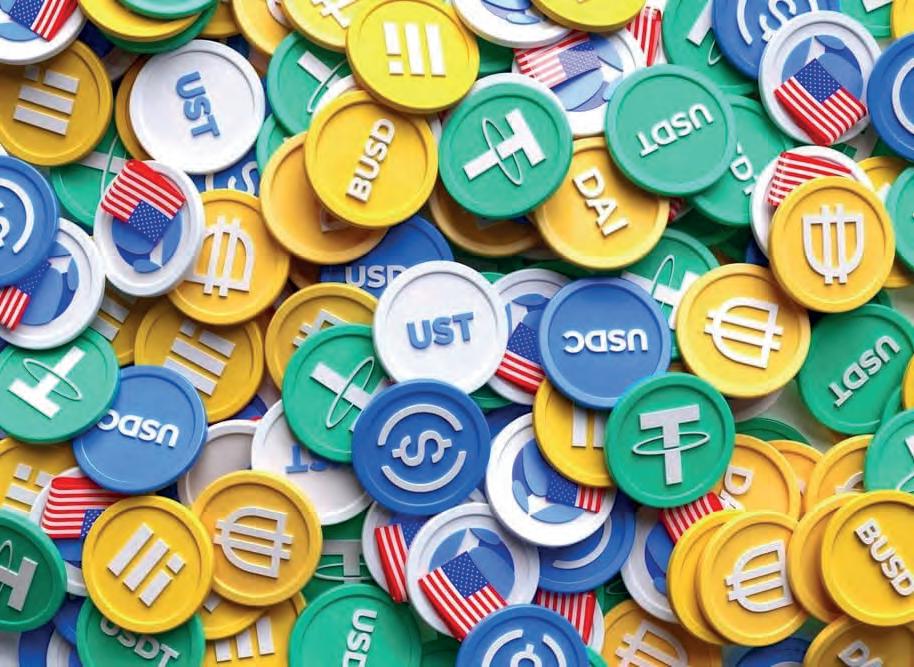
Imagine having a digital version of the dollar that moves as fast as an email, costs pennies to send anywhere in the world, and never closes for weekends or holidays. That’s the fundamental promise of stablecoins – they combine the stability of traditional currencies with the speed and accessibility of cryptocurrency.
Unlike Bitcoin or Ethereum, which can swing 10% or more in a single day, stablecoins are designed to maintain a steady value, typically pegged to the US dollar. This stability makes them useful for all the mundane but essential financial activities that volatile cryptocurrencies can’t handle: paying bills, saving money, conducting business, or simply moving value without the anxiety of watching your money’s worth fluctuate by the minute.
The need for this stability becomes viscerally clear when you consider the daily reality of using volatile cryptocurrencies. A coffee shop owner accepting Bitcoin payments might find that the $5 coffee paid for in the morning is worth $4.50 by afternoon, or $5.50 the next day. This unpredictability makes it nearly impossible to price goods, plan budgets, or conduct normal business operations.
Stablecoins solve this problem by anchoring digital value to familiar reference points. When Elena in Prague receives a payment in USDC (USD Coin), she knows it will be worth approximately the same amount in dollars tomorrow as it is today. This predictability transforms cryptocurrency from a speculative asset into a practical tool for commerce, savings, and financial planning.
The magic of stablecoins lies not in their technology alone, but in the trust mechanisms that maintain their stability. There are four main types of stablecoins: fiat-backed, crypto-backed, commoditybacked, and algorithmic stablecoins, each representing a different approach to the fundamental challenge of maintaining stable value in a digital asset.
Fiat-backed stablecoins, the most common and trusted variety, maintain their stability through the oldest financial mechanism known to humanity: holding reserves. For every dollarbacked stablecoin in circulation, the issuing company promises to hold one dollar in reserve, typically in bank accounts or short-term government securities. This creates a simple but powerful guarantee: users can always redeem their digital dollars for real dollars, which keeps the market price stable through arbitrage.
Market leader Tether’s USDT has maintained a market cap of around $140 billion since December, while secondplaced USDC, issued by Circle, is nearing $60 billion. These numbers represent more than market capitalisation – they represent billions of dollars held in reserve, backing digital currencies that people around the world rely on for their daily financial needs.
The trust required for this system to work is enormous. When someone accepts USDT or USDC as payment, they’re trusting not just the technology, but also the companies behind these stablecoins to maintain adequate reserves and honour redemption requests. This trust has been repeatedly tested, particularly during market crises when large numbers of users simultaneously attempt to convert their stablecoins back to dollars.
Tether (USDT) represents both the greatest success and the most persistent controversy in the stablecoin world. Launched in 2014 as one of the first major stablecoins, USDT has grown to dominate global cryptocurrency markets, accounting for roughly 60% of all stablecoin trading volume. Its success reflects genuine utility – USDT provides liquidity and stability to cryptocurrency markets worldwide, enabling trading, payments, and financial services that would be impossible with volatile cryptocurrencies alone.
Yet Tether has also faced persistent questions about its reserves and transparency. For years, the company was reluctant to provide detailed audits of its holdings, leading to speculation about whether every USDT was truly backed by a dollar in reserve. These concerns intensified during market stress periods, when
large redemptions tested the system’s resilience.
The controversy illuminates a fundamental tension in stablecoin design: the need for transparency conflicts with the desire for operational flexibility. Traditional banks don’t publish daily balance sheets or allow public inspection of their reserves, yet stablecoin users demand this level of transparency because the stakes feel higher in an unregulated market.
Despite these concerns, USDT has maintained its peg and continues to process billions of dollars in transactions daily. Its resilience suggests that even imperfect stablecoins can provide genuine value when they meet real market needs, though the ongoing scrutiny has pushed the entire industry toward greater transparency and regulatory compliance.
USD Coin (USDC), issued by Circle, represents a different
approach to building trust in stablecoins. From its launch in 2018, USDC emphasised regulatory compliance, transparency, and institutionalgrade financial practices. Circle publishes regular attestations of its reserves, maintains banking relationships with regulated institutions, and has actively sought regulatory clarity rather than avoiding oversight.
This emphasis on compliance has made USDC the preferred stablecoin for many institutional users, traditional financial companies, and regulated cryptocurrency exchanges. When a major bank or payment processor decides to work with stablecoins, they often choose USDC because its transparent backing and regulatory compliance reduce their risk exposure.
The growth of USDC demonstrates how different trust mechanisms can coexist and succeed in the same market. While Tether built dominance through first-mover advantage and network effects,

Circle built credibility through transparency and compliance. Both approaches have proven viable, serving different user bases with different risk tolerances and regulatory requirements.
While dollar-backed stablecoins dominate the market, other varieties serve specialised needs and point toward future innovations. Euro-backed stablecoins serve European markets where dollar volatility creates unwanted currency risk. Gold-backed stablecoins appeal to users who want exposure to precious metals without the complexity of physical storage.
Algorithmic stablecoins represent the most ambitious attempt to create stability without traditional backing. These systems use smart contracts and market incentives to maintain stable prices, theoretically eliminating the need to hold reserves or trust centralised issuers. The collapse of TerraUSD (UST) in 2022 demonstrated the risks of this approach, but also spurred innovation in more robust algorithmic designs.
The diversity of stablecoin types reflects the fact that different users have different needs for stability, trust, and functionality. A trader might prefer the liquidity and ubiquity of USDT, while an institution might opt for the transparency

of USDC, and a gold enthusiast might choose a commoditybacked alternative.
Stablecoins have evolved beyond simple digital representations of dollars to become the fundamental infrastructure for a new kind of financial system. They serve as the base layer for decentralised finance (DeFi) protocols, enabling lending, borrowing, and trading without the need for traditional banks. They facilitate cross-border payments that settle in minutes rather than days. They provide a stable store of value for people living in countries with unstable currencies.
Both Tether and Circle have touted the role their stablecoins have played in serving unbanked and

underbanked populations. This isn’t just marketing – for millions of people worldwide, stablecoins provide access to stable, digital money when traditional banking systems are unavailable, unreliable, or prohibitively expensive.
The infrastructure role of stablecoins becomes most apparent during market crises. When cryptocurrency prices crash, traders don’t typically sell their holdings for traditional dollars – they convert to stablecoins, which can be held on the same platforms and easily moved back into cryptocurrency when conditions improve. This creates enormous demand for stablecoins during volatile periods, making them essential providers of liquidity for the entire cryptocurrency ecosystem.
The rapid growth of stablecoins has drawn intense scrutiny from regulators. U.S. officials view stablecoins as a means to maintain the dollar’s dominance as a global reserve currency, considering them digital extensions of American monetary policy rather than a threat to it. This perspective has led to generally supportive regulatory approaches, though with increasing demands for transparency and oversight.
The regulatory landscape varies dramatically worldwide.
Some countries have adopted stablecoins as a form of financial innovation, while others have banned them entirely. The European Union is developing comprehensive regulations for stablecoins, while countries like Nigeria have struggled to strike a balance between innovation and concerns over monetary sovereignty.
These regulatory differences create both opportunities and risks for stablecoin users. Favourable regulations can accelerate adoption and integration with traditional financial systems, while hostile regulations can force users toward less regulated alternatives or underground markets. The regulatory evolution of stablecoins will likely determine whether they remain niche cryptocurrency tools or become mainstream financial infrastructure.
The stablecoin market continues evolving rapidly, with new entrants, improved technologies, and expanding use cases. Recent research shows growing real-world adoption, suggesting that stablecoins are transitioning from speculative crypto assets to practical financial tools.
But perhaps the most intriguing development comes from an unexpected innovation in stable

value design. The CMC Group’s launch of FUSD represents a radical reimagining of what stable value can mean in the digital age. Unlike traditional stablecoins that maintain fixed prices, FUSD introduces the concept of an “appreciating stable token” – a cryptocurrency designed so that its price can only increase over time.
This innovation emerged from asking a fundamental question: why should stability mean stagnation?
The FUSD mechanism works by combining stablecoin tokenomics with innovative taxation structures. Every transaction incurs a 2.5% fee, which is distributed directly into the liquidity pool through multiple channels, including a proprietary “dripper” system that continuously injects value. The result is counterintuitive but mathematically sound: whether someone buys or sells
FUSD, the price increases. As the team puts it, “When you buy FUSD, the price at that moment is the highest it’s ever been and the lowest it will ever be.”
This breakthrough addresses one of cryptocurrency’s most persistent problems – the zero-sum nature of most digital assets, where one person’s gain requires another’s loss. FUSD’s appreciating stability creates a positive-sum environment where all participants benefit from any transaction activity. For traders weary of the emotional rollercoaster of volatile assets but bored by static stablecoins, it offers a third option where everyone wins.
The technical innovation extends beyond simple price appreciation. The system includes cross-chain arbitrage opportunities, NFT collection royalties feeding the liquidity mechanism, and flash loan facilities that generate additional revenue streams.
Central bank digital currencies (CBDCs) represent potential competition for private stablecoins, offering government-issued digital money with guaranteed stability. However, early CBDC implementations suggest that private stablecoins may retain advantages in terms of speed, accessibility, and innovation, creating a complex competitive landscape rather than a simple displacement.
The technical infrastructure supporting stablecoins continues to improve, with faster settlement times, lower fees, and enhanced user experiences. Cross-chain bridges enable stablecoins to transfer between different blockchain networks, thereby increasing their utility and reach. Privacy-preserving stablecoins are emerging to address surveillance concerns without sacrificing stability.
Perhaps most importantly, stablecoins are becoming more than just digital versions of existing currencies. They’re evolving into programmable money that can automatically execute financial contracts, participate in decentralised autonomous organisations, and enable entirely new forms of economic coordination that weren’t possible with traditional currency. The emergence of appreciating stable tokens like FUSD suggests we may be witnessing the birth of an entirely new category of digital

assets – one that combines the best aspects of stability and growth without the traditional trade-offs.
Maria in São Paulo no longer worries about currency fluctuations destroying her margins. Kwame in Lagos receives payments instantly and cheaply. Elena in Prague has a stable foundation for exploring cryptocurrency markets. These individual stories multiply millions of times across the

globe, representing a quiet revolution in how money moves, how value is stored, and how financial systems serve human needs.
Stablecoins have succeeded not because they’re perfect, but because they solve real problems that traditional financial systems couldn’t address effectively. They’ve become the backbone of cryptocurrency markets, the foundation of decentralised finance, and increasingly, the infrastructure for a more accessible and efficient global financial system.
The digital dollar revolution isn’t just about technology – it’s about creating financial tools that serve human needs better than what came before. In a world where traditional money systems can be slow, expensive, and exclusive, stablecoins offer speed, affordability, and accessibility. They represent not just innovation in currency, but progress toward a financial system that works for everyone, everywhere, all the time.
Adele Adele60370277

Do you ever reflect on where your relationship with Crypto started? I do, in fact, I often scan my portfolio and wonder how in God’s name I managed to find myself what they’d call in Scotland ‘baw deep’ in it all. Four years ago, I knew nothing, and in the grand scheme of things, I’m still something of a rookie, but to the astonishment of my friends and family, it’s become a massive thing in my life.
Feel free to mutter about old dogs and new tricks, trust me, I’ve heard it before – mostly from my son, who I’m sure is convinced I’m going to burn through his inheritance and leave him nothing but a pile of digital dust when I shuffle off in whichever direction I’m destined. What I can say, with honesty, is that it’s been a complete joy to immerse myself in something that I knew nothing about, and despite picking up some significant bruises, I wouldn’t change a thing.
Actually, that’s not strictly true. I wish some of my skinned knees hadn’t cut quite so deep. I wish I’d had a few more restful nights, instead
of nights peppered with fitful sleep, wondering whether that healthy green candle I was riding at bedtime had defected to the dark side and bled out as soon as my eyes were closed. And I wish, in the projects that burned me, I’d seen red flags instead of bunting. But isn’t that how we learn?
And I have learned. I’ve come to understand that the relationship we have with Crypto is like any other relationship in our lives; 4 years in, I may still feel like a newbie, but I know where my boundaries are and what I need in order to be excited about an investment. And speaking now as a creator and project guardian myself (how did that even happen?!) I have a level of insight from the other side too. The common denominator amongst crypto investors is that we’re all here to make money – but we’re all different in our approach.
It’s all about fit, right? If you’re an investor looking for a onenight stand, a quick in-out with no need to commit, you’ll be miserable in a project that isn’t hyping or promoting; if the pace of the project doesn’t match your appetite for fast gains you’ll trip over your boredom threshold in the first hour.
On the flip side, if you’re looking for substance over hype, a telegram channel stuffed to the gills with raiders yelling LFGs and TO THE MOOOOON on an endless loop of GIFs and stickers is going to get old really quickly. In both these scenarios, you’re not a good fit and you should swipe left immediately.
DYOR – doing your own research – is something we should all get on board with in order to make shrewd investment choices, but if you’re going to settle in and

build an enjoyable crypto portfolio, it’s about way more than looking at the nuts and bolts of a project. The nuts and bolts matter, of course, they do, and you’re going to want to explore them. There’s a plethora of advice on the World Wide Web about how to read the technical specifications of a project, evaluate its use case and decide for yourself how it compares to other similar projects competing for your dollar.
However, on their own, checking those boxes doesn’t increase your odds of enjoying the experience. So what nontech non-spec data points are the ones that give you ‘the feels’?
Community is everything. The community behind a project can be the determining factor between success and failure - but what makes a great one? Every community comes with a tapestry of characters. Supportive voices, challenging voices, curious souls, protagonists and peacemakers. A shared goal, a collective spirit and the odd numpty who’s never really happy but sticks around to point out all the things that could be better. Oh, and the ones who just want to know WEN. Daily.
A good community will pull together when it matters. A bad one will eat itself from
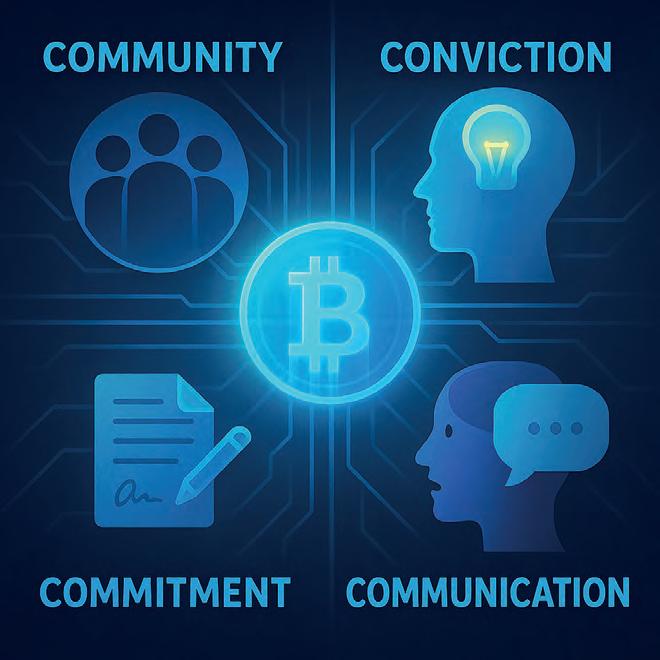
the inside out as soon as the chips are down. We’ve all seen it happen – a couple of red days, and suddenly the dev isn’t working hard enough, or fast enough, or the marketing isn’t up to scratch. Everything is somebody’s fault, and anyone who sells is vilified and blamed for making the sky fall in.
Pay attention to the vibe. Are newcomers welcomed? Do the mods have a fair and consistent hand on the tiller? Are the team present and accessible, and is there always someone around to help? If there are one or two die-hard supporters whose cheerleading is met with apathy, especially in low-cap projects where community support is paramount, be wary
of aping in – your chances of being someone else’s exit liquidity are pretty high.
It’s worth noting that great communities don’t happen by accident; they’re a direct reflection of the leaders of the pack, so pay attention!
One of the most bullish signs in any project is the way in which the team sets a course and sticks to it. If they’re constantly distracted by the next shiny new thing, leaving a wake of unfinished initiatives, or they’re too eager to bend to the demands of the masses, it’s a fairly safe assumption that the project is going to tread water until the end of time.
The roadmap of a project should never be something cobbled together as a sales pitch with no sign of promises being delivered. That’s not to say things can’t flex in the wind; if you stand still, you go backwards, and a regular check in with use case and direction as markets, competitors and investor appetites change is essential. But knowing where you’re headed, setting your course and being accountable for delivering it shows the team has the courage of their convictions, and that strength will carry the project a long way.
To a degree, commitment works best if it’s a two-way street. There’s no obligation, of course, and when you chip in to a project, you can cash those chips out any time you like. But should you? If it’s a beast of a project with a huge holder count and a healthy market cap, it’s unlikely anyone would notice if you lost interest and moved on to the next exciting opportunity. For lowcap projects that are building though, especially if you’ve amassed large holdings early and you’re taking your profits and cutting loose, it can really hurt the momentum. As an investor, your only obligation is a moral one, but you still get to choose.
Team commitment is different though. They can’t just get
bored and wander off in search of new opportunities. They shouldn’t run out of steam, or ideas when the grind of building gets tough and the novelty wears off. Look for signs that they’re digging in when the going gets tough, not trying to dig their way out. If you’ve been in crypto a while, you’ll understand the risk; the overwhelming majority of projects don’t thrive in the long term and they won’t thrive beyond ten minutes if the team isn’t 100% committed.
This is the rub, isn’t it? In my view, the single most important factor is the glue that holds investors together inside the cocoon of a project.
Now, I’d be the first to admit I have a tendency to overcommunicate. In my first few months of being involved in moderating a crypto community, my eagerness to share the minutiae of detail
tripped me up regularly. I underestimated just how literally some people would take whatever I said, and how fast careless words would come back and bite me in the ass. I’m more cautious these days, but even now, given a choice between saying too little and saying too much, I’m a fully paid-up member of camp overshare.
Irrespective of how you like your information served, one thing is certain: lack of communication breeds suspicion. In the absence of information, it’s human nature to wonder, speculate and even catastrophise about what might be going on. And the trouble is, when these ruminations stop being inside thoughts and get whispered into the ears of a community, rumours abound and before you know it, someone’s speculation becomes someone else’s fact.
I’m not a detail hound, and a general overview of what’s

going on is all I personally need to feel comfortable in a project. But we’re all different; some folk are wired in a way that means their thirst for detail and constant updates is a deal breaker, and if that’s a need of yours that isn’t being met, you’re going to feel grumpy and dissatisfied. So, check in on how the team of any project you like the look of keeps their investors updated and make sure it’s going to work for you.
If there’s one piece of advice I wish someone had shared with me as I started my crypto journey, it’s this: invest in teams, not just projects. If the team behind a project have showcased their mettle, met your expectations and followed through with what they said they were going to do, stick with them because it’s very likely they’ll do it again. The four C’s are my deal-breakers, and they’re the only reason I’m enjoying myself in this crazy space.
I consider myself really fortunate to have found the teams I’m invested in, and the teams I work with. I’ve got their backs, and I know they’ve got mine.
And this time next year, Rodney...!
How a mysterious figure embedded in code became the foundation of a monetary revolution
In the pantheon of consequential numbers—the speed of light, Avogadro’s constant, the golden ratio— one figure stands apart for its deliberate obscurity and profound implications: 21 million. This is the total number of bitcoins that will ever exist, a hard ceiling programmed into the
Robert Stone @StoneOnChain
cryptocurrency’s DNA by its enigmatic creator, Satoshi Nakamoto. Yet, for all its significance, this number was never formally explained, leaving the world to decipher why this particular figure became the cornerstone of what many consider the most important monetary innovation since the gold standard.
When Nakamoto released Bitcoin’s white paper in 2008 and launched the network the following year, the 21 million limit was embedded in the code without fanfare or justification. No blog post explained the reasoning. No academic paper outlined the economic theory.

The creator coded it into existence, and after a few years of correspondence with early developers, it vanished entirely from public view.
This absence of explanation has spawned countless theories, each attempting to decode the mathematical poetry behind Bitcoin’s monetary architecture. What emerges from this analysis is not just a number, but a philosophical statement about the nature of money itself.
The 21 million figure isn’t arbitrary—it’s the inevitable result of Bitcoin’s elegant issuance mechanism. When the network launched, miners received 50 bitcoins for each valid block they added to the blockchain approximately every ten minutes. Every 210,000 blocks—roughly four years—this reward halves: from 50 to 25 to 12.5 to 6.25, and so on.
This geometric progression creates a converging series that asymptotically approaches 21 million coins. The mathematics are elegantly simple: 50 × 210,000 = 10.5 million coins in the first epoch, 25 × 210,000 = 5.25 million in the second, and 12.5 × 210,000 = 2.625 million in the third. Each halving produces exactly half the coins of the previous period, creating a mathematical certainty that the total will never exceed 21 million.
The Bitcoin community has developed several compelling theories about Nakamoto’s choice, each revealing different facets of the system’s design philosophy.
The Monetary Base Theory suggests Nakamoto was responding to the approximately $21 trillion US monetary base in 2009. If each bitcoin were to eventually represent $1 million in value, the total market capitalisation would mirror the dollar base at Bitcoin’s inception—a digital reflection of traditional monetary systems.
The Incentive Design Theory posits that 21 million emerged from the need to balance early adoption incentives with long-term network security. Large initial rewards attracted miners when Bitcoin had no established value, while the predetermined reduction schedule ensured sustainable
issuance as the network matured.
The Digital Gold Theory frames the cap as a deliberate attempt to recreate gold’s scarcity in digital form. Unlike physical gold, which requires geological processes and mining equipment, Bitcoin’s scarcity is enforced by mathematics, creating what economists call “digital scarcity” for the first time in human history.
The 21 million cap does more than constrain supply—it fundamentally alters human behaviour around money. In traditional fiat systems, where central banks can expand the money supply at will, rational actors are incentivised to spend quickly and borrow heavily, as inflation erodes the value of saved currency over time.
Bitcoin inverts this dynamic. The knowledge that no additional coins can ever be created encourages what economists call “low-time preference”—the willingness to delay gratification for future benefit. This psychological shift from consumption to preservation represents a quiet revolution in economic behaviour, one that unfolds not through policy mandates but through individual choice.
The phenomenon manifests in the Bitcoin community’s
embrace of “HODLing” (originally a misspelling of “holding”), which has evolved from internet slang into economic philosophy. When people believe their money cannot be debased, they fundamentally alter their relationship with saving, spending, and investing.
The final bitcoin is expected to be mined around the year 2140, at which point the network will transition from block rewards to pure transaction fees. This distant horizon raises questions about long-term sustainability, but it also demonstrates Bitcoin’s most radical feature: complete monetary policy predictability.
Unlike traditional currencies, where supply decisions are made by central bank committees responding to economic conditions, Bitcoin’s entire monetary future is knowable today. We can calculate with mathematical precision how many bitcoins will exist in 2050, 2100, or any

future date. This represents an unprecedented experiment in monetary determinism.
Ultimately, the 21 million limit transcends economics or computer science—it’s a philosophical statement about the nature of value and power. By creating money with an immutable supply schedule, Nakamoto challenged fundamental assumptions about monetary authority.
Traditional monetary systems require trust in institutions: central banks to manage inflation responsibly, governments to resist the temptation of seigniorage, and regulators to maintain financial stability. Bitcoin eliminates this need for trust by encoding monetary policy directly into mathematics. The 21 million cap isn’t just a technical specification—it’s a declaration that money can be governed by code rather than committees.
This shift from institutional trust to mathematical certainty represents perhaps the most radical aspect of Bitcoin’s design. For the first time in history, we have money whose rules cannot be changed by human decision, political pressure, or economic emergency. The 21 million limit stands as a boundary that cannot be crossed, a rule that applies equally to paupers and presidents.
As Bitcoin approaches its second decade, the 21 million cap has proven to be more than just a number—it’s become a symbol of resistance to monetary manipulation and a beacon for those seeking alternatives to traditional financial systems. Whether Bitcoin ultimately succeeds as global money or remains a niche store of value, the principle of mathematical monetary policy has been established.
In choosing 21 million, Nakamoto didn’t just create digital scarcity—he created a new category of money entirely. This is one where value is not derived from government decrees or institutional backing but from the absolute certainty that the rules will never change. In a world where trust in institutions continues to erode, this mathematical guarantee may prove to be the most valuable innovation of all.
The mystery of why Nakamoto chose exactly 21 million may never be fully solved. But perhaps that’s fitting for a system designed to function without its creator, where the code speaks louder than any explanation ever could. In the end, the number itself matters less than what it represents: the possibility of money that belongs to mathematics rather than to men.


Blockchain technology has heralded a new era of decentralised trust and innovation, promising to reshape industries from finance to logistics. Yet, beneath the surface of this revolutionary promise lies a fundamental design challenge that every blockchain must confront: The Blockchain Trilemma. This concept posits that a blockchain system can only truly optimise for two of three core properties simultaneously – Scalability, Security, and Decentralisation – without
Robert Stone @StoneOnChain
significantly compromising the third.
Understanding the Trilemma is not just an academic exercise; it’s crucial for anyone looking to grasp the fundamental design choices behind different blockchain networks, evaluate their strengths and weaknesses, and appreciate the ongoing waves of innovation sweeping through the crypto space. This understanding empowers you to make informed decisions and appreciate the complexity of blockchain design. Think of
it like building a car: you can make it incredibly fast (scalable) and robustly safe (secure), but it might end up being so complex and expensive to produce that it’s not widely accessible (less decentralised manufacturing). Conversely, a car designed for mass production (decentralised) might have to compromise on top speed or cutting-edge safety features. It’s a constant balancing act.
Let’s unpack each of these pillars.
At its heart, blockchain is about decentralisation. This means there’s no single governing authority, no central server, and no single point of control or failure. Instead, the network comprises thousands of independent participants, or “nodes,” spread across the globe. These nodes collaboratively maintain and verify the distributed ledger, ensuring that no single entity can manipulate or censor transactions.
Decentralisation is achieved through a combination of peerto-peer networking and robust consensus mechanisms. It fosters trustlessness, meaning users don’t need to trust a central intermediary; they only need to trust the network’s protocol. The benefits are profound: enhanced security against single-point attacks, resistance to censorship (governments or corporations can’t easily shut down or alter the network), and unparalleled transparency as all transactions are publicly verifiable.
This reassures users about the security and transparency of blockchain technology, making it a powerful tool for trust in a digital world. However, a highly decentralised network often comes with a tradeoff: Scalability. When every single node must verify every transaction, the process can
become slow and inefficient, leading to lower transaction throughput. Bitcoin, for instance, is a quintessential example of a highly decentralised network. Its deliberate design prioritises this decentralisation and security, accepting a relatively low transaction processing speed (around seven transactions per second) as a necessary trade-off.
Security in blockchain refers to the network’s resilience against attacks and its ability to maintain the integrity and immutability of its data. A secure blockchain resists attempts to
alter past transactions, prevent legitimate transactions from being processed, or manipulate the network for malicious gain. The bedrock of blockchain security lies in advanced cryptography and robust consensus mechanisms.
Cryptographic techniques like hashing and digital signatures ensure that transactions are verifiable and tamper-proof. Consensus mechanisms, such as Bitcoin’s energyintensive Proof of Work (PoW) or Ethereum’s resourceefficient Proof of Stake (PoS), are designed to make attacks economically infeasible. For example, a “51% attack” on a PoW chain would require an attacker to control over half of
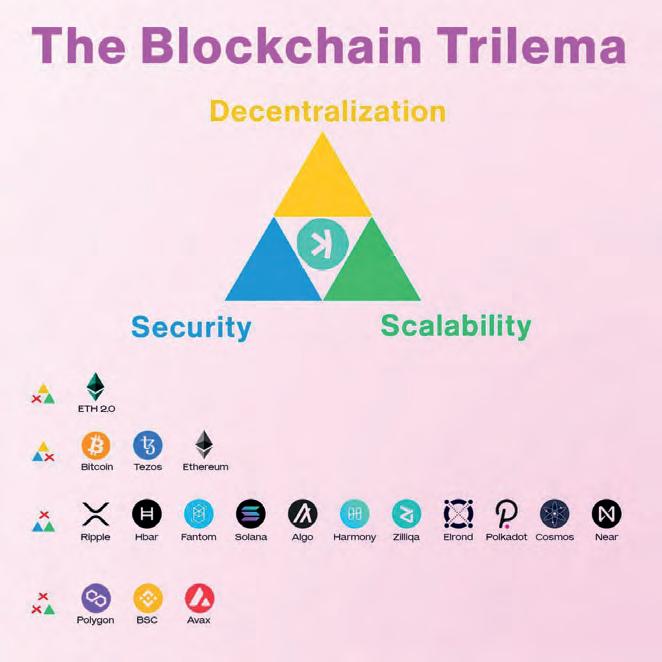
the network’s computing power – a monumental and incredibly expensive undertaking.
The benefits of a secure blockchain are clear: reliability, prevention of fraud, and the establishment of an immutable record. But, like decentralisation, enhancing security often comes with its own trade-offs. Extremely robust security, particularly with PoW, demands significant computational resources, which can directly impact Scalability. While some highly secure systems might be less decentralised (e.g., permissioned blockchains), they can achieve higher speeds within their controlled environments.
Scalability refers to a blockchain’s ability to handle a growing volume of transactions per second (TPS) and support a larger user base without suffering from congestion or prohibitive transaction fees. For widespread adoption, especially in applications such as decentralised finance (DeFi) or gaming, high transaction throughput and low costs are crucial.
Achieving high scalability has historically been a significant hurdle for public, decentralised blockchains. Faster block times, larger block sizes, or more efficient consensus
mechanisms are often explored to boost throughput.
However, the pursuit of scalability often introduces trade-offs with the other two pillars. A network might be forced to compromise on decentralisation to achieve higher speeds. For instance, increasing block sizes might make it too expensive or resource-intensive for ordinary users to run full nodes, leading to a smaller, more centralised group of validators. Similarly, aggressively pursuing speed could introduce new attack vectors or make it harder to maintain network integrity, impacting Security if not meticulously designed. Projects like Solana prioritise exceptional scalability, often achieving thousands of TPS, but have faced questions regarding their decentralisation due to higher hardware requirements for validators and occasional network outages.
The Trilemma in Action: Real-World Trade-offs
Bitcoin: Represents a design choice prioritising decentralisation and Security. Its rigid block size and slow block times make it incredibly resilient and trustworthy as “digital gold,” but at the cost of limited Scalability, leading to higher transaction fees during peak demand.
Ethereum (Pre-Merge):

Before transitioning to Proof of Stake, Ethereum aimed for a strong balance of decentralisation and Security. This design, however, led to significant Scalability issues, characterised by high “gas fees” and network congestion, particularly during periods of high demand for DeFi and NFTs.
Ethereum (Post-Merge & Future Roadmap): Ethereum’s ‘Merge’ to Proof of Stake (a transition from the current energyintensive consensus mechanism, Proof of Work, to a more energy-efficient and secure one, Proof of Stake), and its ambitious future roadmap, including sharding and Layer 2 integrations, represents a sophisticated attempt to mitigate the trilemma rather than eliminate it. By offloading transaction execution to Layer 2
solutions and eventually distributing data processing via sharding, Ethereum aims to dramatically increase Scalability while preserving the Security and decentralisation of its core mainnet. This highlights a strategy of modularity to overcome inherent limitations.

Permissioned Blockchains (e.g., Hyperledger Fabric): These enterprise-focused blockchains often achieve very high Scalability and can be highly Secure within
a controlled environment. However, they achieve this by being significantly less decentralised, as a consortium (a group of entities that come together to manage the blockchain, often including industry players, regulators, and other stakeholders) restricts and manages participation.
It’s important to reiterate that the Blockchain Trilemma isn’t a problem to be “solved” and then disappear entirely. Instead, it’s a fundamental design constraint that developers and researchers constantly work to mitigate and optimise.
The industry is addressing the trilemma through various innovative approaches:
Layer 2 Solutions: These protocols (e.g., Rollups like Optimism and Arbitrum, Bitcoin’s Lightning Network) process transactions off the main blockchain, then settle them on the underlying chain. This dramatically boosts Scalability by reducing the load on the mainnet, while inheriting its Security and Decentralisation.
Sharding: A technique to divide the blockchain into smaller, interconnected “shards” that can process transactions in parallel,

allowing for significantly higher throughput.
Ethereum’s long-term scaling plan heavily relies on sharding.
New Consensus Mechanisms: Beyond traditional Proof of Work and Proof of Stake, new variants and novel consensus algorithms are continually being developed to offer improved performance without compromising security or decentralisation.
Modular Blockchain Designs: This emerging paradigm involves separating the core functions of a blockchain (execution, consensus, data availability) into distinct, specialised layers or chains.
This allows for greater flexibility and optimisation at each layer, enabling scalable and applicationspecific solutions.
The future of blockchain is unlikely to be dominated by a single “winner” that perfectly solves the trilemma. Instead, we are seeing the emergence of a diverse ecosystem where different blockchains make different trade-offs based on their intended purpose and use cases. Some will prioritise ultimate decentralisation, others raw speed, and many will leverage hybrid approaches to achieve a desirable balance.
The Blockchain Trilemma is a core concept underpinning


The ongoing innovation in scaling solutions and architectural designs demonstrates the relentless pursuit of more efficient and widely applicable blockchain technologies
the evolution of decentralised technology. By understanding the inherent trade-offs between Scalability, Security, and Decentralisation, you are better equipped to evaluate the design philosophies of various blockchain projects. When encountering a new blockchain, ask yourself: “What tradeoffs has this project made? How does it aim to address the trilemma? And are these choices appropriate for its stated goals?”
The ongoing innovation in scaling solutions and architectural designs demonstrates the relentless pursuit of more efficient and widely applicable blockchain technologies. While the Trilemma remains a constant challenge, it is also a powerful driver of creativity, pushing developers to build the robust and decentralised future we all envision.


Robert Stone @StoneOnChain

In an era where trust in institutions has plummeted to historic lows and financial systems strain under the weight of their own complexity, a revolutionary technology like blockchain promises to reshape the fundamental relationship between citizens and their world. It offers a solution to the increasing need for security from governments encroaching on our lives.
Blockchain, the distributed ledger technology that burst onto the global stage with Bitcoin, represents far more than a novel approach to digital currencies. It embodies a transformative force capable of redefining security, transparency, accountability, and power distribution in modern society.
As governments worldwide grapple with declining public trust and mounting demands
for accountability, blockchain emerges not merely as a technological solution but as a philosophical revolution. This technology has the potential to revolutionise governance and finance, democratizing access, eliminating gatekeepers, and returning power to the people, much like the printing press did for information.
At its core, blockchain technology offers something deceptively simple yet profoundly powerful: an immutable, transparent, and decentralised record of truth. Unlike traditional systems where trust resides in centralised authorities—be they governments, banks, or corporations—blockchain distributes trust across a network of participants, each holding identical copies of the ledger.
This fundamental shift in trust architecture addresses one of humanity’s oldest challenges: how to ensure accountability among those who wield power. Societies have relied on checks and balances, watchdog organisations, and periodic elections to constrain authority for centuries. Yet these mechanisms have proven vulnerable to corruption, manipulation, and simple human error. Blockchain offers something radically different—a system where transparency isn’t requested or
enforced but is inherent in the technology itself.
The implications for personal security cannot be overstated. In our interconnected world, our identities, assets, and freedoms exist increasingly in digital form. Traditional systems leave us vulnerable on multiple fronts: identity theft runs rampant, with millions falling victim annually; financial accounts can be frozen or seized by government whim; personal data is harvested, sold, and weaponised against us.
Blockchain technology fundamentally alters this landscape of vulnerability, empowering people with control over their digital existence. When your identity exists on an immutable ledger that you control, identity theft becomes not just difficult but mathematically impossible. When cryptography rather than institutional promises secures your assets, no government can arbitrarily seize them. No
single breach can compromise your entire digital existence when your data is encrypted and distributed rather than centralised. This empowerment is a significant step towards a more secure and selfdetermined digital future.
Consider the chilling reality of current systems: your bank account can be frozen with a single government order; your assets can be inflated away through monetary policy; your identity can be stolen and used to destroy your life. These aren’t theoretical risks—they happen daily to people worldwide. Blockchain offers a shield against these vulnerabilities, providing unparalleled security through mathematics rather than trust in institutions.
Consider the implications for government record-keeping. Today, public records exist in

silos, vulnerable to alteration, loss, or selective disclosure. Blockchain transforms this paradigm entirely. When government transactions, contracts, and legislative actions are recorded on a distributed ledger, they become permanently etched in digital stone. Citizens no longer need to file freedom of information requests or wonder if records have been altered. The truth exists, accessible to all, forever.
This transparency extends beyond mere recordkeeping. Smart contracts— self-executing agreements with terms directly written into code—can automate government processes while ensuring complete visibility. Land registries, licensing procedures, and permit issuances can operate without human intervention, eliminating opportunities for corruption while dramatically reducing bureaucratic overhead.
Perhaps nowhere is blockchain’s potential more transformative than in voting systems. Current electoral processes, despite centuries of refinement, remain vulnerable to fraud, manipulation, and simple incompetence. Paper ballots can be destroyed; electronic systems can be hacked; results can be questioned.
Blockchain-based
voting systems offer something revolutionary: a voting mechanism that is simultaneously transparent and private, verifiable and secure. Each vote becomes a cryptographically secured transaction, anonymous to protect voter privacy yet traceable to ensure legitimacy. Citizens can verify that their own votes were counted correctly without compromising the secret ballot. Election results become mathematically provable, rendering post-election disputes obsolete.
This technology enables more than just secure elections. It opens the door to continuous democratic participation. Major policy decisions could be made to secure transparent public votes. Citizens could directly participate in budget allocations, watching in realtime as their tax dollars flow through government coffers. The representative democracy
of the industrial age could evolve into a participatory democracy suited for the digital age. This potential for continuous democratic participation is not just revolutionary; it’s a reason for hope and engagement in the future of governance.
Government financial management represents another frontier for blockchain transformation. Today, tracking public expenditure resembles following a river that constantly splits, merges, and disappears underground. Billions vanish into black budgets; funds allocated for one purpose mysteriously appear elsewhere; corruption thrives in opacity.
Blockchain changes this equation fundamentally. When every financial transaction is recorded on an immutable ledger, financial flows become STAYING

crystal clear. Citizens can trace their tax payments from collection through allocation to final expenditure. Government contracts, often breeding grounds for corruption, become transparent documents whose execution can be monitored in real time. This level of financial transparency and accountability is not just a promise; it’s a reassurance that blockchain brings to government management, instilling confidence in the system.
The concept of self-sovereign identity represents perhaps blockchain’s most profound contribution to personal security. In traditional systems, your identity is a collection of documents and database entries controlled by others—governments issue your passport, banks verify your creditworthiness, and corporations store your personal data. You are, in essence, a tenant in your own identity.
Blockchain flips this model entirely. Self-sovereign identity means you own and control your identity absolutely. No government can revoke it; no corporation can sell it; no criminal can steal it. Your identity becomes a cryptographic certainty that you alone control. This isn’t just about convenience—it’s about fundamental human dignity and security in an increasingly authoritarian world.

The security implications extend to every aspect of life. Medical records stored on blockchain remain permanently yours, accessible when needed, but immune to tampering or unauthorised access. Educational credentials become unforgeable, eliminating diploma mills while ensuring your achievements can never be questioned or erased. Professional licenses and certifications exist beyond the reach of corrupt officials or vindictive bureaucrats.
While blockchain technology promises to transform government operations, its most radical implications may lie in its original application: cryptocurrency. The separation of money from state control represents a shift as fundamental as the separation of church and state that defined the Enlightenment. Cryptocurrencies, enabled by blockchain, offer a decentralised and secure alternative to traditional
financial systems, potentially reshaping the way we transact and store value.
Throughout history, control of money has been synonymous with control of power. Governments have wielded their monopoly over currency as both a carrot and a stick, inflating away debts, restricting capital flows, and manipulating economies to serve political ends. This monopoly, so deeply embedded in our consciousness that we rarely question it, represents one of the last significant concentrations of unchecked power in democratic societies.
Cryptocurrency shatters this monopoly. For the first time in human history, anyone can store and transfer value without permission from any government or financial institution. This isn’t merely a technological advancement—it’s a fundamental expansion of human freedom.
The security implications of financial sovereignty cannot be overstated. History is littered with examples of governments using financial control as a weapon against their own citizens. From the confiscation of gold in 1930s America to the freezing of bank accounts in modern-day protests, financial control has been the silent enforcer of compliance.
Cryptocurrency renders these tactics obsolete. When your wealth exists as cryptographic keys that only you control, no government can confiscate it, no bank can freeze it, and no inflation can silently steal it. This isn’t about evading legitimate law—it’s about protecting yourself from illegitimate power.
Consider the protesters in authoritarian regimes who watch their bank accounts being emptied for expressing dissent. Think of the
entrepreneurs in unstable countries who see their life savings evaporate through hyperinflation. Remember the innocent citizens caught in sanctions, unable to access their own money despite committing no crime. For these people, cryptocurrency isn’t a speculative investment—it’s a lifeline to security and freedom.
Critics often dismiss cryptocurrency as a passing fad or criminal tool, yet its growth continues unabated. This resilience stems from a simple truth: cryptocurrency represents an idea whose time has come. Just as the printing press made censorship ultimately futile, blockchain makes financial censorship impossible.
Governments may ban, regulate, or attempt to coopt cryptocurrencies, but they cannot stop them. Technology requires only electricity and internet

connectivity—resources that are too fundamental to modern life to eliminate. Short of a coordinated global shutdown of the internet, cryptocurrency will persist and evolve.
In an age where data is the new oil, blockchain offers crucial protection against the surveillance state and surveillance capitalism. Traditional digital systems create permanent records of every transaction, every interaction, every moment of our lives—data that governments and corporations mine relentlessly.
Blockchain, paradoxically, offers both transparency and privacy. While all transactions are visible, the identities behind them can remain pseudonymous. Zeroknowledge proofs and other cryptographic innovations allow you to prove facts about yourself without revealing underlying data. You can verify your age without showing your birthdate, prove your income without revealing your employer, and demonstrate your creditworthiness without exposing your entire financial history.
This selective disclosure revolutionises personal security. No longer must you trust countless entities with your complete personal STAYING

information, hoping they’ll protect it adequately. Instead, you share only what’s necessary, when it’s necessary, with mathematical proof replacing institutional trust.
The path to blockchainpowered transparent governance faces significant obstacles. Scalability remains a concern—current blockchain networks struggle to handle the transaction volumes that government operations would require. Privacy, paradoxically, presents another challenge. While transparency is generally beneficial, some government operations legitimately require confidentiality.
Regulatory frameworks lag behind technological capabilities. Governments accustomed to control, struggle to regulate systems designed
to operate without central authority. The tension between blockchain’s decentralised nature and government’s hierarchical structure creates friction that must be carefully managed.
Yet these challenges pale before the opportunities. Early adopter governments are already demonstrating blockchain’s potential. Estonia has digitised government services on blockchain, reducing bureaucracy while enhancing security. Dubai aims to become the world’s first blockchain-powered government. These pioneers prove that the obstacles are surmountable.
Behind the technology and economics lies a fundamentally human story. Blockchain represents humanity’s latest attempt to solve an ancient
problem: how to organise society in ways that maximise freedom while maintaining order. Technology offers tools, but people must choose to use them.
This choice requires courage. Entrenched interests will resist. Those who benefit from opacity will fight transparency. Those who profit from the current monetary system will oppose cryptocurrency or try to foist CBDCs on the people. Yet history shows that technological revolutions, once begun, prove unstoppable.
The connection between personal security and political freedom runs deep. When citizens lack security—when their assets can be seized, their identities compromised, their votes manipulated—they cannot exercise meaningful freedom. They become subjects rather than citizens, dependent on the goodwill of those in power rather than secure in their own rights.
Blockchain breaks this cycle of dependence. By providing unbreachable security for our digital selves, it creates the foundation for genuine political and economic freedom. When your identity, assets, and voice are cryptographically secured, you can speak truth to power without fear of retaliation. You can support unpopular causes,
challenge corrupt officials, and exercise your rights without risking your security.
This security extends beyond individual protection to collective resilience. When millions possess uncensorable money and uncompromisable identities, authoritarian control becomes impossible. The tools of oppression—financial blackmail, identity manipulation, vote rigging—lose their power. Society itself becomes more secure, more stable, more free.
Blockchain technology offers the foundation for a new social contract between citizens and their governments. This contract replaces trust with verification, promises with immutable commitments, and hope with mathematical certainty.
In this new paradigm, governments earn legitimacy
not through force but through transparency. Citizens participate not just through periodic elections but through continuous engagement. Money serves as a tool of exchange rather than control. Power is distributed across networks rather than concentrated in capitals.
Most importantly, this new social contract guarantees security as a fundamental right. No longer will citizens trade freedom for security or accept vulnerability as the price of participation in society. Instead, security becomes embedded in the very architecture of our systems, as immutable as the laws of mathematics.
We stand at a crossroads. Down one path lies the continued erosion of trust, the perpetuation of opaque systems that serve the few at the expense of the many. Down the other lies a future

of radical transparency, genuine accountability, and distributed power.
The choice belongs to this generation. We can accept the status quo, hoping that traditional reforms might somehow succeed where they have repeatedly failed. Or we can embrace the tools that technology provides to build something genuinely new.
But this choice is not merely political or economic—it’s existential. In a world of increasing authoritarianism, surveillance, and control, blockchain, in conjunction with AI, offers perhaps our last, best hope for preserving human freedom and dignity. The security it provides isn’t just about protecting assets or data—it’s about protecting the very essence of what makes us human: our ability to think, choose, and act freely.
The window for action may be narrower than we think. As governments worldwide expand their surveillance capabilities and tighten financial controls, the space for alternatives becomes increasingly limited. Each day we delay implementing blockchain solutions is another day our personal security erodes, another day our freedoms diminish.
The tools exist today. Blockchain technology is not some distant STAYING

promise but a present reality. Cryptocurrencies process billions in transactions daily. Self-sovereign identity systems are being deployed. Transparent governance platforms are operational. What we lack is not technology but urgency— the recognition that our security and freedom hang in the balance.
Every citizen faces a choice: remain passive as the walls close in or take active steps to secure their digital future. This doesn’t require technical expertise, it simply requires recognising that our current trajectory is unsustainable and the courage to adopt alternatives.
As we contemplate this future, we must understand that blockchain represents more than technological innovation. It embodies a vision of human dignity where authorities do not grant security, but rather

it is inherent in the systems we use. Freedom is not permitted by governments, but rather guaranteed by mathematics, and transparency serves not the powerful, but the people.
The promise of blockchain is fundamentally about restoring the balance of power between people and institutions. For too long, we’ve accepted that security requires surrendering freedom and that participation in society means accepting vulnerability. Blockchain proves this false choice unnecessary.
In a world where our lives are increasingly digital, where our freedoms depend on systems we neither control nor
In
a world of increasing authoritarianism, surveillance, and control, blockchain, in conjunction with AI, offers perhaps our last, best hope for preserving human freedom and dignity
understand, blockchain offers a revolutionary alternative. It provides security without surveillance, transparency without tyranny, freedom without chaos.
The revolution is here. It offers not just new technology but new hope—hope that we can build systems worthy of human dignity, hope that security and freedom can coexist, and hope that the future can be brighter than the past.
The question is not whether this transformation will occur but whether we will shape it or be shaped by it. Whether we will seize the tools of our own liberation or watch passively as others decide our fate. Whether we will build a future of security and freedom or accept a present of vulnerability and control.
The choice is ours. The time is now. Our security, our freedom, our very humanity hang in the balance. Blockchain offers the tools. We must supply the will.

Robert Stone @StoneOnChain
Inthe ever-expanding world of blockchain, where decentralisation and personal responsibility are foundational principles, the issue of security has become paramount. As digital assets grow in value and adoption, so too has the sophistication of threats targeting them. From physical attacks to digital vulnerabilities, the importance of privacy, secure custody, and strategic risk mitigation has never been clearer.
One of the most alarming vulnerabilities in crypto ownership is the risk of physical coercion. If someone can access your assets through a single device or location, they can force you, under duress, to transfer those funds. This is often referred to as the “$5 wrench attack,” a vivid scenario where physical threats bypass even the most robust technical defences.
However, the scope of physical security extends beyond a single, blunt instrument. It encompasses home invasions, kidnappings, and even more subtle forms of intimidation, all aimed at extracting access to digital wealth. The inherent anonymity and irreversibility of blockchain transactions make crypto a prime target for such attacks, as once funds are
moved, recovery is exceedingly difficult.
To address this, crypto holders must fundamentally eliminate single points of failure. The ability to move substantial amounts of digital assets from a single phone, computer, or even a hardware wallet stored in a single location is inherently risky. This creates a highly attractive target for malicious actors. Instead, distributing control across multiple independent layers makes it exponentially harder for attackers to succeed. This isn’t just about technical solutions but a holistic approach to personal security that recognises the interconnectedness of the digital and physical realms.
One of the most effective and widely recommended strategies for securing cryptocurrency
is the use of multi-signature (multi-sig) setups. Multi-sig requires multiple private keys, often stored in different locations and controlled by different people or entities, to authorise a single transaction. This model fundamentally decentralises control, making it nearly impossible for an attacker to compromise all the necessary keys quickly. Imagine needing three out of five keys to unlock a vault; an attacker would need to gain access to at least three separate, secure locations and compromise multiple people or devices simultaneously.
Multi-sig also strategically introduces time as a critical defence mechanism. Attackers, particularly those engaging in physical threats or home invasions, are typically looking for quick payoffs. The added complexity and inherent delay in coordinating multiple key holders and authorising transactions via multi-sig can significantly discourage such attempts. This “time lock”

acts as a powerful deterrent, forcing attackers to abandon their immediate objectives and increasing their risk of detection or intervention. Furthermore, multi-sig can be configured with varying thresholds (e.g., 2-of-3, 3-of5), allowing users to tailor the security level to their specific risk profile and asset value. Advanced multi-sig solutions can even incorporate timelocks, requiring a certain period to pass before a transaction can be fully executed, providing additional opportunities to detect and prevent unauthorised movements.
Privacy is often overlooked as a critical layer of security, yet it forms the very foundation of effective risk mitigation. Attackers cannot target what they cannot find. Cryptocurrency holders can significantly reduce their risk of being identified, analysed, and ultimately targeted by minimising publicly available information, such as crypto addresses, personal details, and asset holdings. This is not about being secretive for secrecy’s sake but about strategic information control. In a world where data breaches are commonplace and public records are easily accessible, every piece of shared information becomes a potential vulnerability.

Achieving true privacy involves both technical and lifestyle changes, demanding a proactive and disciplined approach.
For example:
Avoid associating personal information, such as your real name or address, with any crypto assets or public blockchain activities. This means being mindful of KYC/AML regulations and opting for privacypreserving solutions, such as using decentralised platforms rather than exchanges whenever possible.
Use aliases or pseudonyms whenever possible in online interactions related
to crypto. This extends to social media, forums, and any public-facing platforms. If people don’t even know you are into crypto, it’s a lot better for you security-wise.
Employ legal structures to obscure property ownership and other identifiable assets, particularly significant ones. This can involve trusts, corporations, or other entities designed to provide a layer of separation between an individual and their wealth.
Be extremely cautious about sharing real-time location details, personal habits, or future travel plans on social media or

other public platforms. This kind of information can be invaluable to physical attackers planning a “hit.” Even seemingly innocuous details can be pieced together by determined adversaries.
Utilise privacy-enhancing technologies (PETs) like VPNs, Tor, and privacy coins (with caution and understanding of their implications) to obscure your online footprint. These tools add layers of anonymity to your internet usage and transaction patterns.
While maintaining privacy may require significant effort and lifestyle adjustments, it serves
as a powerful preventative measure that significantly reduces the attack surface for both digital and physical threats. It shifts the burden of discovery onto the attacker, making their job exponentially harder.
No single security measure, no matter how robust, is foolproof. Instead, a truly resilient system relies on multiple, independent layers, each designed to complement and reinforce the others. Each layer acts as a distinct barrier, slowing down attackers, increasing the likelihood of detection, and ultimately increasing their probability of failure. This layered approach, often referred to as “defence in depth,” is a cornerstone of modern cybersecurity and is equally applicable to crypto security.
Geographically dispersed keys stored in diverse, secure locations: This means avoiding storing all keys in one place, even if that place is a bank vault. Consider different continents, separate safe deposit boxes, or even secure family residences.
Hardware diversity, ensuring that no
single device failure or compromise compromises the entire system: Relying solely on one brand of hardware wallet or one type of computer creates a single point of failure. Diversifying across different manufacturers and technologies adds resilience.
Software solutions that limit access and require multi-step authentication: Beyond basic passwords, implement strong twofactor authentication (2FA) with hardware keys (like YubiKey) where possible. Utilise password managers for unique, complex passwords for every account. Consider employing whitelisting for outgoing transactions, only allowing transfers to preapproved addresses.
Time delays for large transactions, which prevent immediate access under duress, are crucial. As mentioned with multisig, introducing deliberate delays for significant withdrawals or transfers provides a crucial window to detect and cancel fraudulent activity. This can be integrated into smart contracts or through manual processes.
Diversification of asset storage methods: While self-custody is paramount, consider using
a combination of “hot” wallets for small, everyday transactions and “cold” storage (offline solutions) for the vast majority of your holdings.
Regular security audits and updates: Just like any software, crypto security practices and tools evolve. Regularly review your security setup, update software, and stay informed about emerging threats and best practices.
By thoughtfully combining these diverse measures, crypto holders can create a system that is remarkably resilient to both sophisticated physical attacks and persistent digital threats. It’s about building a multi-faceted fortress, not just a single, strong wall.
One of the core tenets of cryptocurrency is self-custody, the idea that people should control their own assets without relying on third parties. This principle directly challenges the traditional financial system, where banks and other institutions hold our funds. However, this level of autonomy comes with significant responsibilities and inherent risks that must be understood and managed. The power of self-custody lies in

eliminating counterparty risk – the risk that the third party holding your assets will fail, be hacked, or act maliciously.
While third-party custodians, such as centralised exchanges, investment funds (ETFs), or specialised crypto custodians, offer convenience and sometimes insurance, they reintroduce the very vulnerabilities that cryptocurrency was designed to eliminate.
These include:
Insider threats: Malicious employees within the custodian’s organisation could steal funds or compromise systems.
Infrastructure failures: Technical glitches, network outages, or hardware failures at the custodian could lead to loss of access or funds.
Hacking and cyberattacks: Custodians, by virtue of holding large amounts of assets, become prime targets for sophisticated cybercriminals. History is replete with examples of exchanges being hacked and user funds stolen.
Regulatory risks and nation-state interference: Governments can freeze accounts, seize funds, or impose restrictions on custodians, thereby impacting user access to their assets.
Censorship and deplatforming: A thirdparty custodian can unilaterally decide to freeze or close your account for various reasons, including perceived violations of their terms of service.
Self-custody solutions, such as multi-sig vaults,
hardware wallets, and robust seed phrase management techniques, offer a way to eliminate third-party risk while maintaining ultimate control over your assets. By distributing responsibility and introducing layers of security, self-custody can be both practical and highly secure, especially for significant holdings. It requires a commitment to education and diligent practice, but the payoff is true financial sovereignty.
Travel poses unique and amplified security challenges, especially for crypto holders who might be carrying hardware wallets or accessing sensitive accounts from unfamiliar locations. The change in environment often introduces new vectors for attack, from insecure networks to increased physical vulnerability.
To effectively mitigate these vulnerabilities, a proactive and cautious approach is essential:
Always use a reputable Virtual Private Network (VPN) to encrypt all internet traffic, particularly on public Wi-Fi networks (e.g., airports, cafes, hotels). Public Wi-Fi is inherently insecure and can be easily
intercepted by malicious actors to steal data or credentials.
Avoid accessing sensitive accounts or wallets while connected to unknown or untrusted networks. If absolutely necessary, consider using a mobile hotspot from a trusted cellular provider rather than public Wi-Fi.
Recognise that hotel rooms and safes are generally not secure against determined attackers. Hotel staff often have master keys, and safes can be easily bypassed. For physical storage, consider portable, tamper-evident security devices or secure your hardware wallets directly on your person.
Be mindful of what personal information you share during travel, especially when using services that require identification (e.g., hotel check-ins, car rentals). Avoid discussing your
crypto holdings or financial details with strangers.
Consider a “travel wallet” approach: Only carry a small amount of crypto that you are comfortable losing, keeping the bulk of your assets in secure, cold storage at home.
Utilise a “burner phone” or a clean device for cryptorelated activities while travelling: This reduces the risk of malware or surveillance impacting your primary devices.
Be aware of border crossing regulations: Some countries have laws regarding the declaration of large amounts of digital assets. Understand these before you travel.
These precautions may seem inconvenient, but they are absolutely essential for maintaining both privacy and security while on the move, transforming travel from a vulnerability into a wellmanaged risk.

As cryptocurrency adoption increases, the importance of robust security extends far beyond individual holders to encompass corporations, financial institutions, and even nation-states. Corporations holding Bitcoin or other digital assets on their balance sheets face unique challenges in balancing convenience, compliance, regulatory requirements, and paramount security. Their larger holdings make them even more attractive targets for sophisticated attacks.
While many institutions initially relied heavily on third-party custodians due to perceived compliance benefits and insurance, selfcustody solutions tailored for corporate use are now gaining significant traction. These solutions leverage advanced multi-sig setups, secure hardware modules (HSMs), and highly specialised operational security protocols to allow companies to maintain control over their assets while distributing risk across multiple internal and external parties. This ensures that no single failure point, whether internal (e.g., an employee acting maliciously) or external (e.g., a custodian being hacked), can compromise their entire holdings.
Furthermore, the development of secure self-custody solutions for institutions is crucial for the broader maturation of the crypto ecosystem. It fosters trust, enables greater institutional participation, and contributes to the overall stability and resilience of the digital asset market. As regulatory frameworks evolve, secure self-custody methods will likely become a standard for responsible corporate treasury management in the crypto space.
The ultimate takeaway for anyone holding digital assets is this: privacy and security are not optional luxuries—they are essential, non-negotiable investments. They are the bedrock upon which the value and utility of cryptocurrency are built. Whether through meticulous multi-sig setups, disciplined privacy-focused habits in daily life, or robust

travel protocols, crypto holders must take proactive, continuous steps to protect themselves and their assets. This is not a one-time setup; it’s an ongoing commitment to learning, adapting, and implementing best practices.
The decentralised nature of cryptocurrency offers unparalleled freedom and financial sovereignty, empowering people in ways never before possible. But with that profound freedom comes an equally profound responsibility. By embracing a layered security mindset, prioritising privacy at every turn, and consistently updating their knowledge and practices, people and institutions alike can ensure their digital assets—and by extension, their financial futures and even their physical safety—remain secure in an increasingly interconnected, complex, and unpredictable world.
Ultimately, the most effective security system is one that attackers never have the chance to exploit. Privacy is the absolute first and most critical layer of defence, acting as an invisibility cloak against potential threats. It is within everyone’s power to diligently build and maintain a comprehensive security system that keeps them secure, allowing them to fully realise the transformative potential of cryptocurrency with peace of mind.

Name:
Vitalik Buterin
Age: 31
Location:
Singapore
Occupation:
Co-founder of Ethereum
Success is when crypto is just another part of life, like electricity or the internet”
Robert Stone @StoneOnChain
In the world of blockchain, where innovation meets disruption, few names command as much respect as Vitalik Buterin’s. Widely regarded as one of the most influential figures in the crypto space, Buterin’s contribution to the industry extends far beyond the creation of Ethereum, the world’s leading smart contract platform. At just 29 years old, he has redefined what blockchain technology can achieve, reshaping industries, empowering communities, and laying the groundwork for a decentralized future.
Buterin’s story is not just one of genius and innovation— it’s also a testament to the transformative potential of vision, resilience, and an
unwavering commitment to solving real-world problems.
Vitalik Buterin was born in Kolomna, Russia, in 1994, into a family of computer scientists and intellectuals. When he was six years old, his parents emigrated to Canada, seeking better opportunities for their family. It was in this new environment that Buterin’s exceptional intellect began to shine. By third grade, he had been placed in a gifted program at school, where he developed an early passion for mathematics, economics, and programming.
Buterin’s journey into crypto began in 2011 when his father
introduced him to Bitcoin. At the time, the concept of decentralized money intrigued him, but it wasn’t until he started writing about Bitcoin for a small blog that he fully immersed himself in the ecosystem. Earning five Bitcoin per article—a meager sum then but worth a fortune today—Buterin quickly gained recognition for his ability to articulate complex ideas with clarity and insight.
In 2013, at just 19 years old, Buterin published the Ethereum whitepaper, outlining his vision for a blockchain platform that could go beyond financial transactions. He imagined a world where developers could build decentralized applications (dApps) on a blockchain, enabling innovations in everything from finance to supply chains and even governance. This vision set him apart from his peers and laid the foundation for what would become Ethereum.
Ethereum was officially launched in 2015 after one of the most successful crowdfunding campaigns in history, raising over $18 million in Bitcoin. Unlike Bitcoin, which focuses primarily on being a decentralized currency, Ethereum introduced the concept of smart contracts— self-executing agreements coded directly into the blockchain. This innovation

allowed developers to program the blockchain to perform complex functions automatically, creating limitless possibilities for applications in decentralized finance (DeFi), gaming, non-fungible tokens (NFTs), and more.
Under Buterin’s leadership, Ethereum quickly became the backbone of the decentralized internet. Projects like Uniswap, Aave, and OpenSea have built billion-dollar ecosystems on Ethereum, drawing developers, innovators, and investors from around the world.
But Buterin’s ambitions were never limited to technological breakthroughs. He envisioned Ethereum as a platform for social good. Through initiatives like Gitcoin Grants, Ethereum has funded open-source projects and public goods, empowering developers and communities to build solutions for the greater good. “Ethereum
is not just about making money,” Buterin has often said. “It’s about creating a better world.”
Despite its groundbreaking success, Ethereum’s journey has been anything but smooth. The platform has faced significant challenges, including scalability issues and high transaction fees, which have frustrated users and developers alike. At its peak, Ethereum’s gas fees—transaction costs paid to miners—skyrocketed, making it nearly impossible for average users to participate in the network.
Buterin has been at the forefront of addressing these challenges. The Ethereum development team launched Ethereum 2.0, a multi-phase upgrade designed to improve scalability, reduce fees, and transition the network from a proof-of-work (PoW) to a
proof-of-stake (PoS) consensus mechanism. This monumental shift, completed in 2022, reduced Ethereum’s energy consumption by over 99%, a significant milestone in an era where environmental sustainability is increasingly important.
Beyond technical challenges, Buterin has also navigated the complexities of leading a decentralized community.
Ethereum’s open-source nature means that decision-making is often messy and drawn out, with stakeholders from around the world weighing in. Despite these difficulties, Buterin has remained a steady and transparent leader, earning the trust and admiration of the Ethereum community.
Perhaps what sets Vitalik Buterin apart the most is his humility and unassuming nature. Unlike many tech founders who bask in the spotlight, Buterin prefers to remain behind the scenes, focusing on innovation rather than public accolades. He is often spotted at conferences in casual attire, blending into the crowd rather than standing out.
His philanthropic efforts also speak volumes. Buterin has donated millions in cryptocurrency to causes ranging from pandemic relief efforts to research on artificial

intelligence safety. In 2021, he made headlines for donating over $1 billion worth of Shiba Inu tokens to the India COVIDCrypto Relief Fund.
For Buterin, the goal is not personal wealth or status but creating a global impact. “Success is when crypto is just another part of life, like electricity or the internet,” he says.
Ethereum’s impact on the world cannot be overstated.
As of 2025, the platform processes billions of dollars in transactions daily and powers over 70% of all decentralized applications in the blockchain ecosystem. From enabling cross-border payments to revolutionizing digital art through NFTs, Ethereum has become the foundation of Web3—a decentralized internet where individuals have control over their data and digital identities.
But perhaps Ethereum’s greatest legacy is its ability to inspire. Thousands of developers around the world have taken Buterin’s vision
and built upon it, creating an ecosystem that continues to grow and evolve.
Vitalik Buterin’s work is far from over. As Ethereum continues to scale and integrate with emerging technologies like zero-knowledge proofs and quantum computing, Buterin remains focused on ensuring the platform stays true to its original mission: decentralization, inclusivity, and innovation.
He is particularly excited about Ethereum’s potential to bring financial inclusion to the unbanked and to serve as a tool for governance and social impact. “The world is full of problems,” he says. “Ethereum is just one tool, but it’s a tool that can empower people to solve those problems in ways we’ve never seen before.”
Vitalik Buterin stands as a beacon of innovation in an industry filled with noise and speculation. His vision for Ethereum has not only redefined blockchain technology but also inspired a generation to think bigger, aim higher, and strive for a more decentralized, equitable future. In an age where technology often feels impersonal, Buterin reminds us that it can also be a force for connection, empowerment, and change.

Name:
Changpeng Zhao (CZ)
Age: 48
Location: Dubai
Occupation:
Co-founder and former CEO of Binance
Robert Stone @StoneOnChain
In the ever-evolving world of cryptocurrency, where fortunes are made and lost overnight, Changpeng Zhao—better known as CZ—stands as a towering figure. As the founder and CEO of Binance, the world’s largest cryptocurrency exchange by trading volume, CZ has played an instrumental role in shaping the ecosystem that powers the modern crypto economy. From his humble beginnings as the son of exiled teachers in China to becoming one of the most influential figures in finance, CZ’s story is one of resilience, vision, and an unrelenting drive to innovate
With Binance now serving millions of users across the globe and offering an ecosystem that extends far beyond trading, CZ’s legacy is cemented as a pioneer who bridged the gap between traditional finance and the decentralized future.
Changpeng Zhao was born in Jiangsu, China 1977, into a family deeply rooted in academia. His father, a university professor, was labeled a “pro-bourgeois intellect” during China’s Cultural Revolution, forcing the family to emigrate to Canada when CZ was just 12. Settling in Vancouver, the Zhaos faced financial challenges that required CZ to work odd jobs as a teenager, including flipping burgers at McDonald’s and working overnight shifts at a gas station.
Despite these hardships, CZ’s academic excellence shone through, leading him to earn a degree in computer science at McGill University in Montreal. His early fascination with computers and technology would later become the foundation for his meteoric rise in the tech and crypto industries, a journey that inspires resilience and determination.
CZ’s career began in the tech world of traditional finance. After graduation, he worked for the Tokyo Stock Exchange, where he developed systems to match trade orders. Later, he joined Bloomberg’s Tradebook Futures team in New York, where he gained firsthand experience with financial markets. These roles gave CZ a deep understanding of trading systems and market dynamics, knowledge that would prove invaluable in the years to come.
His first encounter with cryptocurrency came in 2013, when a friend introduced him to Bitcoin. Intrigued by the technology, CZ sold his apartment in Shanghai for $1 million and invested the entire sum in Bitcoin. “I went all in,” he recalls. While Bitcoin’s price was still volatile at the time, CZ was less concerned with shortterm gains and more focused on the potential of blockchain technology to disrupt traditional finance.
His passion for crypto led him to join Blockchain.info as Head of Development, where he worked alongside early crypto pioneers like Roger Ver and Ben Reeves. He also briefly served as CTO at OKCoin, a Chinese cryptocurrency exchange. These experiences gave CZ a firsthand look at the challenges and opportunities in the fledgling crypto exchange market.
In 2017, CZ founded Binance with a vision to create a cryptocurrency exchange that was faster, more secure, and more user-friendly than any other platform on the market. The timing couldn’t have been better. Binance launched during the initial coin offering (ICO) boom, a period when many startups were raising funds by issuing their own digital tokens. Binance’s ICO, which raised $15 million, was one of the most
successful in the industry at the time. The exchange gained traction almost immediately, thanks to its low trading fees, a wide variety of listed cryptocurrencies, and a commitment to customer service.
Within six months, Binance became the largest cryptocurrency exchange in the world by trading volume—a position it still holds today. The platform now boasts over 120 million users, handling billions of dollars in daily transactions. But Binance is more than just an exchange; it has grown into an entire ecosystem. Binance Smart Chain (BSC), its blockchain platform, has become a hub for decentralized finance (DeFi) and non-fungible tokens (NFTs). The Binance Academy provides free educational resources, while Binance Labs invests in promising blockchain startups.

CZ’s meteoric rise has not come without challenges. As Binance expanded globally, it faced increasing scrutiny from regulators. Governments in countries like the United States, the United Kingdom, and Japan have raised concerns about the exchange’s compliance with local laws, particularly around anti-money laundering (AML) and consumer protection.
In response to these challenges, CZ has adopted a proactive approach, often engaging directly with regulators and emphasizing Binance’s commitment to compliance. “Regulation is necessary for the growth of the industry,” CZ has said. Under his leadership, Binance has implemented stricter Know Your Customer (KYC) protocols and expanded its compliance team to address regulatory
concerns, reassuring users about the platform’s commitment to compliance.
Another challenge has been the volatility of the crypto market itself. Binance has had to navigate multiple bear markets, including the crypto winter of 2022, which saw many exchanges and lending platforms collapse. Yet, Binance not only survived but thrived, emerging stronger after each downturn. CZ’s ability to steer the company through turbulent times has solidified his reputation as a reliable leader in an unpredictable industry.
What sets CZ apart from many other tech entrepreneurs is his global perspective. Fluent in English, Mandarin, and several other languages, CZ has built Binance as a truly international platform. Unlike many companies that focus on Western markets, Binance has prioritized inclusion in emerging economies. The platform has launched initiatives to promote crypto
adoption in Africa, Southeast Asia, and Latin America, often providing financial infrastructure to communities with limited access to traditional banking.
CZ is also a strong advocate for financial literacy. Binance’s educational initiatives aim to demystify cryptocurrency and blockchain technology for the average person, empowering everyone with the knowledge and tools to participate in the crypto economy. “Crypto is not just for the wealthy or techsavvy,” CZ often says. “It’s for everyone.”
Under CZ’s leadership, Binance has also made significant strides in philanthropy. The Binance Charity Foundation has funded projects ranging from disaster relief to education and healthcare. In the wake of the COVID-19 pandemic, Binance donated millions of dollars worth of cryptocurrency and medical supplies to affected regions.

One of the most notable initiatives is Binance’s commitment to environmental sustainability. The company has pledged to become carbon-neutral and actively supports green blockchain projects through its investment arm.
CZ’s leadership style is characterized by humility and adaptability. Despite his wealth—his net worth has been estimated at over $10 billion— he remains approachable and down-to-earth. He is known for his hands-on involvement in Binance’s operations, often tweeting directly to his millions of followers to address user concerns or clarify company policies. This personal touch, combined with his vision and resilience, has endeared him to many in the cryptocurrency community.
For CZ, the key to success lies in constant learning.
“The crypto space evolves so fast that if you stop learning, you fall behind,” he says. His willingness to embrace change and pivot when necessary has been a cornerstone of Binance’s success.
As the crypto industry matures, CZ is optimistic about its future. He envisions a world where blockchain technology underpins every aspect of daily life, from finance to healthcare and beyond. “We’re still in the early days,” he says. “The internet took decades to reach

its full potential, and crypto will follow a similar path.”
For Binance, the focus is on building infrastructure that will support this future. Whether it’s scaling Binance Smart Chain, launching new financial products, or expanding into underdeveloped markets, CZ remains committed to driving innovation while ensuring the company remains a leader in compliance and security.
Changpeng Zhao’s journey from flipping burgers in Vancouver to leading the world’s largest cryptocurrency exchange is a story of vision, grit, and an unwavering belief in the transformative power of blockchain technology. As the king of crypto exchanges, CZ has not only built a global empire but also inspired millions to see the potential of a decentralized future. His legacy is one of innovation, resilience, and a relentless pursuit of excellence in the face of constant change.
Robert Stone @StoneOnChain
n the world of finance, where tradition often reigns supreme, Cathie Wood has earned a reputation as an audacious contrarian. As the founder and CEO of ARK Invest, Wood has become one of Wall Street’s most influential figures by championing disruptive technologies, including blockchain and cryptocurrencies. While many traditional investors dismissed Bitcoin and Ethereum as speculative bubbles, Wood positioned ARK Invest at the forefront of crypto innovation, making bold predictions that have often defied skepticism.
For Wood, cryptocurrency isn’t just a passing trend—it’s a cornerstone
Name: CATHIE WOOD
Age: 69
Location: St. Petersburg, Florida
Occupation: CEO and CIO of Ark Invest
of the future financial system. Her unwavering belief in blockchain technology, coupled with her deep understanding of macroeconomic trends, has made her a beacon of inspiration for forward-thinking investors worldwide.

Born in Los Angeles in 1955 to Irish immigrant parents, Catherine Duddy Wood grew up in a household that valued education and resilience. Her father, a radar systems engineer for the U.S. Air Force, inspired her analytical thinking, while her mother instilled in her a sense of independence and determination. Wood attended Notre Dame Academy, an all-girls Catholic high school, where she excelled academically and developed an insatiable curiosity about the world.
Wood went on to study economics and finance at the University of Southern California, where she was mentored by economist Arthur Laffer, the creator of the Laffer Curve and a key proponent of supply-side economics. Under his guidance, Wood began to see the transformative potential of innovation and the importance of understanding the broader economic forces shaping the world.
After graduating in 1981, Wood embarked on a career in finance, joining Capital Group, one of the largest asset management firms in the world. Over the next few decades, she held prominent roles at Jennison Associates and AllianceBernstein, where she managed billions of dollars in assets. But while
her career flourished, Wood felt constrained by traditional investment strategies. She wanted to focus on disruptive innovation—the kind of technologies that could change industries and create exponential growth.
In 2014, at the age of 58, Cathie Wood took a leap of faith and founded ARK Invest, naming the firm after the Ark of the Covenant as a nod to her faith and mission-driven approach to investing. ARK Invest was built on a simple yet radical premise: to focus exclusively on disruptive innovation and the companies driving it. From electric vehicles and artificial intelligence to genomics and, of course, blockchain technology, ARK’s thematic funds target industries poised for exponential growth.
Wood’s decision to include cryptocurrencies in ARK’s investment strategy was groundbreaking. At a time when Bitcoin was still seen as a niche asset, Wood recognized its potential as a store of value and a hedge against inflation. ARK Invest became one of the first asset management firms to invest in Bitcoin through the Grayscale Bitcoin Trust (GBTC), and Wood’s bullish stance on crypto set her apart from her peers.
For Cathie Wood, cryptocurrency represents more than just a new asset class—it’s a revolution in how value is stored, transferred, and governed. Wood has often compared Bitcoin to gold, arguing that its scarcity and decentralized nature make

it a superior store of value in the digital age. She has also championed Ethereum, highlighting its role in powering decentralized finance (DeFi) and smart contract applications.
In 2021, ARK Invest made headlines with its bold prediction that Bitcoin could reach $500,000 by 2030. Wood’s thesis was based on the growing adoption of Bitcoin as a legitimate asset by institutional investors, as well as its potential to replace traditional financial systems in emerging markets. While critics dismissed the forecast as overly optimistic, Wood remained undeterred. “Innovation is often underestimated in the short term and overestimated in the long term,” she said, emphasizing her long-term perspective.
Wood has also been vocal about blockchain’s potential to democratize access to financial services. In her view, decentralized networks can empower individuals in developing countries, providing them with tools to save, invest, and transact without relying on traditional banks. “Blockchain technology is the foundation for a new era of financial inclusion,” she has said.
Cathie Wood’s rise to prominence has not been without challenges. ARK Invest’s high-conviction, high-volatility
approach has drawn criticism from traditional investors, who often view her strategies as risky and speculative. During market downturns, ARK’s funds have experienced significant losses, leading some to question Wood’s methods and predictions. However, her resilience in the face of adversity is truly inspiring.
Yet, Wood has consistently demonstrated resilience in the face of adversity. Her ability to weather criticism and remain steadfast in her beliefs has earned her a loyal following among retail investors and tech enthusiasts. In 2020 and 2021, ARK Invest’s flagship ETF, ARK Innovation (ARKK), delivered stellar returns, despite market downturns, cementing Wood’s status as a trailblazer in the investment world.
Her commitment to transparency has also set her apart. Unlike most asset managers, ARK Invest publishes
its research and trading activity daily, giving investors an unprecedented level of insight into its strategies. This openness has fostered trust and positioned Wood as a thought leader in the investment community.
Cathie Wood’s leadership is characterized by a unique blend of humility, conviction, and intellectual curiosity. She is known for fostering a culture of collaboration and innovation at ARK Invest, encouraging her team to challenge conventional thinking and explore new ideas. “We’re not afraid to be wrong,” she has said. “What matters is that we learn and adapt.”
Wood’s faith also plays a central role in her life and career. She often speaks about how her spiritual beliefs guide her decision-making and give her the courage to take bold risks.

For Wood, investing is not just about generating returns—it’s about creating a positive impact on the world.
Cathie Wood’s influence extends far beyond the walls of ARK Invest. She has inspired a new generation of investors to embrace innovation and think long-term, challenging the traditional paradigms of Wall Street. Her success has also paved the way for more women to take leadership roles in finance, an industry still dominated by men.
As blockchain technology continues to evolve, Wood remains one of its most vocal advocates. Her conviction in the transformative power of crypto has not only shaped ARK’s investment strategy but also contributed to the mainstream acceptance of digital assets.

Cathie Wood’s vision for the future is as ambitious as ever. She believes we are on the cusp of a technological revolution that will reshape every aspect of society, from healthcare and transportation to finance and energy. In this new era, blockchain and cryptocurrencies will play a

central role, enabling greater efficiency, transparency, and inclusivity.
For Wood, the journey is just beginning. “We’re living through one of the most exciting times in history,” she says. “The technologies we’re investing in today will change the world tomorrow.”
Cathie Wood has redefined what it means to be an investor in the 21st century. Her bold bets on disruptive innovation, including blockchain and cryptocurrencies, have not only challenged the status quo but also opened the door to a new era of financial empowerment. As the world grapples with the opportunities and challenges of a rapidly changing landscape,
Wood’s leadership and vision serve as a guiding light for those daring enough to embrace the future.
PEOPLE
IRobert Stone @StoneOnChain
Name: MIKE WINKELMANN
Age: 43
Location: Appleton, Wisconsin
Occupation: Graphic designer/Digital Artist

n March 2021, the art world witnessed a seismic shift when a digital artwork titled Everydays: The First 5000 Days sold for a staggering $69.3 million at a Christie’s auction. The sale didn’t just set a record—it marked the dawn of a new era in art. The creator of this groundbreaking piece, Mike Winkelmann, better known as Beeple, became an overnight sensation and the face of the NFT (non-fungible token) revolution.
Beeple’s story is not just about a single sale. It’s a narrative of persistence, innovation, and the power of technology to redefine artistic expression. From his humble beginnings as a graphic designer to becoming one of the most sought-after digital artists in the world, Beeple’s journey is a testament to the transformative potential of NFTs and blockchain technology.
Mike Winkelmann was born in 1981 in Charleston, South Carolina. Growing up in a small town, he exhibited an early fascination with art and technology. However, unlike many traditional artists, Winkelmann did not come from a fine arts background. After studying computer science at Purdue University, he began his career as a graphic designer, creating animations and visuals for corporate clients, including

brands like Apple, Nike, and Coca-Cola.
Winkelmann’s artistic breakthrough came from an unusual exercise in discipline and creativity. On May 1, 2007, he began a project he called Everydays, committing to create one piece of digital art every single day. The rules were simple: no skipping days, no matter how uninspired or busy he felt. Over the next 14 years, he produced more than 5,000 pieces, documenting his growth as an artist and exploring themes ranging from politics and pop culture to dystopian visions of the future.
While Everydays earned Winkelmann a modest following on social media, digital art as a medium remained undervalued. For years, he struggled to monetize his work, relying
on client commissions and freelance projects to make a living. Little did he know that the emergence of blockchain technology would soon transform his career—and the art world—forever.
In October 2020, Beeple entered the world of NFTs, a rapidly growing segment of blockchain technology that allows digital assets to be tokenized and sold with proof of ownership. Unlike physical art, which relies on tangibility, NFTs leverage blockchain to create scarcity and authenticity in the digital realm. For artists like Beeple, NFTs offered a solution to a long-standing problem: how to assign value to digital creations in a world where anything can be copied and shared.
Beeple’s first NFT drop, a collection of digital artworks called The First Drop, sold for $3.5 million in a single weekend. The success was unprecedented, catapulting him into the spotlight and sparking a broader conversation about the potential of NFTs. His work resonated with crypto enthusiasts and art collectors alike, blending cuttingedge visuals with cultural commentary that reflected the zeitgeist of the digital age.
Then came the Christie’s auction in March 2021. Everydays: The First 5000 Days, a collage of Beeple’s daily art pieces, became the first purely digital artwork sold by the prestigious auction house. The sale not only cemented Beeple’s status as a trailblazer but also legitimized NFTs as a new frontier in the art world. “This is a new chapter in art history,” said Noah Davis, the Christie’s specialist who organized the sale. “Beeple has shown that digital art can be as valuable and meaningful as traditional art forms.”


Beeple’s meteoric rise has not been without its challenges. Critics have questioned the sustainability of NFTs, citing the environmental impact of blockchain technology, particularly Ethereum’s energyintensive proof-of-work system, which was replaced by proofof-stake in 2022.
Others have dismissed NFTs as a speculative bubble, arguing that their value is driven more by hype than by intrinsic worth. Those days are gone with the advent of “Liquidity Backed NFTs” found on the LiquidNFTs.Finance platform, but that is a story for another day or elsewhere in this periodical.
Beeple himself has acknowledged these concerns, often taking a pragmatic stance. “I get why people are skeptical,” he said in an interview. “This is a new technology, and like anything new, it’s going to have growing pains. But I truly believe NFTs are here to stay.”
Another challenge has been navigating the volatile and fast-paced world of crypto. While Beeple has enjoyed tremendous success, the NFT market has seen significant ups and downs, with prices for digital art fluctuating wildly. Yet, through it all, Beeple has remained committed to his craft, continuing to create and innovate in a space that is constantly evolving.
What sets Beeple apart is not just his technical skill but his ability to capture the cultural
and technological moment in his work. His art often reflects themes of digital dystopia, consumerism, and the intersection of technology and humanity. Pieces like Crossroads, which sold for $6.6 million, and Human One, a hybrid physical-digital sculpture that fetched $29 million at auction, showcase his unique ability to push the boundaries of what art can be.
Beeple’s work has also sparked a broader conversation about the meaning of ownership in the digital age. By tokenising his art, he has challenged traditional notions of scarcity and value, paving the way for a new generation of creators to explore blockchain as a medium for expression. “Digital art has always been looked down upon because it’s not physical,” Beeple explained. “NFTs have changed that. They’ve given digital artists a way to prove ownership and create scarcity, which is a game-changer.”

Beeple’s impact on the art world extends far beyond his record-breaking sales. He has inspired countless artists to embrace NFTs, creating a thriving ecosystem of creators, collectors, and technologists. Platforms like OpenSea, Rarible, and Foundation have emerged as marketplaces for digital art, democratizing access and empowering artists to reach global audiences without relying on traditional gatekeepers.
In addition to his artistic contributions, Beeple has become an advocate for education and inclusion in the NFT space. Through collaborations with other artists and partnerships with major brands, he has worked to demystify NFTs and make them accessible to a broader audience. “This isn’t just about me,” he says. “It’s about creating
opportunities for artists everywhere.”
As Beeple looks to the future, he remains optimistic about the potential of NFTs and blockchain technology to transform not just art, but culture as a whole. He envisions a world where digital ownership becomes as commonplace as physical ownership, where blockchain enables new forms of creativity and collaboration that were previously unimaginable.
Beeple is also exploring new frontiers, from augmented reality (AR) and virtual reality (VR) to interactive installations that blur the line between the physical and digital worlds. His goal, as always, is to stay ahead of the curve and continue pushing the boundaries of what art can be.


Digital art has always been looked down upon because it’s not physical
Beeple’s journey from a small-town graphic designer to a global icon of the NFT revolution is a story of vision, persistence, and the power of technology to disrupt established norms. In just a few short years, he has redefined what it means to be an artist in the digital age, inspiring a new generation to embrace innovation and challenge convention.
As the world grapples with the implications of blockchain technology, one thing is clear: Beeple’s work is more than just art—it’s a glimpse into the future of creativity, ownership, and human expression.

Tokin Trip @TripVoxel CEO, ShadowThorn Studios & COO, Liquid NFT Marketplace
Somewhere along the way, gaming lost the plot. What began as immersive, skill-driven experiences has now evolved—or devolved—into monetized microcosms of flashy cosmetics, meaningless progress bars, and cash-fueled power creep. Metaverses are no exception. As the buzz of Web3 swirls through development studios, the same missteps from Web2 game economies are being copy-pasted into blockchain environments—without asking the most important question: What if we could build something that’s not only fun, but fair?
This is where the Halvening comes in.
Let’s be honest: most crypto games today aren’t fun. They’re either click-to-earn, stake-andwait, or marketplace simulators disguised with RPG cosmetics. Why? Because studios equated “crypto” with “cash grab.” They introduced NFTs with
no function, currencies with infinite inflation, and VIP tiers that mirror the worst parts of free-to-play monetization.
Zero player retention, and ecosystems that collapse when hype dies.
They forgot what games are: systems of risk, reward, skill, and persistence.
Every Game Has a Currency – But Few Have a Real Economy
From Runescape to Fortnite, every game has a gold coin. But the difference is how it’s managed. Traditional MMOs inflate endlessly— endless potion purchases, unlimited mounts, and no value retention. Players spend money, but the experience doesn’t scale.
Now imagine this: a finite number of in-game gold coins minted from the beginning. No more inflation. Every time half of that gold is mined, the earning rate is cut in half—just like Bitcoin. This “halvening” mechanic changes the entire economic arc of a game. Suddenly, gold is scarce, time has value, and every quest, dungeon, and trade matters again.
Players could sell gold for USDC directly through the marketplace. Items are no longer infinitely printed; they’re quantified and rare. Shop ownership becomes an on-chain asset that generates yield in gold, with skinning rights for player or guild logos—creating real brand value within the game. All purchases—whether for food, arrows, NPC contracts, or housing—feed gold back into the world vault, circulating wealth rather than draining it.
What we propose is not just a better monetization model—it’s a reintegration of mechanics into the economy. When every item has scarcity, every trade carries risk and strategy. When gold is limited, potions and arrows become meaningful purchases again. When players can bet on PvP minigames like Capture the Flag or Team Deathmatch, gameplay becomes entertainment and opportunity.

Guilds can hunt together, farm resources, and sell collected items as a group. With automated profit splits from the guild shop, even casual players get a stake in the system. Tournaments with gold buy-ins, giveaways from world events, and economic warzones where the cost of losing is real—all of this becomes possible with smart tokenomics.
The core error of most metaverses? They built stock markets, not ecosystems. Instead of building a game and wrapping economy around it, they built economy and tried to slap fun on top.
But games are supposed to be fun first, rewarding second, and beautiful last. What if we reversed the trap? Build a game that rewards players based on skill, time, and creativity—not dollars. Create an economy that mimics the best parts of realworld scarcity and incentivizes engagement through meaningful progression, not lootboxes. Use halvening to reward early adopters while protecting latecomers.
This is the future of gaming that gamers want to see:
Account trading operates as an escrow service, where it “NFTs” your character, locking it with everything associated with that character. The character becomes tradeable for a price determined by the player.
A gold coin that cuts its drop rate as more of it is earned, thereby making gold have a value.
Skills that you level that unlock more skills, jumping level 20 and athletics level 30 = acquire double jump skill level 1 = access other areas of the map you can’t get to without being able to double jump
AI for NPCs (Non Player characters) as Pets / Monsters / Shopkeepers / Town Guards / Questmasters that learn, adapt, and grow.
Tournaments / Events / Betting on their team or a team in the event room.
A way to sell gold to other players in game.
All Metaverses should be doing these things because blockchain allows for them to be done. Let’s make Play to Earn actually mean that and build the web3 games right for the players.
Crypto Magazine values our audience. We value your time and your investments, no matter where you choose to put your hard earned money. We understand how confusing it can be to do your own research, which is why we’ve compiled this list consisting of valuable knowledge and experience to cover every aspect of the cryptoworld. Whether you’re new to cryptocurrency, or you’ve been involved for years, we hope that you find value within the pages and people we choose to highlight as a reputable source for making your crypto journey a positive one.

2.62K Subscribers
JChains is a big name in the Crypto influencer game. Learn about the exciting world of cryptocurrencies & how they’re revolutionizing the way we think about money & value. From Bitcoin to Ethereum, JChains covers all the major players in the crypto space & keeps you up-to-date on the latest trends & developments.

1.21m Subscribers
Coffeezilla takes aim at anyone involved in scams. Earlier this year he shook the crypto-sphere by claiming to uncover a billion dollar fraud, Safemoon. He does his due diligence to uncover and call out scams, fraudsters, and fake gurus that prey on the unknowing, innocent people that are being deceived by projects, developers, and even influencers.



7k Subscribers
CryptoDeb is a kind soul, with a welcoming personality. She gives you honest insight into what projects she’s bullish on, what to look for to avoid losing money, and in-depth analysis of projects that her followers want to know more about. If you see her on a livestream, feel free to ask in the comment section what she thinks about your favorite project, but be prepared. If it looks like a sketchy project, she doesn’t pull punches, and will definitely let you know why she doesn’t feel it’s a good investment.


24k Members
Whale Coin Talk, is Moby Media ` s discussion group on Telegram, a leading Web3 media platform and one of the biggest, focused on crypto, DeFi, TradFi, gaming, and technology. It offers daily AMAs, educational content, and news to a diverse community of investors, from beginners to experts, fostering informed decision-making and blockchain adoption.
2.4k Members
If you’re looking for a great atmosphere, with amazing people, that covers everything from the next moonshot token, to celebrity interviews, crypto education, and everything else crypto, Space Lounge has a seat for you. Space Lounge not only hosts AMAs, conducts interviews, and posts regular crypto education series in their Telegram group, they’ve partnered with DYOR Media, which expands their livestream Telegram broadcast to YouTube, Twitter Spaces, and can also be streamed to multiple other Telegram groups simultaneously. If you think that’s impressive, go check your Roku streaming device and search for Space Lounge. Grab your popcorn and enjoy the show.
3k Members
Don’t let the number of members fool you. The experience and knowledge of this group far exceeds that of some of the top Fortune 500 companies boardrooms. The only difference is, you can join and engage in the conversation. Their voice chat is open 24 hours a day, and everyone is encouraged to join. In Crypto Street Squad you will find decades of knowledge from some of the most forward thinking minds in the crypto space. If the conversation needs brutal honesty, that’s what you’ll get. If you’re looking for unbiased opinions, pro-tips, education, best or worst moves of the day, you will most certainly find that here. Whether you’re just getting started in crypto or you’re a seasoned vet, CSS has what you didn’t know you needed. Resources galore, and wisdom abound, Crypto Street Squad is a must have group to add to your list.
27K subscribers
The Block News Feed is the official Telegram channel of The Block, a leading source for crypto and blockchain news. With 27,846 subscribers, it delivers real-time updates, in-depth articles, and analysis on cryptocurrencies, DeFi, NFTs, and Web3 developments to keep its community informed.








Fully Doxxed Team
• 2 Audits Passed
• Management Team Fully Accessible Via Messaging or Voice Calls

Earn Passive Income From Multiple Real World Brands
• Liquid NFTs
• Crypto Marketing Company
• Crypto Magazine
• Crypto Weekly
• FUSD & more brands under development.

Amazing Community
• www.t.me/CMC_COIN_1
• www.cmccoin.io
A True Holders Token With a Proven Track Record Focused on residual income & not pump and dump tokenomics.
One Of The Fastest Growing & Most Innovative Web3 Ecosystems Designed for Safety & Stability With a Complete Focus on Income Generation!


This exclusive collection of only 500 NFTs offer each holder a share of 15% of the platforms revenue