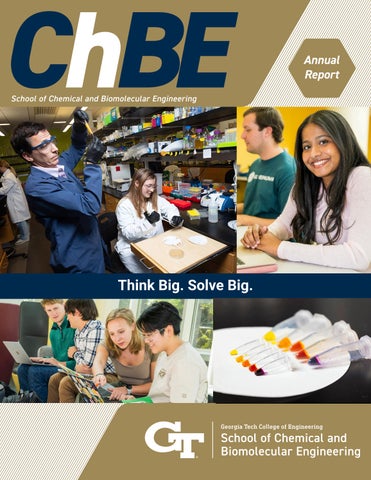
ChBE School of Chemical and Biomolecular Engineering
Think Big. Solve Big.
Annual Report
Contents 2
$9.2 Million NSF Grant for Biotechnology
3
125th Anniversary Symposia
4
Research Features
6
Faculty News
7
Alumni Awards and Features
12
Student Features
Giving Opportunities To inquire about making a gift in support of ChBE, contact: Caroline Saudek (Individuals and Foundations) caroline.saudek@dev.gatech.edu Donna Peyton (Corporate Development) donna.peyton@chbe.gatech.edu
Think Big.Solve Big.
A Message from Christopher W. Jones, John F. Brock III School Chair Welcome to the 2025 ChBE@ GT Annual Report! As we anticipate the 125th anniversary of chemical engineering at Georgia Tech (2026), I am excited to share some of the highlights from the last year in the ChBE program. In this edition. you will find pertinent statistics about our program, highlights from our graduate program and our various research initiatives, faculty updates, alumni features, the impact of philanthropy on ChBE@GT, and highlights from our current undergraduate students as well as recent graduates. Research highlights focus on a LEGO-brick-inspired approach to biotechnology, drug delivery without needles, renewable plastic packaging, polymer recycling, and
carbon dioxide capture. We introduce our CoE Alumni Award winners, our ChBE 40 Under 40 Alumni Honorees, and three undergraduate CHE alumni who reflect on the impacts that GT made on their personal and professional journeys. Our section on philanthropy in action highlights a graduate fellowship honoring the life of PhD alum Andria Deaguero Ping (PhD 2011), and fellowship recipient Victor Brandão. Finally, two stories describe the experiences of recent undergraduate program graduates, who are pursuing careers in the Navy and oil and gas sector. I hope you enjoy this year’s Annual Report, and we hope to see you next time you are in Atlanta!
About ChBE Established in 1901, the School of Chemical and Biomolecular Engineering (ChBE) is one of eight schools in the College of Engineering at the Georgia Institute of Technology. Ranked among the top 5 engineering programs in the nation for both its graduate and undergraduate programs by U.S. News & World Report, the School is one of the oldest and most diverse programs in the country.
CONTACTS: Main Office: (404) 894-1838 Chair’s Office: (404) 894-2867 Undergraduate Program: (404) 894-2865 ugrad.info@chbe.gatech.edu Graduate Program: (404) 894-2877 grad.info@chbe.gatech.edu Magazine Editor: Brad Dixon Send news to news@chbe.gatech.edu
STRENGTH & BREADTH: ChBE by the Numbers
#2 #5 #3
Best Undergraduate Chemical Engineering Program in the Nation Best Graduate Chemical Engineering Program in the Nation America’s Best Undergraduate Engineering Colleges - U.S. News & World Report
#4 #14
America’s Best Graduate Engineering Colleges (College of Engineering) All 11 of the College’s graduate and undergraduate programs are ranked in the nation’s top 10 - U.S. News & World Report
(#1 in U.S.)
23 National Science Foundation CAREER Award winners on the faculty
~670 undergraduates 266 graduate students - 239 PhD & 27 MS
- Shanghai Ranking Consultancy
Faculty Statistics 49 faculty members (16 women) 2 affiliated faculty
16
10
Faculty members Saad Bhamla elected to the National Academy of Engineering (6 emeritus) :
Student Statistics
Best Chemical Engineering Department in the World
AIChE Fellows serving on the faculty
More than 60% of ChBE undergrads participate in research.
17 ChBE faculty members hold major editorial positions with top technical journals
CHBE.GATECH.EDU 1
Team Wins $9.2M NSF Grant to Build “Plug-and-Play” Biotechnology Imagine if building new medicines or sustainable materials were as straightforward as snapping together LEGO® bricks. That’s the goal of a new project led by the Georgia Institute of Technology that could help transform the future of biomanufacturing. The project, headed by Mark Styczynski (a William R. McLain Endowed Professor in Georgia Tech’s School of Chemical and Biomolecular Engineering), recently received a $9.2 million grant from the National Science Foundation Directorate for Technology, Innovation and Partnerships (NSF TIP) to accelerate the adoption of cell-free systems in biomanufacturing. Promising Technology Biotechnology has largely relied on living cells for production of products such as medicines, fragrances, or renewable fuels. But working with living cells can be complex and expensive. Cell-free systems, by contrast, strip biology down to its essential parts, the enzymes and molecules that carry out life’s chemical reactions. This can simplify and speed up biomanufacturing, making it easier to scale. The challenge is that most cell-free projects still require custom-built setups. “Right now, engineering biology is like reinventing the wheel for every application,” Styczynski said. “You have to figure out how all the parts fit together each time. We want to change that by making ready-touse modules that work right out of the box.” His project, called Meta-PURE (PUrified Recombinant Elements), will create eight standardized
Mark Styczynski
modules, each designed for a key function in cell-free systems, such as generating energy, producing proteins, or assembling complex molecules. “Like interchangeable puzzle pieces, these modules can be mixed and matched to support different applications.” - Mark Styczynski Demonstrating Uses His team will demonstrate the system’s versatility by producing santalene (a plantderived fragrance used widely in consumer products), GamS protein (a tool that can improve cell-free processes), and a bacteriophage (a virus that can be safely used in research and the development of new therapeutic treatments). These examples highlight the technology’s potential across industries ranging from pharmaceuticals and agriculture to chemicals and sustainable materials. “We want to make these tools so that someone in industry can create their molecule or product
more quickly and efficiently, and get it out the door,” Styczynski said. “Right now, cell-free systems are mostly limited to high-value products because the cost is too high. The goal is to drive costs down and productivity up, so we can move closer to commodity chemicals like biofuels or monomers for polymers, not just niche applications.” Styczynski’s team is one of four recently awarded a a share in a total inaugural investment of $32.4 million to help grow the U.S. bioeconomy. The initiative is called the NSF Advancing Cell-Free Systems Toward Increased Range of Use-Inspired Applications (NSF CFIRE). While ChBE@GT is the lead, Meta-PURE is a broad collaboration. Co-principal investigators include Paul Opgenorth, co-founder and vice president of development at the biotech firm eXoZymes; Nicholas R. Sandoval of Tulane University, and Anton Jackson-Smith, founder of the biotech startup b.next.
2 SCHOOL OF CHEMICAL AND BIOMOLECULAR ENGINEERING, GEORGIA TECH
Symposia Mark Start of School’s 125th Anniversary Celebration in 2026 ChBE@GT will celebrate its 125th anniversary in 2026, and the School got an early start with two symposia commemorating this milestone. The first symposium, held September 27, honored alumni pursuing academic careers. Three alumni presented their research: w Naechul Shin (PhD 2013), Associate Professor, Department of Chemical Engineering, Inha University — “Dimensional Engineering of van der Waals nanostructures” w Dun-Yen Kang (PhD 2012), Professor, National Taiwan University — “MOF Membranes for Gas Separation: Achievements and Unresolved Challenges” w Adriana San Miguel (PhD 2011/Postdoc 2015), Associate Professor & Director of Graduate Programs, Department of Chemical and Biomolecular Engineering, North Carolina State University — “Shedding light on neurodegeneration through AIaided neuron structure analysis in C. elegans.”
CELEBRATING
Naechul Shin, Dun-Yen Kang, and Adriana San Miguel (left to right)
A second 125th anniversary symposium on December 3 celebrated Deans of Engineering with ties to ChBE (alumni and/or former faculty):
Professor Clifford L.Henderson (BS CHE@GT 1994) Dean, Styslinger College of Engineering University of Alabama Former Professor in ChBE@GT
125
CHEMICA
Professor Jim Pfaendtner (BS CHE@GT 2001) Dean, College of Engineering North Carolina State University
L ENGINEERING
EST. 1901
Professor Mary Rezac Dean, School of Engineering University of Kansas Former Associate Professor in ChBE@GT
CHBE.GATECH.EDU 3
RESEARCH @ChBE These ‘Exploding’ Capsules Could Deliver Insulin Without a Needle Georgia Tech engineers have created a pill that could effectively deliver insulin and other injectable drugs, making medicines for chronic illnesses easier for patients to take, less invasive, and potentially less expensive. Along with insulin, it also could be used for semaglutide — the popular GLP-1 medication sold as Ozempic and Wegovy — and a host of other top-selling protein-based medications like antibodies and growth hormone that are part of a $400 billion market. These drugs usually have to be injected because they can’t overcome the protective barriers of
the gastrointestinal tract. Georgia Tech’s new capsule uses a small pressurized “explosion” to shoot medicine past those barriers in the small intestine and into the bloodstream. Unlike other designs, it has no complicated moving parts and requires no battery or stored energy. “This study introduces a new way of drug delivery that is as easy as swallowing a pill and replaces the need for painful injections,” said Mark Prausnitz, Regents’ Professor and Entrepreneur and J. Erskine Love Jr. Chair, who created the pill in his lab with former PhD student
Joshua Palacios and other student researchers. The team reported its pill design and study results in the Journal of Controlled Release. “It was important to us not to turn this capsule into a complex device or machine. We wanted to make a capsule that uses a simple pharmaceutical formulation that is inexpensive to manufacture, but has the power of a mechanical device to increase drug delivery.” - Mark Prausnitz
Researchers Develop Biobased Film that Could Replace Traditional Plastic Packaging Plastic packaging is ubiquitous in our world, with its waste winding up in landfills and polluting oceans, where it can take centuries to degrade. To ease this environmental burden, industry has worked to adopt renewable biopolymers in place of traditional plastics. However, developers of sustainable packaging have faced hurdles in blocking out moisture and oxygen, a barrier critical for protecting food, pharmaceuticals, and sensitive electronics. Now, researchers in ChBE@GT have developed a biologically based film made from natural ingredients found in plants, mushrooms, and food waste that can block moisture and oxygen as effectively as conventional plastics. Their findings were recently published in ACS Applied Polymer Materials.
“We’re using materials that are already abundant in nature and degrade there to produce packaging that won’t pollute the environment for hundreds or even thousands of years,” said Professor Carson Meredith, the James Preston Harris Faculty Fellow. “Our films, composed of biodegradable components, rival or exceed the performance of conventional plastics in keeping food fresh and safe.” - Carson Meredith
Meredith’s research team has worked for more than a decade to develop environmentally friendly oxygen and water barriers for packaging. While earlier research using biopolymers showed promise, high humidity continued to weaken the barrier properties. However, Meredith and his collaborators found a fix using a blend of these natural ingredients: cellulose (which gives plants their structure), chitosan (derived from crustacean-based food waste or mushrooms), and citric acid (from citrus fruits). “By crosslinking these materials and adding a heat treatment, we created a thin film that reduced both moisture and oxygen transmission, even in hot, humid conditions simulating the tropics,” said lead author Yang Lu, a former postdoc.
4 SCHOOL OF CHEMICAL AND BIOMOLECULAR ENGINEERING, GEORGIA TECH
New Method Uses Collisions to Break Down Plastic for Sustainable Recycling While plastics help enable modern standards of living, their accumulation in landfills and the overall environment continues to grow as a global concern. Polyethylene terephthalate (PET) is one of the world’s most widely used plastics, with tens of millions of tons produced annually in the production of bottles, food packaging, and clothing fibers. The durability that makes PET so useful also means that it is more difficult to recycle efficiently. Now, researchers have developed a method to break down PET using mechanical forces instead of heat or harsh chemicals. Published in the journal Chem, their findings demonstrate how a “mechanochemical” method (chemical reactions
Carsten Sievers (Robert L. Seldomridge Faculty Fellow), the research team hit solid pieces of PET with metal balls with the same force they would experience in a machine called a ball mill. This can make the PET react with other solid chemicals such as sodium hydroxide (NaOH), generating enough energy to break the plastic’s chemical bonds at room temperature, without the need for hazardous solvents. driven by mechanical forces such as collisions) can rapidly convert PET back into its basic building blocks, opening a path toward faster, cleaner recycling. Led by postdoctoral researcher Kinga Gołąbek and Professor
“We’re showing that mechanical impacts can help decompose plastics into their original molecules in a controllable and efficient way. This could transform the recycling of plastics into a more sustainable process.” - Carsten Sievers
Low-cost Method to Remove CO2 from Air with Cold Temps, Common Materials Researchers in ChBE@ GT have developed a novel approach for removing carbon dioxide (CO₂) from the atmosphere to help mitigate global warming. While promising technologies for direct air capture (DAC) have emerged over the past decade, high capital and energy costs have hindered DAC implementation. However, in a study published in Energy & Environmental Science, the research team demonstrated techniques for capturing CO₂ more efficiently and affordably using extremely cold air and widely available porous sorbent materials, expanding future deployment opportunities for DAC. The research team employed a method combining DAC with the regasification of liquefied natural gas (LNG), a common industrial process that produces extremely
Tech researchers created a superior environment for capturing CO₂ using materials known as “physisorbents,” which are porous solids that soak up gases. Most DAC systems in use today employ amine-based materials that chemically bind CO2 from the air, but they offer relatively limited pore space for capture, degrade over time, and require substantial energy to Postdoc Seo-Yul Kim (lead author) and operate effectively. Physisorbents, Ryan Lively (Thomas C. DeLoach Endowed however, offer longer lifespans and Professor) faster CO₂ uptake but often struggle cold temperatures. LNG, which is a in warm, humid conditions. The research study showed that natural gas cooled into a liquid for shipping, must be warmed back into when air is cooled to near-cryogenic temperatures for DAC, almost all a gas before use. of the water vapor condenses out of That warming process often the air. This enables physisorbents uses seawater as the source of the to achieve higher CO₂ capture heat and essentially wastes the low temperature energy embodied in the performance without the need for expensive water-removal steps. liquified natural gas. Instead, by using the cold energy from LNG to chill the air, Georgia CHBE.GATECH.EDU 5
Faculty News Alex Abramson received NSF’s Early Career Award. The CAREER Award is the NSF’s most prestigious award in support of junior faculty who exemplify the role of teacher-scholars.
Saad Bhamla was named a Schmidt Polymath, receiving $2.5 million over five years to develop low-cost technologies to tackle planetary-scale challenges, including AI-enabled point-of-care diagnostics in lowresource environments. Julie Champion, the William R. McLain Endowed Term Professor, is ChBE@GT’s new Associate Chair for Graduate Studies and winner of the Outstanding Doctoral Thesis Advisor Award.
Sigma Xi selected Professor William J. Koros of ChBE@GT to receive the 2025 Monie A. Ferst Award, the honor society’s highest distinction for excellence in scientific mentorship and educational leadership. The honor recognizes Koros, who holds the Roberto C. Goizueta Chair and is the Georgia Research Alliance Eminent Scholar in Membranes, for his five-decade record of advancing membrane‑based separations while cultivating a global community of engineers and scientists.
Paul Kohl, the Thomas L. Gossage Chair, was named a Regents’ Entrepreneur by the University System of Georgia Board of Regents. He was previously named a Regents’ Professor. These are the highest distinctions in the system.
Ryan Lively, a Thomas C. DeLoach Jr. Endowed Professor, was a Finalist for the prestigious Blavatnik Awards for Young Scientists. The awards honor the most promising early-career researchers in the U.S., across life sciences, chemical and physical sciences, and engineering.
Bjarne Kreitz received the prestigious Hanns-Hofmann Award from the DECHEMA/ VDI subject division Reaction Engineering. DECHEMA is the German equivalent of the American Institute of Chemical Engineers.
Patricia Stathatou was named one of seven new faculty fellows of the Brook Byers Institute for Sustainable Systems at Georgia Tech as well as an inaugural fellow of the New York Climate Exchange.
6 SCHOOL OF CHEMICAL AND BIOMOLECULAR ENGINEERING, GEORGIA TECH
CoE Alumni Awards Georgia Tech’s College of Engineering held its annual Alumni Awards Induction Ceremony on March 8. The College of Engineering Alumni Awards were created in 1994 to recognize outstanding engineering alumni from the College. This year, 30 College of Engineering graduates were honored at the Induction Ceremony. They were celebrated for their contributions to the engineering profession, career accomplishments, and the ways they’ve enhanced the lives of others both personally and professionally. This year’s inductees from Georgia Tech’s School of Chemical and Biomolecular Engineering are:
Robyn Gatens
Guillermo Ruiz
w Robyn Gatens, CHE 1985 (Engineering Hall of Fame), Director, International Space Station; Acting Director, Commercial Spaceflight, NASA w Guillermo Ruiz, CHE 1998 (Academy of Distinguished Engineering Alumni), Global Vice President of Polyolefins Sourcing at Vinmar International and Co-Founder and Managing Partner at MoreThan Capital (see feature story on next page) w Anna Thomas, ChBE 2013 (Council of Outstanding Young Engineering Alumni), Founder, Owner, and Principal Consultant, Altimetry Consulting LLC
Anna Thomas
Alumni Association’s 40 under 40 Two ChBE@GT alumni were among the 40 distinguished honorees recognized in the Georgia Tech Alumni Association’s 2025 40 Under 40 list: David Leber, ChBE 2014, MS CS 2021 Vice President of Data Science, Preston Ventures Favorite Tech Memory: Dancing the Budweiser Bob in the North Ave. Quad during Finals Week.
Sona Shah, ChBE 2011 CEO, Neopenda Favorite Tech Memory: Studying abroad at Georgia Tech Lorraine— traveling to 12 countries, taking rigorous chemical engineering courses, and practicing French—was unforgettable. CHBE.GATECH.EDU 7
Alumni Spotlight Guillermo Ruiz Credits Tech with His Transformation into Global Leader Guillermo Ruiz (CHE 1998), a global business executive, rekindled his relationship with Georgia Tech in 2023 while touring college campuses with his daughter. Spending an all-day visit at Tech served as a powerful reminder of the profound impact the Institute had on his life. “During the visit, it hit me how much Georgia Tech had changed the trajectory of my life,” said Ruiz, Global Vice President of Polyolefins Sourcing at Vinmar International and Co-Founder and Managing Partner at MoreThan Capital. For Ruiz, Georgia Tech was more than an academic institution—it was a proving ground that shaped his resilience, character, and drive. His years on campus instilled in him a relentless work ethic, problem-solving skills, and the confidence to take on challenges across the world. A Family’s Leap of Faith Born in Lima, Peru, Ruiz moved to the U.S. in 1979 at the age of three. His father, a master chess player and former National Champion of Peru, was invited to compete in the Georgia State Chess Championship and later became part of a team of chess masters integrating chess into public school curricula. However, when that program dissolved, his parents started from scratch, launching their own house-cleaning business. “Growing up in an immigrant family, we all worked together. I spent evenings, weekends, and vacation breaks helping my parents. My goal was always to ensure that their sacrifices were honored and repaid,” he said. One of his proudest moments came at graduation when he placed
Middle East and throughout Asia. “Almost everywhere there is a petrochemical plant, I have been there many times over,” he said. As Global Vice President of Polyolefins Sourcing at Vinmar, Ruiz leads global buy-side strategy and manages relationships with the company’s most important partners. “I’ve always believed that business is about people. Relationships built on integrity and mutual respect create lasting success.”
his cap and gown on his father, who had not been able to complete his own college education. Recently inducted into Georgia Tech’s Academy of Distinguished Engineering Alumni, Ruiz credits his college years with preparing him for the challenges of a global career. “Balancing coursework with multiple jobs taught me resilience. Anything worth achieving requires sacrifice and persistence.” After graduating with a degree in chemical engineering, Ruiz moved to Houston, where he met his wife, Lisa Beth, a fellow chemical engineer. He spent eight years in technical sales roles before being approached in 2005 by the founders of Vinmar International, who offered him the opportunity to move to Amsterdam to establish the company’s European division. For the next 15 years, Ruiz developed trade networks across the
Lifelong Learning In 2019, Ruiz attended Harvard Business School’s Advanced Management Program, a transformational experience that connected him with 175 global executives from more than 40 industries. But for Ruiz, the program was more than just an education—it was an opportunity to build something lasting. “I thought, once we’re done, what are we going to do? Just send happy birthday messages?” he said. Instead, he spearheaded the creation of AMP Investment Partners LLC, an investment club leveraging the collective expertise of its members. This success led to the launch of MoreThan Capital, a Luxembourg-based venture capital firm that brings together more than 150 global executives Ruiz remains deeply connected to his alma mater, proudly displaying his love for Tech on his car’s license plate: GTCHEME. “Georgia Tech wasn’t just where I got my degree. It’s a place that is part of the foundation that is core to the person I am today.”
8 SCHOOL OF CHEMICAL AND BIOMOLECULAR ENGINEERING, GEORGIA TECH
Tennis Player Barry Cox’s Team Spirit for Tech Drives His Philanthropy Barry Cox still laughs when recalling his claim to fame: Losing to future tennis legend John McEnroe (twice) in the 1970s. He’d squared off against McEnroe back in his high school days, competing in the Orange Bowl at a time when he was debating whether to pursue tennis or academics. But Cox ultimately chose both, enrolling at Georgia Tech after the tennis coach at Clemson University told him he couldn’t pursue a chemical engineering degree while playing on scholarship for the tennis team. He soon learned why that would be a challenge. Low grades during his sophomore year at Tech led to the loss of his scholarship and a redshirt season. But he refused to let the demands of college tennis defeat him, as McEnroe had on the court. Although an academic counselor had told him, “Maybe this is a wall you can’t climb,” Cox was more determined than ever to conquer the challenge of playing a college sport while completing a rigorous major. He graduated in 1982 after five and a half years with his degree in chemical engineering. “Tech taught me never to give up. I may not be the smartest guy in the world, but nobody’s going to outwork me.” After graduation, Cox joined Texas Crude Oil Company in Midland, Texas, where he learned the business from the ground up. Partnering with Dad Two and a half years later, he was working with high-pressure gas in Lafayette, Louisiana, when his father (Charles Wesley Cox) called
with a proposition. “My dad said, ‘I have prostate cancer, and I’m probably not going to live very long. I want you to help me start a business,’” Barry Cox recalled. “I told him, ‘You’ve always been one hell of a salesman.’” In 1986, the two founded The Cox Group (TCG), a small infrastructure support services business with one warehouse and one customer. Today, TCG (based in Mount Vernon, Indiana) is a diversified industrial conglomerate employing more than 4,000 people across 18 states and two Canadian provinces, serving more than 100 customers in logistics, real estate, manufacturing, transportation, and IT. Loyalty to Tech Cox has become something of a brand ambassador for Georgia Tech Athletics in Mount Vernon, where the Cox Group is headquartered. About five years ago, he bought a 1930 Ford Model A Sport Coupe,
transformingtomorrow.gatech.edu
restoring it to become an exact replica of The Ramblin’ Wreck. “People love it,” Cox said. “It’s my way of sharing a little Georgia Tech spirit up here.” Giving Back As his professional success has grown, Cox has increased his financial support for his alma mater through the years. In 2023, he and his wife Nikole made a $500,000 gift to Athletics’ Competitive Drive Initiative Turn 2 to accelerate funding for student-athletes and other operational needs, the impact of which was doubled thanks to matching support from the Institute and the Georgia Tech Foundation. And in 2024, he committed $1 million to support Athletics’ Full Steam Ahead Initiative. In 2024, he also committed a $1 million gift to ChBE@GT to create a named unrestricted endowment fund: a flexible resource to help the school meet emerging needs. This followed a $100,000 gift to ChBE in 2021 to establish the Barry E. Cox Scholarship for students with financial needs. “At my age, you start wanting to thank the places that shaped you.” CHBE.GATECH.EDU 9
Amy Hebert of Arcadia eFuels Turning Carbon into Clean Energy When Amy Hebert (CHE 1994) was growing up in Baton Rouge, Louisiana, she didn’t imagine she’d one day lead a company on the leading edge of climate innovation. But an aptitude test in high school pointed her toward chemical engineering, a field that launched her career path across companies and continents on the way to founding Arcadia eFuels in 2021. As CEO of Arcadia eFuels, she leads a global team that is working to develop electrofuels, which are synthetic fuels made by combining captured carbon dioxide (CO2) with green hydrogen produced using renewable electricity. The industry calls these “dropin fuels” because they can be used in existing engines and infrastructure with no modifications needed.
Vordingborg, Denmark; Portland/Corpus Christi, Texas; and Teesside, U.K. by the end of the decade. Her team is spread across multiple countries but meets in person several times a year. “Our approach is to hire the best people in their fields,” she said. “Our engineering- and efficiency-focused team is dedicated to a vision of producing net zero carbon fuels to power the future while protecting the environment. “By one estimate, the eFuels market will be a nearly US$50 billion industry by 2030, showing that eFuels are the future “It’s so much fun to sit in a room with of fuel and a key component in other leaders who all went through achieving net zero carbon.” the Georgia Tech experience and want to help the School continue to Time at Tech succeed.” Hebert credits Georgia Tech with providing the foundation for - Amy Hebert, External Advisory her career success. “If I didn’t have Board Member for ChBE@GT Alternative Energy that chemical engineering backprofessional journey at Albemarle, ground, I wouldn’t be able to do Arcadia eFuels is currently fothis job.” cused on eSAF (electro-Sustainable where she spent nearly 20 years growing from process engineer to Whether it’s scaling new techAviation Fuel), a clean alternative global vice president of catalysts nologies, navigating government to traditional jet fuel for use in and executive officer. policy, or speaking with investors, today’s aircraft engines. In 2014, Celanese recruited Hebert believes that her educationThis efuel reduces lifecycle Hebert as vice president for Europe al foundation is key to her effective carbon emissions by up to 100 and global sales, based in Amsterleadership. percent, since the CO2 released Georgia Tech attracted her to during combustion is the same CO2 dam, the Netherlands. She then moved to Copenhagen, Denmark as enroll by the competitive environcaptured to make the fuel. deputy CEO and chief commercial ment she perceived during a camWith facilities in development officer of Haldor Topsoe from 2018 pus visit, where she heard a univerin Denmark, Texas, and the U.K., to 2021. sity official say, “Look to your left, Arcadia is proving that carbon“I loved working with techand look to your right; one of those neutral fuels aren’t just possible—they’re commercially viable, nologies and helping others license people won’t graduate.” them to make fuels,” she said. “But Hebert said. Shaping the Future I kept thinking—someone has to “The chemistry isn’t new,” she A mother of four (and now a actually build the facilities. Why said. “It’s the application that’s recent grandmother), Hebert is not us?” groundbreaking. We’re not just acutely aware of the world she’s That led her to start Arcadia imagining the future of fuel—we’re helping shape for the next generaeFuels, based in Austin, Texas, in building it.” 2021. Backed by private equity and tion. Career Beginnings government support, she aims to create a pipeline of facilities around “Sustainability has come into focus in After graduating from Georgia the globe, with the first plants in Tech in 1994, Hebert began her a big way these last five years.” 10 SCHOOL OF CHEMICAL AND BIOMOLECULAR ENGINEERING, GEORGIA TECH
Philanthropy in Action:
Ping Fellow Victor Brandão Committed to Finding Sustainable Solutions Raised in Rio de Janeiro, Brazil, in the shadow of the city’s sprawling hillside “favela” slums, Victor Brandão grew up acutely aware of what it could mean for people to live without reliable access to basic resources like electricity and water. “Seeing the disparities never really left me,” he said. “As a kid, changing that seemed far-fetched, but it’s what first sparked my interest in science.” He said his upbringing inspired his interest in sustainable engineering and helping underserved communities. Now a fifth-year PhD student in ChBE@GT, Brandão said he is channeling that early motivation into leading-edge research that could transform how the world ad- Victor Brandão presents his work at the 2025 Graduate Research Symposium dresses carbon emissions. Closing the Loop Working under the guidance of his advisor, Professor Carsten Sievers (the Robert L. Seldomridge Faculty Fellow), Brandão focuses on electrochemical carbon dioxide conversion—turning CO₂ from the atmosphere into useful feedstocks for the materials and fuels industry. “The idea is to close the carbon loop,” he said. “We’re taking a greenhouse gas and using electricity to convert CO2 into something we can actually sell—multi-carbon molecules that are precursors to materials and fuels.” ACS Catalysis recently published his research team’s paper on the effect of temperature on CO2 electrolysis. Since starting the PhD program in 2021, Brandão has flourished, earning a 4.0 GPA while amassing an impressive array of accolades, including the Ziegler Award for Best PhD Proposal and the Kokes Award from the North American Catalysis Society.
Ping Fellowship Recipient In fall 2024, Brandão won the Andria Deaguero Ping Fellowship. The Ping Fellowship Endowment Fund was established by friends and family in memory of Ping (PhD CHE 2011), who died from breast cancer in 2022. While at Tech, she met her husband, Eric Ping (also PhD CHE 2011). This Fellowship Endowment Fund is helping perpetuate her passion for STEM education, assisting and empowering future generations of students like Brandão who are pursuing their graduate degrees in ChBE@GT. During her own PhD studies, Ping discovered her passion for teaching through a development
program that placed her in a local high school for one day a week. This experience surpassed all others, affirming her career choice. “As a chemistry teacher, I consider it my challenge to show students who are not interested why I love science, how it explains the world around us, and how, once in a while, it is simply awe-inspiring,” she said. Passion for Teaching Brandão shares Ping’s passion for teaching. During his undergraduate studies, he worked as a chemistry teacher at a private school. He’s carried that enthusiasm into his time at Georgia Tech, serving as a teaching assistant (winning the Shell Outstanding Teaching Assistant Award in 2023). “I love being in the classroom. Teaching is something I could see myself doing long-term, whether in academia or in a corporate setting.” While open to a career in academia, Brandão is leaning toward industry as his next move after earning his PhD in 2026, considering career paths in the materials, chemicals, and energy industry. In summer 2026, he interned at Eastman Chemical in Kingsport, Tennessee, working with the catalysis and solids scale-up team “It was a great opportunity to explore a different technical challenge in an industry setting,” he said.
transformingtomorrow.gatech.edu CHBE.GATECH.EDU 11
Student Spotlight InVenture Prize Winner Atharva Lele Committed to Challenging Himself During his studies in ChBE@GT, junior Atharva Lele has consistently pushed himself to take on new challenges, some of which are outside the norm for students in the major. While immersing himself in student leadership, research, and internship activities, he’s also extended his reach into entrepreneurship. For example, during his sophomore year, he elected to participate in the InVenture Prize competition to develop inventions that are judged by experts. “Chemical engineering students don’t often do InVenture, and that’s why I wanted to compete in it,” Lele said. “I wanted to make sure I branched out from what students in our rigorous major traditionally do.”
Atharva Lele (ChBE, left), Calla Scotch (MSE), and Anuj Pandey (ME) with InVenture Prize
year, including serving as chair of the 2026 AIChE Southern Conference that Georgia Tech will host in the spring. He is leading a team of 15 Building a Business students to organize the event, which His move paid off with a firstwill bring up to 400 participants from place finish in the 2025 InVenture more than 30 schools to campus. Competition in spring 2025. Lele “I always strive to do my best and teamed with two students in other not do anything halfway,” said Lele, majors to form Convexity Electronics, who holds a Gossage International which won the InVenture Prize for its Enrichment Scholarship. “That’s 3D printer for manufacturing printed something my parents instilled in me, circuit boards at scale with faster lead and that’s the attitude I’m taking with times and smaller circuitry. the conference.” “Our technology is a game Born in India and raised in Sinchanger,” Lele said. “Because we gapore, Lele was drawn to ChBE@ print additively, you’re not restricted GT after observing an environment by anything but your imagination.” conducive to teamwork. “The classes For their first-place finish, Conare tough, but we get through them vexity won $20,000 and a coveted together,” he said. spot in Georgia Tech’s CREATE-X Researching faculty interests on Startup Launch program, where they the ChBE website led Lele to join are receiving mentorship and guidAssociate Professor Saad Bhamla’s ance to help bring their product to lab, where he helped develop an market, a serious goal for the team. ultra-low-cost electroporation device (ePen) inspired by a BBQ lighter Student Leadership to facilitate mRNA/DNA vaccine In addition to advancing delivery via microneedle patches. The Convexity, Lele has plenty of other project, a collaboration with Profesactivities on his plate for his junior sor Mark Prausnitz, aimed to expand
vaccine access in low-resource areas of the world. During his junior year, Lele transitioned to the Prausnitz Lab, where he is focusing on the dynamics of interstitial fluid, dissolvable microneedle patches, and hexavalent vaccines. Professional Experience During summer 2025, Lele completed an internship with the Duracell Company’s operations in LaGrange, Georgia, focusing on process optimization in the manufacture of batteries. “The internship was a great learning experience. I got to drive change like actual engineers do and present my work to the chief technology officer of Duracell.” As for the future, Lele is committed to pursuing Convexity Electronics to see where it leads, while keeping graduate school on the horizon.“I’m keeping all doors open, while realizing that I also need to streamline and focus.”
12 SCHOOL OF CHEMICAL AND BIOMOLECULAR ENGINEERING, GEORGIA TECH
Owen Pittman Member of Team Managing Navy’s Nuclear Propulsion After graduating with his bachelor’s degree in May 2025, Owen Pittman started training for the U.S. Navy’s Nuclear Propulsion Officer Candidate (NUPOC) program in July. He joined a select group of engineers, based in Washington D.C., who are responsible for managing the nuclear propulsion systems that power America’s aircraft carriers and submarines. “It’s an incredible responsibility. You’re not usually on the ships, but part of the engineering command that oversees the entire nuclear program for the Navy.”
cess and long-term career potential. “I’ve always felt the call to serve the country,” said Pittman, who is following the path of his Tech alum NUPOC, which requires a mini- grandfather, Lance Pittman, who mum of five years of active duty, is joined the military after earning his known for its rigorous selection pro- degree in textile engineering from
Georgia Tech in 1961. His grandfather’s enthusiasm for the university influenced Pittman at an early age, with a gifted “Give ‘Em Hell, Tech!” pennant hanging in his childhood bedroom. Stamps Scholar But growing up in Huntington Woods, Michigan (a suburb of Detroit), Pittman wasn’t sure he’d be attending Georgia Tech until he got word that he’d been selected as a Stamp’s President’s Scholarship recipient – a four-year, full-ride scholarship awarded to the top one percent of incoming students. “The scholarship gave me a built-in community from the start. Stamps Scholars are enrolled in different majors across campus, but we all lived together freshman year,” Pittman said.
Grace Henderson Starting as Midstream Engineer for Phillips 66 Grace Henderson considers herself a hungry and driven person who always strives to be the best. So, she is excited to learn all she can about the oil and gas industry as a midstream process engineer for Phillips 66, a position she started after graduation from ChBE@ GT in May 2025. During her time at Tech, she involved herself in a wide range of academic, research, and industry experiences that reflect the numerous career paths open to chemical engineers.
spring 2024, where she supported the development of solid-state batteries engineered to perform under extreme conditions, including those anticipated in lunar and Martian environments. Henderson also gained experience working on nanowires for semiconductors as an undergraduate researcher in Professor Michael Filler’s lab and then graphene battery technology as a member of the Georgia Tech Research Institute’s Vertically Integrated Projects (VIP) Program. While she highly valued all “I think chemical engineering will those experiences, they helped play a pivotal role in the future. clarify her career goals, leading her There’s so much you can do with this back to the oil and gas industry, degree.” for which she had interned with Marathon Petroleum in El Paso, Varied Experiences Texas, in summer 2023. There, she Her array of experiences during worked on optimizing fluid cataher undergraduate years included lytic cracking (FCC) reactor perforinterning at NASA’s Glenn Remance. search Center in Cleveland, Ohio, in “I realized I missed the large-
scale processes first encountered in oil and gas,” Henderson said. “What we learn in ChBE really prepares us well for large-scale projects.” At Phillips 66’s operation in Greeley, Colorado, she is working on managing natural gas pipelines that serve as the bridge between upstream production and downstream refining. CHBE.GATECH.EDU 13
Nonprofit Organization U.S. Postage PAID Georgia Tech Atlanta, GA Permit No. 8087
Georgia Tech School of Chemical and Biomolecular Engineering 311 Ferst Drive NW Atlanta, GA 30332-0100 404-894-1838 (main phone) chbe.gatech.edu
Think Big. Solve Big.
Visit us online at chbe.gatech.edu
©2025 Georgia Institute of Technology, School of Chemical and Biomolecular Engineering