“It is so invigorating to meet with the studentathletes that receive our scholarship.” — Joe Brucella, IE 1972
Joe Brucella, IE 1972, with his daughter, Andrea Finnegan, and grandson Christian Finnegan, at Georgia Tech.
Joe Brucella grew up in Brooklyn, New York, and came to Georgia Tech without ever visiting Atlanta. He remembers his first step on campus as a leap of faith that more than paid off. After graduating, Brucella enjoyed a successful career in the retirement housing and senior living services industry. Over the years, he has remained engaged with Georgia Tech, attending athletic events and serving as chair of a milestone reunion committee for the Class of 1972. An avid sports fan, Brucella ran track in high school and was invited to walk on the track team at Georgia Tech. While he did not compete at the college level, he has continued to stay involved by coaching high school track and providing scholarships for track and field student-athletes at Tech. Brucella’s love of track and field, interest in education, and trust in Georgia Tech inspired him and his wife, Melissa, to make a planned gift for
scholarships for student-athletes in addition to the scholarship they have already endowed. His personal experiences fueled his passion for supporting students. Brucella was able to attend private school because his grandmother took a second job to help fund his education. “I think the only reason I even got into college was because I went to that high school,” he said. “I found out about her financial help after she passed.” Now, the Brucellas direct most of their philanthropy to scholarships. “It’s in gratitude to the woman I never got to thank.” Brucella hopes the students who receive his scholarships will use their Tech educations to embark on successful careers — and then use that success to give back. “I hope that recipients of our scholarship will have the same sense of gratitude that I have for the Tech experience,” he said. “And they will go on to multiply what we have done.”
Founders’ Council is the honorary society recognizing donors who have made estate or life-income gifts of $25,000 or more for the support of Georgia Tech. For more information, please contact: 404.894.4678 • giftplanning@dev.gatech.edu • plannedgiving.gatech.edu
When.every health.dollar.counts,. data matters. VativoRx helps hospitals, health plans, and self-funded employers recover the manufacturer rebates hidden in their pharmacy and medical claims. By turning complex claims data into recovered rebate value through a structured, compliance-minded process, we help our partners reinvest more into patients, innovation, and community impact Founded in Atlanta by a Georgia Tech alumnus, VativoRx is proud to partner with the Georgia Tech Alumni Association and support the Georgia Tech alumni community. Pharmacy & Medical R e b at e M a n a g e m e n t
Learn more at www.vativorx.com
PUBLISHER’S LETTER
CHANGING COURSE
W
I was offered an internship in the GovW H E N I W A L K E D I N T O my dorm ernor’s Office. I found myself immersed as a first-year student, I was a in the governance of the state and the biology major. An aptitude test I policymaking process. As I coordinated took in high school suggested I’d the transfer of the governor’s records to the be a good fit for healthcare and state’s archives, I applied the knowledge I medicine, so biology seemed gained from Tech to the government sector. like a logical path. That internship led me in a direction It didn’t take long for me to I never expected. Rather than pursuing realize something needed to operations management, I built a career in change. government relations, a field where I spent Sitting in a chemistry class the next 29 years, including 12 years in the in the Boggs Building, I began Institute’s government relations office. to consider what other options Life has a way of forcing us to change there might be at GT. course. Those moments are rarely comAs I talked with other students at fortable, yet embracing change teaches SAC (now CRC), I heard them discuss resilience and adaptability and strengthens their classes and professors. The more our problem-solving skills. I listened, the more curious I became That’s what this issue about business opis all about. erations, economics, Inside, you’ll learn and finance courses. about the evolution of I gave them a try and the former Alexander realized I genuinely Memorial Coliseum’s enjoyed them. So, architectural design, I gave myself some how to adapt and thrive grace. I pivoted and in an increasingly unchanged my major. certain world of work, It’s okay! and how to start over Economics courses from Yellow Jackets taught by Dr. Thomas My roommate Mike Sawicz, Econ 91 (right), and I at a Braves game in Philadelphia after whose careers took sur“Danny” Boston and graduation. He didn’t switch majors, but I did! prising and rewarding Dr. William “Bill” turns. You’ll also see the 2026 40 Under 40 Schaffer challenged and motivated me class in this issue. and reignited my passion for learning. The stories in this issue prove that no When I got out in 1991, I knew without matter the circumstances, Yellow Jackets a doubt that changing my major was the always end up stronger. right decision for me. I did not expect another pivot. My entire senior year, I planned to pursue a career in operations management. I had several interviews D E N E S H E H E A N E , M G T 91 lined up. Then, an unexpected opportunity PRESIDENT G E O RG I A T E C H A L U M N I A SS O C I AT I O N arose. 4 FALL 2026 | GTALUMNI.ORG/MAGAZINE
GEORGIA TECH ALUMNI MAGAZINE VOL. 102 | NO. 3 PRESIDENT & PUBLISHER Dene Sheheane, Mgt 91
VP S TR ATEGIC COMMUNICATIONS Lindsay Vaughn
EDITOR Jennifer Herseim
ART DIREC TOR Steve Hedberg
COPY EDITOR Barbara McIntosh Webb
COPYWRITER Sharita Hanley
S TUDENT ASSIS TANT Deborah Zhang
EXECUTIVE COMMIT TEE Chair Jimmy Mitchell, CE 05 Past Chair/Finance Rita Breen, Psy 90, MS IE 92 Chair Elect, Vice Chair/Roll Call Sam Westbrook, IE 99 Vice Chair of Engagement Meredith Moot, Mgt 08 Member at Large Lee Baker, IE 90 Member at Large Alexia B. Borden, IE 01 Member at Large Alex Muñoz, Mgt 88 Member at Large Kenji Takeuchi, ME 94
BOARD OF TRUS TEES Michelle (Swindell) Berryman, ID 93, MS Arch 02; Matt Bishop, CmpE 06; Kim (Kilpatrick) Civins, Mgt 92; Cleveland “Cleve” Fann, ME 05; Daniel Furman, BA 16; Jack Godfrey II, Mgt 90; Sid Gore, ME 17, MS ME 20; Mihir Pathak, ME 08, MS ME 10, PhD ME 13; Derek Goshay, IE 93; Ryan Greene, ME 00, MS Econ 01; Craig Hyde, CmpE 05; TJ Kaplan, PP 13; Brandon Kearse, ME 08, MS CE 10; Kayla Kelly, Econ 16; Annie Y. Lai, MBA 21; Reginald “Reggy” Liger, EE 11; Abubakr “Abu” Malik, CS 98; Sabrina McCorvey, IE 90; Alberto M. Peluzzo, ME 91; Susan (Sutherland) Piña, IE 93; Josh Roberts, IE 02; Sonia Sardana, IE 12; Kofi Smith, IE 99, MBA 09; Yvette (Hill) Smith, IE 90; Peter Stewart, CE 97; Stephanie Stewart, CE 97; Casey Swails, Mgt 07; Matthew “Matt” Terek, ME 02; Rani Tilva, BA 18; Paul Trotti, ME 00; Hayley Tsuchiyama, ChBE 18; Ben Utt, IM 81; D’Andre Waller, ME 17; Alex Wan, IE 88; Kourtney Wright, CS 15, MS CS 23; Liz (Harriss) York, Arch 90, M Arch 95
GEORGIA TEC H ALUMNI MAGAZINE (ISSN: 1061-9747) is published quarterly by the Georgia Tech Alumni Association, 190 North Ave. N.W., Atlanta, GA 30313. Periodical postage paid in Atlanta and additional mailing offices. © 2026 Georgia Tech Alumni Association For advertisements, contact Austin Schulte at Austin.Schulte@alumni.gatech.edu
POS TMAS TER Georgia Tech Alumni Magazine, 190 North Ave. N.W., Atlanta, GA 30313 editor@alumni.gatech.edu (404) 894-2391
VOLUME 102 ISSUE 3
PHOTOGRAPH
BEN ROLLINS
FEATURES
46
52
58
THE SCIENCE OF RESILIENCE
RULES FOR STARTING OVER
MAJOR CHANGE
The need for resilience and adaptability in the face of change is something many recent grads can relate to.
Starting from scratch can be daunting. Here are four rules from Yellow Jackets who have been there.
Changing degrees is more common than you might expect. See where students start and where they finish.
GTALUMNI.ORG/MAGAZINE | FALL 2026
5
PHOTOGRAPH
ROB FELT
DEPARTMENTS VOLUME 102 ISSUE 3
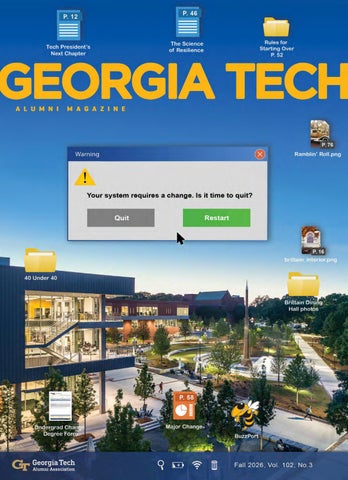
CONTENTS
10
AROUND CAMPUS
NO. 1 FOR ECONOMIC IMPACT The Institute generated $6.3 billion in economic impact for Georgia’s economy in fiscal year 2025, according to a University System of Georgia (USG) study. Tech accounts for more than 25% of the economic activity created by all 25 USG colleges and universities.
The Next Chapter for Tech’s President 12 Georgia Tech-Europe Expansion 14 Brittain Dining Hall Reopens 16 Inside the Donor Portal 19 Tech Takes First Place in Ecocar EV Challenge 21 Research 22
24
ON THE FIELD
Stadium Designs Complete 26 Untouchable Tech 28 Fanning Student-Athlete Performance Center Opens 30
34
IN THE WORLD
Tech’s World Cup Roster 36 From the Track to the Runway 40 The Ever-Changing Georgia Coast 44
62
ALUMNI HOUSE
Most Recent Graduates 64 Generations of Georgia Tech 66 Leaders You Helped Build 68 Wrecksplain 70 Celebrate the 2026 Class of 40 Under 40 71 Ramblin’ Roll 76 In Memoriam 84
94
TECH HISTORY
The Original Plan for the Alexander Memorial Coliseum 94 History of Chairs 98 GTALUMNI.ORG/MAGAZINE | FALL 2026
7
FEEDBACK
LETTERS TO THE EDITOR MOMENT YOU BECAME A YELLOW JAC KE T WHEN DID I KNOW that I was a Yellow Jacket? My high school didn’t prepare me very well for Georgia Tech. The first quarter (yes, quarter—this was 1964), I studied like my life depended on it. I did pretty well, and that first quarter’s study practice prepared me for the next quarters. Early during my junior year, I realized that I could do the work and that I probably would graduate from Georgia Tech. I would be a Yellow Jacket after all. —Phillip Boggs, Math 68, of Little Rock, Ark.
TWO TRUTHS, ONE LIE QUIZ 2.03/4. That’s the average score Yellow Jackets received on the “Incredible Moments in Tech History” quiz from the summer Alumni Magazine. If you think you can beat it, take the quiz at GTalumni.org/factorfiction.
8 A.M. TIME CARD HERE’S SOMETHING TO ADD to the popular numbers from Tech in the 1960s: This 8 a.m. time card for class registration was almost priceless. You could get the best schedule for your courses and often avoid those pesky Saturday morning classes and the three-hour chemistry or physics labs that ended at 6 p.m. on a Friday. Unfortunately, I was unable to use this one—I was in an auto accident returning to Tech in late 1964 and missed the winter quarter. I never got another 8 a.m. time card. But I have kept this memento all these years. —David Frohn, AE 67, of New Orleans, La.
A.E. LEGENDS & A SMUGGLE D CORNED BEEF SANDWIC H I FOUND IT MOST INTERESTING in the Spring 2026 issue that in the Yellow Jacket “Swarm” article, you show the growth of Tech in the spectrum of degrees Tech has awarded from 1910 to the 2020s. I can add a data point in the 1950s segment of the “swarm” that there were only 14 Bachelor of Aeronautical Engineering degrees and about 3 or 4 Master of Science in Aeronautical Engineering degrees. Of possible interest is that in the AE class of 1952 was a young man I befriended named John Young, who later went on to become a legendary NASA astronaut. John Young was president of Tau Omega, the honorary aeronautical society at Tech, and in 1952 ceremoniously passed the presidency office to me for the following year 1953 (my senior year at Tech). I was
Send a letter about a story from this issue to editor@alumni.gatech.edu.
8 FALL 2026 | GTALUMNI.ORG/MAGAZINE
president when Tau Omega merged with the Gamma Alpha Rho, the honorary rocket society, to form Sigma Gamma Tau. A little-known piece of aerospace technology humor is that John had smuggled a corned beef sandwich on that Apollo 16 Moon lander mission in 1972. I was especially excited to witness STS-1 land as it was commanded and piloted by John Young. NASA had invited the entire cast of Star Trek, and I could not believe I was there—in the VIP section standing between Captain Kirk (William Shatner) and Mr. Spock (Leonard Nimoy) watching John Young make a perfect landing of STS-1. I can still hear their conversation with me and the double BOOM-BOOM as John descended for a picture-book landing. I was, still am, and always will be proud to know how Georgia Tech graduates have changed the technological status of the USA for its long, amazing history of development. —Herbert A. Hutchinson, AE 53, MS AE 59, of Durham, N.C.
Federally insured by NCUA
University Checking Banking that supports your every move. ▪ ▪ ▪ ▪
Earn up to 5.00% APY* Convenient digital and mobile banking Access to thousands of fee-free ATMs Exclusive Georgia Tech debit card
Get Started Today
*APY = Annual Percentage Yield. To earn up to 5.00% APY, member must have a qualifying University Checking Account. Based on a combined rate of 4.88%. Credit card must be active, have at least one monthly transaction (excludes balance transfers and cash advances), and be enrolled in credit card eStatements to qualify for the extra 1.00% APY in dividends. Account does not earn dividends if there is a $0 balance in a HELOC at the end of the month. All accounts must be in good standing with no delinquency or bankruptcy pending. Multiple loans in the same category count for only 1.00% APY in dividends. Qualifying University Checking Accounts will earn 1.00% APY in dividends on balances up to $25,000. Balances above $25,000 will be paid at the regular checking rate. Qualifying University Checking Accounts are defined as having at least 25 transactions per month (includes transactions made with both debit and credit cards) and enrollment in eStatements. If the requirements are not met, then no dividend is earned. Secondary University Checking Accounts not eligible to earn APY. Dividends are calculated by the daily balance method, which applies a daily periodic rate to the balance in the account at the end of each day. Dividends are disbursed monthly into the active University Checking Account. APY is accurate as of the last dividend declaration date. Fees could reduce the earnings on the account. Rate subject to change after account opening and may vary based on qualifications met at month end. Not valid with any other offers. To establish a UCU Membership, you must deposit at least $5 to a Regular (Share) Savings Account. A $50 minimum deposit is required to open a University Checking Account. All accounts are subject to approval.
VOLUME 102 ISSUE 3
ALLISON CARTER PHOTOGRAPH
AROUND CAMPUS
GEORGIA TECH 101 Since 1972, incoming students have participated in FASET orientation, where they connect with the Tech community, register for classes, and start their Tech journey with confidence. Just over 4,100 new first-year students enrolled at Tech this summer and fall.
GTALUMNI.ORG/MAGAZINE | FALL 2026
11
AROUND CAMPUS Cabrera met with incoming students and their families during move-in this fall.
TECH PRESIDENT ÁNGEL CABRERA’S NEXT CHAPTER FOLLOWING SEVEN YEARS AS THE PRESIDENT OF THE INSTITUTE, CABRERA IS STEPPING DOWN.
G
GEORGIA TECH’S 12TH PRESIDENT, Ángel Cabrera, MS Psy 93, PhD Psy 95, will leave Georgia Tech t o b e c o m e p r e s i d e nt and CEO of the Aspen Institute, effective Nov. 1. In late 2019, Cabrera rolled into his investiture ceremony hanging on the side of the Ramblin’ Wreck and ushered in a new era of growth and innovation marked by record enrollment and fundraising. “I admired what G. Wayne Clough and Bud Peterson had done before me with the sense of momentum and growth, and I was hoping to at least keep that up—if not accelerate the impact that Georgia Tech could have,” remembers Cabrera. “I am blown 12 FALL 2026 | GTALUMNI.ORG/MAGAZINE
BY JENNIFER HERSEIM away by what Georgia Tech has done in the past seven years.” The strategic plan, launched in 2020 soon after Cabrera arrived, was refreshed in 2024 with his four “big bets” for Georgia Tech: becoming a leader in outcomes and value for students, expanding research, doubling the number of degree and non-degree learners, and amplifying Tech’s impact as a national hub for innovation, creativity, and entrepreneurship. The 10-year plan is on its way to hitting those goals. Enrollment has grown to nearly 57,000 students while research expenditures have grown to a record $1.5 billion. Launched in 2022, Transforming Tomorrow: The Campaign for Georgia Tech surpassed its $2 billion goal with more than a year remaining. In 2025, Tech received its largest single gift with a $100 million
donation from the late alumnus John W. Durstine. These milestones weren’t met without headwinds, from a global pandemic to increased federal pressure on higher education. “If you think about the crises that we’ve come through, staying still would have been OK. Instead, we’ve probably had the fastest growth in our history,” Cabrera says. “I’m very proud of the staff, the team, and how they’ve embraced the challenges and instead said, ‘How can we have a bigger impact?’” SECOND ALUMNUS TO LEAD Cabrera followed Tech’s 10th President, G. Wayne Clough, as the second alumnus to lead the Institute, and he is the first president whose spouse, Dr. Beth Cabrera, MS Psy 93, PhD Psy 95, is also a Tech grad. His son and daughterin-law are Yellow Jackets, too.
“MY WHOLE LIFE HAS BEEN CONNECTED TO THIS PLACE.” —ÁNGEL CABRERA, MS PSY 93, PHD PSY 95
“I don’t have to fake my passion for Georgia Tech. That extra level of pride in Tech and the commitment to its future is there when I sit with a donor or an alum because I’m a fellow alum,” Cabrera says. “My whole life has been connected to this place.” First lady Dr. Beth Cabrera has volunteered extensively at Georgia Tech, serving on the campaign steering committee and sharing her expertise in well-being with students, staff, and faculty. “She does it because she cares about this place,” Cabrera says. LIVABLE CAMPUS The campus Cabrera attended as a graduate student is different today. A new bike and pedestrian course runs through campus. West of campus, Science Square opened to serve as a hub for the life sciences and cutting-edge research. Across the street is Tech’s Creative Quarter, a new arts and technology space that recently opened its first exhibit. The first new traditional residence hall since 2005, the Bud and Val Peterson Residence Hall opened this fall—to accommodate Tech’s considerable growth in enrollment. Tech served about 55% more students last year than it did when Cabrera returned in 2019. “We’re proud of the quality and the value that Georgia Tech delivers, and we’re defining our success by how many people we can help instead of being exclusive or staying small,” Cabrera says.
There aren’t just more students at Tech, Cabrera notes. Graduation rates and ROI are higher, too. “We’ve demonstrated that you can have one of the best public universities, offer the best value for students, and deliver it to many students,” he says. Beyond academics and enrollment growth, athletics has also evolved. In 2023, Georgia Tech Football reached its first bowl game in seven years, defeating UCF in the Gasparilla Bowl. The ACC expansion to the West Coast has also brought more visibility to Tech’s brand. “We are now in parts of the country that are very important to technology. The power of a good strong athletics program to carry our brand is amazing,” Cabrera says. “PERFECT TIME TO LEAVE” For Cabrera, ending his academic career at his alma mater was a dream.
Tech’s full-campus cycle track opened in August 2025.
So why leave now? “This is a relay race. It’s about an institution. I took the baton from Bud, and I ran my laps as hard as I could. My hope all along was that I could pass the baton to the next leader when the Institute is strong. So in a way, it was the perfect time to leave,” he says. “But at the same time, it’s the hardest time to leave when the Institute is so strong.” His advice for the next president is to be present. “Show up on campus at events and be out there. It’s good for the Institute, and it’s good for you, too, because that’s how you realize the impact that this place has.”
“GEORGIA TECH HAS BEEN FORTUNATE TO HAVE A PRESIDENT WHO CARES AS MUCH ABOUT IMPROVING THE HUMAN CONDITION AS HE DOES ABOUT IMPROVING LIFE FOR EVERYONE INSIDE OUR INSTITUTION.” —MONISH SONIMINDE, STUDENT BODY PRESIDENT UNDERGRADUATE SGA GTALUMNI.ORG/MAGAZINE | FALL 2026
13
TALK OF TECH
GTE EXPANSION WILL DOUBLE CAPACITY
GEORGIA TECH-EUROPE WILL ADD OVER 4,700 SQUARE FEET OF SPACE AND INCREASE CAPACITY TO 1,400 STUDENTS. BY TINA ROUSSELOT DE SAINT CÉR AN
14 FALL 2026 | GTALUMNI.ORG/MAGAZINE
OLIVIER TOUSSAINT
ENGAGING EUROPEAN-BASED ALUMNI This June, the Tech Talks Business series, hosted by the Georgia Tech Scheller College of Business, made its international debut, in collaboration with GTE, at Luxembourg Palace in Paris. Leaders from across the Institute and alumni discussed how universities and organizations must adapt in an AI-driven world. The event was followed by an alumni networking reception.
TOP PHOTOGRAPH
MORE THAN 13,000 STUDENTS have studied at Georgia TechEurope (previously called Georgia Tech-Lorraine) since the program began in 1990. Today, enrollment is the largest it’s ever been, with record attendance last summer. In fall 2002, Guilhem Denozière, MS ME 04, was studying at GTE in Metz, France, through the dual degree program with Arts et Métiers (ENSAM). Resolute about finishing his degree in Atlanta, he had promised himself not to get entangled in any new romance. Then, in line at the CROUS student cafeteria, he met Annie, a French major from the University of Tennessee, Knoxville, teaching at a nearby high school. That ordinary Tuesday became the start of
a decades-long international love story. The Denozières married and 24 years later, their son, Owen, is returning to where their story began. This fall, he joined Tech’s First-Year Semester Abroad program at GTE. “It was the same place they found love,” Owen says. The GTE that he enters is not the one his father knew. The site is undergoing an expansion to double capacity from 700 students to 1,400, adding two new buildings, with naming opportunities, along with classroom space. “As we enter this new chapter, our focus remains on enriching the student experience and strengthening our role as a bridge between cultures, institutions, and industries,” says Abdallah Ougazzaden, president of GTE. That added space will serve a variety of academic purposes. The First-Year Semester Abroad program starts with a three-week late-summer session in Atlanta before a full fall semester in Metz. GTE also offers semester-long undergraduate study options. Graduate students can study for a semester or complete a full master’s or doctoral degree across four programs: aerospace engineering, computer science, electrical and computer engineering, and mechanical engineering. GTE is also home to a joint international research laboratory specializing in optoelectronics.
From Georgia Tech alumnus to NASA AI leader.
ONLINE MASTER OF SCIENCE IN ANALYTICS Top-5 Nationally Ranked Analytics Program Complete 100% Online Designed for Working Professionals Built-in Flexibility Complete in 24–36 Months Experience Same Faculty and Curriculum as On-Campus Program
“Georgia Tech’s OMS Analytics program was one of those lifechanging inflection points. Nothing I’m doing today at NASA would have been possible without the analytics foundation I built there.”
Shape Your Degree with Focus Areas: • AI and Machine Learning • Statistical Modeling • Data Storage and Pipelining • Data Visualization, Optimization, and Simulation • Business Analytics
— Douglas Trent Georgia Tech Triple Jacket Data Scientist Team Manager, AI/ML & Digital Transformation NASA Langley Research Center
Total Tuition ~ $12,000 GRE GMAT
No GRE/GMAT Required
Online Master of Science in Analytics Learn More at
omsanalytics.gatech.edu
AS RT OU UD NE ND T C NA EMWP SU S
BY JENNIFER HERSEIM
16 FALL 2026 | GTALUMNI.ORG/MAGAZINE
O
SAM GAY
THE HISTORIC DINING HALL REOPENED AFTER MAJOR RENOVATIONS TO THE KITCHEN AND SERVING AREAS.
PHOTOGRAPHS
BRITTAIN DINING HALL REOPENS
ONCE VOTED THE SOUTH’S Most Stunning Dining Hall by Southern Living magazine, Brittain Dining Hall reopened this fall following renovations that modernized the kitchen and serving areas. This is the most extensive renovation Brittain has undergone since it was built in 1928. “The project focused heavily on preserving the building’s historic character while modernizing the facility with sustainable and energy-efficient improvements,” says Ryan Greene, executive director of Georgia Tech Dining and Retail. Known for its cathedral-style architecture and impressive stained-glass windows, Brittain has long been a cherished building on campus. “Brittain is unique in its historical significance, and it’s important to students and alumni. We knew people didn’t want it closed, but it was a necessity. We didn’t want to continue serving without these improvements,” says Greene. While the grand dining area received mostly cosmetic upgrades and additional seating, the back kitchen and food-serving areas received a near-gut renovation during the two-year update.
MODERNIZING & PRESERVING BRITTAIN’S CHARM The renovation included restoring the terrazzo floors, installing new lighting, upgrading electrical systems, and adding three HVAC units. Crews also reclaimed original wood from the building to create a new point-of-sale station and decorative wall panels, refurbished period-appropriate dining chairs, and modernized the kitchen infrastructure. The servery was rebuilt with a new layout, more energy-efficient digital signage, and new serving equipment. The previous large black sheet behind the entry area was removed and replaced with finished walls. Before this renovation, a new roof was installed in 2020. The new serving area will feature a large grill for made-to-order items and additional action stations where cooks will prepare food in front of students. Brittain’s salad bar was maintained and enhanced to include healthy protein options. “North Avenue Dining is just across the street, so we want to differentiate these two dining halls. We’ve tried to focus Brittain more on healthier options,” says Greene. With Brittain back online, Tech now has three dining halls. Over the past two years, Tech Dining has expanded its retail dining options, giving students greater variety and more ways to use their meal plans— including at participating restaurants in Tech Square. Originally designed as a great hall for gatherings, Brittain has been a special place for generations of Yellow Jackets. Its tradition of service continues today, with more than 1.2 million meals served at Brittain since 2021 alone.
BRITTAIN FAST FACTS Constructed in 1928 Architect: Tech’s Head of Architecture Harold Bush-Brown Dedicated to Tech’s fourth president, Marion L. Brittain Stained-glass windows designed by Julian Hoke Harris, Arch 1928, as a memorial to the class of 1928. Hoke Harris returned to Tech to sculpt the 10 corbel stone faces on Brittain’s outer arcade.
Explore the newly renovated Brittain Dining Hall during Homecoming campus tours, Oct. 22–24. Visit GTalumni.org/Homecoming for more information.
GTALUMNI.ORG/MAGAZINE | FALL 2026
17
AROUND CAMPUS
TECH OPENS NEW AI MANUFACTURING ‘PLAYGROUND’
O
AT 20,000 SQUARE FEET, THE ADVANCED MANUFACTURING PILOT FACILITY IS ONE OF THE LARGEST FACILITIES ON CAMPUS AND SHOWCASES THE FUTURE OF MANUFACTURING.
BY JENNIFER HERSEIM
18 FALL 2026 | GTALUMNI.ORG/MAGAZINE
PHOTOGRAPHS
THE FUTURE OF MANUFACTURING AND AI At an open house on April 30, researchers and students showcased the range of technologies available under one roof. Robots moved between the aisles while researchers demonstrated how they use 3D printers to make bio-synthetic heart valves that can be customized to a person’s unique anatomy. Nearby, students demonstrated how they control a humanoid robot’s movements from afar using a VR headset and a glove that uses tactile pressure to simulate what the robot is holding. Down another aisle, researchers showcased how a metal atomization machine produced powder faster and more efficiently than previous technologies. Here’s a peek inside Tech’s new AI manufacturing playground.
JENNIFER HERSEIM
OPENED IN APRIL 2026, Georgia Tech’s new AI “playground,” the Advanced Manufacturing Pilot Facility (AMPF), is the first university-based, self-driving manufacturing lab of its kind in the country. Tech unveiled the newly renovated 20,000-square-foot facility where students and researchers have access to advanced technology that combines manufacturing with artificial intelligence. The facility, located on 14th Street, is part of the Georgia Tech Manufacturing Institute (GTMI) and helps bridge a gap that exists between academia and industry, which has made it difficult to scale new technologies quickly. The space allows industries, startups, and researchers to invent and test new technologies before introducing them to a larger factory environment.
INSIDE THE DONOR PORTAL
U
U N T I L R E C E N T LY , when a Georgia Tech donor had a question about their giving, they had to pick up the phone to ask because there was no way to view giving history online. “This is Georgia Tech. We can deliver genetic instructions at the cellular level, but I can’t see my giving? That was a conflict,” says Dwight Dozier, chief information officer at the Georgia Tech Foundation (GTF). Dozier and his team decided to fix that. They developed the Georgia Tech Foundation Donor Portal, an in-house platform where donors can securely view giving history and access information online at any time; no need to wait for office hours to call (although you can still do that). “The 24-hour ability to log in and gather information when it’s convenient for you has been a huge benefit,” says Heather Kutzman, GTF’s director of Strategic Operations for IT & Data Services. Beyond around-the-clock access, the portal serves as a one-stop shop for managing donor and alumni information. COMPREHENSIVE GIVING HISTORY The portal isn’t only for donors; alumni who haven’t given can use it to update their information. They can log in using Tech’s single secure sign-on to update their email, phone number, or mailing address, add a spouse, and reflect their contact preferences. For donors, the portal not only displays their giving, it also shows annual endowment reports, philanthropy impact reports, Athletics A-T points, and consecutive Roll Call giving. Donors can “buy back” missing years to keep their
THE AWARD-WINNING GEORGIA TECH DONOR PORTAL IS AN ONLINE PLATFORM WHERE DONORS CAN ACCESS GIVING HISTORY, IMPACT REPORTS, AND ANNUAL GIFT STATEMENTS. BY JENNIFER HERSEIM giving streak going. The portal also acts like a help desk for donors to submit questions. “There’s no other place where you can do all of this,” Dozier says. Launched last year, the portal has more than 10,000 users and continues to gain national recognition. The GTF IT & Data Services team won the 2025 Blackbaud Impact Award in the Futurist category and the 2026 Aspire Award for Technology & Innovation. “For the IT & Data Services team, it’s been really encouraging to see how every one of our group has contributed in some way to its success,” Dozier says. SECURE SIGN-ON Being at Tech, which is ranked No. 2 in the nation for cybersecurity education, meant security was the highest priority, Dozier says. “When we thought about how to provide access to this personal financial data, we wanted to make sure it was incredibly secure and relevant to their relationship to Georgia Tech, which is why we use the Georgia Tech single sign-on,” he says. In the future, the portal will be able to match donors with their interests and suggest giving opportunities aligned with those interests. A forthcoming interactive tool will also show a donor how much they could give to reach a new level of giving. Currently, donors can access impact reports showing the effects of their giving. “We hope that they’ll be inspired to continue to give by seeing how their contribuAccess the Donor Portal at tions are being stewarded and myportal.gtf.gatech.edu. used in meaningful ways,” Dozier says. GTALUMNI.ORG/MAGAZINE | FALL 2026
19
AROUND CAMPUS LOOP L AUNCHES IN CREATIVE QUARTER T H E E X H I B I T I S A K E Y S I T E W I T H I N AT L A N TA ’ S E M E RG I N G C R E AT I V E Q U A RT E R .
LOOP, POWERED BY GOAT FARM, launched at 665 Marietta St. NW, activating a key site within Atlanta’s emerging Creative Quarter. With Georgia Tech Arts, the initiative advances the Institute’s
broader commitment to arts, creativity, and interdisciplinary collaboration. LOOP brings together artists, students, and the larger community. Anchored by artist studios and flexible exhibition and event space, the site is designed to foster new connections among art, technology, research, and community engagement. LOOP will host public programs throughout the year, including exhibitions, performances, and festivals. Located near the Ferst Center for the Arts and within a growing Westside
ecosystem for the arts and creative industries, LOOP reflects the continued growth of Georgia Tech Arts. “LOOP represents a transformational moment for the Creative Quarter and for Georgia Tech’s commitment to the arts and innovation,” says Jason Freeman, Tech’s associate vice provost for Arts. “It creates new opportunities for our students, faculty, and staff to engage with artists, creatives, and the broader community and demonstrates that the arts are central to our mission to develop leaders who advance technology and improve the human condition.”
P E T E R S O N R E S I D E N C E H A L L O P E N S T H I S FA L L Peterson Residence Hall T H E B U D A N D VA L P E T E R S O N R E S I D E N C E H A L L I S T H E FIRST NEW TRADITIONAL DORM ON CAMPUS SINCE 2005. laundry facilities. The space also includes bicycle storage rooms, an esports room, common spaces and multiple rooms designed for students to be able to take virtual meetings, and common spaces with 100-inch TVs.
NORTHSIDE DRIVE
8TH ST NW
Woodruff Residence Hall
HE MP
HI
10TH ST. NW
LL AV E. N W
FERST DR. 5TH AVE.
NO
THIS FALL, FIRST-YEAR STUDENTS moved into the new Bud and Val Peterson Residence Hall located on west campus. The 191,000-square-foot co-ed residence hall, dedicated to Georgia Tech President Emeritus G.P. “Bud” Peterson and former first lady Val Peterson, both honorary alumni, includes 860 beds, a gym, lounge and study areas, a communal kitchen, and
Eighth Street Apartments
RT
HS
ID E DR
.
NORTH AVE.
20 FALL 2026 | GTALUMNI.ORG/MAGAZINE
STUDENT NEWS
TECH TAKES FIRST PLACE IN ECOCAR EV CHALLENGE MORE THAN 250 UNDERGRADUATE AND GRADUATE STUDENTS HAVE WORKED ON THE CAR OVER THE CHALLENGE’S FOURYEAR CYCLE.
A
BY STEVEN GAGLIANO
AFTER DAYS OF TESTING at G e ne r a l Motors’ Milford Proving Ground in Milford, Michigan, Georgia Tech won first place in the final year of the current EcoCAR EV Challenge cycle. Tech students competed against 13 universities over four years, applying emerging technologies to create intelligent mobility solutions. During the four-year cycle, more than 250 undergraduate and graduate students from six of Georgia Tech’s Colleges worked to reengineer a Cadillac LYRIQ EV, adding a new front motor, a new clutch-enabled rear motor, and automated driving features. In the Motor City, Tech outperformed its competitors across technical, vehicle, and connected automation challenges. The team stood out in the Connected Driving Evaluation, developed by Argonne National Laboratory, to measure how
effectively teams integrate vehicle connectivity with automated driving features. The GT team also excelled in lateral automation, with strong lanecentering and automatic parking performance. ACCELERATION & PARKING While meeting all design targets, Tech’s car delivered the competition’s most impressive acceleration, and the team was the only group to successfully demonstrate automatic parking. Teams were tested at the end of each year, with Tech securing multiple top-three finishes in years past. As the Yellow Jackets were crowned the winners of year four at the final awards ceremony, faculty advisor Antonia Antoniou says the elation and relief felt among the team members were a testament to the group’s resilience. “They really are the best of Georgia Tech. There were hurdles along the way where they faced major setbacks, including catastrophic equipment failures that could’ve discouraged them,
but they were relentless in their pursuit of perfection,” Antoniou, a professor in the George W. Woodruff School of Mechanical Engineering, says. Project manager Eric Gustafson has been with the team since day one, and the victory is something he dreamed of and hopes every team member during the last four years can revel in. “It was surreal,” he says. “A single moment validating every all-nighter and difficult gauntlet our team worked through to compete against teams with budgets two and sometimes three times larger than ours. To win this challenge, at this Institute, speaks to the tenacity and sheer resilience that Tech students have. To actually execute, almost flawlessly, over a four-year span with different students coming into the program at different times, is a ‘helluva’ achievement.” In addition to the first-place overall finish, the team also earned victories in 11 of the competition’s engineering awards and two communications awards. GTALUMNI.ORG/MAGAZINE | FALL 2026
21
RESEARCH
GEOGUESSR CHAMPION HELPS TEST VLMs’ ACCURACY TECH RESEARCHERS ARE USING TECH’S RESIDENT GEOGUESSR CHAMPION TO IMPROVE VISIONLANGUAGE MODELS.
T
BY NATHAN DEEN
T H E H O U S E W I T H A R E D , hipshaped roof and white walls tells Radu Casapu that this place is probably in Spain or Portugal. The surrounding eucalyptus trees could indicate northern Portugal or the Spanish region of Galicia. It’s the flat and wide signposts, common in Spain but not Portugal, that give it away. Casapu, a master’s student in Georgia Tech’s School of City and Regional Planning, correctly reasons that the picture of a road he’s
the
BASELINE
looking at is in Galicia. This is why Casapu is the reigning GeoGuessr World Champion—and the ideal expert to test vision-language models (VLMs) on how good they are at geolocation. GeoGuessr is a geography browser game launched in 2013 that invites players to guess the location of random Google Street View images. Casapu won the third annual GeoGuessr World Championship in September
10
TOP
Georgia Tech came in at No. 6 for invention disclosures and No. 8 in new patent applications among U.S. higher education institutions, according to the 2025 AUTM Licensing Activity Survey, the leading benchmark for academic technology transfer and commercialization.
22 FALL 2026 | GTALUMNI.ORG/MAGAZINE
2025, and he defends his title again this year. At the beginning of the spring 2025 semester, School of Interactive Computing professor James Hays contacted Casapu and invited him to collaborate on a new project. Hays was looking to create a dataset to evaluate VLMs’ geolocation ability and reasoning. “VLMs are surprisingly good at geolocation right out of the box, even when they’re not trained to be good at
5STARS 4 Ranking that Tech earned from Money magazine for the value it offers students. The Institute was one of 17 institutions, and the only one from Georgia, to earn a five-star rating from the publication in July.
Hyundai is donating four hydrogen fuel cell NEXO SUVs to Georgia Tech as part of an expanded partnership bringing hydrogen mobility research and infrastructure to campus.
10
Georgia Tech’s new Sustainable Lab Certification program targets labs, which on average use four times more water and 10 times more energy than office spaces.
it,” Hays said. Hays and his colleagues, associate professors Alan Ritter and Wei Xu, took issue with many AI companies claiming that the VLMs they were releasing were not good at geolocation. SHOW YOUR WORK Hays and Ritter enlisted a team of some of the world’s top geolocators, each receiving 500 images to geolocate. Team members recorded their reasons for each of their answers. The result was GeoRC, the first benchmark for VLM geolocation performance, consisting of 800 “ground truth” reasoning chains. Hays and Ritter gave the same images to GPT 5, Gemini, Llama, and Qwen. The highest-performing model geolocated with 90% accuracy—not far off from the team’s 96% score.
However, a major distinction showed up in the reasoning chains. While Casapu provided clear explanations for how he deduced each location, the VLMs either couldn’t provide reasoning for their guesses or were vague in their answers. “The research community has been demanding explanations from these models,” Hays says. “For example, how do they know the location is in Italy?” Hays has been researching this subject for almost 20 years. As a PhD student at Carnegie Mellon University in 2008, he was the first researcher to take a machine-learning approach to geolocation. He introduced a new algorithm that could estimate a geographic location from a single image. “I believe they’re not revealing the true reasoning pathway that they used to determine the image was Italy.
They’re just implicitly recognizing that it was Italy for many reasons, then hunting for evidence to support that. Some of the things they say are true and supported by the image, and some are fabrications.” VLMs KEEP IMPROVING Casapu said there may be only a handful of GeoGuessr players who can currently outperform some top-tier VLMs in geolocation, and it may not be long before no one can. “I think it could be more difficult playing against these models than playing against another human because a human has the possibility of making mistakes at the top level,” Casapu says. “If a well-trained model has that level of consistency, that is far beyond a normal person, and it would be much more difficult to beat.”
COME SEE US IN MIDTOWN • 22 14TH ST NW
100% grassfed
burgers LOCAL INGREDIENTS SEASONAL MENUS
WE CATER EVENTS BIG + SMALL TAILGATES•STUDENT EVENTS MEETINGS•CONFERENCES FARMBURGER.COM
PHOTOGRAPH
DANNY KARNIK, EE 07, MS ECE 16
ON THE FIELD VOLUME 102 ISSUE 3
POINT TECH Georgia Tech Volleyball opened the Georgia Tech Classic in September with a sweep of Southern Indiana. The win came in front of Tech’s first sold-out crowd of the season, marking the 59th consecutive sold-out match at O’Keefe Gymnasium.
GTALUMNI.ORG/MAGAZINE | FALL 2026
25
ON THE FIELD Following renovations the capacity will be 50,000. A new videoboard will be installed on the south end of the stadium.
BOBBY DODD STADIUM DESIGNS COMPLETE
THE DESIGN FOR TECH’S UPCOMING $70 MILLION RENOVATION TO BOBBY DODD STADIUM AT HYUNDAI FIELD IS COMPLETE. 26 FALL 2026 | GTALUMNI.ORG/MAGAZINE
T
THE FIRST MAJOR RENOVATION since 2003 to the 113-year-old home of Georgia Tech football will begin immediately following the conclusion of the 2026 season and will be completed ahead of the 2027 season. The renovation is part of Georgia Tech Athletics’ Full Steam Ahead initiative, which was launched in 2024. The concept includes upgrades to the facility’s videoboard and sound system, elevated premium spaces, and the addition of mesh chairback seating. During the design process, the architect and construction manager identified that some originally proposed elements such as flip-up chairs are unfeasible due to tread depths (the horizontal measurement from the front edge of one row of seating to the front edge of the row directly behind it). Like many stadiums of its vintage age, Bobby Dodd Stadium has tread depths
that are much shallower than the modern industry standard. Modern stadiums are built with a 33-inch tread depth to accommodate chairs, and 30 inches is the minimum for installation of a flip-up chairback system. The tread depths at Bobby Dodd Stadium are 26.5 to 27 inches in the lower west, 27 inches in the lower east and lower north, and 25.75 inches in the upper east. A bleacher-mounted, non-flip-up mesh chairback seat was identified as a product that could be installed at Bobby Dodd Stadium without sacrificing fans’ safety, comfort, or experience. Fans were invited to test the seats during Georgia Tech Football’s spring game in April, and the seats received positive reviews, leading to the final decision that the bleacher-mounted, fixed mesh seats would be the permanent chairback solution for Bobby Dodd Stadium. — GEORGIA TECH ATHLETICS
Suites will include renovated flooring and seating and enhanced furniture.
The East Club will be renovated with modern upscale finishes, refurbished private restrooms, and updated outdoor, premium chairback seating.
On the 50-yard line on the west side of the stadium, the brand-new Founders Club is an exclusive, 165seat club area that will feature a statement bar, premium food and beverage, high-end finishes, private restrooms, and a dedicated entry.
STADIUM UPGRADES
In all, the stadium’s significant upgrades include: The addition of 12,500 chairback seats New handrails and wider aisles in designated sections A new, state-of-the-art videoboard A new, state-of-the-art sound system
Additionally, the stadium’s premium areas will receive substantial renovations, including: Remodeled suites Construction of a new Founders Club on the west side of the stadium An overhaul of East Club seating and indoor spaces, including the addition of a new VIP Members Club
GTALUMNI.ORG/MAGAZINE | FALL 2026
27
ON THE FIELD
Two days before their recordbreaking performance against Tennessee State, Tech beat Mercer by 67 points.
UNTOUCHABLE TECH FIVE TIMES YELLOW JACKETS BROKE ATHLETIC RECORDS IN TECH’S HISTORY. BY JACK PURDY, BA 22
ATLANTA JOURNAL
FROM ALLOWING THE FEWEST POINTS in a D1 basketball game to forcing the most turnovers in college football, here are five times in history when Georgia Tech set athletic records.
Tech scores against the University of Georgia in 1951.
Fewest Points Allowed in a D1 Women’s Basketball Game
2010 vs. Tennessee State University
On Dec. 30, 2010, Georgia Tech Women’s Basketball set the record for fewest points allowed in a regulation D1 women’s basketball game with 11 points, a record that still stands as of the 2026–‘27 season. Tech started on a 27-0 run before allowing Tennessee State’s first point with 11:05 left in the first half, from a free throw. By halftime, Tennessee State had only scored three points, which at the time was the D1 record for fewest points scored by a team in a single half. Since this game, Lipscomb University (2016) and Ole Miss (2020) have reset the record for fewest points in a half to two, but Tech’s record of 11 points allowed in a full game still stands as of June 2026. “After the win we were proud that we took care of business. Looking back now, I’m more impressed than I was during the moment,” says Sasha Goodlett, HTS 12.
Most Turnovers Forced in a Single FBS Football Game
1951 vs. University of Georgia
On Dec. 1, 1951, Tech Football’s defense set the Football Bowl Subdivision (FBS) record for turnovers forced in a single game with 13 (8 interceptions, 5 fumbles recovered) against the University of Georgia. By halftime, Tech led 34-0, and UGA’s quarterback set the record for most interceptions thrown by a quarterback in a single game. Tech’s George Maloof, IM 53, scored four touchdowns, which at the time was the most scored by a player in a single game in the Tech/UGA rivalry. Tech still holds the turnover record today, and the win over UGA helped propel them to the Orange Bowl, where they beat Baylor 17-14, courtesy of a game-winning field goal by Pepper Rodgers, IM 55. Tech finished the season with an 11-0-1 record and a share of the SEC championship with the University of Tennessee.
28 FALL 2026 | GTALUMNI.ORG/MAGAZINE
Tech’s second of four no-hitters came in 1975.
Largest Margin of Victory by a D1 Baseball Team (Until 1999)
1975 vs. Earlham College
On March 21, 1975, Tech Baseball took on Earlham, beating them 41-0 and setting the record for the largest margin of victory by a D1 baseball team for more than 20 years. Earlham was on their way back to Indiana from a spring break trip and were severely overmatched by Tech. The game had no mercyrule in effect, allowing Tech to stack runs as Earlham’s pitchers struggled to throw strikes. Tech’s starting pitcher, Jerry Bass, IM 77, threw a no-hitter in the game, which is still the last 9-inning no-hitter thrown by a Jacket. In 1999, Nebraska broke Tech’s margin of victory record, winning a game by 47 runs. Tech still maintains the record for most runs scored without allowing a single run. The team was unaware that they had set the record that day in 1975. “I didn’t know until probably 25 to 30 years later,” says Jim Giuliani, IE 76, Tech’s left fielder then.
Dennis Scott played at least 40 minutes in 19 games in the 1989–1990 season.
Most Points Scored by a Player in a Single ACC Basketball Season
Dennis Scott’s 1990 season
In the 1989–’90 men’s basketball season, Dennis Scott, Mgt 90, MBA 23, set the ACC record for most points scored in a season with 960 points. He also set the ACC record for the most minutes played per game at 39.1 minutes. Scott played alongside teammates Brian Oliver, BC 07, and Kenny Anderson, Mgt 93, who combined were known as “Lethal Weapon 3.” The group, led by Head Coach Bobby Cremins, brought Tech to its first Final Four in program history that season. During the season, Scott set the record for most three-pointers made in a single game (11) and continued his record streak of consecutive games with at least one three-pointer made (69 games). In 2025, Scott’s No. 4 jersey was retired inside McCamish Pavilion.
First School to Win the Rose, Orange, Sugar, and Cotton Bowls
Football’s 1950s Bowl Run
In 1955, Georgia Tech Football became the first to accomplish the closest thing to a “Grand Slam” in college football by winning the Rose Bowl (1929), Orange Bowl (1939), Sugar Bowl (1943), and Cotton Bowl (1955). Tech reached the mark by winning the 1955 Cotton Bowl against the University of Arkansas 14-6, scoring two touchdowns in the second half to secure the win. Tech finished the 1954 season 8-3. Eight other schools have won the four major bowl games since Tech. Tech’s Cotton Bowl victory was the fourth in a stretch of major bowl wins in five consecutive seasons under Head Coach Bobby Dodd. Tech won the 1956 Sugar Bowl the following season. Florida State is the only other school to have won five consecutive major bowls (1991–1995 seasons). “[Our success] started with the boys Coach Dodd picked to be on the team and the way he handled us. We got along well with each other and understood each other,” says Ed Gossage, IM 54, captain of the 1953 football team.
Georgia Tech Football team after winning the 1955 Cotton Bowl against the University of Arkansas.
GTALUMNI.ORG/MAGAZINE | FALL 2026
29
ON THE FIELD
TECH’S FANNING STUDENT-ATHLETE PERFORMANCE CENTER OPENS
THE SPACE INCLUDES NEW CONDITIONING AND NUTRITION AREAS, INJURY RECOVERY, AND ADVANCED TRAINING EQUIPMENT.
30 FALL 2026 | GTALUMNI.ORG/MAGAZINE
FIRST SPORTS SCIENCE LAB The center includes Tech’s first sports science lab, in partnership with Emory Healthcare. The lab has ceiling- and wall-mounted cameras to analyze athletes’ motion and advanced equipment, including a split-belt treadmill with gait analysis. Force plates in the floor measure weight distribution from three different capture zones. The strength and conditioning areas include 32 fully equipped racks with camera-based velocity tracking, which can give athletes real-time feedback.
ENGINEERING FEATS Building the support for the hydrotherapy pools was a challenge, Rohlfsen says. “We had to account for the weight with a steel structure but also build tall concrete pads on the mezzanine level to support where those pools sit,” she says. Building onto a college football stadium that’s the oldest one in the country continuously in use came with its share of unforeseen conditions. For one, existing studies on the rock depth were outdated, forcing crews to pivot to keep on schedule. As alumni, Rohlfsen and Taylor were familiar with campus life and able to explain to their teams some of Tech’s campus traditions. “The rest of our team sort of freaked out the first time the whistle blew,” Taylor says. “We told them they’d get used to it.”
GEORGIA TECH ATHLETICS/DANNY KARNIK
on the Goldrush dance team. She started working on the project soon after joining DPR in 2022. “I’m grateful for my time at Tech and how it shaped me as an athlete here. It’s great that my impact at Tech didn’t stop when I got my degree,” Rohlfsen says.
PHOTOGRAPH
W
WITH MOTION-CAPTURE cameras to analyze movement and force plates that can track weight distribution, the new Thomas A. Fanning Student-Athlete Performance C enter brings a higher level of training, performance analysis, and recovery to Tech’s student-athletes. “They have the best of the best,” says Heather Taylor, CE 15, DPR Construction’s project manager for the build. “Whether it’s recovering from an injury or optimizing performance, they can get the data they need to analyze how to jump higher, run faster, or perform a technique correctly.” The four-story building includes 100,000 square feet devoted to nutrition, training, recovery, and office space for Georgia Tech Athletics. The design was by S/L/A/M Collaborative (SLAM). The building is dedicated to Thomas A. Fanning, IM 79, MS IM 80, HON PhD 13, executive and former CEO of the Southern Company. The recovery floor with aboveground hydrotherapy pools is alumna Sarah Rohlfsen’s favorite part of the new building. Rohlfsen, EnvE 22, who served as a project engineer on the construction team, remembers the buzz around plans for the performance center while she was a student-athlete
BY JENNIFER HERSEIM
Jumpstart your career at Cisco. We are hiring brilliant people like you! Make an impact at enormous scale by joining our team of brilliant innovators. Whether you are developing cutting-edge AI or seeking limitless growth, you will learn from industry experts and thrive in our award-winning culture.
Come see us at these Georgia Tech career fairs: 9/17/2026 | College of Computing 9/18/2026 | ECE Engineering 9/28/2026 | AI Tech
careers.cisco.com/entry-talent
SPORTS SHORTS
ALVARADO WINS NBA CHAMPIONSHIP WITH KNICKS F O R M E R G E O R G I A T E C H point guard Jose Alvarado, LMC 21, won the NBA Championship with the New York Knicks on June 13. Alvarado was traded to the Knicks in February from the New Orleans Pelicans. This is the first time the Knicks have become NBA champions since 1973. Alvarado’s determination led to a winning streak that carried Georgia Tech’s 2020–’21 team to the ACC title and NCAA Tournament. “I will forever regret this unless we win every single game from here on out,” Alvarado told coach Josh Pastner after a painful loss to Clemson—and that’s exactly what the Jackets did, advancing to the NCAA Tournament for the first time in 11 years. While at Tech, Alvarado was named the ACC Defensive Player of the Year and led the ACC for steals for two years in a row, becoming the first Tech player to do so. In 2021, he led the Yellow Jackets to their first ACC championship in 28 years and their first NCAA tournament appearance in 11 years. —GEORGIA TECH ATHLETICS
While at Tech, Alvarado helped lead the Yellow Jackets to the ACC title. 32 FALL 2026 | GTALUMNI.ORG/MAGAZINE
L A C K E Y, B U R R E S S D R A F T E D I N T O P 10 GEORGIA TECH NOW BOAST S 14 M A J O R L E A G U E B A S E B A L L FIRST-ROUND PICKS. VAHN LACKEY, CLS 27, AND DREW BURRESS, BA 26, headlined the first day of the 2026 Major League Baseball First-Year Player Draft, held in Philadelphia, Pa., on July 11. Four Yellow Jackets heard their names called in the first two rounds, with Lackey going third overall to the Minnesota Twins before Burress was drafted eighth overall by the Athletics. The duo becomes the first pair of Tech teammates in program history to be drafted in the Top 10 of the same draft together. Additionally, Jarren Advincula, Cls 29, was drafted as the 45th overall pick in the second round by the Los Angeles Angels, with Carson Kerce, Cls 27, going just eight picks later, at No. 53 overall in the second round, to the Arizona Diamondbacks. Georgia Tech now boasts 14 first-round picks, with Lackey and Burress becoming the first since Kevin Parada, Cls 24, went 11th overall in 2022. Lackey is the fifth Tech catcher to be drafted in the first round, giving Tech the most catchers drafted in the first round of any program in the nation. Lackey and Burress become just the 15th pair of teammates in MLB Draft history to be drafted in the Top 10 of the same year and the fourth pair of teammates ever to accomplish that at an ACC school. —GEORGIA TECH ATHLETICS
DON’T DON’T GET GET
STUNG. STUNG. We help you protect your investments and avoid the pain of down markets. Don’t wait until it’s We help you protect your investments and avoid too late. the pain of down markets. Don’t wait until it’s too late. reveillewealth.com (678) 489-7314 reveillewealth.com info@reveillewealth.com (678) 489-7314 info@reveillewealth.com
Securities offered through Raymond James Financial Services, Inc., member FINRA/SIPC. Investment advisory services are offered through Raymond James Financial Services Advisors, Inc. Reveille Wealth Management is not a registered broker/dealer and is independent of Raymond James Financial Services. 525 Westpark Drive, Suite 100, Peachtree City, GA 30269 Securities offered through Raymond James Financial Services, Inc., member FINRA/SIPC. Investment advisory services are offered through Raymond James Financial Services Advisors, Inc. Reveille Wealth Management is not a registered broker/dealer and is independent of Raymond James Financial Services. 525 Westpark Drive, Suite 100, Peachtree City, GA 30269
PHOTOGRAPHS
JOYA CHAPMAN
IN THE WORLD VOLUME 102 ISSUE 3
FROM TRACK ATHLETE TO PROJECT RUNWAY Octavius Terry, Mgt 96, competed on the latest season of Project Runway. His nontraditional path started at Georgia Tech as a stand-out track athlete, before he built a successful career in banking. After 11 years, he decided to pursue his passion as a fashion designer. “If you focus on the whole track, the finish line can feel very far away,” he says. “Every segment of a race is different, just like every stage of life. You have to take each hurdle as it comes, trust your preparation, and keep moving forward.”
PIVOT IN PROGRESS Download a custom Georgia Tech LinkedIn profile banner to share your career pivot. Visit GTalumni.org/pivoting.
GTALUMNI.ORG/MAGAZINE | FALL 2026
35
IN THE WORLD
Abby Barsky, BA 17, is on FIFA’s Gaming team.
GEORGIA TECH’S 2026 WORLD CUP ROSTER
FALL 2026 | GTALUMNI.ORG/MAGAZINE 36 36 FALL 2026 | GTALUMNI.ORG/MAGAZINE
hospitality provider, On Location. Alongside Casewit, Abby Barsky, BA 17, is a business development manager on FIFA’s Gaming team. Alumni also work at the U.S. Soccer Federation in data analytics, product management, and strategy. Akshay Easwaran, CS 19, is a senior data engineer on the U.S. Soccer Federation’s Data Analytics team, which is one of the largest soccer analytics programs in North America. On the fan engagement side, Keisha Bradley, CE 06, serves as a product manager for U.S. Soccer’s core web and mobile platforms. Jathan Caldwell, IE 22, is also at the U.S. Soccer Federation, serving as a strategy manager. Zunairah Jamal, a senior in computer science, is a product design intern for
U.S. Soccer’s digital platforms. Jillian Augello, a third-year business major, is interning as a strategy analyst for the Corporate Affairs team. AC Davis, a third-year business major, is working in operations strategy as an intern for the Coaching Education team. Akhil Kumar, BME 13, is a senior manager of Coaching Technology at the U.S. Soccer Federation, focusing on the federation’s coaching education digital strategy and programming. Few Yellow Jackets have experienced a World Cup as closely as Corey Rockwell, IE 98, who previously took the pitch as part of the referee crew at the 2018 World Cup and in 2025 became the first Major League Soccer (MLS) referee to reach 400 regular-season games in 2025.
COURTESY OF BARSKY, CASEWIT, EASWARAN, DAVIS, AND ROCKWELL
BY JENNIFER HERSEIM
PHOTOGRAPHS
W
WHEN THE WORLD CUP kicked off this past Ju ne, it d re w re c ord numb ers of vie wers. Nearly 45 million watched the U.S. Men’s match against Belgium, setting a record for the most watched Englishlanguage broadcast soccer game in U.S. history. For the first time, 48 teams competed across three countries: Mexico, Canada, and the U.S. “The scale and scope of this sporting event is unprecedented in human history,” says Usayd Casewit, MS PP 17, who served as the Venue Workforce Manager in Kansas City for FIFA’s
TECH ALUMNI AT FIFA AND THE U.S. SOCCER FEDERATION PUT ON THE BIGGEST SPORTING EVENT IN THE WORLD THIS SUMMER.
FIFA HOSPITALITY In Kansas City, Casewit served as the workforce manager for the venue’s hospitality team, delivering a oncein-a-lifetime experience for fans and high-profile guests. “My role is to make sure that everyone is collaborating, and the scheduling is in place, with the overall goal of delivering the best possible hospitality experience for On Location’s guests,” he said before the tournament. Growing up in Morocco, Casewit remembers watching the 1994 Men’s World Cup on T.V., when it was hosted in the U.S. “I remember watching that final between Brazil and Italy that summer of ’94 as a kid and being mesmerized.” PURSUING A DREAM JOB IN SPORTS While a lifelong fan, Casewit is relatively new to the sports industry. In 2017, as a master’s student in the School of Public Policy, he helped found Tech’s Global Change Program with President Emeritus G. Wayne Clough. In 2023, Casewit transitioned from a successful career in climate policy and sustainability with the World Bank and the U.S. National Academy of Sciences to pursue a dream job in sports. “I was proud of what I did in climate science and sustainability, but sports was always my thing. Then I turned 35, something in my heart just snapped, and I said I have to pursue this dream.” He drove from Washington, D.C., to Cincinnati for a weeklong, unpaid role at the Cincinnati Masters 1000 tennis tournament. He went back to school, earning a degree in Sport Management, and joined the International Paralympic Committee,
helping countries around the world invest in parasports. He worked at the Paris 2024 Paralympic Games, FIFA Club World Cup 2025, and FIFA Final Draw 2025, before his current role. The decision to start over felt like a “now or never” moment and he doesn’t regret it. “I am extremely passionate about sports and the power it has to bring people together and to promote peace and understanding,” he says. In 2025, he was named as part of the Georgia Tech Alumni “40 Under 40” class for his work.
FIFA’S GAMING TEAM If you’ve played FIFA games Heroes, Rivals, or Super Soccer, which is the largest branded game on Roblox, then you’ve experienced some of the games that Abby Barsky, BA 17, supports as a business development manager on FIFA’s Gaming team. Barsky manages FIFA’s gaming partnerships and leads new business efforts across mobile, console, and PC gaming initiatives. In 2014, she attended a 2014 World Cup practice game in Buenos Aires, Argentina, as part of Georgia Tech’s Study Abroad program. Barsky says her role at FIFA is a full-circle moment.
Akshay Easwaran, CS 19, is on U.S. Soccer’s data analytics team.
Usayd Casewit, MS PP 17, was the Venue Workforce Manager for FIFA’s hospitality partner.
U.S. SOCCER FEDERATION DATA ANALYTICS TEAM The data analytics team at the U.S. Soccer Federation supports 27 national teams. As a senior data engineer, Akshay Easwaran, CS 19, builds tools and applications that help coaches and staff make informed decisions using data. Dissecting the beautiful game into discrete data points can be challenging, Easwaran says. “Soccer is a quick-moving, fluid sport. The ball goes in the back of the net and that’s the end of the play, but the play that actually unlocked that goal could have happened five, six, or seven seconds before that,” he says. “You have to find specific stints of time to make a very continuous sport discrete.” GTALUMNI.ORG/MAGAZINE | FALL 2026
37
IN THE WORLD A HOME FOR U.S. SOCCER In May, the U.S. Soccer Federation moved into its new headquarters at the Arthur M. Blank U.S. Soccer National Training Center, just south of Atlanta. The 200-acre site features 17 outdoor grass and turf fields, an indoor high-performance gym, and dedicated space for all U.S. Soccer staff. “It’s like soccer Disneyland,” Easwaran says. “This is the home for soccer in America, and we’re committed to using this space as a force for good.” At Tech, Easwaran was able to intern with technology companies and work on sports-based software projects. “It scratched an itch I had that I could actually blend sports and technology,” he says. He hopes the World Cup will inspire others with a similar interest. “Bringing this tournament to our shores gives other kids the opportunity to have these kinds of dreams…to say maybe I could be there one day or work on one of these staffs one day,” Easwaran says.
Zunairah Jamal, CS 27, is a product design intern for U.S. Soccer’s digital platforms.
38 FALL 2026 | GTALUMNI.ORG/MAGAZINE
As a 2018 World Cup referee, Corey Rockwell, IE 98, knows what it takes to officiate at this level.
YELLOW JACKET REFLECTS ON OFFICIATING A WORLD CUP MATCH Only the most elite officials are chosen to referee the World Cup. Corey Rockwell, IE 98, was selected as part of the U.S. officiating crew for the 2018 Men’s World Cup in Russia. Even after being selected, there wasn’t a guarantee that he would take the pitch during the tournament. Twenty-one days in, the four-person U.S. officiating crew was finally called up for a match between Belgium and Tunisia. “We got there 45 minutes before to warm up, and I took a moment to soak it all in—the fans were already starting to make noise, and I thought about the millions who would be watching around the world—and then I got into game mode.” Belgium won 5-2 in one of the highest-scoring matches in that World Cup. Fans remember the excitement, but not the refereeing, just as Rockwell and his team wanted. BALANCING A CAREER WHILE REFEREEING Rockwell started refereeing in school
to pay his tuition. “I would go to class, come home to study for a few hours, and then grab my referee bag to head to a local high school game.” Those time management skills have come in handy. Today, he balances refereeing with his role as a vice president of Red Lobster. He uses vacation time to travel around the country to matches. “Obviously I can’t lie about what I do to work because they’re going to flip on the T.V. and see me running down the soccer field.” He averages 7 miles per game as a center referee and 4.5 miles, most of which is sprints, as a sideline referee. A proud alumnus whose license plate reads “Ga Tech,” Rockwell credits the Institute for preparing him for soccer. “Georgia Tech prepares you for any kind of situation. I mean, if I can pass thermodynamics, I can handle 90 minutes with a bunch of teenagers on a field, calling a game.” Despite retiring from FIFA officiating in 2023, Rockwell’s love for the game carries on. “I love the sport and I literally have one of the best seats in the house right there on the field.”
GTALUMNI.ORG/MAGAZINE | FALL 2026
39
IN THE WORLD
FROM THE TRACK TO THE RUNWAY LESSONS IN REINVENTION FROM PROJECT RUNWAY CONTESTANT OCTAVIUS TERRY, MGT 96.
BY KRISTIN LOWE
REINVENTION IS A SKILL Living in Los Angeles in his mid-30s, Terry found himself surrounded by filmmakers, musicians, and artists. Everyone seemed to be pursuing the work they had always dreamed of doing. When a friend asked Terry what dream he’d given 40 FALL 2026 | GTALUMNI.ORG/MAGAZINE
MORE THAN A DESIGN COMPETITION Terry was a high school senior when he first considered Georgia Tech. “I knew coming out of the projects that I needed to be an overachiever so that I could help my family and my community,” he says. At a high school track meet, his coach put him in as anchor leg of the team’s 4x400-meter relay. They went on to set a high school record. Days later, Terry received a life-changing phone call from Tech Coach Grover Hinsdale. “He told me I was definitely a 400 hurdler and wanted to talk about me coming to run at Georgia Tech.” Terry accepted a scholarship to Tech. He went on to become a three-time NCAA national champion, winning the 400-meter hurdles once and the 4x400-meter relay twice. Gold filled his four-year collegiate record. In 2006, he was inducted into the Georgia Tech Sports Hall of Fame. Terry majored in business management and envisioned a career in finance working with athletes and entertainers.
JOYA CHAPMAN
O C TAV I U S T E R R Y , M G T 9 6 , a contestant on Season 22 of Project Runway, knows exactly what goes into crossing a finish line. The three-time national champion and nine-time All-American spent years training for races decided in seconds. But the lessons he learned at Georgia Tech as a track athlete had little to do with speed and everything to do with navigating life’s inevitable pivots. After an 11-year career in banking and finance, Terry made the switch to fashion design, combining his creativity with his business side. He finished 13th on Season 22 of Project Runway, which had 22 contestants—the most in the show’s history.
PHOTOGRAPH
O
up on to pursue banking, he heard himself say: “I wish I had been a fashion designer.” Soon after, a banking restructuring presented an unexpected opportunity. Terry accepted a generous severance package and used it to fund a new beginning. On March 5, 2010, at age 36, he walked away from a successful corporate career, sat down at a sewing machine for the first time, and started over. Just weeks after sewing his first project, a pillowcase, Terry was designing a T-shirt for Miley Cyrus and a jacket for Queen Latifah. He earned a prestigious scholarship at the Fashion Institute of Design & Merchandising and built a brand that blended creative vision with business acumen. “Georgia Tech taught me about business. From there, I learned to marry my creativity with commerce,” Terry says.
A temporary job at a bank near campus became a permanent role after his manager discovered he had a knack for spreadsheets and data analysis. Then in 2010 came his career change to fashion design. By the time Project Runway was approaching its 22nd season, Terry had convinced himself that opportunity had passed him by. He had auditioned years earlier but never made the cast. During an outing with friends, someone asked if he had considered applying again. Curious, he looked up the application and discovered the deadline was days away. He submitted his materials and within hours, producers were asking for interviews. Weeks of calls followed. Then a producer called with the news: He had been selected for the show. “I just started screaming,” he says. As one of the oldest contestants, he embraced the role of mentor, earning the nickname “the Grand Sage” among fellow designers. While others focused on winning, Terry focused on showing his best work, encouraging younger contestants, and appreciating an opportunity he had once believed would never come.“For me, it wasn’t about proving anything,” he says. “Just getting there was already a win.”
ADVICE FOR PIVOTING Terry believes it’s never too late to pursue a new path. For those considering a career change, his advice is straightforward: 1. Stop viewing age as a barrier: No matter your age, there are still 24 hours in a day. There’s no reason you can’t pursue the life you want. 2. Focus on transferable skills rather than titles: The problem-solving, discipline, communication, and leadership skills that help you succeed in one field can become your greatest assets in another. 3. Don’t fear failure: A failure is never the end of the story. Every setback contains a lesson, and success is often waiting on the other side. 4. Seek out difficulty: Growth happens fastest when you’re uncomfortable. 5. Stay focused on your own path: Find your own lane and run your own race. More than 30 years after arriving at Georgia Tech, Terry continues to approach each new chapter the same way he approached the 400-meter hurdles, with focus, grit, and a determination to finish strong. “You have to finish,” Terry says. “The learning is in the finishing.”
Insurance Solutions for Every Stage of Life DENTAL INSURANCE
VISION INSURANCE
LIFE INSURANCE
APOLLO HEALTH INSURANCE
PET INSURANCE
LONG TERM/SHORT TERM CARE INSURANCE
As your trusted alumni partner, AMBA is proud to work with the Georgia Tech Alumni Association to offer insurance solutions designed to help protect what matters most.
Call 1-888-560-ALUM (2586) or visit alumniplans.com/GTAA Association Member Benefits Advisors, LLC • In CA d/b/a Association Member Benefits & Insurance Agency CA Insurance License #0I96562 • AR Insurance License #100114462. Program administered by AMBA Administrators, Inc. 109475 (9/26) Copyright 2026 AMBA. All rights reserved.
109475 ALUMNI GTAA ALL PLANS AD (FALL).indd 1
7/14/26 12:49 PM
JACKET COPY
FROM THE BOOKSHELVES
ENJOY THESE RECENT TITLES FROM GEORGIA TECH AUTHORS. FICTION
T E C H N O LO GY
CHASING A CURE REBEKAH HAMRICK, BME 10
A WOMAN’S GUIDE TO WINNING IN TECH CAROLINE DUNN, EE 97, MS EE 99
Audra no longer runs from zombies. She chases them. Years after the apocalypse, the cure developed by the Lysent Corporation is an afterthought. Too little, too late for most. Except for Audra. It’s her chance to get back the only family she has left. Pushing the genre in a new direction, Chasing a Cure is a zombie-steeped sister saga with an ending that will leave you reeling.
Forget fitting in. It’s time to win— on your terms. This smart, sharp, and refreshingly unfiltered guide is part memoir, part satire, and 100% finished with outdated gender myths that still linger in technology. Inspired by real experiences, A Woman’s Guide to Winning in Tech is both a reality check and a rallying cry for women navigating the world of startups, standups, and conference calls.
FA N T A S Y
THE SORCERER’S INCEPTION JOHN B. MANGOLD, ID 02 Terminally introverted, revolted by the touch of another, Maluem ekes out a living as the Acolyte for a third-rate sorcerer. When an ill-fated hunt claims the life of her Master, Maluem is released to the Sorcerer’s Inception, the founding quest for every Acolyte. The very one she successfully avoided for years. Maluem must forge her way through a world she barely understands, discovering a past purposely buried for generations.
LEADERSHIP
LEAD: LEADING, EMPOWERING AND DEVELOPING DANA R. GORDON, EE 89
LEAD is a compelling sequel to Dana Gordon’s earlier book TEAM, blending personal naval experiences with practical leadership lessons. Gordon explores trust, character, competition, and high standards, emphasizing clear communication and personal accountability. Through vivid storytelling from highstakes naval operations, he delivers actionable insights for everyday leadership.
C H I L D R E N ’S
BRAIN BASICS: NEUROSCIENCE FOR KIDS KYA RAINE, NEUR 25
Brain Basics breaks down the overarching functions and locations of the brain lobes into easy-to-understand rhymes! It also showcases a vast array of characters to promote diversity in STEM. With its pronunciation and function guide, children can begin learning about their amazing brain while visualizing themselves in the field.
Submit your recently published book at GTalumni.org/jacketcopy. 42 FALL 2026 | GTALUMNI.ORG/MAGAZINE
WELL-BEING
BEING WELL DR. BETH CABRERA, MS PSY 93, PHD PSY 95
In Being Well, Dr. Beth Cabrera presents a research-backed approach for anyone who’s ever struggled to turn good intentions into lasting habits. Grounded in behavioral science and positive psychology, the core insight is simple yet powerful: Feeling good fuels sustainable change far more effectively than guilt or willpower ever can.
FICTION
LEADERSHIP
NEW WORLD TRIBE DOC McKAY, JR., ARCH 66
CURIOSIT Y REDEFINES THE LIMITS RODNEY ADKINS, EE 81, MS EE 83, HON PHD 13
Howard joins a search for a rumored tribe in the Honduran rainforests. Floods, loss of supplies, and raids by “Jaguar Men” throw the expedition into disarray and conflict. The outcome has 500-year-old roots in efforts by teens Atl and Dahlia to find each other and their loved ones in the devastation following Cortés’ invasion of the mighty Aztecs.
Curiosity Redefines the Limits is more than just a book—it is a blueprint for turning curiosity into a competitive advantage. Part memoir and part leadership guide, Adkins reveals in this book how a “curiosity advantage” can unlock opportunities for personal growth, career development, leadership, and learning in a world of continuous innovation.
NON-FICTION
THE SCIENCE OF REPAIR GWEN OTTINGER, AE 97, STC 97 This book provides a transformative account of the role science can play in combating injustice—by deepening our moral commitments to each other through collaborative investigation. Ottinger also provides actionable recommendations for researchers and research policymakers and shows how the process of investigating injustice can strengthen shared standards for right and wrong, increase ordinary people’s ability to hold powerful actors accountable, and bolster hope that wrongs will be redressed—all essential elements of a just society.
H I S T O RY
INSIDE HISTORY OF THE USAF LIGHTWEIGHT FIGHTERS, 1900 TO 1975, SECOND EDITION HERBERT A. HUTCHINSON, AE 53, MS AE 59 Written by former aerospace engineer and former chief of the Aeromechanics branch of the Air Force Flight Dynamics Laboratory, this book explains the key technology developments that evolved in the period from 1900 at Kitty Hawk through 75 years leading to the development of the U.S. F-16 Multinational Weapon System. F-16s streak through the skies at over 200 times the airspeed of a bird. This book strives to provide the how and why humans developed the aircraft.
BUSINESS
THE SHAPE OF THE FUTURE: HOW TO DESIGN FOR DISRUPTION, PLAN FOR UNCERTAINTY AND ADAPT TO WHATEVER TOMORROW BRINGS SCOTT STEINBERG, MGT 99 Change. Uncertainty. Disruption. Unpredictability now is the only thing that we can predict in life and business going forward. How can working professionals and organizations in every field stay ahead of fast-changing times and trends? In this new book, bestselling futurist keynote speakers and strategic consultants Aric Dromi Jankov and Scott Steinberg explain. They reveal how to build futureproof solutions that grow stronger and more resilient over time…not less relevant. Inside, you’ll discover how to thrive amid change and disruption, craft futureready businesses, brands, and careers—and deliver tomorrow’s solutions today.
POLICY
BULLSH*T WITHOUT BORDERS SUSAN DAVIS, BIO 91 After seeing good intentions lead to bad outcomes in 30 countries, international development veteran Susan M. Davis is challenging the sacred cows of the aid industrial complex. She urges a radical rethink of how Global North outsiders approach social impact, starting with listening to the people closest to the problem. Drawing from three decades of experience, Davis reveals the shocking truth: The system designed to end poverty may be perpetuating it. This book is a provocative, self-implicating, and often hilarious exposé of the weird world of global aid. GTALUMNI.ORG/MAGAZINE | FALL 2026
43
JACKET COPY
G. WAYNE CLOUGH’S LATEST BOOK BLENDS NATURAL HISTORY, ADVENTURE TRAVELOGUE, AND FIRSTHAND ENCOUNTERS WITH RESEARCHERS PROTECTING ONE OF GEORGIA’S MOST IMPORTANT LANDSCAPES.
THE DAY AFTER ATTENDING a Georgia Tech event on St. Simons Island, Tech’s President Emeritus G. Wayne Clough headed south, away from the developed resort town, to explore the pristine forests and beaches on Cumberland Island. Standing on the beach with a park ranger who pointed out fresh loggerhead turtle tracks, Clough was struck with the beauty and ecological significance of Georgia’s coast. “I thought maybe there’s more to this place,” he says. “And I started thinking about writing a book.” “So I did my thing, which is to go back to the Smithsonian archives and search for Cumberland Island. I found lots in the collections, and I thought, ‘Why so much from Cumberland?’ ” This curiosity launched a multi-year research quest that led to The Ever-Changing Georgia Coast. Alongside Georgia’s natural history and his personal research journey, Clough, CE 63, MS
44 FALL 2026 | GTALUMNI.ORG/MAGAZINE
Several of Georgia’s islands were formed 50,000 years ago in the Pleistocene era, while others are much younger like Little Tybee Island, formed 5,000 years ago in the Holocene era.
MIKE BORUTA
BY JENNIFER HERSEIM
MAP
T
THE EVERCHANGING GEORGIA COAST
Clough and his wife, Mara Loftman, explored all 14 barrier islands in researching the book.
“The first removals consisted of hatched eggs, a good sign,” Clough writes. “The following layer consisted of partially M LE O hatched eggs and sadly about a half-dozen T C OT SC turtle babies that had hatched but had not been able to push their way to the surface to survive. It looked for a moment like we were done, but then Kris shouted, ‘We have a live one!’ Improbably, at the very bottom of the nest, one baby turtle was still alive.” Clough shares in the book that Georgia was the site of the country’s first sea turtle monitoring project, which started on Little Cumberland Island in 1964. A
N
CE 65, HON PhD 15, former secretary of the Smithsonian, writes about the many researchers who have devoted their lives to studying and protecting the region. EMERGENCE OF GEORGIA’S ISLANDS To understand the coast’s present-day ecosystems, Clough looked far into the past, roughly 70 million years. “For tens of millions of years, much of Georgia’s coastal plain didn’t exist because it was under water. Gradually, it got colder, and about 25 million years ago, ice caps started to form and sea level dropped,” he says. About 5,000 years ago, the Georgia islands as we recognize them today began to emerge. But the coast has never stopped changing, Clough says. With sand deposits shifting the seashore and river deltas depositing sediment to form new sandbars, the coast continues to evolve. WHALES THAT WALKED THE EARTH Throughout the book, Clough highlights significant artifacts from Georgia’s history, including the discovery of 40-million-year-old fossils at the Plant Vogtle site along the Savannah River in 1983. These fossils, held in the Georgia Southern Natural History Museum, are from a whale with four limbs and webbed feet. “This marine mammal had the teeth of a hunter. It was the long-sought missing link, an ancient whale that lived both on land and in the water,” Clough writes in the book. The Smithsonian collections include megalodon teeth from Georgia. These sharks, which could be up to 60 feet long, lived about 10 million to 15 million years ago. Clough met with fossil divers, including alumnus Gene Brogdon, CE 71, who dive in the murky waters in the sounds behind the barrier islands for the thrill of finding a megalodon tooth. THE COUNTRY’S FIRST SEA TURTLE MONITORING PROJECT While Georgia’s flora and fauna are central to the book, so is the story of the people who study and protect them. In one story, Clough and his wife, Mara Loftman, who accompanied him on research trips, volunteered with the Caretta Research Project on Wassaw Island, where researchers monitor sea turtle nests. One morning, as they visited a recently hatched nest, they watched Kris Williams Carroll, the director of the project, carefully excavate the nest layer by layer.
CONSERVATION CORRIDORS & SOLUTIONS Clough’s encounters helped shape his view of how Georgia can protect its coast for future generations, including with the creation of connected corridors that allow wildlife to move freely across the state. While 90% of Georgia’s land is privately owned, he points to past examples of conservation easements. “The Altamaha River was the first true corridor study in Georgia and everyone agreed to give up land to protect both sides of the river, which connected corridors that are ecologically important.” For Clough, this book shares the story of how natural forces over the course of millions of years shaped Georgia’s coast and implores humans to act to preserve this unique natural wonder for generations to come.
Finding a live baby turtle at the bottom of a hatched nest on Wassaw Island.
GTALUMNI.ORG/MAGAZINE | FALL 2026
45
“The worst thing you can do is give up,” says Ken Grundborg, CE 60, MS CE 66.
The Science of
RESILIENCE
46 FALL 2026 | GTALUMNI.ORG/MAGAZINE
Tech teaches adaptability for students entering an uncertain world. By Tony Rehagen
PHOTOGRAPH
JOYA CHAPMAN
L
Like many college seniors, Ken Grundborg had his life planned out. His father had been an engineer in the U.S. Army Corps of Engineers, and young Grundborg had become infatuated with the field and the service. In 1960, as he neared completion of his undergraduate studies in civil engineering at Georgia Tech, he prepared for his own long career in the Corps. Fate and the U.S. government had other plans. Before he could even attend his own graduation, the Army sent Grundborg to help rebuild postwar South Korea. When he returned to Tech for his master’s in 1966, it happened again. He was deployed to the active war in Vietnam. “There were times in my career when I thought, ‘I’m not sure I’m capable of doing this,’” says Grundborg. “But my dad told me: ‘You can do it. It’s just a matter of sticking with it.’” Although he has two degrees from Georgia Tech, Grundborg thought he’d missed his chance to walk across the stage to receive his diplomas. Sixty years later during Spring Commencement this past May, he was able to finally
walk across the stage to receive his bachelor’s and master’s diplomas. Ready—or Not—for a Change That need for resilience and adaptability in the face of sudden change is something many recent Tech grads can relate to. An increasing number of U.S. workers are encountering midstream shifts during their careers that force them to alter—or diverge entirely from—the trajectory they plotted out in college. Some are required to upskill; others shift to other departments or new roles within the same company. Many leave for another employer, or two, within their field. A growing number switch industries altogether. Today, workers need more than just Grundborg’s old-school persistence. And Georgia Tech is responding by implementing novel ways to prepare graduates academically, mentally, and emotionally for the increasingly uncertain world that awaits. The Shifting Job Market At the end of 2025, 51% of U.S. employees said they were either actively looking for a new job or watching for opportunities, according to Gallup. Another study, from SideHustles.com, found half of all American workers were considering GTALUMNI.ORG/MAGAZINE | FALL 2026 47
AI is replacing some workers and forcing others to acclimate at a breakneck pace. changing industries. The Wall Street Journal recently reported that 52% of college graduates end up in jobs where their degrees aren’t used. The root cause, of course, is economics: whether it’s an individual’s search for better pay or a wider shortage of adequate jobs. But the breakneck pace of technology— especially the sea change from AI—is also forcing workers to adapt. “Some of our graduates do not have everything lined up for their life after graduation,” says Sonia Alvarez-Robinson, associate vice president of Strategy & Organizational Effectiveness at Tech. “The No. 1 stressor expressed by the students in my resilience class is what will happen after graduation, even when they do have things lined up. After four or more years of grueling, intense work; graduation should be a time of relief and celebration. Instead, it can be a time of anxiety about the uncertainty they face.” Tech Alumni Fare Better Than Most Georgia Tech grads do better than most: The institute is ranked No. 1 for
STAYING RELEVANT IN TODAY’S CHANGING WORKFORCE Scan the QR code to register for the free webinar on Oct. 21.
48 FALL 2026 | GTALUMNI.ORG/MAGAZINE
career placement, and average starting salaries of Tech alumni are well above the national average. To keep those numbers high and respond to students’ mounting unease, Tech is expanding their skillsets—and mindsets—to equip them for success. Georgia Tech grads are also no strangers to upskilling and continued education, especially when it comes to evolving technologies. In fact, Georgia Tech alumni are often the ones driving tech adoption and innovation. Across sectors, but especially in technology-related fields, artificial intelligence (AI) is replacing some workers and forcing others to continually acclimate at a breakneck pace. In just the first four months of 2026, CNBC reported, over 92,000 tech workers had been laid off, triggering fears of an AI-driven labor crisis. And research shows that AI is disproportionately impacting new graduates. The 2026 PwC 2026 AI Jobs Barometer report looked at more than 2.4 million entry-level jobs and found that those “most exposed to AI” are seven times more likely to require traditional senior-level skillsets. To combat this, Tech is moving to bolster the bridge between the classroom and the workplace. For instance, the College of Computing (CoC ) partners with companies, like AT&T, to create
a “bootcamp-to-internship” model that introduces students directly to corporate culture as well as the platforms and generative AI tools to ease the transition from student to intern to full-time employee. Equipping Every Grad with AI Fundamentals More broadly, the College of Computing is moving to personalize each student’s experience, even those outside of computer science and technology, and encourage them to explore a minor specializing in AI. And this isn’t just Intro to ChatGPT. “You’re looking at the foundations of AI, and as you gain skills and knowledge in that space, you can reflect on your core major—whether that’s fintech or bioscience—to see where AI intersects,” says Olufisayo Omojokun, CoC’s associate dean for undergraduate education. “There is this notion of ‘AI literacy’ and ‘mastery’ that may or may not have a precise definition. But there is something to be said for teaching as much as we can about the foundations and applications of these tools.” Training the Resilience Muscle The mental and emotional challenges posed by a mid-career course change are often as daunting as a gap in skills or education—if not more so. Enter Alvarez-Robinson, who teaches a class in the School of
PHOTOGRAPH
BEN ROLLINS
Sonia Alvarez-Robinson teaches a class at Georgia Tech on the psychology of resilience.
Psychological and Brain Sciences called Strategies for Building Resilience, which focuses on helping students look at resilience through a mental, emotional, and strategic lens. “Resilience isn’t a tool, it’s a muscle,” says Alvarez-Robinson. “And you have to exercise it daily.” The goal is to use lectures, guest presentations (including experiences from former students), gamified lessons, case studies, and small-group discussions to help each student develop a customized resilience plan to deal with adversity as it arises in their personal and professional lives.
“I have students contemplate the challenges they might face moving forward: looking for a job, moving to a new city, being away from friends, the responsibility of adulting…” she says. “One strategy we teach is to make a list of worries and decide which you can control, partially control, or have no control over at all.” The strategies are often relevant and timely for students when they leave Georgia Tech and enter the workforce. Derek Prusener, BME 22, senior product planning specialist at Medtronic, took the resilience class his final semester before graduation.
“As I prepared for an out-of-state move and starting a full-time job, the reflections and discussions we did as a part of the class helped me realize the resiliency practices I had already developed through my college experience so that I felt more prepared to take on challenges and uncertainty in post-grad life,” Prusener says. Three Domains of Adaptability The class also discusses the three key domains of adaptability, or the ability to pivot when things don’t go as planned. The first domain is GTALUMNI.ORG/MAGAZINE | FALL 2026 49
TAKE THE RESILIENCE QUIZ From passing drownproofing to overcoming a D in thermodynamics, Yellow Jackets never give up. Take this five-question quiz to test your resilience. GTalumni.org/grit
The College of Computing partners with companies in a “bootcamp-to-internship” model to expose students to AI tools.
Cognitive, or having the mental flexibility to change how you think and create alternative paths for new scenarios. Adapting cognitively could mean reframing setbacks as learning opportunities, creating alternative plans, and dealing with ambiguity and uncertainty in healthy ways. The second domain is Emotional, or staying calm and focused in crisis and rebounding with optimism after a setback. This includes avoiding overreacting to stressors. The final domain is Resourcefulness, or
‘‘
continuous learning, upskilling, and creative problem-solving. Resourcefulness is about looking for the tools to get through a difficult situation. That could include technologies. As AI changes the way we work, a resourceful person might pursue new skills and knowledge to grow and advance, Alvarez-Robinson says. This last point is also a focus of s omet hing Ass o ciate D e an Omojokun says they are trying to impress on all students: a spirit of entrepreneurship.
Resilience isn’t a tool, it’s a muscle. —Sonia Alvarez-Robinson
50 FALL 2026 | GTALUMNI.ORG/MAGAZINE
“That mindset is not just for the student looking for seed funding or venture capital, it’s about identifying problems that matter and seizing opportunities when they arise,” says Omojokun. “It’s about building entrepreneurial confidence, the confidence to explore. Entrepreneurs fail, early and sometimes often. How do we learn from those failures? And more importantly, how does our fear of failing diminish or, hopefully, go away?” Tech’s Alumni Network Students are also encouraged to tap into the vast network of alumni who, collectively, have faced and overcome just about any career obstacle imaginable. That includes Grundborg, who spent 29 years with the Corps before another career change, transitioning to a private engineering firm. “Throughout my career, I had assignments that I tried to get out of. I didn’t think I was the person for that or fit for what they were looking for,” says Grundborg. “But in every case, I went (I didn’t have a choice), and there is no assignment that I had that I didn’t enjoy when I got there. Every assignment I had, I learned. Learned about people and different ways to do things. But you can’t give up. That’s the worst thing you can do.”
From Yellow Jacket to
Double Jacket
Your Georgia Tech degree has taken you far. Let Scheller help you take the next step. Applications are now open for Scheller’s five graduate business programs for 2027. Gain the knowledge and leadership skills to achieve your next career goal, with no business background required. • Full-time MBA Apply by May 1 for Fall 2027
• M.S. Major in Management (On-Campus) Apply by May 14 for Fall 2027
• Evening MBA Apply by Oct. 15 for Spring 2027
• Executive MBA Apply by June 30 for Fall 2027
• M.S. Major in Management (Online) Apply by Oct. 1 for Spring 2027
Learn More: scheller.gatech.edu/double
GTALUMNI.ORG/MAGAZINE | FALL 2026 51
Is it time to make a bold change? Here are four rules on how to start over from Yellow Jackets who’ve done it.
Loading ...
52 FALL 2026 | GTALUMNI.ORG/MAGAZINE
FOR
RULES
STARTING
OVER A American workers are on the move. About half (47%) are considering a significant career shift in 2026, up from 27% a year ago, according to a survey from the hiring firm Robert Half. And 70% are considering switching jobs within the next two years, according to a survey by LinkedIn. For anyone looking to quit, pivot, or make a bold change, Michael Newborn, MBA 15, has some advice. He’s not only been in your shoes as an 18-year veteran of the tech industry turned podcast host, he also speaks about pivoting like it’s his job—because it is. Newborn, MBA 15, is the cofounder of the Second Act Movement and creator of the podcast “The Second Act,” where he and his
co-host John Ballenger talk with guests who have walked away from a conventional path. Several have been Yellow Jackets, including Eileen Nebhut, MBA 21, and Ron Johnson, MS OR 85. “See what’s out there in the world and don’t be afraid of failure,” Newborn says. “You never know what’s going to happen.” Whether you’re forced to pivot or seeking a change, starting from scratch can be daunting. Yellow Jackets who have been there offer these rules to help smooth the transition.
HOW TO KNOW WHEN IT’S TIME TO GO Register for the free webinar on navigating career changes on Nov. 5: GTalumni.org/timetogo
GTALUMNI.ORG/MAGAZINE | FALL 2026 53
RULE
1
Process the change. Dave Wethington, ChE 04, had established him-
self in product development at Procter & Gamble and Diversitech Corporation when the Cincinnati, Ohio, native heard his diagnosis right before Thanksgiving in 2012. A brain tumor was affecting his brain stem, cerebellum, and carotid artery. His doctor’s message was a single sentence: “We need to get this thing out now.” Brain surgery was put on the schedule for a week after Thanksgiving. Wethington’s journey through therapy and recovery at Shepherd Center involved relearning how to walk and talk. Although he regained those functions, he felt he had lost his purpose. His medical team at the center told him that he would likely be doing basic work from a wheelchair for a year if not longer. “When I was at breakfast, the hospital chaplain (Alan Roof) talked with me about finding meaning and purpose,” Wethington says. “He said, ‘You are encouraging other patients because you are in the midst of rehabilitation just like they are.’” When Wethington and his wife, Allison, BioChem 03, became parents a year later, Wethington realized he needed to recalibrate. He became a stay-at-home dad and started taking online seminary courses. Wethington then moved to Houston to begin full-time seminary and began volunteering with a local hospital. During his time volunteering, a hospital chaplain asked him if he had ever considered chaplaincy as a career. Those few statements from Roof and his peers in Houston helped Wethington make a sudden career shift. He became a chaplain at Houston Methodist Hospital. Then, he moved back to Atlanta in June 2020 during the height of the Covid pandemic to become a chaplain at Shepherd Center. “It was definitely a journey to get from where I was to where I am,” Wethington says. “I never dreamed I
54 FALL 2026 | GTALUMNI.ORG/MAGAZINE
Dave Wethington, ChE 04, left engineering to become a chaplain.
“Whether your career change is because of the loss of a loved one, an illness, or a financial change, it’s the loss of something significant in your life. Processing that change puts you in a better position to move forward.” would go from driving up and down Peachtree Street at Tech to working just off campus. Coming to Shepherd and coming back to Atlanta was an opportunity we couldn’t pass up.” Wethington loved everything he did in product development and engineering before his pivot to ministry provided opportunities to connect with patients’ families and give them hope for the future. “The resilience and perseverance needed to get through those study sessions at Tech give you the confidence to make significant career changes,” Wethington says. “Tech is an amazing opportunity. You never know where life will take you.” —BRIAN HUDGINS
RULE
2
Recognize you have transferrable skills. “In hindsight, a sudden career shift will be hard. It will be scary, but you have skills that translate. You have more skills and knowledge than you think.” Dr. Victoria Fritz, Bio 17,
who have high educational backgrounds and low-risk lifestyles. was in the first month of her medFritz had the idea in March 2024. ical residency as a cardiothoracic Becoming operational and finding surgeon in training when a Type clients took several weeks. “A few 1 diabetes diagnosis necessitated weeks felt like years,” Fritz says. a new track. “It was not safe for Fritz relied on the tools she me or my patients (to handle this gained as a biology/pre-med maworkload) as I got sicker,” Fritz jor at Georgia Tech and input from says. “I thought…I will die in this a variety of sources. She sent out hospital. It made me understand cold emails asking people for 15 my own mortality more.” minutes. She reached out to MeAt the same time, Fritz and Dr. Victoria Fritz, Bio 17, was no lissa Heffner, the associate director her husband, Marshall, ChBE longer able to perform surgery, for Tech’s VentureLab, who helped 18, found out she was medically so she used her experience to start a business. Fritz’s startup become part of the unstable for pregnancy. The need RIoT Accelerator Program in 2024. for a surrogate prompted Fritz to found Surrogacy Fritz also found San Francisco accommodating. Matchmaker, a California-based company that matches “When you are starting out with very little money, it surrogates and families. “The surrogacy industry relies makes you focus on the details. Georgia Tech helps on women in difficult financial situations,” Fritz says. you become a problem solver by thinking creatively “That translates to instability on things such as food and and openly. San Francisco reminds me of a giant housing. It leads to higher risk. The industry had targetGeorgia Tech.” ed these women by paying them $25,000 to $40,000 to She has secured surrogate compensation to the be a surrogate. Surrogacy Matchmaker’s mission is to $150,000 to $250,000 mark, with a goal to continue to triple and quadruple these payments to reflect the value go higher. Fritz’s career pivot from doctor to surrogacy surrogates bring to society.” matchmaker is a personal path. “I want to get higher The company’s mission is clear and fueled by her own compensation for surrogacy and higher respect for experiences: Match future parents who are willing to pay higher rates directly with potential surrogates women giving birth.” —BRIAN HUDGINS GTALUMNI.ORG/MAGAZINE | FALL 2026 55
RULE
3
Embrace “If you are going to do it—embrace and enjoy it, cut the cord, uncertainty. and have fun!” Steven Small, IE 80, and his wife, Taryn, had
been living in Boston for a decade when she said five transformative words in 2002: “Let’s move to New Zealand.” Small had served as a test engineer for a computer company—followed by working for a few startups—when his next career move came 9,000 miles away. “We had been to New Zealand twice before,” Small says. “When we applied for work visas in New Zealand, the application process was hard. When the embassy came back and said ‘You match,’ we sold our house, cars, and other belongings in 90 days and went on that journey without looking back.” They made the move in June of 2002. The Louis Vuitton Cup was set to start in October in Auckland. The event was a selection series that determined which sailing teams would move on to compete for the America’s Cup. “We had years of racing experience in Narragansett Bay, Rhode Island,” Small says. “We were asked if we wanted to participate in the Louis Vuitton Challenger Series? Hell, yes!” Steven served as a course setter and Taryn was a course marshal for a six-month term. The high-profile international sailing event provided opportunities to meet people in other fields. New Zealand filmmaker Peter Jackson filmed The Lord of the Rings trilogy from 2001–’03, shining a spotlight on the nation as a destination for TV commercial and film crews. “A lot of U.S. companies were making commercials and films in New Zealand because it was less expensive and the talent was already there,” Small says. Small signed with a talent agency, which enabled
56 FALL 2026 | GTALUMNI.ORG/MAGAZINE
Steven Small, IE 80, went from engineering to competitive sailing to acting in a soap opera. him to get a foot in the door. He worked as an extra in the 2004 TV drama Ike: Countdown to D-Day. Small later got a role as a featured extra (a bartender) on the long-running New Zealand soap opera, Shortland Street. The series is centered on fictional Shortland Street Hospital in Auckland. When Small met Dr. Brian Russell, a biomedical engineer and the founder of Zephyr Technology, Small welcomed another career transition. Russell developed remote physiological status monitoring systems for military and healthcare personnel. “We did medical monitoring before the iPhone and smartwatches were available,” Small says. “We received U.S. investment (in Zephyr) and moved operations to Annapolis, Maryland.” Small credits Tech for providing a huge challenge long before he and Taryn took off to New Zealand. “Tech is a real uphill struggle…one of the hardest things I have ever done,” Small says. “The perseverance and self-reliance stay with you the rest of your life.” —BRIAN HUDGINS
RULE
4
Find your community.
“Just start talking with people. Have a conversation with no agenda about the outcome and you might get a spark for what your next thing will be.”
After interviewing dozens of people who
have made a monumental change in their lives for his podcast “The Second Act,” Michael Newborn, MBA 15, and his co-host started to notice commonalities among their guests. “There are really five main characteristics that we’ve seen through our conversations with them,” says Newborn. Those are: 1. Courage: They have the courage to take the first step and try something new. 2. Community: There’s a strong community around them. “With that, they have the realization that when they step out to try something new, there are many people willing to help,” Newborn says. 3. Grit: They have a willingness to roll up their sleeves and figure it out. “They know things won’t go exactly to plan, but they believe they’ll find their way to the next step,” he says. 4. Purpose: They have a desire for more purposeful or meaningful work. “They’re seeking a more meaningful impact on their family, friends, community, or the world, Michael Newborn, MBA especially compared to when they 15, left a tech career to start his own podcast. started out of school,” he says.
Alumni events offer Tech grads a place to meet fellow alumni in their cities.
5. Faith: They have an element of faith in something
greater than themselves. “Everyone has talked about some element of faith, no matter their spiritual belief, to help them find the courage, the grit, and to steer the ship,” Newborn says. Newborn’s own “second act” came after working in the technology industry for 18 years with four different companies, never truly taking a weekend off. “I found myself thinking, ‘If I could have any job in this industry, what would my dream job be? And I couldn’t come up with an answer. In hindsight, that was a sign,” he says. A conversation with his career coach at the time led to the two teaming up to start a podcast. Almost three years later, they’ve produced more than 80 episodes with insights on what it takes to realize the path you’re on is no longer working and how to make a change. “I had no idea that I would be doing this for this long and be able to talk to people all over the world and learn from their stories,” Newborn says. Several of those guests have been fellow Tech alumni. “I would say there’s definitely a risk tolerance that Yellow Jackets have and they put on their strategic thinking hats,” he says. “With Yellow Jackets, it’s not an uninformed leap into the unknown. It’s very much an informed leap into the unknown.” GTALUMNI.ORG/MAGAZINE | FALL 2026 57
ADAPTING WHEN REALITY DOESN’T MATCH THE BLUEPRINT
Since 2001, about 47% of Tech graduates in a given graduation year switched majors at least once. The College of Engineering has experienced the greatest net outflow from students changing their programs over that time, while the College of Computing has experienced the greatest net inflow.
By Jennifer Herseim
Across higher education, changing majors is more common than you might think, and Georgia Tech students are no exception. From 2001 to 2026, on average 47% of Tech graduates in a given graduation year switched degrees at least once during their time at Tech. “Changing majors is a common phenomenon among undergraduate students and Georgia Tech is in line with national trends,” notes Georgia Tech’s Registrar Reta Pikowsky. About 30% of U.S. undergraduates 58 FALL 2026 | GTALUMNI.ORG/MAGAZINE
change their majors at least once, according to the National Center for Educational Statistics. A study from the National Student Clearinghouse estimates it’s closer to 44%. WHERE STUDENTS GO The Institute tracks the migration of students within a college and outside of their college. According to data collected from Tech’s Enterprise Data Warehouse, a greater share of students who were in the College of Engineering when they were admitted changed majors within their college (16.6%) than students who
switched majors within the College of Design (1.5%), College of Computing (0.15%), College of Sciences (2.16%), Ivan Allen College of Liberal Arts (1.32%), and the Scheller College of Business (0.62%). A student who declared mechanical engineering when they started at Tech might realize they’re more fit for industrial and systems engineering. Still, a computer engineering student might discover they’re more interested in software than hardware and make a bigger change from the College of Engineering to the College of Computing.
Changing Majors Over Time
Migration trends at Georgia Tech by academic graduation year Percent of graduates in a given year who switched their majors
70% 60% 50% 40% 30% 20% 10%
20 01 20 -02 02 20 -03 03 20 -04 04 20 -05 05 20 -06 06 20 -07 07 20 -08 08 20 -09 09 20 10 10 20 11 11 20 -12 12 20 13 13 20 -14 14 20 15 15 -16 20 16 20 -17 17 20 18 18 20 -19 19 20 20 20 20 -21 21 20 -22 22 20 -23 23 20 -24 24 20 -25 25 -26
0
Among students who changed colleges, the Colleges of Engineering, Sciences, and Design experienced net outflows, while the College of Computing, Ivan Allen College of Liberal Arts, and Scheller College of Business represented a larger share of students at graduation than at admission. WHY STUDENTS SWITCH Changing majors typically happens between sophomore and junior year, when classes become more specialized and start to resemble the work a student might be doing after graduation. “They might get into the preparatory courses for their major and they’re no longer enthused or realize this isn’t what they thought it would be,” Pikowsky says. The job market can also drive demand for certain programs. For example, over the last decade, Pikowsky has seen more students switch into computer science. In the last five years, students at Tech have been less likely to switch majors compared to historical trends. Of the 2025–’26 graduation
year, only 26% changed programs. That might be caused by a level of uncertainty, Pikowsky says. Students are waiting to see how emerging technologies, such as AI, will affect the job market.
YOUR DEGREE IS NOT YOUR DESTINY Clint Bailey, TE 97, was working in a textiles plant in South Carolina after graduation, doing exactly what he was meant to do with a textile engineering degree. He received a call from another recent Tech grad with an interesting proposition: Quit and come do recruiting. He initially turned him down—“I didn’t take six calculus courses to be a recruiter,” he remembers thinking. But he always thought of himself as a “business engineer,” someone who could navigate the corporate world with the technical background of an engineer. So he decided to leave the production line. A year later, he and two fellow Tech grads started their own company, HUNTER Technical. Over the next 23 years, they helped thousands of engineers find meaningful work. The company was acquired in 2021, and Bailey went on to lead TechBridge as its CEO, making the transition this year to board chair. “I was a first-generation college student, so I didn’t have that traditional expectation that this is your major and this is your destiny,” he says. “I felt like my skills and experience mattered more than necessarily the degree itself.”
MINORS ADD VALUE Many students also find that a minor can add value to their degrees without having to switch their major, Pikowsky says. “We have certificates and minors that might help a student in their job search efforts but won’t slow down a student in terms of their time to graduation,” she says. When a student wants to change majors, both the outgoing school and the incoming school must sign off on the transfer. Students can be denied if they don’t have the grades in prerequisite courses, but that’s rare, Pikowsky says. “Generally, we want to keep the change-of-major process as In 2025, the College open as we can because we want of Engineering named Clint Bailey, TE 97, students to have options and be to the Academy able to find what they want to do of Distinguished and what they want to study,” Engineering Alumni. Pikowsky says.
GTALUMNI.ORG/MAGAZINE | FALL 2026 59
Where Students Start Where They Finish* Total student program migration from 2001 to 2026 Starting College
College of Engineering
59.2%
College of Computing
12.3%
College of Sciences
12.8%
College of Design Ivan Allen College of Liberal Arts
4% 5.8% 5.8%
Scheller College of Business
offer, you’re graduating with a skillset that employers want and need,” Pikowsky says.
College at Graduation
52.4%
–6.8%
16.3%
+4%
9.7%
–3.1%
3.8% 6.2%
–0.2% +0.4%
11.7%
+5.9%
*Data from the Georgia Tech Enterprise Data Warehouse
NO EASY MAJORS Students switch for a variety of reasons, but changing majors for an “easier” path is a myth, Pikowsky says. “When someone asks me what the easy majors at Tech are, I say with all
honesty and sincerity, we don’t have any easy majors here,” she says. “What has impressed me over the course of my 21 years at Tech is the fact that if you graduate from Georgia Tech in whatever major we
TECH OPENS DOORS Regardless of the degree you receive, a diploma from Georgia Tech can open doors, says Clint Bailey, TE 97. “Your major doesn’t lock you in for life.” Georgia Tech students across majors learn critical thinking, adaptability, and problem solving—skills that translate across industries. “Employers are increasingly hiring based on competency and aptitude rather than exact majors or ‘perfect’ credentials,” he says. If you’re thinking of a career change outside of your degree, Bailey advises maintaining and growing your Tech network. He also cautions against chasing a new job purely for a better salary. “You need to make sure you’re switching for the right reasons. It needs to align with your career goals and skills and passion.”
By the time Brandon “Swaff” Swafford, ID 07, filled out a change-of-major form at Georgia Tech, he’d already pondered a question haunting generations of Jackets: stay on the current track, or switch to something that’s a better fit? Something like the “M-Train.” Twenty years ago, that was a Georgia Tech student’s favorite escape hatch: a smooth transition from pitiless engineering exams into a friendlier management degree. Swafford began as a computer science major, but it didn’t take him long to realize programming wasn’t for him. “The problem wasn’t Tech—it was me,” he says. “I quickly realized CS was more about coding, less about creativity. I didn’t want to be a programmer.” He was a guitar player, a songwriter, the kind of guy who’d disappear for 24 hours to teach himself video 60 FALL 2026 | GTALUMNI.ORG/MAGAZINE
TYLER WARD
RIDING THE M-TRAIN
editing just to land a joke. Friends in the School of Architecture suggested industrial design. By Spring 2007, he graduated with that degree, and a head full of riffs that led him straight into a recording studio job.
Where students migrate to from each of the six colleges
Data collected from the Georgia Tech Enterprise Data Warehouse 2001–2026 Student Program Migration Report College of Engineering (CoE)
College of Computing (CoC)
College of Sciences (CoS)
College of Design (CoD)
Ivan Allen College of Liberal Arts (IA)
Scheller College of Business (SCoB)
1.2% to CoD 2.5% to IA 3.5% to CoS 5.7% to SCoB
0.5% CoD 2.0% CoS 2.8% IA 3.8% SCoB 5.0% CoE
6.5% to CoC
College of Computing
College of Engineering
1.1 % CoD 6.4% IA 7.4% CoC 9.6% SCoB
College of Sciences
21% CoE
85.9%* CoC
80.5%* to CoE
54.4%*CoS
2.2% CoS 3.5% CoC 4.1% IA
9.6% CoE
9.3% SCoB 10.9% CoE
College of Design
0.6% CoD 1.1% CoS 2.5% CoC 3.2% IA 7.5% CoE
1.5% CoD 3.1% CoS
9.6% CoC
Ivan Allen College of Liberal Arts
20.7% SCoB
Scheller College of Business 85.1%* SCoB
70%* CoD
55.5%* IA
*Students who switch programs within their college
Along the way, Swaff co-created some campus folklore. “The M-Train” was a running joke among would-be engineers—if you can’t hack calculus and circuits, you could always try management. “But the reality is, it’s not easy,” Swafford says of the Scheller College of Business. “Still, it was fun to poke at.” Eventually, the joke became a song. During a dead-week Bible study, Swafford and Theta Xi brother Daniel Baily, IE 08, MS HS 09, aka DBay, “started making up these lyrics on the spot, just messing around,” Swafford recalls. Out came “M-Train,” a rapid-fire hip-hop ode to changing majors, built around a fictional homeless character—a former student who tells a younger student, “If you stick with what you got, you’re gonna end up just like me,” and, “Why would you take the harder route when there’s an easy way?” Swaff and DBay first performed it a cappella at a Theta Xi meeting, and it detonated. A year later, they recorded the
song and shot a video—using library equipment and student “actors” who answered a Facebook invite. The video debuted on YouTube, and the calls started coming. Tech’s athletic department tapped them for a football video and song celebrating new coach Paul Johnson—that one landed on TV sports networks, leading to more gigs. “The ‘M-Train’ opened some musical doors for us, but the funny thing is, Daniel and I weren’t even really a band—we were just buddies,” Swafford says. Now 42, splitting time between music production and real estate in Villa Rica, Georgia, Swafford is rebuilding a studio. He has two young daughters with a third on the way. “My girls request the ‘M-Train’ and GTG stuff when we’re in the car, which is hilarious,” he says. “I think the song still works as a song for all Georgia Tech students, no matter their major.” —JERRY GRILLO GTALUMNI.ORG/MAGAZINE | FALL 2026 61
ALUMNI HOUSE
VOLUME 102 ISSUE 3
ONE HELLUVA SWARM In May 2026, 7,129 Yellow Jackets joined the Georgia Tech alumni family—some for the second or third time. See and celebrate a snapshot of Tech’s ever-growing swarm.
GTALUMNI.ORG/MAGAZINE | FALL 2026
63
ALUMNI HOUSE
CLASS OF 2026 SUPERLATIVES MEET NEW ALUMNI POISED TO MAKE AN IMPACT FAR BEYOND THE FLATS.
T
BY SHARITA HANLEY THE 2026 GEORGIA TECH GRADS have plenty to buzz about. They’re alumni of one of the best universities in the nation, and the rankings prove it. In the last four years, the Institute was ranked:
1 # 1 #
1
#
BEST VALUE PUBLIC COLLEGE, Princeton Review (2025, 2024, 2023) PUBLIC SCHOOL FOR CAREER PLACEMENT, Princeton Review (2025, 2023) PUBLIC COLLEGE FOR ROI IN THE U.S., CNBC (2025)
During the Institute’s 270th Commencement this spring, 7,129 Yellow Jackets received degrees. Meet a few of the graduates who made this class one to remember: the 2026 superlatives.
MOST PROGRESS AND SERVICE: ESHA VENKAT, PP 26 Post-Grad Plans: Staying at Georgia Tech one more year to complete my B.S./M.S. in Public Policy. I will be graduating in four years with two degrees from Tech! Involved in: NEST4US, a nonprofit founded by Venkat and her sister, the Honors Leadership Council of the John H. Martinson Honors Program, the Stamps President’s Scholars Program, the OUESS Student Advisory Board, Campus Kitchens Project, MOVE, and Students Organizing for Sustainability. Favorite Tech Memory: Being selected as the 2026 student Commencement speaker at the Ivan Allen College of Liberal Arts and College of Computing bachelor’s graduation ceremony.
MOST LIKELY TO HELP ENGINEER THE NEXT KENDEDA BUILDING: LUCAS McCARTY, ME 25, MS ME 26 Post-Grad Plans: Working as a research and development (R&D) engineer for Siemens on smart infrastructure products that help connect solar and other renewables into homes and buildings. Involved in: German Club, RoboJackets, and HyTech Racing. Favorite Tech Memory: Competing at the National Havoc Robot League 30lb and combat robotics world championship. At the 2025 event, our team defeated No. 1-ranked robot Ares from MIT. 64 FALL 2026 | GTALUMNI.ORG/MAGAZINE
MOST LIKELY TO ENGINEER A ROCKET THAT PLAYS “UP WITH THE WHITE AND GOLD” IN SPACE: DREW WILSON, AE 26 Post-Grad Plans: Work as a structures engineer with the SpaceX Launch Tower Team. Involved in: Yellow Jacket Marching Band, the Yellow Jacket Space Program, Kappa Psi musician service fraternity, and Tau Beta Pi Honor Society. Favorite Tech Memory: Leading the ground structures team on the Yellow Jacket Space Program (YJSP) and building the country’s largest rocket launch tower.
MOST LIKELY TO REDESIGN SKILES WALKWAY: SHAIBA BANO SIDDIQUI, MS UD 26 Post-Grad Plans: To work as an urban designer/planner, focusing on climate-responsive and equity-driven urban design. Involved in: Regeneration Field Institute (RFI), the American Planning Association’s (APA) Design-Preservation Rapid Assistance Team (D-PRAT), and the Urban Designer ULI Hines Competition. Favorite Tech Memory: Winning the MS Urban Design Fall 2024 Portfolio Competition.
OMS ROYALTY: DIPTI AMOGH HUMRASKAR, MS CS 25
MOST LIKELY TO MATCH BUZZ’S ENERGY: ROB HAYS, BA 26 Post-Grad Plans: Business analyst at McKinsey & Company. Involved in: Vice president of recruitment for Alpha Epsilon Pi, member of the Yellow Jacket Club Executive Board, a Scheller Business Ambassador, and a Denning T&M Scholar. Favorite Tech Memory: Going to games against the University of Georgia. Whether it is baseball, basketball, or football, the rivalry always brings out the best energy and school spirit.
Post-Grad Plans: Advancing my career to focus on artificial intelligence and machine learning. Involved in: Worked with the Judicial Branch of the Student Government Association, helping build applications that create a safer and more secure community. Favorite Tech Memory: Challenging hands-on projects, deepening my technical skills, and engaging discussions to coffee hours and collaborating with classmates from around the world. I also welcomed two beautiful children along the way.
GTALUMNI.ORG/MAGAZINE | FALL 2026
65
ALUMNI HOUSE
GENERATIONS OF GEORGIA TECH
THOUSANDS OF ALUMNI SHARE A LASTING FAMILY CONNECTION TO GEORGIA TECH.
T
BY SHARITA HANLEY
THE 2026 GEORGIA TECH Spring Commencement ceremonies honored 3,128 bachelor’s graduates, 3,775 master’s graduates, and 226 PhD graduates. Among these graduates were father and daughter duo Sherman, Mgt 90, MBA 26, and Shaina Lofton, Arch 24, MS Arch 26, who each graduated with their master’s degree. When Sherman arrived on campus in 1984, he never thought that decades later he would be graduating with a master’s from Tech on the exact same day as his fourth and youngest daughter. “It’s surreal, emotional, and exciting,” Shaina says. “It’s fulfilling,” Sherman adds. It’s one of many examples of generations of Tech pride that exist in Yellow Jacket families. Thousands of alumni come from multigenerational Yellow Jacket families, and many of them (534, to be precise) include multiple-degree earners. On the next page, take a look at statistics on these families from Georgia Tech's currently available data on living alumni.
66 FALL 2026 | GTALUMNI.ORG/MAGAZINE
PARENTS WITH ALUMNI CHILDREN
1,890
6,835 alumni parents have one or more children who graduated from Tech.
(27.7%) parents have two children who graduated from Tech
378 (5.5%) parents
have three children who graduated from Tech
4,495
52 (0.8%)
(65.8%) parents have one child who graduated from Tech
parents have four children who graduated from Tech
20
(0.3%) parents have five children who graduated from Tech
GRANDPARENTS WITH ALUMNI GRANDCHILDREN 86 Yellow Jacket grandparents have one or more grandchildren who graduated from Tech.
78 (90.7%)
YELLOW JACKET FAMILIES WHO HAVE ALUMNI WITH MULTIPLE TECH DEGREES*
493 (92.3%) families have two alumni who earned multiple Tech degrees
534 Tech families have more than one member who has earned multiple Tech degrees.
alumni have one grandchild who graduated from Tech
1 (0.2%) family
8 (9.3%)
alumni have two grandchildren who graduated from Tech
has four alumni who each earned multiple Tech degrees
38
2 (0.4%) families
have five alumni who earned multiple Tech degrees
(7.1%) families have three alumni who earned multiple Tech degrees
*Family is defined by grandchild, grandparent, child, parent, spouse, sibling, stepchild, and stepparent. Relationship statistics are based on currently available data. GTALUMNI.ORG/MAGAZINE | FALL 2026
67
ALUMNI HOUSE
LEADERS YOU HELPED BUILD SUPPORT FROM ALUMNI HELPED THESE THREE YELLOW JACKETS BECOME LEADERS.
BY SHARITA HANLEY TENS OF THOUSANDS OF YELLOW JACKETS have participated in the Student Alumni Association (SAA) since its founding in 2010. Each year, SAA members engage with more than 600 alumni, building professional networks, leadership skills, and lifelong connections that shape their futures. Those opportunities do not happen by chance. They happen because alumni like you invest your time and expertise
to provide meaningful support for Georgia Tech students. Today, former SAA members are leading teams, driving innovation, and making an impact at some of the world’s most respected organizations. Their success reflects the power of the Georgia Tech network—more than 227,000 alumni strong—and directly shows the role alumni play in helping students become the next generation of Tech leaders.
about SAA’s impact on three alumni leaders. Their accomplishments are a testament to what happens when alumni mentor and guide students. YOUR IMPACT IN ACTION Read
USMAN JAMAL, CS 23 Software Engineer, NCR Voyix Founder, Reflex Jamal builds technology that supports more than 20 million devices for retail businesses across more than 30 countries through his work at NCR Voyix. As founder of Reflex, Jamal aims to cut delivery time for lifesaving medical supplies, like AEDs and Narcan, by 60%–70% through drone technology. “SAA gave me opportunities to develop skills that extend far beyond the classroom. As a Computer Science student, I learned how to solve technical problems, but SAA taught me how to build relationships, communicate effectively, and lead teams.” 68 FALL 2026 | GTALUMNI.ORG/MAGAZINE
CARSON EARNEST, IE 21 Analytics Specialist, Delta Air Lines
RANI TILVA, BA 18 Talent Director, The Coca-Cola Company
More than 200 airport locations connected to Delta’s network are supported by the planning and operational analytics work Earnest does through Delta’s block-planning function, which helps optimize gate-togate travel times.
Driving talent strategy for more than 4,000 employees, Tilva helps shape workforce planning and development for The Coca-Cola Company’s North America Operating Unit.
“SAA introduced me to the many opportunities available through the Georgia Tech Alumni Association. It was the beginning of my involvement that continues today, from serving on the Gold & White Honors Committee to now being part of the Graduates of the Last Decade (GOLD) Advisory Council.”
“Being a student leader in SAA helped me discover my leadership style. I learned how to strategize, plan, execute, budget, and lead a team. I also learned the importance of building connections and have carried that forward—from serving on the GOLD Advisory Council to the Alumni Association Board of Trustees and leading the Coca-Cola Georgia Tech Alumni Corporate Network.”
build your career. shape communities.
GET INVOLVED
The next great Yellow Jacket leader is already on campus. Volunteer to help shape their potential.
EXPERT JACKETS Share your industry expertise and inspire the next generation.
DINNER JACKETS Host a meal and make a lasting connection with students through candid conversations.
FIRST-YEAR PROGRAM Share networking tips and professional advice with students beginning their Tech journey.
At Wallace, you’ll help create projects, places and infrastructure that strengthen communities and improve lives. see what’s possible wallace.design/careers
JACKETS ROUNDTABLE Offer career insights and industry advice through meaningful conversations with students.
SOCIAL JACKETS Connect with students who share your interests, industries, and ideas.
JACKETS-TO-JACKETS NETWORKING NIGHT Help students build confidence and expand their network with casual conversations.
MENTOR JACKETS Guide a student’s growth through mentorship and meaningful connection.
Hartford Lake Fishing & Hunting 518 Acres • $3,600,000 Hartford, Alabama A turnkey recreational estate in Geneva County, this rare opportunity features one of Alabama’s largest private lakes, unmatched fishing, great hunting, scenic beauty, and long-term legacy value.
Learn more at GTalumni.org/get-involved.
Contact Mike Matre, ALC, ACF, RF 229-869-1111 • mikem@saundersrealestate.com
ALUMNI HOUSE
“IS IT TRUE THAT BEFORE THE 1896 GAME, AUBURN GREASED THE RAILROAD TRACKS?” —JORGE CRUZ SERRALLES, IE 19 Yes, it’s true. On Nov. 7, 1896, Auburn was set to play its first home game against Georgia Tech. The night before the game, Auburn cadets put pig grease, lard, and soap on several hundred yards of the railroad tracks near the Auburn station. Unable to come to a complete stop, the train carrying Tech’s football team slid past the Auburn station. When the train did come to a stop, it was almost a mile beyond the Auburn Depot. The weary but resilient Yellow Jacket players walked back to Auburn, carrying their football equipment the entire way.
Historic photo of the Yellow Jacket football team from the 1800s.
Submit your question or share a memory at GTalumni.org/wrecksplain.
Celebrate the 2026 Class of The 2026 class of the Georgia Tech Alumni Association’s “40 Under 40” program
exemplifies progress and service. They are advancing medical diagnostics with wearable technology, developing apps that reduce alcohol addiction, training and mentoring the next generation of aviators, expanding access to affordable housing and equitable financial services, innovating sustainable energy and climate solutions, and more. Niall Brown, ME 13, a former U.S. Air Force officer and aviator, leads complex aviation operations and modernization initiatives supporting global missions as a flight operations manager at Metrea. Ziyi Gao, IE 17, is the co-founder and COO of Reframe, the No. 1 alcohol reduction app in the world. Tyler Epps, MBA 17, executive vice president of Originations at American South Capital Partners, leads deal sourcing and structuring for a series of equity funds investing in affordable and workforce housing across 10 Southern states. Mary MacPherson, PP 14, designed and deployed a landmark $200 million Department of Energy grant program to build a skilled workforce that’s equipped to help communities upgrade their homes with sustainable efficient energy. Through their leadership in government, education,
BY THE NUMBERS
Collectively, the 2026 class’s impact spans more than eight industries, and includes:
11 7 6 5 5 4
professors, researchers, or academic leaders
C-suite executives
artificial intelligence and advanced technology innovators
healthcare and biomedical experts
government and public service leaders
NASA-affiliated engineers and scientists
healthcare, and business, these honorees are shaping policies, improving communities’ well-being, and creating technologies that impact millions of people.
Learn more about the honorees and their impact at GTalumni.org/40under40.
GTALUMNI.ORG/MAGAZINE | FALL 2026
71
SANDEEP AHUJA, MS ARCH 15 CEO | cove.inc
ELIO CHALLITA, PHD BIOE 23
TYLER EPPS, MBA 17
Schmidt Science Postdoctoral Fellow | Harvard University
Executive Vice President American South Capital Partners
KYLE COOGAN, EE 12, MS ECE 14
ANDREW ESKANDER, MBA 21
ZURI HUDSON, BIO 13
Pediatric Hematologist/ Oncologist | Children’s Healthcare of Atlanta and Emory University
LAUREN BAUGH, AE 10
Technical Lead—Functional Genomics | Ginkgo Bioworks
Counsel | Reed Smith LLP
Senior Manager | Protiviti Chief Strategy Officer Minturn Whisky Company
VENKAT JONNALA, IE 08
Global Head of Delivery Commercial Operations Uber
CANDICE BROCE, MGT 11
Commissioner | Georgia Department of Human Services
MALCOLM DANMOLA, BA 18 Senior Technical Product Manager and Broadcast Lead | Amazon Music
ZIYI GAO, IE 17
COO | Reframe (Glucobit Inc.)
ROSHAN KALGHATGI, MS ME 12 Navigation Systems Console Lead/Lunar Rover Engineer/Technical Advisor | KBR Wyle Inc.
NIALL BROWN, ME 13 Flight Operations Manager | Metrea
KATIE DEUTSCHLER, MGT 09 Audit Partner | Aprio
CHRISTINE HARTZELL, AE 08 Minta Martin Professor University of Maryland
CARLA KUMBALE, BME 15, PHD BIOE 24
Manager, Quantitative Systems Pharmacology Pfizer
MARC CANELLAS, MS AE 14, PHD AE 17
Assistant Public Defender, Forensics Division | Maryland Office of the Public Defender Advisory Board | IEEE-USA AI Policy Committee
BACHIR EL FIL, PHD ME 21 Assistant Professor Georgia Tech
ELYSE HEIDELBERG, PSY 08
Clinical Psychologist, Assistant Member | St. Jude Children’s Research Hospital
MARY (SHOEMAKER) MacPHERSON, PP 14
Senior Manager, Policy and Programs | Northeast Energy Efficiency Partnerships
72 FALL 2026 | GTALUMNI.ORG/MAGAZINE
LAUREN MARGULIEUX, MS PSY 14, PHD PSY 16
MARIA ROCHE, PHD MGT 20 Assistant Professor Harvard Business School
Operations Manager LyondellBasell
SIMIAO NIU, MS ECE 15, PHD MSE 16
MAX MAHDI ROOZBAHANI, MS CE 16, MS CSE 16, PHD CSE 19
ALYSE TAYLOR-ANYIKIRE, MS EE 13, PHD EE 15
Associate Professor Georgia State University
HALEY SMITH, CHBE 17
KAI WILLIAMSON, PP 06, MS PP 07 Principal | Studio 7 Design Group
KOURTNEY R. WRIGHT, CS 15, MS CS 23
Assistant Professor Rutgers University
Chief Technology Officer Filio
Acting Chief of Staff U.S. Department of Energy Office of Policy
PAUL OH, IAML 12
NATASHA SCHATZMAN, AE 11, MS AE 14, PHD AE 18
BRENNAN TORSTRICK, MS BIOE 17, PHD ME 17
SUO YANG, MS AE 14, MS CSE 15, PHD AE 17
JEFFREY TWUM, ME 13
YAMIN ZHANG, PHD CHE 21
Vice President, Public Policy and External Affairs | Gwinnett Chamber of Commerce
DEVEN PANCHAL, MS ECE 15 AI Lead | AT&T
DIVYA PRASAD, PHD ECE 18 Principal Researcher Advanced Micro Devices
Aerospace Engineer NASA Ames Research Center
SANGITA SHARMA, AE 14 Director of the Sustainable Skies Lab Delta Air Lines
RAJ SIYASENA, ME 14
Vice President, Product & Engineering | Backbone
Chief Scientific Officer Huxley Medical, Inc.
Senior Technical Program Manager | Amazon Leo
Senior Director, CIAM Operations | Equifax
Associate Professor University of Minnesota
Assistant Professor and Presidential Young Professor | National University of Singapore
SIHONG WANG, PHD MSE 14 Associate Professor | The University of Chicago
ANQI ZOU, MS CSE 13
Senior Vice President, Head of Fair Lending Oversight & Analytics Truist
GTALUMNI.ORG/MAGAZINE | FALL 2026
73
ALUMNI HOUSE
When Georgia Tech calls, you answer. Thank you! 23,440 of you helped raise $8,803,439 for the 79th Roll Call, setting a new record as the largest Roll Call ever. 1,606 of you gave for the very first time and 2,246 of you have given for more than 50 years. Roll Call has provided crucial unrestricted funding to support student needs, scholarships, and programs since it was founded in 1947.
19,477 donors kept their giving streak alive as part of the 1885 Consecutive Giving Society
$100
alumni and friends contributed
was the most common gift
2,246
donors have given for 50+ consecutive years
15,116
alumni donors
74 FALL 2026 | GTALUMNI.ORG/MAGAZINE
23,440
90%
of gifts were below $1,000
1,606
donors gave for the first time during the 79th Roll Call
2,386
households participated in Leadership Circle
160
Roll Call ambassadors
Celebrate 250 years of America A LO N GS ID E F ELLO W YE L LO W JAC K E T S
Sail New England's coast, relax on Martha’s Vineyard, and stroll New Bedford’s historic waterfront. Cape Codder | June 19–27, 2027
Traverse the Grand Canyon, Bryce Canyon, and Zion's breathtaking red-rock landscapes.
Ride scenic mountain rails, tour a once secret Cold War bunker, and relive America’s founding story.
Southwest National Parks May 5–13, 2027
West Virginia Rails & Williamsburg May 20–27, 2027
GTalumni.org/travel
RAMBLIN’ ROLL CLASS NOTES & ALUMNI UPDATES
100 MILES IN 24 HOURS BY JENNIFER HERSEIM
WILSON FISHER, AE 25, MS AE 26, staggered over the finish line on May 31 after running 100 miles in 24 hours and raising $32,829 for Parkinson’s research. Fisher’s grandmother, Carole, was diagnosed with Parkinson’s disease 15 years ago and he wished to honor her while she could see his impact. “I wanted to support her in her long battle and show that a passion can be used for good. At the end, I wanted nothing more than to just give up. I wouldn’t have gone so far if I didn’t have that purpose driving me,” Fisher says. Carole died peacefully two months after his run on July 27. Although Fisher had never attempted 100 miles in one run before, he spent months preparing. He completed a 50K ultra marathon leading up to the challenge and ran an average 70 miles a week, lifting weights three to four times a week. On the big day, Carole was one of the many supporters who showed up to cheer him on. His parents, Kelli, Mgt 98, and Rob Fisher, IE 99, who met at Tech, were there, too. So were his friends from the Georgia Tech Run Club, which Fisher was part of all four years at Tech. They took shifts to run 76 FALL 2026 | GTALUMNI.ORG/MAGAZINE
alongside him. “My friend took an Uber from Atlanta to Johns Creek to be there at 5:50 a.m. to start running with me,” Fisher says. He didn’t listen to music so he could focus on being with those who showed up to run with him. When pain and exhaustion halfway made him question if he could keep going, they pushed him
forward. “One friend told me, ‘You’re going to regret this for the rest of your life if you don’t give it your all.’” The next 12 hours felt like an eternity, he says. “I largely attribute me finishing to the continued support of people who came in who were constantly taking shifts to run with me, so I was hardly running alone.”
CLASS NOTES JUSTIN BURNS, BIO 05, PHD BIO 10, has been named chief innovation officer at the Georgia Research Alliance (GRA), where he also continues as vice president, Innovation and Entrepreneurship. He will help lead GRA’s efforts to build a more connected, statewide innovation ecosystem by aligning universities, industry, investors, and regional partners to strengthen pathways from research to company formation and growth in Georgia. MICHAEL OWENS, MS MOT 05, the mayor of Mableton, Georgia, has been appointed to the National League of Cities’ 2026 Information Technology and Communications Federal Advocacy Committee, where he will help shape federal policy on issues including broadband access, artificial intelligence, cybersecurity, and smart-city technologies.
LUNAR SPACESUIT S ENGINEERED BY A YELLOW JACKE T THE NEW LUNAR SPACESUITS unveiled this June by Prada and Axiom Space were engineered by a Yellow Jacket. Russell Ralston, ME 12, AE 14, is executive vice president of EVA for Axiom Space. He leads the program that’s designed the new spacesuits, which will be used for NASA’s return of humans to the Moon. “Every minute astronauts spend outside their vehicle, the LCVG [Liquid Cooling and Ventilation Garment] is working to keep them safe,” Ralston says of the suit. “It manages their thermal environment, supports their breathing, and does it all while they’re pushing their bodies to the limit. The work we have done with Prada has
taken that capability to a level we could not have achieved alone.”
ALUMNI TR AVELERS DONATE TABLE TS TO PRIMARY SC HOOL
JIM PFAENDTNER, CHE 01, became provost of North Carolina State University in May 2026. He previously served as the dean of Engineering at NC State. DAREN PIETSCH, ME 91, represented the Institute as a delegate at the investiture of the seventh president of the College of Coastal Georgia. Pietsch, who serves as chair of the College of Coastal Georgia Foundation, was also invited to deliver (cont’d page 78)
M O S T T R AV E L E R S R E T U R N from a trip with souvenirs, but a group of Yellow Jackets returned from a Georgia Tech Alumni Travel trip in June with the motivation to give back. The travel group, which included 17 Yellow Jackets and three travelers
from Oregon State, donated $6,240 to a primary school they visited while on a tour through Botswana, Zambia, and Victoria Falls. The generous donation was used to purchase 17 tablets for Zimbabwe’s Chamabondo Primary School, in Victoria Falls. GTALUMNI.ORG/MAGAZINE | FALL 2026
77
RAMBLIN’ ROLL CLASS NOTES
JOYNER APPOINTED INTERIM VICE PROVOS T FOR AI IN EDUCATION D A V I D J O Y N E R , C S 0 8 , M S H C I 0 9 , P H D H C C 1 5 , has been appointed the interim vice provost for AI in Education at Georgia Tech. Joyner will lead the Institute’s academic AI strategy across colleges and units in the Institute. He comes to the position from the College of Computing, where he is associate dean for Off-Campus and Special Initiatives and executive director of Online Education and the Online Master of Science in Computer Science program.
YELLOW JACKE T FRONTMAN SIGNS RECORD DEAL C O D Y P A R K S H U T C H I N G S , H T S 1 3 , is frontman of Nashville-based country metal band Cody Parks and The Dirty South. Earlier this year, the band signed a record deal with BLKIIBLK Records. The group’s first release, “Snake Shaker,” serves as the lead single from the band’s upcoming full-length album. The band gained attention with their hit “Thunder Cash ‘69,” which reached No. 1 on digital music charts in multiple countries and peaked at No. 3 on Billboard’s Rock Digital Song Sales Chart.
PA P PA S J O I N S U . S . I N T E R N A T I O N A L TRADE COMMISSION PETER-ANTHONY PAPPAS, CMPE 02, was sworn in on August 3 as a commissioner of the U.S. International Trade Commission. His term expires June 16, 2035. Previously, he served as director of the Intellectual Property Policy for the U.S. Senate Committee on the 78 FALL 2026 | GTALUMNI.ORG/MAGAZINE
Judiciary under Senator Thom Tillis, chairman of the Subcommittee on Intellectual Property, as well as on Senate Judiciary Committee nominations. Pappas has more than two decades of experience at the U.S. Patent and Trademark Office.
greetings on behalf of the College and Foundation. CHRIS THACKER, CE 06, is the founder and CEO of StageWater, a canned water brand giving back to the live music community. The brand was recently named the exclusive water of the 2026 CMA Fest. GEORGE THOMAS, MS CE 97, has been appointed president and CEO of the Fairfax County (Virginia) Economic Development Authority. He was previously with Connected DMV.
ALUMNUS WILL LEAD NEW NASA DIRECTORATE J A M E S A . K E N Y O N , A E 9 6 , has been named associate administrator for NASA’s Research and Technology Mission Directorate, a newly created directorate at the agency. He will be leading the agency ’s work to de velop and deliver breakthroughs in aeronautics, space technology and communications, and nuclear power and propulsion. He was previously the director of NASA’s Glenn Research Center in Cleveland, where he led more than 2,500 civil servants and contractors.
CLASS NOTES
ALUMNUS PROMOTED TO NAVY CAP TAIN
FRED SLONE, MS IM 79, is the new vice chair (Federal) of the Constitutional Law Section of the State Bar of Georgia. Slone is a former Georgia Tech faculty member and has extensive professional experience in both law and finance. DAVE YOUNG, MS AE 04, PHD AE 07, was named chief operating officer of CACI International, a national security company.
C H R I S V I C T O R , A R C H 0 4 , was promoted to captain in the U.S. Navy. He’s served in the Navy for over 21 years. As part of his ceremony, he received the oath of office from his good friend, the captain of the USS Constitution in Boston, and shot one of the ship’s guns as an honorary gunner. Next, he will complete the promotion, with the pinning on of his new rank at Georgia Tech, where his journey in the Navy began through ROTC.
WRECKS AT WORK FROM YELLOW JACKET FLYING CLUB TO FRONTIER
WRECKS AT WORK
In 2021, DANIEL DAVIS, EE 12, and EMILY DYKSTRA, BA 20, first flew together in one of the Yellow Jacket Flying Club’s Cessna 172 aircraft, where Davis served as a flight instructor and Dykstra was a student pilot. Nearly five years later on April 12, 2026, the pair had the opportunity to fly together at Frontier Airlines and operate a round-trip flight between Atlanta and San Salvador in an Airbus A320. The experience was a memorable, full-circle milestone in both of their careers thus far.
In the next issue, the Alumni Association is celebrating Wrecks in their workplaces. Send us your on-the-job selfies at GTalumni.org/ramblinroll.
GTALUMNI.ORG/MAGAZINE | FALL 2026
79
RAMBLIN’ ROLL If you would like to receive a ‘Ramblin’ Rookie’ onesie, courtesy of
BIRTHS 1. JORDAN BOATRIGHT, BA 20, and HALEY BOATRIGHT, HTS 21, welcomed the birth of their twins, Henry Paul Boatright and Gwen Elizabeth Boatright, on May 17.
Fill out the Alumni Updates form at GTalumni.org/ramblinroll.
1
2
3
4
2. LINDSEY EIDSON AYOUB, CS 17, and JOSEPH AYOUB, MSA 23, welcomed their daughter, Ellie, on March 5. 3. ERIC WILDES, ME 12, and his wife, Dorothy, welcomed their daughter Elinor on Dec. 8, 2025. “As Dorothy went to UGA, this magazine cameo was necessary to establish Ellie’s allegiance. The giant bow on her head was purchased from a car dealership in order to ‘out bow’ a family member’s recent baby,” Wildes explains. 4. MARCEL MENSCH, CE 82, and Karina Mensch of Weston, Florida, celebrated the birth of their third granddaughter, Ellie Espinoza Mensch, who was born on July 20, 2025. 5. JORDAN AVERY, IE 15, and GABBY AVERY, IE 17, welcomed Samuel Monroe Avery on Feb. 8. He joins brother Cohen as future fifth-generation Yellow Jackets. Samuel has already cheered on the Jackets against Oklahoma and can’t wait for football season!
80 FALL 2026 | GTALUMNI.ORG/MAGAZINE
5
WEDDINGS
AMANDA SHOJAEE, IA 14, MBA 23, and CLAYTON PERRY, BME 14, were married on January 17 in Augusta, Georgia. The couple first met in 2012 while serving as FASET leaders at Georgia Tech and reconnected years later. Their shared love for Georgia Tech has remained a meaningful part of their story.
DIANNA NORD, PHD BIO 15, and Jonathan Butts were married on April 25 at St. James Chapel in Chicago, Illinois. The couple was thrilled to celebrate the occasion surrounded by family, friends, and many of Dianna’s beloved Georgia Tech Alpha Gamma Delta sorority sisters.
NATHAN JANKOVSKY, PHYS 12, and TINSLEY SUMRELL, MGT 10, were married in October 2025 in Rome, Georgia, and live in Maryland, where they are happily outnumbered by their four cats.
OUT & ABOUT A TECH ENGAGEMENT Lauren Widjaja, IE 22, and Anonto Zaman, AE 22, met in the Clough Undergraduate Learning Commons in spring 2020, when a mutual friend gathered a group for lunch. The two reconnected virtually that fall and spent their senior year side by side, making memories at campus traditions like Sting Break, ORGT trips, and quiet evenings in the EcoCommons hammocks. After graduation, Widjaja moved to Arizona to begin her career with W.L. Gore & Associates, while Zaman headed to Stanford for his master’s. Despite the distance, their relationship continued to grow. On Sept. 16, 2025, surrounded by the red rocks of Sedona, Anonto asked Lauren to marry him. On a perfect date, 9/16/25 (in fact, the numbers are perfect squares) in a perfect setting, Lauren said yes. GTALUMNI.ORG/MAGAZINE | FALL 2026
81
RAMBLIN’ ROLL
OUT & ABOUT
WRECKS RECONNECT Alexis Mortimer, EE 80, and John Morfit, EE 81, met at the GTEES (Engineering Experiment Station, now GTRI) while working as co-op students. They reconnected later in life and spent 2019–2025 living and sailing aboard their catamaran, Ashling. In 2025, Mortimer and Morfit purchased a home in Bend, Oregon, where they have been skiing and hiking.
40-PLUS-YEAR FRIENDSHIP STARTED AT TECH (L–R) Marlena Pool, Mgt 90, Christine Lovely, Econ 91, and Karen Bell Montieth, IE 91, met as freshmen in 1986. Forty years later, they celebrated their friendship by traveling to Rome and Greece.
TECH SIBLINGS AND DELTA PILOTS Michael Miller, ChBE 18, and Michelle Miller, Psy 21, Georgia Tech alumni and siblings, recently operated a Delta Connection flight together for the first time!
RETIRING A FAITHFUL WRECK CHANCE ENCOUNTER Aurelien Cottet, AE 03, and Matthew Tebbe, CS 99, had a chance reunion in the Air France lounge in Paris. Tebbe was on a layover from Atlanta, where he and his wife, Jessica Tebbe, ME 99, have recently moved back to and have still been enjoying the football games. 82 FALL 2026 | GTALUMNI.ORG/MAGAZINE
After a lifetime as a true Ramblin’ Wreck, Rich Gregory, Bio 71, recently retired and said goodbye to another faithful companion: his 2005 Honda. Purchased in the spring of 2009, the car reached a milestone this year, becoming old enough to legally enjoy a drink. With just 88,000 miles on the odometer, Gregory donated the well-loved vehicle to charity, closing the chapter on a dependable ride that served him for more than 17 years.
A Message from President Cabrera Our campus continues to evolve in extraordinary ways, but one thing remains timeless: our commitment to develop leaders who advance technology and improve the human condition. This mission is at the heart of Georgia Tech’s continued success, and it is why we are routinely recognized as a national and global leader. It’s also one we cannot fulfill without your generous Roll Call support. You may have seen some of our recent accolades: • Georgia Tech was named the best value public college by The Princeton Review for the third consecutive year. • Forbes recognized Georgia Tech among the top 10 “new Ivies” for a second year in a row. • U.S. News & World Report ranked Georgia Tech among the top 10 public universities in the country for 2025. • The National Science Foundation has ranked Georgia Tech’s research enterprise No. 1 in the U.S. among institutions without a medical school for four years in a row. None of this would be possible without your support. That’s why I invite you to join me in contributing to the 80th Roll Call, which is now in full swing. Together, we can ensure that Georgia Tech’s legacy of excellence and opportunity endures for generations to come. Your Roll Call gift is also a vital part of Transforming Tomorrow: The Campaign for Georgia Tech. By supporting our students, research, campus, and community, you’re building a foundation that amplifies our impact both locally and globally. Let’s come together, as Yellow Jackets always do, to take Georgia Tech to a greater level of excellence and impact than ever before. Your gift makes a difference. Let’s Transform Tomorrow together. Sincerely,
Ángel Cabrera President, Georgia Institute of Technology
Scan to give now!
IN MEMORIAM WE REMEMBER & HONOR THE FOLLOWING
84 FALL 2026 | GTALUMNI.ORG/MAGAZINE
S A M U E L S H E L T O N , M E 61, P H D M E 6 9 : S T R A T E G I C E N E R G Y I N S T I T U T E F O U N D E R & O LY M P I C T O R C H E N G I N E E R SAMUEL V. “SAM” SHELTON, ME 61, PHD M E 6 9 , of Decatur, Ga., on June 20. A Georgia Tech engineer, professor, energy innovator, and designer of Olympic torches, Shelton left an indelible mark on the Institute and on thousands of students during a teaching career that spanned nearly four decades. After arriving at Tech in 1957, Shelton essentially never left. Tech became the center of his academic, professional, and personal life. He made lifelong friends at the Baptist Student Union and among fellow faculty members. While working on his doctorate, he met Sharon Hudson, and they married within a year. Four years later, with his PhD and two young children in tow, the family moved to Pasadena, California, where Shelton served his ROTC military obligation at the Jet Propulsion Laboratory working on Apollo 11. He returned to Tech in 1968 as a faculty member and remained a fixture until his retirement. Shelton was a mentor to countless students. “Sam and his lovely wife, Sharon, would host dinners out at their home for his graduate students,” remembers Bill Bulpitt, ME 70, MS ME 72, who was one of Shelton’s students and stayed connected with him for 58 years. “He had a great positive influence on my life and career, and I’m going to miss him greatly, as will many others who knew him,” Bulpitt says. In the spring of 1970, Shelton put together a team of students, which included Bulpitt, to drive a low-pollution car coast-to-coast in the “Clean Air Car Race.”
Sam Shelton (left) and Prof. Lee Payne were part of the Olympic torch design team.
Shelton became internationally known for leading the engineering effort behind the torches used in the 1996 Atlanta Olympic Games. He led a team charged with building 17,000 torches for the longest Olympic torch relay in history. He worked with companies like Coleman to manufacture the needed parts and tested the prototype by bringing it into the shower and by holding it high in the air while cruising on the Downtown Connector in his convertible. He traveled with the relay team to solve problems as they arose. He served as an advisory engineer for subsequent Olympic Games and major multi-sport events through the mid-2000s. He led the torch design team in the 2002 Salt Lake City Olympics, and advised teams for the Sydney, Athens, and Turin Olympics. At Tech, Shelton focused on practical solutions to real-world problems. His research centered on sustainable and energy-efficient technologies, attracting more than $30 million in funding and resulting in eight patents. He founded two companies,
including Wave Air, which helped develop early gas-powered heat pump technologies. In 2004, Shelton became the founding director of Tech’s Strategic Energy Institute, which is dedicated to working with industry to facilitate near-term, high-impact solutions to national and regional energy challenges. He also helped public officials reach decisions on energy policy, and shared his knowledge with audiences through Energy 101, one of Tech’s first massive open online courses. Shelton’s connection to Tech remained strong long after his retirement. In February 2026, he attended the opening of the Georgia Tech Library exhibit Centennial Summer: Georgia Tech’s Olympic Legacy, where five of his Olympic torches were on display. He is survived by his daughters, Suzie Puetz (Jim), and Stacy Shelton (Malena), and three granddaughters. He was preceded in death by his wife, Sharon; his sister, Barbara Snyder; and his parents, Samuel Homer and Edna Martin Shelton. GTALUMNI.ORG/MAGAZINE | FALL 2026
85
19 4 0 s Leroy E. Day, AE 46, of Rockville, Md., on Feb. 11. Gerald L. Strug, CE 49, of Dallas, Texas, on May 24.
19 5 0 s James A. “Jim” Arnau Jr., IE 56, of Greenville, S.C., on April 11. Edward A. Barber Jr., AE 56, of Easton, Md., on April 11.
Robert L. “Bob” Barnes, Text 52, of Greensboro, N.C., on Feb. 3.
Robert M. “Bob” Chastain Sr., EE 50, of Hampton, Ga., on April 25.
Carl W. Blomquist Jr., IM 59, of Brandon, Fla., on March 22.
William C. “Bill” Cloar, IM 59, of Dyersburg, Tenn., on March 29.
Samuel A. Buckmaster, IM 54, of Atlanta, on April 9.
Albert W. “Al” Degenaar, IE 57, of Columbus, Ga., on March 21.
Frederick L. “Fred” Carlsen Jr., CerE 58, of Bradenton, Fla., on Jan. 19.
Emmett E. Edenfield Jr., AE 54, of Tullahoma, Tenn., on May 13.
Hal L. Carnes Jr., EE 58, of Fort Mill, S.C., on March 17.
Edward W. “Ned” Edge, Text 56, of LaGrange, Ga., on March 16.
Edgar H. Chambers Jr., Arch 53, of Gainesville, Ga., on May 9.
Alfred “Fred” Estrada, ME 54, of Key Biscayne, Fla., on Sept. 10, 2024.
F L OY D F. B L A I R , E E 4 2 : W W I I F I G H T E R P I L O T FLOYD F. BLAIR, EE 42, of Ocala, Fla., on May 10. A decorated World War II fighter pilot, accomplished engineer, businessman, and musician, Blair combined service, innovation, and an enduring love of people throughout his 105 years. Born Nov. 15, 1920, in Fort Payne, Ala., Blair moved with his family to Tifton, Ga., when he was 6 years old. After high school, where he was voted “Best All Around,” he attended Georgia Tech, earning a degree in electrical engineering in 1942 while participating in ROTC. A talented saxophonist, he helped pay his way through college by performing with big bands. After graduation, Blair joined the U.S. Army Air Corps and was assigned to the 507th Fighter Squadron, 404th Fighter Group, 9th Air Force. Flying a P-47 bearing code name “Ramblin’ Wreck,” he flew combat missions over Normandy on D-Day and provided 86 FALL 2026 | GTALUMNI.ORG/MAGAZINE
low-level ground suppor t throughout the European campaign. He also served during the Battle of the Bulge. Following the liberation of Sint-Truiden, Belgium, Blair organized a five-piece band called “Nix Compris,” bringing music and camaraderie to both Allied troops and residents. After World War II, Blair married Lucy and settled in Miami, where they had two children, Michael and Susan. He worked as an engineer for Westinghouse Electric Corporation and later founded two successful electrical manufacturers’ representative firms, Glenn Associates and Glenn International. During the Korean War, he again served his country in the military, this time stateside. Lucy passed away in 1998. He later
married Sharon in 2001. They enjoyed trips to Disney and Yellowstone, and meetups with surviving members of the 404th, and were active members at Ocala First United Methodist Church. Blair had a deep faith and was a long-standing member of his Sunday School group. In 2016, he received one of France’s highest honors, the French Legion of Honor Medal, in recognition of his heroic contributions to the liberation of France during World War II. In 2024, he was able to make the trip back to Normandy for the 80th anniversary of D-Day, thanks to the Best Defense Foundation. He is survived by his wife Sharon; children: Michael and Susan; stepchildren: Krista and Bryan; six grandchildren; and three great-grandchildren.
Walter S. Flynt Jr., EE 54, of Richmond, Va., on May 14.
William E. Israel, IM 56, of Seminole, Fla., on March 15.
Richard J. Parker, ME 58, of Greer, S.C., on April 20.
Omer R. Foley Jr., ME 56, of Houston, Texas, on March 1.
Pierce Johnson Jr., EE 56, MS EE 63, of Winston-Salem, N.C., on April 2.
Robert S. Parks, IE 57, of Orlando, Fla., on May 3.
Felix J. Garcia, ChE 54, of Key Biscayne, Fla., on March 21.
William L. LeConte, CE 59, of Catonsville, Md., on Oct. 29, 2025.
Lovett B. Pickren, ME 55, of St. Simons Island, Ga., on May 17.
Adonis L. Gray, EE 55, of Arlington, Va., on May 31.
Sidney L. Lipton, AE 52, of Manlius, N.Y., on Sept. 20, 2025.
Henry R. “Roy” Portwood, IM 57, of Atlanta, on May 7.
Dick H. Hearin, IM 56, of Baton Rouge, La., on April 23.
Pat F. McGarity, IM 56, of Beaufort, S.C., on April 23.
Robert F. Rogers, ChE 53, of North East, Md., on March 2.
Alexander A. Holeczy Sr., EE 53, MS EE 54, of Phoenixville, Pa., on April 7.
Lawrence D. “Larry” Mitchell, IE 58, of Cayce, S.C., on April 12.
Charles K. Sewell, Cls 54, of Marietta, Ga., on March 23.
Charles P. Munroe, ME 59, of Miami, Fla., on June 11.
Leon S. Sirkin, Arch 50, of Miami Beach, Fla., on April 9.
Terrell E. Horne, IM 50, of Oak Ridge, Tenn., on April 25.
R E N ZO “ R O C K ” P E R D O N I : D E C O R A T E D F O O T B A L L P L AY E R R E N Z O “ R O C K ” P E R D O N I , M G T 7 3 , of Newborn, Ga., on June 15. A legendary Yellow Jacket, Perdoni played just two seasons at Georgia Tech (1969 and 1970), but was named AllAmerican following both, including as a consensus selection in 1970. He remains one of only 22 consensus All-Americans in Tech football history. Born in Italy, Perdoni immigrated to the United States at age 6 and grew up in Wellesley, Mass. He went on to attend Ferrum College in Ferrum, Va., where he helped lead the Panthers to the 1968 National Junior College Athletic Association national championship. Perdoni enrolled at Georgia Tech in 1969 and immediately made an impact for the Yellow Jackets, both on and off the field. He recorded
a whopping 210 tackles from his defensive tackle position in just two seasons—a career total that still ranks as the eighthmost tackles ever by a Georgia Tech defensive lineman. He earned third-team All-America recognition from the Associated Press as a junior in 1969, a campaign highlighted by his 10-tackle performance in Tech’s 6-0 win over Georgia. After leading the Yellow Jackets to a 9-3 record, including a 17-7 win at Georgia, a Sun Bowl victory over Texas Tech (in which he was named MVP), and a No. 13 final national ranking. He also served as a team captain each of his two seasons on the Flats. He went on to play professionally
in the Canadian Football League for Winnipeg Blue Bombers, Hamilton Tiger-Cats, Edmonton Eskimos, and Saskatchewan Roughriders before a successful career in construction as the owner of Perdoni Bros. Construction in Sherborn, Mass. After retiring from the construction business, he returned to Georgia and lived on a farm in Newborn, about 50 miles east of Georgia Tech’s Atlanta campus. He was inducted to the Georgia Tech Sports Hall of Fame in 1979. Perdoni is survived by his wife of 52 years, Emaline, four children, and 10 grandchildren. —Georgia Tech Athletics GTALUMNI.ORG/MAGAZINE | FALL 2026
87
IN MEMORIAM
Robert C. “Bob” Smith, ChE 55, of Memphis, Tenn., on Jan. 20.
Clifford B. Wilson, ChE 58, of Tupelo, Miss., on April 28.
David L. Bacchus, AE 62, of Brownsboro, Ala., on June 10.
Elroy “Roy” Strickland, IM 58, of Williamsburg, Va., on April 16.
Thomas M. Wilson, Cls 59, of Duluth, Ga., on March 18.
Clyde B. “Blue” Bagwell, CE 63, of Lawrenceville, Ga., on March 19.
Arch E. Trimble Jr., IM 51, of Chattanooga, Tenn., on April 1.
James O. Wright, ChE 51, of Sequatchie, Tenn., on March 13.
Robert H. Balazs, ME 64, of Hampton, Va., on April 15.
Robert D. “Bobby” Turner, IM 59, of Winston-Salem, N.C., on March 5.
19 6 0 s
Jeffrey A. “Jeff” Barnes, IM 65, of Daytona Beach, Fla., on March 6.
Henry W. Tuten Jr., IM 56, of Jacksonville, Fla., on March 7.
Kenneth W. Alford, ChE 60, of Dyersburg, Tenn., on March 27.
Ralph J. “Jim” Baskerville Jr., ChE 60, of Cumming, Ga., on April 9.
Bernard Ulman, IE 50, of Marietta, Ga., on May 15.
Philip L. Ames, Phys 69, of Augusta, Ga., on May 17.
George E. Binder, EE 66, of Kapa‘a, Hawaii, on Jan. 22.
Clarence W. Wall Jr., Text 53, of Lookout Mountain, Ga., on March 23.
Raymond D. “Doug” Amos, TE 63, of Cleveland, Ga., on Nov. 11, 2025.
James A. “Jim” Bishop, EE 64, of Brandon, Fla., on April 4.
CHARLES “CHARLIE” BROWN, BC 62: ATL ANTA REAL ESTATE DEVELOPER CHARLES R. “CHARLIE” BROWN, BC 62, of Johns Creek, Ga., on June 1. Brown became one of the South’s most respected real estate developers, helping shape Atlanta through projects including Technology Park, Johns Creek, Lenox Park, and Atlantic Station. Over his career, he developed more than 20 million square feet of commercial and mixed-use space. Born June 8, 1938, in Chattanooga, Tenn., he graduated from Chattanooga City High School in 1956 and earned a bachelor’s degree in building construction from Georgia Tech’s School of Architecture. He remained a proud Ramblin’ Wreck throughout his life. During a Christmas break while at Tech, Brown met Brenda Jones, a fellow passenger on a ride home to 88 FALL 2026 | GTALUMNI.ORG/MAGAZINE
Chattanooga. They married in 1960 and shared 65 years together, raising two sons, Jeff and Scott. His real estate projects earned numerous honors, including the E PA P ho e n i x Awa rd for Best Brownf ields Redevelopment, recognition by the Sierra Club for one of “America’s Best New Developments,” the FIABCI Prix d’Excellence for Johns Creek, and NAIOP’s Design of the Year Award for Lenox Park. Brown also received many personal accolades, including the Atlanta Business Chronicle Visionary Award, the Four Pillars Award, and the Joseph Mayo Pettit Distinguished Service Award from the Georgia Tech Alumni
Association. Despite his accomplishments, he often said that Atlanta had shaped him more than he had shaped Atlanta. A dedicated volunteer and civic leader, Brown served as president of the Georgia Tech Foundation and the Georgia Tech Golf Committee. He also chaired the Gwinnett Chamber of Commerce, the Georgia Chamber of Commerce, and the Atlanta Boy Choir. His service extended to the boards of the Atlanta Athletic Club, MARTA, and the State Board of Technical and Adult Education. Brown is survived by his wife, Brenda; sons Jeff and Scott; daughterin-law Karen; and six grandchildren.
Richard B. Blessey, IM 66, of Brookfield, Conn., on May 8.
Otis D. Dearman, IM 64, of Eatonton, Ga., on March 14.
Edward B. “Ed” Ginn, IE 62, of Melbourne, Fla., on March 3.
Allen O. Brown, ME 63, of Cartersville, Ga., on Oct. 8, 2023.
Peter G. “Pete” Demetriades, IM 61, of Henderson, N.C., on March 13.
Edwin S. Grant, IM 63, of Franklin, Tenn., on March 11.
Clon C. Brown Jr., IM 67, of Atlanta, on April 9.
Philip R. “Ray” Easterlin Jr., CE 63, of Hilton Head Island, S.C., on March 18.
William R. Hall, IM 60, of Lula, Ga., on June 29, 2025.
Welborn L. Brown Jr., IM 60, of Dacula, Ga., on May 24.
John H. Edenfield, IE 63, of Roswell, Ga., on April 17.
Horace Hamby III, ChE 65, of Aiken, S.C., on May 17, 2024.
John P. Buban, MS EM 68, PhD ESM 74, of North Bend, Wash., on Oct. 14, 2024.
Richard W. “Dick” Freel, IE 66, of Greensboro, Ga., on May 27.
Lawrence K. “Ken” Harmon, IE 61, of North Chesterfield, Va., on April 2.
John H. Curtis, IM 65, of Covington, Ga., on Feb. 28.
Ronald L. “Ron” Fulmer, ME 64, of Manning, S.C., on Feb. 26.
Paul L. Hinds Jr., EE 68, of Cortland, N.Y., on April 7.
John J. Dearing, Cls 62, of Atlanta, on May 15.
John L. Gatlin Jr., IM 64, of Russellville, Ky., on June 5.
Robert F. Holman Jr., IM 63, of Point Clear, Ala., on June 5, 2024.
PA U L C R A W F O R D , I M 4 9 : W W I I F LY I N G T I G E R PAUL CRAWFORD, IM 49, of Atlanta, on April 19. Born to Harry N. Crawford Sr. and Rhoda Mew Crawford, he was the fifth of seven children and outlived all of his siblings. He spent much of his childhood in Meldrim, Georgia, where he and his brothers enjoyed fishing and hunting along the Ogeechee River. After graduating from Americus High School and Georgia Southwestern College, he entered the U.S. Army Air Forces during World War II. Crawford became a fighter pilot and flew P-51 aircraft with the Flying Tigers in China. During the war, his plane was shot down by Japanese forces. Listed as Missing in Action, he spent six months making his way back to his unit with the help of
Chinese villagers, narrowly escaping capture. He recounted his story in an oral history interview with the Atlanta History Center. Following the war, Crawford enrolled at Georgia Tech, where he earned a bachelor’s in industrial management in 1949. While at Tech, he met Bobby Dodd’s secretary at the time, Jean Bullard, who would become his wife. Together they raised a daughter, Marsha, whom he deeply loved. Marsha’s death from breast cancer was one of the greatest sorrows of his life. Crawford spent decades with U.S. Envelope Company, building
a s u c c e s s f u l c a re e r in sales. Outside of work, he was an avid fisherman who enjoyed taking customers, family members, and friends to St. Marks, Florida, for fishing trips. In 2015 at the age of 91, Crawford flew in a restored P-51 Mustang. He celebrated his 100th birthday in 2025 by taking to the air again in the same type of aircraft he flew in WWII. He is survived by his son-in-law, Tommy Powell (Barbara); caregivers Loretta and Sonia; and numerous nieces and nephews. He was preceded in death by his wife, Jean, and daughter, Marsha. GTALUMNI.ORG/MAGAZINE | FALL 2026
89
IN MEMORIAM
Riley V. Jackson III, EE 67, of Tucson, Ariz., on March 28.
Edward L. Parrish, Psy 63, of Birmingham, Ala., on June 22.
Rodney L. “Rod” Tennyson, ME 69, of Jupiter, Fla., on June 8.
Thomas C. “Tom” Leslie, CE 68, of Atlanta, on March 16.
Leo G. Parrish Jr., EE 61, MS IM 64, PhD IE 73, of Statesboro, Ga., on June 28, 2025.
David O. Thomas Jr., IM 60, of Savannah, Ga., on March 12.
James D. Linerode, ME 63, of Canton, Ohio, on April 5. Ernest O. Marchand, AE 64, of St. Augustine, Fla., on Aug. 7, 2024. David A. Masters, ChE 60, of Hattiesburg, Miss., on June 12, 2024. Edwin E. “Ed” McBrayer, AE 68, of Milledgeville, Ga., on March 20. Bruce K. McMurray, AE 68, of Inverness, Fla., on Dec. 2, 2025. Jerrell D. Melear, IM 65, of Fairburn, Ga., on May 10. John C. “Chris” Morris, EE 66, of Matthews, N.C., on March 23. Andrew S. Mullin, IM 60, of Columbus, Ga., on March 14. William H. “Bill” Needle, Chem 67, of Atlanta, on April 11. Joe M. Newton, EE 69, MS EE 71, of Tucson, Ariz., on June 1.
Thomas C. Powers, IE 65, of Manakin Sabot, Va., on March 28. Ralph M. Roberts Jr., ME 64, of Pensacola, Fla., on Feb. 20, 2025. Henry H. Robinson, Text 61, of Charlotte, N.C., on Feb. 10. Francisco J. Romeu, MS EE 63, of North Wales, Pa., on May 2.
James G. “Jim” Tilley III, IM 64, MS IM 67, of Bristol, Va., on June 1. Kenneth H. “Ken” Travis, AE 60, MS AE 71, of Smyrna, Ga., on April 2. Kenneth C. “Ken” Traynham, MS EE 69, of Mebane, N.C., on May 7. Charles L. Wayman Jr., AE 69, of Boerne, Texas, on April 9.
Jack C. Rowan, AE 62, of Long Beach, Calif., on March 24.
David P. Wehmeyer, MS ME 68, PhD ME 70, of St. Charles, Mo., on April 14.
Anthony S. “Scott” Rutherford, ME 67, of Knoxville, Tenn., on March 1.
Ralph G. “Gilbert” Wells, IM 62, of Savannah, Ga., on March 27.
Bernard Schwartzman, Cls 60, of Marlton, N.J., on June 20, 2024.
John H. White Jr., IM 68, of Canton, Ga., on May 1.
Charles T. “Charlie” Skillern, BC 68, of Gainesville, Ga., on June 14.
Douglas M. Whitlow, IE 65, of Eagle, Idaho, on May 20.
Michael L. “Mike” Smith, EE 65, MS IM 70, of Atlanta, on March 6.
Donald E. Williams, MS IM 65, of Richmond Hill, Ga., on Jan. 3, 2025.
Sheldon D. Smith, AE 69, of Huntsville, Ala., on April 6.
Billy R. Wiseman, IM 60, of New Albany, Miss., on May 13.
Donald W. O’Neal, MS AE 60, of Panama City, Fla., on June 9. Charles P. Pace, ChE 68, of Dalton, Ga., on March 16. James H. “Jim” Parker, ME 64, of Talbott, Tenn., on Sept. 29, 2024.
90 FALL 2026 | GTALUMNI.ORG/MAGAZINE
EDITOR’S NOTE
For the In Memoriam section of the Georgia Tech Alumni Magazine, we will include an abbreviated version of each obituary in print. Full obituaries can be found at GTalumni.org/inmemoriam. To report a death, please email updates@gtf.gatech.edu.
197 0 s Russell E. Baillie, Cls 74, of Fort McCoy, Fla., on June 5. Gary M. “Mitch” Blackwell, Cls 78, of Atlanta, on May 20. Chester N. Childers, EES 74, of Flowery Branch, Ga., on June 3. Charles C. Davis, Cls 74, of Jackson Springs, N.C., on April 26. Steve A. Denning, IM 70, of Greenwich, Conn., on April 28. James E. DeWire, MS IM 72, of Carlisle, Pa., on April 4.
Mary L. “Lou” Durham, MgtSci 75, of Belleair, Fla., on Feb. 15.
Roger W. Hallford, IM 78, of Canton, Ga., on March 12.
Michael L. Frey, CE 72, MS CE 73, of Hutchinson Island, Fla., on April 25.
Alan W. Hennessey, Mgt 73, of Louisville, Ky., on April 23.
Edward L. Fry Jr., EE 78, of Brownsboro, Ala., on March 31.
Chris J. Holland, Mgt 71, of Watkinsville, Ga., on May 13.
William D. Geen, EE 71, of Moore, S.C., on May 31.
Arthur P. “Art” Howe, MS IS 70, of Menasha, Wis., on March 30.
Glenn R. Gollenberg, Arch 77, M Arch 79, of Tucson, Ariz., on May 22, 2025.
Michael A. Jackson, ME 74, of Jacksonville, Fla., on April 17.
Phillip C. Gowdy, IE 73, of Atlanta, on March 16. Jake H. Grubbs, Cls 72, of Charlotte, N.C., on April 11.
Allan M. Lindsey, MS ME 74, of Columbia, S.C., on Oct. 30, 2025. Robert L. Mask, BC 76, of Chesapeake, Va., on April 1.
PHILLIP ALLEN, CE 69: CONSTRUC TION INDUSTRY LEADER PHILLIP STEPHEN ALLEN, CE 69, of Jacksonville, Fla., on June 15. Raised on Atlanta’s south side with his older brothers, Allen often reflected on a humble childhood that instilled in him the values of hard work, perseverance, and determination. He graduated from Georgia Tech in 1969 with a degree in civil engineering. He later earned a master’s degree in business and became a licensed professional engineer, building the foundation for a successful career in construction and engineering. In 1974, Allen relocated to St. Simons Island, where he would spend the rest of his life. Five years later, he married Linda Lou Allen, the love of his life. In 1985, he founded Allen & Graham Inc. Through grit, vision, and an entrepreneurial spirit,
he grew the company into one of the region’s most respected industrial construction firms. For more than four decades, he served as president, earning the admiration of colleagues, clients, and employees throughout the industry. One of the defining chapters of his life came after a devastating fall in 2000 that left him in a threeweek coma with a traumatic brain injury. Defying expectations through determination, faith, and resilience, he relearned basic skills, rebuilt his confidence, and returned to help lead the company he had founded. Outside of work, Allen’s greatest joy was on the water. As captain of
his beloved sailboat, The Frederica, he explored the coast, cruised the Bahamas, and shared unforgettable adventures with family and friends. He approached life’s challenges with optimism, often responding with his trademark phrase: “That’d be fine.” He remained a loyal fan of Georgia Tech football, the Atlanta Braves, and the Jacksonville Jaguars. Allen is survived by his wife, Linda; sons Benjamin and Christopher (Lauren); three granddaughters; brother Thomas (Barbara); and many extended family members and friends. He was preceded in death by his parents, Joe Morris Allen and Mildred Hannah Allen, and brother Tony. GTALUMNI.ORG/MAGAZINE | FALL 2026
91
IN MEMORIAM
Edward T. “Ed” Motter, EE 70, of Houston, Texas, on April 18. Kenneth A. “Ken” Oates Jr., CE 74, of Palmetto Bay, Fla., on March 18, 2025. Gary A. Ogle, EE 78, of Dawson, Neb., on May 15. Robert M. “Bob” Parsons Jr., IE 71, of Roswell, Ga., on March 30.
19 8 0 s Steven F. “Frank” Abney, IE 89, of Smyrna, Ga., on June 25. Janeille “Jan” Anderson, IM 81, of Peachtree Corners, Ga., on March 27. Lynn F. (Fote) Andrews, ICS 83, of Durham, N.C., on Feb. 27.
John F. Pelle, BC 73, of Vero Beach, Fla., on April 21.
William J. “Jerome” Barnes, PhD EE 84, of Lynn Haven, Fla., on April 22.
Roger K. Pun, ChE 79, MS MET 82, of Suwanee, Ga., on March 12, 2024.
William F. “Bill” Beaver Jr., AE 86, of Red Lion, Pa., on May 10.
Paul S. Stansbury, Phys 70, MS Phys 71, PhD NE 77, of Pasco, Wash., on Feb. 10.
Gregory P. Budig, ME 82, MS ME 84, of Huntsville, Ala., on March 7.
Richard S. “Dick” Swanson, Cls 77, of Fairhope, Ala., on June 12. William G. Turnley, Math 70, of Ocala, Fla., on March 8.
Bert A. Buffington, ICS 89, of Broomfield, Colo., on Jan. 18. Robert B. Bunch, IM 80, EE 85, of Macon, Ga., on March 9.
Peter K. Gehrke, ICS 87, of Boulder, Colo., on April 9. Joel S. Jackson Jr., ICS 82, of Stone Mountain, Ga., on March 8. Elizabeth R. (Rumph) Kaney, EE 84, of Alpharetta, Ga., on March 21. Andrew R. “Andy” Kates, ME 88, MS Mgt 96, of New Orleans, La., on March 13. Peter C. “Pete” Lorish, IE 89, MS Mgt 94, of Decatur, Ga., on Feb. 2, 2024. Anthony G. “Tony” McConnon, EE 86, of Irwin, Pa., on June 18. Jonathan P. Richards, IE 81, of Naples, Fla., on May 12. James W. “Jim” Rodgers, EE 79, MS EE 81, MS MOT 99, of Decatur, Ga., on Jan. 24, 2025. John D. Ross, IM 83, of Jackson, Ga., on April 17.
Harold J. Van Boven, IM 71, of Fort Myers, Fla., on Aug. 25, 2023.
Wayne L. Cassaday, MS EE 85, of Mount Pleasant, S.C., on Sept. 25, 2025.
Terry L. Walters, IM 79, of Griffin, Ga., on May 24.
Albert A. Chapar Jr., IE 82, of Conyers, Ga., on March 17.
Emett R. White, MS OR 73, of Oviedo, Fla., on April 24, 2025.
Marshall E. Cheek, IE 80, of Norcross, Ga., on June 14.
Paul R. Sorensen, Arch 81, M Arch 86, of Seattle, Wash., on Sept. 10, 2023.
James T. “Tom” Williams, Mgt 71, of Decatur, Ala., on Feb. 5.
Greg H. “Greg” Dodd, MS OR 82, of Canton, Ga., on April 17.
Carl J. Thomsen II, ME 81, MS AE 95, of Stevensville, Md., on April 9.
Kenneth L. “Ken” Williams, Math 71, of San Antonio, Texas, on May 10.
Anthony A. Federico, ChE 89, of Cartersville, Ga., on April 8.
Kandatege Wimalasena, PhD Chem 86, of Wichita, Kan., on April 30.
92 FALL 2026 | GTALUMNI.ORG/MAGAZINE
Kathleen A. “Kathy” SalmondYarger, IM 81, of Marietta, Ga., on Feb. 13.
Robert V. Wolff, IM 87, of Brookhaven, Ga., on April 19.
19 9 0 s Joel L. Armstrong, MS HP 93, of Chattanooga, Tenn., on April 29. Jack W. Foster, NE 92, MS NE 93, of Callaway, Md., on June 7.
James L. “Jimmy” Pirkle Jr., Bio 99, of Winston-Salem, N.C., on April 8. Jeffrey M. “Jeff” Smallidge, MS CE 99, of Medina, Ohio, on May 20.
2000s Danielle N. McClusky, Bio 08, of Decatur, Ga., on March 13, 2023.
Brian J. White, MS PO 19, of Cadwell, Ga., on Aug. 12, 2024.
Friends Elizabeth “Betsy” Bacon, of Atlanta, on May 14. Elaine Carp, of Atlanta, on April 2. Triska Drake, of Atlanta, on April 19.
Robert L. Lewis Jr., Bio 90, of Loganville, Ga., on April 20.
2 010 s
Rona A. Ginsberg, of Atlanta, on May 16.
Melinda K. Mallard, IE 91, MS CE 94, of Fort Mill, S.C., on Feb. 11.
Hyunsung Kang, PhD Mgt 12, of Sugar Hill, Ga., on Aug. 23, 2023.
Lynn Hardin, of Atlanta, on Feb. 21.
Bonnie J. Mandel, M CP 92, of Spokane, Wash., on April 3.
Brenton P. “Brent” McCorvey, CS 16, of Seattle, Wash., on April 13.
Russell L. Southwick, of Cumming, Ga., on Feb. 11.
SHEE TAL WRZESIEN, CS 94: DEDIC ATED YELLOW JACKE T, INDUSTRY LEADER SHEETAL WRZESIEN, CS 94, of Smyrna, Ga., on July 7. An esteemed technology leader and proud Yellow Jacket, Wrzesien will be deeply missed by those who knew her. Born on April 24, 1969, Wrzesien grew up in England, India, and Ghana, before moving to the United States to attend Georgia Tech and pursue a bachelor’s in computer science. With more than 20 years of experience, Wrzesien led a successful career in the technology industry, specializing in marketing technology, ecommerce, weather, and fintech. She served in various leadership roles at Google, The Home Depot, and homedepot.com. She was a marketing technology advisor at
Google, specializing in ecommerce and mobile platforms. Prior to Google, she played a significant role in The Home Depot’s digital transformation, as technology director for homedepot.com. While there, she oversaw a spike in demand in DIY projects during the Covid-19 pandemic, helping the retail company navigate the surge of customers using its digital channels. In 2024, she was named a Technology Policy Fellow at The Aspen Institute. She participated in the Aspen Institute’s Winter 2024 Tech Executive Leadership Initiative, collaborating with county and state governments
on tech policy recommendations. She is the co-inventor on two software patents. A proud Tech alumna, Wrzesien gave back to her alma mater in many ways, including serving on the advisory board for the College of Computing and on the board of trustees for the Georgia Tech Alumni Association from 2020 to 2023. She was involved in the Asian Heritage Alumni Affinity Group and served on her 25th Reunion Committee. She is survived by her two children, Jason and Jessica. GTALUMNI.ORG/MAGAZINE | FALL 2026
93
TECH HISTORY
THE ORIGINAL PLAN BEHIND THE ALEXANDER MEMORIAL COLISEUM BEFORE THE “ THRILLERDOME,” TECH PLANNED FOR A RECTANGULAR BUILDING THAT WOULD SEAT UP TO 10,000 FANS AND HOST INTRAMURAL SPORTS. DESIGNS DRASTICALLY CHANGED IN 1955.
BY JACK PURDY, BA 22
The scale model of the original Alexander Memorial Coliseum was featured in the March–April 1951 issue of the Georgia Tech Alumnus. 94 FALL 2026 | GTALUMNI.ORG/MAGAZINE
A
ALEXANDER MEMORIAL COLISEUM was Once the second design supposed to be at the south was approved, end of Rose Bowl Field, where construction quickly began at the corner today the Mac Nease Baseball of 10th Street and Park at Russ Chandler Stadium Fowler Street. is located at Fowler Street and Ferst Drive. The original plans included an 85-foot-tall main hall, 10 dressing rooms, and space for handball, wrestling, gymnastics, weight lifting, basketball, ice shows, tennis, and more. The original 1950 design called for a rectangular 66,750-square-foot facility with a grand entrance and a physical training area for students with a primary dressing room containing 2,264 lockers. By 1953, soaring construction costs caused by inflation from the Korean War ballooned the price tag from $2.5 million to $4 million, forcing Tech to face reality and completely re-evaluate the project.
ALEXANDER’S ASPIRATIONS The idea for the Coliseum originally came after Tech’s athletic director Coach William Alexander, CE 1912, died in April 1950. Alexander’s wish was to have an athletic performance center built on campus. While the idea was originally dismissed while he was living, his death spurred a surge of interest from donors who wished to honor his memory. After approving the plan in September 1950, Tech began a fundraising campaign by soliciting alumni donations, hosting luncheons, and promoting the building through the Georgia Tech Alumnus. At the start of the campaign, $1.5 million was needed from outside donations. By early 1951, Tech received pledges of $1.4 million.
TIMELINE 1945: First sketches for the Coliseum are drawn by Bush-Brown & Gailey, P.M. Heffernan, and R.L. Aeck, Associates. April–September 1950: William Alexander’s death reignites support for the arena, and the campaign begins for the construction of Alexander Memorial Coliseum. February 1951: $1.4 million is pledged. 1953: Cost estimates balloon to more than $4 million and not all pledges have been fulfilled. Late 1953: A committee is created to investigate an alternative memorial to William Alexander. April 23, 1955: A new design is approved and construction begins. Oct. 27, 1956: Alexander Memorial Coliseum is dedicated. Nov. 30, 1956: Georgia Tech plays their first basketball game in the new building. 1960s–1970s: Bands and musicians play to large crowds in the Coliseum, including Stevie Wonder (April 29, 1965), The Allman Brothers (May 9, 1970), and KISS (November 23, 1974).
ECONOMIC CHANGES By February 1951, fundraising had stalled due to economic inflation from the war—inflation grew 8% from 1949 to 1951. Additionally, by 1953, not all of the $1.4 million that had been pledged was paid, leaving the Institute short on funds for the original design. With a new financial hurdle to jump, Tech needed to pivot. The Coliseum’s plans were drastically scaled down, and in 1955, the Georgia Tech Athletic Association changed to a new design with a smaller footprint and a domed roof, which would become an iconic feature of the new arena.
1995–1996: The Coliseum receives a $12 million renovation to serve as the site of Olympic boxing and Paralympic volleyball for the Centennial Olympic Games. Air conditioning is installed and the floor is dropped four feet for more courtside seating. May 5, 2011: Groundbreaking ceremony for renovation of Alexander Memorial Coliseum. The Coliseum is renamed McCamish Pavilion in honor of Hank McCamish, IM 50. Nov. 9, 2012: First basketball game is played in renovated McCamish Pavilion (Men’s basketball vs. Tulane University).
GTALUMNI.ORG/MAGAZINE | FALL 2026
95
TECH HISTORY
The new design cost $1.45 million, which was paid for with on-hand funds, additional fundraising, and annual payments by Tech’s radio station, WGST, and the Athletic Association for use of the building. The building did not have air conditioning, which would later be added during the Coliseum’s major renovations ahead of the 1996 Olympic Games. The original plans, which included dedicated spaces for sports beyond basketball, such as handball and tennis, were not included in the final building, and dressing rooms were built for only Tech’s basketball teams, visiting teams, and officials. When Alexander Memorial Coliseum was completed in 1956, the finished event space area of the building was 18% smaller than the original—or about two and a half basketball courts (54,760 square feet, compared with 66,750 square feet). In 2012, the Coliseum was renovated and renamed McCamish Pavilion for the late Hank McCamish, IM 50, opening after an extensive $50 million renovation and reconstruction.
PIVOTING TO A NEW PLAN In 1955, a new design was approved that adopted a circular “dome” concept with reduced capacity (7,000 square feet for a basketball court and 9,500 square feet for auditorium seating). The new plan was for a 270-foot-wide by 50-foot-tall building that resembled an upside-down flying saucer. The new design also included several construction advantages, such as excavating 25 feet of dirt to form the bowl. By doing so, ramps and expensive wooden forms were no longer required.
ORIGINAL DESIGN & FINAL BUILDING A side-by-side comparison of the original plan for the Alexander Memorial Coliseum with the version that was completed in 1956. 96 FALL 2026 | GTALUMNI.ORG/MAGAZINE
TECH MARKETPLACE Thoughtful Gifts for Grads & Alumni
BE A PART OF THE TRADITION
GEORGIA INSTITUTE OF TECHNOLOGY OFFICIAL RING
The Georgia Institute of Technology official ring captures the spirit of pride of Tech. Available exclusively to students and alumni, the Official ring is part of the college’s unique culture and history, embodying the shared experience of your class and generations of past and future alumni. ORDER NOW AT JOSTENS.COM
Save Now with
MemberDeals HOTELS THEMEPARKS LIVE EVENTS SCAN TO LEARN MORE
Enjoy Free Shipping Code: GTFS | www.mlahart.com
BACK PAGE
HISTORY OF CHAIRS
WHAT CAN THE HISTORY OF DESIGN, AND A LOT OF CHAIRS, TEACH US ABOUT REINVENTION? BY JENNIFER HERSEIM
E
EACH YEAR, more than 1,000 students take The History of Industrial Design, Joyce Medina’s popular course that’s better known as “The History of Chairs.” Tynan Purdy, ID 23, took the course during his first semester at Tech. “It’s the history of design from the last 150 years told through the story of lots of objects and artistic movements, and, for whatever reason, a great many of those objects are chairs,” he remembers. Why so many chairs? You could use refrigerators, telephones, or locomotives to illustrate how industrial design has evolved over the decades, says Medina, who’s taught the course since 1997. “But it’s much easier to see those differences side by side with chairs.” It helps that second-year industrial design students design and build their own chairs as part of a studio course. Shortly after Medina began teaching the class, a student coined the nickname “The History of Chairs,” and she embraced it.
was built with a novel manufacturing process. Not only was their early assembly line process revolutionary, Medina explains, but the product itself offered something many chairs of that time lacked: comfort. “In that period of Victorian England, everything was so ornate and they used the cheapest wood they could and painted or gilded it to disguise it. They were terribly uncomfortable chairs,” Medina says. The Thonet brothers rethought both production and comfort.
NEW MATERIALS, NEW TECHNOLOGY Designers look at new materials and emerging technology, and often ask, “What can I do with this?” New materials like mushroom mycelium, a fibrous fungal material, could be used to create sustainable, customizable furniture, Medina says. Pivots can also happen when new technology emerges. For example, “The History of Chairs” is no longer taught in the East Architecture auditorium. “You no VOTE FOR YOUR FAVORITE CAMPUS CHAIR longer have to squint to see tiny images on a Was it the seat next to Einstein’s statue or the projector,” Medina says. Today, the course is Rapunzel bench inside the College of Design? online. But one thing hasn’t changed: There Vote for your favorite at GTalumni.org/chairs. are still a lot of chairs.
A REVOLUTIONARY CHAIR Designers are essentially inventors and reinventors, Medina says. Industrial design is full of examples of bold pivots. The chair that might best embody reinvention is the first example that students learn in her course: Michael Thonet and Gebrüder Thonet’s 1850s-era chair. In 1851, the Thonet Brothers won recognition at the Great Exhibition at London’s Crystal Palace for their chair that
98 FALL 2026 | GTALUMNI.ORG/MAGAZINE
Be a part of Tech’s future success Build a better Georgia Tech for future generations and continue the Institute’s legacy of excellence by being a part of Roll Call’s Leadership Circle. The generosity and dedicated giving of Leadership Circle donors builds future leaders by laying the groundwork for current student success. Special opportunities for recent graduates! To learn more, visit gtalumni.org/leadershipgiving
Gifts can be mailed to: Roll Call, Georgia Tech Alumni Association 190 North Ave. NW, Atlanta, GA 30313 404-385-4483 (GIVE)
Give to Roll Call today: gtalumni.org/leadershipgiving
TM
Transforming Tomorrow: The Campaign for Georgia Tech is entering its final phase, and the opportunity to make a lasting impact is now. While donor support has fueled remarkable progress, critical priorities remain. Help shape Georgia Tech's future and extend its impact for generations to come.
To learn how you can invest today, scan this QR code