Georgia Tech Alumni Magazine, Vol. 102 No. 1, Spring 2026
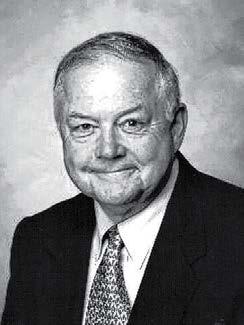
“The scholarship I received made a difference in my life, and if I can make a difference in the life of somebody else, I will have answered the call.”
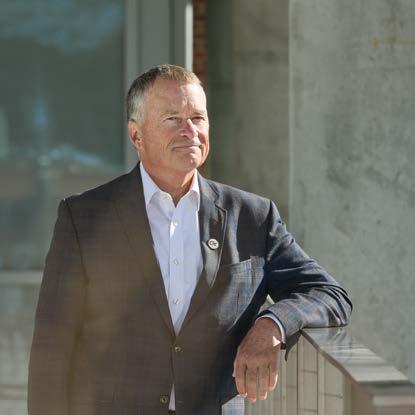
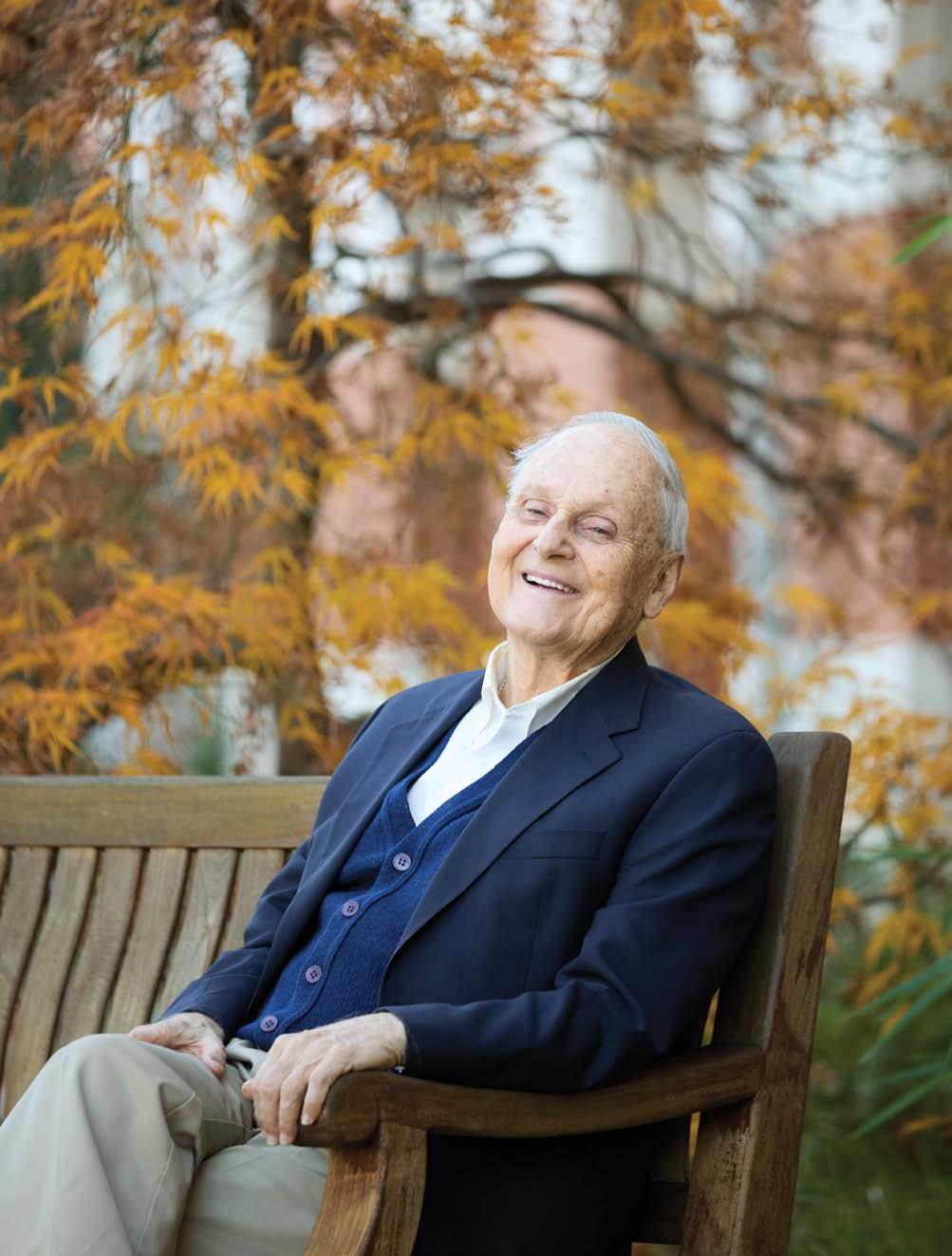
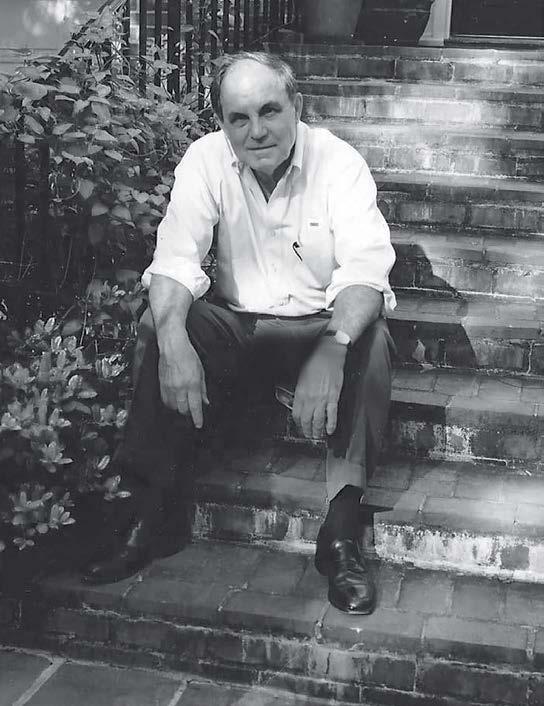
— James Satterfield, TE 1969, M.S. TE 1972
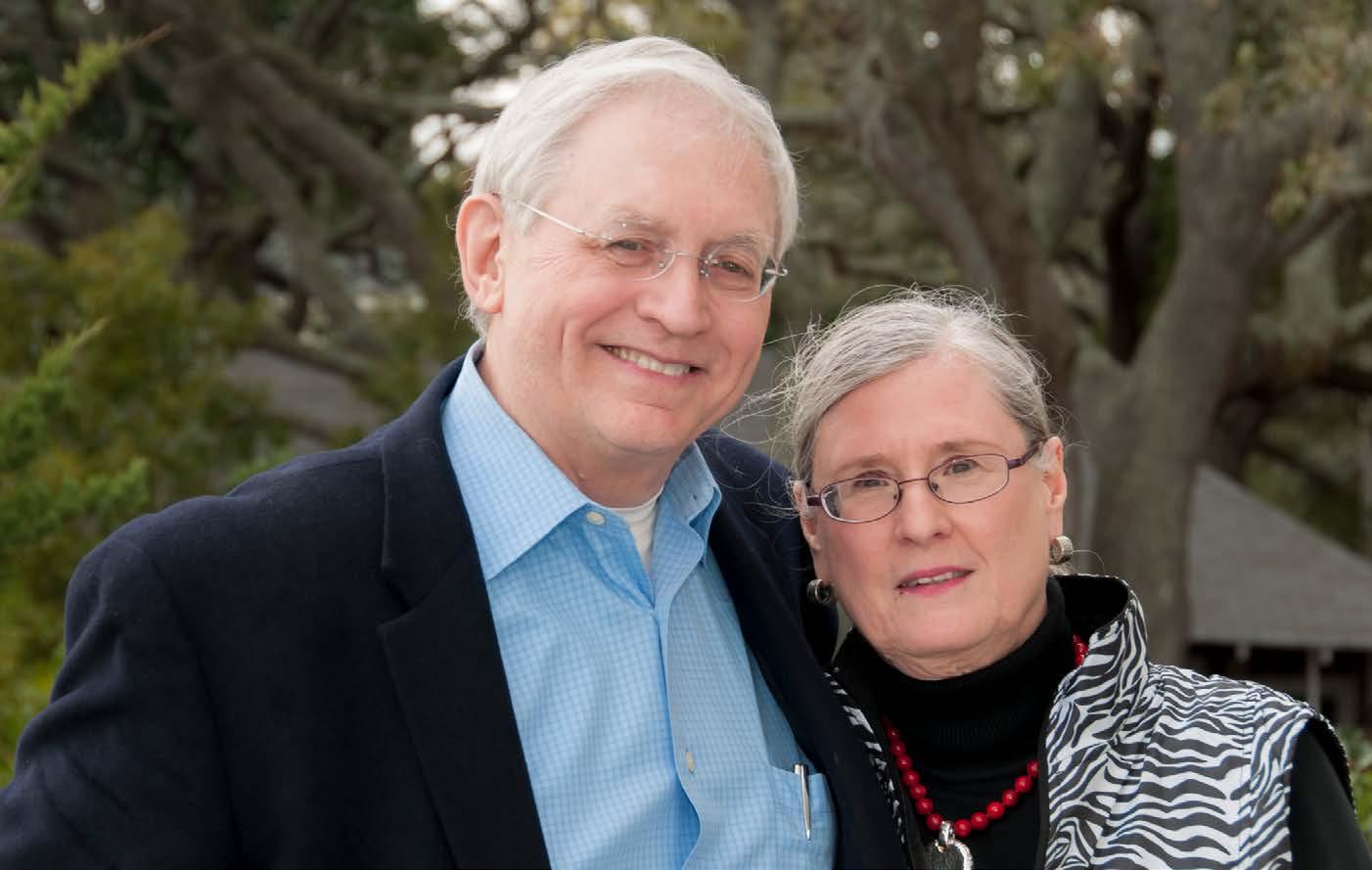
James Satterfield is a native Atlantan who wanted to attend Georgia Tech from a young age. He believed a Tech education would give him the practical tools he would need to confidently build a successful career.
Decades later and through many career shifts, this belief has proven true. Satterfield has worked across many disciplines and found success in all his endeavors by identifying or predicting problems and solving them — two essential skills he cultivated at Georgia Tech.
“I think that Tech is a transformative opportunity for anyone,” said Satterfield. “And after Tech, you continue to grow. Everything I’ve done in my career was influenced by taking the approaches and concepts I learned at Tech and applying them to whatever I’m faced with.”
Satterfield especially appreciates the crossdisciplinary approach to problem solving emphasized by his professors at Tech and has applied that creative thinking he learned to his work in crisis response, risk assessment, insurance, academia, and environmental waste prevention.
Satterfield knows firsthand the impact that financial support can have for a college student. When he was an undergraduate studying textile engineering, he received a scholarship not long after his father died, and the money offered some relief during a challenging time.
Demonstrating his appreciation for the education and support he received at Tech, Satterfield and his wife, Lynn, decided to pay it forward with a planned gift to the School of Materials Science and Engineering (MSE). The couple gave through charitable gift annuities, allowing them to support MSE while receiving regular payments from the annuities. Their unrestricted support will allow the School’s leadership to seize emerging opportunities and address challenges.
Grateful for his time at Tech, Satterfield said, “It was a great experience, and I want to share that with others.” Through their gift, the Satterfields are ensuring that future materials science and engineering students will have similar life-altering opportunities at Georgia Tech.
Still holding onto your class notes?
Scan the QR code to share your student artifacts.
SECOND TO NONE
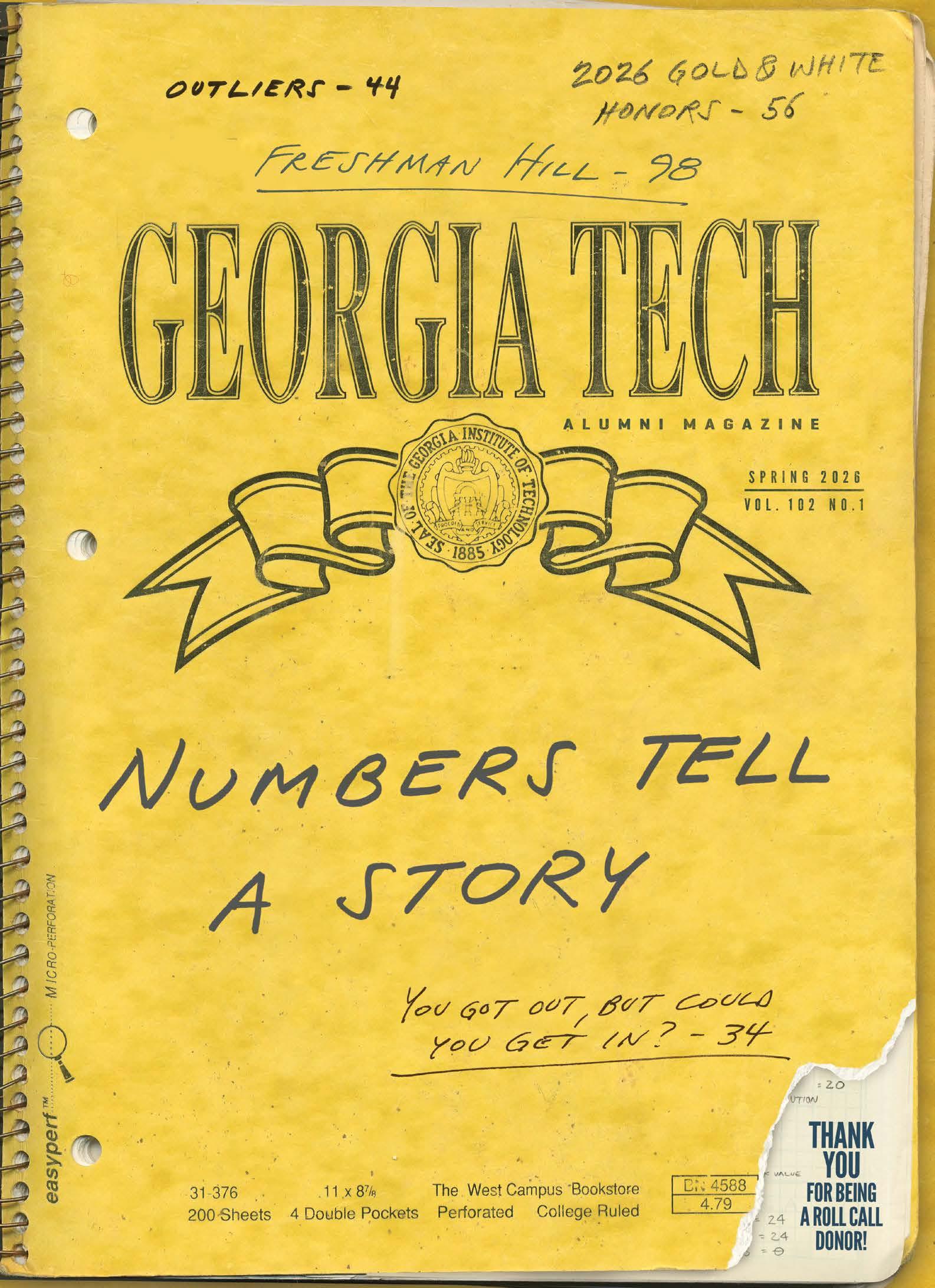
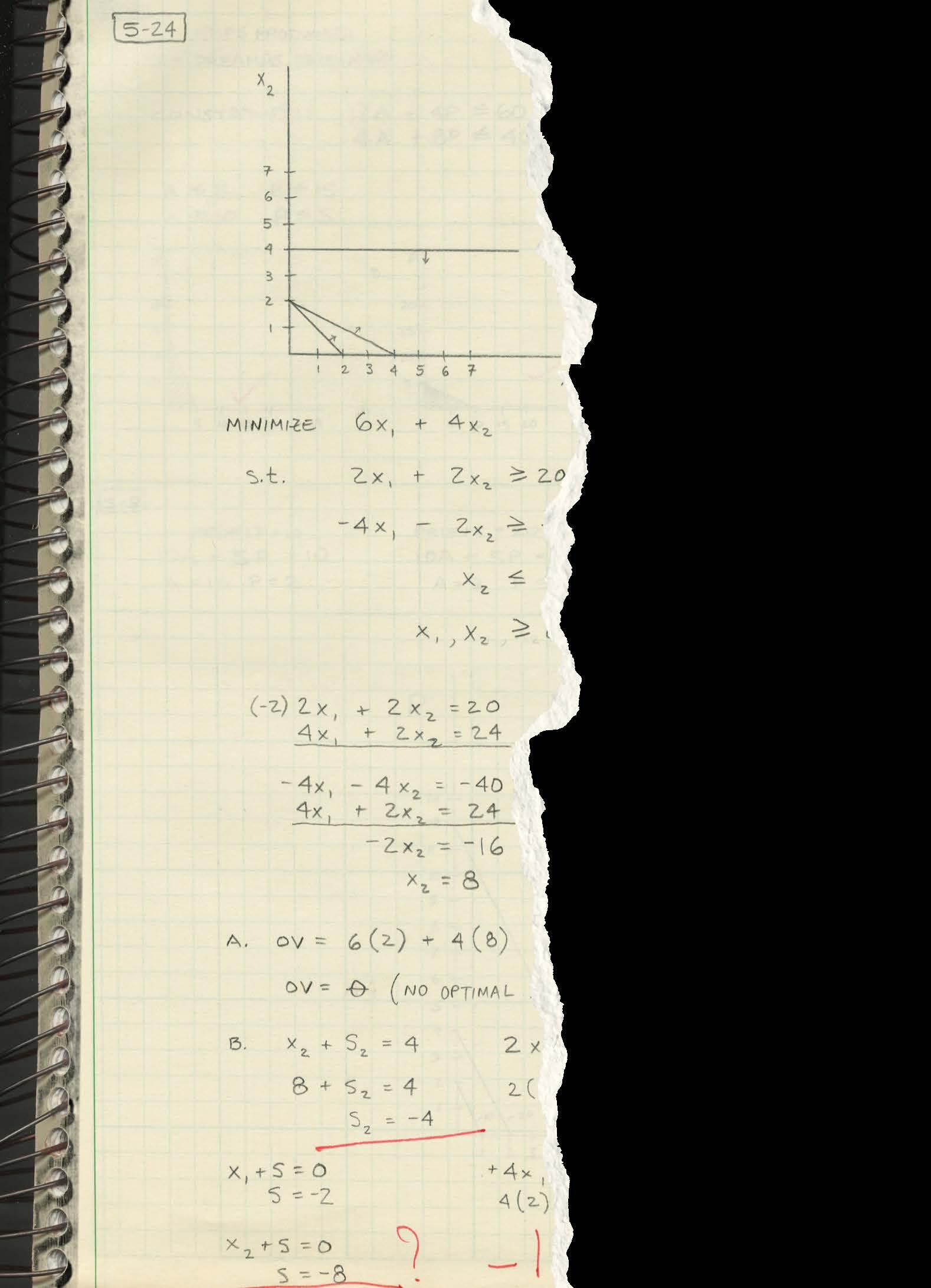
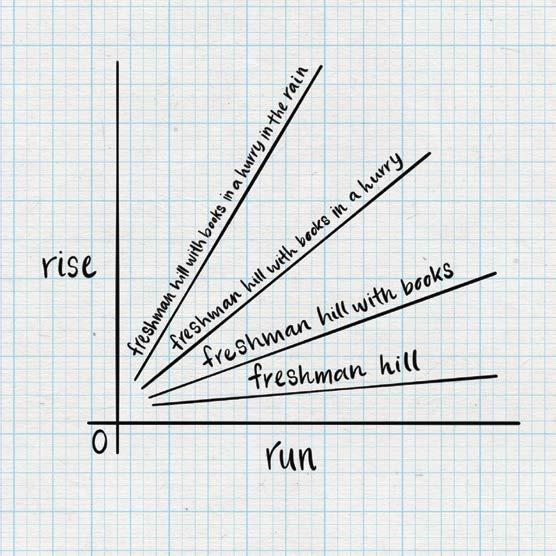
AS I LOOK AT and think about my scribbled notes (pulled straight from my old math notebook), I’m reminded of how much Yellow Jackets appreciate numbers.
Numbers give us confidence that the answer is right and the solution will work. They’re a stamp of approval as we strive for excellence. But they’re also woven into the moments we experience and the connections we treasure.
Behind every score is a story.
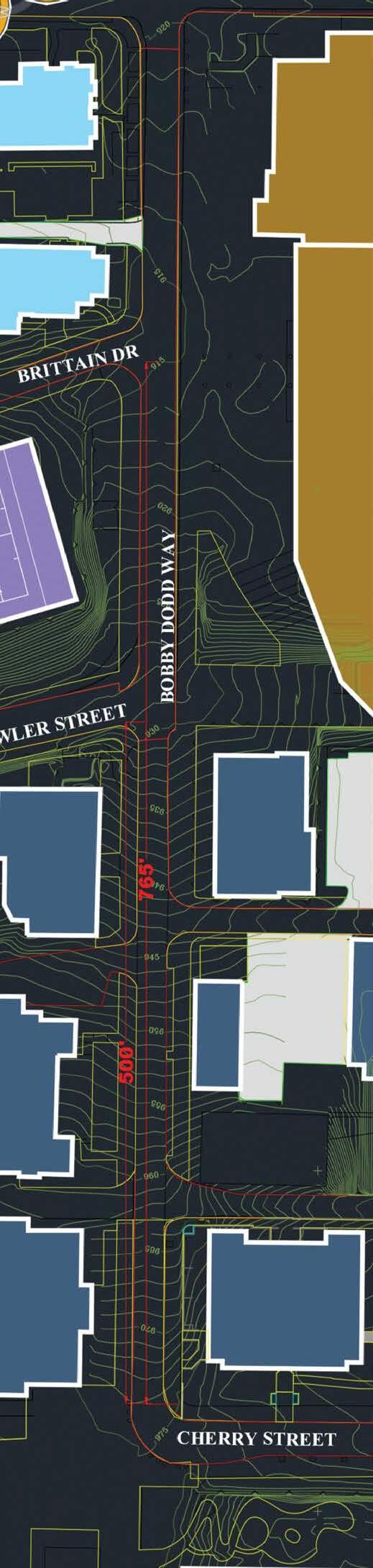
Behind every metric is a memory. That’s what you’ll find throughout this issue: numbers that show economic impact, reveal Georgia Tech outliers, map where alumni live, provide insights from the 2025 Alumni Attitude Survey, and quantify the physics behind Freshman Hill. Within these figures are stories of alumni, faculty, and students working together to advance technology and improve the human condition.
Of course, if there’s any number that captures the spirit of this great Institution, it’s No. 1.
We’re not satisfied with second best. Never have been and never will be. What numbers come to mind when you think of Georgia Tech?
DENE SHEHEANE, MGT 91 PRESIDENT GEORGIA TECH ALUMNI ASSOCIATION
INTEGRAL INTEGERS
Yellow Jackets share the story behind a meaningful number from their time at Tech.
41-38
THOSE NUMBERS are practically seared into my brain. I was a senior when Scott Sisson kicked a field goal in the last seconds of the game that led Georgia Tech to a his‑ toric victory over the No. 1–ranked Virginia Cavaliers in Charlottesville. It led Tech to an undefeated season and a national championship. To this day, those numbers reso nate with me. Not just because they reflect a historic win and moment of excellence on the field, but because they remind me of the people I was with when it happened.
A group of fellow students and I made the trip in a beat‑up minivan. We didn’t have tickets to the game, but through persistence—and a little luck—we got into the stadium just before halftime. The score, the ranking, and the upset mattered, but the camaraderie we shared has stayed with me for decades. —Dene
Sheheane, Mgt 91
MY MAILBOX COMBO
I ADMIT that I don’t remember the com bination, but my mailbox code is the number that comes to mind. Check ‑ ing my mailbox became such a part of my daily routine at Tech. Email was just starting back then, so letters were the main means of communication. Every day, you would go to the student cen ter to check your mailbox. I’d check to see if I had a letter from Spain and see if I got anything from my parents.
—Ángel Cabrera, MS Psy 93, PhD Psy 95, Georgia Tech President
JOHN DURSTINE PERSONAL COLLECTION
THE WINTER 2025 PROFILE of the late John Durstine and his $100 million dona tion included archival materials from the John Durstine Personal Collection cour tesy of the Georgia Tech Archives.
YOUR MOST MEANINGFUL NUMBER FROM TECH
Was it another student’s phone number? The combination to your mailbox? Tell us your most meaningful number at GTalumni.org/number.
24
THE FIRST NUMBER that comes to my head is 24, as in the number of hours in a day. When I first arrived at Tech as a grad student, I was so overwhelmed with one of my engineering courses that I pulled an all nighter ahead of a test. I went in for the exam and did horribly and told myself that it was the last time I would pull an all nighter! I thought if I’m not going to do well, at least I should get some sleep.
—Raheem Beyah, MS EE 99, PhD ECE 03, Georgia Tech Provost and Executive Vice President for Academic Affairs
GEORGIA TECH ALUMNI MAGAZINE
VOL. 102 | NO. 1
PRESIDENT & PUBLISHER
Dene Sheheane, Mgt 91
VP STRATEGIC COMMUNICATIONS
Lindsay Vaughn EDITOR Jennifer Herseim
DIRECTOR
Hedberg
EDITOR
McIntosh Webb
COPYWRITER
Sharita Hanley
STUDENT ASSISTANTS
Alisha Tan, Joanna Xiao
EXECUTIVE COMMITTEE
Chair
Rita Breen, Psy 90, MS IE 92
Past Chair/Finance
Tommy Herrington, IM 82
Chair Elect, Vice Chair/Roll Call
Jimmy Mitchell, CE 05
Vice Chair of Engagement
Sam Westbrook, IE 99
Member at Large
Meredith Moot, Mgt 08
Member at Large
Alex Muñoz, Mgt 88
Member at Large
Amy Phuong, IA 05, MBA 14
Member at Large
Kenji Takeuchi, ME 94
BOARD OF TRUSTEES
Tommy Antonino, BA 15, MSA 22; Donnie Beamer, Econ 05; Matt Bishop, CmpE 06; Alexia Borden, IE 01; Jacky Cheng, IE 17; Kim (Kilpatrick) Civins, Mgt 92; Catherine Cooper, IE 90; Cynthia Culbreath, IE 93, MS IE 95; Adam Fuller, Mgt 93; Sid Gore, ME 17, MS ME 20; Derek Goshay, IE 93; Ryan Greene, ME 00, MS Econ 01; Craig Hyde, CmpE 05; TJ Kaplan, PP 13; Brandon Kearse, ME 08, MS CE 10; Kayla Kelly, Econ 16; Olivia Langevine, IAML 13; Sabrina McCorvey, IE 90; Mihir Pathak, ME 08, MS ME 10, PhD ME 13; Susan (Sutherland) Piña, IE 93; Kyle Porter, Mgt 04; Josh Roberts, IE 02; Sonia Sardana, IE 12; Greg Sitkiewicz, IE 00; Kofi Smith, IE 99, MBA 09; Miya Smith, IE 03; Russell Smith, Cls 98; Peter Stewart, CE 97; Casey Swails, Mgt 07; Rani Tilva, BA 18; Paul Trotti, ME 00; Hayley Tsuchiyama, ChBE 18; Ben Utt, IM 81; D’Andre Waller, ME 17; Kourtney Wright, CS 15, MS CS 23; Liz (Harriss) York, Arch 90, M Arch 95
Scott Sisson, Mgt 96, celebrates his game winning field goal against the Virginia Cavaliers.
ARE YOU ON THE LEVEL? Compare your SAT score to those of Tech’s average incoming students throughout the decades at GTalumni.org/classcalculator.
COULD YOU GET IN?
Soaring demand for a Tech education has led to record high applications. “Be happy we got in when we did!” says Georgia Tech President Ángel Cabrera.
OUTLIERS
How many standard devi ations away from the mean are you? See where you stack up among 220,000 Georgia Tech alumni.
FOR THE BIRDS
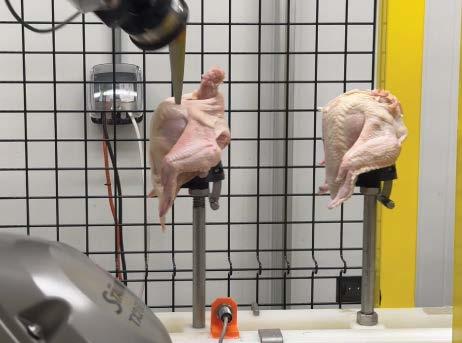
A cutting edge robot developed at Tech is helping Georgia stay on top in the poultry industry.
DEPARTMENTS
AROUND CAMPUS
REFLECTING BRILLIANCE
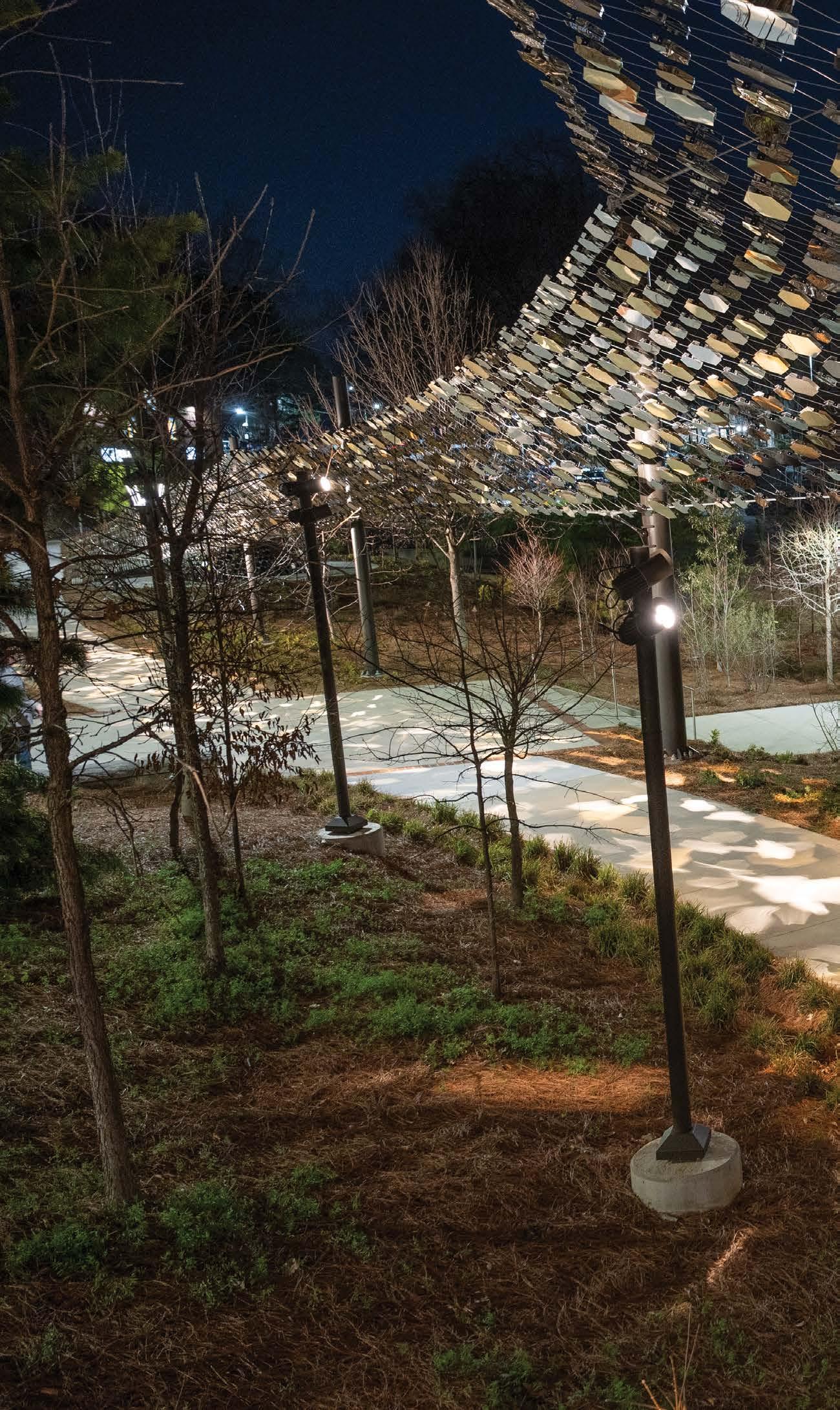
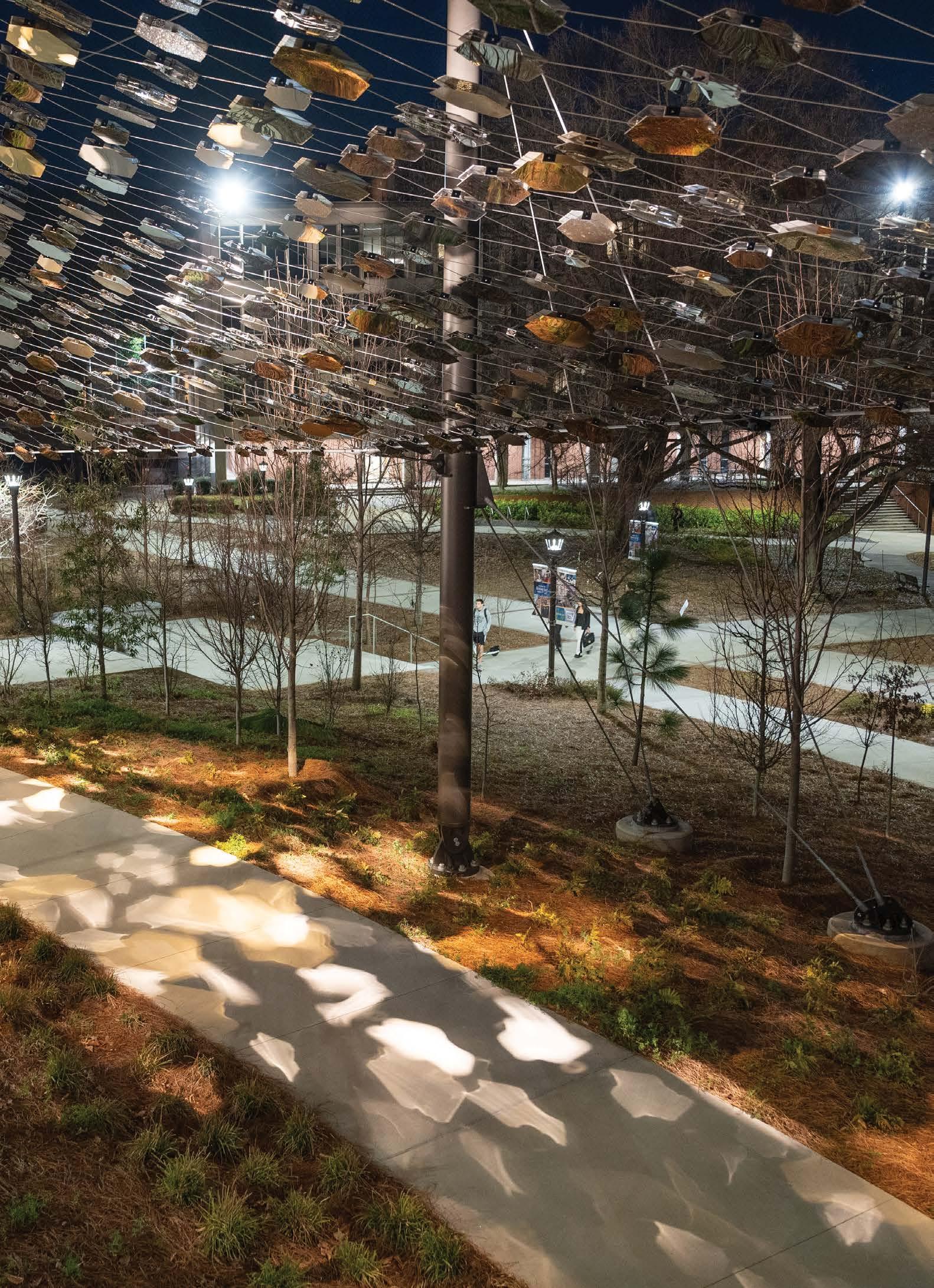
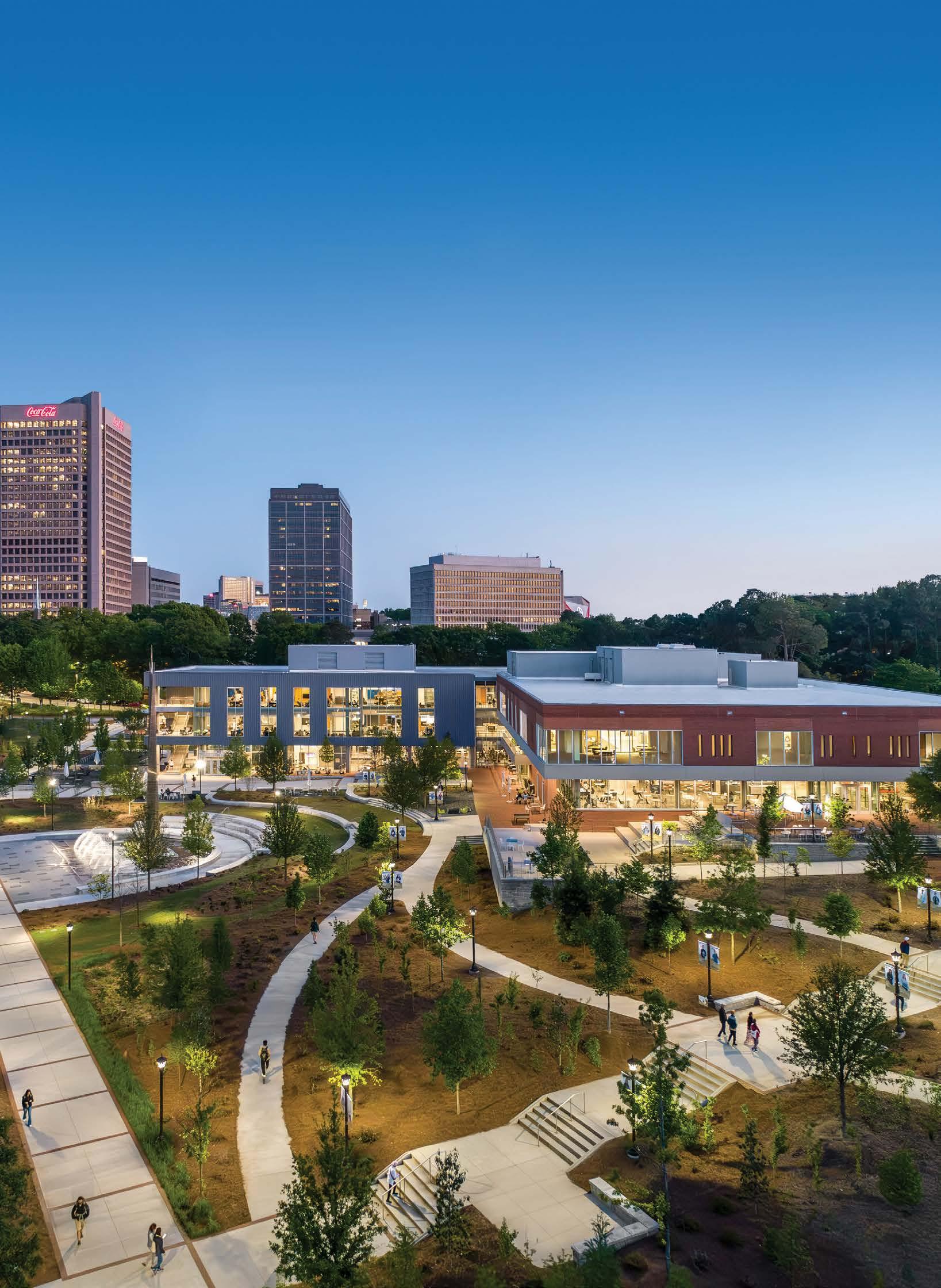
At night, the hexagonal tiles that make up the Pathway of Progress: Celebrating Georgia Tech Women reflect light onto the pedestrian path near the Student Center. This March, new alumnae honorees were added to the site.
MY FAVORITE TECH NUMBERS
NOTES FROM THE DESK OF GEORGIA TECH’S PRESIDENT.
304 GPU s
It would take a single NVIDIA H100 graphics processing unit (GPU) one second to process an operation that 50,000 people would need 22 years to achieve. And we have 304 GPUs at Georgia Tech! Thanks to Tech’s AI Makerspace, which is the first of its kind at a higher education institution, our students are tackling challenges in healthcare, energy, and transportation. Biomedical students have already used the makerspace to create PatchPals, an AI tool that automates foam cutting for wound care.
4 , 400° FAHRENHEIT
The Ben T. Zinn Combustion Lab can reach up to 4,400 degrees during fuel combustion tests. For context, titanium melts at about 3,000 F. There are about 130 students working in the 20,000 square foot research lab at any time. They’re conducting experiments that have powered many of Tech’s pioneering aerospace achievements, including advanced propulsion systems and sustainable aviation fuels.
2 31 – 1 ($2,147,483,647)
This is the eighth Mersenne prime, and it’s the 2027 fundraising goal for Transforming Tomorrow: The Campaign for Georgia Tech. We deliberately chose this unconventional campaign number because of its significance in math and science. It was the largest known prime number from the years 1772 to 1867 and is one of the most significant historical figures in modern mathematics, science, and engineering. It has significance in computing and video gaming, and it pays homage to important historic milestones that shaped Georgia Tech about every 31 years.
15
,
000 DEGREES
One of four “Big Bets” in the 2030 Institute Strategic Plan is to double the annual number of degree and non degree learners. That comes out to 15,000 degrees a year. We intentionally chose degrees because the goal isn’t to keep as many students as possible enrolled, but for those students to graduate and move on to bigger and better things. We’re already ahead of where we need to be with 13,616 degrees conferred in 2025, the largest graduating class in Georgia Tech history.
$ 1.67 BILLION
This is our 2030 target for research expenditures, a measure of our research activity and competitiveness. Our goal is to double the scale and amplify the impact of our research enterprise. Again, we’re ahead of where we need to be to achieve this goal. In fiscal year 2025, we hit $1.43 billion in expenditures, a new record and a 7% increase over the previous year. We’re now No. 2 in the nation for federally sponsored research, according to the National Science Foundation. All this support we receive from taxpayers, foundations, and corporate partners allows us to advance areas of science and technology to keep our nation safe, healthy, and competitive.
TECH CLIMBS TO NO. 2 FOR FEDERALLY SPONSORED RESEARCH EXPENDITURES
THE INSTITUTE MAINTAINS ITS NO. 1 RANKING AMONG PUBLIC UNIVERSITIES WITHOUT A MEDICAL SCHOOL.
BY ANGELA AYERS
GEORGIA TECH received its highestever ranking from the National Science Foundation’s annual Higher Education Research and Development (HERD) Survey. The Institute is ranked No. 2 nationally for federally sponsored research expenditures in 2024, with $1.2 billion—a 70% increase over Tech’s 2019 numbers.
In total expenditures from all externally funded dollars (including the federal government, foundations, industry, etc.), Georgia Tech is ranked No. 6 and remains No. 1 among
universities without a medical school—a major accomplishment, as medical schools account for a quarter
of all research expenditures nationally. Tech leads the state of Georgia in research expenditures.
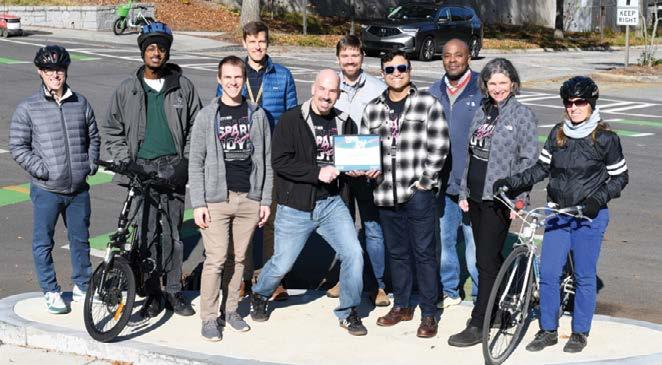
GEORGIA TECH PLACES FIRST IN ATLANTA BICYCLE CHALLENGE
FOR THE FIFTH YEAR IN A ROW, TECH EMPLOYEES CAME OUT ON TOP IN THE ATLANTA BICYCLE “BIKETOBER” CHALLENGE, CYCLING 22,132 MILES.
Tech finished first among workplaces with more than 2,000 employees.
THE TOP TEAM was again GTRI’s Thighs, a group of 10 rid ers from the Georgia Tech Research Institute that collectively biked more than 6,000 miles during the challenge. Francisco Valdes, PhD Arch 16, a senior research engineer at GTRI, was the top rider for the second year in a row, logging 1,812
miles. Alexa Harter, director of GTRI’s Cybersecurity, In‑ formation Protection, and Hardware Evaluation Research Laboratory, was the team’s top encourager and ranked third on her team for distance.
“The contest ranks how many people you’ve encour aged to participate,” Harter says. “I love Biketober, so I’m eager to tell people how great it is. Through sharing how much I enjoy it, a lot of other people decided to sign up.”
The Biketober challenge takes place each October as a way to encourage cycling in the area. This year, 2,643 rid‑ ers participated and biked 326,934 miles. Looking ahead, Harter says GTRI will participate in Biketober again next fall, as will many other Georgia Tech teams: “You can expect GTRI’s Thighs to be back in 2026. Biketober is something we all look forward to—what better excuse to ride a bike all month?” —EMILY RUSSELL
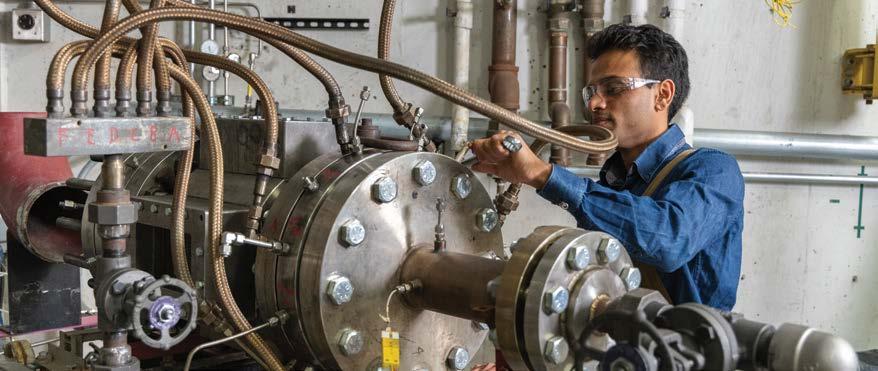
Graduate research assistant Shivam Patel in the Ben T. Zinn Combustion Laboratory.
CHRIS M c KENNEY
ART AND TECH TAKE FLIGHT AT ATLANTA’S AIRPORT
BY KELLY ADAMS
INSTITUTE RANKS NO. 7 GLOBALLY IN INTERDISCIPLINARY SCIENCE
THE 2026 TIMES HIGHER EDUCATION
INTERDISCIPLINARY SCIENCE RANKINGS INCLUDES 911
INSTITUTIONS ACROSS THE GLOBE.
GEORGIA TECH has been ranked 7th in the world in the 2026 Times Higher Education Interdis ciplinary Science Rankings, in association with Schmidt Science Fellows.
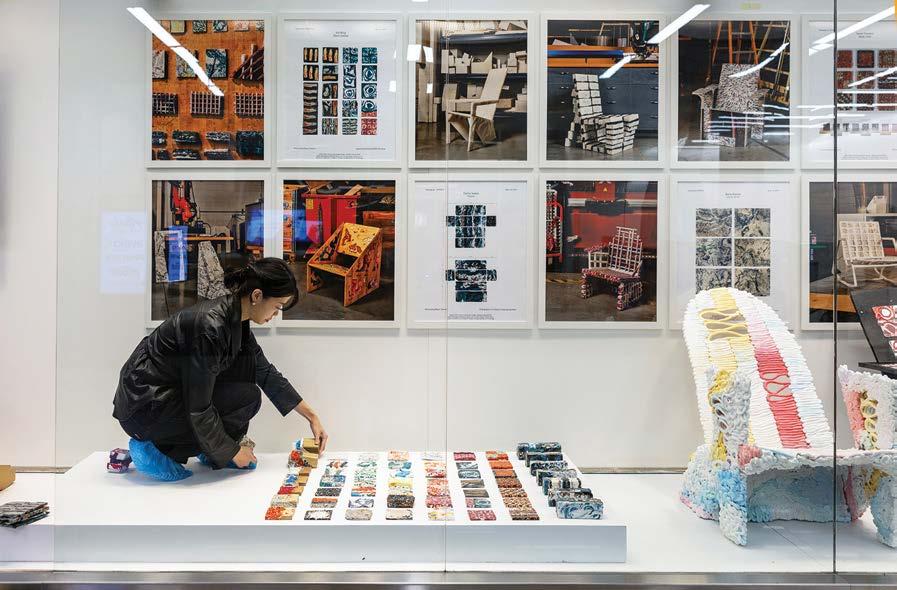
GEORGIA TECH HAS LAUNCHED an exhibition at HartsfieldJackson Atlanta International Airport: Transport | Transform | Transcend: Innovations in Materials and Movements . On view in Terminal T North through November 2026, the exhibition showcases the groundbreaking work of researchers merging science, technology, and design to reimagine traditional notions of movement, materiality, and meaning.
Curated by Birney Robert, curator and strategist for external engagement for Georgia Tech Arts, the exhibition features eight immersive projects. Challenging boundaries and exploring movement, they unveil works such as AI-powered dance, robotic percussion, parametric textiles, circular design, and plastic-made displays—all representations of transformation catalysts.
“The installation connects faculty and student research in art, design, and technology with one of the world’s busiest transportation hubs,” says Robert. “Technology can be a partner in shaping more inclusive and imaginative futures,” she says. “Whether it is dancing, bicycling, making music, designing, engineering, or thinking about the transportation of data and humans, Georgia Tech is creating new innovations that help question and power the future of technology and creativity.”
Artists in the exhibition include Georgia Tech researchers:
Georgia State University’s Jeremy Bolen is also among the exhibition researchers.
“Interdisciplinary research is at the heart of Georgia Tech’s mission,” says Tim Lieuwen, MS ME 97, PhD ME 99, executive vice president for Research. “Our faculty, students, and research teams work across disciplines to create transformative solutions in areas such as healthcare, energy, advanced manufacturing, and artificial intelligence. This ranking reflects the strength of our collab orative culture and the impact of our research on society.”
As a top R1 research university, Georgia Tech is shaping the future of basic and applied research by pursuing inventive solutions to the world’s most pressing problems.
—ANGELA AYERS
TECH EARNS SPOT IN GREEN COLLEGES GUIDE
THE PRINCETON REVIEW RECOGNIZED THE INSTITUTE AMONG 388 COLLEGES THAT PRACTICE AND PROMOTE ENVIRONMENTAL RESPONSIBILITY.
GEORGIA TECH HAS BEEN INCLUDED in The Princeton Review’s Guide to Green Colleges for 2026. The Institute was recognized for several practices, policies, and programs related to sustainability. The Princeton Review evaluates colleges based on sustainability initiatives through surveys completed by both administrators and students.
To the right, take a look at Tech’s achievements that were considered for the guide.
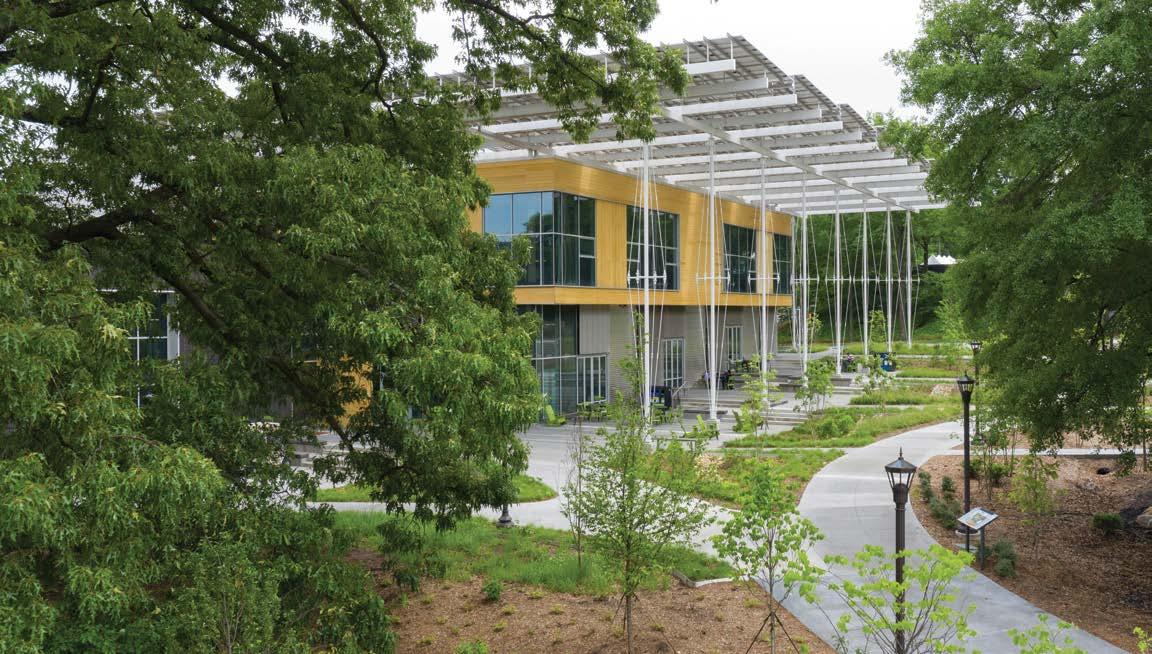
The Kendeda Building for Innovative Sustainable Design, the first Living Building Challenge–certified research and academic building in the Southeast.
30 LEED‑certified buildings on campus.
The award‑winning EcoCommons, 80 acres of regeneratively designed greenspace.
Tech published its first Climate Action Plan last year, a roadmap to cut emissions in half by 2030 and achieve net‑zero emissions by 2050.
YELLOW JACKETS WON THE COMPETITION AGAIN, WITH 306 PARTICIPANTS FROM TECH, INCLUDING 27 ALUMNI.
THE UNITED STATES AIR FORCE’ s Cyber Operations Squadron was in a crisis. A sophisticated foreign adversary was threatening national security, and it was up to the National Security Agency to help.
This was the fictional scenario of the 2025 NSA Codebreaker Challenge, which was once again
dominated by Georgia Tech students, faculty, and alumni. With a score of nearly 300,000 points, they took first place among Division I schools.
“Georgia Tech continues to win this highly challenging competition each year because of our outstanding students and the excellence of the cybersecurity and privacy curriculum
AASHE Stars GOLD rating, a transparent, self‑reporting framework that measures sustainability performance.
The Georgia Tech Arboretum certified as Arbnet Level II.
A public Climate Story Map.
The Green Forks initiative, aimed at reducing food waste and supporting student food security.
New in vessel composting machine installed for food waste diversion directly on campus.
that has been developed by SCP faculty,” says Mustaque Ahamad, interim chair for the School of Cybersecurity and Privacy.
One of the keys to Georgia Tech’s success is that it integrates the challenge into students’ coursework.
—JOHN POPHAM
The Kendeda Building, photographed through the award winning Eco Commons green space.
The
in
across
GEORGE AND SCHELLER TOWERS OPEN
TECH SQUARE PHASE 3 REACHED A MAJOR MILESTONE WITH THE OPENING OF THE FIRST THREE FLOORS OF THE NEW FACILITY.
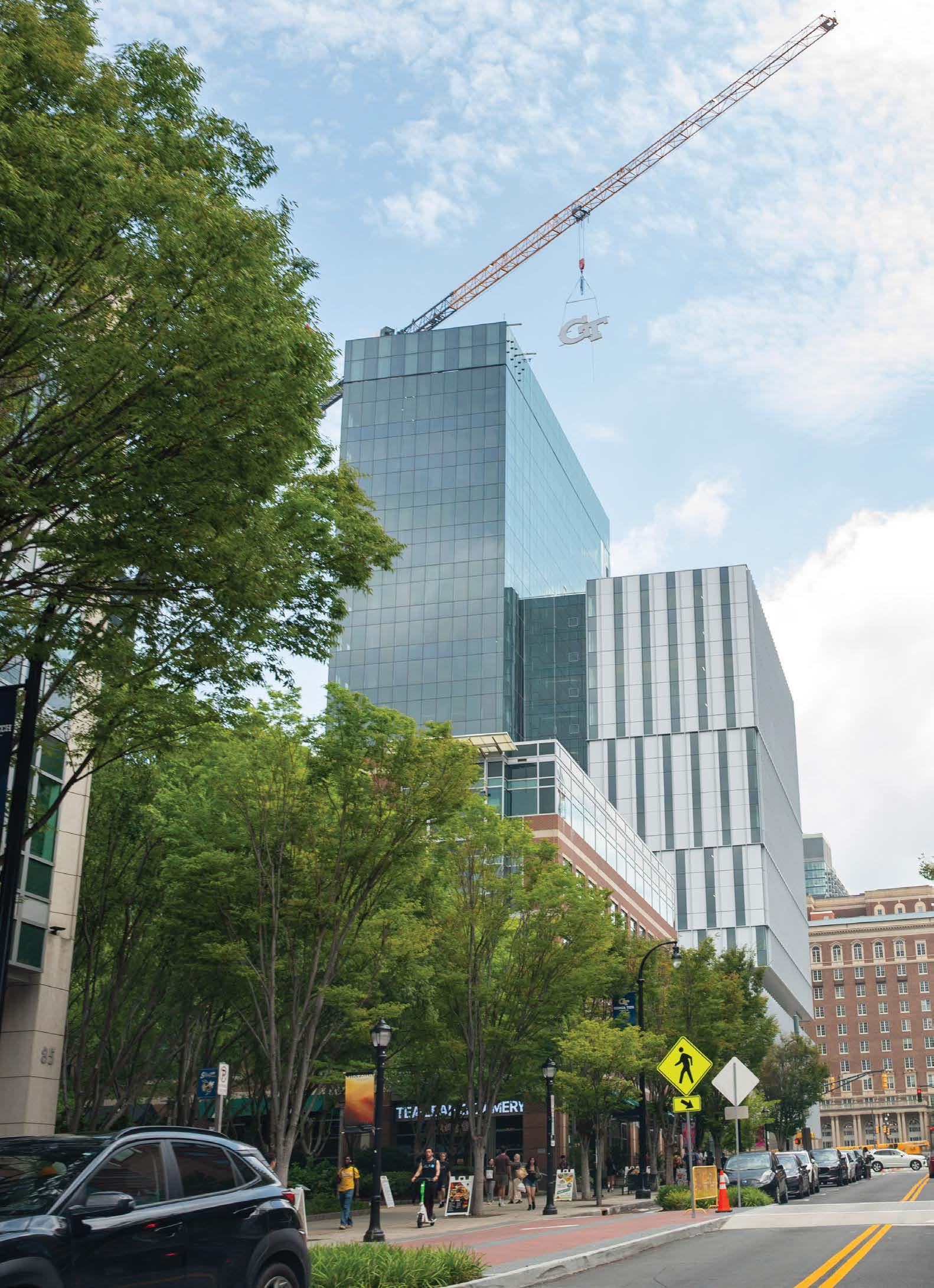
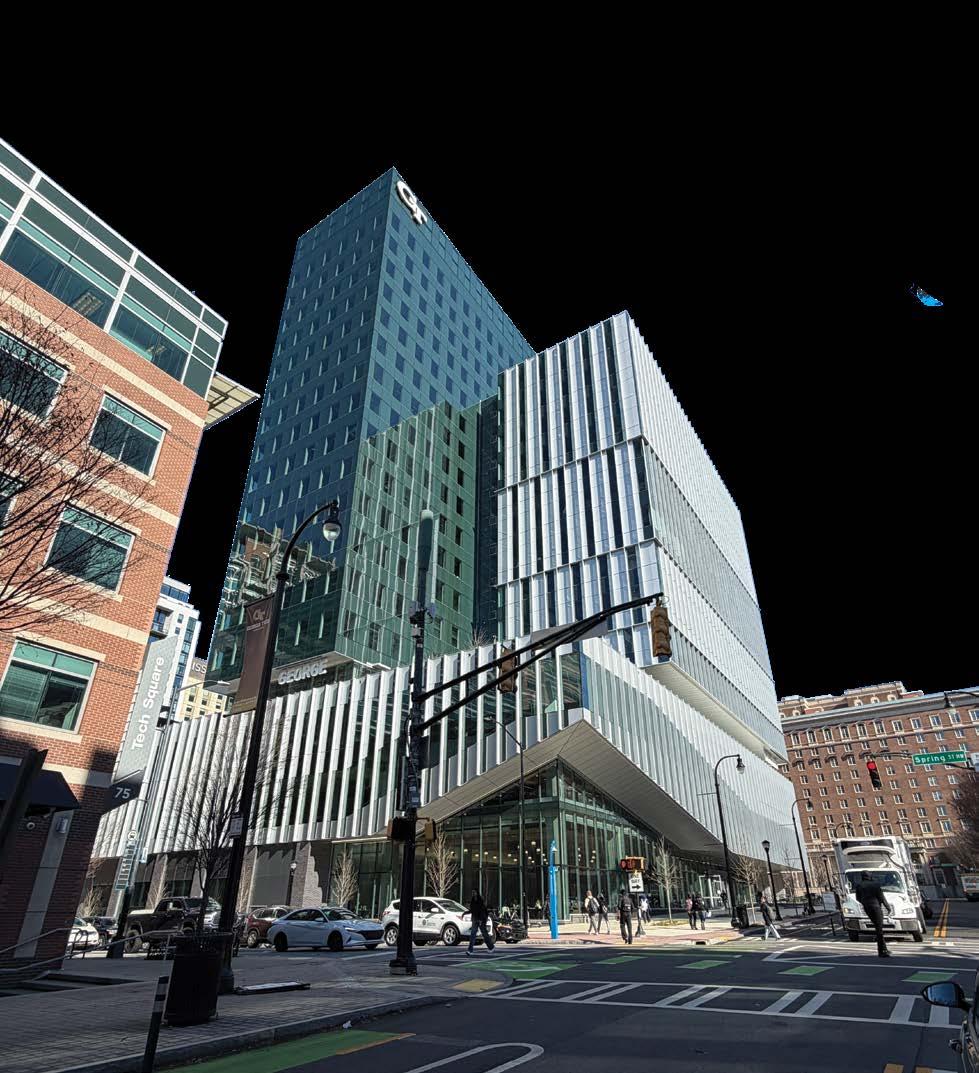
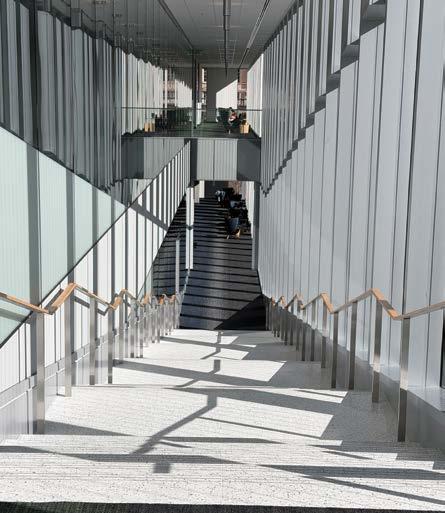
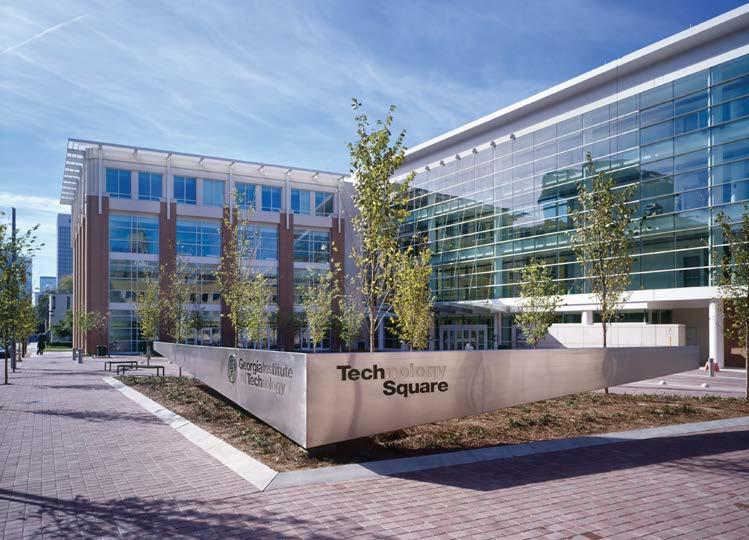
THE FIRST THREE FLOORS of the George Tower and Scheller Tower are now open for the campus community to access classrooms, conference space, and indoor and outdoor spaces. The 14-story Scheller Tower, named in recognition of Roberta and Ernest Scheller Jr., IM 52, HON PhD 13, will include the MBA and Executive Education programs for the Scheller College of Business. Beside the Scheller Tower is the 18-story George Tower, named in recognition of Penny and Bill George, IE 64, HON PhD 08. The George Tower will house the H. Milton Stewart School of Industrial and Systems Engineering. Peek inside the state-of-the-art facility, which is expected to fully open by fall 2026.
The new facility was built using low car bon construction, including the use of a concrete mix that incorporated fly ash, which reduced the carbon output and di verted fly ash from the landfill as well as reducing the carbon emissions in the structural materials by half versus typical construction for a similar sized building.
All the water in the building will be captured, recy cled, and reused for cooling and toilet flushing.
two towers are located
the heart of Tech Square,
from the Georgia Tech Barnes & Noble bookstore.
The first four floors of the building feature bird safe window striping to prevent collisions, especially during migration seasons.
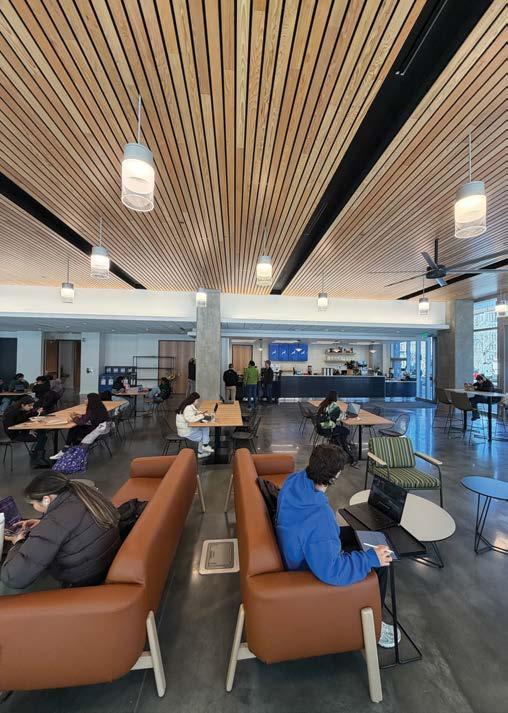
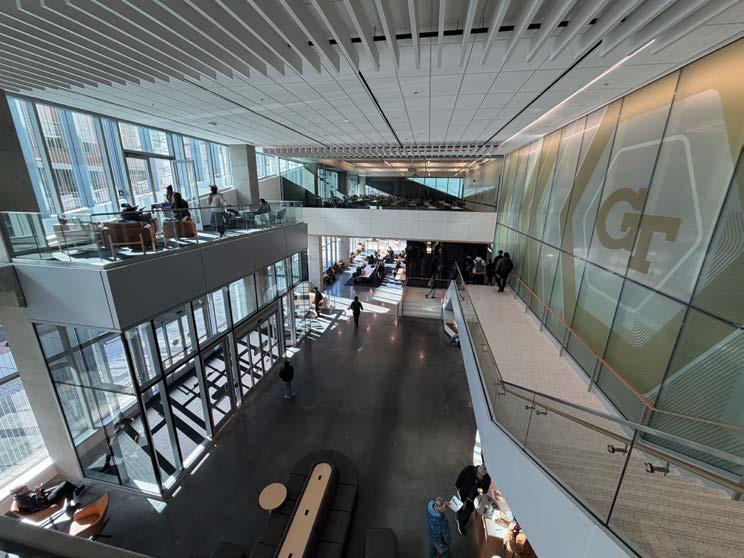
The main lobby includes an information desk and coffee shop. The second and third floors include 11 classrooms as well as huddle rooms and conference rooms.
The Porch is a street level gather ing area with kinetic doorways opening along Fifth Street.
10 THINGS ABOUT TECH’S NEW PROVOST
MEET THE DOUBLE JACKET AND FORMER DEAN OF THE COLLEGE OF ENGINEERING LEADING TECH INTO THE NEXT CHAPTER.
BY JENNIFER HERSEIM
ON NOVEMBER 1, 2025 , Raheem Beyah, MS EE 99, PhD ECE 03, became Tech’s provost and executive vice president for Academic Affairs. While Beyah is no stranger to Georgia Tech, the Alumni Magazine sat down with him earlier this year to learn more about this Yellow Jacket. Here are 10 facts about Tech’s new provost.
1. If it weren’t for biscuits, he might have been a triple Jacket. Beyah was accepted at Georgia Tech, but was wooed away by his grandmother and her famous biscuits. He studied Electrical Engineering at North Carolina A&T State University to be closer to his grandmother and her baking. “There’s no known recipe. They’re just made with love and grandma magic,” Beyah recalls.
2. He’s signed Tech Tower. One of his favorite Tech memories happened as dean of the College of Engineering, when he signed the inside of Tech Tower.
3. Hard work is hard-wired in him. He wasn’t a serious student until midway through high school, when “a switch flipped” and he realized he needed to help more at home. “I just started working extremely hard,” he says. He even took precalculus and calculus at the same time, against his high school counselor’s advice.
4. Mentorship is central to his identity. Beyah’s mentees span from high schoolers to academic leaders. In his undergrad, during a visit to his high school, he met Gary May, EE 85,
HON PhD 21 (who became dean of the College of Engineering). “He was volunteering at Douglass High School with the Alumni Association. He became very influential in my life for decades after that.”
5. He’s raising awareness about prostate cancer. About a year after a surgery to remove his prostate, Beyah publicly shared his cancer story to encourage men to get checked for prostate cancer. His experience also shaped his leadership style. “It really puts things into perspective. As I was being wheeled off to the OR, I thought about whether I’d be able to have coffee with my wife again, and that’s the stuff that’s important. When I talk to my colleagues now, I remind them, what’s important is what brings you joy and happiness.”
6. He meditates daily. Beyah doesn’t take his health or well‑being for granted. “I’ve always been a hard worker, but I’ve realized that to get things done you have to have balance. You have to take care of your physical and mental health.”
7. He’s preparing students for an AI-driven world. Two years ago, Beyah started AI for Engineering, which aims to prepare engineering students to be ready to enter an AI native workforce. Expanding that initiative across Tech and starting an AI Advisory Committee are priorities for him as provost. “We need to make sure our students not only understand AI but also have the experience solving real‑world problems so they graduate with the technical skills and the experience to contribute from day one.”
8. He’s expanding access. A top priority for him as provost is making sure that if a student gets accepted to Georgia Tech, finances are not a barrier.
9. He’s scaling staff development. Beyah aims to bring practices from the College of Engineering to the rest of the Institute. One example is a staff development program that creates mentorship opportunities for staff.
10. He still plays video games (and can usually win against his kids). Gaming inspired Beyah’s early interest in engineering, and he still plays today with his two children. “I played my daughter last night in college football and managed to eke out a win,” he says.
GAZARIK NAMED GTRI DIRECTOR THE FORMER NASA LEADER AND AEROSPACE RESEARCHER RETURNS TO HIS ALMA MATER.
MICHAEL “MIKE” GAZARIK, MS EE 89, PHD EE 97, became the director of the Georgia Tech Research Institute (GTRI) and a Georgia Tech senior vice president on February 16.
A Tech alumnus, Gazarik previously served as facul ty director of the Engineering Management Program at the University of Colorado Boulder and as a part time staff member at the Johns Hopkins Applied Physics Laboratory. He previously held senior leadership roles at NASA, including director of engineering at NASA Langley Research Center and inaugural associate administrator for the Space Technol ogy Mission Directorate (STMD). In industry, he spent eight years as vice president of engineering at Ball Aerospace, leading its strategic growth from an elite science contractor into a strategic national security asset that doubled in size.
At NASA, he helped shape the agency’s science and technology enterprise during periods of fiscal constraint and technical risk, maintaining balance across broad mis sion areas and forming STMD to consolidate technology development.
He earned a bachelor’s in Electrical Engineering from the University of Pittsburgh and a master’s and doctorate de gree in Electrical Engineering from Georgia Tech. He is a fellow of the American Institute of Aeronautics and Astronau‑ tics (AIAA), is a former chair of AIAA’s Corporate Strategic Committee, and was elected to the AIAA Board of Trustees in 2025. His honors include NASA’s Outstanding Leader ship Medal, the Silver Snoopy Award, the 2023 AIAA Rocky Mountain Section Educator of the Year, and recognition as Engineering Manager of the Year by the American Society of Engineering Management.
“GTRI has a remarkable legacy of delivering solutions that matter for the nation,” says Gazarik. “I’m honored to return to Georgia Tech and lead an organization that combines deep technical expertise with a mission driven culture. My focus will be on listening, building on GTRI’s strengths, and ensuring we continue to advance research that makes a real difference for our partners and society.”
—GEORGIA TECH RESEARCH INSTITUTE
SEEPERSAD SELECTED AS WOODRUFF SCHOOL CHAIR
CAROLYN SEEPERSAD, MS ME 01, PHD ME 04, was selected to lead the George W. Woodruff School of Mechanical Engineering. She became the Eugene C. Gwaltney, Jr. School Chair on January 1.
Seepersad has been a Woodruff School faculty member since 2023. She co‑leads the TechMade Initiative, which is building an engineering design community on campus. The initiative spans the colleges of engineering, business, and de sign to give students hands on exposure to the full sweep of product realization, from design to manufacturing, no mat ter their major.
Seepersad’s research and teaching focus on design for additive manufacturing, process innovation in additive manu‑ facturing, and simulation‑based and data‑driven engineering design. She was the founding director of the Center for Addi tive Manufacturing and Design Innovation at the University of Texas at Austin prior to coming to Tech.
The former Rhodes Scholar, she was a Hertz Fellow and National Science Foundation Graduate Research Fellow.
—JASON MADERER
CLARK NAMED VICE PROVOST FOR ENROLLMENT MANAGEMENT
AFTER A NATIONAL SEARCH, Georgia Tech’s Rick Clark has been appointed vice provost for Enrollment Management. Clark previously served as Tech’s executive director of Strategic Student Access.
A respected voice in the field of college admissions, he has served on numerous advisory and governing boards at the state, regional, and national levels.
During his time at Tech, Clark has worked extensively to strengthen transfer pathways for prospective students and to create innovative policies and practices that expand access, ensure affordability, and build the Institute’s national reputation.
He is also the coauthor of The Truth About College Admission: A Family Guide to Getting In and Staying Together, and a companion workbook under the same title, widely used by high school students and their families, as well as admissions counselors. —BRITTANY AIELLO
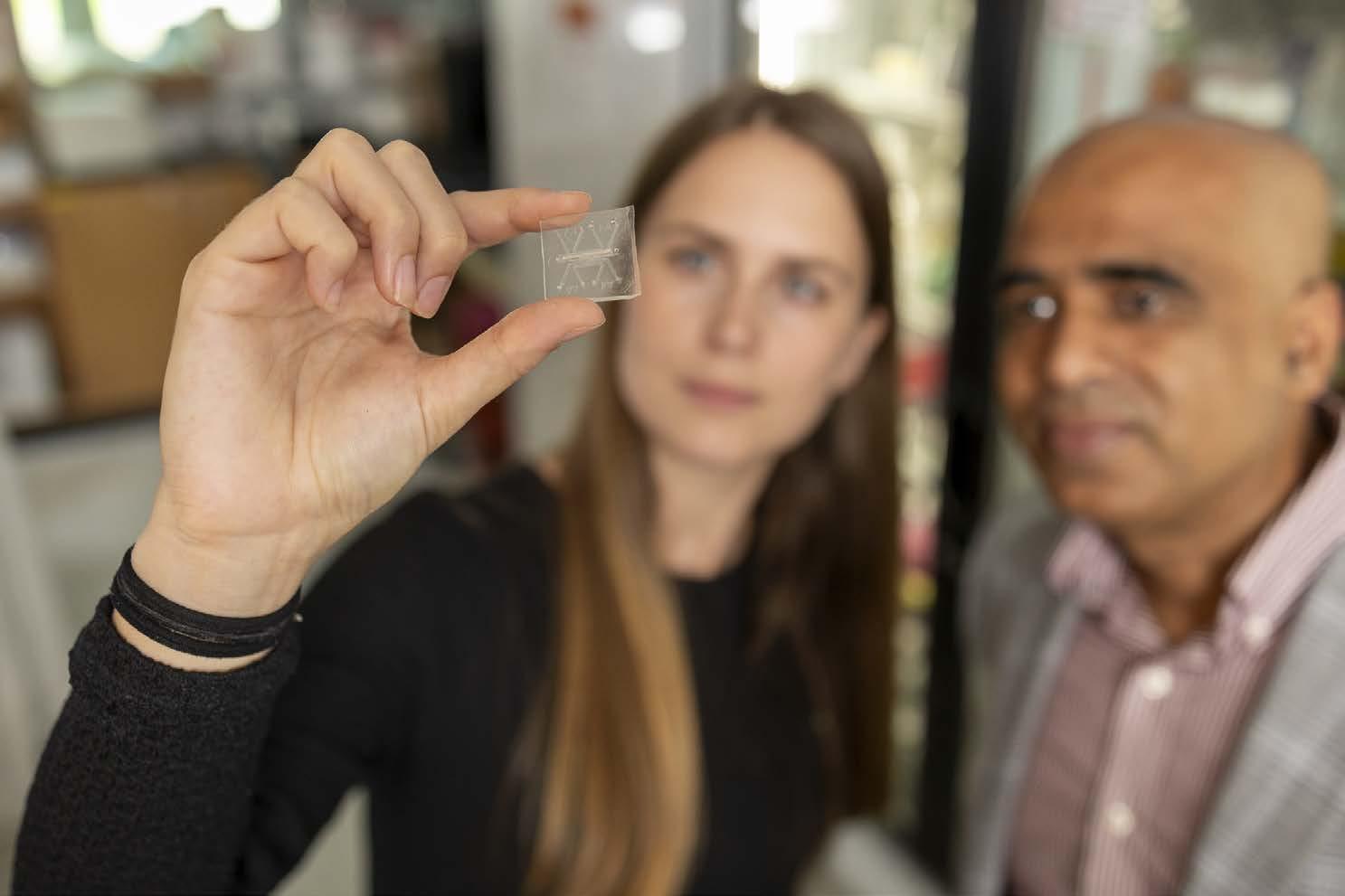
AT-HOME CERVICAL CANCER SCREENING PROTOTYPE WINS I2P SHOWCASE
THE STUDENT TEAM DEVELOPED A TAMPON-LIKE DEVICE FOR EARLY DETECTION OF CERVICAL CANCER.
BY BREANNA DURHAM
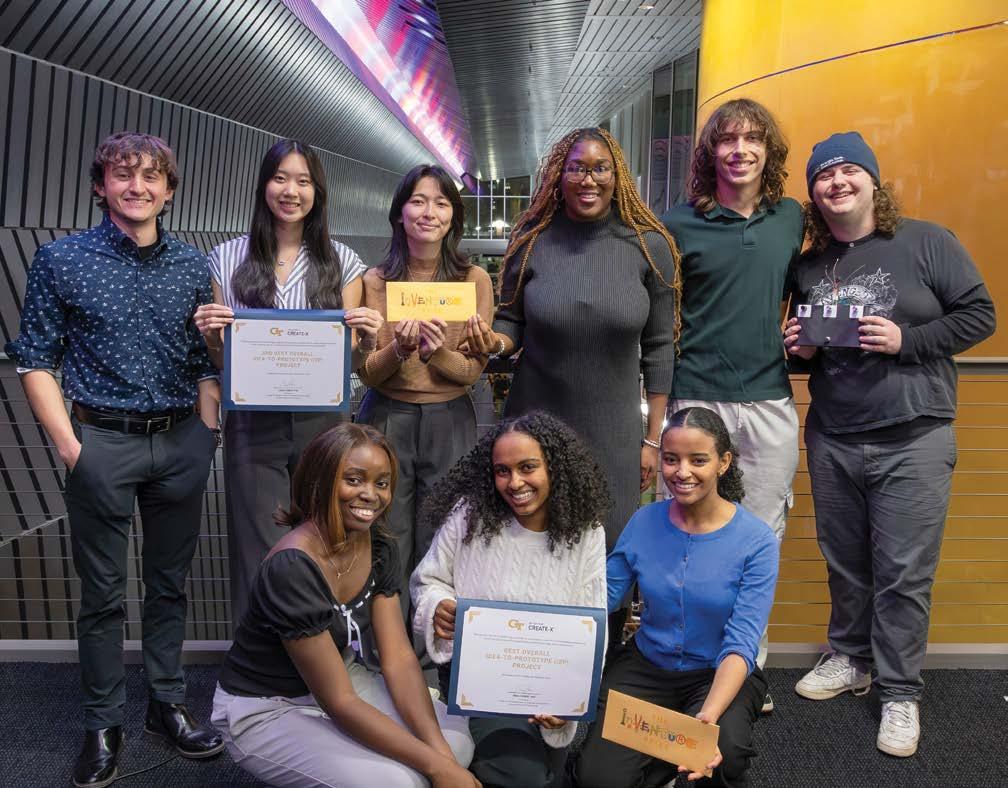
TTHIS PAST FALL, the Marcus Nanotechnology Building overflowed with energy as 35 student teams unveiled their prototypes during the Idea to Prototype (I2P) Showcase. Attendees from the Georgia Tech community and beyond got a firsthand look at prototyped solutions that addressed problems across industries.
First place and a spot in CREATE-X’s Startup Launch went to Gorginea Care, which introduced an at-home test for cervical cancer.
Team Gorginea Care started their journey at Georgia State University’s Perimeter College, where they participated in the MESA program (Math, Engineering, Science Achievement)—a dedicated study and research space located on Perimeter College’s Clarkston campus. The team was sparked by a simple question: Why isn’t there a better way to test for cervical cancer? The founders were planning on getting pap smears themselves, but they had heard about painful experiences from other women.
“We were hesitant to go through the process since it seemed uncomfortable,” says Rakeb Tesfassellasie, a third-year Industrial and Systems Engineering student at Georgia Tech.
So, Tesfassellasie teamed up with Sophia Bereket, a Mechanical Engineering fourth-year student at Kennesaw State University, and Shalom Ejiwunmi, an Applied Biotechnology student at the University of Georgia, to consider alternatives to the speculum used during standard exams and develop a tampon-like device.
“It’s just giving women a choice basically to be able to take the samples and solve without having to be so vulnerable and uncomfortable,” says Tesfassellasie.
The team joined the summer I2P
and continued to develop their prototype in the fall semester course. Bereket said CREATE-X gave them resources and space without taking ownership.
“The point of us being engineers is to make a difference in the world,” Tesfassellasie says. “CREATE-X gives you the chance to do that, and they don’t take any intellectual property. You might be really passionate about whatever you’re majoring in, but this is where you can start implementing what you learn in classes in real-life projects.”
THE BRAIN IS ALL STATISTICS
TECH RESEARCHERS ARE USING MATH, SCIENCE, AND AI TO BETTER UNDERSTAND THE BRAIN.
BY GEORGE SPENCER
NNOTHING RIVALS the human brain’s complexity. Its 86 billion neurons and 85 billion other cells make an estimated 100 trillion connections. If the brain were a computer, it would perform an exaflop (a billion-billion) mathematical calculations every second and use the equivalent of only 20 watts of power. As impressive as the brain is, neurologists can’t fully explain how neurons work together. To help find answers, Tech researchers are using math, data, and AI to unlock the secrets of thought. Together they are helping turn the brain’s raw electrical “noise” into real insights about how people think, move, and perceive the world. Fair warning: Prepare your neurons for the complexity of this brain research ahead.
This image shows a topo graphic vision model trained to have a brain like organization.
What if artificial neurons in AI programs were arranged as they are in the brain? AI programs would then help us understand why the brain is organized the way it is. This neuro AI synthesis would also work faster, use less energy, and be easier to interpret. Creating such systems is the goal of Apurva Ratan Murty, an assistant professor of Psychology who is creating topographic AI models like the one above of three domains—vision, audition, and language inspired by the brain. In the near future, he predicts doctors might be able to use these patterns to predict the effects of brain lesions and other disorders. “We’re not there yet,” he says. “But our work brings us significantly closer to that future than ever before.”
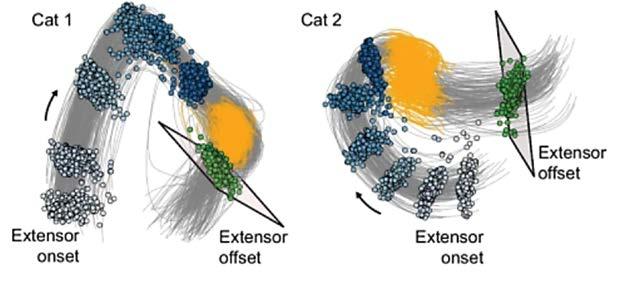
This shows how spinal cord activity guides transitions in muscle output for extensor muscles.
COMPUTING THOUGHT & MOVEMENT
How cats walk keeps Chethan Pandarinath on his toes. This biomedical engineer uses sensors to analyze how two sets of feline leg muscles—flexors and extensors— are controlled by the spinal cord. Understanding how that happens could help patients partially paralyzed from spinal cord injuries, strokes, or progressive neuro degenerative diseases get back on their feet again. “My lab is using AI tools that allow us to turn complex spinal cord activity data into something we can interpret. It tells us there’s a simple underlying structure behind the complex activity patterns,” says the associate professor.
REVEALING THE BRAIN’S SPIKE PATTERNS
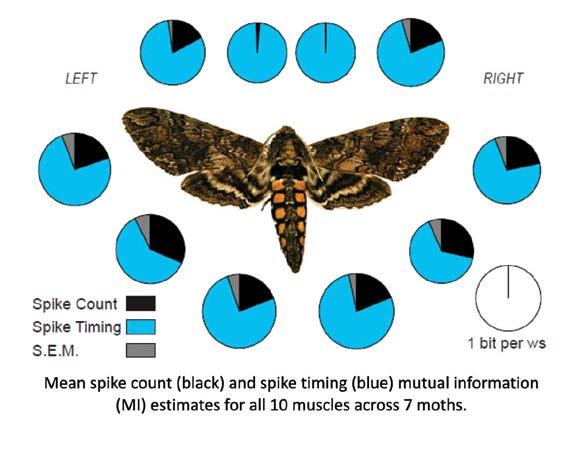
“The brain is like a symphony conductor,” says Simon Sponberg. “Individual instruments have some independent control, but most of the music comes from the brain’s precise coordination of notes among the different players in the body.” This physics professor studies the fantastically fast‑beating wings of the hummingbird‑sized hawk moth (Manduca sexta) Its agile flight movement comes as a result of spikes in electrical activity in 10 muscles. Sponberg found something that surprised him—the brain focuses less on creating the number of spikes than in orchestrating their precise patterns over time. To Sponberg, every millisecond matters. “We are just beginning to understand how the nervous system first acquires precisely timed spiking patterns during development,” he says.
PREDICTING DECISIONS THROUGH STATISTICS
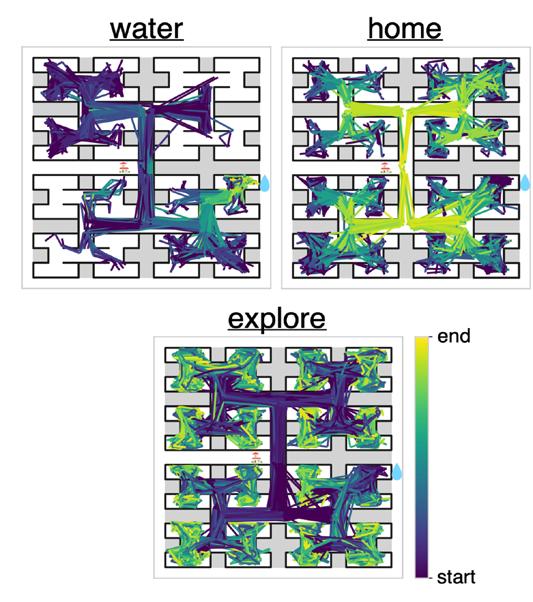
Put a mouse in a maze with food far away, and it will learn to find it. But life for mice—and people—isn’t so simple. Sometimes they want to explore, only want water, or just want to go home. What’s more, animals make decisions based on their history, not just on how they feel at the moment. To dig deeper into the decision making process, Anqi Wu, an assistant professor in the School of Computational Science and Engineering, is giving mice more options. By using a new computational framework called SWIRL (Switching Inverse Reinforcement Learning), her findings have outperformed models that fail to take historical behavior into account. “We’re seeking to understand not only animal behavior but also human behavior to gain insight into the human decision making process over a long period of time,” she says.
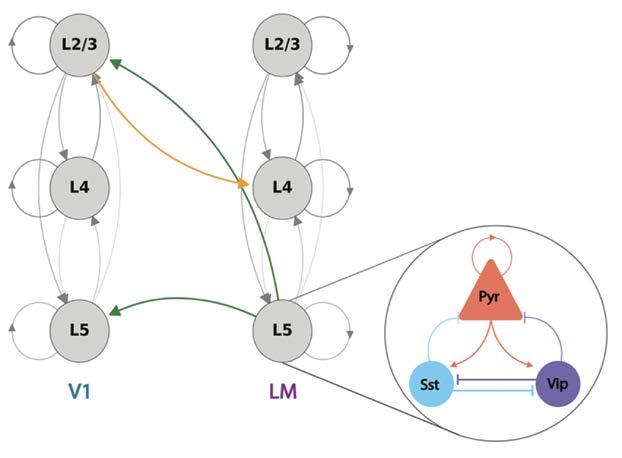
This shows how visual data from the retina is directed to the correct cognitive domain in the brain through a region of the visual cortex.
MODELING THE MIND’S WIRING WITH MATH
Connectivity shapes cognition in the cerebral cortex, a layered structure in the brain. The visual cortex, in particular, processes visual data from the retina relayed through the Lateral Geniculate Nucleus (LGN) in the thalamus, and directs it to the correct cognitive domain in the brain. How it does this is the mystery that computational neuroscientist Hannah Choi wants to solve. “The big question I’m interested in is how network connectivity patterns in the architecture of the LGN are related to computations,” says this assistant math professor. To find answers, she shows mice repeated image patterns such as flower‑cat‑dog‑house and then disrupts the pattern. The goal? To grasp how the thalamus’s nonlinear dynamical system works. If scientists and doctors better understand how brain regions are wired together, such knowledge could lead to better disease treatment.
This shows how mice behave differently when they are pursuing different goals.
This shows the spike patterns of a hawk moth. Motor systems use spike codes to control motor output.
TECH RANKS AMONG TOP 20 UNIVERSITIES WORLDWIDE FOR U.S. UTILITY PATENTS
FOR THE FIRST TIME, THE INSTITUTE IS NO. 13 NATIONALLY, WITH 128 PATENTS GENERATED IN 2025.
BY LACEY CAMERON
THE NATIONAL ACADEMY OF INVENTORS (NAI) has ranked Georgia Tech among the top 20 universities worldwide for U.S. utility patents granted in 2025. The Institute climbed to No. 19 internationally and 13 nationally as a result of its technology licensing office generating 128 patents. The recognition underscores the Institute’s success in moving research breakthroughs from the laboratory into the commercial marketplace, reflecting a coordinated intellectual property (IP) strategy that supports faculty, staff, and student inventors.
“Our global ranking is a testament to the culture of research innovation we are fostering at Georgia Tech,” says Raghupathy “Siva” Sivakumar, Georgia Tech’s vice president of Commercialization and chief commercialization officer.
“Our goal is to ensure that every breakthrough in the lab has a clear, protected pathway to become a startup or product
that changes lives. Breaking into the top 20 for the first time demonstrates the impact of our commercialization ecosystem in taking IP to market.”
Over the past five years, Georgia Tech has shown steady growth in its patent output, issuing more than double the number of patents than in 2020. With utility patents as a key indicator of bench-to-market success, they serve as the legal foundation for licensing agreements, industry partnerships, and the launch of new ventures. Through Technology Licensing at Georgia Tech, researchers receive guidance on disclosure, patent strategy, and protection pathways that help translate research outcomes into real-world applications.
“Our team’s mission is to serve as the gateway to smoothly transfer technologies from the lab to the real world,” says Mary Albertson, director of Technology Licensing at Georgia Tech. “By partnering with researchers early in the discovery process and navigating the complexities of patent protection, we help ensure Georgia Tech innovations are positioned for meaningful economic and societal impact.”
Amount of an NSF grant that Georgia Tech researchers recently received to create an AIbased job-coaching tool for people with autism.
24
Number of Georgia Tech’s National Academy of Inventors (NAI) Fellows with the addition of the two most recent: Deepakraj “Deepak” Divan and Arijit Raychowdhury, both from the School of Electrical and Computer Engineering.
20%
5 $500,000
Amount that an AIpowered exoskeleton can boost the effort from the user. Tech researchers recently developed an AI “brain” or controller that takes huge amounts of data on how people move and translates it to train an exoskeleton device.
Number of wins in a row for Georgia Tech in the NSA Codebreaker Challenge (see page 13).
VICTORY AT HOME
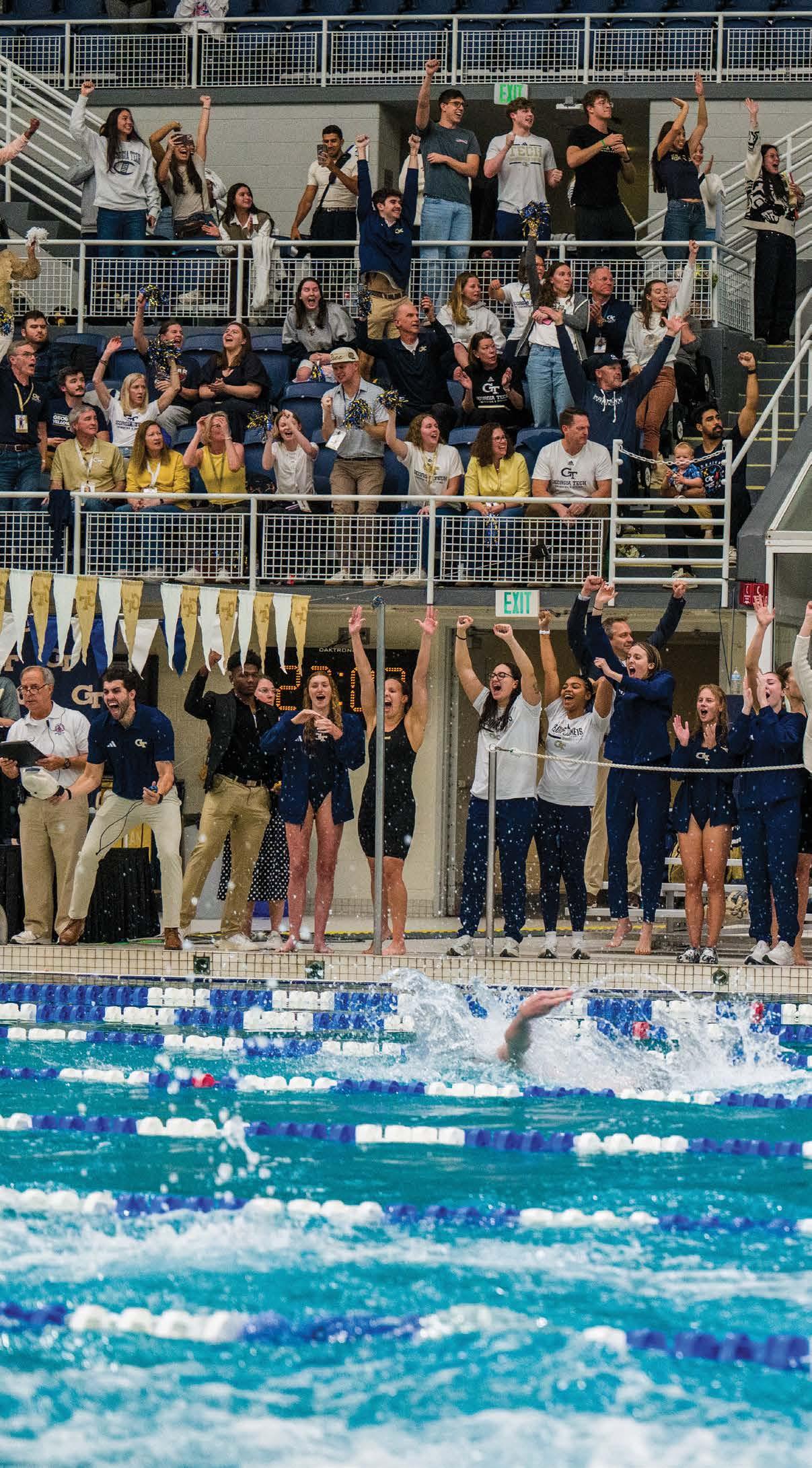
Yellow Jacket Swimming celebrates winning the men’s 4x100 freestyle relay during the final home swim meet of the regular season on January 24. Tech hosted the ACC Championships and NCAA Championships this year.
PLAYING TO WIN F
AFTER A RECORD-SHATTERING 2025 SEASON, GEORGIA TECH’S FOOTBALL TEAM IS READY TO DELIVER ANOTHER WINNING YEAR ON THE GRIDIRON
BY SCOTT STEINBERG, MGT 99
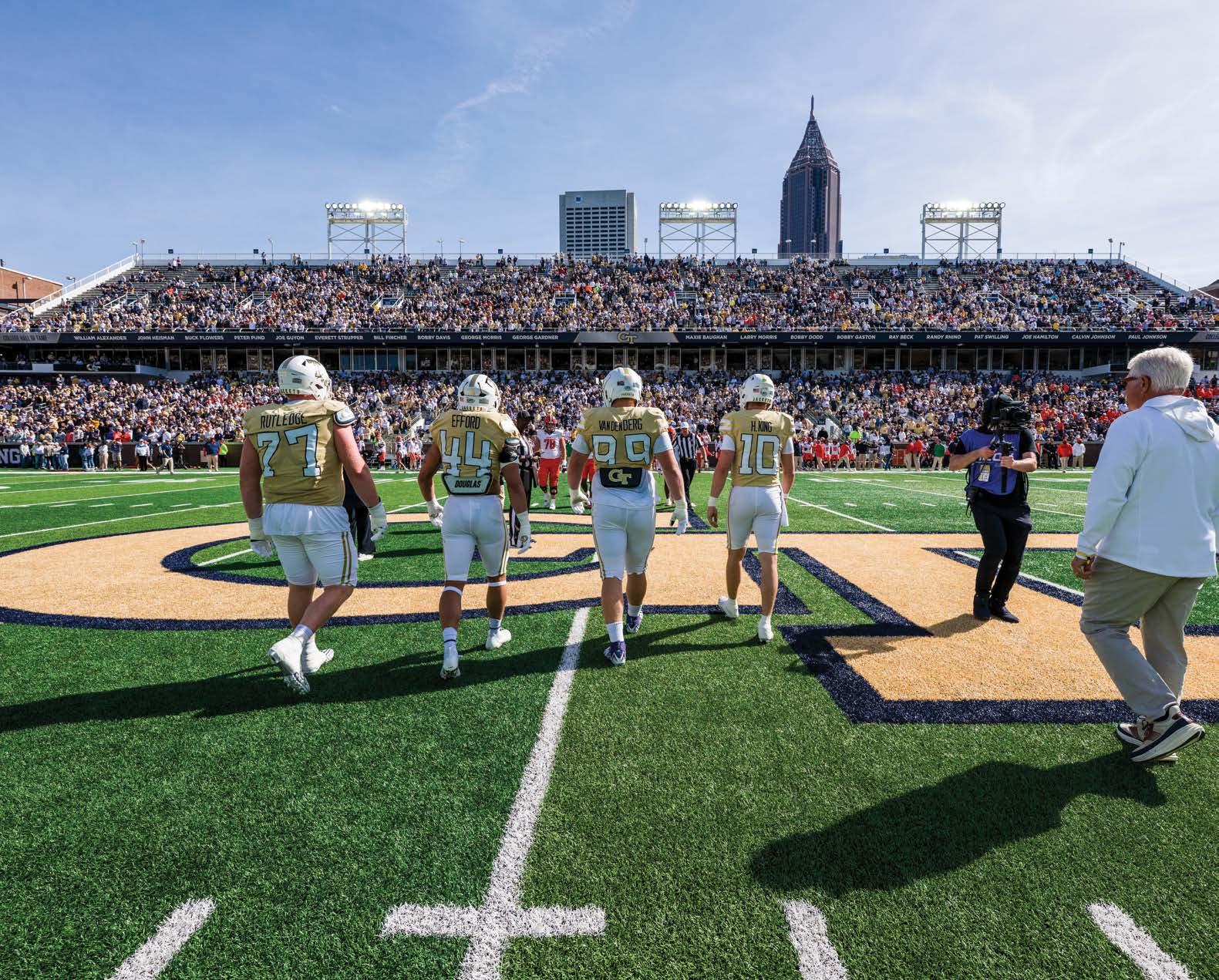
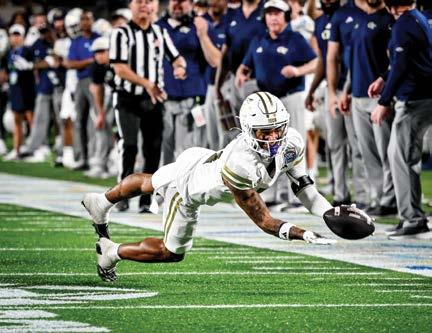
FOR THE FIRST TIME in six decades, Georgia Tech’s football team started 8-0. The Yellow Jackets are set to deliver another game-changing year. That’s no small feat, considering that the team averaged 47,694 in attendance at Bobby Dodd Stadium at Hyundai Field in 2025, connected with over 34
million viewers, and generated roughly $200 million just in advertising value. (They reached an audience equivalent to 45 billion, or roughly five times the Earth’s population, through earned media appearances alone.) That’s just the beginning for the Yellow Jackets and for one of college sports’ hottest brands, says Director of Athletics Ryan Alpert.
“The movement we’re seeing is bigger than athletics…it’s about continuing to drive awareness, interest, and
recognition for the school, which continues to go from strength to strength,” Alpert says. “It all comes down to the support of our students and alumni, who’ve turned out in record numbers to show their support and help drive engagement. Our team practices and puts blood, sweat, and tears into the program year-round…coupled with the atmosphere, energy, and enthusiasm of our fans, it’s the difference that gives us an edge all season long.”
Check out these numbers to get a sense of just how much momentum continues to build at Tech.
Record Fan Attendance:
A whopping 286,161 fans attended Georgia Tech football’s six games at Bobby Dodd Stadium last season.
Sold-Out Games: The school also sold out back to back games at Bobby Dodd (Oct. 25 vs. Syracuse and Nov. 22 vs. Pitt) for the first time since 2015
School Record for Student Attendance:
Student attendance addition‑ ally hit an all time high in 2025, with all 7,000 student season tickets sold, a jump of roughly 14% over the year before. What’s more, over 12,000 students attended the Homecoming game, setting a school record for single ‑game student attendance.
A standing-room-only crowd of 73,729 crowded into Mercedes-Benz Stadium to watch the home game against the University of Georgia. These types of figures all come down to the fans, who continue to show their support for the team with record turnouts, Director of Athletics Ryan Alpert says.
“I don’t think there’s anything more important in college sports and football than student engagement, which we continue to build on and have prioritized from day one,” he says. “I remember the Gardner-Webb game from the second week of last season. We had a rain delay, but 30 minutes later, when we got the go-ahead signal, 7,000 students piled back into the stadium in a thunderous show of excitement. And every week after that, they just continued to show up and lend their support. It creates a palpable sense of energy that the team feeds on and uses to build a winning edge.”
2026 SEASON FORECASTS
SCHEDULE
The Yellow Jackets will play 12 regular season games, including seven home games at Bobby Dodd Stadium at Hyundai Field. Home games in bold.
COLORADO Sept. 3
TENNESSEE Sept. 12
MERCER Sept. 19
Stanford Sept. 26
DUKE Oct. 10
Virginia Tech Oct. 17
BOSTON COLLEGE* Oct. 24
Pitt Oct. 31
LOUISVILLE Nov. 7
Expect even more momentum and energy to build as the 2026 season prepares to start, Director of Athletics Ryan Alpert says. “When Coach Key originally took the job, both he and Georgia Tech were an unproven commodity,” he says. “Now, coming off three Bowl appearances and a record breaking season, we’re delivering our fans real return on their investments of time, faith, and support. What the NFL does a great job of is having a 365‑day brand campaign for their programs and teams. We want to do the same with our football team and comprehensive sports portfolio.”
Clemson Nov. 14
WAKE FOREST Nov. 21
Georgia Nov. 28
*Homecoming Weekend
Alpert observes that he and Tech leadership as a whole are looking to continue expanding public interest in Georgia Tech’s teams and brand on a national scale, and building on the school’s proven track record of success going forward. “This year, we’re really reestablishing and showing the country who Georgia Tech is, and who we can be.”
That said, the school and athletics program plan to keep social media outreach, alumni support, and fan engagement paramount in planning efforts.
“We love seeing alumni and community members continue to engage with us and cheer the team on. It’s one of the biggest drivers behind the team’s continuing advancement.”
WARD PLACES FIRST IN WOMEN’S HIGH JUMP
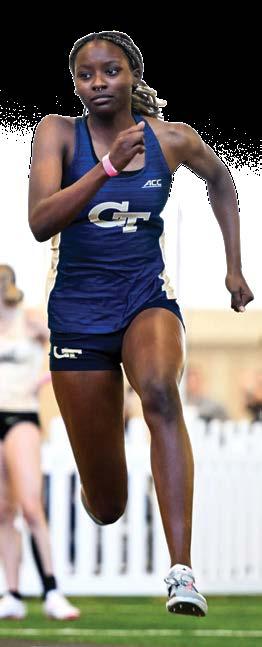
GEORGIA TECH MEN’S AND WOMEN’S TRACK and field teams wrapped up the indoor regular season with multiple event victories and numer ous personal bests in Clemson, S.C. Kendall Ward won first place with a 1.74m jump at the Tiger Paw Invita tional. Ward cleared the first three benchmarks in just four jumps and was set to battle with Ala bama’s Katelyn Adel for the high jump event win. Ward soared and completed the 1.74m mark in her first attempt to secure the advantage as Adel required a second attempt.
Ward and Adel were unable to clear the 1.77m height after three at tempts, giving the high jump win to the Yellow Jackets.
The Jackets’ men’s crew locked down the top six spots in the 3,000m event, with Taylor Wade finishing first at 8:08.38. Billy Carlton and Matt Castronuovo finished in the po dium places and recorded personal best times. Joey Sandel placed fourth overall, with Nathan Solomon finish ing fifth in his season debut. Freshman Wyatt Windham won his heat by nearly three seconds at 8:19.79, his personal best, and placed sixth overall.
For the women’s 3,000m, Claire Shelton finished second overall with 9:31.26.
—GEORGIA TECH ATHLETICS
BASEBALL OPENS WITH NO. 2 PRESEASON RANKING
GEORGIA TECH BASEBALL
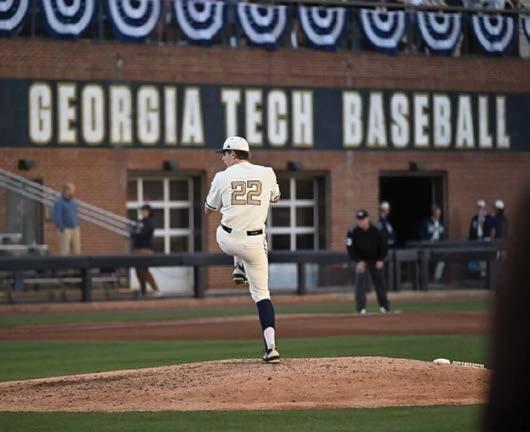
opened the season ranked No. 2 in the Perfect Game preseason national rankings. It is the fourth-highest preseason ranking in program history and the highest since 2003, 2001, and 1994, when the Yellow Jackets were awarded preseason No. 1. The Tech offense lived up to its lofty preseason expectations, crushing Bowling Green by scores of 11-5, 27-4, and 12-2 (7 innings) to complete the opening series sweep at Mac Nease Baseball Park at Russ Chandler Stadium. This was the first win of the season for new Head Coach James Ramsey. The Jackets scored 50 runs over the course of the three-game series, the most against a single opponent on opening weekend in program history, including a 27-run outburst in game two, tied for the most runs in a single game since 1994.
In addition to the ranking and opening victory, a record four position players from Georgia Tech Baseball were named Preseason All-Americans by the publication Perfect Game. Junior center fielder Drew Burress and junior catcher Vahn Lackey were both tabbed as 1st team All-America, while junior infielder Jarren Advincula earned 2nd team honors and sophomore utility Alex Hernandez was named to the 3rd team.
—GEORGIA TECH ATHLETICS
FOUR YELLOW JACKETS INVITED TO NFL COMBINE
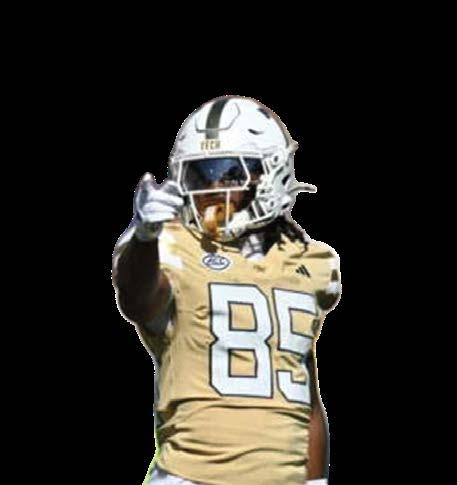
GEORGIA TECH was represented by four players, matching its largest contingent in 17 years, at the 2026 National Football League Scouting Combine, held Feb. 23–March 2 in Indianapolis, Ind.
Defensive back Ahmari Harvey, quarterback Haynes King, wide receiver Eric Rivers, and offensive lineman Keylan Rutledge all received official invitations to participate in the Combine, the NFL’s invitation only showcase that allows NFL coaches, front office personnel, and scouts to evaluate the top prospects for the upcoming NFL Draft.
—GEORGIA TECH ATHLETICS
Programs for Working Professionals
Progress Without Pushing Pause Graduate
Scheller’s Evening and Executive MBA programs are built for working professionals who need flexibility when returning to school. Designed to fit around full-time work and life responsibilities, these programs allow you to earn your degree while continuing to build your career.
Weekend Classes (Select Friday Evenings and Saturdays) 17 Months Total
Fall 2026 - June 15
Spring 2027 - October 15
Semester Starts: Fall (August) and Spring (January)
More Than Two Years of Work Experience Required
Fall 2026 - June 30
Semester Starts: Fall (August)
More Than Five Years of Work Experience Required
Applications are open for Fall 2026. Apply now and see where a Scheller MBA can take you.
IN THE WORLD
BREATHE EASIER
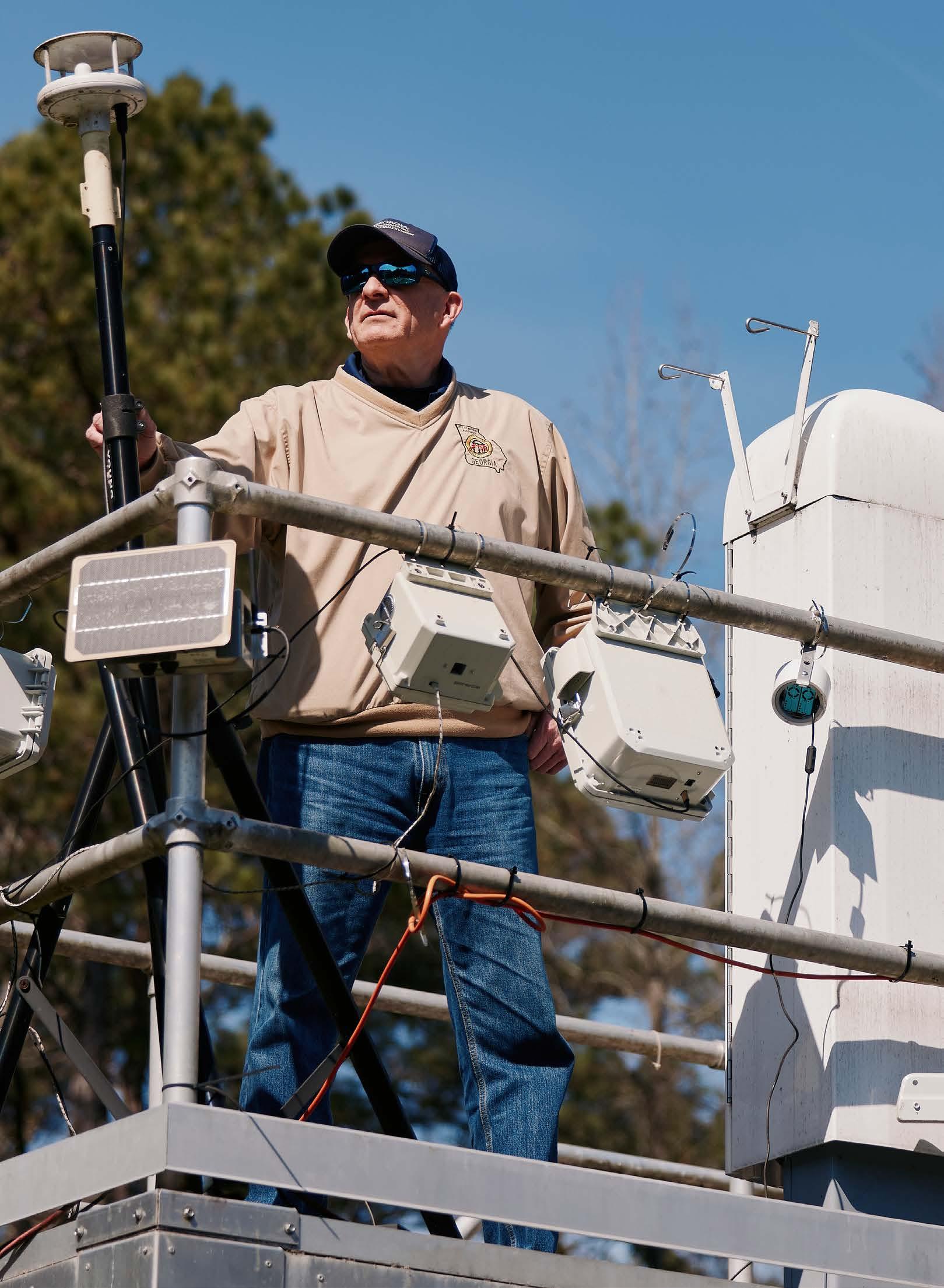
A partnership between Georgia Tech and Georgia’s Air Protection Branch that started 30 years ago is still going strong. Triple Jacket Bill Murphey is Georgia’s state climatologist. He’s worked with Tech researchers from the beginning of the program to improve air quality and air quality forecasting.
A BREATH OF FRESH AIR
HOW GEORGIA TECH HAS HELPED GEORGIA IMPROVE AIR QUALITY AND AIR QUALITY
FORECASTING WITH 97% ACCURACY.
BY SCOTT STEINBERG, MGT 99
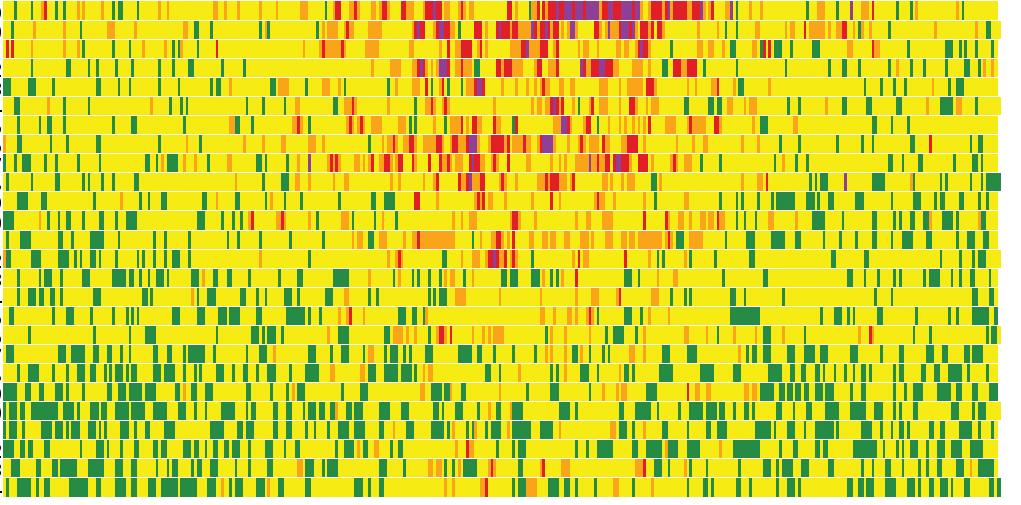
AATLANTA RESIDENTS can now breathe easier (literally) knowing that air quality in the city has steadily improved over the past 30 years. Thank the work of Georgia Tech’s Schools of Earth and Atmospheric Sciences and Civil and Environmental Engineering. Both have jointly helped power the Ambient Monitoring Program at the Air Protection Branch of Georgia’s Environmental Protection Division (EPD) for decades. To put things in perspective: In the last five years, the city of Atlanta averaged nine days per year when the air quality was considered unhealthy. Compare that to 1999, when 71 of 153 summer days were considered unhealthy. Not only has air quality improved, so has air quality forecasting. In 2025, forecasters made the right prediction 97% of the time.
“It’s been a great program that’s provided valuable information to everyday citizens, sports teams, and elderly residents alike,” says Bill Murphey, APhy 79, MS GeoS 84, PhD EAS 94. Murphey is the state climatologist for Georgia. There are many Yellow Jackets in the Air Protection Branch, including James Boylan, MS EnvE 99, PhD EnvE 02, the branch chief.
In a single year, a team of students and faculty can now issue 1,160 air quality forecasts, 214 ozone forecasts,
and 366 PM (particle pollution) forecasts for Atlanta; 214 ozone forecasts for Macon; and 366 PM forecasts for Columbus alone. Serving cities throughout the state 365 days a year, the agency provides essential services that forecast 24 to 36 hours ahead to help protect citizens.
“Scientists from Tech have helped out a ton as far as developing and maintaining new forecasting tools and software, as well as helping us manage our day-to-day operations. They help us upkeep our daily models, maintain records, and calculate accuracy and overall performance,” Murphey says.
Every day at 1:30 p.m., the group— which includes meteorologists, climatologists, atmospheric chemistry pros, and others—convenes to assemble forecasts, which are subsequently pored over by everyone from concert planners to road race organizers and high school coaches.
1996 OLYMPICS AIR QUALITY
The initiative’s roots trace back all the way to 1995, with the impending dawn of the 1996 Olympics and an impromptu meeting at the Metro Atlanta Chamber of Commerce about the city’s then less-than-stellar level of atmospheric pollution. “At the time, Jackie Joyner-Kersee, who was then the world’s greatest athlete, had just told everyone she had asthma,” notes
Michael Chang, AE 87, MS GeoS 92, MS PP 97, PhD EAS 97, former principal research scientist and deputy director at the Brook Byers Institute for Sustainable Systems at Georgia Tech. “The Chamber was worried that if she experienced an asthma attack, it was going to be a public relations fiasco.”
Back then, he says, Atlanta had arguably the second-worst-quality air in the nation, topped only by Los Angeles. Thus city leaders at the time convened an emergency meeting with regulatory agencies and universities and anybody else who they thought could help. Officials realized that they couldn’t fix the problem in the next year, or know even how much the Olympics would impact matters overall. “So it was resolved that if we can’t fix it, maybe we can at least tell people when the air quality is bad so they can figure out what they need to do for themselves,” Chang says. “Nobody stepped forward to do the job, but we had a lot of world-class experts at Georgia Tech. At the time, I was in graduate school, but also working for the Georgia EPD. The vice president for Environmental Affairs of the Metro Atlanta Chamber of Commerce, who knew me well, pulled me to the side and asked if I’d volunteer. I thought it sounded like an interesting problem, so I said I’d do it!”
Beginning May 1, 1996, his hand-
The daily Air Quality Index for the Atlanta–Sandy Springs–Roswell area from 1999 to 2024. Red and purple tiles show AQI levels considered unhealthy.
cobbled team began their work. Just one problem: “Back then, there were no protocols and virtually no one in the country was doing this work,” he says. “So we started coming up with statistical models and formulas just based on the mathematics and physics and chemistry of the atmosphere. It was all very inventive, very creative. We really didn’t have any constraints or direction. Which was good for the era—it allowed us to try a lot of different things really quickly!”
In the span of a couple months, the team started to find its footing
and began to work with the state to formalize the process. Afterwards, it started to run workshops with local broadcasters and get local newspapers up to speed on what the team was doing.
“We knew we were having an impact when we started to see big corporations like Coca-Cola shift their operations and chemical companies adjust transportation efforts based on our forecasts,” Chang says. “And then we actually convinced the EPA to make this initiative more serious and formal and get some real resources
“NOBODY STEPPED FORWARD TO DO THE JOB, BUT WE HAD A LOT OF WORLDCLASS EXPERTS AT GEORGIA TECH.”
MICHAEL CHANG, AE 87, MS GEOS 92, MS PP 97, PHD EAS 97
Source: U.S. EPA AirData
behind it.”
Much has changed in air quality since they started. Still the group continues its good work, forecasting 24/7/365. They have 10 forecasters, and over the years, have had about 40, about half of whom are homegrown Tech talent. “This thing has Georgia Tech written all over it,” Chang beams proudly. “It’s been our baby since 1995, and as the longest project I’ve ever worked on, it’s personally taken me from graduate school to retirement.”
Thankfully, the tradition continues. “Between the rise of natural gas, solar, and nuclear generation and reduction in emissions from newer cars and EVs, Georgia’s air quality continues to improve,” says Murphey. “People are making smarter choices, carpooling and teleworking more, and leveraging forecasts and weather information to better plan their day and enjoy enhanced quality of life across the state.”
FROM THE BOOKSHELVES
RECENT TITLES AUTHORED BY GEORGIA TECH ALUMNI.
TECHNOLOGY
WHAT YOU NEED TO KNOW ABOUT AI: A PRIMER ON BEING HUMAN IN AN ARTIFICIALLY INTELLIGENT WORLD
JAMES WANG, MS CS 20
What is AI and how will we prepare for it?
This book draws on Wang’s experience as an early stage deep tech investor and cofounder and CTO of Lioness, and on his time at Bridgewater and Google’s “moonshot” innovation lab, X. With interviews from industry experts like Tech Professor Ashok Goel, this book will help you understand how AI is already transforming our world—and what is still to come.
MYSTERY
THE MOVIE MURDERS
LEE GIMENEZ, ID 74
A famous actress is murdered. Then an Academy Award–winning movie director is killed in cold blood. After that, a prominent film producer goes missing without a trace. As the body count increases, it’s clear that people in the movie industry are being targeted for murder. The police, unable to find the killers, turn to John (J.T.) Ryan to help them solve the crimes. This page turning mystery is the 11th novel in Lee’s highly acclaimed J.T. Ryan Thrillers.
EDUCATION
PLANNING
PEOPLE:
A
WITH YOUNG
PRACTICAL GUIDE TO YOUTH-INCLUSIVE URBAN PLANNING IN SCHOOLS
JOSH PINTO TAYLOR, BC 09
Imagine cities that truly serve their youngest inhabitants. This book argues that great cities can only emerge when they are good for all members, especially young people under 25, who are often marginalized in urban design. The first half explores the competing visions and agendas of the city that have historically failed to include or prioritize young people. The final chapters highlight structures, systems, policy frameworks, and practices from the fields of education and planning.
TECHNOLOGY
DESIGNING ELECTRONICS
THAT WORK
HUNTER SCOTT, CE 13
Scott’s 300+ page book is a compilation of every lesson he’s learned from the past 10 years he’s spent founding and working at hardware startups. It’s written for people who already know a little—maybe a lot—about circuits but want to move faster, make fewer mistakes, and ship working hardware with more confidence.
NONFICTION
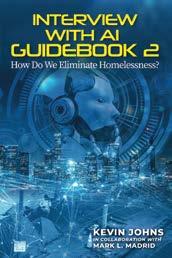
INTERVIEW WITH AI GUIDEBOOK 2: HOW DO WE ELIMINATE HOMELESSNESS?
KEVIN JOHNS, CP 75
Using real‑world examples from Salt Lake City and Houston and input from experts, Johns explores how AI can help eliminate homelessness. This guidebook details how addressing the homelessness crisis could free up $20 billion annually to reinvest into building safer, stronger communities.
TECHNOLOGY
SMISHED & VISHED! AN INTERGENERATIONAL FAMILY STORY OF ONLINE SAFETY IN THE AGE OF AI
ZINET KEMAL, MS CYBERSECURITY 23
Enjoy this fun yet informative story about online safety with your entire family. When Grandpa receives a suspicious phone call that nearly tricks him into revealing personal information, the whole family springs into action and learns a lesson they will never forget. From vishing and smishing to Al voice cloning, spoofing, catfishing, and fake delivery scams, this engaging story unpacks the wild world of online decep‑ tion with warmth, humor, and cultural charm. Perfect for children, grandparents, and everyone in between.
SPORTS
PUTTING BY THE NUMBERS
BOB LABBE, IE 68
A quantitative method of long distance putting that Labbe guarantees will save you four to five strokes per round, regardless of your skill level or handicap. This book is written for all golfers, whether recreational, amateur, or professional. This method is based on science, including physics and engineering, but easy to use.
BUSINESS
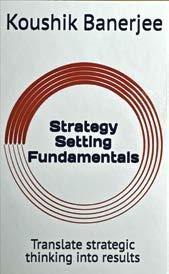
STRATEGY SETTING
FUNDAMENTALS: TRANSLATE STRATEGIC THINKING INTO RESULTS
KOUSHIK BANERJEE, MS ME 91
To lead successful ventures, strategic thinking alone is not enough; organizations need a robust strategy setting approach to translate that thinking into results. A careful study of failed vs. successful strategies reveals that there are certain essential ingredients for strategy setting that need to be followed in a disciplined way.
FINANCE
THINK RICH ACT RICH GET RICH JAMIE TYRONE PLEASANT,
PHD MGT 99
If you’re looking to begin a journey to financial prosperity or looking to have confidence in financial markets, this is a practical guide to help you navigate how to become a very wealthy person. Each chapter presents strategies to help you achieve your financial goals. This resource will take you on a practical journey to help you realize your wealth‑ creation ambition.
PERSONAL DEVELOPMENT
SIMPLY ELEVATE
CHARLES WILEY, IE 99
Simply Elevate chronicles the author’s transformative journey of pain and despair to discover a path of peace, happiness, and purpose through mindfulness and meditation. Drawing on personal experiences and insights, Wiley shares candid reflections and practical wisdom that will inspire readers to embrace the power of positivity and mindfulness in their own lives.
Analyzing decades of enrollment and admission data shows how Tech’s reputation and return on investment have driven demand and selectivity, even as the Institute expands.
BY JENNIFER HERSEIM
PHOTOGRAPH
BEN ROLLINS
“I don’t think I could get into
Tech
these days.”
Over and over, Rick Clark, Georgia Tech’s vice provost for enrollment management, has heard variations of this line from alumni, many of whom are highly successful individuals.
One is John Brock III, ChE 70, MS ChE 71, HON PhD 16, retired chairman and CEO of Coca-Cola Enterprises. Brock has often said, “I didn’t go to a top 10 school, but I have a degree from one.” He attended Tech in the 1970s, graduating with a bachelor’s and master’s in chemical engineering before going on to lead one of the most recognizable companies. He, like his fellow Tech graduates, left the Institute prepared to change the world. “I started at Georgia Tech in 1966, and it was a highly respected
and thought-of school then, but it’s nothing like today,” he says.
In the decades since then, Tech’s secret has gotten out.
The number of students applying to Georgia Tech has grown for 18 consecutive years. Before 2007, Tech received less than 10,000 applications annually. In 2025, applications were up to nearly 67,000. For most of Tech’s history, the acceptance rate has hovered above 50%. In 2013, it began to sink below 50%. Last year, the acceptance rate was just 13%.
Impressively, even as more students apply to Georgia Tech, the yield rate—the number of students who are accepted and choose to enroll at Tech—has increased. More students are not only applying, but they’re also choosing Tech over other options. If you’re wondering if you could still get into Tech today, take a look at these numbers to learn more about Tech’s soaring competitiveness.
Enrolled: First-year students who were accepted and enrolled.
Elsewhere: Applicants who were accepted and chose to not attend Tech.
Declined: Applicants who were declined admission.
*Data from 2024 to 1995 provided by Tech’s Institutional Research & Planning Office. Data prior to 1995 collected from Georgia Tech’s annual Fact Books. Data from1998 and earlier includes fall semester only.
FIRST-YEAR ADMISSION RATE
The admission rate viewed another way shows that in 2005, 44 out of every 64 students received an acceptance letter from Georgia Tech. Compare that to 2024, when 9 out of 64 students were accepted.
includes Fall enrollment data.
Why Demand Exploded
Clark jokes that alumni are partly to blame. “Our alumni have gone all over the world and told people how great Georgia Tech is and how it changed their lives,” he says.
Indeed, the Institute has evolved from a regional powerhouse to a world-class producer of talent.
When Mary Tipton Woolley, executive director of Undergraduate Admission, arrived at Georgia Tech in 2009, the Institute received about 300 international student applications. Last year, that number was 12,000.
10-YEAR ROI
Georgia Tech’s return on investment (ROI) compared with similar schools.
30 YEAR & 40 YEAR ROI
Georgia Tech’s return on investment (ROI) compared with similar schools.
ADMISSION & YIELD RATES
Impressively, even as more students apply to Georgia Tech, the yield rate— number of students who are accepted and choose to enroll—has increased.
National trends are also contributing to the surge in applications. In the 1990s, high schoolers might send applications to one to three colleges on average, Woolley says. Today, they apply to eight to 10 schools on average, and it’s not uncommon to hear of students applying to 15 or more.
Not only are high schoolers applying to more colleges, but they are also graduating from high school in higher numbers and more are choosing to attend college. (Indicators show these trends will start to reverse, Woolley adds.)
“This is both a Georgia Tech phenomenon and a flagship public university phenomenon. But I think Georgia Tech was on the forefront,” says Woolley.
Brock credits Georgia Tech leadership over the last decade for accelerating the school’s evolution while keeping what Georgia Tech has always been known for unchanged. “For me, Tech helped me realize that hard work, resilience, competitiveness, and communication are all important to succeed in business. I think today there are even more opportunities for students, more undergraduate research projects, faculty involvement, and care and concern for students,” he says.
The Sweet Spot
The national trends aren’t enough to explain Georgia Tech’s soaring competitiveness. Something’s happening at Tech that’s not happening elsewhere.
“Georgia Tech is really in this sweet spot,” Woolley says. “We offer a strong STEM education in a large metropolitan city that’s easy to get to, and it’s a global city. There’s the cost and value of a Tech degree, and on the non-academic side, students are drawn to Tech’s rich history, traditions, and school spirit—Georgia Tech is a really attractive place.”
In 2024, The Wall Street Journal reported that more Northern students are flocking to schools in the South, searching for a better experience and
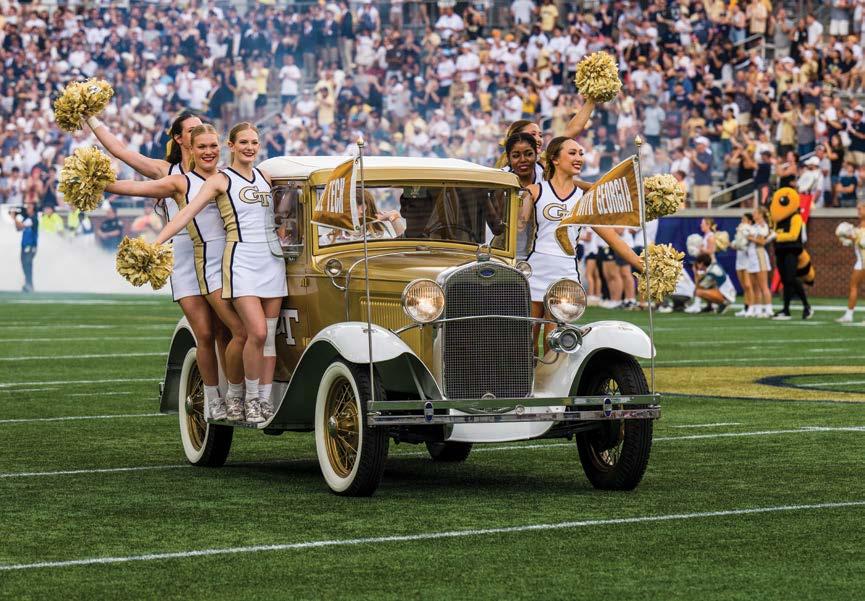
better cost. The article, which led with a photo of the Ramblin’ Wreck leading the football team onto the field, named Georgia Tech as one of the top schools in the South that’s drawing in Northern students.
“Athletics is a very important part of the college experience,” Brock says. He recalls a story when he and his wife, Mary, who is an honorary alumna of Georgia Tech, were talking with their daughter about colleges. He told her counselor in a Connecticut prep school that his No. 1 requirement was a school that plays Division I football. “Saturday afternoon football in the Southeast is as good as it gets, right?” he says.
For value, Georgia Tech can’t be beat. The Institute has claimed the No. 1 spot for Best Value among public colleges three years in a row from The Princeton Review. Tech’s return on investment is in the top 20% compared to peer institutions, and it’s the highest ROI of all colleges in the University System of Georgia.
Growing & More Selective
Georgia Tech isn’t only becoming more selective, though; it’s growing, too. “Our selectivity is going up while we’re growing at unprecedented rates,”
Women
made up 42% of the incoming first-year class in the summer and fall of 2025. Of the 4,050 incoming first-years last year, 59% were from Georgia (from 115 Georgia counties), 33% were from out of state, and 8% were international.
says Georgia Tech President Ángel Cabrera, MS Psy 93, PhD Psy 95. “Normally, you’d say, ‘Well, you’re growing so much, so you must be less selective.’ But we’re growing and being more selective at the same time.”
By 2030, Georgia Tech aims to double the number of degree and non-degree learners, which would mean conferring 15,000 total annual degrees to graduates and undergraduates. The Institute is well on its way. Last year, Tech saw the largest incoming class in the Institute’s history, with 4,050 first-year students and 1,400 transfer students.
Tech’s total enrollment increased to 53,067 students last spring, an 11.4% increase from the previous spring. A large part of growth is due to the Online Master’s Program, which now has more than 21,000 learners enrolled. The first few years of the Online Master’s program created a significant spike in Tech’s growth. Another spike occurred in 2014 with the Institute’s switch to the Common Application.
“We asked similar schools what we should expect during the switch to the Common App,” Clark says.
“They all said between a 20% to 25% increase the year that they switched; we had a 48% increase.”
The Common Application allows students to apply to multiple colleges using one application. In the past, Tech used a formulaic admission process. Great grades and strong test scores added up to an acceptance. “When you have a large volume of applicants who are highly competitive, the formula breaks down,” explains Woolley. There are not enough spots for students who would normally qualify. Today, Tech’s admission process is more holistic, taking into consideration additional
factors, such as the level of courses a student takes in high school and the impact they’ve made on their school and community. Admission also balances the academic composition of the first-year class.
You Might Still Get In (Just Differently)
Georgia Tech aims to double the annual number of degree and non-degree learners by 2030. The goal is to reach 15,000 by the end of the decade.
While it’s harder than ever to get into Georgia Tech, being declined admission as a first-year student is not the end of a dream to become a Yellow Jacket. Nine pathway programs offer avenues for students to transfer into Tech. The Conditional Pathway
Program enables legacy students (with Georgia Tech alumni parents, siblings, or grandparents) who exhibit strong academic credentials and meet the transfer admission criteria to transfer to Tech. Approximately 1,400 transfer students enroll each year at Tech and they make up 20% of graduates.
“Basically, one out of every five undergrad students walking across the stage at graduation didn’t start at Georgia Tech,” says Clark.
Georgia Tech, For Life
Georgia Tech’s newest college, the College of Lifetime Learning, might flip the question, Could you get in? and instead ask, What if Tech remained your trusted learning partner for life?
“Georgia Tech Infinity is the idea that Georgia Tech is a trusted learning partner across your lifetime,” says William Gaudelli, the inaugural dean and CEO of the College of Lifetime Learning.
Rather than limiting education to a four-year window, the college extends Tech’s reach and impact by building pathways for learners at pivotal moments across their lives and careers.“That might look like middle schoolers in summer STEM camps or a company offering access to our programs as an exit plan for a laid-off employee,” Gaudelli says. “We want everyone in the world to be a Georgia Tech learner.” One of the college’s goals is to engage 5 million learners by 2035 with different Lifetime Learning checkpoints.
To get to that milestone, the college is leaning
heavily into technology with AI-based courses and learning materials. “Georgia Tech has always done scale and massification well,” Gaudelli says, pointing to the success of the Online Master’s Program.
“We’re optimizing learning systems with homegrown AI tools like Jill Watson [Tech’s AI virtual teaching assistant, which last year outperformed ChatGPT in real-world educational settings, according to a study by Tech researchers] and preparing the workforce for an AI-driven future.” The college offers programs for learners, including alumni, to upskill and reskill at every stage of their careers. The door is open to any learner.
And for alumni who say they couldn’t get into Georgia Tech today, there’s some peace of mind knowing you’re in good company. “Many of us would not get in today. Be happy that we got in while we did!” jokes President Cabrera.
Editor’s Note: Special thanks to the Georgia Tech Data Visualization Lab—including Associate Professor Clio Andris, Assistant Professor Yalong Yang, Assistant Professor Cindy Xiong Bearfield, Associate Professor Alex Endert, Professor Duen Horng “Polo” Chau, and retired Emeritus Regents’ Professor John Stasko—for their contributions to the data visualizations featured in this story. Also special thanks to the Institutional Research & Planning Office.
Data Viz at Georgia Tech
The Georgia Tech Data Visualization Lab is Tech’s hub for visualization research and innovation. Students learn to transform raw data into visualizations that make it clearer to analyze and to communicate information. Find more information about the group by visiting https://vis.gatech.edu.
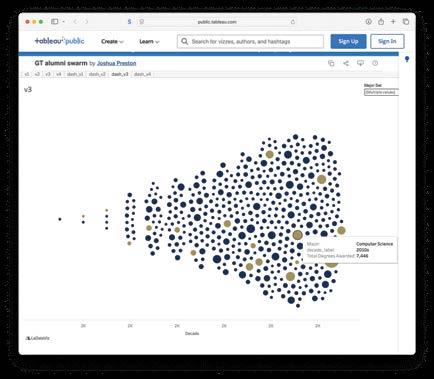
YELLOW JACKET SWARM
See how Georgia Tech degrees have changed over time in the full interactive version of this swarm chart online.
SWARM ONLINE
Scan the QR code to explore and filter all degrees throughout the decades.
ARCHITECTURE (ARCH) 1950s 936 degrees
PSYCHOLOGY (PSY) 1990s 299 degrees
MECHANICAL ENGINEERING (ME) 1990s 3,885 degrees
MANAGEMENT (MGT) 2010s 2,057 degrees
COMPUTER SCIENCE (CS) 2020s 23,784 degrees
INTERNATIONAL AFFAIRS (IA) 2020s 215 degrees
JOSHUA PRESTON, COLLEGE OF COMPUTING
IT COMES AS NO SURPRISE
that Georgia Tech alumni love numbers. It doesn’t matter whether they studied engineering or design, biomed or math, business or public policy, Yellow Jackets can’t seem to get enough numerical data relating to their alma mater.
The Institute boasts plenty of impressive aggregate numbers when it comes to national and global rankings, retention and graduation rates, economic and research impact, and graduate median salaries. Individual Tech alumni from athletes to astronauts to entrepreneurs can post some imposing stats as well. Then there are the outliers.
In statistics, these data points that differ significantly
from other observations, are often indicators of errors in data collection or the structure of the experiment that can skew results. But when it comes to people, outliers represent the best (or at least most interesting) of us. More than mere numbers, these are individuals whose experiences have deviated from the “norm,” giving them special perspective. And when it comes to our Tech outliers, these extraordinary Yellow Jackets and their stories often reflect something special and universal about the school itself.
Here are a few of those stories—along with charts and graphs for the hardcore stat-heads.
BY TONY REHAGEN
YOU CAN GO HOME AGAIN …AND AGAIN AND AGAIN
John Woodward, ME 63, has attended 17 Tech Homecomings since 2003, one of the most of any Jacket on record. The feat is more remarkable when one considers that, when Woodward graduated from Tech, he wasn’t sure he’d ever return. “I was glad to get away from Tech,” says Woodward. “I was glad to get away from the grind. Being out in the workforce was much easier than the schoolwork.”
Woodward was born in Vienna (pronounced vye-ANN-uh), Georgia, a tiny town about 150 miles south of Atlanta. The small school gave him a solid but basic education—enough to spark Woodward’s interest in math and science. That and a childhood spent around his parents’
service station drove Woodward to pursue a career in mechanical engineering.
But when the small-town boy arrived at the downtown Atlanta campus in 1959, he immediately felt overmatched by his surroundings, schoolwork, and classmates.
“It was an academic shock,” says Woodward. “These were all new things I’d never been exposed to before. I was thrown in with people who were a lot more sophisticated and better educated.”
Woodward simply worked harder. He spent countless hours in the Price Gilbert Memorial Library, poring over his textbooks and notes. He studied while his contemporaries participated in extracurricular
HOMECOMING 2026
Mark your calendars for Homecoming, October 22–24, 2026. Whether you’ve attended 17 Homecomings or this is your first time, join the tradition with fellow Yellow Jackets.
activities. He enjoyed Yellow Jacket football and basketball home games, but most of his time was spent in the classroom, the stacks, and his dorm, Howell Hall. As a result, he didn’t make many strong connections on campus. After getting his degree, he took research jobs in Alabama and Southwest Georgia before settling in Albany, Georgia, to work for the Marine Corps as an engineer.
Then in 1978, Woodward suddenly decided to attend his 15-year class reunion. Why? “It’s hard to say,” says Woodward. “It was good to go back
John Woodward, ME 63, and his wife, Mona, at Homecoming in 2010 (top left) and 2015 (bottom left).
“It was good to go back to see campus.”
to see campus and the football game.”
Woodward and his wife also got involved with Georgia Tech Alumni Travel, which organizes tours for graduates. They journeyed to Europe, the Panama Canal, the Caribbean, and across the U.S. Along the way, Woodward forged stronger bonds with fellow alumni than he had ever made as a student. These new friends, along with Atlanta-based family, became an excuse for the Woodwards to use Homecoming as a mini-vacation from Albany as often as possible. Through 17 Homecomings, Woodward has enjoyed Buzz Bash, the Ramblin Wreck Parade, the Old Gold Reunion, and of course, the football game. Woodward also enjoys seeing how campus has changed around his old dorm and the library. But he no longer thinks of Tech as just a place where he struggled to keep afloat. With more than 60 years of perspective, he can now see the Institute as the small-town boy’s gateway to a broader future.
“I didn’t have much of an idea what I would be doing when I arrived. I gradually learned what my career path could be at Tech. It pointed me to a career that I wouldn’t have had otherwise. And the degree opened many doors.”
YELLOW JACKET WHIZ KIDS
Georgia Tech is a destination for the brightest minds in the world. Walk around the downtownAtlanta campus on any given day, and you’re bound to encounter a melting pot of students, staff, and faculty from dozens of countries, cultures, religious and ethnic backgrounds, and even ages. And we’re not just talking about eager elder-teen undergrads, TAs and researchers in their 20s and 30s, and more wizened senior professors.
Occasionally, you might spot a much younger Yellow Jacket. For example, when Yam-Sung Cheng received his bachelor’s in applied mathematics with highest honors in December 2012, he became the youngest person ever to graduate from Tech. He was just 14 years old.
Cheng stuck around Tech to pick up a master’s in mathematics at the
age of 16 and a PhD in the same discipline, which he completed at age 23. (While working toward that doctorate, Cheng also found time to complete the required coursework to get a master’s in electrical engineering from Tech.)
While Cheng is the youngest person ever to receive a diploma from Tech, he is not the only Yellow Jacket whiz kid. Caleb Anderson made national headlines in 2021, when, at just 13 years old, he became a sophomore majoring in aerospace engineering. Anderson had learned sign language at 9 months old, could read at 1 year old, and was doing fractions by age 2. But he told CBS News that, while he was a quick learner, Tech challenged him like every other student who comes to study. “The one thing that unites everybody in this school,” he told the reporter, “is that the work is terrifying.”
Jules McNeice, BioChem 20, and her fiancé, Justin McDevitt, BA 23. When they marry, they’ll add to the 5,306 Double Jacket households!
ANOTHER BIRTHDAY THAT WASN’T
College birthdays are some of the most memorable moments of a student’s life: You’re surrounded by friends who live in the same dorm, house, or just a few minutes away; you have the newfound freedom to celebrate pretty much any way you’d like; and yet you’re not so old as to feel, well, old.
Jules McNeice, BioChem 20, remembers one of her birthdays from her days at Tech. She and some teammates from the Yellow Jacket Fencing Club stayed up late watching movies the night before. They kept an eye on the clock, waiting for midnight. The moment 11:59 p.m. turned to 12:00 a.m., they all jumped and yelled … and then, in less than a second it was over. “It was like New Year’s Eve,” says McNeice. “You watched the clock roll over and it’s a celebration that just lasts a second.”
The brief celebrations were because it usually wasn’t actually McNeice’s birthday. In fact, technically she didn’t have a birthday most years. She is one of only 146 Tech alumni out of 227,176 living alumni (0.064%) who share a Leap Day
birthday. She was born on Feb. 29, a date that only occurs once every four years to help keep the 12-month calendar more or less matched up with the Earth’s orbit around the Sun. “It’s always a fun fact I can use when introducing myself,” says McNeice. “As soon as someone finds out, they joke that I’m only 6 years old when I’m actually 26. It wasn’t fun when I was in elementary school and kids teased that I was only technically 2.”
As her bedtime got later with age, McNeice started the tradition of staying up on Feb. 28 until midnight and celebrating the millisecond in which she imagined her real birthday zoomed past before March set in. Friends had fun teasing her whether hers was a February b-day or March.
ALUMNI AGES BY DECADE
*As of January 2026.
“As soon as someone finds out, they joke that I’m only 6 years old when I’m actually 26.”
She eventually resolved to just celebrate both days. And of course, when Feb. 29 did finally arrive every four years, McNeice had a good reason to make it a blow-out event.
A native of Marietta, Georgia, McNeice
ALUMNI BIRTHDAYS
The number of alumni birthdays per each day of the year.
followed a love of science to Tech, where she studied biochemistry, first on a pre-med track before veering toward a goal of going into pharmacology. But as busy studying as she was, she never missed her birthday, no matter how fleeting it seemed. The year McNeice turned 21, she had hoped to have her first legal sip of alcohol right after midnight, but Feb. 28 fell on a Sunday that year, and no bars were open that late. “My friends made up for that the following weekend,” she says.
McNeice had one “real” birthday during her time at Tech: Feb. 29, 2020—just as the emergence of Covid-19 had essentially shut the world down. “Unlucky,” she says. But overall, she doesn’t mind having a Leap Day birthday. Even when she has to unravel a slightly complicated response to the simple question: How old are you?
THE LONE MOSOTHO YELLOW JACKET
Georgia Tech is truly an international campus. For decades, students from all over have come to Atlanta to study at the world-renowned technical institute. But in recent years, the school has developed its online curriculum, putting its coveted degrees within the grasp of anyone with an internet connection and greatly expanding Tech’s reach into even the smallest and most remote countries. In the process, they’ve created Yellow Jackets in every corner of the globe.
While the vast majority of alumni, 89.95%, live in the U.S., there are now Yellow Jackets scattered across 160 countries. And more than 20 Ramblin’ Wrecks, like Tsoloane Lehloba, are the only alumni representing Tech in their entire country.
Lehloba, MS CS 25, was born and raised in the Kingdom of Lesotho, a small country of around 2.3 million people (known collectively as Basotho, and individually as Mosotho) perched in the Maloti Mountains in southern Africa. Its lowest point is
1,400 meters above sea level; it is the only independent state in the world that is entirely above 1,000 meters. It is also completely surrounded by the country of South Africa. “Because we are a country inside a bigger country,” says Lehloba, “most people don’t know about us.”
In turn, Lehloba didn’t know much about Tech, at least not at first. He worked in information and communication technology and had gotten his bachelor’s degree in physics and computer science from the National University of Lesotho. He had a job with the World Health Organization (WHO), but looking to advance, most of the higher positions with WHO and the United Nations required a master’s degree, which wasn’t available in his home country. Not wanting to uproot to a university in South Africa, Lehloba began searching for online solutions that would allow him to stay and work in his homeland.
This was 2019. At the time, Georgia Tech was one of the few schools offering an online master’s in computer science (OMCS). And unlike some of the other schools that did offer OMCS, Tech’s program was course-based and not built around independent research. He enrolled and started viewing recorded lectures, visiting the instructor during Zoom office hours (usually in the middle of the night for Lesotho, which is seven hours ahead of Atlanta),
THE FEW BUT MIGHTY
Each country/territory has a single Yellow Jacket living in the location.
and WhatsApp group discussions with his classmates, which were in themselves examples of the school’s worldwide influence. “For each discussion, we had students from Atlanta, Nigeria, the Netherlands, London, Germany, Singapore, the Middle East, and Japan,” says Lehloba. “So, it was almost all over the globe.”
Lehloba was also more than just a nominal Tech student. He followed
There are 22 countries with only one Yellow Jacket.
the school via social media, subscribing to email lists to get updates of the goings on in Georgia.
He had hoped to finally come to campus to walk for his graduation and accept his physical diploma, but he was unable to make the trip.
Still, he considers himself a Yellow Jacket—even if the closest he’s ever come to Atlanta was a quick trip to Baltimore and back for a weeklong workshop.
“Eventually I’ll visit Atlanta,” he says. “Even if it’s just as a tourist.”
JOSHUA PRESTON, COLLEGE OF COMPUTING
New Caledonia
Saint Vincent and the Grenadines
Liberia Isle of Man
Andorra
Turkmenistan
Kyrgyzstan
Guinea Antigua and Barbuda
Vanuatu
Papua New Guinea
Bonaire Bermuda
The Gambia
Libya
Angola
Reunion Yemen Djibouti Lesotho
Malawi
GROWTH OVER TIME
THE INSTITUTE’S CONTRIBUTIONS IN THE LATEST FISCAL YEAR REPRESENTED A 9.9% INCREASE FROM THE PREVIOUS FISCAL YEAR OUTPUT.
Georgia Tech Economic Impact Over Time (2010–2024) Impact (Billions of U.S.
MULTIPLIER EFFECT
FOR EVERY DOLLAR OF STATE SPENDING, GEORGIA TECH GENERATED AN ADDITIONAL ECONOMIC IMPACT OF 71 CENTS.
$1 $1.71
The largest year-over-year increase occurred
FOR THE BIRDS Protecting Poultry
A smart robotic cutting arm developed by Georgia Tech’s Agricultural Technology Research Program could power up the state’s vital poultry industry.
BY KRISTIN BAIRD RATTINI
For more than 50 years, Georgia Tech’s Agricultural Technology Research Program (ATRP) has been driving transformational innovation in the state’s poultry industry, the largest in the country and eighth largest in the world.
TOP POULTRY
PRODUCER
Georgia is the largest producer of poultry in the country. It’s one of the five “P’s” or key agricultural products: Peaches, Peanuts, Pine Trees, Poultry, and Pecans. Read about one way Tech is keeping Georgia’s poultry industry on top.
The industry produces more than 30 million pounds of chicken on an average day and generated more than $41 billion in economic activity in the state in 2024. A new intelligent cutting system designed by a team of Georgia Tech researchers assembled by the ATRP is poised to boost both of those numbers and advance meat processing operations through a combination of 3D imaging, AI, and robotics. This cutting-edge intervention is aimed at the most skilled task in a poultry processing plant: chicken shoulder deboning. As chicken front halves mounted on cones move down the line at speeds of 35 to 40 birds per minute, workers insert a knife to sever the shoulder joints and then slice along the shoulder blades so that the wings and breast meat can be removed as one piece.
The goal is to optimize meat yield safely.
However, no two chickens are alike, and accuracy tends to diminish toward the end of a work shift. “If you’re off by a few millimeters one way or another, you’ll be cutting the cartilage or bone, creating a possible choking hazard,” says Ai-Ping Hu, principal research engineer in the Georgia Tech Research Institute’s Intelligent Sustainable Technologies Division. “If you leave even a nickel’s weight worth of meat, about five grams per carcass, then it equates to losing $1.5 million per plant per year.”
There are chronic labor shortages for this position. So the ATRP has been working on a smart robotic system that could both close that labor gap and far surpass fixed automation systems, which are a significant capital investment with poor meat yields. The rapid advancement of AI technology, combined with $2.2 million in funding from the USDA, has propelled ATRP’s system over the past four years to the point of commercial viability.
First, 3D cameras map the key external features of each chicken that indicate the shoulder joint’s location. Then, patented software algorithms—trained on a thousand birds and counting—use those images to determine the optimal knife path in order to maximize meat yield for each unique bird. The cutting is done by a dexterous robotic arm wielding a knife that’s equipped with a force sensor, which detects the difference between meat and bone. “We’re able to process 38 chickens a minute with a 99.5 percent accuracy rate,” Hu says.
The ATRP is now in talks with potential commercial partners to bring the intelligent cutting system online in Georgia poultry processing plants. “Robots are made to do these tough, difficult jobs,” says Hu. “Being part of that transformation in an industry that plays such a large role in Georgia, and being able to take what we’re working on in the lab and see it out there in the real world, is very gratifying.”
A Georgia Tech team was recently awarded a $2 million, three -year USDA “HPAI Poultry Innovation Grand Challenge” grant to advance new vaccine strategies for highly pathogenic avian influenza (H5N1). The team will develop an AI-powered platform to design novel chimeric antigens and rapidly test them using harmless bacteria as delivery vehicles. The collaborative effort spans the Schools of Biological Sciences, Electrical and Computer Engineering, Physics, the Petit Institute for Bioengineering and Bioscience, and the Georgia Tech Research Institute, with GTRI’s David Pattie and Mike Farrell leading the project.
Join the Atlanta Intown Network April 28, 6:30–8:00 p.m., at the Food Processing Technology Building Auditorium to learn more about the chicken deboning robot. Visit, GTalumni.org/ calendar for more information.
ALUMNI HOUSE
CELEBRATING EXCELLENCE
Alumni and friends came together at the 2026 Gold & White Honors Gala on February 12 to celebrate five standout honorees and to raise funds for student programs. Wiley Ballard, BA 17, served as emcee for the evening.
The Georgia Tech community gathered on February 12 for the 2026 Gold & White Honors Gala—an evening that celebrates the Institute’s innovative spirit, remarkable leaders, and collective commitment to shaping a better future.
“The Gold & White Honors Gala celebrates and esteems individuals who not only embody Georgia Tech’s values, but who also push the community forward through their leadership, service, and impact,” says Dene Sheheane, Mgt 91, president of the Georgia Tech Alumni Association. “Their stories remind us why Georgia Tech is so extraordinary and inspire us to continue building a brighter future together.”
As the Alumni Association’s most prestigious annual event, the Gala serves as the primary fundraiser for three nationally recognized student programs: the Student Alumni Association, the Georgia Tech Student Foundation, and the Student Ambassadors.
Thanks to the generosity of 35 corporate sponsors, table hosts, individual ticket purchasers, and live auction donors, the event raised a record-breaking $706,790 to support these programs.
These funds fuel scholarships, mentorship opportunities, leadership development, and career-building experiences—critical resources that prepare Georgia Tech students to become the next generation of innovative leaders.
This year’s Gala underscored the incredible strength of the Georgia Tech community and its dedication to supporting future change-makers. Your continued generosity ensures that Georgia Tech remains a place where students can thrive and reinforces the lifelong bond that connects Yellow Jackets everywhere.
Special thanks to the
EXECUTIVE COMMITTEE
MEMBERS
Rita Breen, Psy 90, MS IE 92
Chair
Tommy Herrington, IM 82
Past Chair/Finance
Jimmy Mitchell, CE 05
Chair Elect/Vice Chair Roll Call
Sam Westbrook, IE 99
Vice Chair
Meredith Moot, Mgt 08
Member at Large
Alex Muñoz, Mgt 88
Member at Large
Amy Phuong, IA 05, MBA 14
Member at Large
Kenji Takeuchi, ME 94
Member at Large
Dene Sheheane, Mgt 91 President
STUDENT ORGANIZERS
Paula Elaigwu, CS 26
President, Student Ambassadors
Azamat Alibekov, ChBE 26
President, Student Alumni Association
Adarsh Nallapa, BME 26
Chief Executive Officer, Student Foundation
STUDENT HOSTS
Bhoomi Kotharkar, CS 26
Diya Patel, BA 25, MSA 26
Adarsh Nallapa, BME 26
Azamat Alibekov, ChBE 26
Sophia Melbourne, CmpE 27
Georgia Tech Alumni Association Board of Trustees for their commitment and support in making the 2026 Gold & White Honors Gala a tremendous success.
Tech’s Gold Standard
Meet the 2026 Gold & White Honors Recipients
THIS YEAR’S GOLD & WHITE HONORS RECIPIENTS have transformed industries, advanced innovation, and made a lasting impact on the Georgia Tech community. Their inspiring journeys, achievements, and brilliant legacies embody the Institute’s ingenuity and enduring influence.
PROFILES
BY
JENNIFER HERSEIM AND SHARITA HANLEY | PHOTOGRAPHY BY KAYLINN GILSTRAP
Visionary Business Leader
JOSEPH MAYO PETTIT DISTINGUISHED SERVICE AWARD
THOMAS M. “TOMMY” HOLDER, IM 79
TTommy Holder’s favorite memory from Tech was graduation day because he “got out.” Part of the “look to your left, look to your right” generation of Yellow Jackets, Holder never expected to be the one still there come graduation. But he persevered, found lifelong friends in Sigma Alpha Epsilon fraternity, and ultimately earned his degree. “There wasn’t anything I was afraid to take on after I got through Tech,” he says.
That mindset served him well in his career, where he became a leader in the construction industry and grew Holder Construction into a premier contractor with over $8 billion in annual revenue. Under his leadership, the company has transformed Atlanta’s skyline with projects from the expansion of the Georgia World Congress Center and the headquarters of Norfolk Southern to Mercedes-Benz Stadium and the International Terminal at Hartsfield-Jackson Airport.
Holder joined the company, started by his father, when he was at Tech in 1976. He rose through the ranks to become president and CEO in 1989, was named chairman and CEO in 1997, and has continued as chairman since 2021.
Philanthropy is one of his fundamental values. “With success comes the responsibility to pay back and invest in your community,” he says.
A dedicated alumnus, Holder has given back generously to his alma mater with both philanthropic support and leadership. He is past chair of the Georgia Tech Foundation and serves on the Scheller College of Business Advisory Board and the Campaign Steering Committee for Transforming Tomorrow, the Campaign for Georgia Tech. He has served on the Building Construction Advisory Board and the Alexander-Tharpe Board. His leadership extends to several community and nonprofit organizations, including serving as chair of the Children’s Healthcare of Atlanta Board, and as a member of the Westside Future Fund, the Metro Atlanta Chamber of Commerce, and the Georgia Research Alliance.
In 2014, the Alumni Association recognized him with the Dean Griffin Community Service Award. In 2025, he received the prestigious Four Pillar Tribute Award for his contributions to Atlanta.
“I didn’t get here by myself,” Holder says. “Georgia Tech prepared me for life,” he says.
Shaday Word-Daniels, Mgt 11, and Jahi Word-Daniels, BA 12
James Hauth, IE 20, Mia Boice, BA 25, and Sophie Boice, BA 25
Buzz and Archel Bernard, STC 11
Chad Sims, BA 15, Annie Lai, MBA 21, and Ashley Sims, BME 16
Josh Truong, J’Avani Stinson, Eric Swann, IE 94, and Cleve Fann, ME 05
Mark Harden Jr., IE 99, and Amy Harden
Kylara Freil, LMC 15, and Kelly Chen, IE 13
JOHN B. CARTER, JR. SPIRIT OF GEORGIA TECH AWARD
MILLER TEMPLETON, PHYS 61, MS ANS 63
HHelping people live richer, fuller lives has always been Miller Templeton’s mission. Templeton once envisioned becoming a minister. But when Georgia Tech entered the picture, his direction shifted.
What began as a quest for a degree became 60 years of devotion to the Institute: 10 as a student, 30 as an employee, and 20 as a volunteer. As a student, Templeton joined Tau Kappa Epsilon (with John B. Carter, Jr., IE 69, who this award is named after), Omicron Delta Kappa, and Outdoor Recreation Georgia Tech (ORGT). He served as a resident assistant and was part of the ANAK Society, which wasn’t a secret then. As assistant dean of students and International Student advisor, he revitalized ORGT into the Southeast’s premier collegiate outdoor program. He founded the Oxford Program in the early 1990s and launched the Pacific Program in Australia and New Zealand, opening global doors for generations of students. He delivered health lectures to hundreds and developed a popular talk on the traits of happy people—shared for nearly a decade. Before retiring in 1998, he directed the Office of International Education and even helped manage campus housing. Beyond campus, Templeton became the beloved landlord at 469 10th Street. For 30 of the 43 years he owned the house, he rented it to
Yellow Jackets—hosting an estimated 200 tenants and engaging with nearly all of them.
Templeton credits his life’s work to Georgia Tech. Receiving the John B. Carter, Jr. Spirit of Georgia Tech Award affirms his lifelong mission: helping people achieve a higher quality of life. “Georgia Tech gave me that opportunity,” he says.
Assistant Dean and Beloved Tech Mentor
Military Leader, Professor, and Published Author
DEAN GRIFFIN COMMUNITY SERVICE AWARD
JAMES A. “SANDY” WINNEFELD
AAdmiral James A.
“Sandy” Winnefeld Jr., AE 78, credits Georgia Tech for giving him an unfair advantage that he leverages every single day. “I’ve used the technical, problem-solving, and leadership skills Tech gave me at every level of my military service and afterwards in the business world,” he says.
Winnefeld came to Tech knowing very little about the Institute or Atlanta. “I couldn’t understand why everyone had ‘To Hell With Georgia’ bumper stickers on their cars,” he reminisces. Yet the academic rigor he experienced and the community he gained have shaped his entire life. As a student, Winnefeld bonded with fellow Yellow Jackets in his fraternity, Pi Kappa Alpha, the ROTC unit, and his “small but mighty” class of other Aerospace Engineering students.
When he graduated, Winnefeld received his commission, which began his 37-year career in the U.S.
Navy. In nearly four decades of service, Winnefeld rose through the ranks, became a four-star admiral, and went on to serve as the ninth Vice Chairman of the Joint Chiefs of Staff— the second-highest-ranking military officer in the nation. His service often included leadership roles that shaped national security.
Winnefeld flew the F-14 Tomcat, served as an instructor at the Navy Fighter Weapons School, and commanded the USS Cleveland, the aircraft carrier USS Enterprise, and the Theodore Roosevelt Carrier Strike Group. He also commanded the NATO Joint Command Lisbon, the United States 6th Fleet, and the North American Aerospace Defense Command. In 2022, Winnefeld was appointed chair of the President’s Intelligence Advisory Board.
Despite a busy career, Winnefeld remains connected to campus. He is also a Distinguished Professor of the Practice in the Sam Nunn School of International Affairs. He’s a published author and podcast host,
too. Winnefeld’s memoir, Sailing Upwind: Leadership and Risk from TopGun to the Situation Room, details his experience as an F-14 pilot. The Adrenaline Zone, the podcast Winnefeld co-hosts with alumna astronaut Sandra Magnus, PhD CerE 96, explores the lives of people who seek out challenges most would avoid. He also co-founded Atlanta-based Rule 1 Ventures Fund II, which focuses on early stage defense technology.
Winnefeld has received countless awards, including the Defense Distinguished Service Medal, Defense Superior Service Medal, Legion of Merit, Bronze Star, Defense Meritorious Service Medal, Engineering Hall of Fame, Air Medal, and five Battle Efficiency Awards.
“I simply could not have succeeded without Georgia Tech. Why not give back to the amazing institute that did so much to mature and train me? It’s a no-brainer.”
“I’m deeply honored that my alma mater would recognize anything I did,” Winnefeld says. “[Service] is part and parcel of who we are, and perhaps, the award will inspire others to find a way to serve.”
OUTSTANDING YOUNG ALUMNA RANI TILVA, BA 18
NNever settle—that mindset has propelled Rani Tilva, BA 18, from her Student Alumni Association days to her leadership as president of the Graduates of the Last Decade (GOLD) Advisory Council and her current role as director of Talent Management at The Coca-Cola Company.
While late-night dorm decorating sessions and homecoming wins are some of her fondest memories, her alumna experience shaped her even more. Through GOLD, the Alumni Association Board of Trustees, and countless GT-logo-inspired encounters, Tilva has met more Ramblin’ Wrecks than ever. Tech didn’t just provide her with an
education—it gave her a lifelong community.
At Coca-Cola, Tilva drives talent strategy for six functions and 900 associates, leads three key talent processes annually, and has deployed digital tools that cut process time by 50%, empowering leaders to make data-driven decisions. Though her dynamic resourcing models earned a Brandon Hall Group HCM Innovation Award, her proudest achievement is leading the Coca-Cola Georgia Tech Alumni Corporate Network. Known as the “GT Connector,” she has orchestrated over 40 programs, including career panels, office tours, and a scholarship fund, all with the goal of connecting alumni, students, and
Trailblazing Strategist, Leader, and Alumni Connector
campus partners.
Tilva’s also a “connector” on campus. She leads a group of 28 alumni volunteers and is actively involved in the Alumni Association’s strategic plans to increase initiatives and engagement among recent graduates.
Receiving the Outstanding Young Alumni distinction is a full-circle moment. Years ago, as a student leader, Tilva introduced the recipient of this exact recognition. That night planted a seed in her mind: I could do that, too. Now, she has.
“Success isn’t a finish line—it’s something you define for yourself. This award tells me I’ve left a mark on Georgia Tech and reminds me that there’s more work ahead.”
Your Gateway to the Cisco Universe
A platform that offers a unique opportunity to connect with people across the globe, explore, collaborate, and build career aspirations.
Discover your future. Be you,
Our Commitment to Georgia’s Students
Georgia Power is committed to fueling the success of Georgia Tech and students statewide. Through collaboration and community investment, we help provide the tools and support that enable young Georgians to reach their full potential.
PLATINUM SPONSOR
Avery Fiveash and Michelle Martin
Kevin Boutwell, ME 02
Rita Breen, Psy 90, MS IE 92, and Audrey King
HONORARY ALUMNUS CHRIS HALL
CChris Hall, partner and “chief raconteur” of Unsukay Restaurants, is known for his big personality, but even more so for his big heart. As he and his cofounders have grown Unsukay Restaurants’ impressive portfolio—which includes an array of iconic restaurants around Atlanta, such as Muss & Turner’s, Eleanor’s, Local Three, Warhorse Investments, and Roshambo—they’ve always looked to pay it forward.
Hall is the cofounder and vice chairman of the Giving Kitchen, a nonprofit that he and his partners founded in 2013 that has changed the lives of more than 35,000 food service workers in crisis and provided more than $16 million in financial assistance. In 2016, Hall was named a Cornerstone Humanitarian by the National Restaurant Association’s Educational Foundation, and in 2019, the Giving Kitchen received the prestigious James Beard Humanitarian of the Year Award. Hall has devoted his talents and resources to dozens of community causes—too many to list— helping to raise significant support for each. He has served as a longtime board member of Atlanta Ronald McDonald House Charities, and in 2022, the organization recognized his service and generosity at their Hearts and Hands Gala.
Hall’s drive to uplift those around him extends to Georgia Tech, where his connections run deep. Not only did his mother, Barbara Fisher Hall, work at Tech for 10 years; his brother and sister-in-law are both Tech alumni; and so is his wife, Julie.
Before proposing, Hall even asked for her father’s blessing while the two stepped out for a break during her Tech graduation.
“I have met so many amazing people who went to Tech or are associated with Tech who have had a profound impact on my life,” Hall says. “Watching the philanthropy of Jimmy and Helen Carlos change Atlanta, learning about life and how to live it from Walt Ehmer, and seeing stewardship in action through John Carter have changed the way I think about the world.”
When it comes to supporting the Georgia Tech community, Hall is always the first to say yes. His live auction “Waffle Horse” has brought in more than $120,000 for student
Restaurateur, Champion of Tech
programs, and he’s hosted many Tech events over the years at his restaurants. He is as much a champion of Georgia Tech as any Yellow Jacket. Before opening Local Three, he even ran a Georgia Tech football blog called “Barrel of Rum.” And he upholds a strict “No Barking” rule in his Warhorse dining club restaurant.
When he reflects on the impact that Tech has had on his life, it always comes back to the people. From tailgates and trips around the country to see the Yellow Jackets play to eating French toast at Junior’s and receiving advice from Tech entrepreneurs, Hall says it’s the people who have made the most difference.
“Tech has enriched my life beyond measure.”
As the Southeast’s most trusted name in facility construction, operation and maintenance, McKenney’s provides
energy-efficient solutions at every stage of a building—Design, Build, Manage, and Maintain. With over seven decades of experience, McKenney’s builds to a higher standard.
YELLOW JACKET DNA
THE 2025 ALUMNI ATTITUDE SURVEY REVEALS HOW YELLOW JACKETS SEE THEMSELVES, WHAT THEY VALUE, AND WHAT THEY’D LIKE TO SEE MORE OF FROM THE ALUMNI ASSOCIATION.
BY SHARITA HANLEY
EVERY FIVE YEARS, the Alumni Association conducts an Alumni Attitude Survey to better understand alumni’s connections to the Institute and each other. Your responses reveal your hopes for Tech’s future and guide the programs, services, and experiences created for you.
The 2025 survey, which included 3,068 participants, reveals who you are and what matters most.
TRAITS: HOW YOU DESCRIBE YOURSE LF
92 % would recommend Georgia Tech to prospective students 62 % feel connected to the Institute SURVEY SNAPSHOT
TOP INFLUENCES: WHAT SHAPES YOUR OPINIONS MOST
Value of degree
Georgia Tech rankings
History and traditions
TOP REQUESTS: WHAT YOU WANT
More invitations to Georgia Tech activities
More information about benefits and services 1. 2. 3. 4.
Alumni accomplishments
More invitations to alumni activities
Scan
HELP STRENGTHEN THE SWARM
With more than 220,000 living alumni, it’s clear: Yellow Jackets are everywhere. More than 89% reside in the U.S., with the majority living in Georgia. Local alumni activities take place largely when alumni step up to host them. This map reflects the locations of Yellow Jackets and alumni-hosted events in 2025. International hosts are welcome. More than 25 international alumni gatherings were held in 2025. When alumni, like you, take the lead, the Georgia Tech community grows stronger.
Alumni Living in the U.S. in 2025
Alumni Events Hosted in 2025 Game Watching Home for the Holidays Ramble the Night Student Send-Offs
Joshua Preston, College of Computing
Puerto Rico
EVENTS YOU CAN HOST YOUR FEEDBACK IN ACTION
GAME‑WATCH PARTIES
August –November 2026
Cheer on Tech from anywhere.
HOME FOR THE HOLIDAYS
Dec. 15–21, 2026
Seasonal gatherings for all ages.
RAMBLE THE NIGHT
Casual meetups on April 16 to reconnect.
STUDENT SEND OFFS
July 11–Aug. 2, 2026
Celebrate a new class of Ramblin’ Wrecks.
In the prior Alumni Attitude Survey, conducted in 2020, career services were the No. 1 activity for alumni. Since then, the Alumni Association has doubled the number of professional development webinars offered annually. The survey showed that you also wanted to hear more about local alumni programs. The number of local events has increased by 50%. Alumnito-student mentorship opportunities was another area of importance. Since 2020, 1,645 mentorship pairs have been matched.
Host a local event as a Regional Ambassador.
TAKING TECH ON THE ROAD
PRESIDENT CABRERA’S SUMMER TOUR HAS CLOCKED A TOTAL OF 2,715 MILES IN JUST FOUR YEARS.
FOR FOUR SUMMERS —with a fifth on the way—President Ángel Cabrera, MS Psy 93, PhD Psy 95, has traveled throughout Georgia and beyond, meeting Yellow Jackets where they are. The President’s Summer Tour has become part road trip, part reunion, and completely full of Cabrera’s approachable and
“WHAT WAS ONE
BY SHARITA HANLEY
energetic personality.
Since 2022, the tour has covered 24 cities, 21 counties, and three states. Along the way, Cabrera has turned this annual road trip into memorable Georgia Tech moments: stopping at Buc‑ee’s; harvesting oysters with alumni run Tybee Oyster Company, which is Georgia’s first floating oyster farm; holding a baby alligator at an alumnus’s farm in Camilla; and tour ing Gulfstream Aerospace, one of the world’s top business jet manufacturers. Cabrera also observed the auto making process at the Kia Georgia
OF THE BREAKFAST SPECIALS AT THE YELLOW JACKET IN 1972?” –KEN PARKER, MGT 72
One breakfast special in 1972 was a classic plate that the restaurant offered for decades: ham or bacon served with toast, jelly, and coffee. The simple meal, priced at just 15 cents back in 1939, remained one of the restaurant’s well-known morning options.
facility in West Point and visited the cleanrooms at Absolics Inc., a leading semiconductor company that pro duces the world’s first glass substrate critical for building high performance supercomputers.
In just four years, Cabrera has trav eled a total of 2,715 miles. He visited:
7 cities, covering 550 miles in 2022
6 cities, covering 850 miles in 2023
7 cities, covering 540 miles in 2024
4 cities, covering 775 miles in 2025
Collectively, those stops included more than 1,400 community mem bers, who have shared a story about Tech’s influence on their life, sung the Fight Song, and learned about the Institute’s expanding impact.
As the 2026 President’s Summer Tour approaches , its popularity is clear. The map keeps expanding, the crowds keep growing, and President Cabrera keeps proving that Georgia Tech’s reach extends as far as the peo ple who carry its spirit.
Beyond the breakfast plate, the Yellow Jacket also offered grilled pound cake, which regulars remembered as a signature breakfast treat. And even though breakfast was on the menu, the restaurant’s reputation revolved around its hot dogs on toasted buns.
The Yellow Jacket restaurant was a landmark located on North Avenue. A mobile sculpture of yellow jackets mounted on the roof made the restaurant easily recognizable. Its success inspired Frank Gordy, who operated the Yellow Jacket eatery, to open The Varsity in 1928.
“As an impoverished Tech student in the early '60s, I would trek over there every afternoon for my only significant meal of the day—usually a double cheeseburger.”
—Jay Dusenbury, EE 65, MC ICS 74
“I remember the Yellow Jacket! My dad would take me there when I was a young girl. He was a student at Georgia Tech. Good memories!”
—Deborah Gaulding
A TRADITION MEASURED IN MILES
A LOOK AT THE HISTORY AND MOST RECENT STATS OF GEORGIA TECH’S OLDEST FOOT RACE.
BY SHARITA HANLEY
FOR MORE THAN HALF A CENTURY , the Dean George C. Griffin Pi Mile 5K Road Race has been woven into the rhythm of Georgia Tech life. What began in 1973 as a 3‑mile campus run became a 3.14‑mile race in 1975 and is now a full Peachtree Qualifier 5K that brings Yellow Jackets together each spring, whether they’re participating on campus or virtually. The 2026 race took place March 28.
In 2025, more than 700 members of the Georgia Tech community participated in the Pi Mile 5K Road Race. Run ners averaged a 34:06 finish time and maintained a steady 10:58 pace per mile. Although the average participant’s age was 35, the Pi Mile 5K Road Race bridges generations, and includes students running their first race, alumni returning after decades, and longtime participants who’ve logged dozens of laps around campus.
Regents’ Professor Thomas K. Gaylord has run the race 20 times alongside his students and placed first in his age category of 80+. Rick Egan, IE 87, has participated 17 times, totaling more than 50 cumulative Pi Mile 5K Road Race miles, and proudly says he will keep the tradition going. These stats are proof of how far the tradition reaches, which even includes countless four legged furry friends clocking miles alongside their human companions. In 2025, the Georgia Tech Alumni Association gave out 250 dog bandanas at the race.
At its core, the Dean George C. Griffin Pi Mile 5K Road Race is a family friendly Tech tradition that’s measured in miles and rooted in campus memories.
Last year’s race numbers tell a story of a growing community:
535 preregistered adults
36 runners ages 12 and under
258 students
60 walk‑up participants on race day
78 virtual runners logging miles from 27 U.S. states and Puerto Rico
Need a hand on the path to retirement?
Not knowing what changes life will bring from one day to the next means it’s not that difficult to veer from your retirement path. So it’s always nice to travel it with someone you trust.
If you’re unsure if you’re still tracking to your retirement goals, let’s take a look at your plan together. I can help align your priorities with your values, helping you make the right decisions at the right moments to help you maximize both your money and its impact. Contact me today and I can help you stay on track.
Molavi Wealth Management Group of Wells Fargo Advisors
Andrea Molavi, CFP® Managing Director - Investments 3280 Peachtree Road, Suite 400 Atlanta, GA 30305
ONE OF THE YOUNGEST ALUMNI 40 UNDER 40 HONOREES AND FOUNDER OF A SOLAR ENERGY COMPANY EXPANDING EQUITY AND WORKFORCE DEVELOPMENT WORLDWIDE.
BY SHARITA HANLEY
SSINCE 2010, the solar industry has experienced exponential growth, and Olivia Maria Am yette, CS 20, is at the heart of that impact. In the U.S., there are now 262 gigawatts direct current of solar capacity in stalled. That’s enough energy to power 45 million homes, according to the Solar Energy Industries Association.
Amyette launched her company, Infinite Energy Advisors, which designs, sells, and installs custom solar systems, in 2020, when she was just 20 years old. Unlike most startups, which often fail within the first five years, the company was
ticeship program in the state’s solar industry. “My team and I realized that there was not a lot of training for solar workers, and our claim to fame was that we were willing to go into am biguous situations with abandoned solar systems to help people.” Amy ette packaged her company’s training program into a formal curriculum and launched SKI.
More than 280,000 Americans work in solar nationwide, according to the Interstate Renewable Energy Council. SKI’s mission is to make sure individuals are properly trained. More than 20 apprentices have completed the program, and its influence has reached far beyond Georgia. “We’re
places,” she says. “Because energy should be accessible and equitable for all.”
Amyette’s work is inspired by her grandfather, an Ecuadorian immigrant and Vietnam War vet eran who taught himself English by candlelight because he couldn’t afford electricity. When Amyette graduated, she turned down job offers to care for her aging grandfather and build In finite Energy Advisors. The company’s mission honors his resilience.
“Without a shadow of a doubt, Tech equipped me to have this entrepre neurial spirit, especially being a part of the Grand Challenges Living Learn ing Community. We had to identify a
Nominations for the 2026 40 Under 40 Class are open. Nominate an impactful Yellow Jacket like Olivia at GTalumni.org/40under40.
A Message from President Cabrera
Our campus continues to evolve in extraordinary ways, but one thing remains timeless: our commitment to develop leaders who advance technology and improve the human condition. This mission is at the heart of Georgia Tech’s continued success, and it is why we are routinely recognized as a national and global leader. It’s also one we cannot ful ll without your generous Roll Call support.
You may have seen some of our recent accolades:
• Georgia Tech was named the best value public college by The Princeton Review for the third consecutive year.
• Forbes recognized Georgia Tech among the top 10 “new Ivies” for a second year in a row.
• U.S. News & World Report ranked Georgia Tech among the top 10 public universities in the country for 2025.
• The National Science Foundation has ranked Georgia Tech’s research enterprise No. 1 in the U.S. among institutions without a medical school for four years in a row.
None of this would be possible without your support. That’s why I invite you to join me in contributing to the 79th Roll Call, which is now in full swing. Together, we can ensure that Georgia Tech’s legacy of excellence and opportunity endures for generations to come.
Your Roll Call gi is also a vital part of Transforming Tomorrow: The Campaign for Georgia Tech. By supporting our students, research, campus, and community, you’re building a foundation that ampli es our impact both locally and globally. Let’s come together, as Yellow Jackets always do, to take Georgia Tech to a greater level of excellence and impact than ever before. Your gi makes a di erence. Let’s Transform Tomorrow together.
Sincerely,
Ángel Cabrera President, Georgia Institute of Technology
Scan to give now!
RAMBLIN’ ROLL
CLASS NOTES & ALUMNI UPDATES
MAYA’S BENCH
“MAYA, WILL YOU MARRY ME?” Every day, hundreds of students walk by a bench tucked into the green space in EcoCommons with an unusual dedication. The bench is engraved with a brief poem that ends with a proposal. Ripken Walker and Maya Davis met their first year at Georgia Tech. Maya, BME 23, needed help lofting a bed in her North Avenue dorm room, and her roommate called a friend who brought Ripken, MT 23, MS MT 24. Maya’s first impression was, This guy is kind of cute; I want
to talk to him more. She invited him back to set up her Google Home. Although Ripken couldn’t get the device to connect initially, the two had already started to form a connection. Four years later, Ripken was ready to propose. As a Pamela M. and Stephen C. Hall Scholar, Ripken developed a close bond with Col. Stephen Hall, IM 67. During their early-morning runs when the colonel was in town, they would pass benches that Hall had dedicated. It sparked the idea for his own proposal.
When he called the person in charge of the bench dedication program, she had retired the day before. “I thought maybe this isn’t meant to be and is this stupid buying a bench?” Still, he persisted. By spring, he had both the ring and the bench.
Ripken chose Aug. 14, 2025—the fifth anniversary of the day they met at North Avenue. He told Maya they were having dinner with the Halls, who in reality, weren’t even in Atlanta. As planned, Col. Hall texted that they were going to be late. Ripken suggested a walk through EcoCommons while they waited. Maya wanted to take a different route, but Ripken was insistent on a certain path that led to the bench. When they arrived, she read the plaque. “I remember being completely confused. What is going on?” Then her siblings, who were living in Seattle at the time, jumped out of the bushes. Ripken and Maya are planning a wedding ceremony this fall. They hope the bench will become a place they return to for anniversaries and special moments. And, in true Tech fashion, they want to add it to Google Maps as “Maya’s Bench.”
—JENNIFER HERSEIM
BREEN RECEIVES
BIG BROTHERS BIG SISTERS AWARD
RITA BREEN, PSY 90, MS IE 92, received the V. Thomas Murray Founder’s Award from Big Brothers Big Sisters during a ceremony in November. Breen serves as a board member of the organization and mentors as one of the nonprofit’s Big Sisters. She was joined on stage during the award ceremony by her Little Sister (mentee), Bailey. Breen is chair of the Georgia Tech Alumni Association Board of Trustees and executive director of Corporate Responsibility for Georgia Power Company.
BRUCE BECOMES UTC CHANCELLOR
LORI BRUCE, MS EE 92, was formally invested as chancellor of the University of Tennessee Chattanooga on Nov. 21, 2025. Bruce became the 19th chancellor in the university’s history. She previously served as provost and vice president for Academic Affairs at Tennessee Technological University. While there, she led the development and launch of several
new academic programs. In addition to her master’s degree from Georgia Tech, she completed coursework in biomedical engineering through the Georgia Tech/Emory University Medical School joint program and she holds a bachelor’s and a PhD in electrical and computer engineering from the University of Alabama in Huntsville.
CLASS NOTES
DICKENS RE-ELECTED ATLANTA MAYOR
ANDRE DICKENS, CHE 98, was re-elected in November 2025 for a second term as mayor of the City of Atlanta. Dickens was first elected mayor in
ALUMNI LEAD “100 MOST INFLUENTIAL GEORGIANS” LIST
Twelve alumni and honorary alumni were named to the “100 Most Influential Georgians” list by Georgia Trend in 2026. See the Yellow Jackets on the list:
Ed Bastian, HON PhD 24, CEO of Delta Air Lines
Brian Blake, EE 94, president of Georgia State University
Raphael Bostic, HON PhD 22, president and CEO of the Federal Reserve Bank of Atlanta
Ángel Cabrera, MS Psy 93, PhD Psy 95, president of Georgia Tech
2021 and began serving his first term in 2022. A proud Tech alumnus, he held his swearing-in ceremony for his first term at Bobby Dodd Stadium. Prior to his election, Dickens served on the Atlanta City Council and was chief development officer of the nonprofit TechBridge. He has also served as a Tech staff member and as a board trustee of the Georgia Tech Alumni Association. In 2025, he was named Georgian of the Year by Georgia Trend magazine.
Lisa Cupid, ME 00, chair, Cobb County Board of Commissioners
Andre Dickens, ChE 98, mayor of Atlanta
Roderick McLean, MS EE 93, vice president and general manager, Air Mobility & Maritime Missions for Lockheed Martin
Jannine Miller, MBA 13, executive director, SRTA, GRTA, Atlanta-Region Transit Link Authority
James Quincey, HON PhD 20, chair and CEO of The Coca-Cola Company
Dr. Valerie Montgomery Rice, Chem 83, president and dean, Morehouse School of Medicine
Carol Tomé, HON PhD 25, CEO of UPS
Chris Womack, HON PhD 23, president and CEO of Southern Company
College roommates JACOB FU, MGT 05, and ARTHUR WU, ID 06, recently raised over $144,000 from almost 2,000 Kickstarter backers to launch their company, Bristow. Bristow’s debut product is a minimalist glasses case that combines a durable sheepskin leather exterior and soft cotton interior.
ADEL HAQUE, BCH12, was named to the Pennsylvania Business Central’s “2025 Foremost Under 40.” Haque is a boardcertified dermatologist, Mohs surgeon, and adjunct faculty member at the University of Pennsylvania. Outside of work, he volunteers at the Veterans Affairs in Philadelphia supervising dermatology residents.
DERRELL JAMES, MGT 89, was elected president of the Gas Permeable Lens Institute (GPLI), a nonprofit dedicated to advancing the education and practices of eye care professionals in the use of specialty contact lenses. Additionally, James currently serves as the vice president and general manager of X-Cel Specialty Contacts and Essilor Custom Contacts.
TIMOTHY LIEUWEN, MS ME 97, PHD ME 99, has been named the 2025 recipient of The American Society of Mechanical Engineers (ASME) Medal for his leadership in sustainable propulsion, clean energy policy, and mechanical engineering as a whole. Currently, Lieuwen serves as the executive vice president for research
CLASS NOTES
at Georgia Tech, overseeing a $1.37 billion research portfolio.
KURT LUTHER, PHD HCC 12, was named an Association for Computing Machinery (ACM) Distinguished Member for his contributions to crowd computing and human-AI collaboration. The ACM Distinguished Member program recognizes up to 10 percent of the worldwide ACM membership for their technical achievements and/or service to the field.
CORRIE THRASHER,
MS PP 04, is celebrating the oneyear anniversary of the founding of her law firm, Thrasher Law. Based in Atlanta, Thrasher Law provides fractional legal counsel to small businesses that may not be suited to full-time counsel. Thrasher helps clients address potential issues before they happen and is passionate about becoming a long-term, trusted partner to those that she works with.
YELLOW JACKETS NAMED TO FORBES’ “30 UNDER 30”
FIVE ALUMNI AND ONE GEORGIA TECH FACULTY MEMBER represent the Institute on Forbes’ 2026 “30 Under 30” list. The Yellow Jackets were named in two categories: Transportation and Aerospace, and Energy and Green Technology.
TRANSPORTATION AND AEROSPACE
Joshua Ingersoll, AE 18, MS AE 19, is senior manager of Government Lasercom Products for Amazon Leo, one of the largest satellite telecom projects in history.
Stef Crum, MS AE 25, PhD AE 25, and student Will Sherman, are cofounders of Reditus Space, a company designing reusable satellites.
ENERGY AND GREEN TECHNOLOGY
Gabriella Dweck, BME 19, is cofounder of Oleo, which transforms wasted biomass into sustainable oil.
Jade Marcus, ChBE 19, is cofounder of Mafix, which produces a novel fertilizer that boosts crop yields while capturing CO2 from the atmosphere.
Joseph Mooney is a research engineer in Georgia Tech’s Energy Innovation Lab and cofounder of WattAir, a climate tech company focused on capturing water from the atmosphere.
WRECKS AT WORK
RACHEL TROPPER, IA 17, joined Hunter Maclean’s Real Estate Practice Group as an attorney focusing on multifamily housing transitions and loan servicing. Previously, Tropper practiced at Troutman Pepper Locke, where she navigated legal and regulatory considerations to support successful closings and long-term asset management.
DR. ALI AZADI, BIO 18, has opened his own Orthodontic Practice (Canton Orthodontics of Roswell), and is looking forward to treating the braces and Invisalign needs of countless Georgia Tech families.
WRECKS AT WORK
In the next issue, the Alumni Association is celebrating Wrecks in their work places. Send us your on-the-job selfies at GTalumni.org/ramblinroll.
BIRTHS
1. KATHRYN FULK, CE 11, welcomed Spencer to the Georgia Tech family in October 2025.
2. MORGAN (HICKY)
JESTER, BA 17, and GREGORY JESTER, IE 16, are excited to announce the birth of their daughter, Margaret Rae Jester, who was born on July 27, 2025.
3. MIKE VAN EPP, CE 03, and Yifat Van Epp celebrated the birth of their first child, Victoria Ophir, on Oct. 27, 2025. The family resides in Scottsdale, Arizona.
4. ZACH VOGEL, CS 21, and GABRIELA VOGEL, BME 21, welcomed a beautiful baby girl, Sophia Violet, in 2025. The family is living in Washington, D.C., leading with progress and service!
5. LISA (DAWSON) HOLLEY, IM 87, and Bill Holley are excited to introduce their grandson Bennett James Eavenson to the Yellow Jacket family. Bennett was born April 23, 2025.
WEDDINGS
1. ERIN (PIACITELLI) MORELL, ME 22, and ANDREW MORELL, AE 22, were married on January 3, 2025. The couple met at Tech and now live in Colorado with their dog, Lula, named in honor of their first date hiking around Lula Lake, Ga.
2. JAY BLAND, IE 19, and LUCY MITCHELL, IE 18, were married Oct. 4, 2025 in Atlanta. The Alumni Wreck drove them away at the end of the night. Although they both studied Industrial Engineering one year apart, they didn’t meet until after graduation through mutual friend Nick Shapiro, CmPE 19, MS CS 23, who ended up officiating their wedding!
3. SEAN HENRY, CLS 19, and Mariellen Hurt were married on September 6, 2025, at Southall in Franklin, Tenn. The couple celebrated with a wedding weekend filled with meaningful moments alongside family and friends. They reside in Atlanta.
ENGAGEMENTS
SAM THOMAS, CS 21, MS PP 25, proposed to PARINIA PATEL, CM 21. While proposing, Thomas asked Patel if she knew what the good word was, and she instantly replied: “To Hell With georgia!”
OUT & ABOUT
FIVE GENERATIONS
Cousins Nick Simmons (bottom right) and Clay Simmons (top left), pictured with President Cabrera, are the fifth generation to attend Tech. The tradition started with Shelton Simmons, Text 10. His sons Walton Simmons, Tech 40, and Wallis Simmons, ME 44, kept it going. Walton’s sons John Simmons, Chem 65, and Bob Simmons, AE 68, were next up. All three of John’s sons attended Tech: John Simmons Jr., EE 88, Todd Simmons, IE 91, and Andrew Simmons, IE 94. The Simmonses continue to support Tech through the Josephine and Walton Simmons Football Scholarship.
GT IN DC
Chris Jones, AE 86, rented a van and drove this year’s GTDC students to the Steven F. Udvar-Hazy Center in Virginia for their annual tour, hosted by local docent John Handy, IE 73. Handy made sure to weave in Georgia Tech–related facts while showing the students the artifacts and aircraft in the museum.
WHAT’S THE GOOD WORD?
Vlad Kolarik II, CerE 77, MS CerE 79, PhD CerE 81 (right), attended the 53rd Albuquerque International Balloon Fiesta with his college roommate and best man, Rick Metz, ME 75 (left). While walking around the launch field, Kolarik heard “What’s the good word?” and subsequently met Yellow Jacket Tarp Head (middle), a hot-air balloon pilot who has been flying at the festival for many years.
TAIWAN KICKOFF
The Georgia Tech Taiwan Alumni Network had their first founding members’ meeting Oct. 24, 2025.
IN MEMORIAM
WE REMEMBER & HONOR THE FOLLOWING
1940s
Richard Johnston, TE 48, of Atlanta, on Oct. 12, 2025.
William G. Robertson, ME 49, of Ellijay, Ga., on July 26, 2025.
1950s
Melvin E. Akridge, IM 51, of Lincoln, Calif., on March 12, 2025.
Nicholas E. “Nick” Avtges, CE 55, of Watertown, Mass., on Oct. 29, 2025.
Leo Benatar, IE 51, MS IE 16, of Atlanta, on Sept. 29, 2025.
David Bernstein, AE 52, MS AE 53, of Mercer Island, Wash., on Nov. 25, 2025.
Mack D. Bowen, ME 58, MS ME 59, PhD ME 70, of Lynn Haven, Fla., on Aug. 14, 2024.
Dennis L. “Lamar” Cason, MS Chem 59, of Clinton, Tenn., on Sept. 12, 2025.
Edgar M. Costley Jr., Cls 59, of Cumming, Ga., on April 28, 2025.
Joseph A. “Joe” Cronk Jr., IM 59, of Canton, Ga., on Oct. 29, 2025.
John C. “Charles” Curry Jr., IE 58, MS IM 72, of Greenville, S.C., on Oct. 7, 2025.
Stephen J. Drourr, IM 58, of West Palm Beach, Fla., on Dec. 3, 2025.
LAWRENCE WOOD “CHIP” ROBERT, IV, IE 60: ARCHITECT WHO HELPED SHAPE CAMPUS
LAWRENCE WOOD “CHIP” ROBERT, IV, IE 60, of Atlanta, on Nov. 17, 2025.
As chairman of Robert & Company, an architectural firm started by his grandfather, Robert made a lasting impact on Georgia Tech’s campus and the City of Atlanta.
He was born on Feb. 18, 1937, to Lawrence Wood Robert, III, and Georgia Mion Robert in Atlanta.
He attended Georgia Tech and graduated with his degree in Industrial Engineering in 1960. He later earned his business degree at the University of Virginia. Robert always valued education, often saying, “It is something that no one can take away from you.”
After graduating from Tech, he served in the U.S. Navy from 1960 to 1962 as an officer on the destroyer USS Decatur (DD-936). He loved telling stories about the Navy and the impact it had on his life.
He spent 10 years working on Wall Street in finance before returning to Atlanta to lead Robert & Company,
an international architecture and engineering firm started in 1917 by his grandfather, L.W. Robert, Jr., CE 1908, EE 1909. The Georgia Tech Alumni House bears his grandfather’s name.
Like his grandfather, Robert was a proud alumnus of Georgia Tech. Under Robert’s leadership, the firm was instrumental in building airports around the world, municipal projects throughout the Southeast, and numerous U.S. hospitals. In Atlanta, the firm contributed to the building of the Atlanta airport and Zoo Atlanta, and designed many buildings at Georgia Tech and Emory University. Some of the projects that Robert & Company headed under his leadership included the Arthur B. Edge Athletic Center and the Institute of Paper Science and Technology at Tech.
In 2006, Robert retired to his favorite place, Highlands, N.C., where he enjoyed playing piano, photographing the beautiful flowers, hiking with the dogs, and spending evenings at the large dining room table over good food, wine, and conversation, with friends and family gathered around.
His devoted wife, Susan Robert, died on Jan. 9, 2026. They are survived by loving daughters Birney Robert and Georgia (Robert) Parmelee; Georgia’s husband Michael Parmelee; his granddaughter, Alma Parmelee; Birney’s fiancé, Alexis Turjman; and his dear “Aunt” Birney Robert.
Alfred D. Evans, CE 59, of North Augusta, S.C., on Dec. 12, 2025.
Rodney J. Field, ChE 54, of Ashburn, Va., on Nov. 3, 2025.
Thomas M. Floyd Jr., ChE 56, of Spartanburg, S.C., on Dec. 14, 2025.
Roland W. Fuentes Sr., AE 56, of Atlanta, on Nov. 27, 2025.
Richard W. “Dick” Galphin, ChE 51, of Atlantic Beach, Fla., on Nov. 11, 2025.
John W. Gay, IE 54, of Atlanta, on Sept. 25, 2025.
Claude M. Gillespie Jr., Phys 54, of Los Alamos, N.M., on Oct. 1, 2025.
James A. “Jim” Holcomb Jr., EE 57, of Marietta, Ga., on Nov. 19, 2025.
William A. Horton, IM 59, of Georgetown, Texas, on Oct. 3, 2025.
James C. “Clint” Hundley Jr., EE 56, of Spicewood, Texas, on Dec. 21, 2024.
Wofford N. Johnson, IM 55, of Tampa, Fla., on Nov. 8, 2025.
William O. “Bill” Jones, IM 58, of Glenville, N.C., on July 22, 2025.
Barham F. Kennedy II, ChE 51, of Spartanburg, S.C., on Nov. 28, 2025.
Thomas J. “Joel” Lindsey Jr., ME 55, of Powder Springs, Ga., on Oct. 13, 2025.
Charles T. McGinley, CE 58, of Norfolk, Va., on Sept. 2, 2025.
ERNEST PATRICK “PAT” EPPS, ME 56: RENOWNED AVIATOR
PAT EPPS, ME 56 , of Atlanta, on November 14, 2025. Epps was the ninth of 10 children born to Omie Lucile Williams Epps and Ben Thomas Epps, who is celebrated as Georgia’s first aviator. Epps was 3 when his father was killed in an airplane crash. Despite this, Epps’s mother still encouraged her children to fly, leading six sons and one daughter to become pilots. In 1952, Epps soloed in a Piper J-3 Cub before leaving for college. At Tech, he joined the Air Force R.O.T.C. and received his commission as second lieutenant in the spring of 1956. He served as a Boeing flight test engineer on the prototype of the 707. He entered the U.S. Air Force to become a co-pilot in the Boeing C-97 Stratocruiser and the Fairchild C-123 Provider. When his military service was over in 1963, he went to Huntsville, Alabama, to work for his brother
George as an engineer at an engineering space company. Later that year, he and George answered a Flying magazine ad and became a Mooney Aircraft dealer for Georgia and Alabama. In 1965, Epps, along with two brothers, established Epps Air Service at Dekalb-Peachtree Airport (PDK), which operated for over 58 years. Epps transformed a small fixed-base operation into an iconic, full-service aviation company, where many people started their careers in aviation. He was also known globally for directing the remarkable recovery of a WWII P-38 Lightning aircraft from beneath the Greenland ice cap with the Greenland Expedition Society from 1981 to 1992.
His hobby was flying. He performed at air shows in his signature red, white, and blue aerobatic Beechcraft Bonanza and was most proud to fly at EAA’s Oshkosh airshow in Wisconsin. He
was a tireless supporter of aviation. He was an honoree of the 1988 Gathering of Eagles; a recipient of NBAA’s American Spirit Award in 1999, the John P. “Jack” Doswell award in 2007, and the NATA 2010 William A. “Bill” Ong Memorial Award; was a 2011 Living Legends of Aviation honoree; and was inducted into Georgia Aviation’s Hall of Fame. He was a member of the Atlanta Aero Club and the Buckhead Rotary Club and was an avid backer of the Museum of Aviation, serving on the board of directors of the Aviation Hall of Fame.
He is survived by his wife, Nita Williams Epps; his children by his first wife of 57 years who preceded him in death, Ann Hailey Epps: Patrick Epps, Marian Epps (John Lentini), and Elaine Epps; five grandchildren, three great-grandchildren, and many nieces and nephews; along with Nita Epps’s children, Beth Spurgeon (Andrew), and Richard Williams (Amanda) and five grandchildren.
Ramon M. McLeod, EE 52, IE 53, of Eatonton, Ga., on July 21, 2024.
John R. Paulk, ME 59, of Fitzgerald, Ga., on Oct. 25, 2025.
Joseph W. Rumble, IM 57, of Trussville, Ala., on Oct. 11, 2025.
Charles H. Scheid Jr., ME 58, of Cleveland, Tenn., on Feb. 27, 2024.
Robert L. Smith Jr., IM 59, of Fayetteville, N.C., on Sept. 6, 2025.
Russell C. “Russ” Stokes, ME 57, of Peoria, Ill., on Sept. 27, 2025.
Clarence L. “Lynn” Strickland, IE 58, of Memphis, Tenn., on Sept. 12, 2025.
Charles W. Stuckey, IE 57, MS IE 61, of Atlanta, on Oct. 4, 2025.
Clyde A. Taylor III, EE 55, MS IM 58, of St. Simons Island, Ga., on Nov. 25, 2025.
Joseph W. “Joe” Taylor Sr., IM 58, of Chapin, S.C., on Oct. 13, 2025.
Burrl H. Tolar, Arch 59, of Roswell, Ga., on Oct. 15, 2025.
Ralph H. Tolbert Jr., Arch 57, of Hingham, Mass., on Nov. 2, 2025.
Marshall P. Walker, IE 57, of Madison, Ga., on Nov. 20, 2025.
John C. “J.C.” Webster, IM 54, of Vista, Calif., on Feb. 1, 2025.
1960s
William G. “Bill” Basnight, IM 69, of Englewood, Fla., on June 2, 2025.
Jimmy R. “Richard” Belcher, CE 66, of Ellijay, Ga., on Sept. 7, 2025.
Tyrone Benton, IE 65, of Brevard, N.C., on Nov. 29, 2025.
Georges H. Bignault III, Cls 63, of Jasper, Ga., on Sept. 24, 2025.
James L. Bird Jr., IM 61, of Holyoke, Mass., on Nov. 5, 2025.
Dennis C. Braje, ChE 65, of Londonderry, N.H., on Sept. 12, 2025.
Russell M. “Russ” Brengelman, MS Phys 64, PhD Phys 68, of Morehead, Ky., on Sept. 4, 2025.
William A. Burch, IM 60, of Piedmont, S.C., on Nov. 2, 2025.
James B. “Brant” Conner, Text 67, MS Text 70, of Simpsonville, S.C., on Nov. 19, 2025.
DOROTHY JEAN FRASER DUKE, of Atlanta, on November 7, 2025. Born on August 13, 1926, in Pittsburgh, Pennsylvania, to Dorothy Young Fraser and Carlyle Fraser, Duke’s early life was marked by a move to Atlanta, in 1928, where she would spend the majority of her life. She was a graduate of Washington Seminary and furthered her education by attending Agnes Scott College before graduating from Georgia State University. An ardent Tech fan, she was recognized for her commitment to the school with an Honorary Alumni designation in 2006 at the Alumni Association’s Gold & White Honors Gala. Her hobbies
were characterized by a passion for sports and aviation. As a serious competitor, Duke was an active ALTA tennis player, and along with her friend Pat Cunningham, organized numerous tennis tournaments at Sea Island. She was also an avid aviator and a longstanding member of the Ninety-Nines, participating in women’s cross-country races. She married Paul Duke, ME 45, in 1947, and together they shared five children. Jean and Paul were lifelong members of North Avenue Presbyterian Church,
with a deep commitment to both their faith and their community.
Duke is survived by her son Fraser Duke; granddaughters, Fraser Tison Kent (Steven), Laura Tison Meis (Sebastian), and Katie Tison Baddour (Michael); and grandsons, Ben Pierce (Erica), Logan Duke, and Paul Duke. She was predeceased by her husband, Paul Duke; siblings, Jack Fraser, Richard Fraser, and Nancy Fraser Parker; and her daughters, Ginger Duke, Linda Duke Pierce, and Laura Duke Tison (Hunter), and son Paul Duke Jr.
DOROTHY JEAN FRASER DUKE: HONORARY ALUMNA
IN MEMORIAM
William H. Douglas, IM 60, of New Braunfels, Texas, on Sept. 21, 2025.
Larry W. Entrekin, IM 66, of Brookhaven, Ga., on Oct. 25, 2025.
Roger N. Everett, AE 62, of Livermore, Calif., on Oct. 6, 2025.
Michael C. Farmer, CE 69, of Franklin, Tenn., on Oct. 7, 2025.
William M. “Bill” Ferguson, IE 65, of Hoover, Ala., on Dec. 4, 2025.
Emmett L. “Landrum” Finch Jr., EE 67, of Macon, Ga., on April 22, 2025.
Robert R. “Bob” Foster, IM 67, of Sanford, Fla., on Nov. 9, 2025.
Russell K. Frome, ME 68, of Havre de Grace, Md., on Oct. 28, 2025.
Thomas “Tom” Fuller III, IM 62, of Suwanee, Ga., on Sept. 9, 2025.
Eugene T. “Gene” Harrison III, EE 60, MS EE 62, of Gainesville, Ga., on June 1, 2025.
Wilbur Z. “Zack” Hayman III, IM 62, of La Jolla, Calif., on March 5, 2025.
Robert H. Hormberg Sr., IM 60, of Clover, S.C., on Sept. 30, 2025.
Robert E. Horton, IM 66, of Macon, Ga., on Oct. 10, 2025.
Donald G. Hyatt, EE 61, of Eastman, Ga., on Oct. 26, 2025.
Thomas W. Lewis, CerE 62, of Warner Robins, Ga., on April 30, 2025.
Howard L. McKinley Jr., EE 60, of Laguna Woods, Calif., on Dec. 29, 2025.
Michael L. Mears, IM 69, of Winston-Salem, N.C., on Sept. 26, 2025.
Lieselotte G. Miller, Math 66, of Atlanta, on June 24, 2025.
John A. Moreland, IM 62, of Atlanta, on Oct. 14, 2025.
William M. Morris, Phys 65, of Plymouth, Mass., on Nov. 2, 2025.
Jimmy R. Moultrie, IM 68, of Fitzgerald, Ga., on Sept. 28, 2025.
James E. “Jim” Negro, EE 68, of Wellesley Hills, Mass., on Dec. 10, 2025.
Al B. Nobles, IM 63, of Salisbury, N.C., on Oct. 15, 2025.
Thomas E. Papageorge, BC 67, MS CE 71, of Atlanta, on Oct. 24, 2025.
David M. Pearsall, ChE 61, of Mobile, Ala., on Nov. 22, 2025.
Caleb G. Pendley, MS IM 62, of Daphne, Ala., on Nov. 10, 2025.
Larry J. Pierce, Cls 69, of Blue Ridge, Ga., on Sept. 23, 2025.
Richard P. “Dick” Potekhen, AE 68, of Lynchburg, Va., on Nov. 27, 2025.
ANTONIO GINATTA, ME 67: SOCCER PLAYER AND BUSINESS LEADER
ANTONIO GINATTA, ME 67, of Guayaquil, Ecuador, on Aug. 4, 2025.
While a student at Georgia Tech, Ginatta was captain of the Georgia Tech Soccer Club. During his junior year, despite not knowing the rules of American football, he tried out for the 1966 Spring “White & Gold” football game. Coach Bobby Dodd accepted him as a soccer-style kicking specialist, and Ginatta scored a
27-yard field goal and extra points during the game.
The Atlanta Constitution published a photo of Ginatta’s bare foot with the caption, “Talented foot belonging to Tony Ginatta.” Ginatta went on to play soccer in Ecuador. Most of his professional career was spent at La Llave, an Ecuadorian industrial solutions company, where he became board president.
Jerry M. Priestley, IM 65, MS IM 67, of Marietta, Ga., on Sept. 22, 2025.
Robert C. Radford Jr., IM 62, of Adrian, Ga., on Nov. 14, 2025.
Jasper R. Raines, IE 69, of Hickory, N.C., on Oct. 16, 2025.
Kenneth Rawlings III, AE 69, of Coarsegold, Calif., on Sept. 9, 2025.
Stuart R. Reisman, CE 69, of Opa Locka, Fla., on Aug. 31, 2025.
Brett L. Richmond, Phys 69, MS Phys 72, of Tempe, Ariz., on May 4, 2025.
James C. Robinson Jr., IM 66, of Fernandina Beach, Fla., on Nov. 5, 2025.
Raphael Ross III, MS IM 68, of Hammond, La., on Oct. 27, 2025.
Robert W. “Bob” Saacke, IE 60, of Greer, S.C., on Oct. 20, 2025.
Robert F. Salmond, IM 62, of Woodstock, Ga., on Oct. 9, 2025.
Paul C. Serff, IM 60, of Columbus, Ga., on Aug. 13, 2025.
Clarence A. “Adrian” Shamblin, Cls 69, of Atlanta, on Nov. 2, 2025.
Donald C. “Don” Shearouse, ChE 69, of Mechanicsville, Va., on Oct. 15, 2025.
George B. “Bryan” Simkins, Cls 60, of Augusta, Ga., on Sept. 22, 2025.
Harris A. Simpson, CE 61, of Atlanta, on Oct. 18, 2025.
Seymour O. Solodar, Bio 67, of Atlanta, on Oct. 6, 2025.
William D. “Don” Stillwell, MS IE 69, of Centreville, Va., on Sept. 17, 2025.
Robert J. “Bob” Stone Sr., IM 62, MS IM 66, of Carrollton, Ga., on Nov. 14, 2025.
Gerard E. “Jerry” Streb, MS EE 69, of San Jose, Calif., on Nov. 5, 2025.
Gary D. Tasker, CE 66, of Charleston, S.C., on Sept. 16, 2025.
Truman B. “Byron” Thomas, EE 60, of Madison, Ala., on Sept. 11, 2025.
ROBERT PETTY, IM 60: BUSINESS EXECUTIVE & CIVIC LEADER
ROBERT “BOB” CARTER PETTY, IM 60, of Atlanta, on October 22, 2025. Petty will be remembered for his integrity, generosity, sharp mind, and unwavering love for his family and community. After high school, he earned an undergraduate degree from Georgia Tech. He completed his MBA at the Wharton Graduate School of the University of Pennsylvania. In 1961, Petty married the love of his life, Mildred Love. For two years, he served his country as a lieutenant in the U.S. Army. He began his professional career as a data processing salesman for IBM. In 1966, he joined Trust Company of Georgia, later SunTrust Bank, where his leadership, vision, and dedication spanned over
30 years until his retirement. Over the course of his career, he established the Credit Card Division, led the National Accounts Division, and served as president of Sun Bank of Tampa Bay.
He was deeply committed to the City of Atlanta. He was an alumnus of Leadership Atlanta and also worked with the United Way of Atlanta on the committee for identifying and recognizing the best-managed nonprofit organizations. His philanthropic efforts took a turn when he joined the effort to privatize Atlanta’s zoo in 1981. As president of Friends of Zoo Atlanta, he worked tirelessly as part
of the team that facilitated the privatization of Zoo Atlanta in 1984. He went on to serve as a founding board member and later chairman of the Zoo Atlanta Board, guiding its growth and success for years to come. He became the first emeritus board member in 2008.
He is survived by his wife, Mildred; his daughter, KP Love Cote; his son, Carter; daughter-in-law, Ellen; and his grandsons, Colyn and Holden, all of whom will cherish fond memories of his appreciation of good jokes and not-so-good jokes, his excellent taste in books, his generosity and good nature, and above all, his boundless love of family.
Cecil R. “Rhett” Ward Jr., EE 68, of Peachtree City, Ga., on Nov. 4, 2025.
Carlton J. “Jack” Westberry, Text 63, MS Text 64, of Tampa, Fla., on Nov. 7, 2025.
Jacqueline D. (Waldon) Whitesides, IE 61, of Somerville, Ala., on Oct. 3, 2025.
Larry D. Youngner Sr., IE 63, of Brunswick, Ga., on Oct. 31, 2025.
1970s
Johann Artigas, ME 71, of Dallas, Ga., on Jan. 17, 2025.
Gary E. Bechdol, CE 70, of Stone Mountain, Ga., on Nov. 2, 2025.
Kelley D. Carey, MS CP 73, of Clyde, N.C., on Nov. 5, 2025.
Aubrey E. Carter, AE 70, MS AE 73, of Eatonton, Ga., on Sept. 5, 2025.
Matthew J. “Matt” Cullen, Econ 72, of Bowie, Md., on July 30, 2025.
William T. “Thornton” Derosa, IM 76, of Cumming, Ga., on Nov. 7, 2025.
Ronald E. “Ron” Emerich, AE 70, of Hiawassee, Ga., on Oct. 22, 2025.
Kenneth W. “Ken” Greene, IE 79, of Fort Lauderdale, Fla., on Sept. 18, 2025.
William S. Harbaugh, IM 76, of Powell, Tenn., on May 26, 2023.
David A. Hardeman, IE 79, of Atlanta, on Nov. 18, 2025.
Harvey B. Hardy Jr., BM 73, of Durham, N.C., on Oct. 21, 2025.
John J. Hendrickson, ChE 70, of Monroe, La., on Sept. 24, 2025.
James M. “Jim” Hertenstein, EE 70, of San Jose, Calif., on Oct. 7, 2025.
Russell O. Hilleke, Phys 73, of Monroe, La., on July 22, 2025.
John W. Holliday Jr., IM 70, of Lagrange, Ga., on Oct. 20, 2025.
Robert W. Leland, IM 76, of Wadmalaw Island, S.C., on Dec. 2, 2025.
Jaunan Liaw, PhD AE 75, of Sugar Land, Texas, on Oct. 29, 2025.
Otis P. Lutz, MS ME 71, of Rock Hill, S.C., on Sept. 21, 2025.
EDITOR’S NOTE
For the In Memoriam section of the Georgia Tech Alumni Magazine, we will include an abbreviated version of each obituary in print. Full obituaries can be found at GTalumni.org/inmemoriam. To report a death, please email updates@gtf.gatech.edu.
Timothy E. “Tim” Marxen, ME 79, of Guyton, Ga., on Sept. 29, 2025.
Daniel P. “Dan” Murphy, EE 79, MS EE 81, MS Stat 85, of Coral Gables, Fla., on June 24, 2025.
John R. Peavy, MS CE 74, of Rincon, Ga., on Nov. 4, 2025.
Richard R. Pendergrass, CE 76, MS SanE 79, of Johns Island, S.C., on Nov. 2, 2025.
Randolph M. “Randy” Pope, AE 72, of Lenoir City, Tenn., on Aug. 28, 2025.
John W. Rife Jr., IE 72, of Marietta, Ga., on Oct. 22, 2025.
David B. Sayres, Cls 76, of Covington, Wash., on Feb. 12, 2025.
Walter Selke, MS Phys 70, of Burgwedel, Germany, on Dec. 22, 2023.
Richard H. Selleck II, CerE 71, of Harrodsburg, Ky., on Sept. 25, 2025.
Edgar E. Sellers, IM 75, of Riverdale, Ga., on Dec. 1, 2025.
Paul W. Shelton, CE 79, of Athens, Ga., on Nov. 5, 2025.
Johnston H. “John” Stanford Jr., IE 71, of Atlanta, on Oct. 5, 2025.
Don A. Stephens, MS ICS 71, of Cullowhee, N.C., on Nov. 22, 2025.
Randolph F. Taylor, IE 72, of Atlanta, on Oct. 31, 2025.
Joseph A. Vitunic, CE 70, of Carnegie, Pa., on Sept. 3, 2025.
Robert B. Watson, TE 72, of Rome, Ga., on Sept. 28, 2025.
James S. Wright, EE 78, of Macon, Ga., on Sept. 17, 2025.
1980s
James F. “Jim” Billhimer, ME 85, of Midland, Ga., on Dec. 12, 2025.
Robert J. Hunter, MS Bio 80, of Buford, Ga., on Oct. 30, 2025.
Jay K. Joiner, MS ICS 87, of Monument, Colo., on Oct. 15, 2025.
Katherine G. “Kathy” (Gunnell) Macias, ME 81, of Douglasville, Ga., on Oct. 31, 2025.
Robert L. Marsh, NE 88, MS NE 90, of Statesboro, Ga., on Oct. 14, 2025.
Robert M. Mead, MS HS 85, of Staunton, Va., on Nov. 7, 2025.
Alan Parker, MATH 80, MS EE 81, of Alpharetta, Ga., on Aug. 27, 2025.
Andrew B. Smith, ME 83, MS ME 86, of West Dover, Vt., on Oct. 5, 2025.
Doralee Thrasher, IM 80, of Austin, Texas, on Oct. 20, 2025.
Kevin J. Wells, ME 80, MS ME 82, of Ventura, Calif., on Oct. 7, 2025.
1990s
Bret E. Bishop, Mgt 93, of Milton, Fla., on Oct. 24, 2025.
John E. Cordova, EE 94, of Tampa, Fla., on Sept. 8, 2025.
David C. Dacus, ME 99, of Miami, Fla., on Jan. 21, 2025.
Charles T. Joyce, MS ME 90, of Greenville, S.C., on Nov. 6, 2025.
Christopher S. McGill, ICS 91, of Riverview, Fla., on Oct. 22, 2025.
Timothy J. Roberts, Econ 91, of Newnan, Ga., on Sept. 26, 2025.
Trina Y. (Murden) Stroud, Mgt 92, of Lithonia, Ga., on July 12, 2024.
PETER HUDSON WRIGHT, NE 85, of Huntsville, Alabama, on November 19, 2025. Wright’s early years at Holy Spirit School and later at Huntsville High shaped him into a young man known for his sharp mind, kindness, and quiet determination. Those qualities carried him to Georgia Tech, where he earned his degree in Nuclear Engineering on a four-year Air Force R.O.T.C. scholarship. He often spoke with pride about his years at Tech, his Lambda Chi Alpha brotherhood, and the lifelong friendships formed there. Wright devoted much of his life to serving his country. As a nuclear engineer for the U.S. Air Force Weapons Laboratory at Kirkland
Air Force Base, he approached his work with the same sense of duty and precision that defined him in all things.
His later civilian service with the Missile Defense Agency allowed him to continue contributing to national security, and he was decorated for his work on the Golden Dome project. Although his career was distinguished, what mattered most to Wright was his family. He was the family genealogist, always eager to uncover another thread of history and connect it to the present. A member of a NASA pioneer family, he carried those stories with pride and passed them along to the next generation. He found joy in many things: the
discipline of tennis, the camaraderie of Scouting—from Eagle Scout to lifelong supporter—and the beauty of the land he tended with his wife at Blooms Flower Farm. That farm, co-owned and lovingly run with Cynthia, became a reflection of Peter himself: hardworking, peaceful, and full of quiet beauty.
He was preceded in death by his parents, Col. (Ret.) Peter Wright and Jean Frances Hudson Wright. He is survived by his wife, Cynthia Rena Wright; his children, Timothy M. Wright, Shelby L. Morris, and Robert T. Payne; and his siblings, LTC (Ret.) Jean-Marie C. Wright; Teresa A. Wright (Michael); Col. (Ret.) John T. Wright, IE 81 (Tammy); Carol E. W. Vernon; and Paul C. Wright.
PETER HUDSON WRIGHT, NE 85: NUCLEAR ENGINEER
Jack D. Todd, EE 90, of Atlanta, on Sept. 6, 2025.
2000s
Timothy R. Andrews, Arch 00, of Arvada, Colo., on Feb. 9, 2025.
Christopher M. Cornett, CmpE 06, of Hiawassee, Ga., on Aug. 30, 2025.
Katharine B. “Katie” (Bryan) Glenn, Mgt 00, of Alpharetta, Ga., on Oct. 3, 2025.
Robert L. “Chip” Hendley Jr., Mgt 05, of Marietta, Ga., on June 5, 2025.
David W. Houston, ME 07, of Lee, N.H., on Oct. 11, 2025.
Charles F. Marks, MS MoT 06, of Fernandina Beach, Fla., on Nov. 2, 2025.
Carlos A. Valderrama, MS IE 06, of Saline, Mich., on Nov. 5, 2025.
2010s
Hillary Davis, BA 12, of Wadesville, Ind., on Nov. 18, 2024.
FRIENDS
John Culbreath, of Albany, Ga., on Aug. 5, 2025.
Claud E. Freemon Jr., of Decatur, Ga., on Nov. 24, 2023.
E. L. “Larry” Keating, of Atlanta, on July 26, 2025.
Judith P. Radeker, of Ft. Walton Beach, Fla., on Aug. 25, 2025.
Susan S. Robert, of Decatur, Ga., on January 9.
Marie C. Thursby, of Nashville, Tenn., on Oct. 24, 2025.
Thomas R. “Rogers” Wade, of Atlanta, on Dec. 15, 2025.
Mary Yeomans, of Evans, Ga., on Oct. 14, 2023.
MICHAEL OWEN O’NEILL, IM 64: DEDICATED COMMUNITY LEADER
MICHAEL OWEN O’NEILL, IM 64, of Kingsport, Tennessee, on October 13, 2025. O’Neill graduated high school in 1958. During his senior year, he was the president of the student body and member of Boys State. He lettered in football, baseball, and track. He was the captain of the football team and set the 880-yard dash state record in track. O’Neill is a member of the Dobyns-Bennett High School Hall of Fame. He was awarded a football scholarship to Tech, where he played for Coach Bobby Dodd. Following graduation, he entered the Army infantry as a second lieutenant, where he served as an
Airborne Ranger. Following his military service, O’Neill joined Eastman Chemical Company, where he held many leadership positions before retiring as the vice president of Communication and Public Affairs. He then worked as the president of the Wellmont Foundation. Along the way, he served as a Kingsport City alderman, the chairman of the Kingsport Chamber of Commerce, and a board member for Citizens Bank, and he served in leadership positions for the YMCA, Tennessee Nature Conservancy, Contact Concern, the Kingsport Economic Development Board, and numerous other community organizations. He
received the Boys & Girls Club’s Man and Boy award, was named a Paul Harris Fellow by the Kingsport Rotary Club, and received the Distinguished Community Leadership award from the National Association of Community Leadership and the Lifetime Achievement award by the Kingsport Chamber of Commerce.
He was preceded in death by his parents, Sam and Grace O’Neill, and his sisters, Betty Byrd and Kathleen Eastwood. He is survived by his wife of 62 years, Betty Harman O’Neill, son Michael O’Neill, special son Phillip and Myar Long, daughter and son-in-law CeeGee and Jeff McCord, 11 grandchildren, 10 great-grandchildren, and brother-in-law Joe and Linda Harman.
Put your home's equity to work with a special-rate HELOC from University Credit Union (UCU).
Why a HELOC from UCU?
Special introductory rate for the first 12 months
Borrow up to 95% of your home’s combined value for greater flexibility
No annual fees
Easy online access to your funds, right when you need them
Flexible repayment options designed to fit your goals
Ready to explore what you can do with a UCU HELOC?
Learn more
STEALING (AND RETURNING) AUBIE’S TAIL
HOW A GROUP OF YELLOW JACKET PRANKSTERS IN 1979 WERE RESPONSIBLE FOR AUBURN UNIVERSITY’S MASCOT MISSING AN APPENDAGE.
BY JACK PURDY, BA 22
WWHILE YELLOW JACKETS have been known to nab the occasional whistle, a group of students stole a much rarer item in the fall of 1979: the tail of an opposing mascot.
At the October 20, 1979, Georgia Tech versus No. 14 Auburn University football game, students Mike Morris, IE 83, and Keith McMullen, Cls 83, who were disguised as Au burn fans, found their way into the Auburn section of Grant Field. They got close to the side of the field where Auburn’s mascot, Aubie, was roam ing the sidelines and taking breaks from entertaining. In the third quarter, Morris and McMul len beckoned Aubie over for a photo. He obliged and walked to them. As soon as the mascot got close, Morris yanked his tail
Build real-world AI and data science skills that scale across industries.
Earn your next degree 100% online from anywhere in the world without pausing your career.
• Top-5 nationally ranked analytics program
• Complete in 24–36 months
• Total tuition under $12,000
• Same rigor, curriculum, and faculty as the campus program
“The OMS Analytics program gave me the opportunity to enhance what I was already doing and made my skills portable across a wider set of fields.”
Online Master of Science in Analytics
• Enjoy dedicated Student Services support.
• Access career resources and support.
• Build your network with virtual and in-person events.
• GMAT/GRE not required.
2021
Patrick Kriengsiri OMS Analytics
off and sprinted up the east stands’ staircase with Auburn fans in pursuit. Fellow Tech students were prepared, positioned along the concourse in a line ready to exchange the tail relay style until it was out of the stadium.
The tail made it to Brown Hall, where Doug Morrell, HS 81, who lived at the dorm, arrived soon after.
“I MADE MY WAY BACK TO THE DORM ONLY TO FIND IT SURROUNDED BY HUNDREDS OF AUBURN FANS SCREAMING, ‘WE WANT THE TAIL! WE WANT THE TAIL!’”MORRELL SAYS.
“I made my way back to the dorm, only to find it surrounded by hundreds of Auburn fans screaming, ‘We want the tail! We want the tail!’” Morrell says. “GT Police had ringed the dorm to prevent any unauthorized entry. I made my way through the crowd, showed my ID, and was allowed in, and went to the third floor. I found the fresh man crew in the hall acting like nothing had happened.”
Morrell asked the group what was happening.
“One of them beckoned me into his room and told me they had the tail. ‘Where?’ I asked. ‘Can’t tell you. Best you don’t know.’ Fine with me,” he says.
According to an Oct. 26, 1979, article in the Technique, six intoxicated Auburn fans found their way into Brown and “raised hell while trying to find the tail.” A floor counselor eventually removed them from the building.
That night, it was clear to the students that the tail was not going to stay in their possession much longer, even though it was hidden in the attic above Morrell’s room.
Interested in supporting ROTC
“Our RA called a mandatory floor meeting for 8 p.m. We dutifully complied,” Morrell says. A graduate student, identified as an emissary from Dean Dull’s Office, explained that the Dean of Students knew where the tail was and while he found the situation humorous, his counterpart at Auburn did not. Students were told that they wouldn’t face repercus sions if the tail was returned to Dean Dull’s office by noon the next day (Sunday).
Dean Dull apologized to Auburn for the theft, saying, “It’s not good no matter how you look at it. We need to cut out that junk,” according to an article in The Plainsman about the incident.
Before returning the tail, the Brown residents brought it to midfield in Bobby Dodd Stadium and took a photo with the tail. Then they returned the tail on schedule to Dean Dull, who returned it to Auburn.
“We decorated it appropriately, with white and gold ribbons and bows, and stuck a yellow jacket on the end,” said the late Dean Dull in the Technique article. The box exploded with streamers once it was opened.
FRESHMAN HILL
A TOPOGRAPHICAL MYSTERY FEATURING EVERYONE’S FAVORITE EQUATION.
BY JENNIFER HERSEIM
AA RECENT GRAPHIC of Freshman Hill’s notorious slope and the condi tions that can make each step feel like an extra slog spurred many Yellow Jackets to ask: What is the steepest point of Freshman Hill?
While the average slope is 5.3%, a social post recently generated hundreds of comments from skeptical Yellow Jackets ready to pull the city’s GIS data to refute the results.
“5.3%? As I remem ber, it was much steeper than that,” commented Louis Kanellos.
“Seems like a higher angle than that,” added Marilyn Smith.
“Seems pretty flat compared to how I remember it. Are you sure of that stat? Has the CE dept. verified?” wrote Eric Pilcher.
The Alumni Magazine turned to topographical sleuths Jason Gregory, the Institute’s Landscape Architect, and Kelsey Abernathy, Enterprise System Analyst (GIS), both from Tech’s Infrastructure & Sustainabil ity office, to solve the case.
“Everyone’s favorite equation…slope = rise/run,” says Gregory. “The steepest section is between Fowler Street (elevation 930') and Cherry Street (elevation 975') at the library. This is a 500 foot section of road, resulting in a 9% slope.” There you have it.
To explore the elevation of Freshman Hill (or just relive the climb) using this Point Cloud map made by Kelsey Abernathy, visit GTalumni.org/freshmanhill.
Be a part of Tech’s future success
Build a better Georgia Tech for future generations and continue the Institute’s legacy of excellence by being a part of Roll Call’s Leadership Circle. The generosity and dedicated giving of Leadership Circle donors builds future leaders by laying the groundwork for current student success. Special opportunities
visit gtalumni.org/leadershipgiving
Transforming Tomorrow: The Campaign for Georgia Tech is a generational effort to make a lasting impact across campus — providing essential resources for Georgia Tech students, faculty, and programs. Read more inside about how alumni and friends are investing today to transform tomorrow. To learn how you can invest today, scan this QR code