Research in Georgia State University’s College of Education & Human Development • Fall 2025
40 Years of Sport Administration
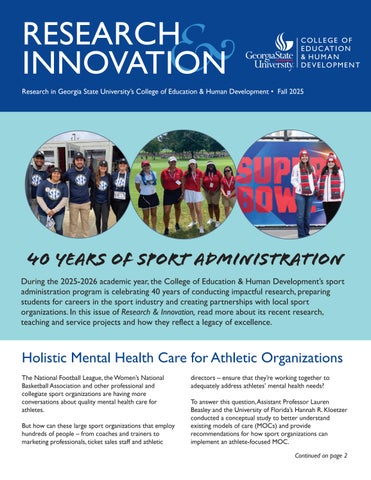
During the 2025-2026 academic year, the College of Education & Human Development’s sport administration program is celebrating 40 years of conducting impactful research, preparing students for careers in the sport industry and creating partnerships with local sport organizations. In this issue of Research & Innovation, read more about its recent research, teaching and service projects and how they reflect a legacy of excellence.
Holistic Mental Health Care for Athletic Organizations
The National Football League, the Women’s National Basketball Association and other professional and collegiate sport organizations are having more conversations about quality mental health care for athletes.
But how can these large sport organizations that employ hundreds of people – from coaches and trainers to marketing professionals, ticket sales staff and athletic
directors – ensure that they’re working together to adequately address athletes’ mental health needs?
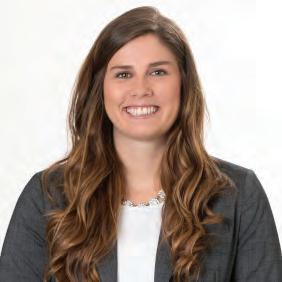
To answer this question, Assistant Professor Lauren Beasley and the University of Florida’s Hannah R. Kloetzer conducted a conceptual study to better understand existing models of care (MOCs) and provide recommendations for how sport organizations can implement an athlete-focused MOC.
Continued on page 2
Their study, published in the Sport Social Work Journal, began with a review of eight evidence-based healthcare MOCs and details on each one’s strengths and weaknesses when applied in an athletics context.
For example, the Professional Practice Model (PPM) provides a framework for how registered nurses can collaborate to provide care. PPM’s patient-centered approach and its use of evidence-based medical practices can be beneficial for patients, but the authors noted that this MOC has some limitations.
“To operate fully within family-centered care, more consideration must be given to incorporate all types of family structures, as well as the lack of a familial support system,” Kloetzer and Beasley wrote. “Additionally, little information is given within PPM on how to coordinate care within different nursing departments. There is a broad assumption given that all nurses understand the different departments within a hospital and know each other’s contribution to the patient’s care.”
The authors took what they learned from the eight MOCs and developed three best practices for sport organizations interested in providing quality mental health care for their athletes: 1.) An interdisciplinary approach, 2.) case managers and 3.) top-down organizational training.
1. An Interdisciplinary Approach
The interdisciplinary approach involves having a care team with different healthcare professionals connecting with one another about an athlete’s concerns and how they’re progressing. The care team would be built around the
athlete’s needs and could include a combination of athletics trainers, strength and conditioning coaches, medical doctors, licensed counselors, licensed psychologists and others.
2. Use of Case Managers
To make the interdisciplinary approach work seamlessly, the authors’ second recommendation comes into play: Hiring a case manager, such as a licensed social worker, to coordinate all the people involved in supporting a player’s mental health.
“Case managers are integral for sport organization’s best practices as they have the best training to not only manage the individual needs of athletes in an athletic department or organization, but to advocate within the organization and surrounding community to provide the needed care for the athlete,” they wrote. “In this way, a case manager can appropriately navigate all systems within an athlete’s life.”
3. Top-Down Organizational Training
It’s also important for all members of a sport organization to understand what case managers and the care team members can do and how they work together to provide athlete-centered care. Kloetzer and Beasley recommend that such training take a top-down approach –beginning with athletic directors and other top-level staff and making its way through the different levels of staff so that everyone is on the same page.
“These best practices, focalized by the inclusion of a case manager to an organization, centers athletes’ needs, involve multiple healthcare professionals and create conducive and collaborative environments for all actors and all ecological systems of an organization,” they wrote. “As a result, athlete care is holistic, prioritized and effective. We urge sport organizations to implement these best practices where appropriate to enhance the level of care for athletes and provide a conducive environment for employees.”
Lauren Beasley
Collegiate Athletes’ Perspectives on Academic and Athletic Roles
Collegiate athletes are required to excel both academically and athletically throughout their college careers.
To maintain their eligibility, they face conflicting demands and pressures, such as maintaining a minimum grade point average while also engaging in intense and time-consuming athletic training and competition.
So what does it take for these students to manage these dual roles simultaneously?
To find out, Allison Smith, College of Education & Human Development assistant professor of sport administration and a former collegiate athlete herself, conducted a study with Jeongwon Choi, assistant professor of sport management and sport management program coordinator at Georgian Court University. Their goal was to understand collegiate athletes’ motivational perspectives and patterns that allow them to succeed despite these dueling pressures.
The researchers interviewed 10 non-revenue-generating athletes who competed at the NCAA Division I level in a variety of sports. This helped ensure a balanced representation of gender and academic class demographics.
The interview included demographic and core questions about collegiate athletes’ motivations based on Self Determination Theory (SDT). This theory focuses on the degree to which someone’s behavior is self-motivated and self-determined toward their psychological needs for
autonomy, relatedness and competence. For this study, researchers focused on three levels of motivation: intrinsic, extrinsic and amotivation. While intrinsic motivation refers to doing an activity for the inherent satisfaction of the activity itself, extrinsic motivation indicates an activity done to attain external rewards. Amotivation refers to lacking motivation altogether.
Three meaningful themes emerged from the interview data: a.) support, resources and challenges for collegiate athletes, b.) athletic identity influences unbalanced motivation and c.) importance of culture, coaches’ leadership and environment.
The study’s results, published in the Journal of Athlete Development and Experience, confirm previous research that has found collegiate athletes’ athletic identity causes them to have unbalanced motivational levels that center more around athletic goals and pursuits than academic ones.
However, the findings also showed that once athletes were in their major of choice, they became more intrinsically motivated as they began to enjoy the coursework and planning for their future careers.
Additionally, athletes were satisfied with their support offerings and resources at their schools. Previous research showed mixed results in this area.
“This work helps negate some of the stereotypes that surround collegiate athletes, disproving that they don’t care or invest in school/academics,” notes Smith. “In fact, they do care but need to ensure their major and coursework is aligned with their future goals. This is assisted by coaches, team culture and leadership that invest in the athletes in both identities they manage while in college (academic and athletic).”
Allison Smith
How Fees Impact Sports Fans’ Ticket Purchases and Attitudes Toward Teams
When someone purchases tickets online for a concert, a comedy show or a sporting event, they’ll often see something called partitioned pricing: A listing of their ticket’s base price, the fees/surcharges that they’ll have to pay and the total cost.
The partitioned pricing method gives consumers an understanding of how their ticket costs are calculated and shows how fees factor into the final price.
College
of Education
&
Human Development Professor Beth Cianfrone and CEHD alum Armin Marquez (M.S. ’16, Ph.D. ’20) co-authored a 2024 study in the International Journal of Sport Management and Marketing to better understand how baseball fans feel about partitioned pricing and paying fees to see their favorite teams play.
“The purpose of this study was to investigate fans' offer assessment (i.e., perceived value) based on ticket price level, fans’ attribution of fee responsibility to teams and fans’ perceptions that fees were reasonable when completing digital purchases,” they wrote. “Within the sport industry, understanding if consumers consider teams to bear responsibility for added surcharges, and their perceptions of reasonableness toward these charges within a ticket purchase, can provide valuable insight to ticketing managers engaging in partitioned pricing.”
Cianfrone and Marquez screened possible study participants to ensure they’d attended one or more Major League Baseball (MLB) games during the most recent season and could answer a few basic baseball questions. Three hundred sixty-seven participants were selected to participate in the study, where they used an online ticket purchasing simulation to buy two regular-season tickets for their favorite baseball team.
After choosing their favorite team, they were shown a map of the team’s stadium and given three different ticket offers with pricing similar to that of an MLB stadium in the southeastern U.S.:
• Ticket Package 1: $16 plus a $9.10 fee (worth 28.4 percent of the base ticket price)
• Ticket Package 2: $57 plus a $17.10 fee (worth 15 percent of the base ticket price)
• Ticket Package 3: $130 plus a $23.10 fee (worth 8.9 percent of the base ticket price)
After making their final selections, participants were asked to recall the base price for their tickets and complete a series of questions about the purchasing process.
Seventy-two participants selected the least expensive ticket package, 233 selected the middle one and 72 selected the most expensive one. On average, participants “perceived the ticket offer as slightly positive, believed MLB teams profit from fees and believed the fees to be unreasonable.”
Cianfrone and Marquez found that participants’ perceptions of the overall ticket price weren’t significantly different at the three pricing options, even though the fees at each ticket level were worth very different percentages of the tickets’ base price. “Nevertheless, perceptions of value were, on average, low,” the authors wrote. “This may be explained by the fact that regardless of fans’ evaluation of the offer, they are highly likely to search for alternative options before completing their purchase.”
They also found that participants who thought the fees were unreasonable ascribed less value to their tickets than those who felt the fees were reasonable.
“These findings were consistent with previous partitioned pricing studies, which highlight that when consumers perceive fees to be too high, it resulted in negative perceptions toward
Beth Cianfrone
Continued on page 5
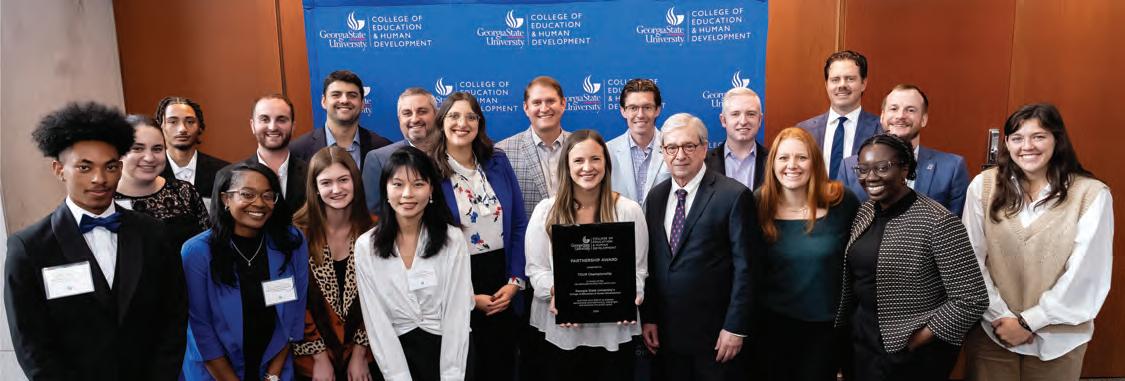
Students and faculty in the sport administration program pose for a photo with staff from the TOUR Championship at the College of Education & Human Development’s 2024 Partnership Award Luncheon.
Georgia State’s
Sport
Administration Program: Building Partnerships That Provide Real-World Experience for Its Students
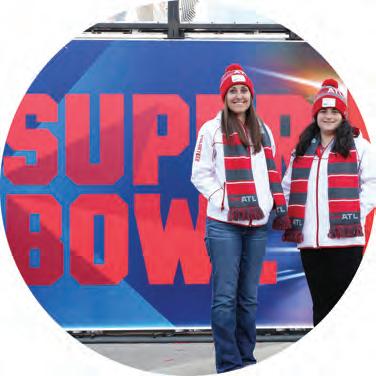
The 2019 Super Bowl at Mercedes-Benz Stadium. The Ambetter 400 at the Atlanta Motor Speedway. The annual TOUR Championship at Atlanta’s East Lake Golf Club.
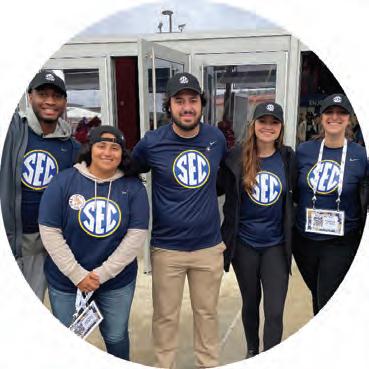
At each of these events, attendees likely interacted with students and faculty from the College of Education & Human Development’s sport administration program, who played crucial roles in a variety of operational activities –ticketing, safety and risk management, fan engagement and more.
These hands-on experiences wouldn’t be possible without the program’s strong partnerships with collegiate and professional sport teams and organizations across Atlanta.
“In our field, it is essential for our students and faculty to be up to speed with what’s happening in the sport industry, which informs the type of curriculum we have and preparing students with the knowledge they need to
be successful,” said Professor Beth Cianfrone, who coordinates the sport administration master’s program. “Our partners help open doors and provide amazing opportunities for our students.”
Partnerships in Georgia State’s Backyard
The sport administration program faculty have developed multiple partnerships over the years, working to better understand how they can support each sport organization’s mission while providing students with access to and experience with professional sporting events.
For example, Cianfrone and her colleagues have partnered with The TOUR Championship to give undergraduate and graduate students volunteer experience at this annual PGA golf tournament.
Continued on page 6
Continued from page 4
the offer,” the authors wrote. “Although fans’ attachment may result in some leniency toward particular actions, fans will draw a line when they feel that their team is unreasonable, impacting their perceptions of value.”
After Cianfrone and Marquez published their study in 2024, the Federal Trade Commission (FTC) approved its new Rule on Unfair or Deceptive Fees, which affects how
sport organizations display their prices and disclose fees. The rule requires that the total price for live events be made clear to consumers up front, including all fees except "taxes or other government charges, shipping charges and charges for optional goods or services people may select to buy as part of the same transaction," according to the FTC's frequently asked questions page.
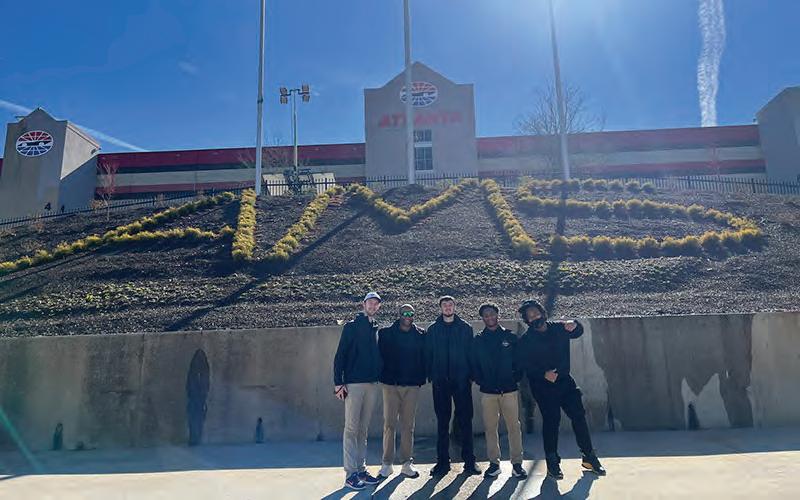
Thanks to the sport administration program’s partnerships, students have opportunities to volunteer at events at the College Football Hall of Fame (top) and the Atlanta Motor Speedway (bottom).
Based on students’ experiences and conversations with event staff, the program helped create the TOUR Championship Safety Committee, a group of volunteers who identify, report and address risk management issues during the event. The safety committee’s success has inspired other PGA tournaments to create a similar safety model for their events and was recognized during the College of Education & Human Development’s Partnership Award in 2024.
“Big events like the TOUR Championship, world class sporting events, only work because of the people that are involved, whether it's our staff, our volunteers, our partners, all the people that work together,” said Alex Urban, executive director of The TOUR Championship. “And when you have really great partners that are in this community, like Georgia State, those are the kind of partnerships you want to grow and continue to cultivate because that's how you're going to find success.”
Students and faculty also volunteer at the College Football Playoff National Championship at Mercedes-Benz Stadium
every January, where they help guide attendees to their sections, lead pre-game activities for fans and more.
“We got to meet so many people, connect with wonderful professionals in the industry and gain the experience of working in situations even when things didn’t go according to plan,” said master’s student Sara Silva about her experience volunteering at the 2025 National Championship. “It was really rewarding and exciting to be part of something so huge, and nothing compares to seeing the fans who were so excited to be there.”
Creating an Advisory Board
In addition to developing ongoing partnerships, the sport administration program also created an advisory board in 2017 to bring together alumni and colleagues working in local sport organizations who could provide volunteer opportunities, offer advice on curriculum changes and mentor students.
“We thought it would be helpful to have the advisory board to bounce ideas off of, find out what they may need assistance with and help keep us top of mind when they’re looking for interns,” Cianfrone said. “We’ve developed a few classes based on what the board has recommended to us, and one of our board members even teaches a class on storytelling with data in the sport industry.”
The board’s willingness to give back to the sport administration program helps students and faculty keep up to date with what’s happening in the sport industry and ensure Atlanta’s major sporting events are successful.
“The exposure that students have to large-scale events in our own backyard is such an advantage,” Cianfrone said. “It might just be a weekend of volunteering, but our students are essential to an organization’s goals of creating a world-class event.”
“In
our field, it is essential for our students and faculty to be up to speed with what’s happening in the sport industry, which informs the type of curriculum we have and preparing students with the knowledge they need to be successful.”
Beth Cianfrone
Championing Well-Being: New Sport Social Work Graduate Certificate
Collegiate and professional athletes can face a range of challenges in their careers: The constant pressure to win. Difficult relationships with coaches and fellow players. Being in the public eye. Sustaining physical injuries that could impact their career trajectory.
And they’re not alone. Staff members working in sports –many of whom are former athletes themselves – also internalize the pressures their organizations face to operate at the highest level.
“In this culture with high expectations, we can see major performance outcomes but some negative impacts on mental health,” said Lauren Beasley, assistant professor of sport administration in Georgia State University’s Department of Kinesiology and Health. “We've started to see a shift coming from elite athletes like Michael Phelps and Simone Biles having conversations about mental health, which mirrors a general shift in culture more broadly. But I think there’s still a long way to go. How do we meaningfully create environments where mental health is prioritized, not just discussed?”
To meet these challenges head-on, Georgia State University has developed a new Sport Social Work graduate certificate program, which prepares students to address the mental health and well-being of athletes and other sports professionals at the individual and organizational levels.
Beasley, a licensed social worker with a doctorate in sport administration, and Nicholas Forge, a clinical professor in the Andrew Young School of Policy Studies’ School of Social Work at Georgia State, came together to create the certificate program, which will officially launch in spring 2026 with a mix of online and in-person classes.
Their goal was to create an interdisciplinary certificate that incorporates knowledge and skills from both sport administration and social work, giving students in each discipline the chance to learn from one another’s field of study. Sport administration students learn best practices to prioritize mental health and well-being in sport organizations, and social work students learn to provide culturally responsive care for athletes and staff working in sport.
“Some of the most impactful innovations in social work come from multidisciplinary collaboration,” Forge said. “By integrating social work knowledge into sport administration, organizations can create healthier, supportive environments for both athletes and employees.”
The graduate certificate is the first of its kind in the nation to be jointly developed by social work and sport administration faculty, according to Beasley and Forge. And Georgia State’s location in downtown Atlanta gives students access to several collegiate and professional sports teams where they can put what they learn into practice.
Beyond preparing them to support individual care, the program provides the knowledge and tools to address mental health at the organizational level, leveraging integrated care, training, education and policy reform to create substantive structural change. With these skills, certificate holders are positioned to drive the transformation of sports organizations, embedding mental health into their structure, culture and daily operations.
“I hope students learn to apply best practices in designing and delivering support services with empathy and cultural humility. The social work process is inherently collaborative – meeting the athlete where they are – and emphasizes building mutually agreed-upon goals,” shares Forge. “Through this approach, my hope is for students to learn how to activate strengths, address challenges and ultimately equip athletes with the tools they need to not just focus on their athletic performance, but also on their overall well-being.”
Lauren Beasley
Funding Allows Graduate Students to Conduct Research in Sport
How can smaller sport organizations and school athletic departments best use social media to promote their work?
This was the question at the heart of Dalton Coppola’s (M.S. ’25) capstone project in the sport administration master’s program.
“It’s a time-consuming part of our jobs that fell into the communication team’s lap,” said Coppola, who worked with the Emory University Athletic Communications Office for his project. “Rather than sinking hours into social media that wasn’t worth the time, I set out to find out what would best serve the department while still promoting our student athletes.”
In compiling and analyzing social media data, he learned more about which factors most influenced engagement on different platforms and found that posts featuring student athletes’ personal stories resonated most with audiences.
“Telling the story not just of our teams but our student athletes is a huge component of social media,” said Coppola, who graduated this spring and now works as a communications assistant for Syracuse University Athletics. “I didn’t realize how important it was to promote student athletes and their stories directly. It’s something I’ve carried with me into my professional career and helped me implement successful strategies in the real world.”
Coppola is one of several students in the sport administration master’s program who have the opportunity to conduct research at a local school, college or sport organization while completing their degree.
Every year, Assistant Professor Lauren Beasley and Professor Beth Cianfrone receive grant funding from partner schools and organizations to support students’ academic studies while they complete a research project on site.
“We’re one of the few universities in Atlanta with a sport administration master’s program, and there are a lot of schools who need graduate assistants to work in their athletic departments,” said Assistant Professor Lauren Beasley. “At the end of two years of work, students have completed research overseen by Dr. Cianfrone and me to help the organization improve in a certain area, such as marketing analyses or operations efficacy research.”
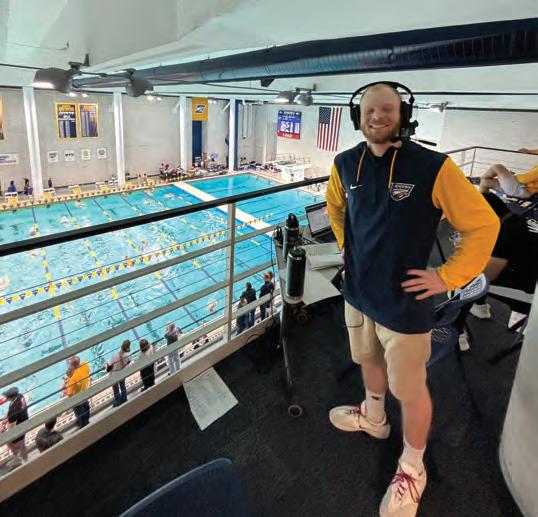
Sport administration alumnus Dalton Coppola (M.S. ’25) had the opportunity to work with the Emory University’s Athletic Communications Office for his capstone project, giving him hands-on experience and providing high-quality research findings to Emory.
Students can also submit their completed research for publication in an academic journal and/or present it at an academic conference.
These are exactly the kind of hands-on experiences that benefit both the sport administration graduate students and the organizations they work with.
“It’s the best of both worlds,” Cianfrone said. “Students are learning on site and applying what they’re learning in class, and we provide their research results back to the organization so they have best practices and can improve on what they’re currently doing.”
“I didn’t realize how important it was to promote student athletes and their stories directly. It’s something I’ve carried with me into my professional career and helped me implement successful strategies in the real world.”