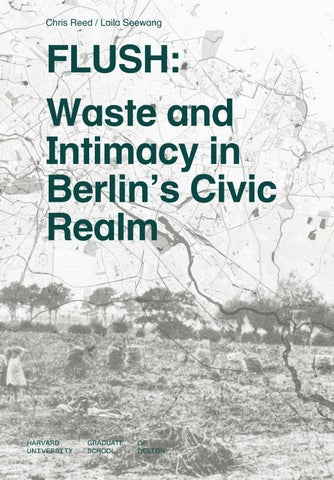
Chris Reed / Laila Seewang
FLUSH: Waste and Intimacy in Berlin’s Civic Realm


Chris Reed / Laila Seewang
FLUSH: Waste and Intimacy in Berlin’s Civic Realm


FLUSH: Waste and Intimacy
in Berlin’s Civic Realm
In the 1870s, the Municipal Council of Berlin initiated the largest experiment in urban circularity with its public water supply and sewer system. Water was located far beyond view of Berliners, was filtered as it was extracted through Berlin’s sandy soil, held in reservoirs that mediated between hydrogeological time and social time in the industrializing city, used by new apparatuses such as WCs and showers, then pumped out to Berlin’s periphery as sewage. Using the Emperor’s rights to Eminent Domain in cases of public good, the Municipality purchased enormous feudal estates in the countryside on which to build its sewage farms, tripling the size of Berlin and making the City the largest agricultural producer in Brandenburg. Sewage percolated back through the sandy soil and returned, theoretically clean, to groundwater. The design and construction of these systems shaped not only views about hygiene, and introduced public toilets and showers in urban space, but left a legacy that defines the city of Berlin to this day.
The FLUSH studio explores this contemporary legacy that this studio will explore. The aim is to make these systems visible in urban space by exploring first the overall metabolic cycle that exists in today’s Berlin, and then by asking students to propose interventions that build upon the relationship between city and water in one of three sites: urban sites of commuter activity that require private spaces for bodily hygiene; sites of bathing in the river which still continues to receive raw sewage at times of heavy rain through the infamous overflow sewers; the semi-toxic sewage farm sites which, today, form a green ‘ring’ of landscape restoration, low-grade agriculture, and exhibition spaces around the city. The aim of the proposals in any of these sites is to make the relationship between the ‘ends’ of the system—the natural resources tapped in the countryside—legible in the center of the system at the scale of the body.
Studio Instructors
Chris Reed | Laila Seewang
Teaching Assistants
Harish Krishnamoorthy
Anne Tong
Students
Issam Azzam, Elias Bennett, Pedro Brito, Hannah Hardenbergh, Deqiang Huang, Shreyes Yohan Jos, Emily Kim, Weiwei Lei, Isabella Simoes, August Sklar, Tingyue Tan, Makio Yamamoto
Collaborators
Sabine Barles, SMAQ; Tim Edler, Flussbad Berlin; Markus Bader, Floating Berlin; Stephanie Haerdle, Stadtgüter Berlin; Daniela Kurtzmann, Stadtgüter Berlin; Martin Prominksi, University of Hannover; Felix Bentlin, TU Berlin; Kelly Shannon, KU Leuven; Tim Dekker, LimnoTech and GSD; Matthew Gandy, Urbana Natura; David Bauer, TU Berlin, Habitat Unit; Neeraj Bhatia, CCA; Margarita Jover Biboum, Tulane University; Augustin Climent, architect, Berlin; Anke Hagemann, TU Berlin, Habitat Unit; Christian Hiller, ARCH +; Lou-Anne Gellert, Buschfunck Bündnis; Ajay Manthripragada, UC Berkeley; Susanne Schindler, Harvard Joint Center for Housing Studies; Paul Strobel, IAAC; Paola Vigano, EPFL; Roselea Monacella, GSD; Craig Douglas, GSD; Sean Canty, GSD; Ann Forsyth, GSD; Rahul Mehrotra, GSD; Eve Blau, GSD; Pablo Perez-Ramos, GSD; Danielle Choi, GSD; Sarah Whiting, GSD; Kira Clingen, GSD; Charles Waldheim, GSD; Mariana Ibanez, UCLA; Lorena Bello, GSD; Sheila Kennedy, MIT; and Ewa Harabasz, GSD.
Index
011 Introduction
Sarah M. Whiting
015 FLUSH: Waste and Intimacy in Berlin’s Civic Realm
Chris Reed, Laila Seewang
019 Episode 01
Intimate Urban Rooms, or,
Scaling Intimacy
073 Site Visit
097 Episode 03
Engaging Many Waters
Nodes
105 Badeviadukt
Weiwei Lei
127 Brachen Santuaries
Tingyue Tan
139 Potsdamer Pipes
Deqiang Huang
Rivers
153 Registration Bay
Pedro Brito, Isabella Simoes
171 Treptower ReDamped
Shreyes Yohan Jos
185 Aqueous Encounters in the Panke Canal
Hannah Hardenbergh
Fields
199 Re-Wetting Großbeeren
Elias Bennett, Emily Kim
217 Void Venue
August Sklar
233 Between Waters
Issam Azzam, Makio Yamamoto
251 Final Review
263 Bibliography
265 Contributors
267 Acknowledgements


Sarah Whiting
The conveniences that mark our modern lives have detached us from the natural world that marks our earth. Packaged meats in the supermarket bear zero resemblance to the animals from which they were butchered; the air inside our homes is cooler and less humid than the air outdoors; the “fire” we use to heat our food is electric. Perhaps no medium illustrates this divide as starkly, however, as water: as writer Alison Kafer poignantly observed,
[O]nly certain kinds of interactions with the environment are recognized as such; swimming in the ocean and wading in mountain streams are more likely to be understood as meaningful ways to interact with water, while running one’s fingers under a faucet is not. But why not? The answer lies partly in long-standing assumptions that nature and the environment only exist “out there,” outside of our houses and neighborhoods; the answer lies, too, in long-standing—and even less visible—assumptions that only certain ways of understanding and acting on one’s relation to the environment (including other humans) are acceptable. These assumptions have significant material effects. Seeing nature as only “out there,” or faucet water as categorically different from ocean water, makes environmental justice work all the more difficult. 1
Water appears and disappears from our domestic lives on command: we turn on the faucet, we drain the tub, we flush the toilet. But as Kafer and others have noted, we don’t stop and think about how: water comes out and goes back into the invisibility recesses of our homes – our walls and our basements.
This mostly invisible relation between water, architecture, landscape, and urbanism has slipped into focus from time to time for those who study and practice within the designed environment. In 1898, Czech/Austrian architect and theorist Adolf Loos published a newspaper article entitled “Plumbers,” which understood plumbers as – as Nadir Lahiji and D.S. Friedman noted in their 1997 collection of essays looking at modernity’s relationship to cleanliness and hygiene and entitled, in homage to Loos, Plumbing, noted – “the ‘beletting officer of culture,’ a pioneer of cleanliness and the first artisan of the state.” 2 Loos understood the economic, political, and social value of modern cleanliness, using his platform of the fourth estate to nudge the state into actively supporting the availability and expansion of water facilities in German homes as a means of advancing the nation’s modernity itself.
Lahiji and Friedman’s attention to Loos was less focused on modernism’s systemic and, for lack of a better word, bureaucratic aspects. Instead, reflecting the context of the moment when they published Plumbing, the book’s collected essays focused on the hygiene aspect of Loos’s modern argument –how our bodies were affected by modernism’s transformations of architecture and urbanism. Loos’s essays were translated into English and disseminated only a decade earlier in the Oppositions Books volume Spoken into the Void; Beatriz Colomina’s writings on the intimacy of Loos’s modern domesticity are
foremost among many other writings looking at modernity, hygiene, sexuality, and space during the late 1980s, through the 1990s. 3
What I find so very exciting about Chris Reed and Laila Seewang’s studio, FLUSH: Waste and Intimacy in Berlin’s Civic Realm, is that it builds upon this long legacy of attention to water by our design disciplines. The studio circles back to Loos’s awareness of the importance of municipal bureaucracy in advancing collective systems and urban lives. Clean and safe drinking water is a human right and it is this link to rights and to the environment that marks the FLUSH studio, which adopted a synthetic approach to understand urban waterworks as a system and one whose arc necessarily embraces urban planning and design, landscape architecture and architecture – all of the departments, in short, at the GSD. At the same time, Reed and Seewang ensured that the studio participants also took on issues of the body and the body politic – that is, how water continues to affect our contemporary individual bodies as well as our collective civic body.
“Infrastructure” is a term that rarely resonates well with our body politic, for it tends to get attention only when it’s in crisis: drought impositions upon urban water usage, bridge collapses, derailments, and potholes among them. I am grateful to Chris Reed, Laila Seewang, and their students for shifting this perspective, illuminating infrastructure’s role in positively shaping both our designed environment and our shared humanity. Finally, my thanks go to Mr. Koji Yanai, whose support of the GSD in creating the Koji Yanai Innovative Infrastructure Initiative has made such important research and design possible.
1 Alison Kafer, Feminist, Queer, Crip (Indiana University Press, 2013): p. 145.
2 Nadir Lahiji and D.S. Friedman, “Introduction,” Plumbing: Sounding Modern Architecture (Princeton Architectural Press, 1997): 7 – Loos’s “Plumbers” piece is included in this collection, translated by Harry Francis Mallgrave: 15-19.
3 See, for example, Beatriz Colomina, ed. Sexuality and Space (Princeton Papers on Architecture, 1992) and Beatriz Colomina, Privacy and Publicity: Modern Architecture as Mass Media (MIT Press, 1996).

FLUSH Waste and Intimacy in Berlin’s Civic Realm
In 2010, the United Nations recognized “safe and clean drinking water and sanitation as a human right.” (General Assembly Resolution 64/292, 28.7.2010). But this resolution simultaneously made clear that state-funded, “public,” infrastructures were responsible for facilitating those rights. For about 150 years, most municipal water supply and sewer systems have tied our waste removal to the extraction of potable water. This is what we call public work. There are legacies to these nineteenth-century environmental design decisions, and it is those legacies that this studio investigated. In the 1870s, the Municipal Council of Berlin initiated the largest experiment in urban circularity with its public water supply and sewer system. Water was extracted in Brandenburg far beyond the view of Berliners, was filtered through Berlin’s sandy soil, held in reservoirs that mediated between hydrogeological time and social time in the industrializing city, used by new apparatuses such as toilets and showers, then pumped out to Berlin’s periphery as sewage that fed city farms. Using the Emperor’s rights to Eminent Domain, the Municipality purchased enormous feudal estates in the countryside upon which to build its sewage farms, tripling the size of Berlin and making the City the largest agricultural producer in Brandenburg. Sewage percolated back through the sandy soil and returned, theoretically clean, to groundwater. The design and construction of these systems shaped views about hygiene, introduced public toilets and showers in urban space, and cleaned the streets.
It is the contemporary legacy of this change this studio will explore. The aim is also to make these systems visible in urban spaces by exploring, firstly, the overall metabolic cycle that exists in today’s Berlin, and then by asking students to propose interventions that build upon the various relationships between the body, the city and water in one of three sites: urban sites of commuter activity that required private spaces for bodily hygiene; sites of bathing in the river which still continues to receive raw sewage at times of heavy rain through the overflow sewers; and the contaminated sewage farm sites which, today, form a green
environmental resources seemed endless and urban technologies flawless.
Made explicit through student research and proposals were the changing meaning of the words ‘waste’ and ‘public,’ which were pivots around which consensus and conflict evolved. Many proposals made clear how these concepts operate today. Intimacy became an attitude we took in earnest within the design exercises. Die stille Ort (the quiet place) is a synonym for toilet in the German language—Peter Handke’s Versuch über den Stillen Ort (The search for the quiet place) building upon this concept. But as Tanizaki Jun’ichiro’s book Lob des Shattens (In

‘ring’ of landscape restoration, low-grade agriculture, and exhibition spaces around the city. The aim of the proposals in any of these sites is to make the relationship between the ‘ends’ of the system—the natural resources tapped in the countryside—legible in the center of the city at the scale of the body. Through these interrogations, we hope to contribute to a discourse on circularity today by learning from the logic, aspirations, mistakes, and opportunities of yesterday. After all, many of the infrastructural emergencies of cities today (think the discovery of contaminated pipes in the drinking water system of Flint, Michigan, for instance) arise from design decisions made in the late nineteenth century when
Praise of Shadows) makes clear, this intimate stillness exists in the Japanese conception of toilet rooms too. As such, the creation of places of bodily intimacy in public space was the vehicle by which we collectively analyzed how the values built into our water and waste systems in the nineteenth century measure up to our needs today: we asked, what acts, rituals or spaces remain truly private/individual, versus what may be shared or collective and yet still intimate and how does technology inadvertently engage with them.


Episode 01: Scale
The scalar relationship between the parts of infrastructural systems is hard to grasp conceptually, but by looking at the designed objects themselves, the impact of small change on the overall system becomes clear: a wrongly-placed pipe inside a toilet had the ability to contaminate a whole city’s water supply with wastewater; a cold frost could inhibit soil from absorbing sewage in the Brandenburg countryside; an exciting football game could lead to half of the city flushing the toilet at the same time after a penalty shootout, almost collapsing the water supply system.
Although we believed that the interdisciplinary cohort of graduate students had skills across scales, we also identified these sites to fit more squarely within the different design fields’ expertise: NODE would require urban design analyses of inhabitant populations, access, and public spaces; RIVER demanded an urban-landscape approach, mixing architectural intervention with more regional outlooks; FIELD was more squarely situated in the experiences of landscape architecture students.
To bring our attention to architectural nuances of how large systems touch down, the studio therefore began with the intimate scale of bodily practices with water. Students researched, analyzed, and drew precedents that they were familiar with: informal swimming at an industrial port outside of operation hours in summer; a reflecting pool that acted as a cooling haven for families in a highrise; the Wudu ritual purification before prayer; a water temple and spiritual site in Bombay; the chance encounters with the Harvard Yard sprinklers in the dawn hours. All of these introduced our class to an interrogation of the ever-evolving definition we used throughout the term words: ‘intimacy,’
‘privacy,’ ‘waste,’ ‘wetness,’ and ‘public,’ which were pivots around which consensus and conflict evolved. Students produced booklets, requiring studio guests to sit quietly and actively reflect upon the students’ inquiries.
These were practices which, we later discovered, almost always relied upon water as a purifying element. And the wet landscapes we explored in Berlin were almost all contaminated in some way. They weren’t, at least, the potable, filtered, on demand water that flowed through municipal systems: they were not modernity’s water, but many different pre- and post-modern waters. We could no longer insist upon the same relationship to water


Wudu`: Midhat al-Sultan
Medina of Tunis
Issam Azzam
In the Islamic tradition, the movement of your body is in rhythmic time with the cosmos - the medium of this connection is water. Everyday, five times a day, more than one billion muslims perform their ritual ablutions before prayer (wudu’). Ablution is a ritual cleansing, an offering of new spiritual state for the acceptance of your prayers. It is a systematic process, whereby intentions are set and different body parts are washed (3 times over) in a specific order.
This ritual is performed in a plethora of places around the world, from toilets, kitchen sinks, garden hoses to freshwater springs. I will focus on a specific wudu’ facility located in old Islamic old towns, specifically the Medina of Tunis (Tunisia): the midhat. Here, wudu’ is performed in an architectural unit across the street from the mosque. This was recommeded in Islamic law (Maliki law) for the separation of clean and dirtied waters. The architectural mirroring of the midhat and mosque symbolises the individual, yet highly communal, ritual of washing and praying. The community, all made equal by the architecture, work as one to wash, prepare, line up, and offer themselves to God.
I have entitled this project: ‘from body, to midhat, to mosque, to city, to cosmos’ because the scale of this ritual is truly allencompassing. The specific movements of the body are choreographed by the collective architecture. As a part of the urban fabric which exponges its population at specific times each day. All coordinated by the movement of the sun and moon.


Caught Out: Surprise Interactions with Automated Irrigation Systems
Elias Bennett
At 4:30 AM, in the summer months at least, Harvard University lawn sprinklers start going off. For that quiet time when most people’s days are neither finishing nor quite starting, it is an animated event. 4 inch long, half inch diameter spring loaded nozzles – which are for the most part hidden below grade throughout the day – launch upwards under a sudden influx of pressure and begin ejecting ionized water vapor in steady clouds up to 30 feet across. Like many pieces of common infrastructure, this astonishing event is made largely invisible due to its scheduling during the liminal hours of morning, which is quite justified by concerns for water loss due to evaporation, plant metabolism, and the need to not disrupt daily life. Nevertheless, the rare witness to a campus-wide irrigation cannot help but feel they have stumbled into something secret. Whether traversing a quad after a long night of study, or stirring near an open bedroom window, the transformation of public open spaces by saturating the air with water can be a sublime nuisance. Unlike most other interactions we have with water in the city, we quickly realize by the dampening of our clothes and the puddles around our shoes that this water is not intended for people – we have stumbled into a new landscape. This does not preclude us from reveling in the largely accidental effects produced by automatic irrigation systems. The entangling of streetlights, humidity, condensation, and ultimately wetness may produce an unexpected intimacy with our own bodies, as well as a changed relationship to the public spaces in which this display of abundant water occurs. Re-inscribed through vapor and light, plazas and quadrangles become a pre-dawn stage on which new forms of play can emerge.
CAUGHT OUT
SURPRISE INTERACTIONS WITH AUTOMATED IRRIGATION SYSTEMS

Bennett Episode 1 STU 1601: Fall 2024


Rooms of Change: Thresholds of Intimacy in Leça Swimming Pools
Pedro Brito
Rooms of Change analyzes Álvaro Siza’s Leça Swimming
Pools in Matosinhos, Portugal, focusing on the spatial and sensory experiences engendered within its changing rooms. These rooms offer moments of intimacy and pause for users, characterized by shaded, dimly lit spaces and raw materials that transform them into experiential environments. Visitors pass through a sequence of rooms designed for personal hygiene, clothing storage, and moments of pause to reach the pools. These rooms are arranged between parallel walls that separate intimate from public spaces, creating a promenade that leads users from the street entrance to the water features within a continuous path shaped by curated light and shadow. By guiding visitors through a sequence of spatial contrasts— compressed and enlarged, raw and refined materials—Siza creates a curated succession of events that blurs the line between public and private, exterior and interior. This duality is evident throughout the project as users move through these different conditions along the promenade and are encouraged to engage with different materials and spaces, creating a choreography of sensory interactions. The changing rooms are integral to this route, enclosed by rough concrete walls and dark wood ceilings. A central millwork strip, suspended between the floor and ceiling, organizes the space into two sections: the entrance area, equipped with a sink and circular mirror, and the exit area, which features foot-washing fixtures and directs users toward the pools.
ROOMS OF CHANGE
Thresholds of Intimacy in Leça Swimming Pools

Episode 1 STU 1601: Fall 2024


Swimming Alone, Together: Notes from the Quarry
Hannah Hardenberg
Swim (v.) - to revive yourself
We parked the car along Route 30. She’d said she used to stop here all the time on her way back to the valley. The scent of dense oaks and dewey marble had me keen. I remember the water, bottomless and moody. We are alone, together. There are others, softened by green.
My feet are silly and cold with no ground to find. They say this place has been this way for a while now. It’s not like “the old days” anymore. Still, the marble warms your toes on the south side. Every time I swim I gain one hundred years. I’m as old as the quarry, green and spectacular in the sun.

Swimming alone, together
notes from the quarry


STU 1601: Fall 2024


Port-Ground: From Production to Entertainment
Deqiang Huang
Damai Yu Port is located in Taizhou, in the southeastern part of China. The port was originally constructed as a platform for fishing ships to load and unload cargo during high tide. However, due to its proximity to residential areas, local community members have adapted the port for recreational activities, using it as a playground for diving and rinsing their feet after the day’s production processes conclude. The local people have adjusted their activities to suit the port’s unique characteristics, maximizing their connection with the water.
Each morning and afternoon, two waves of fishing ships enter the port, bringing fresh seafood. Large boxes of seafood are packed and transported to local markets, while smaller portions are sold directly on-site. Once the tide lowers and the fishing ships depart, the entire port area becomes available to the nearby community members, who have a deep bond with the sea. In the evenings, especially during the summer, people gather at the port to enjoy the sea breeze and feel the seawater. A group of children often assembles, jumping from a high platform into the dark, deep water. Some adults use nets to catch crabs drawn by the tide and the underwater structures.
The concrete slope of the port is where people meet the water, and the boundary between land and sea shifts with the tide. People walk on the slope to feel the seawater flow through their toes, collecting seashells and small crabs. When the tide reaches its lowest point, a space beneath the port is revealed, attract children to explore. However, they are always mindful of the tide, as the space would soon become submerged again. This intimacy with the water not only shapes the community’s activities but also influences the materials used in the port’s construction in both texture and fabication.


Banganga: Sacred Tank
Banganga is a sacred water bodysituated within the Indian metropolitan city of Mumbai.
Its sacred signicance emerges from the Hindu epic Ramayana – and according to legend, the temple complex was conceived when Rama, the exiled hero, stopped at the location searching for his kidnapped wife, Sita.
Overcome with fatigue and thirst, Rama requested his brother Lakshmana to bring him some water. Lakshmana subsequently shot an arrow into the ground which brought water gushing from the ground, creating what is believed to be a tributary of the Ganges, which flows over a thousand miles away.
Hence, Banganga is a compound term, that is the Ganga created from a Baan (arrow).
In contemporary parlance, the term “tank” may suggest a rather banal utilitarian container of water for domestic consumption. However, the term is inextricably linked to temple water bodies because they are fundamentally man-made wells or reservoirs.
In various Indian languages and regions, these may be known as Pushkarini, Kalyani, Kunda, Sarovara, Tirtha, Talab, Pukhur, and Ambalakkulam.
The Banganga tank is fed by a natural spring which keeps the water sweet, despite being in proximity to the sea. Hindu ritualistic practices use the water for purication, immersing ashes in it - as they believing it to be as pure as the Ganges, the holiest of all rivers.
BANGANGA SACRED TANK


Shreyes Yohan Jos


Squish: Muddy Encounters
Emily Kim
Do you remember the first time you fell into mud? The squish. Or perhaps the first time you peered into a tidal pool. The ocean breeze pushing a lingering sulfuric scent while you peered down at the amphibious inhabitants below?
At the periphery of Tokyo, in what is now reclaimed land, sits the Tokyo Port Wild Bird Park. Surrounded by industrial warehouses and Tokyo Bay, visiting it is to escape into the edges beyond city, while being surrounded by the infrastructure that keeps Tokyo bustling. Deep inside the park, the Nature Center hosts 3 floors of wrap-around glass windows and extensive seating options for bird watchers. Amongst a sea of cylindrical concrete columns, a single glass rectangular extrusion stands out across all floors. At the very bottom, a muddy expanse, a walkway, and perhaps a person or two may be visible exploring.
A thin walkway moves around the mudflats immediately outside and underneath the building. Adorned with two giant blue tape arrows, they indicate clear the directional flow expected here. Though various signs exclaim to stay on the walkway and to not walk on the mud, there is an understanding that one might fall in (or go in, despite the warnings). Depending on what time of day you visit, the tides inch closer or recede, and mudskippers and small crabs reveal themselves below.
The narrowness of the walkway allows one person at a time. The experience sits on the balance of extreme orderliness and control, and immediate mess. Here, water from the sea activates the mud flats. It brings life to the area, but it makes humans stinky and sticky if they engage with it. Next to this expanse are controlled water flows - spigots, sinks, and shoe mats. One water brings you closer to the nature held at arms length throughout the park, while another acts as a cleanser of any reminder that you might have wandered into the former.
SQUISH MUDDY ENCOUNTERS


Sauna: Space of Duality by Water
Weiwei Lei
The Sauna is a cube made from 1500mm x 1500mm acrylic panels. It is designed by Sam Chermayeff Office in 2024. The original site is a roof top in Berlin, Germany. But its extreme mobility allows for anywhere to be the site.
The fully transparent design of the sauna allows for its remarkably compact size while still creating a sense of openness and expansiveness. This transparency blurs the boundaries between the interior and the surrounding environment, making it feel as though the space extends far beyond its physical dimensions. Despite its small size, the sauna offers a unique blend of intimacy and openness—it is both the most private and most exposed space. The walls, clear when the air is cool, allow for sweeping views, but as the steam rises, they gradually obscure the outside world, drawing the focus inward and fostering a sense of personal reflection and close connection with those inside.
The Sauna creates a shared space that encourages communal experiences, fostering intimacy while also offering flexibility and adaptability for various uses. The nature of a sauna inherently promotes collective experiences and social interaction. Moreover, the material substance of the acrylic panels allows for transparency and openness. It creates a sense of intimacy once the steam builds up, blurring the surroundings and focusing attention inward to oneself or the companions.
Finally, when the body wiggles and crawls out of the sauna cube to take a shower, the outside reality is brought back to the perception. This duality of visibility and privacy encourages both personal reflection and shared moments within the same space. This transition from openness to introspection makes the sauna experience dynamic and deeply personal.
SAUNA
SPACE OF DUALITY BY WATER

STU 1601: Fall 2024


A Pool in the Sky: Water as an Intimacy Medium
in Sesc 24 de Maio
Isabella Simoes
The Sesc 24 de Maio, designed by Paulo Mendes da Rocha with MMBB office, stands in the heart of São Paulo, Brazil’s largest and most populous city. Amidst the dense urban environment the building feels like an extension of the city’s dynamic energy, offering public spaces that are open and accessible to all. A prominent feature at the entrance is a large concrete cylinder housing a water tank, which immediately captures attention. As visitors ascend the continuous ramp weaving through various activity spaces, they are met with a surprising pause on the thirteenth floor. Here, the building opens to the city: the walls vanish, and along two sides lies a long, shallow reflecting pool. This serene water feature contrasts sharply with the surrounding urban intensity, offering a moment of calm and refreshment. Originally conceived as an aesthetic element to soften the building’s brutalist concrete, the reflecting pool has evolved into a central point for interaction. At just 20 cm deep, it invites visitors to dip their feet, swim, and engage with the water in playful and unexpected ways. Its simplicity encourages a spontaneous connection between people and the natural element, blurring the boundaries between architecture and nature. These moments are further enhanced by the intense sunlight streaming through the skylight, casting reflections onto the wet concrete floors, while the metal guardrails provide unobstructed city views. Despite the proximity of nearby buildings, which creates a visual exchange between pool users and building neighbors, the elevation and water presence foster a sense of privacy and intimacy within this open space.

A pool in the sky
Water as an intimacy medium in SESC 24 de Maio


Finding Tuefelsee: A Guide Through the Devil’s Land
Finding Tuefelsee explores the historical and spatial context of The Devil’s Lake, a queer swim spot in the depths of Grunwald Forest, and its relationship to Tuefelsberg, The Devil’s Mountain, an artificially constructed mountain of rubble from the destroyed buildings of WWII. At the end of WWII, Berlin was a bombed-out void. In the efforts to reconstruct the city, the removal and redistribution of rubble became necessary effort of survival and nation building. Droves of Berliners hauled carts of rubble to an undeveloped flat on the western outskirts of the city, at the mouth of Grunwald Forest. This location was selected for its distance from the center of the city, out of site by the general public. Additionally, it was presumed to be a location with little to no ground water, which would limit the range of contamination the debris would have on the site. This initiative was orchestrated by the landscape architect Reinhold Lingner, with the prerogative to expeditiously turn Berlin’s landscape of trauma, into a landscape of “wellbeing”. This notion resulted in a naturalistic designed mountain, formed by destroyed architecture. This bold bulge in the landscape quickly underwent an additional transformation, that of afforestation. Berliners came together to plant saplings, and in doing so, buried the evidence of war. Through time, the canopy thickens, and history begins to be obscured.
In that sense, Tuefelsee became a queer (mostly gay men) destination because it is far and obscured. The social context of a queer lake becoming popularized in tangent with an authoritative government’s occupation and erection of observation tower, further illustrates the undesirable social conditions that enveloped the site. Tuefelsberg shelters Tuefelsee, and in doing so, enables the longevity of a queer enclave, on the margins.
Finding Tuefelsee a guide through
the Devil’s Land

August Sklar
Episode 1
STU 1601: Fall 2024 Booklet Episode 01


Whispers in the Dark: Exploring Intimacy Through the Chinese Healthcare Wellness System
In ancient China, the process of cleansing the body was closely tied to royal privilege and exclusivity. Bathing was considered a private and intimate ritual, reserved for the elite and aristocratic class. The act of bathing was not only about cleanliness but also symbolized status and power. Servants were responsible for attending to their masters during this process, establishing a one-directional service dynamic that further reinforced social hierarchies. Since these bathing rituals took place in highly private and controlled settings, the intimate quality of the experience was preserved, providing a space for relaxation and personal care without external interference.
By the 20th century, the dynamics of intimacy within bathhouses began to shift as bathhouses became more widespread and integral to community life. Ranging from luxurious establishments to more affordable options, bathhouses served as a common commodity and a cultural identity shared by people across social classes. The bathhouse evolved into a social institution where individuals would gather, not just to bathe but to engage with each other, turning these spaces into hubs of social interaction. This period also saw a significant push for gender equality within bathhouse culture, with female bathhouses being actively encouraged. In some cases, the government even sponsored the construction of bathhouses specifically for women. Power dynamics within these spaces became more egalitarian, as people from different backgrounds shared the communal experience, thus democratizing the intimacy that had once been exclusive.


WHISPERS IN THE DARK


Episode 01
exploring definition of intimacy through evolution of chinese healthcare wellness system


Tingyue Tan Episode 1 STU 1601: Fall 2024


Bottom:


Half Time: Performance and Intimacy Under the Stadium
Makio Yamamoto
The locker room is a place of exchange, transition and performance mediated through water. In this study, we enter into the locker room of the Camp Municipal de Cornella in Barcelona, Spain. The room is cramped and long, the benches face each other with barely a wingspans distance between them. Around the corner are the showers.
The room is animated by the movement of the players and teams inside it, following a predictable pattern of arrival, greeting, undressing, redressing, washing and exit. The choreography of these actions are not linear, and are a constant negotiation between bodies sharing space and water, as individuals prepare themselves for the match ahead or recover from it afterwards.
The movement of the players through the stadium itself is a similar choreography, transforming individuals from private beings into a collective as part of a public event. Entering from the street, players descend into the locker room, an enclosed private space limited to only the players and coaches involved. Above them, on the stands and concourse, the crowd gathers waiting for the match to start, a direct inverse to the enclosure of the lockers below.
Water is sprayed onto the field, preparing the surface for play. The team leaves the locker room together, and enters the field of play and are reintroduced to the public.
The compression and expansion of these spaces in relation to the collective and individual is explored in the following pages. Through water, we can track the experience of sharing and entrusting space with others.
Half Time
Performance and intimacy under the stadium

Episode 1
STU 1601: Fall 2024


The aim of the site visit was ostensibly to explore the three types of site defined by Berlin’s early metabolic cycle, with students interrogating the relationship between city, body, and water in those places. Through water, the municipal city began to service its public. But it also changed the city in many ways. Infrastructures would be designed to tap into this hydrological system: bores, wells, pumphouses, reservoirs, water-based toilets, showers, public baths, and sewage fields.
Our site visits to Berlin and tours of the city through various projects and sites examined three types of conditions where the legacies of these early design decisions come into conflict with contemporary values:


Sites of urban commuter activity required private spaces for bodily hygiene that were designed centuries ago with the working, male, commuter in mind as factories moved to the edges of an expanding city. While men waited for trains running on pre-programmed schedules, their bodily needs were often running on a different schedule. Planning operated by collecting data on who was in the city, doing what, and when. Since women weren’t visible in the city, for example, it proved difficult for the municipality to plan for women’s public toilets; technologically, it was practically impossible. Although the most famous municipal pissoir, the Achteck, or Octagon, was designed in 1879 alongside a female version, it took forty years of council debate to understand where these might go in the city and why women might be in the city needing toilets, at all.


River
The River Spree was never designed to recenve any kind of sewage under the municipal wastewater system -- except in an emergecny. These decisions made in the 1870s nonetheless impact how people want to use the river today. The sewer system’s emergency outlets still deposit raw sewage into the river at times of heavy rain, since the storm water and household sewage operate together in a combined system. This impedes efforts to return the river to a place of recreation in the post-industrial era as it has ceased to be a major river-traffic route: for swimming, bathing, or river-side occupation.
Berlin-Lichtenberg Flussbad, 1928. akg-images


Presenters:


Fields
Finally, the contaminated sewage farm sites from yesteryear form a green ‘ring’ of landscape restoration, low-grade agriculture, and exhibition spaces around the city today. These nature spaces are an incredible, if accidental, asset for the city. The question is what to do with them? As Berlin expanded in 1920, these spaces became borderlands between Berlin and the state of Brandenburg, which surrounds the city. They are to some degree contested sites, holding an unclear status somewhere between park, logistics-landscape, renewable energy farms, and wasteland.
Gut Hobrechtsfelde Sewage Farm. Department for Urban Development and the Environment Berlin


Brachen
When we traveled to Berlin, we were constantly aware of how much the political history of Berlin shaped the legacies of the spaces we were exploring. In particular, its tumultuous twentieth century has produced spaces bombed, vacated, or otherwise deserted and left vacant and unused. O.M. Unger’s project, The City as Archipelago, or Exodus, or the Voluntary Prisoners of Architecture: The Strip, the drawing by Rem Koolhaas, Elia Zenghelis, Madelon Vriesendorp, Zoe Zenghelis from 1972, address this emptying through a call for partial re-densification.
In a recent documentary, Matthew Gandy explored the notion of Brachen, a term originally characterizing fallow agricultural that allow for soil regeneration after years of intensive production. It is an apt term for Berlin where decades of emptying resulted in urban sites supporting spontaneous natural growth. This growth, which we might refer to as ‘damaged,’ is precious un-programmed space in a once-again dense city. Landscapes have developed organically, giving a character of curated wildness, inviting the concept of guiding landscapes rather than designing them, that was very noticeable for us in Berlin.
Brachen, its dependency upon time of disuse as well as its regenerative benefits to animals and ecosystems beyond human recreation, carried through into the students’ final projects as an aesthetic and ethical response to contaminated spaces. It partnered well with attitudes towards less-than-clean waters to produce squishy, curious, transgressive, and mediating urban-landscape projects. How we can interact intimately, bodliy, with these spaces today seems a pertinent question to ask,


Guided Design Strategies
The projects produced by the graduate students crossed scales, but always connected the bodily experience of proposals with site strategies. They were comprehensive design proposals. But they were also hypotheses on how we might update our values around water infrastructures today, rather than assuming the inherited binary of purity and danger, to coin Mary Douglas’ phrase, that arose in relation to the first municipal, piped, water systems of nineteenth century Europe. As Illan Illych reminded us, it was a design choice, centuries ago, to produce one, scientific water (H2O) and reduce all other waters to a kind of waste water.
Nodes
Badeviadukt
Weiwei Lei
Brachen Santuaries
Tingyue Tan
Potsdamer Pipes
Deqiang Huang
River
Registration Bay
Pedro Brito, Isabella Simoes
Treptower ReDamped
Shreyes Yohan Jos
Aqueous Encounters in the Panke Canal
Hannah Hardenbergh
Fields
Re-Wetting Großbeeren
Elias Bennett, Emily Kim
Void Venue
August Sklar
Between Waters
Issam Azzam, Makio Yamamoto


Nodes
Badeviadukt
Weiwei Lei
Brachen Santuaries
Tingyue Tan
Potsdamer Pipes
Deqiang Huang

Badeviadukt
Located at Jannowitzbrücke, a transit hub connecting the S-Bahn and U-Bahn, the site spans 1,300 feet (396 meters) of arcade space beneath the S-Bahn viaduct along the Spree River. It stretches from Alexanderstraße Bridge to Michaelkirchstraße Bridge. This distinctive site addresses both the marginalized, underutilized spaces of urban infrastructure and the polluted edge of the Spree River while having a direct connection to the train station.
The proposal seeks to revitalize this linear site, transforming the station - a public realm that is always evident in the cityinto a civic realm. The goal is to create a destination that offers the public a unique experience and lifestyle through interaction with water, which responds to Berlin’s spa and bathing culture dating back to the 19th century. Bathing culture creates a civic realm by transforming private rituals of hygiene and relaxation into shared public experiences. Simultaneously, the project integrates water purification, cleaning and filtering the polluted Spree River for use in human-focused activities. So in parallel, there is a cleansing of the body and a cleansing of the water— each reinforcing the other as acts of care and renewal within the civic realm—where programs make these twin, visible processes central to the very experience of becoming clean. Together with projects like Badeschiff and Flussbad Berlin, this proposal contributes to a broader system of urban infrastructure that manifests connectivity through recreational and wellness spaces along the Spree River. This connectivity is further reinforced by the integration with Berlin’s extensive train network, creating a seamless convergence of movement and interaction, linking Berlin’s cultural legacy of spa and bathing traditions with its role as a hub of urban mobility.


Brachen Santuaries
Berlin’s brachen spaces—underutilized voids along the S-Bahn Ring—offer a critical opportunity for urban transformation. Brachen Sanctuaries reclaims these spaces through two primary strategies: fostering social cohesion by reintroducing equitable public hygiene infrastructure and enhancing ecological resilience by alleviating pressure on Berlin’s aging water systems.
Social cohesion is addressed by integrating hygiene facilities within brachen spaces at key commuting nodes, particularly in Neukölln, where marginalized populations—including immigrant women and the unhoused—face persistent barriers to public sanitation. Historically, Berlin’s public hygiene systems were exclusionary, delaying access for women and vulnerable communities. By reconfiguring these spaces as accessible and inclusive sanctuaries, the project reclaims hygiene as a public right while strengthening communal interaction through shared spaces.
Ecological resilience is achieved by transforming brachen into water-sensitive landscapes that mitigate stormwater overflow and reduce pollution in the Spree River. Vegetation systems—including retention ponds, bioswales, and green roofs—filter runoff and create cooling microclimates in areas affected by urban heat. The project reconfigures topography to efficiently direct water flow while integrating naturebased solutions that support biodiversity. By balancing urban infrastructure with natural systems, the intervention relieves environmental stress while restoring hydrological functions. By interweaving these two strategies, Brachen Sanctuaries transforms overlooked urban voids into convivial public spaces that restore both social equity and ecological health— demonstrating a new model for integrating hygiene, water management, and community resilience within Berlin’s urban fabric.


Potsdamer Pipes
Deqiang Huang
The project will reactivate the existing Tilla-Durieux-Park by celebrating the water infrastructure on the site. The city of Berlin is built on a swamp, so underground water seeps out on construction sites. A water transportation system is developed for transporting seeped water to the nearby rivers or canals. The pink pipe elevated in the airflow along the park is often ignored by the public and misrecognized as an art installation. This project recognizes the history of Potsdamer Platz as a site for the Berlin Wall and train station.
The project proposes to embrace the history and context. More pink pipes are introduced to reveal the water from different construction sites and also create spaces for activities. The water in the systems would follow the tendency from more distant and functional to more intimate and fun as it approaches the canal. The project responds to the context for accessibility and topography which form a series of gardens. As the pipes reach the canal, the arrangement of the pipe becomes more permanent. Finally, a stepped descending platform would allow the visitors to get a full experience of the water when the pipe touches the canal water.


River
Registration Bay
Pedro Brito, Isabella Simoes
Treptower ReDamped
Shreyes Yohan Jos
Aqueous Encounters in the Panke Canal
Hannah Hardenbergh

Registration Bay
Pedro Brito Isabella Simoes
Registration Bay aims to redefine contamination management and water access in Rummelsburger Bay, situated between the Alt-Stralau and Lichtenberg districts of Berlin. Facing significant challenges due to its enclosed position and a history of industrial activity, the bay is heavily contaminated with pollution embedded in its sediment layers, carrying a legacy of environmental degradation that persists today. Although remediation efforts have been made, recent studies suggest that completely dredging the polluted sediments would require extensive resources and prohibitively expensive methods, making complete cleanup nearly unfeasible. Consequently, it is necessary to conceive new ways to challenge and coexist with this contamination condition.
As an answer, this project repurposes water access through a continuous public framework along the bay’s edges to integrate water into the urban fabric while exposing its contaminated condition as a form of awareness. By collecting and filtering surrounding water runoff, this common and newly created waterfront blurs the boundaries between the bay’s contaminated waters and surrounding urban fabric, entangling a compound system with varying water qualities and public accesses. This continuous space allows a sequence of intimate interactions with water, making physically evident its contamination variations as a process of registration of the changes in the landscape, repurposing the bay as an open laboratory.


Treptower ReDamped
Treptower ReDamped is a public water park proposed adjacent to the Soviet Memorial in East Berlin. It is imagined as a series of “Tree Islands” sandwiched between constructed Berms and these will be intercepted by a constructed “cleansing wetland” - which will systematically extract water from the contaminated River Spree and feed it into a natural swimming pool for public access and engagement. These disparate elements will be stitched together cohesively through an elevated pedestrian bridge that will meander and wrap around the park – as a circulatory ribbon providing easy traversal and a synoptic view of the adjacent urban fabric. The bridge will be fitted underneath with large industrial shower heads that will inject copious amounts of water into the natural swimming pool – providing another mode via which one can experience a relationship between the human body and the purified water from the River Spree.
Along with being a place of recreation, the park is also imagined as a space to raise awareness toward environmental concerns surrounding the Lusatian Mining District. This will be deployed through a series of sculptural public installations that will provide scientific information on the changing quality of the contaminated water contained within the River Spree and the series of constructed wetlands, along with display boards illustrating information surrounding activities within the mine and their ultimate implications that it’s had on the adjacent environments. Through this intervention, the park hopes to reconnect the human body with the various tangible and intangible natural flows embedded within the hydrological landscapes of Berlin.


Aqueous Encounters in the Panke Canal
The Panke canal in Berlin is at risk of flooding during major storm events, as water levels extend past the 4-meter high canal walls and into nearby neighborhoods, schools, and galleries. Its undulating brick walls and shallow waters during normal flow rates create a quiet, backyard feel for the last 1.2 kilometers, before it reaches the Nordhafen and Spree Rivers. Two combined sewer outfalls are located above this section of the Panke, and still emit wastewater during large flood events in the summer. The design proposal aims to create a functional and accessible stormwater storage system that filters water as it passes through the canal. Using a series of stormwater tanks placed in different urban zones along the canal, the new designs provide gathering space that continuously operate as a stormwater filter.
One episode of the series of tanks is articulated North of Gerichstrasse, bordered by art studios and galleries, and an elevated railroad. The site is a terraced low-lying soil bank along the Panke with a terrace at building level that is sometimes used as an outdoor club. The proposed design incorporates terraced stormwater tanks that respond in form to the existing topography and building facade. wetland plantings are used alongside the stormwater tanks, and existing matured trees are kept. The tanks make up a water garden of gathering spaces, one large, one medium, and one small. The canal becomes occupiable during the year when there are no major storm events, and during a flood the tanks fill up and slowly release filtered stormwater back into the canal. A walkway transects the garden following the direction of the canal, connecting to the opposite bank and reaching underneath the railroad underpass, creating new and unique areas to explore intimate moments at the water’s edge. Water seeps down the tank walls as waters recede, creating auditory and ephemeral changes in the microclimate in the garden.


Backyard Ecologies
Programs


Fields
Re-Wetting Großbeeren
Elias Bennett, Emily Kim
Void Venue
August Sklar
Between Waters
Issam Azzam, Makio Yamamoto


Re-Wetting Großbeeren
Elias Bennett Emily Kim
As Brandenburg, Germany, and the EU look towards new methods for countering the forces of climate change, restoring peatlands have come to the forefront to both sequester carbon and maintain productive land uses. Our project proposes that the old sewage field at Großbeeren, once one of the final stopping points for Berlin’s sewage, be transformed into a new typology of productivity – a human-induced peat bog. ‘Re-wetting Großbeeren’ builds on existing re-wetting techniques, proposing a series of infrastructural components that aim to induce conditions for long-term peat formation while simultaneously provisioning new ways for people to inhabit this waterlogged landscape and learn about the process of re-wetting. Both territorial machine and regional park, the project intersects mandated ecological restoration with the need to foster new intimacies between people and peat lands, which will be vital if either is to persist.


Void Venue
Void Venue explores the evolution of queer space, nestled into the periphery. The history of queer space is one of reappropriation— reconfiguring physical structures for social structures that don’t fit within the built environment. The repurposing of abandoned infrastructure and use of provisional materials are means of cultivating a world that exists in a flash: moments during the night, a dance, a kiss. These emergent worlds cannot last forever in a culture bent on productivity, regulation and capital gain. These queer spaces shift, relocate, and resist being seen, categorized and defined. If these spaces emerge, morph and move on, what do they leave behind?
The site is the Karolinenhöhe sewage field, the last sewage field to be decommissioned in Berlin. The position of Karolinenhöhe on the western edge of Berlin makes it an ideal escape. It’s not too far away, but far enough from the urban center that it’s widely overlooked. Void Venue is a project working in the in-between space. A sewage basin lays dormant. Official planning documents label it “fallow” one year, a “body of water” the next, and now a “void”. Through time, the basin turns trickling dance floor, as concrete is pulled to welcome new marshy growth. Bodies move with the Suttle movement of water. Reflection pools emerge with the redirection of rainwater, as well as pockets of woodland that provide private spaces of intimacy and regenerative growth. As these informal spaces gradually lose their human appeal, their imprints leave a network of growth and habitat. Before this site was a productive sewage farm, a decommissioned sewage field and a place to be for those seeking alternative spaces, it has been the home to the Yellowhammer (Emberiza citrinella), who also prefers the periphery. Primarily living in woodland margins and hedgerows, the yellowhammer nests itself in the in-between spaces. Void Venue invents a new choreography between the human and nonhuman, finding momentary refuge in the in-between and promise on the periphery.
Marginal
An open space with more formalized design intervention, that promotes visibility
Open
An open space with more formalized design intervention, that promotes visibility
Enclosed
An obscured space lacking linearity with a labyrinthine spatiality that blocks visibility
Rubble and Refuse
Rubble, is a remnant and evidence of demolition. Berlin’s historical landscape can is physically defined by the movement of rubble from bombed buildings. This material embodies collapse and the re-conscription of a materials intended use and function.
Ruderal Species
Tree-of-Heaven (Ailanthus altissima)
Sticky Goosefoot (Chenopodium botrys)
Crushed Rubble Path
An obscured space lacking linearity with a labyrinthine spatiality that blocks visibility
What Makes Queer Space?
Makes Space Queer?


limits of Berlin, unlike the majority of Brandenburg. Prior to 1985 Karolinenhocultivation of root vegetables. The yields but soon the soil became contaminated, and sediment. From 1985 on, the Karothe growth of cereal and other feed crops. It is contaminated land that is no loninfastruutre settled on site as remnants designation of the former sewage basins on classified by
up the two sewage basins on site. Salnow a pit and you now have a building little, we still want to go there. Make gabions, ornaments and paving. friends where to go. Desire paths form we belive the fragmites that has bearound the retention ponds will take some new dump in basin 1.
dock from cheap wood. by some lights over by the nonhuman and maintain change.


“Follow the absence of a path, move in the direction of something that is out of view, find a shadow that conceals and use it to reveal something, approach a point where the vegetation is so dense it creates a blockage, walk past a tree but look back at it, approach it at a slant.”
- Benny Nemer, Trees are Fags


Between Waters proposes a landscape that reimagines land use as water use. As sewage farms and other undeveloped areas at the periphery of the city are developed, a checkerboard pattern of program and water usage has emerged, linking the urban center of Berlin to the agricultural landscapes of Brandenburg. By utilizing the rhythms and qualities of distinct water uses surrounding the Malchow Falkenburg sewage farm, and by continuing the tradition of choreographing the connection of water and soil on site, new zones of transition and exchange can be designed to stitch water uses and public space at the edge of the city


Review Presentations.


Review Presentations.


Review Presentations.


Anthony Acciavatti, Ganges Water Machine: Designing New India’s Ancient River (San Raphael, CA: Applied Research and Design, 2015).
Sabine Barles, “Urban metabolism and river systems: an historical perspective – Paris and the Seine, 1790–1970,” Hydrology and Earth System Sciences (2007): 1845-1878.
Sabine Barles and Lawrence Lestel, “The Nitrogen Question: Urbanization, Industrialization, and River Quality in Paris, 1830-1939,” Journal of Urban History 33 (2007): 795-796.
Felix Bentlin, “Understanding the Hobrecht Plan. Origin, composition, and implementation of urban design elements in the Berlin expansion plan from 1862,” Planning Perspectives 33:4 (2018): 633-655.
Christoph Bernhardt, “At the Limits of the European Sanitary City: Water-related Environmental Inequalities in BerlinBrandenburg, c.1900-39,” in Geneviève Massard-Guilbaud and Richard Rodger, eds., Environmental and Social Justice in the City: Historical Perspectives (Cambridge UK: Whitehorse Press, 2011): 155-169.
Claus Bernet, “The ‘Hobrecht Plan’ (1862) and Berlin’s Urban Structure,” Urban History 31, 3 (2004): 400-419.
David Blackbourn, The conquest of Nature: Water, Landscape, and the Making of Modern Germany (New York: Norton, 2006).
Matthijs Bouw and Erik Eekelen, eds. Building with Nature: Creating, Implementing and Upscaling Nature-Based Solutions. (Rotterdam: Nai010 Publishers, 2020).
Joseph Brodsky, Watermark: An Essay on Venice (London: Penguin Books, 2013).
Otto Burre, “The Work in the area of Hydrology,” in Hans Udluft, ed., Die Preußische Geologische Landesanstalt 1873-1939 (Berlin: Geologischen Jahrbuch, 1968).
Christopher Clark, Iron Kingdom: The Rise and Downfall of Prussia, 1600-1947 (Cambridge, MA.,: Belknap Press, 2006).
James Corner “Aqueous Agents”: the (re)presentation of water in the landscape architecture of Hargreaves Associates,” Process Architecture 108 (1996): 34-42.
Dilip da Cunha, The Invention of Rivers: Alexander’s Eye and Ganga’s Descent (Philadelphia: University of Pennsylvania Press, 2019): Preface.
Mary Douglas, Purity and Danger (Baltimore: Penguin, 1966).
Paul Edwards, “Infrastructure and Modernity,” in Modernity and Technology, eds. Thomas Misa, Philip Brey and Andrew Feenberg (Cambridge, MA: MIT Press, 2004).
Michel Foucault, The Birth of Biopolitics: Lectures at the Collège de France 1978-1979, ed. Michel Senellart, trans. Graham Burchell (New York: Picador / Palgrave McMillan, 2008).
Michel Foucault, Security, Territory, Population: Lectures at the Collège de France 1977-1978, ed. Michel Senellart, trans. Graham Burchell (New York: Picador / Palgrave McMillan, 2007).
Nancy Fraser, “Rethinking the Public Sphere: A Contribution to the Critique of Actually Existing Democracy,” Social Text, No 25/26 (1990): 56-80.
Matthew Gandy, “Borrowed Light: Journeys through Weimar Berlin,” The fabric of space: water, modernity, and the urban imagination (Cambridge, MA: MIT Press, 2014).
Matthew Gandy, “Rethinking Urban Metabolism,” City: Water, Space and the Modern City (2010).
Matthew Gandy, Natura Urbana: The Brachen of Berlin (film) (2017).
Marion Gray, Urban Sewage and Green Meadows: Berlin’s Expansion to the South 1870-1920,” Central European History, Vol. 47, No. 2 (2014): 275-306.
Frederic Graber, “Inventing needs: expertise and water supply in late eighteenth- and early nineteenth-century Paris,” The British Journal for the History of Science 40 (2007): pp. 315-332.
Donna J. Haraway, Staying with the Trouble: Making Kin in the Chthulucene (Durham, NC: Duke University Press, 2016).
Nikolas C. Heynen, Maria Kaika, and Erik Swyngedouw, ed., In the Nature of Cities: Urban Political Ecology and the Politics of Urban Metabolism (London: Routledge, 2006).
Jane Hutton, Reciprocal Landscapes: Stories of Material Movements. (Abingdon, Oxon and New York, NY: Routledge, an imprint of the Taylor & Francis Group, 2020).
Robin Wall-Kimmerer, The Democracy of Species (London: Penguin Books, 2021).
Brian Ladd, Urban Planning and Civic Order in Germany, 1860-1914 (Cambridge, MA and London: Harvard University Press, 1990).
Anuradha Mathur and Dilip da Cunha, Mississippi Floods: Designing a Shifting Landscape (New Haven: Yale University Press, 2001).
Anuradha Mathur and Dilip da Cunha, Soak: Mumbai in an Estuary (New Delhi: National Gallery of Modern Art / Rupa & Co., 2009).
Anuradha Mathur and Dilip da Cunha, eds. Design in the Terrain of Water (San Francisco and Singapore: Applied Research & Design, 2014).
Carolyn Merchant, Reinventing Nature: The Fate of Nature in Western Culture (New York and London: Routledge, 2013).
Timothy Morton, Hyperobjects: Philosophy and Ecology after the End of the World (Minneapolis: University of Minnesota Press, 2013).
Kate Orff, Towards an Urban Ecology (New York: The Monacelli Press, 2016).
Antoine Picon, “Anxious Landscapes: From the Ruin to Rust,” Grey Room (2000): 64-83.
Martin Prominski et al.,, eds., River. Space. Design: Planning Strategies, Methods and Projects for Urban Rivers (Basel: Birkhäuser, 2017).
Chris Reed, “The End of Urbanism?,” Arquitectura / Territorio no. 387, volume ii (2024).
Chris Reed and Nina-Marie Lister, Projective Ecologies (Cambridge, MA and New York: Harvard Graduate School of Design and ACTAR, 2014/2018). See especially “Introduction: Ecological Thinking, Design Practices” and “Parallel Genealogies.”
Laila Seewang, “Infrastructure as Design,” Journal for the Society of Architectural Historians [JSAH] Vol. 81, Issue 3 (September 2022).
Laila Seewang, “Ernst Litfass and the TrickleDown Effect,” AA Files Vol. 75, 2017: 45-57. Kelly Shannon et al., eds., Water Urbanisms (Amsterdam: Urbanism Fascicles Series, 2008).
Kelly Shannon and Bruno de Meulder, eds., Water Urbanisms East (Zürich: Park Books, 2014).
Erik Swyngedouw, Liquid Power (Cambridge, MA.: MIT Press, 2015).
Georges Teyssot, “Cleanliness takes Command,” in Bathroom Unplugged: Architecture and Intimacy, ed. Dirk Hebel and Jörg Stollman (Boston: Birkhauser, 2004), 74-104.
Anna Lowenhaupt Tsing, The Mushroom at the End of the World: On the Possibility of
Life in Capitalist Ruins (Princeton, NJ: Princeton University Press, 2015).
Anne Tsing, “Natural Resources and Capital Frontiers,” Economic and Political Weekly 38, no. 48 (2003).
Oswald Mathias Ungers and Rem Koolhaas, The City in the City / Berlin: A Green Archipelago (Zürich: Lars Müller, 2013 [1977]).
Georges Vigarello, Concepts of cleanliness: Changing attitudes in France since the middle ages, trans. Jean Birrell (New York: Cambridge University Press, 1988).
Charles Waldheim, Landscape as Urbanism: A General Theory (Princeton, NJ: University Press, 2016).
Rosalind Williams, Notes on the underground: An Essay on Technology, Society, and the Imagination (Cambridge, MA and London: MIT Press, 1990).
STUDIO / GRADUATE ASSISTANTS
Harish Krishnamoorthy
Anne Tong
GUESTS
Sabine Müller, SMAQ
Tim Edler, Flussbad Berlin
Markus Bader, Floating Berlin
Stephanie Haerdle, Stadtgüter Berlin
Daniela Kurtzmann, Stadtgüter Berlin
Martin Prominksi, University of Hannover
Felix Bentlin, TU Berlin
Kelly Shannon, KU Leuven
Tim Dekker, LimnoTech, GSD
Matthew Gandy, Urbana Natura
STUDIO CRITICS
David Bauer, TU Berlin, Habitat Unit
Neeraj Bhatia, CCA
Margarita Jover Biboum, Tulane University
Augustin Climent, architect, Berlin
Anke Hagemann, TU Berlin, Habitat Unit
Christian Hiller, ARCH +
Ajay Manthripragada, UC Berkeley
Susanne Schindler, Harvard Joint Center for Housing Studies
Paul Strobel, IAAC
Paola Vigano, EPFL
Roselea Monacella, GSD
Craig Douglas, GSD
Sean Canty, GSD
Ann Forsyth, GSD
Rahul Mehrotra, GSD
Eve Blau, GSD
Pablo Perez-Ramos, GSD
Danielle Choi, GSD
Sarah Whiting, GSD
Kira Clingen, GSD
Charles Waldheim, GSD
Mariana Ibanez, UCLA
Lorena Bello, GSD
Sheila Kennedy, MIT
Ewa Harabasz, GSD


This studio was initiated and supported by The Koji Yanai Innovative Infrastructure Initiative Fund, generously supported by Mr. Koji Yanai, to explore contemporary questions around public infrastructure and the publics they serve. This fund was instrumental in providing resources to bring in specialty consultants to advise students throughout the semester, and for our travel to Berlin. These kinds of immersive experiences in the field and with disciplinary experts adds incredible value to students’ educational experiences, and we are enormously grateful.
The studio could not have happened without the leadership and initiative of Sarah Whiting, Dean and Josep Lluís Sert Professor of Architecture, working with Ann Forsyth, Chair of the Department of Urban Planning and Design and Ruth and Frank Stanton Professor of Urban Planning, and with Gary Hilderbrand, Chair of the Department of Landscape Architecture and Peter Louis Hornbeck Professor of Landscape Architecture. Their collective commitment to intellectual collaboration and interdisciplinary inquiry are at the heart of this endeavor. We very much appreciate all they have done.
We are also enormously grateful to our two studio graduate assistants, Harish Krishnamoorthy and Anne Tong. Harish and Anne were steadfast contributors to the research that underpinned the studio, and to the smooth flow of the work and logistics all semester. We couldn’t have wished for two more dedicated, intelligent, and kind people to work with.
We would like to thank all the guests and critics who joined us throughout the studio. These include speakers and tour guides: Sabine Müller, SMAQ; Tim Edler, Flussbad Berlin; Markus Bader, Floating Berlin; Stephanie
Haerdle, Stadtgüter Berlin; Daniela Kurtzmann, Stadtgüter Berlin; Martin Prominksi, University of Hannover; Felix Bentlin, TU Berlin; Kelly Shannon, KU Leuven; Tim Dekker, LimnoTech and GSD; Tim Dekker; and Matthew Gandy, Urbana Natura. We are also grateful to the critics who joined us for reviews and were able to help propel the work forward, as well as engage in robust conversations: David Bauer, TU Berlin, Habitat Unit; Neeraj Bhatia, CCA; Margarita Jover Biboum, Tulane University; Augustin Climent, architect, Berlin; Anke Hagemann, TU Berlin, Habitat Unit; Christian Hiller, ARCH +; Ajay Manthripragada, UC Berkeley; Susanne Schindler, Harvard Joint Center for Housing Studies; Paul Strobel, IAAC; Paola Vigano, EPFL; Roselea Monacella, GSD; Craig Douglas, GSD; Sean Canty, GSD; Ann Forsyth, GSD; Rahul Mehrotra, GSD; Eve Blau, GSD; Pablo Perez-Ramos, GSD; Danielle Choi, GSD; Sarah Whiting, GSD; Kira Clingen, GSD; Charles Waldheim, GSD; Mariana Ibanez, UCLA; Lorena Bello, GSD; Sheila Kennedy, MIT, and Ewa Harabasz, GSD.
We also want to thank the students Isabella Simoes and Pedro Brito for the incredible work to put together this report.
Finally, we would like to acknowledge that the studio took place in Harvard University, which stands on the traditional and ancestral land of the Massachusett, the original inhabitants of what is now known as Boston and Cambridge. We pay respect to the people of the Massachusett Tribe, past and present, and honor the land itself which remains sacred to the Massachusett People. Although the time is longer, it is also worth noting that Berlin stands on land taken forcefully by slavic communities in the thirteenth century by eastward colonizing Saxons, the narratives of which continue to color the historical accounts of that place to this day.
FLUSH: Waste and Intimacy in Berlin’s Civic Realm
Instructors
Chris Reed, Laila Seewang Report Design
Pedro Brito, Isabella Simoes Report Editors
Pedro Brito, Isabella Simoes, with Romina Cordova Grados
Dean and Josep Lluís Sert Professor of Architecture
Sarah Whiting Chair of the Department of Landscape Architecture
Gary R. Hilderbrand Chair of the Department of Urban Planning and Design
Ann Forsyth
Copyright © 2025 President and Fellows of Harvard College. All rights reserved. No part of this book may be reproduced in any form without prior written permission from the Harvard University Graduate School of Design.
Text and images © 2025 by their authors.
The editors have attempted to acknowledge all sources of images used and apologize for any errors or omissions.
Image Credits Cover image by Pedro Brito and Isabella Simoes
Harvard University Graduate School of Design 48 Quincy Street Cambridge, MA 02138
gsd.harvard.edu
Studio Report
Fall 2024

Harvard GSD
Department of Landscape Architecture and Urban Design
Students:
Issam Azzam, Elias Bennett, Pedro Brito, Hannah Hardenbergh, Deqiang Huang, Shreyes Yohan Jos, Emily Kim, Weiwei Lei, Isabella Simoes, August Sklar, Tingyue Tan, Makio Yamamoto