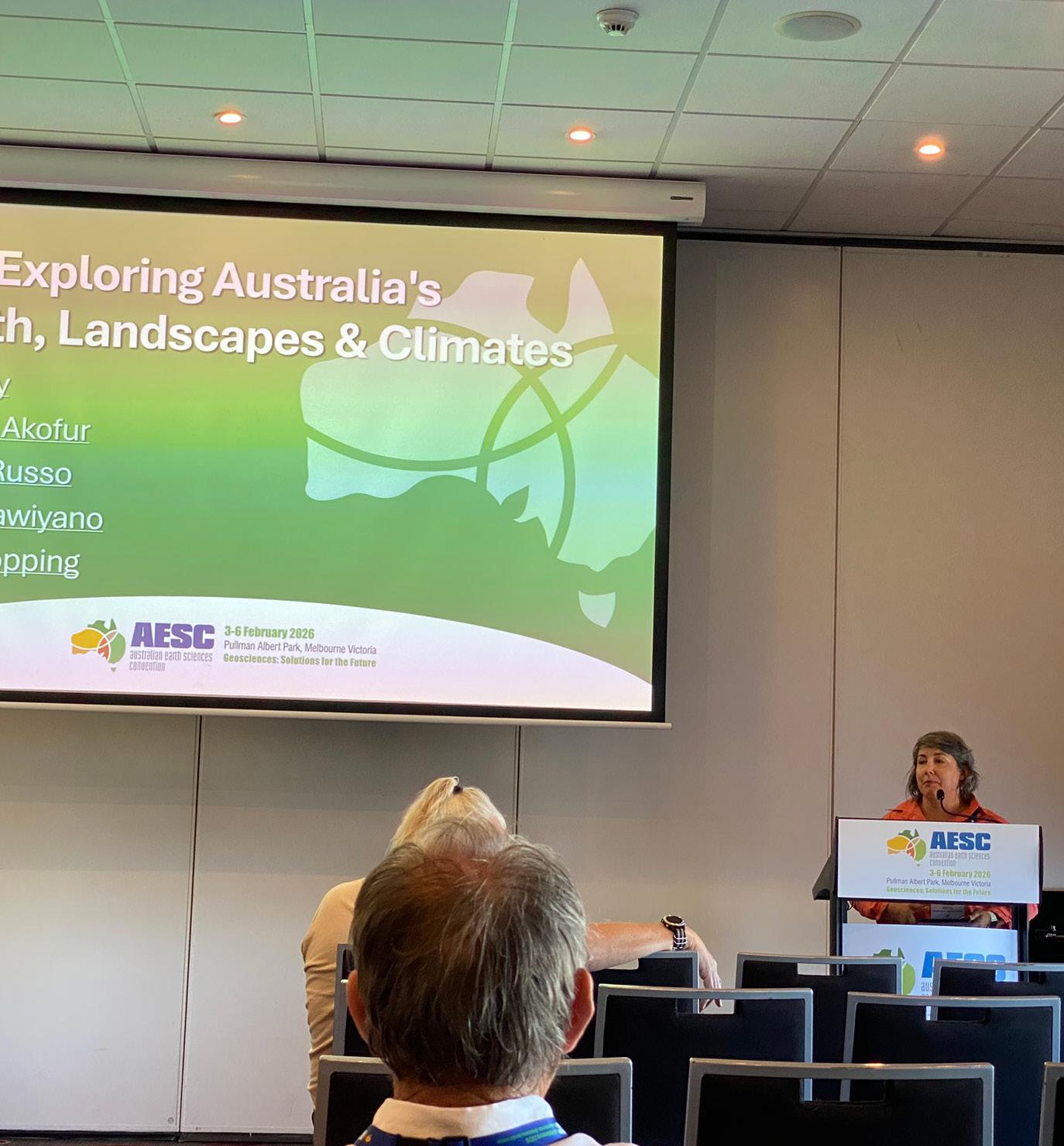
The latest in palaeontology and palaeoenvironment research
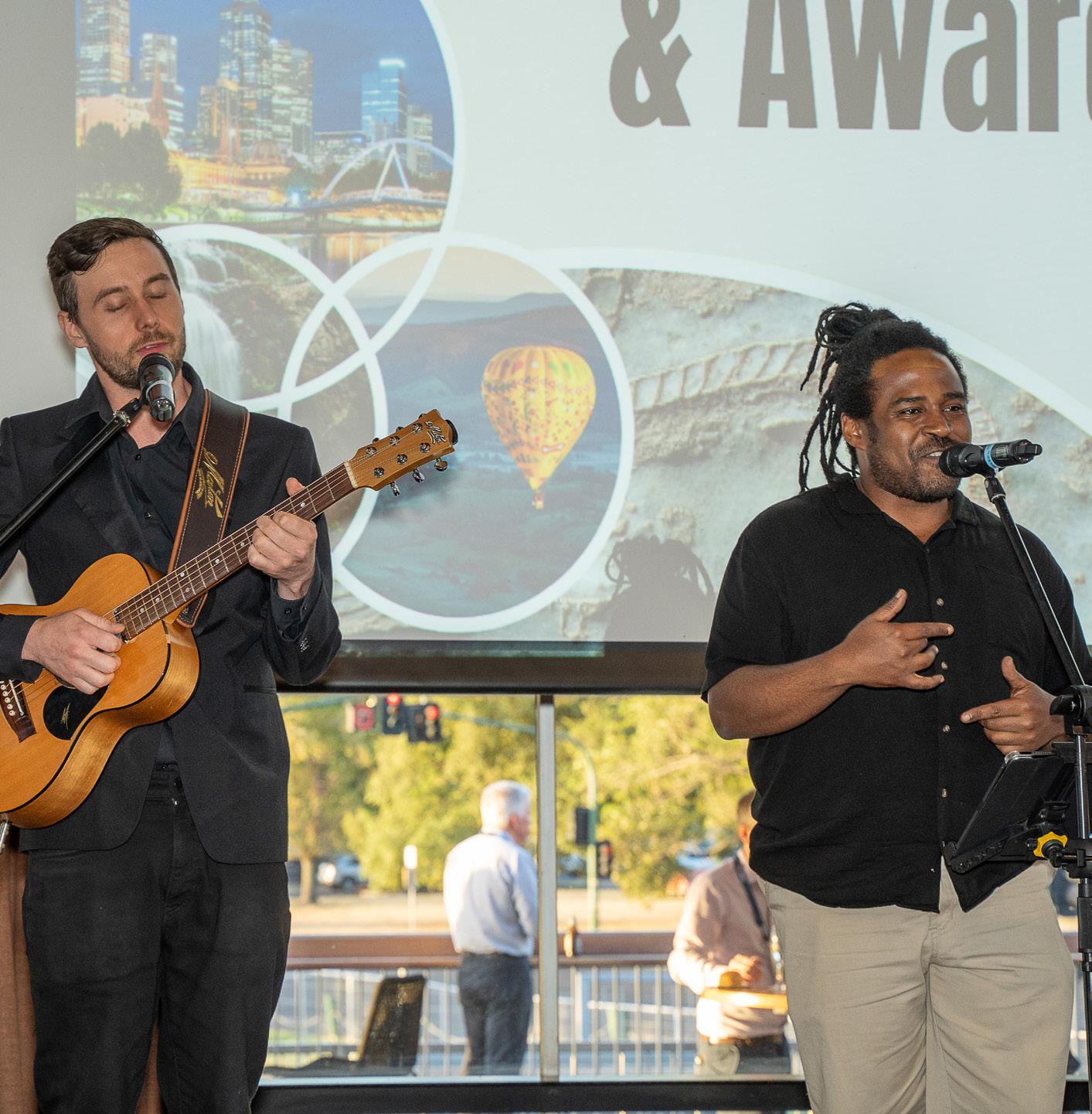
A fun debut for Up Goer 5
To promote and advance EARTH
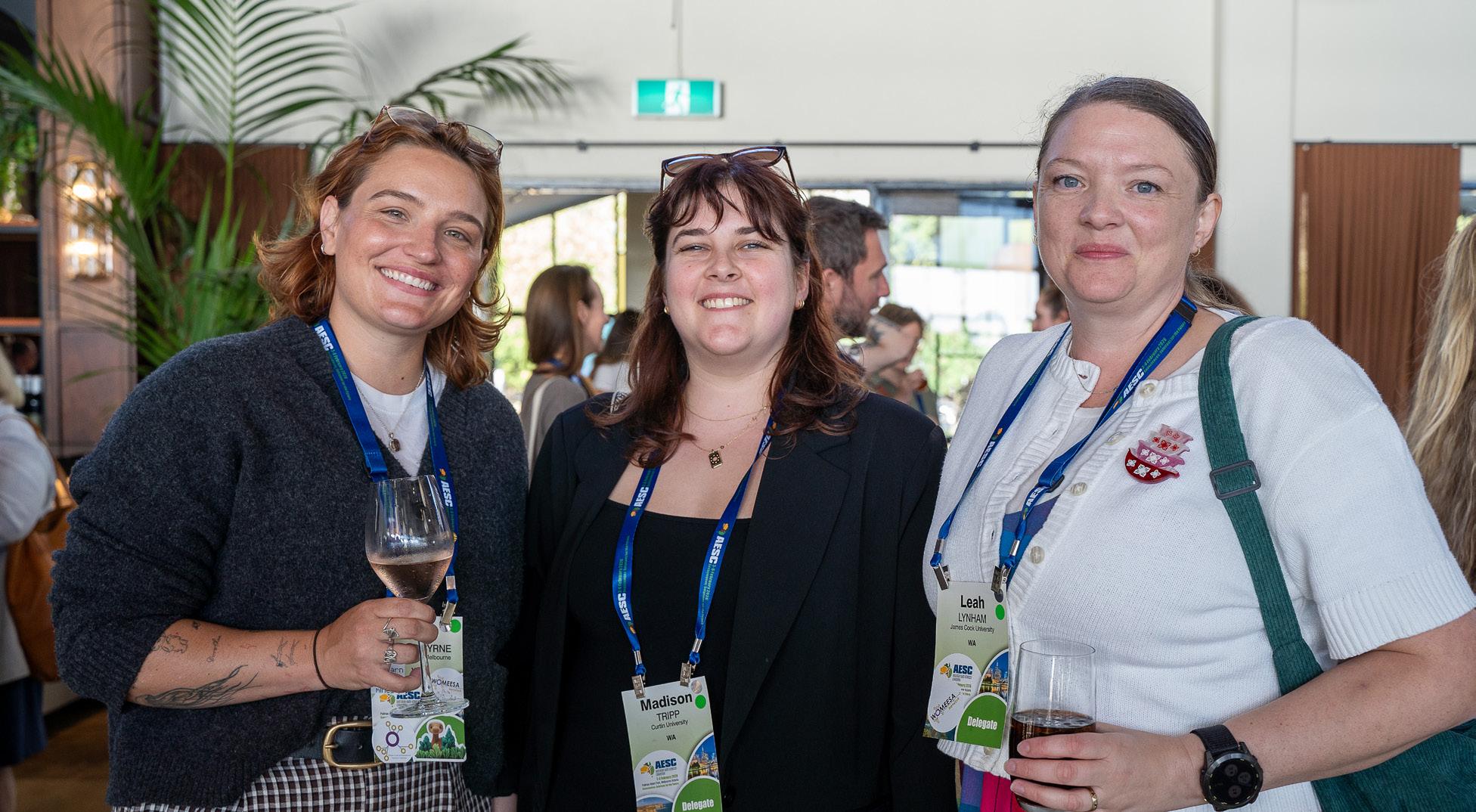
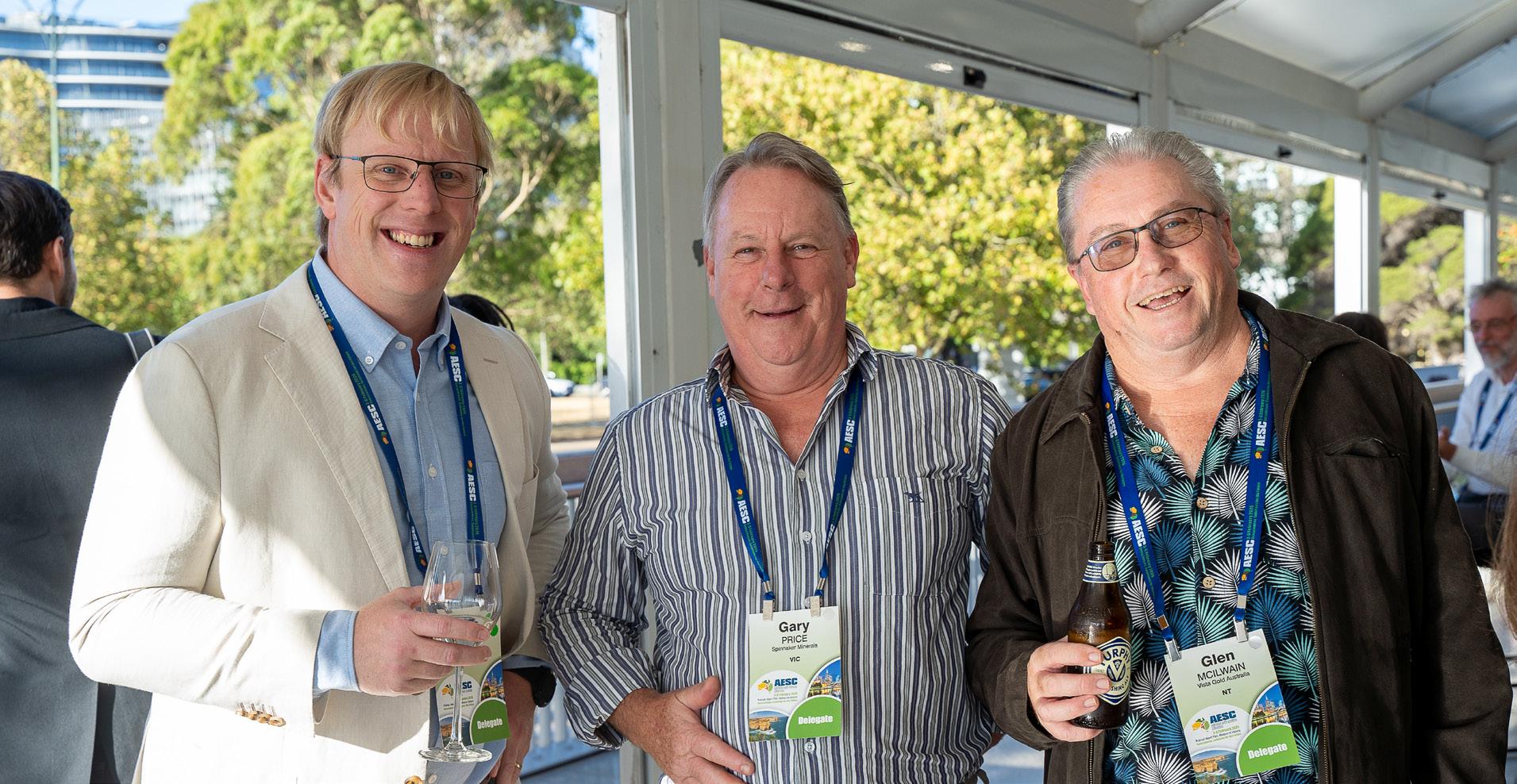
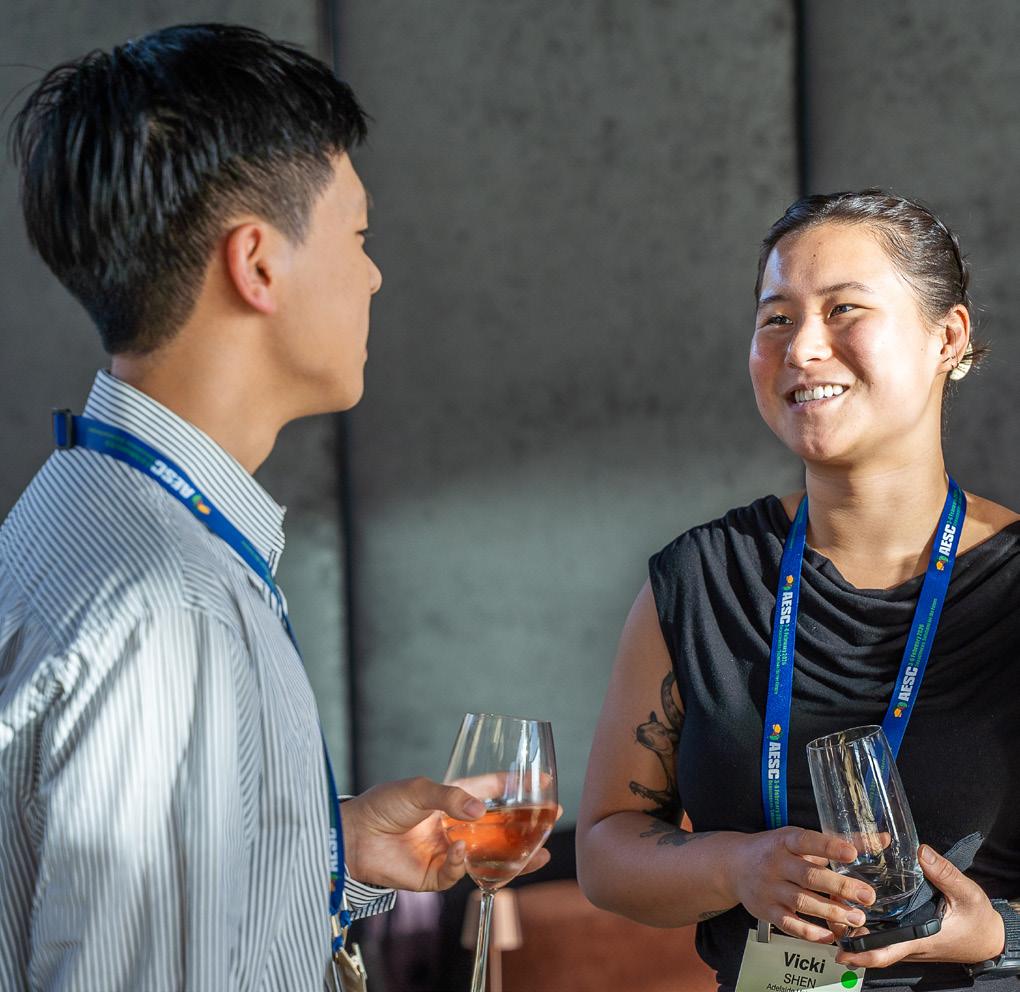
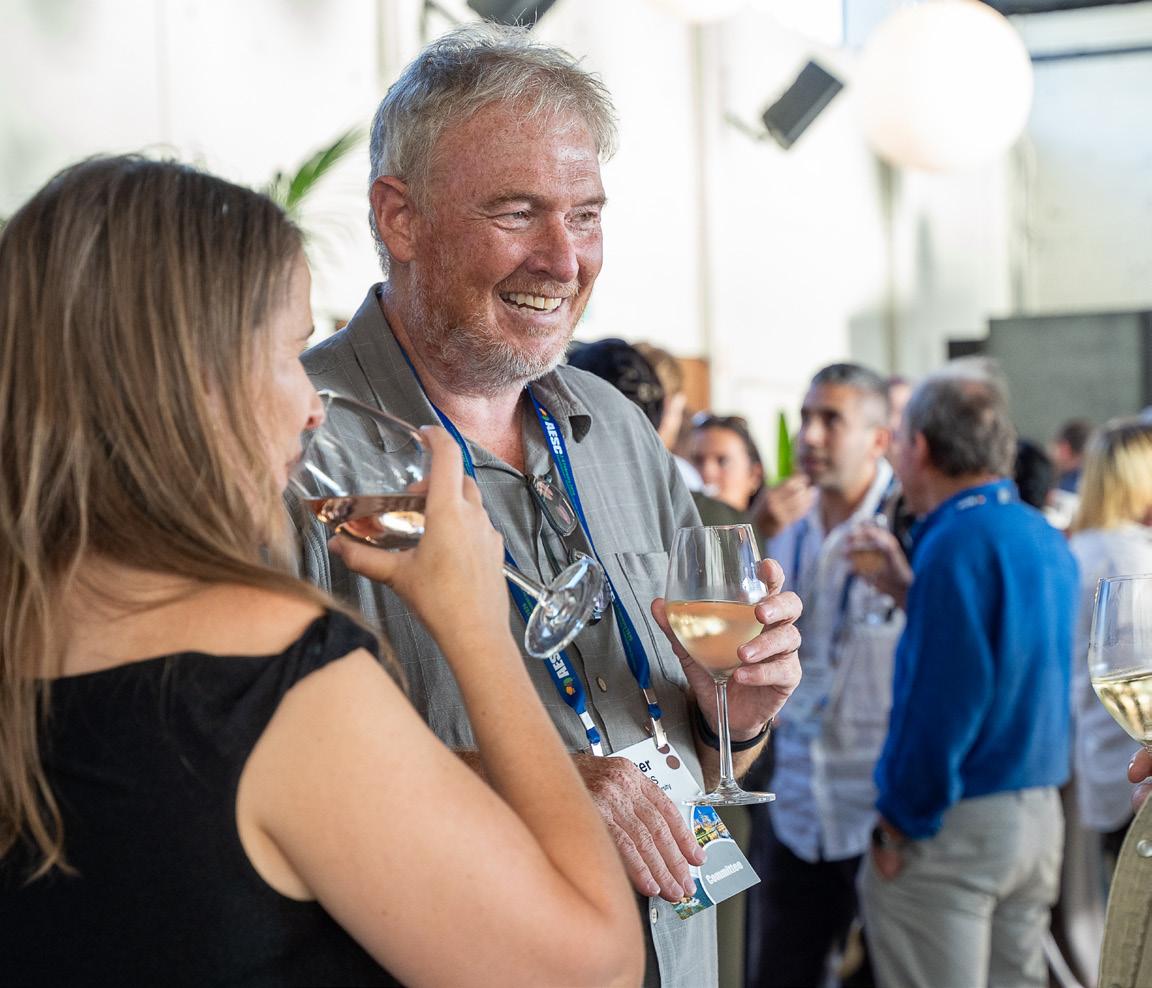
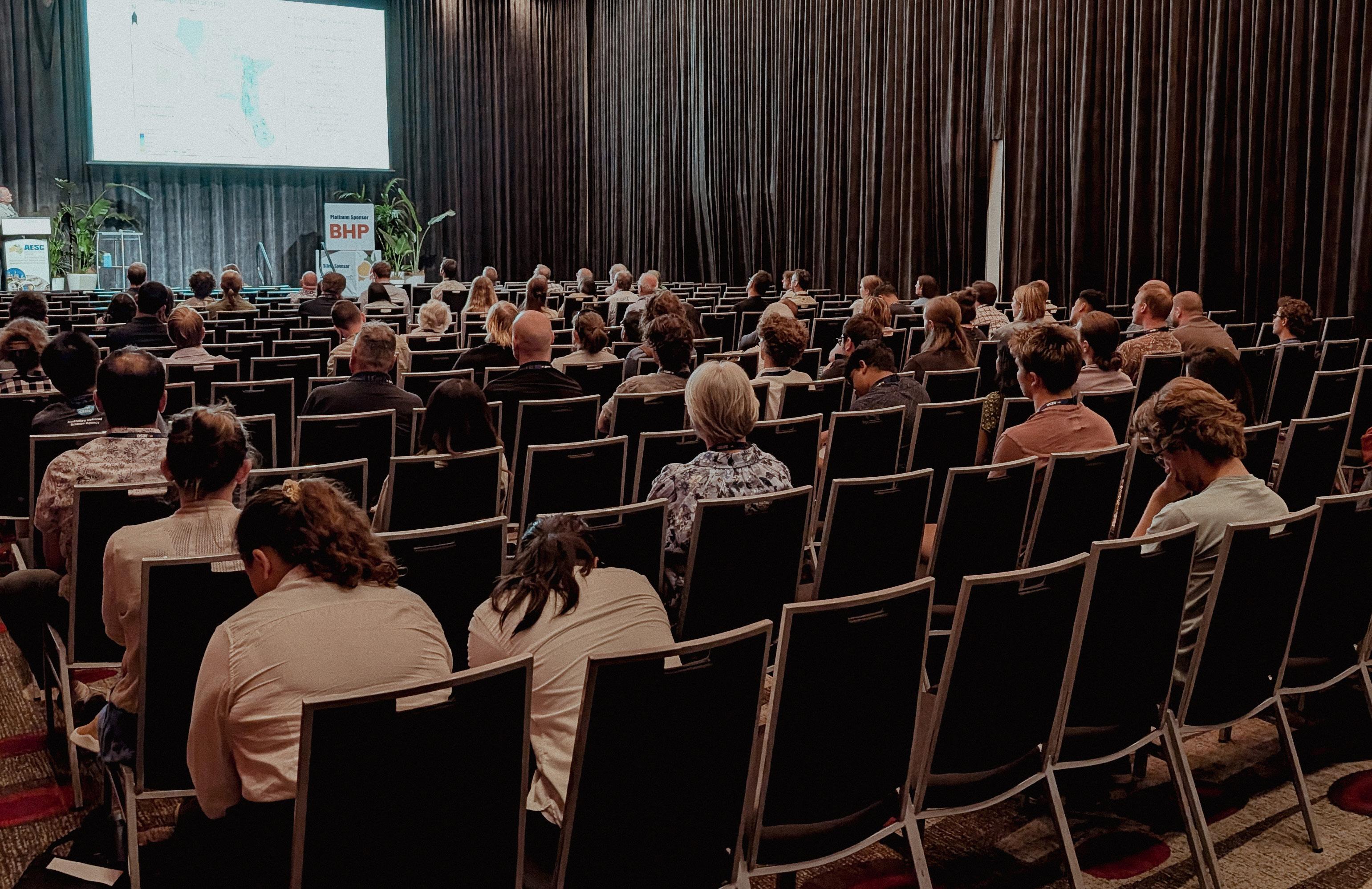
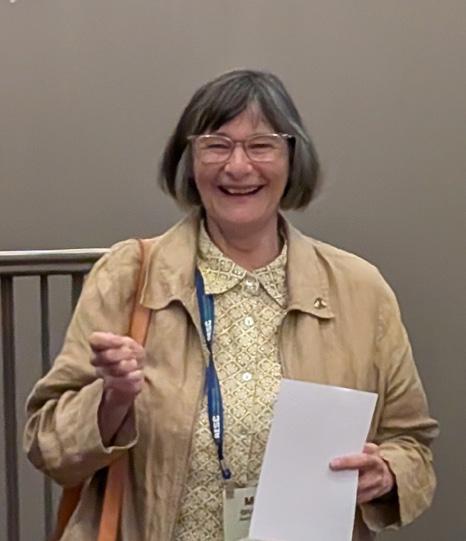
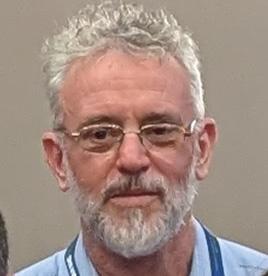
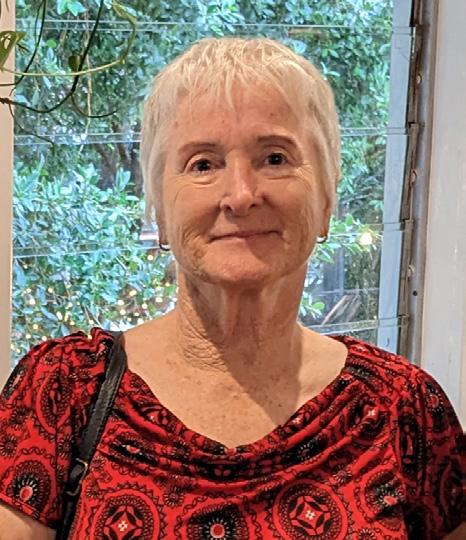
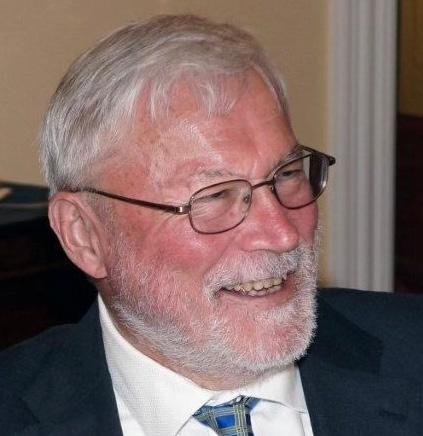
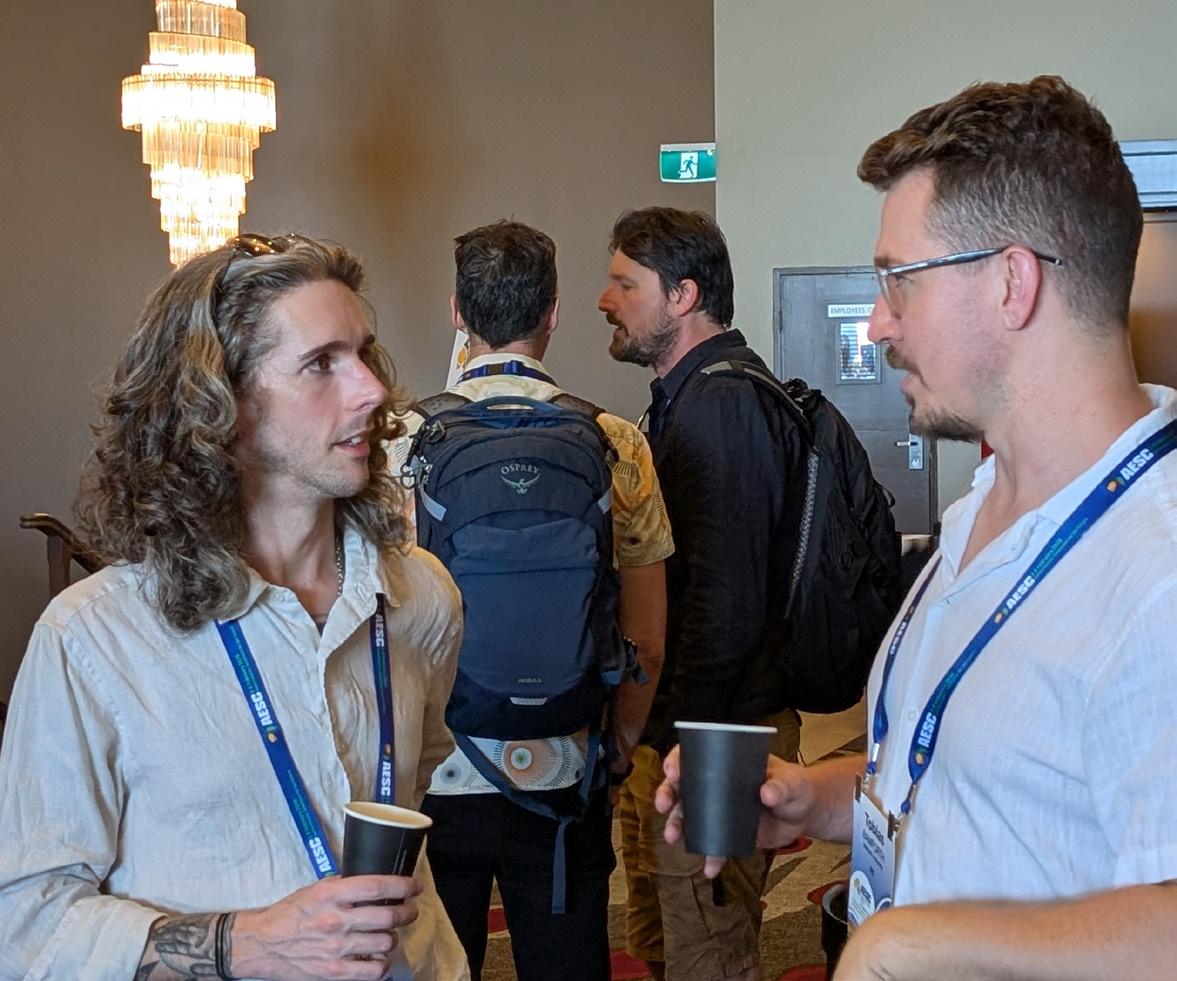
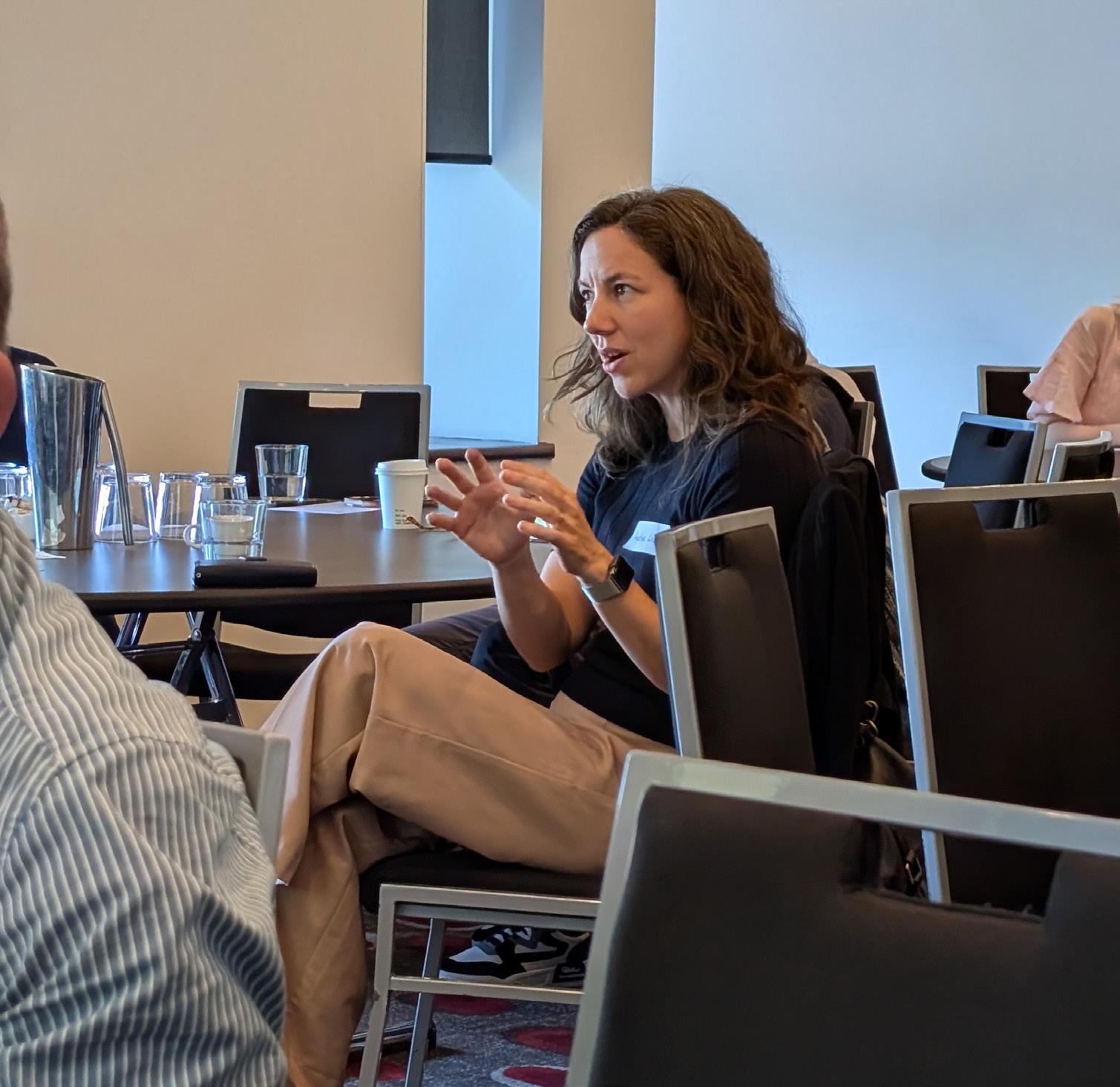
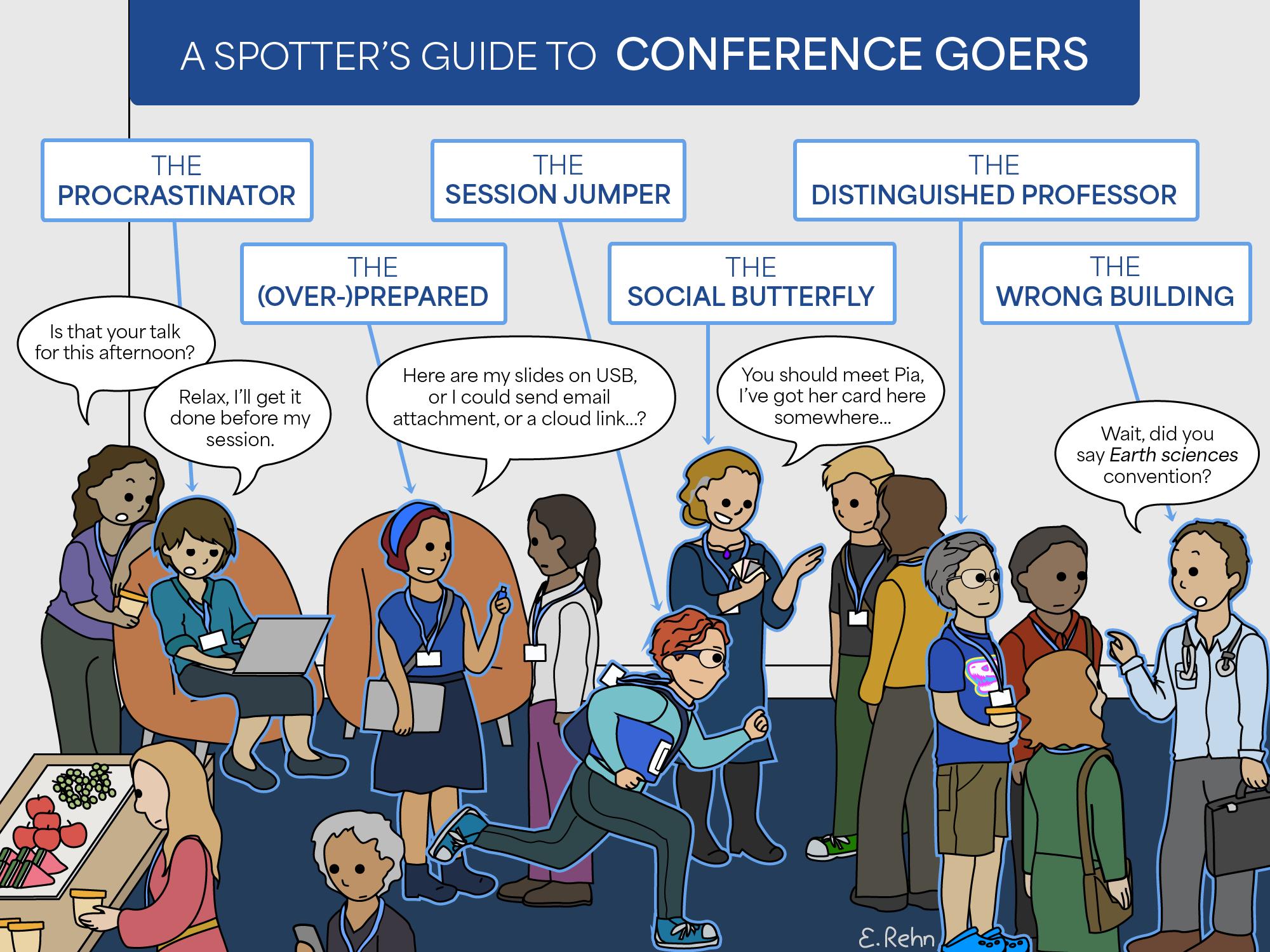
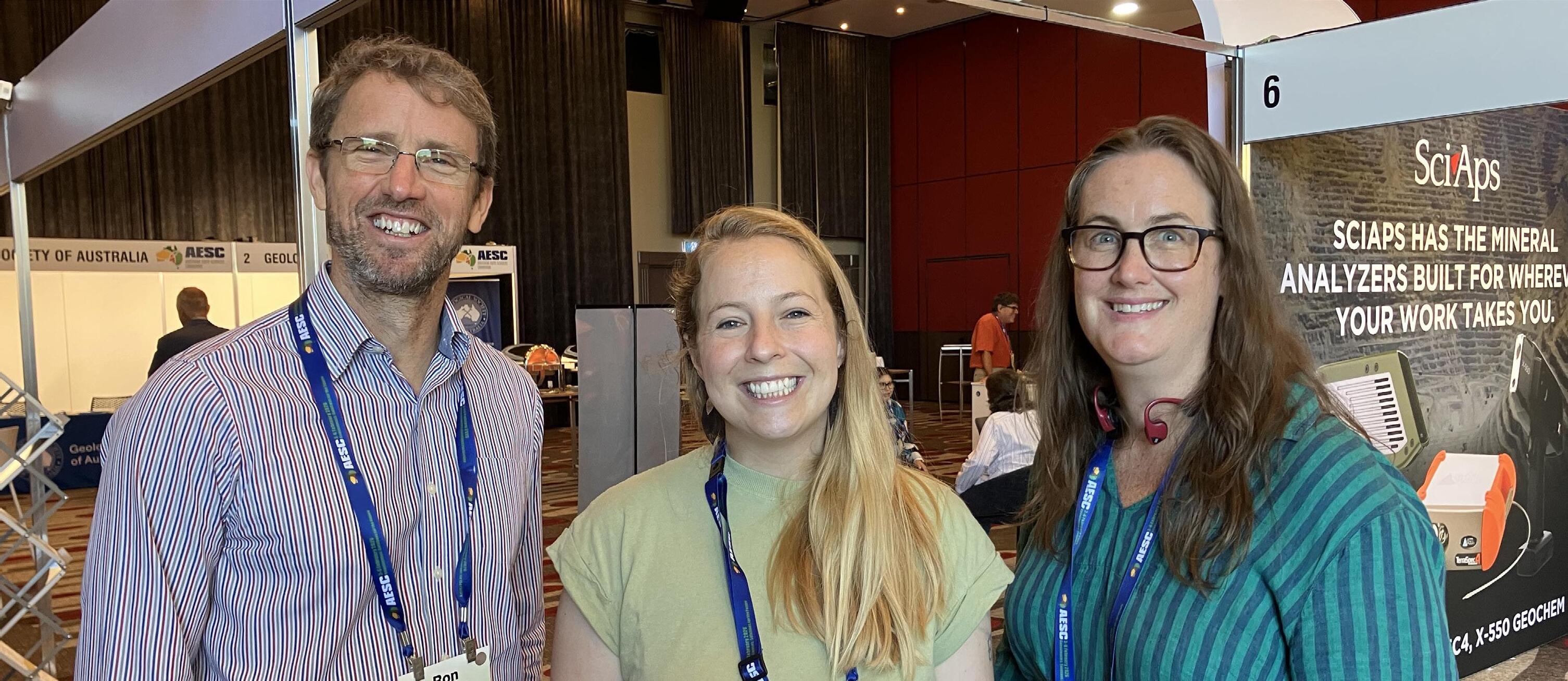
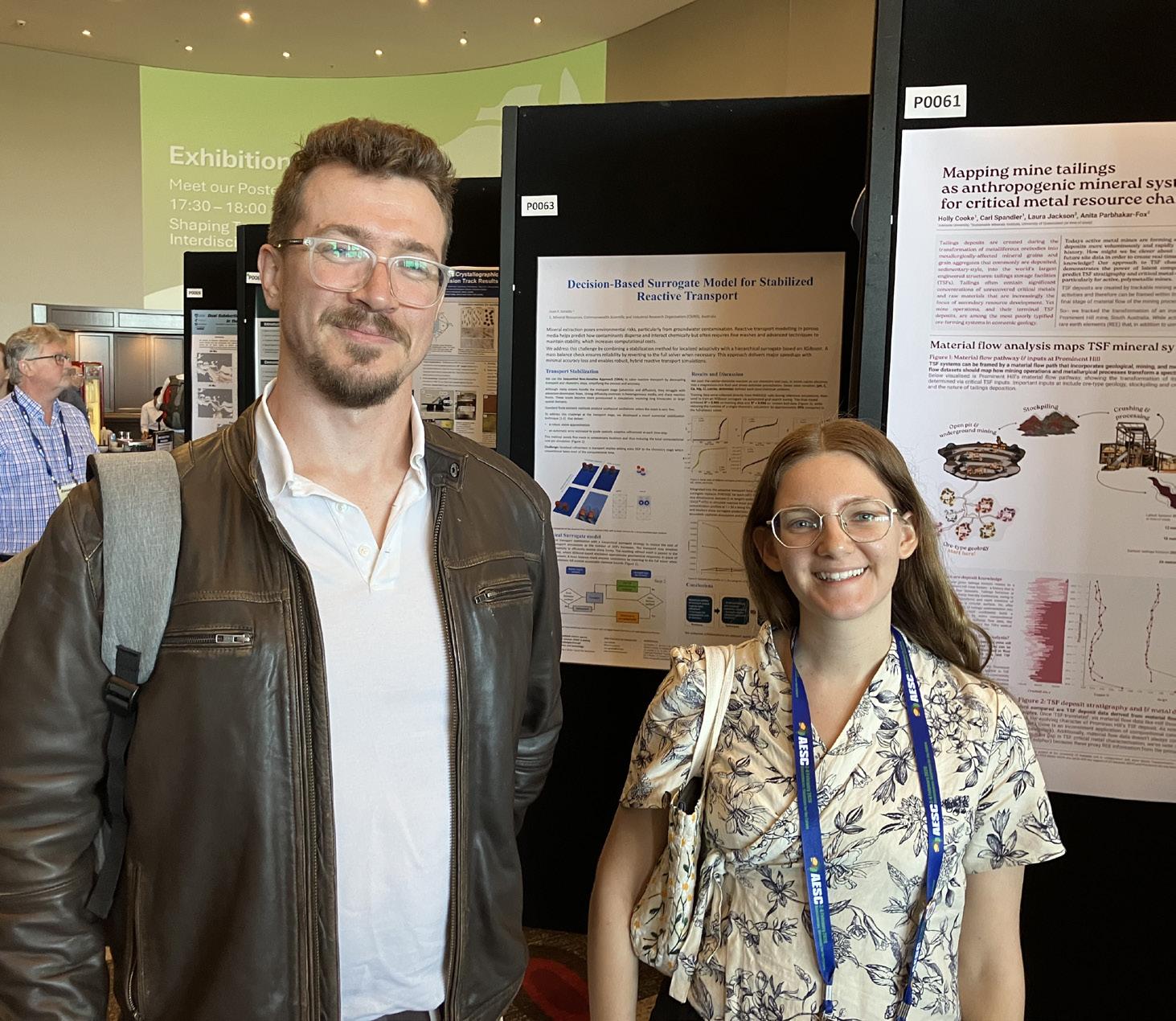
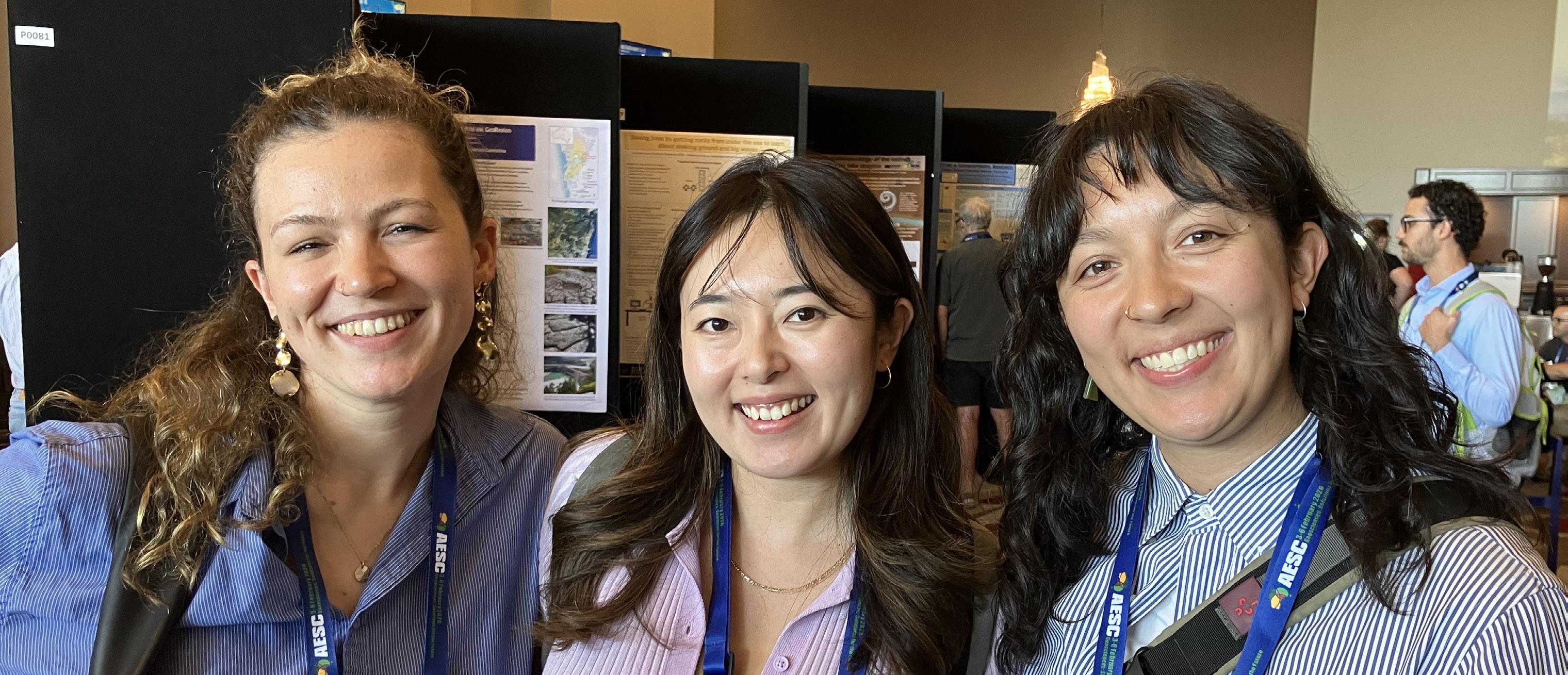
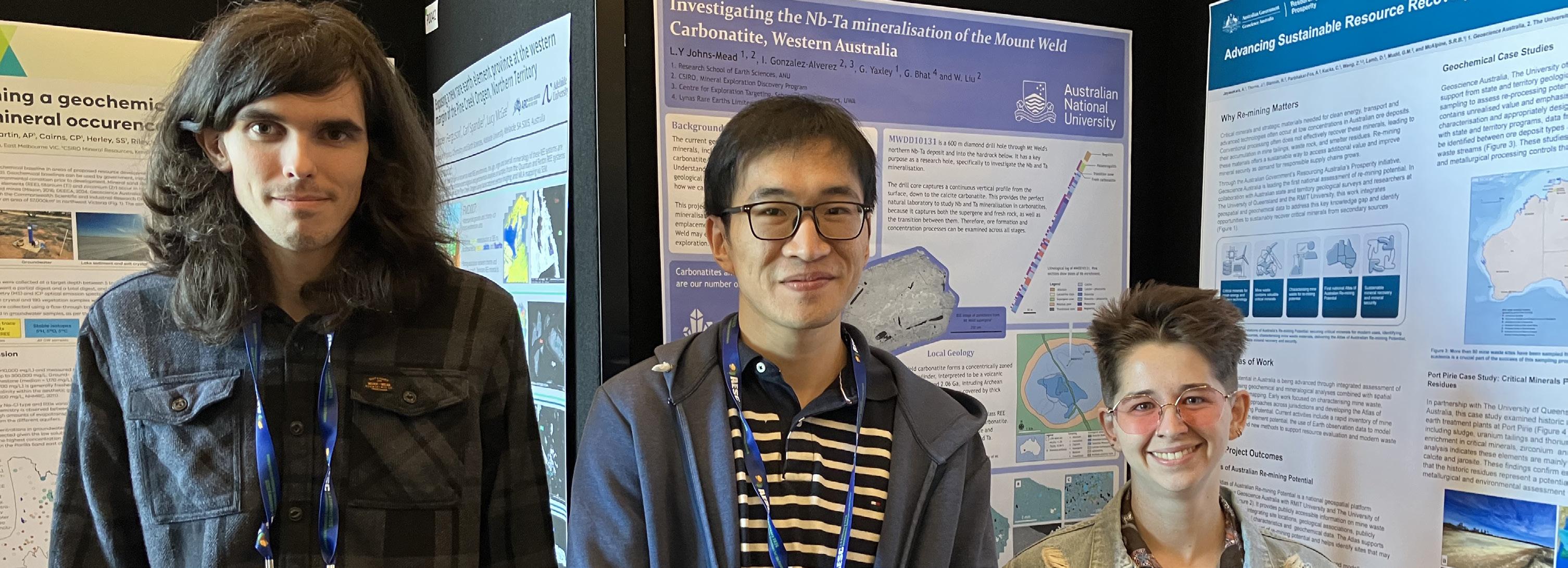
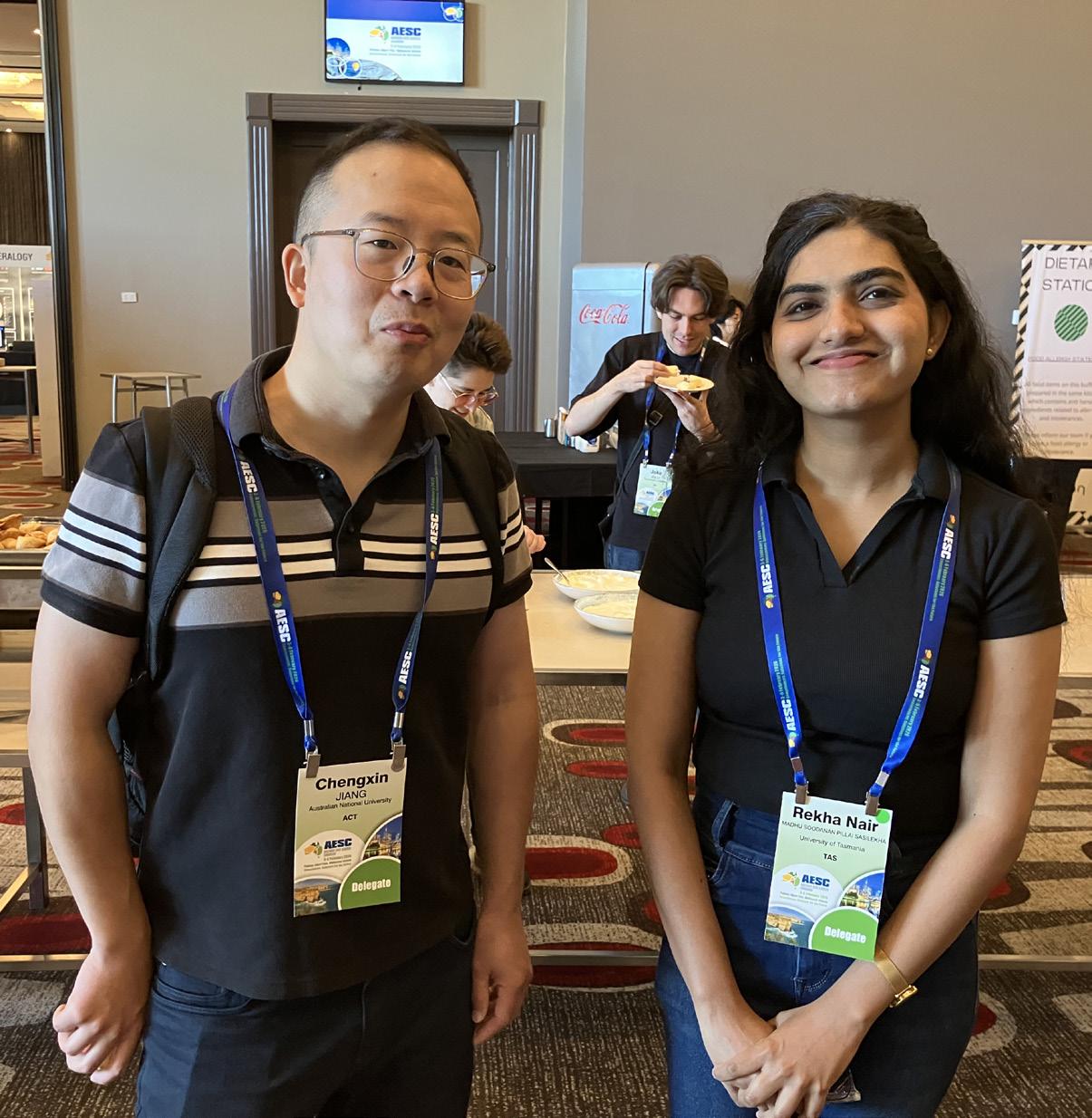
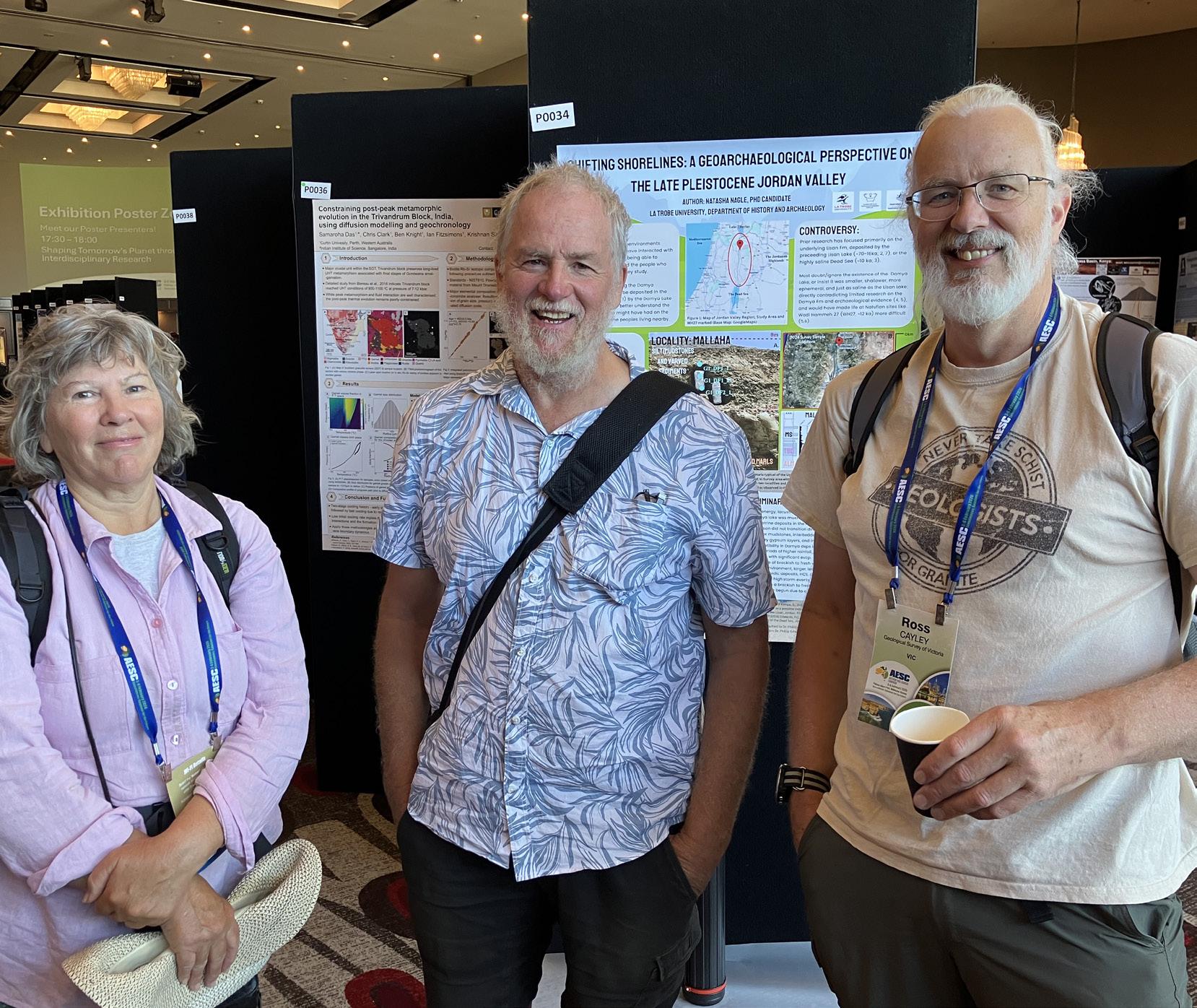
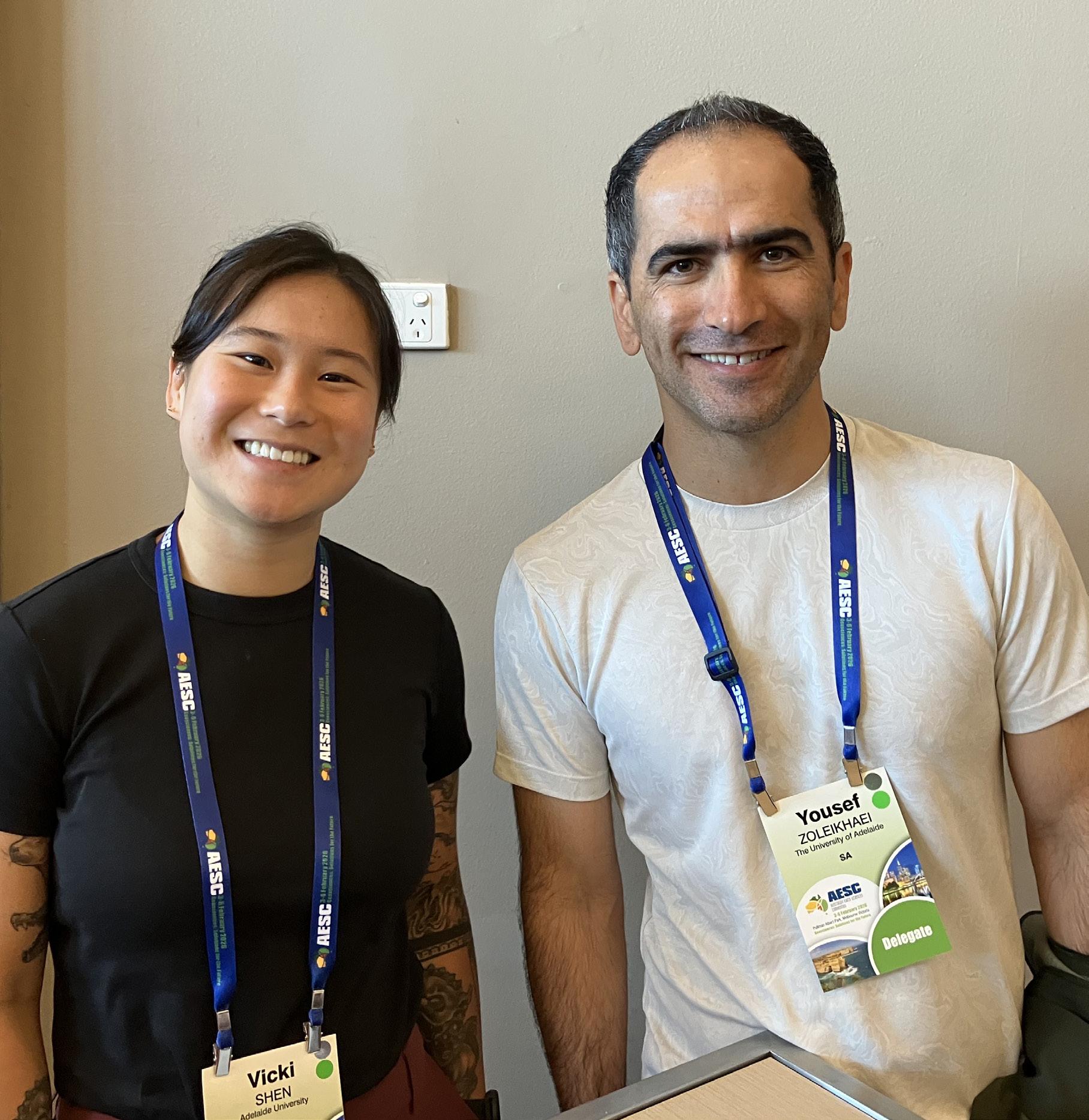
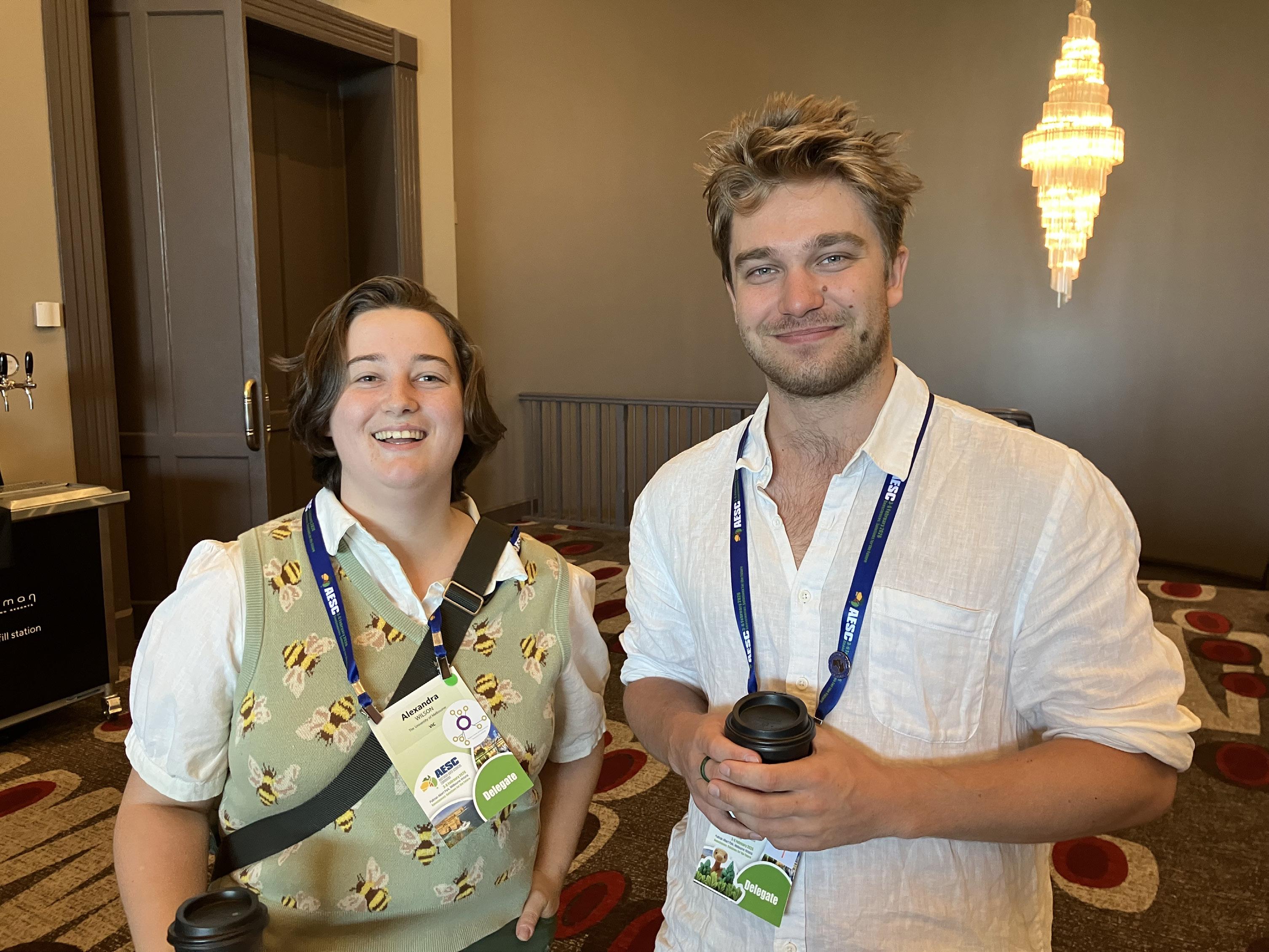
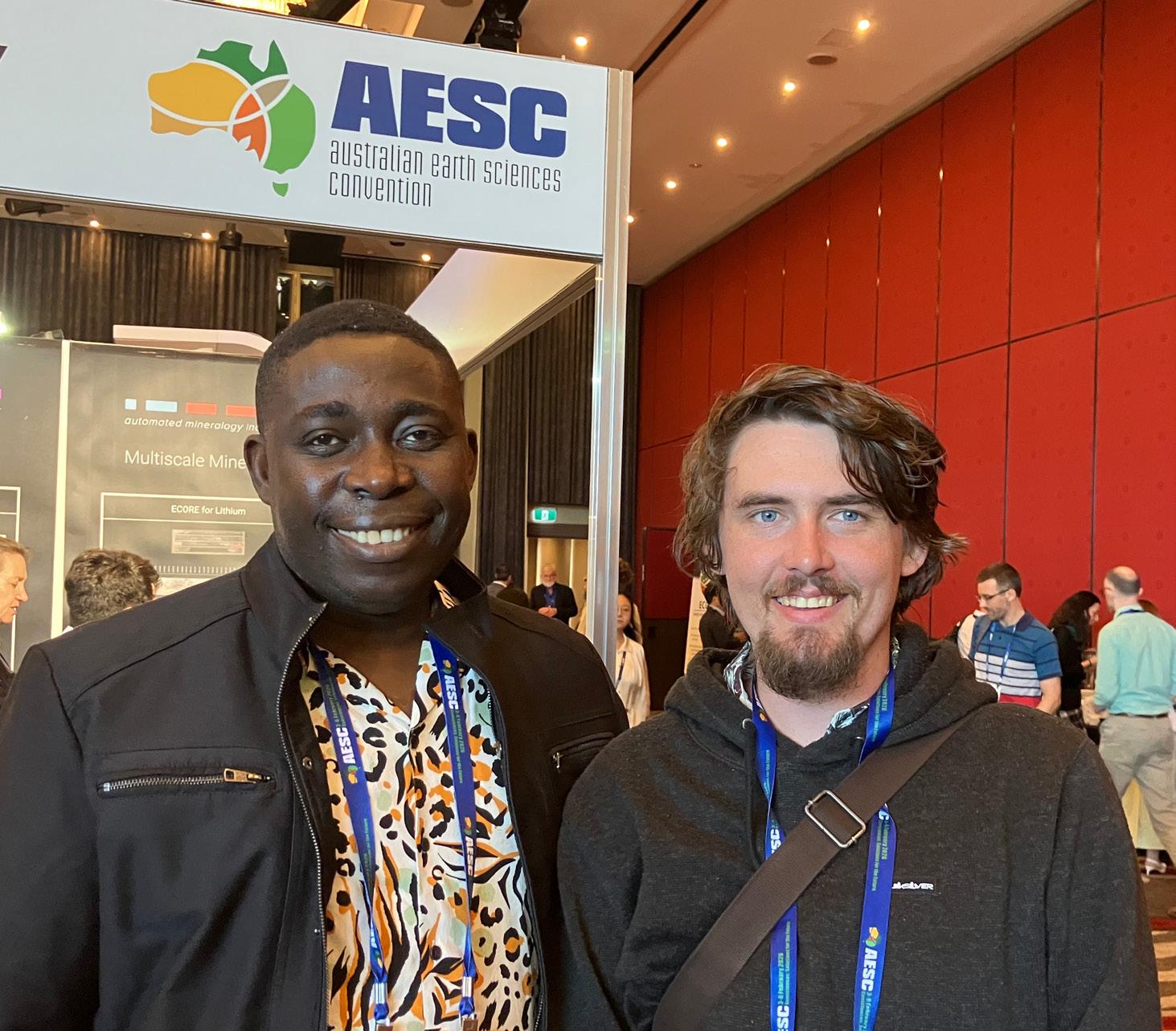
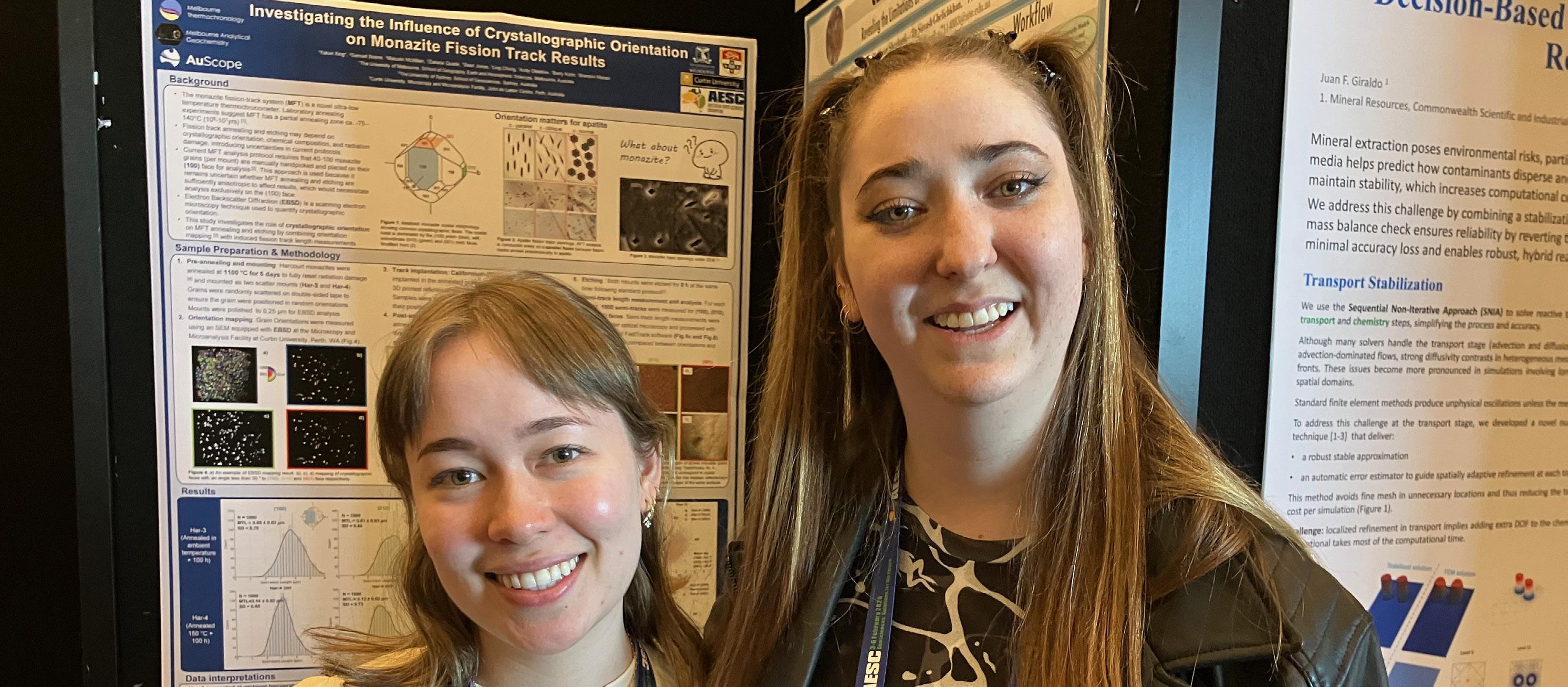
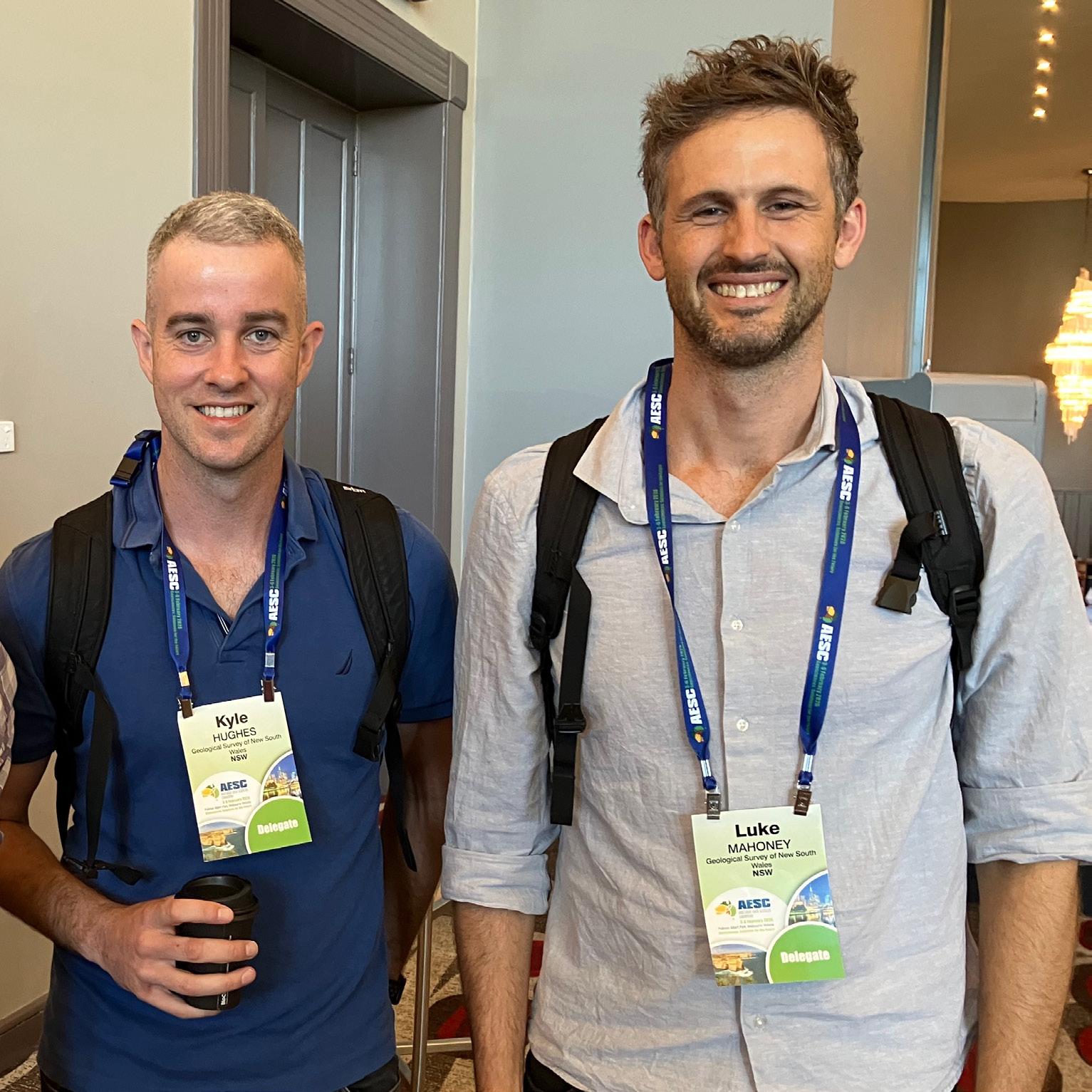
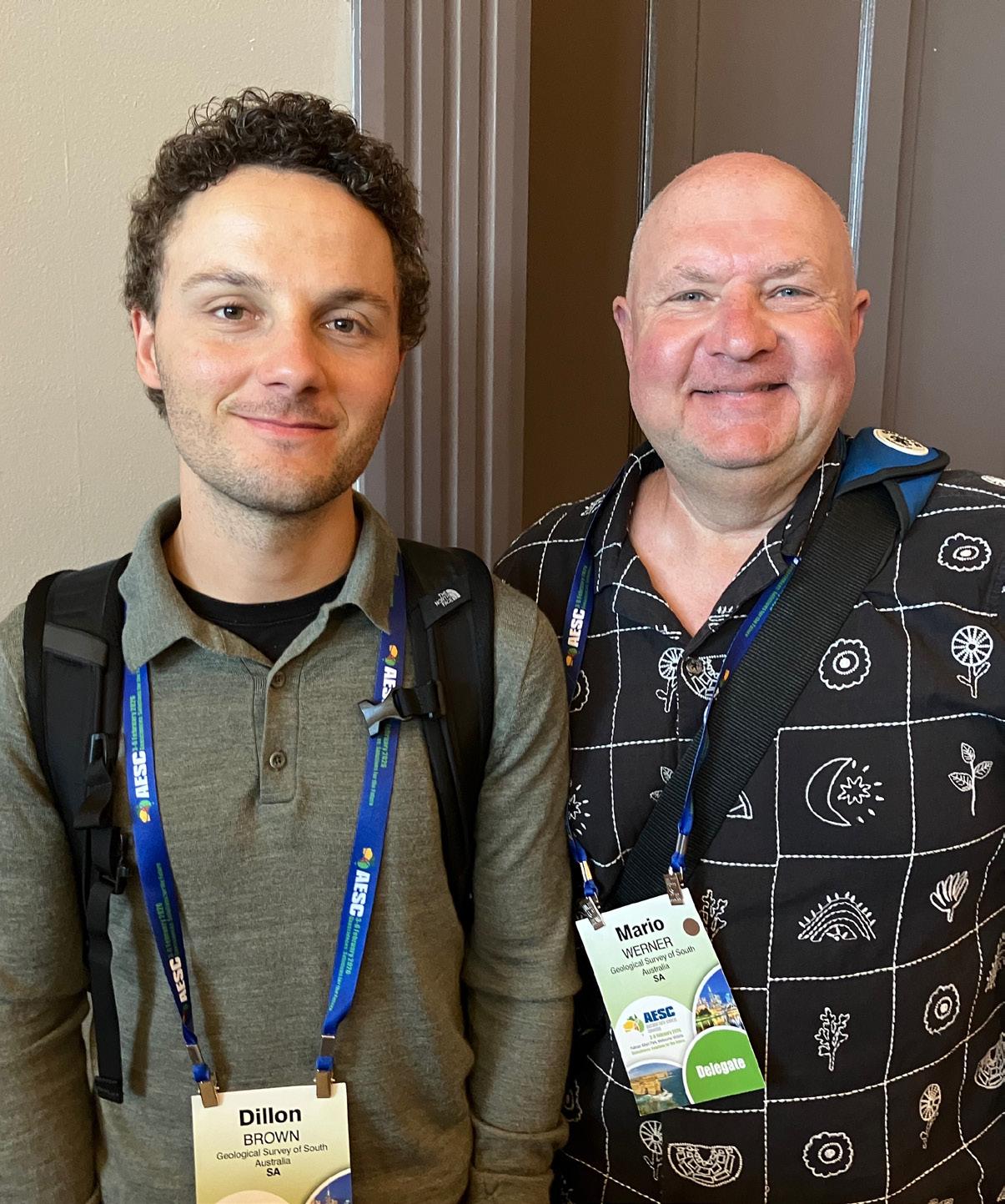
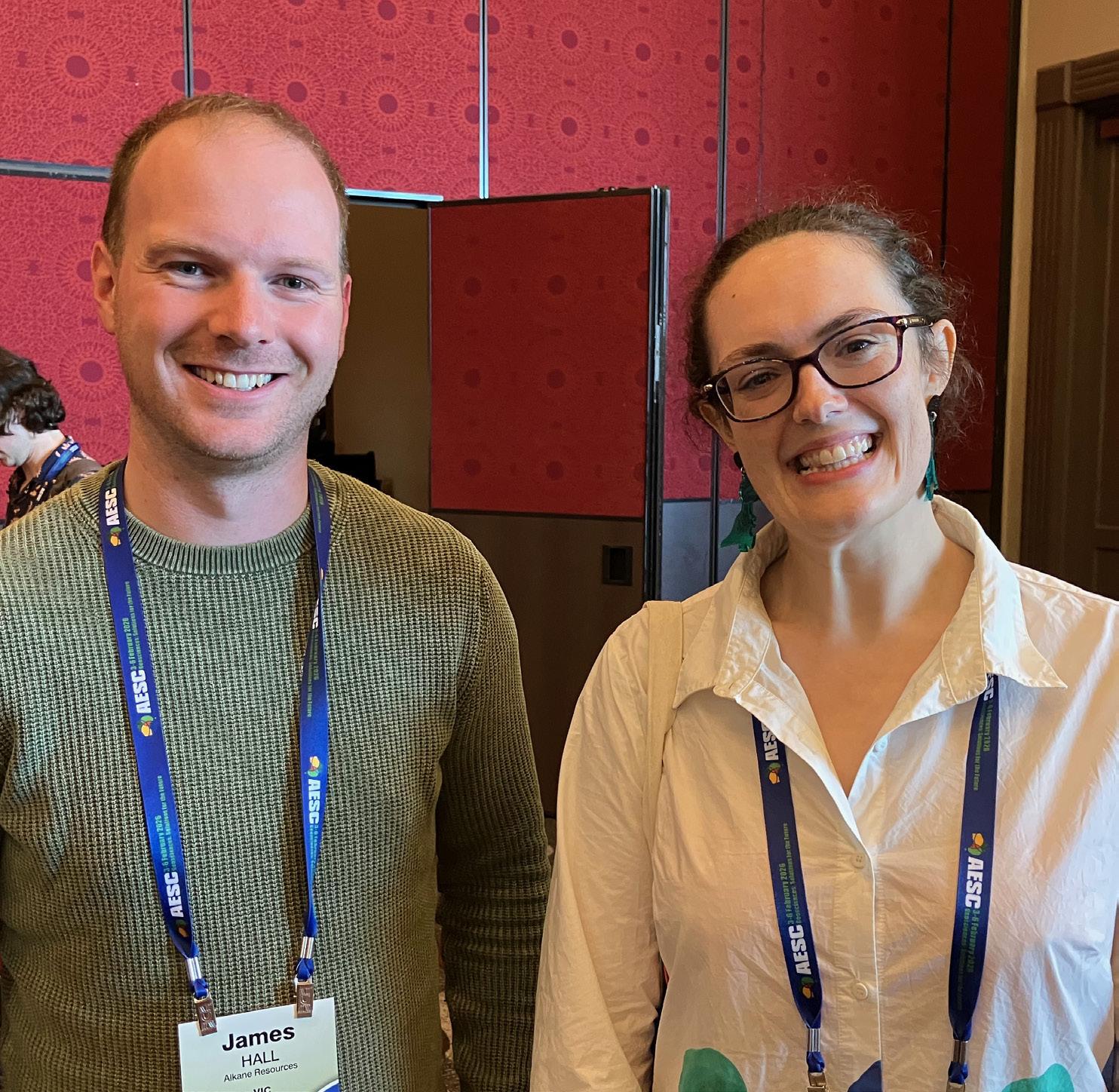
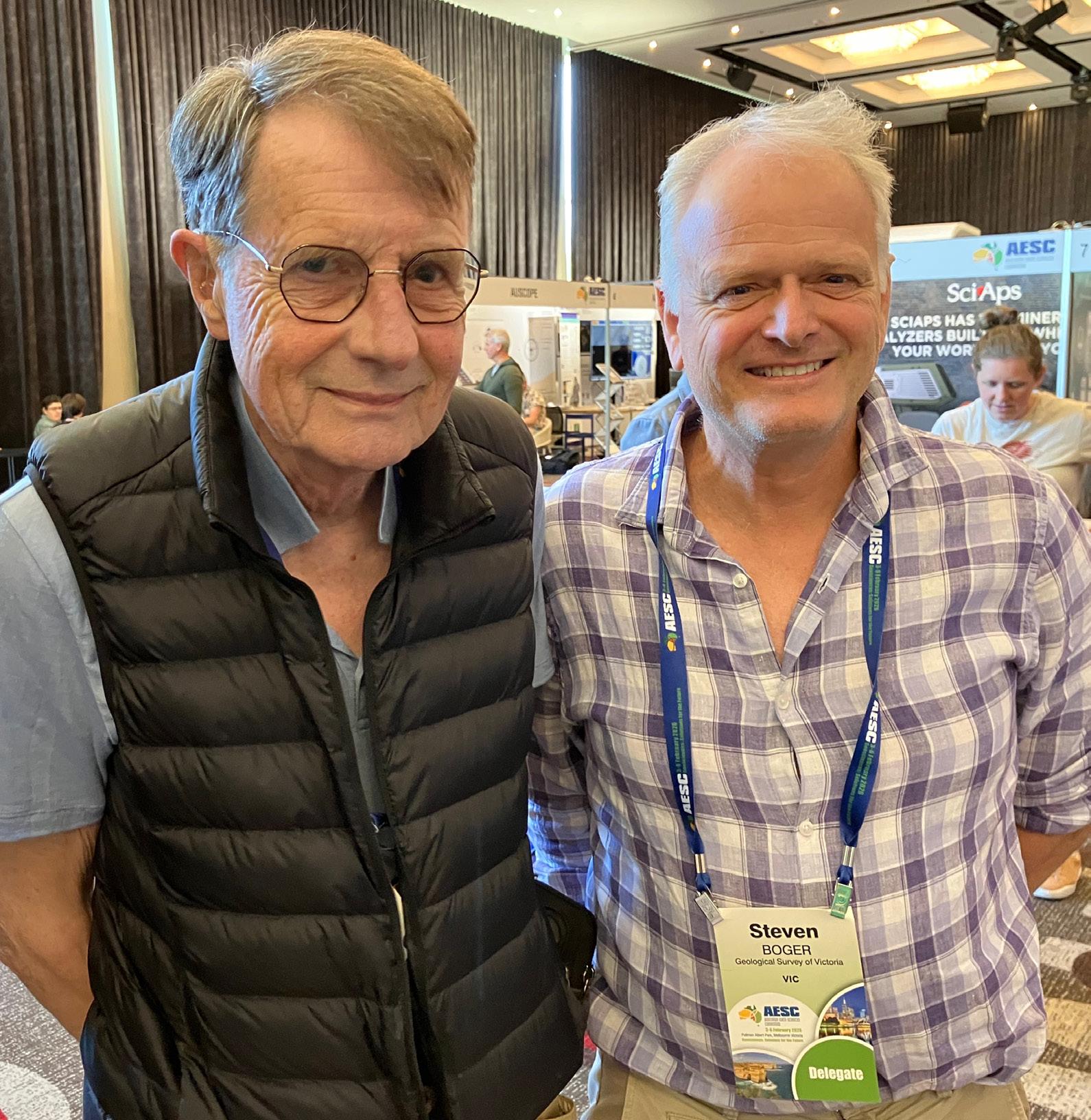
Vox pop with delegates at AESC
In the spirit of reconciliation, the Geological Society of Australia acknowledges the Traditional Owners of Country throughout Australia and their connections to land, sea and community. We pay our respect to Elders p ast and present and extend that respect to all Aboriginal and Torres Strait Islander readers of TAG . This magazine was produced on the lands of the Kulin Nation, Larrakia and Birpai Countries.
We are committed to fostering a diverse, equitable, and inclusive geoscience community where every geoscientist can thrive.
CELEBRATING EXCELLENCE AT THE 2026 GSA AWARDS NIGHT
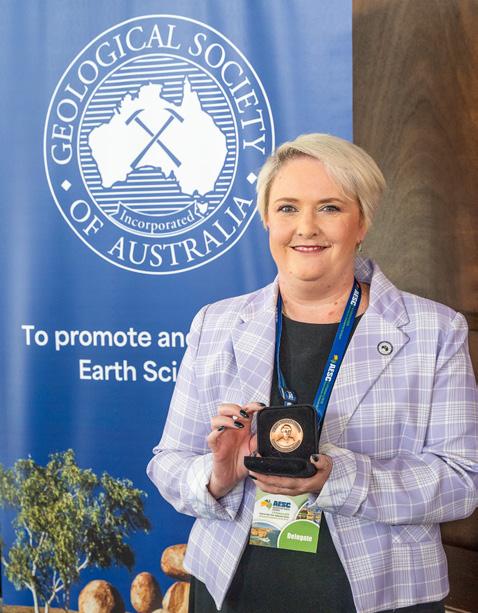
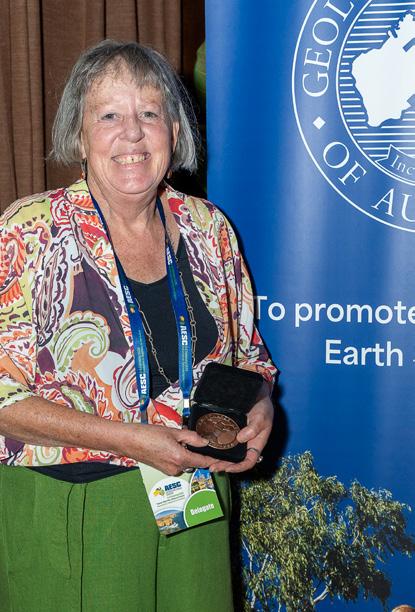
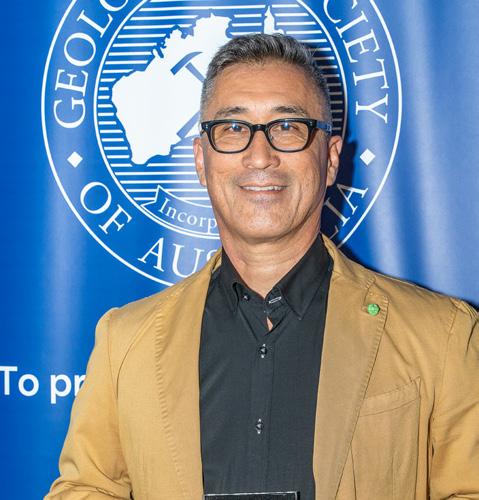
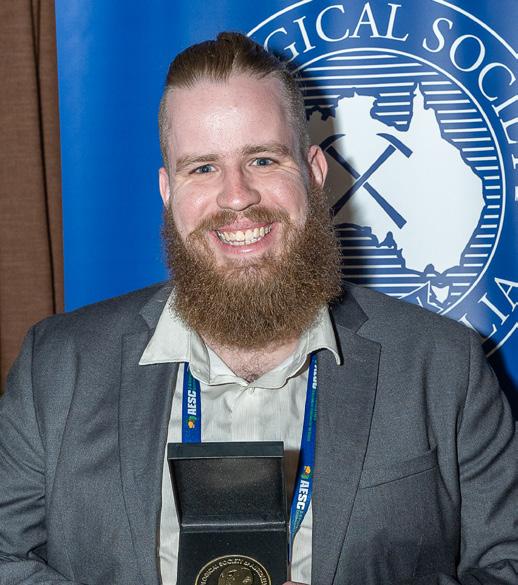
Inaugural national medals, all the awardees, and profiles of Raiza Toledo Rodrigues, Sarah Jones and Greg Yaxley
ANTIMONY: A CRITICAL MINERAL ON THE MOVE
UP GOER 5 AT AESC
The fun conference presentation challenge comes to Australian geoscience
AESC FIELD TRIP REPORTS
Cape Liptrap, regolith and the urban fringe, and Wil-im-ee Moor-ring
PALAEONTOLOGY AND PALAEOENVIRONMENTS AT AESC
Australia’s extinct lake dolphin, novel ways to detect ancient life and Gondwanan belemnites
GETTING INTO THE REGOLITH AT AESC
The ARGA symposium wrap-up and ARGA award winners
EARLY CAREER GEOCONNECT EVENT REPORT
Advice for building careers and making an impact
BUILDING CAPACITY AND INCLUSIVITY
Embracing diversity and inspiring the next generation at AESC VOX POP AT AESC
Favourite Australian geological sites, conference highlights and answering the question: is coffee really that popular in Melbourne?
Publishing Details
ISSUE 217, MARCH 2026
Registered by Australia Post
Publication No. 100010917
ISSN 0312 4711
EDITOR IN CHIEF
Sandra McLaren
DESIGN & TYPESETTING
Sarah Jackson
PRODUCTION MANAGER
Amber Jarrett
PRINTED BY Direct Mail Solutions
DISTRIBUTED BY Direct Mail Solutions
CENTRAL BUSINESS OFFICE
PO Box 576, Crows Nest NSW 1585
Email: info@gsa.org.au
Web: www.gsa.org.au
Phone: (02) 9160 8193
COVER IMAGE
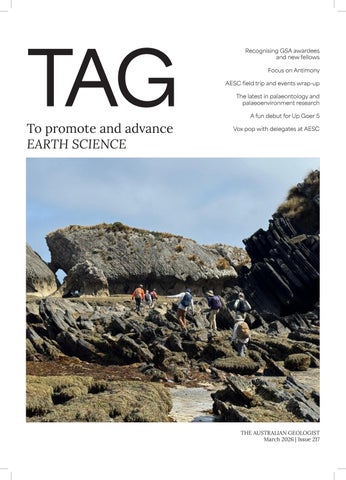
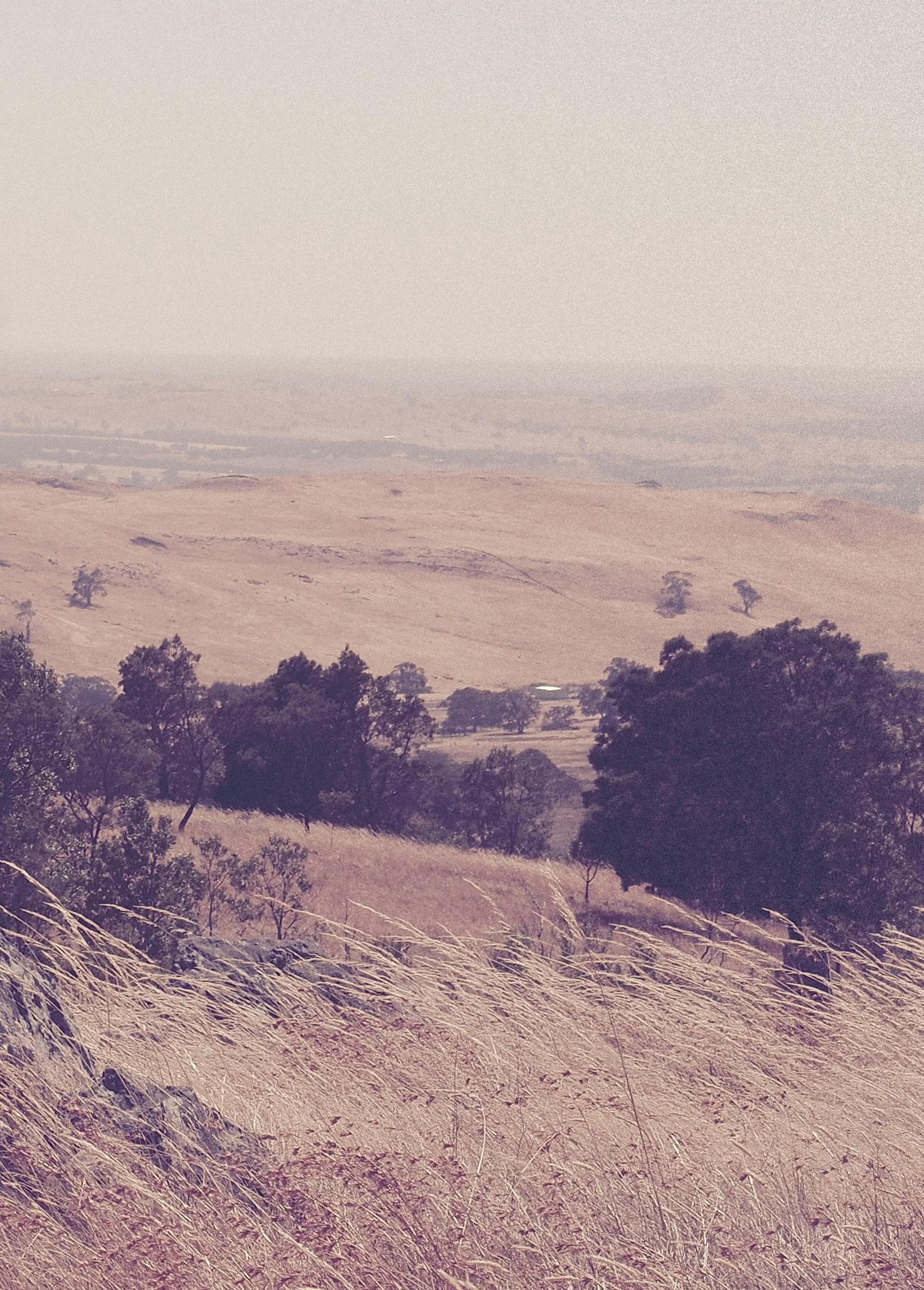
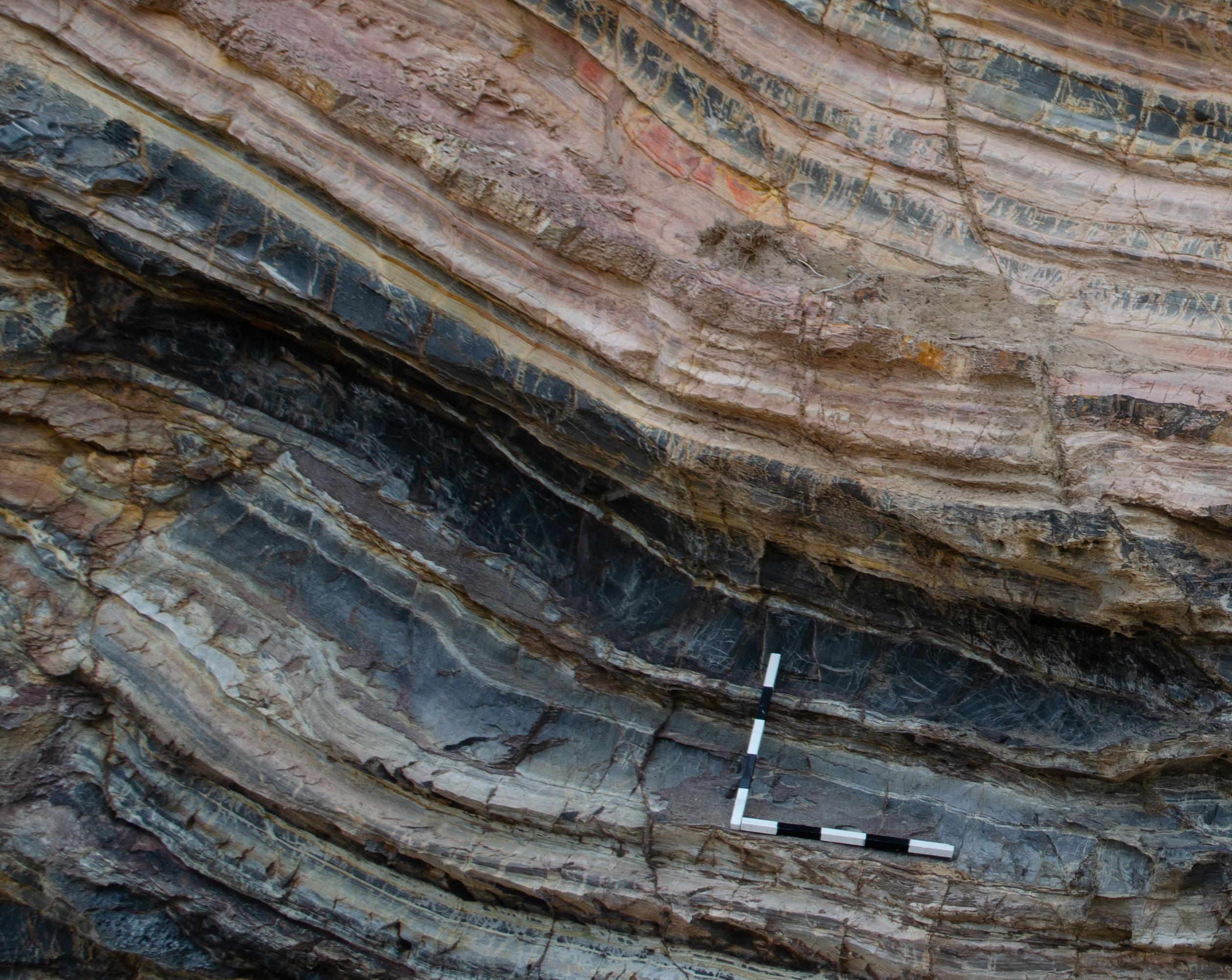
Cape Liptrap
Photo: Kevin Hill
INSIDE COVER IMAGE
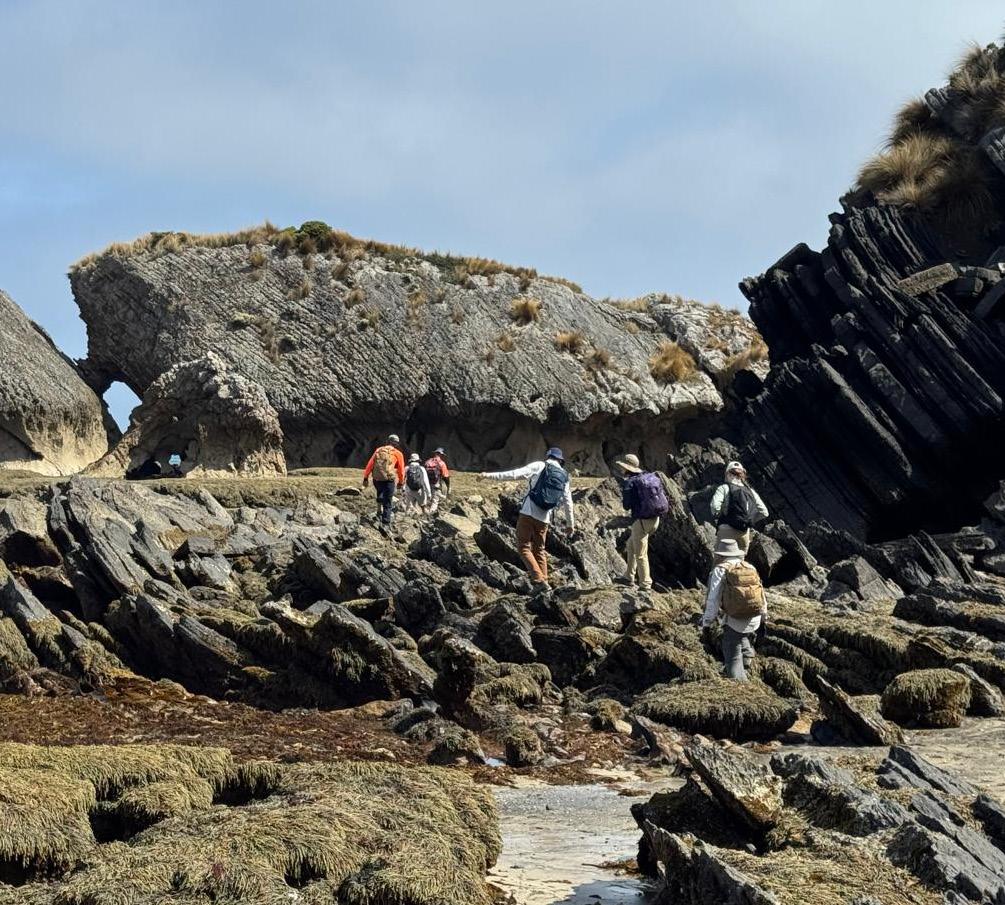
Wil-im-ee Moor-ring field trip
Photo: Sarah Jackson
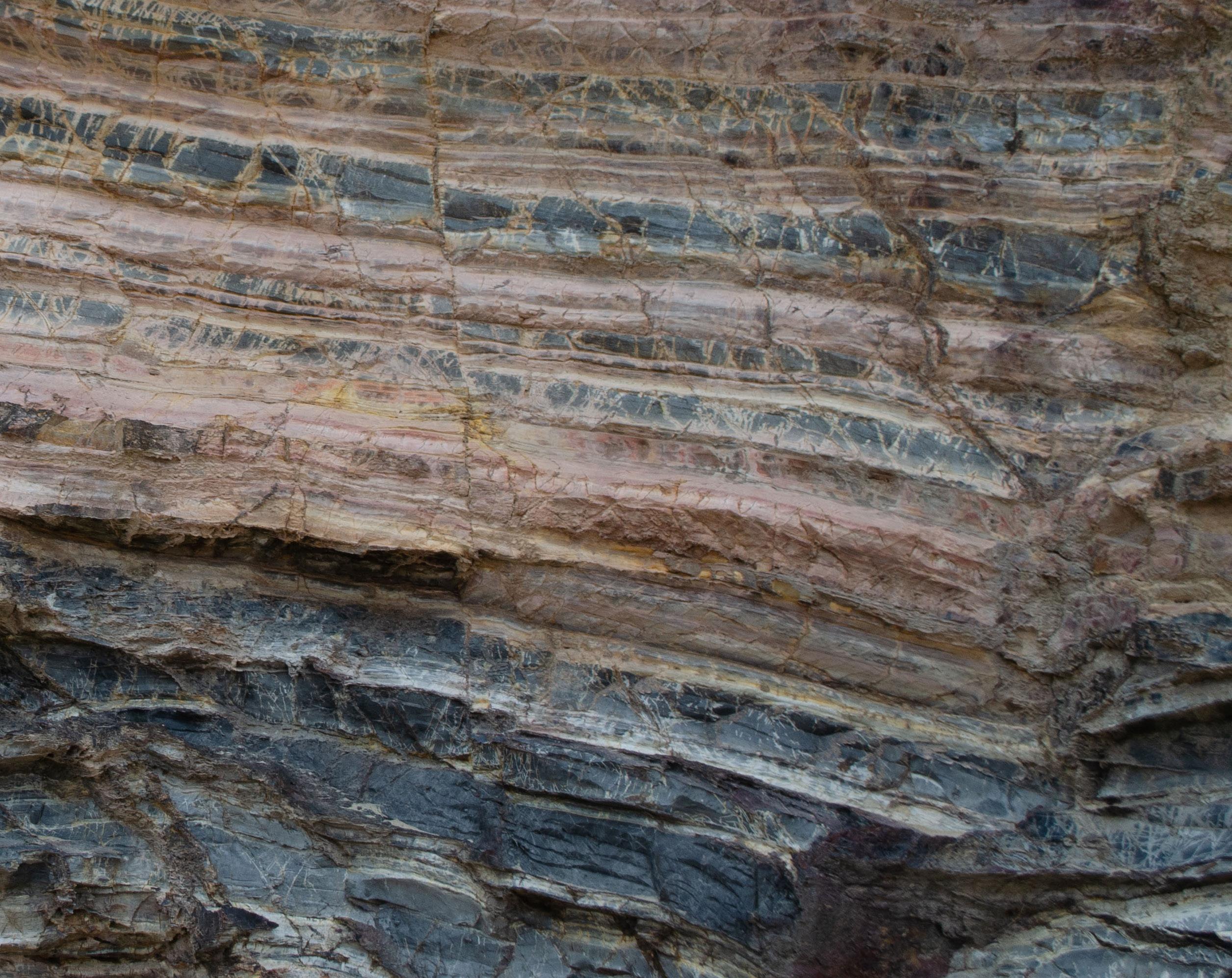
BACK PAGE IMAGE
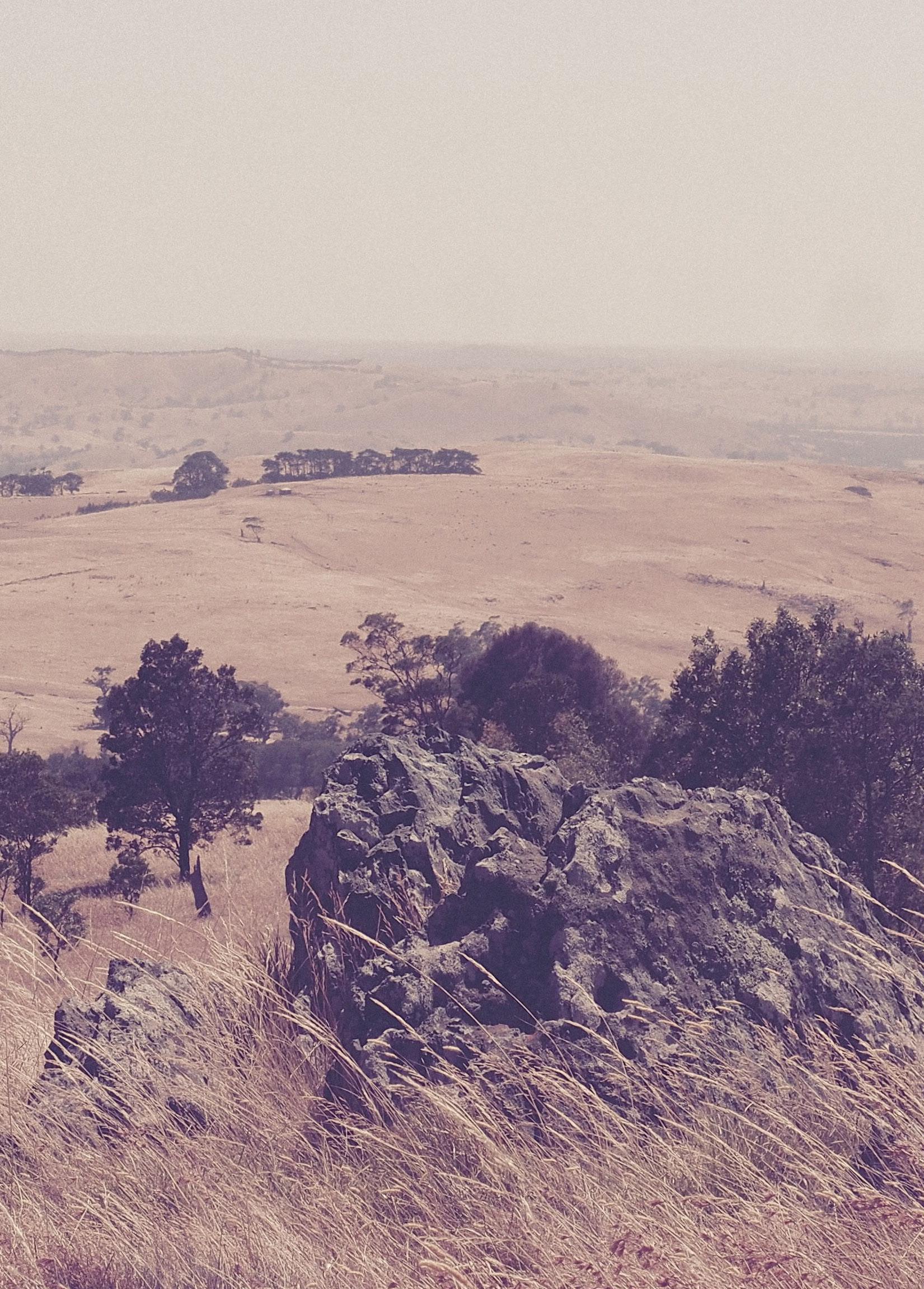
Wil-im-ee Moor-ring field trip
Photo: Sarah Jackson
GENERAL NOTES
The Geological Society of Australia (GSA) is a community that promotes and advances Earth Science across all disciplines, recognising its vital role in understanding, sustaining, and improving the world around us.
The Australian Geologist (TAG) is a quarterly member magazine that includes society news, conference details, special reports, feature articles, book reviews and other items of interest to Earth Scientists. Each issue has a long shelf-life and is read by more than 3,000 geologists, geophysicists, paleontologists, hydrologists, geochemists, cartographers and geoscience educators from Australia and around the world.
SUBMISSIONS
TAG can no longer guarantee acceptance of complete articles without prior notice. Instead, we encourage members to send in their ideas and work with editors to produce new content. If you’d like to get involved, please email tag@gsa.org.au. Artwork must be high resolution 300 dpi or larger.
COPYRIGHT
The Publication is copyright by the GSA Inc unless specifically stated otherwise. However, material in this issue may be used provided acknowledgement is made. Every effort has been made to trace and acknowledge copyright holders of material in this publication. If any rights have been omitted, apologies are offered.
The GSA is a learned society and TAG is published by the Society to provide information for members and as a forum for the expression of their professional interests and opinions. Observations, interpretations and opinions published herein are the responsibility of the contributors and are not necessarily supported by the GSA.
The GSA has taken all reasonable precautions and made all reasonable efforts to ensure the accuracy of material contained in this publication, and makes no warranties, expressed or implied with respect to any of the material contained herein.
BUSINESS CORRESPONDENCE
All business enquiries and correspondence relating to advertising space, inserts and/or subscription matters, should be sent to tag@gsa.org.au.
Endowment Fund
Endowment Fund
Geological Society of Australia
Geological Society of Australia
The GSA Endowment Fund Committee is seeking applicants for the GSA Endowment Fund awards described below.
The GSA Endowment Fund Committee is seeking applicants for the GSA Endowment Fund awards described below.
Application forms are available from GSA website http://bit.ly/2koGCf1
Application forms are available from GSA
website http://bit.ly/2koGCf1
The Awards
The Awards
The Awards are designed to support Australian students undertaking studies in the Earth Sciences at an approved Australian educational institution.
The Awards are designed to support Australian students undertaking studies in the Earth Sciences at an approved Australian educational institution.
Honours or Masters Students: grants of up to $1000 are available for an Australian citizen in each state/territory undertaking either an Honours or a Masters course in year of application.
PhD Candidates:
Honours or Masters Students: grants of up to $1000 are available for an Australian citizen in each state/territory undertaking either an Honours or a Masters course in year of application.
PhD Candidates:
a single national grant of up to $5000 is available for one Australian citizen undertaking a PhD in year of application.
a single national grant of up to $5000 is available for one Australian citizen undertaking a PhD in year of application.
The grants may only be used as financial assistance for:
Grant recipients are required to:
The grants may only be used as financial assistance for:
Field costs
Field costs
Laboratory associated costs including machine time
Laboratory associated costs including machine time
Sponsorship to attend conferences
Sponsorship to attend conferences
Overseas study tours
Overseas study tours
Grant recipients are required to:
Acquit their expenditure by providing invoices and receipts and a description of how the funds were used
Acquit their expenditure by providing invoices and receipts and a description of how the funds were used
Write a report (accompanied by photographic images) for The Australian Geologist (TAG) on how the funds were used
Write a report (accompanied by photographic images) for The Australian Geologist (TAG) on how the funds were used
Closing date for applications: Friday 10th April 2026 (Awards are not restricted to GSA members)
Closing date for applications: Friday 10th April 2026
(Awards are not restricted to GSA members)
Photo: Shutterstock
From the Editor
The TAG team is excited to bring you this first issue of 2026. It’s been a busy few months for many in the GSA as we worked towards the hugely successful Australian Earth Science Convention, which was held in Melbourne in February.
This issue of TAG includes a range of features focused on AESC (although you’ll still find our regular content and some new columns too). I attended AESC in my capacity as TAG Editor and it was such a privilege to meet new people, to renew old friendships, and to hear just how much excellent earth science is happening in our community.
So many attendees commented on the overwhelming sense of community. It was
particularly heartening to hear how students and early career delegates enjoyed what was for many their first large conference. Core society values – respect, collaboration and support – were on clear display throughout the week.
Deserved credit to the organising committee and the GSA Governing Council for their hard work in bringing the meeting together. And a special sincere thanks to all the volunteers who convened sessions, chaired discussions and coordinated the range of workshops and events throughout the conference week.
As well as the scientific and social programs, a highlight of the meeting was the presentation of the society awards and
distinguished fellow honours, an inspiring group of people who reflect what the GSA represents. We profile awardees and fellows in this issue.
As always, we welcome your feedback on TAG and on society activities and directions more generally. Feel free to email the team tag@gsa.org.au.
SANDRA McLAREN Editor in Chief
June 2026 issue
Our June issue will have a focus on education and outreach.
The TAG team will be accepting ideas and proposals for feature stories from early April. Proposals on other topics are also welcome. Following our regular editorial policy, contribution proposals are required to be assessed and accepted by the editorial team before a piece is submitted. This approach is a way of balancing content by discipline and to ensure opportunities for a diverse range of contributors.
Regular contributions (Division and Specialist Group reports and News and Views columns) and feature articles for accepted proposals must be emailed to tag@gsa.org.au by 8 May.
Photo: Supplied
From the President
First and foremost, thank you for the very warm welcome as the new President of GSA. I thoroughly enjoyed meeting many of you at AESC in Melbourne. It was one of those weeks that reminded me why I love being part of the geoscience community.
Thank you to everyone who took the time to attend the GSA Town Hall. We received a huge amount of thoughtful, constructive feedback. It is so important to hear directly from members about what matters to you, what’s working well, and where you’d like to see the Society continue to grow and improve. These conversations will help shape how we move forward together. As part of GSA’s database and website upgrade, all 2025 memberships are being rolled over into March 2026, ensuring you retain journal access.
While some discussions at AESC reflected the very real challenges currently facing geoscience higher education nationally, it was incredibly encouraging to see over 150 students and early-career geoscientists attending. Even more so, we had representation from all five continents, which really speaks to the global reach and relevance of our community. It was wonderful to see members catching up with old friends and sharing ideas that spilled outside of presentations. I left Melbourne feeling that my cup was very full.
AESC also gave us the opportunity to celebrate excellence across our community. Congratulations to the 45 students awarded AESC student travel scholarships, as well as our 2026 Distinguished Fellows, award
winners and medallists. It was a privilege to recognise such a diverse range of achievements across research, leadership, service and education.
I hope you enjoy this AESC special edition of TAG. It’s a snapshot of the Convention — the people, ideas, and energy that made AESC 2026 a success.
Finally, thank you to our volunteers and members who continue to drive GSA forward.
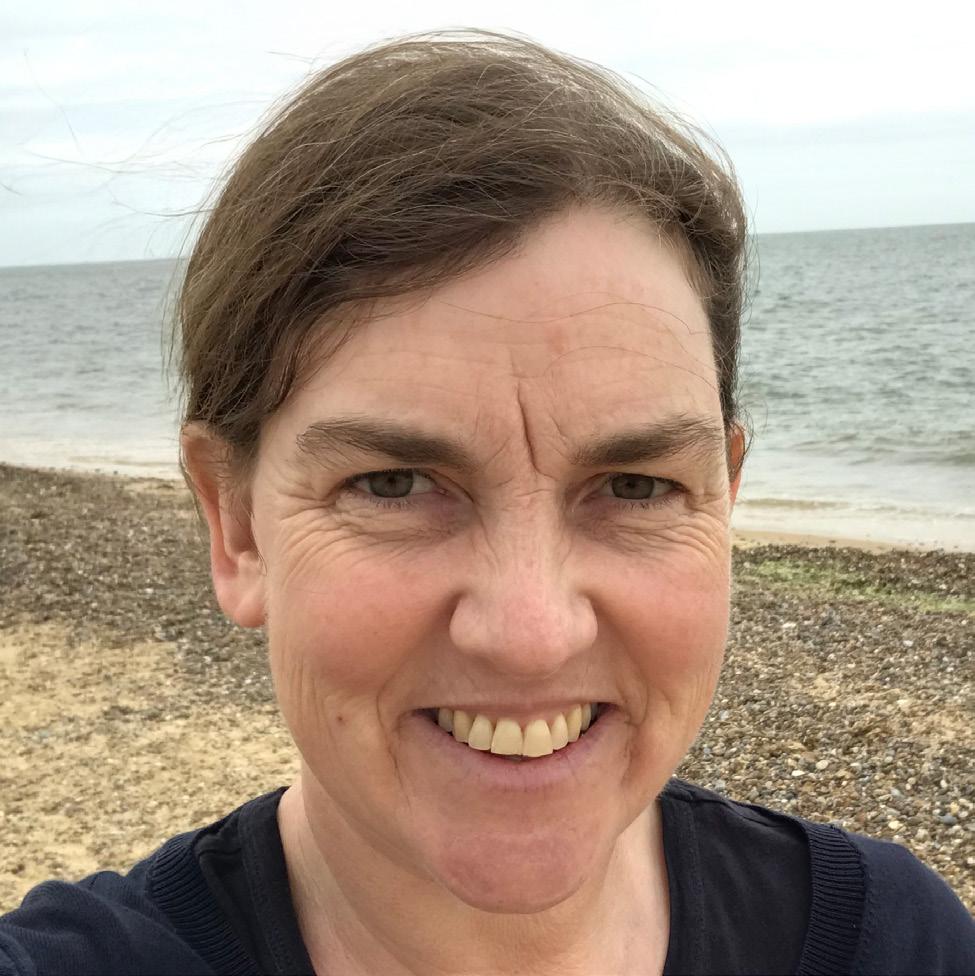
JO MILES GSA President
Photo: Supplied
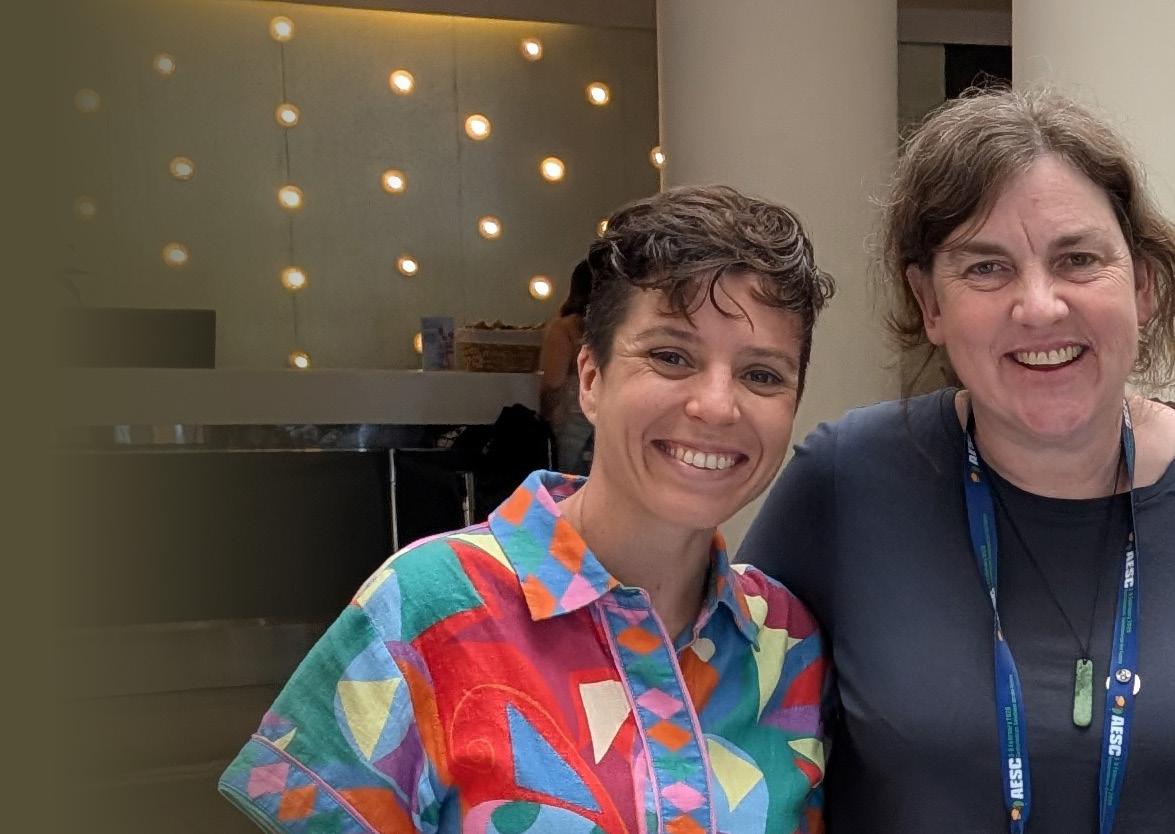
The TAG team, Sarah Jackson, Sandra McLaren and Amber Jarrett, at AESC 2026.
Photo: Jo Miles
Core Business
Internal updates from the Geological Society of Australia
Clarification: GSA Governing Council Roles and Appointments
Following member enquiries regarding the composition of the Governing Council and Executive, a short clarification is provided.
The Governing Council was elected in May 2025 in accordance with the GSA Rules. Three vacancies existed at that time and two were later filled through an Expression of Interest process. Executive roles of the Governing Council (President, Secretary and Treasurer) are internally elected and endorsed by Council. Executive positions were filled progressively during 2025. Jo Miles was endorsed as Secretary in July 2025 and was subsequently endorsed by Governing Council as President in November 2025 following internal Executive elections in accordance with the GSA Rules. Updates were communicated to members via email and reported in TAG Magazine
The GSA Executive are: Jo Miles (President), Hugo Olierook (Secretary), Chris Taylor (Treasurer), Amber Jarrett (Past President)
Governing Councillors: Marissa Betts (NSW Divisional Councillor), Samuel Boone, Grace Cumming (Tasmania Divisional Councillor), Alan Collins, Andy Tomkins.
The NT Divisional Councillor position is currently vacant.
All appointments followed established governance procedures. Enquiries may be directed to president@gsa.org.au.
Member registrations
GSA continues work on the new membership portal to enable online payments. While this progresses, membership fees will be waived and 2026 fees will be applied pro rata once the portal is active. If you cannot currently access AJES or other essential services, contact the Secretariat at info@gsa.org.au.
Website updates
A new GSA website is being rolled out as part of the membership upgrade, informed by the 2024 member user experience workshops. Content will be simplified with centralised pages for Events, Publications and an online store.
Divisions, Specialist Groups and Standing Committees are asked to review and update their pages, many of these have not been refreshed in over a decade. Existing pages will be archived. Contact secretary@gsa.org.au for details.
GSA insurance
GSA holds public liability insurance that members can use for talks, field trips and events.
Applications must be submitted at least four weeks in advance to allow insurer review. For enquiries contact
Working with Children
All members are reminded that GSA policy requires individuals involved in GSA activities that involve children (like science fairs and other outreach events) hold a current working with children card (WWCC). Most jurisdictions have a free card for volunteers and the GSA President will sign any forms required for applications associated with GSA activities. For those states where volunteer cards require a small fee, the GSA will reimburse application fees on successful delivery of the card.
APC Discount for GSA members publishing in the Australian Journal of Earth Sciences (AJES)
GSA members receive 20% off the Article Processing Charge (APC) to support open access publishing and increase the reach of their research. An APC is a fee paid by the author, institution or funder to publish an article as Gold Open Access, making it freely available under a Creative Commons licence (CC BY, CC BY-NC or CC BY-NC-ND).
How to use the discount
After article acceptance, the corresponding author will receive an email from Taylor & Francis’s Central Article Tracking System (CATS) to complete the Author Publishing Agreement. Enter the code TAJE-GSA-2026 on the billing page and select “apply discount”. For assistance, contact AJES Publisher Janelle Heald (Janelle.Heald@tandf.com.au).
Statement from the GSA
The GSA was concerned to hear about comments made during AESC that may not reflect our standards or expectations. We recognise that members were impacted and we take these concerns seriously. The Society is reviewing the matter in line with our Code of Conduct and complaints process.
If you have further information or concerns, please contact president@gsa.org.au
Volunteer employee wellbeing
GSA volunteers can access Foremind, an online wellbeing platform offering counselling, wellness resources and anonymous reporting tools to help identify stressors and burnout risks. Foremind has recently expanded Employee Assistance Program
to include dietitian and legal support, in addition to our existing counselling services. For questions, speak with your Divisional or Specialist Group Chair in the first instance.
DIETITIAN & LEGAL ADVICE
These services can support you in a holistic approach to better wellbeing.
Grateful thanks to AESC sponsors
` The hugely successful AESC could not have happened without the generous support of convention sponsors:
— Platinum Sponsor: BHP
— Silver Sponsor: AuScope
— Workshop Session Sponsor: Monash University
— Concurrent Session sponsors: Government of South Australia
— Department for Energy and Mining and the Minerals Council of Australia
— Poster Zone Sponsor: University of Melbourne
— Theme Sponsor: CSIRO
— Early Career Geoscientists Evening Sponsor: Alkane Resources Ltd
Members, delegates, presenters, the GSA Governing Council and the AESC Organising Committee all register their grateful thanks to these organisations.
AESC Platinum Sponsor: BHP
Particular thanks and grateful appreciation are due to BHP, AESC Platinum Sponsor.
BHP contributed generous financial support, maintained an informative exhibition space and made a range of excellent contributions to the scientific program.
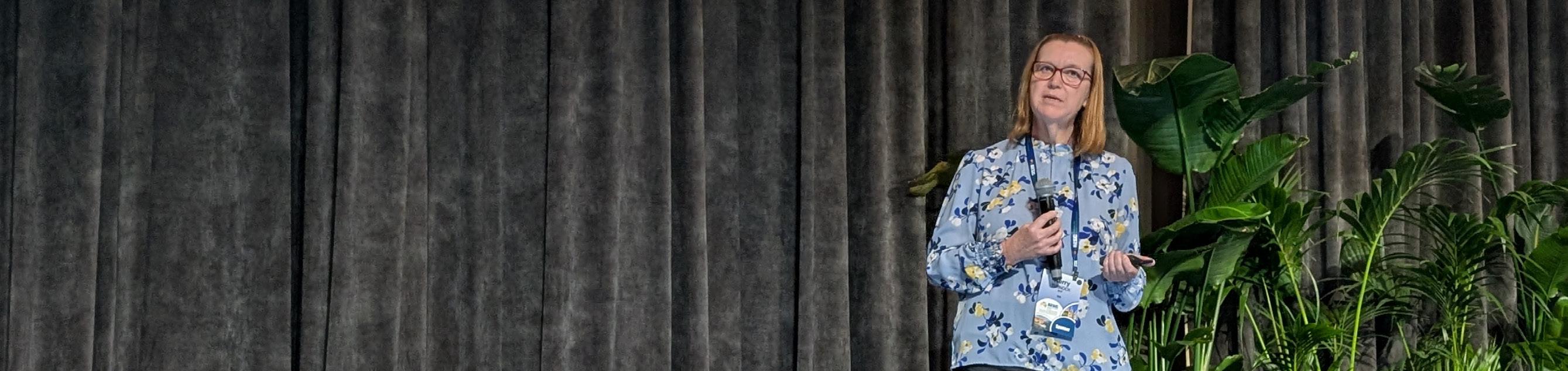
A highlight of the week was the convention opening address by Kerry Turnock, BHP Head of Geoscience Excellence. Kerry gave a compelling presentation on the importance of geoscience in decision making and discussed a range of ways to shape the discipline into future. Kerry’s presentation generated enthusiastic discussion among delegates and embraced the convention theme of Geosciences: Solutions for the Future to set the scene for the week.
During the convention the popular BHP exhibition space shared celebrations of the newly discovered mineral
Ehrigite, a sub-microscopic bismuth telluride. Ehrigite is named after BHP and geoscience legend Kathy Ehrig and was officially recognised by the International Mineralogical Association in 2025.
Kathy is BHPs Superintendent Geometallurgy and the mineral was named to honour her many contributions to both geology and geometallurgy. Kathy is known for her pioneering work at the interface of geology and minerals processing, particularly at the Olympic Dam deposit in South Australia, for maintaining highly successful career-long collaborations between BHP and academia and for her work as a mentor and role model to developing geoscientists. Her dedication to understanding mineral deposits and improving geometallurgy has paved the way for numerous advancements in the industry.
Photos (p. 10): Jo Miles and Hugo Ollietook
Photos: Fanny Peltier
Listening to Members: Reflections from the AESC Town Hall
Around thirty members gathered during AESC for a Town Hall conversation about the future of the Geological Society of Australia. The group included Governing Council members, early career geoscientists, long-standing volunteers, and colleagues from academia, government and industry, grounded by a shared interest. The discussion was constructive and grounded in a shared interest in strengthening the Society.
A clear message emerged early. People join GSA for connection. Networking, conferences and travel scholarships remain strong drawcards, but members stay when they feel a sense of belonging and when the Society creates opportunities for meaningful engagement. Specialist Group meetings and focused conferences were highlighted as particular strengths, alongside major events such as AESC that bring diverse parts of the profession together. At the same time, participants recognised the financial pressure that large events can place on the Society, especially in years where multiple conferences fall close together.
TAG Magazine and Specialist Group activities were consistently described as high value offerings, and recent improvements to TAG were noted positively. Some gaps were also identified. Semi-retired members and those less digitally inclined may feel underserved, with suggestions including providing more physical or map-based conference materials alongside QR code formats.
Skills and workforce challenges generated strong discussion. Members raised concerns about the erosion of subsurface and geomorphology expertise as university offerings change and curricula tighten. Industry perspectives suggested that graduates are not always job ready, with gaps in both technical and professional skills. Ideas for GSA included supporting field symposia, endorsing short courses, and convening a broader geoscience skills conversation across universities, government and industry. Accessibility and delivery models were another focus. Hybrid
conferences received strong support, with interest in recorded sessions, improved live streaming and flexible participation options. Cost remains a barrier, particularly for students and early career geoscientists.
Publications were also discussed, including AJES and Alcheringa, and a dedicated article in this issue (page 34) explores those conversations in more detail. Members recognised the importance of society journals while acknowledging the challenges of a changing publishing landscape.
Participants also spoke candidly about practical frustrations, particularly around website functionality and membership processes. Continued investment in digital infrastructure was seen as essential to improving the member experience.
Looking ahead, members expect GSA to play a stronger role in areas such as digital literacy, emerging geoscience fields and professional skills development. The overall tone of the Town Hall was positive. There is clear goodwill toward the Society, coupled with clear expectations for accessibility, collaboration and longterm sustainability.
Your views are important. If you missed the Town Hall and still want to engage, please email tag@gsa.org.au or use the Anonymous Padlet: https://padlet.com/GSAustraliaPresident/shaping-the-future-ofthe-gsa-6l8fm82c4gnkoo0r
JO MILES GSA President
Photo: Hugo Olierook
UPCOMING EVENTS 2026
share details of your upcoming event by contacting tag@gsa.org.au
14–15 APRIL AGES CONFERENCE
ALICE SPRINGS
21–22 APRIL
INTERNATIONAL MINING GEOLOGY CONFERENCE
BRISBANE
1–2 JULY PORT MORESBY PNG
PNG INDUSTRIAL AND MINING RESOURCES EXHIBITION AND CONFERENCE (PNG EXPO)
7–10 JULY
CONASTA 73, AUSTRALIAN SCIENCE TEACHERS ASSOCIATION
Biennial meeting of the Specialist Group in Tectonics and Structural Geology (SGTSG) NOVEMBER 9-13, 2026
THE GOODS SHED BALLARAT, VICTORIA SGTSG.ORG
16–19 AUGUST
PEG2026: 11TH INTERNATIONAL SYMPOSIUM ON GRANITIC PEGMATITES PERTH
11–17 OCTOBER EARTH SCIENCE WEEK 2026
6 OCTOBER
UNESCO INTERNATIONAL GEODIVERSITY DAY
14–16 AUGUST ADELAIDE SGTSG
9–13 NOVEMBER BALLARAT
Photo: Sarah Jackson
Lexington Schist at Mount Ararat,
Photo from Ross Cayley
Celebrating our Distinguished Fellows of the Geological Society of Australia (DFGSAust)
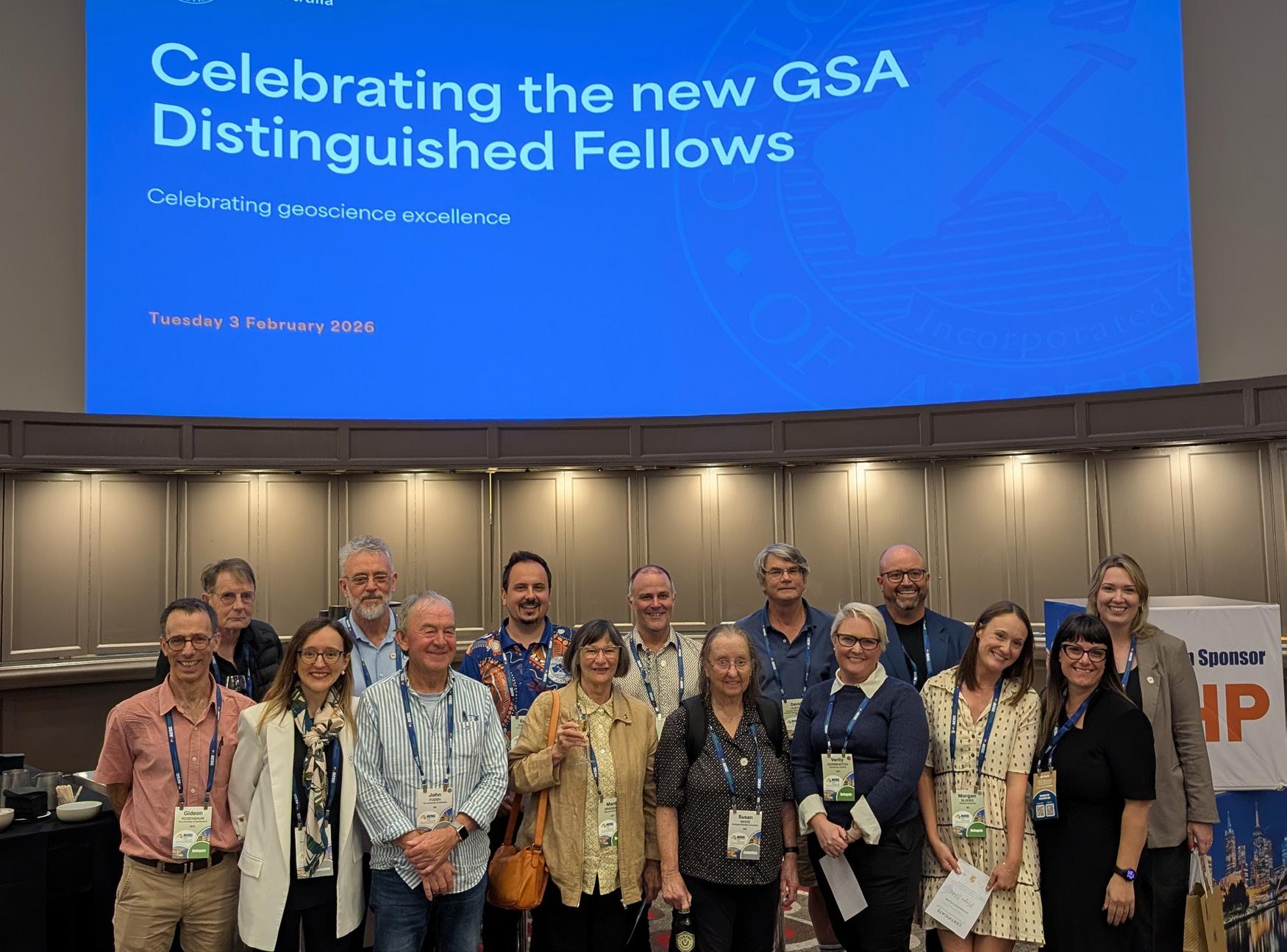
On Tuesday 3 February at AESC, the Geological Society of Australia celebrated the Distinguished Fellows conferred in 2025 and 2026. The title of Distinguished Fellow recognises sustained service to the Society alongside significant professional contribution to Earth sciences through research, education and training, practical application of geoscience, leadership and public outreach. Collectively, this year’s recipients represent decades of dedication to supporting the Society, strengthening the profession and advancing Australian geoscience.
2026 Distinguished Fellows
JOAN ESTERLE is recognised for sustained contributions to coal geology research and long-standing service to the society and its specialist groups. Her work on coal systems, basin evolution and subsurface processes has supported industry collaboration, education and mentoring while strengthening Australia’s coal geology community.
DAVID HUSTON is recognised for sustained contributions to economic geology and long-standing leadership across the geoscience community. His internationally recognised work on mineral systems and metallogenesis has advanced understanding of ore forming processes and supported mineral exploration globally.
STEPHEN MCLOUGHLIN is recognised for scientific leadership and long-standing service to the society, particularly through editorial leadership of Alcheringa and mentoring of emerging palaeoscientists. His research on Gondwanan floras and deep time ecosystem change has transformed understanding of terrestrial evolution.
VERITY NORMINGTON is recognised for sustained leadership and service across divisional and national roles, including governance, early career initiatives and community engagement. Her work in basin geology and Neoproterozoic stratigraphy has strengthened geological frameworks used by industry and government.
JO PARR is recognised for outstanding leadership across the Society, including service as National President, Secretary and NSW Division Chair. Her work in economic geology and seafloor hydrothermal systems, combined with leadership within CSIRO and the profession, has supported mentoring, collaboration and strategic development.
WOLFGANG PREISS is recognised for decades of contribution to Australian stratigraphy, Precambrian geology and Society service. His work on Proterozoic successions and regional tectonics has shaped understanding of Australia’s geological evolution and supported generations of geoscientists.
GIDEON ROSENBAUM is recognised for sustained contribution to the society and internationally respected research in tectonics, structural geology and Earth system evolution. Through mentoring, conference leadership and community engagement, he has supported the advancement of geoscience across Australia.
TONY SHELLSHEAR is recognised for long-standing service to the Queensland Division and outstanding public outreach through national rock and mineral education initiatives. His volunteer leadership has supported Earth science education and inspired future generations of geoscientists.
TERESA UBIDE is recognised for sustained service through conference leadership, outreach and initiatives that support diversity and inclusion in geoscience. Her research in igneous petrology and mineral scale geochemistry has advanced understanding of volcanic processes and metal enrichment in magmatic systems.
WARWICK WILLMOTT is recognised for decades of dedicated service to the Queensland Division through volunteer contributions supporting publications, outreach and member engagement, reflecting a lifetime of commitment to the Society.
SABIN ZAHIROVIC is recognised for sustained service through leadership in the NSW Division and Education and Outreach Specialist Group, alongside extensive involvement in seminars and community engagement that have strengthened the Society’s scientific and public profile.
2025 Distinguished Fellows
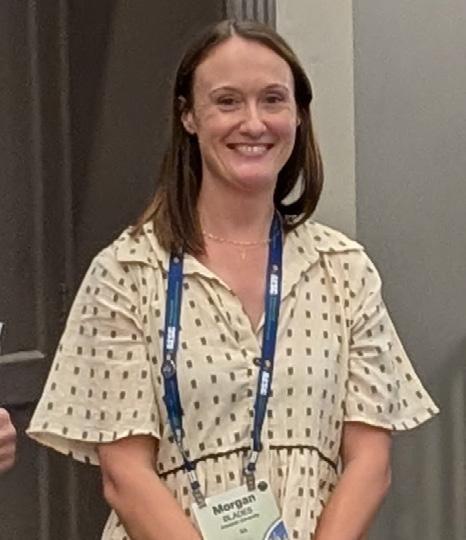
MORGAN BLADES is recognised for sustained service to the South Australian Division, including more than a decade on the Executive and leadership in student initiatives that strengthened pathways for early career geoscientists. Her research on Proterozoic basin evolution has supported collaborative research across academia, industry and government.
MARITA BRADSHAW is recognised for longstanding service through the ACT Division, national initiatives and the National Rock Garden, alongside a distinguished career advancing petroleum systems and basin analysis. Her leadership in mentoring, outreach and precompetitive geoscience strengthened connections across the profession.
DAVID CANTRILL is recognised for sustained leadership within the Victorian Division, including more than 15 years as Chair and ongoing governance contributions. His research on Southern Hemisphere floras and Antarctic vegetation has shaped understanding of biogeographic evolution.
CHRISTINE EDGOOSE is recognised for more than four decades of service to the Society and the Northern Territory geoscience community, including long standing divisional leadership, mentoring and support of Society activities. Her geological mapping and basin analysis have advanced understanding of Northern Australia.
JOHN GORTER (posthumously) is recognised for over five decades of service to the Society and the Australasian Palaeontologists Specialist Group. A respected petroleum geologist, his technical leadership, mentoring and discoveries left a lasting legacy within Australian geoscience.
Peter Cook
DAVID MOORE is recognised for decades of service to the Victorian Division through governance, investment stewardship and scientific contribution. His work in geophysics and tectonic interpretation has supported advances in mineral exploration frameworks.
SUSAN WHITE is recognised for more than 30 years of service through education, outreach and geoheritage leadership within the Victorian Division. Her research in karst geomorphology and dedication to teaching and mentoring strengthened both geoscience education and community engagement.
JOHN MAVROGENES is recognised for sustained contributions to Society events, education and outreach alongside an internationally recognised research career in economic geology. His leadership in research, teaching and community engagement exemplifies long term service to the profession.
During the awards ceremony, newly elected Distinguished Fellows were presented with certificates and pins in recognition of their sustained service. At the close of the presentations, Fellows in attendance were invited to receive new pins together, creating a memorable moment that brought past and present Distinguished Fellows side by side. It was a fitting celebration of shared history, collegiality and contribution, highlighting the enduring legacy of the Geological Society of Australia.
AMBER JARRETT
Chair, Awards Committee
Our sincere congratulations to GSA Honorary member Peter Cook, of the University of Melbourne and CO2CRC, who was made a Companion of the Order of Australia (AC) in the January 2026 Australia Day Awards.
The Award is the highest level of the Order of Australia and recognises eminent achievement and merit of the highest degree in service to Australia. Peter’s award recognised his “eminent service to science as an innovator, pioneer and international expert in the development of carbon capture and storage, to policy development, and to climate change mitigation”
CONGRATULATIONS PETER!
Celebrating Excellence at the 2026 GSA Awards Night
Honouring excellence across research, leadership, mentoring and community.
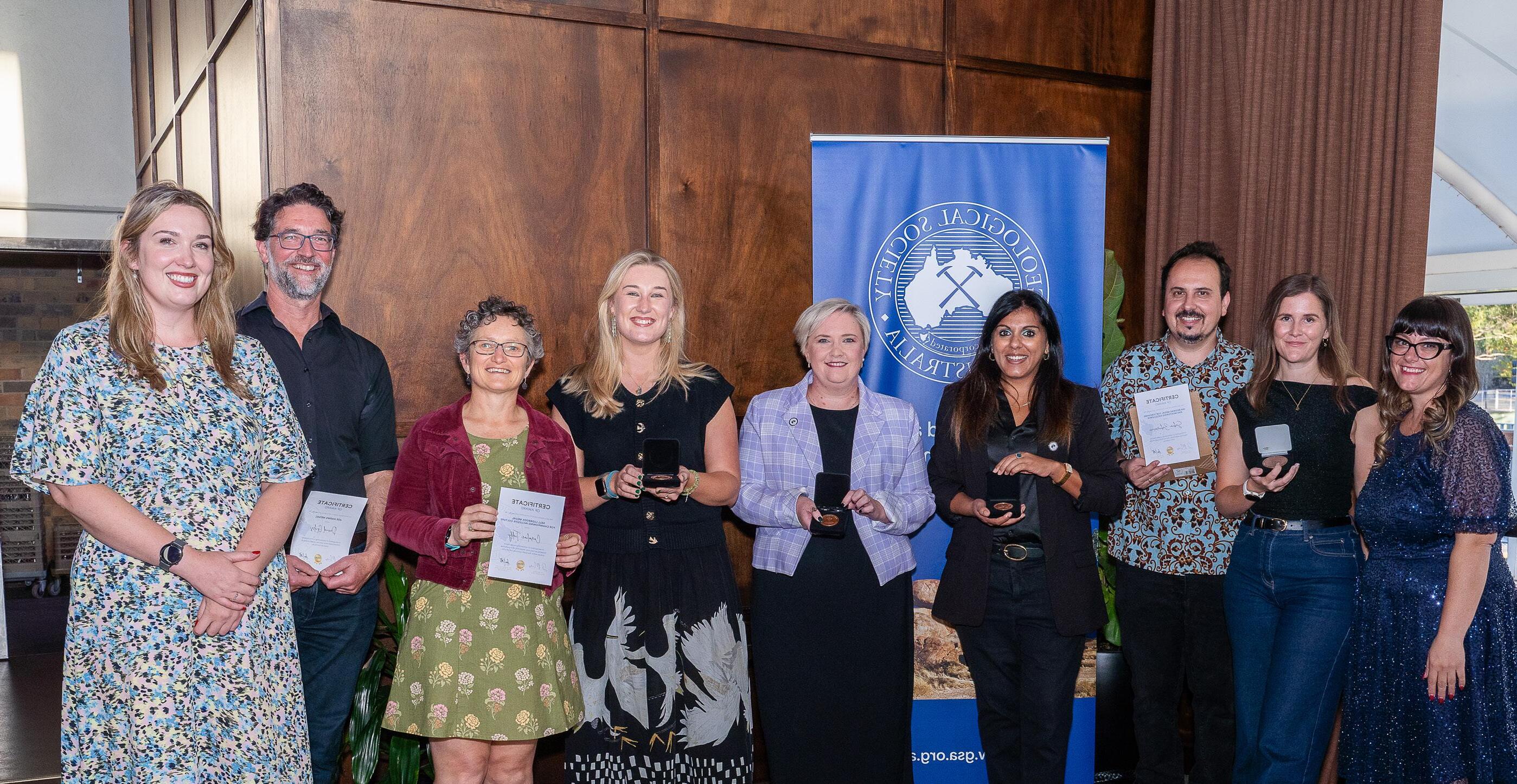
On Thursday 5 February, we gathered on the lands of the Bunurong people of the Kulin Nation to celebrate excellence across Australian geoscience. Not only in research, but in teaching, leadership, legacy and the service that strengthens our professional community. The Geological Society of Australia’s 2026 Awards Night recognised contributions that continue to shape both our science and our culture.
The GSA’s awards program reflects peer recognition at its best. Every medal is assessed through an independent process, with judging panels of at least three diverse members operating under the Awards Procedure Guide. The outcomes announced on the night represent careful deliberation by colleagues who understand the intent and legacy of each honour.
National Medals
W. R. Browne Medal
Recognising distinguished contributions and sustained impact in Earth science in Australia.
Recipient: Wolfgang Preiss
Wolfgang Preiss was recognised for more than five decades of contribution to Australian geology, particularly his foundational work on Neoproterozoic stratigraphy and tectonic evolution in South Australia. His leadership in the field continues to shape geological understanding and inspire new generations of geoscientists.
S. W. Carey Medal
Awarded for outstanding contributions to tectonics.
Recipient: Maria Seton
Seton’s globally influential research on plate reconstructions and ocean basin evolution has transformed understanding of Earth’s dynamic history. Her recognition marks an important milestone as the first woman to receive this medal.
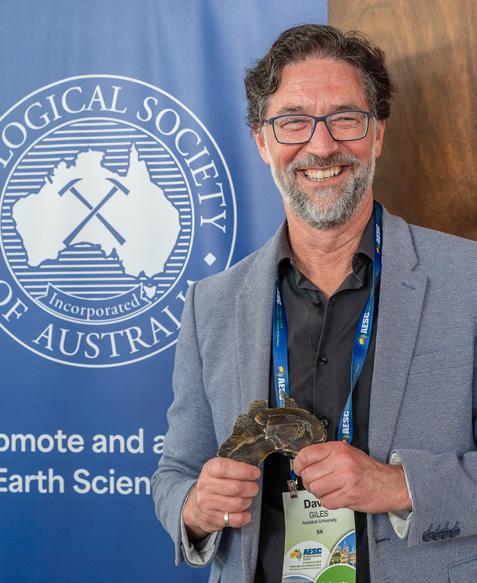
Joe Harms Medal
Recognising outstanding contributions to mineral exploration and ore deposit science.
Recipient: David Giles
Giles was recognised for sustained leadership in exploration under cover and for building national collaborations that bridge research, industry and government capability.
A. E. Ringwood Medal
Honouring internationally recognised contributions to fundamental Earth science through petrology and geochemistry.
Recipient: Greg Yaxley
Yaxley’s experimental research on mantle processes, deep carbon cycling and melt behaviour has reshaped understanding of Earth systems well beyond Australia.
Outreach and Community Medal
Recognising excellence in communicating Earth science to the broader community.
Recipient: Holly Cooke
Through innovative geoscience media and public engagement via the Wonder Podcast, Holly Cooke has connected diverse audiences with Earth science, demonstrating the impact of storytelling and outreach.
Rising Rockstars
E. S. Hills Medal
Recognising emerging leadership and outstanding contributions to Earth science.
Recipient: Sheree Armistead
Armistead’s work integrates tectonics, geochemistry and ore deposit formation, combining strong field insight with innovative analytical approaches.
Nashar Award
Recognising significant contribution to the geoscience profession by an Australian woman.
Recipient: Verity Normington
Normington was recognised for sustained service and inclusive leadership within the Geological Society of Australia, strengthening connection and participation across the community.
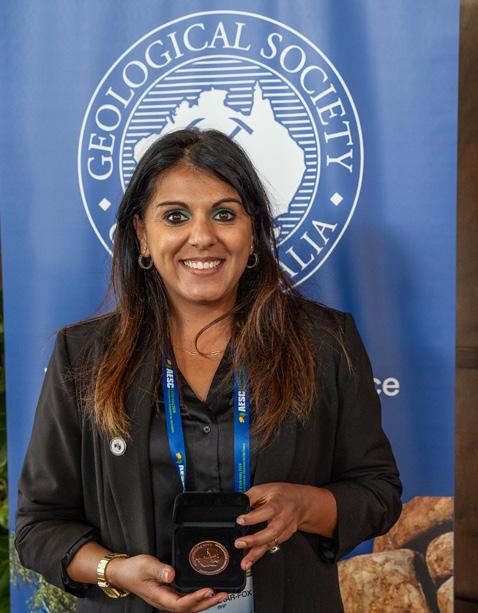
Garry Davidson Medal
Recognising significant contributions to applied geochemistry.
Recipient: Anita Parbhakar Fox
Her research on mine waste, acid and metalliferous drainage and critical minerals recovery continues to influence both environmental stewardship and resource development.
Beryl
Inaugural National Medals
A defining moment of the evening was the presentation of two new national medals. In recent years, members have reflected on how the Society recognises excellence across the full breadth of geoscience. Alongside research achievement, there has been strong support for recognising inclusive leadership, teaching and mentoring as vital contributions to the profession. The inaugural recipients were selected by an awards committee of Past Presidents and endorsed by the Governing Council.
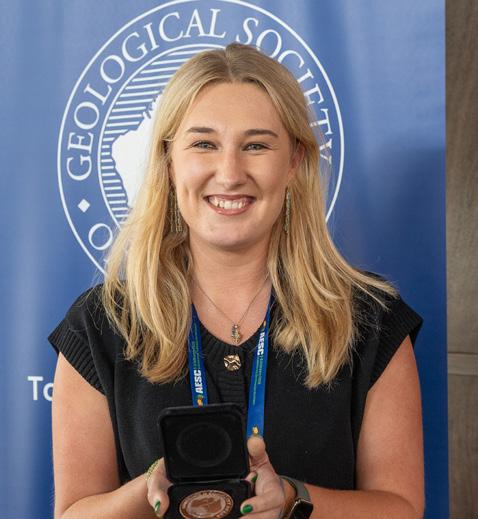
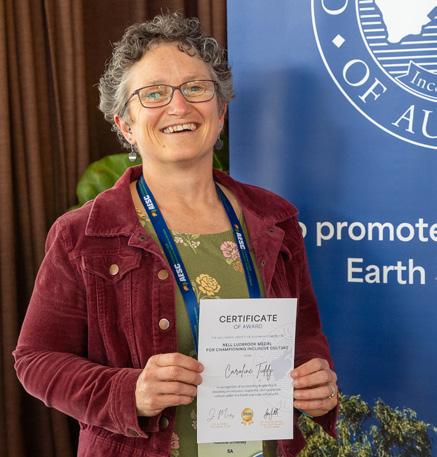
Nell Ludbrook Medal for Championing
Inclusive Culture
Recognising leadership that advances an inclusive and respectful geoscience profession.
Recipient: Professor Caroline Tiddy
Professor Tiddy has demonstrated sustained leadership in building inclusive professional environments and advancing equity across the discipline.
About Nell Ludbrook: Dr Nell Ludbrook was a pioneering Australian geoscientist and a barrier-breaking leader within the Geological Society of Australia. She was the first woman to serve as Federal President of the GSA and helped open pathways for women and under-represented groups across the Earth sciences. Her legacy reflects inclusive leadership, cultural change, and a strong commitment to professional belonging.
Reflections on Recognition
Serving as Chair of the Awards Standing Committee offers a unique perspective on our profession. The nominations tell stories not only of scientific achievement, but of mentorship, collaboration and leadership that shape the culture of geoscience in Australia. It has been particularly meaningful to see broader forms of service recognised, to see more women acknowledged through national honours, and to see pathways opening for strong nominees into Distinguished Fellow recognition. I extend my sincere thanks to everyone who took the time to nominate colleagues and to the independent judging panels who give their time so generously to this process.
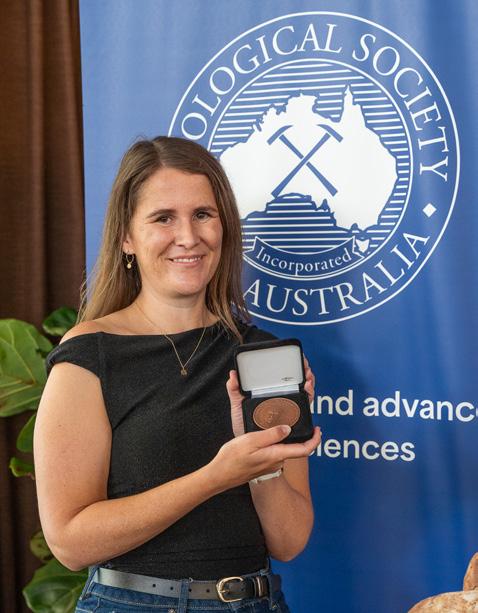
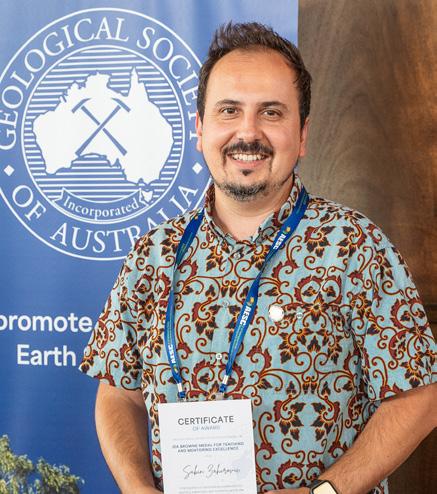
Ida Browne Medal for Teaching
and Mentoring Excellence
Celebrating excellence in teaching, mentoring and education pathways.
Recipient: Sabin Zahirovic
Sabin Zahirovic was recognised for long-standing dedication to mentoring students and early career professionals, strengthening education pathways and professional connection.
About Ida Browne: Dr Ida Alison Browne was a pioneering educator whose teaching shaped a generation of Australian geoscientists. As a Senior Lecturer at the University of Sydney, she mentored students who later became formidable leaders in their own right, including Beryl Scott Nashar. Following her marriage in 1950, she resigned from university staff under the employment norms of the era, yet her influence continued through the people she trained and the research she pursued in collaboration with colleagues and peers.
Awards nights celebrate individuals, yet they also reflect a maturing profession that understands excellence in many forms. This year’s medallists represent a community that values rigour, generosity and shared purpose. It is a privilege to help steward that recognition on behalf of the Geological Society of Australia.
The evening continued with recognition of outstanding publications in the Australian Journal of Earth Sciences (AJES), a journal that has supported the dissemination of Australian Earth science research since 1953. These medals recognise not only scientific rigour, but also the role of peer review, collaboration and scholarly contribution in advancing our discipline. I would like to acknowledge the Editorial Board and judging committees who reviewed more than one hundred manuscripts across the eligible volumes to determine this year’s recipients.
Stillwell Medal – Volume 71
Awarded for the best paper published in the Australian Journal of Earth Sciences.
Recipients: David Gray, Michael Vicary, Andrew McNeill
The Tasmanian Tyennan Domain — a structural synthesis and review with tectonic and dynamic implications for continental margin subduction and exhumation. Australian Journal of Earth Sciences, 71(2), 153–210.
LINK TO PAPER:
David I. Groves Medal – Volume 71
Recognising the best paper led by an early career geoscientist.
Recipients:
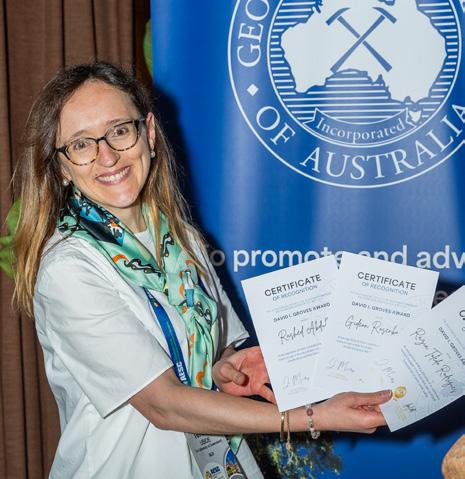
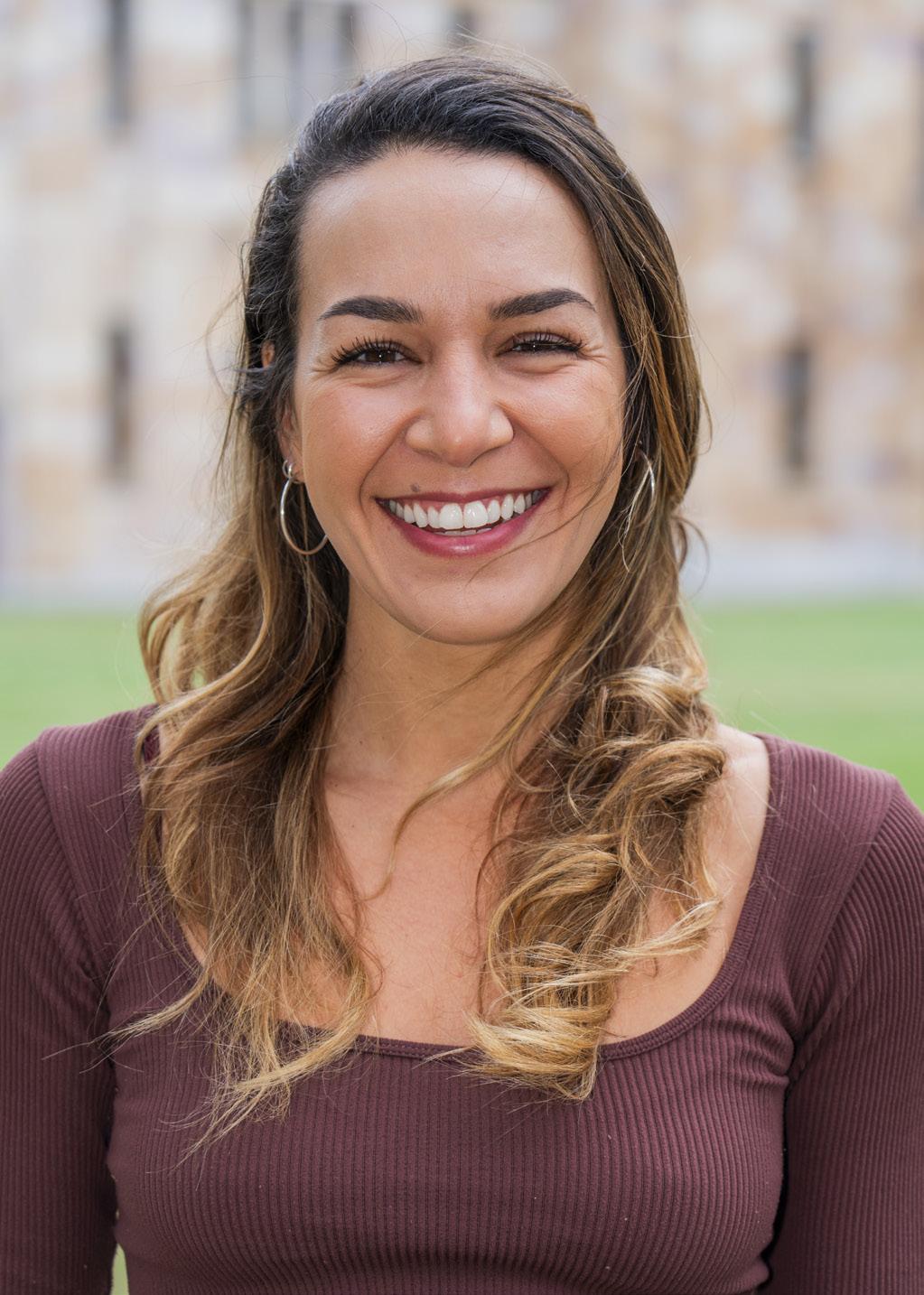
Raiza Toledo Rodrigues, Gideon Rosenbaum and Rashed Abdullah
Kinematics of the Clarke River Shear Zone (northeastern Australia) and implications for the tectonic evolution of the Tasmanides
LINK TO PAPER:
A. B. Edwards Medal – Volume 71
Awarded for the best paper on economic geology.
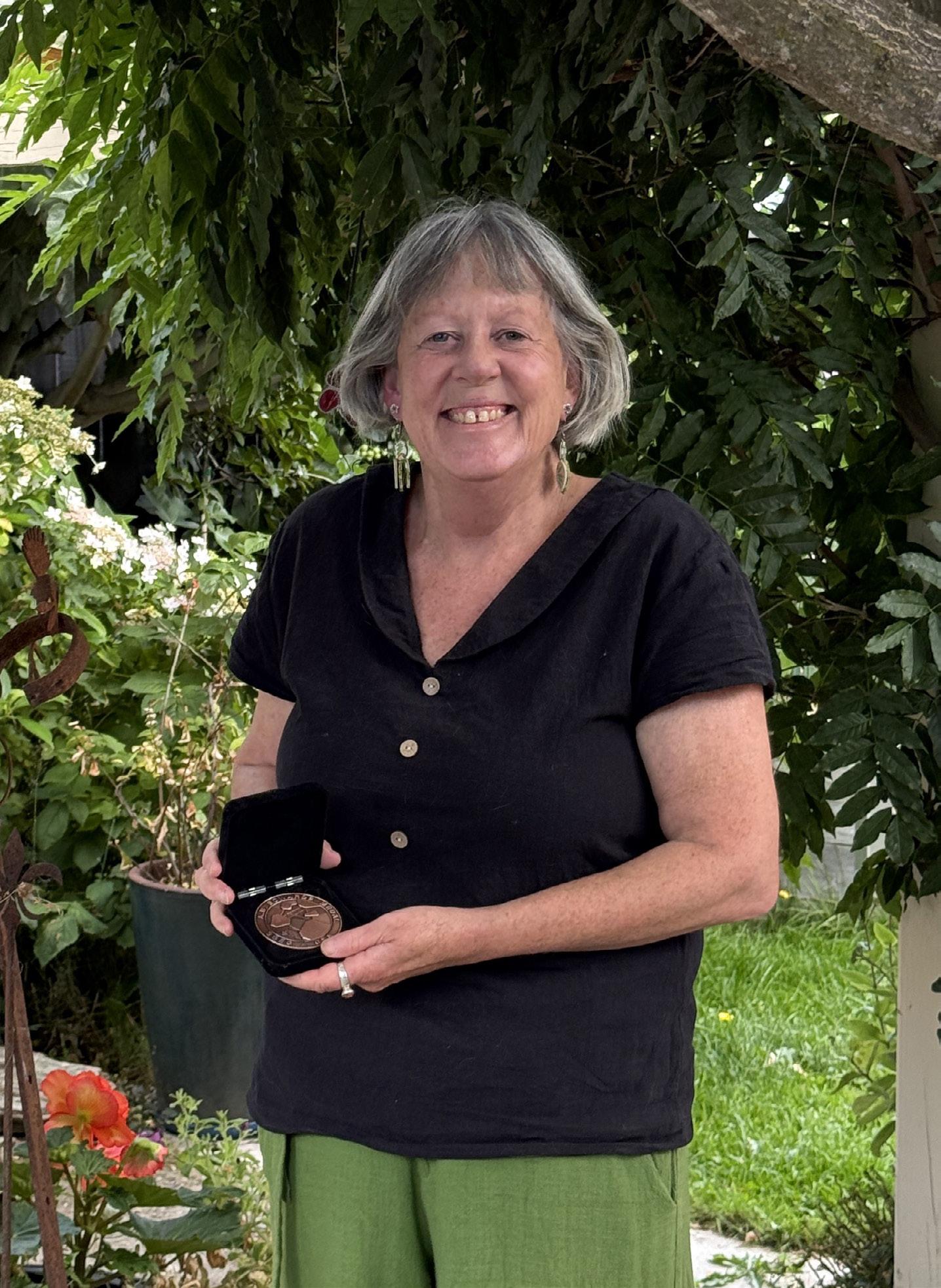
Recipient: Sarah Jones
2730–2670 Ma rifting triggers sagduction prior to the onset of orogenesis at ca 2650 Ma: implications for gold mineralisation, Eastern Goldfields, Western Australia
LINK TO PAPER:
Stillwell Medal – Volume 72
Awarded for the best paper published in the Australian Journal of Earth Sciences.
Recipients: Jun Cowan and Bruce Hobbs
Perkins Discontinuities: structurally controlled grade patterns diagnostic of epigenetic gold mineralisation at the deposit-scale
LINK TO PAPER:
David I. Groves Medal – Volume 72
Recognising the best paper led by an early career geoscientist.
Recipients: Jack Castle Jones, Marissa Betts, James Holmes, Robert Klabe, Tony Hall, James Crowley, Zhiliang Zang and Glen Brock.
Integrated biostratigraphy, chemostratigraphy and geochronology of the lower Cambrian succession in the western Stansbury Basin, South Australia
Pictured (right): Jack Castle Jones
LINK TO PAPER:
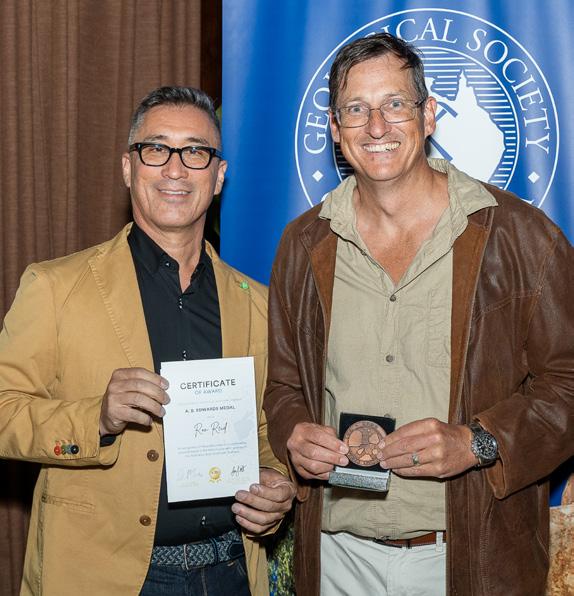
A. B. Edwards Medal – Volume 72
Awarded for the best paper on economic geology.
Recipients: Ron Reid and Jun Cowan
Towards quantifying uncertainties in geological models for mineral resource estimation through outsidein deposit-scale structural geological analysis
LINK TO PAPER:
Greg Yaxley AE Ringwood Medal
Tell us a little bit about yourself, how you came to Earth Sciences and what you are currently working on
During the 1980s I was a Chemistry and Geology teacher in a senior secondary college in Hobart (Elizabeth College). I started on a PhD around 1990 in the Geology Department at the University of Tasmania, under the inspirational supervision of Profs David Green and Tony Crawford. My project involved petrological studies of metasomatised mantle peridotite xenoliths from western Victoria, and high pressure experimental investigations of the role of carbon in upper mantle processes. This set the scene for much of my subsequent research career as I continued to work for many years on diverse issues connected to the Earth’s deep carbon cycle, using experiments, mantle xenoliths and other highpressure rocks. In the last few years, our research group at RSES has pivoted to critical minerals, recognising their importance to the energy transition.
The AE Ringwood medal recognises your many contributions to the fields of petrology and geochemistry. Can you tell us how those fields have changed and evolved over the time you’ve been in research?
Petrology and geochemistry are being revolutionised by advances in analytical and imaging technology and our ability to handle large amounts of data. In the case of experimental petrology, the application of new micro-beam analytical approaches to fine-grained experiment run products has been key. Innovative correlative electron microscopy-based imaging techniques are allowing us to obtain much richer data from experimental run products. The application of synchrotron-based techniques, such as X-ray Absorption Spectroscopy is enabling exploration of new aspects of petrology and mineralogy which were previously much more difficult, for example determining oxidation states of elements like iron, or cerium or others in natural and experimental minerals.
In your view, what is the most exciting, or ‘next frontier’ research problem in petrology?
The last few years have seen rapid growth in Australian petrological and geochemical research into the formation of critical minerals deposits. This is exemplified, for example, by the ARC recently funding an Industrial Transformational Training Centre in Critical Resource for the Future, of which our group at ANU is a partner. Hopefully this growth will continue for many years into the future. As experimental petrologists and geochemists, we will continue to contribute to understanding the complex processes in this area. A key part of the critical minerals story relates to development of new sustainable approaches to extraction of the final commodity from ore which demands bespoke approaches to metallurgical extraction for each deposit. We can use our capabilities in micro-analysis and imaging for careful characterisation of these ores and our understanding of the thermodynamic properties of critical minerals to contribute to development of new extraction technologies.
What do you find most inspiring about Australian geology?
I consider myself to be a fairly incompetent geologist, except perhaps when it comes to the upper mantle! However, I am inspired by Australian geology because of its enormously long and complex history which encompasses virtually all of geological time (Jack Hills to Heard Island!).
Photo: Shutterstock
Sarah Jones
AB Edwards Medal for AJES Volume 71 FEATURE
I started studying earth sciences at Otago University because I was an absolute rock-hound (and I still am). Most of my work is in the Eastern Goldfields, Western Australia, but more recently I’ve been working in the Northern Territory and in Canada. I currently live back home in Cromwell, Central Otago, New Zealand, where I run my own structural geology consultancy.
I was thrilled to receive the AB Edwards medal for my paper discussing the dramatic changes in tectonic regimes in the Eastern Goldfields in the late Archean, and how the different structural styles of gold deposits reflect these changes. Sagduction (or granite-up, greenstone-down tectonics) is produced by a gravity inversion that results from the deposition of cold dense mafic material onto thinned, hot, lighter felsic crust in rift zones. This process forms the ‘domeand-basin’ geometry that is common in the Archean and is later modified by orogenesis. Gold deposits form throughout these changing tectonic regimes. The paper is open access in the Australian Journal of Earth Sciences.
I started working on the broader tectonic setting of the Eastern Goldfields when I was mapping for the Geological Survey of Western Australia, based in Kalgoorlie in the early 2000s. Since then, I’ve worked as a structural geologist, mostly for gold mining companies, allowing me excellent access to underground and open pit exposure of the gold-bearing structures. My research combines minescale geology with the broader regional settings of the gold deposits. Eight years ago, I was awarded another AB Edwards medal for a study on manganese around the Woodie Woodie camp in the Pilbara. This study was also based on regional and mine-scale observations.
I think there is an excellent future for research in economic geology with so many new innovations in the way data is collected. In particular, rapid drillcore scanning for geochemical, mineralogical, and structural features will greatly improve our understanding of the ore-forming processes.
Photo: Supplied
FEATURE | GSA AWARDS NIGHT
Raiza Toledo Rodrigues
David I Groves Medal – AJES Volume 71
Tell us a little bit about yourself, how you came to Earth Sciences and what you are currently working on
I grew up as the daughter of t wo geologists, surrounded by conversations I did not yet understand. Choosing geology, however, was not a straightforward decision. Looking back, I realise that what truly drew me to Earth Sciences was a quiet curiosity about why my parents were so deeply passionate about it. That curiosity found its answer during my first introductory geology course as an undergraduate in Brazil. I was immediately captivated by the idea that rocks are living archives, holding stories of Earth’s evolution over deep time. I found it both fascinating and humbling to reflect on how small we are when viewed against the scale of geological time and tectonic processes. That sense of curiosity continues to guide me today, as I combine structural geology and geochronology to investigate tectonic processes and reconstruct the structural history of the northeastern Tasmanides.
Mentors are such an important part of developing as an early-career researcher. Have you had key mentors and what have you learnt from them?
When I reflect on my journey, I feel incredibly fortunate for the mentorship I have received. During my Masters degree in Brazil, I had the privilege of being supervised by Fernando Flecha Alkmim, whose work has shaped much of our understanding of Brazilian geology.
In Australia, I have been equally fortunate to work with Gideon Rosenbaum whose depth of knowledge in structural geology and tectonic processes has profoundly influenced me as a researcher. Both bring deep expertise in structural geology and its links to large-scale tectonic processes, paired with a humble curiosity that has shaped my approach to research. I have also been shaped by the guidance of other remarkable mentors, including Adalene Silva, Humberto Reis, Teresa Ubide, and particularly Catarina Toledo. Beyond their expertise, what
has impacted me most has been their humanity and empathy in supervision. They taught me that science is not an individual pursuit – even when it feels isolating – but a collective endeavour built on collaboration and trust. As an international PhD student, that sense of community has been especially meaningful, and I am deeply grateful to the mentors who have shaped both the scientist and the person I am becoming.
Your award recognised your paper on the Clarke River Shear Zone. Can you tell us about the key take-aways from that work?
The Clarke River Shear Zone is a major structure in the northern Tasmanides. We characterised the main phase of deformation as ductile, general dextral shear during the Early Devonian (c. 410 Ma), a phase and age of deformation not previously recognised. At that time, the shear zone lay between a relatively non-retreating subduction system to the north and a highly mobile, retreating plate boundary to the south. This tectonic framework suggests that the
Photo: Supplied
shear zone may have played an important role in trench-oblique segmentation of the orogen and provides a fresh perspective for evaluating deformation and tectonic processes in the NE Tasmanides. More broadly, the study shows that a classic structural geology approach, integrating observations across multiple scales from microstructures to regional architecture, remains a powerful tool for investigating structural and tectonic evolution.
You moved to Australia to work on your thesis here, what do you find most inspiring or exciting about Australian geology?
Prior to my PhD, I worked exclusively on Brasiliano mobile belts in Brazil, which record orogens formed during the assembly of western Gondwana and underwent continental collision. Moving to Australia to study the Tasmanides Orogenic System, which records the long-lived active margin of eastern Gondwana without a final continent–continent collision, was both challenging and eye-opening. I was fascinated by how subduction dynamics, such as trench advance and retreat, can profoundly shape the geological record. These processes control the development of extensive back-arc basins, orogenic curvatures, variations in the magmatic record, and segmentation of the orogen, producing structural complexities that I had not previously encountered. Engaging with a tectonic framework driven by long-term trench dynamics, rather than terminal
FEATURE | GSA AWARDS
collision, has significantly broadened the way I think about orogenic systems and will definitely guide my investigation of other ancient mountain belts.
Writing can be challenging, how did you find the process of preparing your work for AJES and what advice would you have for other early career authors?
Writing this paper was one of the most challenging experiences of my PhD. As my fi rst PhD publication, it required not only engaging deeply with the geology and literature of Australia but also navigating the inevitable gaps in knowledge within any tectonic framework. Understanding the evolution of eastern Australia in the context of the Tasmanides Orogenic System was perhaps the greatest challenge, particularly when building a tectonic model that remained faithful to both our data and the broader literature. This was demanding but invaluable and was only possible through ongoing discussions, critical evaluation, and constant refinement of our interpretations alongside my supervisor. My advice to early career authors is to embrace the discomfort that comes with writing and to actively seek discussion within your research community. It is through questioning, revising, and carefully challenging our interpretations that ideas become stronger. Learning to critically evaluate your own work without losing confidence or becoming overwhelmed by self-doubt is as important as any technical skill in research.
Photo: Shutterstock
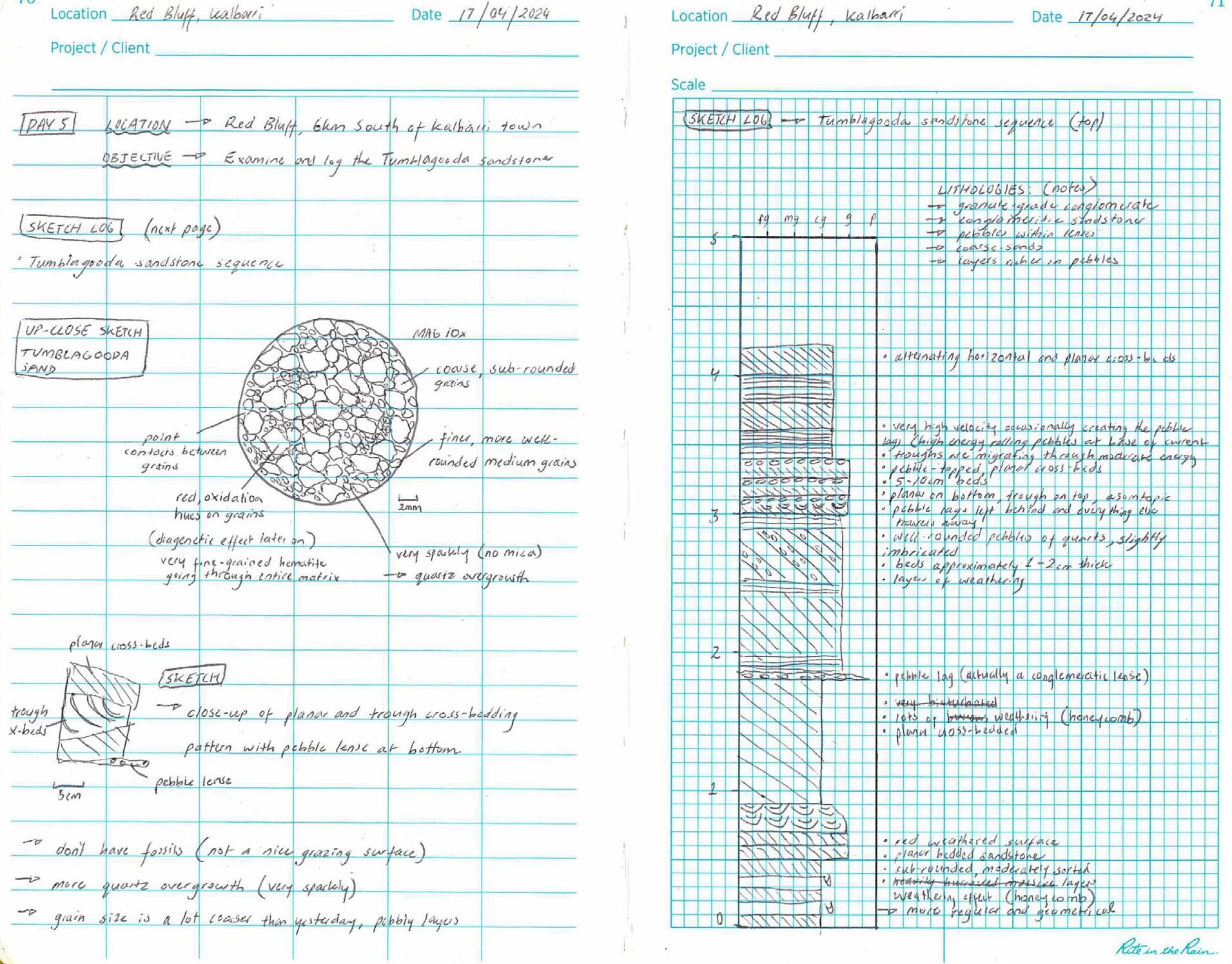
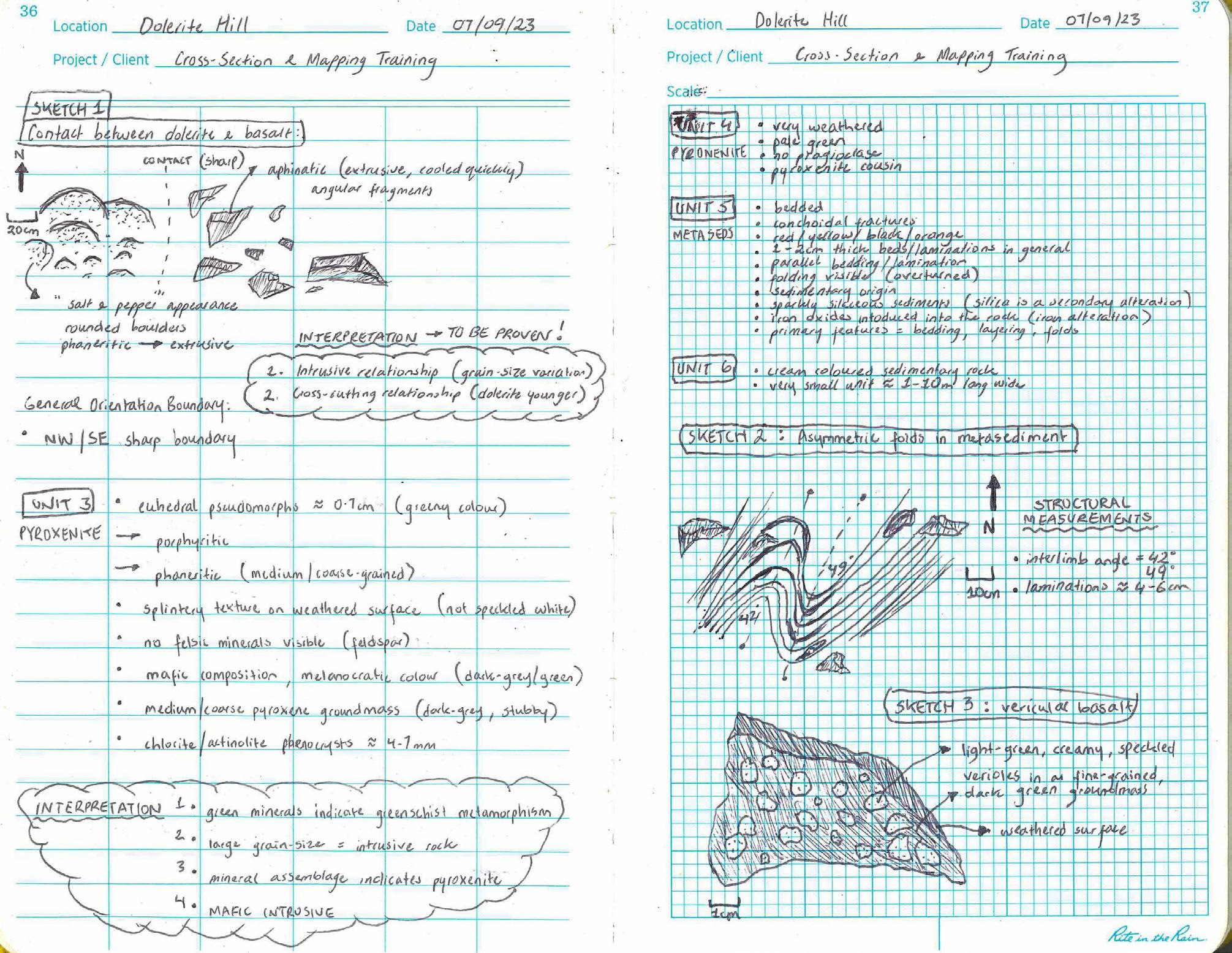
Ella Artemis: Field book profile
The AESC was new graduate Ella Artemis’ first major conference. As well as presenting her work on the subduction-related evolution of the eastern and northern Solomon Islands, she also took time to catch up with the TAG team.
Ella had brought her beloved field notebook to the meeting. She commented how the wellused yellow book represents her growth as a geoscientist from her early undergraduate days to her recent graduation with Honours in Applied Geology (Curtin University).
To Ella the book is her opportunity to revisit each location from her studies and the work involved in thinking and sketching and seeing the evolution in her (often initially haphazard) interpretations is something that she’ll never take for granted.
She credits the solid record of her field observations to her success in her degree, especially when trying to unravel complex geological histories in different parts of the country. Her little book even helped her earn a few mapping awards along the way!
Applying learnt concepts to real-life geological scenarios is a steep learning curve for any developing geologist and Ella stresses the importance and value of investing in a clearly laid out and detailed field book.
As she embarks on her next adventure as a graduate with the Geological Survey of WA, Ella hopes her little yellow book encourages emerging geoscientists to embrace the process.
Photo: Martin Nguyen
My field book will always come with me – as a time capsule for growth and memories along the way. ”
Cats of the GSA
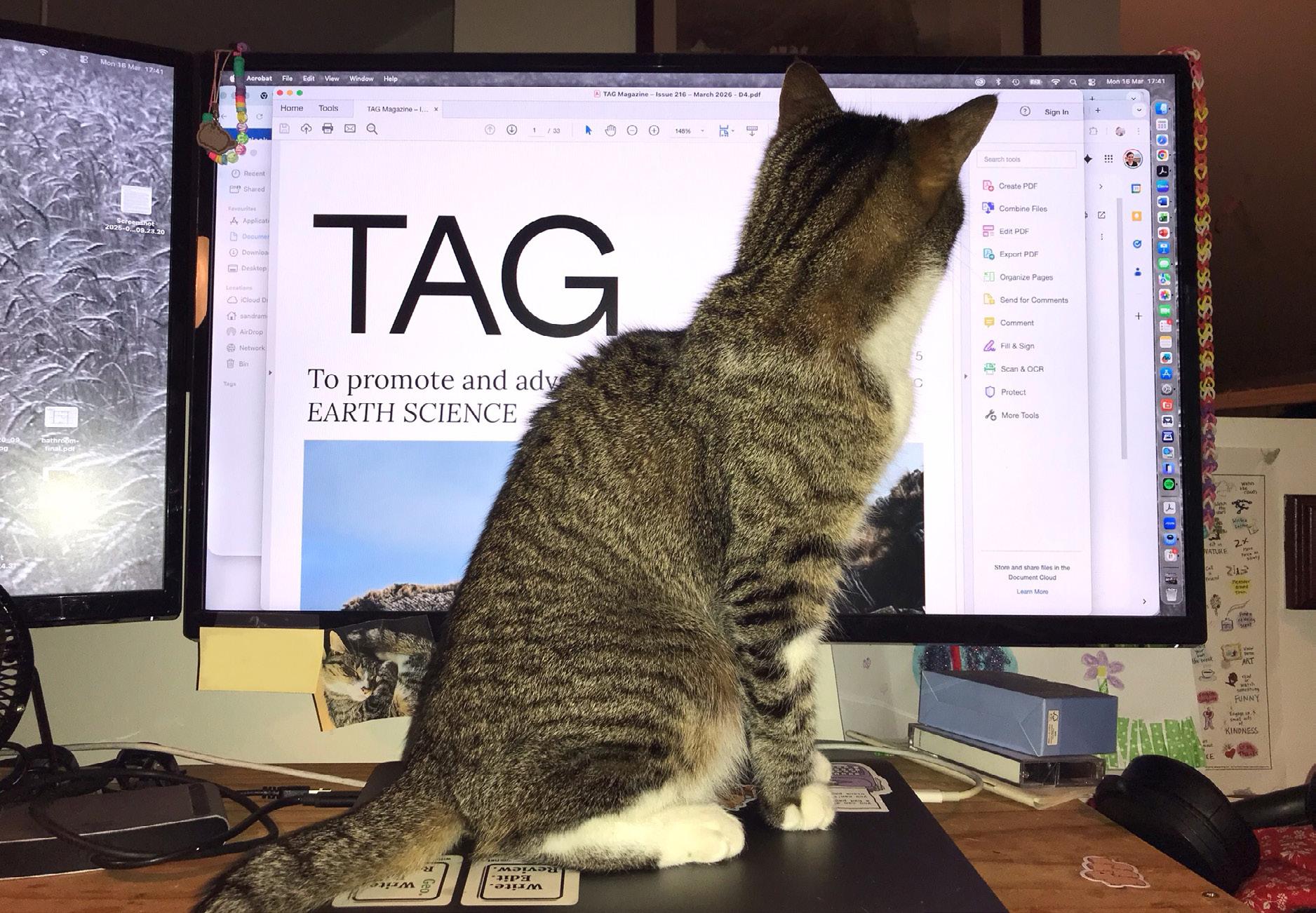
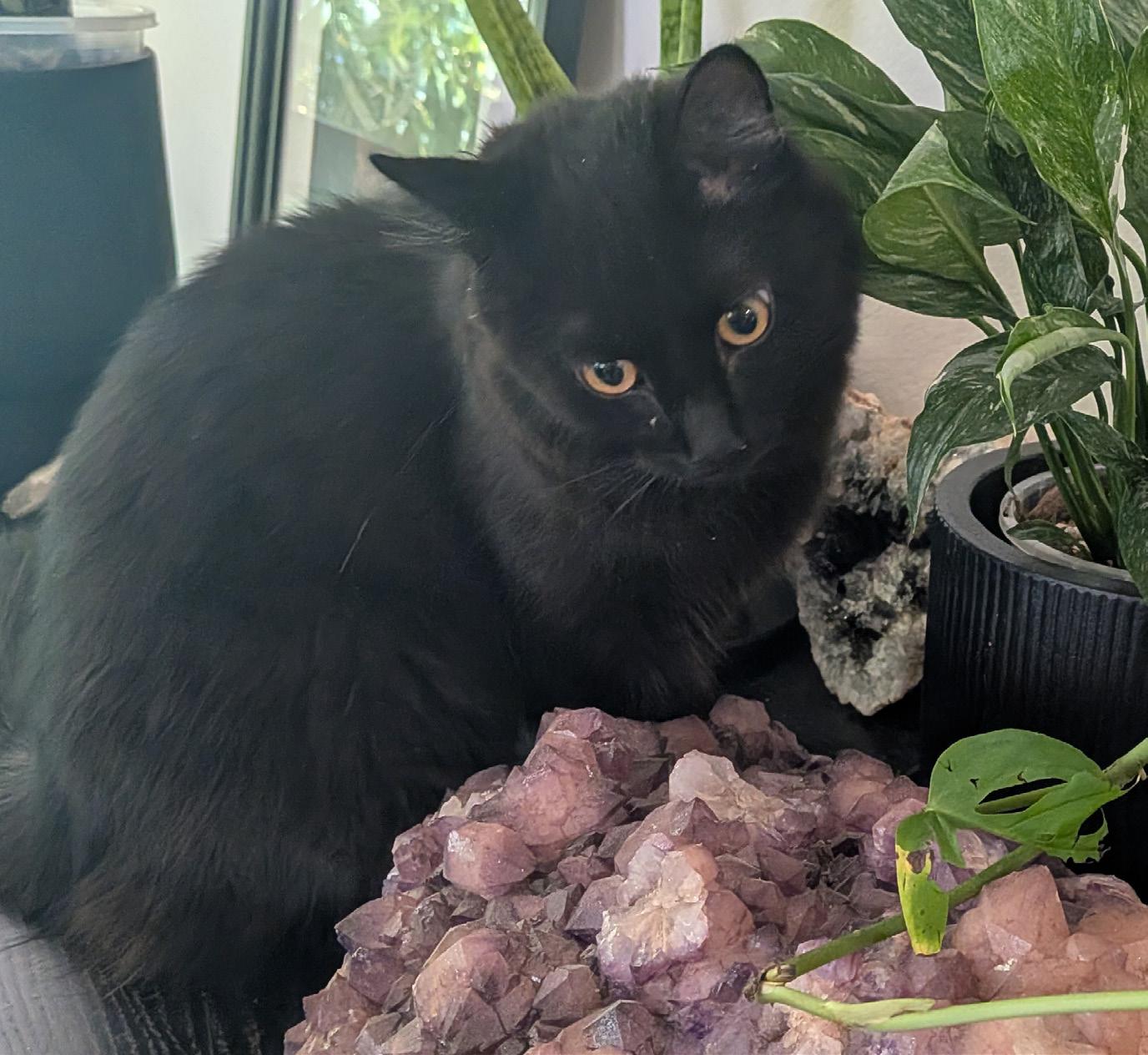
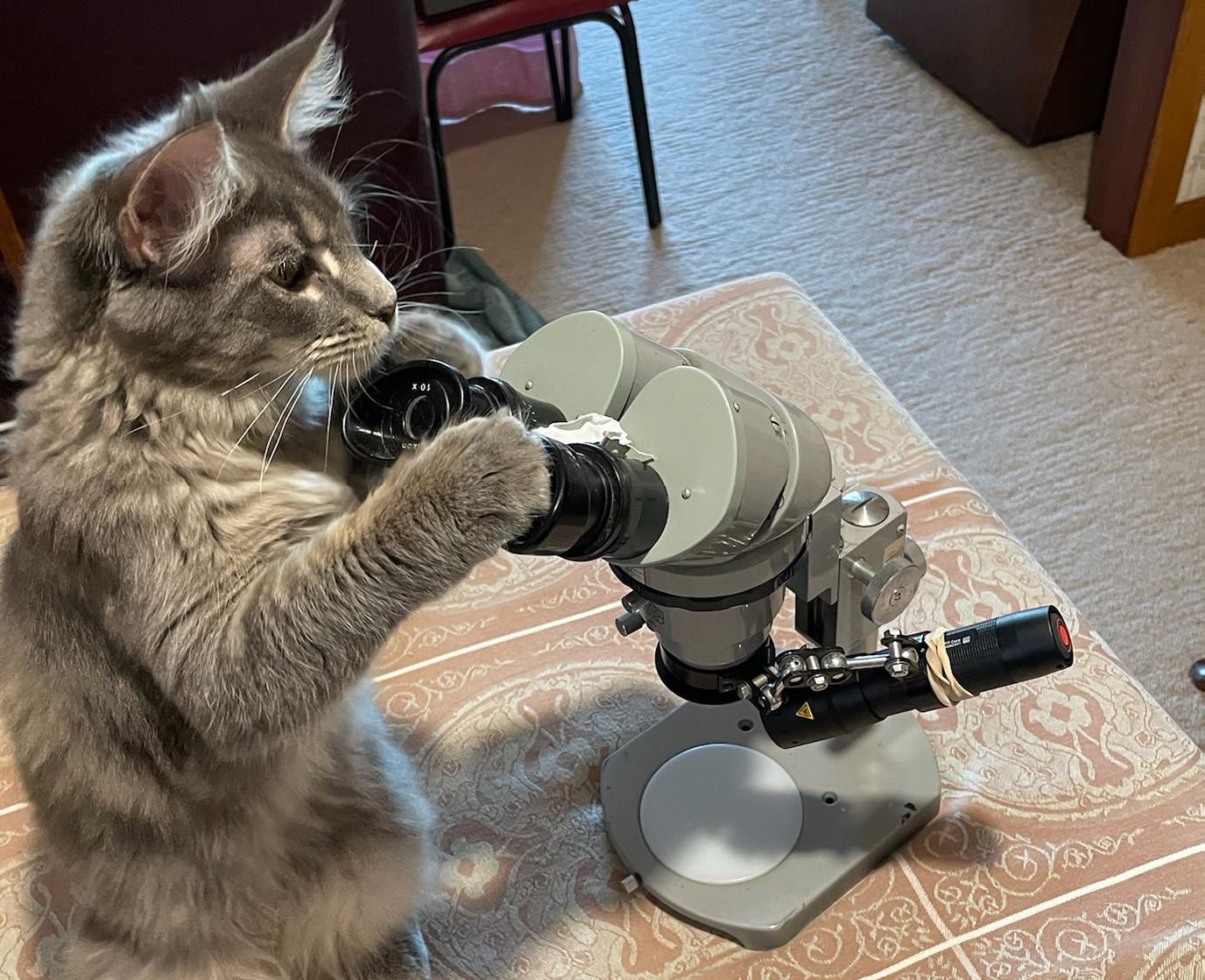
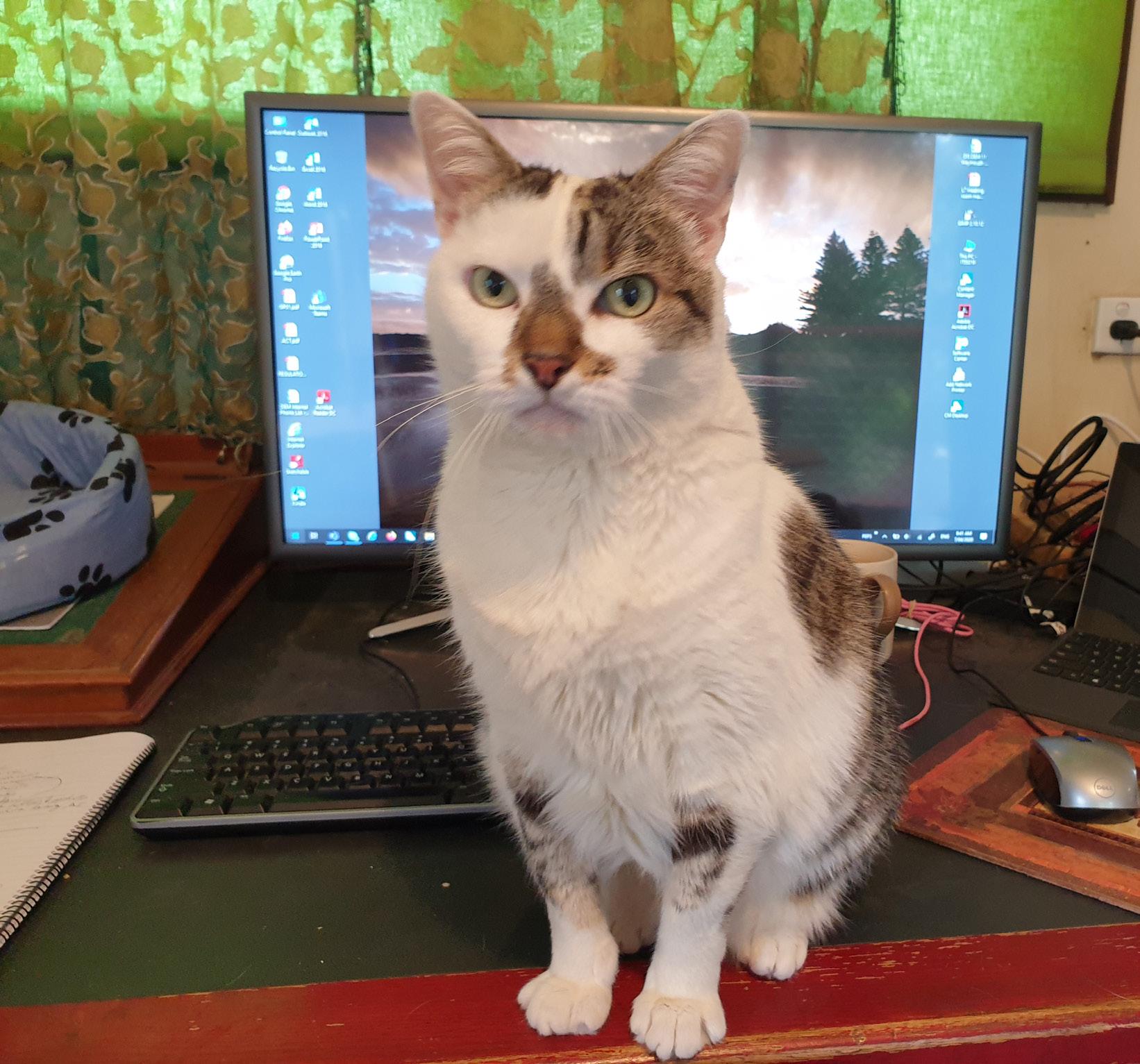
In Issue 216 we made a call out to all GSA cats! Some lovely responses came in from our members. It seems our cats like helping out with all aspects of being an Earth scientist – from reading and reviewing documents, helping manage member groups, looking at hand samples and even helping with petrography!
Assistant Editor Mo does a last proof read of Issue 217
Photo: Sandra McLaren
Soot Sprite with amethyst crystals
Photo: Amber Jarrett
Bunny, TAG assistant graphic designer, taking a break during the design process of Issue 217
And a triptych of Princess Mishka (a 16 month old Maine Coon working with Brian England) hard at work at different aspects of being a geologist. Here she is shown producing crystal drawings for the mineral collection catalogue, helping to catalogue smoky quartz crystals collected from Cobar NSW and showing Brian the right way to use his microscope “perhaps if you turn this you might see something?” [this was not staged!]
Chanee assisting Romana Dew with emails for WOMEESA community engagement. Great work Chanee!
Pip preventing Elinor Alexander from working! Pip was found on the beach at Port Vincent in South Australia as a very young kitten in 2012 and so is likely an expert in Yorke Peninsula geology.
Antimony: a critical mineral on the move
Talks and posters in the resources sessions at AESC covered many commodities and mineral deposits but a popular topic of discussion was gold (Au) and antimony (Sb). John Walshe convened a session on gold-antimony mineralisation that included a range of fascinating talks and generated interesting discussions among delegates.
Antimony is a chalcophile element and has been used in a range of applications throughout history. Contemporary interest in the element is associated with its increasingly important application in the
defence, manufacturing, semiconductor, energy and automotive industries globally. Most antimony is mined in China while other significant contributors to the global market are Tajikistan and Türkiye; Kyrgyzstan and Russia are also important producers and have significant reserves1
Importantly, in January 2026 antimony (together with gallium and rare earth elements) was included in the Federal Government’s newly established Critical Minerals Strategic Reserve.
Minerals Occurrences
Antimony (Sb) occurs in the crust at an abundance of 0.2 to 0.5 ppm. It is rarely found in its pure state and instead occurs in more than 100 different minerals. By far the most common antimonybearing ore mineral is stibnite [Sb2S3] but it also occurs as oxide [valentinite, Sb2O3 and stibiconite, Sb3O6(OH)], and in sulphosalt minerals such as tetrahedrite [(Cu,Fe,Zn,Ag)12Sb4S13], boulangerite [Pb5Sb4S11], bournonite [PbCuSbS3], livingstonite [HgSb4S7] and jamesonite [Pb4FeSb6S14].
Uses
Antimony is a silverly, lustrous grey metal that is a poor conductor of both heat and electricity. It is brittle and flaky so is commonly used as an alloy, most often as antimony trioxide (Sb2O3). The main use of antimony is to harden lead in storage batteries; it is also used in non-metallic products as a fire-retardant (for example in enamels, paper, plastics and textiles and the insulation surrounding the copper wiring in your home), opacifier (in ceramics) and de-gasser (glass production). It is increasingly used in semi-conductor technology and renewable energy infrastructure including solar panels and wind turbines. The range of applications means that it is included on the critical mineral list of many countries.
The name antimony derives from the Greek words anti and monos, meaning “not alone”. And indeed most antimony occurs in association with gold, typically in the upper parts of a mineralised system, but it can also be associated with some Ag-Pb-Zn deposits. In Australia both associations are known, with most antimony associated with orogenic gold (for example in Victoria). A declining global supply and an increasing antimony price means that it is not surprising that the metal is the focus of renewed and purposeful focus from explorers, miners and investors.
AESC delegates heard updates about several antimony occurrences, including the Costerfield deposit which is Australia’s only current antimony producer.
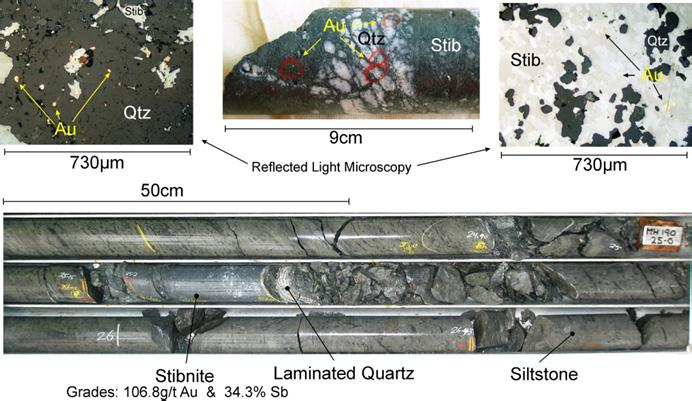
Cameron Cairns from the Geological Survey of Victoria noted that there are currently 253 known gold-antimony occurrences in Victoria alone, with the majority located in central Victoria within exposed portions of the Melbourne and Bendigo zones. Cameron summarised new high-resolution X-ray fluorescence imaging and SEM-based automated mineralogy by the CSIRO that have helped constrain overprinting relationships for the mineralisation at multiple gold-antimony occurrences in the Melbourne Zone. These data show that stibnite-gold mineralisation is late and overprints pre-existing quartz veining and at least one generation of pyrite and arsenopyrite. The gold is almost exclusively confined to intersections of massive stibnite. New Re-Os arsenopyrite and pyrite geochronology places the Sunday Creek deposit at c. 379 Ma, the first time a gold-antimony occurrence has been dated in Victoria. More work is required to investigate the potential temporal relationship between 385–360 Ma granitic magmatism and gold-antimony mineralisation in central Victoria.
Costerfield, located 50 km south-east of Bendigo in central Victoria, has produced antimony and gold intermittently since its discovery in the 1860s. It remains Australia’s most significant known antimony resource and has met around 2% of global antimony demand in recent years2. It represents a classic example of a narrow vein gold-antimony (Au-Sb) epizonal system. Joshua Greene (Alkane Resources) provided an overview and update on the Costerfield deposit.
Gold-antimony mineralisation at Costerfield occurs within subvertical quartz-carbonate-stibnite-gold±sulphosalt veins that range from in width from just 0.01 m to around 1 m, often with horizontal and vertical extents of more than 500 and 300 m respectively. These most commonly occur in deformed, relatively homogeneous, low metamorphic grade Silurian-aged deep marine turbidites located on a thrust-fault scalped anticlinal dome. Mineralisation post-dates
regional folding and large scale thrust faulting but it is not clear whether the mineralisation source was magmatic or orogenic. A zonation is observed through the system with antimony decreasing and gold increasing with depth.
Vein mineralogy is dominated by stibnite and quartz, with < 1% pyrite, arsenopyrite and free gold. Other trace minerals include aurostibite [AuSb2], native antimony, tetrahedrite [(Cu,Fe)12Sb4S13], bournonite [PbCuSbS3], chalcopyrite and sphalerite.
The pre-mining endowment for the Costerfield district is at least 111 kt antimony (associated with 1 Moz gold), with a current mining reserve of 0.54Mt @ 8.7 g/t Au and 2.0% Sb for 0.150 Moz Au and 11 kt Sb. 1,282 tonnes of Sb were produced in 2024.
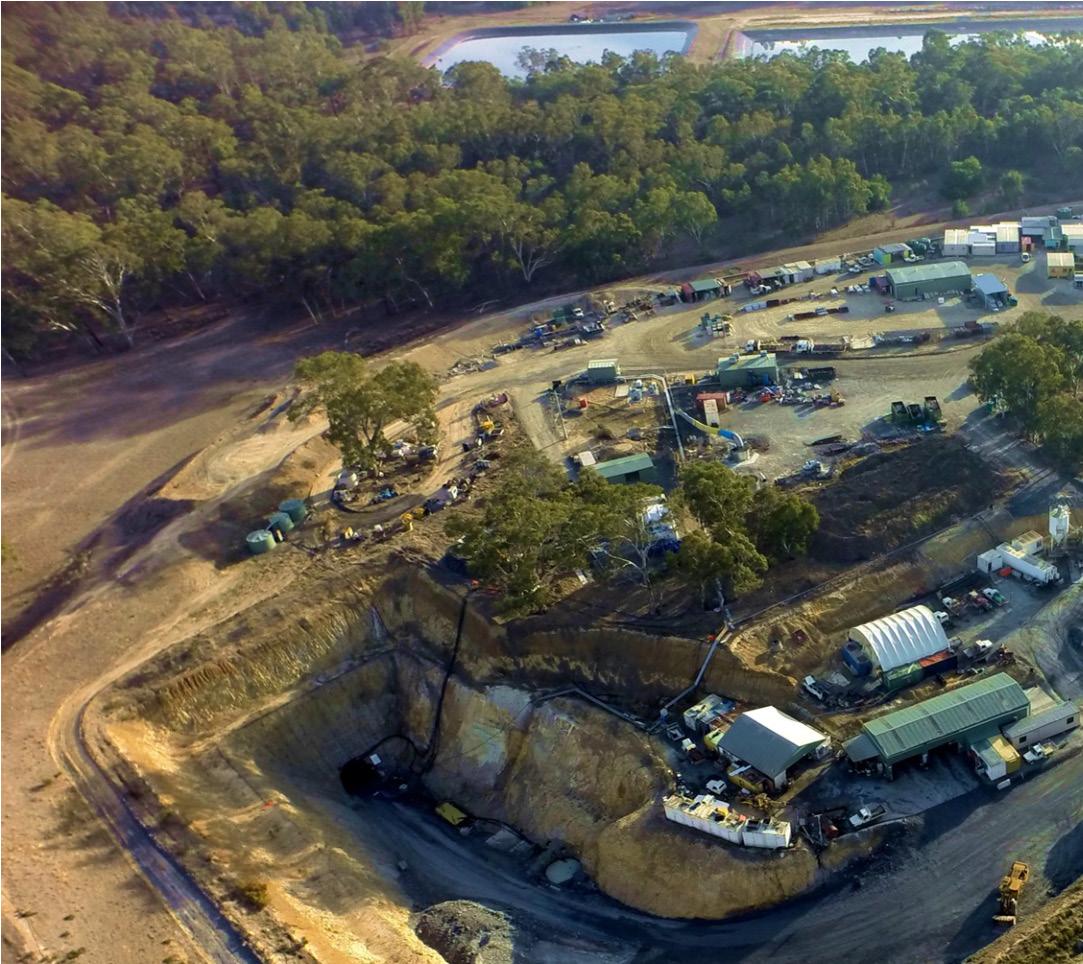
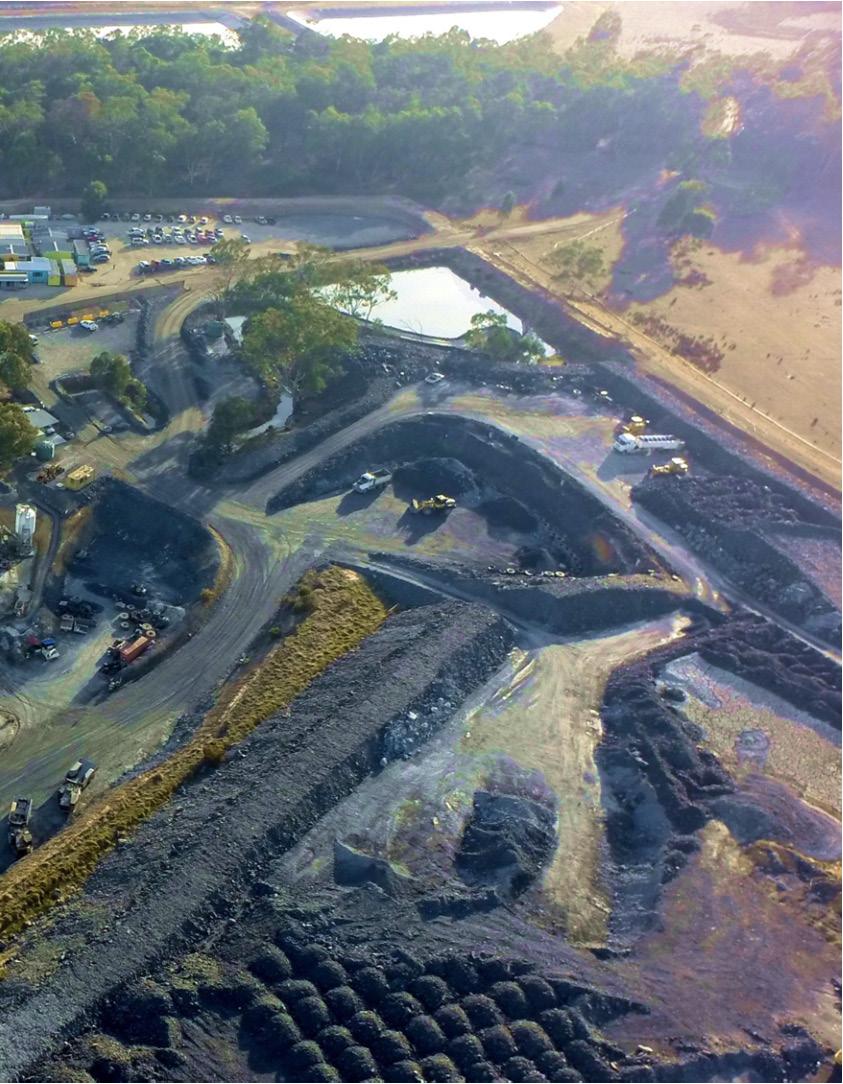
Costerfield
Aerial image of Augusta mine site, Costerfield, Victoria Supplied: Alkane Resources
Emerging antimony occurrences
A number of talks provided updates on recent exploration and evaluation of new antimony resources.
Sunday Creek is located in the Melbourne Zone of central Victoria and currently at the resource definition stage. Like Costerfield, the host rocks at Sunday Creek are interbedded turbidites that have been metamorphosed to sub-greenschist facies and folded. Andrew Gordon (Southern Cross Gold) reported that mineralisation is thought to have been structurally controlled occurring within quartz-stibnite extensional veins, stibnite-gold matrix breccias and complex shear veins. The main host for mineralisation is an east to north-east trending zone of intensely altered ‘bleached’ silica-sericite-carbonate altered turbidites and a silica-sericite-carbonate-fuchsite altered mafic-intermediate dyke. High antimony grades (+5% Sb) are associated with vein arrays and complex multi-phase textures and often occur with a variety of fibrous Sb-As-Pb-Cu-Ag sulphosalts. Sunday Creek has a current mineral exploration target of 1.7–2.6 Moz gold and 66.6–88.2 kt antimony.
Hillgrove, located 23 km east of Armidale in northern NSW, has been a known antimony occurrence since the mid 1870s and produced antimony intermittently until 2016. It is one of the largest known antimony deposits outside of China and is now the focus of redevelopment. Mineralisation is hosted in late Palaeozoic Girrakool Metasediments adjacent to the Hillgrove Fault zone. Jonathan Berthiaume (Lavrotto Resources) outlined that SbAu-W mineralisation occurs within vein and breccia systems in steeply-dipping fissures with extensive strike extent. Mineralisation is orogenic and structurally controlled within subvertical quartz–carbonate–sulphide veins and breccia systems. Like Costerfield, vertical zonation is observed with stibnite-dominant zones at
shallower levels and deeper gold-dominant zones (although with some exceptions).
The Ricciardo Au–Sb system, located along the Mougooderra Shear Zone (MSZ) within the Neoarchean Yalgoo–Singleton Greenstone Belt of Western Australia, represents one of the largest known antimony endowments within the Archean Yilgarn Craton. Peng Sha (Warriedar Resources Ltd) described the deposit and noted that with 12.2 Mt @ 0.5% Sb (60.3 kt Sb), antimony would be a significant economic by-product of the 1.96 Moz AuEq resource already known. At Ricciardo antimony mineralisation postdates and overprints the main Au event. Mineralisation is developed within pervasively silica-altered and carbonate-altered/listwanitic ultramafic units, forming quartz–stibnite vein stockworks, sheeted vein arrays, massive stibnite veins, and stibnite-cemented breccias. The preferential localisation of Sb within the ultramafic rocks reflects the combination of enhanced fracture permeability, rheological contrast and favourable geochemical buffering. Mineralisation has been defined over 2km, striking north south and is centred on the MSZ. The Ricciardo deposit represents a key Archean analogue for a composite structurally controlled Au-Sb bearing systems and highlights significant critical mineral potential within Archean greenstone belts.
Other occurrences of potential significance in Australia include Mt Clement (in the Pilbara of WA), Nagambie (Victoria), Montezuma (Tasmania) and Golden Range (WA).
The impetus provided by its critical mineral status means that exploration for antimony is increasing in a number of both brownfields and greenfields settings. Higher antimony prices (up to nearly US $43,000/tonne in January 2025) are likely to encourage exploration and recovery of antimony from other known gold deposits. Interestingly, in her AESC talk in the Innovating for a Sustainable Resource Future session Kathy Benison (West Virginia University) outlined how antimony is one of several elements concentrated in brines in salt lake systems in Western Australia. These occurrences potentially aid exploration efforts in nearby basement sources and the brines themselves, as well as nearby rocks or sediment associated with the brines, may provide future extractable sources of the metal.
There is also potential for antimony recovery from Australian ZnPb-Ag ores, such as Cannington (Queensland), McArthur River (NT)
and Broken Hill (NSW). In these locations antimony is known but low concentrations have previously made recovery uneconomic. Elsewhere, antimony contained within mine waste is a potentially productive source. Significantly, in February 2026 Australia produced its first shipment of antimony metal from recycled lead batteries at a demonstration plant in South Australia. That first shipment will be used by a domestic manufacturer on Australia’s east coast, with future shipments to be exported to customers in Europe, Asia and the United States, supporting a more diverse and resilient global supply chain.
SANDRA McLAREN with thanks to Joshua Greene (Alkane Resources) and Cameron Cairns (Geological Survey of Victoria)
Aerial image of Costerfield mine from Alkane Resources
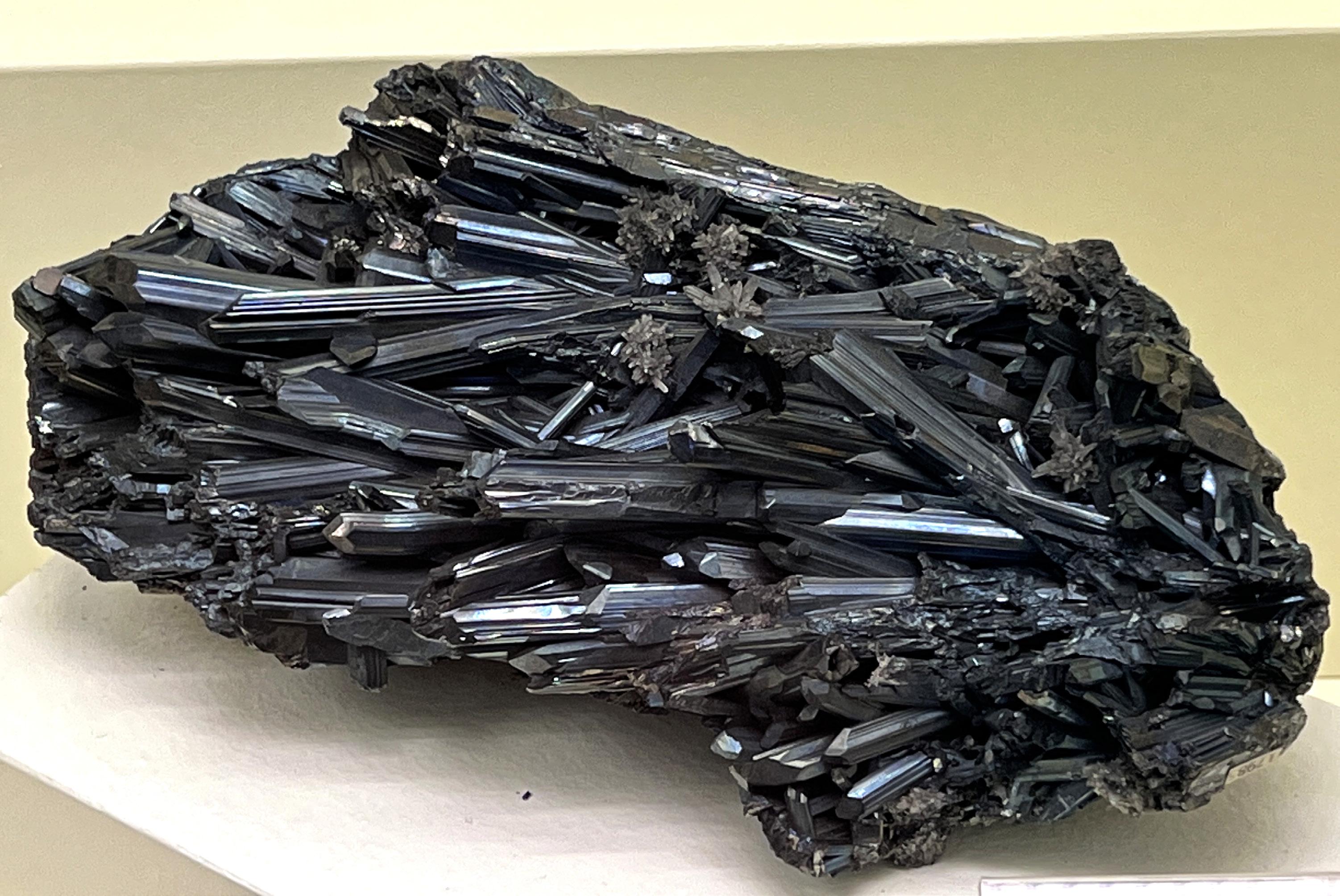
Antimony-quartz from the Grupe Shikawa
Photo: Sarah Jackson
AJES and Our Community: Reflections from the AESC Town Hall
AJES sparked a thoughtful and, at times, frank discussion during the AESC Town Hall. The timing is important. The Geological Society of Australia is currently negotiating the AJES publishing contract, and many of the ideas raised by members speak directly to how the journal might evolve in the coming years. These conversations are not happening in isolation. They help shape the direction we take next.
AJES remains a cornerstone of the Society. It contributes more than $100,000 each year in royalties, supporting member services and helping keep the organisation financially sustainable. That reality framed much of the discussion. Members were clear that the strength of AJES is not only an academic matter but a collective responsibility.
Some participants spoke about the challenges of attracting submissions when lower than ideal journal rankings influence publishing choices. Others pointed out that improving visibility starts with us. Publishing strong Australian research, synthesis papers and review articles in AJES is one practical way members can contribute. Service to the profession takes many forms. For some, that may include choosing AJES as the home for their manuscripts. Another example is expediting review of papers from early career researchers to encourage participation.
There was also interest in broadening the kinds of papers we see in the journal. Not everyone realises that AJES welcomes methods articles and short data discovery papers. These can be powerful tools for sharing new datasets, mapping releases or technical advances, particularly from government surveys and industry. Several attendees suggested encouraging authors
to develop conference papers into peer reviewed manuscripts so valuable Australian research does not disappear into hard-toaccess proceedings. Open access costs were raised as a barrier for some contributors and remain part of the broader conversation.
Ideas around thematic issues and closer collaboration across the region were also discussed. Thematic issues are easier to begin than many in the room realised. If you are interested, please contact the AJES Editors via AJES@gsa.org.au
Many of these ideas are not quick fixes, but they do reflect a community thinking carefully about its journal at an important moment and we will continue to have these discussions through 2026.
The TAG Editorial Team and the GSA Governing Council are seeking ideas and suggestions from members across academia, government and industry. As we continue contract discussions, your perspective matters. Does AJES serve our community as well as it could? Where do you see opportunities for growth?
Please send your comments and ideas to tag@gsa.org.au by 1 May 2026.
Most read and trending AJES articles:
AMBER JARRETT
Up Goer 5 at AESC
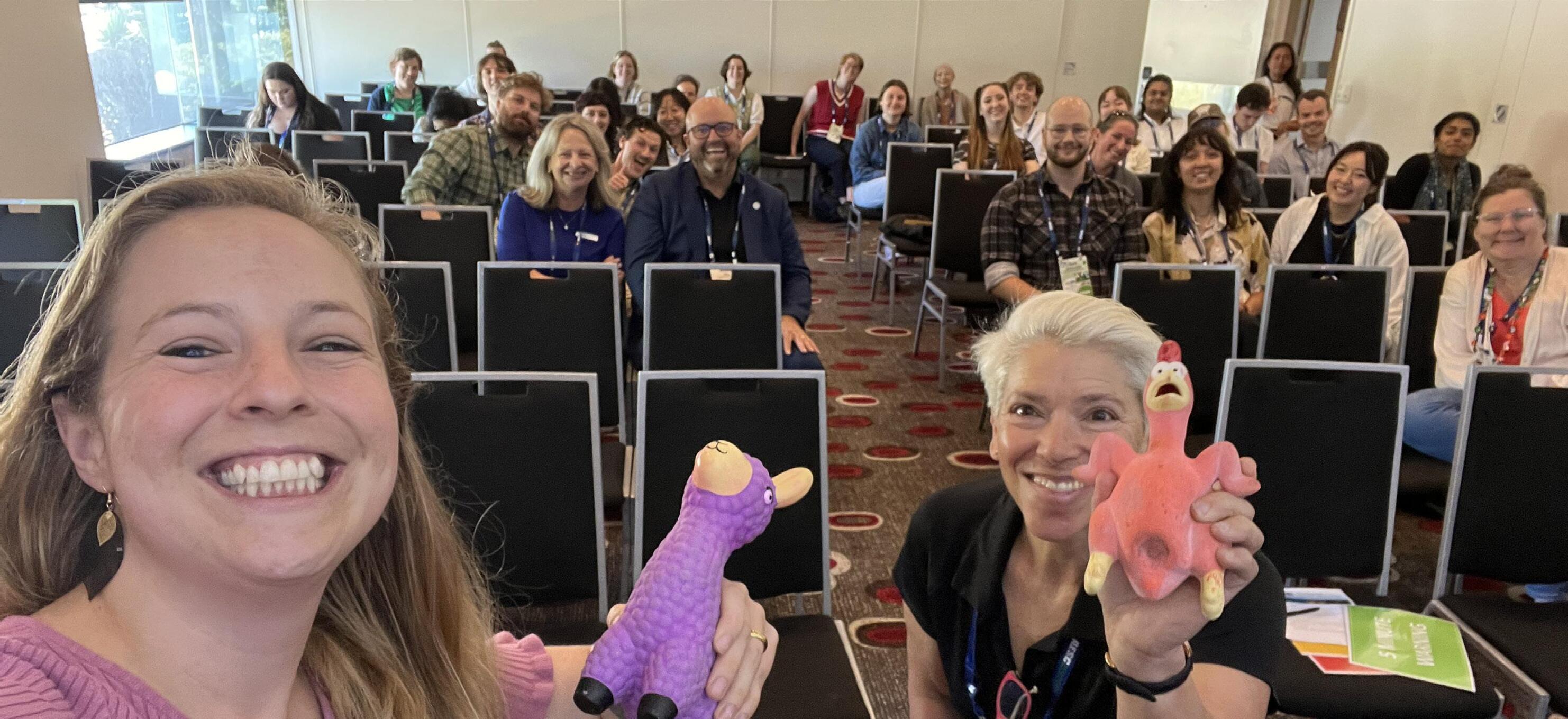
The Up Goer 5 concept started with Randall Munroe, the creator of the XKCD comic series. In one of his comics (#1133) he presented the “US Space Team’s Up Goer Five”, which sought to explain NASA’s Saturn 5 rocket, using only the top ten hundred words in the English language (“thousand” is not one of those words). This became a worldwide scientific challenge. In geosciences, the AGU and the EGU have held regular Up Goer 5 sessions for some years. Fast forward to 2026, and Up Goer finally came to Australian geoscience for the first time, at AESC!
Many people came to a large city in a land down under, to a place where the Plan 1 Car Race1 happens, to talk about rocks around the world. They talked about tiny bits of rocks, dead things in rocks, early people and rocks, sound pictures, push ups and how we tell the time with rocks. Ten and six people talked about these things, using only Up Goer talk. Some even made movies.
Talking in Up Goer talk can be hard, it’s hard to find the right words using only the top ten hundred, and you can say wrong words. When this happened, some people used a dog-play thing that made funny noises to tell everyone that you used a wrong word. It sounded like a small animal with two legs that should be able to fly but can’t, and that makes noises when the sun comes up2. It made everyone laugh, even the people talking. Sometimes the people doing the
talking did not think they had used a wrong word, and so they used a different dog-play thing that also made funny noises (from an animal with four legs that sounds a bit like “arm her”)3 to say they did not agree. It made everyone laugh even more.
There were a lot of different talks. One person talked about changes from a hot world to a cold world on a very cold land using bits of trees, and someone else talked about “Land Shakes and Big Water” and did a lot of dancing to help us see. He also had some food to help, and some of it looked like long animals with no legs that move on the ground and can be very bad if they bite you, but the food one was nice. We also heard about “Dating Rocks using long round rocks with a point”, “Old Strange Top Rocks formed in deep water after a big ice age” and learning how the “middle of our land down under got big high rocks.” This last one looked a bit like some food from a land far away where they speak differently4, and where there is a tall place made from not wood, that people go to see and climb to the top5. We eat this food in the morning6 with a drink made from small things that grow on trees7. It looks just like the high places in the talk.
One person who talked about “Rocks from Tall Fire Mountains” couldn’t stop laughing through the talk, and we all laughed more too. One person said a lot of wrong words and so got many funny noises during the talk.
“Rock-like Sea-animals”, “Big high rocks”, “star power” and “warming water losing air” all got a mention. One person talked about changes in a land of old dead water, and how it helped old dead people long, long ago.
We laughed a lot. In fact we made so much noise that other people close by got angry with us, as they couldn’t hear the other talks! Thank you to all of the great people that helped us with our Up Goer talks. Finally Up Goer made it to the Land Down Under. We hope it happens again!
MYRA KEEP
1 Formula 1 grand prix
2 Squeaky chicken
3 Squeaky llama
4 France
5 Eiffel Tower
6 croissant
7 coffee
Photo: Supplied
FEATURE | AESC 2026
AESC 2026 Cape Liptrap field trip
– sea, sun, rain and the Waratah ophiolite
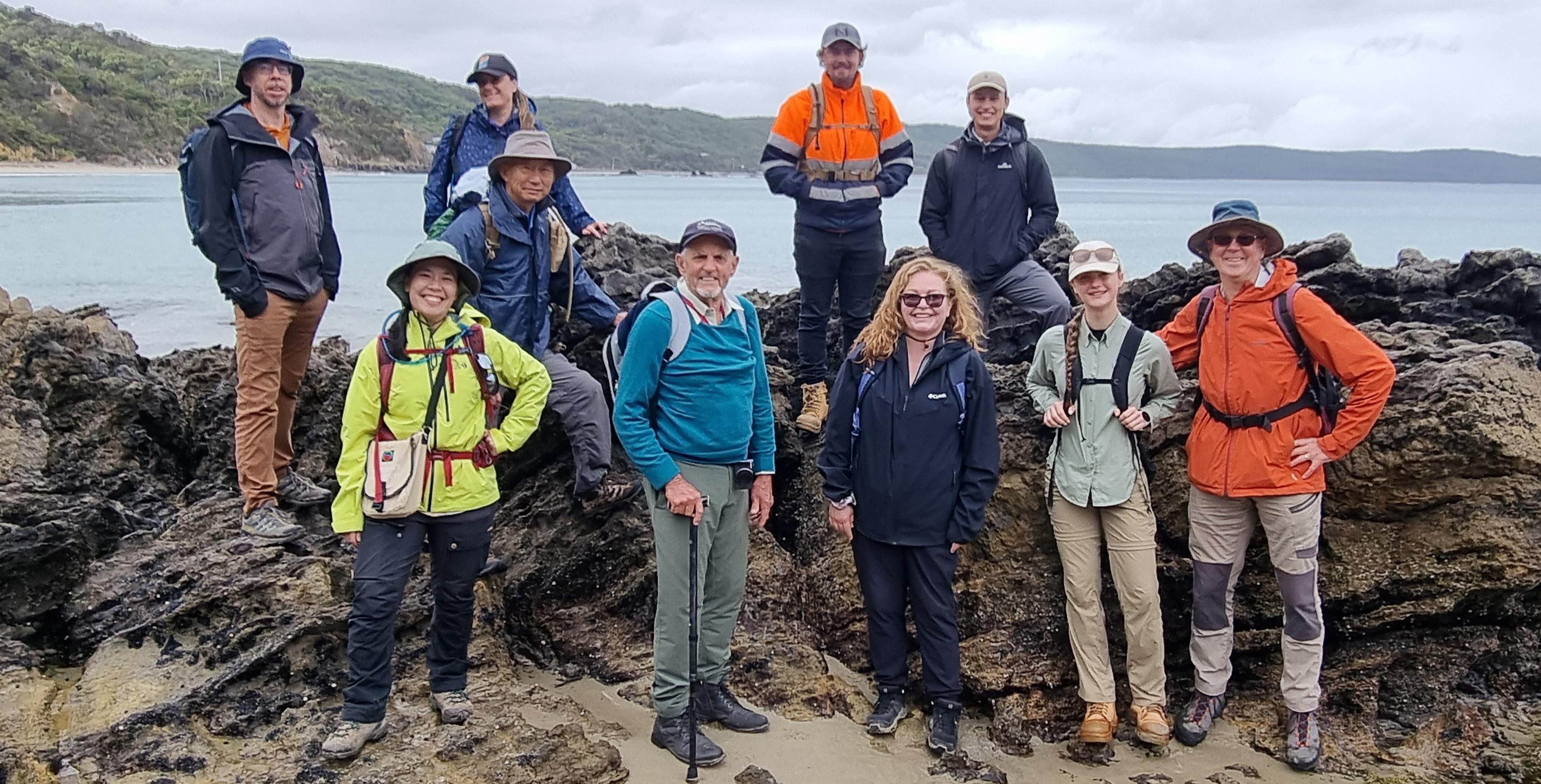
On the weekend before the AESC, a group of 12 geologists set out for Cape Liptrap, southeast of Melbourne, to examine the Cambrian (or older) dismembered Waratah ophiolite. They were guided by James Driscoll from Monash University and Kevin Hill and Eleanor Green, with Grace Sethanant as safety officer, all from the University of Melbourne.
Together we examined the deformed and serpentinised peridotite and pegmatitic gabbros from the deep part of the ophiolite and the sub-vertical and overturned pillow lavas from the surface part of the ophiolite.
We were able to distinguish between the very uniform MORB volcanics in the south and the arc-related volcanics in the northern part of the ophiolite separated, by faults, from the intervening serpentinised peridotite. The ophiolite sequence is unconformably overlain by thin Early Ordovician and Early Devonian carbonates, which are much less deformed, and clearly visible in outcrop. Finally, despite some rain and unusually high tides, we examined the spectacular 200–600 m-wide Bell Point and Waratah sinistral wrench faults, before heading back to Melbourne.
The trip involved a fun drive across the Landy Farm, whose owners very kindly gave us permission to access the key outcrops. The weather was pleasant on the Saturday, ideal for the 5 km hike along the beach and foreshore. But on Sunday it was a tad wet and the high tides meant some wading by the heroic James Driscoll to guide people around the point as we emerged from a cave through the dolomite. A good time was had by all.
KEVIN HILL
ARGA Field Excursion:
Interplay of Regolith and City Fringe
As part of the AESC 2026 program in Melbourne, the Australian Regolith Geoscientists Alliance (ARGA) specialist group delivered a full-day field excursion exploring the interplay between geology, regolith and land use across Melbourne’s south-eastern urban fringe. The excursion focused on how contrasting geological substrates influence soils, vegetation, geomorphology and human land use across coastal, volcanic and upland landscapes.
A lively bunch of participants from across Australia met at the Pullman Hotel early Saturday morning and travelled eastwards across the Melbourne city and suburbs, traversing from late Cenozoic coastal sand plains through Miocene and older volcanic terrains to the upland igneous landscapes of the Dandenong Ranges and Yarra Valley. Luckily, many of the group had attended the ARGA Symposium program during the week and had developed an appreciation of the geological history of Victoria from the various talks presented, including Ross Cayley’s talk on the uplift history and landscape evolution of south-eastern Australia.
The field program highlighted how long-term geological processes, combined with climate and tectonics, have shaped regolith
development and modern city-fringe environments.
The excursion commenced at Cranbourne Botanic Gardens, situated on extensive late Cenozoic sand plains and dune systems. From elevated dune crests, participants examined aeolian sands derived from marine transgressions and discussed dune formation, swale wetlands, and perched water tables. Views across Western Port and surrounding uplands provided context for regional faulting, sunklands and uplifted terrains. The stop also highlighted the influence of regolith on vegetation patterns and land management, including evidence for landscape modification through sand extraction and long-term Indigenous land practices.
En route to the Yarra Valley, discussion focused on the Devonian volcanic origins of the Dandenong Ranges. The deeply eroded rhyodacite and dacite volcanic complexes were used to illustrate the development of thick residual soils under high rainfall and prolonged chemical weathering. The relationship between geology, slope processes and landslide susceptibility was also examined.
Landscapes
Within the Dandenong Ranges, attention was given to krasnozemic red loam soils developed on Devonian volcanic rocks. These deep, fertile and well-structured soils were linked to the productivity of wet sclerophyll forests dominated by Mountain Ash and later the rich soils preferred by plant nurseries, orchards and grape growers alike!
The final stop examined soil-landscape-vine interactions in the Yarra Valley. Miocene basalt-derived soils were discussed in terms of their clay content, moisture retention and temperature moderation, including how slope, aspect and drainage influence vineyard microclimates. While this stop provided a practical example of how geological and regolith factors directly affect agricultural land use, we also really appreciated the insights from Sir Paz’s cellar door manager, Kelly, about the wine making process.
The trip highlighted the many roles that regolith plays, especially on the edges of city where more natural landscapes begin to emerge from suburbia. Underlying rock, regolith, soil and land use are all connected.
ANNA PETTS
Happy excursion goers at Sir Paz winery in the Yarra Valley –checking out the volcanic soils and post glacial landscapes.
Wil-im-ee Moor-ring (Home of the many axes): Two-way
learning from a Cambrian greenstone quarry
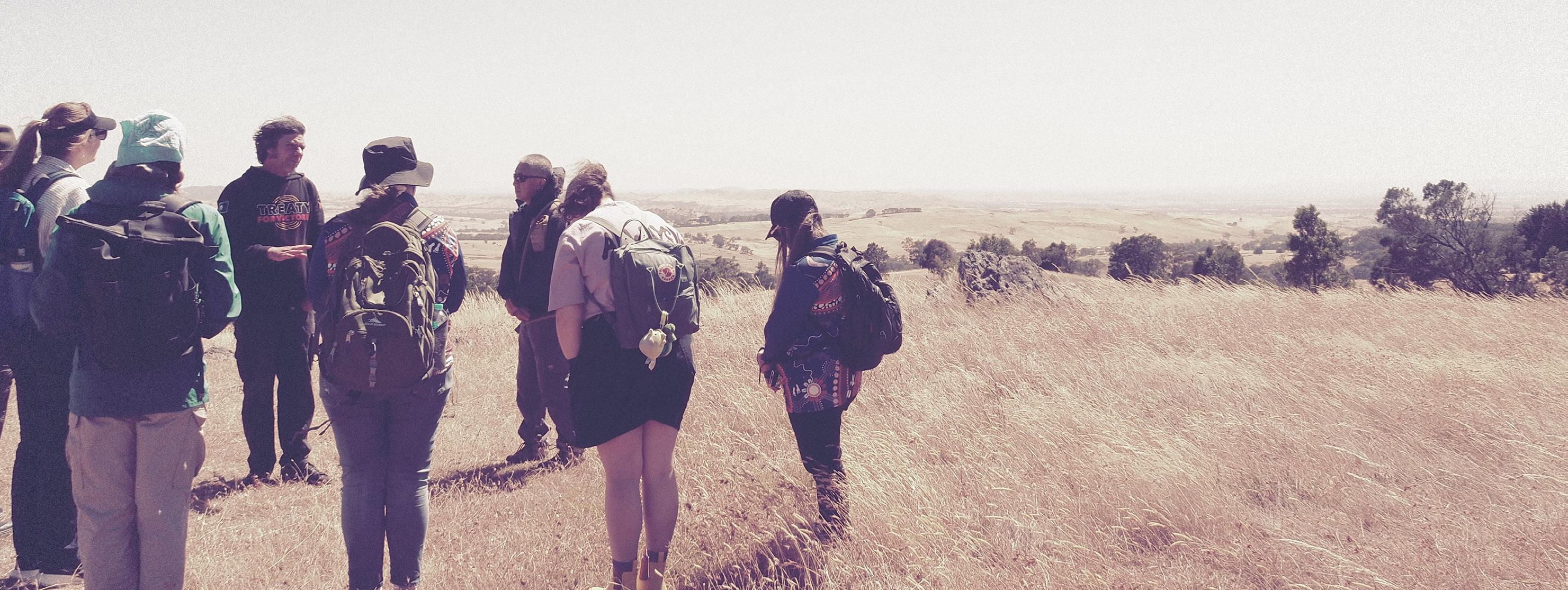
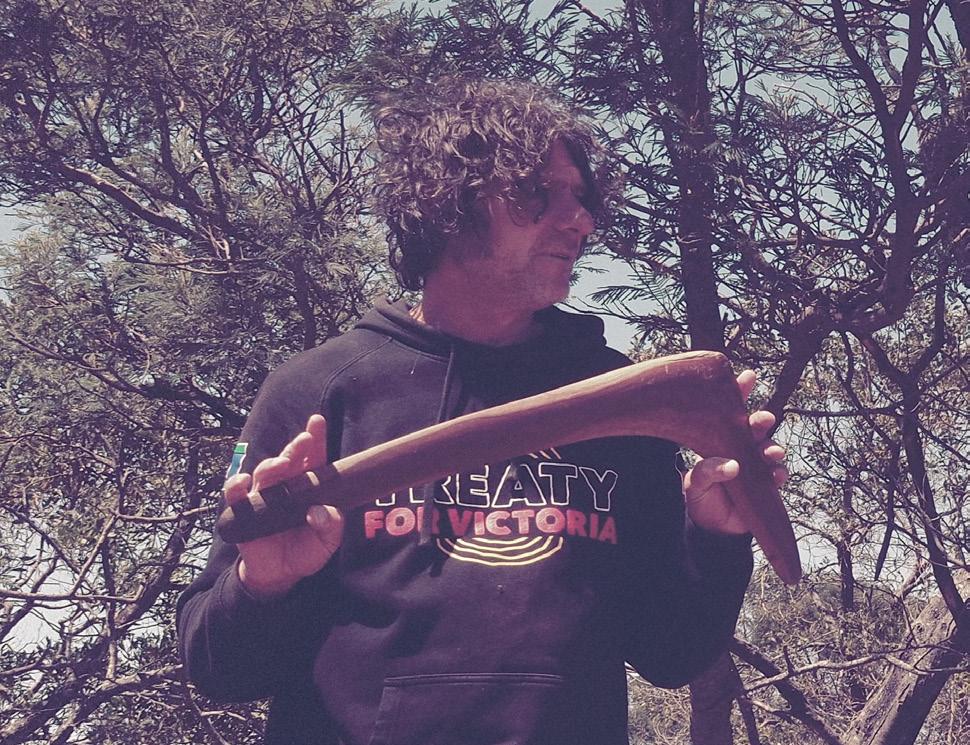
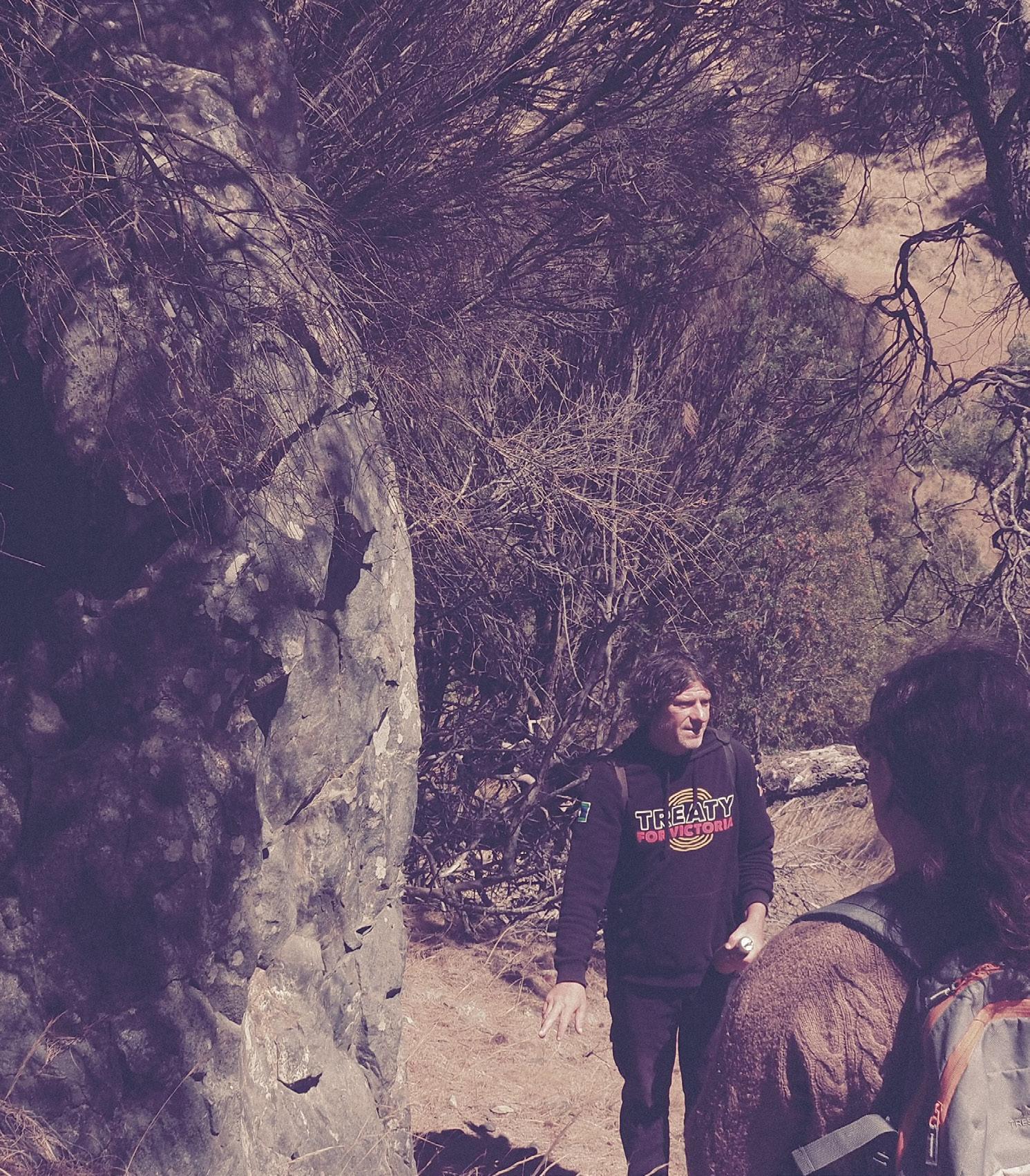
Some field trips change how you see the rocks beneath your feet. Visiting Wilim-ee Moor-ring (Mount William) during AESC was one of those moments. Rather than opening with maps or stratigraphy, we began by listening and moving slowly through a landscape where geology, archaeology and culture sit side by side.
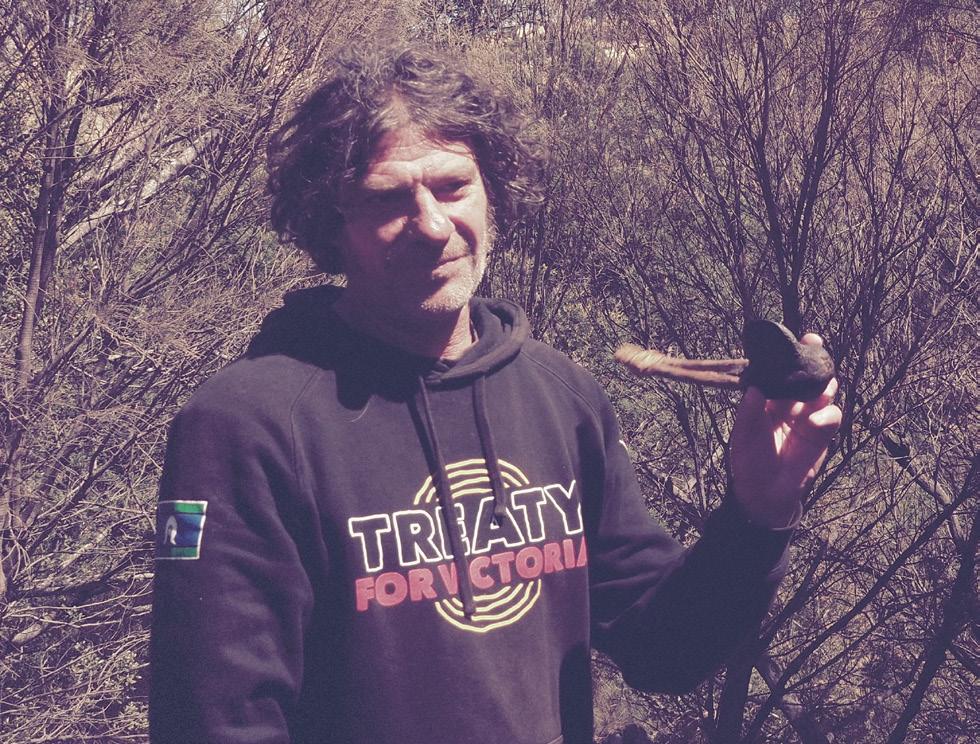
Guided by an Aboriginal cultural educator from the Wurundjeri Woi-wurrung Cultural Heritage Aboriginal Corporation, our group walked across the slopes of the renowned greenstone quarry near Lancefield. Standing among hundreds of extraction pits, the Cambrian greenstone landscape shifted from a geological site to a place
layered with story, responsibility and deep time. Early in the walk we were told that this quarry is regarded as one of the most sacred places on Wurundjeri Country, a statement that reframed the experience for many of us as geoscientists.
Wil-im-ee Moor-ring is located within a Cambrian greenstone belt formed from metamorphosed mafic volcanic rocks. The fine-grained greenstone, described as volcanic diorite, is exceptionally tough and well suited for ground edge hatchet manufacture. Archaeological research shows that stone from this quarry travelled more than 700 kilometres through exchange networks extending into present day New
South Wales and South Australia. Long before modern exploration frameworks existed, people were selecting rock for durability, performance and purpose. We heard how large boulders were fractured using fire and rapid cooling with water, with burn scars preserved beneath tors as evidence of this practice. Flat anvil stones were used to shape early axe blanks before they were carried higher up the mountain to sandstone outcrops for grinding and polishing. We were also told that crafting an axe was an important cultural milestone for men, highlighting how deeply geological knowledge was embedded within daily life.
Photo: Sarah Jackson
For many of us, the visit became a reminder that two-way learning does not replace our science, it expands it. “”
Along the walk, cultural knowledge sat naturally beside geological observation. We learned about games such as Marngrook, played with a soft possum-skin ball. We were shown how plants on Country supported travel, including she-oak used to help keep the mouth moist so the Wurundjeri people could continue their songlines over great distances – and it tasted pretty good. Seasonal calendars, plant knowledge and stories connected to the greenstone revealed how landscape understanding extends beyond scientific description. We also saw how traditional burning practices have encouraged the
return of native grasses within the quarry landscape while surrounding farms remain weed affected.
Historical accounts add further depth. We learned that Wurundjeri elder William Barak witnessed the final quarrying activities in the late nineteenth century and shared aspects of custodial practice with anthropologists. The formal return of land title to Traditional Owners in 2012 reinforces that Wil-im-ee Moor-ring is not only a brilliant geological outcrop and archaeological landscape but a living place of cultural authority.
What made the experience powerful to me was the way different knowledge systems complemented each other. Archaeology reveals the scale of production and exchange, geology explains the resilience of the stone, and cultural knowledge provides meaning that extends beyond scientific interpretation. For many of us, the visit became a reminder that two-way learning does not replace our science, it expands it. On Country, listening to Traditional Owner knowledge becomes another way of reading the rocks.
AMBER JARRETT
Photo: Sarah Jackson
Palaeontology and Palaeoenvironments at AESC
The broad themes of palaeontology and palaeoenvironments were well represented in the AESC program, with keynote presentations, dedicated sessions and a range of posters. The plenary talk by Kliti Grice “From Dinosaurs to Plants: Extraordinary Cellular and Biomolecular Fidelity in the Fossil Record” detailed the remarkable preservation of red blood cells in fossilised bones, among other results, and generated great interest.
Illustration of the possible appearance of the Lake dolphin
Supplied: Chris Vournazos
The Palaeontology, Biomarkers, Biogeochemistry and Evolutional Biology session convened by Tara Djokic and Lachlan Hart was similarly fascinating with a diverse selection of research presented. Topics of discussion included microfossils, palynomorphs, macrofossils and climate and palaeoenvironmental reconstruction.
FEATURE | AESC 2026
Australia’s extinct lake dolphin
Chris Vournazos of Monash University and the University of Wollongong presented a poster detailing his work on Australia’s extinct lake dolphin. Chris’s work focused on fossils recovered from the sediment of several large ancient lakes found in Australia’s now arid interior. He reported results of an examination of the palaeoecology of the Lake dolphin from the Upper Oligocene (27–23 Ma) Namba Formation of South Australia, based on several key fossils such as the dolphin’s ear bone.
To understand the dolphin’s palaeoecology, Chris and his colleagues looked at shape, convergence and trace elements of 56 cetacean ear bones from 53 species. The results showed similarities in echolocation abilities to smaller extant dolphins and two closely related species, suggesting that the fossil dolphin used a similar form of echolocation to navigate turbid waters. 3D geometric morphometrics of the cochlea revealed that it had evolved convergently with some species of ‘river’ dolphins
Novel ways to detect ancient life
In her presentation in the oral session, Indrani Mukherjee (UNSW) asked if we can detect fingerprints of ancient life without fossils? Her talk was centred around questions of biogenicity with a particular focus on mineralisation patterns of organisms and how the microbes that initiated the mineralisation process might have potentially left geochemical clues.
Indrani presented new in situ trace element data in pyritised ammonites. The research took advantage of a variety of geochemical
Gondwanan Belemnites
Helen Ryan from the Western Australian Museum presented new work that represents a major contribution to Gondwanan Cretaceous belemnite research. Helen also took on the challenge of the Up Goer 5 session (page 35) presenting her work as “Dating rocks using long round rocks with a point”.
Belemnites are an extinct group of coleoid cephalopods – often compared with squid and cuttlefish – that lived from the late Triassic through to the end of the Cretaceous. Most of the animal is made up of soft tissue and aragonitic hard parts, so full body fossils are rarely found. Nonetheless, the calcitic guard preserves well and can be extremely abundant in some strata.
techniques including machine learning. Exceptionally preserved biotic textures were able to be resolved using high resolution microscopy (undertaken in collaboration with Karsten Goemann) and were ideal for trace element and speciation analyses. Trace element distribution (obtained using LAIICP-MS) and machine learning application on the data were shown to provide an ideal framework for speciation analyses.
Synchrotron-based techniques (µ-XRF and µ-XANES) were undertaken using the French
Unlike in the northern hemisphere, where belemnites are very well known and the Upper Cretaceous Belemnitellidae is used extensively for biostratigraphy, there are few studies of Gondwanan belemnites with only nominal species described from few specimens with vague locality and stratigraphic data. Because of this, it has been difficult to establish biozones useful for regional biostratigraphy in the southern hemisphere, despite many Mesozoic marine outcrops being rich in belemnite guards.
Helen’s new morphometric studies of large samples from narrow stratigraphic intervals is starting to shift knowledge in this area. The Gearle Siltstone in northwestern WA has locally abundant belemnites; large
suggesting ear bone morphology was a trait that helped facilitate the transition from marine to freshwater environments. Trace element analyses, including Barium and Strontium, confirmed a solely freshwater environment and placed the dolphin in the lake’s highest trophic level. Those fossils represent a new species of dolphin that is potentially the first known dolphin to inhabit a lake and the earliest known appearance of an obligate freshwater species.
National Synchrotron in collaboration with Anthony Chappaz, Sebastian Schöder and Laurent Tranchant and used to investigate trace element molecular geochemistry. This novel work showed that As speciation can be a strong indicator of past biological activity. Significantly the new data showed that the prevalence of a mixture of As speciation (in particular, As [III] and [V]) potentially provides evidence of past microbial As recycling during authigenic mineralisation of the ammonite.
sample sizes (> 300 individuals) revealed two morphotypes of dimitobelids, a family of belemnites endemic to Gondwana. Each specimen was µCT-scanned with 3D geometric morphometrics performed to determine the amount of variation between the whole assemblage, and between the morphotypes. Helen’s next steps include comparing the specimens with other nominal species from Australia, including Dimitobelus diptchychus from Museum Victoria collections, and Dimitobelus dayi from Hughenden, Queensland. Oxygen and carbon isotope analyses will be conducted in coming months to determine if climate change may have played a role in variations between the sites.
Lake dolphin ear bone
Photo: Chris Vournazos
Lots of “Long rocks with a point” (Dimitobelus)
Photo: Helen Ryan
Ammonites investigated using multispectral techniques at IPANEMA, France. Sample: Indrani Mukherjee, image: Mathieu Thoury
Getting into the regolith at AESC
The Australian Regolith Geoscientists Alliance (ARGA) held a two-day symposium as part of the AESC in Melbourne and it was a rockin’ success! Symposium speakers covered topics ranging from exploration to geochemistry to Gondwanan glaciation and the interaction of culture and regolith. And sessions were well attended with great representation from academia, industry and government as well as many student submissions across our speaker and poster program.
We had 5 phenomenal keynote speakers – Walid Salama, Ivan Shroeder, Richard Chopping, Verity Normington and Steve Hill – who each detailed important applied regolith and critical zone science happening in Australia and beyond.
A number of presentations discussed the importance of storytelling and culture in regolith. The intersection of science and the human story takes on new meaning
when we understand just how much our lives depend on the critical zone; and this connection means we can use the regolith beneath our feet to develop positive public perceptions and improve understanding of earth science.
An important thread of discussion was the need to listen to public concerns and questions, an approach that is essential to maintaining respectful and open relationships with our First Nations people and most remote communities. They don’t need us to tell them what’s happening in their regolith space. They know. They can see the erosion, the hotter, larger fires and the depleted bush foods. They need professionals to just listen, and then perhaps show them that we understand and believe them, later sharing some regolith mapping and tools to show them how a thorough understanding of the regolith can help restore Country.
I left the symposium knowing even more than I already preached. Even if regolith isn’t your specialty it’s something we can all draw on. My favourite take-away was using google to ‘review’ the regolith, something Steve Hill has been doing for a while. Review a lake, a beach, a weathered outcrop, a mine, a nature reserve. Leave a ‘regolith review’, get the public talking, get them engaged. And then send them our way!
We’re thankful to our ARGA committee: Owen Missen, John Keeling, Anna Petts and Leah Lynham for chairing the sessions. We’re especially grateful for Owen’s dedicated support of the symposium after he was ‘voluntold’ and thrust into the role of symposium coordinator last year - we couldn’t have done it without you!
Photo: Supplied
ARGA awards
As is tradition at the ARGA symposium two awards are presented: a student prize, and the Keith Scott Memorial Award for the best overall presentation.
The student winner for 2026 was Ajisaka Octawinyano for his presentation “Tracing Paleoenvironmental Scars: Delineating Fluvial Relict Features Using Light Detection and Ranging and Bathymetry-Derived Relative Elevation Models on the Werribee Fluvial Fan”. Ajisaka’s presentation was fantastic and a delight to watch!
An honorable student mention went to Leah Lynham (noting the conflict of interest as an ARGA committee member).
The Keith Scott Memorial Award went to Bob Henderson for a phenomenal, engaging, funny and regolith-loving presentation: “A pre-Pliocene landscape buried beneath a fluvial sediment system: A unique Australian record of Pliocene climate”.
Honorable mentions went to Ross Cayley and Nicholas Flament.
LEAH LYNHAM
Photo: Supplied
Photo: Supplied
Early Career GeoConnect event
One of the highlights of the AESC was the GeoConnect early career geoscientists evening. The event was organised and run by the enthusiastic and capable ECGAP (Early Career Geoscientist Advisory Panel) of Leah Lynham, Madison Tripp, Josh Shea, Amy Elson and Alanis Olesch-Byrne. Alkane Resources sponsored the evening and BHP (AESC platinum sponsor) provided four representatives to contribute to the event.
A panel discussion with Caroline Tiddy, Rick Squire, Amber Jarrett and Verity Normington was the centrepiece of the evening. The panellists and attendees canvassed a wide range of topics including many contributed by the audience. Themes of the discussion included career pathways, supporting early career geoscientists through equitable structures, recruitment and retention across industry, academia, government and changing perceptions and making geoscience careers more accessible.
Questions from attendees included:
“I just graduated but I feel like I don’t know anything, how much on the job training will I get?”
“How do we become good at networking, how do we gain that con dence?”
“I didn’t know what you could/should move sideways or pivot to get more experience - I thought you were locked into one industry or speciality”
FEATURE | AESC
Many of the topics and questions resonated with the more experienced members of the audience and with members of the panel who recalled finding themselves in similar positions with similar concerns and uncertainties at the beginning of their careers.
Key insights shared by the panel included:
“Establishing and maintaining a continuously optimistic mindset throughout a career is challenging – no one is perfect at it! Use the strategy of ‘thinking above the line’ wherever possible by having a proactive mindset focussed on curiosity, openness and learning, and taking responsibility and ownership of actions rather than being defensive or casting blame. This way, opportunities will be recognised, personal and professional growth will be continuous, and you will naturally surround yourself with trustworthy, honest people who are not an echo chamber.” - Caroline Tiddy
“Networking is essential for advancing your career. Networking with people your own age is as important as networking with senior colleagues. Getting involved in professional organisations like the GSA is a fun and effective way to network.” - Rick Squire
“A strong theme across discussions was the value of transferable skills and the importance of backing yourself. Many students underestimate how far core capabilities such as analysis, communication and problem solving can travel across disciplines and careers. As a policy advisor, my work still relies on research, analytical writing, and translating complex or competing ideas into clear language and testable hypotheses. Data interpretation and effective visualisation also remain essential, even if my focus has shifted largely away from geochemistry into economics.” - Amber Jarrett
“Make sure your network is diverse and includes people outside of your university or speciality ‘bubble’. Remember that there are many pathways to working as a geoscientist, try and be exposed to as many of them as you can. If you are shy or unsure about approaching people in person, LinkedIn is a wonderful tool for building your network. If you attended someone’s talk that you really enjoyed or thought their career sounded interesting, give them a follow or connect with them. Don’t forget to add a little message along with the connection request, something as simple as “I really enjoyed your presentation at the AESC” can go a long way - they will remember you if you ever interview for them.” - Verity Normington
The success of the evening, and the need to raise awareness of support and pathways for early career geoscientists, will ensure similar events will be a cornerstone of future conferences and GSA events.
Photos (p. 44-45): Hugo Olierook
FEATURE
Photos (p. 46–47): Hugo Olierook, Fanny Peltier
FEATURE | AESC 2026
Building capacity and inclusivity in the geosciences: from intent to action
At AESC in Melbourne, held on the lands of the Boon Wurrung people of the Kulin Nation, I had the privilege of facilitating a session titled Building Capacity and Inclusivity in the Geosciences. It is a topic that resonates strongly across our profession and feels increasingly urgent.
For geoscientists, place matters. The landscapes we study and work within have been shaped by deep geological time, complex water systems and tens of thousands of years of human stewardship. Knowledge of land and resources long predates modern scientific practice, and acknowledging that continuity should remain part of how we think about our profession and its future.
The Minerals Council of Australia was proud to sponsor this session because the strength of Australia’s minerals industry is inseparable from the strength of the geosciences sector. From discovery and development through to environmental management, rehabilitation and closure, geoscience capability underpins the industry’s contribution to the national economy and to the communities in which it operates.
But building capacity in the geosciences is not a future problem. It is a current one.
Across the sector we face well-documented skills shortages, an ageing workforce and growing competition for talent. At the same time, demand for geoscience capability is increasing. The global push for critical minerals, the energy transition, climate adaptation and land use pressures are intensifying the need for highly skilled geoscientists with diverse expertise.
One of the clearest messages emerging from recent research is that capacity building must start far earlier than university or the workplace. Many young people still have a narrow or outdated understanding of what geoscience careers look like, despite the breadth and relevance of the work.
For the minerals industry, building this pipeline is critical. Exploration, development, environmental management and mine closure all rely on strong geoscience capability. If the sector is to continue contributing to regional economies and supporting Australia’s role in global mineral supply chains, investment in people and skills must keep pace with investment in projects.
This means engaging students earlier, working with educators and career advisers, and helping young people see that geoscience is dynamic, innovative and central to addressing some of society’s most complex challenges.
It also means recognising that capacity and inclusivity are closely connected. Inclusive teams ask better questions, challenge assumptions and make more informed decisions. In a discipline that routinely deals with uncertainty and risk, diversity of perspective strengthens outcomes.
Encouragingly, many organisations across industry, academia and the geoscience community are already investing in outreach, mentoring and early career support. Strengthening collaboration across schools, universities, professional societies and industry will be essential to building the resilient workforce the sector needs. Supporting conferences like the AESC is one way the Minerals Council of Australia is proud to contribute.
AMBER JARRETT
Minerals Council of Australia
Photos: Supplied
The stratigraphic column
Stratigraphy is foundational geoscience at its most fundamental. Every second issue of TAG we’ll include an update from the Australian Stratigraphy Commission, a standing committee of the GSA that includes representatives from all states and territories. Every other issue we’ll bring together some information from the Australian Stratigraphic Units Database (ASUD) that might be of general interest.
The ASUD contains Australia’s baseline stratigraphic information. It aims to provide the primary national standard for geological names and at the same time improve the efficiency and effectiveness of the communication of geological unit information. The ASUD began as in 1949 as the National Register of Stratigraphic Names and
was a manual card file system until 1979 when development of an electronic database began. The database is the repository for definition descriptions for units and notes whether a unit name, even if informal, is still in current usage. The database also records how unit names have changed and evolved over time (by noting informal, misspelt, probably obsolete and superseded units) and provides go-to bibliographic details of unit name occurrences in literature and published maps.
Once a unit has been decided on, a type locality or type section must be set up and a name chosen. The unit name must consist of a geographic name plus either the dominant lithology (e.g. Sandstone) or a rank term (Formation, Group, Member,
etc.); the name shouldn’t include any descriptive information about that unit. The geographic feature used in the name should be derived from a natural or artificial feature at or near where the unit is typically developed (Staines 1985, AJES 32, p. 83-106). The name chosen should be reserved and the unit formally defined prior to its use in a publication.
The database is maintained by Geoscience Australia in collaboration with the Geological Society of Australia’s Australian Stratigraphy Commission. It is available online at: https://www.ga.gov.au/data-pubs/ datastandards/stratigraphic-units
Rock layers at Quarry Beach, Mallacoota, Victoria
Photo: Sandra McLaren
FEATURE | STRATIGRAPHY
A stratigraphic rainbow
For our first ASUD-focused contribution, we’re taking a look at how colour words are used in formal stratigraphic names. Based on the rules for naming units, colour words should appear only when the geographic feature used in the unit name includes a colour word.
‘Red’ is used in 19 current, formal stratigraphic names. Examples include the Red Cliff Coal Measures (NSW/QLD) and the Red Hill Granite (WA). Many other unit names also include ‘red’, such as the Red shirt Granite (Qld) and the Redcliff Pound Group (NT/WA).
There are no formal stratigraphic names that include ‘orange’. Only 5 units include the word, none are current and each unit is either superseded, obsolete or informal. Orange is not too popular!
‘Yellow’ is a little more popular than orange, being used in 7 current, formal stratigraphic names. Examples include the Yellow
Gap Microleucomonzogranite (NSW) and the Yellow Waterholes Ignimbrite (VIC).
‘Green’ occurs quite frequently but 20 of the 23 current, formal stratigraphic names that include the word use it as a compound name. Examples include the Greenpatch Metajaspilite (SA) and the Greenmont Basalt (WA). The three names that use ‘green’ alone are the Green Hills Granodiorite (NSW), the Green Point Member (SA) and the Green Rock Quartz Monzonite (QLD).
‘Blue’ rivals ‘red’ for frequency of use with 14 current, formal unit names including the colour alone and 6 including it in a compound noun form. Examples include the Blue Shirt Rhyolite Member (VIC) and the Blue Mine Conglomerate (SA).
‘Indigo’ has been completely overlooked and is not used in any stratigraphic names registered in the database.
‘Violet’ is only slightly more popular than indigo, and is used in 4 current, formal names, including the Violet Town Volcanics (VIC) and the Violet Valley Tonalite (WA). ‘Purple’ doesn’t occur in any current formal names but has previously been used in one formal name and 2 obsolete names. ‘Teal’ features just once as the Teal Flat Volcanics (SA).
Looking at all the units featuring the rainbow colours and Tasmania is conspicuous by its absence –not a single unit in the state uses a rainbow colour word!
The tones, ‘black’ (35), ‘white’ (22), ‘grey’ (3) and ‘brown’ (5) are much more common than the brighter rainbow hues with black being the most frequently used colour word in the database, reflecting the number of geographic locations using the descriptor.
SANDRA McLAREN
FEATURE | VOX POP
Vox Pop at AESC
I had the wonderful opportunity to get to know delegates and presenters at AESC through a series of vox pop questions.
Many of the people I spoke to I was meeting for the first time while others I already knew from different stages of my career (although some surprised me with their responses!). It was particularly great to hear the range of different, but wholly positive, experiences people had of the meeting and to get an appreciation of what motivates and interests our members. Meeting emerging early career geoscientists was a highlight.
Answers to the question of a favourite Australian geological site were particularly interesting. For a while I didn’t receive any duplicate responses to that question but by the final afternoon of the meeting Cape Liptrap in Victoria emerged as a crowd favourite. A number of other responses were sites new to me that I’ll now add to my Australian geological travel list.
SANDRA McLAREN TAG Editor in Chief
• My favourite Australian geological site would be the Hammersley Ranges in WA, spectacular blue sky, red rocks, white gums, yellow spinifex
• I’ve enjoyed so many sessions so far, I’m about to find out more about the bedrock of Antarctica
• My favourite Australian geological site is Port Macquarie in NSW, the ophiolite there is amazing and it’s in such a spectacular beach setting
• I’m really excited about the UpGoer5 session
• Everything about Wilson’s Prom in Victoria, the rocks, the landforms and the beaches, makes it my favourite geological site
• Like Sarah, a highlight of the week for me has to be the UpGoer5 session
Ron Hackney
Sarah Kachovich Bec Farrington
Photos p. 52-59, Sandra McLaren
• My favourite Australian geological site is Mount Weld for its amazing carbonatites
• I found Andy Tomkins talk on the possibility of the Earth having had a planetary ring super interesting
Is this your first AESC? No, I also went to the last AESC in Perth
What’s been your conference highlight? I’ve really enjoyed the ARGA symposium and learning more about critical minerals
Melbourne in one or two words? Unpredictable weather
Coffee or Tea? Tea
Is this your first AESC? Yes!
What’s been your conference highlight? I’ve really enjoyed the diversity of talks and breadth of the subjects being discussed
Melbourne in one or two words? Good coffee
Coffee or Tea? Coffee
Is this your first AESC? Yes!
What’s been your conference highlight? Meeting people I’d only known from their papers has been really great!
Melbourne in one or two words? New home
Coffee or Tea? Coffee
Is this your first AESC? Yes!
What’s been your conference highlight? I’ve felt really included in the discipline at the conference
Melbourne in one or two words? Diverse
Coffee or Tea? Coffee
Charlotte Spruzen
Toby Bamforth
Samantha Russo
Mana Ryuba
Sophie Golding Chan
FEATURE
Is this your first AESC? Yes!
What’s been your conference highlight? II’ve really enjoyed meeting other people in my field and especially meeting other students
Coffee or Tea? Tea
Is this your first AESC? Yes!
What’s been your conference highlight? The conference has been great, I’ve enjoyed meeting new people and the sense of community
Melbourne in one or two words? Inclusive
Coffee or Tea? Hot chocolate!
• My favourite Australian geological site is the Newer Volcanics in western Victoria and South Australia
• I found the session on Extra terrestrial planetary geology really interesting, there was a great mix of geophysics and modelling
• I think the Olympic Dam deposit in SA is really special, the geology and mineral endowment there are amazing
• Ben Mills’ plenary talk was a real highlight for me
• The Acraman impact structure in South Australia
• I’ve enjoyed talks about salt lakes and talks about Mars in the planetary geology session
Is this your first AESC? Yes!
What’s been your conference highlight? The poster sessions have been a highlight, I’ve enjoyed presenting mine and learning from others
Melbourne in one or two words? Not bad
Coffee or Tea? Coffee
Chengxin Jiang
Rekha Nair (Tas)
Bae Beezley
Rumi Daruso (not pictured)
Weiping Sun
Lluka Johns Mead
Photo: supplied
Photo: supplied
• I really like the geology of the NSW south coast, I also saw some fossilised termite exudate once, that was really interesting
• Virtual tour workshop is a highlight of the program
• There are so many favourites, but I’ll have to say the Flinders Ranges in SA
• A highlight of the program for me was Chitrangada Datta’s talk on the structural geology of the Entia Dome in the NT
FEATURE
| VOX POP
• My favourite site would probably be the Acraman impact structure in South Australia. Cape Liptrap in Victoria is a close run second though
• Like Michael, I also really enjoyed Chitrangada’s Entia Dome talk
• My favourite geological site is Alligator Gorge in the NT, there’s so much accessible geology there
• I really enjoyed learning more about geoscience communication, particularly Verity Normington’s talk and her drop-stone metaphor
• I really like the coastal scenery and geology of the Otway Ranges in Victoria
• My most memorable presentation would be Kate Jenkins’ invited talk on plasma and ablation rates in LA-ICP-MS mapping
Yousef Zoleikhaei
Vicki Shen
Keiron
Michael Roach
Ross Cayley
Photo: supplied
Photo: supplied
• My favourite geological site has to be Cape Liptrap in Victoria. I had my undergrad structural geology trip there and the geology is amazing
• My favourite session was the UpGoer5
Is this your first AESC? Yes!
What’s been your conference highlight? I’ve really enjoyed the breadth of talks and I liked that there were parallel sessions so I could move around and hear about all sorts of different topics
Melbourne in one or two words? Home
Coffee or Tea? Coffee
• My favourite Australian geological site would be the rocks on the Bermagui foreshore
• A highlight presentation for me was Tara Djokic’s palaeo talk, it was super interesting
Is this your first AESC? Yes!
What’s been your conference highlight? Like Alex, I’ve really enjoyed the multiple sessions and the breadth of topics
Melbourne in one or two words? Great weather!
Coffee or Tea? Coffee
Alex Wilson
William Sinclair
Photo: supplied
• I think my favourite geological sites are in the Otway Ranges, I got to map the cliffs there by drone and it was an amazing way to study the structure and stratigraphy
• The Upgoer5 session was really fun, I enjoyed Chitrangada’s Entia Dome in that session. David Yalkoff’s talk on mapping palaeochannels under cover was also a highlight and super interesting
• The Kennedy Igneous province, a silicic large igneous province in North Queensland, would be my favourite Australian geological site
• Kliti Grice’s planetary talk was really interesting, its incredible that you can study the red blood cells in dinosaur fossils!
• My favourite Australian geological site would definitely be Broken Hill. There are so many cool deformed rocks and there is still so much to understand
Is this your first AESC? Yes!
What’s been your conference highlight? I’ve really enjoyed meeting different people as well as the diversity of talk and poster topics
Melbourne in one or two words? Friendly people
Coffee or Tea? Coffee
• The Warrambungles and the Coonabarabran area would be my favourite Australian geological sites, lots of cool rocks and amazing landscapes
Is this your first AESC? Yes!
What’s been your conference highlight? I’ve really enjoyed meeting and seeing different people and hearing about all the different opportunities for research in different disciplines
Melbourne in one or two words? Nice lake!
Coffee or Tea? Tea
Penelope Beltran
Chibuzo Chukwu
Joshua Irving
Katerina Simeoneff
Photo: supplied
Photo: supplied
• I have two favourite Australian geological sites, the NSW south coast – including Bingie Bingie Point – and Broken Hill
• I’ve really enjoyed the sessions and talks about machine learning and how AI is (or might be) used in geology and geophysics
• Cape Liptrap in Victoria has to be one of the most spectacular sites in Australia and the Central Deborah mine in Bendigo is also really interesting, it was a great place to visit as an undergraduate
• AESC has been great, I’ve enjoyed meeting new people and catching up with old friends
• I’d have to say Mount Ruby in central Australia is my favourite geological site, it’s where I did my first fieldwork so it’s quite significant for me.
• Like Mario, I found Isra Ezad’s keynote on dark side of the mantle really interesting
• Hallett Cove in SA is so special. It’s a beautiful place and there is so much of a geological story to tell there. It’s also great for education and outreach.
• A highlight talk for me was Isra Ezad’s keynote on dark side of the mantle
Dillon Brown
Mario Werner
Kyle Hughes
Luke Mahoney
Photo: supplied
Photo: supplied
David Moore
• My favourite Australian geological sites would be Cape Liptrap, which reveals so much about Victorian geology and is also really beautiful and also the incredible geology and landscapes of the McDonnell Ranges in the NT
• The highlight presentation of AESC for me was Ben Mills plenary talk but Ross Cayley’s talks deserve an honourable mention
Is this your first AESC? No
Melbourne in one or two words?
Born, left, came back!
Coffee or Tea? Depends on the time of day, coffee in the morning, tea in the afternoon
Steve Boger
• Can I have two? Definitely Cape Liptrap in Victoria but also the amazing story revealed by the low-grade shear zones (like Stephen’s Creek) that cross-cut high-grade metamorphic rocks at Broken Hill
• As well as the super interesting talks a highlight for me has been meeting people and renewing acquaintances interesting
Is this your first AESC? No!
What’s been your conference highlight?
I’ve really enjoyed meeting different people as well as the diversity of talk and poster topics
Melbourne in one or two words? Friendly people
Coffee or Tea? Coffee
James Hall
• My favourite geological site? I have to say Arkaroola in northern SA. The geology there is just so interesting and the landscapes are spectacular
• I’ve really enjoyed all the talks about Antimony
Romana Dew
• My favourite Australian geological site would be Tantanoola Caves in south-eastern SA. I first went there on a kindy field trip!
• The UpGoer5 session was a highlight of the AESC for me, it was such a change of pace and so much fun
Photo: supplied
Photo: supplied
New edition of ‘Created from Chaos’
Peter Manchester has updated his popular book ‘Created from Chaos’ describing geological sites around Tasmania.
Peter has received 500 casebound and 500 softcover copies from the printer in Japan. The new edition is excellent quality with a new look for the sites covering 405 pages with 1000+ photos, graphics and maps.
The book was launched in Hobart in late February and with the event featuring a discussion between Peter and Emeritus Professor Ross Large. A similar event launched Peter’s Fossil book ‘Guide to
Tasmanian Fossils’ in 2024. In late March the book will be launched in Launceston. Peter has also been interviewed on ABC radio with Helen Shields discussing the book and interesting sites in Tasmania, bringing Tasmanian geology to a broad audience.
The book is currently available in Hobart at the Cracked and Spineless bookstore and will be available at Fullers and at Petrachs in Launceston. Peter is also selling copies privately and can be contacted at milingandi@vision.net.au. The book is $100 (hardcover) or $85 (softcover).
New Rocks and Landscapes book for the Etheridge Region, Queensland
The GSA Queensland Division has recently released a new book in its popular Rocks and Landscapes series: Exploring Rocks and Landscapes in the Etheridge Region – Geology and geotrails around Mount Surprise, Georgetown, Forsayth, Einasleigh and Croydon by Ian Withnall.
The Etheridge region in the hinterland of north Queensland has some of the oldest rocks in Queensland, and an interesting mining history. This book is the first attempt to distil this complex geological history for a non-specialist audience.
The author, Ian Withnall, worked for many years across the district for the Geological Survey of Queensland. The book firstly summarises the sequence of events from 1700 to 1400 million years ago, possibly during the assembly of the ancient Nuna Supercontinent. The following chapters describe the much younger rocks that occur in the region, and the mining history.
The next section describes 4 geologic wonders that many travellers visit each year, namely the Undara Lava Tubes, Cobbold Gorge, Talaroo Hot Springs, and Copperfield Gorge.
A major chapter accompanied by detailed maps suggests excursions or Geotrails where the public can see more of the rocks and landscapes, fossicking areas and some historical mines.
The simplified treatment makes the book a must for locals and visitors alike, particularly those interested in fossicking, as well as geologists wanting an overview. It extends the coverage of previous Rocks and Landscapes books over other parts of Queensland.
Published by the Geological Society of Australia, Qld Div, Brisbane, ISBN 978-0-646-73200-8.
Available from the Society by email to sales.gsa.qld@gmail.com, or phone Warwick Willmott (07) 3379 6485.
COST: $11.00 incl GST + $6.00 postage where necessary.
Cryptic Geological Crossword
VINCE MORAND
ACROSS
1. I left granite in confusion and found a colourful silicate mineral. (6)
4. Orderly arrangement of iron, magnesium, silicon and oxygen atoms? No, I live in disarray. (7)
8. Volcanic rock ties Dean in knots. (8)
10. Lip gel contains some expensive metals. (3)
11. Valuable gem produced by mere lad. (7)
12. Start a movement of layers. (6)
14. Sedimentary basin does this as bus reverses and takes sides. (8)
17. Pete swallows Li and becomes quite muddy. (6)
19. Arch included in ban on sand dune. (7)
23. Realms in disarray contain rock components. (8)
25. Is this element found in rocks? Not applicable! (2)
26. Went up to see a type of quartz. (4)
27. A client in disarray reveals a type of fold. (9)
28. It takes only a little of this element to make corundum blush. (2)
29. Even retreats go on for a long time. (4)
TAG ISSUE 216 SOLUTIONS
DOWN
1. Type of sediment that can cause a painful rash. (6)
2. Royal Academy seed scattered in young ocean basin. (3,3)
3. Noticed a pyroxene when tin tea set was re-organised. (9)
4. Initially observed real evidence, then found source of metal. (3)
5. I eat pus concoction from old ocean. (7)
6. Hot spot is a cool place. (7)
7. A clue designed to identify Australian sedimentary basin. (5)
9. Strange diets can lead to rhythmic layering. (5)
13. Extremely fierce major element. (2)
15. Characters in pub produced a dating system. (1-2)
16. A cad runs around active volcanic zone. (5,3)
17. For each one thousand, Ian marks the end of an era. (7)
18. Left to set fire to this rock. (7)
20. Sought after element kept inside vault. (2)
21. Cuban siesta starts and ends on an asymmetric hill. (6)
22. Nothing fancy here, just the result of prolonged erosion. (5)
24. Geologists’ favourite music style. (4)
26. Inside trees are some important metals. (1,1,1)