In earlier page s , I hav e commented on Council, the Journal , public relations, National Parks, The Academy's text book, meetings of IGCP and NCSES, symposia, industry and education. A f ina l comment on research is appropriate.
I have spent much time reading reports of the major international r esearc h projects over the last few yearsIGCP, Upper Mant le, Geodynamics and now for the 80s the Lithosphere project. Australia's national contribution to these pr ojects has been small Whereas individuals have made important contributions , and project themes have assisted in obtaining research fun ds, there has been little real national effort. Taking two e x amples , national support for marine geoscience and Antarctic research has been woefully inade q uate. It is encouraging to see the beginnings of a change. Th e emphasis on research in the newly re-organized Bureau of Mineral Resources, and the expansion of marine geophysics are welcome signs . In particular the LITSAC committee (Lithosphere Transect Studies of Australian Continent) have put forward bold proposals involving co-operation between BMR, State Mines Departments, industry and universities to carry out several seismic profiles across selected tectonic zones . This promises to be one of the first truly national research efforts, and as such deserves our strongest support. In additio n, the forth-coming Bi-centennial is also providing an inc en tive for co-operative research, and we may look forward to the completion of a tectonic map of the Tasman orogen and sever a ~ geological reviews for 1988.
Executive is now preparing for the August Council meeting; major items of business will be the determination of policies for symposia and special publications. It is good to see the 'newlook' Australian Journal of Earth Sciences at last Hopefully the 'teething' problems have been overcome, and we are promised that the fourth issue this year will be back on schedule. There is quite a backlog of papers but the editor hopes to reduce the publication time to si x months as soon as possible. Congratulations to Roger LeMaitre and Blackwell .
I completed my tour of Divisions (courtesy of ANSETT) by visiting Queensland last month and among other matters discussed the transfer of Executive in August. Since this is my last article as President, I wish to thank all members of the Executive and the Divisional and Specialist Group Committees for their co-operation during my term of office. I will close by expressing sincere thanks to Dave Branaga n who retires as editor of the Australian Geologist at the end of 1984 . Our newsletter has become perhaps the most impo r tant link between members across the continent and the Soci ety owes David a debt of great magnitude for his sterling efforts.
The Australian Geologist
Editorial
Education & Professionalism
Geological education has been a common theme of these editorials and a topic of discussion in letters and articles since the Australian Geologist was first published.
In this issue a long article by B. A. Tapp and J. R. Melbourne Institute of Technology argues strongly for the change the structure of our geological education system. the suggestion made by President Mike Rickard in the last that we may be producing too many geologists both for the their own good. Watkins of need to They echo Newsletter country and
We might, indeed, be oversupplied with geologists who will pursue professional careers. However anyone who has contact with other professions will know that we are definitely undersupplied with people who have a working knowledge and understanding of what geologists do and what geology is all about.
We should be working for more geological teaching at primary, secondary and tertiary level, as an essential part of a broad educational plan which encompasses both cultural and scientific aspects of society.
From such a broad base it would be possible to select, on a competitive base, those students who could go on to a professional career in geology, by undergoing more specific training in the last years of undergraduate study or post-graduate level.
The Careers & Advisory Services of the Tertiary institutions have stressed, in recent years, that graduates need to be flexible in their approach to employment; that they have skills and training which give them a value, and that they should not think only about a narrow range of professional employment.
I see nothing wrong in students coming in to geology at the tertiary level as long as they are told frankly that competition will be fierce for employment in that field. My guess is that perhaps 80% of members of this Society did not decide to become geologists until they were well on in their tertiary education.
Perhaps we can rationalize our system and develop particular schools for specialist training, but let's not abandon the general teaching of geology. Without that understanding in the community, the specialist is likely to be left twiddling his thumbs.
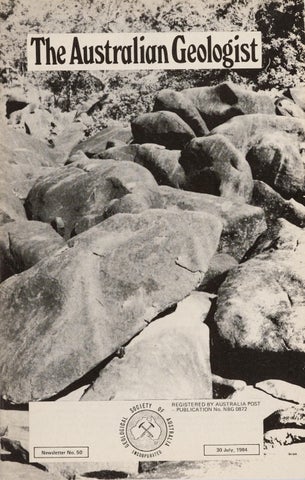
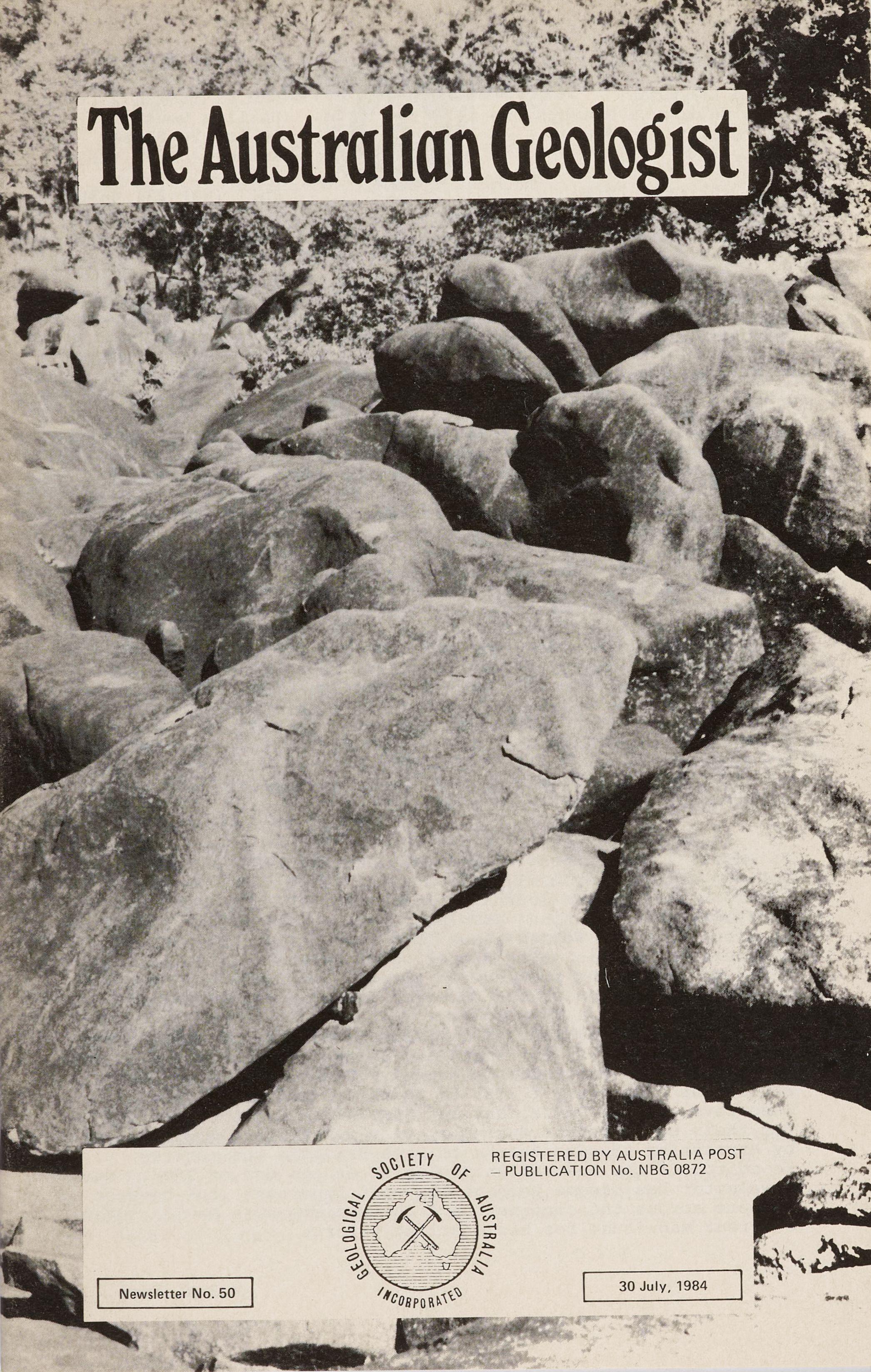
Cover Photo: Block slide, Black Mountain, 25 km south of Cooktown. Closely-jointed granodiorite of Permian age occurs in a number of shallow intrusions. Now unroofed th e joint blocks h uvc: slipped, producing bare slopes of large angular boulders. Xc n oliths are common, but the characteristic black colour is p roduc e d b y u surface cover of Lichen.
D.F. B
CAN THEY BLAME YOU?
Australian Geoscience - Legal and Professional Aspects
This first bulletin of the Australian Institute of Geoscientists, edited by D. W. Emerson, reports the proceedings of a seminar held in Sydney in February 1983.
Three papers, legal liability in geoscience public reporting, insurance exposures and needs for geoscience professionals in the 80's and groundwater development and management together with discussion on the first two papers comprise the contents.
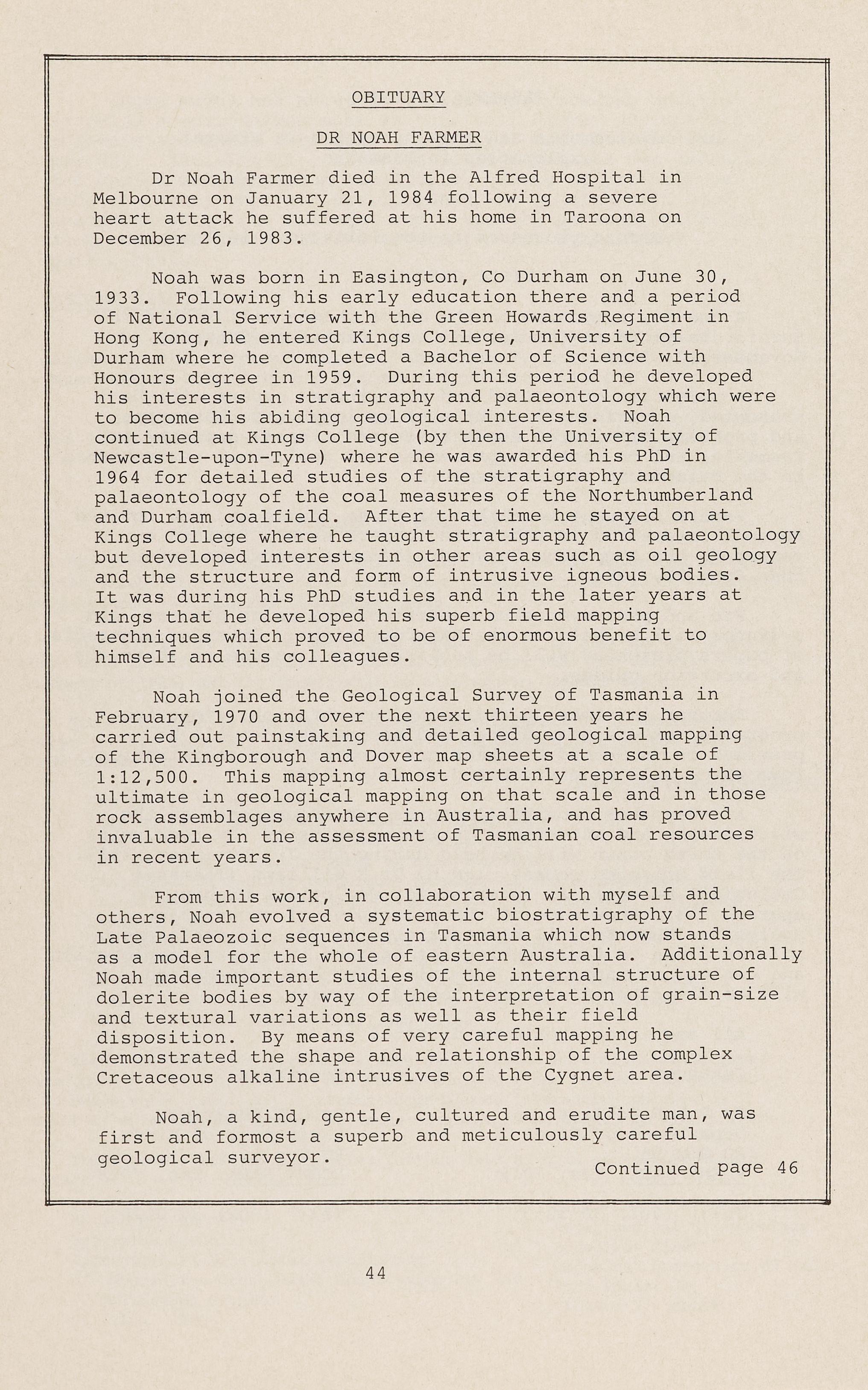
In the first paper Michael Sharwood and Jonathan White deal with legal problems which will increasingly involve geoscientists in Australia. They discuss a variety of cases concerning alleged negligence. These are cases which they see as tests and crucial to establishing points of law which are relevant to the type of problems in reporting that geologists might encounter. Unfortunately none of the cases is specifically geological in content, and the paper is therefore a little less valuable than it might have been. As there have been some long and involved cases, e.g. Dillingham v. Public Works on Newcastle Harbour deepening, where negligence and misleading information was claimed, the paper might well have been improved by at least passing reference to such matters.
Peter Lepparde's paper on insurance geologists should take is interesting and useful. He refers to one case where a diver became a paraplegic by diving into a pool not kept filled to the correct level adding parenthitically that this example 'fortunately is not related to your industry'. These were words I read only a few days after being contacted by a solicitor on just such a case! - a dive into a rock pool where sand had been moved by wave and current motion.
The final paper, by Stephen Hancock, discusses management practices relative to groundwater and again considers the professional's ethical and legal responsibilities.
This slim volume of 72 pages is a most commendable start to the publications of A.I.G. Careful reading of it will benefit each and every geotechnical specialist.
David Branagan
NOT JUST FOR the BLACKBOX BRIGADE
The March 1984 issue of Exploration Geo p hysics, bulletin of the Australian Society of Exploration Geophysicists, edited by Don Emerson, contains a number of papers of interest to geologists, including Steve Webster's 'A Magnetic Signature for Tin Deposits in South-east Australia'. This is another journal now incorporated in Blackwell's Australian stable. 4
A RATIONALE FOR THE EDUCATION OF GEOSCIENTISTS
BA TAPP AND J R WATKINS
ABSTRACT
A lack of definition of "Geoscience" in the context of both academia and professional requirement prohibits the establishment of a viable rationale for the education of geoscientists. Even the term Geoscience itself is completely misleading in respect of the whole ambit of skills, interests and professional endeavours that it purports to cover.
The large number of tertiary courses available in Australia, in combination with the hire-and-fire syndrome prevalent in the mining industry, have done little to attract potential graduates to the profession. Our plea is for greater efficacy in the teaching of Geoscience in the university/college system combined with a rationalisation of departments and campuses.
An attempt is made to outline the problems inherent in formulating a consensus for what is meant by Geoscience, and a course and campus rationalisation draft is given.
INTRODUCTION
Several problems face educators in the "field of Geoscience" many of which are caused by a lack of agreement as to what is meant by the term itself. Geoscience, although a term that is increasing in popular usage and idiom, is a term that tends to confuse rather than enlighten. Indeed is it possible to define what constitutes Geoscience or define a viable teaching programme, or series of programmes?
The term Geoscience is defined by the American Geological Institute (1974) as "a short form denoting the collective disciplines of the geological sciences. The term, as such, is synonymous with geology". In this paper we shall follow this definition noting in particular the synonymity with geology, and will include a variety of sub-groups such as geomorphologists, geophysicists, geochemists, geohydrologists and sundry others.
Differing sectors of the resource industry and Public Service have different vectors by which they establish a particular criterion defining their wants and needs in a geoscientist. Commonly the educator is therefore left to attempt the interpretation of these changing moods within the variable economic schema, an unenviable task. To complicate the issue the educator may opt for other alternatives: he may not see his task as an educator as being one that needs to be influenced by "needs". Also if a scientist, sensu stricto, the educator may not perceive the task of education as being one geared to the satisfaction of industry or government ideologies.
In addition the changing economic fortunes of the national economy have a very real bearing on the employment potential of graduates, Tapp and Watkins (1982). Within the climate of hire and fire many potential graduates are turned away, and worse, those who have graduated finding that there is no market for their skills are lost to the profession. This creates many hiatae amongst the professional population.
Now who is to blame for this current malaise? Our contention is that it is a problem for which both industry and academia must share the responsibility. There is too little dialogue and interaction between the two sectors and the student is often the only bridge crossing the chasm. Recent surveys and study tours made by the authors reflect a pessimistic picture. The views expressed below are generalisations and are not a reflection of particular individual/company ideals.
"Middle-level" professional staff tend to reflect dissatisfaction with both the "product" coming into the industry (the new graduate), and the upper level management within their own environment. Toward the former, the type of criticism levelled was
i) poorly equipped, geologically, for the work environment, ii) poorly motivated toward the profession, iii) often both non-numerate and illiterate.
Toward upper management the criticisms levelled, bearing in mind the context of the objective, viz. employment potential and graduate skill requirements, were,
i) lack of suitable/adequate manpower policies. For example, "exploration direction was accountant driven", ii) the rapid escalation/de-escalation of programmes dependent upon "economic realities (?)", iii) a non-familiarity with "current techniques".
Recent graduates in the workforce had similar viewpoints to the above, but in respect of their own undergraduate programmes a majority view was that,
i) academic staff have a poor understanding of the professional environment, ii) that they (new graduates) were often limited by lack of ' field oriented study programmes, iii) that their course was unrelated to the requirements of industry.
By contrast "upper-echelon" professional management was severaly critical of recent graduates in terms of,
i) the illiteracy and non-numeracy of geological graduates,
ii) an unrealistic expectation of their "worth" and the anticipated rewards/allowances, iii) poor motivation and the poor regard they seem to have for their profession.
Another basis for concern is the very real lack of definition by industry of required graduate skills, and the seeming willingness to hire and fire according to the current economic expedient There are meaningful ways of defining manpower requirements and it is encumbent upon both industry and academia to fol low a more purposeful stratagem such that there will be a continued flow of highly motivated and skilled graduates into the professiona l ranks.
Each of the problem areas of academia and industry will be e xamined in turn.
TOWARD CONSENSUS IN ACADEMIA
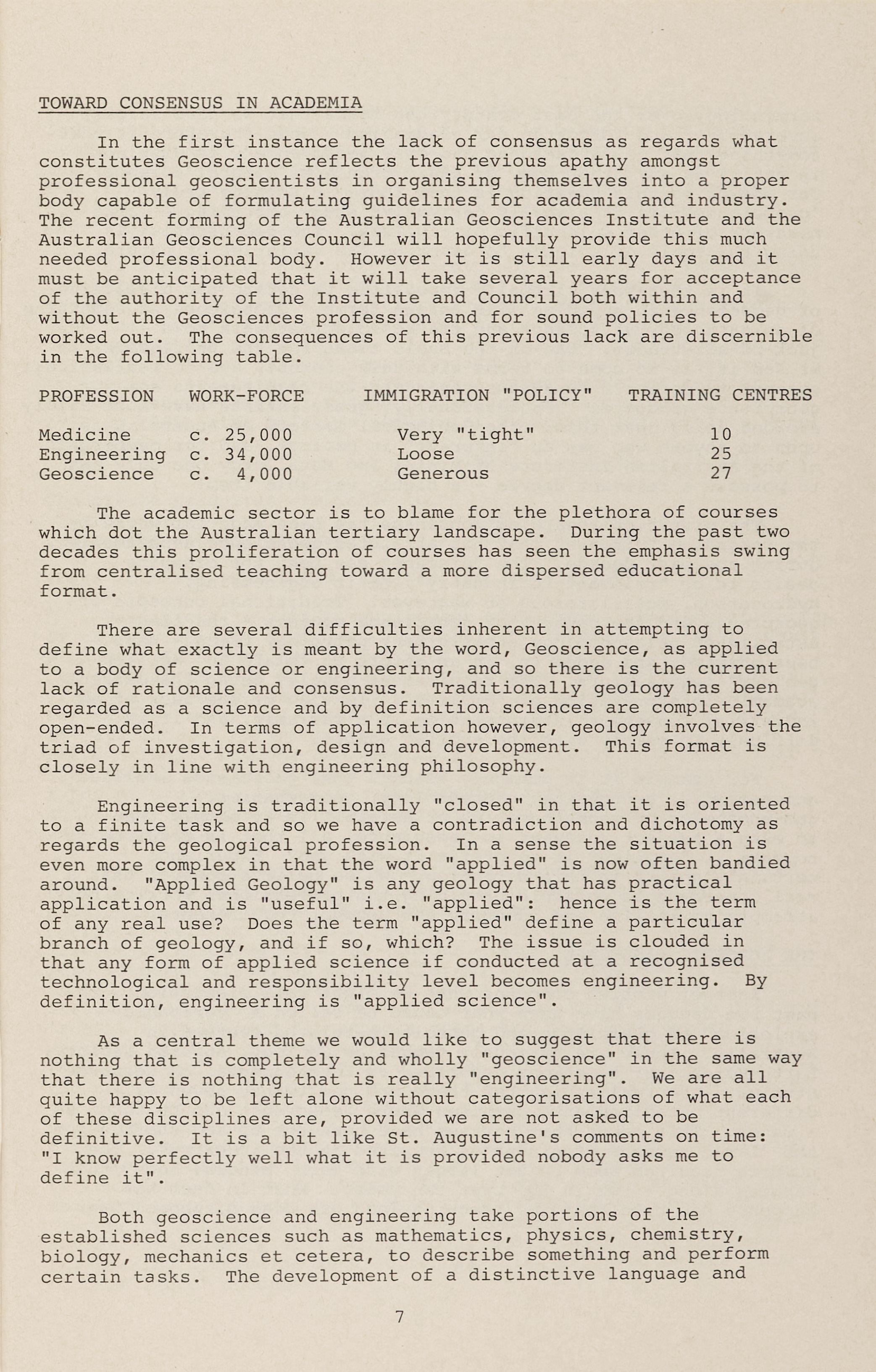
In the first instance the lack of consensus as regards what constitutes Geoscience reflects the previous apathy amongst professional geoscientists in organising themselves into a proper body capable of formulating guidelines for academia and industry. The recent forming of the Australian Geosciences Institute and the Australian Geosciences Council will hopefully provide this much needed professional body. However it is still early days and it must be anticipated that it will take several years for acceptance of the authority of the Institute and Council both within and without the Geosciences profession and for sound policies to be worked out. The consequences of this previous lack are discernible in the following table.
PROFESSION
Medicine
Engineering
Geoscience WORK-FORCE
c. 25,000
c. 34,000
c. 4,000
IMMIGRATION "POLICY"
The academic sector is to blame for the plethora of courses which dot the Australian tertiary landscape. During the past two decades this proliferation of courses has seen the emphasis swing from centralised teaching toward a more dispersed educational format.
There are several difficultie s inherent in attempting to define what exactly is meant by the word, Geoscience, as applied to a body of science or engineering, and so there is the current lack of rationale and consensus. Traditionally geology has been regarded as a science and by definition sciences are completely open-ended. In terms of application however, geology involves the triad of investigation, design and development. This format is closely in line with engineering philosophy.
Engineering is traditionally "closed" in that it is oriented to a finite task and so we have a contradiction and dichotomy as regards the geological profession. In a sense the situation is even more complex in that the word "applied" is now often bandied around. "Applied Geology" is any geology that has practical application and is "useful" i.e. "applied": hence is the term of any real use? Does the term "applied" define a particular branch of geology, and if so, which? The issue is clouded in that any form of applied science if conducted at a recognised technological and responsibility level becomes engineering. By definition, engineering is "applied science".
As a central theme we would like to suggest that there is nothing that is completely and wholly "geoscience" in the same way that there is nothing that is really "engineering". We are all quite happy to be left alone without categorisations of what each of these disciplines are, provided we are not asked to be definitive. It is a bit like St. Augustine's comments on time: "I know perfectly well what it is provided nobody asks me to define it".
Both geoscience and engineering take portions of the established sciences such as mathematics, physics, chemistry, biology, mechanics etcetera, to describe something and perform certain tasks. The development of a distinctive language and
terminology over the past century has meant that we have largely covered over and forgotten our plagiarism. What therefore is that something that is "geoscience and only geoscience", as distinct in entity as any other body or basic branch of natural science? Our answer to this question is that there is nothing truly "geoscience"; it is a wholly derivative study embracing a large meshwork of other scientific disciplines. The geoscientist is using the tools of science to describe the varieties of nature.
It is therefore virtually impossible to define the discipline of geoscience in anything like unique terms. Geoscience is something of an anthology of science and the geoscientist akin to a jack-of-all-trades. One of the basic tasks for the profession, as we see it, is to come to terms with this concept, and to realistically attempt to define a consensus regarding the requirements for geoscience graduates. Professionally, geoscientists have most avidly avoided doing just this: the Geological Society of Australia is open to anyone who has an "interest" in geology, and for membership of the Australian Institute of Mining and Metallurgy one only has to possess a relevant degree - a highly variable item!
The situation regarding consensus has been made far worse by the spreading "disease" that has afflicted geoscience departments during the past decade. The "disease" has been the creeping desire to be "relevant to industry", be it engineering, hydrocarbon, metalliferous or whatever. Traditional concepts of geoscience and the content of geoscience courses - the long established palaeontology/stratigraphy/petrology triad - have been adapted, and added to, in an effort to relate to "applied geology" requirements. The requirement usually being the current academic interpretation of "applied". In view of the lack of an industrial consensus interpretation is a variable, and it is difficult to comply with the applied gambit.
For example it is commonly assumed that geoscience includes geochemistry, geophysics, geohydrology, geomechanics, geo-economics or geomathematics etcetera! Is it simply that to make a subject relevant to geoscience, all that is required is to make it "applied" is to prefix it with geo? Experience certainly points in this direction. We do believe however that a real consensus is possible providing the professional working body attempts to realise and identify end product requirements.
THE ACADEMIC LANDSCAPE
Another problem concerns what we might call dispersion. The past two decades have seen what could be called a "veritable explosion" of geoscience and geoscience-related courses in Australia. These are variously tagged as Geology, Applied Geology, Earth Science or sometimes described as Environmental or Resource Studies. The reality is that there are now twenty seven (27) different establishments/campuses where Geoscience can be taken as a major. This means that courses have been set up and staffed for the "larg e numbers of graduates required in the industry". The numb e rs r eq uir e d seem to get larger with each "mineral boom" that h a p pe ns along - two in the past ten years. What in fact has h a pp e n ed has b e en that th e teaching load has been dispersed over
several campuses and the geoscience student population spread a little thinner. Since funding in effect is based on the home student population then individual departments are inevitably drawn into competition with each other for the student body. The idiom that students mean money simply means that standards for entry decline, and this is in addition to an already declining expertise in the basic sciences.
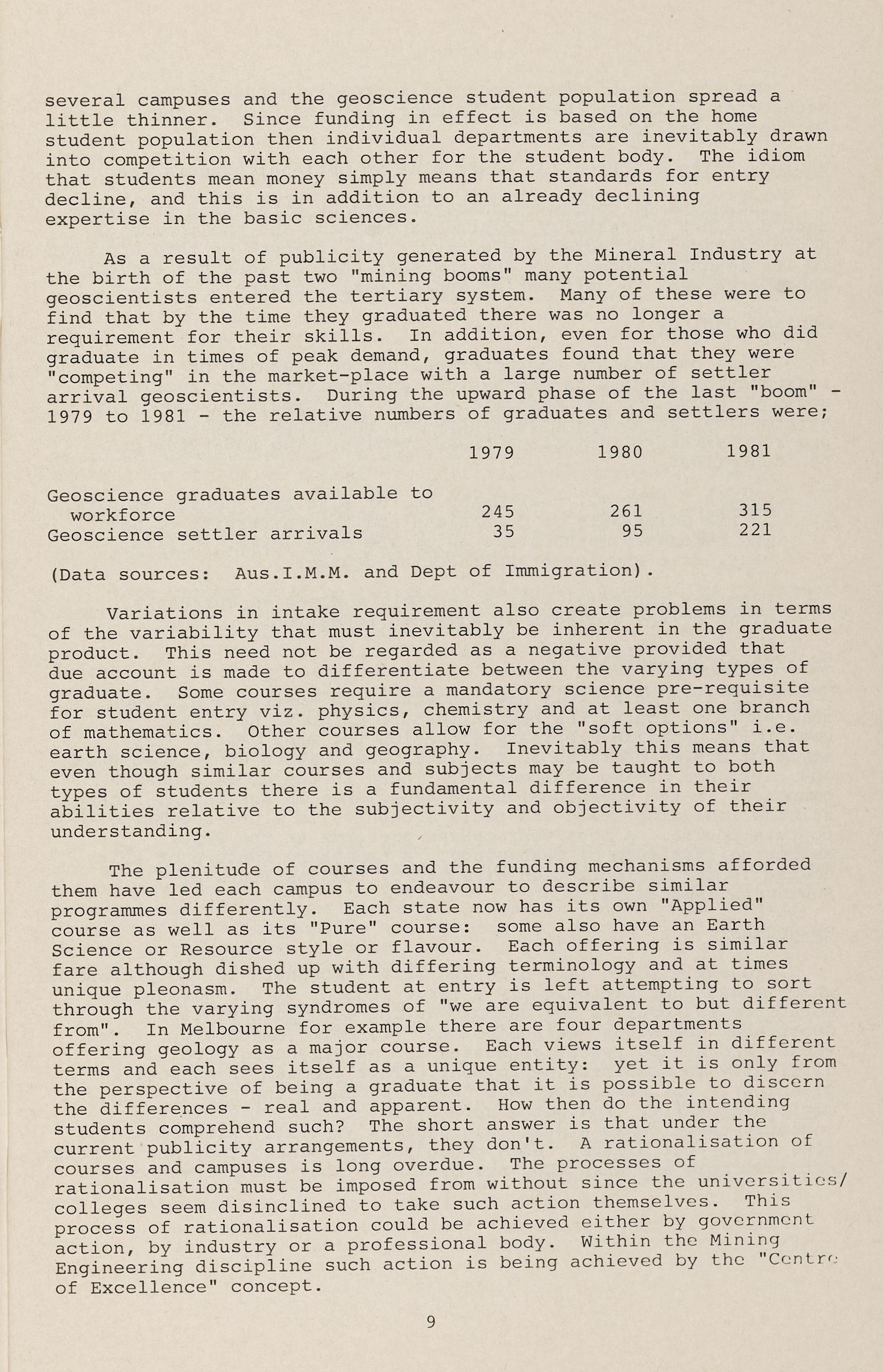
As a result of publicity generated by the Mineral Industry at the birth of the past two "mining booms" many potential geoscientists entered the tertiary system. Many of these were to find that by the time they graduated there was no longer a requirement for their skills. In addition, even for those who did graduate in times of peak demand, graduates found that they were "competing" in the market-place with a large number of settler arrival geoscientists. During the upward phase of the last "boom"1979 to 1981 - the relative numbers of graduates and settlers were;
Geoscience graduates available to workforce Geoscience settler arrivals 1979 245 35 1980 261 95
(Data sources: Aus.I.M.M. and Dept of Immigration). 1981 315 221
Variations in intake requirement also create problems in terms of the variability that must inevitably be inherent in the graduate product. This need not be regarded as a negative provided that due account is made to differentiate between the varying types of graduate. Some courses require a mandatory science pre-requisite for student entry viz. physics, chemistry and at least one branch of mathematics. Other courses allow for the "soft options" i.e. earth science, biology and geography. Inevitably this means that even though similar courses and subjects may be taught to both types of students there is a fundamental difference in their abilities relative to the subjectivity and objectivity of their understanding.
The plenitude of courses and the funding mechanisms afforded them have led each campus to endeavour to describe similar programmes differently. Each state now has its own "Applied" course as well as its "Pure" course: some also have an Earth Science or Resource style or flavour. Each offering is similar fare although dished up with differing terminology and at times unique pleonasm. The student at entry is left attempting to sort through the varying syndromes of "we are equivalent to but different from". In Melbourne for example there are four departments offering geology as a major course. Each views itself in different terms and each sees itself as a unique entity: yet it is only from the perspective of being a graduate that it is possible to discern the differ~nces - real and apparent. How then do the intending students comprehend such? The short answer is that under the current publicity arrangements, the y don't. A ration al is ation of courses and campuses is long overdue. The processes of rationalisation must be imposed from without since the universiti e s / colleges seem disinclined to take such action themselves. Thi s process of rationalisation could be achieved either by governm e nt action, by industry or a professiona l body. Within the Mining Engineering discipline such action is being achieved by the "C c nlr ~ of Excellence" concept.
The teaching of Geoscience falls broadly within three categories designated Geology Science, Applied Geology and Geological Engineering.
Geology Science (three (3) years plus an optional honours year).
This type of course is characterised by a teaching programme that does not necessarily require mathematics and the choice of non-geological subjects is elective. The strength of this approach is its teaching in geology and the fact that it does not exclude candidates weak in mathematics and/or basic science.
Applied Geology
These courses are characterised by the teaching of introductory studies in geophysics, geochemistry, engineering geology, hydrology and economic geology as compulsory components. Mathematics, physics and chemistry are therefore compulsory pre-requisites to facilitate these studies. Two sub-types can be identified.
- four (4) year B.App.Sc. or B.Sc.App. course as given at the University of Queensland and the University of NSW . The necessary mathematics is of the same level, in first year, as a Phy s i cs or Engineering degree.
- three (3) year B.App.Sci. courses as currently given by the Colleges of Advanced Education.
Geological Engineering
This is a relatively new innovation in Australia although this style of course has been a feature of North America, especially Canadian, tertiary education for many yea rs This style of course operates at the interface between ge o logy science and civil and mining engineering. There is theref o re a design component in the course unique to geoscience in Au st ralia. Basic science including solid and fluid mechanics is a pre-requisite to this course. A four year course operates at the Royal Melbourne Institute of Technology. A necessary feature of this course is the accreditation given it by the Institute of Engineers, Australia.
EMPLOYMENT
Presently there is a hire and fire atmosphere in the profession which means that periodically a large segment of the potential workforce is lost; as for example during the mid-seventies. Geoscience graduates are subject to "economic" expediency: even recent and not so recent graduates are experiencing great difficulty in obtaining employment. This problem in manpower planning is not new since each "boom" produces the cyclic employment shift. Following each cycle of "activity" in the industry there comes a peak in graduates generally with something like a two year hiatus. When graduates are wanted they are commonly not available and when they are available they are not wanted.
There are readily available methods of ascertaining the graduate requirement given to certain basic parameters which we believe are realistic in their assessment (Tapp and Watkins in prep.). This type of prediction does however require that industry comply with certain conditions. Firstly, that the mineral industry fully details the type of graduate that is required in terms of requisite skills and knowledge; and, furthermore, will take the responsibility for such definition: and secondly, that the industry must be prepared to play its part in the educational process. This may be achieved in two ways and to some extent does already occur. Methods include either direct financial aid by means of ear-marked funds (staff, research or equipment) or indirect financial aid (sandwich course arrangements, provision of industry experts as lecturers, helping in fieldwork etc.).
We do not envisage that this type of agreement would be able to cover all current teaching establishments and so we strongly favour a thorough rationalisation of the various campuses. This would we hope be done not along the lines of tradition but in terms of the more objective format of industrial requirement. There would then be a limited number of campuses - say six or sevenoffering a variety of courses and options. Staff and students would then cease to be desseminated and relationships between academia and industry would be enhanced.
Each campus could be related primarily to population centres since they need to be near the student intake. Transporting student groups to the field is far more economical than setting up a completely new campus. Quite bluntly we have a problem in Australia of far too many courses of far too great a variation in emphasis and quality, being alternatively underworked or overworked dependent upon the economic climate prevailing in the industry at any particular time. Short-term, short lived economic expediency is being allowed to dictate longer term educational trends and directions.
CONCLUSIONS
We would like to offer some ideas for consideration as a basis for an industrially oriented course which could be slanted or biased toward any one of the major industrial activities or simply toward pure science if that was preferred. What is required is a break from traditional boundaries and associated ideologies. If the desire is to produce a graduate with an "applied" bias what we see as needed in a course framework is,
*
a proper descriptive diagnostic title such as geological engineering, petroleum geology, metalliferous geology, etc., new course identities; new entities not merely the revamped machinations of tradition, restrict intakes on any campus to about 35 per yea r bearing in mind the possible implementation of "centres of excellence" and the employment syndrome, departments staffed by utilising the best available sources which could include industry personnel and other national/international expertise, a concentration on at most two areas commonl y regarded as "applied" at any one campus,
* combination workshop/sandwich style courses achieved either by compulsory summer schools or industrial employment,
* the refraining from teaching "background irrelevance". Our current ideas on teaching still relate essentially to historical derivation and application,
* specialisation should only occur at the final year (4th) or postgraduate years of any course.
Our plea is for greater efficiency in the teaching of geoscientists in our tertiary system. This we see as coming about if,
a) a consensus can be reached regarding geoscience and geoscience education,
b) a rationalisation of course offerings can be achieved,
c) industry enters into a suitable discourse with academia to avoid the present gambit with respect to geoscience graduates.
REFERENCES
Gary, M., McAfee Jnr., R. and Wolf, C., 1974. Glossary of Geology. American Geological Institute.
Tapp, B.A. and Watkins, J.R., 1982. "The Mismatch of Education Activity and Geology Graduates". Proc. Aus.I.M.M. Ann. Conf. Melbourne. pp. 411-8.
The Bureau of Mineral Resources (BMR) has released the first metamorphic map of Australia at scale 1:5,000,000.
The first draft of the map was prepared by Associate Professor Tom Vallance of the University of Sydney at the request of the Commission for the Geological Maps of the World, and presented at the GSA Joint Specialists' Groups Meeting in Canberra, 1972. The draft was extensively revised by Tom in collaboration with BMR, the State Geological Surveys, the GSA, and Australian Universities~ and, finally, was drawn and printed by BMR.
The map shows the metamorphic rocks of Australia, coloured according to an international scheme of facies and facies series; a smaller scale inset map shows times of metamorphism.
Copies of the map are available from the Sales Section, BMR, GPO Box 378, Canberra, ACT, 2601; price $7.50 + ta x 39~ and postage on 300 grns.
TOM - MMA AND LOW PRESSURE B22
FOR EARTH SCIENTISTS
Low-cost, and not so low-cost personal computers are now turning up almost everywhere, and no doubt many of our geological bretheren have made use of them in some way for different tasks in teaching, research or professional practice. Although numerous programs can be purchased, or acquired from books etc., for accounting and business purposes, and a number of geological programs exist for large mainframe computers, very few programs appear to be available, at least in published form, to carry out geological tasks on this new generation of personal computers.
Frustrated by this lack of availability, many of us have no doubt gone our own way and devised programs, for particular machines, to help with processing, analysing, storing or reproducing some types of geological data. Some of these programs can, no doubt, produce useful results from machines that are little more than overgrown pocket calculators, while others require systems with a range of peripherals that put them almost in the mini- or mainframe class.
The purpose of this letter is to establish the viability of setting up a Microcomputer Program Exchange for Australian ~arth scientists. Following on from a series of recent papers in the Journal of Geological Education (Vol. 31, pp219-229, 315-322, and Vol. 32, pp20-28), we feel it should be possible to establish a central register, with details of programs people would be willing to make available to others (gratis, by swap or for sale) and, either circulate the list to respondents or publish it more widely in some form.
The purpose of the Exchange is not to compete with established bureaus or consultants, but to help integrate computer technology generally into the geological profession. Individual programmers can use the Exchange to show off their creativity, while those confronted with a series of execution errors can use it to find a possible source of help. By advising participants generally of programs that are available, the Exchange may reduce the duplication of effort that undoubtedly goes on in programming at present, or it may inspire people to write programs for tasks where no satisfactory software is available.
We would therefore like to receive letters from two classes of people:
a. Those with microcomputer programs available for inclusion in the register, with details of the individual programs available, and b. Those who cannot contribute programs at present, but would like to receive a list of programs available from Exchange respondents.
The details required on each program for inclusion are:
i) Branch(es) of geoscience or related activity covered; ii) Program name; iii) Brief description of its operation, including the type of information input and the nature of the output material;
iv) Purpose or function of program:
vi) Computer(s) for which it is written:
vii) Memory and peripherals required;
viii)Availabil it y - free/swap/sale (and price);
ix) Form available - paper listing/cassette tapes/disc;
x) Contact - name and address.
The purpose of the Exchange is only to advise people of programs available, and not to act as a central repository or source of the programs themselves. Those interested in obtaining copies of programs on the register would need to contact the individual programmers direct. However, a paper printout of the program listing and an example of typical output, sent to the Exchange organizers with the program details, may help to provide further information on the various aspects for inclusion in the register.
The actual means of publication of the register, and, if it should be more than a once-only issue, the frequency of publication, clearly depend on the response to the proposal. Comments on these matters are invited, along with any offers of help. If significant costs are involved, a charge may have to be made for copies of the register in some way.
Colin R Ward
School of Applied Geology
University of NSW PO Box 1 KENSINGTON NSW 2033
Andrew E Waltho
Dept of Applied Geology
NSW Institute of Technology PO Box 123 BROADWAY NSW 2007
LIBRARY MATERIALS - CAN YOU HELP?
The Economic Geology Research Unit at James Cook Un iversity, Townsville contains a small library for the use of visiting industry and academic geologists.
The library contains mostly duplicates of material which is also housed in the main University Library, and concentrates on periodicals and books specialising in Australasian geology and mining, together with a number of the major international geoscience journals.
The department would appreciate hearing from anyone who is prepared to provide cheap or donated copies of material appropriate to the EGRU's use. Particular need s include AUSIMM Bulletins 1-421, APEA Journals 1-22, and back numbers of Journal of Geological Society of Australia, Economic Geology, Bulletin of the American Association of Petroleum Geolog ists, Episodes and the Journal of Geology.
Please send any offers or enquiries to Dr W P Laing, Geology Department, James Cook University, Townsville, Qld, 4 811 ( phone (077) 814726).
FUTURE DIRECTIONS IN QUATERNARY RESEARCH
A symposium on "Quaternary Studies in Australia: Future Directions" was held at the Bureau of Mineral Resources, Canberra, on May 19th, 1984. The time was selected in the hope that people attending ANZAAS might stay an extra day to take part in the symposium. About 40 people were present.
A series of discussion papers was Nritten to provide starting points. These were printed as "BMR Record 1984/14", and copies may be obtained from The Director (attention Mrs M Bartlett), Bureau of Mineral Resources, PO Box 378, Canberra City 2601.
Contents include:
Barbetti, Mike - Dating the Australian Quaternary
Beaton, John & Rhys Jones - Man in the late Quaternary history of Australia.
Beckmann, G G - The relation of Australian soils work up to 1981 to studies of the Quaternary
Bowler, JM - Australian lakes in the Quaternary
Calhoun, EA - The glacial stratigraphy of Australia: An assessment, 1980
Jennings, JN - The karst potential for Quaternary history
Kershaw, A P - Review of Quaternary studies in Australiaplant and invertebrate palaeoecology
Ollier, CD - Quaternary volcanicity
Thom, BG - Quaternary coastal and continental shelf studies over the last decade
Walker, PH - Quaternary fluvial processes and stratigraphy
Wasson, R J - Late Quaternary stratigraphy of Australian desert dune fields
Webster, P J - Climatology: report on Quaternary studies in Australia
Williams, D LB - Problems in Quaternary vertebrate palaeontology
The discussion fell into three parts. First there was an open discussion of the main problems confronting Quaternary scientists in Australia. This included statements from Dr Barbetti and Dr Chappell on the need for a national facility to undertake small sample dating using an atomic accelerator. Op tions available to the Quaternary community were canvassed. The CSIRO facility at North Ryde is a r ela tivel y low voltage facility (2mV), which may not be
suitable for Bel0 or c136 research. On the other hand, the AAEC propose the expenditure of about $5 million on a 6mV facility which will be capable of measuring all isotopes of interest (cl4, Be 1 0, c136). For the AAEC proposal to be successful strong support from Quaternarists will be required. There will still be a need to develop a sample preparation facility, and possible options were also discussed including collaboration with an overseas lab.
The second part of the meeting was devoted to brief statements by various speakers on developments in different aspects of Quaternary research.
Finally there was debate on the role of the Australasian Quaternary Association, the role of the National Committee on the Quaternary (Australian Academy of Science), the Quaternary Newsletter, and future meetings. Dr Bowler proposed a field meeting of AQUA in the Murray Basin in the middle of 1985, and the suggestion was enthusiastically received. It was also agreed to consider at that meeting other proposals including Australia's contribution to INQUA 87 and the possibility that Australia may host a future INQUA congress.
The impression came through of a burgeoning science with many practitioners in widely different disciplines united t~rough the time factor of the Quaternary. The time factor is not their basic interest, but nevertheless there is a strong need for occasional interaction with other Quaternarists. The only near-permanent body concerned with the Quaternary is the National Committee, so it was asked to prepare discussion papers for presentation at the AQUA meeting in 1985.
Anyone who missed the Canberra meeting, and who would like to present views on future developments in Quaternary science in Australia, can write to Professor Bruce Thom, National Committee for the Quaternary, c / - Department of Geography, Faculty of Military Studies, University of New South Wales, Duntroon 2600, ACT.
Ollier Bruce Thom
Australian Academy of Science
Geoscience is represented in the 1984 Fellowship elections by Professor Kurt Lambeck, Professor of Geophysics, Research School of Earth Sciences, A.N.U. Apart from his work on global gravity patterns and tidal deformation of the Earth, he has recently been working on some interesting models to explain crustal deformation in e astern Australia since Middle Palaezoic.
Cliff
MELLO WORDS ON ROCK AND SOIL
Soil and rock were the source of inspiration for 160 delegates attending the Fourth Australia - New Zealand Conference on Geomechanics - the first for Perth.
The venue was the University of WA and i t ran from May 14 until May 18.
The conference was organised by the Australian Geomechanics Society as a regional conference of the Internati o nal Soc i ety for Soil Mechanics and Foundation Engineering, and the theme was "Geomechanics Interaction" - relating theory to practical engineering problems.
A total of 112 papers was presented during the five-day conference.
Keynote address was given by Professor Victor de Mello, of Brazil - President of the International Society of Soil Mechanics and Foundation Engineering.
The profession's prestigious John Jaeger Award was presented to Dr GD Aitchison, former head of CSIRO Geomechanics Division.
This is the second time only that this prized award has been presented. The only award of its kind in Australia, it is given for technical merit in geomechanics and long-term association with the profession.
40 different displays from oil and mining, government departments, private business, consultants and incorporating specific exhibits detailing geotechnical services and equipment were exhibited.
The use of fabrics in strengthening, filtering and draining soils and demonstrations of self-boring pressure meters to test soil strength and a penetrometer to help identify underground soil types were points of interest a mongst the displays.
Re Peat Ad
The International Peat Society plans a symposium on Tropical Peat Resources; prospects and Potential, February 25 - March 1, 1985, at Kingston, Jamaica : Contact Dr. Barry Wade, c/o Petroleum Corporation of Jamaica, P.O Box 579, Kingston 10, Jamaica, W.I.
If fired up telephone (809) 92-29670, telex 2356 Petcorp JA.
1AGC
SEVENTH AUSTRALIAN GEOLOGICAL CONVENTION
August 26 - 31, 1984, Sydney
At the time of writing (beginning of July) the 7AGC promises to be the most successful Convention yet, with just on 600 registrants, 400 papers (including posters), 7 full excursions, 3 short courses and 4 workshops. The Organizing Committee is working extremely hard to ensure its smooth running.
We have received considerable support from industry and all space allocated for the Geoscientific Exhibition has been booked. A generous donation from one company and an allocation from the funds so far collected has allowed us to support students' travel and e x cursion participation. Tertiary institutions are urged to encourage students to apply for these subsidies, which should be addressed to the Secretary. Grants from several sources have attracted a large number of overseas geoscientists (see below) who will give keynote addresses in each of the technical subjects and several specialist groups symposia.
There are still many contributors and GSA members who have not registered. To prevent a rush at the beginning of the Convention, you are urged to register immediately . However, this will not exempt you from the Late Fee of $10 which came into effect on July 1.
CANCELLATIONS
Because of lack of response, it has been necessar y to cancel some excursions and short courses.
Preconvention Excursions
Y2 Permian Stratigraphy
Y3 Carboniferous Geology
Postconvention Excursions
Zl Southern New England Granites
ZS Coolac Ophiolite
Short Courses
F2 Gemstones
F4 Geology of the Sydney Basin
FS Geology in Coastal Management
F7 Geol8gical Remote Sensing
Workshops
W3 Papers will not be given in the General Technical Session on Friday, August 31.
Registrants for these activities will receive a refund or be transferred to their second choice where applicable.
CONVENTION OPENING
The Convention will be opened by the Minister for Mineral Resources, the Honourable Peter Cox, MP at 9.00 a.m. on Monday, August 27 in the Macquarie Theatre.
REGISTRATION
The registration desk will be situated in the foyer to Building ESA and will be open at the following times:
Sunday, August 26 Monday, August 27
10.00 a.m. - 5.30 p.m. 8.00 a.m. - 5.30 p.m.
and on other days of the Convention from 8.30 a.m. to 5.30 p.m.
SOCIAL EVENTS
A Welcoming Cocktail Supper will be held in Building E7B from 6.30 - 9.00 p.m. on Sunday, August 26. The cost of this supper is included in the registration fee.
The Convention Dinner will be held at the same venue (Building E7B) at 7.00 p.m. on Wednesday, August 29. Tickets for this function must be purchased in advance from the Registration Desk.
TECHNICAL SESSIONS
Non-Metallic Minerals
Al Gemstones, B.J. Franklin (NSWIT)
A3 Industrial Minerals, D. Nichol (Steetley Ind., Sydney)
AS Construction Materials - Environmental Geology and Resource Management, I. Wallace (BMI, Wentworthville)
Water
Bl Hydrogeology, Exploration and Development of Groundwater Resources, M. Williamson (Ermington)
B4 Hydrogeochemistry, A. Giblin (CSIRO, North Ryde)
BS Modification of Water Quality by Development Activities/ Mining Hydrogeology, M. Knight (UNSW)
Petroleum
C2 Fermo-Triassic Oil and Gas, C. Herbert (Strathfield)
C3 Evaluation of Petroleum Provinc es and Fields, D.J. Forman (BMR)
C6 Depositional Environments, Migration and Diagensis, D. Hobday (Bridge Oil, Sydney)
C7 Late Proterozoic/Early Palaeozoic Hydrocarbons, M. Walter (BBL-BMR)
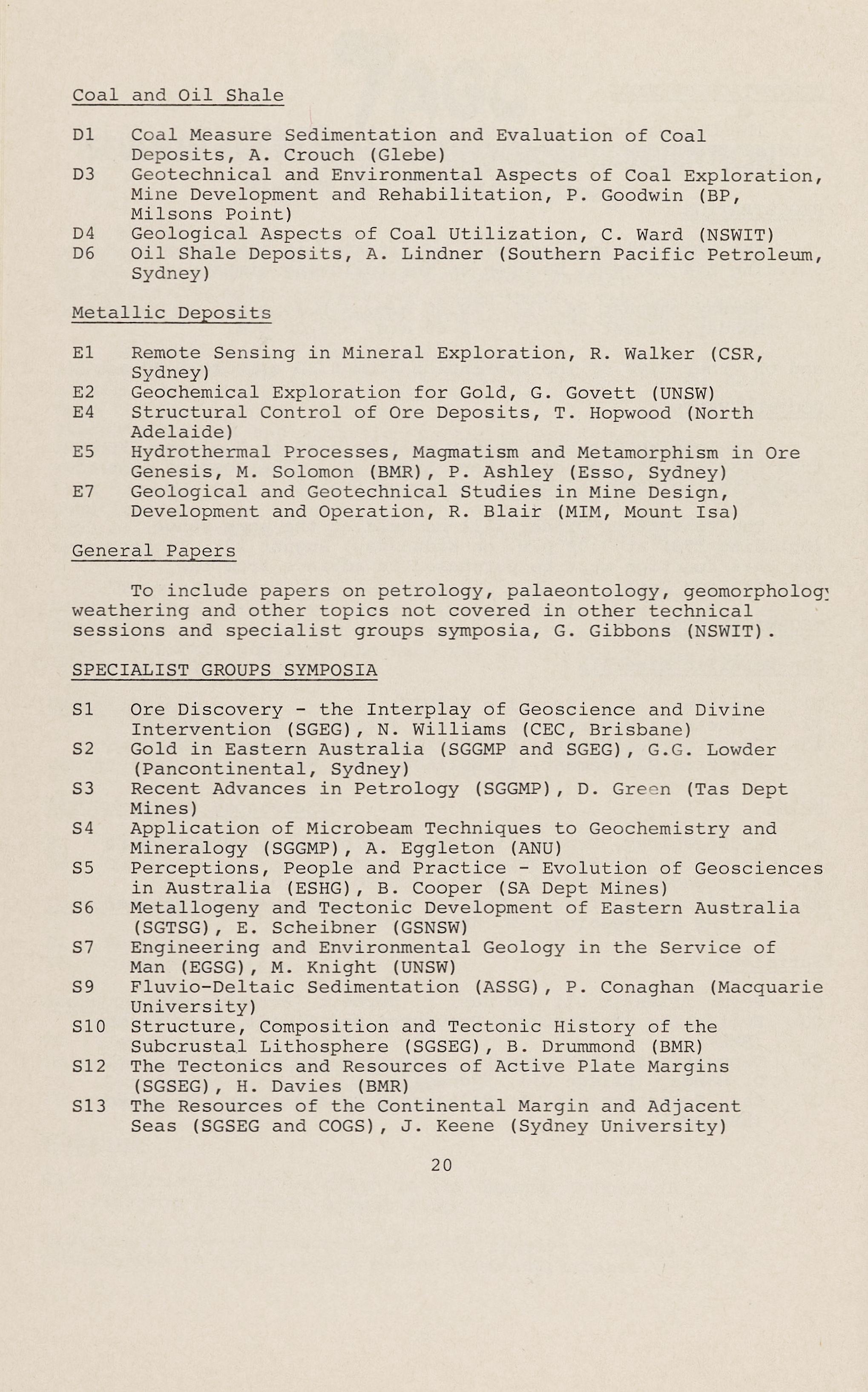
Coal and Oil Shale
Dl Coa l Measure Sedimentation and Evaluation of Coal Dep osits, A. Crouch (Glebe)
D3 Geotechnical and Environmental Aspects of Coal Exploration, Mine Development and Rehabilitation, P. Goodwin (BP, Milsons Point)
D4 Geological Aspects of Coal Utilization, C. Ward (NSWIT)
D6 Oil Shale Deposits, A. Lindner (Southern Pacific Petroleum, Sydney)
Metallic Deposits
El Remote Sensing in Mineral Exploration, R. Walker (CSR, Sydney)
E2 Geochemical Exploration for Gold, G. Gavett (UNSW)
E4 Structural Control of Ore Deposits, T. Hopwood (North Adelaide)
ES Hydrothermal Processes, Magmatism and Metamorphism in Ore Genesis, M. Solomon (BMR), P. Ashley (Esso, Sydney)
E7 Geological and Geotechnical Studies in Mine Design, Development and Operation, R. Blair (MIM, Mount Isa)
General Papers
To include papers on petrology, palaeontology, geomorpholog: weathering and other topics not covered in other technical sessions and specialist groups symposia, G. Gibbons (NSWIT).
SPECIALIST GROUPS SYMPOSIA
Sl Ore Discovery - the Interplay of Geoscience and Divine Intervention (SGEG), N. Williams (CEC, Brisbane)
S2 Gold in Eastern Australia (SGGMP and SGEG), G. G Lowder (Pancontinental, Sydney)
S3 Recent Advances in Petrology (SGGMP), D. Gr e e n (Tas Dept Mines)
S4 Application of Microbeam Techniques to Geochemistry and Mineralogy (SGGMP), A. Eggleton (ANU)
SS Perceptions, People and Practice - Evolution of Geosciences in Australia (ESHG), B. Cooper (SA Dept Mines)
S6 Metallogeny and Tectonic Development of Eastern Australia (SGTSG), E. Scheibner (GSNSW)
S7 Engineering and Environmental Geology in the Service of Man (EGSG), M. Knight (UNSW)
S9 Fluvio-Deltaic Sedimentation (ASSG), P. Conaghan (Macquarie University)
Sl0 Structure, Composition and Tectonic History of the Subcrusta.1 Lithosphere (SGSEG), B. Drummond (BMR)
Sl2 The Tectonics and Resources of Active Plate Margins (SGSEG), H. Davies (BMR)
Sl3 The Resources of the Continental Margin and Adjacent Seas (SGSEG and COGS), J. Keene (Sydney University)
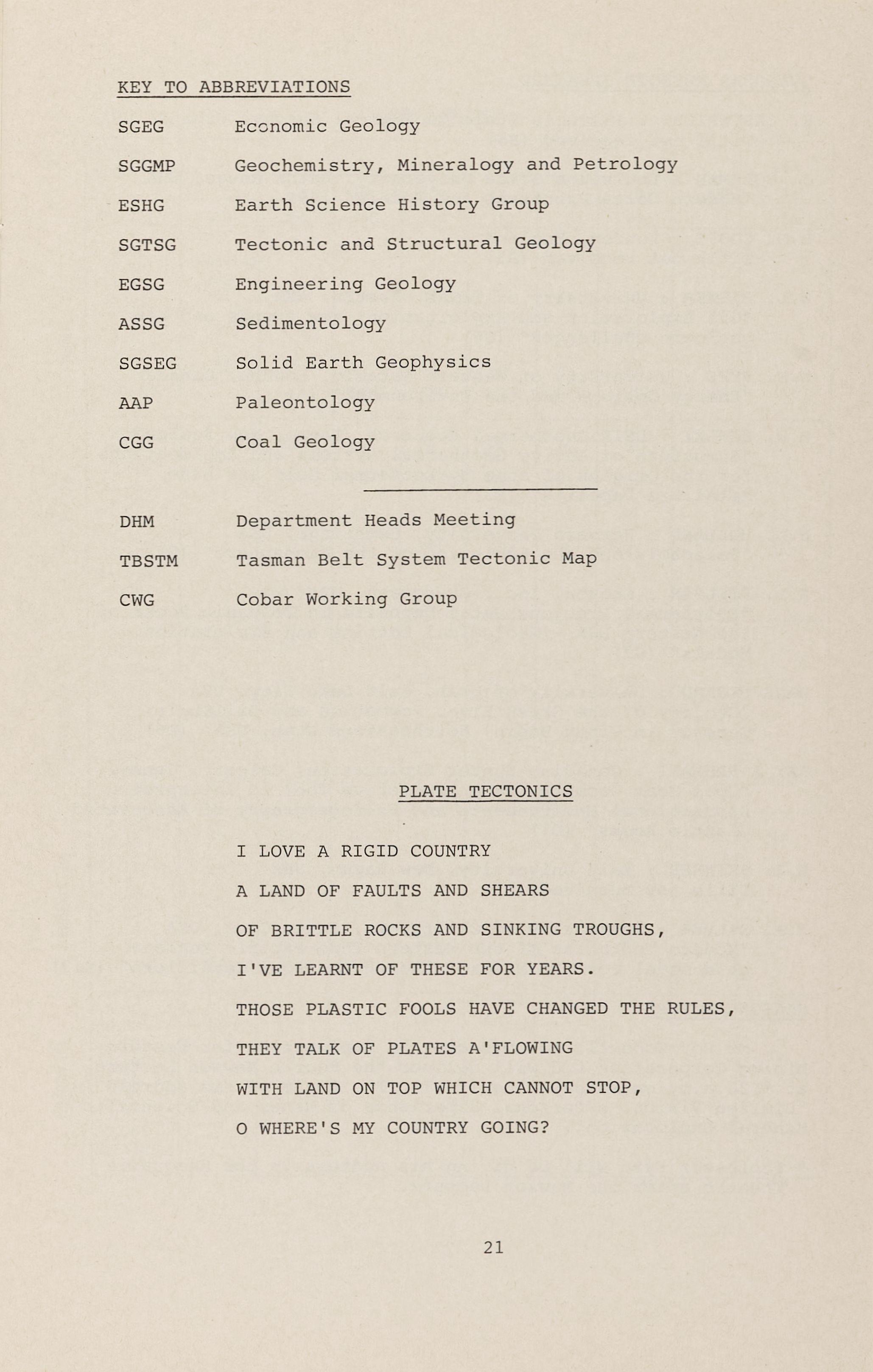
KEY TO ABBREVIATIONS
SGEG
SGGMP
ESHG
SGTSG
EGSG
ASSG
SGSEG
AAP
CGG
DHM
TBSTM
CWG
Ecanomic Geology
Geochemistry, Mineralogy and Petrology
Earth Science History Group
Tectonic and Structural Geology
Engineering Geology
Sedimentology
Solid Earth Geophysics
Paleontology
Coal Geology
Department Heads Meeting
Tasman Belt System Tectonic Map
Cobar Working Group
PLATE TECTONICS
I LOVE A RIGID COUNTRY
A LAND OF FAULTS AND SHEARS OF BRITTLE ROCKS AND SINKING TROUGHS, I'VE LEARNT OF THESE FOR YEARS. THOSE PLASTIC FOOLS HAVE CHANGED THE RULES, THEY TALK OF PLATES A'FLOWING WITH LAND ON TOP WHICH CANNOT STOP, 0 WHERE'S MY COUNTRY GOING?
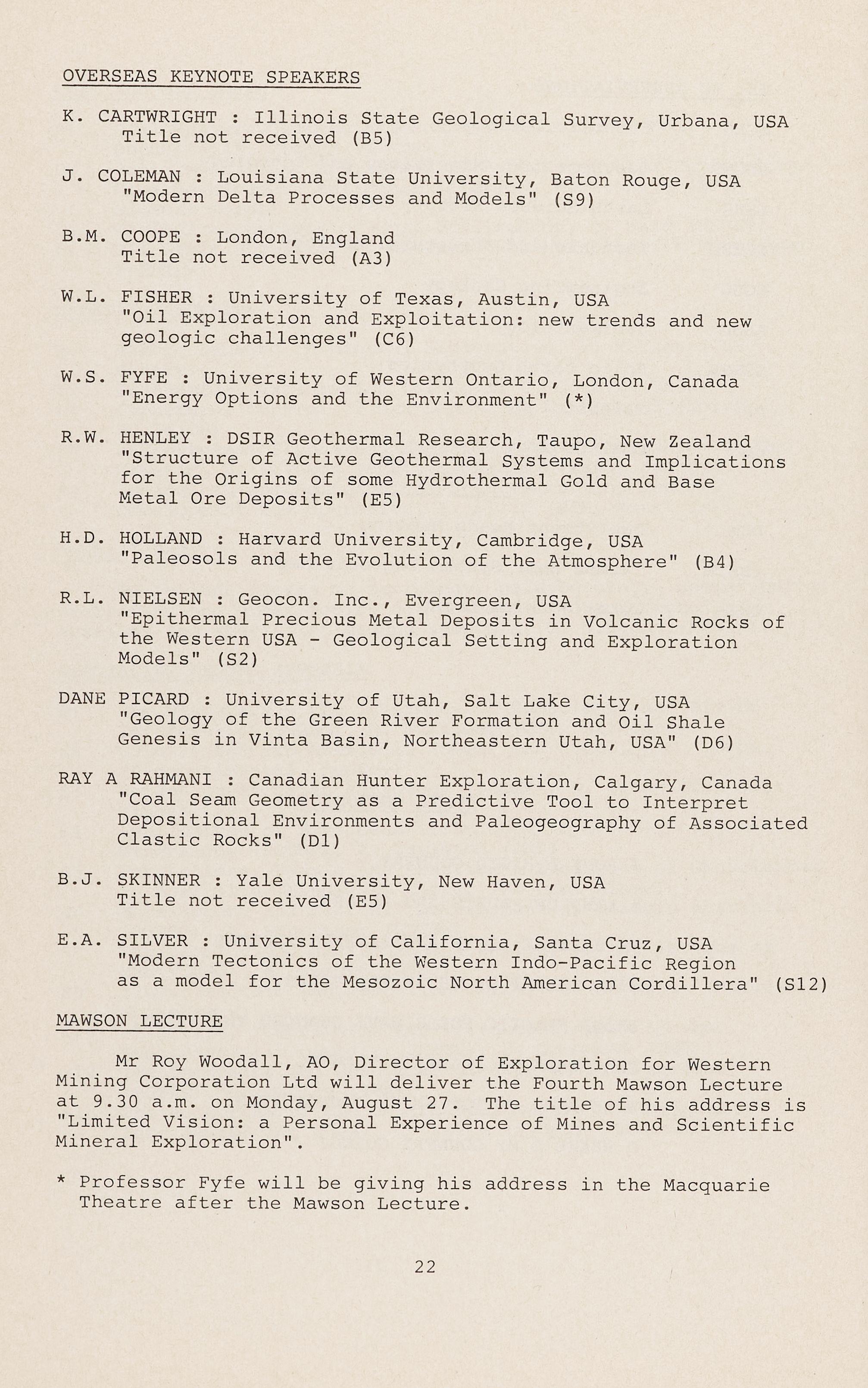
OVERSEAS KEYNOTE SPEAKERS
K. CARTWRIGHT : Illinois State Geological Survey, Urbana, USA
Title not received (BS)
J. COLEMAN Louisiana State University, Baton Rouge, USA "Modern Delta Processes and Models" (S9)
B.M. COOPE London, England
Title not received (A3)
W.L. FISHER: University of Texas, Austin, USA
"Oil Exploration and Exploitation: new trends and new geologic challenges" (C6)
W.S. FYFE : University of Western Ontario, London, Canada "Energy Options and the Environment" (*)
R.W. HENLEY: DSIR Geothermal Research, Taupo, New Zealand
"Structure of Active Geothermal Systems and Implications for the Origins of some Hydrothermal Gold and Base Metal Ore Deposits" (ES)
H.D. HOLLAND : Harvard University, Cambridge, USA
"Paleosols and the Evolution of the Atmosphere" (B4)
R.L. NIELSEN: Geocon. Inc., Evergreen, USA
"Epithermal Precious Metal Deposits in Volcanic Rocks of the Western USA - Geological Setting and Exploration Models" ( S2)
DANE PICARD : University of Utah, Salt Lake City, USA
"Geology of the Green River Formation and Oil Shale Genesis in Vinta Basin, Northeastern Utah, USA" (D6)
RAY A RAHMANI : Canadian Hunter Exploration, Calgary, Canada
"Coal Seam Geometry as a Predictive Tool to Interpret Depositional Environments and Paleogeography of Associated elastic Rocks" (Dl)
B.J. SKINNER Yale University, New Haven, USA
Title not received (ES)
E.A. SILVER: University of California, Santa Cruz, USA
"Modern Tectonics of the Western Indo-Pacific Region as a model for the Mesozoic North American Cordillera" (Sl2)
MAWSON LECTURE
Mr Roy Woodall, AO, Director of Exploration for Western Mining Corporation Ltd will deliver the Fourth Mawson Lecture at 9.30 a.m. on Monday, August 27. The title of his address is "Limited Vision: a Personal Experience of Mines and Scientific Mineral Exploration".
* Professor Fyfe will be giving his address in the Macquarie Theatre after the Mawson Lecture.
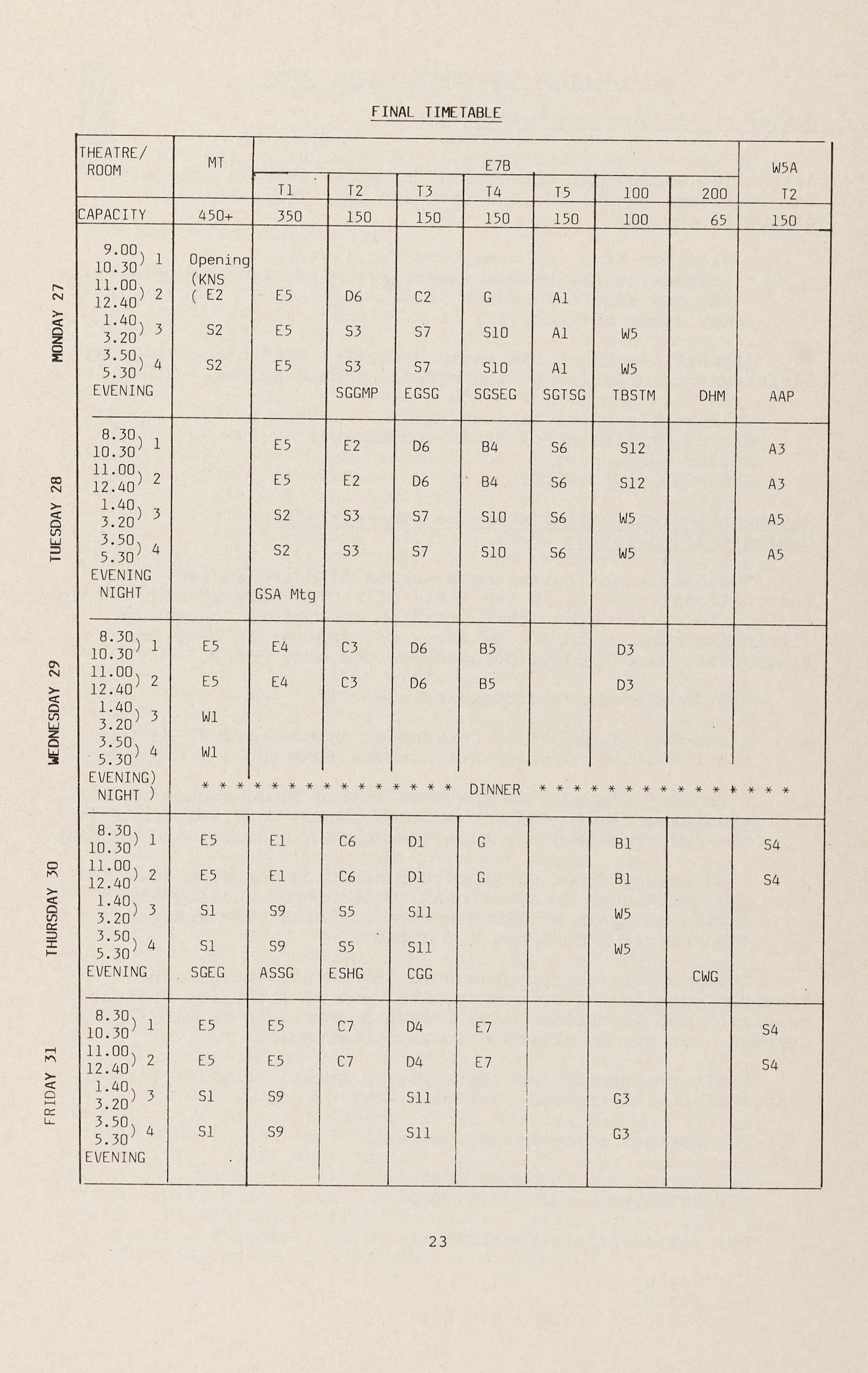
B. 30) 10. 30 l 11. DO ) 12.40 2 1.40 ) 3 20 3 3.50) 4 5.30 EVENING
8.30 ) 10.30 l 11. OD ) 12.40 2
1 40 ) 3 20 3
3.50 ) 4 5 30 EVENING
FINAL TIMETABLE
AUSTRALASIAN SEDIMENTOLOGISTS GROUP
Notice of ASG Business Meeting
An ASG business meeting will be held during the 7th Australian Geological Convention in Sydney, and is scheduled for Thursday, August 30, 1984 at 5 30 pm. Items to be discussed include:
- election of a new committee for 1984/85 increasing the annual subscription to $5, commencing 1985 - the new ASG Field Guide Series - any other business
Nominations for a NSW based executive, and other items of business for inclusion on the agenda, should be sent to
Dr A P Belperio (Chairman, ASG) c/- SA Department of Mines and Energy PO Box 151 EASTWOOD SA 5063
Sedimentological Activity at the 7th Australian Geological Convention
The ASG is co-ordinating a wealth of national and international experts in the field of FLUVIO-DELTAIC Sedimentology during the forthcoming 7th Australian Geological Convention (including such notables as James Coleman, Brian Williams, Brian Rust, Dave Hobday, Brian Jones and many more).
ASG sponsored activities include:
1. A two-day (Aug. 30-31) convention symposium (S9) on the fluvio-deltaic sedimentation theme (Convenor: P Conaghan).
2. A two-day (Sept. 1-2) post-convention field excursion (Z2) examining fluvio-deltaic and associated coal sequences of the Sydney-Illawara region (Leaders: BG Jones, AC Hutton) .
3. A three-day (Sept. 3-5) post-convention workshop (W2) at the Northbeach International, Wollongong, dealing with facies analysis of fluvio-deltaic systems in exploration (Convenors: BG Jones, AC Hutton).
These events are co-ordinated and complimentary, and together provide a cost-competitive week of intensive insight, education and discussion into modern and ancient fluvio-deltaic systems, but may be attended in any combination .
Draft programmes and registration details are in previous issues of the Australian Geologist Nos. 48 and 49.
For further information, contact
AD Hutton
A P Belperio 042 - 27 0832 08 - 274 7500
Fo r r e gistration, contact
G F Ta y lor
S
The Tectonic Map of South and East Asia (1:5,000,000). Commission for t'-e
Geological Map of the World. 1982.
Available from UNESCO - Price?
The map covers the area encompassed by the northern Indian Ocean, Iran, Afghanistan, Tibet, China, Mongolia, Korea, Japan and Indonesia. The work is presented in seven sheets (each approx. 75 x 110 cm) and a closely printed 26 page explanatory brochure. The main tectonic map is at a scale of 1:5,000,000 in four quadrant sheets (Sheets 1-4) that are designed to be joined. Sheet 5 shows the legend and tectonic columns. Sheets 6 and 7 cover the whole area on a scale of 1:10,000,000 and display the major tectonic units, regional dislocations, fault plane solutions of earthquakes, gravity anomalies, the distribution of earthquake epicentres and heat flow data. The maps are drawn on an up-to-date geographical base map showing precise coastlines, detailed hydrography (with most major rivers named), railways, roads and important towns and cities. The bathymetry of the ocean floor is pleasingly presented with the first 200 m contour and thereafter contours at 1000 m intervals.
The main map appears as a complex of colours. On land each colour represents a contiguous geological sequence or unit (tectonic stage) separated by unconformities. The colours are carefully selected to grade with geological age and position in relation to platform basement, platform cover or fold belts. In oceanic areas the map is colour coded largely to reflect the age of the oceanic crust.
The compilation of the on-land areas is based on the division into 49 tectonic blocks or units which are usually separated by dislocations of regional or interregional extent. Each block is subdivided into tectonic stages, each stage comprising geological formations (sedimentary, igneous or metamorphic) bounded by regional unconformities. Each tectonic stage is characterised by a distinct history of sedimentation, structural evolution and configuration, magmatism, metamorphism and mineralisation and is given a distinctive colour coding. The distribution of the tectonic blocks is mapped out on Sheet 6 and a stratigraphic column of tectonic stages for each block is presented in the legend (Sheet 5) in such a way that direct age correlation of the columns can be easily perceived. Using letters each stage is also distinguished as basement, folded cover, cover or fold belt and further designated by symbols for geological age. Basements partially obscured by cover are indicated by ruled lines. Using special colours and overprinted symbols the following are also shown on the map: acid, intermediate, basic and alkaline volcanics, acid and intermediate intrusions, basic and ultrabasic intrusions, ophiolites, melanges, flysch, molasse and high T versus high P metamorphic facies series. In addition active volcanoes, faults, fold hinge lines and basins are shown. Structure contours at kilometre intervals are drawn on top of the Precambrian basement.
The oceanic areas have been coloured in pastel tints to reflect the age of the oceanic crust. While this is successful in the northern Indian Ocean some areas of the western Pacific are difficult or confusing to interpret because of uncertain age relationships or because submarine volcanic edifices have also been coloured using the oceanic crust colour scheme. Major tectonic features such as trenches, aseismic ridges, active and extinct spreading ridges and transform faults are also shown, although the accurate placement of some of these features on the map seems a little dubious. A broad impression of oceanic sediment thickness is indicated with isopachs. A selection of indexed and non-indexed magnetic lineaments is shown, although these appear far from complete and sometimes disagree with other published results. It should be pointed out to the general reader that the indices shown on the lineaments east of Japan belong to the M series, and those south-west of Sumatra are supposed ages in millions of years. Also sprinkled across the oceanic areas is a selection of scaled D.S.D.P. bore hole columns colour-coded for age, and scaled velocity profile columns colour-coded for nine velocity ranges.
The accompanying commentary booklet begins with a brief description of the history of production and compilation of the map. Twenty pages are devoted to outlining briefly the evol ution and inter-relationships of the on-land tectonic blocks. A bibliography with 86 items is given at the end of the text. No explanation of the tectonic map of the oceans is given in the text, and unless included in the reference list, the source and reliability of the data used are not readily apparent.
Sheets 6 and 7 are presented on an abbreviated geographical base map. Bathymetric contours are reduced from the larger scale map, but no contour values are indicated. Sheet 6 is a self-contained map at 1:10,000,000 showing a brightly colourcoded distribution of the 49 tectonic units and is to be used in conjunction with the legend in reading the main map. This map also shows major dislocations, particularly where relevant to the definition of the tectonic blocks, as fine red lines. Unfortunately these fine red lines are difficult to read and lose their definition on the scale of the map. They would have been better shown as heavy black lines and perhaps some major fold trends could have been included on this map as well. To avoid clutter on Sheet 7 the fault plane solutions to earthquakes are also shown distributed across this map as small stereoplot symbols with the orientation of great circles defining compressional and dilatational first arrivals. The legend has these fault plane solutions classified into five categories of fault movement, but it requires some ing enuity to interpret the variously oriented stereograms on the map and the uninitiated reader will not readily gain information from this data. More precise indications of the source of data and the interpretation of the stereograms should have been given in the commentary. While there is a fair coverage of the Indonesian and Japanese arcs, information i s sparse on the continental areas. The precise locations of the epicentres are given but no depth data are shown. The period over which the data were collected and the reliability of the distribution are not indicated. In view of the complexity of the block movements in many parts of the map area the few scattered data may have only limited value.
Sheet 7 shows Bouguer and f~ee-air gravity variation in red and blue contours at 50 milligal intervals over the continental and oceanic areas respectivel y . The Bouguer gravity contours are pleasingly spaced and adequately indexed. They display well the large anomaly over Tibet. The clustering of the free-air gravity contours over trenches and the generally inadequate inde x ing of the contours makes for difficult reading. I was tempted to colour the anomalies, and perhaps the map would have been better presented as a colourcoded anomaly map. This map also shows earthquake epicentres classified in three categories of depth. However, the period over which the data were collected, the reliability of their distribution across the map and a scale for the depth classification are not indicated or e x plained. Heat-flow values are classified in three distinct ranges and indicated as coloured squares. Apart from a few measurements in India, Japan and the Caspian Sea region there is a dearth of information on the continental areas. Information in the oceanic ar e as is sporadic and mostly concentrated around Japan where a useful heat flow pattern emerges.
The map has taken many years to come to fruition from the initial idea mooted in 1966. The general convenor, DK Ray, and his team of enthusiastic co-ordinators are to be congratulated for achieving an end result that is both aesthetically pleasing and scientifically informative. It is easy to find faults in a work of this monumental magnitude which covers not only a vast area, transgressing diverse cultural boundaries and involving unprecedented international co-operation, but also dealing with some of the most varied and complex geological knots in the Earth. But, as a whole, the map is a resounding success. It presents in concise form the present state of knowledge of this interesting portion of our globe, and, like any synthesis of this magnitude, has the potential to stimulate further investigation and clarification of detail. On reflection it would be nice to have an eighth map sheet on 1:10,000,000 scale on which the main sources of the maps and other information used in compiling the work could be indicated. Such an eighth sheet would greatly enhance the value of this map as a reference work and cement its position as one of the great world maps.
K J Mills
"QUEENSTOWN (TASMANIA) SYMPOSIUM ABSTRACTS VOLUME STILL AVAILABLE.
Copies of the volume of extended abstracts published as part of the Tasmanian Division's successful symposium at Queenstown in late 1982, entitled 'Geology, Mineralisation, Exploration: Western Tasmania', are still available from the Division at a cost of $10.00 per copy, postage included. Enquiries and orders should be directed to:
Mr C Sharples, Hon. Secretary , G.S.A. Tasmanian Division, C/ - Dept of Mines, P.O. Box 56, ROSNY PARK, TAS. 7018".
BOOK REVIEW
Arc Volcanism: Physics and Tectonics. Edited by D Shimozuru and I Yokoyama. Published by Terra Scientific, Tokyo , and Reidel, Dordrecht. 1983, vii+ 263p. Dfl. 150.00 (approx. A$54.00).
Arc Volcanism. Edited by S Aramaki and I Kushiro. Special Issue of the Journal of Volcanology and Geothermal Research (volume 18, numbers 1-4), Elsevier, Amsterdam . 1983, vi + 632p. Dfl. 230 . 00 (approx. A$82.00).
The proceedings of an exceptionally successful international symposium on Arc Volcanism appeared in 1983 in two different volumes - both edited by Japanese geoscientists and both distributed in association with Dutch publishers. These volumes together contain 40 papers written by volcanologists, petrologists, and geophysicists from many countries, but particularly from the Circum-Pacific region. The symposium was held in Honshu, Japanfirst in Tokyo, and then in Hakone - in August-September 1981, and was organised by the Volcanological Society of Japan in collaboration with IAVCEI (International Association of Volcanology and Chemistry of the Earth's Interior) and UNESCO. It attracted more than 400 participants - many more than our Japanese hosts had anticipated - and was successful, not only because of the superb organisational endeavours of the symposium organising committee, but because of the wide range and depth of approach of the arc-volcanism-related topics that were dealt with in the numerous technical sessions.
This symposium was timely because it followed closely on the heels of the initial, post-eruption period of investigations of the May 1980 Mount Saint Helens volcanic activity which has focused international attention on the devastating effects of a Circum-Pacific eruption. An entire day was devoted to Mount Saint Helens at one of the Tokyo seminars, and the eruption was the subject of one of three keynote addresses selected by the symposium organisers. Yet even Mount Saint Helens could not overshadow the powerful impressions left on many overseas visitors by Japanese volcanoes and by the impressive standard that Japanese volcanologists have reached, particularly in volcano-monitoring and eruption-forecasting/prediction techniques. Field excursions included, for example, visits to Hokkaido where the striking effects of the 1977-78 eruptions at Usu volcano were observed and where the impressive monitoring network around Toya caldera was shown by the head of the Usu Observatory, Professor I Yokoyama, co-editor of one of the volumes of symposium papers. Volcanological observatories at Aso, Kirishima, and Sakurajima, all in Kyushu, were no less impressive , and Japanese volcanologists seemed to be in league with Vulcan himself when a spectacular Vulcanian eruption at Sakurajima was witnessed by a group of symposium participants from a pre-arranged vantage point during one excursion (the aggregate noise of numerous camera-shutter mechanisms almost matched the explosion from the volcano itself .. ).
The Arc Volcanism volume subtitled Physics and Tectonics contains 15 papers that are dominated by Japanese authors. All of the papers , however, are written in English and cover a wide range of topics, including numerical modelling of thermal regimes in downgoing slabs, well-water levels and ground deformation at Usu, fore-arc volcanism and cycles of subduction,
theoretical modelling for tephra dispersion, and gravity and drilling results at four Japanese calderas. Non-Japanese contributions include Peter Dunkley's valuable review of the tectonic evolution of the Solomon Islands, and a Jeurgen Kienle team's study of subduction and magmatism in the Aleutians. The book is well printed on good quality paper, and has been pleasingly bound into a sturdy, handsome, but fairly expensive volume.
The second volume is an outsize, 2.4 cm thick, Special Issue of Elsevier's regular volcanological periodical. It is a compilation of 25 papers that will appeal strongly to those of a petrological and geochemical bent, and is essential reading for all Australians concerned with arc-trench-type magmatism. Australian contributors include: Ian Nicholls and Dave Whitford who write on the potassium-rich rocks of Muriah volcano (Java) ; and Dick Arculus and his cohort who describe the ophiolitecontaminated lava of the 1951 Mount Lamington eruption (Papua New Guinea)*. The first two papers in the volume occupy the first 115 pages, and are impressive, highly detailed re-interpretations by USGS geologists Wes Hildreth and Charlie Bacon of two classic volcanic areas: the Valley of Ten Thousand Smokes in Alaska (Hildreth), the old stamping ground of RF Griggs and C N Fenner; and the Mount-Mazama/Crater-Lake area of Oregon (Bacon), originally studied by Rowel Williams.
The cost of the Elsevier volume is well beyond the range of prices acceptable for books than can be recommended for most personal libraries, and there is little point in purchasing the issue if your institution's library subscribes to the Journal of Volcanology and Geothermal Research. However, study this issue, and its partner volume, if your interests encroach on the field of volcanism. Both volumes together provide a wide spectrum of many of the topics discussed at the 1981 symposium, and are an up-to-date collection of contributions to an increasingly more complex and diverse field of research.
R W Johnson
* The Bureau of Mineral Resources recently released a second printing of GA M Taylor's classic study of the 1951 Mount Lamington eruption (BMR Bulletin 38).
Earthwatch
This non-profit educational organization attracts few geological applications for grants and assistance by volunteers.
Professor Ric~ard Wright, De~artment of Anthropology, University ~f Sydney, Australian representative, would welcome any signs of interest. Some effort is being directed this year to research on One Tree Island, Barrier Reef.
Volcanoes of the World
A Regional Directory, Gazette, and Chronology of Volcanism During the Last 10,000 Years.
by T. Simkin, L. Siebert, L. McClelland, D. Bridge, C. Newall and J.H. Latter.
Smithsonian Institution/Distributed by Academic Press. Hutchinson Ross Publishing Company, U.S.A. ISBN 0-87933-408-8
Price: approx. A$26
This volume, a compilation of volcanologic, geographic and historic information on the world's active (i.e. Holocene, <10,000 B.P.) volcanoes, is a mine of information for all researchers in volcanology and, to a lesser extent, in climatology and the history of science. The authors claim it to be "the first chronologic summary of global volcanism published in English in over a hundred years, and the first cross-referenced gazetteer of volcano names ever attempted".
The book contains 30 pages of text with 77 references, followed by the main body of the book, three computer-printout tables, titled: Directory of Volcanoes, Chronology of Eruptions, and Gazetteer. A 709 item bibliography concludes the volume.
The Directory (76 pp) consists of a listing of 1,353 Holocene volcanoes divided by region (using the Catalog of Active Volcanism system) and summarizing location (latitudes & longitudes) and height, type (caldera, fissure etc.), status (time & duration of recorded activity) and eruptive characteristics (location & type of eruption e.g. Mt. Gambier is described as having explosive & phreatic tephra activity with lava flows). In addition, an estimate has been made, where possible, of the Volcanic Explosivity Index (V.E.I., which combines information on volume of products, eruptive cloud height & eyewitness impressions to give a 0-8 index: no representatives of 8 are given, and only a single 7, the 1815 Tombara, Lesser Sundas, eruption) and volume of lava &/or tephra.
The Chronology table (44 pp) arranges 5,564 eruptions in chronologic order, giving time and duration of activity with V.E.I. and volume of products. The list stops at the end of 1980.
Finally, a Gazetteer (73 pp) gives an alphabetic listing of 5,342 names and relates them to the 1,353 volcanoes recognised by the authors. This section attempts to clarify confusion caused by synonyms, official geographic names, and group-names for complex features. It includes (once again) latitudes and longitudes, elevation, status (eruption total, most recent activity and dating methods), and relation to major volcanoes (in the case of parasitic & subsidiary structures).
The non-tabular part of the book contains a detailed discussion of the headings used in the tables, as well as statistical summaries of some interesting thoughts on the reasons for an apparent exponential increase in volcanic activity with time. A "Reporting Index", relating the number of volcanoes active in a decade as a percent of the total known at the start of that decade, is proposed, and shows a co-incidence in value to historic events like the "Age of Discovery" (1510-1550) and the growth of both world trade and the geological sciences between 1730-1840.
By way of warning, it is noted that a period of long inactivity should be a cause of great concern, and that some of the most calamitous eruptions have been from volcanoes with no previously known historic volcanism. Watch out Victoria!
Only a few criticisms. The quality of the paper and printing of tables is inferior, with the latter all in block capitals and very closely spaced. The endpaper map, which acts as an index to regions, is of too small a scale to be very useful (although a larger map is available), and several regional maps would be very useful.
All in all, a good source of data at a reasonable price -a rare commodity indeed.
Richard W. Schon
GSA SOUTH AUSTRALIAN DIVISION
OTWAY 85 - Earth Resources of the Otway Basin
A one day symposium and 3 day field excursion is planned for Mount Garnbier on 7th - 10th February, 1985. Bias for the symposium is toward the oil and gas potential of the Basin with the field excursions concentrating on the general geology, karst development, volcanism and hydrogeology of the region. Papers on any of these topics are invited - contact the Secretary now!
Organising Committee:
Convenor - PC Smith (SAMDE 274 7500)
Deputy Convenor - A J Parker (SADME 274 7616)
Secretary - DI Gravestock (SADME 274 7633)
Treasurer - A Hill (SAMDE 274 7627)
Excursion Organisers -M J Sheard (274 7571) & Len Wylde (Flinders University 275 2650)
Editors - Gravestock & J D Waterhouse (AGC 294 7711)
KIMBERLITES: I: Kimberlites and related rocks. KIMBERLITES: II: The Mantle and Crust-Mantle relationships.
Edited by J Kornprobst.
Elsevier, Amsterdam, 1984. Vol 1 US $53.75, Vol 2 US $50.00.
These two books contain the proceedings of the third international kimberlite conference that was held in 1982 in Clermont-Ferrand, France. They include some 57 papers that cover topics that range from the evaluation of the exploration techniques used in the search for diamond-bearing magmatic rocks, to detailed descriptions of kimberlites, lamproites and carbonatites from many different areas. Carlson et al., for example, examine the various geophysical teGhniques used to delineate diatremes in the Colorado-Wyoming Kimberlite Province; whereas Alexander and Shrivastava investigated how geobotanical techniques may be used in the search for blind kimberlite diatremes. In marked contrast to these papers, Le Bas describes the oceanic carbonatites, and he makes the provocative statement (p.169) that "carbonatites and associated syenitic ijolitic rocks are relatively more abundant on oceanic islands, than on the continents where they constitute less than one per cent of alkaline plutonic igneous rocks".
The second volume is divided into three sections. In the first section entitled mantle rocks, there are 16 papers on mantle-derived xenoliths, xenocrysts and the inclusions found in diamonds. This section includes a paper on garnet lherzolite xenoli ths from Bow Hill, Tasmania, as well as a discussion of the nature of the uppermost mantle beneath Victoria. The second section contains three papers on xenoliths derived from the lower crust; and in the final section, on the dynamics of the upper mantle, there are ten papers. They include a concise review of metasomatism in the upper mantle by Dawson, and a review of the structure of the lherzolites of the Western Alps by Nicolas. In the final paper Kornprobst and Vielzeuf discuss an ingenious mechanism of transcurrent crustal thinning that enables slabs of deep crustal and upper mantle materials to be transported to the surface.
Most Australian readers will be particularly interested in the papers in volume one that describe the kimberlites from near Orroroo in South Australia, and the two papers on the kimberlitic and diamond-bearing lamproitic rocks of Western Australia. Atkinson et al. regard the kimberlites and lampriotes of Western Australia as belonging to four petrographic provinces; that is, a) the North Kimberley Province, b) the East Kimberley Province, c) the West Kimberley Province and d) the Wandagee Province to the southwest of the other provinces. They state that the North Kimberley Province contains kimberlites that have a low diamond content. The East Kimberley Province contains some six kimberlites and two lampriotes, and includes the highly diamondiferous Argyle AKl olivine lampriote. Over 100 lampriotes occur within the West Kimberley Province, but only two of them (Ellendale 4 and Ellendale 9) contain substantial quantities of
diamond. These two olivine lampr{otes produced 12,667 et of diamond from 276,679 tonnes of olivine lampriote. Sixteen highNa20 kimberlitic bodies crop out in the Wandagee Province, and they all have low diamond contents. The olivine lampriotes of both the West and East Kimberley Provinces have similar chemical compositions. However, when the chemical compositions of these olivine lampriotes are compared with the chemical compositions of kimberlites (sensu stricto) the olivine lampriotes are found a) to be significantly enriched in K2O (x = 4.45%), b) to have high K/Na ratios, and c) to be depleted in total Fe, Cao, co 2 , Cr, Co and Ni. It is thus discovered that the chemical composition of the olivine lampriotes is intermediate between that of the leucite lampriotes and the kimberlites (sensu stricto).
These two books are essential reading for anyone who is interested in kimberlites, lampriotes, carbonatites, and xenoliths derived from the upper mantle and lower crust.
EA K Middlemost
MACQUARIE UNIVERSITY
Postgraduate Studies in the Earth Sciences
Applications are invited for admission to the Graduate Diploma in Geoscience offered by the School of Earth Sciences.
Diploma in Geoscience
Part-Time External (2-year) Progams
Programs are available in the fields of:
Mineral Economics Exploration Geophysics Applied Geomorphology
Mineral Exploration Sedimentary Geology & Resources Applied Human Geography
Candidates must possess tertiary qualifications preferably with a major in geology, geophysics or mining engineering. Graduates with qualifications in other sciences, engineering, economics, commerce or geography may, however, apply for the Mineral Economics, Applied Geomorphology and Applied Geography programs. The part-time programs are offered through external courses. In some cases candidates successfully completing a Diploma program may convert that to a Master of Geoscience (or Science) program. A limited number of attendances at the University during the candidature of part-time external students is obligatory.
Applications should be lodged by October 5, 1984 but not later than November 2, 1984.
Further information and application forms may be obtained from the Registrar, Macquarie University, North Ryde, NSW, 2113 Phone: (02) 88 9241.
MACQUARIE UNIVERSITY
CENTilE FO8. GEOPHYSICAL EXPLORATION RESEARCH
ADVISORY BOARD URGES ACADEMICS TO SPEND LEAVE IN INDUSTRY
At its first meeting, the Advisory Board to the Centre for Geophysical Exploration Research strongly recommended that academics teaching exploration subjects spend periods working in industry in addition to the usual practice of study leave in other universities. The Board agreed that there is no longer a strong argument for the traditional practice of preparing graduates for university careers, since those positions don't exist. Rather, graduate students should be offered professional preparation for exploration and related industry. It was recommended that the Centre offer a specialised MSc program in Exploration Geophysics, similar to those offered in several universities in the UK. This and existing Honours and MSc programs should include more practical and course work, with less emphasis on research. There is a clear indication that the proportion of geophysicists to geologists in the workforce is increasing from the level of 1 in 10, presently typical of mining companies, to 1 in 1 or 2, which is the norm in large petroleum companies. This indicates an increasing demand for professional teaching of geophysics.
The Advisory Board, which includes senior academic staff in Mathematics, Geology and Business Management as well as many of the most senior geophysicists in Australian government and industry, agreed that periods spent in "real world" exploration should positively enhance staff members' .prospects for promotion because of the direct benefits to students and to the University. Such periods would fit naturally into the present Industry Fellowship Program.
SCHOLARSHIP IN EXPLORATION GEOPHYSICS
Macquarie University is currently offering a scholarship in exploration geophysics. The aim of the scholarship is to enable the holder to undertake a research project within the scope of the Centre for Geophysical Exploration Research leading to the degrees of MSc or PhD. The scholarship will be tenable initially for one year with provision for renewal for up to a further two years, and will have a stipend of $All,500 p.a ($Al.00=$US.94 as at April 6, 1984).
Applicants should hold at least a first class honours or • other equivalent 4 year degree in Geophysics or a related discipline.
Macquarie University is in the northern suburbs of Sydney. The Centre incorporates the exploration geophysics activities of the School of Earth Sciences of the University, the Division of Mineral Physics of the CSIRO, and the New South Wales Department of Mineral Resources. Major research areas are: In-coal-seam seismic processing, modelling and interpretation, high resolution reflection seismology, natural and applied field electromagnetics, complex resistivity on the surface and in boreholes, marine seismic studies, palaeomagnetics, data base and interpretation for Magsat and Landsat, and modelling and inversion of electrical, EM and seismic refraction data. A Centre brochure is available on request.
Applicatio n s close September 10, 1984. Those interested should contact the Director, Centre for Geophysical Exploration Research, Macquarie University, telephone 61 . 2.88-9920 (for calls from outside Australia) or 02.88-9220 (for calls within Australia). Application forms are available from the Registrar, Macquarie University, North Ryde, NSW, Australia 2113, telephone (61.2.88-9241), (02) 88-9241 or tele x AA22377.
BOOK REVIEW
Of Notions and of Systems Grown from Relics of Time
Language of the Earth
edited by Frank H T Rhodes and Richard O Stone Pergamon Press, A$23.30, 1981.
edited by WA Visser. Martinus Nijhoff, The Hague 185 Guilders.
These books represent two ends of the scale of words as they are used in the Geological Sciences.
WA Visser, working under the umbrella of the Royal Geological and Mining Society of the Netherlands, in 1980 produced the fourth edition of the multilingual nomenclatures which the Society began back in 1912.
For various reasons it escaped review at the time, but readers deserve to be made aware of this very useful compendium, which enters the various terms in five separate indices (for each language) and defines them under the english heading.
New subjects and chapters have been added to the edition which appeared in 1959 and the number of references has more than doubled to nearly 5,000. Despite the pace of development in the earth sciences recent terms of any significance can be found in this book.
Anyone requiring to delve into the foreign language geological literature of Europe will find this volume invaluable.
Language of the Earth is the latest of a series of potpouri and the favourite readings of certain geologists - in this case Frank Rhodes and the late Richard Stone - for the rela;~ing hours. They include extracts from the greater and lesser literary giants such as Voltaire, Shelley, Coleridge, Mark Twain and TE Lawrence, purple prose from literate geologists including Hans Cloos, Tazieff, Archibald Geikie,poems (generally lighthearted) and brief quotes suited to the after-dinner speaker.
Rhodes and Stone have wandered widely in their readings and s~lections and have produced an enjoyable tome, although I occasionally found the cuts made in some articles slightly irritating - the price of producing a volume of suitable size no doubt.
The readings appear in the three sections Geological Knowledge, Geology and the Individual,and Geology and Society, but these divisions are somewhat arbitrary and one could rearrange the selections which are set out in fifteen chapters with
captivating titles, such as "Earth Scientists also known as -or "Geologists are also human".
Each chapter is introduced by the authors,as is each selection, of which the source is given at the end of the book.
The readings include light-hearted extracts such as Loren Eiseley's "The Petrified Woman", Schreiber and Anderson's "Properties and Composition of Lanar Materials: Earth Analogies", Goethe's "Letters from Switzerland and Travels in Ital y" (what an enthusiastic and perceptive geologist he was!), John Fowles' The French Lieutenant's Woman; historical reports of eruptions and earthguakes,and some perceptive articles on geopolitics and geology for human needs.
"Our metal has been tride and proves to be goald" states one of the few unidentified quotations. The same can be said for this book which bridges the gap between the sub-culture of geology and society in general.
Its appearance is welcome. Anyone who gets hold of it is guaranteed many hours of pleasure.
David Branagan
THE HARKNESS FELLOWSHIPS
For Study and Travel in the United States
Four Fellowships, tenable for between 12 and 21 months are offered. The award includes return fares to the United States, living and family allowances, travel in America (with car rental allowance), tuition and research expenses, a book and equipment allowance and health insurance.
Candidacy is open to men and women in any profession or field of study who are over the age of 21 years. Strong preference will be given to applicants who will be under 36 years of age on 1st September, 1985. Candidates must, by that date have a degree, or an equivalent qualification conferred by a professional body, or an outstanding record of achievement in the creative arts, journalism or other comparable careers. In addition, candidates for a MBA must have had substantial full-time post-graduate administrative experience.
Candidates must be citizens of Austr alia or have taken steps to achieve citizenship. The y must not, between their 19th birthday and 1st September, 1985, have spent more than six months in the Unites States.
Selection of Fellows, which is made by the Australian Selection Committee, is based on personal q ualiti es as well as on a proven level of academic or professional excellence and only those with outstanding records will have a chance of success. The Australian Selection Committee will intervi ew selected candidates in Melbourne in November, 1984.
The closing date for applications is 31st August, 1984 or, in the case of public service candidates, such earlier time as notified in the relevant Gazette by the candidate's Pub lic Service Board.
Application forms will not be made available after 15th August , 1984.
APPLICATION FORMS may be obtained by individual candidates on request to the Australian Representative: Mr LT Hinde, Reserve Bank of Australia, GPO Box 3947, SYDNEY, NSW, 2001.
Statistical Methods in Geology
by R.F. Cheeney.
George Allen and Unwin Hardbooks $32.95, paperback $15.95, pp. 169.
This book is a "toolkit", as the author puts it, of statistical methods for testing geological hypotheses, using a pocket calculator. These decision-making tools are explained and demonstrated in a practical and straightforward manner that assumes little background on the part of the reader and they are illustrated in a consistant step-by-step approach, using data sets from a wide range of geological settings.
Such a book will be useful to any student or practitioner of geology because it provides the means to turn intuitive and subjective qualification into objective quantification by answering either or two questions, i.e., i) is this real data set similar or different from the expected or theoretical data set? or ii) are these two real data sets similar or different? Further it provides a theoretically justifiable estimate of confidence in the answer.
The author's approach is organised according to data type and he first distinguishes among nominal, ordinal, ratio, directional and axial data. Then after a concise but explicit development of hypotheses about various data sets of these types, introducing any required concepts and statistical tables as he goes from simple coin tossing and the binomial distribution to problems concerning mud flakes, biotite porphyroblasts, echinoids, orientation of plant stems, orientation of jointing and many others.
The methods in Statistical Methods In Geology do not attempt to identify or approximate the functions that underlie the data but merely extract and manipulate numerical parameters that describe and distinguish these functions. Therefore, despite the title, there is no mention of Matheronian geostatistics or other methods for probabilistic analysis of data and such procedures generally require more computing power than is available on a pocket calculator.
The exercises and examples, as well as the appendix, contain many data sets that are sure to find much use, both for students studying a method and researchers needing a published data set to test a method. Data sets such as the number of sides on polygonal basalt columns, lengths of beach pebbles, orientation of goniate apertures, etc., abound in this book:
An excellent and important appendix on numerical accuracy and errors gives details of simple but often overlooked sources of error that are surreptitiously introduced by inappropriate numerical manipulation. A greater awareness of this accuracydestroying ability of number crunchers must accompany an increased ability to compute.
D F Watson
The 7th York Quaternary Symposium will be held at the University of Lethbridge, August 21-23, 1985. A three day post-conference field trip is planned for August 24-26. The conference theme will be The Palaeoenvironmental Reconstruction of the Late Wisconsin Deglaciation and the Holocene, and will be organized in the following sessions:
1. The Post-Glacial Geostratigraphic Record
2. Paleoecology and Biostratigraphy
3. Paleoclimatology and Paleohydrology
4. Paleopedology
5. Field Trip
aIf you are interested in presenting a paper in one of the sessions contact:
Dr R W Barendragt
Quaternary Symposium
Department of Geography
The University of Lethbridge 4401 University Drive
LETHBRIDGE ALBERTA CANADA TlK 3M4
TECTONIC STUDIES GROUP
15th Annual General Meeting
December 17 - 21, 1984
UNIVERSITY COLLEGE OF SWANSEA
The meeting will consist of 3 days of discussion of Current Research in Structural Geology prompted by poster displays and short lectures on December 18, 19 and 20.
Time has been allocated for "workshops" and local field excursions (December 16 and 21).
Offers of contributions and requests for further information should be sent to:
Richard Lisle Department of Geology University College SWANSEA SA2 8PP UNITED KINGDOM
Zeolite '85
International Conference on the occurrence, properties, and utlization of Na tural Zeolites.
Budapest, Hungary, August 12-16, 1 98 5.
Contact, Secretary, Dr. J. Engelhardt, Central Research Hungarian Academy of Sciences, H-1525, Budapest, P.O. Box 17. Hungary.
Institute for Chemistry,
CROOK GOES FOREIGN
A new publication, GEOLOGY TODAY, is being sponsored by the Geological Society and the Geologists' Association and published bimonthly by Blackwell Scientific Publications Ltd., with the first issue planned for January 1985.
The aim of the new magazine is to present in each part two to four leading articles on varied geological topics of current interest, together with shorter notes, conference reports, exhibitions, field excursion guides, a diary of geological meetings etc., and book reviews. There will be a full colour cover and the text will be illustrated with line drawings and half-tone photographs.
It is hoped that the readership will include professional geologists who wish to keep up-to-date outside their own special fields, amateur geologists who may be members of local societies or extra-mural classes, first-year geology students at colleges and universities and A-level pupils and their teachers. It will also sell to the public at some of our larger museums and other retail outlets.
The Editors will be supported by an Editorial Board of 10 geologists and geophysicists from different branches of the subject, both pure and applied, and by Foreign Correspondents in Australia, Canada, Japan and USA.
Main articles being sol icit ed for early issues include the geology of the Himalayas and Andes, basin evolution, collage tectonics, crustal drilling in Cyprus, BIRPS, radiometric dating, Carboniferous crustacea, stromatolites and Precambrian oil, metal mining in Ireland, radioactive waste disposal, carbonate shelves, environmental geology, oil and gas in China, and aspects of planetary geology. Proposed shorter articles include introductions to fossil trilobites, graptolites and brachiopods, the mounting of dinosaur skeletons, minerals and their preservation, the geology of the Channel Islands and storm sedimentation. Longer contributions (up to 2000 words) or shorter items on any topic within the solid earth sciences are invited. Proposals, ideas should be sent to either the Editor-in-Chief (Dr J H McD Whitaker), the Scientific Editor (Dr Peter J Smith) or preferably to the Australian Foreign Correspondent (Keith Crook , Geology Department, ANU) who will provide Notes for Authors and other advice.
The Department of Geosciences of the Universidad del Norte-Antofagasta/CHILE is organizing the IVth CHILEAN GEOLOGICAL CONGRESS, to be held in Antofagasta from August 19th to 24th, 1985.
Contact: Organizing Corrmittee, IVth Chilean Geologica l Congress, Department of Geosciences, Universidad del Norte, Casilla (Box) 1280, ANTOFAGASTA. Chile. (Phone: 222040-205) 39
v e nu e : Hil t o n I nte r na ti o nal Ho t e l, Sydney , Australia
Dat e : Octob e r 28 t hrough No v emb e r 1, 198 5
Sp ons o r: In terna tion a l Energ y Ag e nc y Memb e rs Chairman of Int e r n ational Organising Committe e : P r ofessor AV Bradsh aw
Abstracts are to b e submitted by September 30, 1984 and comp let e pa p ers b y May , 1985 Th e papers an d th e Conference sessio n s will all be in English. It is pr o pos e d to p ublish as a Proce e dings p rior to th e Conf e re n ce. Co p i e s fo r n o n- p articipants will be a v ailable aft e r the Conf e rence.
Con t act for gen e ral i n fo r mation:
Mr R w Hind e (E xe cutiv e Se cretary )
CSIRO
Fossil Fuels
North Ryde NSW 2113
AUSTRALIA
"Permian Geology of Queensland"
COAL SCIENCE
Geological Societ y of Australia Inc . , Qu eensland Di v ision, 44 2p., 1983.
Av ailabl e from the Secre t ar y , GSQ Queensla n d Di v ision, GPO Bo x 1820, Brisbane, Qld, 4 001 - $26 00 ( including packing and postage)
The publication record of the Queensland Division of the Geological Society of Australia is one that should be emulated by other Di v isions. Short informative guides for field conferences have long been appearing, and volumes deri v ing from symposia sponsored by the di v ision - 'The Tasman Geos y ncline' and the encyclopaedic 'Geology and Geophysics of Northeastern Australia' - are v alued references To these is now added the 'Permian Geology of Queensland' , a collection of papers first delivered at a symposium held in July 1982. Publication in May 1983 indicates disciplined authors and has ensured an up-to-date, relevant work.
A general overv iew of the Permian geology of the state by Ces Murray is follow~d by articles on energy resources (3 papers, 2 abstracts), economics and engineering (4 papers), palaeontology (8 papers, 1 abstract), sedimentology (6 papers, 1 abstract), geophysics (2 papers, 2 abstracts), metalliferous deposits (7 papers, 1 abstract) and tectonics (2 papers).
Although it is doubtful that all palaeontology contributions fall in the recommended reading category for SGTSG members , or that details of carbonate diagenesis and shovel / truck mine evaluation can be considered highly rele v ant to our group, there is plent y here for those with catholic interests in structural geology and tectonics . Those of us interested in tectonic e v olution should be v itally concerned with timescale and correlation, and much information on these matters is disguised b y the heading 'palaeo n tology'. The gentle structures de v eloped in cratonic basins and reflected b y geophysics and depos i tional patterns are co v ered b y articles in this book, and it is a good source of e x amples of the importance of structural studies in coal geolog y and in the geology of ore deposi t s . Howe v er , it is not a v ol ume for t h os e whose fetish e s e xt end o n ly to the fabric of fo ur t imes folded phy llites
E:c Le itch pub l i s h e d f o rmerl y in th e GSA Te ctoni c s a nd St ru c tura l Ge o l o gy S pe ci a list Gr o u p New sl e tt e r
VENUE:
PREAMBLE
"SHALLOW TETHYS 2"
an International Symposium
September 1986
Riverina College of Advanced Education Wagga Wagga, NSW. Australia. 2650
At the inaugural "SHALLOW TETHYS" symposium held at the Instituto di Geologia dell'Universita, Padova, Italia (Italy) on 7-8 June 1982, Riverina CAE offered to host "SHALLOW TETHYS 2" at Wagga Wagga, Australia during the latter half of 1986. This intention was subsequently confirmed in Lethaia 15 (4), 364 (1982).
Riverina CAE now invites colleagues interested in contributing to the continued debate on Tethys to contact Dr Ken McKenzie (see below) before August 31.
The September date has been chosen so that participants can also attend the World Sedimentological Congress in Canberra which is scheduled for late August 1986.
INFORMATION ON RIVERINA CAE
Riverina College is the largest country CAE in Australia comprising two campuses (Wagga Wagga, Albury) and two study centres (Griffith, Goulburn). In 1984 about 6000 students are enrolled in courses conducted by the eight Schools of the College - compared with fewer than 400 students in 1972 when the College opened. The main campus at Wagga Wagga comprises about 600ha most of this occupied by the College Farm which includes a commercial dairy and a Murray Grey beef stud. The College also operates its own Winery and a renowned Arab Horse Stud. The campus is attractively landscaped with Australian native trees and shrubs; facilities include a new staff club, swimming pool, tennis and squash courts, the Riverina Trucking Company Drama Theatre and the Riverina Music Centre.
ACCESS AND ACCOMMODATION
Wagga Wagga, sited on the Murrumbidgee River, is the regional centre for the Riverina of NSW -a major producer of Australian wool, wheat, livestock, rice, wines. It lies equidistant (500 km) from Sydney and Melbourne and is only 300 km from the National Capital, Canberra. The city is served by road, rail and air links which provide fast efficient travel to Canberra and the State Capitals.
Wagga Wagga has about 20 motels which are the usually favoured accommodation mode in this vast State. Prices are moderate and range from A$25-42 (single) and A$30-48 (double) per day. Additionally, Riverina College has its own extensive and varied accommodation facilities. Every effort will be made to ensure that all participants who so wish will be accommodated by the College; and a special package price for accommodation/meals will be negotiated for Symposium participants.
SECOND CIRCULAR
The Second Circular in 1985 will specify: Publication arrangements; Keynote papers; Sessions/Topics; Travel Agents; Excursions information; Accommodation details, etc.
Contact the Convenor, Dr KG McKenzie, Riverina College of Advanced Education, PO Box 588, WAGGA WAGGA, NSW, 2650.
MINE WATER PROBLEMS - A WORLD PERSPECTIVE FORUM.
The International Mine Water Association has recently announced the theme for its forthcoming conference on Mine Water Problems to be held in Granada, Spain between 17th and 21st September, 1985.
This conference will be the fourth organized by the same group, the first being held in 1978 in Granada; the second in Denver, USA; the third in Budapest in 1981; and the fourth will be a return to Granada again.
The conference is expected to attract many speakers of international renown in this important specialist field of mining engineering and geology. These themes include -
The origin of mine waters
Open cut and underground dewatering techniques
Role of water in the behaviour of excavations
The danger presented by water in mine workings
MINE WATER CONGRESS
Discussion of special techniques involved in the minimization and mitigation of mine water inflows, such as freezing, injection, cementing etc.
The latest techniques in computer modelling applied to the prediction of mine water inflows and their intersection
Environmental protection related to mine water discharges, and
Miscellaneous topics such as leachate generation and control around tailings dams and tailings piles.
These subjects have particular pertinence to the Australian environment, where many of our existing and new and developing mines involve excavations deep below water table and in strata which may be inherently unstable as a result of water flows through the faces of excavations opened up within them.
Those people wishing to receive further data on this conference should contact -
Mr Stephen Hancock or by direct enquiry toExecutive Councillor
International Mine Water Association
c/- Australian Groundwater Consultants Pty Ltd
26 Wellington Street ST KILDA 3182
Professor R Fernandez-Rubio Department of Hy drogeology School of Mines
Technical University of Madrid Rios Rosas, 21 MADRID, 3. SPAIN
TASMANIA DIVISION
New developments and case ~istories in mineral exploration in Tasmania and
Tectonic processes in the Palaeozoic in Tasmania
FIRST CIRCULAR
A one-day symposium on the above themes will be held in Burnie, Tasmania at the Burnie Civic Centre on Saturday, November 10, 1984.
A selection of invited and contributed papers will be presented, covering all aspects of geology, case histories and problems of mineral exploration and mineral deposits in Tasmania; and on tectonic processes and geological environments in the Palaeozoic era in Tasmania.
Papers relevant to either of these themes are now invited. Persons interested in submitting papers should forward a resume to the Symposium Convenor (address below) no later than June 29, 1984.
Pre and post-symposium excursions are being planned, and a dinner will be held on the Saturday night. Extended abstracts of papers presented will be published in a volume of abstracts and excursion guides.
Further information regarding registration, symposium programme, excursions, dinner and accommodation will be provided in the Second Circular and accompanying registration form which will be distributed in July, 1984.
A 3-day short course (lectures and excursions) on the stratigraphy and structural characteristics of the rock units on the north coast will be held during the 7-9 November, 1984. The field oriented course, led by Dr E Williams (Tasmania Geological Surve y), is intended for geologists wishing to upgrade their knowledge of the principles of structural analysis. Numbers will be restricted to 30, and preference will be given to field geologists engaged in mineral exploration and geological mapping in Tasmania. Further information will be distributed with the Second Circular.
All enquiries should be directed to: Convenor
Dr P L F Collins Department of Mines PO Box 56
ROSNY PARK, Tas. 7018
Tel: (002) 30 3259
Secretary
Mr C E Sharples Department of Mines PO Box 56
ROSNY PARK, Tas. 7018
Tel: (002) 30 6170
OBITUARY
DR NOAH FARMER
Dr Noah Farmer died in the Alfred Hospital in Melbourne on January 21, 1984 following a severe heart attack he suffered at his home in Taroona on December 26, 1983.
Noah was born in Easington, Co Durham on June 30, 1933. Following his early education there and a period of National Service with the Green Howards Regiment in Hong Kong, he entered Kings College, University of Durham where he completed a Bachelor of Science with Honours degree in 1959. During this period he developed his interests in stratigraphy and palaeontology which were to become his abiding geological interests. Noah continued at Kings College (by then the University of Newcastle-upon-Tyne) where he was awarded his PhD in 1964 for detailed studies of the stratigraphy and palaeontology of the coal measures of the Northumberland and Durham coalfield. After that time he stayed on at Kings College where he taught stratigraphy and palaeontology but developed interests in other areas such as oil geolQgy and the structure and form of intrusive igneous bodies. It was during his PhD studies and in the later years at Kings that he developed his superb field mapping techniques which proved to be of enormous benefit to himself and his colleagues.
Noah joined the Geological Survey of Tasmania in February, 1970 and over the next thirteen years he carried out painstaking and detailed geological mapping of the Kingborough and Dover map sheets at a scale of 1:12,500. This mapping almost certainly represents the ultimate in geological mapping on that scale and in those rock assemblages anywhere in Australia, and has proved invaluable in the assessment of Tasmanian coal resources in recent years.
From this work, in collaboration with myself and others, Noah evolved a systematic biostratigraphy of the Late Palaeozoic sequences in Tasmania which now stands as a model for the whole of eastern Australia. Additionally Noah made important studies of the internal structure of dolerite bodies by way of the interpretation of grain-size and te x tural variations as well as their field disposition. By means of very careful mapping he demonstrated the shape and relationship of the comple x Cretaceous alkaline intrusives of the Cygnet area.
Noah, a kind, gentle, cultured and erudite man, was first and formost a superb and meticulously careful geological surveyor. Continued page 46
OBITUARY
ARTHUR JOHN GASKIN M.Sc. (Hon), FTS
Arthur John Gaskin, a pioneer in Australian geochemistry, and former Chief of CSIRO Division of Applied Mineralogy (1962-70) and Mineralogy (1970-83), died in Wembley Downs, Western Australia in February 4, 1984 after a long illness and just four months after his official retirement.
Born at Melbourne, Victoria on June 24, 1920, he attended Melbourne Boys High School, he majored in both geology and chemistry at the University of Melbourne, taking the exhibitions in Geology II and III. He was awarded the Howitt Research Scholarship in Geology in 1941 and the Kernot Research Scholarship in 1943.
After two years with the CSIR Division of Industrial Chemistry, he took up a Lectureship in Geology at the University of Melbourne in 1945 for eight years whilst continuing part-time with CSIR. It was during this period that his earlier interest in geology and chemistry enabled him to start a new course in geochemistry. He was awarded a Nuffield Fellowship in 1954 which he spent at Cambridge University. Upon his return he resumed full-time with CSIRO.
Among his shared contributions to science were the development of a method for the production of rutile from ilmenite; the determination of the structure of precious opal and its synthesis; and a greater understanding of the rheology of the kaolin-water system.
He was appointed to the Advisory Council of the Australian Road Research Board in 1970. In 1980 he was elected a Fellow of the Australian Academy of Technological Sciences for his long standing contribution to research and the mineral industry.
Arthur was a kind, gentle, generous, considerate man who was always willing to listen to the problems of others, a trait which was appreciated by staff and friend. He was an extremely approachable man whose door was always open. His enthusiasm for investigative research permeated others, so that pressure was not necessary for results to be achieved.
As a lecturer, Arthur had that unique ability to inject his humour into the driest subjects, put his audience at ease and render them receptive to his words of wisdom. His interests were wide reaching; however, it was music, in most styles, which he loved best, an interest stemming from his American-born mother, who was an accomplished pianist. Arthur was well known for his
manual skills, despite a physical handicap, as exampled by his manufacture of a gas-producer for his car during the war, so that he might continue his field work. His ability to assess the future development of a bottle of red wine was keenly sought.
Arthur will be sadly missed by all his colleagues and friends to whom he gave so much.
John Perdrix
from Paqe 44
Nurtured on the classic western European sequences, Noah essentially carried on the stratigraphic tradition of John Phillips and others. This is to say, he first demonstrated superposition and then used fossils to identify strata. Although prepared to accept many of the inferential answers, Noah, like all good stratigraphers, was fully aware that the only detailed stratigraphy is local stratigraphy. Taken as a whole, the stratigraphic record in Australia is no more flawed than those elsewhere in the world. Its elucidation will involve lengthy and painstaking field studies of the type that Noah pursued.
Noah's death leaves the Geological Survey of Tasmania and Australian stratigraphy and palaeontology the poorer for his loss. I will remember him always as a geologist with immense talents and application, and as a friend I sorely grieve. Noah is survived by his widow Pat and sons John and David.
M J Clarke
The American Geological Institute (AGI) has published a pamphlet, WHY
Dr Norman D Newell of the American Museum of Natural History, an eminent paleontologist, wrote the pamphlet. Single copies of the pamphlet are free upon request. Prices for bulk orders (postage and handling included) are:
GEOPHYSICISTS
4th Geophysical Conference & Exhibition
SYDNEY, AUSTRALIA, September 9th-12th .1985
I CALL FOR PAPERS I
Technical papers in all branches of geophysics are requested. Preference will be given to presentations demonstrating geophysical successes in real environments.
Intending speakers are invitedtosubmita300-word paper summary before December 31 , 1984. Successful authors will be notified by January 31, 1985, and will be required to submit an extended Abstract (1000 word text and up to 6 figures) before March 30 , • 1985. A volume of Extended Abstracts will be published.
Presentations will last 30 minutes. Awards will be made for Best Paper and Best Presentation.
Send original paper summaries plus two copies to 1985 ASEG Conference Technical Papers Committee
Post Office Box 5 7
Crows Nest N.S.W. 2065 Australia
ENQUIRIES:
Peter Gunn Don Emerson Joe Odins Phil Cooney (02) 922 3499 (02) 692 2031 (02) 922 0121 (02) 236 2911
Birefringence by a beanie brim
All of us have noticed multicoloured haloes around the moon when it shines through thin high cloud, the rings following Newton's scale of interference colours. While cycling home from BMR one winter's night recently, well rugged up in overcoat, scarf, gloves, and a woollen beanie cap, I noticed when momentarily glancing up at that the street lamps were surrounded by similarly multicoloured haloes. The rings, although rather overcast in appearance, as if mixed with grey, began at the bottom of the first order next to the lamp, and progressed outward but with decreasing brightness to near the top of the second order, before becoming too faint to see. On looking directly at the lamps, the haloes vanished, and reappeared only when the line of sight was lowered sufficiently for the brim of the beanie to be aligned just above the lamps. Apparent l y the tangle of woollen hairs projecting from the brim of the beanie polarise light, in a similar fashion to ice particles in high cloud. A new term, 'lanarisation' (polarisation by wool) may be suitable for the phenomenon.
Alasta ir Stewart Bureau of Mineral Resources Canberra
Ok Tedi - BANK DEPOSITS?
GEOLICilST
LOCATION: Rased at Hnad Office , Hoba rt wi t h frP.rp1e 11t fie.Id work mainly on the West Coast of Tr\~rn~niA.
PORT M ORESBY: The PNG Government confirmed yesterday the Ok Tedi gold and oaper mine_ would be closed indefinitely, following a major spillage of cyy.nide i..--ito the FIJ<&ver. The Australian reported on -'lliursday that the Government had ordered the mine closed on Tuesday night, pending an investigation by a three-man team.