D. F. Branagan
Dept. Geology & Geophysics
The University of Sydney, N.S.W. 2006.
Ph: Sydney 692 2358 or 692 2912
Society Office
Bus in ess Manager
Miss L. Tuckwell
Suite 9, 6th Floor
Perpetual Trustee Building 39 Hunter Street
SYDNEY N.S.W. 2000
Ph: Sydney 231 4696
THE PRESIDENT'S PAGE
OPPORTUNITIES are for the seizing Neglected they sublime. Prudent budgetting by the 25th International Geological Congress Committee under Dr. N.H. Fisher, coupled with some good fortune, has created opportunity. Capital of some $50,000 has been entrusted to a committee to be appointed annually by the Academy of Science in consultation with yo ur president for stimulation of earth sciences Interest from one year in four will subsidize young Australians and New Zealanders to attend International Geological Congresses. Your executive favours spreading three years revenue over four years so that whatever program is adopted would r un each year irrespective of whether it be a congress year Interest for the other three years will support meetings and public leactures in Australia in earth sciences proposed by any individual, group, or society. Your society as co - sponsor of the international congress might reasonably expect substantial benefit from the fund, but only if the Society establishes its position and continues thereafter to warrant it To this end your executive is doing its homework before the first meeting of the trust committee.
The question is what kind of program would most benefit geological science in Australia? One proposal is for specialist conferences like the Penrose conference whereby any active researcher could convene a conference of the currently active workers on specific matters of arguni'ent, limited to about thirty to encourage uninhibited debate rather than formal speeches To encourage free discussion of work not yet matured for publication, contributions would not be published as such although the convener would write a summary for the Australian Geologist, so that all would know the tenor of the debate. The convener would have a budget of a couyle of thousand dollars to assist the attendance of some who ought to be included but who could 'not otherwise attend, and to bring a key worker from abroad. This kind of conference could stimulate progress in Australia of rapidly developing fields. So far I have found strong support in universities but much less so in the geological surveys.
Another proposal is that we should select a foreign geologist with something new and important to say and pay his travel cost to address each division of the Society. The Society has long had on its books a resolution to this effect where a suitable visiting geologist is already in Australia for some other purpose, but little use of it has been made. To add travel from overseas would strain the fund but not necessarily break it, but any question of a fee would not be practicable.
Un fortunately, the capital itself is somewhat at risk, because the Academy resolved that the capital should be available as a final backstop for loss incurred by the Academy in any international congress in any field where the Academy has financial responsibility that cannot be met from its conference general reserve fund. Your executive succeeded in ensuring consultation with the fund committee before any such subvention, but failed in its request that the loss on any one conference should be limited to 10% of the capital. A temptation remains for any organizing committee to budget less conservatively, knowing that in the event of shortfall, our fund was there to rescue them. The Academy Council has been sharpened to such hazard, but with rotation of councillors and fading memories the hazard might increase. I have therefore prepared an aide memoire to be handed on to presidents who follow me, so that each president in turn will be alerted to his watchdog responsibility.
I would welcome opinions on this matter, either directly to me, or to the Honorary Secretary, or through any division or specialist group.
S. Warren Carey
EDITORIAL
1977 has been a good year for the Society, starting with a successful conference and continuing with an improvement in our funds thanks to obtaining the book bounty for our journal. More recently we have been able to save a little thanks to the registration of this newsletter as a Category B article for posting. This change i n fortune came into being in October and partly explains the late ar r ival of your Septembe r i ssue
Reported elsewhere i n this i ssue, and already made known in v a r ious di v isiona l newsletters, is the final word on the use of the 25 t h I.G.C. excess funds. The successful outcome of the whole I.G . C. excess fund business is almost exclusively the result of the energetic diplomacy of our President. The full story cannot be told here, but the credit belongs to him for his spirited action in taking on the Academy of Science and convincing it (? them) that the fund should be used for the Earth Sciences and not for general academy purposes. The arrangements proposed offer fruitful opportunities for future geological acti v ities, and members should have their thi n king-caps on in v iew of the opportunities the fund will offer.
Readers will no doubt be relieved to learn that headlines in the 'Australian Geologist' will, for the next few issues, be less frivolous than of yore The editor is being sent out of the country for some months and Dr. Eric Middlemost has kindly consented to carry out the onerous tas k of producing the next few issues.
As it is p r oposed to put out fi v e issues ne x t year your cooperation i n send ing letters, b r ickbats, articles, photos etc. to Er ic would be most appreciated.
Until further notice therefore:
P lease address correspondence concerning 'The Australian Geologist' to :
Dr. Eri c Mi ddlemost Depa r t me n t o f Geo l ogy & Geo phy sics, University o f Sydney, 2006.
It remains for me to thank those who have helped me produce the last 16 issues, in particular Sheila Binns and Pauline Curraey of this department, Laurel Tuckwell at Head Office, the staff at Westmead Printing, the presidents, secretaries, treasurers and cor r espondents who have written articles and gi v en me informat i on, a nd those members whose c ri ticis ms have helped to make the ' Au stra li an Geologi st ' wh at it is
My t h a nk s ag ain to Er ic Middl e most wh o has ta k e n o v er at short n ot i ce. Merry Chr istmas a nd a prosperous '78 to all our members.
A remi nde r : Pl a n ahead for t h e Town s ville Convention Augus t '7 8 Check th e information brochure enclosed with the Septemb er ' Austra li a n Geo logist '.
Respon s es to the Publication questi o nnaire are flowing in thick and fast. The Hon. Editor of the Journal of the Geological Society o f Australia Inc. wishes it to be known that he was not consulted in the f o rmulation of the qu e stionnaire
The addr e ss o f th e Basser Library (Sep t e mb e r issue , p age 6 ) is now Box 78 3, Ca nbe rra City Pos t Office , A C .T. 2601
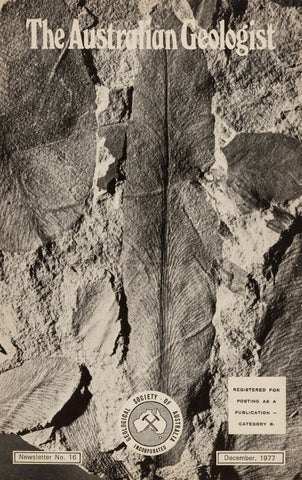
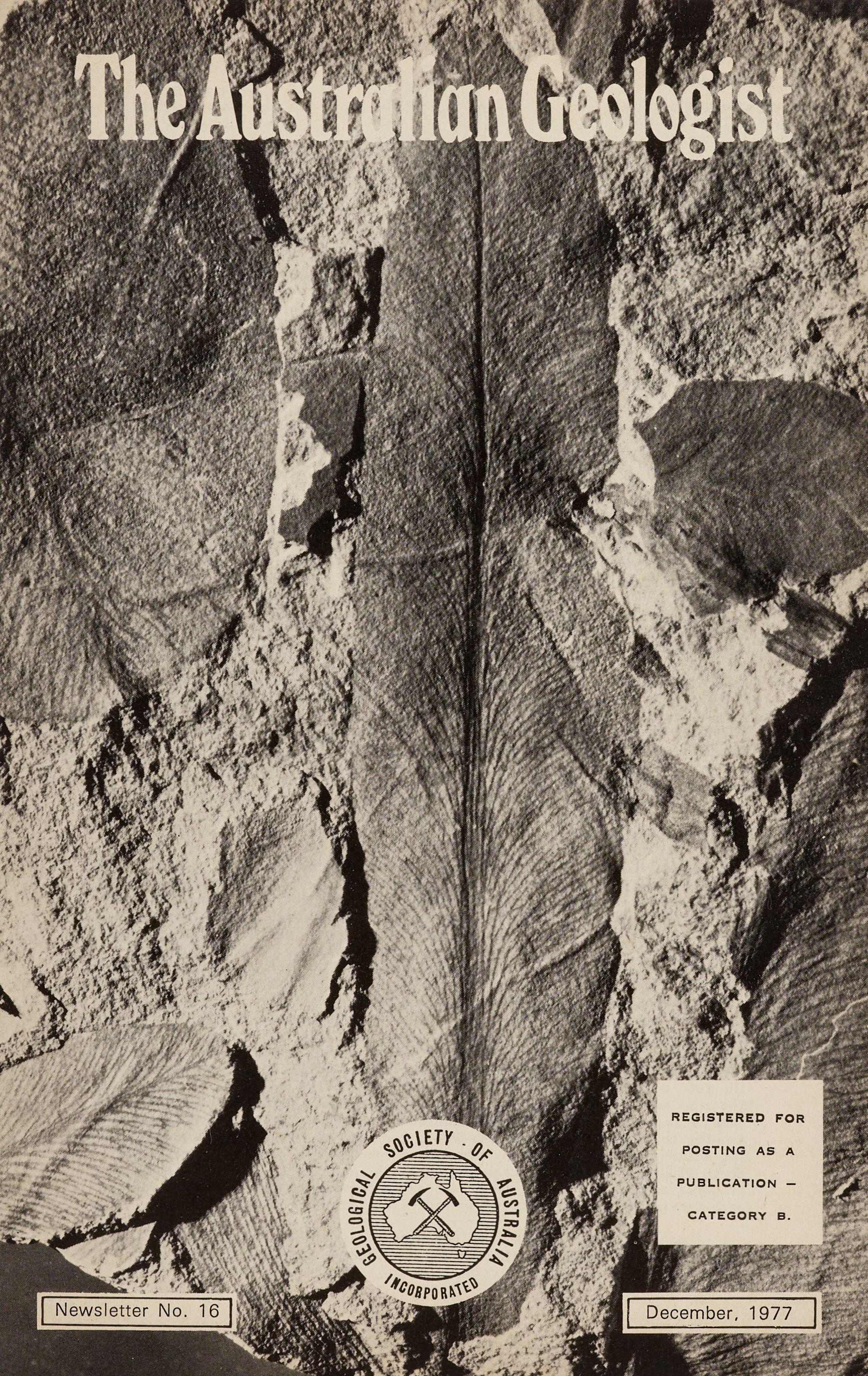
Cover Photo : Glo ss opteris , first described by Adolphe Brongniart i n 1828 , i s a key foss i l in the Gondwana story For a new sl ant see o u r story o n P age 15
Letter to the Editor
Sir ,
Quench textures have been recognized in various mafic and ultramafic volcanic rocks in Canada, South Africa and Western Australia.
Quenching brings to mind the picture of a blacksmith thrusting bar s of red h ot iron into a slak ing trough, of slag being poured into slag pots - in general, of rapid cooling and hardening.
It was our good fortune one hot summer Sunday to see the first jug of freezing cold beer pulled for the afternoon at the Gala Tavern in Kal goorlie, Western Australia, and to note the rapid crystallization of a crust of ice crystals at the top of the amber liquid with a texture formed by interlocking platelets radiating downwards for a centimetre or so, very much like that seen formed by crystals near the tops of flows of ultramafic volcanic rocks that crop out ar0und Kalgoorlie.
It appears clear that the Gala phenomenon has to do with very cold beer under pressure in the keg being ejected into the much less confining pressure of Kalgoorlie -a pressure release mechanism. Surely, the similar textures seen in the ultramafic volcanic rocks could also be due to pressure release. So too might be the other kinds of textures ascribable to rapid crystallization seen in some particular mafic rocks.
Perhaps a term other than quench te x ture could more adequately be used for taese te xt ures .
A simple way to observe the pressure release phenomenon is to put a few cans of beer into the freezer of a refrigerator. A can left for the correct length of time will, when shaken, give no indication of any cr y stal inside, yet, when the lid is opened, releasing the pressure, a mu sh of ice crystals is forced out
Although the phenomenon observed might help in appreciating the formation of the textures in question, there remains the fundamental problems of at what temperatures and pressures and for what range of chemical compositions are these rocks te x tures formed,
Tosspots
HYDROGEOLOGY SPECIALIST GROUP?
We are trying to assess the support within the G .S. A for the formation of a special i st group in hydrogeology. The main aim of the group might be to provide a form for the presentation and discussion of papers , and encouragement for their pub licat i on , however any other suggestions would be welcomed. At an informal meeting held during the convent i on in Me l bourne the r e seemed to be support for the form at ion of the group , but doubt as to whether it shou l d be restricted by hydrogeology , or include also such related fields as envi ronmental and engineering geology. Those who would be interested in joining if it were formed are urged to write to John Waterhouse , S A. Depa r tment of Mi nes , -19 1 Greenhill Road , Parkside , S.A. 50 63 , and make as ma ny suggestions as t hey wou ld like
One obvious problem is that man y of the geologists working in engineering fields are not members of G.S.A . The specialist group might help attract them to the Society (even i f on l y as Assoc ia te members) if there is enough s uppor t from within for the formation of the group.
The University of Sydney, Dept. of Chemical Engineering is offering a 1978 Postgraduate full - time course in Petroleum and Reservo ir Engineering , open to graduates in engineering , earth sciences or applied mathematics, leadi ng to M Eng. Sc degree. Contact Dr P. Eisenklam or Dr B W Walsh 692 -235 4 o r 692-2455.
SOCIETY NEWS
(1) Disbursement of I.G.C. Funds
This _ matter which has occupied the Executive of the Society and the Organising Committee of the I.G.C. has finally been resolved and, considering the various turns of events, it appears that the Society and the geological community as a whole have achieved a greater degree of success than appeared possible in the early stages. The draft standing order of the Academy appears below:
DRAFT STANDING ORDER XX
25TH INTERNATIONAL GEOLOGICAL CONGRESS FUND
{Made 1977)
Whereas Council has established a fund to be called the 25th International Geological Congress Fund {referred to hereafter as "the Fund") to comprise the balance remaining in the account of the 25th International Geological Congress, the income and capital of the Fund may be disposed of as follows upon the decision of the Council, having received advice from a Committee {referred to hereafter as the "Fund Committee") to be appointed annually by Council after consultation with the National Committee for Geological Sciences and the President of the Geological Society of Australia.
i. The income of the Fund shall be devoted to the support of scientific meetings, other than international congresses, and public lectures to be held in Australia and within the area of the Earth Sciences, except that in the year in which an International Geological Congress is held, the annual income from the Fund shall be devoted towards making awards to assist promising geologists from Australia and New Zealand to attend the Congress.
ii. The capital of the Fund may be made available, after consultation with the Fund Committee, to meet deficits on international scientific conferences for which this Academy has financial responsibility {under Standing Order XII) that cannot be met from the Conference General Reserve Fund.
iii. The major activities to be supported from the income of the Fund shall be announced at the time of each international Geological Congress, together with a report of activities so supported since the last congress, including awards made to geologists from Australia and New Zealand to attend the Congress.
iv. Activities to be supported from the income of the Fund shall include visits to Australia by overseas scientists, those from New Zealand and Papua New Guinea being particularly appropriate.
It will be noted that a "Fund Committee" must be set up and until that is done no applications for the use of the funds can be considered. In the meantime members might well give consideration to the best uses to which the fund could be put to achieve the greatest benefit, as outlined in last month's notes.
(2) Dr. M. J. Rickard has set up a committee on Basin, Structural and Tectonic Nomenclature as foreshadowed at the last Council Meeting.
At present it consists of 3 subcommittees which will deal with Basins, Structures and Tectonics respectively. The membership is drawn from members representing a wide range of interests and should be able to deal with these difficult problems in an effective manner.
NOT AGAIN!
The Organising Committee of the 26th International Geological Congress notifies that this Congress will take place in Paris, France, from 7 to 17 July 1980 and that you are cordially invited to attend.
The A excursions will be held before the Congress from 27 June to 5 July while the C excursions will be held from 19 to 27 July. These excursions will cover practically all of Europe except those countries which participated in the 23rd Congress or are candidates for the organization of the 27th Congress.
The scientific programme is as follows:
1) There will be twenty sections: Petrography; Mineralogy; Paleontology; Stratigraphy; Tectonics; Marine geology, Sedimentology and Sedimentary petrography; Precambrian; Quaternary and geomorphology; Geophysics; Geochemistry; Remote sensing; Mathematical geology and Geological information Science; Metallogeny and Mineral ores; Fossil energy-sources; Hydrogeology; Materials and Engineering geology; Geological hazards; Planetary Science; History of geology; Education and Training. Symposia will be organized for the various sections in association with organizations affiliated with the International Union of Geological Sciences. Abstracts of papers will be required by December 1st, 1979; the theme subjects of sections and symposia will be given in the first circular.
2) Seven colloquia will be held: Mineral resources; Resources of raw material of energy; Geology of continental margins; Geology of the oceans; Geology of Alpine chains descended from the Tethys; Geology of Europe from the Precambrian to the Post-Hercynian sedimentary basins; Geology of France. The organizers of these colloquia will call for communications. During the Congress, the following will also be held:
1. A scientific and technical exhibition, 2. Showing of scientific films,
3. Excursions B for periods of one or two days, 4. A social programme and a programme for those accompanying participants.
The first circular will be sent out in October 1977 and replies should reach the Secretariat of the Congress by 1st April 1978.
Those interested in attending the Congress who have not received the circular by 15th December 1977 should request one from the:
Secretariat General du 26eme Congres geologique international Maison de la Geologie 77-79, rue Claude Bernard 75005 PARIS - FRANCE.
Meanwhile - Closer to home
The seventh BMR Symposium will be held on 2 and 3 May 1978 at the Australian Academy of Science Building, Canberra.
The Symposium presents the final results of BMR projects prior to publication, and preliminary results of projects only recently complete d or still in progress. In addition, the Symposium is seen as an opportunity for public discussion of BMR's work.
Long runs of journals including Q.J.G.S., Geol. Mag., Bull. Geol. Soc. Amer., J. Geol. Soc. Aust., are available for sale. Contact Librarian, Michael Kevi, Dept. of Geology & Geophysics, University of S y dn ey 2006. Phone 692 2913.
A PROFESSIONAL ORGANISATION FOR AUSTRALIAN GEOLOGISTS?
Introduction
The Professional and Legislation Committee was formed at the 1977 GSA Council Meeting by the amalgamation of the Committees for Legislation and Professional Representation (see March '77 Australian Geologist).
The Legislation Committee, despite a great deal of work which reached an encouraging stage in 1972, failed in its objective of establishing Registration Boards similar to those controlling such professions as medicine, architecture, surveying and dentistry.
The Professional Representation Committee, in a survey during 1976, established that a large proportion of geologists in Australia were dissatisfied that an organisation did not exist to represent the non-academic interests of the profession. GSA is a body catering for the scientific needs of geologists and is not constituted to cover the professional aspects.
The Professional and Legislation Committee
GSA Divisions were each requested to nominate two members for the Professional and Legislation Committee and other members were co-opted. The Committee now consists of the following members:
Convener : Deputy Convener: Queensland:
N.S.W.:
Victoria:
Tasmania:
S.Australia:
W.Australia:
C L. Adamson, Consultant
K. R. Warner, Geol. Survey Queensland R. Bryan, Mines Administration P/L. A. F. Wilson, University of Queensland. J. Crarnsie, Geol. Survey N.S.W.,
K. R. Glasson, Consultant
J. Knight, Geol. Survey Victoria
J. R. Lovering, University of Melbourne
I. B. Jennings, Geol. Survey Tasmania
K. 0. Reid, Mt Lyell Mining & Railway Co. Ltd.
C. F. Branch, Geol. Survey S.Aust. C.R. Dalgarno, Afrneco Pty. Ltd.
P. E. Power, W.A. Inst. of Technology
D. o. Zimmerman, Uranerz (Aust.) Pty. Ltd Commonwealth J. H. C. Bain, B.M.R. Territories: D. Duncan, Western Mining Corp. Australian Association of Exploration Geophysicists: Co-opted Member:
L. Ingall, Consultant, or R. Richardson, Consultant K. G. Mosher, former GSA Horn. Adrnin. Officer
Owing to previous involvement by geophysicists with the Committee for Geological Legislation and the present desire to be represented on the Professional and Legislation Committee, the Australian Association of Exploration Geophysicists was requested to nominate a representative to the Committee. The Committee regards geophysics as one of the many branches of geology.
Terms of Reference of the Committee
The terms of reference of the Professional and Legislation Committee, as determined by the GSA Council, are as follows:
1. Study means for achieving increased professionalism ann status in the profession of geology.
2. Formulate means of establishing a professional group for geologists either within or outside GSA.
3. Continue towards the establishment of legislation for registration of geologists. It is envisaged that the Registration Boards and a professional organisation would perform different, but complementary functions.
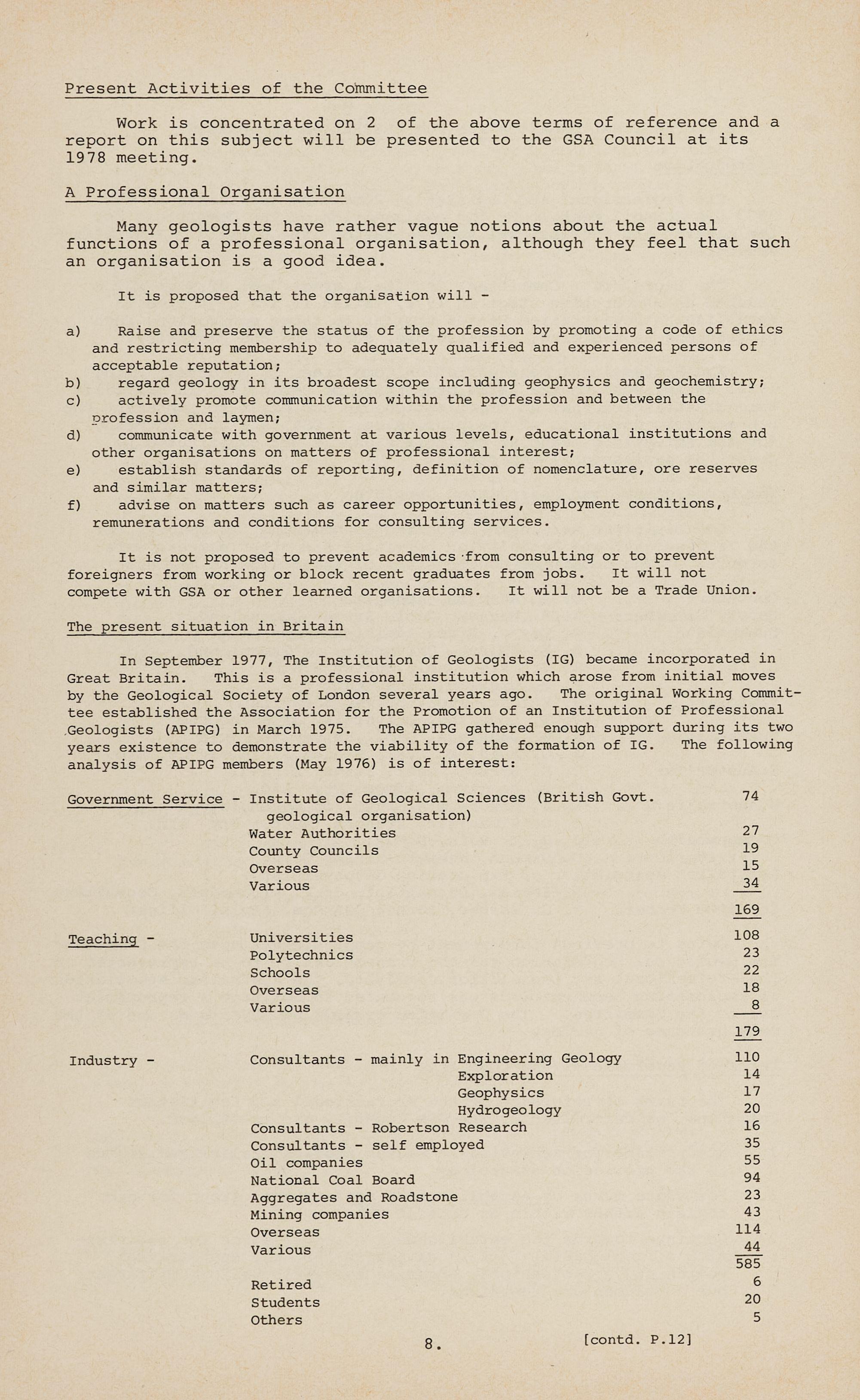
Present Activities of the Committee
Work is concentrated on 2 of the above terms of reference and a report on this subject will be presented to the GSA Council at its 1978 meeting.
A Professional Organisation
Many geologists have rather vague notions about the actual functions of a professional organi s ation, although they feel that such an organisation is a good idea.
It is proposed that the organisation will -
a) Raise and preserve the status of the profession by promoting a code of ethics and restricting membership to adequately qualified and experienced persons of acceptable reputation;
b) regard geology in its broadest scope including geophysics and geochemistry;
c) actively promote communication within the profession and between the p rofession and laymen;
d) communicate with government at various levels, educational institutions and other organisations on matters of professional interest;
e) establish standards of reporting, definition of nomenclature , ore reserves and similar matters;
f) advise on matters such as career opportunities, employment conditions, remunerations and conditions for consulting services.
It is not proposed to prevent academics ·from consulting or to prevent foreigners from working or block recent graduates from jobs. It will not compete with GSA or other learned organisations. It will not be a Trade Union.
The present situation in Britain
In September 1977, The Institution of Geologists (IG) became incorporated in Great Britain. This is a professional institution which ~rose from initial moves by the Geological Society of London several years ago. The original Working Committee established the Association for the Promotion of an Institution of Professional .Geologists (APIPG) in March 1975. The APIPG gathered enough support during its two years existence to demonstrate the viability of the formation of IG. The following analysis of APIPG members (May 1976) is of interest:
geological organisation)
Government Service - Institute of Geological Sciences (British Govt. Teaching
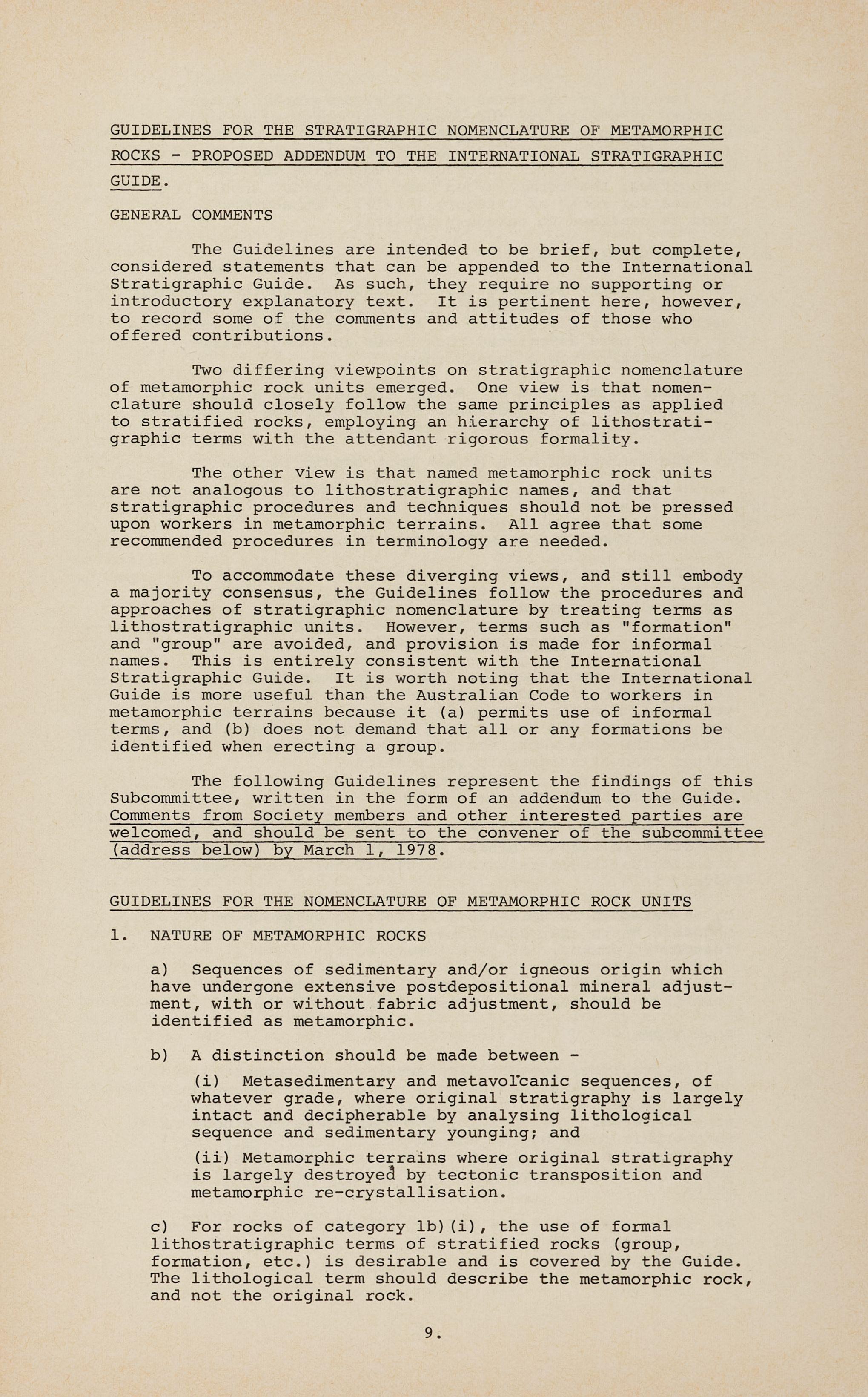
GUIDELINES FOR THE STRATIGRAPHIC NOMENCLATURE OF METAMORPHIC ROCKS - PROPOSED ADDENDUM TO THE INTERNATIONAL STRATIGRAPHIC GUIDE.
GENERAL COMMENTS
The Guidelines are intended to be brief, but complete, considered statements that can be appended to the International Stratigraphic Guide. As such, they require no supporting or introductory explanatory text. It is pertinent here, however, to record some of the comments and attitudes of those who offered contributions.
Two differing viewpoints on stratigraphic nomenclature of metamorphic rock units emerged. One view is that nomenclature should closely follow the same principles as applied to stratified rocks, employing an hierarchy of lithostratigraphic terms with the attendant rigorous formality.
The other view is that named metamorphic rock units are not analogous to lithostratigraphic names, and that stratigraphic procedures and techniques should not be pressed upon workers in metamorphic terrains. All agree that some recommended procedures in terminology are needed.
To accommodate these diverging views, and still embody a majority consensus, the Guidelines follow the procedures and approaches of stratigraphic nomenclature by treating terms as lithostratigraphic units. However, terms such as "formation" and "group" are avoided, and provision is made for informal names. This is entirely consistent with the International Stratigraphic Guide. It is worth noting that the International Guide is more useful than the Australian Code to workers in metamorphic terrains because it (a) permits use of informal terms, and (b) does not demand that all or any formations be identified when erecting a group.
The following Guidelines represent the findings of this Subcommittee, written in the form of an addendum to the Guide. Comments from Society members and other interested parties are welcomed, and should be sent to the convener of the subcommittee (address below) by March 1, 1978.
GUIDELINES FOR THE NOMENCLATURE OF METAMORPHIC ROCK UNITS
1. NATURE OF METAMORPHIC ROCKS
a) Sequences of sedimentary and/or igneous origin which have undergone extensive postdepositional mineral adjustment, with or without fabric adjustment, should be identified as metamorphic.
b) A distinction should be made between(i) Metasedimentary and metavorcanic sequences, of whatever grade, where original stratigraphy is largely intact and decipherable by analysing lithological sequence and sedimentary younging; and (ii) Metamorphic terrains where original stratigraphy is largely destroyeJ by tectonic transposition and metamorphic re-crystallisation.
c) For rocks of category lb) (i), the use of formal lithostratigraphic terms of stratified rocks (group, formation, etc.) is desirable and is covered by the Guide. The lithological term should describe the metamorphic rock, and not the original rock.
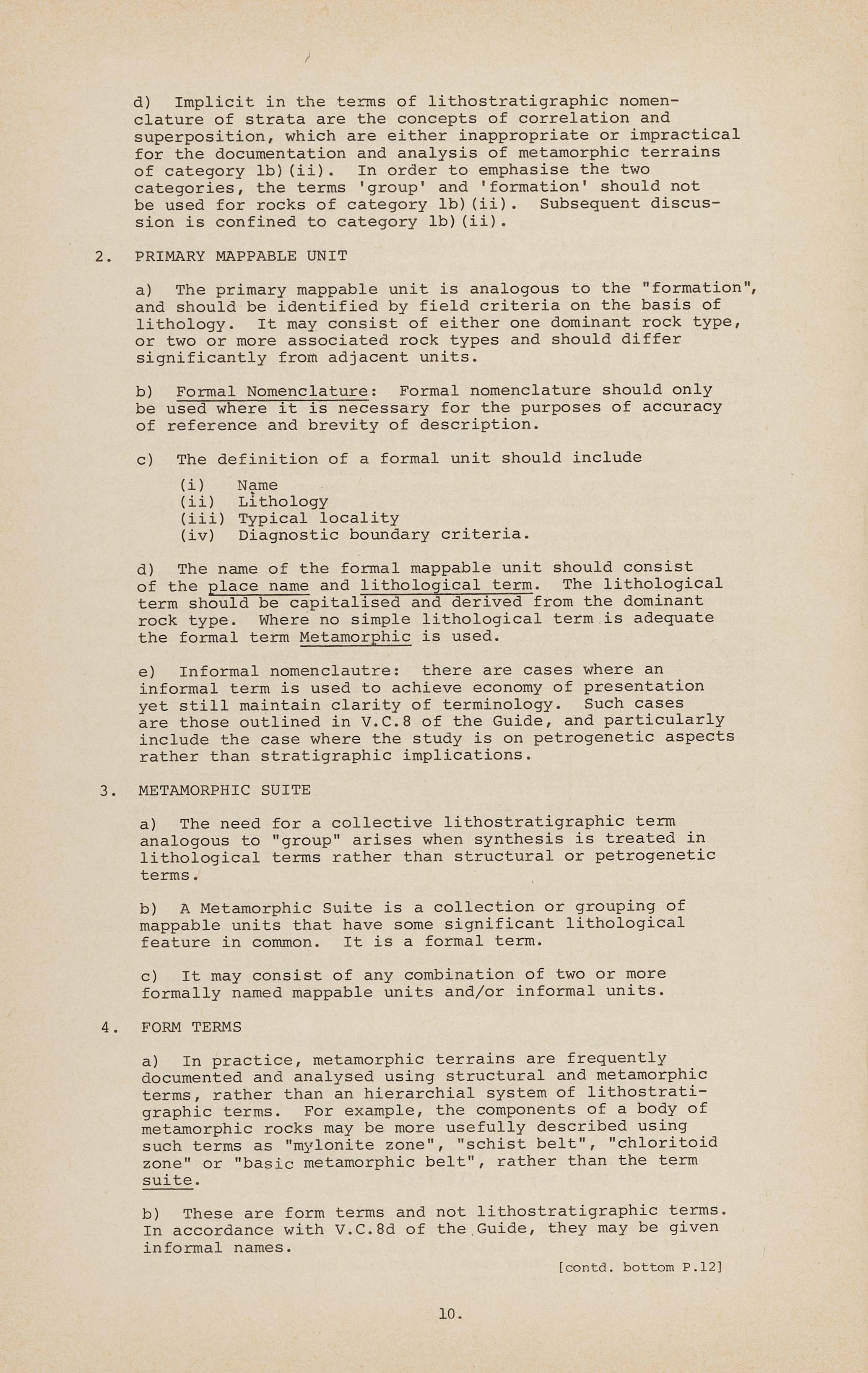
d) Implicit in the terms of lithostratigraphic nomenclature of strata are the concepts of correlation and superposition, which are either inappropriate or impractical for the documentation and analysis of metamorphic terrains of category lb) (ii). In order to emphasise the two categories, the terms 'group' and ' formation' should not be used for rocks of category lb) (ii). Subsequent discussion is confined to category lb) (ii).
2. PRIMARY MAPPABLE UNIT
a) The primary mappable unit is analogous to the "formation", and should be identified b y field criteria on the basis of lithology. It may consist of either one dominant rock type, or two or more associated rock types and should differ significantly from adjacent units.
b) Formal Nomenclature: Formal nomenclature should only be used where it is necessary for the purposes of accuracy of reference and brevity of description.
c) The definition of a formal unit should include (i) Name (ii) Lithology (iii) Typical locality (iv) Diagnostic boundary criteria.
d) The name of the formal mappable unit should consist of the place name and lithological term. The lithological term should be capitalised and derived from the dominant rock type. Where no simple lithological term is adequate the formal tern Metamorphic is used.
e) Informal nomenclautre: there are cases where an informal term is used to achieve economy of presentation yet still maintain clarity of terminology. Such cases are those outlined in V.C.8 of the Guide, and particularly include the case where the study is on petrogenetic aspects rather than stratigraphic implications.
3. METAMORPHIC SUITE
a) The need for a collective lithostratigraphic term analogous to "group" arises when synthesis is treated in lithological terms rather than structural or petrogenetic terns.
b) A Metamorphic Suite is a collection or grouping of mappable units that have some significant lithological feature in common. It is a formal term.
c) It may consist of an y combination of two or more formally named mappable units and/or informal units.
4. FORM TERMS
a) In practice, metamorphic terrains are frequently documented and anal y sed using structural and metamorphic terms, rather than an hierarchial system of lithostratigraphic terms. For example, the components of a body of metamorphic rocks may be more usefully described using such terms as "mylonite zone", "schist belt", "chloritoid zone" or "basic metamorphic belt", rather than the term suite.
b) These are form terms and not lithostratigraphic terms In accordance with V.C.Bd of the . Guide, the y may be given informal names.
[ c o ntd bottom P .1 2)
QUEENSLAND DIVISION 1977
FIELD CONFERENCE
The Queensland Division Field Conference has become an annual event since its inception in 1964, except for 1971, when the ANZAAS congress was held in Brisbane, and 1976, the IGC in Sydney. In 1977, it was held as usual . over the Queen's Birthday long weekend (11-13 June), and visited Lad y Elliot Island, Fraser Island, and the Gayndah-Biggenden district.
The conference began with a flight along the coast north from Brisbane to examine the large Quaternary sand dunes (Bribie Island, Cooloola, Fraser Island) from the air, paying special attention to recently mined areas on Fraser Island. An aerial inspection was made of some reefs of the Bunker Group, followed b y a visit to Lady Elliot Island, the southernmost point of the Great Barrier Reef. The island is composed of a sequence of coral shingle beach ridges, the older members of which are lithified, and is surrounded by a typical zoned platform reef.
One and a half days were spent on Fraser Island, the participants staying at the tourist resort at Orchid Beach. Tertiary trachytic volcanics which form Waddy Point and Middle Rocks were inspected, and a traverse was made across to and down the west coast of the island to examine the sequence of dune and beach ridges. Bill Ward of CSIRO has subdivided the sand deposits on the basis of geomorphology, superposition, and depth of leaching as indicated by the soil profile. His guided tour and introduction to the techniques used was of particular interest since most participants were unfamiliar with this branch of geology. Soil science does need geologists:
On the final day the conference returned to the mainland to rocks rather more solid than the shifting sands of Fraser. Pleistocene basaltic cones at Coulstoun Lakes, the Biggenden magnetite mine, and the old Mount Shamrock gold mine were examined. The leisurely pace of the conference was somewhat disturbed on arrival at Gayndah for the flight back to Brisbane, but following a Battle of Britain-type scramble, 3 of the 4 aircraft reached Eagle Fairm airport by 5.30 p.m. (after which they were not permitted to land), and the last plane landed at nearby Redcliffe.
All in all, this was a very successful and enjoyable field conference, made possible again by the generosity of the supporting companies and organizations.
Copies of the Guidebook for the Queensland Division 1977 Field Conference are now available from the Secretary of the Queensland Division, G.P.O. Box 1820, Brisbane, 4001 at a price of $6 (plus postage). The guidebook, of over 100 pages, includes articles on the geology of southeast Queensland, the Quaternary geology of the Queensland coast from Brisbane to Double Island Point (including heavy mineral sand deposits), the southernmost reefs of the Great Barrier Reef, the geology of Fraser Island (including a route guide to the areas visited), Pleistocene basalts of the Biggenden-Gayndah region, and mines and mineral deposits of the Biggenden area. It is accompanied by a coloured geological map of southeast Queensland at 1:1 000 000 scale.
Some previous guidebooks issued by the Queensland Division are still available. These are:-
1971 Geological Excursions Handbook.
Describes excursions to the Atherton Tableland, Townsville-Charters Towers area, RockhamptonMt. Morgan area, Bowen Basin, Moreton district, North Stradbroke Island, and several local excursions around Brisbane.
1972 Field Conference
Atherton Tableland - Hodgkinson Basin
1973 Field Conference. Brisbane-Gympie area.
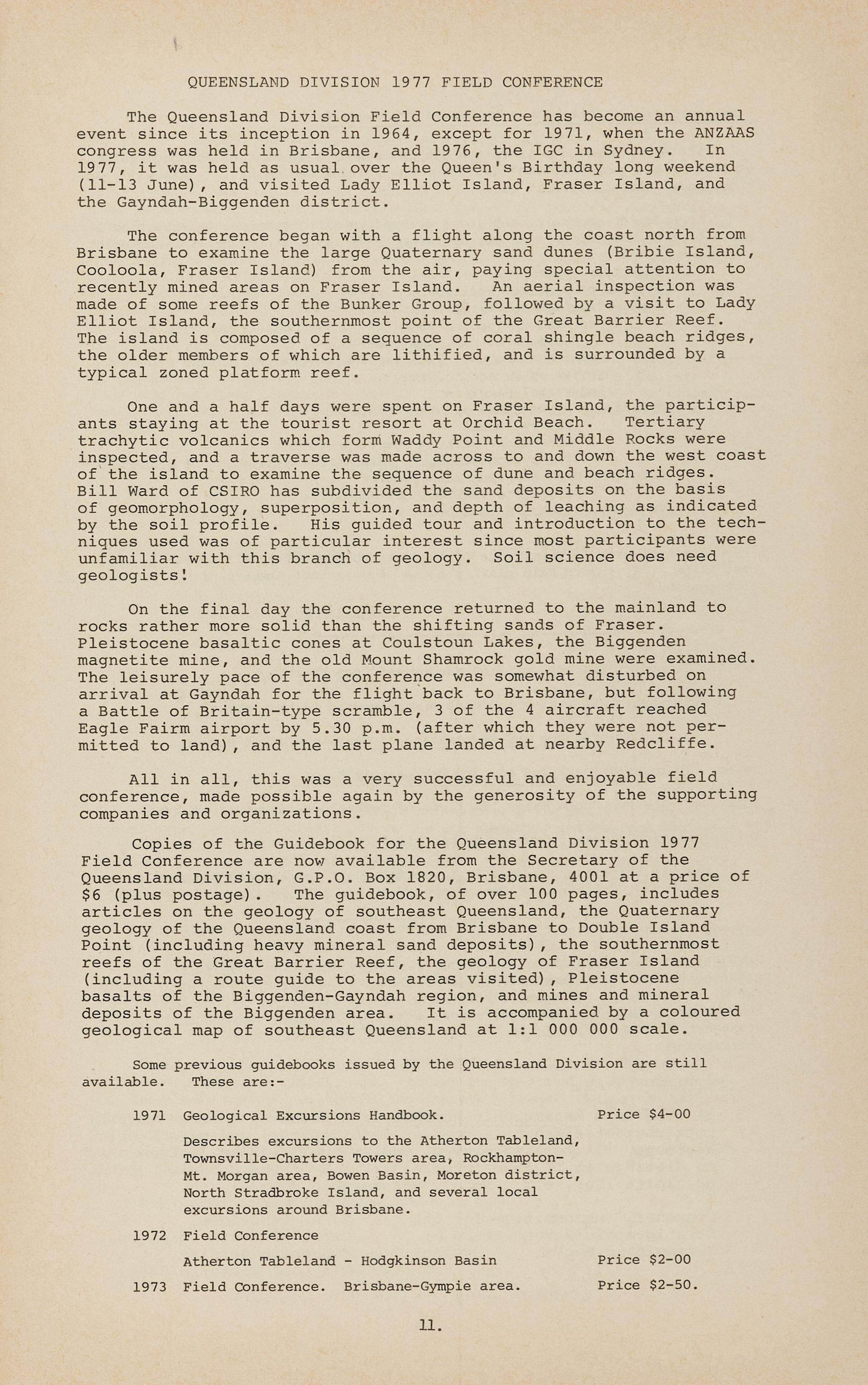
Price $4-00
Price $2-00
Price $2-50.
A Professional Organization - continued from page 8.
The APIPG since its inception has published "a newsletter for professional geologists and geophysicists" entitled "The British Geologist". This will continue under the auspices of IG. •
In order to emphasize the scope covered by a professional organisation it is worth listing the contents of the September 1977 issue of the British Geologist;
Committee Report
Reports of Regional Meetings
News - Taxation on overseas earnings
Professionalism in Australia (based on a letter from the Convener of our committee)
Government Enquiry into the Engineering Profession Review of Ordnance Survey
Industrial Minerals
Briefing - Educutation and the Environment
Salary Survey
UK Potash- past, present and future The hydrog~ologist's role in the management of groundwater
Letters - NERC Research Studentships Geologists in Local Government
IG - Why you should join now.
The last item in this issue of the British Geologist will appear in our next issue. It should help clarify ideas of potential members of our professional organisation.
C . L. Adamson ,
Getting Stoned? Why not join the Masons and Stop Fretting?
Symposium: Everything you have always wanted to know about Ma intenance and Restoration of Stone and Brick Masonry
Dates: Thursday-Friday, 2nd and 3rd February 1978.
Location: The New South Wales Institute of Technology, Broadway, Sydney.
For information please telephone Sydney 2]8-9625, or write to:
Masonry Symposium, c/- Mr. J. L. Gordon, Dept. of Applied Geology The N.S.W. Institute of Technology, P.O Box 123, BROADWAY, N.S.W. 2007.
IGCP Project "Mineralization associated with Acid Magmatism" has just produced Volume 2 of its publications edited by M Stemprok, L. Burno! and G Tischendorf. Covering a wide range of topics. It is available through Dr. E Nagele, Schweitzerbartsche Verlag , Johannes Strasse 3a, Stuttgart W7, Fed. Republic of Germany (price 18.50 Czech Crowns or thereabouts).
cont from P. 10.
c) The term metamorphic complex is applied to a large body of rock characterised by a complex deformational and metamorphic history. It is a form term, and is qualified as _ 'metamorphic' to distinquish it from 'complex' (V.C .7 of the Guide). It may be capitalised, e.g., Rudall Metamorphic Complex.
Convener, Subcommittee for the Stratigraphic Nomenc lature of Metamorphic Rocks.
12.
M.A. Etheridge, Dept. of Earth Sciences, Monash University, Clayton, Victoria 3168.
CONCEPTUAL MODELS IN EXPLORATION GEOCHEMISTRY (AUSTRALIAN EDITION)
The Association of Exploration Geochemists has accepted a proposal that an Australian volume in their series "Conceptual Models in Exploration Geochemistry" be compiled. The obj ect of the series is to develop idealized models for the description of exploration geochemical data, presenting the data in forms readily usable by exploration geologists and to illustrate the models by means of selected case studies. The models will describe the expression of mineralization in the various weathered materials. The series is published as Special Issues of the Journal of Geochemical Exploration: e.g. editions for ' Canada, vol.4, 1, 1975; Norden, vol.5, 3, 1976; southwest U.S.A., in press. · It is intended to complete the Australian issue by September , 1978. Currently the Organizing Committee is seeking participation of exploration companies , geological surveys, tertiary institutions, etc. Many will have been contacted already. The Organizing Committee is listed below. All interested parties are invited to contact the Secretary or any of the compilers.
Organizing Committee
Co-convener/Chairman
Co-convener/Secretary
Co-editors
R.E. Smith
C.R.M. Butt
C.R.M. Butt, R.E. Smith, W.R. Ryall
Compilers for Precambrian Shield Conveners: R.E. Smith & C.R.M. Butt (Perth)
R. Davy (Perth)
R.H. Mazzucchelli (Perth)
P.G. Moeskops (Adelaide)
B K. Welch (Perth)
B.T. Williams (Perth)
Sub-committee in Sydney
R. Cox
J .F. Gilfillan
G.F. Taylor
Compilers for Tasman Geosyncline Convener: W.R. Ryall (Sydney)
R. Cox (Sydney)
B.L. Farrell (Melbourne)
J.F. Gilfi llan (Sydney)
J.J. Hobbs (Sydney)
A.S. Joyce (Brisbane)
N. J. Marshall (Sydney)
G .F. Taylor (Sydney)
L.N. Wall (Brisbane)
J .R. Wilmhurst (Sydney)
Australian Earth Sciences Information System (AESIS)
AESIS Quarterly is now available on a subscription basis. The introductory annual subscription of $85-00 covers the six quarterly issues from September 1977 to December 1978 and includes two issues of AESIS Cumulation on microfiche, produced in December 1977 and December 1978. Eash issue of the fiche will contain the whole data base to date of issue. A few copies of the September issue of AESIS Quarterly are still available.
AES IS is the Australian national database for the earth sciences, covering Australian generated information over the wide spectrum of subjects covered by the earth sciences. In the context of the system, the earth sciences include the following broad subject categories: Analytical Chemistry, Economics, Energy, Engineering, Environmental problems, Geochemistry, Geology, Geomechanics, Geophysics, Health, Management, Mineral processing, Mining, Palaeontology, Recycling, Resources, Safety, Petroleum.
Besides the published literature, AESIS covers unpublished material, such as open file reports, theses, etc., through the co-operative efforts of most of the Geological Surveys, University Departments, the BMR, CSIRO, the National Library, Companies and other organisations.
AESIS is available for retrospective computer searches at approximately $15-00 per search.
For further information write, phone or telex
The Director, Australian Mineral Foundation, P.O. Box 97, GLENSIDE, S.A. 5065. Telephone: (08)797821. Telex: AA82520.
2 14. see opposite article.
TEN DAYS THAT SHOOK GOONWANDERLAND
by P.A. Leo McNettick
Being extracts from recent issues of The Phanerozoic TimesTelegraph. (With apologies to the late John Reed, author of Ten Days That Shook the World [Boni & Liveright, New York, 1919], the first eye-witness account of the Bolshevik Revolution in St. Petersburg).
Monday. Startling news from the Goonwander Front. War correspondents at Goonwander Reunification by Ordered Paleomagic Effort (GROPE) headquarters were today informed that a vital piece of equipmen t only recently put into full use, the Australian Stone Raft, had disappeared during the night. An urgent search had been instituted. Some suspicion had been aroused by the presence in the vie ty of 923 foreign fishing vessels thought to be well-equipped with silk ropes and millions of horseshoe magnets. These are designed with fiendish cunning. The y are too small to be seen by the naked eye even on a beach where such bathing is permitted.
Tuesday. Furth~r developments in the extraord inar y Raft case. It was revealed today that extensive searches by GROPE had failed to locate the Raft. Though its speedometer is known to have been working well, it is feared that some serious fault existed in the rest of the elaborate mechanism, poss i bly in the "sneck" of the sensitive goffle-chain. GROPE HQ said that a secret "biffingcheck analysis" is under way. So, evidently, is the Raft.
Wednesday. The peculiar, not to say astounding, Australian Stone Raft case. Reconnaissance by GROPE using the new pyknoclastic diarritic night probe has still not found the Raft. Serious questions are being asked about the leadership of GROPE. Doubts are being expressed on the wisdom of having fitted, at vast expense, the Potzenpanz fish-bellied trunnions.
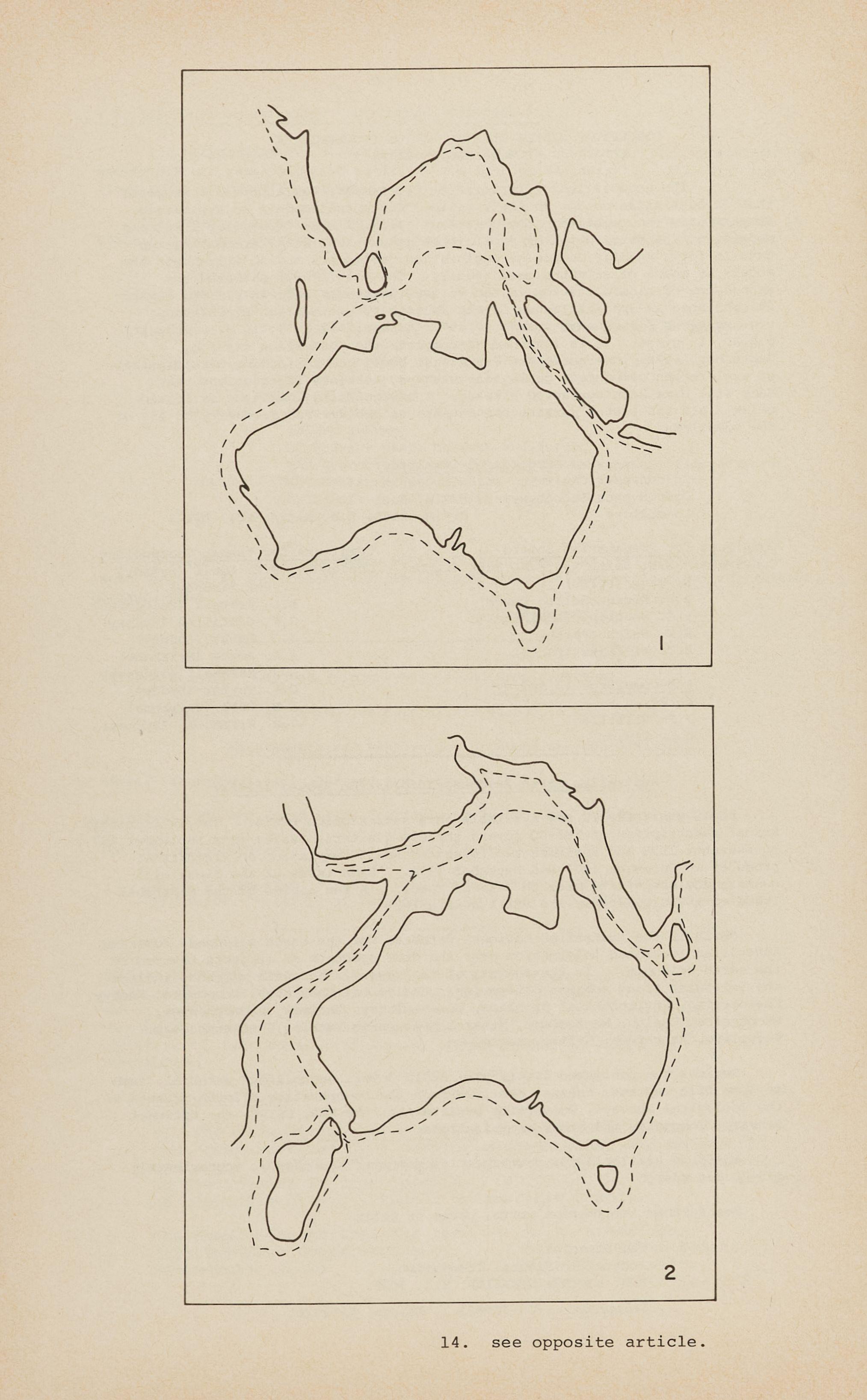
Thursday. The Raft case. A sensation. In an official communique issued today, GROPE announced discovery of the Raft. It is wedged between Sri Lanka and Sumatra. It appears to be in good shape, in fact the same one as usual. Some difficulty along the West Australian - South Australian State Unconformity may be due to grounding on the Ninety East Ridge. The Tasmanian Rudder was checked by divers and found to be no more rusty than usual, if heavily barnacled. Satellite picture, figure 1.
Friday. The Raft case again. Was this the work of Dextra Sinistra, a CIA (Come Into Angaraland) agent? She is known to have been active in the Indian Ocean recently. Matters have quickly become very embarrassing. Within hours of the discovery of the Raft official complaints were received from the Permian meat pies at Broome. No sooner was this problem solved than the President of Indonesia personally complained that he is eyeballto-eyeball with Mr. Jo Bjelke-Petersen and has no wish to be. GROPE is twisting all knobs to get things moving.
Saturday. The Raft case. Unfortunate developments. Heroic attempts to move the Raft came to grief today. GROPE HQ revealed little to correspondents. Information from Madagascar however indicates that after having succeeded in getting it under way again and reaching a steady speed of five knots the Raft got out of control and moved west to ground on the Mid-Oceanic Ridge. It is understood that attempts will be made at dawn tomorrow, when it is high water, to float it off sideways.
Sunday. Raft tragedy. It was revealed with regret today by GROPE that at high water soon after dawn the Raft was in fact floated off successfully but suddenly tilted down on the west side and slithered into the Somali Basin, crushing the Seychelles.
No lives were lost, as the inhabitants had taken to their boats at the fearsome sight of the Darling scarp. A compensation claim of $9000M is being filed at UN. The tilting, said to be perhaps due to a design fault, is rumoured to be really the result of corrupt contractors' work on the NSW basement. Picture, figure 2.
Monday. GROPE decision on the Raft. It has been decided to abandon the Raft. No reason is given, but many observers believe that the failure to supply adequate numbers of geocentric axial dipoles at the right place at the right time led to the decision. Severe criticism of defence industry is expected.
Tuesday. Late news. The Malagasy Republic today officially announced its formal withdrawal from GROPE. It is learned in reliable quarters in Tananarive that the Government was under pressure from those fearful for the island's future and had no wish to see it suffer the fate of the Raft. It is prepared to repel boarders. At GROPE HQ today no spokesman was available.
Wednesday. Strong rumours today that as a result of the Raft fiasco the Madagascans have agreed to allow the island to be cut up into narrow slices, under anaesthetic, to permit its passage through the Suez Canal and the Bosporus. This will permit its re-asser.~ly in the Black Sea under happier circumstances. GROPE is said to be in disarray. Responsible opinion is that it will be reconstituted as Geophysical Research Office for Goonwanderland (GROG) and will concentrate its attention on attempts to assess the possible futures of hallucinosutures.
Several weeks later
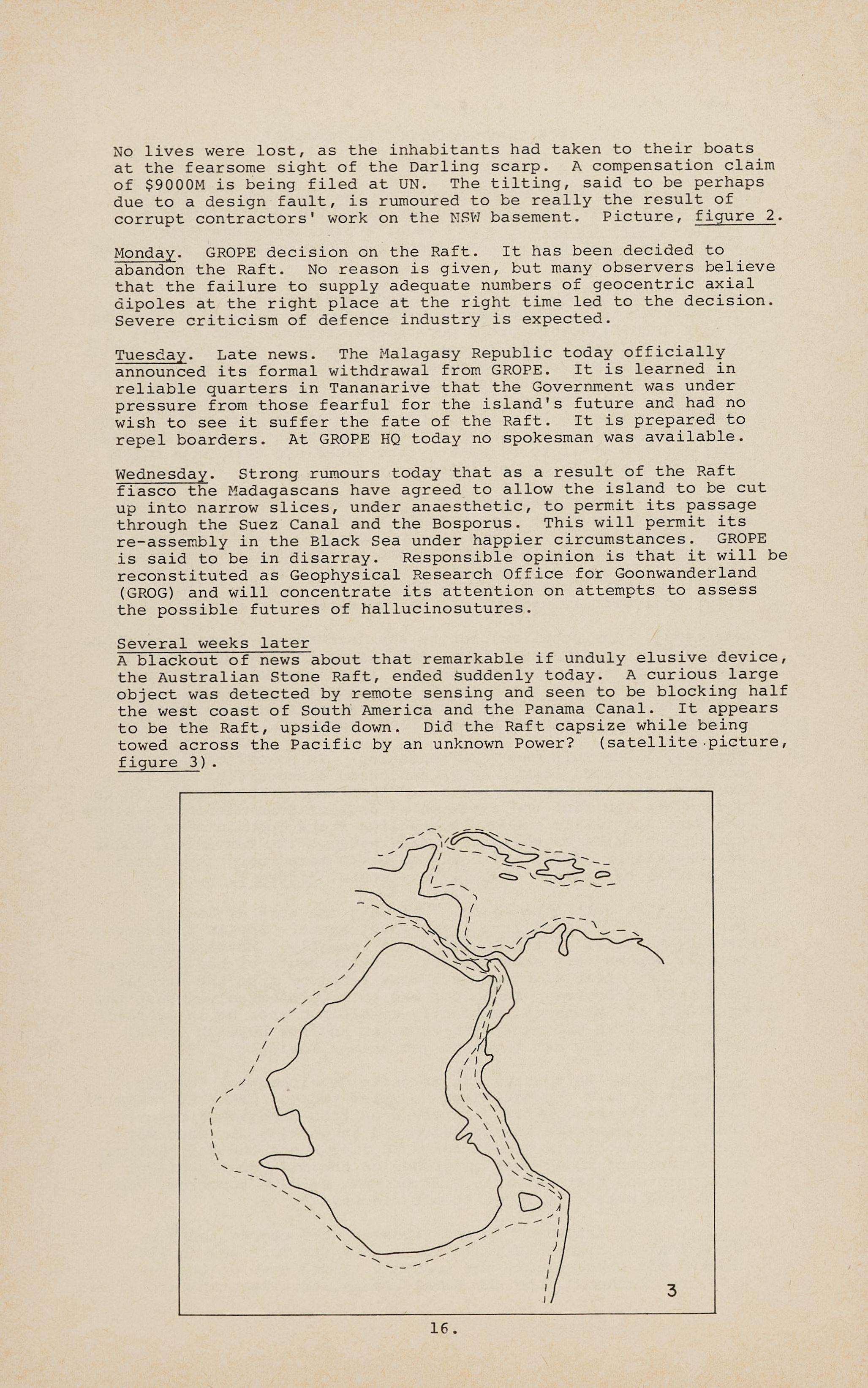
A blackout of news about that remarkable if unduly elusive device, the Australian Stone Raft, ended suddenly today. A curious large object was detected by remote sensing and seen to be blocking half the west coast of South America and the Panama Canal. It appears to be the Raft, upside down. Did the Raft capsize while being towed across the Pacific by an unknown Power? (satellite.picture, figure 3).