The Australian Geologist
NEWSLETTER OF THE GEOLOGICAL SOCIETY OF AUSTRALIA INCORPORATED
No. 4 November 1974.
EDITORIAL
At its August Meeting, Council voted funds for the 'Australian Geologist' to continue during 1975. Although not without some opposition, there seems to be majority support from members for such a newsletter. For the moment at least we have slightly more material than can be printed, for which I must thank numerous correspondents. However such abundance can very soon turn to famine and I would appreciate any material, but particularl y short reviews on any geological topics for forthcoming issues.
The year is closing with slightly better prospects for the profession and once again a variety of jobs is being advertised. One sign of the times is the ad. which in addition to expertise in geology calls for someone with a pilot's licence or who is prepared to get such a licence in company time!
This issue contains a loose sheet questionnaire relating to salaries within the profession. A.P.E.A. has already carried out a survey of its members and has kindly offered to process data received from G.S.A. members using the programme and computer facilities of WAPET. This seems an excellent opportunity for the Society to get some proper data on the spread of salaries and to see where we stand in relation to inflation. There are obvious discrepancies when the position of Director of the Bureau of Mineral Resources, one of the most influential positions within the profession in this country, and which was recently advertised, is paid only a little over $20,000.
Although there has apparently been a surfeit of qualified geologists in the last year, enrolments in geology have declined considerably in many tertiary institutions and we will probably be short again in two or three years. It would be nice if the supply and demand position could reach a better balance.
SOCIETY NEWS
The Australian Geological Convention 1975 sponsored by the Society is scheduled for 12th-16th May, in Adelaide. Details were given in the last issue of the Newsletter. Make your arrangements now for this important meeting.
The Specialist Group in Sedimentology is planning a meeting and field trip on the topic 'Modern Sediments', Feb. 20th-22nd in Melbourne.
The review of 'Conservation and Exploration' published by the Tasmanian Division has been held over to the next issue. Stocks of the publication have been exhausted. Rob Underwood has opened a register for people who still would like a copy, with a view to reprinting, but cannot guarantee at the moment that they will proceed.
Time is running out for revising the Rules. Each Division should by now have sul:mitted to Mike Rickard their ideas about proposed amendments.
RETIREMENT OF DR. FIS HER
Dr. Norman H Fisher, Dir e ctor of the Bureau of Mineral Resources, retired o n 30 S e ptember after forty ye ars of service with the Australian Government.
In 1931, following graduation from the University of Queensland, he became geologist at the then new mine at Mo unt Isa He he became interested in the genesis of ore deposits, particularl y stratiform bodies, an interest which he has maintained In 1934, he moved to Wau, on the Morobe Goldfield, as Government Geologist of t he Mandated Territory of New Guinea, and in 1938 was put in charge of the new v olcanological observatory at Rabaul, which he developed - and largel y designed - into an outstanding centre for surveillance of volcanoes in th e Territory. His work in t he goldfields provided the basic material for his D.Sc. thesis (1941) on the orig i n of the gold, and his expertise in volcanology results from his operations at the observatory. His status in volcanological studies has been recognized b y the International Association of Volcanology and Chemistry of the Earth's Interior.
As a member of the N.G. Volunteer Rifles he was involved in the Rabaul engagement but man aged to escape to Australia. He became Chief Geologist of the newl y formed Mineral Resources Survey of the Department of Supply and Development searching for deposits of strategically important minerals. When the Bureau of Mineral Resources, Geology and Geophysics was formed in 1946, he was appointed Chief Geologist.
Largely du e to Dr Fisher's initiative B.M.R , in conjunction with the geological survey s of the States , embarked on a long term programme of systematic geological mappi n g of Australia and its territories to provide the basis for efficient mineral and petroleum e xploration. This work is only now nearing completion. Between 1946 to 1969, the Geological Branch of B.M R. expanded from its original si x officers to 57 in 1950, 84 in 1960, and 115 in 1970, and its work now covers almost all aspects of geology.
Dr. Fisher became Director of B.M.R. in 1969, and held that position until his retirement. During this period systematic geological mapping of Papua New Guinea was completed, and responsibility for most geological work there passed to the Geological Survey Marine geological and geophysical surveys of the Australian continental shelf and slope were also carried out.
Dr. Fisher has served as United Nations Adviser on Mineral Development in Bolivia and Israel He is the Chairman of the Organizing Committee for the 25th International Geological Congress, and a member of the Executive of the International Union of Geological Sciences. He was President of the Geological Society of Australia, and Chairman of Section 3 (Geology) of the Australian and New Zealand Association for the Advancement of Science. Among international bodies, his work as v ice-president for Oceania on the International Commission for the Geological Map of the World should be mentioned.
Sir,
'Talbragar '
It would be difficult to disagree with the logic and commonsense or Dr. Brunnschweiler's letter, and not to share his surprise that the proposed "Talbragar Formation - Triassic" could have penetrated the local first-line defence of stratigraphic nomenclature.
Either Dr. Brunnschweiler is elevating the proverbial molehill a little or else our local watchdogs could not see over it Could it be that the term "Talbragar", in the minds of local geologists , calls up the picture of a valley and river with its bed carved in Triassic rocks, rather 1:han the outcrop of Jurassic fis h beds high on a ridge dividing Talbragar and Gudgegong watersheds
However, the author for one will be happy to see the matter dealt with appropriately by future nomenclatural legislation.
Yours sincerely,
Jo hn Dulhunty.
A c orr ec tion
Sir,
My lecture to the Victorian Di v ision of the Geological Society of Australia on May 23rd, 1974 was sorel y misreported in the June newsletter of the Victorian Newsletter, and consequentl y in the article in "The Australian Geologist" in August 1974
In order to quell th e ri g htful indignation of remot e se nsing investigators operatin g i n the g e ological sphere, I submit t h e Abstract of my lecture as p rov i d e d to t h e Se cretar y of the Victorian Division shortl y after th e lecture . Unfo r tun atel y the abstract was received too late for inclusio n i n t h e loca l June n e wsletter althoug h I was not aware of t h is fact u n til reading the r e ference to the letter in "The Australia n Ge olo g ist "
ERTS, IMAGERY , PHOTOG RAPHS, AND INTERPRET ATION FOR GEOLOGICAL PURPOSES
ABSTRACT
An interpreter of provided imager y has no vested interest in any imaging system except in so much as it affects his ability to interpret the resultant imager y. The speaker's viewpoint was biased toward the cost-effective geological interpretation of various forms of imagery for purposes of practical mi ne ral e x ploration.
The following points were ma d e: -
(1) There is a pronounced and basic misundersta n ding of the difference between 'target' or 'signature' recognition, and mapping in geology (as opposed to, say , vegetation) .
(2) In geology precise definition of spectral responses does not necessarily (and seJdom will) constitute geological mapping and certainly does not infer interpretation of the image.
(3) Ex perimentation, also manipulation and process i ng of the imagery, has been over-stressed an d over sold in the mistaken belief (e g multispectral imager y ) that t h is would enable interpretation of t h e image .
(4) The newer and more elegant techniques a n d processes have been in part stressed and justified py phys ic ist-oriented investigators who have believed (and still be l i e v e; in many cases) that photogeological interpretation dep e nds on the recognition of key responses .
(5) In photointerpretation it is the total and gross interrelationship of all fa c ets of the image which is important In interpreting the image , it is the recognition of significant continually var y ing relative differences which are of crucial importance.
(6) In standard photogeological inte rp retatio n b y far the most important single eleme n t is t h e three - dimensional model.
(7) There is a vast discrepanc y between the fantasticall y sophisticated equipment used for the electronic and optical manipulation and processing of selective aspects of the imagery , and that available to the visual interpreter who requires a total stereoscopic model
(8) Adequate equipment for stereoscopic interpretation of imagery does not yet e x ist (as far as the professional p h otogeologist is concerned) .
(9) Th e most appropriate form for interpret a tion (as opposed to evaluation of the results o f selective e l ectronic processing) of most imagery is photogra ph ic, and t h e interpretation is in fact a 'photogeological' p ro b lem
(10) Because of the aforegoing, the monoscopic imaging techniques (except SLAR in appropriate situations) have tended to be 'oversold' and relatively non-cost effective as far as mineral exploration is concerned.
(11) ERTS - I imagery can be viewed as small scale, poor resolution (presently), poor quality (in some respects), photography. Ironically the multiband imagery is, in practice, sometimes proving disadvantageous instead of advantageous in geological studie~, since often only one of the bands is ever diligently studied, in an effort to save time and money, and the overall image response (see Item 5 above) is neglected. Stereoscopic ERTS is required for geological purposes. If such were available, the present emphasis on low sun angle imagery would be less valid.
Further to the above it should be recorded that infra-red imaging (whether thermal or other) received very minor emphasis during the lecture. It appears that an example of a very inappropriately specified SLAR survey illustrated by a SLAR-mosaic from the Yilgarn, W.A., was confused with 'infra-red' (line-scan?) by the reviewed. To observe inconsistencies in reporting is not intended to infer criticism of the review, but I would like to stress that much of the lecture was devoted to criticism of wrongly specified applications of remote sensing.
J. G. Wilson, Canberra, A.C.T.
ENGINEERING GEOLOGY - DOES IT REALLY HELP?
Every article on the relationship between geology and engineering contains the old cliche that the exploratory drilling and opening of excavations for engineering structures assists the pure geologist by providing good exposures, and continuous sections in weak rocks which outcrop poorly.
Fine and dandy! But unless there is good communication, both within the one organisation and between organisations, the right hand does not know what the left is doing. The recent discovery of fossiliferous oolitic arenite in the Curtis Island Group, from a trench excavated for foundation excavations for the Awoonga Dam, came about only because the engineering geologist had previously seen (fortuitously on a colleagu~s desk) a specimen of the oolitic arenite from the Neranleigh-Fernvale Beds at Mt. Nebo (see Australian Geologist, Vol. 1, No. 2). Similarly a post-graduate student working on the NeranleighFernvale Beds only became aware in the third year of his threeyear study of the existence of over 4000 metres of core from four different engineering site investigations. A study of the core has now led him to some interesting conclusions on depositional environments.
I hesitate to suggest a formal listing of all drilling and excavations for engineering structures (in the Australian Geologist?), or alternatively a listing of all research projects which could benefit by an examination of cores and exposures for engineering site investigation. However, with the lack of interest shown by engineering geologists in current geological research (as evidenced by their lack of interest in Geological Society activities), and with the failure on the part of researchers to peruse the relevant annual reports of Government Departments and engineering organisations, the situation is not likely to improve of its own accord.
K. R. Warner, Qld. Division.
Sir,
Further ERTShaking Matters
The statement on ERTS imagery given on page 11 of the August , 1974 issue, is a matter of opinion and I feel it ca nnot be allowed t o pass without a reply.
There has been a spate of r ecen t pub lications i n Au stralia and overseas concernin g geological features dete c ted from satellite ima ge r y . Unfortunately, the b ulk of publications present very little in the way of hard evidence either fo r or against the geo logical reality of suc h features, and the su bject is rapidly he a ding towards the sorr y conditions of tectonics where the arguments concern the relative merits or different subje ctive interpretations and no reliable or reproducible methodology ha s appeared o n which a viable science might be based. While it is po ssible to be critical of ERTS imagery in this respect the same c riticisms appl y to a greater or lesser degree in respect of aerial ph otography , gravity, aeromagnetic, geochemical, petrological, and many other types of areal data in the Earth Sciences. The f ac t that we can only extract a small portion of the information contained in areal data has never been regarded bef ore as a r e ason to stop collecting it, and indeed, it is onl y when the data exists that there is an y purpose in spending time and energy in investigating how to deal with it. The argument that ERTS imager y contains no more information than aerial photogra ph s and should t her efo r e be ignored, is equivalent to saying that something li ke a gravi t y map contains no more information than could be obtained by measuring rock densities and the gravity survey should be terminated. It ignores the practical realities of scale and cost, and shuts out the p ossi b ilit y that in fact it may yield something new or different.
The report described the ERT S imagery as " ph otomaps" which is misleading. The ERTS imagery is a series of magnetic tapes of reflected intensity and the "photomaps" are one t ype or presentation designed to put the data in a form familiar to ge ologists. The term "photomap" applied to ERTS imagery is as misleading as the term "cross - section" applied to a seismic reflection profile. The statement that imager y is "out of focus" is not sensible as "focal length" is not a parameter of the system.
The report states as a criticism of imagery that geological interpretation of black and white photographs has stood the test of time whereas repeat ERTS imagery results in different interpretations. However, geological data is modulated by differe n t imaging systems in different ways, depending upon response, sensitivity and resolution, and different imaging systems yield different information about the geology. If this effect is large, the n to transfer photo-interpretation methods de velope d on aerial ph otography to ERTS imager y is no more sensible than to apply them to gravity or magnetic maps and will give similarl y disappointing results.
The report proposes stereoscopic coverage as a major factor in improving the geological utilit y of ERTS imagery. There is already a small amount of stereoscopic coverage available in the sidelap, NASA has had proposals for stereoscopic ERTS coverage, and experimental systems such as SKYLAB a re providing such cover. The chief justification of stereoscopic cover is not that it wquld make it resemble an aerial photog r aph more closely and make a erial photograph interpretation techniques more appro pri ate, but it would enable artifacts of system, landscape or atmospheric origin to be identified by their non-coherence between adjacent scenes and permit a significant improvement in the signal to noise ratio.
As a general conclusion, I would state that areal geophysical data and all types of imagery, including both ERTS and aerial photography, have never been very satisfactory as sourcesof geological
Qata. It is not possible to extract from such data any more than a tiny fraction of the information to be obtained from a good field survey. ilowever work continues because of advantages of cost and speed, or lack of good field surveys, or because there is some additional information not to be obtained from a field survey. Any of these systems of areal data acquisition must therefore be judged in terms of their merits in cost, speed, or the value of information which is unique to the system. It is not possible to accept as valid a criticism which says it looks like an aerial photograph and must therefore be judged in the same terms.
The measurements of image quality which have been made to date show that in terms of the most important system parameters, definition and resolution, ERTS imagery is as good as photography from the same altitude. The statement in the August issue may therefore be interpreted as a statement that current methods of photointerpretation cannot be extended to monoscopic imagery from high altitude. These weaknesses in interpretation methodology are revealed by ERTS imagery but it is difficult to believe that they are confined to it and are not symptomatic of problems in more familiar techniques.
I<. L. Burns Division of Mineral Physics CSIRO North
WESTF,RNPORT STUDIES
Ryde.
Recent investigations involving offshore and near shore sampling by Department of Geology, University of Melbourne and Fisheries and Wildlife have resulted in a more detailed and clearer picture of the bathymetry and morphological evolution of the Bay. The following results were obtained: a) Bay morphology is not shaped by sediment deposition; b) There are only minor incursions of fresh water into the bay; c) The embayment dates from the Pleistocene and Holocene sea level rises and is partly shared by preexisting bed rock types. Therefore local variations in wind, tide and fresh water inclurions are limited and have only modified the pre-existing bay morphology and morphological limits have been distinguished, viz.: 1) Channels; 2) Embayment plains; 3) Offshore banks and shoals; 4) Tidal flats; 5) Inshore marginal sandy zone; 6) Mangrove; 7) Salt marsh; 8) Beaches and platforms. There are two main channels, and eastern and a northern arm, both become dendritic near shore.
The sediment movement in these channels is ~omplex. Three main embayment plains can be distinguished, the most important being the Eastern Embayment Plain which has been shown to be a relic of the Cardinia Sands.
The offshore banks and shoals are subtidal and five have been recognised. The net sediment movement is from west to east as reflected by mega ripples, ebb tide has little influence.
Ten tidal flats have been distinguished, they are isolated and are inherited from the pre-existing morphology. They are linear and marginal to the major channel systems. The mud flats are heavily grassed with Zostera and show some evidence of erosion. The inshore marginal zone is continuous and is modified by long sh0re movement, major inlets and sediment influx.
Sand distinction in the mangrove and salt marsh is related to the hydrodynamics of sediment transport and variations of the existing sands of the Pleistocene and Holocene.
Western Port Bay differs markedly from Port Phillip Bay in morphologh sediment distribution and morphological evolution.
(M. A. H. Marsden)
(Contributions to a symposium on Westernport Bay held in September will probably be published during 1975 by the Royal Society of Victoria)
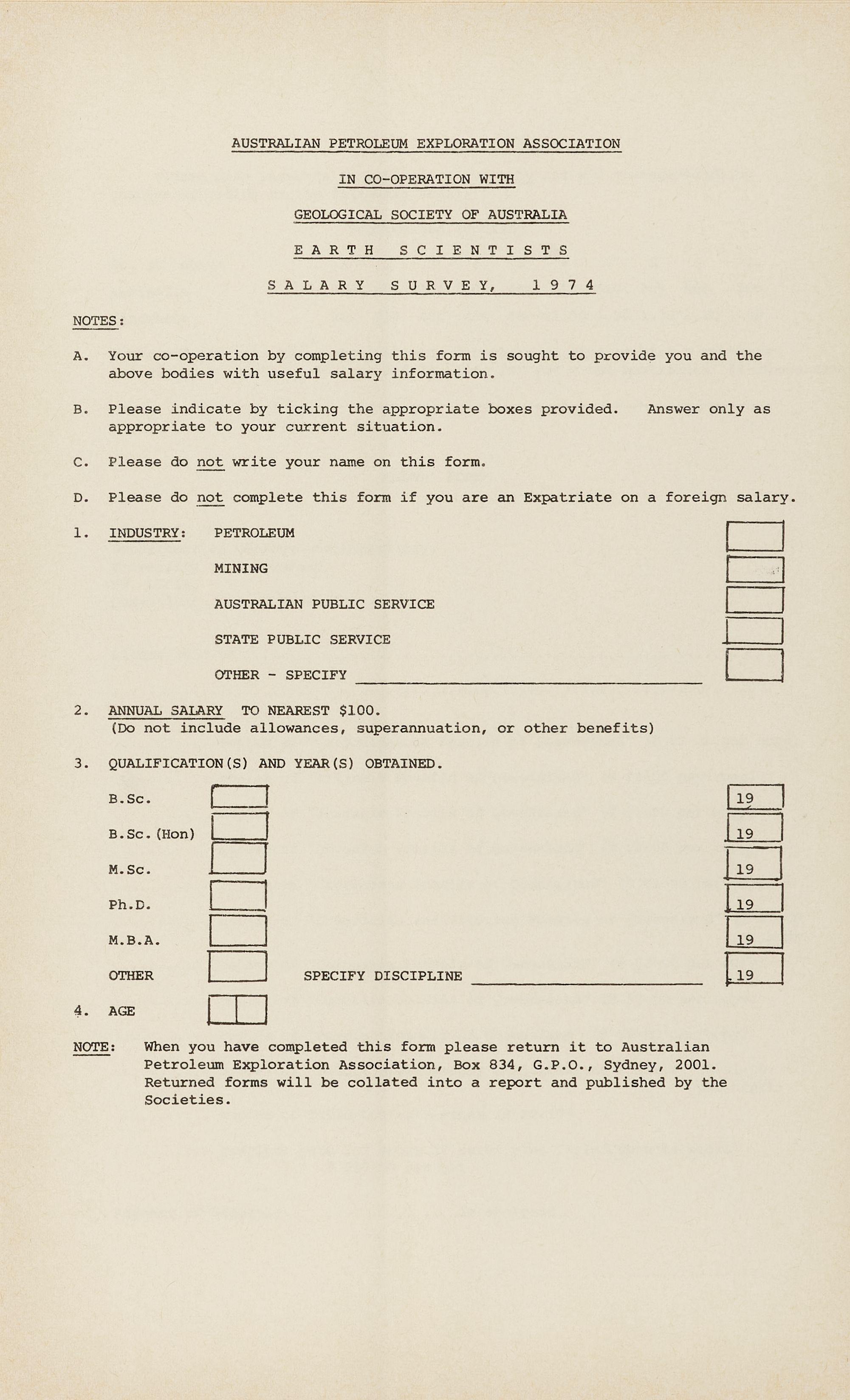
AUSTRALIAN PETROLEUM EXPLORATION ASSOCIATION IN CO-OPERATION WITH GEOLOGICAL SOCIETY OF AUSTRALIA
A Your co-operation by completing this form is sought to provide you and the above bodies with useful salary information.
B. Please i ndicate by ticking the appropriate boxes provided. appropriate to your current situation. Answer only as
c. Pl ease do not write your name on this form
D Please do ?Ot complete this form if you are an Expatriate on a foreign salary.
1. INDUSTRY: PETROLEUM
AUSTRALIAN PUBLIC SERVICE STATE PUBLIC SERVICE
OTHER - SPECIFY ___________________
2. ANNUAL SAIARY TO NEAREST $100 (Do not include allowances, superannuat ion, or other benefits)
3. QUALIFICATION(S) AND YEAR(S) OBTAINED.
B.Sc.
B.Sc. (Hon)
M.Sc.
Ph.D.
M.B.A.
OTHER
AGE
D D CJ CJ D
When you have completed this form please return it to Australian Petroleum Exploration Association, Box 834, G P.O., Sydney, 2001. Returned forms will be collated into a report and published by the Societies.
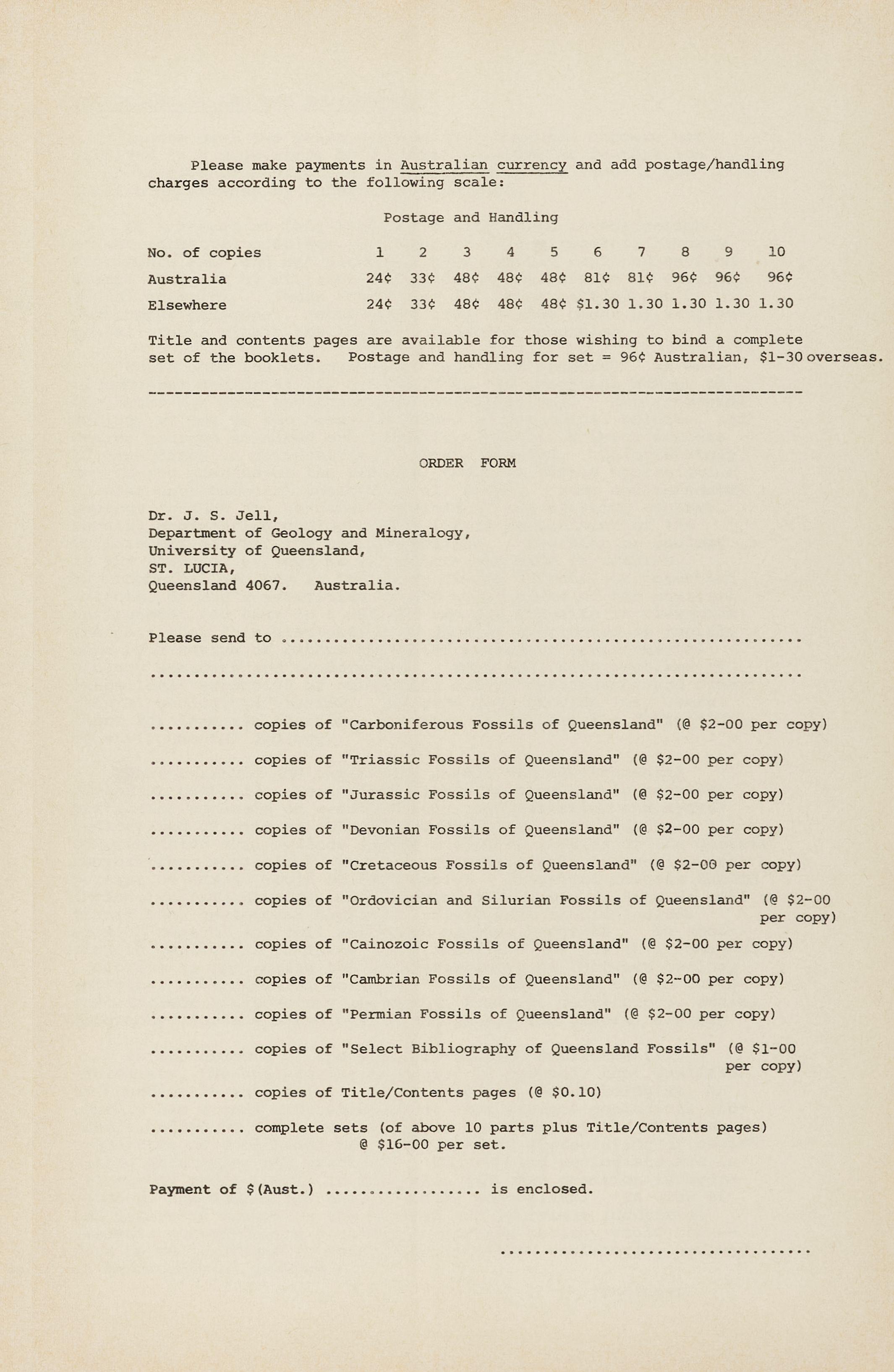
Please make payments in Australian currency and add postage/handling charges according to the following scale_:___
and Handling
Australia
Elsewhere
24<: 33<: 48<: 48<: 48<: 81(: 81<: 96<: 96<: 96<:
24<: 33<: 48<: 48<: 48<: $1.30 1.30 1.30 1.30 1.30
Title and contents pages are available for those wishing to bind a complete set of the booklets. Postage and handling for set= 96<: Australian, $1-30overseas.
ORDER FORM
Dr. J. S. Jell, Department of Geology and Mineralogy, University of Queensland, ST. LUCIA, Queensland 4067. Australia.
Please send to
copies of "Carboniferous Fossils of Queensland" (@ $2-00 per copy)
copies of "Triassic Fossils of Queensland" (@ $2-00 per copy)
copies of "Jurassic Fossils of Queensland" (@ $2-00 per copy)
copies of "Devonian Fossils of Queensland" (@ $2-00 per copy)
copies of "Cretaceous Fossils of Queensland" (@ $2-00 per copy)
copies of "Ordovician and Silurian Fossils of Queensland" (@ $2-00 per copy)
copies of "Cainozoic Fossils of Queensland" (@ $2-00 per copy)
copies of "Cambrian Fossils of Queensland" (@ $2-00 per copy)
copies of "Permian Fossils of Queensland" (@ $2-00 per copy)
copies of "Select Bibliography of Queensland Fossils" (@ $1-00 per copy)
copies of Title/Contents pages (@ $0.10)
complete sets (of above 10 parts plus Title/Contents pages) @ $16-00 per set.
Payment of $(Aust.) is enclosed.
THE GEOLOGIST AND THE ENVIRONMENT
In the past two years growing environmental concern has resulted in a wide array of legislation aimed at restoration or protection of environmental resources in the face of the continuing demands of industrial expansion.
As a result of this legislation, detailed investigation of environmental problems, preparation of Environmental Impact Statements and land use planning, have rapidly replaced environmental activism by citizens groups as the mainstream of environmental activity. These activities are being carried out by government personnel, consultants and, in some cases by environmental groups within the larger industrial companies.
Where does the geologist fit into this picture? An environmental geologist is, or should be, an important member of the teams for most environmental investigations. Environmental geology is one of the newest branches of geological science, and degree courses so-named are currently attracting large numbers of candidates to universities in North America. Unfortunately, due to the newness of the subject, there is little appreciation of what environmental geology is all about. Most environmental geology courses are re-named versions of pre-existing courses, usually engineering geology, with little recognition of the differences between the two disciplines. Engineering geology is the study of geology as it affects man made structures. Environmental geology is the study of the effects, or potential effects, of man's activities on the solid phase of the physical environment, so that in a way the two are opposite in viewpoint. The fact that this distinction is usually overlooked is rapidly seen by a review of papers presented at recent environmental geology seminars and conferences. Most deal with problems of landslides, expansive or collapsing soils, earthquakes and other natural geological hazards. As such they provide very useful input for land use planning, but they do not fit the definition of environmental geology.
What training and experience should the environmental geologist possess? Basic geological training should provide particular emphasis on geomorphology, sedimentation and hydrogeology and certain aspects of geochemistry. In addition, a comprehensive soil science course including studies of the genesis, composition, morphology, physics, chemistry and engineering properties of soils, would be invaluable. Practical courses should include terrain mapping, soil mapping and remote sensing as well as traditional geological mapping. Field work should include erosion control and soil and water mapping projects. In addition to geological training it is important for the environmental -ologist to appreciate the interrelationships between geology und other environmental sciences. The curriculum should therefore include introductory courses in biology, climatology, social geography, surface hydrology, oceanography and general ecology.
In the absence of specifically-trained environmental geologists, the engineering geologist is probably best qualified to function in this role. Along with the geomorphologist, he usually has a good understanding of near-surface geological processes, added to which he has a good knowledge of the physical properties of geological materials, and an appreciation of engineering principles and practice. Engineering geologists are in relatively short supply in Australia and this position is aggravated by the demand for environmental geologists. In view of the uncertain future in the mineral and petroleum industries, students contemplating a career in applied geology would therefore be well-advised to specialise in either engineering geology or environmental geology.
J. P. Trudinger.
The Tasman Geosyncline 1974, a volume containing papers read at a Symposium held in Brisbane to honour Professor Dorothy Hill, has been produced by the Queensland Division of the Geological Society of Australia and copies are available for sale to interested individuals or groups. The editors, A. K. Denmead, G. W. Tweedale and A. F. Wilson, did well in organising articles from younger as well as older workers at the same time ensuring that many aspects of the field were covered. This fitting tribute to such a versatile and enduring contributor to eastern Australian geology opens with a short history of the development of ideas on the Tasman Geosyncline by Dr. N. H. Fisher.
The structural setting is expressed in terms of the plate tectonic terminology in relation to the various regions from Tasmania to northern Queensland. These well prepared descriptions embody the views of the several authors in easily reconcilable discussions which give a coherent picture of the geology. In particular, Packham and Leitch have brought together the old and the new approaches to the interpretation of tectonic evolution of the Tasman Orogenic Zone. One might be excused for regretting that Professor S. W. Carey did not contribute here but no doubt we will get his views at a later date.
Ideas on the introduction of minerals into the belt are strongly expressed by experienced mining personalities, notably Professors R. L. Stanton and W. C. Lacy followed by that pioneer of ideas on the source bed concept, C. L. Knight.
The comprehensive coverage of the stratigraphy of the eastern states by earlier publications of the society, much of which formed the basic source material for this symposium, made it unnecessary to report such work. However, several papers relating to advances in palaeontology and geochronology are included together with a review of the coal geology of Queensland.
In his summation address Professor H. J. Harrington ably brought together the views of the various authors, related them to his own on the sub-divisions of the Australian continent and made reference to the adjacent - or previously adjacent - land masses and ocean floors.
This publication is a necessary addition to any library on Australian geology and is an easy modern up-to-date summary of the concept of the Tasman Geosyncline introduced by Charles Schuchert nearly 60 years ago.
A. H.
FOURTH B.M.R. SYMPOSIUM
Voisey.
The 4th B.M.R. Annual Symposium will be held at the Academy of Science, Canberra, on 22-23 April, 1975.
Addendum
The review of Geochemical Exploration 1972 which appeared in the last issue was by Dr. David Green of Brisbane.
The Fourth International Conference on Tektites, Meteorites and Lunar Studies is scheduled to be held at A.N.U. sometime in 1975 - does anyone have further details?
NEW GEOLOGICAL MAP OF WESTERN AUSTRALIA
The new Geological Map of Western Australia, produced by the Geological Survey of Western Australia was released in September, 1974. It is a thirteen-colour map, at a scale of 1:2½ million, this newest edition was to some extent a victim pf the recent boom, which resulted in staff shortages, rapid staff changes and delays in the appearance of the map. The compilation and editing was done by Dr. Rudi Horwitz and Dr. John Daniels, both formerly of the Geological Survey. It represents a considerable advance over the 1966 edition, and some of the more significant changes are as follows:
1. The former four-fold lithological division of the Yilgarn Block is superseded by a division into (a) basic volcanic rocks and undifferentiated non-granitic layered rocks, (b) granite, (cl migmatite, (d) ultramafic rocks, (e) basic intrusive rocks, (f) acid volcanic rocks, {g) sedimentary rocks, and (h) banded chert and iron formation. Also the slope of the greenstone belts within the granitic terrain is defined more accurately, mainly by virtue of aeromagnetic coverage.
2. Further detail and lithological subdivision in the Hamersley Basin, to include the substantial areas of banded iron formation, now beautifully portrays the structure at this scale. Also the regional disposition of the basic volcanic areas (Fortescue Group), the dominantly BIF areas (Hamersley Group) and the dominantly sedimentary areas (Wyloo Group) are immediately apparent.
3. In the Bangemall Basin, the Middle Proterozoic sedimentary rocks are continued much further to the northeast so as to include the cover rocks in the Paterson Range area. Also, large areas in the southeast part of the Bangemall Basin, formerly indicated as volcanic rocks are largely deleted in favour of sedimentary rocks. Volcanic rocks in this area are now shown as confined to two small areas.
4 Changes in the Gascoyne area now portray the appearance of metamorphic and granitic rocks in the southwestern part of the Hamersley Basin, and the southward change within the Gascoyne Block to predominantly granitic areas, then to migmatitic terrains. The boundary between the Gascoyne Block and the Yilgarn Block is moved 70km to the northwest.
5. Much of the Albany-Fraser Province was formerly represented by Archaean rocks, and undetermined Precambrian granite. This Proterozoic mobile belt is now represented by Proterozoic granite, migmatite-gneiss complexes, and high-grade metamorphic complexes that includes granulite. Many more structural trends are shown, but the Fraser Fault is deleted.
6. In the Warburton - Blackstone area of the Musgrave Block, there is a more precise representation of the acid volcanics, sediments and intrusive granites of Middle Proterozoic age, and the presumed older, high-grade metamorphic rocks that include granulite.
7. The representatipn of the major areas of Quaternary deposits on the Yilgarn Block and the Officer Basin, now marks, to a large extent, the major salt lake and calcrete areas, which together indicate the Cainozoic palaeodrainage patterns.
The first geological map of the State was published in 1894*, and successive editions appeared in 1919, 1933, 1950, 1957 and 1966.
* There are earlier incomplete maps by H. Y. L. Brown (1872) and C. Nicolay (1881).
This new state map, which is thus the seventh edition, incorporates new data up to 1970. As to be expected, the representation of some areas is already known to be dated. It is anticipated that future changes will occur in the area across the northern margin of the Yilgarn Block, where some major stratigraphical reappraisals could eventuate.
Other features of the map include the inclusion of an in set figure showing the main tectonic units, the presentation of bathymetric data, and the location of all the 1 :250,0 00 sheets in the State. The projection used is the Albers Equal Area. The map was produced by the Mapping Division of the West Australia Mine s Department, under the supervision of Mr. T. D Pearce, and printed by the Government Printer of Western Australia.
Copies can be obtained from the G.S.W.A. at 66 Adelaide Terrace, Perth, at a price of $2-00, plus postage.
GALILEE BASIN DRILLING
Results of the deep petroleum stratigraphic drilling in the northeastern Galilee Basin, funded by a special allocation by the Queensland Government and drilled under contract to the Queensland Department of Mines, are now being compiled. Well-completion reports will appear in the Geological Survey of Queensland Report Series.
The two wells (QDM Aramac No. 1, 1825 m and QDM Hexham No. 1, 1829 m) were drilled on anticlinal structures defined by seismic reflection from the top of the Upper Palaeozoic section. Mesozoic sediments were intersected from the surface to depths of 824 m and 607 m respectively, and Upper Palaeozoic sediments from these depths to total depth in each hole. Porous sandstones were evident in the wirelin e ' ~ •s of both holes, and two minor hydrocarbon shows (other than methan e a s so c a ted with coal seams) were recorded from QDM Hexham No. 1. Of particular s i gnif icance were the indications of excellent reservoir properties in the lower part of QDM Aramac No. 1, as this aquifer must pinch out updip we stwa~ ~ against rising basement, and there is considerable potential for strat ig r a trapping.
Substantial thicknesses of Permian coal, tho u , a t presently uneconomic depths were intersected, and a major aquifer which could prove to be valuable in the event of excessive drawdown of the shallower aquifers in the Aramac area was discovered.
QUEENSLAND DIVISION FIELD CONFERENCE - 1974.
The Queensland Division's annual field conference was held this year in the Armidale-Tamworth area on the Queen's Birthday long week-end, 15th17th June. The assistance of the Geology Department at the University of New England in providing Guides and carrying out most of the organisation is very gratefully acknowledged by the Division. The 28 participants, including four students subsidised by the Division, regarded the excursion as highly successful, but the organising committee was disappointed in the poor response of industry geologists.
OBITUARIES
JOE FRANKEL
Professor of Applied Geology, University of New South Wales, died suddenly on October 27th.
Joe Frankel graduated B.Sc. from Rhodes University, Grahamstown, in 1934, and later took his M.Sc. there. In the years before World War II he was a research scholar and lecturer at Witwatersrand University. During ~he war he was in the South African and Royal Air Forces. He gained a Doctor of science degree from the University of Cape Town in 1946 and from then until 1961 was on the staff of the University of Natal, Durban.
He came to Australia in 1962 and was Head of the School of Applied Geology at the University of New South Wales between 1962 and 1973. His main geological interests lay in petrology and ore deposits. As Chairman of the department for eleven years he had been inundated with a large amount of administration and his opportunities for research were few.
In 1973 he relinquished his position as Chairman and set out to enjoy his geology once more. He was particularly interested in the lateriteb and just prior to his death had been grappling enthusiastically with the origin and age of these deposits in the region south of Sydney. He was an accomplished musician, and his sensitivity in this field was an echo of his truly gentle nature. He will be remembered by his many friends in the geological world.
PETER TETLEY
Peter Tetley was born in Sutton, Surrey, England in April 1937. He studied at Durban University where he obtained his degree in geology with honours. In 1959 he joined Ashanti Goldfields Corporation in Ghana as a mining geologist. In 1961 he moved to Tasmania and joined Electrolytic Zinc as a mine geologist on the Rosebery Mine.
In March 1964, Peter joined Amax Exploration (Australia) Inc. and became involved in the early exploration of Mt. Whaleback in the Mt. Newman area. He helped carry out the first detailed mapping of Mt. Whaleback, and was involved in the surveying of Port Hedland harbour.
Peter returned to general exploration in 1966 and was based in Perth for Amax. During 1968 he became district geologist for Amax in Kalgoorlie. Peter ran Amax's very active exploration programmes during the nickel boom days. He pegged the first claims in the Forrestania area. His knowledge 0f the Goldfields geology was remarkable and he knew practically every prospect and mineral showing in the Yilgarn Shield. In Kalgoorlie, he was known by nearly every geologist or prospector. He became part of Kalgoorlie.
When the nickel boom dwindled he became involved in the search for copper-zinc deposits in volcanogenic environment. He supervised the early exploration of the Golden Grove prospect near Yalgoo. During a reconnaissance exploration programme in the Egerton-Ashburton area, Peter rolled his vehicle and suffered a fatal accident on June 22nd this year.
Peter Tetley was highly regarded by all who worked with him. His dedication and love of geology was unsurpassable,
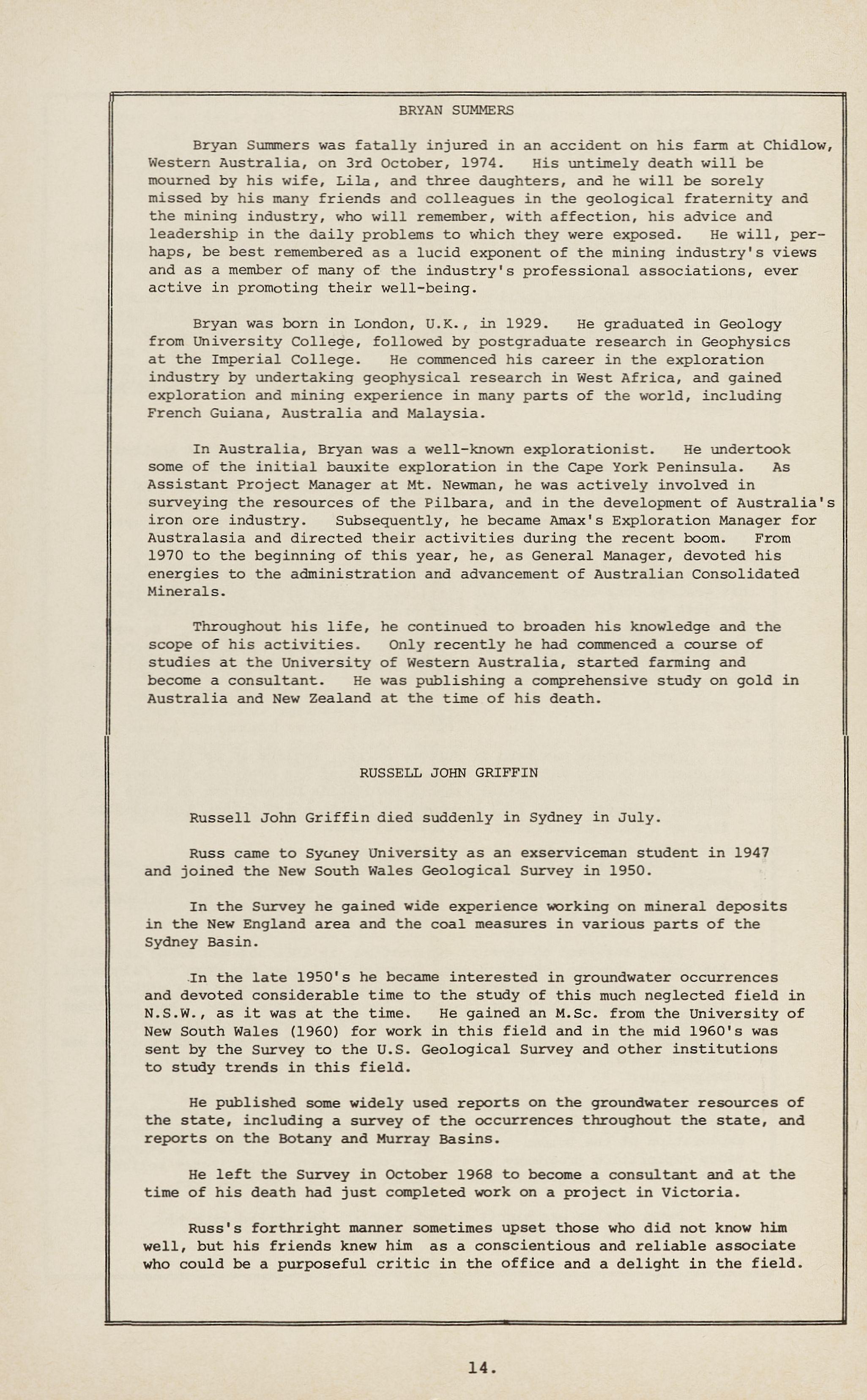
BRYAN SUMMERS
Bryan Summers wa s fatally injured in an accident on his farm at Chidlow, Western Australia, on 3rd October, 1974. His untimely death will be mourned by his wife, Lila, and three daughters, and he will be sorely missed by his many friends and colleagues in the geological fraternity and the mining industry, who will remember, with affection, his advice and leadership in the daily problems to which they were exposed. He will, perhaps, be best remembered as a lucid exponent of the mining industry's views and as a member of many of the industry's profes siona l associations, ever active in promoting their well-being.
Bryan was born in London, U.K., in 1929. He graduated in Geology from University College, followed by postgraduate research in Geophysics at the Imperial College. He commenced his career in the exploration industry by undertaking geophysical research in West Africa, and gained exploration and mining experience in many parts of the world, including French Guiana, Australia and Malay sia
In Australia, Bryan was a well-known explorationist. He undertook some of the initial bauxite exploration in the Cape York Penin sula. As Assistant Project Manager at Mt. Newman, he was actively involved in surveying the resources of the Pilbara, and in the development of Australia's iron ore industry. Subsequently, he became Amax's Exploration Manager for Australasia and directed their activities during the recent boom. From 1970 to the beginning of this year, he, as General Manager, devoted his energies to the administration and advancement of Australian Consolidated Mineral s.
Throughout his life, he continued to broaden his knowledge and the scope of his activities . Only recently he had commenced a course of studies at the Univer s ity of Western Australia, star ted farming and become a consultant. He was publi s hing a comprehensive study on gold in Australia and New Zealand at the time of his death.
RUSSELL JOHN GRIFF IN
Russell John Griffin died suddenly in Sydney in July.
Russ came to Sywiey University as an exserviceman student in 1947 and joined the New South Wales Geological Survey in 1950.
In the Survey h e gained wide exper ience working on mineral deposits in the New England area and the coal measures in various parts of the Sydney Basin
In the late 1950's he became interested in groundwater occurrences and devoted considerable time to the study of this much neglected field in N.S.W., as it was at the time. He gained an M.Sc. from the University of New South Wales (1960) for work in this field and in the mid 1960's was sent by the Survey to the U.S. Geological Survey and other institutions to study trends in this field.
He published some widely used reports on the groundwater resources of the state, including a survey of the occurrences throughout the state, and reports on the Botany and Murray Basins.
He left the Survey in October 1968 to become a consultant and at the time of his death had just completed work on a project in Victoria.
Russ's forthright manner sometimes upset those who did not know him well, but his friends knew him as a conscientious and reliable associate who could be a purposeful critic in the office and a delight in the field.
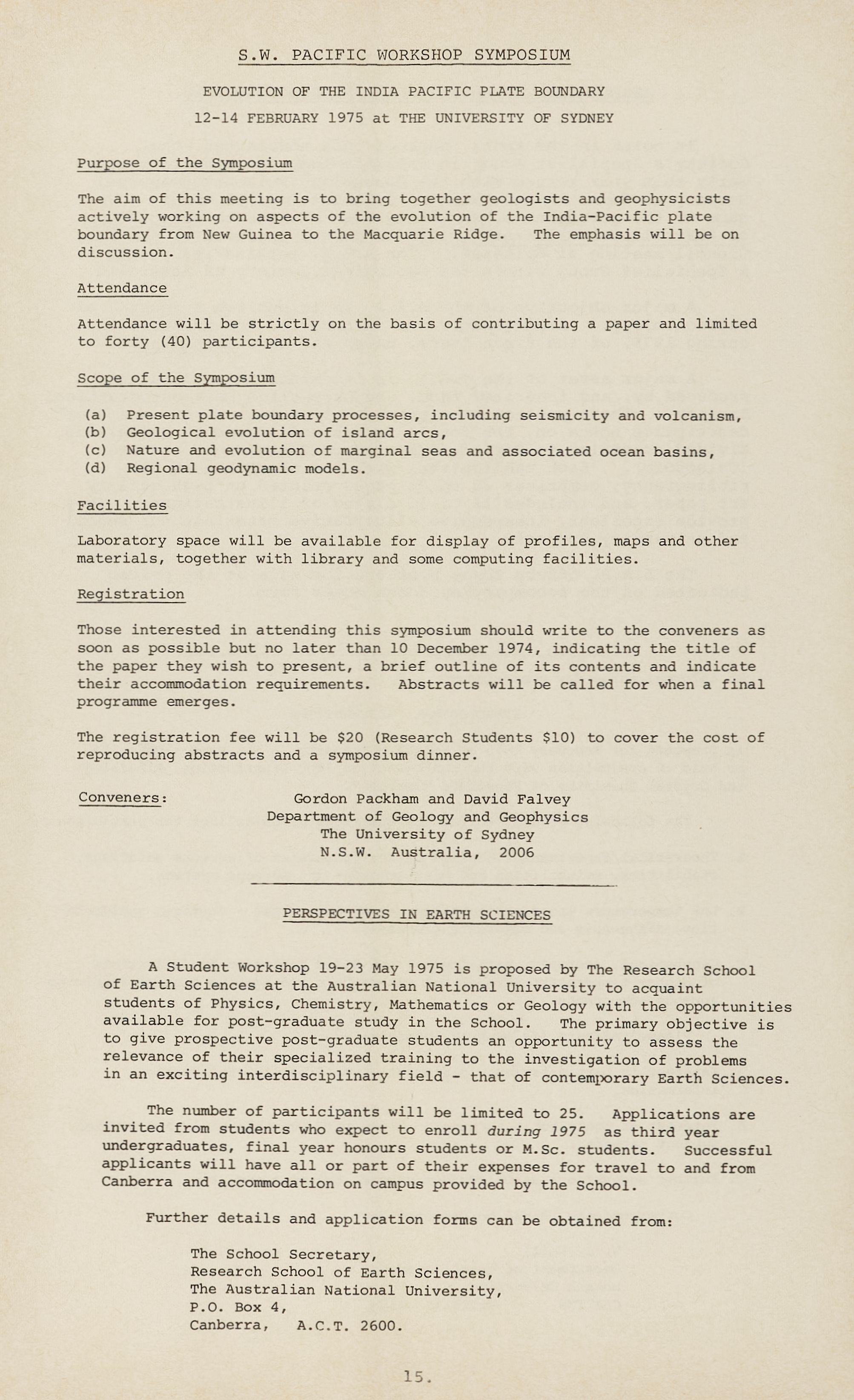
EVOLUTION OF THE INDIA PACIFIC PLATE BOUNDARY
12-14 FEBRUARY 1975 at THE UNIVERSITY OF SYDNEY
Purpose of the Symposium
The aim of this meeting is to bring together geologists and geophysicists actively working on aspects of the evolution of the India-Pacific plate boundary from New Guinea to the Macquarie Ridge. The emphasis will be on discussion.
Attendance
Attendance will be strictly on the basis of contributing a paper and limited to forty (40) participants.
Scope of the Symposium
(a) Present plate boundary processes, including seismicity and volcanism, (b) Geological evolution of island arcs, (c) Nature and evolution of marginal seas and associated ocean basins, (d) Regional geodynamic models.
Facilities
Laboratory space will be available for display of profiles, maps and other materials, together with library and some computing facilities.
Registration
Those interested in attending this symposium should write to the conveners as soon as possible but no later than 10 December 1974, indicating the title of the paper they wish to present, a brief outline of its contents and indicate their accommodation requirements. Abstracts will be called for when a final programme emerges.
The registration fee will be $20 (Research Students $10) to cover the cost of reproducing abstracts and a symposium dinner.
Conveners: Gordon Packham and David Falvey Department of Geology and Geophysics The University of Sydney N.S.W. Australia, 2006
PERSPECTIVES IN EARTH SCIENCES
A Student Workshop 19-23 May 1975 is proposed by The Research School of Earth Sciences at the Australian National University to acquaint students of Physics, Chemistry, Mathematics or Geology with the opportunities available for post-graduate study in the School. The primary objective is to give prospective post-graduate students an opportunity to assess the relevance of their specialized training to the investigation of problems in an exciting interdisciplinary field - that of contemporary Earth Sciences.
The number of participants will be limited to 25. Applications are invited from students who expect to enroll during 1975 as third year undergraduates, final year honours students or M.Sc. students. Successful applicants will have all or part of their expenses for travel to and from Canberra and accommodation on campus provided by the School.
Further details and application forms can be obtained from:
The School Secretary, Research School of Earth Sciences, The Australian National University, P.O. Box 4, Canberra, A.C T. 2600.