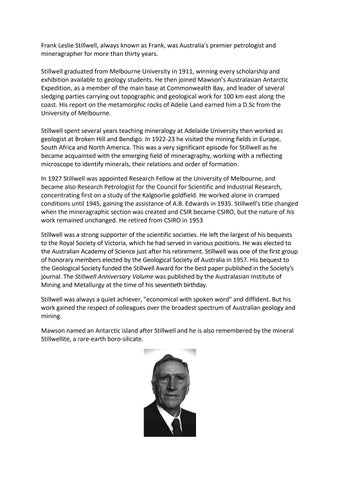
Frank Leslie Stillwell, always known as Frank, was Australia's premier petrologist and mineragrapher for more than thirty years. Stillwell graduated from Melbourne University in 1911, winning every scholarship and exhibition available to geology students. He then joined Mawson's Australasian Antarctic Expedition, as a member of the main base at Commonwealth Bay, and leader of several sledging parties carrying out topographic and geological work for 100 km east along the coast. His report on the metamorphic rocks of Adelie Land earned him a D.Sc from the University of Melbourne. Stillwell spent several years teaching mineralogy at Adelaide University then worked as geologist at Broken Hill and Bendigo. In 1922-23 he visited the mining fields in Europe, South Africa and North America. This was a very significant episode for Stillwell as he became acquainted with the emerging field of mineragraphy, working with a reflecting microscope to identify minerals, their relations and order of formation. In 1927 Stillwell was appointed Research Fellow at the University of Melbourne, and became also Research Petrologist for the Council for Scientific and Industrial Research, concentrating first on a study of the Kalgoorlie goldfield. He worked alone in cramped conditions until 1945, gaining the assistance of A.B. Edwards in 1935. Stillwell's title changed when the mineragraphic section was created and CSIR became CSIRO, but the nature of his work remained unchanged. He retired from CSIRO in 1953 Stillwell was a strong supporter of the scientific societies. He left the largest of his bequests to the Royal Society of Victoria, which he had served in various positions. He was elected to the Australian Academy of Science just after his retirement. Stillwell was one of the first group of honorary members elected by the Geological Society of Australia in 1957. His bequest to the Geological Society funded the Stillwell Award for the best paper published in the Society's journal. The Stillwell Anniversary Volume was published by the Australasian Institute of Mining and Metallurgy at the time of his seventieth birthday. Stillwell was always a quiet achiever, "economical with spoken word" and diffident. But his work gained the respect of colleagues over the broadest spectrum of Australian geology and mining. Mawson named an Antarctic island after Stillwell and he is also remembered by the mineral Stillwellite, a rare-earth boro-silicate.
Issuu converts static files into: and more. Sign up and create your flipbook.