Neville Stevens (1925–2011) Neville Stevens was born in Sydney in 1925. He attended Canterbury High School, and upon graduation he enrolled in the University of Sydney where he majored in Geology and Chemistry, winning the Deas-Thomson Scholarship and attaining a First-Class Honours in Geology. He then held teaching and research positions as a Teaching Fellow and a Linnean Macleay Fellow at the University of Sydney. He later joined the Geological Survey of New South Wales but only for a short time, as he was attracted back to teaching by an invitation to become a temporary lecture in geology at the University of Western Australia. He obtained his PhD from the University of Sydney in 1955 for studies on the Palaeozoic rocks of Central Western New South Wales, and the following year took the position of Lecturer in Geology at the University of Queensland, where he remained until his retirement in 1988. For a period, he was also Sub-Dean of the Science Faculty.
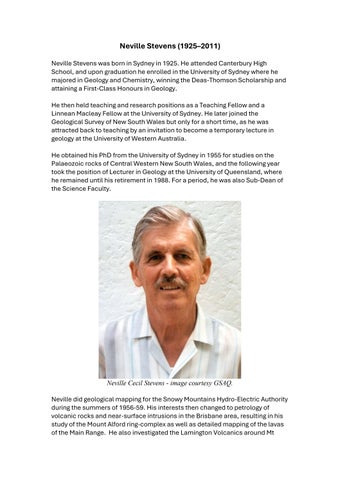
Neville Cecil Stevens - image courtesy GSAQ. Neville did geological mapping for the Snowy Mountains Hydro-Electric Authority during the summers of 1956-59. His interests then changed to petrology of volcanic rocks and near-surface intrusions in the Brisbane area, resulting in his study of the Mount Alford ring-complex as well as detailed mapping of the lavas of the Main Range. He also investigated the Lamington Volcanics around Mt
Warning, the Glass House Mountains, the craters and lavas at Coalstoun Lakes (near Gayndah), and the Brisbane Tuff. During the 1960s and 1970s when the focus of the geological profession was on the rapidly expanding minerals and petroleum industry, Neville was among the first to recognise that geological knowledge also needed to be communicated to students and the general public at an appropriate level. His book “Geological Excursions in South-east Queensland” became a well-known classic for students and many others in this region. It was revised as “A Guide Book to Field Geology in Southeast Queensland” in 1973, and as the “Queensland Field Geology Guide” in 1984, which is still being used. Neville also recognised the need to protect important geological sites from obliteration so that students and the public would have examples of geological processes to draw on in the future. He became foundation convenor of the Geological Monuments Subcommittee of the Queensland Division of the Geological Society of Australia in 1974 and held that position for several years. He also was the federal convenor for a period. During this time, he campaigned with various government agencies for recognition and protection of sites in and around Brisbane in particular. Neville was president of the Royal Society of Queensland in 1983 and Editor of their publication for eleven years. Sabbaticals and periods of study leave enabled him to spend time at universities in UK, Europe, New Zealand and Japan. Highlights of the work overseas included observations of active volcanos in Hawaii, and a flight around the active dome of Mount Saint Helens Photography was a keen hobby of Neville’s and his skill in this art enabled him to illustrate his lectures on first year physical geology with appropriate examples in slides taken by him on his trips throughout Australia and overseas. This aspect of his teaching is well remembered by many of his students and helped develop their own eyes for landscapes and the influence of geology on their creation. In some cases, it probably influenced them to convert a first-year fill-in subject to a major and a career. In 1976, 1981 and 1984 he participated in compiling three books on the Geological Elements of the National Estate in Queensland which were made possible by National Estate grants. The first of these, dealing with the larger interesting landscape features, was influential in establishing several new National Parks over geologically interesting areas, such as Lawn Hill Gorge, the Undarra lava tubes and the White Mountains. Over the years Neville gave much of his time in assisting various National Park agencies in compiling the geological sections for pamphlets or to be used on educational signs. In more recent years Neville co-authored with Warwick Willmott, the Society's popular booklets on Rocks and Landscapes of Brisbane and Ipswich and Rocks and Landscapes of the Sunshine Coast as well as several of the Rocks and
Landscape Notes leaflets. He recently helped to re-publish the Rocks and Landscapes of Brisbane and Ipswich, and the Sunshine Coast. In 2002 Neville was honoured by the Queensland Division of the Geological Society of Australia, by creating a medal in his name. The Neville Stevens Medal is awarded annually to a person for their contribution to the geological community and promotion of education and public awareness of Earth Sciences in Queensland. Over the years Neville Stevens laid the foundations for communication between the profession and the public, which we need to continue to build on to demonstrate the continuing relevance of Earth sciences to modern society. Written by Warwick Willmott and Ian Withnall