THEIR MA! DIAMONDIKN;
W CRUST SETTING AMOND&XPLORATION
PUBLISHED FOR THE GEOLOGICAL SOCIETY OF AUST BY BLACKWELL SCIENTIFIC PUBLICATION!
G S A SPECIAL PUBLICATION IS
>
/ (J £f a*
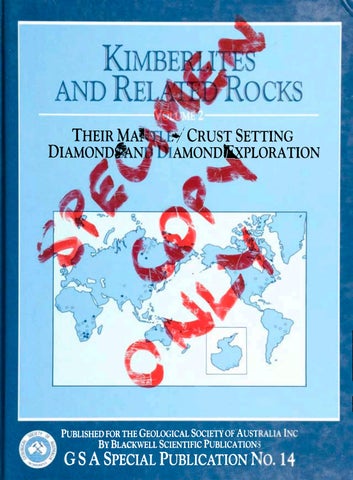
Kimberlites and Related Rocks Volume 2 Their Mantle/Crust Setting, Diamonds and Diamond Exploration
Cover T h e world map (Mercator projection) shows locations of kimberlites (circles) and lamproites (triangles). Most symbols represent a number of bodies in close proximity. Locations are based on Janse (1985) for kimberlites, and Bergmann (1987) for lamproites, with additions. 'Solid' symbols indicate bodies mined for diamonds.
Proceedings of the FOURTH INTERNATIONAL KIMBERLITE CONFERENCE Perth 1986
Kimberlites And Related Rocks Volume 2 THEIR MANTLE/CRUST SETTING, DIAMONDS AND DIAMOND EXPLORATION EDITORIAL PANEL J Ross Managing editor A L Jaques Section I J Ferguson Section II D H Green Section III S Y O'Reilly Section IV R V Danchin Section V A J A Janse Section VI
PUBLISHED FOR THE GEOLOGICAL SOCIETY OF AUSTRALIA INC MR^^K
B Y
B L A C K W E L L
SCIENTIFIC PUBLICATIONS
^ S i T G S A SPECIAL PUBLICATION NO. 14
© 1989 by Geological Society of Australia Inc Published by Blackwell Scientific Publications Editorial offices: 107 Barry Street, Carlton Victoria 3053, Australia Osney Mead, Oxford OX2 OEL (Orders: Tel: 0865 240201) 8 John Street, London WC1N 2ES 23 Ainslie Place. Edinburgh EH3 6AJ 3 Cambridge Center, Suite 208 Cambridge, Massachusetts 02142, USA
DISTRIBUTORS
USA Blackwell Scientific Publications Inc 3 Cambridge Center, Suite 208 Cambridge Massachusetts 02142 Canada Oxford University Press 70 Wynford Drive Don Mills Ontario M3C 1J9 (Orders: Tel: (416) 441-2941)
All rights reserved. No part of this publication may be reproduced, stored in a retrieval system, or transmitted, in any form or by any means, electronic, mechanical, photocopying, recording or otherwise without the prior permission of the copyright owner.
Australia Blackwell Scientific Publications (Australia) Pty Ltd 107 Barry Street Carlton, Victoria 3053 (iOrders: Tel: (03) 347-0300)
First published 1989
Cataloguing in Publication Data
Set by Times Graphics, Singapore Printed in Singapore
International Kimberlite Conference, (4th: 1986: Perth W.A.): Kimberlites and related rocks. Includes bibliographies and index. ISBN 0 86793 384 4. ISBN 0 86793 033 0 (v. 1). ISBN 0 86793 041 1 (v. 2). 1. Kimberlite - Congresses. 2. Diamonds Congresses. I. Ross. J. (Jim). II. Geological Society of Australia III. Title. (Series: Special publication (Geological Society of Australia); no. 14). 552'.3
Frontispiece
Argyle Mine, 1986, Looking North.
The open pit developed on the Argyle lamproite pipe is at centre left. Slightly right of centre, on lower ground, are the now mined out Limestone Creek alluvials, to the north of which is the modern treatment plant for ore from the pipe, together with the Mine offices. To the north of the pipe can be seen the mined out area of Upper Smoke Creek alluvials. The frontispiece to Volume 1 shows a similar view in 1980, prior to mine development. Photography: Brian Stevenson and Co.
Contents Organization of the Conference and Associated Publications
ix
Acknowledgements
x
Preface
xii
SECTION IV
The Upper Mantle and Lower Crust in Continental Regions
1
REVIEW PAPER: Mantle domains and mantle xenoliths B HARTE and C J HAWKESWORTH
2
Upper mantle opaque mineral stratigraphy and the genesis of metasomites and alkali-rich melts S E HAGGERTY
687
Nature and sequence of mantle magmatic events indicated by compositional variations in a composite xenolith from Lashaine Volcano, Tanzania J E NIELSON
700
Compositional heterogeneities in minerals of sheared lherzolite inclusions from African kimberlites D SMITH and F R BOYD
709
Primary and secondary mineralogy of carbonated peridotites from the Macdougal Springs diatreme E S McGEE and B C HEARN Jr
725
Garnet peridotite xenoliths from the Pali-Aike alkali basalts of southernmost South America C R STERN, S SAUL, M A SKEWES and K FUTA
735
3
4
5
6
649
7
Ultramafic xenoliths from Vajrakarur kimberlites, India C E NEHRU and A K REDDY
745
8
Megacrysts and high temperature nodules from the Jagersfontein kimberlite pipe J J HOPS, J J GURNEY, B HARTE and P WINTERBURN
759
9
Subcontinental metasomatism in the region of Jagersfontein, South Africa S W FIELD, S E HAGGERTY and A J ERLANK
771
10
Pb-Sr-Nd isotope and trace element data bearing on the origin of the potassic subcontinental lithosphere beneath south-west Uganda G R DA VIES and F E LLOYD
784
Corganites and corgaspinites: two new types of aluminous assemblages from the Jagersfontein kimberlite pipe P MAZZONE and S E HAGGERTY
795
11
12
Garnets from Western Australian kimberlites and related rocks H LUCAS, R R RAMSAY, A E HALL, C B SMITH and N V SOBOLEV
13
Green garnets from South African kimberlites and their relationship to wehrlites and crustal uvarovites D J SCHULZE
809
820
vi
Contents
14
Sodium in garnet and potassium in clinopyroxene: criteria for classifying mantle eclogites T E McCANDLESS and J J GURNEY
15
Archaean mantle xenocrysts in a Permian kimberlite: two generations of kimberlitic zircon in Jwaneng DK2, southern Botswana P D KINNY, W COMPSTON, J W BRISTOW and I S WILLIAMS
833
The age, composition and significance of a xenolith-bearing monchiquite dike, Lewis, Scotland
843
16
827
M A M E N Z I E S , A N H A L L I D A Y , R H H U N T E R , R M MACINTYRE and
B J G UPTON 17
18
19
Sr and Nd isotopic systematics of diamond-bearing eclogite xenoliths and eclogitic inclusions in diamond from southern Africa C B SMITH, J J GURNEY, J W HARRIS, D N ROBINSON, S R SHEE and E JAGOUTZ
853
Sm-Nd systematics in eclogite and garnet peridotite nodules from kimberlites: implications for the early differentiation of the earth M T McCULLOCH
864
Eclogite-garnetite transformation at high pressure and its bearing on the occurrence of garnet inclusions in diamond T IRIFUNE, W O HIBBERSON and A E RINGWOOD
877
20
Inflected mantle geotherms from xenoliths are real: evidence from olivine barometry A A FINNERTY
21
Garnet-pyroxene equilibria in the system SMACCR ( S ^ - M g O - A ^ O s - C a O - C ^ O s ) : the Cr-geobarometer K G NICKEL
883
901
22
Relationships between C, He, Sr and Nd isotopes in mantle diopsides D P MATTEY, R A EXLEY, C T PILLINGER, M A MENZIES, D R PORCELLI, S GALER and R K O'NIONS
913
23
Experiments and observations bearing on the solubility and diffusivity of carbon in olivine T N TINGLE, H W GREEN and A A FINNERTY
922
SECTION V
Diamonds and Their Inclusions
1
REVIEW PAPER: Diamonds J J GURNEY
2
Composition of crystalline inclusions and C-isotopic composition of Argyle and Ellendale diamonds A L JAQUES, A E HALL, J W SHERATON, C B SMITH, S-S SUN, R M DREW, C FOUDOULIS and K ELLINGSEN
935
966
3
The sequence of events reflected in the diamonds of some southern African kimberlites D N ROBINSON, J A SCOTT, A VAN NIEKERK and V G ANDERSON
990
4
Nitrogen aggregation, inclusion equilibration temperatures and the age of diamonds T EVANS and J W HARRIS
991
5
Archaean diamond xenocrysts in kimberlites — how definitive is the evidence? R T PIDGEON
997
6
The chemistry of the garnets, chromites and diamond inclusions of the Dokolwayo kimberlite, Kingdom of Swaziland L R M DANIELS and J J GURNEY
1012
Contents
vii
7
Diamondiferous minerals from the Star Mine, South Africa J J GURNEY and C J HATTON
1022
8
Mineral inclusions in diamond from the Monastry kimberlite, South Africa R O MOORE and J J GURNEY
1029
9
Mineral inclusions in diamonds from the Sloan diatremes, Colorado-Wyoming State Line kimberlite district, North America M L OTTER and J J GURNEY
1042
10 Mineral inclusions in diamonds from the Koffiefontein mine R S RICKARD, J W HARRIS, J J GURNEY and P CARDOSO
1054
11 A diamond-graphite eclogite from the Sloan 2 kimberlite, Colorado, U.S.A. T E McCANDLESS and D S COLLINS
1063
12 As definitive as ever: a reply to 'Archaean diamond xenocrysts in kimberlites — how definitive is the evidence? by R T Pidgeon' S H RICHARDSON
1070
SECTION VI Diamond Exploration 1
REVIEW PAPER: Diamond exploration philosophy, practice, and promises: a review W J ATKINSON
1075
2
Geology of the Argyle alluvial diamond deposits A S DEAKIN, G L BOXER, A E MEAKINS, A E HAEBIG and J H LEW
1108
3
Argyle AK1 diamond size distribution: the use of fine diamonds to predict the occurrence of commercial size diamonds A S DEAKIN and G L BOXER
1117
4
Collection and treatment of diamond exploration samples G P GREGORY and D R WHITE
5
Spectral reflectance features of kimberlites and carbonatites: implications for remote sensing for exploration M J KINGSTON
1135
Trace elements in mineral grains from kimberlitic and non-kimberlitic sources using X-ray excited XRF in a scanning electron microscope D C LEE, A VAN RIESSEN and K W TERRY
1146
The efficiency of fluvial trap sites to concentrate kimberlitic indicator minerals: an experimental sampling survey M T MUGGERIDGE
1154
6
7
1123
8
Discovery of the George Creek, Colorado kimberlite dikes J A CARLSON and S W MARSH
1169
9
Geology and exploration of the Rose lamproite, south-east Kansas, U.S.A. H G COOPERSMITH and R H MITCHELL
1179
10 Alkaline intrusions in the Hudson Bay Lowlands, Canada: exploration methods, petrology and geochemistry A J A JANSE, I F DOWNIE, L E REED and I G L SINCLAIR
\\92
11 The alluvial diamond fields of the western Transvaal, South Africa: Origin of diamonds and gravels T R MARSHALL
1204
viii 12
Contents Geology and economic evaluation of the Mt Weld carbonatite, Laverton, Western Australia G C WILLETT, R K DUNCAN and R A RANKIN
1215
Where Do We Go from Here? F R BOYD
1239
Index for Volumes 1 and 2
1252
Fourth International Kimberlite Conference, Perth, Australia 11-15 August 1986 Organization of the Conference and Associated Publications CONVENORS Dr A F Trendall and Professor P G Harris INTERNATIONAL ADVISORY COMMITTEE Dr F R Boyd (USA) Prof J B Dawson (UK) Dr J Ferguson (Australia) Dr J J Gurney (South Africa) Mr J B Hawthorne (South Africa) Dr J Kornprobst (France) Prof H O A Meyer (USA) Dr R H Mitchell (Canada) Dr P H Nixon (UK) Prof N V Sobolev (USSR)
Dr G P Gregory(Treasurer) Mr J D Lewis(Secretary) Dr W J Atkinson(alternate Mr CB Smith) Dr R V Danchin(alternate Mr J Stracke) Dr L R Davidson Dr J Ferguson Mr M Gunn Dr A J A Janse Mr W D Jones Dr R T Pidgeon Dr J R Ross EDITORIAL PANEL
PROGRAMME AND PUBLICATIONS SUB-COMMITEE Dr J R Ross (Chairman) Dr L R Davidson Prof P G Harris Mr C B Smith CONFERENCE ORGANISING COMMITTEE
Dr J R Ross(Managing Editor) Dr A L Jaques(Section I) Dr J Ferguson(Section II) Prof D H Green(Section III) Dr S Y 0'Reilly(Section IV) Dr R V Danchin(Section V) Dr A J A Janse(Section VI)
Dr A F Trendall(Chairman) Prof P G Harris(Vice Chairman) Abstract volume* Fourth International Kimberlite Conference, Perth 1986, Extented Abstracts, Geological Society of Australia Abstracts, No. 16 (511 pages). Compiled by C B Smith. Conference proceedings Kimberlites and Related Rocks, Volume 1, Their Composition, Occurrence, Origin and Emplacement (664 pages). This volume. Kimberlites and Related Rocks, Volume 2, Their Mantle/Crust Setting, Diamonds and Diamond Exploration (640 pages). Excursion guides* Fourth International Kimberlite Conference Pre-Conference Excursion Guide to Southeastern Australia (109 pages) Compiled by J Ferguson Fourth International Kimberlite Post-Conference Excursion Guide to the lamproites of the Kimberley Region, Western Australia (65 pages). Compiled by M Gunn * These publications can be obtained from the Geological Society of Australia, 10 Martin Place, Sydney, NSW 2000, Australia
Acknowledgements This publication is the enduring record of the Fourth International Kimberlite Conference and it is appropriate to first acknowledge those organizations that helped make the Conference possible. Principal Sponsor
Geological Society of Australia Incorporated
Co-Sponsors
*Bureau of Mineral Resources, Geology and Geophysics Commission of Experimental Petrology Geological Society of Australia (WA Division) International Association of Geochemistry and Cosmochemistry International Association of Volcanology and Chemistry of the Earth's Interior University of Western Australia ^Western Australian Department of Mines
Supporting Organizations
ANZ Bank Argyle Diamond Mines Pty Ltd Ashton Exploration Joint Venture Australian Airlines BP Minerals Australia BP Minerals International The Broken Hill Proprietary Company Ltd *CRA Exploration Pty Ltd ^Greater Pacific Investments Ltd *Macquarie University ^Murdoch University *QANTAS Airways Ltd *Stockdale Prospecting Ltd UNESCO ^University of Tasmania Curtin University of Technology ^Western Mining Corporation Ltd
Those identified by an asterisk (*) supported much of the voluntary work associated with the preparation of this publication. Their help over periods that range from two to almost five years has been invaluable. Numerous individuals have contributed to the organisation of these volumes and to the preparation of ancillary material. First mention is due to Sheila Mead for her helpful, effective and good humoured support throughout, whilst the contributions of Maureen Muggeridge, the Drafting Section of CRA Exploration (especially Jenny Beake and Jenny Hall), Julia Thom, Don Smart, and Suzzane O'Reilly are gratefully acknowledged. The co-operation and goodwill of these people, and others, has added to the final product and to the experience of working towards it. The commitment of Mark Robertson (Blackwell) and George Fleming (Editor, Special Publications, GSA) has been appreciated and special mention is due to the six section editors: Bobby Danchin, John Ferguson, David Green, Lynton Jaques, Bram Janse and Suzanne O'Reilly. Their enthusiasm, commitment, skill and fairness have exerted a very positive influence on the contents of these volumes.
xi
Acknowledgements
Finally, the quality of this publication has been improved by the work of the 127 referees listed below; their contribution is gladly acknowledged. JAkella K Aoki M Arima T J Armbrustmacher R Baxter-Brown W Berg S Bergman N Z Boctor F R Boyd G Brey T W Bristow J A Carlson D A Carswell C R Clement E A Colgan W Compston A F Cooper L R Cullers R V Danchin L R Davidson J B Dawson A Day P Deines A D Edgar D H Eggler D J Ellis A F Erlank J Ferguson C Fieremans A A Finnerty I Fletcher S F Foley
B J Franklin F A Frey F Friedmann M Garcia D C Gellatly D H Green T H Green G P Gregory W L Griffin J J Gurney S E Haggerty S Harley J W Harris P G Harris W D Hausel C J Hawkesworth B C Hearn, Jr H Helmstaedt A J Irving A J A Janse A L Jaques W D Jones G Kurat S Kay M B Kirkley J Knutson J Kornprobst P Kresten L G Krol A W Laughlin J D Lewis W G Libby
Program and Publication Sub-Committee 1988
F Lloyd V Lorenz M E McCallum M T McCulloch H W McDonough E McGee N McNaughton M R Marx E A Mathez D Mattey K Mengel M Menzies H 0 A Meyer E Middlemost R H Mitchell A C Moore S A Morse M T Muggeridge D R Nelson I A Nicholls J Nielson P H Nixon H St C O'Neill S Y O'Reilly N Pearson M Perfet E Podovani R Powell R Ramsay J M Rhodes S H Richardson J V A Robey
B Robinson D N Robinson N M S Rock M Roden J R Ross D J Schulze B H Scott-Smith S R Shee J W Sheraton J W Shervais E M W Skinner Chris B Smith Craig B Smith D Smith N V Sobolev K J Stracke H B Stosch S S Sun E Takahashi L A Taylor W R Taylor E W J Tyler R Varne D Velde G Venturelli K H Wedepohl H G Wilshire K H Wohletz B A Wyatt P J Wyllie H E Zeissink
Preface This Special Publication records the proceedings of the Fourth International Kimberlite Conference held in Perth from 11-15 August 1986. Its two volumes contain 89 papers. Extended abstracts for another 68 papers presented at the Conference, but not included in this publication, can be found in the Extended Abstract Volume published by the Geological Society of Australia. Full details are given on p. vii. The Conference was flanked by a pre-Conference excursion to diatremes in southeastern Australia (about 40 participants) and a post-Conference excursion to the lamproites of the Kimberley region(128 participants). The resulting guidebooks are significant publications in their own right and their details are given on p. vii. When combined with another 15 papers in this Special Publication, they provide comprehensive coverage of the exciting and intriguing Australian occurrences. It is widely recognized that kimberlites and closely related rocks are rare components of the geologic record. Although thousands of individual bodies are known they represent only a minute fraction of the earth's crust. It is also widely recognized that relatively few of these occurrences contain diamonds in economic quantities. Less than 20 support substantial diamond mines. These factors indicate why economic kimberlites and lamproites are the most difficult targets to locate in mineral exploration and they have two important consequences: 1 there is a strong incentive to apply the best available geoscientific knowledge in exploration to shorten the very long odds of discovery; 2 most scientists wishing to study physical and chemical conditions in the upper mantle by direct observation and measurement on the various components of these rocks will converge on the small number of operating mines for sample material, including diamonds. The end result is an unusually high level of interaction between geoscientists conducting basic research and those in industry documenting and exploring for diamondiferous host rocks. This interaction has led to symbiotic relationships built on applied research and to an accelerated application of new knowledge in exploration. These relationships impart a unique flavour to international kimberlite conferences and a contribution from Industry geoscientists that is not fully reflected in previous conferences and their proceedings. To encourage more papers relating to exploration technology and area selection and to lessen the traditional emphasis on papers relating to xenoliths, the program for the Fourth Conference was structured to guide contributions towards six basic topics: Section I Section II Section III Section IV Section V Section VI
What is a kimberlite? When and where do they occur? How do they form? What is the nature of the Upper crust and lower mantle? Diamonds Diamond Exploration
These topics are represented by the six sections in these two volumes. The distribution of papers (both at the Conference and in this publication) across the range of subjects they embrace is more equal than at previous conferences. Each section at the Conference commenced with a comprehensive, invited review and the resulting papers are important components of this publication. The structured program was complemented by a special lecture by Professor A E Ringwood ('Constitution and Evolution of the Mantle') and completed with a panel session and open forum that addressed the question 'What don't we know and what should we do?' and the two resulting papers are also important components. Sections I, II and III, together with the review paper by Professor Ringwood, form Volume I which contains 41 papers, including four reviews. Sections IV, V and VI, together with a written account of the final panel session (by F R Boyd), form Volume 2 which contains 48 papers, including three reviews. It also includes an extensive subject index covering both volumes.
Preface
xiii
International kimberlite conferences have formalized an almost unique level of interaction and integration of basic and applied geoscience research that has become more exciting and diverse with time. They have stimulated more effective research and more effective exploration. Each conference represents a checkpoint on progress and these two volumes can be regarded as a record of the most recent one where kimberlitic buses and their passengers (to echo the often quoted analogy used by Joe Boyd in the preface of Volume 2 of the proceedings of the Second Conference) were closely scrutinized. The buses were examined for features such as: make and model; year and method of manufacture; place of origin; subsequent alterations; and form of propulsion. Their passengers were assessed for place of origin; age, size and abundance; degree of adulteration; ability to pay etc. The fact that construction of this checkpoint and production of its permanent record represent a commitment by several people over almost five years brings to mind the words of Democrites in about 400 BC 'A life without fun is a long road without an inne'. Kimberlite Conferences are both the checkpoints and the innes along the interesting road devoted to kimberlites and closely related rocks. Fortunately, numerous innes have also been present along the shorter road devoted to the Fourth Conference and to this publication. I trust that these volumes do adequate justice to the atmosphere of these innes and to the quality of the numerous and varied personal contributions that have made them possible. Finally, I wish to acknowledge the contribution of the other three members of the programme and Publications Sub-Committee: Lawrie Davidson, Peter Harris and Chris Smith. Their enthusiasm and commitment, coupled with their professionalism, good humour and good friendship has enriched the journey and multiplied the innes. JIM ROSS Managing Editor Formerly with Western Mining Corporation Ltd. Perth; now c/- World Geoscience Corporation Limited, 43 Ventnor Avenue West Perth 6005 Western Australia
SECTION IV THE UPPER MANTLE AND LOWER CRUST IN CONTINENTAL REGIONS Edited by S Y O ' R E I L L Y
Illustration overleaf:
Mantle xenoliths from Bullenmerri and Mt Leura, Western Victoria, Australia. Photography: S. Y. O'Reilly
1
Mantle domains and mantle xenoliths B . H A R T E 1 a n d C . J . HAWKESWORTH 2
1
Grant Institute of Geology, University of Edinburgh, Edinburgh, Scotland, and 2 Department of Earth Sciences, Open University, Milton Keynes, England
ABSTRACT A major crust-mantle framework of six domains (oceanic crust, oceanic mantle lithosphere, continental crust, continental mantle lithosphere, convecting upper mantle and convecting lower mantle) is presented. Considerable heterogeneity may be added to the convecting mantle by subduction of oceanic lithosphere or delamination of continental lithosphere. The continental mantle lithosphere may preserve a long and complex history of orogenic and magmatic events, and show much geochemical diversity. The dating of mantle events is difficult, but the continental mantle lithosphere nowhere appears to be older than its overlying crust. Seismic reflection studies are providing new information on the properties of the lower crust, but the origin(s) of the continental Moho remains uncertain. Some eclogitic and harzburgitic xenoliths and diamonds, which have been erupted through continental crust, may have originated from former oceanic lithosphere. However, trace element and radiogenic isotope criteria for identifying former oceanic lithosphere material, which has been subducted to deep levels in the mantle, are vague because of uncertainties concerning the alteration of trace element abundances during shallower level processes in subduction zones. Mantle xenolith suites from alkali basalts and related eruptive rocks show considerable similarities whether from oceanic or continental provinces, whilst they show consistent differences in mode and geochemistry from the xenoliths from cratonic kimberlites of southern Africa. Evidence of a close association at depth of the abundant Cr diopside lherzolite and A1 augite wehrlite-pyroxenite rock types from basalts is manifest. Amongst kimberlite xenoliths the two commonest peridotite groups show a separation of P - T conditions of formation. Some similarities of processes may be seen, however, between the two xenolith groups. Rare pyroxenite intrusions in peridotite from kimberlite show features similar to those associated with intrusions of A1 augite series rocks from basalts, with associated Fe-Ti enrichment and modal metasomatic phenomena. In both cases the evidence favours the occurrence of consequent rather than precursory metasomatism. The kimberlite xenoliths provide evidence of a largely cold and inactive (at the time of eruption) lithosphere mantle section, but with diapiric and magmatic activity at the base of the lithosphere involved in the formation of 'hot' peridotites and megacrysts, which are, at least partly, asthenospheric in origin. In contrast, the basalt xenoliths often suggest a dynamic situation extending throughout the lithosphere, with upwelling mantle, of probable asthenospheric origin, undergoing multiple deformation, melt segregation and magmatic intrusion as it rises towards the crust. The abundance of basic or mafic granulites of presumed crustal derivation, amongst both basalt and kimberlite xenoliths, is strongly supported by other evidence in suggesting the importance of crustal underplating by crystallization of basic magmas as a process of crust formation and Moho definition throughout much of the continental lithosphere. Keywords: asthenosphere, continental mantle lithosphere, crustal underplating, crust-mantle domains, diapirism, metasomatism, Moho, peridotite and pyroxenite xenoliths, subduction. 1.1
INTRODUCTION
The objectives of this paper are threefold: first, to outline the geophysical and geochemical frame-
work which provides the background to studies of mantle petrology; second, to review aspects of the petrology of mantle xenoliths; and third, to present and discuss interpretations of mantle
650
B. Harte and C. J.
constitution and processes based on xenolith studies. T h e paper is divided into three principal sections reflecting the above objectives, but different aspects of petrogenesis are inevitably touched upon in all three sections of the paper. For brevity, eclogite-grospydite xenoliths are discussed only in connection with subduction in the first section of the paper. Crustal xenoliths are not described, but their relevance to the upper mantle-lower crust boundary is noted.
1.2
TECTONIC, GEOPHYSICAL A N D GEOCHEMICAL FRAMEWORK
1.2.1
Lithosphere, asthenosphere and mantle convection
T h e concept of plate tectonics indicates the movement of relatively rigid lithospheric plates from zones of creation at oceanic ridges to zones of subduction at deep oceanic trenches. This lithospheric plate motion provides the visible half of a material circulation loop the return flow of which must lie within the deeper mantle. Higher temperatures in the underlying mantle (asthenosphere) mean that it is less rigid than lithospheric upper mantle and is capable of internal convective motion by plastic flow. McKenzie and Richter (1976) show by modelling the asthenosphere that, for the expected physical properties, the convection cells are likely to be similar in height and breadth, and certainly unlikely to have breadths more than five times their heights. This means that the large scale lithospheric circulation, with plates as much as 10 000 km in horizontal dimension in the case of the Pacific plate, will probably be replaced in the asthenosphere by a smaller scale convective circulation. T h e form of this small scale circulation is uncertain but if not constrained by coupling to the lithospheric plates, it is expected to be rather irregular and complex in three dimensions, with a series of rising jets or plumes of relatively hot material and sinking funnels of cold material. T h e general form of such convection is shown in Fig. 1.1a (adapted from McKenzie & Richter (1976) and Richter & McKenzie (1981)). Under the deep ocean basins the mechanical base to the lithosphere is expected to be at a depth of about 80 km, with the thermal boundary layer about 50 km thick and containing the low velocity zone (McKenzie el al 1974; McKenzie & Richter 1976).
Hawkesworth At mid ocean ridges (MOR) the mantle lithosphere thins to zero, so that the convective circulation comes close to the surface, and it is reasonable to assume that this convective circulation is the source of mid ocean ridge basalts (MORB). Beneath continents the mantle lithosphere is expected to be thicker than beneath oceans, but few workers appear to support Jordan's (1978) very thick continental lithosphere (tectosphere), and a thickness of about 200 km seems appropriate. Figure 1.1 also shows the mantle convective circulation to be in two layers, separated at the 670 km discontinuity (the post-spinel or perovskitestructure transition). T h e evidence favouring such layered mantle convection is unclear. It is to be expected if there is a phase change of negative P - T slope, or if there is a change, which need not be large, in chemical composition (Richter & McKenzie 1981). From the geochemical viewpoint, separate upper and lower mantle convection systems are supported by considerations of the volume of the MORB reservoir (equated with the convecting upper mantle), and the apparent need on account of rare gas and T h - U - P b element and isotope abundances for a reservoir (equated with the lower mantle) with primitive or bulk earth compositions (see reviews by Hofmann (1984) and O'Nions (1987)). Given the existence of two layers of mantle convection, Fig. 1.1b gives calculated geotherms for this situation (Richter & McKenzie 1981). The gradually increasing temperatures of the uppermost lithosphere layer with conduction control contrast with the nearly uniform temperatures across the convective circulations, sharp changes in temperature and temperature gradients occurring across the boundary layers. 1.2.2
Crust-mantle domains and geochemical reservoirs
Accepting separateness of lithosphere and asthenosphere and the existence of two layers of mantle convection as outlined above entails consideration of major physical and chemical subdivisions of the earth's crust and mantle. If we add to these the division into crust and mantle at the Mohorovicic discontinuity (Moho) then we have six major domains as given in the following list and shown in Fig. 1.1c: oceanic crust, oceanic mantle lithosphere, continental crust, continental mantle litho-
Mantle domains and mantle xenoliths
651
1500
2000
2500
T
C
thermal boundary l a y e r -»-LVZ hot rising plume thermal boundary layers
-100 -200
t
I
I
convecting
I upper ' mantle
I
I
I
I
I
Fig. 1.1
-300 -400 -500 -600
I
I convecting
I
-700 lower
mantle
deptf
Mantle convection and crust-mantle domains, (a) Block diagram showing lithosphere and two layers of mantle convection. (After McKenzie & Richter 1976; Richter & McKenzie 1981.) (b) Temperature profile (adiabatic) through right hand edge of block diagram, away from rising or sinking parts of convection cells. (After Richter & McKenzie 1981.) (c) Crust-mantle domains and distribution of basic magmas. He, Ar, K, Pb, Th and U are elements the proportions and isotope compositions of which in the convecting upper mantle circulation are strongly determined by entrainment from the lower mantle (O'Nions 1987). IAV island arc volcanics; CFB continental flood basalts; CAB continental alkali basalts; OIB ocean island basalts; MORB mid ocean ridge basalts.
sphere, convecting upper mantle and convecting lower mantle. Given the uncertainty over the separation of mantle convecting layers, most authors would accept this gross crust-mantle structure of six domains, and would also accept that all the mantle domains are largely peridotitic in character. However, Anderson (1981), from considerations of an early terrestrial magma ocean and by placing emphasis on the need for a discrete mantle source for plume-related basalts, suggests further stratification of the upper mantle with an eclogite or garnet pyroxenite layer as the MORB source. The six domains postulated above and shown in Fig. 1.1c are physically distinct units, which show wide differences in average physical and chemical properties as well as age, structure and tectonic behaviour. Each domain may provide material for
magmatic rocks, and particular geochemical features of magmas may be associated with particular domains. Thus the convecting upper mantle which comes to the surface at mid ocean ridges may be identified as the source of most geochemical features of MORB. Similarly, the convecting lower mantle may be equated with a primitive chondritic or bulk earth geochemical reservoir (see Hofmann (1984) and O'Nions (1987) for reviews), which may contribute to MORB (He, Ar, Pb, Th, U in the O'Nions model noted before), but is more particularly important for its contribution to ocean island basalts (OIB) and other plume-related basalts. However, considerable complexity may be added to the deeper mantle geochemical structure as a result of localized accumulation of subducted oceanic lithosphere (Hofmann & White 1982; Ringwood 1982), or the
652
B. Harte and C. J. Hawkesworth
delamination of continental lithosphere (McKenzie & O'Nions 1983). In the case of the lithospheric domains, the lack of convective stirring means that different geological processes and events may implant in each domain a variety of geochemically distinct materials which will remain isolated from one another. Therefore the domains do not have a single set of geochemical characteristics; thus identification of geochemically defined 'sources' with particular physically defined crust-mantle domains is complex, and the geochemical definition of particular reservoirs cannot be regarded as a definition of simple major physical entities (Hofmann 1984). A mean elemental storage age of 2.0-2.5 Ga for Sm and Nd has been obtained for the continental crust (Goldstein et al 1984; Miller et al 1986). In part, the convecting upper mantle (MORB reservoir) showing depleted characteristics may be viewed as complementary to the generally enriched nature of the continental crust. It is therefore appropriate that its average Sm-Nd model age, as indicated by measurements of MORB, is close to 2.0 Ga and hence similar to that of the continental crust (Jacobsen & Wasserburg 1979; O'Nions et al 1979; Allegre et al 1983). The processes of oceanic lithosphere formation from the convecting upper mantle in association with mid ocean ridge activity, coupled with the restricted age (less than 0.25 Ga) of oceanic lithosphere, mean that its isotopic characteristics everywhere will be largely similar to those of the convecting upper mantle and MORB. The corollary to this is that despite their recent formation, the oceanic crust and oceanic mantle lithosphere will have model Sm-Nd ages of largely c. 2.0 Ga. These considerations, however, do not apply to the oceanic crustal sediments and hydrothermally altered crust, the compositions of which may include a considerable contribution from continental detritus and ocean water. This oceanic crustal material may therefore give rise to a distinct chemical reservoir, the fate of which during subduction back into the asthenosphere becomes a matter of considerable importance (see below). The complexity and wide age range of continental crustal material is well known through direct observation, and the mantle lithosphere attached to it may be expected to show a similar complexity and age range (see following section). Delamination of continental mantle lithosphere
may occur under some conditions of orogenic thickening (Houseman et al 1981), thereby producing a means by which distinct and old geochemical material is incorporated in the convecting upper mantle, whence it may contribute to OIB and other intra-plate or plume-related magmas (McKenzie & O'Nions 1983). 1.2.3.
The complexity and age of the continental mantle lithosphere
In considering the formation of continental mantle lithosphere in a modern plate tectonic framework, there are obvious possibilities of both direct and indirect derivation from convecting upper mantle (MORB reservoir) material. Relatively direct derivation will occur where diapirs and more extensive bodies of asthenospheric material rise into the lithosphere (Wilshire & Pike 1975; Turcotte 1983; Nicolas 1986; and references therein). An indirect origin from the MORB reservoir is envisaged in the hypothesis of Oxburgh and Parmentier (1978), whereby diapirs of depleted oceanic material rise from the subducted oceanic lithosphere in Wadati-Benioff zones to form continental mantle lithosphere. Under these circumstances the geochemical signature of the newly formed continental lithosphere is well constrained. Alternatively, Ringwood (1982) proposes derivation of continental mantle lithosphere from deep-seated mantle megaliths, which are both relatively old and differentiated stores of oceanic lithosphere. Such megalith material would have widely variable geochemical signatures, and might give rise to continental mantle lithosphere with older isotopic ages than the overlying crust. In all cases, it is clear that once the continental mantle lithosphere has become thermally and mechanically separated from the asthenosphere, it will tend to persist and acquire a complex record of subsequent events with an age range similar to that of events in the overlying crust. Thus the heterogeneity of the continental mantle lithosphere will be augmented by subsequent magmatism and metasomatism associated with both destructive plate margin processes and intra-plate magmatism. The longevity of the continental mantle lithosphere makes it an important domain, in addition to the crust, for trace element compositions different from MORB or bulk earth reservoirs to breed unusual isotope ratios, which
Mantle domains and mantle xenoliths may subsequently find their way into mantlederived magmas (Hawkesworth et al 1983; McKenzie & O'Nions 1983). In addition, tectonic considerations indicate that a considerable heterogeneity of rock types and ages may be juxtaposed in the continental mantle lithosphere. Tectonic models for Phanerozoic continental collision and accretion zones in which processes such as 'flake tectonics' (Oxburgh 1972) or 'continental shingling' (Cook 1986) may occur (see also Turcotte (1983) for review), allow scope for interleaving of diverse continental and oceanic mantle lithospheres, as well as the incorporation of a certain amount of oceanic and perhaps even continental crust within the continental mantle lithosphere. Whether such processes operated in detail in earlier, and particularly Archaean, times is a moot question. However, the occurrence of some form of plate tectonics during the Archaean is becoming more widely accepted and, with emphasis on shallower subduction angles, it seems likely that even more possibilities of plating together continental and oceanic lithospheres existed in Archaean and Proterozoic times (Helmstaedt & Schulze 1986; Olsen & Lund 1986). In unravelling the nature of any section of the continental mantle lithosphere, data on the ages of formation of rocks and minerals will be extremely useful. Unfortunately, radiometic dating of mantle events is problematic. Temperatures in the mantle are commonly in excess of those where the daughter elements of radiogenic decay accumulate without loss within relevant minerals. Thus mineral isochron studies have often shown that coexisting minerals were either in isotopic equilibrium at the time the xenoliths were brought to the surface (thus giving eruption ages) or experienced open system behaviour and no longer preserve clear age information (e.g. Richardson et al 1985; Smith et al 1986). However, some exceptions have recently been recorded, particularly for eclogite xenoliths and eclogite suite mineral inclusions in diamonds, and ages in the range 0.7 to 2.5 Ga have been obtained (Jagoutz 1986; McCulloch 1986; Richardson 1986). Such mineral isochron ages provide minimum estimates for the age of formation of the rocks concerned. Obtaining and interpreting age information from whole rock data is also problematic. Whilst whole rock systems are presumably usually isolated (Hofmann & Hart 1978) at the time of lithosphere formation, their isolation may be dis-
653
turbed by tectonic remobilization, by interaction with fluids or melts in the upper mantle, and by contamination from the host basalts or kimberlites en route to the surface. In addition, no event can be dated unless it is accompanied by changes in parent-daughter element ratios of sufficient magnitude. Thus the mica- and amphibole-bearing peridotite xenoliths from Bultfontein (Hawkesworth et al 1983; Erlank et al 1987) provide a potential whole rock Rb-Sr 'isochron' of C. 0.14 Ga, but they are exceptional in showing high Rb/Sr ratios and Rb and Sr contents, which not only facilitate dating but make the rocks less sensitive to alteration processes. The problems of obtaining good rock and mineral isochron ages may be offset partly by model age calculations, particularly for the Sm-Nd system. A number of such ages have recently been obtained for rocks and minerals with Nd and Sr isotope ratios distinct from those of bulk earth and the MORB reservoir. They provide significant evidence of Precambrian, including Archaean, material in the mantle lithosphere and are further discussed in the subsequent section on mantle xenoliths together with age inferences which can be made where rocks show decoupled trace element and isotope ratios. Again, we must note the impossibility of dating events which do not lead to changes in isotope ratios. Thus if lithosphere formation involves the accretion of MORB reservoir mantle material with little change in Rb/Sr, Sm/Nd or U/Pb, the whole rock isotope ratios are likely to reflect the 'age' of the MORB reservoir rather than the time of lithosphere formation. Such a situation may apply in the case of spinel lherzolite xenoliths with depleted and coupled trace element and Nd-Sr isotope characteristics (Type 1A described in the following section), which have clinopyroxenes with MORB-like isotope ratios and give model Nd ages of 0.8 to 4.0 Ga (Jagoutz et al 1980; Stosch et al 1980; Menzies et al 1985,). In addition to xenolith studies, age data on the subcontinental mantle may be inferred from detailed studies of continental basic-ultrabasic igneous rocks, providing that fractionation and contamination processes during magmatism can be accounted for. In Table 1.1 data from selected provinces where ages of mantle source regions have been inferred from continental mafic and ultramafic rocks are presented in conjunction with other age information. Similar ages for the mantle source regions are given by some of the data sets. Notably,
654
B. Harte and C. J. Hawkesworth
TABLE 1.1
Ages of continental mantle source regions. (From Menzies & Murthy 1980; Richardson et al 1984; Hawkesworth et al 1983, 1984; Fraser et al 1985; Nelson et al 1986; Erlank et al 1987; Dudas et al 1987, and references therein.)
Location
Material
Age of mantle source
Crustal setting
Southern Africa
Garnet inclusions in diamond from Cretaceous kimberlites
3.2-3.3 Ga model Nd ages
Archaean craton surrounded by midProterozoic belts
Karoo picrites
1.4-1.1 Ga Sm-Nd ages
Diopsides from mantle xenoliths in Cretaceous kimberlites
1.4-1.0 Ga Sm-Nd ages
Phlogopite- and richteritebearing mantle xenoliths in Cretaceous kimberlites
0.14 Ga Rb-Sr age
Lamproites
c. 1.8 Ga model Pb ages c. 1.6 Ga Sm-Nd age
Proterozoic mobile belts surrounding Archaean craton
Smoky Buttee lamproites
2.5 Ga Pb age
Archaean cratonic areas
Cenozoic basalts
2.5 Ga Pb age
Western Australia
Inclusions in diamond from lamproites Western U.S.A.
the ages of mantle source regions in Table 1.1 do not predate those of the overlying crust in any instance; such a relationship might well be violated if continental mantle lithosphere formed from rising diapirs of former oceanic lithosphere (Ringwood 1982). More data on such age relationships is clearly needed.
1.2.4.
Crust-mantle boundaries
The boundaries between the crust and mantle domains in both oceanic and continental lithosphere (Fig. 1.1) are equated with the Moho defined by seismic refraction studies. For the oceanic lithosphere a petrogenetic model for the formation of the Moho at mid ocean ridges is well formulated, even though a distinction between 'seismic' and 'petrologic' Mohos may be made (e.g. Bott 1982). The origin or origins of the continental Moho are much less clear, despite the fact that models for the generation and evolution of the continental lithosphere often link processes in the upper mantle to ones in the overlying crust. Recently, numerous seismic reflection studies (e.g. Barazangi & Brown 1986a, b.) have shown the
existence of prominent, short, subhorizontal reflectors in the lower continental crust. The boundaries of distribution of these reflectors often appear to correspond approximately with the Conrad and Moho discontinuities (Barton 1986; Mathews & Cheadle 1986; Allmendinger^a/ 1983;Klemperer et al 1986), and in some cases strong reflectors appear to coincide with the Moho. The nature of these reflectors clearly has a bearing on the nature of the Moho, and amongst their suggested origins, layering of magmatic bodies (Meissner 1973; McKenzie 1984) and various deformation processes (Phinney & Jurdy 1979; Fountain 1986; Wernicke 1986; Meissner & Wever 1986) have been prominent. Models of subduction zones and other convergent plate margins usually indicate little evidence of Moho formation, but rather the survival of the preexisting Mohos of the juxtaposed tectonic units (e.g. Allegre et al 1984; Cook 1986; Burke and Sengor 1986; Clowes et al 1986). It appears that where redevelopment of the Moho takes place in orogenic collision zones, it is probably subsequent to the formation of a thick orogenic pile, when heating of the lower crust and upper mantle leads to spreading by plastic flow and consequent redefinition of the
Mantle domains and mantle xenoliths Moho (Meissner & Wever 1986; England 1987). Meissner and Wever see this plastic flow as a possible cause of the development of lower crustal seismic reflectors. Beneath the extensional regime of the Basin and Range province, U.S.A., subhorizontal seismic reflectors are well developed and the Moho appears to be a young feature continuous beneath both stable cratonic and allochthonous areas (Allmendinger el al 1983; Klemperer et al 1986). In such a situation, accompanying basic magmatism may indicate that layering of igneous rocks in the lower crust is also an important contributor to the presence of seismic reflectors. McKenzie (1984) has suggested that widespread intrusion of basic-ultra basic magmas in the lower crust may be a common cause of subhorizontal deep seismic reflections, and provide an important mechanism for epeirogenic uplift. Density considerations will cause basic-ultrabasic intrusions to be concentrated in the lower crust or at the crust-mantle boundary. McKenzie advocates the potential widespread importance of such intrusions in determining lower crustal and Moho structure, on the basis of the relatively small volume estimated for mantle-derived igneous rocks in the continents by comparison with the oceans; since such magmatic rocks are widely associated with the rising plumes of the upper mantle convective circulation (Fig. 1.1), their volumes may be expected to be similar in oceans and on continents. We shall return to consideration of the possible widespread occurrence of crustal underplating by basic magmas, in conjunction with xenolith evidence, at the end of this paper. 1.2.5
Subduction and the fate of the oceanic lithosphere
In considering the nature and heterogeneity of the continental mantle lithosphere and the convening upper mantle and lower mantle, the way in which oceanic lithosphere is transferred to other crust-mantle domains at destructive plate margins is of considerable importance. In certain situations, particularly where island arc accretion and continental collision are involved, it is apparent that oceanic lithosphere may be inserted directly above, into and directly beneath continental lithosphere (e.g. Turcotte 1983; Cook 1986). More problematic and of wider concern is the fate of the large volumes of oceanic lithosphere
655
undergoing subduction at Wadati-Benioff zones. There is a clear consensus of opinion that some of the subducting oceanic material contributes by some combination of dehydration, decarbonation and melting processes to the formation of destructive plate margin magmas, and models of continental crust generation suggest that some form of subduction has taken place since at least the late Archaean. In the context of mantle constitution it is, however, the nature of the subducted material proceeding down to depths of up to about 700 km in Wadati-Benioff zones that poses the more interesting questions. The relatively high densities of oceanic crust metamorphosed under mantle P - T conditions suggest that it would sink downwards through the upper mantle and even the lower mantle (see discussions in Hofmann & White (1982) and Ringwood (1982)). With respect to the subducted oceanic mantle lithosphere it is generally believed that some will be returned to the asthenosphere, but there are quite different suggestions concerning the proportion involved and the extent to which it is mixed with the convecting upper mantle reservoir(s). If the generation of new continental crust is linked to subduction processes it is probable that subducted oceanic lithosphere also contributes to the mantle portion of the continental lithosphere. Oxburgh and Parmentier (1978) argued that the chemical and thermal characteristics of the continental mantle lithosphere were consistent with the accretion of diapirs of depleted mantle from subducted oceanic slabs. On the other hand Ringwood (1982) has suggested that the depleted portion of subducted oceanic mantle would tend to sink through the asthenosphere to depths of about 600 km, where it would become buoyant and cause the formation of large megaliths of subducted oceanic lithosphere material. The potential importance for intra-plate or plumerelated magmas of stores of transformed oceanic crust, at the 670 km discontinuity or deeper within the mantle, has been stressed by Hofmann and White (1982). In addition to this, Ringwood (1982) has suggested that these deep mantle stores of transformed oceanic crust and oceanic mantle lithosphere may be source rocks for the continental mantle lithosphere. Oceanic lithosphere material may therefore come to reside in the continental mantle lithosphere and the convecting mantle reservoir(s) by a variety of mechanisms. From the continental lithosphere such oceanic lithosphere might
B. Harte and C. J. Hawkesworth
656
contribute to mantle-derived xenoliths and the magmas carrying them. From deeper levels the transformed oceanic lithosphere may contribute to plume-related intra-plate magmas. In the following notes, because of its bearing on the nature of the mantle, we outline some of the evidence provided by xenoliths, xenocrysts and magmas relating to the identification of former oceanic lithospheric material.
(a)
Eclogites and other xenoliths
Mantle eclogites have been considered both as direct products (e.g. cumulates and melts) of magmatic events within the mantle (e.g. O'Hara & Yoder 1967; MacGregor & Carter 1970; Anderson 1981) and as the metamorphic products of basaltic rocks initially crystallized in the crust (e.g. Ringwood & Green 1966). In recent years studies of eclogite and other xenoliths have increasingly favoured an origin from former oceanic lithosphere material. Helmstaedt, Schulze and coworkers (e.g. Helmstaedt & Doig 1975; Helmstaedt & Schulze 1979, 1986; Schulze 1986; and references therein) have argued on the basis of mineralogical features and major-minor element chemistry that some xenoliths and xenocrysts are derived from subducted oceanic lithosphere. They have focused particular attention on certain eclogite and grospydite xenoliths as representatives of oceanic crust, and Ca-poor harzburgites as probable meta-serpentinites. Ater et al (1984), in a survey of mineralogical and major-minor element compositional features of Colorado-Wyoming eclogite-grospydite xenoliths, favour a derivation from subducted high level basalts, rather than direct mantle melts or cumulates. Exley et al (1983) have also recently interpreted eclogite-related alkremite xenoliths to be subducted Al-rich sediments.
(b)
Isotopic and trace element data from xenoliths/xenocrysts and magmas
Isotopic and trace element characteristics may be used to aid distinction of subducted oceanic lithosphere in both xenoliths/xenocrysts and magmas. The subducted material may be characterized by: (i) distinctive stable isotope ratios reflecting low temperature fractionation in the hydrosphere; (ii) radiogenic isotope compositions inherited from
continental areas (via seawater and/or direct sedimentation) in the subducted oceanic crust; and (iii) 'unusual' trace element ratios produced by hydrothermal and sedimentary processes in the ocean basins, which, with time and appropriate radioactive decay, may result in distinctive Sr, Nd and Pb isotope ratios. Isotope signatures resulting from (i) and (ii) above should be little affected by what happens to the descending slab within the upper mantle. However, trace element ratios, (iii) above, are likely to be fractionated further at shallow levels during subduction, so that the trace element, and any subsequent isotope, features are less predictable. (i)
Stable isotopes
Low temperature fractionation of carbon isotopes results in a range of Sl3C values in oceanic sediments which potentially may be used as tracers of subducted material in mantle-derived magmas, rocks and minerals. MORB basalts yield Sl3C values of —5 to — 8%o and yet in oceanic sediments d13C varies from 0%o in marine carbonates and bicarbonates to — 35%o in marine sediments with a high organic content. The shift to dl3C of —8 to — 14%o in back arc basin basalts therefore suggests that they include a component from marine sediments, and the recent observation that mantle diopsides and diamonds with eclogite suite inclusions may have low Sl3C values has encouraged speculation that these too are an indication of a subducted component within the continental mantle lithosphere (Mattey et al 1 9 8 6 ) . However, Deines et al ( 1 9 8 6 ) urge caution in advocating such an interpretation, because the range in S13C reported so far on terrestrial materials remains very small in comparision with data on extraterrestrial samples. Little is known about the mobility of carbon in the upper mantle, and further work is needed to establish whether it behaves like alkali or alkaline earth elements, or whether it is much more mobile, like He, for example. Recently, MacGregor and Manton ( 1 9 8 6 ) have used oxygen isotopes to suggest an oceanic crustal origin for eclogite xenoliths from kimberlite. (ii)
Radiogenic isotopes
In contrast to the diversity of radiogenic isotope ratios in the continental crust, those in most island
Mantle domains and mantle xenoliths arc rocks are remarkably uniform with 87Sr/86Sr c.0.704 and ENd c.8. Where high Sr or low Nd isotope ratios have been reported in destructive plate margin rocks they have usually been attributed to high level remobilization of the continental lithosphere, be it mantle in the wedge above the downgoing slab, or the crust itself (Leeman & Hawkesworth 1986). Estimates of the size of the sedimentary component necessary to account for the radiogenic isotope ratios in subduction-related magmas vary a little depending on the assumed compositions of the likely end members; however, all are small, typically less than 5%. This is also likely to be the upper limit on the amount of sediment subducted to greater depths and added to mantle reservoirs, because any sedimentary material in the slab will presumably contribute preferentially to the dehydration products released beneath island arcs. Exceptions to the apparent consistency of isotope ratios in island arc rocks are the potassic rocks of central Italy, for which Rogers et al (1985, 1987) have presented integrated arguments for the involvement of subducted sediment with 87Sr/ 86 Sr >0.71 and 143 Nd/ 144 Nd <0.5121. Recently Nelson et al (1986) have also attributed the high 207 Pb/204Pb ratios inferred for the source of the Western Australia lamproites 1.8 Ga ago to the subduction of sediments with radiogenic Pb at that time. The latter is a specific case in which sediment subduction is invoked as a plausible geological mechanism to explain one stage in a complex three-stage Pb history. (iii)
Trace elements
By introducing distinctive trace element ratios into the mantle, subduction may initiate the development of unusual isotope ratios. Hydrothermal alteration of oceanic crust tends to increase Rb/Sr, U/Pb and U/Th both by increasing Rb and U and by removing Pb (e.g. Michard & Albarede 1985). However, new continental crust generated above subduction zones is characterized by relatively high Rb/Sr and U/Pb as might be expected from the shallow level release of hydrous melts or fluids. This may imply that at deeper levels subducted material will have low Rb/Sr and U/Pb. Discriminant analyses of recent volcanic rocks have identified consistent features in destructive plate margin rocks which are attributed to subduction-related processes (Pearce & Cann
657
1973). These include relatively low Ti, Ta and Nb abundances, which encouraged Gill (1981), for example, to state that 'a Ba/Ta ratio greater than 450 is the single most diagnostic characteristic of arc magma'. Significantly several continental within-plate basalt suites are now known to exhibit some of these features, suggesting that subduction influenced the trace element composition of their source regions in the subcontinental mantle; e.g. the low-Ti basalts of the southern Karoo plot in the destructive plate margin fields in the Ti-Zr-Y diagram (Cox 1983), and both highland low-Ti Karoo basalts have relatively low Nb and Ta abundances (Hawkesworth et al 1983; Duncan et al 1984). Varne (1985) used similar arguments to invoke a role for subduction in the development of lamproite source regions, although problems with such a model for lamproites have since been discussed by Rogers et al (1987). A corollary to the relatively low Ta and Nb abundances in destructive plate margin rocks may be that oceanic lithosphere subducted beyond the site of destructive margin magmatism is characterized by relatively high Ta and Nb. This is also a feature of ocean island basalts, which is at least consistent with models that envisage plumerelated within-plate magmatism to sample recycled oceanic lithosphere deep in the upper mantle (Hofmann & White 1982; Ringwood 1982). From the viewpoints of both radiogenic and non-radiogenic elements, it is apparent that uncertainties concerning the redistribution of trace elements at shallower levels in subduction zones make it difficult to predict the trace element consequences of subduction at deeper levels within the mantle.
1.3 1.3.1
MANTLE XENOLITHS Major xenolith types and their associations
Under the loose heading mantle xenoliths are included all those rock and mineral inclusions of presumed mantle derivation which are found in igneous and pyroclastic rocks. Such inclusions are most commonly described from two igneouspyroclastic series: the alkali basalt-basanitenephelinite series (hereafter referred to as alkalibasalt series) and the kimberlite series. In addition extremely alkaline volcanics, lamprophyres (sensu
658
B. Harte and C. J. Hawkesworth
stricto, e.g. minettes, monchiquites, alnoites) and lamproites carry mantle xenoliths with reasonable frequency. It may be noted that a broad definition of lamprophyre (Rock 1986) would also encompass kimberlites and lamproites. In this paper we shall not try to give a comprehensive review of all xenoliths from all rock types, but will concentrate on discussing and comparing those from the alkali basalt series and kimberlite series rocks; for brevity these will be referred to as basalt xenoliths and kimberlite xenoliths. A listing of xenoliths/xenocrysts from kimberlite sources is given in Table 1.2. This listing, and indeed our whole discussion of kimberlite xenoliths, is predominantly based on the extensive studies of kimberlite xenoliths from southern Africa, particularly the diamondiferous kimberlites of the Kaapvaal Craton area (Dawson 1980; Gurney & Harte 1980). However, closely similar xenoliths have been extensively described in the kimberlites of Yakutia and Colorado-Wyoming (Sobolev 1977; Eggler et al 1979; Dawson 1980). Xenoliths from other sources showing strong similarities to kimberlite xenoliths include those from the ankaramitic scoria and carbonatite tuff of Lashaine (Reid et al 1975), and those from the Thumb minette (Ehrenberg 1979, 1982a, b). There are considerable similarities in the basalt xenoliths recovered from many localities throughout the world. Following a study of Hawaiian xenoliths, White (1966) suggested a division into 'lherzolite' and 'dunite-wehrlite-gabbro' groups, and a similar division of rock type has been made by many authors for major continental alkali basalt provinces; e.g. in the Basin and Range province of the U.S.A. (e.g. Wilshire & Shervais 1975), for the European Cenozoic basalts (e.g. Jagoutz et al 1979; Wedepohl et al 1984), and in the eastern Australian Mesozoic to Cenozoic provinces (e.g. Wass & Irving 1976; Griffin et al 1984). Furthermore the features of these continental provinces are found reproduced in the xenoliths from continental carboniferous alkalibasalt series rocks in the U.K. (Upton et al 1983). A summary of the common basalt xenoliths is given in Table 1.3. The terms Cr diopside lherzolite group and Al augite wehrlite-pyroxenite group have been adopted for the lherzolite and wehrlite groups distinguished by White (1966). These names partly follow Wilshire and Shervais (1975) in adoption of a chemical-mineralogical distinction because both groups include a wide range of modally defined rock types, but the
names also indicate dominant rock types in each group (cf. Griffin et al 1984). Peridotites are by far the commonest xenoliths found in both kimberlite and basalt sources. In material from these sources different types of peridotite may be distinguished, but each source is marked by the common occurrence of one major peridotite type. In the case of basalt, these common peridotites belong to Type I in Table 1.3; they often contain more than 5% of each of orthopyroxene and clinopyroxene and are therefore often lherzolites, but gradations occur to harzburgites, wehrlites and dunites (e.g. Wilshire & Shervais 1975; Wass & Irving 1976). The common peridotites from kimberlites belong to Type I in Table 1.2; typically they contain more orthopyroxene and less clinopyroxene than the basalt xenoliths, often having modal percentages of orthopyroxene in the 20 to 40 range, whilst clinopyroxene is commonly below 5%. Strictly, in terms of the recommended IUGS nomenclature, the common peridotites from kimberlites are harzburgites; but in the kimberlite literature, rocks containing any clinopyroxene are often called lherzolites, whilst only those rocks completely without clinopyroxene are described as harzburgites. In both the common peridotites from basalts and kimberlites, a minor amount (usually <10%) of an aluminous phase is commonly present. In the basalt xenoliths it is typically an Al spinel (100 Cr/(Cr + Al) in the range 0-25) or a Cr spinel (100 Cr/(Cr +Al) in the range 25-65) (see Carswell (1980) for discussion of terminology). In Type I kimberlite xenoliths the aluminous phase is garnet, usually a chrome pyrope (Dawson 1980), and if spinel occurs in addition it is usually a chromite (Carswell 1980). In Tables 1.2 and 1.3 various rock types or groups are distinguished on the basis of modes, mineral chemistry and microstructures, but the exact nature of these parameters and the ways in which they are combined differs between the two tables. Many kimberlites from southern Africa, particularly Group I kimberlites (Smith 1983; Skinner, pers. comm. 1986), yield two largely distinct populations of peridotites. One population has mineral compositions yielding temperature estimates usually below 1100°C, whilst the other population yields temperature estimates usually in the 1200-1500°C range (Boyd 1973; Boyd & Nixon 1975; Harte 1983; Finnerty & Boyd 1987; Carswell & Gibb 1987). T h e lower
Mantle domains and mantle xenoliths temperature (cold) peridotites are typically the common Type I (Table 1.2) peridotites with coarse textures and Mg-rich compositions, whilst the higher temperature (hot) peridotites (Type V, Table 1.2) are usually porphyroclastic or mosaicporphyroclastic (terminology after Harte (1977)) and often have more fertile, particularly more Feand Ti-rich, compositions than the coarse cold peridotites. Thus marked contrasts are seen between the two populations, though the sharpness of these contrasts is reduced at a locality which has more Fe-rich (Type II) or deformed (Type IV) cold peridotites-pyroxenites. Amongst basalt xenoliths the two groups of xenolith commonly seen are the Cr diopside lherzolite group (Type I, Table 1.3) and the A1 augite wehrlite-pyroxenite group (Type II, Table 1.3). The primary distinction between these groups is mineral chemistry, but not with consistent implications for different temperatures of formation; it concerns Type II having lower Mg/(Mg + Fe) and Cr/(Cr + Al), but higher Ti, than Type I. Modes are widely variable (Table 1.3). The textures in the Cr diopside lherzolite group are usually metamorphic, commonly with some preferred orientation of grains, and with a variety of coarse (protogranular), porphyroclastic and mosaic textures occurring (Mercier & Nicolas 1975; Wilshire & Shervais 1975). The textures in the A1 augite wehrlite-pyroxenite group are widely variable, and may be both metamorphic and igneous (Wilshire & Shervais 1975; Nicolas & Jackson 1982; Griffin el al 1984). It is particularly notable that, unlike in the case of the kimberlite xenoliths, the two main types of basalt xenolith commonly show overlapping temperature characteristics and may occur in close association. Rare, but significant, composite xenoliths show both Cr diopside lherzolite and Al augite wehrlite-pyroxenite, with the latter apparently intruding the former (Wilshire & Shervais 1975; Frey & Prinz 1978; Irving 1980; Griffin et al 1984). Variations in mineral chemistry in the peridotite wallrocks away from the Al augite pyroxenite suggest metasomatic interaction (op. cit.; see also Section 1.3.3). Wilshire and Shervais suggest that olivine-rich members of the Al augite group (Type II) may often be the product of such metasomatism, having initially been Cr diopside peridotite (Type I). Wilshire and Shervais (1975) and Wilshire and Pike (1975) have emphasized the evidence from composite xenoliths that the Al augite (Type II)
659
pyroxenites, wehrlites and more kaersutite- and biotite-rich rocks represent intrusive dikes and net-vein systems. The interpretation of these rocks as products of intrusive magmatic activity within the mantle has been widely accepted (Frey & Prinz 1978; Irving 1980; Nicolas & Jackson 1982; Griffin et al 1984). However, they do not show melt compositions and are sometimes referred to as cumulates. Wilshire and Shervais (1975) and Wilshire et al (1980) stress that use of the word 'cumulate' should not be taken to imply an origin by accumulation of crystals on the floor of a magma chamber; rather the Al augite dikes, etc. should be viewed as the product of filter pressing, wallrock reaction and related processes. Metasomatism, involving modal changes (particularly introduction of amphibole and biotite) as well as without modal changes, appears to be common in the vicinity of the Al augite series intrusions (see later section on metasomatism). Wilshire and Shervais (1975) also suggest that in the case of Cr diopside xenoliths showing pyroxenite layers within peridotite, the pyroxenites may represent a phase of magma intrusion preceding that shown by the Al augite pyroxenites, etc. Evidence for this is given by the occurrence of fragments of peridotite within the pyroxenites. Such an origin for layering within Cr diopside xenoliths is supported on structural grounds by Nicolas and Jackson (1982). Repeated phases of melting and intrusion in the mantle represented by basalt xenoliths are suggested by Nicolas (1986) (see later discussion). The above evidence from the basalt xenoliths of an evolving heterogeneous mantle showing melt relationships and metasomatism on a small scale and intimate relationships between the various xenolith types is much less evident in the kimberlite xenolith sample. Composite xenoliths showing association between the various rock types of Table 1.2 are exceptional. In particular no unambiguous composite xenoliths showing relationships between the common peridotites (Type I, Table 1.2) and the Fe-rich peridotitespyroxenites (Type II, Table 1.2) and the eclogitesgrospydites (Type IX, Table 1.2) have been identified, despite overlaps in their estimated temperatures and pressures of formation. For a brief discussion of the eclogites-grospydites the reader is referred to the previous section concerning subduction. The Matsoku kimberlite pipe (Harte et al 1975, 1987) provides exceptions to the general rarity of
B. Harte and C. J. Hawkesworth
660 TABLE 1.2
Major types of rock and mineral inclusions in kimberlite series eruptive rocks. (Largely based on descriptions and summaries given by Gurney & Harte (1980), Dawson (1980) and Harte (1983). For other general references see text; references incorporated in table for special features only.) Type
Description
Coarse, Mg-rich cold peridotites
Universal distribution and abundant (the common 'granular' peridotite xenoliths from kimberlite series eruptive rocks). Rocks largely of olivine and orthopyroxene with little clinopyroxene and garnet; may be with chromite. Grains typically > 2 m m with equant or tabular shapes and somewhat irregular grain boundaries, but rarely granuloblast^ (Harte 1977). Depleted major-minor element compositions, often with very small range in bulk and mineral compositions (but exceptions occur, e.g. Premier (Danchin 1979)). Estimated temperatures of formation below 1100-1150°C. Mg/(Mg + Fe): 91-95.* Ca/(Ca + Mg): 43-51.+
Coarse, Fe-rich cold peridotites and pyroxenites
Widespread but usually very rare, mainly garnet lherzolites and garnet websterites. Micro-structures and temperatures of formation as Type I, but sometimes layered. Wide bulk and mineral compositional range, with relatively high Fe, Ca, A1 and Na compared with Type I, but variable Cr and low Ti and K. Possibly cumulates (sensu lato) (Gurney et al 1975).
III
Dunites
Widespread, sometimes common. Two varieties: (a) M g / ( M g + F e ) 93-95 and often coarse; (b) Mg/(Mg + Fe) 88-90 and usually fine-medium grained. Of these (a) may be the most depleted rocks (restites) and (b) may be either cumulates or recrystallized megacrysts.
IV
Deformed, cold peridotites and pyroxenites
Widespread and sometimes common. Micro-structures are porphyroclastic or mosaic-porphyroclastic (Harte 1977), but modal and chemical characteristics and estimated temperatures of formation are usually similar to those of Type I.
V
Hot peridotites
Widespread but abundance highly variable, rare-absent in Group II kimberlites. Usually deformed and showing porphyroclastic and mosaic-porphyroclastic textures typically with very small neoblasts; rarely coarse and little deformed. Rocks and minerals commonly enriched with Fe and Ti by comparison with Type I and overlap with megacrysts (Type IX). Estimated temperatures of formation above 1150-1200°C. M g / ( M g + F e ) : 87-92. Ca/(Ca + Mg): 28-43.
VI
Marid suite
Widespread, sometimes common. Rocks consisting of: mica, amphibole (richterite), rutile, ilmenite, diopside and zircon. Probable igneous origin, related to certain kimberlite and lamproitic magmas (Dawson & Smith 1977; Waters 1986).
VII
Pyroxenite sheets rich in F e - T i
Only reported from Matsoku (Harte et al 1977, 1987). Orthopyroxene- and clinopyroxenerich rocks with widely variable olivine and garnet, often with ilmenite and phlogopite. Form magmatic intrusions (<16 cm thick) into Type I rocks which are metasomatized.
I
VIII Modal metasomatic groups
Diverse, usually coarse, cold peridotites showing evidence of modal metasomatism (see text) in form of minerals developing within pre-existing rock. Different types seen at different pipes: ilmenite-rutile-phlogopite-sulphide (IRPS) association at Matsoku; richterite-phlogopite-Cr-titanate association at Bultfontein; edenite-phlogopite association at Jagersfontein (see Table 1.4).
IX
Eclogites and grospydites
Universal distribution; usually rare but occasionally very common. Diamond and graphite accessory minerals: no olivine. Very wide range in bulk and mineral compositions. Increasingly thought to come from oceanic crust by subduction. Wide range in equilibration temperature.
X
Megacrysts or discrete nodules
(a) Cr-poor variety: widespread, occasionally very common, particularly involving the minerals orthopyroxene, clinopyroxene and garnet, sometimes olivine and ilmenite. Wide range in chemistry and equilibration temperature which correlates with Mg/(Mg + Fe). Hotter megacrysts show chemical similarities to Type V; cooler megacrysts sometimes intergrown with ilmenite. Magmatic origin. (b) Cr-rich variety: uncertain distribution and overall features. Mineral compositions overlap those of Type I (see Eggler et al 1979). (c) Various minerals (with or without exsolution features) which are not clearly associated with (a) or (b) and might represent disrupted peridotites and eclogites, etc.
Mantle domains and mantle xenoliths XI
Diamonds and inclusions in diamonds
661
Widespread; in southern Africa distribution related to cratons. Inclusion suites divided into peridotitic and eclogitic. Peridotitic inclusions have restricted and depleted chemistry (Fo: 93-94) and low-medium equilibration temperatures. Eclogitic inclusions have a wide range in chemistry and equilibration temperatures. In addition to the above types spinel peridotites with wide variations in Cr/(A1 + Cr) occasionally occur (Carswell 1980; Carswell et al 1984)
*Mg/(Mg+Fe) given as atomic per cent for olivine or clinopyroxene. Ca/(Ca+Mg) given as atomic per cent for clinopyroxene.
t
composite kimberlite xenoliths. Some xenoliths from here show transitions from coarse to deformed Mg-rich cold peridotites. There are also a significant number of composite xenoliths which show Fe- and Ti- rich pyroxenite sheets (Type VII, Table 1.2) in contact with coarse cold peridotites. These rocks show close general similarities to the composite basalt xenoliths containing Al-augite pyroxenite in contact with peridotite. Thus the pyroxenite sheets appear to represent magmatic intrusions and the wallrock peridotites have been metasomatized from normal Type I (Table 1.2) compositions to more Fe- and Ti-rich compositions (Harte et al 1977, 1987). It is possible that rocks similar to those from Matsoku also occur in the Frank Smith kimberlite (Nixon & Boyd 1973c). Another case in which penological relationships at depth may be inferred from kimberlite xenoliths involves the MARID suite (Type VI, Table 1.2). These rocks are also considered to be of igneous origin (Dawson & Smith 1977; Waters 1986), and veins of MARID material may be associated with the occurrence of modal metasomatism in peridotite xenoliths from Bultfontein (Dawson 1979; Jones et al 1982). Further notes on these rocks are given in the section on metasomatism. Most megacrysts from basalts and certainly the Type Xa (Table 1.2) megacrysts from kimberlites are believed to be the deep-seated crystallization products of magmas (e.g. reviews by Menzies (1983) Harte (1983)). Those from basalts often show chemical relations suggesting derivation from magmas similar to those forming Al augite series intrusions. The magmas forming the Crpoor (Type Xa) megacrysts from kimberlites are sometimes referred to as proto-kimberlites, though the closeness of their association with kimberlite is debatable (Harte 1983). These Crpoor megacrysts are more similar chemically to Type V than Type I peridotites from kimberlites, and they also show overlapping temperature estimates with the Type V (hot) peridotites
(Nixon & Boyd 1973b; Boyd & Nixon 1973,1975). The spatial relationships of these rocks are further discussed in the last section of this paper. The absence of coarse exsolution textures, but the presence of submicroscopic exsolution, in the Crpoor megacrysts (McCallister & Nord 1981), and the small size of neoblasts in many hot deformed peridotites (Mercier 1979), indicate that both Types V and Xa inclusions in kimberlites may be erupted from the mantle very rapidly after formation.
1.3.2 (a)
Geochemistry of basalt and kimberlite xenoliths Major-minor element compositions in peridotite xenoliths
Comparison of the chemical compositions of common peridotite xenoliths (Type I in both Tables 1.2 and 1.3) from both basalt and kimberlite sources shows the occurrence of significant differences between individual localities. Figure 1.2 shows the mean compositions of spinel lherzolite xenoliths from five localities in the Massif Central, and although the differences between localities are relatively small, Hutchison et al (1975) demonstrated that they were statistically significant for all major-minor oxides except Si0 2 and Cr 2 0 3 . Systematic surveys of kimberlite localities involving large numbers of analyses have not been completed, but there do appear to be small but definite distinctions between different localitites. Carswell et al (1979) compare the averages of common coarse ('granular') peridotites from various localities in the interior or near the margin of the Kaapvaal craton in southern Africa, and these data are also shown in Fig. 1.2. Small but systematic differences may also be recognized petrographically between the coarse cold peridotites from different localities (Harte 1983). Thus even
B. Harte and C. J. Hawkesworth
662 T A B L E 1.3
Major types of rock and mineral inclusions in alkali basalt-basanite-nephilenite series eruptive rocks. (Largely based on descriptions and summaries by Wilshire & Shervais (1975), Wass & Irving (1976), Frey & Prinz (1978) and Upton et al (1983). For other general references see text; references incorporated in table for special features only.)
Type Cr diopside lherzolite group
Description Very widespread and very common. Dominantly lherzolites (the common peridotites from alkali basalt series eruptive rocks) but also harzburgites, orthopyroxenites, clinopyroxenites, websterites, wehrlites. Typically have Al spinel or Cr spinel* without garnet. Pargasite, and more unusually phlogopite, may occur. Micro-structures metamorphic and sometimes showing preferred orientation. Pyroxenites may be interlayered in lherzolite, usually with plane-parallel contacts. Mg/(Mg + Fe) >0.85.* Minerals generally have higher Mg/(Mg + Fe) and Cr/(Cr+Al) and lower Ti than Al augite group. A subdivision into Types IA and IB may be made on the basis of whether minerals in the rocks do not or do show LREE enrichment (Kempton et al 1984).
II
Al augite wehrlite-pyroxenite group
Widespread and common. Often clinopyroxene-rich rocks but with wide variety: wehrlites, clinopyroxenites, dunites, websterites, lherzolites, lherzites, gabbros. Typically Al spinel without garnet, but may contain plagioclase. Kaersutite common and also find apatite, Fe-Ti oxides and phlogopite. Micro-structures may be igneous and metamorphic, Cross-cutting pyroxene-rich veins and layers may occur in olivine-rich rocks, and latter may occur as inclusions in former. Mg/(Mg + Fe) <0.85. Minerals generally have lower Mg/(Mg + Fe) and Cr/(Cr + Al) and higher Ti than Type I.
III
Garnet pyroxenite group
IV
Modal metasomatic group
Widespread but not abundant. Clinopyroxenites and websterites in which pyroxenes commonly show exsolution of garnet and/or spinel as well as Ca-rich or Ca-poor pyroxene (depending upon primary pyroxene). Widespread rocks of above groups showing evidence of modal metasomatism (see text) in form of minerals (typically kaersutite, but also apatite, mica, etc.) developing within preexisting rocks. Boundary with above rock types may be difficult to define because of uncertainties over evidence for metasomatism.
V
Megacrysts
I
Widespread with variable abundance. Usually large (>1 cm) single crystals of: clinopyroxene, anorthoclase, kaersutite, biotite, plagioclase, titano-magnetite, ilmenite; also, more rarely: garnet, apatite, zircon, corundum.
In addition to the above types, garnet-bearing lherzolites with Al- or Cr-rich spinel occasionally occur (Carswell 1980; Sutherland et al 1984; Stern et al 1986). Mg/(Mg + Fe) quoted as atomic per cent for olivine or clinopyroxene. *A1 spinel and Cr spinel respectively refer to 100Cr/(Cr+Al) ratios of 0-25 and 25-65. (After Carswell 1980.)
+
when considering only one type of xenolith, there is evidence of detailed mantle heterogeneity on quite a small scale. Some kimberlite pipes (e.g. Premier) appear to show wider variations in xenolith compositions than others (Danchin 1979; Harte 1983). Maaloe and Aoki (1977) have determined average compositions for spinel lherzolites from both continental and oceanic basalt sources, and found no larger differences between these averages than those between individual localities in the Massif Central (Fig. 1.2). Comparing the averages of the coarse, cold, garnet lherzolites of the Kaapvaal Craton with the
averages of common spinel lherzolites (Fig. 1.2), a number of differences in major-minor elements are seen, which have largely been noted in previous compilations (O'Hara et al 1975; Maaloe & Aoki 1977; Carswell 1980): first, Mg/(Mg + Fe) is characteristically above 91% in the coarse garnet lherzolites and below 91% in the common spinel lherzolites; second, Si0 is typically above 45% in the coarse garnet lherzolites; and below 45% in the spinel lherzolites; third, A1 0 , CaO and Na 0 tend to be higher in spinel lherzolites; and fourth, the 'refractory' oxide, Cr 0 , tends to be higher in spinel lherzolites. These chemical differences are linked largely to 2
2
2
3
3
2
663
Mantle domains and mantle xenoliths Spinel
Garnet
Lherzolites
Lherzolites coarse (granular) • cold Kaapvaal craton
sheared Lesotho
hot
•
Massif C e n t r a l
A
Continental a v e r a g e
•
Oceanic average
90.0 atomic Mg /(Mg + Fe ) %
Fig. 1.2
90 0 atomic M g / ( M g + F e ) %
Weight percentages plotted against atomic Mg/(Mg + Fe) of average bulk compositions in lherzolite xenoliths. Averages of common spinel lherzolites (Type I, Table 1.3) from various localities in the Massif Central are from Hutchison et al (1975); average continental and oceanic spinel lherzolite compositions are from Maaloe and Aoki (1977). The averages of garnet lherzolite compositions are taken from Carswell et al (1979) and include averages of common coarse peridotites (Type I, Table 1.2) from several localities in the Kaapvaal Craton, data for xenoliths from Lashaine volcano, Tanzania, and data for hot (deformed or sheared) peridotites (Type V, Table 1.2) from the margin of the Kaapvaal Craton in northern Lesotho. P gives the range of compositions for pyrolite (Ringwood 1975).
the higher olivine to orthopyroxene ratio in the common spinel lherzolites than in the common garnet lherzolites and to the higher proportion of clinopyroxene in the spinel lherzolites (O'Hara et al 1975; Maaloe & Aoki 1977; Carswell 1980). Using the pyrolite compositions shown in Fig. 1.2 as a guide to peridotite compositions which are rich (fertile) in basalt constituents, it is evident that both the garnet lherzolite and spinel lherzolite xenolith compositions are somewhat poor (depleted) in important basaltic constituents such as CaO, A1203, T i 0 2 and Na 2 0. The depletion of basaltic constituents is usually considered to imply loss of a basic-ultrabasic melt by the peridotite and obviously is less marked in the case of the common spinel peridotites from basalts than it is
in the case of the common peridotites from Kaapvaal craton kimberlites. Carswell et al (1979, 1984) also record the occurrence of magnesian lherzolites with Cr-rich spinels in kimberlite xenoliths from the Kaapvaal Craton, thereby emphasizing further the highly depleted character of much of the underlying lithosphere. This depletion has been attributed to early komatiite extraction (O'Hara et al 1975; Boyd & Gurney 1986) and to later Karoo magmatism (Carswell et al 1984). Figure 1.2 shows the average composition (after Carswell et al 1979) of garnet lherzolite xenoliths from the Lashaine (Tanzania) ankaramitic/carbonatitic tuff cone. The compositions, with the exception of lower Si0 2 , are closely similar to
664
B. Harte and C. J. Hawkesworth
those of the coarse cold peridotites from the Kaapvaal Craton. Lashaine (Rhodes & Dawson 1975) and Ndonyno Olnchoro volcano (Suwa et al 1975) in Kenya, also yield Cr-rich spinel lherzolites and no Al-spinel lherzolites, thus suggesting that the depleted character of the mantle beneath southern Africa extends to east Africa (Carswell 1980). Lastly, we should note the compositions of the other widely encountered peridotite group in kimberlites — the hot and commonly deformed (sheared) peridotites (Type V, Table 1.1). These were first identified in northern Lesotho (Nixon & Boyd 1973a) and average compositions of five of these xenoliths are shown in Fig. 1.2. The northern Lesothan xenoliths are clearly less depleted than the coarse cold peridotites found nearby and elsewhere on the Kaapvaal craton. The average hot peridotite in Fig. 1.2 shows close similarities to the spinel lherzolites from basalts, except for higher T i 0 2 and lower Cr 2 0 3 . However, at Premier hot and deformed peridotites show a much wider diversity of composition and include garnet harzburgites more depleted in kind (Danchin 1979). (b)
Trace element abundances
We have seen that the major-minor element compositions of common lherzolite xenoliths (Type I in both Tables 1.2 and 1.3) suggest some depletion in these elements from the viewpoint of their ability to yield basaltic melts, and that such depletion is more marked in the case of xenoliths from kimberlites than in the case of basalts. In detail, correlations between the abundance of major-minor elements (Al, Ca, Na, Ti, Mn, Ni, Cr and Mg/(Mg + Fe)) often occur which suggest processes of mafic mineral/silicate liquid fractionation (Maaloe & Aoki 1977; Frey & Prinz 1978). Thus many authors have come to regard the common peridotite xenoliths as residua from which a partial melt (or melts) has been removed. While certain trace elements (e.g. HREE) may also behave like Al and Ca and appear as incompatible elements the abundances of which are inversely related to Mg/(Mg-f Fe), it is usually the case that other trace elements (especially LREE and sometimes K and Sr) are relatively abundant in the common peridotites (Frey & Green 1974; Shimizu 1975a, b; Frey & Prinz 1978; Nixon et al 1981; Menzies 1983; Harte 1983).
The LREE and some other trace elements in Type I peridotite xenoliths from both basalts and kimberlites are therefore commonly 'decoupled' from the major-minor elements, and indicate enriched rather than depleted compositions. The trace element enrichment may be seen in separated mineral (especially clinopyroxene) analyses as well as bulk rock analyses, and has been interpreted, therefore, as having occurred at depth in the mantle, even though there may be no petrographic evidence (e.g. presence of mica, amphibole or other phases) of an event causing the enrichment. Several authors have postulated the enrichment to have resulted from addition of a small volume of fluid (melt) to a previously depleted rock composition (Frey & Green 1974; Shimizu 1975a, b; Frey & Prinz 1978). Frey and Green (1974) referred to the major rock component controlling the depleted major-minor element chemistry and mode as 'component A', and to the subsidiary rock component responsible for high LREE etc. abundances as 'component B\ Further notes on the origin of such LREE enrichment are given in Section 1.3.3(a). Amongst basalt xenoliths, many of the common (Cr diopside group) lherzolite xenoliths show LREE enrichment, but some do not and are referred to by Kempton et al (1984) as Type IA xenoliths (Table 1.3) as distinct from the commoner Type IB xenoliths (see also Menzies (1983) and Menzies et al (1985)). Thus Type IA xenoliths only show the A component of Frey and Green (1974) whilst Type IB contains the B component in addition to the A component (Menzies et al 1985). Figure 1.3 illustrates the relative REE values determined for clinopyroxene separates from rocks belonging to each of these subtypes. Whilst all Type I xenoliths show depleted geochemical characteristics in respect of many elements, the Al augite wehrlite-pyroxenite xenoliths and related xenoliths bearing amphibole, mica and/or apatite (Type II) from basalts contain a wide inventory of incompatible elements as well as having relatively fertile major-minor element compositions. Although the Type II xenoliths do not have the bulk compositions of melts, their compositions may be interpreted largely in terms of the partial crystallization products of melts (see Section 1.3.2.(a)). Megacrysts from basalts also often appear to be related to the magmas forming Type II xenoliths (see Menzies (1983) for review). Amongst kimberlite xenoliths, the enriched LREE ratios seen for the otherwise depleted
Mantle domains and mantle xenoliths
665
common (granular) peridotites (Type I, Table 1.2) are not nearly so prominent in the hot (sheared) peridotites (Type V, Table 1.2) as illustrated in Fig. 1.3. The approach to whole-rock chondritic values for REE and other trace elements contents in the hot peridotites has led to suggestions of their derivation from primitive mantle or asthenosphere (Shimizu 1975b; Shimizu & Allegre 1978; Nixon et al 1981). An asthenospheric origin for Cr-poor megacyrsts (Type Xa) from kimberlites is also indicated by trace element compositions (Harte 1983).
(c) Nd and Sr isotope characteristics and ages (i) Basalt xenoliths Detailed studies of Nd and Sr isotope ratios have been made for whole rocks and mineral separates from various xenolith types in several Cenozoic volcanic provinces. Whole rock and mineral isotope ratios for Type IA and Type IB basalt xenoliths (Fig. 1.4) commonly lie close to the depleted mantle array defined by MORB and OIB magmatic rocks (Stosch et al 1980; Jagoutz et al 1980; Menzies 1983; Roden et al 1984; Menzies et al 1985). Type IA isotope ratios commonly coincide with MORB values, and model age calculations from such xenoliths cover a wide range up to 4.0 Ga; as noted in the first section of this paper, these 'ages' may not be those of lithosphere formation but of MORB reservoir material subsequently emplaced in the lithosphere. In Type II (Table 1.2) basalt xenoliths from Cenozoic volcanic provinces it is common to find Nd and Sr isotope ratios with a range closely similar to those of the host eruptive rocks and other associated volcanics in the same volcanic province. These values are commonly close to OIB values (Menzies 1983; Roden et al 1984; Menzies et al 1985), though some variation away from typical OIB ratios may occur (Menzies & Wass 1983). Also commonly showing similar Nd and Sr isotope ratios to Type II materials, in any volcanic province, are megacrysts and metasomatized rocks. In all these rocks and minerals with similar isotope ratios, an extensive enrichment with LREE and other incompatible elements is not reflected in the Nd and Sr isotope ratios; thus trace element and isotope ratios are decoupled. These features lead to two important conclusions
Fig. 1.3
Relative (normalized to chondrite) REE abundances in clinopyroxenes. (a) and (b) showing the range of values seen in Types IA and IB spinel peridotite xenoliths respectively. (After Menzies 1983.) (c) and (d) show concentrations in coarse (granular), cold garnet peridotites and hot (usually deformed or sheared) garnet peridotites respectively (After Shimizu 1975b; Kramers et al 1981.)
(Menzies 1983; Menzies & Wass 1983; Roden et al 1984; Menzies et al 1985): First, host eruptive rocks, Type II xenoliths (Al augite series), metasomatism associated with Al augite series magmatism, and megacrysts often appear to have related origins in any volcanic province, and may be part of the same broad cycle of mantle and magmatic activity. This conclusion is in harmony with those reached by a variety of petrographic, mineralogical and geochemical studies (e.g. Wilshire & Trask 1971; Best 1974; Frey & Prinz 1978; Wilshire et al 1980; Menzies 1983). Second, the age of formation of all the diverse rocks and minerals just noted must be relatively young (in Cenozoic basalt provinces for which data are available), because the enrichment with incompatible trace elements does not find corresponding expression in isotope ratios. The age estimates made for these rocks contain large uncertainties, but are typically <0.2 Ga.
B. Harte and C. J. Hawkesworth
666 (ii)
Kimberlite xenoliths
A wider array of Nd and Sr isotope ratios has been found in the case of kimberlite xenoliths than in the case of basalt xenoliths. Ratios similar to those of MORB occur in minerals separated from hot peridotites (Type V), as documented by Shimizu (1975a), Allegre et al (1982) and Richardson et al (1985). Cr-poor megacrysts (Type Xb) show ratios similar to those of OIB (Kramers et al 1981). In both of these cases the isotope ratios conform with the trace element abundances (see Section 1.3.2 (b)) in suggesting an origin from asthenospheric sources below the lithosphere. It is amongst the coarse, cold peridotites (Type I) and metasomatic xenoliths (Type VIII) which often appear to be derived from these, that greater diversity in isotope ratios is seen. Some of these lie just within the depleted MORB-OIB quadrant of the Nd-Sr isotope diagram (Fig. 1.4), but others show lower Nd and higher Sr isotope ratios which indicate derivation from enriched (low Sm/Nd, high Rb/Sr) sources. These data are mainly from the Bultfontein kimberlite pipe (Menzies & Murthy 1980; Richardson et al 1985). At this locality both an early enrichment event dated tentatively at 1.4-1.0 Ga on the basis of clinopyroxene separates, and a later metasomatic event involving formation of phlogopite and richterite at c. 0.14 Ga (Table 1.1), have been postulated (Hawkesworth et al 1983). ~
T y p e IA spinel peridotites (and MORB)
10
- vC Vjj 1 T y p e I B spinel peridotites jS
°
[ l - Xenoliths from southern African kimberlites 1 I^^r^^texcluding m e g a c r y s t s and hot peridotites)
^Nd
\
io20-
30-
<**r \ Lashaine
i
0
Fig. 1.4
^
^ — — ^ ^ ^ c o n c e n t r a t e ^ _ ^
Lashaine
y p Diamond inclusions
1
1
200
1
i
400
i
1
600
1
1
800
GNd-Sr isotope diagram showing fields of compositions for various xenoliths and minerals separated from them. Field for Type 1A and Type IB spinel lherzolite xenoliths from alkali basalts after Menzies (1983) and Menzies et al (1985). Field for xenoliths from kimberlites after Menzies and Murthy (1980), Richardson et al (1985) and Erlank et al (1987). Fields for diamond inclusions and concentrate garnets after Richardson et al (1984). Lashaine data from Cohen et al (1984).
The above data provide clear evidence of the occurrence and preservation of ancient and modern enrichment in the continental mantle lithosphere. They are spectacularly supplemented by the Archaean Sm-Nd model ages reported by Richardson et al (1984) for garnet inclusions in diamond. Evidence of old continental mantle lithosphere has also been obtained recently from non-kimberlitic sources. Thus Cohen et al (1984) report garnet lherzolite xenoliths from Lashaine, Tanzania, showing enriched Nd and Sr isotope ratios (Fig. 1.4) with one estimated age in excess of 2.0 Ga. Most recently, Menzies et al (1987) have reported xenoliths and megacrysts with Sm-Nd model ages indicative of enrichment with LREE from 1.0 to 2.0 Ga before the present, in the mantle beneath Archaean crust in north-west Scotland.
1.3.3
Metasomatism
The period 1973-75 saw the publication of several papers on mantle xenoliths which directed attention to various metasomatic and enrichment phenomena apparently occurring in situ in the mantle prior to entrainment and eruption of the xenoliths. At the First International Kimberlite Conference in 1973, papers describing petrographic evidence of metasomatic mineral development (modal metasomatism) were presented by Lloyd and Bailey (1975) and Harte et al (1975). At the same time, Best (1974) also drew attention to the likely formation of amphibole by metasomatism in some basalt xenoliths. Again at the 1973 conference, Shimizu (1975a) and Ridley and Dawson (1975) noted that decoupling of trace and major elements in garnet peridotites suggested some type of secondary enrichment process. The widespread occurrence of such trace element enrichment phenomena was simultaneously documented for spinel peridotites by Frey and Green (1974). Apart from the desire to understand the pedogenesis of the metasomatic xenoliths themselves the discussion of metasomatism has subsequently attracted much attention for two reasons. First, the inventory of incompatible elements in metasomatic rocks is a long one, thus in considerations of the origin of trace element and isotopic features in basic magmas these rocks are of potential importance. Second, debate continues over whether metasomatism is a necessary precursor to alkali
Mantle domains and mantle xenoliths magmatism, essentially fertilizing the mantle prior to magma genesis. This follows from Bailey's suggestions (1970, 1972, reviewed 1982) concerning the need for and circumstantial evidence favouring metasomatism in the generation of highly alkaline rift volcanics. The tortuous semantics surrounding the use of the word metasomatism are discussed by Harte (1987) and Wyllie (1987). Common usage largely follows Goldschmidt (1922), who emphasizes both the introduction to a rock of chemical components and the intimate reaction of these enriching substances with the pre-existing minerals of the rock. Where fluids cause metasomatism, Wyllie (1980, 1987) emphasizes the need to distinguish fluids which are volatile rich (largely consisting of H - C - O species) from melts. However, volatile-rich fluids may arise from melts and the effects of both types of fluid may overprint one another in some cases (Harte 1987). Goldschmidt (1922) clearly included melt infiltration as well as volatile fluid infiltration as a potential cause of metasomatism; but it must be emphasized that such melt infiltration can only be metasomatic, rather than simply intrusive, where there is pervasive chemical reaction with the pre-existing crystalline rock (Goldschmidt 1922; Harte 1987). The recent work of McKenzie (1985) on the mobility of very small volumes of basic-ultrabasic and volatile-rich melts allows considerable scope for melt infiltration and metasomatism whilst rocks remain essentially solid and maintain a continuous crystalline framework. The term enrichment is used, following Menzies (1983), to indicate evidence of changes in elemental or isotopic abundances from some pre-existing condition, without specifying the process or processes by which the changes occurred. The changes in relative abundance characteristically concern incompatible elements, and the isotope ratios which are dependent on relative abundances of these elements. Dawson (1984) suggested a division of metasomatic or enrichment phenomena into 'patent' and 'cryptic'. Patent metasomatism is made manifest by changes in mineral proportions (and thereby often provides petrographic evidence of chemical enrichment and chemical reaction in keeping with Goldschmidt's definition), whilst cryptic metasomatism was defined largely to involve changes in trace element and perhaps isotope ratios. Harte (1983, 1987) suggested the term 'modal metasomatism' essentially as an
667
alternative to patent metasomatism, and noted that metasomatism or enrichment which did not involve change in modal mineralogy could involve changes in major-minor elements as well as in trace elements. Three types of metasomatism or enrichment may be defined on the basis of the types of change seen in the rocks: modal metasomatism involves changes in mineral proportions as well as in major-minor element and trace element compositions; major-minor-trace element enrichment involves change in major-minor and trace element compositions, but with no evidence of change in modal composition; isolated trace element enrichment involves change in trace elements without evidence of change in majorminor element composition or mineral modal proportions. Isotope ratios may or may not provide evidence of metasomatism or enrichment, according to differences in isotopic characteristics between original and added material, and the length of time that has elapsed for changes in trace element ratios to affect isotope ratios. Thus relatively recent enrichments in incompatible elements within spinel peridotites, as a result of processes caused by the intrusion of relatively young A1 augite series material, are not associated with enriched (low Nd, high Sr) isotope ratios. Conversely, the presence of low Nd and high Sr isotope ratios in some kimberlite-derived material (Fig. 1.4) provides evidence of old ages of enrichment and formation (see Section 1.3.2.(c)).
(a)
Isolated trace element enrichment
Under this heading falls the very extensively described situation of rocks showing enrichment with LREE and perhaps other traces such as K, Rb, Sr and P, whilst their modal and major-minor element compositions show depletion (see Section 1.3.2(b)). As indicated by Dawson's use of the word 'cryptic' the nature of the enrichment process is frequently enigmatic. Addition of a melt fraction (component B) to a previously depleted composition (component A) has been advocated (Frey & Green 1974; Shimizu 1975a, b; Frey & Prinz 1978). More recently, in view of the ability of C0 2 -rich vapours strongly to partition LREE at a wide range of pressures (Wendlandt & Harrison 1979), attention has been directed at these as the possible cause of isolated trace element enrichment involving the LREE. Andersen et al (1984)
B. Harte and C. J. Hawkesworth
668
document a considerable presence of C0 2 -rich fluid inclusions in basalt xenoliths from southeastern Australia, and there is growing evidence of the importance of such inclusions (Porcelli et al 1986). Menzies et al (1985) suggest that metasomatism associated with Al augite series (Type II) intrusive magmas may change progressively, with distance from the source of metasomatic fluid, from modal metasomatism to limited trace element enrichment as the infiltrating metasomatic fluid changes progressively to C0 2 -rich compositions. Thus zones of isolated trace element enrichment may lie beyond those of modal metasomatism as illustrated in Fig. 1.5b (after Wilshire 1987). (b)
Vein rich in amphibole and mica
Intrusive rocks
H
l e s s differentiated more differentiated
Modified host rocks
DIKE
Fig. 1.5.
Major-minor-trace element enrichment
In basalt xenoliths this type of enrichment is widely documented at the margins of Al augite wehrlite-pyroxenite (Type II, Table 1.3) dikes or veins in peridotites (e.g. Wilshire & Shervais 1975; Irving 1980; Kempton et al 1984; Griffin et al 1984). It is also seen adjacent to pyroxenite sheets (Type VII, Table 1.2) in garnet peridotites from Matsoku (Harte et al 1977, 1987). Typically the changes involve increase in Fe/Mg, Al/Cr and Ti in minerals as the pyroxene-rich material is approached, and thus suggest that the pyroxenerich rock (representing intrusive igneous material) has been a source of Fe, Al and Ti. Clear evidence of progressive changes in peridotite mineral compositions, and in some cases preservation of original compositions in the cores of garnets (Harte et al 1987), shows that the process is metasomatic. However, the detailed mechanism^) of such metasomatism is not always clear. Harte et al note that, from petrographic features, a diffusion metasomatic process might be operating, but that the scale of transport of elements such as Ti and Al suggests infiltration metasomatism. For probably analogous situations, Smith and Ehrenberg (1984) favour melt infiltration. In addition to seeing the above Fe-Ti enrichment, without the introduction of new minerals, at the margins of Type II dikes in basalt xenoliths and Type VII sheets in kimberlite xenoliths, one also sees evidence of modal metasomatism associated with the same groups' intrusions (see Section 1.3.3 (c)). A progression from the non-modal meta-
modally metasomatized F e - T i - A l enriched LREE enrichment alone
Schematic illustrations of metasomatism, (a) General association of Fe-Ti-Al enrichment (without modal metasomatism) and modal metasomatism adjacent to minor igneous intrusions, as seen in association with Type II (Table 1.3) and Type VII (Table 1.2) xenolith material. (After Harte 1987.) (b) Detail of metasomatism and enrichment adjacent to an Al augite (Type II, Table 1.3) 'dike' emplaced in hydrofracture zone. All three types of metasomatism and enrichment (see text) are depicted, with Fe-Ti-Al enrichment usually occurring adjacent to the dike, modal metasomatism occurring adjacent to the amphibole- and biotite-rich vein, and LREE enrichment (isolated trace element enrichment) occurring further away from the dike and vein (see also Menzies et al 1985). (After Wilshire 1987.)
somatism to the modal metasomatism may be associated with the progressive evolution of the intrusive magma and its more intimate penetration of the host rocks as illustrated in Fig. 1.5 (after Wilshire (1987) and Harte 1987)). The potential wider importance of a dominantly Fe-Ti enrichment event in the generation of hot (deformed) peridotites from kimberlites has been suggested by Ehrenberg (1979, 1982a) and Gurney and Harte (1980) (see Section 1.4).
(c)
Modal metasomatism
A considerable variety of features is seen in different xenoliths in different host eruptive rocks, but five principal associations are listed in Table 1.4 in terms of the principal metasomatic minerals formed, the nature of the eruptive rocks carrying the xenoliths to the surface, and the nature of any associated magmatic rocks at depth (Harte 1987). Each association is briefly described in the following text.
Mantle domains and mantle xenoliths TABLE 1.4
669
Modal metasomatic associations Erupting host
Principal metasomatic minerals
Associated igneous rocks at depth
(1)
Highly alkaline volcanics in continental rifts
Clinopyroxene, biotite, titanomagnetite, sphene, apatite (calcite)
(2)
Alkali basalt-basanite-nephelinite series
Kaersutite/pargasite, biotite, apatite, ilmenite, magnetite, clinopyroxene, plagioclase
(3)
Kimberlite
Edenite, phlogopite
(4)
Kimberlite
Phlogopite, K richterite, Cr titanates, Cr spinel, ilmenite, rutile
MARID suite (Type VI, Table 1.2)
(5)
Kimberlite
Ilmenite, r utile, phlogopite, sulphides
Pyroxenite sheets rich in Fe-Ti (Type VII, Table 1.2)
(i) A Ikali-clinopyroxen ite association (1 of Table 1.4) This has been described particularly by Lloyd and Bailey (1975) and Lloyd et al (1987) and is characterized by the considerable development of highly Fe-rich clinopyroxene and relatively little amphibole. Sphene sometimes occurs as a Ti-rich phase in this association, but is absent from other associations, although Ti-rich phases are common in most cases of metasomatism. The alkali clinopyroxenite association has been most strongly proposed as providing evidence of precursory metasomatism prior to magma genesis (Lloyd & Bailey 1975). It is notable that sheets of deepseated intrusive igneous material have not been identified specifically in this association, although the possibility of some deep-seated magmatic rocks occurring is not denied (Lloyd & Bailey 1975).
A1 augite wehrlite-pyroxenite 'dikes' (Type II, Table 1.3)
Menzies 1983; Roden et al 1984; Menzies et al 1985; O'Reilly 1987; Wilshire 1987). There is evidence of transitions between kaersutite-bearing and pargasite-bearing peridotites. The latter are thought to have resulted from earlier magmatic activity and/or fluids further removed from their igneous source (Best 1974; Francis 1976; Wilshire et al 1980; Roden et al 1984). Since repetitive Al augite series intrusions and metasomatism may occur (Best 1974; Wilshire & Shervais 1975; Griffin et al 1984; O'Reilly 1987), the time relations of metasomatism may be strictly described as both precursory and consequent. However, the recent widespread inference (op. cit.) that the metasomatic fluids are derived from magmas implies that the metasomatic events are essentially consequent upon, rather than precursory to, magma genesis.
(iii)
Edenite-phlogopite association (.3 in Table 1.4)
(ii) Kaersutite-mica association (2 of Table 1.4) Widely reported in basalt xenoliths, this has been the subject of many papers and has been examined by the widest range of authors from the viewpoint of whether it is consequent or precursory (see reviews by Menzies (1983) and Harte (1987)). On the whole, a broad consensus seems to be developing that this metasomatism is caused by differentiated melts or other fluids derived from the magmas similar to those forming Al augite wehrlite-pyroxenite material (Wilshire et al 1980;
This is seen in some kimberlite xenoliths from Jagersfontein, which show occasional textural evidence of metasomatic replacement of pyroxene by amphibole and mica. Winterburn and Harte (1987) note that there may be more than one association, since different populations of coarse, cold peridotites may be identified in which the principal metasomatic mineral is either edenite or phlogopite. There is no evidence that the metasomatism is associated with intrusive magmatic material.
670
B. Harte and C. J. Hawkesworth
(iv) Richterite-mica association (4 in Table 1.4) This concerns a series of garnet-phlogopite peridotites, phlogopite peridotites and phlogopiterichterite peridotites described by Erlank and Rickard (1977), Jones et al (1982) and Erlank et al (1982, 1987). The development of K richterite and Cr titanate minerals, though they occur only in the most metasomatized material, is particularly distinctive. Dawson (1979) and Jones et al (1982) see the metasomatism as consequent upon the introduction of magmas forming the MARID suite of rocks (Type VI, Table 1.2), with a close association in some cases to amphibole-mica veins of probable MARID affinities. Erlank and Shimizu (1977) speculated that the metasomatism might be part of a widespread precursory metasomatism but Erlank et al (1987) admit the possibility of some connection with the MARID igneous suite. (v) 1RPS {ilmenite, rutile, phlogopite, sulphide) association (5 in Table 1.4) This is documented particularly in xenoliths from the Matsoku kimberlite (Harte et al 1975, 1987; Harte & Gurney 1975). As usual, phlogopite is a member of the metasomatic suite, but in this case ilmenite is often the most prominent metasomatic phase, with lesser amounts of rutile and sulphide. Whereas richterite and Cr titanates do not occur with garnet in the richterite-mica association, the IRPS minerals commonly occur with garnet. The metasomatism has generally been regarded as resulting from fluids derived from melts, and Harte et al (1987) associate it intimately with melts which also give rise to pyroxene-rich intrusive sheets (Type VII, Table 1.2). Close links between intrusive magmas and modal metasomatism have therefore been made in the cases of the kaersutite/pargasite-mica association from basalts and the IRPS association from kimberlites. The metasomatism is seen as being caused by infiltration of melts or fluids derived from melts, and may be associated with the other types of metasomatism or enrichment discussed previously, as portrayed in Fig. 1.5. Similar relationships may exist in the case of the richteritemica association and the MARID suite igneous rocks (op. cit; F. Waters, pers. comm. 1986). The differences between these associations doubtless
relate to both compositional and P - T factors, but the evidence for general similarities of process and geochemistry in these melt-metasomatic associations is striking (Wass 1979; Harte 1987). They all indicate consequent metasomatism. It is evident that the limitations of xenolith sample sizes will make precursory metasomatism difficult to demonstrate (Lloyd & Bailey 1975; Harte 1987). Recently, Olafsson and Eggler (1983) and Wyllie (1980, 1987) have shown from phase relationships that pervasive precursory metasomatism by vapours (rather than melts) must be restricted to certain mantle depths, whilst McKenzie (1985) has demonstrated the potential mobility of very small volumes of melts which may extensively act as metasomatic fluids. 1.4
DISCUSSION AND COMPARISON OF CRUST-MANTLE SECTIONS
The opening section of this paper sketched out some of the broad geophysical and geochemical constraints which determine models of the gross structure of the crust and mantle, and noted the potentially variable nature and age of material forming the continental mantle lithosphere, as well as continental crust, and the possible consequences of subduction. In this final section we present and discuss crust-mantle cross-sections, which have been constructed largely from xenolith information. Inevitably such sections concentrate on the major xenolith types and the spatial and temporal constraints of rock distribution and formation. Thus this concluding discussion presents little concerning topics such as eclogites, geochemical consequences of subduction or aspects of metasomatism. The reader is referred back to earlier sections for discussion of these topics. Manifestly, mantle xenoliths form sparse collections of rocks thrown together under unusual circumstances, and their use in constructing generalized mantle sections must be approached carefully. Irving (1976) has spoken of the 'Heissenbergian uncertainty' involved in distinguishing those features of xenoliths that are a consequence of the section being probed and sampled by erupting magmas from those features that would exist in the absence of such probes. Problems range from reasonably straightforward ones, such as the extent to which xenoliths are modified in P - T characteristics and/or geochemistry once
Mantle domains and mantle xenoliths they are incorporated in the erupting magma, to more complex ones, such as the extent to which xenoliths and magma may be petrogenetically related at depth. Although it now appears that xenoliths are rarely if ever cognate in the sense of being crystallized portions of the magma carrying them to the surface, there may still be petrogenetic links between xenoliths and their erupting host rocks. Thus many erupting alkali basalts and their A1 augite series (Type II) xenoliths may be related from the viewpoint of being derived from similar deep-seated magmas generated within a given mantle segment during a cycle of repeated magmatic activity. Overall, temporal relationships become difficult to resolve if multiple cycles of activity occur. Similarly, spatial relationships will become complex and difficult to unravel if a portion of the mantle becomes mobile, as in diapirism for example. In some cases the erupting magma may be viewed as a drill, collecting fragments from a mantle section essentially unaffected by the activities of drilling. At the other extreme, the mantle may be envisaged to be in a state of flux associated with the eruptive magmatic activity, and the xenoliths viewed as fragments of a lithological complex in an active state of evolution. In any given instance different observers may adopt different viewpoints. A priori\ we might expect the lower temperature undeformed xenoliths, such as the common coarse peridotites from kimberlites, to represent relatively static and unperturbed mantle at the time of sampling; whilst xenoliths representing high-temperature regimes, such as those from basalts (see Fig. 1.6 and Section 1.4.1), might be expected to relate to more dynamic mantle situations. It is a common assumption that the P - T estimates derived from minerals in mantle xenoliths refer to the time immediately prior to entrainment and eruption. This implies that the mineral systems yielding the P - T estimates equilibrate quickly enough to keep pace with any P - T changes prior to entrainment, but sufficiently slowly as not to be upset by any thermal perturbation accompanying entrainment and transport in the erupting magma (Mitchell et al 1980). Unfortunately mineral age data offer little help here, because the blocking temperatures of relevant radiometric systems are commonly below those relevant to mantle petrogenesis (Fig. 1.6). Harte et al (1981) point out that metamorphic and igneous complexes exposed at the earth's
671
surface preserve records of deep P - T conditions now long past, and thus it is pertinent to ask at what point, as one descends a crust-mantle section, the mineral systems will begin to record the ambient P and T. The answer to this question obviously depends on many circumstances, including the strain state and size of mineral grains as well as the presence or absence of fluids. In fluid-free, coarse-grained rocks lacking many dislocations in minerals, it is certainly likely that the depth of ambient equilibration is below the Moho, and for some mineral systems it might approach depths equivalent to 1000°C (see discussions in Fraser & Lawless (1978), Harte & Freer (1982), Smith & Wilson (1985) and Lasaga (1983)).
1.4.1
Spatial constraints, P - T estimates and geotherms
T h e controls used in allocating xenoliths to relative depths in crust-mantle sections have involved physical characteristics (densities, seismic velocities), phase assemblage controls (particularly concerning the aluminous phases: plagioclase, spinel and garnet), and specific P - T estimates based on equilibrium mineral compositions. The use of specific geothermometers and geobarometers has been developed extensively in the last 15 years, and the crust-mantle sections discussed in the following section have usually been strongly constrained by such techniques. As well as providing P - T estimates of conditions of formation, which may then be used to estimate depths of equilibration of xenoliths, thermobarometric techniques allow the construction of temperature depth profiles (geotherms) from xenoliths. Boyd's (1973) study and interpretation of xenoliths from kimberlite provides a notable landmark in such studies. The determination of temperatures is carried out using a variety of methods involving the pyroxene solvus (particularly the amount of enstatite solution in diopside) and Fe-Mg exchange between ferro-magnesian minerals (particularly garnet-clinopyroxene and garnet-olivine). Pressure estimation is more uncertain and relies upon the pressure dependence of the Al content of orthopyroxene co-existing with garnet, though rather different formulations of this barometer are used. No experimentally defined barometer is available for garnet-free assemblages and thus
672
B. Harte and C. J. Hawkesworth Temperature(°C) 200
Fig. 1.6
400
600
800
1000
1200
1400
1600
Stability fields, xenolith and geophysical geotherms, and blocking temperatures. Dash-dot lines give boundaries between garnet lherzolite, spinel lherzolite and plagioclase lherzolite stability fields after O'Hara et al (1971) and Herzberg (1978), with the peridotite solidus based on Takahashi and Kushiro (1983). The graphite-diamond transition is after Bundy (1980). 'Geotherms' based on xenoliths are in solid lines: Mercier's (1980) 'oceanic' and 'continental' geotherms are labelled basalt and kimberlite xenoliths respectively; A is O'Reilly and Griffin's (1985) south-eastern Australian xenolith geotherm; B and C are for the Thaba Putsoa and Mothae (northern Lesotho) kimberlite pipes respectively as determined by Carswell and Gibb (1987); D is Finnerty and Boyd's (1987) northern Lesotho geotherm. The dotted curves are Pollack and Chapman's (1977) continental geotherms for conductive heat transfer with surface heat flows of 40 mWm 2 (low shield value) and 60 mWm 2 (approximate global average). The arrowed lines indicate estimated blocking temperatures, relevant to age dating for the mineral systems indicated.
the majority of xenoliths from basalt provinces, although Mercier (1980) has used an empirical barometer dependent on the Al content of orthopyroxene. Reviews of geothermometers and geobarometers and their application to xenolith data, as well as references to the previous literature, may be found in Finnerty and Boyd (1987), Carswell and Gibb (1987) and Bertrand et al (1986). Figure 1.6 shows a selection of geotherms calculated from xenoliths as well as some general phase equilibrium constraints. From consideration of a very large number of xenoliths, Mercier (1980) defined two major geothermal arrays: an
'oceanic' one in which the geotherm represents an average for oceanic regions away from ridges but also includes continental areas with active basalt volcanism; and a 'continental' one which refers to Precambrian cratons. The 'oceanic' geotherm is given by the phase chemistry of most alpine-type peridotites and xenoliths from basalts (for our purposes labelled 'basalt xenoliths' in Fig. 1.6), whilst the continental cratonic geotherm refers to xenoliths from kimberlites (labelled 'kimberlite xenoliths' in Fig. 1.6). In addition, Fig. 1.6 shows a geotherm (D) for xenoliths from Lesotho kimberlites determined by Finnerty and Boyd (1987), which may be compared with geotherms (B and C) determined by Carswell and Gibb (1987) in which xenoliths from two pipes in the same Lesotho data set have been given separate P - T arrays. Mercier's (1980) basalt xenolith geotherm may be compared in Fig. 1.6 with O'Reilly and Griffin's (1985) geotherm (A) for basalt xenoliths from eastern Australia, which is well constrained by equilibria in garnet-pyroxenite xenoliths. The Mercier geotherms in Fig. 1.6 are extrapolated beyond the region for which there is xenolith data, but the length of the xenolith geotherms from Finnerty and Boyd, Carswell and Gibb, and O'Reilly and Griffin in Fig. 1.6 indicate the actual range of P - T estimates obtained from xenoliths. The basalt xenolith and kimberlite xenolith geotherms in Fig. 1.6 portray strikingly the different thermal regimes, consistent with heat flow data, which characterize alkali basalt and kimberlite magmatic provinces. The lower pressure parts of the kimberlite xenolith geotherms are typically consistent with geotherms calculated from the low heat flow values (40-50 mWm2) found in shield areas, as first noted by Boyd (1973); they suggest little perturbation of the thermal regime in most of the lithosphere in association with kimberlite magmatism. The basalt xenolith geotherms, by contrast, indicate higher temperatures throughout the mantle lithosphere than geotherms based on average heat flow values of c. 60 mWm - 2 . 1.4.2
Kimberlite xenolith mantle sections
Figures 1.7a-d and 1.7f are constructions of mantle structure based on xenoliths (largely peridotites) from kimberlites; all concern the mantle beneath the Kaapvaal Craton, southern
Mantle domains and mantle xenoliths Africa, except the section in Fig. 1.7b on Colorado-Wyoming. In all the southern African sections the mantle from about 100 to 150 km deep, but sometimes extending to shallower depths, is dominated by the universally common coarse Mg-rich peridotites (Type I, Table 1.2) with depleted compositions. In the case of Colorado-Wyoming such peridotites extend to depths approaching 200 km. The P - T estimates from these peridotites plot close to geophysically estimated shield geotherms (Finnerty & Boyd 1987; Carswell & Gibb 1987) (Fig. 1.6), and appear to represent the major part of the mantle lithosphere. Although most of the peridotites from this part of the mantle sections are of the coarse cold variety, there is also evidence, largely from P - T estimates, of a wide variety of other rock types (Types II, III, IV, VI, VII, VIII, IX in Table 1.2). The overall abundance of these rock types appears to be low, and they are therefore usually omitted from the cross-sections. These other xenolith types are important, however, in providing evidence of magmatic and metasomatic events preceding kimberlite activity and which may date back to the Archaean (see earlier sections). Whilst there is general acceptance that the cold peridotite material represents stable cratonic lithosphere, there is much debate, illustrated by the sections in Fig. 1.7a-d and 1.7f, over the interpretation of the peridotites forming the high temperature parts of the geothermal arrays in Fig. 1.6 and in particular the extent to which they represent asthenospheric material. The temperature estimates of the hot and usually deformed peridotites (Type V, Table 1.2), are commonly above 1200°C, and at any kimberlite pipe there is often a gap in temperature estimates between these and those of the coarse cold peridotites (Boyd & Nixon 1973; Harte 1983; Finnerty & Boyd 1987). Temperature estimates for the hot peridotites overlap those of megacryst suites (Type Xa, Table 1.2), which show evidence of magmatic evolution closely associated in time with the kimberlite eruption. A link between the hot peridotites and these Cr-poor megacryst suites is usually considered to exist (e.g. Boyd & Nixon 1973; Harte 1983). Boyd (1973) and Finnerty and Boyd (1987) have argued that the hot peridotites define an inflection in the geotherm to a higher dT/dP than that given by the coarse cold peridotites; others (e.g. Mercier 1980; Carswell & Gibb 1987) have argued against such inflections (see Fig. 1.6). Evidence of a major thermal
673
perturbation, with a wide range of temperatures at one depth, has been provided by some studies of megacrysts (e.g. Gurney et al 1979). As a starting point in the interpretation of these relationships Boyd (1973), Nixon et al (1973) and Boyd and Nixon (1975) adopted a simple, layered view of the mantle, using the available P - T estimates, as shown in Fig. 1.7a. In this model the transition from the coarse, cold peridotites into the magma-bearing zone with megacrysts and hot peridotites was considered to represent the lithosphere-asthenosphere transition, with the magma concentrated in a low velocity zone, though it was recognized that the associated geotherm inflected to high dT/dP could not represent a steady-state situation (cf. geotherm in Fig. 1.1). More recent models, represented by the sections in Fig. 1.7b-f, have interpreted the relationships in more dynamic mode by involving rising diapirs, plumes and magma bodies (see also Parmentier and Turcotte (1974), Mitchell (1978), Green and Gueguen (1983) and Hops et al (1988). Geochemically, we have seen that megacrysts from Cr-poor suites (Type Xa, Table 1.2) have clear asthenospheric signatures with MORB-OIB Nd and Sr isotope ratios (Kramers et al 1981); and Harte (1983) showed that trace element partition coefficients suggested equilibration of the megacrysts with OIB-like magmas. P - T estimates suggest depths of origin for these magmas in excess of 150-200 km. The hot (usually deformed) garnet peridotites (Type V, Table 1.3) are much less depleted than the coarse cold peridotites, and they exhibit major-minor element features which suggest close links with the Cr-poor megacrysts (Nixon & Boyd 1973b). Likewise their trace element and isotope characteristics are indicative of chondritic and MORB-OIB compositions respectively (Shimizu 1975b; Shimizu & Allegre 1978; Nixon et al 1981; Richardson et al 1985). These observations have led the authors cited to suggest an origin for the hot peridotites within some part of the asthenosphere or primary mantle geochemical reservoir. A linkage between megacrysts and hot peridotites is also suggested by their common occurrence in Group I, but not Group II, kimberlites (Smith 1983; Skinner, pers. comm.). However, the compositions of hot peridotites vary widely; some are Mg rich and Ca, Al and Na poor (Harte 1983), and others appear to have had a multi-stage evolution. Boyd (1975) and Ehrenberg (1979, 1982a) drew attention to wide and
(a)
(e)
(b) E G G L E R et al ( 1 9 7 9 )
N I X O N et al ( 1 9 7 3 )
(f)
EHRENBERG (1979)-Colorado
EHRENBERG
(1979)-Lesotho
50 • garnet w e b s t e r i t e group
100 / vC/«. e c l o g i t e
7 Sheared ' ( (less-depleted)
• Sheared peridotite aureole
^SSv? S h e a r e d , hot, '. V '- % i / peridotites
Intrusive magma ( - m e g a crystalline rocks)
200
' • ( Mantle ) w i t h magma
(c)
G R E E N and G U E G U E N
(1974)
(d) H A R T E
(1983)
(h)
(g) COISY and NICOLAS (1978)
common d e p t h range of c o a r s e cold peridotites i n d i c a t e d by P'-1 equilibria
100 -
Q 150 - \
_ d e f o r m e d outer zone of diapir a f f e c t e d by conductive cooling during u p w e l l i n g
MENZIES (1983)
coarse peridotites
0 E n l a r g e m e n t of the m e g a c r y s t magma b o d i e s and m e t a somatic aureoles shown at D
200
porphyroclastic peridotites mosaic peridotites 100
m e g a c r y s t magma
125
-
LATEST B a s a n i t e and A l - a u g i t e magma
1 TYPE 1 A spinel C peridotite ( h a s oceanic character continents) t below TYPE IB spinel peridotite (has LREE etc e n r i c h e d nature due to p r e v i o u s magmatic activity. EARLIER AL-augite (TYPE 11) magmatic f N activity. ^"GARNET
~ R CRUST
LOWER
OR
UPPER
PYROXENITES
,
/
T
^
COARSE.
DEPLETED.
GARNET
PERIDOTITE
IN
MOT.
CRUSTAL
GRANULITES with o*
CRUST
ECLOGITES
LITHOSPHERE
LESS-DEPLETED
GARNET (USUALLY
PERIDOTITE DEFORMED)
COLD
PERIDOTITE
(j)
FINL A V S O N
(k)
UPTON
et al
(1982)
(1984)
(j)
O'REILLY
and G R I F F I N
(I)
CARSWELL
et al
(1985)
(m)
COX
(o)
TAKAHASHI
(1984)
(1980)
(n)
EWART
(p)
TAKAHASHI
(1978)
et al ( 1 9 8 0 )
(1978)
•XT'
OLIVINE-GABBRO GRANULITE ZONE
quartzo-f e l d spathic m e t a s e d s and acid j - i n t e r m e d . ign. r o c k s
20-
20-
M
anorthosites _
O
—
— — - H V " J P
1
—
J
Al-augite series pyroxenites
30BANDED SPINEL PERIDOTITES
JXTTT
RRITI
I F J ^ 1
1 1
U-WEBSTERITES
40-
50 PARTIAL
P J
6
MELT
EZ3rm
PPER
ZONE
CRUST
GRANITIC
Fig. 1.7
M
BANDED PLAGIOCL PERIDOTITE ZONE
ROCKS
B A S I C OR MAFIC GR A N U L I T E S - M A I N L Y P Y R O X E N E AND PLAGIOCLASE "I P Y R O X E N I T E S . W E B S T E R I T E S. J CUMULATES
GARNETECLOGITES
SPINEL
GARNET
Schematic cross sections of crust and upper mantle based for the most part on xenolith studies (authors as given), (a), (c), (d), (f) and (1) are for southern Africa based on kimberlite xenoliths, (1) being most concerned with the crust-mantle boundary; (b) is for the Colorado-Wyoming state-line district based on kimberlite xenoliths; (g), (h), (i), (j) and (k) are based on basalt xenoliths (mantle and crustal), (g) being for the Massif Central, (i) and (j) for south-eastern Australia, and (k) for Scotland; (m) and (n) are based more particularly on studies of erupting igneous rocks rather than xenoliths, (m) concerning the Karroo province of Africa and (n) the Cenozoic province of Queensland; (o) and (p) are based on Oki-Dogo and IchinomegataSannomegata respectively in the Japanese island arcs.
PERIDOTITE
PERIDOTITE
676
B. Harte and C. J. Hawkesworth
uncorrelated variations in Cr 2 0 3 and Ti0 2 , which they interpreted as results of metasomatism. Gurney and Harte (1980) noted that metasomatic phenomena giving rise to compositions like those of the typical hot peridotites could be seen in cold peridotites. Most recently, Smith and Ehrenberg (1984), Smith and Boyd (1986), Hops et al (1988) and Sobolev et al (1986) have identified mineral compositional gradients in hot deformed peridotites which show the occurrence of metasomatic alteration. All these features support the possibility that the hot peridotites represent lithospheric material modified by interaction with rising asthenospheric magma. Thus Ehrenberg (1979), Gurney and Harte (1980) and Harte (1983) suggest that the hot peridotites represent former coarse peridotites modified by metasomatism in the aureoles of megacryst or megacrystalline magma bodies (Fig. 1.7d-f). The ColoradoWyoming data (Eggler et al 1979) (Fig. 1.7b) indicate the rise of diapirs and magma bodies into the base of the lithosphere, though in this case there is a lack of hot peridotites. In summary, material of asthenospheric affinity can be identified on the basis of relatively high T, less depleted major-minor element compositions and MORB- or OIB-like isotope and trace element ratios. It is much more difficult to determine whether such material represents modified lithosphere or was derived totally from the asthenosphere, and much needs to be done to unravel the pre-emplacement relations between the asthenospheric and lithospheric material identified in xenolith suites. By assuming that the change from relatively cold to hot peridotites, marked by a gap in P - T estimates and possible inflection in the xenolith geotherms, corresponds to the lithosphere-asthenosphere transition, Boyd and Gurney (1986) have argued that the lithosphere-asthenosphere boundary may be mapped across tectonic provinces. On this basis they show a systematic change in the height of the transition across the margins of the Kaapvaal Craton, with the greatest depths within the Kaapvaal Craton where diamondiferous kimberlite pipes occur. This interesting observation may pertain whether a model such as in Fig. 1.7a is used, or whether a more dynamic model (Fig. 1.7c, d) is adopted. In the more dynamic models one may envisage that rising asthenospheric diapirs, plumes or magma bodies are retarded upon contact with cold, mechanically strong lithosphere (Gurney & Harte, 1980) (Fig. 1.1b),
and forced to spread laterally rather than continuing to rise (like the upwelling plumes in Fig. 1.1a, and see also Parmentier & Turcotte (1974)). Thus in all models, the cold to hot peridotite transition may map out the relative position of the lithosphere-asthenosphere boundary. 1.4.3
Basalt xenolith mantle sections
In reading the literature concerning the nature of the mantle revealed by basalt xenoliths, one finds, as with the high temperature kimberlite xenoliths, different emphases on the degree to which the mantle sample should be viewed as part of dynamic evolving bodies of limited spatial extent, as against part of some reasonably long-term and laterally continuous mantle structure (see, for example, the contrast between crust-mantle sections in Fig. 1.7g and j). In the following, we shall present first models placing more emphasis on an upwelling mantle with an evolving magmatic and deformation history. However, before doing this we shall consider what particular relationships, if any, might exist between the mantle typically shown by the basalt xenoliths and that of the southern African kimberlite xenoliths.
(a)
Comparison with common coarse kimberlite xenoliths
A change from garnet- to spinel-lherzolite may be caused by a change in metamorphic conditions as illustrated by the CMAS phase equilibria shown in Fig. 1.6. However, the differences between lherzolite xenoliths from basalts and those of southern African kimberlites are not merely ones of conditions of metamorphism. In the earlier section dealing with chemical and modal compositions, we noted particularly that the basalt xenoliths were characteristically more fertile with respect to the important basalt components FeO, A1203, CaO and Na 2 0, but were poorer in Si0 2 , than the kimberlite xenoliths. Furthermore, O'Hara et al (1975) and Maaloe and Aoki (1977) note that the average garnet-lherzolite and spinel-lherzolite compositions cannot be generated from one another simply by removal or addition of basic-ultrabasic melts. These features clearly show that the typical basalt and kimberlite xenoliths should not be thought of as simple depth controlled layers in the
Mantle domains and mantle xenoliths lithosphere, and it is notable that in the intensely studied case of the Kaapvaal craton (southern Africa), spinel-lherzolite xenoliths resembling common basalt xenoliths are rare (Carswell 1980; Carswell el al 1984). Also very similar rock suites are represented by basalt xenoliths from both oceanic and continental areas. Adding to these factors the very different thermotectonic environments indicated by basalt and kimberlite xenoliths (Fig. 1.6 and previous discussion), it is clear that there is no evidence to justify juxtaposing the typical kimberlite (southern African) garnet-peridotites and the typical basalt spinel-peridotites as depth layers in the same mantle section.
(b)
Dikes, diapirs and asthenospheric relations
The mantle sections shown in Fig. 1.7g and h clearly portray conceptions of dynamic and multiple magmatic histories at high levels in the upper mantle. On the basis of the spatial distribution of coarse, porphyroclastic and mosaicporphyroclastic peridotite xenoliths in the Massif Central, Coisy and Nicolas (1978) show rising diapiric structures impinging on the crust (Fig. 1.7g). In Fig 1.7h, albeit in a relatively static framework, Menzies (1983) emphasizes the occurrence of several generations of melt which are related in origin to the Al augite wehrlite-pyroxenite xenoliths (Type II, Table 1.3). Evidence of a multiple event history in the mantle sampled by basalts is clearly displayed in the variety of mafic/ultramafic layers, dikes and vein systems which appear to occur within peridotite, and their variable deformation (see previous section and, e.g., Wilshire & Shervais (1975), Irving (1980), Nicolas and Jackson (1982) and Griffin et al (1984)). Wilshire and Pike (1975) refer to examples of composite xenoliths in which three generations of Al augite pyroxenite dikes occur, each dike showing distinguishing features of texture and mode, and with older dikes more extensively metamorphosed than younger ones. Despite this detailed complexity a general ordering of the sequence of intrusion of different types of dike may be seen. Largely on the basis of relationships in composite xenoliths from the western U.S.A., Wilshire and Pike (1975) suggest the following sequence: (i) Cr diopside spinel pyroxenites (with mineral compositions similar to those of the host lherzolites); (ii) garnet pyr-
677
oxenites; (iii) Al augite pyroxenites, olivine clinopyroxenites, and wehrlites with aluminous spinel; (iv) kaersutite pyroxenite and lherzolite (kaersutite + phlogopite); and (v) gabbroid. Nicolas and Jackson (1982) suggest that the various dikes result from hydraulic fracturing in the presence of melt. Depending upon the relative magnitudes of solid and fluid pressures, dikes may originate in different orientations relative to the foliation formed by plastic flow in peridotites, but dikes formed early in the sequence may also be rotated by progressive plastic deformation into the peridotite flow plane and thus aligned with the peridotite foliation. Nicolas and Jackson argue that the common layering of mantle peridotites as seen in many basalt xenoliths and alpine peridotites probably originates through such rotation, and they note that the earlier a particular dike type is in the overall dike sequence, the more likely it is to be found as layers parallel to the peridotite foliation. Thus Cr diopside spinel pyroxenites usually form foliation-parallel layers and show evidence of internal deformation (see also Wilshire & Shervais (1975)), whilst kaersutite pyroxenites and gabbroids more commonly form dikes clearly cross-cutting the peridotite foliation and are themselves relatively undeformed. These observations on dikes, their multiplicity, emplacement sequences and relationships with the deformation history of the enclosing peridotite, have been made both on basalt xenoliths and in lithologically similar alpine peridotite massifs. Wilshire and Pike (1975) point out forcefully that the various pyroxenite to gabbroid dikes ((i) to (v) above) seen in the xenoliths were probably emplaced sequentially in the same peridotite mass as it moved upward towards the crust. This is a radical alternative to viewing the different dike types and their different P - T characteristics as reflecting different levels of melt emplacement in a static mantle, and allows for the observation that different dike types may be emplaced in the same small volume of peridotite. In such a mechanically and thermally active system there is obvious scope for generating the complex histories to which the varying textures and multiple injection histories of single dike rock groups bear testimony. Wilshire and Pike note that the sequence of emplacement of the dike types is appropriate to that of melting in magnesian spinel lherzolite which rises diapirically towards the base of the crust. Recently, Nicolas (1986) has provided a comprehensive model of how discontinuous melt
678
B. Harte and C. J. Hawkesworth
extraction may occur in mantle diapirs. O'Hara et al (1975) note that the variations in mineral chemistry of the spinel peridotites may be those of melt residua in an ascending peridotite diapir. From the geochemical viewpoint we have noted that data from Al augite xenoliths, kaersutite-bearing veins, metasomatic zones associated with Al augite magmatic activity, megacrysts, and host basalts frequently show OIB-like Nd and Sr isotope signatures (e.g. Menzies 1983; Roden et al 1984; Menzies et al 1985). Such data are compatible with the derivation of these diverse materials from similar source rocks in the course of a complex sequence of magmatic activity accompanying mantle upwelling. The isotopic data suggest that, in both continental and oceanic areas, the upwelling mantle material may have risen from the asthenosphere to penetrate the lithosphere. Nicolas (1986) discusses the nature of this upwelling and the repetitive melting associated with it. He notes textural evidence that melting in diapirs first occurs in the garnet lherzolite stability field. Very recently, evidence has been forthcoming from basalt xenoliths on the temperature-time history of uprising mantle peridotite. Witt and Seek (1987) and Fabries et al (1987) describe porphyroclastic peridotites from the Eifel and Montpellier regions which show evidence of higher temperature mineral chemistry in the cores of porphyroclasts, and lower temperature mineral chemistry at porphyroclast margins and in neoblasts. Such data appear to document the rise of segments of mantle peridotite to higher, cooler levels in the mantle in conjunction with deformation. Fabries et al suggest a two-stage history for Montferrier xenoliths, involving diapiric ascent from the asthenosphere and then later emplacement of mantle blocks at a high level. In much of the literature cited above there is a clear tendency for the authors to prefer the idea that the uprising mantle forms diapirs of restricted dimensions (tens of kilometres in diameter), rather than parts of mantle upwellings of very large scale (hundreds of kilometres across). This reflects partly the limited size of particular volcanic fields, although they occur within larger volcanic provinces, and partly the limited size of alpine-peridotite bodies which are lithologically similar to basalt xenoliths. More cogent evidence comes from: detailed local studies of the distribution of coarse and various porphyroclastic peridotite xenoliths (Coisy & Nicolas 1978) (Fig. 1.7g); differences in texture and temperature
histories between different volcanic fields in one province (Witt & Seek 1987); relations with major crustal structures (Fabries et al 1987); and comparisons of temperature estimates for xenoliths with geophysical models (Nicolas et al 1987). (c)
P - T data and layered crust-mantle sections
The lack of pressure estimates, based on well calibrated experimental data, for most of the mantle xenoliths recovered from basalts, has prevented detailed evaluation of their P - T relationships in many cases. However, the extensive occurrence of garnet pyroxenite xenoliths at some localities in south-eastern Australia has allowed Griffin et al (1984) and O'Reilly and Griffin (1985) to construct a well-defined xenolith geotherm (shown in Fig. 1.6). They suggest, drawing on other P - T data, that this geotherm applies to a region of basaltic provinces extending for over 3000 km along the eastern Australian coast, dating variously from the Permian to the present. Using the xenolith geotherm, O'Reilly and Griffin construct the layered crust-mantle section shown in Fig. 1.7j, and emphasize the evidence it provides for a particularly thick crust-mantle transition zone. This zone, seen as the zone dominated by spinel peridotite in Fig. 1.7j, extends over a vertical interval of about 30 km and consists of garnet pyroxenites/granulites, spinel pyroxenites and basaltic cumulates interleaved with spinel lherzolite. The Moho line, marked M in Fig. 1.7j, corresponds with the seismically defined Moho, and O'Reilly and Griffin suggest this corresponds with the spinel peridotite to garnet peridotite transition rather than a true crust-mantle boundary. Such an interpretation contrasts with that evident in Fig. 1.7i (from Finlayson 1982), showing mafic granulites forming a lower crust overlying the seismic Moho. O'Reilly and Griffin discuss how a rock mix for the section, based on observed xenolith rock types, can be constructed so that its calculated seismic profile is consistent with that which is observed. Clearly there is a marked contrast between the O'Reilly and Griffin section (Fig. 1.7j), where the basalt xenolith sample appears to largely represent a widespread 30 km thick crust-mantle transition zone, and the interpretations discussed in the previous subsection, where considerable localised vertical transport of material through the mantle lithosphere was emphasized.
Mantle domains and mantle xenoliths 1.4.4
The moho and crustal underplating
Attempts to define the nature and position of the upper boundary of the continental mantle by combined studies of mantle xenoliths and crustal xenoliths have been hampered principally by the lack of pressure estimates from spinel lherzolite xenoliths, and to a lesser extent by uncertainties concerning the time of origin of P - T data recorded in crustal xenoliths (Harte et al 1981; Hunter et al 1984). The detailed data from southeastern Australia presented by O'Reilly et al (1986) provide an exception to this lack of P - T data on high level mantle xenoliths. Their crust-mantle section suggests that the crustmantle boundary occurs at relatively shallow levels (around 30 km depth). The crust-mantle boundary represents the change from dominantly mafic granulite wallrock (lower crust) to dominantly spinel lherzolite wallrock (upper mantle). The uppermost mantle zone of spinel lherzolite intercalated with mafic lenses (which decrease in frequency downwards from the crust-mantle boundary) extends to a depth of about 50 to 60 km, depending on the bulk composition (e.g. O'Neill 1981). It is then the depth of the phase change giving the transition from spinel lherzolite to garnet lherzolite that represents the seismically defined Moho in this region. A more common and less direct approach to characterizing the Moho lithologically has been to accept geophysical evidence concerning the Moho and to allocate xenoliths to crust or mantle on the basis of their physical properties. The sections shown in Fig. 1.7i, k and 1 are partly or largely constructed on this basis. The most striking feature of these sections is their emphasis on basic or mafic granulites in the lower crust. Such granulites, although in varying states of metamorphism, are widely believed to be of igneous parentage, often representing cumulates (Rogers & Hawkesworth 1982; Wass & Hollis 1983; Hunter et al 1984; Rudnick et al 1986). They are exceptionally common in crustal xenolith suites from a variety of tectonic provinces. The crust-mantle section in Fig. 1.7k is for the Midland Valley of Scotland, but it is notable that xenoliths from Carboniferous-Permian eruptive rocks indicate that similar basic granulites dominate the lower crust in an array of Precambrian to Phanerozoic tectonic provinces across Scotland (Upton et al 1983; Hunter et al 1984). Other recorded localities for basic granulite xenoliths
679
include the Japanese and Caribbean island arcs (Takahashi 1978 (see the sections in Fig. 1.7o and p); Arculus & Wills 1980), the Colorado Plateau and adjacent area (Arculus & Smith 1979; Padovani et al 1982) and the Massif Central (Dostal et al 1980). This widespread evidence of a lower crust containing abundant, variably metamorphosed basic or mafic granulites of igneous parentage has led to suggestions of extensive crustal underplating (Takahashi 1978; Griffin et al 1979; Wass & Hollis 1983; Upton et al 1983). In the case of eastern Australia where considerable evidence has been assembled by Wass and Hollis, the crustal underplating may be linked in age with the Cenozoic volcanic activity bringing the xenoliths to the surface. Ewart et al (1980) have argued strongly for crustal underplating (Fig. 1.7n) in order to explain the nature of Tertiary volcanic rocks in Queensland. Rudnick et al (1986) provide detailed geochemical evidence supporting an origin from lower crustal basaltic cumulates for a suite of mafic granulite xenoliths from Queensland, and suggest that they may be related to Cenozoic igneous activity. The importance of lower crustal fractionation, associated with ponding of magmas at the crustmantle boundary, has also been strongly advocated by Cox (1980) in explaining the characteristics of Karoo lavas. Cox's proposed crustal section is shown as Fig. 1.7m. Arculus (1980) argued from isotope data for the addition to the continental crust of Phanerozoic flood basalts, which might be in the form of deep intrusives. This extremely widespread evidence of crustal underplating by basic-ultrabasic magmas ponding at the crust-mantle boundary provides evidence for the nature of the continental Moho, and suggests an important mechanism for growth of the continental crust. Clearly, generalizations, prompted by xenolith evidence concerning the importance of magmatic activity in defining the crust-mantle boundary throughout the continents must be tempered by the consideration that the xenolith evidence only exists where magmas exist. However, we must emphasize here the widespread occurrence of the basic granulite xenoliths in a variety of tectonic provinces and in both basaltic and kimberlitic eruptive rocks. In the case of the Lesotho granulites there is evidence that their age of formation precedes that of their eruption by c. 1.0 Ga (Harte et al 1981; Hawkesworth et al 1986). Furthermore, granulites of basic
680
Mantle domains and mantle xenoliths
to intermediate composition are also prominent in exposed lower crustal sections (Fountain & Salisbury 1981). Taken in conjunction with McKenzie's (1984) arguments (see 1.2.4), there is clearly impressive evidence that crustal underplating by crystallizing basic magmas is a major determinant of lower crustal and Moho structure throughout the continents. ACKNOWLEDGMENTS We thank the Organizing Committee of the Fourth International Kimberlite Conference for inviting this review. The typing and patience of Patricia Stewart are much appreciated. Diane Baty and Elizabeth Bull drafted the diagrams. The helpful comments of F.R. Boyd, D.A. Carswell, S.Y. O'Reilly, H.G. Wilshire and an anonymous referee have been much appreciated, but we accept responsibility for the deficiencies of the much revised final manuscript. REFERENCES ALLEGRE C . J . , SHIMIZU N . & ROUSSEAU D . 1 9 8 2 . History of the
continental lithosphere recorded by ultramafic xenoliths. Nature 296, 7 3 2 - 7 3 5 . ALLEGRE C . J . , STAUDACHER T H . , SARA P H . & KURZ M . 1 9 8 3 . Constraints on the evolution of the Earth's mantle from rare gas systematics. Nature 303, 762. ALLEGRE C. and many others 1 9 8 4 . Structure and evolution of
the Himalaya-Tibet orogenic belt. Nature 307, 1 7 - 2 2 . ALLMENDINGER R . W . , SHARP J . W . , TISH D . VON, SERPA L . , BROWN L . , KAUFMAN S., OLIVER J. & SMITH R . B . 1 9 8 3 .
Cenozoic and Mesozoic structure of the eastern Basin and Range Province, Utah, from COCORP seismic reflection data. Geology 11, 5 3 2 - 5 3 6 . ANDERSEN T . , O'REILLY S . Y . & GRIFFIN W . L .
1984.
The
trapped fluid phase in upper mantle xenoliths from Victoria, Australia: implications for mantle metasomatism. Contrib. Mineral Petrol 8 8 , 7 2 - 8 5 . ANDERSON D.L. 1 9 8 1 . Hotspots, basalts and the evolution of the mantle. Science 213, 8 2 - 8 9 . ARCULUS R . J . 1 9 8 0 . Island arc magmatism in relation to the evolution of the crust and mantle. Tectonophysics 75, 113-133. ARCULUS R . J . & SMITH
D. 1979. Eclogite, pyroxenite and amphibolite inclusions in the Sullivan Buttes latite, Chino Valley, Yavapae County, Arizona. In Boyd F.R. & Meyer H.O.A., eds, The Mantle Sample: Inclusions in Kimberlites and Other Volcanics, pp. 309-317. A. G. U., Washington. ARCULUS R . J . & WILLS K . J . A . 1980. The petrology of igneous blocks and inclusions from the Lesser Antilles island arc. J. Petrol 21, 743-799. ATER P.C., EGGLER D.H. & MCCALLUM M.E. 1984. Petrology and geochemistry of mantle xenoliths from ColoradoWyoming kimberlites: Recycled ocean crust? In Kornprobst J., ed., Kimberlites II: the Mantle and Crust-Mantle Relationships., pp. 309-318. Elsevier, Amsterdam.
D.K. 1970. Volatile flux, heat focussing and the generation of magma. Geol. J. Spec. Iss. 2, 177-186.
BAILEY
BAILEY D.K. 1972. Uplift, rifting and magmatism in continen-
tal plates. J. of Earth Sci. Leeds 8, 225-239. D.K. 1982. Mantle metasomatism — continuing chemical change within the Earth. Nature 296, 525-530. BARAZANGI M . & BROWN L . 1986a. Reflection Seismology: A Global Perspective. A. G. U., Washington. BARAZANGI M. & BROWN L. 1986b. Reflection Seismology: The Continental Crust. A. G. U., Washington. BARTON P . J . 1986. Comparison of deep reflection and refraction structures in the North Sea. In Barazangi M. & Brown L., eds, Reflection Seismology: a Global Perspective, pp. 297-300. A.G.U., Washington.
BAILEY
BERTRAND P . , SOTIN C . , MERCIER J - C . C . & TAKAHASHI E .
1986. From the simplest chemical system to the natural one: garnet peridotite barometry. Contrib. Mineral Petrol 93, 168-178. BEST M.G. 1974. Mantle-derived amphibole within inclusions in alkalic-basaltic lavas. J. Geophys. Res. 79, 2107-2113. BOTT M.H.P. 1982. The Interior of the Earth: its structure, constitution and evolution. Edward Arnold, London. BOYD F.R. 1973. A pyroxene geotherm. Geochim. Cosmochim. Acta 37, 2533-2546. BOYD F.R. 1975. Ultramafic xenoliths from the Frank Smith Mine and the Kimberley area. Proc. Cambridge Kimberlite Symp., pp. 9-14. De Beers Consolidated Mines. BOYD F . R . & GURNEY J . J . 1 9 8 6 . Diamonds and the African Lithosphere. Science 232, 472-477. BOYD F.R. & NIXON P.H. 1973. Origin of the ilmenite-silicate nodules in kimberlites from Lesotho and South Africa. In Nixon P.H., ed., Lesotho National Development Corporations, Maseru, pp. 254-268. BOYD F . R . & NIXON P . H . 1 9 7 5 . Origins of the ultramafic nodules from sole kimberlites of northern Lesotho and the Monastery mine, South Africa. Phys. Chem. Earth 9, 431-454. BUNDY F.R. 1980. The P , T phase and reaction diagram for
elemental carbon, 1979. J. Geophys. Res. 85, 6930-6936. S. Afr. BURKE K. & SENGOR C. 1986. Tectonic escape in the evolution
of the Continental crust. In Barazangi M. & Brown L., eds, Reflection Seismology: a Global Perspective, pp. 41-53. A. G. U., Washington. CARSWELL D.A. 1980. Mantle derived lherzolite nodules associated with kimberlite, carbonatite and basalt magmatism: a review. Lithos 13, 121-138. CARSWELL D.A. & GIBB F . G . F . 1987. Garnet lherzolite xenoliths in the kimberlites of northern Lesotho: revised P - T equilibration conditions and upper mantle palaeogeotherm. Contrib. Mineral Petrol 97, 473-487. CARSWELL D . A . , CLARKE D . B . & MITCHELL R . H . 1 9 7 9 . T h e
petrology and geochemistry of ultramafic nodules from Pipe 200, northern Lesotho. In Boyd F.R. & Meyer H.O.A., eds, The Mantle Sample: Inclusions in Kimberlites and Other Volcanics, pp. 127-144. A. G. U., Washington. CARSWELL D.A., GRIFFIN W.L. & KRESTEN P. 1 9 8 4 . Peridotite nodules from the Ngopetsoeu and Lipelaneng kimberlites, Lesotho: a crustal or mantle origin. In Kornprobst J., ed, Kimberlites II: the Mantle and Crust-Mantle Relationships, pp 2 2 9 - 2 4 3 . Elsevier, Amsterdam. CLOWES R . M . , SPENCE G . D . , ELLIS R . M . & WALDRON D . A .
1986. Structure of the lithosphere in a young subduction zone: results from reflection and refraction studies. In Barazangi M. & Brown L., eds, Reflection Seismology: the Continental Crust, pp. 3 1 3 - 3 2 1 . A . G . U . , Washington.
681
B. Harte and C. J. Hawkesworth COHEN R . S . , O ' N I O N S R . K . & DAWSON J . B . 1 9 8 4 .
Isotope
geochemistry of xenoliths from East Africa: implications for development of mantle reservoirs and their interaction. Earth Plan. Sci. Lett. 68, 209-220. COISY P.
& NICOLAS A.
and
ERLANK A.J. & SHIMIZU N . 1977. S t r o n t i u m and s t r o n t i u m
geodynamics of the upper mantle beneath the Massif Central. Nature 274, 429-432. COOK F.A. 1986. Continental evolution by lithospheric shingling. In Barazangi M. & Brown L., eds, Reflection Seismology: the Continental Crusty pp. 13-19. A. G. U., Washington. CoxK.G. 1980. T h e Karroo volcanic cycle. J. Geol. Soc. Lond. 128,311-336. DANCHIN R.V. 1979. Mineral and bulk chemistry of garnet lherzolite and garnet harzburgite xenoliths from the Premier mine, South Africa. In Boyd F.R. & Meyer H.O.A., eds, The Mantle Sample: Inclusions in Kimberlites and Other Volcanics, p. 104-126. A. G. U., Washington. DAWSON J.B. 1979. Veined peridotites from the Bultfontein mine, South Africa. Proc. 2nd Cambridge Kimberlite Symp. De Beers Consolidated Mines. DAWSON J.B. 1980. Kimberlites and their Xenoliths. SpringerVerlag, New York DAWSON J.B. 1984. Contrasting types of upper mantle metasomatism. In Kornprobst J., ed, Kimberlites II: the Mantle and Crust-Mantle Relationships, pp. 289-294. Elsevier, Amsterdam.
isotope distributions in some kimberlite nodules and minerals. Proc. 2nd Int. Kimberlite Conf., Sante Fe, Ext. Abstr.
DAWSON J . B .
&
1978.
SMITH J . V .
Regional
1977.
The
structure
ERLANK A.J. & RICKARD R.S. 1977. Potassic richterite bearing peridotites from kimberlite and the evidence they provide for upper mantle metasomatism. Proc. 2nd Int. Kimberlite Conf., Santa Fe, Ext. Abstr.
MARID
(mica-
amphibole-rutile-ilmenite-diopside) suite of xenoliths in kimberlite. Geochim. Cosmochim. Acta 41, 309-323. DEINES P . , HARRIS J . W . & GURNEY J . J . 1 9 8 6 . O n t h e e x i s t e n c e
of C-13 depleted carbon in the mantle, evidence from diamond studies. In Fourth Int. Kimberlite Conf., Perth, Extended Abstracts, Abstr. Geol. Soc. Aust. Ser. 16, 383-385. DOSTAL J., DUPUY C . & LEYRELOUP A . 1 9 8 0 . G e o c h e m i s t r y
and petrology of meta-igenous granulite xenoliths in Neogene volcanic rocks of the Massif Central, France — implications for the lower crust. Earth Plan. Sci. Lett. 50, 31-40. DUDAS S . O . , CARLSON R . W . & EGGLER D . H . 1 9 8 7 . R e g i o n a l
middle proterozoic enrichment of the sub-continental mantle source of igneous rocks from central Montana. Geology 15, 22-25. DUNCAN A . R . , ERLANK A . J . & MARSH J . S . 1 9 8 4 .
Regional
Geochemistry of the Karoo Igneous Province. Geol. Soc. S. AfrSpec. Publ. No. 13, 355-388. EGGLER D . H . , MCCALLUM M . E . & SMITH C . B . 1 9 7 9 . M e g a -
cryst assemblages in kimberlite from northern Colorado and southern Wyoming: petrology, geothermometry-barometry, and areal distribution. In Boyd F.R. & Meyer H.O.A., eds, The Mantle Sample: Inclusions in Kimberlites and Other Volcanics, pp. 213-226. A.G.U., Washington. EHRENBERG S.N. 1979. Garnetiferous ultramafic inclusions in minette from the Navajo volcanic field. In Boyd F.R. & Meyer H.O.A., eds, The Mantle Sample: Inclusions in Kimberlites and Other Volcanics, pp. 213-226. A.G.U. Washington. EHRENBERG S.N. 1982a. Pedogenesis of garnet lherzolite and megacrystalline nodules from the Thumb, Navajo Volcanic Field. J. Petrol. 23, 507-547. EHRENBERG S.N. 1982b. Rare Earth element geochemistry of garnet lherzolite and megacrystalline nodules from minette of the Colorado Plateau province. Earth Plan. Sci. Lett. 57, 191-210. ENGLAND P.C. 1987. Thermal and tectonic evolution of mountain belts. Philosoph. Trans. R. Soc. Lond. 321A, 3-22.
ERLANK A . J . , ALLSOPP H . L . , HAWKESWORTH C . J . & MENZIES
M.A. 1982. Chemical and isotopic characterisation of upper mantle metasomatism in peridotite nodules from the Bulfontein kimberlite. Terra Cognita 2, 216-263. ERLANK A . J . , WATERS F . G . , HAWKESWORTH C . J . , HAGGERTY S . E . , ALLSOPP H . L . , RICHARD R . S . & MENZIES M . 1 9 8 7 .
Evidence for mantle metasomatism in peridotite nodules from the Kimberley pipes, South Africa. In Menzies M.A. & Hawkesworth C.J., eds, Mantle Metasomatism, pp. 221-311. Academic Press, London. EWART A., BAXTER K. & R o s s J.A. 1980. T h e petrology and
petrogenesis of the Tertiary anorogenic mafic lavas of southern and central Queensland, Australia — possible implications for crustal thickening. Contrib. Mineral. Petrol. 75, 129-152. EXLEY R . A . , SMITH J . V . & DAWSON J . B . 1 9 8 3 .
Alkremite,
garnetite and eclogite xenoliths from Bellsbank and Jagersfontein, South Africa. Am. Mineral. 68, 512-516. FABRIES J . , FIGUEROA O . & LORAND J - P . 1 9 8 7 , P e t r o l o g y a n d
thermal history of highly deformed mantle xenoliths from the Montferrier basinites (Languedoc, southern France). Comparison with ultramafic complexes from the North Pyrenean zone. J. Petrol. 28, 887-919. FINLAYSON D.M. 1982. Geophysical differences in the lithosphere between Phanerozoic and Precambrian Australia. Tectonophysics 84, 287-312. FINNERTY A . A . & BOYD F . R .
1987. T h e r m o b a r o m e t r y
for
garnet peridotite xenoliths: a basis for upper mantle stratigraphy. In Nixon P.H., ed., Mantle Xenoliths, pp. 381-402. John Wiley, Chichester. FOUNTAIN D.M. 1986. Implications of deep crustal evolution for seismic reflection interpretation. In Barazangi M. & Brown L., eds, Reflection Seismology: the Continental Crust, pp. 1-7. A. G. U., Washington. FOUNTAIN D . M . & SALISBURY M . H . 1981. Exposed
cross
sections through the continental crust: implications for crustal structure, petrology and evolution. Earth Plan. Sci. Lett. 56, 263-277. FRANCIS D.M. 1976. The origins of amphibole in lherzolite xenoliths from Nunivak Island, Alaska. J. Petrol 17, 357-378. FRASER D. & LAWLESS, P. 1978. Palaeogeotherms: implications of disequilibrium in garnet lherzolite xenoliths. Nature 273, 220. FRASER K . J . HAWKESWORTH C . J . , ERLANK A . J . ,
MITCHELL
R . H . & SCOTT-SMITH B.H. 1985. Sr, N d and P b isotope and
minor element geochemistry of lamproites and kimberlites. Earth Plan. Sci. Lett. 76, 57-70. FREY F.A. & GREEN D . H . 1974. T h e mineralogy, geochemis-
try and origin of lherzolite inclusions in Victorian basanites. Geochim. Cosmochim. Acta 38, 1023-1059. FREY F.A. & PRINZ M. 1978. Ultramafic inclusions from San Carlos Arizona: petrologic and geochemical data bearing on their petrogenesis. Earth Plan. Sci. Lett. 38, 129-176. GILL J.B. 1981. Orogenic andesites and plate tectonics. SpringerVerlag, New York. GOLDSCHMIDT V.M. 1922. On the metasomatic processes in silicate rocks. Econ. Geol. 17, 105-123.
682
B. Harte and C. J. Hawkesworth
GOLDSTEIN S.L., O'NIONS R.K. & HAMILTON P.J. 1984. A
Sm-Nd isotopic study of atmospheric dusts and particulates from major river systems. Earth Plan. Sci. Lett. 70, 221-236. GREEN H.W. & GUEGUEN Y. 1974. Origin of kimberlite pipes by diapiric upwelling in the upper mantle. Nature 249, 617-619. GRIFFIN W.L., CARSWELL D.A & NIXON P.J. 1979. Lowercrustal granulites and eclogites from Lesotho, southern Africa. In Boyd F.R. & Meyer H.O.A., eds, The Mantle Sample: Inclusions in Kimberlites and Other Volcanics, pp. 59-86. A. G . U., Washington. GRIFFIN W.L., WASS S.Y. & HOLLIS J.D. 1984. Ultramafic xenoliths from Bullenmerri and Gnotuk Maars, Victoria, Australia: Petrology of a Sub-Continental Crust-Mantle Transition. J. Petrol. 25, 53-87. GURNEY J.J. & HARTE B. 1980. Chemical variations in upper mantle nodules from southern African kimberlites. Philosoph. Trans. R. Soc. Lond. A297, 273-293. GURNEY J.J., HARTE B. & Cox K.G. 1975. Mantle xenoliths in the Matsoku kimberlite pipe. Phys. Chem. Earth 9, 507-523. GURNEY J.J., JAKOB W.R.O. & DAWSON J.B. 1979. Megacrysts from the Monastery kimberlite pipe, South Africa. In Boyd F.R. & Meyer H.O.A., eds, The Mantle Sample: Inclusions in Kimberlites and other Volcanics, pp 227-243, A. G. U. Washington. HARTE B. 1977. Rock nomenclature with particular relation to deformation and recrystallisation textures in olivine-bearing xenoliths. J. Geol. 85 , 279-288. HARTE B. 1983. Mantle peridotites and processes — the kimberlite sample. In Hawkesworth C.J. & Norry M.J., eds, Continental Basalt and Mantle Xenoliths, pp. 46-91. Shiva, Nantwich. HARTE B. 1987. Metasomatic events recorded in mantle nodules. In Nixon P.H., ed., Mantle Xenoliths, pp. 625-640. John Wiley, Chichester. HARTE B. & FREER R. 1982. Diffusion data and their bearing on the interpretation of mantle nodules and evolution of the mantle lithosphere. Terra Cognita 2, 273-275. HARTE B. & GURNEY J.J. 1975. Ore mineral and phlogopite mineralisation within ultramafic nodules from the Matsoku kimberlite pipe, Lesotho. Carneg. Instn Wash. Yearbook 74, 528-536. HARTE B., COX K.G. & GURNEY J.J. 1975. Petrography and
geological history of upper mantle xenoliths from the Matsoku kimberlite pipe. Phys. Chem. Earth 9, 477-506.
HARTE B., GURNEY J.J. & Cox K.G. 1977. Clinopyroxene-rich
sheets in garnet peridotite xenolith specimens from the Matsoku kimberlite pipe. Proc. 2nd Int. Kimberlite Conf., Sante Fe, Ext. Abstr.
HARTE B., JACKSON P.M. & MACINTYRE R.M. 1981. Age of
mineral equilibria in granulite facies nodules from kimberlites. Nature 291, 147-148.
HARTE B., WINTERBURN P.A. & GURNEY J.J. 1987. Metaso-
matic and enrichment phenomena in garnet peridotite facies mantle xenoliths from the Matsoku kimberlite pipe, Lesotho. In Menzies M.A. & Hawkesworth C.J., eds, Mantle Metasomatism, pp. 145-220. Academic Press.
HAWKESWORTH C.J., ERLANK A .J., MARSH J.S., MENZIES M.A. & CALSTEREN P.VAN. 1983. Evolution of the continental
lithosphere: Evidence from volcanics and xenoliths in southern Africa. In Hawkesworth C.J. & Norry M.J., eds, Continental Basalts and Mantle Xenoliths, pp. 111-138. Shiva, Nantwich.
HAWKESWORTH C.J., MARSH J.S., DUNCAN A.R., ERLAND A.J. & NORRY M.J. 1984. The role of continental lithosphere in
the generation of the Karoo volcanic rocks: evidence from combined Nd- and Sr-isotope studies. Geol. Soc. S. Afr. Spec. Publ. 13, 341-354.
HAWKESWORTH C.J., VAN CALSTEREN P., PALACZ Z. & ROGERS
N.W. 1986. Crustal xenoliths from southern Africa: Chemical and age variations within the continental crust. In Fourth Int. Kimberlite Conf., Perth, Extended Abstracts, Abstr. Geol Soc. Aust. Ser. 16, 253-255. HELMSTAEDT H . & DOIG R. 1975. Eclogite nodules from kimberlite pipes of the Colorado Plateau — samples of subducted Franciscan-type oceanic lithosphere. Phys. Chem. Earth 9,95-111. HELMSTAEDT H . & SCHULZE D.J. 1979. Garnet clinoyroxenite-chlorite eclogite transition in a xenolith from Moses Rock: further evidence for metamorphosed ophiolites under the Colorado Plateau. In Boyd F.R. & Meyer H.O.A., eds, The Mantle Sample: Inclusions in Kimberlites and Other Volcanics, pp. 357-365. A. G. U., Washington. HELMSTAEDT H . & SCHULZE D.J. 1986. Kimberlites and the mantle sample — can we decode their geotectonic message? In Fourth Int. Kimberlite Conf., Perth, Extended Abstracts, Abstr. Geol. Soc. Aust. Ser. 16, 253-255. HERZBERG C.T. 1978. Pyroxene geothermometry and geobarometry: experimental and thermodynamic evaluation of some subsolidus phase relations involving pyroxenes in the system Ca0-Mg0-Al 0 -Si0 . Geochim. Cosmochim. Acta 42, 945-957. HOFMANN A W. 1984. Geochemical mantle models. Terra Cognita 4, 157-165. HOFMANN A.W. & HART S.R. 1978. An assessment of local and regional isotopic equilibrium in the mantle. Earth Plan. Sci. Lett. 38, 44-62. HOFMANN A.W. & WHITE W.M. 1982. Mantle plumes from ancient oceanic crust. Earth Plan. Sci. Lett. 57, 421-436. 2
3
2
HOPS J.J., GURNEY J.J., HARTE B. & WINTERBURN, P. 1988.
Megacrysts and deformed nodules from the Jagersfontein kimberlite pipe. (Volume II, this publication).
HOUSEMAN G.A., MCKENZIE D . P . & MOLNAR P. 1981.
Convective instability of a thickened boundary layer and its relevance for the thermal evolution of continental convergent belts. J. Geophys. Res. 86, 6115-6132. HUNTER R.H., UPTON B.G.J. & A PEN P. 1984. Meta-igneous granulite and ultramafic xenoliths from basalts for the Midland Valley of Scotland: petrology and mineralogy of the lower crust and upper mantle. Trans. R. Soc. Edin: Earth Sci.
75, 75-84. HUTCHISON R., CHAMBERS A.L. PAUL D . K . & HARRIS P.G.
1975. Chemical variation among French ultramafic xenoliths — evidence for a heterogeneous upper mantle. Mineral. Mag. 40, 153-170. IRVING A.J. 1976. On the validity of palaeogeotherms determined from xenolith suites in basalts and kimberlites. Am. Mineral. 61, 638-642. IRVING A.J. 1980. Petrology and geochemistry of composite ultramafic xenoliths in alkalic basalts and implications for magmatic processes within the mantle. Am. J. Sci. 280A,
389-426. JACOBSEN S.B. & WASSERBURG G.J. 1979. The mean age of
mantle and crustal reservoirs. J. Geophys. Res. 84, 7411-7427.
JAGOUTZ E. 1986. Sm-Nd systematics in eclogites from
Siberia. In Fourth Int. Kimberlite Conf., Perth, Extended Abstracts, Abstr. Geol. Soc. Aust. Ser. 16, 265-266.
JAGOUTZ E., LORENZ. V. & WANKE H . 1979. Major trace
elements of Al-augite and Cr-diopsides from ultramafic
Mantle domains and mantle xenoliths nodules in European alkali basalts. In Boyd F.R. & Meyer H.O.A., eds, The Mantle Sample: Inclusions in Kimberlites and Other Volcanics, pp. 382-390. A. G. U., Washington. JAGOUTZ E . , CARLSON R . W . & LUGMAIR G . 1 9 8 0 . E q u i l i b r a t e d
Nd-unequilibrated Sr isotopes in mantle xenoliths. Nature 286, 708-710. JONES A . P . , SMITH J . V . & DAWSON J . B . 1 9 8 2 . M a n t l e m e t a -
somatism in 14 veined peridotites from Bultfontein mine, South Africa. J. Geol. 90, 435-453. JORDAN T.H. 1978. Composition and development of the continental tectosphere. Nature 274, 544-548. KEMPTON P . D . ,
MENZIES M . A .
&
DUNGAN
M.A.
1984.
Petrography, petrology and geochemistry of xenoliths and megacrysts from the Geronimo volcanic field, southeastern Arizona. In Kornprobst J., ed. Kimberlite II: the Mantle and Crust-Mantle Relationships, pp. 71-83. Elsevier, Amsterdam. KLEMPERER S . L . , HAUGE T . A . , HAUSER E . C . , OLIVER J . E . &
POTTER C.J. 1986. T h e Moho in the northern Basin and Range province, Nevada, along the COCORP 40° N seismic reflection transect. Geol Soc. Am. Bull 97, 603-618. KRAMERS J . D . , SMITH C . B . , LOCK N . P . , HARMON R . S . & BOYD
F.R. 1981. Can kimberlites be generated from an ordinary mantle? Nature 291, 53-56. LASAGA A.C. 1983. Geospeedometry: an extension of geothermometry. In Saxena S.K., ed. Kinetics and Equilibrium in Mineral Reactions, pp. 81-114. Springer-Verlag, New York.
683
Kimberlite Conf., Perth, Extended. Abstracts, Abstr. Geol Soc. Aust. Ser. 16, 285-287. MCKENZIE D.P. 1984. A possible mechanism for epeirogenic uplift. Nature 307, 616-618. MCKENZIE D.P. 1985. T h e extraction of magma from the crust and mantle. Earth Plan. Sci. Lett. 74, 81-91. MCKENZIE D . P . & O'NIONS R.K. 1983. M a n t l e reservoirs and
ocean island basalts. Nature 301, 229-231. MCKENZIE D . P . & RICHTER F . M . 1 9 7 6 . C o n v e c t i o n i n t h e
Earth's mantle. Sci. Am. 235, 72-89. MCKENZIE
D.P.,
ROBERTS,
J.MM.
&
WEISS N . O .
1974.
Convection in the Earth's mantle: towards a numerical solution. J. Fluid Mech. 62, 465-538. MEISSNER R. 1973. T h e Moho as a transition zone. Geophys. Surv. 1, 195-216. MEISSNER R. & WEVER T . 1986. N a t u r e and d e v e l o p m e n t of
the crust according to deep reflection data from the German Variscides. In Baranzangi M. & Brown L., eds, Reflection Seismology: a Global Perspective, pp. 31-42. A. G. U., Washington. MENZIES M.A. 1983. Mantle ultramafic xenoliths in alkaline magmas: evidence for mantle heterogeneity modified by magmatic activity. In Hawkesworth C.J. & Norry M.J., eds, Continental Basalts and Mantle Xenoliths, pp. 92-110. Shiva, Nantwich. MENZIES M.A. & MURTHY V.R. 1980. E n r i c h e d mantle: N d
magma
and Sr isotopes in diopsides from kimberlite nodules. Nature 283, 634-636.
systems: trace element and isotopic compositions. J . Geophys.
MENZIES M.A. & WASS S.Y. 1983. C 0 2 - and L R E E - r i c h m a n t l e
LEEMAN W.P. & HAWKESWORTH C.J. 1986. O p e n Res. 9 1 2 , 5 9 0 1 - 5 9 1 2 .
LLOYD F.E. & BAILEY D.K. 1975. Light element metasomatism of the continental mantle: the evidence and the consequences. Phys. Chem. Earth 9, 389-416.
below eastern Australia: a REE and isotopic study of alkaline magmas and apatite-rich mantle xenoliths from the Southern Highlands province, Australia. Earth Plan. Sci. Lett. 65, 287-302.
LLOYD F . E . , NIXON P . H . , HORNUNG G . & CONDLIFFE E . L .
MENZIES M . A . , KEMPTON P . & DUNGAN M . 1 9 8 5 . I n t e r a c t i o n
1987. Regional K-metasomatism in the mantle beneath the west branch of the East African Rift: alkali clinopyroxenite xenoliths in highly potassic magmas. In Nixon P.H., ed., Mantle Xenoliths, pp. 641-660. John Wiley, Chichester. MAALOE S. & AOKI K. 1977. T h e major element composition of the upper mantle estimated from the composition of lherzolites. Contrib. Mineral Petrol 63, 161-173.
of continental lithosphere and asthenospheric melts below the Geronimo volcanic field, Arizona, U.S.A. J. Petrol 26, 663-693.
MACGREGOR I . D . & CARTER J . L .
1970. T h e chemistry
of
clinopyroxene and garnets of eclogite and peridotite xenoliths from the Roberts Victor mine, South Africa. Phys. Earth Plan. Int. 3, 391-397. MACGREGOR I.D. & MANTON W.I. 1986. Roberts
eclogites: ancient oceanic crust. J.
Victor
Geophys. Res. 91,
14063-14079.
MATHEWS D.H. & CHEADLE M.J. 1986. Deep reflections from the Caledonides and Variscides west of Britain and comparison with the Himalayas. In Baranzangi M. & Brown L., eds, Reflections Seismology: a Global Perspective, pp. 5-19. A.G.U., Washington. MATTEY D . P . , PILLINGER C . T . & MENZIES C . T . 1 9 8 6 . A b u n -
dances and carbon isotope compositions of trapped fluids in mantle diopsides: implications for mantle recycling models. In Fourth Int. Kimberlite Conf., Perth, Extended. Abstracts, Abstr. Geol. Soc. Aust. Ser. 16, 276-278. MCCALLISTER R . H .
& NORD G . L .
(JNR)
1981.
Subcalcic
diopsides from kimberlites: chemistry, exsolution microstructures and thermal history. Contrib. Mineral Petrol. 78, 118-125.
MCCULLOCH M.T. 1986. S m - N d systematics in eclogite and garnet peridotite nodules from kimberlites: implications for the early differentiation of the earth. In Fourth Int.
MENZIES M . A . , HALLIDAY A . N . , PALACZ Z . , HUNTER R . H . , UPTON B . G . J . , ASPEN P . & HAWKESWORTH C . J . 1 9 8 7 .
Evidence from mantle xenoliths for an enriched lithospheric keel under the Outer Hebrides. Nature 325, 44-47. MERCIER. J-C.C. 1979. Peridotite xenoliths and the dynamics of kimberlite intrusion. In Boyd F.R. & Meyer H.O.A., eds, The Mantle Sample: Inclusions in Kimberlites and Other Volcanics, pp. 197-212. A. G. U., Washington. MERCIER J-C.C. 1980. Single pyroxene geothermobarometry. Tectonophysics 70, 1-37. MERCIER J-C.C. & NICOLAS A. 1975. Textures and fabrics of ultramafic peridotites as illustrated by xenoliths from basalts. J. Petrol 16, 454-487. MICHARD A. & ALBAREDE F. 1985. H y d r o t h e r m a l u r a n i u m
uptake at ridge crests. Nature 317, 244-246. MILLER R . G . , O ' N I O N S R . K . , HAMILTON P . J . & WELIN E .
1986. Crustal residence ages of clastic sediments, orogeny and continental evolution. Chem. Geol 57, 87-99. MITCHELL R.H. 1978. Garnet lherzolites from Somerset Island, Canada, and aspects of the nature of perturbed geotherms. Contrib. Mineral Petrol 67, 341-347. MITCHELL R . H . ,
CARSWELL D . A .
&
CLARKE D . B .
1980.
Geological implications and validity of calculated equilibration conditions for ultramafic xenoliths from the Pipe 200 kimberlite, northern Lesotho. Contrib. Mineral Petrol 72, 205—217. NELSON D . R . , MCCULLOCH M . T . & RINGWOOD A . E .
1986.
Ultrapotassic magmas: end-products of subduction and
684
B. Harte and C. J. Hawkesworth
mantle recycling of sediments? In Fourth Int. Kimberlite Conf., Perth, Extended Abstracts, Abstra. Geol Soc. Aust. Ser. 16, 196-198. NICOLAS A. 1986. A melt extraction model based on structural studies in mantle peridotites. J. Petrol 27, 999-1022. NICOLAS A. & JACKSON M. 1982. High temperature dikes in peridotite: origin by hydraulic fracturing. J. Petrol. 23, 568-582. NICOLAS A.,
LUCAZEAU F .
& BAYER R .
1987.
Peridotite
xenoliths in Massif Central basalts, France: textural and geophysical evidence for asthenospheric diapirism. In Nixon P.H., ed., Mantle Xenoliths, pp. 563-574. John Wiley, Chichester. NIXON P.H. & BOYD F.R. 1973a. Petrogenesis of the granular and sheared ultrabasic nodule suite in kimberlite. In Nixon P.H., ed., Lesotho Kimberlites, pp. 48-65. Lesotho Nat. Dev. Corp., Maseru. NIXON P.H. & BOYD F.R. 1973b. T h e discrete nodule (megacryst) association in kimberlites from northern Lesotho. In Nixon P.J., ed., Lesotho Kimberlites, pp. 48-65. Lesotho Nat. Dev. Corp., Maseru. NIXON P.H. & BOYD F.R. 1973c. Discrete nodules/megacrysts and lamellar intergrowths in Frank Smith kimberlite pipe. Int. Kimberlite Conf., Ext. Abstr., pp. 243-246. Univ. Cape Town. NIXON P . H . ,
BOYD F . R .
& BOULLIER A . - M .
1973.
The
evidence of kimberlite and its inclusions in the constitution of the outer part of the Earth. In Nixon P.H., ed., Lesotho Kimberlites, pp. 312-318. Lesotho Nat. Dev. Corp., Maseru. NIXON P.J., ROGERS, N . W . , GIBSON I . L . & GREY A. 1981.
Depleted and fertile mantle xenoliths from southern African kimberlites. Ann. Rev. Earth Plan. Sci. 9, 285-309. O'HARA M.J. & YODER H.S. 1967. Formation and fraction-
ation of magmas at high pressures. Scot. J. Geol. 3, 67-117. O'HARA M . J . RICHARDSON S . W . & WILSON G . 1 9 7 1 . G a r n e t
peridotite stability and occurrence in crust and mantle. Contrib. Mineral. Petrol 32, 48-68.
O'REILLY S.Y., GRIFFIN W . L . & JOHNSON B . D . 1 9 8 6 . P e t r o l o -
gic constraints on geophysical models for the lower crust, Moho and mantle: thermal and seismic interpretations. In Fourth Int. Kimberlite Conf., Perth, Extended Abstracts, Abstr. Geol Soc. Aust. Ser. 16, 303-315. OXBURGH E.R. 1972. Flake tectonics and continental collision. Nature 239, 2 0 2 - 2 0 6 . OXBURGH E.R. & PARMENTIER E . M . 1978. T h e r m a l processes
in the formation of continental lithosphere. Philos. Trans. R. Soc. Lond. A288, 415-429. PADOVANI E . R . , HALL J. & SIMMONS G . 1 9 8 2 . C o n s t r a i n t s o n
crustal hydration below the Colorado Plateau from Vp measurements on crustal xenoliths. Tectonophysics 84, 313-328. PARMENTIER E . M . & TURCOTTE D . L . 1 9 7 4 . A n e x p l a n a t i o n of
the pyroxene geotherm based on plume convection in the upper mantle. Earth Plan. Sci. Lett. 24, 209-212. PEARCE J.A. & CANN J.R. 1973. Tectonic setting of basic volcanic rocks determined using trace element analyses. Earth Plan. Sci. Lett. 19, 290-300. PHINNEY R.A. & JURDY D.M. 1979. Seismic imaging of deep crust. Geophysics 44, 1637-1660. POLLACK H . N
& CHAPMAN D . S .
1977.
On
the
regional
variation of heat flow, geotherms and lithospheric thickness. Tectonophysics
38, 2 7 9 - 2 9 6 .
PORCELLI D . R . , O ' N I O N S R . K . & O'REILLY S . Y . 1 9 8 6 . H e l i u m
and strontium isotopes in ultramafic xenoliths. Chem. Geol 54, 2 3 7 - 2 4 9 . REID A . M . , DONALDSON C . , BROWN R . W . RIDLEY W . I . &
DAWSON J.B. 1975. Mineral chemistry of peridotite xenoliths from the Lashaine volcano Tanzania. In Ahrens L.H., Dawson J.B., Duncan A.R. & Erlank A.J., eds, Physics and Chemistry of the Earth 9, p. 525. Pergamon Press, Oxford. RICHARDSON S.H. 1986. Origin of diamonds of peridotitic and eclogitic parageneses. In Fourth Int. Kimberlite Conf., Perth, Extended Abstracts, Abstr. Geol Soc. Aust. Ser. 16,
O'HARA M . J . , SAUNDERS M . J . & MERCY E . L . P . 1 9 7 5 . G a r n e t -
418-420. RICHARDSON S . H . , GURNEY J.J., ERLANK A . J . & HARRIS J.W.
peridotite, primary ultrabasic magma and eclogite: interpretation of the upper mantle processes in kimberlites. Phys. Chem. Earth 9, 571-604.
310, 198-202. RICHARDSON S . H . , ERLANK A . J . & HART S . R . 1 9 8 5 . K i m b e r -
OLAFSSON M. & EGGLER D . H .
1983. Phase relations of
amphibole, amphibole-carbonate, and phlogopite-carbonate peridotite: petrologic constraints on the asthenosphere. Earth Plan. Sci. Lett. 64, 305-315. OLSEN K.H.
& LUND C.-E.
1986.
Precambrian
crustal
structure of the northern Baltic Shield from the Fennolora Profile: evidence for upper crustal anisotropic laminations. In Baranzango M. & Brown L., eds, Reflection Seismology: the Continental Crust, pp. 121-126. A. G. U., Washington. O'NEILL H.St.C., 1981. T h e transition between spinel lherzolite and garnet lherzolite and its use as a geobarometer. Contrib. Mineral Petrol 77, 185-194. O'NIONS R.K. 1987. Relationships between chemical and convective layering in the Earth. J. Geol Soc. Lond. 144, 259-74. O'NIONS R.K.,
HAMILTON P . J .
&
EVENSEN N . M .
1979.
Geochemical modelling of mantle differentiation and crustal growth. J. Geophys. Res. 84, 6091-6101. O'REILLY S.Y. 1987. Volatile-rich mantle beneath eastern Australia. In Nixon P.H., ed., Mantle Xenoliths, pp. 661-670. John Wiley, Chichester. O'REILLY S . Y . & GRIFFIN W . L .
1985. A
xenolith-derived
geotherm for south-eastern Australia and its geophysical implications. Tectonophysics 111, 41-63.
1984. Origin of diamonds in old enriched mantle. Nature
lite-borne garnet peridotite xenoliths from old enriched subcontinental lithosphere. Earth Plan. Sci. Lett. 75, 116-128. RICHTER F.M. & MCKENZIE D . P . 1981. O n some conse-
quences and possible cause of layered mantle convection. J. Geophys. Res. 83, 6 1 3 3 - 6 1 4 2 .
RIDLEY W.I. & DAWSON J.B. 1975. Lithophile trace element data bearing on the origin of peridotite xenoliths, ankaramite and carbonatite from Lashaine volcano, Tanzania. Phys. Chem. Earth 9, 559-569. RINGWOOD A.E. 1975. Composition and Petrology of the Earth's Mantle. McGraw-Hill, New York. RINGWOOD A.E. 1982. Phase transformations and differentiation in subducted lithosphere: implications for mantle dynamics, basalt petrogenesis, and crustal evolution. J. Geol 90,611-643. RINGWOOD A . E .
& GREEN D . H .
1966.
An
experimental
investigation of the gabbro-eclogite transformation and some geophysical implications. Tectonophysics 3, 383-427. ROCK N.M.S. 1986. Kimberlite as a variety of lamprophyre. In Fourth Int. Kimberlite Conf., Perth, Extended Abstracts, Abstr. Geol Soc. Aust. Ser. 16, 84-86. RODEN M . F . , FREY F . A . & FRANCIS D . M . 1 9 8 4 . A n e x a m p l e of
consequent mantle metasomatism in peridotite inclusions
685
Mantle domains and mantle xenoliths from Nunavak Island, Alaska. J. Petrol 25, 546-577. cumulate origin for granulite xenoliths, Lesotho. Nature 299, 409-413.
lherzolite and other inclusions from a basalt flow, Bow Hill, Tasmania. In Kornprobst J., ed., Kimberlite II: the Mantle and Crust-Mantle Relationships, pp. 145-160. Elsevier, Amsterdam.
ROGERS N . W . , HAWKESWORTH C . J . , PARKER R J . & MARSH J . S .
SUWA K . , YUSA Y . & KISHIDA N . 1 9 7 5 . P e t r o l o g y of p e r i d o t i t e
1985. The geochemistry of potassic lavas from Valsiri, Central Italy and implications for the mantle enrichment processes beneath the Roman Region. Contrib. Mineral. Petrol 90, 244-257.
nodules from Ndonyuo Olnchoro, Samburu District, central Kenya. Phys. Chem. Earth 9, 273-286. TAKAHASHI E. 1978. Petrologic model of the crust and upper mantle of the Japanese Island arcs. Bull Volcanol. 41-44,
ROGERS N . W . , HAWKESWORTH C . J . , MATTEY D . P . & HARMON
530-546. TAKAHASHI E . & KUSHIRO 1 . 1 9 8 3 . M e l t i n g of d r y p e r i o d o t i t e at
ROGERS N . W . & HAWKESWORTH C . J . 1 9 8 2 . P r o t e r o z o i c a g e a n d
R.S. 1987. Sediment subduction and the source of potassium in orogenic leucitites. Geology, 15, 451-453. RUDNICK R . L . , M C D O N O U G H W . F . ,
MCCULLOCH M . T .
&
TAYLOR S.R. 1986. Lower crustal xenoliths from Queensland, Australia: evidence for deep crustal assimilation and fractionation of continental basalts. Geochim. Cosmochim. Acta 50, 1099-1115. SCHULZE D.J. 1986. Calcium anomalies in the mantle and a subducted metaserpentinite origin for diamonds. Nature 319, 483-485. SHIMIZU N. 1975a. Geochemistry of ultramafic inclusions from Salt Lake Crater, Hawaii, and from southern African kimberlites. Phys. Chem. Earth 9, 655-669. SHIMIZU N. 1975b. Rare earth elements in garnets and clinopyroxenes from garnet lherzolite nodules in kimberlites. Earth Plan. Sci. Lett. 25, 26-32. SHIMIZU N & ALLEGRE C.J. 1978. G e o c h e m i s t r y of transition
elements in garnet lherzolite nodules in kimberlites. Contrib. Mineral Petrol 67, 41-50. SMITH C.B. 1983. Pb, Sr and Nd isotopic evidence for sources of southern African Cretaceous kimberlites. Nature 304, 51-54. SMITH C . B . , GURNEY J . J . , HARRIS J . W . , ROBINSON D . M . , SHEE
S.R. & JAGOUTZ E. 1986. Sr and Nd isotopic systematics of diamond-bearing eclogite xenoliths and eclogitic inclusions in diamond from southern Africa. In Fourth Int. Kimberlite Conf., Perth, Extended Abstracts, Abstr. Geol. Soc. Aust. Ser. 16, 332-334. SMITH D . & BOYD F . R . 1986. Compositional heterogeneities in
minerals in peridotite nodules. In Fourth Int. Kimberlite Conf., Perth, Extended Abstracts, Abstr. Geol Soc. Aust. Ser. 16, 335-337. SMITH D. & EHRENBERG S.N. 1984. Zoned minerals in garnet peridotite nodules from the Colorado Plateau: implications for mantle metasomatism. Contrib. Mineral Petrol 86, 274-285.
high pressures and basalt magma genesis. Am. Mineral 68, 859-879.
TURCOTTE D.L. 1983. Mechanisms of crustal deformation. J. Geol Soc. Lond. 140, 701-724. U P T O N B . G . J . , ASPEN P . & CHAPMAN N . A . 1 9 8 3 . T h e u p p e r
mantle and deep crust beneath the British Isles: evidence from inclusions in volcanic rocks. J. Geol Soc. Lond. 140, 105-121. U P T O N B . G . J . , ASPEN P . & HUNTER R . H . 1 9 8 4 . X e n o l i t h s a n d
their implications for the deep geology of the Midland Valley of Scotland and adjacent regions. Trans. R. Soc. Edin.: Earth Sci. 75, 65-70. VARNE R. 1985. Ancient subcontinental mantle: a source for K-rich orogenic volcanics. Geology 13, 405-408. WASS S.Y. 1979. Fractional crystallization in the mantle of late-stage kimberlitic liquids — evidence in xenoliths from the Kiami area, N.S.W, Australia. In Boyd F.R. & Meyer H.O.A., eds, The Mantle Sample: Inclusions in Kimberlites and Other Volcanics, pp. 366-373. A. G. U., Washington. WASS S.Y. & HOLLIS J.D. 1983. Crustal growth in southeastern Australia — evidence from lower crustal eclogitic and granulitic xenoliths. J. Metamorph. Geol 1, 25-45. WASS S.J. & IRVING A.J. 1976. A Catalogue of Occurrences
of
Xenoliths and Megacrysts in Basic Volcanic Rocks of Eastern Australia. T h e Australian Museum, Sydney. WATERS F.G. 1986. A suggested origin of MARID nodules in kimberlites by high pressure crystallisation of lamproitic magma. In Fourth Int. Kimberlite Conf., Perth, Extended. Abstracts, Abstr. Geol Soc. Aust. Ser. 16, 352-354. WEDEPOHL K . H . , MENGEL K . & OEHM J. 1 9 8 4 .
Depleted
mantle rocks and metasomatically altered peridotite inclusions in Tertiary basalts from the Hessian Depression (NW Germany). In Kornprobst J., ed., Kimberlite II: the Mantle and Crust-Mantle Relationships, pp. 191-201. Elsevier, Amsterdam.
SMITH D . & WILSON C.R. 1985. Garnet-olivine equilibration
WENDLANDT R . F . & HARRISON W.J. 1979. Rare earth par-
during cooling in the mantle. Am. Mineral 70, 30-39. SOBOLEV N.V. 1977. Deep-seated Inclusions in Kimberlites and the Problems of the Composition of the Upper Mantle. A.G.U., Washington.
titioning between immiscible carbonate and silicate liquids and C 0 2 vapour: results and implications for the formation of light rare earth-enriched rocks. Contrib. Mineral Petrol 69, 409-419. WERNICKE B. 1986. Whole-lithosphere normal simple shear: an interpretation of deep-reflection profiles in Great Britain. In Baranzango M. & Brown L., eds, Reflection Seismology: the Continental Crust, pp. 331-339. A. G. U., Washington. WHITE R.W. 1966. Ultramafic inclusions in basaltic rocks from Hawaii. Contrib. Mineral Petrol 12, 245-314. WlLSHiRE H.G. 1987. A model of mantle metasomatism. Geol Soc. Am. Spec. Vol 215, 47-60. WlLSHiRE H.G. & PIKE J.E.N. 1975. Upper mantle diapirism: Evidence from analogous features in alpine peridotite and ultramafic inclusions in basalt. Geology 3, 467-470.
SOBOLEVN.V., P O K H I L E N K O N . P . , CARSWELLD. A . & RODIONOV
A.S. 1986. Sheared lherzolites from kimberlites of Yakutia. In Fourth Int. Kimberlite Conf., Perth, Extended. Abstracts, Abstr. Geol Soc. Aust. No 16, 338-339. STERN C . R . , FUTA K . , SAUL S . & SKEWS M . A . 1 9 8 6 . U l t r a m a f i c
xenoliths from the Pali-Aike Basalts: implications for the nature and evolution of the subcontinental lithosphere below southern South America. In Fourth Int. Kimberlite Conf., Perth, Extended. Abstracts, Abstr. Geol Soc. Aust. Ser. 16, 3 4 3 - 3 4 5 . STOSCH H . G . ,
CARLSON R . W .
&
LUGMAIR G .
W.
1980.
Episodic mantle differentiation; Nd and Sr isotopic evidence. Earth Plan. Sci. Lett. 263-271. SUTHERLAND S . L . , HOLLIS J . D . & BARRON L . M . 1 9 8 4 . G a r n e t
WILSHIRE H . G .
& SHERVAIS J . W .
1 9 7 5 . A1 a u g i t e a n d
Cr
diopside ultramafic xenoliths in basaltic rocks from the western United States. Phys. Chem. Earth 9, 257-272.
686
B. Harte and C. J. Hawkesworth
WILSHIRE H . G & TRASK N.J. 1971. Structural and textural
WITT G . & SECK H.A. 1987. T e m p e r a t u r e history of sheared
relationships of amphibole and phlogopite in peridotite inclusions. Dish Hill, California. Am. Mineral 56, 240-251.
mantle xenoliths from the West Eifel/West Germany: evidence for mantle diapirism beneath the Rhenish Massif. J. Petrol 28, 475-493. WYLLIE P.J. 1980. T h e origin of kimberlite. J. Geophys. Res. 85, 6902-6910. WYLLIE P.J. 1987. Metasomatism and fluid generation in mantle xenoliths: experimental. In Nixon P.H., ed. Mantle Xenoliths, pp. 609-621. John Wiley, Chichester.
WILSHIRE H . G . , PIKE J . E . N . , MEYER C . E . & SCHWARZMANN
E.D. 1980. Amphibole-rich veins in lherzolite xenoliths, Dish Hill and Deadman Lake, California. Am. J. Sci. 280A, 576-593. WINTERBURN P.A. & HARTE, B. 1987. Metasomatism in coarse
peridotite nodules from the Jagersfontein kimberlite pipe. Terra Cognita 7, 395-396.
2
Upper mantle opaque mineral stratigraphy and the genesis of metasomites and alkali-rich melts S . E . HAGGERTY Department of Geology, University of Massachusetts, Amherst, Massachusetts, USA
ABSTRACT A synthesis of new and published chemical data on opaque mineral oxides (spinel, ilmenite, rutile and armalcolite), LIL titanates (crichtonite series minerals, new magnetoplumbite structured minerals, Fe 2+ freudenbergites, priderite, jeppeite and minerals possibly related to the mannardite-redledgeite series), sulfides and metals, is presented to establish fertile, depleted and enriched mineral signatures for upper mantle-derived xenolith suites. These data are integrated into a model, constrained by mineral assemblages and experimental P - T mineral equilibria data, which establishes that a metasomatic horizon exists in the subcratonic lithosphere at ~60-100 km depth. The horizon is divided into two zones: a phlogopite, K richterite peridotite (PKP) metasome; and a phlogopite, amphibole, carbonate peridotite metasome. The PKP metasome is dominated by K and H 2 0 , whereas the carbonate metasome is characterized by Na + C 0 2 > K + H 2 0 , and zircon. Metasomatism is a result of volatile loss from aborted melts on intersection with a thermal maxima in the C - O - H peridotite solidus. A deeper, and less well-documented metasome, may exist at the asthenosphere-lithosphere boundary (LAB). This metasome is dominated by phlogopite with minor diopside and ilmenite. Xenoliths are sheared, amphibole is absent, and this glimmerite (GLM) metasome may develop by underplating of melts on the lithosphere at the LAB. Thermal events that result in magma eruption are at substantially higher temperatures than melts inflicting metasomatism. Metasomes will yield minimum T melts, relative to the lithosphere, the asthenosphere and aborted melts. Lateral flash melting of lithospheric metasomes is proposed, by rapidly rising high T protomelts from the asthenosphere and melts from the LAB. Metasomes are the source of alkalies, high redox states and silicate incompatible elements (SIE) present in kimberlites, lamproites and related alkali-rich rocks. Lamproites, relative to kimberlites, are derived from ultrametasomatic horizons or more complete assimilation of moderately metasomatized and previously depleted lithosphere. Kinetic energy for explosive alkali volcanism derives by flash melting of lithospheric metasomes. The PKP and carbonate metasomes contain elevated contents of volatiles and total iron and, hence, are more oxidized than adjacent lithosphere. Redox profiling of the upper mantle is more complex than previously modelled and is intensely reduced in the lower lithosphere. Potential geophysical implications for the presence of upper mantle metasomes is the coincidence of the seismic LVZ at ~ 100 km depth, and the possibility that mantle electrical conductivities are attenuated by hydrous and carbonate mineralogies. The ultimate heat source for melt initiation is from convection in the asthenosphere, but high concentrations of K in all metasomes may provide an internal source of heat over geological time. The style of metasomatism demonstrated for depleted lithospheric xenoliths in the Kaapvaal Craton of southern Africa appears to be applicable to the Shandong Province of China and the Kimberley Craton of north-west Australia, and is perhaps more generally the case for all cratons. Keywords: metals, metasomatism, oxide minerals, redox, sulfides. 2.1
INTRODUCTION
Modal concentrations of opaque minerals in most upper mantle xenoliths constitute typically 1% or less by volume. Melt derived kimberlitic, lamproi-
tic and carbonatitic rocks, however, may contain concentrations of opaque minerals that make up — 10% by volume or more. Oxides, sulfides and metals are sensitive redox indicators and provide information on liquid immiscibility, compositions
688
S. E. Haggerty
of metasomatic fluids and gases and mineral complexing, and serve as petrographic and geochemical indicators for upper mantle depletion and enrichment processes. Recognition of a plethora of new minerals of large ion lithophile (LIL) Ba-K-Ca-Sr-Na-LREE refractory titanates, hosting a variety of other silicate incompatible elements (SIE) that include Cr, Nb and Zr (e.g. Haggerty 1983a; 1987), has broadened the scope of genetic models for deriving alkali melts from the upper mantle. A focal point of debate is the relationship, if any, between and among diamond-bearing kimberlites and lamproites, and the role of carbonatites in genetic scenarios. Models for the origin of diamonds have taken a quantum leap following data establishing their antiquity (Richardson el al 1984). The existence of depleted lithospheres 150-200 km thick as early as the Archaean (Richardson el al 1984; Boyd & Gurney 1986) is a revolutionary proposal. Thick Archaean lithospheres are depleted in iron and volatiles and are redox conducive to diamond nucleation and growth (Haggerty 1986). Kimberlites and lamproites, however, are relatively oxidized and geochemically enriched. Levels of enrichment are so high that these alkali melts could not have arisen solely by melting of fertile asthenospheric garnet lherzolite or depleted lithospheric harzburgite and dunite (e.g. Nixon el al 1981). Incorporation of a geochemically enriched component is required. Experimental data and chemographic treatments of peridotite solidi in the presence of C - O - H fluid-gas species show that upper mantle metasomatism is a consequence resulting from fluids being released when ascending protomelts intersect the solidus in the region of 100 km depth (Wyllie 1980; Schneider & Eggler 1984). Upper mantle metasomatic mineral assemblages and experimental P - T mineral equilibria support this conclusion (Haggerty 1983a, 1987), and subcratonic lithospheric metasomes (metasomatic zones or horizons) are proposed. Sheared glimmerites are considered to be derived from the LAB (Jones 1984), and a deeper zone of metasomatism at the LAB has been modelled by Wyllie (1988). The emphasis in this article is on presenting a synthesis of new and published data on opaque minerals relevant to the genesis of alkali melts from subcratonic upper mantle source regions. Specific attention is drawn to mineral depletion and enrichment indices and to redox indicators with a view to a better understanding of the
fragmented mineral amalgams that are ultimately extruded as kimberlites, lamproites and related alkali-rich rocks.
2.2 2.2.1
UPPER MANTLE OPAQUE MINERALOGY Spinels
Recent data from diamond inclusion studies (e.g. Gurney el al 1984), depleted lithospheric harzburgites (Erlank el al 1987; Field el al 1988), lamproites (Jaques el al 1988; Mitchell 1986) and kimberlites (Tompkins & Haggerty 1985) establish the distribution of spinel composition in the upper mantle more clearly than was possible previously. The new data confirm the broader conclusions of earlier investigations (Haggerty 1979). Spinels are extremely rare in garnet lherzolites, but when present have variable Cr : Al ratios, are generally enriched in Mg + Fe and lack T i 0 2 . The lithosphere derives from progressive depletion of the asthenosphere and leads to the formation of spinels with higher concentrations of Mg + Cr and lower contents of Fe + Al. The most extreme depletion is present in spinels from diamond, in which Cr 2 0 3 contents typically exceed 60 wt%. Spinels derived from garnet, orthopyroxene, and clinopyroxene decomposition, in the presence of phlogopite, are A1203 enriched and are metasomatic. On equilibration, and with more advanced metasomatism, in which K richterite crystallizes, Al partitions into phlogopite and amphibole and the Cr content of reconstituted spinels increases, reaching levels of Cr 2 0 3 (55-66 wt%) that are comparable to those of spinels in depleted harzburgites. Titanium and Fe 3 + enrichment of MgCr spinel is progressive with increasing metasomatism. Continued alkali fluid interaction, however, leads to spinel decomposition with the formation of LIL titanates, Cr picroilmenite and Nb-Cr rutile (Haggerty el al 1986). Low pressure melt-derived spinels in kimberlites and lamproites have core compositions of variable Cr/(Cr + Al) ratios (0.2-1.0), but with moderately uniform Fe 2 + /(Fe 2 + + Mg) ratios (0.2-0.6). Zoning is a hallmark, and outward trends are towards enrichment in magnetite-magnesio-ferrite and ulvospinel-qandilite, reflecting increasing activity in Ti and Fe 3 + in the melt.
Upper mantle opaque mineral stratigraphy Normal to inverse spinel compositional trends are not diagnostic of host rocks because zoning is dependent not only on bulk composition but also on oxygen fugacity (fo2) and co-crystallizing silicates, specifically olivine (Fe, Mg) and phlogopite (Al, F e 3 + , Ti). Carbonatitic and melilititic spinels are typically Cr poor and enriched in magnetite-ulvospinel (Haggerty el al 1985).
2.2.2
Ilmenite
Members of the ilmenite (ilm)-hematite (hem)geikielite (geik) mineral solid solution series are abundant as discrete xenoliths in kimberlites, and as melt-derived crystallization products in kimberlites (e.g. Tompkins & Haggerty 1985 and references therein) and in olivine lamproites (e.g. Jaques et al 1988). Modal contents in carbonatites are low (<1% of volume), and compositions are enriched in geik-pyrophanite(pyr) components (e.g. Gaspar & Wyllie 1983). Associated calcite and elevated MnO contents in ilmenite series minerals was established by McMahon and Haggerty (1979) in rocks from the Oka carbonatite complex, and have been observed also in ilmenites from carbonate-rich kimberlites at Koidu, Sierra Leone (Tompkins & Haggerty 1985), Premier (Wyatt 1979; Jones & Wyllie 1985) and Benfontein (McMahon & Haggerty 1984; Jones & Wyllie 1985). Groundmass ilmenites from the north-west Australia Argyle olivine lamproites range from 3-8 wt% MnO (Jaques et al 1988), and closely associated, possibly immiscible, calcite supports the general tenet that M n - C 0 3 chemical complexing is widespread and may now also be considered a feature of peralkaline suites. Manganese is silicate incompatible and may be vapour rather than melt fractionated. By virtue of the large concentrations of Fe and Ti, the ilmenite series minerals are classified as geochemically fertile. Hence, source regions for discrete xenoliths of ilmenite are dominantly, if not exclusively, asthenospheric in origin; this interpretation applies also to ilmenite-pyroxene intergrowths. Trace amounts of ilmenite present in depleted lithospheric harzburgites have high MgO (>10 wt%) and C r 2 0 3 ( > l w t % ) contents, and may contain crystallographically oriented spinel lamellae that formed by subsolidus reduction (Haggerty & Tompkins 1983). These ilmenites are interpreted as deriving from regions close to the LAB boundary. Ilmenite members are
689
also produced from metasomatic fluids in association with LIL titanates, phlogopite, K richterite, diopside, calcite and zircon. Ilmenite is an accessory mineral in sheared phlogopite-rich glimmerites and in granular MARID suite xenoliths (Dawson & Smith 1977). Compositions are extremely variable in terms of geik and ilm, but are typically more oxidized than corresponding ilmenites from depleted lithosphere. High temperature experimental data, summarized by Haggerty and Tompkins (1984) for the system M g 0 - F e 0 - F e 2 0 3 - T i 0 2 as a function of fo2, show that upper mantle-derived ilmenite compositions are controlled by decomposition loops and by fo2. The distribution of compositions is consistent with other estimates of fo2, and the redox state of the asthenosphere is concluded to be WM-FMQ. These conclusions were based on limited data but now have been confirmed by a substantially increased data bank of 1014 analyses as illustrated in Fig. 2.1 (Hills et al in press). Greater than 90% of the data are in the continuous solid solution region and are constrained by the inner of the two decomposition loops. Compositions falling within the inner loop are for exsolved ilmenite pairs with bulk compositions enriched either in hem-geik or in ilmgeik. Estimates of f 0 2 are 10~6 to 10~7 bars at ~30 kb and 1300°C, endorsing the conclusion of WM-FMQ redox conditions for the asthenosphere in the region of the LAB.
2.2.3
Rutile
The characteristic opaque mineral oxide in eclogite xenoliths is rutile, close to stoichiometric T i 0 2 in composition. Although mantle metasomatic fluids are enriched in titanium, rutile is relatively rare in typical metasomites (i.e. where the substrate is depleted harzburgitic olivine + orthopyroxene) either because Ti partitions into LIL titanates or because of continued fractionation of Ti into the fluid. Where present in harzburgitic substrates, metasomatic rutiles (Haggerty 1983a, 1987) are enriched with Nb 2 0 5 (4-8 wt%) and Cr 2 0 3 (5-8 wt%). Zircon-bearing xenoliths (olivine + orthopyroxene + clinopyroxene + K richterite + phlogopite + calcite) fall into two groups: one in which rutile + lindsleyite dominates; and a second in which rutile is a minor constituent and ilmenite is abundant (Haggerty & Gurney 1984). Rutiles in MARID xenoliths are
690
S. E. Haggerty Fe203
Fig. 2.1
Upper mantle-derived ilmenite compositions (n = 1014) in relation to ternary decomposition loops (SP ss = spinel and Pb ss = pseudobrookite solid solution members, respectively) and as a function o f f 0 2 at 1300°C. Oxygen fugacities for the buffers WM and E M O G are at 10~6 and 10~7 bars, respectively. Tie lines join exsolution ilmenite pairs from the Koidu and Monastery kimberlites. Experimental data for the ternary system are summarized in Haggerty and Tompkins (1984), and the compositional data are from Hills et al (in press).
typically poor in Nb and Cr relative to rutiles in metasomites. T h e few recorded occurrences of rutile as diamond inclusions show a marked compositional similarity to rutiles in eclogites (Meyer & Svisero 1975).
2.2.4
LIL titanates
This mineral group is present in upper mantle metasomites in association with phlogopite, K richterite and metasomatic diopside (Jones et al 1982; Haggerty et al 1983; Erlank et al 1987). LIL
titanates are also present in zircon-bearing xenoliths having MARID and metasomite (i.e. MARID minerals but with harzburgitic substrates of olivine + orthopyroxene) affinities (Haggerty & Gurney 1984), and in the groundmasses of kimberlites, lamproites and carbonatites. LIMA minerals are members of the lindsleyite (Ba-specific) and mathiasite (K-specific) series in the crichtonite (Sr-specific) group with the generalized formula AM 2 1 0 3 8 , in which A = large cations (Ba, K, Sr, Na, Ca, REE) and M = small cations (Ti, Cr, Fe, Mg, Al, Mn, Nb, Zr). Lindsleyite has been described in the De Beers and
Upper mantle opaque mineral stratigraphy Bultfontein kimberlites, South Africa, and now has been recognized also in the Sover lamproite, near Kimberley, South Africa. Mathiasite has been reported in heavy mineral concentrates from kimberlites at Jagersfontein and Kolonkwanen, South Africa, and from opaque mineral oxide clusters (spinel + ilmenite) in kimberlites from the Shandong Province, China (Zhou et al 1984). These minerals are Ba-K-Sr and Cr titanates with up to 4 wt% Z r 0 2 and 1-2 wt% LREE (Haggerty 1983a, 1987). The second group of LIL titanates have magnetoplumbite structures and the formula is AM12 0 19 , in which A and M, respectively, are similar to the array of large and small cations present in
Fig. 2.2
691
the crichtonite series. The K-specific member, yimengite, is reported from Shandong (Dong et al 1983), and the Ba-characteristic phase (hawthorneite) is present in a Bultfontein metasomite (Haggerty et al 1986; in prep (a)). Both occurrences are associated with MgCr spinel and accessory ilmenite; in addition, the Bultfontein assemblage contains minor Nb-Cr rutile. Textural interpretation (Fig. 2.2a, b) and X-ray data (Grey et al 1987) show that hawthorneite is crystallographically related to spinel with slabs of BaTi0 3 (in the hexagonal magnetoplumbite structure) replacing IVMg and VI Cr. Hawthorneite and spinel are crystallographically coherent with (0001)Haw related to (11 l)Sp- In addition to the
(a) and (b) Progressive replacement of MgCr spinel (dark gray) by 'hawthorneite' (intermediate gray) and lindsleyite (light gray) in a Bultfontein metasomite (BD-3096); accessory rutile (white) is also present. These assemblages are present in substrates of olivine + orthopyroxene adjacent to metasomatic veins of phlogopite + diopside + K richterite. Field width = 0.17 mm; oil immersion, reflected light, (c) Spherical immiscible calcite body (white) in the centre of the field of view with euhedral priderite crystals (black) anchored to the wall of the inclusion. The groundmass is phlogopite + talc. Auto-brecciated lamproite, Argyle (8321-1017). Field width = 0.52 mm; transmitted light, (d) Euhedral to subhedral dolomite (white) crystals and euhedral opaque (black) crystals of inferred members of the mannardite-redledgeite series in an olivine clast that is mostly altered to talc. Auto-brecciated lamproite, Argyle (8321-1049). Field width = 0.52 mm; transmitted light.
692
S. E. Haggerty
textural and crystallographic link with the spinel in the generation of these new minerals is the fact that yimengite (K) is associated with mathiasite (K) at Shandong, and hawthorneite (Ba) is in intimate contact with lindsleyite (Ba) at Bultfontein (Fig. 2.2b). LIMA and the magnetoplumbite structured minerals are considered to have formed from precursor MgCr spinel through reaction with alkali fluids. Priderite, (Ba, K) Ti 7 Fe0 1 6 , is the typical opaque mineral oxide in lamproites (Norrish 1951; Carmichael 1967; Mitchell 1986), and a second, jeppeite, is reported by Pryce et al (1984) with the formula (Ba, K)2 (Tri, Fe) 6 0 13 . In jeppeite, Ba > K and Ba + K accounts for approximately twice that of priderite. Priderite occurs in a highly altered peridotite from the Prairie Creek lamproite (Mitchell & Lewis 1983), and a Ba-K-V-Ce priderite-like mineral is identified in a Type 2 mica-rich kimberlite from New Elands, South Africa (Mitchell & Haggerty 1986). Similar priderites are characteristic of olivine lamproites at Argyle, north-west Australia (data in Jaques et al 1988). The Argyle priderites are present exclusively in rounded blebs of calcite (Fig. 2.2c), interpreted as immiscible carbonate liquids to the alkali silicate host. A single ovoid grain ( 3 X 2 mm) from heavy mineral concentrates of the Argyle olivine lamproite is an unusual K-Cr priderite. The grain has an inclusion of Cr armalcolite, minor Mn ilmenite along cracks and MnCrMg spinel along grain boundaries in association with talc, phlogopite and titanite (sphene). This priderite is similar in composition to one of two unidentified minerals described by Jones et al (1982) as an alteration fringe to picroilmenite in a metasomite from Bultfontein. Mineral compositions (given in Jaques et al 1988) similar to mannardite-redledgeite series minerals, (Ba.OH) Ti 6 V 2 0 1 6 -(Ba.0H) Ti 6 Cr 2 0 1 6 (Scott & Peatfield 1986), are recorded for discrete opaque crystals (Fig. 2.2d) present in an ultramafic clast from an autobrecciated olivine lamproite at Argyle. Dolomite is an associated mineral and both and enclosed in talc, probably after xenocrystic olivine. Analytical data for an unidentified mineral from the Benfontein kimberlite-carbonate sills (Scetena-Wachel & Jones 1984) is similar in large cation Ba concentrations but Fe 3 + is the dominant small cation replacing Cr and V in the inferred mannardite-redlegeite series.
The relationship between BaO and T i 0 2 for a variety of LIL titanates (exclusive of hawthorneite and yimengite) shows that two distinct groupings are present, both having negative slopes (Fig. 2.4). LIMA minerals, K-Cr priderite from Bultfontein and Argyle, and the possible mannardite-redledgeite minerals from Argyle (dolomite association) and Benfontein (calcite and baddeleyite associated), are Cr + LREE bearing and form one group. The second mineral grouping is composed of a variety of priderites and these are demonstrably melt-derived at low P. Although Ba-Cr priderites reported by Wagner and Velde (1986) plot in the melt-associated field, it is tentatively concluded that the K-Ba titanate field, in which
Fig. 2.3
(a) Crystallographically controlled sulfide inclusions in subcalcic diopside from the Jagersfontein kimberlite. Field width = 0.35 mm; transmitted light, (b) Large equilibrated sulfide inclusion in subcalcic diopside (Jagersfontein) composed of pyrrhotite, minor pentlandite and chalcopyrite, and accessory magnetite. Diopsides containing these larger sulfide inclusions are generally surrounded by radiating cracks filled with sulfides. Field width = 0.17 mm; oil immersion, reflected light.
Upper mantle opaque mineral stratigraphy LIMA is present, is typical of metasomatic associations. This is supported by the compositional distribution and associated mineralogies of K-Cr priderites: one of these priderites is present in a metasomite from Bultfontein, and the other contains Cr armalcolite (Argyle), typical of metasomites from Jagersfontein and Bultfontein (Haggerty 1987). The Fe 2 + analog of freudenbergite (Na 2 Fe 2 Ti 6 0 16 ) is a new mineral (liberianite), has the formula Na 2 FeTi 7 0i 6 (Haggerty 1983b; Haggerty et al in prep (b)), and is present in lower crustal granulites from Liberia, west Africa, and in zircon + ilmenite-bearing xenoliths from Kimberley, South Africa (Haggerty & Gurney 1984). The characteristic melt-derived LIL titanate in kimberlites is perovskite; in lamproites it is priderite, jeppeite and perovskite; in carbonatites it is pyrochlore (Na niobate) and perovskite; and in melilitites it is perovskite. High Ca activities are indicated for kimberlites, carbonatites and melilitites, whereas conditions approaching saturation in K + Ba are indicated for lamproites. In all cases perovskite is LREE enriched.
2.2.5
Sulfides and metals
Diamonds contain inclusions of sulfides more frequently than inclusions of any other mineral group. Bulk compositions are monosulfide solid solutions (M ss ) with low temperature equilibration to pyrrhotite (po), pentlandite (pn) and chalcopyrite (cpy). Efimova et al (1983) show that sulfides in diamonds of eclogitic paragenesis have higher Fe/(Fe + Ni) ratios (0.88-0.99) than sulfides (0.59-0.64) in diamonds of ultramafic affinity, a relationship consistent with lithospheric depletion. Discrete mineral xenoliths are also commonly sulfide bearing (Fig. 2.3), with sulfide abundances in subcalcic clinopyroxene > garnet > ilmenite > olivine > orthopyroxene > calcic clinopyroxene. Although high P - T data for S solubilities in melts are at variance, being P dependent (Mysen & Popp 1980) or P independent (Wendlandt 1982; Carroll & Rutherford 1985), the implied Fe/Ni ratio contrast for diamond inclusions may nonetheless be useful to resolve the origin of discrete nodules in light of the marked geochemical differences present between the lithosphere and the asthenosphere. Mineral and bulk chemistries of a suite of sulfide-bearing discrete nodules (subcalcic clinopyroxene, garnet, ilmenite and an ilmenite-
693
1 \
1
1
L I L TITANATES \
1049 + Dol # \ _ Man-Red \ 0
E 15
Ben
A
Priderite
V
Jeppeite
Argyle-
Melt - derived
^p-*.
1049 1017 1060
\
\
•
Metasomatic L E£ + C r
*
\
£w1017
+ Cc
^\prc>Ce;V-'Pndente' \ ,1060 + Cc W K C e - V - 'Priderite'
Argyle^^Buit 60
70
-K 75
Ti02(Wt%)
Fig. 2.4
New E l a n d s r j 80
i 85
L_ 90
Barium-titanium relations for LIL titanates divided into two groups (separated by dashed line). Minerals to the left of the dashed line are LREE- and Crbearing, are regarded as metasomatic and include inferred mannardite-redledgeite (Man-Red) series minerals from Argyle (1049 + Dol, Fig. 2.2d) and Benfontein (Ben), LIMA (lindsleyite-mathiasite) minerals in metasomites from Africa and China, and K - C r priderite from Argyle and Bultfontein (Bult). Phases to the right of the dashed line are groundmass, melt-derived jeppeites and priderites. Samples 1017 and 1060 are for priderites in immiscible calcite (Cc) from Argyle (Fig. 2.2c). T h e remaining priderites are from Walgidee (W), the West Kimberleys (WK), the Leucite Hills (LcH), Prairie Creek (PrC) and N e w Elands. Jeppeites are from the Walgidee and Mamilu Hills, Western Australia.
pyroxene intergrowth) from Jagersfontein and Koidu are intermediate in Fe/(Fe + Ni) (0.770.82), implying a lower degree of fractionation than eclogitic sulphides in diamonds and a more evolved state than sulfides in diamonds of ultramafic affinity. Sulphides in discrete xenoliths, therefore, are concluded tentatively to have an asthenospheric, rather than a lithospheric affinity. Sulfides in metasomites are po + pn + cpy and complex K-bearing phyllosulfides (Haggerty, unpublished). Moissanite (SiC) has been recognized in kimberlites from the U.S.S.R. (Bobrievich et al 1957), China (He 1984) and in diamonds from South Africa (Moore et al 1986), indicative of extremely low (lower than IW) redox conditions for some regions of the upper mantle. Metallic iron inclusions in diamonds (Sobolev et al 1981; Meyer & McCallum 1986) and in a diamond-bearing eclogite (Tompkins & Haggerty 1983) support the model for low fo2 conditions as a major constraint to diamond nucleation and crystal growth (Haggerty 1986). Metal iron is reported in lower crustal
694
S. E. Haggerty
granulites from Liberia, West Africa, as a breakdown product of almandine-rich garnet and ilmenite (Haggerty & Toft 1985). Oxygen fugacities for the deep lithosphere and possibly also the Moho interface may, therefore, be comparable. 2.3
OPAQUE MINERAL STRATIGRAPHY
Chemical characteristics and opaque mineral assemblages are illustrated in Fig. 2.5 for alkali intrusives into the crust and for xenolith suites from the lithosphere and the asthenosphere. A more detailed cross-section for lithospheric metasomites is shown in Fig. 2.6. From comments made in the previous section concerning fertile, depleted and enriched chemical signatures, and characteristic mineral assemblages in xenoliths, an internally consistent opaque mineral stratigraphy evolves. Depletion signatures (i.e. Mg + Cr) are particularly evident in the spinel mineral group, and apparent depletion features (e.g. Cr > Al) are also present in spinel from equilibrated metasomites as a result of preferred Al partitioning into co-
existing phlogopite and K richterite. Ilmenite is present in the asthenosphere in the form of discrete xenoliths and is considered to be present at the LAB, but does not reappear in any quantity until the metasomatic horizon is reached at ~100 km depth. This metasomatic zone is divided into two units: one representing the PKP (phlogopite, K richterite peridotite) assemblage as defined by Erlank el al (1987); and a second, the carbonate horizon, represented by zircon, ilmenite, rutile, phlogopite, K richterite and LIL titanates. The PKP metasome is characterized by LIMA ± accessory armalcolite, rutile, ilmenite and alkali sulfides. Mineral equilibria data for K richterite, armalcolite and lindsleyite (summarized by Haggerty (1987)) place the assemblage at approximately 75-100 km depth. The carbonate metasome is at shallower depths, based on the stability of calcite (Wyllie 1980; Schneider & Eggler 1984; Woermann & Rosenhauer 1985), than the PKP metasomatic horizon. The carbonate metasome is further subdivided into a lower unit (LIMA + rutile) and an upper unit (liberianite + ilmenite),
km
(Rutile) Zircon + Ilmenite + Liberianite + Calcite
~ 60 ROCK T Y P E S K i m b , Lamp Carb " M A R I D + Z + Cc Hz Metasome PKP Hz Metasome
SPINEL
ILMENITE
RUTILE
Zoned to F e 3 + + Ti
Mg + > M n
Decomp
t t
t
Rare > M g + Cr
>Cr+Ti
CrAI Variable
> N b + Cr
Very
LIL TITANATES
METALS A SULFIDES
Per, Pel Prid
M S S > Fe : Ni
tb
LIMA <Cr 1 LIMA.Y, H K - C r Prid Arm >Cr+Zr+Nb
Absent
I
(Ilm) — Zircon + Rutile + L I M A + Calcite
f 1
Cr & C a - C r - N b - Z r
Mss>Fe'Ni K-Sulf Mss >Fe:Ni K-Sulf
—
Arm
Nb-Cr-Rutile-
*75
I
LIMA Phlog,K-Rich+Di Hawthorneite-Yimeng
Fe Absent Rare Suit
I
Lith th
Diamond
> M g + Cr f
Stoichiometric t > M g + Cr
M s s > F e : Ni Discrete
>Mg Discrete Nodules
Fig. 2.5
Mg-Cr-Spinel'
M s s > N i = Fe
A Cats
Gt + Cpx
a
Ilm+Cpx
Opaque mineral stratigraphy for a typical subcratonic upper mantle profile in terms of a fertile garnet lherzolite asthenosphere, depleted harzburgite and dunite in the lithosphere, enriched metasomes (PKP and carbonate), and for rocks erupted into the crust (kimberlites, lamproites and carbonatites). High and low elemental contents are shown as > and <, respectively. Per perovskite; Pel pyrochlore; Prid priderite; Lib 'liberianite'; LIMA lindsleyitemathiasite; Arm armalcolite; Y yimengite; H = 'hawthorneite'; M a monosulfide solid solutions with variable Fe:Ni.
'100
Fig. 2.6
FLUID
COHS + VAPOR
Detailed evolutionary paths for the development of metasomatic minerals from fluids introduced into depleted lithospheric harzburgite. Replacement of MgCr spinel by large radius (A) cations and small (M) cations is shown in Fig. 2a, b forming 'hawthorneite' and LIMA. The silicate constituents are phlogopite, diopside and K richterite. The horizontal dashed line divides the PKP from the carbonate metasome (Fig. 2.5 enriched zone).
Upper mantle opaque mineral stratigraphy based on the association of LIMA in PKP and of liberianite in lower crustal granulites. This division is also a division in alkali and volatile species, with K > Na and H 2 0 > C0 2 in PKP, and with Na + C0 2 > K + H 2 0 in the carbonate metasome. Opaque mineral assemblages in the PKP metasome are typically enriched in Cr 2 0 3 , whereas the carbonate metasome has larger proportions of Ti + Nb + Zr + Fe. MARID suite xenoliths cannot be located with any precision but are limited by amphibole stability to < 1 0 0 km depth. Whether these xenoliths are congealed metasomatic fluids (Dawson & Smith 1977) or distillates from the PKP metasome, as favoured here, remains to be settled.
2.4
DISCUSSION
The increasing recognition of similar suites of exotic metasomatic LIL titanates from geographically widespread regions (southern Africa, northwest Australia and China) in kimberlites and lamproites is persuasive evidence linking the style, extent and timing of metasomatism, and evokes the possibility that the enriched silicate incompatible element (SIE) signatures of alkali-rich upper mantle-derived rocks arise through incorporation of fertile protomelts with metasomatically enriched, previously depleted mantle. P-T estimates of entrained metasomites cannot be quantitatively determined, but qualitative mineral stratigraphy (Figs 2.5, 2.6) shows that there is an active zone of metasomatism at ~60100 km depth (900-1100°C and 20-25 kb). This region corresponds to a thermal maxima in the C-O-H peridotite solidus (Wyllie 1980), so that, unless ascending melts exceed ~1300°C at these depths, solidification will result, fluid release will ensue and metasomatism is inevitable (Fig. 2.7). Fluids will be enriched in SIE, and upward migration through previously depleted lithosphere results in the observed substrate assemblage of olivine + orthopyroxene and the precipitation of clinopyroxene, phlogopite, K richterite and exotic LIL titanates. Fluid fractionation, and fractionation of the more soluble complexes, might be expected with upward filtering to progressively higher levels in the lithosphere, giving rise to a PKP metasome and a N a - C 0 2 metasome. Although the timing of metasomatism is a subject of debate (e.g. Erlank et al 1987), it is
695
concluded here that metasomatism is not the result of kimberlite (or lamproite) interaction but that it preceded the main eruptive event, not unlike the successive enrichment and depletion processes so carefully documented for garnet inclusions in diamond from the lower lithosphere (Richardson et al 1984). Incremental accumulation of SIE over a period of time is envisaged as occurring as a consequence of pulses of melts from the asthenosphere that abort on intersection with the C - O - H solidus. Melting events, activated by widespread tectonism, were possibly common prior to the main eruptive event. Small volumes of melt would rapidly dissipate heat to the lithosphere, thermal inertia would result, and the threshold for solidification would be rapidly reached. Hence, enrichment is progressive and continuous. This model is in accord with the conclusions reached by Spera (1984), that ascending non-adiabatic melts stagnate and release their volatiles following thermal crises in the lithosphere. Fluid dynamic considerations show that low viscosity fluids enriched with C-O-H, silicates and SIE, migrating at velocities of ^ 1 0 m s _ 1 , may induce partial fusion through
Fig. 2.7
Model cross-section of the subcratonic upper mantle (left panel) illustrating the location of the C0 2 (carbonate) and H 2 0 (PKP) metasomes in relation to the shield geotherm and the C-O-H peridotite solidus (additional solidi representative of decreasing C0 2 /(C0 2 + H 2 0) are shown in the metasomes). The metasomes are created by volatile release from stagnated melts in the lithosphere; silicate incompatible element (SIE) signatures for alkaline rocks are derived by assimilation through flash melting of minimum temperature melts in the metasomes; and volcanism is driven by metasome volatiles. The right-hand panel shows the P wave velocity profile and indicates that carbonates and graphite may effect high electrical conductivities. An f02 profile is shown with discontinuities at the Moho (M) and the lithosphere(L)-asthenosphere(A) boundaries.
696
S. E. Haggerty
heat transfer, decompress and crystallize metasomatic minerals (Spera 1981). T h e metasomes, as modelled in Figs 2.5 and 2.6, have several potentially important implications. T h e 60-100 km depth horizon is transformed from being depleted to enriched, and because hydrous and carbonate species are present, it becomes a zone of minimum melting relative to the lithosphere below it and garnet lherzolite in the asthenosphere. Aborted melts entrained in the lithosphere are likely to be komatiitic in composition and will be more refractory than the metasomes because of volatile loss. These melts are, however, a possible source of olivine in kimberlites and lamproites. Thermal conditions that ultimately produce eruptions (main line events) must involve somewhat greater temperatures than those of solidified melts that led to metasomatism. A rapidly ascending high T protomelt will induce melting of lithospheric metasomes. Incorporation of accumulated metasomatic volatiles will lead to flash melting and the explosive eruption of alkali melts. T h e intensity of metasomatism and the degree to which assimilation is accomplished may account for compositional differences among kimberlites and chemical contrasts between kimberlites and lamproites, specifically in the abundances of LREE, Ti, Ba, K and Zr. T h e inventory of alkalies and SIE present in kimberlites, lamproites and carbonatites are, therefore, derived from metasomes, and are not the cause of metasomatism. Primary carbonate in kimberlites and immiscible calcite globules in olivine lamproites (Fig. 2.2c, d) would derive largely from the carbonate metasome. Thermal activation of the lower PKP metasome, in the absence of flash melting, would distil this zone of SIE and volatiles. T h e carbonate metasome would accumulate elevated concentrations of SIE, and the formation of natrocarbonatites is a logical extension of the metasomatic process. This conclusion is supported by the observation that carbonatitic kimberlites generally postdate pipe-forming kimberlite events; cross-cutting carbonate-rich kimberlite dikes in the Kimberley mines, South Africa (Donaldson & Reid 1982), and the kimberlite dikes and central carbonate kimberlite zone of Premier (Robinson 1975), are two examples. Distillation of the PKP metasome may also give rise to the formation of MARID rocks. T h e LAB metasome, possibly represented by sheared glimmerites (Jones 1984) is less well
documented, but the proposal is attractive as outlined by Wyllie (1988) as an alternative source for the accumulation of SIE and volatiles by stagnating melts underplated onto the lithosphere. Infiltration of these melts from the LAB into the lower depleted lithosphere could account for the ancient enrichment signatures in Cr pyrope inclusions in diamond (Richardson et al 1984), and could provide the source of oxidizing fluids for diamond etching and dissolution (Haggerty 1986). Wyllie (1988) is of the opinion that the LAB metasome is the source of protomelts for kimberlites. Phlogopite is an essential mineral in glimmerite, PKP and carbonate metasomites and MARID suite xenoliths. Potassium is also an essential component in mathiasite, yimengite and richterite. Concentrations of K 2 0 (1-6 wt%) for these xenoliths are moderate, and the question arises: can radioactive decay provide an internal heat source, given the antiquity (>3 By) of enrichment recorded in diamond inclusions? Internal heating is possible but is unlikely to be severe. T h e major heat source for melting and mantle volcanism, therefore, is considered to be asthenospheric in origin. It has been argued that the lithosphere is more reduced than the asthenosphere because volatiles and iron were extracted during early crustal genesis and basalt and komatiite volcanism (Haggerty & Tompkins 1983), a conclusion supported by moissanite, Fe metal and sulfides in diamonds and fo2 constraints on diamond nucleation and growth (Haggerty 1986). Estimates of redox for the bulk of subcratonic lithospheres are WMFMQ, but the lower lithosphere is IW-WM or less. Because the PKP and carbonate metasomes are enriched in alkalies, volatiles and total iron, these horizons are at a higher oxidation potential than adjacent lithosphere. Absolute values cannot be determined, and N N O (or greater) is a conservative estimate. T h e LAB glimmerite metasome is estimated at — FMQ but may be NNO. Reduced f 0 2 conditions prevail below the PKP metasome and above the carbonate metasome, and the lithosphere and lower crust at the Moho are considered to be reduced, given the presence of Fe metal in granulite facies rocks (Haggerty & Toft 1985). A redox profile for a typical subcratonic upper mantle is shown in Fig. 2.7b. Two final implications are of geophysical interest. T h e first is the coincidence of the seismic low velocity zone (LVZ) with the PKP and
Upper mantle opaque mineral stratigraphy carbonate metasomes (Fig. 2.7a, b), and the second is related to high electrical conductivity anomalies. Both properties may arise as a direct consequence of hydrous and carbonate metasomatism, but are still possibly related to partial melting. There are no data on the attenuation characteristics of metasomites but the model is testable.
2.5
CONCLUSIONS
Fertile, depleted and enriched signatures for upper mantle xenoliths and mantle-derived melts, as defined in the opaque mineral group, permit a mineralogical stratigraphy of the upper mantle to be made that establishes the possible development of a metasomatic horizon in subcratonic lithospheres in the region of 60-100 km depth. Depletion signatures for spinel and ilmenite group members are high Cr : A1 and Mg : Fe ratios; in sulfides the characteristic Fe/(Fe + Ni) ratio is low. Fertile characteristics for spinel and ilmenite are low Cr : A1 and Mg : Fe ratios with the addition of Ti and Fe 3 + . Enriched environments in lithospheric metasomes produce an exotic array of LIL titanates, minerals that are significant repositories for silicate incompatible elements, the most abundant being K, Ba, Sr, Ca, Na, LREE, Zr, Nb and Ti. Metasome ilmenite, armalcolite and rutile are enriched (i.e. with substantial Fe and Ti), but vestiges of previously depleted lithosphere persist in the form of large concentrations of Mg + Cr; niobium and Zr are characteristically abundant, underscoring the enrichment with SIE. The nature of metasomatic mineral complexing and fluid speciation as exemplified by xenoliths require additional data in order to be clarified and are subjects of current research (e.g. Haggerty et al 1986). Metasome layering into two zones, a PKP horizon and a carbonate horizon, is based on distinct mineralogies and opaque mineral chemistries. Associated assemblages imply that the former K + H 2 0 > Na + C 0 2 , whereas the latter has Na based LIL titanates, calcite and zircon. The carbonate metasome is subdivided into an Ferich and a Ti-rich horizon, although the boundary is considered to be gradational. It is considered that the existence of upper mantle metasomes is a prerequisite to the genesis of alkali melts with elevated SIE concentrations. Such melts cannot be derived from fertile astheno-
697
spheric garnet lherzolites; depleted lithosphere is an even less likely source. Metasomatizing melt pulses, thermally arrested on intersection with the C - O - H peridotite solidus, considered from experimental and theoretical studies to be in the region of 60-100 km depth, are confirmed by experimental mineral equilibria data on LIMA, armalcolite, K richterite, phlogopite and calcite, assemblages observed in substrates of depleted lithospheric olivine + orthopyroxene xenoliths entrained in kimberlites. These data imply that the SIE signature of alkali melts is, therefore, metasome derived. Melts inducing metasomatism were mafic, but were neither kimberlites nor lamproites, nor any other alkali-enriched melt. It is proposed that flash melting of metasomes arises from rapidly ascending asthenospheric protomelts, thermally activated to temperatures somewhat higher (>1300°C) than those of melts typically responsible for metasomatism. Intensities of metasomatism are expected to vary from one craton to another, and the extent of metasome assimilation is probably also variable. Kimberlites, rocks having kimberlite affinities, and the range of lamprophyres and lamproites recognized world wide are reasonably explained in the assimilation metasome model, accepting that all upper mantle events are unlikely to be identical. Metasomes are more oxidized than adjacent lithosphere, and have a substantially higher redox potential than the lower lithosphere in the region of diamond formation. Can diamonds survive in high fo2 metasomes? Apart from P - T stability considerations, the answer is probably no. Hence, rapidly rising melts through the lithosphere, equally rapid (hence, flash melting) assimilation of metasomes, and explosive volcanism are required. Prime opportunities exist for diamond burning. It is well known that not all kimberlites contain diamonds, and even multiple intrusions in the same diatreme may be either barren or have economically recoverable diamond concentrations. An excellent example of possible diamond extinction, by slowly intruded melts, is the central magmatic zone of Argyle (C. B. Smith, pers. comm. 1985). The kinetic energy required for explosive volcanism is acquired from the volatile-enriched minimum T melts of the metasomes. Evidence for metasomatism in the Kaapvaal Craton of southern Africa is unequivocal. The presence of LIMA and magnetoplumbite minerals in China and Africa suggests a comparable
698
S. E. Haggerty
metasomatic style, and preliminary data for an equally exotic array of LIL titanates in olivine lamproites from north-west Australia, in association with Ti phlogopite and K-Ti richterite as essential components, logically implies that all three provinces have undergone similar upper mantle processes of metasomatism. Lamproites are an ultrametasomatic progression from metasomatic kimberlites. Thermal trauma of protomelts ascending from the asthenosphere into old and cooler lithosphere assures that subcratonic metasomatism is the rule rather than the exception throughout a substantial portion of the lithosphere, with maximum intensities attained at depths of ~ 60-100 km, coincident with the C - O - H shoulder in the peridotite solidus. That metasomatism occurs also at the lithosphereasthenosphere boundary is a possibility and requires additional study.
DONALDSON C. H . & REID A. M. 1982. M u l t i p l e intrusion of a
kimberlite dyke. Trans. Geol. Soc. S. Afr. 85, 1-12. D O N G Z . , JIANXIONG A . , O L L . & P E N G Z . 1 9 8 3 . Y i m e n g i t e
K(Cr, Ti, Fe, Mg) 1 2 0i 9 — a new mineral. Kexue Tongboa C B u i Sci.) 1 5 , 9 3 2 - 9 3 6 . EFIMOVA E . S . , SOBOLEV N . N . & PASPELOVA L . N .
1983.
Sulfide inclusions in diamonds and peculiarities of their paragenesis. Lett. All Union Mineral Soc. 3, 300-310. ERLANK A . J . , WATERS F . G . , HAWKESWORTH C . J . , HAGGERTY S . E . , ALLSOPP H . L . , RICKARD R . S . & MENZIES M . 1987.
Evidence for mantle metasomatism in peridotite nodules from the Kimberley pipes, South Africa. In Menzies M. & Hawkesworth C. J., eds, Mantle Metasomatism, pp. 221-311. Academic Press. FIELD S., HAGGERTY S . E . & ERLANK A . J . 1 9 8 8 . S u b c o n t i n e n -
tal metasomatism in the region of Jagersfontein, South Africa. (Volume II. This publication). GASPAR J. C. & WYLLIE P. J. 1983. I l m e n i t e (high M g Mn Nb)
in the carbonatites from the Jacupiranga complex, Brazil. Am. Mineral 38, 960-971. GREY I., MADSEN I. & HAGGERTY S . E . 1 9 8 7 . T h e s t r u c t u r e of a
new upper-mantle magnetoplumbite-type mineral, Ba [Ti3 Cr 4 Fe 4 Mg] 0 1 9 . Am. Mineral., 72, 633-636. GURNEY J. J., HARRIS J. W . & RICKARD R . S . 1 9 8 4 . S i l i c a t e a n d
ACKNOWLEDGMENTS This project was supported by the National Science Foundation (EAR 83-08297). Access to mines and samples was essential, and the hospitality of De Beers and Anglo-American and C.R.A. Exploration is gratefully acknowledged. My thanks to A.J. Erlank, C.B. Smith, J.B. Hawthorne, P.H. Nixon, R. Clement, I. Grey, L. Jaques, J.J. Gurney and F.R. Boyd for contributed samples, insight and valuable comments. The manuscript was critically reviewed by W. Berg, D. Eggler, A. Finnerty, P. Wyllie and associate editor S. O'Reilly. I wish also to express my appreciation to the organizers of the Fourth International Kimberlite Conference, which was an outstanding event.
oxide inclusions in diamonds from the Orapa Mine, Botswana. In Kornprobst J. ed., Kimberlites II: The Mantle and Crust-Mantle Relationships, pp. 3-9. Elsevier, Amsterdam. HAGGERTY S. E. 1979. Spinels in high pressure regimes. In Boyd F. R. & Meyer H. O. A., eds, The Mantle Sample: Inclusions in Kimberlites and Other Volcanic Rocks, pp. 183-196. A.G.U. Washington. HAGGERTY S. E. 1983a. T h e mineral chemistry of new titanates from the Jagersfontein kimberlite, South Africa: Implications for metasomatism in the upper mantle. Geochim. Cosmochim. Acta 47, 1833-1854. HAGGERTY S. E. 1983b. A freudenbergite-related mineral in lower crustal granulites from Liberia. Neusjb. Miner. Mn. 8, 375-384. HAGGERTY S. E. 1986. Diamond genesis in a multiplyconstrained model. Nature 320, 34-38. HAGGERTY S. E. 1987. Metasomatic mineral titanates in upper mantle xenoliths. In Nixon P. H., ed., Mantle Xenoliths, pp. 671-690. John Wiley, New York. HAGGERTY S. E . , ERLANK A . J. & GREY I. 1 9 8 6 . M e t a s o m a t i c
mineral titanate complexing in the upper mantle. Nature 319, 7 6 1 - 76 3 . HAGGERTY S . E . , GREY I., MADSEN I. & ERLANK A . J. i n prep
REFERENCES
(a). Hawthorneite: a new B a - C r - T i magnetoplumbite mineral from the upper mantle. Am. Mineral HAGGERTY S . E . , GREY I. & GURNEY J . J. i n
BOBRIEVICH A . P . , KALYUZHUYI V . A . & SMIRNOV G . I. 1 9 5 7 .
Moissanite in the kimberlites of the eastern Siberian Platform. Dokl. Acad. Nank, SSSR 115, 1189-1192. BOYD F. R. & GURNEY J. J. 1986. D i a m o n d s in t h e African
lithosphere. Science 232, 472-477. CARMICHAEL I. 1967. T h e mineralogy and petrology of the volcanic rocks from the Leucite Hills, Wyoming. Contrib. Mineral Petrol 15, 24-66. CARROLL M. R. & RUTHERFORD M. J. 1985. Sulfide and sulfate
saturation in hydrous silicate melts. J. Geophys. Res. 90, Supp. C601-612. DAWSON J. B. & SMITH J. V. 1977. T h e M A R I D ( m i c a - a m p h i -
bole-rutile-ilmenite-diopside) suite of xenoliths in kimberlite. Geochim. Cosmoschim. Acta 41, 309-323.
p r e p (b).
Liberianite, Na 2 FeTi 7 0 1 6 , a new mineral in lower crustal granulites and upper mantle xenoliths. Am. Mineral HAGGERTY S. E. & GURNEY J. J. 1984. Zircon-bearing nodules
from the upper mantle. E.O.S. (Abstr) Am. Geophys. Union 65, 301. HAGGERTY S.
E.,
MOORE A .
E.
&
ERLANK A . J.
1985.
Macrocryst F e - T i oxides in olivine melilitites from Namaqualand-Bushmanland, South Africa. Contrib. Mineral. Petrol
91, 163-170.
HAGGERTY S . E . , SMYTH J . R . , ERLANK A . J . , RICKARD R . S. &
DANCHIN R. V. 1983. Lindsleyite (Ba) and mathiasite (K): Two new chromium titanates in the crichtonite series from the upper mantle. Am. Mineral 68, 494-505. HAGGERTY S. E. & TOFT P. B. 1985. Native iron in the lower
Upper mantle opaque mineral continental crust: Petrological and geophysical implications. Science 229, 647-649. HAGGERTY S. E. & TOMPKINS L. A . 1983. Redox state of Earth's upper mantle from kimberlitic ilmenites. Nature 303, 295-300. HAGGERTY S. E. & TOMPKINS L . A. 1 9 8 4 . Subsolidus reactions in kimberlitic ilmenites: Exsolution, reduction and the redox state of the mantle. In Kornprobst J. ed., Kimberlites I: Kimberlites and Related Rocks, pp. 335-357. Elsevier, Amsterdam. HE G-Z. 1984. Kimberlites in China and their major components: A discussion on the physico-chemical properties of the upper mantle. In Kornprobst J., ed., Kimberlites I: Kimberlites and Related Rocks, pp. 1 8 1 - 1 9 4 . Elsevier, Amsterdam. HILLS D. V., HILLS L. S. & HAGGERTY S. E. in press. A compilation of upper mantle derived ilmenites. Univ. Mass., Dept Geol. Publ. Ser. JAQUES A . L . , HAGGERTY S. E . , LUCAS H . & BOXER G . 1 9 8 8 .
Mineralogy and petrology of the Argyle lamproite pipe, Western Australia. (Volume I. This publication). A. P . , SMITH J. V . & DAWSON J. B. 1 9 8 2 . Mantle metasomatism in 14 veined peridotites from Bultfontein Mine, South Africa. J. Geol 90, 4 3 5 - 4 5 3 . JONES A. P. & WYLLIE P. J. 1985. Paragenetic trends of oxide minerals in carbonate-rich kimberlites, with new analyses from the Benfontein sill, South Africa. J. Petrol. 26, 210-222. JONES R . A. 1 9 8 4 . Geochemical and isotopic studies of some kimberlites and included ultrabasic xenoliths from South Africa. Ph.D Thesis, Univ. Leeds.
JONES,
MCMAHON B.
M.
&
HAGGERTY S.
E.
1979.
The
Oka
carbonatite complex: magnetite compositions and the related role of titanium in pyrochlore. In Boyd F. R. & Meyer J. O. A., eds, Kimberlites, Diatremes and Diamonds: Their Geology, Petrology and Geochemistry, pp. 3 8 2 - 3 9 2 . A.G.U., Washington. MCMAHON B. M. & HAGGERTY S. E. 1984. The Benfontein kimberlite sills: Magmatic reactions and high intrusion temperatures. Am. J. Sci. 284, 893-941. MEYER H . O . A . & MCCALLUM M. 1 9 8 6 . Mineral inclusions in diamonds from the Sloan kimberlites, Colorado. J. Geol 94, 600-612. MEYER H . O . A . & SVISERO D . P . 1 9 7 5 . Mineral inclusions in Brazilian diamonds. Phys. Chem. Earth 9, 7 8 5 - 7 9 5 . MITCHELL R . H . 1 9 8 6 . Kimberlites: Mineralogy, Geochemistry
and Petrology. Plenum Press, 442 pp. S. & HAGGERTY S. E. 1 9 8 6 . A new K-V-Ba titanate related to priderite from the New Elands Kimberlite, South Africa. Neus Jb. Miner. Mh. 8, 3 7 6 - 3 8 4 . MITCHELL R. H. & LEWIS R. D. 1983. Priderite-bearing diopside-titanian-potassian richterite xenoliths from the Prairie Creek mica periodotite, Arkansas. Can. Mineral 21, 59-64.
MITCHELL R .
MOORE R . O . , OTTER M . L . , RICKARD R . S., HARRIS J . W . & GURNEY J . J. 1 9 8 6 . The occurrence of moissanite and ferro-
periclase as inclusions in diamond. In Fourth Int. Kimberlite Conf., Perth, Extended Abstracts, Abstr. Geol Soc. Aust. Ser. 16, 4 0 9 - 4 1 1 .
O. & POPP R . K . 1 9 8 0 . Solubility of sulfur in CaMgSi 2 0 6 and NaAlSi 3 O g melts at high pressure and temperature with controlled / O z and /S 2 . Am. J. Sci. 280,
MYSEN B.
78-92.
stratigraphy
699
NIXON P . H . , ROGERS N . W . , GIBSON I. L . & GREY A . 1 9 8 1 .
Depleted and fertile mantle xenoliths from southern Africa kimberlites. Ann. Rev. Earth Planet. Sci. 9, 2 8 5 - 3 0 9 . NORRISH K. 1 9 5 1 . Priderite, a new mineral from the leucitelamproites of West Kimberley area, Western Australia. Mineral Mag. 2 9 , 4 0 6 - 5 0 1 . PRYCE, M. W., HODLE L. C . & CRIDDLE A. J. 1984. Jeppeite, a new K-Ba-Fe titanate from Walgidee Hills, Western Australia. Mineral Mag. 48, 263-266. RICHARDSON S. H . , GURNEY J. J., ERLANK A . J. & HARRIS J. W .
1984. Origin of diamonds in old enriched mantle. Nature 310, 198-202. D. 1975. Magnetite-sepentine-calcite dikes at Premier Mine and aspects of their relationship to kimberlite and to carbonatite of alkalic carbonatite complexes. Phys. Chem. Earth 9, 61-70. SCETENA-WACHEL D. E. & JONES A. P. 1984. Primary baddeleyite (Zr0 2 ) in kimberlite from Benfontein, South Africa. Mineral Mag. 48, 257-261. SCHNEIDER M. E . & EGGLER D. H. 1984. Compositions of fluids in equilibrium with peridotite: Implications for alkaline magmatism-metasomatism. In Kornprobst J., ed., Kimberlites I: Kimberlites and Related Rocks, pp. 383-394. Elsevier, Amsterdam. SCOTT J. E . & PEATFIELD G . R . 1 9 8 6 . Mannardite [Ba.H 2 0] (Ti6 V 2 3+ )0 16 , a new mineral species, and new data on redledgeite. Can. Mineral 24, 5 5 - 6 6 . SOBOLEVN. V., EFIMOVA E . S. & POPELOVA L. N. 1981. Native iron in Yakutia diamonds, its paragenesis. J. Geol Geophys. (SSR) 12, 25-59. SPERA F. J. 1981. Carbon dioxide in igneous petrogenesis: II Fluid dynamics of mantle metasomatism. Contrib. Mineral Petrol 77, 56-65. SPERA F. J. 1984. Carbon dioxide in petrogenesis III: Role of volatiles in the ascent of alkaline magma with special reference to xenolith-bearing mafic lavas. Contrib. Mineral Petrol 88, 217-232. TOMPKINS L. A. & HAGGERTY S. E. 1983. The Koidu kimberlite complex, Sierra Leone. Terra Cognita (Abstr) 2, 210. TOMPKINS L. A. & HAGGERTY S. E. 1985. Groundmass oxide minerals in the Koidu kimberlite dikes, Sierra Leone, West Africa. Contrib. Mineral Petrol 91, 245-263. WAGNER C. & VELDE D. 1986. The mineralogy of K-richteritebearing lamproites. Am. Mineral 71, 17-37. WENDLANDT R . F . 1 9 8 2 . Sulfide saturation of basalt and andesite melts at high pressures and temperatures. Am. Mineral 67, 8 7 7 - 8 8 5 . WOERMANN E. & ROSENHAUER M . 1 9 8 5 . Fluid phase and the redox state of the Earth's mantle: Extrapolations based on experimental, phase-theoretical and petrological data. Fortschr. Mineral 63, 2 6 3 - 3 4 9 . WYLLIE P. 1980. The origin of kimberlite. J. Geophys. Res. 85, 6902-6910. WYLLIE P . 1 9 8 8 . The genesis of kimberlites and some low-S;i02 high-alkali magmas. (Volume I. This publication). WYATT B. A. 1 9 7 9 . Manganoan ilmenite from the Premier kimberlite. Poc. Kimberlite Symp. II, Cambridge University, Abstr. ZHOU J., YONG G. & ZHANG J. (1984). Mathiasite in kimberlite from China. Acta Mineral Sinica, 9, 193-200.
ROBINSON
3 Nature and sequence of mantle magmatic events indicated by compositional variations in a composite xenolith from Lashaine Volcano, Tanzania J. E . NIELSON US Geological Survey, Menlo Park, California,
USA
ABSTRACT New information on the petrology and geochemistry of a composite mantle xenolith from Lashaine Volcano, Tanzania, indicates a diverse multistage history for the mantle beneath eastern Africa. The xenolith is composed of deformed websterite and olivine-rich wehrlite. In the wehrlite are preserved contrasting compositional trends that reflect at least two igneous-metasomatic events in the mantle before deformation and entrainment of the xenolith by the host ankaramite lava. Compositions of clinopyroxene decrease in Fe content from websterite into wehrlite: Mg ratios (Mg/(Mg + SFe)) of clinopyroxenes range from 0.82 to 0.80 in the websterite, 0.87 to 0.84 in a textural transition zone between the two lithologies, and 0.87 to 0.86 in the wehrlite. Clinopyroxene T i 0 2 , CaO and Cr 2 0 3 contents also vary. Single grains and the cores of large olivine grains show a similar trend of increasing Mg ratios from transition zone (Fo 79 ) into wehrlite (Fo 89 ). These trends are interpreted to be the result of reaction between the wehrlite and intruded Fe-rich melt from which the websterite crystallized. A gradient of increasing Fe from rims (Fo 89 ) to cores (Fo 81 ) occurs within large olivine porphyroclasts in the wehrlite. This gradient is opposite to that expected from reaction between peridotite minerals and the relatively Fe-rich websterite intrusion. Thus, the spatial variation of clinopyroxene and olivine compositions must have formed in an event separate from the one that caused zoning of olivine. The olivine zoning probably was caused by reaction between the peridotite and pyroxenite and a relatively magnesian melt. Experimental studies do not yet provide a basis for estimating the rates of inter-grain homogenization. However, they do suggest that olivine zoning should homogenize rapidly by subsolidus diffusion compared with pyroxene. Thus, the event that caused zoning of olivine in the wehrlite was more recent than emplacement of the websterite, and must have occurred very shortly before eruption of the host lava and entrainment of the xenolith. Ductile deformation truncated both the compositional zones in olivine porphyroclasts and the partly melted margins of pyroxene grains, and occurred just before entrainment of the xenolith in its host ankaramite lava. Keywords: composite xenoliths, Lashaine Volcano, mantle metasomatism, zoned olivine.
3.1
INTRODUCTION
Xenoliths in ankaramite lava and carbonatite tuff of the Lashaine Volcano in northern Tanzania are mostly garnet and spinel peridotite and spinel pyroxenite (Dawson et al 1970; Dawson & Smith 1973; Reid et al 1975; Rhodes & Dawson 1975; Ridley & Dawson 1975; Pike et al 1980). Many samples of peridotite and pyroxenite contain mica and/or amphibole. Pike et al (1980) described pyroxenites with thin phlogopite veins and rare
glimmerite xenoliths, inferred to be fragments of dikes (Dawson & Smith 1982). Interstitial glass and other evidence of melting and mineral reactions have been described in samples from Lashaine Volcano (Reid et al 1975). One composite pyroxenite-peridotite xenolith has been found at Lashaine Volcano (Pike et al 1980). It is the focus of this detailed study because it contains two contrasting compositional gradients. One gradient is defined by systematic variation of clinopyroxene and olivine compo-
Nature and sequence of mantle magmatic events sitions with respect to the contact between lithologies of the composite xenolith. The other gradient is defined by compositional zoning of large olivine porphyroclasts. Electron microprobe analyses on a grid across the olivine porphyroclasts reveal the pattern of zoning, which is not evident optically or in scanning electron microscope images. A later deformation is superimposed on both compositional gradients. These features are further evidence that mantle under the East African Rift has undergone multiple events of melting, some accompanied by metasomatism, as inferred by Reid et al (1975), Rhodes and Dawson (1975), Pike et al (1980) and Dawson and Smith (1982). Because the gradients are preserved, the sequence of the mantle events also can be deduced.
3.2
OBSERVATIONS
3.2.1
Lithology and texture of composite xenolith
701
phyroclasts as large as 5.5 mm across (Fig. 3.2) that are surrounded by a finely recrystallized matrix of mosaic olivine and clinopyroxene, rare clinopyroxene porphyroclasts and corroded spinel (magnesio-chromite) grains. Both olivine and clinopyroxene porphyroclasts have patchy extinction patterns that reflect the production of subgrain boundaries in the minerals (Fig. 3.3a). The earlier wehrlite mineralogy was approximately 89-90% olivine, 9-10% clinopyroxene, and a trace of spinel. Clinopyroxene grains with equant shapes ('neoblast' of Nielson (1986)) are scattered through the recrystallized matrix; some of these grains appear to be twinned or compositionally zoned (Fig. 3.3b). These equant clinopyroxene grains resemble those commonly produced by subdivision and recrystallization of olivine porphyroclasts during ductile deformation (Nicolas et al 1971). However, the development of subgrain boundaries in pyroxene, and recrystallized mosaic grains in clinopyroxene, is comparatively rare in spinel-bearing peridotite (S. Kirby, 1986 pers. comm.).
The composite xenolith (sample TZ-2-36 of Pike et al (1980)) is an ovoid subrounded block that measures 7.2 cm X 5.9 cm X 5.5 cm (Fig. 3.1). It consists of olivine-rich spinel wehrlite in contact with spinel websterite. Both rock types are deformed, but the wehrlite is more extensively recrystallized than the websterite. In one portion of the sample, a fragment of websterite is isolated in wehrlite. The wehrlite contains olivine por-
o
5
> » >—*—i—t mm
Fig. 3.2
Fig. 3.1
Photograph of composite xenolith TZ-2-36. A sliver of websterite can be seen surrounded by recrystallized olivine and pyroxene of the transition zone (arrow).
Photograph of a polished thin section probe mount of composite sample TZ-2-36, showing textural zones of wehrlite, transition zone and websterite. The large irregular grains in the wehrlite are reversely zoned olivine porphyroclasts — one of these is shown in Fig. 3.7. The less deformed mosaic-textured websterite comprises clinopyroxene, orthopyroxene and alteration products.
702
J. E. Nielson
Fig. 3.3 Deformation textures in clinopyroxene. (a) Deformed clinopyroxene grains in websterite. The large grain (centre) has undergone differential extinction due to accumulation of strain, and has become divided into at least three large subgrains (gr. 1-3), distinguished by slight differences in extinction position. Grain 3 has recrystallized further into many smaller subgrains. (b) Equant pyroxene grain with apparent hourglass zoning.
Fig. 3.4 Dissolution textures of clinopyroxene grains, (a) Coarse patches of glass in clinopyroxene grain margins (arrows) within the websterite. (b) Arrows point to the margin of a clinopyroxene grain. The margin truncates the 'spongy' partly dissolved rim of the grain.
The wehrlite and websterite are separated by a textural transition zone about 4 mm wide, which is a mixture of deformed websterite and wehrlite (Fig. 3.2). In the transition zone clinopyroxene porphyroclasts as large as 2 mm across occur in a comminuted matrix of small olivine and clinopyroxene mosaic grains and rare olivine porphyroclasts. In contrast to both wehrlite and transition zone, the pre-deformation even-grained mosaic texture of pyroxene (average grain size 1.5 mm diameter) is well preserved in the websterite, which has a modal composition of 85% orthopyroxene, 10-12% clinopyroxene, and areas of
opaque Fe-rich minerals that probably are altered spinel grains. As described for the wehrlite (above), pyroxenes in the websterite show patchy extinction, which defines subgrain boundaries. Also, many pyroxene grains have margins that are coarsely sieved with glass (now altered) (Fig. 3.4a). Similar clinopyroxene porphyroclasts with glass-sieved rims can be found in the transition zone, but commonly the rims are crosscut by grain boundaries (Fig. 3.4b). This is interpreted as being due to the subdivision of partly dissolved grains during deformation and recrystallization.
Nature and sequence of mantle magmatic events 3.2.2
Rock and mineral compositions
The compositions of wehrlite and websterite of composite xenolith T Z - 2 - 3 6 fall within the ranges of analysed non-composite peridotite and pyroxenite samples from Lashaine Volcano. Spinel (magnesio-chromite)-bearing peridotites are dominantly lherzolites, and have Mg ratios (Mg/(Mg + IFe)) that range from 0.71 to 0.92 (Rhodes & Dawson 1975; Pike et al 1980). Most garnet or garnet + spinel peridotites from Lashaine are highly magnesian harzburgites that have Mg ratios between 0.91 to 0.94 (Rhodes & Dawson 1975; Pike et al 1980). Lashaine pyroxenites have Mg ratios that range from 0.77 to 0.81 (Pike et al 1980). Dawson and Smith (1973) reported mineral compositions of pyroxenites like those published by Pike et al (1980), which probably represent similar rocks. In sample TZ-2-36 whole rock Mg ratios of both wehrlite and websterite are relatively Fe rich compared with all analysed Lashaine samples, but mineral compositions are similar to those in rocks of the Cr diopside group of peridotites (Wilshire & Shervais 1975); the websterite is markedly more Fe rich (Mg ratio = 0.75) than the wehrlite (0.85 (Pike et al 1980)). The clinopyroxene in the wehrlite is chrome diopside, and spinel is MgAl-rich chromite (magnesio-chromite), a composition characteristic of the Lashaine xenoliths (Reid et al 1975; Pike et al 1980). Olivine is magnesian, but the zoning prevents simple characterization. While the clinopyroxene in the websterite is too low in Cr 2 0 3 to be chrome diopside, it is also too low in A1203 to be aluminous augite. Thus, the websterite is intermediate between the Cr diopside and Al augite groups of Wilshire and Shervais (1975) (Type I/II of Frey & Prinz (1978)), and may be more like the 'bottle-green' pyroxene group of Wilshire et al (1985).
rjK^flffQ •
ntb
12
.a O sn
* o* o ™ Jr + + + %
20 83 82
+
• o
81 80 79
-
76
-
77
-
76
-
+ +
-i
75
WEHRLITE
1
1
WEBSTERITE
TRANSITION
r
0.88
&0.87 0.86
a
§
0.85 CD 0 . 8 4
1 0 83 2
a
0.82
qT 0.81 O
0 8
O
0.79
tf
f
Cpx %oa *
•
•
03 0 . 7 8
+
+ Opx
* 0.77 O) 2
^ •\fablH- V
0.76
*
+
+
0.75 0.74 WEHRLITE
0.73 -2.5
-1.5
TRANSITION -0.5
0.5
WEBSTERITE 1.5
2.5
Distance (cm)
Mineral compositional variations Fig. 3.5
The two contrasting compositional variations within the composite xenolith are documented by systematic analyses of 128 clinopyroxene, 28 orthopyroxene, 50 olivine and 9 opaque grains. Three opaque grains were magnesio-chromites and six were too highly altered for analysis. Results of olivine and pyroxene analyses are plotted in Figs 3.5 and 3.6, and representative
^ ^ f h j f l S c
n
O
o
0.72
3.2.3
703
analyses of minerals in all zones of the xenolith are listed in Table 3.1. Although patterns are obscured by later events, a change towards higher Fe contents (lower Mg ratios) of clinopyroxene, unzoned olivine grains, and the cores of large olivine grains occur between the wehrlite margin and the websterite contact (Fig. 3.5). Compositions of olivine in wehrlite and the transition zone are hard to interpret because of zoning in many grains, and the full range of Fo compositions shown in Fig. 3.5a can occur in single large porphyroclasts (Fig. 3.7).
Variations of Mg and Fe contents in minerals of sample T Z - 2 - 3 6 . Compositions are plotted against the projected position of grains relative to internal contacts. T h e plane of the projection is orthogonal to the trend of wehrlite-websterite contact. Data are from three probe mounts, each 2.5 cm in diameter. (a) Forsterite contents of olivine. + analyses of apparently unzoned grains; 0 cores of large zoned porphyroclasts; • other portions of porphyroclasts. (b) Mg ratio (Mg/(Mg + I F e ) ) of clinopyroxene and orthopyroxene.
704 TABLE 3.1
J. E. Nielson Representative analyses* of minerals in lithologic/textural zones of composite xenolith TZ-2-36.
Mineral
Clinopyroxene Equant grain
Orthopyroxene Chromite
Porphyroclasts
Zone
Wehrlite Transition
Sample #
36-1-P40 36-1-P15 36-1-P26 36 -1-OP-7A
Websterite
Oxide wt% Si0 2 AI2O3 FeO MgO CaO Na 2 0 Ti0 2 Cr 2 0 3 MnO NiO
53.6 1.9 4.8 17.5 19.8 0.9 0.46 1.4 0.11 -
-
-
-
Total Mg ratio*
100.47 0.87
99.89 0.86
100.23 0.82
100.05 0.78
Si A1 total Fe" Mg Mn Ti Cr Ca Na
1.95 0.08 0.15 0.95 0.003 0.013 0.040 0.77 0.06
1.95 0.08 0.15 0.95 0.004 0.012 0.037 0.76 0.71
1.96 0.08 0.18 0.86 0.004 0.003 0.005 0.87 0.06
1.90 0.12 0.42 1.48 0.008 0.011 0.009 0.069 0.010
En Fs Wo
50.8 7.8 41.4
51.2 8.0 40.8
45.7 6.9 47.4
78.3 18.1 3.6
53.3 1.8 4.9 17.6 19.4 1.0 0.45 1.3 0.14
53.3 1.9 6.0 15.7 22.1 0.8 0.12 0.19 0.12
52.8 2.9 13.9 27.5 1.8 0.14 0.42 0.31 0.28
Olivine
Irregular grain
Porphyroclast 1 Margin Centre
Wehrlite
Wehrlite
Porphcl. 2
Porphcl. 3 Transition
36-3-SP3 36-1-3TT5 36-1-3TT8 3610L1-1A 36-1-OL6 0.06 8.3 42.3 9.6 0.02
40.0
40.8
40.5
-
-
-
10.0 48.4 0.14
10.1 48.5 0.16
19.3 40.9 0.13
-
-
-
-
7.4 30.4 0.33
-
-
-
-
-
-
-
98.57 0.28 Fo
39.0
-
13.6 45.7 0.13
-
-
0.18 0.35
0.16 0.42
0.14 0.40
0.31 0.15
99.96 85.69
99.92 89.61
99.80 89.54
99.79 79.07
Pyroxene structural formula
* These data represent systematic analyses of 128 clinopyroxene (164 analyses), 28 orthopyroxene, 50 olivine (238 analyses) and 9 opaque grains, carried out on an ARL SEMQ instrument, using 15 kv accelerating voltage, and sample current of 20 nA, determined on brass. Data were reduced using modified Bence-Albee corrections. Analyses by J. Nielson and J. Noller. Mg ratio = Mg/(Mg + X Fe)
f
However, the minimum Fo values found for many unzoned olivine grains (crosses, Fig. 3.5a) and the cores of large porphyroclasts (diamonds, Fig. 3.5a) show a progressive decrease in Fo content (Fo87 to FO78) from wehrlite to the websterite contact. Scatter in the data for unzoned olivine grains occurs because they are derived from both recrystallized cores and margins of porphyroclasts. Variations in clinopyroxene compositions are generally less systematic than the apparent gradient defined by olivine Fo contents. Large and small clinopyroxene grains in the wehrlite have a restricted range of Mg ratios (0.87-0.86). In the
websterite, clinopyroxene Mg ratios range from 0.83 to 0.80 (Fig. 3.5b), and orthopyroxene grains have even lower Mg ratios (most are between 0.75 and 0.77). Clinopyroxene grains with intermediate compositions (0.85-0.83) occur only in the transition zone, along with grains that have Mg ratios like those in both wehrlite and websterite. The decrease in clinopyroxene Mg ratio from wehrlite to websterite is not systematically related to distance from the websterite contact, probably due to mechanical mixing of mineral grains during deformation. Compositional variations also occur in the CaO, T i 0 2 , and Cr 2 0 3 contents of clinopyroxene grains
Nature and sequence of mantle magmatic events TRANSITION
WEBSTERITE
TRANSITION
WEBSTERITE
705
^ 20 -
• • • a m qLj hd ran am m a n tjhBnQ
• Cr203 • an 111bj •a
© 1.2
2 1.1
O
•
•• •
an ra
•
•
0
•
G
Fig. 3.7
Ti02
$
Distance
Fig. 3.6
mm
Diagram of a zoned olivine porphyroclast, 5.0 mm X 2.5 mm. Contours are Fo values. Forty-eight electron probe analyses in a grid pattern were located on a blown-up microphotograph of the grain. Calculated Fo values were contoured on the photograph by hand.
(cm)
Compositional variations of clinopyroxene grains. Same projection as Fig. 3.5. (a) Contents of CaO in clinopyroxene. (b) Contents of Cr 2 0 3 ( • ) and T i 0 2 (0) plotted together. Cr 2 0 3 values completely overlap the values of T i 0 2 in clinopyroxene of the websterite.
from wehrlite to websterite. Like the Mg ratios, CaO and T i 0 2 contents of clinopyroxene intermediate to those in wehrlite and websterite occur only in the transition zone (Fig. 3.6a, b). However, the Ti0 2 values characteristic of clinopyroxene in both wehrlite and websterite occur across the transition zone, again probably due to mechanical mixing of recrystallized minerals during deformation. A significant and progressive decrease in Cr 2 0 3 contents of clinopyroxene occurs within the transition zone, with proximity to the websterite contact. A1203 contents of clinopyroxene are widely variable and show no gradient from wehrlite into websterite. The equant clinopyroxene grains in the wehrlite are internally inhomogeneous, but compositionally are indistinguishable from the clino-
pyroxene porphyroclasts. Compositions of some small grains with apparent sector zoning (Fig. 3.3b) were mapped by electron probe traverses. The chemical inhomogeneities of these grains were found to be irregular and not related to the apparent zone boundaries, thus the origin of these boundaries is unclear. A gradient of increasing Fe content occurs from rim to core within olivine porphyroclasts of the wehrlite and transition zone. Both large and small grains are reversely zoned. Usually the rims are relatively magnesian (Fo89 5 max), and the cores are Fe rich (Fo81 max); however, more complex zoning also occurs (Fig. 3.7). The zoning is not apparent either optically or in TV scanning electron microscope images of X-ray spectra. The diffuse zone boundaries are truncated by the irregular margins of porphyroclastic grains (Fig. 3.7). Matrix olivines adjacent to the porphyroclasts have Fo contents that range from 85.2 to 89.3 like the relatively magnesian porphyroclast margins. These matrix grains are probably recrystallized subgrains derived from the outer margins of the adjacent porphyroclasts.
706 3.3 3.3.1
J. E. Nielson DISCUSSION Origin and significance of compositional variations
Deformation textures and variable mineral compositions like those of sample T Z - 2 - 3 6 were observed in clinopyroxene-rich dunites from diatremes at Kimberley, South Africa (Boyd et al 1983). These features were interpreted as being due to deformation and metasomatism within host kimberlite during eruption. Relations in the Lashaine composite xenolith demonstrate that these compositional and textural features are the result of two magmatic-metasomatic and one deformational event, all of which occurred in the mantle. Although successive melt events may obscure the compositional features caused by earlier ones, the fortuitous preservation of chemical gradients in this sample indicates the number and sequence of events and roughly constrains the timing of the most recent events. The timing of the deformation is shown by truncation of zoning in olivine porphyroclasts and of melt textures in clinopyroxene rims. The compositional variations observed in both clinopyroxene and olivine grains is one of increasing Fe enrichment from wehrlite to websterite. Pyroxene grains in the websterite are inhomogeneous, but are consistently higher in Fe, and lower in Cr 2 0 3 and T i 0 2 , than are clinopyroxenes in other portions of the composite xenolith. Likewise, clinopyroxenes of the wehrlite are distinctly magnesian, with relatively little inhomogeneity. The Fe enrichment of clinopyroxenes and olivine cores in the transition zone thus is most easily interpreted as conversion of magnesian to more Fe-rich peridotite related to emplacement of the websterite. Fe enrichment of peridotite has been interpreted from relations observed in composite peridotite-pyroxenite xenoliths from basaltic lavas (Wilshire & Shervais 1975; Irving 1980; Wilshire et al 1985) and kimberlites (Harte et al 1977). The pyroxene compositional gradient most likely was caused by the intrusion of a dike of basaltic melt that was relatively more Fe rich than the wehrlite wall rock. The websterite crystallized from this melt, and fluid derived from fractional crystallization in the dike diffused into the wall rock. Reactions occurred between fluid and minerals of the wehrlite in and near the contact zone. By these reactions the minerals were converted to more Fe-rich compositions (Wilshire et al 1985).
Compositional gradients are known in composite xenoliths of Cr diopside peridotite and pyroxenite (Type I/I), Cr diopside peridotite and Al augite pyroxenite or hornblendite (Type I/II), and Al augite peridotite and pyroxenite (Type II/II) from numerous North American localities (Wilshire & Shervais 1975; Kempton et al 1983; Wilshire et al 1985). The variations observed in the Lashaine composite sample most resemble published data of Type I/I anhydrous composites in that the gradients for elements other than Mg-Fe and Cr are subdued. The Lashaine sample is unusual in that T i 0 2 contents are higher in the wehrlite than in the websterite dike, and A1203 contents do not vary inversely to Cr 2 0 3 , as is commonly the case. This suggests that the present Ti and Al distributions are related to another event or events. Formation of Mg-rich margins on zoned olivine grains is contrary to the trend that is likely to have resulted from reaction between fluid from the crystallizing dike, and more magnesian olivine grains of the wehrlite. Experiments on a peridotite xenolith indicate that zoning to magnesian rims in olivine and 'spongy' clinopyroxene margins (margins sieved with glass blebs) can be caused by partial dissolution of the minerals in reaction with melt at temperatures below 1260°C (Tsuchiyama 1986). The Mg-Fe olivine zoning is accordingly interpreted to have resulted from a separate event that extracted Fe from olivines in the wehrlite, and may also have caused dissolution in pyroxenes in the wehrlite and websterite. This could have occurred if small amounts of relatively magnesian melt migrated through the wehrlite and websterite and caused depletion of Fe in the olivine grain margins. Dissolution textures in pyroxene rims probably are related to this or a similar event. Because the rims are truncated by deformation, these textures cannot be ascribed to decompression melting during ascent of the xenolith in host lava. The source of the magnesian melt is a matter of speculation. Zoning of the olivine clearly occurred before deformation and entrainment of the xenolith in ankaramite. However, the postulated melt may have been similar to the host ankaramite lava, which has an Mg ratio of 0.72 (Rhodes & Dawson 1975). According to these authors, a melt of this Mg-Fe content would be in equilibrium with residual olivine of Fo 89 . Thus, the margins of the zoned olivine would be in equilibrium with a melt similar to the host lava. It is possible that the postulated magnesian melt of
Nature and sequence of mantle magmatic events the second event was derived from a portion of mantle represented by sample TZ-2-36, and that the olivine zoning was related to the production of ankaramitic melt.
3.3.2
Preservation of compositional inhomogeneity
Compositional variations in the composite xenolith probably were caused by reactions between melts and mantle ultramafic and mafic rocks. Inhomogeneities of this kind may rise commonly in natural magmatic processes, but are not preserved (Loomis 1983). Preservation of the inhomogeneities is related to the slowness of subsolidus diffusion between and within grains at the ambient temperatures, and over the elapsed times since each melt event. Experimental data on rates of subsolidus diffusion in olivine and pyroxene (e.g. Freer et al 1982) and on the rates of dissolution of these minerals in basaltic liquids (Kuo & Kirkpatrick 1985) indicate the conditions under which intragrain homogenization occurs. Smith and Wilson (1985) analysed natural assemblages and suggested that equilibration was faster than indicated by the experiments of Freer et al 1982. The experimental results suggest that pyroxenes are likely to react more rapidly with melt than olivine and may be less likely to zoned. Experiments on Ca-Mg diffusion on pyroxene indicate that grains of 1-2 mm diameter will homogenize in times of less than 10 My at magmatic temperatures (11001200°C). At temperatures of 900°C or less, grains of this size require 100 My or more to reequilibrate (Freer et al 1982; Harte & Freer 1982). The large inter- and intra-grain compositional variations in this composite xenolith, and alteration of critical spinel minerals, make thermometric calculation unfeasible for this sample. However, clinopyroxenes in the wehrlite part of the Lashaine composite xenolith probably reacted with a basaltic intrusion and became enriched in Fe at magmatic temperatures. Intra-grain zoning of the reacted pyroxenes may have become homogenized during this metasomatic event, or by self-diffusion at high temperature following the event, if the mantle region remained relatively elevated in temperature after crystallization of the websterite. If the temperature remained high, zoning within pyroxene grains of 1 mm diameter could have become homogenized in 10 My. If temperature declined to 900°C or less, intra-grain
707
zoning in pyroxenes would require 100 My or more to homogenize. The times required for subsolidus preservation of clinopyroxene compositional variations such as those observed across the transition zone cannot be estimated by these diffusion data for any ambient temperature. Experiments by Kuo and Kirkpatrick (1985) suggest that olivine dissolves in basaltic melt more slowly than does clinopyroxene, depending on melt composition, mineral composition and pressure. In contrast, subsolidus diffusion experiments suggest that olivine grains 5 mm in diameter should become homogenized in Fe and Mg in about 10 years at 1200°C, and (by extrapolation) in less than 1000 years at temperatures as low as 900°C (Smith & Ehrenberg 1984; Tsuchiyama 1986). Thus, the zoning of olivine grains in the wehrlite is consistent with a second high temperature event, in which olivine reacted with a relatively magnesian melt, and clinopyroxene in the websterite began to melt but did not become internally zoned, unlike the olivine. The olivine zoning was preserved because the xenolith was quickly entrained in another melt, which was erupted.
3.4
CONCLUSIONS
Reid et al (1975) concluded from study of noncomposite xenoliths that 'Lashaine xenoliths represent subsamples of a heterogeneous mantle where mineral equilibrium persists over larger distances than the size of the samples'. Composite sample TZ-2-36 is an exceptional sample. The textures and compositional variations demonstrate both the heterogeneity of the mantle beneath Lashaine and the probable scale of local disequilibrium. The Lashaine composite xenolith contains direct evidence of magmatic-metasomatic events in the mantle of the East African Rift, as deduced from previous studies (Dawson & Smith 1973; Reid et al 1975; Rhodes & Dawson 1975; Pike et al 1980; Dawson & Smith 1982). The sample probably represents mantle peridotite wallrock that was invaded in more than one event by basaltic melts of contrasting compositions. In the first event minerals of the magnesian peridotite wallrock reacted with a relatively Fe-rich basaltic melt that crystallized to websterite. The time required to homogenize compositional gradients on the scale of centimetres is unknown. In the second event, an unknown time later, a more magnesian basaltic melt invaded the rocks
708
J. E. Nielson
and reacted with minerals of both the wehrlite and websterite. This melt may have been similar to the ankaramite lava that is host to xenoliths at Lashaine Volcano. Inhomogeneities evident in pyroxenes in both websterite and transition zone (Figs 3.5 and 3.6) may have formed by reaction with this melt. Because olivine should homogenize very quickly, the preservation of olivine zonation suggests that the second event occurred very shortly before eruption of the host lava (less than 100 years previously). Both events predated deformation of the rock association. Deformation must have occurred immediately before or concurrently with eruption.
ACKNOWLEDGMENTS Douglas Smith suggested this study, read and reviewed two versions of this manuscript, and asked thoughtful and provocative questions. Howard Wilshire also read and probed the difficulties in each version. Steve Kirby answered questions about the textures and their implications. Steve Kirby, Floyd Gray and an anonymous reviewer contributed helpful reviews of the manuscript. Jay Noller performed half the olivine analyses and contoured the results. In addition, he and Todd Fitzgibbon made it possible to manipulate the large volume of data on a personal computer. Kathy Parrish both drafted figures and helped prepare the final figures. REFERENCES BOYD F . R . , JONES R . A . & NIXON P . H . 1 9 8 3 . M a n t l e m e t a s o m a -
tism: T h e Kimberley dunites. Carneg. Instn. Wash. Yearbook 82, 3 3 0 - 3 3 6 . DAWSON J . B . , POWELL D . G . & REID A . M . 1 9 7 0 . U l t r a b a s i c lava
and xenoliths from the Lashaine Volcano, northern Tanzania. J. Petrol
11, 5 1 9 - 5 4 8
DAWSON J.B., & SMITH J.V. 1973. Alkalic pyroxenite xenoliths from the Lashaine Volcano, northern Tanzania. J. Petrol. 14, 1 1 3 - 1 3 1 .
DAWSON J.B., & SMITH J.V. 1982. Coarse and veined peridotites from N. Tanzania tuff cones. Terra Cognita 2, 230. FREER R . , CARPENTER M . A . , LONG J . V . P . & REED S . J . B . 1 9 8 2 .
'Null result' diffusion experiments with diopside: implications for pyroxene equilibria. Earth and Plan. Sci. Lett. 58, 285-292.
FREY F.A. & PRINZ M. 1978. Ultramafic inclusions from San Carls, Arizona: Petrologic and chemical data bearing on their petrogenesis. Earth Plan. Sci. Lett. 34, 129-176. HARTE B. & FREER R. 1982. Diffusion data and their bearing
on the interpretation of mantle nodules and the evolution of the mantle lithosphere. Terra Cognita 2, 273-275. HARTE B., GURNEY J . & C o x K . G . 1 9 7 7 . C l i n o p y r o x e n e - r i c h
sheets in garnet-peridotite: xenolith specimens from the Matsoku kimberlite pipe, Lesotho. Proc. 2nd Int. Kimberlites ConfSanta Fe, NM, Ext. Abstr. IRVING A.J. 1980. Petrology and geochemistry of composite ultramafic xenoliths in alkalic basalts and implications for magmatic processes within the mantle. Am. J. Sci., Jackson Vol. 280-A, Part 2, 3 8 9 - 4 2 6 . KEMPTON
P.D.,
MENZIES M . A .
&
DUNGAN
M.A.
1983.
Petrography, petrology, and geochemistry of xenoliths and megacrysts from the Geronimo Volcanic Field, southeastern Arizona. In Kornprobst J. ed., Kimberlites II: The Mantle and Crust-Mantle Relationships: Developments in Petrology, pp. 71-83. Elsevier, Amsterdam. K u o L. & KIRKPATRICK R.J. 1985. Dissolution of mafic minerals and its implications for the ascent velocities of peridotite-bearing basaltic magmas. J. Geol. 93, 691-700. LOOMIS T.P. 1983. Compositional zoning of crystals: a record of growth and reaction history. In Saxena S. K., ed., Kinetics and Mineral Equilibrium in Mineral Reactions: Advances in Physical Geochemistry, Vol. 3, pp. 1-60. Spinger-Verlag, New York. NICOLAS A . , BOUCHEZ J . L . , BOUDIER F . & MERCIER J . C . 1971.
Textures, structures and fabrics due to solid state flow in some European lherzolites. Tectonophysics 12, 55-86. NIELSON J.E. 1986. Mantle magmatic events indicated by zoned olivine and pyroxene compositional variations in a composite mantle xenolith from Lashaine Volcano, Tanzania. In Fourth Int. Kimberlite Conf., Perth, Extended Abstracts, Abstr. Geol. Soc. Aust. Ser. 16, 297-299. PIKE J . E . N . , MEYER C . E & WILSHIRE H . G . 1 9 8 0 . P e t r o g r a p h y
and chemical composition of a suite of ultramafic xenoliths from Lashaine, Tanzania. J. Geol. 88, 343-352. REID A . M . , DONALDSON C . H . , BROWN R . W . , RIDLEY W . I . &
DAWSON J.B. 1975. Mineral chemistry of peridotite xenoliths from the Lashaine Volcano, Tanzania. Phys. Chem. Earth 9, 525-543.
RHODES J.M. & DAWSON J.B. 1975. Major and trace element chemistry of peridotite inclusions from the Lashaine Volcano, Tanzania. Phys. Chem. Earth 9, 545-557. RIDLEY W.I. & DAWSON J.B. 1975. Lithophile trace element data bearing on the origin of peridotite xenoliths, ankaramite and carbonatite from Lashaine Volcano, N. Tanzania. Phys. Chem. Earth 9, 559-569. SMITH D. & EHRENBERG S.N. 1984. Zoned minerals in garnet peridotite nodules from the Colorado Plateau: implications for mantle metasomatism Contrib. Mineral. Petrol. 86, 274-285.
SMITH D. & WILSON C.R. 1985. G a r n e t - o l i v i n e equilibration
during cooling in the mantle. Am. Mineral 70, 30-39. TSUCHIYAMA A. 1986. Melting and dissolution kinetics: application to partial melting and dissolution of xenoliths. J. Geophys. Res. 91, 9 3 9 5 - 9 4 0 6 . WILSHIRE H . G . , MEYER C . E . , NAKATA J . K . , CALK L.C., SHERVAIS J . W . , NIELSON J . E . & SCHWARZMAN E . C . 1985.
Mafic and ultramafic xenoliths from volcanic rocks of the western United States. U.S. Geol Surv. Open-File Rep. 85-139, 505 pp.
WILSHIRE H . G . & SHERVAIS J. 1975. AL-aguite and Cr-diopside
ultramafic xenoliths in basaltic rocks from western United States. Phys. Chem. Earth 9, 257-272.
4 Compositional heterogeneities in minerals of sheared lherzolite inclusions from African kimberlites D . SMITH 1 a n d F . R . BOYD 2 department of Geological Sciences, University of Texas, Austin, Texas and Geophysical Laboratory, Carnegie Institution of Washington, Washington DC., USA.
2
ABSTRACT Compositional heterogeneities in minerals in peridotite inclusions from kimberlites in southern Africa have been examined by high-precision electron probe analysis, in order that the nature and timing of mantle processes may be determined. Subtle zoning in garnet, the most common heterogeneity, was found in seven of the ten sheared peridotite inclusions studied which have calculated equilibration temperatures above 1100°C. These zoned garnets typically have rims relatively enriched with Ti and depleted in Cr, and in three of the rocks garnet rims also are enriched with Fe. Rim enrichment with Na and P also was observed. Garnets in each of two rocks have cores with different Cr contents and contrasting gradients, which approach common values at the garnet rims. Garnets in coarse textured rocks with equilibration temperatures above 1100°C and in most lower temperature coarse and sheared rocks lack Ti-enriched rims. Most features of the zoning in garnets in the sheared rocks may be due to one or more of these three processes: metasomatism by an introduced fluid, in most cases a melt; increases in temperature; partial equilibration of phases brought closer together by deformation. Evidence of melt migration is most common; resulting gradients in garnet may form because of both garnet growth and diffusion. Because diffusion would homogenize Fe/Mg gradients in garnets within a short time at temperatures above 1100°C, the causative metasomatism preceded eruption perhaps by less than a year and almost certainly by less than several tens of thousands of years. Garnets zoned to rims lower in Fe/Mg were found in only one high temperature sheared peridotite; such zoning may be due to a temperature increase caused by nearby magma. Effects of melt migration on peridotite composition are modelled for Ti and Fe/Mg. Calculated effects on rock composition are large for Ti and by inference for other elements for which there is a large relative enrichment in assumed melts. Ti zonation in garnet may form in response to passage of small amounts of melt. Rock Fe/Mg is much less sensitive to melt infiltration in the model and may be little affected by this type of metasomatism. Keywords: asthenosphere, kimberlite xenoliths, melt migration, metasomatism, sheared lherzolites, zoned garnets.
4.1
INTRODUCTION
Chemical heterogeneities in minerals from mantle xenoliths can provide clues to both the nature and the timing of mantle processes. The suite of porphyroclastic nodules included in kimberlites contains rocks with the highest equilibration temperatures of any inclusions in volcanic rocks. Some of these nodules may have been plucked from the asthenosphere (e.g. Boyd 1973;
Nixon & Boyd 1973a; Boyd 1987). Chemical heterogeneities in one fertile porphyroclastic lherzolite (PHN 1611) with a high equilibration temperature have been described in detail by Smith and Boyd (1987), who attributed these heterogeneities to melt metasomatism and deformation within tens of days of sampling by the host kimberlite. Additional peridotite inclusions from kimberlites in southern Africa have been studied by high-precision electron probe analysis,
710
D. Smith and F. R. Boyd
in order that the prevalence of heterogeneities be defined and the processes responsible for them investigated. Equilibration temperatures of the rocks studied in detail span the range 710°C to 1460°C. Garnet is the only phase to have prominent chemical heterogeneities in most of these samples; pyroxene and olivine typically are nearly homogeneous. Heterogeneities found in garnets of rocks with coarse textures, and of sheared rocks with equilibration temperatures below about 1100°C, primarily involve Cr-Al zoning and associated element variations; in many cases such zoning may be a consequence of cooling in the mantle and consequent partial re-equilibration. More complex heterogeneities were found in garnets of some of the inclusions with sheared textures and equilibration temperatures above 1100°C. These more deformed rocks that record higher temperatures are the focus of this study; results from analysis of the coarse textured peridotites are here noted only where necessary to provide a context for consideration of the sheared inclusions. Understanding the compositional, thermal and textural evolution of the inclusions with high equilibration temperatures is important for understanding mantle dynamics. If minerals are compositionally zoned as a result of metasomatism and T A B L E 4.1
mechanical mixing, then the zoning can be used to investigate the compositional evolution of these rocks. If zoning formed in response to changes in temperature or pressure, then the heterogeneities can be used to interpret the timing of the T - P changes relative to the time of eruption; in turn, interpretation of the timing could be relevant to interpretation of inflections in calculated geotherms. If the observed compositional zoning is related to melt infiltration, then the models for creation and persistence of the zoning are important for hypotheses about melt migration. Finally, any correlation between melt metasomatism and texture may be pertinent to the interpretation of deformation fabrics.
4.2
METHODS
Twenty-eight rocks were selected in addition to sample PHN 1611 in order that a broad range of equilibration temperatures, textures and mineral compositions be included, and also because routine analysis had indicated that heterogeneities were present in some of them. In addition, because minerals other than garnet are commonly homogeneous, rocks were sought in which garnet was abundant and little altered. The localities of
Xenoliths with porphyroclastic textures. Selected references: 1 Nixon and Boyd 1973a; 2 Smith and Boyd 1987; 3 Boyd 1974; 4 Nixon and Boyd 1973b; 5 Boyd and Finger 1975; 6 Boyd and Nixon 1975; 7 Boyd 1975a; 8 Boyd and Nixon 1978.
T (°C)*
Wt% TiO z garnet core-rim
Wt% C r 2 0 3 garnet core-rim
% Fa olivine
Sample (location: reference)
1460 1400 1280
0.70 0.65-0.95 0.40-1.20
8.3 11.7-13.2 9.2
P H N 1596 (Thaba Putsoa: 1) PHN 1611 (Thaba Putsoa: 1, 2, 5, 7) FRB 76 (Frank Smith: 3)
1280 1250 1220 1220 1220 1200
0.74 0.38-1.16 0.43-0.63 0.44 0.24-0.52 0.21-0.25
1100 990 970 940
0.25-0.60 0.04 0.02 0.02
2.6 2.2-1.4 4.4-3.5 2.9-3.5 2.6 3.3-1.7 6.1-5.8 3.2-2.8 6.6-6.0 4.4-3.8 3.2-3.5 7.2-4.5 6.65 4.85 4.54
9.2 12 7.5 9 9.6 8.1
P H N 2001 (Mothae: 1) FRB 450 (Frank Smith) P H N 2273 (Kao: 4) FRB 1 (Monastery: 5, 6) P H N 4402 (Abbotsford) P H N 5555 (Gibeon Townlands)
7 7 7.5 7.4
P H N 2766/8 (Bultfontein Fl.: 7, 8) P H N 2766/4 (Bultfontein Fl.: 8) FRB 351 (Bultfontein Fl.) JJG 1289 (Premier)
* Values for rocks FRB 450, PHN 2766/8 and PHN 2766/4 are based on compositions of olivine and of garnet rims and on the thermometer of O'Neill and Wood (1979). Other values are two-pyroxene temperatures, as recommended by Finnerty and Boyd (1984).
Compositional heterogeneities in minerals of sheared Iherzolite inclusions the samples with sheared textures are included in Table 4.1 together with selected references to previous studies of them. Minerals were analysed with a JEOL 733 electron probe; standards were as described by Smith and Boyd (1987). For major elements, accuracy and precision were about one relative per cent over the long term, as determined by repeated analysis of a National Bureau of Standards glass (K412). Precision of data taken during individual sessions was higher than that of the long-term values. Typically, beam currents of 40 to 50 nA were used, and counting generally was terminated for an element either at 60 s, or when a precision in the range 0.1 to 0.3 relative per cent (1 sigma) was attained, calculated solely from counting statistics of the single peak and associated background. These limiting precisions for a representative garnet analysis are as follows, when converted to weight per cent oxides: A1 2 0 3 , 21 ± 0.04%; MgO, 20+0.05%; FeO, 8±0.04%; Cr 2 0 3 , 2+0.01%; T i 0 2 , 1±0.01%; Na 2 0, 0.09+0.004%. The actual precisions, as estimated from the scatter of points about zoning trends, were several times these limiting values, perhaps on account of limitations of reproducibilities of X-ray focus and spectrometer position. When the best precision was desired, first backgrounds were measured on a representative composition, and then four elements were measured for each traverse point, one element on each spectrometer, without moving spectrometers between analyses. Positions of many analysed points were recorded on photomicrographs, and selected points were reanalysed at intervals to ensure that apparent trends were not caused by instrumental drift. The most common heterogeneity in minerals of the high temperature, sheared rocks is zoning in garnet. T i 0 2 is present in most of these garnets at levels between 0.2 and 1.2%, and Cr 2 0 3 between 1.4 and 7%. In many garnets these oxides are zoned by more than 0.2 abs. wt% (Table 4.1), and because commonly they were measured to precisions higher than about +0.02 wt%, detection of such zoning was relatively easy. Detection of heterogeneities in major oxides, such as A1203 and MgO, was more difficult, because the precision in single traverses was about +0.1 wt%. Temperatures and pressures have been calculated by the preferred methods of Finnerty and Boyd (1984) for rocks with two pyroxenes; they recommended a two-pyroxene thermometer based upon the experiments of Lindsley and Dixon
711
(1976) and a barometer based on the experiments of MacGregor (1974). Modification of the method of thermometry to include a pressure effect on the pyroxene solvus does not make large differences in calculated temperatures (Finnerty & Boyd 1987). Because pyroxenes are homogeneous or nearly so in all but two of the rocks analysed, temperatures and pressures calculated for the twopyroxene rocks are little affected by the observed heterogeneities. In rocks without clinopyroxene, temperatures were calculated using the olivinegarnet thermometer of O'Neill and Wood (1979). Smith and Ehrenberg (1984) concluded that pyroxene and olivine re-equilibrate more rapidly than garnet to changes at high mantle temperatures; hence in rocks in which garnets are zoned but pyroxene and olivine are homogeneous, compositions of cores of the zoned garnets are not likely to have been in equilibrium with the present compositions of the other minerals. Temperatures calculated using the compositions of homogeneous olivine and cores of zoned garnets are as much as 150°C different from those calculated using rims of the same garnets, a difference still considerably less than the range of about 750°C calculated for the suite of 29 rocks studied here.
4.3
OBSERVATIONS
Garnets in 7 of the 13 nodules with porphyroclastic textures are zoned in Ti and Cr, with rim values varying by 5% to as much as 300% from those in cores (Table 4.1). The most common pattern is a core-to-rim decrease in Cr and increase in Ti. Core-to-rim increases in Fe and Na or P were also detected in garnets of 3 of these 13 samples. In contrast, Ti zoning could be detected in garnets in only 3 of the 16 nodules with coarse textures (Fig. 4.1). Garnets in the coarse rocks commonly are zoned in Cr and Al, but zoning of other elements, such as Ca, appears to be related to the variations in Cr; these variations may be related to cooling in the mantle, and they will be considered in a separate publication. Heterogeneities in the sheared rocks will be considered here with particular attention being paid to possible relationships with texture, composition and temperature. Nodule PHN 1611, a porphyroclastic, fertile Iherzolite from the Thaba Putsoa kimberlite, Lesotho (Nixon & Boyd 1973a), is closer to
712
D. Smith and F. R. Boyd
°c 1500r-
the patterns established by studies of PHN 1611 or the four discussed below in detail. 4.3.1
1300O
MOO•O
%
m 900D
SHEARED
•
COARSE
O
1
1
1
1
0.6
0.8
1.0
1.2
D
8 700b 0
' 0.2
' 0.4
T i 0 2 in GARNET ( w t % )
Fig. 4.1
Titania concentrations in garnets plotted against equilibration temperatures. • o garnets homogeneous in T i 0 2 ; observed ranges within single rocks. Equilibration temperatures were calculated by the preferred method of Finnerty and Boyd (1984) for rocks with two pyroxenes; the method of O'Neill and Wood (1979) was used for several rocks.
theoretical pyrolite (Ringwood 1975) in composition than most other nodules; rock fertility is reflected by the mode — olivine 60%; clinopyroxene 20%; orthopyroxene 10%; garnet 10% (Boyd & McCallister 1976) — and by mineral compositions, e.g. ol Fa 11.7-13.2 (Smith & Boyd 1987). Garnets in the rock are zoned to rims relatively rich in Ti, Fe, Na and P, and poor in Mg and Cr (Table 4.1), apparently on account of melt metasomatism. The rock also contains domains of relatively iron-rich and iron-poor phases, in one place juxtaposed by deformation along a sharp contact; phases in the iron-poor domains are richer in chrome. Smith and Boyd (1987) used Fe-Mg interdiffusion rates in olivine to calculate that the juxtaposition of domains took place within tens of days of kimberlite eruption. Four samples are described below in detail, because each has important features different from those exhibited by PHN 1611. The other sheared rocks with zoned garnets fit mostly into
Garnet dunite FRB 450
Garnet dunite FRB 450 from the Frank Smith Mine has garnets with irregular shapes and with zoning somewhat similar to that in PHN 1611, but modes of the two rocks are very different. About 90% of the rock consists of olivine plus serpentine and associated fine grained opaque phases. The olivine (Fa12) occurs both as porphyroclasts up to 1 cm in diameter and as neoblasts, many 0.1 mm in diameter or less. Garnet comprises the remaining 10% or so of the rock; it occurs both as subequant crystals up to 2 cm in diameter and as smaller grains with irregular shapes (Fig. 4.2). The smaller grains appear to be fragments produced by disruption of larger crystals, but their convolute borders might also be caused by resorption. Equilibration temperatures near 1250°C were calculated using compositions of olivine and of garnet rims (Table 4.2), an assumed pressure of 40 kb and the geothermometer of O'Neill and Wood (1979). Large garnets are zoned. Core-to-rim gradients along the diameter of an equant cross-section (Fig. 4.3) are most pronounced for Ti0 2 (0.38-1.15%), Cr 2 0 3 (3.2-1.7%), FeO* (8.8-9.2%) and Na 2 0(0.05-0.11 %). A slight increase in CaO at grain margins accompanies the marked decrease in Cr 2 0 3 . Though profile shapes are different, these core-to-rim trends have the same sense as those documented in PHN 1611 and attributed to melt metasomatism. Three irregularly-shaped fragments were analysed to test if zoning were related to present grain shape. All analysed rim points have similar compositions. The smallest grain is homogeneous and rim-like in composition; two larger, irregular fragments are zoned from high Cr interiors to low Cr rims, and hence garnet shapes appear to have been established before or during the formation of the compositional gradients. 4.3.2
Lherzolite FRB 76
Lherzolite FRB 76, also from the Frank Smith Mine (Boyd 1974), contains garnets with contrasting Cr contents. The rock has an equilibration temperature of 1280°C. Porphyroclasts of garnet and pyroxene, the majority measuring 1-4 mm in
Compositional heterogeneities in minerals of sheared Iherzolite inclusions
713
,-
1.0
Ti02
0.5 9.3 FeO* 9.0
•
-
8.7
'
5.2 *
1
V "
'
:
CaO
/ .
2000
4000
•
4.9
(um)
Fig. 4.3
(a) Line drawing of garnet shapes in garnet dunite FRB 450, drawn from a photomicrograph. T h e line across the equant garnet shows the position of the traverse in Fig. 4.3. Letters show the positions of electron images of (b) and (c). (b) Back-scattered electron image. T h e garnet is relatively bright compared with the olivine matrix; the very small bright grains in the matrix are oxide grains associated with serpentine. Scale bar is 1 mm. (c) Backscattered electron image. Scale bar is 1 mm.
Results of electron probe analyses across the diameter of an equant garnet crystal in garnet dunite FRB 450. T h e traverse line is shown in Fig. 4.2a.
diameter, are distributed in a groundmass of olivine neoblasts, mostly 0.1-0.2 mm in diameter, and serpentine. Most garnet crystals have nearly circular outlines and show little rim alteration; pyroxene crystals commonly have elongate crosssections, and parts of some of the orthopyroxene crystals are recrystallized to very fine grained aggregates. Boyd (1974) established that Cr 2 0 3 contents of garnet porphyroclasts spanned the range 2.9-4.3 wt%. The extremes of chrome content are in porphyroclasts about 3 mm in diameter and separated by 2 cm of olivine-serpentine matrix. The core of one of the two grains contains about 2.9% Cr 2 0 3 , the core of the other about 4.4%. These two crystals are zoned to a common rim value of 3.55% Cr 2 0 3 ; both crystals have similar core-to-rim increases in Fe, Ti and P (Fig. 4.4). Five garnets in the rock were analysed for zoning; all have similar rim compositions and relatively Ti-poor cores. In three of the five, cores are richer in Cr than rims; the two with relatively Cr-poor cores are located close together near one end of the thin section. In contrast, pyroxene crystals appear unzoned, and grains at each end of the section appear identical in composition (Table 4.2).
714
D. Smith and F. R. Boyd
TABLE 4.2
Si0 2 Ti0 2 A1203 Cr 2 0 3 FeO* MnO MgO CaO 2O
Electron probe analyses. 1 FRB 450 Garnet Core
2 FRB 450 Garnet Rim
3 FRB 450 Olivine
4 FRB 76 Garnet Core
5 FRB 76 Garnet Core
6 FRB 76 Garnet Rim
7 FRB 76 Olivine
8 FRB 76 Opx
9 FRB 76 Cpx
10 PHN 5555 Garnet Core
11 PHN 5555 Garnet Rim
42.3 0.37 20.3 3.13 8.74
41.7 1.11 20.2 1.74 9.02
40.2 0.03 0.05 0.03 11.9
56.3 0.44 2.07 1.03 3.51
0.11
46.8 0.08 0.05
41.4 1.20 19.7 3.65 7.25 0.31 21.3 5.25 0.09
57.0 0.24 1.01 0.30 5.44
20.2 4.86
42.6 0.44 19.7 4.40 7.05 0.27 21.1 4.92 0.04
41.4 0.02 0.05 0.05 8.89
20.2 4.81 0.05
43.1 0.51 20.8 2.99 6.94 0.29 21.6 4.50 0.05
49.7 0.09 0.03 0.35
34.0 1.20 0.24 0.14
18.9 16.2 1.54 0.09
42.3 0.21 20.6 4.38 6.40 0.31 21.0 4.96 0.03
42.6 0.25 20.9 3.84 5.90 0.24 21.1 4.91 0.03
99.9
98.9
99.1
0.02 100.8
0.02 100.5
0.04 100.2
100.6
99.6
100.1
100.2
99.8
12 PHN 5555 Olivine
13 PHN 5555 Opx
14 PHN 5555 Cpx
16 15 PHN PHN 2766/8 2766/8 Garnet <Garnet Core Interior
17 PHN 2766/8 Garnet Overgrowth
18 PHN 2766/8 Garnet Rim
19 PHN 2766/8 Garnet Matrix
20 PHN 2766/8 Olivine Neoblast
21 PHN 2766/8 Opx Core
22 PHN 2766/8 Opx Neoblast
41.7 nd 0.04 0.06 7.81 0.10 49.6 0.09 0.02
58.5 0.09 1.77 0.56 4.73
41.6 0.09 18.7 7.08 6.52
40.8 18.3 6.91 6.38
41.8 0.24 20.2 4.64 6.04
41.4 0.48 19.3 5.32 6.08
42.0 0.58 21.1 3.27 5.86
41.6 0.01 0.05 0.06 7.00
58.1 0.02 0.79 0.44 4.27
56.6 0.13 1.63 0.70 4.33
34.3 1.10 0.20
55.1 0.16 2.93 1.59 2.65 0.09 18.3 17.9 1.57
20.3 6.04 0.03 nd
20.4 5.69 0.04 nd
21.7 4.86 0.04 nd
21.4 4.66 0.06 nd
22.8 4.07 0.05 nd
51.0 0.04 nd 0.44
36.2 0.49 0.14
35.2 0.66 0.16 0.13
99.4
101.4
100.3
100.4
98.6
99.5
98.7
99.7
100.2
100.6
NiO P2O5
Sum
Si0 2 Ti0 2 A1203 Cr 2 0 3 FeO* MnO MgO CaO 2O NiO
0.11
0.11
0.11
P2O5
Sum
99.5
nd not detected.
4.3.3
Lherzolite PHN 5555
Lherzolite PHN 5555, from the Gibeon Townlands Number 1 diatreme, has garnets with Fe gradients opposite to those described above. The rock has porphyroclasts of garnet, pyroxene and olivine in a mosaic groundmass of olivine (Table 4.2). Olivine neoblasts typically are about 0.1 mm in diameter; olivine porphyroclasts, comprising about one tenth of the total olivine, range up to almost 1 cm in diameter. Pyroxene crystals typically are several millimetres in diameter; some are ovoid, and others have smoothly curving concave boundaries. Four garnet crystals are present in the analysed section; the largest is almost 7 mm in diameter and has a slightly irregular shape. The calculated equilibration temperature is 1200°C. The two largest garnet crystals both have
relatively Fe-rich cores and Fe-poor rims, but exhibit opposite trends for Cr (Fig. 4.5). In the largest crystal core-to-rim decreases in Cr and Mn and increases in A1 and Mg are distinct, whereas the very slight increase in Ti (0.22-0.25) is barely resolvable. A contrasting gradient, one of increasing core-to-rim Cr (Fig. 4.5), was found in the next largest crystal. There is a slight increase in Ti and a decrease in Fe towards the rim. of this garnet, as in the larger grain; no other gradients were defined by the analyses. A third and yet smaller crystal appeared unzoned, with a uniform Cr 2 0 3 content of 3.3%. Chrome gradients in the two garnets approach but do not reach a common value at the crystal rims. Weight per cent Cr 2 0 3 contents are 4.4 and 3.8 in the core and rim of the larger crystal and 3.2 and 3.5 in the smaller one. Kelyphitic rims on
Compositional heterogeneities in minerals of sheared Iherzolite inclusions 1 4.2 3.8 3.4
•
•
•'
••
/
715
1
' -
• •
4.5
_ -
•
\
Cr203
4.0 • •
"
•• •
• •
•
+*
1
1.0
•
+
1
1 • •~
Ti02
FeO*
• • -
«"
•
"
6.0
.
MgO "
•
• •
0.5 -
CaO
• •+ •=1= • +
1
1
7.3
•
• +
-
"f
•
.
.
+
•
•
• -
•
•
1 •• • B
•
0
.
1000
2000
3000
(lim) Interior
1
20.5 Al203
6.9 1
21.0
1
FeO*
7.1 _ • -iT
CroO-7
21.4
:
•
-
Ti02 -
0.20
++ + +
3.0 -
•
•
Rim
1
•
0.04 0.03
+
?2°5
•
1000
+
-
+
0.02 -
3000
+ +
1
1000
2000
" 3000
(tim) Fig. 4.4
2000 (Jim)
•
+ 1
Results of electron probe analyses on two garnets in rock FRB 76. Analyses were taken across the diameter of one crystal ( • ) and from interior to rim of another of similar size ( + ).
these garnets are quite thin (typically less than 0.1 mm thick), and the observed gradients are gentle (Fig. 4.5); hence, analysed rim points may approximate the actual rim compositions before alteration. Concentrations of Ti, Fe and other elements are similar in the rims of all three garnets analysed. 4.3.4 Harzburgite PHN 2766/8 Low temperature harzburgite PHN 2766/8 from the Bultfontein Floors, Kimberley (Boyd 1975a; Boyd & Nixon 1978), is distinctly different in association, mineralogy and heterogeneities from the higher temperature sheared peridotites. High temperature sheared peridotites have not been recognized in the suite of lherzolites and harzburgites from any of the Kimberley pipes, but low temperature deformed rocks are common (Boyd & Nixon 1978). Phlogopite and sulfides appear to
Fig. 4.5
Results of electron probe analyses on two garnets in rock P H N 5555. • analyses from centre to rim along a radius of a large, irregularly shaped crystal. + data for chrome and iron from centre to rim (R) of a smaller crystal. Other oxide trends for the smaller crystal overlap with trends for the larger one.
have crystallized in the rock after deformation; such phlogopite is characteristically absent in the high temperature sheared peridotites (Boyd 1973). Both orthopyroxene and garnet crystals are chemically zoned in this rock, although orthopyroxene commonly is unzoned in the high temperature peridotites. The rock has a fluidal and disrupted mosaic texture, in the terminology of Harte (1977), as described by Boyd and Nixon (1978). Broken garnets are mantled by unstrained phlogopite. The porphyroclasts of orthopyroxene and garnet, typically several millimetres in diameter, are in a groundmass of neoblasts of olivine and orthopyroxene, mostly less than 0.1 mm in diameter. Rare small, poikilitic garnets in the groundmass enclose orthopyroxene neoblasts. Locally, sulfides are associated with phlogopite and nickeloan djerfisherite, the potassium-iron-nickel sulfide, occurs as thin rims about iron-nickel sulfide in the groundmass. The compositions of the djerfisherite, K6.45(Feo.63Nio.32CUo.05)24.25S26.07Cl0.935 and of
D. Smith and F. R. Boyd 716 i 1 1 n T the other sulfide, (Feo^Nio^C^o.oiWSg.oo, 0.5 very similar to those in a clinopyroxene-ilmenite inclusion from the Frank Smith kimberlite (Clarke 1979). An unidentified Fb-Mg-Si compound occurs in trace quantities, primarily along grain boundaries. The orthopyroxene porphyroclasts are different 0.1 in composition from the neoblasts. Porphyroclasts 6.5 are nearly homogeneous (A1 0 , 0.81%; CaO, 0.5%), except for narrow zones, 10-30 |im thick, at grain margins and along interior cracks (Boyd 1975a). Neoblasts have a range of more aluminous and calcic compositions (A1 0 , 1.1-2.1%; CaO, 6.0 0.6-0.8%), and they are both more titaniferous and richer in chrome than porphyroclasts (Boyd & Nixon 1978, Appendix) (Table 4.2). Two generations of garnet (Table 4.2) are also 6.0 present. Most of the garnet in the rock is in porphyroclasts and is Cr rich, Ti poor and nearly 5.0 homogeneous (Cr 0 , 7.2-6.8%; TiO, 0.090.11%). Locally, the porphyroclasts have small overgrowths of relatively Cr-poor, Ti-rich and Fepoor garnet (Cr 0 , 6.7-3.5%; Ti0 , 0.2-0.5%). 20.0 Compositional gradients at the overgrowth contacts are much steeper than the gradients found in garnets in other rocks. At the core-overgrowth 19.0 contact studied in detail, the gradients defined by electron probe traverses (Fig. 4.6) extend over a ^ " A1 0 few micrometers, but the apparent extent in part 18.0 80 40 0 must be caused by the averaging effect of the Distance from rim (urn) volume of X-ray generation. On an image formed by back-scattered electrons (Fig. 4.7), this contact Fig. 4.6 Results of electron probe analyses taken along a line appears to be sharp, irregular and locally confrom within the nearly homogeneous core (left) to voluted. The contact also appears abrupt and even the crystal rim (right) of a garnet in rock PHN 2766/8. An electron image of part of the area more irregular on electron images of other gartraversed is shown in Fig.4.7. nets. The garnet overgrowths themselves are zoned, in places with oscillatory layering visible in electron images and documented by traverse data; two oscillations of A1 and Cr have wavelengths of times at high temperatures. Diffusion can as easily about 40 mm (Fig. 4.6). The rare, small poikilitic form gradients as erase them, so interpretation of garnet grains in the groundmass are similar com- zoning formed at high temperatures is complex. The simplest gradients to interpret are those positionally to the more Ti-rich overgrowths. which are formed primarily by one process, such as by growth, but in each of the rocks studied in 4.4 DISCUSSION detail the zoning appears to reflect more than one process. a r e
2
2
2
2
3
3
3
3
2
2
3
4.4.1 Causes of heterogeneities
Most heterogeneities in mineral compositions in these rocks are in garnets. Garnets preserve evidence of past histories better than most other phases (e.g. Loomis 1983; Smith & Ehrenberg 1984), but histories are preserved for only short
(a) Evidence for garnet growth The zoning within garnets in harzburgite PHN 2766/8 must preserve a record of growth, because the sharpness and irregularities of the contacts
Compositional heterogeneities in minerals of sheared Iherzolite inclusions
111
may have formed during garnet growth, as discussed by Smith and Ehrenberg (1984), but other possibilities are also discussed below.
(b)
Fig. 4.7
Back-scattered electron image of the core-overgrowth contact of a garnet in rock PHN 2766/8; the white scale bar is about 20 |im long. The relatively Cr- and Fe-rich core has a mean atomic weight of 22.35 and is bright in this electron image, in contrast to the adjacent dark overgrowth, which is relatively Fe poor and A1 rich and has a mean atomic weight of 22.0. Note the irregularities along the sharp coreovergrowth contact. The white line which extends from the bright core to the edge of the photograph lies along part of the path of the traverse in Fig. 4.6; the traverse continues to the garnet edge, which is not in the field of view. The three black dots along the traverse show the positions of analyses 16 (interior), 17 (dark overgrowth) and 18 (rim) in Table 4.2.
between cores and rims are not compatible with diffusion fluxes (Fig. 4.7). Moreover, compositional oscillations of both major and minor elements are present in the rims (Fig. 4.6). Textures are consistent with the interpretation that the garnet overgrowths crystallized from a fluid introduced after deformation. As noted by Boyd and Nixon (1978), phlogopite also appears to have crystallized in the rock after deformation. The garnet rims are unaltered, even where in contact with the mica, and the two phases may have crystallized together. Decreases in core-to-rim Cr are common in zoned garnets of the high temperature rocks (Table 4.1). In some instances, these Cr gradients
Evidence for temperature increases
The decrease in Fe from core to rim of garnets in PHN 2766/8 (Fig. 4.6) is a plausible consequence of a temperature increase, because the partition coefficients for Fe/Mg between garnet and the more abundant, more magnesian olivine and orthopyroxene are closer to 1 at higher temperatures. Changes in temperature and pressure cannot be calculated with confidence, because it is unlikely that the groundmass enstatite grains crystallized in equilibrium with diopside and garnet: a range of orthopyroxene compositions is present, and Ca variations in the pyroxene are not systematically correlated with those of Al. If equilibrium relations are assumed, however, Boyd (1975a) noted that the changes in Ca and Al between orthopyroxene prophyroclasts and neoblasts are consistent with a heating of the order of 100°C and a pressure decrease of about 6 kb. The new data on garnet, together with the orthopyroxene-garnet Fe-Mg geothermometer of Harley (1984a), support the proposed temperature increase. Temperature and pressure calculated using compositions of porphyroclasts of the two phases are 910°C and 31 kb, employing the thermobarometers of Harley (1984 a, b); conditions based on garnet overgrowths and orthopyroxene neoblasts are 1040°C and 29 kb. The absolute values may not be correct, even for temperature. Applying Fe-Mg geothermometry (O'Neill & Wood 1979) to compositions of late garnet and olivine neoblasts yields temperatures near 1100°C at 30 kb, about 60°C higher than the temperature derived from garnet and orthopyroxene neoblasts. The difference of 130°C between the temperatures calculated for core equilibration and for rim growth, however, is probably significant. Textures and phase compositions in PHN 2766/8, therefore, are compatible with the following sequence of events. Cores of orthopyroxene and garnet porphyroclasts record equilibration as part of the low temperature suite from the Kimberley pipes (Boyd & Nixon 1978); neoblasts record deformation and heating of 100°C to 150°C. The temperature increase may have occurred at the time of deformation and may have
D. Smith and F. R. Boyd
718
caused the garnet resorption recorded by the convoluted contacts between cores and overgrowths. Phlogopite, garnet, sulfides and perhaps other phases were then precipitated during reaction between the rock and introduced fluid. There is also evidence of temperature increase in the higher temperature, sheared lherzolite PHN 5555, but less evidence of metasomatism. Both zoned garnets analysed do have relatively Tienriched rims, but the enrichment is only several hundredths of a weight per cent Ti0 2 . The larger garnet has clear decreases in Fe/Mg and Mn/Mg, core to rim (Fig. 4.5). Rim compositions of the large garnet, together with olivine, yield temperatures of about 1320°C at 45 kb with the geothermometer of O'Neill and Wood (1979). Since olivine makes up most of the rock, its composition will change relatively little in response to a change in temperature. The temperature calculated using compositions of the garnet core and matrix olivine is about 1200°C, or about 120°C less than that using the rim values and the same geothermometer. Heating is thus a plausible explanation for the gradients in Fe, Mg and Mn, but an explanation involving mixing is also feasible, as discussed below. (c)
Intergranular heterogeneities
The clear difference in chrome between garnet cores in each of two rocks (Figs 4.4 and 4.5) could be due to mineral heterogeneity on a thin section scale before deformation, as in rare composite xenoliths of garnet peridotite (e.g. Harte el al 1977), but the garnets might have been brought into proximity by deformation. Boullier and Nicolas (1973) noted that rocks appear to have been mixed together during deformation at the margins of some dikes in several alpine peridotite masses, and they suggested that mixtures of minerals might also occur in nodules with sheared textures. In either case, the mantle near the site from which the nodule was plucked must have been heterogeneous in phase composition. In both rocks, other phases appear homogeneous, and the garnet rims approached or attained a common composition. Such an approach to equilibrium would occur more slowly in the solid state than in the presence of a melt, an observation consistent with the fact that the garnet rims appear in disequilibrium for Cr in the rock in which these garnets have only minor Ti gradients (PHN 5555, Fig. 4.5).
It is possible that the garnets in rock PHN 5555 had been in equilibrium with more iron-rich olivine before deformation, and that they were mixed into a more magnesian matrix. If so, then no temperature increase can be inferred from the core-to-rim decreases in Fe and Mn illustrated in Fig. 4.5. (d)
Diffusion and growth gradients
The zonation of garnets to rims relatively enriched with one or more of the elements Fe, Ti, Na and P, and relatively depleted in Cr (Figs. 4.3 and 4.4), is like that of garnets in sample PHN 1611; Smith and Boyd (1987) and Smith and Ehrenberg (1984) attributed such patterns to melt metasomatism. It is not clear, however, whether the compositional gradients formed because of the growth of new garnet onto crystal rims, or because of exchange of constituents between garnets and melt plus matrix — in fact, both mechanisms probably were important. No experimental measurements of Ti, Cr, Al or Na mobilities in garnet are available, but diffusion of 3 + and 4 + cations such as those of Ti, Cr and Al is probably slower than diffusion of Fe 2 + , Mg and Na. In garnets in FRB 450 (Fig. 4.3), gradients of Ti, Fe and Na all extend about 1000 [im in from the crystal rim, though the gradients of Cr are limited to about 700 |im. The similar extent of gradients of Fe, Ti and Na is evidence that the zoning was caused in part by growth rather than induced solely by diffusion. The compositional gradients appear to be related to the intricate grain shapes, however, and the shapes do not appear to be crystallographically controlled (Fig. 4.2). Hence origination solely from growth appears unlikely, and garnet disruption followed by diffusive reaction and growth may have occurred. Resolution of the relative importance of the mechanisms that formed the gradients may depend upon laboratory determinations of diffusion rates. 4.4.2
Effects of melt metasomatism
Ti and the other metasomatic elements must have been supplied to the rims of the zoned garnets at a rate fast enough to maintain the observed gradients. Diffusive fluxes of Ti, Na and P in a meltfree, olivine-rich matrix would be very small, because the concentrations of these elements in olivine are so low, so a fluid probably transported
Compositional heterogeneities in minerals of sheared Iherzolite inclusions these elements. As summarized by Schneider and Eggler (1986), fluids present at temperatures above about 1100°C in the 25-45 kb range would be silicate melts. Hence, infiltration of a silicate melt was probably responsible for the introduction of Ti in all but one of the rocks studied that contain garnets with Ti-enriched rims (Table 4.1). The exception, rock PHN 2766/8, has prominent phlogopite, and cores of porphyroclasts record an equilibration temperature below 1000°C; the phase responsible for the late stage metasomatism in this rock may have been a water-rich fluid. Proportions of melt as small as 0.1% may pass along grain edges through mantle peridotite (McKenzie 1985); if infiltration of a small melt fraction is part of a continuing process of flow, then the cumulative amounts of melt to pass through any rock could be large. A small melt fraction at any time is consistent with the lack of evidence for a crystallized melt fraction in any sample. Garnet and olivine are the only apparently primary phases in FRB 450, but additional phases would be expected from melt crystallization; because no minerals that crystallized from trapped melt have been noted in this rock, any melt either was only present in small amounts or was expelled. A small melt fraction is also consistent with trace element abundances in lherzolites with zoned garnets described by Smith and Ehrenberg (1984) and by Smith and Boyd (1987); these rocks lack the enrichment with light rare earths which would be expected from appreciable amounts of trapped melts rich in these elements. If a migrating melt did not crystallize, but merely exchanged elements with the crystals present, then compositional changes in the rock would depend upon the cumulative amount of melt to flow through, the proportions of minerals present, the relevant partition coefficients and the kinetics of melt movement and of equilibration.
719
rium was assumed between discrete melt aliquots and the minerals in the rock. Calculations were carried out in successive iterations; in each iteration, a small mass of melt was introduced to equilibrate with the minerals, mass balance and the partition coefficients were used to calculate new mineral compositions, and then the melt was expelled. The composition of the introduced melt and the melt/rock ratio were constant for each step. Results of passing successive 1% aliquots of melt through a rock with 100% olivine are illustrated in Fig. 4.8. Each melt aliquot is assumed to contain 8% FeO and 12% MgO before passage through the rock; such a melt might represent a parental basalt and would be in equilibrium with olivine with 11% FeO (Fa n i), using a Kd of 1/3, near the value determined by Roeder and Emslie (1970). The initial olivine composition has 7% FeO and 52% MgO (Fa70). After passage of 99 aliquots through the rock, for a cumulative melt/rock ratio of 1, the olivine has only about 9% FeO (Fa9); for a cumulative melt/rock ratio of 2, the olivine has less than 10% FeO (Fig. 4.8). The olivine composition changes so little with each melt aliquot in part because the olivine contains so much FeO plus MgO compared with the melt and because the percentage of olivine is high. The results in Fig. 4.8 should be qualitatively meaningful for the olivine-rich peridotite and magnesian melts probable in the upper mantle. The titanium content of garnet changes much more quickly in the model calculations than does
(a) Model structure parameters and calculated results Calculations provide a basis to evaluate how rock and mineral compositions may have changed during melt migration. For such a model, the mode and initial mineral compositions of the rock must be defined, together with the percentage and composition of the infiltrating melt and the mineral/melt partition coefficients. The kinetics of equilibration are poorly known, but equilib-
Fig. 4.8
Calculated variation in FeO content of olivine as a result of melt infiltration. Olivine initially contains 7% FeO. In the calculations, melt, initially in equilibrium with olivine with about 11% FeO, is passed through the pure olivine rock in 1% aliquots. A melt/rock ratio of 1 corresponds to the passage of 99 aliquots.
D. Smith and F. R. Boyd
720
the Fe/Mg ratio of olivine. Garnets are the most titanium-rich silicates in lherzolite, typically containing two to five times as much titanium as coexisting pyroxenes (e.g. Table 4.2). Partition coefficients for titanium between garnet and melt are poorly known, and their interpretation is complicated because several coupled substitutions may accompany incorporation of quadrivalent titanium in lherzolite garnet (Bishop et al 1978). The experimental determinations of Bultitude and Green (1971) for titania in garnet/melt are near 0.5 at high P and T. If this value is assumed, then Kd values for other phases, estimated from relative Ti contents (Table 4.2), are 0.015 for olivine, 0.12 for orthopyroxene and 0.2 for clinopyroxene. Weight per cent phases in a model rock and initial titania chosen for an illustrative calculation are 75% olivine (0.01% Ti0 2 ), 15% orthopyroxene (0.08%), 6% clinopyroxene (0.12%) and 4% garnet (0.30%). The model rock was equilibrated with successive 1% aliquots of infiltrating melt. Each melt aliquot has 2.5% T i 0 2 before passing through the rock. Titania contents of the phases increase rapidly with cumulative per cent of melt (Table 4.3); after 3% melt has passed through, the titania in garnet has increased from 0.30 to 0.66 wt% and, after 10% melt, to 1.05 wt%, close to its final value of 1.25%. The results in Table 4.3 and Fig. 4.8, though only of qualitative value, demonstrate how different rock constituents respond to metasomatism by migrating melt, assuming rock-melt equilibrium. Ti increases much faster than Fe/Mg for the cases modelled, in part because the model rocks are poor in Ti compared with the supposed melts but constitute very large reservoirs of Fe plus Mg.
TABLE 4.3
Effects of melt infiltration on T i 0 2 in lherzolite.
0.01 0.013 0.017 0.02 0.022 0.024 0.031 0.036 0.037 0.037
0.08 0.108 0.135 0.158 0.178 0.195 0.251 0.289 0.3 0.3
0.12 0.179 0.225 0.264 0.297 0.326 0.419 0.481 0.499 0.5
Limitations of the calculated models
If melt flows through a rock more quickly than the crystals equilibrate, compositional effects will be different from those in the case modelled. Because garnets are commonly zoned in Ti, only the outer parts of such crystals are in effective communication with migrating melt. If only garnet rims equilibrate, then rim titania contents of garnet will increase more rapidly than in the example in Table 4.3, and many melt increments could pass through a rock with little or no change in the compositions of garnet cores. Both pyroxene and olivine equilibrate more quickly than does garnet in the upper mantle (Smith & Ehrenberg 1984), so for relatively fast movement of a large cumulative melt fraction, olivine could be substantially changed in composition while garnet cores were little altered. That fluid movement can be rapid even relative to olivine equilibration is demonstrated by the preservation of zoned olivine porphyroclasts in deformed, metasomatized dunite xenoliths from Kimberley (Boyd et al 1983) and in a composite wehrlite-websterite xenolith from Lashaine Volcano (Nielson 1986). Processes other than melt flow are not modelled by the calculations. Other processes, such as the crystallization of fluids introduced into the rocks and the inter-granular transport by diffusion across dike margins, may also be important in determining compositions of some mantle rocks. These additional processes may be responsible for the Fe/Mg gradients described in some composite xenoliths, such as those of spinel peridotites (Wilshire & Shervais 1975), and for the Fe enrichment in modally metasomatized spinel lherzolites (Griffin and O'Reilly 1986). 4.4.3
Cumulative % Ti02 %Ti02 % Ti02 wt% melt % Ti02 through rock olivine orthopyroxene clinopyroxene garnet 0 1 2 3 4 5 10 20 40 50
(b)
0.3 0.448 0.562 0.659 0.743 0.815 1.047 1.206 1.248 1.25
Implications for mantle processes
At least three of the four rocks discussed here in detail have been affected by fluid metasomatism. One has well-defined, relatively Ti-rich overgrowths on garnet, and in two others, garnets have rims enriched with Ti, Fe and P or Na. In all, 7 of the 13 rocks listed in Table 4.1 have garnets with Ti-enriched rims. These 13 rocks do not constitute a random sample of the sheared peridotite inclusions from kimberlites in southern Africa, because they were selected to include a range of textures, compositions and equilibration temperatures, and some were chosen because prior work
Compositional heterogeneities in minerals of sheared Iherzolite inclusions had defined mineral heterogeneities in them. Hence, this population cannot be used for estimates of the percentage of rocks showing metasomatic effects, but it is clear that such effects are relatively common. Smith and Ehrenberg (1984) have described zoned garnets in Iherzolite included in minette and have noted earlier references to other studies of heterogeneities, such as those of Boyd and Finger (1975) and Boyd (1975b). Schulze (1984), Sobolev et al (1984), Hops et al (1986) and Sobolev et al (1986) have provided additional information on heterogeneities in mineral compositions in sheared Iherzolite inclusions from kimberlites. Most features of the garnet zoning in the high temperature rocks probably predate incorporation of the nodules in the erupting melt, as discussed by Smith and Ehrenberg (1984) and Smith and Boyd (1987), but the times of initiation of the gradients relative to eruption can be determined only qualitatively. The only relevant diffusion coefficient measured in garnet at appropriate pressures and temperatures is that for interdiffusion of Fe and Mg, and the formulations are not in agreement (Freer 1981; Elphick et al 1985). Based on the range of determinations and the extents of the observed gradients, diffusion would substantially alter gradients of Fe and Mg perhaps in less than a year and most probably in less than tens of thousands of years at the calculated pressures and temperatures (Smith & Ehrenberg 1984; Smith & Boyd 1987). When diffusion coefficients are better established, it should be possible to constrain the time of metasomatism relative to that of eruption more precisely. It will also be possible to calculate velocities of melt flow consistent with maintenance of gradients in garnet but with equilibration of pyroxene and olivine; an understanding of such velocities is important for models of the compositional evolution of melts (Richter 1986). The possibility that some heterogeneities formed during ascent cannot be excluded, as suggested by Smith and Boyd (1987) for calcium contents of some olivine neoblasts and for minor zoning in diopside in P H N 1611. Garnet crystals in PHN 1611 (Smith & Boyd 1987), in FRB 450 and PHN 5555 (Figs 4.3 and 4.5), and in a nodule from the U.S.S.R. (Boyd et al 1976) all have slight increases in Ca accompanying decreases in Cr from cores to rims, although Ca and Cr variations in Iherzolite garnets are usually sympathetic (e.g. Wood & Nicholls 1978). Brey et al (1986) found
721
that Ca/(Ca + Mg) of garnet in equilibrium with two pyroxenes in the CMAS system increased by about 6% for a pressure decrease of 10 kb, and perhaps the increases by several relative per cent in CaO observed in garnet rims (Figs 4.3 and 4.5) were caused by a pressure decrease. The alumina contents of orthopyroxene neoblasts and other heterogeneities in PHN 2766/8 may have been determined in such late reactions (Boyd 1975a). No effects of a pressure decrease on Al in orthopyroxene have been detected in rocks other than P H N 2766/8, however, although they have been sought. There appears to be a rough correlation between garnet zoning, equilibration temperature and texture. Only 2 of the 14 rocks with equilibration temperatures below 1100°C contain garnets with Ti-enriched rims (Fig. 4.1); such a correlation is expected, since the temperature of the vapour-saturated peridotite solidus is near 1100°C in the pressure range 25-40 kb (Olafsson & Eggler 1983), and the solubility of Ti in hydrous fluids is small (Schneider & Eggler 1986). The Ti gradients in garnet in the two rocks with lower equilibration temperatures may have been preserved during cooling. Four coarse rocks, three from Frank Smith and one from Monastery, have equilibration temperatures above 1100°C, but Ti zoning was detected in garnets in only one of these samples (Fig. 4.1); in this rock, PHN 3245/3 from the Frank Smith Mine, the zoning is reverse, with core-to-rim gradients in T i 0 2 from 0.45 to 0.38%. The garnets do have appreciable Ti contents in three of the four coarse rocks. The lack of rim Ti enrichment in garnets of these high temperature, coarse rocks contrasts with its prevalence in the sheared suite, and the contrast is evidence that melt infiltration which results in zoned garnets may typically be accompanied by deformation. The association is consistent with theoretical studies that establish the dependence of melt extraction upon matrix deformation (McKenzie 1984). However, some low temperature peridotites have sheared textures (e.g. Table 4.1; Boyd & Nixon 1978), so the texture cannot be used to infer that a melt was present. Deformation appears to have occurred before and after metasomatism and perhaps occurred during it as well. Smith and Boyd (1987) concluded that volumes of rock different in Fe/Mg and Cr/Al were juxtaposed by deformation in rock PHN 1611; if metasomatism caused the differences in composition, it preceded the final
722
D. Smith and F. R. Boyd
deformation. In two other rocks (Figs 4.4 and 4.5), either compositional gradients in Cr/Al in garnet existed on a thin section scale before deformation, or deformation also mixed volumes with different phase compositions. The garnets in dunite FRB 450 (Fig. 4.2) appear disrupted; if so, since the gradients are related to present grain shapes, the causative metasomatism followed disruption. Chemical heterogeneities which record increases in temperature can be used to investigate the timing of the changes. As discussed above, gradients in garnets in two rocks, PHN 2766/8 and PHN 5555, may record temperature increases. In one of the rocks, PHN 2766/8, gradients between garnet cores and overgrowths must have formed almost instantly just before eruption of the host kimberlite, because some of the gradients extend over a few micrometres at most (Figs 4.6 and 4.7); perhaps the overgrowths formed during interaction with the kimberlite, as suggested in the case of pyroxene heterogeneities in the rock analysed by Boyd (1975a). In the other sample, PHN 5555, the gentle gradients of Fe/Mg and Mn/Mg (Fig. 4.5) extend for about 2 mm into one garnet, which is irregular in shape with an average radius of about 3 mm. The simple case discussed by Crank (1975) for diffusion at a constant rate into a sphere with a constant surface composition can be used as a qualitative model to investigate how diffusion could form and homogenize similar gradients. The effects of diffusion are significant 2/3 of the radial distance (r) into the sphere at times near 0.06r 2 /D, where D is the diffusion coefficient and homogenization is nearly complete by lengths of time a factor of six or more greater. At 1250°C, an intermediate temperature calculated for the rock, and using the Fe-Mg interdiffusion results of Duckworth and Freer (cited by Freer 1981), a time of 0.06r 2 /D is about 20 y. Elphick et al (1985) found in their experiments at high P and T that the Fe-Mg interdiffusion coefficient appeared to be over a factor of 1000 less than that calculated with the Duckworth and Freer formulation; hence the calculated time of 20 y to form the gradient and 120 y almost completely to erase it may be low by over a factor of 1000. Regardless of the uncertainties, the time limits are significant; if the temperature change of about 100°C calculated for PHN 5555 took place in less than several tens of thousands of years, such rapid heating implies magmatic heat transport. Perhaps the rock was heated by contact effects of a slightly earlier pulse of magma. It is possible that the inflections in geotherms for nodule suites are
caused by thermal events like that which may have affected PHN 5555; these inflections, which have been interpreted as perturbations in steadystate geotherms (Boyd 1973), have since been observed in many later studies (e.g. Finnerty & Boyd 1984; Nickel & Green 1985). However, we have not found evidence for late stage temperature increases in any of the other high temperature, sheared peridotites studied here. The hypothesis that the high Ti rims of garnets are caused by melt metasomatism is relevant to the nature of the melts as well as to the evolution of the nodules. Compositions of pyroxenes and olivine in the rocks generally appear to be consistent with equilibrium at the time of eruption, though exceptions are discussed above. Temperatures of infiltrating melts can be calculated from mineral equilibria, and compositions can be calculated from partition coefficients when they are known. Judging from the calculated equilibration temperatures of rocks with zoned garnets (Table 4.1), and assuming that cooling did not follow metasomatism, melt temperatures spanned a range from about 1400°C to at least 1220°C. The melts were associated with garnet with as much as 1.2% T i 0 2 and as little as 1.4% Cr 2 0 3 . These Cr values are well within, and the Ti values near the upper end of, the range commonly found for garnet discrete nodules in kimberlite (e.g. Nixon & Boyd 1973; Eggler et al 1979; Gurney et al 1979), and Schulze (1984) suggested that garnet zonation in sheared lherzolites included in Kentucky kimberlites formed in response to intrusion of a parent magma of megacrysts. It is not clear, however, whether or not the interstitial melt is either kimberlite or protokimberlite magma. An affinity with melt associated with discrete nodules is probable, but there is isotopic evidence that such melt may not be kimberlite (Smith et al 1986). The garnets with the more Ti-rich rims generally have higher equilibration temperatures in the population shown in Fig.4.1: such correlations of composition and temperature might arise because of gradients in melt composition and temperature with depth or with distance from conduits. Compositional evidence for the introduction of Ti into high temperature nodules was first noted by Boyd (1975b). Others have suggested that many or all of the compositional features of these rocks have developed on account of metasomatism of rock like that in lower temperature nodules in response to igneous intrusions (e.g. Ehrenberg 1979, 1982; Gurney & Harte 1980; Harte 1983;
Compositional heterogeneities in minerals of sheared Iherzolite inclusions Wilshire et al in press). The Ti-enriched rims of garnets in high temperature rocks are most consistent with one process — melt infiltration. Calculated effects of melt flow are considerable for Ti (Table 4.3), so the Ti contents of rocks with prominent garnet zoning are likely to have been strongly affected. Contents of rare earth and other elements concentrated in melts are also likely to have been changed significantly in these rocks. One way to distinguish the high and low temperature rocks compositionally is by Fe/Mg in olivine; olivine in the high temperature suite is consistently more rich in iron (e.g. Boyd 1987). Smith and Ehrenberg (1984) noted that minerals included in zoned garnets in two sheared lherzolites are less rich in iron than in the matrix, and they attributed the difference to Fe metasomatism. Some zoned garnets have iron-enriched rims (Figs 4.3 and 4.4), also probably due to Fe metasomatism, but others do not (Figs 4.5 and 4.6). Ti-enriched garnet rims are more common (Table 4.1), but as indicated by the calculated results for melt migration in Table 4.3 and Fig. 4.8, such Ti enrichment can occur only with a small effect on Fe/Mg in olivine and in the bulk rock. Our study of mineral heterogeneities supports the hypothesis that late stage metasomatism played an important role in determining the concentrations of Ti, and to a lesser degree Fe, Na and P, in some high temperature xenoliths included in kimberlites. The distinctive Mg/Fe of high temperature, sheared nodules may have been little affected by late stage metasomatism, however, and this ratio generally may be different for craton lithosphere and subjacent asthenosphere (e.g. Boyd 1973; Nixon & Boyd 1973a, b; Boyd 1987).
723
BOULLIER A.-M. & NICOLAS A. 1973. T e x t u r e and fabric of
peridotite nodules from kimberlite. In Nixon P.H., ed., Lesotho Kimberlites, pp. 57-66. Cape & Transvaal Printers, Cape Town. BOYD F.R. 1973. A pyroxene geotherm. Geochim. Cosmochim. Acta 37, 2533-2546. BOYD F.R. 1974. Ultramafic nodules from the Frank Smith kimberlite pipe, South Africa. Carneg. Instn. Wash. Yearbook 73, 285-294. BOYD F.R. 1975a. Stress-heating and compositional variations in enstatites from sheared Iherzolites. Carneg. Instn. Wash. Yearbook 74, 525-528. BOYD F.R. 1975b. Ultramafic nodules from the Frank Smith Mine and the Kimberly area. Proc. Kimberlite Symp., Cambridge, Ext. Abstr., pp. 9-14. BOYD F.R. 1987. High- and low-temperature garnet peridotite xenoliths and their possible relation to the lithosphere-asthenosphere boundary. In Nixon P.H., ed., Mantle Xenoliths, pp. 403-412. John Wiley, Chichester. BOYD F.R. & NIXON P . H . 1975. Origins of t h e ultramafic
nodules from some kimberlites of northern Lesotho and the Monastery Mine, South Africa. Phys. Chem. Earth 9, 431-454. BOYD F.R. & FINGER L.W. 1975. H o m o g e n e i t y of minerals in
mantle rocks from Lesotho. Carneg. Instn. Wash. Yearbook 74, 519-525. BOYD F.R. & MCCALLISTER R . H . 1976. Densities of fertile and
sterile garnet peridotites. Geophys. Res. Lett. 3, 509-512. BOYD F . R . , FUJII T . & DANCHIN R . V . 1 9 7 6 . A n o n i n f l e c t e d
geotherm for the Udachnaya kimberlite pipe, U.S.S.R. Carneg. Instn. Wash. Yearbook 75, 523-531. BOYD F.R. & NIXON P.H. 1978. Ultramafic nodules from the Kimberley pipes, South Africa. Geochim. Cosmochim. Acta 42, 1367-1382. BOYD F . R . , JONES R . A . & NIXON P . H . 1 9 8 3 . M a n t l e m e t a s o m a -
tism: the Kimberley dunites. Carneg. Instn. Wash. Yearbook 82, 3 3 0 - 3 3 6 . BREY G . P . , NICKEL K . G . & KOGARKO L . 1 9 8 6 . G a r n e t - p y r -
oxene equilibria in the system C a 0 - M g 0 - A l 2 0 3 - S i 0 2 (CMAS): prospects for simplified ('T-independent') Iherzolite barometry and an eclogite-barometer. Contrib. Mineral. Petrol. 92, 448-455. BULTITUDE R.J. & GREEN D . H . 1971. E x p e r i m e n t a l study of
crystal-liquid relationships at high pressures in olivine nephelinite and basanite compositions. J. Petrol. 12, 121-148.
ACKNOWLEDGMENTS This work has been supported by the National Science Foundation, Earth Sciences grant EAR-8504404 (DS). The electron probe laboratory at the University of Texas has been supported by grant EAR-8319716. S. Bergman and J.E. Nielson provided constructive criticism of an earlier version of the manuscript.
CLARKE D.B. 1979. Synthesis of nickeloan djerfisherites and the origin of potassic sulphides at the Frank Smith mine. In Boyd F.R. & Meyer H.O.A., eds, The Mantle Sample; Inclusions in Kimberlites and Other Volcanics, pp. 300-308. A.G.U., Washington. CRANK J. 1975. The mathematics of diffusion. Oxford University Press, 414pp. EGGLER D . H . , MCCALLUM M . E . & SMITH C . B . 1 9 7 9 . M e g a -
cryst assemblages in kimberlite from northern Colorado and southern Wyoming: petrology, geothermometry, and areal distribution. In Boyd F.R. & Meyer H.O.A., eds, The Mantle Sample: Inclusions in Kimberlites and Other Volcanics, pp. 213-226. A.G.U., Washington.
REFERENCES CITED BISHOP F . C . , SMITH J . V . & DAWSON J . B . 1 9 7 8 . N a , K , P , a n d T i
in garnet, pyroxene and olivine from peridotite and eclogite xenoliths from African kimberlites. Lithos 11, 155-173.
EHRENBERG S.N. 1979. Garnetiferous ultramafic inclusions in minette from the Navajo volcanic field. In Boyd F.R. & Meyer H.O.A., eds, The Mantle Sample: Inclusions in Kimberlites and Other Volcanics, pp. 197-212. A.G.U., Washington. EHRENBERG S.N. 1982. Pedogenesis of garnet Iherzolite and
724
D. Smith and F. R. Boyd
megacrystalline nodules from the Thumb, Navajo volcanic field. J. Petrol 23, 507-547. E L P H I C K S . C . , GANGULY J. & L O O M I S T . P . 1 9 8 5 . E x p e r i m e n t a l
determination of cation diffusivities in aluminosilicate garnets: I. Experimental methods and interdiffusion data. Contrib. Mineral Petrol 90, 36-44. FINNERTY A. A. & BOYD F.R. 1984. Evaluation of t h e r m o b a r -
ometers for garnet peridotites. Geochim. Cosmochim. Acta 48, 15-27. FINNERTY A . A . & BOYD F . R .
1987. T h e r m o b a r o m e t r y
for
garnet peridotite xenoliths: a basis for mantle stratigraphy. In Nixon P.H., ed., Mantle Xenoliths, pp. 381-402. John Wiley, Chichester. FREER R. 1981. Diffusion in silicate minerals and glasses: a data digest and guide to the literature. Contrib. Mineral Petrol 76, 440-454. GRIFFIN W.L. & O'REILLY S.Y. 1986. C h e m i c a l and isotopic
characteristics of multiply-metasomatized mantle xenoliths from western Victoria. In Fourth Int. Kimberlite Conf., Perth, Extended Abstracts, Abstr. Geol. Soc. Aust. Ser. 16,
OLAFSSON M. & EGGLER D . H . 1983. Phase relations of
amphibole-carbonate, and phlogopite-carbonate peridotite: petrologic constraints on the asthenosphere. Earth Plan. Sci. Lett. 64, 3 0 5 - 3 1 5 . O'NEILL H . ST. C. & WOOD B. J. 1979. An experimental study
of Fe-Mg partitioning between garnet and olivine and its calibration as a geothermometer. Contrib. Mineral Petrol 70, 5 9 - 7 0 .
247-249.
GURNEY J.J. & HARTE B. 1980. Chemical variations in upper mantle nodules from southern African kimberlites. Philos. Trans. R. Soc. Lond. A297, 273-293. Gurney J.J., Jakob W.R.O. & Dawson J.B. 1979. Megacrysts from the Monastery kimberlite pipe, South Africa. In Boyd F.R. & Meyer H. O. A., eds, The Mantle Sample: Inclusions in Kimberlites and Other Volcanics, pp. 227-243. A.G.U., Washington. HARLEY S.L. 1984a. The solubility of alumina in orthopyroxene coexisting with garnet in F e 0 - M g 0 - A l 2 0 3 - S i 0 2 and C a 0 - F e 0 - M g 0 - A l 2 0 3 - S i 0 2 . J. Petrol 25, 665-696. HARLEY S.L. 1984b. An experimental study of the partitioning of Fe and Mg between garnet and orthopyroxene. Contrib. Mineral Petrol 86, 359-373. HARTE B. 1977. Rock nomenclature with particular relation to deformation and recrystallisation textures in olivine-bearing xenoliths. J. Geol 85, 279-288. HARTE B. 1983. Mantle peridotites and processes-the kimberlite sample. In Hawkesworth C. J. & Norry M. J., eds, Continental Basalts and Mantle Xenoliths, pp. 46-91, Shiva, Nantwich. HARTE B., GURNEY J.J & C o x K . G . 1 9 7 7 . C l i n o p y r o x e n e - r i c h
sheets in garnet-peridotite: xenolith speciments from the Matsoku kimberlite pipe, Lesotho. Proc. 2nd Int. Kimberlite Conf., Ext. Abstr. HOPS J. J . , GURNEY J J . & HARTE B. 1 9 8 6 . M e g a c r y s t s
of the lithosphere, kimberlites and diamonds. Earth Plan. Sci. Lett. 73, 158-170. NIELSON J.E. 1986. Mantle magmatic events indicated by zoned olivine and pyroxene compositional variations in a composite mantle xenolith from Lashaine volcano, Tanzania. Abstr. Geol Soc. Aust. Ser. 16, 297-299. NIXON P. H. & BOYD F. R. 1973a. Petrogenesis of the granular and sheared ultrabasic nodule suite in kimberlites. In Nixon P.H., ed., Lesotho Kimberlites, pp. 48-56. Cape & Transvaal Printers, Cape Town. NIXON P.H. & BOYD F.R. 1973b. Deep seated nodules. In Nixon P.H., ed., Lesotho Kimberlites, pp. 106-108. Cape & Transvaal Printers, Cape Town.
and
deformed nodules from the Jagersfontein kimberlite pipe. In Fourth Int. Kimberlite Conf., Perth, Extended Abstracts, Abstr. Geol Soc. Aust. Ser. 16, 256-258. LINDSLEY D. & DIXON S.A. 1976. Coexisting diopside and
enstatite at 20 kbar and 900°-1200°C. Am. J. Sci. 276, 1285-1301. LOOMIS T.P. 1983. Compositional zoning of crystals: a record of growth and reaction history. In Saxena S. K., ed., Kinetics and Equilibrium in Mineral Reactions, pp. 1-60. SpringerVerlag, New York. MACGREGOR I.D. 1974. The system M g 0 - A l 2 0 3 - S i 0 2 : solubility of A1 2 0 3 in enstatite for sjJnel and garnet peridotite compositions. Am. Mineral 59, 110-119. MCKENZIE D. 1984. The generation and compaction of partially molten rock. J. Petrol 25, 713-765. MCKENZIE D. 1985. The extraction of magma from the crust and mantle. Earth Plan. Sci. Lett. 74, 81-91. NICKEL K . G . & GREEN D . H . 1985. Empirical geothermobaro-
metry for garnet peridotites and implications for the nature
RICHTER F.M. 1986. Simple models for trace element fractionation during melt segregation. Earth Plan. Sci. Lett. 77, 3 3 3 - 3 4 4 .
RINGWOOD A.E. 1975. Composition and Petrology of the Earth's Mantle. McGraw-Hill, New York, 618 pp. ROEDER P.L. & EMSLIE R . F . 1970. Olivine-liquid equilib-
rium. Contrib. Mineral Petrol 29, 275-289. SCHNEIDER M.E. & EGGLER D . H . 1986. Fluids in equilibrium
with peridotite minerals: implications for mantle metasomatism. Geochim. Cosmochim. Acta 50, 711-724. SCHULZE D. J. 1984. Inhomogeneities in garnet peridotite xenoliths from eastern Kentucky kimberlites. Geol Soc. Am. Abstr. 16, 648. SMITH C . B . , ALLSOPP H . L . , KRAMERS J . D . , GURNEY J.J. &
JAGOUTZ E. 1986. Isotopic and geochemical studies of kimberlite and included xenoliths. In Fourth Int. Kimberlite Conf., Perth, Extended Abstracts, Abstr. Geol Soc. Aust. Ser. 16, 329-331. SMITH D. & EHRENBERG S.N. 1984. Zoned minerals in garnet peridotite nodules from the Colorado Plateau: implications for mantle metasomatism and kinetics. Contrib. Mineral Petrol 86, 274-285. SMITH D. & BOYD F. R. 1987. Compositional heterogen-
eities in a high-temperature lherzolite nodule and implications for mantle processes. In Nixon P.H., ed., Mantle Xenoliths, pp. 551-561. John Wiley, Chichester. SOBOLEV N . v . , POKHILENKO N . P . & RODINOV A . S. 1984.
Inhomogeneities of the deep-seated inclusions in kimberlites as an indication of the processes of dynamic evolution in the upper mantle substance. Proc. 27th Int. Geol Congr., Abstr., 5, 339-401. SOBOLEV N . V . , POKHILENKO N . P . , CARSWELL D . A . & RO-
DINOV A. S. 1986. Sheared Iherzolites from kimberlites of Yakutia. Abstr. Geol Soc. Aust. Ser. 16, 338-339. WILSHIRE H . G .
& SHERVAIS J . W .
1 9 7 5 . A l - a u g i t e a n d Cr-
diopside xenoliths in basaltic rocks from western United States. Phys. Chem. Earth 9, 257-272. WILSHIRE H . G . , MEYER C . E . , NAKATA J. K . , CALK L . C , SHERVAIS J. W . , NIELSON J. E . & SCHARZMAN E . C . i n press.
Mafic and ultramafic xenoliths from volcanic rocks of the western United States. U. S. Geol Surv. Profess. Pap. 1443. WOOD B .
J.
&
NICHOLLS J.
1978.
The
thermodynamic
properties of reciprocal solid solutions. Contrib. Mineral. Petrol 66, 389-400.
5
Primary and secondary mineralogy of carbonated peridotites from the Macdougal Springs diatreme E . S. M C G E E a n d B . C . H E A R N JR US Geological Survey Mail Stop 959, Res ton, VA USA
ABSTRACT Primary, secondary and alteration features observed in xenoliths from the Macdougal Springs mica peridotite diatreme in Montana reflect a complex sequence of alteration that continued beyond emplacement of the xenoliths in the diatreme. Three types of peridotite xenoliths are recognized by their primary aluminous phases: garnet only, garnet + spinel, and spinel only. Compositions of the primary garnet, spinel, clinopyroxene and phlogopite in the xenoliths are similar to those of primary phases from lherzolites worldwide and indicate that all three types of xenoliths equilibrated in the range 850-1100°C, while a few spinel peridotites extend the temperature range to 750-1175°C. Distinctive secondary 'clots' of rounded to subrounded 1-3 mm diameter clusters of small mafic minerals (maximum diameter mm) occur in all three types of Iherzolite and reflect the changing conditions and the invasion of fluids into the xenoliths. All of the original olivine and orthopyroxene of the xenoliths has been replaced by calcite and minor quartz, reflecting the invasion of a late stage carbonate-rich fluid. These secondary and alteration features reveal a sequence of alteration that consisted of four stages: first, development of secondary spinels; second, serpentinization along grain boundaries; third, carbonation that replaced all olivine and orthopyroxene; and fourth, development of clay between grains and within cracks. Late intrusive activity at the pipe is the likely source of the fluids that altered this suite of xenoliths. Keywords: carbonated xenoliths, garnet peridotite, garnet + spinel peridotite, spinel peridotite.
S.l
INTRODUCTION
Carbonated garnet, spinel and garnet + spinel harzburgites and lherzolites comprise the largest group of upper mantle xenoliths from the Macdougal Springs mica peridotite, located in the Missouri River Breaks area of north-central Montana. Primary and secondary minerals in these xenoliths reveal a complex history of metasomatic and intrusive activity at the Macdougal Springs diatreme. Although the xenoliths are altered, fresh garnet, clinopyroxene and spinel that remain are similar to those mineral phases in unaltered xenoliths from other localites. Thus, the primary minerals reveal characteristics of the xenolith source region. Secondary features, especially clusters of fine grained spinel + phlogopite ± diopside + fine grained clay or serpentine provide important clues about the altering fluids and the sequence of alteration at the Macdougal Springs pipe.
These xenoliths represent a range of upper mantle assemblages across the transition: garnet Iherzolite — garnet + spinel Iherzolite — spinel Iherzolite. Xenoliths that represent this transition are rare and may provide geothermobarometric information about the garnet Iherzolite — spinel Iherzolite transition. This transition has been studied experimentally (MacGregor 1970; Jenkins & Newton 1979; O'Neill 1981; Webb & Wood 1986) and has been used as a geothermobarometer. Spinel and garnet Iherzolite inclusions from the Colorado-Wyoming kimberlites have been studied in order to understand the garnet Iherzolite to spinel Iherzolite transition and in order to construct a model of the crust-mantle for that region (Eggler & McCallum 1974). Individual Iherzolite xenoliths that contain both primary spinel and garnet are rare but may provide useful clues about the garnet Iherzolite to spinel Iherzolite transition. A kimberlite in Australia contains a spinel-garnet Iherzolite inclusion
E. S. McGee amd B. C. Hearn Jr
726
(Ferguson et al 1977), and kimberlites in pipe 200 in northern Lesotho and the Frank Smith Mine in South Africa also contain peridotite xenoliths with primary garnet and primary spinel (Carswell et al 1979; Exley et al 1982). T h e range of samples (i.e. garnet lherzolite, spinel lherzolite, and garnet + spinel lherzolite) from Macdougal makes this set of xenoliths particularly valuable because it is fully represented in a single intrusion. It is likely that the samples were drawn from a range of depths but were from a very small region laterally. Therefore, compositions of the primary minerals may help to characterize the nature of the garnet —• spinel transition. Carbonated xenoliths have been found in the Sekameng kimberlite in northern Lesotho (Nixon & Boyd 1973), in the Clarkton pipe kimberlite in East Griqualand (Nixon & Boyd 1973) and in a few of the kimberlite pipes in northern Colorado and Wyoming (McCallum 1976). T h e Macdougal Springs xenoliths are extensively carbonated and most closely resemble the Type B carbonated xenoliths from Sekameng (Nixon & Boyd 1973). T h e carbonated and silicified xenoliths from Colorado and Wyoming (McCallum 1976) may also be very similar to those from Macdougal Springs that contain quartz as a significant alteration phase. T h e carbonated xenoliths from Macdougal Springs are especially significant because all the upper mantle xenoliths from the pipe are carbonated; the only non-carbonated peridotites occur in a dike adjacent to the main pipe.
5.2
GEOLOGIC SETTING
T h e Macdougal Springs diatreme is in the eastern part of the Missouri Breaks swarm of diatremes, north-central Montana, and was discovered in 1979 by B. C. Hearn, Jr. T h e diatreme measures 240 m by 210 m, has a rounded, irregular triangular shape, and consists of one main pipe that contains poorly bedded tuff and lapilli tuff, several separate intrusions and an adjacent satellitic intrusion (Fig. 5.1). Based on cross-cutting relations, a sequence of at least five intrusive events after the main pyroclastic filling can be reconstructed. A brown breccia (Tb! in Fig. 5.1) on the west border of the main pipe was the first intrusion and contains numerous carbonated xenoliths. Several later intrusions contain a few very friable carbonated xenoliths that still have remnants of primary mineral phases. A fresh
|47°56'02' EXPLANATION
m
B r e c c i a , brown, carbonate-' f a l t e r e d , rich in fragments of Cretaceous sedimentary rocks, contains carbonated x e n o l i t h s of upper-mantle peridotites
Surficial d e p o s i t s Quaternary I n t r u s i v e mica
peridotite
I n t r u s i v e mica
peridotite,
altered —
I n t r u s i v e breccia dike B r e c c i a , rich in fragments of Cretaceous sedimentary rocks I B r e c c i a , gray, r i c h i n | fragments of Pal eocene and Eocene sedimentary rocks »» i B r e c c i a , dark g r a y , contains L ^ J ^ C j fragments of Paleozoic limestone and dolomite
Fig. 5.1
t -
Lapilli
t u f f and tuff
< T t ^ J b r e c c i a , poorly bedded to ' — u n b Fer dr td Uen d ion ° Formation— IIIT'M llllll Pal eocene
IIIT#""IIIIII
Upper Cretaceous Bearpaw Shale Judith River Formation
Geologic map of the Macdougal Springs diatreme.
carbonate-rich mica peridotite dike that is adjacent to the brown breccia contains a few small upper mantle xenoliths that are not carbonated or as extensively altered as those from other intrusions. T h e carbonated xenoliths from the brown breccia (TbO are the most abundant upper mantle xenoliths and they also have the bestpreserved record of the alteration that has affected nearly all the xenoliths at Macdougal Springs.
5.3
ANALYTICAL TECHNIQUES
Grain mounts of garnets, clinopyroxenes and spinels from 33 xenoliths were analysed. Polished thin sections of eight xenoliths enabled analysis of small grains and detailed observation of secondary and alteration features to be carried out. Scanning electron microscopy was used to examine fine grained alteration and clots that were too small for good analysis with the electron microprobe.
Primary and secondary mineralogy of carbonated peridotites Mineral phases were analysed with an ARL EMX and an ARL SEMQ electron microprobe. Oxide and silicate data were reduced on-line (McGee 1983) with Bence and Albee (1968) correction procedures as modified by Albee and Ray (1970). Analyses were made using 15 kV accelerating voltage and 0.1 |iA sample current. Standards, count times and background measurement techniques differed slightly between the two electron microprobes, but all standards were natural or synthetic mineral phases. Analyses of the calcite were made using an accelerating voltage of 12 kV and an 0.05 (iA sample current because of the tendency of carbonates to be unstable under the conditions employed for silicates and oxides. Calcite analysis data were reduced on-line with the MAGIC data reduction procedures of Colby (1968). For all mineral types, working standards similar to unknowns were analysed prior to analysis of the unknowns and two to three points were analysed on each mineral grain. Oxide totals of 98-102 wt% and cation stoichiometry appropriate to the mineral were used to check the quality of the analyses. Ferric iron was calculated for spinels using the MINCLC program (Freeborn et al 1985).
5.4 DESCRIPTION OF XENOLITHS The 82 carbonated upper mantle xenoliths range from 2 to 10.5 cm in diameter and are ellipsoidal in shape. Three xenolith types (garnet only, garnet + spinel, spinel only) are recognized by their primary aluminous phases. Twenty-five per cent of the Macdougal xenoliths contain garnet, 57% contain spinel and 18% contain both garnet and spinel. Calcite and minor quartz average 90 vol.% and have replaced completely the original olivine and orthopyroxene.
5.4.1
Fig. 5.2
727
Back-scattered electron photograph of an alteration clot in a garnet peridotite. Scale bar in lower right. Ga garnet; Cc calcite; Sp spinel; A fine grained clay + spinel.
rounded by secondary or alteration minerals. Although alteration features around the edges of primary minerals the cores of the grains have similar compositions to those of the same phases in unaltered xenoliths from other localities. Primary garnets are replaced extensively by clay and small spinels, but unaltered and unzoned, slightly embayed cores remain (Fig. 5.2). The garnets are pyropic (Fig. 5.3, Table 5.1) and are rich in chromium (3.5-7.0 wt% Cr 2 0 3 ). They show little range in composition and there are no major compositional differences between garnets from garnet-only peridotites and garnets from garnet + spinel peridotite (Fig. 5.3). Ca
Primary features
Primary garnet, clinopyroxene, spinel and phlogopite are preserved despite later alteration events. The original granular textures are preserved by thin serpentine veins that enclose patches of calcite (± quartz). There is no textural evidence of shearing or deformation. Primary minerals are rich in Mg and Cr, are medium to large (>1 mm in diameter), occur usually in the form of isolated grains and are commonly sur-
Fig. 5.3
Ca-Mg-Fe compositions of garnet and clinopyroxene by xenolith type. O • garnet peridotite; O garnet + spinel peridotite; <0B> A spinel peridotite.
728
E. S. McGee amd B. C. Hearn Jr
TABLE 5.1
(a)
Representative analyses: primary phases. Each value is an average calculated after three analyses on a single grain. G garnet only; GS garnet + spinel; S spinel only.
Garnets G-R-l
G-R-4
G—R-5
G—R-18
G—R-51
GS—R-2
GS—R-6
GS-R-49
GS—R-55
Si0 2 Ti02 A1203 Cr 2 0 3 FeO MnO MgO CaO
41.49 0.14 21.90 4.12 7.02 0.39 19.91 5.98
41.95 0.09 20.89 3.42 7.70 0.62 19.45 5.16
41.42 0.04 19.82 4.92 7.22 0.61 19.49 5.85
40.92 0.02 18.40 6.10 7.09 0.72 19.10 6.08
41.70 0.04 20.66 5.14 7.29 0.49 18.78 5.92
40.84 0.05 18.52 7.05 6.36 0.49 18.99 6.92
42.31 0.16 20.41 4.70 7.49 0.36 20.24 5.42
41.55 0.10 19.47 5.64 7.12 0.79 19.91 4.94
41.67 0.13 20.37 5.66 7.19 0.50 19.65 5.41
Total
100.95
99.28
99.37
98.43
100.02
99.22
101.09
99.52
100.58
(b) Clinopyroxenes G - R - L G - R - 4 G—R-5 G—R-18 G—R-51 G - A - 3 GS—R-2 GS—R-6 GS-R-49 GS—R-55 S—R-12 S—R-14 S—R-16 S—R-47 S-R-54 S-A-4 Si0 2 Ti02 AI2O3 Cr 2 0 3 FeO MnO MgO CaO Na 2 0
54.34 55.22 0.01 0.06 1.82 1.45 1.10 1.23 2.07 2.20 0.09 0.10 17.61 16.87 21.30 20.57 1.83 1.33
54.95 0.04 2.18 1.15 2.13 0.13 16.87 19.93 1.92
54.93 0.00 2.65 3.02 2.27 0.15 15.86 18.89 2.43
54.01 0.07 2.96 2.75 2.21 0.11 15.38 18.23 2.84
55.63 0.19 2.88 3.00 2.25 0.07 15.19 19.21 2.92
55.38 0.09 2.80 3.27 2.44 0.12 15.39 18.36 2.98
54.71 0.30 2.31 1.72 1.81 0.12 16.38 20.95 1.73
54.59 0.11 3.01 3.38 1.92 0.08 15.67 18.20 2.90
54.77 0.16 2.81 2.95 2.40 0.08 15.45 18.64 2.90
54.00 0.17 2.56 2.83 2.35 0.08 15.79 18.40 2.29
54.39 0.25 3.20 3.39 1.84 0.13 15.48 18.00 3.11
53.98 0.23 2.61 2.85 2.23 0.12 16.24 18.36 2.54
54.71 0.02 1.77 1.65 2.16 0.08 16.38 20.57 1.74
56.24 0.05 1.28 1.37 1.84 0.05 17.52 20.75 1.41
Total
99.36
99.30
100.20
98.56
101.34 100.83
100.03
99.86
100.16
98.47
99.79
99.16
99.08
100.51 100.28
99.84
55.12 0.36 1.65 2.69 3.52 0.10 15.42 18.79 2.63
(c) Spinels GS—R-2
GS—R-6
GS-R-49
GS—R-55
S—R-12
S—R-14
S—R-16
S—R-47
S-R-54
S-A-4
Si0 2 Ti02 AI2O3 Cr 2 0 3 'Fe 2 0 3 ' 'FeO' MnO NiO MgO CaO
0.03 0.62 9.69 57.71 5.12 13.69 0.30 0.10 13.19 0.00
0.09 1.68 9.30 54.88 6.06 15.87 0.41 0.16 12.34 0.02
0.08 0.57 9.88 58.97 4.40 14.34 0.40 0.16 12.97 0.01
0.04 0.88 9.13 57.04 5.11 14.78 0.29 0.13 12.42 0.03
0.01 0.34 8.52 58.93 5.88 13.99 0.28 0.09 12.71 0.10
0.11 1.74 8.16 56.58 5.85 16.22 0.42 0.14 12.19 0.01
0.14 0.77 8.80 58.25 5.23 15.08 0.43 0.14 12.42 0.02
0.00 0.73 10.06 56.92 5.16 14.13 0.35 0.09 12.89 0.07
0.11 0.28 9.31 59.23 4.96 14.16 0.40 0.17 12.80 0.01
0.05 3.02 3.55 56.10 7.42 20.27 0.34 0.13 9.61 0.03
Total
100.45
100.81
101.78
99.85
100.85
101.42
101.28
100.40
101.43
100.52
Clinopyroxene compositions overlap and have similar iron contents (Fe/(Fe + Mg + Ca) = 0.020.05) in all three types of peridotite (Fig. 5.3, Table 5.1). Clinopyroxenes from the spinel peridotite group have the widest range of Ca/ (Ca + Mg). Clinopyroxenes contain significant chromium (0.49-3.45 wt%), aluminium (0.423.86 wt%), and sodium (0.24 T 3.23 wt%), but there are no correlations between these minor elements and the xenolith type. T h e clinopyroxenes have been variably affected by the later alteration events. Some remain as rounded grains
with slight alteration around the edges, whereas in the case of others serpentine fills cracks and crosses the grains or features to such an extent that only 'islands' of unaltered clinopyroxene remain in the mix of serpentine, clay and spinel. Primary spinels are rich in chromium (54.959.2 wt% Cr 2 0 3 ); A1 2 0 3 and MgO make up 3.510.1 wt% and 9.6-13.7 wt%, respectively (Table 5.1). Primary spinels from garnet + spinel peridotites and from spinel peridotites are not significantly different (Table 5.1). They show less alteration than the garnets and clinopyroxenes;
Primary and secondary mineralogy of carbonated peridotites TABLE 5.2
Phlogopite analyses. SR47-1-6
SR47-1-8
SR47-7S-1
Si02 Ti0 2 A1203 Cr 2 0 3 FeO MnO MgO CaO BaO Na 2 0 K20 F
37.85 2.57 16.20 1.80 4.12 0.05 22.62 0.02 0.41 0.76 9.01 0.72
38.24 2.47 16.16 1.79 4.27 0.05 23.11 0.03 0.46 0.75 8.94 0.70
38.28 1.59 16.27 2.69 3.97 0.04 23.57 0.08 0.34 0.65 8.79 1.12
Total
96.13
96.97
97.39
only thin traces of serpentine rim large spinels. In spinel-only peridotites some small spinels ( ~ 0 . 5 1 mm in diameter) are in clots but have primary compositions; spinels with secondary compositions co-exist with them in some clots. Phlogopite is significant in the spinel peridotites; it ranges up to 3 m m in length, and has ~2.7 wt% FeO, - 1 wt% Cr2C>3 and - 0 . 7 5 wt% T i 0 2 (Table 5.2). T h e phlogopite is red-brown, pleochroic and commonly blocky to elongate. Some large grains are isolated but more commonly 0.1-0.2 m m diameter grains occur in clusters. It is difficult to clearly distinguish primary phlogopite from secondary. Several xenoliths contain large phlogopite grains with slightly embayed edges that suggest that they were primary and affected by later alteration. Some phlogopite grains are blocky and well formed but are in clusters with secondary spinel and thus may have formed at some stage during ascent of the xenoliths.
5.4.2
729
those in both the garnet peridotites and the spinel peridotites. Garnet-bearing xenoliths contain round 2 - 4 m m diameter clots of brown clay plus spinel; small spinels decrease in diameter from the clot rim (0.5 mm) to the core (<0.1 mm) (Fig. 5.2). T h e cores of some clots consist of rounded and irregularly embayed garnet. There is no suggestion of radial texture in these clots and the small Al-rich spinels in them have a limited compositional range. Clay-serpentine predominates in the clots; small, rare clinopyroxene and discrete phlogopite grains are restricted to the outer rim, next to the surrounding calcite. Clots in spinel peridotites are smaller (1-2 mm in diameter), more diffuse and coarser grained than clots in garnet peridotites (Figs 5.2 and 5.4). T h e clots in spinel peridotites are irregularly shaped or elongate, as if they filled fractures or veins. Phlogopite and spinel are the predominant minerals; clinopyroxene, calcite and apatite may also be present. Brown clay that is characteristic in the garnet peridotite clots is absent or negligible in the spinel peridotite clots, which resemble the pools of primary spinel + diopside + phlogopite that have been described in xenoliths from pipe 200 (Carswell et al 1979) and from the Bultfontein kimberlites (Delaney et al 1980). In Macdougal Springs spinel peridotites, clot spinels are variable in size, randomly distributed and compositionally variable in size; Cr-rich spinel coexists with Alrich spinel, and in some instances Al-rich spinel mantles Cr-rich spinel. Phlogopite is nearly
Secondary features
The most distinctive secondary feature in the xenoliths is 'clots' of rounded to subrounded 1 - 3 mm diameter clusters of small mafic minerals (maximum diameter mm) that occur in all three types of lherzolites. All clots contain spinel and phlogopite or an Mg-rich clay. Clots in the garnet peridotites differ from those in the spinel peridotites mainly in the amount of clay they contain, the distribution of spinels within the clots and the general shape of the clots. T h e garnet + spinel peridotites contain clots that are similar to
Fig. 5.4
Back-scattered electron photograph of an alteration clot in a spinel peridotite. Scale bar in lower right. Cc calcite; Ph phlogopite; Spl primary spinel; Sp2 secondary spinel; Se serpentine.
730
E. S. McGee amd B. C. Hearn Jr
euhedral in some clots, clay-serpentine is minimal, and clinopyroxene, if present, is intergrown with spinel, phlogopite and serpentine. Secondary spinel and phlogopite are small (<1 mm in diameter) and commonly rim primary minerals or form the clots as described above. Spinel is the more abundant and more compositionally variable of the secondary minerals (Table 5.3). Chromium makes up 23.1-58.4 wt% and aluminum 8.5-43.8 wt%. Three distinct ranges of spinel composition (Cr/(Cr + Al) = 0.25-0.40, 0.55-0.70 and 0.75-0.95) are represented in the secondary group (Fig. 5.5). Secondary spinels in garnet peridotites are aluminous (Cr/(Cr + Al) = 0.25-0.40). Secondary spinels in garnet + spinel peridotites and spinel peridotites are rich in A1 and Cr and fall in each of the three composition groups. Secondary phlogopites are difficult to distinguish from primary but those that lie along cracks or around primary garnet or clinopyroxene are most likely to be secondary. These phlogopites are less blocky in shape and lighter in colour compared with primary phlogopites.
5.4.3
Alteration features
Alteration minerals partially or completely replace primary and secondary mineral phases. Alteration phases are calcite, quartz, clay or serpentine, and minor apatite. Calcite replaces olivine and orthopyroxene throughout the samples; with serpentine, it invades clinopyroxenes
and it is intergrown in some phlogopite-spinel clots. The calcite contains small amounts of MgO, FeO and MnO (Table 5.4). Minor quartz forms clusters or strings of rounded grains or ragged patches in the centre of some calcite grains. Fine grained brown saponite(P) fills cracks throughout the xenoliths and surrounds primary phases, particularly the clinopyroxenes. Clay development is enhanced in the garnet peridotites compared with clay in the spinel peridotites. In two spinel peridotites minor finely disseminated apatite is associated with abundant quartz and calcite, or forms fine needles in a phlogopitespinel clot. 5.5
DISCUSSION
The primary, secondary and alteration features each reveal part of a complex sequence of conditions experienced by the xenoliths. Primary minerals and textures record conditions of the xenolith source region in the upper mantle. Secondary minerals provide information about conditions during ascent and emplacement of the xenoliths. Late alteration reveals that activity did not cease immediately at the pipe once the xenoliths reached the surface. 5.5.1
Xenolith source region
Compositions of the primary minerals indicate that the xenoliths are derived from the upper
TABLE 5.3 Secondary spinels: representative compositions. Each value is an average calculated after two or three analyses on a single grain. G garnet only; GS garnet + spinel; S spinel only. GR-5-3-2
GS R-55-2-1
GS R-2-2-6
GS R-2-5-6
GS R-2-6-6
SR-12-3-3
SR-47-1-2
SR-47-4-1
SA-4-4-1
Si0 2 Ti0 2 AI2O3 Cr 2 0 3 <Fe203' 'FeO' MnO NiO MgO CaO
0.17 0.26 43.62 23.09 2.76 10.46 0.29 0.16 18.43 0.01
0.03 0.67 10.97 57.48 4.02 13.39 0.26 0.14 13.56 0.02
0.08 0.77 33.30 32.09 4.55 10.57 0.44
0.13 1.68 16.00 48.26 5.31 14.06 0.43 0.12 14.14
0.08 0.53 9.92 55.64 6.33 14.19 0.54 0.07 12.61
0.09 0.32 39.63 27.66 3.28 8.88 0.27
0.00
19.05 0.04
0.10 1.15 22.25 43.38 4.64 12.46 0.39 0.14 15.66 0.05
0.00
0.00
0.04 0.71 10.32 56.35 5.40 14.18 0.43 0.08 12.88 0.05
2.95 3.99 57.26 6.80 18.04 0.32 0.18 11.03 0.04
Total
99.25
100.54
99.44
100.13
99.91
99.33
100.44
100.22
100.61
Cr/(Cr+Al) Mg/(Mg + Fe)
0.2618 0.7587
0.7898 0.6132
0.3187 0.7929
0.7783 0.6437
0.11 17.32 0.21
0.3924 0.7451
0.6690 0.6421
0.11
0.7854 0.6184
0.5664 0.6916
0.9058 0.5217
Primary and secondary mineralogy of carbonated peridotites TABLE 5.4
731
Calcite analyses. GR-5-3-4
GR-5-6-1
SA-4-7-6
FeO MnO MgO CaO 'C02'
0.54 0.46 0.53 54.58 43.89
1.33 0.48 1.30 53.14 43.74
0.27 0.91 0.54 54.88 43.41
Fe Mn Mg Ca
•c*
0.008 0.007 0.013 0.974 0.999
0.019 0.007 0.037 0.925 0.996
0.004 0.013 0.013 0.984 0.993
Total
2.001
1.984
2.007
Calculated cations
Note: C 0 2 value by difference; analysis quality checked by comparison with standards and by cation stoichiometry.
Fe/(Fe+-Mg)
Fig. 5.5
Fe/(Fe+Mg)
Cr/(Cr + Al) vs Fe/(Fe + Mg) compositions of spinels by xenolith type, (a) G - R - 5 , GS-R-55, S-A-4. (b) G S - R - 2 . (c) S-R-12. (d) S-R-47. Fe total iron; • garnet peridotite; # O garnet 4- spinel peridotite; A A spinel peridotite. Shaded symbols are primary spinels and open symbols are secondary spinels. connects spinels from single xenoliths.
mantle and that they equilibrated over a range of temperatures. Because primary clinopyroxene compositions vary little and do not correlate with xenolith type, calculated temperatures for the three xenolith types overlap. Selection of a geothermobarometer for the three xenolith types was guided by several constraints. First, comparison among the three types of xenoliths was deemed important, thus ruling out any thermometer that relied on a specific aluminous phase such as garnet or spinel. Second, the absence of primary orthopyroxene and olivine eliminated any direct pressure determinations, but we can assume that olivine and orthopyroxene were originally present. The Lindsley and Dixon (1976) thermometer was chosen for comparison of temperature data among all of the xenoliths. This thermometer does not require the presence of an
aluminous phase so the results are more readily compared among the three types of xenolith and with results from samples from other localities. The Mercier (1976, 1980) single pyroxene thermometers also might have been used, but in several cases no temperatures could be calculated because of compositional limits of the thermometer. When the Mercier thermometers could be used, they gave higher temperatures compared with the Lindsley and Dixon results for all types of xenolith. The Lindsley (1983) thermometer also was rejected because of the strong warnings against its application in the case of pyroxenes that deviate significantly from quadrilateral compositions. Spinel peridotite equilibration temperatures obtained using a 20 kb thermometer (Lindsley & Dixon 1976) range widely (752-1174°C); garnet peridotite and garnet + spinel peridotite equilibration temperatures range less and their overlap is nearly complete: 845-1079°C and 859-1085°C, respectively. Calculated temperatures for clinopyroxenes from 27 xenoliths are shown in Fig. 5.6. The majority of the calculated temperatures fall between 850 and 1100°C. Pressures of equilibration can only be inferred because orthopyroxene was not preserved. This temperature range for spinel peridotites implies that many equilibrated at temperatures higher than a conductive continental geotherm, because at temperatures greater than ~900°C and with a normal mantle bulk Cr + A1 content, these peridotites would lie in the garnet + spinel or garnet peridotite field. The
E. S. McGee amd B. C. Hearn Jr
732
S-A-4
A
A
S-R-57
A A
A
A A
S-R-54
A
A_
S-R-47
__A s -R-12 eight xenoliths
cSxQCO 5 + °
GS-R-55
>
V, -o < _DO
O B_JB
G-A-3
B
B n
800
900 Calculated
Fig. 5.6
G-R-18 G-R-4
m
• m
O 700
GS-R-2 three xenoliths
1000 Temperature
• 1100
G-R-1 four xenoliths 1200
( ° C)
Calculated temperatures of equilibration for clinopyroxenes by xenolith type. Temperatures were calculated with the Lindsley and Dixon (1976) 20 kb thermometer. • garnet peridotite; O garnet + spinel peridotite; A spinel peridotite.
overlap of the calculated temperatures and the similarity of the primary mineral phases in each of the three xenolith types suggest that, although the xenoliths are nominally three distinct rock types, they represent a continuum of upper mantle compositions and conditions. The similar ranges of primary mineral compositions in the garnet peridotites and in the spinel peridotites imply that the transition between the phase assemblages may be indistinct in the xenolith source region. Support for this implication is provided by the calculations of Webb and Wood (1986), which indicate that the spinel lherzolite —• spinel + garnet lherzolite — garnet lherzolite transition occurs over an ~2 kb to ~10 kb range of pressure, depending on bulk Cr/(Cr + Al) composition and the ratio of molar Na clinopyroxene component to molar spinel component. These calculations also confirm the experiment results of O'Neill (1981), which show that the high pressure stability limit of spinel-only lherzolite increases 2.8 kb per 0.1 increase in bulk Cr/(Cr + Al).
5.5.2
Development of clots
Clots in garnet peridotites are altered original garnets. The rims that remain on the garnets only faintly resemble kelyphite; the radial texture, concentric zoning and fine grained orthopyr-
oxene + clinopyroxene + A1 spinel + mica that are typical of kelyphite in peridotites (Garvie & Robinson 1984) are not preserved. Initial development of kelyphite and growth of secondary A1 spinel was followed by alteration of the rims as water and carbonate fluids altered the xenoliths. The late fluids may have removed Ca, K, and Si as Mg clay developed. Clots in spinel peridotites form pockets where original clusters of primary phlogopite + spinel were altered by infiltrating fluids. Small secondary spinels developed with changes in ambient pressure-temperature conditions, and because phlogopite was present reactions took place readily. The relatively coarse grains in these clots as compared with the clots in the garnet peridotites may be so because the clots lie along cracks and fractures in the spinel peridotite xenoliths. Fluids could readily infiltrate the clusters and react with the mineral phases without all the reactants remaining 'trapped' as conditions changed and the reactions proceeded.
5.5.3
Sequence of alteration
Textures and mineral compositions indicate that at least four events have affected all the xenoliths. These occurred in the following order: first, development of secondary spinels; second, serpentinization along grain boundaries; third, carbonation that replaced all olivine and orthopyroxene; and fourth, development of clay between grains and within cracks. Phlogopite was present as a primary phase, but it may also have grown during one or more of these stages. Aluminium-rich spinels were formed either at or near the source of the peridotite xenoliths. Disequilibrium that triggered secondary spinel development may have been caused by the introduction of a K-rich fluid accompanied by secondary phlogopite growth. However, because K-rich minerals are rare in the garnet peridotite clots and because most of the small blocky phlogopites in spinel peridotite clots are probably primary, Al-rich spinels more likely developed after the xenoliths were carried a short distance upwards during an initial intrusion of magma. A slightly later and stronger magma pulse arrested secondary spinel development, carried the xenoliths to the surface and did not significantly alter the xenoliths. After the xenoliths were carried to a shallow
Primary and secondary mineralogy of carbonated peridotites level, serpentine developed along grain boundaries and preserved original textures as a waterrich fluid invaded. Prolonged and extensive invasion of a carbonate-rich fluid followed, replacing completely olivine and orthopyroxene without disrupting the serpentinized grain boundaries. Development of clay during the fourth stage of alteration may have begun while the carbonation took place and continued after the carbonation ceased, accentuating the alteration rims on garnets and clinopyroxenes. The reaction in which olivine and orthopyroxene were replaced by calcite and minor quartz was probably an open one, with a fluid rich in water and CaC0 3 invading and reacting with the xenoliths. Some of the magnesium and iron from the olivine and orthopyroxene were incorporated in the calcite (Table 5.4); the remainder of the magnesium most likely formed some of the clay that fills some cracks, or may have formed a later generation of serpentine, the greater proportion, however, leaving the system.
733
experienced by the xenoliths. Primary garnet, spinel, clinopyroxene and phlogopite are preserved and reflect mantle temperatures of 750-1175°C. The deepest xenoliths were derived from within the garnet lherzolite stability field. Although three types of xenolith are present (garnet lherzolite, garnet + spinel lherzolite, and spinel lherzolite), they have similar ranges of primary mineral compositions, which implies that the transition from garnet to spinel peridotite is indistinct and varies locally depending on bulk composition. The xenoliths represent a continuum in upper mantle conditions and compositions. Textures and compositions of secondary and alteration phases reflect the influence of water and carbonate-rich fluids as intrusive activity continued in adjacent portions of the diatreme. The carbonated xenolith suite also records a sequence of alteration caused by fluid activity that continued after the initial emplacement of the xenoliths.
REFERENCES 5.5.4 Source of alteration fluids The mica peridotite magma was probably the source of the altering fluids. The Macdougal Springs diatreme experienced a series of multiple intrusions and all of the xenoliths are from a breccia (TbO that borders the main pipe (Fig. 5.1). Field evidence suggests this breccia was emplaced during the second event at the diatreme and that this event was followed by at least two or three intrusions. McCallum (1976) observed increased alteration in kimberlite pipes that experienced sequential intrusive pulses. The Macdougal carbonated xenoliths were collected from an extensively altered breccia, indicating the influence of magmatic or late fluid activity. Veins containing calcite and hydrated calcium silicate minerals in the pyroclastic fill of the main Macdougal Springs pipe and adjacent dike material indicate enhanced activity of fluid rich in Ca and carbonate. This fluid activity in adjacent portions of the diatreme probably affected or enhanced xenolith alteration.
ALBEE A. L. & RAY L. 1970. Correction factors for electron probe microanalysis of silicates, oxides, carbonates, phosphates, and sulfates. Anal. Chem. 42, 1408-1414. BENCE A. E. & ALBEE A. L. 1968. Empirical correction factors for the electron microanalysis of silicates and oxides. J. Geol. 76, 3 8 2 - 4 0 3 . CARSWELL D . A . , CLARKE D . B . & MITCHELL R . H . 1 9 7 9 . T h e
petrology and geochemistry of ultramafic nodules from Pipe 200, Northern Lesotho. In Boyd F. R. & Meyer H. O. A., eds, The Mantle Sample: Inclusions in Kimberlites and Other Volcanics, pp. 127-144. A. G. U., Washington. COLBY J. W. 1968. Quantitative microprobe analysis of thin insulating films. Adv. X-Ray Anal. 11, 287-305. DELANEY J. S . , SMITH J. V . , CARSWELL D . A . & DAWSON J. B.
1980. Chemistry of micas from kimberlites and xenoliths — II. Primary- and secondary-textured micas from peridotite xenoliths. Geochim. Cosmochim. Acta 44, 857-872. EGGLER D .
H.
The primary, secondary and alteration features of the carbonated xenoliths from Macdougal Springs each reveal part of the sequence of conditions
E.
1974. X e n o l i t h s
in
Yearbook 73, 2 9 4 - 3 0 0 . EXLEY R . A . , SMITH J . V . & HERVIG R . L . 1 9 8 2 . C r - r i c h s p i n e l
and garnet in two peridotite xenoliths from the Frank Smith mine, South Africa: Significance of A1 and Cr distribution between spinel and garnet. Mineral. Mag. 45, 129-134. FERGUSON J . , ELLIS D . J . & ENGLAND R . N . 1 9 7 7 . U n i q u e
spinel-garnet lherzolite inclusion in kimberlite from Australia. Geology 5, 278-280. FREEBORN W .
5.6 SUMMARY
& MCCALLUM M .
diatremes of the western United States. Carneg. Instn Wash.
P . , M C G E E E . S. & HUEBNER J. S.
1985.
MINCLC: A FORTRAN program for recalculating mineral analyses. U. S. Geol. Surv. Open-File Rep. 85-257, 45 pp. GARVIE O . G . & ROBINSON D . N . 1 9 8 4 . T h e f o r m a t i o n of
kelyphite and associated sub-kelyphitic and sculptured surfaces on pyrope from kimberlite. In Kornprobst J., ed.,
734
E. S. McGee amd B. C. Hearn Jr
Kimberlites I: Kimberlites and Related Rocks, pp. 371-382. Elsevier, Amsterdam. JENKINS D. M. & NEWTON R. C.1979. Experimental determination of the spinel peridotite to garnet peridotite inversion at 900°C and 1000°C in the system Ca0-Mg0-Al 2 0 3 -Si0 2 , and at 900°C with natural garnet and olivine. Contrib. Mineral Petrol 68, 407-419. LINDSLEY D. H. 1983. Pyroxene thermometry. Am. Mineral 68, 477-493.
MCGEE J. J. 1983. $ANBA — A rapid, combined data acquisition and correction program for the SEMQ electron microprobe. U. S. Geol. Surv. Open-File Rep. 83-817, 45pp. MERCIER J. C. 1976. Single pyroxene geothermometry and geobarometry. Am. Mineral 61, 603-615. MERCIER J. C. 1980. Single pyroxene thermobarometry. Tectonophysics 70, 1-37.
LINDSLEY D . H . & DIXON S . A . 1 9 7 6 . D i o p s i d e - e n s t a t i t e e q u i l i b r i a at 8 5 0 ° t o 1 4 0 0 ° C , 5 t o 3 5 k b . Am. J. Sci. 2 7 6 , 1285-1301.
nodules from Sekameng. In Nixon P.H., ed., Lesotho Kimberlites, pp. 190-196. Lesotho Nat. Dev. Corp., Maseru. O'NEILL H. ST. C. 1981. T h e transition between spinel lherzolite and garnet lherzolite, and its use as a geobarometer. Contrib. Mineral Petrol 77, 185-194.
MACGREGOR I. D. 1970. The effect of CaO, Cr 2 0 3 , Fe 2 0 3 and A1 2 0 3 on the stability of spinel and garnet peridotites. Phys. Earth Plan. Int. 3, 372-377. MCCALLUM M. E. 1976. An emplacement model to explain contrasting mineral assemblages in adjacent kimberlite pipes. J. Geol. 84, 673-684.
NIXON P. H. & BOYD F. R. 1973. Carbonated
WEBB S. A . C . & WOOD B . J . 1 9 8 6 .
ultrabasic
Spinel-pyroxene-garnet
relationships and their dependence on Cr/Al ratio. Contrib. Mineral Petrol 92, 471-480.
6
Garnet peridotite xenoliths from the Pali-Aike alkali basalts of southernmost South America C . R . STERN, 1 S . SAUL, 1 M . A . SKEWES 1 a n d K . FUTA 2
department
of Geological Sciences, University of Colorado Boulder, Colorado and2US Geological Survey, Branch of Isotope Geology, Denver, Colorado, USA
ABSTRACT Both garnet-bearing and garnet-free Type I Cr diopside peridotite xenoliths have been found in the Pleistocene Pali-Aike alkali basalts of southernmost South America. Two-pyroxene geothermometry indicates equilibration at 830-1080°C for the garnet-free peridotites and 920-1140°C for the garnetbearing peridotites. Estimated equilibration pressures for the latter lie in the range 18-24 kb, and they define a relatively steep subcontinental geotherm, but this is considered appropriate for the technically active region of back-arc magmatism in which the Pali-Aike basalts occur. The Type I peridotites include lherzolites as well as harzburgites, dunites and orthopyroxenites. The dominant xenolith type is infertile, Mg-rich, garnet-free harzburgite. Garnet lherzolites are fertile, although with higher Al 2 0 3 /Ca0 than estimated for the primitive upper mantle, and their Sr and Nd isotopic compositions, which are within the range of mid-ocean ridge basalts, indicate time integrated depletion of Rb relative to Sr and Nd relative to Sm. Compound xenoliths and overlapping temperature ranges suggest that garnet-free and garnet-bearing peridotites are closely associated in the deeper parts of the subcontinental lithosphere. The fertile garnet lherzolites resemble unmelted MORB-source mantle material, and the main xenolith lithologic variations are believed to have been brought about by heterogeneous extraction of magma from below an oceanic spreading centre prior to stabilization within the continental lithosphere. These lithologic variations were preserved when this mantle material was isolated from large scale convective overturn, probably in association with the accretion of the southern South American continental crust in the early Phanerozoic. Some of the xenoliths contain evidence of modal metasomatism in the form of veins of high-Ti0 2 phlogopite and disseminated low-Ti0 2 phlogopite and pargasitic amphibole, and other xenoliths contain evidence of a non-modal metasomatic enrichment with large ion lithophile elements. This metasomatism is believed to have been a relatively recent event, perhaps related to the generation of the Pali-Aike alkali basalts in the subjacent mantle. Keywords: garnet peridotite xenoliths, modal and non-modal mantle metasomatism, Pali-Aike alkali basalts and subcontinental mantle lithosphere.
6.1
INTRODUCTION
Although common in kimberlites, garnet-bearing Type I Cr diopside peridotite inclusions are rare in alkali basalts. This paper describes a suite of garnet peridotite xenoliths from the Pali-Aike alkali basalts, the southernmost field of the Patagonian plateau lavas in South America and the only one known to contain garnet-bearing xenoliths (Skewes & Stern 1979) (Fig. 6.1). The Pleistocene Pali-Aike basalts and other Quater-
nary lavas of the Patagonia plateau represent a back-arc component of magmatic activity related to subduction of oceanic lithosphere beneath the western continental margin of the South American Plate. The southernmost South American continental crust has been interpreted as a Phanerozoic accretionary terrain formed in arc and arc-trench gap environments along the western margin of Gondwanaland prior to the opening of the southern Atlantic Ocean (de Wit 1977). In this
736
C. R. Stern et al.
respect the garnet-bearing peridotites found in the Pali-Aike basalts represent samples of deep subcontinental lithosphere in a region distinct from that in which kimberlites typically are found. Phlogopite + ilmenite veins have been observed cutting some of the Pali-Aike Type I peridotite xenoliths. Among such modally metasomatized xenoliths, phlogopite-veined garnet lherzolites are of particular interest because they have
features in common with the presumed source of the Pali-Aike and other alkali basalts. These features include: garnet as a component of the mineral assemblage; significant modal garnet and clinopyroxene, and major element compositions indicating that the lherzolites are fertile and able to yield basalts by reasonable degrees of partial melting; relatively high concentrations of Ti0 2 as well as K 2 0 and Rb, stored essentially in the phlogopite veins; and bulk isotopic compositions similar to those of the Pali-Aike alkali basalts. As discussed below, phlogopite veining was only the most recent in a complex sequence of depletion and enrichment events involved in the formation of the Pali-Aike peridotites. 6.2 6.2.1
Fig. 6.1
Map of the localitites where ultramafic xenoliths have been found in the Plio-Quaternary Patagonian plateau lava fields ( • ) of southernmost South America (1 Comallo, Argentina, (Gelos & Hayase 1979); 2 Praguaniyue, Argentina (Labudia et al 1984); 4 Chile Chico, Chile (Niemeyer 1979); 6 Meseta las Vizcaches (Munoz 1981); 7 Pali-Aike (Skewes & Stern 1979)). The Pali-Aike Field is the only locality from which garnet peridotites are known. At sites 1, 2, 3, 5 and 6 xenoliths are known from only a single centre, while at site 4 and PaliAike they occur at a number of centres. § older units of the Patagonian plateau lavas; • Plio-Quaternary orogenic volcanic arc in the Andean Cordillera. Plate boundaries are taken from Herron et al (1981).
PETROCHEMICAL OBSERVATIONS AND RESULTS General petrology
The xenoliths found in the Pali-Aike basalts have, with few exceptions, remained unweathered and free from extensive interaction with their host basalts. In some cases basalt veinlets have been observed penetrating xenoliths, but typically the contact between basalt and xenoliths is very sharp. Minor secondary effects observed in some xenoliths include olivine oxidation to a red colour, kelyphitic rims around garnets, and fine aggregates of minerals and glass, interpreted as quench products of melting related to decompression, around amphibole grains. Xenoliths can be found where the kelyphitic rims around garnets are very narrow compared with the size of the garnet grains, and where the other effects are absent. All the Pali-Aike Type I peridotite xenoliths have coarse granular textures, and all differ from the deformed porphyroclastic types described from kimberlites. Type I peridotites include lherzolites as well as harzburgites, dunites and orthopyroxenites. The orthopyroxenites occur as either segregations, generally with poorly defined margins, within harzburgites and lherzolites, or as isolated xenoliths. Mineralogically the Type I peridotites fall into two groups: garnet-bearing and garnet-free. Modal abundance of garnet in garnet-bearing peridotites varies from 1 to 25% in the lherzolites and harzburgites and from 1 to 60% in the orthopyroxenites. Spinel occurs in both garnet-bearing and garnet-free peridotites; it typically constitutes less
Garnet peridotite xenoliths from the Pali-Aike alkali basalts than 5% of the xenoliths. Amphibole, which ranges from 0 to 5% in garnet-bearing peridotites, occurs as disseminated grains similar in dimension to those of the other minerals in the xenoliths. Phlogopite occurs both as a strongly pleochroic orange variety in veins with sharp planar boundaries, and also as pale grains which in peridotite thin sections occur individually but on a hand specimen scale are observed to be associated with other grains distributed discontinuously in a subplanar fashion. Ilmenite occurs within the veins of strongly coloured phlogopite. Type II Fe-Ti-Al augite ultramafic and mafic granulite xenoliths also feature in the Pali-Aike basalts (Selverstone & Stern 1983), but the Type I peridotites are the dominant xenolith type found here. Four of the 20 xenolith-bearing centres within the Chilean side of the Pali-Aike Field contain garnet peridotites. In these centres, garnet-bearing and garnet-free peridotites occur in about equal proportions, and the garnet peridotites are about equally divided between lherzolites and harzburgites. Two sites have phlogopite-veined garnet peridotites. Garnet-free peridotites are dominantly harzburgites at all the 20 xenolith localitites so far encountered. Although proportions of peridotite xenolith types in the Pali-Aike Field have not been systematically determined, an approximation would be 75% garnet-free harzburgites, 5% garnet-free lherzolites, 10% garnet-bearing harzburgites and 10% garnet-bearing lherzolites. Garnet orthopyroxenites are a common but minor xenolith type.
6.2.2
737
the lherzolites and garnet harzburgites would be classified as rich in Fe (Harte 1983). Orthopyroxenes range from En 90 to En 82 (Fig. 6.2). The more Fe-rich orthopyroxenes occur in the orthopyroxenites. As with olivines, the garnetfree harzburgites contain more magnesian orthopyroxenes than the garnet-bearing harzburgites. Orthopyroxenes in compound xenoliths of orthopyroxenite and garnet harzburgite are similar in composition in both parts of the xenolith, suggesting some degree of mineralogical equilibrium. Clinopyroxenes in the Pali-Aike peridotites are chrome diopsides with 0.8-1.7 wt% Cr 2 0 3 and 0.8-2.2 wt% Na 2 0. Garnets are chrome pyropes with 0.3-2.2 wt% Cr 2 0 3 . Iron contents are higher and chrome contents lower in garnets in garnet orthopyroxenites compared with those in garnet harzburgites and garnet lherzolites. Amphiboles are pargasites with 0.9-1.4 wt% K 2 0,1.8-2.4 wt% T i 0 2 and 1.4-1.7 wt% Cr 2 0 3 (Table 6.2). Spinels occur in both garnet-bearing and garnet-free peridotites. In garnet-free peridotites they include both high-alumina/low-chrome spinels and low-alumina/high-chrome chromites. Spinels co-existing with garnets are exclusively the high chromian type, as are spinels in the garnet-free portions of garnet-bearing and garnetfree compound xenoliths. Two-pyroxene geothermometry suggests that the chromite-bearing
Mineral chemistry
Minerals within the Pali-Aike peridotite xenoliths are essentially unzoned in major element chemistry, at least as far as can be ascertained within the limits of energy dispersive microprobe analyses. Mineral chemistry of garnet-free peridotites has been published elsewhere (Skewes & Stern 1979; Douglas et al 1987), and the compositions of pyroxenes and garnets from representative garnet lherzolites are presented in Table 6.1. Olivines in the Pali-Aike peridotites range from FO92 to FO85 (Fig. 6.2), although this does not include olivines in dunites. The olivines in garnetfree harzburgites are more magnesian than in either lherzolites or garnet harzburgites. Based on their olivine composition, the garnet-free harzburgites would be classified as rich in Mg while
% En in opx a Fo in 01 Fig. 6.2
Compositions of olivines and orthopyroxenes, plotted in the Mg-rich corner of an Mg-Ca-Fe ternary diagram, from different types of Pali-Aike peridotites. The numbers next to the mineral compositions of each rock type indicate the number of analysed samples included in the indicated compositional ranges.
T A B L E 6.1
Modal mineralogy and the compositions of orthopyroxenes, clinopyroxenes and garnets in garnet-bearing lherzolites from Pali-Aike. Ol olivine; Opx orthopyroxene; Cpx clinopyroxene; Sp spinel; Amp amphibole.
TM2 Sample 60:20:10:10 + Sp Modal Ol: Opx: Cpx: Gt Gt Opx Cpx Mineral Si02 Ti02 A1 2 0 3
56.35 52.40 0.14 0.53 3.47 5.30
43.42
Cr203 FeO* MnO MgO CaO Na20
0.41
7.32 3.00 0.12 0.06 31.12 14.98 0.72 19.89 1.57 -
1.23 8.07 0.24 19.90 5.05
Total
99.65 98.62 101.10
Si Ti A1 Cr Fe Mn Mg Ca Na
1.955 0.004 0.142 0.011 0.212 0.004 1.609 0.027
Sum
3.964 3.995 15.930
0.89
0.18 23.01
-
TM1 55:15:15:15 + Sp + Amp
LS33 55:20:15:10
LS101 60:20:10:10
LS4 65:20:10:5
BN35 45:25:15:15 + Sp
BN4 50:20:15:15 + Sp
Gt
Opx
Gt
Opx
Cpx
Gt
Opx
Gt
Opx
Gt
Opx
Cpx
Gt
56.25 52.24 0.13 0.60 3.41 5.34
42.83 0.16 22.89
55.88 52.34 0.14 0.62
43.90 0.20
56.89
53.31
43.94
43.77
0.16 23.19
43.22 0.17
55.37 52.06 0.14 0.40
42.90 0.17
22.63
0.45 5.73
55.92 52.49 0.14 0.44
3.67
5.24
22.84
3.82
4.20
1.20
0.35
1.16
0.54
7.63 0.08 30.99 0.76
0.55 1.33 7.52 3.26 0.12 0.06 30.71 15.37 0.97 18.86 1.59 -
1.69
7.95 0.18 20.00 4.96
0.83 3.13 0.04 15.43 20.11 1.37
7.60 0.26 20.13 5.13
7.03 3.22 0.12 0.10 30.67 15.77 1.09 18.65 1.46 -
7.26 0.26 20.19 5.11
5.30 0.50 1.11 7.07 3.45 0.07 0.07 30.22 16.71 1.36 17.89 1.22 -
22.55
1.28 8.24 0.21 20.02 4.96
5.21 1.27
22.63
0.40 0.88 7.49 3.00 0.12 0.04 30.99 14.95 0.72 19.89 1.50 -
3.53 5.26 0.43 0.95 7.35 3.07 0.12 0.06 31.36 15.36 0.76 19.52 1.65 -
0.10 3.49
55.99 52.46 0.15 0.57
99.33 98.61 100.59
98.93 98.21
99.85
1.947 1.920 0.004 0.012 0.157 0.225 0.015 0.037 0.205 0.098 0.004 0.003 1.592 0.860 0.041 0.731 0.104 -
1.938 1.909 6.067 0.004 0.011 0.018 0.173 0.229 3.761 0.014 0.032 0.213 0.207 0.106 0.801 0.002 0.002 0.023 1.576 0.913 4.289 0.051 0.703 0.761 0.087 -
Opx
Cpx
-
99.51 98.44 101.59
Cpx
-
99.57 98.83 101.02
-
8.06 0.24 19.88 4.97 -
100.29 100.40 101.60
Cpx
0.19
-
99.68 98.74 101.61
Cpx
1.75
-
1.90 6.77 0.19 20.35 5.02 -
Cations on the basis of 6 oxygen for Opx and Cpx and 24 oxygen for Gt
-
* Total Fe as FeO.
1.920 0.015 0.229 0.026 0.092 0.002 0.818 0.781 0.112
6.084 0.019 3.803 0.136 0.946 0.028 4.156 0.758 -
1.956 0.003 0.140 0.011 0.218 0.004 1.606 0.027 -
1.918 0.017 0.231 0.026 0.092 0.001 0.818 0.782 0.107
6.112 0.017 3.765 0.141 0.961 0.025 4.160 0.741 -
3.965 3.992 15.922
1.943 0.004 0.145 0.012 0.214 0.004 1.625 0.028 -
1.914 0.017 0.227 0.027 0.094 0.002 0.837 0.765 0.117
6.145 0.021 3.736 0.133 0.931 0.021 4.172 0.744 -
3.975 4.000 15.903
1.962 0.003 0.142 0.010 0.220 0.002 1.593 0.028
6.117 0.017 3.808 0.128 0.938 0.028 4.124 0.741
-
1.916 0.012 0.243 0.024 0.094 0.001 0.827 0.774 0.095
3.960
3.986 15.901
-
1.947 1.919 0.004 0.016 0.151 0.226 0.015 0.038 0.219 0.100 0.004 0.002 1.592 0.838 0.036 0.739 0.113 -
6.097 0.020 3.753 0.186 0.885 0.031 4.179 0.766 -
3.968 3.991 15.917
6.079 0.018 3.754 0.195 0.854 0.031 4.232 0.770 -
3.965 3.990 15.933
3.965 3.952 15.933
Garnet peridotite xenoliths from Pali-Aike alkali basalts TABLE 6.2
Mineral Sample Si0 2 Ti0 2 A1203 Cr203 FeO* MnO MgO CaO Na 2 0 K20 Total
Major element compositions of disseminated amphibole and phlogopite and vein phlogopite in Pali-Aike garnet peridotites. Disseminated Amphibole Phlogopite TM1 LS3
Vein Phlogopite BN40 BN63
44.0 2.1 13.7 1.5 4.1 0.1 17.1 10.8 3.2 1.3
39.0 0.9 16.1 2.1 3.6
10.4
10.5
10.1
97.9
94.3
94.7
95.6
37.4 6.6 15.6 0.6 5.3
-
_
22.2
18.7
_ _
-
38.2 5.3 15.9 0.8 5.6
_
19.7
_ _
Cations on the basis of 22 oxygen Si Ti A1 Cr Fe Mn Mg Ca Na K
5.99 0.22 2.20 0.16 0.47 0.01 3.47 1.58 0.84 0.23
Sum
15.17
5.61 0.10 2.73 0.24 0.43 -
4.76 -
5.41 0.71 2.67 0.07 0.64 -
4.03
_ -
5.46 0.57 2.68 0.09 0.66 -
4.20
_ -
1.91
1.93
1.84
15.78
15.46
15.50
* Total Fe as FeO.
garnet-free peridotites equilibrated at higher temperatures than those with high-alumina/lowchrome spinels (Saul & Stern 1985). Pale disseminated phlogopite has higher MgO and Cr 2 0 3 levels, and lower FeO and T i 0 2 levels, than the strongly coloured vein phlogopite (Table 6.2). T i 0 2 in vein phlogopite ranges from 5.3-7.1 wt%, and ilmenite occurs in the veins with the most Ti0 2 -rich phlogopite. 6.2.3
739
pared with the estimates of primitive upper mantle made by Palme and Nickel (1985), the Pali-Aike lherzolites have both higher MgO and FeO levels but lower A1203 and CaO levels. Al 2 0 3 /Ca0 is significantly higher in the Pali-Aike xenoliths than in either of the primitive mantle estimates. The Pali-Aike garnet lherzolites are not samples of primitive undifferentiated mantle (see Section 6.2.4), but they are fertile with respect to basaltic components: their high CaO, A1203, T i 0 2 and N a 2 0 contents are consistent with a high modal abundance of clinopyroxene and garnet. However, the amount of basaltic liquid they could yield would be limited by the amount of T i 0 2 and Na 2 0, and particularly K 2 0, they contain. Garnet-free harzburgites have higher MgO and lower A1203, CaO, N a 2 0 and T i 0 2 contents, consistent with their low modal abundance of clinopyroxene and lack of garnets. They are not fertile and in this respect resemble the Mg-rich harzburgite xenoliths abundant worldwide. The garnet-bearing harzburgites and orthopyroxenites also have very low CaO, T i 0 2 and N a 2 0 contents, but have high A1203 and FeO contents.
Major element chemistry
Table 6.3 presents major element chemical analyses of seven garnet lherzolites. K 2 0 in the garnet lherzolites constitutes less than 0.1 wt%. With respect to the other elements the garnet lherzolites are similar to Ringwood's (1979) estimate for primitive mantle 'pyrolite', except that A1203 levels are higher and MgO/(MgO + FeO) ratios slightly lower in the Pali-Aike lherzolites. Com-
6.2.4
Isotope and trace element chemistry
The isotopic composition of all analysed Pali-Aike Type I peridotites indicates time integrated depletion of Nd relative to Sm and of Rb relative to Sr (Fig. 6.3). Garnet lherzolites (Table 6.4) have higher Sm/Nd and 143 Nd/ 144 Nd and lower Rb/Sr and 87Sr/86Sr than garnet-free peridotites (Fig. 6.3), as well as higher concentrations of Rb, Sr, Nd, Sm and Zr. The isotopic compositions of the garnet lherzolites from Pali-Aike vary from those similar to compositions of mid-ocean ridge basalts to those with lower 87Sr/86Sr at a given 143 Nd/ 144 Nd compared with the mantle array of all oceanic basalts. The measured isotopic composition of the vein phlogopite has not been age corrected since the exact age of the eruption of the host basalt has not been determined. An age correction of 0.65-1.2 My, which is reasonable (Skewes & Stern 1979), would bring the isotopic composition of the phlogopite within the range of the compositions of the Pali-Aike basalts (Table 6.4, Fig. 6.3), suggesting that the fluids from which the phlogopite veins formed were cogenetic with the basalts.
C. R. Stern et al.
740
-O
z
*
0.5127
37
Sr/86Sr
Sm/144Nd Fig. 6.3
143
144
87
Nd/ Nd versus Sr/86Sr and 147 Sm/ 144 Nd for garnet lherzolites ( • ) (Table 6.4), garnet-free peridotites ( • ) and vein phlogopite (•), (Table 6.4) from Pali-Aike. Also shown are the range of compositions of Pali-Aike alkali basalts and clinopyroxene megacrysts (PAB) (Stern et al 1983), of mid-ocean ridge and oceanic island basalts (MORB and OIB) (Zindler et al 1982) and of bulk earth (BE).
6.3
DISCUSSION
6.3.1
Structure of the subcontinental lithosphere
Equilibration temperatures, calculated using the two-pyroxene geothermometer of Wells (1977), are 965-1140°C for garnet lherzolites (Table 6.5) and 920-1140°C for all garnet-bearing peridotites from Pali-Aike. Temperatures calculated with the two-pyroxene geothermometer of Wood and Banno (1973) are 40-80°C higher (Table 6.5). The presence of amphibole in garnet lherzolite TM1 suggests that the Wells geothermometer, which gives an equilibration temperature for this
lherzolite of below 1000°C, is more suitable since amphibole would not be expected to be stable above this temperature (Milhollen et al 1974). With the temperatures determined using the Wells geothermometer, the empirical garnetorthopyroxene geobarometer of Nickel and Green (1985) gives pressures for the garnet lherzolites in the range 19-23.3 kb (Table 6.5). The estimates indicate that the garnet lherzolites originated at depths between 60-80 km, and define a steep geothermal gradient of 12°C k m - 1 in this interval (Fig. 6.4). This geothermal gradient and the temperature of 1140°C at 80 km are both closer to estimates of suboceanic thermal conditions (Parker & Oldenburg 1973) than to estimates of conditions below old continental cratons (Clark & Ringwood 1964; Nickel & Green 1985). Similar steep xenolith-derived geotherms have been interpreted to imply the presence of convective heat transport related to lithospheric thinning and magmatic activity (O'Reilly & Griffin 1985; Nickel & Green 1985), and we consider this geotherm appropriate to the technically active area of back-arc magmatism in which the PaliAike basalts occur. Recrystallized grain size palaeopiezometry has been used to estimate the differential stress levels for the mantle source of the Pali-Aike xenoliths, and this stress profile is similar to that determined for other continental extension zones (Douglas et al 1987). T CO 1000
40 AUSTRALIA
60 r
80*
100
Fig. 6.4
Estimated geothermal gradient below Pali-Aike compared with a xenolith-derived geotherm below south-eastern Australia (O'Reilly & Griffin 1985) and calculated geotherms below a continental craton (Clark & Ringwood 1964) and below 60 and 100 My old oceanic crust (Parker & Oldenburg 1973).
Garnet peridotite xenoliths from the Pali-Aike alkali basalts TABLE 6.3
741
Major element compositions of seven Pali-Aike garnet lherzolites and two models of primitive mantle. PYR pyrolite (Ringwood 1979); PRUM primitive upper mantle (Palme & Nickel 1985).
Rock
TM2
TM1
Pali-Aike garnet lherzolites BN4 BN35 LS4
LS101
LS33
Model mantles PYR PRUM
Si0 2 Ti02 A1 2 0 3 FeO* MnO MgO CaO Na20 Cr 2 0 3
45.3 0.17 4.0 8.6 0.14 37.7 3.0 0.27 0.39
45.0 0.20 4.1 8.2 0.15 37.6 3.2 0.31 0.33
45.3 0.20 4.6 8.7 0.18 36.9 3.4 0.29 0.41
45.4 0.25 4.3 8.3 0.14 37.1 3.3 0.30 0.30
44.9 0.20 3.8 7.9 0.12 38.3 2.9 0.22 0.49
45.6 0.22 3.9 8.2 0.16 37.9 3.0 0.25 0.42
44.8 0.16 3.9 8.1 0.14 37.3 3.0 0.26 0.42
45.1 0.2 3.3 8.0 0.15 38.1 3.1 0.4 0.4
46.2 Q.23 4.75 7.7 0.13 35.5 4.36 0.4 0.43
Total
99.57
99.09
99.98
99.39
98.83
99.65
98.08
98.75
99.70
MgO/(MgO + FeO) Al 2 0 3 /Ca0
0.81 1.33
0.82 1.28
0.81 1.35
0.82 1.30
0.83 1.31
0.82 1.30
0.82 1.30
0.83 1.06
0.82 1.09
* Total Fe as FeO. TABLE 6.4
Results of Rb, Sr, Nd, Sm, 87 Sr/ 86 Sr and 143 Nd/ 144 Nd analysis of four Pali-Aike garnet lherzolites, phlogopite from phlogopite veins cutting garnet peridotites, and the average Pali-Aike alkali basalt.
Sample
Rb (parts/10 6 ) Sr (parts/10 6 )
Garnet lherzolites TM2 0.16 TM1 0.16 0.255 TMl-Dupf 0.24 BN35 LS33 0.23 Phlogopites BN63 248.0 BN40 230.0 Pali-Aike alkali basalts^ 27
87
Rb/ 86 Sr
87
Sr/ 86 Sr* Nd (parts/10 6 ) Sm (parts/10 6 )
147
Sm/ 144 Nd
143
Nd/ 144 Nd*
12.7 13.6 11.96 13.5 14.4
0.03695 0.03328 0.06173 0.05079 0.04674
0.70270 0.70292 0.70289 0.70318 0.70298
0.802 0.840 0.718 1.136 0.942
0.252 0.324 0.278 0.374 0.295
0.18996 0.23319 0.23405 0.19904 0.18933
0.51297 0.51303 0.51303 0.51284 0.51296
33.2 32.7
21.41 20.33
0.70344 0.70343
0.309
0.071
0.13920
0.51284 0.51287
29.1
6.98
900
0.70309 0.70324
0.51289 0.51293
* Uncertainties at 95% confidence level are 0.009% for 87Sr/86Sr and 0.006% for 143 Nd/ 144 Nd. 87Sr/86Sr was normalized to 88Sr/ 86 Sr = 0.1194 and 143 Nd/ 144 Nd was normalized to 144 Nd/ 146 Nd = 0.7219. f Complete duplicate analysis. i Rb and Sr average of 46 basalts (Skewes & Stern 1979), Nd and Sm average of four basalts, and the range of Sr and Nd isotopic compositions from four basalts and a clinopyroxene megacryst (Stern et al 1983).
Equilibration temperatures of garnet-free peridotites range from 830-1080°C, suggesting that some of the infertile garnet-free harzburgites originated at depths similar to those at which garnet-bearing peridotites developed. This is confirmed by the existence of compound garnetbearing and garnet-free xenoliths. Figure 6.5 illustrates that on the basis of xenolith/depth proportions there is a gradual transition from uppermost mantle lithosphere dominated by infertile garnet-free harzburgite to deeper lithosphere dominated by fertile garnet lherzolites as well as infertile, but FeO- and Al 2 0 3 -rich, garnet
harzburgites and garnet orthopyroxenites. Garnet-free harzburgites occur at depths greater than those of the spinel to garnet + spinel to lherzolite transition, but spinels in both these and garnetbearing peridotites are low-alumina/high-chrome chromites (Saul & Stern 1985). 6.3.2
Evolution of the continental lithosphere
Lithologic and chemical variations observed in mantle xenoliths from other parts of the world
C. R. Stern et al.
742 TABLE 6.5
Equilibration temperatures and pressures of the Pali-Aike garnet lherzolites calculated using two-pyroxene geothermometers of both Wells (1977) and Wood and Banno (1973), and the
garnet-orthopyroxene geobarometer of Nickel and Green (1985).
Sample* TM2 TM1 BN4 BN35 LS4 LS101 LS33
Wells
T°C Wood & Banno
Pkbf Nickel & Green
965 973 987 1007 1037 1068 1140
1046 1051 1065 1078 1100 1130 1185
19.0 19.3 19.7 20.3 21.4 22.2 23.3
southernmost South America suggests that this event may have occurred below an oceanic spreading centre prior to the time when the subcontinental lithosphere was removed from large scale mantle convective overturn. Fe-rich but infertile garnet orthopyroxenites may represent recrystallized cumulates formed in magma conduits associated with this event, and Fe-Al-rich garnet harzburgites could represent a more advanced stage of re-equilibration between
* Based on mineral chemistry in Table 6.1. f Using the temperatures determined with the Wells geothermometer.
have been explained by multiple depletion and enrichment events (Harte 1983; Menzies 1983). Pali-Aike xenoliths do not define an isochron and this suggests that the observed lithologic and isotopic heterogeneities may also be the end product of multiple events. Some of these events may have occurred before, and some after, this section of the mantle had become isolated from the periodic large scale convective overturn affecting suboceanic lithosphere and asthenosphere. The apparent absence of lithologies and phases with Sr and Nd isotopic compositions indicating preservation of heterogeneities through the action of 'ancient' enrichment events, such as have been reported from ultramafic xenolith suites derived from the subcontinental lithosphere below the Precambrian craton of Africa (Cohen et al 1984), suggests that the accretion of the subcontinental mantle lithosphere below southern South America was a 'relatively recent' event. This is consistent with the Phanerozoic age of the crustal rocks in this region. The main lithologic variations observed in the Pali-Aike xenoliths probably developed through the heterogeneous removal of basaltic magma, a process responsible for the formation of the large proportion of infertile Mg-rich harzburgite inferred to comprise the uppermost part of the subcontinental mantle section (Fig. 6.5). High temperatures must have been required for this event to produce the large percentage of melt extracted, as indicated by the refractory mineralogy and mineral chemistry of the residual harzburgites and dunites. The lack of any thick section of basalt within the continental crust of
MET&MORPHICS AND GRANITOIDS" .
PYROXENITE
••'HU<{f
MINOR FERTILE SPINEL LHERZOLITE
850
IS-T SE M AT E D LOD W iP HIN LOG O PITE
GARNET LHERZOLITE
ORTHOPYROXENITE 115
80 > • —-;|p (km) Depth
Fig. 6.5
!'•'.
.• • '.;"••
(o, Te, Temp.
Schematic cross-section through the portion of the continental lithosphere of southernmost South America represented by the xenoliths in the PaliAike basalts. The bulk of the mantle part of the lithosphere consists of infertile residual garnet-free harzburgite ( • ) but the proportion of fertile spinel lherzolites and garnet lherzolites ( • ) increases in the deeper portions of the section. Type II Fe—Al-Ti augite pyroxenites may occur throughout the section. Mafic granulites occur in the deeper portions of the continental crust (Selverstone & Stern 1983), and garnet orthopyroxenites occur in the deeper portions of the lithosphere as do garnet harzburgites and vein and disseminated phlogopite.
Garnet peridotite xenoliths from the Pali-Aike alkali basalts such cumulates and residual garnet-free harzburgites. The fertile garnet lherzolites clearly are not primitive upper mantle material, given their MORB-like isotopic compositions and high Al 2 0 3 /Ca0 ratios. These garnet lherzolites might represent 'mixtures' of infertile residual Mg-rich harzburgites and basaltic magma, possibly the same magma from which the garnet orthopyroxenites formed. A similar explanation has been proposed for fertile coarse granular garnet lherzolites from diatremes and kimberlites (Ehrenberg 1982; Cox et al 1973; O'Hara et al 1975) and for 'Fe-rich deformed xenoliths from kimberlites (Harte 1983), although the latter are characterized also by enrichment with Ti0 2 , something not observed in the Pali-Aike xenoliths. Alternatively, these garnet lherzolites may be unmelted MORB source mantle. Anderson (1981) has suggested that such mantle consists of garnet- and clinopyroxene-rich cumulates derived from an early terrestrial magma ocean formed by 15-20% melting of the whole mantle in association with the accretion of the earth or formation of the earth's core, and depending on the garnet/clinopyroxene ratio such material might have higher Al 2 0 3 /Ca0 than primitive upper mantle. The isolation of the subcontinental lithosphere from active convective overturn in the mantle, which then allowed preservation of the main lithologic heterogeneities observed in the PaliAike xenoliths, probably occurred in the Phanerozoic in association with accretion to the western margin of Gondwanaland of arc and arc-trench gap materials that now form the crustal rocks of southernmost South America (de Wit 1977). A feature of the xenoliths that developed after this material was stabilized below the continental crust is the observed decoupling of trace element compositions and isotopic ratios so that they have Sm/Nd similar to or lower than bulk earth but isotopic compositions implying time intergrated depletion of Nd relative to Sm (Fig. 6.3). This effect has been observed in suites of xenoliths from other parts of the world (Menzies 1983) and has been explained as the result of 'non-modal mantle metasomatism', which introduces large ion element enriched fluids into the mantle without modifying its mineralogy. The timing of this 'non-modal' mantle enrichment event is uncertain, but the high Rb/Sr and low 87Sr/86Sr of the high T i 0 2 vein phlogopite indicates that emplacement of the veins occurred relatively
743
shortly before the xenoliths were transported to the surface in the Pali-Aike basalts. The nonmodal mantle metasomatism responsible for the decoupling of trace element and isotopic compositions may actually have occurred through introduction and gradual dispersal by recrystallization of earlier generations of phlogopite veins, the evidence for which is now preserved as discontinuous subplanar concentrations of low-Ti0 2 phlogopite grains. The isotopic composition of the vein phlogopite suggests that the fluid from which the phlogopite veins formed was oogenetic with the Pali-Aike basalts. The isotopic compositions of the basalts (Table 6.4, Fig. 6.3) indicate that their source region had experienced time integrated depletion of, and relatively recent enrichment with, large ion lithophile elements. The same metasomatic event that introduced the phlogopite veins into the Pali-Aike peridotite xenoliths may have been responsible for enrichment of the subjacent alkali basalt source region as well, but metasomatism of the basalt source region must have involved Sr and REE as well as phlogopite components. ACKNOWLEDGMENTS This work was supported by NSF grants EAR7911204 and EAR83-13884. REFERENCES A N D E R S O N D. L. 1981. Hotspots, basalts, and the evolution of
the mantle. Nature 213, 82-89. CLARK S. P. JR & RINGWOOD A. E. 1964. Density distribution
and constitution of the mantle. Rev. Geophys. 2, 35-88. C O H E N R . S . , O ' N I O N S R . K . & DAWSON J. B . 1 9 8 4 .
Isotope
geochemistry of xenoliths from East Africa: implications for the development of mantle reservoirs and their interaction. Earth Plan. Sci. Lett. 68, 209-220. Cox K. G . , G U R N E Y J. J. & HARTE B. 1973. Xenoliths from the Matsolu pipe. In Nixon P. H., ed., Lesotho Kimberlites, pp. 76-100. Lesotho Nat. Dev. Corp., Maseru. DE WIT M. J. 1977. The evolution of the Scotia arc as a key to the reconstruction of Gondwanaland. Tectonophysics 37, 53-81. DOUGLAS B . J., SAUL S . L . & STERN C . R . 1 9 8 7 . Rheology of the upper mantle beneath southernmost South America inferred from peridotite xenoliths. J. Geol. 95, 2 4 1 - 2 5 3 . EHRENBERG S. N. 1982. Pedogenesis of garnet lherzolite and megacrystalline nodules from the Thumb, Navajo Volcanic Field. J. Petrol. 23, 507-547. GELOS E. M. & HAYASE K. 1979. Estudio de las inclusiones
peridotiticas in un basalto de la region de Comallo y otras
744
C. R. Stern et al.
localidades de la Provincias de Rio Negro y Chubut. Act. Sex. Congr. Geol. Argentina 2, 6 9 - 8 2 . HARTE B. 1983. Mantle peridotites and processes — the kimberlite sample. In Hawkesworth C. J. & Norry M. J., eds, Continental Basalts and Mantle Xenoliths, pp. 4 6 - 9 1 . Shiva, Nantwich. HERRON E. M., CANDE S. C. & HALL B. R. 1981. An active spreading center collides with a subduction zone: a geophysical survey of the Chile margin triple junction. Geol. Soc. Am. Mem. 154, 683-702. LABUDIA C. H., BERG E. A. & GREGORI D . A. 1984. Nodulos de composicion ultrabasica de las lavas alcalinas de la localidad de Praguaniyeu, Provincia de Rio Negro. Act. Nov. Congr. Geol. Argentina 2, 5 4 7 - 5 5 3 . MENZIES M. 1983. Mantle ultramafic xenoliths in alkaline magmas: evidence for mantle heterogeneity modified by magmatic activity. In Hawkesworth C. J. & Norry M. J., eds, Continental Basalts and Mantle Xenoliths, pp. 92-110. Shiva, Nantwich. MILHOLLEN G. L., IRVING A. J. & WYLLIE P. J. 1974. Melting interval of peridotite with 5.7 percent water to 30 kilobars. J. Geol. 82, 575-587. MUNOZ J. 1981. Inclusions ultramaficas del manto superior en Meseta Las Vizcaches, Ultima Esperanza, Magellanes, Chile. Rev. Geol. Chile 13-14, 63-78. NIEMEYER H. 1979. Nodulos maficos y ultramaficos en basaltos alcalinos de la Meseta Buenos Aires, Lago General Carrera, Provincia de Aysen, Chile. Assoc. Geol. Argentina Rev. 33, 63-75. NICKEL K. G . & GREEN D. H. 1985. Empirical geothermobarometry for garnet lherzolites and implications for the nature of the lithosphere, diamonds, and kimberlite. Earth Plan. Sci. Lett. 73, 158-170. O'HARA M. J., SAUNDERS M. J. & MERCY E. L. P. 1975. Garnetperidotite, primary ultrabasic magma and eclogite; inter-
pretation of the upper mantle processes in kimberlites. Phys. Chem. Earth 9, 571-604. geotherm for southeastern Australia and its geophysical implications. Tectonophysics 111, 41-63. PALME H . & NICKEL K. G . 1985. Ca/Al ratio and composition of the Earth's upper mantle. Geochim. Cosmochim. Acta 49,
O'REILLY S. Y. & GRIFFIN W. L. 1985. A xenolith-derived
2123-2132. PARKER R. L. & OLDENBURG D. W. 1973. Thermal model of
ocean ridges. Nature 242, 137-139. Verlag, New York. SAUL S. & STERN C. R. 1985. Relation between spinel- and garnet-lherzolites from the Pali-Aike volcanic field, South America. E.O.S. — Trans. Am. Geophys. Union 66, 393. SELVERSTONE J. E. & STERN C. R. 1983. Petrology and petrogenesis of mafic granulite xenoliths from the Pali-Aike volcanic field, South America. Am. Mineral. 68, 1102-1112. SKEWES M. A. & STERN C. R. 1979. Petrology and geochemistry of alkali basalts and ultramafic inclusions from the PaliAike volcanic field in southern Chile and the origin of the Patagonian plateau lavas. J. Volcanol. Geotherm. Res. 6, 3-25. RINGWOOD A. E. 1979. Origin of the Earth and Moon. Springer-
STERN C. R., FUTA K. & ZICHING P. 1983. Pb, Sr, and N d iso-
topic compositions of alkali basalts of the Patagonian plateau lavas: late Cenozoic back-arc magmatism in southern South America. Geol. Soc. Am. Abstr. Prog. 15, 465. WELLS P. R. A. 1977. Pyroxene thermometry in simple and complex systems. Contrib. Mineral. Petrol. 62, 129-139. WOOD B. J. & BANNO S. 1973. Garnet-orthopyroxene and orthopyroxene-clinopyroxene relationships in simple and complex systems. Contrib. Mineral. Petrol. 42, 109-121. ZINDLER A., JAGOUTZ E. & GOLDSTEIN S. 1982. N d , Sr, and Pb isotopic systematics in a three component mantle: a new perspective. Nature 298, 5 1 9 - 5 2 3 .
7
Ultramafic xenoliths from Vajrakarur kimberlites, India C . E . N E H R U 1 a n d A . K . REDDY 2 department of Geology, Brooklyn College of the City University of New York, Brooklyn, New York, USA and 2Geological Survey of India, Southern Region, Hyderabad, India
ABSTRACT The Vajrakarur kimberlite province in southern India is Proterozoic in age and features several diamondbearing pipes. Pipe 3, the smallest of those known, contains the greatest variety of ultramafic xenoliths, including rare eclogites. Garnet lherzolites are the most abundant; harzburgites and wfehrlite less so. Textural, mineralogical and chemical data, including those obtained by means of electron microprobe analyses of all constituent minerals and REE patterns of some minerals and rocks, are used to interpret the P - T regimes of the xenolith population and their origin. The data define a linear geotherm similar to the ones from parts of southern Africa and suggest a steady-state heat flow in the mantle in southern India during the Proterozoic. Depths of about 225 km or more and temperatures near 1550°C or higher are indicated for the origin of diamond-bearing kimberlites of Vajrakarur. The data also indicate heterogeneity of the mantle in the area. Textural relations, mineral data and REE patterns of rocks indicate that some of the xenoliths may have undergone metasomatism. Kimberlites from pipes 2 and 5 are micaceous and have lamproite affinities. These two pipes are devoid of ultramafic xenoliths and diamonds. Chromite compositional trends from these rocks are distinct from those present in the ultramafic xenoliths. Keywords: eclogites, geothermobarometry, India, kimberlite, lherzolites, palaeogeotherm, Proterozoic, ultramafic xenolith.
7.1
INTRODUCTION
The Vajrakarur (also spelled Wajrakarur) kimberlite occurrence in Andhra Pradesh, southern India, is one of the two diamond-bearing kimberlite provinces in India; the other one is near Panna in Madhya Pradesh, central India. Figure 7.1 shows the general location of the two Indian kimberlite provinces, a somewhat more detailed location plan of six of the Vajrakarur pipes and their outcrop plans. Pipe 7 (Guptasarma et al 1986) and pipe 8 are recent finds and their full extent is still under investigation. The pipes are intruded into Archaean granites and gneisses. Some of the kimberlites from pipes 1, 3 and 4 have been dated at 840-1020 My by the K-Ar method (Paul et al 1975b and according to the Sm-Nd system (Basu & Tatsumoto 1979). Detailed geological setting and general mineralogical and petrological characteristics of the
Vajrakarur kimberlite pipes have been published by several authors, including Rao and Phadtare (1966), Murthy et al (1980) and Reddy (1986). Basing their conclusions on aerial photo studies and fieldwork carried out by officers of the Geological Survey of India, Murthy et al (1980) suggested that the kimberlite pipes were located close to the intersections of dominant crustal lineaments. Reddy (1987), using the textural classification scheme proposed by Skinner and Clement (1979) for kimberlites of southern Africa, described the kimberlites of pipes 1 and 6 as macrocrystic kimberlite breccia; of pipes 3 and 4 as macrocrystic kimberlite grading into kimberlite breccia; and of pipes 2 and 5 as phlogopite-rich kimberlites with lamproite affinities. Pipes 7 and 8 are under investigation. Crustal xenoliths and megacrysts of a variety of minerals have been identified in pipes 1 to 6; however, xenoliths of
C. E. Nehru and A. K. Reddy
746
7.3
77° 15'
rv, 0 600 > k^
N
.iPanna" Pipe 6 wajrakarur V (a)
Uravakonda
Pipe 1 Vajrakarur 'Pipe 2
Pipe 4 /
Pipe 3 1 4°55'
m
Pipe 5 , 1 4°50' - 0 (b)
Fig. 7.1
2 4 km 1 2 miles
l
E ± ] Granite breccia n m Kimberlite Micaceous kimberlite
(a) Location map of Vajrakarur and Panna kimberlite occurrences in India, (b) Location map of Vajarakarur pipes 1 to 6. (c) Outcrop plans of the Vajrakarur pipes.
mantle origin and diamonds are present only in pipes 1, 3, 4 and 6. Pipe 3, the smallest of the known pipes in the area, has yielded the maximum variety and number of ultramafic xenoliths of mantle origin. 7.2
PRESENT INVESTIGATION AND ITS SCOPE
The ultramafic xenoliths obtained from deep pits and bore hole cores are the focus of this study. From scores of samples collected from several pipes a total of 32 reasonably fresh samples have been selected for detailed mineralogical, penological and chemical studies. Many of the samples studied are from pipe 3. Mineral compositions are determined on an electron microprobe, and major element and REE data on selected rocks and mineral separates are also recorded. The mineral compositional data are used in interpreting the P - T conditions of equilibration of the ultramafic xenoliths. These data points define the Proterozoic geotherm in the southern part of India and place constraints on the minimum depth of origin of these kimberlites. Mineralogical and geochemical data on the xenoliths are used to reach a better understanding of the occurrence of diamonds in the pipe rocks of Vajrakarur.
METHODS OF INVESTIGATION
Samples were selected for their variety and freshness. Bore holes and deep pits provided the best samples. Polished thin sections were studied for their mineralogy and texture under plane polarized, transmitted and reflected light. Mineral compositions were determined using an ARL SEMQ automated electron microprobe with six fixed channels and three fully focused spectrometers and operating at 20 kV and 20 nA sample current. Appropriate synthetic and natural mineral standards (e.g. synthetic diopside, fayalite, corundum, quartz, glass with known quantities of minor elements; tested and established natural standards of augite, hyperstheene, garnet, chromite, amphibole) were used and the data reduced using the correction procedures of Bence and Albee (1968). Mineral and rock samples were hand picked and crushed using a porcelain mortar and pestle. Chemical analyses of mineral separates and whole rock were obtained commercially from Nuclear Activation Services Incorporated, Ann Arbor, Michigan, using XRF for all major and some minor elements. INAA techniques were employed in determining REE concentrations. The company claimed a 0.01 oxide wt% detection limit for the elements analysed using XRF techniques. For the REE data analysed using INAA techniques the following detection limits in parts/10 6 were claimed; 1 for Ce, 3 for Nd, 0.01 for Sm and Lu, 0.1 for La and Tb, and 0.05 for Yb. Some of the difficulties encountered in the analysis of REE using INAA techniques may have contributed to the uncertainty associated with some of the elements such as Ce, Nd and Tb. The data are interpreted with caution.
7.4
PETROGRAPHY, MINERALOGY, AND MINERAL CHEMISTRY
On the basis of descriptions of the ultramafic xenoliths provided by earlier workers (Rao & Phadtare 1966; Akella et al 1979; Murthy el al 1980; Reddy 1986, 1987; Ganguly & Bhattacharya 1987) and our own detailed study of several samples, the following varieties of ultramafic xenoliths were identified from Vajrakarur pipes: garnet lherzolites (abundant); garnet harzburgites (present); wehrlites (rare); olivine orthopyroxenite (rare); eclogites, including rare kyanite eclogite (present).
Ultramafic xenoliths from Vajrakarur kimberlites Garnet-bearing lherzolites and harzburgites are the most abundant. Eclogites are less common and reported so far only from pipe 3. Megacrysts of olivine, orthopyroxene, clinopyroxene, garnet, ilmenite, titano-magnetite and spinel are present in the kimberlites. The ultramafic xenoliths occur as rounded nodules in the size range of 1-20 cm diameter. The eclogite xenoliths are generally ellipsoidal (6-8 cm in the long dimension). Texturally, most of the xenoliths are coarse grained and granoblastic with 120° triple junctions. Deformed xenoliths (disrupted xenoliths using the nomenclature of Harte 1977) are present only occasionally. Detailed textural descriptions of these rocks from the Vajrakarur pipes are to be found in Reddy (1986, 1987), Ganguly and Bhattacharya (1987) describe several peridotitic xenoliths. The lherzolites contain variable amounts of olivine (mostly altered), orthopyroxene, clinopyroxene and garnet with minor amounts of chromite, ilmenite, phlogopite, amphibole, rutile and perovskite. The harzburgites contain variable amounts of olivine, orthopyroxene and garnet with virtually no minor minerals. The eclogites contain variable amounts of clinopyroxene and garnet. Minor minerals include phlogopite, ilmenite and rutile. Kyanite is a major phase in two of the eclogite samples studied. All the major and minor mineral fragments occur as megacrysts and microcrysts in the kimberlites of the different pipes. The mineral compositions from the different xenoliths are broadly similar but have distinctive characteristics of their own from each of the xenolith groups. A summary of the mineral chemical variations of olivines, pyroxenes and garnet in the major groups is given in Table 7.1. The Ca-Mg-Fe variations in these minerals are shown in Fig. 7.2. Olivines in all the olivine-bearing xenoliths are essentially similar (Fo84_94). They have low Cr 2 0 3 (0.05 wt%) and 0.2-0.4 wt% of NiO. The olivines that occur in deformed textural setting of the harzburgite as well as those in recrystallized textural setting (fine grained) are compositionally similar to the other olivines present in the xenolith. Olivines present in the kimberlite matrix have lower Fo values, down to Fo78. Orthopyroxenes are present in lherzolites and harzburgites and absent from the eclogites. The Ca-Mg-Fe values (Fig. 7.2), as well as the T i 0 2 , A1203, Cr 2 0 3 and N a 2 0 contents of orthopyr-
747
Ca
Fig. 7.2
Ca-Mg-Fe diagram showing olivine, orthopyroxene, clinopyroxene and garnet compositions for the different ultramafic xenolith types.
oxenes from the lherzolites and harzburgites, are similar (Table 7.1). Harzburgite orthopyroxenes exhibit a tighter range of Mg ratio than those from lherzolites. Cr 2 0 3 values of orthopyroxenes are higher than those in co-existing olivines; NiO values are lower. Individual orthopyroxene grains are homogeneous, and grain to grain variation in a given rock is within the variation encountered in electron microprobe measurements. A few grains of orthopyroxene in a lherzolite sample from pipe 3 showed fine exsolution texture. The exsolution was beyond the resolution of the 2 |im diameter beam of the electron microprobe. Clinopyroxenes are present in lherzolites and eclogites and are absent from harzburgites. The composition of clinopyroxenes from the two different xenolith rock types are broadly similar in their Ca-Mg-Fe ratios (Fig. 7.2, and Table 7.1). However, minor elements show small but noticeable differences, with some overlapping values, between the two rock types. The clinopyroxenes from lherzolite contain slightly lesser amounts of A1 2 0 3 (2.5-5.2 wt% with an average near 3.3 wt%) than those from eclogites (3.2-9.1 wt% with an average near 6.6 wt%). The Cr 2 0 3 values are higher in lherzolite clinopyroxenes (1.42.6 wt%) than in eclogite clinopyroxenes (0.151.2 wt%). MnO values are slightly higher in lherzolite clinopyroxenes (0.10-0.14 wt%) than
T A B L E 7.1
Vajrakarur ultramafic xenolith and kimberlite mineral chemistry. cx>
(a)
Electron microprobe analyses of olivines Lherzolite P3B1
Sample
Harzburgite P3BH1
Def. harz.* P4L3 (pipe 4)
Kimberlite P3B1
Mica, kimb.f 5K (pipe 5)
Si0 2 Ti02 A1 2 0 3 Cr203 FeOt§ MnO MgO CaO NiO
40.5 nd 0.03 (0.02-0.03) 10.3 0.13(0.09-0.18) 49.2 0.03 (0.02-0.04) 0.39 (0.31-0.45)
40.3 nd nd 0.07 (0.07-0.08) 6.6 0.12(0.11-0.14) 51.7 0.06 (0.06-0.08) 0.38 (0.36-0.43)
40.9 nd nd 0.08 7.9 0.15 51.4 0.08 0.36
39.3 nd nd 0.05 (0.03-0.11) 14.5 0.22 (0.14-0.24) 46.1 0.20 (0.02-0.20) 0.28 (0.16-0.35)
39.5 nd nd 0.05 14.0 0.18 46.2 0.11 0.32
Total
100.58
99.23
100.87
100.65
100.36
Fo Fa
89.4 (89-94) 10.6
93.3 6.7
92.1 7.9
85.0 15.0
85.6 14.4
nd$
* Deformed harzburgite. t Micaceous kimberlite.
§ Total iron as FeO.
t Not detected.
3
^ (b)
Electron microprobe analyses of orthopyroxenes used in P - T calculations. n P3-40
Def. harz.* L4-L3
58.7 0.15 0.96 0.47 4.25 0.12 35.6 0.82 0.33 0.13
57.9 0.08 0.82 0.41 4.56 0.12 35.2 0.84 0.24 0.12
57.5 0.08 0.86 0.41 4.60 0.13 34.7 0.89 0.22 0.13
57.5 0.10 0.88 0.41 4.58 0.14 36.0 0.84 0.51 0.11
101.92
101.53
100.29
99.52
101.07
92.8 5.8 1.4
92.3 6.2 1.5
91.7 6.7 1.6
91.5 6.8 1.7
91.9 6.6 1.5
P3-7
P3-11
P3BH1
57.9 0.01 1.03 0.40 3.89 0.13 35.7 0.26 0.57 0.08
58.9 0.01 0.95 0.41 4.30 0.14 36.4 0.36 0.15 0.09
59.1 0.08 0.86 0.31 5.0 0.15 35.7 0.40 0.19 0.11
58.9 nd 1.27 0.44 3.82 0.12 36.1 0.10 0.17 0.08
58.7 0.01 1.10 0.40 3.98 0.12 35.6 0.74 0.13 0.14
101.79
99.97
101.71
101.90
101.0
89.5 9.7 0.8
93.8 5.7 0.5
93.2 6.2 0.6
92.0 7.3 0.7
94.2 5.6 0.2
P3B1
P3E
P3F2
Si0 2 Ti02 A1 2 0 3 Cr203 FeOtf MnO MgO CaO Na20 NiO
58.2 0.12 0.81 0.18 6.0 0.14 34.7 0.34 0.12 0.09
58.3 0.08 0.94 0.35 3.76 0.12 37.6 0.25 0.06 0.07
58.8 0.15 0.89 0.05 6.6 0.14 34.3 0.40 0.33 0.13
Total
100.70
101.53
En Fs Wo
90.6 8.7 0.7
94.3 5.3 0.4
* Deformed harzburgite.
Harzburgite P3-10 P3-39
Lherzolite P3L1 P3L2
Sample
t Total iron as FeO.
TABLE
(c)
7.1 continued
Electron microprobe analyses of clinopyroxenes used in P - T calculations Medium P - T eclogite P3F P3G P3-6
Sample
P3B1
P3E
Lherzolite P3F2
P3L2
P3-7
Ky eclogite P3D1 P3-8
Si02 Ti02 A1 2 0 3 Cr 2 0 3 FeOt* MnO MgO CaO Na20 NiO
55.2 0.42 3.60 1.38 2.70 0.10 15.5 19.2 2.29 0.07
55.7 0.22 3.23 2.33 1.30 0.09 15.5 20.8 2.02 0.07
55.9 0.56 5.1 0.29 3.12 0.10 14.5 17.8 2.48 0.10
54.7 0.02 2.78 2.46 1.64 0.11 16.5 20.4 2.68 0.07
55.1 0.34 4.1 2.46 2.26 0.12 15.3 18.4 3.83 0.08
55.1 0.14 8.25 0.14 1.24 0.04 13.3 20.2 2.33 0.12
54.3 0.13 8.0 0.15 1.71 0.07 14.4 21.8 1.65 0.14
56.0 0.11 8.1 0.36 0.91 0.03 13.3 19.8 1.74 0.24
55.5 0.25 3.26 1.14 1.24 0.07 16.1 21.2 1.30 0.09
55.2 0.37 5.2 0.58 3.50 0.10 14.1 17.7 3.09 0.05
55.8 0.50 8.8 0.24 6.1 0.12 12.0 12.0 4.6 0.08
57.3 0.48 4.89 0.31 3.32 0.10 15.0 18.1 2.0 0.11
Total
100.46
101.26
99.95
101.36
101.99
100.86
102.35
100.59
100.15
99.89
100.24
101.61
En Fs Wo
50.3 4.9 44.8
49.8 2.3 47.9
51.2 4.6 45.2
51.5 2.9 45.6
51.3 4.2 44.5
46.6 2.4 51.0
46.3 3.0 50.7
47.5 1.8 50.7
50.1 2.2 47.7
48.9 6.7 44.2
50.2 14.0 35.7
50.1 6.2 43.7
Low P - T eclogite P3G2 P3D3
S 2
* Total iron as FeO.
(d)
Electron microprobe analyses of garnets used in P - T calculations Lherzolite P3L1 P3L2
P3-7
P3-11
P3BH1
Harzburgite P3-10 P3-39 P3-40
Def. harz.* Ky eclogite P4-L3 P3D1 P3-8
Low P-T eclogite Medium P-T eclogite P3D3 P3G2 P3F P3G P3-6
41.0 41.7 0.22 0.29 17.4 22.7 8.4 0.37 6.3 9.8 0.33 0.24 19.3 20.3 7.5 3.77 0.13 0.14
41.3 0.02 21.4 3.41 6.5 0.33 22.0 4.00 0.12
41.7 0.02 20.2 5.2 7.0 0.36 21.3 5.4 0.52
43.0 0.18 21.8 2.97 7.7 0.33 20.9 4.3 nd
43.6 nd 22.8 2.04 6.6 0.33 23.6 1.4 0.06
41.6 0.05 19.9 4.81 5.3 0.19 23.1 3.70 0.31
41.5 0.72 19.2 5.7 5.8 0.21 22.6 4.99 0.25
41.4 0.65 18.4 5.9 6.0 0.21 21.7 5.1 0.55
41.3 0.58 18.1 6.0 6.1 0.21 21.8 5.1 0.35
41.3 0.65 18.8 6.1 6.2 0.21 22.3 5.2 0.31
42.0 0.02 23.4 0.13 8.3 0.15 16.3 10.4 0.3
42.5 0.04 23.6 0.15 8.4 0.15 15.6 11.0 nd
42.2 0.05 23.4 0.30 6.1 0.11 19.2 8.6 0.25
41.9 0.15 22.8 1.81 6.3 0.22 21.8 4.78 0.36
41.9 0.16 23.5 0.30 11.6 0.28 19.1 4.0 0.05
41.4 0.22 22.7 0.18 17.7 0.28 15.8 3.0 0.24
42.7 0.24 23.7 0.39 10.2 0.28 20.4 3.8 0.27
Total
100.96 100.58 99.31
99.08
101.70 101.18 100.43
98.96
100.97
99.91
99.54
101.07
100.73 101.44
100.21
100.12
100.89 101.52
101.98
Mg Fe Ca
71.3 18.4 10.3
77.0 12.8 10.2
73.3 13.3 13.4
80.3 10.4 9.3
76.8 11.0 12.2
75.5 11.8 12.7
75.5 11.8 12.7
75.6 11.7 12.7
57.4 16.3 26.3
66.6 11.8 21.6
75.8 12.2 12.0
67.3 22.6 9.9
70.7 19.8 9.5
Sample
P381
P3E
Si0 2 Ti0 2 A1203 Cr 2 0 3 FeOtf MnO MgO CaO Na 2 0
41.0 0.22 23.6 1.92 9.2 0.42 20.5 4.06 0.04
68.4 12.5 19.1
P3F2
71.2 19.3 9.5
* Deformed harzburgite.
73.8 15.3 10.9
83.4 13.0 3.6
55.4 16.6 28.0
56.8 35.5 7.7
S! 2 Si ""i <3-
f Total iron as FeO. vo
750
C. E. Nehru and A. K. Reddy
TABLE 7.1 c o n t i n u e d
(e)
Electron microprobe analyses of chromites Lherzolite
Sample
P3E (pipe 3)
Si0 2 Ti02 AI2O3 Cr 2 0 3 V203 FeOt* MnO MgO CaO
0.01 0.73 16.5 53.0 0.28 14.5 0.33 15.6 nd
Total
100.95
Mg/(Mg + Fe) Cr/(Cr+Al)
P2-L5 (pipe 2) nd 1.30 8.3 27.3 0.14 50.0 0.35 11.5 0.01
(0.03-3.63) (3.67-21.2) (51.0-60.4) (0.18-0.46) (12.9-19.5) (0.27-0.43) (13.7-16.4) (nd-0.09)
0.18 1.28 21.7 43.9 0.17 19.0 0.33 15.3 0.02
(1.19-1.30) (8.0-8.6) (27.3-30.4) (0.13-0.14) (49.4-50.8) (0.35-0.38) (6.9-11.5) (0.01-0.02)
(0.02-2.18) (3.1-40.2) (27.6-44.3) (0.06-0.17) (14.1-19.0) (0.26-0.44) (15.3-19.0) (nd-0.08)
0.291 (0.195-0.291) 0.688 (0.688-0.704)
0.10 3.91 6.1 38.0 nd 41.8 1.10 8.0 0.20
(2.74-3.94) (4.71-15.1) (38.0-47.5) (nd-0.01) (25.9-43.0) (0.98-1.10) (7.31-10.3) (0.05-0.24)
99.27
101.88
98.90
0.657 (0.564-0.693) 0.684 (0.669-0.917)
Micaceous kimberlite P5-K (pipe 5)
Kimberlite P3I (pipe 3)
0.588 (0.588-0.699) 0.576 (0.316-0.609)
0.253 (0.233-0.452) 0.807 (0.661-0.845)
* Total iron as FeO.
(f) Electron microprobe analyses of ilmenites
P3-38
Medium P - T eclogite P3-6
Kimberlite
Sample Si0 2 Ti02 AI2O3 Cr 2 0 3 V203 FeOt* MnO MgO CaO
nd 52.2 0.31 (0.31-0.75) 4.45 (0.29-5.16) 0.65 23.5 0.51 17.4 0.34
0.05 54.3 0.47 0.28 nd 29.5 0.36 14.4 0.05
nd 54.7 0.24 (0.16-0.88) 3.70 (1.5-7.2) nd 21.7 0.54 18.7 0.34
Total
99.36
99.41
99.92
Mg/(Mg Fe)
0.569 (0.427-0.569)
0.465
0.605 (0.356-0.690)
Lherzolite
P3B1
* Total iron as FeO. (g)
Electron microprobe analyses of phlogopites
Sample
P3F2
Lherzolite P3F2
Medium P - T eclogites P3-6 P3-6
P3B1
P3B1
Mica, kimb * P5-14 (pipe 5) Low Fe Hi Fe
Si0 2 Ti02 A1203 Cr 2 0 3 FeOtf MnO MgO CaO Na 2 0 K20
39.8 1.92 13.2 0.07 4.00 0.03 22.8 0.01 0.37 9.7
38.8 3.34 15.6 0.30 5.14 0.06 20.2 0.08 0.28 10.1
41.1 1.73 13.3 0.05 4.27 0.06 23.9 0.04 0.46 10.6
39.5 5.1 14.5 0.33 5.7 0.05 20.8 0.06 0.20 11.1
41.7 1.20 11.5 0.55 5.11 0.07 26.2 0.06 0.18 11.7
38.7 5.36 14.3 0.97 4.85 0.05 21.0 0.25 0.15 11.0
38.4 4.10 5.91 0.10 15.6 0.28 21.7 0.56 0.60 8.3
40.4 3.70 11.0 nd 6.1 0.10 22.4 0.05 0.26 11.0
Total
91.90
93.90
95.51
97.34
98.27
96.63
95.55
95.01
Mg/(Mg-fFe)
0.910
0.875
0.909
0.866
0.890
0.885
0.712
0.868
* Micaceous kimberlite.
t Total iron as FeO.
Kimberlite
Ultramafic xenoliths from Vajrakarur kimberlites TABLE 7.1 continued
(h) Electron microprobe analyses of amphibole Sample
Kimberlite P3B1
Si0 2 Ti02 AI2O3 Cr 2 0 3 FeOt* MnO MgO CaO Na 2 0 K2O
44.1 1.37 9.1 0.02 21.2 0.60 9.1 12.1 2.20 1.60
Total
101.39
Mg Fe Ca
30.7 40.0 29.3
* Total iron as FeO.
in eclogite clinopyroxenes (.03-0.12 wt%). TiO z values are similar (0.1-0.6 wt%), as are N a 2 0 values (1.3-4.7 wt%), in the clinopyroxenes of lherzolites and eclogites. Clinopyroxenes from the kyanite-bearing eclogites and the other lower P - T regime eclogites have somewhat higher CaO values than those from eclogites of the higher P-T regime. Clinopyroxenes from the kyanitebearing eclogites also have higher A1 2 0 3 contents (8 wt% compared with 3-5 wt%) and lower FeO contents (1-2 wt% compared with 3-6 wt%) than those from the higher P - T regime eclogites. Clinopyroxene megacrysts from the kimberlite matrix tend to have lower T i 0 2 , Cr 2 0 3 and N a 2 0 values. Garnets occur in lherzolites, harzburgites and eclogites. Most of them have reaction rims. The Ca-Mg-Fe variation of these garnets is shown in Fig. 7.2. Garnets from lherzolites and harzburgites have similar compositions and garnets from eclogites have variable compositions (Table 7.1) Garnets from lherzolites occupy a slightly larger field in the Ca-Mg-Fe diagram compared with those from harzburgites. The Cr 2 0 3 content of the garnets is variable within a sample as well as from one sample to the next. In the garnets from lherzolites Cr 2 0 3 values are quite variable (0.3-6 wt%) and generally lower than in those garnets from harzburgites (5.0-6.2 wt%). Garnet from one lherzolite sample (P3E) showed higher Cr 2 0 3 values, and one garnet megacryst in the kimberlite
751
gave values up to 10wt%. In general garnet megacrysts and xenocrysts from the kimberlite matrix show the maximum variation in Cr 2 0 3 . This indicates the heterogeneity of the material that has contributed to the kimberlite matrix. There are two distinct types of garnets in the eclogites — Ca rich and Ca poor. This variation is related to the P - T regimes of the garnets' origins, as will be shown in the geotherm section of the paper. The Ca rich garnets belong to the kyanite eclogites and other lower P - T regime eclogites, whereas the Ca-poor garnets belong to the higher P - T regime eclogites. Garnets from eclogites are low in Cr 2 0 3 , generally less than 0.3 wt%. Chromites occur in a variety of textural settings: as inclusions in earlier crystallized minerals (e.g. olivine, orthopyroxene); interstitial to mineral grains; along veins; as discrete microcrysts and/or megacrysts in kimberlite matrix; and as part of the reaction rim of garnets. Chromite data from the garnet reaction rims are not considered in this investigation. Most of the chromite data from the xenoliths and kimberlite matrix presented here were collected as part of the present investigation (see Table 7.1 for representative analyses); a few analyses come from earlier literature on the Vajrakarur rocks. The electron microprobe data are recalculated and plotted in Fig. 7.3. Chromites from the lherzolites define a trend of iron enrichment coupled with Cr/(Cr + Al) enrichment. In contrast, the chromites in the kimberlite matrix vary from one pipe to another. Those from pipe 3 kimberlite matrix define a trend parallel to the pipe 3 lherzolite chromite trend but extend to a slightly lower Mg/(Mg + Fe) ratio and a much lower Cr/(Cr + Al) ratio. Chromites from pipe 2 micaceous kimberlite are extremely poor in Mg/(Mg + Fe) and moderately rich in Cr/(Cr + Al). Chromites from pipe 5 micaceous kimberlite span a large Mg/(Mg + Fe) ratio but are confined to the intermediate values of the Cr/(Cr + Al) ratio. No diamonds are reported from pipes 2 and 5. Iron-titanium oxide minerals are represented by ilmenite, magnetite, titano-magnetite and rutile. Ilmenites are present mostly in lherzolites and kimberlite matrix. Titano-magnetites are confined to kimberlites. Ilmenites occur in a variety of textural settings: as tiny inclusions in early formed minerals of the lherzolite xenoliths (e.g. olivine, pyroxenes); as discrete, granular, typically rounded megacrysts (generally 1-2 mm in diameter); as anhedral grains in the kimberlite matrix (0.1-0.2 mm in
C. E. Nehru and A. K. Reddy
752
r
\
.9 "
.
\ \
\
<+
^
(gfl
\ ^
\\ \
o,''
•
A • • nT.
\
o^\ Pipe 2
* Lherzolite A Eclogite
Pipe
Pipe 5 \ \ ^ iO
1—
i
•
Kimberlite
_
• •
°
-
X
• .5 -
•
_
•
X
• Chromites from xenoliths
.3
.4
_L_ .5
k.
1
u .6
.7
.8
•
•
Mg/(Mg +Fe)
•
A
•
_
• X X
•% •
•
•
Mg/(Mg + Fe) vs Cr/(Cr + Al) plot for chromites from the garnet lherzolite xenoliths and kimberlite matrix. Kimberlites from pipes 2 and 5 are micaceous.
diameter); and as cores or intergrown with titanomagnetites in the micaceous kimberlite of pipe 5. Most ilmenites are high in MgO (12-22 wt%) and have variable Cr 2 0 3 contents (<1-7 wt%). Representative analyses are given in Table 7.1, and the variations between Mg/(Mg + Fe) and Cr 2 0 3 are shown in Fig. 7.4. Some ilmenites are zoned with Mg-rich rims. The one ilmenite analysed from an eclogite is very poor in Cr 2 0 3 . No ilmenites have been observed in the harzburgite samples studied, Rutile is rare but present in an eclogite sample and in the kimberlite matrix of some samples. In the eclogite it is bright yellow in colour and contains about 0.40 wt% Cr2C>3, 0.15 wt% FeO and 0.24 wt% MgO. The rutile from pipe 3 kimberlite matrix contains about 2 wt% Cr 2 0 3 while its values for MgO and FeO vary in the range of 1-2 wt%. Phlogopite occurs in lherzolites and eclogites; it is also present in the groundmass of the kimberlites. Generally it is found in accessory amounts but in the micaceous kimberlites of pipes 2 and 5 it may occupy as much as 20% of the groundmass. In the xenoliths phlogopite occurs as a primary mineral (in the form of laths approximately 2 mm long) as well as a secondary product of metasomatism. The secondary phlogopites are generally small compared with the primary ones and
_
•
CO
oCNJ
o Chromites from kimberlites
Fig. 7.3
1
ILMENITE
•
.3
• .4
• —
• 1 .5
« .6
1 .7
M g / ( M g + Fe) Fig. 7.4
Mg/(Mg + Fe) vs C r 2 0 3 wt% in ilmenites from garnet lherzolites and eclogite xenoliths from pipe 3. Ilmenites from pipe 3 kimberlite matrix are also shown. Ilmenites are rare in pipes 2 and 5. The ilmenite from eclogite is from a high P - T eclogite.
occupy cracks, grain boundaries or reaction rims. They are comparable to those described by Carswell (1975) in southern African lherzolite xenoliths. Phlogopite with normal pleochrism is most common. Reversely pleochroic phlogopite is occasionally present. Representative analyses of phlogopites are presented in Table 7.1 and the Mg/(Mg + Fe) values of phlogopites from the different rock types are plotted against T i 0 2 in Fig. 7.5. Most phlogopites are characterized by a narrow Mg ratio (0.8-0.95) but exhibit considerable variation T i 0 2 contents, from nearly zero all the way up to nearly 6 wt%. Phlogopites from the eclogites have some of the highest T i 0 2 values recorded from the Vajrakarur suite of xenoliths. Cr 2 0 3 is generally quite low (0.3 wt%), K 2 0 is high (10-12 wt%) and FeO is
Ultramafic xenoliths from Vajrakarur kimberlites 6
5
i PHLOGOPITE
A
* A
A
Kimberlite •
•
•
4
X
fee Is "n 3 O £
m *
x
• •
•
• •
A •
•
2
•
1
X
•
'
'•K X •
.66
1
1
.7
.8
w
•
x
X 1 * * .9
1. 1.0
M g / ( M g + Fe) Fig. 7.5
753
MAJOR, MINOR AND RARE EARTH ELEMENT DATA
A &
x Lherzolite A Eclogite •
7.5
r
Mg/(Mg+Fe) vs T i 0 2 wt% in phlogopites.
moderately high (4-6 wt%). The higher T i 0 2 and FeO values are interpreted as being those of secondary phlogopites (cf. Dawson 1980). Perovskite is a ubiquitous groundmass phase in the Vajrakarur kimberlites and abundant in the micaceous kimberlites from pipes 2 and 5. It commonly occurs as brown coloured discrete euhedral to subhedral crystals in the matrix and around ilmenite/titano-magnetite grains. Perovskite has been observed also in a few of the lherzolite xenoliths (pipe 3), where its textural setting along veins is clearly indicative of a secondary origin. Amphibole is occasionally present in the groundmass of some kimberlites from pipe 3. It is pleochroic in shades of brown, green and blue. Texturally it is not clear whether these amphiboles are primary or secondary. Analyses of several grains from different thin sections of kimberlite in pipe 3 gave consistent results (Table 7.1). However, these grains are much richer in Fe and depleted in K than the K richterites reported from the xenoliths and matrix samples studied by Ganguly and Bhattacharya (1987). Amphiboles in the kimberlites and ultramafic xenoliths vary in composition, probably owing to differing degrees of metasomatism of the kimberlites subsequent to the crystallization of the ultramafic xenoliths.
Representative whole rock samples of ultramafic xenoliths were analysed for bulk chemistry and REE. Two garnets (one rich in Cr) and one clinopyroxene separated from the heavy concentrates were also analysed. Data are given in Table 7.2 and the chondrite normalized REE plots in Fig. 7.6. Major and minor element chemical analyses of kimberlites from the different pipes are available in Paul et al (1975b) and Reddy in press (a), (b)). REE data on some of the kimberlites are available in Paul et al (1975a). The major element bulk rock chemistry of the Vajrakarur lherzolites is similar to that of the average lherzolite from southern Africa kimberlites (Dawson 1980), p. 129, analysis #1). One of the Vajrakarur samples, P3E, has somewhat higher A1 2 0 3 and Cr 2 0 3 values. This sample contains chromite in excess of the amounts normally present in the Vajrakarur lherzolite xenoliths. The Vajrakarur deformed harzburgite is comparable to the garnet harzburgite of Dawson (1980, p. 129, analysis #5). The Vajrakarur eclogite bulk chemistry is comparable to that of eclogites from southern Africa (Dawson 1980, p. 157) but features somewhat higher MgO and CaO values and correspondingly lower FeO values. The REE patterns for the two garnets (Fig. 7.6a) are very similar except for minor variation in the Nd value. Also the Ce values are higher than in the garnets from southern Africa eclogites (Dawson 1980, p. 167). On average, the garnets have 10 times the chrondritic concentration of REE. The clinopyroxene is high in LREE and low in HREE, as are the southern Africa pyroxenes from eclogites. The LREE concentration of the Vajrakarur clinopyroxene is higher than that of the southern Africa clinopyroxene. The REE data of the Vajrakarur ultramafic xenoliths (Fig. 7.6) are similar to those of ultramafic xenoliths from other localities in the world. In particular the light REE enrichment is similar to that of the metasomatized granular xenoliths from southern Africa (cf. Dawson 1980, p. 133). The REE pattern of the deformed garnet harzburgite is also similar to that of the garnet lherzolites. This is in contrast to the nearly horizontal REE patterns (at 1 X) exhibited by sheared (deformed) lherzolite xenoliths from southern Africa kimber-
754
C. E. Nehru and A. K. Reddy
TABLE 7.2 Mineral and bulk rock chemistry. Cpx Ciinopyroxene form mineral concentrate; Gt-X Chrome garnet; Gt-P3 Garnet from pipe 3; Lh-P3E Low P-T garnet lherzolite; L-P3L2 Medium P - T garnet lherzolite; H-P4L3 Deformed garnet harzburgite; E-P3F Medium P-T eclogite; E-P3G2 Low P-T eclogite; KE-P3D Low P-T kyanite eclogite. Cpx
Gt-X
Gt-P3
• Lh-P3E
L-P3L2
H-P4L3
E-P3F
E-P3G2
KE-P3D
LOI P2O5
nd* nd nd nd nd nd nd nd nd nd nd nd
40.90 0.61 20.10 2.23 9.49 0.32 19.40 4.91 0.10 0.27 0.93 0.05
41.10 0.54 21.00 0.73 9.66 0.31 17.40 5.59 0.01 0.16 2.31 0.05
42.80 0.10 3.60 1.70 5.97 0.14 37.40 2.79 0.14 0.19 3.77 0.04
40.50 0.14 0.81 0.29 7.66 0.11 45.10 0.67 0.08 0.24 3.54 0.07
45.70 0.15 1.12 0.36 6.91 0.11 41.30 0.83 0.14 0.18 2.93 0.04
44.00 0.28 11.00 0.21 7.14 0.16 15.40 14.70 1.27 0.35 5.54 0.10
46.80 0.16 12.60 2.49 5.64 0.24 18.60 10.50 1.06 0.22 1.85 0.02
42.60 0.11 20.30 0.14 3.91 0.07 11.20 17.30 0.78 0.07 3.62 0.06
Total
nd
99.31
98.86
98.64
98.21
99.77
100.15
100.18
100.16
13.7 39 26 3.08 0.97 0.3 0.31 0.05
2.5 22 3 1.28 0.68 0.7 3.09 0.47
4.4 19 6 1.26 0.73 0.8 3.62 0.61
3.8 27 3 0.74 0.28 0.1 0.23 0.04
8.9 16 6 0.70 0.27 0.1 0.10 0.01
3.3 7 3 0.26 0.13 0.1 0.07 0.01
19.5 41 30 5.43 1.93 0.6 1.83 0.32
5.9 36 3 0.64 0.23 0.2 1.02 0.19
8.9 19 8 0.97 0.36 0.1 0.26 0.04
Si0 2 Ti0 2 A1203 Cr 2 0 3 FeO MnO MgO CaO Na 2 0
K2O
REE data La Ce Nd Sm Eu Tb Yb Lu
* Not determined.
lites (see summary data in B.V.S.P. (1981), p. 297). The Tb value of the Vajrakarur deformed harzburgite may be suspect because of analytical problems. The three eclogites analysed (Fig. 7.6c) show different REE patterns. The Tb value of the kyanite eclogite is suspect because of analytical problems. The kyanite-bearing eclogite (sample P3D) shows the steepest slope from La to Lu. This slope is comparable to the slope exhibited by the REE in Vajrakarur garnet lherzolites. The other two eclogites have REE patterns comparable to those of eclogites from southern Africa (see Dawson 1980, p. 167). Mineralogical and textural data of these samples exhibit some metasomatic effects which explain the LREE enrichment. Differences in the REE patterns of the three eclogites may be explained on the basis of the different proportions of garnet and pyroxene to be found in them and the different metasomatic changes that affected them. Alternatively the differences may be a result of the eclogites having developed from more than one source. Chondrite normalized plots of the kimberlite REE data (Paul et al 1975a) show a degree of
LREE enrichment about 400 times greater than that of chondrite. The degree of HREE concentration is only about five times greater than that of chondrite. The total REE pattern is one of a straight line from La to Lu sloping down toward Lu. Paul et al (1975a) concluded that the kimberlite REE data were consistent with a derivation through partial melting of a hydrous garnet peridotite mantle and subsequent fractional crystallization of the melt. 7.6
THE VAJRAKARUR GEOTHERM
Several geothermometric and geobarometric calculations for garnet peridotites have been evaluated by Finnerty and Boyd (1984). Ganguly and Bhattacharya (1987), in an attempt to find a suitable geothermobarometer for application to the Vajrakarur ultramafic xenoliths, reviewed most of the published work on thermometers and barometers and applied the methods of others to some of the Vajrakarur samples they studied. They calculated the P - T values, for comparative purposes, using the following: the Al-orthopyr-
100
: (a)
MINERALS
IK 10 :
/
^\
Kn
\
:
LHERZOLITE DEFORMED HARZBURGITE I
cr garnet
10
10
1.0
1.0
^
Fig. 7.6
Yb Lu
\
1.0 :
: _
3 b-Nd Sm Eu Tb
:
O—o
:
LaCe
ECLOGUES
P3 garnet ^ ^ .
-
0.1 i i i i i
755
Ultramafic xenoliths from Vajrakarur kimberlites 100 100 : (c) : (b)
0.1 _l I I I L_ La Ce
Nd Sm Eu
°
= : 1
\
\w ; /
Yb Lu
0.1
i i i i i i i i i i i i i i i La Ce Nd Sm Eu Tb Yb Lu
(a) REE plot for garnets and clinopyroxene. Garnet P3 is from pipe 3. (b) REE plot for two garnet lherzolites, one from a low P - T regime (LPT) and another from a medium P - T regime (MPT), and deformed harzburgites from pipe 4 (the Tb value of this sample is suspect on account of analytical problems), (c) REE plot for eclogites. P3D is a low P - T regime kyanite eclogite. P3G2 is also a low P - T regime eclogite. P3F is a medium P - T regime eclogite. The Tb value of the kyanite eclogite is suspect on account of analytical problems.
oxene/garnet equilibria of Lane and Ganguly (1980) and Perkins el al (1981); the garnet-clinopyroxene thermometer, employing the methods of Ganguly (1979) and Ellis and Green (1979) and a modified version of Raheim and Green (1974); and the garnet-orthopyroxene thermometer, following the method of Lee and Ganguly (1984). After making a careful comparison of all the data and reviewing the various methods used, they suggest that, in combination with the Al-orthopyroxene/garnet equilibrium data, the following Fe-Mg exchange thermometers be used to solve simultaneously for P and T: the garnet-orthopyroxene thermometer calibrated by Lee and Ganguly (1984), the garnet-clinopyroxene thermometer developed independently by Ganguly (1979) and Ellis and Green (1979) and the modified version of the latter of Raheim and Green (1974). In the present study, the methods suggested by Ganguly and Bhattacharya (1987) were used to calculate the P - T values of the Vajrakarur lherzolite and harzburgite xenoliths currently under study. A slightly modified and improved version of the Lee and Ganguly (1984) method (Dr Ganguly pers. comm.) was used in the calculations. In the case of the eclogites (and samples without orthopyroxene) the garnet-clinopyroxene P - T trajectory was calculated and its intersection with the geotherm, established from the other samples, was taken as a reasonable estimate of the P - T value of a sample. The mineral analyses used in the calculations
P
</
_i i i i i L.
Tb
a
are presented in Table 7.1 and the calculated P - T values in Table 7.3. From a total of 32 samples studied, data sets of 19 samples are used to calculate and define the Vajrakarur geotherm. The data are presented in Fig. 7.7. Also included are data from Ganguly and Bhattacharya (1987) on nine xenolith samples and from Akella et al (1979) on three. The excellent linear fit of all the P - T values of the xenoliths indicates a steadystate thermal condition in the mantle beneath south India during Proterozoic. This geotherm is in general harmony with the geotherm proposed by Ganguly and Bhattacharya (1987) for the Proterozoic of India and Lesotho. The garnet lherzolite samples occupy an extended P - T regime along the geotherm from about 40 kb, 1000°C all the way up to 55 kb, 1275°C. Most harzburgites occupy the highest P - T portion of the geotherm. The eclogites occupy two regions, one at low P - T and the other at intermediate P - T . The low P - T eclogites represent the lowest P - T values from the Vajrakarur xenoliths. The intermediate ones are nearly coincident with lherzolites. There is an apparent sparsity of samples with P - T regimes between those of eclogites and lherzolite groups on one hand, and of eclogites and the harzburgite group on the other. This may be due to a sampling deficiency or may represent a part of the mantle not sampled by the kimberlite. The true significance of the gap(s) is uncertain. In Vajrakarur, garnet harzburgites occupy higher P - T regimes than garnet lherzolites. This apparent discrepancy
C. E. Nehru and A. K. Reddy
756 T A B L E 7.3
Calculated P - T values of xenoliths from Vajrakarur. (Mineral data used for calculations are given in Table 7.1. See text for method of calculation.) Xenolith type and samples Lherzolite P3B1 P3E P3F2 P3-L1 P3-L2 P3-7 P3-11 Harzburgite P3-10 P3-39 P3-40 P3BH1 Deformed harzburgite P4L3
Temperature (°C)
47 40 47 41 44 47 36
1101 993 1128 1045 1080 1108 990
61 64 65 60
1382 1397 1424 1388
62
1372
Kyanite eclogite — low P - T (projected values) P3D1 P3-8
36 41
940 1010
Eclogite — low P - T (projected values) P3D3 P3G2
38 41
975 1010
Eclogite — medium P - T (projected values) P3F P3G P3-6
52 53 54
1210 1230 1250
may due to mantle heterogeneity. Some of the Vajrakarur harzburgites do fall in the P - T regime of the lherzolites. The deformed harzburgite P - T data fall within the tight range of P - T values of the non-deformed harzburgites. Interestingly, the graphite-diamond transition curve (Kennedy & Kennedy 1976) passes through the centre of the P - T range of the lherzolites and between the two P - T fields of the eclogites. Most Vajrakarur harzburgites plot in the diamond stability field. Using these data it may be possible to develop garnet compositional criteria that could be used to establish the incidence of diamond in the Vajrakarur pipes.
7.7
Pressure (kb)
CONCLUSIONS
The ultramafic xenoliths from the Vajrakarur kimberlite pipes are mostly garnet lherzolites;
garnet harzburgites and wehrlites are less abundant and rare eclogites are found only in pipe 3. This pipe also has the most varieties of ultramafic xenoliths. Pipes 2 and 5 are micaceous kimberlites of lamproite affinities and are devoid of ultramafic xenoliths and diamonds. Texturally, mineralogically and chemically the Vajrakarur ultramafic xenolith population is similar to those reported from southern Africa localities (c/. Harte 1983). Olivine, orthopyroxene and clinopyroxene in these rocks are rich in Mg. Garnets, too, are similar to those from the southern African xenoliths, except for those from the eclogites which show two different compositional trends. The eclogite garnets from lower P - T regimes have higher Ca/Mg ratios than those from higher P - T regimes. The REE patterns of the Vajrakarur lherzolites and harzburgites are similar to those obtained from metasomatized granular xenoliths from
Ultramafic xenoliths from Vajrakarur kimberlites Temperature (°C) 1000 1200 1400
I
I
1600
I
Vajrakarur geotherm • Lherzolite • Harzburgite I Wehrlite A Eclogite ^ Projected point
n
_
Open symbols: Ganguly & Bhattacharya (in press) and Akella et <?/(1979) - ~ ~ Lesotho geotherm
Fig. 7.7
j
Vajrakarur geotherm derived from a plot of P - T values calculated from the chemistry of selected minerals from lherzolites, harzburgites and eclogites. Most of the samples are from pipe 3. Data from Ganguly and Bhattachrya (in press) and Akella et al (1979) are also included. Boyd's 'kinked' Lesotho geotherm is from Mercier and Carter (1975). T h e graphite-diamond transition is from Kennedy and Kennedy (1976).
757
ACKNOWLEDGMENTS Thanks are due to the Director General, Geological Survey of India, Shri D.P. Dhoundial, and the Senior Deputy Director General, Southern Region, Hyderabad, for permitting Dr Ajit K. Reddy to work on this project in the U.S.A. Dr Reddy also wishes to thank Sri T.V. Viswanathan, Director, Dr M. Ramakrishnan, Director, and Sri M. Govinda Rao, Senior Geologist and Kimberlite Project Leader, for their help, guidance and encouragement. Partial financial support for this reseach project from the City University of New York Research Foundation is gratefully acknowledged. Thanks are due also to Dr M. Prinz (American Museum of Natural History) for allowing the use of electron microprobe facilities, and to Mr M. Weisberg, Mr N. Chatterjee, Mr Y. Fei, Mrs A. Tomo and Mrs F. Cohen for their technical assistance. The authors have benefited from critical reviews of the manuscript by Dr S.R. Shee, Dr Suzanne Y. O'Reilly and an anonymous reviewer and wish to thank them all.
REFERENCES southern Africa (cf. Dawson 1980). Chemical data suggest that the Vajrakarur eclogites stem from more than one source. The electron microprobe mineral data used to calculate the P - T conditions of last equilibration, to set minimum limits on the formation of the xenoliths and to derive a geotherm, yield the following information: the values define a linear geotherm similar to those from parts of southern Africa and suggest a steady state in the mantle in southern India during the Proterozoic; the ultramafic xenoliths span the range 35-70 kb and 900-1550°C; the garnet harzburgites occupy the highest P - T portion of the geotherm; the eclogites occupy two regions, one at lower P - T (this includes the kyanite-bearing eclogites) and the other at intermediate P - T ; the PT data indicate a depth of about 225 km or more and a temperature of about 1550°C or higher for the origin of the diamond-bearing kimberlites; the apparent discrepancy between the higher P - T regime of several of the harzburgites and the lower P - T regime of the lherzolites indicates mantle heterogeneity; the occurrence of eclogites in two widely separated P - T regimes also is indicative of mantle heterogeneity in the Proterozoic of southern India.
AKELLA J., RAO P . S . , MCCALISTER R . H . , BOYD F . R . & MEYER
H.O.A. 1979. Mineralogic studies on the diamondiferous kimberlite of Wajrakarur area, southern India. In Boyd F.R. & Meyer H.O.A, eds, Kimberlites, Diatremes and Diamonds, pp. 172-177. A.G.U., Washington. B.V.S.P. (Basalt Volcanism Study Project) 1981. Basalt Volcanism on the Terrestrial Planets. Pergamon Press, 1281 pp. BASU A . R . & TATSUMOTO M . 1 9 7 9 .
Samarium-neodynium
systematics in Kimberlites and in the minerals of garnetlherzolite inclusions. Science 205, 398-401. BENCE A.E. & ALBEE A.L. 1968. Empirical correction factors for the electron microanalysis of silicates and oxides. J. Geol. 76, 3 8 2 - 4 0 3 .
CARSWELL D.A. 1975. Primary and secondary phlogopites and clinopyroxenes in garnet lherzolite xenoliths. Phys. Chem. Earth
9, 4 1 7 - 4 2 9 .
DAWSON J.B. 1980. Kimberlites and their Xenoliths. SpringerVerlag, New York. 252 pp. ELLIS D . J . & GREEN D . H . 1 9 7 9 . A n e x p e r i m e n t a l study of C a
upon garnet-clinopyroxene Fe-Mg exchange equilibria. Contrib. Mineral. Petrol. 71, 13-32. FINNERTY A.A. & Boyd F.R. 1984. Evaluation of thermobarometers for garnet peridotites. Geochim. Cosmochim. Acta 48, 15-27. GANGULY J. 1979. Garnet and clinopyroxene solid solutions and geothermometry based on Fe-Mg distribution coefficient. Geochim. Cosmochim. Acta 43, 1021-1029. GANGULY J.
&
BHATTACHARYA P . K .
1987.
Xenoliths
in
Proterozoic kimberlites from southern India. Petrology and geophysical implications. In Nixon P.H., ed., Mantle Xenoliths, pp. 249-265. John Wiley, Chichester.
758
C. E. Nehru and A. K. Reddy
GUPTASARMA D . , CHETTY T . R . K . , MURTHY D . S . N . , RAMANA RAO A.V., VENKATANARAYANA B. & BAKER N . R . 1986.
Discovery of a new kimberlite pipe in Andhra Pradesh by stream sediment sampling. J. Geol. Soc. India 27, 313-316. HARTE B. 1977. Rock nomenclature with particular relation to deformation and recrystallization textures in olivine-bearing xenoliths. J. Geol. 85, 279-288. HARTE B. 1983. Mantle peridotites and processes — the kimberlite sample. In Hawkesworth C. J. & Norry M. J., eds, Continental Basalts and Mantle Xenoliths, pp. 46-91. Shiva Nantwich.
PAUL D . K . , POTTS P.J., GIBSON I . L . & HARRIS P . G . 1975a.
Rare earth abundances in Indian kimberlites. Earth Plan. Sci. Lett. 25, 151-158. PAUL D.K., REX D.C. & HARRIS P.G. 1975b. Chemical
characteristics and K-Ar ages of Indian kimberlites. J. Geol. Soc. Am. 86, 364-366. PERKINS D. Ill, Holland T.J.B. & Newton R.C. 1981. The A1 2 0 3 content of enstatite in equilibrium with garnet in the system M g 0 - A l 2 0 3 - S i 0 2 at 15-40 Kbar and 900-1600°C. Contrib. Mineral. Petrol. 78, 99-109. RAHEIM A. & GREEN D.H. 1974. Experimental determination
boundary between graphite and diamond. J. Geophys. Res. 81 (14), 2467-2470. LANE D.L. & GANGULY J. 1980. A1 2 0 3 solubility in orthopyroxene in the system Mg0-Al 2 0 3 -Si0 2 . A reevaluation, and mantle geotherm. J. Geophys. Res. 85 (B12), 6963-6972. LEE H.Y. & GANGULY J. 1984. Fe-Mg fractionation between garnet and orthopyroxene: an experimental data and applications. Proc. 97th Ann. Meet. Geol. Soc. Am., Abstr. with Prog., 16, 572-573.
of the temperature and pressure dependence of the Fe-Mg partition coefficient for coexisting garnet and clinopyroxene. Contrib. Mineral. Petrol. 48, 179-203. RAO P.S. & PHADTARE P.N. 1966. Kimberlite pipe rocks of Vajrakarur, Anantapur Dist., Andhra Pradesh. J. Geol. Soc. India 7, 110-117. REDDY A.K. 1986. Petrology and geochemistry of Vajrakarur kimberlites. Rec. Geol. Surv. India 115, 54-66. REDDY A.K. 1987. Kimberlite and lamproite rocks of Vajrakarur area, Andhra Pradesh. J. Geol. Soc. India 30, 1-12.
MERCIER J.C.C. & CARTER N.L. 1975. Pyroxene geotherms.
SKINNER E.M.W. & CLEMENTE C.R. 1979. Mineralogical
KENNEDY C . S . & KENNEDY G . C .
1976. T h e
equilibrium
J. Geophys. Res. 80, 3349-3362. MURTHY Y . G . K . , RAO M . G . , MISRA R . C . & REDDY A . K . 1980.
Kimberlite diatremes of A.P., their assessment and the search for concealed bodies. Proc. Symp. Bombay. Indiaqua 26.
classification of southern African kimberlites. In Boyd F.R. & Meyer H.O.A., eds, Kimberlites, Diatremes and Diamonds, pp. 129-139. A.G.U., Washington.
8
Megacrysts and high temperature nodules from the Jagersfontein kimberlite pipe J. J. HOPS,1 J. J. GURNEY,1 B. H A R T E 2 a n d P. WINTERBURN2 Geochemistry Department, University of Cape Town, Rondebosch, South Africa and 2 Grant Institute of Geology, University of Edinburgh, Edinburgh, United Kingdom
ABSTRACT Petrography and major element mineral compositions of peridotite nodules with high calculated temperatures of equilibration and of Cr-poor megacrysts, all from the Jagersfontein kimberlite pipe, lend support to models proposing a close association between these nodule types. The peridotites appear to have equilibrated at slightly lower temperatures on average than the megacrysts but at the same pressure (51 ±2 kb). The megacrysts show features unique to Jagersfontein, emphasizing differences in the evolution of megacryst magmas at individual localities. The deformed nodules exhibit a relationship between equilibration temperature, degree of deformation and relative enrichment of Ti0 2 , Na 2 0, A1203 and FeO, which it is suggested reflects proximity to the megacryst magma. Keywords: Cr-poor megacrysts, deformed peridotites, Jagersfontein.
8.1
INTRODUCTION
Cr-poor megacryst suites and high temperature deformed peridotites from kimberlites commonly yield overlapping temperature and pressure estimates, and the possible relationships of these mineral and rock suites has been the subject of debate in evaluating the structure and composition of the upper mantle. The Cr-poor megacrysts are generally considered to be the product of magmatic crystallization, and detailed studies of particular localities have supported the idea of a magmatic fractionation sequence formed at depth (e.g. Nixon & Boyd 1973; Eggler el al 1979; Gurney et al 1979). The peridotites yielding high temperature estimates which overlap extensively those of megacrysts are typically deformed ('sheared'), and although a wide range of compositions occurs, these peridotites are typically more fertile in basaltic components, particularly Fe and Ti, than the common coarse peridotites (e.g. Nixon & Boyd 1973; Danchin 1979; Harte 1983). The temperature and pressure estimates obtained from Cr-poor megacrysts and high temperature deformed peridotites were observed by Boyd (1973) and Boyd and Nixon (1973a, b; 1975) to define the inflected (high dT/dP) limb of a
perturbed geotherm. The normal (relatively low dT/dP) limb is defined by coarse peridotites and is similar to geophysical estimates of shield geotherms. Boyd (1973) and Boyd and Nixon (1973a) suggested that deformation associated with plate movements caused both the deformation of the peridotites and shear heating, which resulted in formation of the inflected geotherm. They also suggested that the megacrysts resided in crystal mush magmas dispersed over several tens of kilometres in the low velocity zone. This model was considered unlikely by Mercier and Carter (1975) because plate velocities were too low. Goetze (1975) and Mercier (1979) also rejected the plate tectonics model because strain and strain rate estimates suggested a very short period of deformation immediately prior to kimberlite eruption, and Mercier therefore proposed an origin for the textures in deformation associated with eruption channel formation. The probability that shear heating could be a product of the deformation was noted by Goetze (1975). In a detailed study of megacrysts from the Monastery kimberlite Gurney et al (1979) also found that estimated pressures were isobaric rather than giving the several tens of kilometre depth range of Boyd and Nixon (1973a, b).
760
J. J. Hops et al.
Alternative hypotheses for the origins of the inflected geotherms and micro-structures of the high temperature peridotites have focused principally around diapir and plume models (Green & Gueguen 1974, 1983; Parmentier & Turcotte 1974; Eggler et al 1979) or 'magmatic aureole' models (Ehrenberg 1979, 1982; Gurney & Harte 1980; Harte & Gurney 1981). In so far as melting may occur readily in diapirs or plumes these two types of model may be partly combined. The particularly distinctive feature of the magmatic aureole models is that they are also concerned with the origin of the compositions of the high temperature peridotites, and advocate a metasomatic history. This paper examines aspects of these ideas by studying samples from a single locality containing abundant high temperature deformed peridotites and Cr-poor megacrysts. The locality, Jagersfontein, is a Group I kimberlite (Smith 1984) situated close to the edge of the Kaapvaal craton, Orange Free State, South Africa. The peridotitic xenoliths petrographically examined and analysed in this study comprise 30 deformed garnet lherzolites, 4 deformed garnet harzburgites and 1 coarse garnet lherzolite (Table 8.1). As shown subsequently all these xenoliths yield mineral equilibration temperatures of >1100°C, which compares with temperatures of <1050°C for most coarse peridotite xenoliths from Jagersfontein (Harte & Gurney 1982). The groups of peridotites considered here are therefore referred to collectively as high temperature peridotites. The occurrence of a coarse peridotite in the high temperature range is unusual in kimberlite localities (e.g. Boyd & Nixon 1975; Harte 1983), though it has also been reported in East Griqualand (Boyd & Nixon 1979). 8.2
METHODS
Major element mineral chemistry was determined by analysis on the Cameca/Camebax electron microprobe at U.C.T. Once the homogeneity of the Cr-poor megacrysts had been verified with regard to a few samples, grain mounts of chips from the megacrysts, rather than polished whole sections, were used for the remaining analyses. This was considered to be justified since megacrysts are widely reported to be chemically homogeneous (e.g. Jakob 1977), except for alteration associated with cracks and thin rims surrounding the nodules, a feature which was avoided.
TABLE
8.1
Textures and temperatures of the peridotite nodules. Temperatures were calculated after Lindsley and Dixon (1976) (P = 20 kb), except in the case of garnet harzburgites, when they were calculated after O'Neill and Wood (1979). Mosaic = Mosaic porphyroclastic; Fluidal mosaic = Fluidal mosaic porphyroclastic; Laminar mosaic = Laminar mosaic porphyroclastic.
Sample no.
Texture
Temperature
JJH 1 JJH2 JJH 3 JJH 4 JJH 6* JJH 7 JJH 8 JJH 9* JJH 10 JJH 11 JJH 12 JJH 13 JJH 14 JJH 15 JJH 17 JJH 18 JJH 19* JJH 20 JJH 26 JJH 28 JJH 29* JJH 30 JJH 31 JJH 32 JJH 33 JJH 34 JJH 35 JJH 36 JJH 37 JJH 38 JJG 1710 JJG 1713 JJG 1729 JJG 1753 JJG 1798 J H7
Porphyroclastic Fluidal mosaic Mosaic Fluidal mosaic Porphyroclastic Fluidal mosaic Mosaic Porphyroclastic Fluidal mosaic Mosaic Mosaic Mosaic Porphyroclastic Mosaic Porphyroclastic Fluidal mosaic Mosaic Fluidal mosaic Mosaic Porphyroclastic Fluidal mosaic Porphyroclastic Mosaic Mosaic Mosaic Laminar mosaic Porphyroclastic Mosaic Mosaic Mosaic Fluidal mosaic Fluidal mosaic Porphyroclastic Mosaic Mosaic Coarse
1146 1242 1270 1270 1100 1337 1257 1165 1265 1304 1329 1282 1164 1298 1169 1275 1200 1245 1217 1165 1127 1296 1363 1242 1124 1273 1109 1270 1272 1252 1235 1325 1214 1285 1271 1324
* Garnet harzburgite. All other samples are garnet lherzolites.
8.3 8.3.1
PETROGRAPHY Peridotite nodules
Previous studies by Johnston (1973) and Harte and Gurney (1982) have shown that there is a bias towards harzburgite for coarse nodules and towards garnet lherzolite for deformed nodules at Jagersfontein, with the deformed peridotites yielding higher equilibration temperatures. Harte
Megacrysts and high temperature nodules and Gurney note also that the deformed nodules comprise approximately 15% of nodules > 8 cm in diameter and approximately 35% of the nodule population <8 cm in diameter. The nodules analysed in this study were mostly <8 cm in diameter. Olivine and orthopyroxene are always the most abundant minerals in the high temperature peridotites, with relatively small modal amounts of garnet and clinopyroxene. No primary phlogopite, amphibole or spinel is found in these nodules. Garnets typically show kelyphitic rims and are sometimes completely replaced by fine grained kelyphitic intergrowths. Clinopyroxene crystals commonly show an altered marginal zone which has a pitted appearance and probably contains very fine grained inclusions. The single coarse high temperature peridotite is largely composed of mineral grains in the 2-5 mm diameter range, with no neoblasts of any mineral. All other high temperature peridotites are deformed and show both neoblasts and porphyroclasts; in the terminology of Harte (1977) they are porphyroclastic or mosaic-porphyroclastic, sometimes with laminar and fluidal structures. In these rocks, neoblasts of olivine are always present, neoblasts of orthopyroxene are commonly present, but clinopyroxene and garnet occur only as porphyroclasts. Even in the porphyroclastics, olivine is usually dominantly in the form of neoblasts rather than porphyroclasts, and mosaic-porphyroclastics (without or with <10% of porphyroclasts) form 67% of deformed peridotites (based on a count of 103 thin sections in three separate Jagersfontein collections). Orthopyroxene often occurs dominantly as porphyroclasts, but a large proportion of orthopyroxene neoblasts is seen in most of the mosaic-porphyroclastics. The olivine and pyroxene porphyroclasts show that prior to deformation the rocks were typically coarse with grains more than 2 mm in diameter. However, garnet porphyroclasts indicate a wide range of original grain sizes, from 1.0 mm to 6.0 mm in diameter, irrespective of the original coarse texture revealed by the other porphyroclasts. Garnet porphyroclasts are typically equant, irrespective of size, and appear largely to preserve original grain shapes and sizes. Clinopyroxene porphyroclasts also show relatively little distortion, but in the case of orthopyroxene considerable variations are seen. Some orthopyroxene porphyroclasts with minor fringes of orthopyroxene neoblasts have equant shapes and are suggestive of relatively little strain. Other orthopyroxene porphyroclasts are highly distorted, and
761
are accompanied by laminae or fluidal 'stripes' of orthopyroxene neoblasts (commonly <0.1 mm in diameter). These stripes of orthopyroxene neoblasts may have length to breath ratios in excess of 100:1. Laminae of orthopyroxene neoblasts may be both curving and roughly planar, while the fluidal stripes occasionally form planar parallel arrays. Olivine neoblasts show a range of sizes. Tablet shaped neoblasts, which Boullier and Nicolas (1975) and Mercier (1979) interpreted as products of annealing recrystallization after deformation, are quite scarce and are absent in some porphyroclastics. Where present in olivine porphyroclasts, however, the tablets are usually quite large with diameters (D a of Mercier (1979)) typically measuring 0.25-0.5 mm. Equant olivine neoblasts, interpreted as products of syntectonic recrystallization (Mercier 1979), typically have diameters (D s of Mercier (1979)) in the range 0.04-0.10 mm. In porphyroclastics D s is commonly 0.15-0.25 mm, though values as low as 0.08 mm occur and occasional xenoliths have neoblasts in the diameter range 0.01-1.4 mm. Occasionally, elongate neoblasts suggestive of tablets occur in a mosaic of equant neoblasts, which perhaps suggests some further deformation after annealing. Polyminerallic inclusions with petrographically similar characteristics are found in both garnet megacrysts and in garnets of some deformed nodules, providing supporting evidence for a link between the two. These inclusions consist of serpentine, phlogopite, amphibole, aluminous spinel, aluminous clinopyroxene and aluminous orthopyroxene. Similar inclusions have been interpreted by Schulze (1985) as representing high pressure liquids from which the discrete nodules crystallized. 8.3.2
Megacrysts
Megacrysts are recognized by their ultra-coarse grain size: all the megacrysts chosen for analysis in this study are in the diameter range 1-8 cm. The Cr-poor megacryst suite at Jagersfontein is represented, in order of decreasing abundance, by garnet, subcalcic clinopyroxene, olivine and orthopyroxene. Discrete phlogopite grains occur at Jagersfontein and may be part of the Cr-poor suite. However, no analyses were performed on discrete phlogopites because they commonly are vermiculitized. No phlogopite inclusions were found in any of the other silicate megacryst
J. J. Hops et al.
762
minerals. A significant difference between Jagersfontein and other documented megacryst localities is the scarcity of ilmenite and ilmenite-silicate intergrowths at the former. Zircon also was not found during sample collection for this study. At Jagersfontein occasional megacrysts are found containing inclusions of another silicate phase. Such inclusions provide important evidence of the co-existence of discrete phases, because the chemistry of the included phases matches that of the discrete megacrysts of the same phases. Garnet included in subcalcic clinopyroxene and vice versa represent the most abundant inclusion relations, as might be expected from the individual mineral abundances.
8.4
MINERAL CHEMISTRY
Major element mineral chemistry of the high temperature peridotites shows that the minerals are mostly homogeneous. However, compositional zoning has been noted in the garnets of several of the deformed nodules. Similarly, although most deformed nodules have been shown to contain porphyroclasts and neoblasts with the same compositions, some porphyroclast and neoblast orthopyroxenes differ in composition. Mineral chemistry of the high temperature coarse nodule (J 117) is indistinguishable from that of the deformed nodules; thus, unless stated otherwise, this xenolith is considered in conjunction with the deformed peridotites. The Cr-poor megacrysts and the minerals of the high temperature peridotites show a broad continuity of chemical compositions, with some overlaps (Figs 8.2-8.5), but reasonably distinct boundaries on a Ca-Mg-Fe ternary diagram (Fig. 8.1). Selected representative mineral analyses are given in Tables 8.2 and 8.3.
8.4.1
Olivine
Olivine in the high temperature nodules has 100 (Mg/(Mg + Fe)) — Mg#s — in the range 8992, whereas the Cr-poor olivine megacrysts are richer in Fe with Mg#s of 84-87. These compare with Mg#s in the range 91-93 observed in cold coarse peridotites from Jagersfontein (Harte 1983). No zoning was noted in the olivine porphyroclasts, and neoblast and porphyroclast compo-
Fig. 8.1
Ca-Mg-Fe ternary diagram showing garnet, clinopyroxene, orthopyroxene and olivine from the Crpoor megacryst suite ( 0 O A = ) and high temperature nodules ( • • A — ) from Jagersfontein.
sitions are indistinguishable. T h e range in CaO content (0.05-0.10 wt%) is essentially the same in both the porphyroclasts and megacrysts. A1203 and T i 0 2 are below detection limit in the porphyroclasts with C r 2 0 3 ranging up to 0.10 wt%, whereas T i 0 2 and C r 2 0 3 are below detection limit in the megacrysts and A1 2 0 3 ranges up to 0.08 wt%. The NiO content of the olivine porphyroclasts varies from 0.28-0.40 wt% and overlaps that of the megacrysts (0.15-0.35 wt%). 8.4.2.
Orthopyroxene
Orthopyroxenes in the high temperature nodules have Mg#s of 91-93 and 100(Ca/(Ca+Mg))— Ca#s — in the range 1.5-2.4, compared with Crpoor orthopyroxene megacrysts, which have Mg#s of 83-89 and Ca#s of 1.8-2.9. No zoning was noted in the orthopyroxene porphyroclasts and in most instances the porphyroclast and neoblast compositions are indistinguishable. However, some nodules show two chemically distinct groups of neoblasts; one group is compositionally indistinguishable from the porphyroclasts and the other is higher in A1 2 0 3 , CaO and C r 2 0 3 contents (Table 8.2).
TABLE 8.2
Representative peridotite mineral analyses.
2 3 4 5 6 7 1 8 9 10 11 12 14 19 21 22 13 17 15 16 18 20 JJH 35 JJH 10 JJH 13 JJG 1713 JJH 35 JJH 10 JJH 10 JJH 13 JJG 1713 JJG 1713 JJH 35 JJH 10 JJH 13 JJH 13 JJG 1713 JJG 1713 JJH 35 JJH 35 JJH 10 JJH 10 JJH 13 JJG 1713 Neoblast Neoblast Rim Core Rim Core Border Border Olv Olv Olv Olv Opx Opx Opx Opx Opx Opx Gar Gar Gar Gar Gar Gar Cpx Cpx Cpx Cpx Cpx Cpx Si0 2
40.7
40.0
40.2
41.0
57.9
57.1
57.3
56.6
58.0
57.4
41.9
42.0
41.2
42.0
Ti02
nd*
nd
nd
0.23
0.10
0.67
0.04
0.70
0.23 0.97
0.19
nd
0.20 0.97
0.22
nd
0.05 nd
nd
AI 2 O 3 Cr203 FeO MnO MgO CaO Na20
1.25
0.04
0.07
0.31
0.24
0.26
0.36
3.59
8.55 0.12 49.5 0.07
9.26 0.12 49.4 0.10
9.96 0.10 48.9 0.07
7.86 0.11 49.5 0.05
5.08 5.56 0.13 0.12 35.1 34.0 0.87 1.01 0.07 0.27 nd nd
0.25 5.92 0.11 33.8 1.26 0.28 nd
20.2 4.21
0.55 20.2
0.05
19.2 6.27
0.53 0.12 20.7 20.4
nd
1.13 0.37
5.93 0.14 33.8 0.98 0.28 nd
4.81 0.10 34.2 1.08 0.32 nd
4.95 nd 34.4 1.13 0.29
6.94 0.30 19.5 6.10 nd
6.59 0.25 21.6 4.71 0.08
nd
-
-
-
-
100.18
99.19
100.20
100.01
-t
-
-
-
K2O
-
-
-
-
NiO
0.30
0.34
0.36
0.41
Total
99.24
99.27
99.67
99.05
-
-
100.16 99.47
1.04
40.9
3.73
7.78 7.76 0.31 0.25 20.7 20.5 4.69 5.20 0.08 0.05 -
55.0
54.0
54.6
53.9
54.4
0.34
nd
0.16
0.42
0.43
0.48
0.41
1.03
0.74
2.73
3.07
0.96
0.95
2.48 0.94
1.62
3.90 6.32 0.27 21.1 4.70 0.10
20.8 3.89
0.88
1.02
1.42
6.58 0.27 20.1 4.73 0.05
2.70 0.11 18.8 20.5 0.68
-
-
0.05
2.31 nd 17.3 23.8 0.45 nd
3.62 0.10 18.7 16.7 1.96 nd
3.59 0.14 19.4 18.6 0.95 nd
3.98 0.12 18.5 16.0 2.16 nd
3.29 0.10 18.5 14.9 2.23 nd
99.83
99.71
99.52
99.51
99.39
99.32
-
99.31 100.21 100.38 99.21
99.14
42.6
99.36
55.4
* Not detected, t Not determined.
Ci
ft a aa-
TABLE 8.3
Representative megacryst mineral analyses. 1
2 3 4 5 6 7 8 9 10 11 12 13 14 15 16 JJH D5 JJH D21 JJH D1 JJH B35 JJH C20 JJH C5 JJH C19 JJH C16 JJH B70 JJH B25 JJH A78 JJH B35 JJH A79 JJH A65 JJH A69 JJH B78 Olv Olv Olv Olv Opx Opx Opx Opx Gar Gar Gar Gar Cpx Cpx Cpx Cpx Si0 2 Ti02 AI 2 O 3 Cr203 FeO MnO MgO CaO Na20 K2O
39.7 nd* 0.03 nd 14.7 0.14 44.6 0.04 -t
Total
99.21
-
39.8 nd 0.04 nd 13.9 0.14 45.6 0.06
39.9 nd 0.06 nd 13.2 0.08 46.8 0.09
40.1 nd 0.04 0.05 11.8 0.13 47.3 0.08
-
-
-
-
-
99.54
100.13
56.4 0.25 0.97 nd 9.30 0.08 31.7 1.02 0.32 nd
57.0 0.24 1.03 nd 8.71 0.17 32.3 1.06 0.27 nd
57.1 0.22 1.10 0.10 7.65 0.12 32.9 1.27 0.33 nd
41.7 0.94 21.9 0.44 11.5 0.31 19.2 4.16 0.12
-
56.2 0.15 0.79 nd 11.0 0.18 30.9 0.78 0.19 nd
-
-
-
99.50
100.19
100.04
100.78
100.79
100.27
99.77
99.48
41.8 0.74 22.1 0.58 10.2 0.28 19.7 4.25 0.12
41.9 0.82 22.3 0.29 8.90 0.22 21.0 3.96 0.09
42.1 0.58 21.9 1.00 8.08 0.24 21.4 4.11 0.11 -
55.5 0.26 3.54 0.55 5.03 0.12 21.0 11.7 2.36 nd
55.6 0.32 2.60 0.33 5.78 0.13 20.9 13.7 1.45 nd
55.6 0.33 3.38 0.28 5.89 0.09 18.8 14.0 2.18 nd
55.3 0.45 3.17 0.22 5.71 0.16 17.9 15.3 2.20 0.03
99.52
100.06
100.81
100.55
100.44
2 s a
8. S
* Not detected f Not determined. ON
UJ
J. J. Hops et al.
764 1.4
1
1
i
1.3 -
1
1
i
1
I
i
I
.
,
.
*
GT HARZBURGITE ORTHOPYROXENE
A
GT LHERZOLITE ORTHOPYROXENE
A
ORTHOPYROXENE MEGACRYSTS
1.2 -
£ £
A
A
A A
> 'k A iM
.9 _
.8
I**
_
A
_
1 _
ro
<
-
A
1.1 1
oCM
8.4.4
1
*
A
-
A a
m.
A
- A *
A
%
-
-
-
.7
A
•
.6 .5 1.4
-
* I
1.6
.
1
1.8
*
.
1
2
,
1
2.2
.
1
2.4
,
1
2.6
,
1
,
2.8
1 00 (Ca/Ca + Mg) Fig. !.2
A1 2 0 3 wt% versus 100 (Ca/(Ca + Mg)) in orthopyroxene megacrysts (A) and orthopyroxene porphyroclasts in the high temperature nodules (A * ) from Jagersfontein.
Both the orthopyroxene megacrysts and porphyroclasts in the lherzolites show a regular trend of decreasing A1 2 0 3 with decreasing Ca#. However, the orthopyroxenes from the two deformed garnet harzburgites have lower A1203 contents and do not fit the trend of the other samples (Fig.
Clinopyroxene
Clinopyroxenes in the high temperature nodules have Mg#s of 89-92 and Ca#s of 35-44, in comparison to Mg#s of 85-88 and Ca#s of 30-37 in the subcalcic clinopyroxene megacrysts. This is reflected in the generally higher calculated equilibration temperatures of the megacrysts. No zoning was observed in the clinopyroxene porphyroclasts but some porphyroclasts have the 'pitted' or 'spongy' borders that are lower in A1203 and N a 2 0 and higher in CaO than the cores (Table 8.2). Ehrenberg (1982) suggests that these borders may develop in response to a decrease in pressure and that the kelyphitic rims around the garnets may provide the sink for the A1203 and Na 2 0. FeO, T i 0 2 , N a 2 0 and A1 2 0 3 all increase regularly with decreasing Ca# (and therefore increasing temperature) in the clinopyroxene porphyroclasts. In contrast T i 0 2 , N a 2 0 and A1203 increase regularly with increasing Ca# in the subcalcic clinopyroxene megacrysts (Fig. 8.5). One of the deformed nodules was found to host a clinopyroxene inclusion in a zoned garnet porphyroclast. This inclusion has lower Na 2 0, T i 0 2 and FeO and higher CaO than the clinopyroxene porphyroclasts in the same nodule.
.16
8.2).
A trend of increasing N a 2 0 (0.13-0.35 wt%) with increasing T i 0 2 (0.04-0.24 wt%) and A1203 (0.5-1.1 wt%) was noted in the case of the orthopyroxene porphyroclasts, while the orthopyroxene megacrysts display trends of decreasing Cr 2 0 3 and CaO with decreasing Mg#. 8.4.3
1
1
-
Garnet
Garnets in the high temperature nodules have Mg#s of 81-86 in comparison to Mg#s of 75-82 for the Cr-poor garnet megacrysts. The garnets in two deformed garnet harzburgites are enriched in Cr 2 0 3 and CaO and depleted in T i 0 2 in comparison with those from the garnet lherzolites. The porphyroclast garnet rims may be enriched with FeO, T i 0 2 and Na 2 0, and depleted in Cr 2 0 3 , relative to the cores (Table 8.2, Fig. 8.3). The garnet megacrysts display a broad trend of increasing T i 0 2 with decreasing Mg# (Fig. 8.4), whilst Cr 2 0 3 also decreases with Mg#.
.14 -
.12 .1
i • i 1 i * GARNET CORES • GARNET RIMS O UNZONED GARNETS
•
-
.06
—
<>• •
-
-
—
-
-
1
-
/ ,0""" /•:::4 040 O
-
OCM .08 O
1
O 0 O•H O 0
*
—
1
* * > "
.04 -
m>o
-
O
.02 H O
-
A i i
.2
1
.4
i
1 i 1
.6
.8
i
1.2
Ti0 2 (wt%) Fig. 8.3
N a 2 0 wt% versus T i 0 2 wt% in garnet porphyroclasts. Zonation is illustrated by core and rim compositions from single garnets which are joined by broken lines.
Megacrysts and high temperature nodules 1.4
• PERIDOTITE GARNET 0 GARNET MEGACRYSTS
1.2 _ o 1
£'
<> <*><> ov
.8
o° 6 o
CM
o
• • • •
00
.6
•
>
V , •••
.4
.2 74
•
t 76
78
80
82
84
86
88
1 0 0 ( M g / M g + Fe) Fig. 8.4
8.5
T i 0 2 w t % versus 100 (Mg/(Mg + Fe)) in garnet megacrysts (0) and garnet porphyroclasts in the high temperature nodules ( • ) from Jagersfontein.
GEOTHERMOBAROMETRY
Comparison between equilibration temperatures of the Cr-poor megacrysts and the high temperature nodules is important in this evaluation, so the thermometer of Lindsley and Dixon (1976) (assuming P = 20 kb) was used because it requires only clinopyroxene compositions for the temperature calculations. In a comparative study on the high temperature nodules it was noted that temperatures were essentially equivalent to those obtained using co-existing orthopyroxene and clinopyroxene compositions with the Bertrand and Merrier (1986) thermometer. The deformed garnet lherzolite nodules yield calculated equilibration temperatures (after Lindsley & Dixon (1976), with P = 20 kb) in the range 1109-1363°C. There is an apparent correlation between temperature of equilibration and texture, in that the nodules at the low temperature end of this range are porphyroclastic whereas those at the higher temperature end are mosaic-porphyroclastic. The clinopyroxene inclusion in the zoned garnet porphyroclast yields an equilibration temperature of 1193°C, which is 80°C lower than that of the clinopyroxene porphyroclasts in the same nodule. The coarse nodule, J 117, yields an equilibration temperature of 1324°C, which is close to the highest equilibration temperatures of the deformed nodules.
765
In order to determine the relative equilibration temperatures of the deformed garnet harzburgite nodules, temperatures were also calculated for all nodules using the O'Neill & Wood (1979) thermometer (assuming P = 50 kb). The deformed garnet harzburgites yield calculated temperatures which plot at the low temperature end of the range shown by the deformed garnet lherzolites. Temperature estimates for the discrete subcalcic clinopyroxene megacrysts, using the thermometer of Lindsley and Dixon (1976) (P = 20 kb), are in the range 1297-1471°C. Subcalcic clinopyroxene megacrysts with garnet inclusions have temperatures in the range 1316-1471°C, and garnet megacrysts with clinopyroxene inclusions have temperatures in the range 1297-1413°C. Orthopyroxene megacrysts yield an approximately 150°C range in equilibration temperatures, using the empirical thermometer of Boyd & Nixon (1973b), although the actual values are lower (1190-1340°C). However, this geothermometer is not considered to be as well calibrated as that of Lindsley and Dixon and the preferred temperature range for the megacrysts is therefore 1297-1471°C. Equilibration pressures were calculated for the high temperature peridotites using the barometer of Nickel and Green (1985). All samples are essentially isobaric at 50±2 kb. The Nickel and
• GT LHERZOLITE CLINOPYROXENE O CLI NO PYROXENE MEGACRYSTS
.6 -
O
.5
• •
.4 CM
o-d
oo
.3
o^o
.2
: .1 -
30
32
34
36
38
40
42
44
1 0 0 ( C a / C a + Mg) Fig. 8.5
T i 0 2 w t % versus 100 (Ca/(Ca + Mg)) in subcalcic clinopyroxene megacrysts (O) and clinopyroxene porphyroclasts in the high temperature nodules ( • ) from Jagersfontein.
J. J. Hops et al.
766
Green barometer was chosen because it takes the Cr 2 0 3 content of the orthopyroxene into account. Pressure estimates using the MacGregor (1974) barometer are of the order of 10 kb higher than those of Nickel and Green, but are also essentially isobaric. Pressure calculations using the Nickel and Green barometer require mineral compositions for co-existing garnet and orthopyroxene. Only one garnet megacryst with co-existing orthopyroxene was found, giving a pressure estimate of 52+1 kb.
8.6
DISCUSSION
The temperature and pressure estimates for the high temperature peridotites and megacrysts from Jagersfontein (summarized in Fig. 8.6) indicate the existence at the time of eruption of a wide range of temperatures in a very small depth range. Thus the temperature estimates for the peridotites are in the range 1109-1363°C with pressures at 50 + 2 kb, while the megacrysts yield temperatures of 1297-1471°C and a single direct pressure estimate of 52+1 kb. These data therefore indicate a close association between the high temperature peridotites and megacrysts, and considerable temperature gradients in a very restricted depth
kt>
20,
j
T
T
T
T
T
T
T
CPX MEGACRYSTS OPX MEGACRYSTS <
30
-
-
GRAPHITE 40
' DIAMOND
\
I OPX | OPX MEGACRYSTS MEGACRYSTS
\\
700
1
800
1
900
1
1000
1
1100
150
O pO^oVP-flv O <6 *
(flcg^lr-^
° 42 mW rri22 \ 42 mW m \ GEOTHERM GEOTHERM \
60 -
70
HIGH TEMPERATURE PERIDOTITES
\
50 -
100
\
1
1200
_ 200
1
1300
1
1400
1
1500
1600
TEMPERATURE (°C)
Fig. 8.6
Temperatures and pressures of equilibration of high temperature garnet lherzolite nodules (O) calculated using the Lindsley and Dixon (1976) thermometer and the Nickel and Green (1985) barometer. • clinopyroxene inclusion in JJH 34; * high temperature coarse nodule; *—* temperature range of the clinopyroxene and orthopyroxene megacrysts; I pressure range of the orthopyroxene megacrysts; Clark and Ringwood (1964) shield geotherm; Kennedy and Kennedy (1976) diamond-graphite curve.
range. Clearly a thermal perturbation (or departure from a steady-state geotherm) is associated with the high temperature peridotites and the megacrysts. The mineral chemistries of the high temperature peridotites and the megacrysts show a general continuity in respect of most elements, with the megacrysts generally showing lower Mg#s and Ca#s than the high temperature peridotites. As with many kimberlite localities, the minerals of both the megacryst and high temperature peridotite suites at Jagersfontein indicate compositions which are more fertile (more capable of yielding basaltic melt components such as Fe, Ti and Na) than those of common coarse peridotites, which are usually considered to be derived from the lithosphere (e.g. Boyd & Nixon 1975; Harte 1983). On the basis of similarities in chemical composition and pressure estimates Nixon and Boyd (1973) and Boyd and Nixon (1975) have argued for the close association at depth of discrete nodules (megacrysts) and sheared (deformed) peridotites, and this is clearly supported in the case of the Jagersfontein suite by the data presented here. The Cr-poor megacryst suite from kimberlites are widely considered to represent the crystallization products of deep-seated magmas of probable asthenospheric origin (e.g. Nixon & Boyd 1973; Boyd & Nixon 1975), and this hypothesis is supported by detailed studies on megacrysts from the Monastery kimberlite (Gurney et al 1979) and primitive basanitic trace element signatures of megacrysts (Harte 1983). We accept this hypothesis, though the present data from Jagersfontein provides relatively little further evidence on this point. The increase in Ti0 2 , N a 2 0 and A1203 with Ca# (and therefore decreasing temperature) in clinopyroxene megacrysts from Jagersfontein might be interpreted to be a consequence of magmatic fractionation, but on the other hand Mg#s show little systematic variation with Ca#s in clinopyroxene megacrysts. In southern Africa megacryst minerals are almost always present in Group I kimberlites both on and off the Kaapvaal Craton, while they are generally absent or very rare in Group II rocks (Smith 1983) with the exception of Dokolwayo (Daniels & Gurney 1986) and Crown/Lace (D. Bell, pers. comm.). In addition to this distinction there may be differences between the megacryst suites found at any particular locality, but these have generally
Megacrysts and high temperature nodules not been described in sufficient detail to be broadly recognized. The full list of Cr-poor megacryst suite minerals includes garnet, clinopyroxene, orthopyroxene, olivine, ilmenite, phlogopite and zircon. Ilmenite-silicate intergrowths are common at some localities (e.g. Monastery) but both these and other components of the suite may be scarce or even apparently completely absent at others. Olivine is often rare and whilst at Monastery it is (with ilmenite) one of the two most abundant components it is not always considered a megacryst phase. Whilst there are alternative supporting arguments the numerous examples described of olivine co-existing with other minerals of megacrystic composition (Jakob 1977; Robey 1981; Moore 1986) provide sufficiently strong evidence for us to consider olivine to be a megacryst phase in this study. The virtual absence of ilmenite, the scarcity of olivine and the restricted range in composition of the silicate phases at Jagersfontein provide a marked contrast to the Monastery Mine and illustrate the differences in the megacryst suites and hence the differences in the evolution of megacryst magmas from locality to locality. The close association at depth of megacrysts and high temperature peridotites and the presumed magmatic origin of the megacrysts provide a common background to the hypothesis concerning their origin noted in the introduction to this paper. Discussion has focused essentially on three main aspects of the nature of the high temperature peridotites: their distinctive deformation textures; their wide range of relatively high temperature estimates which are accompanied by limited variations in pressure estimates (the inflected geotherm problem); and their relatively fertile and more primitive chemical compositions (in comparison with common coarse peridotites). Aspects of both the peridotite textures and the megacrysts have been noted to suggest rapid quenching. Mercier (1979) was concerned particularly with the origin of the peridotite deformation textures, and on the basis of stress and strain rate estimates and the survival of porphyroclasts (palaeoblasts) in some rocks interpreted the textures as being associated with formation of the kimberlite eruption channel, since they could only have formed within a few hours of eruption. Goetze (1975) also proposed formation and quenching over a very short time because of the abundance of dislocation structures.
767
In parallel to these observations, McCallister and Nord (1981) suggested that subcalcic clinopyroxene megacrysts yielding temperature estimates of c. 1400°C must have been quenched rapidly because of the presence of submicroscopic pigeonite exsolution and the lack of optically visible exsolution structures. This implies that megacrysts must exist over a wide spectrum of temperatures (c. 1100-1400°C) at the time of eruption since the higher temperature ones cannot have cooled slowly at depth. Boyd and Nixon (1973a) suggested dispersal of the megacrysts in crystal-mush magmas over several tens of kilometres in a low velocity zone. In order to account for more restricted depth estimates, Harte and Gurney (1981) proposed a much smaller magma-bearing region, but with interleaving of magma and host peridotite (high temperature peridotite) in a temperature gradient, so that magma at various temperatures and in various states of fractionation was present simultaneously. Returning to the questions surrounding the origin of the micro-structures of the high temperature peridotites, it is clearly important to consider whether all the textural features in these rocks imply a short-term origin (hours) such as kimberlite-conduit formation (Mercier 1979). In the present case of Jagersfontein, our observations are limited to those made during routine petrographic analysis, but they reveal a wide diversity of micro-structures, including the one coarse peridotite. The shapes of porphyroclasts and aggregates of neoblasts, particularly with respect to orthopyroxene, suggest extremely wide variations in strain. In some cases the outline shape of the original coarse grains is largely preserved, while other peridotites exhibit laminated and fluidal structures. In addition the sizes of equant (syntectonic) olivine neoblasts and the development of tablet (annealing) neoblasts differ to a degree, while tablet neoblasts may occur both in olivine porphyroclasts and in a matrix of equant neoblasts. Given the above features, the lower temperatures of Jagersfontein deformed peridotites compared with some previously examined rocks, and the uncertainties in stress and strain estimates (Green & Gueguen 1983), we do not think it appropriate to assign all the deformation features of the high temperature peridotites to eruption channel formation. Thus a diapiric hypothesis, as discussed in more detail by Green and Gueguen (1974,1983), remains appropriate. Another, partly
768
J. J. Hops et al.
alternative but not mutually exclusive, model is that of magmatic aureole development (Ehrenberg 1979, 1982; Gurney & Harte 1980; Harte & Gurney 1981), according to which the deformation may be attributed to a combination of buoyancy forces, pressure gradients and thermal expansion in the high temperature environs of a megacryst magma body. The diapiric and magmatic aureole hypotheses may act in concert (Harte 1983), and both allow scope for a range of micro-structures. In terms of the T - P characteristics of both megacrysts and high temperature peridotites it is evident that a diapiric or thermal aureole or some combination of these may yield a wide range of temperatures over a limited depth range. Both convective and shear heating may be involved (Green & Gueguen 1983). We now consider the chemical characteristics of the high temperature peridotites. In the models of Boyd and Nixon (1973a, 1975) and Green and Gueguen (1974) the less depleted major element chemistry of the high temperature deformed peridotites, in comparison with the low temperature coarse peridotites, may be attributed to their derivation from the asthenosphere rather than the lithosphere. Such an origin is supported by primitive (chondritic) REE patterns (Shimizu 1975), and by Nd and Sr isotope ratios which fall in the MORB-OIB field (Richardson et al 1985). However, involvement of lithosphere is obviously not excluded by the depth estimates of the high temperature peridotites at Jagersfontein and other localities. In the case of the Colorado-Wyoming kimberlites it is notable that high temperature deformed as well as coarse peridotites have depleted compositions and that this fact, coupled with the occurrence of Cr-rich as well as Cr-poor megacrysts, suggests that lithosphere formed the margins of, or was entrained in, any diapir (Eggler et al 1979). In the case of high temperature and deformed peridotites from other localities some features of major-minor element chemistry have prompted suggestions that the rocks may not have either primitive compositions or compositions which are the product of simple crystal-liquid magmatic fractionation processes. Thus Boyd (1973) and Ehrenberg (1979, 1982) inferred respectively Ti and Fe + Ti metasomatism occurred in high temperature peridotites, because of unexpected compositional variations between xenoliths with respect to some or all of the elements Fe, Ti, Cr,
Al and Ca. In general the most consistent feature of major-minor element geochemistry in the high temperature deformed peridotites is their richness in Fe and Ti relative to low temperature coarse peridotites, and even the magnitude of this enrichment shows wide variation (Harte 1983). The above compositional features, coupled with observations of F e - T i metasomatism in mantle peridotite adjacent to minor intrusions (e.g. Wilshire & Shervais 1975; Irving 1980), led Ehrenberg (1979, 1982) and Gurney and Harte (1980) to suggest a metasomatic origin for the Fe-Ti enrichment seen in high temperature and deformed peridotites. Given the close association of high temperature peridotites and megacrysts, these authors suggested that the megacryst magma was the source of the material entering the peridotites. Three features of the Jagersfontein data presented here support the idea of metasomatism causing enrichment with Fe-Ti and perhaps other elements in the high temperature peridotites: first, garnet porphyroclasts have rims enriched with Fe, Ti and Na, and depleted in Cr, relative to their cores; second, a clinopyroxene inclusion in a zoned garnet shows lower Fe, Ti and Na, and higher Ca, than clinopyroxene porphyroclasts in the same nodule; and third, the xenoliths as a whole show a correlation between degree of enrichment and estimated temperatures, seen most particularly as an increase in Fe, Ti, Na and Al with decreasing Ca# (and therefore increasing temperature) in clinopyroxenes. In addition to the coupling of variables noted in the third point, the Jagersfontein data show a further link to textural variations, with lower temperature deformed peridotites being mostly porphyroclastic and higher temperature deformed peridotites usually being mosaic-porphyroclastic. Such features clearly support a magma aureole model, in that temperature, degree of enrichment and degree of deformation and recrystallization may all be expected to increase towards the centre of the megacryst magma body. Evidence of changing chemical composition, with Fe-Ti enrichment, in the coarse of evolution of high temperature peridotites, has recently been demonstrated at the T h u m b locality in the Colorado Plateau (Smith & Ehrenberg 1984) and at various southern African localities (Smith & Boyd 1986). Thus evidence of metasomatic effects is growing, though it remains difficult to assess whether the original peridotite, prior to defor-
Megacrysts and high temperature nodules mation and metasomatism, was part of the asthenosphere or lithosphere. Such assessment, and evaluation of the relative roles of diffusion and infiltration metasomatic processes, will require detailed studies of trace element and isotope compositional variations within single xenoliths.
GREEN H. W. & GUEGUEN Y. 1974. Origin of kimberlites by
ACKNOWLEDGMENTS
diapiric upwelling in the upper mantle. Mature 249, 617-620.
The Foundation for Research Development, C.S.I.R. (Pretoria) and De Beers Consolidated Mines Ltd provided financial assistance. Critical reviews by J.E. Nielson and A.J. Irving are gratefully acknowledged. Full mineral analyses are available from the senior author on request.
REFERENCES
GREEN H. W. & GUEGUEN Y. 1983. Deformation of peridotite
in the mantle and extraction by kimberlite: a case history documented by fluid and solid precipitates in olivine. Tectonophysics 92, 71-92. GURNEY]. J., JAKOB W. R. O. & DAWSON J. B. 1979. Megacrysts
from the Monastery Kimberlite Pipe, South Africa. In Boyd F. R. & Meyer H. O. A., eds, The Mantle Sample, pp. 227-243. A. G. U., Washington. GURNEY J. J. & HARTE B. 1980. Chemical variations in upper mantle nodules from southern African kimberlites. Philos. Trans. R. Soc. Lond. A297, 273-293.
BERTRAND P. & MERCIER J-C.C. 1986. The mutual solubility of coexisting ortho- and clinopyroxene: toward an absolute geothermometer for the natural system? Earth Plan. Sci. Lett. 76, 109-122. BOULLIER A. M. & NICOLAS A. 1975. Classification of textures
and fabrics of peridotite xenoliths from South African kimberlites. Phys. Chem. Earth 9, 467-476. BOYD F. R. 1973. A pyroxene geotherm. Geochim. Cosmochim. Acta 37, 2533-2546. BOYD F. R. & NIXON P.H. 1973a. Origin of the ilmenitesilicate nodules in kimberlites from Lesotho and South Africa. In Nixon P.H., ed., Lesotho Kimberlites, pp. 254-268. Lesotho Nat. Dev. Corp., Maseru. BOYD F. R. & NIXON P.H. 1973b. Structure of the upper mantle beneath Lesotho. Carneg. Instn. Wash. Yearbook 72, 431-445. BOYD F. R. & NIXON P. H. 1975. Origins of ultramafic nodules from some kimberlites of northern Lesotho and the Monastery mine, South Africa. Phys. Chem. Earth 9, 431-454. BOYD F. R. & NIXON P. H. 1979. Garnet lherzolite xenoliths from the kimberlites of East Griqualand, South Africa. Carneg. Instn. Wash. Yearbook 78, 488-492. CLARK S. P. & RINGWOOD A. E. 1964. Density distribution and
constitution of the mantle. Rev. Geophys. 2, 35-88. DANCHIN R. V. 1979. Mineral and bulk chemistry of garnet lherzolite and garnet harzburgite xenoliths from the Premier Mine, South Africa. In Boyd F. R. & Meyer H. O. A., eds, The Mantle Sample, pp. 104-126. A. G. U., Washington. DANIELS L . R. M . & GURNEY J. J. 1986. T h e c h e m i s t r y of
concentrate minerals and diamond inclusions of the Dokolwayo kimberlite, Swaziland. In Fourth Int. Kimberlite Conf., Perth, Ext. Abstracts, Abstr. Geol. Soc. Aust. Ser. 16, 380-382. EGGLER D . H . , MCCALLUM M . E . & SMITH C . B.
769
EHRENBERG S. N. 1979. Garnetiferous ultramafic inclusions in minette from the Navajo volcanic field. In Boyd F. R. & Meyer H. O. A., eds, The Mantle Sample, pp. 330-344. A. G. U., Washington. EHRENBERG S. N. 1982. Petrogenesis of garnet lherzolite and megacrystalline nodules from the Thumb, Navajo volcanic field. J. Petrol. 23(4), 5.07-547. GOETZE C. 1975. Sheared lherzolites: from the point of view of rock mechanics. Geology 3, 172-173.
1979.
Megacryst assemblages in kimberlite from northern Colorado and southern Wyoming: petrology, geothermometrybarometry and areal distribution. In Boyd F. R. & Meyer H. O. A., eds, The Mantle Sample, pp. 213-226. A. G. U., Washington.
HARTE B. 1977. Rock nomenclature with particular relation to deformation and recrystallization textures in olivine-bearing xenoliths. J. Geol. 85(3), 279-288.
HARTE B. 1983. Mantle Peridotites and Processes — the Kimberlite Sample. In Hawkesworth C. J. & Norry M. J., eds, Continental Basalts and Mantle Xenoliths, pp. 46-99. Shiva, Nantwich. HARTE B. & GURNEY J. J. 1981. T h e mode of formation of
chromium-poor megacryst suites from kimberlites. J. Geol. 89, 7 4 9 - 7 5 3 .
HARTE B. & GURNEY J. J. 1982. Compositional features of
peridotite nodules from the Jagersfontein kimberlite pipe, South Africa. Terra Cog. 2, 256-257. IRVING A. J. 1980. Petrology and geochemistry of composite ultramafic xenoliths in alkalic basalts and implications for magmatic processes within the mantle. Am. J. Sci. 280-A, Jackson Vol., 389-426. JAKOB W. R. O. 1977. Geochemical aspects of the megacryst suite from the Monastery kimberlite pipe. Unpubl. M.Sc. thesis, Univ. Cape Town. JOHNSTON J. L. 1973. Petrology and geochemistry of ultramafic xenoliths from the Jagersfontein Mine, O. F. S., South Africa. Proc. 1st Int. Kimberlite Conf., Abstr., 181-183. KENNEDY C. S. & KENNEDY G . C. 1976. T h e e q u i l i b r i u m
boundary between graphite and diamond. J. Geophys. Res. 81, 2467-2470. LINDSLEY D . H . & DIXON S. A. 1976.
Diopside-Enstatite
equilibria at 850°C to 1400°C, 5 to 35 kbars. Am. J. Sci. 276, 1285-1301. MACGREGOR I. D. 1974. The system Mg0-Al 2 0 3 -Si0 2 : Solubility of A1203 in enstatite for spinel and garnet peridotite compositions. Am. Mineral. 59, 110-119. MCCALLISTER R. H . & NORD G . L. (JNR) 1981. Subcalcic
diopsides from kimberlites: Chemistry, exsolution microstructures and thermal history. Contrib. Mineral. Petrol. 78, 118-125.
MERCIER J. C. & CARTER N. L. 1975. Pyroxene geotherms.
J. Geophys. Res. 80, 3349-3362. MERCIER J. C. 1979. Peridotite xenoliths and the dynamics of kimberlite intrusion. In Boyd F. R. & Meyer H. O. A., eds, The Mantle Sample, pp. 197-212. A. G. U., Washington. MOORE R. O. 1986. A study of the kimberlites, diamonds and
J. J. Hops et al.
770
associated rocks and minerals from the Monastery Mine, South Africa. Unpubl. Ph. D. thesis, Univ. Cape Town. NICKEL K. G . & GREEN D. H. 1985. Empirical geothermobar-
ometry for garnet peridotites and implications for the nature of the lithosphere, kimberlites and diamonds. Earth Plan. Sci. Lett. 73, 158-170. NIXON P. H. & BOYD F. R. 1973. T h e discrete
nodule
association in kimberlites from northern Lesotho. In Nixon P. H., ed., Lesotho Kimberlites, pp. 67-76. Lesotho Nat. Dev. Corp., Maseru. O'NEILL H . ST. C. & WOOD B. J. 1979. An empirical study of
Fe-Mg partitioning between olivine and garnet and its calibration as a geothermometer. Contrib. Mineral. Petrol. 70, 5 9 - 7 0 . PARMENTIER E . M . & TURCOTTE D . L . 1 9 7 4 . A n e x p l a n a t i o n of
the pyroxene geotherm based on plume convection in the upper mantle. Earth Plan. Sci. Lett. 24, 209-212. RICHARDSON S.
H.,
ERLANK A . J .
&
HART S .
R.
1985.
Kimberlite-borne garnet peridotite xenoliths from old enriched subcontinental lithosphere. Earth Plan. Sci. Lett. 75, 1 1 6 - 1 2 8 .
ROBEY J. vA. 1981. Kimberlites of the Central Cape Province, R. S. A. Unpubl. Ph.D. thesis, Univ. Cape Town. SCHULZE D. J. 1985. Evidence for primary kimberlitic liquids in megacrysts from kimberlites in Kentucky, U. S. A.J. Geol. 93, 7 5 - 7 9 .
SHIMIZU N. 1975. Rare earth elements in garnets and clinopyroxenes from garnet lherzolite nodules in kimberlites. Earth Plan. Sci. Lett. 25, 26-32. SMITH C. B. 1983. Pb, Sr, and Nd isotopic evidence for sources of southern African Cretaceous kimberlites. Nature 304, 51-54. SMITH C. B. 1984. Rubidium-strontium, uranium-lead and samarium-neodymium isotopic studies of kimberlite and selected mantle-derived xenoliths. Unpubl. Ph.D. thesis, Univ. Witwatersrand. SMITH D. & EHRENBERG. S. N. 1984. Zoned minerals in garnet peridotite nodules from the Colorado Plateau: implications for mantle metasomatism and kinetics. Contrib. Mineral. Petrol. 86, 274-285. SMITH D . & BOYD F. R. 1986. Compositional heterogeneities
in minerals in peridotite nodules. In Fourth Int. Kimberlite Conf., Perth, Extended Abstracts, Abstr. Geol. Soc. Aust. Ser. 16, 335-337. WILSHIRE H . G . & SHERVAIS J. W . 1 9 7 5 . A l a u g i t e a n d C r
diopside ultramafic xenoliths in basaltic rocks from the Western United States. Phys. Chem. Earth 9, 257-272.
9
Subcontinental metasomatism in the region of Jagersfontein, South Africa
STEPHEN W . F I E L D , STEPHEN E . HAGGERTY, a n d A . J . E R L A N K * Dept. of Geology, University of Massachusetts, Amherst, MassUSA. *Dept. of Geochemistry, University of Cape Town, Rondebosch, RSA.
ABSTRACT Upper mantle peridotite xenoliths (garnet lherzolite, garnet harzburgite, lherzolite and harzburgite) from the Cretaceous Jagersfontein kimberlite contain a suite of metasomatic minerals with widely differing compositions. Petrographic and mineral chemical analyses distinguish two populations of metasomatic minerals and indicate two separate episodes of metasomatism. Stage A metasomatism, the earlier event, produced amphibole (CaO 5-11 wt%, A1 2 0 3 0.5-13 wt%), phlogopite (BaO 0.4-4 wt%, A1 2 0 3 12-15 wt%, C r 2 0 3 0.3-1.5 wt%, T i 0 2 0.1-1 wt%) and Cr spinel, whereas the Stage B metasomatic event formed phlogopite (BaO 0-0.4 wt%, T i 0 2 1 - 4 wt%, A1 2 0 3 12-16 wt%, C r 2 0 3 0.4-2 wt%), Cr diopside (A1 2 0 3 0 - 1 wt%, C r 2 0 3 1 - 3 wt%) and Cr spinel. A correlation exists between metasomatic phlogopite and amphibole composition and host peridotite type. Harzburgites contain K richterites (CaO 5.5-7.1 wt%, A1 2 0 3 0.9-9.9 wt%) and Fe-Al-poor phlogopites; lherzolites contain Mg kataphorites and edenitic hornblendes (CaO 6.8-9.9 wt%, A1 2 0 3 9.0-10.2 wt%); and garnet lherzolites and garnet harzburgites contain edenitic-pargasitic hornblendes (CaO 8.8-10.7 wt%, A1 2 0 3 10.6-12.1 wt%) and Fe-Al-rich phlogopite. T h e correlation between amphibole, phlogopite and host rock compositions is the result of the interaction of a metasomatic fluid or fluids with a range of depleted to fertile peridotites. Amphiboles in peridotite xenoliths from the Kimberley diatremes do not show the range of compositions displayed by the Jagersfontein amphiboles. Kimberley amphiboles are dominantly K richterites that are compositionally equivalent to some K richterites at Jagersfontein. Amphiboles in metasomatized peridotites from Jagersfontein have a wider compositional range than most other reported amphibole suites from kimberlitic diatremes or alkalic intrusive complexes and span the greater part of the compositional range for amphiboles reported from the upper mantle. The range in composition suggests that metasomatic fluids from widely separate locations may be compositionally similar. Keywords: edenite, Jagersfontein, kataphorite, Kimberley, metasomatism, pargasite, phlogopite, richterite.
9.1
INTRODUCTION
The relationship between diamonds and kimberlites and the possibility that lamproites are related to kimberlites have generated substantial interest in the origin of these alkalic rocks. The presence of metasomatic hydrous silicates (amphibole and phlogopite) and oxides (Cr spinel, lindsleyitemathaisite, rutile and ilmenite) in upper mantlederived peridotite xenoliths has led to the suggestion being made that these enriched mantle rocks
contribute to the formation of kimberlitic magma (e.g. Bailey 1982; Boettcher & O'Neil 1980; Menzies & Murthy 1980; Haggerty 1988). Arguments exist, however, concerning the relationship of metasomatic phases to kimberlite magma. The two major proposals are that metasomatism occurred prior to the formation of the kimberlite (Erlank et al 1986, 1987), and that peridotites were metasomatized by kimberlitic magma (Jones et al 1982). The Jagersfontein kimberlite is an intrusion of
772
Stephen W. Field et al.
Cretaceous age located near the edge of the Kaapvaal Craton, approximately 130 km southeast of the Kimberley diatreme cluster. The kimberlite intrudes Karoo basalts, is a Group I kimberlite (Smith 1983), and is one of five localities in southern Africa where high pressure alkali titanates of the crichtonite mineral series (lindsleyite-mathaisite, or LIMA) are recognized along with Nb-Cr rutile and armalcolite (Haggerty et al 1983). Peridotite xenoliths, both sheared and granular (Johnston 1973; Harte & Gurney 1983), are abundant in the diatreme. Metasomatic minerals, phlogopite, amphibole, Cr spinel and Cr diopside are common phases in some granular xenoliths. Metasomatic ilmenite and rutile, however, are not as abundant but are present, and LIMA is restricted to heavy mineral concentrates. The abundance of phlogopite, amphibole, Cr diopside and Cr spinel, the presence of mathaisite, the location of the kimberlite relative to the Kimberley cluster, and the position of the diatreme on the Kaapvaal Craton, collectively make Jagersfontein an ideal site for studying metasomatism in upper mantle xenoliths. The main aims of this study are: to analyse the metasomatic mineralogy of peridotites; to make a generalized comparison of metasomatism at Jagersfontein with that at Kimberley; and to make a specific comparison of Jagersfontein metasomatic amphiboles with amphiboles from other upper mantle-derived intrusives. 9.2
ANALYTICAL METHODS
One hundred and fifty-five peridotite samples were selected from collections obtained during multiple visits to dumps surrounding the abandoned Jagersfontein diatreme. Polished thin sections were studied petrographically, and samples containing metasomatic minerals were selected for electron microbeam and chemical analyses. Mineral analyses were determined at the University of Massachusetts with an ETEC automated electron microprobe. Accelerating voltage was 15 kV and the beam diameter was approximately 5 |Lim. Correction factors used were those of Bence and Albee (1968) and Albee and Ray (1970). Fifteen second count intervals were used for each element. Natural and synthetic standards employed are given in Haggerty et al (1983). Bulk chemical data will be reported elsewhere.
9.3
PETROCHEMISTRY
Three mineral populations are defined in this study: host rock minerals, Stage A metasomatic minerals and Stage B metasomatic minerals. This nomenclature has been adopted to avoid confusion caused by the terms 'primary' and 'secondary', which have been applied to host rock minerals and metasomatic minerals, two generations of metasomatic minerals, and peridotite minerals and low temperature alteration products of these minerals. Host rock minerals form the substrates to Stages A and B metasomatic events. These minerals include olivine, orthopyroxene, garnet, Cr diopside and Cr spinel. Stage A minerals are amphibole, phlogopite and Cr spinel. They are coarse grained and replace host rock minerals. Stage B minerals are phlogopite, Cr diopside, ilmenite and Cr spinel. Stage B minerals rim and replace Stage A and host rock phases. 9.3.1
Peridotite host mineralogy
Ultramafic xenoliths studied include garnet lherzolites (olivine + orthopyroxene + garnet + >5% clinopyroxene), garnet harzburgites (olivine + orthopyroxene + garnet ± <5% clinopyroxene), harzburgites (olivine + orthopyroxene ± <5% clinopyroxene) and lherzolites (olivine + orthopyroxene + >5% clinopyroxene). In most samples coarse host rock minerals (1-10 mm in diameter) form equigranular interlocking textures. Garnet and Cr diopside in some garnet harzburgites, however, are found as smaller grains interstitial to coarser orthopyroxene and olivine. Alteration veins of serpentine, calcite, sulfides and spinels replace and rim host rock minerals. Olivines (Fo88_92) are optically and chemically homogeneous (Table 9.1), and some contain rounded blebs of Cr spinel (Table 9.2). Unexpectedly there is no apparent correlation between olivine composition and peridotite type. The orthopyroxenes (En85_89) vary little in composition among peridotite types (Table 9.3). A1203 contents range between 0.50 and 0.72 wt%. Enstatite grains in many samples contain laths of Cr spinel (Table 9.2) oriented parallel to the {100} cleavage planes of the pyroxene, a feature seen in orthopyroxenes in other ultramafic xenoliths (Basu & MacGregor 1975). Host rock Cr diopside (Table 9.4) is found as large equigranular interlocking grains with olivine, enstatite and garnet; as small grains with
Subcontinental metasomatism in the region of Jagersfontein
773
TABLE 9.1
Olivines.
Peridotite Sample
Gt-Lz 311
Gt-Lz 274
Gt-Lz 236
Gt-Lz 302
Gt-Hz 321
Lz 571
Hz 276
Hz 284
Hz 310
Si0 2 Ti02 ai2o3 Cr 2 0 3 FeO MnO MgO NiO CaO Na20 K20
40.74 0.00 0.01 0.02 8.51 0.09 49.96 0.33 0.01
41.10 0.03 0.00 0.02 7.62 0.11 50.08 0.44 0.00
41.23 0.00 0.05 0.23 11.07 0.11 47.20 0.29 0.07
41.86 0.00 0.00 0.07 7.95 0.11 49.71 0.35 0.02
41.98 0.00 0.00 0.02 6.30 0.12 51.99
_
40.64 0.00 0.00 0.04 6.48 0.08 52.08 0.55 0.02
_
41.49 0.05 0.00 0.03 7.72 0.13 50.97 0.30 0.00
-
_
40.19 0.00 0.00 0.01 8.07 0.15 50.84 0.25 0.00
-
_
40.63 0.00 0.00 0.09 8.72 0.20 50.18 0.34 0.00
-
-
-
-
-
-
-
-
-
Total
99.67
99.40
100.25
100.07
100.45
100.16
99.51
99.89
100.69
TABLE 9 . 2
-
0.04
Cr spinel inclusions.
Peridotite Sample
Gt-Lz 302*
Hz 310*
Gt-Lz 236f
Gt-Lz 302f
Gt-Lz 302t
Hz 586*
Lz 585§
Hz 310§
Lz 58511
Hz 58611
Si0 2 Ti0 2 ai203 Cr 2 0 3 Fe 2 0 3 FeO MnO MgO NiO CaO Na 2 0 K20
0.12 0.04 15.93 52.65 3.31 13.92 0.38 12.83 0.02 0.59 0.00 0.00
0.00 0.74 15.25 52.10 4.01 14.97 0.44 12.53 0.13 0.48 0.00 0.01
0.00 1.50 7.90 57.80 6.18 12.82 0.41 13.99 0.15 0.01 0.00 0.01
0.02 0.07 16.18 53.29 2.00 15.57 0.36 12.12 0.07 0.05 0.00 0.00
0.00 2.79 10.28 51.87 5.74 17.04 0.20 12.36 0.11 0.00 0.00 0.00
0.00 0.64 3.56 61.89 5.46 17.00 0.50 9.92 0.18 0.00 0.00 0.00
0.00 0.20 12.68 52.20 6.43 15.59 0.46 11.60 0.06 0.01 0.00 0.00
0.00 0.74 14.04 52.97 4.10 14.67 0.40 12.59 0.04 0.39 -
0.00 0.19 12.92 52.99 5.73 16.02 0.42 11.54 0.05 0.02 0.00 0.00
0.00 0.62 3.32 62.25 5.81 16.69 0.54 10.20 0.10 0.00 0.00 0.00
Total
99.79
100.66
100.77
99.73
100.39
99.15
99.23
99.94
99.88
99.53
-
* Inclusions in Cr diopside. f Inclusions in garnet, t Inclusions in olivine. § Laths in orthopyroxene. U Inclusions in amphibole. TABLE 9.3
Peridotite Sample
Orthopyroxenes.
Lz 321
Gt-Hz 274
Gt-Hz 302
Gt-Hz 311
Gt-Hz 557
Lz 571
Gt-Hz 576
Hz 284
Hz 310
Hz 276
Hz 586
58.71 0.00 0.72 0.24 4.58 0.11 34.68 0.04 0.60 0.07 0.02 0.00
58.68 0.00 0.68 0.27 5.21 0.15 35.13 0.16 0.18 0.03 0.00 0.01
58.39 0.00 0.66 0.29 5.59 0.21 35.33 0.03 0.16 0.03 0.00 0.01
58.47 0.03 0.56 0.28 4.78 0.14 35.68 0.19 0.15 0.00 0.00 0.00
58.09 0.11 0.61 0.23 5.10 0.14 35.12 0.10 0.18 0.00 0.02 0.00
57.76 0.01 0.66 0.25 4.75 0.08 35.63 0.06 0.19 0.01 0.07 0.00
59.02 0.02 0.09 0.23 4.78 0.12 36.55 0.20 0.15 0.00 0.04 0.00
99.77
100.50
100.70
100.28
99.70
99.47
101.20
Si0 2 Ti0 2 A1203 Cr 2 0 3 FeO MnO MgO NiO CaO BaO Na 2 0 K20
58.71 0.00 0.15 0.48 3.91 0.12 36.54 0.00 0.32 0.09 0.00 0.00
58.25 0.01 0.64 0.17 4.83 0.11 35.52 0.09 0.42 0.00 0.00 0.01
58.23 0.01 0.67 0.21 4.88 0.13 35.45 0.04 0.20 0.00 0.00 0.00
57.94 0.03 0.61 0.22 5.28 0.34 34.88 0.08 0.18 0.11 0.01 0.01
Total
100.32
100.05
99.82
99.69
Stephen W. Field et al.
774 TABLE 9.4
Pre-Stage A Cr diopside.
Peridotite Sample
Gt-Lz 274
Gt-Lz 236
Gt-Lz 302
Gt-Lz 311
Gt-Lz 557
Gt-Lz 259
Gt-Lz 571
Gt-Lz 523
Gt-Lz 321
Hz 310
Lz 252
Lz 571
Si0 2 Ti02 AI 2 O 3 Cr203 FeO MnO MgO NiO CaO BaO Na20 K20
55.25 0.06 1.95 1.27 1.47 0.08 16.18 0.05 22.40 0.00 1.28 0.00
54.86 0.23 2.32 3.41 2.42 0.08 15.90 0.07 17.96 0.00 2.65 0.05
54.79 0.02 1.93 1.48 1.45 0.08 16.75 0.02 21.69 0.02 1.52 0.00
54.89 0.07 2.20 1.59 1.75 0.12 16.00 0.03 21.48 0.03 1.45 0.01
55.71 0.02 1.75 1.52 1.27 0.12 17.02 0.02 21.59 0.03 1.53 0.02
54.07 0.09 2.38 1.78 1.54 0.04 16.58 0.05 21.30 0.05 2.10 0.02
56.19 0.03 2.54 1.78 1.60 0.11 14.82 0.07 20.64 0.01 2.30 0.02
54.36 0.01 2.32 1.71 1.80 0.09 15.95
54.99 0.00 2.48 3.69 2.02 0.10 14.99
-
-
21.33 0.00 1.99 0.01
17.69 0.14 3.17 0.01
54.83 0.34 1.75 1.54 1.87 0.05 16.29 0.04 22.17 0.06 1.35 0.00
54.88 0.14 3.33 3.50 1.90 0.08 15.52 0.03 17.48 0.01 3.15 0.00
56.19 0.03 2.54 1.78 1.60 0.11 14.82 0.07 20.64 0.01 2.30 0.02
Total
99.99
99.95
99.75
99.62
100.60
100.00
100.11
99.57
99.28
100.29
100.02
100.11
TABLE 9.5
Garnets.
Peridotite Sample
Gt-Lz 311
Gt-Lz 557
Gt-Lz 576
Gt-Lz 236
Gt-Lz 302
Gt-Hz 321
Gt-Hz 576
Si0 2 Ti02 AI2O3 Cr 2 0 3 FeO MnO MgO NiO CaO Na20 BaO K20
41.97 0.03 22.16 2.89 9.10 0.56 18.94 0.00 4.85 0.02 0.00 0.00
40.19 0.03 23.87 2.55 8.19 0.47 20.00 0.04 4.95 0.00 0.09 0.00
42.13 0.01 21.85 1.98 9.46 0.66 21.09 0.02 3.16 0.01 0.02 0.00
41.38 0.43 17.36 8.59 6.41 0.31 19.70 0.05 5.85 0.03 0.00 0.00
41.80 0.00 22.92 2.24 8.30 0.54 19.24 0.00 4.87 0.00 0.05 0.00
40.63 0.00 20.51 5.68 6.73 0.36 21.82 4.73 0.00 0.10 0.00
42.13 0.01 21.85 1.98 9.46 0.66 21.06 0.02 3.16 0.01 0.02 0.00
Total
100.52
100.38
100.39
100.11
99.96
100.56
100.36
garnet interstitial to olivine and orthopyroxene, in intergrowths with phlogopite and Cr spinel; in intergrowths with garnet, orthopyroxene and amphibole; and as fragments or inclusions within amphibole. Most grains are chemically homogeneous, but T i 0 2 increases and Cr 2 0 3 and A1 2 0 3 decrease towards the edges of some grains. There is some variability in compositions among samples, especially in levels of Cr 2 0 3 (1.47-3.69 wt%), A1203 (1.75-2.54 wt%), MgO (14.82-17.02 wt%), CaO (17.69-22.40 wt%) and N a 2 0 (1.28-3.17 wt%). Rounded blebs of Cr spinel (Table 9.2) are included in some Cr diopsides and these inclusions are prevalent in samples in which there are abundant Cr spinel laths in orthopyroxene. Garnet ( P y 6 7 - 7 3 Alm12_19 Sp0.5-i.5 Gr7_15) is present as large rounded grains interlocked with orthopyroxene, clinopyroxene and olivine; as
-
small interstitial grains between orthopyroxene and olivine; and as laths exsolved from orthopyroxene. Metasomatic rims of phlogopite + Cr spinel surround or partially surround most garnets. Garnets (Table 9.5) show little intra-grain chemically variation and some contain rounded inclusions of Cr spinel. Most peridotite samples studied contain Cr spinel. This mineral has a wide variety of habits and chemistries (Tables 9.2 and 9.6). Rounded Cr spinels are included in olivine, orthopyroxene, clinopyroxene, garnet and amphibole. Cr spinelsilicate 'fingerprint' intergrowths similar to those reported by Dawson and Smith (1975) and Basu and MacGregor (1975) are common, especially in garnet harzburgites. Cr spinel laths are found in orthopyroxene grains with or without exsolved garnet. Cr spinels are also found intergrown
Subcontinental metasomatism in the region of Jagersfontein
775
TABLE 9.6
Cr spinels.
Peridotite Sample
Gt-Lz 576*
Hz 586*
Gt-Lz 274f
Hz 284*
Hz 284§
Gt-Lz 55711
Lz 252*
Gt-Hz 321#
Gt-Hz 321#
Gt-Hz 321#
Si0 2 Ti0 2 AI2O3 Cr 2 0 3 Fe 2 0 3 FeO MnO MgO NiO CaO Na 2 0 K20
0.17 0.06 51.82 16.87 2.20 5.72 0.15 22.34 0.29 0.00
0.00 0.64 3.46 62.40 5.07 17.12 0.60 9.88 0.04 0.00
0.00 0.09 16.76 51.67 2.91 15.93 0.81 11.65 0.05 0.05
0.07 0.94 4.13 59.37 6.89 18.84 0.59 9.14 0.18 0.02
0.01 0.10 18.95 52.89 0.00 16.80 0.35 11.22 0.07 0.00
0.00 0.10 17.85 51.21 3.22 13.81 0.36 13.57 0.04
0.00 0.66 10.25 57.32 4.78 11.53 0.40 14.34 0.18 0.00
0.00 0.20 50.43 18.50 1.27 11.28 0.32 18.85
0.00 1.17 32.03 34.25 2.53 14.19 0.56 15.52
0.00 2.07 22.04 41.98 4.10 14.67 0.45 14.22
-
-
-
-
-
-
-
-
-
-
-
-
Total
99.62
99.21
99.92
100.17
100.39
100.16
99.46
100.85
100.25
99.53
_
_
_
_ _
_ _
_
_
* With phlogopite rimming amphibole. f Large discrete grain. $ Rimmed discrete grain edge. § Rimmed discrete grain centre. H Intergrown with garnet-Cr-diopside-amphibole. oo Intergrown with phlogopite around Cr diopside. # With phlogopite around garnet.
with phlogopite-Cr-diopside and garnet-clinopyroxene-orthopyroxene-amphibole. The origin of these Cr spinels in some cases remains uncertain and is a subject of continuing study.
9.3.2
Metasomatic mineralogy
Amphibole and phlogopite are observed in peridotite xenoliths recovered from a variety of igneous intrusives (e.g. Dawson 1981; Dawson & Smith 1982; Arai 1986), and the presence of these hydrous phases has led to the concept of modal metasomatism formulated by Harte (1983) and that of patent metasomatism proposed by Dawson (1983). Petrographic examination and microbeam analyses of Jagersfontein peridotites suggest that some xenoliths contain two generations of metasomatic minerals, designated here as Stage A and Stage B. Metasomatism in the samples studied from Jagersfontein is not of the veined type described by Jones et al (1982). Instead, metasomatic minerals are evenly dispersed and pervasive. Metasomatic minerals are found as isolated grains, in intergrowths or clusters of grains, or as rims and veinlets replacing other silicates. A distinctive assemblage of Cr spinel surrounded by phlogopite and clinopyroxene is characteristic
of six harzburgites in the collection. This assemblage, and within it the textural relations among minerals, is identical to the LIMA-characteristic associations from Kimberley (Haggerty et al 1983) in all but two respects: neither LIMA nor amphibole is present, and metasomatic mineral compositions fall between or overlap the mineral fields of Stage A and Stage B metasomatic events. The precise relationship of this small group to the overall setting is at present obscure and will not be discussed in the context of this contribution.
(a)
Cr diopside
Metasomatic Cr diopside is found as small grains (<1 mm in diameter) intergrown with Stage B phlogopite + Cr spinel, usually in rims around host rock Cr diopside and Stage A amphibole. In some samples metasomatic Cr diopsides are found fringing the edges of amphibole grains. Stage B Cr diopside (Table 9.7) is generally higher in FeO (2.1-3.6 wt%) and lower in A1 2 0 3 (0.01-1.2 wt%) than host rock Cr diopside (FeO 1.4-2.4 wt%, A1 2 0 3 1.7-2.5 wt%) (Fig. 9.1). Jagersfontein metasomatic Cr diopsides are similar to the 'secondary' Cr diopsides described by Carswell (1973) in other peridotite xenoliths from southern Africa.
776
Stephen W. Field et al.
TABLE 9.7
Stage B metasomatic Cr diopside.
Peridotite Sample
Gt-Lz 302
Gt-Hz 571
Hz 276
Hz 559
Hz 586
Lz 592
Si0 2 Ti0 2 AI2O3 Cr 2 0 3 FeO MnO MgO NiO CaO BaO Na 2 0 K20
54.81 0.76 1.18 1.09 3.55 0.14 17.46 0.06 19.82 0.01 1.28 0.00
54.88 0.32 0.86 1.87 2.89 0.06 16.31 0.03 20.85 0.00 1.53 0.02
54.19 0.09 0.77 2.87 2.26 0.07 16.89 0.03 18.77 0.10 2.16 0.01
54.76 0.25 0.73 1.89 2.94 0.04 16.44 0.05 20.28 0.00 1.96 0.00
55.30 0.33 1.18 2.79 2.61 0.13 17.76 0.07 18.43 0.00 2.00 0.00
55.04 0.31 0.01 1.51 2.13 0.06 19.37 0.00 18.72 0.01 0.88 0.03
Total
100.16
99.62
98.21
99.34
100.60
98.07
(b)
(c)
Cr spinel
Although the origin of some Cr spinels at Jagersfontein remains uncertain, others can be attributed to metasomatism. Stage B Cr spinels are found as small euhedral grains (usually <0.5 mm in diameter) co-existing with Stage B phlogopite + Cr diopside. These Cr spinels are generally more aluminous than others in the same sample (Table 9.6). Cr spinels attributed to Stage A metasomatism are present as rounded grains intergrown with Stage A phlogopite surrounding and replacing Cr diopsides.
I.o
2.0
3.0 Wt%
Fig. 9.1
4.0
FeO
Jagersfontein diopside compositions wt% A1203 versus wt% FeO. • host diopside; O Stage B metasomatic diopside.
Ilmenite
Ilmenite (MgO 13.1-14.3 wt%, Cr 2 0 3 2.5-3.4 wt%) with oriented titano-magnetite lamellae that has formed by subsolidus equilibration is present in one sample. The assemblage is included in Stage B phlogopite that surrounds garnet. (d)
Phlogopite
Stage A phlogopites are large (1.5-2.5 mm in diameter) euhedral to subhedral laths. They appear to be in textural equilibrium with olivine, orthopyroxene and clinopyroxene. These grains have been observed in garnet lherzolite, garnet harzburgite, harzburgite, and lherzolite xenoliths. They are found in both amphibole-bearing and amphibole-free peridotites. In amphibole-bearing peridotites, phlogopite laths are present as isolated grains and in intergrowths with the amphibole. Phlogopites are compositionally uniform throughout individual samples. Variations among samples (Table 9.8) are especially notable with respect to MgO (25.0-28.0 wt%) and A1203 (12.0-15.5 wt%). Stage A phlogopites (Fig. 9.2) contain more BaO (0.3-3.4 wt%) as opposed to (0.0-0.4 wt%), but less Cr 2 0 3 (0.3-1.1 wt%) and typically less T i 0 2 (0.1-0.9 wt%), than Stage B phlogopites (Fig. 9.3a and Table 9.9). The BaO contents of these phlogopites are high compared with those of most peridotite phlogopites, but similar levels (0.8-2.4 wt%) are reported in amphibole-bearing peridotites from the Prairie Creek, Arkansas, intrusion (Mitchell & Lewis 1983).
Subcontinental metasomatism in the region of Jagersfontein T A B L E 9.8
111
Phlogopites, Stage A.
Peridotite Sample
Gt-Hz 576
Gt-Hz 321
Lz 571
Lz 585
Lz 252
Hz 276
Hz 559
Hz 586
Si0 2 Ti02 A1 2 0 3 Cr 2 0 3 FeO MnO MgO NiO CaO BaO Na 2 0 K20
39.97 0.19 15.14 0.92 3.06 0.03 25.40 0.16
43.36 0.06 14.06 1.01 2.60 0.06 25.98
38.71 0.37 14.45 0.82 3.11
40.85 0.15 13.75 0.51 2.85 0.03 27.11 0.19
43.05 0.66 12.43 0.34 3.56
0.00
42.45 0.44 12.43 0.66 2.60 0.04 25.86 0.20
1.93 1.02 7.61
0.41
0.00
0.00 0.11
1.00
8.98
6.80
25.28 0.20 0.01 3.38 0.96 7.21
41.86 0.84 13.54 1.15 2.94 0.05 25.70 0.21
0.00
41.30 0.15 13.87 1.08 3.36 0.02 25.62 0.23 0.01 1.82
Total
95.43
96.52
95.26
94.50
-
Stage B phlogopites are smaller (<1 mm in diameter) and appear texturally to have formed later than Stage A phlogopites. They are found in veinlets or pods, or in rims with fine grained Cr spinels and, in some cases, Cr diopsides replacing or surrounding orthopyroxene, clinopyroxene, olivine, garnet, Stage A phlogopite and amphibole. A correlation exists between the composition of phlogopites and the xenolith type in which they are found. Garnet lherzolite phlogopites are generally richer in FeO (4.4-6.0 wt%) and poorer in MgO (20.0-23.0 wt%) than phlogopite in K
Fig. 9.2
Jagersfontein phlogopite compositions plotted on a B a 0 - N a 2 0 - K 2 0 ternary diagram. O Stage A phlogopite; • Stage B phlogopite.
0.00
0.00 26.41 0.13
0.00
0.00
0.00
0.35 9.55
1.41 1.01 8.29
0.36 0.40 9.09
1.85 0.70 8.76
96.30
96.15
96.43
95.99
harzburgites (FeO 2.5-4.5 wt%, MgO 25.0-27.0 wt%). Garnet lherzolite (Fig. 9.3b) Stage A and Stage B phlogopites contain higher levels of A1203 and Cr 2 0 3 than their counterparts in harzburgites. Stage A lherzolite phlogopites are similar in composition to Stage A garnet lherzolite phlogopites.
(e)
Amphibole
Jagersfontein amphiboles are found in garnet lherzolites, lherzolites and harzburgites. Amphiboles are present in intergrowths and as isolated grains dispersed throughout the xenoliths. Some amphiboles appear to be in textural equilibrium with host rock minerals of equal size. These amphiboles are present either as isolated grains, as intergrowths with Stage A phlogopite laths, or as intergrowths with garnet, Cr diopside and Cr spinel. The amphiboles are unzoned. Amphiboles in apparent textural disequilibrium with their host rock minerals are also present in some samples. These amphiboles are found intergrown with Stage A phlogopite poikilitically enclosing serpentinized orthopyroxene and olivine, or commonly as isolated grains containing fragments of host rock minerals, especially clinopyroxene. The latter amphiboles exhibit weak zoning in Cr 2 0 3 around clinopyroxene inclusions. Amphiboles in Jagersfontein peridotites may be compositionally classified as pargasitic hornblendes, edenitic hornblendes, Mg kataphorites and K richterites (Leake 1978). Their compositions, however, define a continuous band that
Stephen W. Field et al.
778
Jagersfontein amphiboles Jagersfontein phlogopites
5.0
6.0 7.0 Wt% K 2 0 + Na 2 0
8.0
(a) 4.0 2.0 3.0 Wt% T i 0 2 (b)
Jagersfontein amphiboles
.3.0
Gt-Lz
Jagersfontein phlogopites Stage
i
2.0 2.0
4.0
6.0 8.0 wt% a i 2 o 3
10.0
12.0
(c) 12.0-
12.0
13.0
14.0 Wt% A 1 2 0 3
15.0
(a) Jagersfontein phlogopite compositions: wt% Cr 2 0 3 versus wt% T i 0 2 . • Stage A phlogopite; O Stage B phlogopite. (b) Jagersfontein phlogopite compositions: wt% Cr 2 0 3 versus wt% A1203. A A Stage A phlogopite; O • Stage B phlogopite; Hz harzburgite; Lz lherzolite; Gt-Lz garnet lherzolite.
spans the four amphibole classification fields. Gradational variability exists in respect of S i 0 2 , A1 2 0 3 , C r 2 0 3 , FeO, MgO, CaO and N a 2 0 + K 2 0 (Table 9.10). Si0 2 content decreases as the A1 2 0 3 level increases, and the same inverse correlation exists between MgO and FeO. A1 2 0 3 varies in direct proportion to C r 2 0 3 , and calcium contents increase as the sum of K 2 0 + N a 2 0 decreases. T i 0 2 contents are typically less than 1.0 wt%. As in the case of phlogopites, a correlation exists between amphibole composition and peridotite type. Metasomatized garnet lherzolites contain pargasitic and edenitic hornblendes with high CaO (8.5-11.0 wt%), A1 2 0 3 (10.5-12.2 wt%) and FeO (2.4-3.4 wt%) contents and low MgO and N a 2 0 + K 2 0 contents (Figs 9.4a-c). Harzburgitic amphiboles are doipinantly K richterites, but compositions extend into the Mg kataphorite field. These amphiboles have high MgO and
/
O 10.0u ee ^ 8.0-
6.0-
Fig. 9.3
Jagersfontein amphiboles
\
9
\
J
V •J
Hz
2.0
Fig. 9.4
*
/• H|y Lz m f e - J r •/ Gt-Lz
4.0
6.0 8.0 10.0 wt% ai 2 o 3
12.0
(a) Jagersfontein amphibole compositions: wt% Cr 2 0 3 versus wt% A1 2 0 3 . Hz harzburgite; Lz lherzolite; Gt-Lz garnet lherzolite. (b) Jagersfontein amphibole compositions: wt% CaO versus wt% K 2 0 + Na 2 0. Hz harzburgite; Lz lherzolite; Gt-Lz garnet lherzolite. (c) Jagersfontein amphibole compositions: wt% CaO versus wt% A1 2 0 3 . Hz harzburgite; Lz lherzolite; Gt-Lz garnet lherzolite.
N a 2 0 contents but low CaO (5.0-7.0 wt%), A1203 (0.8-6.2 wt%) and FeO (1.7-3.0 wt%) contents. Amphiboles in lherzolites are Mg kataphorites and edenitic hornblendes which span the compositional gap between harzburgitic amphiboles and garnet lherzolite amphiboles (Figs 9.4a-c). Many of the amphiboles observed in this study have been modified by the Stage B metasomatic event. Some are rimmed or partially replaced by phlogopite + Cr spinel. In other samples, the amphiboles have been partially replaced by an intergrowth of phlogopite + Cr spinel ± Cr diopside ± calcite.
Subcontinental metasomatism in the region of Jagersfontein TABLE 9.9
779
Phlogopites, Stage B.
Peridotite Sample
Gt-Lz 311
Gt-Lz 274
Gt-Lz 236
Gt-Lz 302
Gt-Hz 321
Lz 585
Hz 276
Hz 559
Hz 586
Hz 284
Hz 310
Si0 2 Ti0 2 AI 2 O 3 Cr 2 0 3 FeO MnO MgO NiO CaO BaO Na 2 0 K20
40.38 3.37 14.78 1.87 4.26 0.04 21.63 0.19 0.02 0.12 0.31 9.07
38.84 2.52 16.52 0.26 5.35 0.00 21.84 0.00 0.00 0.55 0.32 7.80
39.65 4.48 14.56 2.12 5.76 0.07 20.08 0.14 0.03 0.11 0.21 8.93
40.62 1.64 15.25 1.73 4.37 0.05 22.02 0.13 0.01 0.05 0.52 9.36
39.99 3.44 15.41 1.94 3.97 0.05 22.36 0.00 0.19 0.18 8.52
41.48 0.57 13.41 1.73 3.07 0.03 25.24 0.19 0.00 0.14 0.80 8.49
41.29 1.12 13.60 1.81 2.84 0.04 25.25 0.12 0.01 0.18 0.77 8.26
44.00 0.75 12.55 0.42 2.51 0.00 26.16 0.08 0.01 0.00 0.33 9.05
43.87 1.66 11.96 1.36 3.11 0.03 25.09 0.17 0.00 0.00 0.61 9.18
41.87 0.77 12.18 0.98 4.17 0.03 26.62 0.08 0.00 0.29 0.09 8.91
40.60 3.10 14.19 1.46 4.15 0.04 22.73 0.14 0.02 0.33 0.38 9.21
Total
96.04
94.00
96.14
95.75
96.05
95.15
95.29
95.86
97.04
95.99
96.35
-
TABLE 9.10
Jagersfontein amphibole averages.
Peridotite Sample
Gt-Lz 311
Gt-Lz 259
Gt-Lz 557
Gt-Hz 576
Lz 571
Lz 585
Lz 595
Lz 558
Hz 276
Hz 586
Hz 560
Hz 592
Hz 559
Si0 2 Ti0 2 AI 2 O 3 Cr 2 0 3 FeO* MnO MgO NiO CaO BaO Na 2 0 K20
45.71 0.48 12.13 2.04 3.12 0.06 19.26 0.08 10.17 0.08 3.39 1.34
46.23 0.34 11.11 2.13 2.55 0.04 20.17 0.12 10.28 0.13 3.93 1.03
44.75 0.06 11.83 2.14 2.25 0.07 20.43 0.11 10.69 0.14 4.26 0.64
47.67 0.06 10.56 2.03 3.21 0.10 19.85 0.09 8.78 0.04 4.72 0.79
50.57 0.04 9.24 2.19 3.38 0.08 19.24 0.10 6.80 0.09 5.73 0.51
47.42 0.10 10.21 2.09 2.76 0.05 20.44 0.09 9.94 0.03 3.94 0.94
46.62 0.58 9.07 1.26 4.98 0.05 19.53
47.82 0.05 9.63 1.83 3.04 0.04 19.96
5.00 0.65
54.20 0.26 3.70 1.78 2.32 0.09 21.57 0.11 6.97 0 5.61 1.54
54.62 0.10 1.60 1.29 1.89 0.06 22.26
4.26 1.00
52.71 0.05 5.91 1.48 2.91 0.07 21.34 0.06 5.92 0.05 6.53 0.93
5.60 2.56
55.76 0.30 0.93 0.72 1.88 0.03 23.19 0.07 6.81 0.03 4.10 3.84
54.38 0.87 1.80 0.59 2.14 0.02 23.48 0.08 7.08 0.05 4.14 3.26
Total
97.86
98.06
97.37
97.90
97.97
98.01
96.54
96.16
97.96
98.15
95.60
97.66
97.89
9.3.3
Metasomatism in the Kimberley cluster: a comparison
Jagersfontein metasomatism is similar in certain aspects to metasomatism at Kimberley, but there are also distinct contrasts. Both veined and disseminated metasomatized peridotite xenoliths are found at Kimberley, whereas at Jagersfontein xenoliths are dominated by disseminated metasomatism. Erlank et al (1987) classify metasomatic veins at Bultfontein into two types: phlogopite + diopside ± Cr spinel ± ilmenite; and K richterite + phlogopite + diopside ± Cr spinel + ilmenite ± rutile ± LIMA. The dispersed metasomatic mineral assemblages at Kimberley are similar to the veined assemblages, and to some metasomatic assemblages, at Jagersfontein. Host rock mineralogies from Jagersfontein and
-
9.19 -
-
8.13 -
-
5.62 -
Kimberley peridotites are similar. Kimberley olivine contents range from Fo 93 to Fo 87 , enstatites have A1 2 0 3 levels of between 0.74 and 0.07 wt%, and garnets are Cr pyropes. Cr diopsides vary in composition, as do those at Jagersfontein. Metasomatic mineralogy Kimberley metasomatic mineral analyses used in this comparison are from Erlank et al (1987/) and Jones et al (1982). One sample, number 208, is from a preliminary reconnaissance survey of 15 Kimberley peridotites being conducted at the University of Massachusetts. (i)
Cr diopsides
Jagersfontein Cr diopsides may be divided, based on chemistries and textures, into two classes: host
Stephen W. Field et al.
780 Jagersfontein Pre-Stage A
cr diopsides
Phlogopites Secondary
o 2.0
ontein Stage A
0
o o
oMARID 1.0 Wt% FeO
2.0 3.0 Wt% Ti0 2
4.0
(c)
12.0 Amphiboles
Amphiboles
Gt-Lz
ao"
2X1 To
Wt% A1 2 0 3
ao
Wt% AI2O3
Too vzxi
Fig. 9.5 (a) Jagersfontein and kimberley diopside compositions: wt% A1 0 versus wt% FeO. • Jagersfontein diopside; O Kimberley diopside; 208 Bultfontein sample: PKP phlogopite-K-richterite peridotite; MARID mica-amphibole-rutileilmenite-diopside; GPP garnet-phlogopite peridotite; PP phlogopite peridotite, GP garnet peridotite. (b) Jagersfontein and kimberley phlogopite compositions: wt% Cr 0 versus wt% T i 0 . • Jagersfontein Stage A phlogopite; Jagersfontein Stage B phlogopite; Kimberley 'secondary' phlogopite; O Kimberley 'primary' phlogopite; PKP phlogopite-K-richterite peridotite; MARID mica-amphibole-rutile-ilmenite-diopside; PP phlogopite peridotite; GP garnet peridotite. (c) Jagersfontein and Kimberley amphibole compositions: wt% Cr 0 versus wt% A1 0 . • Jagersfontein amphiboles; O Kimberley amphiboles; Hz harzburgite; Lz lherzolite; Gt-Lz garnet lherzolite. (d) Jagersfontein and Kimberley amphibole compositions: wt% CaO versus wt% A1 0 . • Jagersfontein amphiboles; O Kimberley amphiboles; Hz harzburgite; Lz lherzolite; Gt-Lz garnet lherzolite. 2
2
3
3
2
2
2
rock grains with relatively high Al contents; and metasomatic Stage B grains with lower Al contents. Kimberley Cr diopsides also fall into two fields (Fig. 9.5a), a high Al field and a low Al field. Cr diopside in sample 208, a harzburgite from Bultfontein, is metasomatic and plots in the low Al field. The Cr diopside grains are generally smaller than other mineral grains in the same sample and are usually found associated with Cr spinel and phlogopite around the rims of amphiboles, a texture commonly seen at Jagersfontein. Cr diopside from Bultfontein described by Jones et al (1982) as tiny relicts in and adjacent to amphiboles, grains associated with mica, and an
3
2
3
3
altered grain cut by a vein, all plot in the low Al field along with the Erlank et al (1987) average compositions for MARID and PKP Cr diopsides (Fig. 9.5a). Cr diopsides described by Jones et al (1982) as discrete grains and lamellae in orthopyroxene plot in the high Al field along with the GP, GPP and PP Cr diopside averages (Erlank et al 1987). The parallel relationship of the two fields at Jagersfontein and the two fields at Kimberley suggests that the Kimberley low-Al diopsides may be equivalent to the Jagersfontein Stage B Cr diopsides. The nature of the high-Al Cr diopsides at both locations requires additional study for unequivocal interpretation.
Subcontinental metasomatism in the region of Jagersfontein (ii)
Phlogopite
Two populations of phlogopite are present at both Kimberley (Erlank et al 1987) and Jagersfontein (Fig. 9.5b). In terms of Cr 2 0 3 and T i 0 2 contents, Stage B phlogopites from Jagersfontein plot in the same general area as the 'secondary' phlogopites found in Kimberley, whereas Jagersfontein Stage A phlogopite compositions fall into the Kimberley 'primary' phlogopite field. The Kimberley field, however, extends to considerably greater T i 0 2 values. GPP and PKP phlogopite compositions overlap with the Jagersfontein Stage A phlogopite field. Preliminary analyses suggest that the correlation between phlogopite composition and peridotite type, present at Jagersfontein, may also be present at Kimberley. Analyses show that phlogopites in garnet-bearing rocks (GPP) have an average A1 2 0 3 content that is higher than the average A1 2 0 3 contents of garnet-free rocks (PKP and PP). Sample 208, a PKP, has substantially less A1203 than the average GPP rock. (iii)
Amphibole
The dominant amphibole type at Kimberley is K richterite although minor edenite replacing garnet is also noted (Erlank et al 1987). Amphiboles are found in veins (Jones et al 1982) and also as disseminated grains. Kimberley amphiboles do not show the wide compositional range that exists in amphiboles from peridotite xenoliths at Jagersfontein. Kimberley K richterites contain smaller amounts of A1 2 0 3 and Cr 2 0 3 compared with most amphiboles at Jagersfontein (Fig. 9.5c). Kimberley amphiboles also contain less CaO (Fig. 9.5d) than amphiboles in garnet lherzolites, garnet harzburgites and lherzolites at Jagersfontein, but some K richterite compositions are similar at both locations (Figs 9.5c, d). These amphiboles contain less CaO and A1 2 0 3 and more K 2 0 + Na 2 0, MgO and Si0 2 than any other amphiboles found at Jagersfontein.
9.4
DISCUSSION
Metasomatic mineral assemblages in xenoliths from Jagersfontein clearly reveal two separate events that differ in both style and chemistry. The first event, Stage A, formed coarse grained phlogopite and amphibole. These metasomatic
781
minerals contain fragments of host rock minerals indicating that they formed through the interaction of metasomatic fluid with peridotite. The compositions of metasomatic minerals are indicative of a fluid characterized by high K, Ba and H 2 0 , and low Ti, contents. A second metasomatic event, Stage B, affected the peridotites after the Stage A event. Stage B minerals — phlogopite, Cr diopside, Cr spinel, ilmenite, and locally calcite — rim and replace Stage A and host rock minerals. Stage B began with the dehydration of Stage A amphibole resulting in the formation of Cr diopside. Pyroxene formation was interrupted by metasomatic fluid influx that formed phlogopite, Cr spinel, ilmenite and, in some cases, calcite. Intergrowths of phlogopite, Cr spinel and calcite are found intermingled with Stage B Cr diopside rimming and replacing host and Stage A minerals. The characteristic trait of the Stage B fluid is a relatively high Ti content as evidenced by the compositions of the phlogopites and the formation of ilmenite. The Stage B phlogopites do not show the high Ba signature that characterizes the Stage A fluids. The Stage B fluids may be rich in C 0 2 as calcite is a phase commonly found intergrown with Stage B phlogopite; however, the exact origin of the calcite is not known for certain. The ranges and trends in amphibole and phlogopite compositions are distinctive characteristics of metasomatized peridotites in the Jagersfontein intrusive. Harzburgites, which are poor in Ca, Al and Fe, contain relatively Ca-Al-poor, Mg-Si-rich K richterites. Ca-Al-Fe-rich garnet lherzolites contain Ca-Al-Fe-rich pargasites and edenites. Lherzolites, containing no garnet but in which Cr diopside is present, have amphiboles which are intermediate in composition relative to pargasites and K richterites. Arai (1986) has suggested that the composition of metasomatized phlogopite and amphibole in the mantle is controlled by changes in metasomatic fluid with depth. The array of amphiboles found at Jagersfontein and the correlation between amphibole and peridotite type, however, indicate that the metasomatic mineral composition may be controlled instead by the interaction of a primitive metasomatic fluid with a range of depleted to enriched peridotites. As evidenced by the considerable discussion at the Fourth International Kimberlite Conference (Erlank et al 1986; Eggler 1986), the exact nature of metasomatizing fluids in the mantle is not completely understood. Erlank etal( 1987) suggest
Stephen W. Field et al.
782 (c) Upper mantle 12.0-
°
amphiboles
<-po°
ooo5*o O
10.0-
%
o
0
o
°
ro 8 . 0 -
S 6.0£ 4.0
2.0 2.0
24.0-
(b)
6.0
10.0 Wt% A 1 2 0 3
14.0
Upper mantle amphiboles
22.0-
20.0
•8 ^o
18.0 16.0
O cR>
14.0 12.0
2.0
3.0 o
,cn 2.0
4.0
6.0 Wt% FeO
8.0
10.0
(a) Upper mantle amphiboles
o •
at Kimberley. T h e fluid would need to contain H 2 0 , K, Na, Ba, Ca and Fe in order to form K richterite in depleted harzburgite. Jagersfontein amphibole chemistries (Figs 9.6a-c) form a broad continuous spectrum of compositions. This compositional spectrum is extended when compared with other upper mantle amphibole compositions. T h e compositions define an upper mantle amphibole array ranging from K richterite, through Mg kataphorite, edenite and pargasite to kaersutite. This indicates that upper mantle amphiboles may be part of a continuous solid solution series with K richterite and kaersutite being end members. T h e parallel trend of the Jagersfontein amphibole array and the upper mantle amphibole array, and the correlation of Jagersfontein amphibole composition and peridotite type, suggest that the range in upper mantle amphibole compositions may be controlled by the compositional range of peridotites being fluxed by metasomatic fluids. If this is correct, then the similarities in types and compositions of metasomatic phases found in peridotites from diatremes of widely separated localities (e.g. Best 1974; Boettcher & O'Neil 1980; Arai 1986) suggest striking similarities in the compositions of the metasomatizing fluids at these localities.
1.0 -02-Q-r
2.0 4.0 6.0 8.0 1 0 . 0 1 2 . 0 14.0 16.0 Wt% A 1 2 0 3
Fig. 9.6
(a) Jagersfontein amphiboles and other upper mantle amphiboles: wt% C r 2 0 3 versus wt% A1 2 0 3 . • Jagersfontein amphiboles; O upper mantle amphiboles from other intrusives. (From Arai 1986; Dawson 1977; Dawson & Smith 1982; Erlank et al 1987; Jones et al 1982; Varne 1970.) (b) Jagersfontein amphiboles and other upper mantle amphiboles: wt% MgO versus wt% FeO. • Jagersfontein amphiboles; O upper mantle amphiboles from other intrusives. (Sources as for(a).) (c) Jagersfontein amphiboles and other upper mantle amphiboles: wt% CaO versus wt% A1 2 0 3 . # Jagersfontein amphiboles; O upper mantle amphiboles from other intrusives. (Sources as for (a).)
that metasomatic vein mineralogy may be representative of fluid composition, if the fluid is arrested within the peridotite. T h e similarity of the most Al-Ca-depleted K richterites at Jagersfontein to the vein K richterites at Kimberley may indicate that the primitive metasomatic Stage A fluid at Jagersfontein had a composition analogous to the bulk composition of metasomatic veins
9.5
CONCLUSIONS
Jagersfontein peridotite xenoliths contain a suite of metasomatic minerals with a wide range of compositions. Petrographic textures and chemical analyses define two generations of metasomatic minerals. Stage A metasomatic minerals include amphiboles; large phlogopites rich in BaO and poor in C r 2 0 3 and T i 0 2 and Cr spinel. Stage B metasomatic minerals include phlogopite poor in BaO and rich in T i 0 2 and C r 2 0 3 Cr spinel; and Cr diopside low in Al. Stage A minerals formed prior to Stage B minerals. T h e compositions of metasomatic minerals correlate with the compositions of their host peridotites. Garnet lherzolites contain metasomatic Al-rich pargasitic-edenitic amphiboles and Al-Fe-rich phlogopites. Lherzolites contain fewer aluminous and calcic edenitic hornblendes and Mg kataphorites, and FeO-rich phlogopites. Harzburgites contain Ca-Al-Fe-poor Mg kataphorites and K richterites, and Al-Fe-poor, Mg-Si-rich phlogopites. T h e correlations are interpreted as
Subcontinental metasomatism in the region of Jagersfontein resulting from the interaction between primitive fluids and a series of progressively depleted (or fertile) peridotite hosts in the upper mantle. Jagersfontein amphibole compositions span a range that encompasses most of the range reported for amphiboles from the upper mantle. That the trends of amphiboles from Jagersfontein parallel those of the upper mantle amphibole array suggests that similarities exist in metasomatic fluid compositions from widely separated localities.
783
DAWSON J. B. 1983. Contrasting types of upper mantle metasomatism. In Kornprobst J., ed., Kimberlites II: The Mantle and Crust-Mantle Relationships, pp. 289-294. Elsevier, Amsterdam. DAWSON J. B. & SMITH J. V. 1982. U p p e r - m a n t l e amphiboles:
a review. Mineral. Mag. 45, 35-46. DAWSON J. B. & SMITH J. V. 1975. Chromite-silicate inter-
growths in upper mantle peridotites. In Ahrens L. H., Dawson J. B., Duncan, A. R. and Erlank A. J., eds, Physics and Chemistry of the Earth 9, pp. 339-350. Pergamon Press, New York. EGGLER D. H. 1986. Kimberlites: How do they form? In Fourth Int. Kimberlite Conf., Perth, Extended Abstracts, Abstr. Geol. Soc. Aust. No 16, 155-159. ERLANK A . J . , WATERS F . G . , HAWKESWORTH C . J . , HAGGERTY S . E . , ALLSOP H . L . , RICKARD R . S . & MENZIES M . 1 9 8 7 .
ACKNOWLEDGMENTS The analytical component of this research was supported by the U.S. National Science Foundation under grant EAR83-08297 (to S.E.H.) Permission to collect samples from Jagersfontein was granted by J.B. Hawthorne and R. Clement. The manuscript was thoroughly reviewed by Associate Editor S. O'Reilly and two Conference reviewers. To all we express our appreciation. REFERENCES
Evidence for mantle metasomatism in peridotite nodules from the Kimberley Pipes, South Africa. In Menzies, M.A. & Hawkesworth, C.J. eds, Mantle Metasomatism, pp. 221-311. Academic Press, New York. ERLANK A . J . , WATERS F . G . , HAGGERTY S . E . & HAWKES-
WORTH C. J. 1986. Characterization of metasomatic processes in peridotite nodules contained in kimberlite. In Fourth Int. Kimberlite Conf., Perth, Extended Abstracts, Abstr. Geol. Soc. Aust. No 16, 232-234. HAGGERTY S. E. 1988. Upper mantle opaque mineral stratigraphy and the genesis of metasomites and alkali-rich melts. (This volume.) HAGGERTY S. E. 1986. Diamond genesis in a multiplyconstrained model. Nature 320, 34-38. HAGGERTY S . E . , SMYTH J . R . , ERLANK A . J . , RICHARD R . S . &
ALBEE A. L. & RAY L. 1970. Correction factors for electron probe microanalysis of silicates, carbonates, phosphates, and sulfates. Anal. Chem. 42, 1408-1414. ARAI S. 1986. K/Na variation in phlogopite and amphibole of upper mantle peridotites due to fractionation of the metasomatizing fluids. J. Geol. 94, 436-444. BAILEY D. K. 1982. Mantle metasomatism — continuing chemical change within the earth. Nature 296, 525-530. BASU A. R. & MACGREGOR I. D. 1975. Chromite spinels from ultramafic xenoliths. Geochim. Cosmochim. Acta 39, 937-945.
BENCE A. E. & ALBEE A. L. 1968. Empirical correction factors for the election microprobe analysis of silicates and oxides. J. Geol. 76, 382-403. BESTM. G. 1974. Mantle-derived amphibole within inclusions in alkalic-basaltic lavas. J. Geophys. Res. 79, 2107-2113. BOYD F. R. & GURNEY J. J. 1986. D i a m o n d and t h e African
lithosphere. Science 232, All-All. BOETTCHER A. L. & O'NEIL J. R. 1980. Stable isotope chemical and petrographic studies of high-pressure amphiboles and micas: evidence for metasomatism in the mantle source regions of alkali basalts and kimberlites. Am. J. Sci. 280-A, 594-621.
HARTE B. & GURNEY J. J. 1983. Compositional and textural
features of peridotite nodules from the Jagersfontein Kimberlite pipe, South Africa, Terra Cog. 2, 256-257. JOHNSTON J. 1973. Petrology and geochemistry of ultramafic xenoliths from the Jagersfontein Mine, O.F.S., South Africa. Proc. 1st Int. Kimberlite Conf., Ext. Abstr., 181-183. JONES A . P . , SMITH J. V . & DAWSON J. B .
(mica-amphibole-rutile-
ilmenite-diopside) suite of xenoliths in kimberlite. Geochim. Cosmochim. Acta 41, 390-323. DAWSON J. B. 1981. T h e nature of the upper mantle. Mineral. Mag. 44, 1 - 8 .
1982.
Mantle
metasomatism in 14 veined peridotites from Bultfontein Mine, South Africa. J. Geol. 90, 435-453. LEAKE B. E., 1978. Nomenclature of amphiboles. Mineral. Mag. 42, 533-563. MENZIES M. & MURTHY V. R. 1980. Mantle metasomatism as a
precursor to the genesis of alkaline magmas — isotopic evidence. Am. J. Sci. 280-A, 622-638. MITCHELL R. H . & LEWIS R. D . 1983. Priderite bearing
xenoliths from the Prairie Creek mica peridotite, Arkansas. Can. Mineral.
CARSWELL D. A. 1973. Primary and secondary phlogopites and clinopyroxenes in garnet lherzolite xenoliths. Proc. 1st Int. Kimberlite, Conf. Ext. Abstr. pp. 59-62. DAWSON J . B . 1 9 7 7 . T h e M A R I D
DANCHIN R. V. 1983. Lindsleyite (Ba) and mathaisite (K) two new chromium-titanates in the crichtonite series from the upper mantle. Am. Mineral. 68, 494-505. HARTE B. 1983. Mantle peridotites and processes — the kimberlite sample. In Hawkesworth C. J., Norry M. J., eds., Continental Basalts and Mantle Xenoliths, pp.46-91. Shiva, Nantwich.
21, 5 9 - 6 4 .
SMITH C. B. 1983. Pb, Sr, and Nd isotopic evidence for sources of southern African Cretaceous Kimberlite. Nature 304, 51-54. VARNE R. 1970. Hornblende lherzolite and the upper mantle. Contrib. Mineral. Petrol. 27, 45-51.
10 Pb-Sr-Nd isotope and trace element data bearing on the origin of the potassic subcontinental lithosphere beneath south-west Uganda G . R . DAVIES a n d F . E . L L O Y D Department of Earth Sciences, University of Leeds, Leeds, United Kingdom ABSTRACT Hydrous alkali pyroxenite xenoliths from the Quaternary to Recent Katwe-Kikorongo volcanic field in the western branch of the East African Rift System have bulk earth Sr-Nd isotope ratios comparable to those of their host magmas. In contrast the xenoliths have variable Pb isotope systematics (206Pb/204Pb of 17-19.5) and define a 207Pb/204Pb - 206Pb/204Pb isotope arrary equivalent to an age of 1850+160 My. The young Nd isotope model ages (<1000 My) of the xenoliths argue against the Pb-Pb isotope array having direct age significance. Zoned clinopyroxene macrocrysts within the host magmas have Pb-Sr-Nd isotope ratios comparable to those of the xenoliths, demonstrating that they are xenocrysts. An extension of the Pb-Pb isotope array defined by the xenoliths passes through the fields of data for western rift volcanism (Vollmer & Norry 1983). The petrology of the xenoliths indicates that the Pb-Pb mixing arrays are not the result of interaction between pre-existing subcontinental lithosphere and the recent magmatism. It is suggested that the subcontinental lithosphere beneath Uganda records a regional enrichment event that extends for at least 200 km along the rift valley. Keywords: East African Rift System, Pb-Sr-Nd isotopes, Potassic Volcanism, Pyroxenite xenolith, REE. 10.1
INTRODUCTION
The Katwe-Kikorongo volcanic field lies in the western branch of the East African Rift System immediately north of Lake Edward (Holmes 1950). Recent volcanism occurs over 220 km2, predominantly as explosion craters (Lloyd 1972). The studied samples are mainly ejected blocks taken from two adjacent craters in the centre of the volcanic field. The terminology used to describe the varied potassic volcanic rock types of East Africa is complex and generally meaningless to all but a few petrologists; Katungite, Mafurite, Ugandite, etc. (Holmes & Harwood 1937; Holmes 1950). The main lava types of the KatweKikorongo field are clinopyroxene-poor olivine melilitites and kalsilite ± leucite ± olivine assemblages that have clinopyroxene as the predominant macrocryst and groundmass phase (Lloyd 1985). The rocks are variably diopside, olivine, leucite, nepheline, kalsilite, larnite, acmite and K/Na metasilicate normative. Kalsi-
lite- and/or olivine-bearing nephelinites and leucitites are perhaps the most applicable names for these rock types. Clinopyroxene macrocrysts are generally highly zoned with ragged centres, possibly implying a xenocrystic origin (Fig. 10.1). Hydrous pyroxenite xenoliths are abundant at the majority of the explosion craters. Their typical mineralogy is diopside-salite-augite-ferroaugite + titaniferous phlogopite-biotite + Fe-Ti oxides ± sphene (less commonly perovskite and rarely melanite) ± apatite ± calcite which may be accompanied by alkali feldspar; olivine is rare. Detailed petrological descriptions of the xenoliths have been presented elsewhere (Lloyd & Bailey 1975; Lloyd 1981; Lloyd et al 1987; Lloyd 1987) and only a few salient features are reported here. The xenoliths appear to be of two origins. First, those with an original igneous texture either clinopyroxene and mica forming a framework of interfering plates and laths (Fig. 10.2) with spaces filled by smaller clinopyroxenes, mica, apatite, sphene and titano-magnetite, or green-brown
Origin of the potassic subcontinental lithosphere beneath south-west Uganda
Fig. 10.1
Clinopyroxene 'phenocryst' in a kalsilite melilitite. Dark central core is partially resorbed and contains small glass inclusions, X55.
Fig. 10.2
A 'magmatic' textured pyroxenite xenolith. Zoned clinopyroxene and biotite laths form a framework with interstitial apatite, titanomagnetite, clinopyroxene, biotite and glass, X 29.50.
Fig. 10.3
Hand specimen of a 'metasomatic' textured xenolith with large ragged clinopyroxenes and biotite in a matrix of apatite, sphene, titanomagnetite, feldspar and calcite, X l . l .
785
glass enclosing subhedral clinopyroxene, apatite and titano-magnetite ± interstitial mica and sphene. Second, those (the majority, 77%) which display evidence of chemical disequilibrium suggesting, at least in part, a metasomatic origin, e.g. mica replacing clinopyroxene (Fig. 10.3). Occasionally the xenoliths display deformation features, i.e. strain lamellae and granulation. Lloyd (1981) concluded from the mineral chemistry of the xenoliths that they were formed at a pressure of around 30 kb, i. e. they derived from beneath the crust and hence are part of the subcontinental lithosphere. Recent high P - T experimental studies carried out on the Ugandan lavas suggest that, at subcrustal levels, they would be in equilibrium with olivine-free pyroxenites comparable to the xenolith suite (Arima & Edgar 1983). In addition extensive melting, >25%, of the alkali clinopyroxenite xenoliths would produce melt compositions broadly comparable to those of their host volcanic rocks (Lloyd et al 1985), supporting the suggestion of Lloyd and Bailey (1975) that the nodules represent the source of the K-rich lavas of south-west Uganda. However, the near liquidus assemblages of the lavas imply equally that the xenoliths could be cognate material (Arima & Edgar 1983). Extensive microprobe studies of the pyroxenite xenoliths and lavas have been reported by Lloyd and coworkers (Lloyd 1972, 1981; Lloyd & Bailey 1975; Lloyd et al 1987). An important conclusion obtained from the mineral compositions is that the Ca/Mg ratios of clinopyroxenes in the 'magmatic' and 'metasomatic' textured xenoliths are distinct. In addition, the cores of clinopyroxene macrocrysts from the lavas are indistinguishable from the 'magmatic' suite. However, other chemical differences are small (e.g. Al/Ti ratios of 1-3) and may simply represent crystallization under different pressure regimes. The undoubted igneous textures of some of the clinopyroxenite xenoliths, together with the presence of chemically indistinguishable clinopyroxene macrocryst cores in the lavas, suggest that the xenoliths represent high P - T cognate material that is a consequence of magmatism. Equally, however, the abundance of metasomatic features in many of the clinopyroxenite xenoliths and a possible xenocrystic origin for the clinopyroxene phenocrysts could indicate that the xenoliths represent subcontinental lithosphere that existed prior to magmatism. In this paper we present a detailed trace element and isotope study of the
786
G. R. Davies and F. E. Lloyd
pyroxenite xenoliths and their host lavas in order to determine the age and origin of the xenolith suite and to consider the implications for magma genesis beneath the continents.
10.2
CHEMICAL COMPOSITIONS
Eruption of the volatile rich potassic magmatism in the Katwe-Kikorongo volcanic field results in the formation of some moderately vesicular lavas. These rocks are now characterized by amygdales filled with zeolites and carbonate. In order to remove the effects of this late stage alteration, samples were crushed by hand and the secondary minerals carefully removed. The majority of lavas prepared in this way contain less that 1 wt% H2O indicating that the bulk of the rock is essentially unaltered (Taylor et al 1984). In addition clinopyroxene separates were taken from the porphyritic lavas to obtain the isotope systematics on unequivocally fresh material. However, petrographic features suggest that a xenocrystic origin TABLE 10.1
for the clinopyroxene macrocrysts is a possibility. Due to the partially carbonated nature of the alkali clinopyroxenite xenoliths, REE and isotope analyses were carried out on mineral separates that were leached in 1 M HC1 for 10 min in order to remove introduced carbonate. Representative whole rock chemical analyses are presented for both lavas and xenoliths in Table 10.1. Edgar and Arima (1981) concluded that the Ugandan lavas represented relatively primary mantle-derived liquids in that they had high MgO, Cr, and V contents. Low Ni contents possibly imply derivation from an olivine poor source, a conclusion compatible with the experimental results (Arima & Edgar 1983). The lavas have greater incompatible element contents than all oceanic island volcanism, e.g. K 2 0 to 5% and Ba and Sr >1000 parts/10 6 (Pearce 1982). LREE enrichment is marked but relatively constant, (La/Yb) N = 100 (see Table 10.2 and Fig. 10.4; also Mitchell & Bell 1976). The KatweKikorongo volcanism has a style of trace element enrichment comparable to that of typical ocean island volcanism, in that both are characterized by
Selected chemical analyses from Katwe-Kikorongo. Cpx clinopyroxene; phi phlogopite; amph amphibole; ap apatite. 'Cleaned' lavas
Xenoliths
23156
23158
23165
23171
23208*
23209*
23212+
Si02 Ti02 AI2O3 Fe203 FeO MnO MgO CaO Na20 K20 P205 LOI
43.22 4.53 9.98 12.55
37.69 5.64 7.37 13.72
40.33 5.46 6.81 14.38
43.21 4.54 9.96 12.46
-
-
-
-
0.17 8.80 11.56 2.69 4.77 0.55 0.67
0.20 8.61 16.84 1.16 3.50 1.01 3.21
0.17 9.64 16.60 1.91 3.09 0.55 0.31
0.17 8.79 11.57 2.61 4.74 0.54 0.67
36.60 5.90 5.16 9.80 7.92 0.23 8.39 21.40 0.71 0.40 1.43 1.13
37.70 7.51 7.33 6.41 7.28 0.15 12.29 15.12 0.42 3.35 0.14 1.28
40.20 2.97 10.99 7.22 9.86 0.25 7.56 15.20 2.35 1.25 0.71 0.95
Total
99.49
98.96
99.27
99.28
99.07
98.98
99.51
Cr Ni V Rb Sr Y Zr Nb Ba
464 124 350 115 1411 15 280 209 1376
* Wet chemistry.
173 60 449 69 2252 14 326 269 1496
309 85 401 61 1346 13 276 191 1003
464 124 356 113 1411 16 275 210 1391
158 19
206 75
105 28
105 656 21 326 387 1500
878 33 188 50 481
28 1057 23 662 378 -
Average xenolith composition 41.3 5.71 6.42 13.27 0.15 12.29 14.15 0.60 3.54 0.1
96.90 Average mode < Cp * ll'l
Phl
37,0
a m p h
0,5
ap sphene
Origin of the potassic subcontinental lithosphere beneath south-west Uganda
Fig. 10.5
La Ce
Fig. 10.4
Nd
Sm Eu Gd
Dy
Er
Yb
(a) Chondrite normalised REE patterns from Katwe-Kikorongo volcanic rocks and clinopyroxene xenocrysts. Normalizing value after Nakamura (1974). (b) Chondrite normalised REE patterns of representative minerals from pyroxenite xenoliths from the Katwe-Kikorongo volcanic field.
high K 2 0 and T i 0 2 contents (Hawkesworth et al 1984; Thompson 1985) and Nb records the greatest enrichment compared with primordial mantle values (Fig. 10.5). These characteristics
787
Mantle normalized abundance diagram showing the extreme trace element enrichment of the Katwe-Kikorongo lavas. Normalising value after Wood et al. 1979. Hawaiian Melilitites (Clague & Frey 1982), which represent extremely small degree partial melts of the sub-oceanic mantle (relative depletion in K and Nb indicates residual minor phases), show less marked trace element enrichment than the Ugandan lavas. Note the different style of trace element enrichment shown by the subduction related Italian potassic lavas (Rogers et al 1985) which have marked relative depletion in Nb and T i 0 2
are in contrast to the majority of continental potassic volcanism, which has greater relative enrichment with Ba and LREE compared with Nb (e.g. in lamproites and Group II kimberlites La/Nb = 1.2-4 and Ba/Nb = 6-110 (Fraser et al 1986, Vollmer et al 1984) compared with values for the Ugandan volcanism of 0.6 and 6 respectively). The Ugandan volcanism is also chemically distinct from subduction related potassic volcanism, which is characterized by relatively low Nb, Eu and T i 0 2 contents (Rogers et al 1985) (Fig. 10.5). The overall style of trace element enrichment recorded by Katwe-Kikorongo volcanism suggests
G. R. Davies and F. E. Lloyd
788 TABLE 10.2
La Ce Nd Sm Eu Gd Dy Er Yb
REE concentrations of Katwe-Kikorongo lavas, xenocrysts and pyroxenite xenoliths. WR whole rock; cpx clinopyroxene.
Lavas S23156 S23158 S23158 S23159 S23159 S23160 S23161 WR WR WR WR cpx WR cpx
S23165 cpx
Xenolith phases S23208 S23211 S23211 cpx cpx apatite
141.8 277.1 105.60 13.98 3.55 8.15 4.89 1.61 1.20
30.8 74.6 35.20 4.54 1.08 3.67 1.56 0.52 0.33
26.8 78.2 49.16 8.07 2.15 4.89 2.45 0.82 0.42
171.0 327.8 128.52 17.32 4.47 8.03 4.95 1.65 1.12
79.5 175.0 76.19 12.22 3.53 7.95 4.73 1.30 0.87
160.7 280.9 101.21 14.82 4.13 9.78 5.16 1.93 1.42
30.6 78.5 42.09 6.44 1.66 3.78 1.64 0.48 0.32
153.5 301.6 123.02 16.89 4.46 9.85 4.69 1.59 1.06
an origin related to the migration of small percentage, volatile-rich, silicate melts, analogous to those inferred to be involved in the genesis of oceanic volcanism (Hawkesworth et al 1984). There is no evidence of H 2 0-rich fluids associated with subduction and characterized by high Ba/Nb and La/Nb ratios (Nixon & Davies 1987) causing modification of the subcontinental lithosphere. The highly variable chemical composition of the pyroxenite xenoliths reflects partly the modal abundance of minor phases, e.g. high T i 0 2 is associated with sphene and titano-magnetite (Table 10.1). As a whole the suite has relatively high CaO/MgO ratios and high T i 0 2 and K 2 0 levels. The average modal mineralogy and chemical analysis of the alkali pyroxenites are also presented in Table 10.1 (Lloyd et al 1985). Although extremely variable the trace element contents of the xenoliths encompass the range of the lavas. Ni contents are generally very low, <100 parts/106 suggesting that olivine has not been involved in the immediate petrogenesis of the xenoliths. Representative mineral REE patterns are presented in Fig. 10.4. Apatite, sphene, perovskite and calcite are highly LREE enriched (La/Yb)N ~ 85. In contrast to the host lavas the clinopyroxene phenocrysts show variable REE contents and degree of LREE enrichment, with (La/Yb)N of between 10 and 45 compared with 100 (Figs 10.4a, b). The REE clinopyroxene-host partition coefficients are very variable, e.g. La: 0.19-0.47; Yb: 0.23-0.78, which strongly implies that the clinopyroxenes have not all equilibrated with their host magmas and hence probably represent xenocrysts originating from disaggregated xenoliths; this conclusion is compatible with their distinct mineral compositions.
188.5 371.4 147.65 20.22 5.26 11.72 5.12 1.65 1.06
10.3
14.4 42.7 27.88 5.85 1.83 4.87 4.11 1.88 0.92
S23268 sphene
S23268 calcite
744.2 894.7 1631.7 2168.9 742.29 1427.12 109.77 215.91 29.90 59.86 57.16 114.72 35.65 51.47 12.19 14.43 5.44 7.20
212.1 291.8 82.82 10.90 3.12 8.02 4.56 2.07 1.67
ANALYTICAL TECHNIQUES AND ISOTOPE RESULTS
Sr and Nd were separated from 100-150 mg of powdered sample using standard ion exchange techniques and analysed as metal species on VG Isomass 54E and Micromass 30 respectively. Nd isotope ratios were normalized to 146Nd/144Nd = 0.7219. Over the course of this study BCR-1 143 Nd/ 144 Nd = 0.512665 ± 17 (2a, n = 9) and La Jolla = 0.511887 ± 27 (2a, n = 20). All Nd isotope data referred to in the text and in diagrams have been normalized to a BCR-1 value of 0.51262. NBS987 yields an 87Sr/86Sr ratio of 0.71028 ± 3 (2a, n >150), and Eimer and Amend = 0.70805 ± 3 (2a, n =22). Sr isotopes are normalized to Eimer and Amend = 0.70800 and NBS987 = 0.71023. Replicate analyses in Tables 10.3 and 10.4 demonstrate that sample reproducibility is within the reported analytical error. Pb is separated using 0.2 ml anion exchange resin using HBr elution prior to Sr and Nd separation. Thirty-five analyses of NBS987 demonstrate a fraction of 1.2%o per atomic mass unit. The routine total blanks are: Sr <2ng, Nd 0.2<ng, Pb 0.2ng. Sr, Nd and Pb isotope results are presented for the Katwe-Kikorongo volcanic rocks in Table 10.3 and xenoliths in Table 10.4. Certain lava samples were split into two prior to preparation. The extraction of zeolites and carbonate reduces the measured 87Sr/86Sr, e.g. from S23161 = 0.70531 to 0.70448. Significantly, Cleaned' whole rock samples with H 2 0 contents greater than 1% yield 87Sr/86Sr ratios greater than 0.7052. The isotope ratios of these possibly altered samples will not be considered in the following discussion. The
Origin of the potassic subcontinental lithosphere beneath south-west Uganda TABLE 10.3
87
Sample S23152 WR C S23153 WR S23154 WR S23156 WR C WR S23158 WR C cpx
S23519 WR C cpx
S23160 WR C WR S23161 WR C WR S23165 WR C cpx
S23167 WR C WR S23171 WR C cpx
789
Lava and 'phenocryst' isotope results. WR C whole rock sample, cleaned; cpx clinopyroxene xenocryst. Sr/86Sr
0.704697 ± 8 0.705067 ± 12 0.705248 ± 16 0.704706 ± 12 0.704782 ± 10 0.705303 ± 10 0.704834 ± 12 0.704733 ± 10 0.704843 ± 12 0.704593 ± 10 0.704650 ± 10 0.704479 ± 12 0.705314 ± 10 0.704780 ± 8 0.704785 ± 12 0.705262 ± 10 0.705231 ± 12 0.705180 ± 10 0.705092 ± 8
143
Nd/144Nd
0.512588 ± 14 0.512578 ± 13 0.512574 ± 11 0.512597 ± 14 0.512593 ± 12 0.512597 ± 14 0.512557 ± 14 0.512572 ± 18 0.512554 ± 15 0.512586 ± 12
206pb/204pb
207pb/204pb
208pb/204pb
19.187
15.668
39.61
19.128 18.760 19.162
15.685 15.668 15.712
40.027 39.382 50.016
19.143
15.603
39.582
0.512585 ± 15
19.085
15.650
39.806
0.512583 ± 12 0.512563 ± 15 0.512587 ± 14
19.127 18.614
15.704 15.650
39.896 39.100
0.512550 ± 14
18.347
15.621
38.767
whole rock Pb analyses were undertaken on the 'cleaned' lava samples. Minerals from 12 xenoliths were analysed for Sr and Nd isotope ratios. Of the 12 xenoliths analysed, seven have 'magmatic' textures, four 'metasomatic' textures and a single sample, S23268, has regions of both textures. Mineral pairs were taken from all petrographic types. The clinopyroxene-apatite/sphene/hornblende mineral pairs demonstrate that both 'magmatic' and 'metasomatic' textured xenoliths are in Sr and Nd isotope equilibrium. Pb isotope analyses were only possible on a single mineral pair due to the small xenolith size and the relatively low abundance of the non-silicate minerals. The clinopyroxene-apatite pair from S23208 are in Pb isotope equilibrium. The only exception to isotopic equilibrium is the calcite separated from S23268, the xenolith with both petrographic textures. Although having high trace element contents suggesting a magmatic origin, Sr 6674 parts/10 6 and (La)N = 645, the calcite has a more radiogenic 87Sr/86Sr ratio than all the xenoliths and lavas, 0.70563. The calcite in this xenolith is intergrown with feldspar and we conclude that the carbonated and feldspathized xenoliths probably record a later, possibly low temperature and pressure alteration event. The Nd-Sr isotope diagram, Fig. 10.6, shows clearly that low temperature alteration of the lavas results in a shift to more radiogenic 87Sr/86Sr but no change in 143 Nd/ 144 Nd. The Katwe-Kokorongo
lavas have Sr and Nd isotope compositions very close to those of bulk earth (0.7047 and 0.51264), these having, respectively, more and less depleted isotope characteristics than the Bufumbira and south-west Virunga provinces, 200 km to the south-west (Vollmer & Norry 1983). Three of the four clinopyroxene separates from the Ugandan lavas are not in Sr/Nd isotope equilibrium with their hosts (Table 10.3). Significantly the 87Sr/86Sr ratios of the lavas are not consistently more radio-
Fig. 10.6
Nd-Sr isotope diagram for magmatism from the western branch of the East African Rift System (this study and Vollmer & Norry 1983) and KatweKikorongo xenolith phases. Fields of Group I and II Kimberlites from Smith (1983).
VO O
TABLE 10.4
Sample
Sr-Nd-Pb isotope results for Katwe-Kikorongo clinopyroxenite xenoliths. Cpx clinopyroxene; A apatite; B biotite; F feldspar; C calcite; H hornblende; S sphene; P perovskite.
Mineralogy
Textural type
cpx + A
2*
S23209 cpx + B + A S23210 cpx + B + F + C S23211 cpx + A + B
2 It 2
S23212 H + cpx 1 S23215 cpx + S + P cpx + B + S + P + A cpx + B + S + P cpx + B + S cpx + B + A + P
S23267 cpx+B S23268 cpx + B + S + F + C
2 1 2 2 2 1 1/2
* Magmatic. t Metasomatic.
Rb
Sr
87
Sr/86Sr
143Nd/144Nd
U
Pb
H
525.9 0.705032 ± 10 0.512545 ± 10 0.311 0.392 50.1 0.512529 ± 12 apatite 7.19 4613.7 0.705052 ± 14 0.512537 0.074 0.112 42.3 cpx 0.065 586.4 0.705018 ± 14 32.82 5819.9 0.705012 ± 10 0.512556 ± 14 apatite cpx 0.336 0.601 35.3 0.274 392.7 0.705044 ± 10 0.512537 ± 18 0.225 0.357 41.1 cpx 0.705039 ± 12 0.512556 ± 11 apatite 2.80 3893 cpx 0.413 819.0 0.704987 ± 10 hornblende 0.704991 ± 12 cpx 0.397 711.1 0.704868 ± 10 0.512563 ± + 12 0.121 0.164 46.3 sphene 0.704861 ± 10 0.512555 13 cpx 0.704919 ± 10 0.512550 ± 16 0.054 4.575 0.7 cpx 0.704758 ± 18 0.512576 ± 18 0.080 2.996 1.6 cpx 0.704705 ± 12 0.710 0.631 71.6 367.2 0.705685 ± 12 0.512563 ± 17 0.781 1.352 36.6 0.328 cpx apatite 3.01 3939.7 0.704680 ± 12 0.512545 ± 17 cpx 0.704819 ± 10 0.512563 ± 17 1.323 0.174 494.8 cpx 0.833 531.2 0.704742 ± 10 0.512554 + 13 0.991 1.884 33.2 ± 14 6.37 606.4 0.704748 ± 12 0.512565 ± sphene 0.97 6674.1 0.705630 ± 10 0.512553 calcite 14 cpx
S23208
S23255 S23256 S23262 S23266
Mineral phase
0.054
206pb/204pb
207pb/204pb
208pb/204pb
18.032
15.586
38.258
18.039
15.585
38.263
18.705
15.661
39.145
18.035 18.638
15.595 15.651
38.238 39.106
18.907 17.951
15.675 15.580
39.583 38.127
17.123 17.007 18.368 18.171
15.497 15.490 15.623 15.596
36.914 36.800 38.773 38.470
18.954 18.103
15.686 15.603
39.653 38.228
b ag C^J a a ^
t
Origin of the potassic subcontinental lithosphere beneath south-west Uganda genie than those of the clinopyroxene separates, implying that the disequilibrium is not simply a consequence of the low temperature alteration of the host lavas. These data again argue a xenocrystic origin for the clinopyroxenes. The pyroxenite xenoliths have Sr-Nd isotope ratios shifted to less radiogenic 143 Nd/ 144 Nd values than their host lavas, possibly implying a nongenetic origin, although the difference is only just greater than analytical error. The lavas show limited Pb isotope variation 19.09-19.19) but are notable for (206pb/204pb = their relatively radiogenic 207 Pb/ 204 Pb (15.65208 15.7) and Pb/ 204 Pb (39.58-40.3) ratios (Table 10.3). These rocks have Pb isotope ratios slightly
Fig. 10.7
Pb isotope diagrams for magmatism from the western branch of the East African Rift System (this study and Vollmer & Norry 1983) and KatweKikorongo xenolith phases in relation to oceanic volcanism (Sun 1980) and selected potassic volcanism (Nelson et al 1986; Fraser et al 1986.) The PbPb array defined by the xenoliths on the 207Pb/204Pb vs 206Pb/204Pb diagram equates to an age of 1850 + / - 160 My (MSWD = 0.1).
791
less radiogenic than those of the nearby K-rich volcanics of Bufumbira (Vollmer & Norry 1983) (Fig. 10.7). Available chemical data show that many of the Bufumbira volcanics are chemically evolved, latites, etc., implying that they have undergone significant differentiation within the crust. Unpublished major and trace element and Sr-Nd-Pb isotope data (Rogers, pers. comm.) demonstrate that the more radiogenic Sr and Pb isotope values from Bufumbira are correlated with increases in Si0 2 , Ba/Ta, etc., suggesting strongly that the evolved rocks were produced by a combined assimilation-fractional crystallization process (DePaolo 1981). The high Cr and MgO contents of the Katwe-Kikorongo volcanic rocks and their rapid assent through the crust (they contain mantle-derived xenoliths) imply that they have suffered limited fractionation and crustal interaction. The mantle source regions of the two adjacent volcanic fields (from Bufumbira to Katwe-Kikorongo is 200 km) have similar, but distinctive, trace element and isotopic characteristics (i.e. radiogenic 207Pb/204Pb and marked trace element enrichment). In marked contrast to the lavas, and their Sr and Nd isotope ratios, the pyroxenite xenoliths display extreme Pb isotope variation (206Pb/204Pb = 17.0-19.0) (Table 10.4) and on Pb/Pb diagrams (Fig. 10.7) form linear arrays displaced to significantly more radiogenic 207Pb/204Pb ratios than, for example, Altantic MORB (Cohen & O'Nions 1982). In addition, 206Pb/204Pb ratios range to values less radiogenic than those of MORB and Group II kimberlites (Sun 1980; Smith 1983; Fraser et al 1986). Clinopyroxenes from the lavas plot among the xenoliths, confirming their xenocrystic origin. The linear array defined by the xenoliths on a 207Pb/204Pb vs 206Pb/204Pb diagram equates to an age of 1850 + 160 My with a small m.s.w.d. of <0.1. Due to the partially carbonated nature of the majority of xenoliths, whole rock U/Pb ratios have not been determined. However, the 238U/204Pb ratios (|i values) of the clinopyroxene separates increase significantly along the array from 0.7 to 495 (Table 10.4). The xenoliths contain U- and Pb-rich phases, e.g. apatite, sphene and perovskite, such that the |i values of the clinopyroxenes would be strongly influenced by the associated mineral phases. It is therefore not surprising that the clinopyroxene data do not define a straight line relationship on a 206Pb/ 204 Pb against 238U/204Pb i) diagram.
792 10.4
G. R. Davies and F. E. Lloyd DISCUSSION AND CONCLUSION
The rationale behind this study was to assess the inter-relationship between the hydrous pyroxenite xenoliths and their host rocks from the KatweKikorongo volcanic field, i.e. were the former cognate? Chemical and isotopic differences between the two suites demonstrate that the xenoliths are not simply the source of the lavas nor do they represent high P - T cognate material. This is perhaps a surprising conclusion in that the association of potassic, trace element enriched xenoliths and magmas appears to be more than fortuitous, and we must therefore account for the association in another manner. The interpretation of the Pb-Pb arrays is fundamental to establishing the origin of the xenolith suite. Acceptance of the 1860 My age as geologically significant would imply that the xenoliths represented fragments of the subcontinental lithosphere that stabilized at the same time as the regional Proterozoic basement (Cahen & Schnelling 1984). However, the Nd isotope systematics argue against such a simple interpretation. The markedly LREE-enriched nature of all the xenolith phases indicates that the whole rocks have low Sm/Nd ratios between 0.16 and 0.18. These values are significantly lower than estimates for the chondritic earth (0.325) (Jacobsen & Wasserburg 1980). Therefore, relative to the bulk earth 143Nd/144Nd ratio, the xenoliths would rapidly evolve to relatively unradiogenic ratios. It is possible to quantify the maximum period that the xenoliths may have remained isolated in the mantle by assuming that they originally formed from the most isotopically depleted reservoir in the earth (MORB) and subsequently evolved to their present approximately bulk earth 143Nd/ 144 Nd ratios. A time of 900 My is obtained from this calculation, which represents the maximum time that the xenoliths can have been LREE enriched to their present degree. It is therefore apparent that, unless one wishes to advocate a decoupling between the Nd and Pb isotope systematics, the Pb-Pb arrays do not provide direct age information and hence represent mixing arrays. In addition, the xenoliths represent subcontinental lithosphere that is younger than 1000 My. Extension of the Pb-Pb arrays defined by the xenoliths intersects the fields defined by the Katwe-Kikorongo volcanism (Fig. 10.7). It is therefore possible to interpret the Pb systematics
in terms of variable metasomatism of the xenoliths by the host volcanism. The remarkably wellcorrelated Pb-Pb arrays, with m.s.w.d. <0.1, suggest that a relatively short period of time has elapsed since the mixing event (radiogenic Pb growth would be likely to disrupt the correlations). However, the Pb-Pb array is defined by both 'magmatic' and 'metasomatic' textured xenoliths. Significantly the petrography and mineralogy of the xenoliths do not control their position on the Pb-Pb arrays (see Table 10.4), which argues strongly against an origin through variable metasomatism of the xenoliths by the host volcanism. In addition, the xenoliths are in Pb, Sr and Nd isotope equilibrium, whch again argues against recent, variable interaction between the magmatism and pre-existing lithospheric mantle. The combined Pb, Sr and Nd isotope systematics of the two components involved in the generation of the Pb arrays place constraints on their origin. The equivalent Sr and Nd isotope ratios in the two components and approximate bulk earth 143 Nd/ 144 Nd ratios imply that LREE enrichment was a relatively recent event taking place, less than 1000 My ago, and that both components had similar chemical histories. In addition, compared with their 206Pb/204Pb ratios, the xenoliths have relatively radiogenic 207Pb/ 204 Pb and 208Pb/204Pb ratios. The component with the least radiogenic Pb isotope ratios (component A) plots to the left of the geochron (Fig. 10.7) and hence has evolved for a period with relatively low |i. However, the relatively radiogenic 207Pb/204Pb ratios of component A, comparable to those of several other continental potassic volcanic rocks (e.g. Group II kimberlites (Fig. 10.7)), argues for a period of relatively high (i (Fraser et al 1986; Nelson et al 1986). The Pb isotope ratios are not as extreme as in the case of the Western Australian lamproites, for example, and do not provide firm constraints regarding the timing of the high and low |i periods (see Nelson et al (1986) for detailed discussion of the Pb isotope systematics in potassic volcanism). The second component (component B) has relatively radiogenic Pb isotope ratios and hence underwent at least two stages of Pb growth, the later period having a relatively high |i value (greater than 12). Both components have isotope similarities with several continental volcanic provinces (see Fig. 10.7) suggesting a role for the subcontinental lithosphere. In particular, mantlederived material with unradiogenic 206Pb/204Pb
Origin of the potassic subcontinental lithosphere beneath south-west Uganda and 143 Nd/ 144 Nd is generally confined to the subcontinental lithosphere. Recent oceanic volcanism does produce rocks with Pb isotope systematics equivalent to those of component B, e.g. in the Azores (Davies et al in press); hence this component could be of asthenospheric origin. The ultimate origin of the Pb isotope and trace element characteristics of the subcontinental lithosphere appears related to the migration of H 2 0-rich fluids, probably subduction related, that produce low U/Pb ratios which with time result in unradiogenic 206 Pb/ 204 Pb ratios (Nixon & Davies 1987). In the case of the Ugandan lavas and the xenoliths the trace elements (low La/Nb and Ba/Nb) are more characteristic of enrichment processes involving silicate melts (Hawkesworth et al 1984). We conclude, therefore, that the most plausible explanation for the Pb-Pb mixing arrays is that components A and B were derived from the convecting upper mantle, as small degree partial melts/fluids (relatively poor in H 2 0 and rich in C0 2 , F and CI) that became trapped in the subcontinental lithosphere where the unradiogenic Nd isotope ratios evolved. The different U/Pb fractionation of the two components can be explained by the formation of assemblages either rich or poor in apatite, perovskite and sphene. The lack of mineralogical control shown by the Pb-Pb mixing arrays implies that the two components have only recently been mixed and the original metasomatic assemblages disrupted. It is not possible to determine in which order the two components were produced, or how recently they were mixed. Following the formation of the pyroxenites a significant period of time must have elapsed in order for the observed recrystallization to have occurred and the deformation features to have taken shape. In the order of 200 My would be required for isotope equilibrium to be attained on the scale of the xenoliths (Hofmann & Hart 1978). The pyroxenite xenoliths record extreme Pb isotope variations beneath adjacent volcanic vents, implying marked small-scale, probably < l m , isotopic heterogeneity in the subcontinental mantle. In addition the Katwe-Kikorongo and Bufumbira magmatism lies on approximate extensions of the Pb-Pb mixing arrays, suggesting that the mixing event extends at least 200 km along the rift valley. If this is the case, a regional trace element enrichment event may have been responsible for generating the xenoliths and the different sources of magmatism. This hypothesis provides a link
793
between all the potassic rock types in the Western Rift System. Further work is underway on xenolith suites from the Bufumbira and Bunyaruguru Fields to establish the extent and variability of the regional enrichment event. An implication of this present study is that not only is the subcontinental lithosphere extremely heterogeneous in terms of Pb-Sr-Nd isotope ratios, but it is not characterized by a consistent chemical signature. Therefore, although the majority of highly potassic volcanism is characterized by high Ba/Nb, Ba/La and La/Nb and unradiogenic 206Pb/204Pb ratios (Fraser et al 1986; Nelson et al 1986), implying the existence of such traits in the subcontinental lithosphere, the Ugandan xenolith suite clearly is not. Hence the recognition of subcontinental lithosphere in the source region of recent volcanism will prove difficult, particularly if it is recycled into the convecting upper mantle (MacKenzie & O'Nions 1983) thus acting as a source for ocean island basalts (Davies et al in press).
ACKNOWLEDGMENTS This paper has benefited from the authors' discussions with many colleagues, in particular K. Bailey, M. Wilson, N. Rogers, D. Nelson and P. H. Nixon. We thank P. Guise, R. Green and D. Rex for assistance with analytical techniques, and L. Enoch and J. Davies for typing and cartographic help. G.R.D. gratefully acknowledges N. E. R. C. funding.
REFERENCES ARIMA M. & EDGAR A.D. 1983. High pressure experimental studies on a Katungite and their bearing on the genesis of the potash-rich magma of the west branch of the African Rift. J. Petrol 24, 166-187. CAHEN L . & SNELLING N . J . 1984. T h e g e o c h r o n o l o g y a n d
evolution of Africa. O. U. P. CLAGUE D.A. & FREY F.A. 1982. Petrology and trace element chemistry of the Honolulu Volcanics, Oahu: implications for the oceanic mantle below Hawaii. J. Petrol. 23, 447-504. COHEN R.A. & O'NIONS R.K. 1982. T h e lead, neodymium and
strontium
isotopic structure of ocean ridge basalts.
J. Petrol 23, 299-324. DAVIES G . R . , NORRY M.J., GERLACH D . C . & CLIFF R . A .
in press. A combined chemical and Pb-Sr-Nd isotope study of the Azores and Cape Verde hot spots; the geodynamic implications. In Saunders A. & Norry M.J. eds, Magmatism in the Ocean Basins. Special publication of the Geological Society of London.
794
G. R. Davies and F. E. Lloyd
DEPAOLO D.J. 1981. Trace element and isotopic effects of combined wall rock assimilation and fractional crystallisation. Earth Plan. Sci. Lett. 53, 189-202.
western branch of the East African Rift: Alkali clinopyroxenite xenoliths in highly potassic magmas. In Nixon P. H. ed., Mantle Xenoliths, pp. 641-660. John Wiley, New York.
three
NAKAMURA N . 1974. D e t e r m i n a t i o n of R E E , Ba, Fe, Mg, Na
potassium rich ultrabasic lavas from the west branch of the African Rift: inferences on their genesis. Neues Jahrbuchfur Mineralogie Monatshafte 12, 475-497.
MCKENZIE D . & O'NIONS R.K. 1983. M a n t l e reservoirs and
EDGAR A.D. & ARIMA M.
1981. G e o c h e m i s t r y
of
FRASER K . J . , HAWKESWORTH C . J . , ERLANK A . J . , MITCHELL
R.H. and SCOTT-SMITH B.H. 1986. Sr, N d and Pb isotope
and minor element geochemistry of lamproites and kimberlites. Earth Plan. Sci. Lett. 76, 57-70. HAWKESWORTH C . J . , ROGERS N . W . , VAN CALSTEREN P .
&
MENZIES M.A. 1984. Mantle enrichment processes. Nature 311, 331-335.
and K in carbonaceous and ordinary chondrites. Geochim. Cosmochim. Acta 38, 757-773. ocean island basalts, Nature 301, 229-231. MITCHELL R.H. & BELL K. 1976. Rare earth element geochemistry of potassic lavas from Birunga and ToroAnkole regions of Uganda, Africa. Contrib. Mineral. Petrol. 58, 293-303. NELSON D . R . , MCCULLOCH M . T . & SUN S . - S . 1986. T h e
Bufumbira. Part 1 Mem. Geol. Surv. Uganda 3, 300 pp.
origin of ultra-potassic rocks as inferred from Sr, Nd and Pb isotopes. Geochim. Cosmochim. Acta 50, 231-245. NIXON P.H. & DAVIES G.R. 1987. Mantle xenolith perspectives. In Nixon P. H., ed., Mantle Xenoliths, pp. 741-756. John Wiley, New York. PEARCE J.A . 1982. Trace element characteristics of lavas from destructive plate boundaries. In Thorpe R. S., ed.,Andesites. John Wiley, New York.
JACOBSEN S.B. & WASSERBURG G.J. 1980. S m - N d isotopic
ROGERS N . W . , HAWKESWORTH C . J . , PARKER R . J . & MARSH J.S.
evolution of chondrites. Earth Plan. Sci. Lett. 50, 139-155. LLOYD F.E. 1972. The pedogenesis of strongly alkaline mafic lavas and nodules from south west Uganda. Unpubl. Ph.D. thesis, Univ. Reading. LLOYD F.E. 1981. Upper-mantle metasomatism beneath a continental rift: clinopyroxenes in alkalic mafic lava and nodules from south west Uganda. Mineral. Mag. 44,
1985. The geochemistry of potassic lavas from Vulsini, central Italy, and implications for mantle enrichment processes beneath the Roman region. Contrib. Mineral. Petrol. 90, 244-257. SMITH C.B. 1983. Two types of sources for southern African kimberlites. Nature 304, 51-54. SUN S.-S. 1980. Lead isotopic study of young volcanic rocks from mid-ocean ridges, ocean islands and island arcs. Philosoph. Trans. R. Soc. Lond. A297, 409-445.
HOFMANN A.W. & HART S.R. 1978. An assessment of local and
regional isotope equilibrium in the mantle. Earth Plan. Sci. Lett. 38, 44-62. HOLMES A. 1950. Pedogenesis of katungite and its associates. Am. Mineral 35,'772-792. HOLMES A. & HARWOOD H . F . 1937. T h e volcanic area of
315-323.
LLOYD F.E. 1985. Experimental melting and crystallisation of glassy olivine melilitites. Contrib. Mineral. Petrol. 90, 236-243. LLOYD F.E. 1987. Characterisation of mantle metasomatic fluids in spinel lherzolites and alkali clinopyroxenites from West Eifel and south west Uganda. In Menzies M. & Hawkesworth C. J. eds, Mantle Metasomatism, pp. 91-124. Academic Press, New York. LLOYD F.E. & BAILEY D.K. 1975. Light element metasomatism of the continental mantle: the evidence and consequences. Phys. Chem. Earth 9, 389-416. LLOYD F . E . , ARIMA M . & EDGAR A . D . 1 9 8 5 . P a r t i a l m e l t i n g
of a phlogopite-clinopyroxenite nodule from south-west Uganda: an experimental study bearing on the origin of highly potassic continental rift volcanics. Contrib. Mineral. Petrol. 91, 321-329. LLOYD F . E . , NIXON P . H . , HORNUNG G . & CONDLIFFE E . 1 9 8 7 .
Regional potassic metasomatism in the mantle beneath the
TAYLOR H . B . , TURI B. & CUNDARI A .
1984.
18
0 / 1 6 0 and
chemical relationships in K-rich volcanic rocks from Australia, East Africa, Antarctica, and San VenanzoCupaello, Italy. Earth Plan. Sci. Lett. 69, 263-276. VOLLMER R. & NORRY M.J. 1983. Possible origin of K-rich rocks from Virunga, East Africa, by metasomatism of continental crustal material: Pb, Nd and Sr isotope evidence. Earth Plan. Sci. Lett. 64, 374-386. VOLLMER R . , OGDEN P . , SCHILLING J - G . , KINGSLEY R . H . &
WAGGONER D.G. 1984. Nd and Sr isotopes in ultrapotassic volcanic rocks from the Leucite Hills, Wyoming. Contrib. Mineral. Petrol 87, 359-368. WOOD D . A . , JORON S . L . , TREUIL M . , NORRY M . J . & TARNEY J.
1979. Elemental and Sr isotope variations in basic lavas from Iceland and the surroundings ocean floor. Contrib. Mineral. Petrol 70, 319-339.
11
Corganites and corgaspinites: Two new types of aluminous assemblages from the Jagersfontein kimberlite pipe P . MAZZONE a n d S . E . HAGGERTY Department of Geology, University of Massachusetts, Amherst, Massachusetts, U.S.A.
ABSTRACT A suite of xenoliths recovered from the Jagersfontein kimberlite pipe, South Africa, contains the following assemblages: corundum + garnet (corganite), corundum + garnet + spinel (corgaspinite) and garnet + spinel (alkremite). A complete gradation in mineralogy is present. In the corundum + garnet (corganite) assemblages modal corundum varies between 5 and 65% whereas garnet varies between 35 and 95%. The garnet + corundum + spinel (corgaspinite) assemblages contain 10 to 75% corundum, 20 to 80% garnet and 5 to 30% spinel by mode. The garnet + spinel (alkremite) assemblages usually contain 50 to 80% modal garnet and 20 to 50% modal spinel but, in rare cases, a monomineralic assemblage consisting of either garnet or spinel with trace amounts of the other phase is present. Accessory minerals are similar for all assemblages and include phlogopite, calcite and pyroxene confined to cracks and grain boundaries. In addition, anhedral pyroxene clusters in garnet cores usually enclose phlogopite and microscopic, euhedral, green spinels. Late stage brown spinels mantle corundum grains locally. Bulk rock major element chemistry for the Jagersfontein samples yields A1 2 0 3 (20-80 wt%), Si0 2 (2.4-41 wt%), MgO (7.5-23 wt%), FeO* (4.0-14 wt%) and lesser amounts of CaO (1.8-11.6 wt%). C.I.P.W. normative calculations show these xenoliths to be made up essentially of variable proportions of corundum, anorthite and olivine. Relative to the alkremites, the corganites and corgaspinites are enriched in the incompatible elements Sr (64-303 parts/10 6 vs 14-195 parts/106) and Ba (149-587 parts/106 vs 28-265 parts/10 6), and depleted in the compatible trace elements Zn (9-54 parts/10 6 vs 21-1019 parts/106), Ni (42-187 parts/10 6 vs 99-5000 parts/106) and V (111-315 parts/106 vs 156-564 parts/106). There is abundant overlap among the xenolith groups with respect to Nb (1.1-8.7 parts/106), Zr (2.3-220.8 parts/106) and Ce (0-14.8 parts/10 6 ). Experimental data for the system forsterite-anorthite-silica confirm the presence of spinel and corundum on the liquidus at 10 kb and 1500° C, with continued expansion of both fields with increasing pressure. Fractional crystallization of appropriate bulk compositions yields corundum + spinel followed by anorthite and enstatite. Subsequent high pressure metamorphism, it is suggested, stabilized garnet and produced the observed assemblages. Keywords: alkremite, corundum, garnet, Jagersfontein, spinel.
11.1
INTRODUCTION
Xenoliths consisting of pyrope-rich garnet and pleonaste spinel are rarely found in kimberlite. Ponomarenko (1975) first coined the term alkremite (a Russian word describing the preponderance of Al, Si and Mg) for this unusual assemblage from the Udachnaya pipe, Yakutia, U.S.S.R. A wide variety of mantle xenoliths have been re-
covered from the Jagersfontein kimberlite pipe, 130 km south-east of the Kimberley diatremes, South Africa (e.g. Johnston 1973; Harte & Gurney 1982; Nixon et al 1978; Exley et al 1983; Haggerty 1983). The occurrence of garnet + spinel (alkremite) in this region prompted a more detailed investigation by Nixon et al (1978) and Exley et al (1983). The model of Nixon et al and Exley et al for the generation of alkremites is early accumu-
796
P- Mazzone and
lation of garnet and spinel from aluminous mantle melts, with subduction of oceanic crust providing local regions of A1 enrichment. Two varieties of peraluminous xenoliths, previously not reported in the literature, and closely related to alkremites (hereafter referred to as corganites and corgaspinites due to the ubiquity of corundum), have recently been recovered from Jagersfontein. T h e current hypothesis for alkremite genesis is inconsistent when applied to these assemblages, hence they may yield insights into the composition and nature of processes in the upper mantle of this region. T h e objective of this study is to characterize these xenoliths geochemically, to compare them with alkremites previously described from Jagersfontein and elsewhere, and to provide a working hypothesis for their origin.
11.2
SAMPLES AND PETROGRAPHY
The xenolith suite examined consists of 56 samples, which may be categorized broadly into three distinct groups: a garnet + spinel assemblage (alkremite), a corundum + garnet assemblage (corganite) and a corundum + garnet + spinel assemblage (corgaspinite). T h e alkremite xenoliths are very similar to others previously reported from the Udachnaya pipe, U.S.S.R. (Ponomarenko 1975), from Bellsbank and Jagersfontein kimberlites, South Africa (Nixon et al 1978; Exley et al 1983), and from the Moses Rock dike, Utah (Padovani & Tracy 1981). In hand sample they occur typically as oval xenoliths (up to 5 cm in length) containing large flesh coloured garnet and black spinel (Fig. 11.1a). T h e modal abundances of these two minerals vary greatly, and rare samples contain >90% spinel (Fig. 11.1b) whereas others consist of >90% garnet. T h e corundum-bearing corganites, and less abundant corgaspinites, are similar in size and shape to the alkremites but are easily distinguished by the presence of light to dark blue sapphire and, more rarely, ruby grains which vary widely in size (up to 1 cm in diameter) and abundance (up to 75%, Figs 11.1c, d). In many cases corundum, and more rarely spinel grains, in these assemblages are confined to discrete layers (Fig. 11.Id) which vary in habit and width, reaching several centimeters in some cases. Petrographically, the alkremites are similar to those described by previous workers (Nixon et al 1978; Padovani & Tracy 1981; Exley et al 1983). They are characterized by a coarse grained
E. Haggerty cumulate texture in which clear to light pink, anhedral garnet grains (up to 1 cm in diameter), usually featuring abundant cracks, enclose somewhat smaller (up to 0.7 cm in diameter) interstitial dark green spinel (Fig. 11.2a). Some are virtually monomineralic, containing either garnet or spinel with only trace amounts of the other phase. Accessory minerals may include any combination of clear corundum grains, brown pleochroic phlogopite, clear clinopyroxene and calcite confined to secondary veinlets, cracks and grain boundaries. In addition, clear, anhedral clinopyroxene grains (usually <1 mm in diameter) enclosing light tan, pleochroic amphibole, phlogopite and microscopic euhedral green spinels are confined to garnet cores. In some cases clinopyroxene is absent with amphibole poikilitically enclosing the other phases. T h e corundum-bearing corganites and corgaspinites are characterized by a coarse grained cumulate texture in which very large but varying corundum and garnet grains (up to 1 cm in diameter) usually dominate over the smaller (up to 0.6 cm in diameter) and less abundant spinel grains (Fig. 11.2b). Corundum varies from 5 to 75% by mode and may be mantled by late stage brown spinel (Fig. 11.2c). Garnet usually comprises 30-70% of the mode, may show kelyphite rims and, in a few cases, displays extensive alteration to a fine grained symplectic intergrowth that remains optically unidentified. Spinel may be absent (that is, from corganite) or may be present in concentrations of up to 30% (in corgaspinite) by mode. Accessory phases in these assemblages are similar to those of the alkremite suite, with the exception of amphibole, which has not yet been identified in the corundum-rich samples. One observation of note is that the clinopyroxene mineral clusters which are confined to garnet cores in the alkremite xenoliths are also present in the corganites and corgaspinites (with the exception of amphibole) and, in these latter assemblages, the pyroxene is usually much coarser (up to 3 mm in diameter) and more abundant. Green euhedral spinels within the pyroxenes may also attain appreciable sizes (up to 1 mm diameter) (Fig. 11.2d). 11.3
ANALYTICAL PROCEDURES
All samples examined in this paper are from the Jagersfontein kimberlite and all analyses were undertaken using the analytical facilities at the University of Massachusetts.
Corganites and corgaspinites
Fig. 11.1
797
Non-polarized light negative images of thin sections, (a) Sample JAG ALK-5, showing typical alkremite texture with large rounded garnet grain and interstitial spinel, (b) Sample JAG 85 SP-ALK-1, a spinel-rich alkremite containing two garnet grains (lower right and lower left), (c) Sample JAG 84 CG-1, a corganite sample consisting of large garnet and smaller corundum grains, (d) JAG 84 CGS-3 a corgaspinite showing well-developed corundum layering in a matrix of rounded garnet grains and interstitial spinel, g garnet; s spinel; c corundum. Scale bars represent approximately 0.5 cm.
Chemical compositions of individual minerals were obtained on an E T E C autoprobe following the procedures outlined and the standards employed in Haggerty el al (1983). Bulk rock compositions were determined using X-ray fluorescence techniques (XRF, majors and traces). Major elements were analysed using a Rh-target tube on a Siemens MRS-400 automated XRF unit. Samples were oxidized at 1000°C in glass crucibles, mixed with Li-borate flux, fused for 6 min at 1040°C in a Pt95Au5 crucible and pressed into glass discs. Data for total iron are expressed as FeO*. Samples which were incompletely fused were refused for 2 min. For the more refractory samples, pure quartz was added to promote fusion (samples marked * in Table 11.2). Duplicate discs were made when sufficient material was available, or alternatively single discs were analysed in duplicate. Matrix corrections followed procedures of Norrish and Hutton (1969). Trace element
abundances were determined using an Au-target tube for excitation on a Siemens SRS-2 automated XRF spectrograph. Samples were analysed as single pellets due to size limitations. Corrections are those according to Norrish and Chappell (1967).
11.4
MINERAL CHEMISTRY
Electron microbeam analyses of selected Jagersfontein samples are shown in Table 11.1. All primary minerals are essentially homogeneous according to core and rim analyses of individual grains. Figure 11.3 shows the C a - M g - F e atomic ratios of garnets, spinels and pyroxenes from the Jagersfontein xenolith suite, and published alkremite data as well as data for late stage green euhedral spinels and brown spinels mantling corundum grains. No compositional differences
798
Fig. 11.2
P. Mazzone and S. E. Haggerty
Photomicrographs, (a) Alkremite sample showing cumulate texture in which large garnet grains enclose interstitial spinel grains, (b) Corgaspinite sample with large garnet and corundum grains surrounding smaller spinel grains (grain sizes are too large to depict accurately in photomicrographs), (c) Large twinned corundum grains in corganite sample enclosed by secondary brown spinel, (d) Pyroxene mineral cluster in corgaspinite. In this case the pyroxene grain poikilitically encloses secondary green euhedral spinel and tan phlogopite. The cluster is surrounded by garnet spinel and corundum grains. G garnet; S spinel; C corundum; PY pyroxene; P phlogopite. Field of view for (a) and (b) is approximately 5 mm, for (c) and (d) approximately 2.5 mm.
are apparent between phases common to the corganite and corgaspinite samples and, for this reason, they are treated as a single group in the figure. Alkremite data from the present study conform well with most published data (except for that of Ponomarenko (1975)) and also overlap data for the corundum-rich xenoliths (Fig. 11.3). Hence, the chemistries of individual phases are discussed as a group. T h e Jagersfontein garnets are chromium-poor pyropes containing an essentially constant almandine component (Fe/(Fe + Mg + Ca) = 0.17-0.19) and varying grossular component (Ca/(Ca + M g + Fe) = 0.16-0.31). T h e alkremite garnets cluster near the magnesian-rich part of the scatter, but several, though not all, garnet grains from one
alkremite sample (JAG-ALK-17) lie above the main garnet trend (Fig. 11.3) and contain anomalously high grossular contents that resemble those of grospydite garnets (Dawson 1980). Corundum grains in the corundum-rich assemblages, as well as accessory corundum grains in the alkremites (not shown in Fig. 11.3), are generally pure, containing 98-99% A1 2 0 3, minor amounts of FeO (0.5-1.0 wt%), C r 2 0 3 (0.20.4 wt%) and T i 0 2 (0.2-0.6 wt%). Primary spinels (SP1, Table 11.1) have variable C r 2 0 3 contents (up to 2.3 wt% in the alkremites, but generally <1.0 wt% in the corganites and corgaspinites) and are essentially spinel pleonastes. T h e Mg/(Mg + Fe) ratios of primary spinels are very similar to those of associated garnets,
Corganites and corgaspinites TABLE 1 1 . 1
GT Si0 2 Ti0 2 A1203 Cr 2 0 3 Fe 2 0 3 FeO MnO MgO NiO ZnO CaO Na 2 0 K20
40.84 0.24 25.05 0.03
Total
-
9.09 0.22 15.07 0.02
SP1 -
JAG 83 CGS-5 COR MICA
PYX
SP2
GT
SP1
37.00 3.56 17.11 0.35
50.05 0.62 8.75 0.17
_
41.51 0.33 23.03 0.04
_
-
0.29 67.80 0.21
0.18 98.98 0.25
-
-
12.13 0.09 19.02 0.20 0.19 0.01
0.59
-
-
-
-
-
-
-
0.30 10.31
6.00 0.26 15.24 0.01 0.08 18.22 0.59 0.01
100.51
99.94
100.09
96.25
GT
COR
-
9.95
0.10 -
21.18 0.07 -
-
-
JAG 83 CG-4 MICA PYX
41.24 0.43 24.11 0.02 8.45 0.17 17.30 0.06 0.09 7.97 0.05 0.01
0.67
-
0.20 10.53
Total
99.90
100.44
96.09
-
-
-
-
0.21 99.37 0.09 -
-
0.10 -
38.91 4.05 14.41 0.95 -
-
22.57 0.18 -
-
-
-
4.06 0.05 13.48 -
0.07 20.00 1.18
Total
-
8.80 0.22 17.88 -
_
7.41
_
SP1 -
0.19 65.72 0.41 1.77 10.42 0.03 20.72 0.26
_ _ _
-
-
100.16
99.52
-
8.86 0.17 14.64
_ _
-
8.98 0.41 17.93 -
0.01 6.92 0.01 0.01 100.27
_ _
-
-
-
-
-
100.00
100.53
100.72
100.26
100.27
99.99
SP3
GT1
GT2
_
41.74 0.20 23.40 0.17
41.58 0.57 23.41 0.11
-
-
8.14 0.12 12.13 0.02 -
9.40 0.19 15.3 0.03 -
14.22 0.05
-
-
99.98
100.41
100.20
-
_
0.09 0.06
JAG ALK-17 SP1 PYX
MICA 38.62 3.86 18.08 0.16
AMPH 44.38 1.16 14.04 0.08
0.16 0.07 66.63 0.75 0.46 10.98 0.05 20.34 0.73 -
0.01
100.53
100.19
PYX 51.68 0.12 5.67 -
-
0.05 0.03 0.01 100.09
PHLOGO
41.23 0.81 17.21 0.09
37.23 3.22 19.11 0.10
-
-
-
4.80 0.10 12.31 0.02
7.18 0.12 15.22 0.04
5.84 0.04 20.14 0.18
-
10.76 1.97 2.22
0.29 10.05
99.64
96.85
96.20
_
19.63 1.14
-
-
JAG ALK-23
JAG ALK-15
GT 38.47 0.55 24.26 0.20
GT 41.48 0.16 24.59 0.13
-
0.29 66.91 1.26
-
7.46 0.18
-
0.47 8.86
17.94 0.51 0.02
-
-
-
-
100.03
96.33
98.83
100.23
100.02
100.02
100.20
99.95
-
-
-
-
11.22 0.31 19.29 0.74 -
-
-
0.13 65.41 1.14 2.91 7.40 0.11 22.76 0.09
5.93 0.17 18.89 0.03 0.03 9.81 3.32 0.98
9.53 0.54 18.83
-
SP1
-
5.35 0.28 18.66
-
SP1
5.56 0.07 20.67 0.14
-
-
-
21.11 0.95
AMPH
47.09 1.03 13.41 0.11
-
9.88 0.05 0.01
0.07 63.38 0.23 4.91 11.65 0.09 19.67
4.60 0.10 10.71
_
-
-
0.19 64.36 2.14 2.35 9.21 0.07 21.44 0.16 0.10
_
0.66
-
-
SP1
0.22 98.95 0.29
_ _
12.14
JAG ALK-9 GT 42.20 0.17 23.52 0.11
0.13 65.76 0.58 2.38 9.71 0.09 21.14 0.47
SP2
45.56 1.35 15.59 0.02
-
-
JAG ALK-11 GT 42.28 0.18 23.34 0.05
JAG 80 CGS-7 COR PYX
_ _ _
0.34 66.43 0.16 1.78 10.18 0.09 21.17 0.14 0.12
-
4.29
-
47.73 1.62 11.42 0.37
0.22 61.68 2.71 4.85 9.97 0.12 20.78 0.15 0.03 0.02
-
6.37
-
Si0 2 Ti0 2 AI203 Cr 2 0 3 Fe 2 0 3 FeO MnO MgO NiO ZnO CaO Na 2 0 K20
Si0 2 Ti0 2 A1203 Cr 2 0 3 Fe 2 0 3 FeO MnO MgO NiO ZnO CaO Na 2 0 K20
799
Microbeam analyses of selected Jagersfontein samples.
8.33 0.50 18.08 -
-
-
6.93
-
-
-
-
P. Mazzone and S. E. Haggerty
800 TABLE 11.1
continued. JAG 83 CGS-2
JAG 83 C G - 6
Si0 2 Ti02 A1 2 0 3 Cr203 Fe203 FeO MnO MgO NiO ZnO CaO Na20 K2O Total
GT 41.87 0.56 23.16 0.18
COR -
0.20 98.99 0.12
-
8.85 0.23 18.70 0.04 0.02 6.09 0.03
-
0.55 -
0.09 -
-
0.01 0.01
99.73
99.97
SP2 0.04 0.25 63.70 0.73 3.38 11.91 0.26 19.62 0.04 0.12 0.01
SP3 -
0.11 66.51 0.26 1.86 9.87 0.12 21.31 0.06 0.01
GT 41.42 0.22 23.58 0.20 0.16 8.88 0.30 16.86
_
JAG 83 C G - 3 SP1 -
0.23 98.86 0.15 -
0.66 0.01
0.11
_ _
-
0.02
_ _
0.19 66.07 0.66 2.07 8.93 0.07 21.78 0.19 -
GT 41.49 0.52 23.45 0.21 -
8.80 0.42 16.50 -
COR 0.23 0.61 98.03 0.38 -
0.96 -
0.24 0.29
-
-
8.56 0.18
0.16
MICA 35.43 5.24 19.1 0.28 -
5.24 0.24 20.28 0.35 -
-
-
-
-
-
-
-
0.19 0.59 9.21
100.06
100.12
99.79
100.04
99.99
100.13
100.90
96.15
-
-
8.17
-
_
Ca /
Fig. 11.3
COR
Ca-Mg-Fe plot of garnets, spinels and pyroxenes from alkremites, corganites and corgaspinites. 0 A O alkremites; • • • corganites and corgaspinites (all from this study). N alkremites from Nixon et al (1978); E alkremites from Exley et al (1983); M alkremite from the Moses Rock dike (Padovani & Tracy 1981); P alkremites from Ponomarenko (1975).
ranging between 0.74 and 0.80. Brown spinels mantling corundum grains (SP3, Table 11.1) are compositionally similar to primary spinel grains and completely overlap SP1 in Fig. 11.3. In contrast, green euhedral spinels (SP2, Table 11.1) contain greatly varying amounts of Cr 2 0 3 (1.0-10.8 wt%), with cores generally being richer in Cr 2 0 3 than rims. They also have appreciably
0.03
_
-
higher Fe 2 0 3 contents (calculated), lower FeO levels, and slightly lower Mg/(Mg + Fe) ratios than the other spinels and, although some overlap is present, as a group they define a tail trending towards higher Fe contents on the Ca-Mg-Fe projection (Fig. 11.3). Clinopyroxene grains are fassaitic in composition having greatly varying A1203 contents (7-17 wt%). In terms of the Ca-Mg-Fe atomic ratios, they are characterized by relatively uniform Fe contents (Fe/(Fe + Mg + Ca) = 0.8-0.11) and varying Ca (Ca/(Ca + Mg + Fe) = 0.38-0.50) and Mg(Mg/(Mg+Fe + Ca) = 0.4-0.48) contents (Fig. 11.3). Microbeam analyses of secondary amphibole grains in the alkremite xenoliths show that these are potassian pargasites according to Leake's (1978) classification. Appreciable amounts of N a 2 0 and K 2 0 (up to 3.0 and 1.0 wt% respectively) are present (Table 11.1). Secondary phlogopite grains are characterized by relatively high A1203 (17-21 wt%) and MgO (20-23 wt%), and varying T i 0 2 (1.0-6.0 wt%) and Cr 2 0 3 (0.021.7 wt%), contents. Phlogopite grains confined to veinlets and grain boundaries have higher Ti0 2 contents than phlogopites within clinopyroxene clusters (3.0-6.0 vs 1.0-3.0 wt%).
11.5
BULK CHEMISTRY
Bulk rock major element analyses of selected corganite, corgaspinite and alkremite xenoliths from Jagersfontein together with C.I.P.W. normative calculations are given in Table 11.2. Bulk
Corganites and corgaspinites TABLE 11.2
801
Whole rock major elements of Jagersfontein nodules.
Sample
Si0 2
Ti02
A1 2 0 3
Cr 2 0 3
Fe203t
MnO
MgO
CaO
Na20
K20
P2O5
Total
JAG 83 C G - 4 * JAG 84 C G - 6 JAG 80 C G S - l 3 JAG 83 CGS-2* JAG 84 C G - 4 JAG 83 C G - 6 * JAG 85 CGS-9 b JAG 80 CGS-7 JAG 84 C G - 8 JAG CG-12
33.98 39.80 16.89 15.51 33.96 27.83 2.41 35.46 40.48 33.02
0.28 0.39 0.34 0.25 0.38 0.28 0.29 0.29 0.31 0.23
36.12 23.64 59.66 63.94 35.23 47.11 80.67 32.61 21.78 36.75
0.05 0.29 0.10 0.19 0.07 0.13 0.10 0.06 0.11 0.03
8.14 12.21 5.78 4.80 9.00 7.22 4.17 9.26 10.09 9.23
0.16 0.21 0.12 0.12 0.16 0.15 0.07 0.16 0.21 0.12
13.13 14.07 9.53 9.51 13.38 12.01 7.57 13.15 15.56 9.40
8.32 9.62 4.49 4.35 8.21 5.70 1.83 9.22 10.63 11.62
0.00 0.00 0.81 0.58 0.00 0.00 2.36 0.51 0.44 0.07
0.30 0.45 0.35 0.33 0.17 0.12 0.34 0.23 0.26 0.08
0.05 0.06 0.06 0.06 0.06 0.05 0.10 0.07 0.08 0.07
100.53 100.74 99.93 99.64 100.62 100.60 99.91 101.02 99.95 100.62
JAG 84 ALK6 JAG ALK 7 JAG ALK 9 JAG ALK 10 JAG ALK 11* JAG ALK 15* JAG ALK 16 JAG ALK 17 JAG ALK 18 JAG 83 SP-ALK 35b JAG 85 SP-ALK l a ' b JAG 83 SP-ALK 13 a ' b JAG 83 SP-ALK 34b
35.14 35.16 29.47 41.03 35.76 31.98 30.72 33.99 33.73 13.12 1.86 11.46 0.97
0.25 0.37 0.29 0.45 0.26 0.19 0.22 0.16 0.19 0.22 0.14 0.47 0.17
28.75 27.05 34.00 19.94 28.73 32.99 32.47 29.06 30.78 51.13 63.00 50.56 63.50
0.15 0.12 0.54 0.13 0.06 0.22 0.11 0.16 0.30 1.10 2.45 0.08 2.25
10.83 9.99 10.93 11.29 10.44 9.63 10.49 10.09 9.06 11.21 8.76 14.23 9.11
0.17 0.14 0.29 0.52 0.24 0.39 0.13
8.60 9.70 4.84 7.62 6.38 5.75 8.48 10.39 6.94 2.18 0.19 2.25 0.20
0.00 0.01 0.00 0.14 0.00 0.00 0.28
0.30 0.18 0.08 0.13 0.06
16.26 17.31 19.73 18.51 18.55 19.56 16.49 16.35 18.79 20.53 23.33 19.61 23.12
0.15 0.41 0.29 0.54 0.13 0.13 0.24 0.10 0.12
0.42 0.29 0.64 0.26
0.11
0.03 0.32 0.06
0.05 0.05 0.04 0.05 0.05 0.05 0.05 0.05 0.04 0.04 0.03 0.06 0.04
100.35 100.31 100.42 100.22 100.60 100.89 99.68 100.46 100.25 100.24 100.16 99.81 99.78
CG + CGS average1 ALK average1 3P-ALK average1 Bulk average1
28.11 34.11 6.85 26.76
0.30 0.26 0.25 0.28
43.75 29.31 57.05 40.41
0.11
0.20 1.47 0.38
7.99 10.31 10.83 9.39
0.15 0.25 0.12 0.18
11.73 17.95 21.65 15.89
7.40 7.63 1.21 6.41
0.48 0.05 0.41 0.30
0.26 0.23 0.13 0.23
0.06 0.05 0.04 0.05
100.34 100.35 100.01 100.28
Av. alkremite 2 Av. alkremite 3
28.90 28.20
0.15 0.17
31.64 36.80
0.69 1.10
8.03 10.50
0.21 0.23
24.10 17.70
2.77 5.90
0.07 na
0.39 na
na na
96.95 100.60
Single runs. * Total Fe as F e 2 0 3 . a Samples normalized to 100%. Samples spiked with pure quartz.
1 2 3
0.11
0.00 0.00
From this study. From Ponomarenko (1975). From Nixon et al (1978).
b
rock alkremite compositions (calculated) from Nixon et al (1978) and Ponomarenko (1975) are included for comparison. The corganites and corgaspinites (CG and CGS respectively, Table 11.2) are characterized by a wide compositional spectrum, specifically with respect to Si0 2 (2.4140.48 wt%) and A1 2 0 3 (21.78-80.67 wt%). Variations are also evident in FeO* (3.75-10.99 wt%), CaO (1.83-11.62 wt%) and MgO 7.57-15.56 wt%) levels. C r 2 0 3 values for all samples are relatively uniform and consistently low (0.050.29 wt%). Generally, the corgaspinites contain greater amounts of A1 2 0 3 and lesser amounts of Si0 2 , CaO and MgO than the corganites, neither assemblage having a preponderance of FeO* over the other. These data reflect the modal mineralogies of individual xenolith types, and for the most part vari-
ations are explicable by the addition or subtraction of garnet or corundum (refer to Fig. 11.4b). For example, sample JAG-85-CGS-9 contains the lowest concentration of modal garnet (<10%) and has 75% modal corundum. Consequently, it has the lowest Si0 2 (2.41 wt%), CaO (1.83 wt%), MgO (7.57 wt%) and FeO* (3.75 wt%) contents and the highest A1 2 0 3 concentration (80.67 wt%). An additional feature of this sample is the large amount of N a 2 0 (2.36 wt%), which is attributed to numerous secondary veinlets within the sample. In contrast, sample JAG-84-CG-8, which contains 80% modal garnet and 20% modal corundum, is characterized by the highest Si0 2 (40.48 wt%) and MgO (15.56 wt%) contents, and major amounts of CaO (10.63 wt%) and FeO* (9.08 wt%) are also present. The alkremite data (Table 11.2) are subdivided
802
P. Mazzone and S. E. Haggerty
into two groups consisting of alkremites (ALK) and spinel-rich alkremites (SP-ALK). The first group (ALK) show variations in Si0 2 (29.5-41.0 wt%), A1 2 0 3 (19.9-34.0 wt%) and CaO (4.810.4 wt%) levels, but have relatively uniform FeO* (8.19-9.81 wt%) and MgO (16.4-19.7 wt%) levels. Cr 2 0 3 values are again consistently low (0.11-0.54 wt%). These data reflect the modal mineralogy of the alkremites and, in the case of JAG-ALK-10 (which is dominantly garnet with a few spinel grains) the bulk rock analysis approaches that of individual alkremite garnets (Table 11.1). The relative uniformity of MgO and FeO* in this case is to be expected because these oxides are common to both phases. The varying CaO contents, on the other hand, reflect differing grossular components. For example, sample JAGALK-17, which has the highest CaO content, has individual garnets that plot closest to the Ca apex on the Ca-Mg-Fe ternary diagram (Fig. 11.3). The spinel-rich alkremite group has very low but varying Si0 2 (0.97-13.1 wt%) and relatively high A1 2 0 3 (50.6-63.5 wt%) and MgO (19.623.3 wt%) contents. In addition, this group is characterized by varying Cr 2 0 3 contents (0.082.5 wt%). These data are consistent with the presence of very high modal spinel (up to 95%). Data from Table 11.2 are presented in Fig. 11.4 together with compositional fields for eclogites and average basalts (Dawson 1980). The CaO-
Fig. 11.4
MgO-total FeO* (calculated) plot (Fig. 11.4a) shows that most of the Jagersfontein samples fall in the basalt field with relatively uniform CaO/ FeO ratios and varying MgO contents; spinel-rich alkremites plot close to the MgO-FeO join. The calculated alkremite composition of Nixon el al (1978) conforms with the present alkremites trend, whereas that of Ponomarenko (1975) is shifted towards slightly higher MgO contents. An alternative representation of bulk compositions, expressed as C a 0 - A l 2 0 3 - ( F e 0 + M g 0 ) Fig. 11.4b), emphasizes the extreme chemistries of these xenoliths relative to those of basalts and eclogites and underscores the absence of any equivalent rock type. Corganites and corgaspinites form a continuous trend, from near the A1203 apex towards the eclogite and basalt fields. The alkremites form a distinct trend which originates on the A l 2 0 3 - ( F e 0 + Mg0) join, where the spinel-rich alkremites are concentrated, and curves towards higher (FeO + MgO) and CaO values (Fig. 11.4b). One sample falls off the main trend and is enriched with mafic components. Again, the calculated alkremite bulk composition of Nixon et al (1978) conforms with the present data, whereas that of Ponomarenko (1975) is shifted towards slightly higher (FeO + MgO) contents. The common culminating point of both trends is located near the Ca-poor intersection of the peraluminous eclogite and eclogite fields.
(a) Plot of CaO, MgO and total FeO* (calculated from analysed Fe 2 0 3 data, Table 11.2) for alkremites, corganites and corgaspinites. (b) Plot of CaO, A1 2 0 3 and total FeO*+MgO for alkremites, corganites and corgaspinites. (Data sources as in (a).) In both diagrams fields of various eclogite types and average basalts from Dawson (1980) are included for comparison.
Corganites and corgaspiniles Similarities in mineral chemistries and consistency in geochemical trends (e.g. Figs 11.4a, b) suggest that the Jagersfontein xenoliths cited in this study are genetically related and should, perhaps, be treated as a single group. On this assumption, and in order to obtain a representative bulk composition, the corganite and corgaspinite, alkremite and spinel-rich alkremite data were averaged both as individual groups and as a single group, thus generating four additional bulk compositions (Table 11.2). These calculated bulk compositions are too rich in A1 2 0 3 and too poor in CaO to correspond to any variety of eclogites, including peraluminous eclogites and grospydites. In fact, any combination of group averages yields similar results. Two sets of C.I.P.W. normative mineralogies were calculated using total Fe both as Fe 2 0 3 and as FeO in order to bracket the compositional limits for the Jagersfontein samples. The data (Tables 11.3a, b) demonstrate that the major constituents of the corganite and corgaspinite xenoliths are anorthite and corundum, followed TABLE 11.3a
803
by olivine and hypersthene or nepheline. The alkremite data show similar patterns, although nepheline is less abundant whereas olivine is more abundant. The spinel-rich alkremites are characterized by the presence of periclase, corundum, olivine and lesser amounts of anorthite. order to eliminate the dominance of corundum, for comparative purposes, the bulk average normative data for the Jagersfontein samples (Table 11.2) were normalized to 100% following removal of this phase. The resulting C.I.P.W. norms are shown in Table 11.4 and compared with data from several troctolitic rocks from the Kiglapait intrusion (Morse 1981). Except for the presence of hematite (if total Fe is expressed as Fe 2 0 3 ) or minor periclase (if total Fe is expressed as FeO) in the Jagersfontein xenolith average, a good qualitative correlation exists. This suggests that these peraluminous assemblages may be expressed chemically as troctolite +corundum and explains their apparent coincidence with average basalt compositions on the CaO-MgOFeO projection (Fig. 11.4a).
C.I.P.W. normative mineralogy (total Fe as Fe 2 0 3 ). OR
AB
AN
LE
NE
KS
CO
IL
HEM
AP
CR
PER
Total
JAG 83 CG-4* JAG 84 CG-6 JAG 80 CGS-l 3 JAG 83 CGS-2* JAG 84 CG-4 JAG 83 CG-6* JAG 85 CGS-9 JAG 80 CGS-7 JAG 84 CG-8 JAG CG-12
1.77 2.66 0.00 0.00 1.00 0.71 0.00 1.36 1.54 0.47
0.00 0.00 0.00 0.00 0.00 0.00 0.00 4.32 3.72 0.59
40.95 47.33 21.88 21.19 40.34 27.95 8.43 45.28 52.21 57.19
0.00 0.00 0.43 0.00 0.00 0.00 0.00 0.00 0.00 0.00
0.00 0.00 3.71 2.66 0.00 0.00 10.82 0.00 0.00 0.00
0.00 0.00 0.86 1.11 0.00 0.00 1.14 0.00 0.00 0.00
20.79 17.91 10.36 0.07 7.82 0.16 5.81 23.88 49.93 0.00 16.63 0.18 54.86 0.00 11.27 0.07 20.26 19.77 9.50 0.27 36.74 21.21 6.09 0.19 0.00 0.05 73.33 0.00 14.93 7.53 17.67 0.28 1.64 9.28 20.65 0.34 15.59 2.00 15.00 0.23
8.14 12.21 5.76 4.80 9.00 7.22 4.17 9.26 10.09 9.23
0.12 0.14 0.14 0.14 0.14 0.12 0.23 0.16 0.19 0.16
0.07 0.43 0.15 0.28 0.10 0.19 0.15 0.09 0.16 0.04
0.00 0.00 0.00 3.05 0.00 0.00 1.33 0.00 0.00 0.00
100.18 100.44 99.67 99.43 100.39 100.42 99.65 100.88 99.82 100.51
JAG84ALK6 JAGALK 7 JAGALK 9 JAG ALK 10 JAG ALK 11* JAG ALK 15* JAG ALK 16 JAG ALK 17 JAG ALK 18 JAG 83 SP-ALK 35 JAG 85 SP-ALK l a JAG 83 SP-ALK 13a JAG 83 SP-ALK 34
0.89 2.55 1.71 3.19 0.74 0.77 0.00 0.00 0.71 0.00 0.00 0.00 0.00
0.00 0.00 0.00 1.18 0.00 0.00 0.00 0.00 0.00 0.00 0.00 0.00 0.00
42.34 47.80 23.75 37.48 30.04 28.20 41.74 51.22 34.17 10.55 0.75 10.06 0.73
0.00 0.00 0.00 0.00 0.00 0.00 0.00 0.00 0.00 0.00 0.00 0.00 0.00
0.00 0.05 0.00 0.00 0.00 0.00 1.28 0.00 0.00 1.93 1.33 3.22 1.28
0.00 0.00 0.00 0.00 0.00 0.00 0.81 0.34 0.00 0.37 0.10 1.06 0.20
13.07 13.91 18.63 0.21 9.07 0.00 30.21 0.18 24.98 11.36 26.47 0.08 5.39 27.29 13.18 0.85 17.91 28.09 15.76 0.32 22.51 15.79 23.07 0.36 16.45 0.00 27.73 0.17 10.16 0.00 27.49 0.08 18.13 15.07 22.23 0.34 46.45 0.00 17.81 0.00 62.22 0.00 2.19 0.00 46.09 0.00 13.38 0.14 62.71 0.00 0.08 0.00
10.83 9.99 10.93 11.16 6.98 9.36 10.49 10.09 9.06 11.21 6.76 9.26 9.11
0.12 0.12 0.09 0.12 0.10 0.12 0.12 0.12 0.09 0.09 0.07 0.12 0.09
0.22 0.00 0.18 0.00 0.80 0.00 0.19 0.00 0.06 0.00 0.32 0.00 0.16 0.60 0.24 0.60 0.44 0.00 1.62 10.32 3.61 22.07 0.08 16.35 3.31 23.07
100.21 100.14 100.18 100.03 99.99 100.50 99.55 100.34 100.24 100.35 99.10 99.76 100.58
i AH 3.89 3 QQ 34.75 34 7^ CG + CGS average11 1.47 ALK average1 1.36 0.42 37.53 n0.00 on o0.00 no * 74 3P-ALK average,i1 5.74 Bulk average1 0.72 0.00 31.47
o oo 0.00 0.00 00.00 00 0.50
014 0.14 0.00 188 1.88 1.38
OOO 0.00 0.00 00.44 44 0.00
30 67 0.00 0 00 23.24 21.24 30.67 15.23 11.21 23.47 S4 n 0.00 7.98 54.13 28.13 0.00 27.73
0.15 5.33 5.33 0.12 0.12 0.12 0.12 0.00 0.00 0.15 0.34 10.31 0.12 0.29 0.00 0.00 10.83 0.09 2.16 17.08 9.39 0.12 0.56 0.00 0.01
99.87 100.27 100.33 100.01
Sample
* Single runs. Samples normalized to 100%. 1 From this study.
a
HY
OL
P. Mazzone and S. E. Haggerty
804 TABLE
11.3b
C.I.P.W. normative mineralogy (total Fe as FeO). OR
AB
AN
LE
NE
KS
CO
HY
OL
IL
HEM
AP
CR
PER
Total
JAG 83 CG-4* JAG 84 CG-6 JAG 80 C G S - l a JAG 83 CGS-2* JAG 84 CG-4 JAG 83 CG-6* JAG 85 CGS-9 JAG 80 CGS-7 JAG 84 CG-8 JAG CG-12
Sample
1.77 2.66 0.00 0.00 1.00 0.71 0.00 5.07 4.94 0.00
0.00 0.00 0.00 0.00 0.00 0.00 0.00 0.00 0.00 0.00
40.95 47.33 21.88 21.19 40.34 27.95 8.43 42.37 52.21 57.19
0.00 0.00 0.00 0.00 0.00 0.00 0.00 0.00 0.00 0.00
0.00 0.00 3.71 2.66 0.00 0.00 10.82 2.34
0.00 0.00 1.18 1.11 0.00 0.00 1.14 0.00 0.00 0.27
20.79 5.81 49.93 54.86 20.26 36.74 73.33 14.93 1.64 15.59
8.42 9.75 0.00 0.00 9.43 13.24 0.00 0.00 0.00 0.00
27.06 32.67 18.62 12.26 27.73 20.40 0.00 34.58 37.19 21.71
0.53 0.74 0.65 0.47 0.72 0.53 0.55 0.55 0.59 0.44
0.00 0.00 0.00 0.00 0.00 0.00 0.00 0.00 0.00 0.00
0.12 0.14 0.14 0.14 0.14 0.12 0.23 0.16 0.19 0.16
0.07 0.43 0.15 0.28 0.10 0.19 0.15 0.09 0.16 0.04
0.00 0.00 3.09 6.19 0.00 0.00 4.84 0.00 0.00 3.98
99.71 99.52 99.35 99.16 99.72 99.88 99.49 100.09 98.94 99.70
JAG 84 ALK6 JAG ALK 7 JAG ALK 9 JAG ALK 10 JAG ALK 11* JAG ALK 15* JAG ALK 16 JAG ALK 17 JAG ALK 18 JAG 83 SP-ALK 35 JAG 85 SP-ALK l a JAG 83 SP-ALK 13a JAG 83 SP-ALK 34
0.89 0.00 0.00 3.19 0.77 0.77 0.00 0.00 0.71 0.00 0.00 0.00 0.00
0.00 0.00 0.00 1.18 0.00 0.00 0.00 0.00 0.00 0.00 0.00 0.00 0.00
42.34 47.80 23.75 37.48 31.33
0.00 0.00 0.44 0.00 0.00 0.00 0.00 0.00 0.00 0.00 0.00 0.00 0.00
0.00 0.05 0.00 0.00 0.00 0.00 1.28 0.00 0.00 1.93 1.33 2.93 1.28
0.00 1.38 0.66 0.00 0.00 0.00 0.81 0.00 0.00 0.37 0.10 1.07
0.50 0.00 0.00 13.99 14.26 3.73 0.00 0.00 3.92 0.00 0.00 0.00 0.00
41.65 35.96 48.06 36.69 35.39 43.92 30.83 30.39 41.52 19.47 2.33 13.50 0.09
0.47 0.70 0.55 0.85 0.49 0.36 0.42 0.30 0.36 0.42 0.27 0.89 0.32
0.00 0.00 0.00 0.00 0.00 0.00 0.00 0.00 0.00 0.00 0.00 0.00 0.00
0.12 0.12 0.09 0.12 0.01 0.12 0.12 0.12 0.09 0.09 0.07 0.14 0.09
0.22 0.18
0.20
13.07 9.07 24.98 5.39 17.11 22.51 16.49 10.18 18.13 46.45 62.22 45.21 62.71
0.19 0.09 0.32 0.16 0.24 0.44 1.62 3.61 0.12 3.31
0.00 4.07 0.00 0.00 0.00 0.00 6.86 6.67 0.00 18.22 28.61 23.73 30.13
99.26 99.31 99.32 99.09 99.45 99.94 98.61 99.12 99.34 99.11 99.28 98.38 98.87
CG + CGS average1 ALK average1 3P-ALK average1 Bulk average1
0.00 0.00 0.00 0.00 0.00 0.00 0.00 0.00
36.32 0.00 37.53 1.05 5.74 0.00 31.47 0.00
2.20
0.87 0.23 0.01 1.88 0.44 1.38 0.77
29.37 15.23 54.13 28.13
0.00 29.07 0.00 44.37 0.00 8.66 0.00 31.67
0.57 0.49 0.47 0.53
0.00 0.00 0.00 0.00
0.14 0.12 0.09 0.12
0.16 0.29 2.16 0.56
0.82 0.00 25.34 4.70
99.53 99.31 98.92 99.33
28.20
41.64 51.22 34.17 10.55 0.75 10.77 0.73
2.02
0.32
0.80
* Single runs. Samples normalized to 100%. 1 From this study.
a
11.6
TRACE ELEMENT CHEMISTRY
Preliminary whole rock data of selected trace elements for the Jagersfontein samples are given in Table 11.5 (Ti, Cr, Mn and P are included with the major element analyses in Table 11.2), and show that the corganite and corgaspinite xenoliths are enriched in the incompatible elements Sr and Ba and depleted in the compatible elements Ni, V and Zn relative to the alkremites. Zirconium concentrations are high (up to 221 parts/106) but variable, and there is extensive overlap between the groups. Niobium and Ce (1.1-8.0 parts/106 and 0-14.8 parts/106) display a similar pattern. The high concentrations of Zr are suggestive of a trace phase (possibly zircon or baddeleyite), but this has not yet been observed. The trace element data reflect only the modal mineralogies of individual samples. Thus, the spinel-rich alkremites contain the greatest quantities of Ni, Zn and V, followed by the alkremites
and finally the corgaspinites and corganites. Conversely, the corundum-rich assemblages are characterized by high concentrations of the incompatible elements Sr and Ba relative to the alkremites. Sr-Ba relations (Fig. 11.5a) correlate positively and show similar trends, with the corganites and corgaspinites enriched in both Ba and Sr relative to the alkremites. This may be accounted for by the presence of secondary phlogopite, amphibole and clinopyroxene. However, while clinopyroxene is more abundant in the corundum-rich assemblages, the same is not true of phlogopite and, indeed, the reverse is true of amphibole. Hence this explanation is, at present, unsatisfactory. In Fig. 11.5b (Ba vs Zr) the alkremites show an initial increase in Zr and Ba followed by a steady increase in Zr with relatively constant Ba concentrations. In contrast, the corganites and corgaspinites form a continuous band that arches towards higher Ba and slightly lower Zr concentrations. One datum point does not conform to the main
Corganites and corgaspinites TABLE 11.4
Calculated bulk composition C.I.P.W. norm compared with troctolitic rocks. Alkremite, corganite and corgaspinite bulk average
Si0 2 Ti02 A1 2 0 3 Cr 2 0 3 Fe 2 0 3 FeO MnO MgO CaO Na20 K20 P205 BaO
26.76 0.28 40.41 0.38 9.39
-
Total
100.28
-
0.18 15.89 6.41 0.30 0.23 0.05
C.I.P.W. normative mineralogy following removal of corundum
Troctolitic rocks from the Kiglapait intrusion (From Morse 1981) K13638
K13361
45.61 0.14 17.32
45.55 0.20 14.73
-
-
1.31 12.65 0.18 13.41 7.08 2.47 0.12 0.01 -
1.16 15.20 0.21 13.96 6.45 2.58 0.17 0.02 0.01
100.30
100.24
C.I.P.W. normative mineralogy of troctolites
Fe as F e 2 0 3 Fe as FeO Or Ab An Le Ne Ks Hy Di 01 11 Hem Mt Ap Cr Per Total
1.00
_
-
-
43.74 0.70 1.92
44.05
-
-
1.93 1.08
1.11 21.48 27.80
0.56 20.96 35.86
-
-
0.28 -
-
-
-
2.21
-
-
38.54 0.01 13.10
44.34 0.74
3.42 44.01 0.46
39.07 0.30
-
-
-
-
-
1.62
11.7
DISCUSSION
-
-
1.86
-
-
-
-
-
0.17 .0.79 6.58
-
-
99.96
99.68
100.18
100.82
0.17 0.78
805
elements from the present xenolith suite with that of elements from the progressive peridotite metasomatic sequence proposed by Erlank et al (1987). The corganite, corgaspinite and alkremite data span the range of metasomatic rocks with respect to Ba, Sr and Zr (excluding MARID rocks), implying that they have experienced some degree of metasomatism, or are themselves highly evolved. Comparison of the trace element data with those of eclogites is difficult due to the paucity of data on eclogites. Nixon et al (1963) and Dawson (1980) do provide data for some whole rock samples, but only a few of the elements determined in their studies coincide with those of the present study. The available data on Ni, V, Sr and Ba whole rock concentrations in eclogites indicate that there is nearly complete overlap between eclogitic Sr (36-370 parts/106) and Ba (71.8-1440 parts/106), and Sr and Ba in the present samples (13.5-303 and 28-586 parts/10 6 respectively). In contrast, there is only partial overlap between eclogitic Ni (220-310 parts/106) and V (210-260 parts/106), and Ni and V in the present suite (42-5000 and 111.5-564.7 parts/10 6 respectively). Additional whole rock trace element data are required for a meaningful comparison to be made.
trend and indicates relatively low Ba and Zr concentrations, typical of the alkremite trend. A very similar relationship exists in the case of Sr vs Zr (not shown). Given the mineralogy of the Jagersfontein xenoliths, the three incompatible elements Ba, Sr and Zr should behave as a coherent group (assuming no zirconium phase is present in the corganites and corgaspinites). However, because these elements are typical of the metasomatic array (e.g. Erlank et al 1987) primary intrinsic values may be masked by superimposed metasomatism. Figures 11.5c and d compare the behaviour of selected incompatible
Consistency of geochemical data implies a genetic link among alkremites, corgaspinites and corganites. Several hypotheses have been proposed for the petrogenesis of alkremites. Nixon et al (1978) suggest cotectic crystallization and subsequent fractionation of garnet and spinel. Supporting such a process are the distinct cumulate textures, and the fact that only slight enrichment with mantle alumina, of the kind in O'Hara's (1968) average mantle composition, is needed to cause coprecipitation of garnet and spinel in the C a 0 - M g 0 - A l 2 0 3 - S i 0 2 system (hereafter referred to as CMAS). If this is applied to the corganite and corgaspinite suite, however, liquidus garnet + corundum is implied and excessively high temperatures (in excess of 1800°C) are required (Gasparik 1984). Al enrichment in the source regions of alkremite 'magmas' has been addressed by Exley et al (1983). They propose that subduction of chloritic oceanic crust may provide a mechanism for generating local regions of the upper mantle
806
P. Mazzone and S. E. Haggerty
TABLE 11.5
Whole rock trace element contents (in parts/106). Nb
Zr
Sr
Zn
Ni
V
Ce
Ba
La
JAG 83 CG-4 JAG 84 CG-6 JAG 80 CGS-1 JAG 83 CGS-2 JAG 84 CG-4 JAG 83 CG-6 JAG 85 CGS-9 JAG 80 CGS-7 JAG 84 CG-8 JAG CG-12
2.4 7.1 5.5 5.2 6.9 3.9 5.3 2.8 2.9 2.5
111.5 130.4 110.0 83.7 137.2 138.6 93.2 120.1 106.5 25.8
154.7 63.6 279.2 303.0 79.6 125.2 85.4 292.4 78.8 71.6
8.9 21.4 34.9 33.3 20.0 10.1 53.8 19.1 12.8 22.5
45.2 102.9 139.4 175.8 59.8 42.0 162.1 133.9 186.7 115.6
204.8 141.5 138.2 134.0 135.4 111.5 136.5 314.5 129.9 169.1
2.5 9.9 5.9 3.1 14.8 5.3 7.1 5.4 2.1 6.6
307.5 148.8 429.2 586.5 166.5 355.0 158.1 375.3 198.4 114.7
0.0 5.0 3.7 1.0 3.1 1.2 0.0 1.4 2.1 0.0
JAG 84 ALK 6 JAG ALK 7 JAG ALK 9 JAG ALK 10 JAG ALK 11 JAG ALK 15 JAG ALK 16 JAG ALK 17 JAG ALK 18 JAG 83 SP-ALK 35 JAG 85 SP-ALK 1 JAG 83 SP-ALK 13 JAG 83 SP-ALK 34
2.0 4.9 3.7 8.7 3.7 4.7 4.5 4.2 3.2 1.6 1.1 8.0 2.4
30.6 37.5 153.6 148.0 151.4 219.8 38.8 53.2 220.8 6.7 2.3 80.4 8.3
23.8 51.5 102.7 195.4 73.5 76.9 67.0 43.9 55.5 22.5 13.5 183.7 44.0
190.5 123.8 312.9 21.4 78.5 95.3 118.1 167.5 140.1 1019.1 423.1 810.5 288.5
1137.8 1201.9 729.5 99.7 403.8 364.4 1164.7 1524.9 497.3 2910.1 3776.3 4999.6 4978.3
226.5 243.7 275.8 279.6 213.6 156.8 184.2 268.1 189.8 564.7 360.8 330.4 293.4
0.0 7.2 9.0 13.9 6.5 7.7 4.2 8.3 6.0 0.0 8.1 6.8 5.7
56.7 209.9 186.8 265.5 189.8 146.2 202.8 158 158.4 47.4 28 221.8 125.4
0.0 16.2 4.0 0.0 0.0 0.0 0.0 15.2 4.7
Sample
enriched with MgO and A1 2 0 3 . Although Miller (1985) has shown that pelitic sediments are capable of producing strongly peraluminous magmas, their generation in the upper mantle through subduction is considered unlikely to have taken place in the early Archaean because of lithospheric buoyancy, and as an even less probable event in the interval of the MesozoicArchaean because the expected subduction slab would have been broad — as much as a continent and a half in width (i.e. South America + half of Africa). If subduction occurred, peraluminous xenoliths and eclogites would be pervasive rather than restrictive. Padovani and Tracy (1981) view the alkremite xenoliths from the Moses Rock dike, Utah, as being indicative of metasomatic reactions between pyroxenitic melts and peridotite. Their evidence for this focuses on the presence of secondary minerals, such as kornerupine and chlorite, filling numerous cracks along grain boundaries and also within minerals. While metasomatic processes cannot be dismissed in the case of the Jagersfontein samples (e.g. as witnessed by the presence of secondary phlogopite and amphibole), the peraluminous compositions, specifically those containing corundum, are at odds with an origin through melt interaction.
11.1 10.8 8.2
Alkremites may be related to eclogites and actually represent low pressure products of an Alrich melt which forms aluminous eclogites at higher pressures (Exley et al 1983; Nixon et al 1978), but as Fig. 11.4b shows, the major element chemistries of alkremites, corgaspinites and corganites are too depleted in CaO and too enriched with A1 2 0 3 to correspond to those of any known eclogite type. An alternative, and at present tentative, explanation for the production of these peraluminous assemblages is that fractional crystallization of troctolitic magmas was responsible. These compositions may be described adequately in terms of the simplified system forsterite-anorthite-silica (Fig. 11.6). This system contains corundum and spinel within close proximity to each other on the liquidus at a pressure of 10 kb and temperatures slightly above 1500°C, the corundum stability field expanding with increasing pressure (Sen & Presnall 1984). Only a slight expansion of this field is needed to cause impingement with the spinel field (note that continued expansion of the spinel field occurs with increasing pressure) and, hence, coprecipitation of corundum and spinel, given appropriate liquid bulk compositions (Fig. 11.6). T h e presence of additional components not included in this system (most notably
Corganites and corgaspinites 600-
(a)
807
(b)
500vT 400 o s tn t: 300
Q. oTO o 200
0
50
100
150 200 250 Sr (parts/106)
300
350
100 150 Zr (parts/106)
250
350- (d)
r (c)
300_ 250O
\0 "
v)
u
Fig. 11.5
X'
A"'
3-150CO
* o
. . . . PKP fi • / 8U KGPP'l r-/r—•• 150 200 100 0 GP 50 Sr (parts/106)
PKP
200-
ro
PP
10050300
350
&gp° 50
0
100 150 Zr (parts/106)
200
250
Bulk rock trace element plot of (a) Ba-Sr and (b) Ba-Zr for corganites, corgaspinites and alkremites, with selected incompatible element diagrams comparing data from this study with the metasomatic enrichment trends of various peridotite rocks from Erlank et al (in press). Ba-Sr (c) and Sr-Zr (d) relations are compared. PKP phlogopite-K richterite peridotites; PP phlogopite peridotites; GPP garnet-phlogopite peridotites; GP garnet peridotites; CG corganites (this study); CGS corgaspinites (this study); ALK alkremites (this study).
FeO) would serve to lower the melting temperatures needed to produce such liquids (Morse 1980). Early accumulation of corundum and spinel would cause a density stratification resulting in layering of these phases. This would drive the remaining liquid towards saturation with pyroxene and plagioclase, and the reaction spinel + liquid -> enstatite + anorthite would result. Assuming that these phase relations are applicable, an increase in P - T conditions is required to convert enstatite + anorthite to garnet, through a reaction of the form Al-rich enstatite + anorthite —> garnet, and hence to produce the observed assemblages. The metamorphic transformation of 'layered troctolite' to alkremite, corganite and corgaspinite is accompanied by an increase in density; hence, gravitational sinking through depleted lithosphere as suggested by Ito (1977) constitutes a possible mechanism.
CaAUSfeOg
1500/ \ corundum spin../' A \ / | | anorthite \ X £ 1^370 \
—
/ Z135/ °fr L.J /
\\
1590/ /
Mg.Si04
Fig. 11.6
MgSi03
(Wt%)
Si02
Comparison of liquidus phase boundaries for the system anorthite-forsterite-silica at 1 atm and 10 kb (after Sen & Presnall 1984). Temperatures are for 10 kb relations. Relations inferred for pressures greater than 10 kb are shown to the right of the diagram. Sp spinel; co corundum; an anorthite; en enstatite; fo forsterite.
P. Mazzone and S. E. Haggerty
808 11.8
CONCLUSIONS
New peraluminous xenoliths from the Jagersfontein kimberlite, South Africa, contain high concentrations of modal corundum (up to 75%) in addition to garnet and spinel. These assemblages are related to, and represent, a continuum in composition with respect to previously described alkremites (Ponomarenko 1975). The large amounts of A1203 (>60 wt% in some cases) are suggestive of local refractory 'pockets' in otherwise depleted upper mantle compositions. Bulk rock major element concentrations are dominated by A1 2 0 3 , Si0 2 , MgO and FeO and lesser amounts of CaO. C.I.P.W. norm calculations indicate that corundum, anorthite, olivine and minor hypersthene or nepheline account theoretically for the range of bulk compositions exhibited by the xenoliths, and they may be chemically approximated as troctolite +corundum. Compatible trace element concentrations reflect the bulk compositions of individual xenoliths whereas preliminary incompatible element variations suggest that a metasomatic fingerprint has been superimposed on the intrinsic concentrations of the Jagerfontein suite. Fractional crystallization of troctolitic liquids under restricted P - T conditions followed by high pressure metamorphism is presently believed to have been responsible for their production.
Hawkesworth C.J., eds, Mantle Metasomatism, pp. 221-311. Academic Press Goelogy Series, London. EXLEY R . A . , SMITH J . V . & DAWSON J . B .
1983.
Alkremite,
garnetite, and eclogite xenoliths from Bellsbank and Jagersfontein, South Africa. Am. Mineral. 68, 512-516. GASPARIK T. 1984. Experimentally determined stability of clinopyroxene + garnet + corundum in the system CaOM g 0 - A l 2 0 3 - S i 0 2 . Am. Mineral. 69, 1025-1035. HAGGERTY S.E. 1983. T h e mineral chemistry of new titanates from the Jagersfontein kimberlite, South Africa: implications for metasomatism in the upper mantle. Geochim. Cosmochim. Acta 47, 1833-1854. HAGGERTY S . E . , SMYTH J . R . , ERLANK A . J . , RICKARD R . &
DANCHIN R.V. 1983. Lindsleyite (Ba) and mathiasite (K): Two new chromium titanates in the crichtonite series from the upper mantle. Am. Mineral. 68, 494-505. HARTE B. & GURNEY J.J. 1982. Compositional and textural
features of peridotite nodules from the Jagersfontein Kimberlite pipe, South Africa. Terra Cog. 2, 256-257. ITO K. 1977. Physical and chemical nature of the lithosphere and asthenosphere, especially at their boundary. In Manghnani M.H. & Akimoto S., eds, High Pressure Research: Applications in Geophysics, p. 129. Academic Press, New York. JOHNSTON J.L. 1973. Petrology and geochemistry of ultramafic xenoliths from the Jagersfontein Mine. O.F.S. South Africa. Proc. 1st Int. Kimberlite Conf., Cape Town, Ext. Abstr., p. 181. LEAKE B.E. 1978. Nomenclature of amphiboles. Am. Mineral. 63, 1023-1052.
MILLER C.F. 1985. Are strongly peraluminous magmas derived from pelitic sedimentary sources? J. Geol. 93, 673-689.
MORSE S.A. 1980. Basalts and phase diagrams. SpringerVerlag, New York. MORSE S.A. 1981. Kiglapait geochemistry IV: the major elements. Geochim. Cosmochim. Acta 45, 461-479. NIXON P . H . , KNORRING O . VON & ROOKE J . M . 1 9 6 3 . K i m b e r -
ACKNOWLEDGMENTS
lites and associated inclusions of Basutoland: a mineralogical and geochemical study. Am. Mineral. 48, 1090-1. NIXON P . H . , CHAPMAN N . A . & GURNEY J . J . 1 9 7 8 . P y r o p e -
This research was supported by the U.S. National Science Foundation under a grant to S.E. Haggerty (EAR 83-08297). Permission to collect from Jagersfontein was granted through the courtesy of J. B. Hawthorne and R. Clement, De Beers Consolidated Mining Company. We thank S. A. Morse, J. T. Cheney, D.C. Presnall and T. Gasparik for reviews and helpful discussions, and Carolina Torres and Joel Sparks with regard to various aspects of sample preparation.
spinel (alkremite) xenoliths from kimberlite. Contrib. Mineral. Petrol. 65, 341-346, NORRISH K. & CHAPPELL B.W. 1967. X-ray fluorescence
spectrometry. In Zussman J., ed., Physical Methods in Determinative Mineralogy, p. 161. Academic Press, New York. NORRISH K. & HUTTON J . T .
1969.
An
accurate
X-ray
spectrographic method for the analysis of a wide range of geological samples. Geochim. Cosmochim. Acta 33, 431-453. O'HARA M.J. 1968. T h e bearing of phase equilibrium studies in synthetic and natural systems on the origin and evolution of basic and ultrabasic rocks. Earth Sci. Rev. 4, 69-133. PADOVANI E.R. & TRACY R.J. 1981. A pyrope-spinel (alkre-
REFERENCES DAWSON J.B. 1980. Kimberlites and their Xenoliths. SpringerVerlag, Heidelberg. ERLANK A .J., WATERS F . G . , HAWKESWORTH C .J., HAGGERTY S . E . , ALLSOPP H . L . , RICKARD R . S . & MENZIES M . 1 9 8 7 .
Evidence for mantle metasomatism in peridotite xenoliths from the Kimberley pipes, South Africa. In Menzies M.A. &
mite) xenolith from Moses Rock Dike: first known North American occurrence. Am. Mineral. 66, 741-745. PONOMARENKO A.I. 1975. Alkremite — a new variety of aluminous hyperbasite xenoliths from the kimberlites of the Udachnaya pipe. Dokl. Akad. Nauk. U.S.S.R. 225, No.4. SEN G. & PRESNALL D.C. 1984. Liquidus phase relationships on the join anorthite-forsterite-quartz at 10 kbar with applications to basalt petrogenesis. Contrib. Mineral. Petrol 85, 4 0 4 - 4 0 8 .
12
Garnets from Western Australian kimberlites and related rocks H . LUCAS,1 R . R . RAMSAY/ A . E .
HALL/
C H R I S B . S M I T H 1 a n d N . V . SOBOLEV 2 !
CRA Exploration, Belmont> Western Australia, and 2Institute of Geology and Geophysics, Siberian Division of Academy of Sciences of the USSR, Novosibirsk, USSR
ABSTRACT Pyrope garnets were analysed from kimberlites, alkali breccias, a lamprophyre and selected olivine lamproites located in three structural provinces in north-western Australia. The results suggest that mantle beneath the Kimberley Block and surrounding mobile zones is predominantly lherzolitic but also contains eclogite, wehrlite and garnet harzburgite. The pyrope analyses are similar to those from southern Africa and the Siberian Platform. The presence of calcium-rich lherzolitic pyrope in, and the absence of subcalcic chrome pyrope from, the alkali breccias in the Carnarvon Basin on the rifted western edge of Australia support the notion of a less depleted mantle and an 'off craton' location. No relationship between pyrope abundance or chemistry and the diamond content of the host rock was discernable in the Western Australian sources studied. Keywords: alkali breccia, kimberlite, lamproite, lamprophyre, pyrope garnet, Western Australia. 12.1
INTRODUCTION
In the heavy mineral concentrates from kimberlite and related mantle-derived rocks garnet size, colour and chemistry may vary markedly. The garnets are either macrocrysts (from the rock matrix) or released by disaggregation of mantle or crustal xenoliths incorporated during emplacement. Xenolith disaggregation can result from the processes active during the formation and ascent of the mantle-derived magma or through mechanical crushing of the rock as part of the process which produces heavy mineral concentrates. This study focuses on the garnets occurring as isolated grains in the heavy mineral concentrates obtained from selected kimberlites and related rocks in Western Australia. Sobolev et al (1973), Sobolev (1977) and Gurney (1984) have used the calcium content of pyrope garnets as a sensitive indicator of garnet paragenesis in the mantle. Sobolev et al delineated a trend on the C a 0 - C r 2 0 3 plot for natural lherzolitic garnets. Chrome-rich pyrope garnets are considered harzburgitic if they are low in calcium (subcalcic) relative to the lherzolite trend,
or wehrlitic if they are enriched with CaO relative to the lherzolite trend. Dawson and Stephens (1975), using cluster analysis on garnets from kimberlites, associated xenoliths and diamonds, defined 12 chemically distinct garnet groups; several of these are not restricted to a single paragenetic association. Sobolev and Lavrentiev (1971) measured the N a 2 0 content in eclogitic garnets occurring in diamonds as inclusions, in eclogitic xenoliths of varying types in kimberlites (including diamondiferous types), and in crustal eclogites. These authors defined N a 2 0 of 0.09 wt% as the cut-off concentration for diamond indicator eclogitic garnets. Calcic pyrope-almandine with N a 2 0 ^0.09 wt% is considered to be derived from either crustal or mantle sources, and with N a 2 0 > 0.09 wt% from mantle eclogites, possibly within the diamond stability field. In this study, garnets from selected Western Australian rocks of kimberlitic affinity have been analysed in order to compare the analyses with those of garnets from kimberlite provinces in South Africa, Siberia and other localities; to contrast garnet assemblages from lamproites,
H. Lucas et al.
810 Localities studied.
TABLE 12.1
Region
Structural setting
Name of locality
Intrusion age (My)
Diamonds (c/100 t)
Rock type
North Kimberley North Kimberley East Kimberley East Kimberley East Kimberley
Archaean craton? Archaean craton? 1800 My mobile zone 1800 My mobile zone 1800 My mobile zone
Skerring Hadfield's Dike Argyle Maude Creek Bow Hill
802 + 10 c. 800? 1178 + 47 c. 800? 815 + 20
Absent Absent 500 1 Absent
West Kimberley West Kimberley West Kimberley Carnarvon Basin
1800 My mobile zone 1800 My mobile zone 1800 My mobile zone rifted continental margin rifted continental margin
Ellendale 4 Ellendale 7 Ellendale 9 Wandagee M97
20-22 20-22 20-22 160+10
12 1 5 Absent
Wandagee Ml42
160+10
Trace
Kimberlite Kimberlite Lamproite Kimberlite Lamprophyre Lamproite Lamproite Lamproite Alkali breccia diatreme Alkali breccia diatreme
Carnarvon Basin
12.2
Cummins Range o
Lamproite
0
Diamond occurrence
KIMBERLEY BLOCK
A
Carbonotite
•
Alkali breccia
KIMBEft.LfY
tii/
(PTL6ARA\. Wandagee
\
.WESTERN AUSTRALIA 0
Fig. 12.1
500Km
Location diagram of the selected pyrope garnet occurrences in Western Australia.
kimberlites and other related rocks; to compare the composition of garnet in sources from different structural settings; to contrast the garnets from source rocks of different ages; to compare garnets from diamondiferous and non-diamondiferous sources; to help interpret the nature of the crust and mantle beneath the respective occurrences. The selected garnet localities investigated are briefly described in Table 12.1 and their locations are shown in Fig. 12.1.
METHODS
Bulk samples or crushed drill core from the occurrences were processed by rotary pan, jig, heavy media plant or Wilfey Table, and by heavy liquid separation methods to obtain heavy mineral concentrates (specific gravity >2.98). Garnets of 0.4-2.0 mm diameter were isolated using a stereobinocular microscope. An initial 100 randomly selected garnet grains were classified according to colour and refractive index in order that the relative proportions be ascertained of crustal almandine (pink); titanium pyrope (orange-red to orange); chrome pyrope (red to mauve); subcalcic chrome pyrope (red-purple or bright pink); uvarovite pyrope (green to purple); and calcic pyrope-almandine (pale pink to yellow). The concentrate was then further searched until 200 randomly selected pyrope and calcic pyropealmandine garnets were recovered. Additional mineral concentrate was searched to increase the numbers of the rarer garnet types and to find varieties not represented in the initial 200 grain selection. The selected grains were analysed by energy dispersive methods using an ISI DS130 SEM and an associated P G T System III running ZAF software supplied by N. Ware (Ware 1981). Wavelength dispersive microprobe analyses of representative grains (Table 12.2) were undertaken in the Institute of Geology and Geophysics, Novosibirsk, by CAMEBEX-MICRO electron probe. To facilitate interpretations of paragenesis, garnets have been classified according to Dawson and Stephens (1975) cluster groups and their chemistry plotted on the C a 0 - C r 2 0 3 diagrams of Sobolev et al (1973, 1984) and Gurney (1984)
Garnets from Western Australian kimberlites and related rocks TABLE 12.2
100-
Representative analyses of garnets from the selected localities. El 4 Ellendale 4; El 7 Ellendale 7; Mau Maude Creek; Sk Skerring; BH Bow Hill; M97 Wandagee M97.
Locality
El 4
El 7
Mau
Mau
Sk
BH
Analysis no.
239
42
44
46
2
8
13
Si0 2 Ti02 AI2O3 Cr 2 0 3 Fe 2 0 3 FeO* MnO MgO CaO Na 2 0 Nb 2 0 5 Zr0 2
40.8 40.88 0.23 0.03 21.4 15.42 1.23 10.23
41.8 0.04 16.7 8.15
41.0 0.25 16.1 8.52
28.89 13.82 0.90 nd f
41.2 0.41 23.8 3.17
Total
99.52 98.96
13.4* 0.39 16.8 5.30 0.05
40.6 0.43 12.4 13.4 18.48 6.62* 5.98* 7.12* 6.08 0.41 0.31 0.39 0.36 20.86 22.1 18.7 20.6 4.52 3.57 6.76 5.52 0.02 0.02 0.04 0.06
98.67
98.88
99.45
50-
70%p|
55% MAUDE CREEK
n
79%
ELLENDALE
JI
M97
2.66* 8.22* 0.42 0.30 0.79 19.2 32.36 6.67 0.27 0.07 1.00 0.83 100.42
SKERRING
811
ELLENDALE
ELLENDALE 9
I 1998% -k
/o
o/
WANDAGEE M 142
BOW HILL
99.04
* Total iron, f Not detected.
(Figs 12.3-12.6). Those garnets recovered through extensive searching of additional concentrates and which are not part of the random 200 grain population are represented by a different symbol on the plots. 12.3 12.3.1
s76% I 1
-L
100 2 3 9 II 10 AL AN 2 3 9 II 10 AL AN D S S GROUP
LOCALITIES West Kimberley
The West Kimberley lamproite province is located within the Phanerozoic Fitzroy Trough, Lennard Shelf and early Proterozoic King Leopold Mobile Zone on the southern margin of the Kimberley Block (Fig. 12.1). More than 100 ultra-potassic intrusions varying from leucite lamproite to olivine lamproite have been reported (Atkinson et al 1984; Jaques et al 1986). In general, the pyrope component of a lamproite heavy mineral concentrate increases in proportion to the olivine content of the diatreme. The garnets from three diamondiferous olivine lamproites, Ellendale 4 (El 4), Ellendale 7 (El 7) and Ellendale 9 (El 9) were selected for study. T h e Ellendale pipes, dated at 20-22 My (Table 12.1), are the youngest primary sources of diamonds in the world (Jaques et al 1984).
Ellendale pipes The Ellendale diatremes generally produce only small volumes of fine grain size (<1 mm in
WANDAGEE M89
Fig. 12.2
Frequency histograms of 100 randomly selected garnets from each locality grouped according to refractive index and colour. The groupings have been found to correspond as follows to the cluster groups of Dawson and Stephens (1975) (D & S Gp): 2 titanium pyrope — D & S Gps 1 and 2; 3 calcic pyrope-almandine — D & S Gps 3, 4, 5 and 6; 9 chrome pyrope — D & S Gp 9; 11 uvarovite pyrope — D & S Gps 11 and 12; 10 subcalcic chrome pyrope — D & S Gp 10; AL almandine; AN andradite.
diameter) heavy mineral concentrate. Minerals occurring with garnet include titaniferous magnesio-chromite, chrome diopside, olivine, orthopyroxene, rutile, corundum, kyanite, staurolite and andalusite. Garnet populations from El 4 and El 9 are dominated by crustal almandine, which is rarely recovered from El 7 (Fig. 12.2), although staurolite and other crustal minerals are common in the latter. Variation in the crustal component in the Ellendale concentrates probably reflects differences in the rock types of the King Leopold Mobile Zone. Lherzolitic chrome pyrope is the most common mantle garnet (Fig. 12.2), but rare subcalcic
812
Fig. 12.3
H. Lucas et al.
C r 2 0 3 vs CaO plot for pyrope analyses from the West Kimberley El 4, El 7 and El 9 olivine lamproites. • initial 200 randomly selected pyropes; x additional selected pyrope; 1 wehrlitic field, 2 lherzolitic trend, 3 subcalcic chrome pyrope field (from Sobolev et al 1973); divides G10 subcalcic garnets from common lherzolitic pyrope (from Gurney 1984).
chrome pyrope was recovered from El 9 and El 7 (analysis 42, Table 12.2) with a composition similar to that of a subcalcic chrome pyrope occurring as an inclusion in an Ellendale diamond (Hall & Smith 1984). Titanium pyrope generally occurs only in trace quantities in Ellendale concentrates but forms 11% of the El 7 garnet population (Fig. 12.2). Very rare calcium-rich uvarovite pyrope of wehrlitic paragenesis was recovered from El 4 and El 7. Calcic pyrope-almandine accounts for a small proportion (<12%) of the total garnet population from each of the Ellendale pipes. Analyses of these show a range of N a 2 0 values from 0.01 to 0.13 wt% suggesting that both non-diamondiferous and potentially diamondiferous eclogites are represented in the concentrate (Sobolev & Lavrentiev 1971). El 4 contains rare calcic pyropealmandine with Cr 2 0 3 up to 2.05 wt% and low N a 2 0 (<0.05 wt%) (e.g. analysis 199, Table 12.2). Mineral inclusions within the Ellendale pyrope grains include chromite in both chrome pyrope and subcalcic chrome pyrope, and magnesium ilmenite and rutile inclusions in chrome pyrope and chrome-bearing calcic pyrope-almandine. Unusual inclusions in the garnets from El 7 include barium feldspar within a Ti0 2 -bearing calcic pyrope-almandine; a monazite co-existing with a Zr-Fe-Al titanate and a magnesium ilmeniterutile intergrowth in a magnesium almandine. Of all the selected Western Australian sources only El 4 and El 7 yielded garnet-bearing microxenoliths (1-2 mm in diameter) (Table 12.3). Micro-xenoliths which contain calcic pyropealmandine with N a 2 0 <0.09 wt% have associated minerals compatible with a crustal origin. The only micro-xenolith with an Na 2 0-enriched calcic pyrope-almandine had associated phlogopite, a common groundmass phase in the lamproites, which suggests this garnet could be a phenocryst. Micro-xenoliths bearing chrome pyrope with Cr 2 0 3 — 4-5 wt% have associated minerals which indicate a garnet lherzolite source. A subcalcic chrome pyrope and chrome spinel aggregate may represent material derived from a depleted harzburgite source.
12.3.2
East Kimberley
Kimberlites, lamproites and lamprophyres occur in the East Kimberley region (Atkinson et al 1984)
Garnets from Western Australian kimberlites and related rocks TABLE 12.3
813
Mineralogy of garnet-bearing micro-xenoliths from El 4 and El 7.
Garnet type
No. of xenoliths
Other minerals present
Calcic pyrope-almandine N a 2 0 < 0.09 wt% N a 2 0 < 0.09 wt% N a 2 0 < 0.09 wt%
5 1 1
N a 2 0 < 0.09 wt% N a 2 0 < 0.09 wt%
1 1
Clinopyroxene Clinopyroxene + phlogopite Clinopyroxene + orthopyroxene (bronzite) + rutile Clinopyroxene + rutile Rutile
Calcic pyrope-almandine N a 2 0 = 0.22 wt%
1
Phlogopite
Chrome pyrope
2 2 1 1
Clinopyroxene + chrome spinel Chrome spinel Enstatite Phlogopite
1
Chrome spinel
C r 2 0 3 = 3.99, 4.60 wt% C r 2 0 3 = 4.18, 4.19 wt% C r 2 0 3 = 3.97 wt% C r 2 0 3 = 7.33 wt%
Subcalcic chrome pyrope C r 2 0 3 = 11.40 wt%
(Fig. 12.1). T h e lamproites (the Argyle pipe and Lissadel Road dikes) and lamprophyres (the Bow Hill dike swarm) lie within the early Proterozoic Halls Creek Mobile Zone. The kimberlites (Maude Creek and others) are located near the eastern edge of the Kimberley Block. Garnets from three representative occurrences, Argyle, Bow Hill and Maude Creek, were selected for analysis.
pyrope inclusions have been noted (Jaques et al 1987). No subcalcic chrome pyrope has yet been recovered from the concentrates but this may only reflect the paucity of mantle minerals in the concentrate. Strongly altered diamondiferous peridotite xenoliths from Argyle contain simplectites of pyroxene and Al spinel considered to represent reequilibrated chrome pyrope (O'Neill et al 1986).
(a)
(b)
Argyle (AK1) pipe
Argyle pipe is a richly diamondiferous olivine lamproite (Boxer et al 1988) dated at 1178 ± 47 My (Pidgeon et al 1988). The lamproite contains abundant talc-replaced olivine and minor phlogopite set in a very fine grained groundmass of altered glass (Jaques et al 1986). Bulk sampling of the lamproite produces small quantities of heavy mineral concentrate which is dominated by haematite of crustal derivation and by diamond. Other mantle minerals recovered include trace quantities of magnesio-chromite, garnet, chrome diopside, orthopyroxene and magnesium ilmenite. Almandine (Fig. 12.2) with inclusions of quartz, monazite and zircon, consistent with a crustal origin, is the dominant garnet in the Argyle concentrate. A little lherzolitic chrome pyrope titanium pyrope and rare calcic pyropealmandine with N a 2 0 <0.09 wt% was recovered (Fig. 12.4). The diamond inclusion garnets from Argyle are predominantly eclogitic with very high Na 2 0 contents, but very rare subcalcic chrome
Bow Hill
The non-diamondiferous Bow Hill dike swarm dated at 815 + 20 My (Pidgeon et al 1988) petrographically and chemically resembles the ultramafic lamprophyre branch of the proposed lamprophyre clan (Rock 1986a). The dike consists of olivine-phlogopite lamprophyre and Ti-andradite-phlogopite pegmatite enclosed by fine grained ultramafic rocks at the margins of the dikes (Fielding & Jaques 1988). Common minerals in the heavy mineral concentrate include garnet, chrome diopside, orthopyroxene and magnesio-chromite. Andradite garnet with variable T i 0 2 , Nb 2 0 5 and Z r 0 2 (analysis BH, Table 12.2), derived from the garnet-phlogopite pegmatite phase of the dike (Fielding & Jaques 1988), is the most abundant garnet recovered (Fig. 12.2). Other concentrate garnets are chrome pyrope and calcic pyropealmandine. Chrome pyrope, with Cr 2 0 3 of up to 5 wt%, has rare inclusions of chrome spinel and plots mostly in the lherzolitic trend (Fig. 12.4).
814
H. Lucas et al. Calcic pyrope-almandine has N a 2 0 <0.09 wt% and common inclusions of feldspar, rutile, ilmenite and alumino-silicate, suggesting a crustal origin. (c)
Maude Creek
Maude Creek micaceous kimberlite dike consists of phlogopite and altered olivine macrocrysts set in a groundmass of fine grained, altered olivine and carbonate with accessory spinel (Jaques et al 1986). The concentrates are characterized by abundant magnesium ilmenite and pyrope. Some subcalcic chrome diopside and very few diamonds have been recovered. The garnets are dominated by titanium pyrope with lesser amounts of chrome pyrope and subcalcic chrome pyrope (Fig. 12.2). The titanium and chrome pyrope plot within the lherzolitic trend (Fig. 12.4), but 10 analyses, with high CaO and Cr 2 0 3 , plot as a distinct group (analysis 46, Table 12.2). Crustal or eclogitic garnets are absent from the concentrate. 12.3.3
North Kimberley
Six kimberlites have been located in the North Kimberley region. They intrude the Kimberley Block close to the major north-west trending downwarp separating the block from the Palaeozoic Bonaparte Gulf Basin (Fig. 12.1). Garnets from two representative occurrences, the Skerring pipe and Hadfield's dike, were selected for analysis. Skerring and Hadfield's
Fig. 12.4
C r 2 0 3 vs CaO plot for pyrope analyses from the East Kimberley Argyle olivine lamproite, Bow Hill lamprophyre and Maude Creek kimberlite. • initial 200 randomly selected pyropes; 1 wehrlitic field, 2 lherzolitic trend, 3 subcalcic chrome pyrope field (from Sobolev et al (1973); divides G10 subcalcic garnets from common lherzolitic pyrope (from Gurney (1984).
The Skerring pipe, dated at 802 My (Pidgeon et al 1988), and Hadfield's dike are non-diamondiferous micaceous kimberlites petrographically similar to Maude Creek (Jaques et al 1986). The heavy mineral concentrates contain abundant magnesium ilmenite and pyrope, some subcalcic pyroxene and a little magnesio-chromite. Skerring also has coarse rutile and zircon. The garnet populations are dominated by titanium pyrope, but chrome pyrope, calcic almandine-pyrope and subcalcic chrome pyrope (analysis 2, Table 12.2) were also recovered (Fig. 12.2). The N a 2 0 contents of the calcic almandine-
Garnets from Western Australian kimberlites and related rocks
Fig. 12.5
C r 2 0 3 vs CaO plot for pyrope analyses from the North Kimberley, Skerring and Hadfield's kimberlites. • initial 200 randomly selected pyropes; x additional selected pyrope; 1 wehrlitic field, 2 lherzolitic trend, 3 subcalcic chrome pyrope field (from Sobolev et al 1973); divides G10 subcalcic garnets from common lherzolitic pyrope (from Gurney 1984).
pyrope range from 0.01 to 0.13 wt%, suggesting that both non-diamondiferous and potentially diamondiferous eclogite sources are represented. A wehrlitic titanium-uvarovite pyrope was recovered from Skerring (Fig. 12.5). 12.3.4
Carnarvon Basin
West of the Pilbara Block within the Phanerozoic Carnarvon Basin, 22 alkali breccia diatremes and associated picrite sills and dikes occur at Wandagee (Atkinson et al 1984; Jaques et al 1988) (Fig. 12.1). The Jurassic age of emplacement
Fig. 12.6
815
C r 2 0 3 vs CaO plot for pyrope analyses from the Carnarvon Basin M97 and Ml42 alkali breccia diatremes. • initial 200 randomly selected pyropes; x additional selected pyrope; 1 wehrlitic field, 2 lherzolitic trend, 3 subcalcic chrome pyrope field (from Sobolev et al (1973); divides G10 subcalcic garnets from common lherzolitic pyrope (from Gurney 1984).
(Pidgeon et al 1988) coincides with the early rifting conditions associated with the breakup of Gondwanaland when the Carnarvon area was a basin marginal to the Pilbara Block. Three of the occurrences contain trace quantities of diamond. The garnets, from Ml42 and M97, which are steep sided breccia diatremes filled with decomposed tuff and tuff breccia, have been selected for analysis. Wandagee, M97 and Ml42 The Wandagee intrusions produce heavy mineral concentrates which contain garnet, magnesio-
H. Lucas et al.
816
chromite, chrome diopside, magnesium ilmenite, olivine, magnetite and zircon. Almandine of crustal origin forms a significant proportion of the garnet population in M97 and M142 (Fig. 12.2). Chrome pyrope is the most common mantle garnet but the analyses plot on the C a 0 - C r 2 0 3 diagram within, or slightly more calcium-rich than, the lherzolitic trend (Fig. 12.6). Titanium pyrope is also present but no distinctly subcalcic chrome pyrope was recovered (Fig. 12.6). Calcic pyrope-almandine has N a 2 0 ranging from 0.01 to 0.09 wt% (e.g. analysis 13, Table 12.2), suggesting that both non-diamondiferous and potentially diamondiferous eclogite sources were sampled.
(Rock 1986b) such as alnoite or olivine melilitite rather than kimberlite or lamproite. In the heavy mineral concentrates from the selected Western Australian localities, lherzolitic pyrope predominates over eclogitic pyrope. Hence, if pyrope is incorporated in the concentrates only as a product of mantle rock dissaggregation this suggests lherzolite to be the dominant rock in the mantle sampled by the studied Western Australian occurrences. However, a study of the garnet inclusions in diamonds from Argyle and Ellendale suggests that the eclogitic environment was an important component of the mantle during diamond formation (Hall & Smith 1984; Jaques et al 1988). 12.4.2
12.4
12.4.1
DISCUSSION
Pyrope populations from the Western Australian rocks compared with those from other kimberlite provinces
A comparison of the Western Australian pyrope compositions from kimberlites, lamproites, lamprophyre and alkali breccias with published analyses from kimberlites elsewhere in the world, suggests that all areas have similar populations of pyrope garnet. Most pyrope analyses obtained in the current study can be classified into Dawson and Stephens (1975) cluster groups. Those pyropes which are not classified into the Dawson and Stephens groups usually differ only slightly in one or more of the chemical parameters. The only Dawson and Stephens groups which were not represented in the selected Western Australian localities were Group 7 (ferro-magnesium-uvarovite pyrope) and Group 8 (ferro-magnesium grossular). The pyrope garnets analysed from the selected Western Australian occurrences are not chemically zoned and have inclusions which include chromite, ilmenite and rutile similar to those described by Dawson (1980). Rare pyrope from El 7 contains unusual inclusions of barium feldspar and Zr-Fe-Al titanate. Andradite from the Bow Hill lamprophyre shows strong optical and chemical zoning (Fielding & Jaques 1988) and some zones contain appreciable quantities of Nb and Zr. These garnets indicate that the lamprophyre may have affinities with ultramafic lamprophyres
Comparison of the pyrope assemblages from lamproites, kimberlites and related rocks
The chrome pyrope populations from the lamproites, kimberlites and lamprophyre plot mostly within the lherzolitic field (Figs 12.3-12.6) of Sobolev et al (1973). However, with increasing Cr 2 0 3 content the chrome pyrope in some occurrences, such as Hadfield's and El 4, is more CaO rich and plots within the wehrlitic field of Sobolev et al (1973). This feature is particularly evident in the chrome pyrope populations from the Carnarvon Basin alkali breccias, from which many garnets with C r 2 0 3 in excess of 5.5 wt% plot in the wehrlitic field (Fig. 12.6). Orange to red-orange titanium pyrope, which is classified by Dawson and Stephens (1975) as of Groups 1 and 2, is very common in the kimberlites (Fig. 12.2) but also occurs in the lamproites and alkali breccias. Using the Shee and Gurney (1979) C r 2 0 3 - T i 0 2 plot, titanium pyrope from the selected Western Australian kimberlites appears to be derived from Cr-poor megacrysts (Fig. 12.7). Their coarse grain size and association with coarse magnesium ilmenite and subcalcic diopside support this suggestion. In the lamproites and alkali breccias the plots suggest other mantle sources were important contributors of titanium pyrope to the magmas (Fig. 12.7). Other minerals from the Cr-poor megacryst suite, such as subcalcic diopside, are absent. There is no correlation between the level of N a 2 0 in possible mantle-derived calcic pyropealmandine and the intrusive host rock type, be the latter kimberlite, lamproite, lamprophyre or alkali breccia.
Garnets from Western Australian kimberlites and related rocks 1.6 i
K i m b e r l i t e : Skerring
o Olivine Lamproite
6
El 7
^ 1.2 x 3 ^
i-
0.8 x
0.4 0 Alkali Breccia • M 1 4 2 a M 9 7
1-6
12.4.4
0 0
1
2
.
T
3
4
817
(Sobolev et al 1973; Gurney 1984). Ellendale (20-22 My) and Argyle (1178±47My) lamproites are the only occurrences of different ages (Table 12.1) intruded into similar structural settings, and have similar varieties and proportions of peridotitic and eclogitic garnets. The differing titanium pyrope contents of kimberlites from the Kimberley Block and lamproites of the surrounding mobile zones may reflect the different generating processes needed to produce each magma type rather than being related to structural location. The titanium pyrope with Cr-poor megacryst affinities (Fig. 12.7), dominant in kimberlites, is considered by Nixon and Boyd (1973) to be derived from the base of the lithosphere. Its presence may represent more efficient sampling of this horizon by kimberlites than by lamproites, or could indicate different depths of generation of kimberlites and lamproites as suggested by Nixon et al (1984).
5
Cr203(wt % )
Fig. 12.7
C r 2 0 3 vs T i 0 2 plot for titanium pyrope analyses from the Skerring kimberlite El 7 olivine lamproite and M97 and Ml42 alkali breccia diatremes. Field for Cr-poor megacryst garnets (from Shee & Gurney 1979).
12,4.3
Pyrope populations in different structural settings
Subcalcic chrome pyrope was recovered from occurrences on the Kimberley Block and the adjacent mobile zones, suggesting these areas are underlain in part by garnet harzburgite (Sobolev 1977; Boyd & Gurney 1982). Eclogitic pyrope, with elevated N a 2 0 content (>0.09 wt%) similar to that of eclogitic pyrope inclusions in diamonds from Ellendale, was recovered from the occurrences in the Kimberley Block, the adjacent mobile zones and the Carnarvon Basin. The chrome and titanium pyrope from the Kimberley Block and adjacent mobile zones plot mostly within the lherzolite trend, as do the pyrope populations from kimberlite provinces elsewhere
Pyrope from diamondiferous and non-diamondiferous sources
Sobolev (1977, 198*4) and Gurney (1984) suggest that the macrocryst subcalcic chrome pyrope (G10) abundance and chemistry could indicate the diamond potential of sources. Similarly, where eclogitic garnets are abundant, their N a 2 0 contents could indicate the presence of eclogitic diamonds. At Argyle, the richest known primary source of diamond, the chemistry and abundance of the mantle-derived pyrope population recovered could not have indicated the presence of diamonds in the lamproite. Although the Argyle diamonds are predominantly of eclogitic pangenesis, no Na 2 0-rich eclogitic macrocryst garnets have yet been recovered. At Ellendale the relative abundance of subcalcic chrome pyrope did not relate to the diamond grade of the individual pipes studied. The Ellendale diamonds with silicate/oxide inclusions are almost equally divided between eclogitic and peridotitic parageneses. Rare eclogitic Na 2 0-rich calcic pyrope-almandine was recovered. At Skerring and Hadfield's, subcalcic chrome pyrope has been recovered but no diamonds occur. Sobolev (1977) and Gurney (1984) suggest that the presence of G10 garnets may reflect only the potential for diamond formation in the mantle and not diamond preservation in a kimberlite. Maude Creek was the only diamondiferous
818
H. Lucas et al.
kimberlite selected but the diamond paragenesis is not known. This occurrence has the greatest subcalcic chrome pyrope content (Fig. 12.2) and the chrome pyrope population has a generally lower CaO content than those of the other selected Western Australian occurrences. Na 2 0bearine ecloeitic earnets were not recovered. Ml42 was the only diamondiferous occurrence (trace quantities only) from the Carnarvon Basin included in the study. However, slightly subcalcic chrome pyrope (using the criteria of Gurney (1984)) and Na 2 0-bearing eclogitic garnets were recovered from both Ml42 and non-diamondiferous M97. 12.4.5
Implications of garnet chemistry for the nature of the crust and mantle
The relative abundance of the crustal almandine garnets sampled by lamprophyre and lamproites from the mobile zones surrounding the Kimberley Block and in the alkali breccias of the Carnarvon Basin is considered to reflect the proximity to the surface of the garnet-rich crystalline basement in these areas. In contrast, the absence of crustal garnet from the kimberlites of the Kimberley Block may reflect a greater depth to the crystalline basement and the paucity of garnet in the overlying Kimberley Basin sediments. Analysis of the pyrope populations shows the mantle beneath the Kimberley Block and surrounding mobile zones contains lherzolite, eclogite, wehrlite and garnet harzburgite, as is considered normal for the mantle elsewhere in the world (Sobolev et al 1973; Gurney 1984; Dawson 1980). Dominance of lherzolitic garnets in the mineral concentrates is in accord with lherzolite being the major constituent of the upper mantle (Harris et al 1972). The few mantle xenoliths recovered from the selected Western Australian occurrences during this and other studies have peridotitic mineralogies. This parallels the abundance of lherzolitic relative to eclogitic xenoliths recovered in the kimberlite pipes of southern Africa (MacGregor & Carter 1970). In southern Africa and the Siberian Platform, the presence of subcalcic chrome pyrope in kimberlites is used to define the extent of ancient, stable cratonic areas underlain by depleted lithosphere with a significant garnet harzburgite component (Boyd & Gurney 1982; Gurney 1984; Sobolev 1977). Subcalcic chrome pyrope was
recovered from both the kimberlites of the Kimberley Block and from the lamproites in the surrounding mobile zones, suggesting that these areas are underlain in part by garnet harzburgite and could be considered cratonic. The presence of wehrlitic and CaO-rich lherzolitic pyrope at, and the absence of significantly subcalcic chrome pyrope from, Wandagee suggest that the volcanism has tapped a relatively undepleted mantle source. This could indicate the Carnarvon Basin area is structurally 'off-craton\
ACKNOWLEDGMENTS The authors wish to thank Mr A. Benn (formerly of CRA Exploration) for all SEM analyses and Dr A. L. Jaques (B.M.R.) for the electron microprobe analysis of the Bow Hill andradite garnet. The results of this study are published with the kind permission of the management of CRA Exploration Pty Ltd and the Ashton Exploration Joint Venture. REFERENCES ATKINSON W . J . , HUGHES F . E . & SMITH C . B . 1 9 8 4 . A r e v i e w of
the kimberlitic rocks of Western Australia. In Kornprobst J., ed., Kimberlites I: Kimberlites and Related Rocks, pp. 195-224. Elsevier, Amsterdam. BOXER G . L . , LORENZ V . & SMITH C . B . 1 9 8 8 . T h e g e o l o g y a n d
volcanology of the Argyle (AK 1) lamproite diatreme. (Volume 1, this publication.) BOYD F.R. & GURNEY J.J. 1982. Low-calcium garnets: keys to craton structure and diamond crystallization. Carneg. Inst. Wash. Yearbook 81, 261-267. DAWSON J.B. 1980. Kimberlites and their xenoliths. SpingerVerlag, Berlin, 252pp. DAWSON J.B. & STEPHENS W.E. 1975. Statistical classification
of garnets from kimberlites and associated xenoliths. J. Geol. 83, 5 8 9 - 6 0 7 .
FIELDING D . C . & JAQUES A.L. 1988. Geology, petrology, and
geochemistry of the Bow Hill lamprophyre dikes, Western Australia. (Volume 1, this publication.) GURNEY J.J. 1984. A correlation between garnets and diamonds in kimberlites. In Glover J. E. & Harris P. G., eds., Kimberlite Occurrence and Origin : A Basis for Conceptual Models in Exploration. Univ. W. A. Publ. No. 8, pp. 143-166. HALL A.E. & SMITH C.B. 1984, Lamproite diamonds —are they different? In Glover J. E. & Harris P. G., eds., Kimberlite Occurrence and Origin : A Basis for Conceptual Models in Exploration. Univ. W. A. Publ. No. 8, pp. 167-212. HARRIS P . G . , HUTCHISON R . & PAUL D . K . 1 9 7 2 . P l u t o n i c
xenoliths and their relation to the upper mantle. Philos. Trans. R. Soc. Lond. A 271, 313-323. JAQUES A . L . , KERR I . D . , LUCAS H . , SUN S . S . & CHAPPELL B.W.
1988. Mineralogy and petrology of picritic monchiquites
Garnets from Western Australian kimberlites and related rocks from Wandagee, Carnarvon Basin. Western Australia. (Volume 1, this publication).
JAQUES A.L., LEWIS J.D., SMITH C.B., GREGORY G . P . , FERGUSON J., CHAPPELL B.W. & MCCULLOCH M . T . 1984. T h e
diamond bearing ultrapotassic (lamproitic) rocks of the West Kimberley region, Western Australia. In Kornprobst J., ed., Kimberlites I: Kimberlites and Related Rocks, pp. 2 2 5 - 2 5 5 . Elsevier, Amsterdam. JAQUES A.L., LEWIS J . D . & SMITH C.B. 1986. The kimberlites and lamproites of Western Australia. Geol. Surv. Bull. W. A. 132, 267. JAQUES A.L., SHERATON J.M., HALL A.E., SMITH C.B., SUN S.S., DREW R. & FOUDOULIS C. 1988. Composition of
crystalline inclusions and C-isotopic composition of Argyle and Ellendale diamonds. (Volume 2, this publication.) 1987. Diamond-bearing alkaline intrusions from Wandagee, Carnarvon Basin, Western Australia. (Vol. I, this publ.) MACGREGOR I.D. & CARTER J.L. 1970. The chemistry of clinopyroxenes and garnets of eclogite and peridotite xenoliths from the Roberts Victor Mine, South Africa. Phys. Earth Plan. Int. 3, 3 9 1 - 3 9 7 . NIXON P . H . & BOYD F.R. 1973. The discrete nodule association in kimberlites from Northern Lesotho. In Nixon P.H., ed., Lesotho Kimberlites, pp. 6 7 - 7 5 . Lesotho Nat. Dev. Corp., Maseru.
KERR I.D., JAQUES A.L., LUCAS H., SUN S.S. & CHAPPELL B.W.
NIXON P.H., THIRLWALL M.F., BUCKLEY F. & DAVIES C.J.
1984. Spanish and Western Australian lamproites: Aspects of whole rock geochemistry. In Kornprobst J., ed., Kimberlites I: Kimberlites and Related Rocks, pp. 285-296. Amsterdam, Elsevier. O'NEILL H.S.C., JAQUES A.L., SMITH C.B. & MOON J. 1986. Diamond bearing peridotite xenoliths from Argyle (AK1) Pipe. In Fourth Int. Kimberlite Conf., Perth, Extended Abstracts, Abstr. Geol. Soc. Aust. No 16, 300-302. PIDGEON R.T., SMITH C.B. & FANNING C.M. 1988. The ages of
819
kimberlite and lamproite emplacement in Western Australia. (Volume II, this publication). ROCK N.M.S. 1986a. Kimberlite as a variety of lamprophyre. Proc. 4th Int. Kimberlite Conf., Perth, Ext. Abstr., Abstr. Geol. Soc. Aust. 16, 84-86. ROCK N.M.S., 1986b. The nature and origin of ultramafic lamprophyres: alnoites and allied rocks. J. Petrol. 27, 155-196. SHEE S.R. & GURNEY J.J. 1979. The mineralogy of xenoliths from Orapa. In Nixon P.H., ed., The Mantle Sample: Inclusions in Kimberlites and Other Volcanics, pp. 37-49. A. G. U., Washington. SOBOLEV N.V. & LAVRENTIEV YU. G . 1971. Isomorphic sodium admixture in garnets formed at high pressures. Contrib. Mineral. Petrol. 31, 1-12. SOBOLEV N.V., LAVRENTIEV YU G., POKHILENKO N . P . & USOVA L.V. 1973. Chrome-rich garnets from the kimberlites of Yakutia and their paragenesis. Contrib. Mineral. Petrol.
40, 39-52. SOBOLEV N.V., POKHILENKO N . P . & YEFIMOVA E.S. 1984.
Xenoliths of diamondiferous peridotites in kimberlites and the problem of the origin of diamonds. Geol. Geofiz. 25,
63-80. SOBOLEV N.V. 1984. Kimberlites of the Siberian Platform:
Their geological and mineralogical features. In Glover J. E. & Harris P. G., eds, Kimberlite Occurrence and Origin: A Basis for Conceptual Models in Exploration. Univ. W. A. Publ. No. 8, pp. 275-287. SOBOLEV N.V. 1977. Deep seated Inclusions in Kimberlites and the Problems of the Composition of the Upper Mantle (transl. D.A. Brown, ed. F.R. Boyd. A. G. U., Washington. 279pp. WARE N.G. 1981. Computer programs and calibration with the PIBS technique for quantitative electron probe analysis using a lithium-drifted silicon detector. Comp. Geosci. 7, 167-184.
13
Green garnets from South African kimberlites and their relationship to wehrlites and crustal uvarovites D . J . SCHULZE Department of Geological Sciences, Queen's University, Kingston, Ontario, Canada
ABSTRACT Green garnets from the Kampfersdam and Bultfontein kimberlites are rich in CaO (11.2-18.8 wt%) and Cr 2 0 3 (9.5-13.3 wt%). They contain inclusions of clinopyroxene and chromite similar to those in garnet lherzolites. These garnets, and more calcic green garnets from Newlands (up to 27.4 wt% CaO), are xenocrysts from garnet wehrlites. Such Ca-rich garnet wehrlites have not been found in South Africa, however, and the minerals from six garnet wehrlites from Kimberley examined in this study are closer in composition to those from garnet lherzolites. On the basis of similarities between these green garnets and those from crustal serpentinites, it is speculated that kimberlitic green garnets may have originated through subduction and prograde metamorphism of uvarovite-bearing serpentinites. Such an origin would account for the high Ca, Cr, and Fe 3+ values of the green garnets, and their existence in an upper mantle that is dominantly garnet lherzolite. Keywords: garnet, kimberlite, subduction, uvarovite, wehrlite.
13.1
INTRODUCTION
Garnet lherzolites are the most abundant type of ultramafic xenolith found in kimberlites (e.g. Mathais et al 1970). Single-pyroxene garnet peridotites (e.g. harzburgites and wehrlites) are much less abundant and have not been studied in great detail, as have lherzolites. This is due, in part, to the fact that estimation of their temperatures and pressures of equilibration is less precise than for peridotites that contain both orthopyroxene and clinopyroxene. Most single-pyroxene garnet peridotites, however, have garnets with CaO and Cr 2 0 3 contents equivalent to those of garnets from lherzolites. Examples of singlepyroxene garnet peridotites, the garnets of which do not fall within this range, include green garnetbearing wehrlites (Sobolev et al 1973) and low-Ca garnet harzburgites (e.g. Pokhilenko et al 1977; Boyd & Finnerty 1980). In this paper, attention is focused on the Carich peridotite paragenesis. Formation and long term residence of such rocks within an upper mantle dominated by garnet lherzolite is difficult
to envisage if igneous processes have controlled the evolution of the lithosphere. As an alternative, it is proposed that the high Ca, Cr, Fe 3+ and Mg values are inherited from a crustal protolith, a uvarovite-bearing serpentinite, subducted beneath the Archaean Kaapvaal Craton. This model accounts for the chemical characteristics of green garnet peridotites as well as their preservation within a lherzolite upper mantle. Xenocrysts of green garnet occur in many kimberlites, although in most pipes they are not abundant (E.M. Skinner, pers. comm. 1985). Uvarovite-rich green garnets have been described as xenocrysts from the kimberlites in Yakutia, U.S.S.R. (Sobolev et al 1973) and from the Newlands and Premier kimberlites in South Africa (Clarke & Carswell 1977; Scott & Skinner 1979). The only examples of green garnet-bearing peridotites, however, are two spinel-garnet peridotite xenoliths, also from Yakutia (Sobolev et al 1973). These xenocryst and xenolith green garnets are Ca rich and plot at CaO values above the lherzolite trend (Sobolev et al 1973). Other green garnets, such as those described from Kao, Lesotho
Green garnets from South African kimberlites
30 Y Y
25
<1A
£ o
10
A
AYA
20
15
13.2 Zagad\ >reen\ Garnets •\ /
H
x*Jyb |P#*Y • * oa>5
PYY p Y v
P
Y
^.Kao
Kimberley L h e r z o l i t e s 10
15
20
Cr2 0 3 (wt%) • Kampfersdam Green o Kampfersdam Purple a Newlands • Bobbejaan P Premier B Bultfontein
Fig. 13.1
821
xenocrysts, many of which are intergrown with clinopyroxene and/or spinel, from the Kampfersdam kimberlite in Kimberley, South Africa, has been investigated. Also included in this study are Newlands green garnets, garnet wehrlite xenoliths from the Kimberley dumps and a green garnet megacryst with ureyitic omphacite inclusions from the Bobbejaan Fissure, South Africa.
M Moen H Hamilton Branch s Sloan (harzburgite) Y Yakutia x Yakutia (wehrlites) w Kimberley (wehrlites)
Plot of CaO vs Cr 2 0 3 for selected garnets. Data sources: Kampfersdam, Bobbejaan, Bultfontein and Kimberley wehrlites (this paper); Hamilton Branch and Sloan (Schulze, unpublished data); Newlands (Clarke & Carswell 1977; this paper); Premier (Scott & Skinner 1979; F.R. Boyd, pers. comm.; P.H. Nixon, pers. comm.); Kao (Hornung & Nixon 1973); Moen (H. Coopersmith, pers. comm.); Yakutia (Sobolev et al 1973); Kimberley lherzolites (Boyd & Nixon 1978); Zagadochnaya (Sobolev et al 1968); crustal green garnets (Dunn 1978; Nixon 1979; von Knorring et al 1986).
(Hornung & Nixon 1973), and in a composite xenocryst from the Orapa pipe in Botswana (Tollo 1982), although Cr rich, plot on the lherzolite trend (Fig. 13.1). All of the examples listed above are part of a peridotite paragenesis. Even more rare are green garnets that are derived from Crrich calcic eclogites or grospydites (Sobolev et al 1968). It has been established previously that the Carich green garnets are derived from garnet wehrlites (Sobolev et al 1973; Clarke & Carswell 1977). In order to understand better their paragenesis and origin, a suite of Ca-rich green garnet
PETROGRAPHY
The Kampfersdam xenocrysts are 2-5 mm in diameter and range in colour from very deep blue-green to dark purple with green tinges. Six are single crystals, one contains a single clinopyroxene inclusion, and seven contain inclusions of, or are otherwise intergrown with, both spinel and clinopyroxene. One green garnet xenocryst from the Bultfontein Mine in Kimberley was obtained from the Smithsonian Institution. It contains spinel inclusions and is similar in size and colour to the Kampfersdam grains. Five emerald green garnets (2-4 mm in diameter) from the Newlands blows were analysed, to supplement the data from this locality given by Clarke and Carswell (1977). Six garnet-bearing, orthopyroxene-free wehrlites were examined. One is from Kampfersdam and the rest are from the Boshof Road dump in Kimberley (also known as the Bultfontein dump). They range in texture from very coarse grained (one nodule has olivines of up to 4.0 cm across) and virtually undeformed to mosaic porphyroclastic. Ilmenite and/or rutile occur as accessory minerals in some of the wehrlites. Although garnet-free phlogopite wehrlites also occur in the Kimberley dumps, no garnet wehrlites contain primary phlogopite. Two garnet megacrysts, virtually black with green tinges in daylight, were collected at the Bobbejaan Mine. Each is ~2.0 cm long, and they appear to be two pieces of the same nodule. Both contain inclusions of bright green clinopyroxene ~1.0 mm across.
13.3
MINERAL CHEMISTRY
Analyses of selected mineral assemblages are presented in Tables 13.1-13.3, and all data are represented in the figures. Wavelength dispersive analyses were carried out at the Geophysical Laboratory on an MAC 400 electron microprobe,
822 TABLE
D. J. Schulze 13.1
Analyses of Kampfersdam green garnets and co-existing minerals, ga garnet; cpx clinopyroxene; sp spinel.
ga
SD34-2 cpx
Na20 MgO A1 2 0 3 Si0 2 CaO Ti02 Cr 2 0 3 MnO FeO f
0.02 13.38 15.24 40.10 14.71 0.36 10.23 0.41 5.65
1.09 17.12 1.64 54.26 22.45 0.06 1.56 0.05 1.64
Total
100.11
99.88
sp*
ga
SD34-1 cpx
_
0.78 56.70 0.21 17.65
0.02 10.19 12.64 38.91 18.80 0.39 13.24 0.41 5.63
2.50 14.57 3.83 53.06 19.78 0.21 3.44 0.07 2.05
99.84
100.23
99.54
12.45 11.75 0.30 -
sp*
ga
SD27-3 cpx
_
0.75 56.30 0.28 18.38
0.02 16.39 15.43 40.44 11.19 0.18 10.66 0.39 5.22
1.21 17.36 1.29 54.85 21.75 0.06 1.80 0.07 1.46
100.53
99.93
99.85
12.37 12.18 0.27 -
sp*
ga*
_
_
13.74 9.75 0.28
SD46-1 cpx*
sp*
_
0.36 60.03 0.40 15.86
13.26 13.51 39.26 14.72 0.24 12.14 0.53 5.93
2.90 16.32 3.29 53.94 17.26 0.49 3.32 0.07 2.71
3.53 52.32 0.40 20.30
100.42
99.55
100.30
99.21
-
12.91 8.89 0.67 -
* EDS analysis, all others WDS. t Total Fe as FeO.
30 rA
A
10 -
U
Fig. 13.2
I
1
•
Kampfersdam Green
A
Newlands
1 2
1
1 4
Plot of CaO vs F e 2 0 3 for Newlands and Kampfersdam green garnets.
and EDS analyses were performed at Queen's University on an ARL-SEMQ electron microprobe. Bence-Albee data reduction was used in both cases. The Kampfersdam green garnets are rich in CaO (11.2-18.8 wt%) and Cr 2 0 3 (9.5-13.3 wt%), and contain significant Ti0 2 (0.18-0.37 wt%). Their Mg/(Mg + Fe) values range from 0.763 to 0.860. These green garnets contain small amounts of calculated Fe 2 0 3 , which shows a rough positive
correlation with CaO (Fig. 13.2). Values in Fig. 13.2 were calculated as molar Fe 3+ = 2 —(Al + Cr) based on a structural formula with 12 oxygens. Calculations of Fe 2 0 3 based on charge balance, with 8 cations and 12 oxygens, yield higher values, with more scatter on a Ca0-Fe 2 0 3 plot. The Fe 3+ values for the Kampfersdam garnets and associated clinopyroxene and spinel are within or below the ranges calculated for the same minerals in Kimberley garnet lherzolites (Boyd & Nixon 1978). As Boyd and Nixon (1978, Appendix) stated that the Fe 3+ calculations for silicates in their Kimberley collection were less than the calculated uncertainties, the values for the Kampfersdam garnets may not be significant. The much higher Fe 3+ values for the Newlands samples, and their strong positive Fe 2 0 3 /Ca0 correlation (Fig. 13.2), may be meaningful. Co-existing clinopyroxenes in the Kampfersdam samples are also Cr rich (1.3-3.4 wt%) and have high values of Ca/(Ca + Mg) (0.474-0.494, with one exception at 0.432) (Figs 13.3 and 13.4). Their Mg/(Mg + Fe) values range from 0.914 to 0.969. Spinels in these composite xenocrysts are similar to chromites described previously in Kimberley garnet peridotites (Boyd & Nixon 1978) and Yakutian green garnet peridotites, in their Mg/(Mg+Fe) and Cr/(Cr+Al) values (-0.50-0.60 and 0.74-0.80, respectively). Most are low in Ti0 2 (<1 wt%), although the Bultfontein example and the spinel intergrown with the most Cr-rich clinopyroxene (SD46-1) have 3.2 and 3.5 wt% Ti0 2 , respectively. Calculated chromite Fe 2 0 3 values are 1.4-5.2 wt% in the Kampfersdam samples, compared with 4.7-8.2 wt% reported by Boyd and Nixon (1978) for the Kimberley lherzolites.
Green garnets from South African kimberlites •
Kampfersdam Green
A
Newlands Green
w
Kimberley Wehrlites Al203 + Cr203-Na20
13.4
Fig. 13.3
ACF diagram (total Fe as FeO) for Kampfersdam and Newlands green garnets and co-existing clinopyroxene and Kimberley garnet wehrlites. Co
Fig. 13.4 Ca-Mg-Fe(total) values (mole %) of selected garnets and clinopyroxenes. Tie lines not shown for wehrlites.
823
13.2). Furthermore, its clinopyroxene inclusions are ureyitic omphacite, with 4.53 wt% Cr 2 0 3 and 9.41 wt% Na 2 0. Both phases are relatively Fe rich (Mg/(Mg + Fe) = 0.613 in garnet and 0.876 in clinopyroxene).
DISCUSSION
The Kampfersdam green garnets are similar compositionally to many previously reported green garnets (Fig. 13.1). That some are intergrown with clinopyroxene and spinel is unusual, however, and provides more information on their paragenesis. With few exceptions, all other examples are single crystals. The most important of the exceptions are two green garnet-bearing peridotite xenoliths from Yakutia (Sobolev et al 1973). One of these is a spinel-bearing wehrlite and the other a spinel-bearing dunite. The garnets, spinels and pyroxene are similar in composition to those from Kampfersdam. Another polymineralic example is a composite xenocryst (green garnet + clinopyroxene +chromite) from Orapa described by Tollo (1982). It plots within the field of green garnets from Kao (Hornung & Nixon 1973), however, and therefore is probably derived from a Cr-rich lherzolite and not a wehrlite. The Kampfersdam green garnets are relatively poor in CaO compared with many examples in Fig. 13.1. Many of those from Yakutia and TABLE 13.2 Green garnets from Bultfontein with spinel (USNM 75968-x), from Bobbejaan with clinopyroxene inclusions (13-50-2), and from Newlands (SD44 lowest, and SD45-1
The minerals from the garnet wehrlites are not similar to those from the green garnet assemblages (Figs 13.1, 13.3 and 13.4). For example, the wehrlite garnets are not enriched in either CaO or Cr 2 0 3 (Fig. 13.1) and resemble those from most Kimberley garnet lherzolites (Boyd & Nixon 1978). The ilmenite and rutile-bearing wehrlites, however, have Ti-rich silicates (Table 13.3). In this respect, they differ from most other Kimberley garnet peridotites, although Boyd and Nixon (1978) described an ilmenite-bearing wehrlite that also contained silicates enriched in Ti relative to the other nodules. The Bobbejaan green garnet is compositionally unlike those from Kampfersdam and Newlands, in that it is much lower in Cr 2 0 3 (Fig. 13.1, Table
highest, CaO values), ga garnet; sp spinel; cpx clinopyroxene. USNM sp* ga*
13-50-2 cpx* ga*
SD44 ga
SD45-1 ga
9.41 5.87 14.34 56.00 9.38 0.23 4.53 0.11 1.47
0.05 12.92 15.22 40.20 15.84 0.25 10.19 0.39 5.44
0.02 5.93 12.62 38.35 27.39 0.73 10.52 0.23 4.73
101.01 101.34
100.52
100.52
Na 2 0 MgO AI 2 0 3 Si0 2 CaO TiOz Cr 2 0 3 MnO FeOt
_
_
_
14.45 13.81 40.09 13.88 0.51 12.19 0.32 5.42
13.42 10.03 0.24
11.69 20.74 40.48 11.34 0.18 3.09 0.23 13.26
Total
100.67 100.12
-
3.15 53.20 0.22 19.79
* EDS analysis, all other WDS. f Total Fe as FeO.
824
D. J. Schulze
T A B L E 13.3
Minerals from Boshof Road garnet wehrlites.* ga garnet; cpx clinopyroxene; ol olivine; ru rutile; ilm ilmenite. 13-40-34
13-40-35
ga
cpx
ol
ru
ga
cpx
Na20 MgO A1 2 0 3 Si0 2 CaO Ti02 Cr203 MnO FeO f
21.13 20.07 42.47 4.79 0.59 4.24 0.39 7.48
2.75 16.22 2.91 55.65 18.27 0.48 2.48 0.15 2.71
50.92 41.42 0.08 8.43
0.51 0.00 0.29 94.91 1.61 0.00 0.36
18.92 17.57 41.41 7.35 0.70 6.98 0.40 7.42
1.74 16.90 1.92 54.88 20.50 0.34 2.09 0.07 2.44
Total
101.16
101.62
100.85
97.68
100.75
100.88
ol
ilm
50.56 41.27
14.76 0.91 0.30
0.04 8.51
50.94 8.43 0.14 24.74
100.38
100.22
* All data EDS analysis, t Total Fe as FeO.
Premier are much richer in Cr 2 0 3 , and those from Yakutia and Newlands range to much higher CaO contents, approaching those of green garnets from crustal environments. 13.4.1
Estimation of equilibration conditions
In the absence of orthopyroxene, estimation of the pressure and temperature conditions of equilibration is restricted to calculation of temperature at an assumed pressure using the garnet-clinopyroxene Fe-Mg exchange thermometer of Ellis and Green (1979). Even this estimation may be in error, in view of the very high Ca and Cr contents. Nevertheless, at an assumed pressure of 50 kb, six Kampfersdam composite xenocrysts yield a temperature range of 1040-1195°C, with two others at 1292°C and 1380°C. The latter of these two (SD46-1, Table 13.1) is the grain with the highest T i 0 2 in spinel (3.5 wt%) and the highest N a 2 0 (2.9 wt%) and Cr 2 0 3 (3.3 wt%) and lowest Ca/ (Ca + Mg) (0.432) in clinopyroxene. The six Kimberley garnet wehrlites yield a temperature range of 1125-1235°C, using the same method. As the compositions of the wehrlite garnets indicate equilibration with both orthopyroxene and clinopyroxene, however, use of the more reliable twopyroxene thermometer of Lindsley and Dixon (1976) is justified. Using their 20 kb data, these calculations yield a temperature range of 965°C to 1080°C, which overlaps that of the majority of garnet peridotites from Kimberley (Boyd & Nixon 1978), using the same thermometer (800-1085°C). Considering the above assumptions and estimates, all that can be realistically concluded
concerning the equilibration conditions of the Kampfersdam green garnets is that they probably equilibrated in the same temperature range as did the majority of the other Kimberley peridotite nodules. The P - T array of the latter extends from ~800°C at 32 kb to 1085°C at 51 kb, approximating a portion of a subcontinental steady-state geothermal gradient. Although Cr-poor megacrysts from the Kimberley pipes show evidence of equilibration at higher pressures and temperatures (Boyd & Nixon 1978), with the possible exception of SD46-1 mentioned above, there is no evidence of such conditions within the peridotite-green garnet suite. 13.4.2
Petrogenesis
Clarke and Carswell (1977) described green garnet xenocrysts from the Newlands kimberlite in South Africa, and the present study has extended the compositional range that they found. They concluded that the green garnets were formed by disaggregation of garnet wehrlites, such as those described by Sobolev et al (1973). They proposed, however, that the wehrlites had originally precipitated at 1600-2200°C at 200-250 km depth. These conditions are quite removed from those estimated for the equilibration of the Kampfersdam nodules, and there is no evidence for such extreme conditions. Most green garnets, world-wide, occur associated with chromite in crustal serpentinites (Deer et al 1982), where they have formed through Si and Ca metasomatism of chromite. It is proposed that the green garnets from kimberlites ultimately
Green garnets from South African kimberlites had a similar origin, and were subducted and underwent prograde metamorphism prior to their emplacement. Monomineralic green garnets, and even the polymineralic Kampfersdam nodules, provide little data that can be used quantitatively to construct models for their origin. There are, however, several characteristics in these suites that are consistent with a crustal origin. First, there is a positive correlation between Fe 2 0 3 and CaO (Fig. 13.2), similar to that observed in some crustal green garnets (uvarovites and chromian grossulars), which often contain significant amounts of ferric iron as the andradite molecule. Second, the CaO values of the kimberlitic green garnets approach those of crustal examples (Fig. 13.1). Such high calcium values are not known from rocks that have been formed through high pressure igneous processes, as documented in ultramafic xenoliths from the upper mantle. The present composition of the green garnets is not an exact reflection of their original crustal composition. Although the overall high Ca and Cr values would be retained, during subduction the garnets would re-equilibrate in response to changing P - T conditions and equilibrium between coexisting olivine, clinopyroxene and chromite. Green garnets similar to the Bobbejaan example are known only as xenocrysts and from a single grospydite xenolith from the Zagadochnaya pipe in Yakutia (Sobolev et al 1968). The inclusions of ureyitic omphacite within the Bobbejaan garnet clearly indicate that it was derived from an eclogitic assemblage. As rodingites have been proposed as a possible presubduction protolith for grospydites (e.g. Helmstaedt & Carmichael 1978), the subjection of Cr-rich rodingites (e.g. Larrabee 1969) to Na metasomatism during subduction (Helmstaedt & Schulze 1979) could result in a Cr-rich sodic eclogite such as the inferred host of the Bobbejaan xenocryst. Within a partially serpentinized peridotite body not only are there a variety of rock types but enormous chemical gradients exist, and nearby assemblages may be grossly out of equilibrium. Small scale chemical inhomogeneities may be preserved during prograde metamorphism if 'low' temperatures are maintained (i.e. below those at which equilibrium can be achieved through diffusion). During subduction and emplacement of a 'cool' slab, temperatures would never rise above those of a steady-state subcontinental geothermal gradient, thus allowing for the long
825
term persistence of inhomogeneities (billions of years for rocks of Archaean age). Such conditions are essential for the preservation of both small scale inhomogeneities, such as the intra-grain chemical variations described by Clarke and Carswell (1977), and large scale inhomogeneities. The latter are exemplified by the presence of both Ca-rich peridotites (e.g. green garnet-bearing wehrlites) and Ca-poor peridotites (e.g. diamondiferous low-Ca garnet harzburgites) in an upper mantle that is virtually saturated in both orthopyroxene and clinopyroxene (i.e. peridotite that contains garnets that plot on the lherzolite trend).
13.5
CONCLUDING REMARKS
Although a subduction origin for both types of green garnets (wehrlitic and eclogitic) is only one possibility, the origins of many types of upper mantle xenoliths seem to be best explained by models involving subducted oceanic lithosphere (Helmstaedt & Schulze 1988). In many ways, an origin for certain upper mantle rock types through subduction and prograde metamorphism is the simplest hypothesis. It incorporates well-known (and often well-understood) processes such as serpentinization, metasomatism and subduction, whereas many 'mantle-bound' hypotheses concerning xenolith origins call upon large extrapolations from the data and experimental conditions. Thus, especially when dealing with anomalous or unusual mantle nodules, it may be useful to consider first possible crustal protoliths before creating complicated mantle models.
ACKNOWLEDGMENTS F. R. Boyd, J. B. Hawthorne, H. Helmstaedt, J. Gaspar and W. Melson are thanked for providing some of the samples used in this study. I thank J. B. Hawthorne, C. R. Clement and all the staff of De Beers Geology Department for their assistance and generous hospitality during a collecting trip to some of the South African kimberlite pipes. This project was begun at the Geophysical Laboratory, and I thank H.S. Yoder Jr for the opportunity to work there, and the Geophysical Laboratory staff for their support. Financial support for this project and the opportunity to present the results at the Fourth International Kimberlite Conference were provided by N.S.E.R.C. Grant
826
D. J. Schulze
U0356, the Queen's Advisory Research Council, a Queen's University Travel Award, and the organizers of the Fourth International Kimberlite Conference. D. Smith, E. McGee and H. Helmstaedt provided helpful reviews of this paper. REFERENCES BOYD F.R. & FINNERTY A. A. 1980. Conditions of origin of
natural diamonds of peridotite affinity. J. Geophys. Res. 85, 6911-6918.
BOYD F.R. & NIXON P.H. 1978. Ultramafic nodules from the Kimberley pipes, South Africa. Geochim. Cosmochim. Acta 42,1367-1382. CLARKE D.B. & CARSWELL D.A. 1977. Green garnets from the Newlands kimberlite, Cape Province, South Africa. Earth Plan. Sci. Lett. 34, 30-38.
Archaean tectonics and lithosphere evolution. (Volume I, this publication). HORNUNG G . & NIXON P . H . 1973. C h e m i c a l variations in the
knorringite-rich garnets. In Nixon P.H., ed., Lesotho Kimberlites, pp. 122-127. Cape and Transvaal, Cape Town. VON KNORRING O . , CONDLIFFE E . & T O N G Y . L . 1 9 8 6 . S o m e
mineralogical and geochemical aspects of chromiumbearing skarn minerals from northern Karelia, Finland. Bull. Geol. Soc. Finland 58, 277-292. LARRABEE D.M. 1969. Serpentinite and rodingite in the Hunting Hill Quarry, Montgomery County, Maryland. U.S. Geol. Surv. Bull. 1283, 34 pp. LINDSLEY
D.H.
&
DIXON
S.A.
1976.
Diopside-enstatite
equilibria at 850°C to 1400°C, 5 to 35 kb. Am. J. Sci. 276, 1285-1301. MATHAIS M . , SIEBERT J . C . , & RICKWOOD P . C .
1970. S o m e
aspects of the mineralogy and petrology of ultramafic xenoliths in kimberlite. Contrib. Mineral. Petrol. 26, 75-123. NIXON P.H. 1979. Chromium garnet, uvarovite, from eastern Papua, New Guinea, Sci. New Guinea 6, 16-18.
Rock-forming
POKHILENKO N . P . , SOBOLEV N . V . & LAVRENT'EV Y U . G . 1977.
Minerals, Vol. IA, Orthosilicates. Longman, London, 919 pp. DUNN P.J. 1978. On the composition of some Canadian green garnets. Can. Mineral. 16, 205-206.
DEER W . A . HOWIE R . A . & ZUSSMAN J. 1 9 8 2 .
effect of Ca upon garnet-clinopyroxene Fe-Mg exchange equilibria. Contrib. Mineral. Petrol. 71, 13-22.
Xenoliths of diamondiferous ultramafic rocks from Yakutian kimberlites. Proc. 2nd Int. Kimberlite Conf., Santa Fe, Ext. Abstr. SCOTT B.H. & SKINNER E.M.W. 1979. T h e Premier kimberlite, Transvaal, South Africa, Kimberlite Symp. Cambridge, pp. 95-101.
HELMSTAEDT H . & CARMICHAEL D . M . 1 9 7 8 . A r e g r o s p y d i t e s
SOBOLEV N . V . , KUZNETSOVA I . K . & ZYUZIN N . I . 1 9 6 8 . T h e
metarodingites? Implications for upper mantle models based on xenoliths from some diamondiferous kimberlites. Proc. 11th Meet. Int. Mineral. Assoc., Novosibirsk, Abstr. & Progs.
SOBOLEV N . V . , LAVRENT'EV YU. G . , POKHILENKO N . P . &
ELLIS D.J. & GREEN D . H . 1979. An experimental study of the
HELMSTAEDT H . & SCHULZE D.J. 1979. G a r n e t clinopyroxen-
ite-chlorite eclogite transition in a xenolith from Moses Rock: Further evidence for metamorphosed ophiolites beneath the Colorado Plateau. In Boyd F.R. & Meyer H.O.A., eds, The Mantle Sample: Inclusions in Kimberlites and Other Volcanics, pp. 357-365. A.G.U., Washington. HELMSTAEDT H. & SCHULZE D.J. 1988. S o u t h e r n African
kimberlites and their mantle sample — Implication for
petrology of grospydite xenoliths from the Zagadochnaya kimberlite pipe in Yakutia. J. Petrol. 9, 253-280. USOVA L.V. 1973. Chrome-rich garnets from the kimberlites of Yakutia and their parageneses. Contrib. Mineral. Petrol. 40, 3 9 - 5 2 .
TOLLO R.P. 1982. Petrography and mineral chemistry of ultramafic and related inclusions from the Orapa A/K-l kimberlite pipe, Botswana. Unpubl. Ph.D. thesis, Univ. Mass. 203 pp.
14
Sodium in garnet and potassium in clinopyroxene: criteria for classifying mantle eclogites T . E . M C C A N D L E S S a n d J . J . GURNEY Department of Geochemistry, University of Cape Town, Rondebosch, South Africa
ABSTRACT MacGregor and Carter (1970) recognized two groups of eclogites at Roberts Victor, distinguished largely according to textural differences, which were not always readily apparent (Hatton 1978). Eclogitic inclusions in diamond contain potassium-enriched clinopyroxene and sodium-enriched garnet, as do diamondiferous eclogites. Robinson et al (1984) suggested that this may be used to classify eclogites. This study re-examines the Roberts Victor eclogites, and shows that Group I garnets average 0.10 ± 0.02 wt% N a 2 0 and Group II garnets average 0.05 ± 0.03 wt% Na 2 0. Group I clinopyroxenes average 0.12 ± 0.03 wt% K 2 0, while Group II clinopyroxenes average 0.04 ± 0.05 wt% K 2 0. Eclogites with average K2Ocpx ^ 0.08 wt% or Na 2 O gt ^ 0.09 wt% are considered as of Group I, and eclogites with levels below these are of Group II. Using these guidelines, over 90% of the Roberts Victor eclogites are placed correctly into Group I or II, without reference to texture. Average Na 2 O gt and K 2 O cpx of Group I and diamondiferous eclogites are nearly identical, suggesting that Group I eclogites formed under conditions similar to those required for diamond genesis. Group I eclogites, and the garnets and clinopyroxenes derived from them, may therefore be useful tools in the prospecting and evaluation of kimberlites, where the eclogitic diamond paragenesis occurs. Key words: diamond eclogite, Group I, Group II, K 2 0 in clinopyroxene, N a 2 0 in garnet. 14.1
INTRODUCTION
MacGregor and Carter (1970) recognized two groups of eclogites at Roberts Victor, distinguished largely according to textural differences. Group I eclogites have large, cloudy, subhedral to rounded garnets set in a matrix of clinopyroxene. Some garnets may be poikilitically enclosed in clinopyroxene, and some clinopyroxene may contain exsolution lamellae. Group II eclogites have an interlocking texture of anhedral garnet and clinopyroxene, and the minerals are less altered than in Group I eclogites. Chemical variations include greater amounts of Cr 2 0 3 , CaO, FeO and MnO in the clinopyroxenes, and more MgO, NiO, Li 2 0 and N a 2 0 in the garnets of the Group I eclogites. It was also noted that Group II clinopyroxenes are lower in K 2 0 than those in Group I eclogites, a feature also noted by Erlank (1970). Hatton (1978), in an extensive study of 700 Roberts Victor eclogites, continued to apply the MacGregor and Carter (1970) scheme. He found
that although 75% of the eclogites could be regarded as of Group I, many could not be placed in either category according to texture alone. He relied heavily on the fresh appearance of minerals as a distinguishing criteria, and included eclogites with fresh, unaltered grains in the Group II category, though their textures varied. Several workers have found that eclogitic inclusions in diamond contain potassium-enriched clinopyroxene and sodium-enriched garnet (Sobolev et al 1972; Gurney et al 1979; Tsai et al 1979; Moore & Gurney 1985). Similar enrichment occurs in the garnet and clinopyroxene of diamondiferous eclogites (Reid et al 1976). Robinson et al (1984) suggested that this may be used to classify eclogites. This investigation returns to the eclogites of Roberts Victor, to demonstrate that sodium in garnet and potassium in clinopyroxene are useful criteria for discriminating between two groups of mantle eclogites. Diamondiferous eclogites from several localities are also examined in the light of this new scheme.
828
14.2
T. E. McCandless and J. J. Gurney METHODS
A total of 564 garnet and pyroxene microprobe analyses were obtained from polished thin sections of Group I, Group II and diamondiferous eclogites. The Group I and II eclogites are from the suite previously studied by Hatton (1978), and include megacryst-bearing, chrome-rich and inhomogeneous varieties. The diamondiferous eclogites are from the Roberts Victor, Orapa, Star, Jagersfontein, Newlands, Ardo (Excelsior), Mitchemanskraal and Sloan 2 kimberlites, with some containing both diamond and graphite. Where possible, five grains each of garnet and pyroxene from each eclogite were analysed. In cases of severe alteration, more than one analysis was taken from available grains. All analyses were obtained on the Cameca microprobe at the University of Cape Town. Natural and synthetic standards were used, and matrix effects were corrected for using the method of Bence and Albee (1968). Hornblende from Kakanui, New Zealand (USNM 143965), provided the standard for N a 2 0 in garnet and K 2 0 in clinopyroxene, with 2.05 wt% K 2 0 and 2.60 wt% N a 2 0 (Jarosewich et al 1979). For the major and minor elements, 10 s counting times resulted in lower limits of detection ranging from 0.03-0.08 wt%, and a maximum 2 sigma of 0.24 wt%. Sixty seconds on the element peak, with 60 s background counts, were taken for each analysis of sodium in garnet and potassium in clinopyroxene. This ensured a lower limit of detection of 0.01 wt%, with 0.01 wt% 2 sigma.
14.3
OBSERVATIONS AND RESULTS
On the basis of the original classification of Hatton (1978) the results show that sodium in garnet (Na2Ogt) and potassium in clinopyroxene (K2Ocpx) are significantly enriched in Group I eclogites and depleted in Group II eclogites. Sodium in Group I garnets averages 0.10 ± 0.02 wt% N a 2 0 (Fig. 14.1a). In contrast, Group II garnets have an average sodium content of 0.05 ± 0.03 wt% N a 2 0 (Fig. 14.1b). Group I clinopyroxenes have an average potassium content of 0.12 + 0.03 wt% K 2 0, while Group II clinopyroxenes average 0.04 ± 0.05 wt% K 2 0 (Figs 14.2a,b; Table 14.1). It can be seen from Figs 14.1 and 14.2 that the oxide ranges of the two eclogite groups overlap.
Fig. 14.1
Histograms showing distribution of sodium in garnet in eclogites from Roberts Victor (values in weight percent), (a) Group I eclogites. Low Na2Ogt levels represent metasomatized eclogites. (b) Group II eclogites. High Na 2 O gt levels represent largely kyanite eclogites.
For the Group I eclogites, low levels of Na2Ogt and K2Ocpx are present only in metasomatized nodules (recognized by the presence of abundant secondary phlogopite in the rock (Hatton 1978)). It is possible that sodium has been removed from the garnet during metasomatism or other alteration processes. Potassium depletion in eclogitic clinopyroxene from metasomatism or decompression melting has been reported elsewhere (Switzer & Melson 1969; Mysen & Griffin 1973; Reid et al 1976). Measured K 2 0 in clinopyroxene can also vary with crystallographic orientation (McCandless & Collins 1987). The high K 2 O cpx and Na2Ogt values of Group II eclogites are largely those of kyanite-bearing eclogites. These eclogites were classified as belonging to Group II on the basis of their fresh appearance (Hatton 1978), while MacGregor and Carter (1970) found that all kyanite-bearing eclogites were of Group I, possibly on the basis of texture rather than lack of
Criteria for classifying mantle eclogites T A B L E 14.1
Min. Si0 2 Ti0 2 A1203 Cr 2 0 3 FeO MnO MgO CaO Na 2 0
39.72 0.13 21.49 0.01 9.11
0.11 13.24 3.17 0.04
Garnets s.d.
Max. Mean Group I eclogites n = 95 41.79 0.41 23.79
1.00 19.40 0.94 16.80 10.75 0.14
40.77 0.28 22.76 0.14 14.65 0.51 15.13 5.92 0.10
Min.
0.45 0.06 0.51 0.16 2.45 0.22 0.89 2.21 0.02
38.31 0.05 21.02
0.69
37.96 0.07 17.50
0.00 7.22 0.16 8.17 3.04
0.00
Diamondiferous eclogites n = 72 Si0 2 Ti0 2 A1203 Cr 2 0 3 FeO MnO MgO CaO Na 2 0
829
Compositional statistics for garnet and clinopyroxene from Group I, Group II and diamondiferous eclogites, and for eclogitic inclusions in diamonds. Eclogite data from this study, inclusions from unpublished analyses, s.d. standard deviation.
38.72 0.12 21.69
42.21 0.55 23.89
0.01
0.16
6.85
19.17 0.55
0.11 9.23 3.37
0.08
18.66 15.67 0.17
40.65 0.32 23.16 0.07 12.74 0.31 13.44 9.64
42.68 0.43 23.95 3.90 20.41 0.52 21.46 15.68 0.16
41.29 0.20 22.89 0.67 10.93 0.33 17.23 6.40 0.05
Inclusions in diamonds
0.11 0.48 0.04 3.15
0.11
Max Mean Group II elcogites n = 120
0.00 10.09
0.11
0.00
2.28 3.57 0.02
0.00
7.29 1.52
42.56 2.36 23.24 2.75 24.58 1.42 18.95 15.27 0.38
s.d. 1.04 0.09 0.64 0.81 3.66 0.09 4.46 3.46 0.03
129
39.89 0.54 21.91 0.20 17.02 0.40 11.94 7.65 0.15
0.84
0.28 0.84 0.43 2.96 0.27 2.91 3.13 0.08
Clinopyroxenes Group I eclogites n = 9 0 Si0 2 Ti0 2 AI 2 0 3 Cr 2 0 3 FeO MnO MgO CaO Na 2 0 K20
53.49 0.01 1.50 0.05 1.43 0.01 7.80
11.00 1.37 0.04
56.68 0.43 14.80 0.84 7.55 0.26 17.38 20.04 6.93 0.16
55.33 0.32 8.82 0.16 4.38 0.10 11.52 13.95 4.91 0.12
Group II eclogites n = 119 0.76 0.09 3.51 0.15 1.63 0.08 2.35 2.02 1.41 0.03
46.66
0.89 0.12 3.46 0.05 1.21 0.05 2.23 2.40 1.37 0.04
48.60 0.01 0.52 0.01 2.21
0.00 0.79 0.01 1.34
0.00 6.09 9.82 0.66
0.00
50.46 0.09 6.18 0.01 1.56
0.00 4.70 8.91 2.76 0.01
56.50 0.61 20.91 0.18 6.15 0.19 13.98 19.16 8.89 0.23
55.05 0.32 10.95 0.07 3.17 0.05 10.50 14.32 5.38 0.10
alteration. Using our proposed criteria, we agree with the latter. Even with these samples included in their original groups as defined by Hatton (1978), however, it is found that 81% of the garnets from Group I eclogites contain 0.09 wt% or more
54.74 0.21 6.13 0.49 3.12 0.04 13.96 17.66 3.25 0.04
1.44 0.12 4.23 0.57 1.23 0.05 3.49 3.20 1.85 0.05
Inclusions in diamonds n = 178
Diamondiferous eclogites n = 6 8 Si0 2 Ti0 2 AI2O3 Cr 2 0 3 FeO MnO MgO CaO Na 2 0 K20
56.37 0.61 16.28 2.35 6.11 0.17 18.31 22.70 7.95 0.21
0.00 0.17 0.48 0.22 0.01
56.64 1.23 19.79 0.72 28.89 0.85 21.83 24.10 14.10 1.18
54.61 0.37 7.07 0.10 6.74
0.11 12.84 14.01 3.73 0.18
0.96 0.20 3.88 0.09 2.63 0.10 3.62 3.49 1.83 0.21
Na 2 0, while 89% of the Group II garnets contain less than this quantity. In the case of K 2 0 in clinopyroxene, 94% of the Group I clinopyroxenes contain 0.08 wt% or more K 2 0, with 76% of the Group II clinopyroxenes containing lesser amounts. When the metasomatized Group I and
T. E. McCandless and J. J. Gurney
830
.10
.15
K20cpx Fig. 14.2
Histograms showing distribution of potassium in clinopyroxene in eclogites from Roberts Victor (values in weight percent), (a) Group I eclogites. Low K 2 O cpx levels represent metasomatized eclogites. (b) Group II eclogites. High K 2 O cpx levels represent largely kyanite eclogites.
kyanite-bearing Group II eclogites are excluded, 91% of the Group I garnets contain 0.09 wt% or more Na 2 0, and 96% of garnets in Group II eclogites contain less than this. In the case of the Group I clinopyroxenes, 99% have levels of K 2 0 of or above 0.08 wt%, and 86% of the Group II clinopyroxenes have levels below this. It is proposed that the values of 0.08 wt% K 2 0 in clinopyroxene and 0.09 wt% N a 2 0 in garnet can be used as criteria for classifying mantle eclogites. Eclogites with average contents of K 2 O cpx > 0 . 0 8 w t % or Na 2 O gt > 0.09 wt% are considered as belonging to Group I, and eclogites with lesser contents belong to Group II. For reasons previously discussed, either value may be low in a Group I eclogite, in which case the presence of either enriched garnet or clinopyroxene is considered significant. By applying these
guidelines to the eclogites at Roberts Victor, over 90% can be placed correctly in the same Group I or II category as indicated by the original criteria; but the trace element concentrations have the advantage of being more quantitative and therefore less subjective to apply. They also allow the classification of small samples, even individual grains, in respect of which textural evidence is lacking. This is a highly successful result. It remains to be shown how widely applicable these criteria will prove to be, although eclogites which can be distinguished on the basis of these criteria are found at other localities (Robinson et al 1984; McCandless & Collins 1988; Moore & Gurney 1988). Potassium in clinopyroxene has been shown to be pressure dependent (Erlank & Kushiro 1970). It has also been noted that diamondiferous eclogites contain K 2 0-enriched clinopyroxene and Na 2 0-enriched garnet (Reid et al 1976; Sobolev et al 1972; Robinson et al 1984). The average levels of these oxides in diamondiferous eclogites are nearly identical to those in Group I eclogites. N a 2 0 in garnet makes up 0.11+0.02 wt%, and K 2 0 in clinopyroxene constitutes 0.10 + 0.04 wt% (Figs 14.3a, b). The low levels of K 2 O cpx in the diamondiferous eclogites are believed to be due to partial melting or metasomatic processes like those believed to be responsible for low levels in Roberts Victor Group I eclogites. Some evidence of K 2 0 loss in clinopyroxene has been seen in other studies, where K 2 O cpx levels in inclusions in diamonds from a diamondiferous eclogite are up to four times higher than those in the xenolith (Sobolev et al 1972). Average K 2 0 levels in eclogitic clinopyroxenes included in diamonds are also higher than those reported here for diamondiferous eclogites (0.18+0.21 wt%; Table 1, from unpublished analyses), which further suggests that some K 2 0 loss from the xenolith clinopyroxenes occurs. Thus, based on K 2 O cpx alone, only 65% of the diamondiferous eclogites would be classified as Group I. Sodium in garnet appears to be less affected by these processes, and in considering Na 2 O g t , all of the diamondiferous eclogites are of Group I, using the cut-off limits expressed above. It is believed that all of the diamondiferous eclogites of this study are Group I eclogites, on the basis of these results. Conversely, this suggests that Group I eclogites formed under conditions similar to those required for diamond genesis.
Criteria for classifying mantle eclogites
.10
.15
K2OCPX Fig. 14.3
14.4
Histograms showing distribution in diamondiferous eclogites of (a) sodium in garnet and (b) potassium in clinopyroxene. Values in weight percent.
DISCUSSION
One model proposed for the origin of the Roberts Victor eclogites is that they represent a cumulate (Group I)/liquid (Group II) relationship (MacGregor & Carter 1970). The high K 2 O cpx levels of Group I eclogites and low K 2 O cpx levels of Group II eclogites are the reverse of those expected in the case of such a relationship, however. More recently, it has been proposed that the Group I eclogites formed from volatile-induced partial melting of garnet lherzolite, in which K 2 0 was one of the volatile elements. The Group I eclogites formed where phlogopite was unstable, hence K 2 0 was incorporated into clinopyroxene (Hatton & Gurney 1987). Group II eclogites formed as a separate group, through partial melting, contamination and metamorphism of garnet lherzolite which surrounded the Group I magma. As primary phlogopite is present in
831
Group II eclogites, it would have taken up K 2 0 rather than the clinopyroxene (Hatton & Gurney 1987). The results of this study show that, with respect to K 2 O cpx , Roberts Victor Group I and Group II eclogites are separate and distinct groups, which supports the latter model. The presence of secondary phlogopite in metasomatized Group I eclogites is also significant. This indicates that conditions have changed to allow phlogopite stability since the formation of the Group I eclogites in Archaean time. The change could have been a lowering of temperature or decrease in pressure. A temperature decrease has been documented in eclogites from Roberts Victor (Harte & Gurney 1975), where garnet exsolution from clinopyroxene has occurred over an approximately 200°C interval. A decrease in pressure is also possible, but considered less likely. The application of peridotitic garnet chemistry to evaluate the presence of diamond in kimberlites has been successfully demonstrated (Gurney 1984). An increasing number of kimberlites are now recognized as having eclogitic diamonds, on the basis of associated mineral inclusions (Otter & Gurney 1988; Moore & Gurney 1985, 1988; Harris & Gurney submitted). The similar enrichment patterns of K 2 0 in clinopyroxene and N a 2 0 in garnet in respect of Group I and diamondiferous eclogites has been demonstrated. Group I eclogites, and the minerals derived from them, may therefore be useful tools in the prospecting and evaluation of kimberlites, where the eclogitic diamond paragenesis is important.
ACKNOWLEDGMENTS The authors thank C. J. Hatton for allowing access to the polished thin sections used in his doctoral dissertation. C. Basson is thanked for invaluable help in the poster presentation of this paper at the Fourth International Kimberlite Conference. Funding for this research was provided by the F.R.D. of the C.S.I.R. (Pretoria). The Fourth International Kimberlite Conference committee is thanked for providing travel assistance to T.E.M. Copies of the data used in this study can be obtained by asking for Kimberlite Research Group Internal Report 10 from the Geochemistry Department, University of Cape Town, South Africa.
832
T. E. McCandless and J. J. Gurney
REFERENCES
xenoliths from the Roberts Victor mine, South Africa. Phys. Earth Plan. Int. 3, 391-397.
BENCE A.E. & ALBEE A.L. 1968. Empirical correction factors for the electron microanalysis of silicates and oxides. J. Geol. 76, 3 8 2 - 4 0 3 .
ERLANK A.J. 1970. Distribution of potassium in mafic and ultramafic nodules. Carneg. Inst. Wash. Yearbook 68, 433-439.
ERLANK A.J. & KUSHIRO I. 1970. Potassium contents of
synthetic pyroxenes at high temperatures and pressures. Carneg. Inst. Wash. Yearbook 68, 439-442. GURNEY J.J. 1984. A correlation between garnets and diamonds in kimberlites. In Glover J.E. & Harris P.G., eds, Kimberlite Occurrence and Origin: A Basis for Conceptual Models in Exploration, pp. 143-166. Geol. Dept./Univ. Ext., Univ. W. A., Publ. No. 8. GURNEY J . J . , HARRIS J . W . & RICKARD R . S . 1 9 7 9 . S i l i c a t e a n d
oxide inclusions in diamonds from the Finsch kimberlite pipe. In Boyd F.R. & Meyer H.O.A., eds, Kimberlites, Diatrem.es and Diamonds, pp. 1-15. A.G.U., Washington. HARRIS J.W. & GURNEY J.J. submitted. Inclusion abundances in diamonds from southern Africa. Mineral. Mag. HARTE B. & GURNEY J.J. 1975. Evolution of clinopyroxene and
garnet in an eclogite nodule from the Roberts Victor kimberlite, South Africa. Phys. Chem. Earth 9, 367-389. HATTON C.J. 1978. The geochemistry and origin of xenoliths from the Roberts Victor Mine. Unpubl. Ph.D. thesis, Univ. Cape Town. 179 pp. HATTON C.J. & GURNEY J.J. 1987. Roberts Victor eclogites and their relation to the mantle. In Nixon P.H., ed., Mantle Xenoliths, pp. 453-463. John Wiley, New York. JAROSEWICH E . , NELEN J . A . & NORBERG J . A . 1 9 7 9 . E l e c t r o n
Microprobe Reference Samples for Mineral Analyses. Smithson. Contrib. Earth Sci. 22, 68-72. MACGREGOR I . D . & CARTER J . L .
1970. T h e
chemistry
of
clinopyroxenes and garnets of eclogite and peridotite
MCCANDLESS T . E . & COLLINS D . S . 1 9 8 8 . A d i a m o n d - g r a p h i t e
eclogite from the Sloan 2 kimberlite, Colorado, USA. (Volume 2, this publication). MOORE R.O. & GURNEY J.J. 1985. Pyroxene solid solution in garnets included in diamonds. Nature, 318, 553-555. MOORE R.O. & GURNEY J.J. 1988. Mineral inclusions in
diamonds from the Monastery kimberlite, South Africa. (Volume 2, this publication). MYSEN B. & GRIFFIN W.L. 1973. P y r o x e n e stoichiometry and
the breakdown of omphacite. Am. Mineral. 53, 60-63. OTTER M . L . & GURNEY J.J. 1988. Mineral inclusions in
diamonds from the Sloan diatremes, Colorado-Wyoming state line kimberlite district, North America. (Volume 2, this publication). REID A . M . , BROWN R . W . , DAWSON J . B . , WHITFIELD G . G . &
SIEBERT J.C. 1976. Garnet and clinopyroxene compositions in some diamondiferous eclogites. Contrib. Mineral. Petrol. 58, 2 0 3 - 2 2 0 . ROBINSON D . N . , GURNEY J . J . & SHEE S . R . 1 9 8 4 .
Diamond
eclogite and graphite eclogite xenoliths from Orapa, Botswana. In Kornprobst J., ed., Kimberlites II: The Mantle and Crust-Mantle Relationships, pp. 11-24. Elsevier, Amsterdam. SOBOLEV V . S . , SOBOLEV N . V . & LAVRENT'YEV Y U . G . 1972.
Inclusions in diamond from diamondiferous eclogite. Dokl. Akad. Nauk S.S.S.R. 207 (1), 164-167. SWITZER G. & MELSON W.G. 1969. Partially melted kyanite eclogite from the Roberts Victor Mine, South Africa. Smithson. Contrib. Earth Sci. 1, 7 pp. TSAI H . , MEYER H . O . A . , MOREAU J . & MILLEDGE H . J . 1979.
Mineral inclusions in diamond: Premier, Jagersfontein and Finsch kimberlites, South Africa, and Williamson Mine, Tanzania. In Boyd F.R. & Meyer H.O.A., eds, Kimberlites, Diatremes and Diamonds, pp. 16-26. A.G.U., Washington.
1 5 Archaean mantle xenocrysts in a Permian kimberlite: Two generations of kimberlitic zircon in Jwaneng DK2, southern Botswana P . D . K I N N Y , 1 W . C O M P S T O N , 1 J . W . BRISTOW 2 a n d I . S . WILLIAMS 1 Research School of Earth Sciences, Australian National University, Canberra, Australia, and 2 De Beers Consolidated Minesy Kimberley, Western Australia ABSTRACT Ion probe U-Th-Pb dating of zircon macrocrysts from the Jwaneng DK2 kimberlite in southern Botswana has identified the presence of two age populations, one giving 206Pb/238U dates close to the time of eruption in the Permian, the other yielding much earlier U-Pb dates of 2100 to 2800 My before present (b.p.). The two populations are morphologically indistinguishable and both display extremely low levels of trace element substitution. Hf isotopic analyses of the same grains confirm the presence of two distinct generations of zircon, rather than a single Archaean population. The U-Pb isotopic systems of which have been variably reset to the pipe age. We propose that kimberlitic zircons originate as a minor component of pegmatoidal metasomatized phases in the subcontinental mantle, which form immediately prior to the extraction of a kimberlitic melt. The older xenocrysts in the Jwaneng DK2 complex then signify that a previous episode of kimberlitic magmatism occurred in this region during the Archaean. Keywords: hafnium isotopes, kimberlites, mantle xenoliths, U-Pb geochronology, zircons. 15.1
INTRODUCTION
Zircons are an exceptionally rare component of kimberlites and in general are only recovered in active mining operations. Many kimberlites apparently contain no zircon, including all of the isotopically distinct Group II Mesozoic micaceous kimberlites of southern Africa (Smith et al 1985a). Kimberlitic zircons can be particularly large and diameters of more than 20 mm have been reported. Typically, they have U and Th abundances of less than 30 parts/106, an order of magnitude less than in the case of most crustal zircons (Ahrens et al 1967; Kresten et al 1975; Davis 1977). As summarized by Mitchell (1986), they also are relatively poor in other trace element constituents usually found in zircon, such as Y and REE. Documented petrographic associations with magnesian ilmenite (Whitelock 1973) and the occurrence of a zircon inclusion in diamond (Meyer & Svisero 1975) led Kresten et al (1975) to conclude that these unusual zircons were xenocrysts, belonging to the deep-seated suite of discrete
nodules commonly found entrained in kimberlites and related rocks. Krasnobayev (1980) arrived at the same conclusion following a study of zircons from the Yakutian (U.S.S.R.) kimberlites. Despite their apparent xenocrystic origin, we retain the term 'kimberlitic zircon' because of their distinct composition with respect to crustal zircons, and the implied genetic relationship with kimberlites and related rocks. U-Pb ages of kimberlitic zircons were first determined by Davis et al (1976). Analyses obtained subsequently from over 20 localities on, and adjacent to, the Kaapvaal Craton of southern Africa, and others from Brazil (Davis 1977), all gave 206Pb/238U dates in the range 94-52 My b.p., close to the known times of pipe emplacement as determined by other methods. Davis suggested that as xenocrysts the zircons could be much older than their indicated ages, but might not have retained radiogenic Pb until the temperature of the rising kimberlitic magma dropped below a critical blocking point prior to or during eruption. We present here the results of U-Pb dating by
P. D. Kinny et al.
834
ion microprobe analysis of zircons from the have undergone some degree of erosion. Characteristics of existing outcrops suggest that the Jwaneng DK2 kimberlite in Botswana, which inkimberlites have lost all, or most, of their original dicate the presence of at least two distinct zircrater zones and that present day exposures are con populations, one of Precambrian age, and the close to the crater zone-diatreme zone interface. other of Permian age, coinciding with the preCountry rocks to the Jwaneng kimberlites include viously suggested date of emplacement of the a variety of Archaean and early Proterozoic Kimberlite. These two distinct age populations < un granites, felsites, volcanics, sediments and diaare hereafter termed the 'old' and y° g' zircons. bases of the Gaborone granite complex and The results are supported by 176Hf/177Hf model Ventersdorp, Transvaal and Waterberg (Kanye) ages measured with the ion microprobe on the Supergroups. Isotopic data presented in this paper same grains, providing evidence of the probable have been obtained from zircons from the Jwaexistence of an ancient metasomatized componeng DK2 intrusive complex, a particularly large nent in the subcontinental mantle source regions body composed of three tightly clustered inof the Jwaneng kimberlites, as well as other trusions which is presently being mined by open components which formed close to the time of eruption. Important implications for the pit methods. Rock types found in the open pit consist primarily of tuffisitic kimberlite breccias, interpretation of U-Pb ages of kimberlitic zircons though some rocks transitional to crater facies are discussed. material have been excavated. Results are compared with Rb-Sr data for macrocrystic phlogopite mica separated from a hypabyssal intrusion in the 15.2 GEOLOGY AND DATE OF much smaller Jwaneng DK7 kimberlite. EMPLACEMENT OF THE The date of emplacement of the Jwaneng JWANENG KIMBERLITES kimberlites has been investigated using several methods. Prior to this study, conventional U-Pb The Jwaneng kimberlite cluster is located in the analysis of zircons from DK2 yielded Precambrian southern region of Botswana in southern Africa ages (Pidgeon, pers. comm.), whereas fission track (Fig. 15.1) and consists of at least 11 kimberlite analysis of zircons gave an age of 206+8 My intrusions of variable size. All of these intrusions
ANGOLA
Beiro
SOUTH-WEST AFRICA / NAMIBIA \
Windhoek
BOTSWANA
OR A PA LETLHAKANE
I
JWANENG
r
Gaborone
PREMIER R
4 Ft NSCH Oranjemund
\
—
r^DOKOLWAYO SWAZILAND
Johannesburg0
+KURUMAN ,
kKIMBERLEY^\'
Port Elizabeth
Fig. 15.1
Map showing the location of the Jwaneng complex within the southern African kimberlite province. The interpreted boundary of the Kaapvaal Craton is shown by a dashed line.
Two generations of kimberlitic zircon in Jwaneng DK2 TABLE 15.1
A B C D E
Rb and Sr isotopic ratios (atomic) and abundances (parts/10 6 ) of macrocrystic phlogopite micas from hypabyssal kimberlite in the Jwaneng DK7 pipe, southern Botswana. Analytical procedures followed are those reported by Smith et al (1985b) and Allsopp et al (1988). Quoted uncertainties are the standard error and refer to latter digits.
Rb
Sr
744 786 704 359 472
9.39 6.46 6.96 10.22 7.92
Rb/ 86 Sr
87
248.5 ± 5.0 399.7 ± 8.0 325.0 ± 6.5 110.0 ± 2.2 185.0 ± 3.7
87
1.5955 ± 2.1150 ± 1.8601 + 1.0950 ± 1.3601 ±
Sr/ 86 Sr 10 100 10 10 10
(Gleadow, pers. comm.). Rb-Sr analyses of phlogopite micas from DK2 have been unsuccessful, owing to a lack of fresh material, but results obtained from the adjacent DK7 pipe give an isochron age of 250+17 My (ta). The mica results are listed in Table 15.1 and illustrated in Fig. 15.2. On the basis of geological constraints, such as the apparent absence of Karoo basalt xenoliths in the Jwaneng pipes, and on the mica and fission track data, the date of emplacement of the Jwaneng pipes (at least DK7 and DK2) was thus considered to be Permian (c. 250 My b.p.). The Precambrian zircon ages were considered to represent artifacts of an older mantle process, and the younger fission track ages ascribed to probable partial annealing by Karoo magmatism which was initiated at about 200 My b.p. (Bristow et al in prep.). However, it was realized that verification of the date of emplacement was desirable, not only because of the discrepancies in the isotopic data
15.3
Rb-Sr isochron diagram for macrocrystic phlogopite micas from hypabyssal kimberlite in the Jwaneng DK7 pipe. R 0 = 0.7045 ± 0.0438.
ZIRCON CHARACTERISTICS— JWANENG DK2
Zircons were recovered from DK2 in the diamond recovery process, and were separated by hand sorting and the use of UV lamps. The Jwaneng DK2 zircons vary in size from about 10 mm to less than 1 mm diameter and vary from rounded crystals with minor surface pitting to strongly angular forms (Fig. 15.3a, b). Zircons have not yet been observed in kimberlitic matrix at Jwaneng, though a search is presently underway to identify zircons still contained within kimberlite host rock. As a consequence of this it is not known whether zircon shapes have been modified by milling during the diamond recovery process. However, some of the rounded and subangular Jwaneng zircons do have remnants of very thin white baddeleyite coatings (actually a mixture of tetragonal and monoclinic zirconia (Kresten 1973)), suggesting that present crystal forms may in some cases closely resemble their original shapes and outlines. Colours of the zircons vary through orange-brown, honey brown and amber to colourless. As noted below there is no correlation between colour, shape and isotopic (age) signature. Viewed in section, the crystals show no internal structure other than an abundance of platy and acicular inclusions (rarely over 60 jj.m in length), some of which have been identified as apatite (Fig. 15.3c), and, in some instances, fluid inclusions (Fig. 15.3d). One grain in particular, J2 9 (Fig. 15.3d), contains networks and droplets of liquid inclusions of the type illustrated in Kresten et al (1975, p. 50). Their alignment in discrete arcuate planes within the crystal indicates a secondary origin related to fracture annealing.
15.4
Fig. 15.2
835
referred to above, but also because a Permian date of emplacement greatly extended the age range of the known Mesozoic and younger kimberlites of southern Africa (cf. Smith et al 1985b). Consequently, additional subsets of zircons were separated from Jwaneng DK2 concentrate and analysed on the ion microprobe.
ANALYTICAL METHODS
Fifteen zircons selected at random were broken, and fragments mounted in two epoxy discs (J1 and J2) which were polished and had applied to their surface a conductive coating of carbon. No other
836
Fig. 15.3
P. D. Kinny et al.
(a)(b) Transmitted light photomicrographs of rounded and pitted zircon grains from Jwaneng DK2 : (a) J1 4A (young); (b) J 2 7(old). (c) Acicular mineral inclusions in J2 11. (d) Fluid inclusions in J2 9. Scale bar divisions are 500 |im for (a) and (b), 50 Jim for (c) and (d).
prior treatment of samples is required for isotopic analysis by ion microprobe, in which material for analysis is sputtered from an exposed 25 Jim area within a crystal by a focused beam of oxygen ions. The routine for U-Pb analyses of zircon by the ANU ion microprobe SHRIMP was first described by Compston et al (1984), and modifications relevant to the present work are outlined in Kinny (1986). During this study, a comparatively high mean sensitivity for Pb isotopes of 50 Hz/part/10 6 was employed, measured as Pb + species on the electron multiplier at a mass resolution of c. 6500 (M/AM) to offset the extremely low abundances of radiogenic 206Pb (c. 1 part/10 6 for the young grains). Pb isotopic ratios were corrected for the contribution of common Pb (mostly surface Pb) which was determined from the measured 208 Pb/ 206 Pb, the expected radiogenic
208 Pb/ 206 Pb for the zircon T h / U ratio (measured as T h O + / U O + ) and assuming a common 208Pb/206Pb ratio of 2.2285 (Broken Hill Pb composition). Determination of Pb/U ratios in the target zircons was based on an observed (quadratic) covariation between P b + / U + and U O + / U + from a homogeneous standard zircon of known isotopic composition (Compston et al 1984). In order that the standard would more closely approximate the matrix composition of low-U kimberlitic zircons, the previously employed reference zircon, SL3, was replaced in this ctfse by another megacryst from the alluvial Sri Lankan suite, SL13, which contains 250 parts/10 6 U, as compared with an average of 3540 parts/10 6 U in SL3. Orthodox isotopic analysis of SL13 indicated a 207Pb/206Pb ratio of 0.05877 ± 0.00012 (2a) corresponding to an age of 559 + 4 My. For the purpose of Pb/U
Two generations of kimberlitic zircon in Jwaneng DK2 calibration we have assumed that SL3 and SL13 are the same age and therefore used the bettermeasured 206 Pb/ 238 U of SL3 namely 0.0894 ± 0.0003 (Compston^r al 1984), for calibration. The quality of agreement between ion probe analyses of SL13 during this study was such as to introduce a minimum uncertainty of 3% in Pb/U and 16% in U and Th abundances for the Jwaneng zircon analyses (at the 95% confidence level). However, the precision of T h / U measurements was better than 1% for all analyses except in the case of J2 9 1 (4%). Following the U-Pb study, the J2 mount was repolished and copper coated in preparation for hafnium isotopic analyses of new areas within selected grains. The isotopic composition of hafnium is modified over time by the addition of 176 Hf from the decay of 176Lu. For source rocks the mean Lu/Hf of which is chondritic, the mean 176 Hf/177Hf increases linearly with time from 0.27978 at 4.55 Gy ago to 0.28286 at the present day (Patchett 1983). Because Hf substitutes for Zr in the zircon lattice at the percent level, it is well buffered against post-crystallization disturbances that may affect other isotopic systems, and therefore can be expected to preserve the isotopic composition of the source environment at the time of crystallization. Thus, Hf isotopic analyses have the potential to indicate the true age of zircon formation and so clarify a situation in which U-Pb isotopic systems are suspected of having been partially or totally reset, as has been postulated in the case of kimberlitic zircon xenocrysts (Davis 1977, 1978). This is the first report of Hf analyses obtained using an ion microprobe and only a brief summary of the analytical technique is given here; details will be given elsewhere (Kinny, Ph.D. thesis, in prep.). The five principal Hf isotopes (masses 176 to 180) were measured as HfO + species which are produced from zircon under oxygen ion bombardment at four times the abundance of H f + . At the selected working mass resolution of c. 3000, count rates of HfO + species ranged from 1.5 X 10⁴ to 2.0 X 10⁵ Hz. At such high count rates the effect of deadtime of the ion counter/discriminator system is significant. Consequently, raw counts were adjusted to compensate for a 22 ns apparent deadtime as was measured in the course of a concurrent study of Ti isotopes in meteoritic minerals (Ireland el al 1985). The measured 176 Hf/177Hf ratios were corrected for isobaric interferences of YbO, LuO, TaO and HfOH
837
species, which may be present at 3000R, and for the observed c. 1 permil per mass unit discrimination in favour of lighter isotopes relative to orthodox mass spectrometric data for standard Hf isotopic ratios (Patchett 1983). Since kimberlitic zircons are particularly low in REE, an additional correction for post-crystallization in situ decay of 176 L U was, for the old zircons, very small, and for the young zircons negligible.
15.5
RESULTS
The ion probe U-Pb analyses of the selected Jwaneng zircons reveal the presence of at least two age populations, namely one Precambrian and one Permian group. The two age groups are indistinguishable morphologically, but they can be identified by differences in their trace element compositions. All grains are trace element poor. U and Th contents, estimated in the course of U-Pb analyses by the ion probe, range from 1 to 71 parts/106, and from <1 to 14 parts/10 6 , respectively (Table 15.2). By plotting U against Th contents (Fig. 15.4) the difference between the two age groups becomes apparent. The young grains are richer in U and have a distinctly lower T h / U ratio of c. 0.2, as compared with T h / U values typically of 0.4 to 0.5 in old grains. Differences in structure and trace element distribution are also
15
young
old
f
•
o 10
0° o
3# 3
20
g
40
1 60
1
80
U (parts/106) Fig. 15.4
Plot of U vs T h contents of zircons from the Jwaneng DK2 kimberlite. O old grains; • young grains. For these data, uncertainty in U and T h contents is 16%, whereas uncertainty in T h / U typically is < 1% (both 2a).
P. D. Kinny et al.
838 TABLE 15.2
SHRIMP U-Pb isotopic analyses of zircons from the Jwaneng DK2 kimberlite, southern Botswana. Isotopic ratios are corrected for common Pb (see text). Quoted uncertainties are the standard error. See text for a discussion of uncertainties in U, Th and Th/U. Ages were calculated using X238U = 1.55125 X 10"10 y - 1 , = 9 i 8 4 8 5 X 10"10 y~\ and 238U/235U = 137.88
Grain-spot
U parts/106
Th parts/106
Th U
J1 1-1 ]1 1-2 J1 1-3 J1 2-1 J1 2-2 J1 2-3 J1 3-1 J1 3-2 J1 3-3 J1 3-4 J1 3-5 J1 5-1 J2 7-1 J2 7-2 J2 7-3 J2 9-1
15 9 17 9 12 10 5 7 6 19 9 5 7 7 7 1
8 3 9 3 6 4 2 3 2 13 4 6 2 2 2 <1
0.555 0.424 0.592 0.423 0.495 0.414 0.435 0.433 0.450 0.726 0.505 1.342 0.391 0.389 0.400 0.373
Grain-spot
U parts/106
Th parts/106
Th U
J1 4A-1 J2 1-1 J2 2-1 J2 3-1 J2 4-1 J2 5-1 J2 6-1 J2 11-1 J2 12-1
31 31 18 39 33 61 71 44 19
5 5 3 8 6 12 14 8 3
0.180 0.192 0.169 0.205 0.190 0.211 0.207 0.207 0.179
Old zircons 207 %common 206 206 Pb 5.8 7.6 2.2 16.8 8.3 6.5 11.5 7.6 8.4 5.6 8.0 12.9 8.3 9.7 9.4 44.7
0.1834 ± 34 0.1974 ± 41 0.1586 ± 28 0.1357 ± 70 0.1288 ± 39 0.1362 ± 41 0.1736 ± 62 0.1675 ± 50 0.1797 ± 50 0.1818 ± 38 0.1641 ± 47 0.1320 ± 79 0.1817 ± 46 0.1890 ± 50 0.1836 ± 50 0.1722 ± 464
Young zircons 207 %common 206 206 Pb 14.2 21.2 33.0 12.7 24.6 13.9 12.1 16.1 26.1
reflected in the blue coloured fluorescence of the old J 2 grains under the electron probe, in contrast to the white fluorescence of the young grains. The Jwaneng zircons, with Zr/Hf ratios in the range 71 to 114, are also exceptionally low in Hf content, even compared with other kimberlites (cf. Kresten 1973). Relative depletion in REE constituents is illustrated by the low 176Lu/177Hf ratios in Table 15.3 as compared with an average 176Lu/177Hf in zircons from crustal rocks of 0.00028 (from Patchett et al 1981), especially considering the low abundances of Hf in the Jwaneng zircons. Depletions in Hf and REE appear to be correlated, and most pronounced in the young grains. In contrast to the above trends, Ta was identified during Hf isotopic analyses as present in both young and old groups in unusually high concentrations relative to crustal zircons we have analysed with the ion probe, though still below electron probe detection limits (c. 100 parts/106 for Ta).
0.051 ± 7 0.053 ± 8 0.054 ± 16 0.058 ± 6 0.064 ± 10 0.059 ± 6 0.047 ± 5 0.052 ± 6 0.049 ± 11
15.5.1
206 238
207 235
207/206 age (My)
0.496 ± 8 0.553 + 12 0.412 ± 6 0.399 ± 9 0.377 ± 7 0.372 ± 7 0.412 ± 11 0.492 ± 12 0.491 ± 12 0.456 ± 7 0.439 ± 10 0.383 ± 11 0.503 ± 12 0.490 ± 11 0.429 ± 10 0.586 ± 58
12.54 ± 0.32 15.05 ± 0.42 9.01 ± 0.21 7.47 ± 0.42 6.70 ± 0.25 6.99 ± 0.25 9.86 ± 0.44 11.36 ± 0.45 12.17 ± 0.45 11.43 ± 0.30 9.93 ± 0.35 6.97 ± 0.49 12.60 ± 0.45 12.77 ± 0.46 10.86 ± 0.45 13.90 ± 4.00
2684 ± 31 2805 ± 34 2441 ± 30 2173 ± 90 2082 ± 53 2180 ± 52 2593 ± 60 2533 ± 50 2650 ± 46 2669 ± 35 2498 ± 48 2125 ± 105 2668 ± 42 2733 ± 44 2686 + 45 2579 ± 465
206 238
207 235
206/238 age (My)
0.0361 ± 6 0.0352 + 5 0.0368 ± 8 0.0378 ± 5 0.0366 ± 6 0.0370 ± 5 0.0344 ± 4 0.0375 ± 5 0.0384 ± 7
0.255 ± 39 0.259 ± 44 0.272 ± 88 0.304 ± 32 0.321 ± 52 0.301 ± 30 0.225 ± 25 0.270 ± 34 0.257 + 67
229 ± 4 223 + 3 233 ± 5 239 + 3 232 + 4 234 ± 3 218 ± 3 237 ± 3 243 ± 4
Young zircons
For young zircons which are low in radiogenic 207 Pb, the measured 207Pb/206Pb yields a very imprecise estimate of age. On average, 74% of the total 207Pb measured in the young Jwaneng zircons was non-radiogenic, as compared with 19% of the total 206Pb. The 206Pb/238U age of these grains is consequently the most reliable, providing no radiogenic Pb has been lost. The results of the ion probe U-Pb analyses of nine young grains are given in the lower part of Table 15.2. Seven of these gave values of 206Pb*/238U (^radiogenic) which are equal to within the analytical uncertainties. The weighted mean value, 0.03720±4 (2a), corresponds to an age of 235±4My. The remaining two grains, J2 1 and J2 6, gave slightly but significantly lower 206Pb/238U ages of 223 ±6 and 218+6 My respectively. Given that the identical Th/U of all these young zircons implies a
Two generations of kimberlitic zircon in Jwaneng DK2
839
strictly the earliest possible date for the DK2 intrusion even though the zircons are xenocrysts. Nevertheless these results are consistent with a Permian age for the Jwaneng kimberlites. The slightly older Rb-Sr age is consistent with the notion of partial Pb loss from the young zircons. It is, however, also possible that the Rb-Sr age may be slightly too old, due to alteration, inclusions or the presence of contaminant mica (Allsopp et al 1987).
15.5.2
Fig. 15.5
Concordia diagram showing results of ion probe U - P b isotopic analyses of Jwaneng DK2 zircons. Uncertainty limits are the standard error, as per Table 15.2. Ages on Concordia are in My. T h e three analyses of grain J1 1, which show a significant range in 207 Pb/ 206 Pb, are shaded.
common origin, we interpret these younger ages as indicating that those two grains have lost a small portion of their accumulated radiogenic Pb recently. This raises the possibility that all of the grains have leaked a little Pb since their time of formation. Since the locus of Pb loss from young zircons is approximately parallel with the Concordia curve and the uncertainty in 207 Pb/ 235 U is relatively large (see inset, Fig. 15.5), it is not possible to determine the amount of disturbance that may have occurred, i.e. zircons which have lost Pb in the near-surface environment, presumably through weathering and groundwater interaction processes, may still give apparently concordant U - P b ages. If this is the case it follows that 235±4 My b.p. is only a minimum estimate for the time of zircon formation, and therefore not TABLE
15.3
Old zircons
Of the 15 grains analysed, six gave much older Pb/Pb and U-Pb ages than those described above, confirming their xenocrystic origin. In order to investigate the extent of any internal isotopic variation, three of the old grains were analysed at three separate locations, and one grain in five areas. The results of these analyses are listed in the upper part of Table 15.2, and plotted on a U-Pb Concordia diagram in Figure 15.5. The single analysis of Grain J2 9 has been omitted from Fig. 15.5, because the grain contains less than 1 part/10 6 radiogenic Pb and the analytical uncertainties are much larger than in the case of the other grains. At least one analysed area on each grain gave concordant U-Pb ages. These ranged from 2100 to 2800 My. The four grains for which multiple areas were analysed showed contrasting variations in isotopic composition. Three analyses of J1 2 were equal within error and concordant at 2135 My. The results for J1 3 and J2 7 included both concordant and slightly discordant analyses (plotting below the Concordia curve), consistent with closure of the U-Pb systems at 2600 and 2695 My respectively, followed by variable minor Pb loss either recently or at the time of pipe
SHRIMP Hf isotopic analyses of zircons from the Jwaneng DK2 kimberlite, southern Botswana. Uncertainties in 176 Hf/ 177 Hf and in age are the standard error. Data for J2 6 are combined from three analytical spots. % H f 0 2 and Zr/Hf are from electron probe analyses. T h e measured 176 Lu/ 177 Hf was calculated as 0.5 X 1 7 6 LuO + / 1 7 7 HfO + (as observed for zircon standards). Ages were modelled on an unfractionated chondritic mantle reservoir (Patchett 1983) using X 176 Lu((T) = 1.94 X l O ' V 1 , (176Hf/177Hf)INIR = 0.27978, ( 176 Lu/ 177 Hf) C H = 0.0334
Grain
%Hf02
Zr/Hf
J2 7 J2 9 J2 6 J2 11 J2 12
0.68 0.81 n.a. 0.51 0.60
85 71 n.a. 114 98
176
Lu/ 177 Hf
0.00022 0.00032 <0.00001 0.00001 0.00004
176
Hf/ 177 Hf measured
0.28042 ± 0.28070 ± 0.28289 ± 0.28300 ± 0.28286 ±
23 24 10 33 20
176
Hf/ 177 Hf initial
Model age Gy
eHfj at U - P b age
0.28041 ± 23 0.28068 ± 24 as measured as measured as measured
3.58 ± 0.35 3.18 ± 0.36 - 0 . 0 3 ± 0.16 - 0 . 2 0 ± 0.47 0.01 ± 0.30
-21 -14 +6 + 11 + 6
P. D. Kinny et al.
840
emplacement. In contrast, three analyses of J1 1 (shaded in Fig. 15.5) showed a significant range in 207 Pb/ 206 Pb indicating that this zircon lost Pb in ancient times, in fact as early as 1707 ±664 My b.p. (based on the lower intercept with Concordia of a line of best fit through the three data points). These results indicate that processes causing Pb loss were operative both in the source regions of the zircon xenocrysts and, subsequently, in the pipe itself. Collectively, the U-Pb isotopic data for the old zircons are consistent with the following alternatives: original formation c. 2800 My ago followed by variable Pb loss during a single diffusive episode at 2100 My b.p.; formation of different grains at discrete times between 2800 and 2100 My b.p.; or formation of all grains prior to 2800 My b.p.; with the observed array of nearly concordant U-Pb ages in different grains reflecting different times at which they began to retain radiogenic Pb. Results of Hf isotopic analyses of these grains, as discussed below, support this last alternative.
15.5.3
4 Fig. 15.6
3
2
1
0
176
Hf/ 177 Hf evolution diagram showing Hf isotopic compositions of Jwaneng DK2 zircons plotted at their indicated U - P b ages, in comparison with growth curves for primitive and depleted mantle sources. Also shown are approximate ranges in Hf composition of present day mid ocean ridge and oceanic island basalts (from Patchett 1983). Uncertainty limits are the standard error, as per Table 15.3.
Hafnium data
Five of the zircons from Jwaneng DK2 were analysed for Hf, three young and two old grains. Results are listed in Table 15.3 and plotted in Fig. 15.6 on a 176 Hf/ 177 Hf evolution diagram at their indicated 207 Pb/ 206 Pb ages (old grains) and 206 Pb/238U ages (young grains). There is a clear difference in the Hf compositions of the two age groups, the young grains (J2 6,11 and 12) yielding more evolved 176 Hf/ 177 Hf ratios, consistent with relatively recent extraction from the mantle. This result provides a strong argument that they are not zircons that have been reset to the pipe age, but a distinct population that first formed near to the time of eruption in the Permian. Other supportive evidence includes the lack of a continuum of U-Pb isotopic compositions between the young and old grains, and the differences in Th/U. The two analyses of old grains (J2 7 and 9) plot below the Hf growth curve for primitive mantle at their indicated U-Pb ages (Fig. 15.6). They therefore give an older mean CHUR model age of 3.38 ± 0.48 Gy (2a). The older Hf age could be explained in terms of crystallization of zircon in the late Archaean from an enriched mantle source (with low Lu/Hf) which developed before 3.5 Gy. If this explanation were correct, any one of the explanations for the U-Pb results discussed above
could apply. However, a serious problem with this model is that the Hf compositions of the young zircons show no evidence of a component of ancient enriched mantle in their source. A simple alternative which is consistent with the observed spread in U-Pb ages is that the old zircons crystallized in the upper mantle at c. 3.4 Gy where they remained at elevated temperatures for 3 Gy and suffered partial diffusive Pb loss, before being incorporated into the parental melts of the Jwaneng kimberlites.
15.6
DISCUSSION
The importance of kimberlitic zircons stems from their being interpreted as mantle-derived xenocrysts rather than as a liquidus phase in kimberlitic magmas or as crustal contaminants. In this respect, the discovery of two discrete age populations at Jwaneng, both possessing the characteristic morphological and geochemical features of kimberlitic zircons, strongly supports such an interpretation. The typically rounded and pitted grain surfaces are perhaps late stage corrosion features developed during contact with evolved kimberlitic magmas, but the unusual large grainsizes, colours and trace element compositions
Two generations of kimberlitic zircon in Jwaneng DK2 reflect the special conditions under which the grains were formed. Since these features are common to both the young and old Jwaneng zircons, it follows that they were formed by similar geochemical processes, which have operated over a period of at least 2.8 Gy. Any model for their origin must take this into account. For example, the haphazard inclusion of upper crustal country rocks during eruption, though a conceivable source of Precambrian zircon in the DK2 tuffisitic breccias, cannot account for the geochemically similar suite of young zircons or the large grain sizes. Considering the elevated temperatures (>1100°C) estimated for the subcontinental mantle source regions of kimberlites and their inclusions, the yielding of old U-Pb ages by the old Jwaneng zircons is very surprising, and implies that the c. 750°C blocking temperature often assumed for Pb in zircons (e.g. Mattinson 1978) is too low, or that factors other than ambient temperature influence the retention capability of zircon for Pb. Certainly, as was pointed out by Davis (1977), the normally important influence of accumulated radiation damage on the rate of Pb loss from zircons would be minimal in the case of such Udepleted crystals. The evidence from Hf isotopes is that only partial Pb loss occurred during the 3 Gy the old zircons spent in their source regions. These results, coupled with the evolved Hf isotopic composition of the young zircons, challenge the assertion that Pb will not accumulate in kimberlitic zircon until the time of eruptive cooling (Davis 1977, 1978). The preponderance in the literature of zircon ages that are close to the known time of eruption can be reinterpreted in the context of the present data as indicating that zircons crystallize in response to metasomatic processes in the upper mantle which immediately precede the extraction of kimberlitic melts. We envisage that zircon forms a minor component of pegmatoidal metasomes which, to some extent, are subsequently disaggregated and entrained into the melt phase. Those crystals in contact with the rapidly rising and evolving magma are partially corroded, and larger grains are ultimately emplaced as rare rounded macrocrysts in the kimberlite matrix, or as a component of composite nodules. According to this model, the discovery of old kimberlitic zircons at Jwaneng implies that kimberlitic or related magmas may have formed and even erupted from this part of the mantle during the Archaean. No
841
kimberlites or related rocks of such antiquity have ever been found, but the occurrence of alluvial diamonds in the Witwatersrand Basin (deposited —2700 My ago (Armstrong et al 1986)) demonstrates the former presence of old kimberlitic diamond-bearing rocks of mantle origin in the region. Significantly, the ion probe data indicate that residual zircon-bearing metasomes have apparently survived intact in the upper mantle for at least 2.5 Gy before being scavenged by the parental melts of the Jwaneng kimberlite complex. It is interesting finally to note, bearing in mind the possibility of a genetic relationship between kimberlitic zircon and diamonds such as is implied by known textural associations (Kresten et al 1975; Meyer & Svisero 1975), that the Hf model ages of the old Jwaneng zircons are consistent with Archaean model Sm-Nd and Rb-Sr ages reported for peridotitic subcalcic garnet inclusions in diamonds from southern African kimberlites (Richardson et al 1984). 15.7
CONCLUSIONS
Two distinct age populations of zircon are present in the Jwaneng DK2 kimberlite. The occurrence of Archaean zircons in the Permian Jwaneng DK2 complex reinforces morphological and petrographical evidence that kimberlitic zircons are xenocrysts. As such, their U-Pb ages must be viewed (subject to the conclusion below concerning loss of radiogenic Pb) as imposing earlier limits to the times of pipe emplacement. The yielding of an Archaean age demonstrates also that the U-Pb ages of kimberlitic zircons are not necessarily reset by the high temperature of the kimberlitic magma or of their mantle source regions. Nevertheless, because there is generally a good correspondence between the true pipe ages and the 206Pb/238U ages of zircon xenocrysts, some connection in space and time must exist between the formation of the zircons and of the host kimberlites. One possibility is that metasomatic processes in the upper mantle leading to the growth of zircon macrocrysts immediately precede the extraction of kimberlitic melts. Despite their low U content, kimberlitic zircons emplaced in the near-surface environment are subject to partial loss of radiogenic Pb, presumably
842
P. D. Kinny et al.
through weathering and groundwater interaction processes. The ion probe data for the young zircons substantiate the previously obtained Permian age of Jwaneng kimberlites and hence confirm the presence of late Palaeozoic kimberlites in southern Africa.
Yearbook 77, 8 9 5 - 8 9 7 . IRELAND T . R . ,
COMPSTON W . & HEYDEGGER H . R .
1985/
Titanium isotopic anomalies in hibonites from the Murchison carbonaceous chondrite. Geochim. Cosmochim. Acta 49, 1989-1993.
KINNY P.D. 1986. 3820 Ma zircons from a tonalitic Amitsoq gneiss in the Godthab district of southern West Greenland. Earth Plan. Sci. Lett. 79, 337-347. KRASNOBAYEV A.A. 1980. Mineralogical-geochemical features of zircons from kimberlites and problems of their origin. Int.
ACKNOWLEDGMENTS We gratefully acknowledge financial support from De Beers Consolidated Mines Ltd. We thank Drs Craig Smith, Neal McNaughton and Ian Fletcher for constructive reviewing of the original manuscript. One of us acknowledges that stray zircons dropped from passing aircraft are an alternative source of xenocrysts in Botswana where the gods are known to be crazy.
REFERENCES AHRENS L . H . , CHERRY R . D . & ERLANK A.J. 1967.
Obser-
vations on the T h - U relationship in zircons from granitic rocks and from kimberlites. Geochim. Cosmochim. Acta 31, 2379-2387. ALLSOPP H . L . , BRISTOW J . W . , SMITH C . B . , BROWN R . , GLEADOW A . J . W . , KRAMERS J . D . & GARVIE O . G . 1 9 8 8 . A
review of radiometric dating methods applicable to kimberlites and related rocks. (Volume 1, this publication). ARMSTRONG R . A . , COMPSTON W . , RETIEF E . A . & WELKE H J .
1986. Ages and isotopic evolution of the Ventersdorp volcanics. Ext. Abstr., Geocongress '86, Geol. Soc. of S. Afr., pp. 89-92. COMPSTON W., WILLIAMS I.S. & MEYER C .
DAVIS G.L. 1977. The ages and uranium contents of zircons from kimberlites and associated rocks. Carneg. Inst. Wash. Yearbook 76, 631-635. DAVIS G.L. 1978. Zircons from the mantle. Carneg. Inst. Wash.
Geol. Rev. 22, 1199-1209.
KRESTEN P. 1973. Kimberlitic zircons. Proc. I stint. Kimberlite Con/., Cape Town, Ext. Abstr., pp. 191-194. KRESTEN P . , FELS P . & BERGGREN G .
1975.
Kimberlitic
zircons - A possible aid in prospecting for kimberlites. Mineral Depos. 10, 47-56. MATTINSON J.M. 1978. Age, origin, and thermal histories of some plutonic rocks from the Salinian Block of California. Contrib. Mineral. Petrol. 67, 233-245. MEYER H.O.A. & SVISERO D . P . 1975. Mineral inclusions in
Brazilian diamonds. Phys. Chem. Earth 9, 785-795. MITCHELL R.H. 1986. Kimberlites: Mineralogy, Geochemistry and Petrology. Plenum Publ. Corp., New York, 435 pp. PATCHETT P . J . , Kouvo O., HEDGE C.E. & TATSUMOTO M. 1981. Evolution of continental crust and mantle heterogeneity: Evidence from Hf isotopes. Contrib. Mineral. Petrol. 78, 279-297. PATCHETT P.J. 1983. Importance of the Lu-Hf isotopic system in studies of planetary chronology and chemical evolution. Geochim. Cosmochim. Acta 47, 81-91. RICHARDSON S . H . , GURNEY J .J., ERLANK A . J . & HARRIS J.W.
1984. Origin of diamonds in old enriched mantle. Nature 310, 198-202. SMITH C . B . , GURNEY J .J., SKINNER E . M . W . , CLEMENT C . R . &
EBRAHIM N. 1985a. Geochemical character of southern African kimberlites: A new approach based on isotopic constraints. Trans. Geol. Soc. S. Afr. 88, 267-280. SMITH C . B . , ALLSOPP J . D . , KRAMERS J . D . , HUTCHINSON G . &
1984.
U-Pb
geochronology of zircons from Lunar breccia 73217 using a sensitive high mass-resolution ion microprobe. J. Geophys. Res. 89, Suppl. B 5 2 5 - 5 3 4 . DAVIS G . L . , KROGH T . E . & ERLANK A.J. 1976. T h e a g e s of
zircons from kimberlites from South Africa. Carneg. Inst. Wash. Yearbook 75, 821-824.
RODDICK J.C. 1985b. Emplacement ages of JurassicCretaceous South African kimberlites by the Rb-Sr method on phlogopites and whole-rock samples. Verhandel. Geolog. Verenig. S. Afr. 88, 249-266. WHITELOCK T.K. 1973. The Monastery Mine kimberlite pipe. In Nixon P.H., ed., Lesotho Kimberlites, pp. 214-220. Lesotho Nat. Dev. Corp., Maseru.
1 6 The age, composition and significance of a xenolith-bearing monchiquite dike, Lewis, Scotland M . A . MENZIES, 1 A . N . HALLIDAY, 2 R . H . H U N T E R , 3 R . M . MACINTYRE 2 a n d B . J . G . U P T O N 4 1 Department of Geology, University of London (R.H.B.N.C.), Egham, England; 2S.U.R.R.C., East Kilbride, Scotland; department of Earth Sciences, Cambridge University, Cambridge, England; and 4Grant Institute of Geology, Edinburgh University, Edinburgh, Scotland
ABSTRACT The xenolith-bearing monchiquite dike at Loch Roag, Outer Hebrides, Scotland, is one of the many post-Archaean hypabyssal intrusions on the island of Lewis. The compositional affinity and regional trend of the dike point to a Palaeozoic age, while K-Ar data indicate a Tertiary age (46.9 My). The diverse suite of crustal and mantle xenoliths and megacrysts that crowd the axial part of the dike provides valuable information about crust-mantle evolution beneath the Lewisian (2.9 By) crust. High concentrations of large ion lithophile (LIL) and light rare earth elements (LREE) in peridotites and pyroxenites point to complex enrichment processes in peridotitic material and possible derivation of the pyroxenites from 'alkaline' magmas. Keywords: enriched, heterogeneities, mantle xenoliths, sub-Lewisian.
16.1
INTRODUCTION
Integrated petrological and geochemical studies of xenolith-bearing alkaline rocks provide a valuable insight into crust-mantle evolution, particularly beneath cratonic areas where lithospheric components have remained sufficiently isolated for chemical heterogeneities to be expressed as isotopic heterogeneities. The bestknown example is the South African Craton, where micaceous kimberlites (Smith 1983) and xenoliths (Menzies & Murthy 1980 a, b; Richardson et al 1985; Erlank el al 1987) have chemical and isotopic complexities that are believed to have been inherited from heterogeneous lithospheric mantle (Richardson et al 1984). Scottish volcanic rocks and hypabyssal intrusions of Carboniferous to Tertiary age contain an equally diverse suite of xenoliths (Graham & Upton 1978; Upton et al 1983, 1984; Hunter et al 1984). In a detailed assessment of the nature of xenoliths in Palaeozoic magmas, Upton et al (1983) produced mineralogical and petrographic evidence of extreme heterogeneities in the upper mantle beneath the
British Isles. Mantle xenoliths include lherzolites, harzburgites, dunites, wehrlites, pyroxenites, glimmerites and magnetite-apatite-mica rocks. Crustal xenoliths vary from anorthoclasites and anorthosites to mafic granulites. Megacrysts are many and varied and comprise biotite, kaersutite, clinopyroxene, plagioclase, alkali feldspar, titanomagnetite, picroilmenite, garnet, apatite, zircon and corundum. Given the possible age of the mantle beneath the Lewisian (2.9 By) and the chemically diverse mantle mineralogy the potential exists for isotopic heterogeneities particularly in xenoliths entrained from beneath the Moinian and Lewisian basement. Moreover the similarity of the magnetiteapatite-mica rocks to those found at Kiama, New South Wales (Wass 1979; Wass et al 1979) provided the exciting possibility that isotopic characteristics similar to those found in the Kiama xenoliths (Menzies & Wass 1983) existed beneath the Lewisian. These factors encouraged us to undertake a detailed geochemical study of the monchiquite dike and its xenoliths found at Loch Roag, Lewis, Scotland. In this article we report
M. A. Menzies et al.
844
Upper Palaeozoic SUF Lower Palaeozoic
Fig. 16.1
(a) Location of xenolith localities within the Scottish nodule province. Note the varying age of the crust into which the host magmas are intruded, (b) Detail of the Loch Roag dike on Lewis intruded into Lewisian (2.9 By) basement represented by grey Scourian gneisses.
complete major, minor and trace element data for the mantle xenoliths, and K-Ar data for mica megacrysts. In addition we summarize the major penological, mineralogical and isotopic features of the xenoliths.
16.2 16.2.1
LOCH ROAG DIKE AND XENOLITHS Dike composition
The dike is located close to the village of Carishader on the west coast of the island of Lewis, Outer Hebrides, Scotland, near Loch Roag (Fig. 16.1). It is approximately 1 m wide and trends E.N.E.-W.S.W. across Scourian(?) grey gneisses (2.9 By). The southern contact wall of the dike is exposed along the face of a small quarry for some 50 m, and is seen over a vertical extent of 2.5 m. The marginal portions of the dike are fine grained and aphanitic while the axial 30 cm are crowded with xenoliths of assorted petrography and a wide variety of megacrysts. Petrographically the basaltic magma which is host to the xenoliths lacks modal plagioclase, the normative anorthite being expressed mineralogically as aluminous clinopyroxene. The high modal content of biotite is reflected in a high K content (Table 16.1, Fig. 16.2). Major and trace element data indicate the primitive nature of the
magma in terms of MgO, Ni, Cr and V (Table 16.1) and the elevated concentrations of Ba, K and the light rare earth elements (LREE) (Fig. 16.2). The majority of xenolith-bearing magmas throughout the Scottish nodule province (Hunter & Upton 1987) are strongly undersaturated alkali olivine basalts. More potassic host rocks are best referred to as ultramafic lamprophyres. The composition of the Loch Roag dike and the presence of phlogopite and olivine (pseudomorphs) phenocrysts has encouraged the use of the term 'monchiquite' (Hunter & Upton 1987).
16.2.2
Xenolith petrology and chemistry
Five types of xenoliths are represented in the Loch Roag suite: spinel lherzolites; wehrlitepyroxenite; mica pyroxenites; megacrysts; and basic granulites. Individual xenoliths rarely exceed 10 cm in maximum dimension and megacrysts are up to 4 cm in diameter. Petrographic and salient mineral-chemical characteristics are outlined for each group, and representative whole rock analyses and mineral analyses are provided in Tables 16.1 and 16.2. (a)
Spinel lherzolite (olv + opx + cpx + sp + fsp)
Textures in the spinel lherzolites vary from
The age9 composition and significance of a xenolith-bearing monchiquite dike TABLE 16.1
1 2 LRHOST LR80A
wt%
Si0 2
3 LR80B
4 LR81
5 LR101
6 LR64
7 LR94
8 LR95
9 10 11 LR114 LR116 LR140
12
0.22 0.12 0.05 0.08 0.05 0.06 0.02 0.01 0.01 0.01
43.51 2.07 9.59 40.98 2.46 0.56 0.10 0.07 0.14 0.02 1.24
43.25 2.71 10.07 39.36 2.71 0.77 0.14 0.09 0.13 0.02 0.48
42.99 2.20 9.69 40.25 2.61 0.63 0.55 0.02 0.17 0.21 0.81
41.68 1.74 13.13 38.41 3.89 0.21 0.11 0.11 0.32 0.02 0.61
41.76 12.82 9.76 14.23 10.76 0.82 4.29 4.02 0.12 0.39 1.11
44.05 11.39 7.89 13.91 13.95 1.37 2.75 3.30 0.11 0.02 1.69
45.47 8.97 8.78 15.43 13.83 0.73 1.29 1.57 0.20 0.51 2.69
48.9 14.1 13.4 6.95 11.4 2.75 1.01 1.17 0.20 0.09
LOI
44.09 14.21 8.92 8.91 10.63 1.64 3.50 2.67 0.19 1.14 4.23
Total
100.12
100.73
99.73
100.11
100.23
100.07
100.44
99.48
Ni Cr
139 235 232 20 34 68 1755 40 448 103 2830 131 257 90 28
2140 1883 3082 2822 59 65 11 13 34 30 49 62 24 29 3 2 3 5 2 2 24 46 6.3 46 10.3 39 17 1.83 5 6
1985 3889 53 10 14 82 330 6 2 0 127 105 204 68
1839 2555 53 13 16 118 82 3 67 5 67 57 155 29 11
95 28 427 40 44 51 469 110 168 43 4125 35 60 39 18
229 26 452 51 14 45 307 82 141 27 4445 154 63 38 17
333 934 235 55 58 80 383 34 162 30 934 109 241 112 24
AI 2 0 3 Fe203 MgO CaO Na20 K20
Ti0 2 MnO
p2o5
parts/106
845
Major and trace element geochemistry of the host monchiquite and representative ultramafic-mafic xenoliths.
V Sc Cu Zn Sr Rb Zr Nb Ba La Ce
Nd Y
-
54.1 17.4 8.06 3.77 8.20 4.60 1.79 0.78 0.16 0.18
56.6 21.1 3.93 2.72 8.73 5.45 1.39 0.41 0.05 0.13
99.97
99.04
100.51
61 80 317 47 70 96 229 91 70 5 311 17 31 20 27
54 62 176 26 41 79 549 40 155 29 672 31 48 20 24
53 31 70 9 46 30 883 68 29 1 846 14 20 10 6
-
-
-
4.3
11.0 11.5 2.4 5.3 5.0 9.6 3.5 14.8 2.4 39.0 5.6 13.5 3.6 3.4
Notes: (i)
Major and trace element analyses from Grant Institute of Geology, Edinburgh, using XRF techniques. Analyst: R Hunter. REE for LR80A, LR81 and LR95 are by isotope dilution. (ii) 1 monchiquite host magma; 2 spinel lherzolite (Hunter & Upton 1987); 3,4 spinel lherzolite; 5 wehrlite-pyroxenite (Hunter & Upton 1987); 6 mica linopyroxenite; 7 mica clinopyroxenite (Hunter & Upton 1987); 8 mica clinopyroxenite; 9-11 pyroxene granulites (Hunter in prep.). All Fe determined as Fe 2 0 3 . (iii) Column 12 provides the root mean squared deviation (expressed as wt% or parts/10 6 ) from international standards for XRF data (see Fitton & Dunlop 1985).
subequigranular to granoblastic to porphyroblastic. Grain diameters are in the range of 1-2 mm, while orthopyroxene porphyroblasts are 5-10 mm in diameter. The latter commonly contain thin exsolution lamellae of clinopyroxene. Spinels are extensively corroded and mantled by feldspar, while symplectites of feldspar and pyroxene occur at spinel-pyroxene contacts. Feldspar also occurs along olivine-olivine and olivine-pyroxene grain boundaries. The origin of these feldspar rims is unknown. Olivine compositions range from Fo88_92 with NiO constituting from 0.2 to 0.7%. Clinopyroxenes have a limited compositional range, viz 100 (Ca/(Ca + Mg + Fe)) = 43.6-49.0 with minor elements as follows: 4.6-6.5% A1203;
0.2-1.2% Cr 2 0 3 ; 0.9-2.02% Na 2 0; 0.3-0.42 Ti0 2 (Table 16.2). The Cr 2 0 3 content of spinels in the lherzolites covers a considerable range, from 6.2 to 31.4%. Feldspar is anorthoclase-oligoclase although the range is restricted with a mean value of Or7 6 Ab80.8 An n 6. Relative to undepleted mantle compositions (Sun 1980) the spinel lherzolites are enriched with incompatible elements, particularly Ba, K and the LREE (Table 16.1). This is a feature common to other spinel lherzolites found in continental alkali basalts, although the level of enrichment in this case is much greater (Fig. 16.2). Because of their enriched character the Loch Roag peridotites are believed to have experienced a complex multistage prehistory.
846
M. A. Menzies et al. (b)
Wehrlite-clinopyroxenite (cpx + olv + mica)
Olivine when present in this rock is recrystallized and shows strain lamellae or granoblastic texture. Green clinopyroxenes subpoikilitically enclose olivine, and minor mica is present in some instances as discrete crystals replacing olivine and pyroxene. Occasionally secondary orange-brown vermiculite is present. Olivines and clinopyroxenes are slightly more Fe rich in comparison with the lherzolites. Olivines are thus richer in fayalite, Fo86_88, and clinopyroxenes contain significantly lower levels of A1 2 0 3 and T i 0 2 and are richer in Cr 2 0 3 . Mica tends to be a low-Ti phlogopite (1.4-1.7% Ti0 2 )' when present (Table 16.2). In general the mineral compositions are typical of xenoliths containing Cr diopside (Type or Group I) (Frey & Prinz 1978). Wehrlite-pyroxenites have high contents of Fe 2 0 3 , Ni and Cr due to the modal amounts of olivine and pyroxene. Several of the pyroxenites have elemental concentrations that compare favourably with the concentrations found in alkaline magmas (Fig. 16.2) and other maficultramafic xenoliths.
(c)
0-35
Fig. 16.2
3-8
120
0 35
0-315
0-913
11
0 597
46
5-6
620
2 0
Mantle-normalized trace element abundance data for the Loch Roag dike (monchiquite): a pyroxenite xenolith (LR95) and two spinel peridotite xenoliths (LR80A and LR81). For comparison xenoliths are shown from Pulvermaar, Germany (amphibolite); Ataq, South Yemen (pargasite lherzolite); and Bultfontein, South Africa (garnetphlogopite lherzolite) (Menzies et al 1987b). Note that the Loch Roag peridotites are enriched with incompatible elements relative to undepleted mantle, and that in the case of LR81 REE-rich phases may be present. The Loch Roag pyroxenite has trace element similarities to the host magma and the amphibolite xenolith. Such xenoliths may be high pressure derivatives of alkaline magmas. Normalization data after Sun (1980).
Mica pyroxenite to glimmerite (cpx + mica)
Pale brown clinopyroxenite forms a subequigranular micro-structure, while micas form either large, somewhat strained interlocking flakes (5-8 mm in diameter) that replace pyroxenes or small grains found along pyroxene grain boundaries. The modal abundance of mica varies and may be such that monomineralic mica rocks or glimmerites develop, in which mica forms equigranular interlocking flakes. Pyroxenes are Cr poor, Ti-Al augites with 100 Mg/(Mg + Fe)) = 70-81. Consequently these pyroxenites are Type or Group II xenoliths (Frey & Prinz 1978). Ranges of elements in the pyroxenes are 7.7-9.9% A1 2 0 3 ; 1.4-1.8% Na 2 0; Mica pyroxenites and glimmerites have low abundances of compatible elements (Ni, Cr) and high concentrations of those elements characteristically found in either micas (Ba, Sr, Rb and K 2 0) or pyroxenes (V). Several elements in these xenoliths have concentration levels very similar to those in the Loch Roag monchiquite. The
The age, composition and significance of a xenolith-bearing monchiquite dike
847
TABLE 16.2 Representative microprobe analyses of major mineral phases in the Loch Roag xenoliths. SL spinel lherzolite; WP wehrlite-pyroxenite (Type 1); MP mica pyroxenite (Type 2); GL glimmerite; MX megacryst; PG pyroxene granulite.
LR82 (SL)
LR102 (WP)
LR95 (MP)
Clinopyroxene LR122 (MP)
LRFR7* (MX)
LR117 (PG)
LR121 (PG)
Si0 2 Ti0 2 A1203 Cr203 MgO FeO MnO CaO Na 2 0
52.7 0.42 4.61 0.92 14.7 2.83 0.06 21.5 2.02
53.7 0.03 2.66 1.13 14.9 3.56 0.12 21.1 2.04
47.3 1.83 9.71 0.23 12.9 5.95 0.16 20.7 1.45
46.4 1.91 9.85 0.02 9.88 7.78 0.18 21.1 1.73
46.3 1.28 8.96 0.00 8.81 10.8 0.25 20.7 1.94
52.3 0.20 2.82 0.00 13.4 8.47 0.25 21.3 0.86
49.9 0.35 3.21 0.00 10.6 13.1 0.21 20.8 0.84
Total
99.74
99.20
100.3
98.90
98.88
99.72
98.97
LR92 (WP)
LR95 (MP)
Micas and feldspar LR122 LR110 (MP) (GL)
LR22 (MX)
LR104f (MX)
LR82t (SL)
Si0 2 Ti0 2 AI2O3 Cr203 MgO FeO MnO CaO Na 2 0 K20 BaO
39.3 1.40 14.0 0.33 23.3 5.73 0.09
37.9 3.74 15.4
35.1 6.66 15.6
33.9 6.89 16.1
36.0 8.42 15.9
34.2 6.81 15.5
64.0 0.05 21.6
19.1 7.90 0.04
13.1 14.2 0.15
11.9 15.7 0.16
16.1 8.49 0.06
9.66 20.3 0.26
0.04 0.13
0.53 7.54 0.14
0.43 8.44 0.77
0.40 9.59 0.66
0.37 9.55 0.93
0.29 9.82 0.56
0.37 9.82
2.60 9.48 1.37
Total
93.27
97.70
95.17
96.05
97.51
99.34
99.27
* A clinopyroxene inclusion in a feldspar megacryst. t A mica inclusion in a feldspar megacryst. $ Feldspar is in a spinel reaction rim.
textural and chemical data may indicate a multicomponent origin involving at least two components, one of which may have been a derivative of a highly alkaline magma. (d)
Megacrysts
Mica, alkali feldspar, pyroxene, apatite, corundum, zircon, ilmenite, Nb rutile and a metamict Nb-Th-LREE oxide phase form discrete, rounded to euhedral megacrysts up to 3 cm in diameter. In general any combination of the first six phases may form euhedral inclusions within any other. Micas and feldspars may form polycrystalline aggregates (i.e. glimmerites and anorthoclasites), and other phases may occur in association with these.
Feldspars, micas and pyroxenes all display compositional diversity. Micas are similar to those in Type II mica pyroxenites, i.e. 5.8-8.4% T i 0 2 and 9.2-16.1% MgO. Barium and fluorine can both reach significant levels in the micas (BaO = 0.3-1.2% and F <0.2%). There is a systematic evolutionary sequence in the mica megacrysts as a function of composition. The most magnesian micas occur only as discrete megacrysts. Fewer magnesian micas occur successively with apatite, then apatite + feldspar + clinopyroxene. (e)
Pyroxene granulites (pi + cpx + mt + opx)
Equigranular, granoblastic textures are common, with an occasional foliation in the granulite.
848
M. A. Menzies et al.
Grain diameters vary from 1 to 3 mm. Mineral proportions vary but plagioclase is the most abundant phase, forming up to 80% of the mode. The granulites are typical of basic, pyroxenemagnetite granulites from the Lewisian (Hunter et al 1984; Hunter in prep.) Clinopyroxene compositions range from Wo45 En 40 FS15 to Wo46 En 32 Fs 22 . A1203 is in the range 2.6-4.4%; N a 2 0 <1.0%; and T i 0 2 <1.0% (Table 16.2). Plagioclase compositions range from An43 Or, to An31 Or 45 . Magnetites are titaniferous with minor amounts of A1203 and MgO. Mineralogically and in terms of their major elements the Loch Roag basic granulites are similar to those of the Lewisian. They are, however, enriched with LREE and LIL elements relative to the 'depleted' Lewisian rocks (Table 16.1).
TABLE 16.3a
Sample no.
K (wt%)
40 Ar* ( X 1 0 - 1 0 m o l (g))
21 22 23
7.17 7.58 7.73
6.030 6.177 6.312
AGE DETERMINATION AND ISOTOPE GEOCHEMISTRY
K-Ar analysis of micas from the Loch Roag dike was undertaken in an attempt to ascertain the age of the intrusion, a vital step in the evaluation of any xenolith-bearing rock. The Kr-Ar data are presented in Table 16.3a, the mean age for the micas being 46.9 My. Rb-Sr data (Table 16.3b) on these micas do not define an isochron but allow us to calculate Rb-Sr model ages relative to undepleted mantle (TCHUR) or depleted mantle (TDM). In either instance the model ages are less than 100.0 My. Sm-Nd data (Menzies et al 1987a) on the same micas indicate that they are 'xenocrystic' and not cognate to the monchiquite. The range (143Nd/ 144 Nd = 0.51097-0.51128 (sNd = - 3 2 to - 2 6 ) ) differs markedly from the case of the host magma 143 ( Nd/ 144 Nd = 0.51231 (SNd = -6.2)). (Sm-Nd model age calculations give an age range of 1.0-2.0 By.) The divergent nature of the age information may be due to variable degrees of thermal resetting of the isotopic systems during entrainment. The fact that the micas have Sm-Nd model ages >1 By and low 143 Nd/ 144 Nd ratios compatible with such ages may indicate that the Sm-Nd system has been less affected by entrainment than the Rb-Sr system, which gave Rb-Sr model dates close to the time of entrainment. The consistent nature of the K-Ar data indicates that it may have been thoroughly reset during entrainment. Ultramafic xenoliths and megacrysts from
40 40
Al>/o) Ar T
Age (My)
52.3 59.3 66.1
47.9 ± 1.3 46.4 ± 1.2 46.5 ± 1.1
Notes: (i) Analytical procedure outlined in Maclntyre and Hamilton (1984). (ii) 40 Ar* = radiogenic 40 Ar; 4 0 Ar T = total 40 Ar; = 4.962 X 1 0 " 1 0 y _ 1 ; ^ = 0.581 X 10" 1 0 y _ 1 ; 40 K = 1.167 X 10~ 2 atom %; errors computed from [EK + (1 + A/R) 2 EJ 0 + Ei 8 + (A/R) 2 El 6 ] 1 / 2 where R = (100 - A) = 4 0 Ar*/ 4 0 Ar T with error in K, E K = 1.5% and errors in peak heights, E 40 = E 3 8 = 0.5%; E 3 6 = 1%.
TABLE 16.3b
16.3
K - A r analyses of biotite megacrysts from the Loch Roag dike.
Rb-Sr analyses of biotite megacrysts from the Loch Roag dike. (From Menzies et al 1987a.)
Sample no.
Rb/Sr
87
21 22 23
1.62 1.92 2.58
0.70495 0.70636 0.70632
Sr/ 86 Sr
Loch Roag have relatively non-radiogenic Sr and Nd isotopic ratios with a range in 143Nd/144Nd = 87 0.51247-0.51097 and Sr/86Sr = 0.704150.70636 (Menzies et al 1987a). Using the K-Ar date of 46.9 My these data give s sr = + 5 to +15 and s Nd = —5 to —20. Granulite xenoliths exhibit a much greater range in Sr isotopic ratio (esr = — 5 to +105) with some overlap in Nd isotopic ratio (s Nd = —12 to - 2 8 ) (Halliday et al 1986). These data are compared with other mantle xenolith data (Fig. 16.3) and data on crustal granulites and amphibolites (Fig. 16:4). 16.4
DISCUSSION
Mafic and ultramafic xenoliths are found throughout the Midland Valley of Scotland and the Hebridean region (Fig. 16.1). The host magmas were erupted in the late Palaeozoic (early Carboniferous to early Permian) and in several instances represent the oldest examples of xenolith-bearing magmatism (Hunter & Upton 1987). The dike at Loch Roag has been interpreted as Palaeozoic for two reasons. First, dike swarms in the Hebridean
The age, composition and significance of a xenolith-bearing monchiquite dike region are generally oriented in two directions dependent on their age. The Palaeozoic (Permian) dikes of Orkney trend E.N.E.-W.S.W. similar in fashion to the Loch Roag dike in Lewis. In contrast dikes of the British Tertiary are generally N.W.-S.E. in orientation. One can infer from these observations that the Loch Roag dike may be part of a Palaeozoic swarm. Moreover, the undersaturated nature of the Loch Roag dike renders it more akin to magmas of Palaeozoic than of Tertiary age. We have shown, however, that the Loch Roag dike contains mica megacrysts with a Tertiary K-Ar age. These phases are younger than the major volcanic episodes that constitute much of the British Tertiary volcanic province, but do correspond to a time of brief hiatus in protracted East Greenland igneous activity which heralded the break-up of the North Atlantic (Maclntyre & Hamilton 1984). Similar xenocrystic micas found in Cenozoic alkaline magmas erupted in the Basin and Range province of California (Wilshire el al 1980) have K-Ar ages identical to the age of the host magma, presumably due to thermal resetting of the megacrysts during or after entrainment. The Loch Roag xenocrystic micas date a Tertiary event probably related to the entrainment process. To what extent post-consolidation processes could impose a Tertiary age awaits further investigation. If we accept the K-Ar age of the dike the xenoliths represent disrupted fragments of a crust-mantle 'stratigraphy' that may have existed at the time of eruption of the British Tertiary volcanic rocks, and of the break-up of the North Atlantic. The nature of the crust and subcontinental mantle has important implications for the genesis of volcanic rocks, particularly during the episodes of extension and upwelling of asthenospheric magmatic material that must have occurred during the early formation of the North Atlantic. Asthenospheric material may interact at various levels with enriched or depleted lithospheric mantle and/or crustal components. In many ways the tectonic setting and style of magmatism are similar to those of xenolithbearing alkaline volcanism in other areas of continental rifting (e.g. western U.S.A., Eifel, Kod Ali, etc.). The petrological and mineralogical variety of xenoliths and megacrysts entrained by the Loch Roag magma points to the existence of lithosphere with a complex prehistory. While most workers accept that spinel lherzolites represent
849
lithospheric mantle the origins of pyroxenites, wehrlites, etc. are at best equivocal. Such lithologies may have formed at mantle pressures and temperatures as precipitates in conduits of alkaline magma (Irving 1980) or as products of underplating processes in the lower crust-upper mantle (Upton et al 1983). The major and trace element data and isotopic geochemistry (Menzies et al 1987a) of the Loch Roag xenoliths are somewhat unique. Compared with undepleted mantle compositions (Fig. 16.2) the spinel lherzolites are highly enriched in incompatible elements (Rb, Ba, K) relative to compatible elements. Moreover the lherzolites are markedly enriched in light rare earth elements (La, Ce, Nd), in some cases to levels close to those of the host magma. This feature is presently under investigation as it requires that the REEs be ensconced in a hitherto unidentified phase. When compared with hydrous spinel and garnet lherzolites from Ataq, South Yemen, and Bultfontein, South Africa (Menzies et al 1987b), the extent of the enrichment in incompatible elements becomes apparent (Fig. 16.2). Such trace element enrichments in peridotitic and pyroxenite rocks are believed to reflect the migration of incompatible-element-enriched silicate melts (rich in Fe-Ti) or hydrous fluids (rich in K) with compositions similar to those of basanites, kimberlites and/or lamproites (Hawkesworth et al 1984; Menzies et al 1987b). Such processes may have affected the subArchaean mantle of north-west Scotland, and may relate to upwelling of magmas of varying composition during periods of volcanism (e.g. the Palaeozoic). It should be remembered, however, that the lack of surface expressions of volcanism cannot be taken as unequivocal evidence that the lithosphere was not subjected, albeit locally, to thermal disturbances. These possibly localized phenomena may have resulted in migration of small degrees of partial melt with their associated high concentrations of incompatible elements. This would have produced local chemical heterogeneities in the mantle and eventually isotopic heterogeneities. Essentially such processes could have occurred at any time since the stabilization of overlying crust (2.9 By ago). In contrast the presence of batches of silicate melt and their migration through magma fracture processes (Spera 1987) can adequately explain the presence of pyroxenites (and amphibolites). The chemical similarity between the Loch Roag pyroxenites and
M. A. Menzies et al.
850
0-5130 -
0-5100
•702
-704
-706
-708
-710
-712
-714
87Sr/86Sr
Fig. 16.3 Nd and Sr isotopic composition of the Loch Roag mantle and crustal xenoliths relative to that of (i) average mid ocean ridge basalt (MORB), ocean island basalt (OIB) and bulk silicate earth (BE) (•); and (ii) mantle xenoliths from basaltic and kimberlitic pipes (•) (Stosch & Seek 1980; Menzies & Murthy 1980a,b; Menzies & Wass 1983; Roden et al 1984; Menzies et al 1985, 1987b; Richardson et al 1984, 1985; Erlank et al 1986). Loch Roag data after Halliday et al (1986) and Menzies et al (1987a).
alkaline magmas argues very strongly for an origin as derivatives of alkaline magmas, either in the upper mantle or lower crust. The predominance of low pressure spinel-bearing peridotites and lower crustal lithologies indicates that the Loch Roag xenoliths may represent a disrupted assemblage from the crust-mantle interface. The Loch Roag mantle xenoliths are unique in that they define a vertical array on the Nd-Sr isotope diagram in a manner not unlike that of the apatite pyroxenites from Kiama (Fig. 16.3), with which there are petrographic similarities. The Loch Roag array reaches to non-radiogenic Nd isotopic compositions very similar to those of average Lewisian granulite (Figs 16.3 and 16.4). This similarity, in respect of Sr and Nd isotopic composition, does not extend to Pb isotopic data (Menzies et al 1987a). It has been suggested elsewhere that the ultramafic xenoliths may
20I
40I
60I
Nd (parts/10 ) 6
80I
100I
Fig. 16.4 Nd isotopic composition versus Nd abundance for the Loch Roag mantle xenocrysts and megacrysts (Menzies et al 1987a). Note the broad similarities to Lewisian gneisses (Hamilton et al 1979; O'Nions et al 1983).
represent fragments of Lewisian-like lithospheric mantle that have interacted with asthenospheric melts similar in composition to the monchiquite (Menzies et al 1987a). If this were the case the xenoliths with the lowest Nd isotopic ratio would be the least contaminated. Interestingly enough the mica megacrysts from Loch Roag have Sr and Nd isotopic ratios very similar to those of lowcalcium garnet inclusions in diamonds (Richardson et al 1984). The garnets are believed to be Archaean, while the Loch Roag xenoliths give Sm-Nd model ages of 1.0-2.0 My (Menzies et al 1987a). Sm-Nd model ages for the mafic granulites are in the range 2.5-3.5 My (Halliday et al 1986), similar to those of exposed basement. It has been suggested that the evolution of crust and mantle is 'coupled' (Cohen et al 1984) and that the lithospheric mantle formed and stabilized at essentially the same time as overlying crust. Furthermore the lithospheric mantle beneath Scotland may not have changed significantly since the last major episode of magmatism in the late Palaeozoic (Hunter & Upton 1987). However, the situation at Loch Roag is more complex in that crustal and presumed mantle rocks or megacrysts have diverse ages. The juxtaposition of crustal and mantle rocks of such differing ages may result from tectonic processes involving low angle thrusts. Recent deep seismic data (Brewer & Smythe 1986) for the north-west Highlands
The age, composition and significance of a xenolith-bearing monchiquite dike reveals the presence of such deep-seated structures. If this is a valid explanation it brings into question the significance of the lithospheric mantle rocks during British Tertiary volcanism, as the exact location of the mantle segment prior to emplacement beneath the Lewisian of Lewis is unknown.
851
REFERENCES BREWER J.A. & SMYTHE D . K . 1986. D e e p structures of the
foreland to the Caledonian Orogen, N.W. Scotland: results of the BIRPS Winch Profile. Tectonics 5, 171-193. COHEN R . S . , O ' N I O N S R . K . & DAWSON J . B . 1 9 8 4 .
Isotope
geochemistry of xenoliths from East Africa: implications for development of mantle reservoirs and their interaction. Earth Plan. Sci. Lett. 68, 209-220. ERLANK A . J . , WATERS F . , HAWKESWORTH C . J . , HAGGERTY S . E . , ALLSOPP H . L . , RICKARD R . S . & MENZIES M . A . 1 9 8 7 .
16.5
SUMMARY
The xenolith-bearing dike at Loch Roag, Lewis, is believed to be of Tertiary age on the basis of K-Ar studies of xenocrystic micas. Data are at variance with what one would deduce from the orientation and chemical affinity of the dike, i.e. that it was of Palaeozoic age. Xenoliths vary from anhydrous assemblages, e.g. spinel lherzolites, wehrlites and pyroxenites, to hydrous assemblages, e.g. glimmerites and mica peridotites. These are associated with a variety of megacrysts — mica, rutile, feldspar, apatite, corundum, zircon, ilmenite, etc. Peridotites and pyroxenites have elevated concentrations of LIL and LREE relative to undepleted mantle compositions. In particular Ba, K, LREE and occasionally Nb occur in considerable quantities. Enrichment processes in the peridotities may have resulted from interaction with alkaline melts or hydrous fluids, while the pyroxenites may be derivatives of alkaline magmas. Lithospheric mantle beneath old crustal terrains can exhibit petrological and mineralogical complexity consistent with a multistage history. Chemical heterogeneity in the lithospheric mantle can reflect various processes, including depletion and enrichment related to both continent extraction and all episodes of volcanism that post-date crust stabilization.
Evidence for mantle metasomatism in peridotite nodules from the Kimberley Pipes, South Africa. In Menzies M.A. & Hawkesworth C.J., eds, Mantle Metasomatism, Academic Press, London, pp. 221-311. FITTON J.G. & DUNLOP H. 1985. The Cameroon line, West Africa, and its bearing on the origin of oceanic and continental alkali basalt. Earth Plan. Sci. Lett. 72, 23-28. FREY F.A. & PRINZ M.A. 1978. Ultramafic inclusions from San Carlos, Arizona: petrologic and geochemical data bearing on their pedogenesis. Earth Plan. Sci. Lett. 38. 129-176. GRAHAM A.M. & UPTON B.G.J. 1978. Gneisses in diatremes, Scottish Midland Valley: petrology and tectonic implications. J. Geol. Soc. Lond. 135, 219-228. HALLIDAY A . N . , STEPHENS W . E . , HUNTER R . H . , MENZIES M . A . , DICKIN A . P . & HAMILTON P . 1 9 8 6 . I s o t o p i c a n d
chemical constraints on the building of the deep Scottish lithosphere. Scot. J. Geol. (Spec. Iss.). 21, 465-491. HAMILTON P . J . , EVENSEN N . M . , O ' N I O N S R . K . & TARNEY J.
1979. Sm-Nd systematics of Lewisian gneisses: implications for the origin of granulites. Nature 277, 25-28. HAWKESWORTH C . ] . , ROGERS N . W . , VAN CALSTEREN P . W . C . &
MENZIES M.A. 1984. Mantle enrichment processes. Nature 311, 331-335. HUNTER R.H. in prep. Geochemistry of granulite xenoliths from Scotland: implications for regional variations in lower crust. Earth Plan. Sci. Lett. HUNTER R . H . , UPTON B.G.J. & ASPEN, P. 1984. Meta-igneous
granulite and ultramafic xenoliths from basalts of the Midland Valley of Scotland: petrology and mineralogy of the lower crust and upper mantle. Trans. R. Soc. Edinb. 75, 75-84. HUNTER R.H. & UPTON B.G.J. 1987. The British Isles: a Palaeozoic mantle sample. In Nixon P., ed., Mantle Xenoliths, pp. 107-118. John Wiley, New York. IRVING A.J. 1980. Petrology and geochemistry of composite ultramafic xenoliths in alkaline basalts and implications for magmatic processes within the mantle. Am. J. Sci. 280-A (Dale Jackson vol.), 389-426. MACINTYRE R.M. & HAMILTON P.J. 1984. Isotopic geochemis-
try of lavas from sites 553 and 555. In Roberts D.G. et al, eds, Initial Reports of the Deep Sea Drilling Project, Vol. LXXXI,
ACKNOWLEDGMENTS The N.E.R.C. and Royal Society are thanked for financial assistance at various stages during this project. We greatly appreciate the help of Peder Aspen (Edinburgh) with sample selection. Craig Hildrew and Sarah Viggers are thanked for dealing with last minute diagrams and manuscripts.
pp. 775-781.
MENZIES M.A. & MURTHY V.R. 1980a. N d and Sr isotope
geochemistry of hydrous mantle nodules and their host alkali basalts: implications for local heterogeneities in metasomatically veined mantle. Earth Plan. Sci. Lett. 46, 323-334. MENZIES M.A. & MURTHY V.R. 1980b. Enriched mantle: Nd and Sr isotopes in diopsides from kimberlite nodules. Nature 283, 634-636. MENZIES M.A. & WASS S. 1983. C0 2 -rich mantle below eastern Australia: REE, Sr and Nd isotopic study of Cenozoic
852
M. A. Menzies et al.
alkaline magmas and apatite-rich xenoliths, southern Highlands province, New South Wales, Australia. Earth Plan. Sci. Lett. 65, 2 8 7 - 3 0 2 . MENZIES M . A . , KEMPTON P . & DUNGAN M . 1 9 8 5 . I n t e r a c t i o n
of continental lithosphere and asthenospheric melts below the Geronimo Volcanic Field, Arizona, U.S.A. J. Petrol. 26,
SPERA F.J. 1987. Dynamics of translithospheric migration of metasomatic fluid and alkaline magma. In Menzies M.A. & Hawkesworth C.J., eds, Mantle Metasomatism, pp. 1-20. Academic Press, London. STOSCH H . G . & SECK H.A. 1980. G e o c h e m i s t r y and minera-
from mantle xenoliths for an enriched lithospheric keel under the Outer Hebrides. Nature 325, 44-47.
logy of two spinel peridotite suites from Dreiser Weiher, West Germany. Geochim. Cosmochim. Acta 44, 457-470. SUN S.-S. 1980. Lead isotopic study of young volcanic rocks from mid-ocean islands and island arcs. Philos. Trans. R. Soc. Lond. A297, 409-445.
MENZIES M . A . , ROGERS N . , TINDLE A . & HAWKESWORTH C . J .
UPTON B . G . J . , ASPEN P . & CHAPMAN N . A . 1983. T h e u p p e r
1987b. Metasomatic and enrichment processes in lithospheric peridotities, an effect of asthenosphere-lithosphere interaction. In Menzies M.A. & Hawkesworth C.J. eds, Mantle Metasomatism. Academic Press, London, pp. 312-364.
mantle and deep crust beneath the British Isles: evidence from inclusions in volcanic rocks. J. Geol. Soc. Lond. 140,
663-693. MENZIES M . A . , HALLIDAY A . N . & PALACZZ. 1 9 8 7 a . E v i d e n c e
O ' N I O N S R . K . , HAMILTON P . J . & HOOKER P . J . 1983. A N d
isotope investigation of sediments related to crustal development in the British Isles. Earth Plan. Sci. Lett. 63, 229-240. RICHARDSON S . H . , GURNEY J.J., ERLANK A.J. & HARRIS J . W .
1984. Origin of diamonds in old enriched mantle. Nature 310, 198-202. RICHARDSON S . H . , ERLANK A . J . & HART S . R . 1985. K i m b e r -
lite-borne garnet peridotite xenoliths from old enriched subcontinental lithosphere. Earth Plan. Sci. Lett. 75, 116-128. RODEN M . F . , FREY F . A . & FRANCIS D . M . 1984. A n e x a m p l e of
consequent mantle metasomatism in peridotite inclusions from Nunivak Island, Alaska. J Petrol. 25, 546-577. SMITH C.B. 1983. Pb, Sr and Nd isotopic evidence for sources of southern African Cretaceous kimberlites. Nature 304, 51-54.
105-221. UPTON B . G . J . , ASPEN P . & HUNTER R . H . 1 9 8 4 . X e n o l i t h s a n d
their implications for the deep geology of the Midland Valley of Scotland and adjacent regions. Trans. R. Soc. Edin. 75, 65-70. WASS S.Y. 1979. Fractional crystallisation in the mantle of latestage kimberlitic liquids — evidence in xenoliths from the Kiama area, N.S.W., Australia. In Boyd F.R. & Meyer H.O.A., eds, The Mantle Sample: Inclusions in Kimberlites and Other Volcanics, pp. 366-373. A.G.U., Washington. WASS S . Y . , HENDERSON P . & ELLIOT C . J . 1 9 7 9 .
Chemical
heterogeneity and metasomatism in the upper mantle-evidence from rare earth and other elements in apatite-rich xenoliths in basaltic rocks from eastern Australia. Trans. R. Soc. Lond. A297, 333-346. WILSHIRE H . G . , PIKE J., MEYER C . E . & SCHWARZMANN E . C .
1980. Amphibole rich veins in lherzolite xenoliths, Dish Hill and Deadman Lake, California. Am. J. Sci. 280-A (Dale Jackson vol. pt II), 576-593.
17 Sr and Nd isotopic systematics of diamondbearing eclogite xenoliths and eclogitic inclusions in diamond from southern Africa C . B . SMITH, 1 J . J . G U R N E Y , 2 J . W . HARRIS, 3 D . N . ROBINSON, 4 S . R . SHEE 4 a n d E . JAGOUTZ 1 l
Max Planck Institut fur Chemie, Abteilung Kosmochemie, Mainz, Federal Republic of Germany; 2 Department of Geochemistry, University of Cape Town, Rondebosch, Republic of South Africa; department of Applied Geology, University of Strathclyde, Glasgow, United Kingdom; and 4 Anglo American Research Laboratories, Crown Mines, Republic of South Africa
ABSTRACT Diamond, diamond-graphite and graphite eclogite xenoliths from four southern African kimberlites have varying Sr and Nd isotopic compositions, ranging from 'depleted' to highly 'enriched' on an Sr-Nd isotope correlation diagram. In most samples, clinopyroxene and garnet were in Nd isotopic equilibrium at the time of kimberlite emplacement, precluding internal mineral-mineral age estimates. However, even if the samples date from before the time of pipe emplacement the isotopic characteristics cannot simply reflect ageing, and isotopic character is probably inherited from isotopically varying source rocks. By implication, a single source for carbon is unlikely. Garnet and clinopyroxene in one sample with a relatively low equilibration temperature preserve an apparent age of about 440 My, and the parent must have had a history of LREE enrichment despite the degree of LREE depletion actually measured in the eclogite. The sample cannot, therefore, represent a liquid; it must either be a cumulate or residuum from melt extraction. The Nd isotopic composition of eclogitic garnet inclusions from a single Finsch diamond is very radiogenic, coupled with high Sm/Nd. The model age is 1670 My, considerably younger than the peridotitic garnets in diamonds from the same pipe dated by Richardson et al (1984). Keywords: age, diamond, diamond inclusions, eclogite, Sr and Nd isotopes.
17.1
INTRODUCTION
The association of diamond and eclogite is well established in the xenolith and diamond populations of a number of kimberlites. Diamond, diamond-graphite and graphite eclogites are known from a number of localities, and are apparently more common than diamond-bearing peridotite nodules. Minerals of the eclogite paragenesis are presumably as common as syngenetic inclusions in diamonds, though in contrast to diamond-bearing xenoliths are apparently less abundant than peridotite paragenesis inclusions. In some kimberlites, such as the Orapa pipe, where eclogite dominates both the xenolith
population and the diamond inclusions, disaggregation of diamond eclogite during emplacement can account for much or most of the production. In addition to the economic significance, the isotopic character of eclogite xenoliths and diamond inclusions may provide information on the composition, degree of homogeneity and evolution of the subcontinental lithosphere if it is assumed that most diamond-bearing rocks are derived from old stabilized lithosphere as opposed to convecting asthenosphere. A number of isotopic studies of eclogite xenoliths have been conducted, though only the studies by Kramers (1979) and Jagoutz et al (1984) on Roberts Victor samples are reasonably
854
C. B. Smith et al.
comprehensive. Despite their obvious importance, diamond-bearing samples have not been analysed previously for isotopic compositions. Isotopic studies of inclusions in diamonds have provided valuable knowledge, but such work is difficult to perform because of sample limitations. Composite samples of hundreds of diamonds are generally required, and Richardson (1986) has carried out the first studies of well-characterized eclogite paragenesis inclusions. Analyses of single or composite inclusions from individual diamonds are desirable in that uncertainties inherent in composite diamond samples can be eliminated. Here we present the first Sr and Nd isotopic analyses of clinopyroxene and garnet separated from diamond- and graphite-bearing eclogite xenoliths, and the preliminary results for eclogite garnet inclusions extracted from individual diamonds.
17.2 17.2.1
SAMPLES Diamond eclogite xenoliths
The ten diamond- and/or graphite-bearing eclogite xenoliths analysed to date are from four kimberlites. Three diamond eclogites (samples AK1/10, XM23 and XM31), one diamond-graphite eclogite (JJG889) and one graphite eclogite (XM11) are from the Orapa kimberlite and have previously been described by Shee (1978), Shee and Gurney (1979) and Robinson et al (1984). A single specimen with diamond and graphite from Roberts Victor (HRV247) has been described by Hatton and Gurney (1979). Three diamondbearing samples from the Excelsior kimberlite (Ex2, Ex8 and Ex 10) are from a newly collected suite of fifteen xenoliths and have not been described previously. A single specimen from the Newlands kimberlite (JJG114) has also not been described before, but is similar to other Newlands diamond eclogites described by Bonney (1899, 1901). According to the petrographic and chemical criteria of MacGregor and Carter (1970) and McCandless and Gurney (1986) all but one of the rocks are coarse grained Type 1 eclogites with grey-green clinopyroxene and orange-red garnet. XM11 (Orapa) is a Type 2 eclogite, having apple green clinopyroxene and pinkish red garnet. With the exception of HRV247, all of the rocks are small, being 1 to a few centimetres in maximum dimension, precluding reliable estimates of the
modal compositions. Samples are generally somewhat altered, with garnets rimmed by varying amounts of kelyphite and clinopyroxene commonly having turbid alteration zones generally attributed to decompression melting followed by preferential alteration of those zones. The samples are essentially bimineralic, with accessory rutile occurring in AK1/10 and JJG144 in addition to diamond. The small sizes and shapes of the Orapa and Newlands samples suggest size reduction in the plant prior to collection. The rounded shapes and polished surface features of the Excelsior samples, however, are probably the results of abrasion in the kimberlite during emplacement. The Excelsior samples are distinctive in comprising dominantly coarse grained garnet, with some of the specimens lacking clinopyroxene and resembling garnet megacrysts with accessory diamond. A photograph of a similar sample from a Barkly West kimberlite was published by Bosch (1971). Microprobe analyses show that these are eclogitic, however. Microprobe analyses of constituent minerals in all but one of the Orapa and Roberts Victor samples are given by Hatton and Gurney (1979), Shee and Gurney (1979) and Robinson et al (1984). Analyses of sample XM23 from Orapa and the Excelsior and Newlands samples are given in Table 17.1. Garnet chemistry best reflects the compositional variability of eclogite, and in Fig. 17.1 samples are shown compared with the approximate Type 1 subdivisions of Shee (1978) in the Orapa specimens. Such classification is somewhat arbitrary in that there is probably a continuum of compositions between subdivisions, and between Type 1 and Type 2 eclogites. Nevertheless, it provides a convenient framework within which to illustrate chemical variability among the samples since, according to Hatton (1978), increase in Ca content of the garnet corresponds to breakdown of an orthopyroxeneclinopyroxene buffer reaction in the crystallizing melt. The samples analysed for isotopic character do not represent the full compositional range of southern African diamond eclogites (Reid et al 1976), though garnet compositions include Main Group, Fe + Ca-rich and Ca-rich types (Fig. 17.1). The Type 2 graphite eclogite from Orapa (XM11) is of the websterite association defined by Shee (1978), though there is no orthopyroxene in the rock. The Orapa diamond eclogites have a large compositional range and in this regard are similar to Roberts Victor samples (Hatton 1978;
Sr and Nd isotopic systematics of diamond-bearing eclogite xenoliths
855
TABLE 17.1 Microprobe analyses of clinopyroxene and garnet in diamond eclogite xenoliths and garnet inclusions in Finsch diamond. 1
2
3
4
5
6
7
8
9
10
Si0 2 Ti0 2 AI2O3 Cr 2 0 3 FeO MnO MgO CaO Na 2 0 K20
55.26 0.44 9.70 0.06 4.22 0.05 10.15 14.14 5.50 0.10
40.57 0.45 23.07 0.04 15.05 0.29 12.19 9.23 0.14 na*
55.74 0.45 11.24 0.03 4.15 ndf 9.05 13.17 6.21 0.10
39.66 0.48 22.89 0.06 15.97 0.27 11.15 10.32 0.18 na
40.29 0.48 22.88 0.07 15.68 0.28 11.84 9.16 0.14 na
55.14 0.39 10.32 0.07 4.69 nd 9.79 13.41 5.72 0.17
39.78 0.29 23.05 0.04 18.84 0.36 11.30 7.18 0.11 na
55.58 0.38 10.40 0.06 4.65 0.04 9.55 13.87 5.90 0.03
39.07 0.33 23.05 0.04 17.44 0.36 10.92 8.93 0.13 na
39.14 0.34 22.22 0.05 22.05 0.81 8.32 7.68 0.14 na
Total
99.62
101.03
100.14
100.98
100.82
99.70
100.95
100.46
100.27
100.75
* Not analysed, t Not detected. Sample key Excelsior diamond eclogites: 1 cpx, Ex2, n = 26 3 cpx, ExlO, n = 10 5 gar, Ex8, n — 2
2 gar, Ex2, n = 2 4 gar, ExlO, n = 2
Newlands diamond eclogite JJG144: 6 cpx, n = 2 7 gar, n = 2 Orapa diamond eclogite XM23: 8 cpx, n = 6
9 gar, w = 4
Finsch diamond J/798 1/8 10 gar inclusions, n = 6 Analyses were performed at U.C.T., and values given are averages of n grains.
Ca
Fig. 17.1 Compositions of garnets in diamond eclogite and Finsch diamond. Fields 1-4 are approximate Type 1 eclogite subdivisions for Orapa by Shee (1978): 1. main group; 2. Ca + Fe enrichment trend; 3. Ca enrichment trend; 4. kyanite-bearing. Sample XM11 is a Type 2 eclogite; all others are Type 1. Sample XM11 contains graphite only; samples JJG889 and HRV247 contain graphite and diamond. • Orapa; • Newlands; & Roberts Victor; • Excelsior; 0 Excelsior samples not analysed for isotopes.
Reid et al 1976). The Excelsior samples differ from those of the other kimberlites in that 12 of the 15 eclogites have compositionally restricted garnets, suggesting that the samples analysed for isotopes are genetically related (Fig. 17.1). Three of the Excelsior samples have garnet with somewhat lower Ca levels and higher and more varying Mg levels; these rocks have not yet been analysed for isotopic character and will not be dealt with further in this paper. With the exception of the Type 2 graphite eclogite XM11, clinopyroxene and garnet are characterized by elevated K 2 0 levels (up to 0.10 wt%) and N a 2 0 levels (up to 0.15 wt%) respectively, a feature typical of diamond eclogite in general (McCandless & Gurney 1986) and consistent with high pressure origins (Reid et al 1976). Equilibration temperatures calculated for an assumed pressure of 50 kb using the method of Ellis and Green (1979) vary, ranging from about
856
C. B. Smith et al.
1000 to 1280°C. K d values and temperature estimates are given in Table 17.2. Garnet and clinopyroxene are chemically homogenous in all samples except HRV247. With regard to that sample, Hatton and Gurney (1979) documented considerable compositional variation in MgO across one slab of the nodule, though equilibration temperatures for different sections of the rock do not vary markedly. Diamonds in these samples have morphological features generally similar to those described by Robinson (1979), octahedral or twinned forms predominating. In one of the Excelsior samples containing a number of small 1 mm diameter octahedral diamonds, diamond colour is not uniform, with colourless and yellow-white crystals, and one green crystal, present. Preliminary carbon isotopic analyses of these stones yield 813C of — 5.4 to — 5.5 in the colourless to yellow-white forms; carbon in the green crystal is somewhat lighter with 813C of about —5.8. A second Excelsior sample has diamonds with 813C of — 5.76. Carbon isotopic composition values are similar to the median value of eclogite association diamonds from Siberian kimberlites (Galimov 1984), but the Excelsior diamonds are significantly lighter isotopically than production diamonds from the Dan Carl Mine, Bellsbank (513C = - 3 . 3 4 ± 0.95), and Premier (813C = - 4 . 7 5 ± 1.37) analysed by Deines (1980). Carbon isotopic analyses of diamonds from other samples are as yet unavailable. 17.2.2
Diamond inclusion
A 2.3 c yellow octahedral diamond from the Finsch kimberlite contained 35 orange-red eclogitic garnet inclusions weighing 1.2 mg in total. One large inclusion, about 1 mm 3 in volume constituted the greatest part of the sample weight and was extracted intact on the diamond being broken. Several of the smaller garnets were analysed by microprobe (Table 17.1), and the presumption that these inclusions are similar to those analysed for isotopic compositions is supported by the homogeneous major element compositions of several grains. The garnets are similar in composition to five other eclogitic garnets from Finsch diamonds analysed by Gurney et al (1979), and have notably high Fe and Mn contents compared with garnets in eclogite xenoliths. The diamond contained no co-existing diopside; estimates of equilibration temperature are not possible.
TABLE 17.2
K D values and equilibration temperatures in diamond eclogite samples. Temperatures calculated by the method of Ellis and Green (1979).
Sample
K D T(°C at P = 50 kb)
Locality
Ex2 ExlO AK1/10 XM23 XM31 JJG889 JJG144 HRV247
3.03 3.12 2.90 3.28 3.06 3.51 3.49 4.00
1173 1177 1281 1121 1094 1046 1048 1015
Excelsior Excelsior Orapa Orapa Orapa Orapa Newlands Roberts Victor
XM11
3.20
990
Orapa
Type 1
17.3
ANALYTICAL METHODS
Analytical methods were essentially the same as given by Jagoutz and Wanke (1986); aspects of the techniques deemed important to these particular samples are discussed below. The eclogite xenoliths are small and not in pristine condition. Consequently, reliability of results hinges upon obtaining the cleanest possible mineral separates, and this is probably the most important aspect of the analysis procedures. Mineral separates of both clinopyroxene and garnet are necessarily small due to minimal nodule size and to the difficulty of obtaining pure separates from partially altered starting material. Samples were carefully crushed by hand in a clean agate mortar and pestle, and sieved into size fractions ranging from 200 to 500 [im diameter. Sized separates were then cleaned in acetone using ultrasonic agitation, dried and passed through a high sensitivity magnetic separator to separate garnet and clinopyroxene and to check that both minerals were homogeneous with respect to Mg/Fe ratios. All samples were found to be homogeneous; subpopulations of garnet or clinopyroxene were not present and this was verified by microprobe in two cases. Hand cleaning under a microscope was performed in several stages, the final cleaning being done in alcohol facilitating identification of internal cracks or inclusions. During crushing the grains tend to fracture along alteration filled cracks and grain boundaries. Hence, contaminants tend to be concentrated on grain surfaces in the mineral separates. To ensure removal of such material that may have been missed under the microscope, mineral separates were rigorously leached, with
Sr and Nd isotopic systematics of diamond-bearing eclogite xenoliths 3-5 min of ultrasonic agitation at each leaching step. Garnets were leached in warm 6N HC1 overnight, followed by warm 5% HF overnight. Clinopyroxenes were leached in warm 6N HC1 overnight followed by cold 5% HF for up to 30 min. Weight losses during leaching were of the order of 5-10%. The pure mineral separates ranged from 5 to 10 mg in weight in most cases, and dissolution was performed in sealed Savillex beakers at 100 to 120°C following several 10 min bakes in a microwave oven. Dissolved samples were split into spiked and unspiked aliquots. The tracer was a mixed Sm-Nd-Rb-K-Cs-Sr spike. Chemical separation procedures were normal isotope laboratory procedures, with Sr and alkalies separated first using standard cation resin exchange. Sm and Nd separations were performed using HDEHP on Kel-f substrate, a standard procedure except that this time we used 30% HDEHP (by weight) columns rather than the 10% HDEHP teflon mix in common use in many laboratories. Yields for Nd and Sm were essentially 100%. Analytical blanks (in picograms) were: Sm—5, Nd—15, and Sr—50 to 150. Blank contributions to most samples were neglegible except in the case of the diamond inclusion. Even in that instance blank corrections were less than the mass spectrometer and weighing errors. Reported diamond inclusion data are nevertheless blank corrected. Mass spectrometry was carried out according to conventional single collector peak stepping methods except that the instrument (constructed and maintained by E. J.) was characterized by comparatively high transmission. Sr and Sm were analysed as the metal species; Nd was analysed as oxide on Re filaments. Pr and Ce were monitored and corrected for (small amounts of Pr were commonly present), and the 145 Nd/ 144 Nd ratio was measured to ensure data quality. Ba and/or BaF was checked for in all analyses but was generally present in trace amounts too low to interfere with Nd. Fractionation corrections were performed using 144 Nd/ 142 Nd = 0.632285 and gave identical results to fractionation monitored by 146 Nd/ 144 Nd = 0.7219. The diamond inclusion work differed slightly in that inclusions were extracted by crushing the diamond in a laminar flow cupboard, and then rinsed with cold 2.5N HC1 after several weighings and just prior to dissolution. Analyses of the acid wash showed Sm and Nd concentrations at the blank level. The small amount of sample analysed
857
(+ 2 ng Nd for the isotopic composition) necessarily meant that fewer blocks of data could be collected, and even then ion beams were not of ideal intensity. Standards of similar size were measured to ensure that ratios were not adversely affected, for example, by baseline effects. The diamond inclusion Nd isotopic ratio reported here represents 70 ratios collected in 14 blocks of 5 ratios per block.
17.4 17.4.1
RESULTS Eclogite xenoliths
Analytical results for clinopyroxene and garnet separates are given in Table 17.3. Sm and Nd concentrations of garnets are low, ranging from 0.32 to 1.1 parts/10 6 Sm and 0.69 to 1.7 parts/ 106 Nd. Sm/Nd ratios are high, as expected in garnet, with 147Sm/144Nd varying from 0.26 to 0.94. Sm and Nd concentrations are correspondingly low in clinopyroxene of the Type 1 samples, Sm ranging from 0.13 to 1.1 parts/106 and Nd from 2.0 to 7.8 parts/106. 147Sm/144Nd ratios are considerably lower than in co-existing garnet, varying from 0.08 to 0.13 except in sample JJG144, which has a 'depleted' ratio of 0.25. Clinopyroxene from the Type 2 eclogite, sample XM11, has significantly higher Sm and Nd concentrations, the Nd content of 30 parts/106 in being particularly striking. Higher abundances in XM11 are consistent with generally higher Sm and Nd concentrations, in non-carbonaceous Type 2 eclogites from the Orapa pipe (C.B.S., unpublished data). Present day and emplacement age corrected Nd and Sr isotopic compositions vary a great deal (Table 17.3, Fig. 17.2). Virtually all Sr in eclogite resides in clinopyroxene (Table 17.3), and due to very low Rb/Sr ratios the measured 87Sr/86Sr ratios are essentially initial ratios regardless of sample age. 87Sr/86Sr ratios range from 0.7025 to 0.7068 in Type 1 diamond-bearing samples, while the Type 2 graphite eclogite has a higher 87Sr/86Sr of 0.7081. Such wide variation in Sr isotopic compositions is typical of eclogites in general from both Roberts Victor (Kramers 1979) and Orapa (Smith et al 1986). The variation is not related to locality inasmuch as the greatest range of Sr isotopic compositions occurs in the Orapa samples alone. Nd resides in both garnet and clinopyroxene, and the Sm/Nd ratios of both minerals are high
C. B. Smith et al.
858
Sr and Nd isotopic compositions and Rb, Sr, Sm and Nd concentrations in clinopyroxene and garnet in diamond eclogites. Rb/ Sr Sr/ Sr Nd/ Ndi Rb Sr Sm/ Nd 143 14<^Nd eNd Sm Nd
TABLE 1 7 . 3
Sample Excelsior Ex2 Ex2 ExlO ExlO Ex8
cpx 0.443 2.172 gar 0.949 1.207 cpx 0.366 1.851 gar 0.984 1.458 gar 0.961 1.165
0.123 0.475 0.120 0.408 0.499
0.51274 + 3 0.51306 ± 3 0.51270 ± 2 0.51300 ± 2 0.51308 ± 3
+ 2.0 + 8.2 + 1.2 + 7.0 + 8.6
0.51266 0.51271 0.51262 0.51270 0.51271
0.038 72.7 0.007 0.83 0.24 63.9 0.92 0.89
Orapa AK1/10 AK1/10 XM31 JJG889 XM23 XM11
cpx 0.134 0.995 gar 0.32 0.742 cpx 1.251 6.000 cpx 1.705 5.278 cpx 0.591 3.195 cpx 5.338 30.30
0.082 0.261 0.126 0.195 0.112 0.107
0.51291 + 3 0.51306 ± 3 0.51275 ± 2 0.51319 ± 2 0.51273 ± 3 0.51250 ± 2
+ 5.3 + 8.2 + 2.1 + 10.7 + 1.8 -2.7
0.51286 0.51291 0.51267 0.51306 0.51266 0.51243
0.03 137.3 2.01 0.007 142.7 0.01 282.3 0.009 121.3 0.110 391.3
Roberts Victor HRV247C cpx 1.11 7.80 HRV247C gar 1.089 1.687
0.086 0.390
0.51196 + 2 0.51225 ± 2
-13.3 -7.6
0.51190 0.51193
Newlands JJG144 cpx 0.818 2.020 JJG144 gar 1.07 0.691
0.245 0.937
0.51166 + 3 0.51366 ± 5
-19.1 + 19.9
0.51095 0.51096
147
Nd/
144
143
p
87
144
86
87
86
p
0.0015 0.024 0.011
0.70681 ± 6
-
-
-
-
-
-
0.0006 0.0001 0.0001 0.0002 0.0008
0.70255 + 3 0.7038 ± 4 0.70389 ± 4 0.70643 ± 5 0.70347 ± 2 0.70809 ± 3
0.01 280.4 0.002 0.78
0.0001 0.007
0.70593 + 2 0.70615 + 6
0.01 173.1 0.006 0.93
0.0002 0.019
0.70426 + 2 0.70492 ± 15
-
-
0.70669 ± 2 -
Finsch diamond inclusion 798 7/8 gar 2.52 2.19 0.697 0.51817 ± 5 + 107.9 Errors in isotopic analyses are 2a std errors of running means. Neglecting weighing errors, uncertainties in concentration determinations (in parts/10 ) are generally better than 0.6% for Sr and Sm, and 0.2% for Nd. Relative errors in Rb concentrations are much larger (up to 50%) due to large blank corrections required for very small samples. Sr, Sm and Nd concentration errors are also larger for the diamond inclusion, the in-run errors being 0.8% and 0.5% for Sm and Nd respectively. Subscripts and on isotopic ratios indicate present day and emplacement age corrected values, respectively. eNd values are calculated for present day ratios (bulk earth Nd/ Nd = 0.51264); eNd values are corrected for emplacement age in Fig. 17.2 (bulk earth Sm/ Nd = 0.1936). X Sm = 6.54 X 1 0 y . Emplacement ages taken as: Excelsior 114 My; Orapa 90 My; Roberts Victor 125 My. Initial ratios for JJG144 are calculated for 440 My, the apparent two point gar-cpx age. Nd/ Nd = 0.51264 in BCR — 1; Sr/ Sr = 0.70802 in the Eimer and Ahmend SrCo standard. The diamond inclusion data are corrected for small blank contributions. -
-
-
-
-
6
p
143
144
147
{
147
-12
144
-1
143
86
144
87
3
enough to require a significant correction for the time of kimberlite emplacement. As with the Sr isotopic compositions, initial Nd/ Nd ratios of the clinopyroxenes vary greatly, ranging from 0.51095 to 0.51306. In the Sr-Nd correlation diagram (Fig. 17.2), the variation is even more striking in that samples do not define a single trend. Compared to most mantle-derived materials the Excelsior samples, the graphite eclogite XM11 and JJG889 all have clinopyroxenes with anomalously radiogenic Sr relative to their Nd isotopic compositions. Co-existing clinopyroxene and garnet in the Excelsior samples, AK1/10 and HRV247 define times of pipe emplacement, within the limits of analytical error. The rocks are either young, or more likely mineral phases were maintained in isotopic equilibrium until sampled by the kimberlite. This is not so in the case of JJG144, in which 143
144
clinopyroxene and garnet define an apparent age of about 440 My, with an apparent initial i43 i44 0.51095. This is strikingly unradiogenic, particularly for a sample with such a degree of REE depletion (note the high Sm/Nd in both clinopyroxene and garnet, Table 17.3), and is rather similar to the case of peridotitic garnet inclusions in diamonds measured by Richardson et al (1984). In light of the chemical variation within HRV247 (Hatton & Gurney 1979) it might have been expected that this nodule should exhibit isotopic disequilibrium. However, the separates analysed for isotopic compositions were from one small portion of the rock only, and disequilibrium may occur on the scale of the entire sample. Further tests on different portions of the rock are in progress. Garnet has not yet been analysed in samples Nd/
Nd
r a t i o
o f
Sr and Nd isotopic systematics of diamond-bearing eclogite xenoliths 1
1
1
\ x^,oceanic
T "
I
I
17.5
I
17.5.1
basalts
859
DISCUSSION Eclogite xenoliths
JJC889
AK1/10%\
^ XM23
#
^ E x 2 and
group I kimberlite
_i_
10
s
- B E 100My
^
X M11
group
_
II
kimberlite
_
HRV247 -
JJC144 ® i .702
i
(present I
.704 87Sr/86Sr
Fig. 17.2
day)
i
I
.706 in
I .708
i .710
cpx
Sr-Nd isotopic correlation diagram. Present day 87 Sr/86Sr in clinopyroxene is plotted against emplacement age corrected 143 Nd/ 144 Nd in clinopyroxene. Clinopyroxene and garnet are not in isotopic equilibrium in JJG144; the measured 143 Nd/144Nd ratio is plotted. The same may be true of JJG889, but garnet has not yet been analysed. Age-corrected kimberlite and present day oceanic basalt fields are shown for comparison. eNd values are for 100 My. # Orapa; • Newlands; © Roberts Victor; • Excelsior.
XM31, XM11 and JJG889. In the last of these samples Sr and Nd are both radiogenic (Fig. 17.2), clearly an anomaly in light of the anticorrelation typical of most terrestrial rocks. By analogy with JJG144, garnet and clinopyroxene may not have been in isotopic equilibrium at the time of pipe emplacement, and a true initial 143 Nd/ 144 Nd ratio could be much lower. Likewise in the case of XM11 and XM31, though in these instances the initial 143 Nd/ 144 Nd ratios of clinopyroxene in relation to Sr are more plausible mantle values.
17.4.2
Diamond inclusions
Blank-corrected Sm and Nd concentrations in the Finsch diamond garnet inclusions are 2.53 and 2.24 parts/10 6 respectively, considerably higher than in the xenolith garnets, with a much higher 147 Sm/144Nd ratio of 0.697 (Sm/Nd = 1.15). The i43 Nd/ i44 Nd r a t i o o f 0.51817 is extremely radiogenic, corresponding to an Epsilon value of about + 108. The garnet is not similar to the Finsch peridotitic inclusions (Richardson et al 1984), which have higher Nd contents and anomalously unradiogenic Nd isotopic compositions.
The salient features of the diamond- and graphitebearing eclogite xenoliths analysed in this study are, first, the extreme isotopic variation of the group of samples as a whole and within the Orapa suite alone, and second, the lack of definite indications as to their age except in the case of one xenolith. These two points are addressed below. Despite the lack of age indications, the isotopic variation cannot be explained by assuming the xenoliths are ancient and have undergone isotopic evolution which has caused the observed variations. Rb contents of eclogites are very low (excluding the secondary intergranular material), and Sr is therefore unsupported in the sense that 87 Sr/86Sr ratios of the clinopyroxenes could not have evolved from a common value to observed ranges even over protracted periods of time. The same logic applies to the Sm/Nd systematics, although the argument is more complex because bulk rock Sm and Nd concentrations and Nd isotopic compositions must be reconstructed from estimates of modal mineral abundances. The latter is difficult to derive from small, coarse grained rocks in which clinopyroxene may have been preferentially eroded while entrained in kimberlite (e.g. in the case of the Excelsior samples). Nevertheless, the variation in 143Nd/ 144 Nd cannot be the result of isotopic ageing from a single initial value. Throughout this paper it has been tacitly assumed that diamond-bearing eclogites in southern African kimberlites are recrystallized cumulates from melts of approximate basaltic composition (e.g. Hatton 1978; MacGregor & Carter 1970), the melts in turn being derived from chemically diverse sources. This is consistent with the isotopic data, is the simplest explanation for the varied isotopic character, and supports the model of eclogitic diamond genesis proposed by Haggerty (1986). By implication, the carbon required for diamond formation may also have diverse origins though ultimately the carbon must either be a primitive mantle component or recycled through subduction processes. However, other models of eclogite formation are plausible. If the eclogites are regarded as recrystallized cumulates, simultaneous fractional crystallization-assimilation processes, such as advocated by Rudnick et al (1986) as responsible for
860
C. B. Smith et al.
the origin of Australian lower crustal xenoliths, could be relevant. Mixtures of isotopically primitive or depleted melt and isotopically enriched peridotite country rock could yield the observed diverse isotopic character. Eclogite could also represent fragments of subducted oceanic lithosphere (e.g. Ater et al 1984). Jagoutz et al (1984) presented evidence that some demonstrably ancient non-carbonaceous samples they analysed were best explained by such a model. However, their samples were dissimilar to those of this study in being of a highly depleted isotopic character, some samples yielding ancient internal mineral ages according to Sm-Nd systematics, and having a more complex internal chemical and isotopic character, and petrographic disequilibrium features. Protoliths of most of the diamond eclogites cannot have been unmodified MORB, presumably the dominant component of subducted lithosphere. If subducted basalts did suffer seawater alteration possibly complicated by subsequent metasomatism (e.g. Ongley et al 1986), however, a range of isotopic compositions similar to that of the eclogites could possibly have been generated with time. Melting of such material, possibly admixed with pelagic sediment, could also conceivably have produced the range of observed isotopic compositions. Except in sample JJG144, co-existing clinopyroxene and garnet in samples in which both minerals were analysed were in isotopic equilibrium at the time of kimberlite emplacement. Hence the rocks are either young (within error of pipe emplacement ages) or have resided in the upper mantle at temperatures high enough to prevent closure of mineral isotopic subsystems on the scale of a hand specimen. Metamorphic textures in conjunction with lack of petrographic disequilibrium features, as well as isotopic evidence of ancient origins in the case of other eclogites (Allsopp et al 1969; Kramers 1979) and eclogitic diamond inclusions (this work; Richardson 1986) are supportive of the latter. The Newlands sample JJG144, however, has an apparent internal clinopyroxene-garnet Sm-Nd age of about 440 My (Fig. 17.3), despite petrographic features similar to those of the other samples. In comparison to other Type 1 samples, the equilibration temperature of 1050°C (Table 17.2) is low, though higher than for HRV247 or XM11. Clinopyroxene from sample JJG889 has an anomalous isotopic character (Fig. 17.2; garnet not yet ana-
Fig. 17.3
Nd isotopic evolution diagram for JJG144 ( 4 ) with an apparent clinopyroxene-garnet age of 440 My. Present day 143 Nd/ 144 Nd ratios of co-existing garnet and clinopyroxene are connected by evolution lines (—i) to the initial 143 Nd/ 144 Nd ratio at 440 My. Dashed evolution lines ( ) from the 440 My composition represent the extremes of possible evolution paths of the precursor. Evolution lines ( ) for bulk earth (CHUR) and peridotitic garnet inclusions in Finsch diamonds are shown for comparison. 0 , O diamond-bearing and diamond-free eclogites from Orapa, Roberts Victor and Excelsior.
lysed) and a very similar equilibration temperature. Isotopic disequilibrium must be suspected. The significance of the apparent internal age of JJG144 is difficult to evaluate because garnet and/or clinopyroxene may not be closed systems relative to surrounding mantle rocks. Assuming that the eclogite body was isotopically isolated from surrounding mantle, 440 My must be regarded as a minimum age because garnet and clinopyroxene may not be completely closed systems relative to each other. The sample and its original parent must have had a complex history. As shown in Fig. 17.3, Sm/Nd ratios of clinopyroxene, garnet and the estimated bulk rock are high, indicative of LREE depletion. Yet the apparent initial ratio of about 0.51095 is exceptionally low and rather similar to that of peridotitic garnet inclusions in diamonds (Richardson et al 1984). This similarity extends to the unradiogenic Sr isotopic composition and implies a relatively primitive time-averaged Rb/Sr ratio. The eclogite must be either a cumulate or a residuum from melt extraction, and the parent prior to melting must have had an extreme degree of LREE enrichment for a long period of time.
Sr and Nd isotopic systematics of diamond-bearing eclogite xenoliths The time of genesis of the parent is not well defined, and the parent could itself have had a complex history. Direct separation from a chondritic reservoir could not have occurred less than 1350 My ago, the limiting case for an Sm/Nd ratio of 0 (Fig. 17.3). If the precursor is not a direct derivative of a chondritic composition but rather evolved in an environment similar to that of the peridotitic diamond inclusions, this could have happened as recently as 500 to 600 My ago (Fig. 17.3). Alternatively, this time could represent the 'true' age of the eclogite itself, 440 My possibly being a cooling age. Further work on this sample is in progress.
Age Fig. 17.4
17.S.2
Diamond inclusion
Assuming a single stage history and derivation from a chondritic reservoir, the model age for the eclogitic garnet inclusions in the Finsch diamond is 1670 ± 40 My (Fig. 17.4; error from maximum analytical uncertainties). If the parent reservoir is not chondritic, but still within the compositional limits of normal depleted or enriched upper mantle rocks, the age calculation varies little because of the highly radiogenic Nd. The assumption of a more or less normal parent reservoir is supported by initial ratios of eclogitic inclusions in Premier and Argyle diamonds measured by Richardson (1986). On the other hand, anomalously depleted samples of upper mantle rocks are now known (Jagoutz el al 1984; Jagoutz 1986; McCulloch 1986; Shervais el al 1986), though the extent of such potential reservoirs is unknown. In this context it must be noted that Finsch diamonds are dominantly peridotitic, with something less than 3% being of the eclogitic paragenesis (Gurney el al 1979). Hence it is possible that this diamond may have formed in a localized event from a localized and compositionally anomalous parent. The model age, though predating considerably the time of pipe emplacement—120 My ago (Smith el al 1985) — is substantially younger than the ages of sulphide inclusions (greater than 2000 My (Kramers 1979)) or peridotitic garnet inclusions (3300 My (Richardson el al 1984)) in Finsch diamonds. It is thus not possible to relate in a single event formation of eclogitic and peridotitic inclusion suites represented by silicate samples analysed to date, at least in the Finsch diamond population. The sulphide inclusions
861
(G a )
Nd isotopic evolution diagram for eclogitic garnet inclusions in Finsch diamond J/798 7/8. The model age is 1670 i 40 My (error from maximum analytical uncertainties). Field for 'normal' mantle comprises oceanic and continental basalts.
analysed by Kramers (1979) may represent an additional diamond forming event. Richardson (1986) has now documented Proterozoic ages for eclogitic inclusions in two other kimberlites, and eclogitic and peridotitic inclusion suites could represent Proterozoic and Archaean processes respectively. The Proterozoic model age of the Finsch eclogitic garnet is similar to some of the older ages obtained in crustal rocks of the offcraton Namaqua and Bushmanland provinces (e.g. Reid el al 1986), and it is tempting to speculate that the Finsch eclogitic diamonds could represent an upper mantle event, or events, related to those crustal processes.
17.6
CONCLUSIONS
Eclogite xenoliths with accessory diamond, graphite, or both from four southern African kimberlites have greatly varying Sr and Nd isotopic characters, suggestive of derivation from isotopically diverse sources. Clinopyroxene and garnet in most samples were in isotopic equilibrium at the time of emplacement, precluding internal mineral pair age determinations. One sample from Newlands, however, has an apparent Sm-Nd clinopyroxene-garnet age of 440 My, but whether this corresponds to a 'real' geologic event is uncertain. The Sm/Nd ratio of mineral phases and calculated bulk rock values of that sample indicate extreme depletion and are decoupled from the low apparent initial 143Nd/144Nd ratio
862
C. B. Smith et al.
indicative of time-averaged LREE enrichment of the eclogite precursor. The largest silicate inclusions known in diamond tend to be of the order of 1 mm 3 in volume, and isotopic analysis of individual inclusions are thus possible. Single rather than composite diamond samples can therefore be dated provided the sample material is available. Eclogite garnet inclusions from a Finsch diamond yield an Nd model age of 1670 My. This result, in conjunction with recent work by Richardson (1986), suggests that eclogite paragenesis diamonds are of Proterozoic age in contrast to older peridotite paragenesis diamonds.
ACKNOWLEDGMENTS
DEINES P. 1980. The carbon isotopic composition of diamonds: relationship to diamond shape, colour, occurrence and vapor composition. Geochim. Cosmochim. Acta 44, 943-961.
ELLIS D J . & GREEN D . H . 1979. An e x p e r i m e n t a l study of the
effect of Ca upon garnet-clinopyroxene Fe-Mg exchange equilibria. Contrib. Mineral. Petrol. 71, 13-22. GALIMOV E.M. 1984. The relationship between formation conditions and variations in isotopic composition of diamonds, Geokhimiya 8, 1091-1118. GURNEY J .J., HARRIS J . W . & RICKARD R . S . 1 9 7 9 . S i l i c a t e a n d
oxide inclusions in diamonds from the Finsch kimberlite pipe. In Boyd F.R. & Meyer H.O.A., eds, Kimberlites, Diatremes, and Diamonds: their Geology, Petrology and Geochemistry, pp. 1-15. A.G.U., Washington. HAGGERTY S.E. 1986. Diamond genesis in a multiplyconstrained mantle. Nature 320, 34-38. HATTON C.J. 1978. Geochemistry and origin of eclogite xenoliths from the Roberts Victor mine. Unpubl. Ph.D. thesis, Univ. Cape Town. HATTON C . J .
We thank the De Beers Corporation and in particular J.B. Hawthorne of Anglo-American for support and interest during this and related studies. J. Scott, A. van Niekerk and V. Anderson of De Beers helped in the selection of diamond inclusions. The Ardo Mining Company and mine managers J. Dutoit and A. Dodgen are gratefully acknowledged for donating valuable samples from the Excelsior kimberlite. R.S. Rickard helped with probe analyses, and A. Boos and H. Gorzawski provided carbon isotopic analyses. J. Burkholz and D. Schier ably maintained the chemistry laboratory during this work. M. Zadnik and D. Schier reviewed the first version of the paper. D.N.R. and S.R.S. acknowledge the AngloAmerican Corporation for permission to publish. Gabriele Schier typed the manuscript.
&
GURNEY J . J .
1979.
A
diamond-graphite
eclogite from the Roberts Victor mine. In Boyd F.R. & Meyer H.O.A., eds, The Mantle Sample: Inclusions in Kimberlites and Other Volcanics, pp. 29-36. A.G.U., Washington. JAGOUTZ E. 1986. Sm-Nd systematics in eclogites from Siberia. In Fourth Int. Kimberlite Conf., Perth, Extended Abstracts, Abstr. Geol. Soc. Aust., No 16, 265-266. JAGOUTZ E . , DAWSON J . B . , HOERNES S . , SPETTEL B . & WANKE
H. 1984. Anorthositic oceanic crust in the Archean earth. Abstr. 15th Lun. Planet. Sci. Conf. 395-396. Lun. Planet. Inst., Houston. JAGOUTZ E. & WANKE H . 1986. Sr and N d isotopic systematics
of Shergotty meteorite. Geochim. Cosmochim. Acta 50, 939-953.
KRAMERS J.D. 1979. Lead, uranium, strontium, potassium and rubidium in inclusion-bearing diamonds and mantlederived xenoliths from southern Africa. Earth Plan. Sci. Lett. 42, 5 8 - 7 0 . MACGREGOR I . D . & CARTER J . L .
1 9 7 0 . T h e c h e m i s t r y of
clinopyroxenes and garnets of eclogite and peridotite xenoliths from the Roberts Victor mine, South Africa. Phys. Earth Plan. Int. 3, 391-397. MCCANDLESS T . E . & GURNEY J.J. 1986. S o d i u m in garnet and
REFERENCES ALLSOPP H . L . , NICOLAYSEN L . O . & HAHN-WEINHEIMER
P.
1969. Rb/K ratios and Sr-isotopic compositions of minerals in eclogitic and peridotitic rocks. Earth Plan. Sci. Lett. 5, 231-244. ATER P . C . , EGGLER D . H . & MCCALLUM M . E . 1 9 8 4 . P e t r o l o g y
and geochemistry of mantle eclogite xenoliths from Colorado-Wyoming kimberlites: recycled ocean crust? In Kornprobst J., ed., pp. 309-318. Elsevier, Amsterdam. BONNEY T.G. 1899. The parent-rock of the diamond in South Africa. Proc. R. Soc. 65, 223-236. BONNEY T.G. 1901. Additional notes on boulders and other rock specimens from the Newlands diamond mines, Griqualand West. Proc. R. Soc. 67, 475-484. BOSCH J.L. 1971. The petrology of some kimberlite occurrences in the Barkly West district, Cape Province. Trans. Geol. Soc. S. Afr. 74, 7 5 - 1 0 1 .
potassium in clinopyroxene: criteria for classifying mantle eclogites. In Fourth Int. Kimberlite Conf., Perth, Extended Abstracts, Abstr. Geol. Soc. Aust., No 16, 282-284. MCCULLOCH M.T. 1986. Sm-Nd systematics in eclogite and garnet peridotite nodules from Kimberlites: implications for the early differentiation of the earth. In Fourth Int. Kimberlite Conf., Perth, Extended Abstracts, Abstr., Geol. Soc. Aust. No 16, 2 8 5 - 2 8 7 . ONGLEY J . S . , BASU A . R . & KYSER T . K . 1 9 8 6 . O x y g e n isotopes
in eclogites of the Roberts Victor kimberlite, South Africa. Terra Cog. 6, 244-245 (Abstr.). REID A . M . , BROWN R . W . , DAWSON J . B . , WHITFIELD G . G . &
SIEBERT J.C. 1976. Garnet and pyroxene compositions in some diamondiferous eclogites. Contrib. Mineral. Petrol. 58, 203-220. REID D . L . , WELKE H . J . & BETTON P . J . 1 9 8 6 . I s o t o p i c s t u d i e s of
the Bushmanland Group and associated granitoid gneisses, Namaqua Province, southern Africa. Terra Cog. 6, 229 (Abstr.). RICHARDSON S.H. 1986. Latter-day origin of diamonds of eclogitic paragenesis. Nature 322, 623-626.
Sr and Nd isotopic systematics of diamond-bearing eclogite xenoliths
863
RICHARDSON S . H . , GURNEY J .J., ERLANK A . J . & HARRIS J . W .
SHEE S.R. & GURNEY J.J. 1979. T h e mineralogy of xenoliths
1984. Origin of diamonds in old enriched mantle. Nature 310, 198-202. ROBINSON D.N. 1979. Diamond and graphite in eclogite xenoliths from kimberlite. In Boyd F.R. & Meyer H.O.A., eds, The Mantle Sample: Inclusions in Kimberlites and Other Volcanics, pp. 50-58. A.G.U., Washington.
from Orapa, Botswana. In Boyd F.R. & Meyer H.O.A., eds, The Mantle Sample: Inclusions in Kimberlites and Other Volcanics, pp.37-49. A.G.U., Washington.
ROBINSON D . N . GURNEY J . J . & SHEE S . R . 1 9 8 4 .
Diamond
eclogite and graphite eclogite xenoliths from Orapa, Botswana. In Kornprobst J., ed., Kimberlites II: The Mantle and Crust-Mantle Relationships., pp. 11-24. Elsevier, Amsterdam. RUDNICK R . L . , MCDONOUGH W . F . , MCCULLOCH M . T .
&
TAYLOR S.R. 1986. Lower crustal xenoliths from Queensland, Australia: evidence for deep crustal assimilation and fractionation of continental basalts. Geochim. Cosmochim. Acta 50, 1099-1115. SHEE S.R. 1978. The mineral chemistry of xenoliths from the Orapa kimberlite pipe, Botswana. Unpubl. M.Sc. thesis, Univ. Cape Town.
SHERVAIS J . W . , TAYLOR L . A . , LUGMAIR G . W . , CLAYTON R . N . , MAYEDA T . & KOROTEV L . 1 9 8 6 . E v o l u t i o n of s u b -
continental mantle and crust: eclogites from southern Africa. In Fourth Int. Kimberlite Conf., Perth, Extended Abstracts, Abstr. Geol Soc. Aust., No 16, 326-328. SMITH C . B . , ALLSOPP H . L . , KRAMERS J . D . , HUTCHINSON G . &
RODDICK J.C. 1985. Emplacement ages of Jurassic-Cretaceous South African kimberlites by the Rb-Sr method on phlogopite and whole-rock samples. Trans. Geol. Soc. S. Afr. 88, 249-266. SMITH C . B . , ALLSOPP H . L . , GURNEY J.J., ROBINSON D . N . , HUTCHINSON G . & SHEE S . R . 1 9 8 6 . S r , N d a n d P b i s o t o p i c
character of eclogite and diamond eclogite from the Orapa kimberlite, Botswana. Terra Cog. 6, 243-244 (Abstr.)
18 Sm-Nd systematics in elcogite and garnet peridotite nodules from kimberlites: Implications for the early differentiation of the earth M . T . MCCULLOCH Research School of Earth Sciences, Australian National University, Canberra, Australian Capital Territory, Australia
ABSTRACT Sm-Nd isotopic data are reported for eclogites from the Roberts Victor pipe in South Africa and eclogites and garnet pyroxenites from the Yakutia pipes of Siberia. Sm-Nd isotopic data for garnet-clinopyroxene pairs from a garnet lherzolite, garnet pyroxenites and eclogites from Yakutia define ages of 1540 ± 150 My, 2600 ± 150 My, 1690 ± 50 My, 1320 ± 20 My and 674 ± 30 My respectively. These ages are significantly older than that of the kimberlite pipes and provide minimum estimates ior the time of closure of the Sm-Nd mineral systems. In addition, the initial 143 Nd/ 144 Nd ratios for the garnet lherzolite and one of the garnet pyroxenites are substantially higher than for the normal mantle field, with eNd values of 24.5 + 0.2 and 20.1 + 3.0 respectively. The younger eclogites have negative e Nd values of —2.2 ± 0.2 and —5.5 ± 0.2. In contrast garnet-clinopyroxene pairs of the Roberts Victor eclogites define mineral isochron ages of 144 ± 10 My and 188 + 33 My, which date from only slightly before the time of kimberlite intrusion. Initial 143 Nd/ 144 Nd ratios of the Roberts Victor eclogites range from eNd = —14.4 + 0.3 to s Nd = +3.7 + 0.1. These results are indicative of almost complete isotopic re-equilibration during or immediately prior to kimberlite magmatism. Temperatures calculated from the garnet-clinopyroxene geothermometer are consistent with those of the cooler samples preserving older Sm-Nd mineral ages. To account for the long-lived strongly LREE-depleted character inferred for the most positive s Nd nodules from Siberia, it is necessary for a chemically stratified (or isolated) garnetrich layer to have formed early in the earth's history (i.e. prior to 4000 My ago). Such a layer may have been a result of the formation of an early 'terrestrial magma ocean' or alternatively subduction of ancient LREE-depleted oceanic lithosphere. The latter alternative, however, requires that this ancient oceanic crust be more strongly LREE depleted than present day mid ocean ridge basalts. Keywords: ancient LREE depletion, eclogites, garnet pyroxenite, Sm-Nd isotopes. 18.1
INTRODUCTION
Xenoliths incorporated in kimberlite volcanic pipes provide one of the few direct means of determining the composition and constitution of the earth's upper mantle. The presence of diamonds both in the pipes and inclusions, together with the application of experimental studies, indicates that some xenoliths have been derived from depths in the mantle possibly as great as 200 km (e.g. Wagner 1928; Ringwood & Lovering 1970; Dawson & Smith 1975). Thus,
kimberlite xenolith suites provide samples of a relatively large depth profile through the upper mantle. By far the most common inclusions are ultramafic in composition with mineralogy ranging from dunite, garnet lherzolite to pyroxenite. In contrast, eclogites (clinopyroxene, garnet) are generally a minor (<5%) but widely distributed component (Mathias et al 1970; Ringwood 1975). The exception is the Roberts Victor pipe in South Africa, where eclogitic xenoliths are predominant (MacGregor & Carter 1970). Eclogites have, however, been the subject
Implications for the early differentiation of the earth of intensive studies incommensurate with their relatively meagre numbers (see Dawson (1980) for a review). This is due partly to their usual and sometimes spectacular bimineralic nature, but also because of their suspected special role in the evolution of the earth's mantle. This special role was pointed out by Ringwood and Green (1966), and Ringwood (1975), who recognized that subducted oceanic crust would be converted ultimately to eclogite. In this study the isotopic systematics have been examined in co-existing garnet and clinopyroxene in eclogites, garnet pyroxenites and a garnet lherzolite. These minerals are strongly LREE depleted (low Nd/Sm) and LREE enriched (high Nd/Sm) respectively and thus allow relatively precise determination of the initial neodymium isotopic composition and the most recent time of equilibration of these mineral systems. Sm-Nd isotopic studies of co-existing garnet and clinopyroxenes have been reported for granular lherzolites from Bultfontein (Basu & Tatsumoto 1980; Richardson et al 1985; Jagoutz et al 1984) and a garnet lherzolite from the Premier pipe
TABLE 1 8 . 1
Summary of mineralogy, modes, equilibration temperatures and pressures and textures, cpx clinopyroxene; opx orthopyroxene; gnt garnet; ol olivine.
Samples Garnet pyroxenites (Obnazhennaya pipe) Yak-1
47639
Garnet lherzolite (Mir pipe) M602
Eclogite (Obnazhennaya pipe) Yak-2 47637
(Roberts Victor) HRV-173 HRV-284
865
(Allegre et al 1978) in South Africa. Apart from the work of Jagoutz et al (1984) and McCulloch (1982), these studies indicated that isotopic equilibration occurred in the xenoliths at approximately the same time as the kimberlite magmatism. Nd and Sr isotopic studies of clinopyroxenes from peridotite and eclogite xenoliths in kimberlites have also been reported by Basu and Tatsumoto (1980) and Menzies and Murthy (1980). These workers have shown that clinopyroxenes have both positive and negative measured 8Nd(0) values, providing clear evidence of heterogeneous sources and also indicating that the xenoliths are generally unrelated to the kimberlite host. Direct evidence of the nature and timing of the mantle events responsible for the observed heterogeneities is, in general, lacking. Kramers (1979) has shown that 206Pb/204Pb and 207 Pb/204Pb ratios for clinopyroxenes in kimberlites from South Africa define an approximate linear array which, if interpreted as an isochron, corresponds to an age of ~2500 My. However, there is also evidence of contamination of Pb in clinopyroxenes by the host kimberlite (Manton &
Mineralogy, modes, temperatures and pressures
Textures
cpx(30%)-opx(20%)-gnt(50%) T = 800-890°C, P = 15-20kb
Granular texture, cpx exsolves opx, opx exsolves chrome spinel and gnt contains rutile needles. Amphibole vein on margin. Coarse grained cpx with gnt occurring as interstitial lamellar.
cpx(5%)-opx(30%)-ol(55%)-gnt(10%) T = 800-890°C, P = 35-40 kb
Porphyroclastic texture with coarse grained homogeneous gnts.
cpx(6 5 %) -gnt( 3 5 %) T = 900-980°C cpx(60%)-gnt(40%) T = 1000-1050°C
Equigranular texture, cpx exsolves Ca-rich gnt. Kelyphite rims on gnt. Coarse grained equigranular texture. Homogeneous gnts.
cpx(60%)-gnt(40%) T = 980-1040°C cpx(50%)-gnt(50%) T = 950-1000°C
Coarse grained granular texture, groundmass extensively altered. Equigranular texture with mica in groundmass.
cpx(25%)-opx(25%)-gnt(50%) T = 860-930°C, P = 24-30 kb
866
M. T. McCulloch
Tatsumoto 1971), which would also produce a linear array. Allegre el al (1982) have shown that sheared garnet lherzolites appear to retain an Rb-Sr isotopic record of ancient mantle fractionation events, although this has not been substantiated by the more recent work of Richardson et al (1985).
18.2
CaO
SAMPLES AND ANALYTICAL PROCEDURES
Kimberlite nodules were analysed from the Roberts Victor pipe in southern Africa and the Mir and Obnazhennaya pipes of the Siberian Platform (Sobolev 1977). Textures, mineralogy and modes are summarized in Table 18.1. One of the most obvious petrographic distinctions between the Roberts Victor and Siberian xenoliths is the exceptional freshness of the latter. Rb-Sr mica ages from Roberts Victor range from 105 to 125 My (Allsopp & Barrett 1975). U-Pb zircon ages (Davis 1978) from the Yakutia have a wide range of from 157 My to 443 My. These ages are generally interpreted as representing the time of crystallization of the kimberlite magma (Allsopp & Barrett 1975; Davis 1978). Typical chemical compositions of co-existing garnet, clinopyroxene and orthopyroxene determined using the RSES electron microprobe are given in Table 18.1 and plotted in Fig. 18.1 in a C-M-A diagram. The clinopyroxenes contain a significant omphacitic component which is particularly evident in the eclogite Yak-2. The garnets range in composition from pyrope 56, grossular 18, almandine 26 to approximately pyrope 76, grossular 9, almandine 15. Compared Al + C r - N a
Fig. 18.1
C - M - A plot of co-existing garnet, clinopyroxene and orthopyroxene from Yakutia ( • M A W ) and Roberts Victor (O • ) eclogites and garnet pyroxenites.
Fig. 18.2
Plot of CaO, A1 2 0 3 , total iron and MgO for eclogites and garnet pyroxenites from Yakutia ( • • A • ) and Roberts Victor (O • ) . field for eclogites from Dawson (1980).
with samples analysed by other workers (e.g. MacGregor & Carter 1970; Dawson 1980), these are generally pyrope rich. Whole rock chemical compositions calculated using modal abundances and microprobe analyses of the major phases are listed in Table 18.3 and shown in Fig. 18.2 in a plot of C a 0 - A l 2 0 3 - ( F e 0 + M g 0 ) . The Roberts Victor eclogites and the Siberian garnet pyroxenites plot within the field defined by Dawson (1980) for bulk rock eclogites. The Siberian eclogites, although having similar Ca0/Al 2 0 3 ratios, have lower FeO (total)+MgO. As noted by Dawson (1980) this plot shows that there is a broad equivalence between some eclogites and the commoner basalt types but does not show the major discrepancies of low levels of K 2 0 and Ti0 2 in eclogites. This distinction is corroborated by the K 2 0 and T i 0 2 levels in the Siberian xenoliths, which are not detectable (in the case of K 2 0) or else very low. An additional feature is the great abundance of C r 2 0 3 in the Siberian samples (up to 1.62%) relative to levels in MORB or komatiites (0.07% to 0.4%). Temperatures based on the Fe-Mg exchange reaction between garnet and clinopyroxene (Ellis & Green 1979) and pressures from the garnetorthopyroxene barometer of Harley and Green (1982) are tabulated in Table 18.1. The ranges allow for the pressure dependence of the Ellis and Green (1979) geothermometer but more importantly for uncertainties in the F e 2 + / F e 3 + ratios. Despite these uncertainties, it appears that the Siberian xenoliths equilibrated generally at lower temperatures (800-900°C) than those from Roberts Victor (900-1000°C). The exception is the Siberian eclogite 47637, which yields a relatively high temperature (1000-1050°C) but
TABLE
18.2
Microprobe analyses of garnets and clinopyroxenes. opx orthopyroxene; cpx clinopyroxene; gnt garnet; ol olivine. Yak-1
47639
M602
47637
Yak-2
opx
cpx
gnt
opx
cpx
gnt
opx
cpx
ol
gnt
cpx
Si0 2 Ti02 A1 2 0 3 Cr203 FeO (total) MnO MgO CaO Na20
57.64 0.08 1.48 0.23 3.64 0.14 36.45 0.21 0.03
53.92 0.25 5.59 1.13 1.34 0.08 15.27 20.66 2.02
42.28 0.10 23.45 1.78 5.80 0.28 21.17 5.08 0.04
57.06 0.00 2.61 0.39 4.58 0.00 35.09 0,39 0.00
53.75 0.00 3.14 1.23 1.41 0.00 16.28 23.16 1.10
42.25 0.00 22.24 2.35 7.49 0.31 20.11 5.40 0.00
57.84 0.00 0.49 0.00 5.51 0.00 36.19 0.00 0.00
54.73 0.00 2.54 1.26 1.70 0.00 16.15 21.95 1.82
41.37 0.00 0.00 0.00 8.64 0.00 50.33 0.00 0.00
41.60 0.00 22.55 1.94 8.54 0.34 20.16 4.87 0.00
53.03 40.84 53.59 40.41 0.18 0.04 0.15 <0.03 9.28 23.71 7.65 23.69 0.07 0.05 0.04 0.04 2.75 12.20 2.72 12.19 <0.03 0.30 0.04 0.32 12.24 16.04 13.18 13.74 18.83 6.75 19.28 9.51 3.43 <0.02 3.09 <0.02
Total
100.00 100.00 100.00
100.03 100.13 100.34 100.00
99.87 99.93 99.80 99.90
100.11 100.08 100.14
gnt
cpx
gnt
HRV -173
HRV-•284
cpx
gnt
cpx
gnt
54.34 42.02 0.12 0.00 4.80 23.54 0.15 0.00 2.01 8.53 0.00 0.12 14.73 18.26 21.55 7.49 2.15 0.00
55.10 0.00 2.49 0.38 2.86 0.00 17.29 20.38 0.51
41.92 0.17 23.33 0.60 8.93 0.29 20.83 4.21 0.00
55.00 0.13 4.02 0.26 2.13 0.00 15.88 19.83 2.50
42.33 0.00 24.11 0.18 7.78 0.30 21.79 3.59 0.00
99.84 99.95
100.01 100.28
cpx
gnt
^Compositions of garnet exsolution and adjacent clinopyroxene.
99.75 100.08
<V a CP S-
TABLE 18.3
Bulk rock chemical compositions. SIB-1
47639
47637
SIB-2
HRV-173
HRV-284
M602
48.66
0.00
49.83 0.07 10.83 5.29 0.12 18.71 13.91 0.90 0.47
48.66 0.06 14.06 4.95 0.15 18.83 11.71 1.25 0.22
47.00
12.58 5.08 0.15 21.96 9.72 0.33 1.62
49.41 0.07 12.29 4.62 0.05 16.14 15.93 1.29 0.09
48.54
FeO MnO MgO CaO Na20 Cr 2 0 3
49.03 0.09 13.49 4.09 0.17 23.81 7.76 0.53 1.23
2.52 7.34 0.03 41.36 1.58 0.09 0.25
Total
100.20
100.10
99.89
100.23
100.13
99.89
100.17
Mg no.
91.20
88.51
86.16
78.49
86.31
87.15
90.95
10.58 32.75
7.62 25.51
0.00
0.00
20.09 10.21 25.83 0.32
34.51 11.84 19.83 0.69 0.13
1.08 32.24 59.26 0.37
Si0 2 Ti02
Ai2o3
0.00
0.00
14.88 6.40 0.10 13.10 14.81 2.40
a
0.00 oa
cfc
C.I.P.W. norms (wt%) Albite Anorthite Nepheline Diopside Hypersthene Olivine Chromite Ilmenite
4.50 34.42
0.00
3.19 35.95 20.16 1.81 0.17
2.79 32.84
0.00
12.15 32.22 17.71 2.39
0.00
9.55 27.74 0.74 40.71
9.57 29.83 5.82 35.05
20.88 0.13 0.13
19.97
0.00
0.00 0.00 0.00
0.00
0.11
0.76 6.47
0.00
OO ON
868
M. T. McCulloch
the youngest Sm-Nd mineral age (674 My) for this region. Pressures for the Siberian garnet pyroxenites are from 15 to 30 kb, and from 35 to 40 kb in the case of the garnet lherzolite from the Mir pipe. Samples were decomposed in teflon bombs and Sm and Nd extracted and analysed using procedures described previously (McCulloch & Chappell 1982). The total chemical blank for Nd typically ranged from 100 pg to 200 pg. For most of the samples, the blank contribution was insignificant. The only exception was the garnet from M602, which has an extremely low Nd concentration (Nd = 0.046 parts/106), and a blank correction of 1% was applied. 18.3
Sm-Nd ISOTOPIC SYSTEMATICS IN RE-EQUILIBRATED MINERAL SYSTEMS
In order to clarify the interpretation of the mineral data it is necessary to consider the effects of re-equilibration on the Sm-Nd isotopic system. Of particular relevance is the effect of re-equilibration on the eNd values in samples with different f Sm/Nd values, where f Sm/Nd = [(Sm/Nd)sample/ (Sm/Nd)CHUR - 1 ] . A chondritic (CHUR) Sm/Nd ratio of 0.1967 is assumed. Figure 3 is an eNd versus time diagram and shows the effects of internal re-equilibration of Sm-Nd in a rock consisting of clinopyroxene and garnet. The whole
rock (i.e. garnet + clinopyroxene) and minerals have the same eNd value at the starting time T 0 . This value is shown as being significantly greater than the eNd value of the chondritic reference reservoir (CHUR). From T 0 to T m the minerals and whole rock evolve as closed systems. For garnet with f Sm/Nd >0, (i.e. which is LREE depleted) this results in a more positive e Nd , whereas the clinopyroxene with f Sm / Nd <0 evolves to less positive e Nd values. At the time T m the 143 Nd/144Nd ratios of the garnet and clinopyroxene are re-equilibrated with each other during, for example, a short episode of metamorphism. In Fig. 18.3 it can be seen that this results in the 8Nd value of the clinopyroxene being raised while that of the garnet is lowered to the same value as of the whole rock. For clarity, the 147Sm/144Nd ratios (i.e. fSm/Nd v a j u e s ) a r e assumed to have remained constant during metamorphism, but these may also change if, for example, new mineral phases are formed. At the end of the episode of metamorphism, the minerals form a new isochron with a zero slope and a new initial 143Nd/144Nd ratio governed by the whole rock eNd value at T m . The most significant feature of this analysis is that the initial eNd value determined for a whole rock system represents a minimum value if the system remains closed during metamorphism and has f Sm/Nd <0. The converse applies if the whole rock has f Sm/Nd >0. The clinopyroxenes analysed in this study generally constitute more than 50% of the sample modes (see Table 18.1) and usually have a concentration of Nd 10 times that of the co-existing garnet (Table 18.4). Therefore, to a good approximation, the clinopyroxenes contain the bulk of the whole rock Sm-Nd budget. The clinopyroxenes also have f Sm / Nd <0 and thus the eNd values given by re-equilibrated clinopyroxene-garnet pairs analysed in this study represent minimum values. This is a critical distinction as several samples analysed in this study with f s m / N d < 0 h a y e u n u s u a l l y h i g h gNd values. 18.4
TIME Fig. 18.3
—
e Nd versus time diagram showing the effects of resetting on the Sm-Nd isotopic system. In eclogites and garnet peridotites analysed in this study, the whole rock evolution (WR) is dominated by clinopyroxenes which have f Sm/Nd <0. Thus, if the garnet-clinopyroxene mineral system is reequilibrated during metamorphism at time T m , the corresponding e Nd value is a minimum estimate.
ROBERTS VICTOR ECLOGITES
Isotopic analyses of co-existing clinopyroxenes and garnet in the case of the Roberts Victor eclogites HRV 173 and HRV 284 are listed in Table 18.4 and shown in Fig. 18.4. Basu and Tatsumoto (1980) have reported Sm-Nd data for clinopyroxene from an eclogite HRV 173B. Their results are the same within experimental uncertainty as those obtained in this study for HRV 173
Implications for the early differentiation of the earth
869
TABLE 18.4 Sm-Nd isotopic data, opx orthopyroxene; wr whole rock. Sample
Sm (parts/106)
Nd (parts/106)
147
Sm/144Nd
143
Nd/144Nd
^Nd (0)
£Nd (Ti)
^Nd (To)
Roberts Victor (S. Africa) HRV 173 diopside garnet
1.94 0.54
14.50 1.65
0.0807 0.1983
0.510958 + 24 0.511103 + 26
17.2 14.3
-15.4 -14.3
-14.4 -14.4
HRV 284 diopside garnet
6.99 1.23
25.11 1.18
0.1684 0.6395
0.512001 + 20 0.512446+42
3.2 11.9
3.7 5.1
3.7 3.7
2628 diopside
1.09
5.18
0.1270
0.511305 + 22
-10.4
-9.3
_
2627 diopside
1.10
5.36
0.1239
0.511315 + 22
-10.2
-9.1
_
260 diopside
2.42
14.37
0.1020
0.511190+26
-12.6
-11.2
_
YAKUTIA (U.S.S.R.) YAK-1 diopside (leach) garnet opx wr rim
1.32 1.43 0.80 0.19 0.87 2.38
6.01 6.28 2.55 1.46 2.55 15.01
0.1324 0.1379 0.1899 0.0795 0.1585 0.0960
0.511792 + 20 0.511812 + 22 0.512742 + 20 0.511819+32 0.512506+22 0.511950+26
-0.9 -0.5 17.7 -0.3 13.1 2.2
1.6 1.8 18.0 4.2 14.6 6.1
20.8 19.4 20.1 39.2 26.1 36.2
YAK-2 diopside garnet
0.29 0.24
1.65 0.66
0.1055 0.2166
0.511138 + 32 0.512375+40
-13.6 10.5
-10.1 9.8
6.2 6.2
YAK-3 diopside
1.45
7.63
0.1152
0.511299+22
-10.5
-7.4
-
47637 diopside garnet
1.02 0.40
6.07 0.82
0.1015 0.2945
0.511134+30 0.511987 + 30
-13.7 2.9
-10.1 -0.8
-5.5 -5.5
47639 diopside garnet
1.79 0.78
7.77 0.84
0.1393 0.5615
0.511207 + 28 0.514866 + 22
-12.3 59.2
-10.1 45.2
-2.6 -2.6
0.35 0.09 0.03 0.15
1.86 0.05 0.19 0.95
0.1149 1.2200 0.0851 0.0958
0.512255 + 22 0.523470 + 70
8.2 227.3
11.3 118.2
24.5 24.5
0.511992 + 26
3.0
6.9
23.1
15.10
118.465
0.077
0.511868+40
0.6
5.2
M602 diopside garnet opx wr Kimberlite FRB-552*
*From Basu and Tatsumoto (1980). 143
Nd/144Nd normalized to 142Nd/146Nd = 0.636151, errors are 2a mean, eNd(0) = {[ 143 Nd/ 144 Nd(meas)/ 143 Nd/ 144 Nd(ref)]-1} 104. Where 143 Nd/ 144 Nd(ref) = 0.511836. e Nd (T) values are calculated as at the time of kimberlite emplacement (Ti = 120 My for Roberts Victor and ~300 My for Yakutian samples) and the time (T0) given by internal mineral isochrons (see Figs 18.4-18.6). The value obtained for the BCR-1 standard is 0.511833 + 20.
870
M. T. McCulloch !
- ROBERTS VICTOR
1 1 Eclogites
T = I44± 10 My ^Nd = +3 7>0 1
284
which produced these heterogeneities is not well defined by the Sm-Nd mineral data due to the almost total isotopic re-equilibration of the garnetclinopyroxene pairs. Qnt' 10
*<3- 0-512 ^— ' 284 Cpx
0 Z
_T= 188+33 My eNd = - 14-4? 0-3
o^^*^173 Cpx i l47
Fig. 18.4
Sm/
l44
Nd
Isochron diagram for co-existing garnet and clinopyroxene from nodules in the Roberts Victor kimberlite. The mineral ages are similar to the intrusion age of the kimberlite host (Allsopp & Barrett 1975), indicating almost total isotopic reequilibration of mineral phases at the time of kimberlite emplacement.
clinopyroxene. The garnet-clinopyroxene pairs for samples HRV 284 and HRV 173 define similar mineral isochron ages of 144 ± 1 0 My and 188 + 33 My respectively. The errors in the age are calculated by assuming a l a error for each point. The larger error for HRV 173 is due to the smaller dispersion in 147Sm/144Nd between the garnet and clinopyroxene. The more precise Sm-Nd mineral age of HRV 284 is in good agreement with previous estimates of the time of intrusion of the host kimberlite given by Rb-Sr mica ages of ~ 125 My (Allsopp & Barrett 1975). These results are therefore consistent with almost complete isotopic re-equilibration of garnet and clinopyroxene during the kimberlite magmatism. Although the Roberts Victor eclogites yield similar Sm-Nd mineral isochron ages, the initial 143 Nd/ 144 Nd ratios are substantially different. HRV 173 has e Nd of - 1 4 . 4 ± 0.3 while HRV 284 has e Nd of +3.7 + 0.1. Clinopyroxenes analysed from additional samples fall within this range, which is comparable to the range in initial Nd values found by Basu and Tatsumoto (1980) and confirms their observation that the xenoliths are unrelated to the host kimberlite. These differences in gNd values indicate long term (>1000 My) heterogeneities in the mantle sources of the eclogites. However, the timing of the events
18.5 YAKUTIA ECLOGITES AND GARNET PERIDOTITE The Sm-Nd isotopic data for the Yakutia garnet peridotite and eclogites are shown in Figs 18.518.7. A striking feature of these data is that the garnet-clinopyroxene pairs give ages of 2600 ± 150 My (Yak-1), 1690 ± 50 My (Yak-2), 1540 ± 10 My (M602), 1320 ± 2 0 My (47639) and 674 ± 40 My (47637), all of which are much older than the 150-440 My age of the kimberlite hosts (Davis 1978; Sobolev 1977). In addition, the initial 143 Nd/ 144 Nd ratios for two of the inclusions are substantially higher than CHUR, corresponding to e Nd values of 20.1 ± 3.0 and 24.5 ± 0.2 for Yak-1 and M602 respectively. These values are significantly more positive than any previously reported for mantle materials. In fact, garnet from the garnet lherzolite M602 has a present day value of e N d(0) o f +227, which is one of the highest values yet reported. From the Sm-Nd isotopic systematics outlined in the previous section it is apparent that the mineral ages and e Nd values are minimum values as both Yak-1 and M602 have fSm/Nd <0. Thus, the range in mineral ages of the Yakutia xenoliths (674 My to 2600 My) probably reflects partial
Yakutia Eclogite YAK-1
0-05
O-IO l47
Fig. 18.5
015
0-20
Sm/ ,44 Nd
Sm-Nd internal isochron for the garnet pyroxenite Yak-1. The whole rock, xenolith rim and orthopyroxene appear to be partially or totally contaminated by the kimberlite host. Garnet and clinopyroxene, however, appear to be largely unaffected by kimberlite contamination.
Implications for the early differentiation of the earth 871 rock, xenolith rim, orthopyroxene and a clinopyrYakutia Eclogites oxene residue remaining from leaching were also 0 513 analysed. As shown in Fig. 18.5, the rim, orthoYAK-I pyroxene and whole rock from Yak-1 are not T = 2 6 0 0 + 150 My colinear with the clinopyroxene and garnet. The € =20-li3-l orthopyroxene point is essentially coincident with the host kimberlite, and the rim and whole rock ,0-512 (leach) appear to lie along mixing lines between the kimberlite host and the garnet-clinopyroxene YAK - 2 array. The Nd concentration in the rim is also T = 1690+50 My consistent with contamination, as is the orthopyr€ =+6-2 + 0-3 oxene, although the latter has maintained extremely low concentrations of these elements. This may be due to an extremely minor amount (0.1%) of contamination in the orthopyroxene 015 0-20 0-10 separate. Further work is in progress to evaluate Sm/ Nd this possibility. As a consequence of these findings it is essential Fig. 18.6 Sm-Nd internal isochron diagram for the xenoliths Yak-2 and, for comparison, Yak-1. The ages to establish whether the co-existing clinopyroxene yielded by co-existing garnet and clinopyroxene and garnet have also been modified by contamifrom both Yak-1 and Yak-2 are significantly older nation by the kimberlite host magma. This is of than that of the kimberlite host (140-440 My), crucial importance as contamination would not indicating that these eclogites have a substantial only change the apparent ages of clinopyroxeneprehistory. garnet pairs but would also modify the initial Nd/ Nd ratio. This latter effect is particularly isotopic re-equilibration either during incorporation in the kimberlite or during a prior meta- relevant as kimberlites generally have approximorphic event or events. Alternatively the range mately chondritic Nd Nd ratios (i.e. e ~0) in mineral ages may be viewed as reflecting the but low Sm/Nd ratios. Thus, contamination of times at which the xenoliths cooled below the clinopyroxene would tend to increase the appargarnet-clinopyroxene Sm-Nd closure tempera- ent e value of an 'isochron'. To evaluate ture. If this is the case, then the Siberian xenoliths cooled to their closure temperatures over an interval of ~2000 My (the difference in Sm-Nd mineral ages). The range in cooling ages may therefore be attributed to the gradual thickening and progressive lowering of the geotherm in the Siberian Platform subcontinental lithosphere. This, however, is not an adequate explanation as the highest pressure xenolith (M602) does not give the youngest mineral ages. It is also apparent that the presence of 'fossil' isotopic systems in these kimberlite xenoliths implies that P-T estimates obtained from major element equilibria also represent fossil geotherms. Thus attempts to calculate regional geotherms based on P-T estimates derived from a number of xenoliths are 04 08 12 unlikely to be meaningful. Sm/ Nd Due to the high concentration of LREE in the internal isochrons for the garnet lherzolite kimberlite host (Basu & Tatsumoto 1980) it is also Fig. 18.7 Sm-Nd M602 from the Mir kimberlite pipe and the possible that the Sm-Nd isotopic systems in the eclogites 47639 and 47637 from the Obnazhennaya xenoliths have been disturbed by contamination. pipe. The garnet from M602 has an extremely high In order to evaluate the possible effects of present day Nd Nd ratio corresponding to e (0) = +227. contamination on the xenolith Yak-1, the whole Nd
Nd
l47
l44
143
144
143
144
Nd
Nd
l47
143
144
l44
Nd
M. T. McCulloch
872
whether contamination has been the cause of the positive s Nd values, clinopyroxene from Yak-1 as leached in warm 2.5N HC1 for ~25 min. The Sm-Nd analyses of the leached and unleached clinopyroxenes are essentially identical, and show no evidence of contamination by the kimberlite host. Garnets also appear to be unaffected by contamination. This is apparent in garnet from M602 which has an Nd isotopic composition very different from that of the host (eNd(0) = 227 compared with eNd(0) = ~0.6 for the kimberlite (Basu & Tatsumoto 1980)), despite extremely low concentrations of Sm and Nd (Nd = 0.046 parts/106 compared with Nd = 118.5 parts/106 for the kimberlite (Basu & Tatsumoto 1980). Thus, a small amount of kimberlite contamination would reduce substantially the measured eNd(0) value and Sm/Nd ratio. As this does not appear to be the case in respect of M602, we conclude that contamination of the garnet separate is minimal and insignificant for the garnets
from the other Yakutia xenoliths. Although there is no evidence of contamination of clinopyroxenes or garnet by the kimberlite magma, this possibility cannot, at present, be completely excluded. This is evident in the case of clinopyroxene from M602, which has a similar isotopic composition to that of the kimberlite, although as discussed previously, the 143Nd/144Nd ratio of the garnet is substantially higher. Additional evidence supporting the validity of the high eNd value obtained for Yak-1 is provided by the analyses of other xenoliths from the Obnazhennaya pipe. As illustrated in Fig. 18.8 all the Obnazhennaya xenoliths have eNd values which lie on an approximately linear trend. In fact the trajectory for the Yak-2 clinopyroxene intersects the eNd values of Yak-1, 47637 and of course Yak-2. This is consistent with all the Obnazhennaya xenoliths being derived from the same protolith with Sm/Nd ratios similar to that of Yak-2 and initial Nd ratios the same as that of Yak-1. As already discussed, the range in mineral ages simply reflects the different times at which the Sm-Nd systems in the minerals cooled to their closure temperature. 18.6
TIME
Fig. 18.8
(My)
e Nd versus time diagram showing initial ratios and inferred evolutionary history of kimberlite xenoliths from Yakutia. evolutionary trajectory for clinopyroxene; evolution trajectory for garnet; • • • inferred evolutions. The highly positive e Nd value of + 20 and the age of ~2600 My yielded by Yak-1 are substantially higher than given by the 'normal mantle' field and provide evidence that the sources of the xenoliths were differentiated in the first 100-200 My of earth history. The Obnazhennaya xenoliths (Yak-1, Yak-2, 47639 and 47637) have e Nd (T) values which lie on an approximately linear trend. This is consistent with all the Obnazhennaya xenoliths being derived from the same protolith with Sm/Nd similar to that of Yak-2. The range in ages reflects the different times at which the Sm-Nd mineral systems became closed.
IMPLICATIONS FOR THE EARLY DIFFERENTIATION OF THE EARTH
The highly positive e Nd values inferred for the Siberian xenoliths at ~2600 My are significantly greater than any previously determined mantle value, regardless of age. This can be seen in a plot of eNd versus time (Fig. 18.8). The Sm/Nd enrichment factors (f Sm ' Nd ) necessary to produce the observed eNd (T) values can be calculated as a function of the time (Ts) at which the xenoliths became fractionated from a CHUR reservoir, by using the relationship 6Nd(t) = f
Sm/Nd
QNd ( T . - T )
where QNd = 0.0251 My - 1 and T = 2600 My. If this fractionation occurred early in the earth's history (i.e. T s -4550 My, then an average fSm/Nd factor of 0.40 is required to account for the eNd values of —20. This is an extreme mantle fractionation and comparable values have previously only been found in the sources of the Apollo 12 and 17 lunar basalts (Lugmair et al 1975; Nyquist et al 1979). For younger values of T s , the required enrichment factors increase, and
Implications for the early differentiation of the earth
thus the differentiation is pinpointed as having occurred within the first 100-200 My of earth history if maximum fractionations of f Sm ' Nd <0.4 are assumed. The LREE depletions (i.e. positive f Sm / Nd values) inferred for eclogite sources during their early history may have been produced by several processes. These may have been similar to those that operated during the differentiation of the lunar magma ocean (for a review see Taylor (1982)) or analogous to the present day subduction related tectonics of the earth. Cumulates crystallizing from an early terrestrial magma ocean of pyrolite composition (Ringwood 1975) would, in the depth interval of 60 to 400 km, consist of olivine-clinopyroxene-orthopyroxene-garnet (Ringwood 1975, 1982; O'Hara 1968; Ohtani 1985). To produce the f Sm/Nd values >0.4, cumulates with greater than 30% of garnet are necessary. This is broadly compatible with the phase relationships (Ringwood 1975). Cumulates formed at depths > 400 km where garnetite or perovskite becomes stable (Ringwood & Major 1971; Liu 1974) would have even higher f Sm / Nd values. These calculations assume that intercumulus liquid with complementary trace element abundances (resulting in negative fSm/Ndvalues) are not trapped with the cumulates. This is considered unlikely as the chemical and mineralogical layering of the differentiated mantle necessarily results in gravitational instabilities, with denser garnetrich assemblages sinking. Thus, the early formed cumulates may have subsided deep into the mantle, enabling them to remain isolated from the ensuing vigorous convection and rehomogenization of the upper mantle. We note, however, that Anderson (1982) has proposed an alternative model whereby early formed cumulates retain intercumulus liquids and fortuitously have near primitive Sm/Nd ratios (i.e. f Sm/Nd ~0). In this respect, the lunar analogy is decisive. Isotopic and geochemical studies, particularly of Apollo 12 and 17 maria basalts (Lugmair et al 1975; Nyquist et al 1979), clearly show that lunar basalts were derived from long-lived LREE-depleted cumulates (see Fig. 18.8) that crystallized from the lunar magma ocean. These cumulates retained insignificant quantities of intercumulus liquid with complementary Sm/Nd, thus the model of Anderson (1982) is not considered to be valid with respect to the earth. Although models proposing the existence of a large scale terrestrial magma ocean have become
873
increasingly popular (eg. Ohtani 1985; Takahashi 1986), there are a number of substantial difficulties which remain unresolved. It is likely, for example, that garnet-rich cumulates would cause major fractionation of Ca/Al and Lu/Hf ratios. There is no evidence for this being the case in MORB or Archaean komatiites. This implies that if an early terrestrial magma ocean did form, its geochemical effects have been obliterated by subsequent rehomogenization. An alternative mechanism for producing LREE depletions involves the subduction of oceanic lithosphere with LREE depletions. This process has been proposed by Ringwood (1975, 1982) essentially as a means of irreversibly differentiating the earth's mantle, and involves the conversion of basaltic components of oceanic crust into eclogite and consequently their sinking deep into the earth's mantle (up to a depth of about 650 km). To satisfy the isotopic constraints the early formed oceanic crust would have to have been strongly LREE depleted relative to the bulk mantle. This is not expected to have been the case as modern MORB have only moderate LREE depletions equivalent to an f Sm/Nd value of ~0.088 (DePaolo & Wasserburg 1976; McCulloch & Compston 1981). However, some components of oceanic crust, especially the cumulate gabbros (McCulloch et al 1981; Pallister & Knight 1981) are probably more LREE depleted compared with the MORB source. Subduction of these components together with the removal of an LREEenriched fraction (during initial subduction at 50-100 km depth in an island-arc-like setting) could result in an overall LREE-depleted source. However, calculations indicate that this type of mechanism would generally result in a gradual and progressive depletion of the upper mantle corrsponding to the 'normal' depleted mantle (McCulloch & Compston 1981) (Fig. 18.8). The Sm-Nd isotopic systematics indicate that 2600 My ago the eclogite protoliths were partially melted. It is uncertain where the heat source responsible for the melting lay. Internal heating resulting from decay of radioactive species (i.e. K, U, Th) was probably not the means, there being extremely low levels of these elements in the xenoliths (Kramers 1979; Jagoutz et al 1984). However, melting may have been a consequence of (or resulted in?) deeper mantle convection, which may have occurred during the relatively long ~2600 My continental crust formation period (McCulloch & Wasserburg 1978). To
M. T. McCulloch 874 a r^ account for the present day enrichment factors of -4400 \ " the xenoliths (viz f 0.4) a relatively small u.M. l y \ degree (<5%) of partial melting of sources -3800 My\ containing residual garnet, garnetite or perovskite 650 kmY^^&zjm 650 k m K y ^ a t ^ assemblages is required to have taken place. This would have produced melts which were LREE enriched and had Sm/Nd ratios about 2.5 times lower than that of the source. This source mineralogy, together with the requirement that C. D. these early differentiates remained isolated from the upper mantle convection, suggests that from - 2600 My » i v ^ ~4400 My ago to ~2600 My ago the differentiates 650 JjfVHt&^J* * resided in the deep mantle (at a depth of 650 km or more). About 2600 My ago, the LREE-enriched partial melts probably then rose as diapirs into the Fig. 18.9 Possible model for evolution of mantle xenoliths analysed in this study. CC continental crust; UM subcontinental lithosphere where they were upper mantle; LM lower mantle, (a) Garnet-rich trapped and crystallized within the eclogite stabcumulates with LREE depletions (f >0.4) difility field. They then remained as closed or fossil ferentiate from an early terrestrial magma ocean isotopic systems until fragments were incorporand sink into the deep mantle. Alternatively differentiation may have resulted from subduction ated as xenoliths in the kimberlite magmatism. of ancient highly LREE-depleted oceanic crust, (b) Fission of the moon from the earth has been Vigorous convection rehomogenizes the upper proposed for some time (cf. Ringwood 1975) as a mantle but early formed differentiates remain mechanism for the formation of the moon. isolated, (c) Partial melting of early differentiates occurs ~2600 My ago with source containing DePaolo (1981) has also pointed out that this may residual garnet or garnetite. The resultant partial also have important implications for the interpretmelts are LREE enriched ( f 0.4), ascend ation of Sm-Nd studies of the earth and moon. and are stored in the subcontinental lithosphere. The early terrestrial magma ocean is assumed Eclogite and garnet peridotite fragments from the initially to have been relatively rich in chondritic subcontinental lithosphere are incorporated as accidental xenoliths in kimberlite. REE. The formation of clinopyroxene, and garnet cumulates with f ' -0.4, would have left the remaining terrestrial magma ocean with a light REE enrichment ( f 0.2). The degree of evidence that the bulk moon is LREE enriched LREE enrichment would have depended on the (Nyquist et al 1979; Oberlie et al 1978), which is fraction of the magma ocean that formed cumu- consistent with this possibility. lates. In addition, due to the smaller amounts of garnet and clinopyroxene, and the presence of plagioclase, the upper portion of the terrestrial 18.7 CONCLUSIONS magma ocean would be expected to be more LREE enriched. If at this time the moon was The Sm-Nd isotopic systematics in the Siberian fissioned from the earth, the bulk composition of eclogite and garnet peridotite nodules indicate the moon would also be expected to be LREE that they have remained as essentially closed enriched. The degree of LREE enrichment of the whole rock isotopic systems since ~2600 My ago, moon would be dependent on what proporportion undergoing only metamorphic resetting of minof the upper terrestrial magma ocean was incor- eral phases. Prior to this time, their sources had porated in the moon. Following the fission of the pronounced LREE depletions which were probmoon and partial rehomogenization of the earth's ably produced during the early differentiation of mantle, mass balance constraints require that the earth. This evolutionary history is summarthe remaining earth mantle be slightly LREE ized in Fig. 18.9. The discovery of mantle reservoirs that have depleted. As already pointed out, there is some evidence (McCulloch & Compston 1981) of the had long term histories of both LREE depletions earth's mantle prior to ~400 My being slightly and enrichments also has important implications LREE depleted ( f -0.06). There is also some for understanding the petrogenesis of ocean island S m / N d
gnt peridotite
t0
present day
-
2 0 0 kn
//M
Sm/Nd
Sm/Nd
Sm
Nd
Sm/Nd
Sm/Nd
xenoliths \
Implications for the early differentiation of the earth
and continental alkali basalts. These generally have LREE enrichments (low Sm/Nd), but eNd values which are positive and intermediate between those of MORB and the bulk earth, implying an LREE-depleted (high Sm/Nd) source. This apparent anomaly has been attributed previously to LREE enrichments occurring either during or immediately prior to the partial melting of alkali basalt sources. However, the recognition that some parts of the mantle have had prior histories of LREE depletions lasting for extended periods removes the need for this explanation. Thus, the alkali basalt sources may in fact have had LREE enrichments for substantial periods (>1000 My), but the total integrated history of their source is still one of LREE depletion and hence positive e Nd . This is in fact the type of evolutionary history anticipated for melts from ancient subducted oceanic crust (Ringwood 1982). In addition, the distinction between present day enriched and depleted mantle sources is no longer of special petrologic significance. Regardless of whether samples come from present day enriched or depleted sources, they may have had extended histories of both LREE enrichments and depletions. The finding of fossil isotopic systems in kimberlite xenoliths also has important implications for major element equilibria upon which geothermometers and barometers are based. It is clear from this work and that of Jagoutz et al (1984) that in many cases the major element partitioning which is temperature and/or pressure dependent may also represent fossil equilibria. This is the case in Siberia, where closure of Sm-Nd mineral systems and also presumably the P - T geothermometers and barometers has occurred over a period of ~2000 My. It is possible, however, that the application of both isotopic and major element equilibria may allow the P - T evolution of the subcontinental lithosphere to be better defined. This will require a more detailed understanding of the relationship between isotopic and major element equilibria.
875
to this study. Professor D.H. Green also supplied a number of invaluable samples and his help is much appreciated. This research has benefited from the scholarly studies of the Yakutia xenoliths by Dr N.V. Sobolev. Roberta Rudnick provided assistance with the geothermometry and Emil Jagoutz expounded the virtues of isotope petrology.
REFERENCES ALLEGRE C . J . , MANHES G . , RICHARD P . , ROUSSEAU D .
&
SHIMIZU N. 1978. Systematics of Sr, Nd and Pb isotopes in garnet lherzolite nodules in Kimberlites. U.S. Geol. Surv. Open File Rep. 78-701, 10-11. ALLEGRE C . J . , SHIMIZU N . & ROUSEAU D 1 9 8 2 . H i s t o r y of t h e
continental lithosphere recorded by ultramafic xenoliths. Nature 296, 7 3 2 - 7 3 5 . ALLSOPP H . L . & BARRETT D . R . 1975. R b - S r age determi-
nations on Southern African Kimberlite pipes. Phys. Chem. Earth 9, 6 0 5 - 6 1 7 .
ANDERSON D.L. 1982. Isotopic evolution of the mantle: a model. Earth Plan. Sci. Lett. 57, 13-24. BASU A.R. & TATSUMOTO. M. 1980. Nd-isotopes in selected
mantle-derived rocks and minerals and their implications for mantle evolution. Contrib. Mineral. Petrol. 75, 43-54. DAVIS G.L. 1978. Zircons from the mantle. U.S. Geol. Surv. Open File Rep. 78-701, 86-88. DAWSON J.B. 1980. Kimberlites and their Xenoliths, pp. 1-250. Springer-Verlag, New York. DAWSON J.B. & SMITH J.V. 1975. O c c u r r e n c e of diamond in a
mica-garnet lherzolite xenolith from kimberlite.
Nature
254, 5 8 0 - 5 8 1 .
DEPAOLO D.J. 1981. Nd isotopic studies: some new perspectives on earth structure and evolution. E.O.S. 62, 137-140. ELLIS D.J. & GREEN D . H . 1979. An experimental study of the
effect of Ca upon garnet-clinopyroxene Fe-Mg exchange equilibria. Contrib. Mineral. Petrol. 71, 13-22. HARLEY S . L . & GREEN D . H .
1982.
Garnet-orthopyroxene
barometry for granulites and peridotites. Nature 697-701.
300,
JAGOUTZ E . , DAWSON B., HOERNES S., SPETTEL B. & WANKE H .
1984. Anorthositic oceanic crust in the Archaean Earth. Abstr. Lun. Planet. Sci. Conf. XV, 395-396. KRAMERS J.D. 1979. Lead, uranium, strontium, potassium, and rubidium in inclusion-bearing diamonds and mantlederived xenoliths from southern Africa. Earth Plan. Sci. Lett. 42, 58-70. Liu L. (1974). Silicate perovskite from phase transformations of pyrope-garnet at high pressure and temperatures. Geophys. Res. Lett. 1, 277-280. LUGMAIR G . W . , SCHEININ N . B . & MARTI K . 1 9 7 5 . S m - N d a g e
ACKNOWLEDGMENTS I am indebted to Professor A.E Ringwood for providing encouragement and helpful advice throughout this project. His generous co-operation in donating 'mantlepieces' has been critical
and history of Apollo 17 basalt 75075: evidence for early differentiation of the lunar exterior. Proc. 6th Lun. Sci. Conf.,
1419-1429.
MACGREGOR I . D . & CARTER J . L . 1 9 7 0 . T h e c h e m i s t r y
of
clinopyroxenes and garnets of eclogite and peridotite xenoliths from the Roberts Victor mine, South Africa. Phys. Earth Plan. Int. 3, 391-398.
876
M. T. McCulloch
MANTON W . L . & TATSUMOTO M .
1971. S o m e
Pb and
Sr
isotopic measurements on eclogites from the Roberts Victor mine, South Africa. Earth Plan. Sci. Lett. 10, 217-226. MATHIAS M . , SIEBERT J . C . & RICKWOOD P . C .
1970.
Some
aspects of the mineralogy and petrology of ultramafic xenoliths in Kimberlite. Contrib. Mineral. Petrol. 26,
& CHAPPELL B . W .
1982.
Nd
isotopic
characteristics of S and I-type granites. Earth Plan. Sci. Lett. 58, 51-64. MCCULLOCH M . T . & COMPSTON W .
1981. S m - N d
age
of
Kambalda and Kanowna greenstones and heterogeneity in the Archaean mantle. Nature 294, 322-327. MCCULLOCH M . T . ,
Plan. Int. 38, 7 0 - 8 0 . PALLISTER J.S. & KNIGHT R.J. 1981. R a r e - e a r t h
element
geochemistry of the Samail Ophiolite near Ibra, Oman. J. Geophys. Res. 86, 2673-2698. RICHARDSON S . H . , ERLANK A . J . & H A R T S . R . 1 9 8 5 . K i m b e r -
75-123.
MCCULLOCH M.T. 1982. Identification of Earth's earliest differentiates. Proc. 5th Int. Conf. Geochronol., Cosmochronol., Isot. Geol., Nikko, Japan, 244-246. MCCULLOCH M . T .
OHTANI E. 1985. T h e primordial terrestrial magma ocean and its implication for stratification of the mantle. Phys. Earth
GREGORY R . T . ,
WASSERBURG G . J .
&
TAYLOR H.P. JR 1981. Sm-Nd, Rb-Sr and 180/160 isotopic systematics in an oceanic crustal section: evidence from the Samail Ophiolite. J. Geophys. Res. 86, 2721-2736. MCCULLOCH M . T . & WASSERBURG G . J . 1 9 7 8 . S m - N d
and
Rb-Sr chronology of continental crust formation. Science 200, 1003-1011.
MENZIES M. & MURTHY V.R. 1980. Enriched subcontinental
mantle: Nd and Sr isotopes in diopsides from Kimberlite nodules. Nature 283, 634-636. NYQUIST L . E . , SHIH C . - Y . , WOODEN J . L . , BANSAL B . M . &
WIESMANN H. 1979. The Sr and Nd isotopic record of Apollo 12 basalts: implications for lunar geochemical evolution. Proc. 10th Lun. Sci. Conf., 77-114. OBERLIE F . , MCCULLOCH M . T . , TERA F . , PAPANDSTASSIOU
D.A. & WASSERBURG G.J. 1978. Early lunar differentiation constraints from U - T h - P b , Sm-Nd and Rb-Sr model ages. Abstr. Lun. Planet. Sci. Conf. IX, 832-834. O'HARA M.J. 1968. The bearing of phase equilibria studies on synthetic and natural systems on the origin and evolution of basic and ultrabasic rocks. Earth Sci. Rev. 4, 683-686.
lite-borne garnet peridotite xenoliths from old enriched subcontinental lithosphere. Earth Plan. Sci. Lett. 75, 116-128. RINGWOOD A.E. 1975. Composition and petrology of the Earth's mantle, pp. 1-295. McGraw-Hill, New York. RINGWOOD A.E. 1982. Phase transformations and differentiation in subducted lithosphere: Implications for mantle dynamics, basalt petrogenesis and crustal evolution. J. Geol. 90,611-643. RINGWOOD A . E .
&
GREEN
D.H.
1966.
An
experimental
investigation of the gabbro-eclogite transformation and some geophysical consequences. Tectonophysics 3, 383-427. RINGWOOD A . E .
&
LOVERING J . F .
1970.
Significance
of
pyroxene-ilmenite intergrowths among Kimberlite xenoliths. Earth Plan. Sci. Lett. 7, 371-375. RINGWOOD A.E. & MAJOR A. 1971. Synthesis of majorite and
other high pressure garnets and perovskites. Earth Plan. Sci. Lett. 12,411-418. SOBOLEV N.V. 1977 Deep-seated inclusions in kimberlites and the composition of the upper mantle. A. G. U., Washington. TAKAHASHI E. 1986 Melting of a dry peridotite KLB-1 up to 14 GPA: implications on the origin of peridotitic upper mantle. J. Geophys. Res. 91, 9367-9382. TAYLOR S.R. 1982. Planetary Science: A lunar perspective, pp. 1-481. Lun. Plan. Sci. Inst., Houston. WAGNER P.A. 1928. The evidence of Kimberlite pipes on the constitution of the outer part of the earth. 5. Afr. J. Sci. 25, 127-148.
1 9 Eclogite-garnetite transformation at high pressure and its bearing on the occurrence of garnet inclusions in diamond T . IRIFUNE, W . O . HIBBERSON a n d A . E . RINGWOOD Research School of Earth Sciences, Australian National University, Canberra, Australian Capital Territory, Australia
ABSTRACT Extensive experimental studies have been made of high pressure phase equilibria in basalt and pyrolite compositions at pressures of up to 18 GPa and temperatures of 1200-1400°C. In these compositions, normal eclogite is formed below 10 GPa and the garnet/pyroxene ratio increases rather rapidly above this pressure owing to solution of pyroxene in the garnet structure. Garnetite (± stishovite) is formed at pressures of 14-16 GPa, dependent on composition. Electron microprobe analysis reveals that extensive substitution of M 2 + (Ca + Mg + Fe) and Si 4+ for Al 3+ occurs in garnet with increasing pressure. Further, a coupled substitution of N a + - Si4 for M 2 + - Al 3+ in garnet is also indicated at high pressure. Some of the unusual sodium-rich garnet inclusions in diamond are found to be formed at extremely high pressures. The most Al-deficient garnet so far reported, Al-24 (Moore & Gurney 1985), was formed at pressures above 14 GPa (at about 400 km depth), which accordingly represents the most deep-seated mantle sample available to date. Keywords: eclogite, garnetite, high pressure experiment.
19.1
INTRODUCTION
The pyroxene-garnet transformation described by Ringwood (1967) is one of the major phase transformations in the earth's mantle. Extensive experimental studies of this transformation have been made during the last two decades concentration being directed towards the simple MgSi0 3 -Al 2 0 3 system (Ringwood 1967; Ringwood & Major 1971; Akaogi & Akimoto 1977; Liu 1977; Kanzaki in press), the system CaSi0 3 MgSi0 3 -Al 2 0 3 (Ringwood 1967; Yamada & Takahashi 1984; Ito & Takahashi 1986), and peridotite compositions (Akaogi & Akimoto 1979; Takahashi & Ito 1986). These studies have shown that this transformation occurs as pyroxene progressively dissolves in the garnet structure with increasing pressure. Corresponding studies on basaltic and pyrolitic compositions have been carried out in our laboratory (Ringwood 1967; Liu 1980; Irifune et al 1986; Irifune 1987), and it has been confirmed that the pyroxene-garnet trans-
formation in these compositions plays an important role in the constitution of the upper mantle. Natural occurrence of the aluminium-deficient garnet majorite has been indicated by some workers (e.g. Sobolev 1974; Tsai et al 1979). More recently, strong evidence of the occurrence of majorite in the upper mantle has been provided by Moore and Gurney (1985). They studied garnet inclusions in diamond from the Monastery Mine kimberlite pipe, and found a number of garnets with a large component of pyroxene in solid solution. The characteristic of unusually high sodium contents (up to about 1 wt%) in these garnets was also reported. We summarize our recent experimental results of some basaltic and pyrolitic compositions at pressures of up to 18 GPa, and discuss the nature of the pyroxene-garnet transformation in detail. New experimental data on the stability of a natural garnet inclusion, Al-24 (Moore & Gurney 1985), are provided, and the origin of such garnet inclusions is discussed.
878 19.2
T. Irifune et al.
EXPERIMENTAL METHOD
Glass starting materials were prepared for the high pressure runs using techniques previously employed in this laboratory (e.g. Irifune et al 1986). The compositions of the starting materials were: primitive MORB (DSDP) (Green et al 1978; Liu 1980; Irifune 1987; alkali-poor olivine tholeiite (Ringwood 1967; Irifune et al 1986); pyrolite minus olivine (Sun 1982; Irifune 1987); and a garnet inclusion in diamond, Al-24 (Moore & Gurney 1985). The results of electron microprobe analysis of these compositions are listed in Table 19.1. Amphibolite starting materials of the same compositions with about 1 wt% H 2 0 were also prepared to provide hydrous conditions in some runs. This procedure facilitates garnet nucleation and suppresses associated metastability problems, as shown in Irifune et al (1986). The starting material was sealed in a platinum capsule with an outer diameter of 1.5 mm and 2.0 mm long, and embedded in a furnace assembly. High pressure runs were carried out using an MA8 type apparatus (Kawai & Endo 1970), which is driven by a 1200 ton uniaxial press (Ohtani et al 1986). Eight cubic anvils of tungsten carbide were truncated by 3.5 mm at all corners to accommodate a semi-sintered magnesia pressure medium, and twelve pieces of pyrophyllite 3.0 mm thick and 6.5 mm wide were used as preformed gaskets. Pressure was calibrated against press load on the basis of transformations of adequate reference materials (see Irifune et al 1986), and is believed to have been accurate to within ± 5% of the nominal pressure. Two thin sheets of TiC + MgO were employed as heaters, which provided a very uniform temperature distribution, the maximum deviation being in the order of 50°C at 1400°C, TABLE
Si0 2 Ti02 AI 2 O 3 Cr203 FeO MgO CaO Na20 Total
19.1
Compositions of starting materials. 1 DSDP; 2 alkali-poor olivine tholeiite; 3 pyrolite minus olivine; 4 Al-24. 1
2
3
4
50.39 0.57 16.08
47.20 0.10 14.51
51.78 0.46 11.44 0.92 3.12 23.14 9.50 0.94
47.63 0.88 11.29 0.20 10.95 22.05 7.10 0.48
101.30
99.77
-
-
7.68 10.49 13.05 1.87
11.81 12.10 13.19 0.65
98.26
99.56
throughout the sample (Irifune & Hibberson 1985). In the course of experiments, pressure was applied first, and then temperature was raised to the desired level and held constant, normally for 30 min. Runs were quenched by turning off the power supply, and the products were examined using optical microscopy, X-ray powder diffraction and electron microprobe techniques. The lattice parameter of garnet was determined from the (14,4,0) and (14,4,2) reflections using Cu Ka, radiation. Further details of experimental conditions and results for the individual compositions are reported in Irifune et al (1986) and Irifune (1987). 19.3
RESULTS
Figure 19.1 shows lattice parameters of garnets in the present basalt and pyrolite compositions as a function of pressure and at 1200°C. Electron microprobe analyses revealed that the variations of the garnet lattice parameters below about 10 GPa were due to chemical changes, specifically in Ca contents (cf. pyrope a = 11.459 A; almandine, a = 1 1 . 5 2 6 A ; grossular, a = 11.851 A ) . At these pressures the run products consist of garnet + clinopyroxene (+ minor orthopyroxene and stishovite). A mass-balance calculation using compositions of these phases indicates that the products are of eclogite assemblage with 2 0 - 4 0 % garnet, dependent on composition, and the garnet/pyroxene ratio is virtually constant in this GARNET
DSDP
°5 QC LU
H LU 5 < CC < Q. LU
O H H <
5 Fig. 19.1
10 15 P R E S S U R E (GPa)
Variation of lattice parameter of garnet within various bulk compositions as a function of pressure at 1200°C.
Eclogite-garnetite transformation at high pressure Eo
3.8
>l-
3.6
U)
(/)
z LU o
Si
i
Up A
LU 5 ZD _J
O>
</) z
3.4 100 80
^
i
o>LU
X o
cpx
60
CM
ga
40 20 0
879
(
5
10
PRESSURE (GPa)
GC
o
Li.
1 15
Mg
.... »
Ca
20
Fig. 19.2 Changes in volumetric mineral proportions and bulk density in respect of pyrolite minus olivine composition (modified Fig. 19.5 of Irifune in press).
pressure range. The lattice parameters thereafter increase rather rapidly, mainly on account of solution of pyroxene in the garnet structure. The lattice parameters level off at pressures above 14-16GPa, indicative of the formation of single phase garnetite (± stishovite). Formation of garnetite at these pressures is also confirmed by electron microprobe and X-ray diffraction analyses. Although sufficient electron microprobe data for the Al-24 composition are not yet available, Xray diffraction analysis indicates that garnetite is formed at around 14 GPa in this composition. Figure 19.2 shows the volumetric mineral proportions and density changes in the pyrolite minus olivine composition (pyrolite by Sun (1982) minus all of the olivine components) as a function of pressure at 1200°C, calculated on the basis of a mass-balance analysis using compositions of bulk and the co-existing phases. The pyroxene-garnet transformation is progressive but most pronounced between 14 and 16 GPa, at which pressure density of this composition also changes sharply. Similar variations of mineral proportions and densities are observed in the case of other compositions (Irifune et al 1986). On the other hand, the effect of temperature on this transformation is examined by the additional experiments at 1400°C (Irifune 1987), which show this effect to be very slight, in the order of 0.002 GPa/°C. Thus the pyroxene-garnet transformation is primarily pressure dependent. Figures 19.3 and 19.4 depict the change in
< o
GC LU CD
2=> 5
10
— Na Al Fe ;i==i= Cr Ti
15
P R E S S U R E (GPa)
Fig. 19.3 Composition of clinopyroxene co-existing with garnet in pyrolite minus olivine composition as a function of pressure.
GARNET
(/) Z LU
^
O> 3
Si (Ca+Mg+Fe)
X
o Mg GC £
2
o H< O O Z
• Al
LL
Ca
GC LU
03
2
D Z
O
10
15
Fe : Na Cr Ti
20
PRESSURE (GPa)
Fig. 19.4 Variations of the chemical composition of garnet in pyrolite minus olivine composition.
T. Irifune et al.
880
chemical composition of clinopyroxene and garnet in the pyrolite minus olivine composition as a function of pressure. Clinopyroxene becomes diopside and jadeite rich with increasing pressure while the Tschermak molecule decreases. On the other hand, garnet becomes aluminum deficient with increasing pressure and the numbers of M 2 + and Si 4+ increase in a complementary manner, which indicates substitution of M 2 + (Ca + M g + Fe) and Si 4+ for Al 3+ at high pressure. Furthermore, the sodium content of garnet increases with increasing pressure, indicative of the coupled substitution of N a + - Si 4+ for M 2 + - Al 3+ . Similar variations in chemical compositions of garnet and clinopyroxene are observed in respect of other bulk compositions, except that the Ca contents of garnets never decrease with increasing pressure in the case of these compositions in the pressure range covered by this study.
19.4
Si Fig. 19.6
Correlations between atomic Na and Si in garnets (see Fig. 19.5).
DISCUSSION
Moore and Gurney (1985) classified the eclogitic garnet inclusions in diamond into two groups: normal eclogitic garnets which have compositions similar to those described in respect of diamonds worldwide (Group A); and majorite garnets possessing extremely high Si and low Al contents
2.9
3.0
3.1
3.2
3.3
3.4
3.5
Si Fig. 19.5
Correlations between atomic Al and Si in garnets from various starting compositions. Numbers indicate pressure in GPa at which the garnet is synthesized. Group A represents normal eclogitic inclusion garnets and Group B represents garnets containing pyroxenes in solid solution as defined by Moore and Gurney (1985).
(Group B). This latter group is also characterized by unusually high concentrations of sodium, up to 1 wt%. More than 80% of the garnet inclusions in diamond from the Monastery Mine kimberlite are found to belong to Group B. Figure 19.5 shows numbers of Al atoms plotted against Si on the basis of 12 oxygens for the garnet inclusions in diamond from the Monastery Mine (modified Fig. 3 of Moore & Gurney (1985)). The chemical variations in garnets obtained in the present experiments are also plotted as a function of pressure. Note that, in 'normal' garnet, the atomic numbers of Al and Si should be 2 and 3 respectively (upper left in Fig. 19.5), ignoring the effects of other minor elements such as Cr and Ti. Group A garnets are actually located around this point. On the other hand, garnets become Al deficient as the numbers of Si atoms increase, as seen in the distribution of Group B garnets. This negative correlation between the numbers of Al and Si atoms also exists in respect of synthetic garnets of the individual bulk compositions obtained in this study. Comparing these experimental data with those on the compositions of natural garnet inclusions, it is obvious that the majority of Group B garnets were formed at pressures above 10 GPa. The results for Al-24 garnet indicate that some of the Group B garnets were formed at extremely high pressures of at least 14 GPa, i.e. at depths below 400 km in the upper mantle.
Eclogite-garnetite transformation at high pressure Figure 19.6 shows atomic numbers of Na plotted against those of Si for both natural inclusion garnets (from Moore & Gurney 1985) and garnets synthesized in this study. As shown by the solid lines, sodium contents of the synthetic garnets increase with increasing pressure in respect of each bulk composition, although these lines are rather scattered, being dependent on the sodium contents of the bulk compositions. Thus the sodium-rich garnets (Group B) are interpreted as being formed at high pressure by a progressive coupled substitution of Na + — Si 4+ for M 2+ — Al3+ with increasing pressure. Moore and Gurney (1985) argued against the possibility of this substitution because of the existence of a negative correlation between Si and Na in Group B garnets. However, we believe, on the basis of our experimental data, that this 'negative correlation' is not real and is due to the different garnet compositions forming from different bulk compositions. We expect that further careful examination of the natural garnet inclusions will fill in the compositional gap between Groups A and B in Fig. 19.6. It is again concluded from Fig. 19.6 that some of the Group B garnets are derived from the extreme depths of the upper mantle. Calculations of equilibrium temperature/pressure for co-existing diamond inclusion pairs indicate that these inclusions are generally formed at depths shallower than 200 km (e.g. Boyd & Finnerty 1981). On the other hand, Irifune et al (1982) suggested some of the Cr pyrope (knorringite) inclusions in natural diamond were derived from depths of at least 200 km in the upper mantle. We conclude that the eclogitic garnet inclusions hosting components of pyroxene in solid solution found by Moore and Gurney (1985) were formed at depths of 400 km or more, and accordingly represent the most deep-seated mantle minerals available to date. Thus the mineral inclusions in diamond from the Monastery Mine provide a probe with which to investigate the constitution of the deeper region of the upper mantle.
881
REFERENCES M. & AKIMOTO S. 1977. Pyroxene-garnet solid solution equilibria in the system Mg4Si40i2—Mg3Al2Si30i2 and Fe4Si40i2-Fe3Al2Si30i2 at high pressures and temperatures. Phys. Earth Plan. Int. 15, 90-106. AKAOGI M. & AKIMOTO S. 1979. High pressure phase equilibria in a garnet lherzolite, with special reference to Mg 2+ — Fe 2 + partitioning among constituent minerals. Phys. Earth Plan. Int. 19, 31-51. BOYD F . R . & FINNERTY A . A . 1 9 8 1 . Conditions of origin of natural diamonds of peridotite affinity. J. Geophys. Res. 85,
AKAOGI
6911-6918. G R E E N D . H . , HIBBERSON W . O . & JAQUES A.L. 1 9 7 8 . Pedogen-
esis of mid-ocean ridge basalts. In McElhinney M.W., ed., The Earth, its Origin, Structure and Evolution, pp. 2 6 5 - 2 9 9 . Academic Press, London. IRIFUNE T . , O H T A N I E . & KUMAZAWA M . 1 9 8 2 . Stability field of knorringite Mg3Cr2Si3012 at high pressure and its implication to the occurrence of Cr-rich pyrope in the upper mantle. Phys. Earth Plan. Int. 27, 2 6 3 - 2 7 2 . IRIFUNE T. & HIBBERSON W.O. 1 9 8 5 . Improved furnace design for multiple anvil apparatus for pressures of up to 18 GPa and temperatures of up to 2000°C. High Temp. High Press. 17, 5 7 5 - 5 7 9 . IRIFUNE T . , SEKINE T . , RINGWOOD A . E . & HIBBERSON W . O .
1986. The eclogite-garnetite transformation at high pressure and some geophysical implications. Earth Plan. Sci. Lett. 77, 245-256. IRIFUNE T. 1987. An experimental investigation of the pyroxene-garnet transformation in a pyrolite composition and its bearing on the constitution of the mantle. Phys. Earth Plan. Int. 45, 324-336. ITO E. & TAKAHASHI E. 1986. Ultra high-pressure phase transformations and the constitution of the deep mantle. Proc. 3rd U.S.-Jap. Semin. High Press. Res. (Submitted.) KANZAKI M . in press. Ultrahigh-pressure phase relations in the system MgSi0 3 -Mg3Al2Si30 12 . Phys. Earth Plan. Int. KAWAI N . & E N D O S . 1 9 7 0 . The generation of ultrahigh pressure by a split sphere apparatus. Rev. Sci. Instr. 41, 1178-1181.
Liu L.-G. 1977. The system enstatite-pyrope at high pressures and temperatures and the mineralogy of the earth's mantle. Earth Plan. Sci. Lett. 46, 237-245. Liu L.-G. 1980. The mineralogy of an eclogitic earth mantle. Phys. Earth Plan. Int. 23, 262-267. MOORE R.O. & G U R N E Y J.J. 1985. Pyroxene solid solution in garnets included in diamond. Nature 318, 553-555. O H T A N I E . , IRIFUNE T . , HIBBERSON W . O . & RINGWOOD A . E .
1986. High-pressure and high-temperature generation by multiple anvil (MA8) apparatus with the truncated split sphere. In Prog, with Abstr. U.S.-Jap. Semin. High-Pressure Research: Applications in Geophysics and Geochemistry, pp. 90-91. RINGWOOD A.E. 1 9 6 7 . The pyroxene-garnet transformation in the earth's mantle. Earth Plan. Sci. Lett. 2 , 2 5 5 - 2 6 3 . RINGWOOD A.E. & MAJOR A. 1971. Synthesis of m a j o r i t e and
other high pressure garnet. Earth Plan. Sci. Lett. 12,
ACKNOWLEDGMENTS The authors thank N. Ware for help in electron probe analysis. They are grateful to E. Takahashi and T.H. Green for reviewing the manuscript.
411-418.
SOBOLEV N.V. 1974. Deep-seated Inclusions in Kimberlites and the Problem of the Composition of the Upper Mantle. Transl. D.A. Brown. A. G. U. Washington, 279 pp. SUN S.-S. 1982. Chemical composition and origin of the earth's primitive mantle. Geochim. Cosmochim. Acta 16, 179-192.
882
T. Irifune et al.
TAKAHASHI E. & ITO E . 1986. Mineralogy of mantle peridotite
along a model geotherm up to 700 km depth: A reconnaissance study. Proc. 3rd U.S.-Jap. Semin. High Press. Res. (Submitted.) TSAI H., MAYER H.O.A., MOREAU J. & MILLEDGE H.J. 1979. Mineral inclusions in diamond: Premier, Jagersfontein and Finsch kimberlites. In Boyd F.R. & Meyer H.O.A., eds,
Kimberlites, Diatremes and Diamonds: their Geology, Petrology and Geochemistry, pp. 16-26. A. G. U. Washington. between coexisting garnet and two pyroxenes at 50 to lOOkbar in the system Ca0-Mg0-Al 0 -Si0 . In Kornprobst J., ed., Kimberlites II: The Mantle and Crust-Mantle Relationships, pp. 2 4 7 - 2 5 5 . Elsevier, Amsterdam.
YAMADA H . & TAKAHASHI E. 1 9 8 4 . Subsolidus phase relations 2
3
2
20
Inflected mantle geotherms from xenoliths are real: Evidence from olivine barometry A . A . FINNERTY Department of Geology, University of California, Davis, California, USA
ABSTRACT Independent chemical exchange reactions are needed to demonstrate whether P - T arrays defined with any thermometer or barometer for garnet peridotite xenolith suites are artifacts of the methods for estimating P and T, or represent real geothermal gradients in the upper mantle. Many such reactions have been calibrated as thermometers, and Finnerty and Boyd (1984) showed that if estimated geotherms were artificial, then the fault lay with the barometer, not with the thermometer. All well-calibrated barometers, however, depend upon the same reaction, the solubility of A1 in enstatite co-existing with garnet. Different calibrations of this reaction do not constitute independent tests of the validity of pressure estimates. Finnerty and Boyd (1978) discovered that the solubility of Ca in olivine co-existing with two pyroxenes is pressure dependent (confirmed by Adams & Bishop (1982, 1986)) and may be used as a barometer. Although it remains in a crude state of calibration, when combined with a variety of independent thermometers the olivine barometer yields P - T arrays for the northern Lesotho suite which duplicate the important features of P - T arrays generated using the aluminous enstatite barometer with a variety of thermometers. Chemical variations within the northern Lesotho suite may contribute to inaccurate P - T estimates, but cannot cause a discontinuity such as the geotherm inflection. Therefore, the inflection observed in the xenolith suites from northern Lesotho and other localities are real phenomena in the upper mantle and must be explained. Linear geotherms for these localities as suggested by Lane and Ganguly (1980) and Ganguly and Bhattacharya (1987) are not correct. Keywords: garnet peridotite, geobarometer, geotherm, geothermometer, kimberlite, thermobarometer, xenolith.
20.1
INTRODUCTION
The publication of the first mantle geotherm from mineral chemistries of garnet peridotite xenoliths (Boyd 1973) barely preceded criticism of the technique. Indeed, thermobarometry is fraught with potential problems, and healthy scepticism has been warranted. Those interested in mantle petrology and processes remain divided into two camps, although it seems as if the number of believers (or at least partial believers) is increasing at the expense of the critics. Great care must be exercised in the application of thermobarometric techniques (see below), but it is my intention to demonstrate in this paper that the P and T arrays generated by study of selected suites of garnet peridotite xenoliths from kimber-
lites are at least semi-quantitative representations of the thermal state that existed in the mantle at the time of kimberlite eruption, and that the inflections observed in many such geotherms reflect real temperature distributions in the mantle. The premise of this exercise is as follows: any features of a xenolith P - T array that are reproduced by the application of independent thermometers and independent barometers to a suite of well-equilibrated xenoliths cannot originate as an artifact of either the thermometer or barometer and must therefore be real. Even after such a demonstration it is still possible that individual or systematic errors in P - T estimates exist, but the relative positions of xenoliths within the P - T array, and the geometry of the array, will be correct.
884 20.2
A. A. Finnerty ACCURACY AND PRECISION IN THERMOBAROMETRY
The technique of thermobarometry depends upon the existence of at least two subsolidus exchange reactions with differing pressure (P) and temperature (T) dependencies. One reaction is usually referred to as a thermometer, and the other as a barometer. The ideal thermometer is usually considered to be a reaction which possesses a strong temperature effect and no pressure effect, and the ideal barometer a reaction which possesses a strong pressure effect and no temperature effect. In actuality most thermometers display some pressure dependence, and all barometers are strongly temperature dependent. In order to maximize precision in P - T estimation it is desirable that isopleths or 'isopartition' lines for the thermometer and barometer intersect at right angles in P - T space. Analytical uncertainty renders exact determination of the actual isopleths or isopartition lines for any particular rock impossible, and the imprecision in P - T estimation may be visualized as the size of the box formed by intersection of bands representing the most extreme values of isopleths (isopartition lines) permitted by the analytical uncertainties. The size of the box is minimized at angles of intersection near 90°, so in principle a thermobarometer can be composed of two different reactions which are both P and T dependent as long as the dependencies are opposite in sign. The accuracy of a P - T estimate is clearly distinguished from the precision. Accuracy is related to the position of intersection of two isopleths (isopartition lines), regardless of angle of intersection. Factors such as experimental calibration, effectiveness of accounting for compositional effects, and extrapolation from the P - T range of experimental calibration to the P - T region from which the rocks were derived affect accuracy but not precision. Factors such as angles of intersections and propagation of analytical uncertainties affect precision but not accuracy. Thermometers and barometers that require analyses with regard to many elements will always be less precise than those demanding fewer compositional parameters, because of propagation of analytical errors. Hence empirical thermometers and barometers, which usually involve few compositional parameters, are expected to be more precise but less accurate than those based on
complex thermodynamic models. A geotherm estimated by empirical thermobarometry therefore usually shows less scatter and more tightly defined geometry than one constructed using a thermodynamic thermobarometer (see Finnerty and Boyd (1984, 1987) for examples), but one is less certain about its correct location in P - T space. The precision of a particular thermometer and barometer may be evaluated by estimating P and T many times for a single rock, using multiple chemical analyses of the minerals of that rock for repeated P - T estimates. Finnerty and Boyd (1984) found by this approach that some thermometers were precise to within 10°C and some barometers to within 0.5 kb, but that others might give results more than ten times as imprecise. Accuracy is far more difficult to assess. Finnerty and Boyd (1984, 1987) have used the diamondgraphite univariant curve and diamond- and graphite-bearing xenoliths from southern Africa to compare the performance of different combinations of thermometers and barometers. This approach tests accuracy only in the P - T region where the xenolith P - T array intersects the diamond-graphite reaction boundary, in the vicinity of 1000°C and 45 kb. Thus the accuracy of the slope of the P - T array for a xenolith suite cannot be evaluated, nor can the accuracy of the P-T estimates in the higher pressure regime where inflections in the P - T arrays to higher temperatures have been proposed. Many thermometers were found to satisfy the diamond-graphite constraint (see examples in Fig. 20.1), but only the empirical barometer formulated from the alumina isopleths with regard to enstatite co-existing with garnet of MacGregor (1974) passed this test (see examples in Fig. 20.2). Later experimental determinations clearly provide a superior data base for the enstatite barometer, and thermodynamic treatments to extend simple system calibrations into complex natural systems should improve accuracy of both thermometers and barometers. Nonetheless, the fact remains that in combination with most thermometers, only the barometer based on the MacGregor (1974) data currently satisfies the diamond-graphite constraint, and reliance on a more recent enstatite barometer at this time cannot be justified. If a 'perfect' thermobarometer for peridotite xenoliths is ever to be found, it too must satisfy the diamond-graphite constraint, no matter how elegant the thermodynamic analysis.
Evidence from olivine barometry
885
DEPTH (km)
100 1
1600
150 1
1400
200 i
250 i
/9<P /
Northern Lesotho /
DEPTH (km)
300 r~
A
150
1600
-
1400
200
250
300
B
Northern Lesotho
<9 1200
1200
< cr LU
a
Z
< cr
1000
-
800 -
o-
600 20
,
/ /
i 40
I 60
FB86 vs. MC74 I . 80
.
LlJ
a.
H
1000
-
800 -
100
600 20
PRESSURE (kb)
150 1
Northern Lesotho
1400
100
PRESSURE(kb)
DEPTH (km)
100 i
1600
WE77 vs. MC74 I 80
—L
60
DEPTH (km)
200 / i
250 i
/
300 i
150
1600 r
c
1400 •
1200
200
250
300
Northern Lesotho
1200
< cr a
1000
2:
1000
cpfy 800
800 600 20
.
/
i 40
SS81 OPX vs. MC74
-
80
100
60
600 20
PRESSURE(kb)
1400 -
150
DEPTH (km)
200
250
300
1600
Northern Lesotho
1400
1200
100 1
150 l
/IA c o
1200 1000
800
800
60 PRESSURE (kb)
Fig. 20.1
80
100
600 20
250 o
<§ °
300 1
1
F
-
1
0W79 vs. MC74 600 20
1
ro.
Z5
1000
200 /
Northern Lesotho
— I <
< cr LU Q.
100
PRESSURE(kb)
DEPTH (km)
100
1600 r
GA79 vs. MC74 _i i 80
60
,
/
i 40
-
HA84 GAR/OPX vs. MC74 i , i 80 100
60
PRESSURE (kb)
P - T estimates for garnet lherzolite xenoliths from the northern Lesotho suite, using different thermometers and the MC74 barometer, (a) FB86. (b) WE77. (c) SS81 OPX. (d) GA79. (e) OW79. (f) HA84 GAR/OPX. diamond-graphite univariant curve of Kennedy and Kennedy (1976); — model geotherm for conductive heat transport beneath a continental area with surface heat flow of 40 mW/m 2 (after Pollack & Chapman 1977); * graphitebearing PHN 1569; + diamond-bearing BD 2125.
886
A. A. Finnerty DEPTH (km)
DEPTH (km)
100
1600
150 1
1
/
250 i
£
Northern Lesotho
1400
200 i
300 i
A
/g
150 i
100
1600
1
o
1200
1200
JEM/'"'
1000
< cc -
// /
800 600 20
a.ZLU 1000
o/®
P
V
'''
i
1 80
•
-
FB86 vs. W074 B
600
100
/
1 40
20
.
DEPTH (km) 300
250
100
1600
Northern Lesotho
1200 h
1200
£
1000 -
1000
800 -
800 -
r
-
FB86 vs. LG80
80
600 20
100
w
i 80
60
100
PRESSURE(kb) DEPTH (km)
200
250 i
\
300 i
1600
F
Northern Lesotho J r
1400
D
FB86 vs. PE81
40
DEPTH (km) 150
300 i
'
PRESSURE(kb)
100
250 i
y
Northern Lesotho
1400
60
j 200i
150 i
l
£ z> h<
1600
100
PRESSURE (kb)
200
600 20
i 80
1 60
DEPTH (km) 150
"
/ ,
PRESSURE (kb)
1400 •
oB
FB86 vs. W074 A 1 60
40
1600
/
o 7o
300 1
g f y /
-
800 >
-
/
Northern Lesotho
1400
M
250 1
200 1
/$
1400 -
100
150 1
1
200 i/ I
300 1
250 1
-r\Qfp
E
Northern Lesotho Q> O
-
Oof
1200
7°
1200 -
'''
<cc
1000 •
w f
800 FB86 vs. NG85
600 20
40
60 PRESSURE (kb)
Fig. 20.2
OO
i 80
100
4v • • W y 800 - o / - '/ j
1000 -
600 20
1 40
/
-
'"
-
FB86 vs. GS84 OPX 1
60
i
1
80
-
i
100
PRESSURE(kb)
P - T estimates using different barometers and the FB86 thermometer, (a) W074 A. (b) W074 B. (c) LG80. (d) PE81. (e) GS84 OPX. (f) NG85. diamond-graphite univariant curve of Kennedy and Kennedy (1986); model geotherm for conductive heat transport beneath a continental area with surface heat flow of 40 mW/m 2 (after Pollack & Chapman 1977); * graphite-bearing PHN 1569; + diamond-bearing BD 2125.
Evidence from olivine barometry 20.3
EQUILIBRATION WITHIN XENOLITHS
One major assumption which underlies the application of thermobarometry to a rock is that the chemical compositions of the minerals in the rock reflect equilibration at a single P and T. It can probably never be shown with complete certainty that a suite of xenoliths is 'well equilibrated', but necessary criteria are that the constituent minerals in each xenolith be chemically homogeneous within grains and from grain to grain, and that the various partition coefficients for exchange of components between phases correlate strongly with each other. Selected garnet lherzolite xenoliths from northern Lesotho, southern Africa (see Finnerty & Boyd (1984) for sources of data) meet these criteria. Boyd and Finger (1975) demonstrated that four representative members of the suite, having a range of textures and apparent temperatures and pressures, display inhomogeneities that are small relative to the changes in mineral compositions that accompany variations in P and T. Multiple grain analyses by electron microprobe indicate that all members of the northern Lesotho suite are comparably homogeneous. The most heterogeneous xenolith in the suite is PHN 1611. Smith and Boyd (1987) interpreted the minor inhomogeneities in this rock (less than several relative per cent in the case of major elements; less than 25 relative per cent in the case of Cr and Ti in garnet) in terms of metasomatic introduction of 'fertile' components shortly before transport of the xenolith to the surface, and noted that this particular xenolith was unusual both for its fertile composition and for the preservation of heterogeneities. Partition coefficients for many different exchange reactions between minerals of the northern Lesotho xenoliths were plotted against each other by Finnerty and Boyd (1984) (see also Fig. 20.7). Strong covariations were noted for all reactions. Those involving exchange of Fe and Mg displayed more scatter about curves which may be fit to the arrays of points, reflecting the greater compositional variation observed in Fe contents of minerals in the studies noted above. Variable Fe 3 + /Fe 2 + may also be a factor. The corresponding increase of scatter in P - T arrays estimated using Fe-Mg, as opposed to Ca-Mg, exchange reactions led Finnerty and Boyd (1984) to suggest that thermometers based upon Fe-Mg exchange
887
reactions were less precise and should be avoided when possible. The relative homogeneity, correlated mineral chemical variations, relatively wide range in apparent temperatures and pressures, and presence of graphite- and diamond-bearing xenoliths prompted Finnerty and Boyd (1984, 1987) to select the northern Lesotho xenolith suite as a well-equilibrated reference suite for evaluation and comparison" of different thermometers and barometers. This suite will serve the same purpose in the present paper.
20.4
APPLICATION OF INDEPENDENT THERMOMETERS
One thermometer is considered to be independent of another only if it utilizes a different exchange reaction. There have, for example, been many different formulations of the exchange of Ca and Mg between orthopyroxene and clinopyroxene, ranging from graphical solution using the diopside limb of the miscibility gap (e.g. Boyd 1973; Lindsley & Andersen 1983), through empirical fits of equations to the miscibility gap (e.g. Finnerty & Boyd 1984, 1987; Sachtleben & Seek 1981), to thermodynamic treatments of the exchange reaction (e.g. Wood & Banno 1973; Wells 1977; Lindsley et al 1981; Davidson 1985; Davidson & Lindsley 1985). None of these thermometers are considered to be independent of each other, because they all utilize the same reaction. The exchange of Ca and Mg between garnet and orthopyroxene (Powell 1978), of Fe 2+ and Mg between orthopyroxene and clinopyroxene (Mori & Green 1978), of Fe 2+ and Mg between garnet and olivine (O'Neill & Wood 1979), of Fe 2+ and Mg between garnet and orthopyroxene (Harley 1984), and of Fe 2 + and Mg between garnet and clinopyroxene (Ganguly 1979; Ellis & Green 1979) are all examples of thermometers that are independent of each other and of the diopsideenstatite thermometers. The P - T arrays obtained by using several of these, along with the diopsideenstatite thermometer of Wells (1977), the diopside thermometer of Finnerty and Boyd (1987), and the enstatite thermometer of Sachtleben and Seek (1981), are depicted in Fig. 20.1 These thermometers have been selected for illustration because they represent independent or frequently used thermometers, not necessarily the most
888
A. A. Finnerty
TABLE 2 0 . 1
Codes, reactions and sources of data for thermometers and barometers. Geothermometers
EG79 FB86 GA79 HA84 GAR/OPX OW79 SS81 OPX WE77
Fe-Mg exchange, garnet and clinopyroxene Diopside-enstatite miscibility gap Fe-Mg exchange, garnet and clinopyroxene Fe-Mg exchange, garnet and orthopyroxene Fe-Mg exchange, garnet and olivine Diopside-enstatite miscibility gap Diopside-enstatite miscibility gap
AB82 A AB82 B FB78 FR81 GS84 OPX LG80 MC74 NG85 PE81 W074 A W074B
Ca olivine + 2 pyroxenes, linear fit Ca olivine + 2 pyroxenes, log fit Ca olivine + 2 pyroxenes, log fit Ca olivine + 2 pyroxenes, linear fit A1 enstatite + garnet, CMAS A1 enstatite + garnet, MAS A1 enstatite + garnet, MAS A1 enstatite + garnet, Cr CMAS A1 enstatite + garnet, MAS A1 enstatite + garnet, minimal correction A1 enstatite + garnet, more corrections
Elllis and Green (1979) Finnerty and Boyd (1987) Ganguly (1979) Harley (1984) O'Neill and Wood (1979) Sachtleben and Seek (1981) Wells (1977)
Geobarometers
recent calibrations. Other examples are illustrated in Finnerty and Boyd (1984,1987). A listing of the codes used to refer to different thermometers and barometers may be found in Table 20.1. The barometer in each ease is the calibration of Finnerty and Boyd (1984) to the aluminous enstatite, garnet field data of MacGregor (1974). The P - T positions of diamond-bearing BD 2125 (Dawson & Smith 1975), plotted as a solid diamond, and of graphite-bearing PHN 1569, plotted as a solid star, may be compared to the diamond-graphite univariant curve (Kennedy & Kennedy 1976), depicted by a solid line, and each P - T array may be compared to a model continental geotherm for 40 mW/m 2 surface heat flow (Pollack & Chapman 1977), shown as a dashed line. It is evident that the position and range of the xenolith array in P - T space is very dependent on the selection of thermometer. Considering all of the available thermometers, sometimes the diamond-bearing or graphite-bearing xenolith plots in the wrong stability field. In cases where the conflict exceeds limits of precision as measured by Finnerty and Boyd (1984) (or, more generously, several kilobars), the corresponding thermometer is clearly inaccurate in combination with the MC74 barometer (Finnerty & Boyd 1984). Nonetheless, the general shape of the P - T array, including the inflection, is the same, no matter which thermometer is used. Comparison
Adams and Bishop (1982) Adams and Bishop (1982) Finnerty and Boyd (1978) Finnerty and Rigden (1981) Gasparik (1984) Lane and Ganguly (1980) MacGregor (1974) Nickel and Green (1985) Perkins et al {1981) Wood (1974) Wood (1974)
of individual P - T estimates for each rock and each thermometer illustrates, furthermore, that the relative positions of the xenoliths in P - T space are the same within the expected precision (Finnerty & Boyd 1984) of each thermobarometer. Three conclusions may be drawn from these observations. First, the thermometers are estimating correctly the relative temperatures of the northern Lesotho xenoliths. Second, some (perhaps all) thermometers cause systematic errors in the specific temperature estimates for each xenolith. Third, the general shape of the northern Lesotho P - T array, including the existence of the inflection, must reflect either a real mantle geotherm or a systematic error in the calibration or application of the aluminous enstatite barometer. It cannot be caused by errors in the thermometers. 20.5
INDEPENDENT BAROMETERS?
Except for the olivine barometer, to be discussed in detail below, there is only one independent barometer that may be applied to garnet lherzolites. There are, however, many calibrations of the aluminous enstatite garnet field barometer. P-T arrays for the northern Lesotho suite, generated by application of six of these barometers (discussed by Finnerty & Boyd (1984, 1987)) in combination with the FB86 thermometer, are shown in Fig. 20.2, and may be compared with
Evidence from olivine barometry that for FB86 v. MC74 in Fig. 20.1a. Three calibrations of the barometer (those of Wood (1974) (the B correction), Lane & Ganguly (1980) and Gasparik (1984)) display approximately linear P - T arrays, whereas an inflection is apparent in the others. The selection of barometers used to generate the P - T arrays depicted in Fig. 20.2 is biased in favour of those that produce linear arrays. Similar relations are seen when these barometers are combined with other thermometers. It should be noted that when a correction for the Ca-Cr interaction in garnet is added to the B model of Wood (1974), the inflection evident when using the minimally corrected A version returns (Finnerty & Boyd 1984). Nickel and Green (1985) also incorporate corrections for the effects of Cr and other components in their thermodynamic model, which produces an inflected P - T array. It is possible that, whereas uncorrected or fully corrected versions of the aluminous enstatite barometer result in an inflected P - T array, those thermodynamic formulations which offer incomplete correction yield linear P - T arrays. Nonetheless, there is reason to suspect that the inflection may result from errors in calibration of the barometer. The model continental conductive geotherm plotted for reference in Figs 20.1 and 20.2 is very similar to that calculated by Clark and Ringwood (1964). Most thermobarometer combinations generate a low T limb of the northern Lesotho P - T array that is curved and closely parallel to the model conductive geotherm, and a high T limb which is inflected to higher temperatures. The same is true of P - T arrays for many other xenolith localities (Finnerty & Boyd 1987). Lane and Ganguly (1980), however, considered the northern Lesotho inflection to be an artifact of two phenomena: viz, the isopleths for alumina contents of orthopyroxene co-existing with garnet appear to be gently curved rather than linear as assumed by earlier investigators, and there are systematic differences in compositions of the high T, porphyroclastic members of the northern Lesotho suite compared with the low T, granular members, for which proper compensation had not been made by previous investigators. An important question about the thermal state of the mantle, at least in regions of kimberlite occurrence, can thus be resolved if the existence of an inflection in xenolith geotherms can be confirmed or rejected. The requirement for an inde-
889
pendent barometer has therefore taken on added importance. The olivine barometer, although not as precise as the enstatite barometer, which is itself a better thermometer than barometer, is the only means of pressure estimation yet discovered with sufficient precision to test the reality of inflected geotherms.
20.6
THE OLIVINE BAROMETER
The existence of a pressure effect on the Ca content of olivine was first suggested by Simkin and Smith (1970) as the result of a comparison of olivine Ca contents of different igneous rocks with inferred depth of crystallization. Stormer (1973) attributed zoning of Ca in olivine crystals from nephelinite and basanite lavas in part to pressure release during crystallization. Finnerty and Boyd (1978) confirmed that increasing pressure decreased the solubility of Ca in olivine which coexists with orthopyroxene and clinopyroxene in the system C a 0 - M g 0 - A l 2 0 3 - S i 0 2 by about 23 parts/10 6 wt kb - 1 , by means of experiments at high pressures and temperatures. Experimental and analytical details are reported in that paper but, inasmuch as the raw data have not been previously presented, they are listed in Table 20.2. The experiments of Finnerty and Boyd (1978) also revealed that increasing temperature strongly increased Ca solubility in olivine, by about 3 parts/10 6 wt°C _I . Thus a decrease in T of about 23°C has the same effect as an increase in P of 1 kb. The Ca isopleths have a P - T slope of about 13 kb/100°C. A similar phenomenon is observed concerning the solubility of A1203 in enstatite coexisting with garnet, for which the isopleths slope at about 6.2kb/100°C. Because most thermometers display only small pressure effects, the precision of both barometers is impaired by their temperature effects. According to the slopes of the isopleths, the olivine barometer should be only half as precise as the enstatite barometer. Finnerty and Boyd (1984) found that the MC74 (and other) formulations of the enstatite barometer were unexpectedly precise. The l a standard deviations for sets of 15 P - T estimates for single rocks were less than 1 kb in pressure, commonly about 0.5 kb, when a precise ( l a = 10°C) thermometer was used. A similar test has not been performed for the olivine barometer, but from the equation calibrated by Finnerty and Rigden (1981, see below), + 10°C imprecision in
890
A. A. Finnerty
TABLE 20.2
Experimentally determined concentrations (parts per million by weight) of Ca in olivine co-existing with orthopyroxene and clinopyroxene in the system Ca0-Mg0-Al 2 0 3 -Si0 2 • Quantities in parentheses are l a standard deviations calculated for six separate point analyses. Experimental procedures are described by Finnerty and Boyd (1978).
Run I.D.
T(°C)
P (kb)
Run length (h)
Ca in olivine (parts/ 106wt)
5-51 5-79 5-112 5-12 5-29 5-117 5-37 5-43 5-25 5-5 5-13 5-115 5-26 5-23 5-33 5-78 5-114 5-10 5-106 5-38 5-119 5-9 5-60 5-34
1000 1100 1100 1100 1100 1200 1200 1200 1200 1200 1200 1200 1200 1200 1200 1300 1300 1300 1300 1300 1400 1400 1400 1400
30 15 20 30 40 10 15 20 25 30 30 30 35 40 40 15 15 30 35 40 15 20 30 40
46 260 96 101 119 26 21 20 20 20 20 68 21 20 22 21 21 20 21 20 27 20 21 24
538(29) 1124 (44) 967(157) 849 (60) 716(31) 1568 (26) 1440 (41) 1260 (74) 1140(55) 1272 (31) 1190 (60) 1114(116) 909 (31) 1005 (140) 1041 (47) 1965 (39) 1971 (112) 1463 (14) 1322 (117) 1245 (71) 2250 (76) 1876 (76) 1619(103) 1346 (52)
temperature estimation contributes +1.3 kb uncertainty to the pressure estimate. Calcium in olivine can be analysed by electron microprobe with precision better than ±5% relative, contributing an additional ±1.8kb to the imprecision of the pressure estimate (±3.1 kb total). Accuracy is evaluated below by comparison with the diamondgraphite univariant curve. Adams and Bishop (1982) reaffirmed the pressure effect by reversal experiments in the system C a 0 - M g 0 - S i 0 2 , noting that the pressure effect was associated with the exchange of Ca and Mg between olivine and clinopyroxene. The olivineorthopyroxene exchange reaction displayed a negligible pressure effect. The pressure effect on the olivine-clinopyroxene reaction persists in the Fe-bearing system as well (Adams & Bishop 1986). A thermodynamic equation for Ca-Mg exchange between olivine and clinopyroxene, calibrated by Adams and Bishop (1982), failed as a barometer when applied by those authors to the
northern Lesotho suite. Xenoliths from the low T, coarse granular suite plotted about the low T limb of the Boyd (1973) xenolith geotherm, but with a lesser P - T slope (dP/dT). For the high T, porphyroclastic xenoliths, the barometer was described as yielding 'unreasonably low pressures', but data were not presented. Noting that the high T xenoliths were generally richer in Fe and contained highly subcalcic clinopyroxenes, Adams and Bishop (1982) suggested that the high T xenoliths equilibrated well outside the range of conditions experimentally investigated thus far, and that further experimentation would be necessary to broaden use of the olivine barometer with respect to this class of xenoliths. The experiments were extended into Febearing compositions by Adams and Bishop (1986). Difficulties were encountered with equilibration rates, necessitating analysis of rims of zoned olivine crystals and substantial corrections for secondary fluorescence of Ca X-rays, caused by proximity of the electron beam used in analysis to adjacent Ca-rich minerals. They combined the most recent formulations concerning activitycomposition relations of olivine and clinopyroxene with their new experimental data to calibrate a geobarometer which was applied to garnet lherzolite xenoliths from unspecified localities in southern Africa. In their Fig. 5, Adams and Bishop (1986) plotted the resultant P - T array and compared it to that obtained for northern Lesotho xenoliths by Finnerty and Boyd (1984) for the latter authors' then preferred thermobarometer. The Adams and Bishop (1986) P-T array plots with considerable scatter at pressures 15 to 20 kb less than obtained by Finnerty and Boyd (1984). More significantly, none of the Adams and Bishop (1986) points fall near the diamond stability field, most being 10 kb or more into the graphite field. Because these xenoliths are derived from diamondiferous kimberlites and, in rare examples, themselves contain diamond, the Adams and Bishop (1986) thermodynamic formulation also fails as a barometer. The contention by these authors that there is no significant inflection in the P - T array for the southern African xenoliths cannot be supported because of the demonstrated inaccuracy of their barometer and because the high degree of scatter in their P-T array permits any kind of geotherm to be drawn. Finnerty and Boyd (1978) used temperatures estimated graphically from the diopside limb of the pyroxene miscibility gap, and Ca contents of
Evidence from olivine barometry olivines in the northern Lesotho xenolith suite, to estimate pressures graphically from a plot of experimentally determined Ca contents v. pressure. The P - T array generated by using the graphical olivine barometer closely resembled that of Boyd (1973), although there was increased scatter in the P - T array for the high T xenoliths. Given the present stage of thermodynamic formulations for the solution properties of phases involved in the olivine barometer, the failure of the thermodynamic formulation to meet the diamond-graphite constraint, and the success of a graphical calibration in satisfying that constraint, it seems prudent at this point to explore the utility of empirical calibrations. Thermodynamic formulations provide a theoretically sound basis for projecting experimental data into P-T-composition regions that have not been explored by experiments and are, for this reason, highly preferred over the empirical approach. At this point, however, either the thermodynamic solution models, some of the data upon which they are based, or the experimental data (perhaps the corrections for secondary fluorescence) of Adams and Bishop (1986) are flawed. It is clear that the thermodynamic model must eventually supersede the empirical method embraced below, but it must first satisfy the diamondgraphite constraint. 20.7
EMPIRICAL EQUATIONS FOR THE OLIVINE BAROMETER
Finnerty and Rigden (1981) fit the experimental data of Finnerty and Boyd (1978) to an empirical equation that describes the Ca content of olivine as a linear function of pressure and temperature: Caolv(parts/106wt) = a + bP(kb) + cT(°K).
TABLE 20.3
891
Parameter estimates from multiple regression analysis of the data for solubility of Ca in olivine co-existing with two pyroxenes. The uncertainties were derived conventionally from the residuals matrix. The fit to the equation that is linear in P and T for the data of Finnerty and Boyd (1978) has been reported previously by Finnerty and Rigden (1981).
Fit to Caolv(parts/106wt) = a Hh bP Hb cT
FR81 AB82A
a
b
c
- 2 5 8 6 + 332 - 3 3 5 6 + 188
- 2 3 . 1 ± 2.4 - 2 2 . 6 + 0.9
3.00 + 0.21 3.53 + 0.13
Fit to In Caolv(parts/106wt) = (a + bP)/T + c
FB78 AB82B
a
b
c
- 4 9 2 1 ± 335 —5217 + 350
- 2 5 . 4 ± 2.4 - 2 5 . 4 + 1.8
10.87 + 0.22 11.10 + 0.24
for about half of the northern Lesotho xenoliths. For the purpose of testing the reality of the inflection in the P - T array, however, it is probably adequate, so long as there is no inflection in chemical compositional variations for the northern Lesotho suite. The only other possibility for explaining the inflection in the P - T array as an artifact of the method of pressure estimation would be the existence of a discontinuity in the Ca isopleths, for which there is no theoretical or experimental suggestion. Adams and Bishop (1982) suggested that the Ca isopleths are gently curved in P - T space. Such curvature is likely because the solubility of Ca in olivine co-existing with two pyroxenes might be expected to behave like an equilibrium constant, the P - T dependence of which can be described by an equatioh of the form: In Keq = (a + bP)/T + c
(2)
(1) where
Estimates of the parameters a, b and c are given in Table 20.3. Such an equation cannot accurately predict Ca solubilities at all values of P and T. For example, the Finnerty and Rigden (1981) fit predicts zero solubility of Ca in olivine at pressures above 100 kb even for temperatures as high as 1400°C, contrary to expectations (Fig. 20.3a). Such an equation may be acceptable in the vicinity of the experimental P - T region and the diamond-graphite curve, but it is probably inaccurate at the higher values of P and T estimated
a = -AH°/R b = -AV°/R c = AS°/R. An equation of this form was used successfully by Finnerty and Boyd (1984) to fit the alumina isopleths of MacGregor (1974) for enstatite coexisting with pyrope, with weight concentration of A1 2 0 3 substituted for Keq, and constitutes the MC74 barometer used in this paper. The same
892
A. A. Finnerty 3000
3000 • Ca = -2586 - 23.1 P + 3.00T 1400 C
2000 -
2000 -
q.
1000 -
S
1000 -
40
3000
3000
2000
2000
50
In Ca = (-5217 - 25.4P) / T + 11.103 1400 C
D
o
1000 -
1000
1000 c
10
i 20
1
i 30
1
i 40
1
50
P (kb) Fig. 20.3
Multiple regression analysis of experimental data for solubility of Ca in olivine co-existing with orthopyroxene and clinopyroxene. (a) Data from Finnerty and Boyd (1978) fit to a linear equation and previously reported by Finnerty and Rigden (1981). (b) Data from Finnerty and Boyd (1978) fit to a logarithmic equation, (c) Data from Adams and Bishop (1982) fit to a linear equation, (d) Data from Adams and Bishop (1982) fit to a logarithmic equation. Symbols refer to data obtained at the following temperatures: • 1000°C; A 1100°C; A 1200°C; • 1300°C; + 1400°C. isotherms drawn at 100°C intervals from the regression equations listed at the top of each figure.
equation was also applied successfully to the improved alumina isopleth data of Perkins et al (1981) and Perkins and Newton (1980) by Finnerty and Boyd (1987). This equation, with a concentration term substituted for K eq , has the advantage that it prohibits zero concentration from being attained unless T approaches zero and the term in brackets is negative. T h e data of Finnerty and Boyd (1978) and Adams and Bishop (1982) were fit separately by multiple regression to equations having the logarithmic form of eqn. 2, with Ca olv (parts/10 6 wt) substituted for K eq . T h e data of Adams and Bishop (1982) were also fit to an equation having the linear form of eqn. 1 for comparison with the equation of Finnerty and Rigden (1981). Results are summarized in Table 20.3, and the exper-
imental data are compared with the predicted values in Fig. 20.3. T h e Ca concentrations plotted in this figure are the values listed in Table 20.2 as analysed for unreversed runs by Finnerty and Boyd (1978), and the midpoints of reversal brackets from the runs of Adams and Bishop (1982). T h e high level of agreement between the two data sets is emphasized by the similarities in parameter estimates. T h e data set of Adams of Bishop (1982) is very well matched by eqn. 1, and less well fit by eqn. 2, as illustrated by Fig. 20.3 and the values of the uncertainties in parameter estimates in Table 20.3. T h e data of Finnerty and Boyd (1978), on the other hand, are better reproduced by eqn. 2. Even though the relative uncertainties in parameter estimates for both data
Evidence from olivine barometry
20.8
TESTS OF EMPIRICAL CALIBRATIONS OF THE OLIVINE BAROMETER
The efficacies of the equations fit to the Adams and Bishop (1982) data as geobarometers were tested using mineral chemical data on the northern Lesotho suite of garnet lherzolite xeno-
TABLE 20.4
893
liths as summarized by Finnerty and Boyd (1984). More accurate analyses of Ca in olivine were obtained using the MAC 5-SA3 electron microprobe with Krisel Control automation at the Carnegie Institution of Washington Geophysical Laboratory. For each specimen, eight spots were analysed for 100 s each at a 0.25 |iA beam current: four with the LiF spectrometer tuned to the Ca X-ray peak, and two each to obtain background counts at higher and lower wavelengths. Synthetic glass DJ35, composed of 65 wt% diopside and 35 wt% jadeite components, was used as a standard, and no corrections were required for absorption and enhancement effects. Backgrounds were measured at about 7500 counts for
sets are very similar for the fit to eqn. 2, inspection of Fig. 20.3 and the uncertainties in parameter estimates for eqn. 1 in Table 20.3 reveal greater uniformity in the data set of Adams and Bishop (1982).
Electron microprobe analyses for Ca in olivines from the northern Lesotho suite of garnet lherzolite xenoliths, and P - T estimates using the FB86 thermometer combined with the MC74 enstatite barometer and with each of the empirical formulations for the olivine barometer. Temperatures are given in degrees Celsius, and pressures in kilobars. Numbers in parentheses next to the concentrations are 1 a standard deviations calculated from four point analyses on the Ca peak, and two points each for background counts at higher and lower wavelengths. Several of the concentration values differ slightly from those presented by Finnerty and Boyd (1978), reflecting the effects of averaging with additional analyses. MC74
FR81
AB82A P
FB78
AB82 B
Sample
Ca(parts/106wt)
T
P
T
P
T
T
P
T
P
E-3 PHN 1559B PHN 1566 PHN 1567 PHN 1569
643 (10) 213 (18) 946 (32) 126(15) 160(13)
1392 1021 1508 852 881
62.2 45.5 67.0 32.6 34.2
1399 1022 1515 850 879
77.4 47.0 79.3 28.5 30.6
1403 1020 1520 848 877
84.7 44.0 89.5 21.0 23.9
1410 1038 1520 866 893
98.0 90.7 90.0 77.1 71.4
1412 1038 1523 866 893
102.1 91.1 95.2 75.7 70.3
PHN 1570 PHN 1572 PHN 1573 PHN 1591 PHN 1592
141 (11) 134 (9) 124 (9) 662 (14) 166 (48)
886 941 893 1331 859
35.0 38.7 35.6 61.7 32.7
885 942 892 1334 857
32.4 40.0 34.0 68.1 27.7
883 940 890 1337 855
25.8 35.0 27.6 73.5 20.3
902 962 911 1342 870
80.2 96.9 88.4 84.5 65.4
901 962 910 1343 869
79.2 96.5 87.5 87.9 64.1
PHN 1595 PHN 1596 PHN 1597 PHN 1610 PHN 1611
138 (8) 772 (15) 828 (43) 930 (85) 967 (13)
805 1525 1531 1489 1481
30.0 67.4 68.6 65.7 65.5
803 1537 1541 1495 1486
21.8 89.7 87.8 77.5 74.6
800 1542 1547 1500 1490
13.0 100.7 99.0 87.2 84.0
815 1547 1550 1501 1490
61.0 108.8 104.3 88.1 83.7
815 1550 1553 1503 1493
59.1 114.2 109.8 93.1 88.6
PHN 1654 PHN 1917 PHN 1924 PHN 1925 PHN 2001
171 (12) 223 (9) 568 (4) 561 (33) 489 (13)
1065 1003 1429 1450 1309
46.9 45.7 63.7 63.3 60.8
1068 1002 1441 1464 1315
54.9 44.0 86.0 89.3 73.1
1068 1001 1445 1468 1317
53.3 40.5 94.5 98.4 78.1
1092 1017 1455 1479 1328
114.2 83.8 114.3 119.5 101.2
1092 1017 1457 1481 1329
115.1 83.9 118.9 124.3 104.5
PHN 2011 PHN 2012 PHN 2302A PHN 2549 PHN 2569
195 (24) 176 (7) 181 (13) 198 (6) 636 (39)
1065 1045 994 1063 1414
49.3 45.3 43.2 48.0 63.8
1067 1048 995 1065 1422
53.6 52.0 44.9 53.2 80.7
1066 1047 993 1064 1426
52.0 49.8 41.2 51.5 88.6
1088 1069 1013 1085 1433
106.1 107.5 93.5 104.8 103.0
1088 1069 1013 1085 1435
107.0 108.2 93.6 105.6 107.3
PHN 2573 BD 2125
631 (13) 191 (8)
1428 1038
63.7 46.6
1437 1040
82.8 50.8
1441 1039
91.1 48.4
1449 1061
106.1 104.2
1451 1061
110.6 104.8
894
A. A. Finnerty DEPTH (km)
DEPTH (km)
1600
< cr
100
150
200
250
300
1400
1400
1200
1200
<
cr
1000
"
60
300
ocP O
B o
/ ] / /
o *
°
/ ,
/
i 40
,
i 60
o°
o
°o 0
FB86 vs. AB82 B i i 80
100
PRESSURE(kb)
PRESSURE (kb)
Fig. 20.4
/
1000
600 20
80
\
/
- /' 600
/
250 1
200
j
Northern Lesotho
800
800
150 1
100 1
1600
P - T estimates using the FB86 thermometer and the olivine barometer calibrated from the data of Adams and Bishop (1982). P - T data are listed in Table 20.4. (a) AB82 A barometer fit to a linear equation, (b) AB82 B barometer fit to a logarithmic equation. diamond-graphite univariant curve of Kennedy and Kennedy (1976); model geotherm for conductive heat transport beneath a continental area with surface heat flow of 40 mW/m 2 (after Pollack & Chapman 1977); * graphite-bearing PHN 1569; + diamond-bearing BD 2125.
the 400 s integration time. For every 100 parts/106wt Ca in olivine, approximately 2800 counts above background were accumulated in the same time period. The detection limit for Ca in these analyses was usually in the vicinity of 20 parts/106wt, and standard deviation for multiple point analyses less than +5% relative. Analytical results and P - T estimates are listed in Table 20.4, and P - T arrays estimated using the FB86 thermometer and the equations in Table 20.3 are displayed in Figs 20.4 and 20.5. It is evident that the fits to the logarithmic equation (labelled AB82 B and FB78) are inappropriate to these data. Graphite-bearing PHN 1569 (filled star in Figs 20.4 and 20.5) plots far into the diamond stability field, and the pressure estimates for all xenoliths are very high. The fit of the Adams and Bishop (1982) data to the linear equation (labelled AB82 A) produces a P - T array that is in agreement with the stability of the carbon polymorphs but, compared with the array generated by the FB86 v. MC74 thermobarometer (the preferred thermobarometer of Finnerty and Boyd (1987) the P - T array is 'stretched out' over a very wide range of pressures. From examination of Figs 20.3c and d it can be seen that the linear and logarithmic equations predict very different values of Ca in olivine in the P - T region in which the deeper-seated xenoliths apparently originated. There are at present no experimental data in this P - T region, nor are the effects of components such as Al, Cr, etc. known.
DEPTH (km)
100 1
1600
150 l
l
Northern Lesotho
1400
250 i
200 i
/
GO
0 c P O °
300 i _
1200
h< 1000 800
0/ °
600 20
/
/
40
l 60
FB86 vs. FR81 i 1 i 80
100
PRESSURE(kb)
Fig. 20.5
P - T estimates using the FB86 thermometer and the olivine barometer calibrated by Finnerty and Rigden (1981) by fitting the data of Finnerty and Boyd (1978) to a linear equation. P - T data are listed in Table 20.4. diamond-graphite univariant curve of Kennedy and Kennedy (1976); model geotherm for conductive heat transport beneath a continental area with surface heat flow of 40 mW/m2 (after Pollack & Chapman 1977); * graphite-bearing PHN 1569; + diamond-bearing BD 2125.
The Ca contents of olivines from the xenoliths are substantially lower than those measured in experimentally produced olivines (compare Tables 20.2 and 20.4) because of the higher ratio of P to T for equilibration of the xenoliths compared with the experiments. Considering the constraint
Evidence from olivine barometry imposed by diamond-graphite stability relations, the linear equation evidently predicts the Ca isopleths more successfully at low Ca concentrations than does the logarithmic expression. The P - T array estimated by the linear fit to the data of Finnerty and Boyd (1978) (labelled FR81 because the equation was first presented by Finnerty and Rigden (1981)) for the northern Lesotho xenolith suite is illustrated in Fig. 20.5. This array is similar to that produced using the linear fit to the Adams and Bishop (1982) data, but pressure estimates are somewhat lower, and agree more closely with those obtained using the MC74 barometer. The P - T estimates for the low T members of the suite are very similar to those
895
obtained by application of MC74, but the P - T slope (dP/dT) is somewhat greater. The high T members of the suite plot at temperatures clearly above the extension of the curve defined by the low T xenoliths, for both the FR81 and the AB82 A barometers. The array for the high T portion of the suite defines a curve with a smaller value of dP/dT than in the case of the low T array, and there is greater scatter of points about the curve. The reasons for the increased scatter are unknown, but may be related to the higher and more varied levels of Fe in the minerals of the high T suite. In all four empirical calibrations of the olivine barometer the higher T xenoliths plot at distinctly
DEPTH (km)
DEPTH (km)
150
200
1600
1400
100
150
1
200
1
/ I
250
300
I
Northern Lesotho /
1
B
1200
Ois''''
< cr LU
CL
e:
_
1000
^ff' / 800
SS81 OPX vs. FR81 40
60 PRESSURE (kb)
Fig. 20.6
80
600 20
/ i 40
60
80
100
PRESSURE (kb)
P - T estimates using the FR81 barometer and a variety of thermometers, (a) WE77. (b) SS81 OPX. (c) GA79. (d) OW79. diamond-graphite univariant curve of Kennedy and Kennedy (1976); model geotherm for conductive heat transport beneath a continental area with surface heat flow of 40 mW/m 2 (after Pollack & Chapman 1977); * graphitebearing P H N 1569; 4 diamond-bearing BD 2125.
896
A. A. Finnerty
higher temperatures than would be expected from extrapolation of the lower T array. Regardless of which data set is employed or how it is extended to pressures above those attained in the experiments, the inflection remains. Note that a linear empirical calibration, using either experimental data set, is currently preferred because it satisfies the diamond-graphite constraint when other formulations fail, not because the resulting northern Lesotho P - T array resembles that obtained using the enstatite barometer. Hence there is no circularity involved in the argument that the olivine barometer is independent of the enstatite barometer. 20.9
INDEPENDENT THERMOMETERS AND THE OLIVINE BAROMETER
To ensure there is not some special interaction between the olivine barometer and the FB86 thermometer that may cause the inflection artificially, the different formulations of the barometer may be paired with other independent thermometers. The FR81 formulation is used for illustration, but AB82 A gives results which differ for the most part only by being 'stretched' over a larger pressure range. Examples using four of the thermometers that were combined with MC74 and are depicted in Fig. 20.1 are shown in Fig. 20.6. The olivine barometer does not give results as satisfactory as those obtained using the aluminous enstatite barometer, because precision and probably accuracy are less compared to the former. Nonetheless, when the olivine barometer is combined with any of five independent thermometers, the high T members of the northern Lesotho suite plot at temperatures that are clearly higher than the extension of the curve defined by the low T array. When combined with the Wells (1977) thermometer, the olivine barometer produces a 'conventional' inflected P - T array, but with greater scatter in the high T suite. Paired with the orthopyroxene thermometer of Sachtleben and Seek (1981), the high T portion of the array appears to 'double back' on itself to lower pressures as T increases. Reference to Fig. 20.1c demonstrates that the SS81 OPX thermometer probably underestimates temperatures for the high T suite, with the consequence that the olivine barometer underestimates pressure to a
greater degree for higher T xenoliths when combined with this thermometer. When paired with two thermometers involving exchange of Fe and Mg (Figs 20.6c, d), the olivine barometer appears to overestimate pressure, and perhaps consequently these P-dependent thermometers overestimate temperature. Therefore, many P - T estimates plot off scale at the high T, high P corner of the figures. With OW79, the olivine barometer produces an inflected P-T array which is stretched to pressures and temperatures that are probably unreasonably high, but the geometry of the array is very similar to that defined by other thermobarometers. When FR81 is combined with the GA79 thermometer, the high T xenoliths scatter at temperatures above the curve defined by the low T xenoliths, but an inflection is not clearly defined within the scatter. Many (perhaps all) thermometers are afflicted with incomplete or erroneous calibration, as is the olivine barometer. At this stage of development of thermobarometers, some combinations of thermometers and barometers probably suffer more than others.
20.10
DISCUSSION
The formulations of the olivine barometer, imperfect though they may be at present, constitute a method of pressure estimation that is completely independent from the aluminous enstatite barometer. In combination with many different independent thermometers, both the enstatite and the olivine barometers produce an inflected geotherm for the northern Lesotho suite. When linked with many of the thermometers, both are accurate insofar as the diamond-graphite constraint can distinguish, at least when the linear extrapolation of the olivine barometer is employed. If such an inflection is an artifact of the method of pressure estimation, then both barometers must be similarly flawed. Both barometers require extension to a P-T region beyond that of the calibrating experiments. Both empirical and thermodynamic extrapolations of the enstatite barometer produce inflections (Finnerty & Boyd 1984, 1987) (Fig. 20.2). The scatter of P - T points produced by the thermodynamic olivine barometer of Adams and Bishop (1986) permits either an inflected or linear P-T array but, in any case, it greatly underestimates
Evidence from olivine barometry
897
—i 1000 - f
1
r
B
X Q. "f
0.40-
in
ra 0.35-
J
*
t 0.30-
0
f
I
I
I
I
I
I
I
L_
5
10
15
20
25
30
35
40
I >
400 -
S
200 -
ol
0
-
iFt I
5
1
2.8 -
c
1
1
1
I
1
•
CD 2.6 2.4
•• K
0
••
•
2.0 -
1.6 -
-
a •.
2.2 -
1.8
•
-
f• i i i i 5
10
15
20
4.0 X D Q_ O O CD3.5 J ouC _D 3.0 _ O fcn O cn 2.5 _ J O ua> _ 2.0 • • ~
i i i i
25
30
35
40
(Ca/Ca + Mg) g a r i (Ca/Ca + Mg)°P
Fig. 20.7
-
• •
-
10
1
1
•
o
Jo
1
I
I
15
20
l
• I
25
I
30
35
• I
40
(Ca/Ca + Mg)9 ar / (Ca/Ca + Mg)°Px
(Ca/Ca + Mg)9 ar /(Ca/Ca + Mg)°Px 3.0
I
x
1.5
1
1
1
|
i
J
•
1 •
• • •
• • •• •
•
• •
_
• •
—
• •
>
4
i
i
i
1
1
1
i
( ar
(Ca/Ca + Mg)9 / (Ca/Ca + Mg)°P
x
Chemical correlations between minerals from garnet lherzolite xenoliths from northern Lesotho, southern Africa, illustrating uniform variations (with some compositional gaps) of (a) atomic [Ca/(Ca + Mg)]cpx; (b) Caolv (parts/106wt; (c) (FeO/MgO)ga7(FeO/MgO)olv; and (d) (FeO/MgO)gar/(FeO/MgO)cpx v the T-dependent parameter [Ca/(Ca + Mg)]gar/ [Ca/(Ca + Mg)]opx.
pressure and cannot be used at present. Both linear and logarithmic empirical extrapolations of the olivine barometer produce inflections when this barometer is used in combination with a wide variety of thermometers. It appears unlikely, therefore, that the inflection observed in the case of the northern Lesotho suite following application of so many extrapolation techniques is an artifact of the method of extrapolation. Both barometers may be influenced by bulk compositions which differ from those used for calibration experiments. T h e higher T xenoliths from northern Lesotho are generally enriched with basaltic components compared with the lower T specimens (e.g. Boyd & Nixon 1975), so it is possible that the inflections in P - T arrays result from a compositional discontinuity between the two groups of xenoliths. Finnerty and Boyd
(1984) showed that mineral compositional variations for a variety of P- and T-sensitive reactions for garnet lherzolite xenoliths of the northern Lesotho suite are concordant. Although a compositional gap is evident in most of the correlation diagrams (Fig. 20.7), there is no inflection or discontinuity in the partition behaviour, even with regard to Ca content of olivine (Fig. 20.7b). The compositional gaps represent missing samples, not bizarre partition behaviour. Even though any thermometer or barometer may be increasingly inaccurate as rock composition departs further from experimental composition, the error should increase as a smooth function of composition, and no inflection should be observed in the P - T array for northern Lesotho from this factor. If the inflection is not an artifact of the methods of temperature and pressure estimation, it must
A. A. Finnerty
898
DEPTH (km)
DEPTH (km)
100
1600
150
Northern Lesotho
1400
300 1
250 1
200 1
1600
A
/
Northern Lesotho
300 T
'
1200
1200 < cc
1000
1000 800
\n
600 20
i
80
60
40
J 60
600 20
100
80
100
PRESSURE (kb)
DEPTH (km)
150
1600
GA79 vs. LG80 i I L_
WE77 vs. LG80
PRESSURE (kb)
DEPTH (km)
200
1600
1400
&
250
200
1400
— i<
800
150 r
n
1400 -
1200
1200 < CC
1000
1000
800
800
0W79 vs. LG80 600
600
60 PRESSURE (kb)
PRESSURE (kb) DEPTH (km)
DEPTH (km)
150 l
100 l
1600
1400 -
/
Northern Lesotho
200
250
1
1
300 1
E
/o
100
60
1600
1400
-
100 l
150 1
200 i
/
Northern Lesotho
300 i
250 i
F
/
>o oif 9v
1200
1200
_
1000
800
600
40
HA84 GAR/OPX vs. LG80 1 i 1 60 80 100 PRESSURE (kb)
Fig. 20.8
UJ
Cl Y.
^3/ /
1000 800
V
20
< cc
600 20
4 v
, / i
40
i
60
SS81 OPX vs. LG80
-
80
100
.
I
.
PRESSURE (kb)
P - T estimates using the LG80 barometer and a variety of thermometers, (a) WE77. (b) GA79. line fit to the P - T array by Lane and Ganguly (1980). (c) EG79. (d) OW79. (e) HA84 G A R / O P X . (f) SS81 OPX. diamond-graphite univariant curve of Kennedy and Kennedy (1976); model geotherm for conductive heat transport beneath a conti2 nental area with surface heat flow of 40 mW/m (after Pollack & Chapman 1977); * graphite-bearing P H N 1569; • diamond-bearing BD 2125.
Evidence from olivine barometry reflect a real phenomenon in the mantle. Why, then, have certain combinations of thermometers and barometers produced uninflected, essentially linear P - T arrays (e.g. Lane & Ganguly 1980; Ganguly & Bhattacharya 1987)? The barometers which have produced approximately linear P - T arrays for the northern Lesotho suite are W074 B (Fig. 20.2b), GS84 OPX (Fig. 20.2e) and LG80 (Fig. 20.2c). No one has argued that the linear arrays produced by the first two barometers represent real geotherms. Finnerty and Boyd (1984) showed that thermodynamic corrections incorporated in the W074 B barometer were incomplete and that when an additional correction was made to model the interaction of Ca and Cr in garnet, the P - T array displayed less scatter, moved up in pressure so that the diamondbearing xenolith plotted closer to the diamond stability field, and once again showed an inflection. The GS84 OPX barometer clearly underestimates pressure, because the diamond-bearing xenolith falls 10 kb within the graphite stability field, and no xenoliths plot in the diamond stability field even though the kimberlite diatremes of northern Lesotho are diamond-bearing. The LG80 barometer, when paired with the FB86 thermometer, nearly meets the diamondgraphite constraint for the northern Lesotho suite (Fig. 20.2c). If one does not allow the curve for the model conductive geotherm in Fig. 20.2c to guide one's eye, it is evident that the P - T array approximates a straight line. When LG80 is combined with other thermometers, some of them independent (Fig. 20.8), the straight line approximation can also be made, especially when the barometer is combined with the GA79 thermometer as employed by Lane and Ganguly (1980). This is in part because scatter in the P - T array is greater when the GA79 thermometer is used, a phenomenon noted in general of all thermometers based on exchange of Fe and Mg between co-existing minerals by Finnerty and Boyd (1984). Lane and Ganguly (1980) fit their P - T array (obtained by using GA79 v. LG80) for northern Lesotho to a linear equation, and suggested that the correlation coefficient of 0.976 for the regression negated any reason to fit the array to separate curves for the low T and high T members of the suite. If, however, their regression line is drawn through their P - T array (Fig. 20.8b, long dash line), it can be seen that the low T and the high T points fall on the high temperature side of the line, and the intermediate T points fall on the
899
low temperature side of the line. Thus a straight line is not an appropriate description of the Lane and Ganguly (1980) P - T array: the increased scatter does not hide the fact that the P - T array must be concave towards higher temperature in the same way as inflected P - T arrays observed in the case of other thermobarometers. An inflection in P - T arrays produced by the combination of LG80 with other thermometers is more evident (e.g. WE77 and OW79, Figs 20.8a, d). Although the gentle curvature of alumina isopleths to which Lane and Ganguly (1980) fit their thermodynamic model causes the inflection to be less pronounced, it still exists. Inflected P - T arrays are produced by independent thermometers and barometers. The values of P - T estimates may be rendered inaccurate by inadequate extension of experimental data to other P - T composition regimes, whether by empirical or thermodynamic methods, but the inflected nature of the arrays cannot be caused by this factor. Inflected geotherms are a real phenomenon in the mantle beneath northern Lesotho and other localities (Finnerty & Boyd 1987), one which can provide an exciting insight into mantle processes!
ACKNOWLEDGMENTS The author is indebted to F.R. Boyd for access to polished mounts of the northern Lesotho suite, and grateful to the Carnegie Institution of Washington and H.S. Yoder Jr for use of their electron microprobe. P.H. Nixon deserves the gratitude of the entire kimberlite/xenolith community for his years of generosity with rare specimens! The comments of Simon Harley, Roger Powell and an anonymous reviewer were detailed and thoughtful, with the result that this manuscript was substantially improved. Inasmuch as they disagree with some of the conclusions of this paper, brickbats and epithets should be hurled only at the author! REFERENCES ADAMS G.E. & BISHOP F.C. 1982. Experimental
investigation of Ca-Mg exchange between olivine, orthopyroxene, and clinopyroxene: potential for geobarometry. Earth Plan. Sci. Lett. 57, 241-250.
ADAMS G . E . & BOYD F . C . 1986. T h e o l i v i n e - c l i n o p y r o x e n e
geobarometer: experimental results in the C 2 0 - F e 0 M g 0 - S i 0 2 system. Contrib. Mineral Petrol. 94, 230-237.
A. A. Finnerty
900
BOYD F.R. 1973. A pyroxene geotherm. Geochim. Cosmochim. Acta 37, 2533-2546.
LINDSLEY D . H .
BOYD F.R. & FINGER L.W. 1975. H o m o g e n e i t y of minerals in
LINDSLEY D . H . , GROVER J . E . & DAVIDSON P . M . 1 9 8 1 . T h e
mantle rocks from Lesotho. Carneg. Inst. Wash. Yearbook 74, 519-525. BOYD F.R. & NIXON P.H. 1975. Origins of ultramafic nodules from some kimberlites of northern Lesotho and the Monastery mine, South Africa. Phys. Chem. Earth 9, 431-454.
thermodynamics of the Mg 2 Si 2 0 6 -CaMgSi 2 0 6 join: A review and an improved model. In Newton R.C., Navrotsky A. & Wood B.J., eds, Thermodynamics of Minerals and Melts, pp. 149-175. Springer-Verlag, New York. MACGREGOR I.D. 1974. T h e system M g 0 - A l 2 0 3 - S i 0 2 : Solubility of A1 2 0 3 in enstatite for spinel and garnet peridotite compositions. Am. Mineral. 59, 110-119. MORI T. & GREEN D.H. 1978. Laboratory duplication of phase equilibria observed in natural garnet lherzolites. J. Geol. 86, 83-97.
CLARK S.P. JR & RINGWOOD A.E. 1964. Density distribution
and constitution of the mantle. Rev. Geophys. Space Phys. 6, 35-88.
DAVIDSON P.M. 1985. Thermodynamic analysis of quadrilateral pyroxenes. Part I: derivation of the ternary nonconvergent site-disorder model. Contrib. Mineral. Petrol. 91, 383-389. DAVIDSON P . M . & LINDSLEY D . H .
& ANDERSEN D . J .
1983. A
two-pyroxene
thermometer. J. Geophys. Res. 88, A887-A906.
NICKEL K . G . & GREEN D . H . 1985. Empirical geothermobar-
ometry for garnet peridotites and implications for the nature of the lithosphere. Earth Plan. Sci. Lett. 73, 158-170.
Thermodynamic
O'NEILL H.ST C. & WOOD B.J. 1979. An experimental study of
analysis of quadrilateral pyroxenes. Part II: model calibration from experiments and applications to geothermometry. Contrib. Mineral. Petrol. 91, 390-404.
Fe-Mg partitioning between garnet and olivine and its calibration as a geothermometer. Contrib. Mineral. Petrol. 70, 59-70.
DAWSON J.B. & SMITH J.V. 1975. O c c u r r e n c e of diamond in a
PERKINS D . I l l , HOLLAND T . J . B . & NEWTON R . C . 1 9 8 1 . T h e
mica-garnet lherzolite xenolith from kimberlite. Nature
A1 2 0 3 contents of enstatite in equilibrium with garnet in the system M g 0 - A l 2 0 3 - S i 0 2 at 15-40 kbar and 900-1600°C. Contrib. Mineral. Petrol. 78, 99-109.
1985.
254, 580-581.
ELLIS D.J. & GREEN D . H . 1979. An experimental study of t h e
effect of Ca upon garnet-clinopyroxene Fe-Mg exchange. Contrib. Mineral. Petrol. 71, 13-22. FINNERTY
A.A.
&
BOYD F . R .
1978.
Pressure-dependent
solubility of calcium in forsterite coexisting with diopside and enstatite. Carneg. Inst. Wash. Yearbook 77, 713-717. FINNERTY A.A. & BOYD F.R. 1984. Evaluation of t h e r m o b a r -
ometers for garnet peridotites. Geochim. Cosmochim. Acta 48, 15-27. FINNERTY A . A . & BOYD F . R .
1987. T h e r m o b a r o m e t r y
for
PERKINS D . & NEWTON R.C. 1980. Compositions of coexisting
pyroxenes and garnets in the system C a 0 - M g 0 - A l 2 0 3 Si0 2 at 900-l,100°C and high pressures. Contrib. Mineral. Petrol. 75, 291-300. POLLACK H . N .
& CHAPMAN D . S .
1977.
On
the
regional
variation of heat flow, geotherms and lithospheric thickness. Tectonophysics
38, 2 7 9 - 2 9 6 .
POWELL R. 1978. The thermodynamics of pyroxene geotherms. Philos. Trans. R. Soc. Lond. Ser. A, 288, 457-469.
garnet peridotite xenoliths: The basis for the determination. In Nixon P.H., ed., Mantle Xenoliths, pp. 381-402. John Wiley, New York.
SACHTLEBEN TH. & SECK H.A. 1981. C h e m i c a l control of Al-
FINNERTY A.A. & RIGDEN S.M. 1981. Olivine barometry:
SIMKIN T . & SMITH J.V. 1970. M i n o r - e l e m e n t distribution in
Application to pressure estimation for terrestrial and lunar rocks. Lun. Plan. Sci. XII, 279-281. GANGULY J. 1979. Garnet and clinopyroxene solid solutions, and geothermometry based on Fe-Mg distribution coefficient. Geochim. Cosmochim. Acta 43, 1021-1029. GANGULY J.
&
BHATTACHARYA P . K .
1987.
Xenoliths
in
Proterozoic kimberlites from southern India: Petrology and geophysical implications. In Nixon P.H., ed., Mantle Xenoliths, pp. 249-265. John Wiley, New York. GASPARIK T. 1984. Two-pyroxene thermobarometry with new experimental data in the system C a 0 - M g 0 - A l 2 0 3 - S i 0 2 . Contrib. Mineral Petrol. 87, 87-97. HARLEY S.L. 1984. An experimental study of the partitioning of Fe and Mg between garnet and orthopyroxene. Contrib. Mineral. Petrol. 86, 359-373. KENNEDY C . S . & KENNEDY G . C .
1976. T h e
equilibrium
boundary between graphite and diamond. J. Geophys. Res. 81, 2467-2470. LANE D.L. & GANGULY J. 1980. A1 2 0 3 solubility of orthopyroxene in the system Mg0-Al 2 0 3 -Si0 2 : A reevaluation, and mantle geotherm. J. Geophys. Res. 85, 6963-6972.
solubility in orthopyroxene and its implications on pyroxene geothermometry. Contrib. Mineral Petrol 78, 157-165. olivine. J. Geol 78, 304-325. SMITH D. & BOYD F.R. 1987. Compositional heterogeneities in
a high-temperature lherzolite nodule and implications for mantle processes. In Nixon P.H., ed., Mantle Xenoliths, pp. 551-561. John Wiley, New York. STORMER J.C. JR 1973. Calcium zoning in olivine and its relationship to silica activity and pressure. Geochim. Cosmochim. Acta 37, 1815-1821. WARNER R.D. & LUTH W.C. 1973. Two-phase data for the join monticellite (CaMgSi0 4 ) - forsterite (Mg 2 Si0 4 ): Experimental results and numerical analysis. Am. Mineral 58, 1009-1015.
WELLS P.R.A. 1977. Pyroxene thermometry in simple and complex systems. Contrib. Mineral Petrol 62, 129-139. WOOD B.J. 1974. The solubility of alumina in orthopyroxene coexisting with garnet. Contrib. Mineral Petrol. 46, 1-15. WOOD B . J . & BANNO S.
1973. G a r n e t - o r t h o p y r o x e n e
and
orthopyroxene-clinopyroxene relationships in simple and complex systems. Contrib. Mineral Petrol 42, 109-124.
21 Garnet-pyroxene equilibria in the system SMACCR (Si0 2 -Mg0-Al 2 0 3 -Ca0-Cr 2 0 3 ): the Cr-geobarometer K . G . NICKEL* Max-Planck-Institut /. Chemie, Kosmochemie, Mainz, Federal Republic of Germany ABSTRACT Garnet-pyroxene equilibria have been studied in the system S i 0 2 - M g 0 - A l 2 0 3 - C a 0 - C r 2 0 3 (SMACCR) in the temperature and pressure ranges of 900-1400°C and 22.5-35 kb. The solubility of Cr in orthopyroxene co-existing with garnet is pressure dependent due to the reaction 2Mg 2 Si 2 0 6 + 2MgCrAlSi0 6 = Mg3Al2Si3012 + Mg 3 Cr 2 Si 3 0 12 en MgCrTs py kn which is analogous to the reaction on which A1 solubility geobarometry is based. Thermodynamic modelling of this reaction in the simple system is possible, but such models require the evaluation of so many parameters that they are neither easy to calculate, nor physically or statistically very meaningful. The Cr contents of garnet and orthopyroxene may, however, also be related to pressure by the equation P(kb) = [(T(K) - 823)/50]*ln(Xcr gt /Xcr opx ) + (2553 - T(K))/80 in which Xg = Cr/(Cr + Al) and X?rpx is the number of atoms of Cr to 6 oxygen in the structural formula. This expression can be applied directly to natural garnet lherzolites and agrees well with A1 barometry (Nickel & Green 1985). It should, however, be applied with caution when Cr contents are very low, viz when Cr 2 0 3 constitutes <2 wt% of garnet and <0.18 wt% of orthopyroxene. Abbrevations used in the text: CaTs = Ca-Al-tschermak's,CaAl 2 Si0 6 ; CaCrTs = Ca-Cr-tschermak's,CaCr AlSi0 6 ; cpx=clinopyroxene; Cr value = 100*Cr/(Cr + Al); gr = grossular,Ca 3 Al 2 Si 3 0 12 ; gt=garnet; kn = knorringite, Mg 3 Cr 2 Si 3 0 12 ; MgTs=Mg-Al-tschermak's, MgAl 2 Si0 6 ; MgCrTs = Mg-Cr-tschermak's, MgCrAlSi0 6 ; opx = orthopyroxene; pi = picrochromite, MgCr 2 0 4 ; px = pyroxene; py=pyrope, Mg 3 Al 2 Si 3 0 12 ;
SOGP = sintered oxides + garnet + picrochromite mix; sp = spinel senso stricto, MgAl 2 0 4 ; SSO = seeded sintered oxide mix; uv = uvarovite, Ca 3 Cr 2 Si 3 0 12 ; A G° (I), [A G°rec] = molar Gibbs free energy difference of reaction (I) [of reciprocal reaction] at standard state; A H°(I) = molar enthalpy difference of reaction (I) at standard state; K D [I] = partition coefficient of reaction [I]; A S° (I) = molar entropy difference of reaction (I); A V°I = molar volume difference of reaction (I).
^Present address: Max-Planck-Institut f. Metallforschung. Pulvermetallurgisches Laboratorium, Heisenbergstr. 5, D-7000 Stuttgart, F.R.G.
902 21.1
K. G. Nickel INTRODUCTION
Geobarometry of garnet lherzolites is conventionally carried out according to methods employing the pressure dependence of the reaction en + MgTs = py. Various formulations of this barometer have been derived, taking into account the various elements which influence this reaction (e.g. MacGregor 1974; Wood 1974; Harley & Green 1982; Nickel & Green 1985). Recent experiments in the natural system have confirmed the version of Nickel and Green (1985) as a reliable tool for the estimation of pressures of garnet lherzolites (Brey & Nickel 1986). Nonetheless a second, independent barometer is highly desirable, because small errors of analyses may give misleading estimates. Such small errors are difficult to detect, because A1 contents of orthopyroxenes in garnet lherzolites are usually quite low. In order to be able to decide whether an unusual estimate is significant or due to analytical errors (or disequilibrium) a second barometer is needed. The present study presents such a method, using the Cr contents of garnet and orthopyroxene, analogous to the A1 barometry. 21.2
EXPERIMENTAL TECHNIQUES
Experiments were carried out using a 0.5 in (12.7 mm) piston cylinder apparatus at the Geology Department, University of Tasmania. Temperatures were measured with Pt/Pt 90 Rh 10 thermocouples and controlled within ±7°C of the set point. No correction for pressure on emf of thermocouples was applied. Runs were performed using the 'piston-in' technique, i.e. the assemblage was brought close to final temperature and pressure, then the temperature was raised to the set point and the pressure subsequently increased to the nominated value. For most runs a talcpyrex assemblage was employed, which requires a — 10% friction correction. Capsule material for high temperature runs was Pt, for runs at T < = 1000°C Ag50Pd50. In runs at T < = 1000°C 5-10% water was added to serve as a flux. At higher temperatures the charges were slightly moistened by being breathed on, and for those runs at temperatures >1200°C neither special drying nor moistening procedures were applied. Capsules were sealed by welding. Details of calibration, run durations and set-up of assemblages have been given elsewhere (Nickel 1986).
TABLE 21.1
Composition of starting materials in weight per cent.
Mix Type
LC MC HC-1 HC-2 SSO SOGP SSO SOGP SSO SOGP SSO SOGP
Si0 2 MgO A1203 CaO Cr 2 0 3
46.1 45.9 35.4 35.4 10.0 10.1 7.0 7.0 1.5 1.6
C r 9.1 A, Cr + A1
21.3
9.6
44.2 35.0 10.0 7.0 3.8
44.6 34.9 10.0 6.7 3.8
44.9 29.4 12.4 5.6 7.7
45.0 44.0 43.7 30.0 35.0 35.1 11.3 8.5 8.5 5.8 7.0 7.2 7.9 5.5 5.5
20.3
20.3
29.4
31.9
31.9
30.2
STARTING MATERIALS
Two types of starting materials were used: seeded sintered oxides (SSO) and sintered oxides + garnet + picrochromite (SOGP). SSO mixes were prepared by repeated mixing and grinding of pure oxide and carbonate reagents under acetone in an agate mortar. The mixture was then pelletized and sintered in a 1 atm furnace overnight at 990°C. Subsequently the pellet was reground. Pure pyrope, enstatite, diopside, spinel and picrochromite were prepared by subjecting stoichiometric mixes of pure sintered oxides and carbonates to the P - T conditions listed in Table 1 of Nickel (1986). Synthesized pyrope, enstatite, diopside and spinel were added to sintered oxides, each seed mineral as 1% of the mix. The compositions of the mixes are listed in Table 21.1. For SOGP starting material sintered oxides and carbonates of Ca, Mg and Si were mixed with appropriate amounts of pre-synthesized pyrope and picrochromite to obtain the composition listed in Table 21.1.
21.4
EXPERIMENTAL STRATEGY
The Cr values, 100*Cr/(Cr + Al), of the bulk compositions used (10 (LC), 20 (MC) and 30 (HC)) were chosen to match mantle material with increasing depletion in basaltic components. It is known from experimental experience that glasses, gels and oxide mixes of appropriate composition convert rapidly into metastable pyroxenes with Ca contents reflecting the Ca/ (Ca + Mg) ratio of the bulk composition. They are thus much higher in Ca content than orthopyroxenes and lower than final (equilibrium) clinopyroxene compositions (Boyd & Schairer
Garnet-pyroxene equilibria in the system SMACCR 1964; Mori & Green 1975; Mori 1978). As shown in CMAS studies the A1 content of such initially formed pyroxenes is higher than the equilibrium level (Howells & O'Hara 1978). Early work on the system Mg0-Al 2 0 3 -Si0 2 (Boyd & England 1964) also demonstrated that aluminous glasses rapidly form homogenous pyroxenes with A1 contents reflecting bulk compositions. Thus in runs with the SSO-type of starting material pyroxenes approach equilibrium from high A1 and Cr contents and intermediate Ca contents. In runs with the SOGP-type starting material the rapid initial pyroxene forming process in oxide mixes produces intermediate Ca contents as well. The initial pyroxenes here, however, are free of A1 and Cr, because all A1 is originally in pyrope and all Cr in picrochromite. Hence runs with SSO and SOGP type starting material create a reversal for the A1 and Cr contents of ortho- and clinopyroxenes. In terms of their Ca contents the runs are half brackets with a minimum Ca content for opx and a maximum Ca content for cpx. Equilibrium garnets have Cr/(Cr + Al) ratios (not Cr contents in wt%!) comparable to the ratios of co-existing orthopyroxenes, lower than those of clinopyroxenes or of bulk compositions and much lower than those of spinels (Nickel 1983). Since garnet has to grow from these phases in SSO-type mixes its starting point coincides with high Cr/(Cr+Al) values. It is also high in Ca/ (Ca+Mg) values since it nucleates from the initial metastable pyroxenes (see also Brey et al (1986) concerning CMAS). Grains with compositions other than those expected may nucleate at kinetically favourable positions, but this problem arises also in experiments using crystalline material (Lane & Ganguly 1980) and has to be assessed on the basis of the analytical results. 21.5
RESULTS
All phases were analysed by electron microprobe. Individual analyses of the phases of a given run were plotted in diagrams of the type shown in Fig. 21.1. The spread in the data is usually quite small, because relatively long run durations have been chosen (between 24 h at 1400°C and 2 weeks at 1000°C; cf. Table 3 of Nickel (1986). In consideration of the direction of approach of equilibrium as discussed above the regions of overlap between two types of starting material were taken as brackets and mid points of brackets
903
opx <3 i
• 10
cpx
.10
A!
Al
.15
.15
<
gt
<3
O \
o* oo 12
Fig. 21.1
U
16
18
100 ' C d / C d + Mg
20
Example of an evaluation plot for experiments in the system SMACCR. (a) Al v. Cr of clinopyroxene from structural formula (6 oxygen), (b) Al v. Cr of clinopyroxene. (c) Ca/(Ca + Mg) v. Cr/(Cr + Al) of garnet. Plotted are individual analyses of a single run at 1200°C and 30 kb. A analyses from SSO-type starting material; • analyses from SOGP-type starting material; overlap regions shown by bars.
as 'best estimates'. Ca contents were evaluated in plots of Ca v. Al, and maximum (cpx) and minimum (opx) Ca contents in the region of Al overlap were adopted as best estimates. Under some P-T conditions runs with SSOtype starting material only were performed. The mean composition of the three analyses furthest advanced in direction of equilibrium was adopted as best estimate, because almost always the reversals overlap and hence the use of a single analysis with the furthest advanced chemistry is likely to represent slightly overstepped equilibrium. From these compositional parameters the analyses listed in Table 21.2 have been recalculated, assuming perfect stoichiometry. Within the error
904 TABLE
K. G. Nickel 21.2
P(kb)
Co-existing pyroxenes and garnet in experiments in the system SMACCR. T h e type of experiments is indicated in the last column bracket; —, half bracket). Complete analyses are estimates of the most likely equilibrium compositions, numbers above or below are the minima and maxima for A1 2 0 3 and C r 2 0 3 of the bracketing experiments as discussed in the text. Data from half bracketing experiments represent the estimated point of equilibrium (see text) and the appropriate minimum or maximum value, depending on the direction of approach of equilibrium. Garnet compositions are from Nickel (1986); uncertainties are given there also.
T(°C)
Si0 2
A1 2 0 3
wt% Cr203
4.78 5.02 5.14
0.68 0.86 0.83
5.29 5.43
1.16 1.50
3.38 3.83 4.28
0.60 0.86 1.16
5.13 5.48
0.68 0.79
MgO
CaO
Si02
A1 2 0 3
Structure Cr203 MgO
36.83
1.16
1.889
0.189 0.199 0.205
0.018 0.023 0.027
36.57
1.19
1.880
0.210 0.216
0.031 0.040
37.28
1.19
1.913
0.134 0.152 0.170
0.016 0.023 0.031
35.98
1.99
1.881
0.204 0.218
0.018 0.021
CaO
Orthopyroxenes Mix: LC
25.0
1200
56.13
27.0
1200
55.78
30.0
1200
56.83
30.0
1400
55.76
25.0
1200
55.84
5.09 5.31 5.54
0.98 1.01 1.13
36.55
1.28
1.881
0.202 0.211 0.220
27.0
1200
56.32
4.44 4.61 4.81
0.92 0.98 1.05
37.03
1.05
1.896
30.0
1200
56.78
3.35 3.73 4.08
0.98 1.09 1.20
37.34
1.05
35.0
1200
57.48
2.22 2.64 3.07
0.83 0.98 1.13
37.75
30.0
1400
55.58
4.72 5.32 5.92
1.05 1.24 1.42
100
56.35
3.63 4.08 4.28
1.839
0.042
1.837
0.043
1.870
0.043
1.809
0.072
0.026 0.027 0.030
1.835
0.046
0.176 0.183 0.191
0.024 0.026 0.028
1.858
0.038
1.912
0.133 0.148 0.162
0.026 0.029 0.032
1.874
0.038
1.14
1.935
0.088 0.105 0.122
0.022 0.026 0.030
1.894
0.041
35.82
2.04
1.878
0.188 0.212 0.236
0.028 0.033 0.038
1.804
0.074
1.58 1.65 1.73
37.55
0.36
1.897
0.144 0.162 0.170
0.042 0.044 0.046
1.884
0.013
1.97 2.12 2.32
0.68 0.79 0.87
38.66
0.39
1.948
0.078 0.084 0.092
0.018 0.021 0.023
1.934
0.014
1.39 1.72
0.83 0.94
38.65
0.53
1.936
0.055 0.068
0.022 0.025
1.935
0.019
Mix: MC
Mix: HC
25.0
30.0
900
58.03
30.0
1000
58.16
Type
Garnet-pyroxene equilibria in the system SMACCR 1050
1.16 1.46
0.98 1.20
1150
5.24 5.38
1.50 1.84
2.57 3.05 3.48
0.98 1.24 1.35
6.25 6.45
1.95 2.10
1200
4.55 5.25 5.92
1.72 2.02 2.25
36.43
0.97
1200
3.07 3.39 3.72
1.54 1.84 2.17
37.14
1200
2.27 2.69 3.12
1.05 1.35 1.65
1250
3.57 3.85 4.13
1300
38.55
0.64
1.955
0.046 0.058
0.026 0.032
1.932
0.023
0.208
1.839
0.030
1.895
0.028
1.869
0.214
0.040 0.049
0.102 0.121 0.138
0.026 0.033 0.036
0.249 0.257
0.052 0.056
1.802
0.042
1.869
0.181 0.209 0.236
0.046 0.054 0.060
1.834
0.035
1.11
1.908
0.122 0.135 0.148
0.041 0.049 0.042
1.868
0.040
1.16
1.929
0.090 0.107 0.124
0.028
37.56
1.887
0.042
1.43 1.69 1.95
37.13
0.97
1.901
0.142 0.153 0.164
0.038 0.045 0.038
1.866
0.035
6.85 7.14 7.42
2.76 2.46 2.17
35.15
1.38
1.825
0.274 0.285 0.296
0.074 0.066 0.058
1.775
0.050
1300
3.97 4.27 4.56
1.58 1.83 2.17
36.60
1.33
1.891
0.158 0.170 0.182
0.042 0.049 0.058
1.843
0.048
1350
4.09 4.14 4.19
1.57 1.91 2.21
36.46
1.52
1.892
0.163 0.165 0.167
0.042 0.051 0.059
1.837
0.055
1400
6.61 7.14 7.62
2.17 2.83 3.49
34.60
1.87
1.819
0.264 0.286 0.306
0.058 0.076 0.094
1.751
0.068
6.18 6.18 6.18
2.28
1400
35.25
1.71
1.843
0.247 0.247 0.247
0.061 0.067 0.076
1.781
0.062
1400
4.46 4.93 5.40
1.78 2.31 2.76
35.76
1.79
1.871
0.178 0.197 0.216
0.048 0.062 0.074
1.806
0.065
1400
3.46 3.98 4.50
1.87 2.39 2.91
36.15
1.74
1.889
0.138 0.159 0.180
0.050 0.064 0.078
1.826
0.063
3.16 3.71 4.26
1.65 1.94 2.28
0.126
1400
36.39
1.79
1.900
0.044 0.052 0.061
1.835
0.065
1150
1200
2.50 2.83
36.57
0.83
37.79
0.78
1.923
35.76
1.16
1.844
0.148 0.170
0.036 0.044
K. G. Nickel
906 T A B L E 21.2 cont'd.
P(kb)
T(°C)
Si02
AI2O3
wt% Cr203
MgO
CaO
Si02
19.86
21.62
1.886
19.95
21.41
20.18
AI2O3
Structure Cr203 MgO
CaO
Type
Clinopyroxenes Mix: L C
0.199 0.210
0.022 0.029 0.036
1.058
0.8280
1.883
0.200 0.202 0.204
0.030 0.033 0.036
1.063
0.8200
21.61
1.904
0.146 0.158 0.180
0.025 0.035 0.046
1.076
0.8280
22.28
18.53
1.879
0.202 0.216
0.025 0.027
1.176
0.7030
1.17 1.24 1.31
19.74
21.56
1.878
0.188 0.209 0.230
0.033 0.035 0.037
1.052
0.8260
3.74 4.22 4.68
1.06 1.27 1.55
19.62
22.05
1.893
0.158 0.178 0.198
0.030 0.036 0.044
1.047
0.8460
53.05
3.37 3.69 4.07
1.27 1.52 1.76
19.90
21.83
1.901
0.142 0.156 0.172
0.036 0.043 0.050
1.063
0.8380
1200
54.00
2.04 2.18 2.32
1.34 1.41 1.48
20.42
21.99
1.934
0.086 0.092 0.098
0.038 0.040 0.042
1.090
0.8440
52.66
5.08 5.43 5.79
1.18
1400
22.25
18.20
1.866
0.227 0.242
0.033 0.041 0.050
1.175
0.6910
25.0
900
52.81
2.76 3.20 3.66
1.55 1.96 2.38
18.59
23.43
1.904
0.117 0.136 0.156
0.044 0.056 0.068
0.999
0.9050
30.0
900
54.29
1.13 1.27
1.33 1.40
19.01
24.24
1.957
0.048 0.054
0.038 0.040
1.021
0.9360
30.0
1000
54.40
1.13 1.23
1.13 1.23
19.53
23.62
1.957
0.048 0.052
0.032 0.035
1.047
0.9100
53.63
1.86 2.05
1.72 1.93
19.61
1.929
0.079 0.087
0.049 0.055
1.051
0.8780
51.94
4.67 4.88
1.97 2.08
18.89
1.867
0.198 0.207
0.056 0.059
1.012
0.8550
25.0
1200
52.77
4.47 4.72 4.98
0.78 1.03 1.27
1200
52.67
4.75 4.79 4.84
1.06
27.0
30.0
1200
53.23
3.47 3.74 4.26
0.89 1.24 1.62
30.0
1400
53.05
4.84 5.17
0.89 0.96
25.0
1200
52.51
4.46 4.96 5.45
27.0
1200
52.85
30.0
1200
35.0
30.0
1.17 1.27
0.188
Mix: MC
1.46 1.78
0.212
Mix: HC
30.0
25.0
1050
1150
22.78
22.20
^
Garnet-pyroxene equilibria in the system SMACCR 30.0
1150
22.5
1200
53.49
2.18 2.72 3.24
1.38 1.69 2.04
6.05
2.50
50.96
6.33
2.57
4.87 5.10 5.32 2.69 3.16 3.63
2.61 2.99 3.37 2.40 2.89 3.41
25.0
1200
30.0
1200
52.64
35.0
1200
53.57
2.23 2.46 2.69
1.48 1.87 2.32
3.37
1.80
30
1250
53.14
3.46
1.87
51.44
27.5
1400
52.52
35.0
1400
52.77
1400
53.24
1200 1200 1200 1400
43.65 43.59 43.42 43.60
19.97
21.34
1.892
0.114 0.134 0.154
20.21
21.88
1.922
20.88
1.901
19.25
20.65
1.018
0.8120
1.032
0.8180
0.068 0.082 0.097
1.070
0.8220
0.094 0.104 0.114
0.042 0.053 0.066
1.081
0.8410
0.142 0.146
0.051 0.053
1.101
0.8000
0.076 0.080 0.084
1.030
0.7830
0.7520
2.13 2.52 2.87
21.45
19.23
1.876
0.168 0.178 0.186
0.060 0.071 0.081
1.141
0.7350
7.12 7.28 7.47
2.98 2.09 3.19
21.02
17.99
1.804
0.299 0.306 0.314
0.084 0.087 0.090
1.117
0.6870
5.96 6.34
2.91 17.72
1.824
0.250 0.266
0.082 0.086
1.148
0.6760
1.869
0.178 0.195
0.063 0.068
1.167
0.7020
0.066 0.075 0.084
1.148
0.7360
2.06
19.28
21.64
2.24
18.42
4.65 2.42
32.5
1.850
0.074 0.085 0.096
1.124
4.25 30.0
21.23
0.206 0.216 0.226
0.066 0.068 0.070
51.24
25.0
0.071 0.073
0.166 0.180 0.194
1400
1350
0.256 0.268
1.876
50.61
30.0
1.830
0.8480
19.66
1400
52.54
21.11
19.02
1.071
21.12
4.00 4.23 4.42
1300
0.039 0.048 0.058
1.813
52.57
30.0
50.57
0.092 0.115 0.137
20.38
2.68 2.82 2.96 2.34 2.41 2.48
1300
1.919
0.268 0.294 0.318
6.34 6.96 7.52 3.94 4.28 4.61
25.0
22.07
20.03
3.30 3.75 4.19 3.15 3.31 3.52
Garnet
2.34 2.66 2.98 2.42 2.49 2.56
22.00 19.25
1.883
0.140 0.158 0.175
18.66
1.896
0.132 0.139 0.148
0.068 0.070 0.072
1.184
0.7120
6.03 6.30 6.52 5.98
3.000 3.000 3.000 3.000
1.889 1.880 1.825 1.867
0.110 0.120 0.174 0.132
2.557 2.536 2.518 2.560
0.444 0.465 0.483 0.441
21.57 22.30
Mix: LC 25 27 30 30
23.32 23.17 22.41 23.02
2.02 2.20 3.18 2.42
24.95 24.71 24.44 24.95
908
K. G. Nickel
TABLE 21.2 cont'd.
P(kb)
T(°C)
Si02
A1 2 0 3
wt% Cr 2 0 3
MgO
CaO
Si02
A1 2 0 3
Structure Cr 2 0 3 MgO
CaO
1200 1200 1200 1200 1400
43.63 43.42 43.28 42.80 43.27
23.26 22.49 22.00 20.01 21.70
2.09 3.07 3.68 6.24 4.12
24.88 24.35 23.95 23.09 24.30
6.10 6.64 7.06 6.58 6.58
3.000 3.000 3.000 3.000 3.000
1.885 1.832 1.798 1.666 1.773
0.114 0.168 0.202 0.349 0.226
2.551 2.508 2.475 2.432 2.512
0.449 0.492 0.524 0.498 0.489
900 900 1000 1050 1150 1150 1200 1200 1200 1200 1250 1300 1300 1350 1400 1400 1400 1400 1400
43.14 43.07 43.02 42.83 43.10 42.88 43.13 43.02 43.02 42.72 42.77 43.02 42.69 42.61 42.86 42.96 42.69 42.54 42.56
21.42 21.48 21.18 20.03 21.28 20.27 21.19 20.80 20.41 19.49 19.61 20.85 19.19 18.82 19.77 20.09 18.97 18.35 18.24
4.43 4.28 4.67 6.24 4.61 5.92 4.76 5.26 5.83 6.95 6.81 5.18 7.37 7.86 6.64 6.26 7.70 8.50 8.68
23.70 23.15 23.12 23.28 23.63 23.30 23.93 23.64 24.10 23.16 23.36 23.58 23.28 23.21 23.78 24.10 23.60 23.32 23.56
7.28 8.00 7.99 7.59 7.36 7.60 6.96 7.26 6.62 7.65 7.42 7.34 7.45 7.47 6.92 6.57 7.01 7.26 6.95
3.000 3.000 3.000 3.000 3.000 3.000 3.000 3.000 3.000 3.000 3.000 3.000 3.000 3.000 3.000 3.000 3.000 3.000 3.000
1.756 1.763 1.741 1.654 1.746 1.672 1.737 1.710 1.678 1.613 1.621 1.714 1.590 1.562 1.631 1.654 1.571 1.525 1.515
0.244 0.236 0.258 0.346 0.254 0.328 0.262 0.290 0.321 0.386 0.378 0.286 0.410 0.438 0.368 0.346 0.428 0.474 0.484
2.457 2.404 2.404 2.431 2.452 2.431 2.482 2.458 2.506 2.425 2.443 2.452 2.439 2.436 2.482 2.509 2.473 2.452 2.476
0.543 0.597 0.597 0.570 0.549 0.570 0.519 0.542 0.495 0.576 0.558 0.548 0.561 0.564 0.519 0.492 0.528 0.549 0.525
Type
Mix: MC 25 27 30 35 30
Mix: HC 25 30 30 30 25 30 22.5 25 30 35 30 25 30 30 25 27.5 30 32.5 35
of analysis by microprobe there was no good indication of non-stoichiometry in the individual analysis. A copy of the total of 122 plots necessary to evaluate the compositions of pyroxenes this way may be obtained from the author on request.
21.6
2Mg 2 Si 2 0 6 + 2MgCrAlSi0 6 = Mg 3 Al 2 Si 3 0 1 2 + Mg3Cr2Si3012
DISCUSSION
en
Conventional geobarometry is based on the solubility of A1 in orthopyroxene, because the reaction Mg 2 Si 2 0 6 + MgAl 2 Si0 6 enstatite MgTs in opx ss
order to preserve charge balance, it forms molecules of tschermakitic type, in which A1 occupies the tetrahedral position (Mg- and CaCrTs, (Mg,Ca)CrAlSi0 6 ). Hence the reaction analogous to [A] is
Mg 3 Al 2 Si 3 0 1 2 pyrope in gt ss
[A]
has a AV° of about — 9 cm 3 and has an entropy difference large enough to ensure a strong pressure dependency. Cr enters pyroxenes most probably only in sixfold co-ordination, because it is known to discriminate against tetrahedral sites in practically all minerals (Burns & Burns 1975). Thus, in
MgCrTs
py
kn [B]
For this model, in which elements in pyroxenes mix on different sites (e.g. Wood & Banno 1973) and involve coupled solid solutions, K D [B] is
K D [B]
([x M g g t ] 3 * XA1gt * X Cr gt ) -([X Mg M2 - opx ] 2 * X Mg M1 - opx * X Cr M1 - opx ).
In order to calibrate a geobarometer on the basis of thermodynamic modelling several non-idealities of mixing in the minerals involved in reaction
Garnet-pyroxene equilibria in the system SMACCR [B] have to be considered. Mixing of Ca and Mg on the M2 site, and of Mg, A1 and Cr on the M l site in pyroxene may all be non-ideal. The thermodynamic mixing properties of Ca-Mg garnets are currently being debated in the literature and await clarification (Bertrand et al 1986; Brey et al 1986; Cohen 1986; Ganguly & Saxena 1984; Gasparik 1984; Haselton & Newton 1980; Newton et al 1978; Wood & Holloway 1984). While Cr-Al mixing in garnet is probably nearly ideal (Mattioli & Bishop 1984; Wood & Kleppa 1984), the thermodynamics of quarternary garnet solid solutions (py-gr-uv-kn) are known to be complex due to the reciprocal ('cross-site') interaction expressed by the reaction Mg3Al2Si3012 + Ca3Cr2Si3Oi2 = Ca3Al2Si3012 + MgsC^SisOn py uv gr kn [C] The free energy for this reaction is considerable, but the quantification is hampered by the uncertainty caused by the non-ideality of Ca-Mg mixing (Aranovich & Kosjakowa 1980; Nickel 1986; Wood & Nicholls 1978). Using expressions for all these non-idealities (Nickel & Brey 1984; Nickel 1986; Brey et al 1986) it is possible to fit values for AH0, AS0 and AV° for reaction [B]. The barometric expression P(kb) = [ — RTlnK D [B] - 14412(XCagt)2 + (39430 - 23.5T) (XCa {XA1 - XCr})gt
909
Xg(opx) •08
-06
•02
-I
2
Fig. 21.2
1
1
r-
6 10 U 18 100* Cr/Cr+Al (gt)
22
C r / ( C r + A l ) ratio of garnet v. Cr of orthopyroxene for varying pressures and bulk compositions in the system SMACCR at 1200°C.
expression { 1 } reproduces the experimental pressures quite well, it is envisaged that a version applicable to natural rocks would not be immune to small analytical uncertainties, and that the parameters in eqn. { 1 } may be physically meaningless. The aim of the present study with regard to the system SMACCR is to find and calibrate relationships which are of use for practical geobarometry. Figure 21.2 demonstrates that the Cr contents of orthopyroxene and garnet are very simply related
+ 23900(XCaopx)2 - 1 2 4 6 4 +3.45T]/ [l46(X Ca gt ) 2 - 3 9 7 ]
{1} 35-
satisfies the data obtained in the system SMACCR (see below). However, it is obvious from the large number of parameters, and their magnitude, that this expression (which would furthermore require additional corrections for the influence of Fe on mixing properties in both pyroxenes and garnet in order to be applicable to natural systems) is prone to errors due to analytical uncertainties. This danger is enhanced by the necessary formulation of K D [B], some of the parameters being raised to the power of 6 and 4. Also the fitted parameters of AH0, AS0 and AV° are statistically only moderately significant. Moreover, the basis of this as well as most other thermodynamic models in the literature, viz the use of activity expressions linked to mole fractions of coupled solid solutions, is probably not justified (Cohen 1986). Thus, while
30-
251
1-5
2
IMX^PX] Fig. 21.3
Plot of In (X C r gt /Xc r opx ) v. pressure for experimental data in the system SMACCR at 1400 and 1000°C.
910
Fig. 21.4
K. G. Nickel
Comparison of estimates of pressure v. experimental pressure, (a) for eqn. { 1 }, (b) for eqn. { 2 }. ment; 3 kb difference.
to pressure at a constant temperature. The pressure-dependent variable XCrgt/XCropx is, however, also sensitive to temperature (Fig. 21.3). The dependency on temperature and pressure can be expressed empirically by the equation P(kb) = [(T(K)-823)/50]*ln(X Cr g 7X Cr opx ) + (2553—T(K))/80 {2} in which XCrgt is simply the Cr/(Cr + Al) ratio of garnet and XCropx is defined as described above. The reproducibility of experimental conditions in the system SMACCR via eqns { 1 } and { 2} is shown in Figs 21.4a and b. Equation { 1 } reproduces the data somewhat better than eqn { 2 }. Equation { 2}, however, has the advantage of simplicity and direct application to the natural system. The data set of experiments in the natural system used by Brey and Nickel (1986, in prep.) confirms the applicability to 50 kb. However, this applicability is only valid for Cr contents of orthopyroxene greater than 0.18 wt% Cr 2 0 3 . At lower levels of Cr conventional microprobe analyses are not accurate enough for Cr barometry. Excluding those experiments involving low Cr contents in orthopyroxene a mean error of 1.9 kb is obtained. There seems to be a tendency to underestimate pressures, particularly high pres-
perfect agree-
sures, but the problems mentioned above do not warrant a correction parameter at this stage. Brey and Nickel (1986) show that the A1 barometer of Nickel and Green (1985) in conjunction with a refined version of the two-pyroxene thermometer gives good results. The applicability of eqn. {2}
P(kb) Fig. 21.5
Comparison of estimates of pressure of origin of garnet lherzolites from various localities worldwide (see Nickel & Green (1985) for data sources) according to the barometer of Nickel & Green (1985) used in conjunction with thermometry methods of Brey & Nickel (1986) and eqn. { 2}.
Garnet-pyroxene equilibria in the system SMACCR 911 _ 1 1 1 1 1 i1 i1 i1 i1 |IIi1 i1 1 1i 1, 1. 11| 1i l_ by the Australian Research Grants Scheme, a scholI O S. Africa A arship from the University of Tasmania, and the — % Siberia 1 Deutsche Forschungsgemeinschaft (DFG) are - • Thumb • ~ A 'oceanic settings' gratefully acknowledged. I wish to thank my •• - A Montana I o supervisor Prof. D.H. Green for his guidance and - i\ Sloan n ° friendship. Constructive discussions with him, I I many colleagues at the University of Tasmania, u n C WSo • and G.P. Brey, helped in the progress of the study. • AO # = O • cssjys; oSr O • fen £> % t nyy REFERENCES i i i 1 i IMill l I i1 ii r n f, —
—
10
—
20
30
40
50
60
70
8(
P(kb) Fig. 21.6 Pressure of origin of garnet lherzolites (see Nickel & Green, (1985) for data sources and estimates) v. Cr contents of garnet.
has therefore been tested by comparing estimates of pressures from garnet lherzolites via the Brey and Nickel (1986)/Nickel and Green (1985) method and eqn. { 2 } (Fig. 21.5). Equation { 2 } agrees very well with the A1 barometer in most cases. Natural samples from Oceanic' settings (e.g. Malaita, Solomon Islands) often have very low Cr contents in garnet (Cr 2 0 3 <2 wt%). Accordingly the parameter ln(XCrg7XCropx) becomes less accurate for a given precision of analysis. Alternatively the overestimation may be due to a systematic error, whereby pressures below 20 kb are overestimated. Thus it appears the eqn { 2 } is a simple and effective barometer for garnet lherzolites in the range 20 to 50 kb, 850-1400°C, which covers most of the P - T known conditions of garnet lherzolites. It has been claimed that Cr contents of garnet in garnet lherzolite of the earth's mantle increase regularly with increasing pressure (Irifune et al 1982). This is not the case (Fig. 21.6). The maximum content increases with pressure due to reaction [B], but lower Cr contents are found at any pressure and are simply related to the bulk Cr value and hence to the degree of depletion by basaltic components of a rock.
ARANOVICH L.YA. & KOSJAKOWA N . A . 1980. G a r n e t - s p i n e l
thermometer for deep rocks. Dokl. Akad. Nauk U.S.S.R. 254, 978-981. (In Russian.) BOYD F.R. & ENGLAND J.L. 1964. T h e system enstatite-pyr-
ope. Carneg. Inst. Wash. Yb. 63, 157-161. BOYD F.R. & SCHAIRER J.F. 1964. T h e system M g S i 0 3 -
CaMgSi 2 0 6 . J. Petrol 5, 275-309. BERTRAND P., SOTIN C. 5 MERCIER J . J . C . & TAKAHASHI E. 1986.
From the simplest chemical system to the natural one: garnet peridotite barometry. Contrib. Mineral. Petrol. 93, 168-178.
BREY G.P. & NICKEL K.G. 1986. Experimental calibration of
geothermobarometers in natural lherzolitic systems at high pressure. In Fourth Int. Kimberlite Conf., Perth, Extended Abstracts, Abstr. Geol. Soc. Aust. No. 16, 228. BREY G . P . , NICKEL K . G . & KOGARKO L . 1986. G a r n e t - p y r o x -
ene equilibria in the system Ca0-Mg0-Al 2 0 3 -Si0 2 (CMAS): prospects simplified ('T-independent') lherzolite barometry and an eclogite barometer. Contrib. Mineral. Petrol. 92, 448-455. BURNS V.M. & BURNS R.G. 1975. Mineralogy of chromium.
Geochim. Cosmochim. Acta 39, 303-310. COHEN R.E. 1986. Thermodynamic solution properties of aluminous clinopyroxenes: nonlinear least square refinements. Geochim. Cosmochim. Acta 50, 563-575. GASPARIK T. 1984. Experimentally determined stability of clinopyroxene + garnet + corundum in the system CaOM g 0 - A l 2 0 3 - S i 0 2 . Am. Min. 69, 1025-1035. GANGULY J. & SAXENA S.K. 1984. Mixing properties of
aluminosilicate garnets: constraints from natural and experimental data, and applications to geothermobarometry. Am. Min. 69, 8 8 - 9 7 . HARLEY S . L . & GREEN D . H .
1982.
Garnet-orthopyroxene
barometry for granulites and peridotites. Nature 300, 697-701. HASELTON H . T . & NEWTON R . C . 1980. T h e r m o d y n a m i c s of
pyrope-grossular garnets and their stabilities at high temperatures and high pressures. J. Geophys. Res. 85, 6973-6982.
HOWELLS S. & O'HARA M.J. 1978. Low solubility of alumina
in enstatite and uncertainties in estimated paleogeotherms. Philos. Trans. R. Soc. Lond. 288-A, 471-486.
ACKNOWLEDGMENTS
IRIFUNE T., OHTANI E. & KUMUZAWA M. 1982. Stability field of
The experimental study was part of Ph.D. study carried out at the University of Tasmania, Hobart. Later refinements and modelling were undertaken at the Max-Planck-Institut in Mainz. Funding
knorringite Mg 3 Cr 2 Si 3 0 12 at high pressure and its implication to the occurrence of Cr-rich pyrope in the upper mantle. Phys. Earth Plan. Int. 27, 263-272. LANE D.L. & GANGULY, J. 1980. A1203 solubility in orthopyroxene in the system Mg0-Al 2 0 3 -Si0 2 : a re-evaluation, and a mantle geotherm. J. Geophys. Res. 85, 6963-6972.
912
K. G. Nickel
MACGREGOR I.D. 1974. The system M g 0 - A l 2 0 3 - S i 0 2 : Solubility of A1 2 0 3 in enstatite for spinel and garnet peridotite compositons. Am. Mineral. 59, 110-119. MATTIOLI G.S. & BISHOP F.C. 1984. E x p e r i m e n t a l determi-
nation of the chromium-aluminium mixing parameter in garnet. Geochim. Cosmochim. Acta 48, 1367-1371. MORI T. 1978. Experimental study of pyroxene equilibria in the system C a 0 - M g 0 - F e 0 - S i 0 2 . J. Petrol. 19, 45-65.
NICKEL K . G . & BREY G . P . 1984. Subsolidus orthopyroxene-
clinopyroxene systematics in the system C a 0 - M g 0 - S i 0 2 to 60 kb: a re-evaluation of the regular solution model. Contrib. Mineral. Petrol. 87, 35-42. NICKEL K . G . & GREEN D . H . 1985. Empirical geothermobar-
Mg 2 Si 2 0 6 -CaMgSi 2 0 6 at high pressures. Earth Plan. Sci.
ometry for garnet peridotites and implications for the nature of the lithosphere, kimberlites and diamonds. Earth Plan. Sci. Lett. 73, 158-170. WOOD B.J. 1974. The solubility of Alumina in orthopyroxene coexisting with garnet. Contrib. Mineral. Petrol. 46, 1-15.
Lett. 26, 2 7 7 - 2 8 6 .
WOOD B . J . & BANNO S .
MORI T . & GREEN D . H .
1975. Pyroxenes in the system
NEWTON R . C . , CHARLU T . V . & KLEPPA O . J . 1 9 7 8 . T h e r m o -
chemistry of high pressure garnets and clinopyroxenes in the system C a 0 - M g 0 - A l 2 0 3 - S i 0 2 . Geochim. Cosmochim. Acta 41, 3 6 9 - 3 7 7 .
NICKEL K.G. 1983. Pedogenesis of garnet and spinel peridotites. A study with particular reference to the role of Chromium in geothermometry and geobarometry. Unpubl. Ph. D. thesis, Univ. Tas. 1986. NICKEL K.G. 1986. Phase equilibria in the system S i 0 2 M g 0 - A l 2 0 3 - C a 0 - C r 2 0 3 (SMACCR) and their bearing on spinel/garnet lherzolite relationships. N. Jb. Min. Abh. 155, 259-287.
1973. G a r n e t - o r t h o p y r o x e n e
and
orthopyroxene-clinopyroxene relationships in simple and complex systems. Contrib. Mineral. Petrol. 42, 109-124. WOOD B.J. & HOLLOWAY J.R. 1984. A t h e r m o d y n a m i c model
for subsolidus equilibria in the system C a 0 - M g 0 - A l 2 0 3 S i 0 2 . Geochim. Cosmochim. Acta 48, 159-176. WOOD B.J. & NICHOLLS J. 1978. T h e t h e r m o d y n a m i c proper-
ties of reciprocal solid solutions. Contrib. Mineral. Petrol. 66, 389-400. WOOD B . J .
&
KLEPPA O . J .
1984.
Chromium-aluminium
mixing in garnet: A thermochemical study. Geochim. Cosmochim. Acta 48, 1373-1375.
22
Relationships between C, He, Sr and Nd isotopes in mantle diopsides
D . P . M A T T E Y , 1 R . A . EXLEY, 1 C . T . PILLINGER, 1 M . A . MENZIES, 2
D . R . PORCELLI, 3 S . GALER 3 a n d R . K . O ' N I O N S 3 department of Earth Sciences, The Open University, Walton Hall, Milton Keynes; Royal Holloway and Bedford New College, Egham, Surrey; and department of Earth Sciences, University of Cambridge, Cambridge, United Kingdom.
2
ABSTRACT Carbon levels and 13C/12C ratios have been determined in diopsides previously analysed with regard to He, Sr and Nd contents and 3 He/ 4 He, 87Sr/86Sr and 143 Nd/ 144 Nd ratios. Carbon was released from a sample by heating in 100°C steps from 300°C to 1300°C. Stepped heating clearly resolves two isotopically distinct carbon components in all the samples. The first component dominates the release profile and is released by oxidation with a maximum release peak at about 400°C. This component has an isotopic composition of — 28±3%o and includes a significant contribution from surficial organic contamination. A second isotopically distinct component is released at higher temperatures, usually above 800°C. This form of carbon is indigenous and is dominantly C 0 2 released by the decrepitation of fluid inclusions and from the diopside lattice. Diopsides in amphibole-bearing xenoliths from Bullenmerri (with 87Sr/86Sr ratios of 0.7040-0.7065) have high C/ 3 He ratios (about 60 X 109); diopsides from anhydrous lherzolites and pyroxenites with lower, uniform 87Sr/86Sr ratios (0.7037-0.7040) have low C/ 3 He ratios (about 3 X 10⁹). Whereas 3 He/ 4 He ratios in diopsides from Bullenmerri are relatively uniform and are completely decoupled from 87Sr/86Sr ratios, the C/He and carbon isotope ratios indicate that fluids from different sources are associated with hydrous and anhydrous xenolith assemblages. Keywords: carbon, crustal recycling, diopsides, fluid inclusions, helium, isotopes, mantle xenoliths, metasomatism, neodymium, strontium.
22.1
INTRODUCTION
Low density C 0 2 - H 2 0 rich fluids are known to have profound effects on mantle melting (Wyllie 1978; Olafsson & Eggler 1983), but their exact nature, their role in metasomatic enrichment processes, and their ultimate source, whether primordial or recycled, remain poorly understood. C0 2 -rich fluid inclusions are common in mantle minerals (Roedder 1965; Murck et al 1978; Anderson et al 1984) and provide a means by which the level and isotopic composition of mantle carbon can be measured and related to the petrology and chemistry of host minerals and magmas. Using stepped heating techniques, Mattey et al (1985) measured carbon levels and isotope ratios in mantle diopsides. The results showed
that diopsides enriched with light rare earth elements (LREE) were rich in carbon and that LREE-depleted diopsides were poor in carbon. These results confirmed earlier observations that carbon and LREE were broadly coupled (Wendlant & Harrison 1979; Stosch 1982; Mathez et al 1984). The isotopic composition of carbon in these diopsides from subcontinental lithosphere ranged for — 8%o to — 13%o, i.e. 813C values were significantly lighter than in the case of typical mid ocean ridge basalts (MORB) (~5%o to ~8%o) (Pineau et al 1974; Pineau & Javoy 1983; DesMarais & Moore 1984; Mattey et al 1984; Sakai et al 1984; Exley et al 1986a). An even greater departure from normal MORB-like carbon isotope ratios were found in LREE-enriched diopsides from the Geronimo Volcanic Field, Western
D. P. Mattey et al.
914
U.S.A., which contained carbon ranging from — 20%o to — 32%o. These values were interpreted as representing recycled organic carbon components, related to recent subduction beneath the region (Mattey et al 1985). In contrast to the isotopic variation of mantle carbon, 3 He/ 4 He isotope ratios in ultramafic xenoliths have a restricted range similar to that of MORB (Porcelli et al 1986; Polve & Kurz 1986). A fluid component derived from the same mantle circulation as sampled by spreading ridges is inferred to be present in all xenolith samples studied so far. He isotopes are apparently decoupled from the 87Sr/86Sr ratios and lithophile element chemistry of the mineral hosts (Porcelli et al 1986). These facts suggest that a MORB source volatile flux pervades lithospheric mantle and that associated C 0 2 may have a similar origin. However, the evidence that carbon levels in mantle diopsides are partially coupled with REE levels (e.g. Mathez et al 1984; Mattey et al 1985), invites the question to what extent, and under what circumstances, does coupling of He and C, and of C and lithophile elements, take place? In this paper we have approached this problem by investigating the level and isotopic composition of carbon in a suite of mantle diopsides analysed in terms of He, Sr and Nd levels and isotope ratios. The aim of this paper is to examine the relationships between C 0 2 , He, and lithophile element geochemistry in a suite of exceptionally wellpreserved mantle xenoliths.
0
SAMPLE LOCALITIES AND ANALYTICAL TECHNIQUES
Garnet pyroxenites, garnet wehrlites and amphibole-bearing lherzolites and websterite from Bullenmerri Maar, Victoria, Australia, have been particularly well documented (Griffin et al 1984) and have been the subject of detailed fluid inclusion studies (Anderson et al 1984). He, Sr and Nd levels and isotope ratios were determined at Cambridge (Porcelli et al 1986; Galer unpublished data). Diopsides separated from nine samples were selected for carbon isotope analysis. Handpicked diopside grains (typically 1 to 3 mm in diameter) were cleaned ultrasonically in 2M HC1, distilled water and dichloromethane, dried at 110°C, and then degassed in the vacuum system at 150°C to 10 - 6 Torr. Carbon was released from the sample by stepped heating, either in
400
600
800 1000 1200
TEMPERATURE (°C) Fig. 22.1
22.2
200
Stepped heating carbon release profiles of diopsides separated from an amphibole lherzolite (WGBM100) and a garnet pyroxenite (DR10162) from Bullenmerri, Australia.
vacuo, or in approximately 1 atm of pure oxygen in 100°C steps from 300°C to 1300°C. Although experimental conditions were varied slightly, a typical run was as follows: the sample was combusted in oxygen for seven steps from 300°C to 900°C, at which final temperature a minimum in the carbon release profile was usually observed (Table 22.1, Fig. 22.1). The sample was then pyrolyzed in four 100°C steps to 1300°C, which was the maximum temperature normally attainable by the electrical resistance furnace. One sample, BM166 (Table 22.1), was heated to about 1400°C, and the dramatic decrease in the carbon release observed above 1300°C indicates that incomplete extraction of CO z at 1300°C (the normal final run temperature) may not be a
Relationships between C, He> Sr and Nd isotopes in mantle diopsides
TABLE 22.1
915
Results of stepped heating experiments on Bullenmerri diopsides. Sample weights in italics. T temperature of extraction step; C amount of carbon released; 813C isotopic composition; amph amphibole; gnt garnet; sp spinel. BM167 (.17.367) Sp-gnt pyroxenite 13
DR10162 (16.663) Gnt pyroxenite
BM9734 (14.792) Gnt pyroxenite
T
C
8 C
T
C
8 C
T
C
513C
(°C)
(ng)
(%o)
CQ
(ng)
(%o)
CO
(ng)
(%o)
300 400 500 700 850 1000 1100 1200 1300
8 18 54 30 13 3 2 1 24
-34.2 -35.6 -33.6 -31.3 -25.8 -4.1 n.m.* n.m. -8.7
325 400 500 600 750 900 1000 1100 1200 1300
57 36 51 40 7 <1 1 2 2 39
-28.0 -28.3 -28.2 -28.6 -24.9 n.m. n.m. n.m. n.m. -9.0
300 400 500 650 800 900 1000 1100 1200 1300
44 n.m. 40 95 3 4 2 6 36 32
-27.1 n.m. -27.5 -20.0 -29.0 -19.0 -31.0 -19.0 -8.0 -8.0
BM166 {13.416) Gnt pyroxenite
13
BM102 (10.618) Wehrlite
WGBM5 (13.417) Lherzolite ( + amph)
T
C
813C
T
C
813C
T
C
813C
CO
(ng)
(%o)
CO
(ng)
(°/oo)
CO
(ng)
(%o)
300 400 500 600 700 800 900 1000 1100 1210 1310 1400
40 80 72 29 4 1 2 3 10 10 196 2
-27.1 -23.6 -19.5 -29.7 -29.2 n.m. n.m. -30.6 -20.9 -14.7 -10.1 n.m.
325 400 500 600 700 800 900 1000 1100
136 32 59 19 14 6 2 8 7
-26.0 -32.7 -28.3 -23.5 -21.2 -19.7 -16.8 -15.1 -15.3
300 400
59 287
-25.5 -25.7
600 700 800
483 9 <1
-21.3 -22.3 n.m.
1000 1100 1225
4 n.m. 11
-21.0 n.m. -8.0
1300
380
-8.6
BM901 (9.410) Amph lherzolite
WGBM100 (12.759) Amph lherzolite
BM9708 (7.727) Gnt websterite ( + amph)
T
C
513C
T
C
813C
T
C
813C
CO
(ng)
(%o)
CO
(ng)
(°/oo)
CO
(ng)
(%o)
300 400 500 600 700 800 900 1000 1100 1200 1300
150 134 114 112 9 3 1 6 13 50 207
-31.4 -30.1 -30.6 -26.9 -16.9 -8.1 n.m. -33.2 -19.1 -11.4 -9.7
400 500 600 700 800 920 1000 1100 1200 1300
177 160 83 15 6 4 11 9 18 180
-33.7 -29.3 -28.1 -29.1 -26.1 -23.6 -31.1 -26.5 -21.6 -9.0
305 405 500 620 700 820 920 1000 1100 1200 1300
45 34 29 17 9 2 3 5 12 30 120
-30.6 -30.4 -26.5 -25.4 -26.6 n.m. -32.0 -25.8 -16.9 -12.5 -11.4
* Not measured.
D. P. Mattey et al.
916
problem. Despite the possibility that carbon yields may be minimal and that errors in measuring carbon levels may be large, this element reveals surprisingly good correlations with He and LREE abundances. Carbon isotopes were measured at high sensitivity using a triple collector, static vacuum mass spectrometer (Carr et al 1986). This instrument is capable of measuring isotope ratios on as little as 3 ng of C (as C 0 2 ) , which allows high resolution stepped extraction on 5 to 15 mg of diopside. For a 10 ng aliquot of C (as C0 2 ) the 813C precision is estimated to be better than ±l%o.
22.3
RESULTS
The results of stepped heating (combustion: 300°C to 900°C; pyrolysis: 1000°C to 1300°C) of Bullenmerri diopside samples are presented in Table 22.1. Example stepped release profiles of samples WGBM100 and DR10162 are shown in Fig. 22.1. These profiles show typical bimodal release patterns with peaks in the carbon yield at around 500°C and 1300°C. Carbon isotopic variation in sample DR10162 clearly shows that the low temperature carbon release has a uniform 813C averaging — 28.2%o, and this release decreases to a level equivalent to the system blank (0.5 ng C per 100°C) at 900°C. The sharp release at 1300°C, equivalent to a yield of 2 parts/106 C, has a distinct 813C of -9.0%o. Carbon isotopic variation in sample WGBM100 is apparently more complex. Although the high temperature release is clearly resolved (813C = — 9.7%o), as the low temperature release decreases the 813C rises from — 31%o to approximately — 8%o to 800°C before rapidly falling again. This feature is probably not caused by an isotope fractionation effect during stepped heating as it is not observed in the case of all samples. Diopsides from other localities are characterized by similar bimodal releases which often show a simple isotope 'plateau' at high temperatures (Mattey et al 1985). In the case of sample WGBM100 the minor release of isotopically heavy C (<1 part/106) is probably related to a decrepitation event. We suggest that most fluid inclusions are generally ruptured by decrepitation at relatively low temperatures in these stepped heating experiments. Any C 0 2 released contributes to the isotopically light low temperature release but causes excursions to heavier S13C values as the low temperature release decreases.
Stepped heating clearly resolves two isotopically distinct carbon components in all samples measured in this study: the first component usually dominates the release profile with a maximum release peak at 400-500°C, and requires oxidation to become labile. In each sample, this component has an average isotopic composition ranging from — 31%o to — 27%o, and is believed to be dominated by adsorbed surficial organic contamination (DesMarais & Moore 1984; Sakai et al 1984; Mattey et al 1984, 1985; Exley et al 1986b). Condensed carbonaceous matter (Mathez et al 1984) and C 0 2 released by the decrepitation of larger fluid inclusions probably also contribute to this release, but in unknown quantities. Isotopically distinct C0 2 is released at higher temperatures, usually above 800°C. This form of carbon could originate from several possible sources. These include oxidation of reduced carbon; decomposition of carbonate species, existing within the lattice, as veins or as daughter crystals in fluid inclusions; molecular C 0 2 contained within defects and submicroscopic inclusions within the diopside lattice; C0 2 (and possibly CO and CH 4 ) released by the decrepitation of fluid inclusions. The exact/0 2 conditions during high temperature pyrolysis are unknown, but are probably sufficiently low to prevent oxidation of any graphite which would normally take place in the temperature range 700°C-900°C (Matson et al 1984). Combined pyrolysis/combustion heating experiments were performed on some samples in an attempt to determine whether reduced carbon species of the type described by Mathez et al (1984) contributed to the high temperature release. After collection of gas released during each pyrolysis step above 700°C, admission of oxygen to the sample did not produce any further C 0 2 , even at the maximum temperature of 1300°C. This implies that either f02 is sufficiently high during pyrolysis to oxidize any graphite present or, more probably, that graphite is in low concentration. Neither CO nor graphite was reported in the Bullenmerri samples by Anderson et al (1984), and we conclude that carbon released at high temperatures existed in the diopside as C 0 2 . The samples were washed in dilute acid to remove secondary alteration carbonates which could decompose at temperatures greater than 600°C to release C 0 2 . However, 'daughter' carbonates, formed by post-entrapment reaction of C 0 2 fluids within the diopside host (Anderson et al 1984) are not affected by acid treatment.
Relationships between C, He, Sr and Nd isotopes in mantle diopsides Thermal decomposition of daughter carbonates in fluid inclusions may be a possible source of C 0 2 if fluid inclusions are opened to the system, for example by fractures, by decrepitation or at the melting point of the diopside. The decrepitation characteristics of fluid inclusions are notoriously complex (Roedder 1984), depending as they do on such variables as the internal pressure, grain diameter, shape and size, presence of defects, rate of heating, etc., and it is possible that gas would be released over a wide temperature range. While some of the stepped release data provide evidence that decrepitation of fluid inclusions can occur at temperatures lower than 700°C (e.g. in the case of BM166, Table 22.1), the uniformity of the temperature at which most of the isotopically heavy C 0 2 is released (about 1200°C) would indicate that this C 0 2 resides dominantly within lattice defects or optically invisible fluid inclusions and is released as temperatures approach the diopside solidus. 22.3.1
Carbon in Bullenmerri diopsides
The levels and isotope compositions of high temperature carbon releases are summarized in Table 22.2 along with He, Sr and Nd isotope data on the host diopside. The variation of carbon levels and isotope ratios with the concentrations and isotope ratios of Sr, Nd and He of the diopside hosts is illustrated in Fig 22.2 and 22.3. Whereas Sr does not show any correlation with carbon levels (Fig. 22.2), Nd levels in anhydrous garnet pyroxenites and wehrlite covary and the five samples reveal a positive correlation (r = 0 . 9 7 2 ) . Three amphibole-bearing lherzolites measured in
917
(9\
-5 \
3 0 -
/ *lv ^ ^
u "9 Jo
/ - 1 3
- 1 5
10-
_
,
,Sr
100
3 0 0
4 0 0
2 0 0
/mj Anhydrous
// ^ .......
40
^
(• , V ,
30
-
<C5> •
£ 20 CL
CO
7
<-> 10 v.
00
•
.2
.3
Jy
« .4
Sm/Nd
Fig. 22.2
0
Bullenmerri 10
20
30
40
Nd (parts/10 6 )
Relationships between C and Sr, Nd and Sm/Nd, and between 513C and Sm/Nd, in diopsides from Bullenmerri, Australia. • garnet pyroxenites and wehrlite; • amphibole-bearing lherzolites and webster ite.
this study have similar C and Nd levels and are apparently characterized by lower C/Nd ratios than the anhydrous varieties. The plots on the left hand of Fig. 22.2 show that the amphibolebearing lherzolites are more LREE enriched than the anhydrous varieties and, furthermore, are associated with isotopically lighter carbon (813C = — 9 . 0 % o to — 1 1 . 4 % o cf. — 8.0%o to
-10.1%o).
Carbon levels in diopside are plotted against He (whole rock data) in Fig. 22.3. Garnet pyroxenites and wehrlite, which have similar 87Sr/86Sr ratios 3 ( 0 . 7 0 3 7 - 0 . 7 0 4 0 ) , have broadly similar C/ He ratios of approximately 3 X 10⁹. The amphibolebearing lherzolites and websterite form a group
TABLE 22.2
Summary of carbon (high temperature release only, see text), helium, strontium and neodymium data on Bullenmerri diopsides.
Sample
C (parts/106)
513C (%0
He*
2 2 4 15 36
-8.2 -9.0 -8.0 -10.1 -8.6 -8.0 -9.7 -9.0 -11.4
3.0 1.3 6.5 6.7 17.0 0.48 0.45 0.18 1.2
BM167 DR10162 BM9734 BM166 BM102 WGBM5 WGBM100 BM901 9708
1
21 22 23
* He, Sr data from Porcelli et al (1986).
(10~7 cm3 STPg"1)
R/RA
Sr (parts/106)
7.3 7.5 7.2 7.5 7.2 10.6 7.6 8.7 7.5
51.4 155.0 133.7 176.5 106.5 189.7 354.0 211.7 259.6
87
Sr/86Sr
Nd (parts/106)
0.70404 0.70397 0.70374 0.70386 0.70375 0.70400 0.70525 0.70504 0.70648
2.664 2.793 2.102 4.107 11.73 -
20.02 17.01 21.77
143
Nd/144Nd
0.51289 0.51283 0.51294 0.51275 0.51286 0.51280 0.51262 0.51267 0.51234
D. P. Mattey et al.
918
20
Anhydrous .7 038 • t /
16
87Sr/86
Sr
/
/
Bullenmerri
o> 12
/• .7039
•
- .7 037 -
/
• .7 040
Amphibole-bearing •
1.7040
1^704 O-Ju !.7050-.7065 i ! i —i 0
20
40
60
.
. 80
-10%o as 144 Nd/ 143 Nd ratios become less radiogenic (0.51294 to 0.51275, Fig. 22.4a). The hydrous and anhydrous suites of xenoliths from Bullenmerri appear to be assoicated with at least two compositionally distinct fluids. 'Anhydrous' xenoliths, characterized by uniform 87 Sr/86Sr, contain He which is isotopically similar to that in MORB and has a C/ 3 He ratio of approximately 3 X 10⁹. C is coupled with Nd, and a positive correlation between S13C and 143 Nd/ 144 Nd suggests a subtle mixing relationship between the MORB source component and isotopically lighter C 0 2 . Hydrous xenoliths, with 87 Sr/86Sr ratios of up to 0.7065, have a C/ 3 He ratio about 20 times higher than that of the anhydrous assemblage, and the 813C of this C 0 2 is coupled with both Sr and Nd isotopes, becoming progressively lighter with increasing enrichment.
C (diopside)(parts/10 6 ) Fig. 22.3
Plot of carbon levels in diopsides against whole rock helium levels in xenoliths from Bullenmerri, Australia. The 87Sr/86Sr ratio of each diopside is also shown on the diagram. • Garnet pyroxenites and wehrlite; • amphibole-bearing lherzolites and websterite.
which has a C/ 3 He ratio up to 20 times that of the anhydrous assemblage, and these diopsides are characterized also by elevated 87Sr/86Sr ratios (0.7040-0.7065). Both hydrous and 'anhydrous' Bullenmerri diopsides have similar ranges of 3 He/ 4 He ratios (R/Ra = 6-10 (Porcelli et al 1986)), which are indistinguishable from those of MORB. Anhydrous assemblage diopsides have 813C values of — 8%o to — 10%o, i.e. values just lower than the typical MORB range ( - 5 % o to -8%o)(Pineau et al 1974; Pineau & Javoy 1983; DesMarais & Moore 1984; Mattey et al 1984; Sakai et al 1984; Exley et al 1986b), and it is interesting to speculate whether the source of this C-He fluid is the same convecting asthenospheric mantle which also supplies spreading ridge systems. Hydrous assemblage diopsides are poor in MORB source He and contain C 0 2 with 813C values extending to -11.4%o, i.e. well outside the MORB range. 813C values decrease progressively in diopsides with less radiogenic Nd and more radiogenic Sr (Fig. 22.4b), and the enrichment event recorded in these diopsides is associated with isotopically light carbon. The 87Sr/86Sr ratios of the anhydrous assemblage are relatively uniform (0.7039), but 513C clearly decreases smoothly from — 8%o to
22.4
DISCUSSION
The major source of the C 0 2 released at high temperatures seems most likely to be either fluid inclusions or within the lattice. Although mass spectrometric analysis of gases released by crushing or heating shows the presence of small quantities of He, Ar, N 2 , H 2 S, COS and S0 2 , microthermometry and raman laser microprobe analyses show that the fluid inclusions contain predominantly C 0 2 (Anderson et al 1984). Daughter minerals of amphiboles and carbonates decorate the walls of fluid inclusions (Anderson etal 1984), providing evidence of post-entrapment reaction between fluids and the host minerals. This suggests that the original fluid was an H 2 0 - C 0 2 mixture. The relative levels of volatile species preserved in fluid inclusions probably do not represent the composition of the original fluid; the integrity of stable isotopic compositions depends on whether re-equilibration between primary carbon species took place at low temperatures. In a similar study of C0 2 -rich fluid inclusions in olivine from Hualalai, Hawaii, Watanabe et al (1983) suggested that the trapped fluid was originally a C 0 - C 0 2 mixture and that disproportionation of CO at subsolidus temperatures resulted in the precipitation of isotopically light graphite and a 13C enriched C 0 2 component. C 0 2 - C 0 inclusions have been reported by Bergman and Dubessy (1984), but Anderson et al (1984) did not detect CO in fluid inclusions from Bullenmerri using laser-raman and mass spectro-
Relationships between C, He, Sr and Nd isotopes in mantle diopsides
919
1000
(a) Bullenmerri ^
•
V
.5126
-12.5^
(anhydrousJ
mQ~2
a Auvergne
•
*
Lashaine
® Bullenmerri
a Foster Crater
A Auvergne
"
Geronimo
^,-8.6
*
Ichinomegata
—--9.0
§ Bullenmerri
-'10.1 • »
.
Auvergne
•
Bulfontein
-A- Lashaine .
Bulfontein
a Foster Crater
100
•
Geronimo
+ Ichinomegata
a
.5122
— >
U -8.5
-10.3
~9-6
CL
.5118
Foster
•tt
.7030
.7050
.7070
.7090
Crater
.71 10
.7130
•o
10
87Sr/86Sr
(b)
& A a • •
• g q
8 Bullenmerri '
.5126
^
-9.9
Auvergne Lashaine Foster Crater Geronimo Ichinomegata
\
\
Bullenmerri
1
.
10
100
Nd (parts/10 6 )
Bulfontein
(hydrous)
Fig. 22.5
-i
Plot of 5 13 C against 143 Nd/ l44 Nd in mantle diopsides.
Bulfontein
.5118 .7030
.7050
.7070
.7090
.71 10
.7130
8 7 Sr/ 8 6 Sr
Fig. 22.4
143
Nd/ 144 Nd v. 87 Sr/ 86 Sr correlation diagrams for diopside separates analysed for carbon levels and isotope ratios. 8 13 C values shown in the diagrams suggest that enrichments preserved in diopsides from Bullenmerri (anhydrous), Auvergne and Foster Crater (Fig. 22.5) and from Bullenmerri (hydrous) and Bultfontein (Fig. 22.5) are associated with isotopically light carbon (see text for details). From Mattey et al 1985; Porcelli et al 1986; Menzies & Murthy 1980; Cohen et al 1984; S. Galer unpublished data; Downes 1987; Menzies et al 1985a, b.)
metric techniques. The presence of daughter carbonates does not present such a problem, as carbonate decomposes to release C 0 2 at temperatures above 600°C. Whether graphite or amorphous carbon is present in the samples from Bullenmerri remains unresolved. Although a hitherto unobserved amorphous carbon component may contribute to the low temperature release (in addition to organic contamination and C 0 2 from fluid inclusions), graphite, if present, would combust to C 0 2 in the temperature range 700°C-900°C. The stepped pyrolysis/combustion experiments employed in this study have revealed no evidence of a graphite component, but this problem warrants further study. Nevertheless, the apparent correlation of carbon levels and isotope
ratios with He and lithophile elements suggests that C 0 2 released at high temperatures has not undergone significant low temperature isotopic re-equilibration. A compilation of C versus Nd in respect of all available samples is plotted in Fig. 22.5, and included are additional data on samples from Lashaine (Tanzania), Auvergne (France) and Ichinomegata (Japan), along with data from Mattey et al (1985). Carbon in mantle diopsides displays an overall positive correlation with Nd. Diopsides hosted by kimberlite from Bultfontein (South Africa) are amongst the most carbon rich (10-425 parts/10 6 ) and have high C/Nd ratios. Diopsides from Bullenmerri (Australia), Auvergne (France), Foster Crater (Antarctica) and Geronimo (Arizona) generally contain less C (1-62 parts/10 6 ), with a range of lower C/Nd ratios. Mattey et al (1985) noted that LREEenriched diopsides (with Sm/Nd ratios <0.33) tended to be richer in carbon than the less LREEenriched samples. In general terms, the available data suggest that C 0 2 and the light rare earth elements are coupled. Wendlant and Harrison (1979) demonstrated that the LREE were favourably partitioned into C0 2 - and H 2 0-rich fluids at mantle temperatures and pressures, and Stosch (1982) observed in peridotites that LREE enrichment was associated with the presence of C0 2 -rich fluid inclusions. The results of this study and that of Mathez et al
D. P. Mattey et al.
920
-10
o • 2 a va
-20
-30
Bulfontein Bullenmerri Auvergne Lashaine Foster Crater Geronimo Ichinomegata —v/N—
.7030 .7050 .7070 .7090 .71 10
.8360
8 7 Sr/ 8 6 Sr
Fig. 22.6
Plot of 5 13 C against 87 Sr/ 86 Sr in diopsides from this study and from Mattey et al (1985). Fields for mid ocean ridge basalts (MORB), back arc basin basalts (BABB) and Loihi Seamount are shown for reference (data from Pineau & Javoy (1983), Mattey et al (1984), Exley et al (1986a, b), and references therein) encloses diopside analyses from Geronimo Volcanic Field (Arizona, U.S.A.) and Ichinomegata (north-west Japan), i.e. regions adjacent to recent subduction zones.
(1984) suggest a broad positive correlation between carbon content and LREE enrichment. Whether free C 0 2 - H 2 0 fluids are efficient solvents of lithophile elements in the upper mantle still remains in question, as it is silicate and carbonatite melts, rather than fluids, which are believed to be related to enrichment with Fe, Ti, P, LREE, U and Th of mantle peridotites and pyroxenites (Gurney & Harte 1980; Wilshire et al 1980; Menzies & Wass 1983; Harte 1983). Isotopically light carbon is associated with higher 87Sr/86Sr and lower 143Nd/144Nd ratios in both the anhydrous and hydrous suites of Bullenmerri diopsides. This association is observed also in the more limited data available for Auvergne, Foster Crater and Bultfontein (Figs 22.4a, b). In all these samples more enriched compositions are associated with isotopically lighter carbon. Figure 22.6 shows a plot of 813C against 87Sr/86Sr. Fields for MORB, back arc basin basalts (BABB) and Loihi Seamount basalts are shown for reference. Excluding samples from Ichinomegata and Geronimo, the 813C values of C 0 2 in mantle diopsides typically fall between — 8%o to — 12%o, i.e. lower than the range for MORB. This narrow range encompasses an extremely wide range of 87Sr/86Sr ratios and gives an overall impression of decoupling. However, 813C values of carbon in individual suites of diopsides appear to vary
systematically with REE levels, 87Sr/86Sr and 143 Nd/ 144 Nd, suggesting that C 0 2 , unlike He, may be locally coupled with lithophile elements. The stable isotopic compositions of both carbon in C 0 2 (513C = - 9 to - 1 5 % o relative to PDB) and hydrogen in H 2 0 (8D = ~32%o to ~46%o relative to SMOW) in BABB are different from those in normal MORB (513C = -6.5%o and 8D = — 80%o, respectively) (Mattey et al 1984; Exley et al 1986b; Poreda 1985). This observation provides important evidence of recycling of an organic carbon component and seawater from subducted pelagic sediments. The total range in carbon isotopes measured in diopsides varies from — 3%o to — 32%o, and the more extreme values come from samples from Geronimo (Mattey et al 1985) and Ichinomegata, north-east Japan (Fig. 22.6). This carbon is found in xenoliths from mantle environments which may have been related to active or recent subduction, and we suggest that a sedimentary carbon-bearing fluid derived from the subducted slab may be preserved in these samples. The results of this study have shown that the volatiles stored in ultramafic xenoliths require several sources, with at least one component having close affinities with volatile sources at spreading centres. Another component, which contains isotopically lighter C 0 2 and is associated with lithophile element and Sr and Nd isotope enrichment processes, may be recycled carbon. We suggest that isotope data on diopsides from Geronimo and Ichinomegata mimic and extend the trend from MORB to BABB (Fig. 22.6), and allowing for time integrated growth of 87Sr, and infiltration of the lithospheric keel by fluids similar to those outgassed at spreading centres, the shallow mixing trends observed in respect of the various other diopside suites may be produced. Thus a possible interpretation of the C-He-NdSr data is that subcontinental lithosphere preserves relict carbon isotope heterogeneity, possibly primordial, but more probably related to ancient subduction events, which has either overwritten, or has been overwritten by, other fluids with MORB source characteristics.
ACKNOWLEDGMENTS We thank Mike Garcia and Ed Mathez for thoughtful and constructive criticism of the manuscript, which was greatly improved also by comments from Serge Nadeau and Ian Wright.
Relationships between C, Hey Sr and Nd isotopes in mantle diopsides REFERENCES ANDERSON T . , O'REILLY S.Y. & GRIFFIN W . L . 1984.
The
trapped fluid phase in upper mantle xenoliths from Victoria, Australia: implications for mantle metasomatism. Contrib. Mineral Petrol 88, 72-85. BERGMAN S.C. & DUBESSY J. 1984. C 0 2 - C 0 fluid inclusions in
a composite peridotite xenolith: implications for upper mantle oxygen fugacity. Contrib. Mineral Petrol 85, 1-13. CARR R . H . , WRIGHT I . P . , JOINES A . W . & PILLINGER C . T . 1986.
Stable carbon isotope analysis at the nanogram level: a static mass spectrometer and preparation technique. J. Phys. E. 19, 7 9 8 - 8 0 8 . COHEN R.S., O'NIONS R . K . & DAWSON J . B 1984. I s o t o p e
geochemistry of xenoliths for East Africa: implications for the development of mantle reservoirs and their interaction. Earth Plan. Sci. Lett. 68, 209-220. DESMARAIS D.J. & MOORE J.G. 1984. Carbon and its isotopes
in mid-oceanic basaltic glasses. Earth Plan. Sci. Lett. 69, 43-57. DOWNES H. 1987. Relationship between geochemistry and textural type in spinel lherzolite xenoliths, Massif Central and Languedoc, France. In Nixon P.H., ed., Mantle Xenoliths. John Wiley, New York. EXLEY R.A., MATTEY D . P . , PILLINGER C . T . & SINTOM J . M .
1986a. Carbon isotope geochemistry of basalt glasses from the Lau and North Fiji marginal basins. Terra Cog. 6, 324. EXLEY R.A. MATTEY D . P . , CLAGUE D . A . & PILLINGER C . T .
1986b. Carbon isotope systematics of a mantle 'hotspot': a comparison of Loihi Seamount and MORB glasses. Earth Plan. Sci. Lett. 78, 189-199. GRIFFIN W . L . , WASS S.Y. & HOLLIS J . D . 1984. U l t r a m a f i c
xenoliths from Bullenmerri and Knotuk maars, Victoria: petrology of a sub-continental crust-mantle transition. J. Petrol 25, 53-87.
GURNEY J.J. & HARTE B. 1980. Chemical variations in mantle nodules from southern African kimberlites. Philos. Trans. R. Soc. Lond. 297, 273-293.
HARTE B. 1983. Mantle peridotites and processes — the kimberlite sample. In Hawkesworth C.J. & Norry M.J., eds, Continental Basalts and Mantle Xenoliths, pp. 46-91. Shiva, Nantwich. MATHEZ E . A ,
DIETRICH V.J.
&
IRVING A.J.
1984.
The
geochemistry of carbon in mantle peridotites. Geochim. Cosmochim. Acta 48, 1849-1859. MATSON D . W . , MEUNOW D . W & GARCIA M . O . 1984. Volatiles
in amphiboles from xenoliths, Vulcan's Throne, Grand Canyon, Arizona, U.S.A. Geochim. Cosmochim. Acta 48, 1629-1636. MATTEY D . P . , CARR R . C . , WRIGHT L P . & PILLINGER C . T .
1984. Carbon isotopes in submarine basalts. Earth Plan. Sci. Lett. 70, 196-206. MATTEY D . P . , MENZIES M . A . & PILLINGER C . T . 1985. C a r b o n
isotopes in lithospheric peridotites and pyroxenites. Terra Cog. 5, (2/3), 147. MENZIES M. & MURTHY V.R. 1980. Enriched mantle: Nd and
Sr isotopes in diopsides from kimberlite nodules. Nature 283, 634-636. MENZIES M.A. & WASS S.Y. 1983. C 0 2 and LREE-rich mantle
below eastern Australia: an REE and isotopic study of
921
alkaline magmas and apatite-rich mantle xenoliths from the Southern Highlands Province, Australia. Earth Plan. Sci. Lett. 65, 287-302. MENZIES M.A., KYLE P. & GAMBLE J. 1985a. Fragments of
aged enriched subcontinental lithosphere entrained in asthenospheric magmas erupted at Foster Crater, Antarctica. Trans. A.G.U. 66, 409. MENZIES M.A., KEMPTON P.A. & DUNGAN M. 1985b. Inter-
action of continental lithosphere and asthenospheric melts below the Geronimo Volcanic Field, Arizona, U.S.A. J. Petrol 26, 663-693. MURCK B.W., BURRUSS R . C . & HOLLISTER L . S . 1978. P h a s e
equilibria in fluid inclusions in ultramafic xenoliths. Am. Mineral 63, 40-46. OLAFSSON M. & EGGLER D.H. 1983. Phase relations of
amphibole, amphibole carbonate and phlogopite carbonate peridotite: petrologic constraints on the asthenosphere. Earth Plan. Sci. Lett. 64, 305-315. PINEAU F., JAVOY M. & BOTTINGA Y. 1974. 13 C/ 12 C ratios of
rocks and inclusions in popping rocks of the Mid-Atlantic ridge and their bearing on the problem of deep-seated carbon. Earth Plan. Sci. Lett. 29, 413-421. PINEAU F. & JAVOY M. 1983. Carbon isotopes and concentrations in mid-ocean ridge basalts. Earth Plan. Sci. Lett. 62, 239-257. POLVE M. & KURZ M. 1986. Helium systematics in ultramafic nodules. Terra Cog. 6, 104. PORCELLI D . R . , O'NIONS R . K . & O'REILLY S.Y. 1986. H e l i u m
and strontium isotopes in ultramafic xenoliths. Chem. Geol. 54, 237-249. POREDA R. 1985. Helium-3 and deuterium in back-arc basalts: Lau Basin and Mariana Trough. Earth Plan. Sci. Lett. 73, 244-254. ROEDDER E. 1965. Liquid C 0 2 in olivine bearing nodules and phenocrysts in basalts. Am. Mineral 50, 1746-1786. ROEDDER E. 1984. Fluid inclusions. Rev. Mineral Vol. 12. Mineral. Soc. Am. SAKAI H . , DES MARAIS D . J . VEDA A. & MOORE J . G .
1984.
Concentrations and isotope ratios of carbon, nitrogen and sulphur in ocean floor basalts. Geochim. Cosmochim. Acta 48, 2433-2441.
STOSCH H-G. 1982. Rare-earth element partitioning between minerals from anhydrous spinel peridotite xenoliths. Geochim. Cosmochim. Acta, 46, 793-811. WATANABE S., MISHIMA K. & MATSUO S. 1983. Isotopic ratios
of carbonaceous materials incorporated in olivine crystals from the Hualalai Volcano, Hawaii-An approach to mantle carbon. Geochem. J. 17, 95-104. WENDLANT R.F. & HARRISON W.J. 1979. Rare-earth partition-
ing between immiscible carbonate and silicate liquids and C 0 2 vapour: results and implications for the formation of light rare-earth enriched rocks. Contrib. Mineral Petrol 69, 409-419. WILSHIRE H . G . , PIKE J . E . , MEYER C . E . & SCHWARZMAN E . L .
1980. Amphibole-rich veins in lherzolite xenoliths, Dish Hill and Deadman Lake, California. Am. J. Sci. 280A, 576-593. WYLLIE P.J. 1978. Mantle fluid compositions buffered in peridotite-C0 2 -H 2 0 by carbonates, amphibole and phlogopite. J. Geol 86, 687-713.
23
Experiments and observations bearing on the solubility and diffusivity of carbon in olivine T . N . TINGLE, H . W . GREEN a n d A. A.
FINNERTY
Department of Geology, University of California, Davis, California, C/&4
ABSTRACT The solubility and diffusivity of C in San Carlos olivine has been measured at 0.1, 3.0, and 4.0 GPa using the 14C beta track technique. At 0.1 GPa, the solubility is less than 32 wt parts/10 6 C or the diffusivity is very low. The solubility at 3.0 GPa is greater than 100 wt parts/10 6 C and within experimental error, independent of temperature from 1180-1530°C. The diffusivity determined at 1200°C and 3.0 GPa from 2 and 14 day experiments is about 1 X 10 _ 1 1 cm 2 s _ 1 . At the same temperature and 4.0 GPa, the diffusivity was determined to be about 2 X 10~10 cm2 s" 1 . The room temperature mobility of C in olivine was found to be immeasurable; no change occurred in the 14C profile of one specimen after two years. Our results are consistent with previous inferences of C 0 2 solubility from observations of mantle xenoliths. Implications for the nature and distribution of C in the earth's upper mantle are discussed. Diffusivities of C and H in olivine are high enough that analyses of mantle-derived minerals are likely to underestimate their concentrations in the mantle. Our results and those of Mackwell et al (1985) indicate that nominally volatile-free silicates of the upper mantle may constitute a significant reservoir for fluids. Keywords: beta track mapping, carbon, C0 2 , diffusivity, mantle, olivine, solubility.
23.1
INTRODUCTION
Observations of bubbles (<0.1 Jim in diameter), which display the characteristics of exsolved fluid, decorating dislocations in olivine from some lherzolite and harzburgite xenoliths, led to the proposal that C may be soluble in olivine at high pressure (Green 1972, 1985; Green & Radcliffe 1975; Green & Guegen 1983). Thermodynamically, solids in equilibrium with C-bearing fluids or melts should dissolve a finite quantity of C, but heretofore the magnitude of this solubility was tacitly assumed to be insignificant. Accepting the crude approximation that the short range structure and the bonding properties of solids are reflected and magnified by those of their equilibrium melts, one would predict increased solubility of C in olivine above 2.5 GPa, where the solidus of peridotite is lowered nearly 250°C due to the sudden increase in the solubility of C 0 2 in the equilibrium melt (Wyllie & Huang 1975; Eggler 1976; Wendlandt & Mysen 1980). Spectroscopy on those C0 2 -bearing melts shows that both molecular C 0 2 and C0 3 2 " species are present (Mysen et al 1976; Fine & Stolper 1985). These complexes are
rather large for any interstitial sites in olivine and a substitutional mechanism is similarly difficult to envisage. Freund (1981) and Freund et al (1980) proposed that olivine incorporates atomic C on interstitial and cation vacancy sites, and further that incorporation of water-related species is an important precurser for C dissolution by creating the appropriate extrinsic defect sites. A consequence of the incorporation of H and C in olivine (and MgO), Freund argues, is the stabilization of peroxy (0~ 2 ) anions in the structure, the formation of which would be enhanced at high pressure due to the large negative volume change in the reaction 0 2 ~ ^ 0 ~ + e~. However, no compelling evidence for these peroxy linkages exists at present. Evidence for the presence of dissolved C in mantle-derived olivine has been reported (Freund et al 1980; Oberheuser et al 1983; Knobel & Freund submitted), but these results remain controversial, because Mathez et al (in press) and Tsong et al (1985) have analysed olivines and MgO using the same techniques and found no evidence for solute C. The results of experiments designed to measure the solubility and diffusivity of C in San Carlos
Solubility and diffusivity of carbon in olivine olivine using the 14C beta track technique are reported here. Our results are consistent in several respects with observations of mantle xenoliths; implications for the nature and distribution of C in the upper mantle are discussed.
23.2
EXPERIMENTAL TECHNIQUES
Low pressure experiments (at 0.1 GPa) were conducted in an internally heated gas apparatus using argon as a pressure medium. Temperature was monitored using a chromel-alumel thermocouple calibrated against the melting point of gold; pressure was monitored using a 50 000 psi (345 000 kPa) Heise gauge. High pressure experiments (at 3.0 and 4.0 GPa) were conducted in a {h in (12.7 mm) bore solid medium apparatus (hot piston-out technique) using two types of sample assemblies: NaCl-BNgraphite-BN-MgO; and NaCl-graphite-NaClpyrophyllite. Temperature was monitored by PtPtl0%Rh and W5%Re-W26%Re thermocouples sheathed in high purity alumina; thermocouple emf was not corrected for the effect of pressure. Three types of specimens were employed: (i) Oriented single crystals of San Carlos olivine were cut into parallelepipeds measuring 2.5 X 2.5 X 4-5 mm or diamond core-drilled (2.54 mm O.D.) and cut into 2-4 mm lengths, polished in alumina powders slurried in distilled water, etched in dilute HC1 for 30 min, lightly polished in 0.05 |im alumina, rinsed ultrasonically in distilled water, and then dried at 120-150°C for more than 12 h. The single crystals were sealed in platinum capsules (3.0 mm O.D., 0.13 mm wall thickness) with 14C-labelled silver oxalate (1.51 |iCi rng - 1 specific activity , after Tingle (1987)). (ii) Oriented single crystals, diamond core-drilled as above, were treated as previously described and layered between olivine powder. These powders (of 40-80 |nm grain diameter) were prepared from Balsam Gap dunite, Fo92 (Swanson 1981), ground under acetone, rinsed in distilled water, and dried in air. Most accessory chromite in the dunite was removed magnetically prior to the powder being dried at 400°C for several hours. In some specimens, the powders were separated from the crystal by wafers of Au foil (0.05-0.1 mm thick), which were intended to inhibit Fe loss from the single crystals. The capsules were sealed with 14Clabelled oxalic acid monohydrate (4.95 |iCi m g - 1 specific activity, after Tingle (1987)) and welded shut, (iii) Powders of Balsam Gap olivine were
923
sealed in Pt capsules with the labelled oxalic acid monohydrate and welded shut. For those experiments in the solid medium apparatus on the third type of specimen, the specimens themselves were quenched by first turning off the power to the furnace (resulting in a nearly linear temperature drop to 150°C in 30 s) and then lowering the pressure. Specimens with single crystals were quenched by lowering the temperature to 600-800°C over 2 min and then lowering the pressure at 0.1-0.2 GPa m i n - 1 to room pressure and then lowering the temperature to room temperature over 5-6 min. This quenching procedure reduces the unloading crack density in the single crystals. Experiments on single crystals annealed in the internally heated gas apparatus were quenched by turning off the power to the furnace; temperatures below 600-800°C were reached in 1-2 min. After removal from the sample assemblies, the specimens were sliced in half and polished for exposure to Ilford K-5 emulsions (25 (im thick) on glass slides. Carbon concentrations were determined according to the beta track method (Mysen & Seitz 1975; Tingle 1987) using a calcite standard, prepared from the same sources used in the experiments; the emulsions were analysed according to the Ag La method (Holloway & Drake 1977). Accuracy of the carbon measurements is estimated to be about 20% (Tingle 1987). Latent image fading effects, inherent in emulsion exposures of 12-24 h required for the low concentrations measured, result in lower apparent concentrations, thus the concentrations reported here may be too low. (The beta track technique has been discussed in greater detail by Tingle (1987).) In order to locate accurately the crystal surfaces on the emulsions, photomicrographs of the emulsion and specimen were taken at the same magnification. A map of the specimen was made on a transparent overlay which could then be laid over the emulsion. Electron beam damage to the emulsions identifies individual analysis spots (20 |Lim O.D.) and thus the location of the interfaces relative to the analysis spots could be located to within ± 5 |im, in most cases. Diffusion coefficients and surface concentrations were obtained by applying the formula: c ^ c w Cs
_ , _
J * \ *
(1)
\4Dt/
in which Cs is the concentration at the surface of the crystal (assumed to be the solubility in the
924
T. N. Tingle et al.
crystal), C(x) is the concentration at a distance x below the crystal surface, D is the diffusivity, and t is duration of the diffusion experiment (Crank 1956). Values for D and C s were obtained by minimizing the sum of the squares of the deviations between the calculated and observed values of C(x) using a trial and error algorithm.
23.3
EXPERIMENTAL RESULTS
Single crystals of San Carlos olivine were annealed in the presence of 1 4 C0 2 (silver oxalate) and 1 4 C 0 2 - H 2 0 (oxalic acid monohydrate) for 4 days at 1175°C and 110 MPa. Emulsions exposed to both samples for 14.25 h did not register any beta tracks; we calculate that a null result for these experiments corresponds to a maximum concentration of 32 wt parts/10 6 C. A single crystal surrounded by olivine powder was annealed at 3.0 GPa and 1200°C for 2 days; the resulting emulsion and sample are shown in Fig. 23.1. T h e transparent overlay showed beta
Fig. 23.1
tracks extending 50-100 |im into the single crystal and a nearly uniform track density in the olivine powder. This sample was exposed twice, 24 months apart. T h e two data sets are indistinguishable (Fig. 23.2). Profiles nearly parallel to [010] give an average diffusivity of 1.38 X 10'~ n cm2 s" 1 and an average surface concentration of 86 ± 28 wt parts/10 6 C (Fig. 23.2). T h i s diffusivity indicates that the grain size of the powder around the crystal would have permitted equilibration. T h e average track density from the powder corresponds to 110 ± 24 wt parts/10 6 C, in good agreement with the value of the surface concentration determined for the single crystal. In order to establish that C diffusion produced the observed concentration gradients, the same type of specimen just described was annealed under the same conditions for 14 days, since experiments of different duration should yield the same diffusivity. T h e average diffusivity determined from concentration gradients in the single crystal was 1.43 X 1 0 ~ n cm 2 s - 1 , in excellent agreement with the 2 day experiment (Fig. 23.3).
(a) Plane-polarized light photomicrograph of a 20 ^im thick section of sample ASC-III2b, annealed at 3.0 GPa and 1200°C for 2 days in the presence of 1 4 C 0 2 - H 2 0 (specific activity 4.95 jiCi mg" 1 ). T h e single crystal of San Carlos olivine is about 2.5 mm across, (b) An emulsion exposed for 14.22 hours to a polished half of the specimen shown in (a), immediately following the experiment in April 1984. The individual spots analysed for Ag are visible due to electron beam damage to the emulsion.
Solubility and diffusivity of carbon in olivine
0
50
100
150
0
Distance (|im)
Fig. 23.2
Filled symbols represent the data obtained from the 2 horizontal scans in Fig. 23.1b, which are roughly parallel to [010]. The unfilled symbols represent data from an emulsion exposed to the same sample 2 years later. The location of these 2 profiles is identical to those shown in Fig. 23.1b. The diffusivity, D, and surface concentration, C s , were calculated as described in the text.
Graphite, present on the surfaces of the single crystal after the quench, may have contributed to the higher average surface concentration of 296 ± 101 wt parts/ 106C, even though we excluded analyses close to the crystal surface because they showed anomalously high and variable C concentrations. As we demonstrate later, the range of 14C beta particles in olivine is much less than the length of the diffusion profiles, hence 14C films have a negligible effect on the calculated diffusivities. C 0 2 - H 2 0 fluids at elevated pressure can dissolve a significant fraction of silicate material (e.g. Schneider & Eggler 1986). In the 2 day experiment, a conspicuous rim of olivine epitaxy about 20-50 (im thick, recognized by ubiquitous twophase fluid inclusions, surrounded parts of the single crystal. This epitaxy was interpreted as olivine dissolved in the fluid at high pressure that precipitated onto the single crystal during the quench. Track densities from the epitaxy were quite variable, corresponding to concentrations of 300-400 wt parts/106C, consistent with a quench growth interpretation. Specimens annealed at 1400°C and 3.0 GPa also contained epitaxial overgrowths, 150-250 |im thick. For this reason, it has not been possible to obtain reliable diffusivities at temperatures higher than 1200°C using 14 C0 2 -H 2 0 fluids, because the surfaces of the crystal dissolve in the fluid and it is not clear over
925
50
100
150
200
Distance (|im)
Fig. 23.3
Three profiles from sample ASC-VIII2a annealed at 3.0 GPa and 1200°C for 14 days in 1 4 C0 2 -H 2 0. The profiles are oriented perpendicular to [010] and 40° off [001]. Analyses close to the olivine surface were omitted in calculating D and C s because graphite was present at the Pt-olivine interface after the quench, which gave anomalously high and varying C concentrations. The apparent diffusivity, based on the spatial resolution (described in the text; see Fig. 23.6), would be 7.8 X 1 0 _ 1 3 c m 2 s _ 1 , nearly two orders of magnitude lower than the value calculated from the data. Furthermore, the diffusivity agrees with that calculated in the case of the 2 day experiment (Fig. 23.2), which is not affected by surface 14C films.
what time scale this process occurs. This enhanced solubility of crystal in the fluid is ideal for recrystallization of the powders, however, and it has been possible to measure the apparent solubility of C in the olivine powders at elevated temperatures. The 1400°C experiment just described yielded 97 ± 42 wt parts/ 106C. Encouraged by these results, we explored the temperature dependence of the solubility using olivine powders and 1 4 C0 2 -H 2 0 over a temperature range of 1180-1530°C at 3.0 GPa (Fig. 23.4). The transparent overlay method aided in identifying analysis spots that were centred over large grains (60-80 (J.m in diameter) not containing inclusions. We found the solubility at 3.0 GPa to be approximately 100 wt parts/106C, independent of temperature within experimental error. A single crystal annealed in 1 4 C0 2 -H 2 0 for 1 day at 4.0 GPa and 1200°C yielded a diffusivity of 1.89 X 10~10 cm2 s" 1 and a surface concentration of 136 wt parts/106 C (Fig. 23.5). A single crystal of olivine was annealed in the presence of 14 C0 2 only at 3.0 GPa and 1200°C for 2 days in the salt-graphite-salt sample assembly,
T. N. Tingle et al.
926
appears that the presence of H 2 0 species may indeed be important for incorporation of C, although the details of the mechanism remain unknown at present.
250 - 200 \D O
Solubility of C in Olivine at 3.0 GPa Results from coarse grained powders
"to
H TO150 Q. c 100
o .O TO
°
+. +
23.4
50
0 1100
1200
1300
1400
1500
1600
Temperature (°C)
Apparent solubility v. temperature at 3.0 GPa using analyses of coarse grained olivine powders annealed in 1 4 C0 2 -H 2 0. Data points and errors represent the average and standard deviation of 20-30 spots analysed for each specimen.
Fig. 23.4
250 200
0 £TO150 £ 100 $
1
TO O
50
0 0
50
100
150
Distance (jim)
Fig. 23.5
A profile parallel to [001] from a single crystal of San Carlos olivine annealed at 4.0 GPa and 1200°C for 1 day in 1 4 C0 2 -H 2 0 only. The error bars reflect a 20 jj.m beam diameter and the propagation of counting errors through the equation for calculating C concentrations (see Tingle 1987).
which eliminates unloading cracks although loading cracks are occasionally formed (they can be identified as loading cracks because they are healed). This experiment was performed for several reasons. The solubility of silicates in pure C0 2 is much less than in H 2 0 fluids, thus the epitaxy problem is minimized, and Freund (1981) has claimed that H 2 0 species catalyze the incorporation of C in olivine. The concentration gradients from this experiment establish the diffusivity, D, as < 5.6 X 10"12 cm2 s" 1 . Thus, it
DISCUSSION
Our results indicate that C is insoluble in olivine (or has a very low diffusivity) at low pressure, but has a solubility in excess of 100 wt parts/106C at high pressure. At 3.0 GPa, the solubility is apparently independent of temperature over the range 1200-1500°C. A diffusivity of 10" 11 cm2 s"1 at 1200°C and 3.0 GPa has been established for the C species by 2 and 14 day experiments. The single experiment at 4.0 GPa suggests that the diffusivity may increase with pressure at high temperature. At room temperature and pressure, however, carbon was immobile in our experiments. Oberheuser et al (1983) and Knobel and Freund (submitted) have argued that near-surface carbon is highly mobile in olivine at room temperature and that it segregates from the bulk towards the surface. In our experiments, no change in 14C distribution occurred in the two years between analyses (Fig. 23.2). As mentioned above, carbon films are present on the surfaces of some crystals after the experiment, which are revealed as regions of very high track density on the emulsions (e.g. the lower end of the capsule in Fig. 23.1b). Although no graphite was present along the crystal surfaces where the concentration profiles were measured in the 2 day 3.0 GPa (Fig. 23.1b) and the 1 day 4.0 GPa (Fig. 23.5) experiments, graphite was observed along the crystal surfaces in the 14 day experiment, explaining the higher surface concentration, and in the pure C 0 2 experiment. These 14C films on the surfaces of the crystals do not affect our results because the range of 14C beta particles is effectively too small. Beta particles have a spectrum of energies and hence a spectrum of ranges; the maximum range is 3.1 X 10 _2 g c m - 2 (109 |im) for the highest energy (156 KeV) particles in olivine, but the average range is 14 |xm (Tingle 1987). The presence of a 14C film on the surface of our crystals, therefore, would produce a track density gradient; McAllister et al (1979) have demonstrated this in the case of 45Ca films on diopside. We have determined the apparent concentration profile that would result from having a film of 14C on the surface of an olivine
Solubility and diffusivity of carbon in olivine 1.2 -g <D rt o &£ £ cd <3 -t-j
1.0 0.8
/
/
Spatial Resolution for Carbon-14 and San Carlos olivine
1
/ I
0.6
® N ® O fi 0 4A 3ctf o£
go Sh o 525
;
/\
^
0.2
\
/ /
0.0 1
/
/ 0
• • • • i . . . . i . . . 50 100
. 150
Distance (/xm) Fig. 23.6
The apparent concentration profile predicted from having a film of 14C on the surface of an olivine crystal that did not contain any 14C. Concentration is normalized to the surface concentration. The resolution of the 14C beta track technique is discussed in Tingle (1987). 14
crystal which did not contain any C (Fig. 23.6). Using this profile and the experiment duration, one can calculate an apparent diffusivity for a particular experiment. That apparent diffusivity represents the minimum detectable diffusivity in the presence of a 14C surface film. For the 2 and 14 day experiments at 3.0 GPa and 1200°C with C 0 2 - H 2 0 , the minimum detectable diffusivities are 5.6 and 0.78 X 1 0 _ 1 2 c m 2 s _ 1 , respectively, well below the diffusivities calculated from the data. The concentration profiles from the experiment at 3.0 GPa and 1200°C using pure C 0 2 cannot be distinguished from this apparent concentration profile, and so we placed a maximum limit on the diffusivity for this particular experiment. The presence of beta tracks outside the Pt capsule in experiments (see also Watson et al (1982)) run in BN assemblies suggests that graphite may have been present during the experiment because these assemblies induce a low fH 2 (Wendlandt et al 1982). Diffusion of C through Pt is presumed to occur only after some of the fluid is reduced to elemental C. Fluidbearing experiments run in alumina sample assemblies generally show no evidence of C diffusion through Pt, consistent with this hypothesis. This hypothesis may be used to speculate on the speciation of the diffusing C. Watson (1986) used elemental 14C to attempt measurement of grain boundary diffusion in fine grained dunite speci-
927
mens. He found no evidence for enhanced grain boundary diffusion of C, but did observe penetration of C into the dunite. He calculated a lattice diffusivity of 3-4 X 10" 10 cm 2 s" 1 , in reasonable agreement with our results. The lower diffusivity of C evidenced in our 14 C0 2 experiment might then be interpreted as the absence of elemental C during the experiment (note the BN sample assembly was not used for this experiment). If atomic C is the diffusing species in olivine, perhaps the reduction of C 0 2 to C necessarily precedes the incorporation of C into olivine. This remains speculation until experiments in progress to test this hypothesis have been analysed. Such experiments also are necessary to ascertain the importance of H 2 0 species to diffusion of C.
23.5
COMPARISON OF EXPERIMENTAL RESULTS WITH OBSERVATIONS ON NATURAL ROCKS
Green and Guegen (1983) estimated that the volume fraction of bubbles decorating dislocations in olivine in xenoliths from kimberlite corresponded to a solubility of a few hundred parts/10 6 C 0 2 . Our experimental estimates of the solubility (>100 wt parts/10 6 C) agree with their observations. Further, the precipitation of fluid during ascent of the xenoliths is consistent with the pressure dependence of the solubility implied by our results. The same crystals (from LTP-11, a garnet lherzolite xenolith, Thaba, Putsoa pipe, Lesotho) studied by Green and Guegen (1983) were studied by infrared spectroscopy to determine the composition of fluid in the bubbles (H.W. Green, R.S. Borch, R. Aines, G. Rossman, unpublished data). Figure 23.7 shows porphyroblasts and tablets of olivine from LTP-11 which contain those bubbles. Infrared spectroscopy showed no absorption bands corresponding to CO, C 0 2 or hydrocarbon species. Very weak absorption near 3500 c m - 1 indicated a few parts/10 6 hydroxyl species. Energy loss spectroscopy of the low angle boundaries containing these precipitates indicated the presence of C in the boundaries; Green (1985) proposed that the amorphous films lining the cavities of the bubbles were carbonaceous. Figure 23.8 shows a tablet of olivine from LTP-11 which contains a hemispherical healed crack, wholly contained in a single crystal, which emanates
928
Fig. 23.7
T. N. Tingle et al.
(a) Tablet of olivine (1 mm across, doubly polished) from LTP-11, a garnet lherzolite xenolith from the Thaba Putsoa pipe, Lesotho, studied by Green and Guegen (1983). Bubbles decorating all the dislocations in these crystals appear as wispy lines (see arrow) intersecting at right angles. The bubbles and coprecipitated spinels scatter light when illuminated obliquely by two light sources set roughly at right angles to each other, the technique employed here. The bubbles and spinels are too small to resolve individually in the optical microscope, (b) An olivine porphyroblast from LTP-11; the vertical dimension of the crystal is 2.35 mm. The bubble arrays in the porphyroblasts appear as wavy lines (see arrow), in contrast to the ordered arrangement in the tablets. This reflects the greater degree of deformation remaining in the porphyroblasts; the tablets have partially recovered and dislocations have migrated into low angle boundaries, which parallel the principal crystal axes. Healed cracks are also visible in the crystal oriented roughly vertical and dipping obliquely.
from a large void. Traces of MgO, which would indicate the prior existence of a carbonate in the void, have not been observed. By analogy with the ubiquitous occurrences of such features in xenoliths from basalt, where the bubbles are filled with C0 2 (e.g. Roedder 1965; Wanamaker & Evans 1985), the void most probably was filled with C0 2 , and exploded during ascent, filling the fracture with C0 2 . The morphology of the secondary inclusions indicates that the crack has healed (Wanamaker & Evans 1985), suggesting that the decomposition occurred prior to cooling of the xenolith, probably during transport in the kimberlite magma. Infrared spectroscopy on these bubbles showed no evidence of a C - O - H fluid, just as in the case of the precipitates in the same rock. Roedder (1965) showed that inclusions in olivine filled with fluid release gas bubbles when
fractured under water. Gas bubbles are rarely observed when crystals from LTP-11 are fractured under water (R. S. Borch, pers. comm.) and then never unambiguously from within crystal rather than from grain boundaries, providing further evidence that these bubbles no longer contain any fluid. High diffusivities for C in olivine provide an explanation for the now empty bubbles ih the natural rocks. As the fluid begins exsolving during ascent, bubbles nucleate and grow on dislocations. Recrystallization in the mantle can sweep the fluid onto grain boundaries (Green & Radcliffe 1975; Kirby & Green 1980), or pipe diffusion can empty the fluid onto grain boundaries, and hence into the magma transporting the xenolith. Alternatively, the carbon could become reduced to carbonaceous material coating grain bound-
Solubility and diffusivity of carbon in olivine
Fig. 23.8
A tablet of olivine (2 mm in horizontal dimension) from LTP-11 with a hemispherical healed crack, wholly contained in the crystal, emanating from a large void. IR on this inclusion array showed no C - O - H species, indicating that these bubbles are now empty.
aries as observed by Mathez and Delaney (1981). In fact, analyses of mantle peridotites show 15100 wt parts/10 6 C, interpreted as fluid inclusions and carbonaceous films on grain boundaries and fractures (Mathez et al 1984), which also are consistent with our estimates of C solubility in olivine. The high diffusivities for C reported here and those for H reported by Mackwell et al (1985) indicate that analyses of mantle-derived olivine crystals (Mathez et al in press) will tend to underestimate the concentrations of these elements present in situ in the mantle. The modern mantle contains C as evidenced by C isotope studies of C 0 2 emissions from volcanoes worldwide and mid ocean ridge basalts (Barnes et al 1978; Pineau & Javoy 1983; Mattey et al 1984; Desmarais & Moores 1984). Phase equilibrium studies (Kushiro et al 1975; Newton & Sharp 1975; Eggler et al 1979) indicate that this modern source cannot be C 0 2 fluid, except in regions of elevated geothermal gradient, such as spreading centres and oceanic hot spots. Instead, carbonate and graphite or diamond should be the stable carbonaceous phases in peridotite, but reports of primary mantle carbonate are rare (McGetchin & Besancon 1973; Hunter & Smith 1981). Boyd and Gurney (1982) have postulated that the occurrence of low Ca garnets as inclusions in diamonds and as abundant xenocrysts in kimberlite imply
929
that these garnets come from carbonated peridotite which decarbonated, and hence disaggregated, during ascent. This hypothesis is intriguing, but one might expect to find carbonate inclusions in the garnets. That C dissolution in olivine takes place obviates the need to postulate the presence of carbonates in the upper mantle, yet it does not preclude their presence. Tingle and Green (in press) propose a model in which the extreme ages of diamonds are interpreted as representing the preservation of primitive upper mantle beneath continental nuclei. Diamond, graphite and hydrous phases are postulated to represent the early metamorphism of the differentiating mantle at a time when C and H were sufficiently abundant to saturate the silicate phases. The virtual absence of carbonaceous and hydrous phases in samples of the convecting mantle (Boettcher & O'Neil 1980; Presnall 1980) reflects the efficient extraction of C and H by magmatism. The solution of C and H in olivine indicated by experimental studies means that the nominally volatile-free silicates of the upper mantle might be important reservoirs for fluids. Furthermore, the rapid diffusivities of these elements suggests that analysis of xenoliths in respect of those volatiles will only set a lower limit on their incidence in the mantle.
ACKNOWLEDGMENTS The authors would like to acknowledge financial support from N.S.F. grants EAR 82-06915 and 84-18965 and a Mineralogy-Petrology Research Award to T. Tingle from the Mineralogical Society of America. Robert Borch provided photomicrographs of the olivine tablets and porphyroblasts from LTP-11 and many IR spectra. We also thank Roger Aines and George Rossman for performing the initial IR analyses on the olivine porphyroblasts. Joseph Abril, Lennart Andersen and Ivan Drahun provided invaluable service in critical aspects of specimen preparation and in keeping the experimental apparatus functioning. Paul Waterstraat and Pat Winton assisted with computer graphics and programming. Ellen Bailey and Mary Graziose assisted in the preparation of the illustrations and photomicrographs. Susan Raubach typed the manuscript.
930
T. N. Tingle et al.
REFERENCES BARNES I., IRWIN W . P . & WHITE D . E . 1 9 7 8 . Global distribution
of carbon dioxide discharges and major zones of seismicity. U.S. Geol. Surv. Water Res. Investig. Open-file Rep. 7 8 - 7 9 . BOETTCHER A . L . & O ' N E I L J . R . 1 9 8 0 . Stable isotope, chemical, and petrographic studies of high-pressure amphiboles and micas: Evidence for metasomatism in the mantle source regions of alkali basalts and kimberlites. Am. J. Sci. 280-A, 594-621. BOYD F . R . & GURNEY J.J. 1 9 8 2 . Low-calcium garnets: Keys to
craton structure and diamond crystallization. Carneg. Inst. Wash. Yb. 81, 2 6 1 - 2 6 7 . CRANK J. 1956. Mathematics of Diffusion. O.U.P., Fair Lawn, N.J. DESMARAIS D . J . & MOORES J.G. 1 9 8 4 . Carbon and its isotopes in mid-oceanic basaltic glasses. Earth Plan. Sci. Lett. 69, 43-57. EGGLER D.H. 1 9 7 6 . Does C 0 2 cause partial melting in the low velocity layer of the mantle? Geology 4, 6 9 - 7 2 . EGGLER D . H . , KUSHIRO I. & HOLLOWAY J . R . 1 9 7 9 . Free
energies of decarbonation reactions at mantle pressures: I. Stability of the assemblage forsterite-enstatite-magnesite in the system M g 0 - S i 0 2 - C 0 2 - H 2 0 to 60 kbar. Am. Mineral. 64, 2 8 8 - 2 9 3 . FINE G. & STOLPER E. 1985. The speciation of carbon dioxide
in sodium aluminosilicate glasses. Contrib. Mineral. Petrol. 91, 105-121. FREUND F . 1 9 8 1 . Mechanism of the water and carbon dioxide solubility in oxides and silicates and the role of 0~. Contrib. Mineral. Petrol. 76, 474-482. FREUND F . , KATHREIN H . , WENGELER H . , KNOBEL R . & HEINEN H . J . 1980. Carbon in solid solution in forsterite — a
key to the intractable nature of reduced carbon in terrestrial and cosmogenic rocks. Geochim. Cosmochim. Acta 44, 1319-1333. GREEN H.W. 1972. A C0 2 -charged aesthenosphere. Nat. Phys. Sci. 238, 2-5. GREEN H.W. 1985. Coupled exsolution of fluid and spinel from olivine: Evidence for O - in the mantle? In Schock R.N., ed., Point Defects in Minerals, Geophys. Monogr. 31. A.G.U., Washington. GREEN H . W . & RADCLIFFE S . V . 1 9 7 5 . Fluid precipitates in rocks from the earth's mantle. Geol. Soc. Am. Bull. 86, 846-852. GREEN H.W. & GUEGEN Y. 1983. Deformation of peridotite in
the mantle and extraction by kimberlite: A case history documented by fluid and solid precipitates in olivine. Tectonophysics 92, 71-92. HOLLOWAY J . R . & DRAKE M . J . 1 9 7 7 . Quantitative microautoradiography by X-ray emission micro-analysis. Geochim. Cosmochim. Acta 41, 1 3 9 5 - 1 3 9 7 . HUNTER W.C. & SMITH D. 1981. Garnet peridotite from Colorado Plateau ultramafic diatremes: Hydrates, carbonates, and comparative geothermometry. Contrib. Mineral. Petrol. 76, 312-320. KIRBY S.H. & GREEN H . W . 1 9 8 0 . Dunite xenoliths from Hualailai volcano: Evidence for diapiric flow beneath the island of Hawaii. Am. J. Sci. 280-A, 5 5 0 - 5 7 5 . KNOBEL R . & FREUND F . submitted. Carbon in mantle-derived olivine: A nuclear reaction study. J. Geophys. Res. KUSHIRO I., SATAKE H . & AKIMOTO S. 1 9 7 5 . Carbonate-silicate reactions at high pressures and possible presence of dolomite and magnesite in the upper mantle. Earth Plan. Sci. Lett. 28, 116-120.
MACKWELL S . J . , KOHLSTEDT D . L . & PATERSON M . S .
1985.
The role of water in the deformation of olivine single crystals. J. Geophys. Res. 90, 11, 319-11, 333. MATHEZ E.A. & DELANEY J.R. 1981. The nature and distribution of carbon in submarine basalts and peridotite nodules. Earth Plan. Sci. Lett. 56, 217-232. MATHEZ E . A . ,
DIETRICH V . J .
&
IRVING A . J .
1984.
The
geochemistry of carbon in mantle peridotites. Geochim. Cosmochim. Acta 48, 1 8 4 9 - 1 8 5 9 . MATHEZ E . A . , BLACIC J . D . , BERRY J . , MAGGIORE C . & HOLLANDER M . in press. Carbon in olivine: Results from
nuclear reaction analysis. J. Geophys. Res. C.T. 1984. Carbon isotopes in submarine basalts. Earth Plan. Sci. Lett. 70, 196-206. MCALLISTER R . H . , BRADY J . B . & MYSEN B . O . 1979. Selfdiffusion of Ca in diopside. Carneg. Inst. Wash. Yb. 78, 574-577. M C G E T C H I N T.R. & BESANCON J.R. 1973. Carbonate inclusions in mantle-derived pyropes. Earth Plan. Sci. Lett. 18, 408-410. MYSEN B.O. & SEITZ M . G . 1975. Trace element partitioning determined by beta track mapping: An experimental study using carbon and samarium as examples. J. Geophys. Res. 80, 2627-2635. MATTEY D . P . , CARR R.C. & PILLINGER
MYSEN B . O . , EGGLER D . H . , SEITZ M . G . & HOLLOWAY J.R.
1976. Carbon dioxide in silicate melts and crystals. Part I. Solubility measurements. Am. Mineral. 276, 455-479. Stability of forsterite + C0 2 and its bearing on the role of C0 2 in the mantle. Earth Plan. Sci. Lett. 26, 2 3 9 - 2 4 4 .
NEWTON R . C . & SHARP W . E . 1 9 7 5 .
OBERHEUSER G . , KATHREIN H . , DEMORTIER G . , GONSKA H . & FREUND F . 1983. Carbon in olivine single crystals analyzed
by the 12C (d, p)13C method and by photoelectron spectroscopy. Geochim. Cosmochim. Acta 47, 1117-1129. PINEAU F. & JAVOY M. 1983. Carbon isotopes and concentrations in mid-ocean ridge basalts. Earth Plan. Sci. Lett. 62, 239-257. PRESNALL D.C. 1980. A double partial melt zone in the mantle beneath mid-ocean ridges. Earth Plan. Sci. Lett. 23, 103-111. ROEDDER E. 1965. Liquid C0 2 inclusions in olivine-bearing nodules and phenocrysts in basalts. Am. Mineral. 50, 1746-1786. SCHNEIDER M . E . & EGGLER D . H . 1986. Fluids in equilibrium with peridotite minerals: Implications for mantle metasomatism. Geochim. Cosmochim. Acta 50, 711-724. SWANSON S . E . 1981. Mineralogy and petrology of the Day Book dunite and associated rocks, western North Carolina. S.E. Geol. 22, 53-77. T I N G L E T . N . 1987. An evaluation of the carbon-14 beta track technique: Implications for solubilities and partition coefficients determined by beta track mapping. (Submitted to Geochim. Cosmochim. Acta.) TINGLE T . N . & GREEN H . W . in press. Carbon solubility in olivine: Implications for upper mantle evolution. Geology. TSONG I . S . T . , KNIPPING U . , LOXTON C . M . , MAGEE C . W . & ARNOLD E.W. 1985. Carbon on surfaces of magnesium
oxide and olivine single crystals — diffusion from the bulk or surface contamination? Phys. Chem. Min. 13, 261-270. WANAMAKER B.J. & EVANS B. 1985. Experimental diffusional
crack healing in olivine. In Schock R.N., ed., Point Defects in Minerals, Geophys. Monogr. 31. A. G. U., Washington. E . B . 1 9 8 6 . Immobility of carbon along grain boundaries in dunite. Geophys. Res. Lett. 1 3 , 5 2 9 - 5 3 3 .
WATSON
Solubility and diffusivity of carbon in olivine WATSON E.B., SNEERINGER M . A . & Ross A . 1982. Diffusion of
dissolved carbonate in magmas: Experimental results and applications. Earth Plan. Sci. Lett. 61, 346-358. WENDLANDT R . F . , HUEBNER J . S . & HARRISON W . J . 1 9 8 2 . T h e
redox potential of boron nitride and implications for its use as a crucible material in experimental petrology. Am. Mineral 67, 170-174.
931
R.F. & MYSEN B.O. 1980. Melting phase relations of natural peridotite + C0 2 as a function of degree of partial melting at 15 and 30 kbar. Am. Mineral 65, 37-44. WYLLIE P . J . & HUANG W . L . 1975. Peridotite, kimberlite, and carbonatite explained in the system Ca0-Mg0-Si0 2 -C0 2 . Geology 3, 621-624.
WENDLANDT
SECTION V DIAMONDS AND THEIR INCLUSIONS Edited by R V D A N C H I N
Illustration overleaf: 1.25 ct octahedron from Argyle alluvial diamond deposits, Western Australia. Photography: CRA Exploration.
1
Diamonds J . J . GURNEY
Department of Geochemistry, University of Cape Town, Rondebosch, South Africa
1.1
INTRODUCTION
The most striking new information about diamonds in the past decade has been the evidence of their ancient origins first brought to notice by Kramers (1977) in a study of composited sulphide inclusions from the Finsch, Kimberley and Premier Mines. Results with similar implications for diamonds from other sources were reported by Takaoka and Ozima (1978), Melton and Giardini (1980), Evans and Qi (1982), Ozima el al (1983, 1984) and Kurz et al (1987). Very old ages for peridotitic garnet inclusions in diamonds from the Finsch and Kimberley pipes were demonstrated by Richardson et al (1984). Whilst these measurements indicate that some, possibly a major portion of diamonds are very old, there is also quantitative information to suggest that diamond formation can be younger, even contemporaneous with pipe emplacement (Kramers 1977; Richardson 1986a, b). These age related studies have demonstrated that diamonds can be considered as closed systems in which even helium may not diffuse, and therefore diamonds with ancient origins can uniquely preserve information about past mantle processes and compositions even in the Archaean. Studies of diamonds have often yielded valuable information, but this recent work has added an extra dimension to future research. This review, however, will concern itself primarily with diamonds themselves. It is proposed first to discuss the crustal distribution of diamonds, to review their significant surface features, compositions and mineral inclusions, and then finally to discuss models for their origin.
1.2
REGIONAL DIAMOND DISTRIBUTION
The fact that some diamonds, at least, are very old is reflected by the global distribution of diamonds, in that they are predominantly found on or close
to old continental crustal nuclei (Figs 1.1, 1.2). Ignoring rare, small diamonds, sometimes with hexagonal symmetry, formed in impact events with extraterrestrial meteoritic components, natural diamonds are either found in secondary placer deposits or as minerals in certain specific mantlederived rocks. Only four of these appear to be sufficiently important and well described to deserve attention in this review, i.e. kimberlite and lamproite intrusions and certain of the peridotite and eclogite mantle-derived xenoliths found in them. The latter are the probable primary mantle source of many diamonds which were formed prior to the intrusion event and were simply sampled by the host kimberlite or lamproite in which they are xenocrysts. There is no fundamental reason why other mantle-derived igneous rocks with sufficiently deep origins could not also acquire diamonds from the same peridotitic and eclogitic sources, providing the diamonds could be preserved en route to the surface. Indeed there are several instances where diamonds have been reported from ophiolite sequences associated with
Fig. 1.1
World map of primary diamond deposits showing cratonic areas (dashed lines) with major economic primary diamond deposits (large solid diamonds), minor economic primary deposits (small solid diamonds) and subeconomic primary deposits (small open diamonds) (after Janse 1984).
936
Fig. 1.2
J. J. Gurney
World map of secondary diamond deposits showing cratonic areas (dashed lines) and economic secondary diamond deposits (open diamonds) (after Janse 1984).
plate margins. Such unusual associations, however, involve very minor quantities of small diamonds and have often not been studied in detail. They are therefore not sufficiently well characterized to contribute to our knowledge about processes of diamond formation and are not considered further here. It is stressed, however, that only recently has lamproite been recognized as a significant diamond host rock. A detailed description by Slodkevich (1983) of graphite paramorphs after diamond in the layered ultramafic body at Beni Bouchera, Morocco, is an important example of how diamonds in the mantle might occur. Graphite crystals, mainly octahedra, have been described in four layers of garnet clinopyroxenite (eclogite). These layers, together with wehrlites, lherzolites and diopsidites, form an intercalated horizon up to 16 m thick at the apex of the massif. The graphite crystals (0.5 mm-7 mm) are zoned within the sequence, occurring together with garnet in the lower parts of the layers. The rocks are reported to be magmatic cumulates with 2-15% of graphite. The graphite contains garnets with compositions similar to those found in eclogitic inclusions in diamonds, and have N a 2 0 concentrations up to 0.14 wt%. It is worth noting that Richardson (1986b) reports that certain eclogitic garnets in diamonds from the Premier and Argyle occurrences are never found to coexist with clinopyroxene and could be derived from a similar garnetite layer. Kimberlites are very rare rocks, usefully divided into Groups I and II on isotopic (Smith 1983a) and geochemical grounds (Smith et al 1985).
Their geographical distribution has been discussed in detail by many authors, e.g. Bardet (1973) and Dawson (1980). A particularly concise and informative review has been presented by Janse (1984). This includes a series of maps showing that diamond bearing kimberlites and lamproites are found predominantly on cratons as summarized in Fig. 1.1. Exceptions occur such as the Colorado/Wyoming State Line kimberlites which are close to the Wyoming craton. The diamondiferous Murfreesboro lamproite in Arkansas which is well off-craton is an exception to the general rule. Kimberlites occur in clusters of from 6 to 40 occurrences within an area of the order of 40 km in diameter. A distance between clusters of approximately 400 km is noted (Janse 1984), but on closer examination this cannot really be sustained. For instance the Group I Kimberley Mines and Group II Loxtondal occurrences are within 30 km of each other but are petrographically and geochemically distinct and must belong to separate clusters. In Kimberley itself in fact two very different ages for kimberlitic rocks have been determined at one locality, namely Wesselton: early Proterozoic and Cretaceous (Clement et al 1979). North-west of Barkly West the Group I kimberlites of Frank Smith, Leicester, Washington and others overlap geographically with the Group II kimberlites of Newlands and the Excelsior, Sover, Mitchemanskraal, Bobbejaan and Bellsbank dikes. Furthermore, whilst the problem has been addressed at least in part by Skinner (1988), no locality maps yet published even come close to representing the full distribution of kimberlites on the Kalahari craton. These must number very considerably more than 2000, the vast majority diamondiferous to a greater or lesser extent. Many of these are poorly exposed, weathered small intrusions located during prospecting activities and never described in published literature. Elsewhere on other cratons, kimberlite appears to be much less common and diamondiferous kimberlite has not yet been found on some. According to Janse (1984) such comments would apply to the large craton in northern Europe and western Russia, to four cratonic areas each in South America and Australia, three in North America and two in China. Huge areas of the East Siberian platform and of the West African and Congo cratons are also without known diamondiferous kimberlites (Janse 1984; Figs. 1.3-1.8). Whilst some kimberlites will
Diamonds undoubtedly yet be discovered, it is plain from this discussion that distances between clusters show no simple patterns, and that different cratons have widely variable diamond potential. The Kalahari craton is a particularly favoured region for kimberlite and diamond, with 7 of the world's 11 established major diamond producing clusters (incorporating the Kimberley, Finsch, Koffiefontein, Jagersfontein, Premier, Orapa, Letlhakane and Jwaneng Mines). Erosion of primary sources has created placer diamond deposits. The secondary dispersions therefore tend to mimic the primary pattern and are closely associated with stable continental nuclei (Fig. 1.2). However, the extreme hardness of diamond and its complete resistance to chemical attack in the low P - T secondary environment mean that it may survive sedimentary recycling many times. It is therefore not at all surprising that occasional finds of small quantities of diamonds are reported from many continental areas. This topic has been comprehensively covered for
Diamond Recoveries 1909 to 1913
Fig. 1.3
Diamond distribution in an aeolian environment. Map of Elizabeth Bay area, S.W.A.-Namibia, showing total diamond recoveries in carats and average stones/ct of the diamond deposits on wind deflation surfaces in N-S trending valleys. Local size variations correspond to valley topography (from unpublished report H.S. Smith).
937
North America by Gold (1968). Some alluvial diamond fields are worth noting because they have consistently yielded significant quantities of diamonds which have no known primary source. Deposits in the CAR on the northern edge of the Congo craton, in Brazil, India, south-eastern Australia, China, Kalimantan and the Western Transvaal, South Africa are in this category. Aeolian processes can also produce rich secondary deposits of diamonds. An example that has provided economic deposits is found in the Elizabeth Bay area of south-west Africa/Namibia. In N - S trending valleys, where wind speeds of >60 km h - 1 are a regular daily occurrence, rich exceptionally well sorted deposits of diamonds have been found (see Fig. 1.3). These appear to be derived from the marine environment and have blown inshore (Corbett 1986). Wind action may have played a significant though less dominant role in producing some diamond deposits in Namaqualand, R.S.A.
1.3 AGES OF DIAMOND DEPOSITS Diamond has been intermittently carried to the crust throughout a long period of the earth's history with the oldest well documented diamonds having been found in the Witwatersrand conglomerates ±2.6 By). The presence of diamonds in these rocks is an important sporadic placer occurrence. It is direct evidence that diamonds have been present throughout a major part of the earth's recorded history and it is indirect evidence for ancient undersaturated potassic continental volcanism and hence the mantle processes that produce it. Doubt has been expressed as to the origin of these diamonds since it is possible that they could be from younger kimberlite dikes that intruded the Witwatersrand rocks. However the consistent recovery of diamonds from mines such as Modder B over a number of years during the early part of the century, their shape, their size distribution and the presence of percussion marks and scratches on the surfaces of some of them, argue for an alluvial source. Most of the youngest diamond deposits are also sedimentary, many being of Quaternary age. The oldest well documented diamondiferous volcanic diatremes are the Premier kimberlite in South Africa and the Argyle lamproite in Australia, both with preferred ages of approximately 1180 My (Smith 1983b; Pidgeon et al 1986). The youngest
J. J. Gurney
938
are the diatremes at Ellendale, West Australia, with ages between 20 and 25 My (Hall & Smith 1984). The most comprehensive recent tabulation of all age information on both primary and placer diamond deposits is by Wilson (1982). A useful summary is given by Janse (1984) for intrusive ages of kimberlite rocks, but this includes nondiamondiferous localities. New age data is accumulating at a rapid pace at the present time, some of it changing previously accepted values so that constant review is essential. Most kimberlites are Phanerozoic and most placer deposits which produce diamonds are poorly consolidated Cenozoic conglomerates and gravels but this is interpreted to be due to the effects of erosion and secondary weathering rather than directly reflecting an increase in the rate of formation of diamond deposits with the age of the earth. It has been suggested that the volcanic emplacement of diamonds in the earth's crust may be episodic. This is not clearly represented in the age distribution patterns as currently established, but is possibly obscured by the effects of the processes just mentioned since polar wandering curves provide evidence of an association between kimberlite emplacement and plate motions (Hargraves & Onstott 1980).
very white subhedral Type II nitrogen free diamonds (see Section 1.10.1). Carbonado and ballas are strongly correlated with alluvial diamond sources in Brazil and the CAR. Diamonds with opaque fibrous coats are common in the Mbuji Mayi kimberlite cluster on the Congo craton, but this is not a regional feature since Angolan diamonds are often white octahedrons and coated stones very rare. Indeed it is my impression that Angolan diamonds resemble Siberian production in size, quality, colour and shape. It is clear that diamond populations differ widely in many ways including variations in crystal size, largest size, frequency of inclusions, trace element content, plastic deformation, colour, type and incidence of coats (Robinson 1979). Whilst the features that predominate on one craton may be less important on another, no simple rules can be used to make predictions. The wide variety of diamond characteristics that can be found on one craton (see Section 1.5) and the limited number of primary diamond sources on others make inter-craton comparisons of this sort imprecise, and until more individual populations are quantitatively described they are of limited usefulness. 1.5
1.4
INTER-CRATON DIAMOND CHARACTERISTICS
Little quantitative information is available with which to compare the various diamond regions, but some observations can safely be made in a qualitative way. Siberian diamonds are not noted for attaining unusually large size, very few greater than 100 carats having ever been found. However they appear to be exceptional in having a high proportion of colourless diamonds with particularly well developed primary octahedral growth forms. The display in the Diamond Museum in the Kremlin, Moscow, of large diamonds showing these characteristics could probably not be matched even by careful selection from southern African diamonds. Large diamonds are more common from sources on the Kalahari craton. The detailed records of De Beers Consolidated Mines show that 2577 diamonds greater than 100 carats were found in South Africa in the period 18701970 (Wilson 1971). These are often rounded yellow Type I octahedra or else they are brown or
INTRA-CRATON DIAMOND DISTRIBUTION
A major difficulty with attempting to make regional comparisons in the preceding section is that most individual cratons do not have enough diamond sources to be characterized when one considers the exceptional variety of the diamond populations found in the few regions that can be well described. Amongst the diamond varieties represented on the Kalahari craton for instance are the relatively inclusion free colourless octahedral diamonds found in the Bellsbank and Star dikes (personal observation), the octahedron deficient diamonds at Letseng La Terai (Harris et al 1979), the inclusion abundant, fractured resorbed diamonds from Monastery (Whitelock 1973; Moore & Gurney 1987), the yellow diamonds from some Kimberley mines, the large anhedral diamonds and distinctive brown colours found at Premier, Jagersfontein and Letseng La Terai, the polycrystalline framesites found at Orapa, Jwaneng, Premier and Dokolwayo, Type lb diamonds and relatively abundant cubes at Helam and numerous varieties in between (Robinson 1979).
Diamonds Major variations in diamond concentrations also occur from < 3 c l 0 0 t - 1 (e.g. Kimberley West, Palmietfontein) to approximately 300 c 1001 _1 (e.g. Helam Mine). No simple patterns are apparent. Low grade kimberlite can occur towards the centre of the Kalahari craton (e.g. Palmietfontein, Goedgevonden) whilst profitable mines such as Finsch have been established much closer to a margin. Such major grade variations are substantiated elsewhere. The presence of coated diamonds at Mbuji Mayi and their absence in the Angolan kimberlites is a most notable difference that has been mentioned earlier. Argyle diamonds are predominantly brown, often coarsely polycrystalline and are occasionally pink/purple. Ellendale diamonds are typically chemically polished rounded dodecahedra in a population with an overall yellow colour (Hall & Smith 1984). Similar wide variations in character and quantity are known to exist in West African diamonds. Their apparent absence in Siberia is possibly because only the best deposits are mined.
1.6
DIAMOND DISTRIBUTION WITHIN KIMBERLITE CLUSTERS
Inter- and intra-cratonic comparisons of diamond populations therefore show wide variations in diamond appearance and morphology, and in abundance. Diamonds within a single cluster are more similar (Harris et al 1983). Clusters, however, must be defined on a combined geographic, petrographic, geochemical and age basis rather than on geography alone in order to avoid hybrid groupings. If this is done it would appear that most kimberlites in a single cluster have diamonds of similar appearance. This has been specifically quantitatively demonstrated for the Kimberley pipes (Harris et al 1983), the Letseng La Terai and satellite pipes and the Koffiefontein-Ebenhaezer pipes (Harris et al 1979). It has been qualitatively supported by observations that diamonds from closely associated kimberlites within the same cluster generally have similar characteristics (e.g. Wagner 1914). It would probably also be true for areas in Lesotho and the Bellsbank/Bobbejaan dikes, from personal observation. In a single cluster, in terms of macro-diamonds, no exceptions to the rule that all kimberlites are either diamondiferous or all non-diamondiferous, have ever been described. The position with
939
respect to micro-diamonds has not been reported. Wide variations in average grades of kimberlites within a group can clearly occur, however. Using the reported grades for mines within the Kimberley area when they were all operating in 1913, shows a variation from 4 c 100 t - 1 (Ottos Kopje) to 56 c 100 t _ 1 (Bultfontein) (Williams 1932). The grade for the Kimberley Mine of 39 c 100 t _ 1 in 1913 is misleadingly low. It probably reflects some short-term trend such as that at the end of its working life more low grade 'West End' kimberlite was being mined than in previous years, since the average grade for the life of the mine was close to 1 carat/tonne. The Kimberley Mine was only 3.7 ha in size and such a high grade for a pipe one third the size of Dutoitspan does not fit the prevalent idea that the largest pipe has the highest grade. On the other hand it is true that the smaller localities in the Kimberley area such as Ottos Kopje, Belgravia, Taylors Kopje, Thompsons Prospect and others were all apparently low grade and the yields for kimberlites in Kimberley do show a generalized trend to higher diamond content with larger diatreme dimensions. The fact that Jagersfontein, Koffiefontein, Premier, Finsch, Voorspoed, Orapa and Jwaneng are both the biggest and the highest grade kimberlites in their respective clusters further supports the concept. However it should not be forgotten that some of the highest diamond concentrations ever recovered have been found in the Helam dikes at Swartruggens, which are less than a metre wide.
1.7
DIAMOND DISTRIBUTION WITHIN KIMBERLITE DIATREMES
Kimberlite pipes develop three characteristic morphological zones formed by different processes and reflected by predominantly epiclastic, tuffisitic and hypabyssal rocks respectively (Hawthorne 1975). Diamond concentrations within these zones may fluctuate widely. With the possible exception of a kimberlite discovered by Selection Trust in Mali (Harris: pers. comm.), no diamondiferous kimberlites with an intact tuffisitic cone have ever been found. Therefore those epiclastic kimberlites that have been mined are in fact weathered remnants. The diamond contents have been enhanced by erosion which tends to concentrate diamond in lag deposits. Not surprisingly very high grades have been reported near the surface of virtually all
J. J. Gurney
940
kimberlites including the two where extensive epiclastic zones have been preserved: Mwadui and Orapa. Slumping of crater sediments, intermittent volcanic activity and subaqueous sorting of the sediments in later-formed crater lakes redistributes the diamonds in this kimberlite facies. There is no detailed published information on diamond distribution in the Tanzanian and Botswanan localities. Nevertheless it would appear from annual diamond production records that at Mwadui the epiclastic zone was much richer in diamonds than the tuffisitic rocks beneath. It is a persistent belief that diamond content and diamond size decline with depth mined below surface, although Wagner (1914) showed that this was not consistently so and that the relationship was difficult to assess. Recovered diamond grades are the net artefact of a wide range of parameters from plant design, mining practice and policy, the physical characteristics of the kimberlite mined at any particular time, the proportion of waste material (floating reef) and so on. The only recent study which assesses these factors carefully was completed by Clement (1982) for the Kimberley, Finsch and Koffiefontein Mines, in which epiclastic facies kimberlites are not represented. It was shown that tuffisitic kimberlite breccias (TKB) tend to be more homogeneous than hypabyssal facies rocks which is consistent with the mixing characteristics of the fluidization process which produces TKBs. For instance the DKII TKB at Dutoitspan has an average grade of 5-8 c 100 t - 1 wherever sampled and the KOF TKB has a grade of approximately l O c l O O t - 1 between the 100 and 500 levels. Furthermore, the diatreme facies section of the pipe tends to be dominated by one or more TKBs whereas the root zones have more
0
Fig. 1.4
50m
Diamond grade variations, Du Toitspan mine. Areas of different grade (based primarily on the distribution of different intrusions) on the 870 m level of the mine. Grades are given in ct/100 tonnes (from Clement 1982).
Fig. 1.5
Diamond grade variations, Wesselton mine. Plan on the 760 m level showing areas (based on the distribution of different intrusions) of different average grade. Grades are given in ct/100 tonnes (from Clement 1982).
abundant distinct magmatic instrusions (see Figs 1.4 and 1.5). Wagner (1914) suggested that a marked decrease in grade with depth in the Kimberley and De Beers pipes could be correlated with a transition from kimberlite tuff to hypabyssal kimberlite. This is not supported by direct sampling evidence across this transition (Clement 1982). Each intrusion within a single kimberlite has its own average grade, and these may differ markedly; at De Beers Mine, for instance, from 3 c 100 t" 1 to 60 c 1001" 1 . Clearly, recovery grades at any particular time will be greatly affected by the relative proportions of the various intrusions in the pipe at that level. Substantial contrasts in diamond content can also be encountered within a single intrusion. The W3 intrusion at Wesselton was selected to illustrate this point (Fig. 1.6) with diamond contents ranging from <10 to > 40 c 100 t - 1 . At De Beers Mine grade variations from 2 to 134 c 1001"1 were recorded in the DB3 intrusion using individual samples of 20 t. Obviously the presence of even one large diamond in such a sample has a marked effect on grade and accounts for the scatter to some extent. Surprisingly, some hypabyssal facies rocks do have quite constant average grades despite the small scale variations (Clement 1982). In two cases, at De Beers Mine and Dutoits pan, Clement (1982) reports that within a single intrusion a more or less linear decrease in grade has been established with depth. At De Beers this occurs in the DB3 intrusion and is equivalent to approximately 18 c 100 t _ 1 100 vertical metres"1.
Diamonds
941
able vertical depths, sometimes in excess of 500 metres. On the other hand no regular increases in grade with depth are known and where local increases are apparent they can be related to obvious controls such as xenolithic dilution (Clement 1982).
1.8
Fig. 1.6
Diamond grade variations within one intrusion. Grade contrasts in the W3 kimberlite at Wesselton. Moving average grade plan for part of the 930 m level at Wesselton Mine. Note the average grade variations exhibited by the W3 intrusion, particularly the relatively high grade north-eastern area. T h e low grade of the southern area is, at least in part, due to dilution by country rock inclusions. Grade contour figures in ct/100 tonnes (from Clement 1982).
Resorption has been refuted as the cause for this by examination of the diamonds (Robinson 1979). Diamonds from different levels in the DB3 show no differences in resorption characteristics from each other or from diamonds in other De Beers intrusions. Similar more recent results have been obtained for Du Toits pan. Various mechanisms, including the 'winnowing' effect proposed by Wagner are discussed but not supported by Clement (1982) who concludes that since the grade variations are systematic, the host intrusions represent single magma pulses that have either sampled xenocrystic diamonds from a zoned diamond source region or have sampled a source region with decreasing efficiency. Diamonds in the Kimberley Mine have predominantly peridotitic inclusions (Clement et al 1986; Harris & Gurney, in preparation) and the higher grades towards the top of an intrusion may reflect greater proportions of disaggregated peridotite whereas the 'tail' of the intrusion may have had a relatively easy passage thus inhibiting mantle stoping (Clement 1982). This is an appealing mechanism, but it should also be borne in mind that many kimberlite pipes and dikes show little or no decrease in grade over consider-
DIAMOND DISTRIBUTION IN PLACER DEPOSITS
Diamonds are so chemically inert that hydrofluoric acid can be used to clean their surfaces, and so hard that their resistance to grinding action is unmatched by any other natural substance. They therefore have a strong tendency to persist in the sedimentary record. Furthermore they can survive metamorphic events as has occurred for example in Ghana (Junner 1943). Consequently it has been noted that many alluvial diamond fields are very large even though the source areas may be relatively restricted (Bardet 1973). The placer deposits that straddle the Zaire/Angola border for instance are derived from kimberlites as the product of essentially one period of erosion and delta building during the Cretaceous. The diamond content of the Cretaceous conglomerates, reworked by the present river system has resulted in viable deposits of diamonds as far as 600 km from the source. These diamond fields may cover as much as 60 000 km2 (Sutherland 1982). During transport diamonds are sorted by size and shape such that the further they are from the source, the smaller and more rounded the
Fig. 1.7
Size grading of alluvial diamonds. The variation in average size of diamonds with travel distance north from Orange River mouth (from Sutherland 1982). Smooth curve represents theoretical equation. Irregular line represent real distribution pattern.
942
J. J. Gurney
diamonds become. The size distribution fits a modified exponential model: y = a. L n ( - b x . 0.5) where y = average diamond size (c st _1 ), x is the distance from the source (km), a is the average diamond size in the source area and b is the decay constant (Sutherland 1982). The actual and theoretical change in diamond size with distance along the Namibian coast is given in Fig. 1.7. It has also been demonstrated that diamonds further from a source area will be better sorted and that tetrahexahedra (rounded dodecahedra) will, on average, travel further than octahedra of the same mass on account of their closer approach to the ideal spherical shape. An important exception to the general rule that diamonds decrease in size with distance from a primary source is seen at all the river mouths between the Olifants and Orange Rivers in Namaqualand, South Africa. Here local increases in diamond size occur, declining asymmetrically on either side in response to longshore currents. At the river mouths average sizes of >1 c st - 1 have been recorded. This is larger than for any known primary sources which in these cases are inferred to be kimberlites on the Kalahari craton. Other exceptions occur within the rivers themselves at favourable trap sites such as those of the Reuning deposit at Octha Mine in the Richtersveld on the Orange River. Bedrock characteristics are often important in these river traps. Another outstanding feature of alluvial diamond deposits is the improvement in average quality of the diamonds with distance from the primary source, due apparently to the preferential breakage of inferior crystals. Six hours milling in a ball mill was sufficient to reduce bort diamonds from Mbuji Mayi to < 60 mesh size, whilst 950 hours of milling of gem quality diamonds from south-west Africa/Namibia resulted in a weight loss < 0.01 % (Linholm 1973). Similarly, stressed and fractured diamonds or diamonds with larger or abundant inclusions rapidly disappear from placer deposits with increasing distance of transport. The process is so effective it has also been noted in the poorly sorted deposits in Limestone Creek immediately adjacent to the Argyle 1amproite (Deakin et al 1986). Alluvial diamonds do not often show marked abrasion features, but frequently many or sometimes all of the population are slightly worn, usually on the edges and the corners (Robinson 1979). Breakage therefore presumably occurs
chiefly by impact. Coastal diamonds in Namaqualand and S.W.A./Namibia having suffered wave damage show between two and three times more percussion marks than those in the adjacent inland river deposits (Robinson 1979). They are particularly noted for their high gem quality and the abundance of tetrahexahedra (rounded dodecahedra). Apart from their hydrodynamic tendency to travel further and hence concentrate in coastal deposits, these rounded diamonds may withstand percussion impact better than other stones (Kurz et al 1987). The low abundance of cleavages and fragments in the alluvial diamonds suggests that once broken, even gem quality diamonds are more susceptible to further breakage by impact. The destruction of flawed diamonds by river and near-shore processes is visibly very successful. No quantitative evidence is available regarding how many gem stones are broken by the same mechanisms, which is an important undefined parameter when inferring potential reserves for marine diamonds. Diamondiferous gravels in rivers and palaeostream beds are usually of subeconomic grade.
Fig. 1.8
Common forms of diamond crystal, (a) Octahedron; (b) to (e) various combinations of octahedron and tetrahexahedroid, ranging from an octahedron with rounded corners to a predominantly tetrahexahedroid form; (f) tetrahexahedroid; (g) flat tetrahexahedroid; (h) elongate tetrahexahedroid; (i) contact-twinned octahedron (made); (j) contacttwinned tetrahexahedroid (made); (k) layered octahedron (layering can produce striated, pseudo-trisoctahedral and pseudo-dodecahedral forms). Layering may be associated with crystal growth in which case each layer is a triangular plate. These are sometimes arranged imbricately, as at the lower right surface; (1) indented cube with subordinate tetrahexahedroid form. (From Robinson 1979.)
Diamonds Diamonds are generally concentrated into a basal layer on bedrock which is seldom very thick and frequently covered with overburden of finer sediments. Higher diamond contents are found in favourable trap sites and in some cases extreme enrichment combined with the high quality of the diamonds leads to the development of very rich deposits. Orlov (1973) reports grades of 1000 c m~ 3 . Similar enrichment can occur associated with storm beaches, cliffs and gullying in the sea and has also been produced in sand sea deflation surfaces on the S.W.A./Namibian coast where diamond recoveries were made by hand at the turn of this century. Lithified diamondiferous conglomerates are known in various parts of the world but in general these are of subeconomic grade with only minor exceptions. However a coarser equivalent of the well sorted diamond population in a predominantly sandstone matrix at Hlane in north-east Swaziland (Turner & Minter 1985) would be a potentially viable exploration target since the 500-750 diamonds m - 3 averaging 1.16 mm in diameter reported to be present corresponds to approximately 5-7.5 c m~ 3 . 1.9
DIAMOND MORPHOLOGY
Natural diamonds occur in many shapes and forms and various classification schemes have been proposed (e.g. Orlov 1973; Harris et al 1975). Jeynes (1978) critically reviewed the terminology of polycrystalline diamonds. Sunagawa (1984a) proposed a classification that is most relevant to this review: (i) single crystalline diamonds. Octahedral and rounded dodecahedral crystals, twinned crystals and aggregates of small numbers of coalesced single crystals. (ii) coated diamonds, consisting of a crystalline core and thin rims with fibrous textures. (iii) cuboid diamonds having a radiated structure with or without a single crystalline core. (iv) polycrystalline aggregates subdivided into framesite, bort, stewartite, carbonado, short bort, ballas and hailstone bort. This classification is useful for understanding how diamonds form because it is based on the level of supersaturation between liquid and solid phases when the diamond crystallized. Single crystal diamonds grew under conditions of low supersaturation whereas fibrous coats, fibrous
943
radiating cuboid diamonds and all the polycrystalline aggregates grew much faster with numerous nucleation sites under much higher supersaturation conditions. A similar classification scheme is presented by Beskrovanov (1986). However such a scheme ignores the importance of chemical etching on diamond surfaces. Surface topographs of diamond crystals reveal only dissolution features in the vast majority of cases. In identifying 41 surface textures only two were ascribed by Robinson (1978, 1979) to crystal growth; namely smooth octahedral crystal surfaces and triangular, stepped, occasionally imbricated octahedral crystals. All other features noted were due to resorption. This resorption ultimately generates rounded dodecahedra which have lost at least 45% of their original mass. These are referred to by Robinson (1979) as tetrahexahedroid crystals and his terminology has generally been adopted in this review, though not used by most other workers. Whilst some tetrahexahedra may be primary growth forms (Yamaoka et al 1977) it has been clearly established by X-ray topographic studies and by etching (Seal 1965; Moore & Lang 1972) that tetrahexahedroid crystal surfaces frequently truncate octahedral and cubic stratification. Furthermore only cubic and octahedral crystals have been formed in routine laboratory diamond synthesis. Tetrahexahedra have been produced by graphitizing octahedra at high temperature (Davies & Evans 1972). Common forms of diamond crystal including the two growth surfaces mentioned earlier are represented in Fig. 1.8 from Robinson (1979). Wide variations in the abundance of resorbed forms of diamond in various kimberlites have been shown by the observations of Bobrievich et al (1959) and Tolansky (1973) both reported by Sunagawa (1984a). It is clear from the simple observation that the tetrahexahedroid form predominates in many kimberlites that resorption of diamonds is a major factor in determining the grade of a kimberlite. There is a crude correlation between grade and primary growth forms present in southern African kimberlites (Robinson 1979). A major difference between diamonds between most southern African kimberlites and the Mir kimberlite is the great abundance of octahedra in the latter which would be consistent with its predicted high grade. Not only can the resorption materially adversely affect the grade of a kimberlite, but in
944
J. J. Gurney
the vast majority of cases it removes all vestiges of original outer surfaces, rendering observations of growth structures impossible on such crystals. However Lang (1965) demonstrated by X-ray topography that diamond crystals exhibit bundles of dislocations radiating from a point in the centre of the crystal with growth bandings parallel to the octahedral faces. Such a configuration can be expected when the crystals grow from a solution phase in open space (Sunagawa et al 1984). The same authors have made a combined study using X-ray topography and surface micro-topography of a small number of specially selected octahedral diamond crystals from Siberia that have experienced virtually no resorption. These have been studied in detail and one to one correlation has been determined between growth centres and outcrops of screw type dislocations on one stone. Similar but less precise correlations were found for other crystals. Based on these and on observations of growth step heights of less than 5 A it is concluded that such diamonds grew by spiral growth mechanisms from a solution phase of low supersaturation through the incorporation of atomic growth units. By analogy with experimental results and observations on natural minerals it is highly improbable that such single crystal diamonds grew by metamorphic processes in a confined environment because dislocation configurations would be very different. Single crystal diamond growth in contrast must occur under stable conditions in an environment where there is enough space for free mass transport. Such diamonds show growth layering probably related to varying growth rates, variable impurity concentrations, unbalanced growth and diffusion rates during growth or changes in growth conditions. The fairly common occurrence of a single crystal diamond entirely enclosed in an overgrowth of diamond pointedly demonstrates the episodic nature of this normal growth. Polycrystalline and cuboid (fibrous) diamonds grow rapidly in unstable conditions and from solutions of greater supersaturation where continuous growth mechanisms apply. Coated stones have experienced two growth conditions, stable and unstable, low supersaturation and high supersaturation. These processes are illustrated in Figs 1.9 and 1.10 from Sunagawa (1984a). Resorbed diamonds frequently show ridges or lamination lines due to plastic deformation which are often accompanied by a change in the diamond body colour to brown (Urosovskaya & Orlov
R
Fig. 1.9
Correlation between diamond growth rates and morphology. Schematic drawing to show different morphologies of diamond crystals depending on growth rate (R) vs supersaturation relation (a) (from Sungawa 1984).
1964; Orlov 1973) or more rarely to pink. These features are particularly developed at Argyle (Hall & Smith 1984). The lamination lines are glide planes (Williams 1932) and the micro-faulting that produces them will not show the same prominent topographic expression on octahedral surfaces. There it must be detected by recognizing lines of negative trigons (J. Harris pers. comm.). Plastic deformation is therefore more easily detected in diamond populations with high proportions of tetrahexahedroid shapes. The features on the resorbed diamond surfaces represent differential resistance to resorption not translational movement. The deformation can probably only take place under mantle conditions (De Vries 1975; Evans 1976) and plainly predates the high temperature resorption and etching that shapes the tetrahexahedra (Robinson 1979). It can be common: plastic deformation in 12-29% of the total diamond population is reported by Harris et al (1983) for seven major South African kimberlite pipes. The plastic deformation can only be produced in a stress field with grain boundary contact between deforming crystals. However this can occur in a crystal mush with up to 23% liquid present (Nicolas pers. comm.) It is therefore not tantamount to saying that the diamonds must be xenocrysts as argued by Orlov (1973) and Robinson (1979), though they may well be. Low temperature etching, mechanical scratching during emplacement and breakage due to differential expansion of inclusion minerals and
Diamonds
Fig. 1.10
Diamond showing declining growth rate features. Orapa diamond showing rough growth at centre, smooth nucleation (hopper) growth in an intermediate zone and smooth dislocation growth at surface (from Gurney & Boyd 1982).
host diamond are further modifications that can occur to diamonds en route to the surface, but are of relatively minor significance in terms of diamond genesis. The above discussion deals with the macrodiamonds routinely discovered during mining operations which are usually >1 mm in largest dimension. Numerous smaller (micro-) diamonds occur in kimberlite but it is not clear how closely micro- and macro-diamonds are related. Possibly micro-diamonds show less resorption than macrodiamonds in the same kimberlite. This has led to the suggestion that they have different origins (Haggerty 1986), with the micro-diamonds younger and related more closely to the host kimberlite.
1.10
DIAMOND GEOCHEMISTRY
In a comprehensive review Bibby (1982) has compiled information on 57 minor and trace elements in diamonds, correlating these with diamond type, colour and source. This review will confine its attention to only a small proportion of these which are currently the focus of attention with respect to diamond origin. 1.10.1
Nitrogen in diamonds
Nitrogen is the most important substitutional trace element in diamonds, sometimes exceeding 0.5 wt% (Sellschopp et al 1980) but normally
945
between undetectable amounts of < 1 0 p p m 2500 ppm (Bibby 1982). Nitrogen content is the basis of the commonly used Type I (nitrogen present)/Type II (nitrogen absent) classification of Robertson et al (1934). These types are further subdivided. Type I diamonds on the basis of the form of the nitrogen aggregation, and Type II diamonds on the absence (Ha) or presence (lib) of boron. A detailed discussion of this subdivision is given by Harris (1987). In this review the classification scheme is considered useful for defining diamond populations that might have formed at different times in separate processes. It is commonly stated that Type I diamonds constitute 98% of natural diamonds and Type II make up the balance (Dyer et al 1965). This is grossly at variance with the observations of Tolansky (1973) who showed that approximately 80% of micro-diamonds at Premier Mine and approximately 20% at Finsch and De Beers were Type II diamonds. Twenty-two out of seventynine diamonds from the Roberts Victor Mine (28%) studied because they contain inclusions, are Type II (Deines et al in press). It would thus appear from these figures that Type II diamonds are much more abundant than commonly supposed. However Siberian diamonds have been reported to have only 0.1-1.7% of Type II diamonds (Bilenko & Zhikarova 1979). Qualitatively the Type I/Type II ratio is consistent with an association between eclogitic diamond sources and Type II diamonds first noted by Milledge et al (1983) since Premier has a very significant eclogitic diamond component (Gurney et al 1985) and the U.S.S.R. diamonds are particularly dominated by peridotitic inclusions (Yefimova & Sobolev 1977). Quantitatively the proportions of Type II diamonds at Premier, Finsch and Roberts Victor are considerably in excess of the proportions of eclogitic to peridotitic minerals in the diamonds from those sources, and some Type II diamonds have been shown to be peridotitic (Deines et al in press). There are several reports of single diamonds with both Type I and Type II layers and these would probably frequently be reported as Type I diamonds in many studies using UV methods of classification. The occasional association between the nitrogen deficiency, an eclogitic paragenesis and isotopically light carbon reviewed in the next section suggests strongly that further work on characterizing diamonds by nitrogen content is required.
946
J. J. Gurney
Type I diamonds are subdivided according to whether the nitrogen is single substitutional (lb) or aggregated (la). Following experiments on synthetic diamonds by Chrenko et al (1977), Allen and Evans (1981) and Evans and Qi (1982) showed that the aggregation of substitutional nitrogen in natural diamonds is temperature controlled not only in a kinetic sense but also in the aggregation characteristics of the diamond. These observations have been developed into a potentially useful method of placing limits on the thermal history of diamonds (Harris 1987) and it has been estimated that whilst Type la diamonds have spent long periods in the upper mantle (200— 2000 My) at temperatures (1000 < T < 1400° C) the rare Type lb diamonds could not have spent more than 50 years at comparable temperatures. Type lb diamonds are rare but they may form about 2% of the diamonds recovered at Helam Mine, Swartruggens. They are deserving of special attention as potential diamond phenocrysts from kimberlite (Robinson 1979; Bibby 1982).
1.10.2
Carbon isotopes
The full range in carbon isotope values recorded in natural diamonds has been compiled by Harris ( 1 9 8 7 ) from numerous sources and the range in 8 13 C is + 5 % o to - 3 4 . 4 % o (Fig. 1.11). Sobolev et al ( 1 9 7 9 ) demonstrated that diamonds of peridotitic parageriesis were confined to S13C values between — 2%o and — 9%o which coincides with the prominent peak in Fig. 1.11. Subsequent work (e.g. Deines et al 1984) confirmed that result and demonstrated further that the isotopically heavy end of that range (— 2 % o to — 4 . 6 % o ) approximately corresponds at both the Finsch and Premier Mines to diamonds from the lherzolitic paragenesis though some are slightly subcalcic compared to the lherzolite trend of Sobolev et al ( 1 9 7 3 ) and could be harzburgitic. The isotopically light diamonds (— 4 . 7 % o to — 8 . 6 % o ) are confined to the garnet harzburgite field. Many eclogitic diamonds also have 8 13C values within the same range as the peridotitic diamonds and these predominate at Premier Mine (Deines et al 1984). Eclogitic diamonds are not confined to this relatively narrow range with both outliers at + 5 and — 3 4 . 4 % o being reported from this association (Sobolev et al 1979). A similar wide range of values (— 0 . 5 % o to — 3 1 . 9 % o ) obtained from Type II diamonds led Milledge et al ( 1 9 8 3 ) to suggest that there is a genetic relationship
613C
Fig. 1.11
Carbon isotope ratios in diamonds. Review of data from all sources (from Harris 1987).
between eclogitic and Type II diamonds. In contrast Davies (1981) showed clearly that only one eclogitic diamond from his Premier mine study was Type II, which has been strongly confirmed by Deines et al (in press). However, results for Roberts Victor show that at this locality rare isotopically light diamonds (— 16%o) are all eclogitic and Type II. There may therefore be an association at specific localities and this needs clearer definition. Variations of 813C covering virtually the entire range of the main peak in Fig. 1.11 have been measured in a single gem quality small diamond from Mbuji Mayi ( - 9.96%o < 513C < - 4.16%o) (Javoy et al 1984). It has been reported that small gem quality diamonds (6) from that kimberlite cluster are internally much less homogeneous with respect to carbon isotope ratio than large rapidly grown crystal aggregates and cubes, though the range of ratios measured in both types of diamond (and the kimberlite carbonates) are approximately the same.
Diamonds Individual coated diamonds also have considerably wider 8 13C variations than might be expected (Swart et al 1 9 8 3 ; Boyd et al 1 9 8 6 ) . In the first study a range of almost 4%o from — 1 1 . 0 1 % o to — 7 . 3 2 % o was reported in a single diamond. Cores were isotopically light compared with coatings and it was noted that the observed regular trends were consistent with formation from a predominantly carbon dioxide source according to a Rayleigh fractionation process. Boyd et al ( 1 9 8 6 ) noted that the clear cores in coated diamonds had a range of — 5%o to — 9%o whilst the coats were more constant at — 6 . 7 % o to — 7 . 8 % o . The principles of crystal growth indicate that the small gem quality crystals studied by Javoy et al (1984) and the cores to the coated stones grew slowly under conditions of low supersaturation whilst the polycrystalline aggregates and the coatings grew rapidly under much more saturated conditions. Both Javoy et al (1984) and Boyd et al (1986) correlate this phase of rapid growth with the kimberlite emplacement event itself whilst the gem quality single crystal diamonds are thought to be xenocrysts grown under quite different conditions from a carbon source of similar average 13 C/12C ratio. Javoy suggests that carbon isotope fractionation takes place during depletion of this reservoir which is periodically resupplied with new carbon of constant isotopic composition, giving rise to discontinuous diamond growth. Not all single diamonds are so markedly zoned in the manner just described. Kaminsky et al (1978) measured variations in 8 13C of between 0.2%o and 0.5%o in diamonds of various morphologies. Further studies are needed to establish clearly the incidence of zoning and its various styles. Whilst the polycrystalline diamonds described by Javoy et al (1984) have 8 13 C within the main peak of Fig. 1.11 which corresponds to the widely predicted composition of primary mantle carbon, it is quite clear that polycrystalline diamond from other sources (carbonado, ballas, framesite) makes a major contribution to the long negative isotope ratio tail (Vinogradov et al 1966; Galimov & Kaminsky 1982; Ozima et al 1985). Therefore not all rapidly nucleated diamond aggregates can be correlated with kimberlites, the carbonates of which have a much more restricted range in isotope ratios. The data in Fig. 1.11 would appear to incorporate two major components: a production of peridotitic paragenesis diamonds confined almost entirely to between — 2%o and — 9%o and peaking between — 5%o and — 6%o and a second
947
population of predominantly eclogitic diamonds covering the whole range from + 5%o to — 34.4%o and contributing to the major peak as a significant but as yet undefined component. If it is assumed that all diamonds outside the peridotitic range are eclogitic this constitutes 26% of the total analyses. Assuming that there are no minima of eclogitic compositions within the — 2%oto — 9%o range, the proportion increases to at least 36%. This figure could be a guideline to the much debated question about the significance of recycled components in providing carbon for diamond genesis (Frank 1969). Fresh hypabyssal kimberlites have 8 13 C ratios mainly within the narrow range of — 5%o to — 7%o and do not commonly extend beyond the — 2%o to — 9%o range recorded for peridotitic diamonds (Kirkley: pers. comm.), irrespective of whether the Kimberlites are Group I or Group II as defined by Smith (1983a). Peridotitic diamonds and kimberlite therefore appear to have a carbon source which is probably derived from homogenized convecting asthenosphere, whilst the source for some eclogitic diamonds is quite different. 1.10.3
Helium in diamonds
Ozima and coworkers (Takaoka & Ozima 1978; Ozima & Zashu 1983; Ozima et al 1983, 1985) have measured 3 He/ 4 He ratios in diamonds. The highest ratio they observed was 290 times the atmospheric ratio (Ra) and is close to that in the present day sun. This could be consistent with very old ages for diamonds and would place important constraints on the noble gas budget for the early earth if it is a primary ratio. Throughout their studies Ozima et al have reported a wide range in the 3 He/ 4 He ratios extending to at least as low as 4 X 10 - 3 or approximately 0.3 times atmospheric. Amongst the most radiogenic diamonds was a framesite with a 813C value of — 29.7%. They conclude that bort and framesite species possibly formed from subducted crustal carbon, that diamonds with 3 He/ 4 He ratios > 2 X 10" 4 are likely to be as old as the earth and that the initial mantle was heterogeneous with respect to 3 He. They suggest that further studies in which carbon isotope and rare gas measurements are correlated may provide powerful constraints on models of mantle reservoirs and diamond genesis. Kurz et al (1987) have conducted crushing and stepwise heating experiments on five diamonds from Orapa, observing considerable
948 J. J. Gurney helium isotope heterogeneity within single crystals. The most radiogenic helium is released in the first graphitization step and is interpreted to be associated with damage sites in the diamond lattice. In several cases the He/ He ratio varied by as much as a factor of 100 between successive heating steps. The initial heating step yields helium with ranges from 0.1 to 5 times atmospheric and the second stage from 30 to 80 times atmospheric. The variation is entirely in He and not He and is attributed to uranium and thorium zoning in old diamonds. If correct it would be expected that the highest He/ He ratios will be 95 90 85 80 found in crystals relatively free from defects (i.e. uranium). The results also suggest that helium M9/(Mg + Fe) x 100 diffusion coefficients are much lower than the available rates of 2 X 1 0 and 10~ cm s at Fig. 1.12 Mg/Mg + Fe ratios in olivine diamond inclusions 1200° C (Luther & Moore 1964; Gobel et al 1978). worldwide (from Meyer 1987). If the problems of determining thorium and uranium in diamonds can be solved, the helium isotope ratios may be used to date individual diagrams of the compositional range of these diamonds. However most of the He in the Orapa minerals have been compiled by Meyer (1987). diamonds could be produced by the reaction The range in forsterite of the olivine and a ternary Li(n, a)T within the diamond and whilst this Ca:Mg:Fe plot for the garnets are reproduced may not be true of all diamonds other interpret- here as Figs 1.12 and 1.13 to illustrate the high ations of high He/ He ratios are premature until Mg/Fe ratios of the peridotitic minerals and the this possibility can be conclusively ruled out. iron and calcium rich compositions of eclogites. The P-type diamond inclusions have high Cr contents whilst E-type garnets have high Na 0 1.11 MINERAL INCLUSIONS IN (>0.07 wt%) and the clinopyroxenes detectable DIAMONDS K 0 , sometimes above 0.2 wt% (Harlow & Dowty 1982). The relative proportions of the minerals Mineral inclusions in diamonds are the subject of vary widely in different diamond deposits but both a comprehensive very recent review by Meyer diamond parageneses are present at each primary (1987). It has been clear for a long time and is con- source studied so far, irrespective of where that firmed in great force by such reviews that source is situated (Yefimova & Sobolev 1977; diamonds worldwide have two dominant pangen- Harris & Gurney, in preparation). The minerals eses; peridotitic (P) and eclogitic (E); irrespective orthopyroxene, kyanite, corundum, rutile and of the source of the diamond. Using the infor- coesite are minor constituents of the eclogite mation summarized by Meyer and minor new association as they are of eclogite xenoliths in additions to that data base currently in press, 22 kimberlite. minerals have been found as diamond inclusions The most important minerals listed above of which one is diamond itself. Six of these are define paragenetic associations for more than 98% common, the balance are of minor abundance of all diamonds with syngenetic inclusions studied overall. Four of the six (garnet, clinopyroxene, worldwide so far. These fall mainly into the orthopyroxene and sulphide) occur in both pan- dunite/harzburgitic (± gar., ± chr.) category, geneses. Therefore the six minerals form 10 because clinopyroxene is rare in peridotitic diadistinct categories with respect to chemical com- monds, or are bimineralic eclogite. In addition position. All six minerals are found in the there are minor garnet lherzolite, rutile, kyanite, peridotitic paragenesis. They are sulphide, oli- corundum and coesite eclogite fields (Sobolev vine, orthopyroxene, garnet, chromite and clino- 1983, 1984). pyroxene. The abundant eclogitic minerals are The 10 minerals that most commonly appear as sulphide, garnet and clinopyroxene. Summary inclusions in diamond have been discussed. There 3
4
4
3
3
4
-7
14
2
- 1
3
6
3
4
2
2
Diamonds
Fig. 1.13
Ca : Mg : Fe plot of garnet inclusions in diamonds worldwide. P-type garnets are generally high in Cr203, E-type diamonds are low in Cr203 and have minor Na 2 0 (from Meyer 1987).
are 11 others apart from diamond. All 11 have a low abundance. Some have been found so seldom that they can only be regarded as probable rather than proven cogenetic mineral species. It is convenient to split these minerals into four categories: (i) native iron, magnesio-wustite, ferro-periclase, moissanite, (ii) mica (biotite, muscovite, phlogopite), feldspar (sanidine, albite), amphibole, (iii) ilmenite, zircon, (iv) magnetite, apatite. The first group of four minerals (i) represents reduced possibly ultra-high pressure species which may have a very deep origin (Moore et al 1986) and have not yet been found even as trace constituents in upper mantle xenoliths from kimberlite. Group (ii) consists of minerals which
TABLE 1.1 Type y h H O Q w
OH
u p
3 o —1
u w
949
are not expected to be stable under conditions where diamonds can nucleate. The limited observed association may be due to metastable diamond growth. Category (iii.) are very rare and have been reported in both E-type and P-type diamonds. Magnetite and apatite are of unknown association. Apatite has been noted in diamond coats and by association could be kimberlitic. Sobolev (1984) has presented the mineral parageneses of diamond for the Siberian platform in a table which incorporates all the minerals found both abundant and rare. Table 1.1 therefore appears much more complex than the summary just presented. However the complexity is to account for the minor phases. The main parageneses remain dunite/harzburgite and eclogitic.
1.11.1
Pyroxene solid solution in garnets in diamonds
The recent discovery of pyroxene solid solution in garnets included in diamond from the Monastery Mine (Moore & Gurney 1985, 1988) suggests strongly that diamonds can have very deep origins. Whilst no restricted range of pressures has yet been suggested for these garnets they could have formed deeper than 300 km. Pyroxene solid solution is also reflected in the compositions of two garnet inclusions from the Jagersfontein Mine described by Meyer and Tsai (1976). Further work (Rickard, unpublished analyses) has
Mineral parageneses of the diamonds of the Siberian platform (Sobolev 1983). Mineral parageneses
Minerals
Special features
Inclusions Intergrowths Xenoliths
Ca-poor Cr-pyrope Mg - Ga + 01 ± Chr ( ± En ± Fe) M g - G a + Ol + En + Cpx + Ru Mg —Ga with moderate Ca-content (4-6%) ( ± 11 m ± Chr i Zr i Sph) Ca-rich pyrope Mg - Ca - Ga + 01 + Cpx( + Chr) Wehrlite ? Cr-rich Cpx Cr — Cpx + Chr( ± 01) Absence of Ol Mg — Ga + Cpx( i En) Websterite-pyroxenite Na in Ga, K in Cpx Mg —Fe —Ga + Opx Eclogite (±Ru±Mt±Snd±Fe±Sph) Cs Mg - Fe - Ga - + Cpx + Cs( + Ru) Coesite eclogite Ilm Mg - Fe + Ga + Ilm( ± Cpx) Ilmenite eclogite Ky Mg — Fe — Ga + Cpx + Ky Kyanite eclogite (±Cor±Ru) Cor Mg — Fe — Ga + Cpx+Cor Corundum eclogite ( + Ru i Ky) Ca — Ga(> 50%Ca) + Ky Mg — Ca —Ga + Cpx+Ky Grospydite (±Cor±Ru) Harzburgite-dunite Lherzolite
+ +
+ +
+
+ + + +
—
+ +
+ + — —
+ +
—
+
—
—
—
+
+
—
+
—
—
+
+ + +
Notes: Ga - garnet; Chr - chromite; En - enstatite; 01 - Olivine; Fe - metallic iron; Cpx - clinopyroxene; Ilm - ilmenite; Zr zircon; Ru - rutile; Mt - magnetite; Snd - sanidine; Cs - coesite; Ky - kyanite; Cor - corundum; sph - sulphides.
950
J. J. Gurney
confirmed that pyroxene solid solution is a common feature of garnets in diamonds from that locality. 1.11.2
Subsolidus re-equilibration of diamond inclusions
Irrespective of paragenesis it has appeared that mineral inclusions entirely armoured by diamond usually retain pristine primary compositions with even the diffusion rate of helium being so low at mantle temperatures that no significant exchange outside the diamond can occur. The evidence for the primary compositions of diamond inclusion minerals has been presented at regular intervals (e.g. Harris & Gurney 1979) and in the light of various isotope studies appears to be getting stronger. One situation where subsolidus reactions could easily be important is in the rare case where mineral inclusions of different species other than diamond have mutual grain boundary contact within the diamond. An initial attempt to investigate this was made by Hervig et al (1980) who noted no differences between touching mineral inclusions and isolated coexisting inclusions. Meyer and Tsai (1976) noted that this was not true for a diamond described by Prinz et al (1975) which contained garnet and clinopyroxene and for which two calculated crystallization temperatures were discrepant by 120°C. Since some diamonds at least are proving to be very ancient and have therefore presumably resided in the mantle for a long time, it is surprising that more observations of disequilibrium of this sort have not been recorded.
1.11.3
Chemical disequilibrium between coexisting diamond inclusions
Eclogitic minerals are not normally found in the same diamonds with peridotitic minerals. Although such a case was reported by Prinz et al (1975) it has only recently been repeated, first by Hall and Smith (1984) and twice further at this Conference. These are examples of gross chemical disequilibrium. Other examples of disequilibrium within the same paragenesis are the exception rather than the rule. (e.g. Rickard et al 1988; Moore & Gurney 1988; Otter & Gurney 1988). In fact disequilibrium between diamond inclusions has been studied in some detail (Bulanova 1986 and pers comm.). Eclogitic pyroxene inclusions at
the growth centre of a diamond may be more magnesian and less jadeitic than those positioned towards the margins. A smaller variation of iron enrichment has been noted for inclusions in the edges of peridotitic diamonds compared with central inclusions. Such differences in composition could arise if the central inclusion were protogenetic and the edge inclusion syngenetic, or it could be generated if the diamond took a long time to grow in a fractionating system such as that which produces the S13C variations discussed earlier. The above observations could explain the fact that inclusions protruding from diamond surfaces are usually iron rich (Sobolev 1974); they reflect inclusions trapped at the later stages of diamond crystallization and exposed by subsequent diamond resorption. Since opportunities to observe the significance of the position of the inclusion in the diamond only arise in diamonds that have taken a long time to grow and are probably therefore large, it is not surprising that the effect has not been commonly reported. Other examples of disequilibrium are mentioned in the section on geothermobarometry. 1.11.4
Sulphides
Sulphides such as those described by Sharp (1966) are the most common syngenetic mineral inclusion found in diamonds according to Harris and Gurney (1979, in preparation). These inclusions probably exist as a single phase of monosulphide solid solution in the mantle although when recovered from the diamond this phase has exsolved to iron, nickel and copper rich sulphides. Sulphides commonly occur in diamonds with peridotitic and eclogitic minerals; therefore they clearly belong to both parageneses. The sulphides from the peridotitic environment in Siberian diamonds can be distinguished because they are much higher in nickel than their eclogitic counterparts (Yefimova et al 1983; Sobolev 1984; and Table 1.2). Sulphides often occur in diamonds without other mineral inclusions, where their association is therefore not defined. It has been suggested (Meyer 1987) that these sulphides might represent a third diamond paragenesis on their own. Whilst this is possible there is no evidence to positively support such a contention and it is currently generally assumed that even isolated sulphides belong to either the eclogitic or peridotitic associations. It remains unexplained why sulphides should
Diamonds TABLE 1.2
Elements
+
X 38.7 22.8 1.21 0.34 36.8
Fe Ni Cu Co S
951
Specific features of probable chemical composition of sulphides* included in diamonds related to different types of paragenesis (Yefimova et al 1983). Peridotitic + (n = 9) min max
S
X
28.7 16.5 0.1 0.1 34.1
4.3 4.2 1.2 0.2 2.5
55.6 2.9 1.96 0.2 39.0
43.4 29.8 3.0 0.7 41.3
Eclogitic (n = 10) min max
S
47.6 0.5 0.3 0.1 36.6
3.9 2.7 2.1 0.1 1.2
61.4 8.2 5.5 0.4 40.6
Polymineralic sulphides are recalculated into monosulphidic solid solutions. n - number of studied diamonds of a definite type of paragenesis of inclusions.
be so common in diamonds. The rest of the E and P-type minerals are found in abundances which by and large reflect the modal mineral proportions of eclogite or peridotite xenoliths. The sulphides in contrast are overabundant by several orders of magnitude. One suggestion is that they represent a source of dissolved carbon in a manner analogous to the transition metal solvent used in synthetic diamond production (J.R. Ross: pers. comm.; Slodkevich 1983). 1.11.5
Inclusion geothermobarometry
Observed disequilibrium can result in large errors of calculated crystallization temperatures and, not surprisingly, give rise to geologically unreasonable and meaningless answers. For instance a Koffiefontein diamond (K37) containing an eclogitic clinopyroxene and two different garnets generates two tie lines, one concordant with others, the second one cross-cutting. These two sets of mineral pairs give calculated temperatures of equilibration at 50 Kb (Ellis & Green 1979) of 1189°C and 860°C respectively. In this case the unreasonable answer is obvious and can be rejected, but in the case of another gar-cpx pair at Koffiefontein (K16: Rickard et al 1988) with a similar cross-cutting tie line to that of K37 there is no internal check on the apparent and unreasonable calculated equilibration temperature of 895°C. Disequilibrium also occurs in P-type diamonds. Discrepant temperatures of 1233°C and 1033°C were obtained for two peridotitic clinopyroxenes in another Koffiefontein diamond for example (K18: Rickard et al 1988). The effect of disequilibrium between coexisting inclusions will be to introduce extra scatter to the range of calculated equilibration conditions and it is reasonable to expect that disequilibrium pairs will therefore tend to be more abundant amongst
n= 65
Gar-Cpx E.G. 79
Gar-Cpx
2o
10
2o
E.G. 79
L.D. 76 (20kb) and O.W. 79 10 combined Cpx
20
L.D. 76 10 [20 kb! Gar-Olv
2o
O.W. 79 10 50kb 7
8
9 10 11 12 13 14 15 16
Tx 1 0 - 2 - * PCI Fig. 1.14
Geothermometry for minerals occurring with diamond. Calculated equilibration temperatures for diamond bearing xenoliths of eclogite and peridotite and of coexisting diamond inclusion pairs worldwide. The data has been collated from numerous sources which are all referenced in the text of this review. The majority are also tabulated in Meyer (1978). The geothermometers used were those described by Ellis and Green (1979) (EG79), Lindsley and Dixon (1976) (LD76) and O'Neill and Wood (1979) (OW79). Error bars denote differences between LD(76) and OW(79) temperatures for some diamondiferous peridotite xenoliths from Udachnaya.
J. J. Gurney
952
the extreme calculated crystallization conditions. Also, there are calibration problems with the geothermometers as discussed by Carswell and Gibb (1980) and Boyd and Finnerty (1980). Further uncertainties will be introduced by analytical error so that when all available diamond inclusion equilibration temperatures are collated into a histogram, as in Fig. 1.14, a considerable amount of scatter will be unrealistic. Since each locality studied has its own characteristic equilibration record, the shape of the histogram is sometimes determined by the heavy bias of the available data to one locality (e.g. Finsch for garolv pairs: 31/48). Nevertheless it appears that eclogitic diamond inclusions are considerably hotter than peridotitic diamond inclusions, and a large number of 'peridotitic' temperatures are slightly below the peridotitic solidus. Pressure calculations have only been made for peridotitic inclusions and for four gar-opx pairs in the Orapa websterite association. All calculated pressures from various sources (e.g. Sobolev et al 1976; Boyd & Finnerty 1980; Gurney et al 1979, 1984a,b; Meyer 1987) are >45 kb irrespective of the geobarometer used, and most are >50 kb. The important point however, is not the absolute numbers but the fact that in comparison to peridotitic xenoliths the diamond inclusions have come from generally deeper levels in the mantle. Mitchell (1984) has noted that using certain recent geothermometers, most peridotite xenoliths from southern Africa equilibrated in the graphite field and that amongst the exceptions which were derived from deeper were two diamondiferous peridotites from Finsch (Shee et al 1982) which have similar equilibration temperatures and depths of origin to the diamond inclusions.
1.11.6
Radiogenic isotope studies of inclusions
Diamond inclusions are an obvious potential way to establish the age of some diamonds where the appropriate associations can be found. Unfortunately olivine, orthopyroxene and chromite have very low contents of radiogenic elements and the combination of garnet, cpx and sulphide is unlikely to be found in peridotitic diamonds with any frequency. The small size of the inclusions is also a problem, and in the past they have been pooled from many diamonds to give the required mass.
Sulphide inclusions were used (in composited form) by Kramers (1979) to show that they, and by association the host diamonds, were much older than the transporting kimberlite for the Finsch and Kimberley Pool Mines (Bultfontein, Dutoitspan, De Beers and Wesselton). It was largely overlooked that in the same study sulphide inclusions from Premier Mine gave a model age close to pipe emplacement age (approximately 1250 My), a result not grossly discrepant with an earlier study on diopside and sulphide inclusions by Welke et al (1974). Richardson et al (1984) again working with composites firmly established an ancient origin for peridotitic diamonds (predominantly harzburgitic) at Finsch, Kimberley and subsequently also for Udachnaya (Richardson 1986a). The ancient origins of the dunite/harzburgite paragenesis are thus established for two major diamond producing cratons. Roberts Victor eclogites are Archaean in age (Kramers 1977; Jagoutz et al 1984) and some contain diamonds. Smith et al (1986) gives a Proterozoic model age for a single eclogitic diamond inclusion garnet from Finsch. Richardson (1986a) finds an essentially pipe age for composited eclogitic garnet and cpx inclusions at Premier Mine and an age older than pipe age for composites of garnet/cpx from E-type diamonds at Argyle. Therefore the eclogite paragenesis is not related in time or process to the peridotitic diamonds in the same pipe, and some diamonds with eclogitic inclusions may have formed close to the time of pipe emplacement.
1.11.7
Bimodal diamond inclusion populations
Whilst it is well established that both P and E type diamonds are present in all kimberlite pipes it is only with the recent detailed study of individual localities that diamond inclusion suites from either paragenesis can be seen sometimes to have bimodal patterns suggestive of derivation from two separate sources. At Roberts Victor the mineral chemistry of the eclogite diamond inclusions shows a bimodal relationship (iron rich, iron poor) reflected even more strikingly in two distinct populations with respect to carbon isotopes at —6% and —16% respectively (Deines et al, in press). At Premier mine the carbon isotope ratios for peridotitic diamonds and the included olivine compositions
Diamonds
953
have both been shown to be bimodal (Deines et al 1984; Gurney et al 1985). In the light of the results of radiogenic isotope studies, multiple origins for E-type diamonds might be expected but for P-type diamonds the result is surprising.
1.11.8
Distribution patterns for P-type and E-type diamonds
Yefimova and Sobolev (1977) have shown that for the kimberlites Mir, Udachnaya, Sytyanskaya and Aikhal, P-type diamonds (with chromite abundant) are much more common (>99%) than E-type diamonds. However diamonds recovered from placers in the Urals have a higher E-type component. Judging by observations summarized by Meyer (1987), P-type diamonds worldwide would likewise appear to be more common, but are not as dominant as they are in the Siberian kimberlites. The best opportunity to study distribution patterns of this sort is in southern Africa because no other craton has diamond mines established on more than four separate kimberlite clusters. There are five major currently active mining centres on the Kalahari craton which have nine working mines at present: Kimberley (4), Finsch, Premier, Jwaneng and AK-1, DK-1 (Botswana). Diamonds have been studied from three other now dormant mines in additional clusters: Koffiefontein, Jagersfontein and Letseng La Terai. Small mines and prospects offer intermittent opportunities to study diamonds from at least 12 other clusters, of which studies on three are currently in progress: Monastery, Dokolwayo, Bellsbank, and one is completed: Roberts Victor. In summary, information is available from 12 out of a possible 20 clusters, including all the major mining centres where representative suites of diamonds can be studied at regular intervals. The results of these studies have appeared in a number of publications, usually each dealing with one particular mine. The results are summarized by Harris and Gurney (in preparation) and show that P-type and E-type diamonds are found in widely varying proportions in both Group I and Group II kimberlites irrespective of position on the craton (Fig. 1.15). Sobolev (1985) suggests an increasing role for E-type diamonds towards craton margins on the basis of the Argyle, W.A. occurrence and the abundance of E-type diamonds in the placers in the Urals, and attributes
Fig. 1.15
Distribution of P-type and E-type diamonds. Map of southern Africa showing the character of diamond inclusions for 12 localities and 16 mines. P-type diamonds > E-type : solid diamond. E-type diamonds > P-type: open diamonds. Both types > 30%: half filled diamonds. Group I kimberlites 1 to 8. Group II kimberlites 9-12.1 Orapa; 2 Letlhakane; 3 Beit Bridge; 4 Jwaneng; 5 Premier; 6 Kimberley (4 mines); 7 Koffiefontein; 8 Jagersfontein; 9 Dokolwayo; 10 Finsch; 11 Bellsbank/Bobbejaan (2 mines); 12 Roberts Victor.
this to subduction processes at craton margins. No clear pattern emerges in the Kalahari craton to support this model. However there is a much more significant E-type component in the diamonds on this craton than there is in the kimberlite diamond sources described by Yefimova and Sobolev (1977). Orapa is predominantly eclogitic, and Premier, Jwaneng and Letlhakane have major eclogite components. These four kimberlites currently produce massive quantities of diamonds (>15 million c year -1 ), Orapa and particularly Jwaneng having very high diamond contents. In addition Jagersfontein and Monastery diamond inclusions are predominantly eclogitic and the Bellsbank/Bobbejaan diamonds have a significant eclogite component. Hawthorne et al (1978) predicted a 3:1 ratio for P-type and E-type diamonds in southern Africa. However there is evidence to show that proportions of E-type and P-type diamonds change with size of diamond. At Finsch E-type diamonds become more abundant relative to P-type diamonds with increasing diamond size (Table 1.3). It is suspected from personal observations of inclusions in large diamonds of unknown source inspected in diamond cutting factories in South Africa that there may be a
J. J. Gurney
954 TABLE
1.3
Finsch inclusion abundances as function of diamond size. Ratio Eel.
Diamond
Diamond
Diamond
sieve
minimum
average
class
dimension (mm)
size (ct)
%
1.8 2.2 2.46 2.88 4.09
0.056 0.090 0.123 0.211 0.561
3 10 10 18 35
-6 +5 -7 +6 -9 +7 -11+9 -13+12
Eel. + P e r /
— = Visual estimate of the ratio of eclogitic to er * peridotitic mineral inclusions in Finsch diamonds (from Harris & Gurney in prep.).
general trend for a greater eclogitic component among the larger diamond sizes. At Premier, however, there is a more complex relationship possibly related to the presence of the two peridotitic components in the diamond population, mentioned previously (Harris & Gurney, in preparation). 1.11.9
Rare earth distribution patterns in diamond inclusion garnets
Richardson et al (1984) showed by determining Nd/Sm ratios that subcalcic chrome rich P-type garnet inclusions from Finsch and Kimberley were enriched in LREE in a manner not previously encountered. This has been demonstrated to be dramatically true both for diamond inclusions from these two localities and for macrocrysts of subcalcic garnet from the host kimberlites, as well as diamondiferous xenoliths from Udachnaya (Shimizu & Richardson 1987). The calculated rare earth pattern for a liquid in equilibrium with such garnets is shown for Finsch in Fig. 1.16. Both these patterns and the abundances of the rare earth elements are incompatible with equilibrium partitioning of REE between the garnets and a silicate or carbonate liquid. The favoured model for the rare earth (and other) observed trace element patterns invokes metasomatism of pre-existing chemically depleted harzburgitic lithosphere and suggests that diamonds grew under subsolidus conditions (Shimizu & Richardson 1987). In contrast to commonly observed metasomatic
(Shimizu and Richardson 861
Fig. 1.16
Comparison of REE pattern between peridotite suite G10 garnets from Finsch Mine (dotted curves), hypothetical liquids in equilibrium with these garnets (bold curves with solid circles) and the range in REE abundances observed in kimberlites and carbonatites (diamond symbols) (from Shimizu and Richardson 1987).
mantle xenoliths from kimberlites (e.g. Erlank et al 1986) this Archaean process did not introduce high concentrations of titanium.
1.12
GROWTH OF POLYCRYSTALLINE DIAMOND
It has been said that carbonado and ballas are not reported from any known kimberlites, and this together with the presence of unusual minerals in vugs within such diamond has, in the past, led to the suggestion that they are not kimberlitic in origin. However Jeynes (1978) has pointed out the unsatisfactory terminology with respect to polycrystalline diamond and could not differentiate between carbonado, ballas, framesite and Stewart-
Diamonds ite. The latter are found at Orapa and Premier Mines respectively. At Orapa it has been shown that most framesite is associated with the eclogitic paragenesis of diamond formation (Gurney & Boyd 1982). This is consistent with the observation that framesites include examples that have the isotopically light carbon compositions mentioned earlier. However, because most of the single crystal diamonds at Orapa are from the E-type paragenesis anyway, more observations on polycrystalline diamonds from other localities must be acquired before the framesite diamonds can be firmly linked to an E-type origin. Framesite certainly grew under conditions of high carbon supersaturation quite distinct from the conditions under which P-type diamonds appear to grow. A distinctive process is therefore possible.
1.13
KIMBERLITE MACROCRYSTS
Macrocrysts of mantle derived minerals are a common constituent of kimberlite. The majority are olivine which does not generally survive near surface alteration processes. Other minerals are more resistant and are found in the secondary environment as well as the primary source rock. Garnet, chromite and ilmenite are the most useful of these because they are abundant enough to act as tracers for kimberlite in prospecting.
1.13.1
Garnets and chromites
Diamond bearing kimberlites always contain some garnet and chromite which show similar chemical features to the mineral inclusions in diamonds (Gurney & Switzer 1973; Lawless 1974; Sobolev 1974, 1984; Boyd & Gurney 1986; Dong & Zhou 1980; Gurney 1984). There is a strong positive correlation between the presence of such minerals in a kimberlite and the presence of diamonds which can be developed to at least semiquantitative criteria (e.g. Sobolev 1984). Although these diamond indicator minerals are easily found in many diamondiferous kimberlites, the peridotitic varieties are rarely encountered in xenoliths. The subcalcic (G10) garnet macrocrysts have clearly been involved in the same LREE enrichment process that has affected the diamond inclusions (Shimizu & Richardson 1987). This supports the concept that the diamond bearing
955
harzburgitic rocks from which they are thought to be derived have disaggregated with great efficiency on sampling by the kimberlite, a process which has been ascribed to decarbonation reactions (Boyd & Gurney 1986; Wyllie et al 1983; Shimizu & Richardson 1987) or to the presence of an interstitial volatile K, LREE, C 0 2 enriched melt (Harte et al 1980; Richardson et al 1984). In southern Africa the distribution of P-type diamond indicator minerals closely parallels the inferred margins of the Kalahari Craton (Gurney 1984). This suggests that the ancient diamond source rocks only occur under these old stable nuclei, and that off-craton kimberlites do not have the opportunity to aquire diamonds beneath the Namaqua mobile belt or the Damara rocks that form the basement in that area. They do occur in the Limpopo mobile belt, however, which is considerably older than the other two and forms a 'suture' between the Kaap-Vaal and the Rhodesian Cratons which have been considered as a single unit in this review and that of Janse (1984) (Kalahari Craton). In North America P-type diamond indicator minerals are found in the diamondiferous Colorado/Wyoming State Line kimberlites (Schaeffer — Gurney 1984) which occur away from the surface expression of the Wyoming Craton (Janse 1984). It must be inferred that nevertheless this area has a deep keel of ancient lithosphere. The Kuruman kimberlite cluster (Shee et al 1986) which is 1600 m.y. old (Bristow et al 1986) clearly demonstrates that high chrome chromites and subcalcic chrome-rich pyropes can be abundant in a non-diamond bearing on-craton kimberlite, and reasons for this important exception to the rule must be sought. Possibly the underlying sector of the cratonic lithosphere is simply not thick enough to extend down into the diamond stability field as has been suggested for off-craton kimberlites (e.g. Nixon et al 1973; Boyd & Gurney 1986). However the Zero pipe in this cluster has abundant xenoliths with G10 garnets. This has not previously been reported in southern Africa either. Arguments have already been made in this review that garnet harzburgites with G10 garnets generally disintegrate on sampling by the kimberlite due to the prescence of interstitial melts or carbonates. Perhaps the preservation of the xenoliths at Zero means that this important metasomatic component is absent. Rare earth element determinations on Kuruman garnets would settle this question.
J. J. Gurney
956 1.13.2
Ilmenite
Ilmenites in southern African kimberlites exhibit a parabolic trend with respect to Cr 2 0 3 and MgO (Haggerty 1975). This trend is not generally found to be fully developed in one kimberlite however (e.g. Hamilton Branch kimberlite, Kentucky: Schulze 1984) and is sometimes not developed for larger groups of kimberlites as is the case for the ilmenites from Iron Mountain analysed by Smith (1977). These two examples in fact show divergent trends and different Fe 3 + /Fe 2 + ratios probably reflecting reducing (Kentucky) and oxidizing (Iron Mountain) conditions of formation. The general ranges of composition of kimberlite ilmenites can be synthesized from pyrolite and olivine basanite compositions at high pressures, variable temperature and under changing redox conditions (Green & Sobolev 1975). Ilmenite is neither a common inclusion in diamond nor a common intergrowth with it. The titanium content of P-type diamond inclusions, even the garnets, is so low that titanium must be virtually absent, and there is therefore no reason to suspect that any titanium rich phases play a role in this paragenesis. Eclogitic diamond inclusions have more titanium, but even so ilmenite is rare. It has been noted that although ilmenites associated with diamonds are distinctively low in Fe 3+ there is no correlation between the diamond content of a kimberlite and ilmenite chemistry (Sobolev 1984). In contrast Fesq et al (1976) showed that for a small group of kimberlitic ilmenites from southern African localities there was a correlation between diamond content and average chromium in ilmenite. Perhaps these contrasting views are not ultimately contradictory. Ilmenite chemistry is not diagnostic of the presence of diamonds. Ilmenites such as those reported from the barren Hamilton Branch kimberlite are quite reduced species, that could and do occur with diamonds elsewhere. However Iron Mountain type ilmenites which are high in Fe 3+ do not occur in highly diamondiferous kimberlite. Since there is no reason to expect ilmenites to provide information about diamond nucleation and growth and yet certain reduced compositions appear to be associated with diamonds it is logical to suggest that ilmenite may be useful as a measure of the resorption processes which are known to affect diamonds so universally from crystallographic studies mentioned earlier in this review. Garanin et al (1983) note that in the
Malaya Botuobuyu field, ferrimagnetic ilmenite high in Cr 2 0 3 is found in diamond poor kimberlite bodies, and these ilmenites characteristically show exsolution textures. Ilmenites in pipes with higher diamond contents are in contrast homogeneous. It is speculated that the exsolution textures develop during slow ascent of the kimberlites during which diamonds are resorbed. In contrast, the homogeneous ilmenites are found in kimberlites that have risen comparatively quickly. Alternatively high Fe 3 + ilmenites may reflect oxidizing conditions associated with asthenospheric derived 'megacryst magmas' which invade the lithospheric keels of continents (e.g. Wyllie 1988). Ilmenites are commonly found in Group I but not Group II kimberlites. They appear therefore in some way genetically associated; possibly as part of the megacryst suite in which ilmenite is a prominent component. Both Group I kimberlites and megacrysts have depleted MORB-type strontium and neodymium isotopic characteristics which suggest an asthenospheric source but are not themselves in isotopic equilibrium (Smith 1983b). The relationship between the two is therefore not defined, making it difficult to develop arguments relevant to diamond preservation. However it is suggested that the ilmenite could be reflecting the redox conditions in the intrusion which samples the diamondiferous peridotite and eclogite horizons in the lithosphere (Haggerty 1986).
1.14
DIAMONDIFEROUS XENOLITHS
Confirming the evidence of the inclusions about diamond origins, diamonds are found in peridotite and eclogite xenoliths as well as in kimberlite and lamproite. Surprisingly since sulphides are a dominant inclusion few of these xenoliths are reported to contain sulphide minerals. Equally surprisingly it is very much easier to find a diamond eclogite than a diamond peridotite although the inclusion abundances are in the reverse proportions. In the literature to date more than 100 diamond eclogites have been described yhilst the number of diamond peridotites is much lbwer, and even more paradoxically the only one locality where several diamond peridotites have been found is the Argyle lamproite where most of the diamonds appear to have an eclogitic origin. Furthermore the Argyle diamond peridotites are
Diamonds retrogressed garnet harzburgites that have partially re-equilibrated in the spinel field with total removal of garnet and replacement with inhomogeneous aggregates of fine grained chrome spinel (O'Neill et al 1986). Three diamond peridotites from southern Africa are garnet lherzolite not harzburgitic (Dawson & Smith 1975; Shee et al 1982), a sample from State Line (McCallum & Eggler 1976) and others from Aikhal (Sobolev et al 1969) are badly altered to the extent that primary mineralogy cannot be directly determined, leaving only the diamond peridotites reported from Udachnaya (Pokhilenko et al 1977) as examples of a fresh diamond harzburgitic/dunite source rock. The great majority of these are quite small samples (<13 cm) with unusually coarse mineralogy (up to 10 cm max. dimension) that contain small garnet inclusions in large olivine crystals, and should be thought of as polyminerallic megacrysts rather than rocks. However they have diamond inclusion compositions outside the normal range for megacrysts and the garnets have rare earth patterns similar to the P-type minerals from Finsch and Kimberley diamonds and concentrate (Shimizu & Richardson 1987). These rocks aside, there are no other examples of diamond bearing harzburgites. This is remarkable since diamond harzburgite should be the most common diamond host rock. This imbalance can be illustrated by considering the Finsch Mine. Here 5 million carats of diamonds, corresponding to probably >20 million individual diamonds are recovered each year. In the —5 + 6 sieve size category more than 95% are derived from harzburgite (Gurney et al 1979). Based on a semiquantitative estimate of the abundance of P-type garnet macrocrysts relative to diamond (10 000:1, Gurney & Switzer 1973) approximately 50-100 t of subcalcic garnets will be recovered annually, yet not one diamond bearing garnet harzburgite has yet been found at the mine, nor anywhere else in southern Africa. The efficiency of this disaggregation process is thus incredibly high, or else the diamond inclusions represent relict compositions that were only preserved in the diamonds. The latter possibility is contradicted by the presence of inclusion type garnets as macrocrysts in kimberlite. Until recently mechanisms which have been proposed for peridotite disaggregation have been based entirely on experimental results involving peridotite C 0 2 / H 2 0 systems and consequent predictions of mantle mineralogy (Harte et al 1980;
957
Wyllie et al 1983; Richardson et al 1984; Boyd & Gurney 1986). The results of Berg (1986) identifying brucite/calcite assemblages in peridotite as the breakdown products of relatively abundant dolomite in the mantle are an important possible link in the decarbonation reactions which could cause the diamond-harzburgite to self-destruct, as possibly are the rare-earth patterns in G10 garnets described by Richardson et al (1984) and Shimizu and Richardson (1987). Calculated equilibration conditions for the diamond peridotites in general fall inside the diamond stability field (Boyd & Finnerty 1980) and are within the range indicated by the P-type diamond inclusions (Fig. 1.14, Meyer 1987). This supports the hypothesis that the P-type diamonds are sampled from depths > 1 5 0 km. The relative abundance of diamond eclogite compared with diamond peridotite is understated by the description in the published literature of not many more than 100 diamond eclogites. There can be no doubt that a concerted effort to find diamond eclogite specimens could produce many more in southern Africa, though mainly from key localities. Diamond eclogites are abundant at Orapa (0.7% of total eclogite population: Shee & Gurney 1979). They are also readily found in the dike kimberlites north-west of Barkly West (e.g. Smith et al 1986), and it has recently become apparent that they occur at Star Mine (Gurney & Hatton 1988) and Kaal Vallei with regularity (L.R. Daniels and personal observation). Judging by old mining records they were very common at Newlands, and regularly occur at other localities such as Frank Smith, Roberts Victor and Crown/ Lace (e.g. Rickwood et al 1969). Eclogites are often very high in diamond content (e.g. Robinson 1978) and disaggregation of only minor quantities could mass balance the E-type diamond budget in the kimberlite. The composition of the major minerals in the diamond eclogites do not in general closely match the compositions of eclogitic diamond inclusions at the same localities (Gurney et al 1984a; Robinson et al 1984; Gurney & Hatton 1988), but the relationships are complex. In some cases the xenolith minerals and the diamond inclusions have similar compositions (Mir: Sobolev 1974) and in other cases quite markedly different (Gurney & Hatton 1988). Overall the eclogite xenoliths have distinctively lower equilibration temperatures than the inclusions (Fig. 1.14) suggesting that the diamond eclogite has in
958
J. J. Gurney
general had time to re-equilibrate at subsolidus temperatures in the mantle post diamond formation. Like the inclusions, however, diamond eclogites are characterized by having minor element enrichment of sodium in garnet and potassium in clinopyroxene (Sobolev & Lavrent' yev 1971; Reid et al 1976; Robinson et al 1984; McCandless & Gurney 1988). There are no definitive studies on the age of diamond eclogite xenoliths. At Roberts Victor, however, where Group I eclogite occasionally contains diamonds (Reid et al 1976; ,Hatton & Gurney 1979; Carswell et al 1981) it has been established that at least some Group I xenoliths have Archaean ages (Kramers 1979; Jagoutz et al 1984), although none of these latter samples actually contained diamond. Assuming a common age for Roberts Victor xenoliths and considering the evidence of the eclogitic diamond inclusions from Argyle, Premier (Richardson 1986b) and Finsch (Smith et al 1986) it would appear that eclogitic diamonds have formed at various times even beneath a single craton. Simple consideration of the stability field of diamond and calculated equilibration conditions for the diamond eclogite xenoliths indicates that these rocks must be derived from broadly similar depths to those established for the P-type diamonds and diamond bearing peridotites. Eclogitic xenoliths in kimberlite have been described in terms of two major models: either as subducted metamorphic fragments (e.g. Helmstaedt & Doig 1975; Helmstaedt & Schulze 1979; Jagoutz et al 1984; MacGregor 1985) or as high pressure magmatic products (e.g. O'Hara & Yoder 1967; MacGregor & Carter 1970; Hatton 1978). Hofmann and White (1982) and Ringwood (1982) have proposed that subducted oceanic crust could be remelted to produce basaltic melts and it is conceivable that these could be entrapped at or near the lithosphere/asthenosphere boundary and crystallize as eclogite. In this way evidence for a recycled component could be reconciled with magmatic features. T h e pyroxene solid solution in garnet from diamonds discussed earlier is direct evidence for an eclogitic component from great depth, possibly greater than 300 km, as discussed by the two authors mentioned above.
1.15
DIAMOND FORMATION
In summary most macro-diamonds are formed in a number of processes associated with two rock
types, eclogite and peridotite. Both of these parageneses are in general significantly older than the volcanic host in which the diamonds are transported from the mantle to the earth's surface. Micro-diamonds and fibrous coats of diamond on macro-diamonds may in contrast possibly be associated with the host magma. T h e relative abundances of mineral inclusions in macro-diamonds indicate that the P-type diamonds are more abundant than the E-type particularly for diamonds in the smaller size range. E-type diamonds nevertheless form an important component of the diamond population and there is evidence that this increases with diamond size. In both associations the presence of sulphides is very common, but their significance is poorly understood. Both E-type and P-type diamonds occur at every locality investigated and therefore their source rocks are characteristic of sub-cratonic mantle worldwide. P-type diamonds appear to be Archaean in age and to have predominantly formed in chemically depleted peridotite at the base of the lithosphere which has been metasomatized in a titanium poor LREE, potassium/rubidium enriched event (Richardson et al 1984; Shimizu & Richardson 1987). None of the recent models for genesis of Ptype diamonds (e.g. Ringwood 1977; Schulze 1986; Haggerty 1986) adequately account for this highly unusual metasomatic overprint seen in G10 garnets. T h e depth of origin of P-type diamonds is in the range 150—200 km. Calculated equilibration temperatures suggest that the low geothermal gradients and deep roots characteristic of cratons today had been established more than 3 By ago (Boyd & Gurney 1986). There is conflicting evidence over whether these diamonds are metamorphic, metasomatic or igneous in origin. Carbon isotope ratios suggest that they have a primary carbon source from a reservoir at least occasionally of limited size. Eclogitic diamonds are also xenocrysts in the host diatreme but formed at different times from the P-type diamonds found in the same intrusion. They appear to have crystallized under conditions ranging from low to high carbon supersaturation. T h e great majority of eclogitic diamonds appear to be from Group I eclogites which must also be derived from the base of the lithosphere in view of their old ages and high pressure mineralogical and geochemical signatures. It has been suggested that they arrived there through gravitational settling through the lithosphere of low pressure melts originally underplated onto the lower crust (Hag-
Diamonds gerty 1986). Such a model would not by itself explain why eclogitic diamond inclusions characteristically have higher equilibration temperatures than diamond eclogite. Neither is it the only mechanism for producing eclogite in this zone. Shallow subduction for instance was first proposed for the Colorado Plateau by Helmstaedt and Doig (1975) and later extended to southern Africa by Helmstaedt and Gurney (1984). Two other models were mentioned in the previous section on diamond eclogite xenoliths: (Hofmann & White 1982; Ringwood 1982). The association between diamond and certain peridotites and eclogites has been described in some detail. It is also important to establish that any connection between diamond and certain other mantle derived rocks and minerals is either extremely tenuous or completely lacking. This would apply to coarse grained metasomatic lherzolite containing ilmenite, phlogopite amphibole and rare titanates such as those described by Erlank et al (1986). MARID xenoliths, discrete nodules (megacrysts) and deformed peridotites
Depth Ikml
959
fall into the same category. Diamonds are closely and commonly associated only with Group I eclogites, coarse grained harzburgites and to a lesser extent lherzolites, with only minor and trace element metasomatic overprints.
1.16
DIAMOND SAMPLING IN THE MANTLE
In a study based on southern African samples arguments have been advanced on chiefly isotopic grounds that there are two varieties of kimberlite. Group I have an asthenospheric origin, and Group II are derived from subcontinental lithosphere (Smith 1983a). All diatremes studied to date from both groups and indeed from lamproites contain diamonds with eclogitic and peridotitic mineral inclusions with widely variable apparently random relative proportions. Similar isotopic and trace element signatures to those seen in the kimberlites are generated in the south Atlantic by hotspots which can be recognized as having
K1
Lithosphere
(/jPj/
Metasomatic zone
Complex plumbing and ultra-metasomatism
Upper mantle xenoliths Jltramafic IaA
> \A\ Graphite
\
Q'
DiamoncJ Kimberlite genesis
Fig. 1.17
Asthenosphere
Multiply constrained model for diamond genesis from Haggerty (1986). T h e subcratonic lithosphere has a crustal thickness of - 40 km and is bounded by mobile belts. T h e asthenosphere has a higher oxygen fugacity, density and temperature than the lithosphere. It is geochemically fertile and Theologically ductile in comparison. The lithosphere is dominated by harzburgite and subordinate dunite. The isotherms in the lithosphere are concave, the diamond stability field convex. Irregular eclogite pods in this model sink to the lithosphere asthenosphere contact. Infiltrating partial melts from the asthenosphere etch lithospheric diamonds. Micro diamonds are deposited on the cooler lithosphere. Types la and lb form in locations as denoted in the figure. Vents K l , K2 and K3 are typical kimberlite sampling profiles. LI is considered probable for Argyle and Ellendale (abridged from fig. 1, Haggerty 1986).
960
J. J. Gurney
two 'end-member' types (Allegre & Turcotte 1985). One results from the upwelling of primordial material across an asthenosphere-mesosphere boundary and the second from a mesosphere boundary layer of recycled (subducted oceanic lithosphere) (Hofmann & White 1982; Ringwood 1982) or of delaminated subcontinental lithosphere (McKenzie & O'Nions 1983). Extending the ideas of Duncan et al (1978) and Crough et al (1980) it has been suggested that both Group I and Group II kimberlites can be generated in the asthenosphere by hotspot activity. This would avoid having to derive spatially juxtaposed kimberlites of only slightly different ages from two tectonically different source regions (le Roex 1986). Assuming a xenocrystic origin for diamonds then such a model will allow both kimberlite types to sample diamondiferous rocks from the same sources in the asthenosphere, lithosphere and perhaps most important the interface between the two which forms an integral part of the model proposed by Haggerty (1986) (Fig. 1.17) and Wyllie (1988) (Fig. 1.18). Redox conditions in the mantle with special reference to their effect on the stability of diamond have been most recently discussed by Haggerty (1986). It was concluded that diamonds crystallize in reduced lithosphere where the redox state lies between wustite-magnetite and ironwustite. In the more highly oxidized asthenosphere (WM-FMQ) diamond is unstable. This would fit well with the model proposed by Wyllie (1988) for kimberlite genesis (Fig. 1.18). Volatile components entrained in a mantle plume generate melt within the asthenosphere which rises until it encounters the lithosphere/asthenosphere boundary where kimberlite may be generated either from early melt within the lithosphere above the plume (Group II ?) or from lateral magma chambers as the plume diverges (Group I?). These lateral magmas would slowly concentrate in the lithosphere, generating sealed chambers from which the discrete nodules could form under conditions too oxidizing for diamond crystallization to occur. The hot deformed peridotite often associated with megacrysts in Group I kimberlites would be asthenospheric peridotite in close proximity to these magma chambers. Many intrusions would solidify through thermal death but others would enter the crust as kimberlite, sampling (and resorbing?) diamonds en route (Wyllie 1988). If this model is realistic then the pyroxene solid solution in garnet reported for Monastery Mine
Fig. 1.18
Model for kimberlite genesis. Asthenospheric derived melts enriched in volatiles rise to the contact with the cool keel of the lithosphere. As the plume diverges laterally the melt becomes concentrated in the lithosphere and promotes lithospheric thinning. The evolution of vapour from lateral magma chambers propagates cracks through the lithosphere and the eruption of kimberlite magmas (from Wyllie 1988).
diamond inclusions (Moore & Gurney 1985) must be asthenospheric in origin, which in turn demonstrates that redox conditions in the asthenosphere must vary and not be uniformly oxidizing.
ACKNOWLEDGMENTS Henry Meyer and Jeff Harris made a major contribution to this paper by allowing access to comprehensive review articles which they had written, but which have not yet appeared in print. In Cape Town the Kimberlite Research Group helped in numerous ways, and the assistance of C. Basson, A. Westoby, R. Sauls, J. Gurney, S. Toms and R. Mennie is singled out for specific mention since their essential technical efforts are not acknowledged in the text. My interest in diamond research has received continuous assistance and financial support since 1972 from De Beers Consolidated Mines, with the encouragement of J.B. Hawthorne. Current research is funded by the Foundation for Research Development, CSIR (Pretoria). Partial funding to attend the 4th I.K.C. was received from the University of Cape Town and the Conference Organizers.
Diamonds
961
Jeff Harris and Bobby Danchin made constructive comments while this manuscript was under review. All these major contributions and many other informal instances of assistance from colleagues and coworkers are gratefully acknowledged.
CLEMENT R.C. 1982. A comparative geological study of some major kimberlite pipes in the northern Cape and Orange Free State. Unpublished PhD thesis, University of Cape Town, South Africa.
REFERENCES
CLEMENT R . C . , HARRIS J . W . , ROBINSON D . N . , HAWTHORNE
CLEMENT R . C . , SKINNER E . M . W . , HAWTHORNE J.B., KLEINJAN
L. & ALLSOPP. H.L. 1979. Precambrian ultramafk dykes with kimberlite affinities in the Kimberley area. In Boyd F.R. and Meyer H.O.A., eds, Kimberlites, Diatremes and Diamonds,
ALLEGRE C J . & TURCOTTE D . L . 1985. G e o d y n a m i c mixing in
the mesosphere boundary layer and the origin of oceanic islands. Geophys. Res. Lett. 12, 207-210. ALLEN B.P. & EVANS T . 1981. Aggregation of nitrogen in
diamond, including platelet formation. Proc. Roy. Soc. Lond. A375, 93-104. BARDET M.G. 1973. Geologie du diamant. Mem. Bur. Rech. Geol. Minieres, Paris, No. 83, 235pp. BERG G.W. 1986. The bearing of brucite on serpentinisation reactions in kimberlite and on dolomite in the mantle. In 4th Int. Kimberlite Conf., Perth, Extended Abstracts, Abstr. Geol. Soc. Aust. 16, 18-20. BESKROVANOV V.V. 1986. Growth history of material diamond. In 4th Int. Kimberlite Conf., Perth, Extended Abstracts, Abstr. Geol. Soc. Aust. 16, 368-370. BIBBY D.M. 1982. Impurities in natural diamond. Chem. Phys. Carbon 18, 3-91. BILENKO YU.M. & ZHIKHAROVA V.P. 1979. N i t r o g e n content
of natural microdiamonds. Geol. Geofiz. 9, 153-154. BOBRIEVICH A., BONDARENKO M . N . , GNEVUSHEV M . A . , KRASOV A . M . , SMIRNOV G . I . & YURKEVICH R . K . 1 9 5 9 . The
diamond deposits of Yakutia. State Scientific and Technical Publishing House for Literature on Geology and the Conservation of Mineral Resources, Moscow. BOYD F.R. & FINNERTY A.A. 1980. C o n d i t i o n of origin of
natural diamonds of peridotite affinity. J. Geophys. Res. 85, 6911-6918.
BOYD F.R. & GURNEY J.J. 1986. D i a m o n d s and t h e African
lithosphere. Science 232,
All-All.
BOYD S . R . , SEAL M . , MATHEY D . P . , MENDELSSOHN
M.J.,
MILLEDGE H.J. & PILLINGER C . T . 1986. Z o n e d diamonds:
records of mantle volatile activity. Terra Cognita 6, 191. BRISTOW J . W . ,
SMITH C . B . ,
ALLSOPP H . L . ,
SHEE S . R .
&
SKINNER E.M.W. 1986. Setting, geochronology and geochemical characteristics of 1600 MY kimberlites and related rocks from the Kuruman province, South Africa. In 4th Int. Kimberlite Conf., Perth, Extended Abstracts, Abstr. Geol. Soc. Aust. 16, 112-114. BULANOVA G.P. 1986. Compositional evolution of syngenetic inclusions of ultrabasic association in Yakutian diamonds. In 4th Int. Kimberlite Conf., Perth, Extended Abstracts, Abstr. Geol. Soc. Aust. 16, 371-373. CARSWELL D.A. & GIBB F . G . F . 1980. G e o t h e r m o m e t r y of
garnet lherzolite nodules with special reference to those from the kimberlites of Northern Lesotho. Contrib. Mineral. Petrol. 74, 403-416. CARSWELL D . A . , DAWSON J . B . & GIBB F . G . F . 1 9 8 1 . E q u i l i b -
rium conditions of upper-mantle eclogites: Implications for kyanite-bearing and diamondiferous varieties. Mineral. Mag. 44, 79-89. CHRENKO R . M . , T U F T R . E . & STRONG H . M . 1 9 7 7 . T r a n s f o r m -
ation of the state of nitrogen in diamond. Nature 270, 141-144.
pp. 101-110. A.G.U., Washington.
J.B. 1986. The De Beers Kimberlite Pipe — A historic South African diamond mine. In Anhaeusser C.R. and Maske S., eds, Mineral Deposits of Southern Africa, pp. 2193-2214. Geological Society of South Africa, Johannesburg, South Africa. CORBETT I.B. 1986. The sedimentology of the diamondiferous deflation deposits South West Africa/Namibia. Unpublished report. CROUGH S . T . ,
MORGAN J . W .
&
HARGRAVES R . B .
1980.
Kimberlites: their relation to mantle hot spots. Earth Planet. Sci. Lett. 50, 260-274. DAVIES G. 1981. Decomposing the IR absorption spectra of diamond. Nature 290, 40-41. DAVIES G.J. & EVANS T . 1972. Graphitisation of diamond at
zero pressure and at a high pressure. Proc. Roy. Soc. Lond. A328, 4 1 4 - 4 2 7 . DAWSON J.B. 1980. Kimberlites and Their Xenoliths, 252pp. Springer Verlag, Berlin. DAWSON J.B. & SMITH J.V. 1975. O c c u r r e n c e of diamond in a
mica-garnet lherzolite xenolith from kimberlite. Nature 254, 5 8 0 - 5 8 1 . DEAKIN A . S . , BOXER G . L . , MEAKINS A . E . , HAEBIG E . & LEW
J.H. 1986. Geology of the Argyle alluvial diamond deposits. In 4th Int. Kimberlite Conf., Perth, Extended Abstracts, Abstr. Geol. Soc. Aust. 16, 451-453. DEINES P . , GURNEY J.J. & HARRIS J . W .
1984.
Associated
chemical and carbon isotopic composition variations in diamonds from Finsch and Premier kimberlite, South Africa. Geochim. Cosmochim. Acta 48, 325-342. DEINES P . , HARRIS J . W . & GURNEY J.J. 1 9 8 7 . C a r b o n i s o t o p i c
composition, nitrogen content and inclusion composition of diamonds from Roberts Victor Kimberlite, South Africa: Evidence for 13C depletion in the mantle. Geochim. Cosmochim. Acta 51, 1227-1243. DE VRIES R.C. 1975. Plastic deformation and "work hardening" of diamond. Mat. Res. Bull. 10, 1193-1200. DONG Z. & ZHOU J. 1980. T h e typomorthic characteristics of
chromites from kimberlites in China and the significance in exploration of diamond deposits. Acta Geol. Sin. 4, 299-309. DUNCAN R . A . , HARGRAVES R . B . & BREY G . P .
1978. A g e ,
palaeomagnetism and chemistry of melilitite basalts in the Southern Cape, South Africa. Geol. Mag. 115, 317-327. DYER H . B . , RAAL F . A . , D u PREEZ L . & LOUBSER J . H . N . 1965.
Optical absorption features associated with paramagnetic nitrogen in diamond. Philos. Mag. 11, 763-774. ELLIS D.J. & GREEN D . H . 1979. An experimental study of the
effect of Ca upon garnet-clinopyroxene Fe-Mg exchange equilibra. Contrib. Mineral. Petrol. 71, 13-22. ERLANK A.J., WATERS F . G . , HAGGERTY S . E . & HAWKESWORTH
C.J. 1986. Characterisation of metasomatic processes in peridotite nodules contained in kimberlite. In 4th Int. Kimberlite Conf., Perth, Extended Abstracts, Abstr. Geol. Soc. Aust. 16, 232-234. EVANS T. 1976. Diamonds. Contemp. Phys. 17, 45-70.
962
J. J. Gurney
EVANS T. & QI Z. 1982. The kinetics of aggregation of nitrogen in diamond. Proc. Roy. Soc. Lond. A381, 1 5 9 - 1 7 8 . FESQ H.W., KABLE E.J.D. & GURNEY J.J. 1976. The geochem-
istry of some selected South African kimberlites and associated heavy minerals. National Institute for Metallurgy, South Africa, Report No. 1703. FRANK F . C . 1969. Diamond and deep fluids in the mantle. In Runcorn S.K., ed., The Application of Modern Physics to Earth and Planetary Interiors, pp. 2 4 7 - 2 5 0 . John Wiley and Sons, New York. GALIMOV E . M . & KAMINSKY F . V . 1982. On the isotopic composition of carbon from ballas. Doklady Akademii Nauk SSSR 267, 156. GARANIN V . K . , KUDRYAVTSEVA G . P . & SOSHKIMA L . T . 1983.
Genesis of ilmenite from kimberlite. Doklady Akademii
Nauk SSSR 2 7 2 , 1 1 9 0 - 1 1 9 5 . GOBEL R., O T T U . & BEGEMANN F . 1978. On trapped noble gases in ureilites. J. Geophys. Res. 83, 8 5 5 - 8 6 7 . G O L D D . P . 1968. Natural and synthetic diamonds and the North American outlook. Earth Min. Sci., Penn. State Univ.
37, 3 7 - 4 8 . GREEN D . H . & SOBOLEV N . W . 1975. Co-existing garnets and
ilmenites synthesised at high pressures from pyrolite and olivine basanite and their significance for kimberlite assemblages. Contrib. Mineral. Petrol. 50, 2 1 7 - 2 2 9 . GURNEY J.J. 1984. A correlation between garnets and diamonds. In Glover J.E. & Harris P.G., eds, Kimberlite Occurrence and Origin: a basis for conceptual models in exploration, pp. 143-166. Geology Department and University Extension, University of Western Australia, Publication No. 8. GURNEY J.J. & SWITZER G.S. 1973. The discovery of garnets closely related to diamonds in the Finsch pipe, South Africa. Contrib. Mineral. Petrol. 39, 103-116. GURNEY J.J. & BOYD F . R . 1982. Mineral intergrowths with polycrystalline diamonds from the Orapa Mine Botswana. Carnegie Inst. Washington Yearbook 81, 2 6 7 - 2 7 2 . GURNEY J.J. & HATTON C.J. 1988. Diamondiferous garnets from the Star Mine, South Africa (Volume 2, this publication). GURNEY J.J., HARRIS J.W. & RICKARD R.S. 1979. Silicate and oxide inclusions in diamonds from the Finsch kimberlite pipe. In Boyd F.R. & Meyer H . O . A . , eds, Kimberlites, Diatremes and Diamonds, pp. 1-15. A . G . U . , Washington. GURNEY J.J., HARRIS J . W . & RICKARD R.S. 1984a. Minerals associated with diamonds from the Roberts Victor mine. In Kornprobst J., ed., Kimberlites. II: The Mantle and Crust — Mantle Relationships, pp. 2 5 - 3 3 . Elsevier, Amsterdam. GURNEY J.J., HARRIS J . W . & RICKARD R.S. 1984b. Silicate and oxide inclusions in diamonds from the Orapa Mine, Botswana. In Kornprobst, J., ed., Kimberlites. II: The Mantle and Crust — Mantle Relationships, pp. 3-10. Elsevier, Amsterdam. GURNEY J.J., HARRIS J . W . , RICKARD R . S . & MOORE R . O . 1985.
Premier mine diamond inclusion. Trans. Geol. Soc. S. Afr.
88, 3 0 1 - 3 1 0 . HAGGERTY S.E. 1975. The chemistry and genesis of opaque minerals in kimberlites. Phys. Chem. Earth 9, 2 9 5 - 3 0 7 . HAGGERTY S.E. 1986. Diamond genesis in a multiplyconstrained model. Nature 320, 3 4 - 3 8 . HALL A.E. & SMITH C . B . 1984. Lamproite diamonds — are
they different? In Glover J.E. & Harris P.G., eds, Kimberlite Occurrence and Origin: a basis for conceptual models in exploration, pp. 1 6 7 - 2 1 2 . Geology Department and University Extension, University of Western Australia, Publication No. 8.
R.B. & ONSTOTT T.C. 1980. Paleomagnetic results from some southern African kimberlites, and their tectonic significance. J. Geophys. Res. 85, 3587-3596. HARLOW G.E. & DOWTY E. 1982. K-bearing omphacite: significance for mantle assemblages. Abstr. 95th Ann. Meet. Geol. Soc. Am. Meeting 14, 507. HARRIS J.W. 1987. Recent physical, chemical and isotopic research of diamond. In Nixon P.H., ed., Mantle Xenoliths, pp. 477-500. John Wiley and Sons, Chichester, England. HARRIS J.W. & GURNEY J.J. 1979. Inclusions in diamond. In Field J.E., ed., The Properties of Diamond, pp. 555-591. Academic Press, London. HARRIS J.W. & GURNEY J.J. (in prep.) Inclusion abundances in diamonds from southern Africa. HARGRAVES
HARRIS J . W . , HAWTHORNE J.B., OOSTERVELD M . M . & WEHMEYER E. 1975. A classification scheme for diamond and a
comparative study of South African diamond characteristics. Phys. Chem. Earth 9, 765-783.
HARRIS J . W . , HAWTHORNE J.B. & OOSTERVELD M . M . 1979.
Regional and local variations in the characteristics of diamonds from some southern African kimberlites. In Boyd F.R. & Meyer H.O.A., eds, Kimberlites, Diatremes and Diamonds, pp. 27-41. A.G.U., Washington.
HARRIS J . W . , HAWTHORNE J.B. & OOSTERVELD M . M . 1983.
A comparison of diamond characteristics from the De Beers Pool mines, Kimberley, South Africa. In Kornprobst J., ed., Annales Scientifiques de I 'Universitie de Clermont EerrandII, 74, pp. 1-13. Elsevier, Amsterdam. HARTE B., GURNEY J.J. & HARRIS J.W. 1980. The formation of peridotitic suite inclusions in diamonds. Contrib. Mineral Petrol. 72, 181-190. HATTON C.J. 1978. The geochemistry and origin of xenoliths from the Roberts Victor mine. Unpublished PhD thesis, University of Cape Town, South Africa. HATTON C.J. & GURNEY J.J. 1979. A diamond-graphite eclogite from the Roberts Victor mine. In Boyd F.R. & Meyer H . O . A . , eds, The Mantle Sample, pp. 29-36. A.G.U., Washington. HAWTHORNE J.B. 1975. Model of a kimberlite pipe. Phys. Chem. Earth 9, 1-15. HAWTHORNE J.B., GURNEY J.J. & HARRIS J.W. 1978. Inclusions in diamonds from South Africa. XHth Int. Mineral Assoc. Meet., Novosibirsk, USSR. Extended Abstracts, unpaginated. HELMSTAEDT H . & DOIG R. 1975. Eclogite nodules from kimberlite pipes in the Colorado Plateau — Samples of subducted Franciscan type oceanic lithosphere. Phys. Chem. Earth 9, 95-111. HELMSTAEDT H . & SCHULZE D.J. 1979. Garnet clinopyroxenite-chlorite eclogite transition in xenolith from Moses Rock: Further evidence for metamorphosed ophiolites under the Colorado Plateau. In Boyd F.R. & Meyer H.O.A., eds, The Mantle Sample, pp. 357-365. A.G.U., Washington. HELMSTAEDT H . & GURNEY J.J. 1984. Kimberlites of southern Africa — are they related to subduction processes? In Kornprobst J., ed., Kimberlites. I: Kimberlites and Related Rocks, pp. 425-434. Elsevier, Amsterdam.
HERVIG R . L . , SMITH J.V., STEELE I . M . , GURNEY J.J., MEYER H . O . A . & HARRIS J.W. 1980. Diamonds : Minor elements
in silicate inclusions: Pressure-temperature implications. J. Geophys. Res. 85, 6919-6929.
HOFMANN A . W . & WHITE W.M. 1982. Mantle plumes from
subducted oceanic crust. Earth Planet. Sci. Lett. 57, 421-436.
JAGOUTZ E., DAWSON J.B., HOERNES S., SPETTEL B. & WANKE
H. 1984. Anorthositic oceanic crust in the Archaean earth. 15th Lunar and Planetary Science Conf, Houston. Extended
Diamonds
963
Abstracts. JANSE A.J.A. 1984. Kimberlites — where and when? In Glover J.E. & Harris P.G., eds, Kimberlite Occurrence and Origin: a basis for conceptual models in exploration, pp. 19-62. Geology Department and University Extension, University of Western Australia, Publication No. 8.
Chichester, England. MEYER H.O.A. & TSAI H.-M. 1976. Mineral inclusions in diamond: Temperature and pressure of equilibration. Science 191, 849-851.
JAVOY M . , PINEAU F . & DEMAIFFE D . 1 9 8 4 . N i t r o g e n
variation in spectral Type II diamonds. Nature 303, 791-792. MITCHELL R.H. 1984. Garnet lherzolites from the Hanaus 1 and Louwrensia kimberlites of Namibia. Contrib. Mineral
and
carbon isotopic composition in diamonds from Mbuji Mayi (Zaire). Earth Planet. Sci. Lett. 68, 399-412. JEYNES C. 1978. Natural Polycrystalline Diamond. Industr. Diamond Rev. January, 14-23. JUNNER N.R. 1943. T h e diamond deposits of the Gold Coast. Bull. Geol. Surv. Gold Coast 12, 23. KAMINSKY F . V . , GURKINA G . A . , IVANOSKAYA I . N . & GALIMOV
E.M. 1978. Distribution of carbon isotopes inside the diamond crystals of different habits. In Soviet Academy of Sciences, eds, Seventh All-Soviet Symposium on Stable Isotopes in Geochemistry, Abstracts, p. 221. Soviet Academy, Moscow. KRAMERS J.D. 1977. Lead and strontium isotopes in inclusions in diamonds and in mantle-derived xenoliths from southern Africa. In 2nd Int. Kimberlite Conf, Sante Fe, Extended Abstracts. A.G.U., Washington (unpaged). KRAMERS J.D. 1979. Lead, uranium, strontium, potassium and rubidium in inclusion-bearing diamonds and mantle-derived xenoliths from Southern Africa. Earth Planet. Sci. Lett. 42, 58-70.
MILLEDGE H . J . , MENDELSSOHN M . J . , SEAL M . , ROUSE J . E . ,
SWART P.K. & PILLINGER C . T .
1983. Carbon
isotopic
Petrol. 86, 178-188. MOORE M. & LANG A.R. 1972. O n t h e internal structure of
natural diamonds of cubic habit. Phil. Mag. 26, 1313-1325. MOORE R.O. & GURNEY J.J. 1985. Pyroxene solid solution in garnets included in diamonds. Nature 318, 553-555. MOORE R.O. & GURNEY J.J. 1988. Mineral inclusions in
diamonds from the Monastery kimberlite, South Africa (Volume 2, this publication). MOORE R . O . , OTTER M . L . , RICKARD R . S . , HARRIS J . W . &
GURNEY J.J. 1986. T h e occurrences of moissanite and ferropericlase as inclusions in diamonds. In 4th Int. Kimberlite Conf., Perth, Extended Abstracts, Abstr. Geol. Soc. Aust. 16, 409-411. NICKEL K . G . & GREEN D . H . 1985. Empirical geothermobar-
ometry for garnet peridotites and implications for the nature of the lithosphere, kimberlites and diamonds. Earth Planet. Sci. Lett. 73, 158-170.
KURZ M . D . , GURNEY J.J., JENKINS. W . J . & L O T T D . E . 1 9 8 7 .
NIXON P . H . , BOYD F . R . & BOUILLER A . M . 1 9 7 3 . T h e e v i d e n c e
Helium isotopic variability within single diamonds from the Orapa Kimberlite pipe. Earth Planet. Sci. Lett. 86, 57-68. LANG A.R. 1965. X-ray topography of diamond. In Berman R., ed., Physical Properties of the Diamond, pp. 69-115. Clarendon Press, Oxford. LAWLESS P.J. 1974. Some aspects of the geochemistry of kimberlite xenocrysts. Unpublished MSc thesis, University Cape Town, South Africa. LE ROEX A.P. 1986. Geochemical correlation between southern African kimberlites and South Atlantic hotspots. Nature 324, 243-245.
of kimberlite and its inclusions on the constitution of the outer part of the earth. In Nixon P.H., ed., Lesotho Kimberlites, pp. 312-318. Lesotho National Development Corporation, Maseru.
LINDSLEY D . H . & DIXON S.A. 1976. Diopside-enstatite equilibria at 850°C to 1400°C, 5 to 35 kbars. Am. J. Sci. 276, 1285-1301.
LINHOLM A.A.L. 1973. The occurrence, mining and recovery of diamond. De Beers Consol. Mines Ltd, London, 44pp. LUTHER L.C. & MOORE W.J. 1964. D i f f u s i o n of h e l i u m in
O'HARA M.J. & YODER H.S. 1967. F o r m a t i o n and fractionation
of basic magmas at high pressure. Scot. J. Geol. 3, 67-117. O ' N E I L L H . S T . C . & WOOD B.J. 1 9 7 9 . A n e m p i r i c a l s t u d y of
Fe-Mg partitioning between olivine and garnet and its calibration as a geothermometer. Contrib. Mineral Petrol. 70, 59-70. O ' N E I L L H . S T . C . , JAQUES A . L . , SMITH C . B . & MOON J. 1986.
Diamond bearing peridotite xenoliths from the Argyle AK1 pipe. In 4th Int. Kimberlite Conf., Perth, Extended Abstracts, Abstr. Geol. Soc. Aust. 16, 300-302. ORLOV YU.L. 1973. Mineralogy of the Diamond. Izdatel'stvo Nauka SSSR. Translated in 1977 from the Russian language and published by John Wiley and Sons, New York.
41,
OTTER M . L . & GURNEY J.J. 1988. Mineral inclusions in
MACGREGOR I.D. 1985. T h e Roberts Victor eclogites: Ancient oceanic crust. Geol. Soc. Am. Abstr. Progr., 650.
diamonds from the Sloan diatremes, Colorado-Wyoming state line Kimberlite district, North America (Volume 2, this publication). OZIMA M. & ZASHU S. 1983. Primitive helium in diamonds.
silicon, germanium, and diamond. J. Chem.
Phys.
1018-1026.
MACGREGOR I . D . & CARTER J . L .
1970. T h e chemistry
of
clinopyroxenes and garnets of eclogite and peridotite xenoliths from the Roberts Victor mine, South Africa. Phys. Earth Planet Int. 3, 391-397. MCCALLUM M . E . & EGGLER D . H .
1976. D i a m o n d s in
an
upper mantle peridotite nodule from kimberlite in southern Wyoming. Science 192, 253-256. MCCANDLESS T . E . & GURNEY J.J. 1988. S o d i u m in garnet and
potassium in clinopyroxene: criteria for classifying mantle eclogites. (Volume 2, this publication). MCKENZIE D . P . & O'NIONS R.K. 1983. M a n t l e reservoirs and
ocean island basalts. Nature 301, 229-231. MELTON C.E. & GIARDINI A.A. 1980. T h e isotopic composi-
tion of argon included in an Arkansas diamond and its significance. Geophys. Res. Lett. 7, 461-464. MEYER H.O.A. 1987. Inclusions in diamond. In Nixon P.H., ed., Mantle Xenoliths, pp. 501-522. John Wiley and Sons,
Science 219, 1067-1068. OZIMA M . , ZASHU S. & N I T O O . 1 9 8 3 . 3 H e / 4 H e r a t i o , n o b l e gas
abundance and K-Ar dating of diamonds — an attempt to search for the records of early terrestrial history. Geochim. Cosmochim. Acta 47, 2217-2224. OZIMA M . , TAKAOKA N . , N I T O O . & ZASHU S. 1984. A r isotopic
ratios and K, Na and other trace element contents in Premier and Finsch mine diamonds. In Sunagawa I., ed., Materials Science of the Earth's Interior, pp. 375-386. Terra Scientific, Tokyo. OZIMA M . , ZASHU S., MATTEY D . P . & PILLINGER C . T . 1985.
Helium, argon and carbon isotopic compositions and their implications in mantle evolution. Geochem. J. 19, 127-134. PIDGEON R . T . , SMITH C . B . & FANNING C . M . 1986. T h e ages of
kimberlite and lamproite emplacement in Western Australia. In 4th Int. Kimberlite Conf., Perth, Extended Abstracts,
964
J. J. Gurney
Abstr. Geol. Soc. Aust. 16, 136-138. POKHILENKO N . P . ,
SOBOLEV N . V .
& LAVRENT'YEV Y U .
G.
1977. Xenoliths of diamondiferous ultramafic rocks from Yakutian kimberlites. In 2nd Int. Kimberlite Conf, Santa Fe, Extended Abstracts. A.G.U., Washington (unpaged). PRINZ M . ,
MANSON
D.V.,
HLAVA
P.F.
&
KEIL K .
1975.
Inclusions in diamonds: garnet lherzolite and eclogite assemblages. Phys. Chem. Earth 9, 797-815. R E I D A . M . , BROWN R . W . , DAWSON J . B . , W H I T F I E L D G . G .
&
Garnet and pyroxene compositions in some diamondiferous eclogites. Contrib. Mineral Petrol. 58, 203-220. RICHARDSON S.H. 1986a. Origin of diamonds of peridotitic and eclogitic parageneses. In 4th Int. Kimberlite Conf., Perth, Extended Abstracts, Abstr. Geol. Soc. Aust. 16, 418-420. RICHARDSON S.H. 1986b. Latter day origin of diamonds of eclogitic paragenesis. Nature 322, 623-626. SIEBERT J . C . 1 9 7 6 .
RICHARDSON S . H . , G U R N E Y J .J., E R L A N K A . J . & HARRIS J . W .
1984. Origin of diamonds in old enriched mantle. Nature 310, 198-202. RICKARD R . S . , G U R N E Y J . J . , HARRIS J . W . , & CARDOSO M . P .
1988. Mineral inclusions in diamonds from Koffiefontein mine. (Volume II, this publication). RICKWOOD P . C . , G U R N E Y J . J . & W H I T E - C O O P E R D . R .
1969.
T h e nature and occurrence of eclogite xenoliths in the kimberlites of southern Africa. Geol. Soc. S. Afr., Special Publication No. 2 , 3 7 1 - 3 9 3 . R I N G W O O D A . E . 1 9 7 7 . Synthesis of pyrope-knorringite solid solution series. Earth Planet Sci. Lett. 36, 443-448. R I N G W O O D A . E . 1982. Phase transformations and differentiation in subducted lithosphere: Implications for mantle dynamics, basalt petrogenesis, and crustal evolution. J. Geol. 90, 611-643. ROBERTSON D . , F O X J.J. & M A R T I N A.E. 1 9 3 4 . Two types of diamond. Phil. Trans. Roy. Soc. Lond. A323, 4 6 3 - 5 3 8 . ROBINSON D . N . 1 9 7 8 . T h e characteristics of natural diamond and their interpretation. Min. Sci. Eng. 10, 5 5 - 7 2 . ROBINSON D.N. 1979. Surface textures and other features of diamonds. Unpublished PhD thesis, University of Cape Town, South Africa. ROBINSON D . N . , G U R N E Y J.J. & S H E E S . R . 1 9 8 4 . Diamond eclogite and graphite eclogite xenoliths from Orapa, Botswana. In Kornprobst J., ed., Kimberlites. II: The Mantle and Crust-Mantle Relationships, pp. 1 1 - 2 4 . Elsevier, Amsterdam. SCHULZE D. 1984. Cr-poor megacrysts from the Hamilton Branch Kimberlite, Elliott County, Kentucky. In Kornprobst J., ed., Kimberlites. II: The Mantle and Crust-Mantle Relationships, pp. 97-108. Elsevier, Amsterdam. SCHULZE D . 1 9 8 6 . Calcium anomalies in the mantle and a subducted metaserpentinite origin for diamonds. Nature 319, 4 8 3 - 4 8 5 .
SEAL M. 1965. Structure in diamond as revealed by etching. Am. Mineralogist 50, 105-123. SELLSCHOPP J . P . F . , MADIBA C . C . P . & A N N E G A R N H . J .
1980.
Light volatiles in diamond: physical interpretation and genetic significance. Nucl. Inst. Methods 168, 529-534. SHARP W.E. 1966. Pyrrhotite: a common inclusion in South African diamonds. Nature 211, 402-403. S H E E S . R . & G U R N E Y J.J. 1979. T h e mineralogy of xenoliths from Orapa, Botswana. In Boyd F.R. & Meyer H.O.A., eds, The Mantle Sample, pp. 37-49. A . G . U . , Washington. SHEE
S.R.,
GURNEY
J.J.
&
ROBINSON
D.N.
1982.
Two
diamond-bearing peridotite xenoliths from the Finsch kimberlite, South Africa. Contrib. Mineral. Petrol. 81, 79-87. S H E E S . R , BRISTOW J . W . , S H E E P . B . S . & B E L L D . R . 1 9 8 6 . T h e
petrology of kimberlites, related rocks and associated mantle xenoliths from the Kuruman province, South Africa. In 4th Int. Kimberlite Conf., Perth, Extended Abstracts, Abstr. Geol. Soc. Aust. 16, 90-92. SHIMIZU N . & R I C H A R D S O N S.H. 1987. Trace element abundance patterns of garnet inclusions in peridotite-suite diamonds. Geochim. Cosmochim. Acta 51, 755-758. S K I N N E R E.M.W. 1988. Contrasting Group I and Group II kimberlite petrology: towards a genetic model for kimberlites. (Volume I, this publication). SLODKEVICH V.V. 1983. Graphite paramorphs after diamond. Int. Geol. Rev. 23, 497-514. S M I T H C.B. 1977. Kimberlite and mantle derived xenoliths at Iron Mountain, Wyoming. Unpublished MSc thesis, Colorado State University, U.S.A. SMITH C.B. 1983a. Pb, Sr and Nd isotopic evidence for sources of southern African Cretaceous kimberlites. Nature 304, 51-54. S M I T H C.B. 1983b. Rubidium, strontium, uranium-lead, and samarium-neodymium isotopic studies of kimberlite and related mantle derived xenoliths. Unpublished PhD thesis, University of the Witwatersrand, South Africa. SMITH C . B . , G U R N E Y J . J . , SKINNER E . M . W . , CLEMENT C . R . & EBRAHIM N. 1985. Geochemical character of southern African kimberlites: A new approach based on isotopic constraints. Trans. Geol. Soc. S. Afr. 88, 267-280. S M I T H C . B . , G U R N E Y J . J . , H A R R I S J . W . , R O B I N S O N D . N . , SHEE
E. 1986. Sr & Nd isotopic systematics of diamond-bearing eclogite xenoliths and eclogitic inclusions in diamond from southern Africa. In 4th Int. Kimberlite Conf., Perth, Extended Abstracts, Abstr. Geol. Soc. Aust. 16, 332-333. SOBOLEV N.V. 1974. Deep seated inclusions in kimberlites and the problem of the composition of the upper mantle. IzdateVstvo Nauka, SSSR. English Trans, by Brown D.A., 1977, A.G.U., Washington. SOBOLEV N.V. 1983. Parageneses of the diamonds and the problems of mineral formation in deep seated conditions. Zapiski Vsesoyuznogo Mineralogicheskogo Obshchestva 112, 389-397. SOBOLEV N.V. 1984. Kimberlites of the Siberian Platform: their geological and mineralogical features. In Glover J.E. & Harris P.G., eds., Kimberlite Occurrence and Origin: a basis for conceptual models in exploration, pp. 275-287. Geology Department and University Extension, University of Western Australia, Publication No. 8. SOBOLEV N.V. 1985. Ultramafic and eclogitic types of paragenesis of diamonds. Extended Abstract. In Native Elements Formation in Endogenic Processes, no pagination. Academy of Sciences of the USSR, Siberian Division, Yakutsk. SOBOLEV N . V . & L A V R E N T ' Y E V Y U . G . 1 9 7 1 . Isomorphic sodium admixture in garnets formed at high pressures. Contrib. Mineral. Petrol. 31, 1-12. S . R . & JAGOUTZ
SOBOLEV
N.V.,
LAVRENT'YEV
YU.G.,
POSPELOVA
L.N.
&
V. 1969. Chrome pyropes from Yakutian diamonds. Doklady Akademii Nauk SSSR 189, 162-165. (In Russian). SOBOLEV Y E
SOBOLEV N . V . ,
LAVRENT'YEV Y U . G . ,
POKHILENKO N . P . &
USOVA L . V . 1 9 7 3 . Chrome-rich garnets from the kimberlites
Diamonds of Yakutia and their paragenesis. Contrib. Mineral. 40, 39-52.
Petrol.
SOBOLEV N . V . , BOTKUNOV A . I . , LAVRENT'YEV Y U . G . , USOVA
L.V. 1976. New data on the compositions of minerals coexisting with diamonds from the Mir kimberlite, Yakutia. Doklady Akademii Nauk SSSR 12, 3-15. (In Russian). SOBOLEV N . V . , GALIMOV E . M . , IVANOVSKAYA I . N . & YEFI-
MOVA E.S. 1979. Isotope composition of carbon of diamonds containing crystalline inclusions. Doklady Akademii Nauk SSSR 249, 1217-1220. SUNAGAWA I. 1984a. Morphology of natural and synthetic diamond crystals. In Sunagawa I., ed., Materials Science of the Earth's Interior, pp. 303-330. Terra Scientific, Tokyo. SUNAGAWA I. 1984b. Growth of crystals in nature. In Sunagawa I., ed., Materials Science of the Earth's Interior, pp. 63-105. Terra Scientific, Tokyo. SUNAGAWA I., TSUKAMOTO K . & YASUDA T . 1 9 8 4 . S u r f a c e
microtopographic and X-ray topographic study of octahedral crystals of natural diamonds from Siberia. In Sunagawa I., ed., Materials Science of the Earth's Interior, pp. 331-349. Terra Scientific, Tokyo. SUTHERLAND D.G. 1982. T h e transport and sorting of diamonds by fluvial and marine processes. Econ. Geol. 77, 1613-1620. SWART P . K . , PILLINGER C . T . , MILLEDGE H . J . & SEAL M . 1 9 8 3 .
Carbon isotopic variation within individual diamonds. Nature 303, 793-795. TAKAOKAT. & OziMA M. 1978. Rare gas isotopic compositions in diamond. Nature 271, 45-46. TOLANSKY S. 1973. Distribution of Type I and Type II in South African diamonds. Diamond Research, pp. 28-31. Industrial Diamond Information Bureau, London. TOLANSKY S. & SUNAGAWA I. 1959. Spirals and other growth forms of synthetic diamonds: a distinction between natural and synthetic diamonds. Nature 184, 1526-1527. TURNER B.R. & MINTER W.E.L. 1985. Diamond bearing upper Karoo fluvial sediments in N.E. Swaziland. J. Geol. Soc. Lond. 142, 765-776.
965
UROSOVSKAYA A.A. & ORLOV YU.L. 1964. N a t u r e of plastic
deformation of diamond crystals. Doklady Akademii SSSR
Nauk
154, 112-115.
VINOGRADOV A . P . , KROPOTOVA O . I . , ORLOV Y U . L . & GRI-
MENKO V.A. 1966. Isotopic composition of diamond and carbonado crystals. Geokhimiya 12, 1395-1397. WAGNER P.A. 1914. The Diamond Fields of Southern Africa, Transvaal Leader, Johannesburg. Reprinted 1971 by Struik (Pty) Ltd, Cape Town, South Africa. WELKE H . J . , ALLSOPP H . L . & HARRIS J . W . 1 9 7 4 . M e a s u r e -
ments of K, Pb, U, Sr and Pb in diamonds containing inclusions. Nature 259, 35-37. WHITELOCKT.K. 1973. T h e Monastery Mine Kimberlite Pipe. In Nixon P.H., ed., Lesotho Kimberlites, pp. 214-218. Lesotho National Development Corporation, Maseru. WILLIAMS A.F. 1932. The Genesis of the Diamond, 2 volumes, E. Benn Ltd., London. WILSON A.N. 1971. International Diamond Annual. Diamond Annual, Johannesburg, South Africa. WILSON A.N. 1982. Diamonds: From Birth to Eternity. Gemmological Institute of America, Santa Monica, U.S.A. 450pp. WYLLIE P.J. 1988. T h e genesis of kimberlites and some lowS i 0 2 , high-alkali magmas. (Volume I, this publication). WYLLIE P . J . , HUANG W . - L . , OTTO J. & BYRNES A . P .
1983.
Carbonation of peridotites and decarbonation of siliceous dolomites represented in the system C a 0 - M g 0 - S i 0 2 - C 0 2 to 30 kbar. Tectonophysics 100, 359-388. YAMAOKA S., KOMATSU H . , KANDA H . & SETAKA N .
1977.
Growth of diamond with rhombic dodecahedral faces. J. Crystal Growth 37, 349-352. YEFIMOVA E.S. & SOBOLEV N . V . 1977. A b u n d a n c e of crystal-
line inclusions in diamonds of Yakutia. Doklady Nauk SSSR 237(6), 1475-1478. (In Russian). YEFIMOVA E . S . , SOBOLEV N . V .
Akademii
& POSPELOVA L . N .
1983.
Sulphide inclusions in diamond and specific features of their paragenesis. Zapiski Vsesoyuznogo Mineralogicheskogo Obshchestva 112(3), 300-310. (In Russian).
2
Composition of crystalline inclusions and C-isotopic composition of Argyle and Ellendale diamonds
A . L . JAQUES1, A . E . H A L L 2 , J . W . SHERATON1, C . B . SMITH2,
S - S . SUN 1 , R . M . DREW 1 , C . FOUDOULIS 3 a n d K . ELLINGSEN 1 1
Bureau of Mineral Resources, Canberra, Australian Capital Territory, 2CRA Exploration Pty Ltd, Belmont, Western Australia, and 3Department of Geology, Australian National University, Australian Capital Territory.
ABSTRACT Inclusions in diamonds from the Precambrian Argyle lamproite pipe are mostly of eclogitic paragenesis, comprising orange garnet (predominant), omphacite, coesite, kyanite, rutile, sulphides, and very rare moissanite (SiC) and ilmenite. The garnets show a wide range in Ca-Mg-Fe (including a grossular-rich type) and have high N a 2 0 (up to 0.71 wt%), P 2 0 5 (up to 0.39 wt%) and T i 0 2 (up to 1.45 wt%) contents. The omphacite inclusions range to extremely Na- and Al-rich compositions (9 wt% Na 2 0, 20 wt% A1203) and many are extremely rich in K 2 0 (up to 1.3 wt%). Calculated equilibration temperatures (at 50 kb) are high (1090-1500°C, av. 1250°C) with pressures not directly calculable but constrained within the limits 45-80 kb by mineralogical evidence. Diamonds from the Miocene Ellendale lamproites contain roughly equal proportions of peridotitic and eclogitic inclusions. The peridotitic suite comprises olivine, enstatite, Cr-diopside (which is relatively abundant compared with inclusion suites both from Argyle and elsewhere), and Cr-pyrope. The eclogitic suite contains orange garnet, poorer in Na, Ti and P than that from Argyle, with subordinate omphacite, coesite and rutile. Peridotitic olivine and enstatite ( + Cr-pyrope + sulphide) inclusions from the Argyle diamonds resemble primary olivine and pyroxene in diamondiferous peridotite xenoliths from Argyle. Inclusions from Ellendale diamonds show a much wider range to more Fe-rich (olivine, pyroxenes) and Ca-rich (pyroxene, garnet) compositions. Equilibration temperatures at 50 kb lie in the range 1060-1240°C. Ellendale diamonds, both P-and E-type, have small negative 513C values ( — 4 to — 6%oPDB) similar to P-type diamonds elsewhere. Argyle diamonds exhibit an association of diamond morphology and inclusion type. Sharp-edged octahedra, like those in the peridotite xenoliths, contain only peridotitic inclusions and have small negative 813C values. The bulk of the inclusion-bearing diamonds — rounded resorbed dodecahedra — are of E-type and more strongly depleted in 13C ( — 5 to — 16%oPDB5 mostly - 9 to — 12%o). These are interpreted as derived from recycled crustal material, whereas the P-type octahedral diamonds are thought to have formed in ancient, peridotitic subcontinental lithosphere from primitive mantle carbon. Keywords: Argyle, carbon isotopes, diamonds, eclogite, Ellendale, inclusions, lamproite, peridotite. 2.1
INTRODUCTION
The discovery of the rich Argyle diamond pipe in the Kimberley region of Western Australia has prompted examination to determine whether diamonds from lamproitic sources differ from
those in kimberlite. The initial study by Hall and Smith (1984) showed that diamonds from the Precambrian (1180 Ma) Argyle and Miocene (20 Ma) Ellendale lamproites display a similar range of morphological types to kimberlite diamonds, have a similar suite of mineral inclusions with
C-isotopic composition of Argyle and Ellendale diamonds comparable chemistry, and appear to have a similar range of carbon isotopic compositions. Both eclogitic and peridotitic assemblages are present at the two localities, with the eclogitic parageneses being predominant at Argyle and both occurring in approximately equal proportions at Ellendale. Recent studies by Deines et al (1984) and Sobolev (1984) have sought correlations of diamond morphology, mineral inclusion chemistry, and C-isotopic composition. This study on the Argyle and Ellendale lamproite diamonds follows such an integrated approach. Bulk sampling operations during the prospecting and evaluation of the Argyle and Ellendale pipes recovered parcels of diamonds from pits and drill holes which were sited to sample various rock types within each pipe. This has provided a rare opportunity to examine diamonds from precisely known locations from discrete geological units within the pipes. Details of the geology of the Argyle pipe are given by Atkinson et al (1984a,b), Boxer et al (1988), Hall and Smith (1984), and Jaques et al (1984, 1986, 1988a).
2.2
METHODS
Diamonds recovered from prospecting samples at Ellendale 4 and 9, the two highest grade pipes at Ellendale, were used in this study. Microscopic examination of 89.45c (pipe 9) and 188.45c (pipe 4) in the —9 + 7 and —7 + 5 sieve sizes (Scott diamond sieve sizes) was carried out to select those that appeared to contain mineral inclusions other than graphite. Similar selections were made from the —11+9 and —9 + 7 sieve sizes of samples from the two major geological units in the Argyle pipe (Atkinson et al 1984a; Boxer et al 1988) — the quartzose 'Sandy Tuff' and non-quartzose or 'Non-sandy Tuff'. The morphology of the diamonds was described and the diamonds photographed before extraction of inclusions. A further selection of Argyle planar octahedra with a rough 'cokey' surface form was made when early results suggested that these diamonds contained inclusions only of peridotitic paragenesis. Inclusions were liberated mainly by cracking, but selected fragments and some of the smaller diamonds (planar octahedra) were combusted under a stream of oxygen at 850°C. Inclusions were examined and identified by SEM equipped
967
with an energy-dispersive detector and selected inclusions were mounted and polished for analysis by EPMA. Analyses were carried out using a Camebax (Cameca) Microbeam fully automated EPMA at 15 kV and 30 nA. A range of synthetic and natural standards was used and full ZAF corrections were applied. Limits of detection (3 sigma) in ppm for the minor elements are as follows: Ti(120), Cr(120), Na(120), K(80) and P(90). Single crystal X-ray determinations were made using a Gandolfi 114 mm diam camera and Co or Cu K radiation. Most of the epigenetic phases were identified using this or a similar-sized Debye-Scherrer camera in conjunction with energy-dispersive spectra obtained on the SEM. Fragments of cracked diamonds (1-3 mg) were selected for C-isotope analysis and sealed in Vicor tubing with CuO powder under vacuum. Carbon analyses were carried out on C 0 2 gas obtained by combustion of the diamonds at 1000°C in a muffle furnace for 36 h. The gas was purified and then analysed with a VG SIRA 12 mass spectrometer. All data are reported in ppm (%o) deviation (S13C) from the Pee Dee Belemnite (PDB) standard. Standards NBS 18, 19, and 21 were used for calibration. Agreement between duplicate analyses of standards was better than ±0.1%o. Most analyses were performed in duplicate. Analysis of replicate chips (up to 15) gave a total error including sample heterogeneity and preparation of ±0.14%o (1 sigma) or better. Differences reported (Tables 2.7, 2.8) between replicate chips from the same diamond of 0.3%o or more are, therefore, likely to be due to heterogeneity within the sample rather than errors in preparation and analysis. Examination of the isotopic variation within individual diamonds is beyond the scope of this paper. 2.3 2.3.1
MORPHOLOGY Argyle
Diamond can be recovered from two separate sources at Argyle. The main population comes from the lamproite pipe while a small proportion of the rare peridotite xenoliths recovered from the 'Non-sandy Tuff' also produce diamonds (Hall & Smith 1984; O'Neill et al 1986). The main population is dominated by irregular, brown, inclusion-rich diamonds, many of which
968
A. L. Jaques et al
are strongly frosted and show characteristic hexagonal depressions on the surface (Hall & Smith 1984). All the diamonds show some degree of resorption, except for a small population of planar octahedra generally exhibiting growth features and rough etched surfaces which are present in smaller mesh sizes. Hall and Smith (1984) found that the populations from the different geological units are very similar except that a higher percentage of planar octahedra is found in the non-quartzose or 'Non-sandy Tuff' compared with the 'Sandy Tuff'. The diamonds recovered from the peridotite xenoliths are predominantly of primary octahedral form, brown in colour, and most contain black (graphite) inclusions. They commonly exhibit rough 'coke-like' surfaces similar to the small planar octahedral forms seen in the main population. This suggests that such planar octahedra may have originated from peridotite xenoliths disaggregated after the main population had undergone extensive resorption. Silicate inclusions in Argyle diamonds are dominated by the eclogitic suite (Hall & Smith 1984; Harris & Collins 1985). One of the aims of our study has been to determine if diamonds containing peridotite inclusions had a common morphology and, if so, to determine the differences between these stones and those carrying eclogitic inclusions. For this purpose the inclusion-bearing diamonds were divided into morphological groups that reflected similarities in appearance based on colour, a combination of surface features, and shape, rather than relying solely on the classification criteria of Harris et al (1975). 2.3.2
Ellendale
The morphology of diamonds from Ellendale 4 and 9 is very similar, being dominated by yellow, highly resorbed forms whether irregular, made or aggregates (Hall & Smith 1984). Planar octahedra exist in the smaller mesh sizes, some of which have surface features similar to the Argyle planar octahedra. 2.4
MINERAL PARAGENESES
Both syngenetic and epigenetic inclusions are found in diamonds from Argyle and Ellendale, the syngenetic suite being distinguished by their lack of associated alteration minerals, the absence of
cracks around them and the frequent imposition of a negative diamond crystal form upon the inclusion. Many of the inclusions have a rounded or irregular morphology which might indicate a protogenetic rather than a strictly syngenetic origin (Meyer 1987), but no distinction is made in the present study and both are termed syngenetic. Epigenetic minerals are widespread, particularly in the Argyle diamonds and to a lesser extent in the Ellendale stones. These typically form polycrystalline aggregates of irregular shape but in some cases the aggregates form euhedral pseudomorphs after primary phases. Under X-ray examination all gave patterns characteristic of powders (Harris 1968).
2.4.1
Epigenetic inclusions
Graphite is the most abundant epigenetic inclusion, generally lying in cleavage planes of the diamond. Potash feldspar is also common in the Argyle diamonds where it often forms pseudomorphs with crystalline shape. It is assigned to the epigenetic suite since it is invariably rimmed by phlogopite or mixtures of other sheet silicates and X-ray analysis shows it to be polycrystalline orthoclase rather than sanidine. It is uncertain whether the orthoclase is a replacement of primary sanidine, as found by Meyer and McCallum (1986) in diamonds from the Sloan kimberlite, or represents extreme replacement of garnet or pyroxene. Microprobe analysis of garnet partially altered to a turbid or dark reddish-brown colour show low totals (97-99 wt%) with excess Si and Al but marked total cation deficiency. Other epigenetic inclusions in the Argyle diamonds include phlogopite, biotite, talc, calcite, quartz, hematite, chlorite, anatase, sphene, apatite, rutile, kaolin, barite and as yet unidentified calcium silicate and Mn-bearing minerals. A single grain of priderite of uncertain origin was found (diamond A142, Table 2.8) together with eclogitic garnet and clinopyroxene. Priderite has not previously been reported as an inclusion in diamond. Microprobe analysis (Table 2.5) of the priderite, which occurs as a 120 |im dark brown to black grain with irregular boundaries, shows it to be close in composition to the Ba-priderite (Ba>K) found in the groundmass of the Argyle lamproite (Jaques et al 1988a). This similarity suggests that the priderite is probably epigenetic rather than primary. With the exception of priderite, anatase and sphene which are common
C-isotopic composition of Argyle and Ellendale diamonds TABLE 2.1
969
Syngenetic inclusion abundances in diamonds from Ellendale and Argyle. Ellendale 4
Ellendale 9
1 1 1 1 1 1 1 1 1 9
5
1 7
6 2
1
2
1 1
Peridotitic 01 01 + opx 01 + sulph 01 + ga 01 + ga + cpx 01 + opx + cpx Opx Opx + sulph Cpx TOTAL
Argyle 'Non-sandy Tuff'
Planar octahedra
2 1
10 2 1
1
4
13
28 12 2 1 10 4
16 6 2 1 2 1 1
'Sandy Tuff'
1 1
Eclogitic Ga Ga + cpx Ga + ru Ga + ky Ga + cs Cpx Cpx + ru Cpx + cs Ga + cpx + ky Ga + sulph Ga + cpx + ru Ga + cpx + cs Ga + cs + sulph Ga + cpx + sulph Ru Cs Ga + cpx + ru + mois TOTAL
10
3
1 1 3 6 2 2 1 1 1 75
1 2 1 1 5 39
Uncertain Sulph Ilmenite TOTAL
2
1 20
10
76
45
1 14
Percentages 8.9 1.3 70 Peridotitic 45 86.7 98.7 30 Eclogitic 50 4.4 Sulphide 5 Notes: 01, olivine; opx, orthopyroxene; cpx, clinopyroxene; ga, garnet; sulph, sulphide; ru, rutile; ky, kyanite; cs, coesite; mois, moissanite.
groundmass phases in the Argyle lamproite and barite all have previously been reported as epigenetic inclusions in diamond (Harris 1968; Meyer 1987). Epigenetic inclusions in the Ellendale diamonds, apart from graphite, include K-feldspar, hematite, mica, and anatase.
2.4.2 Syngenetic inclusions Syngenetic inclusions from lamproitic diamonds fall into the two mineral parageneses described from kimberlitic diamonds by Meyer and Boyd (1972), namely the peridotitic (ultramafic) and eclogitic associations. The mineral assemblages
970
A. L. Jaques et al
found as primary inclusions in Argyle and Ellendale diamonds are listed in Table 2.1 and with rare exceptions can be assigned to either the peridotitic or eclogitic suites. A separate category, 'uncertain', is given for diamonds which contain sulphide or ilmenite alone and cannot be assigned to either suite. In addition to the phases reported in Table 2.1, chromite was recovered from the Ellendale diamonds by Hall and Smith (1984). In the Ellendale diamonds peridotitic and eclogitic inclusions occur in approximately equal proportions. The results of this study, combined with that of Hall and Smith (1984), show that the peridotitic suite inclusions comprise 56% of the 16 inclusion-bearing stones examined from Ellendale 9, and 43% of the 28 inclusion-bearing stones examined from Ellendale 4. The peridotitic suite for both Ellendale pipes is dominated by olivine, either alone or associated with chrome pyrope, diopside, enstatite, and sulphide. Most silicate mineral inclusion-bearing diamonds recovered from Ellendale 4 contain two or more species. Orange almandine-pyrope predominates over omphacite in the eclogitic suite from Ellendale 4 diamonds, whereas the reverse is true for Ellendale 9. Rutile occurs with almandine-pyrope and omphacite in Ellendale 9. At Argyle, similar suites of inclusions were found in diamonds from both the 'Sandy Tuff' and 'Non-sandy Tuff'. The inclusions are overwhelmingly of the eclogitic suite, and dominated by orange almandine-pyrope (Table 2.1), which occurs either alone or associated with omphacite, rutile, coesite and sulphides as found by Hall and Smith (1984) and Harris and Collins (1985). Many (46%) of the Argyle diamonds also contain more than one mineral species. A feature of the Argyle stones is the number of coesite-bearing ( + garnet, omphacite) diamonds (21%). Of particular significance is the discovery of moissanite with pyropealmandine, omphacite and rutile. Moissanite has recently been found in diamonds from the Monastery and Sloan kimberlites (Moore et al 1986), where it occurs as a primary inclusion in both peridotitic and eclogitic parageneses, and in a diamond from Venezuela where it occurs with sanidine (Leung pers. comm. 1985). The Argyle peridotitic suite is dominated by olivine. The proportion of peridotitic suite diamonds identified amongst the 121 stones examined in this study (excluding the specially selected additional planar octahedra) was 4%. This compares with figures of 7% obtained by Hall and
Smith (1984) for 13 stones from the Argyle lamproite, and 10.6% by Harris and Collins (1985) from 113 stones from the Argyle alluvial deposit. The inclusions recovered from the three planar octahedra and the further 14 specially selected 'cokey' planar octahedra examined all belong to the peridotitic suite, with the exception of a single ilmenite which cannot be confidently assigned to either suite. Talc occurring as a pseudomorph in one diamond is thought to be a replacement of orthopyroxene, or possibly olivine. In addition to the 16 diamonds which show a direct association between morphologic type and the peridotitic inclusion suite a further 10 'cokey octahedra' without inclusions have carbon isotopic compositions comparable to those of peridotitic inclusion-bearing 'cokey octahedra' (Fig. 2.8). Rare diamonds with peridotitic inclusions were also recovered from the main Argyle population (Table 2.1). These diamonds have strongly resorbed morphology (typically dodecahedra) like the majority of the Argyle diamonds, but have carbon isotopic compositions similar to the 'cokey octahedra' (Table 2.8). This suggests that rounded peridotitic diamonds from the main population may be resorbed examples of the 'cokey' octahedra population. 2.5 2.5.1 (a)
MINERAL INCLUSION CHEMISTRY Eclogitic paragenesis Garnet
Eclogitic garnets from Argyle diamonds show a very wide range in composition from pale orange, relatively Ca-poor, almandine-pyrope (~6wt% CaO, mg = 0.70) to more calcic, Fe-rich pyropealmandine(mg = 0.34; Fig. 2.1). A single Ca-and Mg-rich garnet (17.36 wt% CaO, mg = 0.684), which is more Ca- and Mg-rich than eclogitic garnets typically found in diamond (e.g. Tsai etal 1979; Gurney et al 1984; Meyer 1987), was also found. However, it is not as calcic as the grossular garnets reported from the New South Wales diamonds by Sobolev (1984). The eclogitic garnets from the Argyle diamonds are characterized by very high N a 2 0 contents which typically exceed 0.2 wt% and range up to 0.71 wt% (Tables 2.2, 2.4) with frequency peaks at around 0.25 wt% and 0.55 wt%. The high Na contents are accompanied by high P and
C-isotopic composition of Argyle and Ellendale diamonds TABLE 2.2
971
Representative analyses of eclogitic garnet inclusions.
Diamond no.
A17
A17
A47
A16
Argyle A136 A52rim A52core
A36
A30
E4/7
Ellendale E4/13
E4/6
P205 Si0 2 Ti0 2 A1203 Cr 2 0 3 FeO MnO MgO CaO Na 2 0
0.07 40.89 0.77 22.53 0.06 12.51 0.28 16.02 5.99 0.25
0.06 40.25 0.75 22.90 0.05 14.16 0.26 13.66 7.22 0.26
0.08 40.40 0.37 23.08 0.05 12.06 0.26 10.76 12.81 0.22
0.18 40.08 0.73 22.19 0.06 12.33 0.22 10.03 12.99 0.48
0.24 39.67 0.74 22.36 ND 10.13 0.16 6.52 19.95 0.42
0.20 39.99 1.05 21.96 0.03 15.31 0.27 8.93 11.49 0.54
0.20 40.07 1.11 22.10 0.04 15.88 0.27 8.87 11.82 0.52
0.26 39.77 1.21 21.49 0.06 18.05 0.17 7.56 11.46 0.62
0.27 39.27 1.40 20.78 ND 18.76 0.37 5.84 12.62 0.71
0.11 40.96 0.27 22.86 0.07 12.82 0.27 14.73 8.01 0.13
0.09 40.36 0.29 22.80 0.05 14.19 0.29 13.48 8.83 0.12
0.15 39.39 0.37 22.41 0.03 17.65 0.32 9.52 10.10 0.17
Total
99.37
99.57
100.09
99.29
100.19
99.77
100.88
100.65
100.02
100.23
100.50
100.11
0.017 2.995 0.069 1.908 0.004 1.137
0.017 3.004 0.081 1.874
0.007 2.985 0.015 1.964 0.004 0.781 0.017 1.600 0.625 0.018
0.005 2.962 0.016 1.972 0.003 0.871 0.018 1.475 0.695 0.018
0.010 2.963 0.021 1.987 0.002 1.110 0.020 1.067 0.814 0.025
Cations per 12 O P Si Ti Al Cr Fe Mn Mg Ca Na
0.004 2.988 0.042 1.941 0.003 0.764 0.017 1.744 0.469 0.035
0.004 2.968 0.042 1.991 0.003 0.873 0.016 1.501 0.571 0.037
0.005 2.980 0.021 2.007 0.003 0.744 0.016 1.183 1.012 0.031
0.011 2.991 0.041 1.952 0.004 0.770 0.014 1.116 1.039 0.069
0.015 2.964 0.042 1.970 —
0.633 0.010 0.726 1.597 0.061
0.013 2.999 0.059 1.941 0.002 0.960 0.017 0.998 0.923 0.079
0.013 2.982 0.062 1.939 0.002 0.988 0.017 0.984 0.942 0.075
0.011 0.848 0.925 0.091
—
1.200 0.024 0.666 1.034 0.105
Total
8.007
8.006
8.002
8.007
8.018
7.991
8.004
8.005
8.005
8.016
8.035
8.019
mg Ca Mg Fe
0.695 0.158 0.586 0.257
0.632 0.194 0.510 0.296
0.614 0.344 0.403 0.253
0.592 0.355 0.382 0.263
0.534 0.540 0.246 0.214
0.510 0.320 0.346 0.333
0.499 0.323 0.338 0.339
0.427 0.318 0.291 0.391
0.357 0.357 0.230 0.414
0.672 0.208 0.532 0.260
0.629 0.228 0.485 0.286
0.490 0.272 0.357 0.371
Note: ND = not detected.
Ti (up to 0.39 wt% P 2 0 5 , 1.45 wt% Ti0 2 ), and both Na and Ti show negative correlations with Mg/(Mg + Fe) (Figs 2.2, 2.3). Many of the garnets show a slight excess of Na over Ti + P (Tables 2.2, 2.4) in contrast to the observations of Bishop etal (1978) who found that Na = Ti/1.5 + Pwith Ti » P. Although the early limited data of Hall and Smith (1984) showed no relationship, the 116 analyses now available show that the majority of the garnets fall close to a 1:1 relationship between Na and Ti + P (Fig. 2.4), and even in the most Na-rich garnets Si contents closely approximate ideal garnet stoichiometry (some are very slightly higher). The high Na Argyle garnets are, therefore, unlike the Na-rich garnets with excess Si (pyroxene component) described by Moore and Gurney (1985) from the Monastery Mine, South Africa. The experimental data of Irifune et al (1986) indicate that the Na-rich garnets with
pyroxene in solid solution formed at very high pressures (80-150 kb), whereas garnets with Al/Si similar to those of the Argyle garnets formed at lower pressures (=^80 kb). Garnets from the same diamond are mostly uniform in composition, although a number exhibit small compositional differences in Ca-MgFe between core and rim (analysis A52 Table 2.2). Both normal and reverse zoning of up to 1 mol. % mg were observed. Garnets of distinctly different composition were occasionally found in the same diamond (e.g. analysis A17 Table 2.2). The Ellendale eclogitic garnets are mostly almandine-pyropes (Fig. 2.1) and have lower N a 2 0 and T i 0 2 contents than the Argyle inclusions (Figs. 2.2, 2.3; Table 2.2). These compositions are more like those generally reported for eclogitic garnet inclusions in diamond (e.g. Tsai et al 1979; Gurney et al 1984, 1985; Meyer 1987).
972
A. L. Jaques et al Argyle • Eclogitic
Arqyle • Eclogitic A Peridotitic Ellendole o Eclogitic v Peridotitic
a 0*1
Peridotitic
Ellendale o Eclogitic
_
^ Of
.
^ T
:
.
v Peridotitic
„*\
O 0-2 -
:
„ o°
oo o0 ..• V
I 30
Fig. 2.2
Fo 90 Fa OLIVINE Fig. 2.1
(b)
Compositional variation of inclusions from Argyle and Ellendale diamonds in terms of Ca, Mg and Fe.
Clinopyroxene
The eclogitic clinopyroxenes from Argyle dia monds are omphacites which range to very high jadeite components (up to 9.5 wt% Na 2 0, 20.4 wt% A1203), making these the most Al-rich omphacites reported from diamonds. Alumina in these pyroxenes is accommodated almost entirely as jadeite as shown by the direct relationship between N a 2 0 and A1 2 0 3 (Fig. 2.5), and the very low Aliv contents (i.e. Si ~ 2; Tables 2.3, 2.4). The most outstanding feature of these inclusions, however, is their extremely high K 2 0 content which ranges up to 1.3 wt% (Tables 2.3, 2.4). These are the highest K levels reported in eclogitic pyroxene, the previous highest being
'
'
I
I
'
»
40 50 60 70 100 M g / ( M g + Fe)
80
90
Variation of N a 2 0 (wt%) contents with 100 Mg/ (Mg + Fe) for garnets from Argyle and Ellendale diamonds.
1.12 wt% K 2 0 reported by Gurney et al (1984) for Orapa diamonds. Rickard et al (1988) have recently reported K 2 0 contents up to 1.68 wt% in peridotitic clinopyroxenes from Koffiefontien diamonds and Jaques et al (1988a) found values up to 1 wt% in chrome diopside from heavy mineral concentrate from the Argyle pipe. Sodium and potassium are not strongly correlated, but as the most jadeite-rich omphacites have low K 2 0 there may be a weak negative relationship (Fig. 2.6). There is a crude correlation of N a 2 0 content in garnet with K 2 0 content in omphacite and, in general, the Na content in garnet is about half (0.3-0.5) the K in pyroxene. The omphacites show a wide range in T i 0 2 content (up to 0.87 wt%). Where coexisting with garnet the garnet is always richer in Ti, the partition coefficient ranging between 1 and 2. All the analysed clinopyroxenes have nearly enough Si to fill the tetrahedral site and indicate that virtually all the Al is in octahedral coordination (Tables 2.3, 2.4). Many of the jadeite-rich omphacites show a deficiency of cations (<4.0 cations per 6 oxygen atoms). Non-stoichiometry has previously been reported in omphacitic pyroxene from eclogite xenoliths in kimberlite by Smyth (1980), who attributed the deficiency to vacancies in the M2 site. More extreme cation deficiencies were found in experimental omphacitic pyroxenes crystallized at high pressure (46-140 kb) by Irifune et al (1986), who also found that the clinopyroxenes became less aluminous over this pressure range.
C-isotopic composition of Argyle and Ellendale diamonds 973 described from metasomatized peridotites in kimberlite but differ in having much lower Cr contents (Haggerty 1987). The kyanites from Argyle have low Cr 0 contents (<0.1 wt%) and are poor in FeO (<0.2 wt%) as found by Hall and Smith (1984). (d) Moissanite Arqyle
V6
• Eclogitic a Peridotitic Ellendale
2
° Eclogitic
1-2
3
v Peridotitic
1 0-8
O
CM
0-4
30
40
50 60 70 100 M g / ( M g + Fe)
90
80
Fig. 2.3 Variation of T i 0 (wt%) content with 100 Mg/ (Mg + Fe) for garnets from Argyle and Ellendale diamonds. 2
Garnet-pyroxene pairs (Table 2.4) show a rotation of tie lines with increasing Ca and Fe (Fig. 2.7). The grossular-rich garnet (A101) coexists with the exceptionally Al-rich clinopyroxene (20.4 wt% A1 0 ) and this pair is displaced from the almandine-pyrope garnet - omphacite pairs. The K " between garnet and clinopyroxene ranges from ~2 to ~4. Clinopyroxenes from the Ellendale diamonds typically have lower jadeite components, containing up to 4.85 wt% N a 0 and 14.2 wt% A1 0 . They also have much lower K 0 contents (<0.6 wt%) and are more comparable with omphacites reported from diamonds elsewhere. One of the clinopyroxenes from Ellendale 9 diamonds (E9/14) is unusual in having an extremely high Mg/(Mg + Fe) and Ca (mg = 0.919, Ca/ (Ca + Mg) = 0.508) and significant C r 0 (0.11 wt%), but is distinguished from the peridotitic inclusions by high A1 0 (5.8 wt%) and N a 0 (2.77 wt%). 2
D
Fe
3
Mg
2
2
3
2
2
2
2.6.1 Peridotitic suite (a) Olivine Olivine inclusions from the Arygle diamonds (Table 2.6) are typical of olivine from peridotitic inclusions in diamonds elsewhere (e.g. Meyer 012 010
3
3
2
Q_
008
4-
O 0 06 £
(c) Rutile, kyanite
o
Many of the rutiles analysed have compositions typical of previously reported eclogitic rutile inclusions in diamond, being largely pure T i 0 (analysis E9/8 Table 2.5). Some, however, have significant Fe and are enriched in N b 0 (up to 1.77 wt%) and Zr0 (up to 0.90 wt%; Table 2.5), a feature not previously reported from rutile in diamond. These rutiles are similar in terms of their Nb and Zr contents to upper mantle rutiles 2
2
2
Moissanite was found as a single euhedral, translucent pale blue grain resembling kyanite, in association with eclogitic garnet, clinopyroxene and rutile (Tables 2.1, 2.8). The moissanite is of similar colour to that found in concentrate from a whole rock sample of leucite lamproite in the West Kimberley (Jaques et al 1986). The X-ray pattern corresponds very closely to the 6 H polymorph. Moissanite indicates a very reducing environment, exceedingly so according to Woermann and Rosenhauer (1985). While the moissanite in diamond A84 does not necessarily indicate equilibration with the garnet + omphacite + rutile assemblage with which it occurs, it does provide another example of primary moissanite included in diamond (see Moore et al 1986).
5
Arqyle • Eclogitic
Ellendale
< 0 04
Ellendale o Eclogitic v Peridotitic
002 0-02
004
006
Atomic Na
008
010
012
Fig. 2.4 Variation of atomic Na with Ti + P for garnets from Argyle and Ellendale diamonds.
974 TABLE 2.3
A. L. Jaques et al Representative analysis of eclogitic clinopyroxene inclusions.
Diamond no.
Al 17
A40
A85
Argyle A44
A139
A66
A78
E4/22
Ellendale E4/19 E9/14
E9/8
P205 Si0 2 Ti0 2 A1 2 0 3 Cr 2 0 3 FeO MnO MgO NiO CaO Na 2 0 K20
0.03 56.47 0.13 10.51 ND 2.60 0.02 10.76 ND 14.35 5.31 0.67
0.03 55.68 0.30 9.59 0.04 3.56 0.03 10.23 ND 14.17 4.97 1.08
0.13 54.96 0.63 7.47 0.05 5.45 0.06 11.76 ND 14.62 3.97 1.03
0.05 55.57 0.64 15.53 0.03 3.31 0.03 6.32 ND 9.79 7.79 0.98
0.07 54.51 0.70 11.08 0.08 5.16 0.05 8.22 0.16 12.59 5.73 1.22
0.05 54.57 0.72 11.04 0.04 5.66 0.08 7.62 ND 13.20 5.67 1.31
0.04 55.72 0.68 12.98 0.03 6.04 0.04 6.22 ND 10.22 7.50 0.90
0.04 55.90 0.37 14.17 0.07 2.75 0.04 8.12 ND 11.91 6.51 0.36
0.04 54.98 0.44 4.57 0.15 5.65 0.10 14.39 ND 17.20 2.65 0.12
0.03 54.38 0.08 5.90 0.11 2.19 0.03 13.78 ND 19.78 2.77 0.03
0.03 54.96 0.68 9.10 0.05 6.30 0.12 9.44 ND 14.93 4.85 0.51
Total
100.85
99.68
100.13
100.04
99.57
99.96
100.37
100.24
100.29
98.98
100.70
0.001 1.982 0.018 0.544 0.001 0.180 0.001 0.330
0.001 1.958 0.010 0.585 0.002 0.081 0.001 0.424
0.001 1.984 0.012 0.194 0.004 0.170 0.003 0.774
0.001 1.970 0.002 0.248 0.003 0.066 0.001 0.744
0.001 1.964 0.018 0.385 0.001 0.189 0.004 0.505
Cations per 6 O P Si Ti Al Cr Fe Mn Mg Ni Ca Na K
0.001 1.982 0.003 0.435 —
0.076 0.001 0.563 —
0.540 0.361 0.030
0.001 1.991 0.008 0.404 0.001 0.106 0.001 0.545 —
0.004 1.978 0.017 0.317 0.001 0.164 0.002 0.631
0.001 1.955 0.017 0.644 0.001 0.098 0.001 0.332
—
—
0.543 0.345 0.049
0.564 0.277 0.047
0.369 0.532 0.044
0.002 1.965 0.019 0.471 0.002 0.156 0.002 0.442 0.004 0.486 0.401 0.056
0.002 1.966 0.020 0.469 0.001 0.171 0.002 0.409 —
0.510 0.396 0.060
—
—
—
0.390 0.517 0.041
0.447 0.442 0.016
0.665 0.185 0.006
—
0.768 0.195 0.001
—
0.574 0.338 0.023
Total
3.992
3.994
4.002
3.994
4.006
4.006
4.005
3.967
3.998
3.999
4.002
mg Ca Mg Fe
0.881 0.458 0.478 0.064
0.837 0.455 0.456 0.089
0.794 0.415 0.464 0.121
0.773 0.462 0.415 0.122
0.740 0.449 0.408 0.144
0.705 0.468 0.375 0.157
0.647 0.433 0.367 0.200
0.840 0.470 0.445 0.085
0.820 0.413 0.481 0.106
0.919 0.487 0.471 0.042
0.728 0.453 0.398 0.149
Note: ND = not detected (<0.02 wt%).
1987). They are characterized by high Mg/(Mg + Fe) (mg = 0.919-0.940), high NiO contents (0.31-0.47 wt%), and have up to 0.08 wt% Cr 2 0 3 . Ellendale olivines show a wider range in composition (mg = 0.883-0.966; Table 2.6) than those from Argyle and inclusions in diamonds elsewhere (e.g. Gurney et al 1979; Meyer 1987), although similarly Fe-rich olivine (mg = 0.888) was found in the Premier diamonds (Gurney et al 1985). Most of the Ellendale olivines are more Ferich than mgo.92 and are, therefore, more Fe-rich than most olivine inclusions in diamond elsewhere. NiO contents show a wide range (0.18-0.45 wt%; Table 2.6).
(b)
Pyroxenes
Enstatites from the Ellendale diamonds are also slightly more Fe-rich (mg = 0.914-0.937) than those from the Argyle diamonds (Table 2.6) and those from diamonds elsewhere (Meyer 1987). Alumina and CaO contents in both the Argyle and Ellendale enstatites are low (0.35-0.68 and 0.59-0.74 wt%, respectively; Table 2.6), with the lower values found in the more Mg-rich compositions. Apart from being slightly poorer in CaO, these compositions are very similar to the enstatites in diamond-bearing peridotite xenoliths from Argyle (O'Neill et al 1986).
TABLE 2.4
Representative analyses of garnet-clinopyroxene pairs.
ABO
Diamond no.
Argyle A68
A31
Ellendale E4/17
A116
A29
A33
Gt
Cpx
Gt
Gt*
Cpx*
Gt
Cpx
Gt
Cpx
Gt*
Cpx*
Gt
Cpx
Gt
Cpx
p2o5 Si0 2 Ti02 AI2O3 Cr203 FeO MnO MgO CaO Na20 K20
0.23 40.52 0.48 22.63 0.09 10.79 0.26 11.81 12.83 0.38 0.00
nd 54.42 0.65 10.03 0.07 4.54 0.06 9.93 14.49 4.80 1.01
0.16 40.34 0.73 22.23 0.06 12.98 0.25 9.62 13.52 0.44 0.00
0.20 39.75 0.54 22.70 0.06 13.85 0.29 11.10 11.27 0.25 0.00
0.06 55.10 0.43 13.46 0.05 3.39 0.05 7.78 12.21 6.32 1.33
0.39 39.94 1.05 21.42 0.05 16.10 0.27 9.63 10.53 0.63 0.00
0.06 56.31 0.61 14.14 0.03 3.60 0.04 6.73 9.72 8.08 0.55
0.11 39.53 1.00 21.99 0.07 18.02 0.30 8.82 10.42 0.29 0.00
0.02 54.88 0.87 10.26 0.06 5.91 0.06 8.24 13.97 5.25 1.06
0.22 39.06 1.11 21.32 0.03 18.26 0.34 7.20 11.70 0.41 0.00
0.05 54.71 0.85 14.07 0.05 5.24 0.03 6.04 10.74 7.56 0.93
0.26 39.20 1.30 20.53 nd 19.29 0.36 5.79 13.22 0.54 0.00
0.05 56.42 0.48 16.50 nd 4.21 0.04 4.64 8.03 9.12 0.37
0.06 39.34 0.56 22.42 0.08 17.70 0.38 10.93 8.19 0.12 0.00
0.03 54.12 0.55 7.09 0.06 5.71 0.07 11.32 16.42 3.49 0.48
Total
100.02
100.00
100.29
100.01
100.18
100.01
99.87
100.55
100.58
99.65
100.27
100.49
99.86
99.78
99.43**
o' s
0.014 2.981 0.064 1.918 0.002 1.166 0.022 0.819 0.957 0.061
0.002 1.947 0.023 0.590 0.001 0.156 0.001 0.320 0.410 0.522 0.042
0.017 2.997 0.075 1.850
0.001 1.980 0.013 0.683
0.004 2.956 0.032 1.986 0.005 1.112 0.024 1.224 0.659 0.017
0.001 1.970 0.015 0.304 0.002 0.174 0.002 0.614 0.641 0.246 0.022
a
8.004
O
8
4o
Cation proportions P Si Ti A1 Cr Fe Mn Mg Ca Na K
0.014 2.977 0.027 1.960 0.005 0.663 0.016 1.293 1.010 0.054 —
1.954 0.018 0.425 0.002 0.136 0.002 0.531 0.557 0.334 0.046
Total
8.019
4.005
0
12
mg Ca Mg Fe
0.661 0.341 0.436 0.224
0.796 0.455 0.434 0.111
0.010 2.990 0.041 1.944 0.004 0.805 0.016 1.064 1.075 0.063
0.013 2.951 0.030 1.987 0.004 0.860 0.018 1.228 0.897 0.036
—
—
0.002 1.952 0.011 0.562 0.001 0.100 0.002 0.411 0.463 0.434 0.060
8.012
8.024
3.998
12
12
0.569 0.365 0.361 0.273
0.588 0.301 0.411 0.288
0.007 2.971 0.057 1.948 0.004 1.133 0.019 0.988 0.839 0.042
—
0.002 1.983 0.016 0.587 0.001 0.106 0.001 0.353 0.367 0.552 0.025
—
0.001 1.968 0.023 0.434 0.002 0.177 0.002 0.440 0.537 0.365 0.048
8.009
3.993
8.008
3.997
0.025 2.992 0.059 1.892 0.003 1.009 0.017 1.075 0.845 0.092
12 0.804 0.475 0.422 0.103
0.516 0.288 0.367 0.344
12 0.769 0.444 0.427 0.128
0.466 0.283 0.334 0.383
—
4.014
12 0.713 0.465 0.381 0.153
0.413 0.325 0.278 0.396
—
—
—
0.124 0.001 0.243 0.302 0.620 0.017
8.018
3.984
1.233 0.023 0.660 1.083 0.080
0.349 0.364 0.222 0.414
3.994
tn
a BS'
s
o a
12
12 0.672 0.463 0.361 0.176
—
8.019
a
0.662 0.451 0.363 0.185
0.524 0.220 0.409 0.371
* Analyses of composite garnet + clinopyroxene inclusions. Note the significantly different composition of a discrete garnet inclusion in A31. ** NiO = 0.09 wt% Notes: Gt, garnet; Cpx, clinopyroxene.
0.779 0.449 0.430 0.122
SO
976
A. L. Jaques et al 1-50
20 100
o
XIO
CO
.*
O 3 10
0-50
Arqyle • Eclogitic Ellendole o Eclogitic • Peridotitic
OOO
4
6
NQ20(wt
% )
5
7
Na20(wt Fig. 2.6
Fig. 2.5
oO
9 8
15
9
11
%)
Variation of K 2 0 with N a 2 0 (wt%) in eclogitic clinopyroxenes from Argyle diamonds.
10
Variation of A1 2 0 3 with N a 2 0 (wt%) for clinopyroxenes from Argyle and Ellendale diamonds.
Pale green chrome diopside is relatively common in the Ellendale diamonds (Table 2.1) in contrast to diamonds elsewhere (Harris & Gurney 1979; Meyer 1987). Those from Ellendale show a comparatively wide range in A1 2 0 3 (0.5-1.5 wt%) and N a 2 0 (0.3-1.1 wt%) contents and have Ca/(Ca + Mg) ratios in the range 0.43-0.45 (Table 2.6), similar to those previously reported (e.g. Harris & Gurney 1979; Meyer 1987).
olivine (mg = 0.883) in diamond E4/11 is particularly calcic and unusually rich in Fe and Ti and poor in Cr (Table 2.6). T h e garnet coexisting with the Fe-rich olivine reported by Gurney et al (1985) from a Premier diamond (P99) is also rich in Ti, but distinctly poorer in Ca and Fe and richer in Cr and Mg than E4/11.
Garnet Cpx
(c)
Chrome pyrope
Chrome pyropes from the Argyle and Ellendale diamonds show a wide range in C r 2 0 3 content (1.78-14.6 wt%; Table 2.6). In contrast to chrome pyropes from diamonds from a number of other localities, particularly southern Africa (Gurney et al 1979; Tsai et al 1979; Gurney et al 1984, 1985; Meyer 1987), none of the Argyle and Ellendale garnets found in this study is low in Ca. Although all contain 5 wt% or more CaO (Table 2.6), the garnet with the highest Cr content would fall within the field of G10 garnets of Gurney (1984). Hall and Smith (1984) found a low-Ca G10 (2.76 wt% CaO) garnet in an Ellendale diamond. T h e pyrope coexisting with the Fe-rich
M
g
20
Ga-Px PAIRS Fig< 2.7
40
_
Fe
Ca-Mg-Fe plot for coexisting garnets and clinopyroxenes included in Argyle diamonds.
C-isotopic composition of Argyle and Ellendale diamonds
Diamonds with peridotitic inclusions
n
50
30
40
20
30
10
20
Ln -20
-15
-10
10
-5
+5
-35 25
•20
Diamonds with eclogitic inclusions
-30
n nn n • n •\
-25
-20
-15
-20
-15
-10
-15
-10
-5
-5
-35
0
2.6
n
+5
jn
_l -30
I -25
L_ -20
JZ
-15
-10
-5
+5
Ellendale d i a m o n d s with eclogitic inclusions
+5
-35
J -30
L. -25
-20
n m
-15
-10
r^i -5
0
+5
S 1 3 CPDB%O
S13CPDB%O
Fig. 2.8
.
10
Ellendale d i a m o n d s with peridotitic inclusions
-20
-10
Argyle d i a m o n d s with eclogitic inclusions
15 Argyle diamonds with peridotitic inclusions
977
Carbon isotopic compositions of inclusion-bearing diamonds from Argyle and Ellendale compared with inclusion-bearing stones elsewhere (data from Sobolev et al 1979; Deines et al 1984; Sobolev 1984). Cross-hatched area on histogram for Argyle diamonds of peridotitic paragenesis indicates sharp-edged octahedral diamonds inferred to be of peridotitic paragenesis, whereas unshaded area indicates those diamonds containing peridotitic assemblages.
CARBON ISOTOPIC COMPOSITION
The carbon isotopic compositions (in 8 C % o P D B ) of Argyle and Ellendale inclusion-bearing diamonds are given in Tables 2.7 and 2.8, together with the morphological description (colour, shape), inclusion suite and paragenesis. The isotopic data are compared in histogram form in Fig. 2.8 with the range of C-isotopic compositions reported for inclusion-bearing diamonds in the literature (Sobolev et al 1979; Sobolev 1984; Deines et al 1984). The range of C-isotopic compositions from both the Ellendale eclogitic (E-type) and peridotitic (P-type) stones is comparable with those found elsewhere. The Ellendale E-type diamonds range to lighter isotopic compositions than the P-type, but the histograms of each type show a peak which corresponds with the small negative 8 Cp^g values 5%o) of most 13
inclusion-bearing diamonds, particularly P-type diamonds, from elsewhere (Fig. 2.8). The mean C-isotopic compositions given in Table 2.9 show that the diamonds from Ellendale 9 are depleted in 13C relative to those of Ellendale 4. P-type diamonds show little difference between pipes, but the E-type diamonds from Ellendale 9 range to much lighter compositions than Ellendale 4 with values of —14 and —11 % o P D B for diamonds E9/8 and E9/14 (Table 2.7). More data are required to confirm this apparent difference and the marked distinction of P-type and E-type diamonds from Ellendale 9. Examination shows that no significant relationships exist between Cisotopic composition and the colour and shape of the diamond (Table 2.9). Data for the Argyle diamonds show that, although the number of analyses of P-type diamonds is limited, they have different C-isotopic
A. L. Jaques et al from Ellendale and E-type diamonds worldwide, both of which show marked concentrations of pri ru ru Mineral ilm ru values in the range — 4 to — 6 % o . A142 A84 E9/8 diamond no. A163 A150 The mean C-isotopic compositions of diamonds from the two geological units in the Argyle pipe 0.68 Nb 0 ND 1.77 0.26 0.13 0.04 Zr0 0.04 0.90 0.15 0.05 — 'Sandy Tuff' and 'Non-sandy Tuff' — are 0.27 Si0 0.05 0.06 0.03 0.05 given in Table 2.10. Data are also given for E-type Ti0 51.83 98.53 97.85 99.16 74.54 stones of different colour, shape, and mineral ND ND ND ND ND AI O assemblage from the 'Sandy Tuff'. No significant ND ND ND ND 0.05 Cr 0 isotopic differences are apparent between any of 8.59 FeO 0.04 0.82 ND 46.63 ND MnO ND ND ND 0.68 these classifications. ND NiO ND ND ND ND The groupings used for the 'Non-sandy Tuff MgO ND 0.07 0.47 ND ND diamonds show a difference between planar 0.24 CaO 0.04 ND 0.04 0.03 octahedra and the remaining resorbed forms BaO ND ND 8.67 ND ND 0.04 Na 0 ND ND ND ND which dominate the Argyle population (Tables K0 ND ND ND ND 6.30 2.8, 2.10). Only P-type inclusions were recovered from the planar octahedra, which have slightly Total 99.74 100.42 99.97 99.51 99.44 heavier 8 C values. Further examination of an Notes: ilm, ilmenite; ru, rutile; pri, priderite. ND = not extra group of planar octahedra also produced detected, detection limit = 0.02-0.03 wt% except for only P-type inclusions (A160-190, Table 2.8). Ti, Na and K (see text). Except for diamond A174, a broken irregular octahedron and possibly not of planar type, these compositions from the E-type, ranging from — 4.4 all have 8 C values in the range —3.2 to to — 9.1%O . The E-type diamonds range to — 9.0%O with most lying between —4 and 13 highly C-depleted compositions (— 16%o), — 6%o (Fig. 2.8; Table 2.8). The average 5 C although within the range now documented for value for the 20 planar octahedra analysed is, diamonds of eclogitic paragenesis (Fig. 2.8). How- therefore, considerably higher than that of the ever, E-type diamonds worldwide include more resorbed forms which are dominated by the Cextreme compositions, such as the extremely C- depleted E-type diamonds (Table 2.10). P-type depleted spectral Type II stones (Milledge et al diamonds with resorbed forms recovered from 1983) and the extremely heavy compositions of both the 'Sandy' and 'Non-sandy' Tuff units have New South Wales diamonds (Sobolev 1984). The 8 C values lying within the range exhibited by histogram (Fig. 2.8) shows that the majority (83%) the planar octahedra but their mean 8 C compoof the E-type Argyle stones have S C values in the sition ( — 7 . 4 % o ) is intermediate between that of range — 9 to — 1 3 % o . These are distinctly the planar octahedra (x = — 6 . 1 % o ) and the Edepleted in C compared to E-type diamonds type diamonds (x = — 10.4%o).
978
Representative analyses of titanate inclusions.
TABLE 2 . 5
P D B
2
5
2
2
2
2
3
2
3
2
2
13
13
pdb
pdb
13
13
13
13
13
13
P D B
13
TABLE
2.6 Representative analyses of peridotitic inclusions.
Diamond A169 A104 no. Ol Ol ND ND PO Si0 41.71 40.64 Ti0 ND ND ND ND AI O 0.02 0.04 Cr 0 FeO 5.95 6.95 MnO 0.15 0.07 MgO 52.37 51.60 NiO 0.33 0.39 CaO 0.02 0.04 Na 0 ND ND Total 100.55 99.73 2
5
2
2
2
3
2
3
2
Argyle A104 A151 Opx Ol 0.02 ND 57.79 41.36 ND
0.35 0.24 4.69 0.10 36.94 0.16 0.65 0.05 100.98
ND ND
0.08 7.53 0.11 51.24 0.37 0.03 ND
A151 Ga 0.04 40.78 0.06 12.57 14.64 6.39 0.35 20.94
A172 Ol ND
41.05 ND ND
E4/12 E4/12 Ol Ol ND
41.99 ND ND
ND
41.26 ND ND
5.03
0.03 7.92 0.08 50.57 0.31 0.09
ND
0.04 3.43 0.11 53.8 0.41 0.08
ND
0.03 7.40 0.10 50.38 0.39 0.06
ND
ND
ND
E4/12 Ga
E4/18 Ol
ND
ND
40.87 0.04 16.31 9.75 6.86 0.34 19.87 ND
5.98 ND
100.72 100.80 100.05 99.93 99.61 100.02 mg 0.940 0.930 0.934 0.924 0.854 0.919 0.966 0.924 0.838 Ca 0.012 0.128 0.153 Mg 0.923 0.744 0.709 Fe 0.066 0.127 0.137 Notes: Ol, olivine; Opx, orthopyroxene; Ga, garnet; Cpx, clinopyroxene. ND = not detected.
40.42 ND ND
Ellendale E4/18 E4/18 Opx Cpx ND 0.02 57.05 54.96 ND
ND
E4/11 Ol 40.25 ND ND
0.68 1.46 0.19 0.77 5.07 2.38 0.08 0.07 35.45 18.66 0.15 0.07 0.65 20.35 ND 0.10 1.09 100.27 99.42 99.83
0.05 11.42 0.18 48.28 0.22 0.10 0.03 100.53
0.912
0.883
0.03 8.72 0.05 50.64 0.37 0.04
0.926 0.012 0.914 0.074
0.933 0.422 0.539 0.039
E4/11 Ga 0.02 41.35 0.42 20.91 1.78 8.51 0.40 17.35
E4/2 Ol
E4/2 Opx
ND
ND
8.87 0.06 99.67
41.14 57.68 0.03 ND 0.02 0.45 0.06 0.21 8.11 4.91 0.11 0.13 50.90 35.33 0.37 0.13 0.06 0.64 0.10 ND 100.77 99.61
0.784 0.224 0.609 0.168
0.918 0.928 0.012 0.917 0.071
ND
C-isotopic composition of Argyle and Ellendale diamonds TABLE 2.7
No. Ellendale 4 1 2
3 4 5 6
7 8
9 10 11 12 13 14 15 16 17 18 19
20
21
22
23 24 Ellendale 9 1 2
3 4 5 6 7 8 9 10 11 12
979
Mineral assemblage, paragenesis, carbon isotopic composition, colour and shape of diamonds from Ellendale 4 and 9 lamproites. Mineral assemblage
Paragenesis
8 C
Colour
Shape
Ol-Sulph (NiFeS) Ol-Opx Ga Ga Ga Ga Ga-Cpx
P P E E E E E
- 6.4 - 5.3 - 5.6 - 4.0 - 4.3 - 3.8 -5.0,-5.4 - 3.4
W W W W W W W
Ol-Ga Ol-Ga-Cpx Ga Ga
P P E E
Sulph (FeS) Ga-Cpx Ol-Cpx-Opx Cpx Opx 01 Cpx Cpx Opx-Sulph
-6.0,-6.3 - 5.1 - 3.9 - 5.6 - ••4.2
E P E P P E P P
Y
I D/M D D/I D D/M D/M D D D/M D/I D D D D D D DM/I D/M D/A I/M D/M D/I O/M
W W B W W W W B W W W B W Y W W
D/I D D D/I D D/A D/M D/I I/D D/M FD D D/I D D/M D
13
- 4.9 - 4.9 - ••4.3 - 4.9 - 4.4 - 6.3 - ••4.4
Ol Ol
- 4.0 - 5.9 -7.2,-7.4 - 6.1 - 6.1 - 6.6
Ol 01 Ol
B
-6.2,-6.2
Ga-Cpx Cpx-Rut Opx
B
Y B W W W W W W W Y W B W W
E P• P P• E P
-14.4 - 5.8 - 6.2
- 5.9 -6.3,-6.3 -7.9,-7.9 -11.1,-11.4 - 4.0 - 6.4
13 14 Cpx 15 Cpx 16 * No inclusions recovered. ** No carbon isotope composition available. Notes: Mineral assemblage: Ol, olivine; Opx, orthopyroxene; Ga, garnet; Cpx, clinopyroxene; Sulph, sulphide; Rut, rutile. Colour: W, white; B, brown; Y, yellow. Shape: D, dodecahedron; M, made; I, irregular; O, octahedron; A, aggregate; FD, flattened dodecahedron. Paragenesis: E, eclogitic; P, peridotitic.
2.7 CARBON ISOTOPIC — MINERAL COMPOSITION CORRELATIONS Deines et al (1984) observed a relationship between the C-isotopic composition of the diamond host and the chemical composition of the mineral inclusion, for both E-type and P-type
diamonds. Higher 8 C values were found to be associated with inclusions with lower Si0 , A1 0 , MgO, Mg/(Mg + Fe), and higher FeO, CaO and Ca/(Ca + Mg). In the E-type diamonds, higher 8 C values were also associated with lower Na,Ti, and K in clinopyroxene. The C-isotopic compositions of both E-type and 13
2
13
2
3
980
A. L. Jaques et al -18
-20r
-18
r
-16
-16
-14
-14
• ••
• •• A . V ti.f
>1-12
*
8-12
.
o -10 0°
0.-10
CJ
l* -ft I l
)
-6
so}
^
/
- — Cx
\
-4
—
<o * / / •
Ellendale
' ^
-2
90
80
70 60 50 40 100 Mg/(Mg + Fe) in Garnet
30
01
-18
-16
-16
-14
o
/Ellendale o/
0-2 0-3 0-4 XCa in Garnet
0-5
0-6
-14 -12
,-12
.-A*-. D - 1 0
-10
Oo . - 8
Arqyle • Eclogitic Ellendale o Eclogitic v Peridotitic
-6
/ o/ (O o O. -4
^\Ellendale 0
Fig. 2.9
0-2 0-4 0-6 Na 2 0(wt % ) i n Eclogitic Garnet
0-8
-2
1000
1100
1200 1300 T(°C)
1400
1500
Variation of carbon isotopic composition with chemistry and equilibration temperature (see text) of included minerals.
P-type diamonds from Argyle and Ellendale are plotted against various parameters of garnet composition and equilibration temperature estimated for garnet-clinopyroxene pairs in Fig. 2.9. Argyle E-type garnets of similar Mg/(Mg + Fe) exhibit a very wide range in C-isotopic composition. The seven E-type inclusions from Ellen-
dale show a trend toward lower Mg/(Mg + Fe) in garnet with increasing 13C values, similar to that found by Deines et al (1984). The Ca contents in Argyle eclogitic garnets show little correlation with C-isotopic composition (Fig. 2.9). A trend of increasing Ca in garnet with decreasing 8 13 C is apparent in the Ellendale
C-isotopic composition of Argyle and Ellendale diamonds
XCa in Garnet
Fig. 2.10
Plot of lnK D versus X Ca in garnet for garnetclinopyroxene pairs from Argyle and Ellendale diamonds.
data. This trend differs from that found by Deines et al (1984) for the Premier E-type diamonds, where higher 8 13 C values are associated with higher Ca contents. Sodium contents of garnet in E-type diamonds show little or no correlation with 513C (Fig. 2.9). C-isotopic compositions in E-type diamonds containing both garnet and clinopyroxene have been plotted against equilibration temperature estimated from Fe-Mg partitioning (Ellis & Green 1979) in Fig. 2.9. In the temperature estimates all Fe was taken to be FeO and a nominal pressure of 50 kb was assumed. The data show no clear correlation (r = 0.28). 2.8
DISCUSSION AND CONCLUSIONS
Hall and Smith (1984) suggested that the Argyle and Ellendale diamonds were mantle xenocrysts rather than high pressure phenocrysts in 1amproite. This view is supported by the recent SmNd isochron age of 1580 + 60 Ma obtained on garnet and clinopyroxene inclusions in Argyle diamonds (Richardson 1986). This age is nearly 400 Ma older than the age of emplacement of the Argyle pipe (Pidgeon el al 1988; Sun et al 1986). This study has identified a correlation of diamond morphology and inclusion type amongst the Argyle stones, and two associations are recognized. The first consists of sharp-edged octahedra with etched and frosted surfaces which resemble the very small diamonds found in peridotite xenoliths from Argyle (Hall & Smith 1984; O'Neill el al 1986.) These planar octahedra contain only peridotitic inclusions and have a
981
restricted range of small negative S13C isotopic compositions like the majority of diamonds elsewhere. The second association comprises the bulk of the Argyle diamonds — rounded, resorbed dodecahedra which are of eclogitic paragenesis and have a strongly 13C-depleted isotopic signature compared with the P-type diamonds. This isotopic distinction implies two distinct sources for the Argyle diamonds. The similarity of the first association (P-type diamonds) with the planar octahedra in the Argyle peridotitic xenoliths suggests that this is probably their source. Olivine and enstatite inclusions in the P-type diamonds have similar Mg/(Mg + Fe) to those in the xenoliths (olivine mg = 0.91-0.93, enstatite mg = 0.92-0.94), but range to more Mgrich types (olivine mg = 0.94). The enstatites have similarly low A1 2 0 3 contents (<0.7 wt%) but the xenolith enstatites generally have higher CaO contents (0.8-1.1 wt%) reflecting their equilibration with diopside. No clinopyroxene inclusions were recovered and no primary garnet is preserved in the Argyle xenoliths examined to date precluding any further chemical comparison of inclusions and xenoliths. Retrogression of the garnet to spinel symplectite, perhaps involving incongruent melting (O'Neill et al 1986), would not be expected to significantly effect either the diamonds or the inclusions unless there was a significant increase in oxygen fugacity. Oxygen fugacity estimates for the primary assemblage of the chromite-bearing Argyle peridotites using the olivine-orthopyroxene-spinel geosensor indicate reduced conditions below the magnetite-wiistite and enstatite-magnesite-olivine-diamond buffer reactions (O'Neill et al 1986). Although no direct estimates of pressure are available, the low Al contents of the enstatites and the single temperature estimate available (Table 2.11) suggest that the Argyle peridotitic inclusion suite equilibrated under similar P-T conditions to the primary assemblage in the xenoliths, which O'Neill et al (1986) estimated to be at ~1200°C and 50-60 kb. Clearly more data are needed. In addition, the P-T estimates for the xenoliths straddle the 40 mW m - 2 continental (conductive) geotherm, implying stabilization of the subcontinental lithosphere beneath the Kimberley block to depths of 150-200 km in the Precambrian, as shown for southern Africa by Boyd et al (1985). Many of the olivine and pyroxene inclusions in the Ellendale peridotitic suite, particularly those in E4/18, are compositionally very similar to those
T A B L E 2.8
No.
Mineral assemblage, paragenesis, carbon isotope composition, colour and shape of diamonds from Argyle lamproite. Mineral assemblage
Sandy Tuff 1 Ga 2 3 4 Ga Ga 5 Ga 6 7 8 Ga 9 Ga 10 Ga 11 12 Rut 13 14 Ga 15 Ga-Rut 16 17 Ga-Cpx 18 Ga 19 Ga-Cpx 20 21 22 Ga-Cpx 23 Ga 24 25 Ga-Ky 26 Cpx 27 Ga-Cs 28 Ga 29 Ga-Cpx-Rut 30 Ga-Cpx-Cs 31 Ga-Cpx 32 Ga-Rut 33 Ga-Cpx 34 Ga 35 36 Ga-Cs 37 Cpx 38 Ga 39 Ga-Cpx-Cs Cpx 40 41 Ga-Cs 42 Ga 43 Ga 44 Ga-Cpx-Rut 45 Ga 46 Ga-Cpx 47 Ga 48 Ga 49 Ga Ga 50 51 Ga-Cpx-Sulph (FeS) 52 Ga-Cs 53 Ga-Cs-Sulph (FeS) 54 Ga-Cs-Sulph (FeS) 55 Ga 56 57 Ga-Cs 58 Ga-Sulph (FeS) 59 Ga 60 Cs 61 Ga-Cs 62 Ga-Cpx-Rut
5 13 C
Paragenesis E •
-11.3 - 9.8
•
* •
E E E
-11.5 -12.1 -12.0 -12.8
•
E E E
•
E
•
E E E E E E • •
- 1 1 . 3 , - 1 1 . 4 , - 11.6 -12.0 - 9.1,-9.5 - 9.3 -11.5 - 1 1 . 0 , - 1 1 . 2 , - 11.3,-11.3,-11.3,-11.5
-10.5 -12.2 - 9.7
E E
•
E E E E E E E E E E
•
E E E E E E E E E E E E E E E E E E E E •
E E E E E E
-11.7 - 1 0 . 9 , - 1 1 . 2 , - 11.2,-11.3 -11.2 - 9.8 -10.4 **
-12.0 -12.3,-12.5 -11.0 - 9.8 - 9.1 -11.5 -11.3,-11.7 - 7.8 -13.4 - 6.6 - 9.6 -10.5 -12.3 -10.3 -
6.1
-10.9 -12.0 -
9.1
-11.9 -12.3 -11.7 -11.7 -11.8
Colour
Shape
W Y Y Y Y Y Y Y Y Y Y G G B B B B B B B B B B B B B B B B B B B B B B B B B B B B B B B B B B B B B W W W W W W Y Y Y Y Y Y
M/O M I/O M/O M/D M/I I M/I M/D M/I M/O O/A M/A A/D M/D M/O M/I M/D M/O M/O M/O M/FD M/FD M/O M/D M/D M/D A/O M/I M/D A/D M/D M/OA M/D M/O I/O I/O M/D M/FD M/I A/O M/D M/I M/D I/DA M/O M/DA M/D D M/D M/D M/D A/D I/D M/D M/D M/O M/O M/D M/D M/D M/FD
No.
Mineral assemblage
Sandy Tuff 63 Ga-Cs Ga-Cs 64 Ga-Cpx 65 Ga-Cpx-Cs 66 Cpx 67 Ga-Cpx-Cs 68 Ga-Cpx 69 Ga-Cpx-Rut 70 71 72 73 74 Ga-Cs 75 Ga-Cpx 76 Ol-Ga 77 Ga 78 Ga-Cpx 79 Ga-Cs 80 Ga 81 Ga-Cpx-Sulph (FeS) 82 Ga 83 Ga-Cpx 84 Ga-Cpx-Rut-Mois 85 Cpx-Cs 86 Ga 87 Ga-Cpx-Cs 88 Ga-Cpx-Cs 89 Ga A17 Ga
n-sandy Tuff 101 Ga-Cpx-Sulph (FeS) 102 103 Cs 104 Ol-Opx 105 Cs 106 Ga-Cpx-Cs 107 Ga 108 Ga-Cs 109 Ga 110 Ga-Cpx 111 Ga 112 Cpx 113 Ga-Cpx 114 Ga 115 116 Ga-Cpx 117 Cpx 118 Ga 119 Ga-Cpx 120 Ga 121 Ga-Cpx-Ru 122 Ga 123 124 Cs 125 Ga 126 Ga 127 Ga 128 Ga 129 130 Ga-Cpx 131 132 Ga
Paragenesis
E E E E E E E E
• • •
E E P E E E E E E E E E E E E E E
-14.1 -12.1 -12.0 -12.0 -12.9,-12.9 -11.7,-12.1 -11.2 -11.5 -11.0,-11.2 - 5.5 -12.3 -8.9,-9.3 -12.1 -10.9 -12.2 -14.6 -10.8 -10.7 -12.8 -12.5 - 9.4 -10.7 -10.6 av. of 9 = - 1 0 . 7 (range - 1 0 . 6 to -11.0)
E
-9.2,-9.5
E P E E E E E E E E E E
-7.7,-7.8,-8.4 -7.3 -9.5 -10.8,-10.9 -11.6 -9.7,-10.1,-10.4 -11.7 -11.7 -8.3,-9.6 -9.3,-9.3 -9.3,-9.7 -9.3,-9.4
•
* •
E E E E E E E
-8.8,-9.0 -6.1 -9.6,-9.6 -10.9 -10.0,-10.3,-10.4,-10.4 -11.0 - 6.5
•
•
E E E E E •
-10.3 -10.4 - 8.9 -9.8,-10.9 -5.3,-5.6 -11.3
E •
E
-10.5,-10.8
Colour
Shape
Y Y Y Y Y Y Y Y Y Y Y Y Y Y Y Y Y Y Y B B B B B B B B
M/D M/I M/O M/D M/D M/FD M/I I/O M/O M/D A/OD M/D M/D M/DA A/D M/O M/I M/D I/D M/O M/O M/D I M/FD M/FD M/D M/D O
B B B B B B B B B B B B B B B B B
FD FD FD A/D A/D A/D I D FD D D D D D D I A/D
W W B B B B B B B B
A/D A/D A/D D I D D I D A/O
No.
Mineral assemblage
Non-sandy Tuff 133 Ga 134 Ga Ga 135 136 Ga-Ky 137 Cs 138 139 Cpx-Rut 140 Ga 141 Ga-Ky 142 Ga-Cpx-(Pri) 143 144 Ga-Cpx-Ky 145 Ga-Cpx-Cs Cs 146 147 Ol Sulph (NiFeS) 148 149 Sulph (NiFeS) 150 Rut 151 Ga-Ol 152 Ol-Opx 153 Selected planar octahedra 160 161 162 Ol 163 Ilmenite 164 165 166 167 Ol-Sulph (NiFeS) 168 Ol 169 Ol 170 Ol 171 172 Ol-Opx 173 174 175 Ol 176 177 Ol 178 Ol 179 Ol 180 Ol-Sulph 181 182 183 184 (Talc) 185 186 187 188 Ol 189 Ol 190
813C
Paragenesis E E E E E
-11.6,-11.7 -8.7,-9.7 -9.9,-10.1 -15.7,-16.0 -11.1,-11.1
•
E E E E •
E E E P S S E P P •
-13.3,-13.5 -11.2,-11.9 -11.9,-13.1 -9.4,-9.6 -10.1,-10.8, -10.8 -11.6 -5.9,-5.9 -7.2,-7.3 -5.7,-5.8 -7.0,-7.1 -5.1
-4.4,-4.4 -5.6
Colour
Shape
B W B W W W G G W G W W W W B B W W W B B
A/D D I D A/O D D D D D A/D D D D D D D D Op Op Op
W W B B B W W Y W B W B B W W W W W
Op Op Op Op Op Op Op Op Op Op Op Op Op Op I/Op Op/A Op/A Op/A Op/M Op/M Op/A Op/A Op/A Op Op/A Op/A Op/A Op/A Op/A Op/A Op/A
• •
P } • •
•
* *
P P P P •
P • •
P •
P P P P • • •
p(?) • •
•
-4.4 -5.0 -3.5 -11.6,-11.8 -8.8,-9.0 -5.9,-6.0 -3.6 -7.7 -3.2,-3.3 -6.9,-6.9 -4.9 -5.3 -9.0,-9.3 -8.5 -6.4 -5.7,-5.8 -4.9,-4.9
P P •
-6.1,-6.4
(1) Macles not determined in morphology description of 'Non-sandy Tuff' diamonds. * No inclusion recovered. ** No carbon isotope composition available. Notes: Mineral assemblage: Ol, olivine Opx, orthopyroxene; Ga, garnet; Cpx, clinopyroxene; Sulph, sulphide; rut, rutile; Cs, coesite; Pri, Priderite; Mois, Moissanite. Colour: W, white; B, brown, Y, yellow; G, grey. Shape: D, dodecahedron; O, octahedron; M, made; I, irregular; A, aggregate; Op, planar octahedron; FD, dodecahedron. Paragenesis: P, peridotitic; E, eclogitic.
C-isotopic composition of Argyle and Ellendale diamonds TABLE 2.9 Mean carbon isotopic composition of Ellendale diamonds classified by diatreme, paragenesis, shape and colour. X
s
n
All diamonds All diamonds * Total El 9 Total El 9 * Total El 4
-5.8 -5.3 -6.9 -6.1 -4.9
2.1 1.1 2.6 1.0 0.9
36 34 16 14 20
P-type El 9 El 4
-5.7 -4.8 -5.2
0.9 0.8 0.9
6 8 14
-11.0
Total E-type El 9 El 4 Total
-4.9 -6.4
3.6 0.9 3.3
3 9 12
All brown ** All white All macles
-5.2 -5.4 -5.2
1.2 1.1 1.1
6 27 10
* Diamonds with 513C < - 1 1 . 0 . ** Diamonds with 513C < - 1 4 . 0 .
in the Argyle xenoliths. However, the Ellendale inclusions exhibit a much wider range of compositions and include the unusually Fe-rich olivine and abundant clinopyroxene. The pyroxenes have very low A1 2 0 3 contents regardless of their Mg/ (Mg + Fe) ratio and, thus differ from the very rare spinel diopside-bearing harzburgite xenoliths found in Ellendale 7 (Jaques et al 1986). Equilibration temperatures estimated for two olivinegarnet pairs and the olivine + 2-pyroxene assemblage in E4/18 are also ~1200°C, with the highest temperature recorded by the Fe-rich olivine + Ti-garnet assemblage (Table 2.11). In terms of both chemistry and equilibration temperature, this assemblage resembles the 'hot deformed' peridotite suite of Harte (1983). Overall, the peridotitic inclusion suite from Argyle and Ellendale are not as refractory as the peridotitic inclusions in diamonds from many of the southern African mines. The low Mg/(Mg + Fe) ratio of many of the olivines and enstatites and the relative abundance of peridotitic clinopyroxene are noteworthy. The association of peridotitic inclusions relatively enriched in Fe, Ca and Al, and poor in Mg and Cr with diamond suites dominated by the eclogitic paragenesis is also observed at Orapa and Premier (Gurney et al 1984,1985). Equilibration temperatures similar to those obtained here were found for peridotitic inclusions in the Premier diamonds (Gurney et al
985
1985), whereas slightly lower temperatures were found for inclusions in P-type diamonds from the Finsch and Kimberley group mines (900-1100°C; Boyd et al 1985). Based on the discussion above we suggest that the first association of P-type diamonds having sharp-edged planar octahedral form and small negative 813C values grew in reduced, ancient, peridotitic subcontinental lithosphere. This mantle is, at least in part, represented by the diamondiferous peridotite xenoliths recovered from the Argyle pipe as shown by the overlap of compositions and estimated P-T conditions. The age of this lithosphere is unknown but the Sm-Nd and Rb-Sr isotopic compositions of early Proterozoic maficultramafic, granitic and sedimentary rocks imply the existence of Archaean crust and mantle in the Kimberley block, including the Halls Creek Mobile Zone, even though none is exposed (Sun et al 1986). Such a model has many similarities with that proposed for the Kaapvaal craton where diamonds with peridotitic inclusions with model Sm-Nd and Rb-Sr ages of 3200-3300 Ma have
TABLE 2.10
Mean carbon isotopic composition of Argyle diamonds classified by paragenesis, geological unit, colours, shape and mineral assemblage. X
s
n
E-type Sandy Non-sandy All
-10.7 - 9.9 -10.4
2.5 2.1 2.3
56 37 93
P-type Sandy Non-sandy All *
-
—
1.4 2.1
1 3 10
All Sandy All Non-sandy
-11.0
9.4
1.7 2.4
65 45
Colour Sandy Y W B
-11.2 -10.5 -10.7
2.4 1.4 1.6
27 6 32
Shape pl.O.
All resorbed
- 6.1 -10.4
2.2 2.3
20 95
E-type Ga only Cpx only Cs only Ga + Cpx
-10.3 - 9.5 - 9.7 -11.2
1.8 2.5 1.8 1.3
40 4 6 12
-
9.1 5.8 6.2
* Includes six extra planar octahedra. Notes: Colour : Y, yellow; B, brown; W, white. Mineral: Ga, garnet; Cpx, clinopyroxene; Cs, coesite. Shape: pl.O., planar octahedron.
986 TABLE 2 . 1 1
A. L. Jaques et al Calculated equilibration temperatures at 50 kb for mineral pairs.
ECLOGITIC (garnet-cpx pairs; Ellis & Green 1979) Diamond no. KD XCA in Ga
T°C
Argyle A17 A22 A29* A31* A33 A44c A44r A46c A46r A66 A69c A69r A70c A70r A75c A75r A78 A81 A101 A110 A116 A119 A121 ABO A142 A144 A145
2.558 1.880 2.922 2.871 2.856 3.883 3.778 3.425 3.085 2.247 3.142 3.237 2.556 2.535 3.615 3.310 3.612 3.266 3.895 3.323 3.659 3.199 3.161 2.009 3.416 2.124 3.013
0.194 0.360 0.325 0.301 0.283 0.275 0.277 0.355 0.356 0.296 0.296 0.291 0.274 0.271 0.343 0.338 0.344 0.305 0.460 0.313 0.364 0.300 0.301 0.341 0.357 0.330 0.218 average
1196 1577 1267 1251 1235 1085 1098 1218 1271 1384 1201 1181 1283 1285 1182 1218 1183 1191 1260 1191 1196 1196 1203 1508 1222 1456 1141 1245
Ellendale E9/4 E4/17
3.182 3.197
0.318 0.220
1217 1115
PERIDOTITIC (garnet-olivine; O'Neill & Wood 1979) A151 1160 E4/11 1235 E4/12 1055 (opx-cpx; Bertrand & Mercier 1985) E4/18 1175 * Phases in contact. Notes: Ga, garnet; cpx, clinopyroxene; ol, olivine; opx, orthopyroxene; c, core; r, rim.
been immobilized in craton roots some 150-200 km deep (Richardson et al 1984; Boyd et al 1985). The compositions of both the inclusions and the peridotite xenoliths suggest that the degree of chemical depletion (in terms of Mg/Fe, Cr content etc) of the mantle beneath the Kimberley craton may not have been as extreme as that beneath the Kaapvaal craton; nor may the mantle be as ancient. The subcontinental mantle in both
areas has undergone long-term enrichment in large-ion-lithophile elements (Richardson et al 1984; McCulloch et al 1983; Fraser et al 1985; Nelson et al 1986; Sun et al 1986) which, in the case of the southern African diamonds at least, predated diamond formation. Diamond may have originated by thermal cracking of primordial gas species associated with volatile enrichment of the formerly depleted lithosphere (Haggerty 1986). Diamonds of the second association, the bulk of the Argyle stones, are of eclogitic paragenesis and characterized by strongly 13 C-depleted values. Equilibration temperatures obtained from garnetclinopyroxene pairs (Table 2.11) for the Argyle and Ellendale eclogitic diamonds are high (mostly 1150-1250, average 1250°C; Fig. 2.10). Gurney et al (1985) found similarly high temperatures for eclogitic inclusions in diamonds from Premier. No direct estimate of pressure is possible for these assemblages. A lower limit is constrained by the diamond stability curve and the experimental data of Kushiro and Erlank (1970) who showed that K substitution in pyroxene is insignificant below 40 kb. An upper limit of ~80 kb for the Argyle and Ellendale diamonds is indicated by comparison of the garnet compositions with those of Irifune et al (1986). These P-T estimates, like those for the peridotitic inclusions, are consistent with formation at the base of the subcontinental lithosphere. However, these data do not preclude diamond formation within the asthenosphere immediately below the subcontinental lithosphere; Moore and Gurney (1985) have presented evidence that some diamonds do form within the asthenosphere. Eclogitic inclusions in diamond have commonly been interpreted as having a magmatic origin (e.g. Boyd & Finnerty 1980; see also review by Meyer 1985) and the negative correlations of Mg/(Mg + Fe) with T i 0 2 and N a 2 0 contents in the Argyle eclogitic garnets are consistent with igneous differentiation. However, the Al- and Ferich, Mg- and Cr-poor chemistry of the eclogitic inclusions is inappropriate for melts in equilibrium with mantle peridotite. The mineralogy of the eclogitic inclusions is similar to that of diamond-bearing eclogites, many of which have bulk compositions comparable with subalkaline basalts: this has prompted suggestions that these represent subducted oceanic crust (e.g. Helmstaedt & Doig 1975; Ater et al 1984). We believe that the E-type diamonds at Argyle most likely resulted from recycling of crustal materials.
C-isotopic composition of Argyle and Ellendale diamonds Similar suggestions regarding E-type diamonds have been made by Meyer (1985); peridotitic inclusions have been interpreted as metamorphosed ocean floor peridotites (Ringwood 1977; Schulze 1986). We suggest that the strongly 13Cdepleted isotopic signature of the Argyle E-type diamonds and the more extreme values exhibited by other E-type diamonds (Fig. 2.7; Milledge et al 1983) result from recycled crustal carbon (marine organic material ?) and do not reflect a wide range of primary mantle values as proposed by Deines et al (1984, 1987). Such extreme chemical variations are not evident in other elements (e.g. U, Pb, platinum group elements etc.) in early mantle rocks (e.g. Sun 1982). Moreover, the high mantle carbon flux (> 2.7.1013 g a - 1 ) appears to require recycling of substantial amounts of sedimentary carbon to maintain a steady-state carbon budget in the crustal environment (Javoy et al 1986). Formation of the E-type Argyle diamonds by processes involving recycling of crustal components is consistent with the comparatively young age (1580 ± 60 Ma) obtained for the Argyle stones (Richardson 1986). This age is older than that of the Argyle pipe — 1177 + 47 Ma (Pidgeon et al 1988) — but younger than the inferred age of cratonization of the Kimberley region which, according to Plumb (1979), occurred at 17001800 Ma. This proposed recycled crustal material may be the source of the ancient (>2 By) enriched component identified in the West Kimberley lamproites (McCulloch et al 1983; Fraser et al 1985; Nelson et al 1986) and, recently, in the Argyle lamproite (Sun et al 1986; Jaques et al 1988b). In conclusion, this study has documented an association of diamond morphology and inclusion type among the Argyle diamonds. Sharp-edged octahedra with etched and frosted surfaces contained only peridotitic inclusions and have small negative 813C values similar to P-type diamonds elsewhere. These, we suggest, formed from primitive mantle carbon (perhaps in the form of methane) in ancient (Archaean ?) peridotite comprising much of the lower lithosphere beneath the Kimberley craton. The bulk of the diamonds — rounded, resorbed dodecahedra — are of eclogitic paragenesis and have 13C-depleted isotopic compositions. It is suggested that these were derived from recycled crustal materials and may be younger than those of peridotitic paragenesis. A dual or multiple origin for the West Australian diamonds appears to be consistent with the very
987
wide range in 3 He/ 4 He and other noble gas ratios reported from Argyle diamonds by Honda et al (1987), although Kurz and Gurney (1986) suggest that much of the isotopic variability is caused by ingrowth of radiogenic 4 He.
NOTE ADDED IN PROOF The structure of an Na-rich pyrope-almandine garnet from Argyle has been studied by TEM by Dr John Fitzgerald at the Research School of Earth Sciences, Australian National University. He reports no detectable structure at the 50 A level, indicating that the Na is held in solid solution.
ACKNOWLEDGMENTS We thank Argyle Diamond Sales for access to the diamonds used in this study, and CRAE Pty Ltd for permission to publish. John Ferguson is acknowledged for his role in establishing this project and his contribution to the early phase of the work. We also thank N.G. Ware and A. Eggleton for advice with the microprobe and XRD work respectively, J. Kamprad for X-ray determinations of epigenetic phases, and J. Vickers for numerous polished mounts. S.E. Haggerty, M. Honda and H.O.A. Meyer kindly provided preprints of their papers. Critical reviews of the draft manuscript by J.W. Harris, J.J. Gurney and S.E. Kesson greatly improved the paper. ALJ and JWS publish with the permission of the Director, Bureau of Mineral Resources.
REFERENCES ATER P . C . , EGGLER D . H . & MCCALLUM M . E . 1 9 8 4 . P e t r o l o g y
and geochemistry of mantle eclogite xenoliths from Colorado-Wyoming kimberlites: recycled ocean crust? In Kornprobst J. ed., Kimberlites II: The Mantle and Crust-Mantle Relationships, pp.309-318. Elsevier, Amsterdam. ATKINSON W . J . , HUGHES F . E . & SMITH C . B . 1 9 8 4 a . A r e v i e w of
the kimberlitic rocks of Western Australia. In Kornprobst J. ed., Kimberlites I: Kimberlites and Related Rocks, pp. 195-224. Elsevier, Amsterdam. ATKINSON W . J . , SMITH J . B . & BOXER G . L . 1 9 8 4 b . T h e
dis-
covery and geology of the Argyle diamond deposits, Kimberley, Western Australia. Australasian Institute of Mining and Metallurgy, Darwin Conference, 1984, pp. 141-149. BERTRAND P. & MERCIER J-C.C. 1985. The mutual solubility of coexisting ortho- and clinopyroxene: toward an absolute
A. L. Jaques et al
988
geothermometer for the natural system? Earth Planet. Sci. Lett. 76, 109-122. BISHOP F . C . , SMITH J . V . & DAWSON J . B . 1 9 7 8 . N a , K , P , a n d T i
in garnet, pyroxene and olivine from peridotite and eclogite xenoliths from African kimberlites. Lithos 11, 155-173. BOXER G . L . , LORENZ V . & SMITH C . B . 1 9 8 8 . G e o l o g y a n d
volcanology of the Argyle (AK1) lamproite diatreme, Western Australia. (Volume 1, this publication.) BOYD F.R. & FINNERTY A.A. 1980. Conditions of origin of
natural diamonds of peridotitic affinity. J. Geophys. Res. 85, 6911-6918. BOYD F . R . , GURNEY J.J. & RICHARDSON S . H . 1 9 8 5 . E v i d e n c e
for a 150-200 km thick Archaean lithosphere from diamond inclusion thermobarometry. Nature 315, 387-389. DEINES P . , GURNEY J.J. & HARRIS J . W .
1984.
Associated
HARRIS J.W. & GURNEY J.J. 1979. Inclusions in diamond. In
Field J.E., ed. The Properties of Diamond, Academic Press, London.
pp. 555-591.
HARRIS J . W . , HAWTHORNE J . B . , OOSTERVELD M . M . & WEH-
MEYER E. 1975. A classification scheme for diamond and a comparative study of South African diamond characteristics. Phys. Chem. Earth 9, 765-783. HARTE B. 1983. Mantle peridotites and processes — the kimberlite sample. In Hawkesworth C.J. and Norry M.J., eds, Continental Basalts and Mantle Xenoliths, pp. 46-91. Shiva Publishing Limited, Nantwick (U.K.). HELMSTAEDT H. & DOIG R. 1975. Eclogite nodules from kimberlite pipes of the Colorado Plateau — Samples of subducted Franciscan-type oceanic lithosphere. Phys. Chem. Earth 9, 95-111.
chemical and carbon isotopic composition variations in diamonds from Finsch and Premier kimberlite, South Africa. Geochim. Cosmochim. Acta 48, 325-342.
HONDA M . , REYNOLDS J . H . , ROEDDER E . & EPSTEIN S. 1987.
DEINES P . , HARRIS J . W . & GURNEY J.J. 1 9 8 7 . C a r b o n i s o t o p i c
IRIFUNE T . , SERINE T . , RINGWOOD A . E . & HIBBERSON W.O.
composition, nitrogen content and inclusion composition of diamonds from the Roberts Victor Kimberlite, South Africa: Evidence for 13C depletion in the mantle. Geochim. Cosmochim. Acta 51, 1227-1243.
1986. T h e eclogite-garnetite transformation at high pressure and some geophysical implications. Earth Planet. Sci. Lett. 77, 245-256.
ELLIS D.J. & GREEN D . H . 1979. An experimental study of t h e
effect of Ca upon garnet-clinopyroxene Fe-Mg exchange equilibria. Contrib. Mineral. Petrol. 71, 13-22. FRASER K . J . , HAWKESWORTH C . J . , ERLANK A.J., MITCHELL
R.H. & SCOTT-SMITH B.H. 1985. Sr, N d and Pb isotope and
Noble gases in diamonds: Occurrences of solar-like helium and neon. J. Geophys. Res. 92, 12507-12521.
JAQUES A . L . , HAGGERTY S . E . , LUCAS H . & BOXER G . L . 1988a.
Mineralogy and petrology of the Argyle lamproite pipe, Western Australia. (Volume 1, this publication). JAQUES A . L . , LEWIS J . D . & SMITH C . B . 1 9 8 6 . T h e kimberlitic
and lamproitic rocks of Western Australia. Geol. Surv. West. Aust. Bull. 132.
minor element geochemistry of lamproites and kimberlites. Earth Planet. Sci. Lett. 76, 57-70. GURNEY J.J. 1984. A correlation between garnets and diamonds in kimberlites. In Glover J.E. and Harris P.G., eds, Kimberlite Occurrence and Origin: A Basis for Conceptual Models in Exploration, pp. 143-166. Geology Department and University Extension, University of Western Australia, Publication No. 8.
JAQUES A . L . , LEWIS J . D . , SMITH C . B . , GREGORY G . P . , FERGUSON J., CHAPPELL B . W . & MCCULLOCH M . T . 1984. T h e
GURNEY J.J., HARRIS J . W . & RICKARD R . S . 1 9 7 9 . S i l i c a t e a n d
JAVOY M . , PINEAU F . & DELORME H .
oxide inclusions from the Finsch kimberlite pipe. In Boyd F.R. and Meyer H.O.A. eds, Kimberlites, Diatremes, and Diamonds: Their Geology, Petrology, and Geochemistry, pp. 1-15. American Geophysical Union, Washington, D.C. GURNEY J.J., HARRIS J . W . & RICKARD R . S . 1 9 8 4 . S i l i c a t e a n d
oxide inclusions in diamonds from the Orapa mine, Botswana. In Kornprobst J., ed., Kimberlites II: The Mantle and Crust-Mantle Relationships, pp. 3-9. Elsevier, Amsterdam. GURNEY J.J., HARRIS J . W , RICKARD R . S . & MOORE R . O . 1 9 8 5 .
diamond-bearing ultrapotassic (lamproitic) rocks of the West Kimberley region, Western Australia. In Kornprobst J., ed., Kimberlites I: Kimberlites and Related Rocks, pp. 224-254. Elsevier, Amsterdam. JAQUES A.L., SUN S-S. & CHAPPELL B.W. 1988b. Geochemistry
of the Argyle lamproite pipe. (Volume 1, this publication). 1 9 8 6 . C a r b o n and
nitrogen isotopes in the mantle. Chem. Geol. 57, 41-62. KURZ M.D. & GURNEY J.J. 1986. Helium isotopic heterogeneity within single diamonds from the Orapa kimberlite pipe. In 4th International Kimberlite Conference, Perth Extended Abstracts, Abstr. Geol. Soc. Aust. 16, 401-402. KUSHIRO I. & ERLANK A.J. 1970. Stability of potassium
richterite.
Carnegie
Instn.
Washington
Year Book 68,
231-233. MCCULLOCH M . T . , JAQUES A . L . , NELSON D . R . & LEWIS J.D.
HAGGERTY S.E. 1986. Diamond genesis in a multiplyconstrained model. Nature 320, 34-38. HAGGERTY S.E. 1987. Metasomatic mineral titanates in upper mantle xenoliths. In Nixon P.H., ed., Mantle Xenoliths, pp. 671-690. Wiley & Son, New York.
1983. Nd and Sr isotopes in kimberlites and lamproites from Western Australia: an enriched mantle origin. Nature 302, 400-403. MEYER H.O.A. 1985. Genesis of diamond: a mantle saga.I4M. Mineral. 70, 344-355. MEYER H.O.A. 1987. Inclusions in diamond. In Nixon P.H., ed, Mantle Xenoliths, pp. 501-522. Wiley & Son, New York.
HALL A.E. & SMITH C.B. 1984. L a m p r o i t e d i a m o n d s — are
MEYER H . O . A & BOYD F . R . 1972. Composition and origin of
Inclusions in Premier mine diamonds. Trans. Geol. Soc. S. Afr.
88, 3 0 1 - 3 1 0 .
they different? In Glover J.E. and Harris P.G., eds, Kimberlite Occurrence and Origin: A Basis for Conceptual Models in Exploration, pp. 167-212. Geology Department and University Extension, University of Western Australia, Publication No. 8. HARRIS J.W. 1968. T h e recognition of diamond inclusions — Pt 2: Epigenetic mineral inclusions. Indust. Diamond Rev. 28, 4 5 8 - 4 6 1 .
HARRIS J.W. & COLLINS A . T .
1985. Studies
diamonds. Indust. Diamond Rev. 3/85, 128-130.
of
Argyle
crystalline inclusions in natural diamonds. Geochim. Cosmochim. Acta 36, 1255-1273. MEYER H . O . A & MCCALLUM M . E . 1986. Mineral inclusions in
diamonds from the Sloan kimberlites, Colorado. J. Geol 94, 610-612. MILLEDGE H . J . , MENDELSSOHN M . H . , SEAL M . , ROUSE J.E.,
SWART P.K. & PILLINGER C . T .
1983. Carbon isotopic
variation in spectral type II diamonds. Nature 303, 791-792. MOORE R.O. & GURNEY J.J. 1985. Pyroxene solid solution in garnets included in diamond. Nature 318, 553-555.
C-isotopic composition of Argyle and Ellendale MOORE R . O . , O T T E R M . L . , RICKARD R . S . , HARRIS J . W .
&
GURNEY J.J. 1986. T h e occurrence of moissanite and ferropericlase as inclusions in diamond. In 4th International Kimberlite Conference, Perth, Extended Abstracts, Abstr. Geol. Soc. Aust. 16, 409-411. NELSON D . R . , M C C U L L O C H M . T . & SUN S . - S .
1986.
The
origins of ultrapotassic rocks as inferred from Sr, Nd and Pb isotopes. Geochim. Cosmochim. Acta 50, 231-245. O ' N E I L L H . S . - C . , JAQUES A . L . , SMITH C . B . & M O O N J . 1 9 8 6 .
Diamond-bearing peridotite xenoliths from the Argyle (AK1) pipe. In 4th International Kimberlite Conference, Perth, Extended Abstracts, Abstr. Geol. Soc. Aust. 16, 300-302. O ' N E I L L H . S . - C . & WOOD B . J . 1 9 7 9 . A n e x p e r i m e n t a l s t u d y of
Fe-Mg partitioning between garnet and olivine and its calibration as a geothermometer. Contrib. Mineral. Petrol. 70, 5 9 - 7 0 . PIDGEON R . T . , SMITH C . B . & FANNING C . M . 1 9 8 8 . K i m b e r l i t e
and lamproite emplacement ages in Western Australia. (Volume 1, this publication.) PLUMB K.A. 1979. T h e tectonic evolution of Australia. Earth Sci. Rev.
14, 2 0 5 - 2 4 9 .
RICHARDSON S.H. 1986. Latter-day origin of diamonds of eclogitic paragenesis. Nature 322, 623-626. RICHARDSON S . H . , GURNEY J .J., ERLANK A . J . & HARRIS J . W .
1984. Origin of diamonds in old enriched mantle. Nature 310, 198-202. RICKARD R . S . , HARRIS J . W . , GURNEY J . J . & CARDOSO P . 1 9 8 8 .
Mineral inclusions in diamonds from Koffiefontein mine. (Volume 2, this publication). RLNGWOOD A.E. 1977. Synthesis of the pyrope-knorringite solid solution series. Earth Planet. Sci. Lett. 36, 443-448. SCHULZE D.J., 1986. Calcium anomalies in the mantle and a
diamonds
989
subducted metaserpentinite origin for diamonds. Nature 319, 483-485. SMYTH J.R. 1980. Cation vacancies and the crystal chemistry of breakdown reactions in kimberlitic omphacites. Am. Mineral. 65, 1185-1191. SOBOLEV N.V. 1984. Crystalline inclusions in diamonds from New South Wales, Australia. In Glover J.E. and Harris P.G., eds, Kimberlite Occurrence and Origin: A Basis for Conceptual Models in Exploration, pp. 213-226. Geology Department and University Extension, University of Western Australia, Publication No. 8. SOBOLEV N . V . , GALIMOV E . M . , IVANOVSKAYA N . N . & YEFI-
MOVA E.S. 1979. Isotopic composition of the carbon from diamonds containing inclusions. Doklady Akademia Nauk USSR 249, 1217-1220. (In Russian.) SUN S.-S. 1982. Chemical composition and origin of the Earth's primitive mantle. Geochim. Cosmochim. Acta 46, 179-192. SUN S . - S . , JAQUES A . L . & MCCULLOCH M . T . 1 9 8 6 . I s o t o p i c
evolution of the Kimberley Block, Western Australia. In 4th International Kimberlite Conference, Perth, Extended Abstracts, Abstr. Geol. Soc. Aust. 16, 346-348. TSAI H . - M . , MEYER H . O . A . , MOREAU J. & MILLEDGE H . J .
1979. Mineral inclusions in diamond: Premier, Jagersfontein and Finsch kimberlites, South Africa, and Williamson mine, Tanzania. In Boyd F.R. and Meyer H.O.A., eds, Kimberlites, Diatremes, and Diamonds: Their Geology, Petrology, and Geochemistry, pp. 16-26. American Geophysical Union, Washington, D.C.. WOERMANN E. & ROSEHAUER M. 1985. Fluid phases and the
redox state of the Earth's mantle; Extrapolations based on experimental, phase-theoretical and petrological data. Fortshritte der Mineralogie 63, 263-349.
3
The sequence of events reflected in the diamonds of some southern African kimberlites D . N . ROBINSON 1 , J . A . S C O T T 2 , A . V A N N I E K E R K 2 a n d V . G . ANDERSON 2 1
Anglo American Research Laboratories, Crown Mines, South Africa and 2 CSO Valuations (Pty) Limited, Kimberley, South Africa
ABSTRACT The frequencies of occurrence of some colour, crystal form, shape and surface textural features are reported for diamond samples from 15 southern African kimberlite localities. General observations of relative ages between features allow a framework to be constructed for the sequence of events which affected diamonds. Detail is added to the framework by comparing sample characteristics, particularly with respect to spatially associated kimberlites. Six main events are recognized, viz crystallization, residence in the mantle, plastic deformation, resorption and etching, crystal breakage and further etching. The distribution, between kimberlites, of some diamond features can reflect the situation in the underlying mantle. Such diamond features, which include the cube form and grey/black colour, must be primary in origin. This is not the case, however, for brown diamond colour or for the tetrahexahedroid form. Brown colour in diamond is largely attributed to plastic deformation occurring, in the mantle, probably as a consequence of stress associated with the development of kimberlite conduits. The partial resorption responsible for the tetrahexahedroid form in diamond is attributed to kimberlite magma, and a model is presented to account for the range in degree of resorption which is generally evident in kimberlitic diamond populations. In this model, the degree to which a diamond has its original form modified by resorption depends largely on its initial size and the level at which it is exposed to the kimberlite magma during ascent. Comparisons between diamond characteristics suggest that some spatially associated kimberlites behaved as independent entities from mantle depths. This could imply separate emplacement from such depths or, alternatively, the emplacement of a single column of magma in which little vertical mixing occurred. In other cases, it appears that a number of kimberlite bodies resulted from a parental magma which was coherent to a shallow level. Keywords: breakage, diamond, etching, kimberlite, plastic deformation, resorption, tetrahexahedroid. 3.1
INTRODUCTION
As part of a general programme to document the characteristics of diamond populations, the frequencies of occurrence of some colour, crystal form, shape and surface textural features have been determined for diamond samples from a number of southern African kimberlites. The localities concerned are shown in Fig. 3.1 and sample attributes are given in Table 3.1. These attributes include the facies of kimberlite represented, according to petrographic studies by
C.R. Clement, E.M.W. Skinner, S.R. Shee and E.A. Colgan (all personal communication). The samples studied from the Premier, Wesselton and Finsch Mines represent specific intrusions within composite pipes. The Palmietgat K14 and K16 pipes are within a few kilometres of each other, as also are the two Jwaneng occurrences and various of the Kimberley localities. The Helam Mine exploits the Swartruggens Fissure. Previous studies of kimberlitic diamond populations (e.g. Harris et al 1975) have shown that some characteristics vary as a function of diamond
The sequence of events reflected in the diamonds 3.2
Fig. 3.1
Locality plan with the edge of the Kaapvaal craton (after Boyd & Gurney 1986) also shown.
size. Therefore, in order to facilitate direct comparisons between samples, the present study was restricted to diamonds of similar size, namely the —11 + 9 diamond-sieve class. Most diamonds in this sieve class are between 0.2 and 0.3 carat in size. All of the features documented have been described in Robinson (1979). Observations made in that study on Helam Mine diamonds are reproduced here while four samples, the three from Premier Mine and the De Beers Mine East Central Core sample, were re-examined. In the re-examined samples, results are similar to those obtained previously excepting for surface textures, for which substantially higher frequencies of occurrence were generally obtained. This difference can be largely ascribed to improved recognition, in the present study, of poor examples and insignificant developments of these textures. Two sets of observations are reported. Firstly, general observations are noted which allow a framework, for the sequence of events which affected the diamonds at all localities, to be constructed. The second set of observations concerns individual sample characteristics, as measured by the frequencies of occurrence of various diamond features. Comparisons between sample characteristics allow detail to be added to the sequential framework. Such comparisons also allow deductions about the distributions of some diamond features in the mantle and about kimberlitic emplacement.
991
GENERAL OBSERVATIONS — THE SEQUENTIAL FRAMEWORK
The confirmation, by Kramers (1979), Richardson et al (1984) and Smith et al (1986), of a xenocrystic origin for at least a substantial proportion of kimberlitic diamonds also demonstrated that a considerable interval may elapse between diamond crystallization and kimberlite eruption. Relative ages are apparent between many diamond features, as illustrated in Fig. 3.2, and the processes and/or conditions responsible for some of these features are tolerably well understood. For example, lamination lines (Fig. 3.3) have been shown (Urusovskaya & Orlov 1964) to reflect plastic deformation and it has been demonstrated (by Seal 1963 and by Moore & Lang 1972) that the tetrahexahedroid form (often referred to as the 'rounded dodecahedron', cf. Robinson 1978) results from partial resorption. The aforesaid allows a sequence of events which affected diamonds to be recognized. This sequence includes crystallization, residence in the upper mantle, plastic deformation, resorption and etching, crystal breakage and further etching. Some overlap is evident, particularly between the later events. For example, rare cases of crystal breakage may predate resorption while some cases appear to postdate all etching.
3.3
SAMPLE CHARACTERISTICS
The frequencies of occurrence of a number of diamond features are given in Table 3.2. These are discussed below in the order in which relevant features may be expected to have developed, considering the sequential framework noted above.
I. Remnant surface of octahedron (growth form) 4. Tetrahexahedroid (resorption form truncating octahedron) 3. Trigon truncated by tetrahexahedroid surface 2. Lamination lines disclosed only on tetrahexahedroid surface
5. Positively-orientated and f r o s t i n g
Fig. 3.2
trigons
Some features on a diamond crystal numbered according to their relative ages.
992
D. N. Robinson et al.
TABLE 3.1
Sample attributes.
Locality
Kimberlite represented
Kimberlite facies (situation)
Sampling depth
Dokolwayo Mine* Dullstroom* Palmietgat, Pipe K14 Palmietgat, Pipe K16 Premier Mine Premier Mine Premier Mine Helam Mine*
Unspecified Unspecified Unspecified Unspecified Brown Grey Black Unspecified
diatreme (upper) hypabyssal (dyke) hypabyssal/diatreme mix diatreme (lower) diatreme (lower) diatreme (lower) hyp./diatreme transition hypabyssal (dyke)
Trenches Trenches 0-30 m 0-30 m 538 m 538 m 538 m ±600 m
Unspecified Central Core East Plug Unspecified W2 W3 W5 W7
hypabyssal/diatreme mix hypabyssal (root zone) hypabyssal (root zone) hyp./diatreme transition hypabyssal (root zone) hypabyssal (root zone) diatreme (lower) hyp./diatreme transition
225 m 595 m 745 m 580 m 930 m 930 m 930 m 930 m
F1 F6 Unspecified Unspecified
diatreme (upper) hypabyssal (dyke) hypabyssal/diatreme mix hypabyssal (root zone)
Open Pit 290 m Open Pit Trenches
Central Lobe Unspecified
crater hypabyssal/diatreme mix
40-60 m 158 m
Kimberley Province Kamfersdam De Beers Mine East Dutoitspan Mine East Bultfontein Mine Wesselton Mine Wesselton Mine Wesselton Mine Wesselton Mine Postmasberg Province Finsch Mine* Finsch Mine* Makganyene* Peizer* Jwaneng Province Jwaneng Mine Pipe DK 7
Notes: * Denotes a Group 2 kimberlite after Smith (1983). The other kimberlites all probably belong in Group 1.
3.3.1
Primary crystal forms
Only the octahedron and cube (including combinations of the two, and twins and aggregates) are considered to be common, primary growth forms of diamond. This is certainly the case in diamond synthesis experiments in which growth of the cube is favoured by relatively low temperatures (Bovenkerk 1961). Crystals in which the main form is octahedral are present in all of the samples studied and are common in some (particularly Pipe DK7 and Bultfontein Mine, see Table 3.2). Cubes, on the other hand, are absent or rare in all except three cases. These are Jwaneng Mine, Pipe DK7 and Helam Mine. Two of these localities are adjacent to one another and all are situated in the northwestern portion of the Kaapvaal craton (Fig. 3.1).
Very few of the octahedra and none of the cubes observed in the present study are sharp-edged. Instead, all are modified to some degree by tetrahexahedroid rounding. All of the cubes appear to be single crystals without any obvious signs of the radial, aggregate structure referred to by Sunagawa (1984). 3.3.2
Colours
Table 3.2 shows that grey to black diamonds are generally scarce. Exceptions include the Helam Mine (with 7% grey to black diamonds) and, particularly, the two Palmietgat bodies sampled (each with approximately 50%, including much 'hailstone boart'). The distribution pattern for abundances of grey to black diamonds resembles that noted for cubes in that the exceptional
The TABLE 3.2
sequence of events reflected in the diamonds
993
The percentages of diamonds of the - 1 1 + 09 size which exhibit particular features. Colour
Dokolwayo Dullstroom Palmietgat, Pipe K14 Palmietgat, Pipe K16 Premier, Brown K Premier, Grey K Premier, Black K Helam
Main form
Shape
Surface texture
1
2
3
1
2
3
1
2
1
2
3
4
5
N
81 79 9 3 70 36 34 69
18 19 11 15 30 63 65 24
1 1 46 52 1 1 1 7
6 4 2 3 4 11 7 11
94 94 95 95 95 86 89 51
0 0 1 0 0 0 0 22
54 75 76 91 70 67 68 44
tr 0 tr 1 1 3 2 0
55 51 46 40 73 65 59 38
1 1 24 3 5 9 15 0
4 11 31 9 16 25 31 4
24 6 1 19 13 3 8 0
30 0 4 11 21 6 16 tr
301 72 299 146 300 300 300 246
29 63 54 57 51 47 69 44
71 37 44 38 45 51 31 55
0 0 2 2 2 2 0 1
11 7 10 21 4 3 4 4
86 89 88 76 96 95 95 95
0 0 0 1 0 0 0 0
68 60 71 75 62 73 69 69
3 1 2 tr tr 0 1 0
64 63 58 54 57 61 51 54
1 6 25 2 12 43 2 5
2 28 30 2 34 50 3 11
tr 12 5 2 0 1 0 2
1 10 8 2 1 1 0 18
300 161 253 300 290 300 94 160
45 54 44 19
53 46 54 81
2 0 2 0
6 11 2 6
94 89 98 94
tr 0 0 0
62 65 51 64
tr 1 1 0
73 48 62 69
2 2 1 10
9 4 11 45
3 2 1 5
3 6 tr 10
307 102 332 108
86 53
14 46
1 tr
16 32
62 55
19 8
57 66
1 4
22 36
1 1
3 1
0 1
1 2
300 299
Kimberley Province Kamfersdam De Beers, E, C. Core Dutoitspan E, E Plug Bultfontein Wesselton, W2 Wesselton, W3 Wesselton, W5 Wesselton, W7 Postmasberg Province Finsch, F1 Finsch, F6 Makganyene Peizer Jwaneng Province Jwaneng C. Lobe Pipe DK7
Notes: N refers to the number of diamonds examined. Colour: 1, yellow to colourless; 2, brown; 3, grey or black. Main form: 1, octahedron; 2, tetrahexahedroid; 3, cube. Shape: 1, broken; 2, pseudohemimorphic. Surface texture: 1, lamination lines; 2, corrosion sculpture; 3, shallow depressions; 4, coarse frosting; 5, fine frosting.
localities tend to be spatially associated (see Fig. 3.1). The distribution of brown diamonds differs in two respects from that of grey to black diamonds. In the first instance, brown colour is common in all of the samples, mainly at the expense of yellow to colourless. Secondly, the proportion of brown diamonds present varies considerably between some spatially associated bodies. This latter feature can be seen within the Kimberley Province, in which the range is from 31 to 71%, within the Postmasberg and Jwaneng Provinces and even between individual intrusions within the Premier Mine pipe (Table 3.2). At the Premier Mine, the Brown Kimberlite contains only 30% of brown diamonds by comparison with approximately 60% in the Grey and Black Kimberlites.
3.3.3
Plastic deformation texture
In the samples studied, at least 20% and often the majority of diamonds display lamination lines (Table 3.2). As noted previously, Urusovskaya and Orlov (1964) have shown that this surface texture (Fig. 3.3) results from plastic deformation (followed by resorption). Such deformation would have required deviatoric stress, hence an enclosing medium which must have been essentially solid (at least to the extent of universal, grain boundary contact). Experiments by De Vries (1975) demonstrate that temperatures above 1000°C (or slightly lower provided confining pressure exceeds 30 kb) are necessary for diamond to generally behave in a ductile rather than brittle fashion.
994
D. N. Robinson et al. Group 1 and Group 2 kimberlites contain comparable proportions of diamonds with lamination lines. In five of the seven samples from Group 2 kimberlites, more than 50% of the diamonds display this surface texture. Lamination lines are more commonly developed in brown than in yellow to colourless diamonds. This is clearly evident in Fig. 3.4. This figure and Table 3.2 also demonstrate, however, that many diamonds with lamination lines are not brown. At the Premier Mine, for example, it can be seen (Table 3.2) that the Brown Kimberlite diamonds exhibit lamination lines as often as the diamonds in the other two kimberlites, notwithstanding that brown is a relatively uncommon diamond colour in the Brown Kimberlite. It is also evident in Fig. 3.4 that not all brown diamonds exhibit lamination lines.
Fig. 3.3
Prominent lamination lines on a diamond tetrahexahedroid. Scale bar = 1 mm.
The proportion of diamonds exhibiting lamination lines is more uniform between spatially associated kimberlites than is the case for, say, brown colour but substantial variation on a local scale is sometimes apparent. For example, at the Finsch Mine 73% of the F1 diamonds and only 48% of the F6 diamonds exhibit lamination lines (Table 3.2).
IZZI OTHERS
80-
/ /
<
/ 40-
20-
OJ
LOCALITY :
Fig. 3.4
PI
71
7]
/ / / / / / / / / / // /
/
/
/ //
// / / / / / / / / /
12
13
14
/
T
60-
t £
Resorption form
BROWN D I A M O N D S
100ft
3.3.4
As noted previously, it is firmly established that the tetrahexahedroid form in diamond results from resorption. This form predominates in all of the samples (Table 3.2). Many spatially associated kimberlites contain different proportions of tetrahexahedroid diamonds, as is the case for Bultfontein Mine by comparison with other bodies in the Kimberley Province, and the Brown Kimberlite relative to the other two kimberlites of the Premier Mine. Some neighbouring or adjacent
/ / / // // // / 10
/ // // - i // / /
/A /
/
//
/ / / / /
//
pn— / // / /
//
// /
15
16
17
18
20
21
22
Bar chart showing the percentages of brown (shaded) and other diamonds exhibiting lamination lines. (1 = Dokolwayo; 2 = Dullstroom; 3 and 4 = Palmietgat K14 and K16; 5, 6 and 7 = Premier Brown K, Grey K and Black K; 8 = Helam; 9 - Kamfersdam; 10 = De Beers East; 11 = Dutoitspan East; 12 = Bultfontein; 13-16 = Wesselton W2, W3, W5 and W7; 17 and 18 = Finsch F1 and F6; 19 = Makganyene; 20 = Peizer; 21 and 22 = Jwaneng and DK7).
The sequence of events reflected in the diamonds
OCTAHEDRON
GROWTH FORM
Fig. 3.5
TETRAHEXAHEDROID
RESORPTION
Stages in the conversion of a diamond octahedron to a tetrahexahedroid.
kimberlites contain similar proportions of tetrahexahedroida, as shown by the four samples from the Wesselton Mine. The tetrahexahedroid form appears to be as common in samples representing hypabyssal dykes and root zones as in samples from higher diatreme levels (see Tables 3.1 and 3.2). For example, the Dullstroom dyke, Peizer dyke and Wesselton Mine W2 and W3, root zone samples are amongst those with the highest proportions (more than 90%) of tetrahexahedroida. Another important observation, not shown in Table 3.2, which concerns the tetrahexahedroid form is that all samples contain nearly all of the entire range from the octahedral (and, occasionally, cubic) growth form, through intermediate forms, to the simple tetrahexahedroid. This range in crystal forms reflects a resorption sequence, as illustrated in Fig. 3.5. Only the sharp-edged cube and, in some instances, the sharp-edged octahedron may be missing from the range.
3.3.5
995
Crystal breakage
More than 50% of the crystals are broken in nearly every sample (Table 3.2). This is the case irrespective of whether the diamonds are derived from hypabyssal, diatreme-facies or crater-facies kimberlite (refer to Table 3.1). Rare breakage surfaces exhibit edges modified by resorption. Most are sharp-edged and lightly etched or frosted, even when crystallographic surfaces are not frosted. While most diamond breakage predates frosting of diamond crystal surfaces, it is difficult to determine the sequential relationships between breakage and corrosion sculpture or shallow depressions, owing to the
reticence of these textures to develop on octahedral, including cleavage, surfaces. Corrosion sculpture or shallow depressions are occasionally developed, however, on conchoidal fracture surfaces so that at least some breakage predates the etching which produces them. Rare breakage surfaces have a pristine appearance. If not the result of mechanical damage during mining or metallurgical processes, these pristine cases are natural examples of breakage which postdate all etching of diamond. Another aspect of breakage which cannot be obtained from the tables is the degree to which individual crystals are broken. This is variable with a range, in most samples, from chipped crystals to occasional diamonds bounded entirely by breakage surfaces. Cavities with shapes similar to those of syngene i c mineral inclusions are fairly common in breakage surfaces. This supports the suggestion by Sutton (1928) that much diamond breakage is a consequence of stress resulting from differential expansion or contraction, between host and inclusion, during pressure release and cooling. 3.3.6
Late-stage etch features
A number of etch features are developed locally upon and, hence, postdate tetrahexahedroid surfaces. These features include corrosion sculpture, shallow depressions, coarse frosting and fine frosting. Typical examples are illustrated in Fig. 3.6. In the case of crystals with tetrahexahedroid surfaces exhibiting corrosion sculpture or shallow depressions, any remnant octahedral faces usually display only features, such as trigons (and, occasionally, hexagonal pits) which could have
996
Fig. 3.6
D. N. Robinson et al.
Surface textures resulting from late-stage etching, (a) Corrosion sculpture, (b) shallow depressions (which is probably a less intense manifestation of the process also responsible for corrosion sculpture), (c) coarse frost, and (d) fine frost. (All scale bars = 1 mm.).
developed during the prior resorption. Frosting, however, extends onto octahedral surfaces. Corrosion sculpture and shallow depressions were noted in nearly all of the samples (Table 3.2). Reference to Table 3.1 indicates, however, that these surface textures, particularly corrosion sculpture, are common only amongst diamonds from hypabyssal kimberlite in diatreme root zones (e.g. De Beers Mine East Central Core, the East Plug of Dutoitspan Mine East, the Wesselton
Mine W2 and W3 bodies and Peizer) and some transitional or mixed kimberlites in the deepest parts of diatremes (e.g. Palmietgat K14 and the Premier Mine Black Kimberlite). A similar observation, that diamonds with 'pock marks' are common only in the deeper levels of the Kimberley Mines, was made by Wagner in 1914. Coarse and fine frosting are almost universally represented but are not always common textures. Thus, frosted diamonds may be either scarce or
The sequence of events reflected in the diamonds
Fig.3.7
997
Pseudohemimorphic diamonds, (a) A typical example. Note that the relatively small, tetrahexahedroid portion shares the crystallographic axes of the larger, mainly octahedral portion, (b) A parallel-growth aggregate of diamond protruding from a Premier Mine, clinopyroxene megacryst (lower left) into kimberlite (upper right). Note the octahedral surfaces protruding slightly from the megacryst and the relatively resorbed, tetrahexahedroid form of the exposed, upper portion of the diamond. (Both scale bars = 1 mm.)
abundant in samples from diatreme facies kimberlites (compare Dokolwayo Mine with Finsch Mine F1 and Palmietgat K16 and Premier Mine Brown Kimberlite with Wesselton Mine W5, in Table 3.2) or hypabyssal root zones (compare Dutoitspan Mine East, De Beers Mine East Central Core and Peizer with Wesselton Mine W2 and W3) while, seemingly, always being scarce in samples from zones of mixed hypabyssal/diatreme facies (i.e. Palmietgat K14, Kamfersdam, Makganyene and Pipe DK7) but not zones of hypabyssal/diatreme facies transition (e.g. the common occurrences in the Premier Mine Black Kimberlite and Wesselton Mine W3 samples). Frosting is also generally uncommon in the samples from dykes (i.e. Dullstroom, Helam Mine and Finsch Mine F6) and in the single crater-facies sample (Jwaneng Mine). In general, each of the late-stage etch features is dissimilarly distributed between samples from spatially associated kimberlites of dissimilar facies. Thus, at Palmietgat the K14 diamonds commonly exhibit corrosion sculpture and/or shallow depressions while frosting is the main mode of late-stage etching in the K16 diamonds. Other examples are to be seen in the Kimberley Province where the Kamfersdam, Bultfontein Mine and Wesselton Mine W5 samples contain few dia-
monds with any of the late-stage etch features common in other samples. Only at Jwaneng do samples representing widely different kimberlite facies (crater versus mixture of hypabyssal root zone and diatreme) contain similar proportions of diamonds exhibiting each of the late-stage etch features, but these proportions are low in every case. 3.4
3.4.1
DISCUSSION OF INDIVIDUAL FEATURES AND SAMPLE CHARACTERISTICS Crystal forms, colours, lamination lines
The manner in which cubes are largely restricted to a few, spatially associated kimberlites is consistent with the primary origin of the form and with mainly lateral variations in the abundance of cubes (relative to octahedra) in the upper mantle being reflected. The same can be said of grey to black colour but not of brown colour, lamination lines or the tetrahexahedroid form. The manner in which the frequencies of occurrence of the three last-mentioned features commonly vary substantially between associated hosts suggests, instead, that they are secondary features produced during kimberlite magmatism.
D. N. Robinson et al.
998
(b)
(a) S H A R P OCTAHEDRA ABOVE H E R E
XENOLITH DISAGGREGATION
RELEASED
LARGE C R Y S T A L R E L E A S E D H E R E RESORBED 2 0 % S M A L L C R Y S T A L R E L E A S E D HERE RESORBED 5 0 %
I
ij INCORPORATION OF X E N O C R Y S T S AND DIAMONDIFEROUS X E N O L I T H S
A
Fig. 3.8
L A R G E CRYSTAL LARGE CRYSTAL R E L E A S E D HERE RESORBED 6 0 % S M A L L C R Y S T A L R E L E A S E D HERE
L VERY S M A L L CRYSTAL
PLAN VIEW OF S E C T I O N ELIMINATED
Diagrammatic representation of the factors responsible for producing the range of diamond crystal forms, from sharp octahedron to pure tetrahexahedroid, in the kimberlites considered, (a) T h e amount of resorption, of initially large and small octahedra, as a function of the depth (diagrammatic only, actual depths are not known) at which exposure to kimberlite magma commences during emplacement, (b) The effect of original size, viewed in cube-plane section. Degree of modification of the original crystal is determined by the distance of retreat from octahedral coigns and edges. This distance will be similar, during unit time, irrespective of the original size of the crystal (see small arrows in the three cubeplane sections). Therefore, small crystals will be changed to tetrahexahedroida (and might subsequently be eliminated) more rapidly than large crystals.
Urusovskaya and Orlov (1964) noted that lamination lines are present always on pink to violet diamonds and often on smoky brown diamonds. They attributed these colours to incipient graphitization along the glide planes at which deformation occurred. Robinson (1979) demonstrated the same correlation between brown colour and presence of lamination lines as illustrated in Fig. 3.4 and concluded that much of the brown colour in diamond results from shearing stress. The observation that many diamonds with lamination lines are not brown, e.g. in the Premier Mine Brown Kimberlite, indicates the involvement of an additional factor in the development of the colour. One possibility is associated heating, which would promote the incipient graphitization suggested by Urusovskaya and Orlov. That many brown diamonds lack any surface expression of plastic deformation can sometimes be ascribed to insufficient of the resorption necessary to readily disclose the surface texture. Some brown colour might, however, have other causes. The conditions required for plastic deformation of diamond are likely to be met only within very deep-seated rocks. Some peridotite xenoliths in kimberlites exhibit deformation textures and, in the absence of evidence to the contrary, diamond
deformation is presumed to be related in origin. The deformation evident in peridotite xenoliths has been ascribed to either an asthenospheric origin (Boyd & Gurney 1986) or stress in aureoles about developing kimberlite conduits (Mercier 1979). According to Smith (1983), Group 1 kimberlites contain asthenospheric components while Group 2 kimberlites appear to be derived from lithosphere. Therefore, should diamond deformation be associated with peridotite deformation and should the latter be restricted to asthenospheric rocks, it would be difficult to account for the observation that evidence of plastic deformation is as common amongst the diamonds of Group 2 as Group 1 kimberlites. Thus, it is considered more likely that the deformation in which diamond is involved results from stress about deep-seated conduits. An outstanding problem is to account for the apparent absence of deformed xenoliths which contain diamond. Haggerty (1986) advocates that the partial resorption responsible for the tetrahexahedroid form occurs during the lengthy period that diamond is resident within its primary, upper mantle hosts. This would require that the plastic deformation (which predates resorption) of diamond occurs relatively early during that period.
The sequence of events reflected in the diamonds As argued previously, however, we favour concomitant, conduit development and diamond deformation. Furthermore, the different proportions of tetrahexahedroida in some closely associated kimberlites (e.g. Bultfontein Mine in the context of other Kimberley Province samples) would require major variations, on a local scale, in source regions and is more likely to be a consequence of different circumstances during emplacement. That kimberlite magma is, indeed, the resorbing agent is further supported by, firstly, the relatively unresorbed nature of the diamonds in diamondiferous xenoliths (see Shee et al 1982) and, secondly, occurrences of pseudohemimorphic crystals in many samples (Table 3.2). Pseudohemimorphism is illustrated in Fig. 3.7. Clearly, it results from the partial armouring and protection of a diamond otherwise exposed to kimberlite fluid. It is also necessary to account for the nearly complete range, from growth form to pure resorption form, represented in all samples. This can be done largely by means of the simple model illustrated in Fig. 3.8. In this model the degree to which a diamond, in any particular kimberlite, has its form modified by resorption is determined largely by two factors: (i) the depth, during magma ascent, at which it is liberated from an enclosing xenolith or xenocryst; (ii) the initial size of the diamond. Diamond crystals which are exposed early to the magma are resorbed more than those that get exposed late (Fig. 3.8a). Since the resorption works inwards from octahedral (or cubic) coigns and angular relationships between tetrahexahedroid and other crystal surfaces are at least approximately maintained, the retreat from growth-form coigns can be viewed as the ratecontrolling process. For like distances of retreat, after similar periods of exposure, initially large crystals have their form modified less than crystals that started off small (Fig. 3.8b). Hence the trend of increasing octahedron/tetrahexahedroid ratio, with increasing diamond size, noted by other workers (e.g. Harris et al 1975). In the case of extremely small diamonds, this trend could be reversed. This is because few tiny crystals exposed to resorption for any length of time will survive at all and the final population may be dominated by examples which were totally protected from resorption. That the tetrahexahedroid form is as common
999
in samples representing hypabyssal kimberlite as in higher level, diatreme-facies samples is consistent with the resorption responsible being practically over by the time kimberlite magma becomes involved in diatreme formation. It is much more difficult to deduce when resorption commences, excepting that it follows plastic deformation.
3.4.2
Crystal breakage and late-stage etching
The preferential development of corrosion sculpture in some samples from hypabyssal and transitional, root zones to diatremes suggests that this texture develops mainly after kimberlite magma has been emplaced. Should most corrosion sculpture be developed so late, some diamond breakage and frosting would also need to post-date emplacement, notwithstanding that breakage and frosting are as common in the deep levels of kimberlite bodies as in the shallow levels.
3.4.3
Aspects of kimberlite emplacement
In the Kimberley Province, similar octahedron/ cube ratios and similar proportions of grey to black diamonds are consistent with the same, xenocrystic population of diamonds being incorporated in every kimberlite. This is also the case for the Postmasburg Province and, perhaps not to quite the same degree, Jwaneng Province. Where the proportion of diamonds exhibiting a particular feature is significantly different between spatially associated kimberlites, such kimberlites are likely to have experienced independent histories from prior to the development of that feature. In the case of the feature, brown colour, this would mean independent histories from upper mantle depths. Such independence is suggested for many of the kimberlites in the provinces represented, and also for the Brown Kimberlite in relation to the other (younger) Premier Mine kimberlites. In the case of the Premier Mine, this could imply that the Brown Kimberlite magma was injected as a separate pulse all the way from the upper mantle. Alternatively, the diamonds of the Brown Kimberlite could have retained their mantle-derived individuality on account of limited mixing between the head (Brown Kimberlite magma) and remainder of a single, ascending magma column parental to all three Premier Mine kimberlites.
1000
D. N. Robinson et al.
This alternative is more plausible, possibly also for some neighbouring kimberlites within provinces. Considering the relative abundance of tetrahexahedroida in the Brown Kimberlite, by comparison with the other Premier Mine kimberlites, resorption must have progressed further in the Brown Kimberlite magma. Similarly, the magma responsible for the Bultfontein Mine kimberlite appears to have behaved differently toward diamond than the magmas responsible for other bodies in the Kimberley Province, being less resorbing in this case. The similar abundances noted for features older than breakage and late-stage etching in the Wesselton Mine samples (possibly excluding W5) suggest derivation of all of the kimberlites represented from a single, parental magma. The same suggestion can be made for the Grey and Black Kimberlites of the Premier Mine.
DE VRIES R.C. 1975. Plastic deformation and 'work-hardening' of diamond. Mat. Res. Bull. 10, 1193-1200. HAGGERTY S.E. 1986. Diamond genesis in a multiplyconstrained model. Nature 320, 34-38. HARRIS J . W . , HAWTHORNE J . B . , OOSTERVELD M . M . & WEH-
MEYER E. 1975. A classification scheme for diamond and a comparative study of South African diamond characteristics. Phys. Chem. Earth, 9, 765-784. KRAMERS J.D. 1979. Lead, uranium, strontium, potassium and rubidium in inclusion-bearing diamonds and mantlederived xenoliths from Southern Africa. Earth Planet. Sci. Lett. 42, 5 8 - 7 0 .
MERCIER J.-C.C. 1979. Peridotite xenoliths and the dynamics of kimberlite intrusion. In Boyd F.R. and Meyer H.O.A., eds, The Mantle Sample: Inclusions in Kimberlites and other Volcanics, pp. 197-212. American Geophysical Union, Washington. MOORE M. & LANG A.R. 1972. O n t h e origin of the rounded
dodecahedral habit of natural diamond. J. Crystal Growth 26, 1 3 3 - 1 3 9 . RICHARDSON S . H . , GURNEY J . J . , ERLANK A . J . & HARRIS J.W.
1984. Origin of diamonds in old enriched mantle. Nature 310, 198-202. ROBINSON D.N. 1978. A review of the characteristics of natural diamond and their interpretation. Min. Sci. Eng. 10, 55-72.
ACKNOWLEDGMENTS Colleagues at the Anglo American Research Laboratories and the Geology Department of De Beers Consolidated Mines Limited assisted in the editing of a draft of this paper. The final manuscript benefited considerably from suggestions made by the reviewers, J.W. Harris and J.J. Gurney. The Consulting Geologist, Anglo American Corporation of South Africa Limited and the Chief Valuator, CSO Valuations (Proprietary) Limited are thanked for permission to publish.
REFERENCES BOVENKERK H.P. 1961. Some observations on the morphology and physical characteristics of synthetic diamond. Am. Mineral 46, 9 5 2 - 9 6 3 . BOYD F.R. & GURNEY J.J. 1986. D i a m o n d s and t h e African
lithosphere. Science 232, 472-477. DEINES P. 1980. The carbon isotopic composition of diamonds: relationship to diamond shape, colour, occurrence and vapour composition. Geochim. Cosmochim. Acta 44, 943-961.
ROBINSON D.N. 1979. Surface textures and other features of diamonds. Unpublished P h D thesis, University of Cape Town. SEAL M. 1963. T h e growth history of natural diamonds as revealed by etching experiments. Proc. 1st Int. Congr. Diamonds in Industry, Paris, 1962, 361-376. Industrial Diamond Information Bureau, London. SHEE S . R . ,
GURNEY J . J .
&
ROBINSON
D.N.
1982.
Two
diamond-bearing peridotite xenoliths from the Finsch Kimberlite, South Africa. Contrib. Mineral. Petrol. 81, 79-87. SMITH C.B. 1983. Pb, Sr and Nd isotopic evidence for sources of Southern African Cretaceous kimberlites. Nature 304, 51-54. SMITH C . B . , GURNEY J . J . , HARRIS J . W . , ROBINSON D . N . , SHEE
S.R. & JAGOUTZ E. 1986. Sr and Nd isotopic systematics of diamond-bearing eclogite xenoliths and eclogitic inclusions in diamond from Southern Africa. In Fourth Int. Kimberlite Conf., Perth, Extended Abstracts, Abstr. Geol. Soc. Aust Ser.
16, 3 3 2 - 3 3 4 .
SUNAGAWA I. 1984. Morphology of natural and synthetic diamond crystals. In Sunagawa I., ed., Materials Science of the Earth's Interior, pp. 303-330. SUTTON J.R. 1928. Kimberley diamonds : especially cleavage diamonds. Trans. Roy. Soc. S. Afr. 7, 65-96. URUSOVSKAYA A.A. & ORLOV YU. L. 1964. N a t u r e of plastic
deformation of diamond crystals. Doklady Akademii Nauk SSSR
154, 112-115.
WAGNER P.A. 1914. The Diamond Fields of Southern Africa. Struik, Cape Town. Reprinted 1971.
4
Nitrogen aggregation, inclusion equilibration temperatures and the age of diamonds T . EVANS1 a n d J. W .
HARRIS2
Physical Laboratory, University of Reading, Whiteknights, Reading, and Department of Applied Geology, University of Strathclyde, Glasgow, United Kingdom
2
ABSTRACT A method is described which links nitrogen aggregation states, kinetic equations and activation energies to geological information about the temperature of equilibration or the geological age of diamond. Unfortunately the method is too imprecise to be useful as a calibrant because the necessary rate constants cannot, as yet, be determined with sufficient accuracy. The work has confirmed, however, the sequential aggregation of nitrogen in diamond and indicates that the process takes place at reasonable rates only at the most acceptable geological temperature for diamond formation (1050-1300°C). Keywords: diamond ages, diamond kinetics, equilibration temperatures, inclusions, nitrogen aggregation.
4.1
INTRODUCTION
In most diamonds (termed Type la) nitrogen is a major impurity at concentrations of between about 10~3 and 3 X 10 _ 1 atomic percent. The nitrogen is present as various types of aggregate that can be examined by optical absorption techniques in the infrared, visible and ultraviolet regions of the spectrum. The three most important aggregations are: A-centres which consist of two nitrogen atoms on adjacent lattice sites (Davies 1976). B-centres which comprise four nitrogen atoms and a vacancy (Loubser & Van Wyk, pers. comm.) and N3 centres, three nitrogen atoms and a vacancy. The presence in diamond of the A- and B-centres gives rise to characteristic absorption in the infrared region of the spectrum between 7 and 10 |im and the N3 centres have an absorption peak in the visible at 24000 c m - 1 (415 nm). Also in Type la diamonds there are usually, but not always, platelets present in the cube planes at concentrations of between 1020 and 1023 m~ 3 and of sizes ranging from 8 nm to a few |im (Evans & Phaal 1962). These platelets can be examined by transmission electron microscopy, but also by infrared absorption measurements, as there is an absorption peak at 1370 c m - 1 (7.3 |im) associated with the platelets (Sobolev et al 1968). In Type la diamonds these defects are present in
widely differing proportions for different specimens. When synthetic diamonds containing nitrogen are grown (at about 1500°C and 6 GPa) the nitrogen is incorporated as single substitutional atoms. In the same way, it is assumed that the nitrogen was similarly sited when natural diamonds grew. If an extended period of residence in the Upper Mantle then follows, the nitrogen would diffuse to form the various types of aggregate. The amount of aggregation that occurs would depend upon the initial nitrogen concentrations, the temperature in the Upper Mantle and the time spent at that temperature before quenching by eruption to the Earth's surface. The work described here shows how the nitrogen aggregation characteristics obtained from infrared spectroscopy can be linked through kinetic equations and activation energies to either the temperature of equilibration or the geological age of a diamond. The results will show that although the aggregation of nitrogen in diamond is well understood, the use of the process as a reliable calibrant for temperature and residence time of a diamond in the Upper Mantle will require more accurate measurements of the aggregation process at temperatures between 2500°C and 3000°C under stabilizing pressures — a formidable technical problem.
1002 4.2
T. Evans and J. W. Harris THE AGGREGATION PROCESS
Evans and Qi (1982) studied the aggregation process in the laboratory by heating synthetic diamonds containing dispersed nitrogen at temperatures between 1500°C and 2500°C under stabilizing pressures. The initial dispersed nitrogen concentration was determined from the infrared absorption curve by measuring the absorption coefficient, |i, in cm" 1 , at a wavenumber of 1130cm - 1 (wavelength 8.85 |im) and applying the formula |i1130 = 222 N s where N s is the concentration of dispersed nitrogen atoms in atomic percent (Collins 1980). In the first set of experiments, the specimens were heated to temperatures between 1700°C and 2200°C under stabilizing pressures. A resultant infrared spectrum was decomposed into that due to single substitutional nitrogen and that due to the A-centres. This work showed that the first stage in the aggregation process was the formation of A-centres from single nitrogen atoms. The concentration of nitrogen atoms in the A-centres was also determined from the infrared spectrum by measuring the absorption coefficient, |i, in cm - 1 , at a wavenumber of 1282 c m - 1 (wavelength 7.8 |im) and applying the formula 1^282
= 300 N a
where NA = the concentration of nitrogen atoms in the A centres in atomic percent (Kaiser & Bond 1959). This first stage can be shown to obey second order kinetics according to the formula ^
= - K C 2 where K = A exp
Integration from time t = O to t and from an initial single nitrogen concentration C 0 to the final concentration C, gives
where, in both equations, K = the rate constant; A = a constant, E = activation energy, k = Boltzmann constant, T = temperature. From the laboratory experiments the activation energy E for this stage was determined as 5 ± 0.3
eV. By heating synthetic diamonds at 1700°C without pressure, it was also shown that during the stage of aggregation, no excess vacancies were being introduced as a result of any plastic deformation that may have occurred through a non-hydrostatic component when pressure was imposed in the heating experiments. If such a component had been present, it would have enhanced aggregation (Allen & Evans 1981) and, in consequence, caused an error in the activation energy value of the kinetic equation. In the first series of heating experiments no B-centres or platelets were produced from A-centres even at temperatures of 2200°C. Such defects were only produced subsequently by heating synthetic diamonds containing dispersed nitrogen to temperatures of about 2400°C and 2500°C and by heating a natural diamond containing mainly A-centres to temperatures up to about 2700°C under stabilizing pressures. As the temperatures in these regions were not accurately measured estimates were obtained by extrapolation of power input measurements. A reliable estimate of the kinetics of this second stage of the aggregation process, therefore, could not be determined in the laboratory. The infrared spectrum of diamonds heated to these highest temperatures was measured and decomposed into three distinct spectra using the method of Clark and Davey (1984). The three spectra are due to the A-centres, the B-centres and the platelets (Woods 1986) and are referred to as the A, B, and D spectra, respectively. The concentration of nitrogen present in the B-centres was determined by measuring the absorption coefficient at 1282 c m - 1 (wavelength 7.8 p,m) of the infrared spectrum due to the B-centres and applying the formula H?282 = 80 N b where N B = concentration of nitrogen atoms in the B-centres in atomic percent (see Evans & Qi 1982). Thus the suggested aggregation sequence of nitrogen atoms in diamond was determined as 5 eV singles —* A-centres —* B-centres Platelets It appears that the N3 centres were not involved in the primary aggregation process as there was no evidence for the formation of these centres during the stage when A-centres were being formed by
The age of diamonds the aggregation of single nitrogen atoms (Evans & Qi 1982). In the experiments to be described, the infrared absorption spectra were measured for diamonds for which geological information concerning temperature of equilibration and/or their age was available. A particular spectrum was then decomposed, the heights of the A and B spectra at 1282 c m - 1 (wavelength 7.8 |im) measured and the total amount of nitrogen in the specimen derived. To gain a measure of the nitrogen aggregation that had occurred for a particular diamond before this process was quenched by eruption to the Earth's surface, the f absorption ratio at 1282 c m - 1 was also determined. A ratio of 1, for instance, would mean that about 80% of the A-centres had been aggregated to form B-centres. As an additional aid, a computer program was devised which determines a particular time, or an equilibration temperature from the ^ ratios. Measured rate constants were taken from Evans and Qi (1982) and an activation energy value of 5 eV used for the singles to A-centre stage of the aggregation process. An activation energy of 6.88 eV was used for the aggregation of A-centres to form B-centres, a determination which is described in the next section.
4.3 RESULTS Four diamonds were investigated. F13 and F39 are 'peridotitic' suite diamonds from the Finsch mine which both contained olivine-garnet inclusion pairs (see Gurney et al 1979). Diamond XM48 was released from a common coarsegrained garnet lherzolite xenolith with that designation, also from Finsch (Shee et al 1982) and the fourth diamond was recovered from an eclogite xenolith HRV247 from the Roberts Victor mine (Robinson 1977). For the two inclusion-bearing diamonds from Finsch, an equilibration temperature of 1130°C and a pressure of 5-5.3 GPa were assigned (Shee et al 1982) and as the garnet inclusions in F13 and F39 were from the same population as those dated by Richardson et al (1984), a model age of 3300 Ma was adopted. From this information an activation energy value was determined for the aggregation of nitrogen from A- to B-centres. This value was obtained from F39 by using the nitrogen aggregation results and specifying both
O
5
CD
4
1003 Experimental A+B+D
F39
M i \
^
/ R MOO
Fig. 4.1
1300 1200 1100 Wavenumbers ( c m - 1 )
1000
The infrared absorption spectrum of diamond F39 with its associated decomposed spectra, A, B and D. The experimental curve is the measured curve.
the equilibration temperature and the diamond age in the kinetic formula. The first stage of the aggregation sequence (Singles —* A-centres) can be shown to obey second order kinetics. As the second stage involves the aggregation of centres containing two nitrogen atoms (A-centres) to form centres consisting of four nitrogen atoms (B-centres) it is assumed that the second stage also obeys second order kinetics. During this stage, it would be expected that the amount of nitrogen incorporated into the platelets would be small compared with those forming the B-centres in the part of the aggregation process that will be considered here. Davies (1970) has also suggested that less than 10% of the nitrogen is incorporated into the platelets. Figure 4.1 shows the infrared absorption spectrum of F39 between 1428 and 1000 cm" 1 (wavelengths of 7-10 |im), and its decomposition into spectra due to the A-centres, B-centres and platelets (D spectrum). The f ratio at 1282 c m - 1 was 8.05 and by measuring the heights of the A and B spectra at 1282 c m - 1 and applying the formulae previously specified a total nitrogen concentration of 0.02 atomic percent was derived. From the infrared absorption data, the equilibration temperature of 1130°C and the diamond age of 3300 Ma an activation energy of 6.83 eV was determined for the aggregation of A- to Bcentres. In order to obtain this activation energy, it was necessary to have a rate constant for the conversion of A- and B-centres at a particular temperature. This constant was obtained by Evans and Qi (1982) during their studies on a natural diamond heated to about 2700°C under a stabilizing pressure, as mentioned earlier. To confirm that this value for the activation energy was reasonable, a second determination
T. Evans and J. W. Harris
1004
Fig. 4.2 The improved absorption spectrum of diamond F13 and its Associated decomposed spectra, A, B and D.
was made using information from the infrared absorption spectrum shown in Fig. 4.2, for diamond F13. The infrared absorption data decomposed into A, B and D spectra and gave an f ratio at 1282 c m of 15.3 and a total nitrogen concentration of 0.015 atomic percent. Assigning a model age of 3300 Ma and an equilibration temperature of 1130°C, an activation energy for the second stage of aggregation of 6.93 eV was obtained which is in good agreement with the previous determination. Other determinations to further refine the activation energy for the aggregation step from Ato B-centres were thwarted because the remaining diamonds from Finsch, for which well documented geological information was available, turned out to be either Type II (no detectable nitrogen), or to exhibit very weak one-phonon absorption (N <100ppm) insufficient for infrared absorption spectra decompositions. Using, therefore, the average of the two activation energy determinations (6.88 eV) a dia-1
2
Wavenumbers ( c m - 1 )
Fig. 4.3 The infrared absorption spectrum of diamond XM48 and its associated decomposed spectra, A B D and G.
mond from Finsch in xenolith XM48 was investigated to determine its age. For xenolith XM48 an equilibration temperature of 1130°C was determined (Shee et al 1982). This temperature matches the equilibration temperature determined for 'peridotite' inclusions in diamonds from that mine (Shee et al 1982) and suggests that for this source, the two measured temperatures record formation temperatures and not those of any subsequent re-equilibration event. The infrared absorption spectrum of diamond from XM48 is shown in Fig. 4.3 together with the decomposed spectra A, B, D and a small additional one termed G. The defects responsible for the G spectrum are not, at present, known. The decomposed spectra gave an f ratio of 4.7 and a total nitrogen concentration of 0.097 atomic percent. Using the equilibrium temperature of 1130°C a model age of 1922 Ma was calculated. If the model age of 3300 Ma had been assigned then an equilibration temperature of 1112°C would have resulted. The 18°C temperature difference for over a 1400 Ma shift in age clearly means that this technique cannot be used as a calibrant without further refinement. A final experiment considered a diamond from the Roberts Victor eclogite xenolith HRV247. From coexisting garnet and clinopyroxene pairs in the xenolith, equilibration temperatures were determined. The method of Ganguly (1979) gave temperatures of 1024°C at 3 GPa and 1115°C at 6 GPa with a minimum theoretical temperature at the diamond-graphite intercept at 1062°C. The method of Ellis and Green (1979) gave temperatures for the same pressures of 985°C and 1088°C respectively with the diamond-graphite intercept occurring at 1027°C. As no pressure calibrations are available with these geothermometers there are two ways of considering the likely temperature of diamond formation. One way is to take, for both methods, an average of the two minimum temperatures (i.e. 1045°C). On the other hand, if it is assumed that, as at Finsch, the diamond grew at a pressure of 5 GPa the average temperature obtained by the two equilibration methods is 1069°C. The age of eclogite xenoliths at Roberts Victor has been determined by Kramers (1979) as 2465 Ma. Although HRV247 was not one of the xenoliths to be age-dated, it is likely to have the same age, because Kramers (1979), not only selected xenoliths with wide chemical differences, but also chose, in five out of six cases, eclogites similar to HRV247.
The age of diamonds
1005
was obtained. This result indicates that in spite of the errors inherent in the method, the diamond from HRV247 most likely belongs to a suite which is distinct from the diamonds for which inclusion data are currently available. In the latter case, an average equilibration temperature of 1265°C was obtained (Gurney el al 1984). Such a high temperature would imply that the diamond from HRV247 resided for only tens of millions rather than thousands of millions of years in the upper mantle before eruption. Fig. 4.4
The infrared absorption spectrum of diamond HRV247 and its associated decomposed spectra A, B, D, F and G.
The infrared absorption spectrum of the HRV247 diamond is shown in Fig.4.4. This spectrum has been decomposed into five spectra, the main ones being A, B and D with two minor additional ones termed F and G. The defects responsible for the F and G spectra have not yet been identified. The ^ ratio at 1282 c m - 1 was 11.1 and consideration of the heights of the A and B absorption spectra gave a total nitrogen concentration of 0.11 atomic percent. Using the age of 2465 Ma and activation energy of 6.88 eV a calculated equilibration temperature of 1096°C ACTIVATION
Fig. 4.5
ENERGY
= + 6•88 eV
Graphs of | ratios versus equilibration temperatures for different nitrogen concentrations in atomic percent. Full lines represent an age of 3000 Ma and dotted curves for 1000 Ma. T h e activation energy for the A-centre —* B-centre stage is taken as 6.88 eV.
4.4
CONCLUSIONS
Figure 4.5 shows a graph of f ratios versus equilibration temperature for different nitrogen concentrations in atomic percent. The full lines are for an age of 3000 Ma and the dotted curves for an age of 1000 Ma. The closeness of the line sets with respect to one another and their asymptotic nature when f ratios are low, clearly highlights the difficulties of using such curves for determining useful geological information. Throughout this work it has been assumed that the total nitrogen concentration can be obtained from infrared absorption data and that the A- to Bcentre aggregation step obeys second order kinetics. There is mounting evidence that at later stages of the aggregation sequence further reactions, other than those described here, take place and some of the nitrogen becomes optically inactive. The amount of nitrogen in this mode is minimal if the f ratio is greater than 2 but it is a further factor to consider in any future work. One satisfying feature arising from these experiments is that, in spite of the obvious inaccuracies, the aggregation characteristics depicted in Fig. 4.5 occur within a reasonable geological time scale only at temperatures between about 1050 and 1300°C. If temperatures are much less than 1050°C the exponential curves would give ages for diamonds much greater than the age of the Earth. On the other hand temperatures between 1200°C and 1300°C give very short times of equilibration; for instance, significantly less than 10 Ma at 1300°C. To further illustrate this last point, Fig. 4.6 shows the time required to produce the usual amount of aggregation found in most Type la diamonds with a typical nitrogen concentration of 0.1 atomic percent. It can be seen that at temperatures between 1200°C and 1300°C very short
1006
T. Evans and J. W. Harris CLARK C . D . & DAVEY S . T .
\ l
150 °C
1984. O n e - p h o n o n
infrared
absorption in diamond. J. Phys. C17, 1127-1140. COLLINS A.T. 1980. Vacancy enhanced aggregation of nitrogen in diamond. J. Phys. CI3. DAVIES G. 1970. Aggregation of nitrogen in diamond. Nature 328, 758-759. DAVIES G. 1976. T h e A nitrogen aggregate in diamond-—its symmetry and possible structure. J. Phys. C9, L537-542. ELLIS D.J. & GREEN D . H . 1979. An e x p e r i m e n t a l study of the
.\1300V
1250 °C
0
....
100 T i m e / m i l l i o n s of years
Fig. 4.6
Graphs of A/B ratios versus time between zero and 100 Ma for equilibration temperatures between 1300°C and 1150°C. A typical value of 0.1 atomic percent has been assigned to the nitrogen concentration.
geological times are required for the aggregation to occur. If the aggregation of nitrogen in diamond is to become useful as a calibrant for age and temperature, precise measurements of the rates of aggregation need to be made at temperatures of between 2500°C and 3000°C under stabilizing pressures.
effect of Ca upon garnet-clinopyroxene Fe-Mg exchange equilibrea. Contrib. Mineral. Petrol. 71, 13-22. EVANS T. & PHAAL C. 1962. Imperfection in type I and type II diamonds. Proc. Roy. Soc. Lond. A370, 538-552. EVANS T. & Qi Z. 1982. The kinetics of aggregation of nitrogen atoms in diamond. Proc. Roy. Soc. Lond. A381, 159-178. GANGULY J. 1979 Garnet and clinopyroxene solid solutions and geothermometry based on Fe-Mg distribution coefficient. Geochim. Cosmochim. Acta 43, 1021-1029. G U R N E Y J . J . , HARRIS J . W . & RICKARD R . S . 1 9 7 9 . S i l i c a t e and
oxide inclusions in diamonds from the Finsch kimberlite pipe. In: Boyd F.R. and Meyer H.O.A., eds, Kimberlites, Diatremes and Diamonds pp. 1-15. A.G.U., Washington. G U R N E Y J . J . , HARRIS J . W . & RICKARD R . S . 1 9 8 4 . M i n e r a l s
associated with diamonds from the Roberts Victor Mine. In Kornprobst J., ed., Kimberlites II: The Mantle and Crust — Mantle Relationships pp. 25-32. KAISER W. & BOND W.L. 1959. Nitrogen a major impurity in common type I diamonds. Phys. Rev. 115, 857-863. KRAMERS J.D. 1979. Lead, uranium, strontium, potassium and rubidium in inclusion-bearing diamonds and rubidium mantle-derived xenoliths from Southern Africa. Earth Planet Sci. Lett. 42, 58-70. RICHARDSON S . H . , G U R N E Y J .J., ERLANK A . J . & HARRIS J.W.
ACKNOWLEDGMENTS The authors wish to thank Mr Darren Beard for decomposing the spectra and for computing the times and/or temperatures of diamond annealing.
1984. Origin of diamonds in old enriched mantle. Nature 310, 198-202. ROBINSON D.N. 1977. Diamond and graphite in eclogite xenoliths from kimberlite. Ext. Abst. 2nd Int. Kimberlite ConfSanta Fe, New Mexico. SHEE
S.R.,
GURNEY
J.J.
&
ROBINSON
D.N.
1982.
Two
diamond-bearing peridotite xenoliths from the Finsch kimberlite, South Africa. Contrib. Mineral. Petrol. 81, 79-87.
REFERENCES ALLEN B.P. & EVANS T . 1981. Aggregation of nitrogen in
diamond including platelet formation. Proc. Roy. Soc. Lond. A375, 93-104.
SOBOLEV E . V . , LISOIVAN V . I . & LENSKAVA S . V . , 1 9 6 8 . T h e
relation between the "spike" extra reflections in Laue patterns of natural diamonds and their optical properties. Soviet Physics-Crystallogr. 12, 665-668. WOODS G.S. 1986. Platelets and the infrared absorption of type la diamonds. Proc. Roy. Soc. Lond. A407, 219-238.
5
Archaean diamond xenocrysts in kimberlites — how definitive is the evidence? R . T . PlDGEON Department of Geology and Geophysics, Curtin University of Technology, Bentley, Western Australia
ABSTRACT The conclusions of Richardson et al (1984) that garnet inclusions in diamonds from the Kimberley and Finsch kimberlite pipes crystallized from LREE enriched host rocks 3200-3300 Ma ago has far reaching implications for diamond and kimberlite forming processes and mantle dynamics. The purpose of the present paper is to review the Sm-Nd and Rb-Sr isotopic evidence for this important conclusion and to suggest a possible alternative explanation which allows crystallization of garnet and diamond at about 90 Ma, the age of emplacement of the kimberlite, from a LREE enriched magma which was in turn differentiated from a primary Bulk Earth at about 1500 Ma.
5.1
INTRODUCTION
Possibly the most significant geochronological study on diamonds in recent years has been the Sm-Nd, Rb-Sr investigation by Richardson et al (1984) on pooled composites of subcalcic garnet inclusions cracked out of diamonds from the Finsch Group II kimberlite (Smith 1983) and Kimberley Group I kimberlite pipes, and on subcalcic garnets from the heavy mineral concentrates from these pipes. Their conclusion that subcalcic garnet inclusions in the diamonds from the two 90 Ma old kimberlites have Sm-Nd and Rb-Sr model ages of 3200-3300 Ma provides what appears to be a stunning resolution of the debate on whether diamonds are phenocrysts or xenocrysts in the proto-kimberlite magma. Not only do these conclusions have implications on the relationship between diamonds and their host magma — are all diamonds ancient xenocrysts? — but they also have important implications for mantle and subcrustal processes. These results were considered to be so important that it was essential they be discussed at the 4th International Kimberlite Conference. The purpose of this paper was to provide a vehicle for this discussion by reviewing the evidence presented by Richardson et al (1984) and to propose a possible alternative explanation for the isotopic results.
In the following discussion the Sm-Nd evidence is considered first, followed by the Rb-Sr evidence and finally the combined Nd-Sr and RbSr isotopic relationships of the subcalcic garnets. 5.2
THE Sm-Nd RESULTS
Richardson et al (1984) proposed that crystallization of the inclusion garnets and the diamonds took place about 3200 Ma ago in an area of the lithospheric mantle that had first been depleted by the removal of a komatiite fraction and then enriched by a component high in Rb/Sr and Nd/Sm prior to garnet and diamond crystallization. The inclusion garnets were isolated by being encapsulated in diamonds whereas the unencapsulated garnets continued to exchange by diffusion with the LREE enriched interstitial melt which persisted through time. These authors determined the age of crystallization of the garnet inclusions in the diamonds by extrapolating the time integrated 143Nd/144Nd ratios of the inclusion garnets (using the measured garnet 147Sm/144Nd ratios) to intersect the 'bulk Earth evolution line'. The intersections give the Sm-Nd model ages for garnet formation and encapsulation by diamond. They concluded, after consideration of the various uncertainties in the modelling, that the ages of
1008
R. T. Pidgeon
the Finsch and Kimberley garnets are not resolved within reasonable errors and indicate that diamond formation (encapsulating garnet) took place approximately 3300 ± 200 Ma ago. Whereas Richardson et al recognized from trace element and Sr isotopic relationships that garnets had crystallized from an alkali and LREE enriched melt it can be argued that they did not take this fully into account in determining the Sm-Nd age of crystallization of the garnet. If this is done it is evident that the Sm-Nd model age of about 3200 Ma must be considered a maximum age for garnet crystallization. This is illustrated in Fig. 5.1 which shows the pathways for Nd isotopic evolution for garnets crystallizing from a LREE enriched melt. Rare earth partition coefficient determinations (e.g. Schnetzler & Philpotts 1970; Shimizu 1975) show that crystallizing garnet is exceptional in concentrating the heavy rare earths. Consequently as the diamond inclusion garnets are relatively depleted in HREE they could not have crystallized directly from a Bulk Earth composition in the way illustrated by Richardson et al (1984). For the garnets to acquire their observed Sm/Nd ratios they must have crystallized from a LREE enriched parent magma which in turn differentiated from a preceding Bulk Earth magma by some process illustrated as a simple three stage mechanism on Fig. 5.1. As shown on this figure Stage 1 is the primary 'Bulk Earth' evolution trend used by Richardson et al. Stage 2 is a period of evolution in a LREE enriched melt differentiated from a bulk Earth composition and Stage 3 represents Nd isotopic evolution in garnet crystallized from the LREE enriched melt. The 143 Nd/ 144 Nd evolution pathway for the LREE enriched melt shown on Fig. 5.1 has been calculated from the observed (composite) Sm/Nd ratio of the inclusion garnets from the Kimberley pipe and a distribution coefficient (Sm/Nd)garnet/(Sm/Nd)melt of 4, determined by Shimizu (1975) on garnet lherzolite nodules from kimberlites. It can be seen from Fig. 5.1 that the crystallization ages for the Kimberley inclusion garnets depend on the age of formation of the LREE enriched melt from the Bulk Earth evolution line. The range of possible ages of garnet crystallization could extend from about 3200 Ma to 90 Ma, the age of emplacement of the kimberlite. The inclusion garnet age of about 3200 Ma proposed by Richardson et al (1984) is a maximum age for garnet crystallization, requiring a minimum time
1
1
SUB-CALCIC GARNET INCLUSIONS IN DIAMONDS — KIMBERLEY - Maximum age of parent LREE MELT and garnet - Age of parent LREE MELT for garnet crystallizing at T 3 (90My) Txm - Age of parent LREE MELT _ for garnet crystallizing t2 at Txg
Tl
0.512
BULK EARTH
0.511
T2
0.510
0.509 GARNET
0.508
0.507
i
0 Fig. 5.1
TIME (My) i 2000
i 3000
This has been adapted from figure 3 of Richardson et al (1984). T h r e e stage Nd isotopic evolution pathways are shown involving (1) a bulk Earth evolution stage, (2) fractionation of a LREE enriched component at T x m and Nd evolution along pathway T x m to T x g , (3) crystallization of garnet at T x g followed by Nd isotopic evolution of the garnet from T x g to the present. It is noted that the maximum age of garnet crystallization at T! indicates a negligible evolutionary history for the LREE enriched host melt. T h e minimum age of garnet crystallization at T 3 (the age of emplacement of the kimberlite 90 Ma ago) requires an age of formation of the L R E E enriched parent melt at about 1500 Ma.
between differentiation of the LREE enriched 'parent' melt from a Bulk Earth reservoir and crystallization of the garnet and diamond (Fig. 5.1). Under this simple model the corresponding 'model' ages of formation of the LREE enriched melt range from 3200 Ma to about 1500 Ma, which is the age of a melt which would generate the observed 143 Nd/ 144 Nd ratios in the inclusion garnets crystallizing at 90 Ma.
5.3
THE Rb-Sr RESULTS
The above arguments refer only to the Sm-Nd data. The strength of Richardson et aVs interpretation lies in the correlation of Nd and Sr observations. The observation that both the 87Sr/86Sr
Archaean diamond xenocrysts in kimberlites
1009
87
Fig. 5.2
Nd isotopic evolution of individual concentrate and inclusion garnet host environments calculated by assuming a distribtuion coefficient (Sm/Nd) garnet/(Sm/Nd)melt of 4 (Shimizu 1975).
and 143Nd/144Nd ratios of the inclusion garnets are low (unradiogenic) compared with ratios of the concentrate garnets (Fig. 5.3) is particularly important. Their explanation for this is that the inclusion garnets were isolated by encapsulation in diamond whereas concentrate garnets remained in diffusive equilibrium with (or crystallized from) alkali and LREE enriched hosts until about 90 Ma ago (the age of kimberlite emplacement). As a consequence the difference in Sr and Nd isotopic signatures between the two types of garnets 'may simply be a function of exposure time in a common host chemical environment which is similar but not identical from place to place' (Richardson et al 1984). A second important observation is that the Rb/Sr ratios of the inclusion and concentrate garnets are very low and clearly do not support the observed 87Sr/86Sr ratios. As described above Richardson et al envisaged the inclusion garnet 87 Sr/86Sr ratios as reflecting the LREE enriched melt at the time of encapsulation of the garnet by the diamond whereas the 87Sr/86Sr ratios of the concentrate garnets provide an estimate of the 87 Sr/86Sr ratios of the garnet host environments at 90 Ma. The problem to be faced in using this information to determine the evolution of
Sr/86Sr for the garnet host environments with time is that there is no direct knowledge of the Rb/Sr ratios of the garnet host environments. Richardson et al circumvented this difficulty by a model linking formation of the LREE enriched melt with formation of the 3530 Ma old Onverwacht komatiite lavas. On the basis of this model these authors developed a strontium evolution plot by joining 87 Sr/86Sr data points of those concentrate garnets from Finsch and Kimberley with the highest 87 Sr/86Sr ratios to the 3530 Ma point on the Bulk Earth evolution line which corresponds to the age of the Onverwacht lavas (Fig. 5.4). The intersection of these lines, which are proposed as the evolution trend of strontium in the garnet host environments, with the essentially horizontal inclusion garnet 87Sr/86Sr evolution lines gives an age about 3200 Ma, which is interpreted by Richardson et al as support for the Sm-Nd model age of the inclusion garnets. Major difficulties with this interpretation of the Rb-Sr evidence include basic assumptions such as the relationship between the garnet host melt and the formation of the Onverwacht komatiites 3530 Ma ago and the proposed simple, single stage Sr evolution of the host environment Rb-Sr systems following differentiation from Bulk Earth 3530 Ma ago. 5.4
THE COMBINED Sm-Nd, Rb-Sr SYSTEMS
As described above the authors consider the Rb-Sr results of the concentrate garnets (with the highest 87Sr/86Sr ratios) in terms of a komatiite association model but make no use of the corresponding Sm/Nd data. Another approach is to involve both Sr and Nd results from the concentrate garnets. In this approach the Sr and Nd isotopic evolution of the garnet host environments can be estimated from the Sm/Nd systems of the garnets without any need to involve a model of komatiite association. The Sm/Nd ratios of the garnet host environment have been estimated from the distribution coefficients of Shimizu (1975) assuming (following Richardson et al) that the concentrate garnets were in isotopic equilibrium with their host environments 90 Ma ago or crystallized from their host environments at about this time. The resulting Nd evolution trends are shown on Fig. 5.2.
R. T. Pidgeon
1010 0.5130 1
OCEANIC MANTLE ARRAY
\
11 B U L K
0.5125 90 Mv—
'
EARTH EVOLUTION CURVE
SUB-CALCIC GARNETS Concentrate Diamond Inclusion KIMBERLITES
Finsch Bultfontein (Kimberley) • • ^ O
SR20
Sr Evolution Models — Finsch and Kimberley Garnets
•
0.5110
0.5105 0.70
Fig. 5.3 This has been adapted from figure 2 of Richardson et al (1984). The figure shows Nd-Sr evolution of individual subcalcic garnet host environments from a primary Bulk Earth Nd-Sr evolution line. Evolution trends have been determined by drawing tie lines between measured garnet Sr/ Sr and Nd/ Nd points and corresponding points on the evolution curve of Bulk Earth determined from Fig. 5.2 and assuming equilibrium between garnet and host environment at 90 Ma. 87
143
86
144
It can be seen from this figure that individual garnet host environment Nd evolution trends intersect the Bulk Earth line at different times ranging from 200 Ma (SR10) to about 1150 Ma (SR20) suggesting multiple ages of generation of LREE enriched melts. It is also possible that added complexities of mixed sources of different ages and compositions have resulted in apparent intersection ages with the Bulk Earth line. Assuming inclusion garnets and diamonds also crystallized at 90 Ma the intersections of Nd evolution trends of inclusion garnet host environments with the Bulk Earth line indicate ages of differentiation from Bulk Earth of about 15001600 Ma in accord with Fig. 5.1. The suggestion, from the Sm-Nd results, of a multistage history of formation of the LREE enriched host environments, with a maximum age of formation of about 1600 Ma, should also be reflected in the Rb-Sr systems. From 'modal' Sm-Nd ages and initial Nd/ Nd ratios shown in Fig. 5.2 Nd-Sr evolution pathways can be estimated for each garnet host environment (see Fig. 5.3). Estimated Rb/ Sr ratios for garnet host environments range from 0.34 to 1.65 for Finsch and 0.83 to 2.66 for 143
144
87
86
Fig. 5.4 The evolution pathways of Sr predicted by the present model and the model of Richardson et al (1984). The plot includes Sr evolutionary trends for bulk Earth and depleted mantle. Whereas the Finsch inclusion garnet trend intersects the bulk Earth Sr evolution line at about 900 Ma diamond inclusion garnet trends do not intersect the depleted mantle Sr evolution line.
Kimberley concentrate garnets. Estimates of the Rb/ Sr ratios of Finsch and Kimberley inclusion garnet host environments of 0.017 and 0.13 are significantly lower than those for the concentrate garnets and are considered to be characteristic of the diamond forming environment. Sr and Rb contents of approximately 117 and 5 ppm have been estimated for the parent environment for diamonds in the Bultfontein kimberlite using a distribution coefficient (of 0.017) for Sr (garnet)/Sr (whole rock) determined from garnet lherzolite xenoliths from Bultfontein (Richardson et al 1985) and the above estimated Rb/ Sr ratio of 0.13. The evolution of Sr isotopic systems, predicted by both models, is illustrated in Fig. 5.4, which is analogous to Richardson et aVs (1984) figure 4.
87
86
87
86
Archaean diamond xenocrysts in kimberlites 1011 The only independent age constraint on Fig. 5.4 is ACKNOWLEDGMENTS the intersection of the Finsch diamond-inclusion garnet line with the Bulk Earth line at about The author would like to thank Craig Smith, 900 Ma. However, as it is likely that the subconti- Wolfgang Todd and Ian Fletcher for discussions nental lithosphere derived from depleted mantle, on isotopic systems in inclusions in diamonds and this intersection may not be real (Fig. 5.4). also the reviewers, especially Malcolm McCulloch Incorporation at the depleted mantle evolution for critical comments and suggestions. Thanks are line would not alter basic conclusions of the also due to Professor Hans Lippolt for support in present model which needs to be considered as an Heidelberg while this paper was being written. alternative to that of Richardson et al. Richardson et aVs interpretation, that diamond crystallized from a LREE enriched melt 3200- REFERENCES 3300 Ma ago, is of profound significance for models of diamond and mantle evolution. So RICHARDSON S.H., ERLANK A J . & HART S.R. 1985. Kimberlite borne garnet peridotite xenoliths from old enriched subconmuch so that the present author has attempted to tinental lithosphere. Earth Planet. Sci. Lett. 75, 116-128. critically review the evidence and to suggest a RICHARDSON S.H., GURNEY J .J., ERLANK A.J. & HARRIS J.W. possible alternative interpretation involving gar1984. Origin of diamonds in old enriched mantle. Nature net crystallization 90 Ma ago from a LREE en310, 198-202. riched parent which formed at different times SCHNETZLER C.C. & PHILPOTTS J.A. 1970. Partition coefficients of rare-earth elements between igneous matrix from a 'bulk earth' source. material and rock-forming mineral phenocrysts -11. GeoFurther resolution of the question of the age of chim. Cosmochim. Acta 34, 3 3 1 - 3 4 0 . crystallization of the garnet inclusion in the SHIMIZU N . 1975. Rare earth elements in garnets and clinopyroxenes from garnet lherzolite nodules in kimberdiamonds is not possible from the present results, lites. Earth Planet. Sci. Lett. 25, 2 6 - 3 2 . excellent as they are. Possibly the final word must await the isotopic analyses of two or more coexisting but separated inclusion phases in the same diamond. Editor's note: Subsequent to the Fourth International Kimberlite Conference a reply to this paper was submitted by S.H. Richardson. In view of the fundamental significance of xenocrysts of Archaean age in diamonds, the reply was accepted for publication and is included here as the final paper in this section under the title: As definitive as ever: a reply to Archaean diamond xenocrysts in kimberlites — how definitive is the evidence? by R.T. Pidgeon.
6 The chemistry of the garnets, chromites and diamond inclusions from the Dokolwayo kimberlite, Kingdom of Swaziland L . R . M . DANIELS1* a n d J. J. GURNEY2 1 2
Dokolwayo Diamond Mines (Pty) Limited, Manzini, Kingdom of Swaziland and Department of Geochemistry, University of Cape Town, Rondebosch, South Africa
ABSTRACT Both eclogitic and peridotitic minerals are common inclusions in diamonds from Dokolwayo. Sulphide was the most common inclusion mineral seen in this preliminary study. Olivine, orthopyroxene, garnet, a high silica phase (probably coesite), chromite and rutile have been recovered from individual diamonds. Geothermometric calculations for coexisting pairs of peridotitic minerals in diamonds give equilibrium temperatures <1000°C. A lherzolite paragenesis for peridotitic diamonds appears to be more common than the usually predominant harzburgitic assemblage. Macrocryst chromite and garnet populations in the kimberlite include grains with compositions predicted to be diagnostic of the presence of diamond, but they are not identical in composition to the inclusions in Dokolwayo diamonds. The diamonds have been inferred to have been released from disaggregated mantle derived eclogites and peridotites that were sampled by the kimberlite as has been shown elsewhere. Megacryst garnets are a common component of the kimberlite, and the presence of deformed high temperature peridotites is inferred from garnet macrocryst compositions. Both these observations are unusual for a Group II kimberlite as defined by Smith (1983a). Keywords: Diamond inclusions, garnet and chromite macrocrysts, Cr-poor garnet megacrysts, Group II kimberlite.
6.1
INTRODUCTION
The Dokolwayo kimberlite diatreme, Kl, first described by Hawthorne et al (1979) is situated in the northeastern sector of the Hhohho district, Kingdom of Swaziland, on and close to the inferred north-eastern margin of the Kaapvaal Craton. The diatreme, now deeply eroded, intruded the ~3000 My old Mliba granodiorite pluton (Davies & Allsopp 1976) and contains abundant basement xenoliths as well as sandstone, siltstone and coal correlated with the much younger Beaufort Group sediments of the Karoo rocks which were present at the time of emplacement. The kimberlite has the isotopic character of a
Group II kimberlite (Smith 1983a) and has the preferred emplacement age of 200 + 5 My (Allsopp & Roddick 1984) making it the oldest Group II kimberlite discovered in southern Africa (Skinner 1986). Unlike the majority of the kimberlites in southern Africa it predates the Stormberg volcanism which in the vicinity of Dokolwayo is associated with the Lebombo Monocline. This volcanism commenced at 190 My (Manton 1968). The diatreme is diamondiferous and present mining operations have to date exposed eleven intrusions within the pipe. Their inter-relationships are not clear since the near surface material has proved to be very weathered and the mine is being developed as an open pit making detailed
^Present address: Department of Geochemistry, University of Cape Town, Rondebosch, South Africa.
The chemistry of garnets, chromites and diamond study difficult. The two major components are: hypabyssal porphyritic kimberlite which occupies about 35% of the diatreme and is generally confined to the margins, and a central core of younger tuffisitic kimberlite breccia. Previous drilling programmes have indicated that the kimberlite has been severely altered to a depth of 120 m (Hawthorne et al 1979). The near surface kimberlite (<40 m) has been subjected to extensive weathering and the small number of mantle xenoliths found to date are highly altered as a result. The kimberlite is geographically well separated from other established kimberlite mines in southern Africa and affords the opportunity for investigating pre-Stormberg mantle compositions and processes on the north-eastern margin of the Kaapvaal Craton. This study is confined to mantle derived megacryst and macrocryst garnets (55% of concentrate minerals), macrocryst chromites (45%) and diamonds with mineral inclusions, since mantle xenoliths with fresh minerals have not been found in the near surface kimberlite.
6.2
SAMPLES STUDIED
The garnets and chromites were recovered from heavy mineral concentrates obtained from the treatment plant. Garnet megacrysts (10-25 mm) have also been found. Apart from these, the study has been confined to macrocryst grains in the range 0.5 to 2 mm. Diamonds in the sieve size range —11 + 5 (Robinson 1978) were selected from thousands of carats of general production. They were cleaned
Fig. 6.1
Plot of Cr 2 0 3 against 100Mg/(Mg + Fe) for Dokolwayo low chromium garnets. The compositional fields are described in the text.
1013
in concentrated HF for 48 h. The diamonds were generally <3 mm in largest dimension and on average ~0.10 c st - 1 . As far as possible stones with no apparent cracks on inspection under a binocular microscope were selected. The inclusions were extracted from the diamonds by mechanical crushing in an enclosed steel cracker. The inclusions were mounted in epoxy resin on glass slides and polished. All minerals were analysed with the use of a Cameca Camebax electron microprobe, using standards of essentially similar compositions to the unknowns and on-line BenceAlbee correction procedures (Bence & Albee 1968).
6.3
MACROCRYSTIC AND MEGACRYSTIC GARNETS
A suite of more than 3500 macrocrystic garnets has been examined in terms of sizes, shapes and colour. The majority of the garnets (~70%) are varying shades of orange, while the remaining ~30% are red, mauve and lilac coloured garnets. Pale pink and green garnets form a very minor part (<1%) of the macrocryst suite. Grains from all the dominant colour groups were analysed. Since subcalcic G10 garnets have not previously been reported from Dokolwayo, a disproportionate number of lilac garnets were selected for analysis in an effort to establish the presence of G10 garnets at this locality. The majority of the garnets (~70%) have chromium poor (<2 wt% Cr 2 0 3 ) compositions and are confined to a restricted range of high 100 Mg/(Mg + Fe) ratios (65-90) (Fig. 6.1). MgO is within the range of 15 to 22 wt%, FeO 7 to 15 wt% and CaO 2.8 to 6 wt%. Two garnets of more calcic compositions which extend this range were reported in an extensive earlier study of Dokolwayo garnets (Hawthorne et al 1979). Garnet macrocrysts with chemistry similar to Group I and Group II eclogites from Roberts Victor (Hatton 1978) constitute a major group of the Cr-poor macrocrysts analysed in this study. The Na 2 0 in these garnets lies in the range of 0.04 to 0.22 wt%, and shows a positive correlation with Ti0 2 (0.11-0.52 wt%) and forms a continuous trend with the N a 2 0 / T i 0 2 ratio of the eclogitic garnet inclusions (Fig. 6.2). Both megacryst and macrocryst garnets at Dokolwayo have similar compositional ranges and trends to those established for the Monastery (Jakob 1977) and Lekkerfontein
L. R. M. Daniels and J. J. Gurney
1014 9_
° Eclogitic Concentrate
.8-
•
Diamond Inclusions
.7.6-
•
o
.4.3-
°•
•2.1-
Fig. 6.2
q
a
D
a
/•
•
••
• . •• • B ° •
•
o
aa
0-J
1
1
1
1
1
0
.1
.2
.3 Na20
.4
.5
.6
Plot T i 0 2 against N a 2 0 for Dokolwayo eclogitic macrocryst and diamond inclusion garnets.
(Robey 1980) kimberlites. Cr-poor garnet and garnet-ilmenite megacryst suites are present at Dokolwayo. The garnets inferred to derive from the garnet-ilmenite megacryst suite have lower T i 0 2 and generally lower Mg/(Mg + Fe) ratios than the Cr-poor garnet megacrysts that do not coexist with ilmenite (Fig. 6.3). These megacryst suites have not previously been reported from Group II kimberlites. The chromiferous peridotitic macrocrysts are bimodal with respect to CaO and Ti0 2 , suggesting at least four major populations are present (Figs 6.4 and 6.5). Following the simplified garnet classification of Gurney (1984), the subcalcic (G10) garnet population present at Dokolwayo is inferred to derive from disaggregated harzburgites. They are characterized by T i 0 2 0-0.17 wt%, CaO 0.29-3.84 wt%, Cr 2 0 3 3.561.2 7
O-l 60
T 65
T 70
T
75
, 80
85
90
100 Mg/(Mg + Fe)
Fig. 6.3
Plot of T i 0 2 against 100Mg/(Mg+Fe) for Dokolwayo low chromium garnets. The compositional fields are described in the text.
Fig. 6.4
Plot of Cr 2 0 3 against CaO for Dokolwayo peridotitic macrocryst and diamond inclusion garnets. The compositional fields are described in the text.
7.94 wt% and MgO 21.5-25.0 wt%. The presence of these garnets is consistent with the presence of diamonds in the kimberlite (Gurney 1984). Three other peridotitic populations have been inferred. These are thought to be derived from (i) coarse garnet peridotites (Ti0 2 0-0.58 wt%; CaO 4.475.92 wt%; Cr 2 0 3 4.40-8.14 wt%; MgO 19.321.4 wt%); (ii) high temperature deformed garnet peridotites (Ti0 2 0.88-0.98 wt%; CaO 4.45-4.66 wt%; Cr 2 0 3 1.45-2.63 wt%; MgO 19.9-20.6 wt%) and (iii) garnets (hereafter referred to as contact peridotitic garnets) with chemistry similar to that of garnet peridotites in contact with Group II eclogites from Roberts Victor (Hatton 1978). The inferred coarse peridotitic garnets have lower Mg/(Mg + Fe) numbers than the G10 garnets, but higher Cr 2 0 3 than the other two peridotitic populations (Fig. 6.6). The garnets inferred to derive from high-temperature deformed garnet peridotites (Nixon & Boyd 1973) have distinctly higher T i 0 2 contents than the other peridotitic garnets (Fig. 6.5), have similar T i 0 2 and Mg/(Mg + Fe) ratios to the Cr-poor garnet megacrysts (Fig. 6.3), but higher Cr 2 0 3 (Fig. 6.1). The presence of these garnets in Group II kimberlites have also not been previously reported. The inferred contact peridotitic garnets have similar T i 0 2 to that of the inferred eclogitic garnets (Fig. 6.3) but have higher Cr 2 0 3 (Fig. 6.1). They have lower Cr 2 0 3 than the coarse peridotitic and harzburgitic garnets (Figs 6.5 and 6.6) and lower T i 0 2 than the high temperature deformed peridotitic garnets (Fig. 6.5). Representative analyses of garnets from the different inferred parageneses are presented in Table 6.1.
The chemistry of garnets, chromites and diamond
1015
80 •
Diamond Inclusions
75-
Cr 2 0 3 (wt %)
0
Concentrate
•
Diamond
Macrocrysts
Inclusions
G 10 Harzburgitic tl
70-
>Coarse peridotitic
Cr203
65
High-T peridotitic • T i 0 2 ( w t %)
Fig. 6.5
60
Plot of Cr 2 0 3 against T i 0 2 for Dokolwayo peridotitic macrocryst and diamond inclusion garnets. The compositional fields are described in the text.
•
% a
D°
jVn*
55
50
Diamond Inclusions
10
20
M g O ( w t %)
Fig. 6.7
• Coarse peridotitic «
• A• G 10 Harzburgitic
to
y
6.5
High-T peridotitic^ /C-—. ) ^ - % - ^ C o n t a c t peridotitic 70
80
90
100
100 Mg/(Mg+Fe)
Fig. 6.6
6.4
Plot of Cr 2 0 3 against MgO for Dokolwayo macrocryst and diamond inclusion chromites.
•
Cr203(wt%)
Plot of Cr 2 0 3 against 100Mg/(Mg+Fe) for Dokolwayo peridotitic macrocryst and diamond inclusion garnets. The compositional fields are described in the text.
CHROMITE MACROCYSTS
The outstanding feature of the macrocryst chromites is the consistently high chrome content. More than 77% contain >60 wt% Cr 2 0 3 , with the highest determined concentration of 71.7 wt% and an average (95 analyses) of 62.7 wt% (Fig. 6.7). The chromites also have A1203 1.16-13.3 wt% (average 4.97 wt%), T i 0 2 0-2.90 wt% (average 0.90 wt%) and MgO 9.65-16.4 wt% (average 13.31 wt%). There is no correlation between the chromite compositions and grain size, surface texture or shape although both euhedral and anhedral population groups are present. Representative microprobe analyses are given in Table 6.2. The presence of high chromium chromites are frequently observed in diamondiferous kimberlites, but the Dokolwayo population is exceptional.
DIAMOND INCLUSIONS
The diamond inclusion study of Dokolwayo diamonds has to date been restricted to the silicate and oxide phases. The diamond inclusions can be readily assigned to the eclogitic and peridotitic parageneses universally reported to be present at other localities by previous workers (Meyer 1985). However, it is not possible at this stage to state which paragenesis predominates. At the present time 34 diamonds have been investigated to date and 17 have eclogitic inclusions. An ongoing search for inclusions in the general diamond production indicates that chromite is far more common as an inclusion than previously expected for this locality, which suggests that the peridotitic paragenesis may predominate. The sulphide inclusions are the most common and it would only be possible to confirm which paragenesis predominates once a comprehensive number of sulphides have been analysed and subsequently characterized. Multiple inclusions were recovered from 6 of the 25 diamonds found with silicate inclusions. In all cases garnet occurs as one of the phases. Two lherzolitic garnets were found to coexist in a single diamond (DGtla and DGtlb in Table 6.4). The one garnet (DGtla) had a crack leading to it from the surface of the diamond. It appears that
1016
L. R. M. Daniels and J. J. Gurney
TABLE 6.1
Representative Dokolwayo garnet macrocryst and megacryst analyses.
1
2
3
4
5
6
7
8
9
10
Si0 2 Ti02 A1203 Cr 2 0 3 FeO MnO MgO CaO Na 2 0
42.5
41.9 0.04 19.1 6.83 5.90 0.27 22.6 2.50
40.3
42.0 0.89 20.6 2.45 8.51 0.34 20.5 4.52
ND
ND
41.9 0.28 22.3 2.55 7.41 0.33 20.6 4.52 0.09
0.11
42.4 0.14 23.3 0.10 8.62 0.19 20.5 4.58 0.06
42.2
18.2 8.14 6.70 0.30 19.9 5.92 0.05
41.3 0.33 20.0 4.93 7.02 0.36 20.3 5.26 0.06
24.3 1.02 5.79 0.21 22.6 3.74 0.03
42.1 1.06 22.2 0.36 9.12 0.26 20.5 4.12 0.13
41.2 0.37 22.6 0.14 13.0 0.21 16.7 5.68 0.14
Total
99.83
99.14
99.55
99.56
99.98
99.92
99.89
100.00
99.85
100.04
ND
21.0 5.10 5.63 0.31 25.0 0.29
ND
0.11
Notes: ND = not detected. Explanation of sample nos: 1 G10 harzburgitic garnet, 2 G10 harzbugitic garnet, 3 Alexandritic peridotitic garnet, 4 G9 lherzolitic garnet, 5 Contact peridotitic garnet, 6 High T deformed peridotitic garnet, 7 Group II eclogitic garnet, 8 Group II eclogitic garnet, 9 Cr-poor garnet megacryst, 10 Cr-poor + ilm megacrystic garnet.
possible secondary alteration may have given rise to the slightly lower total and concentrations of FeO, MgO and CaO obtained for this garnet compared with its coexisting pair. Pairs of different minerals were found in four of the diamonds (Table 6.3). The diamond with the subcalcic garnet (DGt3) and diopside (DCpx3, Table 6.4) was a frosted resorbed dodecahedron and only the garnet was tentatively identified before crushing. It is therefore not possible to comment on the position of the garnet and the diopside within the diamond. In the absence of XRD data the absence of cracks and the primary setting of all five high Si0 2 ( + 95 wt%) inclusions suggest that these inclusions are coesite rather than quartz. On the basis of the coexisting eclogitic garnet-coesite pair the other coesite inclusions have been placed in the eclogitic paragenesis.
6.6 6.6.1
INCLUSION MINERAL COMPOSITIONS Olivine
The olivines that occurred as single inclusions (D01v9 and DOlvlO) have Fo 92.0-92.7 with Cr 2 0 3 0.02-0.04 wt% and NiO 0.34-0.42 wt%. The olivines (D01v4) coexisting with subcalcic garnet (DGt4) have Fo 94.1-94.6 with Cr 2 0 3 0.02-0.06 wt% and NiO 0.28-0.35 wt%. These olivines are similar to inclusion olivines found worldwide (Meyer 1985), but the abundance of FO92 compositions is unusual matching Orapa (Gurney et al 1984a), Koffiefontein (Richard et al
1987) and to some extent Premier Mine (Gurney et al 1985). Fo92 olivine does not coexist with garnets of G10 compositions (high Mg/Fe, high Cr 2 0 3 , low CaO). 6.6.2
Orthopyroxene
To date only one orthopyroxene (DOpx2) has been recovered and was found to coexist with a subcalcic garnet (DGt2). The pyroxene has A1203 0.83 wt%, Cr 2 0 3 0.49 wt%, FeO 3.48 wt% and MgO 36.4 wt%. These are within the normal ranges found elsewhere (Meyer 1985).
6.6.3
Clinopyroxene
Five clinopyroxenes have been analysed. Three of the diopsides (DCpxll, DCpxl2) are eclogitic and are characterized by high A1203 (7.0912.1 wt%), low chrome (Cr 2 0 3 0.08-0.27 wt%), CaO 12.4-13.0 wt% and N a 2 0 4.02-5.51 wt%. One of the diopsides (Dcpxl 1) has an excess of Al over Na with a slight deficiency in Si representing a small proportion of Ca-Tschermak molecule in the diopside. One peridotitic diopside (DCpxl3) was recovered and it has A1 2 0 3 0.85 wt%, Cr 2 0 3 1.19 wt%, CaO 19.9 wt% and N a 2 0 0.57 wt%. The fifth clinopyroxene was found in the same diamond as a subcalcic garnet. However the pyroxene was not observed before the diamond was crushed. The policy in all our diamond inclusion studies is to report such cases since every care is taken to prevent contamination, but not to regard them as confirmed until they have been
The chemistry of garnets, chromites and diamond TABLE 6.2
1017
Representative Dokolwayo chromite megacryst analyses. 1
2
3
4
5
6
7
8
9
10
Ti0 2 AI203 Cr 2 0 3 Fe 2 0 3 FeO MnO MgO
2.30 8.57 58.7 5.89 13.4 0.26 14.1
0.08 6.91 54.9 7.18 14.3 0.36 12.9
2.89 3.51 60.0 4.76 15.2 0.24 12.8
1.36 4.25 62.8 4.57 12.9 0.27 13.5
0.15 5.83 64.5 3.63 10.6 0.22 14.4
0.51 3.69 65.2 4.33 11.1 0.27 14.0
1.61 1.52 65.8 4.08 12.7 0.23 13.5
0.21 3.37 66.6 3.62 12.1 0.27 13.2
0.04 2.95 68.2 2.53 10.1 0.25 14.1
0.06 1.26 71.7
Total
99.42
99.43
99.40
99.65
99.33
99.10
99.44
99.37
98.17
98.03
ND
12.3 0.21 12.5
Notes: ND = not detected. Fe 2 0 3 calculated on stoichiometry.
found again and observed in the diamond before recovery. This pyroxene (DCpx3) has the general chemistry of an eclogitic diopside, but is high in chromium (Cr 2 0 3 1.10 wt%).
the source of these diamonds. They have Cr 2 0 3 > 7.5 wt% while the subcalcic garnet macrocrysts in the concentrate generally have Cr 2 0 3 < 7 . 5 wt% (Fig. 6.6). The inclusions are further characterized by very low CaO (Fig. 6.4), low T i 0 2 (Fig. 6.5) and high Mg/(Mg + Fe) ratios (Fig. 6.6). They have been found to coexist with olivine (3 garnet + 5 olivine), orthopyroxene (2 garnet + 1 orthopyroxene) and the clinopyroxene noted above, though this is certainly not an equilibrium situation; (iii) Eleven eclogitic garnets have been analysed. They have CaO > 7 wt%, FeO > 14 wt% and MgO <12wt%. N a 2 0 ranges from 0.15 to 0.54 wt% and varies systematically with T i 0 2 (0.36-0.61 wt%) (Fig. 6.2). The garnet (DGt8) with the highest Na 2 0 was found coexisting with a coesite. No equivalent of the eclogitic garnets have been found in the macrocryst suite in this study.
6.6.4
6.6.6
TABLE 6 . 3
Diamonds with inclusions.
Diamonds with inclusions
Peridotitic
Garnets Garnet - orthopyroxene Garnet - olivine Garnet - diopside Garnet - coesite Olivine Diopside Coesite Chromite Rutile
2 1 1 1
-
1
Total
17
17
-
3 1
Eclogitic 8 -
1 -
-
3 4
8
-
Coesite
These high Si0 2 (95.1-97.8 wt%) inclusions are assumed to be eclogitic coesites and not quartz. The inclusions were recovered from diamonds that had no cracks. One of the coesite inclusions was found coexisting with an eclogitic garnet. 6.6.5
Chromite
The chromite inclusions have Cr 2 0 3 contents ranging from 62.0 to 66.2 wt% which is consistent with results from other localities (Meyer 1985). They are further characterized by A1203 4.78.5 wt% and T i 0 2 0-0.32 wt%. On average they have distinctly lower T i 0 2 and Fe 2 0 3 than the concentrate macrocrysts.
Garnet
The garnet inclusions can be divided into three distinct chemical groups: (i) two lherzolitic garnets were found in the same diamond. The garnet that was not exposed to a crack in the diamond (DGtlb) had Cr 2 0 3 5.96 wt%, MgO 20.5 wt% and CaO 5.96 wt%; (ii) The subcalcic high chromium garnets from four diamonds suggest garnet harzburgites to be
6.6.7
Rutile
High T i 0 2 (98.4 wt%) rutile was recovered from a framesite crystal placing it with diamonds of eclogitic paragenesis, which is in agreement with the results of Gurney and Boyd (1982). Diamond inclusion analyses are presented in Table 6.4.
1018
L. R. M. Daniels and J. J. Gurney
TABLE 6.4
Dokolwayo diamond inclusions. DGtla
DGtlb
DGt2
DOpx2
DGt3
DCpx3
DGt4
D01v4
DGt5
DGt6
Si02 Ti02 A1203 Cr 2 0 3 Fe 2 0 3 FeO MnO MgO CaO Na 2 0 K20 NiO
41.6 0.04 19.0 5.84
41.5
41.5
57.9
42.3
55.9 0.18 6.86 1.10
42.6
40.8
ND
ND
18.8 7.54
ND
40.4 0.37 22.8 0.06
39.5 0.47 22.7 0.06
-
-
Total
98.78
99.85
Si0 2 Ti02 AI 2 O 3
ND
ND
ND
ND
19.1 5.96
17.0 9.84
0.83 0.49
15.2 11.5
0.02
-
-
-
-
-
-
-
-
6.23 0.27 20.0 5.78 0.02
6.61 0.22 20.5 5.96
3.48 0.09 36.4 0.17 ND
5.81 0.32 24.0 0.43 0.02
5.70 0.26 23.2 1.33 0.08
-
-
ND
-
3.73 0.09 14.2 13.4 3.81 0.53
5.68 0.09 52.3 ND
ND
5.15 0.20 25.0 0.90 0.03
_
99.62
-
12.1 0.22 12.8 11.6 0.17
-
-
15.5 0.27 11.9 9.18 0.16
-
-
-
0.29
-
-
100.52
99.74
"
-
-
-
99.36
99.58
99.80
99.51
99.18
-
DGt7
DGt8
D01v9
DOlvlO
DCpx 11
DCpx 12
DCpx 13
DChrl4
DChrl5
39.1 0.50 22.5
39.0 0.47 22.1 0.07
41.3
41.0
0.11
0.06
ND
ND
ND ND
55.4 0.43 7.09 0.18
54.7
0.14 0.03
55.8 0.51 12.1 0.08
0.32 4.68 66.2 2.39 11.2 0.21 13.9
Cr 2 0 3 Fe 2 0 3 FeO MnO MgO CaO Na 2 0 K20 NiO
-
-
-
-
16.9 0.31 8.01 12.0 0.24
18.4 0.27 8.90 10.1 0.54
7.29 0.12 50.3 0.06
7.11 0.08 50.7 0.05
-
-
-
-
-
-
-
-
0.38
0.42
Total
99.56
99.85
99.62
99.36
ND
ND
-
ND
ND
ND
0.85 1.19
7.95 62.1 3.97 9.64 0.25 15.0
7.41 64.3 2.10 11.6 0.26 14.0
-
-
-
-
6.17 0.12 13.4 12.5 4.31 0.34
2.95 0.10 19.1 19.9 0.57 0.10
-
-
100.07
99.94
3.77 ND
8.79 13.0 5.51 0.51
DChrl6
-
-
-
-
-
-
-
-
0.10
0.06
0.10
99.46
99.12
99.79
99.00
Notes: ND = not detected; - = not determined. F e 2 0 3 calculated or stoichiometry.
6.7
DISCUSSION
Temperatures of equilibration for the garnetclinopyroxene (Ellis & Green 1979), garnetorthopyroxene (Mori & Green 1978) and garnetolivine (O'Neill & Wood 1979) inclusion pairs have been calculated at 50 kb pressure. The temperature for the peridotitic diopside (DCpx 13) has been calculated at 30 kb pressure (Lindsley & Dixon 1976) giving a temperature of 1185°C. The temperature obtained for the garnetclinopyroxene pair (1700°C) is unrealistic and emphasizes that even though they may have come from one diamond the two inclusions are in disequilibrium with respect to each other. The temperatures obtained for the garnet-orthopyroxene and garnet-olivine pairs are 990°C and 950°C respectively. The chemical differences between the diamond inclusions and the macrocryst minerals preclude a
simple model for the derivation of the diamonds from xenoliths. The differences are ascribed to the derivation of diamonds from the disaggregation of xenoliths which are either very rare or which have re-equilibrated post-diamond formation. It is suggested that the eclogitic-type diamonds crystallized from a magma and that the inclusions were armoured by the diamonds from any chemical changes (Meyer & Boyd 1969). At several localities such as Argyle (Richardson 1986), Finsch (Smith et al 1986) and Roberts Victor (Kramers 1977) the eclogitic diamond paragenesis predates kimberlite pipe emplacement. A similar sequence of events probably pertains to Dokolwayo. The presence of Cr-poor garnet megacrysts together with the inferred presence of hightemperature deformed garnet peridotites in Dokolwayo is consistent with the model proposed for their origin by Harte and Gurney (1981). The
The chemistry of garnets, chromites and diamond absence so far of other megacryst minerals such as clinopyroxene, orthopyroxene and olivine is thought to be most probably due to their destruction by secondary alteration in the kimberlite. Even the garnets have not been reported before in Group II kimberlites. Megacrysts have a MORB type asthenospheric isotopic signature at other localities (e.g. Smith 1983a). On the assumption that the Dokolwayo megacrysts are similar in this respect, they are indicative of kimberlite sampling at depths previously associated with Group I kimberlities only, rather than Group II rocks (Smith 1983b) which it has been suggested have a shallower lithospheric origin. The presence of megacrysts at Dokolwayo would then support the concept that, although it is a Group II kimberlite, the Dokolwayo kimberlite originated within the asthenosphere, but from an area that was chemically and isotopically different from the source of Group I kimberlites as proposed by Le Roex (1986). After Haggerty (1973) pioneered the study of kimberlitic spinel compositions, Lawless (1974) studied the concentrate chromites from several southern African kimberlites and concluded that the chromites, particularly the euhedral population, are unlikely to derive from disaggregated common chromite-peridotites as the chromites in these rocks are generally small and anhedral. Subsequent detailed work on spinels in mantle derived xenoliths is reported by, e.g. Smith and Dawson (1975), and kimberlite groundmass by, e.g. Mitchell and Clarke (1976), Boctor and Boyd (1980) and Pasteris (1983). Chromites occurring as diamond inclusions have been recorded from several localities (Meyer & Boyd 1972; Koval'skiy et al 1981; Gurney et al 1984b). They all have high chromium contents, generally more than 61 wt% (Gurney 1984). The presence of Cr 2+ in the mantle has been suggested by several authors (Meyer & Boyd 1972; Mao & Bell 1974; Burns 1975). The unusually high Cr 2 0 3 contents (70-75 wt%) in meteoritic chromites, above the stoichiometric 67.9 wt%, was suggested by Bunch and Olsen (1975) to be due to tetrahedrally coordinated chromium. Divalent, tetrahedrally coordinated Cr 2+ has been demonstrated for a kimberlitic spinel which was treated at 1400°C and f 0 z = 10" 115 atm (Mao & Bell 1974) which is within the diamond stability field (Ryabchikov et al 1981). Detailed studies of chromites in meteorites led Bunch and Keil (1971) and Bunch and Olsen (1975) to conclude
1019
that the most reduced meteorites have the highest chromium contents, whereas chromites in the most oxidized meteorite types commonly show low Cr 2 0 3 contents. This is in general agreement with chromites in diamonds which have high average Cr 2 0 3 contents (Gurney 1984) and must originate in a low f 02 environment. The high chromium content of both the concentrate macrocrysts and diamond inclusions from Dokolwayo is indicative of a highly reduced environment and it is possible that some of these spinels may contain Cr 2+ . By virtue of their high chromium contents and size the Dokolwayo macrocryst chromites are not groundmass minerals. Their size (>1 mm) and shape suggest that it is unlikely that they derive from disaggregated common spinel peridotites. The presence of clinopyroxene in the mantle acts as a buffer to prevent spinel compositions from becoming Cr-rich (Webb & Wood 1986) which precludes a lherzolitic paragenesis for the high chromium spinels from Dokolwayo. Subcalcic G10 garnets and high chromium chromites have been found as coexisting mineral pairs in single diamonds from Roberts Victor (Gurney et al 1984b) and Ghana (Meyer & Boyd 1972). Since G10 garnet diamond inclusions have a harzburgitic paragenesis (Harte et al 1980), it follows that diamond inclusion chromites also have a harzburgitic paragenesis. Chromite compositions in chromite and chromite-GlO garnet harzburgites from the Premier Mine, South Africa (Danchin & Boyd 1976) and from Yakutian kimberlites (Pokhilenko et al 1977; Sobolev et al 1984) are similar to the macrocryst and diamond inclusion chromites from Dokolwayo. The Yakutian xenoliths are diamondiferous. Such peridotites are potential sources for the macrocryst chromites, but they are unusual in being extremely coarse grained and more dunitic than harzburgitic. The majority of the macrocrysts and all the chromite inclusions in Dokolwayo diamonds plot within a compositional field defined by diamond inclusion chromites recovered from diamonds worldwide (Figure 6.7). The close chemical association between the macrocrysts and the diamond inclusions suggests that these chromites have a similar paragenesis. It is therefore concluded that the diamonds with chromite inclusions and the majority of the macrocryst chromites from Dokolwayo are derived from disaggregated harzburgites. The major differences in the chemistry
1020
L. R. M. Daniels and J. J. Gurney
between these two suites (lower average T i 0 2 and Fe 2 0 3 in the diamond inclusions) are consistent with the explanation given above for the chemical differences between concentrate and diamond inclusion garnets. The presence of G10 garnets in kimberlites have been shown to be diagnostic of the presence of diamonds (Gurney & Switzer 1973; Boyd & Gurney 1982; Gurney 1984). Gurney (1984) also observed that chromites plotting within the diamond inclusion field would be diagnostic of the presence of diamonds within the kimberlite from which the chromites were obtained. The chemistry of the Dokolwayo concentrate macrocryst chromites is consistent with such an observation. ACKNOWLEDGMENTS
DAVIES R . D . & ALLSOPP H . L .
1976. S t r o n t i u m
isotopic
evidence relating to the evolution of the lower preCambrian granitic crust in Swaziland. J. Geol. 4, 553-556. ELLIS D.J. & GREEN D . H . 1979. A n e x p e r i m e n t a l study of the
effect of Ca upon garnet — clinopyroxene Fe-Mg exchange equilibra. Contrib. Mineral. Petrol. 71, 13-22. GURNEY J.J. 1984. A correlation between garnets and diamonds in kimberlites. In Glover J.E. and Harris P.G., eds, Kimberlite Occurrence and Origin: A Basis for Conceptual Models in Exploration, pp. 143-166. Publication No. 8. University of Western Australia, Extension Services, Perth. GURNEY J.J. & BOYD F.R. 1982. Mineral intergrowths with polycrystalline diamonds from the Orapa Mine, Botswana. Carnegie Instn. of Washington Yearbook 81, 267-273. GURNEY J.J. & SWITZER G.S. 1973. T h e discovery of garnets
closely related to diamonds in the Finsch Pipe, South Africa. Contrib. Mineral. Petrol. 39, 103-116. GURNEY J .J., HARRIS J . W . & RICKARD R . S . 1 9 8 4 a . S i l i c a t e and
oxide inclusions in diamonds from the Orapa Mine, Botswana. In Kornprobst, J., ed., Kimberlites II: The Mantle and Crust-Mantle Relationships, pp. 3-9. Elsevier, Amsterdam. GURNEY J . J . , HARRIS J . W . & RICKARD R . S . 1 9 8 4 b . M i n e r a l s
The authors wish to thank the Trans Hex Group for making the samples available and acknowledge the support of the Foundation for Research Development, CSIR (Pretoria), for the research grant that made this work possible. Both authors greatly appreciate the grant towards the cost of attending the 4th IKC from the Organizing Committee.
associated with diamonds from the Roberts Victor Mine. In Kornprobst J., ed., Kimberlites II: The Mantle and CrustMantle Relationships, pp. 25-34. Elsevier, Amsterdam. GURNEY J . J . , HARRIS J . W . , RICKARD R . S . & MOORE R . 0 . 1 9 8 5 .
Inclusions in Premier diamonds. Trans. Geol. Soc. S. Afr. 88, 301-310.
HAGGERTY S.W. 1973. Spinels of unique composition associated with ilmenite reactions in the Liqhobong kimberlite pipe, Lesotho. In P.H. Nixon, ed., Lesotho Kimberlites, pp. 149-158. Lesotho National Development Corporation, Maseru. HARTE B. & GURNEY J.J. 1981. T h e m o d e of formation of
chromium-poor megacryst suites from kimberlites. J. Geol.
REFERENCES ALLSOPP H . L . & RODDICK J.C. 1984. R b - S r and 4 0 Ar- 3 9 Ar age
determinations on phlogopite micas from the pre-Lebombo Group Dokolwayo kimberlite pipe. In Erlank, A.J., ed., Petrogenesis of the Volcanic Rocks of the Karoo Province, Special Publication No. 13, pp. 267-271. The Geological Society of South Africa, Johannesburg. BENCE A.E. & ALBEE A.L. 1968. Empirical correction factors for the the electron microanalysis of silicates and oxides. J. Geol. 76, 3 8 2 - 4 0 3 . BOCTOR N . Z . & BOYD F.R. 1980. Oxide minerals in t h e
Liqhobong kimberlite, Lesotho. Am. Mineral. 65, 631-638. BOYD F.R. & GURNEY J.J. 1982. Low-calcium garnets: keys to craton structure and diamond crystallisation. Carnegie Instn. of Washington Yearbook 81, 261-267. BUNCH T . E . & KEIL K. 1971. C h r o m i t e and ilmenite in n o n -
chondritic meteorites. Am. Mineral. 56, 147-157. BUNCH T . E . & OLSEN E. 1975. Distribution and significance of
chromium in meteorites. Geochim. Cosmochim. Acta 39, 147-157.
BURNS R.G. 1975. Crystal field effects in chromium and its partitioning in the mantle. Geochim. Cosmochim. Acta 39, 857-864.
DANCHIN R.V. & BOYD F.R. 1976. Ultramafic nodules from the Premier kimberlite pipe, South Africa. Carnegie Inst, of Washington Yearbook 75, 531-538.
89, 7 4 9 - 7 5 3 . HARTE B . , GURNEY J . J . & HARRIS J . W . 1 9 8 0 . T h e f o r m a t i o n of
peridotitic suite inclusions in diamonds. Contrib. Mineral Petrol. 72, 181-190. HATTON C.J. 1978. T h e geochemistry and origin of xenoliths from the Roberts Victor Mine. Unpublished PhD Thesis, University of Cape Town. HAWTHORNE J . B . , CARRINGTON A . J . , CLEMENT C . R . & SKIN-
NER E.M.W. 1979. Geology of the Dokolwayo kimberlite and associated paleo-alluvial diamond deposits. In Boyd F.R. and Meyer H.O.A., eds, Kimberlites, Diatremes and Diamonds, pp. 59-70. American Geophysical Union, Washington D.C. JAKOB W.R.O. 1977. Geochemical aspects of the megacryst suite from Monastery kimbereite pipe. Unpublished MSc Thesis, University of Cape Town. KOVAL'SKIY V . V . , BULANOVA G . P . , NIKISHOV K . N . , BOTKUNOV A . I . , MAKUOTKO V . F . , SHESTAKOVA O . YE. & GO-
TO VTSEV V.V. 1981. Composition of garnet, chromite and rutile associated with diamond from some kimberlite pipes in Yakutia. Doklady Akademii Nauk SSSR 247, 166-170. KRAMERS J.D. 1977. Lead and strontium isotopes in Cretaceous kimberlites and mantle-derived xenoliths from southern Africa. Earth Planet. Sci. Lett. 34, 419-431. LAWLESS P.J. 1974. Some aspects of the geochemistry of kimberlite xenocrysts. Unpublished MSc Thesis, University of Cape Town. LE ROEX A. 1986. A geochemical correlation between source region signatures of southern African kimberlites and southern ocean hotspots. Nature 324, 243-245.
The chemistry of garnets, chromites and diamond
1021
LINDSLEY D . H . & DIXON S.A. 1976. Diopside-enstatite equi-
RICKARD R . S . , HARRIS J . W . , GURNEY J.J. & CARDOSO P . 1987.
libria at 850 to 1400°C, 5 to 35 kbars. Am. J. Sci. 276,
Mineral inclusions in diamonds from Koffiefontein Mine (Volume 2, this publication). ROBEY J. V.A. 1980. Kimberlites of the Central Cape Province, R.S.A. Unpublished P h D Thesis, University of Cape Town. ROBINSON D.N. 1979. Surface textures and other features of diamonds. Unpublished P h D Thesis, University of Cape Town.
1285-1301.
MANTON W.I. 1968. T h e origin of associated basic and acid rocks in the Lebombo Nuanetsi igneous province, southern Africa, as implied by strontium isotopes. J. Petrol. 9, 22-39. MAO H.K. & BELL P.M. 1974. Crystal field effects in spinel: oxidation states of iron and chromium. Carnegie Instn. of Washington Yearbook 73, 332-341. MEYER H.O.A. 1985. Genesis of Diamond: a mantle saga Am Mineral.
70, 3 4 4 - 3 5 5 .
MEYER H . O . A . & BOYD F . R .
diamonds. Carnegie Instn.
1969. M i n e r a l inclusions
in
of Washington
68
Yearbook
130-135. MEYER H . O . A . & BOYD F . R . 1 9 7 2 . C o m p o s i t i o n a n d o r i g i n of
crystalline inclusions in natural diamonds. Geochim. Cosmochim. Acta 36, 1255-1273. MITCHELL R . H . & CLARKE D.B. 1976. O x i d e and sulphide
mineralogy of the Peuyuk kimberlite, Somerset Island, N.W.T., Canada. Contrib. Mineral. Petrol. 56, 157-172. MORIT. & GREEN D.H. 1978. Laboratory duplication of phase equilibria observed in natural garnet lherzolites. J. Geol. 86, 83-97.
NIXON P . H . & BOYD F.R. 1973. P e d o g e n e s i s of t h e g r a n u l a r
and sheared ultrabasic nodule suite in kimberlites. In Nixon P.H., ed., Lesotho Kimberlites, pp. 48-56. Lesotho National Development Corporation, Maseru. O'NEILL H . C . & WOOD B.J. 1979. A n e x p e r i m e n t a l study of
Fe-Mg partitioning between garnet and olivine and its calibration as a geothermometer. Contrib. Mineral. Petrol. 70, 5 9 - 7 0 .
PASTERIS J.D. 1983. Spinel zonation in the De Beers Kimberlite, South Africa: possible role of phlogopite. Canadian Mineralogist 21, 41-58. POKHILENKO N . P . , SOBOLEV N . V . & LAVRENT'EV Y U . G . 1 9 7 7 .
Xenoliths of diamondiferous ultramafic rocks from Yakutian kimberlites. In 2nd Int. Kimberlite Conf., Santa Fe, Extended Abstracts. RICHARDSON S.H. 1986. Origin of diamonds of peridotitic and eclogitic parageneses. In 4th Int. Kimberlite Conf., Perth, Extended Abstracts, Abstr. Geol. Soc. Aust., 16, 418-420.
RYABCHIKOV I . D . , GREEN D . H . , WALL V.J. & BREY G . P . 1981.
T h e oxidation state of carbon in the reduced velocity zone. Geokhimiya 2, 221-232. SKINNER E.M.W. 1986. Contrasting Group I and Group II kimberlite petrology: Towards a genetic model for kimberlites. In 4th Int. Kimberlite Conf., Perth, Extended Abstracts, Abstr. Geol. Soc. Aust. 16, 202-203. SMITH C.B. 1983a. Pb, Sr and Nd isotopic evidence for sources of southern African Cretaceous kimberlites. Nature 304, 51-54. SMITH C.B. 1983b. Rubidium, strontium, uranium-lead and samarium-neodymium isotopic studies of kimberlite and related mantle derived xenoliths. Unpublished PhD Thesis, University Witwatersrand, 436pp. SMITH C . B . , GURNEY J.J., HARRIS J . W . , ROBINSON D . N . , SHEE
S.R. & JAGOUTZ E. 1986. Sr and Nd isotopic systematics of diamond-bearing eclogite xenoliths and eclogite inclusions in diamond from southern Africa. In 4th Int. Kimberlite Conf., Perth, Extended Abstracts, Abstr. Geol. Soc. Aust. 16, 332-334. SMITH J.V. & DAWSON J.B. 1975. Chemistry of Ti-poor spinels, ilmenites and rutiles from peridotite and eclogite xenoliths. Phys. Chem. Earth 9, 309-322. SOBOLEV N . V . ,
POKHILENKO N . P .
& EFIMOVA E . S .
1984.
Diamond-bearing peridotite xenoliths in kimberlites and the problem of the origin of diamonds. Geolog. Geofiz. 25, 63-80. WEBB S.A.C. & WOOD B.J. 1986. Spinel - pyroxene - garnet relationships and their dependence on Cr/Al ratio. Contrib. Mineral. Petrol. 92, 471-480.
7
Diamondiferous minerals from the Star Mine, South Africa J. J. GURNEY1 a n d C . J . HATTON2 department of Geochemistry, University of Cape Town, Rondebosch, South Africa, and 2 Bushveld Economic Research Unit, University of Pretoria, Pretoria, South Africa
ABSTRACT A gar-cpx pair, 20 garnets and a phlogopite macrocryst cluster from the Star Mine each coexist with one or more diamonds. Twenty of these mineral specimens have an eclogite paragenesis, one is lherzolitic, and the origin of the mica is uncertain. Nineteen of the garnets form a coherent grouping with compositions unmatched by eclogitic inclusions in diamond worldwide. This grouping is similar to garnets in diamond eclogite at Roberts Victor and Crown Mines, and is iron depleted compared with garnets in diamond eclogites from Orapa, Barkly West and Mir. The gar-cpx pair falls in this main grouping and has a calculated equilibration temperature of 1100°C at 50 kb. One garnet is chemically distinct from the main diamond eclogite group at Star. It is iron rich, falls within the field of diamond inclusion eclogite garnets and possibly belongs to the garnet websterite association noted at Orapa by others. The compositions of macrocryst minerals in the kimberlite and of inclusions in a small suite of Star diamonds confirm the presence of harzburgitic, lherzolitic and eclogitic diamond parageneses. In contrast to the diamond bearing samples, approximately 80% of the observed diamond inclusions are peridotitic. Keywords: diamondiferous minerals, eclogitic, garnets, harzburgitic, lherzolitic, phlogopite. 7.1
INTRODUCTION
The Star Mine is located towards the eastern end of a series of East/West trending dikes and dike enlargements situated approximately 15 km northeast of Theunissen (O.F.S., S. Africa). The main 'Byrnes' dyke is a micaceous kimberlite with an average grade of not less than 0.4 ct tonne - 1 which has been profitably mined for more than 30 years to depths in excess of 400 m in places. The Star Mine produces extremely good quality diamonds of excellent shape and colour. Yellow diamonds are rare. This kimberlite has many similarities with the better described Bellsbank Fissure system. It has been classified petrographically as a Type II kimberlite (Skinner & Clement: pers. comm.) and assigned a 124 My age (K-Ar: Maclntyre & Dawson 1976). 7.2
DIAMOND INCLUSIONS
Inclusions have been visually identified in 59 diamonds. Sulphides, olivine/opx, purple garnet,
chromite, orange garnet and pale green clinopyroxenes were seen. This implies that the normal peridotitic and eclogitic parageneses are present. The mineral abundances suggest the eclogite/ peridotite ratio is approximately 1:4. Uncharacteristically for southern Africa almost 50% of the inclusions studied are chromite. Harris and Gurney (in prep.) report abundant chromites in the Kimberley area kimberlites. Yefimova and Sobolev (1977) have described abundant chromite in four Siberian localities: Mir, Udachnaya, Aikhal and Sytykanskaya.
7.3
DIAMONDIFEROUS MINERALS
Twenty-two small (<2 cm) samples of silicate minerals which have diamonds embedded chiefly in their outer surfaces have been found at Star. All except two consist of garnet only. These are garnet coexisting with cpx and a phlogopite/ diamond aggregate. The mineral compositions are given in Table 7.1. The samples had rounded
Diamondiferous minerals from the Star Mine outer surfaces; sometimes showing the development of kelvohite on the garnets, suggesting that, if they were derived from mantle xenoliths, disaggregation took place in the kimberlite and not during the mining process. The diamonds were clearly included (embedded) in the host material, not simply adhering to the surface. In general they have well preserved octahedral growth morphologies. Some specimens contain up to a maximum of six diamonds.
7.4
(a)
1023
MnO
The manganese contents of the garnets show a strong correlation with iron content.
(b)
Cr 2 0 3
The chromium contents of most of the specimens are low, as is usually found in eclogitic garnets. 1250 has a higher chrome content which is within the range of peridotitic garnets.
GARNET COMPOSITIONS
7.4.1
CaO, MgO, FeO, Si0 2 , A1 2 0 3
(c)
Variations in the major components of the garnets analysed can be adequately represented in a CaMg-Fe triangular diagram, since Cr 2 0 3 is a minor constituent and A1 2 0 3 and Si0 2 are essentially constant. Nineteen of the 21 garnets form a coherent grouping with low relatively constant iron contents and variable Ca and Mg which define a broad trend (Fig. 7.1). The remaining two samples are readily distinguished from this main group : (i) 1251 has a higher iron content than the other specimens. (ii) 1250 is distinguished by a lower calcium content and a much higher Cr 2 0 3 content. The calculated atomic proportions suggest that there is no Fe 3 + in any of the garnets, within the limits of analytical accuracy. This possibly reflects low oxygen fugacities on crystallization of the garnets and the diamonds. Ca 50>
Na 2 0, T i 0 2 , P 2 O s
Several alternatives are possible with respect to the nature of the substitutions of these minor elements. Sodium is of particular interest because it is found in minor amounts in all diamondiferous eclogite garnets and in diamond inclusions (Meyer 1987; McCandless & Gurney 1988). In the case of the Star garnets where pyroxene solid solution of the type reported by Moore and Gurney (1985) is not suspected, various substitutions are possible. Sobolev and Lavrent'yev (1971) suggested that Na entered the garnet structure in coupled substitution with SiVI. It is an important implication of
50 Ca
a
o £ a. +
Fig. 7.1
Ca : Mg : Fe diagram (atomic proportions) showing the garnets from Star ( + ); the field (E) and outliers (O) of eclogitic diamond inclusions from kimberlites worldwide (Meyer 1987) and the field (P) and outliers (O) of peridotitic diamond inclusions from kimberlites worldwide (also Meyer 1987). T h e Star garnets fall into one main grouping (19) outside the fields of the diamond inclusions, with one Star garnet (1250) falling in the peridotitic field and one (1251) in the eclogitic field.
.004
.008
.012
.016
Na (atomic props]
Fig. 7.2
Plot of Na (atomic proportions) against (Ti + P) (atomic proportions) in the garnet macrocrysts from Star. There is a 1:1 relationship within the precision of the data. Sodium and titanium are unusually low on average for diamondiferous eclogitic garnets and considerably lower than eclogitic garnet diamond inclusions.
1024 TABLE 7.1
Sample no. Oxide, wt% Si0 Ti0 AI O Cr 0 FeO MnO MgO CaO Na 0 KO PO Total Sample no. Oxide, wt% Si0 Ti0 A1 0 Cr 0 FeO MnO MgO CaO Na 0 K0 P0 2
2
2
3
2
3
2
2
2
5
2
2
2
3
2
3
2
2
2
5
Total Sample no. Oxide, wt% Si0 Ti0 A1 0 Cr 0 FeO MnO MgO CaO Na 0 K0 P0 2
2
2
3
2
3
2
2
J. J. Gurney and C.J. Hatton Diamondiferous minerals from Star Mine. 1232 Gar. 42.0 0.10 24.1 0.09 9.86 0.19 18.4 6.56 0.06
1233 Gar. 41.0 0.09 23.6 0.10 7.80 0.18 12.7 15.3 0.09
1234 Gar. 41.4 0.08 23.8 0.11 8.98 0.17 14.8 11.6 0.06
1235 Gar. 41.0 0.07 23.8 0.08 6.77 0.12 13.7 14.8 0.08
1236 Gar. 41.3 0.08 23.9 0.08 8.41 0.17 14.6 12.6 0.05
1237 Gar. 41.4 0.06 23.7 0.11 9.50 0.18 16.6 8.68 0.04
1238 Gar. 41.4 0.06 23.6 0.11 7.41 0.13 14.7 12.4 0.06
0.04
0.11
0.03
0.03
0.05
0.03
0.04
ND
ND
ND
101.0 1241 Gar. 41.1 0.08 23.7 0.03 9.36 0.18 14.1 11.5 0.08
101.0 1242 Gar. 41.2 0.07 23.9 0.07 9.89 0.23 17.6 6.46 0.06
100.4 1243 Gar. 41.1 0.06 23.9 0.08 7.71 0.13 12.3 15.7 0.10
101.2 1244 Gar. 40.7 0.10 23.5 0.13 8.27 0.18 14.6 12.1 0.06
0.08
99.5 1248 Gar. 41.5 0.13 23.7 0.04 9.86 0.16 14.1 11.6 0.08
0.08 100.2 1248 Cpx. 56.2 0.14 11.8 0.05 1.86 0.01 10.4 14.2 6.41 0.02
0.18 101.2 1250 Gar. 42.3 0.02 21.6 3.48 6.61 0.26 20.8 5.06
0.08 99.7 1251 Gar. 40.9 0.04 23.2 0.29 15.8 0.26 16.2 3.70 0.09
ND ND
ND
ND
5
ND
ND
99.6 1249 Gar. 41.7 0.08 23.4 0.05 10.2 0.22 15.3 8.54 0.13 ND 0.02
101.1
99.6
this hypothesis that, since silicon would occur in six-fold coordination only at very high pressures where the effective ionic radius of oxygen was greatly decreased, the sodium content of the garnet would act as a geobarometer. Garnets in diamond bearing eclogites examined by Sobolev and Lavrent'yev had N a 0 wt% contents of between 0.09 and 0.22% in contrast to those of metamor2
ND
ND ND
0.02
100.2
ND
ND
101.4 1240 Gar. 40.9 0.11 23.3 0.03 7.53 0.14 12.4 15.1 0.04
0.08 Total 101.2 Note: ND = not detected. 2
ND
ND
100.3 1245 Phlog. 39.5 0.85 16.2 0.36 3.97 0.04 24.3 0.03 0.19 10.5
99.9 1246 Gar. 41.1 0.07 24.0 0.05 10.4 0.19 16.0 9.07 0.08
95.9 1252 Gar. 41.6 0.08 23.2 0.05 8.91 0.17 14.4 11.6 0.05
101.1 1253 Gar. 40.8 0.08 23.4 0.08 7.47 0.13 12.5 15.8 0.06
0.04
0.06 100.4
ND
ND
ND
0.02
100.5
ND
100.1
ND
0.10
1239 Gar. 40.7 0.14 23.3 0.01 10.6 0.17 12.5 13.2 0.09 ND
0.09
100.8 1247 Gar. 41.1 0.08 23.6 0.07 8.31 0.18 15.0 12.3 0.07 ND ND
100.7
ND
phic complexes in which no values higher than 0.06 wt% N a 0 were recorded. However, the garnets from Star fall between these two groups with carefully determined values of between 0.04 and 0.13 wt% Na 0. Reid el al (1976) report between 0.08 and 0.14 wt% N a 0 in their diamondiferous specimens and both these authors and Bishop et al (1978) discuss the substitution of 2
2
2
Diamondiferous minerals from the Star Mine Na, Ti and P in mantle garnet. In the present study it was found that the atomic proportion of Na bears a linear relationship to Ti + P (Fig. 7.2). McCandless and Gurney (1988) report N a 2 0 in the range 0.08 wt% to 0.18 wt% in diamond eclogite worldwide. Eleven of the garnets in this study have less than 0.08 wt% N a 2 0 and extend this range down to 0.04 wt%
7.5
CLINOPYROXENE
One clinopyroxene coexisting with garnet in sample 1248 was found. The relatively high jadeite content is typical of that normally encountered in eclogitic clinopyroxene. There is a low, but significant content of Ca-Tschermak's molecule in this clinopyroxene. The potassium content is close to the analytical detection limit and lower than that reported for many eclogitic clinopyroxene inclusions in diamond (Meyer 1987).
7.6
PHLOGOPITE
Sample 1245 consists of a diamond in a cluster of mica macrocrysts in contact with kimberlite. It is not possible to unambiguously decide whether the phlogopite is a crystallization product of the kimberlite or not. Diamond and phlogopite are not commonly associated. Prinz et al (1975) identified phlogopite as an inclusion in diamond with rutile and omphacite while Gurney et al (1979) reported phlogopite with jadeite rich clinopyroxene in a diamond from Finsch. In view of the uncertain paragenesis of the Star phlogopite, the composition is simply reported in Table 7.1, as a mineral associated with diamond.
7.7
PARAGENESIS OF THE GARNETS
(i) The major set of garnets form a coherent grouping which appear to be related to a single event. The compositions of these garnets are entirely consistent with an eclogitic paragenesis. Further evidence of the origin is the coexistence of one of the members of this group with an eclogitic pyroxene. Diamond eclogites are normally characterized by the presence of N a 2 0 greater than 0.08 wt% (McCandless & Gurney 1988) and are classified as Group I. Eight of this main set of garnets fall in that category, whilst
1025
eleven do not. Classification into Groups I or II is therefore not possible if the set is treated as a coherent population. No textural evidence is available to clarify this situation. (ii) Garnet 1251 falls at the iron rich end of the peridotite-pyroxenite trend (Gurney 1975) and is probably related to the garnet websterite diamond paragenesis such as that described at Orapa (Gurney et al 1984a) and which was considered part of the eclogite paragenesis. (iii) Garnet 1250 exhibits features typical of garnets in garnet lherzolite xenoliths (C.P.) (Cox et al 1973). 7.8
DISCUSSION
The garnets from the major set ((i) above) have compositions that are different from the eclogitic garnet inclusions in kimberlite diamonds worldwide (Fig. 7.1). They are also distinct from garnets in diamond eclogite from Mir or the Barkly West area, (Fig. 7.3a,b) both of which are confined to more iron-rich compositions and generally have higher Na 2 0. The majority of garnets in diamond eclogite from Orapa (Fig. 7.3c) are also more iron rich. Garnets in eclogite from Roberts Victor show the greatest similarity to the Star garnets, along with garnets in diamond eclogite from Crown (Reid et al 1976) (Fig. 7.3d). These latter three localities are all to the north-east of Kimberley so that regional trends are apparent. The coexisting gar-cpx pair (1248) which is part of the main group gives an equilibration temperature of 1100°C calculated at 50 kb by the method of Ellis and Green (1979). This is near the range for Roberts Victor diamond eclogite (11091141 °C; Carswell et al 1981) and close to the median, the mean and the mode for diamond eclogite worldwide (Gurney 1988). The scarcity of diamond inclusion garnet data from Star mine prevents a direct comparison, but on the evidence of Fig. 7.1, the diamond inclusions and this main group of garnets will probably have markedly different compositions as is the case at Roberts Victor (Gurney et al 1984b). Eclogites frequently have approximately equal amounts of garnet and clinopyroxene and their bulk composition must lie fairly close to the midpoints of tie lines between these two minerals (Hatton 1978). A comparison of the compositions between the eclogitic diamond inclusions at Roberts Victor and the diamondiferous eclogites at the same locality
1026
Fig. 7.3
J. J. Gurney and C.J. Hatton
Four Ca : Mg : Fe (atomic proportions) plots for garnets from diamond eclogite xenoliths from various localities ((a) Mir; (b) Barkly West; (c) Orapa; (d) Roberts Victor and Crown). Note the Star garnets are plotted as a field for the main group and as ( + ) for the two outliers. Note the considerable differences between the various fields, with Roberts Victor/Crown being most similar to Star. Data sources include Sobolev (1984), Reid et al (1976), Hatton (1978), Carswell et al (1981), Robinson et al (1984), Shee & Gurney (1979) and the data base of the Cape Town Kimberlite Research Group.
suggests that the xenoliths are iron depleted with respect to the eclogites with which the inclusions are associated. Since the Star garnets described here are, if anything, even lower in iron (and also titanium and sodium) than their Roberts Victor counterparts a similar relationship is considered
likely. Simple cooling of eclogite post-diamond formation and before sampling by the kimberlite as proposed by Gurney et al (1984b) will produce Fe/Mg exchange between gar-cpx but seems unlikely to account for the iron poor garnets, since a significant change in bulk compositions is implied. Perhaps the iron depleted garnets are fragments of cpx poor eclogite restites remaining after partial melting of iron rich eclogite at high pressure, but this is simply speculation since there is no compelling evidence for it in this study. In contrast to the main group of garnets, the iron rich eclogitic sample (1251) falls in the field of diamond inclusion garnets (Fig. 7.1) and, whilst the main group of garnets may be related to a single process, it is more likely that this isolated sample is quite distinct. Therefore two eclogitic diamond parageneses may be present at Star. There is also geochemical evidence for two eclogitic populations at Roberts Victor (Deines et al 1987), Monastery (Moore & Gurney 1985) and for two peridotitic populations at Premier (Gurney et al 1985), so that a precedent has been established for multiple process origins within a paragenesis for diamonds at one locality. Garnet 1250 has been described earlier as lherzolitic. Lherzolitic garnets are only rarely found as inclusions in diamonds (e.g. Meyer 1987). Surprisingly, in view of that scarcity, the only three diamondiferous peridotites reported in southern Africa (Mothae — Dawson & Smith 1975 and Finsch (2) — Shee et al 1982) have all been garnet lherzolites. Garnet 1250 is a further link between garnet lherzolite and diamond. The most common diamond inclusion association in southern Africa and worldwide is harzburgitic (see reviews by Sobolev 1984; Gurney 1988; Meyer 1987). The fact that no diamond-bearing garnet harzburgites have been found in southern Africa has been noted and commented upon previously (e.g. Harte et al 1980; Richardson et al 1984; Boyd & Gurney 1986). The finding of diamond in garnet lherzolites and now in a lherzolitic garnet in the complete absence of diamond harzburgite is statistically unexpected and must imply either that the harzburgites selfdestruct (Boyd & Gurney 1982; Wyllie et al 1983) or that the harzburgites revert to lherzolite between the period of diamond formation in the Archaean (Richardson et al 1984) and sampling in the Cretaceous. The diamondiferous samples and the diamond inclusions both suggest that eclogitic and peridotitic processes are associated with
Diamondiferous minerals from the Star Mine diamond genesis at Star. Both eclogitic and peridotitic macrocrysts occur in the kimberlite, amongst them high chrome chromites such as are found as inclusions in diamonds. Subcalcic G10 garnets also occur as macrocrysts. The presence of both the chromites and the G10 garnets confirms that the harzburgitic diamond paragenesis is represented at Star as elsewhere in southern Africa and worldwide (Meyer 1987). This favours the self-destructing peridotite model mentioned above. The relative proportions of the diamondiferous samples described suggest that eclogite is the most important source of diamonds at Star. The diamond inclusion data however suggests that peridotite is more important. A similar situation has been reported at Roberts Victor (Gurney et al 1984b). Preferential disaggregation of diamond peridotite after sampling by the kimberlite is one possible mechanism for producing this observed feature.
1027
pp. 76-100, Lesotho National Development Corporation, Maseru. DAWSON J.B. & SMITH J.V. 1975. O c c u r r e n c e of diamond in a
mica-garnet lherzolite xenolith from kimberlite. Nature 254, 580-581. DEINES P . , HARRIS J . W . & GURNEY J . J . ( 1 9 8 7 ) . C a r b o n i s o t o p i c
composition, nitrogen content and inclusion composition of diamonds from Roberts Victor kimberlite, South Africa: Evidence for 13C depletion in the mantle. Geochim. Cosmochim. Acta 51, 1227-1243. ELLIS D.J. & GREEN D . H . 1979. An experimental study of the
effect of Ca upon garnet-clinopyroxene Fe-Mg exchange equilibria. Contrib. Mineral Petrol 71, 13-22. GURNEY J.J. 1975. T h e origin of kimberlites: modern concepts. Trans. Geol. Soc. Southern Africa 77, 353-361. GURNEY J.J. 1988. Diamonds. (Volume 2, this publication.) GURNEY J . J . , HARRIS J . W . & RICKARD R . S . 1 9 7 9 . S i l i c a t e a n d
oxide inclusions in diamonds from the Finsch kimberlite pipe. In Boyd F.R. and Meyer H.O.A., eds, Kimberlites, Diatremes and Diamonds, pp. 1-15. A.G.U., Washington. GURNEY J . J . , HARRIS J . W . & RICKARD R . S . 1 9 8 4 a . S i l i c a t e a n d
oxide inclusions in diamonds from the Orapa Mine, Botswana. In Kornprobst J., ed., Kimberlites II: The Mantle and Crust-Mantle Relationships, pp. 3-9. Elsevier, Amsterdam. GURNEY J . J . , HARRIS J . W . & RICKARD R . S . 1 9 8 4 b . M i n e r a l s
associated with diamonds from the Roberts Victor mine. In Kornprobst J., ed., Kimberlites II: The Mantle and CrustMantle Relationships, pp. 25-32. Elsevier, Amsterdam.
ACKNOWLEDGMENTS
GURNEY J . J . , HARRIS J . W . , RICKARD R . S . & MOORE R . O . 1 9 8 5 .
The samples described in this paper were made available by De Beers Consolidated Mines, through J.B. Hawthorne, then Consulting Geologist in Kimberley. This cooperation is gratefully acknowledged. J. Scott and V. Hartley are thanked for assembling the evidence on diamond inclusions from a parcel of Star diamonds kindly made available for inspection by Golden Dumps Pty Ltd. The study was financially supported by the Foundation for Research Development, CSIR, Pretoria and by the University of Cape Town.
REFERENCES BISHOP F . C . , SMITH J . V . & DAWSON J . B . 1 9 7 8 . N a , K , P a n d T i
in garnet, pyroxene and olivine from peridotite and eclogite xenoliths from African kimberlites. Lithos 11, 155-173. BOYD F.R. & GURNEY J.J. 1982. Low-calcium garnets: Keys to craton structure and diamond crystallization. Carnegie Instn. of Washington Yearbook 81, 261-267. BOYD F.R. & GURNEY J.J. 1986. D i a m o n d s and t h e A f r i c a n
Lithosphere. Science 232,
All-All.
CARSWELL D . A . , DAWSON J . B . & GIBB G . F .
1981.
Equili-
bration conditions of upper mantle eclogites: Implications for kyanite-bearing and diamondiferous varieties. Mineralog. Mag. 44, 79-89. Cox K.G., GURNEY J.J. & HARTE B. 1973. X e n o l i t h s f r o m t h e
Matsoku Pipe. In Nixon P.H., ed., Lesotho
Kimberlites,
Inclusions in Premier Mine diamonds. Trans. Geol Soc. S.Afr.
88, 3 0 1 - 3 1 0 .
HARRIS J.W. & GURNEY J.J. (in prep.) Inclusion abundances in diamonds from southern Africa. Mineralog. Mag.. HARTE B . , GURNEY J . J . & HARRIS J . W . 1 9 8 0 . T h e f o r m a t i o n of
peridotite suite inclusions in diamonds. Contrib. Mineral Petrol 72, 181-190. HATTON C.J. 1978. Geochemistry and origin of xenoliths from the Roberts Victor Mine. Unpublished PhD thesis, University of Cape Town, South Africa. MACINTYRE R . M . & DAWSON J . B . 1 9 7 6 . A g e a n d s i g n i f i c a n c e
of some South African kimberlites. Abstract 66 Abstr. 4th Eur. Coll Geochronol. Cosmochronol. Isotope Geol, Amsterdam. MCCANDLESS T . E . & GURNEY J.J. 1988. S o d i u m in garnet and
potassium in clinopyroxene: criteria for classifying mantle eclogites. (Volume 2, this publication.) MEYER H.O.A. 1987. Inclusions in diamond. In Nixon P.H., ed., Mantle Xenoliths, pp 501-522. John Wiley and Sons, Chichester, England. MOORE R.O. & GURNEY J.J. 1985. Pyroxene solid solution in garnets included in diamond. Nature 318, 553-555. PRINZ M . ,
MANSON D . V . ,
HLAVA P . F .
& KEIL K .
1975.
Inclusions in diamonds: Garnet lherzolite and eclogite assemblages. Phys. Chem. Earth 9, 797-815. REID A . M . , BROWN R . W . , DAWSON J . B . , WHITFIELD G . G . &
SLEBERT J.C. 1976. Garnet and pyroxene compositions in some diamondiferous eclogites. Contrib. Mineral Petrol 58, 203-220. RICHARDSON S . H . , GURNEY J . J . , ERLANK A . J . & HARRIS J . W .
1984. Origin of diamonds in old enriched mantle. Nature 310, 198-202. ROBINSON D . N . , GURNEY J . J . & SHEE S . R . 1 9 8 4 .
Diamond
eclogite and graphite eclogite xenoliths from Orapa, Botswana. In Kornprobst J., ed., Kimberlites II: The Mantle
1028
J. J. Gurney and C.J. Hatton
and Crust-Mantle Relations, pp. 11-24. Elsevier, Amsterdam. SHEE S.R. & GURNEY J.J. 1979. T h e mineralogy of xenoliths
from Orapa, Botswana. In Boyd F.R. and Meyer H.O.A., eds, The Mantle Sample, pp. 37-49. A.G.U., Washington.
Geology Department and University Extension, University of Western Australia, Publication No. 8. SOBOLEV N . V .
&
LAVRENT'YEV Y U . G .
1971.
Isomorphic
sodium admixture in garnets at high pressures. Contrib. Mineral. Petrol. 31, 1-12.
1 9 8 2 . T w o dia-
WYLLIE P . J . , HUANG W . L . , OTTO J . & BYRNES A . P . 1983.
mond bearing peridotite xenoliths from the Finsch kimberlite, South Africa. Contrib. Mineral. Petrol. 81, 79-87. SOBOLEV N.V. 1984. Kimberlites of the Siberian Platform: Their geological and mineralogical features. In Glover J.E. and Harris P.G., eds, Kimberlite Occurrence and Origin: A basis for conceptual models in exploration, pp. 275-287.
Carbonation of peridotites and decarbonation of siliceous dolomites represented in the system Ca0-Mg0-Si0 2 -C0 2 to 30 Kbar. Tectonophysics 100, 359-388.
SHEE S . R . , GURNEY J.J. & ROBINSON D . N .
YEFIMOVA E.S. & SOBOLEV N . V . 1977. A b u n d a n c e of crystal-
line inclusions in diamonds of Yakutia. Doklady Akademii Nauk SSSR 237 (6), 1475-1478. (In Russian.)
8
Mineral inclusions in diamond from the Monastery kimberlite, South Africa R . O . MOORE a n d J. J. GURNEY
Department of Geochemistry, University of Cape Town, Rondebosch, Cape Town, South Africa ABSTRACT Inclusions in the Monastery diamonds are predominantly eclogitic, but peridotitic, websteritic and miscellaneous paragenetic inclusions are also present. The latter category includes sulphides (30), oxides (14), plagioclase (1), zircon (1), phlogopite (1) and moissanite (3). The limited compositional data for the peridotitic inclusions together with the presence of Cr-diopside suggests a lherzolitic association. Calculated formation temperatures for the peridotitic inclusions are in the range 1000 to 1180°C. Two populations of eclogitic garnet are distinguished. One group of 8 (Group A) have similar compositions to eclogitic garnet inclusions from other localities, while the second group of 46 (Group B) form a suite which display the effects of pyroxene in solid solution. Eclogitic clinopyroxenes (n = 13) possess a wide range in compositions which are broadly similar to those in diamonds from other localities, but trend towards lower jadeite and diopside contents. Some clinopyroxenes and Group A garnet inclusions are similar to minerals of Group I eclogite xenoliths at Monastery and a minor proportion of the diamonds may be derived from such xenoliths. Other eclogitic inclusions include suspected coesite (2) and a primary corundum. Seven diamonds yielded multiple inclusions of the same phase which have different compositions and one diamond was found to host an olivine as well as an eclogitic garnet. Two diamonds hosted polyphase websterite inclusion assemblages which yield calculated temperatures in excess of 1400°C. Their relationship with the peridotitic and eclogitic paragenesis inclusions is unclear. Formation pressures indicated by the Group B eclogitic inclusions are in the range 55 to 145 kb suggesting a deep-seated asthenospheric origin. Keywords: hot-spots; inclusions in diamonds; kimberlite; Monastery Mine.
8.1
INTRODUCTION
The Monastery kimberlite is situated in the eastern Orange Free State, South Africa, close to the north-eastern border of Lesotho. This is in the region of the inferred eastern margin of the Kaapvaal Craton. It is a Group I kimberlite (Smith 1983) which has been dated at 90 My by two independent methods (Allsopp & Barrett 1975; Davis et al 1976). The general geology of the pipe has been described by Whitelock (1973). Previous studies of mineral inclusions in diamonds have demonstrated that these armoured grains not only provide information on the formation of diamonds, but also represent a window into unmodified mantle mineral compositions (Meyer & Boyd 1972).
The Monastery kimberlite was considered an inviting target for a study of mineral inclusions in diamonds firstly because of its geographical separation from the well documented kimberlite diamond mines in southern Africa, and secondly because it represented the ideal locality where it could be established whether or not diamonds with a megacryst association exist. A sample of 4600 carats of general diamond production has been examined. The overall quality of diamonds is poor with a large percentage exhibiting breakage surfaces. A history of chemical etching and severe resorption is evident from the diamond morphology and the wide variety of surface textures represented. Dominant colours are colourless and shades of brown and the general production exhibits a gaussian size
1030
R. O. Moore and J. J. Gurney
distribution with a mode in the range — 11 to + 9 (~2.8 mm or 0.23 carats). Yellow diamonds are conspicuously absent.
T A B L E 8.1
N* A.
8.2
THE MINERAL INCLUSIONS
8.2.1
Methods of inclusion recovery and analysis
One hundred and thirty one inclusion bearing diamonds were selected from the size range —9 to + 5 (1.8-2.5 mm; 0.06-0.12 carats — Harris et al 1975). Fractures, size and morphology of the inclusions and the presence of coexisting minerals were noted for each diamond which was then immersed in hydrofluoric acid for 24 hours. Inclusions were liberated from their host by breaking the diamond in an enclosed steel cracker and individual inclusions, usually between 75 and 250 |im, were then analysed by means of a microprobe using standards of essentially similar composition to the unknowns and an on-line ZAF correction procedure. Errors and detection limits based on counting statistics have been reported by Gurney et al (1979).
8.2.2
Garnet Cpx Garnet 4- Cpx Coesite Corundum B.
C.
5 1 1
WEBSTERITIC (2) Opx + Cpx + Garnet Opx + Cpx
D.
47 9 2 2 1
PERIDOTITIC (7) Olivine Olivine + Garnet Clinopyroxene
1 1
MISCELLANEOUS (50) Sulphides Oxides Plagioclase Zircon Phlogopite Moissanite
30 14 1 1 1 3
N, number of diamonds represented, not the number of individual inclusions.
amounts of chalcopyrite (CuFeS) in a host of pyrrhotite (Fe^xS). The majority of sulphide inclusions appear to be homogeneous pyrrhotite although some may represent monosulphide solid solutions (Kullerud et al 1969). Considering the findings of Yefimova et al (1983) that sulphides associated with peridotitic diamonds are Ni-rich, it would appear that the rare sulphide inclusions hosting pentlandite lamellae are of peridotitic affinity while the majority of pyrrhotite and monosulphide solid solution inclusions could represent eclogitic paragenesis inclusions. 8.3.2
8.3.1
ECLOGITIC (61)
Inclusion abundances
A summary of relative abundances of inclusions determined subsequent to recovery and analysis is presented in Table 8.1. Inclusions have been classified into four categories: peridotitic, websteritic, eclogitic and miscellaneous, with the latter accommodating inclusions of uncertain pangenesis. In this study sulphides have been assigned to the miscellaneous category due to a lack of sufficient coexisting silicate phases to enable unambiguous classification. Peridotitic paragenesis inclusions are extremely rare and comprise less than 10% of the classified inclusions, while eclogitic inclusions dominate.
8.3
Mineral inclusion abundances determined subsequent to inclusion recovery and analysis.
MISCELLANEOUS INCLUSIONS Sulphides
Fifty-five sulphide inclusions representing 30 individual diamonds were recovered. Nine contained optically discernible exsolutions of pentlandite [(Fe,Ni)9S8] and on rare occasions small
Oxides
Twenty-three oxide minerals were recovered from 16 diamonds originally classified as hosting sulphide inclusions. Minerals represented include: magnetite (9); spinel (6); hematite (6); ilmenite (1); and magnesio-wustite (1). In a number of cases, more than one oxide is present within a single diamond, for example, diamond Al-21 hosted 5 inclusions, which included 1
Mineral inclusions in diamond from the Monastery kimberlite TABLE 8 . 2
Si0 2 Ti0 2 A1203 Cr 2 0 3 Fe 2 0 3 FeO MnO MgO CaO Na 2 0 K20 TOTAL
Al-01 MT
Al-14 MT
B13-01 MT
ND
ND
ND ND ND
ND
1.31
ND
ND
68.96 31.06 ND ND
67.08 30.52 0.09 0.28
ND -
MIA SPL
Al-14 SPL
ND
ND
ND
ND
0.07
1.25 1.62
3.59 3.36
0.05 69.47 29.84 0.08 0.86
0.19 59.63 0.07 6.10 21.66 0.52 12.91
ND
ND
ND
ND
ND ND ND ND
-
-
-
-
-
-
_
-
-
-
-
-
-
-
-
0.19 14.03 3.52 0.12
100.11
99.33
100.46
101.10
100.55
99.50
99.98
99.93
100.84
Notes: ND, not detected;
Al-21 SPL
Al-07 HM
B19-14 ILM
ND ND
ND
39.49 2.53 0.18 24.63 29.66 0.23 3.15
0.06
ND
ND
ND
69.23 20.09 0.34 7.88 0.11
63.33 18.23 0.35 10.55
99.90
A4-02 PLAG
A5-13 PHL
52.21
40.23 2.18 7.19 0.05
ND
30.31 ND
_ 0.43 ND
ND
_ 9.05 0.12 22.86 ND ND
9.60 91.30
not determined.
magnetite, 3 spinels of varying composition and 1 hematite. In many cases it was not possible to claim with confidence that a particular inclusion was derived from a primary setting within the diamond. The primary nature of a small number of magnetite inclusions was however beyond dispute and this includes some that were observed to be associated with primary sulphide inclusions. In view of the lack of compelling evidence in support of a primary origin for the spinel, hematite and ilmenite inclusions, they are considered to be epigenetic and are not discussed further. Representative analyses are presented in Table 8.2. The magnetites display virtually pure end-member compositions, but a few have minor amounts of A1 2 0 3 (up to 1.54 wt%) and MgO (up to 0.33%) as impurities (Table 8.2). An inclusion of magnesio-wustite (FeO = 93.01 wt%, MgO = TABLE 8 . 3
1031
Representative analyses of miscellaneous inclusions.
7.29 wt%) has been recovered and is described by Moore et al (1986). 8.3.3
Plagioclase
A plagioclase inclusion was recovered from a diamond hosting an eclogitic garnet (diamond A4-02) but was not observed within the diamond prior to its destruction. It is compositionally different from other reported feldspar inclusions in diamond in that it is a labradorite with 14.03 wt% CaO; 3.52 wt% N a 2 0 and 0.12 wt% K 2 0 (An68.3oAb31.oiOro.7o) (Table 8.2). Prinz et al (1975), Meyer and McCallum (1986) and Otter and Gurney (1987) report inclusions of almost pure sanidine (virtually no N a 2 0 or CaO), while Gurney et al (1984b) report an inclusion of almost pure albite.
Analyses of peridotitic inclusions. M10A OLV
A3-01 OLV
A5-16 OLV
A4-09 OLV
B5-19 OLV
A5-01 OLV
A3-01 GAR
A5-11 CPX
Si0 2 Ti0 2 A1203 Cr 2 0 3 FeO MnO MgO CaO Na 2 0 K20 NiO
40.52
40.28
40.57
41.59
40.60
40.75
ND
ND
ND
ND
ND
ND
0.06 0.11 9.03 0.10 49.03 0.07
0.03 0.05 8.79 0.09 49.44 0.04 -
43.77 0.51 16.19 5.34 7.23 0.27 22.86 3.66 0.07
55.24 0.07 1.69 2.00 1.94 0.10 17.15 20.34 1.75
-
-
ND —
TOTAL
99.27
0.04 0.05 9.63 0.08 48.82 0.11
0.04 0.07 8.25 0.08 50.44 0.04
0.04 0.09 8.66 0.08 49.91 0.07
_
0.03 0.04 5.08 0.09 53.06 0.06
_ _
_ _
-
0.37
0.36
0.38
0.37
0.36
-
99.59
99.80
100.33
99.37
99.55
99.90
Notes: ND, not detected;
not determined.
-
-
-
-
100.31
1032 8.3.4
R. O. Moore and J. J, Gurney Phlogopite
14 N= 29 12 XENOLITHS
A single phlogopite inclusion has been recovered from a diamond (A5-13) hosting two eclogitic clinopyroxenes which were not chemically similar (see later section). The phlogopite was not observed within the diamond and the possibility therefore exists that it may have been derived from within a fracture. An analysis of its composition is presented in Table 8.2.
10
+ + + + + ++H
81
I-++++++ +H t-++++++ +H
6
(-+ + + + + ++H
t-++++++ +H (- +1-++++++ +H
4 2
(- + + + + + + + + + +H
90
8.3.5
91
92
Fo
93
94
95
96
93
94
95
96
93
94
95
96
Zircon 70
A single inclusion of zircon which was observed to be primary within a diamond has been recovered. The inclusion was identified by means of qualitative microprobe techniques. Only three other cases of zircon occurring as an inclusion in diamond have been reported (Meyer & Svisero 1975; Mvuemba Ntanda et al 1982; Otter & Gurney 1987).
60 N = 154 WORLDWIDE 50 40 30 20-
8.3.6
Moissanite 10-
Three inclusions of moissanite (SiC) have been recovered and these together with three recovered from diamonds from the Sloan diatremes in the U.S.A. have been described by Moore et al (1986). 8.4 8.4.1
"io
91
92 Fo
N=6 MONASTERY
INCLUSION COMPOSITIONS Peridotitic paragenesis
A total of six olivine inclusions have been recovered and analysed (Table 8.3) and a histogram of their forsterite contents is presented in Fig. 8.1. Also featured in this figure for comparative purposes are the compositions of olivine inclusions from worldwide localities (Meyer 1987) as well as the forsterite contents of olivine in ultramafic xenoliths from Monastery Mine (Moore 1986). An interesting feature is that only one olivine has a composition in the range most commonly observed for olivines included in diamond (Fo93_95), the rest have compositions in the range Fo90_92. The olivines in the xenoliths are also generally more magnesian than the inclusions. This is unusual in that peridotitic inclusions in diamonds are frequently more magnesian than olivines in peridotite xenoliths. Chrome (0.04-0.11 wt% Cr 2 0 3 ) and nickel
90
91
92 Fo
Fig. 8.1
Histograms comparing the forsterite contents of olivine inclusions in diamonds from Monastery with those from worldwide localities (Meyer 1987). The compositions of olivines from peridotite xenoliths from Monastery are also shown (data from Moore 1986).
(0.34-0.38 wt% NiO) concentrations are characteristically high (Table 8.3). The one peridotitic garnet recovered is compositionally somewhat different from the majority of
Mineral inclusions in diamond from the Monastery kimberlite peridotitic garnets included in diamonds from other localities (Meyer 1987), and coexists with an olivine (Fo91<6) (Table 8.3). Distinguishing features include high levels of Si0 2 and T i 0 2 as well as slight enrichments in FeO and CaO compared with the characteristic 'G10' garnets (Gurney 1984) of the harzburgitic paragenesis. The single peridotitic clinopyroxene recovered is a chrome diopside with 2.00 wt% Cr 2 0 3 ; 1.69 wt% A12C>3 and 20.34 wt% CaO (Table 8.3). It is compositionally very similar to the rare peridotitic clinopyroxenes included in diamonds from other localities (Meyer 1987).
8.4.2
Eclogitic paragenesis
Fifty-six eclogitic garnets representing 50 individual diamonds have been analysed. Their wide ranges in compositions are illustrated in a Ca : Mg : Fe ternary plot in Fig. 8.2, where they define a calcium enrichment trend with moderate iron enrichment. Included in Fig. 8.2 for comparison are compositional fields for garnet and clinopyroxene inclusions from worldwide localities (Meyer 1987). A series of histograms illustrating the compositions of the eclogitic garnets are presented in Fig. 8.3.
1033
Two populations of eclogitic garnets are present. These are most easily distinguished in a plot of Si versus Na (fig. 1, Moore & Gurney 1985). One group of 8 (termed Group A) have compositions similar to those described from diamonds worldwide (e.g. Meyer 1987). They have N a 2 0 concentrations which range from 0.10 to 0.25 wt%, variable quantities of FeO, MgO and CaO typical of eclogitic garnets included in diamond, and Si0 2 and A1203 present in normal stoichiometric proportions. Representative analyses are presented in Table 8.4. Two of the Group A inclusions display slightly aberrant compositions. One has an anomalously high T i 0 2 concentration (2.36 wt%), while another displays extremely low levels of Ca (1.52 wt% CaO) together with high MnO (1.17 wt%). This inclusion showed signs of alteration around its margins which may have a bearing on these compositional discrepancies. The second group of 46 eclogitic garnets (termed Group B) form a related suite of compositions interpreted to reflect the presence of pyroxene in solid solution (Moore & Gurney 1985). Distinguishing features include high concentrations of Si0 2 (up to 47.4 wt%) and N a 2 0 (up to 1.03 wt%) and low concentrations of A1203 (down to 11.29wt%). These garnets are Ca
a Peridotitic Clinopyroxene • Peridotitic Garnet o Eclogitic Clinopyroxene a Gp. A Eclogitic Garnets • Gp. B Eclogitic Garnets O Websteritic Clinopyroxene • Websteritic Garnet • Websteritic Orthopyroxene
Fe Fig. 8.2
Ca:Mg:Fe ternary diagram for silicate minerals included in diamonds from Monastery Mine. Olivines have been omitted. Fields indicated are from Meyer (1987). EC = eclogitic clinopyroxene; EG = eclogitic garnet; PC = peridotitic clinopyroxene; PG = peridotitic garnet.
1034 TABLE 8.4
R. O. Moore and J. J. Gurney Representative analyses of eclogitic inclusions. A4-05 GAR Group A
A6-01 GAR Group A
A4-08 GAR Group B
Al-23 GAR Group B
A2-01 GAR Group B
A5-13 GAR Group B
B8-01 CPX
B10-01 CPX
A5-14 CPX
B13-01 CPX
Si0 2 Ti02 AI 2 O 3 Cr203 FeO MnO MgO CaO Na20 K20
41.76 0.72 22.45 0.29 9.26 0.23 20.60 4.31 0.10
39.96 0.87 22.04 0.09 16.02 0.35 13.32 7.70 0.15
42.73 0.24 18.91 0.07 15.85 0.32 12.76 7.83 1.00
42.65 0.89 17.46
44.25 0.57 15.87 0.11 11.56 0.29 17.86 8.77 0.35
45.39 0.78 14.97 0.18 12.92 0.25 18.68 5.80 0.53
55.11 0.46 3.93
ND
ND
-
-
-
-
-
53.64 0.71 7.62 0.06 8.35 0.09 11.00 14.57 3.98 0.03
54.01 0.18 6.95
-
55.05 0.19 2.12 0.08 4.73 0.06 16.77 18.23 2.12 0.18
9.58 0.11 9.70 14.19 4.88 0.02
8.10 0.08 13.00 15.25 3.78 0.12
Total
99.70
100.50
99.71
100.72
99.63
99.50
99.53
100.05
99.65
99.84
Notes: ND, not detected;
ND
15.63 0.30 12.89 10.18 0.69
not determined.
dominantly enriched in Ca relative to worldwide compositions and they plot in the region between the clinopyroxene and garnet compositional fields (Fig. 8.2), reflecting the influence of the pyroxene in solid solution. Representative analyses are presented in Table 8.4. A feature of the Group B garnets is that they display an excess of cations ( + 0.020 to +0.090) above the ideal value of 8.000, based on a formula unit of 12 oxygens. Careful checks on eclogitic garnet inclusions from both Premier and Sloan diamonds, as well as on garnets in eclogite nodules from Monastery, yielded significantly lower cation sums (typically 8.000-8.025), indicating that the high cation sums are not a result of analytical error. The most likely explanation for this is a significant portion of trivalent iron. Ferric iron calculations have been based on the assumption of perfect stoichiometry (Finger 1972) in preference to a site allocation method since these garnets have perfect garnet structures (Moore & Gurney 1985). Results indicate that the majority of garnets possess between 15 and 30% of their iron in the ferric state. This is abnormally high for mantle derived garnets, particularly in the light of wet chemical determinations of garnets in Roberts Victor eclogites, which reveal low concentrations of Fe 2 0 3 (<5% of the total iron present; Hatton 1978). If these ferric iron concentrations are correct, then the Group B garnets formed in a relatively oxidizing environment. Thirteen eclogitic clinopyroxenes from eleven diamonds have been analysed and representative analyses are presented in Table 8.4. Figure 8.4 illustrates the range in major element concen-
trations. Clinopyroxene compositions expressed as ternary percentages of Ca, Mg and Fe are plotted in Fig. 8.2, where it is noted that half plot within the field of compositions displayed by eclogitic clinopyroxenes from other localities (Meyer 1987) while the other half range to more magnesian and less calcic compositions. Three clinopyroxenes have anomalously high A1203 concentrations (11.83-12.46 wt%) in combination with low N a 2 0 (0.78-2.49 wt%) indicating low jadeite contents with the presence of significant quantities of either the Ca-Tschermakite molecule (CaAlSiA106) or the fassite molecule (Ca Fe 3+ AlSi0 6 ). Two of these inclusions were liberated from the same diamond (A5-12), whilst the third (A5-17) was intergrown with an aluminous orthopyroxene (websteritic) (Table 8.5). Two inclusions of pure Si0 2 have been recovered but it could not be determined whether they represent coesite or quartz, because once liberated from the host diamond, they were too small for x-ray diffraction analysis (<50|im). However, their primary setting within their host diamonds argues in favour of them being coesite. A single primary corundum inclusion has only T i 0 2 (3.05 wt%) as an impurity which contrasts with the corundum with 1.3 wt% Cr 2 0 3 reported by Meyer and Gubelin (1981).
8.4.3
Websterite association
Two orthopyroxene inclusions were found to coexist with phases of eclogitic affinity and as such are similar to those reported from Orapa
Mineral inclusions in diamond from the Monastery kimberlite Group |
A
| Group B
l ~ 1 M o n o m i n e r a l i c Cpx
Websteritic
20 18 16 14 12 10 8 6 4 2
20i S102 18 16 14 12 10 8 6 4
2
1
association
AI2O3
Ldfbd
48 49 5 0 5 1 5 2 5 3 5 4 55 56
453-
2
TiOo
14 16 18 2 0 2 2 2 4 13 15 17 19 21 2 3
4
6
8 10 12 14
6
8
10 1 2 1 4 16 18 2 0
FeO
Cr203
28
26
16
14 12 10 8 6 4
12 10
0.1
8 6
.2
.4
.6
20 18 16 14 12
10 FeO 8 6 4 11
8 6 4 2
12
13
6 42
Fig. 8.3
.2
.3
.4
.5
.6
.7
.8
0.9
5
W 1
6
7
:
9
10
11
a
12
13 15 14
4 CaO
.9 1.1 1.3 1.0 1.2
8
H
1 0 1 2 1 4 1 6 1 8 20 22 24
Na20
jd 8
10
14 18 2 2 26 12 16 2 0 2 4 28
20 Na20 18 16 14 12 10 8 6
8-
4
0.7
MgO
6
15 17 19 21 14 16 18 2 0 23
10- CaO
3
0.5
4 2
0
.1
1
Fig. 8.4
.2
.3
.4
.5
.6
m .7
.8
.9
1.0 1.1
Histograms of eclogitic and websteritic garnet inclusion compositions. All concentrations in wt%.
diamonds by Gurney el al (1984a). One forms part of a three phase polymineralic inclusion together with garnet (B11-01-01) and clinopyroxene, the other (A5-17) was intergrown with a clinopyroxene (Table 8.5). Both orthopyroxenes are enriched in A1 2 0 3 (4.10; 11.77 wt%), CaO (1.47; 1.14 wt%) and N a 2 0 (0.26; 0.42 wt%) and have low Mg/Mg + Fe (0.83 and 0.85) ratios. The coexisting clinopyroxenes are also aluminous (4.83 and 12.46 wt% A1 2 0 3 ) and are depleted in calcium (Table 8.5, Fig. 8.4). T h e two garnets
6
10 8 6 4
10
2 10
.1
1.0 1.4 1.8 2.2 .8 1.2 1.6 2.0 2.4
0.3
MgO
4 2
2
7
A s s o c i a t e d w i t h 6p B G a r n e t s Websteritic
Si02
30
Ti02
^ iH
ai 2 o 3
12
38 40 42 44 4 6 48 3 9 41 43 4 5 4 7 4 9 20 18
1035
2
3
ULn 4
5
8 1 0 1 2 1 4 1 6 1 8 20 22
KoO
LQ. .050
n .100
tmi i J .150 .200
Histograms of eclogitic and websteritic clinopyroxene inclusion compositions. All concentrations in wt%.
recovered from diamond Bll-01 (Table 8.5), are compositionally distinct from the Group A eclogitic garnet inclusions. Their magnesium-rich compositions (accompanied by severe calcium depletion in one) are illustrated in Fig. 8.2, while their low levels of N a 2 0 are illustrated in Fig. 8.3. The two garnets display dramatic differences in composition, with the extreme depletion of Ca in the garnet of the polyphase inclusion (Bll-01, Table 8.5) being particularly noteworthy. This garnet is also somewhat unusual in that it is pale green in colour. One possible explanation for the differences in composition between the two garnet inclusions is that one has undergone diffusive exchange with the coexisting pyroxenes, whilst the discrete garnet has been isolated by the host diamond. However, one would then expect the more Ca-rich garnet to coexist with the pyroxenes, which is not the case.
1036
O. Moore and J. J. Gurney
T A B L E 8.5
Coexisting eclogitic and websteritic mineral inclusions.
OPX
GAR
A5-13 CPX
54.62
45.39 0.78 14.97 0.18 12.92 0.25 18.68 5.80 0.53
55.28 0.40 4.11 0.07 7.56 0.11 15.83 13.30 3.57
GAR
BLL-01 CPX GAR
Si0 2 Ti02 AI2O3 Cr 2 0 3 FeO MnO MgO CaO Na20 K2O
41.29 0.13 24.16 0.80 9.06 0.25 24.44 0.25 0.04
42.43 0.07 23.06 0.58 7.50 0.35 22.76 3.56 0.09
-
-
-
-
-
Total
100.42
100.40
99.94
100.59
99.50
Notes: ND, not detected;
8.4.4
53.70 0.02 4.83 0.19 7.60 0.43 19.23 12.55 1.38
ND
4.10 0.14 10.43 0.42 29.13 1.47 0.26
CPX
B10-01 CPX GAR 41.70 1.14 18.30 0.06 14.72 0.25 10.33 13.15 0.76
-
55.37 0.16 2.28 0.07 5.26 0.07 16.88 17.50 2.47 0.02
-
53.64 0.71 7.62 0.06 8.35 0.09 11.00 14.57 3.98 0.03
100.38
100.08
100.41
100.05
A5-17 CPX
OPX
51.19 0.17 12.46 0.17 6.01 0.33 16.72 10.94 2.28
51.30 0.08 11.77 0.15 8.35 0.30 27.24 1.14 0.42
ND
ND
100.28
100.76
not determined.
Comparison of inclusions with eclogite nodules from Monastery
The compositions of the Group A eclogitic garnet inclusions, the eclogitic clinopyroxene inclusions and the websteritic garnet and clinopyroxene inclusions have been compared with those of the eclogite nodule suite at Monastery in order to evaluate any possible relationships. Eclogite nodules can be discriminated into two groups (Groups I and II) on the basis of N a 2 0 in garnet and K 2 0 in clinopyroxene (Hatton 1978; McCandless & Gurney 1988). Compositions for the inclusions and nodules are plotted on a Ca-Mg-Fe diagram in Fig. 8.5 and salient features include: (i) In terms of the components considered, the Group A garnet inclusions span virtually the entire range of compositions recorded by Group I and II eclogite nodules. (ii) The two websteritic garnet inclusions are more magnesian (and one substantially less calcic) than even the garnet in Group II eclogite nodules. (iii) Clinopyroxenes in both groups of eclogite nodules show considerably more restricted compositions than the eclogite inclusions which range to substantially less calcic compositions. (iv) The websteritic clinopyroxenes show extreme depletions in calcium and have no compositional similarities with the xenolith minerals. Consideration of the N a 2 0 contents of garnets (Fig. 8.6) shows that Group A inclusions and Group I eclogites have similar ranges in composition (Group A inclusions = 0.10-0.25 wt%; Group I nodules = 0.11-0.23 wt%) whilst the low concentrations of N a 2 0 in garnets from the
Group II eclogites (<0.08 wt%) effectively precludes a direct relationship between them and the Group A garnet inclusions. It can be noted from Fig. 8.5 that a significant number of the clinopyroxene inclusions show substantial differences in composition from the clinopyroxenes in the nodules. This feature is well highlighted by a comparison of end-member compositions (calculated according to the method of Hatton 1978). A plot of jadeite content against diopside content for the clinopyroxenes (Fig. 8.7) shows that only three of the inclusions plot within the field defined by the xenolith clinopyroxenes. Moreover, the inclusion clinopyroxenes show uncharacteristically low jadeite contents (as well as jadeite plus diopside contents).
8.4.5
Unusual features
(a) Disequilibrium inclusions Seven diamonds with multiple inclusions of the same phase, show distinct differences in composition between inclusions. In five of the diamonds garnet is the responsible phase, and in two, clinopyroxene. Examples of garnets and clinopyroxenes displaying these disequilibrium features are reported in Table 8.5 (Diamonds B11-01 and A5-13). Several possible explanations may account for these features, and it is unlikely that a single explanation will suffice. In the majority of cases we believe that the compositional heterogeneities reflect episodic diamond growth within an
Mineral inclusions in diamond from the Monastery kimberlite
Fig. 8.5
1037
Portion of a Ca:Mg:Fe ternary comparing the compositions of eclogitic and websteritic garnet and clinopyroxene inclusions from Monastery with the compositional fields for these minerals in Groups I and II eclogite nodules from this locality. Compositional Fields: 1, garnet from Group I nodules; 2, garnet from Group II nodules; 3, clinopyroxene from Group I nodules; 4, clinopyroxene from Group II nodules.
environment of rapidly changing composition (Meyer 1985). In one case however, it is possible that an inclusion was exposed to and interacted with a fluid phase which gained entry to the diamond via micro-fractures. An important implication of such disequilibrium inclusions is that assumptions of chemical equilibrium between inclusion phases useful for geothermometry may not necessarily be valid in all cases. A single diamond crystal (A4-09) has been found with an eclogitic garnet in addition to an olivine (Fo94 9) inclusion. The garnet is a Group B eclogitic garnet with no compositional affinities to the peridotitic paragenesis (e.g. Cr 2 0 3 = 0.04 wt%). Prinz et al (1975), Hall and Smith (1984) and Otter and Gurney (1987) have also reported olivine in the same diamond as an eclogitic paragenesis inclusion. 8.5
DISCUSSION
8.5.1
Peridotitic paragenesis
Two interesting features emerge from the compositions of the olivine inclusions. Firstly, the generally lower than average forsterite content is in agreement with the olivine inclusion compositions at other localities where eclogitic diamonds overwhelmingly dominate over peridotitic dia-
monds, e.g. Orapa (Gurney et al 1984a) and Sloan (Otter & Gurney 1987). Secondly, the very limited olivine data defines a bimodal distribution of forsterite contents (Fig. 8.1). There is a high probability that this simply reflects the lack of sufficient data, but it is also possible that it indicates that the bimodal olivine distribution described for diamonds from the Premier Mine (Gurney et al 1985) is also present at Monastery. Despite the fact that the peridotitic garnet recovered displays only moderate concentrations of Cr 2 0 3 (5.34 wt%) together with rather high levels of CaO (3.66 wt%), it can still be classified as a 'G10' garnet (classification of Dawson & Stephens 1975 as applied by Gurney (1984)). In a number of respects the garnet inclusion displays compositional similarities with garnets from deformed peridotite nodules, particularly with respect to T i 0 2 ) FeO and CaO. However, its higher Cr 2 0 3 and MgO contents effectively rule out any direct link between the two associations. The single coexisting garnet-olivine pair (A301; Table 8.3) available to estimate the equilibration temperature of the peridotitic paragenesis diamonds, yields a calculated (O'Neill & Wood 1979, 50 kb) equilibration temperature of 1173°C. An independent temperature estimate of 1002°C was made from the Ca/Ca + Mg of the clinopyroxene inclusion (Lindsley & Dixon 1976; 20 kb) based on the assumption that it equilibrated in the presence of orthopyroxene.
1038
R. O. Moore and J. J. Gurney GROUP
A ECLOGITIC
WEBSTERITIC GROUP I
INCLUSIONS
INCLUSIONS
ECLOGITE
GROUP H ECLOGITE
NODULES NODULES
(N = 8 )
60
(N = 2 )
50
CN = 10) (N = 6 )
40 Jadeite
Monastery Eclogite Xenoliths
30 20 10
50
Fig. 8.7
60 70 Diopside
Plot of percentage jadeite content against percentage diopside content for eclogitic clinopyroxene inclusions and clinopyroxenes in eclogite nodules from Monastery. Diagonal lines represent jadeite plus diopside contents.
5 i 4 3
2H 1
.05
.10
.15
.20
.25
.30
N a 2 0 ( w t %) Fig. 8.6
Histograms of N a 2 0 concentrations for eclogitic and websteritic garnet inclusions and garnets from Groups I and I I eclogite nodules from Monastery.
The very limited data available therefore suggests that the peridotitic diamonds at Monastery have formed in the temperature range 1000°C to 1200°C. This is in the same range as temperature estimates for peridotitic diamonds from other localities (see Meyer (1987) and Gurney (1988) for compilations of geothermobarometric data). The absence of orthopyroxene inclusions of peridotitic affinity precludes the possibility of calculating pressure estimates. Data on the peridotitic inclusion suite at Monastery is insufficient to adequately characterize this paragenesis of diamonds. However, two features may indicate that they have been derived
from a garnet-lherzolite paragenesis rather than the dominant refractory harzburgitic paragenesis characteristic of peridotitic diamonds worldwide (e.g. Gurney 1984). These are: (i) the presence of Cr-diopside which is characteristically absent or extremely rare in peridotitic diamonds; (ii) the Fe-rich nature of the olivine which is more similar to the olivines in common lherzolitic xenoliths than olivines included in diamonds worldwide. The elevated T i 0 2 in the garnet and FeO in the olivine inclusions could indicate that the source region of the peridotitic diamonds has been subjected to metasomatism involving the introduction of Fe and Ti by a diffusive process similar in nature to that described by Harte (1983).
8.5.2
The websteritic association
The compositional characteristics of the websteritic inclusions are intermediate between eclogitic and peridotitic. Magnesium numbers (Mg/Mg+Fe) of the websteritic garnet inclusions are similar to those of peridotitic garnets, but an association with this paragenesis is ruled out by their low Cr 2 0 3 contents. The Fe-rich nature of the pyroxenes also precludes an association with the peridotitic paragenesis. Calculated equilibration temperatures for both inclusion assemblages are in the range 1400 to 1428°C (Lindsley & Dixon
Mineral inclusions in diamond from the Monastery kimberlite 1976; Bertrand & Mercier 1985) and a pressure of 38 kb was calculated (Nickel & Green 1985) for minerals recovered from diamond B11-01. The calculated P - T conditions for this diamond are not within the diamond stability field but this is thought to be as a result of disequilibrium between the garnets and pyroxenes. Disequilibrium in this polyminerallic inclusion is also manifested by an extremely high garnet-cpx temperature of 1680°C (Ellis & Green 1979; 50 kb), which is 280°C hotter than the temperatures based on pyroxene compositions (~1400°C). An examination of the P-T-X opx diagram of MacGregor (1974) indicates that the minimum T,P conditions at which an orthopyroxene with 11 wt% A1 2 0 3 can coexist with garnet is 1450°C and 27 kb. This clearly is not within the diamond stability field. In order to accommodate these levels of A1 2 0 3 in orthopyroxene in the presence of garnet within the diamond stability field, unrealistically high temperatures would be required. This is implied by the steep nature of the isopleths for A1 2 0 3 rich compositions (MacGregor 1974). While it is possible for an orthopyroxene in equilibrium with garnet to accommodate such high levels of A1 2 0 3 , it cannot be achieved at reasonable temperatures within the diamond stability field. It is therefore concluded that the assemblage represented in diamond A5-17 crystallized in the absence of garnet and as such, cannot be directly related to the eclogitic inclusions at Monastery.
8.5.3
Eclogitic paragenesis
The compositional data presented in Figs 8.5 to 8.7 has shown that whilst the majority of Group A garnet inclusions are compositionally very similar to garnets from Group I eclogite nodules at Monastery, a major proportion of the clinopyroxene inclusions show substantial compositional differences from the clinopyroxenes in Group I nodules. This may imply that most of the clinopyroxene inclusions are associated with the Group B eclogitic paragenesis which clearly has no direct simple link with the Group I xenoliths. However, it is still possible that the diamonds hosting Group A garnet inclusions and at least some of those with clinopyroxene inclusions, have been derived from disaggregated diamondiferous Group I eclogites. Eclogite xenoliths are extremely rare at Monastery, and to date not a single diamondiferous eclogite has been recovered
1039
(Moore 1986). This does not however rule out Group I eclogites as a potential source, because only a very minor proportion of the xenolith suite would be required to be diamondiferous eclogite to account for the relatively rare Group A eclogitic diamonds. The group B garnets have been interpreted to host a component of pyroxene in solid solution, indicating formation pressures in the range 55 to 145 kb (Moore & Gurney 1985). Only two diamonds hosting the high pressure garnet inclusions contained complementary inclusion phases useful for geothermometry. However, the application of a geothermometer based on an Fe-Mg exchange reaction to a system in which the garnet hosts a component of pyroxene in solid solution, would violate the fundamental assumptions of the geothermometer (e.g. cation site occupancies). Calculated equilibration temperatures are thus considered to be geologically meaningless and are not reported. The high formation pressures indicated by the Group B garnets imply that a substantial proportion of the diamonds at Monastery have formed in the depth interval from 160 km to in excess of 450 km. This extends into the transition zone of the mantle (Anderson & Bass 1986). Diamonds of peridotitic paragenesis from the Kimberley and Finsch kimberlites in South Africa, have been shown to be extremely old (>3 By) (Richardson et al 1984) and indications are that they formed at depths of 150-200 km in the lithospheric root zones of the Kaapvaal Craton (e.g. Boyd et al 1985). If the high pressure diamonds at Monastery were formed in a lithospheric environment, then ultra-deep subcontinental root zones are implied (e.g. Jordan 1981). It is however more likely that they had their origin in the asthenosphere. Irrespective of the actual process responsible for diamond formation, the diamonds must have formed at the ultra-high pressures indicated by the inclusions. However, it should be noted that the diamonds would probably have been capable of residing in a lower pressure environment for a significant period of time without the inclusions undergoing re-equilibration due to the restraining pressure of the host diamond on the inclusion (Takahashi, pers. comm. 1986). Recent plate tectonic reconstruction models have indicated a possible correlation between South Atlantic hotspots and the Cretaceous kimberlites within southern Africa (e.g. Crough et al 1980; Duncan 1981). Furthermore, le Roex
R. O. Moore and J. J. Gurney
1040
(1986) has recently demonstrated chemical correlations between Group I and II kimberlites and South Atlantic hotspots. The possibility thus exists that the high pressure diamonds have been derived from an asthenospheric source and have been sampled from great depths by a hotspotrelated kimberlite. The ultimate source of the diamonds may be near primordial mantle derived from the mesosphere (e.g. Morgan 1971), or recycled subcontinental lithosphere (e.g. Ringwood 1982; McKenzie and O'Nions 1983).
FINGER L.W. 1972. T h e uncertainty in the calculated ferric iron content of microprobe analysis. Carnegie Inst, of Washington Yearbook 71, 600-603. GURNEY J.J. 1984. A correlation between garnets and diamonds in kimberlites. In Glover J.E. and Harris P.G., eds, Kimberlite Occurrences and Origin: A Basis for Conceptual Models in Exploration, pp. 143-166. Geology Department and University Extension, University of Western Australia, Publication No. 8. GURNEY J.J. 1988. Diamonds. (Volume 2, this publication). GURNEY J . J . , HARRIS J . W . & RICKARD R . S . 1 9 7 9 . S i l i c a t e and
oxide inclusions from the Finsch kimberlite pipe. In Boyd F.R. and Meyer H.O.A., eds, Kimberlites, Diatremes and Diamonds, pp. 1-15. A.G.U., Washington. GURNEY J . J . , HARRIS J . W . & RICKARD R . S . 1 9 8 4 ( a ) . Silicate
ACKNOWLEDGMENTS The Foundation for Research Development of the CSIR and De Beers Consolidated Mining provided financial support. GEMEX and the mine manager of Monastery Mine, Mr A. P. van Jaarsveld are thanked for access to the mine and for arranging the sampling of the diamonds. J. Hartley and A. van Niekerk helped to select the diamonds with inclusions. We thank A. P. le Roex, C. J. Hatton and M. L. Otter for fruitful discussions. Copies of the microprobe analyses of the mineral inclusions are available upon written request to R.O.M. REFERENCES ALLSOPP H . L . & BARRETT D . R . 1975. Rb-Sr age determi-
nations on South African kimberlite pipes. Phys.
Chem.
Earth 9, 6 0 5 - 6 1 7 . ANDERSON D . L . & BASS J.D. 1986. Transition region of the
earth's upper mantle. Nature 320, 321-328. BERTRAND P. & MERCIER J.C. 1985. T h e m u t u a l solubility of
coexisting ortho- and clinopyroxene: towards an absolute geothermometer for the natural system? Earth Planet. Sci. Lett. 76, 109-122. BOYD F . R . , GURNEY J . J . & RICHARDSON S . H . 1 9 8 5 . E v i d e n c e
and oxide minerals in diamonds from the Orapa Mine, Botswana. In Kornprobst J., ed., Kimberlites. II: The Mantle and Crust-Mantle Relationships, pp. 3-9. Elsevier, Amsterdam. GURNEY J . J . , HARRIS J . W . & RICKARD R . S . 1 9 8 4 ( b ) . Minerals
associated with diamonds from the Roberts Victor mine. In Kornprobst J., ed., Kimberlites. II: The Mantle and CrustMantle Relationships, pp. 25-33. Elsevier, Amsterdam. GURNEY J . J . , HARRIS J . W . , RICKARD R . S . & MOORE R . 0 . 1 9 8 5 .
Inclusions in Premier Mine diamonds. Trans. Geol Soc. S.Afr. 88, 301-310. HALL A.E. & SMITH C.B. 1984. Lamproite diamonds —are they different? In Glover J.E. and Harris P.G., eds, Kimberlite Occurrence and Origin: A Basis for Conceptual Models in Exploration, pp. 167-212. Geology Department and University Extension, University of Western Australia, Publication No. 8. HARRIS J . W . , HAWTHORNE J . B . , OOSTERVELD M . M . & WEH-
MEYER E. 1975. A classification scheme for diamond and a comparitive study of South African Diamond characteristics. Phys. Chem. Earth 9, 765-783. HARTE B. 1983. Mantle peridotites and processes — the kimberlite sample. In Hawkesworth C.J. and Norry M.J., eds, Continental Basalts and Mantle Xenoliths, pp. 46-91. Shiva Publishing Ltd, Nantwich, Cheshire, U.K. HATTON C.J. 1978. Geochemistry and Origin of Eclogite Xenoliths from the Roberts Victor Mine. PhD thesis (unpublished), University of Cape Town, South Africa. 179 pp. JORDAN T.H. 1981. Continents as a chemical boundary layer. Phil. Trans. Roy. Soc. Lond. A301, 359-373. KULLERUD G., YUND R.A. & MOH G . 1969. Phase relations in
Kimberlites: their relation to mantle hotspots. Earth Planet.
the Fe-Ni-S, Cu-Fe-S and Cu-Ni-S system. Econ. Geol. Monogr. 4, 323-343. LE ROEX A. 1986. A geochemical correlation between source region signatures of southern African kimberlites and southern ocean hotspots. Nature 324, 243-245.
Sci. Lett. 50, 260-274.
LINDSLEY D . H . & DIXON S.A. 1976. Diopside-enstatite equili-
for a 150-200 km thick Archaean lithosphere from diamond-inclusion thermobarometry. Nature 315, 387-389. CROUCH
S.T.,
MORGAN
W.J.
&
HARGRAVES R . B .
1980.
DAVIS G . L . , KROGH T . E . & ERLANK A . J . 1 9 7 6 . T h e a g e s of
zircons from kimberlites from South Africa. Carnegie Inst, of Washington Yearbook 75, 821-824. DAWSON J.B. & STEPHENS W.E. 1975. Statistical classification
of garnets from kimberlite
and
associated
xenoliths.
J. Geol. 83, 589-607.
DUNCAN A.R. 1981. Hotspots in the southern oceans — a n absolute frame of reference for motion of the Gondwana continents. Tectonophysics 74, 29-42. ELLIS D.J. & GREEN D . H . 1979. An experimental study of t h e
effect of Ca upon garnet-clinopyroxene Fe-Mg exchange equilibria. Contrib. Mineral. Petrol. 71, 13-22.
bria at 850 to 1400°C, 5 to 35 Kbars. Am. J. Sci. 276, 1285-1301.
MACGREGOR I.D. 1974. T h e system Mg0-Al 2 0 3 -Si0 2 : Solubility of A1 2 0 3 in enstatite for spinel and garnet peridotite compositions. Am. Mineral 59, 110-119. MCCANDLESS T . E . & GURNEY J.J. 1988. S o d i u m in garnet and
potassium in clinopyroxene: Criteria for classifying mantle eclogites. (Volume 2, this publication). MCKENZIE D . & O'NIONS R.K. 1983. Mantle reservoirs and
ocean island basalts. Nature 301, 229-231. MEYER H.O.A. 1985. Genesis of diamond: A mantle saga. Am. Mineral
70, 3 4 4 - 3 5 5 .
Mineral inclusions in diamond from the Monastery MEYER H.O.A. 1987. Inclusions in diamond. In Nixon P.H., ed., Mantle Xenoliths. John Wiley and Sons, Chichester, England, pp. 501-522. MEYER H . O . A . & BOYD F . R . 1 9 7 2 . C o m p o s i t i o n a n d o r i g i n of
crystalline inclusions in natural diamonds. Geochim. Cosmochim. Acta 36, 1255-1273. MEYER H . O . A . & SVISERO D . P . 1 9 7 5 . M i n e r a l i n c l u s i o n s i n
Brazilian diamonds. Phys. Chem. Earth 9, 785-795. MEYER H.O.A. & GUBELIN E. 1981. Ruby in diamond. Gems Gemol. 17, 1 5 3 - 1 5 6 . MEYER H . O . A . & MCCALLUM M . E .
1986. Inclusions
in
diamonds from the Sloan kimberlite, Colorado, U.S.A. J. Geol. 94, 600-612. MOORE R.O. 1986. A study of the kimberlites, diamonds and associated rocks and minerals from the Monastery Mine, South Africa. P h D thesis (unpublished), University of Cape Town, South Africa. 249pp. MOORE R.O. & GURNEY J.J. 1985. Pyroxene solid solution in garnets included in diamond. Nature 318, 553-555. MOORE R . O . , OTTER M . L . , RICKARD R . S . , HARRIS J . W . &
kimberlite
1041
of the lithosphere, kimberlites and diamonds. Earth Planet. Sci. Lett. 73, 158-170. O'NEILL H . C . & WOOD B.J. 1979. An experimental study of
Fe-Mg partitioning between garnet and olivine and its calibration as a geothermometer. Contrib. Mineral. Petrol. 70, 5 9 - 7 0 .
OTTER M . L . & GURNEY J.J. 1988. Mineral inclusions in
diamonds from the Sloan diatremes of the ColoradoWyoming state line kimberlite district, U.S.A. (This volume). PRINZ M . , MANSON D . V . ,
HLAVA P . F .
& KIEL K .
1975.
Inclusions in diamonds: garnet lherzolite and eclogite assemblages. Phys. Chem. Earth 9, 797-815. RICHARDSON S . H . , GURNEY J.J., ERLANK A.J. & HARRIS J . W .
1984. Origin of diamonds in old enriched mantle. Nature 310, 1 9 8 - 2 0 2 .
RLNGWOOD A.E. 1982. Phase transformations and differentiation in subducted lithosphere: Implications for mantle dynamics, basalt petrogenesis, and crustal evolution. J. Geol. 90,611-643.
GURNEY J.J. 1986. T h e occurrence of moissanite and ferropericlase as inclusions in diamond. In 4th Int. Kimberlite Conf., Perth, Extended Abstracts, Abstr. Geol Soc. Aust. 16, 409-411. MORGAN W.J. 1971. Convection plumes in the lower mantle. Nature 230, 42-43.
SMITH C.B. 1983. Pb, Sr and Nd isotopic evidence for sources of southern African Cretaceous kimberlites. Nature 304,
MVUEMBA NTANDA F . , MOREAU J. & MEYER H . O . A .
YEFIMOVA E . S . , SOBOLEV N . V .
1982.
Particularity des inclusions cristallines primaires des diamants du Kasai, Zaire. Can. Mineralogist 20, 217-230. NICKEL K . G . & GREEN D . H . 1985. E m p i r i c a l g e o t h e r m o b a r -
ometry for garnet peridotites and implications for the nature
51-54.
WHITELOCK T.K. 1973. T h e Monastery mine kimberlite pipe. In Nixon P.H., ed., Lesotho Kimberlites, pp. 214-218. Lesotho National Development Corporation, Maseru. & POSPELOVA L . N .
1983.
Sulphide inclusions in diamond and specific features of their paragenesis. Zapiski Vsesoyuznogo Mineralogicheskogo Obshchestva 112 (3), 300-310. (In Russian.)
9 Mineral inclusions in diamonds from the Sloan diatremes, Colorado-Wyoming State Line kimberlite district. North America M . L . OTTER a n d J. J. GURNEY Department of Geochemistry, University of Cape Town, Rondebosch, South Africa
ABSTRACT Of 153 inclusion-bearing diamonds from the Sloan diatremes, 81 released primary minerals which, for the most part, fall into the broadly defined eclogitic and peridotitic parageneses found worldwide. At Sloan, the eclogitic minerals predominate (Ecl./Ecl. + Per. ratio = 0.74). The paragenetic division of the inclusions is reflected by differences in the physical characteristics of their diamond hosts. The eclogitic minerals include sulphide (23 diamonds), pyrope-almandine garnet (25), omphacitic clinopyroxene (15), rutile (12), coesite (3), corundum (2) and K-feldspar (1). The peridotitic minerals are olivine (14), orthopyroxene (4), moissanite (3), Cr-pyrope garnet (1), Cr-diopside (1) and ferro-periclase (1). A zircon and a titanium-rich, Cr-diopside were left unclassified. In one diamond, olivine coexisted with pyrope-almandine garnet, implying at least a spatial relationship between the two paragenetic diamond growth environments at Sloan. Compositionally, the eclogitic minerals in Sloan diamonds are typical of those found in diamonds worldwide. The pyrope-almandine garnets are chrome-poor (<0.15 wt% Cr 2 0 3 ), contain trace levels of sodium (0.10-0.25 wt% Na 2 0) and exhibit a wide range in Mg/Mg + Fe (0.36-0.65). The omphacitic clinopyroxenes are enriched in both the jadeite component (18-57%) and in potassium (0.1-1.2 wt% K 2 0). A broad trend of increasing titanium with increasing iron in garnet and with increasing jadeite in omphacite is interpreted to be igneous in origin. Equilibration temperatures calculated for three eclogitic garnet/clinopyroxene pairs range from 1088 to 1114°C. Disequilibrium assemblages, inconsistent with an igneous origin, were found in two eclogitic diamonds. The peridotitic inclusions belong to the lherzolitic paragenesis and show close affinities to those minerals found in garnet lherzolites at the Sloan locality. The single Cr-pyrope garnet is calcium saturated and the olivines are mostly Fo 92 with up to 0.14 wt% Cr 2 0 3 . The orthopyroxenes have unusually high calcium concentrations ranging from 1.0 to 1.4 wt% CaO. The chrome diopside is unusual with 0.20 wt% K 2 0. Calculated equilibration conditions range between 1124 and 1374°C and from 58-76 kb, suggesting a deeper origin for peridotitic diamonds from Sloan relative to those from other localities. The moissanite and ferro-periclase indicate highly reducing conditions during peridotitic diamond crystallization. Keywords: coesite, ferro-periclase, mineral inclusion, moissanite.
9.1
INTRODUCTION
Recent investigations of inclusions in diamonds have concentrated on representative numbers of diamonds from single localities (Gurney et al 1979, 1984 a, b, 1985; Hall & Smith 1984). As a part of this effort, the inclusion systematics of diamonds from the Devonian age Sloan diatremes
of the Colorado-Wyoming State Line kimberlite district have been investigated. This represents the first detailed evaluation of inclusions in diamonds from a North American locality following a preliminary study of Sloan inclusions conducted by Meyer and McCallum (1986). Relationships between inclusions, their diamond host and associated xenoliths are considered.
Mineral inclusions in diamonds from the Sloan diatremes 9.2
1043
METHODS
From a total test production of roughly 19 000 stones (~260 carats), a sample of 153 diamonds (~4 carats) with visible mineral inclusions were chosen for study. The majority of the inclusionbearing diamonds (145) were derived from the Sloan 1 and 2 complex (Fig. 9.1), whereas the Sloan 5 and Sloan 6 pipes are represented by only four diamonds each. The position within each pipe (kimberlite phase and test pit) is well documented for all but 21 of the diamonds. A preliminary visual inspection of each diamond and its inclusions was conducted using a stereoscopic microscope. Twenty-three crystals were chosen for SEM documentation. Before cracking the diamonds for inclusion removal, they were soaked overnight in hydrofluoric acid in order to dissolve any surface impurities which might be mistaken for inclusion material during the inclusion recovery process. The cleaned diamond crystals were then reinspected to refine initial observations and weighed to the nearest 0.005 carat (1 mg). The mineral inclusions were removed by breaking the diamonds under low magnification in a specially devised diamond cracker. The shattered diamond and inclusion fragments were inspected with a microscope using both reflected and transmitted light. A polarizer is advantageous especially for identifying colourless, birefringent minerals which are difficult to differentiate from diamond fragments in unpolarized light. Inclusion crystals and fragments were then mounted in epoxy glue on a standard 280 X 480 mm glass probe slide (one inclusion fragment per slide). The inclusions were then exposed by hand using well-worn 600 grit silicon carbide sandpaper. In view of moissanite discovered as inclusions in this study, it is relevant to point out that, before the grinding step, each inclusion was totally encased in epoxy that had not previously been in contact with any contaminant material.* Final polishing for microprobe analysis was done by hand on a paper polishing disk using 3 |Lim diamond paste.
^Subsequent to writing this manuscript in which we report on the occurrence of moissanite in Sloan diamonds, a possible source of contamination has been identified. Therefore, the mineral can no longer be considered with certainty to be part of the inclusion suite at Sloan.
Fig. 9.1
Locality map (K. Shaver 1985, pers. comm.) showing relative position, size and shape of the Sloan kimberlite diatremes from which the diamonds from this study were derived.
Chemical analyses were carried out on a fully automated Cameca/Camebax Microbeam electron microprobe with an accelerating voltage of 15 kV and an electron beam current of 40 nA. The raw data were treated with an on-line ZAF correction program. Most elements were counted for 10 seconds except for Na in garnet, K in clinopyroxene and Cr and Ni in olivine which were counted for 30 seconds to increase precision.
9.3
DIAMOND CHARACTERISTICS
The Sloan inclusion-bearing diamonds are described with emphasis on growth features, especially morphology and size, for direct comparison with primary inclusion mineralogy and composition. In this respect, a detailed analysis of surface textures and 'resorption' morphology proved useful for delineating original morphology and for estimating original, unresorbed mass. The term 'resorption' is preferred in this report for describing a non-specific process which has, subsequent to diamond growth, diminished the size of the diamond, whether it be by oxidation, graphitization or some other mechanism. Secondary characteristics such as plastic deformation and
M. L. Otter and J. J. Gurney
1044
other features such as colour and fluorescence, which are subject to post-crystallization alteration, are not considered. In general, the Sloan diamonds are similar to the 78 State Line diamonds described by McCallum el al (1979). All subsequent references to the 'State Line' diamond sample refer to their study. 9.3.1
Surface features
Apart from smooth-faced, sharp-edged crystal faces, the only surface features that characterize diamond growth are triangular plates (Robinson 1979). Twenty-seven of the Sloan diamonds display triangular growth plates often with rounded edges due to resorption. Such plates also are common on diamonds in the 'State Line' sample. The majority of the Sloan diamonds exhibit resorption features including rounded tetrahexahedroidal crystal faces (some with pronounced elongate hillocks), shield-shaped laminae, negatively-oriented trigonal etch pits, hexagonal etch pits and serrate laminae. Knob-like asperities occur on two diamonds, one of which was coated with graphite. Such irregular bleb-like features are commonly associated with graphite coatings and are attributed to resorption in an oxygen restricted environment such as might be realized within xenoliths (Robinson 1979; Robinson et al 1984). Twelve diamonds exhibit non-uniform resorption ('pseudohemimorphism' of other writers) with one portion of the crystal showing a higher degree of preservation than the rest of the stone (Fig. 9.2). This phenomenon is possibly a result of partial protection of the diamond within a xenolith during resorption, as proposed by Robinson (1979). One other feature observed in this study may be an indication of a xenolithic origin for some of the Sloan diamonds. Large, pyramidal or hexagonal pits occur on four crystals which may represent formerly intergrown xenolith minerals (Fig. 9.3). Alternatively, the pyramidal pits may represent an interpenetrant diamond. Large inclusions are ruled out as the diamonds are otherwise whole and exhibit insufficient resorption to have previously enclosed such a large grain. It might be envisaged that during diamond growth, silicate minerals may sometimes grow syngenetically with the diamond without becoming totally overgrown. Deep, hexagonally-shaped pits also occur on
Fig. 9.2
S.E.M. photomicrograph of Sloan Diamond 1 (0.01 carat) which exhibits non-uniform resorption with rounded tetrahexahedroidal resorption faces (top right) and unresorbed sharp-edged triangular growth plates (lower left). Scale bar = 500 Jim.
broken surfaces of five diamonds which, in contrast to the pits discussed above, may represent large inclusions that facilitated breakage of the host diamond due to internal strain developed by differential expansion during emplacement. 9.3.2
Original morphology
Only nine of the diamonds in this study had unresorbed, sharp-edged, smooth-faced morphologies. Nevertheless, based on remnant crystal faces and other surface features, such as etch pit shape, the original growth morphology of all but two of the 153 diamonds could be ascertained (Table 9.1). Three-quarters of the Sloan diamond sample grew as single crystal octahedra and a quarter as contact twins (macles) or simple aggregates. No cubes were present in the sample population. The 'State Line' diamond sample data reveals similar relative abundances of the primary forms, although the percentage of twins/aggregates is significantly increased at the expense of single crystal octahedra (Table 9.1). 9.3.3
Resorbed morphology
It is important to quantify the relationship between the original crystal and its present day counterpart. Robinson (1979) considered mass loss due to resorption and determined that the
Mineral inclusions in diamonds from the Sloan diatremes TABLE
9.1
1045
The proportion of observed growth morphologies in various diamond sample populations from the State Line kimberlite district, including the 'State Line' sample studied by McCallum et al (1979) and those from the Sloan kimberlites reported in this study. 'State Line'
Sloan — this study Total Eclogitic Peridotitic n = 153 n = 59 n = 19
n = 78 Octahedra Twins/aggregates Uncertain
49% 45% 6%
71% 28% 1%
81% 17% 2%
37% 63% -
are impossible to discriminate, quantitative work cannot be done on populations with a significant proportion of category 1 diamonds. What is important from the viewpoint of this investigation is that the method allows at least a semiquantitative calculation of original mass for single, unbroken diamonds. When classified according to Robinson's (1984), pers. comm.) method, over 80% of the Sloan diamonds fall into categories 3-5 with only 11 stones in category 1. 9.3.4
Fig. 9.3
S.E.M. photomicrographs showing a large pit on Sloan Diamond 1-19 (0.19 carat) which may represent a xenolith mineral intergrowth. Scale bar on photo (a) = 1 mm; and on close-up photo (b) = 100 |im.
conversion of a regular octahedron to a tetrahexahedroid involves a minimum mass (and volume) loss of 45%. Based on this, Robinson (1984, pers. comm.) has devised a scheme whereby transitional forms can be systematically classified according to their percent resorption/preservation (Fig. 9.4). As in other classification schemes (Milashev 1965; Whitelock 1973; Harris et al 1975), the method is based on the proportion of the diamond surface exhibiting octahedral crystal faces. However, in addition to being important for qualitatively characterizing distinct diamond populations, Robinson's (1984, pers. comm.) scheme provides a means for quantifying diamond preservation in a given occurrence. Note, however, that since category 1 diamonds have such a large range of preservation values (1-55%), that
Mass
Figure 9.5 is a histogram of present diamond mass for the total Sloan inclusion-bearing sample. The largest diamond weighs 0.65 carat, but most weigh less than 0.03 carat. It is emphasized that this sample should not be considered representative of the Sloan diamond population as a whole. The 'State Line' sample is similar (inset, Fig. 9.5) although it is dominated by what McCallum et al (1979) term 'micro-diamonds' (< 0.005 carat). Original mass is estimated, for whole crystals only, Category 5
95%
4
85% Estimated
Fig. 9.4
Number 3
2
75%
65%
Preservation
1
1-55%
Values
A classification scheme devised by D.N. Robinson (1984, pers. comm.) that estimates percentage preservation for the transitional forms resulting from the conversion of an octahedron to a tetrahexahedron during resorption. Category numbers increase with increasing preservation.
M. L. Otter and J. J. Gurney
1046
Sm Whole Crystals (N = 98) CZZ3 Broken Crystals (N=55)
STATE LINE* (N-78)
<.005 .04
.08
.12
* McCallum et al., 1979
•;• Y/fMYA , .35
Diamond Mass ( c t s )
Fig. 9.5
A histogram showing the present mass distribution for the Sloan diamond sample as well as the 'State Line' sample (inset) studied by McCallum et al (1979).
using the preservation values in Fig. 9.4. For most of the diamonds, original mass differs only slightly from present values, which is mostly a function of scale since mass is measured only to the nearest 0.01 carat. It is nevertheless important to consider original mass for determining relationships with other primary features of diamond. Studies of diamond populations with representative numbers of stones in the larger size ranges (> 0.04 carat) should benefit most from the calculation of original mass. 9.3.5
Inclusion paragenesis
The primary minerals recovered from Sloan diamonds are listed in Table 9.2. Each of the inclusion minerals, reported here as primary, were visually confirmed as being unassociated with fractures to the surface in at least one diamond, although, not every case reflected in the abundance figures could be so well documented and other criteria such as morphology, colour and chemical homogeneity were also taken into consideration. It is believed that in using these
constraints, all minerals reported here as primary were indeed formed either before or during diamond crystallization. The minerals and their host diamonds have been assigned to the eclogitic and peridotitic parageneses as defined in previous inclusion studies (Meyer & Boyd 1972; Sobolev 1974). Of the 81 diamonds from which primary inclusions were recovered, 78 could be classified based on garnet, clinopyroxene, olivine, orthopyroxene and coexisting phases. Rutile, coesite, corundum and K-feldspar were found coexisting only with eclogitic minerals. Ten of the 23 diamonds from which sulphides were recovered also contained eclogitic minerals. No sulphides were recovered from diamonds releasing peridotitic minerals although sulphide (?) rosette features were visually identified in three peridotitic stones. Based on this and compositional constraints (see 9.4), it is believed that most of the sulphides recovered are eclogitic. This does not mean that sulphide is absent in peridotitic diamonds at Sloan. Based on a visual inspection of over 2000 stones, sulphide is probably the most abundant mineral inclusion in Sloan diamonds, as has been widely reported elsewhere (e.g. Harris & Gurney 1979). Moissanite inclusions were recovered for the first time almost simultaneously with the moissanites found in Monastery diamonds (Moore et al 1986). One moissanite inclusion coexisted with the chrome-diopside in diamond A78 and the moissanites in Sloan diamonds are, therefore, provisionally classified as peridotitic. The ferropericlase is assigned to the peridotitic suite based on the mineral's coexistence with enstatite in a TABLE
9.2
The primary minerals recovered from Sloan diamonds which are grouped into paragenetic categories based on composition and coexisting phases. The abundance figures reflect the number of diamonds which released each mineral, not the number of inclusions.
Eclogitic Sulphide Pyrope Almandine Omphacite Rutile Coesite Corundum K-feldspar
Inclusion paragenesis Peridotitic 23 25 15 12 3 2 1
Olivine Enstatite Moissanite Cr-pyrope Cr-diopside Ferro-periclase
Uncertain 14 Diopside 4 Zircon 3 1 1 1
1 1
Mineral inclusions in diamonds from the Sloan diatremes diamond from Koffiefontein mine (Moore el al 1986). An olivine (Fo 92.2) and a typical eclogitic pyrope-almandine garnet were recovered from Diamond A57. Three other cases of mixed parageneses in a single diamond have been reported (Prinz el al 1975; Hall & Smith 1984; Moore & Gurney 1988). The Sloan diamond was an interpenetrant octahedron which exhibited non-uniform resorption. It is possible that the garnet and olivine occurred in opposing twins which may have grown in two separate crystallization events. Although both inclusions were seen prior to cracking the diamond, their exact positions were, unfortunately, not adequately described. A diopsidic clinopyroxene with minor titanium and chromium found in Diamond A28 and a zircon are left unclassified. Other minerals which may be primary, but could not be confirmed as being unassociated with fractures to the diamond surface, include ilmenite, titano-magnetite, two diopsides, hornblende, wollastonite, sphene and an unknown Si-Ti-K phase. PERIDOTITIC DIAMONDS B
Whole Crystals
9.3.6
1047
Relationships between diamond characteristics
Notable trends are found when inclusion pangenesis is related to the primary physical features of their diamond hosts. A high proportion of the peridotitic diamonds are twins or aggregates, a trend also noted in Finsch diamonds (Gurney et al 1979), whereas eclogitic diamonds are mostly single crystal octahedra (Table 9.1). In addition, all of the peridotitic diamonds weigh under 0.02 carat whereas eclogitic diamonds include many crystals heavier than 0.03 carat (Fig. 9.6). A secondary relationship between mass and resorption also is evident from the Sloan diamond data. Percentages of preservation, computed using Robinson's (1984, pers. comm.) method, for the total unbroken crystal subsample, as well as for different size fractions are presented in Table 9.3. It can be seen that diamonds in the smaller size fractions are better preserved. McCallum et al (1979) found the same relationship in the 'State Line' sample. When preservation is related to inclusion mineralogy, the peridotitic diamond sample as a whole shows better preservation than the eclogitic diamond sample (Table 9.3), a correlation reflecting the secondary relationship between mass and resorption.
EH3 Broken Crystals
9.4
INCLUSION CHEMISTRY
The chemical analyses of important inclusion minerals discussed in the text are presented in Table 9.4. A complete set of analyses is available from the authors upon request. 9.4.1
<.005
.04
.08
.12
.16
Diamond Mass (cts) Fig. 9.6
Histograms showing the present mass distribution for the peridotitic and eclogitic diamond subsamples from Sloan.
Eclogitic minerals
The eclogitic inclusions in Sloan diamonds are, with minor differences, compositionally similar to those found in diamonds worldwide. The pyropealmandine garnets have a wide range in Mg/Mg + Fe (0.36-0.65; Fig. 9.7). The increase in iron is accompanied by a broad increase in titanium from 0.28 to 0.76 wt% T i 0 2 . Otherwise, the garnets are chrome-poor (<0.16 wt% Cr 2 0 3 ) and contain trace levels of sodium (0.10-0.25 wt% Na 2 0). The omphacitic clinopyroxenes are enriched in both potassium (0.1-1.2 wt% K 2 0) and in the jadeite component (18-57%). The latter is also accompanied by a broad increase in titanium.
M. L. Otter and J. J. Gurney
1048 TABLE
9.3
Percentage preservation of the different Sloan diamond subsamples as calculated for whole crystals only using Robinson's (1984, pers. comm.) preservation values (see Fig. 9.4).
Total All whole crystals <0.02 carats 0.02-0.06 carats >0.06 carats
75 80 77 73
Ca
% Preservation Eclogitic Peridotitic 78 82 77 77
88 88 -
Using the method of Ellis and Green (1979), assuming all iron as Fe 2 + and pressures as 50 kb, the eclogitic garnet/cpx pairs in diamonds A73, A37 and 1-10 (Fig. 9.7) give equilibration temperatures of 1088°C, 1102°C and 1114°C respectively. Diamond 1-15 contained what is essentially an inhomogeneous, bimineralic eclogite (Fig. 9.8) with pyrope-almandine garnet apparently in direct physical contact with two compositionally different omphacitic clinopyroxenes (Fig. 9.7). The temperatures calculated for the two possible garnet/cpx pairs are 989°C and 1256°C. Five garnets recording two compositions, both eclogitic, were recovered from diamond A46 (Fig. 9.7). Analysis A46(l) (Table 9.4) is an average for three separate inclusions (which agreed within analytical error) whereas A46(2) is an average of two compositionally equivalent fragments which possibly represent two separate inclusions, although this could not be confirmed. Both titanium and sodium are significantly higher in the more magnesian garnets, contrary to trends expected for igneous differentiation. The coexisting inclusions in Diamonds 1-15 and A46 represent highly unusual cases of 'disequilibrium' within single diamonds. Similar assemblages have been noted in diamonds from Koffiefontein (Rickard et al 1988) and Monastery (Moore & Gurney 1988). The occurrence of coesite was confirmed in one case using X-ray diffraction techniques and inferred in two other cases. One of the latter occurs as a spherical inclusion (diam. 18 Jim) within the most grossular garnet recovered (Diamond A22; Fig. 9.7). The other coesite, also a spherical crystal, coexisted with pure K-feldspar in diamond A55. Meyer and McCallum (1986) also report a feldspar inclusion from a Sloan diamond which they suggest is sanidine. Many of the rutile inclusions contain significant iron (as much as 1.0 wt% FeO) and aluminium (as
Fig. 9.7
A portion of the Ca-Fe-Mg ternary diagram (top left, unstippled area) showing the Sloan eclogitic garnet and clinopyroxene inclusions relative to their worldwide fields. Tie-lines indicate those inclusions coexisting in single diamonds. Inclusions from important diamond samples discussed in the text are labelled.
much as 2.5 wt% A1 2 0 3 ) which, in most cases, are inhomogeneously distributed. This is attributed to alteration effected by fluids penetrating into the diamond via fractures which commonly were associated with the rutiles. The fracturing is probably a consequence of differential expansion between the rutile inclusions and their diamond host during depressurization. The rutiles are otherwise pure with no niobium or tantalum detected. The two corundum inclusions contain 1.1 and 2.0 wt% T i 0 2 with trace amounts of magnesium and calcium. This is in contrast to the corundum inclusion described by Meyer and Giibelin (1981) which contains 1.3 wt% Cr 2 0 3 and only 0.09 wt% T i 0 2 . The sulphides are predominantly pyrrhotite with minor pentlandite exsolution. One of these was intergrown with a copper- and cobalt-rich sulphide phase (10.0 wt% Cu and 0.94 wt% Co). For the reasons mentioned in section 9.3.5, all of the sulphides so far recovered from the Sloan diamonds are thought to belong to the eclogitic paragenesis. This is supported by their composition which is nickel-poor relative to sulphide inclusions associated with peridotitic minerals at other localities (Yefimova et al 1983). A more detailed study of the sulphide inclusions is presently underway.
Mineral inclusions in diamonds from the Sloan diatremes
1049
Sloan 1 15
c/) LU
Spinel-bearing
H
ho q
oc LU Q. Garnet & Spinel X
^E
o oc
Garnet-bearing
Fig. 9.8
A schematic diagram of an inhomogeneous, bimineralic eclogite inclusion in diamond 1-15. Clinopyroxenes with two different compositions are present; garnets are of the same chemistry. Scale bar = 100 Jim.
</> 0) a E CO CO
Spinel-bearing
4-
(/) LU
O g
0-
Garnet & Spinel
o
o
oc LU Q.
z
9.4.2
Garnet-bearing
Peridotitic minerals
The peridotitic inclusions in Sloan diamonds belong to the lherzolite paragenesis. Olivine inclusions are compositionally similar to olivines found in 'infertile' garnet peridotite xenoliths from Sloan (peridotite classification of Eggler et al 1987), with forsterite values grouping around Fo 92 and chrome contents of as much as 0.14 wt% Cr 2 0 3 (Fig. 9.9). The single pyrope garnet coexisted with olivine in diamond A12. It is chromerich relative to lherzolitic garnets recovered from diamonds elsewhere (Fig. 9.10) and, like the olivines, seems to be associated with 'infertile' garnet peridotites from Sloan (Fig. 9.11). The pyroxene inclusions also show chemical affinities with those from 'infertile' garnet peridotites (Fig. 9.11). Inclusion orthopyroxenes are distinguished by unusually high calcium concentrations of 1.0 to 1.4 wt% CaO. Two of these coexisted with olivine in diamonds A34 and A64. The chrome-diopside which coexisted with moissanite in diamond A78 has high potassium content (0.20 wt% K 2 0) similar to those reported from Koffiefontein (Rickard et al 1988). The moissanite inclusions are pure SiC. The ferropericlase from Diamond A100 is chrome-enriched with 0.84 wt% Cr 2 0 3 . Using the O'Neill and Wood (1979) geothermometer, the single garnet/olivine inclusion pair gives a temperature of 1374°C at an assumed pressure of 50 kb. The chrome diopside yields an equilibration temperature of 1224°C using the 20 kb diopside solvus of Lindsley and Dixon
LL z
INCLUSIONS IN DIAMOND
I 95
•
I 94
•
I ' • 93
( 92
^
I 91
'
T 90
I
89
Fo# Fig. 9.9
Histograms showing the distribution of forsterite content for olivine inclusions in diamond (this study) and olivines found in various ultramafic xenoliths recovered from the Sloan pipes. T h e xenoliths are classified by group according to Eggler et al (1987). Blocks with diagonal lines indicate olivines having greater than 0.05 wt% C r 2 0 3 . Note the similarity, both in forsterite and chrome content, between the inclusion olivines and those in the 'infertile' garnet peridotites.
(1976). Pressures estimated for the orthopyroxene inclusions using the MacGregor (1974) geobarometer range from 59 to 69 kb at 1224°C and from 66 to 76 kb at 1374°C. If it is assumed that the orthopyroxenes coexisted with pyrope garnets of similar composition to that recovered from Diamond A12, a reasonable assumption because both minerals coexisted with chemically similar olivines, pressure estimates ranging between 58 and 73 kb at 1374°C are obtained using the geobarometer of Nickel and Green (1985). Temperature and depth estimates for the 'infertile' garnet
1050
M. L. Otter and J. J. Gurney
TABLE 9.4
Microprobe analyses of coexisting minerals and other important primary inclusions mentioned in the text. 1-15
A46
1-:10
A73
A37
Diamond #
A22
GAR
CPX
GAR
CPX
GAR
CPX
GAR1
GAR2
GAR
CPX1
CPX2
GAR
Si0 2 Ti02 AI2O3 Cr 2 0 3 FeO MnO MgO CaO Na20 K20 NiO
38.6 0.44 22.2
55.7 0.46 9.77
54.4 0.33 5.58
38.9 0.76 21.1
38.8 0.51 21.0
40.9 0.65 22.4
55.2 0.60 6.33
55.5 0.53 4.30
38.8 0.53 21.6
ND
ND
ND
ND
ND
ND
ND
ND
ND
ND
5.49 0.07 8.81 13.6 5.53 0.78
55.4 0.37 9.92 0.06 3.12
40.0 0.49 22.2
19.5 0.40 8.71 9.61 0.19
40.4 0.29 22.5 0.06 14.0 0.34 14.6 7.55 0.16
17.9 0.59 12.7 6.06 0.14
6.74 0.16 13.4 15.8 3.29 0.43
18.6 0.39 8.33 11.4 0.18
19.1 0.44 7.48 11.9 0.14
15.0 0.47 16.5 3.49 0.18
7.00 0.20 14.2 12.5 3.80 0.25
4.62 0.10 16.0 16.5 2.62 0.11
18.4 0.36 7.94 12.0 0.20
-
-
Total
99.65
100.21
Diamond #
A55
-
ND
-
10.4 14.3 5.12 0.55
-
-
99.90
99.24
-
-
100.08
100.13
-
-
-
-
-
-
99.66
99.37
99.59
100.08
100.28
99.83
A78
A28
A100 PER
A64
A34
A12
A57
-
FEL
GAR
OLV
GAR
OLV
OLV
OPX
OLV
OPX
CPX
CPX
Si0 2 Ti02 AI2O3 Cr 2 0 3 FeO MnO MgO CaO Na20 K20 NiO
65.2
39.3 0.45 22.3
41.2
40.7
40.8
57.9
41.0
57.5
-
ND
ND
ND
18.6 0.31 8.91 9.98 0.23
7.67 0.10 50.9 0.12
41.1 0.14 17.3 8.64 5.90 0.24 20.5 6.00
-
ND
51.4 1.20 2.01 0.42 7.22 0.19 17.3 19.2 0.27
-
-
-
-
-
-
0.34
-
0.20
0.32
-
0.32
Total
100.0
100.08
100.18
99.06
99.27
99.09
-
18.0
-
ND ND ND
16.8
ND
0.04
100.37
99.82
-
ND
ND
ND
ND
ND
0.04 0.10 8.20 0.12 50.7 0.12
0.04 0.12 7.86 0.12 49.7 0.10
0.04 0.09 7.90 0.12 49.5 0.12
-
0.49 0.41 4.57 0.12 34.6 1.14 0.04
-
0.86 0.44 4.79 0.10 34.2 1.36 0.06
-
ND
-
ND
54.7 0.05 0.99 1.29 2.72 0.11 19.9 18.9 0.65 0.20
ND
-
-
-
-
-
99.31
99.51
99.21
99.40
-
ND ND
0.10 0.84 19.4 0.32 78.7 0.04 -
Notes: GAR, garnet; CPX, clinopyroxene; OLV, olivine; OPX, orthopyroxene; FEL, K-feldspar; PER, ferro-periclase; ND, not detected; not analysed.
peridotites from Sloan are similar and range from approximately 1100°C to 1300°C and from 50 to 70 kb (Eggler et al 1987). 9.5
DISCUSSION
At least two diamond subpopulations, defined by their eclogitic and peridotitic inclusions, are present in the Sloan kimberlites. The two diamond types are further distinguished based on morphology and mass. The smaller peridotitic diamonds comprise the larger proportion of twins/aggregate crystals in the sample whereas the eclogitic diamonds, which include all of the larger stones, grew mostly as single crystal octahedra. These are interpreted as primary traits related to differences in carbon supersaturation in the two diamond growth environments. Based on obser-
vations on diamond growth by Sunagawa (1984), the peridotitic diamonds at Sloan crystallized under conditions of slightly higher supersaturation than the eclogitic diamonds. The occurrence of mixed parageneses in a single diamond precludes the assumption that the two subpopulations represent distinct environments of diamond growth. At least a spatial relationship between the two must be implied at the specific localities. Crystals from both paragenetic subpopulations exhibit resorption features that are consistent with a xenolithic association. This is not suprising since both a diamond peridotite (McCallum & Eggler 1976) and a diamond-graphite eclogite (McCandless & Collins 1988) have been found in the 'State Line' area. The relationship between preservation and diamond size may be a consequence of protection within a xenolith during a resorption event. Diamonds exhibiting no
Mineral inclusions in diamonds from the Sloan diatremes
CaO(wt %) Fig. 9.10
CaO vs. C r 2 0 3 plot showing the single peridotitic Cr-pyrope garnet inclusion at Sloan (large solid symbol) relative to Cr-pyrope inclusions in diamonds found worldwide (small open symbols). T h e inclusion garnet falls within the lherzolitic field as defined by the 85% line of Gurney and Switzer (1973).
resorption must have been totally shielded or, alternatively, have crystallized after the resorption event ceased as suggested for some 'microdiamonds' by Haggerty (1986). At Sloan, unresorbed, sharp-edged, smooth-faced crystals occur in both paragenetic subpopulations although they are more abundant in the smaller peridotitic diamonds. It, therefore, seems likely that at Sloan such unresorbed morphologies are due to more efficient shielding within a xenolith during resorption and are not a consequence of postresorption crystallization. Rutile, quartz, corundum and sanidine, in addition to kyanite and sphene, are common accessory minerals in the State Line eclogites (Ater et al 1984), but Na-rich garnets and K-rich clinopyroxenes are rare. A graphite-bearing eclogite and a diamond-graphite eclogite are among the seven Sloan eclogites reported with significant sodium in their garnets and only the diamondiferous xenolith has significant potassium in its clinopyroxene (Ater 1982; McCandless & Collins
1051
1988). The eclogitic diamonds and the diamondgraphite eclogite are probably genetically related and both can be linked to Type I eclogites (McCandless & Gurney 1988). The origin of diamondiferous Type I eclogite is a matter of debate. According to Sunagawa (1984), natural diamonds do not appear to have formed in metamorphic events and igneous processes have been proposed on the basis of major element inter-relationships in eclogitic minerals associated with diamonds elsewhere (see, for instance, Gurney et al 1984a). At Sloan, the broad increase in titanium with decreasing Mg/Mg + Fe in eclogitic garnet and with increasing jadeite in omphacite might reflect an igneous origin for the eclogitic diamonds. Kushiro and Yoder (1974) suggested that the melting of garnet lherzolite in the presence of water could possibly produce eclogite at the temperatures and pressures where diamond is the stable phase of carbon, but this has yet to be proven by experimental work. It has been suggested by Jagoutz et al (1984), amongst others, that Type I eclogites represent subducted oceanic crust. Ater et al (1984) suggest a similar origin for the Type II eclogite xenoliths found in the State Line kimberlite district. It is possible that the eclogitic diamonds at Sloan were crystallized from melts forming from subducted lithosphere. Although the two diamonds containing disequilibrium assemblages (Diamonds A46 and 1-15) occur at opposite ends of the inferred igneous trend (Fig. 9.7), neither case can be explained chemically by the successive entrapment of material in a closed-system, evolving magma. This casts doubt on the igneous interpretation. The occurrence of an inhomogeneous eclogite in diamond implies rapid quenching below the blocking temperature since no subsequent elemental diffusion occurred between the various phases. This might occur if the diamond is injected into shallower regions of the lithosphere soon after crystallization. The peridotitic diamonds appear to be of a deeper origin than those reported from most other localities (Boyd et al 1985), but this is based largely on the one pyrope garnet, which may not be representative of the peridotitic inclusion population as a whole. Nevertheless, the occurrence of calcium-enriched orthopyroxenes is consistent with higher temperatures and the high potassium content of the chrome-diopside may indicate a high pressure origin as suggested for those from
M. L. Otter and J. J. Gurney
1052
Ca
Fig. 9.11
Portions (a) and (b) of the Ca-Fe-Mg • ternary diagram (top left, unstippled areas) showing the association of peridotitic garnet, clinopyroxene and orthopyroxene inclusions in Sloan diamonds (large open symbols) with those minerals from 'infertile' garnet peridotite xenoliths (closed symbols). Those minerals from all other Sloan peridotite xenoliths are represented by fields and outliers (small crosses). The garnet and clinopyroxene inclusions from diamond, noted in the text, are labelled.
Koffiefontein by Rickard et al (1988). Moissanite and ferro-periclase, which indicate a highly reducing environment of diamond growth, may also indicate high pressures (Moore et al 1986). The similarity between mineral compositions of the peridotitic diamond inclusions and those in 'infertile' garnet peridotites is intriguing. These rocks are believed to be residua of a major Archaean (?) melting event involving the entire lithosphere (Eggler et al 1985), although the age is not well constrained. Nevertheless, the possible ancient age for the peridotitic diamonds is consistent with model ages derived from peridotitic diamonds at other localities (Richardson et al 1984).
Superior Oil Company, Minerals Division (now Long Lac Mineral Exploration (Texas), Inc.). Derek Robinson and the Anglo American Research Laboratory kindly allowed us the use of his resorption morphology classification scheme. Professor Toggs Pienaar, of the University of Stellenbosch, did XRD determinations on a number of our micron-sized inclusions. Dick Rickard and Klaus Schultes provided technical assistance on, respectively, the electron microprobe and the S.E.M. Charlie Basson, Liz Betts, Bruce Cairns, Nadima Ebrahim, Dave Hill and David Wilson, among others, also provided technical assistance. A special note of thanks is due to Ruth Mennie for her incredible fortitude, patience and help during the course of this project. Anton le Roex, Tom McCandless and Rory Moore provided much helpful discussion and, finally, Mai McCallum and Dave Eggler are thanked for their critical comments on the draft manuscript. REFERENCES ATER P.C. 1982. Petrology and geochemistry of mantle eclogite xenoliths from Colorado-Wyoming kimberlites. Unpublished MSc Thesis, Colorado State University, Fort Collins. 237 pp. ATER P . C . , EGGLER D . H . & M C C A L L U M M . E . 1 9 8 4 . P e t r o l o g y
and geochemistry of mantle eclogite xenoliths from Colorado-Wyoming kimberlites: Recycled ocean crust? In Kornprobst J., ed., Kimberlites II: The Mantle and Crust-Mantle Relationships, pp. 309-318. Elsevier, Amsterdam. BOYD F . R . , G U R N E Y J.J. & RICHARDSON S . H . 1 9 8 5 . E v i d e n c e
for a 150-200 km thick Archaean lithosphere from diamond inclusion thermobarometry. Nature 315, 387-389. EGGLER
D.H.,
MCCALLUM
M.E.
&
KIRKLEY M . B .
1987.
Kimberlite-transported nodules from Colorado-Wyoming; A record of enrichment of shallow portions of an infertile lithosphere. In Morris E.M. and Pasteris J.D., eds, Mantle Metasomatism and Alkaline Magmatism, pp. 77-90. GSA Special Paper 215. ELLIS D.J. & GREEN D . H . 1979. A n experimental study of the
effect of Ca upon garnet-clinopyroxene Fe-Mg exchange equilibria. Contrib. Mineral. Petrol. 71, 13-22. GURNEY J.J. & SWITZER G . S . 1973. T h e discovery of garnets
closely related to diamonds in the Finsch pipe, South Africa. Contrib. Mineral. Petrol. 39, 103-116. GURNEY J.J., HARRIS J . W . & RICKARD R . S . 1 9 7 9 . S i l i c a t e and
oxide inclusions in diamonds from the Finsch kimberlite pipe. In Boyd F.R. and Meyer H.O.A., eds, Kimberlites, Diatremes and Diamonds, pp. 1-15. A.G.U., Washington. G U R N E Y J.J., HARRIS J . W . & RICKARD R . S . 1 9 8 4 a . S i l i c a t e and
ACKNOWLEDGMENTS The diamonds and partial support were provided, on the impetus of Hugo Dummett, by the
oxide minerals in diamonds from the Orapa mine, Botswana. In Kornprobst J., ed., Kimberlites II: The Mantle and Crust-Mantle Relationships, pp. 3-9. Elsevier, Amsterdam. GURNEY J.J., HARRIS J . W . & RICKARD R . S . 1 9 8 4 b . M i n e r a l s
associated with diamonds from the Roberts Victor mine. In
Mineral inclusions in diamonds from the Sloan diatremes Kornprobst J., ed., Kimberlites II: The Mantle and CrustMantle Relationships, pp. 25-32, Elsevier, Amsterdam.
1053
Inclusions in Premier mine diamonds. Trans. Geol. Soc.
MILASHEV V.A. 1965. Petrochemistry of the kimberlites of Yakutia and characteristics of their diamond mineralization. " N e d r a " publication, Leningrad. Translated from Russian by M. Constable, 1965.
S.Afr.
MOORE R.O. & GURNEY J.J. 1988. Mineral inclusions in
GURNEY J.J., HARRIS J . W . , RICKARD R . S . & MOORE R . O . 1 9 8 5 .
88, 3 0 1 - 3 1 0 .
HAGGERTY S.E. 1986. Diamond genesis in a multiplyconstrained model. Nature 320, 34-38. HALL A.E. & SMITH C.B. 1984. Lamproite diamonds — A r e they different? In Glover J.E. and Harris P.G., eds, Kimberlite Occurrence and Origin: A Basis for Conceptual Models in Exploration, pp. 167-212. Publications of the Geology Department and University Extension, University of Western Australia, Publication no. 8. HARRIS J.W. & GURNEY J.J. 1979. A study of t h e mineralogy
and chemistry of sulphide inclusions in diamonds. Extended abstract, Kimberlite Symposium II, Cambridge, England.
diamonds from the Monastery kimberlite, South Africa. (This volume). MOORE R . O . , OTTER M . L . , RICKARD R . S . , HARRIS J . W . &
GURNEY J.J. 1986. T h e occurrence of moissanite and ferropericlase as inclusions in diamond. In 4th Int. Kimberlite Conf., Perth, Extended Abstracts, Abstr. Geol Soc. Aust. 16, 409-411. NICKEL K . G . & GREEN D . H . 1985. Empirical geothermobar-
ometry for garnet peridotites and implications for the nature of the lithosphere, kimberlites and diamonds. Earth Planet. Sci. Lett. 73, 158-170.
HARRIS J . W . , HAWTHORNE J . B . , OOSTERVELD M . M . & WEH-
O ' N E I L L H . S T . C . & WOOD B.J. 1979. A n e x p e r i m e n t a l s t u d y of
MEYER E. 1975. A classification scheme for diamond and a comparative study of South African diamond characteristics. Phys. Chem. Earth 9, 765-783.
Fe-Mg partitioning between garnet and olivine and its calibration as a geothermometer. Contrib. Mineral. Petrol.
JAGOUTZ E . , DAWSON J . B . , HOERNES S., SPETTEL B. & WANKE
H. 1984. Anorthositic oceanic crust in the Archaean Earth. Abstract, 15th Lunar and Planetary Science Conference, Houston. KUSHIRO I. & YODER H.S. JR 1974. Formation of eclogite from garnet lherzolite: Liquidus relations in a portion of the system MgSi0 3 -CaSi03-Al 2 03 at high pressures. Carnegie Inst, of Washington Yearbook 73, 266-269. LINDSLEY D . H . & DIXON S.A. 1976. Diopside-enstatite equi-
libria at 850 to 1400°C, 5 to 35 kbars. Am. J. Sci. 276, 1285-1301.
MACGREGOR I.D. 1974. T h e system M g 0 - A l 2 0 3 - S i 0 2 : Solubility of A1 2 0 3 in enstatite for spinel and garnet peridotite compositions. Am. Mineral. 59, 110-119. MCCALLUM M . E . & EGGLER D . H .
1976. D i a m o n d s in
an
upper mantle peridotite nodule from kimberlite in southern Wyoming. Science 192, 253-256. MCCALLUM M . E . , MABARAK C . D . & COOPERSMITH H . G . 1 9 7 9
Diamonds from kimberlites in the Colorado-Wyoming State Line district. In Boyd F.R. and Meyer H.O.A., eds, Kimberlites, Diatremes and Diamonds, pp. 42-58. A.G.U., Washington. MCCANDLESST.E. & COLLINS D . S . 1 9 8 8 . A d i a m o n d - g r a p h i t e
eclogite from the Sloan 2 kimberlite, Colorado, U.S.A. (Volume 2, this publication). MCCANDLESST.E. & GURNEY J.J. 1988. S o d i u m in garnet and
potassium in clinopyroxene: Criteria for classifying mantle eclogites. (Volume 2, this publication). MEYER H . O . A . & BOYD F . R . 1 9 7 2 . C o m p o s i t i o n a n d o r i g i n of
crystalline inclusions in natural diamonds. Geochim. Cosmochim. Acta 36, 1255-1273. MEYER H.O.A. & GUBELIN E. 1981. Ruby in diamond. Gems. Gemol. 17, 153-156. MEYER H.O.A. & MCCALLUM M.E. 1986. Mineral inclusions in diamonds from the Sloan kimberlites, Colorado. J. Geol. 94, 600-612.
70, 5 9 - 7 0 . PRINZ M . , MANSON D . V . ,
HLAVA P . F .
& KIEL K .
1975.
Inclusions in diamonds: Garnet lherzolite and eclogite assemblages. Phys. Chem. Earth 9, 797-815. RICHARDSON S . H . , GURNEY J.J., ERLANK A.J. & HARRIS J . W .
1984. Origin of diamonds in old enriched mantle. Nature 310, 198-202. RICKARD R . S . , HARRIS J . W . , GURNEY J.J. & CARDOSO P . 1988.
Mineral inclusions in diamonds from Koffiefontein mine. (Volume 2, this publication). ROBINSON D.N. 1979. Surface textures and other features of diamonds. Unpublished P h D Thesis, University of Cape Town. ROBINSON D . N . , GURNEY J.J. & SHEE S . R . 1984. D i a m o n d
eclogite and graphite eclogite xenoliths from Orapa, Botswana. In Kornprobst J., ed., Kimberlites II: The Mantle and Crust-Mantle Relationships, pp. 11-24. Elsevier, Amsterdam. SOBOLEV N.V. 1974. Deep-Seated Inclusions in Kimberlites and the Problem of the Composition of the Upper Mantle. Isdatel'stvo Nauka, USSR. Translated from Russian by D.A. Brown, 1977. Boyd F.R., ed. A.G.U., Washington. SUNAGAWA I. 1984. Morphology of natural and synthetic diamond crystals. In Sunagawa I., ed., Materials Science of the Earth's Interior, pp. 303-330. Terra Scientific Publishing Company, Tokyo. WHITELOCK T.K. 1973. Morphology of the Kao diamonds. In Nixon P.H., ed., Lesotho Kimberlites, pp. 128-140. Lesotho National Development Corporation, Maseru. YEFIMOVA E . S . , SOBOLEV N . V .
& POSPELOVA L . N .
1983.
Sulphide inclusions in diamond and specific features of their paragenesis. Zapiski Vsesoyuznogo Mineralogicheskogo Obshchestva 112, 300-310 (In Russian).
10
Mineral inclusions in diamonds from Koffiefontein Mine
R . S. RICKARD,1 J . W . HARRIS,2 J . J . G U R N E Y 1 a n d P . CARDOSO3
2
department of Geochemistry, University of Cape Town, Rondebosch, South Africa, Department of Applied Geology, University of Strathclyde, Glasgow, United Kingdom, and 3 Anglo American Research Laboratories, Crown Mines, South Africa
ABSTRACT Inclusions in diamonds from Koffiefontein are dominated by sulphides, olivine and orthopyroxene. Both peridotitic and eclogitic parageneses are present in the approximate ratio of 14: 1. The diamond associations are major garnet harzburgite/dunite, minor garnet lherzolite and minor eclogite. The inclusions show a wide variation in composition, but fall within the range of diamond inclusions worldwide. P-type diamonds formed at temperatures close to 1100°C and pressures of ~ 50 kb at the base of the lithosphere. Some E-type diamonds crystallized at slightly higher temperatures 1150-1250°C), but there may be more than one eclogitic diamond population. Potassium is shown to be enriched to such an extent in peridotitic clinopyroxene that it could be a significant host mineral in the deeper upper mantle. Ferro-periclase also occurs as an inclusion in Koffiefontein diamonds.
10.1
INTRODUCTION
The importance of information that can be obtained from studies of mineral inclusions in diamonds has been well demonstrated by recently published results (e.g. Richardson et al 1984; Moore & Gurney 1985). Seldom does the opportunity arise to study a large population of diamonds from one particular source so that the inclusion suite can be well defined. In this case, we report the proportions and mineral compositions of the inclusions in diamonds from the Koffiefontein Mine, South Africa. The Koffiefontein kimberlite pipe, about 100 km south of Kimberley has a surface area of about 10 ha. There are dike extensions to the kimberlite and a second satellite pipe (Ebenhaezer) close by. The kimberlite was intruded into Karoo sediments which lie directly on Archaean granite gneiss basement. The mined kimberlite is tuffisitic. The kimberlite has an age of 90.4 My (Davis, quoted by Cardoso 1980) and is classified as a Type I kimberlite (Smith 1983). It has been an intermittent diamond producer over the past century because it has a relatively low grade of about 1 carat to 10 tonnes of kimberlite. Koffiefontein is dormant at present. 1054
10.2
THE DIAMOND INCLUSIONS
In this study the compositions of 78 minerals recovered from 54 Koffiefontein diamonds have been determined by electron microprobe. Based on these analyses and observations on 938 inclusion-bearing diamonds in the — 6 + 5 mesh size, sulphides are most common and peridotitic minerals are much more abundant than their eclogitic counterparts (Table 10.1). A high proportion of the inclusions have been observed in twinned diamonds (macles) (Harris & Gurney 1979). Inclusion abundances in single size fractions of diamonds such as the observations in Table 10.1 must not be regarded as necessarily representative of the whole diamond population at that locality. The proportions may change with diamond size (Harris & Gurney, in prep.).
10.3
INCLUSION COMPOSITIONS
The olivines (n = 15) have Mg-rich compositions (Fo 91.6-Fo 95.4, see Fig. 10.1) which are normal for olivines included in diamond (Meyer 1987). The Cr 2 0 3 contents range up to a value of 0.15 wt%. Some of the calcium values are high for
Diamonds from Koffiefontein Mine TABLE 10.1 (a)
(b)
1055
Diamond inclusion abundances in Koffiefontein Diamonds.
Relative diamond inclusion abundances based on observations and analytical determinations from the Koffiefontein Mine. Sulphides
Perid.
Eel.
graph.
Clouds
397
277
22
66
176
(Ec/Ec+ Perd.)%
Relative proportions of peridotite silicate minerals in Koffiefontein diamonds
gar.
47
Observed abundances cpx. colourless
ratio*
opx + olv
opx/olv
222
10: 12
gar.
17.2
Calculated proportions cpx. opx. olv.
36.8
44.2
* Determined from 22 diamonds and 27 inclusions.
mantle olivines but both the inclusions with the highest CaO (0.13 and 0.16 wt%) occurred in diamonds with black fracture flaws suggesting a relationship to secondary processes. The orthopyroxenes (n = 12) are enstatites (En 92.6En 95.8) with low CaO contents (0.13-0.78 wt%) which increases with increasing Mg/Mg + Fe ratio. A1203 ranges from 0.30 to 0.90 wt% with a single exception which coexists with ferropericlase and has an A1203 of 1.16 wt%. Cr 2 0 3 ranges from 0.07 to 0.57 wt%. In the majority of cases (n = 7) (Al + Cr —Na) atomic proportions is restricted to the narrow range of 0.030 to 0.037 suggesting a limited amount of variation in garnet solid solution and by inference, depth of origin. The peridotitic garnets (n = 14) have a range in Mg/Mg + Fe from 84.0 to 92.6 and Cr 2 0 3 from 3.5 to 8.7 wt%. Eleven of these garnets are subcalcic (see Fig. 10.2, 10.3). The chromiferous clinopyroxenes (n = 5) have very high K 2 0 contents (Table 10.2). Their assigned peridotitic pangenesis is strengthened by the presence of two inclusions of K-rich pyroxene with olivine in one diamond (K-18). A single chromite has 63.3 wt% Cr 2 0 3 . The only other apparently peridotitic inclusions found in this study are four ferropericlases which have been confirmed by X-ray diffraction and are described in detail elsewhere, (Moore et al 1986). The eclogitic diamond inclusion garnets (n = 18) have a wide range in CaO, MgO and particularly FeO. They are characterized by low Cr 2 0 3 (ND-0.85 wt%), minor T i 0 2 (0.07-0.76 wt%) and Na 2 0 (up to 0.34 wt%), all of which are typical of eclogitic garnet inclusions and Type I eclogitic garnets. The eclogitic pyroxenes (n = 9) also show a wide range in compositions. They all have minor
T i 0 2 (0.13-0.42 wt%); N a 2 0 (1.4-4.6 wt%) and A1203 (2.7-7.9 wt%) are in a few cases low for eclogitic clinopyroxene diamond inclusions (cf. Meyer 1987). K 2 0 contents range up to 0.23 wt%. In contrast to many other diamond inclusion suites the Koffiefontein mineral inclusions provide several examples of obvious chemical disequilibrium between coexisting phases within single diamonds. In three cases where two or more inclusions of the same mineral were recovered from the same diamond the individual grains had different compositions (Table 10.3). In one case (K-37) two radically different garnets coexist with the same clinopyroxene generating tie-lines with very different slopes. Since one more gar-cpx pair (K-16) has a similar cross-cutting tie line it may be yet another instance of disequilibrium between coexisting phases (Fig. 10.4).
10.4
EQUILIBRATION CONDITIONS
Calculated equilibration conditions for coexisting mineral pairs are given in Table 10.4. Obviously diamonds with disequilibrium assemblages do not give valid answers. They are included in the table to show the magnitude of errors which can result from this source. At the same time the evidence that disequilibrium can occur means that the remaining calculated equilibrium conditions should be viewed with caution. Nevertheless, the narrow range in equilibration temperatures of the majority of the inclusions (1086-1231°C for 12 out of 16: average (n = 16) = 1110°C) is the best information available regarding the temperature of formation of Koffiefontein diamonds. Together with any of the three calculated pressures for garcpx pairs at 45, 49 and 57 kb respectively, these
R. S. Rickard et al.
1056
(a)
TABLE 10.2
Peridotitic clinopyroxenes in Koffiefontein diamonds. K13
K14
K15
K18a
K18b
Si02 Ti02 A1 2 0 3 Cr203 FeO MnO MgO CaO Na20 K20
55.0 0.07 2.14 3.66 1.75 0.08 16.6 18.3 2.35 0.04
54.7
55.1
54.3
54.8
ND
ND
ND
ND
1.55 0.89 2.40 0.09 18.5 20.1 0.45 0.79
1.37 0.75 2.69 0.09 18.3 19.2 1.22 0.31
0.68 2.44 1.91 0.08 17.5 20.3 0.33 1.57
0.72 2.34 2.28 19.1 17.9 0.30 1.68
Total
99.99
99.50
99.04
99.11
99.26
60 50
n = 1 54
40
n 30
h it HHiii il n^ —
20 10
0
95
94
93
92
91
90
( M g / ( M g + Fe)} X 1 0 0
Note: ND, not detected.
(b)
95
94
93
92
91
90
{Mg/(Mg + Fe)} X 1 0 0 Fig. 10.1
(a) T h e forsterite contents of olivine diamond inclusions worldwide (Meyer 1987). (b) T h e forsterite contents of olivine diamond inclusions from Koffiefontein mine.
conditions lie within the diamond stability field and are similar to suggested diamond crystallization conditions at some other kimberlites in southern Africa and worldwide (Gurney et al 1979; Meyer 1987). The compositions of the minerals from which the data in Table 10.4 were calculated are given in Table 10.5 with the exception of such minerals as are already listed in Tables 10.2 and 10.3. 10.5
0.11
DISCUSSION
At the present time the available evidence shows that peridotitic inclusions in diamonds are more abundant than eclogitic minerals on a worldwide basis (Meyer 1987). The majority of primary diamond sources are very heavily weighted toward
the peridotitic paragenesis (Yefimova & Sobolev 1977; Harris & Gurney, in prep.). The peridotitic mineral associations and compositions indicate that the major diamond association is a duniticharzburgitic assemblage (± gar ± chr) and that there is a minor garnet lherzolite association (Sobolev 1974; Gurney et al 1979, 1984a; Meyer 1987). Koffiefontein is a locality that fits well into this generalized framework, as summarized in Table 10.1. However, in common with all other diamond pipes in southern Africa except Finsch (Shee et al 1982) and Mothae (Dawson & Smith 1975), no diamond peridotite xenoliths have been found to confirm this diamond-peridotite association. However, subcalcic G10 garnets and high chrome (>62.5 wt% Cr 2 0 3 ) chromites are found as macrocrysts in the kimberlite (Lawless 1974). Presumably these are relicts of disaggregated mantle rocks that contained diamonds such as those described by Pokhilenko et al (1977) from Udachnaya. The importance of the dunitic-harzburgitic diamond paragenesis is supported by the predominance of olivine and orthopyroxene as diamond inclusions, the low CaO content of the orthopyroxenes (average (w = 12): 0.41 wt%), the subcalcic nature of the majority (n = 11) of the peridotitic garnets (n = 14) (Fig. 10.2) and the scarcity of chrome diopside as a diamond inclusion (Table 10.1). The inferred minor garnet lherzolite diamond association is based mainly on the discovery of chrome diopside inclusions in four Koffiefontein diamonds and of three calcium saturated peridotitic garnets (Fig. 10.2). The difference in shape between the Koffiefontein and worldwide olivine inclusion histograms in Fig. 10.1 suggests that
Diamonds from Kojfiefontein Mine TABLE 10.3
1057
Disequilibrium in Koffiefontein diamond inclusions.
Cpx Cpx Gar Gar Gar Gar Opx Opx K18a K18b K19a K19b K37a K37b K262a K262b Si0 2 Ti02 AI2O3 Cr 2 0 3 FeO MnO MgO CaO Na20 K20
54.3
54.8 38.7 39.2 40.7 38.0 57.7 ND 0.07 0.07 0.38 0.13 0.68 0.72 22.4 22.4 22.4 21.6 0.53 2.44 2.34 ND ND 0.20 0.04 1.91 2.28 24.0 21.3 16.2 22.9 3.86 0.08 0.11 0.61 0.38 0.25 0.42 0.08 17.5 19.1 9.63 10.6 15.4 7.36 37.0 4.13 5.45 4.05 8.00 0.27 20.3 17.9 0.33 0.30 0.08 0.20 0.18 0.07 ND 1.57 1.68 -
57.1
Total
99.11 99.26 99.63 99.60 99.76 98.57 99.45
99.11
ND
ND
1.16 0.36 3.33 0.11 36.9 0.12
_ -
Note: ND, not detected.
relatively iron-rich olivines are more common at this locality. This could imply a large garnet lherzolite paragenesis for the diamonds, which is not supported by the extreme rarity of chrome diopside or the garnet compositions. The latter evidence is stronger since harzburgites with Fo92 olivine are known to occur in kimberlites (e.g. Premier: Danchin 1979). The eclogitic diamond association is clearly indicated by the garnets and clinopyroxenes plotted in Fig. 10.4. There is a distinct compositional gap between the peridotitic and eclogitic garnets (Fig. 10.3). The latter are all more ironrich, chrome-poor and have minor N a 2 0 contents (0.07-0.34 wt%). Unlike eclogitic garnet inclusions in diamonds from Orapa (Gurney et al 1984b) and Premier (Gurney et al 1985) the Koffiefontein garnets do not show a linear trend of increasing iron, then calcium. Instead they show considerable scatter in Fig. 10.4 but these compositions are within the range of diamond inclusions worldwide (Meyer 1987). The disequilibrium reported for some diamond inclusions at Koffiefontein is unusual but similar features have previously been reported (e.g. Prinz et al 1975). The two garnets found in diamond K37 are virtually at two extremes of the eclogitic garnet compositions at Koffiefontein (Fig. 10.4), showing that both the most magnesian and the most iron-rich garnets in this paragenesis can be linked in a process which produces one particular diamond within the mantle. Bulanova (pers. comm.) has shown that large differences in composition similar to this can be related to the position of the eclogitic inclusions within large
CaO Fig. 10.2
(wt%)
The CaO vs Cr 2 0 3 contents of fourteen peridotitic garnet diamond inclusions from Koffiefontein. The 85% line is designed to separate calcium saturated from calcium undersaturated garnets (Gurney 1985). Diamonds on either side of the line approximate to G10 (subcalcic n = 11) and G9 (calcic n = 3) garnets after Dawson and Stephens (1975).
diamonds. The more magnesian inclusions occur in the centre and minerals with iron-rich compositions are found near the surface of the host. This aspect was not studied at Koffiefontein. If the relative times of entrapment of the K37 garnets were similar to the sequence noted by Bulanova this would be consistent with an igneous differentiation process which took place while the diamond was forming and growing. In contrast to the silicate minerals there is some ambiguity about the status of sulphide mineral inclusions in diamond (Meyer 1987). Sulphides are common in diamond but their precise abundance is in dispute. In accord with many other studies that we have made (e.g. Gurney et al 1979) Table 10.1 records that sulphides are the most abundant of all observed inclusions. As has been observed elsewhere, sulphides occur in association with both eclogitic and peridotitic silicates. The presence of abundant 'clouds' is also noteworthy, since they may represent submicroscopic fluid inclusions worthy of further study. No work was carried out on 'clouds' during this project. It is a feature of the Koffiefontein diamond
1058 TABLE 10.4
R. S. Rickardtt
al.
Calculated conditions of equilibration for Koffiefontein diamond inclusions.
Diamond numbler
Mineral pair
T°C
Method
Pkb
Method
Probable paragenesis
K10 Kll K48
Gar-Olv Gar-Olv Gar-Olv
940 1180 1157
OW 79 OW 79 OW 79
50 50 50
Assumed Assumed Assumed
Gar-Harz Gar-Harz Gar-Harz
K47
Gar-Opx
1086
MG 78
50
NG 85
Gar-Harz
K2 K9 K46
Gar-Opx Gar-Opx Gar-Opx
1156 1116 1014
MG 78 MG 78 MG 78
57 49 45
NG 85 NG 85 NG 85
Gar-Lherz Gar-Lherz Gar-Lherz
K13 K14 K15
Cpx only Cpx only Cpx only
1094 1109 1143
LD 76 LD 76 LD 76
_ -
None None None
Gar-Lherz Gar-Lherz Gar-Lherz
K8 K16* K41 K42 K43 K56
Gar-Cpx Gar-Cpx Gar-Cpx Gar-Cpx Gar-Cpx Gar-Cpx
1016 895 1221 1220 1231 1160
EG 79 EG 79 EG 79 EG 79 EG 79 EG 79
50 50 50 50 50 50
Assumed Assumed Assumed Assumed Assumed Assumed
Eclogite Eclogite Eclogite Eclogite Eclogite Eclogite
K18 K18 K37 K37
Olv-Cpx Olv-Cpx Gar-Cpx Gar-Cpx
1033 1233 1189 860
_
None None Assumed Assumed
Gar Lherz Gar Lherz Eclogite Eclogite
-
Disequilibrium assemblages LD 76 LD 76 EG 79 EG 79
-
50 50
* K16 tie line parallels K37 disequilibrium tie line, which cross cuts other tie lines. Possibly K16 gar-opx pair are not in equilbrium either providing a possible explanation for the very low calculated T. Notes: EG 79 - Ellis & Green 1979; OW 79 - O'Neill & Wood 1979; LD 76 - Lindsley & Dixon 1976; MG 78 - Mori & Green 1978; NG 85 Nickel & Green 1985.
inclusions that the common minerals have ranges of composition within, but as broad as those of the corresponding minerals worldwide (Fig. 10.1 for olivine and Meyer (1987) for other minerals). The eclogitic clinopyroxenes contain minor K 2 0 (0.04-0.23 wt%) which together with sodium in the garnets is characteristic of diamond inclusions and Type I eclogite (e.g. Robinson el al 1984). The even larger amounts of potassium in four of the five chromiferous clinopyroxenes in Table 10.2 have not previously been reported in peridotitic minerals, though similar concentrations are known in eclogitic clinopyroxenes (e.g. Prinz el al 1975). Since it has been shown that potassium does not enter the pyroxene structure at pressures less than 40 kb (Erlank 1970; Erlank & Kushiro 1970) nor is it commonly found in pyroxenes in mantle peridotites, even metasomatized phlogopite bearing varieties, it seems likely that the high K 2 0 pyroxenes have an unusually deep origin. At the concentration level of potass-
ium reported here clinopyroxene could be a major host for potassium in the deeper upper mantle, where phlogopite would not be expected to be stable. Another mineral with a possible deep origin found at Koffiefontein is ferro-periclase (Moore el al 1986). Four have been found. One coexists with an orthopyroxene inclusion which was noted to be highly birefringent and therefore does not have the cubic, isotropic majorite structure which would substantiate the postulated ultra-high pressure origin. These unusual features apart, the Koffiefontein diamond inclusion mineral suite fits into the established pattern worldwide (Meyer 1987). Most of the diamonds have formed in a peridotitic mantle at apparent temperatures and pressures which can probably be best predicted to occur near the base of the subcratonic lithosphere (Gurney 1988). Subcalcic G10 garnets associated with diamonds at Finsch, Bultfontein and Udach-
Diamonds from Koffiefontein Mine Ca
Fig. 10.3
Ca
Ca : Mg : Fe diagram (atomic proportions) for both peridotitic ( • ) and eclogitic (0) garnet inclusions in Koffiefontein diamonds. The compositional gap between the two is clearly desplayed as is the predominantly subcalcic trend of the peridotitic garnets and the wide scatter of the eclogitic minerals refered to in the text.
naya have Archaean Nd/Sm model ages and show evidence for extensive incompatible element enrichment particularly for LREE (Richardson etal 1984; Richardson 1986). This probable metasomatic signature is also clearly shown by the trace element characteristics of subcalcic G10 garnet macrocrysts from the same kimberlites (Shimizu & Richardson 1986). Whether or not this extensive injection of volatile constituents induces some partial melting of the otherwise refractory peridotite metasomite is unresolved, but the presence of interstitial melt has been invoked to permit easy diffusive exchange and for assuring peridotite disaggregation during sampling by the kimberlite (Harte et al 1980; Richardson et al 1984). The incorporation of incompatible element enriched melt at the base of the continental lithosphere is the mechanism for explaining the hybrid nature of kimberlite magmas in the model proposed by Nixon et al (1981). The calculated equilibration temperatures of the peridotitic diamond inclusions are only partially supportive. The majority of the calculated equilibration conditions for Koffiefontein diamonds (8/10) fall in the range 1075 to 1200°C. Temperatures higher than 1100°C at pressures within the diamond stability field are close to or above the 'wet' peridotite solidus. Extensive water/carbon dioxide saturated metasomatism could be expected to produce small volume partial melting in such circumstances. This would apply to 40% of the coexisting peridotitic diamond inclusions for which equilibration temperatures can be calculated worldwide (Gurney 1988). A further 35% of such inclusions fall in the 1000 to
1059 Ca
Fig. 10.4
Ca : Mg : Fe ternary diagram (atomic proportions) illustrating the compositional eclogitic garnet ( • ) clinopyroxene (0) inclusion pairs in Koffiefontein diamonds. Dotted lines connect disequilibrium pairs of the same mineral in a single diamond. Dashed lines connect coexisting garnet-cpx pairs. Numbers on diagram correspond with diamond sample numbers in Tables 10.3 and 10.4. Note that the cross cutting line K16 has a similar slope to K37d tie line. Both are thought to represent disequilibrium and give anomalously low equilibration temperatures.
1100°C interval. However many of these estimates were calculated using the gar-olv geothermometer of O'Neill and Wood (1979) which can give lower temperatures than other preferred methods (Boyd & Finnerty 1980). Such calibration problems, the occasional example of chemical disequilibrium between inclusions in the diamonds, episodic diamond growth, and the possible effect of additional components such as fluorine on the peridotite solidus may be sufficiently significant to extend the partial melting hypothesis to these apparently subsolidus equilibria. If not, then a metasomatic origin must be favoured for a significant proportion of 'peridotitic' diamonds, because diamond, once crystallized, is essentially a closed system (Meyer & Boyd 1972; Richardson et al 1984; Kurz & Gurney 1986) and diamond growth is not metamorphic in character (Sunagawa 1984). The eclogitic mineral inclusions appear to have formed at a slightly higher temperature than the P-type minerals in a process which will permit the disequilibrium features noted earlier to be preserved (Table 10.4). Carbon isotope measurements on diamonds from the Roberts Victor kimberlite show that there are two distinct populations at that locality (Deines et al 1987). The mineral inclusion compositions in these
TABLE
10.5
Compositions of the mineral inclusions used to calculate the equilibration conditions reported in Table 10.4. Note that the compositions of clinopyroxenes K13, K14, K15, K18a and K18b, and garnets K37a and K37b are given in Tables 10.2 and 10.3 and not repeated in Table 10.5. Gar K2a
Opx K2b
Gar K8a
Cpx K8b
Gar K9a
Opx K9b
Gar KlOa
Si0 2 Ti02 AI2O3 Cr 2 0 3 FeO MnO MgO CaO Na20 K20
42.0
57.9
58.0
41.8
ND
55.5 0.15 3.18 0.10 4.05
42.0
-
Total
99.72 Olv KlOb
Si0 2 TiO z AI2O3 Cr 2 0 3 FeO MnO MgO CaO Na20 K20
41.1
42.3 0.04 19.8 6.56 5.62 0.28 23.6 2.52
Total
20.8 5.56 5.65 0.25 22.0 3.85
36.2 0.56
ND
ND
40.1 0.65 22.0 0.23 14.40 0.31 13.5 8.29 0.14
-
-
-
15.2 20.00 2.13 0.07
99.81
99.62
Gar Klla
Olv Kllb 41.4
0.59 0.21 4.22
0.11
-
ND
ND
20.7 4.56 5.36 0.21 21.7 4.60 0.10
0.76 0.26 4.01 0.09 36.7 0.61 0.06
20.3 5.97 5.66 0.26 24.4 0.91
-
ND
ND ND
100.38
99.23
100.51
99.33
Gar K16a
Cpx K16b
Gar K41a
Cpx K41b
38.3 0.10 22.0
39.8 0.62 21.1 0.20 22.0 0.40 11.9 3.26 0.17
53.3 0.35 4.16
-
ND
-
-
0.11
-
-
-
0.04
54.6 0.41 6.26 0.13 7.90 0.13 14.1 12.2 3.78 0.19
99.59
100.02
98.85
99.70
99.70
99.45
99.48
Gar K42a
Cpx K42b
Gar K43a
Cpx K43b
Gar K46a
Opx K46b
Gar K47a
Si0 2 Ti02 AI2O3 Cr 2 0 3 FeO MnO MgO CaO Na20 K20
38.4 0.60 21.1
53.6 0.3 4.15 0.05 12.9 0.18 12.8 13.2 2.6
40.5 0.23 22.7 0.16 16.5 0.41 15.9 3.31 0.08
41.2 0.05 17.5 8.74 5.44 0.31 20.8 5.09
57.3
-
0.74 0.39 3.91 0.08 36.4 0.58 0.06 0.04
42.5 0.03 21.9 3.46 5.26 0.21 23.5 2.46
-
54.5 0.29 7.23 0.15 7.00 0.10 12.9 12.3 4.61 0.14
Total
98.01
99.90
99.79
99.22
99.13
99.51
Opx K47b
Gar K48a
Olv K48b
Gar K56a
Cpx K56b
57.3
42.3 0.04 19.5 6.50 5.20 0.25 23.9 1.84
41.1
40.6 0.50 21.1 0.74 13.5 0.33 16.2 7.05 0.17
Si0 2 Ti02
AI2o3 Cr 2 0 3 FeO MnO MgO CaO Na20 K20 Total
ND
0.04 0.04 5.40 0.12 52.8 0.07
0.11
22.3 0.41 10.6 4.35 0.14 -
ND
0.55 0.15 3.56 0.07 36.7 0.44 0.09 -
98.87
Note: ND = not detected.
-
-
99.53
ND
0.03 0.05 6.53 0.07 51.9 0.03
-
22.7 0.63 7.29 7.68
_
-
-
54.8 0.13 2.71 0.25 5.03 0.09 15.9 18.9 1.69 0.04
99.00
100.19
99.54
ND ND
0.06 5.93 0.06 51.8 0.03 -
-
ND
0.11
14.0 0.17 14.8 10.0 2.56 0.03
_ -
99.32
Diamonds from Koffiefontein Mine Rovic diamonds confirm that they must have formed in different processes. The wide range in compositions of the eclogitic minerals at Koffiefontein and their scattered distribution patterns in Figs 10.3 and 10.4 are also interpreted to be due to a multiple process origin. Overall, the favoured model for Koffiefontein diamond formation is similar to that outlined by Haggerty (1986) where eclogite is underplated onto the base of cool, lithospheric, metasomatized, thick, subcratonic, upper mantle peridotite. In the case of a continental geotherm of 4 0 m W m ~ 2 , diamond will only be stable at temperatures above ~ 1025°C and depths greater than ~ 140 km (e.g. see Boyd & Gurney 1986, fig. 2; Haggerty 1986, fig. 2). However we do not favour metamorphic growth of peridotitic macro-diamonds in a volatile and geochemically depleted environment (Haggerty 1986). Evidence discussed earlier strongly indicates that the diamonds are associated with minerals which have a hybrid character best explained by the metasomatic introduction of volatiles into a chemically depleted peridotite. For 'eclogitic' diamonds we have no evidence in this study to differentiate between gravitational settling of eclogite through the lithosphere (Ito 1977; Haggerty 1986) or asthenospheric origins such as shallow subduction (Helmstaedt & Gurney 1984) or entrainment with harzburgite at the asthenosphere/mesosphere boundary and subsequent diapiric upwelling (Ringwood 1982). The association of 813C depleted carbon with some eclogitic diamonds, some Type II diamonds, framesites and carbonados (numerous examples reviewed by Harris 1987); the isotopically heavy diamonds from Copeton (Sobolev 1984) and the radiogenic helium in an isotopically light framesite (Ozima et al 1983) suggest that some crustal recycling must occur, but none of this evidence relates directly to Koffiefontein diamonds.
1061
REFERENCES BOYD F . R . & FINNERTY A.A. 1980. Conditions of origin of
natural diamonds of peridotitic affinity. J. Geophys. Res. 85, 6911-6918.
BOYD F.R. & GURNEY J.J. 1986. D i a m o n d s and the African
Lithosphere. Science 232, 472-477. CARDOSO P. 1980. A study of the mantle inclusions in the Koffiefontein kimberlite pipe, South Africa. MSc thesis, University of Cape Town. DANCHIN R.V. 1979. Mineral and bulk chemistry of garnet lherzolite and garnet harzburgite xenoliths from Premier mine, South Africa. In Boyd F.R. and Meyer H.O.A., eds, The Mantle Sample. pp. 104-126. A.G.U., Washington. DAWSON J.B. & SMITH J.V. 1975. O c c u r r e n c e of diamond in a
mica-garnet lherzolite xenoliths from kimberlite. Nature 254, 580-581.
DAWSON J.B. & STEPHENS W.E. 1975. Statistical analysis of
garnets from kimberlites and associated xenoliths. J. Geol. 83, 5 8 9 - 6 0 7 . DEINES P . , HARRIS J . W . & GURNEY J . J . 1 9 8 7 . C a r b o n i s o t o p i c
composition, nitrogen content and inclusion composition of Diamonds from Roberts Victor Kimberlite, South Africa: Evidence for 13C depletion in the Mantle. Geochim. Cosmochim. Acta 51, 1227-1243. ELLIS D.J. & GREEN D . H . 1979. An experimental study of the
effect of Ca upon garnet-clinopyroxene Fe-Mg exchange equilibria. Contrib. Mineral. Petrol. 71, 13-22. ERLANK A.J. 1970. Distribution of Potassium in Mafic and Ultramafic Nodules. Carnegie Inst, of Washington Yearbook 68, 4 3 3 - 4 3 9 .
ERLANK A.J. & KUSHIRO I. 1970. Potassium contents of
Synthetic Pyroxenes at high temperatures and pressures. Carnegie Inst, of Washington Yearbook 68, 439-443. GURNEY J.J. 1985. A correlation between garnets and diamonds in kimberlites, In Glover J.E. and Harris P.G., eds, Kimberlite Occurrence and Origin: A basis for conceptual models in exploration, pp. 143-166. University Extension, The University of Western Australia. GURNEY J.J. 1988. Diamonds. (Volume 2, this publication). GURNEY J .J. HARRIS J . W . & RICKARD R . S . 1 9 7 9 . S i l i c a t e a n d
oxide inclusions in diamonds from the Finsch kimberlite pipe. In Boyd F.R. and Meyer H.O.A., eds, Kimberlites, Diatremes and Diamonds, pp. 1-15. A.G.U., Washington. GURNEY J . J . , HARRIS J . W . & RICKARD R . S . 1 9 8 4 a . M i n e r a l s
associated with diamonds from the Roberts Victor Mine. In Kornprobst J., ed., Kimberlites. II: The Mantle and CrustMantle Relationships, pp. 25-32. Elsevier, Amsterdam. GURNEY J . J . , HARRIS J . W . & RICKARD R . S . 1 9 8 4 b . S i l i c a t e a n d
ACKNOWLEDGMENTS
oxide inclusions in diamonds from Orapa Mine, Botswana. In Kornprobst J., ed., Kimberlites. II: The Mantle and CrustMantle Relationships, pp. 3-10. Elsevier, Amsterdam. GURNEY J . J . , HARRIS J . W . , RICKARD R . S . & MOORE R . O . 1 9 8 5 .
This study is one of a series made possible through the support of De Beers Consolidated Mines. J.B. Hawthorne, Consulting Geologist (Diamonds) has coordinated and encouraged our work. J. Hartley, A. van Niekerk and V. Anderson from the Diamond Sorting Office, Kimberley, have made the project possible by finding the diamonds with the inclusions. Financial assistance from De Beers Consolidated Mines, the Foundation for Research Development, CSIR, Pretoria and the University of Cape Town is acknowledged.
Premier mine diamond inclusions. Trans. Geol. Soc. S. Afr. 88, 3 0 1 - 3 1 0 .
HAGGERTY S.E. 1986. Diamond genesis in a multiplyconstrained model. Nature 320, 34-38. HARRIS J.W. 1987. Diamond: the most studied mantle mineral. Recent physical, chemical and isotopic research, In Nixon P.H., ed., Mantle Xenoliths. Wiley & son, Chichester, England, (in press). HARRIS J.W. & GURNEY J.J. 1979. Inclusions in diamond. In
Field J.E., ed., The Properties of Diamond, pp. 555-591. Academic Press, New York. HARRIS J.W. & GURNEY J.J., in prep. Inclusion abundances in diamonds from southern Africa.
R. S. Rickard et al.
1062
HARTE B., GURNEY J J . & HARRIS J . W . 1 9 8 0 . T h e f o r m a t i o n of
peridotitic suite inclusions in diamonds. Contrib. Mineral. Petrol 72, 181-190. HELMSTAEDT H . & GURNEY J J . 1984. Kimberlites of S o u t h e r n
Africa — are they related to subduction processes? In Kornprobst J., ed., Kimberlites I: Kimberlites and Related Rocks, pp. 425-434. Elsevier, Amsterdam. ITO K. 1977. Physical and Chemical nature of the lithosphere and Asthenosphere, especially at their boundary. 1977. In Manghnani M.H. and Akimoto S., eds, High pressure research: Applications in Geophysics, pp. 129-150. Academic Press, New York. KURZ M.D. & GURNEY J.J. 1986. Helium isotopic heterogeneity within single diamonds from Orapa kimberlite pipe. In 4th Int. Kimberlite Conf., Perth, Extended Abstracts, Abstr. Geol. Soc. Aust. 16, 401-402. LAWLESS P.J. 1974. Some aspects of the geochemistry of kimberlite xenocrysts. MSc. Thesis, University of Cape Town (Unpublished).
gas abundance and K-Ar dating of diamonds. Geochim. Cosmochi. Acta 47, 2217-2224. POKHILENKO N . P . , SOBOLEV N . V . & LAURENT'YEV YU. G .
1977. Xenoliths of diamondiferous ultramafic rocks from Yakutian kimberlites. (Abstr.), 2nd Int. Kimberlite Conf. A.G.U., Washington, D.C. PRINZ M . ,
MANSON D . V . ,
HLAVA P . F .
& KEIL K .
1975.
Inclusions in diamonds. Garnet lherzolite and eclogite assemblages. Phys. Chem. Earth 9, 797-816. RICHARDSON S.H. 1986. Origin of diamonds of peridotitic and eclogitic parageneses. In 4th Int. Kimberlite Conf., Perth, Extended Abstracts, Abstr. Geol. Soc. Aust. 16, 418-419. RICHARDSON S . H . , GURNEY J .J., ERLANK A . J . & HARRIS J.W.
1984. Origin of diamonds in old enriched mantle. Nature 310, 198-202. RINGWOOD A.E. 1982. Phase transformations and differentiation in subducted lithospehre: Implications for mantle dynamics, basalt petrogensis and crustal evolution. J. Geol. 90,611-643.
LINDSLEY D . H . & DIXON S.A. 1976. Diopside-enstatite equi-
ROBINSON D . N . , GURNEY J . J . & SHEE S . R . 1 9 8 4 . D i a m o n d
J. Sci. 2 7 6 , 1 2 8 5 - 1 3 0 1 .
eclogite and graphite eclogite xenoliths from Orapa, Botswana. In Kornprobst J., ed., Kimberlites. II: The Mantle and Crust — Mantle Relationships, pp. 11-24. Elsevier, Amsterdam.
l i b r i a at 8 5 0 - 1 4 0 0 ° C , 5 - 3 5 k b . Am.
MEYER H.O.A. 1987. Inclusions in diamond. In Nixon P., ed., Mantle Xenoliths. Wiley & Son, Chichester, England. (In press.) MEYER H . O . A . & BOYD F . R . 1 9 7 2 . C o m p o s i t i o n a n d o r i g i n of
SHEE S . R . ,
crystalline inclusions in natural diamonds. Geochim. Cosmochim. Acta 36, 1255-1273. MOORE R.O. & GURNEY J.J. 1985. Pyroxene solid solution in garnets included in diamond. Nature 318, 553-555.
diamond-bearing peridotite xenoliths from the Finsch kimberlite, South Africa. Contrib. Mineral. Petrol. 81, 79-87. SHIMIZU N. & RICHARDSON S.H. 1986. Trace element characteristics of sub-calcic garnets. EOS 1986 A.G.U. Spring meeting. SMITH C.B. 1983. Pb, Sr + Nd isotopic evidence for sources of Southern African Kimberlites. Nature 304, 51-54. SOBOLEV N.V. 1974. Deep seated inclusions in kimberlites and the problem of the composition of the upper mantle. In IzdateVstvo Nauka, USSR. English Trans, by Brown D.A', A.G.U., Washington D.C. 1977. SOBOLEV N.V. 1984. Crystalline inclusions in diamonds from New South Wales, Australia. In Glover J.E. and Harris P.G., eds, Kimberlite Occurrences and Origin: a basis for conceptual models in exploration, pp. 213-226. University of Western Australia, Nedlands. SUNAGAWA I. 1984. Morphology of natural and synthetic diamond crystals. In Sungawa I., ed., Materials Science of the Earth's Interior. Scientific Publishing Company, Tokyo, Japan.
MOORE R . O . , OTTER M . L . , RICKARD R . S . , HARRIS J . W .
&
GURNEY J.J. 1986. The occurrence of Moissanite and FerroPericlase as inclusions in diamond. In 4th Int. Kimberlite Conf., Perth, Extended Abstracts, Abstr. Geol. Soc. Aust. 16, 409-411. MORIT. & GREEN D.H. 1978. Laboratory duplication of phase equilibria observed in natural garnet lherzolites. J. Geol. 86, 83-97.
NICKEL K . G . & GREEN D . H . 1985. Empirical geothermobar-
ometry for garnet peridotites and implications for the nature of the lithosphere, Kimberlites and diamonds. Earth Planet. Sci. Lett. 73, 158-170. NIXON P . H . , ROGERS N . W . , GIBSON I . L . & GREY A .
1981.
Depleted and fertile mantle xenoliths from southern African kimberlites. Ann. Rev. Planet. Sci. 9, 285-309. O ' N E I L L H . S . C . & WOOD B . J . 1 9 7 9 . A n e x p e r i m e n t a l s t u d y of
Fe-Mg partitioning between garnet and olivine and its calibration as a geothermometer. Contrib. Mineral. Petrol. 70, 5 9 - 7 0 . 3
4
OZIMA M., ZASHU O. & NITOH O. 1 9 8 3 . H e / H e ratio, noble
GURNEY J . J .
&
ROBINSON
D.N.
1982.
Two
YEFIMOVA E.S. & SOBOLEV N . V . 1977. Abundance of crystal-
line inclusions in diamonds from Yakutia. Dokl. Akad. Nauk. SSSR 237, 1475-1478 (in Russian).
11
A diamond-graphite eclogite from the Sloan 2 kimberlite, Colorado, U.S.A. T . E . M C C A N D L E S S 1 a n d D . S . COLLINS 2
department
of Geochemistry, University of Cape Town, Rondebosch, South Africa, and 2 United States Geological Survey, Denver, Colorado, USA
ABSTRACT The diamond-graphite eclogite discussed in this study was recovered from the Sloan 2 kimberlite in northern Colorado, U.S.A. (Collins 1982), and is the first diamondiferous eclogite reported from North America. The xenolith is 2 cm in diam. and weighs just over 32 g. Three diamond octahedra and one diamond fragment are exposed on the nodule surface. Graphite plates and subhedral books comprise 5% of the rock. Texturally it is a Group I eclogite (MacGregor & Carter 1970), with subhedral pyropealmandine-grossular garnets set in mostly altered omphacitic clinopyroxene. Enrichment of clinopyroxene in K 2 0 and garnet in N a 2 0 also confirm that the nodule is a Group I eclogite by chemistry (McCandless & Gurney 1987). Garnets from the nodule surface have higher grossular and almandine contents, and pyroxenes are higher in jadeite and lower in diopside-hedenbergite than grains from the xenolith interior. Temperatures calculated from mineral compositions within the xenolith range from 1080 to 1140°C (average 1112°C) at an assumed 50 kb, whereas temperatures from the nodule surface are significantly higher, from 1144 to 1205°C (average 1174°C). Higher surface temperatures indicate that the surface re-equilibrated during transport in the kimberlite. Recent studies of mantle eclogites from the Sloan 2 kimberlite have disclosed no Group I or diamondiferous eclogites (Ater et al 1984). The diamondiferous eclogite from Sloan 2 is believed to have formed from a liquid, and has since been altered due to metasomatism and/or decompression-melting. This alteration, coupled with abrasion during transport in the kimberlite, may have made Group I and diamondiferous eclogites from the xenolith suite in the Sloan 2 kimberlite very rare. Keywords: Colorado, decompression-melting, diamond, eclogite, graphite, metasomatism. 11.1
INTRODUCTION
Several kimberlites contain diamondiferous eclogites, but are located only in southern Africa (Gurney et al 1969; Rickwood & Mathias 1970; Reid et al 1976; Robinson 1979a, b; Hatton & Gurney 1979; Robinson et al 1984) and Russia (Bobrievich et al 1960; Sobolev 1977). The first diamond-bearing eclogite found in North America is from the Sloan 2 kimberlite in northern Colorado, U.S.A. (Collins 1982), and is examined in detail in this study. The State Line kimberlite district is located in south-eastern Wyoming and north central Colorado, centred around the Precambrian Virginia Dale ring-dike complex (Fig. 11.1). The first reports of diamonds in the district were from the Sloan kimberlites (McCallum & Mabarak 1976), and from a diamondiferous garnet lherzolite from
S T A T E LINE DISTRICT
area of map-^ COLORADO
EXPLANATION j=gj Fountain Formation (Penn.) Ex3 Virginia Dale C o m p l e x ' Sherman Granite
(P€)
PvH Log Cabin Granite EH3 Gneiss
Fig. 11.1
\
Kimberlites (Devonian)
^
Fault
Map of the State Line Kimberlite District. Location of the Sloan 1,2 complex indicated by the arrow. Other kimberlites are: A, Aultman, F, Ferris, MW, Maxwell, S, Schaffer, DP, Diamond Peak, M, Moen, N, Nix, CP, Chicken Park. (Geology modified after Hausel et al 1985.)
1064
T. E. McCandless and D. S. Collins
the Schaffer 3 diatreme (McCallum & Eggler 1976). Since that time, 15 kimberlites in the district have proved to contain diamonds, though all are in subeconomic amounts (Hausel el al 1985). T h e Sloan kimberlites consist of six exposures in the southern end of the district, 16 km south of the Colorado-Wyoming state line. Sloan 1 is the largest, with an elliptical portion measuring 150 X 550 metres, and a dike-like extension approximately 50 m wide and running 150 m north-west. T h e Sloan 2 kimberlite connects with this extension, but is a distinct phase which may represent a blind diatreme (McCallum 1976).
11.2
METHODS
T h e diamond-graphite eclogite (TP121) was examined under a binocular microscope to determine the numbers of diamond and graphite crystals exposed at the surface. Garnet and pyroxene grains were plucked from the surface for analysis by electron microprobe, with additional analyses obtained from a polished thin section made from a slice through the xenolith. All analyses were obtained with the Cameca electron microprobe at the University of Cape Town. Natural and synthetic standards were used and matrix corrections were made using the method of Bence and Albee (1968). Ten-second counting times for the major and minor elements ensured lower limits of detection of less than 0.08 wt%. Sixty-second counting times were conducted for N a 2 0 in garnet and K 2 0 in clinopyroxene to ensure lower limits of detection of 0.01 wt%.
11.3
DESCRIPTION OF THE XENOLITH
Xenolith TP121 is a small subangular fragment, ~ 2 cm in diam. and weighing just over 32 g (Fig. 11.2a). T h e rock is coarse-grained, with dark orange, subhedral garnets 1 - 7 m m in diam. T h e clinopyroxenes were angular, interlocking grains 1-10 mm in diam. when fresh, and exceeded garnet in modal proportion. Now they are mostly replaced by fine-grained secondary diopside and micas, with unaltered primary clinopyroxene cores only 0.5-4.0 m m in size remaining. Veinlets of secondary carbonate and mica are also present. In thin section, the garnets exhibit numerous fractures, with secondary phlogopite and other
Fig. 11.2
(a) Photograph of the diamond-graphite eclogite TP121. Large dark patches are garnets; light grey is altered clinopyroxene. Black specs are primary graphite crystals. Octahedral diamond is present just left of centre. Several light veins of carbonate and mica are also present. Width of bar 5.0 mm. (b)
A diamond-graphite eclogite from the Sloan 2 kimberlite micas forming thin rims and occupying some of the fractures. Dark green octahedral spinels up to 0.10 mm in diam. also rim the garnets. The clinopyroxene cores have deeply corroded, embayed margins. Exsolution lamellae are evident parallel to cleavage planes, but are too fine to be identified. T h e secondary diopside which encloses the cores has roughly the same extinction orientation, and pseudomorphs the original clinopyroxene. T h e primary texture of the xenolith consisted of angular, interlocking clinopyroxene grains poikilitically enclosing some of the garnets, and is the typical texture for Group I eclogites (MacGregor & Carter 1970).
11.4
DIAMOND A N D GRAPHITE
Four diamonds are exposed at the surface of the eclogite. Two octahedra, 1 X 1 mm and 1 X 2 mm in size, have sharp crystal edges with no development of hillock resorption features (Fig. 11.2b). Small (0.05 mm) graphite specks occur on and within the 1 X 1 mm stone. A third octahedron, 1.4 X 2 mm, has a 1 X 0.5 mm graphite mass adjoining one corner. This graphite mass wraps around the corner of the diamond, and then extends into altered clinopyroxene (Fig. 11.2c). It is not clear that this graphite formed from the conversion of diamond. Robinson (1979a) noted that direct derivation of graphite from diamond in diamondiferous eclogites consisted only of amorphous carbon coatings, whereas the graphite mass in this case is crystalline (confirmed by X-ray diffraction; E. E. Foord, pers. comm.). Resorption on the diamond is expressed by hillocks on minor tetrahexahedral surfaces (after Robinson 1979b). The fourth diamond 1 X 2 mm in size is broken off at the surface of the nodule. The stone is heavily fractured, with secondary carbonate surrounding the stone and filling the fractures. In this state, the original crystal could not be determined. Graphite comprises as much as 5% of the rock, based on estimations from the nodule surfaces. Unresorbed octahedral diamond, partially rimmed by carbonate, with graphite crystal to the left. Grey matrix is altered clinopyroxene. Width of bar 1.0 mm. (c) Partially resorbed octahedron with a graphite mass adjoining the lower corner and extending into the altered clinopyroxene matrix (grey). Width of bar 0.5 mm.
1065
Most of it occurs within clinopyroxene as elongate plates up to 2 mm long and 0.1 mm thick and as subhedral books up to 1.5 mm in diam. Most of this graphite is believed to be a primary phase in the eclogite, as it has habits similar to those observed for primary graphite in eclogites from the Sloan (Ater 1982) and Orapa kimberlites (Robinson et al 1984). 11.5
CHEMISTRY
Microprobe analysis of the eclogite in thin section reveals heterogeneity in the minerals. The garnets exhibit a variation of 46-55 mol.% pyrope, 30-33 mol.% almandine, and 14-20 mol.% grossular (Fig. 11.3a). Major oxides vary by as much as 2.56 wt% between garnets, and by 1.71 wt% within individual garnets. No definite pattern of zoning could be detected, though one garnet showed a decrease in MgO and increase in CaO and FeO from core to rim (Table 11.1; Fig. 11.3a). Two garnets from the nodule surface have higher grossular and almandine contents than those in thin section, with 44-45 mol.% pyrope, 34 mol.% almandine, and 22 mol.% grossular (Table 11.1; Fig. 11.3a). T i 0 2 contents from 0.24-0.35 wt% are present in all the garnets. Careful measurements for sodium were conducted, in that recent studies have shown that N a 2 0 in eclogitic garnet can be used to classify eclogites (Robinson et al 1984; McCandless & Gurney 1988). The average of garnets in nodule TP121 is 0.11 wt% N a 2 0 (range 0.09-0.11%), which agrees with average values for Group I eclogites (0.10%), and for diamondiferous eclogites from other localities (0.11% N a 2 0 ; McCandless & Gurney 1988). The clinopyroxenes are omphacitic, containing 35-42 mol.% jadeite, 47-54 mol.% diopsidehedenbergite, and 8-10 mol.% enstatite-ferrosilite (Fig. 11.3b). Uvarovite, acmite, and pseudojadeite combined are less than 5% of the composition. The largest pyroxene in thin section shows the greatest range in composition, with A1 2 0 3 , FeO, MgO, and CaO measurements all varying more than 1 wt%, while in smaller grains these oxides vary less than 0.27 wt%. Oxide compositions between grains differ by as much as 1.88 wt%. Pyroxenes from the nodule surface are higher in jadeite (41-43%) and lower in diopside-hedenbergite (44-46%) than those from the interior of the specimen (Table 11.1; Fig. 11.3b). No definite pattern of zoning was detected.
T. E. McCandless and D. S. Collins
1066
(a)
As with Na 2 0 in garnet, K 2 0 in eclogitic clinopyroxene has been shown to be a useful classification tool. An average of 0.10 wt% K 2 0 (range 0.07 to 0.12% K 2 0) is similar to the average for Group I eclogites and for diamondiferous eclogites from other localities (0.12% and 0.10% K 2 0 respectively; McCandless & Gurney 1988). Analysis points on traverses across pyroxenes show that K 2 0 content varies with respect to crystallographic orientation. Consistently high values are obtained from a basal section of a small crystal, whereas lower values are obtained from crystal surfaces roughly parallel to the c-axis. In the latter case, values fluctuate if analytical traverses are perpendicular to the cleavage traces, and analyses parallel to individual cleavage traces are constant. This suggests selective K 2 0 migration out of the clinopyroxene lattice, toward the cleavages. Apparent exsolution of potassium to form K-feldspar has been observed in omphacites from other eclogites (Reid et al 1976). This might also be the case in TP121, if the exsolved phase is very fine. The fine-grained, secondary diopside replacing omphacite is higher in diopside-hedenbergite (60-79 mol.%) and lower in jadeite (2-18 mol.%) than the omphacites (Table 11.2). The reaction of omphacite to form a second pyroxene ± feldspar + glass has been reported in numerous eclogites, and is attributed to partial melting as a result of depressurization (i.e. decompression-melting; Switzer & Melson 1969; Mysen & Griffin 1973; Reid et al 1976; Smyth 1980) or of heat and volatiles introduced from the kimberlite or metasomatic sources (Spetsius & Ponomarenko 1979). In the case of nodule TP121, either of these processes could have caused omphacite to form diopside ± glass ± feldspar, with the latter two components assumed to have since been replaced
Aim 10
20
30
40
50
(b)
DH Fig. 11.3
(a) Pyrope-almandine-grossular (Py-Alm-Gr) plot of garnets from TP121; dots are from the interior, triangles from the surface of the nodule. Zoned garnet shown by tie-line from centre to edge (open circle), (b) Pyroxenes plotted according to jadeite (J), diopside-hedenbergite (DH) and enstatiteferrosilite (EF) ratios, calculated after the method of Hatton (1978). Symbols as in (a).
TABLE 11.1
Garnet and pyroxene analyses from nodule TP121. Values in wt% (ND=not detected; all Fe reported as FeO). 1
2
3
4
5
6
7
8
9
10
Si0 2 Ti0 2 AI 2 O 3 Cr 2 0 3 FeO MnO MgO CaO Na 2 0 K20
40.37 0.31 23.26
40.32 0.28 23.49 0.07 15.13 0.41 14.11 6.47 0.11
40.10 0.35 23.21
39.51 0.24 22.37
ND
ND
15.92 0.39 12.93 7.81 0.10
16.63 0.31 12.29 8.43 0.11
55.55 0.39 9.78 0.05 4.05 0.09 10.92 14.05 5.15 0.09
55.65 0.32 9.90 0.08 3.91
55.67 0.51 11.69 0.05 4.42
ND
ND
11.08 14.30 5.30 0.08
55.50 0.33 9.99 0.06 4.00 0.07 10.82 14.23 5.13 0.09
55.68 0.39 9.65
15.71 0.37 13.05 7.46 0.10
40.19 0.27 23.12 0.06 15.09 0.38 14.78 5.99 0.11
10.67 13.73 5.19 0.11
8.63 12.71 5.91 0.12
Total
100.63
99.99
100.39
100.81
99.89
100.12
100.62
100.22
99.75
99.71
ND
ND
ND
4.33
Notes: 1, 2, garnets from nodule interior; 3, centre; 4, edge of zoned garnet; 5, garnet from nodule surface; 6-9, pyroxenes from nodule interior; 10, pyroxene from nodule surface.
A diamond-graphite eclogite from the Sloan 2 kimberlite Secondary minerals in nodule T P 1 2 1 . Values in wt% (ND = not detected, - not analysed for; all Fe reported as FeO).
TABLE 11.2
1067
2.0 •
*•
1.8
1
2
3
4
5
6
7
52.38 0.36 4.00 0.09 4.69 0.08 15.85 21.72 0.98 0.05
53.29 0.49 7.25 0.09 4.53
Si0 2 Ti0 2 A1203 Cr203 FeO MnO MgO CaO Na 2 0 K20
0.23 35.99 35.84 29.00 34.75 0.09 2.89 0.76 ND 0.26 61.97 18.49 7.70 22.95 14.26 0.16 0.03 ND ND 0.09 16.43 8.46 44.38 0.38 13.00 0.14 0.03 0.09 ND 0.23 19.57 18.73 0.24 0.12 14.48 0.00 ND 40.54 4.09 0.64 0.06 ND 1.49 9.04 8.53 ND 3.75
Total
98.59 94.30 97.60 92.99 86.40 100.20 100.25
0.11
1.6
\
i
^
1.0 •8 1 --""l
1
1
i
Ca
Fig. 11.4
Notes: 1, spinel alteration product of garnet; 2, phlogopite alteration product of garnet; 3, Fe-rich biotite in vein; 4, unidentified mineral in vein; 5, vermiculite weathering product; 6,7, diopside after omphacitic pyroxene.
11.6
^
1.2
13.56 17.51 3.39 0.03
by a fine-grained mica similar to vermiculite. The mica is apparently a weathering product, and is found replacing some of the garnet and in veinlets with carbonate and an unidentified Ca-Al silicate (Table 11.2). One veinlet also contains concentrated areas of magnetite and iron-rich biotite(?) (Table 11.2). The magnetite and biotite are present only in the vein and may be a product of reaction between the nodule and metasomatizing fluids, or may represent material introduced by the kimberlitic magma. Other minerals replacing the garnets are aluminous spinels with over 60wt% A1 2 0 3 , and phlogopite with up to 2.89 wt% TiQ 2 and 18.73 wt% MgO (Table 11.2).
•
lnK D 1.4
Ln K d versus XCA garnet at 50 kb for diamondgraphite nodule TP121 (open star), eclogitic inclusions in diamonds (diamonds), and eclogites from Colorado-Wyoming Kimberlites (circles), including graphite eclogites (solid stars). Data from this study; Otter and Gurney 1988 and Ater 1982.
temperatures of 1088-1114°C at an assumed 50 kb, obtained from eclogitic inclusions in diamonds from the Sloan 1 kimberlite (Fig. 11.4; Otter & Gurney 1988). Temperatures calculated from garnet and pyroxene grains taken from the nodule surface are significantly higher than those from the interior. Although the K D range is similar (K D = 2.653.00) temperatures of 1144-1205°C (average 1174°C) reflect a higher Ca-component in the garnets (XCa = 0.219-0.220). This indicates that the surface has re-equilibrated and that the nodule obtained its present shape while still in a high temperature and high pressure (i.e. eclogite facies) environment.
GEOTHERMOMETRY
It is evident that a range of mineral compositions exist in nodule TP121, even in the high pressure primary minerals. This is well reflected in distribution coefficients (K D 's) between garnet and pyroxene [K d = (Fe/Mg) gt /(Fe/Mg) px ], which range from 2.68 to 3.28. Calcium components of the garnets [XCa = Ca/(Ca + Mg + Fe)] range from 0.156 to 0.197. Using the geothermometer of Ellis and Green (1979), which utilizes these parameters, temperatures from 1080°C to 1140°C (average 1112°C) are obtained for an assumed pressure of 50 kb. These conditions place the eclogite near the diamond-graphite boundary (Kennedy & Kennedy 1976), which is reasonable since both diamond and graphite are present as primary phases. It also compares well with
11.7
HISTORY OF THE XENOLITH AND DISCUSSION
It has been shown that the diamond-graphite eclogite TP121 is a Group I eclogite, both in textural and chemical characteristics. Group I eclogites are interpreted to be derived from a melt (MacGregor & Carter 1970; Hatton 1978; MacGregor 1985; Hatton & Gurney 1987) and such an origin is proposed for this eclogite. Crystallization probably took place in the diamond stability field, although the primary graphite and graphite adjoining diamond may indicate deviations into the graphite field. Alternatively, the graphite may represent metastable growth during diamond genesis. Growth of graphite with diamond in the
1068
T. E. McCandless and D. S. Collins
diamond stability field has been observed in synthetic systems (Wakatsuki 1984), and it is not unreasonable to anticipate similar results under natural conditions. At some stage in its history, the eclogite experienced partial melting from metasomatism and/or decompression, with spinel and phlogopite forming after garnet, and diopside ± glass ± feldspar forming after omphacitic clinopyroxene. Veinlets containing phlogopite, magnetite, and biotite also developed at this time, none of which appear to have been primary minerals of the eclogite. Most of these mineral phases have since been replaced by vermiculite and carbonate during weathering. The higher temperatures obtained from minerals on the nodule surface indicate that the surface re-equilibrated, while an earlier, lower temperature was retained internally. If disaggregation had occurred in the mantle, the entire nodule would presumably have re-equilibrated, given its small size. It is probable therefore that the eclogite obtained its present shape during transport in the kimberlite. In recent studies of mantle eclogites from the Sloan 2 kimberlite, no Group I or diamondiferous eclogites were found. These eclogites have textures interpreted to be metamorphic, with no igneous differentiation trends present, and lower temperatures recorded in the mineral assemblages (Ater 1982; Ater et al 1984). An igneous origin is envisaged for the diamond-graphite eclogite, at a higher temperature and pressure than for the other eclogites (Fig. 11.4). It is possible that extensive alteration from metasomatism and/or decompression-melting, coupled with abrasion during transport in the kimberlite, have made group I and diamondiferous eclogites from the xenolith suite in the Sloan 2 kimberlite very rare. ACKNOWLEDGMENTS Critical reviews by J. J. Gurney, D. N. Robinson, M. E. McCallum, E. E. Foord, P. J. Modreski and M. L. Otter greatly improved the manuscript. C. Basson is thanked for assistance in the poster presentation of this paper at the 4th IKC. We thank E. E. Foord for his X-ray study of the graphite in TP121. Research was supported by the FRD of the CSIR (South Africa) and the USGS (Denver). The 4th International Kimberlite Conference is thanked for providing travel assistance to T.E.M.
REFERENCES ATER P.C. 1982. Petrology and geochemistry of eclogite xenoliths from Colorado-Wyoming kimberlites. Unpublished MSc Thesis, Colorado State University, Fort Collins. ATER P . C . , EGGLER D . H . & MCCALLUM M . E . 1 9 8 4 . P e t r o l o g y
and geochemistry of mantle eclogite xenoliths from Colorado-Wyoming kimberlites: recycled ocean crust? In Kornprobst J., ed., Kimberlites. II: The Mantle and Crust-Mantle Relationships, pp. 309-318. Elsevier, Amsterdam. BENCE A.E. & ALBEE A.L. 1968. Empirical correction factors for the electron microanalysis of silicates and oxides. J. Geol. 76, 3 8 2 - 4 0 3 . BOBRIEVICH A . P . , SMIRNOV G . I . & SOBOLEV V . S .
1960. A
xenolith of diamond-bearing eclogite. Doklady Academii Nauk SSSR 126, 581-583. COLLINS D.S. 1982. Diamond collecting in northern Colorado. Min. Rec. 13, 205-208. ELLIS D.J. & GREEN D . H . 1979. An e x p e r i m e n t a l study of the
effect of Ca upon garnet-clinopyroxene Fe-Mg exchange equilibria. Contrib. Min. Petrol. 71, 13-22. GURNEY J . J . , SIEBERT J . C . & WHITE-COOPER G . G . 1969. A
diamondiferous eclogite from the Roberts Victor mine. Geol. Soc. S. Afr. Special Publication No. 2, 351-357. HATTON C.J. 1978. The geochemistry and origin of xenoliths from the Roberts Victor mine. Unpublished PhD Thesis, University of Cape Town, South Africa, 179pp. HATTON
C.J.
&
GURNEY J . J .
1979.
A
diamond-graphite
eclogite from the Roberts Victor Mine, In Boyd F.R. and Meyer H.O.A., eds, Kimberlites, Diatremes and Diamonds, pp. 29-36. A.G.U., Washington. HATTON C.J. & GURNEY J.J. 1987. Roberts Victor eclogites and their relation to the mantle. In Nixon P.H., ed., Mantle Xenoliths, pp. 453-463. John Wiley. HAUSEL W . D . , MCCALLUM M . E . & ROBERTS J . T . 1985. T h e
geology, diamond testing procedures, and economic potential of the Colorado-Wyoming kimberlite province — a review. Geol. Surv. Wyoming Rep. Investigations 31, 1-22. Laramie, Wyoming. KENNEDY C . S .
& KENNEDY G . C .
1976. T h e
equilibrium
boundary between graphite and diamond. J. Geophys. Res. 81, 2467-2470. MACGREGOR I.D. 1985. The Roberts Victor eclogites: ancient ocean crust? (Abstract). Geological Society of America, 98th Annual Meeting, Abstracts with Programs, 650. MACGREGOR I . D . & CARTER J . L .
1 9 7 0 . T h e c h e m i s t r y of
clinopyroxenes and garnets of eclogite and peridotite xenoliths from the Roberts Victor mine, South Africa. Phys. Earth Planet. Interiors 3, 391-397. MCCALLUM M.E. 1976. An emplacement model to explain contrasting mineral assemblages in adjacent kimberlite pipes. J. Geol 84, 673-684. MCCALLUM M . E . & EGGLER D . H .
1 9 7 6 . D i a m o n d s in an
upper mantle peridotite nodule from kimberlite in southern Wyoming. Science 192, 253-256. MCCALLUM M . E . & MABARAK C . D . 1976. D i a m o n d in State-
line kimberlite diatremes, Albany County, Wyoming, Larimer County, Colorado. Geol. Surv. Wyoming Rep. Investigations 12, 1-36. Laramie, Wyoming. MCCANDLESS T . E . & GURNEY J.J. 1988. S o d i u m in garnet and
potassium in clinopyroxene: criteria for classifying mantle eclogites. (Volume 2, this publication.) MYSEN B. & GRIFFIN W.L. 1973. Pyroxene stoichiometry and
the breakdown of omphacite. Am. Mineral. 53, 60-63. OTTER M . L . & GURNEY J.J. 1988. Mineral inclusions in
A diamond-graphite
eclogite from the Sloan 2 kimberlite
diamonds from the Sloan diatremes, Colorado-Wyoming state line kimberlite district, North America. (Volume 2, this publication). REID A . M . , BROWN R . W . , DAWSON J . B . , WHITFIELD G . G . &
SLEBERT J.C. 1976. Garnet and clinopyroxene compositions in some diamondiferous eclogites. Contrib. Mineral. Petrol 58, 203-220. RICKWOOD P . C . & MATHIAS M. 1970. D i a m o n d i f e r o u s eclogite
xenoliths in kimberlite. Lithos 3, 223-235. ROBINSON D.N. 1979a. Diamond and graphite in eclogite xenoliths from kimberlite. In Boyd F.R. and Meyer H.O.A., eds, The Mantle Sample, pp. 50-58. A.G.U., Washington. ROBINSON D.N. 1979b. Surface textures and other features of diamonds. Unpublished PhD. Thesis, University of Cape Town, South Africa. ROBINSON D . N . , GURNEY J . J . & SHEE S . R . 1 9 8 4 .
Diamond
eclogite and graphite eclogite xenoliths from Orapa, Botswana. In Kornprobst J., ed., Kimberlites. II: The Mantle
1069
and Crust-Mantle Relationships, pp. 11-24. Elsevier, Amsterdam. SMYTH J.R. 1980. Cation vacancies in the crystal chemistry of breakdown reactions in kimberlitic omphacites. Am. Mineral 65, 1185-1191. SOBOLEV N.V. 1977. Deep-Seated Inclusions in Kimberlite and the Problem of the Composition of the Upper Mantle. Am. Geophys. Union, Washington, 279pp. SPETSIUS Z.V. & PONOMARENKO A.I. 1979. Vitrified eclogite,
representative of the earth's asthenosphere. Doklady AkademiiNauk SSSR 248 (1-6), 115-118. SWITZER G. & MELSON W.G. 1969. Partially melted kyanite eclogite from the Roberts Victor Mine, South Africa. Smithsonian Contributions to the Earth Sciences 1, 7pp. Smithsonian Institution Press, Washington, D.C. WAKATSUKI M. 1984. Synthesis researches of diamond. In Sunugawa I., ed., Materials Science of the Earth's Interior, pp. 351-374. Terra Scientific, Tokyo, Japan.
12 As Definitive as Ever: a reply to 'Archaean diamond xenocrysts in kimberlites — How definitive is the evidence? by R. T. Pidgeon' S . H . RICHARDSON Department of Geochemistry, University of Cape Town, Rondebosch 7700, South Africa
Pidgeon's commentary provides an opportunity to discuss a non-viable alternative to the interpretation of Richardson el al (1984). In this context, a thorough reading of the original paper is recommended. It is also worth reiterating the distinction between the dominant peridotitic diamonds of Archaean age and eclogitic diamonds which can be much younger (Richardson 1986 a,b). The fatal flaw in Pidgeon's interpretation of the peridotitic diamond inclusion data is that it denies a common origin for the subcalcic garnet inclusions in diamonds and their heavy mineral concentrate counterparts. This is at odds with the well-established distributional relationship between subcalcic garnets and diamonds in southern Africa (Boyd & Gurney 1982; Gurney 1984), which formed the basis of the Richardson et al (1984) study. Diamonds inherently trap only a very small fraction of the syngenetic minerals olivine, orthopyroxene and garnet. The bulk of the unencapsulated garnet coexisting with diamond ends up in the kimberlite as macrocrysts derived from disaggregated harzburgite (Gurney & Switzer 1973; Boyd & Gurney 1986). Thus, if, as Pidgeon proposes, peridotitic diamonds only crystallized at the time of kimberlite emplacement and removal to the surface (90 Ma for Kimberley, 118 Ma for Finsch; cf. Smith 1983), one would expect to find at least some unencapsulated garnets isotopically identical to (or, in the case of reaction with kimberlite, trending away from) the inclusion garnets. Since this is not the case, the most obvious interpretation is that at a given locality the inclusion garnets and available unencapsulated garnets had a common origin but different evolutionary histories during storage in the subcontinental lithosphere before removal to the surface. This difference is attributable to the isolation of
inclusion garnets by diamond as opposed to the exposure of unencapsulated garnets to their host assemblages and greater mantle environments through time. Unencapsulated garnet evolutionary histories involve both (1) diffusive exchange with the immediate host assemblage (closed system reequilibration), and (2) material exchange with the greater mantle environment (open system metasomatism). Process (1) accounts for the highly radiogenic Sr in essentially Rb-free garnets, and in constructing dependent Sr model age relationships (fig. 4 in Richardson et al 1984) it is appropriate to use the most extreme (high 87Sr/ 86 Sr) garnet compositions because they represent the least influence of process (2). Process (2) accounts for the correlated Nd and Sr isotope arrays for subcalcic concentrate garnets (fig. 2 in Richardson et al 1984) which stretch from the extreme (high 87Sr/86Sr, low 143 Nd/ 144 Nd) compositions produced by process (1) back to values typical of more calcic garnets in lithospheric lherzolite xenoliths (Richardson et al 1985). This is also evident in the similar trace element characteristics of the two types of garnet (Shimizu & Richardson 1987). Both host assemblages appear to have been exposed to variable metasomatism by asthenosphere-derived melts/fluids with reequilibration on only a local scale during storage in subcratonic lithosphere for more than 3 Ga (Richardson et al 1985). A further petrological argument against Pidgeon's interpretation derives from his requirement for crystallization of various garnets and diamonds directly from a potentially large number of discrete magmas, which have to be kept separate from each other for up to 1500 Ma. Magmas with the extremely low Sm/Nd ratios ( 147 Sm/ 144 Nd down to 0.016!) depicted in Pid-
How definitive is the evidence? geon's figs 1 and 2 have never been observed. Moreover, by inferring garnet and diamond crystallization at 90 Ma, Pidgeon implies a connection with the host kimberlite. As outlined in Richardson et al (1984), this is at odds with the clear differences in chemical and isotopic composition between the inclusion garnets and both the Kimberley (Group I) and Finsch (Group II) kimberlites (Smith 1983). Meanwhile, Shimizu and Richardson (1987) have investigated the trace element characteristics of individual encapsulated and unencapsulated subcalcic garnet grains by ion microprobe and conclude that such garnets with LREE enrichment, high Cr and low Ti contents could not have crystallized in equilibrium with known silicate or carbonate magmas. Rather, a subsolidus metasomatic origin for peridotitic diamonds is indicated, as also suggested by geothermobarometry (cf. Boyd et al 1985). Shimizu and Richardson (1987) further postulate that during the growth of garnet together with diamond, olivine and orthopyroxene, the bulk of the REE present in the local system was preferentially and quantitatively incorporated into garnet. Metasomatic enrichment and subsequent garnet/ diamond crystallization are not distinguishable on the basis of Nd model age relationships alone, since an event (garnet/diamond crystallization) where there is little or no fractionation of the parent/daughter ratio (Sm/Nd) cannot be resolved on a 143 Nd/ 144 Nd evolution diagram such as fig. 3'in Richardson et al (1984). In the Rb-Sr system, however, this fractionation is dramatic during garnet crystallization with the Rb/Sr ratio decreasing to virtually zero (in garnet). The Rb-Sr system can thus be used to derive the time differential of 200-300 Ma (dependent Sr model age construct on fig. 4 in Richardson et al (1984) between enriched melt/fluid metasomatism and garnet/diamond crystallization). The only new qualification to the scenario outlined in Richardson et al (1984) is that major and trace element relationships (Shimizu & Richardson 1987) are not consistent with the persistence of an interstitial liquid during and beyond crystallization of garnet and diamond at ~3200 Ma. This still allows the continuing exchange of unencapsulated garnets with their subsolidus host assemblages, albeit less efficiently, during the ensuing 3 Ga as required by Sr isotope relationships. From the point of view of isotopic systematics, Pidgeon's commentary does noi raise any substantive objections to the original interpretation of
1071
Richardson et al (1984) as based on a combination of independent Nd and dependent Sr model age relationships. In contrast, Pidgeon's interpretation leads to a fundamental inconsistency, namely, a calculated 87Rb/86Sr ratio for the Finsch inclusion garnet host assemblage (0.017) which is considerably lower than that for bulk earth (~0.09), as opposed to those for all the other subcalcic garnet host assemblages which are significantly greater than that for bulk earth (as appropriate for highly enriched environments). The relevant inclusion garnet host environment evolution curves are not included in Pidgeon's fig. 4. Instead, Pidgeon disregards the macrocryst evidence and uses an irrelevant bulk earth intersection at 900 Ma to justify a non-sequitur: 'consequently the present [Pidgeon's] model needs to be considered as an alternative to that of Richardson et al.' Furthermore, if the common origin of inclusion and concentrate garnets is recognized on the basis of their sympathetic Nd and Sr isotope correlations (fig. 2 in Richardson et al 1984), Pidgeon's interpretation yields inconsistent Nd and Sr model ages for diamond formation. Specifically, assuming Pidgeon's inferred Nd model ages for LREE enriched melt formation and peridotitic diamond crystallization of 1500 Ma and 90 Ma respectively, the corresponding dependent Sr model ages are 1500 Ma (by definition) and ~1400 Ma (intersections of inclusion garnet curves with respective enriched melt curves drawn between the bulk earth at 1500 Ma and concentrate garnets SR20 and F l l at 90 Ma on fig. 4 in Pidgeon's commentary). This discrepancy in Nd and Sr model ages of diamond crystallization (90 Ma vs. 1400 Ma) decreases to zero as the age of enriched melt/fluid formation (metasomatism) and subsequent diamond crystallization are pushed back towards 3500 Ma and 3200 Ma respectively. Finally, in the Kimberley example, enriched melt/fluid metasomatism of mantle of bulk earth or more probably residual depleted composition, producing low Sm/Nd and high Rb/Sr ratios at 3410 Ma (nominal Nd model age in Richardson et al 1984; not 3200 Ma as misquoted by Pidgeon), is followed by garnet/diamond crystallization at ~3200 Ma (dependent Sr model age) and subsequent storage of the host assemblage in the subcratonic lithosphere until sampling by kimberlite at 90 Ma. In short, Pidgeon's interpretation can be refuted on a combination of petrological and
1072
S. H. Richardson
isotopic grounds. With only minor modification, the original interpretation of Richardson et al (1984) remains the most plausible scenario for the age and origin of the dominant peridotitic diamonds.
REFERENCES
sity Extension, University of Western Australia, Publication No. 8. GURNEY J.J. and SWITZER G.S. 1973. T h e discovery of garnets
closely related to diamonds in the Finsch Pipe, South Africa. Contrib. Mineral. Petrol 39, 103-116. RICHARDSON S.H. 1986a. Origin of diamonds of peridotitic and eclogitic parageneses. In Fouth Int. Kimberlite Conf., Perth, Extended Abstracts, Abstr. Geol. Soc. Aust. 16, 418-420. RICHARDSON S.H. 1986b. Latter-day origin of diamonds of eclogitic paragenesis. Nature 322, 623-626. RICHARDSON S . H . , GURNEY J .J., ERLANK A . J . a n d HARRIS J.W.
BOYD F.R. and GURNEY J J . 1982. Low-calcium garnets: keys to craton structure and diamond crystallization. Yb. Carnegie Instn. Washington 81, 261-267. BOYD F.R. and GURNEY J.J. 1986. D i a m o n d s and t h e African
lithosphere. Science 232,
All-All.
BOYD F . R . , GURNEY J . J . a n d RICHARDSON S.H. 1 9 8 5 . E v i d e n c e f o r
a 150-200 km thick Archaean lithosphere from diamond inclusion thermobarometry. Nature 315, 387-389. GURNEY J.J. 1984. A correlation between garnets and diamonds. In Glover J.E. and Harris P.G., eds, Kimberlite Occurrence and Origin: a basis for conceptual models in exploration, pp. 143-166. Geology Department and Univer-
1984. Origin of diamonds in old enriched mantle. Nature 310, 198-202. RICHARDSON S . H . , ERLANK A . J . a n d H A R T S . R . 1 9 8 5 . K i m b e r -
lite-borne garnet peridotite xenoliths from old enriched subcontinental lithosphere. Earth Planet. Sci. Lett. 75, 116-128. SHIMIZU N . and RICHARDSON S.H.
1987. T r a c e
element
abundance patterns of garnet inclusions in peridotite-suite diamonds. Geochim. Cosmochim. Acta 51, 755-758. SMITH C.B. 1983. Pb, Sr and Nd isotopic evidence for sources of southern African Cretaceous kimberlites. Nature 304, 51-54.
SECTION VI DIAMOND EXPLORATION Edited by A J A JANSE
Illustration overleaf: Heavy mineral gravel sampling in the Kimberley, Western Australia. Photography: Brian Stevenson and Co.
1
Diamond exploration philosophy, practice, and promises: a review WARREN J . ATKINSON CRA Exploration, Belmont, Western Australia
ABSTRACT Alluvial deposits of diamonds, readily discovered by the prospector, historically have composed a major part of the world's diamond production. As their supply dwindles and diamond sources become harder to find, so the role of scientific exploration has come to the fore. Significant modern discoveries have been primary source rocks in the form of pipes, deposits of long life open to mining on a large scale and so justifying the large exploration expenditure and time required to find them. Modern exploration requires a motive: that sufficient economic reward will come from success to justify the financial risks to the nation or company exploring for diamonds. Because of its industrial usage and ready convertibility for foreign exchange, diamond is a strategic commodity and that alone may be sufficient cause for exploration. Many modern discoveries have represented exploration breakthroughs — in terms of new geographic areas, e.g. Siberia and Western Australia; in refined technology, such as aerial magnetic surveys in central Botswana and Australia; and in new types of host rock, e.g. lamproite. That the history of prospecting and mining in traditional areas with good alluvial drainage has been a long one implies that fresh areas are required for future discovery and that such new areas may increasingly be in terrain which is arid or devoid of good drainage. Implicit in the need for new terrain to explore is the corresponding need to improve area selection techniques. Understanding of the fundamental controls governing location and emplacement of kimberlitic rocks has advanced little; much scientific research in recent times has concentrated on improving knowledge of the mineral chemistry of mantle nodules for example, often without seeking to relate such knowledge to the geological and geophysical framework of the earth. The advent and use of the electron microprobe from the 1960s onwards have provided an ever increasing data base of chemical analyses characterizing minerals that can be used as indicators of kimberlitic rocks. Computerization now allows such data sets to be manipulated and compared. Study of diamond inclusion mineral chemistry has defined parameters for garnet (low Ca, high Cr G10 pyrope) and chromite (high Mg and Cr) by which the diamond potential of a kimberlite may be anticipated. This method has been widely applied in southern Africa and the U.S.S.R. to kimberlitic indicator minerals found in heavy mineral concentrates from stream gravel, loam or drill spoil samples. In the Kimberley region of Western Australia most kimberlites and olivine lamproites contain G10 garnets, irrespective of whether they are barren or not of diamond, hence caution is indicated in the use of this method alone. To indicate the likely preservation of diamond many exploration companies use the chemistry of magnesian ilmenite found in concentrates (high Cr and Mg, low Fe 3 + is favourable), but magnesian ilmenite is only common in Type 1 (basaltic) kimberlite and is a rare mineral in olivine lamproite or in the South African Type 2 (micaceous) kimberlite. Many geophysical methods have proved effective on the ground in locating the boundaries of pipes and dikes, notably magnetics and electrical methods such as E M, V L F - E M and resistivity sounding. But only airborne magnetics offers a rapid, cheap reconnaissance tool effective in areas of uniform low magnetic background. First successfully used on a widespread scale to locate the majority of the kimberlite pipes in Siberia, this is the method used in the late 1970s by Falconbridge to locate large numbers of pipes in the central Kalahari of Botswana and by the C.R.A-Ashton Joint Venture to find
Warren J Atkinson
1076
most of the olivine lamproites in Western Australia. Future developments in airborne low level multispectral scanning offer the potential to identify the specific clay minerals in kimberlitic weathering products, and hence to identify pipes where there is no overburden problem. Data acquisition by this method is cheap, but processing of the large amount of data produced is time consuming and expensive. Skills in interpretation of the results still need to be developed. Geochemical analysis of rock samples or borehole spoil is a cheap and effective adjunct to identification of kimberlitic rocks, using the characteristic signature of enrichment both in elements of ultramafic affinity and in incompatible elements. Geochemical soil or stream sampling has not been able to compete in effectiveness with heavy mineral kimberlite indicator methods because of the much shorter detectable dispersion trains of the geochemical methods. However, advances in this area are possible. The recognition of olivine lamproite as a new primary source for diamond raises the question as to what other mantle-derived magmas may carry diamond. Characterization studies of olivine lamproite show the rock is very similar to kimberlite in terms of the geophysical and geochemical properties used in exploration. Indicator minerals associated with lamproite are dominated by chrome spinel but include most of the usual 'kimberlitic' species. The megacryst assemblage, including coarse magnesian ilmenite, is virtually absent. K-richterite and priderite have been used as lamproite indicators in Western Australia. Evaluation of both alluvial and primary diamond deposits still requires the traditional excavation and treatment of large volumes of ground, although work at the Argyle pipe suggests that micro-diamond concentrations in small samples may be used to predict the grade of commercial sized stones. Recent evaluation of pipes at Jwaneng, Ellendale and Argyle has found it more economic to use drilling methods for sampling, thereby cutting down on the costs of shaft sinking and tunnelling. Geostatistical methods of calculating ore grades were used during the Argyle evaluation and found to give a result similar to that from classical statistical calculations. Keywords: area selection, diamond exploration, evaluation of diamond deposits, geochemical exploration, geophysics, heavy mineral sampling, kimberlite indicator minerals. I.1
INTRODUCTION
Since their inception in the post-war period, the introduction of well-funded, scientifically based surveys of large areas for diamond has more than doubled the global supply of natural stones to the market-place (Fig. 1.1). The discovery of the resource base for production prior to World War II, primarily from alluvial deposits and the early pipe mines of South Africa, is mainly attributed to the historical and 'prospector' period — a period of often skilled and systematic exploration, but one which lacked the funding and technology necessary to advance the search beyond the physical limits imposed by early techniques. Geologically favourable areas that were relatively inaccessible because of isolation, climate or surficial cover remained beyond the reach of the early explorers. In these areas, scientifically based concepts for area selection and an improved technological approach were primary exploration requisites. Significant modern discoveries have been of primary deposits, i.e. pipes, generally at the expense of major new alluvial supplies. This
reflects two things: the recognition that large primary deposits can represent long-life mines, amenable to large scale mining methods, with secure consistent production warranting the exploration funding required; and the fact that alluvials, by virtue of their nature, had been more readily discovered by direct prospector recognition of diamonds than by the indirect and more difficult exploratory methods required for pipes.
Fig. 1.1
Growth in world natural diamond production.
Diamond exploration philosophy, practice, and promises
Fig. 1.2
Geographical distribution of pipe and estimated production for 1984.
alluvial
This major increase in exploration-initiated pipe production has, most significantly, been marked by the development of new production centres. These are away from countries where the major fields were initially alluvial producers (Fig. 1.2), discovered in past centuries or early in the twentieth, and where pipe discoveries generally followed as a result of follow-up of alluvial/ eluvial dispersion trains. In contrast, the most marked effect of modern exploration has been the rapid rise of countries -that hitherto produced no or insignificant quantities of diamond but are now major producers, notably of course the U.S.S.R. and Botswana and latterly Australia (Fig. 1.3). In respect of the last, selection of the present venue of the Fourth International Kimberlite Conference represents an endorsement of very recent exploration that, first, has extended the siting of large economic long-life pipe mines to the third continent; second, will increase production of natural diamond by 30 to 40% this year; third, has confirmed lamproite as an alternative primary source to kimberlite for economic con1000
MILLION $ U S
500
0
, r] i ¥1
i i
MILLION CARATS
5
10
|
25
1 Zaire
J Sth Africa China
*
II
H I
20
| Botswana
Sth America 1I Namibia
Fig. 1.3
15
~J Australia
TOTAL PRODUCTION 6 9 MILLION CARATS
| Angola 1 Other Countries
ESTIMATED GEM PRODUCTION
•
TOTAL DIAMOND
PRODUCTION
1984 production separated into gem and industrial categories.
1077
centrations of diamond; and fourth, has increased the world's portfolio, by some 150 additional occurrences of all sizes, of kimberlite, lamproite and related rock available for study, both by academia to further our understanding of the mantle, and also by exploration industry for the ongoing advancement of exploration techniques. The importance of diamond, as a commodity to be sought, is illustrated in Table 1.1, which lists 1984 world mine production of the major commodities (excluding coal and oil). Diamonds rank fifth in the list of items assessed for value of production, with a world market value approaching that of zinc. The impact of Arygle pipe production in 1986 will be -to increase the total world output from 66.5Mc to approximately 90Mc. By value this represents only an increase of about 5% (Fig. 1.4) and hence can be readily absorbed by the market. Approximately 80% of world natural diamond production by weight is of industrial quality (Fig. 1.3), and Argyle is predominantly an industrial producer, competing against synthetic diamond on the world market (Fig. 1.5).
1.2
THE EXPLORATION PROCESS
1.2.1
Philosophy
Exploration is an industry, or a national response to the demand for more of a particular product than existing mines can supply at an economic price. It comprises risk in that unsuccessful exploration will result in a loss of money or other resources, and 'reward', i.e. an economic mine producing profit or, alternatively, a product that a nation cannot afford to import or for security purposes prefers to produce internally. There are TABLE 1 . 1
Value of world mine production, 1 9 8 4 .
Commodity
Production (t)
Unit value (US$ t" 1 )
Total value (US$M)
1 Iron 2 Gold 3 Copper 4 Zinc 5 Diamonds 6 Nickel 7 Uranium 8 Platinum 9 Lead 10 Silver
804M 1 149 6.34M 5.0M 14 0.5M 32 900 84.3 2.35M 9 800
30 11M 1 330 980 230M 4 761 37 468 15.3M 442 25 723
24 120 12 302 8 432 4 900 3 220 2 381 1 469 1 290 1 040 252
Warren J Atkinson
1078
oc
o
o o2 <
Fig. 1.4
Diamond production by value.
other commercial constraints, like access to land, title security and realistic rules for commercial development and mining, which in a free enterprise economy must all be in place. The exploration process comprises, therefore: (i) Commercial factors: requirement and a market; access to land and commercially acceptable rules for exploration and exploitation; adequate risk funding. (ii) Technical factors: Area selection — development of advanced concepts for emplacement and preservation of pipes of both economic size and grade (i.e. value) so that practical areas of prospective ground, giving the greatest probability of economic discovery, are selected. Area selection techniques need major improvement. Search technology — it is increasingly being recognized that major exploratory successes are achieved by indirect exploration of large primary sources in areas where prospector discovery has been precluded by other factors, e.g. lack of exposed alluvials, surficial overburden, isolation, climate. This has required adaption of existing
techniques, such as remote sensing, indicator sampling, direct diamond detection, geophysics, to progressively varying geological, geomorphological, climatic and other regimes. This is a current process offering vast scope for improvements to existing practices and developments of new technology. (iii) Human factors: the right people, trained, field orientated, observant, inquisitive and motivated; risk tolerant management committed to success.
1.2.2
Area selection
The empirical study by Clifford (1966) shows that diamondiferous kimberlites are restricted to areas cratonized by 1500 My (Fig. 1.6). These stable regions (cratons) are characterized by thick crust and low geothermal gradients. Haggerty (1986) provides a model for diamond genesis which explains the cratonic association of diamonds. Analysis of diamond inclusions has suggested that peridotitic diamonds form in a depleted mantle environment characterized by high MgO and Cr 2 0 3 and low CaO levels. Haggerty (1986) considers the depletion to be the result of the extraction of crust, basalt and komatiite from fertile mantle. The resultant residual material is relatively cooler, is of lower density and has redox conditions conducive to the crystallization and preservation of diamonds. Isotope studies on
o Non-diamondiferous klmberllte clusters o Diamondiferous kimberlite clusters • Non-diamondiferous lamproite and related rocks • Diamondiferous lamproite and related rocks O
Fig. 1.6 Fig. 1.5
Natural and synthetic industrial diamond production estimated for post-198 5.
Cratonic areas
World distribution of kimberlites and lamproites in relation to Archaean cratons (Adapted from Janse 1984).
Diamond exploration philosophy, practice, and promises diamond inclusions indicate the associated diamonds to be 2-4 By old (Kramers 1979; Ozima & Zashu 1983; Richardson et al 1984), hence that the inferred subcontinental lithosphere evolved at less than 3 By. The discovery of diamonds in Western Australian lamproites (Atkinson et al 1984a, c) in stabilized early Proterozoic mobile belts adjacent to older cratonic blocks, has focused attention on the prospectivity of such former mobile belts. Note, however, that they were nevertheless cratonized prior to 1500 My. Alkalic rocks with preserved ultramafic nodules representing rapidly emplaced mantle-derived intrusives in similar areas provide a possible indication of prospective provinces (Gold 1984). The suggested association of West African kimberlites with the passage of the continent over hot spots has drawn attention to the alignment of kimberlite and the use of linears during exploration area selection. Kimberlite distribution patterns in West and South-West Africa have been linked to transform fault zones (Fig. 1.7), while certain diamondiferous lamproites are associated with rift zones (Luangwa Valley, Zambia; Prairie Creek, Arkansas; Ellendale, Western Australia). Establishment of the prospective age of kimberlite helps to target exploration areas both for alluvials and primary sources, e.g. the discovery of the Triassic Dokolwayo pipe intruding an inlier of
A •
Group of Kimberlites Carbonatite Complex Alkaline Complex
\ \
Fig. 1.7
Tectonic Alignment and Transform Fracture
Association of kimberlites and related rocks with transform fractures. (Adapted from Marsh 1973.)
EROSIONAL
Fig. 1.8
b-I-Z-J
SEDIMENTS
jryrrg
kimberlite
1079 REGIME
Erosional and depositional regimes in relationship to exposure and preservation of kimberlite. (After Gold 1984.)
basement granite surrounded by overlying Upper Karroo sediments (Hawthorne et al 1979). In this case diamonds and indicators in the Karroo sediments provided the lead towards location of the pipe. The radiometric ages of kimberlites in southern Africa (Dawson 1980) shows that the peak of intrusive activity occurred in the Cretaceous, which was a period of crustal extension with Africa separating from South America. A cyclicity of periods of kimberlite intrusive activity at roughly 400 My intervals has been demonstrated by Pidgeon et al (1988). The geomorphological environment determines the degree of preservation of the kimberlites (Fig. 1.8) (Gold 1984) and hence needs to be taken into account during area selection. Uplifted areas are subject to erosion and rapid removal of the upper levels of the diatremes. Good stream drainage may be present in such uplifted areas, and stream sampling for kimberlite indicator minerals may be an effective search technique. However, if the pipes have been eroded down to stringers or thin dikes they are of relatively low commercial value by virtue of size limits and potential production rates (e.g. dikes in North Kimberley, Western Australia; Sierra Leone). Conversely subsidence with subsequent burial of diatremes by younger sediment may inhibit or totally prevent exploration by conventional techniques. Excessive cover may make evaluation prohibitively expensive or render exploitation uneconomic. Stream drainage on low lying plains country may be poor and indicator mineral searches may have to be carried out by loaming or geophysics if applicable. The extent of erosion within a kimberlite province can be related to the depth facies model of kimberlites (Hawthorne 1975) and is used to
1080
Warren J Atkinson
estimate the extent of indicator mineral and diamond dispersion. In selecting areas for alluvial diamond search one needs to consider climatic factors as well as depositional and concentrational regimes. The formation of alluvial diamond deposits is a result of the transportation of diamonds from their primary source and their concentration within a sedimentary sequence. Sutherland (1985) describes placer formation as a product of climate changes related to regolith formation, stripping and sediment reworking. The work reported by Thomas and Thorp (1980) on the Koidu placers of Sierra Leone demonstrated that diamond concentrations in floodplain alluvial deposits were related to drainage evolution during Quaternary climatic changes, particularly to variations of precipitation and associated vegetation patterns. A similar study of a placer in Ghana (Hall et al 1985) demonstrated that the identification of chronostratigraphic units related to Quaternary climate changes can assist in the identification of prospective alluvial horizons. A palaeogeomorphological reconstruction of the Koidu area (Thomas et al 1985) defined the landform evolution and was used to identify prospective areas which werie sites of diamond concentration prior to the formation of the modern land surface. Rapid stream deposition under an arid climate may result in little concentration, with grade tailing off rapidly downstream (e.g. at Argyle). In contrast, tropical humid climates with attendant chemical weathering cause breakdown of the less resistant components in the alluvials, with consequent upgrading of the diamond content (Hall et al 1985; Thomas et al 1985). Such alluvials may produce ore deposits further from their primary diamond source (e.g. Tertiary alluvial terraces in South Africa). Where concentration factors are extreme, such as on the marine beaches of Namibia (Hallam 1964), payable alluvials may be found at a great distance from the primary source. A further effect of transportation is the improvement in the quality of the stones preserved, the more fractured and easily broken stones being eliminated. For example, the value of alluvial diamonds from Smoke Creek is almost double that of diamonds from the Argyle pipe some 1-2 km upstream (the stone size distribution is the same; only the quality has changed). On the other hand, average diamond sizes decrease downstream (Fig. 1.9) (Sutherland 1985), though local sorting effects can cause reversals in the trend.
Distance
from
source
(km)
Fig. 1.9
Variation in diamond size with distance from source during alluvial transportation. (After Sutherland 1982.)
1.2.3
Search technology
Prospectors traditionally fossicked in river gravels for diamonds, and from this approach has evolved the indicator mineral search techniques which use kimberlitic minerals as pathfinders. Scientific exploration today uses these techniques where appropriate, supplemented by modern geophysical and geochemical innovations. (a)
Indicator mineral sampling
Indicator mineral sampling is an indirect search technique for kimberlites which focuses on the associated resistate minerals which usually acMgTi03
FIELD OF ILMENITE MEGACRYSTS FROM NORTH QUEENSLAND CAINOZOIC BASALTS (Jones 1984)
Fig. 1.10
Chemistry of magnesian ilmenties from alkali basalts and kimberlites.
Diamond exploration philosophy, practice, and promises 40-,
-
30
Fig. 1.11
Detrital trains of indicator minerals under Australian conditions.
company diamonds but are more common than diamonds themselves. These minerals are liberated by weathering from the kimberlite matrix and move by soil creep or sheet wash into topographic lows. During the weathering process the kimberlite minerals are susceptible to chemical and mechanical degradation. Amongst the more common indicator minerals the most resistant to such weathering is zircon, followed in order of decreasing resistance by chromite, ilmenite, garnet, chrome diopside and olivine. In the cold climate of Yakutia, even olivine survives weathering and transports up to 100 km (Afanasev et al 1984), but in the warmer temperate and humid tropical climates many of these minerals are rapidly destroyed within a few kilometres of their source (Fig. 1.11). (i)
Mineralogy
The term 'indicator mineral' has its origin in the early history of alluvial diamond discoveries, when prospectors searched gravels for any indications of a potential concentration of diamonds. In general, minerals which were more common than diamonds but became concentrated in the same localities were regarded as diamond indicators for alluvial search purposes. They were not necessarily of kimberlitic origin. In Brazil, the favas — coffee-bean like pebbles of baddelyite, titanates and phosphate minerals — were found to accompany the alluvial diamond. Payton (1872) reported that the alluvial diamond bearing gravels of the Vaal River in South Africa contained carmine garnets, carnelian, jasper, chalcedony and agates. Wagner (1914) noted the South African diamond prospectors were particularly interested in gravels with 'bantams' (layered garnet-quartz rocks and banded ironstones) and haematite or corundum, as these 'minerals' of high specific gravity were associated with dia-
1081
monds. The presence of these indicator minerals with diamonds in the elevated terraces several kilometres from the Vaal River reinforced the association. The first discoveries of kimberlite pipes, at Koffiefontein and Jagersfontein, were made in South Africa in 1870, but the deposits were initially thought to represent alluvials. The initial indications at Jagersfontein were a few diamonds and garnets in a creek (Williams 1948). By the 1880s it was realized these occurrences were volcanic pipes. Lewis (1887) examined the lithology of the newly discovered pipes at Kimberley, realized they were 'porphyritic volcanic peridotites of basaltic structure dissimilar to any known species', and described the assemblage of minerals that accompanied the diamond in kimberlite. By 1903 the Premier Mine was located by the systematic follow-up of diamonds accompanied by resistant kimberlite minerals including pyrope, ilmenite and diopside (Wagner 1914). Wagner summarized the mineralogy and mineral chemistry known at that time and described the distinctive morphological and chemical signatures of the minerals recovered from the kimberlites of the Kimberley area. Of the 14 minerals described as being common in primary kimberlite phases only a few have the morphological, physical and chemical properties which make them suitable as kimberlite indicators. The indicator minerals include garnet, ilmenite, chromite and pyroxene (particularly chrome diopside), and in special circumstances, olivine. Although these minerals may vary considerably in grain size and abundance within and between kimberlites (Dawson 1980), their relative durability and high specific gravity make them particularly useful as tracers in kimberlite exploration. The kimberlite minerals and multimineral assemblages (mantle xenoliths) as samples of the mantle have been extensively studied since they were discovered. The advent of the electron microprobe has facilitated the rapid analysis of individual mineral grains and has led to detailed studies of the chemistry of the minerals within kimberlite. Their chemistry has been compared with that of the minerals in mantle xenoliths, and a variety of different parageneses have been established for the xenocrystal mineral components of kimberlite. The study of diamond inclusions, and of the chemistry of minerals in diamondiferous as opposed to barren kimberlites, now permits predictions to be made as to the
1082
Warren J Atkinson
diamond potential of a kimberlite source (Dawson & Stephens 1975; Sobolev 1977; Gurney 1984; Sobolev et al 1984). Such predictions not only provide encouragement, or otherwise, when following up a train of indicator minerals in the field, but also enable a newly discovered group of kimberlites to be ranked in order of diamond potential before the expensive stage of evaluation bulk sampling is commenced. The commonly used indicator minerals include: Garnet Ranging in colour from orange to red to dark purple, rarer varieties being green, this is a common mineral in kimberlites and is used as a diagnostic tracer mineral (Dawson 1980). Wagner (1914) reported that coarse garnets, up to 15 cm in length, rich in pyrope, containing significant Cr 2 0 3 levels, and often with rims of fibrous kelyphite, were present in the Kimberley pipes. In a pioneer work Dawson and Stephens (1975) used the statistical method of cluster analysis to classify kimberlite garnets by chemistry into twelve groups in an attempt to clarify the sources contributing garnets to the kimberlite melt. The success of this method led to Danchin and Wyatt (1979) further subdividing the garnets into 52 groups. Jago and Mitchell (1986) have suggested a classification technique ('Twinspan') which combines cluster and multiple discriminant analysis. Such geostatistical methods are now widely used by the major diamond exploration companies, which maintain a data base of indicator mineral analyses and use such techniques as multicomponent discriminant analysis to seek matching fits between exploration data and known kimberlitic source material. Following the first analyses of garnets as diamond inclusions (Meyer 1968a, b), two garnet parageneses associated with diamonds were recognized. The ultramafic association is characterized by chrome-rich garnets poor in calcium and an eclogitic association whereby calcic pyrope garnets contain anomalous levels of sodium (Sobolev 1977). More recent work by Sobolev et al (1984) and Gurney (1984), documenting garnet compositions in kimberlite concentrates and nodules and as diamond inclusions, have suggested that unless garnets with compositions approaching the diamond inclusion varieties are present in a kimberlite the occurrence is unlikely to contain diamonds. However, Lucas et al (1988) have shown that in the Kimberleys of Western Austra-
lia these G10 garnets are associated with both diamondiferous and non-diamondiferous pipes, and, furthermore, G10 garnets have not yet been recognized in heavy mineral concentrates from the richly diamondiferous Argyle pipe. Ilmenite Wagner (1914) described kimberlitic ilmenite enriched in MgO as a common megascopic mineral component of kimberlites. Rounded phenocrysts up to 10 cm in diameter, with conchoidal fracture and usually fringed with perovskite occurred in the Kimberley pipes. Frick (1973) and Mitchell (1977, 1978), using published ilmenite analyses, described a field for kimberlitic ilmenite on an M g T i 0 3 - F e T i 0 3 - F e 2 0 3 diagram. However, Parfenoff (1982), Leblanc et al (1982) and Jones (1984), analysing ilmenite from Tertiary alkali basalts in Africa and Australia, and Haggerty et al (1985) analysing ilmenite from olivine melilitites in South Africa, compared the analyses with kimberlitic ilmenite and reported morphological and chemical similarities between the populations (Fig. 1.10). As the chemistry of ilmenite reflects oxygen fugacity in terms of Fe 3 + content, and as survival of diamond at elevated temperatures outside of the diamond stability field is linked to low oxygen fugacity, many exploration companies use the chemistry of ilmenite in heavy mineral concentrates as a likely predictor of the diamond potential of the kimberlite source from which the concentrates were obtained. According to such predictions, a low level of Fe 3 + (and high levels of Mg and Cr) is favourable for a diamond association. The volume percentage of ilmenite in a kimberlite varies considerably, from 2.6% in Premier (Frick 1973) to 0% in the Aldan kimberlites of the U.S.S.R. (Bobrievich et al 1964), and it is generally absent from lamproites (Mitchell 1985) and the South African Type 2 (micaceous) kimberlite (Skinner 1986). Spinel The occurrence of spinel in kimberlites was noted by Wagner (1914), but until the advent of the electron microscope these grains, which are usually less than 1 mm in diameter, were not studied. Spinel occurs both as a component of mantle xenoliths (Smith & Dawson 1975) and of the groundmass (Haggerty 1975), and as such shows wide variations in morphology and chemical composition. Haggerty (1975) reported that the composition of groundmass spinels overlapped that of both kimberlitic xenocrystal spinels and of spinels from low pressure, alpine type
Diamond exploration philosophy> practice, and promises peridotites. Mitchell (1985) has shown that groundmass spinels from lamproites have different zonation trends from those of kimberlitic spinels. Sobolev (1977), analysing chromite inclusions in diamonds, described very high MgO and C r 2 0 3 levels similar compositionally to those found in meteorites. As with ilmenite, compositions high in Mg and Cr are regarded as favourable for association with diamond, and Pasteris (1983), drawing on work carried out at De Beers Mine, South Africa, has suggested a link between oxygen fugacity, Fe 3 + content of groundmass spinels and diamond preservation. Pyroxene This is generally one of the less common megacryst minerals in kimberlites (Dawson 1980), but the emerald green chrome-rich diopside is used often as an indicator mineral in kimberlite exploration. Stephens and Dawson (1977) used cluster analysis to group kimberlite pyroxene analyses and found all the compositions could theoretically be ascribed to mantle-derived grains. However, the textural, chemical and grain size considerations of studies by Gurney et al (1979) suggest pyroxenes in a kimberlite can be generated in ways other than by mantle xenolith dissaggregation. Sobolev (1977) divided pyroxenes into the parageneses observed in diamond inclusions, the ultramafic associations with variable chromium and low iron content, and an eclogitic association with higher sodium and Al 6+ greater than Al 4 + . Olivine Wagner (1914) reported the olivine in kimberlites as the most rich in MgO recorded, but Ilvitsky and Kolbantsev (1968) showed insignificant differences in the Fe-Mg index of olivine from various ultramafic rocks. Meyer and Boyd (1972), analysing olivines occurring as inclusions in diamonds, found anomalous levels of chromium, and Sobolev et al (1977) described the same relationship in olivine from the kimberlites they studied. Olivine is not generally used as an indicator mineral as it is often altered to serpentine or rapidly weathers to clay, but in the kimberlite provinces in Yakutia in the U.S.S.R the cold climate helps preserve fresh olivine, making it a useful tracer mineral in prospecting for kimberlites (Afanasev et al 1984). Others Further minerals used as indicators in some localities include zircon and phlogopite. Zircon, in the form of rounded, frosted grains commonly with a thin whitish coating of baddelyite, is present in some kimberlites and related
1083
rocks. It has an exceedingly low uranium content, generally less than 30 parts/10 6 (Kresten et al 1975), which distinguishes it from granite zircons. At the Pteropus Creek kimberlitic pipe in Western Australia, zircon was the predominant heavy mineral liberated by erosion. Phlogopite — a red-brown magnesium-rich mica — is generally a common mineral in kimberlites and related mantle-derived rocks and occurs in nodules, as megacrysts and within the groundmass. Dawson and Smith (1975) divided magnesium-rich mica megacrysts into two groups, with one group similar to the primary micas in lherzolite xenoliths and the other group similar to mica in the MARID suite xenoliths. Bachinski and Simpson (1984) examined micas from a minette in Canada and demonstrated an overlap between the chemistry of some kimberlitic micas and some of those from the minette. Micas in lamproites (Jaques et al 1984; Mitchell 1981) are generally richer in T i 0 2 , poorer in A1 2 0 3 and have a lower Mg content than kimberlitic micas. In the West Kimberley of Australia the micas from the leucite lamproites differ from the olivine lamproites in the abundance of identifiable priderite needles occurring as inclusions. In addition, loam samples from the leucite lamproites contain potassic richterite, priderite and other titaniumrich phases. Other minerals which have been used to detect kimberlites and related rocks in Western Australia include andradite at Devils Elbow and Bow Hill, chrome-rich rutile at the KGB2 dike, and perovskite pseudomorphs. (ii)
Field and laboratory processing
Field methods of processing samples involve gravity separation of the heavy minerals by gold pan or jig, and visual observation of the concentrate to identify the kimberlite indicator minerals. Such practice is effective if the minerals are coarse grained (greater than 1 mm in diameter) and numerous, but if success may hinge on the recovery and recognition of a single indicator mineral grain of, say, 0.4 mm diameter, the greater efficiency and reliability of laboratory processing is more effective. Gregory and White (1988) give details of a modern laboratory processing method, using a combination of Wilfley tables, heavy liquid,
Warren J Atkinson
1084
electromagnetic and high tension separations, alkali fusion and acid digestion. A series of mineral concentrate fractions are produced and are searched under a binocular microscope for specific indicator minerals or diamond. Gregory and White draw attention to the problem of avoidance of contamination from one sample to another and stress the importance of meticulous work and quality control.
(iii)
Drainage gravels
Gravel sampling is used in areas where detrital kimberlitic minerals can move downslope and become incorporated in a stream system. The relatively high specific gravity of kimberlite minerals results in their collection and concentration in natural trap sites. Sampling of these sites can produce a train of indicator minerals which, theoretically at least, leads upstream to the primary source. Indicator minerals in the primary dispersion haloes from kimberlites in the U.S.S.R. can be detected in small volume samples (10-20 kg) at a distance of 40-50 km from source (Afanasev & Yanygin 1983). The cold climate of Yakutia is particularly conducive to the formation of long detrital trains, and the relatively friable minerals, olivine and pyrope, are particularly useful as kimberlitic indicators (Bardet 1973); olivine can be detected up to 100 km from source in the — 0.1 mm to +0.5 mm fraction (Afanasev et al 1984). In Africa and Australia, in areas with warmer climates and marked seasonal rainfall, indicator minerals travel from 20 km or more (for 0.4 mm diameter grains) to only 1-2 km (for
1.0 mm diameter grains), dependening on the stream gradient and stream flux (Bardet 1973; Mosig 1980). Olivine does not readily survive weathering and transportation in tropical and temperate climates, and garnet is less resistant than ilmenite and spinel (Figs 1.11 and 1.12). Examples of drainage dispersal trains for spinel, pyrope and diamond from Western Australian lamproites are illustrated in Figs 1.13 and 1.14. Reconnaissance gravel samples in Africa and Australia are typically 8-40 kg in weight collected at 3-15 km intervals along the streams (Atkinson et al 1984c), a typical coverage of, say, 1 sample per 50 km 2 . Follow-up sampling is carried out at closer intervals until the source is located (Bardet 1973; Atkinson et al 1984c). Diamondiferous kimberlites located by drainage sampling include those at Premier in South Africa (Wagner 1914), the Eurelia dikes in South Australia (Scott Smith et al 1984), the Ellendale and Argyle lamproites in Western Australia (Atkinson et al 1984a, b, c), lamproite pipes in Arkansas, U.S.A. (Waldman et al 1987) and the Mir and Udachnaya kimberlite pipes in the U.S.S.R. (Sobolev 1980). Bulk sampling of one to several cubic metres of gravel or rock is required if diamonds are sought directly during prospecting operations. This method is normally used in the search for alluvial deposits, e.g. in West Africa (Bardet 1973), particularly those far from source. The method can also give information on the presence of diamonds in a stream catchment where indicator minerals are already known, and hence provide encouragement to continue searching for the primary kimberlite host. The disadvantage of the method is the high cost of bulk sampling, and the attendant need for concentrating machinery (unless an abundant supply of cheap labour is at hand), which restricts prospecting mobility. The method is not readily applicable to arid areas or to regions without well-developed stream systems. (iv)
SKERRING PIPE STREAM SAMPLES 5km from source Ilmenite
[,--
Clinopyroxene
Garnet
[S^S^j Chromite
Other- olivine, zircon, chromite
Fig. 1.12
Skerring Pipe—indicator mineral dispersion.
Loam sampling
Loam sampling originated in the dry Karroo of southern Africa where kimberlites were located beneath residual and transported soils via the recovery of indicator minerals and diamond. The technique is applied in regions lacking effective drainage systems. Loaming involves collecting the top centimetre of the soil horizon — the deflation
Diamond exploration philosophy, practice, and promises
Fig. 1.13
Alluvial dispersal train of spinel and pyrope from Big Spring 1 lamproite pipe. Fig. 1.14
surface — in which the normal heavy mineral content is enriched several times (Bardet 1973). Documented dispersion haloes for coarse grain sizes are typically six times the pipe diameter. The loam anomaly can provide information on the shape of the underlying kimberlite with linear anomalies representing dikes, circular anomalies from pipes and irregular concentrations indicating the reworking of alluvial deposits. Dispersed patterns are most extensive in a downslope or downwind direction, as, for example, illustrated by Lock (1985) for the cluster of pipes at Jwaneng. Where biological factors, e.g. termite activity, have contributed to upward dispersion of mineral grains, loam sampling need not be restricted to areas of residual overburden. Initial reconnaissance samples are often widely spaced, e.g. 13.5 kg samples on a 1.6 km2 grid as described by Bardet (1973) for exploration in Tanzania. Follow-up work requires more detailed sampling to locate individual pipes. Loam sampling has been used extensively in Botswana with remarkable success in the Orapa, Lethlakane and Jwaneng areas (Baldock et al 1977; Allen 1981; Lock 1985). It is, however, both labour intensive and time consuming and hence expensive. (v)
1085
Glaciated terrains
The search for kimberlites in the glaciated terrains of Canada, where Pleistocene moraine has obscured much of the prospective areas, has
Alluvial dispersal train of diamond, spinel and pyrope from Ellendale 4 lamproite pipe.
produced variations on the African sampling methods. Reconnaissance surveys of heavy minerals have consisted of taking 45 kg (1001b) samples of glacial drift on grid centres spaced 10-15 km (5-10 miles) apart (Brummer 1978). The heavy minerals are concentrated and examined for indicators and microscopic diamonds. A major problem in Canada has been created by the multiple periods of glaciation during the Quaternary, which have redistributed material deposited by preceding ice sheets. Both diamond and indicator minerals have been recovered from the Permian Dwyka Tillite in South Africa, and it is possible that some extensive areas of alluvial diamonds, such as those of the south western Transvaal, may have resulted (at least in part) from reworking out of the Dwyka of stones from unknown primary sources. Patches of Permian glacials are still preserved in several cratonic areas of Western Australia and survive as testimony of the former widespread extent of the Permian ice sheet; it is highly likely that erosion of such Permian rocks may be contributing to the patterns of indicator minerals and diamonds that are being explored in Australia today. (vi)
Diamonds
The occurrence of economic alluvial diamond deposits, in south-western Africa, Zaire and Sierra Leone for example, has produced exploration
1086
Warren J Atkinson
practices designed primarily to recover diamonds rather than indicator minerals. In general the methods rely on the bulk sampling principle which attempts to overcome the 'nugget' effect of isolated, mechanically distributed minerals. Bardet (1973) describes a West African sampling method which prospects the modern drainage with the initial reconnaissance samples sited in the main rivers and subsequent sampling proceeding upstream. Large volumes of basal gravels are taken from sites where the stream hydrology changes and the bedrock is exposed. The aim of the exercise is only to establish the presence of diamond as a guide to the prospectivity of particular drainage systems. Sample sites enriched with corundum, zircon and staurolite, similar in hardness and density to diamond, are preferred. The main problem encountered is that access to the basal gravels may be difficult on large flowing rivers. In Sierra Leone it was found that 1-2 m 3 samples were sufficiently large to produce diamonds for this reconnaissance purpose. However, elsewhere in West Africa larger samples, 5-10 m 3 in volume, collected at 7 km intervals were found to be necessary to detect diamonds. Once diamonds have been found, samples are collected in secondary drainages at 1 km intervals. When mineralized placers are located the area is pitted at 800 m centres, reducing to 150 m centres to define the economic zones. Diamond exploration in Angola and Zaire is carried out on a regional grid rather than by drainage follow-up as the diamonds there are distributed very widely (Bardet 1973). In the Western Kasai diamonds are reworked out of continental Cretaceous sandstones to form locally economic concentrations within the modern drainage system. The mineralized zones are characterized by the presence of abundant small stones. Typically 0.5-1.0 m 3 of material from a 4.0 m alluvial and colluvial section is washed to recover diamonds. Reconnaissance sampling of basal gravels involves pitting on 2 km centres in prospective areas. This reduces to 20 m intervals on 400 m line spacings on tributary streams or 160 m line spacings on the major rivers. Where overburden is thick pit sampling may have to be replaced by drilling. In the Eastern Kasai at Bakwanga (Mbuji Mayi) Pliocene Kalahari sand up to 28 m in depth blankets the kimberlite pipes and their associated secondary diamond deposits. In these areas, pit sampling has been conducted by drilling 0.5-0.6 m diameter holes with a Benoto drill.
(b)
Remote sensing
Remote sensing is the analysis through LANDSAT, aerial photography and multispectral scanning of the visible and near visible light reflective qualities of the earth's surface. LANDSAT provides large scale spectral data of the earth's surface but the picture elements (pixels), representing 80 m X 80 m on the ground, are usually considered to be too coarse to detect most individual kimberlites in a province (Nixon 1980) which are typically less than 150 m in diameter (Mannard 1968). Most economic pipes are larger than this, greater than 250 m in diameter, which offers the chance of detection by LANDSAT. Longman (1980) used LANDSAT to characterize a lamproite in northern Australia and to define similar anomalous responses elsewhere in the region. Usually LANDSAT data is used in association with geophysical data to define regional tectonic patterns (Barthelemy & Dempster 1975), used in structural analysis of kimberlite provinces (Woodzick & McCallum 1984; Koldaev 1976). Aerial photograph interpretation is of great value in diamond exploration, providing information on regional structure and geomorphology during area selection, and being used as a mapping tool in association with fieldwork when delineating alluvials or prospecting for kimberlite. Many pipes and dikes have been located in southern and central Africa where they have given rise to vegetational features, circular depressions or mounds, or tonal differences visible on aerial photographs (Mannard 1968; Edwards & Howkins 1966), and similar features have been noted in Australia (Fig. 1.15). Aerial photography is used extensively in diamond prospecting to locate the best sample sites on streams. Low level aerial photographs have been used successfully to locate kimberlites in the U.S.S.R. (Barygin 1962) but applied with less success in Canada (Mannard 1968) and Botswana (Nixon 1980). Photogeology has been used in Lesotho to identify fracture systems which control the locations of kimberlites in the basaltic country rock (Norman el al 1977). Airborne multispectral scanning provides higher resolution data than the present LANDSAT system. The method can measure the reflectance qualities of clay minerals in the soil and hence has the potential to locate kimberlite weathering products. Although it is relatively cheap to fly, the huge volumes of data created require extensive computer treatment to reduce the database to an
Diamond exploration philosophy, practice, and promises
Fig. 1.15 Photo expression of pipes and dikes, (a) Finsch kimberlite pipe and adjacent dike, South Africa, (b) Ellendale 18 olivine lamproite, Western Australia; diameter of pipe 550 m. (c) Bow Hill lamprophyre dike, Western Australia.
interpretable form. Kingston (1988) gives details of spectral reflectance features of kimberlites and carbonatites, but a pilot reflectance study on kimberlite and country rock specimens (Nixon 1980) could not be extrapolated onto a soil covered environment. Future developments of this method may become important in diamond prospecting. The technique of Woodzick and McCallum (1984), of combining remote sensing studies with geomorphological and regional geophysical data to define the surface and subsurface character of kimberlite regions, is typical of the modern approach to area selection. (c)
Geophysics
A search of available reference libraries indicated the existence of approximately 70 papers which discuss, in greater or lesser detail, the use or results of geophysical surveys undertaken for exploration and delineation of kimberlites.
1087
More than half of these references are by Russian authors, the remainder being evenly spread between five continents. The dearth of papers from South Africa remains an anomaly given the abundance of pipes in that country and its long history of exploration. It may reflect the past success of early prospecting, the dominance of indicator mineral based techniques and also fundamentally different approaches to exploration reporting. Explorers recognized early that the physical properties (specific gravity, magnetic susceptibility, resistivity) of kimberlites often differ from those of the enclosing country rocks enabling recognition and delineation of kimberlite pipes using geophysical methods. The earliest recorded use of geophysics in kimberlite exploration was by Stearn (1932), who recorded a magnetic anomaly of 2000 nano-Teslas (nT) over the Prairie Creek pipe in Arkansas. Early use of geophysics was generally confined to delineation of pipes, rather than primary exploration. Magnetic, gravimetric and resistivity surveys were commonly employed to locate pipe boundaries and provide information on size and depth extent of the pipes. All early surveys were conducted on the ground using relatively cumbersome equipment, making regional coverage of areas very difficult and time consuming. TABLE 1.2
Comparison of the magnetic susceptibility of kimberlite, lamproite and other rocks. (After Gregory 1984.)
Susceptibility (X 10""6 emu) Rock
Range
Average
Kimberlite (1) Lamproite Granite (3) Dolerite Porphyry Gabbro Basalts Diorite Peridotite Andesite Amphibolite Schist Gneiss Quartzite Serpentine Slate Dolostones Limestones Sandstones Shales
10-10 000 180-1 800 0-4 000 100-3 000 20-16 700 80-7 200 20-14 500 50-10 000 7 600-15 600
Typically (200-2000) 650 200 1 400 5 000 6 000 6 000 7 000 13 000 13 500 60 120
25-240 10-2 000 —
250-1 400 0-3 000 0-75 2 280 0-1 660 5-1 480
—
350 —
500 10 25 30 50
Warren J Atkinson
1088
It was not until 1945, when the first aeromagnetic survey for the exploration industry was flown in Alaska, that the potential use of magnetic (and possibly electromagnetic) methods in exploring for kimberlites started to be realized. The Russians were the first to use aeromagnetic surveys extensively in kimberlite exploration, mainly due to the success of the method in Yakutia Province. Trial airborne surveys by the De Beers Group in southern Africa, however, were much less successful, causing them presumably to all but abandon the method, perhaps until the late 1970s when the usefulness of aeromagnetics was again highlighted by the discovery of the Ellendale lamproites in northern Australia. The use of geophysics in kimberlite exploration since the early 1970s has more than ever before focused on the exploration for, rather than delineation of, kimberlites. This is especially true in countries like Australia and Botswana where it became necessary to explore in areas of very poor drainage where the effectiveness of regional indicator mineral sampling was diminished. The greatly improved technology and understanding of airborne magnetometric and radiometric systems, plus the advent of digital recording, have made airborne magnetic/radiometric surveying the most popular geophysical technique in kimberlite exploration at the current time. In Australia alone, it is estimated that up to 200 000 line kilometres of aeromagnetic/radiometric surveys have been conducted in the search for kimberlites during the period 1977 to the present.
(i)
Magnetics
The most extensive use of magnetics reported in the literature was in Yakutia Province (U.S.S.R.), where pipes intrude non-magnetic platform sediments. Magnetic susceptibilities for the pipes reportedly range from 100 to 6000 X 10~5 SI units producing anomalies from a few nanoTeslas in amplitude to thousands of nano-Teslas for ground surveys (Table 1.2). Although this work was carried out in the 1950s and 1960s, conclusions by authors such as Barygin (1962) regarding the use of magnetics are still valid today. The following is a quotation from a review by Gerryts (1970):
Barygin (1962) discussed the prospecting of kimberlite pipes from the air. He recommends a flying height of 50 to 100 metres and a line spacing of 250 metres. Barygin states that aerial magnetic prospecting for kimberlite pipes gives good results but he also notes the following drawbacks: 1. In some places anomalies caused by trap rocks are indistinguishable from those caused by kimberlites. 2. Some pipes are only slightly magnetic causing anomalies barely distinguishable from the general background. 3. Some pipes are small relative to the flight line spacing and may consequently be missed altogether. 4. The particular magnetometer (ASGN-25 array) sometimes recorded nonexistent anomalies.
Point 4 is arguably the only drawback Barygin mentions which has today been eliminated, although this may be contested by some people. Airborne magnetometers currently available are capable of providing magnetic readings at intervals of less than 0.2 s (i.e. at 12 m intervals along line) without appreciable loss of reading accuracy. This has greatly improved definition of anomaly shapes, which can now be used to help differentiate responses due to pipes from those due to formational or surface features. The problem of magnetic host rocks, weakly magnetic to non-magnetic pipes, and pipes of small aerial extent can never be overcome completely, although careful selection of survey parameters will optimize the survey results. In respect of size, however, minimum economic dimensions for a significant deposit should be considered when selecting line spacing. The advent of digital recording and computer processing for airborne data has greatly improved interpretation capabilities, through provision of a great variety of processed products. These range from simple stacked profile plots and contours to derivative maps, and more recently image processing. The flexibility afforded by digital data provides the ability to reprocess at various scales, contour intervals, etc., until the desired effect is reached. The highly variable and complex nature of magnetic responses found over kimberlite pipes is a common theme in all published results. Figure 1.16 is a compilation of ground responses found in the literature for pipes from a variety of countries. Although some authors have stated that this complexity is probably due to differential weathering of the pipe (i.e. oxidation of magnetite to haematite), it is more likely to reflect the nature of
Diamond exploration philosophy, practice, and promises
1089
PIPE
M A J H G A W A N K I M B E R L I T E PIPE, C E N T R A L INDIA (after Sharma and Nandi 1 9 6 4 )
K I M B E R L I T E PIPE M A L I , WEST A F R I C A (after Gerryts 1967)
PE
PIPE K O L O K I M B E R L I T E PIPE (after Burley and Greenwood 1972)
0
300m
K I M B E R L I T E P I P E , JWANENG AREA (after Lock 1 9 8 5 )
Fig. 1.16
Ground magnetic contours over kimberlite and lamproite pipes.
the body itself, i.e. its mineralogy, multiple phases of intrusion, size and geometry. Fig. 1.17 shows a selection of pipe shapes (after Paterson et al 1977) and several published cross sections which indicate the complexities of pipe geometry and internal geological relationships. With the highly variable magnetic character of kimberlites the delineation of contacts is often best left to methods other than magnetics. In areas of little post-emplacement erosion, small magnetic anomalies may still reflect pipes of economic size because the occurrence of non-magnetic
crater sediments obscures and diminishes the magnetic signature of the pipe. The relationship of magnetic susceptibility to diamond content is one subject that has not been covered by the available literature. Experience in Australia tends to suggest that the more weakly magnetic tuff phases of lamproites are often the most prospective — Argyle being the most striking example — but this is by no means conclusive. In Botswana, Jwaneng is also quoted as 'not having an aeromagnetic signature' (Lock 1985), possibly supporting the above conclusion.
Warren J Atkinson
1090
c3Ld O Kao
Mothae Zarnitsa
<s>0
/
<5 ^ <»
Leningrakaya Mir Nevidimka
v v
«
Q
Dalnaya Finsch Roberts Victor Premier BlauwboschJagersfontein
0 c^O c ^
300m
^
Westend Dutoitspan Wesselton KoffiefontienDeBeers
K-'- v v l
Kimberlite-magmatic coarsley micaceous
[ '
Kimberlite-magmatic finely micaceous
} »
\\°QJI
Kimberlite-tuff
|
Mwadui
Orapa
Drillhole
CROSS SECTION ELLENDALE 9 LAMPR01TE
Talala Zaire
PLAN VIEWS OF SELECTED PIPES
(after Jenke 1983)
'Sandy'tuff:polygenetic lamproite lapilli-ash-tuff, coarse ash-tuff and epiclastics Quartz sandstone Finely bedded sandstone, siltstone and shale Quartz 1
— I ! I! I', l|
sandstone
Finely bedded sandstone, siltstone and shale
HENSMAN SANDSTONE = | 200
Massive quartz sandstone
REVOLVER CREEK
FORMATION
Sandstone, s i l t s t o n e and shale
CROSS SECTION THROUGH THE ARGYLE LAMPROITE PIPE
II
(after Boxer, Lorenz,Smith 1988) 435m Level 230mLevelWESSELTON DUTOITSPAN
9 7 0 m Level
0
200
Identified k i m b e r i i t e Country Rock
CROSS SECTIONS - WESSELTON AND DUTOITSPAN PIPES > SOUTH AFRICA (after Clement 1982)
Fig. 1.17
Kimberiite and lamproite pipes in plan and cross-section.
(ii) Gravity The use of the gravity method was probably greater in the early years of kimberiite exploration than it is today because it was one of the more traditional geophysical methods available to the explorer at that time. Today it is seen at best as a follow-up or detail method once the pipe has been located. Most, if not all, the gravity results found in the literature show negative responses over the pipes with amplitudes generally of less than 1 milligal (Fig. 1.18), the negative result being the response
to the presence of weathered kimberiite or a thick sequence of crater sediments. The lack of response from the denser, fresh kimberiite can be attributed to its greater depth of burial and small cross sectional* area (all known pipes taper with depth). Where fresh kimberiite is found at the surface it is conceivable that a positive gravity response would be obtained. Several authors have alluded to this fact but no results have been published. The major drawback to using the gravity method in kimberiite exploration is the low amplitude responses found over the pipes. These
Diamond exploration philosophy> practice, and promises MAIN
£
h
SATELLITE PIPE 0
300m
& I
V
1091
PIPE-
/
~r
/
19.0 — KIMBERLITE Identified Kimberlite S u s p e c t e d Kimberlite
GRAVITY S U R V E Y OF MAXWELL No.l KIMBERLITE PIPE (after Carlsen gLflJ.1984)
J.
18.5
1 8 0
17-5l
GRAVITY SURVEY OF KIMBERLITE PIPE-SEKAMENG, LESOTHO (after Burley and Greenwood 1972)
GRAVITY SURVEY OF KIMBERLITE PIPE-JWANENG AREA (after Lock 1 9 8 5 )
GRAVITY SURVEY OF MWADUI KIMBERLITE PIPE (after Gerryts 1970)
Fig. 1.18 Gravity response from kimberlite pipes.
cannot generally be distinguished from responses due to normal variations in depth and specific gravity of the weathered profile. Also, gravity surveys are only readily interpreted if carried out over very flat ground surfaces (pans). The small amplitude in response is obscured easily by minor terrain elevations and relief. The obvious need for the detailed survey specifications to locate these low order anomalies precludes the use of gravity as a rapid reconnaissance method.
(iii) Electrical methods Up until the mid 1970s the use of electrical methods in kimberlite exploration was limited to follow-up and/or detailed resistivity surveys for delineating pipe outlines. Since then, airborne electromagnetic surveys have added a further
dimension to the use of electrical methods in the detection of pipes during the primary exploration phase. According to Gerryts the first published resistivity survey over a kimberlite pipe was carried out by de Magnee (1950) in Zaire (formerly the Belgian Congo). Using a Wenner array, he detected a resistivity low, 400 m X 600 m in area, which pitting confirmed to be caused by weathered kimberlite with resistivity values of less than 20ft m.
The weathering of kimberlite to various assemblages of clay minerals is the prime cause of the low resistivity values generally encountered over pipes, fresh kimberlite having much higher resistivities (generally greater than 200Q m). Resistivity surveys have been used successfully in many areas to map pipe contacts (Fig. 1.19) and to determine the depth of fresh kimberlite (using
Warren J Atkinson pipes and concluded that the responses found in the field were compatible with those expected over flat lying conductors (i.e. the weathered zone). Following the successful application of ground EM systems, airborne EM surveys were a natural extension thereof. Several mining companies in South Africa are reported to have conducted such surveys but published results are scarce. The INPUT method is currently the most commonly used commercial AEM system in kimberlite exploration. Examples of INPUT responses (Fig. 1.19) from surveys in South Africa (McNae 1979) and northern Australia (Jenke 1983) can be found in the literature. Anomalies over kimberlites typically display high amplitudes and relatively slow decay rates, reflecting the high conductivity thickness product of the source. Several of the lamproites at Ellendale produced INPUT anomalies similar to those generally found over massive sulphide mineralization. The range of INPUT responses over kimberlites is, however, very great, depending on the extent and conductivity of the weathered material. Results from INPUT surveys in South Africa led several authors to suggest the highest priority Fig. 1.19 Responses from electrical prospecting methods kimberlite targets should possess both magnetic applied over kimberlite and lamproite pipes. and EM response. Although this may be so, the cost effectiveness of INPUT as opposed to Schlumberger arrays); however, they have had detailed aeromagnetic/radiometric coverage of an only limited use in regional prospecting on area is much lower. (The current cost differential account of their relative high cost and slow speed is at least 3 : 1 with INPUT being the more of data acquisition. expensive.) It was not until the late 1960s and early 1970s, Experience at Ellendale produced a higher when electromagnetic (EM) methods were first success ratio for aeromagnetics (100%) than for used in kimberlite exploration, that regional pros- INPUT (60%) given that both surveys were flown pecting using electrical methods became feasible. using the same line spacing. No additional The first published EM survey over a kimberlite lamproites were detected by the INPUT survey. was probably by Burley and Greenwood (1972), This is in contrast to results published by McNae who carried out a horizontal loop EM survey over using a South African example in which the the Mothae pipe in Lesotho as part of a more ex- success ratio was the reverse of that above. tensive geophysical programme. In the U.S.S.R., The effectiveness of the EM method will transient electromagnetic methods were also be- obviously depend on the conductivity contrast ing used in the search for kimberlites during the between weathered kimberlite and the enclosing early 1970s. Since this time, many authors have rocks. In areas of saline ground water or conducreported on the effectiveness or otherwise of tive host sediments (black shales) this contrast is electromagnetics using a variety of EM techniques often lost and spurious anomalies abound. including EM31, VLF, Turan, Max-Min, PEM and SIROTEM. Fig. 19 shows a selection of (iv) Radiometrics published results. McNae (1979) compared modelling results Very little has been written in the literature with HLEM field data from several South African regarding the usefulness of radiometric surveys in
1092
ELLENDALE 7
SIROTEM SURVEY ELLENDALE 7 8 9 LAMPROITE PIPES (after Jenke 1983)
RESISTIVITY S U R V E Y KOLO K I M B E R L I T E P I P E
CRONE PEM SURVEY WAJRAKARUR K I M B E R L I T E PIPE 6 (after Verma 1983)
HLEM S U R V E Y - K 7 K I M B E R L I T E PIPE (after Macnae 1979)
ELLENDALE 7
INPUT SURVEY KIMBERLITES, SOUTH AFRICA (ofter Macnae 1979)
INPUT SURVEY E L L E N D A L E LAMPROITE PIPES 7 8 9 (after Jenke 1983)
Diamond exploration philosophy, practice> and promises kimberlite exploration, which is a little surprising given that radiometric data is usually acquired along with magnetic data during airborne surveys. Paterson et al (1977) carried out what appears to be one of the few ground spectrometer surveys over kimberlite pipes and found 'some encouragement for the use of spectrometry as a follow-up tool', especially in distinguishing between dolerites/basalts and kimberlites, where magnetics were ambiguous. They concluded that radiometrics may be a useful adjunct to magnetic data. The usefulness of radiometric surveying depends to a very large degree on the amount of exposure or residual soil cover in an area, as well as the size and radioactivity of the target. For kimberlites the radioactivity level is not high although anomalous concentrations of potassium, thorium and to a lesser extent uranium are not uncommon, with potassium being in relatively high concentrations (10%) in leucite bearing lamproites. Test work over the Ellendale field showed that six of the 26 pipes produced a recognizable radiometric response. All anomalous pipes were exposed at surface and had a surface area greater than 7 hectares. It can be assumed that aeolian sand cover, up to 10 m in thickness, precluded a radiometric response from the others. The olivine lamproites were found to be anomalous in thorium compared with the leucite lamproites, which had slightly higher levels of potassium. (v) Miscellaneous Other methods which have been used in kimberlite exploration, albeit sparingly, include seismic refraction surveying to determine such parameters as depth of weathering of pipes, and downhole geophysical logging to determine the physical properties of pipes. Magnetic susceptibility logging has been used extensively in Australia to provide supportive evidence when drill testing magnetic targets. (d)
Geochemistry
Kimberlites and lamproites are rich both in elements of ultramafic affinity (e.g. Mg, Co, Ni, Cr, Cu) and in 'incompatible' elements (e.g. LREE, Ba, Sr, Rb, P, Nb) (Dawson 1967; Smith 1984), which gives these rocks a characteristic chemical signature (Table 1.3.). This signature can be used in pathfinder regional stream and soil
1093
surveys to locate kimberlites suspected of occurring nearby (Gregory & Tooms 1969) and as support in the identification of rocks from weathered outcrops or drill cuttings. In practice geochemistry is generally limited to tens of metres from a source in soils and a few hundreds of metres in streams. Chemical analysis in rock identification is cheap and effective and particularly useful where extensive oxidation and weathering of kimberlitic rocks makes their identification difficult by optical or petrological methods. Extensive alteration of pipes during emplacement, combined with the high content of olivine and other chemically unstable minerals, results in rapid weathering. Outcrops of fresh rock are very rare, except in very cold climates such as in Siberia, where rates of weathering are slower, or when exposed in terrains of high relief. Kimberlitic bodies are typically oxidized to 'yellow ground' at depths of 20-100 m in tropical and temperate latitudes. Weathered outcrops of kimberlitic rocks and fragments in drill cuttings can be very hard to identify in the field. Often drill cuttings of kimberlite have been optically identified as country rock because of the abundance of wellpreserved exotic clasts in the kimberlite which survive as coarse fragments in the cuttings. The kimberlite matrix frequently disintegrates to fine dust (or wet mud) and may pass unnoticed by the field observer. Laboratory petrological identification of weathered material may be inconclusive, particularly if the rock has suffered surface laterization, silicification or carbonation. Many exploration procedures therefore use geochemical analysis routinely as an aid to rock identification. Typically a group of four or five elements are determined, usually selected from Mg, Ni, Co, Cr, Ti, Nb, La, Ce, P, Ba and Sr. Analytical methods include AAS, XRF and ICP; the cost is low, e.g. Co, Ni, Cr and Nb by AAS/XRF is approximately A$6.00 per sample. When compared with field investigations, the method is rapid and the results often useful. Gregory (1984) has indicated the effectiveness of geochemical rock analysis in the mapping of complex lamproite intrusions. He cites the ability using this technique to distinguish the more diamondiferous olivine lamproite from leucite lamproite where the two occur together, using the ratios of the contents of ultramafic elements such as Ni, Cr, Mg and Co.
1094
Warren J Atkinson
TABLE 1.3 Selected comparative geochemistry of kimberlite, lamproite and basic rocks Elements
Kimberlite (Dawson 1967; average basaltic)
Ti0 2 AI 2 0 3 MgO CaO Na 2 0 K20
3.62 2.32 3.64 4.4 25.00 27.9 4.99 7.6 0.46 0.32 4.12 0.98 (Wedepohl & Murumatsu 1979) 10 334 1 000 479 65 1 312 740 1 133 250 184 110 421 150 734 200 1 006 1 100 77 70 1 050 1 004
Ba Rb Sr Zr Nb La Ce Cr Co Ni
Olivine lamproite (Jacques et al 1986; mean of 89 analyses)
Soil geochemistry has not found much favour in exploration situations, although a number of orientation case histories have been described. Dispersion haloes of Ni, Cr, Mg and Nb in soils normally extend only for a few tens of metres downslope from kimberlites and lamproites, although in the case of the Sekonomata pipe 2 in Mali (Aicard 1959) anomalous Cr values extended for 300 m in the downslope direction (with no dispersion upslope). Litinskiy (1964) found haloes identifiable over an area 2-4 times larger than the pipes in Yakutia and that the frequency of anomalies was typically 2-7 times greater than background levels (limestone). These Yakutian results, based on Ni, Cr, Ti, Mg and Nb, are typical of results elsewhere, although these vary with elemental contents in the background country rocks. Examples of the soil geochemical expressions of some Western Australian kimberlites and lamproites have been given by Haebig and Jackson (1986), who cite anomalous values for Ni, Cr and Nb similar in amplitude to those given by Litinskiy (1964), the anomalies fading away within 50 m outside of the pipe boundaries. In stream sampling the same elements have proved the most useful, but dispersion trains of anomalous values rarely extend more than a few hundred metres. Gregory and Tooms (1969) investigated dispersion from lamproites intruding siltstones and limestones in Arkansas and found that the - 1 0 and + 2 0 mesh (B.S.S.) fractions were the most useful, and reported anomalous
Leucite lamproite (Jacques et al 1986; mean of 100 analyses) 5.84 8.34 7.80 3.22 0.57 9.89 9 871 275 1 184 1 144 123 292 435 348 33 436
Basic rocks (Dawson 1967) 1.5 16.5 7.4 9.4 2.6 0.99 300 45 465 100 20 15 —
200 45 160
values of Ni, Mg and Nb extending almost for 1000 m from the pipes. Nixon (1980) found that Cr and Ni anomalies occurred in the —80 mesh fractions of stream sediments in Lesotho in the vicinity of 'picritic' differentiation units within the Stormberg basalts as well as close to kimberlite. The kimberlite anomaly could be distinguished by elevated Nb values, which illustrates the value of using elements of both the ultramafic and incompatible suites. Whilst geochemical trains could be used in kimberlite exploration, the associated heavy mineral trains are so much more extensive, being detectable for several hundred metres in soil (loam) and for many kilometres in stream sediments, that the geochemical method cannot compete for cost and effectiveness. McCallum (1979) has suggested analysing for Nb in heavy mineral concentrate prepared from stream samples as a means of optimizing contrasts and identifying longer dispersion trains. (e)
Geobotanical and geobiological methods of prospecting
Plants are sensitive to changes in soil type and trace element content and geobotanical studies for locating kimberlites are described in the literature. The soils developed from kimberlites are rich in phosphorus and potassium and the presence of water retentive montmorillonite clays
Diamond exploration philosophy, practice, and promises [
1095
| Basalt
TERTIARY Alluvium (sand and gravel)
1 MESOZOIC ( ? ) m PERMIAN
Diabase
|TT] Granite /\ v
Diamond found in mn+riy
::::::::::: Alluvial S^i:; diamonds here
~50
Fig. 1.20
Geological environment of an Australian diamondiferous 'deep lead' or buried alluvial gravel channel. (After MacNevin 1977.)
often displays a major contrast to the surrounding geological environment. As a result many kimberlites have a strong positive geobotanical expression which in some cases is clearly visible on aerial photographs. Documented geobotanical expression of kimberlites is recorded from India (Alexander 1983; Alexander & Shrivastava 1984), Yakutia province, U.S.S.R. (Buks 1965) and Botswana and Lesotho (Cole 1980). A study of soil bacteria over kimberlite diatremes in northern Colorado showed a noticeable contrast with the surrounding country rock (Alexander 1986). This approach may have some merit.
1.3
DIAMOND EXPLORATION IN AUSTRALIA
The earliest diamond find reported in Australia was in 1851 near Bathurst (Macnevin 1974). The early Australian diamond production was a byproduct of alluvial gold mining operations in Tertiary deep leads (Fig. 1.20) or in more recent deposits derived from these. The most productive area was Copeton north of Sydney, where 204 000 c have reportedly been recovered. Isolated diamond occurrences have been reported from alluvial gold, tin and sapphire workings from northern Queensland to Tasmania and into South Australia (Garlick 1982) (Fig. 1.21). Most of these localities lie within the Palaeozoic mobile zones along Australia's eastern seaboard. Copeton stones are predominantly pale yellow dodecahedra which contain numerous twin lamellae. The stones average four to the carat but 1 c stones are not uncommon and a 7.5 c stone has
been reported (Macnevin 1974). Mining of the Copeton alluvials had mostly ceased by 1922. The only alleged occurrence in situ of diamond in a volcanic rock was in the Oakey Creek dolerite (Fig. 1.20) (Pittman 1905); this find has never been confirmed. Heavy mineral sampling in the vicinity of the alluvial diamond occurrences in eastern Australia by Stockdale Exploration and Australian Selection Trust during the period 1960-1970 resulted in the discovery of mantle xenolith-bearing volcanic breccia pipes which were initially reported as kimberlites (Stracke et al 1972). Subsequent evaluation sampling did not recover diamonds, and studies of the petrology and rock chemistry have reclassified the rocks in New South Wales, Victoria and Tasmania as olivine nephelinites and related rocks which formed at relatively shallow depths within the graphite stability field (Ferguson & Sheraton 1979). The kimberlite occurrences reported by Colchester (1972) and Stracke et al (1972) within the Adelaide Geosyncline in South Australia are nondiamondiferous, but more recently discovered kimberlite dikes nearby at Eurelia (Scott Smith et al 1984) contain micro-diamonds. These kimberlites were discovered by a combination of stream and loam sampling for indicator minerals, chiefly pyrope and picroilmenite. In Western Australia a few diamonds were recovered during and after 1895 at Nullagine in the Pilbara cratonic block as a by-product of alluvial gold mining (Carter 1974). The source of these stones was originally thought to be the nearby auriferous, lower Proterozoic conglomerate (Noldart & Wyatt 1962). More recent work
1096
Warren J Atkinson
Fig. 1.22
Fig. 1.21
Diamond distribution in Australia.
reported by Carter (1974), however, indicates that gravels of Tertiary age occurring as remnants on nearby mesas are the likely source of these stones. Early exploration for kimberlites in the West Kimberley region occurred after the recovery of nine diamonds from the Lennard River in 1969 by the Oilmin N.L. consortium in an area known to contain upper mantle-derived leucite lamproites (Prider 1960). Such a recovery, however, could not be repeated. Stellar Minerals, in the same period, sampled a number of the leucite lamproite intrusives and although they initially reported finding indicator minerals, they finally concluded that neither diamonds nor indicators were present in their tenement. The exploration of the Kimberley region by the Kalumburu Joint Venture began in 1972 (Atkinson et al 1984a; Jaques et al 1986). Following the early success of locating alluvial diamonds and kimberlite indicator minerals, C.R.A. Exploration joined the partners to form the Ashton Joint Venture in late 1975. Routine gravel sampling led to the discovery in the North Kimberley region of the Pteropus pipe in early 1976 followed by the Skerring kimberlite pipe later the same year. The first olivine lamproites at Big Spring and Ellendale in the West Kimberley region were also discovered in late 1976, the East Kimberley kimberlites in mid 1977 and the Argyle lamproite in late 1979, all by the classical route of stream sampling for kimberlite indicator minerals. After the discovery of the first olivine lamproites, aeromagnetics were applied to locate the many
O
Diamond Localities
#
Diamondiferous Kimberlites/Lamproites
Diamond distribution in Northern Australia.
additional pipes now known in the West Kimberley region. Since that time various explorers have recovered scattered diamonds and indicator minerals over a large part of northern Australia (Fig. 1.22) with little subsequent success outside of the areas mentioned previously, although Ashton Mining N.L. have announced to the press the discovery of 'kimberlitic' pipes near Coanjula Creek in the Northern Territory. CRA Exploration discovered picritic sills and associated alkali breccia pipes carrying microdiamonds at Wandagee in the Carnarvon Basin of Western Australia (Atkinson et al 1984a; Jaques et al 1988) and Robey et al (1986) have reported the discovery of barren alkalic ultrabasic dikes of alnoitic or melilititic affinity near Norseman in the south of this state on the edge of the Yilgarn Block and adjoining the middle Proterozoic Frazer Mobile Belt. 1.3.1
The future of diamond exploration in Australia
Given the depressed diamond market of the early 1980s, it is probable that many would-be explorers have been frightened away from a commodity the position of which has become gloomy and the future of which, dependent on a manipulated cartel base, appears uncertain. Expenditure on diamond exploration in Australia (Figs 1.23, 1.24) has been decreasing. Figures recently published by the C.S.O., however, strongly suggest that the industry is recovering. First half year sales for 1986 registered approximately US$1.2 billion compared to the full 1985 figure of US$1.8 billion. These figures suggest that the record US$2.7 billion reached in 1980 is again within reach.
Diamond exploration philosophy, practice, and promises 1000
TABLE 1.4
1097
Indicative cost of exploration techniques in Australia (A$ km - 2 ). Regional reconnaissance
1976
Fig. 1.23
1978
1980
1982
1984
Australian annual exploration expenditure. T h e scale is logarithmic. T h e curve marked T O T A L refers to exploration for all minerals, and excludes oil.
1 Remote sensing (LANDSAT, SLAR, MSS, etc.) 2 Air photos 3 Drainage 4 Aeromagnetics/ Radiometrics 5 Input 6 Loaming 7 Drilling Variables
1.4 1.4.1
§I kio <
Fig. 1.24
Australian diamond exploration: estimated expenditure for 1984.
In volume terms, Australia — through the single mine at Argyle — is set to become the world's largest producer in 1986. Australia's target production of 25 to 30 Mc should be compared with the total production from mines controlled by De Beers in 1985 of 23 Mc. Worldwide production in 1984 was approximately 66.5 Mc. The geologically prospective cratonic areas in Western Australia are approximately the same size as those in southern Africa, the Yakutian shield or the total area of China (Figs 1.25, 1.26). It has been estimated that southern Africa contained some 1.5 billion c (including past and future production) of economically recoverable stones. Given the socio-economic conditions which are applicable to exploration in this country, the potential of Australia is self-evident, as are the costs of exploring it (Table 1.4).
More detailed
0-20
1 15 5-10
n.a.
—
100 1 000 very high
25-100 n.a. Processing cost Scale Sample spacing Standards Flight line spacing Overburden
35
PROBLEMS AND PROMISES The significance of lamproite sources compared with kimberlites
The target areas for the early explorers in Western Australia were initially selected by analogy with the cratonic association of economic kimberlite sources of diamond in southern Africa (Clifford 1966). These sources are restricted to cratonic nuclei which have been stable for 1500 My, and although kimberlites are known outside of these nuclei, all of these are barren. The discovery at Ellendale of diamondiferous rocks with kimberlitic affinities in a mobile belt (although relatively stable since 1800 My) resulted in the extension of exploration into the adjacent Halls Creek Mobile Zone and the subsequent discovery of the richly diamondiferous Argyle pipe, which is mineralogically and chemically similar to the Ellendale bodies. The classification of the diamondiferous rocks as varieties of lamproite recognized the existence of a new primary source of diamonds (Jaques et al 1984). Significant differences between kimberlite and lamproites are given in Table 1.5. The West Kimberley lamproites form pipes with large surface areas underlain by narrow feeder pipes, thus they do not have the typical kimberlite pipe morphology (Atkinson et al 1984a). They are, however, similar in shape to the kimberlite pipes of Bakwanga, Zaire (Fig. 1.27).
1098
Warren J Atkinson
TABLE 1.5
The significant differences between kimberlite, olivine lamproite and leucite lamproite. (Modified from Gregory 1984.)
K 2 O% MgO%
AI2O3% Ni parts/106 Cr parts/106 La rock/chondrite Olivine %
Kimberlite
Olivine lamproite
leucite lamproite
up to 3.0 av. 23.9-27.9 av. 4.4-4.9 710-1 600 530-2 900 90- 800 major constituent
3.5-5.5 19-27 3-4.5 400-1 500 300-1 700 500-1 100 greater than 15, typically 30 No No Yes but rare In coarse grained Yes Rare Very rare Yes
7.5-11.5 4.5-11 6-9.5 less than 400 less than 500 550-2 000 less than 15, typically 5 No Yes Yes, common Yes, K-rich Yes, Ti-rich Extremely rare No Yes
Yes No No No Yes Yes Yes No
Commonly serpentinized Leucite Priderite Amphibole Phlogopite Pyrope Picroilmenite Glass
Argyle, however, is a steep-sided diatreme similar in shape to the kimberlite pipes described in southern Africa (Hawthorne 1975). Diamond grades in the lamproites show a similar distribution to those of the kimberlite pipe clusters in southern Africa, where an economic pipe will frequently occur within a cluster of subeconomic or barren bodies (e.g. at Orapa and Jwaneng). Age determinations at Argyle of 1177 ± 4 7 My and Ellendale at c. 20 My demonstrate that lamproites can be generated in different geological ages similar to the range in ages reported for kimberlites in southern Africa and the U.S.S.R. (Pidgeon et al 1988). Cratonic areas of southern Africa and the U.S.S.R. are comparable in size to those of Australia. The former contain a number of
MARGINAL UNPAY I-;-;;-;! SIBERIAN SHIELD
Fig. 1.25
\
J \A
Superimposition of the Yakutian shield, with known kimberlites, onto a map of Australia.
diamondiferous kimberlite provinces which suggests that many discoveries remain to be made in Australia. Following the definition of lamproites as a primary diamond host (Jaques et al 1984) the diamondiferous Prairie Creek diatreme has been classified as a lamproite (Scott Smith and Skinner 1984), as have the diamondiferous Bobi dikes of Ivory Coast. The recent recognition of diamondiferous lamproites in such widely separated areas further suggests that this variety of magmatism may be a more widespread phenomenon than is commonly accepted.
(a)
Differing indicator mineral assemblage and abundance
Diamondiferous lamproites contain the same indicator minerals, such as pyrope, chrome diopside and picroilmenite, that characterize kimberlites. However, they are never as abundant and are usually finer grained. Magnesio-chromite is the most common indicator mineral but grain size rarely exceeds 2 mm in diameter, pyrope garnet is less common and magnesian ilmenite is almost absent (Jaques et al 1984). T h e megacryst suite of indicators (Nixon & Boyd 1973) — large picroilmenites, Ti-rich garnet and diopside, zircon, etc. — appears to be absent. Other minerals such as priderite and richterite can be used as indicators of lamproite (Atkinson et al 1984a). The rarity and small grain size of the indicator minerals requires close spaced sampling (10 km or less) down
Diamond exploration philosophy, practice, and promises
Fig. 1.26
Superimposition of China and Australia to the same scale, showing location of kimberlite rocks and alluvial diamond occurrences.
drainages and sophisticated laboratory processing techniques if they are to be recovered. Kimberlites can show a considerable variation in the abundance and type of indicator minerals present. Macrocryst minerals, usually magnesian ilmenite and pyrope garnet greater than 2.0 cm in diameter, are widespread in Africa (Dawson 1980). Similar minerals are reported in kimberlites from the U.S.S.R., but ilmenite is absent from the Aldan kimberlites (Bobrievich et al 1964). In Botswana, magnesian ilmenite and pyrope garnet anomalies extend over large distances away from pipes which have not undergone significant erosion (Baldock et al 1977). Despite the extensive sampling that has been undertaken in Australia, indicator mineral anomalies on this scale have not been described to the author's knowledge. 1.4.2
1099
May other rock types contain economically significant diamond grades?
The discovery of diamond-bearing lamproites at Ellendale (Atkinson et al 1984c) and Argyle (Atkinson et al 1984b) has revealed a new primary source rock as a target for diamond exploration, and raises the query as to what other mantle-
derived igneous rocks may also be diamondiferous. Diamond has been reported from many rock types other than kimberlite or lamproite, e.g. dolerite in New South Wales (Pittman 1905), basalt in Kamchatka (Kaminskii et al 1981), peridotite in Kalimantan (Koolhoven 1935) and the Urals (Starkov 1968). The certainty of these finds has been questioned, e.g. by Sobolev, in Kaminskii et al (1981), and in some cases the diamonds seem to have been recovered from surficial soil or alluvium rather than from a primary rock source. Nevertheless diamonds are now being mined from lamproite and it would not be surprising if further primary source rocks were proven. Diamonds occur in peridotite and eclogite nodules from kimberlite and lamproite. These nodules are considered to be mantle-derived xenoliths. Hence the possibility arises that alpine peridotites may contain diamond. Normally such rocks are spinel peridotites and are considered to have originated at relatively shallow mantle depths. At these depths carbon is theoretically only stable as graphite. The discovery of graphite pseudomorphs after diamond octahedra in alpine ultramafics at Beni Bousera, Morocco (Slodkevich 1982; Nixon et al 1986) would seem to
Warren J Atkinson
1100
KARROO SYSTEM
+ + + + + + + + + + + + + + + + + + + + • + + + + + + + + + + + + + + -
BASEMENT COMPLEX
jo^ol^j
1600m 1 —
- ( ^ F E E D E R DYKE
T u f f cone
E j e c t a beds (base surgedeposits) Lacustrine muddy sediments
Agglomerate/Tuff
Lahars
Intrusive breccias 0
Non-quartzose t u f f
500m
-t-1
Magmatic olivine lamproite dyke 0
MODEL OF A SOUTH AFRICAN KIMBERLITE PIPE (after
LAMBOO COMPLEX
jy^ROOT ZONE
Fine and coarse sediments
fc^yjj
+ + f+ +
2400m
500m
MODEL OF AR6YLE LAMPROITE
Hawthorne, 1975)
PIPE
(modified from Boxer et.al., 1988) N
+ + + + + + + 1 + + + + + + +U Kalahari
sands
Lower cretaceous sediments
Lamproite-magmatic coarsely micaceous Lamproite - magmatic finely micaceous
Dolerite
Lamproite - t u f f
Kimberlite breccias
Country rock 0
500 m
CROSS SECTION OF TSHIBUA KIMBERLITE PIPE
9
(after Hall and Smith, 1984 )
( a f t e r Bardet, 1973)
Fig. 1.27
300m I
CROSS SECTION OF ELLENDALE LAMPROITE PIPE
Comparative cross-sections of lamproite and kimberlite pipes.
belie this and to suggest that mantle rocks from depths within the diamond stability field can be uplifted to the surface of the earth by processes other than incorporation within kimberlite. This process offers an explanation of the frequent occurrence of alluvial diamonds in 'alpine' fold belts where ophiolites or ultra basic rocks are present (Nixon el al 1986) (provided that diamond can survive such uplift without conversion to graphite). Diamond is known to occur in certain
meteorites. The widespread dispersion of microdiamonds across northern Australia in an east-west belt almost 2000 km long recalls the dispersal patterns of tectites (Chapman 1971) and led Smith (1985) to speculate that these microdiamonds could be the products of cosmic debris. On the other hand lonsdaleite is commonly associated with diamond in meteorites (Vdovykin 1970; Clarke et al 1981), and lonsdaleite has yet to be reported from the northern Australian microdiamond belt.
Diamond exploration philosophy, practice, and promises 1.4.3
1101
The significance of lone diamonds
Diamond, because of its hardness and chemical stability, unlike the common indicator minerals, survives both extreme spatial and chronological movement through the sedimentary record. Alluvial diamond localities without recognizable accompanying indicator minerals have traditionally been viewed as representing occurrences far removed from the primary source. Rarely, local conditions of reconcentrations are such that economically viable alluvial ore deposits, such as the Namibian marine terraces, are created more than 700 km from the postulated primary source. Elsewhere a wide geographical dispersion of occasional diamond may be expected. The presence of indicator minerals in modern drainages would suggest a relatively proximal ultimate primary source even if the immediate source were secondary (e.g. at Dokolwayo). Such a primary source need not necessarily be exposed at the present erosion surface. The discovery of diamond in lamproite accompanied by relatively few classical indicator minerals indicates that alluvial diamonds with rare, if any, accompanying indicator minerals, e.g. at Smoke Creek, Argyle, can exist close to primary source. An intriguing and important result of modern exploration has been the recovery of diamonds singly or in abundance, in areas where no primary source can be found. This phenomenon is exemplified by the reports of 'sourceless' diamonds in many diverse parts of the world, e.g. South America, Africa, the Urals and the Rocky Mountains (Fig. 1.28). The problem has assumed considerable significance for exploration in northern Australia where small diamonds have been found in a region extending up to 2000 km from the Kimberleys into Queensland. Elsewhere, 'sourceless' stones have been found in Kalimantan and Thailand. Consider all the diamondiferous source rocks that have been extruded onto the earth's surface since the beginning of time, and from which diamond has subsequently, permanently and accumulatively, been introduced into the sedimentary cycle. Given the expertise that goes into sample collection and processing, it cannot be surprising that diamonds are found in odd places. In fact, it should be expected that there are diamonds to be found in lesser or greater quantities in continental and marine sediments
and possibly their metamorphic equivalents. Such rocks could therefore constitute diamond exploration targets. Of course, the economics and logic of concentrating exploration in areas of greatest potential for economic grade would have to apply.
1.4.4
Reworking of diamonds and indicator minerals through the sedimentary column
The presence of reworked kimberlite minerals has only been extensively documented in the U.S.S.R. In South Africa the widespread Cretaceous kimberlite events post-date the major cratonic sediment cycles, and reworking of the indicator minerals has not been described. An exception is the Dokolwayo area in Swaziland where middlelate Mesozoic Karroo sediments contain diamonds and indicators derived from a slightly older mid Permian kimberlite pipe approximately 30 km away. In Zaire and Angola, diamonds have been incorporated into Cretaceous sandstones of the Cuango Series. Reworking of this material by modern rivers has concentrated these stones into locally economic grades. In the U.S.S.R. indicator minerals being reworked from Palaeozoic and Mesozoic placer deposits have been investigated in order that possible buried primary and secondary deposits can be delineated. Lower Carboniferous grits of the Kyutyundinskii Trough on the lower Olenek River contain pyrope garnets, which indicate the presence of probable upper Devonian kimberlites (similar in age to other diamondiferous Yakutian kimberlites) being eroded along the periphery of the trough (Sobolev el al 1981). These subcalcic pyropes, which are considered an indicator of
Warren J Atkinson
1102
diamondiferous kimberlite, suggest that not only the sediments themselves are prospective but that the parent kimberlites are a worthwhile exploration target. The buried Jurassic dispersion channels from kimberlites in western Yakutia (Afanasev & Yanygin 1983) demonstrate the long term survival of minerals including pyrope garnet, magnesian ilmenite, pseudomorphs of olivine, and fragments of kelyphite in these cold climates. The region contains strata of at least five distinct ages, all of which contain indicator minerals. Fossil analysis suggests that some of the older strata contain minerals reworked from even earlier sources. A study of the morphology of the indicator minerals (Afanasev & Lipatova 1985) has identified features caused by physical abrasion as distinct from weathering phenomena. These differences can be used to decide whether minerals are developed directly on a kimberlite or from an earlier deposited alluvial accumulation. 1.5 1.5.1
EVALUATION OF DIAMOND DEPOSITS General factors
Evaluation of diamond deposits requires determination of the volume of ore reserves by conventional drilling and pitting methods, plus calculation of the in situ worth of the ground. This worth (revenue) is related to both grade (c t _ 1 or c m~ 3 ) and quality of the diamonds. The relative rarity of diamond in an economic deposit from 0.01 to 3.5 parts/10 6 (Atkinson et al 1984c), combined with the need for a parcel of at least 5000 c for valuation (Sutherland & Dale 1984), shows why bulk sampling operations involving treatment of several hundred to several thousand cubic metres are required during evaluation work. Evaluation of diamond deposits differs from most other commodities because the revenue returned is not entirely dependent on the quantity of the discrete particles recovered but is also related to the value of each particle (or stone). During deposit evaluation three variables are measured: the number of stones per unit volume (st m~3) or per unit weight (stt - 1 ); stone size (c st -1 ); and grade (c m - 3 or c t - 1 ). Following the initial sampling the probability distribution of the diamond frequency is calculated (Sichel 1972). This allows calculation of the minimum sample
size required to obtain a given number of stones. Diamond size distribution is typically lognormal in both secondary alluvial (Sichel 1972) and primary lamproite/kimberlite deposits (Hall & Smith 1984), and special techniques based on classical statistics have been devised for grade and revenue calculations (Oosterveld 1972). Recent ore reserve estimations for the Argyle diamond deposits (Atkinson et al 1984b) used both classical and geostatistical methods of calculation, and found good agreement between the results.
1.5.2 (a)
Sampling practice Alluvial
The size, distribution and quality of diamonds in an alluvial deposit are controlled by the character of the eroding source and the fluvial processes active during deposition. Alluvial diamond deposits can range from very large, e.g. 60 000 km2 in the Angola-Zaire border region (Bardet 1973), to only a few square kilometres adjacent to natural trap sites, and usually include a considerable volume of barren material within the physical limits of the deposit. Sample size and spacing need to be tailored to the grade and pattern of the diamond distribution. Of particular significance is whether the diamonds are concentrated only at the base of the alluvium or are dispersed throughout it and whether or not they are concentrated in particular channels. The diamonds along the coast of Namibia are particularly concentrated in the base of the sediments, in gullies, potholes and storm beaches of a palaeocoastal system. In addition, these rich zones are overlain by more recent marine and terrestrial material which can also contain diamonds. These deposits are of very low grade, but are rich because of the quality of the diamonds. The gravels are sampled by 1 m wide trenches, oriented perpendicularly to the strike of the palaeobeaches and 500 m apart. Each trench is divided into 5 m long sections and sampled over 0.5 m vertical intervals in the economically important parts. A total of 40 000 sections and 280 000 samples were collected during the evaluation programme described by Oosterveld (1972). In contrast, Argyle diamonds, in the upper Smoke Creek and Limestone Creek, are dispersed relatively evenly through the present channels
Diamond exploration philosophy, practice, and promises and adjacent, older, higher gravel terraces. The high grade (several c m~ 3 ) enabled these alluvials to be evaluated using 11m 3 samples excavated by backhoe at 50 m intervals on trench lines 200 m apart, and at closer intervals when clarification of the ore reserve boundaries was required (Atkinson et al 1984b, c). Each terrace or channel was found to have its own characteristic diamond size distribution and value per carat (Deakin et al 1988). (b)
Primary sources
Kimberlites and lamproites, like alluvial deposits, can show considerable variation in both mean stone size and quantity through the pipe. Within the Ellendale and Argyle lamproite pipes different geological units have been found to have specific diamond populations (Atkinson et al 1984c), and this is probably true of most kimberlites as well. Direct bulk sampling of concealed pipes, e.g. those in southern Africa (particularly at Orapa and Jwaneng), present special problems of economics and logistics. Some savings can be achieved by drilling for evaluation samples in cases where the grade of the pipe is high enough to permit this low volume approach as an alternative to more conventional shaft sinking. At Argyle, where the mean stone size was 12 st c" 1 reconnaissance sampling was carried out by taking 16 m 3 (38 t) samples on a 100 m grid to detect regional grade variations in a deposit grade exceeding l e t - 1 (Atkinson et al 1984b). Pit sizes were increased to 200-600 m 3 (500-15001) to confirm the surface grades. Ore reserves were then determined at the higher grade southern end of the pipe by diamond drilling 91 holes of 20 cm diameter on 50 m centres to an average depth of 120 m below surface, followed by crushing and processing 20 m sections of core (about 1.5 t each) for recovery of diamonds. Owing to the extreme hardness of the lamproite it was necessary to use core drilling, as early experiments with percussion drilling showed that this method pulverized the diamonds. Six shafts 2.0 m X 2.4 m in dimension were sunk to 43-64 m at sites of previously drilled large diameter drill holes to check the reliability of calculated grades in selected areas. Deakin and Boxer (1988) have shown the possibility of using small micro-diamond samples at Argyle to predict commercial grade, and this approach may become an effective method for grade control during the mining operations.
1103
However, its use in evaluation of a pipe depends upon first establishing the micro/macro-diamond relationship for each specific pipe. At Jwaneng, where pipes are covered by up to 60 m of Kalahari sediments, 380 mm diameter drill holes were drilled on 50 m centres to a depth of 200 m. The drill sludge was collected over 6 m intervals. In addition, six shafts 3 m square were sunk to a depth of 165 m in order that bulk samples both from the shaft itself and from horizontal developments at the bottom of each shaft could be recovered (Chadwick 1983).
ACKNOWLEDGMENTS CRA Exploration Pty Ltd and the Argyle Exploration Joint Venture are thanked for permission to publish this paper. Special thanks for discussions and comment during its preparation are owed to Messrs C.B. Smith, R. Ramsay, G.J. Drew and R.G. Spencer, as well as all those other members of CRA Exploration who have contributed over the past 10 years to accumulating knowledge of diamond exploration. C.B. Smith is specifically acknowledged for his contributions to the preparation of this review.
REFERENCES AFANASEV V . P . , VARLAMOV V . A . & GARANIN V . K . 1 9 8 4 . T h e
abrasion of minerals in kimberlites in relation to the conditions and distance of their transportation. Geol. Geofiz. 25, 1 1 9 - 1 2 5 .
AFANASEV V.P. & YANYGIN Y.T.
1983. Buried
primary
dispersion streams of kimberlite bodies in the Malobutuobinsk region. Geol. Geofiz. 24, 85-90. AFANASEV V.P. & LIPATOVA V.A. 1985. Redeposition charac-
teristics of ancient soil aureoles of kimberlite bodies in the diamondiferous region of Malobotuobinsk. In Izbekov E.D., ed., Concentration and dispersion of useful components in the alluvial placer deposits, pp. 123-124. Acad. Sci. U.S.S.R., Yakutsk. (In Russian.) AICARD P. 1959. Application des methods geochimiques (Cr et Ni) a la recherche de pipes kimberlitiques. Annls Mines, II (103-109), 41-47.
ALEXANDER P.O. 1986. Preliminary study of soil bacterial populations over and adjacent to three kimberlite diatremes. In Fourth Int. Kimberlite Conf., Perth, Extended Abstracts, Abstr. Geol Soc. Aust. No. 16, 440-442. ALEXANDER P.O. 1983. Looking for Diamonds? Try Geobotany. Indiaqua
36, 3 3 - 3 8 .
ALEXANDER P . O . & SHRIVASTAVA V . K . 1 9 8 4 .
Geobotanical
expression of a blind kimberlite pipe, Central India. In Kornprobst J., ed., Kimberlites I: Kimberlites and Related Rocks, pp. 33-40. Elsevier, Amsterdam.
Warren J Atkinson
1104
ALLEN H.E.K. 1981. Development of Orapa and Lethlakane diamond mines, Botswana. Trans. Inst. Min. Metall. 90, A177-A191. ATKINSON W . J . , HUGHES F . E . & SMITH C . B . 1 9 8 4 a . A r e v i e w of
the kimberlitic rocks of Western Australia. In Kornprobst J., ed., Kimberlites I: Kimberlites and Related Rocks, pp. 195-224. Elsevier, Amsterdam. ATKINSON W . J . , SMITH C . B .
& BOXER G . L .
1984b.
The
discovery and geology of the Argyle diamond deposits, Kimberley, Western Australia. Proc. Australas. Inst. Min. Metall. Ann. Con/., Darwin, Aug. 1984, 141-149. ATKINSON W . J . , SMITH C . B. & BOXER, G . L .
1984c.
The
discovery and evaluation of the Ellendale and Argyle lamproite diamond deposits, Kimberley Region, Western Australia. A.I.M.E.-S.M.E. Fall Meeting, Denver, Oct. 1984. Preprint 84-384, 13pp. BACHINSKI S . W . & SIMPSON E . L . 1 9 8 4 . T i - p h l o g o p i t e s of t h e
Shaw's Cove minette: a comparison with micas of other lamprophyres, potassic rocks, kimberlites and mantle xenoliths. Am. Mineral. 69, 41-56. BALDOCK J . W . , HEPWORTH J . V . & MARENGWA B.S.I.
1977.
Resources inventory of Botswana: metallic minerals, mineral fuels and diamonds. Botswana Min. Res. Rep. 4, 69pp. BARDET M.G. 1973. Geologie du diamant. Mem. Bur. Geol. Min. 83, 235pp.
CLARKE R.S., APPLEMAN D . E . & R o s s D . R . 1981. An Antarctic
iron meteorite contains preterrestrial impact-produced diamond and Lonsdaleite. Nature 291, 396-398. CLEMENT C.R. 1982. A comparative geological study of some major kimberlite pipes in the northern Cape and Orange Free State. Unpubl. Ph.D. thesis, University of Cape Town. CLIFFORD T.N. 1966. Tectono-metallogenic units and metallogenic provinces of Africa. Earth. Plan. Sci. Lett. 1, 421-434. COLCHESTER D.M. 1972. A preliminary note on kimberlite occurrences in South Australia. J. Geol. Soc. Aust. 19(3), 383-386. DANCHIN R.V. & WYATT B.A. 1979. Statistical cluster of
garnets from kimberlites and their xenoliths. Proc. Kimberlite Symp. II, Cambridge. DAWSON J.B. 1967. Geochemistry and origin of kimberlite. In Wyllie J.P., ed., Ultramafic and Related Rocks, pp. 269-278. Wiley, New York. DAWSON J.B. 1980. Kimberlites and their xenoliths. Springer Verlag, Berlin, 252pp. DAWSON J.B. & SMITH J.V. 1975. C h e m i s t r y and origin of
phlogopite megacrysts in kimberlite. Nature 253, 336-338. DAWSON J.B. & STEPHENS W.E. 1975. Statistical analysis of
ation of the ERTS-1 satellite imagery of Lesotho, and possible relations between lineaments and pipe emplacement. Proc. 10th Ann. Symp. Remote Sens. Env., Ann. Arbor,
garnets from kimberlites and associated xenoliths. J. Geol. 83, 589-607. DEAKIN A.S. & BOXER G.L. 1988. Argyle AK1 diamond size distribution; the use of fine diamonds to predict the occurrence of commercial size diamonds. (Vol. II, this publication.)
II, 9 1 5 - 9 2 4 .
EDWARDS C.B. & HOWKINS J.B. 1966. Kimberlites in Tangan-
BARTHELEMY R. & DEMPSTER A. 1975. Geological interpret-
BARYGIN V.M. 1962. Prospecting for kimberlite pipes from the air. Min. Mag., Lond. 107, 73-78.
yika with special reference to the Mwadui occurrence. Econ. Geol. 61, 537-544.
BOBRIEVICH A . P . , ILUPIN J . P . , KOZLOV I . T . , LEBEDEV L . I . , PANKRATOV A . A . , SMIRNOV G . I . & KHARKIV A . D . 1964.
FERGUSON J. & SHERATON J. W. 1979. P e d o g e n e s i s of kimberli-
Petrography and mineralogy of the kimberlite rocks of Yakutia. Izdatelstvo, Nedra, Moscow. (In Russian.) BOLIVAR S.L. & BROOKINS D.B. 1979. Geophysical and R b - S r
study of the Prairie Creek, Arkansas, kimberlite. In Boyd F.R. & Meyer H.O.A., eds, Kimberlites, Diatremes and Diamonds, pp. 289-299. A.G.U., Washington.
tic rocks and associated xenoliths of Southeastern Australia. In Boyd F.R. & Meyer H.O.A., eds, Kimberlites, Diatremes and Diamonds, pp.140-160. A.G.U., Washington. FRICK C. 1973. Kimberlitic ilmenites. Trans. Geol. Soc. S. Afr. 76, 8 5 - 9 4 .
over kimberlite pipes in Lesotho. Inst. Geol. Sci. London,
GARLICK H.J. 1982. Current Status of the diamond exploration effort in Australia. Proc. 5th Int. Cong. Indust. Min. Madrid, Apr. 82, 205-219. GERRYTS E. 1970. Diamond prospecting by geophysical methods; a review of current practice. In Morley L.W., ed., Mining and Groundwater Geophysics, 1967, pp. 439-446. Geol. Surv. Can. Econ. Geol. Rep. 26. GOLD D.P. 1984. A diamond exploration philosophy for the 1980's. Penn. State Univ., Earth Min. Sci. 53(4), 37-42. GREGORY G.P. 1984. Exploration for primary diamond deposits with special emphasis on the Lennard Shelf, WA. In Purcell P.G., ed., The Canning Basin, W.A., pp. 475-484. Proc. Symp. Geol. Soc. Aust./Petrol. Expl. Soc. Aust., Perth.
Geophys. Div., Ref. 540 1069/72.
GREGORY G . P . & TOOMS J.S. 1969. G e o c h e m i c a l prospecting
BOXER G . L . , SMITH C . B . & LORENZ V . 1 9 8 8 . G e o l o g y a n d
volcanology of Argyle AK1 lamproite diatreme. (Vol. I, this publication. BRUMMER J.J. 1978. Diamonds in Canada. Can. Inst. Min. Metall. Bull. 71 (798), 64-79. BUKS I.I. 1965. The use of the geobotanical method in the search for kimberlite tubes in the Yakutian polar region. In Chikishev A.G., ed., Plant Indicators of Soils, Rocks and Subsurface Waters. Transl. Consul. Bur., New York. BURLEY A.J. & GREENWOOD P . G . 1972. Geophysical surveys
CARLSON J . A . , JOHNSON R . B . , MCCALLUM M . E . , CAMPBELL
for kimberlites. Quart. J. Col. Sch. Mines 64(1), 265-305.
D.L. & PADGETT J.P. 1984. Evaluation of geophysical techniques for diatreme delineation in the ColoradoWyoming Kimberlite Province. In Kornprobst J., ed., Kimberlites I: Kimberlites and Related Rocks, pp. 21-32. Elsevier, Amsterdam. CARTER J.D. 1974. Diamond exploration in Western Australia. Geol. Surv. W.A. Ann. Rep. 1983, 73-79. CHADWICK J.R. 1983. Jwaneng and Botswana: at height of diamond production. World Min., Jan. 1983, 64-68. CHAPMAN D.R. 1971. Australasian tektite geographic pattern, crater and ray of origin, and theory of tektite events.
GREGORY G . P . & WHITE D . R . 1988. Collection and treatment
J. Geophys. Res. 76 (26), 6 3 0 9 - 6 3 3 8 .
of diamond exploration samples. (Vol. II, this publication.) GURNEY J.J. 1984. A correlation between garnets and diamonds in kimberlites. In Glover J.E. & Harris P.G., Kimberlite Occurrence and Origin, pp. 143-166. Geol. Dept/Univ. Ext., Univ. W.A., Pub. No. 8. GURNEY J.J., JAKOB W . P . O . & DAWSON J . B . 1 9 7 9 . Megacrysts
from the Monastery kimberlite pipe, South Africa. In Boyd F.R. & Meyer H.O.A., eds, The Mantle Sample, pp. 227-243. A.G.U., Washington. HAEBIG A.E. & JACKSON D . G . 1986. G e o c h e m i c a l expression
of some West Australian kimberlites and lamproites. In
Diamond exploration philosophy> practice, and promises Fourth Int. Kimberlite Conf., Perth, Extended Abstracts, Abstr. Geol. Soc. Aust. No. 16, 466-468. HAGGERTY S.E. 1975. T h e chemistry and genesis of opaque minerals in kimberlite. Phys. Chem. Earth 9, 295-307. HAGGERTY S.E. 1986. Diamond genesis in a multiplyconstrained model. Nature 320, 34-38. HAGGERTY S . E . , MOORE A . E . & ERLANK A . J . 1 9 8 5 . M a c r o c r y s t
Fe-Ti oxides in olivine melilitites from NamaqualandBushmanland, South Africa. Contrib. Mineral. Petrol. 91, 163-170.
HALL A.E. & SMITH C.B. 1984. L a m p r o i t e d i a m o n d s — are
they different? In Glover J.E. & Harris P.G., eds, Kimberlite Occurrence and Origin, pp. 167-212. Geol. Dept/Univ. Ext., Univ. W.A., Pub. No. 8. HALL A . M . ,
THOMAS
M.F.
&
THORP
M.B.
1985.
Late
Quaternary alluvial placer development in the humid tropics: T h e case of the Birim Diamond Placer, Ghana. J. Geol. Soc., Lond. 142, 777-787. HALLAM C.D. 1964. T h e geology of the coastal diamond deposits of southern Africa (1959). In Haughton S.H., ed., The Geology of Some Ore Deposits of Southern Africa, Vol. 2, pp. 671-728. Geol. Soc. S. Afr., Johannesburg. HAWTHORNE J.B. 1975. Model of a kimberlite pipe. Phys. Chem. Earth 9, 1-15. HAWTHORNE
J.B.,
CARRINGTON
A.J.,
CLEMENT
C.R.
&
SKINNER E.M.W. 1979. Geology of the Dokolwayo kimberlite and associated palaeo-alluvial diamond deposits. In Boyd F.R. & Meyer H.O.A., eds, Kimberlites, Diatremes and Diamonds, pp. 59-70. A.G.U., Washington. ILVITSKY M.I. & KOLBANTSEV R.V. 1968. P a r a g e n e t i c types
and a statistical analysis of the chemistry of olivines. Doklady Earth Sci. Sect. 179, 1428-1431. (In Russian.) JAGO B.C. & MITCHELL R . H . 1986. T h e statistical classification
of kimberlite garnet by divisive cluster analysis and multiple discriminant analysis. In Fouth Int. Kimberlite Conf., Perth, Extended Abstracts, Abstr. Geol. Soc. Aust. No. 16, 54-56. JAQUES A . L . , KERR, I . D . , LUCAS H . , SUN S . S . & CHAPPELL
B.W. 1988. Diamond-bearing alkaline intrusions from Wandagee, Carnarvon Basin, Western Australia. (Vol. I, this publication.) JAQUES A . L . , LEWIS J . D . & SMITH C . B . 1 9 8 6 . T h e k i m b e r l i t i c
and lamproitic rocks of Western Australia. Bull. Geo. Surv. W.A. 132, 268pp. JAQUES A . L . , LEWIS C . D . , SMITH C . B . , GREGORY G . P . , FERGUSON J . , CHAPPELL B . W . & M C C U L L O C H M . T . 1 9 8 4 . T h e d i a -
mond bearing ultrapotassic (lamproitic) rocks of the West Kimberley region, Western Australia. In Kornprobst J., ed., Kimberlites I: Kimberlites and Related Rocks, pp. 225-254. Elsevier, Amsterdam. JENKE G. 1983. T h e role of geophysics in the discovery of the Ellendale and Fitzroy kimberlites. Abstr. 3rd Bienn. Conf. Aust. Soc. Explor. Geophys., Brisbane, 66-72. JONES D.R. 1984. Difficulties associated with using indicator minerals for diamond exploration in North Queensland. Unpubl. M.Sc. thesis, James Cook University of North Queensland. KAMINSKII F . V . , PATOKA M . G .
& SHEYMOVICH V . S .
1981.
Geological and tectonic position of diamond-bearing basalts of Kamchatka. Doklady Earth Sci. Sect. 246, 55-58. KINGSTON M.J. 1988. Spectral reflectance features of kimberlites and carbonatites: implications for remote sensing for exploration. (Vol. II, this publication.) KOLDAEVS.M. 1976. On the distribution of kimberlite bodies. Sov. Geol. Geophys. 17, 16-24.
1105
KOOLHOVEN W.C.B. 1935. T h e primary source rock of the South Borneo diamond. Verh. Geol. Mijnb. Genoot. 11(2), 189-230. (In Dutch.) KRAMERS J.D. 1979. Lead, uranium, strontium, potassium and rubidium in inclusion-bearing diamonds and mantlederived xenoliths from southern Africa. Earth Plan. Sci. Lett. 42, 58-70. KRESTEN P . ,
FELS P .
&
BERGREN G .
1975.
Kimberlitic
zircons — a possible aid in prospecting for kimberlites. Mineral. Depos. 10, 46-56. LEBLANC M . ,
DUATRIA J . & GIROD M .
1982.
Magnesian
ilmenite xenoliths in a basanite from Tahalra, Ahaggar (Southern Algeria). Contrib. Mineral Petrol. 79, 347-354. LEWIS H.C. 1887. On a diamondiferous peridotite, and the genesis of the diamond. Geo. Mag. 3(4), 22-24. LITINSKIY V.A., 1964. Application of metallometry and kappametry in prospecting for kimberlite bodies. Int. Geol Rev. 6(11), 2027-2035. LOCK N.P. 1985. Kimberlite exploration in the Kalahari region of southern Botswana with emphasis on the Jwaneng kimberlite province. In Prospecting in areas of desert terrain, pp. 183-190. Inst. Min. Metall., London. LONGMAN M.J. 1980. Location of kimberlite intrusives using Landsat digital data. In Glover J.E. & Groves D.I., eds, Kimberlites and Diamonds, pp. 89-95. Geol. Dept./Univ. Ext., Univ. W.A., Pub. No. 5. LUCAS H . , RAMSAY R . , HALL A . E . , SMITH C . B . & SOBOLEV
N.V. 1988. Garnets from Western Australian kimberlites and associated rocks. (Vol. II, this publication.) MCCALLUM M.E. 1979. Geochemical prospecting for kimberlite in the Colorado-Wyoming State Line District. Geol Soc. Am. Abstr. 11(6), 279.
MACNAE J.C. 1979. Kimberlites and exploration geophysics. Geophysics 44, 1395-1416. MACNEVIN A.A. 1974. Mesozoic-Cainozoic igneous activity. In Markham N.L. & Basden H., eds, The mineral deposits of New South Wales, pp. 571-594. Geol. Surv. N.S.W., Sydney. MACNEVIN A.A. 1977. Diamonds in New South Wales. Geol. Surv. N.S.W., Min. Res. Paper No. 42, 125pp. MAGNEE I. DE 1950. Delimitation geo-electrique du premiere pipe de kimberlite decouvert dans les champs diamantiferes du Kasai (Congo Beige). Proc. 18th Int. Geol Congr. 5, 52-58. MANNARD G.W. 1968. T h e surface expression of kimberlite pipes. Proc. Geol Assoc. Can. 19, 15-21. MARSH J.S. 1973. Relationships between transform directions and alkaline igneous rock lineaments in Africa and South America. Earth Planet Sci. Lett. 18, 317-323. MEYER H.O.A. 1968a. Mineral inclusions in diamonds. Carnegie Instn, Wash., Yearbook 66, 446-450. MEYER H.O.A. 1968b. Chrome pyrope: an inclusion in natural diamond. Science 160, 1446-1447. MEYER H.O.A. & BOYD F.R. 1972. Composition and origin of crystalline inclusions in natural diamonds. Geochim. Cosmochim. Acta 36, 1255-1274. MITCHELL R.H. 1977. Geochemistry of magnesian ilmenites from kimberlites in South Africa and Lesotho. Lithos 10, 29-37. MITCHELL R.H. 1978. Manganoan magnesian ilmenite and titanian clinohumite from the Jacupiranga carbonatite, Sao Paulo, Brazil. Am. Mineral 63, 544-547. MITCHELL R.H. 1981. Titaniferous phlogopites from the leucite lamproites of the West Kimberley area, Western Australia. Contrib. Mineral Petrol 76, 243-251. MITCHELL R.H. 1985. A review of the mineralogy of
1106
Warren J Atkinson
lamproites. Trans. Geol Soc. 5. Afr. 88, 411-437. MOSIG R.W. 1980. Morphology of indicator minerals as a guide to proximity of source: In Glover J.E. & Groves D.I., eds, Kimberlites and Diamonds, pp. 81-88. Geol. Dept/Univ. Ext., Univ. W.A., Pub. No. 5. NIXON P.H. 1980. Regional diamond exploration — theory and practice. In Glover J.E. & Groves D.I., eds, Kimberlites and Diamonds, pp. 65-80. Geol. Dept/Univ. Ext., Univ. W.A., Pub. No. 5. NIXON P . H . & BOYD F.R. 1973. Petrogenesis of t h e granular
and sheared ultrabasic nodule suite in kimberlite. In Nixon P.H., ed., Lesotho Kimberlites, pp. 67-75. Lesotho Nat. Dev. Corp., Maseru. NIXON P . H . , DAVIES G . R . , SLODKEVICH V . V . & BERGMANN
S.O. 1986. Graphite pseudomorphs after diamond in the eclogite-peridotite massif of Beni Bousera, Morocco and a review of anomalous diamond occurrences. In Fouth Int. Kimberlite Conf., Perth, Extended Abstracts, Abstr. Geol. Soc. Aust. No. 16, 412-414. NOLDART A.J. & WYATT J . D . 1962. T h e geology of portion of
the Pilbara Goldfields. Bull. Geol. Surv. W.A. 115. NORMAN J . W . , PRICE N . J . & PETERS E . R . 1 9 7 7 . P h o t o g e o l o g i -
cal fracture trace study of controls of kimberlite intrusion in Lesotho basalts. Trans. Instn. Min. Metall. 68, B78-B90. OOSTERVELD M.M. 1972. Ore reserve estimation and depletion planning for a beach diamond deposit. Proc. A.P.C.O.M. Symp., Johannesburg, 65-71. OZIMA M. & ZASHU S. 1983. Primitive helium in diamonds. Science 219, 1067-1068.
PARFENOFF A. 1982. Un mineral traceur pour la prospection alluvionnaire: l'llmenite. Relations entre ilmenites magnesiennes, basalts alcalins, kimberlites et diamant. Documents du B.R.G.M., Orleans 37, 240pp. PASTERIS J.D. 1983. Spinel zonation in the De Beers kimberlite, South Africa: Possible role of phlogopite: Can. Mineral 21, 41-58. PATERSON N . R . ,
MACFADYEN D . A .
& TURKELI A .
1977.
Geophysical exploration for kimberlites, with special reference to Lesotho. Geophysics 42(7), 1531 (abstract). PAYTON A.C. 1872. The diamond diggings of South Africa. Horace Cox, London, 240pp. PIDGEON R . T . , SMITH C . B . & FANNING C . M . 1 9 8 8 . K i m b e r l i t e
and lamproite emplacement ages in Western Australia. (Vol. I, this publication.) PITTMAN E.F. 1905. Discovery of diamond in the matrix near Inverell. Ann. Rep. Dep. Mines N.S.W. 1904, 137. PRIDER R.T. 1960. The leucite-lamproites of the Fitzroy Basin, Western Australia. J. Geol. Soc. Aust. 6, 71-118. RICHARDSON S . H . , GURNEY J . J . , ERLANK A . J . & HARRIS J . W .
1984. Origin of diamonds in old enriched mantle. Nature 310, 198-202. ROBEY J . V . A . , BRISTOW J . W . , MARX M . R . , JOYCE J . , DANCHIN
R.V. & ARNOTT F. 1986. Alkalic ultrabasic dykes of the south east Yilgarn margin, West Australia. In Fourth Int. Kimberlite Conf., Perth, Extended Abstracts, Abstr. Geol. Soc. Aust. No. 16, 142-144. SCOTT SMITH B . H . , DANCHIN R . V . , HARRIS J . W . & STRACKE
J.W. 1984. Kimberlites near Orroroo, South Australia. In Kornprobst J., ed., Kimberlites I: Kimberlites and Related Rocks, pp. 121-142. Elsevier, Amsterdam. SCOTT SMITH B . H . & SKINNER E . M . W . 1 9 8 4 . D i a m o n d i f e r o u s
lamproites: J.Geol. 92, 433-488. SHARMA K. & NANDI S.C. 1964. Magnetic and electrical
surveys for locating additional hidden volcanic pipes in the
Panna diamond belt, Madhya Pradesh, India. Proc. 22nd Int. Geol. Congr. 2, 90-106. SICHEL H.S. 1972. Statistical valuation of diamondiferous deposits. J. S. Afr. Inst. Min. Metall. 73, 235-243. SKINNER E.M.W. 1986. Contrasting Group 1 and Group 2 kimberlite petrology: towards a genetic model for kimberlites. In Fourth Int. Kimberlite Conf., Perth, Extended Abstracts, Abstr. Geol. Soc. Aust. No. 16, 202-204. SLODKEVICH V.V. 1982. Graphite octahedra at Beni Bousera, N. Morocco, associated with garnet-clinopyroxene layered complex. Int. Geol Rev. 25(5), 497-514. SMITH C.B. 1984. What is a kimberlite? In Glover J.E. & Harris P.G., eds, Kimberlite Occurrence and Origin, pp. 1-18. Geol. Dept/Univ. Ext., Univ. W.A., Pub. No 8. SMITH C.B. 1985. T h e provenance of Australian diamonds. In Abstracts of All-Union Conference, Native elements formation in the endogenic processes, pp. 31-36, Part IV. Yakutsk, U.S.S.R.
SMITH J.V. & DAWSON J.B. 1975. Chemistry of Ti-poor spinels, ilmenites and rutiles from peridotite and eclogite zenoliths. Phys. Chem. Earth. 9, 309-322. SOBOLEV N.V. 1977. Deep seated inclusions in kimberlites, and the problems of the composition of the upper mantle. American Geophysical Union, Washington, 279pp. SOBOLEV N.V. 1980. Siberian diamonds — minerals from the earth's mantle. Indiaqua 26(3), 9-15. SOBOLEV N . V . , BELIK Y . P . , POKHILENKO N . P . , LAVRENTEV Y . G . , KRIVONOS V . R . , POLYAKO V . N . & SOBOLEV V . S . 1981.
Chromium bearing pyropes in the lower carboniferous deposits of the Kyutyungdinskii Trough. Geol Geofiz. 22, 153-156. SOBOLEV N . V . , LAVRENTEV Y . G . & POSPELOVA L . N .
1972.
Features of the content of trace-elements in the minerals of xenoliths from kimberlite pipes as a depth criterion. Tez. Mezhdunar. Geochim. Kongr., Moscow, 1, 442-462. (In Russian.) SOBOLEV N . V . ,
POKHILENKO N . P .
& EFIMOVA E . S .
1984.
Diamond-bearing peridotite xenoliths in kimberlites and the problem of the origin of diamonds. Geol Geofiz. 25, 62-76. STARKOV W.P. 1968. Picrite porphyry associates of the western side of the Urals. Doklady Earth Sci. Sect. 177, 176-249. STEARN, N.H. 1932. Practical geomagnetic exploration with the Hotch Kiss superdip. Trans. A.I.M.E., vol. on Geophys. Prospect., 169. STEPHENS W.E. & DAWSON J.B. 1977. Statistical comparison
between pyroxenes from kimberlites and their associated xenoliths. J. Geol 85, 433-449. STRACKE K . J . , FERGUSON J. & BLACK L . P . 1 9 7 2 . S t r u c t u r a l
setting of kimberlites in south-eastern Australia. In Boyd F.R. & Meyer H.O.A., eds, Kimberlites, Diatremes and Diamonds, pp. 71-91. A.G.U., Washington. SUTHERLAND D.G. 1982. T h e transport and sorting of diamonds by fluvial and marine processes. Econ. Geol 77, 1613-1620. SUTHERLAND D.G. 1985. Geomorphological controls on the distribution of placer deposits. J. Geol Soc., Lond. 142, 727-737. SUTHERLAND D . G . & DALE M . L . 1984. M e t h o d of establishing
the minimum size for sampling alluvial diamond deposits. Trans. Instn Min. Metall 93, 355-358. THOMAS M . F . & THORP M.B. 1980. S o m e aspects of the
geomorphological interpretation of Quaternary alluvial sediments in Sierra Leone. Zeit. Geomorphol., N.F., Supp. Bd 36, 140-161.
1107
Diamond exploration philosophy, practice, and promises THOMAS M . F . , THORP M . B . & TEEUW R . M . 1985. P a l a e o g e o -
morphology and the occurrence of diamondiferous placer deposits in Koidu, Sierra Leone: J. Geol. Soc., Lond. 142, 789-802. VERMA S.K. 1983. TEM exploration for Diamonds near Wajrakarur, A.P., India. Abstr. 3rd Bienn. Conf. Aust. Soc. Explor. Geophys., Brisbane, 73-75. VDOVYKIN G.P. 1970. Presence de diamants dans les meteorites de North Haig and Dingo Pup Donga, Australie Occidentale. Comptes Rendus 271, 2225-2227. WAGNER P. A. 1914. The diamond fields of southern Africa. The Transvaal Leader, Johannesburg. WALDMAN M . A . , MCCANDLESS T . E . & DUMMET H . T . 1987.
Geology and mineralogy of the Twin Knobs #1 Lamproite,
Pike County, Arkansas. Geol. Soc. Am. Spec. Paper 215, 205-216. WEDEPOHL K . H .
& MURAMATSU Y.
1979. T h e
chemical
composition of kimberlites compared with the average composition of three basaltic magma types. In Boyd F.R. & Meyer H.O.A., eds, Kimberlites, Diatrernes and Diamonds, pp. 300-312. A.G.U., Washington. WILLIAMS A.F. 1948. Some dreams come true. Howard Timmins, Cape Town. WOODZICK T . L . & MCCALLUM M . E . 1984. A t e l e d e t e c t i v e
study of kimberlite regions in North America (ColoradoWyoming), East Africa (Mwadui) and Siberia (Mir): In Kornprobst J., ed., Kimberlites I: Kimberlites and Related Rocks, pp. 5-20. Elsevier, Amsterdam.
2
Geology of the Argyle alluvial diamond deposits A. S. DEAKIN, 1 G . L . BOXER,1 A. E . MEAKINS,2 A. E . HAEBIG2 a n d J. H . LEW 2 1
Argyle Diamond Mines, Kununurra, Western Australia, and 2 CRA Exploration, Belmont, Western Australia
ABSTRACT The Argyle alluvial diamond deposits are located in the Kimberley region of Western Australia and are derived by erosion of the AK1 lamproite diatreme situated in the Halls Creek Mobile Zone, marginal to the Kimberley Craton. The gravels are coarse, immature sediments deposited in a semi-arid, fluvial environment. Several deposit types occur ranging in age from Miocene terrace gravels to Recent floodplain gravels. Each deposit type has its characteristic lognormal diamond size distribution. High grade economic gravels occur near source with a rapid decrease in diamond concentration downstream due to dilution. There is evidence of topographic control of diamond distribution and of vertical sorting of diamonds within the gravel profiles. Geostatistical and several classical statistical methods were used to evaluate the alluvials. The normal suite of kimberlitic indicator minerals — picroilmenite, pyrope and chrome diopside — is absent from the gravels. Production from the alluvials from January 1983 to December 1985 totalled 17 Mc. The diamonds are predominantly of industrial quality with a 10% gem content and average value of US$9 c _ 1 in the proximal sources mined. Keywords: alluvial diamonds, Argyle, Halls Creek Mobile Zone.
2.1
INTRODUCTION
The Argyle alluvial deposits are associated with the AK1 pipe, an olivine lamproite diatreme with a surface area of 50 hectares located in the Kimberley region of northern Western Australia (Fig. 2.1). The deposits were discovered in August 1979 when diamonds were recovered from 40 kg gravel samples taken in Smoke Creek as part of a regional drainage sampling programme carried out by the Ashton Joint Venture (A.J.V.). Follow up work led to the recognition of the Smoke Creek alluvial deposits and the AK1 diatreme one month later. The Limestone Creek deposit was identified in 1981 after further sampling. Holdings in the A.J.V. in 1979 were as follows: CRA Ltd 56.8%; Ashton Mining Ltd 38.2%; Northern Mining Corporation N.L. 5.0%. The discovery was made after seven years of
exploration in the Kimberley region, which occupies an area of 450 000 km2, and expenditure of A$24 million. The Kimberley region was considered a favourable target for diamond exploration for the following reasons: the Kimberley Craton is relatively undisturbed by tectonic activity; metamorphism and granite emplacement in the marginal
Fig. 2.1
Location of the Argyle diamond deposits.
Geology of the Argle alluvial diamond deposits Halls Creek Mobile Zone was completed by 1800 My; and Clifford (1966) had demonstrated that known diamondiferous kimberlites were restricted to ancient cratons stabilized by 1500 My. Thus the Halls Creek Mobile Zone fell within this category. Evaluation of the alluvials involved detailed geomorphological studies to delineate discrete deposit types with homogeneous diamond size distributions. It was found that Upper Smoke Creek, areas of near-source gravels in Limestone Creek and scree overlying the pipe could be mined economically. Alluvial production, the first stage of a two stage development programme at Argyle, began in January 1983 and ended in December 1985. Seventeen Mc of diamonds were produced. The second stage of development, the long term mining of AK1, began at the end of 1985. A treatment rate of 3 Mt y r - 1 of ore is planned to produce 25 Mc yr - 1 , which will make Western Australia the largest producer of natural diamonds by weight in the world (Atkinson el al 1984). The mine is managed by Argyle Diamond Mines Pty Ltd. (A.D.M.). 2.2
CLIMATE
The climate is of the tropical savannah type. Rainfall averages 700 mm y r - 1 with wet and dry seasons. Ninety percent of rainfall occurs in January and February. Summer temperature
1109
reaches a maximum of 45°C. Evaporation is high. Most smaller rivers and creeks flow only during the wet season. Humidity varies from 40% to 75%. Vegetation cover is thin and trees are generally stunted.
2.3
REGIONAL GEOLOGY
The deposits are situated in the Halls Creek Mobile Zone, an intensely deformed tectonic belt trending N. 35° E. separating the stable cratons of the Kimberley Block to the west and the Sturt Block to the east (Fig. 2.1). The mobile zone has been subjected to a prolonged period of deformation, metamorphism and igneous activity. Sediments of the Archaean Halls Creek Group were intensely folded and metamorphosed in the Lower Proterozoic and subsequently subjected to considerable igneous activity. Late stage granite emplacement has been dated at 1815-1840 My (Bofinger 1967). Post-Precambrian igneous activity was restricted to basalt flows in the Lower Cambrian. The area is dominated by major faults with long complex histories of periodic movement from Lower Proterozoic to post Permian. The pipe which has been dated at c. 1200 My (Pidgeon et al 1988) is intruded into northerly dipping Proterozoic sediments at the southern end of the Matsu Range, 6 km to the west of the Halls Creek Fault which forms the eastern boundary of the mobile zone (Fig. 2.2).
ll-I| j
Cainozoic soils and a l l u v i u m
]
j^//^
Floodplain
gravels
Low terrace
gravels
High t e r r a c e Limestone
H E3
gravels
Creek
and t e r r a c e
Pliocene
fan
gravels
A r k o s e s and s i l t s t o n e s Ragged Range C o n g l o m e r a t e
p^y^l [
•
Fig. 2.2
Regional geology — Argyle diamond deposits.
|
Cambrian Proterozoic
volcanics sediments
Lower
Proterozoic
Argyle
AK I l a m p r o i t e
Lamboo
Complex
diatreme
A. S. Deakin et al.
1110
Fig. 2.3
Aerial view of the Argyle diamond deposits looking north. With the AK1 pipe situated in the Matsu Range, the Upper Smoke Creek deposit is at upper left. Gap Creek leaves the pipe and flows into the Limestone Creek deposit at middle right.
North of the range are exposed Cambrian basalts (Antrim Plateau Volcanics), which overlie unconformably the Proterozoic sediments and are unconformably overlain by Devonian conglomerates and arkosic sandstones. To the south and east of the range are upfaulted granites and migmatites of the Lower Proterozoic Lamboo Complex. Smoke Creek and Gap Creek, a tributary of Limestone Creek, originate in the Matsu Range (Fig. 2.3) and flow across the surrounding plains into Lake Argyle, a man made lake on the Ord River, 35 km distant. Diamonds derived by erosion of the pipe are found in both drainages.
2.4.2
Smoke Creek
(a)
Upper Smoke Creek
The Upper Smoke Creek deposit occurs directly to the north of the pipe. The creek has its headwaters in the pipe. The deposit comprises coarse, poorly sorted, massively bedded and loosely consolidated modern floodplain gravels consisting of subangular quartzite clasts of the Proterozoic Lissadell Formation, and occasional clasts of lamproite and Antrim Plateau Volcanics in a fine sand and silt matrix. The gravels average 1.5 m in thickness and overlie weathered Cambrian basalt which forms a broad valley bordered by the Proterozoic sediments of the Matsu Range in the south, and the Devonian Ragged Range Conglomerate to the north. Ferruginous terraces surrounding the floodplain gravels are of low grade and are considered uneconomic at less than 2 c t - 1 . A deeply incised gorge in the Ragged Range Conglomerate 1.5 km north of the pipe separates the Upper Smoke Creek deposit from the lower grade deposits of Lower Smoke Creek. (b)
Lower Smoke Creek
Downstream of the gorge three distinct deposit types are recognized: modern floodplain gravels, Pliocene low terrace gravels, and a high level lateritized terrace of Miocene age (Fig. 2.4). Age determination of the deposits is based on the geomorphological relationships of the terraces supported by Mossbauer spectroscopic investigations of the relative degree of development of crystallinity, and hence of age, shown by
2.4 ALLUVIAL GEOLOGY 2.4.1
Scree
The pipe is located in a 200 m deep valley in the Matsu Range. Proterozoic quartzites form the near vertical walls of the valley. Up to 4 m of scree covers the AK1 pipe in the lower valley. The scree consists of angular fragments of quartzite ranging to boulder size, and lamproite tuff, in a matrix of brown lamproite-derived clay. At the north end of the pipe, the scree merges into the Upper Smoke Creek deposit.
w
,900 m
E (metres)
Fig. 2.4
Schematic cross-section of Lower Smoke Creek deposits 10 km downstream of the AK1 pipe.
Geology of the Argle alluvial diamond deposits iron-oxide pisolites and ferruginous cement in the gravels. The floodplain gravels, up to 4 m thick, form a broad, sinuous and partly braided alluvial tract of coarse, unconsolidated channel fill gravels. There is a general trend of upward fining from coarse channel lag gravels at the base to fine overbank deposits at the surface. The gravels are horizontally bedded, exhibit pebble imbrication, and are mostly matrix supported with fine sand and silt. Open framework gravels sometimes alternate with the matrix filled gravels. Bed forms suggestive of transverse and longitudinal bar sequences have been recorded in the lower reaches of Smoke Creek. The sandy intervals commonly exhibit cross bedding. The low terrace gravels occur as terrace remnants 4 m above the floodplain on both banks of the creek, and exhibit signs of incipient lateritization with iron oxide coated quartzite clasts bound together in a dark brown, friable, ferruginous matrix. The gravels average 2 m in thickness and are covered by up to 2 m of sand overburden. A 2 m thick lateritized and lightly cemented gravel comprises the high terrace which occurs 8 m above the floodplain and forms the high ground flanking Smoke Creek. In the three deposit types the predominant clasts are rounded quartzites derived from the Ragged Range Conglomerate, which reach boulder size in the floodplain gravels near the gorge and decrease in size with increasing distance downstream. More angular fragments derived from the Proterozoic sediments in the Matsu Range confirm the juvenile character of the gravels. Lamproite clasts are present in the floodplain gravels up to 5 km below the gorge. In the upper reaches of Lower Smoke Creek, the gravels are underlain by Devonian conglomerates and arkoses. In the lower reaches, near Lake Argyle, the Devonian sediments are downfaulted against Lamboo Complex granites.
2.4.3
Limestone Creek
Directly to the east of the pipe are situated the Limestone Creek deposits where modern floodplain, low terrace and lag gravels occur which are derived from the partial erosion of a lateritized and partly duricrusted Pliocene age piedmont fan (Fig. 2.5).
N
1111 1400 m
Fig. 2.5
S
Schematic cross-section of Limestone Creek deposits 1.5 km downstream of the AK1 pipe.
The fan, situated at the head of Gap Creek, splays south-east from the foot of the Matsu Range and blankets the gently undulating rocks of the Lamboo Complex. The fan gravels, up to 3.5 m thick, are pisolitic and contain iron oxide rimmed quartzite clasts from the range, bound by a ferruginous cement. They may be subdivided into proximal facies with coarse, angular and poorly sorted sediments, and distal facies with subrounded clasts, reasonable sorting and interdigitation of gravel and sand lenses (Meakins 1983). With increasing distance from source the fan deposits grade into coarse channel fill gravels which occur as remnant terraces along the creek. A 0.25 m thick, pisolite-rich lag gravel occurs on the gentle slopes below the fan gravels, and represents the reworked edges of the eroding fan. The clast size of the Limestone Creek gravels is finer than that of Smoke Creek owing to the limited amount of material derived from the Ragged Range Conglomerate. The alluvial deposits in general have little or no overburden near source with increasing sand and silt overburden in the lower reaches.
2.5
DIAMOND SIZE DISTRIBUTIONS
Each geologically homogeneous deposit type has its characteristic lognormal size distribution (Fig. 2.6) and value per carat. Mean stone sizes in the economic proximal deposits range from 0.07 c st _ 1 in the scree to 0.24 c st - 1 in Limestone Creek lag gravels (Table 2.1). The older and more elevated deposits of the high terrace in Lower Smoke Creek and Limestone Creek Pliocene gravels have larger stone size populations compared to the respective floodplain gravels at equivalent distances from the pipe.
A. S. Deakin et al.
1112 r 0001
-01
Scree Upper Smoke Creek
-10
Lag.
40 f
30 20 -
- 90
"
u
0.08 0.06 -
0.04 X : mm 10
l
Fig. 2.6
Representative stone size distributions of the Argyle alluvial deposits (log-probability, cumulative % carats).
The alluvial diamonds have larger stone sizes compared to diamonds recovered from highly weathered surface lamproite processed through the alluvial treatment plant. 2.6 2.6.1
DIAMOND DISTRIBUTION Spatial variations
The Argyle alluvial deposits conform in landform development to the semi-arid morphogenetic region of Sutherland (1985). Rapid deposition of coarse, poorly sorted sediments at the base of the Matsu Range by sporadic and abrupt fluvial activity resulted in little reworking and concentration of the diamonds compared to some of the classic African alluvial diamond deposits. Diamond concentration, therefore, decreases rapidly from source owing to dilution.
Fig. 2.7
Variations in (a) grade (c t *), (b) stone density (st t ), and (c) stone size (c st ), with distance from AK1 along Smoke Creek.
The high grades of the Argyle alluvials are derived from the high grade of the AK1 lamproite source, which average 5 c t _ 1 at surface. The Upper Smoke Creek gravels average 4.6 c t _ 1 with a mean stone size of 0.08 c st - 1 and a stone density of 57 st t _ 1 . Grade decreases laterally from the creek channel (5-10 c t - 1 ) to the edge of the floodplain (1-2 c t - 1 ) . With increasing distance from source there is a steady decrease in grade. Stones per tonne values decrease rapidly, while e s t - 1 values show a more gradual decline (Fig. 2.7). At 20 km distance from the pipe, grades in Lower Smoke Creek floodplain gravels are reduced to 0.05 c t - 1 , and stone density and mean stone size to 1 st t _ 1 and 0.05 c st - 1 respectively. Some local concentration and sorting of diamonds, however, does occur, and there is clear evidence of the influence of topography on diamond concentration. Grade variations in the scree deposit covering the steep slopes of the pipe
Geology of the Argle alluvial diamond deposits TABLE 2.1.
1113
Argyle alluvials: proven ore reserves. Deposit
Weight (t) (X 1000)
Grade (cf1)
Mean stone size (est" 1 )
Value (approx.)
Upper Smoke Creek
580
4.6
0.10
11
Limestone Creek Floodplain Lag Fan
250 180 1295
3.7 5.3 3.4
0.08 0.24 0.12
8 13 9
Scree
375
7.1
0.07
7
are closely related to the surface contours (Fig. 2.8) and do not simply reflect grade variations within the near surface lamproite. The mean stone size of the scree deposit does not vary significantly between samples. The increase in grade towards the lower levels of the pipe surface is due to an increase in stone density. The highest grades of the Limestone Creek and Smoke Creek deposits are situated at the base of the Matsu Range where the steep gradients formed in the Proterozoic sediments give way to broad plains underlain by more readily weathered Devonian sediments and Lamboo Complex granites. Diamond entrapment in Upper Smoke Creek is aided by the coarse nature of the gravels, the lateral constraints imposed by the surrounding hills and older ferruginous terraces, and the constriction of the drainage at the gorge. Extreme local concentration of diamonds may occur at the head of the creek tributaries eroding Limestone Creek piedmont fan gravels. Sample grades in these deeply incised gullies range to over 20 ct" 1 . Erosion of part of the fan deposit has reworked the smaller diamonds into present day floodplain deposits (0.08 c st - 1 ). The coarse diamonds have been retained in the lag gravels (0.24 c st - 1 ) on the gentle slope between the fan and the floodplain gravels. The older, higher level terraces protect the underlying bedrock from erosion and are now preserved as inverted relief ridges and hillocks. These terraces contain lower grades but larger stones compared to the modern floodplain deposits. This may be due to the occurrence of coarser diamonds at higher levels of the pipe, since eroded. However, there is no evidence to support this theory, and a more likely cause is a
(US$c~l)
greater degree of fluvial sorting in the more humid climates of the late Tertiary and Quaternary.
2.6.2
Vertical variations
In all deposit types at Argyle, diamonds occur throughout the gravel thickness. Chemical weathering is not a significant factor in enrichment of the resistant minerals as it is in the humid tropical regions of Africa (Thomas 1974), where economic quantities of diamonds are often concentrated in the basal layers of gravel with usually uneconomic quantities in the top layer (Applin 1972). Layered sampling at Argyle indicated, however, that there is an increase in number and size of diamonds towards the base of the gravel profile. In Lower Smoke Creek floodplain gravels directly below the gorge, grade increases from 0.97 c t _ 1 in the upper gravel layers to 1.80 c t _ 1 in the basal 1 m of gravel resting on bedrock. Mean stone size and stone density similarly increase from 0.08 e s t - 1 to 0.12 est" 1 , and from 12 st t _ 1 to 15 st t _ 1 . Eighty-eight percent of sample pits in this area of the floodplain deposit, based on 10001 of gravel treated and 1109 c recovered, showed this vertical sorting of diamonds — paralleled by the clast size of the gravels, which generally increased with depth. In the Lower Smoke Creek area in general, 70% of sample pits showed an increase in grade with depth. Sixty-two percent of pits in Limestone Creek also showed this phenomenon. Slight penetration of diamonds into bedrock is present. Sampling of bedrock indicates that economic diamond grades may persist into weathered bedrock to a depth of up to 0.3 m.
A. S. Deakin et al.
1114
Fig. 2.8
2.7
Carats per tonne grade variations in (a) near surface lamproite, (b) scree deposit, compared to (c) pipe surface contours.
THE DIAMONDS
The diamonds are predominantly brown, frosted, irregular shaped stones with numerous inclusions. They are chiefly of industrial quality with a 10% gem content and have an average value of US$9 c" 1 (1985 value). The crystal forms are generally heavily resorbed dodecahedra. Etch channels are common, hexagonal depressions are a characteristic surface feature (Hall & Smith 1984). The alluvial diamonds are of better quality compared to the lamproite diamonds owing to elimination of the more brittle, fractured, poor quality stones during fluvial transportation. The largest diamond recovered during alluvial production weighed 34 c. 2.8
proite source, where chrome diopside and pyrope garnet are rare and picroilmenite is absent (Jaques et al 1988). Chromite is the main indicator mineral shed from AK1 apart from diamond. Chromite is also present in the adjacent Antrim Plateau Volcanics and Lamboo Complex. Detailed chemical analysis is required to distinguish between AK1 chromite and chromite derived from other sources. Grains of sandy haematite derived from the lower part of the Golden Gate Siltstone (Pompey's Pillar Iron Formation) (Boxer et al 1988) and ferruginous pisolites derived from the older terraces make up the major part of the gravel concentrates. At Argyle, the most abundant and readily identifiable indicator mineral proved to be diamond itself.
INDICATOR MINERALS 2.9
The most commonly used indicator minerals in kimberlite exploration are picroilmenite, pyrope garnet and chrome diopside, which may occur in quantity as detrital grains in gravels downstream of the kimberlite source. The relatively coarse size (usually >1 mm diameter) and characteristic features of these minerals provide a rapid means of identification. This normal suite of kimberlitic indicator minerals is absent from the Argyle alluvials, reflecting the mineralogy of the primary lam-
SAMPLING
Following exploratory scout sampling, detailed sampling for evaluation purposes was carried out over the alluvial deposits. Standard sample size was approximately 20 t, being one truck load. In the Smoke Creek area samples were taken at 50 m intervals along sample lines normal to the creek and across the various gravel deposits. Line spacing in Upper Smoke Creek was 200 m, while in Lower Smoke Creek lines were spaced at 2 km intervals for the first 14 km below the gorge,
Geology of the Argle alluvial diamond deposits increasing to 4 km spacing along the remaining length of the creek. Sample lines oriented north-south covered the Limestone Creek area. These were spaced at 100 m intervals in the high grade area at the head of the fan, widening to 200 m in the lower grade areas, and finally reaching 400 m separation at the extremities of the sampling area. Samples were excavated at 50 m intervals along the lines. Most samples were dug by backhoe excavator while some samples in the Limestone Creek area were taken from bulldozed costeans. The thin lag gravels were sampled using a grader to scrape together a sample pile for loading by wheel loader. Sampling of the scree was complicated by the steepness of the terrain and drilling activity in the pipe. Samples were taken where access could be gained. In all cases, approximately 30 cm of underlying bedrock was included in the gravel samples. The samples were processed through a 10 t h _ 1 HMS plant with top and bottom screen sizes of 12 mm and 0.8 mm respectively. 2.10
EVALUATION
The diamondiferous gravels were delineated according to deposit type and diamond size distribution. Within each geologically homogeneous deposit the size distribution was found to be 3 parameter lognormal. The size distributions and price per carat varied between deposit types. In Upper Smoke Creek, grade variations were very regular and the deposit was evaluated using cross sections partitioned into grade domains. The geostatistical method was used as a check. Spherical variogams were produced with greatest and least continuity along and across the creek respectively. Consequently search radii of 200 m and 75 m were used in kriging 50 m X 50 m blocks. At Limestone Creek the three deposits were evaluated separately. Volumes were based on area and average depth including 30 cm of bedrock. Grades were calculated using a variety of methods: arithmetic mean of the grades of each sample; total carats recovered divided by total tonnes of gravel processed; depth-weighted mean grade; Sichel's t-estimator of mean grade, assuming 2 parameter lognormality of sample grades; Sichel's t-estimator of depth-weighted mean grade, assuming 2 parameter lognormality of
1115
depth-weighted sample grades; Sichel's t-estimator of mean grade assuming 3 parameter lognormality of sample grades. Results from each method were quite consistent with each other. The scree gravels had been greatly disturbed by drilling and sampling operations in connection with the evaluation of the pipe. Evaluation of the scree, therefore, was done using a refined polygon method — assigning grades and tonnages to irregular areas of scree surrounded by cleared ground. Bulk samples were taken from each deposit to provide large parcels of diamonds for valuation. Proved ore reserves were calculated at 2.68 Mt at 4.3 c t " 1 (Table 2.1). In addition, areas of Limestone Creek and the scree deposit were delineated in the possible ore reserve category.
2.11
MINING
Prior to commencement of mining, silt retention barriers were constructed across the creeks downstream of Upper Smoke Creek and Limestone Creek mining areas to prevent the flow of fines downstream into Lake Argyle. Two mining methods were used: a CAT 245 excavator situated on top of the gravel loading 20 t trucks positioned behind the machine, and by ripping and bulldozing the gravel into windrows for loading by CAT 966 wheel loaders. There was no overburden to remove. The excavator afforded the best control over bedrock dilution by closely following the undulating bedrock surface. The use of a straight edged bucket minimized the need for subsequent bedrock cleaning. During ripping and bulldozing, control of bedrock dilution was often difficult, particularly during the wet summer months. Around 0.3 m of weathered clay bedrock was mined along with the gravel. Final clean-up of the bedrock surface was carried out using a grader or elevating scraper. Mined out areas were contoured and revegetated.
2.12
CONCLUSION
The economic Argyle alluvial diamond deposits are high grade with high stone density, small stone size, low$ c _ 1 value, and are restricted to near source due to rapid deposition in a semi-arid, high relief environment with sporadic but intense
1116
A. S. Deakin et al.
rainfall. With increasing distance from source there is a rapid decrease in grade due to dilution. Vertical sorting of diamonds is present in the gravel profiles. There is variation in diamond size distribution and diamond value between deposit types. Consequently evaluation required detailed geological mapping and a good understanding of the deposits. The location of the rich Argyle alluvial diamond deposits in a mobile zone and the absence of typical indicator minerals have important implications for regional diamond exploration.
ATKINSON W . J . ,
SMITH C . B .
&
BOXER G . L .
1984.
The
discovery and geology of the Argyle diamond deposits, Kimberley, Western Australia. Australas. Inst. Min. Metall. Ann. Conf., Darwin, Aug. 1984, 141-149. BOFINGER V.M. 1967. Geochronology in the East Kimberley area of Western Australia. Unpubl. Ph.D. thesis, Australian National University. BOXER G . L . , LORENZ V . & SMITH C . B . 1 9 8 8 . T h e g e o l o g y and
volcanology of the Argyle (AK1) lamproite diatreme. (Vol. I, this publication.) CLIFFORD T . N . 1966. Tectono-metallogenetic units and metallogenic provinces of Africa. Earth Planet. Sci. Lett. 1, 421-434.
HALL A.E. & SMITH C.B. 1984. Lamproite diamonds —are they different? In Glover J.E. & Harris P.G., eds, Kimberlite occurrence and origin, pp 167-212. Geol. Dept/Univ. Ext., Univ. W. A., Pub. No. 8.
ACKNOWLEDGMENTS
JAQUES A . L . , BOXER G . L . , LUCAS H . & HAGGERTY S . E . 1988.
The authors wish to thank Argyle Diamond Mines, CRA Exploration and Ashton Exploration Joint Venture management for permission to present this paper. Chris B. Smith is thanked for reviewing the manuscript. Mossbauer studies were carried out by D. McConchie.
PIDGEON R . T . , SMITH C . B . & FANNING G . 1 9 8 8 . T h e ages of
REFERENCES APPLIN K.E.S. 1972. Sampling of alluvial diamond deposits in West Africa. Trans. Instn. Min. Metall. 81, 120-135.
Mineralogy and petrology of the Argyle lamproite pipe, Western Australia. (Vol. I, this publication.) MEAKINS A. 1983. Geology and genesis of the Argyle alluvial diamond deposits, Kimberley Region, Western Australia. In Davy R., Butt C.R.M. & Ballinger T.A. eds, Geochemical exploration in arid and deeply weathered environments. Austr. Reg. Meet., Perth, May 1983, Abstr., 54-56. Assoc. Explor. Geochem. kimberlite and lamproite emplacement in Western Australia. (Vol. I, this publication.) SUTHERLAND D.G. 1985. Geomorphological controls on the distribution of placer deposits. J. Geol. Soc. Lond. 142, 727-737. THOMAS M.F. 1974. Tropical Geomorphology. Macmillan, London.
3
Argyle AK1 diamond size distribution: the use of fine diamonds to predict the occurrence of commercial sized diamonds A . S . D E A K I N a n d G . L . BOXER Argyle Diamond Mines, Kununurra,
Western Australia
ABSTRACT In the detailed evaluation of diamondiferous diatremes, large samples, which are costly to obtain, are necessary for use in grade estimation. At the Argyle AK1 olivine lamproite pipe, the use of fine diamonds (i.e. micro-diamonds) — that is, diamonds smaller than those recovered by normal plant processing — to predict the occurrence, and thus grade, of commercial sized diamonds was investigated. Due to the existence of one stable size distribution within the pipe, a ratio method was used to predict recovered macro-diamond grades from micro-diamonds. The method reduces the need to take large samples and may be applicable to other diamondiferous pipes. Keywords: Argyle, diamond size distribution, lamproite, micro-diamonds. 3.1
INTRODUCTION
In the detailed evaluation of diamondiferous diatremes, several problems are encountered when attempting to obtain samples for use in carats per tonne (c t - 1 ) grade estimation. First, in order to obtain sufficient diamonds, samples must be large. Large samples are costly both to excavate and to process. Second, many samples have to be taken to assess the spatial variation in grade. Third, samples must be taken at depth in hard rock in such a manner that diamonds are not broken. At Argyle, samples for grade determination during evaluation work were obtained by taking large diameter cores (LDC) of 200 mm nominal diameter. This is an expensive process costing approximately A$1000m _ 1 . The possibility of using fine diamonds to predict the occurrence of larger, commercial sized stones was therefore investigated.
3.2
in the East Kimberley region of Western Australia (Fig. 3.1). The pipe is 2 km long, averages 250 m in width and exhibits a complex series of disrupted and faulted pyroclastics. Two main tuff types are recognized: the 'sandy tuff', forming the major part of the pipe, consisting of lamproite lapilli set in a matrix of ash and quartz sand, and the 'nonsandy tuff', situated in the 450 m wide northern bowl of the pipe and representing a later stage quartz-free pyroclastic sequence (Fig. 3.2). Minor magmatic lamproite dikes occur within the pipe. Its detailed geology is described by Atkinson et al (1984b) and Boxer et al (1988).
LOCATION AND GEOLOGY
Argyle AK1 is a diamondiferous olivine lamproite diatreme of Precambrian age. Its surface area is 50 hectares and it is located at 128° 23' E., 16° 43' S.
Fig. 3.1
Location of the Argyle diamond deposit.
A. S. Deakin and G. L. Boxer
1118 o
UJ
Oo
UJ
o
Oo
LU
Oo
O2
C\J
^
CD
00
V
rO
rO
ro
rO
rO
LU
LJ
40
30ce CLJD I 20z <5$ 10-
0-60
118
2-36
4-75
SIZE ( m m )
Fig. 3.3 Argyle AK1: recovered macro-diamond size distribution.
LDC samples was a 3 parameter lognormal distribution with a mean of 0.032 c s t (Fig. 3.3). There was little variation in size distribution between samples and on a large scale the stone size distribution was remarkably constant. The southern half of the orebody was divided into four compartments of approximately equal length, in the north-south direction, and into three horizontal compartments, 60 m thick, from the 200 m to the 380 m level. The stone size distribution of diamonds occurring in each compartment was plotted (Fig. 3.4). The variation in observed mean stone size in LDC samples could be shown by computer simulation to be due to the random occurrence of a few large stones in the sample, and therefore, even in LDC sized samples of 1.5 t, the distribution from which the samples were drawn could be considered constant. The observed grade ( c t ) variations in the AK1 pipe were therefore due to varying stone density (st t ) . -1
Fig. 3.2 Argyle AK1 lamproite diatreme: basic geology.
3.3 THE ARGYLE RECOVERED DIAMOND SIZE DISTRIBUTION Initial sampling of AK1 indicated that highest grades occurred in the southern half of the pipe in the sandy tuff. Consequently, evaluation work centred on this area and LDC were taken on a 50 m sauare grid to a maximum depth of 200 m. The cores were divided into 20 m length samples each weighing 1.5 t and were processed through a 10 t h HMS plant using 12 mm and 6 mm crushes and a 0.5 mm lower screen size. Due to the high grade of the Argyle pipe, averaging 6.8 c t in the grid drilled area, sufficient diamonds were readily recovered from each sample to allow good estimation of the target population. This contrasts with most economic diamondiferous pipes, in which grades are much lower, typically 0.1-0.5 c t , and from which only a limited number of diamonds, if any, are recovered per sample. The AK1 recovered macro-diamond stone size distribution resulting from the plant processing of - 1
- 1
- 1
-1
-1
3.4 DEVELOPMENT OF THE MICRODIAMOND METHOD OF GRADE ESTIMATION The macro-diamonds recovered by the plant were sieved on a series of wire mesh sieves with nominal aperture sizes ranging from 6.7 mm to 0.6 mm. Due to the stable diamond size distribution in the pipe, a relatively constant ratio in
Argyle AK1 diamond size distribution
1119
7 o-i /
•
#
/ Q
10
.
/
/
L <U p
.
y .
/
z
10
/
o
/
1
3
4
50
Grade ( c t - 1 ) of diamonds on the 1.7 mm sieve against grade estimated from the number of diamonds on the 0.85 mm sieve.
90
smaller diamonds (micro-diamonds) and the macro-diamonds, a method could be established to predict the occurrence of commercial sized diamonds using micro-diamonds.
Fig. 3.5
118
Fig. 3.4
2
ACTUAL (ct - 1 )
2-36 Z SIZE(mm)
4-75
Plots of size distributions for various compartments within the AK1 pipe and fitted curve.
terms of stone numbers existed between any two sieve sizes. T h e c t - 1 grade of diamonds on a larger sieve could therefore be estimated using the number of stones occurring on a smaller sieve as follows: grade of upper sieve (c t )
LXS R
where L = lower sieve stone density (stt - 1 ), R = ratio number of stones, lower sieve : upper sieve, and S = known mean stone size of diamonds on the upper sieve (c st"1). Figure 3.5 shows the actual grade of diamonds on the 1.7 mm sieve plotted against grade estimated from the number of diamonds on the 0.85 mm sieve, using a calculated average stone number ratio, upper sieve : lower sieve, of 4.6 and a mean stone size of 0.086 e s t - 1 for the upper sieve. For this exercise, LDC samples were arranged in groups of four, positioned approximately at the corners of 50 X 50 m blocks, to obtain greater than 50 stones on the 1.7 mm sieve for each group of four samples. It was argued that if a similar, constant ratio in terms of stone numbers existed between even
3.5
ESTABLISHING THE MICRODIAMOND-MACRO-DIAMOND RELATIONSHIP
Representative 20 kg subsamples of LDC samples were taken by sawing longitudinal slices off the cores using a diamond saw. These subsamples were acid digested to release the micro-diamonds. The remainder of the cores were processed through the HMS plant to recover the macrodiamonds, which were sieved in the usual manner. The micro-diamonds were sieved on sieves with apertures ranging to a minimum 0.15 mm in size. The number of diamonds in each sample was adjusted to a standard 1 t sample size. 3.5.1
Results
The sample results demonstrated that stone numbers continued to increase with decreasing stone size down to 0.15 mm diameter. The natural (total release) data of the micro-diamonds indicated one population with a continuous lognormal distribution from the micro to the macro assemblage. Hence prediction of macro-diamond grade from micro-diamonds was feasible. Figure 3.6 shows stone density plots of micro-
1120
A. S. Deakin and G. L. Boxer
estimated using the micro-diamond stone density, a micro-diamond : macro-diamond stone number ratio, and the known mean stone size of the macro-diamond population. , ,
Recovered grade (c t
mm (log n) Fig. 3.6
Stone density (st t 1) plot of micro-diamonds and macro-diamonds from 3 L D C samples.
diamonds and macro-diamonds from 3 LDC samples. The curves have a similar form but are displaced vertically due to varying c t _ 1 grades of the samples. The 'tail' of large diamonds in the macro-diamond distribution varies on account of the random occurrence of a few large stones. ESTIMATING MACRO-DIAMOND GRADE USING MICRO-DIAMONDS
Grade (c t - 1 ) is a function of stone size (c st - 1 ) and stone density (stt - 1 ). As the AK1 recovered size distribution is constant with a constant mean stone size, recoverable macro-diamond grade could be T A B L E 3.1
MXS
) = —-— K
where M = micro-diamond density (stt - 1 ), R = micro-diamond : macro-diamond ratio, and 5 = known macro-diamond mean stone size (c st -1 ). Stone numbers were counted within a fixed size range in the micro-diamond assemblage and compared to the number of macro-diamonds recovered. The results obtained from the 3 LDC samples (Table 3.1) are used to illustrate the method. The ratio of micro-diamonds, here taken as stones less than 0.425 mm in diameter, to total macrodiamonds recovered was 50 : 1 (33 586 stones: 668 stones). The macro-diamond c t _ 1 grade of each sample was estimated using the numbers of micro-diamonds occurring on the 0.15-0.3 mm sieves in each micro-diamond sample, the calculated micro-diamond : macro-diamond ratio and the known mean stone size (0.032 e s t - 1 ) of the macro-diamond assemblage. The macro-diamond grades estimated in this way are compared to actual recovered grades in Table 3.2. 3.7
3.6
.
DISCUSSION
The micro-diamond method of grade estimation is based on stone density variations within the pipe. A relatively stable stone size distribution is necessary for its application. Significant stone size variations may occur within one pipe. Such variations may coincide with separate eruptive phases within the diatreme.
Comparison of micro-diamonds and macro-diamonds from three L D C samples. Sieve size (mm) 2.36 1.70 1.18 0.85 0.600 0.425 0.300 0.212 0.150
Sample
A
Micro-diamonds (st t l ) B C
265 766 1250 2258 3413 5353 9341
158 526 750 1105 1734 2720 4746
96 288 529 817 1184 1856 3239
Macro-diamonds (st t A B
l
13 62 99 129 25
6 12 50 66 11
11 35 64 69 16
) C
Argyle AK1 diamond size distribution TABLE 3.2
Comparison of actual grade with grade estimated from micro-diamonds from three LDC samples.
Sample
Estimated ct t _ 1 macro-diamond grade using micro-diamonds
Actual recovered LDC grade with 0.032 est" 1 mean stone size
A B C
11.59 5.89 4.01
10.50 6.27 4.67
Many of the West Kimberley lamproite pipes are multiphase bodies with basal pyroclastics intruded and overlain by later magmatic lamproite (Atkinson et al 1984a) (Fig. 3.7). In such cases stone size variations may be due to the existence of separate diamond populations in each eruptive event. Lacustrine deposits may exist within the crater facies of a pipe. Allen (1981) describes such kimberlitic sediments at Orapa. Modification of one originally homogeneous size distribution may occur where reworked lacustrine sediments are present. Due to fluvial sorting, there may be heavier concentrations of larger diamonds near the crater shoreline, as is evident at Mwadui (Nixon 1980). If such variations in stone size distribution can be related to different kimberlite rock types within the pipe, it may still be possible to use the microdiamond method provided discrete areas with homogeneous, stable diamond populations can be delineated. Separate micro-diamond : macro-diamond stone number ratios would have to be established for each ore type. Diamonds are widely regarded as xenocrysts within the kimberlite or lamproite host rock (Gurney & Harris 1982; Meyer 1982; Hall & Smith 1984), having been incorporated as accidental inclusions derived either from the mantle or from some previous igneous event. Such diamonds often show widespread resorption features. However, primary, unresorbed octahedral forms of diamond occur in peridotite xenoliths in kimberlite (Sobolev et al 1984) and lamproite (Hall & Smith 1984; O'Neill et al 1986) and in eclogite xenoliths in kimberlite (Hatton & Gurney 1979; Shee & Gurney 1979). Peridotite and eclogite xenoliths are abundant in many kimberlites and diamondiferous eclogites are common at a few localities. Diamonds from mantle xenoliths may contribute significantly to the total diamond content of mine concentrates and the possibility,
1121
N
S
i
i
i
r — | Lamproite-Magmatic EHI Coarsely Micaceous • Lamproite-Magmatic Finely Micaceous |
Fig. 3.7
| Lamproite-Tuff
Cross-section of Ellendale No. 9 pipe. (After Atkinson et al 1984.)
therefore, of two diamond populations being present has been suggested (Robinson et al 1982; Hall & Smith 1984). Furthermore, many kimberlites and lamproites have been found to contain a micro-diamond population of small primary forms quite distinct from the macro-diamond population, e.g. Ellendale lamproites (Hall & Smith 1984), and Haggerty (1986) has suggested that such micro-diamonds are closely related in age to the eruptive event. At the Argyle pipe eclogite xenoliths have not been recovered and peridotite nodules, though sometimes diamondiferous, are rare and restricted mainly to the non-sandy tuff in the northern part of the diatreme and outside of the current open pit mining area. The Argyle diamonds are predominantly resorbed, rounded dodecahedra and show abundant etch channels. Only a few have the characteristic 'cokey' surfaces suggesting they may have been absorbed relatively recently into the lamproite (Hall & Smith 1984). The vast majority of diamonds produced at AK1 are therefore derived from the lamproite tuffs, and octahedral diamonds released from mantle nodules form an insignificant part of production. If it is the case that the diamonds became entrained in the lamproite at a relatively early stage in the genesis of the parental lamproite magma, this might explain their small size and the presence of one continuous lognormal population. The stone density at Argyle is much higher than in other kimberlites, averaging approximately 200 st t" 1 macro-diamonds in the grid drilled area, and approximately lOOOOstt -1 micro-diamonds in the 0.425-0.15 mm diameter range. A sufficient and statistically significant number of micro-diamonds for use in estimation of recovered grade can be obtained from small samples. At the 6.8 c t " 1 average recovered grade, 50 micro-
1122
A. S. Deakin and G. L. Boxer
diamonds can be recovered from a sample of only 5 kg. In other diamondiferous pipes where stone density is lower, a sufficient number of diamonds can be obtained from small samples by recovering even smaller diamonds — less than 0.15 mm in diameter. This requires the development of precise diamond recovery and identification techniques.
ACKNOWLEDGMENTS The authors wish to thank Argyle Diamond Mines, CRA Exploration and Ashton Exploration Joint Venture management for permission to present this paper. Chris B. Smith is thanked for reviewing the manuscript.
REFERENCES 3.8
CONCLUSION
AK1 is a high grade olivine lamproite diatreme with a high stone density and small mean stone size. Many diamonds are recovered per LDC sample. The 3 parameter lognormal size distributions of the macro-diamonds recovered from each LDC sample approximate to that of the target population and show little variation between samples. The macro-diamond size distribution within AK1 was considered constant with a fixed mean stone size. Carats per tonne grade variations within the pipe are due to varying stone density. Examination of the fine end of the size distribution indicated that diamonds continue to increase in number down to 0.15 mm in diameter and probably continue below this size with the mode of the distribution occurring at even smaller sizes. Due to the constant stone size distribution in AK1, there is a constant ratio between the numbers of micro-diamonds and macro-diamonds within the pipe. The numbers of macro-diamonds occurring in a lamproite sample can be predicted from the numbers of micro-diamonds present and a recovered macro-diamond grade can be estimated. The advantages of using the micro-diamond method are that smaller samples can be taken for use in grade estimation at a fraction of the cost of other sampling methods which require large samples. Variations in diamond distribution within the pipe can be more closely related to smaller scale geological structures, such as bedding in pyroclastic deposits and intrusive dikes, hence a greater understanding of the geological control of diamond distribution can be reached. The method may be used in the evaluation of deeper levels of the AK1 pipe and production grade control and may be applicable to other diamondiferous diatremes.
ALLEN H.E.K. 1981. Development of Orapa and Letlhakane diamond mines, Botswana. Trans. Instn. Min. Metall. 90, A177-A191. ATKINSON W . J . , HUGHES F . E . & SMITH C . B . 1 9 8 4 a . A r e v i e w of
the kimberlitic rocks of Western Australia. In Kornprobst J. ed .,Kimberlites I: Kimberlites and Related Rocks, pp. 195-225. Elsevier, Amsterdam. ATKINSON W . J . , SMITH C . B .
& BOXER G . L .
1984b.
The
discovery and geology of the Argyle diamond deposits, Kimberley, Western Australia, Australas. Inst. Min. Metall. Ann. Conf., Darwin, Aug. 1984, 141-149. BOXER G . L . , LORENZ V . & SMITH C . B. 1 9 8 8 . T h e g e o l o g y and
volcanology of the Argyle (AK1) lamproite diatreme. (Vol. I, this publication.) GURNEY J.J. & HARRIS J. W. 1982. Some observations relevant to the formation of natural diamonds. Terra Cognita 2(3), 199. HAGGERTY S.E. 1986. Diamond genesis in a multiply constrained model. Nature 320, 34-38. HALL A.E. & SMITH C.B. 1984. Lamproite diamonds —are they different? In Glover J.E. & Harris P.G., eds, Kimberlite Occurrence and Origin, pp. 167-212. Geol. Dept/Univ. Ext., Univ. W.A. Pub. No. 8. HATTON C . J .
& GURNEY J.J.
1979.
A
diamond-graphite
eclogite from the Roberts Victor mine. In Boyd F.R. & Meyer H.O.A., eds, The Mantle Sample, pp. 29-36. A.G.U., Washington. MEYER H.O.A. 1982. Inclusions in natural diamond. In Eash D.M., ed., Proc. Int. Gemol. Symp., 445-469. Gemol. Inst. America, New York. NIXON P.H. 1980. The morphology and mineralogy of diamond pipes. In Glover J.E. & Groves D.I., eds, Kimberlites and Diamonds, pp. 32-47. Geol. Dept/Univ. Ext., Univ. W.A., Pub. No. 5. O ' N E I L L H . S T C . , JAQUES A . L . , SMITH C . B . & MOON J. 1986.
Diamond-bearing peridotite xenoliths from the Argyle (AKI) pipe. In Fourth Int. Kimberlite Conf., Perth, Extended Abstracts, Abstr. Geol. Soc. Aust., Ser. 16, 300-302. ROBINSON D . N . , GURNEY J . J . & SHEE S . R . 1 9 8 2 . D i a m o n d
eclogite and graphite eclogite xenoliths from Orapa, Botswana. Terra Cognita 2(3), 202. SHEE S.R. & GURNEY J.J 1979. T h e mineralogy of xenoliths
from Orapa, Botswana. In Boyd F.R. & Meyer H.O.A., eds, The Mantle Sample, pp. 37-49. A.G.U., Washington. SOBOLEV N . V . ,
POKHILENKO N . P .
& EFIMOVA E . S .
1984.
Diamond-bearing peridotite xenoliths in kimberlite and the problem of the origin of diamonds. Sov. Geol. Geophys. 25, 62-79.
4
Collection and treatment of diamond exploration samples G . P . GREGORY 1 * a n d D . R . WHITE 2 * 1
Australian Ores and Minerals, West Perth> Western Australia and 2 Consultanty Lesmurdie, Western Australia
ABSTRACT This paper outlines the drainage sampling and treatment procedures used by BP Minerals Australia-Seltrust Mining Corporation Pty Ltd during their Australian diamond exploration programme of 1978 to 1983. Two main sampling techniques were used, viz. diamond sampling and pathfinder sampling. Diamond sampling is used in the search for diamondiferous olivine lamproite which, apart from micro-diamonds and magnesio-chromite, contains little or no typical indicator minerals. Its purpose is to test whether a drainage catchment contains diamond which, when found, can be backtracked to source. Fluviatile gravel samples collected to a density of 100 t/10 3 km2, minimum weight 15 t, are taken from carefully selected sites. Sites are chosen for their likely maximum natural concentration of diamond, such as pot-holes, near the base of waterfalls, gravel filled depressions, in the lee of rock bars, basal gravels and boulder bars. Samples are initially treated in the field using a heavy medium plant or a custom-made trommel-yuba jig system and subsequently treated in the Perth laboratory using a combination of screening, magnetic separation, Pleitz jigging, heavy liquid separation and observing with a binocular microscope. Pathfinder sampling is used in the search for diamondiferous kimberlite and relies on the detection of pathfinder minerals which are then backtracked to source. Samples of gravel of less than 2.5 mm diameter are collected to an average density of 6 kg k m - 2 and range in weight from 25 to 200 kg. It is critical that only well-chosen heavy mineral traps are sampled. These include crevices and joints cutting across the drainage, boulder bars, basal gravel accumulations, under tree roots, etc. Samples are processed in the laboratory using a varied combination of jigging, tabling, heavy liquid separation, magnetic separation, alkali fusion and observing. Minerals normally sought are picroilmenite, magnesiochromite, pyrope garnet, chrome diopside and micro-diamond. Keywords: diamonds, exploration, jigging, laboratory, metallurgy, micro-diamonds, sampling.
4.1
INTRODUCTION
The search for primary diamond deposits in many areas is based on the results obtained from drainage or loam samples. Because diamonds greater than 0.5 mm in diameter are rare, even in economic deposits, the search is often for more common pathfinder minerals. Typically these include picroilmenite, magnesio-chromite, pyrope garnet, chrome diopside and microscopic dia-
* Formerly of BP Minerals Australia.
monds. Other minerals occurring in the diamond host rock, but not in the country rock, may also be of local use as pathfinders. However, even pathfinder minerals may occur in very low concentrations, perhaps of only one or two grains, in reconnaissance samples that are considered anomalous. Thus drainage sample sites must be selected carefully in order that maximum natural concentrations of diamond and/or pathfinder minerals can be exploited, and sampling of the sites must be
1124
G. P. Greogry and D. R. White through the same size of aperture are called micro-diamonds. This is in keeping with accepted terminology used by other diamond prospectors in Australia. 4.2 4.2.1
Fig. 4.1
Diamond sampling: tactics and design of processes.
carried out meticulously in order to ensure that all grains of interest are collected. In addition, choice of the correct laboratory method of treating the samples is essential to ensure that minerals of potential interest are recovered. Similarly, when diamond is used as an indicator mineral, much larger samples must be collected from areas of maximum diamond concentration in order that the exercise be cost effective. The sampling procedures outlined in this paper were used by BP Minerals Australia-Seltrust Mining Corporation Pty Ltd during their Australian diamond exploration programme of 1978 to 1983. They were used in the exploration of the Kimberley area of Western Australia but are likely to be applicable in other areas of similar geology and weathering conditions, though in each new area an orientation survey may be necessary. Alternative procedures used by one of the authors (G.P.G.) in West Africa are described where relevant to Australia. Emphasis is placed on treatment methods which produce accurate results at low cost. Two methods of drainage sampling were used, viz. diamond sampling and pathfinder sampling. Diamond sampling is of use mainly in the search for diamondiferous olivine lamproite where typical pathfinder minerals are rare or absent. Pathfinder sampling is used mainly to explore for diamondiferous kimberlite. For convenience, diamonds recovered on screens with apertures 0.5 mm square are referred to as macro-diamonds and diamonds which pass
DIAMOND SAMPLING Objective
The discovery of the diamondiferous olivine lamproites at Ellendale in 1977 and at Argyle in 1979 by the Ashton Joint Venture showed that igneous rock other than typical kimberlite could host economic, or near economic, deposits of diamond (Atkinson et al 1983; Jaques et al 1984). These rocks differ from typical kimberlite in a number of respects (Smith 1984; Gregory 1984). In particular, most typical kimberlite indicator minerals are rare or absent, though microdiamonds are present. Thus, when prospecting for economic diamond deposits in these rock types by drainage sampling, it is considered that the best chance of success lies in searching directly for macro-diamond rather than oathfinder minerals. The ability of diamonds to travel considerable distances in active drainage systems is widely recognized and is well illustrated by the Orange River alluvial deposits in South Africa and Namibia, where it is thought diamonds might have travelled up to 1200 km from their source area, and by the Sewa alluvials in Sierra Leone, which are located 160 km downstream from the Yengema and Tongo kimberlites. Similarly in the Kimberley area of Western Australia, diamonds have been recovered in the Ord River 160 km downstream from the Argyle diatreme (Burns, pers. comm. 1980). In each of these cases, diamonds could have been recovered in samples of 50 t or less taken from suitable trap sites, and judicious backtracking from these sites could have located some of the richest diamond fields known. Some degree of caution is necessary in this approach, however, as not all positive drainage results can be traced in every case to economic source areas. For example, diamonds in the alluvial fields of Ghana are derived from the reworking of Lower Proterozoic/Archaean greywackes for which no primary source has been found. Likewise, alluvial diamonds occur in most major drainage systems in Brazil, but despite extensive prospecting for many years primary source rocks have been found in only a few areas
Collection and treatment of diamond explorations samples (Janse, pers. comm.). Moreover, as pointed out by Sutherland (1982), the source rocks must suffer appreciable erosion for diamonds to be dispersed for any significant distance downstream. Thus, in the right geomorphological environments, diamonds can form a considerable secondary dispersion train though spurious anomalies can occur. The principle of diamond sampling was exploited by BP Minerals in its prospecting for diamondiferous rocks in the mobile belts flanking the Kimberley Basin in Western Australia. The objective of diamond sampling is to identify drainage catchments that contain macrodiamonds, follow-up of which can lead to economic diamond source rocks.
4.2.2
Collection of samples
Following the selection of an area for prospecting, drainage catchments are identified and potential sample sites chosen according to the geomorphology of the area, size of catchment, drainage characteristics, erosional history, geology, access and logistics. The selected sites and possible alternatives are field checked for suitability, and an actual sample position is identified. In areas of poor access, a helicopter based programme is found to be cost effective as this enables a number of sites to be visited rapidly and greatly facilitates identification of trap sites. Samples of unscreened sediment are collected to a density of 100t/10 3 km2 of drainage catchment, with a minimum sample weight of 15 t (one truck load). This density is based on empirical observation and logistics rather than drainage orientation sampling. Experience has shown the best diamond trap sites to be of four types: first, large fossil or active pot-holes or gravel filled depressions in the stream bed; second, the plunge pool near the base of waterfalls; third, the lee of rock bars; fourth, basal gravel accumulations. Boulder bars are considered as a last resort. Generally the quality of the traps decreases in the order listed, though local geomorphological conditions and the petrology of the bedrock may modify this trend. Samples of wellsorted sand from sand choked streams are avoided. Samples are excavated using a JCB 3CX backhoe or similar equipment and considerable effort is made to clean out the base of the sample site. Where the bedrock is soft a vertical section of approximately 0.15 m of bedrock is also excavated as part of the sample in order that diamonds
1125
trapped by penetration along root channels, crevices, joints, etc. can be recovered. Where the bedrock is hard, cleaning is readily achieved at dry sample sites using a broom and shovel, but waterlogged sites present a problem. These are first cleaned out with the bucket of the excavator. Next a sump is dug into which the bedrock is scraped and then excavated; this forms part of the sample. A successful method used in Sierre Leone for sampling buried gravels to a depth of 12 m is to employ a triple boom Poclain excavator equipped with a clamshell grab about 1 m in diameter. This equipment is used to excavate vertical pits. The pits are prevented from collapsing by casing the upper 2 m then filling them with water. Comparison of diamond grades calculated from Poclain samples with grades obtained by subsequent EXCAVATED SAMPLE
TO PERTH LABORATORY Fig. 4.2
D i a m o n d sampling: Mitchell Cotts Mk 3 process.
G. P. Greogry and D. R. White
1126
mining shows the Poclain samples slightly but consistently to undervalue the ore block. Thus not all diamonds may be excavated using this method of sample retrieval. However, the method is cheap and quick and may be suited to regional exploration in Australia where concealed gravels are to be sampled. Gravels deeper than 12 m can be sampled using a larger auger, such as a Hughes L D H 100. Limited tests by the authors using this auger were unsuccessful owing to the hole, which was in waterlogged sand, collapsing. The excavated sample is trucked to a field treatment plant established nearby using a six wheel drive RFW truck or similar equipment with a carrying capacity of 15-20 t. Haulage distances of up to 100 km are viable. It is not found economic to pre-screen the sample on site through a grizzly. 4.2.3
Field treatment of samples
The objective of field treatment of the samples is to reduce the 15 to 100 t bulk samples to a manageable size without losing diamonds. Two alternative field treatment plants are used — a Mitchell Cotts Mk 3 Heavy Medium Plant (Fig. 4.2) and a trommel-yuba jig plant (Fig. 4.3). Each has its advantages and disadvantages as discussed below. (a)
Mitchell Cotts Mk 3 Heavy Medium Plant
The model used by BP Minerals is mounted on a tri-axle semi-trailer and is powered by a Caterpillar 146KVA 3-phase 440 V generator. It is not particularly mobile and requires several days to set up properly. At least 150 000 1 day - 1 of water are required. Samples are pre-screened over a 75 mm grizzly before being passed through a scrubber with a 12 mm rotary end screen. Oversize material is discharged as waste, the <12 mm fraction is pumped to a 0.5 mm wet vibrating screen for desliming and the >0.5 mm fraction is mixed with ferro-silicon. The resulting <12 mm slurry is pumped to a cyclone of 5 t h _ 1 capacity in which the medium is maintained at a specific gravity of 2.9. Cyclone reject and cyclone concentrate are discharged over two vibrating screens liberally sprayed with water. Ferro-silicon washed off the sample passes through the screen and is recovered
using an induced roll magnetic separator and recirculated. Washed cyclone concentrate constitutes the final field concentrate and is discharged to a suitable container, usually a 2001 drum. Washed cyclone reject is discharged as waste. Depending on the amount of heavy laterite, concentration factors ranging from 100:1 to 1000:1 are normally achieved. Cubic, bright orange plastic markers of specific gravity 3.5 are added routinely to check the effectiveness of the circuit. Their recovery should be 100%. The main advantages of heavy medium separation are efficiency in recovering diamonds, high concentration factors, ease of operation and ease of plant security. The main disadvantages are lack of mobility, high water consumption, high maintenance costs due to electrical and mechanical complexity, and the high initial cost. These observations are confirmed by those of Hikling (1984), who operated a similar plant in the Kimberley area. (b)
Trommel-yuba jig plant
This plant was designed in house and built by the Inverell Foundry. The circuit embodies experience gained from Selection Trust's diamond mining operations in West Africa. The plant is on a mounted trailer and weighs 4 tons. It is towed to site by a Bedford 7-ton 4WD truck. The plant is moderately mobile and can be established in half a day to a day. Treatment capacity is 2 to 4 t h - 1 depending on the size distribution of the gravel feed. The plant is electrically powered by a 25 K V A 240 V singlephase generator. Samples are first screened through an optional 75 mm grizzly, oversize material being discharged as waste. Undersize material is elevated using a conveyor to a hopper which discharges directly into the trommel. The trommel barrel is 0.75 m in diameter and 3.76 m long and consists of a 1.3 m long scrubbing section with a 120 mm retainer ring, a 0.5 mm screen 0.84 m long, a 3 mm screen 0.75 m long, and a 6 mm screen 0.68 m long. The <6 mm > 3 mm and <3 mm >0.5mm fractions from the trommel are discharged over 0.5 mm wedge wire dewatering screens into their own yuba jigs. These are 3-basket 2-cell jigs with a rated capacity of 1 m 3 h - 1 . Punched plate screens are used with apertures of 10 mm and 6 mm respectively. Ragging is composed of spherical
Collection and treatment of diamond explorations samples
1127
TO PERTH LABORATORY
Fig. 4.3
Diamond sampling: Trommel-Yuba jig process.
ceramic balls of 18 m m and 10 m m diameters respectively, and a specific gravity of 3.5. T h e spigot product from these jigs is pumped via a 10 mm cyclone to a third similar 'clean up' yuba jig with punched plate screens of 6 m m aperture and using 10 m m spherical ceramic ragging as described earlier. T h e spigot product from this jig constitutes the main field concentrate, but the screen product is also checked for coarse heavy minerals including diamond. T h e middlings from the clean-up jig travel down a launder to a sump where they mix with the <0.5 mm trommel undersize fraction. T h e combined sizes are pumped to a 150 m m dewatering cyclone which discharges into a 3-basket 2-cell yuba jig of 2.2 m 3 h - 1 capacity. This jig uses 0.5 mm wedge wire screens, and coarse concentrate from the clean-up jig is collected on the screens whilst <0.5 m m concentrate is collected as a spigot product. N o special ragging is used, the jig working on the 'self ragging' principle. T h e
fine concentrate is checked for gold, cassiterite and other potentially economic heavy minerals. T h e main advantages of the trommel jig plant when compared with the heavy medium plant are its much greater mobility, the ease of setting up, lower water requirements (90 000 1 day - 1 ), ease of maintenance and much lower operating and purchase costs. Its disadvantages are a lower concentration factor, lower daily production and poor plant security. Test markers added to the circuit report 100% recovery.
(c)
Other field treatment plants
Lawrence (1973) describes a simple, highly portable, trommel jig plant used for diamond prospecting, and Hikling (1984) describes the use of diamond pans, Pleitz jigs and yuba jigs to concentrate field samples. Simple trommel-yuba jig systems which can be towed behind a light
G. P. Greogry and D. R. White
1128
FROM HEAVY MEDIUM PLANT k YUBA JIG PLANT
PERTH LABORATORY ROTARY DRIER
FOUR-DECK KASON SCREEN AT 4 m m , 2.5 mm,1 mm, 0.5 m m >4 m m
<1 >0.5 m m
<2.5 >1.0 m m
<4>2.5 m m
<0.5 m m TO MICRO-DIAMOND PROCESS (<0.5 >0.25 mm circuit on Fig. 6)
MAGNETIC SCALPER
Talis
MECAL HIGH INTENSITY INDUCED ROLL MAGNETIC SEPARATOR
PLEITZ JIG
Magnetics
Nonmognetics
Concentrate
PLEITZ JIG
Tails WASTE
Magnetics
Cone.
Tails
TETRABROMOETHANE
1f
Sinks
^r
READINGS PILOT ROLL MAGNETIC SEPARATOR
Magnetics WASTE
Nonmagnetics
i
OBSERVED FOR DIAMONDS
Fig. 4.4
Diamond sampling: Perth laboratory process.
truck, such as a Toyota Landcruiser, have been built by Steelmaster and by the Inverell Foundry and have received favourable reports. Capacity of these plants is fairly low, however (about 1 t h - 1 ) , and whilst they are not generally suitable for treating the size of samples discussed in this paper, they are used to process smaller reconnaissance samples.
4.2.4
Laboratory treatment of samples
Field concentrates are shipped to the Perth laboratory in old 200 1 fuel drums. It is better to use old weathered drums as these can be cleaned more easily than new drums. T h e usual laboratory procedure includes drying, screening, magnetic separation, Pleitz jigging, tetrabromoethane (TBE) concentration and observation (Fig. 4.4). (The term 'observe' has crept into use to describe the laboratory procedure of examining heavy mineral
concentrates, usually under a binocular microscope, and subsequently extracting and/or counting the kimberlite indicator minerals or other significant minerals.) T h e field concentrate is dried in a 150 mm diameter gas-fired rotary drier of 0.5 to 0.75 t h _ 1 capacity. T h e hot concentrate discharges directly onto a 4-deck Kason screen with screens of 4 mm, 2.5 mm, 1 m m and 0.5 m m aperture sizes. The > 4 m m fraction is observed without further treatment. T h e < 4 >2.5 m m fraction is either observed or, if necessary, upgraded on a Pleitz jig and then observed. T h e <2.5 > 1 m m and < 1 m m >0.5 m m Kason fractions are batch fed through a scalper, to remove highly magnetic material, and then to a Mecal induced roll magnetic separator of 0.5 t h - 1 capacity. This custom-built separator develops 14 000 G at a 12 m m air gap and 20 000 G at a 3 m m air gap. Two passes are normally made for each sample, one at low power and one at
Collection and treatment of diamond explorations samples maximum power. In each case the air gap is adjusted to a diameter 3 times that of the largest grain treated. Most of the 'heavy' laterite and other weakly magnetic minerals are removed in the magnetic fraction whilst diamonds are concentrated in the non-magnetic fraction. A tiny proportion of diamonds from the East Kimberley contain black flecks and are attracted by a hand magnet. These are lost to the magnetic fraction; however, because they represent such a small proportion of the diamonds from this area this is not considered a serious problem. The <2.5 >1 mm Mecal non-magnetic fraction is further upgraded using a Pleitz jig. The Pleitz concentrate and the <1 mm Mecal non-magnetic fractions are further refined using TBE. The TBE sink is washed in acetone and dried before being processed on a Readings induced roll magnetic separator. This is set between 20 and 30 r/min and at 9 A (maximum current). A single splitter set to the '0' position is used. The air gap is set to a diameter 3 times that of the largest grain in the sample. Diamonds report in the non-magnetic fraction whilst feebly magnetic minerals are concentrated in the magnetic fraction. Finally, the non-magnetic Readings concentrate is observed for diamond. Using the circuit as described gives a better than 98% reduction in the amount of field concentrate.
Fig. 4.5
Pathfinder sampling: pathfinder flow chart.
1129
The recovery of salted diamonds inserted into the circuit after Kason screening should be 100%.
4.3 4.3.1
PATHFINDER SAMPLING Objective
The objective of this method of sampling is to detect pathfinder minerals dispersed from diamond bearing primary source rocks. For reasons outlined earlier, pathfinder sampling is mostly used in prospecting for kimberlite. Typical pathfinder minerals are picroilmenite, pyrope garnet, chrome diopside, microdiamond and magnesiochromite. Kimberlitic zircon and andradite garnet are also used in the Kimberley area of Western Australia (Smith 1984).
4.3.2
Collection of samples
For reconnaissance pathfinder sampling (Fig. 4.5) the optimum sample density of 6 kg of < 2.5 mm diameter screened sediment k m - 2 of drainage catchment is adhered to. In the field this means collecting samples with a minimum weight of 25 kg, and usually samples range from 25 kg to 200 kg to cover catchment areas of 4 to 20 km2
G. P. Greogry and D. R. White
1130
> 100 kg
SCREENED FIELD SAMPLES | i < 100 kg DRYING OVEN
ROTARY DRIER
CHEERS HANGING SCREEN SCREENS OF 2.5 mm, 1 mm, 0.5 mm, 0.25 mm
4-DECK KASON SCREEN SCREENS OF 2.5 mm, 1 mm, 0.5 mm, 0.25 mm
Sized products
Sized products
<1 > 0.5 mm
<2.5 > 1 mm WASTE
<0.5 > 0.25 mm
•
Tails
c
CALGON BATH
PLEITZ JIG I Cone.
Float
<1
TBE Sink
>0.5 mm tails
]lf volume l warrants
OBSERVE
W1LFLEY TABLE
<1 > 0.5 mm | I Drier
<0.5 mm tails recirculated on^e then to waste
TBE Float
WASTE
<0.5 > 0.25 mm conc.
[Sink
MECAL ROTARY DISC MAGNETIC SEPARATOR Magnetics
Middle fraction
If volume warrants
READINGS PILOT ROLL MAGNETIC SEPARATOR Magnates Non-magnetics TZ Non- m a g n e t i c s ^ " If volume warrants TBE Float SinkY Na 2 02 FUSION
HEAT TO 300*C
Non-conductors
Fig. 4.6
OBSERVED FOR PICROILMENITE, CHROMITE
READINGS HIGH TENSION SEPARATOR
READINGS HIGH TENSION SEPARATOR HCI LEACH
Conductors Non-conductors
OBSERVED FOR PYROPE, CHROME, DIOPSIDE, DIAMOND
Residue
J
So ubl ' ? product!
OBSERVED FOR MICRODIAMONDS
Perth laboratory process.
respectively. It is critical that samples be collected from good trap sites. The best sites are vertical crevices or joints trending near normal to the active drainage. Other sites, such as depressions in the river channel, basal gravel accumulations, boulder bars, the lee of rock bars and the underside of tree roots, vary from good to moderate in the order listed. Pot-holes are not good sites as pathfinder minerals may be destroyed by attrition. Samples collected from sand choked streams, so common in Australia, are usually worthless. Pathfinder minerals are rarely trapped or concentrated in this environment and a negative result can assume unwarranted significance when plotted on a map. Samples from trap sites are collected by hand using shovels, trowels, picks, brushes, and dust pans. It is vital that all material filling crevices is collected as this is where pathfinders are usually trapped. Generally the more difficult the sample
is to collect, the better is its quality. In the Kimberley area of Western Australia, helicopter based programmes have proved cost effective because of the poorly developed road system and remoteness from population centres. 4.3.3
Field treatment of samples
Excavated samples are screened either on site or at a convenient location. Dry samples less than 100 kg in weight are dry screened through a 2.5 mm garden screen. Damp samples and samples of more than 100 kg are wet screened using a Cheers hanging screen suspended from a tree over a polythene dustbin. Water is pumped from a suitable source, usually a river, and sprayed over the sample with a garden hose. Excess water is decanted from the sample. The main advantage of wet screening is that it provides a much cleaner
Collection and treatment of diamond explorations samples product and removes unwanted salt and gypsum. Field samples are stored in ultraviolet resistant polythene bags to prevent deterioration in strong sunlight and sent to the Perth laboratory. Samples are labelled using an aluminium tag stored inside the bag along with the sample and which follows the sample through all subsequent treatment stages.
4.3.4
Laboratory treatment of samples
Treatment of pathfinder samples in the laboratory is based on jigging, tabling, heavy liquid separation, alkali fusion and observation. The usual procedure is described below but may be modified depending on the size, composition and purpose of individual samples (Fig. 4.6). On arrival at the laboratory all samples are logged and reconciled with their field data sheets. Samples of less than 100 kg are dried, if necessary, in a gas fired oven and dry screened at 2.5 mm, 1 mm, 0.5 mm and 0.25 mm using a Cheers hanging screen. Samples of more than 100 kg are dried in a gas fired rotary drier and screened using a 4-deck Kason screen with the same screen sizes. The sized products then follow separate routes. The <2.5 >1.0 mm fraction is concentrated on a Pleitz jig and the jig 'eye' is observed for obvious diamonds and indicator minerals. Bright orange plastic markers and/or synthetic sapphires are added to each sample. Recovery of these markers should be 100%. To achieve this recovery the correct screen tension and operating conditions and procedures must be observed. The technique used by the authors is initially to jig the sample a screenful at a time saving the tails. When the whole sample has been jigged the tails are combined and rejigged using the continuous jigging method whereby spent tails are allowed to flow over the edge of the screen. The eye from this 'second pass' jigging is added to previous Pleitz concentrate. A jigging time of 3 min/screen is used. Operating parameters vary from a 12 mm amplitude at 120 strokes m i n - 1 for coarse samples to a 6 mm amplitude at 230 strokes m i n - 1 for fine samples. The Pleitz jig eye is dried and upgraded using TBE. The TBE sink fraction is washed in acetone, dried and observed. The <1 mm >0.5 mm and <0.5 mm >0.25 mm fractions are soaked for 24 h in a dilute solution of Calgon. The wet sized samples (treated
1131
independently) are decanted into a conical hopper feeding a laboratory Wilfley table. The sample is stirred with an air driven stirrer and water added until a pulp density of 50% is obtained. The slurry is fed to the Wilfley table equipped with a sand deck and water is added to the hopper to maintain the pulp density at 50%. Wilfley tails are discharged as waste and the generous middlings fraction is recirculated. Efficiency tests of this method for the recovery in Ghana of diamonds ranging in diameter from 0.35 mm to 1.0 mm reported 100% recovery of macro-diamonds and 85% to 100% recovery of micro-diamonds. Tests on dry samples fed directly to the Wilfley table without first soaking and stirring in Calgon solution gave a 0-46% recovery of micro-diamonds, whilst samples which were soaked in Calgon but not stirred reported 50-80% (average 60%) recovery of micro-diamonds. Whilst not as efficient as some other techniques for recovering micro-diamonds, Wilfley tabling has the advantage of speed and relatively low cost. In addition, the same procedures are commonly followed in the treatment of other minerals, a simple and efficient arrangement. The less than 100% recovery rates can be partially compensated for by collecting a larger sample than would be collected for micro-diamond sampling surveys by more efficient (and costly) procedures. The <0.5 mm >0.25 mm Wilfley concentrate is dried in a gas fired oven and upgraded using a Readings induced roll magnetic separator. This is set at 9 A (maximum), 30 r/min and a 2 mm air gap. A single splitter is used, set at 0. Microdiamonds report in the non-magnetic fraction. Recovery tests of this circuit using micro-diamonds from Ghana gave 95-100% recovery. The dried <1 mm >0.5 mm Wilfley concentrate and <0.5 mm Readings non-magnetics are upgraded further using TBE. The <1 mm >0.5 mm fraction is added to a 2 1 beaker or polythene bucket, approximately a half to two thirds full of TBE, and stirred. The float fraction is removed with a polythene strainer and the TBE and the sink fraction are recovered by filtration. The <0.5 mm fraction is placed in a 2 1 separating funnel and TBE added until this is about two thirds full. This is left for 24 h and the sink fraction, together with supernatant TBE, is extracted through the stop cock and recovered by filtration. Both concentrate and tails are thoroughly washed with commercial grade acetone. Tetrabromoethane is recovered from the TBE-
1132
G. P. Greogry and D. R. White
acetone mixture using a water column, but it is not economical to recover the acetone. The dried <1 mm >0.5 mm TBE concentrate is passed through a Readings pilot roll magnetic separator set at 2 A, 60 r/min and a 3 mm air gap to remove highly magnetic minerals, and then passed two or more times through a Mecal 200 mm rotary disc magnetic separator with the coil current set at 4 A to produce 11 000 G at a 3 mm air gap. Picroilmenite and magnesiochromite are concentrated in the magnetic fraction. The non-magnetic fraction is subsequently passed two or more times through this separator with the coil current set at 6.5 A to produce 15 000 G at the 3 mm air gap. Pyrope garnet and diamond report in the non-magnetic fraction. The magnetic fraction from this second pass is discarded. If samples coarser than 1 mm in diameter are to be upgraded on the Mecal rotary disc separator then the air gap is set to 3 times the maximum size of the grains to be treated and the coil current is set to produce, if possible, the field strengths mentioned above. If only poor separation is achieved, then screening at an intermediate size and adjusting the air gap accordingly may improve matters. Depending on the amount of concentrate, the Mecal magnetic and non-magnetic fractions are either observed or further upgraded using a Readings high tension separator. If the magnetic fraction is to be treated on the high tension separator it is first heated to 300°C and the hot sample passed through the high tension circuit. Picroilmenite and magnesio-chromite report in the conductive fraction. The Mecal non-magnetic fraction is sent directly to the high tension separator, and pyrope garnet, chrome diopside and diamond report in the non-conductive fraction. The high tension separator is sensitive to humidity and is operated in an air-conditioned environment. It is operator sensitive and a difficult machine to clean thoroughly. Concentrate from the high tension separator is sent to the observing circuit. Recovery tests of the high tension circuit using microdiamonds from Ghana gave 93-100% recovery. The <0.5 mm >0.25 mm TBE concentrate is repassed through the Readings induced roll magnetic separator at the settings outlined previously if further reduction can be achieved this way prior to sodium peroxide fusion. In the fusion process approximately 1 g of <0.5 mm >0.25 mm concentrate is mixed with 5 times its own volume of sodium peroxide in a zirconia crucible and
fused at 700°C for 20 min in a muffle furnace. The fused product is digested in dilute hydrochloric acid and the residue observed for microdiamonds. Observing consists of examining every single grain of the appropriate concentrate, mainly under a binocular microscope. Microscopical observing is carried out by placing the sample in a petri dish and sorting through the individual mineral grains with a fine artists' paint brush or steel needle. A Nikon stereo zoom microscope is preferred. Observing is a slow, tedious job that can neither be hurried nor circumvented. It represents the final stage in the recovery process and whilst checks can, and are, carried out using salted samples, this is not practical with every sample. In consequence it is vital that observers be carefully selected for accuracy, reliability, skill and temperament. Representative pathfinder minerals are analysed by electron probe microanalysis both to confirm their identity and to establish their importance as indicators of diamond bearing deposits. Micro-diamonds are confirmed using a scanning electron microscope. As a check on overall efficiency of the treatment methods, five diamonds of <1 mm >0.5 mm diameter which had been previously weighed and photographed, were salted at the field collection stage in five random samples in a batch of 850 samples weighing 39 t. Which samples were salted was unknown to the laboratory. All five diamonds were recovered. 4.4
PROBLEM AREAS AND ALTERNATIVE LABORATORY PROCEDURES
Whilst it is important that all the work be carried out meticulously, some areas of work are more prone to problems than others. These, together with some alternative treatment procedures, are discussed below. To avoid possible contamination from previous samples all equipment must be cleaned properly prior to treatment of a sample. This obvious job is more difficult than it sounds as microscopic sized mineral grains tend to become caught in the most unlikely places. Particular attention must be paid to screens, cabinets and brushes. Diamonds are hydrophobic and, micro-diamonds especially, tend to float on the surface of water. The tabling circuit described has been developed through trial and error. Whilst not
Collection and treatment of diamond explorations samples perfect, it works. There are alternative procedures for recovering micro-diamonds, the most common being complete digestion of the sample in hydrofluoric acid. Whilst accurate, this technique is slow (requiring about 3 to 7 weeks per sample), expensive and dangerous. With this technique, the 20 kg sample is screened using a 2.5 mm screen (rock samples being first crushed in a jaw crusher) and the undersize fraction split into quantities of 2-4 kg each. These are placed in polythene buckets contained in a water bath. Two to 3 1 of concentrated commercial grade hydrochloric acid are poured over each sample and the resulting slurry is stirred at 2 h intervals. (Hydrochloric acid is used initially because it is much cheaper than hydrofluoric acid and may dissolve a substantial proportion of the sample, particularly if large amounts of calcrete or iron oxides are present.) After 24-48 h, the spent acid is decanted with care being taken not to loose particulate matter. The sample is replenished with fresh hydrochloric acid and the procedure repeated. After the third or fourth treatment, the hydrochloric acid is replaced by hydrofluoric acid and the process repeated. The hydrofluoric acid is changed daily. Eventually, very little particulate matter remains and this is recovered, washed and observed for diamonds. Diamonds work down crevices joints and root channels and it is essential that trap sites be thoroughly cleaned out. This 'penetration' ability of diamond is well illustrated by an example from Sierra Leone, where the principal author found a small diamond at 4 m depth in a trench excavated in weathered granite underlying an alluvial terrace, subsequent diamond drilling showed no kimberlite to occur under the terrace gravel and it was inferred that the diamond had been emplaced by 'penetration' along root channels. Diamonds containing magnetic inclusions may not be recovered by the process described. In cases demanding the recovery of these diamonds it is suggested that the magnetic separator be replaced with a grease table and the other processes be modified accordingly. However, diamonds with a gypsum or salt coat may be difficult to recover using grease tables, and test work in West Africa has shown a marked variation in the percentage of recoveries when various greases and grease combinations have been used. Considering these potential problem areas, orientation tests are recommended. The main dilutant of concentrate in Western Australia is laterite. This can be largely removed
1133
by low and high intensity magnetic separation. If only low intensity separation is available, laterite can be converted to a magnetic form by reduction with hydrogen and can then be removed with a low intensity magnetic separator. Diamonds contained in a laterite may present a recovery problem in some areas. This may be overcome by ball milling the entire sample, such as is practised on a production basis in Ghana. Here, pulp density and mill rotation speed is critical to prevent smashing of some diamonds. Recent significant advances have been made in TBE circuits. A method of 'continuous' treatment of successive samples has been developed, separation being assisted using a cyclone. Whilst the authors have no direct experience of this process, its development would appear to offer a number of advantages over the TBE process outlined earlier in the paper. Tetrabromoethane is toxic but, along with equally toxic bromoform, it is used because until recently no cheap practical alternative was available. However, recent developments suggest that sodium polytungstate of specific gravity 2.9, which is only slightly more expensive than TBE, may present a suitable alternative to TBE in heavy liquid concentration procedures. Because of the need to carry out all aspects of collection and treatment of samples accurately and meticulously, and because errors may be difficult to detect, only competent and trusted staff should be used for this work.
ACKNOWLEDGMENTS The methods described in this paper were developed while the authors were employed by BP Minerals Australia-Seltrust Mining Corporation Pty Ltd (Seltrust is now a wholly owned subsidiary of BP). Thanks are due to Richard Smith, the two reviewers, and Bram Janse for editing the manuscript. Steve Little is thanked for preparing the diagrams. REFERENCES ATKINSON W.J., HUGHES F.E. & Smith C.B. 1984. A review of
the kimberlitic rocks of Western Australia. In Kornprobst J., ed., Kimberlites I: Kimberlites and Related Rocks, pp. 195225. Elsevier, Amsterdam.
1134
G. P. Greogry and D. R. White
GREGORY G.P. 1984. Exploration for primary diamond deposits with special emphasis on the Lennard Shelf, W.A. In Purcell P.G., ed., The Canning Basin, W.A., pp. 475-484. Proc. Symp. Geol. Soc. Aust./Petrol. Expl. Soc. Aust., Perth 1984.
HIKLING J.E. 1984. A comparison of diamond exploration techniques used in Australia. Aust. Inst. Min. Metall. Ann. Conf., Darwin, Aug. 1984, 111-118. LAWRENCE M.J. 1973. Diamond Prospecting. Aust. Gemmol.
JAQUES A . L . , LEWIS C . D . , SMITH C.B., GREGORY G . P . , FERGUSON J., CHAPPELL B.W. & MCCULLOCH M . T . 1984. T h e
SMITH C.B. 1984. The genesis of the diamond deposits of the West Kimberley, W.A. In Purcell P.G., ed., The Canning Basin, W.A., Proc. Symp. Geol. Soc. Aust./Petrol. Expl. Soc. Aust., Perth 1984. SUTHERLAND, D.G., 1982. The transport and sorting of diamonds by fluvial and marine processes. Econ. Geol. 77(7),
diamond bearing ultrapotassic (lamproitic) rocks of the West Kimberley region, Western Australia. In Kornprobst J., ed., Kimberlites I: Kimberlites and Related Rocks, pp. 225-254. Elsevier, Amsterdam.
11, 2 2 - 2 9 .
1613-1620.
5
Spectral reflectance features of kimberlites and carbonatites : implications for remote sensing for exploration M . J. KINGSTON US Geological Survey, Reston, Virginia, USA
ABSTRACT Recent advances in the spectral and spatial resolution of airborne and spaceborne multispectral imaging devices provide new opportunities for using remote sensing in the search for kimberlite and carbonatite. By using laboratory reflectance spectra recorded in the 0.4-2.5 |im wavelength region we have demonstrated how surficial occurrences of kimberlites and carbonatites can be remotely detected. Many kimberlites display weak spectral absorption bands near 1.4, 1.9 and 2.3 |im; these bands are attributable to the presence of serpentine minerals. Ilmenite and spinel, however, can obscure these. Sovite and rauhaugite carbonatite samples characteristically display CO^ absorption features. A broad double absorption band between 1.0 |im and 1.25 |im is conspicuous in many rauhaugite samples and can be attributed to Fe 2+ in dolomite. Some carbonatites display a series of intense, narrow bands between 0.5 and 0.9 |im caused by the electronic transitions involving trivalent neodymium (Nd). These bands can be seen in samples containing as few as 100 ppm Nd when unobscured by opaque minerals. Discordant intrusive bodies in the appropriate tectonic setting are targets for exploration. Carbonatites may be detected by airborne measurement of carbonate and rare earth element (REE) absorption bands. With such an approach, rocks rich in REE have been detected at Iron Hill, Colorado, and at Mountain Pass, California. The associated alkaline rocks at these localities are spectrally featureless. Kimberlite absorption features are more subdued but spectral contrast with country rock is sometimes enhanced by weathering. Keywords: carbonatites, kimberlites, REE, remote sensing, spectral reflectance.
5.1
INTRODUCTION
Reflectance spectroscopy is the study of the interaction of electromagnetic radiation with materials such as rocks and minerals. For each wavelength, some light is absorbed and some is scattered (diffusely reflected). In a spectrometer, integrated light diffusely reflected by a sample is compared to a reflectance standard. In this study samples are measured in the visible (VIS) (0.40.7 |im) and near infrared (NIR) (0.7-2.5 |nm) regions. The patterns of bands are characteristic of minerals and constitute the basis for mineralogical discrimination. This method for mineralogical discrimination has been demonstrated in laboratory studies (Hunt 1977; Rowan et al 1986), in field studies using airborne spectrometers
(Marsh & McKeon 1983), and by satellite imagery (Goetz et al 1982; Podwysocki et al 1983). Absorption features characteristic of ions are derived from either electronic or vibrational processes. 5.2 5.2.1
METHODS Electronic processes
The principal electronic processes result from energy level transitions in a crystal field or from the formation of valence and conduction energy bands (Hunt & Salisbury 1970). The electronic characteristics due to iron are common spectral features in iron-bearing minerals of kimberlites
M. J. Kingston
1136
(e.g. pyroxenes, olivine and garnet). The position and intensity of these iron absorption bands are determined by valence state, co-ordination number and site symmetry, as well as by the type of ligand formed, octahedral or tetrahedral site distortion and metal ligand atomic distance (Hunt 1977). The most commonly observed ferrous iron absorption band occurs near 1.03 |xm due to the spin allowed transition in which the orbital ground state splits in an octahedral field (Hunt et al 1973). Weaker ferrous iron absorption bands also occur near 0.55 and 0.45 |im. The presence of ferric iron in spectra is indicated by a steep absorption edge towards the ultraviolet; this feature is caused by the ferric iron ligand field transitions (Sherman & Waite 1985). Ferric iron also produces weak bands near 0.7 |im and 0.87 [im. In carbonatites, electronic processes due to the presence of REE cause distinctive intense bands. These absorption bands are extremely sharp because the valence 4f electrons are shielded from outside electronic fields by the 5s and 5p subshells and are non-bonding (Fassel 1961). Lanthanum, cerium and lutetium do not exhibit these features because of their unsuitable electronic configuration (White 1967). Neodymium and samarium are the most abundant REE and the most important to spectral reflectance studies of carbonatite (Rowan et al 1986).
5.2.2
Vibrational processes
Vibrational processes are due to overtones and combination tones of the fundamental modes of lattice vibrations in hydroxyl, carbonate and water bonds. In particular, absorption features between 2.0 |im and 2.5 |im are due to the stretching mode of hydroxyl bonds occurring in octahedral coordination with metal cations (Hunt et al 1973). These are overtone features of fundamental vibration modes occurring in the mid infrared due to the symmetric OH stretch. The presence of absorbed, adsorbed and constitutional water is indicated by absorption bands near 1.4 |Lim and 1.9 p.m. The occurrence of bands at 1.4 |xm, but not at 1.9 |im, indicates that hydroxyl is present in the mineral but water is not. Five absorption bands between 1.9 |im and 2.55 |im can be attributed to overtones and combination tones of the mid infrared fundamental modes of the internal vibrations of the carbonate radical (Hunt & Salisbury 1971). Bands in dolo-
mite spectra (2.31-2.32 |im) occur at shorter wavelengths than equivalent bands in calcite spectra (2.33-2.35 |im). Iron substitution in the dolomite lattice also will affect band position (Gaffey 1986). The systematic combination of these absorption bands due to electronic and vibrational processes results in spectral curves which are 'typical' for kimberlites and carbonatites within a broad mineralogical framework. The results of laboratory studies are discussed in the following sections.
5.2.3
Instrumentation
Laboratory spectral measurements were recorded by using a Beckman Instrument Co. UV5240 spectrophotometer* with an integrating sphere attachment. An area of approximately 3 cm2 was measured on a rock surface for each spectrum. Data were recorded digitally and baseline corrected for minor absorption bands from the Halon (polytetrafluoroethylene) reference standard by using an IBM personal computer equipped with a Labmaster analog-to-digital (A/D) converter board (Crowley et al 1986). A portable spectrometer, designed and constructed by Geophysical Environmental Research Inc. (GER), was used in field studies at the Iron Hill, Colorado, carbonatite. The instrument uses a grating monochrometer design to make high resolution measurements in the 0.4-2.5 |im range. The silica and lead sulfide detectors are controlled by a battery operated electronics unit containing a microprocessor. Data may be plotted in the field and is stored on magnetic tape cassettes. An airborne system, also designed by GER, collected data over carbonatites at Mountain Pass, California, and at Iron Hill, Colorado, in the 0.4-1.0 |im and 2.0-2.5 |im wavelength ranges. Measurements were taken in a continuous path along the flightline with a 20 m square field of view for each measurement at a terrain clearance of 650 m (Marsh & McKeon 1983). Bore sighted 35 mm photographs taken at every tenth spectrum were used for locating the groundtrack. Chemical analyses were carried out with an automated ARL-SEMQ electron microprobe using the technique of Bence and Albee (1968) for data * Any use of trademarks or trade names in this publication is for descriptive purposes only and does not constitute endorsement by the U.S. Geological Survey.
Spectral reflectance features of kimberlites and carbonatites reduction. REE were determined with the glass standards described by Drake and Weill (1972), and overlapping peaks were subtracted according to the method of Amli and Griffin (1975).
5.3
SPECTRAL PROPERTIES OF KIMBERLITES AND ULTRAMAFIC INCLUSIONS
Kimberlites are porphyritic rocks with olivine phenocrysts and xenocrysts in a groundmass of serpentine, mica, perovskite, ilmenite and spinel. Groundmass carbonate may be primary or secondary. Olivine and serpentine are the most abundant minerals. Typical spectra of kimberlite specimens from South Africa (Fig. 5.1) have low reflectance often near 10% at 1.6 |im with shallow but distinct bands near 1.4, 1.9 and 2.32 (im and a very weak band near 2.38 |im. The latter two absorptions are caused by the Mg-OH bend and stretch mode mainly originating in serpentine (Hunt & Evarts 1981). The Premier Mine and DeBeers Mine samples were collected underground; other samples are from outcrop. The presence of water is indicated by the combination of 1.4 and 1.9 |im bands. The band at 1.4 ^im is intensified by absorption due to the hydroxyl content of serpentine and phlogopite. Although the structural formula for the minerals of the serpentine group is Mg3Si 2 0 5 (0H)4, absorbed structural water (up to 5%, by weight), as
WAVELENGTH (/xm) Fig. 5.1
Spectra of selected kimberlites. T h e Rametseliso sample is from Lesotho, all other samples are from the Republic of South Africa. Spectra are offset on the reflectance scale. A 10% reflectance increment is given for reference. Percent reflectance is given for 1.6 \im.
1137
well as hydroxyl, is nearly always present (Faust & Fahey 1962). Serpentine minerals may also be hydrated along cleavage planes, even in fresh samples. Serpentinization of olivine in kimberlites is autometasomatic (Dawson 1967). Finely disseminated opaque minerals suppress the band intensities and overall reflectance of the spectra of many kimberlite samples. Absorption features in the visible region may be completely quenched. In laboratory studies of the spectral reflectance of systematic combinations of montmorillonite and carbon black, the overall reflectance of montmorillonite drops by more than a factor of 2 with the addition of only 0.5 wt% of carbon black (Clark 1983). In a mineral mixture including a small proportion of finely disseminated opaque minerals such as is common to kimberlites, the spectral contribution of the opaque accessory minerals is disproportionally high causing a major reduction both in the spectral curve continuum at 1.6 |im and the absorption band contrast. Spectra of a freshly cut surface and the weathered surface of two South African samples display the same spectral features, but the overall reflectance is greater and the absorption bands are more intense for the weathered surfaces (Fig. 5.2). The weathered Doornkloof hardebank may have been exposed to ground water at the kimberlite/ country rock interface. The modal fraction of opaque minerals has decreased on the weathered surface relative to the fraction of minerals that are water and hydroxyl bearing, resulting in the increase in reflectance at 1.6 |im. Mafic minerals on the weathered surface of the Monastery Mine sample collected from the western contact of the quarry have been altered to chlorite (Fig. 5.2). The ferrous iron absorption band near 0.9 Jim is less intense in the spectrum of a weathered Monastery Mine kimberlite than that displayed in the spectrum of the freshly quarried Monastery Mine kimberlite. A complementary increase in ferric iron absorption is indicated by the steep drop-off in reflectance in the spectrum of the weathered sample. Samples from the Williamson and Premier Mines have also been subjected to weathering, and the spectral reflectance curves of these specimens have corresponding high reflectivity at 1.6 nm and deep absorption bands (Fig. 5.3). The Williamson Mine sample, a soft tuffaceous kimberlite collected at a depth of 36.5 m, is altered to saponite. The Premier Mine sample is an enstatite
M. J. Kingston
1138 T—1—1—1—1—I—1—1—T—7—r—1—-Monastery Mine
22%
LU Doornkloof Mine
[J]
cc
weathered
i , ,
0.5
24%
, i i i i—.—i—i—i—i—i—i—i—i—.—.— 1.0
1.5
2.0
2.5
W A V E L E N G T H (/xm)
Fig. 5.2
Spectra of a fresh and weathered surface of kimberlite from the Doornkloof Mine and from the Monastery Mine. Both are located in the Republic of South Africa. Spectra are offset on the reflectance scale. A 10% reflectance increment is given for reference. Percent reflectance is given for 1.6 Jim.
W A V E L E N G T H (^m)
Fig. 5.3
Spectra of kimberlite from the Williamson Mine, Tanzania, and of an enstatite megacryst from the Premier Mine, Republic of South Africa. Spectra are offset on the reflectance scale. A 10% reflectance increment is given for reference. Percent reflectance is given for 1.6 Jim.
megacryst replaced by serpentine and phlogopite. Minor amounts of the phlogopite were further altered to vermiculite. In the spectra of both samples, the 1.9 |im absorption band is relatively broad and has a shoulder on the long wavelength edge. Either absorbed water or constitutional water located at disordered sites can cause the 1.9 (im water feature to broaden. This intense 1.9 (im band, the deep band near 1.4 |im, as well as the weaker bands between 2.3 and 2.5 |j.m can be attributed to saponite or vermiculite. Iron
W A V E L E N G T H (^m)
Fig. 5.4
Spectra of pyroxene-bearing specimens. All samples are from the Republic of South Africa. Arrows indicate position of ferrous iron absorption bands. Spectra are offset on the reflective scale. A 10% reflectance increment is given for reference. Percent reflectance is given for 1.6 |xm.
bands are responsible for the shape of the visible portion of the spectra of these kimberlite samples. T h e ferrous iron band centred near 1.03 |im is more prominent in the spectrum of a 'Granny Smith' (titanium-chromium diopside) nodule (Fig. 5.4). Electronic transitions caused by the chromate ion produce absorption features near 0.40 |im and 0.55 |j.m. Bands due to titanium near 0.45 |im and 0.6 |im also have been reported (Hunt 1977). Absorption features due to each of these ions in the 'Granny Smith' pyroxene sample may contribute to the shape of the spectrum between 0.4 |im and 0.7 (im. T h e chromium diopside spectrum (Fig. 5.4) has a similar shape. Although a 1.9 jam band caused by water is present in each of these samples, the accompanying band at 1.4 |im is obscured by the very broad ferrous iron absorptions. Weak M g - O H bands are present also at wavelengths slightly greater than 2.3 |im. In the spectrum of a lherzolite xenolith (Fig. 5.4), the broad ferrous iron band is centred near 0.9 |im, a slightly shorter wavelength than the 1.03 |im feature of the Kampfersdam samples, because of the presence of enstatite, as well as diopside, in lherzolite. In diopside, ferrous iron occupies the M j site to a greater extent than in the enstatite because calcium preferentially fills the more distorted M 2 octahedral site (Singer 1981; Hunt 1977). This modifies the crystal structure such that the ferrous iron bands are located at a slightly longer wavelength in clinopyroxenes than
1139
Spectral reflectance features of kimberlites and carbonatites
0.5
1.0
1.5
2.0
2.5
0.5
W A V E L E N G T H (fim )
Fig. 5.5
Spectra of garnet nodules from the Frank Smith Mine, Republic of South Africa, and Orapa, Botswana. Arrows indicate Fe 2+ absorption band at 1.28 (im. Spectra are offset on the reflectance scale. A 10% reflectance increment is given for reference. Percent reflectance is given for 1.6 |im.
in orthopyroxene (Burns 1970). Harzburgites may be distinguished from clinopyroxene-rich lherzolites on account of the displacements of ferrous iron bands. Bands assignable to chromium were not detected in spectra of a number of garnets collected mainly from kimberlite occurrences in South Africa. Typically, garnet-rich samples (Fig. 5.5) display a broad ferrous iron feature centred near 1.28 |im, rather than 1.03 |im, because of the eight-fold coordinated iron in pyrope (Bancroft et al 1967), as opposed to the more common six-fold co-ordination of iron in minerals discussed previously. The spectra of many of these pyrope garnet discrete nodules appear to be rather featureless, e.g. the Frank Smith Mine garnet (Fig. 5.5), but each displays a weak ferric iron band at 0.82 |im as well as the broad ferrous iron absorption. The development of kelyphite is manifested in the spectra of garnet by stronger absorption features due to ferric iron, hydroxide and water (Fig. 5.5).
1.0
1.5
2.0
2.5
W A V E L E N G T H (/xm )
Fig. 5.6
Spectra of carbonatite samples that display carbonate bands and Nd bands. Samples are pyrochlorerich sovite from Oka, Quebec, Canada; burbankite and calkinsite-rich sovite, Bearpaw Mountains, Montana, U.S.A.; bastnaesite and synchisite-rich sovite, Mountain Pass, California, U.S.A. Spectra are offset on the reflectance scale. A 10% reflectance increment is given for reference. Percent reflectance is given for 1.6 Jim.
5.4 SPECTRAL PROPERTIES OF CARBONATITES
displayed in all carbonatite spectra. For example, the N I R spectra of the sovites from Oka, the Bearpaw Mountains and Mountain Pass (Fig. 5.6) display the intense carbonate absorption band near 2.33 |im and a band centred near 2.0 |im, which is a combination of weaker carbonate bands at 1.9, 2.0 and 2.1 |im. The steep drop-off at 2.5 |im is caused by the 2.55 |im carbonate absorption band. The series of intense and narrow features at 0.52, 0.58, 0.74, 0.80 and 0.87 jum are due to electronic transitions in neodymium (Rowan et al 1986). The spectrum of the Mountain Pass sovite displays not only the neodymium features but also prominent bands between 1.0 and 1.7 |iim that are due to electronic transitions in samarium. The chemical composition of the REE-bearing minerals that were included in rocks displaying N d spectral bands was established by microprobe analysis (Table 5.1). The intensity of N d spectral features is enhanced by increased N d content and modal concentration of REE-bearing minerals, but weakened by disseminated opaque minerals on the carbonatite surface measured.
In general, carbonatites have a higher reflectance and display more intense absorption bands than kimberlites. The carbonate minerals (calcite, dolomite and siderite) are dominant in all these rocks. Bands assigned to the carbonate group are
As predicted by crystal field theory, the location of the neodymium absorption bands in various mineral species is not affected by ionic site, e.g. the R E E carbonate (sahamalite), phosphate (monazite) and oxide (pyrochlore) (Fig. 5.7). In this respect, neodymium differs from ferrous iron,
1140 TABLE 5.1
M.J,
Kingston
Neodymium concentration of selected REE-bearing minerals in carbonatite. Mineral
Locality
% Nd
Pyrochlore (Fig. 5.7) (Ca, Na, L a - N d ) 2 Nb 2 0 6 (O, OH, F) " (Fig. 5.6) " (Fig. 5.8)
Nooitgedacht, R.S.A.
2.0
Oka, Quebec Iron Hill, Colorado Kaiserstuhl, Germany Bearpaw Mts, Montana
1.7 0.91 3.6 2.0
Bastnaesite (Fig. 5.6) (La, Nd) C 0 3 F
Mountain Pass, California
6.9
Synchysite (Fig. 5.8) (La, Nd) Ca (C0 3 ) 2 F
Glenover, R.S.A.
2.9
Mountain Pass, California
5.3
Sahamalite (Fig. 5.7) (Mg, Fe) Ce 2 N d 2 (C0 3 ) 4
Mountain Pass, California
5.1
Monazite (Fig. 5.7) (La, Nd, Nb) P 0 4
Mountain Pass, California
7.3
Burbankite (Fig. 5.6.) (Na, Ca, Sr, Ce, Nd) 6 (C0 3 ) 5
Bearpaw Mts, Montana
1.8
which absorbs light at various wavelengths depending on its location in the mineral structure (Rowan et al 1986). The broad double absorption band centred near 1.0 and 1.25 |im in the Iron Hill rauhaugite spectra (Fig. 5.8) is caused by ferrous iron substitution in the dolomite lattice. This feature is a doublet caused by splitting of the iron 3d electron and increased distortion of the octahedral site (Gaffey 1986). In microprobe analysis of a variety of rauhaugites, ever present iron in ankerite and dolomite grains rarely exceeded 5%. The spectrum of a Mountain Pass sample containing sahamalite (Fig. 5.7) also displays this ferrous iron feature, which is caused principally by the Fe 2 + in sahamalite. In the spectrum of the South African sovite, only two neodymium bands are displayed (Fig. 5.8). Not only may the ferrous iron absorption between 1.0 and 1.4 |im obscure the 0.87 jiim neodymium band, but also ferric iron absorption near 0.4 [im may depress the neodymium features short of 0.60 (im, as illustrated by the Glenover sovite spectrum. Limonite on the rock surface is the source of ferric iron. Finely disseminated opaque minerals decrease the overall reflectance of carbonatites as well as kimberlites, and obscure spectral features. Magnetite is the most common opaque mineral in carbonatites. The McCloskey's Field rauhaugite samples are coarse grained, bright white rocks.
Fig. 5.7
W A V E L E N G T H (/am) Spectra of carbonatite samples with principal Ndbearing mineral indicated. Samples are from Nooitgedacht, Republic of South Africa (U.S. Nat. Museum No. 114054), and Mountain Pass, California, U.S.A. Spectra are offset on the reflectance scale. A 10% reflectance increment is given for reference.
Spectral reflectance features of kimberlites and carbonatites
WAVELENGTH (^m ) Fig. 5.8
Spectra of rauhaugite samples which display the ferrous iron doublet (1.0-1.4 ^m) and Nd bands. Samples are from Iron Hill, Colorado, U.S.A.; Cummins Range, Western Australia; and the Glenover Complex, Republic of South Africa (U.S. Nat. Museum No. 114053). Spectra are offset on the reflectance scale. A 10% reflectance increment is given for reference. Percent reflectance is given for
1141
WAVELENGTH (^m ) Fig. 5.9
Spectra of McCloskey's Field rauhaugite, Quebec, Canada (A and B) and Prairie Lake sovite, Ontario, Canada (C). Neodymium content assessed by isotope dilution (Prof. Keith Bell, Carlton University, Ottawa, Canada). Spectra are offset on the reflectance scale. A 10% reflectance increment is given for reference. Percent reflectance is given for 1.6 p.m.
1.6 |im. The Prairie Lake sample is also coarse grained but trace amounts of fine grained magnetite are present (Fig. 5.9). As a result, the neodymium bands of the Prairie Lake samples are obscured. The limit of detection of neodymium by spectral reflection measurements of neodymium is considerably lower in samples which are coarse grained and free of opaque minerals. The lower limit of detection approaches 100 ppm, as measured in McCloskey's Field carbonatites.
5.5
APPLICATIONS TO EXPLORATION
Remote sensing techniques have been widely used in the search for kimberlites though past studies have been restricted mostly to the use of aerial photography or LANDSAT Multispectral Scanner (MSS) satellite data. Both conventional and false colour aerial photography are used with the objective of locating topographic and/or vegetational features associated with kimberlite bodies. The MSS imagery can provide valuable data for mapping structures favourable to kimberlite intrusion. There is no doubt that aerial photography has been a successful tool in locating kimberlites. Nixon (1973, 1980) found that black and white aerial photographs were useful in distinguishing structural features related to the distinctive jointing patterns bordering kimberlite dikes in Le-
sotho. Also by using infrared photography and MSS imagery Nixon identified vegetated swampy areas or 'sponges', some of which concealed kimberlite pipes overlain by clay-rich soil. Hausel el al (1979) evaluated various exploration techniques and found that remote sensing (high altitude photography and LANDSAT imagery) were most useful for detecting vegetation differences and cross-cutting structural anomalies in Colorado and Wyoming. In Western Australia, Gregory (1984) successfully used 1 : 20 000 scale colour photography to distinguish olivine 1amproites by the presence of vegetation anomalies which occur within topographic depressions formed by the differential weathering of these lamproites. Woodzick and McCallum (1982) also made use of MSS imagery to show that crosscutting textural interference patterns which could be associated with kimberlite intrusion were common to the Siberian and Tanzanian kimberlite fields as well as to the Colorado-Wyoming border region. However, MSS data and aerial photography are restricted to the visible and very near infrared (VNIR) portion of the electromagnetic spectrum (0.4-1.1 |im). Moreover, MSS band 7 is too broad (0.80-1.1 ^im) to resolve distinct absorption bands in specific minerals. As the present study has shown, those minerals which comprise both fresh and weathered kimberlite give rise to absorption features which lie in the
M. J. Kingston
1142 TABLE 5.2
Spectral features of selected minerals.
Carbonatite Kimberlite
Common country rock
Mineral
Mid point of principal absorption bands (jim*)
Absorbing ions
calcite dolomite REE minerals diopside enstatite garnet montmorillonite olivine serpentine
2.33-2.35 2.31-2.32 0.58, 0.74, 0.80, 0.87 1.03 0.93 1.28 2.20 1.03 2.32, 2.38
C0 3 = C0 3 = Nd 3+ Fe 2+ Fe 2+ Fe 2+ OH~ Fe 2+ OH"
quartz kaolinite muscovite
none 2.17, 2.21 2.21
none OH" OH"
* Absorption bands at 1.4 and 1.9 ^im excluded because of atmospheric interference.
NIR (0.7-2.5 |im) wavelength region. Early results of the Shuttle Multispectral Infrared Radiometer (SMIRR) experiment established that certain minerals (calcite, kaolinite, montmorillonite) may be directly identified from space through analysis of narrow band radiometry in the 2.0-2.5 |im region (Goetz el al 1982). Spectral contrast can be enhanced in data processing by statistical analysis and the ratioing of data acquired in different spectral channels. Spectral measurements made at these longer wavelengths should identify kimberlites, carbonatites and related rocks by discriminating between surface mineral assemblages (Table 5.2). Kimberlite typically weathers to smectites. Fairbairn and Robertson (1966) report that as weathering of kimberlite in Sierra Leone progressed through various horizons relative to the water table, the original olivine was converted to serpentine, which was then altered to vermiculite and saponite, the latter being replaced by montmorillonite and nontronite. These authors compared this tropical weathering profile with a study by Soviet scientists on the weathering of kimberlite breccias in the Russian province of Yakutia. In the Siberian climate, unaltered and slightly altered minerals persist further into the zone of weathering, but as weathering advances, more minerals are altered to montmorillonite, which becomes the dominant clay mineral. Minerals of the saponite/montmorillonite/vermiculite group have different spectral characteristics from kaolinite soils developed over many country rocks. T h e spectra of soils rich in vermiculite and smectite group clays should give a characteristic strong absorption in the 2.20 |im region. This spectral
discrimination could greatly assist kimberlite exploration, particularly in deeply weathered peneplains where little topographic or structural expression of the underlying rocks may be present. In this regard the L A N D S A T Thematic Mapper (TM) system, which extends spectral coverage in the NIR (band 5 at 1.55-1.75 |am and band 7 at 2.08-2.35 |im), and airborne multispectral scanners, which gather narrow band data in these longer wavelengths, are potentially very powerful exploration tools. Although better spatial resolution is desirable, the emphasis of recent technique development has been toward acquiring higher resolution spectral information for direct identification of surficial material based on spectral characteristics (Goetz et al 1983). Marks and Marrs (1982) used data acquired by the airborne simulated thematic mapper (TMS) to distinguish spectrally kimberlite diatremes which intruded other igneous rocks in the ColoradoWyoming district. T h e spectral signature of the alluvium developed from kimberlites which contains the weathering products of serpentine, montmorillonite, chlorite and talc contrasted with the granite-derived alluvium of feldspar, quartz and kaolinite. T h e most recent development in remote sensing data acquisition is the imaging spectrometer, which creates images in adjacent narrow spectral bands so that each picture element (pixel) has an entire V I S - N I R spectrum associated with it. Images are produced that allow the identification of individual outcrops. The ability to map the distribution of single minerals (e.g. montmorillonite) or mineral suites (e.g. serpentine, smectites and carbonates) will be a significant achievement in the development of
Spectral reflectance features of kimberlites and carbonatites 1143 FIELD SPECTRA models for the use of surface mineralogic inforIRON H I L L R A U H A U G I T E mation in exploration (Goetz et al 1983). Mustard and Pieters (1987) sucessfully mapped variable concentrations of serpentine at Moses Rock Dike in Utah by using reflectance spectra measured by the Airborne Imaging System (AIS). The AIS acquires image data in 128 channels between 1.15 and 2.34 (im with a spectral resolution of 9.3 nm/channel. The serpentine was discriminated from other surface minerals including illite and gypsum. To test the application of laboratory spectra discussed in this paper in a field situation, airborne surveys were carried out using the GER Mark II over Mountain Pass, California, which is distinguished by an exceptionally high REE content, and for comparison, Iron Hill, Colorado, which is a large carbonatite stock associated with an alkalic ring complex. The carbonatite at Mountain Pass intrudes granite gneiss (Olson et al Fig. 5.10 Field spectra of rauhaugite, Iron Hill, Colorado, 1954). Associated alkalic rocks are not in contact U.S.A. Spectra are offset on the reflectance scale with the carbonatite in surface plan. Flightlines of for clarity. A 20% reflectance increment is given the airborne spectrometer originated in the gneiss for reference. and criss-crossed the carbonatite in a southeast-north-west direction (Rowan et al 1984). The possible neodymium-rich sites were inferred from spectrometer was set to make measurements in the data by slight changes in slope of the spectrum the 0.4-1.0 |Lim and 2.0-2.5 |im wavelength near 0.8 |im. On the basis of this airborne data, regions only. Spectral measurements were made field spectral measurements were made in areas of in a continuous one dimensional profile, and, potential REE enrichment, e.g. the spectrum of after atmospheric correction, spectra were stacked site 100 (Fig. 5.10), which was recorded near the so that each spectrum represented data acquired western summit of Iron Hill. There are neodymin the 20 X 20 m increments along the ground. ium bands in all but the bottom spectrum of Fig. The surficial expression of the carbonatite body 5.10; however, during the field survey at Iron Hill was mapped by distinguishing carbonate, which only four spectra out of over 120 measurements absorbs at 2.33 |xm, from granite gneiss, which has displayed neodymium bands. The ground survey an absorption band at 2.2 [im caused by hydroxyl- demonstrated the efficiency of using a field bearing micaceous minerals. The REE-rich spectrometer for rapid mapping of REE distriphases of the carbonatite were also discrimi- bution at the surface of a carbonatite. nated in the spectral data by Nd absorption From these data it can be concluded that high features near 0.74, 0.80 and 0.87 ^m. resolution airborne scanners with ability to record Iron Hill is an elliptically shaped carbonatite data in the 0.74, 0.80, 0.87 and 2.3 (im bands have stock that extends over 4 km . It is more resistant important potential application in the exploration to weathering than the poorly exposed surround- for REE-bearing carbonatites. However, airborne ing alkalic rocks, which are predominantly pyr- data must be closely co-ordinated with field oxenites (Olson & Hedlund 1981). Resolving the reflectance measurements in order to evaluate the spectral mixture of vegetation, rock and soil was spectral signatures of rocks, soils and vegetation. difficult especially because of a fairly dense tree cover. However, carbonate absorption bands near 2.33 (im could be detected because the associated 5.6 SUMMARY alkalic rocks were relatively featureless over the wavelength region measured (Rowan et al 1986). Combinations of individual spectral features are The chlorophyll absorption band masked the useful guides to mineralogical composition and spectral region between 0.5 and 0.8 (xm, which is may be unique to certain mineral assemblages. also the region of neodymium absorption, but Absorption features due to iron, hydroxyl and 2
1144
M. J. Kingston
water appear in the spectra of many kimberlite samples, although finely disseminated opaque minerals ubiquitous to kimberlite lower the overall reflectivity and suppress these absorption bands in the VIS-NIR regions. The presence of absorption bands is often due to serpentine minerals, but may also be caused by hydroxyl and water associated with micas. The location of the ferrous iron absorption feature in spectra varies among different minerals of ultramafic rocks. Remote exploration for kimberlite is dependent on spectral and spatial contrast with country rock. The explosive emplacement of ultramafic rocks is manifested by the occurrence of specifically shaped pipes cross-cutting existing structure; distinctively shaped discordant bodies should be targeted for airborne spectral studies. Contrasting weathering resistance between kimberlite and country rock may result in anomalous soil and vegetation development over the kimberlite. Remote sensing systems with the capability of identifying phyllosilicates such as smectites (saponite, nontronite and montmorillonite) and vermiculite will be very important in distinguishing kimberlite and derived soil from country rock and soils. In carbonatite spectra, location of carbonate absorption bands in the 2.0 and 2.5 |im wavelength region may be slightly affected by magnesium and iron but are equivalent to those bands in all carbonate rocks. Neodymium and, much more rarely, samarium display a series of extraordinarily intense and narrow features in the spectra of certain carbonatite samples. Quantitative determinations of concentration are not possible because opaque mineral content and grain size distribution of mineral components affect the neodymium absorption band depth in a complex manner. Most rauhaugite samples display the broad ferrous iron band, which may appear as a doublet centred near 1.0 and 1.25 |im. Airborne field studies are anticipated in which narrow band spectral measurements will be made in this spectral region over North American carbonatites. This Fe 2 + feature is absent or weak in marbles and sedimentary carbonates, and its presence in combination with carbonate and neodymium absorption features is diagnostic of dolomitic carbonatites. By using a portable spectrometer, the distribution of REE-rich phases of carbonatite may be mapped in field studies on the basis of the observation of neodymium absorption bands.
Because of the interference from atmospheric water, remote detection depends on the use of absorption bands other than those that occur near 1.4 and 1.9 |im. Despite these restrictions and the limitations imposed by vegetation interference, opaque minerals and limonitic coatings, the results of remote sensing studies over Mountain Pass and Iron Hill are encouraging. The National Aeronautics and Space Administration's imaging spectrometer, AVIRIS (for VIS and NIR imaging) will soon be operational. Data will be acquired from U - 2 aircraft having an 11 km swath and ground resolution near 10 m. The 210 spectral channels will average 9.6 nm in width and cover the 0.4-2.5 |im region. Spectral features of iron, hydroxyl, carboxyl and neodymium will be detectable at this narrow band spectral resolution. In conjunction with rigorous field reflectance studies, data obtained from AVIRIS, TM imagery and other multispectral scanners will have a major impact on the search for both kimberlites and carbonatites. ACKNOWLEDGMENTS The author is grateful to Professor K. Bell (Department of Geology, Carleton University, Ottawa); M. N. Richards of CRA Exploration; F. R. Boyd (Geophysical Laboratory, Washington, D.C.); and the Smithsonian Institution National Museum of Natural History, for providing some of the samples used in this study. The paper benefited from the critical reviews of W. J. Ehmann, M. H. Podwysocki (both of United States Geological Survey) and two anonymous reviewers whose constructive comments were incorporated in the final manuscript. I would also like to thank L. C. Rowan (also of the United States Geological Survey) for helpful discussion concerning this paper.
REFERENCES AMILI R. & GRIFFIN W.L. 1975. Microprobe analysis of REE
minerals using empirical correction factors. Am. Mineral. 60, 599-606. BANCROFT G . M . ,
MADDOCK
A.G.
&
BURNS R . G .
1967.
Application of the Mossbauer effect to silicate mineralogy I: Iron silicates of known structure. Geochim. Cosmochim. Acta 31, 2 2 1 9 - 2 2 4 6 .
BENCE A.E. & ALBEE A.L. 1968. Empirical correction factors for the electron microanalysis of silicate and oxides. J. Geol. 76, 3 8 2 - 4 0 3 .
Spectral reflectance features of kimberlites and carbonatites BURNS R.G. 1970. Mineralogical applications of crystal field theory, pp. 87-94. Cambridge University Press. CLARK R.N. 1983. Spectral properties of mixtures of montmorillonite and dark carbon grains: Implications for remote sensing minerals containing chemically and physically absorbed matter. J. Geophys. Res. 88(B12), 10635-10644. CROWLEY J . K . , SHERMAN D . M . & BENNETT I J . 1986. A low-
cost digital reading and display system for Beckman UV 5200 series spectrophotometers. U.S. Geol. Surv. Open File Rep. 86-27, 23 pp. DAWSON J.B. 1967. A review of the geology of kimberlite. In P.J. Wyllie, ed., Ultramafic and Related Rocks, pp. 241-251. John Wiley, New York. DRAKE M.J. & WEILL D.F. 1972. New rare earth element standards for electron microprobe analysis, Chem. Geol. 10, 179-181. FAIRBAIRN P . E . & ROBERTSON R . M . S . 1966. S t a g e s in t h e
tropical weathering of kimberlite. Clay Minerals 6, 351-370. FASSEL V.A. 1961. Analytical spectroscopy of the rare-earth elements. In Spedding F.H. & Daane A.H., eds, The Rare Earths, pp. 594-613. John Wiley, New York. FAUST G.T. & FAHEY J.J. 1962. T h e serpentine
group
minerals. U.S. Geol. Surv. Prof. Paper 384-A, 92 pp. GAFFEY S.J. 1986. Spectral reflectance of carbonate minerals in the visible and near infrared (0.35-2.55 microns): Calcite, aragonite, and dolomite. Am. Mineral. 71, 151-162. GOETZ A . F . H . , ROWAN L . C . & KINGSTON M . J . 1982. M i n e r a l
identification from orbit: Initial results from the shuttle multispectral infrared radiometer. Science 218, 1020-1024. GOETZ A . F . H . , ROCK B . N . & ROWAN L . C . 1983.
Remote
sensing for exploration: an overview. Econ. Geol. 78, 573-590.
GREGORY G.P. 1984. Exploration for primary diamond deposits with special emphasis on the Lennard Shelf, W.A. In Purcell, P.G., ed., The Canning Basin, W.A., pp. 475-484. Proc. Symp. Geol. Soc. Aust./Petrol. Expl. Soc. Aust., Perth 1984. HAUSEL W . D . , MCCOLLUM M . E . & WOODZICK T . L .
1979.
Exploration for diamond-bearing kimberlite in Colorado and Wyoming: An evaluation of exploration techniques. Geol. Surv. Wyom. Rep. Invest. 19, 29 pp. HUNT G.R. & SALISBURY J.W. 1970. Visible and near-infrared
spectra of minerals and rocks: I. Silicate minerals. Mod. Geol. 1, 2 8 3 - 3 0 0 .
1145
spectroscopy to determine the degree of serpentinization of ultramafic rocks. Geophysics 46(3), 316-321. MARKS J.E. & MARRS R.W. 1982. Multispectral analysis of
kimberlite pipes in the Colorado-Wyoming State Line district using extended capabilities of the Thematic Mapper Simulator. Proc. Int. Symp. Rem. Sens. Env., Fort Worth, Texas, Dec. 1982. MARSH S.E. & MCKEON J.B. 1983. Integrated analysis of high resolution field and airborne spectroradiometer data for alteration mapping. Econ. Geol 78, 618-632. MUSTARD J.F. & PIETERS C.M. 1987. Abundance and distribu-
tion of ultramafic microbreccia in Moses Rock Dike: quantitative application of mapping spectroscopy. J. Geophys. Res. 92 (B10), 10376-10390. NIXON P.H. 1973. Lesotho kimberlites. Lesotho National Development Corporation, Maseru. NIXON P.H. 1980. Regional diamond exploration — theory and practice. In Glover J.E. & Groves D.I., eds, Kimberlites and Diamonds, pp. 64-68. Geol. Dept./Univ. Ext., Univ. W.A., Pub. No. 5. OLSON J.C. & HEDLUND D.C. 1981. Alkalic rocks and
resources of thorium and associated elements in the Powderhorn district, Gunnison County, Colorado. U.S. Geol. Surv. Prof. Paper 1049-C, 34 pp. OLSON J . C . , SHAWE D . R . , PRAY L . C . & SHARP W . N .
1954.
Rare-earth mineral deposits of the Mountain Pass district, San Bernardino County, California. U.S. Geol. Surv. Prof. Paper 261, 75 pp. PODWYSOCKI M . H . , SEGAL D . B . & ABRAMS M . H . 1983. U s e of
multispectral scanner images for assessment of hydrothermal alteration in the Marysvale, Utah, mining area. Econ. Geol. 78, 675-687. ROWAN L . C . , COLLINS W . & KINGSTON M . J . 1984. S p e c t r a l
reflectance of the carbonatite complexes at Mountain Pass, California, and Iron Hill, Colorado. Proc. Int. Symp. Rem. Sens. Env. Colorado Springs, Colorado. 27-28. ROWAN L . C . , KINGSTON M . J . & CROWLEY J . C . 1986. S p e c t r a l
reflectance of carbonatites and related alkalic igneous rocks: Selected samples from four North American localities. Econ. Geol. 81, 857-871. SHERMAN D.M. & WAITET.D. 1985. Electronic spectra of Fe 3+ oxides and oxide hydroxides in the near IR to near UV. Am. Mineral. 70, 1262-1269.
near-infrared spectra of minerals: VI: Additional silicates.
SINGER R.B. 1981. Near-infrared spectral reflectance of mineral mixtures: systematic combinations of pyroxenes, olivines and iron oxides. J. Geophys. Res. 86(B9), 7967-7982. WHITE W.B. 1967. Diffuse-reflectance spectra of rare-earth oxides. Appl. Spectros. 21, 167-171.
Mod. Geol. 4, 85-106.
WOODZICK T . L . & MCCALLUM M . E . 1982. A teledetective
HUNT G.R. & SALISBURY J.W. 1971. Visible and near-infrared
spectra of minerals and rocks: II. Carbonates. Mod. Geol. 2, 195-205. H U N T G . R . , SALISBURY J . W . & LENHOFF C . J . 1973. Visible a n d
HUNTG.R. 1977. Spectral signature of particulate minerals in the visible and near-infrared. Geophysics 42(2), 275-287. HUNT G . R . & EVARTS R . C . 1981. T h e u s e of n e a r - i n f r a r e d
study of kimberlite regions in N. America (ColoradoWyoming), E. Africa (Mwadui) and Siberia (M I R). Proc. Int. Symp. Rem. Sens. Env., Fort Worth, Texas, Dec. 1982, 955-964.
6 Trace elements in mineral grains from kimberlitic and non-kimberlitic sources using X-ray excited XRF in a scanning electron microscope. D . C . L E E , 1 A . VAN RIESSEN 2 a n d K . W . TERRY 2 l
Ashton Mining Limited, Jolimont, Western Australia, and 2School of Physics and Geosciences, Curtin University of Technology, Bent ley, Western Australia
ABSTRACT Developmental work on a previously reported technique was undertaken in which X-rays were generated in a scanning electron microscope by inserting a thin metal foil into the electron beam. The X-rays were used to excite the characteristic X-rays of elements in a sample. Use of the technique yielded a detection limit, for some elements in certain matrices, of 30 parts/106 compared with a detection limit of 1000 parts/106 normally obtained by using conventional electron excitation and an energy dispersive X-ray detector. The primary X-ray beam at the sample formed an elliptical spot of dimensions 1.5 mm X 2.5 mm, allowing individual mineral grains to be analysed for trace element content. The technique was used on 379 grains taken from samples of, amongst others, chrome diopside, chromite, garnet, ilmenite, olivine and zircon from kimberlitic and non-kimberlitic source rocks. Trace and major/minor elemental data were determined using X-ray and electron excitation respectively. For some mineral types, the trace element content was found to be rock source dependent. The use of multivariate analysis with the trace element data alone resulted in success rates of greater than 90% in the prediction of source rocks with garnet and ilmenite grains. The success rates of source rock predictions, when using the major and minor elemental data, were improved by adding the trace element data. With the full data set 100% prediction success was obtained on samples of chrome diopside and ilmenite and 98% success on samples of garnet. Keywords: electron excited XRF, kimberlitic minerals, trace elements, X-ray excited XRF.
6.1
INTRODUCTION
Magnesian ilmenite, pyrope garnet, chromite, zircon and other minerals which are used as guides in the search for diamond-bearing rocks can be confused with similar minerals found in alkali basalts, alnoites and peridotites. For example, magnesian ilmenites found in kimberlite can have an MgO content varying from 3.90 wt% to 15.0 wt% (Dawson 1980). Typical ilmenite from alkali basalt ranges from 2.0 wt% to 9.6 wt% MgO (this study) and ilmenite from the alnoitic breccias of the Solomon Islands contains up to 9.8 wt% MgO (Nixon & Boyd 1979). Ilmenites from kimberlite, alkali basalt and alnoite can all have corroded, pitted surfaces and appear very similar when viewed by binocular microscope. There is thus no simple way of distinguish-
ing between ilmenite which is of interest in a diamond prospecting programme and ilmenite which is derived from rocks of no interest to the search. Similarly, orange coloured eclogitic pyrope garnets occur in alkali basalt plugs, alnoites, olivine lamproites and kimberlites. The aim of this project was to make use of a rapid and relatively inexpensive method of detecting trace elements in mineral grains and to see if trace elements are useful in distinguishing between similar mineral grains from different rock types (Terry & van Riessen 1983). Minerals were selected from a variety of kimberlitic and nonkimberlitic rock types located in South Africa, Australia and the Solomon Islands. These sources and the number of grains are listed in Table 6.1. The diamond-bearing lamproites of Western Aus-
Trace elements in mineral grains
Fig. 6.1
Schematic diagram of electron excitation technique.
tralia and the minerals contained in them are regarded as 'kimberlitic' for the purposes of this study although strictly this is not a correct use of terminology.
6.2
TECHNIQUE
The conventional method of X-ray analysis in the scanning electron microscope (SEM) is to excite the sample with a beam of electrons and to detect emitted X-rays with a lithium drifted silicon (Si(Li)) detector (Fig. 6.1). Such a system has a maximum sensitivity at around 3.5 keV, which drops off rapidly, however, for higher energy photons. Improved sensitivity towards elements emitting higher energy photons can be achieved by exciting the sample with X-ray radiation (Gould & Healey 1975; Zullinger & Stewart 1977; van Riessen et al 1982). The technique adopted is to direct the electron beam onto a thin metal foil and use the X-rays transmitted through the foil to excite the sample (Fig. 6.2). If the sample absorbs a photon with an energy greater than an absorption edge of one of the elements present, then characteristic photons may be emitted (i.e. X-ray fluorescence). The other two phenomena that occur when a sample is irradiated with an X-ray beam are Rayleigh and Compton scattering. Energy dispersive spectra obtained from the Xray excitation technique consist of characteristic peaks of the sample (representing fluorescence) superimposed upon a background caused by the combination of Rayleigh and Compton scattering of the primary X-ray beam. The amount of general background can be minimized by use of a monoenergetic incident X-ray beam. However, in
Fig. 6.2
1147
Schematic diagram of X-ray excitation technique.
practice there is always some continuum associated with the characteristic line of the incident beam. This undergoes both Rayleigh and Compton scattering and hence gives rise to the general background of the emitted spectrum from the sample. The rest of the background arises from the Rayleigh scattering of the incident monoenergetic X-ray beam, and from this beam's Compton scattering, which manifests itself as a broader maximum in the background immediately below the Rayleigh peak. In addition there occurs a Compton scattering of detected photons within the lithium drifted silicon detector that results in an increase in background at low energies. In the design of the thin foil device there are four variables that need to be considered, namely, accelerating voltage, foil type, foil thickness and X-ray spot size.
6.2.1
Accelerating voltage
Excitation of the sample is due to both the characteristic and continuum X-ray photons originating from the foil. The intensity of the primary characteristic lines increases as the 1.67 power of the accelerating voltage of the electron beam while the intensity of the continuum increases linearly. To maximize the X-ray flux impinging on the sample the highest accelerating voltage available should be selected.
6.2.2
Foil type
To ensure optimum conditions in applying the X-ray excitation technique a foil type should be
D. C. Lee et al.
1148
selected such that its characteristic radiation is slightly more energetic than the critical excitation energy of the element being detected. 6.2.3
Foil thickness
Because the continuum plays an important part in causing secondary fluorescence, the foil need be thick enough only to prevent electron penetration. Thick foils do extend the very low background region to higher energies but at the expense of primary X-ray flux. Consequently, in order to maximize the counting statistics for reasonable counting times, the thinnest possible foil is desirable. 6.2.4
X-ray spot size
The size of the X-ray beam from the foil, impinging on the sample, is determined by collimator length and diameter as well as collimator to sample distance. For the geometry selected (0.6 mm diameter collimator, 6 mm collimator length and 7.75 mm between collimator and sample) an X-ray spot size at the sample of 1.5 mm diameter is obtained. However, the sample is normally tilted towards the X-ray detector so an elliptical spot is formed with a long axis of approximately 2.5 mm. The spot size used in this project was found to be satisfactory for most grains. Where grain size was less than the spot size, a correction factor was used on the data collected from the thin foil generated spectra. Spot size of the X-ray beam also controls minimum detection limits. As spot size increases, so does the X-ray flux impinging on the sample, with the result that minimum detection limits are improved. The restricted size of grains supplied in this project prevented the use of larger spot sizes. 6.2.5
Advantages of X-ray excited XRF
Electron microprobe analysers are expensive instruments and few are available for routine use. Scanning electron microscopes are now more commonly in use and usually have an EDS system attached. It is relatively inexpensive to expand the capability of the SEM/EDS system by use of the thin foil device employed in this project. The two complementary techniques of electron and X-ray
excited analysis are then available on the one instrument. A major advantage of this is the much shorter time (200 s) in which a range of trace elements can be detected in a mineral grain. It would take many hours of careful work with an electron probe to obtain the same information. The XRF technique is therefore appropriate for surveying a large number of mineral grains for trace element content. The greater penetration of X-rays and the large area of the spot size results in a volume analysis whereas an electron probe analyses either a small spot or an area of the surface of a polished mineral grain. Some of the trace elements detected by XRF may be contained in inclusions within the mineral grains but this is acceptable for the purposes of this project and does not affect the conclusions. The polished surface of each grain was examined by SEM for inclusions and any grains with large inhomogeneities were rejected. The resolution of the EDS system is less than that of WDS systems but most mineral grains were found to have only a few trace elements and severe overlap problems did not arise. Much of the advantage of the thin foil technique comes from the ability it confers to select operational conditions which optimize minimum detection limits for a range of elements. Foil type and thickness as well as accelerating potential all contribute to the final sensitivity. Used in conjunction with electron excited results, the thin foil technique expands considerably the capability of the SEM/EDS system for a modest outlay. A comparison of electron excited and X-ray excited XRF in a SEM has shown that the two methods are complementary. The electron technique is more sensitive to elements of low atomic number while the X-ray technique is more sensitive to elements of high atomic number. In addition the minimum detection limits have been reduced to better than 30 parts/10 6 for certain elements using the X-ray excitation method. Figures 6.3 and 6.4 show typical electron and X-ray excited spectra obtained from ilmenite grains. The improved minimum detection limits for Zr and Nb of the X-ray excitation technique are clearly demonstrated in Fig. 6.4. 6.3
EXPERIMENTAL DETAILS
The approach in the project, detailed below, was to analyse mineral grains quantitatively for major
Trace elements in mineral grains
Ti
1149
Fi 9
-
-
O
M9
rVj IAJ Ji i •
I
4
X-RAY
a
— ENERGY
12
16
20
(keV)
Fig. 6.3
Electron excited spectrum of ilmenite showing high sensitivity to elements of low atomic number.
Fig. 6.4
X-ray excited spectrum of ilmenite showing improved minimum detection of elements of high atomic number.
X-RAY
ENERGY
(keV)
D. C. Lee et al.
1150
and minor elements, with qualitative assessment of trace elements. This was achieved using a scanning electron microscope equipped with an energy dispersive X-ray spectrometer. Results from conventional electron excited XRF were supplemented with those obtained from the X-ray excited XRF.
6.3.1
Electron excited XRF
The elemental analyses were carried out using a JEOL JSM 35C scanning electron microscope equipped with a United Scientific lithium drifted silicon detector and associated electronics. The spectra were accumulated in a Tracor Northern T N 1705 multi-channel analyser (MCA). The adopted procedure for elemental analysis was to use 20 keV and 5 X 10~10 A at normal incidence on a 40 Jim X 40 jam raster on a polished sample and a detector take-off angle of 35°. A typical count rate of 5000 c t s - 1 was obtained. The spectra were collected in the MCA for 50 s live time and were then transferred to a Sirius 1 microcomputer for subsequent processing. The elemental analysis was then computed using the peak integration with background subtraction (PIBS) technique of Ware (1981). The current program provided an elemental analysis for Na, Mg, Al, Si, P or Zr, CI, S, K, Ca, Ti, V, Fe, Mn and Zn expressed as oxides and had a sensitivity as low as approximately 0.1%.
6.3.2
X-ray excited XRF
The X-ray excitation method adopted was to focus a 39 keV, 1 |iA electron beam onto a silver or
Fig. 6.6
molybdenum foil of 5 |im thickness which acted as a transmission X-ray target. Figures 6.5 and 6.6 show the thin foil device by itself and mounted on the scanning electron microscope. The resultant collimated primary X-ray beam impinging on the sample consisted of the characteristic peaks together with the continuum that had been selffiltered by the foil. The incident primary X-ray beam caused secondary X-ray fluorescence in the sample so that characteristic X-rays of elements present were subsequently detected by the Si(Li) detector. Although better minimum detection levels were achieved than with electron excited XRF, counting times of 200 s were required to accumulate sufficient counts. Integrated peak minus background counts from the central seven channels of each peak in the X-ray spectra provided semi-quantitative information regarding the amount of a particular element present in the sample.
6.4
Fig. 6.5
Thin foil device. The design provides two apertures for different foils and a hole for viewing the sample.
Thin foil device mounted on scanning electron microscope.
APPLICATION
A total of 379 mineral grains were selected from kimberlitic and non-kimberlitic rock types. These included chrome diopside, chromite, garnet, ilmenite, olivine and zircon. The major and minor elemental contents were assessed by using electron excited XRF in the SEM while the X-ray excitation method was used to determine the trace elements. Some of the data were assessed using the DISCRIMINANT procedure of SPSS. Initially the grains of each mineral type were classified
Trace elements in mineral grains TABLE 6.1
1151
Rock types and locations of the mineral grains analysed. T h e numbers of grains are in brackets.* Kimberlitic sources
Non-kimberlitic sources
Chrome diopside Skerring kimberlite, Western Australia (10) Luis (Lys) Mine, South Africa (3) Bobbejaan Mine, South Africa (2) Monastery Mine, South Africa (2) Ellendale, Western Australia (4)
Bullenmerri, Victoria (10) Alkali basalt, Emerald, Queensland (10)
Chromite Ellendale, Western Australia (10) Swartruggans, South Africa (5) Bobbejaan, South Africa (5) Argyle Mine, Western Australia (10) Wandagee, Western Australia (10)
Turtons Creek, Victoria (10) Peridotites, Tasmania (20)
Almandine garnet Ellendale, Western Australia (10)
Inverway metamorphics, Northern Territory (15)
Eclogitic pyrope garnet Ellendale, Western Australia (10)
Alkali basalt, Collinsville, Queensland (10)
Ilmenite Monastery Mine, South Africa (10) Skerring kimberlite, Western Australia (10) Riverton Mine, South Africa (10) Kamfers Dam, South Africa (10) Maude Creek kimberlite, Western Australia (10)
Alnoite, Solomon Islands (10) Bullenmerri, Victoria (10) Glen Alice, N.S.W. (10) Alkali basalt, Nundle, N.S.W. (10) Ruby Hill breccia pipe, N.S.W. (5) Basalt, Walcha, N.S.W. (5)
Olivine Ellendale, Western Australia (10)
Alkali basalt, Bullenmerri, Victoria (10)
Zircon Pteropus Creek, Western Australia (10)
Anakie, Queensland (10) Carbonatite, Strangways Range, Northern Territory (10) Brookton, Western Australia (3)
* In addition, 70 grains, mostly of types similar to those listed above, were analysed during early trials of the technique.
as being from kimberlitic or non-kimberlitic source rocks (Table 6.1). The D I S C R I M I N A N T procedure was then run for each mineral type using the subsets of the trace element variables, the oxide variables and a combination of all the variables. Table 6.2 lists the success rates obtained by this method. The success rates for. predicting the source rock of a grain using the trace element variables were in excess of 90% for the suite of garnet and ilmenite grains. Lower success rates were recorded for the other grains. Success rates of greater than 90% were obtained for chrome
diopsides, garnets and ilmenite grains when the subset of oxide variables were used. When the two sets of variables were combined impressive prediction accuracies of 100%, 98% and 100% were obtained for chrome diopside, garnet and ilmenite grains respectively. The level of trace elements detected in chrome diopside was not high and the discrimination between sources for this mineral was largely due to the lower A1 2 0 3 content of the kimberlitic varieties. The use of X-ray excitation of individual mineral grains within an SEM revealed significant differences in elemental con-
1152
D. C. Lee et al.
TABLE 6.2
Success rates in classifying grains of various mineral types as originating from kimberlitic or non-kimberlitic rock sources.
Mineral
No. of grains
Classification success rate in % for various subsets of variables Trace
Oxide
All
Chrome diopside
50
82
96
100
Chromite
66
79
74
86
Garnet
40
95
90
98
Ilmenite
90
92
98
100
Olivine
19
53
74
74
Zircon
29
—
—
83*
* No Hf data.
tent. Table 6.3 shows the trace elements detected by the XRF technique. Most were not detected by the electron excitation method, and in cases in which trace elements were just detectable by electron excitation, the X-ray excitation method showed much greater sensitivity. When these data from the XRF technique were combined with major and minor elemental data it was possible to predict for three mineral types whether the grains came from a kimberlitic or non-kimberlitic source rock. An assessment of the trace element content was made in terms of'counts in peaks' (Table 6.4). No attempt was made to convert this data to parts/106.
composition was found to exist among grains from a single source. For example, some grains of kimberlitic ilmenite contained quantities of Nb similar to that found in ilmenite from alkali basalt; however, when the three elements Cr, Nb and Zr were considered the kimberlitic ilmenite could be distinguished (Table 6.3). Forty garnet grains were analysed. These consisted of: 10 almandine garnets from diamond bearing lamproite; 10 common almandine garnets; 10 orange eclogitic pyropes from diamondbearing lamproite; and 10 orange eclogitic pyropes from alkali basalt. The pyrope garnets from lamproite were found to contain significantly more Cr than similar garnets from alkali basalt. Pink almandine garnets from Ellendale 1amproites were found to contain Cr, Zn and Y which distinguished these garnets from almandine garnets from granitic rocks (Table 6.3). Detection of trace elements in chromite, chrome diopside and olivine grains was not useful in distinguishing kimberlitic from non-kimberlitic varieties. The expected low level of U in kimberlitic zircons could not be confirmed by the thin foil method. The heavy element matrix of zircon results in a detection limit for U which is too high. It was found that kimberlitic and carbonatitic zircons contained high levels of Hf, and this may be a useful distinguishing feature if the data base is expanded (Table 6.3). Sufficient work was carried out on ilmenite grains to establish some confidence in using trace elements to distinguish between ilmenites of interest and ilmenites of no interest in diamond TABLE 6 . 3
6.5
DISCUSSION OF RESULTS
The detection of trace elements in conjunction with major element analyses of ilmenite and garnet grains appears to be useful in distinguishing between kimberlitic and non-kimberlitic varieties. It has been noted by several authors in the past (Mitchell 1973; Dawson 1980) that kimberlitic ilmenites contain quantities of Nb and Zr greater than are found in common ilmenites. This study confirmed that finding and showed that Cr, Nb and Zr levels were significantly higher in kimberlitic ilmenite than in ilmenites from alkali basalt and alnoites. In most cases, ten mineral grains from each source were analysed and it should be noted that considerable variation in
Comparison of trace element content of mineral grains from kimberlitic and nonkimberlitic sources.
Mineral
Trace elements
Trace elements in significantly greater quantities Kimberlitic
Chrome diopside T i , N i , Sr Chromite
Ca, T i
Garnet
Cr, Mn, Zn, Y
Ti, Sr Ti
Almandine
Cr, Zn, Y
Eclogitic pyrope
Cr
Ilmenite
Cr, Mn, N i , Zr, N b
Olivine
Mn, N i
Zircon
Hf
Non-kimberlitic
Cr, Zr, N b
Hf
Mn
Trace elements in mineral grains TABLE 6.4
Trace element content of selected mineral grains as 'counts in peaks'. Mineral
Counts in peak (av. 10 grains)
Ilmenite
Cr 80, Nb 232, Zr 247
Kimberlitic ilmenite
Cr 1108, Nb 1572, Zr 477
Eclogitic pyrope from kimberlite
Cr 585
Eclogitic pyrope from alkali basalt
Cr 14
Almandine garnet from Ellendale
Y 1127
Almandine garnet from metamorphics
Y 475
1153
ACKNOWLEDGMENTS This project was supported by grants from the Western Australian Mining and Petroleum Research Institute and the Australian Diamond Exploration Joint Venture.
REFERENCES DAWSON J . B . , 1 9 8 0 . Kimberlites and their Xenoliths.
Springer
Verlag, New York. ELLIS D.J.,1984. G e o t h e r m o m e t r y and Geobarometry. Geo-
sciences in the Development of Natural Resources. 7th Aust. Geol. Conv., Sydney. GOULD R.W. & HEALEY J . T . 1975. Secondary Fluorescent
prospecting. The high Cr in eclogitic pyrope may be useful but further work on a larger number of garnets is required to confirm this. High trace amounts of Cr, Zn and Y in pink almandine garnets from lamproite may be the result of late stage metasomatism, i.e. diffusions of trace elements from lamproite magma into mineral grains derived from crustal rocks. Ellis (1984) described experimental work on minerals which showed that quite large changes in the composition of minerals could take place in a few hours at elevated temperatures. It seems likely, therefore, that trace elements can be incorporated in common crustal minerals during kimberlite or lamproite emplacement.
Excitation in the Scanning Electron Microscope. Improved Sensitivity of Energy Dispersive Analysis. Rev. Scientif. Instr. 46 ( 1 0 ) 1 4 2 7 - 1 4 2 8 . MITCHELL R.H. 1973. Magnesian ilmenite and its role in kimberlite petrogenesis J. Geol 81, 301-311. NIXON P . H . & BOYD F.R. 1979. Garnet-bearing lherzolites and
discrete nodule suites from the Malaita alnoite, Solomon Islands, South West Pacific, and their bearing on oceanic mantle composition and geotherm. In Boyd F.R. & Meyer H.O.A., eds, The Mantle Sample, pp. 4 0 0 - 4 2 3 . A.G.U., Washington. TERRY K.W. & VAN RIESSEN A. 1983. W A M P R I Project N o .
14. The First Year. Sch. Phys. Geosci., WAIT — Int. Rep. SPG 363/1984/AP 88. VAN RIESSEN A . , VOWLES D . J . & TERRY K . W . 1 9 8 2 . X - r a y Induced Elemental Analysis in a SEM. Micron. 13, 2 9 1 - 2 9 2 .
WAREN.G. 1981. Computer programs and calibration with the PIBS technique for quantitative electron probe analysis using a lithium-drifted silicon detector. Comp. Geosci. 7, 167-184.
ZULLINGER H.R. & STEWART W.D. 1977. Bulk Mode Analyses in Scanning Electron Microscopes. Int. Lab. Sep./Oct., 35-41.
7 The efficiency of fluvial trap sites in concentrating kimberlitic indicator minerals: an experimental sampling survey M . T . MUGGERIDGE Department of Geology, University of Western Australia, Nedlands, Western Australia ABSTRACT A small-scale experiment was carried out to test the validity of stream gravel sampling methods used in diamond prospecting. Twelve test samples were collected in the Kimberley Region of Western Australia from a position on the Wilson River known from previous sampling to yield moderate quantities of kimberlite indicator minerals. The Devils Elbow kimberlite locality occurs approximately 15 km upstream. The samples were collected from a variety of sites no more than 200 m apart. These sites were classified according to one of five categories, ranging from 'good' to 'poor', and observations of the in situ conditions and position relative to the river bed profile were recorded. Indicator mineral contents, predominantly picroilmenite, were determined, after laboratory processing, from studies of heavy mineral concentrates (densities >2.95 g cm - 3 ). Certain trap site ratings were modified on the basis of relative numbers of picroilmenite grains in individual samples. The results indicate that the deepest part of the main, active flow channel is an important horizon for concentration of kimberlitic minerals whilst flood level areas seem least favourable. For a river bed site to have good potential for concentrating kimberlitic minerals the in situ gravel should be clast supported, poorly sorted and tightly packed. In this experiment, the samples that were least dense initially generally became the most dense after heavy mineral concentration, and tend to correlate with the more effective trap sites. When collecting samples of uniform size, therefore, it can be misleading to assume that a relatively heavy one (assuming all wet or all dry conditions) signifies an effective trap for kimberlite minerals. The results of this experiment show a significant portion of picroilmenite to be highly magnetic, indicating that even the highly magnetic portion of heavy mineral concentrates should be examined for kimberlitic minerals. Not to do so would constitute a significant risk in the exploration for a commodity in which discovery of an area worth mining may depend on detection of a single indicator grain. Keywords: fluvial transport, gravel deposits, heavy minerals, kimberlite, kimberlitic indicator minerals, picroilmenite, stream sampling. 7.1
INTRODUCTION
This paper discusses a small-scale experiment carried out to test the validity of certain traditional stream gravel sampling methods used in diamond prospecting. Selection of the best river bed trap sites for heavy minerals associated with kimberlites, lamproites or other potential diamond host rocks is based largely on cumulative prospecting experience spanning a century or more and on theoretical predictions about fluvial processes. There is relatively little published information on heavy mineral distribution within the fluvial
environment, and a particular lack of data relating specifically to diamond indicator minerals. A sampling location was selected in the Kimberley Region of Western Australia (Fig. 7.1a). This region hosts at least 100 lamproites, one of which is the highly diamondiferous Argyle diatreme (AK1), as well as a few, mainly barren, kimberlites. A comprehensive network of rivers, active on a seasonal basis, cuts the central craton and its flanking mobile zones, generally providing suitable conditions for stream sampling. Within this environment there were a number of constraints on the selection of the site for the experiment.
An experimental sampling survey
Fig. 7.1
1155
Experimental sampling location: Kimberley region, Western Australia, (a) Location of experimental sampling programme and kimberlite/lamproite provinces, (b) Location of experimental sampling programme on the Wilson River, near Devils Elbow.
Ideally the location would fulfil the following criteria: first, gravels should yield a sufficient quantity of kimberlitic minerals to permit a meaningful statistical study of their distribution; second, a restricted length of river should be used to minimize bias in results caused by variations in the sediment load and distance from the kimberlitic source(s); and third, a variety of stream bed environments should be present to provide a suitable range of trap sites. These points were considered when the site for this study was chosen, it being located on the Wilson River (16°49'S., 127° 50' E.) (Fig. 7.1b). Previous sampling during regional exploration had indicated the presence of moderate quantities of picroilmenite and traces of pyrope garnet in the gravels at this location. There is at least one likely source area, approximately 15 km upstream, where kimberlite dikes have been reported, i.e. Devils Elbow (Atkinson el al 1984) (Fig. 7.1). At the site of the experiment the bedrock is granite of the Proterozoic Lamboo Complex. Further upstream it crosses the major Greenvale fault which separates the Lamboo Complex from the younger Proterozoic sedimentary rocks of the Speewah Group intruded by Hart Dolerite. Devils Elbow lies in this latter geological setting.
7.2
METHODS
7.2.1
Collection of samples at the river site
Twelve prospecting samples were collected at the selected locality from a variety of sites within 200 m of each other (Fig. 7.2). The initial samples were each equivalent to 10.8 litres (±0.2 litres) in volume, and comprised particles <4 mm in diameter screened on site. Each sample site was classified in the field according to one of five categories, ranging from 'good' to 'poor', as shown in Table 7.1 and Fig. 7.3, these being based on concepts derived from certain traditional diamond prospecting techniques. Observations were made of packing and sorting characteristics, the proportion of gravel to sand and silt, the relationship of the site to bedrock, and location details with respect to the river bed cross-section. All these characteristics governed the initial field rating of sites. Field descriptions of all 12 trap sites are summarized in Table 7.1. 7.2.2
Laboratory processing
All samples were reduced by an identical sequence of processes to their heavy mineral
1156
M. T. Muggeridge
N S^ S'T^^Sit^AVs' \ X '
^
^ F l o o d Level : < < y £ ' • • > *
v
b^rocfe e x p o s & T ' , ^ : ; / ; • ' * Main ChanneI
f.
Sandy Island
metres
Fig. 7.2
^
O allQ D ' ^ ' ^ ' ^ V s V v " ^
nlmrfinn
0n
' N
100
Sketch diagram showing distribution of sample sites at the experimental sampling location (scale approximate). Sample sites are marked as bold numbers.
components of specific gravity >2.95. Sample weights of these heavy mineral fractions, and volumes in the later processing stages, were recorded during the successive steps of heavy mineral concentration in order to monitor relative weights and increasing sample densities. Densities calculated from these measurements closely approximate specific gravity. Relevant processing results are summarized in Table 7.1. Each sample of < 4 mm material was first dried and then weighed, using a spring balance (accuracy±0.05 kg). T h e sample weights ranged from 19.7 kg to 31.9 kg. Because initial volume was the same for each sample, these initial crude weights provide a direct gauge of relative primary sample densities. Each sample was then passed over a Wilfley Table. T h e Wilfley concentrate was separated into three fractions by screening at 2 mm and 0.4 mm (using square mesh apertures), and the resultant two heavy mineral fractions of < 2 mm material, after being weighed, were concentrated further by immersion in tetrabromoethane (TBE) of specific gravity 2.95. T h e resultant heavy fraction was weighed, after being dried, using a Sartorius electronic balance (accuracy±0.0001 g). T h e TBE 'sinks' constitute the
heavy mineral concentrate upon which subsequent mineralogical studies were carried out. T h e < 2 mm TBE 'sinks' were split into four fractions of various magnetic field intensities, high (H), intermediate (I), low (L) and nonmagnetic, using a cross-belt electromagnetic separator at settings of 15 V, 25 V and 50 V. The nonmagnetic material was further partitioned into conducting (C) and non-conducting (N) portions, using a drum high-tension separator. (Abbreviations shown are used in the figures and elsewhere in the text.) Finally, the three magnetic fractions and the two non-magnetic fractions (one conductive and one non-conductive) were separated into five mesh size fractions : 2-1 mm, 1-0.8 mm, 0.8-0.5 mm, 0.5-0.4 mm, <0.4 mm. Each TBE 'sink', therefore, was split into 25 individual heavy mineral fractions. Each of these was weighed in grams using a Sartorius electronic scale and measured for volume (in millilitres % cm 3 ) using volumetric measuring cylinders (accuracies of ±0.01 ml were achieved in the smallest fractions). For the small number of fractions with relatively low volumes calculated densities may be unreliable. However, cumulative weight and volume totals for individual fractions
An experimental sampling survey Flow D i r e c t i o n
Site R a t i n g
Site D e s c r i p t i o n
GOOD
Clast supported, tightly packed, poorly sorted gravel in well-formed bedrock depression, pothole or crevice. Clasts range from boulders to pebbles in size and include abundant well-rounded types. Matrix contains sand and silt. Excavation to bedrock e n ha nces s ite rati ng. Lack of bo u Iders diminishes rating.
MODERATE TO GOOD
Clast supported, tightly packed, poorly sorted gravel upstream or downstream of prominent rock bar or large boulder and preferably at a level well below the obstruction. Clasts range from boulders to pebbles in size and include abundant wellrounded types. Matrix contains sand and silt. Excavation to bedrock enhances site rating.
MODERATE
Clast supported, poorly sorted gravel amongst boulders. Packing moderate to tight. Clasts range from generally small boulders to pebbles in size and include at least some well-rounded types. Matrix includes sand and silt. Association with some kind of obstruction, excavation to bedrock, and relative abundance of well-rounded clasts enhance site rating.
POOR TO MODERATE
Matrix supported, generally loosely packed gravel strewn on river bed and not associated with any distinct obstruction. Sorting is moderate to poor. Bo u Iders are rare or abse nt. C lasts ma i n ly ra nge from cobbles to pebbles and may not include wellrounded types. Matrix contains sand and silt.
yA Be drpck Trap
Trap
V::':;:$end :.-:IE::::::::::i!"]: 0
1
Fig. 7.3
metres
pqor
1
I
1157
Matrix supported, very loosely packed, fine gravel, C lasts are re latiYe ly rare, ra nge from m i nor sma 11 pebbles to common granules, and often form a surface veneer on sand or are confined to isolated lenses within a sand mass. Matrix is of sand, or s i It, or both. No assoc iated obstructio n.
Broad field classification of heavy mineral trap sites. Diagrams are of river bed cross-sections parallel to main water flow direction.
agreed well with the equivalent gross measurements for each TBE 'sink' before it was split, indicating good overall accuracy. 7.2.3 Mineralogical studies The 20 fractions of each sample in the range 2-0.4 mm were examined on a grain by grain basis using a binocular microscope, and indicator minerals present were recorded as grain counts. The <0.4 mm fractions were scanned for indicator minerals, but only in one sample (sample 1) was a trace of picroilmenite recorded, in the L fraction. For exploration samples, it is generally impractical to examine each grain in the finest screened material; indicator minerals are harder to identify and the procedure is extremely time
consuming. The cut-off for the finest size can vary, however, governed by circumstances. In this case a 0.4 mm cut-off was dictated by the practical limit of reliable recognition of picroilmenite. Kimberlitic ilmenite was identified by various characteristic features including shiny lustre, anhedral shape, pitted or irregular grain surfaces and occasional presence of leucoxene coatings. The number of picroilmenite grains present in each sample is shown in Table 7.1. Revised trap site ratings, also shown in Table 7.1, have been based on the picroilmenite content, in which 'moderate to good' sites have approximately half the number of grains or more of a 'good' site, 'moderate' sites have a somewhat lesser amount, while sites rated 'poor to moderate' and 'poor' contain minor and trace quantites respectively.
1158
M. T. Muggeridge Sample 2
Sample 3
Sample 4
Size Fractions
Size Fractions
Size Fractions
Sample 6
Sample 7
Sample 8
Size Fractions
Size Fractions
Size Fractions
^Size Fractions
Sample 9
Sample 10
Sample 1 1
Sample 12
Size Fractions
n Size Fractions
Density (g cm-3)
Volume (cm 3 )
Sample 1
^Size A I Fractions I i ,
t
i • i
-i
Density (g cm-3)
Volume (cm 3 )
Density (g cm-3)
Volume (cm3)
Sample 5
Fig. 7.4
Size Fractions \
Size Fractions
Compound histograms showing volume and corresponding density of individual mesh size fractions for each sample. Abbreviations for mesh sizes: 1 2-1 mm fraction; .8 1-0.8 mm fraction; .5 0.8-0.5 mm fraction; .4 0.5-0.4 mm fraction; -.4 <0.4 mm fraction.
An experimental sampling survey Minerals present in the accompanying heavy mineral suite were estimated visually as percentages of the'total volume for each of the 25 heavy mineral fractions of all samples (Fig. 7.5).
7.3 7.3.1
RESULTS Results of laboratory processing
For each sample the volume of heavy minerals present in each mesh size fraction and its corresponding density are shown in compound histograms (Fig. 7.4). The mesh size fractions used give approximate correlation to commonly used clastic sediment size grades (Pettijohn 1957). From Fig. 7.4 it can be seen that trap sites with final ratings 'moderate' or better consistently have a regular density distribution rising steadily from the lowest density, of approximately 3 g c m - 3 , in the 2-1 mm fraction to the highest in excess of 4 g cm - 3 , in the finest mesh size fraction. Three of the samples with poorer final ratings also show this pattern (samples 8, 9 and 10); however, in these cases no fractions exceed 4 g c m - 3 in density apart from sample 10, which shares many of the characteristics of samples containing abundant picroilmenite, the significance of which is discussed later. Samples from the remaining four poorer sites display an uneven distribution with no distinct common trend, and only in one case does any fraction exceed 4 g c m - 3 in density. These distribution patterns may reflect an incremental build-up of heavy minerals in the more stable sites and erratic deposition in sites where frequent scouring or flushing out takes place. Volumes of heavy minerals in a sample ranged approximately from 20 cm 3 to 100 cm 3 (Table 7.1). In several samples the 1-0.8 mm fraction held the smallest volume of material, with the next smallest being the 2-1 mm fraction, causing a slight positive inflection in the plotted data at the extremity of the x-axis representing the coarsest material. Where this occurs the inference is that the distribution is bimodal, the maximum or secondary maximum occurring in the coarser sizes not represented on these histograms. Nine samples display this characteristic, including the five with the best final ratings, all of which are from sites with some type of associated trap, either bedrock or boulders (Table 7.1). Only one of these (the site for sample 12) did not contain clast supported material. In general, coarse gravels are
1159
bimodal with a maximum in a gravel class and a secondary maximum in the sand grades, whereas sands tend to be monomodal (Pettijohn 1957). In keeping with this, the three samples with no apparent polymodal distribution (7,8 and 9) were all from sites with matrix supported material with relatively few pebbles and were the only three with no distinct trap (Table 7.1). The estimated percentage of boulders and/or pebbles as opposed to sand in each trap site (Table 7.1) is a function of the contents being clast or matrix supported and usually correlates with the site ratings. In this experiment, for sites of 'moderate' status or higher, the material in the trap was clast supported and at least 60% of it was gravel. The distribution of heavy material into the different size fractions gives a general view of sorting of the heavy mineral fraction which may reflect, to some extent, the degree of sorting of all material in the trap. However, the resemblance of the heavy mineral distribution to that of the whole mineral suite is unknown, because only the <2 mm material is considered here, lighter minerals not being represented. Within the size range studied, the heavy mineral components of samples 7, 9 and 11 show the greatest kurtosis, and therefore the strongest indication of sorting, caused by the presence of relatively large amounts of clinopyroxene in all of them and magnetite in the 0.5-0.4 mm fraction of the latter two samples. Some other samples show similar signs of preferential accumulation of heavy mineral material in particular mesh sizes. Because this survey was limited to a study of 12 samples, the results provide indications only of possibly significant differential trends in heavy mineral distribution in a river bed environment. Studies of much larger and broader-based sample populations are required if these are to be substantiated. 7.3.2
Mineralogical studies
Mineralogical data is illustrated in composite bar charts (Fig. 7.5). Minor and trace minerals are not represented. (a)
Detrital mineral suite
Partition of the dominant minerals into the various magnetic fractions follows a similar pattern for all samples. Magnetite occurs only in
1160
M. T. Muggeridge
T A B L E 7.1
Field descriptions of trap sites, trap site ratings, and selected laboratory processing results for 12 test samples.
SN
Field
Description
% BP
ID
D
FV
FD
F
NP
P
Final
4
Good
1 Very tightly packed, poorly sorted gravel amongst large local granitic boulders near rock outcrop. Site at deepest point in main channel. Bedrock reached during excavation and sample material removed to this depth. Sites for samples 1 - 3 a few metres away.
85
27.0 2.5
7
25.15
3.8
4
59
1
Good
1
Good
2 Tightly packed, poorly sorted gravel amongst local granitic boulders and bedrock. Deep point in main channel. Fairly high mud content at base probably reflects bedrock weathering. Bedrock reached and sample material removed to this depth. Sites for samples 2-4 a few metres away.
85
23.8 2.2
9
20.15
3.7
5
25
Moderate to Good
2
Moderate to G o o d
3 Similar to site for sample 1, but site amongst boulders only (no bedrock). Bedrock not reached during excavation. Sites for samples 1, 3 and 4 a few metres away.
85
22.0 2.0 11
58.15
3.9
2
43
3 Moderate to Good
10
Moderate to G o o d
4
75
31.0 2.9
29.23
3.9
2
3
Moderate to G o o d
5 Same type of site as for sample 2 but at deeper point in main channel. Tree roots also present. Bedrock not reached during excavation but suspected close due to relative position and excavation depth of nearby site for sample 1 and increase of clay towards bottom of hole.
85
19.7 1.8 12
38.20 4.1
1
5
Moderate
6
Site near the northern bank approaching or in flood level zone at much higher level than sites for samples 1-4. Rather loosely packed, poorly sorted gravel of pebbles and cobbles up to 10 cm diameter in good wedge shaped bedrock trap. Sample hole very deep, but bedrock not reached.
65
23.3 2.2
9
29.70
3.2
11
11
Moderate
7 Similar to site for sample 9 but material more tightly packed, amongst a few boulders. Site at a fairly deep point in main river flow regime (not main channel). Packing in trap became tighter with depth of sample hole. Bedrock not reached during excavation.
60
24.7 2.3
8 100.90
3.5
8
Poor to Moderate
8 Site a few metres away from that of sample 5 at same height near or at flood level. Small saucer shaped bedrock trap with very loosely packed pebbley gravel, clasts up to 3 cm diameter, mainly 1 cm or less. Sample hole closely approached, but did not reach, bedrock.
50
30.4 2.8
3
22.25
3.6
7
Poor to Moderate
9
45
30.6 2.8
3
79.00
3.5
Good wedge shaped trap on downstream side of small rock bar. Loose sand only on top but, below this, poorly sorted, fairly tightly packed gravel. Fairly deep point in main river flow regime (not main channel). Not as deep as sites for samples 1-4. Bedrock reached and sample excavated to this depth.
Site on downstream side of bouldery area consisting of large local granitic boulders and bedrock. No distinct trap at site. Sample consisted of essentially matrix supported gravel with very loosely packed pebbles up to 6 cm diameter, mainly 2-3 cm. Bedrock not reached during excavation.
IW
1
9
47
Poor to Moderate
2 Moderate to Good
Poor to Moderate
18
5 Moderate
Poor to Moderate
Poor to Moderate
An experimental sampling survey
1161
8
Poor
10
Similar to site for sample 7 but gravel coarser, up to 1 cm diameter. Sampled material consisted of a thin surface scrape of fine, matrix supported gravel overlying sand in a mini-channel. Gravel not present in sand below approximately 1 cm from surface. Bedrock not reached during excavation.
8
31.9
2.9
1
26.03
3.4
10
2
10
Poor
7
Poor
11
No trap. Sample comprised a thin surface scrape of fine, matrix supported gravel (granules up to 3 mm diameter) overlying sand near prominent bend in river. Site fairly deep in main river flow regime (not main channel). Sand contains some granules to 3 cm depth. Bedrock not reached during excavation.
5
30.0
2.8
3
36.65
3.1
12
0
12
Poor
12
Poor
12 Small wedge shaped bedrock trap on downstream side and at base of steep outcrop. Material at site almost entirely sand with rare granules, chiefly granitic (derived locally). Possibly material would become coarser below surface sand. Bedrock not reached during excavation.
1
30.8
2.8
3
19.85
3.7
5
1
11
Poor
Abbreviations: SN sample number; Field initial field trap site ratings; A index for 'Field' (best initial rating 1, worst 12); %BP in situ estimate of percentage of gravel (including boulders) as opposed to sand in trap site; IW initial dry sample weight (kg); ID initial density (g cm - 3 ); D index for 'ID' (initially most dense 1, least dense 12); FV final volume of the <2 mm TBE 'sinks' fraction (cm3); FD final density of the <2 mm TBE 'sinks' fraction (g cm - 3 ); F index for 'FD' (most dense of the 'sinks' 1, least dense 12); NP number of picroilmenite grains recovered from 2-0.4 mm TBE 'sinks' fraction; P index for 'NP' (greatest number of picroilmenite grains 1, smallest 12); Final revised trap site ratings based on number of picroilmenite grains in 2-0.4 mm TBE 'sinks' fraction.
the H fraction; ilmenite occurs mainly in the I fraction, with a moderate quantity in H and a small amount in the L fraction; limonite is most common in L but occasionally occurs in the nonmagnetic conductive fraction; epidote occurs only in L or non-magnetic fractions, generally in the three of coarsest mesh size; clinopyroxene, orthopyroxene and amphibole occur in the L to nonmagnetic fractions, clinopyroxene being by far the most dominant, and amphibole a relatively minor, constituent; rock fragments occur in all fractions. In all samples the densities are usually higher for the most magnetic fractions owing to the presence of ilmenite and magnetite (Fig. 7.5). The absolute volume of these minerals is distinctly greater in the samples for which final site ratings are 'moderate' or better. In addition, the proportion of ilmenite and magnetite to the balance of minerals in each sample is much higher than for poorly rated sites. Conversely, the samples poor in picroilmenite have a relatively large proportion of the 'lighter' heavy minerals — clinopyroxene, orthopyroxene and amphibole. For individual fractions, the lower specific gravity of these minerals is reflected in the lower height density bar (Fig. 7.5).
'Intermediate' samples (11 and 9) have far greater volumes overall than either the better rated samples (ilmenite and magnetite dominated) or the poorer ones (pyroxene dominated). Their relatively large volumes of ilmenite and magnetite or of pyroxene are approximately balanced, forming a transitional suite. Sample 10 is interesting among the poorly rated sites in having mineralogical, volumetric and density characteristics more closely allied to those of the better rated sites, which suggests there is an explanation other than in situ trap conditions for its poor indicator count (see Section 7.4). In general, samples that were initially the most dense became the least dense on completion of laboratory processing, e.g. sample 7 (Table 7.1). This suggests that certain moderately heavy species may have been initially present in large quantities but were removed by TBE separation, e.g. amphibole with specific gravity reduced by weathering. Minerals ubiquitously present only in minor quantities (generally 1% or less by volume) are tourmaline, gorceixite and quartz. The latter probably carries impurities and/or attached ferruginous material, the vast majority of it having
Density (g cm-3)
Sample 1
Sample 2
Sample 3
Sample 4
Sample 5
Sample 6
Density (g cm-3)
Volume (cm3)
Magnetic Fraction
Density (g cm-3)
Volume (cm3)
Magnetic Fraction
Volume (cm3)
Magnetic Fraction
Fig. 7.5
Compound bar charts for magnetic fractions of each sample showing densities and corresponding volumes of (i) magnetic fractions subdivided into mesh size fractions, the total volume of each fraction being subdivided to show the volume of each major heavy mineral component, and the number of indicator mineral grains present in each mesh size being shown at the top of relevant volume bars (ii) total magnetic fractions (solid black histograms). Abbreviations: H highly magnetic fraction; I intermediate magnetic fraction; L low magnetic fraction; C nonmagnetic, conducting fraction; N non-magnetic, non-conducting fraction.
Density (g cm-3)
Sample 7
Sample 8
Density (g cm-3)
Volume (cm3)
Magnetic Fraction
Sample 9
Sample 10
Magnetic Fraction
K) £ a
a> E
Density (g cm-3)
>O
Sample 11
•Sample 12
Volume (cm3)
Magnetic Fraction
Balance of Minerals Magnetite llmenite Epidote Amphibole Orthopyroxene Clinopyroxene Limonite mesh size fractions in mm
Rock Fragments
UPPER CHART (DENSITY): M E S H SIZE FRACTIONS
LOWER CHART (VOLUME): M I N E R A L COMPONENTS
M. T. Muggeridge
1164
been separated into the light fraction. Most samples contain trace quantities of mica and almandine garnet. Minerals rarely present include rutile, barytes, zircon, chromian spinel and cassiterite. None of the minor or trace minerals shows an obvious preferential distribution between individual samples. They generally concentrate in the non-magnetic fractions. (b)
Kimberlite indicator minerals
T h e most common indicator mineral is picroilmenite, which is present in all but one sample and is generally partitioned into fractions in which the dominant minerals are ilmenite and magnetite (Fig. 7.5). Two samples contain a single grain of pyrope garnet and another sample has two grains (Fig. 7.5). Picroilmenite grains in most samples have typical kimberlitic morphologies, with anhedral, pitted, knobbly surfaces, occasional patches of leucoxene coating and generally high sphericity and roundness. However, many of the picroilmenite grains in samples from the four most effective sites (samples 1-4) have lost some or all of their characteristic surface features (but not their shape). This is a direct indication of the high energy environment in which they were deposited. T h e majority of picroilmenite grains fall in the I fraction, but a small percentage fall in the L and H fractions. T h e total picroilmenite content of all 12 samples is 210 grains, distributed as follows: H fraction 31; I fraction 157; and L fraction 22. T h e proportion falling in the H fraction is thus a significantly high 14.8% and suggests that the more highly magnetic material in diamond prospecting samples, unlikely to include large numbers of indicators, should none the less be examined if the processing aim is the total recovery of kimberlite minerals. 7.4
DISCUSSION
T h e heavy detrital minerals characteristically possess specific gravities greater than those of quartz and feldspar; moreover, they have a marked resistance to abrasion and geochemical weathering (Baker 1962). In this experiment, distribution of the heavy detrital mineral suite was studied in order to observe any preferential partitioning of kimberlitic indicators. Factors influencing entrainment, segregation and deposition of mineral grains in hydraulic
environments, such as particle fall velocity, hydraulic equivalence, shear force effects, turbulence and surface roughness, have been discussed by various authors (e.g. Rubey 1933; Rittenhouse 1943; Maclntyre 1959; Minter and Toens 1970; Slingerland 1977, 1984). Specific gravity of mineral grains is a major factor controlling their ability to remain in suspension in a flowing river current. However, particle release from the flow and subsequent deposition onto a river bed involve a combination of mechanisms, the precise interaction of which is not clearly understood. Relative availability, to some extent, causes differences in heavy mineral size distribution (Rittenhouse 1943), and exerts some influence over the composition of the detrital suite in relation to distance from source(s). This particular factor was controlled by collecting the experimental samples from relatively closely spaced sites. Slingerland (1984) considered sorting occurring at grain, bed, bar and system scales, and observed that increased bed roughness decreases transport rate and inhibits grain entrainment. For example, for a mean friction velocity of 20.1 cm s _ 1 at a roughness of 5 mm, magnetite is not transported; if roughness reaches 10 mm, the movement of quartz is restricted to particles of up to 0.84 mm diameter only. This highlights the importance, as indicated from the results of this experiment, of locating sites in high energy environments such as major channels: the coarser the gravel environment, the greater the velocity required to mobilize the lighter minerals and thus concentrate heavy minerals amongst the gravel. Sample 10 contained only three grains of picroilmenite, despite heavy mineral and in situ site characteristics resembling those of the samples containing relatively high quantities of picroilmenite. Its failure as an effective sample is probably caused by its site location which, though in the main flow regime, was not in the main channel as were the sites of the most successful samples. T h e reason for heavier minerals to be relatively prominent in deeper parts of a river bed may be due partly to natural jigging and sagging processes operating in the lower precincts of the river flow regime (Osovetskii 1984). However, the main channel area may have increased heavy mineral concentration potential owing to its constricted width. An investigation by Smith and Beukes (1983) on sluiceways between active bank-hugging bars and stable banks demonstrated that the
An experimental sampling survey best concentration of magnetite occurred where converging flow was constricted maximally at mature sites where bar migration had ceased. They suggest that the increase in flow strength occurring with increased constriction causes selective removal of the lighter, more easily entrained particles. They also allude to preferred entrapment of magnetite in gravel areas. Magnetite, common and easily identified, is favoured in experimental studies on heavy mineral distribution. Flow separation effects on magnetite deposition were investigated in experiments by Best and Brayshaw (1985). They show that the area immediately downstream of, and adjacent to, an isolated midstream obstacle is unlikely to concentrate the mineral in amounts greater than free stream concentrations (set at 9% for the experiment), though areas to each side of this may hold significantly higher concentrations. These observations could be relevant when considered in relation to an environment yielding only poor diamond prospecting sites. However, being one of the densest detrital minerals, the behaviour of magnetite may not be paralleled exactly by that of other dense minerals, and caution is required when using its distribution as a guide to that of other minerals. In this context, hydraulic equivalence of the minerals should be considered. Particles of different specific gravity may be transported and deposited at the same rate in a fluvial environment if they differ in size by a particular amount (this size difference is influenced slightly by other factors, such as shape (Rittenhouse 1943)). Hydraulic equivalence is a concept that attempts to quantify this relationship. In diamond exploration it is particularly important to consider the more subtle aspects of sorting and concentration at the grain and bed scales, especially in sampling surveys that use relatively closely spaced intervals (e.g. several hundred metres to a few kilometres) and collect samples from whatever coarse alluvium/bedrock locations are available within the appropriate interval. Reid and Frostick (1985) review the main processes effecting deposition at grain scale. They propose that, in a hydraulic environment, for comparatively small grains, the size of bed sediment pores relative to that of the incoming particles is very significant in controlling concentration of detrital heavy minerals. Reid and Frostick also suggest that the role of density in determining the vertical segregation of minerals and their related settling ability is of secondary importance for heavy
1165
mineral concentration. They stress that the major sorting and concentrating processes take place on the bed rather than higher up in the flow, and suggest that a coarser light mineral framework provides an environment conducive for interstice entrapment of heavy minerals. This may provide some explanation of the relatively light initial weights of the more effective test samples from the Wilson River discussed in this chapter. In summarizing processes operating at grain and bed scales, Osovetskii (1984) draws attention to the packing effect as a major factor in placer formation; it is the generally small size of heavy minerals that gives them a greater probability of being trapped inside a framework of large fragments and thus becoming concentrated in the filling matrix. He also states that a high yield of heavy particles in coarse clastic alluvial material is due to a filler composed mainly of rolled and saltated particles, whereas sediments whose matrix is mainly of dragged particles have a relatively poor yield of heavy minerals. This further emphasizes the importance of locating diamond prospecting sites in areas related to higher flow rate. The role of grain size and shape was studied by Mlynarczyk (1985). One conclusion is that spherical grains are mobilized at lower water flow speeds than prismatic grains with respect to traction movement but, at flow speed sufficient to cause saltation, the latter are more easily transported and cover longer distances. This may influence differential distribution downstream of kimberlitic indicator minerals e.g. picroilmenite and pyrope (usually rounded, approximately spherical), kimberlitic chrome diopside (usually blocky, approximately spherical) and lamproitic diopside (often prismatic). Flume experiments carried out by Ghosh et al (1986) led the writers to suggest that, contrary to common belief, relatively coarse grains are not the first to be deposited when current velocity decreases; instead, grains from the complete range of sizes present in suspension are deposited to form a vertically graded bed, and their size distribution is similar to that of the grains remaining in suspension. Differences in current velocity between different sites may therefore be reflected in the grain size distribution within a sample, though the initial deposition distribution is unlikely to survive in coarse river bed environments where lighter minerals are progressively being winnowed out.
1166
M. T. Muggeridge
Gravel sized material may be more readily entrained than is commonly supposed (Andrews 1983), though relatively few studies have been caried out on coarse alluvials. This may be a significant factor when considering the concentration of heavy minerals within the river bed environment. Many bouldery sites, hitherto considered to be reasonably stable and conducive to progressive build-up of heavy particles, may, in fact, be transitory, providing these particles with, at best, a brief harbour. The results in this experiment do not appear to substantiate this hypothesis, however, as samples from boulder traps with no associated bedrock obstruction had the largest volumes of heavy minerals. The probability of any grain being transported has been defined in terms of a sediment transfer function by McLaren and Bowles (1985). The energy of the transporting medium is reflected in the distribution of the transfer function, where low energy produces highly negative skewness and the high energy distribution is mildly negative and nearly symmetrical. This concept relies on assuming that light grains have a greater probability of being eroded and that sediment in transport is finer, better sorted and more negatively skewed than the source sediment, the lag resultantly being coarser and more positively skewed. Presumably the heavier particles would tend to accompany the lag, though these in themselves are likely to have a different, independent sediment transfer function, possibly more like that for the finer sized material. The distributions seen in Fig. 7.4 are suggestive of overall negative skewness i.e. coarser sizes tend to occur in relatively small volumes. Another factor of relevance in considering optimum trap sites for diamond indicator minerals relates to the location of the site within the river system, though, for reasons already stated, flexibility in choice may be restricted by sample spacing requirements. Mosley and Schumm (1977) consider that characteristics of bedrock environments are important to heavy mineral placer concentration. They conducted experiments in a Y-shaped flume that simulated a stream junction, and concluded that bedrock scour depths should be greatest at river confluences, especially where tributaries are discharging half to equal the amount conveyed by the main stream and meet at angles between 60° and 90°. Such bedrock depressions should provide important sites for diamond exploration sampling, but this is offset by the lack of discrimination afforded
by a site downstream of, or at, a confluence, compared to sampling each arm of the river upstream of the junction and thus confining a positive result to a smaller search area. Also, confluences are especially subject to scour. In order to comprehend better the factors governing indicator mineral concentration in fluvial environments, it is necessary to consider those controlling deposition of the heavy mineral suite as a whole. Further insight into heavy mineral distribution would be gained by research investigating the relationship of the dense fraction to the light component (discarded in this experiment) in the sand size range, and in turn relating this to the models for various mechanisms operating in hydraulic systems.
7.5
SUMMARY AND CONCLUSIONS
The mineralogical information derived from a set of diamond prospecting samples, combined with detailed descriptions of their river bed locations, including observations of sorting and packing, provides a basis for reviewing trap site selection for kimberlitic indicator minerals. The four samples with the highest indicator counts (25 to 59 grains of picroilmenite) and one other (sample 10) have similar heavy mineral content and related density. However, their volumes vary considerably and indicator mineral content may possibly fluctuate accordingly (e.g. sample 1, with 25 grains of picroilmenite, is relatively small in volume). Ilmenite and magnetite dominate, and are responsible for relatively high overall heavy mineral sample density. These five samples were from sites characterized by clast supported, tightly packed, poorly sorted gravel and boulders; some were excavated to bedrock. Apart from sample 10, their sites were positioned deep in the main river channel. Sample 10, initially rated 'moderate to good' because its in situ site credentials were equal in quality to those of the other four, nonetheless contains only three picroilmenite grains, resulting in its re-classification as 'poor to moderate'. The site for sample 10 was from the main flow regime but not the main flow channel, and was thus at a relatively perched level. Samples taken in clast supported material from trap sites in bedrock depressions at a level only reached by the river in flood contain very low numbers of picroilmenite grains (i.e. samples 5 and 6 containing four grains each). This indicates
An experiment that flood level areas, in spite of apparently favouable in situ conditions, are unsuitable locations from which to take diamond prospecting samples. The sample with 'moderate' initial and final rating (sample 11), and one 'poor to moderate' sample (sample 9) have heavy mineral compositions intermediate between those of samples with better and worse ratings in having approximately equal proportions of ilmenite +magnetite and pyroxene+ amphibole + epidote. Also, their overall volume of heavy minerals is relatively high. Both samples come from a similar river bed location, but their different in situ trap site conditions may have caused the significant contrast in their indicator counts. The five samples of poorest rating (apart from sample 10) have heavy fractions composed mainly of pyroxene (especially clinopyroxene) and amphibole, which are particularly prevalent in the low magnetic fraction. The comparatively low densities of these heavy mineral fraction are a reflection of the dominant presence of these minerals. The sample containing no picroilmenite (sample 7) has a significantly higher overall volume of heavy minerals than the other four. It was taken at a site with very few clasts, all less than 1 cm in diameter. However, another sample (sample 12), from a site with virtually no clasts at all, contains one grain of picroilmenite. This could be because its site was located on the downstream side of a prominent outcrop, the latter constituting an obstacle which would have caused a decrease in water speed and subsequent deposition of heavy minerals. The sample with no picroilmenite was not associated with any immediate obstacle, the gravel at the site being loosely strewn on the surface. However, another sample from a similar site (sample 8), but with slightly coarser gravel, contains two grains of picroilmenite. This may be a reflection of the free stream concentration of picroilmenite in this section of the Wilson River. Samples that were initially relatively less dense (dry weight) became the most dense after heavy mineral processing and tend to correlate with the more effective trap sites (Table 7.1). This may not apply universally, but it highlights the fact that, when collecting diamond prospecting samples of uniform size, it is misleading to assume that an initially relatively heavy sample weight (assuming all wet or all dry conditions) always signifies a good trap, as is sometimes done.
ampling survey
i X67
Picroilmenite is more common in samples from sites that have selectively concentrated ilmenite and magnetite. In this experiment a small portion of picroilmenite is highly magnetic. This means that if a search for indicator minerals is limited to only the less magnetic heavy mineral fractions of prospecting samples, and if these samples happened to contain only one or two picroilmenite grains, there would be a small but significant probability that these grains would fall exclusively in the high magnetic fraction and therefore be missed. This would constitute a high risk in the exploration for a commodity where indicator minerals are sparse and a single grain may be the vital prelude to locating a site with mining potential. The results from this test suggest that the ability of a trap to accumulate large volumes of heavy minerals does not signify its potential to concentrate kimberlite indicator minerals. More effective trap sites in this study have heavy mineral densities rising evenly from around 3 g c m - 3 in the coarsest mesh size fraction to over 4 g c m - 3 in the finest. Some other sites share this distribution, but many of the poorer rated sites are less regular in this respect. These trends may have a more universal application. Studies of larger sample populations from a variety of fluvial environments are needed to confirm this. In this experiment, the <2 mm heavy mineral material of samples from bouldery sites, with or without a bedrock trap, is distributed into the various mesh size fractions in a manner suggestive of bimodal distribution. Samples that were from sites lacking boulders or coarse clasts display a single mode. The heavy mineral suite tends, in general, to comprise chiefly <0.5 mm material. Where certain samples have relatively high volumes of heavy mineral material in selected mesh sizes, this deviation from the overall trend is probably indicative of some degree of sorting, and is not noted in the better rated trap sites. The results of this experiment demonstrate that certain traditional concepts applied to the selection of diamond prospecting samples are reasonably reliable. For a river bed site to have good potential for concentrating kimberlitic indicator minerals, the in situ gravel should be clast supported, poorly sorted and tightly packed. The location of the site is of prime importance, and there is strong evidence to show that the deepest part of the main, most active flow channel is a particularly favourable position. Flood level areas, on
1168
M. T. Muggeridge
the other hand, seem least favourable. Where poor sampling conditions prevail, and sample site choice is restricted to an obstacle or a thin veneer of extremely fine surface gravel (less than 1 cm in diameter), the former is possibly the more effective trap for kimberlite indicator minerals, even if the site has no obvious gravel. In summary, apart from considering in situ trap conditions, optimum site location is a critical factor when deciding where to take a sample. This sampling programme, limited to a few test samples only, was carried out in a braided stream environment at a location where the dominant kimberlite indicator mineral is picroilmenite. Further experimentation in different settings, using larger sample populations and testing the distribution of the full range of kimberlitic indicator minerals, is necessary to substantiate the conclusions of this survey, which are necessarily tentative. Unfortunately, models for processes operating in hydraulic systems generally incorporate only one or two variables, and the complex interrelationship of all mechanisms in a heterogeneous environment is still a matter of much speculation. Repeated field experimentation to build up a databank of case histories would go a long way to clarifying the factors influencing distribution of heavy minerals in rivers, and their particular relevance to kimberlitic indicator mineral deposition and concentration. ACKNOWLEDGMENTS I am especially grateful to John Towie and Anne Ryan, who carried out all the mineralogical work. Paul Hackett carried out the magnetic separations. C.R.A. Exploration Pty Ltd allowed me to use the data from the experimental sampling which I conducted in 1979. Many colleagues at the University of Western Australia are acknowledged for their assistance with computer graphics for drafting. For valued comments on the manuscript, I thank Pat Coleman, John Towie and David Groves, and especially reviewers John Carlson and Peter Gregory. In particular, I greatly appreciate Bram Janse's assistance and guidance.
REFERENCES ANDREWS E.D. 1983. Entrainment of gravel from naturally sorted riverbed material. Geol. Soc. of Am. Bull. 94, 1225-1231. ATKINSON W . J . , HUGHES F . E . & SMITH C . B . 1 9 8 4 . A review of
the kimberlitic rocks of Western Australia. In Kornprobst J., ed., Kimberlites I: Kimberlites and Related Rocks, pp. 195-225. Elsevier, Amsterdam. BAKER G. 1962. Detrital heavy minerals in natural accumulates. Mono. Ser. No. 1., Aust. Inst. Min. and Metall., 146pp. BEST J.L. & BRAYSHAW A.C.
1985. Flow separation — a
physical process for the concentration of heavy minerals within alluvial channels. J. Geol. Soc., Lond. 142, 747-755. GHOSH J . K . , MAZUMDER B.S., SAHA M . R . & SENGUPTA S. 1986.
Deposition of sand by suspension currents: experimental and theoretical studies. J. Sed. Petrol. 56, 57-66. MCINTYRE D.D. 1959. T h e hydraulic equivalence and size distributions of some mineral grains from a beach. J. Geol 67, 2 7 8 - 3 0 1 .
MCLAREN P. & BOWLES D . 1985. T h e effects of sediment
transport on grain-size distributions. J. Sed. Petrol. 55, 0457-0470.
MINTER W.E.L. & TOENS P . D . 1970. E x p e r i m e n t a l simulation
of gold deposition in gravel beds. Trans. Geol. Soc. S. Afr. 73, 89-99.
MLYNARCZYKZ. 1985. Role of grain size and shape in fluvial transport. Poznanskie Towarzystwo Przyjaciol Nauk (Warsaw) 21, 180-182. MOSLEY M . P . & SCHUMM S.A. 1977. Stream junctions —A
probable location for bedrock placers. Econ. Geol. 72, 691-697. OSOVETSKII B.M. 1984. Accumulation of heavy minerals in coarse-clastic alluvia. Lithol. Mineral. Res. 18, 330-337. (Transl. from: Litologiya. I. Poleznye Iskopaemye 1983, 4, 17-25.)
PETTIJOHN F.J. 1957. Sedimentary Rocks, 2nd edn. 718 pp. Harper & Row, New York. REID I. & FROSTICK E. 1985. Role of settling, entrainment and dispersive equivalence and of interstice trapping in placer formation. J. Geol. Soc., Lond. 142, 739-746. RITTENHOUSE G. 1943. Transportation and deposition of heavy minerals. Bull Geol Soc. Am. 54, 1725-1780. RUBEY W.W. 1933. T h e size distribution of heavy minerals within a water-laid sandstone. J. Sed. Petrol 3, 3-29. SLINGERLAND R. 1977. T h e effects of entrainment on the hydraulic equivalence relationships of light and heavy minerals in sands. J. Sed. Petrol 47, 753-770. SLINGERLAND R.L. 1984. Role of hydraulic sorting in the origin of fluvial placers. J. Sed. Petrol. 54, 0137-0150. SMITH N.D. & BEUKES N.J. 1983. Bar to bank flow convergence zones: A contribution to the origin of alluvial placers. Econ. Geol. 78, 1342-1349.
8
Discovery of the George Creek kimberlite dikes, Colorado J . A . CARLSON a n d S . W . MARSH Lac Mineral (U.S.A.) Inc., Fort Collins, Colorado, U.S.A.
ABSTRACT The discovery of the George Creek kimberlite dikes was the culmination of detailed heavy mineral sampling, geophysical surveys and exploratory trenching. The kimberlites are situated within the northeastern Colorado Front Range and occur within Proterozoic rocks approximately 65 km south-east of the Wyoming Archaean craton. Detailed soil sampling in combination with very low frequency electromagnetic (VLF EM) surveys delineated the kimberlite intrusives. Exploration trenching confirmed the existence of narrow, steeply dipping kimberlites ranging in length from several hundred metres to 1 km and in width from several centimetres to about 4 m. The dikes are classified as hypabyssal macrocrystic phlogopite kimberlites. Primary groundmass minerals include phlogopite, serpentine, altered ilmenite and spinel, perovskite and apatite. Conversion of numerous magnesian ilmenites to pseudobrookites enriched with chrome and/or magnesium implies that the dikes have been subjected to highly oxidizing conditions. Petrographical studies and whole rock chemistries indicate that the kimberlite dikes vary in alteration, intensity and type (carbonatization, silicification and oxidation). The presence of incompatible trace elements, particularly niobium and zirconium, differentiates the individual intrusions. The George Creek diamond population is characterized by a high proportion of aggregates and colourless stones relative to most reported worldwide kimberlite occurrences. Keywords: Colorado, diamonds, dikes, exploration, geophysics, George Creek, kimberlite. 8.1
INTRODUCTION
Extensive heavy mineral sampling, detailed geophysical surveys and exploratory trenching resulted in the discovery of a kimberlite dike swarm at approximately 105° 42' W. longitude and 40° 53' N. latitude, in northern Larimer County, Colorado (T11N, R74W), U.S.A. The kimberlites intrude a Precambrian layered metamorphic complex (1.75 By old) along a north-eastern trend. The kimberlite dikes are en echelon, range in length from several hundred metres to 1 km and vary in width from several centimetres to nearly 4 m. Three separate dikes are distinguished (Fig. 8.1) and differ according to strike, alteration characteristics, deformation textures and trace element chemistries. All three intrusions are classified as hypabyssal macrocrystic phlogopite kimberlites. This paper describes the geological setting of the kimberlites, exploration techniques, the geology of the occurrences, kimberlite petrogra-
phy and whole rock geochemistry. A preliminary classification of diamonds recovered from the George Creek kimberlites is also presented. 8.2
GEOLOGICAL SETTING
The George Creek kimberlite dikes are situated 10-20 km west of reported kimberlite occurrences of the State Line field (Fig. 8.1). The dikes occur within Proterozoic rocks approximately 65 km south-east of the Wyoming Archaean cratonic boundary as defined by Karlstrom and Houston (1984). Preliminary Rb-Sr analyses of weathered, surficial samples indicate that the George Creek kimberlites are about 600 Ma in age, significantly older than the Devonian emplacement age of other kimberlites in northern Colorado and southern Wyoming (C.B. Smith, pers. comm. 1986). Geochronological studies indicate that Proterozoic terrains south of the Wyoming province were
1170
Fig. 8.1
J. A. Carlson and S. W. Marsh
Location of the George Creek kimberlite dikes, northern Colorado, U.S.A.
derived from the mantle and accreted to North America as continental crust during the early Proterozoic( 1800-1600 My ago) without contamination by older continental crust (DePaolo 1981; Condie 1982; Stacey & Hedlund 1983). The boundary between the Wyoming Archaean craton and the younger Proterozoic continental crust is marked by a major shear zone known as the Cheyenne Belt, which is likely to have formed during the collision of island arcs with the Wyoming craton about 1700 My ago (Karlstrom & Houston 1984). According to Karlstrom and Houston (1984), the collision of island arcs and the Wyoming province caused partial subduction of continental crust and northward overthrusting of eugeosynclinal rocks over the continental margin. The Proterozoic terrains south of the Cheyenne Belt have little geologic similarity to the preserved Proterozoic rocks north of the suture zone. Proterozoic rocks exposed in the George Creek region are mainly schist and gneiss units formed from a sedimentary and volcanic sequence deposited 1800-2500 My ago (Peterman et al 1968). The thick sequence was deformed into large isoclinal folds and then weakly metamorphosed prior to 1750 My ago. About 1750 My ago, these rocks were intruded by the Rawah Granite Complex, subjected to two episodes of folding and then strongly metamorphosed, producing amphibolite
facies rocks. The first episode of deformation formed folds with hinge surfaces that generally trend east-west whereas a later stage of folding was characterized by macroscopic north-east and north-west trending fold development (Burch 1983). About 1400 My ago, the Silver Plume granites and related rocks were emplaced with associated translational deformation. The northern Colorado Front Range is cut by a number of shear zones that were developed in the Precambrian and along which there has been recent movement (Nesse 1984). East-west and north-east trending shear zones (up to 3 km in length) characterize the George Creek region (Fig. 8.1) and may have created tensional fracturing of the adjacent rocks influencing kimberlite emplacement within shallow levels of the crust.
8.3
EXPLORATION TECHNIQUES AND RESULTS
Regional stream sediment sampling revealed a typical kimberlitic mineral suite comprising subangular to angular peridotitic and eclogitic garnets, chrome diopsides and trace quantities of altered magnesian ilmenites and spinels. Compositions of the kimberlitic minerals were determined using an electron microprobe at Cape
Discovery of the George Creek kimberlite dikes
CaO W T % Fig. 8.2
Plot of calcium versus chromium for garnets from George Creek exploration heavy mineral concentrates (n = 173). (Modified from Gurney 1984.)
Town University in South Africa. Peridotitic garnets from the George Creek exploration samples are characterized by lherzolitic (G9) and high chrome-low calcium (G10) harzburgitic compositions (Dawson & Stephens, 1975; Sobolev 1977; Gurney 1984). Figure 8.2 plots the calcium and chromium contents (in wt%) of garnets recovered from the George Creek region heavy mineral concentrates. Detailed soil sampling for indicator minerals along a north-south grid system defined an erratic north-eastern trend, suggesting the presence of nearly linear kimberlite intrusives. A comprehensive geophysical programme was initiated to
1171
delineate the kimberlitic sources as geological field efforts failed to reveal eluvial indications of kimberlite. A north-south grid consisting of line and station spacings of 30.5 m (100 ft) and 15.2 m (50 ft), respectively, was established within the central portion of the soil anomaly region to evaluate radioactivity, magnetic and electromagnetic (EM) responses. Total count radioactivity surveys were ineffective in delineating kimberlite, possibly because of high background radioactivity variation within the layered metamorphic complex and/or changes in overburden thickness. Gamma ray spectrometry surveys generally have been ineffective in delineating kimberlites of the ColoradoWyoming kimberlite province (Carlson el al 1984). Total field magnetic surveys apparently do not discriminate kimberlite dikes in the George Creek region. Large scale amplitude variations of the magnetic field caused by the metamorphic country rocks probably overshadow magnetic effects caused by the relatively narrow, highly weathered linear kimberlites (Fig. 8.3). Electromagnetic techniques evaluated for kimberlite delineation include very low frequency (VLF) and 'low induction number' systems. Description of the low induction number EM system is given by Carlson el al (1984). Apparent resistivity (Qm) values were calculated as 1000/conductivity. Regions of high resistivity (>1000 Qm) correspond to predominantly amphibolitic gneisses with thin to absent soil cover. Low resistivity values (<400 Qm) occur along the
TOTAL MAGNETIC FIELD 500 Gamma Contour Interval Diurnally Corrected Data
Fig. 8.3
Total magnetic field contour map of George Creek K1 kimberlite dike. Contour interval is 500 y. Projection of kimberlite is shown by heavy dashed line.
1172
Fig. 8.4
J. A. Carlson and S. W. Marsh
VLF in-phase component contour map of George Creek Kl kimberlite dike. Contour interval is 10%. Projection of kimberlite is shown by heavy dashed line.
kimberlite dike projection and over swampy areas south of the intrusion, confirming that the low induction number EM method is not suitable for areas typified by variable thicknesses of wet overburden. The VLF method has been shown to be effective in detecting near vertical discontinuities and dike type features (Paterson & Ronka 1971; Phillips & Richards 1975; Fischer el al 1983). VLF receivers measure in-phase and quadraturephase components of the vertical magnetic field produced when primary horizontal fields from VLF transmitting stations meet conductive bodies beneath the surface. Attenuation is a limiting factor in the application of the VLF method in areas of conductive overburden (Paterson & Ronka 1971), and terrain effects are pronounced and should be reduced by applying Fraser filtering to the raw in-phase data (Fraser 1969). Fraser filtered, contoured in-phase results show a strong positive correlation to kimberlite position. Pronounced north-east trending linear conductivity highs (30-60%) are apparent along the projected kimberlite dike (Fig. 8.4). Generally, the raw in-phase profiles are symmetrical, suggesting that the conductivity zones are steeply dipping. The VLF and magnetic surveys were expanded to a larger north-south grid (2.6 km2) comprising line and station spacings of 122 m (400 ft) and 15.2 m (50 ft), respectively. Exploration trenching confirmed the presence of at least three separate kimberlite intrusions within north-east trending conductivity zones delineated by the VLF method.
8.4
GEOLOGY OF THE OCCURRENCES
At least three separate kimberlite intrusions have been discerned in the George Creek region. Three kimberlite dikes are reviewed in this paper and include the K l , K2 and K3 intrusions (Fig. 8.1). The terms microcryst, macrocryst and megacryst refer to xenocrysts having maximum diameters of less than 1 mm, 1-10 mm and greater than 10 mm, respectively (M. McCallum, pers. comm. 1986). The Kl dike is approximately 1 km in length and varies from several centimetres to nearly 4 m in width. Dike width is highly variable and averages about 0.7 m. Kl (Fig. 8.1) strikes N. 60° E. and dips steeply to the north-west (70° NW. to 80° NW.). Contacts of the Kl dike with the enclosing amphibolite grade gneisses are sharp and narrow. Minor serpentine and carbonate veinlets (1-3 cm wide) extend outward in places up to a distance of 1 m into the amphibolite gneiss. Generally, the dike is widest within amphibolite gneiss and pinches to stringers within silicified granitic gneiss. The Kl kimberlite varies in colour from greengrey at the north-east end to reddish brown-grey at the south-west end. Kimberlite exposed at the north-east end of Kl has a distinct macrocrystic texture comprising abundant subrounded to rounded serpentinized olivines (2-12 mm in diameter), phlogopites (2-3 mm in diameter) and much lesser amounts of garnet set in a fine grained micaceous matrix. The kimberlite is
Discovery of the George Creek kimberlite dikes essentially massive containing trace amounts of crustal material, eclogites, ilmenite megacrysts and rare, highly serpentinized peridotite nodules. Kimberlite exposed along the south-west portion of K1 is characterized by a higher content of crustal material (10-15%) than kimberlite at the north-east end. The kimberlite consists of serpentinized anhedral olivine macrocrysts (2-5 mm in diameter) and lesser amounts of kelyphitized anhedral garnets and altered subhedral ilmenites set in a highly carbonatized micaceous groundmass. Kimberlite creep zones are present but irregular along much of the K1 dike. The creep zones are reddish brown in colour, range in thickness from several centimetres to 1 m and extend downslope several tens of metres from the kimberlite. The K2 dike strikes approximately N. 50° E. and dips steeply to the north-west. It is about 750 m in length and varies in width from less than 1 cm (stringer kimberlite) to more than 3 m (Fig. 8.1). The K2 kimberlite is brown and displays a remnant macrocrystic texture shown by dark brown olivine pseudomorphs within a tan clayrich micaceous groundmass. Macrocrysts and microcrysts comprise olivine pseudomorphs, kelyphitized garnets, phlogopites and chrome diopsides. A flow texture characterizes K2 and is resultant from alignment of elongated olivine pseudomorphs. The kimberlite has altered extensively to clay minerals but shows no carbonatization effects. The K2 contacts with host gneisses are sharp and narrow and are typified by a lack of carbonate and/or serpentine veinlets of the kind observed in Kl. Two phases of kimberlite occur at several localities along the dike — a fine grained (aphanitic), light brown border phase, and a macrocrystic dark brown central zone with aligned olivine pseudomorphs and phlogopites. The association of these two texturally different phases may indicate flow differentiation. Kimberlite creep zones were observed along K2, but are more limited than those of Kl, ranging in thickness from 2 to 50 cm and extending downslope 2-8 m from the dike. The K3 intrusion is narrow (less than 1 m in width) and is approximately 400 m in length (Fig. 8.1). K3 strikes N. 45° E. and is nearly vertical. The kimberlite is dark green to black in colour and has a peculiar vuggy appearance due to partial dissolution of anhedral macrocrysts. Oli-
1173
vine pseudomorphs, phlogopite and relatively abundant highly fractured kelyphitized garnets are situated in a micaceous silicified groundmass. K3 is massive, containing a very low abundance of xenolithic material. 8.5
KIMBERLITE PETROGRAPHY
Petrographical studies were undertaken on samples from the three George Creek kimberlite dikes delineated in the exploration trenching programme. Although pervasive alteration of the surficial kimberlite samples precluded a definitive petrographical classification, the dikes were classified according to textural and mineralogical schemes with alteration modifiers. (Clement & Skinner 1979; Skinner & Clement 1977; Clement et al 1984). The three George Creek dikes are hypabyssal macrocrystic phlogopite kimberlites. The kimberlites have distinct inequigranular textures characterized by macrocrysts and microcrysts set in an essentially microporphyritic groundmass. Olivine and phlogopite occur in at least two generations with olivine being the dominant mineral in both macrocryst and microcryst populations. The macrocrysts (1-10 mm in diameter) and microcrysts (<1 mm in diameter) include serpentinized olivine pseudomorphs, chloritized phlogopites, kelyphitized pyrope garnets, magnesian ilmenites with spinel and perovskite mantles and rare chrome diopsides. Localized deformation is evidenced by strained and kinked phlogopites, shattered garnets and subparallel tensional fractures within the microcrysts and macrocrysts. Dominant primary groundmass minerals include chloritized phlogopite, serpentine, altered ilmenite and spinel, perovskite and apatite. The major petrographic differences between the George Creek dikes are variations in their alteration characteristics and deformation textures. The Kl dike is classified as a carbonatized phlogopite kimberlite. Carbonates typically rim the macrocrysts, occur along cleavage planes in the macrocrysts and/or have been introduced along tensional fractures in the macrocrysts. Carbonate content increases significantly towards the south-west of the dike. The introduced carbonates have replaced serpentines and, to a lesser degree, phlogopites. Oxide minerals and rare acicular apatites are dispersed throughout the carbonate-phlogopite groundmass. Quartz-carbonate and oxide-rich veinlets postdate the kimberlite intrusion.
1174 TABLE 8 . 1
J. A. Carlson and S. W. Marsh Selected analyses of oxide minerals of the George Creek kimberlite dikes by electron probe. Analyses
Oxides
1
2
3
4
5
6
7
8
Si0 2 Ti02 AI 2 O 3 Cr 2 0 3 FeO* Fe 2 0 3 MnO MgO CaO Total
0.00 51.95 0.95 1.73 25.01 6.89 0.21 12.04 0.03 98.81
0.02 0.11 0.17 0.07 0.00 99.20 0.21 0.73 0.17 100.68
0.05 52.94 0.20 2.49 0.00 27.98 6.65 9.09 0.14 99.54
0.08 1.88 6.03 51.50 19.92 9.40 0.44 8.97 0.03 98.25
0.09 55.00 0.34 2.77 0.00 27.54 2.40 9.78 0.14 98.06
0.02 0.00 10.78 56.29 14.76 4.38 0.34 11.85 0.00 98.42
0.05 56.38 1.27 0.86 0.00 25.77 2.72 11.72 0.01 98.78
0.02 56.22 0.94 1.30 0.00 29.09 1.10 10.86 0.07 99.60
3
3
5
4
5
4
5
5
0.000 0.911 0.026 0.032 0.487 0.121 0.004 0.418 0.001 2.000
0.001 0.002 0.005 0.001 0.000 1.953 0.005 0.028 0.005 2.000
0.002 1.449 0.009 0.072 0.000 0.766 0.205 0.493 0.005 3.000
0.003 0.049 0.246 1.407 0.576 0.244 0.013 0.462 0.001 3.000
0.003 1.522 0.015 0.081 0.000 0.763 0.075 0.536 0.006 3.000
0.001 0.000 0.420 1.470 0.408 0.109 0.010 0.583 0.000 3.000
0.002 1.518 0.054 0.024 0.000 0.694 0.082 0.625 0.000 3.000
0.001 1.519 0.040 0.037 0.000 0.786 0.033 0.581 0.003 3.000
Cations (based on n oxygens)
Si Ti A1 Cr Fe 2+ Fe 3+ Mn Mg Ca Total
n
* Calculated FeO and Fe 2 0 3 (Finger 1972). References for analyses: 1 K1 dike ilmenite (280 X 300 |xm); 2 K1 dike maghemite (25 X 30 (im); 3 K1 dike pseudobrookite (40 X 70 |iim) included in a serpentinized olivine macrocryst; 4 K1 dike chrome spinel (100 X 200 |im); 5 K1 dike pseudobrookite (60 X 60 |im); 6 K2 dike chrome spinel (130 X 220 [im); 7 K2 dike pseudobrookite (360 X 480 p,m); 8 K3 dike pseudobrookite (140 X 150 n,m).
The K2 dike is classified as a phlogopite kimberlite. It is slightly silicified and has a flow texture defined by the preferred alignment of altered ferro-magnesian pseudomorphs. The pseudomorphs are internally distorted and consist mainly of oxide minerals, silica and clay minerals. Silica has apparently replaced the clay minerals in the pseudomorphs. Prismatic apatites and oxide minerals are dispersed throughout the slightly silicified phlogopite-rich groundmass. Xenoliths present in the K2 dike include biotite-quartz and amphibole-quartz aggregates which probably represent upper crustal gneisses and schists. The K3 dike is classified as a silicified phlogopite kimberlite. Relict olivine pseudomorphs in the dike are defined by silicified oxide-rich anhedral to subhedral crystal outlines and void cores. Silica has preferentially replaced serpentines and, to a lesser degree, phlogopites. Rela-
tively abundant prismatic and acicular apatites and oxide minerals are dispersed throughout the silica-phlogopite groundmass. Selected analyses of oxide minerals from the George Creek dikes are presented in Table 8.1. The kimberlite intrusions have been subjected to oxidizing conditions (M. McCallum, pers. comm. 1986). Numerous primary ilmenites in the George Creek dikes have been converted to pseudobrookites and have textures similar to those described by Haggerty (1976) in the advanced oxidation stage of basaltic ilmenites. The pseudobrookites are commonly enriched with chrome and/or magnesium reflecting original kimberlitic ilmenite compositions. This feature is significant because pseudobrookite enriched with chrome and magnesium can be utilized as an additional kimberlite exploration indicator mineral in the George Creek region. Spinels in the George
Discovery of the George Creek kimberlite dikes TABLE 8.2 Whole rock geochemistry of the George Creek kimberlites. (analyses by XRF and wet chemical methods) % K2
ppm
Oxides
Kl
Si0 2 A1203 Fe 2 0 3 * MnO MgO CaO Na 2 0 K20 Ti0 2 P205 LO/ Total
21.70 35.00 55.40 6.82 3.77 2.45 10.56 23.50 14.50 0.24 0.50 0.30 15.73 11.49 7.99 3.07 5.42 23.65 0.04 0.03 0.03 0.51 0.06 0.04 2.43 6.40 5.10 0.72 0.66 1.54 20.38 12.38 5.90 98.38 100.40 99.99
K3
Elements Kl Cr Co Ni Sr Ba Nb Rb Th Zr Ta Y La
K2
K3
583 1100 770 57 118 24 711 457 328 759 111 147 921 351 101 205 550 419 24 2 <1 14 47 33 234 728 481 17 29 22 18 90 91 144 768 578
* Reported as total iron.
Creek kimberlites display atoll type structures and have altered mainly to titano-maghemites. Rare chrome spinels also occur in the kimberlites. 8.6 WHOLE ROCK GEOCHEMISTRY The results of whole rock geochemical analysis of surficial kimberlite samples from the George Creek Kl, K2 and K3 dikes are presented in Table 8.2. Late stage alteration processes (serpentinization, carbonatization, silicification and oxidation) apparently redistributed the more mobile major and compatible trace elements in the George Creek kimberlites. Nevertheless, the typical kimberlite associations of high concentrations of ultrabasic elements (Mg, Ni, Co and Cr) with high concentrations of incompatible elements and high K:Na with Ni:Co ratios are still retained. The incompatible trace elements, which are less mobile and restricted largely to late stage groundmass phases (Dawson 1980; Mitchell 1986), have been used to characterize and differentiate the three separate kimberlite intrusions. Major element concentrations probably reflect alteration differences between the kimberlite intrusions. Moderately high CaO content (23.65%) is typical of the Kl dike, whereas the K2 dike is characterized by high Fe 2 0 3 (23.50%), moderately high A1 2 0 3 (6.87%) and low MgO (11.49%) contents. The K3 dike is typified by high Si0 2 (55.40%) and low MgO (7.99%) contents. The K2 and K3 dikes are rich in T i 0 2 compared with other kimberlites (Ilupin & Lutz 1971; Gurney &
1175
Ebrahim 1973; Dawson 1980; Scott Smith el al 1984) and have similar T i 0 2 concentrations to those found in the Mayeng kimberlite sill complex (Apter el al 1984). The incompatible trace elements are effective in characterizing the George Creek kimberlite intrusions. Dawson (1980) and Mitchell (1986) state that perovskite and apatite are the dominant host minerals for La and Th. Higher La and Th concentrations in the K2 and K3 dikes suggest that the two intrusions are enriched in perovskite and apatite relative to the K1 dike (Table 8.2). Perovskite, ilmenite and zircon are the principal host phases of Nb, Ta and Zr (Dawson 1980; Mitchell 1986). Figure 8.5 is a Nb versus Zr plot of the George Creek kimberlites in which fields for South African kimberlites (Clements, unpublished), Western Australian leucite lamproites (Erlank el al, unpublished) and 'hypabyssal' rocks from Prairie Creek (Scott Smith and Skinner 1984) have been defined. The K1 dike samples feature near the South African kimberlite field. The K2 and K3 dike samples show kimberlite affinities but are rich in both Nb and Zr compared with reported South African kimberlites. 8.7
DIAMONDS
A preliminary diamond classification is presented which evaluates variation in crystal form, colour and fluorescence as a function of diamond size.
o 400
7/ Z
Leucite Lamproites
K I GY
200
(-xr y |
500
1000
Zr parts/10 6
Fig. 8.5
Nb versus Zr plot for the George Creek kimberlite dikes (Kl, K2 and K3), with compositional fields for selected South African kimberlites, leucite lamproites of West Kimberley, Western Australia, and 'hypabyssal' rocks from Prairie Creek, Arkansas. (Modified from Scott Smith B.H & Skinner E.M.W. 1984.)
1176
J. A. Carlson and S. W. Marsh
T A B L E 8.3
George Creek K 1 kimberlite diamond characteristics. DTC sieve sizes Crystal forms
-9 +7 No.
%
No.
-11+9 %
No.
-13+11 %
Planar octahedra Transitional octahedra/tetrahexahedra Tetrahexahedra Macles Aggregates Undivided
1 62 8 48 43 148
0.3 20.0 2.6 15.5 13.9 47.7
1 40 4 34 43 61
0.5 21.9 2.2 18.6 23.5 33.3
3 27 6 28 56 59
1.7 15.1 3.3 15.6 31.3 33.0
260 20 27 0 3
83.9 6.4 8.7 0.0 1.0
164 9 9 1 0
89.6 4.9 4.9 0.6 0.0
169 1 5 1 3
94.3 0.6 2.8 0.6 1.7
Non-fluorescent Blue Orange Yellow
36 202 69 3
65.1 22.3 1.0 11.6
32 122 27 2
17.5 14.7 1.1 17.5
29 131 17 2
16.2 73.2 9.5 1.1
Totals
310
100.0
183
100.0
179
100.0
Colour Colourless Yellow Brown Green Grey Fluorescence
Three sieve sizes are reported in this study and include - 1 3 + 1 1 (3.45-4.52 mm), - 1 1 + 9 (2.85-3.45 mm) and - 9 + 7 (2.46-2.85 mm). Diamonds recovered from the K1 dike were screened into various sieve classes using standard sieves with circular apertures. Six morphological categories are distinguished including planar octahedra, transitional octahedra/tetrahexahedra, tetrahexahedra ('dodecahedra'), macles, aggregates and undivided diamonds (Table 8.3). No cubic forms were noted in the three sieve classes studied. A threefold classification of octahedra and tetrahexahedra was used to distinguish relatively unresorbed octahedra (planar octahedra) from partially resorbed octahedra (transitional octahedra/tetrahexahedra) and tetrahexahedra, the solution form of octahedra. Aggregates include all stones exhibiting a combination of two or more crystal forms (e.g. interpenetrants) with the exception of macles, which are tabular crystals consisting of two prominent (111) faces paralleling one another across a spinel twin plane (Harris et al 1975). Broken forms showing sufficient faces to allow classification were placed in the appropriate categories as described by Harris et al (1984). Undivided diamonds include single crystals that are formless due to breakage or lack of crystal
faces, badly corroded stones and etched, deformed diamonds of questionable shape. The George Creek diamond population (Table 8.3) is characterized by a high proportion of aggregates relative to most reported diamondiferous kimberlites in Southern Africa (Whitelock 1973; Robinson 1979; Harris et al 1984). The Orapa kimberlite provides the exception, containing approximately 37% aggregates in the —11+9 range (Robinson 1979). Variations in diamond morphology with increasing stone size include higher proportions of aggregates and planar octahedra. The diamonds were examined against a white background and the colour determined visually as described by Harris et al (1975). T h e population is typified by a very high proportion of colourless stones in the reported size categories. Approximately 88% of the classified diamonds are colourless. The percentage of coloured diamonds decreases with increasing size. Yellow and brown diamonds dominate within the coloured categories and comprise approximately 15% of the —9+7 category. Green and grey diamonds occur in trace quantities. An overall increase in blue fluorescence with increasing diamond size accompanied by a con-
Discovery of the George Creek kimberlite dikes comitant decrease in orange fluorescence is apparent. As reported by Harris et al (1984) for the Kimberley mines, the diamonds that fluoresce blue are typically colourless or yellow. The brown diamonds generally fluoresce weak orange or are non-fluorescent. The high proportion of fluorescent diamonds coupled with the abundance of colourless stones may indicate that the fluorescence of George Creek diamonds is a function of structural imperfections and, to a lesser degree, an effect of impurity.
8.8 DISCUSSION AND CONCLUSIONS This paper introduces the newly discovered George Creek kimberlite dikes of northern Colorado, U.S.A., and presents an overview of exploration concepts, kimberlite petrography and diamond features. The George Creek kimberlite dikes occur within Proterozoic rocks approximately 65 km south-east of the Wyoming Archaean Province. The layered Precambrian host rocks (1750 My old) probably represent accreted terrains which formed during collision of island arcs with the Wyoming craton about 1700 My ago. Near-surface control of kimberlite emplacement may have been provided by tensional fracturing between large east-west trending shear zones which typify the George Creek region. The dikes trend north-east and generally pinch out to narrow stringers within the shear zones and faults. Detailed soil sampling in combination with VLF EM surveys delineated the buried kimberlite intrusives. Exploration trenching confirmed the existence of narrow, steeply dipping kimberlites within amphibolite grade gneisses. The George Creek intrusions have been classified as hypabyssal macrocrystic phlogopite kimberlites following examination of the petrographic, geochemical and mineralogical evidence. The dikes are severely altered and deeply weathered. Petrographic studies and whole rock geochemical analysis indicate that the dikes have undergone carbonatization, silicification and localized deformation. The intrusions have also been subjected to oxidizing conditions as evidenced by the conversion of numerous primary ilmenites to pseudobrookites. A preliminary classification of diamonds recovered from the largest dike discovered in the George Creek region entailed evaluation of
1177
diamond morphology, colour and fluorescence. The diamond population was found to be characterized by high proportions of aggregates and colourless stones. Future studies should be undertaken to evaluate further the George Creek kimberlites and to assess conditions related to diamond formation. Three aspects in particular merit attention: age determinations of the kimberlites and their diamonds; research on mantle xenoliths, megacrysts and oxide minerals present within the kimberlites; and detailed evaluation of diamond characteristics and the chemistries of diamond inclusion minerals. In conclusion, it is hoped that comprehensive studies of the George Creek kimberlites and other kimberlite occurrences in the region will enable a better understanding of the conditions and history of the mantle in the western United States.
ACKNOWLEDGMENTS The discovery and evaluation of the George Creek kimberlites was the result of teamwork. Field assistance was provided by S. Smith, W. Mainus and D. Kentgen. K. Shaver assisted in field programme design. The Barker Construction Company of Fort Collins, Colorado, is acknowledged for excavating sample trenches and carrying out kimberlite processing. Diamond laboratory personnel included L. Van Nattan and A. Daly. The authors are especially grateful to K. Gilbert, for her tireless sorting of heavy mineral concentrates and involvement in the diamond study, and to D. Kentgen, who spent numerous hours processing data and typing various versions of the manuscript. Credit for drafting is due to M. Holly. Microprobe analyses of oxide minerals were provided by M. McCallum, whose professional opinions and discussions are greatly appreciated. Lac Mineral (U.S.A.) Inc. and Mobil Oil Corporation are gratefully acknowledged for permission to publish this paper.
REFERENCES APTER D . B . , HARPER F . J . , WYATT B . A . & SCOTT SMITH B . H .
1984. The geology of the Mayeng kimberlite sill complex, South Africa. In Kornprobst J. ed., Kimberlites, Vol I: Kimberlites and Related Rocks, pp. 43-57. Elsevier, Amsterdam.
1178
J. A. Carlson and S. W. Marsh
BURCH A.L. 1983. Petrology and U-Th potential of the eastern
HARRIS J . W . , HAWTHORNE J . B . & OOSTERVELD M . M . 1984.
portion of the Precambrian Rawah Batholith, Larimer County, Colorado. Unpubl. M.Sc. thesis, Colorado State University.
A comparison of diamond characteristics from the DeBeers Pool Mines, Kimberley, South Africa. Annls Scientif. Univ. Clermont-Ferrand II, 1-13. ILUPIN I . P . & LUTZ B . G . 1 9 7 1 . The chemical composition of kimberlite and questions on the origin of kimberlite magmas. Sov. Geol. 6, 6 1 - 7 3 . KARLSTROM K . E . & HOUSTON R . S . 1 9 8 4 . The Cheyenne Belt: Analysis of a Proterozoic suture in southern Wyoming. Precamb. Res. 2 5 , 4 1 5 - 4 4 6 . MITCHELL R.H. 1986. Kimberlites: mineralogy, geochemistry and petrology. Plenum Pub. Corp., New York. NESSE W . D . 1 9 8 4 . Metamorphic petrology of the northeast Front Range, Colorado: The Pingree Park area. Bull. Geol.
CARLSON J . A . , JOHNSON R . B . , MCCALLUM M . E . , CAMPBELL D.L. & PADGETT J . P . 1984. Evaluation of geophysical
techniques for diatreme delineation in the ColoradoWyoming kimberlite province. In Kornprobst J., ed., Kimberlites, Volume I: Kimberlites and Related Rocks, pp. 21-31. Elsevier, Amsterdam. CLEMENT C.R. & SKINNER E.M.W. 1 9 7 9 . A textural-genetic classification of kimberlite rocks. Kimberlite Symp. II, Cambridge, England, 1 8 - 2 1 . CLEMENT C . R . , SKINNER E . M . W . & SCOTT SMITH, B . H . 1 9 8 4 .
Kimberlite Redefined. J. Geol. 92, 223-228. 1982. Plate-tectonics model for Proterozoic continental accretion in the southwestern United States. Geology 10, 37-42. DAWSON J.B. 1980. Kimberlites and their xenoliths. Springer Verlag, Berlin, New York. DAWSON J . B . & STEPHENS W . E . 1 9 7 5 . Statistical classification of garnets from kimberlite and associated xenoliths. J. Geol.
CONDIE K . C .
83, 5 8 9 - 6 0 7 . DEPAOLO D . J . 1981. Neodymium
isotopes in the Colorado Front Range and crust-mantle evaluation in the Proterozoic. Nature 291, 193-196. FINGER L . W . 1 9 7 2 . The uncertainty in the calculated ferric iron content of a microprobe analysis. Yb. Carneg. Instn, Wash. No 71, 600-603. FISCHER G., L E QUANG B . V & MULLER I. 1 9 8 3 . V L F Ground Surveys, A Powerful Tool for the study of shallow twodimensional structures. Geophys. Prospect. 31, 9 7 7 - 9 9 1 . FRASER D.C. 1969. Contouring of V L F - E M data. Geophysics 34, 958-967. GURNEY J.J. 1984. A correlation between garnets and diamonds in kimberlites. In Glover & Harris eds, Kimberlite Occurrence and Origin, pp. 143-166. Geol. Dept/Univ. Ext., Univ. W.A., Pub. No. 8. GURNEY J.J. & EBRAHIM S. 1 9 7 3 . Chemical composition of Lesotho kimberlites. In Nixon P.H., ed., Lesotho Kimberlites, pp. 2 8 0 - 2 9 4 . Lesotho Nat. Dev. Corp., Maseru. HAGGERTY S.E. 1 9 7 6 . Opaque mineral oxides in terrestrial igneous rocks. In Rumble D., ed., Reviews in Mineralogy — Oxide Minerals Vol. 3, pp. 1 0 1 - 1 7 6 . Mineral. Soc. Am. HARRIS J . W . , HAWTHORNE J . B . , OOSTERVELD M . M . & WEHMEYER E. 1975. A classification scheme for diamond and a
comparative study of South African diamond characteristics. In Ahrens L., Dawson J.B., Duncan A.R. & Erlank A.J., eds, Physics and Chemistry of the Earth Vol. 9, pp 765-783. Pergamon Press, Oxford, England.
Soc. Am. 9 5 , 1 1 5 8 - 1 1 6 7 . PATERSON N . R . & RONKA V.
1971. Five years of surveying with the VLF EM Method. Geoexploration 9, 7-26.
PETERMAN Z . E . , HEDGE C . E . & BRADDOCK W . A . 1968. Age of
Precambrian events in the northeastern Front Range, Colorado. J. Geophys. Res. 73, 2277-2296. & RICHARDS W.E. 1975. A study of the effectiveness of the VLF method for the location of narrowmineralized fault zones. Geoexploration 13, 215-226. ROBINSON D.N. 1979. Surface textures and other features of diamonds. Ph.D. Thesis, University of Cape Town, unpublished. SCOTT SMITH B . H . & SKINNER E.M.W. 1984. A new look at Prairie Creek, Arkansas. In Kornprobst J., ed., Kimberlites, Volume 1: Kimberlites and Related Rocks, pp. 253-283. Elsevier, Amsterdam. PHILLIPS W . J .
SCOTT SMITH B . H . , DANCHIN R . V . , HARRIS J . W . & STRACKE
K.J. 1984. Kimberlites near Orroroo, South Australia. In Kornprobst J., ed., Kimberlites, Volume I: Kimberlites and Related Rocks, pp. 121-142. Elsevier, Amsterdam. SKINNER W.M.W. & CLEMENT C . R . 1977. Mineralogical classification of Southern African kimberlites. In Boyd Jr F.R. & Meyer H.O.A., eds, Kimberlites, Diatremes and Diamonds, pp. 129-139. A.G.U., Washington. SOBOLEV N.V. 1977. Deep-seated inclusions in kimberlites and the problem of the composition of the upper mantle. A.G.U., Washington. STACEY J . S . & HEDLUND D.C. 1983. Lead-isotopic compositions of diverse igneous rocks and ore deposits from southwestern New Mexico and their implications for early Proterozoic crustal evolution in the western United States. Bull. Geol. Soc. Am. 94, 43-57. WHITELOCK T.K. 1973. Morphology of the Kao diamonds. In Nixon P.H., ed., Lesotho Kimberlites, pp. 128-140. Lesotho Nat. Dev. Corp., Maseru.
9
Geology and exploration of the Rose lamproite, south-east Kansas, U.S.A. H . G . COOPERSMITH 1 a n d R . H . M I T C H E L L 2 Fort Collins, Colorado, USA, and 2Geology Department, Lakehead University, Thunder Bay, Ontario, Canada.
J
ABSTRACT Intrusive complexes at Rose and neighbouring Hill's Pond in Woodson County, Kansas, central United States, have been recognized as containing Cretaceous rocks of the lamproite clan and have been re-evaluated geologically, petrologically and economically for diamond exploration purposes. The Hill's Pond Ti-K-richterite diopside madupitic lamproite is an elongate plug-like body with sill extensions. Phlogopite habits, spinel chemistry and intrusion history indicate an evolved magma at Hill's Pond with poor diamond potential. At Rose a more primitive magma produced both hypabyssal and diatreme facies phlogopite olivine lamproite breccia with a high fragment content, resorbed phlogopite phenocrysts and a typical mantle xenocryst suite. Orientation and detailed exploration studies included aeromagnetics, ground geophysics, soil chemistry, heavy mineral analysis and auger drilling. Good geochemical and heavy mineral signatures, with locally responsive geophysics, delineated the lamproite at Rose. Shallow auger drilling confirmed mapping and provided samples and geometry information. Exploration at Rose failed to recover diamonds. Intrusion history and magma evolution of these two lamproite sites in south-east Kansas are different. Preliminary data indicate the Rose lamproite to be a more likely host of diamond, similar to diamondiferous lamproite phases from Arkansas, Western Australia and elsewhere. The Kansas and Arkansas lamproite occurrences define a province of Cretaceous ultrapotassic mantlederived magmas emplaced along the southern margin of the North American craton. Keywords: diamond exploration, Kansas, lamproite, lamproite mineralogy.
9.1
INTRODUCTION
Lamproite occurs in south-eastern Kansas in the central United States at the Rose and Hill's Pond localities (Fig. 9.1). These sites have been known since the 1880s as geological curiosities and have prompted varied speculation as to their origin and most apt classification. Owing to recent gains in knowledge and improvement in the data base of lamproites and their economic significance, these occurrences have been re-evaluated. They are now recognized as lamproite clan members. The Rose and Hill's Pond lamproites occur in Woodson County, south-east Kansas, in Township 26 South, Range 15 East. They are associated with the Rose and Silver City Domes (Fig. 9.2). The region has relatively little topography and is
heavily cultivated and grazed. Geological exposure and outcrop is minimal. Previous studies have concentrated largely on the outcropping rocks rather than the lamproite itself. Early published accounts discussed the metamorphic rocks at Hill's Pond (Twenhofel & Edwards 1921) and the granite outcrop at Rose (Twenhofel 1926). These are now known to be thermally metamorphosed contact rocks and basement xenoliths, respectively, related to the lamproite intrusions. The igneous intrusive nature of the rocks at these sites was first noted by Knight and Landes (1932). These intrusives have been classified variously as peridotites (Wagner 1954; Merriam 1963,), kimberlitic rocks (Merrill et al 1977), and most recently as lamproite (Mitchell 1985; Cullers et al 1985).
H. G. Coopersmith and R. H. Mitchell
1180
Fig. 9.1
Map of the Kansas-Arkansas lamproite province along the southern margin of the North American craton.
Cominco American Incorporated became involved in the lamproites of south-eastern Kansas in 1983 for the purpose of diamond exploration. Previously untested for diamond, this district was the focus of orientation studies, the application of standard kimberlite exploration techniques and the refining of these for this specific lamproite area. The study culminated in the carrying out of a bulk sample test of the Rose lamproite; however, no diamonds were recovered. The majority of the work was completed in 1984. Petrographical and penological studies were initiated concurrent with the exploration testing to assess diamond potential and the most favourable bulk sample site. The Rose lamproite was deemed to have a greater diamond potential than Hill's Pond and exploration work was concentrated on that complex. Little can be said here of the petrogenesis due to the pervasive weathering and alteration at Rose and the lack of acceptable samples. However, factual exploration data and tentative statements on a new lamproite suite may be of interest.
9.2 9.2.1
REGIONAL GEOLOGY Tectonic setting
The Rose and Hill's Pond lamproite occurrences intrude a thick sequence of platform sedimentary rocks which cover most of the basement rocks of
the central United States. The area is approximately 300 km north of the southern margin of the North American craton as defined by geosynclinal rocks of the Ouachita Fold Belt and the Wichita Uplift. In the area of the lamproites the sedimentary sequence is entirely of Pennsylvanian age and measures approximately 400 m to bedrock. Basement in the lamproite area is predominantly of granitic intrusive rock (Berendsen et al 1981) of 1.4 By (Bickford et al 1971). Berendsen et al interpret the basement as containing a series of en echelon north-west fractures. To the northwest, the Central North American Rift System (Ocola & Meyer 1973) is manifested at the surface by the Nemaha Uplift. The Hill's Pond and Rose lamproite sites are coincident with the north-east trending elongated Silver City and Rose structural domes. Some evidence suggests dome formation to be a result of stratigraphic thickening from lamproite sill intrusion (Wagner 1954), although a previous structure may have been responsible for both doming and lamproite intrusion.
9.2.2
Geological setting
The area around Rose and Hill's Pond consists of relatively flat-lying sedimentary rocks, all of Pennsylvanian age. These are intruded locally by the Cretaceous lamproites and overlain by Quaternary alluvium and terrace gravels. The Fredonia quadrangle, containing the Hill's Pond lamproite, has been mapped by Wagner (1954), and this geology has been extrapolated to the Rose area. The oldest formation present in the Rose area is the Stanton Limestone of the Lansing Group. This 6-16 m thick, light grey to blotchy limestone is highly fossiliferous, locally shaley, sandy or oolitic, and thinly to irregularly bedded. Overlying the Stanton is the Weston Shale, approximately 45 m of yellowish brown micaceous silty shale with local greyish non-silty clay, iron stained lenses and beds of ironstone concretions. Overlying the Weston is the Stranger Formation of the Douglas Group, approximately 45 m predominantly of shale and siltstone with two limestone units. Overlying the Stranger is the Lawrence Shale of the Douglas Group, about 25 m of olive to reddish brown shale separated by three to five sandstone beds and minor thin coal and limestone layers. Generally the region is part of the Cherokee
Geology and exploration of the Rose lamproite
V 'S ...
/
J.J.5
ROSE
ROSE
( ^p^
}
\
HILL'S POND y SILVER ^ WOODSON °• CITY / iDOME • I C
WILSON
CO.
BUFFALO
3D^ m ^
LAMPROITE OCCURRENCES
T
Fig. 9.2
DOME
OUTLINE
INI 3 km -i-J
Lamproite localities and structural domes, Woodson County, Kansas.
structural basin. Outcropping rocks strike about N. 20° E. and dip very shallowly to the north-west. Local folds and domes are of small magnitude. Faulting is minor. Local oil and gas production is quite significant, there being active drilling in some areas. Two main lamproite centres are known at Rose and Hill's Pond. K-Ar ages of phlogopite from Rose and Hill's Pond range from 88 to 91 My (Zartman et al 1967), these being geologically reasonable based on intruded and xenolithic sedimentary units. The Rose lamproite is intrusive into the Stanton Limestone and the overlying Weston Shale at the present surface. Some sill formation is apparent along this contact (Franks et al 1971). Lamproite at Hill's Pond is intrusive into the Ireland Sandstone and the Vinland Shale at the present surface, there being some sill formation at deeper stratigraphic levels (Wagner 1954).
9.2.3
1181
considered less favourable for diamond formation and was used only for orientation studies of exploration techniques. The geology of the Rose lamproite is discussed in detail in a later section. Hill's Pond occurs as an elongate plug-like body with sill extensions to the south. The plug has dimensions of approximately 1700 m by 250 m, while the near surface sills are encountered over a 1400 m by 2000 m area. About 2.5 km to the south, an apparent lamproite sill was recently encountered at about 400 m depth during oil and gas drilling (Berendsen, pers. comm. 1984). Intrusion of the Hill's Pond lamproite has produced striking thermal metamorphic effects up to 100 m into the country rock. Petrographically the intrusion is a Ti-K-richterite diopside madupitic lamproite. Anhedral to subhedral pseudomorphs after olivine are common. Poikilitic groundmass Ti-phlogopite is strongly zoned with 8.0-1.0% A1 2 0 3 and 6-13% FeO T . Titanium-poor chromites are the common opaque phases. As indicated by the petrology and mineral chemistry (Mitchell 1985), the intrusion history at Hill's Pond has produced evolved lamproites of poor diamond-bearing potential.
9.3
EXPLORATION PROGRAMME
9.3.1
Introduction
Orientation exploration studies were performed over the well-mapped Hill's Pond lamproite to determine the appropriate technique for the Rose area. In addition, an aeromagnetic survey was flown over both lamproites and the surrounding
Lamproite at Hill's Pond
The geology and petrology of the Hill's Pond (Silver City) lamproite has been discussed in detail by Wagner (1954), Merrill et al (1977) and Cullers et al (1985). In the present study Hill's Pond was
• o *
Fig. 9.3
Sample sites Geochemical anomaly Exposed Lamproite
O ' /"
Confines of inferred lamproite anomalies
Resistivity
Exploration map of the Rose lamproite.
H. G. Coopersmith and R. H. Mitchell
Fig. 9.4
Aeromagnetic survey over the Rose (R) and Hill's Pond (HP) lamproites. Contour interval 5 gammas. Solid outline is lamproite outcrop. Dashed outline is approximate extent of near surface lamproite.
area. Ground studies included magnetics, conductivity, soil geochemistry and heavy mineral sampling. Detailed surface mapping, coupled with these indirect techniques, produced a map with lamproite targets which were confirmed by shallow auger drilling (Fig. 9.3).
9.3.2
Geophysics
Airborne magnetics were flown over an area 20 km square centred on the known lamproites. Flight lines were spaced approximately 800 m apart in a north-south orientation, designed such that at least one line crossed each known lamproite occurrence. Compilations included both contoured magnetics at 5 gamma intervals and flight line strip logs. The Hill's Pond plug was crossed twice and was undetectable. Possible satellite occurrences at Hill's Pond were noted
with 3-15 gamma highs. The Rose lamproite diatreme showed as a distinct 10 gamma high on one line. Contoured aeromagnetics of the central lamproite area are shown in Fig. 9.4. Numerous magnetic anomalies were noted outside of the immediate area of known lamproite; most were later discounted by field inspection as being of cultural origin or representing outcrops of ferruginous sandstone. No new lamproite occurrences were discovered with this technique, although previous programmes and published accounts show the local success of this approach (Atkinson et al 1984; Macnae 1979). Ground magnetics were measured using a Geometries G-816A proton magnetometer. At Hill's Pond only a regional gradient was noted along several traverses, the plug and sills being undetectable. At Rose the ground magnetics were surveyed over a 30 m by 60 m grid. The main diatreme was well detected as an 80-150 gamma
Geology and exploration of the Rose lamproite TABLE 9.1
n
Low High Background Threshold
Fig. 9.5
Simplified ground magnetics over the Rose lamproite diatreme. Surveyed on a 30 m X 60 m grid. Contour interval 40 gammas.
high as shown in Fig. 9.5. The Rose sills were largely undetectable. Electromagnetics were measured over the lamproites using a Geonics EM-31 conductivity meter. This instrument has a theoretical depth capability of 5-10 m, and therefore detects only near surface features. Due to the highly weathered nature of outcropping lamproite this technique worked well. At Hill's Pond the lamproite measured 40-70 mmhos m _ 1 while the more resistive country rocks were in the 1030 mmhos m _ 1 range. At Rose the weathered lamproite measured 35-90 mmhos m" 1 with a similar background. Large areas of creek bottom clays and cultivated fields also showed locally high conductivity. Several near surface sills were detected in the Rose area with this technique. No single geophysical method was sufficient to detect all lamproite. Co-ordinated magnetics and conductivity may prove useful in the detection and mapping of lamproite in this area. Historically, these sites have been prospected for uranium (F. W. Await, pers. comm. 1984); orientation studies with a gamma ray spectrometer may prove interesting.
9.3.3
Soil geochemistry
Lamproites have a distinctive geochemical signature with very high contents of both incompatible and compatible elements (Bergman 1987; Mitchell 1985). Soil geochemical samples were collected over lamproite rock and lamproite soils at Hill's Pond and over a large area at Rose. Semi-quanti-
1183
Soil geochemistry over the Rose lamproite (expressed in parts/106) Ni
Nb
Ti
Ba
Zr
Cr
La
166 5 920 20 40
133 12 195 25 40
78 3 000 >10 000 4 000 5 000
98 150 5 920 700 800
98 70 975 300 600
66 30 700 70 150
66 <20 300 70 100
tative spectrographic analyses were used for a wide array of elements, and atomic absorption and X-ray fluorescence on selected elements. Samples were generally of B horizon soils and of about 500 g in weight. Sieving to —80 mesh was performed in the laboratory. In general, two diagnostic signature elements should be sufficient for determination of lamproitic soil. At Rose, the nickel-niobium couplet was deemed reliable. Titanium, barium, zirconium, chromium and lanthanum were also useful. Table 9.1 shows typical values used for geochemical prospecting at Rose. Additional target areas, which proved to contain lamproite, were detected during the soil geochemistry survey at Rose. Geochemical anomalies corresponded well to lamproite and could be used as effective mapping tools. 9.3.4
Heavy mineral sampling
Heavy mineral sampling and identification has proved most effective in diamond exploration (Mannard 1968; Hickling 1984). For detection of lamproite sources orientation is critical for this technique. Lamproite indicator minerals may differ from those of kimberlite and are often of much finer grain size and of less density. Additionally, geomorphological history must always be taken into account in heavy mineral prospecting. Orientation samples of disaggregated lamproite rock, lamproitic soils and alluvium draining lamproite were studied at Hill's Pond and Rose. Soil samples averaged 2-5 kg in weight; alluvial samples weighed 5-20 kg depending upon the nature of the stream, the heavy mineral trap and the prevailing grain size. Samples were screened to various size fractions, the coarse sizes were hand jigged and the fine ones gently panned and deslimed. Concentrates were dried and microscopically examined. On occasion, additional
1184
H. G. Coopersmith and R. H. Mitchell
concentrations using heavy liquids (tetrabromoethane, specific gravity 2.95) and magnetic separation were carried out in the laboratory. At Rose the fine fraction of <1 mm diameter heavy minerals was most useful (generally 0.3-0.8 mm). Indicator minerals included chrome spinels in abundance with lesser phlogopite, pyrope, pyroxene, olivine, amphibole, crustal garnet, sphene, barite, chlorite and possible priderite and rutile. Several of the mineral indicators were of xenocrystic and disaggregated xenolithic (including crustal) origin, but were none the less useful in distinguishing igneous from country rock sources. Fragments of lamproite rock and xenolithic granitic rocks were also useful. Soil samples were used for prospecting and delineation in restricted areas, and although they indicated consistently areas of lamproite bedrock, they displayed much wider dispersion than the soil chemistry and the lamproite itself. Alluvial samples were used on a regional scale for prospecting, spinel and rare garnet proving the most durable and useful indicators. Several areas of lamproite indicator minerals were found, although the actual sources remain undetected. 9.3.5
ing large blocks of included sediment and granitic rock cannot be ruled out, and is evidenced to some degree in logs of older drilling (Franks et al 1971).
9.3.6
Bulk sampling and diamond evaluation
A bulk sample site for diamond testing and evaluation was selected on the main diatreme at Rose. A 50 m trench was dug entirely in a damp soft clay of weathered lamproite breccia. Approximately 1 m of soil covered the lamproite. The rock was highly fragmental and extensively weathered and contained shale and granite xenoliths up to 1 m across. No contacts were observed in the trench. Approximately 40 t of lamproite in situ was sampled from a depth of 1.5-4 m. The lamproite bulk sample was transported by truck to Cominco American's test facility at Fort Collins, Colorado. The sample was processed by washing and screening (no crushing was necessary) and concentrated by jigging of the 1-6 mm diameter fraction. The heavy concentrate was fed to a Sortex X-ray diamond recovery machine but no diamonds were recovered from this fraction. As processing efficiencies were considered satisfactory, the sample of Rose lamproite is considered essentially diamond barren.
Auger drilling
Shallow auger drilling was used to test targets, to map and delineate the Rose lamproite and to select the best site for bulk sample excavation. Selection of auger drill sites was based upon the previous mapping carried out using the geophysical, geochemical and heavy mineral data. A CME 750 continuous flight auger mounted on an all terrain carrier was used. Centimetre sized chips and mineral grains were produced as auger cuttings and used in logging of the holes. Split spoon samples (core-like) were taken for textural analysis of the rock. Drilling depths generally averaged less than 10 m; bedrock was often encountered within 2 m. Delineation and geometric configuration of the lamproite at Rose were greatly enhanced through use of the auger drill data. However, the holes were too short for stratigraphic correlations and complete geometry to be determined. Drilling ascertained the diatreme nature of the main occurrence at Rose and the occurrence of many thin sill-like bodies. Due to the shallowness of the drilling, the existence of other diatremes contain-
9.4 9.4.1
GEOLOGY OF THE ROSE LAMPROITE Detailed geology
The lamproite at Rose does not outcrop and is most notably evidenced at the surface by abundant xenolithic rubble of Precambrian granitic rocks. Detailed mapping and study of the rubble area led to the discovery of some ill defined surface exposures, while auger drilling outlined numerous subcrops and drill hole intersections of lamproite rock. Unfortunately, exposures and samples were still very limited in number and all samples were extensively weathered. No contacts were observed and geometric configuration is still in question. At Rose the lamproite displays significant variety in occurrence and character. Exposures were mapped over a wide area of at least 2400 m by 1000 m and represent near surface sill-like bodies, at least one diatreme, minor dike-like bodies and drill intercepts of unknown character. Contact and age relationships are unknown. Sills
Geology and exploration of the Rose lamproite
Fig. 9.6
Photograph of highly friable weathered lamproite breccia from trench in Rose diatreme.
were mapped within 50-100 m of the pipe, but were not encountered in drilling or trenching of the pipe. This suggests that the sills predate the pipe. A similar sill-pipe complex has been documented at the Wesselton kimberlite (Clement 1982). One centrally located oval-shaped diatreme was identified in the main rubble area. This diatreme forms in part a small hill on account of differential weathering and a weathering concentration of resistant granitic xenoliths up to 2 m across. The diatreme measures approximately 70 m by 100 m but may be somewhat larger. The diatreme facies pipe rock has altered completely to a yellowish brown ferruginous clay matrix greater than 10 m in depth. The rock is highly fragmental in nature (Fig. 9.6), consisting of 3 0 - 6 0 % shale xenoliths and containing lesser quantities of granite, limestone, sandstone and amphibolite. The xenoliths are angular to subrounded and average up to 2 m across. Positive identification of autolithic or lapilli material was not possible due to the extensive weathering. A n apparent diatreme nature of the rock was discernible from its texture and structure, similar to that observed in other lamproites, kimberlites, alnoites and related rock types. It should be noted that some researchers do not believe that true diatremes have been observed in lamproite (E. M . W. Skinner, pers. comm. 1986). Satisfactory petrographical study of the rock was not possible; however, relict olivine pseudomorphs and large resorbed phlogopite phenocrysts were observed. Heavy mineral concentrates from bulk rock included diopside, olivine, various spinels, phlogopite, various gar-
1185
nets, ilmenite, barite, amphibole and possible priderite, orthopyroxene and apatite. Many of these mineral species were xenocrystic in nature, and various secondary alteration products were present. The rock can grossly be termed a phlogopite olivine lamproite breccia. Hypabyssal rocks occur in many minor exposures and in some large areas of apparently near surface sills at Rose. Sills were noted in outcrop and in shallow auger drilling. Thicknesses ranged from a few centimetres to 4 m and produced minor thermal metamorphism of the Weston Shale and Stanton Limestone. Hypabyssal rock textures are quite variable, ranging from fine grained microporphyritic non-fragmental rocks to macroporphyritic non-fragmental to highly fragmental breccias (Figs 9.7, 9.8). One 30 cm sill consisted of 4 0 % angular shale and granitic xenoliths in a clayey matrix. The hypabyssal rocks are extensively weathered with most of the primary mineralogy being destroyed by pervasive clay, iron oxide/hydroxide, carbonate, zeolite and barite formation. Minor relict texture of some rounded to euhedral pseudomorphs after olivine and of ragged distorted mica phenocrysts are present. Patterns of scattered alteration products after mica are typical of iron-rich micas and titanian tetraferriphlogopites in West Kimberley lamproites and New South Wales leucitites. Scattered throughout the hypabyssal rocks are abundant opaque minerals. The minority are euhedral, while most appear to be aggregates of resorbed or rounded crystals. Perovskite and priderite appear to be absent. A few tiny crystals of
Fig. 9.7
Photograph of fine grained microporphyritic hypabyssal lamproite from Rose sill. Note adhering Weston Shale from sill contact with country rock.
H. G. Coopersmith and R. H. Mitchell
1186
Fig. 9.8
Photograph of fragmental lamproite breccia from Rose sill. Note large fragments of Weston Shale.
a sapphire blue phase of rounded habit, high relief and second or third order interference colours may be similar to crystals of the roedderite-like phase described by Wagner and Velde (1986). Potassium feldspar appears to have been an abundant groundmass mineral in some of the hypabyssal rocks. Prior to alteration these may have been phlogopite-potassium feldspar rocks: it is not possible to apply a more specific name. 9.4.2
Whole rock chemical analyses of the major oxides and geochemical analyses of selected trace elWhole rock chemistry of Rose lamproite compared with diamondiferous and nondiamondiferous lamproite averages, expressed in weight percentages.
Oxides
Rose lamproite diatreme
Known diamondiferous lamproite*
Known non-diamondiferous lamproites1"
Si0 2 A1203 FeO* MnO MgO CaO Na 2 0 K20 Ti02 P2O5 LOI
46.5 ± 4.6 9.5 ± 1.1 11.3 ± 2.3 0.3 ± 0.3 16.8 ± 2.2 8.3 ± 5.0 0.1 ± 0.1 3.5 ± 1.5 2.7 ± 0.4 2.5 ± 0.4 16.3 ± 2.6 3
47.0 ± 7 4.8 ± 1 8.0 ± 2 0.1 ± 0.1 23.0 ± 6 8.0 ± 8 0.4 ± 0.3 3.5 ± 1 2.9 ± 1 1.3 ± 0.7 3.7 ± 4 46
53.0 ± 6 10.0 ± 2 6.0 ± 2 0.1 ± 0.1 10.0 ± 4 6.0 ± 3 1.6 ± 1 7.5 ± 3 3.1 ± 2 1.3 ± 0.7 3.7 ± 2 270
(n)
* Total iron as FeO. f From Bergman (1987).
9.4.3
Mineral chemistry
Microprobe analyses of mineral grains from Rose have been performed on several hundred grains. TABLE 9.3
Whole rock chemistry
TABLE 9.2
ements were performed on six samples from Rose. Largely, the rocks were unsuitable for chemical analysis due to their extensive weathering. Three of the samples, those collected from 'fresher' subsurface sites, were, however, deemed useful. Whole rock chemistry is reported in Table 9.2 on a normalized volatile-free basis for comparison with extensive averages reported by Bergman (1987). The weathering effect is noted in regard to the volatiles and iron contents: however, the rocks can be seen clearly to have lamproite affinities and perhaps to be more similar to the diamondiferous lamproite suite. Trace element contents show the typical enrichment with compatible ultrabasic components (Cr, 970-1700 parts/10 6 ; Ni 6501200 parts/10 6 ; Co, 53-86 parts/10 6 ) and great enrichment with the incompatible elements (Sr, 1003-1583 parts/10 6 ; Ba, 2600-4800 parts/106; Zr 572-1119 parts/10 6 ; Y 20-46 parts/106; Nb 80-189 parts/10 6 ; La 235-522 parts/10 6 ; Hf 18-37 parts/106; Th 20-41 parts/10 6 ; U 5-8 parts/106).
Representative spinel compositions from the Rose lamproite. Analyses
Oxides
1
2
3
4
5
6
Ti02 AI 2 O 3 Cr 2 0 3 Fe 2 0 3 FeO MnO MgO
0.26 19.61 45.61 6.09 14.32 0.29 13.42
0.00 6.97 62.59 3.60 14.67 0.32 11.85
0.10 44.08 23.57 2.72 12.38 0.16 16.50
0.29 30.63 35.11 4.81 15.12 0.25 14.31
2.32 9.31 33.84 23.51 21.98 0.25 8.46
0.66 13.62 44.79 11.75 18.29 0.31 10.46
Total
99.60
100.00
99.51
100.52
99.67
99.88
69.16 0.00 0.29 0.03 0.00 0.00 26.20 4.32
51.62 0.94 0.00 0.00 0.61 8.11 30.97 7.77
15.79 7.53 0.00 0.00 0.61 10.45 27.44 38.18
24.25 2.25 0.00 0.00 0.79 19.84 32.84 20.03
Mol% end member spinels MgAl 2 0 4 Mg 2 Ti0 4 Mn 2 Ti0 4 Fe 2 Ti0 4 MnCr 2 0 4 MgCr 2 0 4 FeCr 2 0 4 Fe 3 0 4
34.73 0.78 0.00 0.00 0.74 24.32 29.11 10.32
13.31 0.00 0.00 0.00 0.88 43.89 35.36 6.58
Analyses: 1-2 Aluminous magnesian chromite; 3-4 Magnesian aluminous chromite; 5-6 Pleonaste-magnesiochromite-magnetite-magnesioferrite series spinels.
Geology and exploration of the Rose lamproite •o
< + O \
o
1187
ROSE spinel
•8
HILL'S POND , K A N S A S CORES RIMS
0-6
ROUNDMASS
-
0-4 -
Wolgidite (MT
0 - 2
Trend
NORTH )
Kimberlite
Mine
ARKANSAS \
n—i—r n—r I 02 0-4 06
i—r 0-8
Fe2+/(Fe2+ Mg)
FeOT (wt %)
Fig. 9.9 Plot of Fe 2 + /(Fe 2 + + Mg) against Cr/(Cr + Al) in Rose group 1 spinel. The upper group represents aluminous magnesian chromite; the lower group represents magnesian aluminous chromite.
Fig. 9.10
As the majority of these were picked from heavy mineral concentrates, the provenance of these minerals is difficult to discern. Many likely represent xenocrystic phases. Analyses of various crustal phases are not reported here. Spinel group minerals comprise the most abundant preserved primary mineralogy. Two main groups of spinel are present (Table 9.3). Most abundant are low T i 0 2 , low F e 2 0 3 spinels which are basically magnesian aluminous chromites and aluminous magnesian chromites (Fig. 9.9). Chrome contents reach as high as 63 wt%. These are characteristic of basic and ultrabasic
rocks from a wide range of environments and are not diagnostic of paragenesis. Similar spinels occur in lherzolites, lamproites and kimberlites. The second group of spinels are unusual in their composition, being Fe 2 0 3 -rich while very low in T i 0 2 . These are basically solid solutions between MgAl 2 0 4 -MgCr 2 04-Fe 3 04, commonly containing substantial FeCr 2 0 4 . These may also be recalculated on a MgFe 2 0 4 basis. Spinels such as these have not been reported to occur in lamproites or kimberlites. Some broadly similar spinels are, however, found in alnoitic diatremes such as at Malaita (Nixon el al 1980) and lie Bizard (Mitchell 1979). Phlogopite at Rose, although pervasively altered, occurs as large corroded or resorbed phenocrysts. The phenocrysts are distinctly pleochroic from yellow-red to reddish brown. Large plates (2 to 3 cm across) in the diatreme phase rocks are bright pink-red. Representative analyses of rare fresh phlogopite are presented in Table 9.4. The level of T i 0 2 is low (5 wt%) but is similar to levels in other phenocrystal phlogopites, as is the high level of A1 2 0 3 at 12-13 wt%. Levels of FeO T (4 wt%) and K 2 0 (7 wt%) are somewhat low. Most Rose phlogopites are distinctly chromerich (1.5 wt%). Mg/Mg + Fe ratios average approximately 80. The Rose phenocrystal phlogopites are quite primitive compared to the Mt North Wolgidite and Fitzroyite trends of Mitchell
TABLE 9.4 Representative phlogopite compositions from the Rose lamproite. Oxides
Analyses 1
2
Si0 2 Ti0 2 AI2O3 Cr 2 0 3 FeO* MnO MgO CaO Na 2 0 K20
42.18 5.33 12.86 1.43 4.09 0.00 22.77 0.84 0.05 7.30
43.23 5.27 14.41 1.48 3.89 0.04 24.25 0.50 0.18 6.99
Total
96.85
100.24
* Total iron as FeO.
Plot of wt% FeO T against wt% A1203 in phlogopite from Kansas and Arkansas compared with the Mt North Wolgidite and Fitzroyite trends. (After Mitchell 1985.)
H. G. Coopersmith and R. H. Mitchell
1188 14
ROSE
10 -
vP
12
-
10
-
PRAIRIE CREEK
garnet
fO O 6 CM
o < ? CM
8
2 -
ROSE , KANSAS 4
GROUNDMASS
A
PRAIRIE CREEK, ARKANSAS
4 -
• o
BRECCIA 8 T U F F HYPABYSSAL
KIMBERLITE MINE, ^ ARKANSAS < a% HYPABYSSAL I 3
4
5
T i 0 2 (wt Fig. 9.11
CaO ( w t % )
6
7
%)
Plot ofwt% T i 0 2 against wt% A1 2 0 3 in Rose phlogopite and Arkansas phlogopites. (After Mitchell 1985.)
(1985) (Fig. 9.10). This is also seen in comparison to Arkansas phlogopites (Fig. 9.11). Several varieties of garnet are present at Rose. Included are several spessartite and almandine garnets from basement and lower crustal sources, but only the mantle garnets are considered here. Table 9.5 shows representative analyses of Rose mantle garnets, presumed to be largely xenocrystic. The majority classify as group 9 chrome pyrope garnets as defined by Dawson and Stephens (1975), essentially in keeping with the lherzolite trend typical of most kimberlites and lamproites (Fig. 9.12). At least one analysis shows a subcalcic deviation towards group 10 diamond inclusion garnets. These pyrope xenocrysts are rare, requiring microscopical picking of heavy mineral concentrates. Chrome pyrope has also been recognized in the Hill's Pond intrusion.
Fig. 9.12
Plot ofwt% CaO against wt% Cr 2 0 3 in garnet, showing typical lherzolite trend.
Rose
A variety of clinopyroxenes occurs at Rose (Table 9.5). Some, typical of lamproite groundmass diopside, have low levels of A1203 (0.040.10 wt%) and Cr 2 0 3 (0.17-0.67 wt%). Chrome diopside (1.3-1.9 wt% Cr 2 0 3 ) contains variable levels of A1 2 0 3 (0.5-3.8 wt%) and a high level of N a 2 0 (2.0 wt%). These clinopyroxenes are likely to be xenocrystic. Olivine at Rose is very magnesian and poor in MnO and CaO, being similar to olivines from lamproites elsewhere (Table 9.5). Ilmenite grains from Rose are very uniform in composition with high MgO levels (9-12%) and low Cr 2 0 3 levels (0.3-0.5%) (Table 9.5). These are more magnesian than typical lamproite groundmass ilmenite (Bergman 1987) and are probably xenocrystic.
9.5
CONCLUSIONS
9.5.1
Exploration
As in most exploration projects, no single technique proved to be totally sufficient. In general, the usual kimberlite exploration techniques were adapted and applied, and most proved useful. Airborne techniques have the limitations of
Geology and exploration of the Rose lamproite TABLE 9.5
1189
Representative mineral compositions from the Rose lamproite. Analyses
Oxides
1
2
3
4
5
6
7
8
Si0 2 Ti02 AI2O3 Cr 2 0 3 FeO* MnO MgO CaO Na 2 0
54.75 0.09 0.54 1.49 2.06 0.06 16.51 22.55 1.08
53.48 0.38 3.64 1.30 2.53 0.05 15.64 19.97 2.07
54.87 0.91 0.04 0.17 2.13 0.07 17.41 25.21 0.17
41.18 0.06
41.74
7.53 0.12 50.56 0.07 0.02
41.55 0.15 18.92 5.55 8.43 0.48 18.74 5.87 0.05
0.00
41.66 0.05 16.93 8.03 6.75 0.45 19.71 6.83 0.01
0.06 53.14 0.36 0.57 32.90 0.24 11.41 0.04
Total
99.13
99.06
100.98
99.54
99.74
98.28
100.42
98.72
0.00 0.00
0.00 18.82 5.83 6.09 0.26 20.94 4.60
Oxygen structural formula Elements
6
6
6
4
12
12
12
3
Si A1 Ti Cr Fe Mn Mg Ca Na CAT+
2.003 0.023 0.002 0.043 0.063 0.002 0.900 0.884 0.077 3.997
1.951 0.156 0.010 0.037 0.077
1.980 0.002 0.025 0.005 0.064
1.003
3.032 1.611
0.000
0.851 0.781 0.147 4.011
0.936 0.975 0.012 3.999
0.335 0.370 0.016 2.267 0.358
3.019 1.446 0.003 0.460 0.409 0.028 2.129 0.531
0.002 0.010 0.950
0.001
3.018 1.620 0.008 0.319 0.512 0.030 2.029 0.456 0.007 7.999
0.000
0.001
7.989
8.026
0.000 0.001 0.000 0.153 0.003 1.835 0.002
0.000 2.997
0.000
0.011 0.654 0.005 0.404
0.001 2.037
Total iron as FeO * Cation sum. Analyses: 1-3 clinopyroxene; 4 olivine; 5-7 garnet; 8 ilmenite.
sensitivity and scale, depending on the line spacing, but should prove invaluable on a regional scale. On the ground most of the exploration tools tested were better suited to delineation and mapping than to discovery. A combination of selected geophysical, geochemical and geological techniques produced a very reliable map at Rose. Selection, application and interpretation of these techniques, however, was facilitated by experience from numerous other properties. Heavy mineral sampling proved to be the tool of choice in both regional (for initial discovery) and detailed surveys. Heavy mineral sampling results are definite as to source, while samples themselves can be refined progressively down to the finest scale, provide petrological as well as geological information, and can often be obtained quickly and inexpensively in the field.
9.5.2 Rose petrology and diamond potential The Hill's Pond and Rose sites of lamproite intrusion in south-east Kansas contrast in em-
placement history and the degree of magma evolution. The Hill's Pond intrusion was slow, passive and hot, as evidenced by the field relations. Petrography and mineral chemistry (Mitchell 1985) also indicate a complete evolutionary trend (Fig. 9.10). Hence the Hill's Pond intrusion was deemed to be of poor diamond-bearing potential. At Rose, although hypabyssal rocks do occur, the predominant phase is a diatreme showing little wall rock interaction and a gas charged explosive emplacement (possibly H 2 0). The petrography and mineral chemistry indicate a primitive magma (Figs 9.10, 9.11) with less extreme differentiation and perhaps a greater likelihood of diamond perservation. Figures 9.10 and 9.11 compare Kansas lamproite mineral chemistry with that of Arkansas and elsewhere. The Rose data consistently group with those of the Prairie Creek breccia, the diamondiferous phase, while Hill's Pond data group with the Prairie Creek tuff and hypabyssal rocks and with the Kimberlite Mine (5 km northwest of Prairie Creek), all diamond poor or barren. Diamondiferous and barren lamproite from
H. G. Coopersmith and R. H. Mitchell
1190
Western Australia, West Africa, Europe and elsewhere in North America seem to follow these trends.
9.5.3
South central U.S. lamproite province
With the identification of the south-eastern Kansas lamproite district and the known Arkansas lamproite districts in the same geological and tectonic province (Fig. 9.1), a new province of Cretaceous ultrapotassic mantle-derived magmas can be defined. This Arkansas-Kansas lamproite province consists of similarly aged districts along the southern margin of the North American craton. The age of the Prairie Creek lamproite district (Scott Smith and Skinner 1983, 1984; Bolivar 1984) has been determined at 106 My from K-Ar in phlogopite (Zartman el al 1967; Gogineni et al 1978), the district lying 450 km to the south-east of the south-east Kansas lamproites along this margin. Also in Arkansas the Scott County 'peridotite' (Miser & Ross 1923) may have 1amproitic affinities. The poorly studied Pope County and Cleveland County mafic occurrences (Moody 1949) may also prove to be related. The Tuttle Creek kimberlite district (Brookins 1970), also of similar age (approximately 95 My), is situated 300 km north (further within the craton) of the south-east Kansas lamproites along the Midcontinent Rift.
REFERENCES ATKINSON W . J., HUGHES F . E . & SMITH C . B. 1 9 8 4 . A review
of the kimberlitic rocks of Western Australia. In Kornprobst J., ed., Kimberlites I: Kimberlites and Related Rocks, pp. 195-224. Elsevier, Amsterdam. BERENDSEN P . , WILSON F . W . , YARGER H . L . & STEEPLES D.
W. 1981. New data on major basement fractures in the tectonic development of eastern Kansas. In O'Leary D. W. & Earle J. L., eds, Proc. 3rd Int. Conf. on Basement Tectonics, Durango, Colorado, 1978. BERGMAN S. C. 1987. Lamproites and other potassium-rich igneous rocks: a review of their occurrence, mineralogy and geochemistry. In Fitton J. G. & Upton B. J., eds, Alkaline Igneous Rocks, pp. 104-190. Geol. Soc. London. BICKFORD M. E., Mose D. E., Wetherill G. W. & Franks P. C. 1971. Metamorphism of Precambrian granitic xenoliths in a mica peridotite at Rose Dome, Woodson County, Kansas: Part 1, Rb-Sr isotopic studies. Geol. Soc. Am. Bull. 82, 2863-2868. BOLIVAR S. L. 1984. An overview of the Prairie Creek intrusion, Arkansas. A.I.M.E.-S.M.E. Fall meeting, Denver, Oct. 1984. P r e p r i n t 8 4 - 3 4 6 , 12 pp.
BROOKINS D. G. 1970. T h e kimberlites of Riley County, Kansas. Kansas Geol. Surv. Bull. 200, 32 pp. CLEMENT C. R. 1982. A comparative geological study of some major kimberlite pipes in the northern Cape and Orange Free State. Unpubl. Ph.D. thesis, University of Cape Town. CULLERS R . L . , RAMAKRISHNAN S., BERENDSEN P . & GRIFFIN
T. 1985. Geochemistry and petrogenesis of lamproites, Late Cretaceous Age, Woodson County, Kansas, U.S.A. Geochim. Cosmochim. Acta 49, 1383-1402. DAWSON J. B. and STEPHENS W. E. 1975. Statistical classifi-
cation of garnets from kimberlite and associated xenoliths. J. Geol. 83, 589-607. FRANKS P . C . , BICKFORD M . E . & WAGNER H . C .
1971.
Metamorphism of Precambrian granitic xenoliths in a mica peridotite at Rose Dome, Woodson County, Kansas: Part 2, Petrologic and mineralogic studies. Geol. Soc. Am. Bull. 82, 2869-2890. GOGINENI S. V . , MELTON C . E . & GIARDINI A . A. 1978. Some
ACKNOWLEDGMENTS We thank Cominco American Incorporated for their support of this project and for permission to publish. Fieldwork and sample studies were greatly enhanced through the help of P. B. Hubbard, M. L. Hobbs and P. M. Huntley. S. C. Bergman provided microprobe analyses, a preprint of his paper and helpful discussion. Various landowners graciously provided access to their properties, including F. W. Await, L. Stockebrand, L. Robbins, G. Hill and the Microlite Company. The manuscript was greatly improved through the comments of the editor of the Fourth International Kimberlite Conference, A. J. A. Janse, and two reviewers, D. C. Gellatly and H. E. Zeissink. R. H. Mitchell's work was conducted in part while on sabbatical at the Department of Earth Sciences, University of Cambridge.
petrologic aspects of the Prairie Creek diamond-bearing kimberlite diatreme, Arkansas. Contrib. Mineral Petrol. 66, 251-266. HIKLING J. E. 1984. A comparison of diamond exploration techniques used in Australia. Australas. Inst. Min. Metall. Ann. Conf., Darwin, Aug. 1984, 111-118. KNIGHT G . L. & LANDES K. K. 1932. Kansas laccoliths.
J. Geol. 40, 1-15. MACNAE J. C. 1979. Kimberlites and exploration geophysics. Geophysics 44, 1 3 9 5 - 1 4 1 6 .
MANNARD G. W. 1968. T h e surface expression of kimberlite pipes. The Geological Association of Canada, Proceedings 19, 15-21. MERRIAM D. F. 1963. T h e geologic history of Kansas. Kansas Geol. Surv. Bull. 162, 317 pp. MERRILL R . B., BICKFORD M . E . & IRVING A . J . 1 9 7 7 . T h e Hills
Pond peridotite, Woodson County, Kansas: a richteritebearing Cretaceous intrusive with kimberlitic affinities. 2nd Int. Kimberlite Conf., Santa Fe, New Mexico, Extended Abstracts. MISER H. O. & Ross C. S. 1923. A peridotite dike in Scott County, Arkansas. U. S. Geol. Surv. Bull. 735, 271-278. MITCHELL R . H .
1979. T h e
alleged
kimberlite-carbonatite
Geology and exploration of the Rose lamproite relationship: Additional contrary mineralogical evidence. Am. J. Sc. 279, 570-589. MITCHELL R. H. 1985. A review of the mineralogy of lamproites. Trans. Geol. Soc. S. Afr. 88, 411-437. MOODY C. L. 1949. Mesozoic igneous rocks of the northern Gulf Coast Plain. Am. Assoc. Petrol Geol. Bull. 23, 1410-1428. NIXON P . H . ,
MITCHELL R .
H.
& ROGERS N .
W.
1980.
Petrogenesis of Alnoitic rocks from Malaita, Solomon Islands, Melanesia. Mineral. Mag. 43, 587-596. OCOLA L. C. & MEYER R. P. 1973. Central North American Rift System, I. Structure of the axial zone from seismic and gravimetric data. J . Geophys. Res. 78, 5173-5194.
1191
SCOTT SMITH B . H . & SKINNER E . M . W . 1 9 8 4 . A n e w l o o k at
Prairie Creek, Arkansas. In Kornprobst J., ed., Kimberlites I: Kimberlites and Related Rocks, pp. 255-284. Elsevier, Amsterdam. TWENHOFEL W. H. 1926. Intrusive granite of the Rose dome, Woodson County, Kansas. Geol. Soc. Am. Bull. 37, 403-412. TWENHOFEL W . H . & EDWARDS C . E . 1 9 2 1 . T h e m e t a m o r p h i c
rocks of Woodson County, Kansas. Am. Assoc. Petrol. Geol. Bull. 5, 64-74. WAGNER C. & VELDE D . 1986. T h e mineralogy of K-richterite
bearing lamproites. Am. Mineral. 71, 17-37. WAGNER H.C. 1954. Geology of the Fredonia quadrangle, Kansas. U.S. Geol Surv. Map GQ 49.
SCOTT SMITH B . H . & SKINNER E . M . W . 1 9 8 3 . K i m b e r l i t e a n d
ZARTMAN R . E . , BROCK M . R . , HEYL A . V . & THOMAS H . H .
American mines, near Prairie Creek, Arkansas. In Kornprobst J., ed., Kimberlite III: Documents. Annls Scientif. Univ. Clermont-Ferrand II 74, Pt 1, 27-36.
1967. K-Ar and Rb-Sr ages of some alkaline intrusive rocks from the central and eastern United States. Am. J. Sc. 267, 297-309.
10
Alkaline intrusions in the Hudson Bay Lowlands, Canada: exploration methods, petrology and geochemistry
A . J . A . JANSE, 1 I . F . DOWNIE, 2 L . E . REED 2 a n d I . G . L . SINCLAIR 2 l
Mintel, Carine, Western Australia, and 2Selco Division, BP Resources Canada, Toronto, Canada
ABSTRACT Alkaline ultramafic intrusions in the Hudson Bay Lowlands were discovered during the course of a kimberlite exploration programme. The intrusions are located approximately 30 km north of Hearst, north-west Ontario, and are concealed beneath up to 50 m of glacial deposits. The nature of this cover makes prospecting by conventional heavy mineral sampling impractical; the primary exploration technique employed was low level airborne magnetic surveying, followed by detailed ground geophysics. These methods delineated the intrusions, which include mainly pipe-like bodies with diameters of a few hundred metres, and a few dikes. Drill holes intersected a total of 45 intrusions, 34 of which are diatremes containing tuffisitic breccias, seven are carbonatites and four are massive alnoites. K-Ar age determinations of two of the massive alnoites gave ages of 152 and 180 My. The tuffisitic breccias contain pelletal lapilli, numerous angular xenoliths of country and basement rock, very rare xenoliths of lherzolite, and many subrounded xenocrysts or megacrysts of garnet, olivine, clinopyroxene, mica and rare ilmenite. Groundmass minerals include serpentine, carbonate, perovskite, magnetite and chromite, while the groundmass of the massive alnoites and of the carbonatites includes in addition apatite, sphene and melilite. Although the texture and overall mineralogy of the breccias appear similar to those of diatreme facies kimberlite, their detailed mineral and bulk chemistries (especially their significantly low contents of Cr and Ni) indicate that these rocks are not kimberlites but alnoites. The Lowlands alkaline ultramafic intrusions are a manifestation of a large province of alkaline ultramafic volcanic activity which has not been described before in this part of Canada and for which there is no surface expression. Keywords: airborne magnetometer surveying, Alnoite, Carbonatite, Diatremes, Hudson Bay Lowlands, Tuffisitic Breccias. 10.1
INTRODUCTION AND GENERAL GEOLOGY
Selco Mining Corporation (now the Selco Division of BP Resources Canada Ltd), in partnership with Esso Minerals Canada, conducted a diamond exploration programme in the Hudson Bay Lowlands of northern Ontario during the years 1979 to 1982. This paper gives an account of the exploration techniques employed and presents initial statements on the petrology, mineralogy and geochemistry of a group of alkaline intrusions discovered as a result of this work. The Lowlands form an area of relatively flat, poorly drained land along the south-western shore of Hudson Bay and the western shore of James
Bay (Fig. 10.1), which extends inland for some 300 km and has an elevation from zero to approximately 200 m above sea level. The area is underlain by rocks and unconsolidated deposits ranging in age from Archaean to Recent. The project area is located some 30 km north of Hearst, Ontario, where Archaean crystalline rocks, belonging to the Superior Province of the Canadian Shield, slope northwards beneath a cover of Palaeozoic carbonates and clastic sediments up to 800 m thick (Norris & Sanford 1968). The Palaeozoic rocks are in turn overlain by glacial and recent deposits varying in thickness from 25 m to more than 150 m. The surface is covered by many small lakes and swamps drained by a network of small streams. The nature of this
Alkaline intrusions in the Hudson Bay Lowlands
Fig. 10.1
1193
Location of Lowlands Project.
cover and drainage makes prospecting for kimberlites by conventional heavy mineral sampling impractical. In the Moose River Basin, some 160 km to the east of the project area, the presence of kimberlite indicator minerals in stream sediments has been known for many years (Skimming 1960; Wolfe el al 1975), but problems related to the remoteness of the area and the thick cover of glacial deposits have prevented the discovery of the source of these minerals. It was, therefore, decided in this project to employ low level airborne magnetic surveying as a primary exploration tool, followed, where appropriate, by detailed ground magnetometer surveys and drilling. The selection of the particular area to be flown was based on general geotectonic principles outlined by Janse (1975), which suggest that kimberlites may occur in regimes of crustal tension, while carbonatites may occur in regimes of crustal compression. The important factors considered in this case were the apparent downwarping of the crystalline basement at the margin of the Lowlands approximately 20 km to the
south, the presence of local flexures in the basement, primarily the sharply depressed Moose River Basin to the east, and the position of the area between the Nagagami group of alkaline complexes 40 km to the west (Currie 1976), and the Martison Lake carbonatite 40 km to the east (Sage 1979). The presence of overlying, undisturbed Palaeozoic sedimentary rocks was also considered a favourable factor. Such rocks filter out magnetic 'noise' from the basement rocks, so that magnetic signatures of younger intrusions are more discernible. Moreover, the presence of Palaeozoic wall rocks increases the likelihood of preservation of the upper levels of any diatremes present.
10.2
GEOPHYSICS
Magnetometer surveying has been employed in the search for kimberlites in a number of places in the world (Gerryts 1970; Smith 1985). A new aeromagnetic survey was required in the study
1194
A. J. A. Janse et al.
AIRBORNE MAGNETOMETER SURVEY BOUNDARIES _ DETAIL AREAS , • ANOMALIES
Fig. 10.2
i10 km Location of airborne magnetometer survey and outline of detail discussion areas. Only those pipes referred to in the text are identified.
area as the existing magnetic coverage flown with 800 m line separations for the Canadian government was not sufficiently detailed, and the terrain clearance of 300 m was not low enough to be effective in detecting the target bodies. A subsequent review showed that fewer than 10% of the target, magnetic bodies were detected by the older survey. The survey outlined in Fig. 10.2 was flown using a fluxgate magnetometer in a tail stinger assembly on a fixed wing aircraft (Jensen 1961). The total field magnetometer data was accurate to 1 nano-Tesla (nT). The sensors were flown in a north-south direction at an elevation of 60 m with a flight line interval of 250 m. The line spacing chosen was such that most, if not all, bodies of economically significant size (greater than 200 m across) would be detected if they were sufficiently magnetic. It was recognized that not all kimberlites demonstrate significant magnetism (Macnae 1979), but it was felt that a sufficient number in any kimberlite field would be magnetic to make
possible the detection of the field. The flying elevation was chosen to be as low as was considered safe. The effects of flying height, instrument sensitivity, expected target size and magnetic susceptibility on magnetic response were considered when setting the parameters for this survey. Gerryts (1970) reported that kimberlites of Yakutia have susceptibilities from 0.1 X 10" 3 to 6.0 X 10" 3 cgs units. Measurements by one of us on twelve South African kimberlites (L.E.R., unpublished) showed a range from less than 0.1 X 10~3 (instrument detection limit) to as high as 8.0 X 10~3 cgs units. No typical magnetic susceptibilities were observed; however, 1.0 X 10~3 cgs units was taken as a useful standard. Forward magnetic modelling (Gubins 1980) was carried out to show a range of expected magnetic response. An example from this study shows that a pipe 200 m in diameter buried 50 m below ground surface with a susceptibility of 1.0 X 10~3 would have a magnetic response of 185 n T at the flying height of the aircraft. This body would have a response of 270 nT if it came to ground surface. Estimation of source depths from the magnetic responses were made using Peters' half slope method (Peters 1949). While more sophisticated computer based modelling interpretation techniques were available, it was realized that this 'rule of thumb' method identified the targets quickly and simply. Figure 10.3 shows the airborne magnetic response profile, a profile of one of the processed products (a residual response, reduced to the pole) and the ground response over pipe 8. The response is clear and easily identified. Various computer generated products, including apparent susceptibility and regional/residual
s
GROUND, 300m
Fig. 10.3
200
0
0.5
IO . km II5
AIRBORNE
100 "
200 m
N
Total magnetic field profiles of ground and airborne surveys over pipe 8.
Alkaline intrusions in the Hudson Bay Lowlands
1195
Fig. 10.4 Airborne survey, detail A. The total magnetic field is contoured at intervals of 10 nT. A few of the shallow source anomalies have been selected for reference in the text. Similar anomalies apparent in the drawing, but not identified by number, were included in the ground follow-up and drilling programme.
maps, tended to enhance not only the response from the target bodies but also the high frequency elements of the basement responses, degrading the resolution of the target bodies. This loss of resolution was more evident in the plan contours (not shown) than is apparent in the filter profile in Fig. 10.3. The natural separation of responses between shallow intrusives and the deep basement by the magnetically neutral Palaeozoic rocks provided the best filter of the data. Accordingly, the total field data rather than processed data were used for the anomaly selection. The earliest survey results, shown in part in detail area A (Fig. 10.4), detected locally anomalous magnetic responses of a few tens to a few hundred nT. It is known that the Palaeozoic rocks in this area are not magnetic, and that the magnetic rocks of the Precambrian basement generally lie several hundred metres below the ground surface. The observed magnetic responses
were distinctive, and suggestive of anomalous responses from pipe-like bodies with tops 20 to 50 m below the ground surface. Identification of these targets was carried out using line profiles and contour maps of the survey data. Figures 10.4 and 10.5 show plan contours of portions of the survey. Closed anomalies 6, 7, 8 and 12 in detail area A, and 11-4, 11-6, etc. in detail area B, as well as other similar responses, identify shallow pipe-like magnetic bodies. The broad, lower amplitude responses originate from the deeper Precambrian basement, and represent lithologies and structures of the basement. Over 130 anomalous responses were identified across an area of about 70 km long by 30 km wide. The long axis is in a north-north-easterly direction, which is parallel to the western margin of the Moose River Basin. The responses appear to cluster in two large areas. Detail area A is central to the smaller of these clusters while detail area B
1196
Fig. 10.5
A. J. A. Janse et al.
Airborne survey, detail B. Contours of the total magnetic field are plotted on a photo mosaic. A few of the shallow source anomalies have been identified for reference in the text. Other anomalies, readily apparent, were also selected in the programme of ground follow-up.
covers the north-easterly portion of the main cluster of anomalies. In area B, groups of anomalies lie along lines which tend to correlate with structures in the basement indicated by the broad, lower amplitude magnetic responses. For example, anomalies 6-1 A, 11-11A, 11-8A and some of their neighbours lie around the margin of a large basement magnetic high. Evidently there is some control by the basement structure over the emplacement of the shallow magnetic bodies. Some structural control, not seen by magnetic responses from the basement, is implied by the linear distribution of magnetic anomalies 6, 7, 8 and 12 in area A. Among the shallow source anomalies, circular and oval responses predominate (anomalies 7 and 6-1 A), although a few elongate or dike-like features are evident
(anomaly 11-4). The horizontal dimensions of the source bodies, indicated by the airborne responses, range from less than 100 m to over 1 km. The largest of these is the complex anomaly 12. Diameters of a few hundred metres are most frequently observed in the magnetic anomalies. Anomalies were followed up on the ground using total field proton precession magnetometers accurate to one nT. Readings were taken at 25 m intervals along north-south grid lines spaced 100 m apart across the anomalous areas. The ground responses (Fig. 10.6) support the interpretation of the airborne responses (Figs 10.4, 10.5) but with greater detail and spatial precision. The comparison of ground and airborne profiles in Fig. 10.3 reflects this. Anomaly 6 (Figs 10.4, 10.6), however, shows a considerable change in detail on the ground. Simple 'rules of thumb' were used on the ground data to estimate depth, location and shape information. The depth to the source, interpreted from the profile of anomaly 8, was 40 m; the depth established by the drill hole was 35 m, a good confirmation. Other drilled anomalies showed similar good confirmations. Ground magnetic data from a number of the bodies, for example anomalies 8 and 11-4, suggest that they contain some remanent magnetism with a magnetic pole orientation toward the northwest. This is consistent with an age of emplacement (or the last thermal event) in the mid to late Mesozoic (Irving 1979). Anomaly 11-6 is a negative response, showing totally reversed polarity to the present day normal induced polarity seen in the surrounding rocks. There appears to be a strong remanent magnetism in this body, set during a time of reversal of the earth's magnetic field, which has not been significantly altered by subsequent changes in the polarity of the earth's field. About 5% of the anomalies in the survey show this kind of negative response. The rock of 11-6 is indistinguishable visually and chemically from its normally polarized neighbours. Drill targets were selected on the basis of the ground magnetic response. The amplitude was not considered significant in the selection of drill targets, so that among the bodies sampled a range of anomalous responses was tested. Ground responses measured from a few hundred to a few thousand nT. Subsequent to drilling, magnetic susceptibility measurements on the core indicated a range of response from 0.1 X 10~3 to 1.6 X 10~ 3 cgs units, which was consistent with the ground and airborne magnetometer readings.
Alkaline intrusions in the Hudson Bay Lowlands
12 Fig. 10.6
1197
O I _ = J 400m
Contour maps of ground magnetometer surveys over several pipes in detail areas A and B. Contour intervals are: 100 nT for pipes 6 and 8, 50 n T for pipe 12 and 25 n T for pipes 11-4 and 11-6.
10.3 PETROLOGY AND MINERALOGY
10.3.2
10.3.1
The textures of these rocks are similar to those described by Clement (1973) for diatreme facies kimberlites. They generally contain abundant angular xenoliths of crustal rocks which in some cases constitute more than 50% of the volume of the rock. The xenoliths vary in size from sandgrain sized particles up to angular fragments several centimetres in diameter. Limestone is the predominant rock type but a variety of other sedimentary, volcanic and metamorphic rocks are also present in subordinate amounts. A variety of fossils of middle Devonian age has been observed in the limestone xenoliths, and wood fragments of possible Mesozoic age have been found in the matrix of one of the tuffisitic breccias (Sulek 1980). Xenoliths of igneous rocks are rare; they mainly include syenite and microperthitic granite. Only one xenolith of possible mantle origin has been found. This is a rounded fragment of approximately 6 mm in diameter of altered lherzolite. Approximately 15% of this fragment is made up of fresh clinopyroxene and approximately 5% of heavily altered orthopyroxene. The pyroxenes
General
The targets drilled proved to be a suite of heavily serpentinized, carbonate-rich, ultramafic intrusives. Although there is considerable overlap in their mineralogy, textures and chemistry, the rocks can be divided conveniently into three groups: 34 ultramafic tuffisitic breccias of alnoitic affinity, seven carbonatites and four massive alnoites. The spatial distribution of the intrusions is shown in Fig. 10.7. It will be observed that the carbonatites generally cluster in the centre of this suite of intrusions. The following sections present some of the results of an initial study of these rocks. Their petrology, mineralogy and geochemistry will be discussed in greater detail in a future paper. Data concerning the mineral chemistry are based on microprobe analyses carried out by Minmet Scientific Ltd of Toronto of polished thin sections and of grains selected from heavy mineral concentrates prepared from crushed drill cores. No diamonds or micro-diamonds were observed in any of the heavy mineral concentrates.
Tuffisitic breccias
1198
A. J. A. Janse et al. COMPOSITION OF CLINOPYROXENE (n-97)
COMPOSITION OF CLINOPYROXENE (n-97)
NIOBIUM DISTRIBUTION TUFF BRECCIAS ALNOITES CARBONATITES
COMPOSITION OF ILMENITE (n = 30)
CONTOURED IN ppm |
Fig. 10.7
Plan showing locations of the intrusions and variations in their mean niobium contents.
occur in a matrix of completely serpentinized olivine within which are scattered fine grains of brown biotite. Some tuffisitic breccias contain significant numbers of pelletal lapilli, the abundance of which varies greatly. The lapilli include spherical pellets with kernels, as well as subangular to subrounded pellets of fine grained ultramafic rock without kernels. The kernels in the spherical pellets consist of subhedral grains of clinopyroxene, mica, heavily serpentinized olivine or fragments of country rock. The lapilli appear analogous to the two varieties described by Clement (1973) from the Kao Pipe in Lesotho. The tuffisitic breccias also contain numerous subrounded xenocrysts or megacrysts of garnet, olivine, clinopyroxene, mica and rare ilmenite. These minerals were recovered from heavy mineral concentrates prepared from crushed drill cores so that it is not known if some of these grains were phenocrysts. Some features of their chemistry are shown in Fig. 10.8.
COMPOSITION OF SPINEL (n • 174)
Fig. 10.8
Variations in the chemistry of selected mineral grains from tuffisitic breccia samples, (a) Clinopyroxene (n = 97), (b) clinopyroxene (n = 97), (c) ilmenite (n = 30), (d) spinel (w = 174).
The garnets are mainly almandine and grossular of probable crustal origin. Andradite and schorlomite are also present; these may represent primary products of the alkaline magma which generated the diatremes. Only six garnets with over 15% M g O content were recovered from all
Alkaline intrusions in the Hudson Bay Lowlands the available drill core; three of these are calcic almandine pyropes with no measurable contents of Cr 2 0 3 or T i 0 2 , and can be classified as G3. Two garnets are chrome-pyropes (G9) with Cr 2 0 3 contents of 2.57% and 4.01% respectively; and one is a calcic almandine pyrope with a low Cr 2 0 3 content of 0.25%, which can also be classified as G3. The garnet population, therefore, differs from that found in kimberlites in its general scarcity of pyrope and in the low tenor of Cr 2 0 3 generally. None of the garnets fall in the G10 category, the presence of which Gurney (1985) considers to be a hallmark of diamondiferous kimberlites. The clinopyroxenes are generally diopsides, the Cr 2 0 3 content of which ranges up to 2.6% (Fig. 10.8), and in this respect resemble diopsides from kimberlites; however, their average A1 2 0 3 content of approximately 3.5% is at least twice as great as would be considered typical of kimberlite. The distribution of A1 2 0 3 values (Fig. 10.8) is somewhat similar to that recorded from pyroxenes in shallow level lherzolite and eclogite nodules from south-eastern Australia (Ferguson & Sheraton 1979). Olivine appears originally to have been a common constituent, but it is now present only in the form of completely serpentinized pseudomorphs. Phlogopite and ilmenite occur in subordinate amounts. The MgO contents of the ilmenite range up to 11.07% (Fig. 10.8) and have a mean value of 6.55%. These values are comparable to those reported from kimberlites; however, with two minor exceptions, the ilmenite grains contain no detectable amounts of Cr 2 0 3 . The matrix of the breccias consists of a mass of serpentine and carbonate in which are scattered fine grains of perovskite and spinel. Magnetite is the commonest variety of spinel, but occasional chromite grains, with Cr 2 0 3 contents of 30-40%, were observed. One diatreme contains chromite with a Cr 2 0 3 content of 58%. The frequency distribution of Cr 2 0 3 in spinels is shown in Fig. 10.8.
10.3.3
1199
olivine in a matrix of fine grained apatite, barite and magnetite. In one case, the matrix also contains numerous fine grained pseudomorphs after melilite, which display the characteristic swallow-tail morphology.
10.3.4
Alnoites
The alnoites are massive rocks which generally do not contain the xenoliths of country rocks commonly found in the tuffisitic breccias and carbonatites. They do contain abundant, euhedral to subhedral macrocrysts of olivine, diopside and phlogopite in a matrix composed of zeolite, serpentine, carbonate and scattered fine grained perovskite, spinel and sphene. Melilite was observed in the matrix of one of these intrusions and its identity confirmed by microprobe analysis. Possible pseudomorphs after melilite were observed in several other alnoite samples. The olivine grains are only slightly serpentinized and have compositions in the Fo 84 to Fo 90 range. The diopside, which is generally fresh and often displays complex zoning, has A1203 contents in the 4-10% range; however, Cr 2 0 3 contents are low, the maximum value recorded being 0.5%. 10.4 10.4.1
GEOCHEMISTRY General
Two or three samples from each of the intrusions drilled were analysed for major constituents and for a suite of seven trace elements by BondarClegg & Co. Ltd, Ottawa. When selecting samples for analyses, sections of core in which xenoliths were least abundant were selected but it is, nevertheless, recognized that contamination by varying amounts of crustal material will have affected the values reported. In spite of these known limitations, the chemical data are still useful for comparative purposes and for detecting general trends in the chemistry of these rocks.
Carbonatites
The carbonatites also have a brecciated texture and contain abundant xenoliths of limestone as well as lesser amounts of other crustal rocks. They also contain scattered subrounded macrocrysts of diopside, pale brown amphibole and serpentinized
10.4.2
Major elements
Average compositions of the three rock types described above are compared, in Table 10.1, with data from similar rocks elsewhere. The tuffisitic
1200
A. J. A. Janse et al.
TABLE 10.1
Oxides
Si0 2 Ti02 AI2O3 Fe 2 0 3 * FeO MnO MgO CaO Na20 K20 P205 C02 LOI
Average major element compositions of Lowlands rocks and other comparable rocks (all values given as oxide weight percentages).
Lowlands Known Lowlands Alnoite, tuffisitic kimberlites alnoites Oka, Quebec breccias (Gold et al 1986)
(n = 78)
(n = 25)
(n = 10)
32.92 1.63 6.74 9.73
32.37 1.44 3.31 9.70
34.58 2.10 8.86 10.16
—
—
—
0.26 14.71 14.61 0.18 1.43 0.67
0.21 27.11 9.28 0.20 1.39 0.65
0.18 15.30 13.43 1.25 1.59 0.64
—
—
16.71
12.96
—
9.07
Tuffisite McKellar breccia, Harbour lie Bizard (Piatt & (Raeside & Mitchell 1982) Helmstaedt 1982)
Lowlands carbonatites
Average carbonatites (Gold 1963)
(" = 13) 35.41 2.57 11.25 6.72 5.07 0.24 13.29 18.42 2.53 2.20 1.05 0.24 1.21
30.2 2.1 5.9 12.0 — — 18.0 18.6 0.3 1.5 0.9 6.0 4.5 (H 2 0)
30.2 3.33 3.35 3.52 9.20 0.23 18.76 13.10 0.40 1.18 0.63 14.08 3.42 (H 2 0)
11.68 0.52 4.12 9.50 —
0.98 7.65 29.70 0.07 0.74 1.92 —
30.66
12.10 0.80 3.55 3.12 3.78 0.61 5.64 35.12 0.42 1.49 2.06 28.73 1.39
NB 'Known kimberlites' have mean values obtained from analyses of 25 kimberlite samples from South African and North American localities in the Selco collection. * When FeO is not given, total iron is given as F e 2 0 3 .
breccias appear similar in bulk composition to kimberlites, except that they have a much higher CaO/MgO ratio and contain almost twice as much A1 2 0 3 . These differences suggest that the breccias are petrogenetically more akin to alnoites than to kimberlites; it is also possible, however, that these differences in composition are the result of assimilation of xenoliths of limestone and other crustal rocks. The alnoites and carbonatites have compositions reasonably similar to those recorded in published data on these rock types. Major element chemical analyses are plotted in Fig. 10.9a on the ternary diagram developed by Dawson (1967), to show the approximate chemical relationships between kimberlites and carbonatites. The analyses are seen to form a continuum which extends from carbonatites through Dawson's kimberlite field to more alkaline rocks. The diagram indicates that although some of the Lowlands tuffisitic breccias fall within the Dawson kimberlite field, many of them fall outside. 10.4.3
(Rock 1986), while the concentrations of the other five elements are similar to those in kimberlites and alnoites. The Lowlands alnoites conform to the range of trace elements for alnoites given by Rock (1986), except that Sr is low and Nb is very high; the latter is similar to average values for carbonatites (Gold 1963). In the case of the Lowlands carbonatites, although their absolute values differ, the relative amounts of the trace elements are similar to average values reported by Gold (1963). The relative proportions of Cr, Ni and Nb in the three Lowlands rock types are illustrated in Fig. 10.9b. The spatial distribution of Nb is represented in Fig. 10.7. This map was prepared by plotting and contouring mean Nb values from the two or three samples of core analysed from each of the diatremes drilled. It shows that the carbonatites and other relatively niobium-rich intrusions are concentrated in a fairly coherent elongated cluster, the location and morphology of which may well be controlled by basement structures.
Trace elements 10.4.4
Average trace element contents of the Lowlands rocks and comparative analytical data are shown in Table 10.2. Cr and Ni values of the tuffisitic breccias are significantly lower than of kimberlites and even slightly lower than the range for alnoites
Rare earth elements
Rare earth element (REE) concentrations of selected samples of drill core were determined by X-Ray Laboratories of Don Mills, Ontario; results appear in the chondrite-normalized plots. Figure
Alkaline intrusions in the Hudson Bay Lowlands Table 10.2
Ba Cr La Nb Ni Sr V Zr
1201
Average trace element composition of lowlands rocks and of comparable rocks (values in parts/106) Lowlands tuffisitic breccias (n = 78)
Known kimberlites
Lowlands alnoites
(n = 25)
(n = 10)
1559 463 129 178 241 552 216 242
1376 1302 129 137 931 631 131 220
1033 578 53 1173 245 666 244 206
Alnoite, Oka, Quebec (Gold et al 1986)
Average carbonatites (Gold 1963)
(n = 13) 1970 v20 110 —
16 1015 —
225
10.10a shows results from two samples of tuffisitic breccia and one of alnoite, as well as values from samples of two South African kimberlites from the Selco collection submitted to the same laboratory. The tuffisitic breccias and the alnoite show the strong enrichment with light REE generally reported for kimberlites and exhibit distributions very similar to that of the Monastery kimberlite. Results obtained from a sample of Lowlands carbonatite, which exhibits the extreme enrichment with REE typical of the genre, are shown in Fig. 10.10b.
Lowlands carbonatites
4127 19 843 1003 12 1320 80 358
2329 48 516 1951 8 3382
_ 1120
intrusions 12 and 6-12, Fig. 10.7) were obtained from them by Teledyne Isotopes Ltd of Westwood, New York. These ages are not necessarily representative of all the Lowlands intrusions, since they were calculated on samples of alnoites rather than the more abundant breccias and carbonatites, and there is no a priori reason to assume that all these bodies are closely contemporaneous. However, the ages reported are in accordance with the general geological setting of the intrusions. Independent palaeontological evidence (Sulek 1980) and geophysical evidence {supra) also indicate a Mesozoic age of emplacement.
10.5 AGE DETERMINATIONS The brecciated and altered nature of most of the tuffisitic breccias made the preparations of mineral concentrates suitable for determination of ages difficult. However, phlogopite concentrations were prepared from two of the alnoites and K-Ar ages of 152 ±8 My and 180+9 My (for (a)
10.6
DISCUSSION
Although kimberlites were not discovered as a result of this project, it was demonstrated that alkaline diatremes can be located under heavy glacial cover by the combined application of
Si0 2 Al 2 0 3 Na 2 0 K 2 0
A CARBONATITES • TUFFISITIC BRECCIAS • ALNOITES KIMBERLITE FIELD
CaO MgO Fe 2 0 3 Ti0 2 Fig. 10.9
LOI
CR
Plots illustrating variations in major and trace element composition of the Lowlands intrusions. Major element plot after Dawson (1967). (a) Major elements, (b) trace elements.
A. J. A. Janse et al.
1202 RARE EARTH <3
>
CHONDRITE PLOTS
500
100
10
5
• TUFFISITIC BRECCIAS • ALNOITE • KIMBERLITES (S.A.) ( W
5000
1000
100
5 0
LA CE
ND
S M EU
TB 0Y
YB LU
A CARBONATITE
Fig. 10.10
Chondrite normalized plots of rare earth element concentrations, (a) Samples of the Lowlands intrusions and of two South African kimberlites. (b) Sample of Lowlands carbonatite.
geological reasoning and sophisticated geophysical techniques. The basic challenge of this project was to reduce the major part of the Hudson Bay Lowlands into a limited number of areas which were small enough to be explored in a reasonable time and at a reasonable cost. Most of the intrusions drilled are tuffisitic breccias, which are texturally similar to diatreme facies kimberlites described from many localities. However, the chemical compositions of these rocks differs from those of typical kimberlites in
that their CaO/MgO ratios and their A1203 contents are higher than those of kimberlites and they are relatively deficient in Cr and Ni compared with kimberlites; they are ultramafic lamprophyres as defined by Rock (1986). The breccias contain several of the minerals typical of kimberlites, viz. garnet, chrome diopside, chromite and ilmenite, but their chemistry, especially their low contents of Cr and Ni, indicate that these minerals are significantly different from those found in true kimberlites. Xenoliths of rocks derived from the mantle are commonly found in kimberlite breccias but are almost completely absent from Lowlands rocks. The Lowlands rocks, therefore, represent a suite of alkaline intrusions which in some cases approach, but never quite match, the chemical and mineralogical composition of kimberlites. The magma generating these intrusions apparently originated at a shallower depth than that required to form the high pressure mineral assemblage found in kimberlites. Other similar alkaline ultramafic intrusions in Ontario and Quebec are represented by the McKellar Harbour dikes (Piatt & Mitchell 1982), the lie Bizard diatreme (Raeside & Helmstaedt 1982), the Coral Rapids sills (Mitchell 1986) and the dikes around the Oka Complex (Gold et al 1986). The first two are classified as aillikites (Rock 1986) while the other two contain melilite and are classified as alnoites (Gold et al 1986; Mitchell 1986). In this paper the tuffisitic breccias have been classified as alnoites because of their chemical and spatial relationship to the massive alnoites. The main importance of the discovery of the Lowlands alkaline intrusives is that they are a manifestation of a large province of alkaline ultramafic (alnoitic carbonatitic) volcanic activity which has not been described before in this part of Canada and for which there is no surface expression. ACKNOWLEDGMENTS The authors wish to thank Selco Division, BP Resources Canada Ltd and Esso Minerals Canada for permission to publish this paper. They also wish to thank D. A. Hutton, former Exploration Manager, Selco Exploration Co., for his support and leadership during the planning and execution of the programme; R.H. Mitchell for helpful
Alkaline intrusions in the Hudson Bay Lowlands discussions on the mineralogy and petrology of the diatremes; and the two reviewers H.G. Coopersmith and B.C. Jago for constructive comments. They are indebted to C. Podchashinsky for preparation of the drawings, R. Tsiflikis and P. Preston for typing, and Mrs. D.J. Reed for reading the paper critically and improving its contents.
REFERENCES
1203
Kimberlite occurrence and origin, pp. 143-165. Geol. Dept/ Univ. Ext., Univ. W.A., Pub. No. 8. IRVING E. 1979. Paleopoles and paleolatitude of North America and speculations about displaced terrains. Can. J. Earth Sci. 16, 6 6 9 - 6 9 4 .
JANSE A.J.A. 1975. Kimberlite and related rocks from the Nama Plateau of South West Africa. Phys. Chem. Earth 9, 339-350. JENSEN H. 1961. The airborne magnetometer. Sci. Amer. 204, 151-162. MACNAE J.C. 1979. Kimberlites and exploration geophysics. Geophysics 44, 1395-1416. MITCHELL R.H. 1986. Kimberlites: mineralogy, geochemistry and petrology. Plenum Publishing Corp., New York. NORRIS A.W. & SANFORD B.V. 1968. Paleozoic and Mesozoic
CLEMENT C.R. 1973. Kimberlites from the Kao Pipe, Lesotho. In Nixon P.H., ed., Lesotho Kimberlites, pp. 110-121. Lesotho Nat. Dev. Corp, Maseru. CURRIE K.L. 1976. T h e alkaline rocks of Canada. Geol. Surv. Can. Bull. 239, 228pp; DASWON J.B. 1967. Geochemistry and origin of kimberlites. In Wyllie P.J., ed., Ultramaftc and Related Rocks, pp. 269-278. John Wiley, New York.
geology of the Hudson Bay Lowlands. Geol. Surv. Can. Pap. 68-53. PETERS L.J. 1949. The direct approach to magnetic interpretation and its practical applications. Geophysics 14, 290-320.
FERGUSON J. & SHERATON J.S. 1979. P e d o g e n e s i s of kimberli-
intrusion, Montreal, Quebec — kimberlite or lamprophyre? Can. J. Earth Sci. 19, 1996-2011. ROCK N.M.S. 1986. The nature and origin of ultramafic lamprophyres, alnoites and allied rocks. J. Petrol. 27, 155-196. SAGE R.P. 1979. Martison Lake carbonatite. Ont. Geol. Surv. Summary of Field Work 1979. SKIMMING T. 1960. Unpubl. reps on kimberlite indicator minerals in the James Bay Lowlands. Selco Exploration Co. Ltd, Toronto. SMITH R.J. 1985. Geophysics in Australian mineral exploration. Geophysics 50, 2637-2665. SULEK J. 1980. Unpubl. rep. Research Dept, Esso Resources Canada Ltd.
tic rocks and associated xenoliths of southeastern Australia. In Boyd F.R. & Meyer H.O.A., eds, Kimberlites I: Kimberlites, Diatremes and Diamonds, pp. 140-160. A.G.U., Washington. GERRYTS E. 1970. Diamond prospecting by geophysical methods — a review of current practice. In Morley L.W., ed., Mining and Groundwater Geophysics 1967, pp. 439-446. Geol. Surv. Can., Econ. Geol. Rep. 26. GOLD D.P. 1963. Average chemical composition of carbonatites. Econ. Geol. 58, 988-991. GOLD D . P . , EBY G . N . , BELL K . & VALLEE M . 1 9 8 6 . C a r b o n -
atites, diatremes and ultra-alkaline rocks in the Oka area, Quebec. Geol. Assoc. Can. Field Trip 21, Guidebook. GUBINS A. 1980. An atlas of pipe-like magnetic models. Unpubl. rep., Selco Mining Corp. GURNEY J.J. 1985. A correlation between garnets and diamonds in kimberlites. In Glover J.E. & Harris P.G., eds,
PLATT R . G . & MITCHELL R.H. 1982. T h e Marathon dikes:
Ultrabasic lamprophyres from the vicinity of McKellar Harbour, N.W. Ontario. Am. Miner. 67, 907-916. RAESIDE R . P .
&
HELMSTAEDT H .
1982.
The
lie
Bizard
WOLFE W.J., LEE H.A. & HICKS W.D. 1975. Heavy mineral
indicators in alluvial and esker gravels of the Moose River Basin, James Bay Lowlands, District of Cochrane. Ont. Dept. Mines, Geol. Rep. 126, 60pp.
11 The alluvial diamond fields of the western Transvaal, South Africa: Origin of diamonds and gravels T . R . MARSHALL Economic Geology Research Unit, University of the Witwatersrand, Johannesburg, South Africa ABSTRACT The alluvial diamonds of the western and south western Transvaal appear to be confined to the Vaal-Harts interfluve, the dolomite plain and the present channel of the Vaal River and its right bank tributaries. The total area embraced is approximately 25 000 km 2 . An analysis of the gravels from these fields indicates that they have been derived mainly from local sources of Karroo, Ventersdorp and Dwyka lithologies, as well as from detritus on the dolomite plain and from the reworking of pre-existing gravels. A small component of extrabasinal clasts was derived from eastern Botswana, northern Transvaal and the Lesotho plateaux. A review of the literature concerning the provenance of the diamonds in these fields reveals that most are of unknown origin. Some diamonds can be traced to the uraniferous banket of the Klerksdorp Goldfield or the kimberlite intrusions of the northern Transvaal and Orange Free State. Previous theories have suggested that the gravels and the diamonds are derived from far to the north, and were transported to their present position by palaeostreams. Helgren (1979) and others have shown, however, that most of the gravels are of local origin, and that the diamonds may possibly be as well. Recent studies indicate that exposed granite in the area is the result of a structural culmination in the basement. Kimberlites occur on the northern and southern flanks of the upwarp (in the Swartruggens-Pilanesberg and Kimberley-Boshof districts respectively), and it is suggested that other kimberlite was emplaced into the crest. The accentuated uplift over the culmination led to the erosion of the kimberlite and the development of a lateritized, Tertiary erosion surface on which the diamonds and gravel occurred as a lag accumulation. Quaternary fluvial processes reworked the gravels and redistributed them into the present day drainage system. Keywords: alluvial diamonds, gravels, palaeodrainage. 11.1
INTRODUCTION
The alluvial diamond fields of the western Transvaal are confined to the Vaal-Harts interfluve, the northern dolomite plain and the present channels of the Vaal River and its right bank tributaries downstream of Vereeniging. Between 1904 and 1984 14.4 Mc, with a value of R141.6 million, were recovered from these fields. For comparison, the Big Hole at Kimberley yielded 14.5 Mc, valued at R100 million, after 44 years of mining. Traditional theories on the genesis of the alluvial diamond fields suggest that southerly flowing palaeodrainage ways from eastern Botswana and the northern Transvaal are the sources
of the gravels and the diamonds. Recent findings, however, indicate a local source of the gravels, and possibly also the diamonds, and suggest that deflation over a structural culmination, along with numerous phases of alluvial and colluvial reworking from mid Tertiary through to Holocene times, is the process causing concentration of alluvial gravels.
11.2
METHODS
The statistical data regarding diamond sales (taken as production) since 1904 were gathered (Marshall, in prep.) from the Transvaal Diamond Registers for 1904 to 1984 in the archives of the
Origin of diamonds and gravels
1205
drawn from the published works of du Toit (1951), Stratten (1979) and Helgren (1979), and from a reconnaissance field trip by the auther to the diamond fields concerned, resulting in an attempt to re-evaluate the gravel deposits of the western Transvaal.
11.3 11.3.1
Fig. 11.1
Locality of the diamond-bearing alluvial gravels of the western Transvaal, showing the Northern (Bakerville-Lichtenburg) Field (1), the Eastern (Ventersdorp-Potchefstroom-Klerksdorp) Field (2) and the Southern (Christiana-Schweizer-RenekeWolmaransstad) Field (3).
South African Minerals Bureau and from the Gold and Diamond Division of the South African Police. These statistics, being the official sales listings, are assumed to be a reasonably complete and accurate reflection of the actual production of diamonds from the alluvial fields. The diamond production is recorded as total carats, and pound (pre-1961) or rand values per month, per farm. No information concerning the size, value or type of individual stones is recorded in the registers. It has, therefore, been necessary to rely upon short and often incomplete descriptions of the diamonds from early workers such as Merensky (1907), Harger (1909), Wagner (1914), Williams (1932) and du Toit (1951) for this information. The descriptions of the gravel deposits have been
OBSERVATIONS AND RESULTS The gravels
The alluvial gravels are concentrated into three discrete fields: the Northern (Lichtenburg-Bakerville) Field, the Eastern (Ventersdorp-Potchefstroom-Klerksdorp) Field, and the Southern (Christiana-Schweizer-Reneke-Wolmaransstad) Field (Fig. 11.1). The area between these fields is by no means barren, but the deposits are more widely scattered. A simplified stratigraphy of the alluvial diamond fields is shown in Fig. 11.2. In the Northern Field and portions of the Eastern Field, the older diamond-bearing gravels occur mostly on the dolomite plain as runs or potholes (du Toit 1951). The gravel runs, presumed to have been deposited in palaeodrainage lines, usually occur as slightly positive features, such as mounds, above the level of the dolomite. Such inverted topography is characteristic of the erosion of dolomite plains under arid to semi-arid climatic conditions (Sweeting 1972). Richer deposits are found in sinkholes, or potholes, which contain remarkably uniform gravels. The sinkholes contain a basal white layer, which is a white clayey to gritty deposit, containing particles 1-3 mm in diameter almost entirely composed of chert and vein quartz. The matrix consists largely of disintegrated chert and chert breccia together with a moderate amount of kaolin. The deposit is clearly of local origin and represents detritus from a dolomite plain with a veneer of Karoo strata (du Toit 1951). The overlying lower red zone is rich in both agates and diamonds. In these gravels abundant chromium garnets were found in the Ruigtelaagte 205 pothole, and spinel was found on Grasfontein 240 (du Toit 1951) (Ruigtelaagte 205 and Grasfontein 240 are labelled R and G respectively in Fig. 11.1). These and other indicator minerals have not been reported in abundance elsewhere, but it is suggested that this may not be a true reflection of their occurrence, as no comprehensive, published information concerning their size
T. R. Marshall
1206
SOUTHERN FIELD
NORTHERN FIELD RIVERTON GRAVELS
Cycles of further alluvial reworking along incising drainage lines.
Leached by strong weathering. In sinkholes it passes beneath lateritized soil. Some enrichment due to leaching and reworking along incised drainage lines.
Younger Gravels
PRODUCTIVE UPPER PALE ZONE
Recent downcutting of the Vaal River and its tributaries. RIETPUTS GRAVELS Cycles of alluvial and colluvial reworking of the Older Gravels, separated by periods of downcutting. Overlain by deposits of Hutton Sands in an arid environment. (Kalahari Sands equivalent).
Angular unconformity often present (vertical amplitude up to 18m) DERIVED GRAVELS
PRODUCTIVE LOWER RED ZONE Descends into hollows and deep potholes. Diamonds and agates are abundant.
to O >i
Matrix is reddish brown-black (Fe weathering).
C0
BASAL WHITE LAYER
<D -o o
White clayey-gritty deposit of chert and vein quartz, angular small pebbles on a dolomite plain, with veneer of Karoo cover.
Fig. 11.2
Rudaceous, colluvially-reworked Primary Alluvial Gravels; reminiscent of long periods of subaerial exposure.
PRIMARY ALLUVIAL GRAVELS Deposits of alluvial gravel - calcreted original fluvial gravels of a high competence river (ancestral Vaal River); on pre-Karoo planar surfaces.
S i m p l i f i e d stratigraphy of t h e alluvial d i a m o n d fields. (After d u T o i t 1951; H e l g r e n 1 9 7 9 . )
and distribution patterns is available. It would be of great value to know if these fine grained garnets were rounded by alluvial transport, represent broken cyrstals, were rounded by magmatic corrosion, or still contain a kelyphitic rim. These and other aspects of the fine grained indicater minerals still have to be investigated in further detail and will be published in a later paper. Characteristic of the lower gravels are agates of various kinds. The smaller varieties are usually rounded and the larger ones mostly angular. Their possible parent volcanic formations were suggested by du Toit (1951) as the source of the agates: the Ongeluk lavas of the Transvaal Supergroup; the Ventersdorp lavas; and the Bushveld amygdaloid. A fourth possibility, not implicated by du Toit, is the Stormberg lavas. At present, only the Ventersdorp lavas are found locally on the Vaal-Harts interfluve, and other volcanic sequences have been eroded from the western Transvaal or were never developed there (as is the case with the Bushveld amygdaloid). Overlying the productive lower red zone is the intermediate zone which, although usually litho-
logically indistinguishable from the lower zone, contains no agates and very few diamonds. Capping the deposits is a productive upper layer. This zone is grey to pale brown in colour as a result of strong surface weathering. In many places the gravels pass beneath a sandy cover or a lateritic horizon. In places an angular unconformity is developed between the upper and lower divisions. In the Southern Field, the older diamondifeous gravels are found on Palaeozoic terraces cut into Ventersdorp lavas, on Archaean granite and on post-Karroo lithologies. The oldest gravels occur on pre-Karroo terraces that have been exhumed by Cretaceous and Tertiary erosion and represent remnants of original fluvial gravels of a high competence river (the ancestral Vaal) and of predominantly colluvial gravels spread across generally planar segments of the pre-Karroo landscape. They have been described as 'an erratic, infrequently preserved, depositional residue of a long period of continuing erosion' (Helgren 1979). The older gravels of both the Northern and Southern fields are separated from the younger
Origin of diamonds and gravels
gravels by fluvial incision up to 18 m in amplitude. The younger gravels (the Rietputs and Riverton formations) occur alongside the Vaal River (Fig. 11.1). These two separate depositional pulses represent reworking of the older gravels, as well as erosion of local material. They have, however, not been mapped in any detail, and it is suggested that this, as well as a sedimentological study of the gravels, be undertaken in order to understand better the nature of these deposits. A detailed analysis of the gravels of the Southern Field by Helgren (1979) revealed that clasts have been derived from both local and extrabasinal sources. Locally, the Karroo rocks have been eroded to produce clasts of shale, dolerite and fossil wood. Xenoliths of Karroo rocks in the kimberlite pipes at Kimberley indicate that the Karroo cover extended at least as far as the north-eastern Cape in the late Cretaceous (Hawthorne 1975). The chert and dolomite clasts, comprising 60-80% of the clasts in the Northern Field, have been derived locally from the exhumed dolomite plain surrounding the deposits. Local Dwyka tillite and dropstone beds have been eroded to produce the striated pebbles of Waterberg and Transvaal material. These products were initially derived from the northern Transvaal and were transported southwards by the Dwyka glaciers. Although their primary source is some distance away, the clasts have been derived from a secondary, more immediate source. In contrast to this locally derived material, some extrabasinal material is found in the London Run and in the finer bedload of all the gravels. Some of the lithologies in the London Run between Schweizer-Reneke and Bloemhof are similar to the country rocks in eastern Botswana. The finer bedload found in all the gravels is identical to that found in all rivers draining the high (Lesotho) plateaux, which emphasizes that far-travelled material occurs as fine bedload and not as pebbles (rounded or otherwise). This highlights the possibility that gravel clasts have been derived from local sources and are unlikely to have travelled hundreds of kilometres by fluvial transport. In summary, apart from the minor amounts of material derived from eastern Botswana and the Lesotho highlands, all pebbles in the western Transvaal alluvial gravels can be accounted for as being of local origin. Locally derived chert, chert breccia and vein quartz predominate in the Northern Field, local Karroo lithologies occur in
1207 all fields, along with relatively small proportions of reworked Dwyka tillite glacial material and, notably in the London Run, extrabasinal material mainly from eastern Botswana. 11.3.2 The diamonds Consideration of the diamond production data reveals distinct differences between the three gravel fields. Although only in operation since 1926, the Northern Lichtenburg-Bakerville Field has produced almost 68% of all the western Transvaal diamonds, i.e. 9.7 Mc. These diamonds, however, have a low average value of R5.34 c" . In the Eastern Ventersdorp-PotchefstroomKlerksdorp Field, the average value is significantly higher, at R8.54 c" (the Eastern Field and the scattered deposits together yield 18% of the diamonds). Differences in exposure to fluvial reworking processes may explain these contrasts. The Lichtenburg-Bakerville diamondiferous gravels trapped in karst hollows were probably sheltered from later reworking by fluvial processes, whereas the gravels of the Eastern Field have been subjected to further reworking in which many of the lighter, smaller diamonds have been flushed out of the system. The concentration patterns of the diamonds (in terms of total production figures) indicate that the highest concentrations of diamonds occur along the present drainage lines in the Ventersdorp district and around the potholes of the Northern Field 1
1
BOTSWANA
|
^
| Alluvial gravel fields
H
Diamond-bearing potholes on the dolomite plain
Fig. 11.3 Distribution of diamonds (total carats) in the western Transvaal showing the concentration along modern river valleys and in the potholes on the Lichtenburg dolomite plain.
1208
T. R. Marshall
(Fig. 11.3). A lack of information concerning the sizes of the individual stones has made it impossible to test the hypothesis that lighter, smaller stones should be relatively more concentrated in the modern drainage lines. The Southern Field has contributed only 19% of the alluvial diamonds but, with an average value of R33.96c _ 1 , has realized over R66.6 million. The richness of these deposits can be attributed to two factors: first, the gravels have undergone at least four phases of fluvial and colluvial reworking, thus flushing out the poorer quality diamonds; and second, there appears to be an abundance of superior quality, pure snowywhite brilliant stones and blue-white cleavages in the Christiana district (Harger 1909; Wagner 1914). As in the Eastern Field, much of the richest diamond-bearing gravel is found in present drainage courses, indicating the effectiveness of the Quaternary reworking of pre-existing gravels. A review of existing literature on diamond characteristics indicates that, although the majority of the western Transvaal diamonds are of unknown origin, at least some of the stones are of traceable derivation. These are derived from three sources, namely, the Witwatersrand banket, the Dwyka tillite, and known pipes and fissures. Pale green diamonds, found only in the Schoonspruit (Fig. 11.3), are derived from the Witwatersrand conglomerates of the Klerksdorp Goldfield (Wagner 1914). The pale green colour is probably due to exposure to the uranium in the banket rocks. The initial source of these diamonds is unknown, but it is most likely intimately associated with that of the Witwatersrand sediments, gold and uranium, and is thus Precambrian rather than Cretaceous. The distinct wear seen on many of the river diamonds suggests 'attrition due to slow-moving ground moraine at, or near, the base (of a glacier)' (Harger 1909). These diamonds have been transported in the same manner as the striated Waterberg and Transvaal clasts. Their primary source is, therefore, outside the Vaal Basin, and is likely to be in the Precambrian terrain of the northern Transvaal. Their more immediate sources are, however, the local Dwyka tillite and dropstone beds. Some of the diamonds found in the Southern Field have been reported as being similar to those mined from the pipes of the Orange Free State (Harger 1909) (Fig. 11.1). If this is true, then there have been some processes by which at least
some of the O.F.S. diamonds have found their way into the diamond fields north of the Vaal River. This immediately poses a problem, since no diamondiferous gravels have yet been found on the O.F.S. side of the Vaal River. A detailed study of the surface characteristics of diamonds from the Lichtenburg area, and a comparison of these characteristics with those of the diamonds from the Main Fissure at Swartruggens, indicated that the diamonds from these two sources differ radically (Robinson 1979). This study concluded that the Main Fissure at Swartruggens could be no more than a minor source of the diamonds at Lichtenburg. The same study also showed that differences in diamond populations from within the Lichtenburg district outweigh similarities, and proposed that there is more than one source of the Lichtenburg alluvial diamonds. By far the majority of the diamonds found in the western Transvaal Lowveld are of unknown origin. Traditional theories assume that these diamonds have been eroded from pipes to the north-east and north-west and washed down, along with the gravels, to form the alluvial deposits of the western Transvaal (Stratten 1979). In contrast, Helgren (1979) has shown that most of the gravel is of local origin and has not been derived from extrabasinal sources, and has suggested that the source of the diamonds may be related to a hypothetical line of kimberlite fissures along the Vaal-Harts interfluve. The most spectacular of the alluvial diamonds in the western Transvaal are the white brilliant stones and the blue-white cleavages from the Christiana district and the peculiar frosted and 'cross-grained' diamonds from the SchweizerReneke diggings (Wagner 1914). The origin of these is also not known.
11.3.3
Palaeodrainage interpretation
The prevailing theory regarding the deposition of the alluvial gravels and diamonds of the western Transvaal, based on an interpretation of 58 measurements of palaeocurrent direction, assumes that the sources of these must have lain to the north and, consequently, that they must have been transported to their present locality by palaeorivers (Stratten 1979). From these palaeocurrent measurements, as well as roundness indices, the sources of the diamond-bearing
Origin of diamonds and gravels
Fig. 11.4
1209
Palaeostream trends as interpreted from palaeocurrent measurements and roundness indices. (After Stratten 1979.)
gravels were interpreted as being north-east of Swartruggens and south-eastern Botswana, and reworked northern gravels (Fig. 11.4). Recent research into the hydrodynamic regime of the alluvial gravels of the Lichtenburg district has questioned the validity of both the palaeocurrent data and the interpretation theory (N. Owen, pers. comm. 1985). This same study has shown that many of the runs described by du Toit (1951) and Stratten (1979) do not, in fact, represent single episodes of fluvial deposition, rather they represent multiple depositional events from both the north and the south. Furthermore, the older alluvial gravels do not supply reliable palaeocurrent directions. Finally, the reliable palaeocurrent data is derived mostly from the younger gravels and are in accordance with the Pliocene to Recent drainage system that deposited them. The present study has investigated in detail the palaeodrainage of the area north of the Vaal River, which shows little deviation from the present pattern. LANDSAT interpretation suggests that the main Vaal channel has migrated south-eastwards with time, yet maintained much the same shape as it has today. The analysis of the pans and palaeovalleys between Bloemhof, Schweizer-Reneke and Mafeking indicates the presence of a southerly flowing river which was ancestral to the Harts River (Mayer 1973). The same study indicated that this palaeo-Harts River was captured by headward erosion of a tributary of the Dry Harts, as a result of intermittent uplift along the GriqualandTransvaal axis in the Miocene and the Pliocene.
Fig. 11.5
Palaeodrainage reconstruction as interpreted from LANDSAT imagery, showing the relationships between the palaeodrainage and the GriqualandTransvaal axis.
A LANDSAT-aided reconstruction of the palaeostream shows how gravel lithologies may have been transported from Botswana to Bloemhof via the London Run (Fig. 11.5). Although some of the gravels and diamonds may have been transported from eastern Botswana via this palaeostream, this explanation cannot account for all the gravels of the western Transvaal. The bulk of the gravels must have been derived from another source. 11.3.4
Basement architecture and local kimberlite occurences.
Structural studies in progress (D.A. Pretorius, pers. comm. 1986) indicate that the exposed basement granite between Lichtenburg and
1210
T. R. Marshall out occur as pipes. It can also be shown that the degree of erosion of the pipes tends to decrease away from the culmination. For example, to the north of the alluvial diamond fields, less erosion has taken place on the Jwaneng pipe (eastern Botswana) than on the Swartruggens fissures, and to the south, the degree of preservation increases from the Barkly West fissures to the pipes at Kimberley (Hawthorne 1975). Thus there appears to be a progressive increase in the amount of erosion that has taken place towards the exposed basement high on the Vaal-Harts interfluve. This is substantiated by the surface geology. Along the Vaal-Harts interfluve Precambrian Ventersdorp lavas, Witwatersrand and Dominion group sediments and Archaean granite greenstone terrains are exposed, indicating a higher degree of erosion than elsewhere. Furthermore, to the north occur the extensive Kalahari deposits, indicative of subsidence and sedimentation, and, to the south of the culmination, some Karroo cover rocks remain, suggestive of a relatively low rate of erosion. Thus if diamondiferous kimberlites had intruded into the crest of the culmination, they would have been eroded deeply, thereby releasing a large number of diamonds into the drainage systems. The kimberlites would be difficult to detect on the present surface as only narrow fissures from the root zones would have been preserved.
Fig. 11.6
Interpretation of the Bouguer gravity anomalies over the western Transvaal indicate that the granite domes are the result of the culmination of two approximately orthogonal upwarp trends in the basement. The alluvial diamondiferous gravels are concentrated in the troughs and basins between the upwarp culminations.
Wolmaransstad is the result of a structural culmination between intersecting curvilinear northand south-east-south-west trending upwarps in the granitic basement (Fig. 11.6). To the north of this topographic high, represented by the granite outcrops, occur the kimberlitic fissures of Swartruggens and the pipes of the Pilanesberg and Jwaneng, and to the south are the pipes and fissures of the Kimberley and Barkly West districts, as well as the numerous intrusions in the Orange Free State. From this distribution it is noted that the kimberlite occurrences closest to the basement culmination, in the north (Swartruggens) and in the south (Barkly West district), are in the form of fissures, whereas those farther
11.3.5
Evidence for extensive lateritization in the western Transvaal
Evidence from the alluvial gravel profiles suggests that at least two periods of extensive erosion occurred in the western Transvaal. During the late Cretaceous to mid Tertiary the central interior of southern Africa was exposed to intensive subaerial exposure, during which time an extensive laterite horizon developed (Partridge & Maud, in press). This period of lateritization and kaolinization is manifest in the older diamondiferous gravels in four ways: first, in the presence of bauxitic clays in the lower red gravels filling the pot-holes of the Northern and Eastern fields; second, in the abundance of 'mulberry wash' (black manganiferous concretions) in the lower gravels; third, in the occurrence of hard lateritic clay deposits in the Schoonspruit Valley; and fourth, in the general reddening of the lower gravel deposits in all the fields. Such lateritization was not simply a final stage in the development of
Origin of diamonds and gravels an erosion surface, but was formed beneath a soil cover whilst erosion lowered the underlying rock surface, as described by de Swardt and Trendall (1969). Under such circumstances much of the iron content of the laterite is residual, representing material originally present in the rocks which was removed during the lowering of the landscape, in this case the Stormberg and Ventersdorp lavas. The second, younger period of erosion in the alluvial gravels is indicated by the unconformity between the older and younger gravels. This second period included the calcretization of the Rietputs and Riverton deposits. The presence of calcareous palaeosols and windblown sand deposits is evidence that the climate became increasingly more arid in the late Tertiary to early Quaternary. The unconformity has been dated as Pliocene by the presence of Acheulian implements and middle Pleistocene fauna in the overlaying younger gravels (Butzer et al 1973), which means that the period of calcretization postdates this. The present day drainage system, which deposited the younger gravels, must therefore have been established by the Pliocene. 11.4 DISCUSSION This study, like earlier ones, has demonstrated that the majority of the pebbles in the gravel deposits of the western Transvaal have been derived from local sources. However, small amounts of gravel have been transported from eastern Botswana (via the palaeo-Harts drainage line) and the northern Transvaal (via the Dwyka glaciers), and it is likely that some diamonds have come from these sources. The origin of the bulk of the diamonds, however, remains unknown. These diamonds (approximately 14.4 Mc) may all have originated from one pipe the size of the Kimberley Big Hole (470 m X 450 m X 1098 m, and covering an area of 0.04 km2), or from a number of smaller pipes or fissures. The latter of these alternatives is thought more likely, in view of the differences found in the diamonds of the different fields. In either case, in order to liberate such a large quantity of diamonds the pipe(s) from which the diamonds was derived must have been partially or totally eroded. In agreement with Helgren (1979) it is suggested here that the source of these diamonds is related to possible kimberlite occurrences on the Vaal-Harts
1211
interfluve to as far west as Venterdorp. During the mid Cretaceous (80-140 My), diamondiferous kimberlites were intruded through approximately 1400 m of Karroo cover in the Kimberley area (Hawthorne 1975). It is postulated that kimberlites were also intruded along the flanks and crest of an already existing structural topographic high (the structural culmination on the Vaal-Harts interfluve). Bailey (1964) has demonstrated that deep, mantle tapping faults and rifts on the African shield are linked to fundamental upwarp axes in the basement. The structural culmination of the granites on the Vaal-Harts interfluve is the result of the interference pattern of two fundamental basement upwarps. It is for this reason that it is postulated that kimberlite pipes occurred on the crest of the upwarp. Notwithstanding, after the intrusion of the kimberlite, diamonds and resistant kimberlitic ejecta gathered as a residual lag on the surrounding landsurface, as it was lowered. Accentuated uplift over the basement culmination resulted in the net lowering of the landscape at an average rate of 20mm/10 3 yr. Denudation rates of 2-8 mm/10 3 yr are common today in areas of subdued relief and temperate continental climates, while in areas of high relief, or seasonally humid tropical climates, denudation rates can vary from 9 to 100 mm/10 3 yr (Saunders & Young 1983). From these figures it is reasonable to expect a lowering, through 1400 m of Karroo cover, from the time of kimberlite intrusion to the time of the mid Tertiary erosion surface, by deflation processes. During this time it has been shown that extensive lateritization of the soil profile took place and although these conditions are likely to have destroyed the kimberlitic indicator minerals such as pyrope garnets, chrome spinels and magnesian ilmenites, some pyropes are found in the fine grained matrix of gravels in deep potholes. Their surface characteristics, grain size and mineral chemistry still have to be investigated in greater detail, but it can be said that their occurrence strengthens the case for the existence of kimberlites or lamproites, and thus for a local origin of the diamonds in the western Transvaal. The degradation of the Tertiary surface resulted in the deflating of the gravel alluvium and lag deposits onto numerous pre-Karroo planar segments as they were gradually exhumed, and the washing of diamond-bearing material into pot-holes and stream-beds of the northern dolomite terrain. It was during this time that the
1212
Fig. 11.7
T. R. Marshall
Fluvio-morphic reconstruction of the palaeo-Kimberley and palaeo-Christiana Rivers, and left bank tributaries of the Vaal River in the mid-late Tertiary.
palaeo-Harts River was able to wash material down from eastern Botswana into the London Run. This long period of tectonic quiescence was interrupted in the Miocene by renewed activity along structural features of the southern subcontinent. These structural movements resulted in the cutting-off of the palaeo-Harts from the Vaal River by river capture by a Dry Harts river tributary (Mayer 1973), and the initiation of an incision that would produce the unconformity between the older and younger (or lower and upper) gravels. Upwarping along the axes shown in Fig. 11.6 effectively divided the western Transvaal into discrete structural cells defined by basin and swell topography. Under such circumstances slope processes were responsible for transporting surface material from the swells into the basins where the gravels could accumulate as colluvial deposits. In the case of the Southern and Eastern Fields material was shed from the north, east and west. In the Northern Field, surface gravels were eroded from north, west, east and especially from
the south as the maximum uplift occurred along the Griqualand-Transvaal axis. The material that was shed from the upwarp axes northwards into the Lichtenburg-Bakerville Field was trapped in the karst topography of the dolomite plain, and was thereby prevented from being transported all the way into the structural basin. That is why the Lichtenburg-Bakerville Field is situated on the flanks of the upwarp axes and not in the basins between them, as is the case with the Southern and Eastern Fields. The period of fluvial aggradation that followed this structural upheaval was accompanied by a desiccating climate as evidenced by the increasingly arid depositional facies of the Rietputs Formation. The deposits of the Rietputs Formation contain fossils and stone tool assemblages of the Pliocene epoch which are found only in, and along, modern stream channels. This indicates that the present position of the Vaal system had been established by the end of the Pliocene. Towards the end of the Pliocene and early Pleistocene, gravel aggradation in the Vaal Basin was once again interrupted. This time the main factor appears to have been climatic (Lancaster 1978; Helgren 1979). During the early Quaternary, the environmental conditions varied through climates wetter, colder and more arid than those of the present. The climatic changes were probably accompanied by isostatic readjustments of the local structural features (Partridge & Maud, in press). Whatever the causes may have been, the channels of the Vaal River and its tributaries incised into the Rietputs gravels, reworked them, and redeposited them in the Riverton Formation. Further Quaternary climatic variations and isostatic movements on both exposed and buried structural features initiated the recent phases of gullying and downcutting associated with the Vaal River and its right bank tributaries. Morphotectonic analysis of the palaeodrainage patterns of the Orange Free State has indicated that the ancestral Vaal River (pre-Miocene structural reactivation) had a left bank tributary extending southwards from Christiana (Marshall 1986) (Fig. 11.7). The structural movements in the mid Tertiary had the effect of cutting off this tributary from the Vaal channel by the headward erosion of the Kimberley River (another left bank, palaeo tributary of the Vaal River, to the north of Kimberley). Prior to its being captured by the Kimberley River, this palaeo tributary may have transported diamond-bearing alluvial gravel from
Origin of diamonds and gravels the deflation surface surrounding the Orange Free State pipes to the main Vaal channel at, or near, Christiana. Following its mid Tertiary capture, the upper reaches of this stream may have continued feeding diamondiferous gravels down the Kimberley River. The headwaters of the Kimberley River were finally captured by the Modder River in the Pliocene, and, as a result of both structural warping in the middle reaches of the Kimberley River and a desiccating climate, the Kimberley River ceased to exist. The downwarped sections of the palaeo-Kimberley River are present today either under metres of cultivated soil or as pans. It is, therefore, possible that the gravels of this ancient river contain alluvial diamond deposits similar to those found on the northern bank of the Vaal River.
11.5
CONCLUSION
In contrast to traditional theories which argue for an extrabasinal source of all the gravels and diamonds of the western Transvaal, the present study puts forward a case for a local source of the bulk of both the gravels and the diamonds. Helgren (1979) has demonstrated that, apart from minor amounts of material from eastern Botswana and the Lesotho plateaux, the gravels of the western Transvaal were derived from local sources of Dwyka tillite, Ventersdorp lavas and dolomite chert breccia. Limited quantities of Cr garnets, ilmenites and pyroxenes have been reported from two potholes, suggestive of a local kimberlite source for both the indicator minerals and the diamonds. Furthermore, small kimberlite occurrences have been reported on the VaalHarts interfluve (Helgren 1979) and near Ventersdorp. Finally, based on an interpretation of LANDSAT imagery, it can be seen that only limited palaeodrainage flowed from the north and could account for but a small proportion of the western Transvaal alluvial gravels. This review of the difficulties in tracing the origin of the diamonds and alluvial gravels of the western Transvaal has identified a noticeable lack of published information necessary to test the hypothesis satisfactorily. It suggests that a major research project, including the following studies, be initiated: a detailed morphotectonic study of the erosion surfaces and palaeodrainage of the
1213
western Transvaal; a sedimentological and mineralogical study of the gravel deposits, with respect to the clasts and especially the fines, taking special note of the size, geochemistry and mineralogy of kimberlite and lamproite indicator minerals; a mineralogical study of the diamonds to determine whether or not they show any similarities to those from known kimberlite pipes, as alleged by Wagner (1914), and whether any inclusions in the diamonds can be matched geochemically with the indicator minerals that are present; a study to investigate the hypothetical line of kimberlite occurrences reported by Helgren (1979) on the the Vaal-Harts interfluve. A possible alternative is that the diamonds are derived from lamproites which have finer-grained and fewer types of indicator minerals than kimberlites, and generally contain chromite and chrome pyrope only. This alternative is supported by the presence of lamprophyre dikes at Swartruggens (Skinner & Scott 1979). The possible presence of lamproites is an alternative that will have to be investigated; a study of the terraces and gravels associated with the Kimberley River similar to that of the deposits of the western Transvaal. As a result of the obvious need for conclusive evidence concerning the origin of the diamonds and gravels of the western Transvaal a research project, dealing with aspects of the suggestions made above, has been initiated. It is hoped that the results will verify the existence of local kimberlite (or lamproite) sources for the diamonds and explain, unequivocally, the origin of the alluvial gravel deposits of the western Transvaal. ACKNOWLEDGMENTS I would like to thank Mr P. Morris of the South African Minerals Bureau for his invaluable help with the diamond records. Thanks are also due to Mr N. Owen for permission to use unpublished results from an incomplete M.Sc. thesis. Finally, thanks are also due to Mrs V. Marshall, who typed the manuscript, and to Mr N.A. de N.C. Gomes for the photographic work.
REFERENCES BAILEY D.K. 1964. Crustal Warping — A Possible Tectonic Control of Alkaline Magmatism. J. Geophys. Res., 69(6), 1103-1111.
1214
T. R. Marshall
BUTZER K . W . , HELGREN D . M . , FOCK G . S . & STRUCKENRATH
R. 1973. Alluvial terraces of the lower Vaal River, South Africa. A reappraisal and reinvestigation. J. Geol. 81, 341-362. DE SWARDT A.H.J. & TRENDALL A.F. 1969. T h e physiogra-
phic development of Uganda. Overseas Geol. Miner. Resour. 10(3), 2 3 6 - 2 4 1 .
Du TOIT A.L. 1951. T h e diamondiferous gravels of Lichtenburg. Afr. Geol. Surv. Mem. 44, 58 pp. HARGER H.S. 1909. T h e occurrence of diamonds in Dwyka conglomerate and amygdaloidal lavas; and the origin of the Vaal River conglomerates. Trans, geol. Soc. S. Afr. XII, 139-158. HAWTHORNE J.B. 1975. Model of a kimberlite pipe. Phys. Chem. Earth 9, 1-15. HELGREN D.M. 1979. River of Diamonds: an alluvial history of the Lower Vaal Basin. Univ. Chicago, Dept. Geograph. Res. Paper 185, 399 pp. LANCASTER I.N. 1978. T h e pans of the southern Kalahari, Botswana. Geogr. J. 144, 81-98. MARSHALL T.R. in prep. Alluvial diamond occurrences of the Western Transvaal a compilation of the statistics. Econ. Geol. Res. Unit, Inf. Circ. MARSHALL T.R. 1986. Morphotectonic analysis of the Orange Free State. Unpubl. M.Sc. thesis, University of the Witwatersrand, Johannesburg. MAYER J.J. 1973. Morphotectonic development of the Harts River valley in relation to the Griqualand-Transvaal Axis,
and the Vaal and Molopo Rivers. Trans, geol. Soc. S. Afr. 76, 183-193. MERENSKY H. 1907. T h e origin of river diamonds within the area of the Vaal. Trans, geol. Soc. S. Afr. X, 107-111. PARTRIDGE T.C. & MAUD R.R. in press. Geomorphic evolution of southern Africa since the Mesozoic. Trans, geol. Soc. S. Afr. ROBINSON D.N. 1979. Surface textures and other features of diamonds, Vols I and II. Unpubl. Ph.D. thesis, Univ. of Cape Town, 382 pp. SAUNDERS I. & YOUNG A. 1983. Rates of surface processes on slope retreat, and denudation. Earth Surface Process and Forms, 8(5), 473-501. SKINNER E.M.W. & SCOTT B.H. 1979. Petrography, mineralogy and geochemistry of kimberlites and associated lamprophyre dykes near Swartruggens, Western Transvaal, R.S.A. Extended Abstracts, Kimberlite Symposium //, Cambridge. STRATTEN T . 1979. T h e origin of the diamondiferous gravels in the Southwestern Transvaal. Trans, geol. Soc. S. Afr. Spec. Publ., 6, 214-228. SWETTING M.M. 1972. Karst Landforms. Macmillan, London, 467 pp. WAGNER P. A. 1914. The Diamond Fields of South Africa. The Transvaal Leader, Johannesburg, 347 pp. WILLIAMS A.F. 1932. The Genesis of the Diamonds Vol. II. Ernest Benn Ltd, London, 636 pp.
12 Geology and economic evaluation of the Mount Weld carbonatite, Laverton, Western Australia G . C . WILLETT, 1 R . K . DUNCAN 2 a n d R . A . RANKIN Union Oil Development Corporation, St Leonards, New South Wales, Australia ABSTRACT The Mount Weld carbonatite intrudes an Archaean volcano-sedimentary sequence within the Eastern Goldfields Province of the Yilgarn Block of Western Australia. Intrusion appears spatially and technically related to the deep-seated long-active Laverton tectonic zone. Rb-Sr isotopic and K-Ar dating of the carbonatite give ages of 2,021 ± 13 My and 2,064 + 40 My respectively. The initial 87 Sr/86Sr ratio (0.70200 ± 0.00006) precludes any crustal contamination in the carbonatite. An annulus (0.5 km wide) of wallrock brecciation and fenite alteration surrounds the carbonatite pipe (which measures 3 km in diameter). Sovite is the dominant rock type in the carbonatite with beforsite, calcitic beforsite, dolomitic sovite, phosphorite and glimmerite present as subdominant rock types. Conditions of oxidation appear to have fluctuated for the duration of carbonatite emplacement, these being mildly reducing during crystallization of the carbonatite, in contrast to the strongly oxidizing conditions associated with fenitization of the wallrock. Late stage alkali concentration and consequent alteration in the carbonatite have been minimal. Accumulations of apatite-magnetite-biotitepyrochlore appear to have precipitated from the primary magma to form a denser 'crystal mush' that was subsequently injected into cumulate textured carbonatite. Development of a regolith over the carbonatite was a complex process involving weathering of the carbonatite, ferruginization of a residuum (residual zone) and formation of a soil horizon (supergene zone). The residual zone is characterized by the presence of relic igneous phases (apatite, magnetite, ilmenite, pyrochlore, monazite), whereas the supergene zone is characterized by insoluble ferric iron oxides with adsorbed niobium, tantalum, titanium, vanadium and chromium, and by aluminous oxides, clays, crandallite group minerals, secondary phosphates, REE oxides and manganiferous wads. Extreme conditions of lateritic weathering appear to have prevailed over a prolonged period until burial in the Cretaceous or Tertiary by lacustrine sedimentation. A mantle of Quaternary alluvium totally obscures the carbonatite from field observation. Drilling of the regolith has outlined an extensive sheet of residual apatite mineralization covering most of the carbonatite. A resource of 250 + 37 Mt @ 18% P 2 0 5 has been calculated. This deposit is currently being evaluated as a source of raw material for fertilizer manufacture. Keywords: carbonatite, fenitization, lateritic weathering, Laverton tectonic zone, phosphate mineralization, regolith-hosted ore. 12.1
INTRODUCTION
The Mount Weld carbonatite intrudes an Archaean volcano-sedimentary sequence within the Eastern Goldfields Province of the Yilgarn Block of Western Australia (Fig. 12.1). Discovery of the carbonatite followed from an airborne magneto1 2
meter survey carried out by the Australian Bureau of Mineral Resources (Bureau of Mineral Resources 1966). A pronounced magnetic anomaly indicated the presence of a large circular feature which was found to have no surface expression due to a cover of Quaternary alluvium. Interpretation of a second, more detailed aerial
Present address: Director, Australian Ores & Minerals, 26 Colin St, West Perth, WA 6005, Australia. Present address: R.K. Duncan & Associates, 3 Rosslyn St, Leederville, WA 6007, Australia.
G. C. Willett et al.
1216
isonFj" \ | \ WV V T \
MURCHISON
riched during regolith development in carbonatites are listed in Table 12.1. Such deposits constitute an economically important source of raw materials including phosphate, niobium, magnetite, vanadium, vermiculite and titanium. This paper describes the regional setting and geology of the Mount Weld carbonatite with particular emphasis on the regolith development and economic evaluation of residual apatite deposits. Study of the carbonatite has been limited to rock chips and slurry drill samples, supplemented by approximately 1000 m of diamond drill core.
EASTERN
\ 4 I GC %I
12.2
Iriij:/-! Proterozoic to Recent cover 1\ \
Archean greenstone belt Archean granitic rocks
Fig. 12.1
100
200 km
Location of the Mount Weld carbonatite.
magnetometer survey flown by the Utah Development Company indicated that the circular magnetic anomaly was caused by a vertical cylindrical body, approximately 4 km in diameter (Fig. 12.2). The morphology of the carbonatite was later confirmed by modelling of gravity data obtained by Union Oil Development Corporation. This modelling indicated a high density 3 km diameter core surrounded by an annulus, 0.5 km in width, of lower density rock (Fig. 12.3). Geologists from the Utah Development Company claimed the area for exploration in October 1967 and later confirmed the presence of a carbonatite by core drilling (Appleby & Alexander 1973; Cawsey & Appleby 1974). Exploration of the carbonatite was minimal from May 1974 until the signing of a Joint Venture Agreement between Utah Development Company and Union Oil Development Corporation in November 1980. Subsequent exploration by Union Oil led to the discovery of a significant resource of residual apatite within a well-developed regolith over the carbonatite. This resource is currently being evaluated by CSBP and Farmers Ltd as a source of raw material for fertilizer manufacture. Examples of similar deposits formed or en-
REGIONAL GEOLOGY
Hallberg (1985) subdivides the granitoid-greenstone terrain of the Leonora-Laverton region into two geological sectors and two tectonic zones. The geological sectors are coherent areas of open folding and minimal penetrative deformation and metamorphism. The tectonic zones are linear zones of structural discontinuity bounding the geological sectors. They are not simple lineaments but vary in their widths from several kilometres to over 60 km and are marked by ductile deformation, peralkaline igneous activity and graben associated sedimentary rocks. The carbonatite is contained within the Laverton tectonic zone bounded to the west by the Murrin-Margaret sector and to the east by the Merolia sector (Fig. 12.4). This zone is described by Hallberg as sinuous, ranging from less than 5 km to 15 km in width, poorly exposed and deeply weathered. Features he lists for the zone include: structurally disrupted stratigraphy, faulting and shearing of the greenstone succession, possible isoclinal folding, variable metamorphic grade, metasomatism, complex granite-greenstone relationships, syenite, and fault bounded polymictic granitoid pebble conglomerate marking its western boundary. Intrusion of the carbonatite near Mount Weld appears spatially and technically related to the deep-seated long-active Laverton tectonic zone. Drilling of the host Archaean sequence in the vicinity of the carbonatite intersected weathered aphanitic basic volcanics, serpentinites (some members amygdaloidal) and, occasionally, acid to intermediate volcanics and polymict conglomerate. Rare carbonatite dikes were encountered up to 5 km from the intrusion. Unmetamorphosed mafic to ultramafic dikes cut granitoids and the greenstone succession in
Geology and economic evaluation of the Mount Weld carbonatite
1217
Fig. 12.2 Aeromagnetic contours, Mount Weld carbonatite.
the Leonora-Laverton area. Compositions range from olivine gabbro to dolerite and widths from less than 1 m to over 1.5 km (Hallberg 1985). One such dike (dolerite) traverses the Mount Weld carbonatite on a north-west-south-east diagonal (Fig. 12.5).
12.3 GEOLOGY OF THE CARBONATITE 12.3.1
Wallrock alteration
An annulus of altered wallrock approximately 500 m wide surrounds the Mount Weld carbonatite pipe (Fig. 12.5). Drillholes near the outer
edges of alteration show a gradational transition from dominantly potassium-rich micaceous rocks to mafic volcanic country rocks. The altered wallrock consists of a fine grained felted matrix of tetraferriphlogopite and is strongly brecciated (Fig. 12.6a). Minor coarse grained phlogopite is commonly rimmed by tetraferriphlogopite and may have a mottled appearance due to partial replacement by the latter. In this case, the alteration of the wallrock (alkalic metasomatism under oxidizing conditions) could be regarded as a form of fenitization. A lack of discernible magmatic textures (cumulate mineral layering, grain alignment, presence of phenocrysts) and the annular spatial
G. C. Willett et al.
1218
Margin of glimmeritic alteration Margin of carbonatite intrusion Contour interval 0.2 milligals
Fig. 12.3 Residual Bouguer Gravity, Mount Weld carbonatite. Data by Wongela Geophysics based on survey grid 100 m X 250 m, density 2.20 g c m . -3
configuration suggest that this is not a sovitic silico-carbonatitic phase of the intrusion. Thin sections taken from the cores of breccia fragments in the wallrock of the carbonatite occasionally show a relic aphanitic groundmass of feldspar with or without amphibole surrounded by a zone of patchily distributed phlogopite. This is interpreted as the partial fenitization of basic volcanic rock. Similar wallrock alteration has been reported from other carbonatite complexes. In the Barreiro Complex, Brazil (Silva et al 1979) glimmerite forms an aureole between a central zone rich in carbonatites and an outer fenitized quartzite ring. The glimmerite is often brecciated and penetrated by carbonatite and is considered to be of metasomatic origin (Issa Filha et al 1984). At Magnet Cove, Arkansas, a biotite-rich zone developed from the country rock along the northern margin of an alkaline complex is considered to be metasomatic in origin (Erickson & Blade 1963). Within the Oka carbonatite, Quebec, Blight (pers. comm.) reports that xenoliths are rimmed by, or totally converted to, mica-rich rocks. At Gem Park, Colorado, Blight also reports that carbonatite dikes intruding pyroxenite and gabbro have produced brecciated and altered margins similar
to those seen in the periphery of the Mount Weld carbonatite. Sovite emplacement veined the fenitized wallrock introducing calcite, minor dolomite and ankerite, and accessory apatite, pyrochlore, biotite, riebeckite, magnetite, barite, ilmenite and sulphides. In contrast to the fenitization, which consisted of alkali metasomatism under strongly oxidizing conditions, carbonate invasion occurred under mildly reducing conditions. It would appear that a spectrum of relative oxidationreduction conditions existed for the duration of carbonatite emplacement. 12.3.2 Primary carbonatite For the purposes of describing the Mount Weld carbonatite, nomenclature is simplified to the terms sovite and beforsite, which describe respectively calcitic and dolomitic end members of a continuous compositional series. Fine to medium grained sovite is the dominant rock type of the carbonatite, with beforsite, calcitic beforsite and dolomitic sovite present as subdominant rock types. Locally apatite or biotite may dominate the carbonate phase, thus forming an
Geology and economic evaluation of the Mount Weld carbonatite TABLE 1 2 . 1
Country Brazil
Canada Kenya South Africa Sri Lanka U.S.A. U.S.S.R.
1219
Examples of significant carbonatite regolith-hosted mineral deposits. Carbonatite complex
Commodities
References
Barreiro (Araxa) Tapira Catalao I Catalao II Salitre I, II Cargill Mrima Hill Palabora Eppawela Wilson Springs Kovdor
niobium, phosphate, rare earth elements niobium, titanium, phosphate niobium, titanium niobium titanium phosphate niobium, rare earth elements niobium, iron ore, vermiculite, zirconium phosphate vanadium vermiculite
Rodigues & Lima 1984 Rodrigues & Lima 1984 Rodrigues & Lima 1984 Rodrigues & Lima 1984 Rodrigues & Lima 1984 Erdosh 1979 Harris & Jackson 1966 P.M.C. Ltd, 1976 Jayawardena 1980 Heinrich 1980 Deans 1976
igneous phosphorite or glimmerite respectively. A mineralogical summary of phases recorded for the primary carbonatite is given in Table 12.2. Data in Tables 12.2 and 12.3 are from Sherer (1985) with additions from Mariano (1981, 1984) and the present authors. Relict cumulate textures are discernible in some of the sovites and beforsites. Primary carbonate occurs as subidiomorphic to rounded grains forming the cumulate phase with minor apatite, biotite, carbonate and magnetite present as intercumulate phases. Fine, dense schillers of iron oxide cloud the primary carbonate and enhance the cumulate texture (Fig. 12.6b). Large elongate and branching carbonate grains (1-3 cm in length) comprise the primary cumulate phase in some of the sovite (Fig. 12.6c). Such textures are similar to harrisitic textures in olivine of the Rhum intrusion (Wadsworth 1960) and 'harrisitic spinifex' textures in olivine of Archaean komatiites (Nesbitt 1971). Both examples have been attributed to formation under conditions of magma supersaturation (Donaldson 1974). At Mount Weld, these textures appear to represent local pockets of liquid in which coarse carbonate grains were formed under similar conditions. Rare spherulitic and orbicular textures are present in the intrusion (Fig. 12.6d). They arise from the tangential arrangement of biotite laths about calcite grains in olivine sovite (Mariano 1981), or contain olivine, apatite and biotite cores rimmed by magnetite in a calcite matrix (Bartram 1973) (Fig. 12.6e). Similar spherulitic and orbicular structures attributed to liquid immiscibility have been described from Sokli (Finland) and Vuorijarvi (U.S.S.R.) carbonatites by Lapin and Vartiainen (1983). These authors postulate that segregation of the initial melt into phoscorite and
carbonate fractions of limited mutual miscibility combined with the difference in density and viscosity of each fraction gave rise to these structures. Granular sovite and beforsite may be seen invading cumulate textured rocks (subidiomorphic, harrisitic and orbicular varieties). In contrast with the cumulate rocks, the carbonate is usually free of iron oxide schillers. These granular rocks do not appear to be recrystallized cumulate rocks because they exhibit magmatic textures such as grain alignment (ovoid apatite and tabloid biotite) and mineral layering (Fig. 12.6f). Average modal contents of apatite, magnetite, biotite and pyrochlore are higher than for cumulate textured carbonatite (Table 12.4). Thus it would appear that accumulations of apatite-magnetite-biotitepyrochlore precipitated out of the primary magma forming a denser 'crystal mush' that was subsequently injected into cumulate textured carbonatite. Conditions appear to have been reducing during crystallization of the carbonatite. The presence of pyrite with magnetite, crystallization of olivine with high fayalite contents (av. Fo 60), presence of Fe 2 + in dolomite and the occasional presence of primary salite substantiate this opinion (Mariano 1981). The presence of fibrous riebeckite and aegirine in late veining and interstices, and the development of tetraferriphlogopite rims on phenocrystal biotite are evidence of late stage alkali activity and alteration. Accessory fine grained tetraferriphlogopite is also present. The late veins also carry calcite, dolomite and trace quantities of barite, magnesio-crocidolite, strontianite and fluorite. Polycrystalline apatite and monazite appear to be contemporary with magnesio-crocidolite in some samples.
1220 22°00'
G. C. Willett et al. 122°30'
28°30'
Tectonic zone boundary (fault) Tectonic zone boundary
(inferred)
Major fault (with dip and relative horizontal movement, if known) Major fault (inferred) Minor fault Trend Unconformity ^
29°00'
^
Fold (undifferentiated) 'C^f ^
Anticline
(upright/overturned)
Syncline
(upright/overturned)
Granitoids Fault-associated conglomerate and grit Association 2 Association 1
Mount Weld Carbonatite
0 1
122°00'
122°30'
5 i
10 I
15km I
29°30'
Fig. 12.4 Structural setting and regional geology, Mount Weld carbonatite. (After Hallberg 1985.)
12.3.3 Isotopic age determinations A potassium-argon date of 2064 ± 40 My (Webb 1973) was obtained from a biotite-rich fragment with flakes up to 2 mm long and a matrix composed of calcite and minor apatite. Although the fragment dated may be either carbonatite or wallrock in origin, the degree of recrystallization virtually precludes a date older than that of carbonatite emplacement. Collerson (1982) carried out rubidium-strontium isotopic determinations on drill core splits of
fresh rock from two widely separated drillholes. The cores were divided, on the basis of penological differences, into seven whole rock fractions to give a range of Rb/Sr ratios. Three of the samples were coarse to fine grained sovite (9598% calcite) with accessory apatite and traces of dolomite, pyrochlore and phlogopite. Four samples were glimmeritic carbonatite containing phlogopite with calcite, apatite, dolomite, ilmenite and perovskite. The sovite samples produced a limited range of low Rb/ Sr ratios (0.0023 to 0.0043) and extremely low Sr/ Sr ratios 87
86
87
86
Geology and economic evaluation of the Mount Weld carbonatite TABLE 12.2
1221
Mineral phases in unweathered carbonatite, Mount Weld.
Minerals
Comments
Aegirine
Fibrous aggregates with biotite and magnetite, with late alteration.
Ankerite
Local major constituent of carbonatite.
Apatite
Primary ovoid grains, commonly aligned.
Baddeleyite
Trace mineral.
Barite
Late veinlets, trace amounts.
Biotite-Phlogopite
Major to accessory mineral — brown to olive brown phenocrysts.
Calcite
Major constituent of sovite, exhibits cumulate textures.
Chalcopyrite
Trace mineral, occurs with sphalerite (often intergrown). Trace covellite occurs as an alteration product.
Chlorite
Fibrous veinlets and aggregates, late alteration.
Cubanite
Trace mineral.
Diopside
Accessory mineral.
Dolomite
Major constituent of beforsite and dolomitic sovite. Commonly Fe 2 + bearing.
Tetraferriphlogopite
Overgrowths and rims on primary biotite and finer secondary grains (late alteration). Marked by reverse pleochroism (bright orange brown) indicating an increase in Fe 3 + (oxidizing conditions) in late stages of crystallization.
Fluorite
Trace mineral with biotite and in veinlets.
Galena
Trace mineral.
Humite
Trace, in close association with olivine.
Ilmenite
Blebby and euhedral grains. Usually minor but locally a major constituent. (Some pseudorutile identified by XRD.)
Magnesio-crocidolite
Minor late stage alteration, accessory amounts.
Magnetite
Disseminations and aggregates of euhedral material. Genrally low in Ti.
Monazite
Polycrystalline aggregates, and individual euhedra.
Niobian rutile
Trace mineral.
Olivine
Minor accessory minerals in more mafic varieties. May be altered to iddingsite.
Perovskite
Primary euhedral phase in sovite, trace. Dark brown colour.
Pyrite
Accessory mineral, blebby texture. Some alteration to marcasite.
Pyrochlore
Accessory mineral with substitutional Ta, U, Pb and lanthanides common (these grains appear mottled). 'A' site leaching. Some Pb, possibly radiogenic Pb-206.
Pyrrhotite
Trace mineral.
Riebeckite
Fibrous aggregates in carbonate veins invading wallrock glimmerite.
Salite
Occurs in calcite veins.
Specularite
Trace mineral.
Sphalerite
Trace mineral, occurs with chalcopyrite.
Strontianite
Fine grains associated with T a - U pyrochlore. Trace.
Synchisite
Small polycrystalline aggregates. Trace.
Tremolite
Fine laths, aggregates. Accessory.
Zircon
Accessory mineral, large crystals. Commonly exhibits complex inter-growths with baddeleyite.
Major >20%; minor 5 to 20%; accessory 1 - 5 % (locally); trace < 1 % (locally).
G. C. Willett et al.
1222
Au
ML 3 8 / 5 8 A st
Ast
Abb
Abb'
Abb
Abb
Margin of glimmeritic alteration Margin of carbonatite intrusion Contours of phosphate grade (%) x thickness (m) at 10% P 2 0 5 cut-off
. Adg
SECTION A-B
Pd Q
Quaternary alluvium
T
Lacustrine sediments
Cs
Carbonatite regolith—supergene
Cr
Carbonatite regolith
Cp
Phosphatic regolith —residual (+10% P 2 O 5 )
PROTEROZOIC
ARCHAEAN
Dolerite dyke
Pg
Glimmerite
Pc
Carbonatite
Inferred fault
Adg
Dolerite/gabbro
Australian Height Datum
Ast
Polymict conglomerate
Au
Ultramafic intrusives
Afz
Andesite
Abb
Basalt
NB All geological boundaries inferred from drilling or magnetic interpretation.
Fig. 12.5
Geological plan and section.
Unconformity
Drill hole
Kilometres
Geology and economic evaluation of the Mount Weld carbonatite
Fig. 12.6
1223
Petrological photomicrographs and photographs. (A) Brecciated and altered wallrock intruded by sovite. (Slab of drill core.) (B) Cumulate textured sovite. Note subrounded calcite grains set in fine grained carbonate matrix. (Crossed nicols.) (C) Elongate and branching carbonate grains in sovite. (Plane polarized light.) (D) Spherulitic structures in sovite. (Photograph of thin section.) (E) Section of a spherule showing radial magnetite and calcite. Core consists of olivine. (Plane polarized light.) (F) Granular sovite exhibiting grain alignment and mineral layering produced by magma flow. (Slab of drill core.)
(0.70204 ± 0.00003 to 0.70210 ± 0.00002). The glimmeritic samples, however, exhibited an extended range of 87Rb/86Sr ratios (0.1342 to 0.8166) and were distinctly more radiogenic with 87Sr/86Sr
ratios ranging between 0.70600 ± 0.00004 and 0.72568 ± 0.00006. (Errors are quoted at a 95% level of confidence.) Regression of the total population (sovites and
1224
Fig. 12.7
G. C. Willett et al.
Model 1 Isochron, rubidium-strontium dating. (After Collerson 1982.)
chemical and mineralogical division occurs between accumulations of residual minerals (residual zone) and an overlying supergene mineral assemblage (supergene zone). T h e interface is quite sharp in some drillholes, occurring over a distance of less than 1 m while others exhibit a more gradual change over 6-10 m. Mineralogical data on the regolith are presented as a summary of mineral phases and their modes of occurrence (Table 12.3) and in a schematic format which illustrates the mineralogical transformations that occurred as a consequence of advancing weathering (Table 12.5). Characteristics of the two zones are described in detail below. (a)
glimmerites) produced a precise age of 2021 ± 1 3 My and an initial 87 Sr/ 86 Sr ratio of 0.70200 ± 0.00006 (Fig. 12.7). The mean square of weighted deviates (m.s.w.d.) for this statistical solution was 1.4. By increasing errors in 87 Rb/ 86 Sr and 87 Sr/ 86 Sr until m.s.w.d. = 1, the regression solution corresponded to a model IV isochron equivalent to an age of 2020 ± 15 My and an initial 87 Sr/ 86 Sr ratio of 0.70200 ± 0.00007. This age is equivalent to that recorded for the Palabora Complex, South Africa (Suwa et al 1975). Collerson concluded that a model I isochron for the glimmerite samples alone, giving an age of 2007 ± 36 My and initial 87 Sr/ 86 Sr ratio of 0.70213 ± 0.00027 falling within the error range of the total population, provides evidence of a cogenetic relationship between the glimmerites and sovites. This interpretation suggests that there may be two or more generations of mica-rich rock fragments within the carbonatite; those of mantle origin described above and those derived by alteration (fenitization) of Archaean volcanic wallrocks. Collerson further concluded that the low initial 87Sr/86Sr ratio is broadly equivalent to that of the upper mantle approximately 2020 My ago, indicating that the carbonatite was derived directly from the mantle without any significant crustal contamination.
12.3.4
Regolith
The base of the regolith is defined simply as the limit of weathering, a relatively sharp, karstic interface with underlying carbonatite. Part way through the weathering profile a natural geo-
Residual zone
T h e residual zone is characterized by the presence of abundant relic igneous minerals (apatite, magnetite, ilmenite, pyrochlore, monazite and silicates) liberated and concentrated by the removal of carbonate. Four processes have been identified in the weathering of carbonatite : (i) leaching and removal of carbonate en masse by circulating groundwaters has resulted in the liberation, and concentration by volume reduction, of primary phosphates, oxides, sulphates and silicates; (ii) ferruginization through replacement of carbonate by fine exotic limonite or goethite; (iii) silicification, occasionally evidenced in the form of selvedge (10-20 cm) on the surface of unweathered carbonatite. When replacement of the carbonatite matrix is complete preservation of magmatic textures occurs in exquisite detail. Elsewhere chalcedony invades the rock destroying textures and forming a meshwork of veins and cavity linings; and (iv) oxidation of the silicate and sulphide phases. Relic magmatic material remaining in the lower portion of the residual zone undergoes progressive degradation with the advance of weathering. Apatite, a transparent pale green colour with vitreous lustre, becomes discoloured by, and eventually encrusted with, iron oxides. Partial oxidation of magnetite to hematite and maghemite, 'A' site leaching of pyrochlore and degradation of silicates (notably vermiculite) to clays and iron/aluminium oxides occur. Minor solution the reprecipitation of the phosphates, apatite and monazite may also be observed, forming secondary overgrowths.
Geology and economic evaluation of the Mount Weld carbonatite TABLE 12.3
1225
Summary of mineral phases in the carbonatite regolith, Mount Weld.
Minerals
Comments
Aegirine
Trace, fragments of prismatic grains.
Alianite
Trace, residual constituent.
Aluminium oxides
Pisolites, earthy aggregates.
Amphibole
Trace, fragments of prismatic grains (riebeckite).
Anatase
Aggregates in magnetite, hematite pseudomorphs of magnetite and in iron oxide aggregates.
Apatite — primary
Residual grains of primary ovoid apatite. More weathered material is encrusted with limonite.
Apatite — secondary
Boytroidal aggregates, acicular prisms (intergrown with goethite) as overgrowths on primary apatite. Polycrystalline aggregates. Compositions variable, anomalous REE.
Baddeleyite
Residual, euhedral.
Biotite
Residual euhedra and aggregates. Altered to vermiculite, clay, iron oxides.
Calcite — primary
Fragments of sovite, residual material.
Calcite — secondary
Supergene calcite, contains LREE.
Cerianite
Occurs with secondary monazite, forms pseudomorphs after apatite.
Crandallite
Spongy aggregates, aggregates of prisms, occurs with xenotime and does not contain lanthanides.
Dolomite
Fragments of beforsite. Secondary fracture and vugh linings.
Feldspar — Detrital
Unfenitized country rock feldspar fragments.
Florencite
Pseudomorphs after pyrochlore and as pisolites.
Goethite
Poorly crystalline, yellow to brown aggregates and pisolites; replaces carbonate.
Gorceixite
Pisolites and aggregates with lanthanides.
Goyazite
Polycrystalline porous aggregates, pisolites with lanthanides. Pseudomorphs after pyrochlore with Nb, Ta and lanthanides.
Hematite
Aggregates, pisolites, alteration product of magnetite.
Ilmenite
Residual grains, some as cores of pisolites.
Magnetite
Euhedra and subhedra partly to completely replaced by hematite or maghemite.
Monazite — secondary
Polycrystalline aggregates and pseudomorphs after apatite. Both Nd-monazite and Ce-monazite are present.
Niobian rutile
Trace constituent.
Psilomelane
Extensive Mn wads, botryoidal aggregates, fossil plant material.
Pyrochlore
Residual primary octahedra with 'A' site leaching; may contain Ta, U, Pb and lanthanides. Some material pseudomorphed by 'crandallite' minerals.
Quartz — Detrital
Clastic fragments, detritus from country rock.
Quartz — Supergene
Pseudomorphs carbonate, fine veins, vughs — chalcedonic.
Vermiculite
Supergene product of biotite weathering. Alters to yellow-green puggy clays.
Xenotime — secondary
Aggregates, acicular prisms.
Zircon
Trace constituent, may exhibit intergrowths with baddeleyite.
Major >20%; minor 5-20%; accessory 1-5% (locally); trace <1% (locally).
1226 TABLE 12.4
G. C. Willett et al. Modal compositions of samples from the Mount Weld carbonatite. Sample MW 5683
Texture cumulate
Modal composition calcite (95%), biotite (4%), apatite (1%), with trace pyrite and chalcopyrite
MW 6767
cumulate/granular
calcite (80%), biotite (15%), clinopyroxene (3%), chlorite (2%), with trace apatite and monazite
MW 6771
cumulate
approximately 100% calcite. Trace opaques.
MW 5666
flow layered
calcite (65%), magnetite (12%), apatite (10%), biotite (10%), 3% comprising pyrite, chalcopyrite, sphalerite and pyrochlore
MW 6732
flow layered
calcite (75%), dolomite (10%), apatite (10%). Remainder includes magnetite, hematite, barite, pyrite, chalcopyrite, biotite, monazite and zircon.
MW 6759
flow layered
calcite (65%), dolomite (15%), apatite (15%). Remainder includes biotite, hematite, monazite, magnetite, pyrochlore and sphalerite.
Dolomitic sovite
MW 5668
flow layered
calcite (35%), dolomite (25%), biotite (15%), apatite (15%). Opaques (10%) include pyrrhotite (9%), pyrochlore (1%) and trace chalcopyrite and magnetite.
Dolomitic apatite sovite
MW 6748
flow layered
calcite (35%), dolomite (20%), apatite (35%), phlogopite (5%), pyrochlore (4%), and maghemite (1%)
Apatite sovite
MW 5658
flow layered
calcite (45%), apatite (25%), dolomite (10%), biotite (10%), opaques (10%) mainly maghemite with accessory relict magnetite and trace pyrite, chalcopyrite, sphalerite, pyrrhotite, pyrochlore and zircon
Apatite sovite
MW 6751
calcite (70%), apatite (25%), phlogopite (4%), magnetite (1%)
Olivine sovite
MW 5682
granular (recrystallized) cumulate
Olivine sovite
MW 5684
cumulate
calcite (45%), olivine (20%), apatite (15%), biotite (15%), pyrrhotite 4- chalcopyrite + magnetite (5%). Trace chalcocite and rutile.
Biotite sovite
MW 5771
cumulate
calcite (50%), biotite (30%), apatite (17%), pyrite + magnetite
Beforsite
MW 6758
cumulate
dolomite (85%), apatite (10%), barite (5%), trace tremolite, chlorite, monazite, zircon, maghemite
Calcitic beforsite
MW 6753
cumulate
dolomite (55%), calcite (30%), apatite (10%), maghemite (5%), trace ilmenite
Apatite beforsite
MW 6760
flow layered
dolomite (60%), apatite (25%), phlogopite (10%), ilmenite + maghemite (15%)
Apatite beforsite
MW 6909
granular
dolomite (50%), apatite (25%), phlogopite (10%), ilmenite + maghemite (15%). Trace monazite.
Apatite calcite beforsite
MW 5775
flow layered
dolomite (35%), calcite (25%), apatite (30%), sulphides (5%) — pyrite + chalcopyrite + sphalerite, tetraferriphlogopite (4%), magnetite (1%)
Phlogopite apatite beforsite
MW 5776
granular
dolomite (30%), phlogopite (30%), apatite (28%), ilmenite (10%), sulphides (1%), fluorite + amphibole (1%)
Rocktype Sovite
calcite (58%), olivine (18%), apatite (10%), biotite (8%), opaques (5%), humite (1%)
(3%)
Geology and economic evaluation of the Mount Weld carbonatite
mi
Apatite magnetite beforsite
MW 6745
flow layered
dolomite (40%), apatite (30%), magnetite (20%), calcite (5%), phlogopite (5%)
Apatite ilmenite beforsite
MW 5729
granular
apatite (35%), dolomite (30%), ilmenite (15%), hematite + goethite + pyrochlore (5%), biotite (5%)
Magnetite beforsite
MW 6901
granular
dolomite (45%), magnetite (25%), apatite (20%), tetraferriphlogopite (10%). Trace pyrite and chalcopyrite.
Phosphorite
MW 5614
granular
apatite (80%), dolomite (15%), fluorite + hematite + biotite + magnetite + pyrite (5%)
Phosphorite
MW 6752
flow layered granular
Glimmerite
MW 5665
flow layered
apatite (75%), limonite (10%), maghemite (8%), hematite (5%), calcite (1%), fluorite (1%). Trace monazite and ilmenite. biotite (50%), calcite (27%), apatite (15%), magnetite (7%), sulphides (1%)
(b) Supergene zone The supergene zone is characterized by insoluble ferric iron oxides with adsorbed niobium, tantalum, titanium, vanadium, yttrium and chromium, and by aluminous oxides, clays, crandallite group minerals, secondary phosphates, REE oxides and manganiferous wads. Relic magmatic phosphates are rare. Over most of the carbonatite, the supergene zone was formed in situ as a soil, but in some areas it is composed of regolithic material transposed by sedimentary processes. In both cases the formation of supergene crandallite and associated minerals (Table 12.5) followed from the earlier dissolution of magmatic phosphates (Flicoteaux & Lucas 1984). Extreme conditions of lateritic weathering appear to have prevailed in the supergene zone over a prolonged period. The weathering has resulted in the degradation of residual magmatic minerals and the oxidation of metal ions and is characterized by the following: the pseudomorphing of pyrochlore by florencite and other crandallite group minerals; the dissolution of pyrochlore and the reprecipitation of niobium and tantalum in crandallites such as goyazite and florencite, and in ferric iron oxide laterite; the formation of cerianite (oxidation of Ce 3+ to Ce 4+ ); the fractionation of the LREE and yttrium throughout the zone; the presence of LREE in some supergene calcite; the degradation of magnetite to hematite and maghemite; the concentration of titanium with ferric iron oxides; the absence of Eu 2+ activation in supergene phosphates (Mariano 1984); and the formation of pisolites (aluminium and manganese oxides, he-
matite, florencite, gorceixite) and indurated iron oxide laterites. Flicoteaux and Lucas (1984), in a study on the weathering of phosphate minerals, described the genesis of new minerals formed during the weathering process. They list three variables which have an important bearing on the paragenetic sequence — the geochemical nature and type of parent rock, the parent rock porosity, which influences the rate of leaching, and the topographic relief, which regulates groundwater flow. For the weathering of carbonatites they cite the following paragenetic sequence as typical: groundwater + apatite + clays —* millesite —* crandallite —• wavellite augelite The trend is one of decreasing alkalis and hydration, and increasing A1 + Fe : P ratios. At Mount Weld the crandallite group of phosphate minerals predominates in the supergene zone. This reflects the intermediate degree of leaching and the formation of stable phosphates containing barium, strontium and REE. Although the regolith of the carbonatite is highly permeable to groundwater flow, and relief during regolith development was at least 40 m, leaching to the degree seen in exposed tropical laterites did not occur. Little investigation has been made into REE distribution in the regolith, but drillhole sections show a consistent pattern of LREE (La and Ce) enrichment in the uppermost phosphate leached section of the supergene zone (typically La + Ce : Y = 20) and a strong enrichment of yttrium in the crandallite-rich lower section (typically
TABLE 12.5
Mineral transformations that occur with advance of weathering in the regolith. Supergene zone
Residual zone
Primary carbonatite Calcite Dolomite Ankerite
Trace residual material near base of zone. Carbonates pseudomorphed by limonite, replaced by chalcedony or leached. Release of Ca, Mg and Fe2+.
Formation of minor supergene calcite with LREE.
Strontianite
Leached — release of Sr.
Goyazite.
Synchisite
Leached — release of REE.
REE supergene phosphates
Barite
Residual, some breakdown and release of Ba.
Gorceixite.
Fluorite
Leached.
Apatite
Major residual phase. Minor dissolution with release of Ca, REE and phosphate. Minor formation of secondary acicular prisms (overgrowths) and botryoidal aggregates (enriched with REE).
Extensive breakdown with release of Ca, REE and phosphate. Formation of supergene apatite and crandallite minerals: - crandallite Ca, Al, P0 4 - florencite Nd, Ce, Nb, Ta, Al, P0 4 - gorceixite Ba, Al, ± REE, P0 4 - goyazite Sr, Al, ± REE, P0 4 .
Monazite
Residual phase. Minor formation of secondary monazites. Pseudomorphous after apatite. Solution to release Th.
Formation of other phosphates (sometimes pseudomorphous): - xenotime (yttrium) - monazite (Nd and Ce varieties) Formation of REE oxide: - cerianite Ce 4+ , Th (indicates strong oxidizing conditions).
Pyrochlore
Residual. 'A' site cation leaching.
Pseudomorphed by florencite or total dissolution.
Magnetite
Residual. Partial oxidation to maghemite/ hematite.
Converted almost totally to maghemite/ hematite.
Ilmenite
Residual
Degradation to Ti-bearing ferric oxide. Formation of anatase.
Niobian Rutile
Residual.
Residual.
Iron/Manganese Oxides
Formation of ferric iron laterite (goethite, hematite) and Mn wads.
Ferric iron and Mn-bearing laterites. Adsorption of Nb, Ta, Ti, V and Cr.
Baddeleyite
Residual.
Residual.
Chalcedony
Silicification of carbonatite on contact. (Extensive veining in some areas.)
Not present except as detrital quartz in sediments.
Biotite
Alteration to vermiculite
Vermiculite weathers to clays, aluminous oxides, ferric iron oxides.
Zircon
Residual.
Residual.
Trace residua.
Weathering to 'supergene silicates' and iron oxides;
Oxidation to sulphates, limonite.
Sulphates, limonite.
Aegirine, Riebeckite, Diopside, Olivine, Tremolite, Chlorite Pyrite, Chalcopyrite, Galena, Sphalerite, Pyrrhotite Quartz, Feldspar, Montmorillonite
Detrital material derived from country rocks. Lacustrine clay.
Geology and economic evaluation of the Mount Weld carbonatite
1229
La + Ce : Y = 8). These contrast with typical La + Ce : Y ratios in the apatite-rich residual zone of 10 to 12. Lateral variation of La + Ce : Y ratios in the supergene zone is also evident, particularly in a region near the centre of the carbonatite where ratios vary from 30-100 in a highly La + Ce enriched zone to 2-5 in a surrounding Y enriched aureole, the variation taking place over a distance of several hundred metres. This variation may be attributed to variations in modal abundances of the supergene REE-bearing mineral assemblage (apatite, monazite, crandallite, cerianite, xenotime) and the wide compositional range recorded for the 'crandallite group' minerals (Tables 12.6, 12.7). Two samples (A and B) taken from a trace element enriched portion of the supergene zone were examined by X-ray diffraction to determine their mineralogy (Henley 1984). Principal minerals recorded for sample A were goethite, crandallite and hematite, and for sample B were goethite, residual apatite, crandallite and hematite. In each sample significant proportions of those trace elements studied were found to be partitioned with the crandallite group minerals (Table 12.8).
12.4 DISCUSSION OF REGOLITH DEVELOPMENT Fig. 12.8
Development of the carbonatite regolith was a complex process involving weathering of the carbonatite, ferruginization of a residuum and formation of a soil horizon, and was concomitant with erosion over an extended period from the Proterozoic until burial by lacustrine sediments of a Cretaceous or Tertiary lake system. Attempts to date the lake clays have been unsuccessful due to their oxidation and bioturbation; however, a late Cretaceous to early Tertiary age is presumed by analogy with similar sequences elsewhere in the Eastern Goldfields Province (Bunting el al 1973). Resistant, indurated sections of laterite formed low hills with complementary valleys in softer regolith. Narrow palaeochannels eroded to the unweathered carbonatite acted as loci for thin, meandering placers of residual apatite and magnetite. As peneplanation of the landscape advanced prior to the lake incursion, lateritic soils and pisolites derived from the low laterite hills were shed (through slumping, mud flows, alluvial outwash) into adjacent shallow valleys, producing
Sample flow path, exploration drilling.
a sequence of poorly sorted proximal sediments and soils with little extraneous detritus. The presence of stratification, fine plant rootlets, worm burrows and detrital quartz to considerable depths in the profile (20 m) are seen as evidence of this process. The total thickness of regolithic material is generally between 20 m and 60 m over most of the carbonatite but may be as little as 1 m or as much as 90 m in limited areas. A very approximate mass balance between regolith and fresh rock phosphate concentration indicates that a vertical contraction of at least 150 m was necessary to form the residual apatite horizon. A similar estimate for total residual material on a volume basis indicates that a maximum of 800 m of sovite has been removed in solution. In the areas of valley fill a gradation may be seen over several metres' section at the top of the regolith from carbonatite-derived proximal sediments to lacustrine clays. Elsewhere this gradation
G. C. Willett et al.
1230 TABLE 12.6
Grain 1 2 3 4 5 6 7 8 9 10 11 12 13 14 15 16 17 18 19 20 21 22 23 24 25 26
Sample A: electron probe microanalyses of 'crandallite' grains.
% Nb 2 0 5
% Ta 2 0 5
% SrO
_
_
1.30 2.00 2.90 7.50 8.80 10.50 6.40 6.50 2.30 10.00 6.60 1.80 2.70 1.60 1.70 0.31 1.70 4.10 2.00 3.30 4.20 2.10 2.90 3.60 1.10 2.10
— — —
—
—
—
—
—
0.31 0.32 0.36 0.47 0.65 0.68 1.00 1.90 1.90 2.00 2.80 2.80 2.80 3.30 3.90 3.90 4.10 4.40 6.40 11.70
— —
0.20 — —
0.22 — — — — — —
0.30 — —
0.20 —
0.20 0.30 0.90
% Y203
% Ce0 2
% La 2 0 3
0.08
10.50 9.90 1.50 0.94 0.37
5.70 3.70 0.44 0.30
—
12.50 —
—
0.57 0.27 0.19 0.13 0.19 0.30 0.30 0.15 — —
0.10 0.10 0.27 0.20 0.44 0.19 0.29 0.12 —
0.13 0.30
—
1.30 0.94 9.60 0.80 2.10 9.30 9.80 2.90 2.20 5.70 2.10 4.10 2.40 6.00 3.80 2.90 2.80 0.94 3.00 3.10
—
surface was exposed to a period of desiccation, ferruginization and probably some erosion prior to burial beneath Quaternary alluvium. A series of coalescing alluvial fans (bajada), produced by periodic sheet flooding of material from a range of low hills to the east, has built up a fluviatile sequence of pebble, sand and gravel 18-22 m thick across the carbonatite and surrounding country.
—
0.72 0.71 4.80 0.67 1.20 3.50 4.90 1.20 0.67 3.00 0.91 1.70 0.90 2.10 1.80 1.20 1.70 0.36 1.10 1.10
is absent, an unconformity separating the regolith and overlying lacustrine sediments. Sediments of the fossil lake system (0-70 m) are unlithified, flat lying and localized in a shallow valley trending south-west toward the present day Lake Carey, a large saline playa lake. The dominant lithology is mottled grey, red and yellow montmorillonite which is both compact and pliable. Other lithologies present include fine fluviatile quartz sand found in limited zones at the base of the sequence and lens-shaped pods of limestone varying from 1-15 m in thickness. Limestone occurs either at the centres of the palaeovalleys or near the base of the lacustrine sequence and has a complex history of solution and precipitation akin to that of replacement valley calcretes (Butt et al 1977). The limestone extends down the hydrological gradient from areas off the carbonatite and does not appear chemically related to the carbonatite. At the termination of lake sedimentation, the land surface consisted of intermittent outcrops of carbonatite regolith with a relief of at least 4-5 m above the otherwise level terrain. This land
12.5
ECONOMIC EVALUATION OF THE REGOLITH
Resources of lanthanides, niobium, tantalum and yttrium are recognized within parts of the Mount Weld carbonatite regolith. Problems encountered with the beneficiation and metallurgical extraction of metals from complex supergene minerals need to be resolved before an economic evaluation of these resources can be carried out. Evaluation has been concerned largely with the delineation and characterization of residual apatite overlying the carbonatite, the aim being the economic extraction, beneficiation and transport of apatite concentrate to coastal fertilizer manufacturing centres in Western Australia.
12.5.1
Exploration of the carbonatite
The discovery of the carbonatite is described in the introduction to this paper. The subsequent exploration by Union Oil Development Corporation was initially guided by experience obtained at Mountain Pass, California (lanthanide-bearing carbonatite) and Araxa, Brazil (niobium- and phosphate-bearing carbonatite), and it was direct comparison with the latter carbonatite that encouraged persistence in developing drilling and sampling techniques suitable for the water saturated, fine grained carbonatite regolith at Mount Weld. Utah Development Company, using conventional diamond coring and reverse circulation drilling, investigated zones of high magnetic intensity within the carbonatite, searching unsuccessfully for potentially economic pyrochlore concentrations in the fresh carbonatite. Union Oil initially targeted gravity and magnetic anomalies over the carbonatite, both positive and negative,
Geology and economic evaluation of the Mount Weld carbonatite TABLE 12.7
Sample B: electron probe microanalyses of grains.
Grain
Mineral
1 2 3 4 5 6 7 8 9 10 11 12 13 14 15 16 17 18 19 20 21 22 23 24 25
Cr Cr Cr Cr Cr Cr Cr Cr Cr Cr Cr Cr Cr Cr Cr Cr Ap Ap Ap Ap Ap Ap Py Py Zr
Nb 2 0 5
Ta 2 0 5
SrO
Y203
Ce0 2
La 2 0 3
—
—
0.15 0.08
13.60 0.14 0.15 1.40
7.20
0.30 0.40
3.50 6.80 8.00 8.80 15.80 6.60 6.80 7.20 2.30 5.00 2.40 2.90 3.20 2.10 2.90 7.70 0.63 0.90 0.92 1.00 1.00 1.10 13.30 18.10
—
—
3.50
—
—
—
—
—
—
—
—
0.12 0.12 0.22 0.90 1.50 1.80 1.80 2.10 2.70 4.50 9.00
— — — — — — — — — — —
—
—
—
—
—
—
—
—
—
—
—
—
69 73 —
—
0.08
1231
Others
0.21 1.20
— — — — — —
0.15 0.34 —
0.11 0.15 — — — — — — —
0.23 —
0.44 0.31 9.70 7.20 0.74 2.60 5.20 2.80 3.60 0.72 1.90 0.18 0.34 0.25 0.29 0.36 0.29 0.34
'
4.30 3.70 0.25 1.20 1.90 1.10 1.20 0.15 0.75 0.08 0.11 0.15 0.14 0.20 0.17 —
—
—
0.44
—
—
— — — — — — — — — —
CaO ~10%, FeO ~ 1 % Minor Fe and Ca
Cr crandallite; Ap apatite; Py pyrochlore; Zr zircon.
but lack of direct correlation with regolith mineralization resulted in the adoption of systematic grid drilling on 500 m centres with some infill drilling in zones of good phosphate development. Thus the completion of approximately 120 vertical holes resulted in delineation of the carbonatite intrusion and the zone of fenitic alteration, a geostatistical estimate of the total regolith phosphate resource and indications of potential resources of lanthanides, yttrium, niobium and tantalum. A further 100 drillholes on 200 m X 250 m centres and approximately 50 holes drilled in a cross pattern at 50 m intervals provided sufficient data on distribution and lateral continuity of ore to define more confidently total phosphate resources and delineate the Swan phosphate deposit (Fig. 12.5). The Swan phosphate deposit is now the subject of pre-feasibility studies including bulk sample extraction and pilot plant beneficiation testing. With the benefit of hindsight it is now possible to interpret gravity low anomalies over the
carbonatite as being sourced in zones of thicker regolith development and/or sedimentary cover. Conversely, gravity high anomalies lies over the shallowest areas of fresh carbonatite. Interpretation of magnetic anomalies is still not straightforward. The source of some of the most intense anomalies appears to be located in subhorizontal masses of residual magnetite up to 10 m thick, but there has been insufficient drilling of the underlying fresh carbonatite to estimate the contribution made to the anomaly from primary magnetite.
12.5.2
Drilling techniques
Initial drilling of the carbonatite regolith was hampered by difficult ground conditions including puggy plastic clays of the lake sediments, soft, friable, water saturated carbonatite regolith, tough zones cemented by secondary apatite and unconsolidated fine grained sands of apatite and magnetite. Small diameter core drilling (less than 50 mm) resulted in unacceptable core loss while
1232 TABLE
G. C. Willett et al. 12.8
Average percent distribution of some trace elements contained in crandallite group minerals from the supergene zone. Sample A
Sample B
Element
Head Grade
• contained in crandallite
Head Grade
% contained in crandallite
% contained in apatite
P205 Nb 2 0 5 Ta 2 0 5 SrO y203 Ce0 2 La 2 0 3
7.41% 1.53% 931 parts/106 1.36% 1119 parts/106 0.90% 4301 parts/106
100 38 60 >96 91 74 73
17.75% 0.61% 188 parts/106 1.19% 726 parts/106 4032 parts/106 1964 parts/106
25 47 47 76 68 50 44
75
conventional reverse circulation techniques were rendered unsatisfactory by broken ground and high water flows leading to severe contamination and high sample loss. The Air Core reverse circulation technique using custom-built blade bits proved to be the optimum exploration drilling method, producing rapid penetration in most lithologies and high sample returns with low levels of contamination. The method depends on direct removal of cuttings from the centre of the annular bit by a strong vortex directed up the centre tube of the twin wall drill string.
12.5.3
Dewatering and sampling
Although ground water flow rates were reduced by the Air Core drilling method, dewatering of the sample slurry necessitated custom design and construction of a sampling plant to specifications set by Union Oil. Field testing of the plant, which incorporated 130 mm and 50 mm hydrocyclone circuits, showed that design specifications were attained, that is, 100% recovery of particles of >30 [im diameter and 50% recovery of particles of >10 \im diameter at a flow rate of 12 000 1 h" 1 . The plant and attendant 20 KVA generator cost in excess of A$40 000. The sampling and processing procedures are illustrated in Fig. 12.8.
12.5.4
Analytical procedures
The unusual suite of elements including phosphorus, niobium, tantalum, yttrium and lanthanides, and the complex matrix effects of high iron, titanium and manganese, required considerable
24 22-
21 23
refinement of laboratory techniques before reliable routine analysis could be achieved. A spectrophotometric method was employed for phosphate analysis while all other routine analysis was achieved using X-ray fluorescence.
12.5.5
Quality control of sampling and analysis
Sampling accuracy and analytical precision were maintained first by, standardizing procedures, and second, by instituting a system of cross checks to monitor error in sample preparation and laboratory analysis. Under this system, duplicate samples (approximately 10%) were forwarded to the laboratory in different batches using non-sequential numbers; a series of bulk samples were homogenized and prepared as 'field standards' — these were regularly included with batches despatched to the laboratory; random internal laboratory checks on sample preparation and analysis were carried out; and a series of laboratory standards were prepared for umpiring by a number of leading laboratories in Australia, Canada and the U.S.A.
12.5.6
Data management
Coded data from drilling, sampling and lithological and mineralogical logging were initially keyed into and stored on a mainframe computer maintained by a contract computer bureau. Laboratory analytical data were entered directly via magnetic tape and correlated with drilling and geological data. Although the bureau facility is maintained for major data processing and plotting exercises, the advantages of in-house access to data has led to installation of the entire data base covering 300
Geology and economic evaluation of the Mount Weld carbonatite drillholes, approximately 70 000 analyses and a further 120 000 interrelated data entries on a personal computer.
12.5.7
Resource calculation
Since only phosphate in the form of apatite is suitable for fertilizer manufacture, binocular microscope inspection of all 3 m drill samples was necessary to reject phosphate occurring in other forms such as crandallite. In general, the binocular microscope estimation of apatite was simple and accurate, particularly in the ore zones where it constituted 25-100% of the sample. The glassy ovoid grains of primary apatite in the residual zone of the regolith are clearly distinguishable from white opaque amorphous crandallite, which is usually the only other phosphorus-bearing mineral to exceed trace to accessory proportions. The data set thus selected was used by Gregory (1984) in a geostatistical study to produce a total estimate of 250 ± 37 M t @ 18% P 2 0 5 using a cut-off grade of 10% P 2 0 5 as apatite. Figure 12.5 shows contours of grade (% P 2 0 5 ) X thickness (m) for the best developed parts of the resource containing approximately 90 M t of ore at 18% P 2 0 5 . The major part of the resource is contained in an undulating layer of residual apatite between 6 m and 30 m thick, lying at depths between 50 m and 90 m below the surface.
12.5.8
Beneficiation of apatite
Bench scale apatite flotation and magnetic separation have shown considerable variation in the recovery of apatite from different parts of the deposit. The object of beneficiation is to produce a fertilizer feed stock with the specification P2Os >35%, F e 2 0 3 + A1 2 0 3 <3%, MgO <1%. Although the 35% P 2 0 5 threshold is not difficult to attain, specified iron oxide levels are frequently exceeded. This contamination results from iron oxide staining and encrustation of apatite grains and from secondary apatite/goethite cements. Excessive aluminium oxide levels occur in crandallite-bearing concentrates. Magnesium oxide may exceed the above specification due to contamination by dolomite in the apatite ore zone near the base of the regolith. Current work on beneficiation is aimed at
1233
optimizing apatite recovery within these specifications using flotation and high intensity magnetic separation techniques.
12.5.9
Mining feasibility
Full scale mining feasibility studies await completion of the bulk sample extraction and the results of pilot plant beneficiation tests. This work will enable characterization of recoverable ore and delineation of this ore within the total resource. Mining considerations specific to the Mount Weld phosphate deposit include high ground water volumes, low strength ore and host rocks and remoteness from markets, but preliminary studies indicate that a conventional open pit operation is economic at a production level of 1 Mt y r - 1 apatite concentrate, requiring mining of approximately 2 . 5 M t y r _ 1 ore and l O M t y r - 1 overburden.
12.6
SUMMARY AND CONCLUSIONS
The Mount Weld carbonatite is of Proterozoic age, intrudes an Archaean volcano-sedimentary sequence within the Eastern Goldfields Province of the Yilgarn Block of Western Australia, and appears spatially and technically related to the deep-seated long-active Laverton tectonic zone. The initial 87Sr/86Sr ratio of the carbonatite suggests direct derivation from the mantle with no prehistory or crustal contamination. Sovite is the dominant variety of carbonatite with beforsite, calcitic beforsite and dolomitic sovite as subdominant rock types. Accumulations of apatite-magnetite-biotitepyrochlore appear to have precipitated out of the primary magma forming a denser 'crystal mush' that was subsequently injected into cumulate textured carbonatite. Conditions appear to have been mildly reducing during crystallization of the carbonatite with minimal late stage alkali build up and alteration. An annulus of wallrock brecciation and fenitic alteration surrounds the carbonatite pipe. Alteration was one of alkali metasomatism under strongly oxidizing conditions. Development of a regolith over the carbonatite was a complex process involving weathering of the carbonatite, ferruginization of a residuum (residual zone) and formation of a soil horizon
1234
G. C. Willett et al.
(supergene zone). The residual zone is characterized by the presence of relic igneous phases (apatite, magnetite, iimenite, pyrochlore, monazite) whereas the supergene zone is characterized by insoluble ferric iron oxides with adsorbed niobium, tantalum, titanium, vanadium and chromium, and by aluminous oxides, clays, crandallite group minerals, secondary phosphates, REE oxides and manganiferous wads. With advance of peneplanation, material derived from exposed hills of regolith was shed into shallow valleys traversing the regolith. These sediments, comprising much of the supergene zone in fossil valleys, are poorly sorted, stratified and bioturbated. Cretaceous or Tertiary lake incursion and sedimentation resulted in the burial of much of the regolith. The lake sediments are unlithified, flat lying and localized in a shallow valley trending south-west toward the present day Lake Carey. The dominant lithology is a compact, pliable clay with minor fluviatile sand and limestone. A mantle of recent alluvium totally obscures the carbonatite from field observation. Drilling of the regolith has outlined an extensive sheet of residual apatite mineralization covering most of the carbonatite. A total resource of 250 ± 37 Mt @ 18% P 2 0 5 has been calculated. Concentrates of phosphate (apatite) at product specifications required for fertilizer manufacture are susceptible to contamination by goethite, dolomite and crandallite group minerals. ACKNOWLEDGMENTS Union Oil Development Corporation, CSBP and Farmers Ltd and BHP Minerals Ltd are thanked for their kind permission to publish this paper and for support in its preparation. The authors wish to thank many individuals who have contributed to the project, in particular, W.R. Appleby (Utah Dev. Co.), R.E. Besley (Manager, Union Oil Dev. Corp.) and A.N. Mariano (consultant). Dr D.F. Blight and Dr J.A. Hallberg are thanked for reviewing the manuscript and providing helpful comments. Mr B. Vera Cruz is remembered for his assistance with the early drilling programmes (1981-82), which led to the discovery of significant apatite mineralization. Wallis Drilling Co. are thanked especially for
their persistence in dealing with the many drilling and sampling problems which arose on the project.
REFERENCES APPLEBY W.R. & ALEXANDER C. 1973. Report o n progress of
exploration on the Mt. Weld Complex, Laverton, Western Australia. Utah Dev. Co. Rep. No. 219. BARTRAM G.D. 1973. Petrological descriptions of core samples from Mt. Weld carbonatite. Delta Petrol. Serv., Perth, Rep. No. 1 6 2 1 . B U N T I N G J . A . , VAN D E GRAAFF W . J . E . & JACKSON M . J . 1 9 7 3 .
Palaeodrainages and Cainozoic palaeogeography of the Eastern Goldfields, Gibson Desert and Great Victoria Desert. Geol. Surv. W. A., Ann. Rep. 1973. B U T T C . R . M . , HORWITZ R . C . & M A N N A . W . 1 9 7 7 . U r a n i u m
occurrences in calcrete and associated sediments in Western Australia. C.S.I.R.O. Min. Res. Lab., Div. Mineral. Rep. No. FP.16.
BUREAU OF MINERAL RESOURCES 1966. T o t a l m a g n e t i c inten-
sity and radioactivity Map AS : H 5 1 / B 1 - 9 2 - 2 ; LAVERTON SE. CAWSEY A . L . & APPLEBY W.R. 1974. Report o n exploration
Mt. Weld complex, Laverton District, Western Australia. Utah Dev. Co. Rep. No. 248. COLLERSON K.D. 1982. Age and strontium isotope systematics of the Mt. Weld carbonatite, Western Australia. Commissioned report to Union Oil Dev. Corp. DONALDSON C.H. 1974. Olivine crystal types in harrisitic rocks of the Rhum pluton and Archean spinifex rocks. Geol. Soc. Am. Bull. 85, 1 7 2 1 - 1 7 2 6 . ERICKSON
R.L.
&
BLADE
L.V.
1963.
Geochemistry
and
Petrology of the Alkalic Igneous Complex at Magnet Cove, Arkansas. U.S. Geol. Surv. Prof. Paper 425. FLICOTEAUX R. & LUCAS J. 1984. Weathering of phosphate minerals. In Nriagu J.O. & Moore P.B., eds, Phosphate Minerals, pp. 292-317. Springer Verlag, Berlin. GREGORY C.M. 1984. Mt. Weld Project geostatistical study. Utah Dev. Co. Rep. HALLBERG J.A. 1985. Archean geology of the Leonora-Laverton area, Northeastern Yilgarn Block, Western Australia. Hesperian Press, Perth. HENLEY K.J. 1984. Location of elements in Mt Weld samples. Amdel Rep. GS 3/411/1. ISSA FILHA A . , LIMA P . R . A . DOS S . & SOUZA O . M . 1 9 8 4 . A s p e c t s
of the geology of the Barreiro Carbonatitic Complex, Araxa, MG, Brazil. Comp. Brasil. Metal. Miner., San Paulo, Brazil. LAPIN A.V.& VARTIAINEN H. 1983. Orbicular and spherulitic carbonatites from Sokli and Vuorijarvi. Lithos 16, 53-60. MARIANO A.N. 1981. Characterisation of selected drill core from the Mt. Weld carbonatite complex, Laverton, Western Australia. Confidential rep. to Molycorp Inc. MARIANO A . N . 1984. O n t h e m i n e r a l o g y of N b , T a and REE in
the Mt. Weld laterite. Confidential rep. to Molycorp Inc. NESBITT R.W. 1971. Skeletal crystal forms in the ultramafic rocks of the Yilgarn Block, Western Australia: evidence for an Archean ultramafic liquid. Geol. Soc. Aust., Spec. Publ. No. 3, 331-347.
Geology and economic evaluation of the Mount Weld carbonatite SHERER R.L. 1985. Mineralogy of niobium, lanthanides, yttrium and tantalum in the laterite at Mt. Weld, Australia. Confidential company rep., Molycorp Inc. SILVA A.B., MARCHETTO M . & SOUZA O . M . 1979. G e o l o g y of
the Araxa (Barreiro) carbonatite. Paper presented at Geol. Assoc. Can./Mineral. Assoc. Can. Joint Meeting, Quebec. SUWA K . , OANA S., WADA H . & OSAKI S. 1975.
Isotope
1235
geochemistry and petrology of African carbonatites. Phys. Chem. Earth 9, 735-745. WADSWORTH W.J. 1960. The layered ultrabasic rocks of southwest Rhum, Inner Hebrides. Phil Trans. R. Soc., Ser. B., 244, 21-64. WEBB A.W. 1973. Amdel Laboratory Report No. AN 3799/73.
WHERE DO WE GO FROM HERE? B y F R BOYD
This final paper records the essence of views expressed during and subsequent to the panel discussion and open forum that addressed the questions 'What don't we know and what should we do?' in the closing session of the Conference. It is intended to challenge, stimulate and guide both new and established participants in the exciting and expanding field of research concerned with every aspect of kimberlites and related rocks.
Where do we go from here? F . R. BOYD Geophysical Laboratoryy 2801 Upton St. NW, Washington DC 20008, USA ABSTRACT Opportunities for research on aspects of mantle petrology and on the origins of diamonds and their occurrence are reviewed. Attention is focused on lithosphere-asthenosphere relations, evidence of a subducted origin of some xenoliths, experimental studies of pressures above 50 kb, diamond populations, mantle metasomatism and f 0 2 , magma genesis, discrete nodules, and exploration for diamonds. 1
INTRODUCTION
An attempt is made in this paper to outline some research problems that are of importance both to those concerned with the structure and history of the upper mantle and to those occupied with the discovery and evaluation of diamond prospects. Many have participated in the identification of the opportunities for research that are discussed herein. Panel members contributed their thoughts in oral presentations during the last session of the conference and subsequently in the form of valuable notes. Many useful insights came from participants in the open discussion that followed remarks by panel members. The topics selected for discussion are a distillation of these interactions. Petrological and geochemical studies of mantle rocks are now far more sophisticated than at the time of the First International Kimberlite Conference in Cape Town in 1973. This increased sophistication is evidence of the remarkable growth in understanding that has been achieved. Old problems, nevertheless, have a way of hanging around! Interested readers will find a few of these in the following pages, along with some newer insights. Clearly there is plenty of excitement down the road and much opportunity for younger investigators to make important contributions. 2
LITHOSPHERE-ASTHENOSPHERE RELATIONS
Many petrologists and geochemists view the lithosphere and asthenosphere as if the two were separated by an approximately planar boundary
above which there is one suite of rocks with specific isotopic and compositional characteristics and below which there is another. The lithosphere is believed to be heterogeneous and depleted in basaltic components whereas the asthenosphere is thought to be more fertile and relatively homogeneous. Most geophysicists, on the other hand, consider the transition primarily in mechanical and thermal terms. Confusion is inevitable. In geophysical literature the lithosphere is commonly defined as the outermost portion of the mantle where the response to stress is elastic. The viscosity of peridotite varies inversely and exponentially with temperature, and it is convenient to identify the base of the zone of elastic response in terms of an isotherm commonly taken to be somewhat above 1000°C. There is little disagreement about the thickness of the lithosphere defined in this way. In ocean basins the lithosphere thickens away from ridges to a depth of about 100 km (Parsons & McKenzie 1978); under ancient continental cratons it extends to a depth of the order of 150 km (Jordan 1979; Anderson 1987). Most geophysical models of the upper mantle include transition zones between the lithosphere and asthenosphere in both oceanic and continental regions. These zones form the top of the asthenosphere and have thicknesses of 50 km or more. They are envisaged as including large changes in thermal structure and mechanical properties. In continental models, these zones or boundary layers may include gradients in composition. Major tectonic perturbations may rupture boundary layers but in other circumstances the
1240
F. R. Boyd
layers may shield the base of the lithosphere from interaction with large scale asthenosphere flow. The existence of these boundary layers has not thus far been taken into account in petrologic models. In a craton model proposed by Anderson (1987) rigid lithosphere composed of depleted peridotite extends to a depth of 150 km. Between 150 and 200 km there is a transition zone in which there is a decrease in velocity that is interpreted as reflecting a high thermal gradient accompanied by a change in composition to more fertile peridotite. Below 200 km the velocities plot close to a 1400°C adiabat for olivine-rich rock, and heat transfer is believed to be convective. In a contrasting model, craton roots of less dense, depleted peridotite are believed by Jordan (1979) to extend to depths of 300-400 km. Peridotite in the roots is at sufficiently high temperature to deform by flow and hence the depleted roots are regarded as a part of the asthenosphere. The roots in Jordan's model are nevertheless believed to translate with overlying lithosphere in plate movements, and thus they form a transition zone to hypothetical fertile peridotite beneath. Petrologic models of the lithosphere-asthenosphere transition have been formulated both for cratons and for orogenic areas and are in broad agreement with relations determined by geophysical methods. The transition in depths of equilibration between low temperature and high temperature peridotite xenoliths from southern Africa has been interpreted as reflecting the position of the base of the lithosphere (Boyd & Gurney 1986). This transition is at about a depth of 200 km beneath the craton, shelving to 140 km in peripheral areas (Finnerty & Boyd 1987). The low temperature rocks are rich in Mg with predominantly coarse textures. Their relatively low density, low equilibration temperatures (<1000-1200°C) and common lack of severe deformation features are concordant with geophysical criteria for continental lithosphere. High temperature peridotites are more fertile in basaltic components, have equilibration temperatures above 1000°C and commonly have textures resulting from anelastic deformation. Hence their properties and depths of origin are appropriate to rocks in a thermal boundary layer or craton root in the upper part of the asthenosphere. The depths of origin of peridotite xenoliths that occur in orogenic areas peripheral to cratons and in the ocean basins are less than the range of
depths found in the case of cratonic suites. This relationship is clear from the fact that most orogenic or oceanic peridotites are spinel facies, in contrast to the garnet peridotites that are abundant in cratonic suites. Geotherms based on mineral equilibria are characterized by a more rapid increase of temperature with depth in the case of orogenic and oceanic areas than in the case of cratons (O'Reilly & Griffin 1985; Finnerty & Boyd 1987). These relations are consistent with asthenospheric upwelling accompanied by intensive diking in orogenic areas and a broadly thinner lithosphere in ocean basins. Important research opportunities exist in the comparison of geophysical models with petrologic data on xenoliths. Improvements in geophysical techniques permit them to be focused on individual regions and thus allow more specific comparisons with xenolith data. This kind of comparison has led to the development of a remarkably detailed model of the upper mantle beneath south-eastern Australia (O'Reilly & Griffin 1985). Such detailed comparison has not yet been attempted in respect of southern Africa, but may soon be possible for both there and other regions that are rich in xenoliths.
3
SUBDUCTED ECLOGITES AND PERIDOTITES
The first detailed application of the concept of subduction to the origin of xenoliths appears to be the work of Helmstaedt and Doig (1973), who contrasted eclogite xenoliths of the Colorado Plateau with obducted Franciscan rocks and interpreted the eclogites as subducted oceanic basalts. There have been many subsequent applications. Examples include the proposal by Sharp (1974) that diamonds have crystallized from carbonaceous matter in a subducted slab. Ater et al (1984) described three categories of eclogite from the Colorado-Wyoming kimberlites based on occurrence of accessory minerals including kyanite and sanidine. They interpreted these rocks as remnants of subducted oceanic crust modified by melting. Helmstaedt and Schulze (1986) suggest that lawsonite eclogite and grospydite xenoliths may have formed from altered basalts and may be the equivalent of meta-rodingites in ophiolite suites. A subducted origin has also been attributed to some peridotites. The distinctive mineralogy of
Where do we go from here? peridotitic diamond inclusions and host rocks, including Cr-rich, low-Ca garnets with Mg-rich olivine and enstatite, is believed by Ringwood (1977) to have originated by metamorphism of subducted, spinel harzburgite cumulates, and by Schulze (1986) to have formed from subducted serpentinites. The bulk compositions of garnet peridotite xenoliths with high equilibration temperatures (>1100°C) that are found in many kimberlites in the southern part of the Kaapvaal Craton, southern Africa, have a remarkable similarity to the compositions of oceanic peridotites believed to be residues of basalt generation. The high temperature peridotites are speculated to have originated in a subducted slab, perhaps during the formation of the Namaqua-Natal Mobile Belt, approximately 1 By ago (Boyd & Mertzman 1987). The oxygen isotopic data for the eclogites is strong evidence that many of these rocks have had a subduction history (MacGregor & Manton 1986). The 5 l s O values of eclogites from the Roberts Victor kimberlite have a range of 2-8 (Garlick et al 1971), and eclogite xenoliths from four other kimberlites in southern Africa have S 18 0 values in the range 3-6 (Shervais et al 1986). This relatively large range for eclogites compares with a more reduced range of 5-7 for peridotite xenoliths (Kyser et al 1982) and with the average mantle value of about 5.7. The variations in S l s O in the eclogites are comparable to those observed in basaltic rocks altered by interaction with sea water on the ocean floor (Muehlenbachs & Clayton 1972) and in submarine hydrothermal systems (Bowers & Taylor 1985). It is unlikely that the 5 1 8 0 variations could have been produced at depth in high temperature melting or metasomatic events (e.g. Kyser 1986). Moreover, it is unlikely that they have been produced subsequent to eruption in hydrothermal processes, because peridotite xenoliths would also have been affected and these have a much reduced range in 8 l s O. A note of caution on this point is in order, however, because the eclogite data are predominantly for Roberts Victor xenoliths, whereas the peridotite data are entirely for xenoliths from other pipes. Subduction of poorly consolidated sediments and sea-floor basalts is greatly enhanced by the common formation of graben along the flexures where plates bend downward into subduction zones (Hilde 1983). These graben have depths as great as 400-800 m and have been traced for as much as 100 km along strike. Sediments and
\2A\
basalts down-faulted within them are relatively protected from abrasion. Underplating of the continental lithosphere by a buoyant subducted slab has been proposed for a portion of the Andean system, on the basis of seismic evidence (Sacks & Snoke 1984). An alternative emplacement mechanism is one of the underplating by harzburgite diapirs rising from deeply subducted slabs following delamination of most of the eclogitic crustal rocks (Ringwood 1982). Subducted basaltic rocks might undergo melting and emplacement in the overlying lithosphere as magmas with limited modification of oxygen isotopic ratios provided the magmas did not equilibrate with peridotitic wall rocks. Various combinations of metamorphic, metasomatic and igneous processes following subduction are obviously possible. The distributions of subducted eclogite and peridotite are clues to the nature of the tectonic processes that have shaped cratons. Determination of areal distributions and abundances of xenolith types is straightforward, but much remains to be done, particularly with respect to eclogites. A very large proportion of the available isotopic and petrographic data on eclogite xenoliths from southern Africa is for specimens from the Roberts Victor kimberlite and secondarily from the Orapa Mine. No comparative studies of eclogite suites from surrounding mobile belts have been made. Isotopic data have been published for only a single eclogite xenolith from a kimberlite peripheral to the Kaapvaal Craton (Deutsche Erde) (Shervais et al 1986), and only a few isotopic studies of eclogite xenoliths from areas other than southern Africa have been carried out (e.g. Jagoutz 1986). Estimation of the temperatures and depths of origin of eclogite xenoliths is of critical importance in interpreting their origin. Temperatures can be estimated through application of the GAR/CPX (Mg-Fe) thermometer of Ellis and Green (1979). A barometer for eclogites is not yet available, but if the temperature is known and if equilibration with ambient conditions can be reasonably assumed, the depth can be estimated from a geotherm based on peridotites (MacGregor & Manton 1986). Eclogite xenoliths that have originated near the base of the lithosphere, especially beneath a craton, might have formed as metamorphic remnants of subducted oceanic crust. Eclogite xenoliths that have originated at shallower depths within a craton, however, are likely to have been emplaced in the lithosphere as
1242
F. R. Boyd
magmas because the low temperature pendotites comprising the lithosphere of the Kaapvaal Craton (and perhaps other cratons) are markedly different from oceanic peridotites and have probably not been subducted (Boyd & Mertzman 1987). Eclogites emplaced as magmas at depths at which ambient temperatures were low (<1000°C) may yield xenoliths that have quenched or partially quenched igneous temperatures reflecting the melting interval rather than subsolidus, metamorphic equilibration temperatures. Compositional heterogeneities in some Roberts Victor eclogites reflect cooling from higher, crystallization temperatures (e.g. Harte & Gurney 1975). Such rocks are unlikely to have had a purely metamorphic history. Eclogites consisting primarily of diopside and garnet have relatively high strengths and are less likely to have recrystallized and equilibrated during mild deformation than peridotites consisting primarily of weak olivine (Cox 1987). It is probable that these difficulties can be evaluated with further research on petrographic, chemical and isotopic relations of eclogite xenoliths, especially those from localities other than Roberts Victor. Such studies should have a high priority because they have the potential of contributing greatly to our understanding of craton formation. 4
EXPERIMENTAL STUDIES
Activity in experimental petrology has ebbed in the past decade primarily because the most important silicate systems became relatively well studied in the pressure range below 50 kb. The range above 50 kb is of great importance, particularly for phase studies applicable to kimberlite and diamond genesis, but this range has been beyond the reach of most laboratories. Recent development in apparatus design, however, signal a rebirth of activity in experimental work with the focus being on the ultra-high pressure range. Experimentation in the pressure range above 50 kb is more constrained by mechanical and chemical difficulties than is work at lower pressures. Furnace cells will in general be smaller, leading to higher thermal gradients. It would be difficult to incorporate oxygen buffers that require relatively large capsules. Higher temperatures of melting make it relatively more difficult to quench liquids.
Nevertheless, there are a host of exciting problems that can now be investigated. Studies already underway will permit improved estimates of the equilibration conditions of the high temperature lherzolite xenoliths that are found in many kimberlites. Mafic and ultramafic magmas, including kimberlites and lamproites, are believed to originate at depths where the pressure is near or above 50 kb. Melting relations involved in their formation can now be determined without extrapolation from data obtained at lower pressures. Experiments on natural peridotite compositions (e.g. Takahashi et al 1986; Green et al 1986), as well as model systems (e.g. Kato & Kumazawa 1985), have outlined extraordinary changes in melting relations relative to those observed at lower pressures. The temperature interval of melting of peridotite narrows greatly at pressures above 100 kb. Liquids rich in Mg 2 Si0 4 can be generated by relatively small degrees of melting. The sequence of phases in the melting interval changes with increasing pressure. Enstatite is replaced by subcalcic clinopyroxene at pressures above 40 kb and garnet approaches the liquidus near 150 kb. Majorite appears in the melting interval at still higher pressures (Takahashi et al 1986). The appearance of clinopyroxene with 6-7% CaO (Green et al 1986) and the disappearance of orthoenstatite at high pressures provide a new insight relevant to the origin of lherzolite, but pose a problem in the interpretation of harzburgites. In rocks that are now lherzolites, primary subcalcic clinopyroxene may have exsolved diopside and garnet and inverted to rhombic enstatite on cooling to ambient temperatures. Diamondiferous and other harzburgites of deep origin, however, contain Ca-poor, rhombic enstatite. Has this phase inverted from clinopyroxene? Phase studies of peridotite compositions that are less fertile in basaltic components could help to clarify this question. A number of recent theoretical and experimental studies of subsolidus relations in peridotite systems have the aim of providing an improved basis for thermobarometry (e.g. Brey & Nickel 1986); Finnerty 1986). Much disagreement remains concerning the best method of determining equilibration temperatures and pressures of peridotite xenoliths (Finnerty & Boyd 1987), but the application of experimental studies has, nevertheless, produced useful estimates of the depth of origin of kimberlite magmatism and has made it possible to construct a broad stratigraphy of mantle rocks erupted as xenoliths. Thermodyn-
Where do we go from here? amic modelling to improve extrapolation of simple system data to complex natural rock compositions is a continuing challenge. The nucleation and crystallization of diamond in eclogites and peridotites is an unsolved problem in experimental petrology of paramount importance. Molten metals have been used to nucleate diamonds in laboratory syntheses, but that mechanism is unlikely to have been the manner in which natural diamonds formed. Long periods of time for nucleation and growth of natural diamonds may not be essential because some natural diamonds (framesite) appear to have quench textures (Gurney & Boyd 1982).
5 DIAMOND POPULATIONS Increasing effort and sophistication in the study of diamonds are providing evidence of the existence of multiple populations with different characteristics and origins. Differences in host rocks, morphology, concentration patterns, isotopic compositions, inclusion paragenesis and age have all been used to differentiate diamond populations. An important development is the discovery of diamonds containing garnet inclusions with compositions believed to indicate crystallization at depths of the order of 300 km (Moore & Gurney 1985). Several of the diamonds of ultra-deep origin also contain moissanite (SiC) inclusions (Moore et al 1986). These diamonds originated at depths that are considerably greater than those estimated for the formation of most diamonds (e.g. Boyd & Gurney 1986) and appear to have come from beneath the craton lithosphere. It has recently proved possible to make isotopic analyses of diamond inclusions with determination of crystallization age (Richardson et al 1984; Richardson 1986; Smith et al 1986a). The ion probe, moreover, has been used to determine rare earth concentration patterns of individual garnet inclusions in diamond (Shimizu & Richardson 1987). These developments are providing both incentive and direction to diamond studies, but a clear understanding of circumstances and processes of crystallization of natural diamonds has not yet been attained. T h e analysis and interpretation of diverse diamond origins is one of the more interesting research areas in mantle petrology. It has long been understood that diamonds with eclogitic inclusions were xenocrysts in kimberlite.
1243
Ambiguity about the origin of peridotitic diamonds has more recently been dispelled by the discovery of diamondiferous peridotite and dunite xenoliths in the Soviet Union (Pokhilenko et al 1977) and South Africa (Shee et al 1982), and especially by the determination of disparate ages of diamond crystallization and eruption (e.g. Richardson et al 1984). The Premier diamonds have a crystallization age that is indistinguishable from the date of eruption (Richardson 1986). Nevertheless, the Premier diamond inclusions which have been dated are eclogitic and the diamonds are therefore xenocrysts despite a similarity in age to the kimberlite. Diamond xenocrysts in kimberlite may have primary origins that are igneous or metasomatic, but distinguishing characteristics have not thus far been identified. Crystallization temperatures of eclogitic inclusions in Kaapvaal diamonds, estimated with the garnet-clinopyroxene thermometer, have a range that is predominantly above the solidus whereas the range in the case of peridotitic inclusions, determined primarily with the olivine-garnet thermometer, is predominantly subsolidus (Boyd & Gurney 1986). This pattern may be evidence that the peridotitic diamonds are metasomatic whereas eclogitic diamonds are igneous. The possible existence of metasomatic diamonds is supported by the discovery of magnesite in a peridotitic inclusion assemblage (Bulanova 1986). Diamonds crystallized from a melt might be expected to have different morphologies from those crystallized from vapour, but observed differences appear to be due more to resorption than to growth (Robinson et al 1986; Jaques et al 1986a). The relationship between macro-diamonds and micro-diamonds is a matter of question and controversy; it is also a matter of great interest to those engaged in diamond exploration as well as those whose interests are more theoretical. The concentration of micro-diamonds has been widely used as a guide to macro-diamond potential. The ultra-high grade of the Argyle pipe has provided a favourable opportunity for statistical study, and it has been shown that the concentrations of diamonds (mainly eclogitic) in sizes ranging from macro to micro appear to define a single population (Deakin & Boxer 1986). It is, nevertheless, a common observation that some suites of microdiamonds are sharp-edged octahedra whereas most macro-diamonds show evidence of substantial resorption. The possibility that some micro-diamonds have
1244
F. R. Boyd
a different origin from macro-diamonds and that the growth of these micro-diamonds is connected with kimberlite magmatism has recently been explored by Haggerty (1986a). Euhedral microdiamonds, nevertheless, are found in both eclogite and peridotite xenoliths (e.g. Shee et al 1982). Moreover, diamonds of any size that are included in xenoliths and shielded from contact with the kimberlite show less evidence of resorption than do macro-diamonds dispersed in the kimberlite (Robinson et al 1986). Despite these observations we are left with the fact that many microdiamonds whose small size might make them especially vulnerable to resorption in erupting kimberlite nevertheless show little sign of resorption. Additional studies of morphology and concentration patterns of diamond suites from a variety of producing mines could be extremely interesting and helpful in resolving this problem. In carrying out studies of micro-diamonds it will obviously be desirable to make a distinction between those with growth morphologies and those formed by breakage of larger stones. The occurrence of graphite in mantle rocks is related to that of diamond. Low-Ca garnet harzburgites and dunites are enriched with graphite as well as diamond, relative to other peridotites (Nixon et al 1987). Has some of the graphite crystallized metastably in the diamond stability field? Are rocks forming the lower lithosphere enriched with carbon from asthenosphere sources? Graphite pseudomorphs of diamond have recently been discovered in eclogites from the Beni Bousera massif, Morocco (Nixon et al 1986). These appear to be evidence of the existence of oceanic diamonds. Are there similar occurrences? Further study of the occurrences of graphite might have useful applications to the problem of understanding diamond formation. 6
MANTLE METASOMATISM
Metasomatic alterations of ultramafic xenoliths are of extremely widespread occurrence if grain boundary effects are considered along with changes in mineralogy and major element compositions. Virtually all the peridotite xenoliths erupted in kimberlites and most of those erupted in basalts have trace element and isotopic signatures that are of more recent origin than their primary igneous crystallization. How can sources of metasomatic fluids be identified and what is the
likely scale of their individual effects? Under what tectonic circumstances can metasomatic rocks be melted and how much magma is likely to be produced? The scale of mantle metasomatism is especially difficult to determine because of the small size of xenoliths, and estimates range from a few centimetres adjacent to dikes or veins (Irving 1980; Wilshire 1984) to large portions of the lithosphere (Bailey 1982; Haggerty 1986b). Metasomatism that is associated with igneous intrusions of restricted volume, such as most kimberlites, seems unlikely to be of regional scale. In contrast, metasomatism that accompanies intensive diking by basaltic magma in a mantle environment of tectonic tension may affect much larger volumes of rock (e.g. Griffin & O'Reilly 1986). Pervasive metasomatism of the lower portion of the lithosphere by fluids from the asthenosphere is a possibility and could be a factor in diamond formation, but the likelihood of such a process taking place is obviously difficult to evaluate. A connection between metasomatic effects in xenoliths and the magmatism that culminated in eruption can be established if the effects include chemical gradients that would be homogenized in relatively short periods of time at mantle temperatures (e.g. Wilshire et al 1985; Boyd et al 1983). Ages of metasomatized peridotites that approximate to the time of eruption may have been reset at high temperatures and do not necessarily establish a genetic connection. Metasomatic minerals whose occurrence is strongly linked to a particular variety of volcanic host may be suspected of having an origin connected with that host, and in most cases the connection will include the magmatic episodes in which the xenoliths were erupted. For example K richterite and LIMA oxides are found in kimberlite-related occurrences, whereas kaersutite is abundant in xenolith suites erupted in basalts. The genetic relationships implied by these occurrences, however, are not well understood. Concentrations of trace elements on grain boundaries are sufficiently large to have profound effect on whole rock analyses. Intergranular components have commonly been introduced or at least modified during eruption. Recognition of this fact has led to the common practice of handpicking pure grains of primary minerals for trace element and isotopic analyses. These techniques are essential for the evaluation of primary concentrations but unfortunately they tend to obscure
Where do we go from here? a part of the trace element inventory and metasomatic history. Differences in intergranular concentrations of trace elements in different kinds of xenoliths erupted in a common volcanic host are difficult to attribute to contamination during eruption and intergranular concentrations of trace elements therefore seem likely to be present at depth in the lithosphere. For example, low temperature peridotite xenoliths in Kaapvaal peridotites commonly have pronounced enrichments of LREE, but high temperature peridotites erupted in the same kimberlites have rare earth concentrations close to chondritic levels (Nixon el al 1981). It has proved possible to gain some insight into grain boundary enrichments through comparison of whole rock analyses with reconstructed values obtained from modes and pure mineral analyses (Shimizu 1975; Jones 1984). Additional studies of this kind would be extremely valuable. The magma-generating potential of a metasomite that was originally refractory is a function of the amounts of low-melting components introduced. Enrichments of trace elements are commonly in the parts/million-parts/billion range and would have insignificant effects on the melting relations of the host. Mica, amphibole, apatite and other minerals of metasomatic origin commonly form by reaction of primary pyroxene and garnet with introduced fluids. The absolute amounts of alkalis and H 2 0 that have been added to form phlogopite in common garnet peridotites may be no more than a few tenths of a per cent (Boyd & Mertzman 1987). Bulk analyses of the garnet-free T P ' and 'PKP' metasomites, however, provide evidence of the introduction of several per cent of Fe as F e 2 0 3 , up to 2 wt% K 2 0, up to 1 wt% T i 0 2 and several tenths of a per cent P 2 0 5 (Erlank et al 1987). Metasomatic introduction of Fe on relatively large scale may have occurred in the lithosphere beneath south-eastern Australia (Griffin & O'Reilly 1986). The nature of metasomatic effects has been of greater interest than their absolute magnitudes. These magnitudes can sometimes be estimated from bulk analyses, however, and are of importance in consideration of magma genesis (see below). 7 MANTLE OXYGEN FUGACITY It is important to better understand redox conditions in the upper mantle because of their
1245
relevance to diamond formation and because variation in f 0 2 have affected partial melting reactions as well as subsolidus partitions of Fe that are used as geothermometers. A large range in estimates that have been obtained for f 0 2 in mantle rocks may reflect real differences but probably also reflects analytical problems. A consensus in regard to mantle f 0 2 exists only in that most models exhibit variations with depth and some also with tectonic environment. Opinions differ, however, as to whether the lithosphere or the asthenosphere is the more oxidized (Haggerty & Tompkins 1983; Taylor & Green 1986; Green et al 1986). Changes in f 0 2 with time must also have occurred if the mantle was near iron-wustite (IW) at the time of core formation and if at least portions of the lithosphere or asthenosphere are now more oxidized. Both mineral compositions of mantle nodules and intrinsic oxygen fugacity (IOF) determinations provide direct evidence of f 0 2 in the mantle. Estimates calculated for ilmenite-bearing assemblages erupted in kimberlites cluster in the temperature-f0 2 region defined by the quartzfayalite-magnetite (QFM) and magnetite-wustite (MW) buffers (Eggler 1983; Haggerty & Tompkins 1983). These values indicate a relatively high degree of oxidation and are compatible with the presence of carbonate. Intrinsic oxygen fugacity determinations in the case of peridotite xenoliths and xenocrysts, however, show a range of values with those of the abundant Cr diopside group of spinel peridotites being reduced, near IW (Arculus et al 1982). Carbonate is not stable in peridotites at levels of f 0 2 defined by IW (Eggler & Baker 1982). The question has been raised as to whether IOF measurements represent correctly f 0 2 conditions at depth (e.g. panel discussion). Irreversible changes may have occurred either during eruption or during analysis. Developing an understanding of both the analytical problems associated with estimation of f 0 2 and the changes in oxidation state undergone by mantle rocks and magmas during eruption has a very high priority. It may be possible to provide a check on methods of f 0 2 estimation by equilibrating phase assemblages in high pressure experiments at controlled f 0 2 and subjecting the charge to IOF and chemical analysis. It will be of great interest to extend both IOF measurements and estimates calculated for mineral equilibria to a wider variety of mantle rocks. Currently we l?ck
1246
F. R. Boyd
f 0 2 estimates for many kinds of mantle rocks including high temperature garnet peridotites and a wide variety of eclogities, some containing spinel.
8
MAGMA GENESIS
The number of magmas proposed to have originated by small degrees of partial fusion of phlogopite-bearing garnet peridotite boggles the mind. The problem appears more acute when it is remembered that the melting of garnet peridotite containing magnesite and mica is eutectic-like (Eggler 1977). Petrologists have sought to explain the diversity of mantle magmas through differences in depth of melting, metasomatic alterations of source rocks, previous episodes of depletion and variations in the activities of volatile components, the last being related to f 0 2 . Relations between these variables and magma composition can be investigated by experiment, but it is commonly difficult to establish tightly structured genetic models. Some constraints, nevertheless, deserve greater emphasis than they have received. Under what circumstance will metasomatized lithosphere be melted? Decompressive melting of a metasomatic aureole surrounding magma in a rising diapir is a likely circumstance. Diapiric magmatism and associated metasomatism have been proposed to be the cause of the diversity of rock types in xenolith suites erupted in basalts (e.g. Wilshire et al 1985; Pike et al 1980). Buoyant rise of partially melted diapirs may occur in the asthenosphere or possibly in sections of lithosphere under tectonic tension that have been heated by extensive magmatism. Such tectonic environments exist in the south-western United States and south-eastern Australia. Diapiric activity is unlikely to occur, however, in Archaean cratons having cool, rigid lithosphere of relatively low density (Turcotte 1987). Models of magma genesis that involve metasomatism of source rocks within or beneath cratons have been strongly influenced by penological and goechemical studies of richterite and LIMA-bearing metasomites (PKP) from the Kimberley pipes. The occurrence of the amphibole, K-richterite, and the oxides, armalcolite and lindsleyite, in these metasomites is evidence that they have crystallized at levels shallower than about 100 km (Erlank et al 1987). Their tectonic position is not favourable for melting. The
stability fields of most amphiboles (e.g. Mengel & Green 1986) probably including K richterite (Hariya et al 1974), do not overlap diamond in the temperature range of mantle geotherms. Hence, these rocks are not likely sources of diamondbearing kimberlites. Moreover, occurrences of richerite-bearing metasomites within Archaean cratons have been shielded from rifting because rifts have developed preferentially in peripheral mobile belts (McConnell 1972). Anatexis and assimilation of enriched rocks other than PKP metasomites at depths near the base of the cratonic lithosphere are nevertheless possible. Metasomatic minerals believed to have been introduced at these depths include phlogopite, ilmenite and probably magnesite. Enrichments with incompatible elements may have developed through igneous activity as well as metasomatism. Glimmerite xenoliths that are rich in mica, diopside and ilmenite have been interpreted as having originated as pegmatites of deeper origin than the amphibole bearing MARID suite (Jones et al 1985). These are believed to be products of kimberlite magmatism but they might also be source rocks of later magmatic episodes (S. E. Haggerty, pers. comm.). The enrichment with incompatible elements and LREE that is characteristic of kimberlites has been widely interpreted as the product of small amounts of partial melting of source rocks. This interpretation, however, is inconsistent with the high equilibration temperatures estimated for discrete nodules and high temperature lherzolites that commonly occur in Group I kimberlites. Temperatures of the order of 1500°C have been obtained with a number of geothermometers (Finnerty & Boyd 1987) and these temperatures are several hundred degrees above the solidus for magnesite- and phlogopite-bearing peridotite (Eggler & Wendlandt 1979). This inconsistency might be rationalized in a model of Group I kimberlite formation in which a high temperature asthenospheric component is combined with a low temperature, enriched lithospheric component. A geochemical balance is, nevertheless, difficult to obtain (Eggler 1986). The difficulty does not arise with models of the generation of Group II kimberlites, which do not contain discrete nodules or high temperature xenoliths. Coarse peridotite xenoliths found in the Argyle lamproite do not contain primary mica and have equilibration temperatures estimated to be in the
Where do we go from here? range 1100-1300°C (O'Neill et al 1986). This range is intermediate between those of the high and low temperature xenolith suites commonly found in kimberlites. T h e formation of lamproite magma through melting need not have involved C0 2 (Foley 1986), and the constraints on lamproite genesis are thus somewhat different from those on kimberlite genesis. An alternative source of Group II kimberlites and perhaps other K-rich magmas may exist in subducted oceanic lithosphere and crust (Smith 1983; Nelson et al 1986). T h e base of the continental lithosphere may act as a catchment zone for a variety of magmas and for a smorgasbord of subducted oceanic rocks with various isotopic signatures and trace element contents. The concept of a well stirred, relatively homogeneous asthenosphere may not be realistic in reference to the transition zone that is believed to underlay the lithosphere (see above). T h e diversity of subducted source materials that may be present in a lithosphere-asthenosphere transition zone may be as important in magma genesis as the diversity produced by metasomatism and igneous intrusions.
9 DISCRETE NODULES AND MANTLE MAGMAS Recent isotopic and petrographic studies have provided evidence that our understanding of the origin of discrete nodules and their relationship to kimberlites needs re-evaluation. New insights based on these studies could lead to an improved understanding of types of kimberlite magmatism and their relationship to other mantle magmas, including basalts and lamproites. Discrete nodules form a distinctive association of high temperature megacrysts that include subcalcic diopside, Ti-rich enstatite and garnet, accompanied in more Fe-rich assemblages by ilmenite and ilmenite-pyroxene lamellar intergrowths. Nixon and Boyd (1973) proposed that discrete nodules were crystals in melt at the time they were erupted because they form larger crystals than are commonly present in peridotites, because they are relatively less strained than most minerals in high temperaturS-^peridotites and because they exhibit a range in Mg/Fe not found in the peridotites. In a detailed study of discrete nodules from the Monastery Mine, Gurney et al (1979) adopted the interpretation that the discrete
1247
nodules were crystals in melt at the time of eruption, but went on to suggest that the melts may have originated in basaltic (Karroo) volcanism and evolved into volatile-rich kimberlites. The idea that discrete nodules are high pressure phenocrysts in kimberlite magma has itself evolved and has won relatively wide acceptance. A petrographic relationship between discrete nodules and kimberlite nevertheless, has, not been established. Pyroxenes and garnet do not form inclusions in euhedral olivine phenocrysts in kimberlite. Olivine inclusions in discrete nodules, moreover, are extremely rare. Olivine megacrysts are widely distributed in kimberlites but whether these crystals are a part of the discrete nodule association is questionable. Discrete nodules are abundant in the kimberlites of southern Africa, both on and off the craton, but their occurrence is restricted to Group I kimberlites (Smith et al 1986b), with the exception of titanian garnets at Dokolwayo (Daniels & Gurney 1986). Discrete nodules commonly accompany high temperature lherzolites and have similar ranges of equilibration temperature, but there are kimberlites that contain discrete nodules in the absence of high temperature lherzolites, (e.g. the Kimberley pipes) (Boyd & Nixon 1978), and at least one kimberlite that contains abundant high temperature lherzolites but no discrete nodules (Udachnaya, N.V. Sobolev, pers. comm.). Discrete nodules are not found in lamproites (Jaques et al 1986b). Recent determinations of the isotopic relations of Pb, Sr and Nd in discrete nodules show them to be dissimilar to those of the kimberlites in which they are included (Jones 1984; Smith et al 1986b). The discrete nodules could be cognate only if the kimberlites had invariably been contaminated subsequent to discrete nodule crystallization. New insights are needed and if forthcoming could be important to an understanding both of the origin of discrete nodules and of the differing origins of Groups I and II kimberlites, lamproites and other mantle magmas. Both Jones (1984) and Smith et al (1986a), note similarities in isotopic signatures of discrete nodules and basalts. An old idea is that basaltic melts are locally trapped at the base of the lithosphere, and that some kimberlites (Group I) are erupted through them (Boyd & Nixon 1973). If so, the term 'basaltic kimberlite' may prove to have more relevance than recently has been imagined!
1248 24.10
F. R. Boyd EXPLORATION FOR DIAMONDS
The discovery of diamonds in lamproites has led to a world-wide evaluation of the economic potential of these volcanics. Never has a littlestudied rock type received such sudden and intense scrutiny! The widespread occurrence of diamonds in West Australian lamproites has also encouraged the belief that other rocks of mantle origin might contain diamonds. Interest in peridotite intrusions as possible sources of diamonds is developing because graphite pseudomorphs of diamonds have been discovered in the eclogites of the Beni Bouserra Massif in Morocco (Nixon et al 1986), and there are persistent reports of the recovery of diamonds from a Tibetan ophiolite. These discoveries greatly enlarge the scope of modern prospecting for diamonds while at the same time increasing the difficulties. The search for indicator minerals, chiefly Mg-rich garnet and ilmenite, in soils and stream samples has been of principal importance in the prospecting for diamondiferous kimberlites. These minerals, however, are scarce in or absent from most lamproites. Ophiolites, moreover, form massive intrusions rather than volcanic pipes. The scarcity of garnet xenocrysts in West Australian lamproites is puzzling. Inclusions in the diamonds from these pipes belong to peridotite and eclogite parageneses, similar to those found in suites of inclusions in kimberlite diamonds. If the diamonds have come from disaggregated peridotite and eclogite wall rocks, however, it is a problem to understand what has happened to the associated garnet. Either the majority of inclusion free diamonds have some other source or the garnet has been extensively altered and absorbed by the lamproite magma. Support for the latter interpretation is gained from the fact that garnets in the rare peridotite xenoliths from Argyle are completely destroyed by alteration (O'Neill et al 1986). Prospecting for indicator minerals characteristic of kimberlite is clearly not likely to be helpful in the search for other kinds of diamond-bearing alkalic volcanics. Despite some intriguing evidence of diamond occurrences in plutonic peridotites, most mining companies will undoubtedly wish to concentrate their efforts on the search for diatremes (Atkinson 1986). Use of airborne magnetometers has been extremely successful in locating pipes in many areas (e.g. Janse et al 1986).
Not all diatremes, however, have detectable magnetic anomalies and in future prospecting it is probable that remote sensing methods will be given an important role. Instrumentation and data processing for remote sensing are under intensive development both in government laboratories and in the private sector. Satellite data are available for any geographic area for which there is a receiving station, and these data have the advantage of relative economy. The spatial resolution that can be obtained with spectrometers carried by satellites and in aircraft are comparable, both being in the range of 10-30 m2. The spectral resolution of currently available airborne instruments, however, is far superior to that of satellite systems. The difference is due to the greater time lag in the development and testing of space instrumentation and to the delay in the Space Shuttle programme. Greatly improved spectrometers in spacecraft will be operating in another decade. Absorption spectra characteristic of individual minerals including clays and carbonates can, nevertheless, be recognized in available satellite data (Kingston 1986). Radiation in the visible and infrared spectral range that is employed in remote sensing is reflected from the surface and does not penetrate the alluvium that covers many diatremes. A variety of vegetative anomalies can, nevertheless, be observed by remote sensing, including a shift in the chlorophyll band in plants stressed by heavy metals in the soil (Goetz et al 1983). Evaluation of the economic potential of a diamondiferous diatreme requires major efforts (Atkinson 1986), and it would be of great value to discover petrographic or chemical characteristics of host rocks that relate to diamond grade. Evidence of the resorption of diamonds in transit to the surface is conflicting (see above). There are no striking differences in morphology between diamonds erupted in lamproites and those erupted in kimberlites, and this observation does not support the idea that major resorption occurred during eruption. There are pipes, nevertheless, in which growth forms on diamonds predominate, and others in which the diamonds are characterized by strong resorption features. It would be of great interest as well as practical importance if these differences in diamond morphology could be related to mineralogical or chemical characteristics of the host rocks or associated xenoliths.
Where do we go from here? ACKNOWLEDGMENTS Warm thanks are extended to panel members for offering their insights and for their help in organizing this review, specifically to Gerhard Brey, Chris M. H. Jennings, Henry O. A. Meyer, Peter H. Nixon, Barbara H. Scott Smith, Craig B. Smith and N. V. Sobolev. Stimulating and helpful commentary on the manuscript was provided by Stephen E. Haggerty, Marguerite J. Kingston, Bjorn Mysen and Peter H. Nixon. The author's participation in the Fourth International Kimberlite Conference was supported by National Science Foundation Grant EAR 8417437.
REFERENCES ANDERSON D.L. 1987. T h e depth of mantle reservoirs. In Mysen B.O., ed., MagmaticProcesses: Physicochemical Principles, pp. 3-12. Special Publ. No. 1, T h e Geochem. Soc., Univ. Park, P.A. ARCULUS R . J . , DAWSON R . J . , MITCHELL R . H . & G U S T D . A .
1982. The intrinsic oxygen fugacities (f0 2 s ) of megacryst ilmenites from Southern African kimberlites, Type A and B spinel peridotites from San Carlos, Arizona. Terra Cog. 2, 228. (Abstr.) ATER P . C . , EGGLER D . H . & M C C A L L U M M . E . 1 9 8 4 . P e t r o l o g y
and geochemistry of mantle eclogite xenoliths from Colorado-Wyoming kimberlites: Recycled oceanic crust? In Kornprobst J., ed., Kimberlites II: The Mantle and CrustMantle Relationships, pp. 309-318. Elsevier, Amsterdam. ATKINSON W.J. 1986. A review of diamond exploration philosophy, practice, problems and promises. In Fourth Int. Kimberlite Conf. Perth, Extended Abstracts, Abstr. Ged. Soc. Aust. No. 16, 435-439. BAILEY D.K. 1982. Mantle metasomatism — continuing chemical change within the Earth. Nature 296, 525-530. BOWERS T.S. & TAYLOR H . P . JR 1985. A n integrated c h e m i c a l
and stable-isotope model of the origin of midocean ridge hot spring systems. J. Geophys. Res. 90B, 12, 583-12, 606. BOYD F.R. & NIXON P . H . 1973. Origin of t h e ilmenite-silicate
nodules in kimberlites from Lesotho and South Africa. In Nixon P. H., ed., Lesotho Kimberlites, pp. 254-268. Lesotho Nat. Dev. Corp., Maseru. BOYD F.R. & NIXON P.H. 1978. Ultramafic nodules from the Kimberley pipes, South Africa. Geochim. Cosmochim. Acta 42, 1367-1382. BOYD F . R . , JONES R . A . & N I X O N P . H . 1 9 8 3 . M a n t l e m e t a s o m a -
tism: the Kimberley dunites. Carneg. Inst. Wash. Yb. 82, 330-336. BOYD F.R. & GURNEY J.J. 1986. D i a m o n d s and t h e A f r i c a n
lithosphere. Science 232, 472-477. BOYD F.R. & MERTZMAN S.A. 1987. C o m p o s i t i o n and struc-
ture of the Kaapvaal lithosphere, southern Africa. In Mysen B. O., ed., Magmatic Processes: Physicochemical Principles, pp. 13-24. Spec. Publ. No. 1, Geochem. Soc., Univ. Park, P.A.
1249
BREY G . P . & NICKEL K . G . 1986. Experimental calibration of
geothermobarometers in natural lherzolitic systems at high pressure. In Fourth Int. Kimberlite Conf. Perth, Extended Abstracts, Abstr. Geol. Soc. Aust. No. 16, 228. BULANOVA G.P. 1986. Compositional evolution of syngenetic inclusions of ultrabasic association in Yakutian diamond. In Fourth Int. Kimberlite Conf. Perth, Extended Abstracts, Abstr. Geol. Soc. Aust. No. 16, 371-373. C o x K . G . , SMITH M . R . & BESWETHERICK S. 1 9 8 7 . T e x t u r a l
studies of garnet lherzolites: Evidence of probable exsolution origin from fertile harzburgite. In Nixon P. H., ed., Mantle Xenoliths, pp. 537-550. John Wiley. New York. DANIELS L . R . M . & GURNEY J.J. 1986. T h e chemistry of
concentrate minerals and diamond inclusions of the Dokolwayo kimberlite, Swaziland. In Fourth Int. Kimberlite Conf. Perth, Extended Abstracts, Abstr. Geol. Soc. Aust. No. 16, 380-382. DEAKIN A.S. & BOXER G.L. 1986. Argyle AK1 diamond size distribution: The use of fine diamonds to predict the occurrence of commercial size diamonds. In Fourth Int. Kimberlite Conf. Perth, Extended Abstracts, Abstr. Geol. Soc. Aust. No. 16, 448-450. EGGLER D.H. 1977. T h e principle of the zone of invariant vapor composition. Carneg. Inst. Wash. Yb. 76, 428-435. EGGLER D . H . & WENDLANDT R.F. 1979. Experimental studies
on the relationship between kimberlite magmas and partial melting of peridotite. In Boyd F. R. & Meyer H. O. A., eds, Kimberlites, Diatremes and Diamonds, pp. 330-338. A. G. U., Washington. EGGLER D . H . & BAKER D . R . 1982. Reduced volatiles in the
system C - O - H : implications to mantle melting, fluid formation, and diamond genesis. In Akimoto S. & Manghnani M. H., eds, High-Pressure Research in Geophysics, Advances in Earth and Planetary Sciences 12, pp. 237-250. EGGLER D.H. 1983. Upper mantle oxidation state: Evidence from olivine-orthopyroxene-ilmenite assemblages. Geophys. Res. Lett. 10, 365-368. EGGLER D.H. 1986. Kimberlites; how do they form? In Fourth Int. Kimberlite Conf. Perth, Extended Abstracts, Abstr. Geol. Soc. Aust. No. 16, 155-159. ELLIS D.J. & GREEN D . H . 1979. An experimental study of the
effect of Ca upon garnet-clinopyroxene Fe-Mg exchange equilibria. Contrib. Mineral. Petrol. 71, 13-22. ERLANK A . J . , WATERS F . G . , HAWKESWORTH C . J , HAGGERTY S . E . , ALLSOPP H . L . , RICKARD R . S . & MENZIES M . 1 9 8 7 .
Evidence for mantle metasomatism in peridotite nodules from the Kimberley pipes, South Africa. In Menzies M. & Hawkesworth C. J., eds, Mantle Metasomatism. Academic Press, London. FINNERTY A.A. 1986. Olivine barometry in the spinel and garnet stability fields: Precision, accuracy, and a basin and range (U.S.A.) geotherm. In Fourth Int. Kimberlite Conf. Perth, Extended Abstracts, Abstr. Geol. Soc. Aust. No. 16, 238-240. FINNERTY A . A . & BOYD F . R .
1987. T h e r m o b a r o m e t r y
for
garnet peridotite xenoliths: A basis for upper mantle stratigraphy. In Nixon P. H., ed., Mantle Xenoliths, pp. 381-402. John Wiley, New York. FOLEY S.F. 1986. The genesis of lamproitic magmas in a reduced, fluorine-rich mantle. In Fourth Int. Kimberlite Conf. Perth, Extended Abstracts, Abstr. Geol. Soc. Aust. No. 16, 173-175. GARLICK
G.D.,
MACGREGOR
I.D.
&
VOGEL D . E .
1971.
F. R. Boyd
1250
Oxygen isotope ratios in eclogites from kimberlites. Science 171, 1025-1027. GOETZ A . F . H . , ROCK B . N . & ROWAN L . C .
1983.
Remote
sensing for exploration: an overview. Econ. In Fourth Int. Kimberlite Conf. Perth, Extended Abstracts, Abstr. Geol. 78, 573-590. GREEN D . H . , FALLOON T . J . , BREY G . P . & NICKEL K . G . 1 9 8 6 .
Peridotite melting to 6 G P a and genesis of primary mantlederived magmas. In Fourth Int. Kimberlite Conf. Perth, Extended Abstracts, Abstr. Geol. Soc. Aust. No. 16, 181-183. GRIFFIN W . L . & O'REILLY S.Y. 1986. C h e m i c a l and isotopic
characteristics of multiply-metasomatized mantle xenoliths from western Victoria. In Fourth Int. Kimberlite Conf. Perth, Extended Abstracts, Abstr. Geol. Soc. Aust. No. 16, 247-249. GURNEY J.J., JAKOB W . R . O . & DAWON J . B . 1 9 7 9 . M e g a c r y s t s
from the Monastery kimberlite pipe, South Africa. In Boyd F.R. & Meyer H.A.O., eds, The Mantle Sample, Proc. 2nd Inst. Kimb. Conf. Vol. 2, pp. 227-243. A.G.U. Washington. GURNEY J.J. & BOYD F.R. 1982. Mineral intergrowths with polycrystalline diamonds from the Orapa Mine, Botswana. Carneg. Inst. Wash. Yb. 81, 267-273. HAGGERTY S.E. & TOMPKINS L. A. 1983. Redox state of Earth's upper mantle from kimberlite ilmenites. Nature 303, 295-300.
HAGGERTY S.E. 1986a. Diamond genesis in a multiply constrained model. Nature 320, 34-38. HAGGERTY S.E. 1986b. Source regions for oxides, sulfides and metals in the upper mantle: clues to the stability of diamonds, and the origin of kimberlites and lamproites. In Fourth Int. Kimberlite Conf. Perth, Extended Abstracts, Abstr. Geol. Soc. Aust. No. 16, 250-252. HARTE B. & GURNEY J.J. 1975. Evolution of clinopyroxene and
garnet in an eclogite nodule from the Roberts Victor kimberlite pipe, South Africa. Phys. Chem. Earth 9, 367-387. HARIYA Y., TAKANOBU O . & TERADA S. 1 9 7 4 . S t a b i l i t y r e l a t i o n
of some hydro-silicate minerals at high pressure. Proc. 4th Int. Conf. on High Press., Kyoto, pp. 206-210. HELMSTAEDT H. & DOIG R. 1973. Eclogite nodules from kimberlite pipes of the Colorado Plateau'— samples of subducted Franciscan type oceanic lithosphere. Proc. 1st Int. Kimb. Conf. Cape Town, Ext. Abstr. HELMSTAEDT H . & SCHULZE D . J . 1986. K i m b e r l i t e s a n d t h e
mantle sample — can we decode their geotectonic message. In Fourth Int. Kimberlite Conf. Perth, Extended Abstracts, Abstr. Geol. Soc. Aust. No. 16, 118-120. HILDE T.W.C. 1983. Sediment subduction versus accretion around the Pacific. Tectonophysics 99, 381-397. IRVING A.J. 1980. Petrology and geochemistry of composite ultramafic xenoliths in alkalic basalts and implications for magmatic processes within the mantle. Am. J. Sci. 280-A, 389-426. JAGOUTZ E. 1986. S m - N d systematics in eclogites from Siberia. In Fourth Int. Kimberlite Conf. Perth, Extended Abstracts, Abstr. Geol. Soc. Aust. No. 16, 265-266. JANSE A . J . A . , DOWNIE I . F . , REED L . E . & SINCLAIR I . G . L . 1 9 8 6 .
Alkaline diatremes in the Hudson Bay lowlands, Canada: exploration methods, petrology and geochemistry. In Fourth Int. Kimberlite Conf. Perth, Extended Abstracts, Abstr. Geol Soc. Aust. No. 16, 469-471. JAQUES A . L . , LEWIS J . D . & SMITH C . B . 1 9 8 6 . T h e k i m b e r l i t e s
and lamproites of Western Australia. In Fourth Int. Kimberlite Conf. Perth, Extended Abstracts, Abstr. Geol. Surv. W. A. Bull. 132, 268 pp.
JAQUES A . L . , SHERATON J . W . , HALL A . E . , SMITH C . B . , SUN S . S . , DREW R . & FOUDOULIS C . 1 9 8 6 . C o m p o s i t i o n of
crystalline inclusions and C-isotopic composition of Argyle and Ellendale diamonds. In Fourth Int. Kimberlite Conf. Perth, Extended Abstracts, Abstr. Geol. Soc. Aust. No. 16, 426-428.
JONES R.A. 1984. Geochemical and isotopic studies of some kimberlites and included ultrabasic xenoliths from Southern Africa. Unpubl. Ph.D. thesis, Univ. Leeds, 269 pp. JONES R . A . , BOYD F . R . & SCHULZE D . J . 1 9 8 5 . G l i m m e r i t e s ,
MARID and P K P xenoliths from Kimberley, R.S.A. Geol. Soc. Am. Abstr. Prog. 17, 163. JORDAN T . H . 1979. T h e deep structure of the continents. Sci. Am. 240, 92-107. KATO T . & KUMAZAWA M. 1985. Effect of high pressure on the melting relation in the system M g 2 S i 0 3 Part 1. Eutectic relation up to 7 GPa. J. Phys. Earth 33, 513-524. KINGSTON M.J. 1986. Spectral reflectance features of kimberlites and carbonatites: the key to remote sensing for exploration. In Fourth Int. Kimberlite Conf. Perth, Extended Abstracts, Abstr. Geol Soc. Aust. No. 16, 472-474. K Y S E R T . K . , O ' N E I L L J . R . & CARMICHAEL I . S . E . 1 9 8 2 . G e n e t i c
relations among basic lavas and ultramafic nodules: Evidence from oxygen isotope compositions. Contrib. Mineral Petrol 81, 88-102. KYSER K.T. 1986. Stable isotope variations in the mantle. In Valley J. W., Taylor H.P. Jr and O'Neill J. R., eds, Stable Isotopes in High Temperature Geological Processes: Reviews in Mineralogy 76, pp. 141-162. MACGREGOR I.D. & MANTON W.I. 1986. T h e Roberts Victor
eclogites: Ancient oceanic crust. J.
Geophys. Res. 91,
14063-14079.
MCCONNELL R.B. 1972 Geological development of the rift system of eastern Africa. Geol Soc. Am. Bull 83, 2549-2572. MENGEL K. & GREEN D . H . 1986. E x p e r i m e n t a l study of
amphibole and phlogopite stability in metasomatized peridotite under water saturated and water undersaturated conditions. In Fourth Int. Kimberlite Conf. Perth, Extended Abstracts, Abstr. Geol Soc. Aust. No. 16, 193-195. MOORE R.O. & GURNEY J.J. 1985. Pyroxene solid solution in garnets included in diamond. Nature 318, 553-555. MOORE R . O . , OTTER M . L . , RICKARD R . S . , HARRIS J , W . &
GURNEY J.J. 1986. T h e occurrence of moissanite and ferropericlase as inclusions in diamond. In Fourth Int. Kimberlite Conf. Perth, Extended Abstracts, Abstr. Geol Soc. Aust. No. 16, 409-411. MUEHLENBACHS K. & CLAYTON R . N . 1972. Oxygen isotope
studies of fresh and weathered submarine basalts. Can. J. Earth Sci. 9, 1 7 2 - 1 8 4 . NELSON D . R . , MCCULLOCH M . T . & RINGWOOD A . E . 1986.
Ultra-potassic magmas: end products of subduction and mantel recycling of sediments? In Fourth Int. Kimberlite Conf. Perth, Extended Abstracts, Abstr. Geol Soc. Aust. No. 16, 196-198. NIXON P.H. & BOYD F.R. 1973. T h e discrete nodule association in kimberlites from northern Lesotho. In Nixon P. H., ed., Lesotho Kimberlites, pp. 67-75. Lesotho Nat. Dev. Corp., Maseru. NIXON P . H . , CALSTEREN P . V . , BOYD F . R . & HAWKESWORTH
C.J. 1981. Depleted and fertile mantle xenoliths from southern African kimberlites. Ann. Rev. Earth Plan. Sci. 9, 285-309. NIXON P . H . , DAVIES G . R . , SLODKEVICH V . V . & BERGMAN S.C.
1986. Graphite pseudomorphs after diamond in the eclogite-peridotite massif of Beni Bousera, Morocco, and a
Where do we go from here? review of anomalous diamond occurrences. In Fourth Int. Kimberlite Conf. Perth, Extended Abstracts, Abstr. Geol. Soc. Aust. No. 16, 412-414. NIXON P . H . , VAN CALSTEREN P . , BOYD F . R . & HAWKESWORTH
C.J. 1987. Harzburgites with garnets of diamond facies from southern African kimberlites. In Nixon P. H., ed., Mantle Xenoliths, pp. 523-536. John Wiley, New York.
1251
SHEE S . R . , GURNEY J . J . & ROBINSON D . N . 1 9 8 2 . T w o d i a m o n d
bearing peridotite xenoliths from the Finsch kimberlite, South Africa. Contrib. Mineral. Petrol 81, 79-87. SHERVAIS J . W . , TAYLOR L . A . , LUGMARI G . W . , CLAYTON R . N . , MAYEDA T . & KOROTEV R . L . 1 9 8 6 . E v o l u t i o n of s u b -
Diamond bearing peridotite xenoliths from the Argyle AK1 pipe. In Fourth Int. Kimberlite Conf. Perth, Extended Abstracts, Abstr. Geol. Soc. Aust. No. 16, 300-302.
continental mantle and crust; eclogites from southern Africa. In Fourth Int. Kimberlite Conf. Perth, Extended Abstracts, Abstr. Geol. Soc. Aust. No. 16, 326-328. SHIMIZU N . 1975. Rare earth elements in garnets and clinopyroxenes from garnet lherzolite nodules in kimberlites. Earth Plan. Sci. Lett. 25, 26-32.
O'REILLY S.Y. & GRIFFIN W . L . 1985. A xenolith derived
SHIMIZU N . & RICHARDSON S.H. 1987. Sub-solidus origin of
geotherm for southeastern Australia and its geophysical implications. Tectonophysics 111, 41-63.
the peridotite suite diamonds: Trace element evidence. Geochim. Cosmochim. Acta. SMITH C.B. 1983. Pb, Sr, and Nd isotopic evidence for sources of southern African Cretaceous kimberlites. Nature 304, 51-54.
O ' N E I L L H . S T C . , JAQUES A . L . , SMITH C . B . & M O O N J . 1 9 8 6 .
PARSONS B. & MCKENZIE D . 1978. M a n t l e convection and t h e
thermal structure of the plates. J.
Geophys.
Res.
83,
4485-4496. PIKE J . E . N . , MEYER C . E . & WILSHIRE H . G . 1 9 8 0 . P e t r o g r a p h y
SMITH C . B . , GURNEY J . J . , HARRIS J . W . , ROBINSON D . N . , SHEE
and chemical composition of a suite of ultramafic xenoliths from Lashaine, Tanzania. J. Geol. 88, 343-352.
S.R. & JAGOUTZ E. 1986a. Sr and Nd isotopic systematics of diamond-bearing eclogite xenoliths and eclogitic inclusions in diamond from southern Africa. In Fourth Int. Kimberlite Conf. Perth, Extended Abstracts, Abstr. Geol. Soc. Aust. No. 16, 332-334.
POKHILENKO N . P . , SOBOLEV N . V . & LAVRENT Y . G .
1977.
Xenoliths of diamondiferous ultramafic rocks from Yakutian kimberlites. Proc., 2nd Int. Kimb. Conf. Sante Fe, Ext. Abstr. RICHARDSON S . H . , GURNEY J . J . , ERLANK A . J . & HARRIS J . W .
1984. Origin of diamonds in old enriched mantle. Nature 310, 198-202. RICHARDSON S.H. 1986. Origin of diamonds of peridotitic and eclogitic parageneses. In Fourth Int. Kimberlite Conf. Perth, Extended Abstracts, Abstr. Geol. Soc. Aust. No. 16, 418-420.
RlNGWOOD A.E. 1977. Synthesis of pyrope knorringite solid solution series. Earth Plan. Sci. Lett. 36, 443-448. RINGWOOD A.E. 1982. Phase transformations and differentiation in subducted lithosphere: Implications for mantle dynamics, basalt petrogenesis, and crustal evolution. J. Geol. 90,611-643. ROBINSON D . N . , SCOTT J . A . , VAN NIEKERK A . & ANDERSON
V.G. 1986. Events reflected in the diamonds of some southern African kimberlites. In Fourth Int. Kimberlite Conf. Perth, Extended Abstracts, Abstr. Geol. Soc. Aust. No. 16, 421-423. SACKS I.S. & SNOKE J.A. 1984. Seismological d e t e r m i n a t i o n s of
the subcrustal continental lithosphere. Phys. Chem. Earth 15, 3-37. SCHULZE D.J. 1986. Calcium anomalies in the mantle and a subducted metaserpentinite origin for diamonds. Nature 319, 4 8 3 - 4 8 5 .
SHARP W.E. 1974. A plate tectonic origin for diamond bearing kimberlites. Earth Plan. Sci. Lett. 21, 351-354.
SMITH C . B . , ALLSOPP H . L . , KRAMERS J . D . , GURNEY J . J . &
JAGOUTZ E. 1986b. Isotopic and geochemical studies of kimberlite and included xenoliths. In Fourth Int. Kimberlite Conf. Perth, Extended Abstracts, Abstr. Geol. Soc. Aust. No. 16, 329-331. TAKAHASHI E . , ITO E . & SCARFE C . M .
1986. M e l t i n g
and
subsolidus phase relations of mantle peridotite up to 25 GPa. In Fourth Int. Kimberlite Conf. Perth, Extended Abstracts, Abstr. Geol. Soc. Aust. No. 16, 208-210. TAYLOR W.R. & GREEN D . G . 1986. T h e role of reduced
C - O - H fluids in mantle partial melting. In Fourth Int. Kimberlite Conf. Perth, Extended Abstracts, Abstr. Geol. Soc. Aust. No. 16,211-213. TURCOTTE D.L. 1987. Physics of magma separation processes. In Mysen B. O., ed., Magmatic Processes: Physicochemical Principles, pp. 69-74. Spec. Publ. No, 1, Geochem. Soc., Univ. Park, P.A. WILSHIRE H.G. 1984. Mantle metasomatism: T h e REE story. Geology 12, 395-398. WILSHIRE H . G . , MEYER C . E . NAKATA J . K . , CALK SHERVAIS J . W . , NIELSON J . E . & SCHARZMAN E . C .
L.C., 1985.
Mafic and ultramafic xenoliths from volcanic rocks of the western United States. U.S. Geol. Surv. Open-File Rep. 85-139, 49 pp.
Index Accidental rock casts in Argyle diatreme, 147 Accretionary clast (lapilli) in Arylge diatreme, 147 Aegirine-augite SEE Clinopyroxene(s), aegirine-augite Aerial photography SEE Exploration (for diamonds), methods, remote sensing, aerial photography Agate, 1206 Age determination, SEE INDIVIDUAL ELEMENTS DATING METHODS Aillikite SEE Lamprophyre(s), aillikite Akermanite SEE Melilite, akermanite Albite SEE Feldspar(s)} albite Alkalic ultrabasic dykes South-east Yilgarn margin, Western Australia, 382-391 Alkalic ultramafic rocks Hudson Bay Lowlands, Canada, 1192-1203 Missouri River Breaks area, Montana, 109-118 Alkremite SEE Aluminous assemblages, alkremite Alluvial diamond(s) SEE Diamond(s), alluvial Almandine SEE Garnet(s), almandine Alnoite SEE Lamprophyre(s), alnoite Alteration, 730, 733 Aluminous assemblages alkremite, 793 composition, 798-800 major elements, 800-803 trace elements, 804-805 petrography, 796 pedogenesis, 805 corganites composition, 798-805 major elements, 800-803 trace elements, 804-805 from Jagersfontein kimberlite pipe, 795-808 petrography, 796 corgaspinites composition, 798-805 major elements, 800-803 trace elements, 804-805 from Jagersfontein kimberlite pipe, 795-808 petrography, 796 Amphibole SEE Amphibole(s) Amphibole-apatite nodules, 554-556 Amphibole(s) alkali-amphiboles, 208-209, 412 arfvedsonite, 208-209, 213 edenite, 669, 777-778 hornblende, 777-778 kaersutite, 124, 128, 131, 144, 670, 679 in augites, 553 in kimberlites, 412, 753 in lamproites, 197 in lamprophyres, 213 in MAR1D rocks, 412, 670 in peridotites, 571-580, 738, 775, 777-778, 780-781 indicator mineral, 1184 kataphorite, 132, 777-778 macrocrysts, 129 pargasite, 131, 777-778, 800 potassic-richterite (K-richterite), 3, 194, 197, 213, 230, 412, 670, 777-778, 780-781, 1246 riebeckite, 1218
stability in metasomatised peridotite, 571-581 taramite, 132 Analcime, 111, 124, 128, 131 Anatase, 155-156, 161, 166, 171-172 Andradite SEE Garnet(s), andradite Ankerite, 1218 Anorthite SEE Feldspar(s), anorthite Apatite, 111, 117, 386 ages, 353 beneficiation, 1233 composition, 70 fluor-apatite, 230 groundmass, 33, 85, 128, 222, 425, 1173-1174 in carbonatite, 1218 in kimberlite, 33, 63-65, 99 in lamproite, 154-155, 171-172, 193 in lamprophyre, 209 Aphanitic kimberlite SEE Kimberlite(s), aphanitic Apophyllite, 111 Aragonite, 33 Arc volcanics, 567 Archaean, 358-366, 493-494, 565-566, 840-841 crust of Scotland, 843-851 Arfvedsonite SEE Amphibole(s), arfvedsonite Ar-Ar (argon-argon) dating method, 347-348 Argon dating method SEE Ar-Ar dating method; K-Ar dating method isotope composition SEE Isotopes, radiogenic, argon Argyle (AK1) lamproite mine, Western Australia, 140-151, 153-167, 170-185, 335, 375-378, 813, 966-987, 1077, 1108-1116, 1117-1122 Armalcolite, 50, 165, 167 Asthenosphere, 415, 650, 677, 1239-1240 melts in, 960 subcontinental metasomatism in, 494-496, 599-601, 609, 1239 Augelite, 1227 Augite SEE Clinopyroxene(s), augite Autolithic kimberlite SEE Kimberlite(s), autoliths Baddeleyite, 692 Ball-shaped inclusions SEE Globular segregations Barite, 386, 1184, 1218 Barometry SEE Geobarometry Basalt(s) back arc basin, 920 intraplate,480 composition, 476-477 petrogenesis, 476-479 lunar, 873 mid-oceanic ridge, 459-460, 468-469, 562, 567, 651-654, 860, 873, 918, 920 petrogenesis, 468-469, 480-481 oceanic crust, 1240-1241 Pali-Aike field, South America, 735-744 Basanite, 136, 573, 577, 579 Batch partial melting, 181 Bathlaros kimberlite, Kuruman Province, South Africa, 64-65 Beforsite SEE Carbonatite(s), beforsite
Index Bellsbank kimberlite mine, South Africa, 270-271, 276-279 Benfontein kimberlite sill, South Africa, 268-270, 275-276 Benstonite,33 Biotite SEE Mica(s), biotite Boninite, 235 Bow Hill lamprophyre dyke, Western Australia, 206-218, 374-375, 813-814 Breccia(s) contact, explosion, 635-637, 642 in diatreme facies, 99-101, 637, 1013, 1185 tuffisitic, 16-17, 99, 426, 1197-1199 Bronzite SEE Orthopyroxene(s), bronzite Brucite, 282-295, 608 Bullenmerri maar, Victoria, Australia, 913-920 Bultfontein kimberlite, 820-821 Calcite, 33, 48, 63-65, 85, 99-101, 111, 124, 128, 155-156, 209, 267, 386 composition, 213 in ilmenite, 267 Calcite kimberlite, 33, 37, 162, 242 Calcretization, 1211 Camptonite SEE Lamprophyre (s), camptonite Carbon diffusivity in olivine, 922-929 in Earth's upper mantle SEE Mantle, carbon in isotope composition SEE Isotopes, stable, carbon solubility in olivine, 922-929 Carbon dioxide in magmas and rocks, 236-238, 276-280, 496-500, 507, 538-540, 592-601, 612-614, 617, 625-627, 916-917, 927-929 Carbonate(s), 33, 110-111, 159, 293-294, 593, 919, 929, 1143, 1199, 1219 in kimberlites, 33, 48, 101, 1173 in lamproites, 159 isotopic composition, 264-280, 565-566 pseudomorphs, 64 Carbonation reactions, 55, 493 Carbonatite SEE Carbonatite(s) Carbonatite-kimberlite SEE Kimberlite-carbonatite Carbonatite (s), 51, 118, 332, 402-404, 1193, 1199 age of, 1224 beforsite, 1218-1219 classification (texture), 1219 composition, 1200 isotopic, 268-269, 1220-1224 Cummins Range, Western Australia, 218 emplacement history and mechanisms, 379, 611, 1218, 1224 exploration and evaluation, 1230-1233 geological setting, 1214-1230 magma genesis, 1219, 1233 mineralogy, 1219 Mount Weld, Western Australia, 1215-1234 regolith genesis, 1229-1230, 1233-1234 mineralogy, 1224-1229 ore resources, 1230-1233 residual zone, 1224 supergene zone, 1227-1229 rauhaugite, 1140 sovite, 1140, 1218-1219, 1224 spectral reflectance features, 1139-1141 tectonics, 1216 Catalogue, of kimberlites and related rocks, 436-453
1253 Cedricite SEE Lamproite(s), classification, cedricite Central complex kimberlite, 50 Cerianite, 1227-1229 Chalcopyrite, 156, 162, 259 Chert, 1207 Chicken Park kimberlite, Colorado, USA, 241-261 Chinese kimberlites, 392-400 Guizhou Province, 398-400 Henan Province, 395-396 Liaoning Province, 396-398 Shandong Province, 392-395, 401-406 Chlorite, 86, 124, 208, 806, 1184 Chondrite model, 460-461 Chromian spinel SEE Spinel(s), chromian Chromite SEE Spinel(s), chromite Chuniespoort Group dolomite, South Africa, 270, 277-278 Classification of general data on kimberlite and related rocks SEE Catalogue, of kimberlites and related rocks of diamonds SEE Diamond(s), classification of garnets, statistical, 297-310 of heavy mineral trap sites, 1155-1164 of kimberlite SEE Kimberlite(s), classification of lamproite SEE Lamproite(s), classification of lamprophyre SEE Lamprophyre(s), classification Clay minerals, 730, 1174 Clinopyroxene SEE Clinopyroxene(s) Clinopyroxenite, 75, 670, 785, 846 Clinopyroxene(s), 51, 211, 1161 aegirine-augite, 132, 208-209 Al-augite nodules, 551-554 associations with diamond, 1025 diopside, 65, 95, 197, 211, 387, 410, 432, 490-492, 551, 691, 913-921, 976, 1199 carbon isotope compositions in SEE Carbon, isotope compositions, in diopsides trapped fluids in, 913-921 chrome diopside, 129, 164, 551, 775, 779, 1047, 1056-1057, 1161-1162 nodules, 549-551 groundmass, 125, 222 in kimberlites, 1173 groundmass contaminant, 65 in lamproites, 1188 in metasomatized peridotites, 772, 779 indicator mineral, 1081 petrography, 549-550 exsolution intergrowths, 827 fassaitic, 800 garnet intergrowths, 25, 78, 823, 827 groundmass, 222, 589-590 composition, 125, 197, 211, 430-431, 855-856 isotopic, 857-861 paragenesis, 193-194 in alkalic rocks, 125, 385 in eclogites, 752, 854, 865, 868-871, 972, 1025 in kimberlites, 31-32, 117, 410-411, 865 in lamproites, 32, 197, 621, 626, 1188 in lamprophyres, 51, 125, 129, 211, 387 in MAR1D rocks, 410 in melilitite, 430-431 concentrate, 432 in peridotites, 78, 728-729, 738, 748, 762, 765, 775 inclusions in diamonds, 948, 972-973, 1016-1017, 1033-1039, 1047-1048, 1055, 1058 isotopic composition, 868-874
1254 jadeite, 972-973, 1025, 1036, 1065-1066 macrocrysts, 129, 164, 425, 784 paragenesis, 791 megacrysts chrome-poor suite composition, 24-25,410-411, 765 ilmenite intergrowths, 24 paragenesis, 24 megacrysts chrome-rich suite composition, 24-25, 430-431 paragenesis, 25 melt inclusions, 229 omphacite, 823, 970-972, 1047, 1066 porphyroclasts, 702-703, 762, 765 composition, 705-706 potassium in, 164, 827-831 salite, 124-125 titanaugite, 556 xenocrysts, 822 Clinozoisite SEE Epidote, clinozoisite Cluster analysis, 299-300 Coesite in eclogite, 970, 1017, 1048 inclusions in diamond, 948, 1016 Colorado-Wyoming State Line kimberlite diatremes, USA, 327, 1064 Sloan diatremes SEE Sloan kimberlite diatremes, Colorado, USA Composition of kimberlite SEE Kimberlite(s), composition of lamproite SEE Lamproite(s), composition of specific minerals SEE INDIVIDUAL MINERAL ENTRIES contamination, 276 Corganite SEE Aluminous assemblages, corganites Corgaspinite SEE Aluminous assemblages, corgaspinites Corundum, 796-800, 803, 806, 847, 1048 inclusions in diamond, 948, 1048 Crandallite, 1227-1229 Crater facies SEE ALSO Kimberlite (s), crater facies; Lamproite(s), crater facies epiclastic, 15 hydrovolcanism, 15 lavas, 14 pyroclastic, 14, 123 surface expression, 15 Crater level SEE Diatreme(s)} crater level Craton, 324-339, 359, 392-400, 493, 604-607, 936-937, 1078 Cratons, specific: Kaapvaal, South Africa, 365, 985 Kimberley, Western Australia, 985, 1108 Yilgarn, Western Australia, 382, 389 Zimbabwe, 365 Cross kimberlite diatreme, Canada, 97-105, 326 Crust, 500, 566 nature of, 470-471, 818 underplating, 680-681 recycling, 913-920 xenoliths, 62, 131, 843, 850 Crust-mantle domains, 650-657 Crust-mantle sections, 670-680 Cystal fractionation, 180 Damkjernite SEE Lamprophyre(s), damkjernite Database, for kimberlites and related rocks, 436-453
Index Deformation, syn-depositional, in Argyle diatreme, Western Australia, 148 Dating methods, 343-355 SEE ALSO INDIVIDUAL SECTIONS: Ar-Ar (Argon-Argon), Fission track, Hf-Hf (Hafnium-Hafnium), K-Ar (Potassium-Argon)3 Nd-Nd (Neodymium-Neodymium), Rb-Sr (Rubidium-Strontium), Sm-Nd (Samarium-Neodymium), U-Pb (Uranium-Lead) Deformed nodules SEE Xenolith(s), deformed Diamond SEE Diamond(s) Diamond-bearing rocks ecologite SEE Eclogite, diamonds in kimberlite SEE Kimberlite(s), diamonds in lamproite SEE Lamproite(s), diamonds in peridotite SEE Peridotite, diamonds in Diamond-graphite SEE ALSO Eclogite, diamond-graphite invariant curves, 884-886, 890 Diamond(s) age of, 861-862, 952, 981-985, 1001-1006, 1007-1011, 1052, 1070-1072, 1243 age of diamond deposits, 937-938 alluvial, 120, 937, 941-943, 1076, 1080-1081, 1095, 1102-1103, 1108-1116, 1154 from Argyle Mine, Western Australia diamond size distributions, 1111-1112 geological setting, 1110-1111, 1205 from Western Transvaal, South Africa, 1204-1213 mining methods, 1115, 1125-1126 origins, 1211-1213 Archaean, 359, 958, 1007-1011, 1070-1072 characteristics, 990, 1042-1047, 1114, 1121-1122, 1207-1208, 1243-1244 SEE ALSO Diamond(s), morphology colour, 992-993, 997-998, 1176 crystal breakage, 995, 999 crystal forms, 992, 997-998 etch features, 995-999 fluorescence, 1176-1177 lamination lines, 997-999 plastic deformation, 993-994, 997-998 resorption form, 994-995, 999 surtace features, 1043 classification, 943 Type 1/ Type II, 945 distribution of, 935-943, 953-954, 1077 in Australia, 1095-1097 lone diamonds, 1101 Argyle Mine alluvial deposits, Western Australia spatial variations, 1112-1113 vertical variations, 1113 emplacement, 938 evaluation methods SEE Exploration (for diamonds), methods, diamond evaluation exploration for SEE Exploration (for diamonds) from Arygle Mine, Western Australia, 966-987 from Ellendale, Western Australia, 966-987 from George Creek kimberlite dikes, Colorado, USA, 1175-1177 from Koffiefontein Mine, South Africa, 1054-1061 from Monastery kimberlite, South Africa, 1029-1035 from Sloan 2 kimberlite, Colorado, USA, 1063-1068 from Sloan diatremes, Colorado-Wyoming State Line district, USA, 1042-1052 from southern African kimberlites, 990-1000 from Star Mine, South Africa, 1022-1027 grade variations, 940-941
Index growth, 954-955, 992, 1050 in eclogites, 831, 946-948, 957-959, 1004, 1022-1026, 1063-1068, 1099 in peridotites, 946-948, 1099, 1243 inclusions in, 412-413, 629, 877-881, 1013, 1022, 1042-1052, 1078, 1248 SEE ALSO INDIVIDUAL MINERAL ENTRIES composition of, 692, 948-956, 970-976, 981-985, 1015-1018, 1029-1035, 1046-1047, 1054-1061, 1065-1067 isotopic, 952, 977-981 disequilibrium between, 950, 1036-1037, 1051 eclogitic, 817, 827, 880, 935, 952-954, 957-959, 967, 970, 977-981, 1015, 1022-1023, 1033-1034, 1039-1040, 1046-1048, 1050-1052, 1055, 1059, 1070, 1243 from southern Africa, 853-862, 953-954, 1025-1027 epigenetic, 968-969 equilibration chemistry of, 950, 985-986 equilibration temperatures of, 950-952, 1001-1006, 1018, 1025, 1037-1040, 1049, 1055-1056, 1059 geothermobarometry of, 951-952 moissanite, 1032 ophiolitic, 935 oxides, 1030-1031 peridotitic, 600-601, 817, 859-861, 935, 952-954, 967-970, 977-981, 1003, 1015, 1026, 1032-1033, 1037-1038, 1046-1052, 1055-1061, 1070 paragenesis, 1046-1047 phlogopite, 1032 plagioclase, 1031 sulphide, 950-951, 1030 syngenetic, 969-970 websteritic, 1034-1035, 1038-1039 zircon, 1032 isotopic composition, 1007-1011 carbon, 856, 946-947, 967, 977-981 helium, 947-948 macrodiamond, 945, 958, 1118-1120, 1243-1244 microdiamond, 497-498, 599, 609, 939, 945, 958, 1045, 1095, 1100, 1117-1122, 1132, 1243-1244 mineral associations with, 416-417, 935, 948, 969-970, 1022-1027, 1051, 1056-1057, 1114 morphology, 201-202, 844-847, 856, 938, 943-945, 954-955, 967-968, 981, 990-1000, 1044-1047, 1114, 1176, 1244 resorption morphology, 994-995, 1044-1045 nitrogen in, 945-946 aggregation processes, 1001-1006 origin in mantle, 958-960 paragenesis, 567, 601, 607, 859-861, 957-959, 981-987, 991, 1011, 1018-1020, 1026, 1032-1034, 1037-1040, 1050-1052, 1056-1061, 1078-1080, 1117, 1208, 1243 placer deposits, 935-938, 941-943 production of, 1077-1078, 1097 relationship to/associations with kimberlite, 316, 337, 405, 417, 831, 841, 935-936, 939-941, 953, 1007-1011, 1077, 1095-1099, 1210-1211 relationship to/associations with lamproite, 3, 153, 201-202, 622, 935-936, 966-967, 1077, 1096-1098, 1248 relationship to/associations with lamprophyres, 56-57 relationship to/associations with rocks related to kimberlites (general), 118 saturation surfaces, 594, 599
1255 size distribution of, 938, 941-943, 953, 1045-1046, 1111-1112, 1118, 1207-1208 synthetic, 1001-1002 Diapir melting SEE Pedogenesis, diapir melting Diatreme facies SEE Kimberlite(s), diatreme fades, Lamproite (s), diatreme facies Diatreme(s) alkaline, 99, 110-111, 123, 380, 1192-1202 breccia diatremes, 99-101, 123, 144-146, 371, 635-637, 1197-1198 contact features, 98, 144-146, 510 crater level, 640-642 in kimberlite SEE Kimberlite(s), crater level in lamproite SEE Lamproite(s), crater level definitions, 17-18 embryonic pipe, 640-645 emplacement, 18, 107, 144, 1201 embryonic pipe modification, 642-643 explosive volcanism, 147-151, 644 fluidization in, 500, 643-644 hydrovolcanism, 149-151, 500, 644 of kimberlite SEE Kimberlite(s), emplacement of lamproite SEE Lamproite(s), emplacement geological setting, 1192-1193 morphology, 97-99, 142-144, 633-635 pipe level, 16, 423-424 in kimberlite SEE Kimberlite(s), pipe level in lamproite SEE Lamproite(s), pipe level root zone, 19-20, 85, 99 SEE ALSO Hypabyssal facies, root zone in kimberlite SEE Kimberlite(s)f hypabyssal facies, root zone in lamproite SEE Lamproite(s), hypabyssal facies, root zone Differentiation, magmatic, 275 Dike(s) SEE Dyke(s) Diopside SEE Clinopyroxene(s), diopside Discontinuity in mantle, 670 km, 466-468 Discrete nodule(s) SEE Megacryst(s)/Megacryst suite Discriminant analysis, 300-301 Distribution (of kimberlites, lamproites, and related rocks) tectonic controls catalogue of kimberlites and related rocks, 436-453 craton structure, 604-607 hot spot magmatism, 494-496 subduction, 471-473, 478 Djerfisherite, 51, 715 Dokolwayo kimberlite mine, Swaziland, 1012-1020 Dolerite, 154, 1217 diamonds in, 1099 Dolomite, 33, 111, 128, 155, 693, 1205-1207 in upper mantle, 614 paragenesis, 160, 276-278, 490-491 xenoliths, 61-65 Dolostone (dolomite rock), 102 Dundrum lamprophyre, Kuruman Province, South Africa, 65 Dunite SEE Peridotite, classification, dunite Dyke(s) classification of, 20, 65, 389 contact metamorphism, 146, 209 emplacement controls, 678, 849 morphology, 123, 423-426, 546-547, 678, 844 root zone relations, 85, 500 tuffisitic, 146 ultrabasic, from Western Australia, 171, 214, 382-391
1256 Earth, differentiation of, 872-875 Eclogite comparison with basalts, 802, 1240 composition, 755, 866-868, 1065 isotopic, 1241 mineral, 803, 970-973, 1051 trace elements, 805 conditions of formation, 359-362, 459, 756, 830-831, 859-861, 987, 1051, 1067-1068, 1240-1242 diamond-graphite, 1051, 1063-1068 diamonds in, 817-818, 827, 853-862, 956-958, 1051, 1063-1068, 1099, 1121 emplacement, age of, 857 from mantle, 362, 613, 656, 865, 873, 1068 classification of, 827-831 graphite, 1051 nodules SEE Xenolith(s), eclogite petrography, 854, 860 transformation to garnetite in basaltic composition SEE Experimental, studies, eclogite-garnetite transformation in pyrolitic composition SEE Experimental, studies, eclogite-garnetite transformation pyrope, 817 variants grospydite, 360-362, 415, 657, 803 xenolith(s) SEE Xenolith(s), eclogite Edenite SEE Amphibole(s), edenite Ellendale lamproite intrusions, Western Australia, 22, 505-518, 520-526, 811-812, 966-987 Elston kimberlite, Kuruman Province, South Africa, 60-81 Embryonic pipe SEE Diatreme(s), embyronic pipe Emplacement SEE Diatreme(s), emplacement Emtilombo dyke, South Africa isotopes, 432 Enstatite SEE Orthopyroxene(s), enstatite Epiclastic kimberlite SEE Kimbertite(s), epiclastic Epiclastic lamproite SEE Lamproite(s), epiclastic Epiclastic rocks, in Argyle diatreme, 146 Epidote, 209, 213, 1161 clinozoisite, 209-210 Eshowe melilitites, South Africa, 419-434 Experimental studies, 1242-1243 amphibole stability, 571-580 carbon in olivine, 922-929 of river trap sites for kimberlite indicator minerals, 1154-1168 phlogopite stability, 571-580 eclogite-garnetite transformation in basaltic composition, 877-881 in pyrolite composition, 877-881 systems Ca0-Mg0-Si0 2 -Al 2 0 3 , 880 Ca0-Mg0-Si0 2 -C0 2 , 605-606 Ca0-Mg0-Si0 2 -H 2 0-C0 2 , 291 forsterite-anorthite-silica, 806-807 forsterite-kalsilite-quartz, 622-625 KAlSi0 4 -Mg 2 Si0 4 -Si0 2 -H 2 0, 622 metasomatized peridotite, 492, 605, 1242 amphibole stability in, 572-580 phlogopite stability in, 572-580 Mg0-Fe0-Fe 2 0 3 -Ti0 2 , 690 Mg0-Si0 2 -H 2 0, 291, 606 olivine-C0 2 -H 2 0, 236-237
Index peridotite-C0 2 , 605 peridotite-C-O-H, 592-601, 607, 618-627 peridotite-H 2 0, 572-576 peridotite-H 2 0-C0 2 , 491-492, 556, 594-595, 604-605, 612-613, 957 peridotite-H 2 0-CH 4 , 594-598 Exploration (for diamonds), 1075-1103, 1123-1133, 1248-1249 area selection, 1078-1080, 1108-1109, 1123, 1155, 1248 geomorphology, 1079 reworked sediments, 1101-1102 structural controls, 1078-1080, 1166 discoveries, 1077 in Australia, 1095-1096 in Colorado, 1169-1177 economics, 1096 methods, 1177, 1188-1189 diamond evaluation, 416, 1020, 1080, 1102-1103, 1115, 1117-1122, 1184, 1248 microdiamond method, 1118-1122 of alluvial deposits, 1102-1103 of primary sources, 1103 drilling, 1184, 1230-1232 geobiology, 1095 geobotany, 1094-1095 geochemistry of rocks and soils, 416, 831, 955, 1093-1094, 1183 stream sampling, 1094 geophysics, 1087-1093, 1171-1172 electromagnetic methods, 1091-1092, 1215-1216 gravity methods, 1090-1091 magnetics, 1088-1089, 1182-1183 airborne, 1088-1089, 1193-1196, 1215-1216 radiometric methods, 1092-1093 remote sensing SEE Exploration (for diamonds), methodsy remote sensing remote sensing, 120, 1144, 1248 aerial photography, 1086, 1141 LANDS AT, 1086, 1141, 1209 multispectral scanning, 1086 spectral reflectance features, 1086-1087, 1135-1144 sampling, alluvial diamonds, 1085-1086 bulk sampling, 1184 composition of heavy minerals, 1081-1083, 1093-1094 for diamonds, 1124-1125 for evaluation of Argyle Mine alluvial diamond deposits, 1114-1115 for heavy mineral indicator (pathfinder) suite, 1080-1081, 1129-1130, 1154-1168, 1170-1172, 1183-1184 glaciated terrains, 1085 loam sampling, 1084-1085 stream sampling, 1084, 1125-1126, 1164-1166 experiment in, 1154-1168 trace element detection, 1093-1094, 1146-1153 practice, 1080-1097, 1102-1103 problems, 1097-1102 samples collection of, 1125-1126, 1129-1130, 1155 field treatment of, 1083-1084 heavy mineral separation techniques, 1126-1128 heavy media plants, 1126
jigging techniques, 1126-1128 screening techniques, 1130-1131 heavy mineral concentrates, 1154-1168, 1183-1184 laboratory treatment of, 1083-1084, 1119-1120 1155-1157, 1232 diamond samples, 1128-1129 indicator mineral (pathfinder) samples, 1131-1132 mineralogical studies, 1157-1164 problem areas, 1132-1133
Index
Feldspar(s), 124, 128, 156, 192, 199, 208-209, 845-847, 968, 1048,1066,1186 albite, 209, 218 anorthite, 803 orthoclase, 209 plagioclase, 848 inclusions in diamond, 1039 potassic feldspar, 158, 171-172, 199 sanidine, 158, 199, 1048 Fenitization, 208-209, 217-218, 1217-1218 Ferro-periclase, SEE Periclase, ferro-periclase Field relations for kimberlite SEE Kimberlite (s), field relations for lamproite SEE Lamproite (s), field relations Finsch kimberlite mine, South Africa, 270, 276-278, 855, 1007-1011 Fission track dating methods, 352-353, 371, 373, 834 Fitzroyite SEE Lamproite(s), classification, fitzroyite Florencite, 1227 Fluid buffered solidi, 490-493, 496-497, 574-576, 612-613 Fluid and melt inclusions in olivine, 221-236, 918, 925, 929 in phlogopite, 86 in pyroxene, 237, 918 Fluidization SEE Diatreme(s), emplacement, fluidization in in kimberlite SEE Kimberlite(s), emplacement, fluidization in Fluid streaming SEE Pedogenesis, fluid streaming Fluor-apatite SEE Apatite, fluor-apatite Fluorine fluorine-rich mantle, 616-631 in magmas, 566 in micas, 158, 172-174, 215, 233, 239, 847 Fluorite, 230 Fluvial deposits SEE Gravel deposits Fractional crystallization SEE Pedogenesis, fractional crystallization Fuxian kimbertites, China, 396 Gabbro, 154, 1217 Galena, 162 Garnet SEE Garnet(s) Garnetite paragenesis, 874 transformation from eclogite SEE Eclogite, transformation to garnetite Garnet-peridotite, 1014 nodules SEE Xenolith(s), garnet-peridotite xenoliths SEE Xenolith(s), garnet-peridotite Garnet-pyroxenite SEE Pyroxenite, garnet-pyroxenite Garnet(s) almandine, 93, 129, 164, 201, 214, 413, 432, 812-818, 970, 1047-1048, 1065, 1188, 1198-1199 composition, 1151 andradite, 64, 118, 210-214, 813, 1083
1257 associations with diamond, 1022-1027 classification, 297-309, 1025, 1033-1034, 1082 colour, 810, 1013 green, 75, 1035 from Kimberley, South Africa, 820-825 composition, 201, 303-307, 388, 712, 820-823, 855-856, 866, 880-881, 1012-1020, 1023-1026, 1199 chrome-poor megacrysts, 93, 413, 1013-1014 chrome-rich megacrysts, 93, 413, 1205 isotopic, 857-859, 870 megacrysts in alkalic rocks, 129-130 crystal lattice, 878-879 grossularite, 413, 1065, 1198 in alkaline breccias, 816 in alkremite, 802 in eclogite, 362, 752, 817, 821, 827, 854, 865, 970-971, 980, 1017, 1025, 1055 in grospydite, 821 in kimberlite, 93-94, 297, 360-361, 412, 820-825, 955, 1012-1020, 1082, 1172-1173 from Western Australia, 809-818 in lamproite, 201, 811-813, 1188 in lamprophyres, 129, 212, 388 in melilitite concentrate, 432 in peraluminous xenoliths, 802 in peridotite, 75-77, 102, 577, 711-714, 717, 728, 752, 762, 764, 772-774, 820 in rocks related to kimberlite, 1152 from Western Australia, 809-818 inclusions in diamond, 412, 813, 855-856, 859, 877-881, 948-950, 954, 970-971, 976, 1007-1011, 1015-1018, 1033-1039, 1047-1049, 1059, 1070, 1082, 1243 kelyphite, 102, 733, 854, 1023, 1173 macrocrysts, 95, 129, 164, 1013-1014 megacryst(s), 84, 764, 821, 1013-1014, 1019 composition, 23 paragenesis, 23 melanite, 210-212 paragenesis, 306-310, 362, 719, 810, 816-817, 824-825, 880-881, 929, 1007-1011, 1025-1027 porphyroclasts, 713-716, 717, 762 pyrope, 93, 117, 129-130, 164-165, 201, 214, 412-415, 432, 728, 798, 809-818, 970, 976, 1047-1049, 1065, 1146, 1155, 1199 classification, 816, 1188 composition, 1151 indicator mineral, 1114, 1184 schorlomite, 212, 386-388, 1198 sodium in, 719, 827-831 spessartite, 1188 stability field of, 303-305 uvarovite, crustal, 820-825 zoning in, 711-712, 717-722 Geikielite, 312, 689 Genesis of kimbelite SEE Kimberlite(s), magma genesis of lamproite SEE Lamproite(s), magma genesis Geobarometers Si0 -Mg0-Al203-Ca0-Cr 03 ("SMACCR") SEE Systems, Si0 -Mg0-Al 03-Ca0-Cr 03 Geobarometry, 79, 550-555, 672-673, 718, 732-733, 741, 755-756, 765-766, 866-868, 951-952, 1049 aluminium, 902, 908-910 chromium, 901-911 enstatite, 889, 896-897 2
2
2
2
2
1258 garnet-lherzolite, 902 olivine, 883-899 peridotite xenoliths, 79-80 Geochemistry (FOR INDIVIDUAL MINERALS SEE RELEVANT MINERAL SECTION, COMPOSITION) of aluminous assemblages alkremite SEE Aluminous assemblages, alkremite, composition corganites SEE Aluminous assemblages, corganites, composition corgaspinites SEE Aluminous assemblages, corgaspinites composition of eclogite SEE Eclogite, composition of granulite SEE Granulite, composition of kimberlite SEE Kimberlite (s), composition of lamproites SEE Lamproite(s), composition of lamprophyres SEE Lamprophyres, composition of mica peridotite SEE Mica peridotite, composition of monticellite peridotite SEE Monticellite peridotite, composition of xenoliths SEE Xenolith(s), peridotite, composition Geophysics in exploration SEE Exploration (for diamonds), methods, geophysics gravity fields, 475 magnetics, 121, 515 George Creek kimberlite dykes, Colorado, USA, 1169-1177 Geothermal gradients in upper mantle, 604, 672, 741, 824, 883, 899 Geothermobarometry, 79, 765-766, 883-899 Geothermometry, 79, 233-236, 526, 550-555, 577, 672-673, 718-719, 732-733, 738, 741-742, 755-756, 765-766, 824, 866, 883-889, 896, 951-952, 1039, 1049, 1067, 1246-1247 Glass, 201 Glimmerite, 102, 402-404, 690, 697, 846, 1218, 1224, 1246 Globular segregations, 19, 48, 425 in kimberlite SEE Kimberlite(s), globular segregations in lamproite SEE Lamproite(s), globular segregations Gneiss, 154, 1172-1174 Goethite, 1229 Gorceixite, 1227 Goyazite, 1227 Granite, 208-209, 242, 1209-1211 Granulite, 49 composition, 848 conditions of formation, 679-680 distribution, 680 mineralogy, 132 pyroxene-granulite, 847-848 xenoliths, 848 Graphite, 594, 599-601, 607, 622, 853, 936, 968, 1065-1067, 1244 SEE ALSO Eclogite, diamond-graphite Gravel deposits, 1154-1168, 1204-1213 aggradation, 1212 characterisation, 1205-1207 entrainment, 1166 floodplain, 1110-1111 origins, 1208-1213 terrace, 1110-1111 Grospydite SEE Eclogite, varients, grospydite Grossularite SEE Garnet(s), grossularite Group 1/Group 2 kimberlites SEE Kimberlite(s), classification, Group 1/Group 2
Index Hadfield's Creek kimberlite, 814-815 Haematite, 100, 208, 312, 690, 1227-1229 Mossbauer spectra, 523-524 superparamagnetism, 524 Hafnium dating method SEE Hf-Hf dating method isotope composition SEE Isotopes, radiogenic, hafnium Halls Creek Mobile Zone, Western Australia, 1109 Harzburgite SEE Peridotite, classification, harzburgite Hasbidito Creek, Navajo, USA, 582-589 Hawthorneite SEE Titanates, LIL-bearing, hawthorneite Heavy mineral(s) concentrates, 163, 811, 1161 in kimberlite SEE Kimberlite(s), mineralogy sampling SEE Exploration (for diamonds), methods Hebi kimberlites, China, 395 Helium isotope composition SEE Isotopes, stable, helium Helpmekaar kimberlite, Kuruman Province, South Africa, 64 Heteromorphism in katungites, 582-591 Hf-Hf (hafnium-hafnium) dating method, 834, 837-840 Hill's Pond lamproite, Kansas, USA, 1179-1190 Hollandite, 85, 95, 161 Hornblende SEE Amphibole(s), hornblende Hudson Bay alkaline diatremes, Canada, 1192-1202 Hydrogen isotope composition SEE Isotopes, stable, hydrogen Hydrovolcanism, 15, 149-151, 500, 644 in kimberlite SEE Kimberlite(s), emplacement, hydrovolcanism in in lamproite SEE Lamproite(s), emplacement, hydrovolcanism in Hypabyssal facies SEE ALSO Kimberlite(s), hypabyssal facies; Lamproite(s), hypabyssal facies root zones, 640 segregations, 19 xenoliths, 843, 1185 Ilimenite calcite in SEE Calcite, in ilmenite compositional trends, 69-71 exsolution, 249, 254, 258, 261, 956 groundmass composition, 31, 69-71, 160, 255-256, 388 paragenesis, 106, 253 in basic volcanic rocks, 1146 in carbonatite, 106, 161, 1218, 1224 in eclogite, 753 in glimmerite, 690 in kimberlite, 31, 51-53, 69-71, 100, 103, 161, 223, 243, 253, 312, 318, 414, 671, 752, 956, 1082, 1146, 1152, 1157, 1173-1175 in lamproite, 160, 201, 1188 in lamprophyre, 53, 387 in MAR1D rocks, 690 in melilitite concentrate, 431-432 in peridotite, 737, 753, 776 in upper mantle, 689 inclusions in diamond, 949, 1030 inclusions in olivine, 224, 227 macrocrysts, 65, 69-71, 130-131, 243, 386, 425 composition, 253, 312-315 paragenesis, 253
Index magnesian ilmenite SEE Ilimenite, picroilmenite manganoan, 53, 69, 103, 106, 155, 160-161, 172, 209, 212, 255 megacrysts, 242, 1014 composition, 23-24, 131, 414-415 paragenesis, 24 zoning reaction trends, 24 picroilmenite, 53, 84, 130-131, 230, 253, 260, 312, 382, 387-386, 431-432, 621-622, 1146, 1155-1161, 1164-1165 indicator mineral, 1081, 1114 macrocrysts, 130-131 pyroxene intergrowths, 24-25, 106, 690 rutile intergrowths, 243, 257 spinel intergrowths, 246, 386 xenoliths, 671, 690 Indicator minerals SEE Kimberlite (s), indicator minerals; Lamproite(s), indicator minerals; A N D SPECIFIC MINERAL ENTRIES Intergrowths amphibole-olivine, 111 amphibole-orthopyroxene, 111 clinopyroxene-garnet, 24-25, 821-823, 1025, 1035 clinopyroxene-ortnopyroxene, 1035 ilmenite-clinopyroxene, 24, 690 ilmenite-orthopyroxene, 25 ilmenite-perovskite, 386 ilmenite-pyroxene, 24-25, 106, 690 ilmenite-rutile, 243, 257 ilmenite-spinel, 246, 386 ilmenite-titanomagnetite, 246, 753 ilmenite-zircon, 26 pyroxene-zircon, 26 rutile-perovskite, 386 serpentine-brucite, 289-290 serpentine-calcite, 494 spinel-diopside, 549 spinel-garnet, 821-823 spinel-perovskite, 247 spinel-titanomagnetite, 246-247 Iron oxidation states, 311-318 determination, 312-318 Iron-oxides, 72, 95, 115, 1227 SEE ALSO Goethite, Haematite, Magnetite pisolite-like clasts, 522-527 Mossbauer spectra, 524-525 spectral bands, 1137-1139 Isotopes SEE Carbonate(s), isotopic composition; Carbonatite(s), composition, isotopic; Clinopyroxene(s), groundmass, composition, isotopic; Clinopyroxene(s), composition, isotopic; Diamond(s), isotopic composition; Diamond(s), inclusions in, composition of, isotopic; Eclogite, composition, isotopic; Emtilombo dyke, South Africa, isotopes; Garnet (s), composition, isotopic; Kimberlite(s), composition, isotopic; Lamproites, composition, isotopic; Lamprophyre(s), composition, isotopic; Megacryst(s), trace element and isotope composition; Mica(s), phlogopite, macrocrysts/megacrysts, composition, isotopic; Orthopyroxene(s), isotopic composition; Sediments, isotopic composition; Xenolith(s), pyroxenite, composition, isotopic; Zircon, composition, isotopic radiogenic, 38-39 argon 347-348, 371, 374-375, 378, 403, 477, 848
1259 hafnium, 477-478, 834, 837-840 lead, 39, 348-352, 370-374, 477-481, 556, 560-568, 658, 784, 788-793, 836-839 in diamond inclusions, 952 neodymium, 39, 170, 177, 216, 477-478, 494, 548, 560-567, 657, 666-667, 739, 784, 788-793, 848-850, 853, 857-862, 865, 868-875, 913-920 potassium, 347-348, 371, 375, 378, 403, 539, 561-562, 848, 1220-1224 rubidium, 344-347, 371, 374-378, 390, 480, 739, 835, 1007-1010, 1220-1224 samarium, 39, 857, 865, 868-875, 1007-1010 strontium, 170, 177, 216, 271, 344-347, 371, 374-378, 390, 432, 477-480, 494, 560-567, 658, 666-667, 739, 784, 788-793, 835, 848, 858-859, 913-920, 1007-1010, 1220-1224 uranium, 348-352, 370-374, 477-481, 560-568, 788, 791, 834-839 stable, 40-41 carbon, 41, 160, 264-280, 656, 856, 913-920, 977-987 in diopside, 913-920 of diamond SEE Diamond(s), isotopic composition of helium, 477, 567, 913-920 in diamonds, 947-948 hydrogen, 41 oxygen, 41, 160, 264-280, 1241 xenon,477 Jadeite SEE Clinopyroxene(s), jadeite Jagersfontein kimberlite mine, South Africa, 759-770, 795-808 Jagersfontein region, South Africa, 771-783 Jeppeite SEE Titanates, LIL-bearing, jeppeite Juvenile clasts in Argyle diatreme, 146 Jwaneng kimberlite mine, Botswana, 332, 833-842 Kaersutite SEE Amphibole(s), kaersutite Kalsilite, 230, 784 Kampfersdam kimberlite, South Africa, 820-825 Kaolinization, 1210 K-Ar (potassium-argon) dating method, 347-348, 371, 374-375, 378, 403, 477, 848, 1201, 1220-1224 Kataphorite SEE Amphibole(s), kataphorite Katungite SEE Lamprophyre(s), katungite Katwe-Kikorongo, Uganda, 784-793 Kelyphite SEE Garnet(s), kelyphite K-feldspar SEE Feldspar(s), potassic Kimberley area, South Africa, 331, 772, 779-781, 1007, 1096, 1190, 1210 Kimberley, Western Australia, 1154-1155 East Kimberley Province, 335, 374-378, 812-814, 1096 North Kimberley Province, 372-374, 814-815 West Kimberley Province, 335, 378-379, 516, 811-812, 1096 Kimberlite SEE Kimberlite(s) Kimberlite carbonate, 264-280 Kimberlite-carbonatite, 161-162, 275 SEE ALSO Calcite kimberlite Kimberlite(s) age, 50-62, 73, 331-339, 529, 536-537, 1079 aphanitic, 8-10, 242, 499 areal distribution SEE Kimberlite(s), distribution autoliths, 242 ball-shaped inlcusions SEE Kimberlite(s), globular segregations
1260 breccia, 64,400-101 characteristics of, 7 classification, 10-11, 46-50, 55-56, 118, 746-747, 1177 Group 1/Group 2, 36-39, 50, 71-73, 95, 264-266, 270, 276-280, 324, 331-332, 494, 528-543, 959-960, 1012-1014, 1019, 1246-1247 mineralogical classification, 10-11 petrographic/geochemical, 47, 283-285 textural-genetic, 13-21, 48-50, 536, 1173-1174 texture, 62 composition, 7, 50-51 contamination, 34-35, 72, 276-279, 347, 353, 871-872 isotopic argon, 347-348 carbon, 41, 266-270, 276-280, 947 lead, 38-40, 348-352, 537 neodymium, 38-40, 494, 537, 667 oxygen, 41, 266-270, 276-280 potassium, 347-348 rubidium, 344-347 strontium, 38-40, 63, 73, 271, 344-346, 537, 667 uranium, 348-352 major elements, 34-36, 223, 402, 538-539, 1175 average, 35-36, 52-53, 72-74, 112-115 inter-kimberlite, 72-74 intra-kimberlite, 72-74 trace elements, 48 average abundances, 37, 72-73, 115-117 compatible, 37 determination, 1093, 1151-1153 incompatible, 37-38, 538-539, 1093, 1175 crater facies, 13-15, 634-635, 640-642 crater level, 17-18 definition of, 9-11 diamond-bearing, 312, 401, 405, 494, 747, 831, 939, 955, 1012 diamonds in, 242, 393, 408, 496, 936-939, 943, 990-1000, 1070, 1078-1080, 1097-1099, 1121, 1210 diatreme faces, 15-17, 634, 638-645, 772, 939-940, 996-997 diatremes, 17 distribution, 324-336, 936-937 in China, 392-400, 401-406 in southern Africa, 528-529, 999 in time, 336-338 dykes (dikes), 18, 20, 61, 65, 85, 101, 394-399, 1169-1177 emplacement, 48, 63, 95, 279, 637-640, 1177 age of, 80-81, 343-355, 833-835, 839, 858, 865, 870-871, 1012, 1070 in Chinese kimberlites, 394-400, 403 in southern African kimberlites, 355, 999 in Western Australian kimberlites, 369-380 carbon dioxide degassing, 271-272, 275 fluidization in, 272-273, 497-499, 641 groundwater in, 292 hydrovolcanism in, 500, 518 models, 539-543 epiclastic, 15, 640, 939-940 exploration for SEE Exploration (for diamonds) field relations, 50, 394-398, 1170 geochemistry SEE Kimberlite (s), composition geological setting, 61, 97-99, 337-338, 372-378, 393-399, 834, 1169-1170 globular segregations, 48
Index hypabyssal facies, 18-19, 62-65, 242, 266, 499, 536, 835 root zone, 19-20, 85, 272, 354, 500, 633-640, 996-997 indicator minerals, 1081-1087, 1099-1102, 1114, 1129, 1154-1168, 1171, 1174, 1193, 1211-1213, 1248 lamprophyric, 10, 46 lavas Igwisi Hills, 14 macrocrystal kimberlite, 50, 64, 85, 1172-1173 magma genesis, 50, 81, 118, 235-239, 257-258, 273-276, 279, 336-338, 353, 402-405, 489-500, 536, 539-543, 603, 608, 613, 630, 723, 771, 840, 870-872, 960, 1000, 1019, 1242, 1246 magnetic character, 1098-1099 major elements SEE Kimberlite(s), composition, major elements micaceous, 83-96, 101, 814 mineralogy, 48-53, 62-64, 83-96, 400, 405, 490, 748, 814, 1170 SEE ALSO INDIVIDUAL MINERAL ENTRIES heavy minerals, 1157-1166 in kimberlites from Tanzanian craton, 407-417 macrocrysts, 8, 99, 955, 1172 megacrysts, 8, 23-26, 242, 766 morphology of diatremes, 633-637 non-micaceous, 51 occurrence SEE Occurrence of kimberlite/lamproite occurrences, specific SEE Occurrences, specific, kimberlite origin, 238-239, 494, 539-543, 603-614, 632-645 petrogenesis, 258-261, 266-271, 291-294, 380, 492-493, 536, 592 petrology, 7-42, 60-81, 99-102, 111-112, 223, 242, 267-270, 400, 490, 528-543, 1173-1174 pipe level, 17-18, 394-398, 632-645 pyroclastic, 640, 645 relationship to: carbonatite, 119, 273-276, 332, 404 glimmerite, 404 lamproite, 50-51, 119, 238, 325, 338 lamprophyre, 46-59 melilitite, 332 rifts, 610 root zones, 19-20 sills, 20-21, 84 spectral reflectance features, 1136-1139 tectonics, 359-380 tectonic setting, 338-339 texture, 50, 1172-1173 classification SEE Kimberlite (s), classification trace elements SEE Kimberlite(s), composition, trace elements trace element detection, 1146-1153 tuff, 15, 99-100, 271, 380, 643 weathering products of spectral reflectance features, 1137-1139, 1142-1143 xenocrysts, 7-8, 49, 223, 534-535, 820-821, 1007-1011, 1243 xenoliths SEE Xenolith(s) Koffiefontein kimberlite mine, South Africa, 1054-1061 Komatiite, 460, 1009 Kornerupine, 806 K-richterite SEE Amphibole(s), potassic-richterite Kuruman area, South Africa kimberlites, 60-81, 330 SEE ALSO Bathloros, Elston, Zero Kimberlites3 Kuruman Province> South Africa
Index lamprophyres, 60-81 SEE ALSO Riries and Dundrum lamprophyres, Kuruman Province, South Africa Kyanite in eclogite, 747-748, 755, 828-830, 973 inclusions in diamond, 948, 973 Lamproite(s) age, 144, 191 aerial distribution SEE Lamproite(s), distribution breccia, 1185 classification, 12-13, 47, 144, 194 cedricite, 229, 233 fitzroyite, 3, 515 leucite lamproite, 158, 194, 203, 221, 237-238, 507, 515, 616-617, 622-625, 1098 mamilite, 3 mineralogical, 12-13 olivine lamproite, 27, 145-146, 154-156, 192, 203, 221, 237-238, 507, 515, 616-617, 620-624, 699, 811, 1098, 1117 dykes, 145, 156 orendite, 13, 47, 561, 627-629 pyroclastic, 144-145, 512 textural-genetic, 21-23 texture, 154-156, 512, 1185 wolgidite, 3 wyomingite, 561-563, 629 composition contamination, 201 isotopic, 561-562 lead, 40-41 neodymium, 40-41, 177, 494 oxygen, 41 strontium, 40-41, 177, 494 major elements, 172, 194, 1186 average, 36 inter-lamproite, 180-181, 619 intra-lamproite, 172-173, 180-181, 202-203, 222 trace elements, 1186 average abundances, 38, 173-175 determination, 1093 incompatible, 174-177, 1093 crater facies, 21-23 definitions, 11-12 diamonds in, 4, 140, 153, 170, 189, 201-204, 518, 567, 617, 622, 629, 811-813, 966-987, 1076-1079, 1097-1099, 1117, 1121, 1187, 1248 diatreme facies, 506, 516, 1185 distribution in space and time, 324-336 dykes, 145-146, 156, 192, 515 emplacement of, 148, 166, 526-527, 1189 age of Western Australian, 144, 171, 184, 369-380 hydrovolcanism in, 147, 508-511, 517 epiclastic, 23, 146 genesis SEE Lamproite(s), magma genesis geological setting, 140-142, 189-192, 337, 375-376, 505-507, 520-521, 1108-1111, 1117, 1180-1181, 1184-1186 geochemistry SEE Lamproite(s), composition globular segregations, 162, 697 hypabyssal facies, 23, 1185 indicator minerals, 1098-1099, 1114, 1183-1184 lavas, 21, 510-512, 515-518 macrocrysts, 163-166, 192
1261 magma genesis, 22, 41, 96, 147, 166-168, 181-184, 193, 201-203, 221, 233-237, 337, 496, 508, 518, 567, 616-630, 1187, 1247 magnetic character, 1088-1089 mineralogical identification, 12-13 mineralogy SEE INDIVIDUAL MINERAL ENTRIES occurrence SEE Occurrence of kimberlite/lamproite occurrences, specific SEE Occurrences, specific, lamproite olivine SEE Lamproite(s), classification petrogenesis, 142-144, 166-167, 181-184, 238-239, 523, 627-628 petrology, 4, 11, 144-146, 154-156, 170-172, 191-193, 220-239, 507, 1181 pipe level, 191, 507-508 pyroclastic, 154-155, 166, 171, 191-192, 510, 514, 518, 1117 relationship to kimberlite, 3, 50, 221, 238 lamprophyre, 47 tectonic setting, 203-204, 338-339, 1109, 1180 texture SEE Lamproite(s), classification, texture tuff, 146-148, 191-192, 376, 510-512, 516, 520-522, 1117, 1121 volcanology, 21-22, 191-192, 516-517 Argyle (AK1), Western Australia, 140-151, 171, 518 Ellendale diatremes, Western Australia, 505-518, 520-527 xenocrysts, 166, 192-193, 222 xenoliths SEE Xenolith(s) Lamprophyre(s) affinities with kimberlite, 46-59 age of emplacement, 374-375, 556-557 aillikite, 218, 1202 alnoite, 109-110, 335-336, 1146, 1201 age of, 1201 petrology, 111 camptonite, 47, 545-557 clan, 47, 53-54 implications for exploration, 56 classification, 46-57, 65, 218, 324, 386, 389, 1201 composition, 51-53, 71-74, 136, 584, 587 isotopic, 136, 216, 548 major elements, 112-115, 136, 214-215, 388-389, 546-548, 1199-1200 trace elements, 115-117, 136, 215-216, 548, 1200-1201 crystallization paths, 587-591 damkjernite, 324 definition of, 54-55 diamonds in, 56-57, 138 distribution in space and time, 324-336 geochemistry SEE Lamprophyre(s), composition geological setting, 207-208, 374, 583 inclusions in, 55 katungite, 327, 582-591 macrocrysts, 54-55 minette, 28, 47, 118, 211, 327 mineralogy SEE INDIVIDUAL MINERAL ENTRIES monchiquite, 47 dike, Lewis, Scotland, 843-851 composition, 844 picritic, 120-138 composition, 133-138 diamonds in, 123, 138 emplacement, 121
1262 geological setting, 123 mineralogy SEE INDIVIDUAL MINERAL ENTRIES petrology, 123-124 xenoliths in, 843-851 composition, 844-848 petrology, 845-848 olivine-phlogopite, 209 ouachitite, 545-557 pegmatitic, 209-210 petrogenesis, 389-391 relationship to kimberlite, 46-59 Lamprophyric kimberlite, 10, 46 Lashaine Volcano composite xenolith, Tanzania, 700-708 Lateritic weathering, 1227 Lateritization, 1210-1211 Lava(s) dome, 515 kimberlite SEE Kimberlite(s), lavas lakes, 510 lamproite SEE Lamproite(s), lavas Lead dating method SEE U-Pb dating method isotope composition SEE Isotopes, radiogenic, lead Lesotho xenolith suite, 887, 891-897 Leucite, 158, 199 Leucite lamproite SEE Lamproite(s), classification, leucite lamproite Leucitite, 561, 784 Lewis, Scotland monchiquite dike, 843-851 Lherzolite SEE Peridotite, classification, Iherzolite Liberianite SEE Titanates, LIL-bearing, liberianite LIL (Large ion lithophile) titanates SEE Titanates, LILbearing Limburgite, 97 Limestone, 100-102, 1230 LIMA (Lindsleyite-mathiasite) SEE Titanates, LIL-bearing, LIMA minerals Lindsleyite SEE Titanates, LIL-bearing, LIMA minerals, lindsleyite Lithosphere, 650, 1239-1240 continental, 677 age of, 653-655 evolution of, 359, 741-743 melts in, 599-601, 960, 1246 petrogenesis, 653 tectonics in, 651-656 oceanic, 655-657, 960 subcontinental, 737, 871, 920, 985-986 beneath south-west Uganda, 784-794 evolution of, 364-365, 469-471, 476-480, 561, 567-568, 784, 792 below northern Scotland, 850 below southern South America, 741-743 melts in, 599 metasomatism in, 167, 183-184, 362-363, 415, 471-472, 493, 539-543, 580, 599, 604, 609, 741-742 nature of, 459-462 below southern South America, 740-741 subduction, 473-475, 480 thinning, 610-611 Lower crust SEE Crust
Index Lower mantle SEE Mantle, lower mantle LREE SEE Rare earth elements, light REE Luangwa Valley lamproites, Zambia, 177, 189-240 Maar volcano, 510, 516-518 Macdougal Springs mica peridotite diatreme, Montana, USA carbonated peridotite xenoliths from, 726-734 Macrocryst SEE Macrocryst(s) Macrocrystal kimberlite SEE Kimberlite(s), macrocrystal Macrocryst(s) in kimberlite, 809 SEE ALSO Kimberlite(s), mineralogy, macrocrysts in lamproite SEE ALSO Lamproite(s), mineralogy, macrocrysts Madupite, 561-563, 627-629 Magma(s) ascent SEE Mantle, magma ascent in genesis of, 432, 589, 1246-1247 SEE ALSO Mantle, magma genesis in calcalkaline magmas, 480 kimberlite magmas SEE Kimberlite(s), magma genesis lamproite magmas SEE Lamproite(s), magma genesis low-Si0 2 , high alkali, 603-614 ultrapotassic magmas, 560-568, 617, 784-793 Magmatic differentiation, 275 Magnesiowiistite, 466 Magnesite in mantle, 600 paragenesis, 491-492 Magnetics SEE Geophysics, magnetics; Exploration (for diamonds), methods, geophysics, magnetics Magnetite SEE Spinel(s), magnetite Magnetoplumbite, 692-698 Magnophorite SEE Amphibole(s), potassic richterite Major element geochemistry SEE Aluminous assemblages, alkremite, composition, major elements; Aluminous assemblages, corganites, composition, major elements; Aluminous assemblages, corgaspinites, composition, major elements; Kimberlite(s), composition, major elements; Lamproite(s), composition, major elements; Lamprophyre(s), composition, major elements; Mica peridotite (s), composition, major elements; Monticellite peridotite(s), composition, major elements Majorite, 877, 1242 Mamilite SEE Lamproite(s), classification, mamilite Mami Lou, 3 Mannardite SEE Titanates, LIL-bearing, mannardite Mantle, 650-686 age of, 652-654 carbonated, 273-275 carbon in, 657, 913-920, 922-929 conditions in, 758 convection in, 650 diapirs in, 479, 495-496, 603, 610, 653, 678 differentiation in, 873-874 discontinuities, 464-468, 474-476 dolomite in, 614 fractionation processes, 273 geotherm inflection, 883-899 isotopes in diopsides from, 913-920 lower mantle, 466-468 magma ascent in, 470, 479, 497-499, 583-585, 608-610, 618, 629, 679 magma genesis in, 117, 136-137, 181-182, 234, 239, 362,
Index 405, 432-433, 462-463, 478, 496-497, 540-545, 556, 564, 610, 660, 696-699, 711, 719-720, 1246-1247 role of reduced C-O-H fluids, 118, 497, 592-601, 607, 617 magmatic events in, 118, 359, 391, 433, 496, 553-554, 563, 674, 701-709, 793, 849 magnesite in, 600, 609 metals in upper mantle, 693-694 metamorphic reactions, 360, 929 metasomatism, 167, 183-184, 218, 362-363, 494, 548, 551, 555, 579, 606, 613, 660, 667-671, 696-699, 702, 711, 719-724, 741-742, 769, 782, 1244-1245 oxides in SEE Opaque minerals, oxides, in mantle phlogopite in, 88-89 plume, 608-610 processes in, 259-260, 464-466, 720-723, 873 recycling in, 560-568 redox profiles, 697 stability of diamonds in, 417, 497, 617, 960, 1039, 1067-1068 structure of, 461-462, 468, 604, 651, 818 sulphides in SEE Opaque minerals, sulphides, in mantle transition zone in, 463-466, 703-706 xenoliths SEE Xenolith(s) composite from Lashaine Volcano SEE Xenolith(s), composite, from Lashaine Volcano, Tanzania Magmatic differentiation, 275 MARlD-suite rocks mineralogy, 410-411, 535-536, 691 origin of, 415, 662 Mathiasite SEE Titanates, LIL-bearing, LIMA minerals, mathiasite Maude Creek micaceous kimberlite dyke, Western Australia, 814 Megacryst(s)/Megacryst suite, 843 chrome-poor, 761-769 petrography, 761-762 clinopyroxene, 24-25, 764 conditions of formation, 662, 761, 766-769, 1247 garnet, 23, 764 ilmenite, 23-24 ilmenite-pyroxene intergrowths, 24 in kimberlite SEE Kimberlite(s), mineralogy, megacrysts in lamproite SEE Lamproite(s), mineralogy, megacrysts in monchiquite dike, Lewis, Scotland, 847 morphology, 847 olivine, 26, 762-764, 1247 orthopyroxene, 25-26, 762-764 phlogopite, 26 trace element and isotope composition, 1247 zircon, 26 Megalith, 475-476, 653-654 Melanite SEE Garnet(s), melanite Melasyenite, 562 Melilite, 111, 118, 332, 493, 590, 611, 1199, 1202 akermanite, 490-491, 493 Melilitite, 32, 118, 389, 419-435 Melt inclusions in clinopyroxene, 229, 235 in lamproites, 233 in olivine, 221, 229-230, 235 Melt migration, 720-721 Mengyin kimberlites, China, 392 Mercury, 38
1263 Merwinite, 493 Metals in upper mantle SEE Mantle, metals in upper mantle Metasomites, 691, 695-698, 1245-1246 Metasomatic fluids, 781-782 Metasomatism alkalic fenitization, 208-209 in crust, 612 in peridotite, 536, 571-580, 671, 718-720, 771-782 in upper mantle, 462-463, 611-612, 667-671, 696, 1244-1245 modal, 669-671 subcontinental, 771-782 in asthenosphere SEE Asthenosphere, subcontinental, metasomatism in in lithosphere SEE Lithosphere, subcontinental, metasomatism in trace element enrichment, 668-669 Meteorites, 1019 diamonds in, 1100 Methane in magmas and rocks, 236, 498, 592-601, 617-619, 625-626 Mica SEE Mica(s) Mica peridotite composition major elements, 112-115 trace elements, 115-117 geological setting, 727 Macdougal Springs diatreme, 110 carbonated xenoliths from, 726-734 Missouri River Breaks area, Montana, USA, 109-119 petrography, 111 Mica pyroxenite, 847-848 Mica(s) biotite, 124, 154, 211, 848 in carbonatite, 1218 in kimberlite, 346 in lamprophyre, 128 magnesian, 86 phlogopite, 780-781 associations with diamond, 1025 compositional trends, 66, 86-90, 103, 157-158, 210-211 eastonitic, 90 groundmass, 27-28, 63-64, 222, 589 composition, 86-90, 128, 157-158, 195, 376-378, 431 paragenesis, 589-590 petrography, 101, 189-190, 425 in alkalic rocks, 384 in eclogite, 753, 831 in glimmerite, 697 in kimberlite, 27, 50-53, 63, 66-67, 86-90, 99-103, 753, 1083, 1172-1173 in lamproite, 28, 157-158, 193, 195, 376-378, 1083, 1181, 1187 in lamprophyre, 51, 128, 210, 374, 386-387 in LIL titanates, 691 in MAR1D rocks, 697, 1083 in metasomites, 697 in melilitite, 431 in peridotites, 571-580, 716, 728-731, 753, 776-777, 936 in upper mantle, 86-89, 95, 617, 623 inclusions in diamonds, 1032
1264 inclusions in olivine, 224-226 indicator mineral, 1184 kink banding in, 65 macrocrysts/megacrysts, 26-29, 84, 128, 512 composition, 28, 86-90, 102-103, 386-387, 431, 835 isotopic, 344-345, 349-350, 371 pleochroism, 64-65, 102-103, 730 reverse pleochroism, 86, 105-106, 156 metasomatic mineral associations, 670-671 microphenocrysts, 86-90, 128 phenocrysts, 63, 376, 425 stability in metasomatized peridotite, 571-581 titanian, 86 xenocrysts, 89, 849 Microthermometry, 222 Mid-oceanic ridge basalts (MORBs) SEE Basalt(s), midoceanic ridge Millerite, 155-157, 162 Millesite, 1227 Mineralogy SEE INDIVIDUAL MINERAL ENTRIES Minette SEE Lamprophyre(s), minette Mining methods alluvial diamonds, 1115 Missouri River Breaks area, Montana, USA alnoites, 109-118 carbonatites, 109-118 kimberlites, 109-118, 327 mica peridotite, 109-118 monticellite peridotite, 109-118 Mohorovicic discontinuity, 459, 651, 655-656, 679-680 Moissanite, 599, 694, 790, 973, 1032 inclusions in diamond, 949, 973, 1043, 1046, 1049, 1052, 1243 Monastery kimberlite mine, South Africa, 264-280, 880-881, 1029-1040 Monazite, 156, 162, 1139-1140, 1229 Monchiquite SEE Lamprophyre(s), monchiquite Monticellite, 51 composition, 71 in kimberlite, 32 paragenesis, 32, 63-64, 291-292, 490-491 phenocrysts, 111 Monticellite peridotite, 110-111 composition major elements, 112-115 trace elements, 115-117 petrography, 111 Moon condition of formation, 874 MORB SEE Basalt(s), mid-oceanic ridge Mossbauer spectroscopy, 312, 523-525 Mount Weld carbonatite, Western Australia, 1215-1233 Mudflow deposits, 510-514 Mudstone, 146 Multiple discriminant analysis, 300-301 Namibian kimberlites, 332 Natal Coast area olivine melilitites, South Africa, 419-434 Native elements, 949 Natrolite, 111 Navajo volcanic field katungites, Arizona, USA, 582-591 Nd-Nd (neodymium-neodymium) dating method, 494 Neodymium dating method SEE Nd-Nd dating method; Sm-Nd dating method
Index isotope composition SEE Isotopes, radiogenic, neodymium samarium-neodymium systematics, 1009-1010 Nepheline, 111, 386, 589, 803 Nephelinite, 137, 332, 335, 495, 556, 579, 611, 784 New Elands kimberlite, South Africa, 83-96 New Zealand lamprophyres South Westland ouachitite and camptonite, 545-557 Nitrogen in diamond SEE Diamond(s), nitrogen in Nodules SEE Xenolith(s) Non-sandy tuff, of Argyle diatreme, 154 Occurrence of kimberlite/lamproite, general, 47, 324-339 clusters, 936 definition, 442, 939 computer database catalogue, 436-453 fields definition, 442 feeder dykes, 20, 443 structural control, 447 provinces ages, 330-334, 447, 1079 definition, 442 specific: Arkansas-Kansas Province, 1190 East Kimberley Province, Western Australia, 140-151, 153-167, 170-185, 335, 370, 374-378, 812-814, 1096 Kuruman Province, South Africa, 60-81 North Kimberley Province, Western Australia, 370-374, 814-816 West Kimberley Province, Western Australia, 160-161, 335, 370, 378-379, 516, 811-812, 1096 Occurrences, specific SEE ALSO INDIVIDUAL ROCK NAME HEADINGS alkaline (lamprophyre) intrusions: Hudson Bay diatremes, Canada, 1192-1202 Ultrabasic dykes, Western Australia, 382-391 Wandagee intrusions, Western Australia, 120-138, 335, 371-372, 815-816 alnoites: Missouri River Breaks area, Montana, USA, 109-118 Sierra Subindas, Argentina, 329 Solomon Islands, 336 basalts: Ceske Stredhori area, Czechoslovakia, 329-330 Minas Gerais, Brazil, 328 Pali-Aike, South America, 736-745 carbonatites: Minas Gerais, Brazil, 328 Missouri River Breaks area, Montana, USA, 109-118 Mount Weld, Western Australia, 1215-1233 eclogites: Roberts Victor pipe, South Africa, inclusions, 869-871 Yakutia, USSR, inclusions, 870-878 garnet peridotites: Yakutia, USSR, inclusions, 870-878 kimberlites: Amazonas, Brazil, 329 Bathloros, South Africa, 61-81 Bellsbank Mine, South Africa, 265, 270-271, 276-279, 953 Benfontein sill, South Africa, 264-280 Central African kimberlites, 330 Chicken Park, Colorado, USA, 241-261
Index Chinese kimberlites, 335 Guizhou Province, 393-400 Henan Province, 393-400 Liaoning Province, 335, 395-400 Shandong Province, 335, 395-400, 401-406 Colorado-Wyoming State Line diatremes, 242, 327 Sloan diatremes SEE Occurrences, specific, kimberlites: Sloan diatremes Cross diatreme, Canada, 97-107, 326 Dokolwayo Mine, Swaziland, 953, 1012-1020 Elston, South Africa, 61-81 Finsch Mine, South Africa, 265, 270-271, 276-279, 953 George Creek dykes, Colorado, USA, 1169-1177 Guaniamo River area, Venezuela, 327 Holsteinborg area, Greenland, 327 Indian kimberlites, 334 Jagersfontein Mine, South Africa, 760-769, 795-808, 953 Jwaneng Mine, Botswana, 332, 833-842, 953 Kimberley area, South Africa, 331, 771-782, 820-825, 1210 Koffiefontein Mine, South Africa, 939, 953, 1054-1061 Kuruman area, South Africa, 60-81, 330 SEE ALSO Occurrences, specific, kimberlites: Bathloros, Elston, Zero Lake Ellen, Michigan, USA, 326-327 Mato Grosso, Brazil, 328-329 Maude Creek, Western Australia, 814 Minas Gerais, Brazil, 327-328 Missouri River Breaks area, Montana, USA, 109-118, 327 Monastery Mine, South Africa, 953, 1029-1042 Namibian kimberlites, 332 New Elands, South Africa, 83-96 Piaui, Brazil, 329 Rondonia, Brazil, 329 Sloan diatremes, Colorado, USA, 1042-1052 Sloan 2, 1063-1068 Somerset Island, Canada, 297-309, 326 South African kimberlites, 282-294, 330-332, 494, 820-825 South Australian kimberlites, 335 Southern African kimberlites, 81, 494, 528-539, 632-645, 990-1000 Star Mine, South Africa, 83-96, 1022-1027 Swartruggens, South Africa, 265, 270-271, 276-279, 1210 Tanzanian kimberlites, 330, 407-417 Vajrakarur (Wajrakarur) intrusions, India, 746-758 Wesselton Mine, South Africa, 264-280 West African kimberlites, 330 Western Australian kimberlites, 335, 809-818 Williams Ranch, Montana, USA, 111, 117 Yakutia, USSR, 332-334, 494 Zero, South Africa, 61-81 Zimbabwe kimberlite, 330 lamproites: Antartica, 329 Argyle (AK1) Mine, Western Australia, 140-151, 153-167, 170-185, 335, 374-378, 813, 966-987, 1108-1116, 1117-1122 Cornwall, England, 329 Ellendale intrusions, Western Australia, 179-181, 335, 378, 505-518, 520-527, 811-812, 966-987 Hill's Pond, Kansas, USA, 1179-1190
1265 Holsteinborg area, Greenland, 327 Indian lamproites, 334 Luangwa Valley, Zambia, 177-179, 189-204, 330 Ouachita region, USA, 326 Rose, Kansas, USA, 177-179, 1172-1190 Sisco, Corsica, 329 lamprophyres: Bow Hill dykes, Western Australia, 206-218, 374-375, 813-814 Dundrum, Kuruman Province, South Africa, 65 Kuruman Province, South Africa, 61-81 SEE ALSO Occurrences, specific, lamprophyres: Riries, Dundrum Labrador Trough area, Canada, 326 Minas Gerais, Brazil, 328 Navajo volcanic field katungites, Arizona, USA, 583-591 New Zealand lamprophyres South Westland ouachitite and camptonite, 545-557 Western Otago ouachitite and camptonite, 545-557 Ontario, Canada, 325-326 Riries, Kuruman Province, South Africa, 61-81 Santa Catarina, Brazil, 329 Scandinavia, 329 Wandagee intrusions, Western Australia, 135, 371-372 Yimbo area, Kenya, 330 mica peridotites: Appalachian region, USA, 326 Macdougal Springs, Montana, USA, 726-734 Missouri River Breaks area, Montana, USA, 109-118 minettes: Colorado Plateau, USA, 327 monticellite peridotites: Missouri River Breaks area, Montana, USA, 109-118 olivine melilitites: Goias area, Brazil, 328 Natal Coast area, South Africa, 419-434 Oceanic sediments SEE Sediments, oceanic Olivine calcium in, 890-897 carbon in SEE Carbon, in olivine chromite inclusions, 63 crystalline inclusions, 225-227 crystallization pressure, 234-235 temperature, 233-234 fluid inclusions, 225-229 garnet inclusions, 63 geobarometry, 889-899 geothermometry, 234 groundmass composition, 27 paragenesis, 27, 135-136, 289, 292, 714-715 in augite, 552 in kimberlite, 26, 51, 63-64, 94, 99, 223, 531-534, 748, 1083, 1172-1173 in lamproite, 156, 195, 223, 1188 in lamprophyre, 51, 125, 210, 549 in melilitite, 428-429 in peraluminous xenoliths, 803 in peridotite, 79, 579, 720, 738, 748, 762-763, 773, 973-974 in picritic monchiquite, 125 in wehrlite, 704 inclusions in diamond, 948, 970, 1016, 1032, 1037-1038,
1266 1047-1049, 1054-1055 composition, 973-974 indicator mineral, 1081, 1184 lamproite, SEE Lamproite(s), classification, olivine lamproite macrocrysts, 8, 63-64, 85, 94, 124, 154, 192-193, 384, 424, 1173 composition, 26, 125, 156-157, 195-197, 210, 428-429 paragenesis, 156-157 problem of, 8 magmatic inclusions, 224-233 megacrysts, 26, 242, 424 composition, 428-429 chrome-poor, 26, 763 melt inclusions, 229-233 microphenocrysts, 95, 125, 424 neoblasts, 714-715, 762 petrographic features, 531-533 phenocrysts, 124-125, 135-136, 222-224, 270, 394, 531-532, 589 composition, 429-430, 533-534 porphyroclasts, 702-706, 762-763 pseudomorphs, 99-101, 111, 156, 1174, 1181, 1199 trace element composition, 1151 xenocrysts, 136, 193, 222-223, 531-532, 589 composition, 428-430, 533-534 zonation in, 429, 702-703, 707-708 Olivine lamproite SEE Lamproite(s), classification, olivine lamproite Olivine melilitite, 73, 784 composition, 432, 587 from Goias area, Brazil, 328 from Natal Coast, 419-434 geological setting, 420-422 magma genesis, 427-428 petrogenesis, 423, 433 petrography, 423-424, 584-587 Omphacite SEE Clinopyroxene(s), omphacite Opaque minerals, 62, 195, 376-378, 385-386 oxides, 241-251 SEE ALSO Oxide minerals in mantle, 247, 257-258, 688-693 stratigraphy, in upper mantle, 687-699 sulphides SEE ALSO Sulphides in mantle, 694-695 Ophiolite, 335, 363 Orangite, 96 Orendite SEE Lamproite(s), classification, orendite Origin of kimberlite SEE Kimberlite(s), origin of lamproite SEE Lamproite(s), origin Orthoclase SEE Feldspar(s), orthoclase Orthopyroxene(s), 1161 bronzite, 415 chromium in, 901-903 enstatite, 75, 129, 164, 223, 549, 974 geobarometry, 889, 896-897 geothermometry, 884 garnet inter growths, 1035 ilmenite intergrowths, 25 in kimberlite, 48, 411-412 in peridotite, 75-78, 738, 748, 762-763, 773 inclusions in diamond, 948, 1016, 1034-1035, 1049, 1055 inclusions in olivine, 225-226, 230 isotopic composition, 871 macrocrysts, 425
Index megacrysts, 763-765 composition, 25-26, 411-412 paragenesis, 26 neoblasts, 716 porphyroclasts, 716-717, 762-764, 845 xenocrysts, 430 Orthopyroxenite, 75, 737, 747 Otago lamprophyres, New Zealand, 545-558 Ouachitite SEE Lamprophyre(s), ouachitite Oxides minerals, 99, 241-261, 1173-1174 SEE ALSO Opaque minerals, oxides inclusions in diamond, 1031-1032 Oxygen isotope composition SEE Isotopes, stable, oxygen Oxygen fugacity ilmenite, 258, 1245 kimberlite, 491 mantle, 239, 582-600, 603-607, 617-619, 628-629, 1245-1246 olivine, 234-235 spinel, 126-128, 234-235, 258, 1245 Palaeodrainage, 1208-1209, 1212-1213 Pali-Aike ultramafic xenoliths from basalts, South America, 735-744 Pargasite SEE Amphibole(s), pargasite Partial melting SEE Petrogenesis, partial melting Pectolite, 111, 591 Pegmatite garnet phlogopite, 209-215 Pelletal lapilli origin, 118 petrography, 16, 424, 1198 Pentlandite, 155-157, 162, 1048 Periclase, 291, 803 ferro-periclase, 1049, 1052, 1058 Peridotite classification dunite, 124, 131, 415, 713, 737, 1056 harzburgite, 415, 470-474, 600, 609-610, 617, 716, 736, 746-747 garnet harzburgite, 75-78, 412-413, 772-775, 809, 818 957 lherzolite,' 415, 470, 608, 623, 737, 1049 garnet lherzolite, 75-78, 413, 661-666, 709-724, 725-731, 747, 773-775, 809, 818, 865, 911, 957, 1017, 1026, 1038, 1056 spinel lherzolite, 75, 661-666, 727-730, 844-845, 849 composition, 75-78, 740, 747-755, 772-775 conditions of formation, 78-81, 137, 459-460, 491-492, 756, 766-769, 820-821, 987, 1059-1061, 1240-1242 diamonds in, 817-818, 956, 1099, 1121 metasomatism, 238-239, 415, 536, 571-580, 672-6)6, 718-720, 775-782, 1239-1242 mica peridotite, SEE Mica peridotite mineralogy, 75-78, 572, 748-754 monticellite peridotite, SEE Monticellite peridotite petrography, 490, 746-753, 760-761, 845 textures, 679 Perovskite behaviour at high pressure, 466 composition, 32, 71, 199, 256-257, 349, 1175 groundmass, 64, 85, 95, 111, 193, 213, 222, 243, 589-590, 754
Index in carbonatite, 32 in kimberlite, 32, 64, 243, 256-257, 694, 754 in lamproite, 32, 193, 199, 694 in lamprophyre, 209, 213, 386, 1199 in olivine melilitite, 425 inclusions in olivine, 225 pseudomorphs, 1083 reaction products, 259-260 Petrogenesis diapir melting, 479, 494-496, 610 fluid streaming, 497 fractional crystallization, 181, 273-275, 499 high pressure, 260-261 low pressure, 261 of kimberlites SEE Kimberlite(s), petrogenesis of lamproites SEE Lamproite(s), petrogenesis partial melting, 117-119, 137, 181-182, 238-239, 260, 478-479, 492-496, 556-557, 592-601, 607-608, 626-627, 831, 874, 1059-1061, 1068, 1246 redox melting, 598-601 volatile fluxing, 460-461, 593, 596 Petrology of kimberlites SEE Kimberlite(s), petrology of lamproites SEE Lamproite(s), petrology Phase transformations eclogite-garnetite, 877-881 in subducted oceanic lithosphere, 471-472 pyroxene-garnet, 464, 877-879 spinel-perovskite, 465-467, 474 Phlogopite SEE Mica(s), phologopite Phreatomagmatism, 149-151, 516-518, 526 SEE ALSO Hydrovolcanism Picritic monchiquite SEE Lamprophyre (s), monchiquite, picritic Picroilmenite SEE Ilmenite, picroilmenite Pipe level SEE Diatreme(s), pipe level Pisolitic nodules, 521-522 Plagioclase SEE Feldspar(s), plagioclase Plastic deformation SEE Diamond(s), characteristics, plastic deformation; Xenolith(s), peridotite, plastic deformation Portlandite, 291 Potassic feldspar SEE Feldspar(s), potassic feldspar Potassic richterite SEE Amphibole(s), potassic-richterite Potassium dating method SEE K-Ar dating method isotope composition SEE Isotopes, radiogenic, potassium in clinopyroxene SEE Clinopyroxene (s), potassium in Preferred orientation of olivine, pyroxene, as explanation of mantle discontinuities, 462 Priderite SEE Titanates, LIL-bearing, priderite Pseudokimberlite, 109 Pseudoleucite, 199 Pseudobrookite, 1174 Pyribole, 218 Pyrite, 65, 85, 100-101, 155, 162, 209 Pyrochlore, 694, 1139-1140, 1218, 1224 Pyroclastic kimberlite SEE Kimberlite (s), pyroclastic Pyroclastic lamproite SEE Lamproite (s), pyroclastic Pyrolite, 459-460, 576 composition, 460-461, 465, 470-472, 664 Pyrope SEE Garnet (s), pyrope Pyroxene(s) SEE Clinopyroxene(s)y Orthopyroxene(s) Pyroxenite, 660-662, 678-680, 849-850 garnet pyroxenite, 865, 917
1267 composition, 866 Pyrrhotite, 100-101, 162, 1030, 1048 Quartz, 65, 124, 149, 172, 192, 218, 510-516, 731, 1207 accidental grains, origins of, in Argyle diatreme, 149 Quartzite, 146-148 Radiogenic isotopes SEE Isotopes, radiogenic Radiometric methods dating SEE Dating methods in exploration SEE Exploration (for diamonds)s methods, geophysics, radiometric methods Raman spectroscopy, 222 Rare earth elements (REE) europium anomalies, 115, 176 in alkalic rocks, 115-117 in apatite, 1175 in carbonatite, 1139, 1143 in eclogite, 755 in garnet, 754, 954 in ilmenite, 1175 in intraplate basalt, 480 in perovskite, 256, 1175 in pyrolite, 460 in upper mantle, 468 in zircon, 838, 1175 light REE (LREE), 48, 215-216, 538, 665, 697, 871 depletions in, 873-874 in clinopyroxene, 754 mantle enriched in, 174-177, 548, 556, 566, 668-669, 786-788, 860, 874-875, 913, 919-920, 1007-1009 Archaean crust of Scotland, 844-849 partial melting models, 548 Rauhaugite SEE Carbonatite(s), rauhaugite Rb-Sr (rubidium strontium) dating method, 344-347, 371, 374-378, 390, 835, 848, 1007-1010, 1220-1224 Redledgeite SEE Titanates, LIL-bearing, redledgeite Redox melting SEE Petrogenesis, redox melting Regolith carbonatite SEE Carbonatite(s), regolith Remote sensing SEE Exploration (for diamonds), methods, remote sensing Riebeckite SEE Amphibole(s), riebeckite Rifting, 422, 610-611 Riries lamprophyre, Kuruman Province, South Africa, 60, 65, 72 Roberts Victor kimberlite mine, South Africa, 270, 535-536, 827-832, 864-870 Rodingite, 362, 833 Root zone SEE Diatreme(s), root zone Rose lamproite, Kansas, USA, 1179-1190 Rubidium dating method SEE Rb-Sr dating method isotope composition SEE Isotopes, radiogenic, rubidium Rutile discrete, 161 groundmass, 85, 212 ilmenite intergrowths, 257 in alkalic rocks, 386 in eclogite, 690-691, 753, 973 in kimberlite, 100-101, 243, 257 in lamproite, 155-156 in lamprophyre, 1083 in MAR1D rocks, 690 in upper mantle, 689-690
1268 inclusions in diamond, 948, 973, 1017, 1048 inclusions in olivine, 224, 227 mantles, 623, 671, 690 megacrysts, 847 Sahamalite, 1139-1140 Salite SEE Clinopyroxenefs), salite Samarium dating method SEE Sm-Nd dating method isotope composition SEE Isotopes, radiogenic, samarium samarium-neodymium systematics, 1009-1010 Samarium-neodymium dating method SEE Sm-Nd dating method Sampling SEE Exploration (for diamonds), methods, sampling Sandstone, 510, 514-516 Sanidine SEE Feldspar(s), sanidine Saponite, 731 Scanning electron microscope trace element detection technique, 1146-1153 Schist, 1174 Schorlomite SEE Garnet(s), schorlomite Sediments marine, chemistry, 565-566 oceanic isotopic composition, 565-566 recycling and subduction of, 560-568 Segregations calcite-serpentine, 425 globular, 425-427 serpentine, 33, 425 Seismic discontinuities SEE Mantle, discontinuities Serpentine composition, 34, 388 groundmass, 33, 65, 162, 493 in alkalic rocks, 386 in kimberlite, 33, 48, 100 in lamprophyre, 388 in olivine, 289 prograde, 33 pseudomorphic, 33-34, 99, 1199 Serpentinite, 824, 1241 Serpentinization reactions, 55, 282, 289-295, 493 Shale, 100-102, 147 Shandong kimberlites, China, 401-406 Shortite, 33 Skerring kimberlite, 814-815 Silica activity, 404-405 Silicates hydrous, 606-607, 771 inclusions in diamond, 1015 Sills Benfontein kimberlite sill SEE Benfontein kimberlite sill, South Africa complexes, 1184-1185 morphology, 20-21, 123, 371 petrology, 123-124, 371 Siltstone, 146-147 Sloan kimberlite diatremes, Colorado, USA, 1042-1052 Sloan 2, 1063-1068 Sm-Nd (samarium-neodymium) dating method, 848-850, 857-862, 1007-1010 Smectite, 158, 172 Sodalite, 111 Sodium in garnet SEE Garnet(s), sodium in
Index Somerset Island kimberlites, Canada, 297-309, 326 South African kimberlites, 282-294, 330-332, 494, 820-825 South Australian kimberlites, 335 South Westland lamprophyres, New Zealand, 545-557 Southern African diamond-bearing eclogite xenoliths, 359-363, 856-862 Southern African kimberlites, 81, 96, 330-332, 349-352, 358-366, 528-543, 632-647, 853, 864-870, 990-1000 SEE ALSO Occurrences, specific, kimberlites Sovite SEE Carbonatite(s), sovite Spessartite SEE Garnet(s), spessartite Sphalerite, 162 Sphene, 155, 161, 166, 171-172, 209, 213 composition, 353 indicator mineral, 1184 Spinel(s) atoll, 29, 64-65, 245-246, 251 chromian, 91, 124, 172, 211, 245, 311-318, 550, 774-776 chromite, 64, 67, 75, 91-92, 103-106, 111, 126, 129, 163, 199, 213-214, 224, 249-251, 413-414, 550, 752, 1012-1020, 1056, 1151, 1181, 1187, 1199 indicator mineral, 1081, 1114, 1184, 1205 compositional trends, 67-69, 92-95, 103, 106, 111-112, 117, 198, 211-212, 245, 250-253 exsolution lamellae in ilmenite, 249 garnet intergrowths, 823 groundmass, 109 composition, 29, 91, 103, 106-107, 110-112, 125-128, 158-159, 198-199, 211-212, 243-244, 250-253 paragenesis, 64, 106, 223, 589-591 in alkremite, 802-803 in carbonatite, 690, 1224 in kimberlite, 29-30, 53, 64, 67-69, 90-93, 100, 103, 111-112, 117, 243-246, 311-314, 413-414, 752, 955, 1012-1020, 1082-1083 in lamproite, 31, 53, 158-159, 198, 312, 1083, 1181, 1187 in lamprophyres, 53, 69, 111, 125, 129, 211-212, 387 in peraluminous xenoliths, 802-803 in peridotite, 102, 728-730, 738-739, 752, 772-774 in tuffs, 126-128 in ultrabasic rocks, 385-386 in upper mantle, 688-689 inclusions in diamond, 948, 1017-1019, 1030-1031, 1056, 1083 inclusions in olivine, 156, 159, 224-225 macrocrysts, 1015, 1019 composition, 129, 163, 213-214, 312-318 magmatic trend 1, 29-30, 111-112, 118, 260 magmatic trend 2, 30-31, 111-112, 118, 261 magnetite, 91, 103-104, 124-126, 154, 210, 245, 260, 848, 1030-1031, 1161, 1165, 1199, 1218, 1224 manganoan, 251 pleonaste reaction trend, 798-800 reaction mantles, 246-247, 259-260 titanomagnetite, 65, 69, 103-104, 111, 124, 158-159, 198, 243-253, 260, 268-269, 385-387, 555-556, 752 ulvospinel, 111, 129, 690 xenocrysts, 67, 102, 106, 163, 211, 249-250, 822 Stability field of diamond, 417, 497, 692, 960, 1039, 1067-1068 of garnet, 299-303 Stable isotopes SEE Isotopes, stable Star kimberlite mine, South Africa, 83-96, 270, 1022-1027 Strontianite, 33
Index Strontium dating method SEE Rb-Sr dating method isotope composition SEE Isotopes, radiogenic, strontium Subduction, 360-366, 473-476, 480-481, 561, 566-567, 655-657, 825, 873, 1240-1242 Sulphide(s) SEE ALSO Opaque minerals, sulphides in carbonatite, 1218 in upper mantle, 693 inclusions in diamond, 694, 948-951, 1015, 1030, 1046-1048, 1056 Swartruggens kimberlite, South Africa, 270-271, 276-279 Syenite, 218 Syn-depositional deformation, in Argyle diatreme, 148 Synthetic diamond SEE Diamond (s), synthetic Systems Ca0-Mg0-Fe0-Al 2 0 3 , 866 Ca0-Mg0-Si0 2 , 890 Ca0-Mg0-Si0 2 -Al 2 0 3 , 466, 805-807, 889-890 Ca0-Mg0-Si0 2 -C0 2 , 277 CaO-MgO-SiO r FeO, 490 Ca0-Mg0-Si0 2 -H 2 0-C0 2 , 291 lherzolite-C-O-H, 609 metasomatized peridotite, 536 amphibole stablity in, 571-580, 614 phlogopite stability in, 572-580 Mg0-Fe0-Si0 2 , 289-290 Mg 2 Si0 4 -Fe 2 Si0 4 , 464-465 MgTi0 3 -FeTi0 3 -Fe 2 0 3 , 253-260 peridotite-C-O-H, 592-601, 604, 607, 610, 628, 696-699 peridotite-H20, 572, 607 peridotite-H 2 0-C0 2 , 491-492, 603-606, 611 Si0 2 -Mg0-Al 2 0 3 -Ca0-Cr 2 0 3 (SMACCR) garnet-pyroxene equilibrium in, 901-911 Talc, 146, 154-162, 172 Tanzanian kimberlites, 330, 407-417 Taramite SEE Amphibole(s), taramite Tectonics, aspects of kimberlites and related rocks, 338-339, 359-366, 420-422, 650-657 Textural genetic classification SEE Kimberlite (s), classification, textural-genetic Texture of kimberlite SEE Kimberlite (s), texture of lamproite SEE Lamproite(s), texture Thermobarometry SEE Geobarometry; Geothermometry Thermometry, SEE Geothermometry Tholeiite, 235 Thomsonite, 591 Titanate(s), LIL-bearing hawthorneite, 691-692 in upper mantle, 690-693 jeppeite, 693 liberianite, 693-694 LIMA minerals lindsleyite, 692 mathiasite, 690, 696 mannardite, 692 mineralogy, 691-693, 752 priderite, 4, 95, 155, 161-162, 165-167, 171-172, 693-694, 968 redledgeite, 692 unidentified phases in kimberlite, 95 in lamproite, 161-162, 165-167 yimengite, 692-693, 697
1269 Titanaugite SEE Clinopyroxene(s), titanaugite Titanomagnetite SEE Spinel(s), titanomagnetite Trace elements detection of, in mineral grains, 1146-1153 geochemistry SEE Aluminous assemblages, alkremite, composition, trace elements; Aluminous assemblages, corganites, composition, trace elements; Aluminous assemblages, corgaspinites, composition, trace elements; Eclogite, composition, trace elements; Kimberlite (s), composition, trace elements; Lamproite(s), composition, trace elements; Lamprophyre(s), composition, trace elements; Megacryst(s), trace element and isotope composition; Mica peridotite (s), composition, trace elements; Monticellite peridotite(s), composition trace elements; Xenolith(s), peridotite, compositon, trace elements in mantle, 657 beneath south-west Uganda, 784-788 Trachybasalt, 563 Transition zone in mantle SEE Mantle, transition zone in Tristanite, 562 Troctolite, 803 Tuff bedding in, 148 non-quartzose (non-sandy), 145, 150-151, 154-155, 171-172, 967-968 petrology, 124 quartzose, 145, 149-151, 154, 171-172, 192, 967-968 sandy, 154 tufiisite dykes, 146 tuffisitic breccias SEE Breccia(s), tujfisitic tuffisitic kimberlite SEE Kimberlite(s), tuff tuffisitic lamproite SEE Lamproite(s), tuff tuff rings, 15, 522 Turjaite, 109 Ulvospinel SEE Spinel(s), ulvospinel U-Pb (uranium-lead) dating method, 348-352, 370-374, 834-839 Uganda, south-west subcontinental lithosphere beneath, 784-794 Upper mantle SEE Mantle Uranium dating method SEE U-Pb dating method isotope composition SEE Isotopes, radiogenic, uranium Vajrakarur (Wajrakurur) kimberlite intrusions, India, 745-758 Volatile fluxing SEE Petrogenesis, volatile fluxing Volatiles in magmas and rocks, 460-461, 539, 593-601, 606, 612-614, 617-619 Volcanoclastic rocks, 191-193 Volcanology Ellendale diatremes, Western Australia SEE Lamproite(s), volcanology Katwe-Kikorongo Field, Uganda, 784-793 Luangwa Valley, Zambia, 191-192 Navajo Field, Arizona, USA, 582-583 Wadeite, 3 Wade, wife of SEE Mami Lou Wajrakurur kimberlite intrusions, India SEE Vajrakurur kimberlite intrusions, India
1270 Wandagee alkaline lamprophyre intrusions, Carnarvon Basin, Western Australia, 120-138, 335, 371-372, 815-816 Water, in magmas and rocks, 236-239, 496-497, 500, 507, 538-540, 592-601, 612-614, 617-619, 625-627 Wavellite, 1227 Websterite, 75, 702-707, 914, 1025, 1034-1039 Wehrlite, 660, 678, 702-707, 746, 757, 809, 818, 846, 914, 917 from Kimberley, South Africa, 820-825 Wesselton kimberlite mine, South Africa, 264-280 West African kimberlites, 330 Western Australian kimberlites, 369-380 garnets from, 809-818 Western Australian lamproites, 369-380, 516-517, 561-565 Western Otago lamprophyres, New Zealand, 545-557 Western Transvaal alluvial diamonds, South Africa, 1204-1213 Williams Ranch kimberlite, Montana, USA, 111, 117 Wolgidite SEE Lamproite(s), classification, wolgidite Wollastonite, 590-591 Wiistite, 466, 960 Wyomingite SEE Lamproite(s)y classification, wyomingite
X-ray fluorescence trace element analysis, 1146-1153 Xenocryst(s), 360 SEE ALSO INDIVIDUAL MINERAL ENTRIES in kimberlites SEE Kimberlite (s), xenocrysts in lamproites SEE Lamproite(s), xenocrysts Xenolith(s), 7-8, 49, 61, 75, 101-102, 166, 242, 350, 359, 494, 499, 604, 657-670, 710, 724, 727, 728-731, 741-742, 835, 837, 843-844, 850, 866, 914, 922, 1175, 1185, 1197-1198, 1247 SEE ALSO Diatreme(s); Hypabyssal facies; Mantle AND INDIVIDUAL L1THOLOG1CAL HEADINGS amphibole-apatite, 554-556 amphibole-quartz, 1174 associations, 131-132, 386, 546 augite, 551-554 biotite-quartz, 1174 carbonated peridotites, 727 from Macdougal Springs diatreme, Montana, USA, 725-734 mineralogy, 727-730 chrome diopside, 549-551 composite, 549-550, 554, 660-662 composition, 704-708 from Lashaine Volcano, Tanzania, 700-708 lithology, 702-703 origin, 707-709 composition, 657-659 conditions of formation, 672-673, 707-709 deformed, 75, 360, 662-664, 722-723, 748, 760-770 eclogite, 75, 535-536, 654, 657-658, 746-747, 756, 818, 864-875, 1240 diamond-bearing, 956-958, 1018, 1025-1027, 1036, 1039, 1064-1068, 1099, 1121-1122 composition, 854-856, 1065-1067 from southern Africa, 359-363, 827-831, 853-862, 1104
Index graphite-bearing, 854-856, 1064-1065 emplacement, 734 from Kuruman Province, South Africa, 75-79 from monchiquite dyke, Lewis, Scotland, 843-851 garnet-peridotite, 75, 102, 117, 664, 674, 709-724, 726, 730-733, 820-821, 815, 864-875, 1025, 1240 composition, 711-716, 737-739, 746-757 diamond-bearing, 1049 equilibration in, 887 from northern Lesotho, 887-899 from Pali-Aike alkali-basalts, South America, 735-744 from Vajrakarur, India, 745-758 geobarometry, 901-911 geothermometry, 1067 geotherms/geothermal gradients, 673, 754-756, 883-899 glimmerite, 102 granulite, 848 heterogeneities, 716-718 mafic, 848 mineral clots in, 730-733 metasomatism in mantle xenoliths, 666-670 peraluminous, 795-808 metasomatism in, 806-808 peridotite, 79-81, 494, 535-536, 580, 659, 674, 759-770, 771-782, 1240 composition, 661-664, 763-764 trace elements, 665-666 diamond-bearing, 956-958, 981-985, 1099, 1121-1122 metasomatism in, 767-769, 985 minerals in, 75-78, 659-660, 762-764, 772-782, 1032-1033 petrography, 760-761 plastic deformation, 998-999 pyroxenite, 784-793 composition, 786-788 isotopic, 788-793 origin of, 792-793 Sm-Nd systematics, 864-875 SEE ALSO Sm-Nd dating method spinel peridotite, 102, 117, 726, 730-733 ultrabasic, 102, 386 ultramafic, 362, 772, 820-821, 918-920, 1244 age of, 848-849 composition, 754-755, 844-848 from Pali-Aike basalts, South America, 736-745 from Vajrakurur kimberlites, India, 746-758 origin, 849-851 petrography, 746-753, 844-848 spectral reflectance features, 1137-1139 Xenon isotope composition SEE Isotopes, stable, xenon
Yakutian kimberlites, USSR, 332-334, 494, 866, 870-872 mantle xenoliths from, 864-875 Yimbo area lamprophyres ("kimberlites"), Kenya, 330 Yimengite SEE Titanates, LIL-bearing, yimengite
Zeolite, 158 Zero kimberlite, Kuruman Province, South Africa, 58-79
Index Zhenyuan kimberlite, China, 398 Zimbabwe kimberlite, 330 Zircon composition, 348-349, 352, 370-373, 833-834, 1151-1153 isotopic, 836-841 dating, 349, 370-372 groundmass, 162
1271 in kimberlite, 348-349, 373-374, 408, 833-842, 1083, 1175 inclusions in diamond, 1032 indicator mineral, 1081 megacrysts, 26, 847 petrology, 835 U-Pb dating, 370-371, 833-842 xenocrysts, 833-842
Kimberlites and closely related rocks represent only a minute fraction of the Earth's crust yet less than 20% support diamonds in economic quantities, making them the most difficult to target in mineral exploration. The end result is a unique collaboration between geoscientists conducting basic research and those in industry documenting and exploring for diamoniferous host rocks. This interaction has led to symbiotic relationships built on applied research and to an accelerated application of new knowledge in exploration. This special publication records the proceedings of the Fourth International Kimberlite Conference in two volumes. Contributions to the conference were structured into six sections, each with an invited view. Volume one contains 42 papers, including three reviews, and a special lecture by Professor A,E, Ringwood, The papers form three sections — I: What is a kimberlite? II: When and where do they occur? and III: How do they form? Volume 2 contains 47 papers, including three reviews and an account of the final session. The papers comprise three more sections — IV: What is the nature of the upper crust and the lower mantle? V : Diamonds; VI: Diamond exploration, plus an extensive subject index covering both volumes. These Proceedings reflect the current status of the exciting and intriguing field of kimberlites and closely related rocks.
ISBN 0-867-93384-4