RSV 117-2 Transactions FINAL
3/5/06
3:01 PM
Page xlix
DR ELIZABETH ARNOLD RIPPER 1909–2004: EARLY 20TH CENTURY VICTORIAN PALAEONTOLOGIST IN MEMORIAM SUSAN TURNER School of Geosciences, Monash University, Victoria 3800, and Queensland Museum, 122 Gerler Road, Hendra, Qld 4011, Australia TURNER, S., 2005:12:31. Dr Elizabeth Arnold Ripper 1909–2004: early 20th century Victorian palaeontologist. In Memoriam. Proceedings of the Royal Society of Victoria 117(2): xlix–liv. ISSN 0035-9211. Australian Elizabeth ‘Betty’ Ripper, geology student at the University of Melbourne in the late 1920s to early 1930s recently died in Britain. She did pioneer work Australian in invertebrate palaeontology with work on Palaeozoic graptolites and stromatoporoids, gaining her Ph.D. at Cambridge University in 1936. Nine of her stromatoporoid taxa remain valid and two taxa bear her name. Unable to gain employment after returning to Australia in the mid-1930s and then after marriage in Britain she was not able to pursue further her vocation.
ELIZABETH ‘Betty’ Ripper was born on the 7th September 1909, in Melbourne. She was educated at Melbourne High School from 1925 to 1927, which was co-educational until 1927 when boys moved to a new school in South Yarra. It was there that she first encountered geology in 1925. Fortuitously, through a confusion in the timetables, having attended a few classes under the “attractive” teaching of geography and geology master, J. Sidney Kitson,
Betty became really hooked. Her family was dubious about this choice of subject when she said she wanted to study geology further, as her intended career was, they thought, to be in languages, but she refused to be dislodged from her intention. In her schooldays Betty became interested in the Victorian goldfields collections in the Geological Museum of the Victorian Department of Mines (this museum was in a building in Macarthur Street, now demolished — see photograph in Birch, 2003, fig. 25.13, p. 679). Betty went on to take Geology at the University of Melbourne for her undergraduate degree from 1928 to 1931. There followed a year as Kernot and Wyselaskie Scholar in Geology gaining her M.Sc. in 1932 (William Charles Kernot was Lecturer in Engineering, University of Melbourne, 1868–82 and Professor 1883–1909, President of the Royal Society of Victoria 1885–1900; John Dickson Wyselaskie belonged to a family of wealthy Western District graziers). At that time there were two women in the Geology Department, Bertha Keartland (demonstrator, Kelly 1993) and Kathleen McInerny (Sherrard after marriage, e.g., Darragh et al. 1976, Kelly 1993, who had been appointed Assistant Lecturer in 1920, Summers 1947), providing rare role models. Fellow Melbournian McInerny, the first woman graduate in geology at the University of Melbourne in 1918, took her M.Sc. in 1921 and wrote several papers on graptolites (D.F.B. 1975). Betty related (in litt. to S. Turner, 1994): “In our student days we found (the) GA and G(eol). Soc. (Lond.) Presidential Addresses
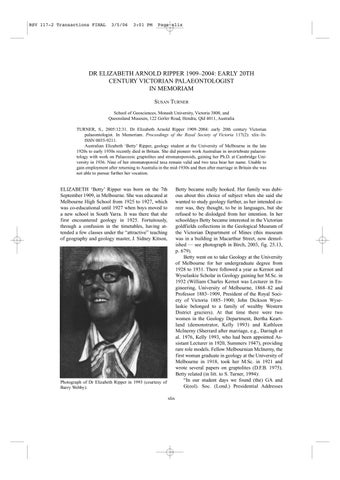
Photograph of Dr Elizabeth Ripper in 1993 (courtesy of Barry Webby). xlix
RSV 117-2 Transactions FINAL
l
3/5/06
3:01 PM
Page l
SUSAN TURNER
RSV 117-2 Transactions FINAL
3/5/06
3:01 PM
Page li
DR ELIZABETH ARNOLD RIPPER 1909–2004
most useful for overviews of particular skills or groups — usually, as you would know, the culmination of a lifetime’s work.” The Melbourne University Geology Department under Professor Ernest W. Skeats (1875–1953) and Associate Professor Herbert H. Summers (1876–1963) was strongly petrologically based, but the important palaeontological influence at that time came from Frederick A. Singleton (1897–1947, Summers 1947), who was greatly interested in Tertiary Mollusca and Foraminifera. One contemporary of Betty’s, Professor Edwin Sherbon Hills (e.g., Sherratt & McCarthy 1992) took part in and briefly documented the geology field trips led by Skeats and Singleton (Fig. 1 A-C). Such field excursions, sometimes long weekends, went for example, to Colae for Western District basalts; Daylesford for the Silurian, San Remo and Wonthragi for Jurassic coal measures, as well as day excursions, which took place on Saturdays: “We had problems, on coming of age, re getting back in time to vote! On one hair raising occasion, in a definitely undermapped area in Bacchus Marsh, the party got lost among the meanders of the Herderderg R. and some (not including me, fortunately) did not make it to civilisation until the next day! We seemed to be tramping for miles along a very rocky river bed, with much damage to our boots. This was in 1933 and was duly reported in the newspapers. It was recognised then that geologists intending fieldwork would often need to cope in hitherto unmapped territory and the M.Sc. year included a course of fairly basic surveying that we shared with future engineers and architects. Where to put railways, roads and plane tabling around the streets of Carlton, Melbourne N3!” (in litt. to S. Turner, 1994). Geology students in the same era included a high proportion of women (also seen in photographs in the Sherbon Hills Archive at NLA, Sherratt & McCarthy 1992): Anne Nicholls; Ray Suding; G. Baker; Austin Edwards; P. Moffatt; M. C. Clayton; F. Keogh; G. Phillips; F. White; Rex
li
Southey; R. Williams; F. Casey; Ned Madden; Stella Byrne; Jo Anderson; George Edwards; Moira Pye; Beryl Christie; Mysie Jensen; Coralie Skinner and David Thomas. Her initial researches were on Ordovician and Silurian graptolites but she also wrote on Silurian (Lilydale Limestone) stromatoporoids for her M.Sc. The latter was published in 1933 in the Proceedings of the Royal Society of Victoria, the main geological forum in the State, which she had joined as an Associate when a student in 1930. During her thesis work Frederick Chapman (1864–1944) at the National Museum of Victoria was her mentor. Betty prepared rocks and made thin sections as well as her own drawings, erecting then four new taxa, one named for Chapman. As a research student Betty began to take part in the scientific scene and attended the 1932 meeting of the Australasian Association for the Advancement of Science in Sydney. In 1933, her professors and mentors advised a course of graptolite study under Dr Gertrude Lillian Elles (1872–1960) at the Sedgwick Museum, Cambridge University (part of the Department of Earth Sciences). She took with her to Britain Victorian material from various collections. In the meantime she also had made a collection of stromatoporoids, mainly from the Devonian limestones of Lilydale and Buchan, in central and eastern Victoria, respectively. She was advised, fortunately as it turned out, to continue work on those, with additions from other collections. Arriving in Cambridge University in the autumn term of 1933, she was enrolled as an ‘anti student’ (i.e. non-resident student) of Newnham College, where Elles was a Director of Studies. Betty reminisced (in litt. to S. Turner, 1994) “Gertrude L. Elles was approaching the end of her career and had done her major work on British graptolites, and in me took a kindly if rather impersonal interest as my supervisor, and of stromatoporoids she worried hardly a jot, so with those I was more or less in the same situation and well and truly on my own! at least as
Fig. 1A-C. Betty Ripper with fellow students from Melbourne University Geology Department in the late 1920s to early 1930s. From Edwin Sherbon Hills (ESH) archive (Sherratt & McCarthy 1992). Black and white photographs, NLA MS8564 17/11, late 1920s geology field trips in Victoria. Most are labelled by ESH with locations, names and other comments: A, NLA MS8564 17/11.1, 1929, off Korkuperimul Creek, Victoria: Those pictured include staff: Professor E. W. Skeats; F. A. Singleton and students; Betty lying down in middle, hand over head; B, NLA MS8564 17/11.2 1929 off Korkuperimul Creek, Victoria: students, caption on back of this photo provides names: Anne Nicholls, Ray Suding, second from the left in side view, Betty Ripper (misinterpreted in Sherratt & McCarthy 1992 as “Riffer”), G. Baker, E. S. Hills, …Jackson, Austin Edwards; C, NLA MS8564 17/11.3, Betty and another female student (Anne Nicholls?): caption written by ESH on reverse reads: “Geological research in the Maldon district January 1931. Unfortunately you can see the piece of string which worked the oracle. Betty got sunburned on the eyelids every day up there!”. Copyright held and copies made by permission of the National Library of Australia.
RSV 117-2 Transactions FINAL
lii
3/5/06
3:01 PM
Page lii
SUSAN TURNER
regards the Australian faunas. At that stage the work was mainly straightforward description of species and did not lend itself to any startling discoveries. Most of the graptolite and stromatoporoid material was collected by myself, with additions from other collections; looking back, I must confess to some amazement that I was allowed to wander about the countryside alone”. Other mentors were graptolite worker, Dr Oliver M. B. Bulman (1902–1974), and museum curator A. G. Brighton, whose main interest was in Cretaceous echinoids. The Sedgwick Museum in the thirties was frequented by many interesting personalities. Betty particularly remembered later in life (in litt. to S. Turner, 1994) noted explorers such as Noel E. Odell (British glaciologist, geographer and “a tall strong splendidly-built man, easy and popular, and a graceful and experienced climber with a great record in the European Alp” — H.J. Harrington, pers. comm. Oct. 2004) and Antarctic explorer, Vivian Fuchs, often encountered in the attic where the young researchers had little cubby-holes separated by improvised walls of packing cases, files, microscope boxes etc. etc. Her immediate neighbor was young Dorothy Hill, working on the Palaeozoic corals that were the subject of her Ph.D. and later led to the award of her F.R.S. She was also working under Elles and Bulman (Campbell & Jell 1998). She and ‘Dotty’ were quite “buddies” in the Sedgwick, and even had a rather hairy field trip together in Wales! The toughening-up she had had under Professor Skeats stood her in good stead not only in route marching, but in contending with mid-winter rain and gales as well. While in Cambridge, she joined the Sedgwick Club, which ran excursions in the vacations. She soon discovered that most of the interesting work on graptolites seemed to have been done on much better preserved material and that her material would probably have very little to contribute. The stromatoporoids, however, saved her day and her (research) life. In her paper (1937b), she acknowledges Drs W. D. Lang and H. Deighton Thomas of the British Museum (Natural History) in London for permission to work on the Nicholson collection. Betty had a happy time making great quantities of thin sections and also spent some time with Deighton Thomas being allowed to slice some of their specimens, as well as some from the Sedgwick Museum, a freedom of access and facilities that Betty thought later in life (pers. comm. to S. Turner 1994) would not be so easily available today. She was keen to bring back British material to Australia
for direct comparison and was able to deposit some of her own in exchange while in Cambridge. “I had the loan of a petro(logical) microscope at the Sedgwick and of course free run of the dungeon where with the help of the current lab. assistants, Albert and Arthur, I cut millions of their sections. I quite enjoyed this “trained ape work” (I got this lovely expression from a field man in BGS sent on a collecting expedition to B. Solomon Is.), as it gave me time to think about what to put in my thesis!” (in litt. to S. Turner 1994). After three happy years in Cambridge, as she related (in litt. 1994) Betty took full advantage of all the cultural opportunities, immersing in music and theatre. She was granted her Ph.D. in 1936. Before she returned to Melbourne to split up the thesis into papers of a length suitable for publication in the Proceedings of the Royal Society of Victoria she donated stromatoporoid material including figured specimens to the Sedgwick Museum, Cambridge, and to the British Museum of Natural History, London (Cleevely 1983). From 1932–1938 there were two papers on Ordovician graptolites and five on Victorian stromatoporoids from Devonian limestones, as well as another small paper on Amphipora from Western Australia. This small body of work was her contribution to Australian geology and palaeontology and it has proved a useful one over the years, especially her pioneer studies of the Victorian Lower Devonian stromatoporoid assemblages (see Webby et al. 1993). Devonian stromatoporoids Pseudotrupetostroma ripperae Webby & Zhen 1993 from the Jesse Limestone of New South Wales and Hermatostromella holmesae (Webby, Stearn & Zhen 1993) from the Lilydale Limestone of Victoria have been named in her honour — the latter based on her married name. The fact that virtually all the species (and subspecies) she first named in her 1933, 1937a and 1937c papers were retained as valid by Webby et al. (1993) in their recent revision of the faunas is testimony to the high quality of her pioneering taxonomic studies. These taxa are: Actinostroma compactum Ripper 1933, Atelodictyon chapmani (Ripper 1933), Atopostroma distans (Ripper 1933), Petridiostroma delicatulum (Ripper 1937c), Plectostroma altum (Ripper 1933), Pseudotrupetostroma buchanense (Ripper 1937c), Salairella lilydalensis (Ripper 1937a), Schistodictyon? cylindricum (Ripper 1933), and Tubuliporella calamosa (Ripper 1933). In 1937, Betty returned to Britain to marry Stanley C.H. Holmes (Trinity Coll. Cambridge) then of the Geological Survey (G.B.), whom she had met at
RSV 117-2 Transactions FINAL
3/5/06
3:01 PM
Page liii
DR ELIZABETH ARNOLD RIPPER 1909–2004
the Sedgwick Museum. From then on her opportunities for further research narrowed as she found living conditions in suburban London were not conducive. Soon thereafter came World War II and family (two sons, neither of whom became a geologist). She joined the Geologists’ Association, and although not a Fellow, had contact through her husband with the Geological Society of London, and quite often attended their meetings. Kelly (1993) has looked at the early women science students at the University of Melbourne. She and Turner (1998) have noted that most women were unable to get paid work in their fields of interest, many becoming teachers and promoting science including geology to the next generation of girls. In the mid-1930s when the Depression limited possibilities there were few professional palaeontologists in Australia. Two women already had coveted places in Melbourne with Irene Crespin as Commonwealth Palaeontologist based at the museum and Isabel Cookson in the university. In 1994 Betty Ripper on considering her own life mused, “If I had remained in Melbourne, I may have found a palaeontological niche in the National Museum of Victoria working under R.A. Keble. Even now, with much wider acceptance of women in spheres outside the home, it is difficult without very substantial resources of money and minions to reconcile career, marriage and (especially) family.” For her, a longer career was not to be. She maintained her interest in geology, however. With Barry Webby and other workers she exchanged Christmas cards and messages for a number of years post 1993, and he sent her stromatoporoid papers of interest (B. Webby, pers. comm. 2004). In 1999 Colin Stearn, Barry Webby, Heldur Nestor and Carl Stock published a revision of the classification and terminology of Palaeozoic stromatoporoids. She wrote shortly after in 2000 thanking Barry for her copy, and adding the following remarks: “Everything one could possibly desire to know — & things have moved on more than somewhat since my days (now v. remote!) of concern with ancient coral reef faunas. It has been quite a revision course, seeing so many of the old familiar names — genera and people! — & now so many new genera. You and your 3 colleagues must have had a nightmare checking all the info, & references, not to mention the onerous task of proof-reading.
liii
It was a pleasure to see such a beautifully produced monograph — those places on cultural fault-lines seem to be able to produce miracles!” [B. Webby pers. comm. to S. Turner, Oct. 2004]. Betty Arnold Holmes died just short of her 95th birthday in June 2004 after a short illness, at her home in Ewell, Epsom, Surrey.
ARCHIVAL MATERIAL Museum of Victoria: Melbourne University file labelled “Catalogue of E. A. Ripper Collection of Australian, British & foreign stromatoporoids and graptolites” (originally presented to the University in 1936). The file contains some drawings of British graptolites by Betty Ripper. Victorian stromatoporoid material, and graptolites collected by her by locality, as her M.Sc. study was not published. National Library of Australia (NLA): Edwin Sherbon Hills archive (Sherratt & McCarthy 1992). Black and white photographs from NLA MS8564 17/11. Dr Susan Turner, Dr Barry Webby, Mr Michael Holmes: personal and other correspondence.
BIBLIOGRAPHY FOR DR E.A. RIPPER RIPPER, E. A., 1932. The distribution of the Zones of the Castlemaine and Darriwil Series near Ingliston. Proceedings of the Royal Society of Victoria 44: 200–211, pl. xx + 1 text-fig. RIPPER, E. A., 1933. The stromatoporoids of the Lilydale Limestone. Part I. Actinostroma and Clathrodictyon. Proceedings of the Royal Society of Victoria 45: 152–164, 6 text-figs. RIPPER, E. A., 1936. Some Victorian graptolite and stromatoporoid faunas. Dissertations of the University of Cambridge 1935–36, Abstract: 68–69. RIPPER, E. A., 1937a. A note on the occurrence of Didymograptus protobifidus Elles in the Lower Ordovician of Victoria. Proceedings of the Royal Society of Victoria 49: 153–164, 9 figs. RIPPER, E. A., 1937b. The stromatoporoids of the Lilydale Limestone. Part II. Syringostroma, Stromatopora and other Genera. Proceedings of the Royal Society of Victoria 49: 178–205, 2 pls, 4 figs.
RSV 117-2 Transactions FINAL
3/5/06
3:01 PM
liv
Page liv
SUSAN TURNER
RIPPER, E. A., 1937c. On some stromatoporoids from Griffith’s Quarry, Loyola, Victoria. Proceedings of the Royal Society of Victoria 50: 1–8 + 1 pl. RIPPER, E. A., 1937d. On the stromatoporoids of the Buchan District, Victoria. Proceedings of the Royal Society of Victoria 50: 11–45, 4 pls. RIPPER, E. A., 1937e. A note on the occurrence of Amphipora ramosa (Phillips) in Western Australia. Journal of the Royal Society of Western Australia 23: 37–41. RIPPER, E. A., 1938. Notes of the Middle Palaeozoic stromatoporoid faunas of Victoria. Proceedings of the Royal Society of Victoria 50: 221–243, 4 figs. Biographical mention of Betty Ripper occurs in the following: DARRAGH, T.A., KNIGHT, J.L. & TATTAM, C.M., 1976. History of Geology in Victoria. In The Geology of Victoria, J. G. Douglas & J. A. Ferguson eds Geological Society of Australia, Special Publication no 5, 1–9. SHERRATT, T. & MCCARTHY, G., 1992. A Guide to the Records of Edwin Sherbon Hills. Deposited with the National Library of Australia. Australian Science Archive Project, Melbourne University, 149 pp. [N.B. ‘Riffer’ in error]. TURNER, S., 1994. Women in palaeontology in Australia. In Useful and Curious Geological Enquiries Beyond the World. Pacific-Asia Historical Themes. 19th INHIGEO Symposium, Sydney, July 4–8, 1994, D. F. Branagan & G. H. McNally eds, INHIGEO, 248–250. TURNER, S., 1998. Women in paleontology in Australia. In Sciences of the Earth. An Encyclopedia of Events, People, and Phenomena, G. A. Good, ed., Garland Press, USA, 848–852.
ACKNOWLEDGEMENTS. With thanks for their help to Mr Michael Holmes, Prof. Barry Webby (Macquarie University); Drs
Tom Darragh and David Holloway (Museum Victoria); Drs Mary Dettmann and Alex Cook (Queensland Museum); Mrs Janet Jackson (Royal Society of Victoria); and Karen Johnson and Donna Vaughan (National Library of Australia); bibliographic information in part was derived from Bright Sparcs at www.asap.unimelb.edu.au/bsparcs/biogs.
REFERENCES BIRCH, W. D. ed., 2003. Geology of Victoria, 3rd edtn, Geological Society of Australia, Special Publication 23, 842 pp. BRANAGAN [‘D. F. B.’], 1975. Kathleen Sherrard. The Australian Geologist no. 8, Dec., p. 11. CAMPBELL, K. S. W. & JELL, J. S., 1998. Dorothy Hill 1907–1997. Historical Records of Australian Science, 12: 205–228. CLEEVELY, R.J., 1983. World Palaeontological Collections. British Museum (Natural History). Mansell Publishing Ltd, London Trustees. BMNH, 365 pp. KELLY, F., 1993. Learning and teaching science. Women making careers 1890–1920. In On the Edge of Discovery. Australian women in science. F. Kelly ed., The Text Publishing Company: University of Melbourne, 35–75. STEARN, C. W., WEBBY, B. D., NESTOR, H. & STOCK, C. W., 1999. Revised classification and terminology of Palaeozoic stromatoporoids. Acta Palaeontologica Polonica 44: 1–70. SUMMERS, H. H., 1947. The teachers of geology in Australian Universities. Journal and Proceedings of the Royal Society of New South Wales. Clarke Memorial Lecture. 81: 122–146. WEBBY, B. D. & ZHEN Y-Y., 1993. Lower Devonian stromatoporoids from the Jesse Limestone of the Limekilns area, New South Wales. Alcheringa 17: 327–352. WEBBY, B. D., STEARN, C. W. & ZHEN Y-Y., 1993. Lower Devonian (Pragian-Emsian) stromatoporoids from Victoria. Proceedings of the Royal Society of Victoria 105: 113–185.