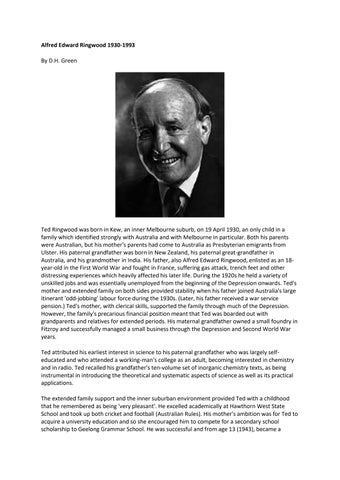
Alfred Edward Ringwood 1930-1993 By D.H. Green
Ted Ringwood was born in Kew, an inner Melbourne suburb, on 19 April 1930, an only child in a family which identified strongly with Australia and with Melbourne in particular. Both his parents were Australian, but his mother's parents had come to Australia as Presbyterian emigrants from Ulster. His paternal grandfather was born in New Zealand, his paternal great-grandfather in Australia, and his grandmother in India. His father, also Alfred Edward Ringwood, enlisted as an 18year-old in the First World War and fought in France, suffering gas attack, trench feet and other distressing experiences which heavily affected his later life. During the 1920s he held a variety of unskilled jobs and was essentially unemployed from the beginning of the Depression onwards. Ted's mother and extended family on both sides provided stability when his father joined Australia's large itinerant 'odd-jobbing' labour force during the 1930s. (Later, his father received a war service pension.) Ted's mother, with clerical skills, supported the family through much of the Depression. However, the family's precarious financial position meant that Ted was boarded out with grandparents and relatives for extended periods. His maternal grandfather owned a small foundry in Fitzroy and successfully managed a small business through the Depression and Second World War years. Ted attributed his earliest interest in science to his paternal grandfather who was largely selfeducated and who attended a working-man's college as an adult, becoming interested in chemistry and in radio. Ted recalled his grandfather's ten-volume set of inorganic chemistry texts, as being instrumental in introducing the theoretical and systematic aspects of science as well as its practical applications. The extended family support and the inner suburban environment provided Ted with a childhood that he remembered as being 'very pleasant'. He excelled academically at Hawthorn West State School and took up both cricket and football (Australian Rules). His mother's ambition was for Ted to acquire a university education and so she encouraged him to compete for a secondary school scholarship to Geelong Grammar School. He was successful and from age 13 (1943), became a
boarder there. Geelong Grammar School is perhaps the most prestigious of Australia's private schools and was then patronized largely by the families of well-established grazing and agricultural properties of the fertile and productive Western District of Victoria, and by wealthy families of southern Australia generally. Ted was forthright in his praise of the education he received at Hawthorn West. He attained exceptionally high standards in mathematics and English and accordingly was able to jump a year, to Form 4 (i.e. Year 10), in transferring to Geelong Grammar. There, he faced increased academic competition but found excellent teaching and encouragement. He also continued to play Australian Rules football with great enthusiasm. There was no formal teaching in geology at Geelong Grammar but Ted had such a light academic load in his final year (having achieved the university entrance requirements a year earlier) that he had an opportunity to explore outside the core curriculum. He mastered the geology course of Melbourne High School by acquiring the textbooks and working through them himself. His growing interest in exploitation of mineral resources for national benefit, and as a potential road to personal wealth, led him to take Geology in his first year at the University of Melbourne. Ted had been awarded a Trinity College Resident Scholarship and this, together with the Commonwealth Government Scholarship provided for tertiary education at that time, enabled him to attend the University of Melbourne without the need for financial support from his family. He continued to play Australian Rules football and represented the University of Melbourne in both the Victorian Amateur Football Association and the annual Inter-varsity contests, to the long-term detriment of his knee joints. College life, football, the traditional undergraduate pursuits, and a broadening interest in metallurgy and materials science as practical, rewarding activities meant that he 'took university work very lightly', doing only enough to pass examinations, but working reasonably hard at geology so as to keep his Trinity scholarship. He obtained First Class Honours in Geology, and afterwards paid tribute to Professor E. Sherbon Hills, an excellent lecturer, and head of a top-class teaching and research department. Hills was an establishment figure in Australian earth sciences of the 1940s and 1950s, a foundation Fellow of the Australian Academy of Science and an unforgiving opponent of the concept of continental drift, then being articulated by Professor S. Warren Carey of the University of Tasmania. At this stage of his career, however, Ted acknowledged that his motives were to become a successful economic geologist in the expanding minerals exploration industry. At Melbourne University at that time, Honours were awarded on the three-year course, and the top students continued to a twoyear MSc degree involving a major research project. Ted obtained scholarship support and began his MSc degree with a field-mapping and petrology project in the Devonian Snowy River volcanics of northeastern Victoria. This is steep, heavily timbered terrain with limited access and no resident population, so mapping was physically demanding and logistically difficult. Whilst mapping, Ted explored an exhausted silver mine where large quantities of galena-rich tailings had been discarded. Ted seized the opportunity by bagging the galena and transporting it to Melbourne for sale as feedstock for the Melbourne shot tower. (The shot tower is still preserved within the Daimaru Shopping Centre.) The venture was profitable and Ted's lifestyle improved considerably - a lesson that was not wasted on him! He obtained his MSc with Honours in 1953. At Geelong Grammar, Ted had explored the literary resources in the school library. The books of Ion Idriess held special appeal. They presented an image of Australia as vast, varied, rich in resources, responsive to grand visionary ideas and peopled by independent and self-reliant men (few women!) in harsh but beautiful landscapes. His upbringing in inner Melbourne, through Geelong Grammar and its links to the Australian rural 'establishment', his mother's self-reliance, his wider family's emphasis on independence, and his forced intimacy with the solitude of the Australian bush during
his fieldwork studies, meant that Ted absorbed and strongly identified with what he saw and valued as being Australian. He developed strong nationalist sentiments that were to continue throughout his life. His personal commitment to the development of science and industry within Australia likewise had its origins in his upbringing and education and was a dominant factor in his career decisions. Ted Ringwood began his PhD at the University of Melbourne in 1953 at a time when it was unusual to undertake a PhD degree in Australia. (Most prospective postgraduate students travelled to the UK or the USA for the purpose.) The project began as an experimental study about the origin of metalliferous ore deposits. During his undergraduate and MSc years, Ted had met Arthur Gaskin, a young lecturer in geochemistry and later a scientist and executive of CSIRO's Division of Metallurgy and Minerals Processing. Gaskin and Ted became lifelong friends, and during the construction of the experimental equipment for Ted's proposed PhD study, Gaskin encouraged Ted to read more fundamental geochemistry, particularly that to be found in the works of V.M. Goldschmidt. Ted found this so stimulating that he changed his research topic so as to apply geochemistry to understanding the structure of the Earth. He was particularly interested in the way that crystal chemical concepts might predict the mineralogical constitution of the Earth's mantle. His publications of 1955 and 1956 illustrate the convergent strands which combined to set his future career path. They also attest to his writing skills - an essential basis for a research career - which owed much to the rigour of his primary and secondary education. The publications of that period include two papers on the geology of the Mt Deddick and Snowy River areas of East Gippsland; a patent (with A. Gaskin) on production of rutile from ilmenite; two papers in Geochimica et Cosmochimica Acta in 1955 on the principles governing trace element distribution during magmatic crystallization; papers in the American Journal of Science and Geochimica et Cosmochimica Acta on magnesium silicate and germanate solid solutions and melting relationships; and a paper in Nature on the olivine to spinel transformation in the Earth's mantle. In his 26th year, he was awarded his PhD and had already published major papers in leading international journals. He had pioneered a method for investigating the Earth's interior by using thermodynamics based on crystal chemical concepts and on experimental studies of germanates as analogues of high-pressure silicates. He had developed his research quite independently of international leaders in studies of geochemistry or of the Earth's mantle. Professor E.S. Hills wrote on his behalf to Professor Francis Birch at Harvard University, enquiring about postdoctoral research possibilities. Birch responded favourably and offered an appointment. During the fifteen months in 1957 and 1958 which Ted spent at Harvard, he was introduced to high pressure experimental techniques, using the Bridgman anvils (or 'simple squeezer') and found Birch to be kindly, supportive and encouraging. In 1957, Dr Mervyn Paterson from the newly established Department of Geophysics at the Australian National University (ANU) visited Birch's laboratory, met Ted, and encouraged his interest in the ANU. Ted then met Professor John Jaeger, Professor of Geophysics at ANU, at the 1957 IUGG meeting in Toronto - it was indicative of the lack of contact between universities in Australia at that time that the two had not previously met, nor had Jaeger, a supporter of S. Warren Carey, had any effective scientific communication with E.S. Hills! Jaeger inquired about Ted from Birch and, after receiving Birch's enthusiastic endorsement, offered Ted a position in the new Department of Geophysics in the Research School of Physical Sciences at ANU. At the ANU, Jaeger had added palaeomagnetism, heat flow, seismology, rock mechanics and experimental deformation to the Department of Geophysics and had grafted isotope geochemistry and geochronology on to an 'inherited' laboratory in radiochemistry. Ted's expertise lay firmly in geochemistry but his research objectives were also those of many geophysicists - to understand the nature and properties of the Earth's interior, particularly the then unknown Transition Zone. Ted accordingly constructed a Bridgman-anvil high-pressure apparatus in his new laboratory in Canberra. In parallel, he continued his interest in the chemical composition and evolution of the solar system
with special emphasis on the nature and significance of different classes of meteorites. Here he began by documenting the mineralogy of representatives of the different chondritic meteorite types, thereby emphasising both chemical-equilibrium trends, on the one hand, and the multicomponent nature of meteorites, on the other. He showed that several meteorite classes had formed by auto-reduction processes from parental type I carbonaceous chondrites and concluded that the various suites of differentiated meteorites had formed by melting and differentiation of parental chondritic bodies. These insights are summarized in several important papers in the late '50s and early '60s, wherein he both formulated the 'chondritic earth model', and discussed the composition and origin of the solar system. He challenged H.C. Urey's concept, generally accepted at the time, that differing densities of terrestrial planets reflected mechanical fractionation of metal from silicate during condensation of the solar nebula. Ted's interpretation was vindicated when it was later found that the solar abundance of iron - on which Urey had relied - was incorrect. Ted also emphasised the importance of different oxidation states in accounting for differing densities between Venus, Earth and Mars. This work laid the foundation for his active participation in studies of the lunar samples returned by the Apollo Mission in the early 1970s. The work on meteorites also took Ted on several visits to Sweden in 1958-60 where he worked in collaboration with Kurt Fredericksson. There he met and, on 26 August 1960, married Gun Carlson. Ted and Gun returned to Canberra in 1960 to set up the Ringwood home which welcomed many visitors, particularly through the 1960s and 1970s. It was characteristic of Ted Ringwood's style that he would focus intensively on a major theme, assimilate new relevant information from the literature, commonly contribute new results, and then proceed to construct an updated or greatly revised synthesis or model. He would return to these major themes if significant new data appeared, if a contradiction presented itself, and in invited review papers. Thus, the intertwining themes of geochemical evolution of the solar system, composition and mineralogy of the Earth's mantle, composition of the Earth's core, composition and origin of Earth's Moon and the relationships between mineralogical phase transitions and mantle dynamics, continued as major research interests throughout his career. In his early work, Ted had used germanate minerals as low-pressure analogues for high pressure polymorphs of silicate phases. These experimental insights allowed him to predict that polymorphic phase transitions in the common mantle minerals, olivine and pyroxene, would occur within the pressure regime of the Earth's Transition Zone. Indeed, this was Birch's 1952 hypothesis. (Phase transformations may occur in response to pressure, when a crystal structure is reorganised into a new, denser and more compact arrangement.) Phase transformations offered an alternative to postulating major chemical compositional layering in the Earth as a way of explaining the seismic velocity and density discontinuities across the Transition Zone. At ANU, Ted began experimental study of silicates at high pressure and in 1959 demonstrated that the iron endmember Fe2SiO4 of olivine indeed transformed to the denser spinel structure, as did numerous germanate and germanate-silicate solid solutions. In 1966 Ted and Alan Major, the technical officer who worked with him from 1964 to 1993, synthesised the spinel form of (Mg0.8Fe0.2)SiO4. This was especially significant because this composition approximates that of the Earth's mantle. Also in 1966, the transformation of pure forsterite (Mg2SiO4) to spinel-like b-phase was achieved. Thus, the nature of the 400 km seismic discontinuity (at the top of the Transition Zone) was established beyond reasonable doubt. Further important polymorphic transitions - of pyroxene to garnet structure, of calcium silicate to perovskite, and of magnesium silicate (pyroxene) to perovskite structure were demonstrated by Ted and his colleague Dr Lin-gun (John) Liu at ANU in the 1970s. Several different kinds of high-pressure apparatus were employed for this purpose, including Bridgman anvils with extremely small internal strip-heaters and the diamond-anvil high pressure cell in which the sample is internally heated by an infra-red laser. It was characteristic of Ted that this persistent
experimental approach to the determination of the mineralogy and chemical composition of the mantle was complemented by progressive refinement of conceptual models of mantle dynamics and, particularly, of the fate of cool, sinking lithospheric slabs. Throughout the 1980s, in a series of rewarding collaborations with several Japanese postdoctoral fellows, Ted debated the issue of whole-mantle versus layered-mantle convection and argued in several major publications that descending slabs would be deflected within the Transition Zone. High-resolution seismic tomography later confirmed that view. Moreover, he presented a substantive case that no major compositional differences exist between upper and lower mantle and that the peridotitic composition inferred for the upper mantle was also appropriate for the lower mantle. In 1962, Jaeger recruited me to work with Ted, specifically on commissioning the internally heated piston-cylinder apparatus. This device can reproduce pressure-temperature conditions equivalent to depths of about 150 km inside the earth. Thus began a fruitful fourteen-year collaboration at ANU. We began by quantifying Ted's 'pyrolite' model, expressed in opposition to a then popular alternative that the Earth's upper mantle was of basaltic, not peridotitic composition. In the alternative model, the seismic velocity and density jump across the Mohorovicic Discontinuity was attributed to phase transformations in basaltic, not peridotitic, composition. Ted, working from his chondritic model for the Earth's bulk composition, argued instead for an olivine-rich (peridotitic) mantle composition. Moreover, my own PhD study on a natural peridotite had established that it was indeed a mantle sample of high-pressure origin. Together, we explored this concept further, calculating a model mantle composition termed 'pyrolite' that is equivalent to fertile upper mantle peridotite with the capacity to yield basalt by partial melting. We defined the four major mineral associations expected at depth for pyrolite and used the new piston cylinder apparatus for confirmation. In parallel we also explored the high-pressure mineralogy of basaltic compositions to test the alternative model. We compared our experiments directly with observations on natural high pressure metamorphic rocks. We found, for example, that basalt converted to an assemblage wellrepresented in some metamorphic terranes, that is intermediate between its high-pressure mineralogy (eclogite) and its low-pressure mineralogy (gabbro). In this way we began investigations which led to key papers on the basalt-to-eclogite transformation and the role of this transformation in mantle dynamics. Complementary papers emphasised petrological aspects, and tectonic and geophysical implications. However, we did not always reach a consensus. One publication in 1966 presents two alternative scenarios of the role of eclogite in initiating or driving tectonic processes, couched in both 'fixist' or 'continental drift' terms, thereby illustrating the Hills/Carey dichotomy in our backgrounds and illustrative of the debates at that time. This collaborative period was extremely active and rewarding. It gave me first-hand insight into Ted's fundamental modus operandi - using experiments to obtain robust data on which multiple hypotheses might be built, but which would survive only until further observations or experimental study rendered them untenable. Ted Ringwood was not afraid to be wrong in his hypotheses or models but preferred that he should lead the rejection of an earlier idea and acceptance of a new one - rather than others should do so. His friend, Professor Albrecht Hofmann, Director of the Max Planck Institut für Chemie in Mainz, in delivering the Goldschmidt Medal citation to Ted in 1991, recounts how Ted was quick to recognise the importance of a particular concept and to pursue it tenaciously, 'sometimes in error, but never off course'. During my tenure at ANU in the 1960s, we investigated the complementary relationship between partial melt (basalt) and its residue (peridotite) as functions of pressure and temperature. These experiments would not have been possible without the electron microprobe. We were the first to employ that instrument - new at the time - to analyse tiny minerals in situ in experimental charges. We also chose to employ natural volcanic rock compositions, rather than simple synthetic analogues, and both of these strategies proved extremely rewarding. The experimental petrology and petrogenesis of natural basaltic rock compositions became a major focus for research through the
1960s and early 1970s, including Ted's collaboration with my brother, Professor Trevor H. Green (then a PhD student), and Professor Ian A. Nicholls (a postdoctoral fellow). Ted's reservoir of experience and knowledge meant that he was well-placed to exploit the scientific opportunities presented by the Apollo missions. The lunar rocks returned to Earth yielded a wealth of new geological, geophysical and chronological insights into the origin and evolution of another body in the solar system. In 1960, Ted had revived a modified version of Darwin's fission hypothesis. In essence, the material that accreted to form the Moon was thought to have been derived ultimately from the Earth's mantle. This was a minority view, and the first heat-flow measurements dealt it a severe blow. Given the thickness of the lunar crust, the heat-flow data implied that the Moon contained about twice as much uranium as does the Earth. That in turn meant that the Moon would have to contain about twice the Earth's inventory of calcium and aluminium oxides seemingly the death-knell of the fission hypothesis with its requirement for similarity in bulk compositions. The fission hypothesis was unpopular for other reasons too, such as difficulty with the angular-momentum dynamics of the Earth-Moon system. It was much to Ted's relief that more accurate measurements on later missions permitted downward revision of heat-flow, and consequent resurrection of the fission hypothesis. Moreover, by this stage Ted had generated a wealth of experimental data on the origins and petrogenesis of the basalts that, long ago, had flooded the lunar maria. These results, in combination with certain seleno-chemical considerations, likewise pointed to a common genetic inheritance for both Earth and its Moon. Ted's hypothesis then received endorsement from Heinrich Wänke, a leading European geoscientist. Moreover, the giant-impact hypothesis of Hartmann and Davis, and Cameron and Ward, offered a conceptually appealing mechanism for ejecting material from the Earth. Ted, however, was lukewarm about that scenario because it would require catastrophic melting of the Earth. He instead advocated ejection of proto-lunar material by numerous lesser impacts, after the Earth's core had segregated. Vigorous and heated debate ensued, and the issue is still not satisfactorily resolved. A comprehensive and fascinating narrative encompassing these turbulent times can be found in Brush (1988). The seismic properties of the Earth's outer core of molten iron imply that it contains about 10 wt% of light elements. In 1977 Ted proposed that oxygen formed a major part of that light-element inventory. His rationale was straightforward. Oxygen makes up about half of the silicate earth, and thermodynamic considerations indicate that its solubility in molten iron should be facilitated by both high pressures and high temperatures. Intermittently, over the next decade, Ted and his colleagues conducted a series of ingenious experiments that provided a qualitative demonstration of that hypothesis. The experimental challenges were substantial. For example, Ted's equipment could reach pressures that were only about one-tenth those of the outer core. Indeed, it was not until 1992 that Ted's friend, Dr Reini Boehler, using materials supplied by Ted, was able to provide a more definitive demonstration via the ultra-high-pressure diamond anvil cell. Public debate about the export of uranium was especially intense and divisive in Australia in the mid1970s. There was much concern over the disposal of high-level wastes (HLW) arising from burning Australian uranium in foreign nuclear power reactors. (Australia, with massive fossil-fuel reserves, does not herself generate power by nuclear means.) HLW are the unavoidable by-product of reprocessing spent fuel for the recovery and recycling of uranium and plutonium. HLW present a radiological hazard that requires management for timescales of hundreds of thousands of years. The late Sir Edward Bullard FRS, Professor of Geophysics at Cambridge University, further stimulated Ted's interest in the subject during a visit to Australia in 1977. At that time, most nations with nuclear-power programmes planned to consolidate and solidify HLW as an integral constituent of glass monoliths. Ted realised that this strategy might be less than ideal if glass wasteforms were ultimately to be buried deep underground. From a geoscience perspective, glass is not especially
resistant to corrosion by circulating groundwaters. In contrast, certain ceramics might display advantageous properties. Ted accordingly drew on his reservoir of geochemical and mineralogical knowledge, and over the next eighteen months converged on and patented SYNROC (SYNthetic ROCk). SYNROC is a titania-based ceramic, the constituent minerals of which have the capacity to immobilize, in their crystal lattices, almost all of the radionuclides in HLW. Moreover, SYNROC's minerals also occur in nature, and so its longevity in diverse geological environments could be guaranteed. Ted called a press conference to announce his concept. To his surprise, he found himself under attack from all quarters. The 'greens', on the one hand, did not appreciate having their case for the intractability of nuclear waste management weakened by the advent of SYNROC. And the nuclear establishment did not welcome the criticism implicit in the announcement of 'an improved wasteform'. In the context of its decision to permit the export of uranium, the Australian government also continued to support research into aspects of the nuclear fuel cycle. The government supported the construction and commissioning of a full-scale, non-radioactive demonstration SYNROC plant at the Australian Nuclear Science and Technology Organisation's (ANSTO) site in Sydney. ANSTO scaled up the fabrication process and, over subsequent years, has carried out extensive scientific characterization and testing of SYNROC, both in Australia and via international collaborative agreements. The research, in which Ted continued to take an active interest, continues against a shift in waste management policy. Most nations have, for the time being, adopted the 'oncethrough' cycle, in which spent fuel is regarded as a waste product ultimately destined for encapsulation and geological internment. Reprocessing has been largely abandoned because it does not appear to be justified on economic grounds and thus the high-level wastes for which SYNROC was designed are not a major aspect of the industry's future scenario. Another venture into applied science stemmed from Ted's appointment to a scientific advisory board for one of Australia's major mining houses in the 1980s. Ted was amazed by the abundance of small industrial-grade diamonds flowing from the newly opened Argyle mine in Western Australia. With corporate support he invented and patented a new diamond-based cutting tool material suitable for hard-rock drilling and ultra-hard ceramic machining. Licensing and commercialization of this technology is now underway. Ted's published work was prolific and included two books, The Composition and Petrology of the Earth's Mantle (1975) and The Origin of the Earth and Moon (1979). He published over 300 scientific papers on several themes, including mineral transformations at high pressures, dynamic processes within the Earth's mantle (30 km to 2900 km depth); the origin of basaltic rocks; the nature of the Earth's core; the chemical evolution of the planets and meteorites; and the composition and origin of the Moon. A bibliography can be found at the conclusion of this memoir. The Department of Geophysics and Geochemistry had grown and diversified under Professor J.C. Jaeger and within the Research School of Physical Sciences but by the early 1970s the approaching retirement of Jaeger, the limits to growth as a department within the Research School and conflicts between the earth scientists and the Director of RSPhysSci (the nuclear physicist Professor E.W. Titterton) led to pressures to separate the Department of Geophysics and Geochemistry into a new Research School. Ted Ringwood led this campaign, developing arguments on the importance of the earth sciences generally to Australia, the standing of the ANU group in international terms, and particularly on the inability, without significant growth, to expand into new fields of geophysics and geochemistry. The debates became intense and culminated in Ringwood and Titterton appearing before the University Council to argue their respective cases. The University Council, disposed towards conservatism and support of one of its most senior Research School Directors, was nevertheless persuaded by Ringwood in a meticulously prepared argument avoiding the personality
issues which had become quite bitter. The new Research School of Earth Sciences (RSES) was established in 1972 with Professor Anton L. Hales appointed as Director. Ted Ringwood was Director of RSES from 1978 to 1983. He had great influence on the research directions of the Department of Geophysics and Geochemistry and then on the Research School of Earth Sciences. He was a strong supporter of the introduction of geophysical fluid dynamics in 1975 and of the addition of environmental geochemistry. Initially opposed to the proposal by Professor W. Compston to design and build a high-resolution ion microprobe within RSES (largely because of cost), Ted became a major supporter during his term as Director. Similarly, he gave strong support to the development of mineral physics, to seismology and to geodynamics as core activities in RSES, in addition to maintaining a vigorous research group built around excellent research and technical staff and a series of contract appointments as research fellows and postdoctoral fellows. Ted was a leading figure in Australian science. He contributed to broader scientific and social issues through his role as a senior ANU academic, membership of the Australian Academy of Science, and via national advisory committees. His work has been widely honoured, with many medals and prizes for achievement or 'Distinguished Lectures', and by election to Fellowships of numerous scientific societies (see below). Amongst his most prized awards were the Bowie Medal of the American Geophysical Union in 1974 (he was the youngest scientist to have received the medal) and the Goldschmidt Medal of the Geochemical Society. Perhaps most significantly, in 1991, he was presented with the Feltrinelli International Prize by the National Academy of Italy in the Corsini Palace in Rome. This prize is awarded in a five-year cycle to the fields of Science, Medicine, Art, Literature and Humanities. Previous recipients have included J.B.S. Haldane, Igor Stravinsky, Henry Moore and Thomas Mann. Ted was the first earth scientist to receive the Prize since 1966, and it is a fitting tribute to his stature. It is appropriate to quote from his address to the President and members of the Italian National Academy, and to members of the Italian Government, on the occasion of the award. 'It would be very rare that an individual scientist could claim the credit for recognition of this kind. The scientific output of an individual reflects not only his own efforts, but also, directly and indirectly, those of his colleagues, students, technicians, his institution and family. I've been extremely fortunate in all of these.... In particular I must pay tribute to the stimulating and supportive scientific environment provided by my own University.... I do not know of any other Institution where the conditions for research would have been so favourable.... Our understanding of the Earth in all her aspects has developed dramatically during the last 25 years. This has been an exhilarating period to have been an Earth Scientist. I feel very fortunate and fulfilled to have been able to participate in some of these developments.' The one great love of Ted's life was the Earth - its origin, structure, dynamics and constitution. It was his profession, his pastime and his passion. His recreational pursuits in later life included camping in the Australian bush, and the pleasures of a beach-side holiday-house on the unspoiled south coast of New South Wales. He also became an accomplished and well-practised expert on the finer points of Australian wine. Sadly, Ted died of lymphoma on 12 November 1993 at the age of 63. He is mourned by his wife Gun, his children Kristina and Peter, as well as a wide circle of friends and colleagues both at the Australian National University and amongst the discipline of Earth Sciences worldwide. Honours and awards Fellow, Australian Academy of Science, 1966. Commonwealth and Foreign Member, Geological Society of London, 1967.
Fellow, American Geophysical Union, 1969. Council, Australian Academy of Science, 1969-72. Vice-President, Australian Academy of Science, 1971-72. Fellow, Royal Society of London, 1972. Fellow, Meteoritical Society, 1972. Foreign Associate, National Academy of Science, USA, 1975. Honorary Member, All-Union Mineralogical Society, USSR, 1975. Honorary Foreign Fellow, European Union of Geosciences, 1983. Honorary Member, Mineralogical Society of Great Britain and Ireland, 1983. Honorary Doctorate (Dr. ver. nat. h.c.) University of Göttingen, 1987. Mineralogical Society of America Award, 1967. Clarke Memorial Lecture, Royal Society of New South Wales, 1969. Britannica Australia Award for Science, 1969. Inaugural Rosentiel Award, American Association for the Advancement of Science, 1971. Werner Medaille, German Mineralogical Society, 1972. William Smith Lecture, Geological Society of London, 1973. Arthur L. Day Medal, Geological Society of America, 1974. Bowie Medal, American Geophysical Union, 1974. Mueller Medal, Australian and New Zealand Association for the Advancement of Science, 1975. Vernadsky Lecture, USSR Academy of Science, 1975. Centenary Lecturer and Medallist, Chemical Society of London, 1977. Matthew Flinders Lecture and Medal, Australian Academy of Science, 1978. Foster Hewitt Lecturer, Lehigh University, 1978. Pawsey Memorial Lecture, Australian Insitute of Physics, 1980. Sir Maurice Mawby Memorial Lecture, Mineralogical Society of Victoria, 1981.
Hallimond Lecture, Mineralogical Society of Great Britain, 1983. Bakerian Lecture, Royal Society of London, 1983. Gold Medal for Research, Royal Society of Victoria, 1985. Arthur Holmes Medal, European Union of Geosciences, 1985. Inaugural Ingerson Lecture, International Association of Cosmochemistry and Geochemistry, 1988. Wollaston Medal, Geological Society of London, 1988. Alix G. Mautner Memorial Lectures, University of California at Los Angeles, 1990. Feltrinelli International Prize, National Academy of Italy, 1991. Goldschmidt Award, Geochemical Society, 1991. Clarke Medal, Royal Society of New South Wales, 1992. Harry H. Hess Medal of the American Geophysical Union, 1993. J.C. Jaeger Medal of the Australian Academy of Science, 1993. Acknowledgments Grateful thanks to my colleagues at the Research School of Earth Sciences, Professors W. (Bill) Compston, Anton Hales, Kurt Lambeck and Mervyn Paterson and Dr Sue Kesson, for looking at earlier versions of this manuscript and making helpful suggestions. The photograph was taken around 1988 by Bob Cooper of the Australian National University Photo Services. It is reproduced with the ANU's kind permission.