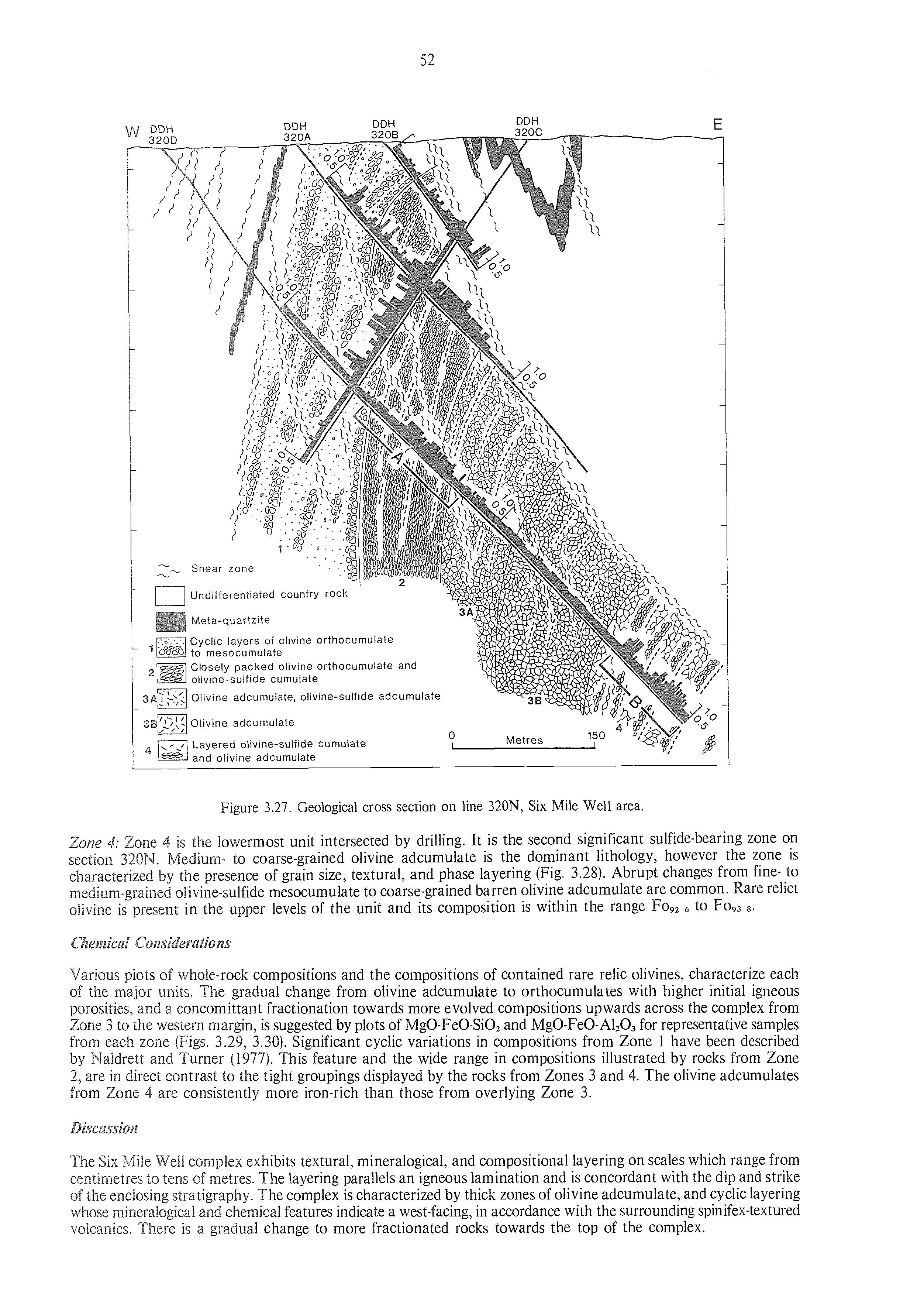
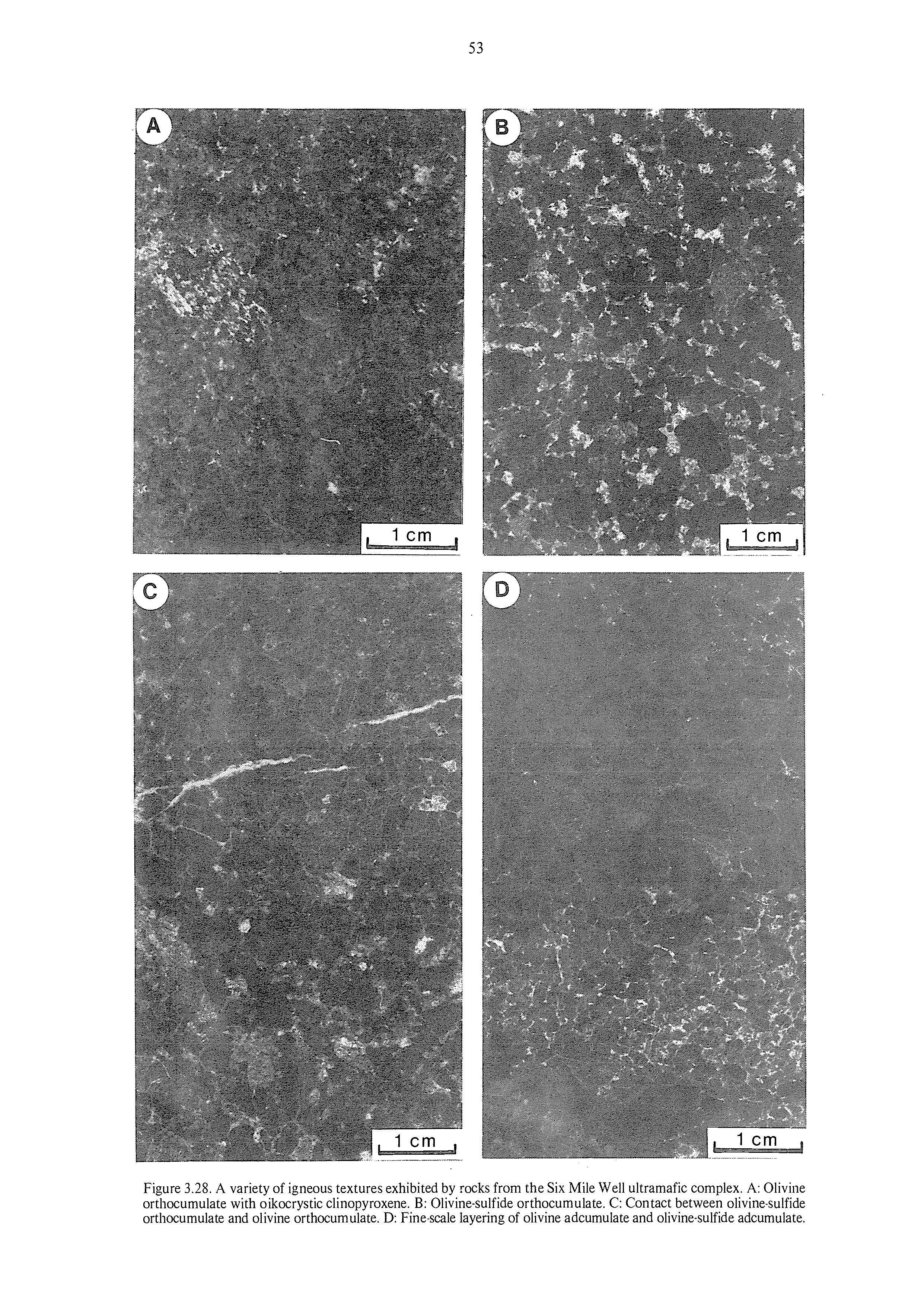
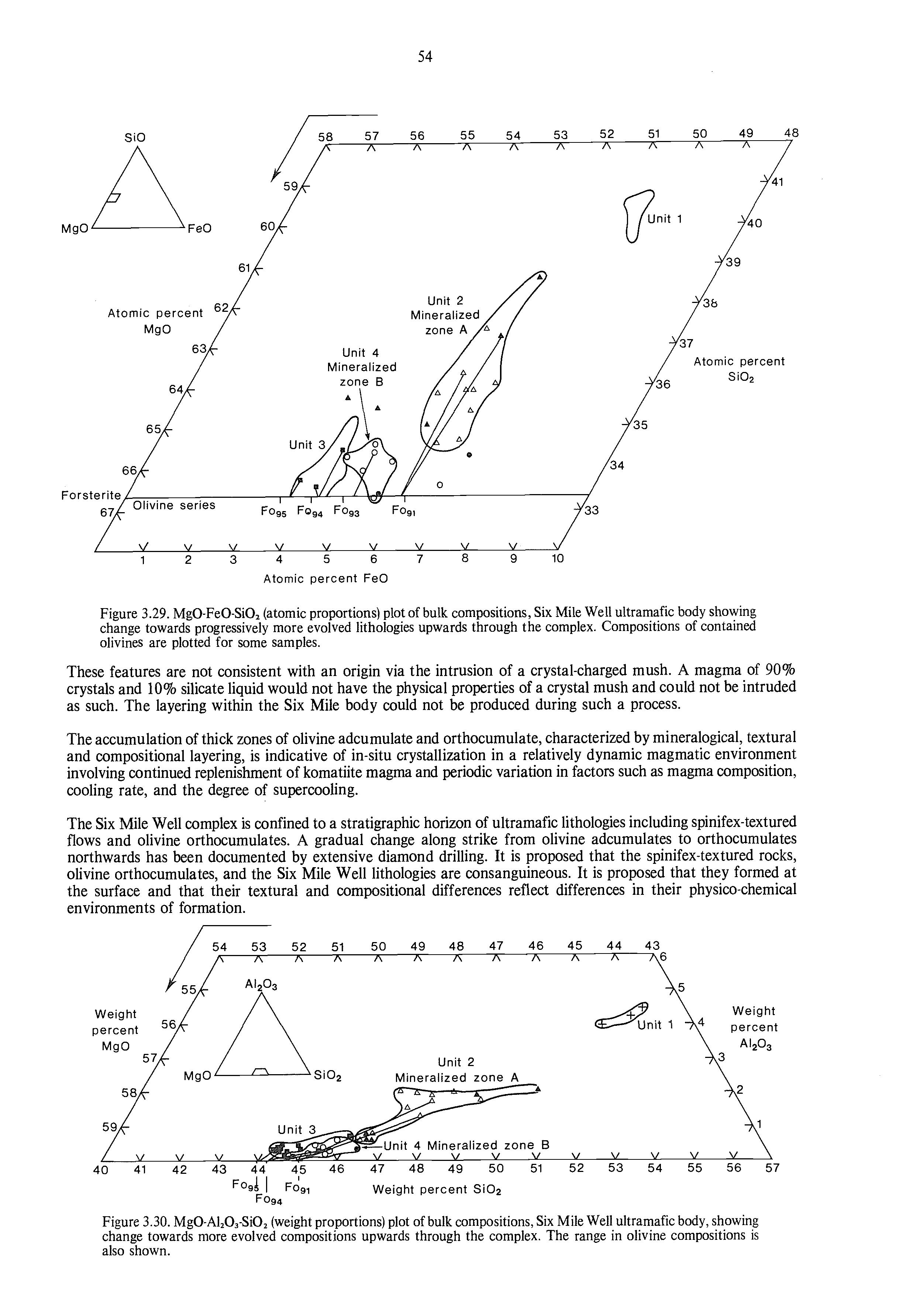
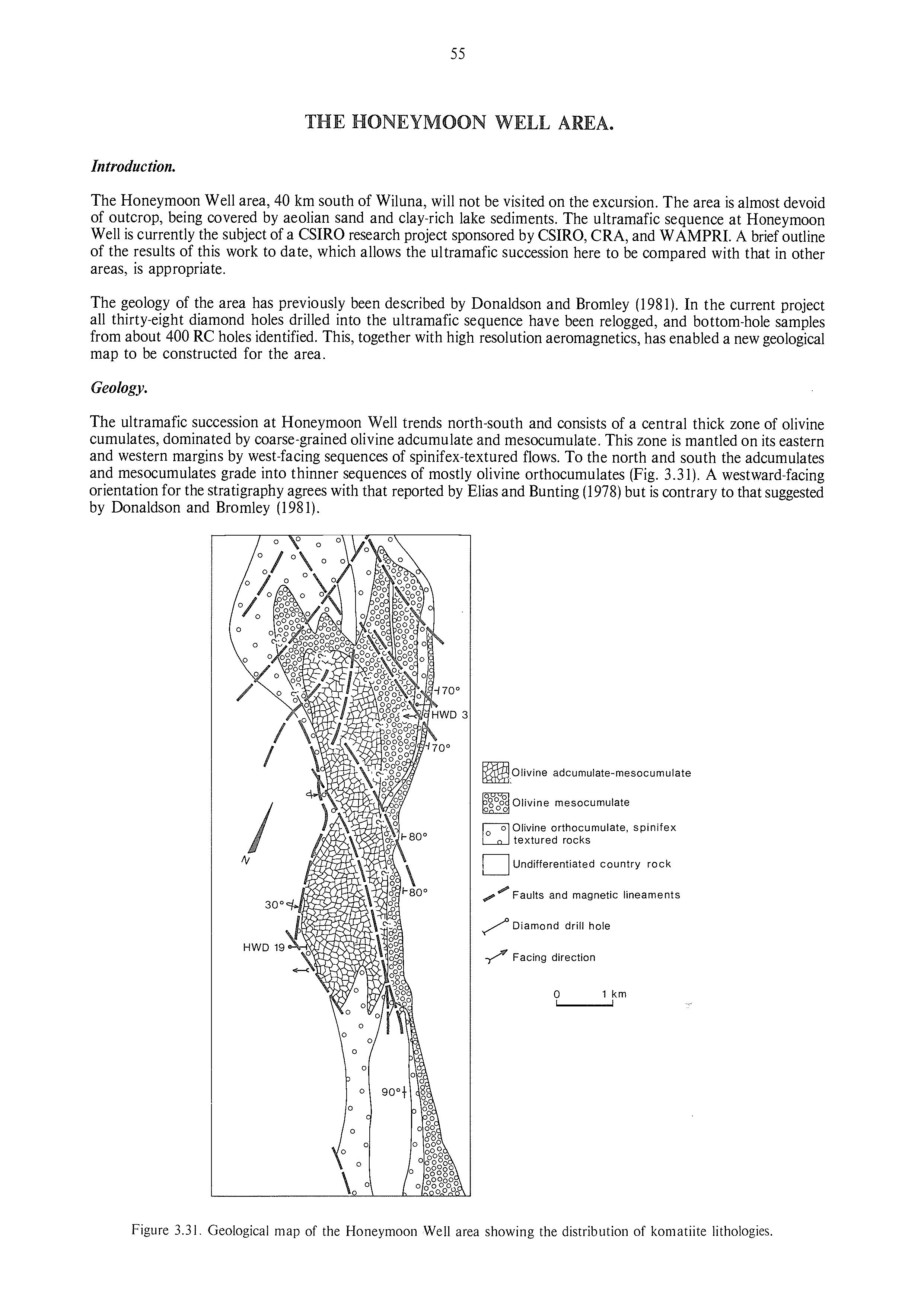
PHYSICAL VOLCA ATIITES
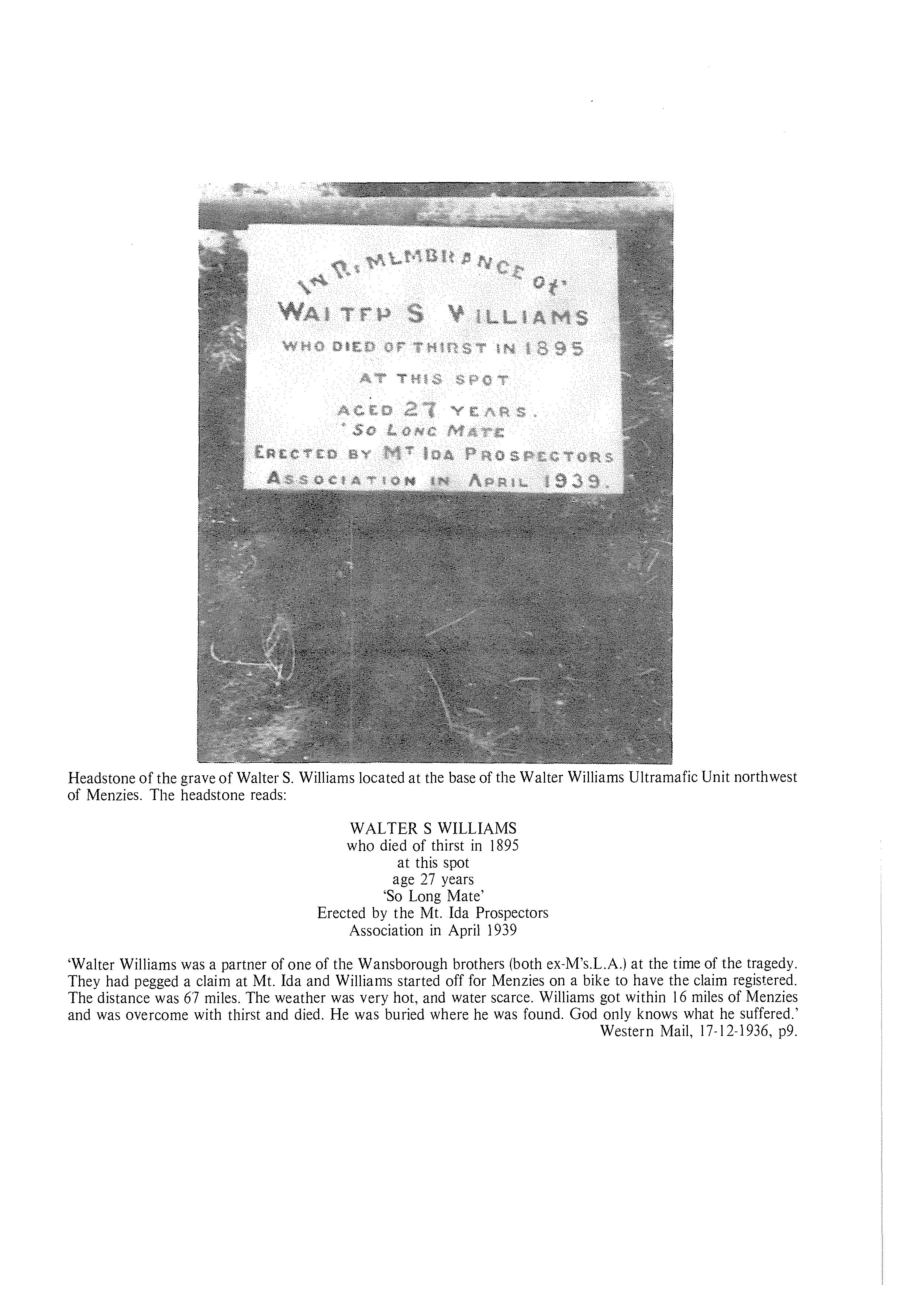
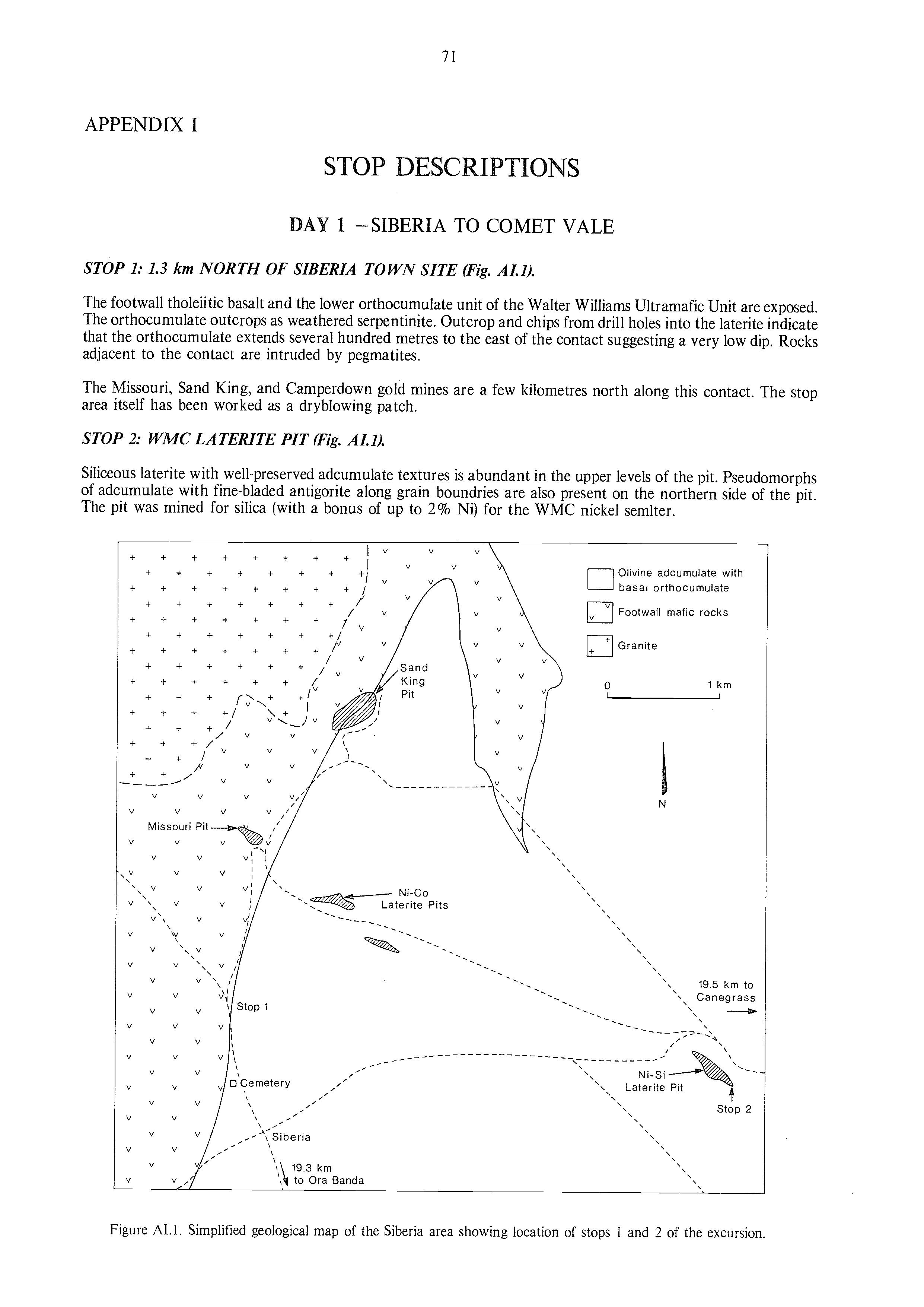
Headstone of the grave of Walter S. Williams located at the base of the Walter Williams Ultramafic Unit northwest of Menzies. The headstone reads:
WALTER S WILLIAMS
who died of thirst in 1895 at this spot age 27 years
‘So Long Mate’ Erected by the Mt. Ida Prospectors Association in April 1939
‘Walter Williams was a partner of one of the Wansborough brothers (both ex-M3.L.A.) at the time of the tragedy. They had pegged a claim at Mt. Ida and Williams started off for Menzies on a bike to have the claim registered. The distance was 6’7 miles. The weather was very hot, and water scarce. Williams got within 16 miles of Menzies and was overcome with thirst and died. He was buried where he was found. God only knows what he suffered.’ Western Mail, 17-12-1936, p9.
111,
CSIR0, Division of Minerals and Geochemistry
XCURSION
GSA (W.A. Division) Perth 1988
Production by ASTRAL PRESS PO BOX 107 WEMBLEY 6014
ISSN 0819-6613
ISBN 0 909869 55 3
0 GSA (W.A. Division) all rights reserved, 1987, 1988
Printed by Martin’s Printing Service 26 Danehill Way Balga 6061
First edition 1987 Reprinted with corrections 1988
Available for purchase from:
GSA (W.A. Division) PO Box 6014 East Perth, W.A. 6004 Australia.
The Geological Society of Australia (W.A. Division) has published several field excursion guide books over the past few years. These have been published as separate books and may be difficult to trace. To facilitate cataloguing the W.A. Division Committee has decided that excursion guide books will be published as part of a series. This guide book is the first of that series.
A continually confronted problem for those studying the evolution of the Eastern Goldfields is the search for timestratigraphic horizons that will act as suitable datum points for the correlation of regionally disposed stratigraphic columns whose volcanosedimentary lithologies are prone to facies variation. The relationship of the present greenstone belts to the areal extent of original continuous greenstone stratigraphy, or the extent to which supracrustal lithologies can be correlated across granite domes are problems whose solutions would be made easier if suitable chronostratigraphic data were established. The benefits to minerals exploration of “knowing where you are” in the stratigraphy when testing genetic models based partly on lithostratigraphic criteria are obvious.
From our studies of the physical volcanology of komatiitic magmatism in the northern half of the Norseman-Wiluna greenstone belt, we believe that the identification of “contacts” which mark the onset of extensive komatiitic volcanism combined with a knowledge of the crystallization environments of the ultramafic rocks offer a chance for the establishment of chronostratigraphic criteria.
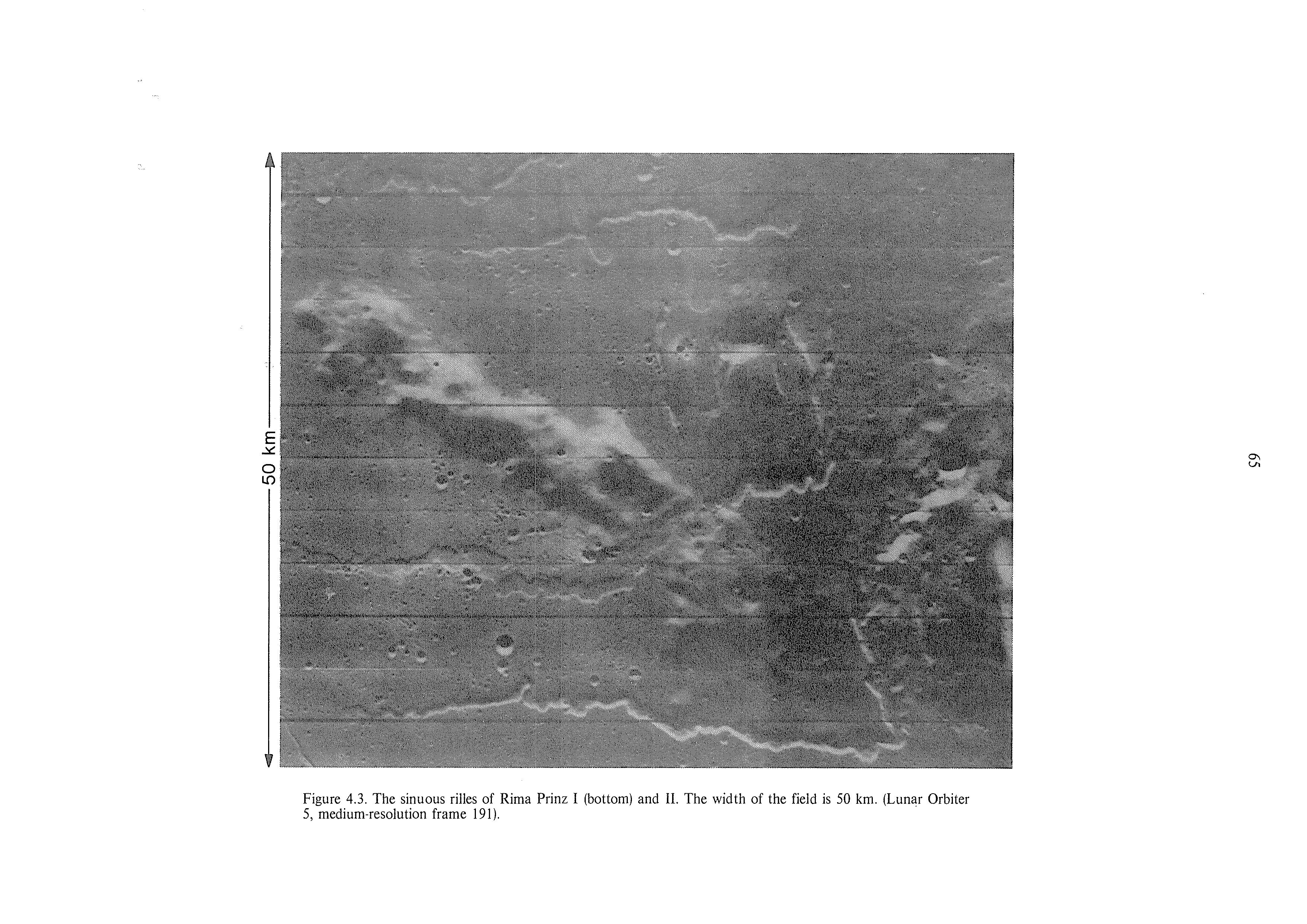
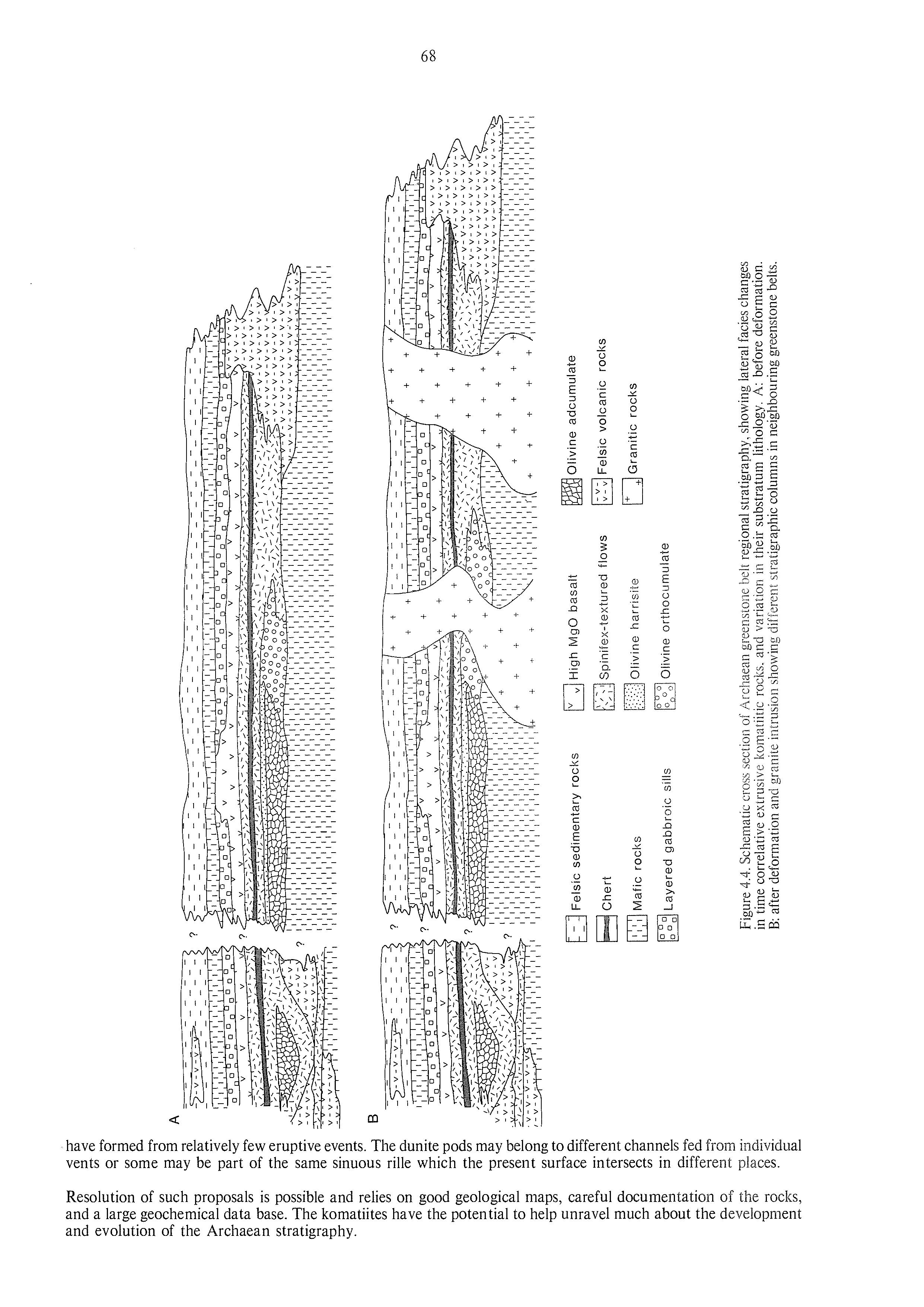
We interpret two contrasting styles of volcanism in the belt. Between Siberia and enzies there is evidence of the rapid intrusion of large volumes of komatiitic magma and its sheet flow over a surface of regional proportions to produce a variety of time-correlatable ultramafic lithologies. In contrast, in the Agnew-Wiluna Greenstone Belt there is evidence of deep erosion channels or komatiite lava rivers of lunar rille proportions.
This field excursion guide presents a review of the factors controlling the origin of a variety of komatiite lithologies and the bases for their identification and classification. It contains descriptions of areas between Siberia and Honeymoon Well pertinent to our interpretation of the physical volcanology of komatiites, and presents implications regarding the evolution of greenstone supracrustal stratigraphy. The data and the interpretations thereof are of course not all of our own. We acknowledge the work of others and accept responsibility for any incorrect presentation.
We vtiish to acknowledge all other authors whose work is presented in this excursion guide. We express our thanks to many exploration companies for their active collaboration, financial support, data base and permission to publish results. These include Anaconda Aust. Inc., ominion Gold, BP Minerals Aust. Inc., Carpentaria Exploration Co. ration, The Agnew Mining Company, and Australian Consolidated Minerals. e of Jack Mallberg with our work on the regional geology of the Menziespresented herein was financially sponsored jointly by the Western Australian Is, CEC, the Agnew Mining Company, CRA and CSIRO (WAMPRI projects 38, 79). Thanks go to C. Steel, A. Vartesi and R. Puddy for drafting the diagrams, Mrs C. Harris for typing some of the manuscript and J. Perdrix for assistance with printing.
PREFACE
ACKNOWLEDGEMENTS
CHAPTER 1 - KOMATIITES
Introduction
Komatiite phase relations
Textural variability in komatiites
Crystallization kinetics and origin of komatiite textures
Chemical fractionation of komatiite melts
Identification of komatiites
CHAPTER 2 - KOMATIITES OF THE SIBERIA-MENZIES AREA
Introduction
General geology
Komatiites
3 - KOMATIITES OF THE AC
Regional geology
Ultramafic rocks
The ultramafic rocks of Mt. Clifford and Marshall Pool
CHAPTER 4 - SUMMARY AND INTERPRETATI
Introduction
Physical volcanology applied to kornatiites
Extrusive origin of the dunite bodies
Origin of the lenticular dunites
Origin of dunite sheets
Areal extent of komatiites
REFERENCES
Ultramafic rocks and related high magnesium basalts of the komatiitic suite are rocks which have crystallized from high MgO (9-32 wt. %MgO) mantle-derived liquids, and which are genetically linked by the processes of low pressure fractionation or high pressure mantle partial melting. They are related principally by their relative proportions of olivine, clinopyroxene and plagioclase, and in more detail by characteristic abundances of trace elements such as Ti, Nb, Y, Zr and the rare earths. This report is concerned with true komatiites as defined by Arndt and Nisbitt (1982), i.e. rocks which crystallized from ultramafic magmas having MgO contents in excess of 18 weight % and ranging up to 32%.
The underlying theme behind this treatise is to establish an understanding of the physical volcanology of komatiites. Inferences are drawn about the various physico-chemical environments of crystallization of komatiites, based on features of the rocks such as igneous texture, olivine content and whole rock composition. Olivine crystallizes over a large proportion of the cooling history of komatiite melts. The textural variation exemplified by this mineral alone is sufficient to classify the lithologies and provide indications of crystallization regimes.
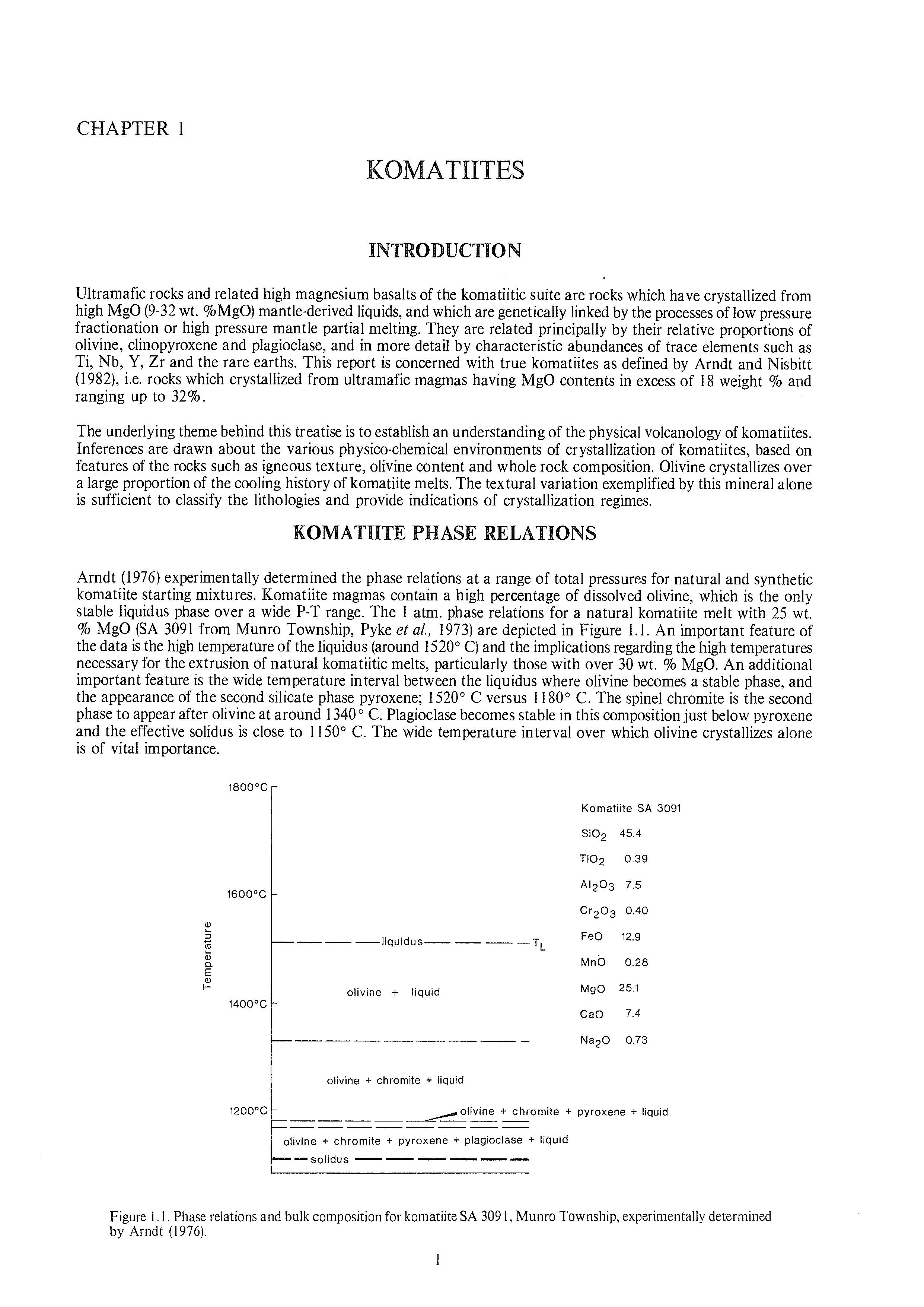
Arndt (1976) experimentally determined the phase relations at a range of total pressures for natural and synthetic komatiite starting mixtures. Komatiite magmas contain a high percentage of dissolved olivine, which is the only stable liquidus phase over a wide P-T range. The 1 atm. phase relations for a natural komatiite melt with 25 wt. 70 MgO (SA 3091 from Munro Township, Pyke et al., 1973) are depicted in Figure 1.1. An important feature of the data is the high temperature of the liquidus (around 1520" C) and the implications regarding the high temperatures necessary for the extrusion of natural komatiitic melts, particularly those with over 30 wt. % MgO. An additional important feature is the wide temperature interval between the liquidus where olivine becomes a stable phase, and the appearance of the second silicate phase pyroxene; 1520" C versus 1180" C. The spinel chromite is the second phase to appear after olivine at around 1340" C. Plagioclase becomes stable in this composition just below pyroxene and the effective solidus is close to 1150" C. The wide temperature interval over which olivine crystallizes alone is of vital importance.
1800~C
1600°C
Iolivine + liquid
olivine + chromite + liquid
1200~C
Komatiite SA 3091
SiO2 45.4
TI02 0.39
A1203 7.5
Cr2O3 0.40
FeO 12.9
MnO 0.28
MgO 25.1
CaO 7.4
Na20 0.73
olivine + chromite + pyroxene + liquid ----/---
olivine + chromite + pyroxene + plagioclase + liquid -solidus ------
Figure 1.1. Phase relations and bulk composition for komatiite SA 309 1, Munro Township, experimentally determined by Arndt (1976).
Komatiites show a wide range of spectacular textures, commonly within the same lava flow, arising predominantly from the many different habits displayed by olivine. Two basic types of texture are found: dendritic or “spinifex” textures, in which olivine takes on a variety of skeletal forms, and cumulate textures arising from accumulations of more or less equidimensional olivine crystals.
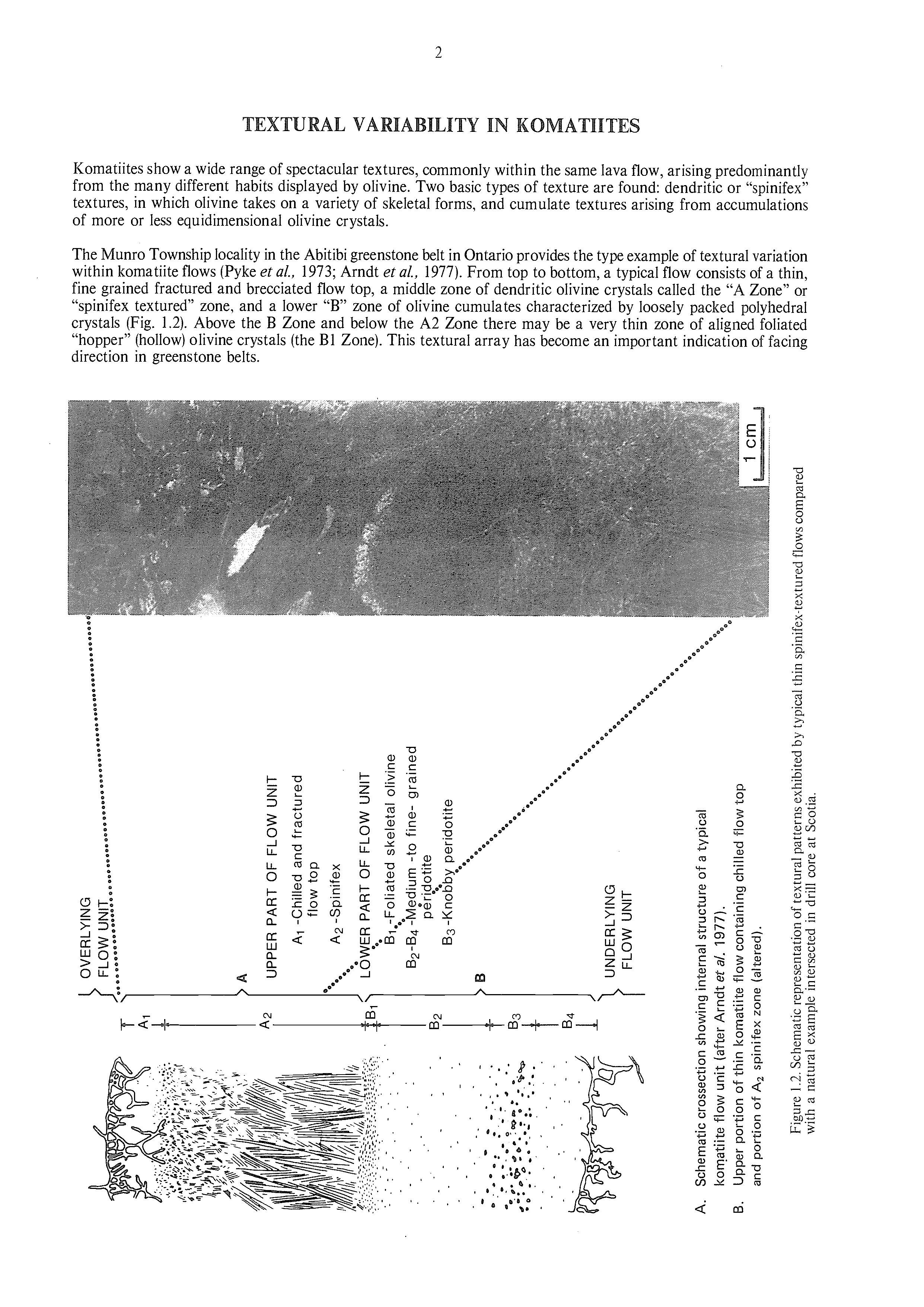
The Munro Township locality in the Abitibi greenstone belt in Ontario provides the type example of textural variation within komatiite flows (Pyke et al., 1973; Arndt et al., 1977). From top to bottom, a typical flow consists of a thin, fine grained fractured and brecciated flow top, a middle zone of dendritic olivine crystals called the “A Zone” or “spinifex textured” zone, and a lower “B” zone of olivine cumulates characterized by loosely packed polyhedral crystals (Fig. 1.2). Above the B Zone and below the A2 Zone there may be a very thin zone of aligned foliated “hopper” (hollow) olivine crystals (the B1 Zone). This textural array has become an important indication of facing direction in greenstone belts.
In detail, the spinifex zone is characterized by an upper portion of fine-grained, randomly disposed olivine plates (the A1 Zone), which grades with increasing grain size into a lower and thicker plate spinifex zone (the A2 Zone - Fig. 1.2). This consists of large olivine plates (30 cm - 1 m long) roughly perpendicular to the flow surface. The juxtaposition of fine random and coarse aligned olivine crystals gives a surface pattern reminiscent of clumps of spinifex grass (upside down!) - hence the term “spinifex texture”, coined by esbitt (197 1).The term is somewhat misleading, in that the olivine crystals are not needles or blad s arranged like pages in a book. This can be seen very clearly at one of the localities on the trip
Individual layered flow units vary greatly in thickness from 0.05 to 30 m ( onaldson, 1982). In this field guide, komatiite flow units almost 1 km thick are described.
unro Township pattern has proved to be applicable to ko atiites virtually wherever they are foun many variations are possible on the general theme. The relative thi esses of the different zones vary greatly. of the thin units at unro and elsewhere consist entirely of -zone and flow-top breccia, with no spinifex textures at all. Some of the thicker layere flows contain differentiated gabbroic zones, and layers of pyroxene cumulate (Arndt et al., 1977; Barnes eta/., 1983)
ulate textures
In the thicker flows, a range of textures exists within the cumulate or “B” zone, from orthocumulate through mesocumulate to adcumulate. These textures have great genetic significance.
Early studies of cumulates (e er et al., 1960) regarded them as forming by crystal settling. Subsequent work (Campbell, 1978; McBirney yes, 1979) has shown that in many cases cumulate rocks must have formed by in situ growth on the floo or roof of a magma chamber. Irvine (1982) has revised cumulate terminology to remove the genetic connotation of crystal settling, and his terminology is employed here. A cumulate is defined as an igneous rock containing a framework of touching crystals, which were concentrated by fractional crystallization, i.e. by physical separation of the cumulus crystals from the liquid from which they grew. The actual mechanism by which this separation occurs is immaterial: it may be by crystal settling, by convection of magma away from the crystals, or by flow of lava over a bed of growing crystals. The last mechanism is called on here to account for features of komatiitic cumulates in the northern half of the
iluna greenstone belt.
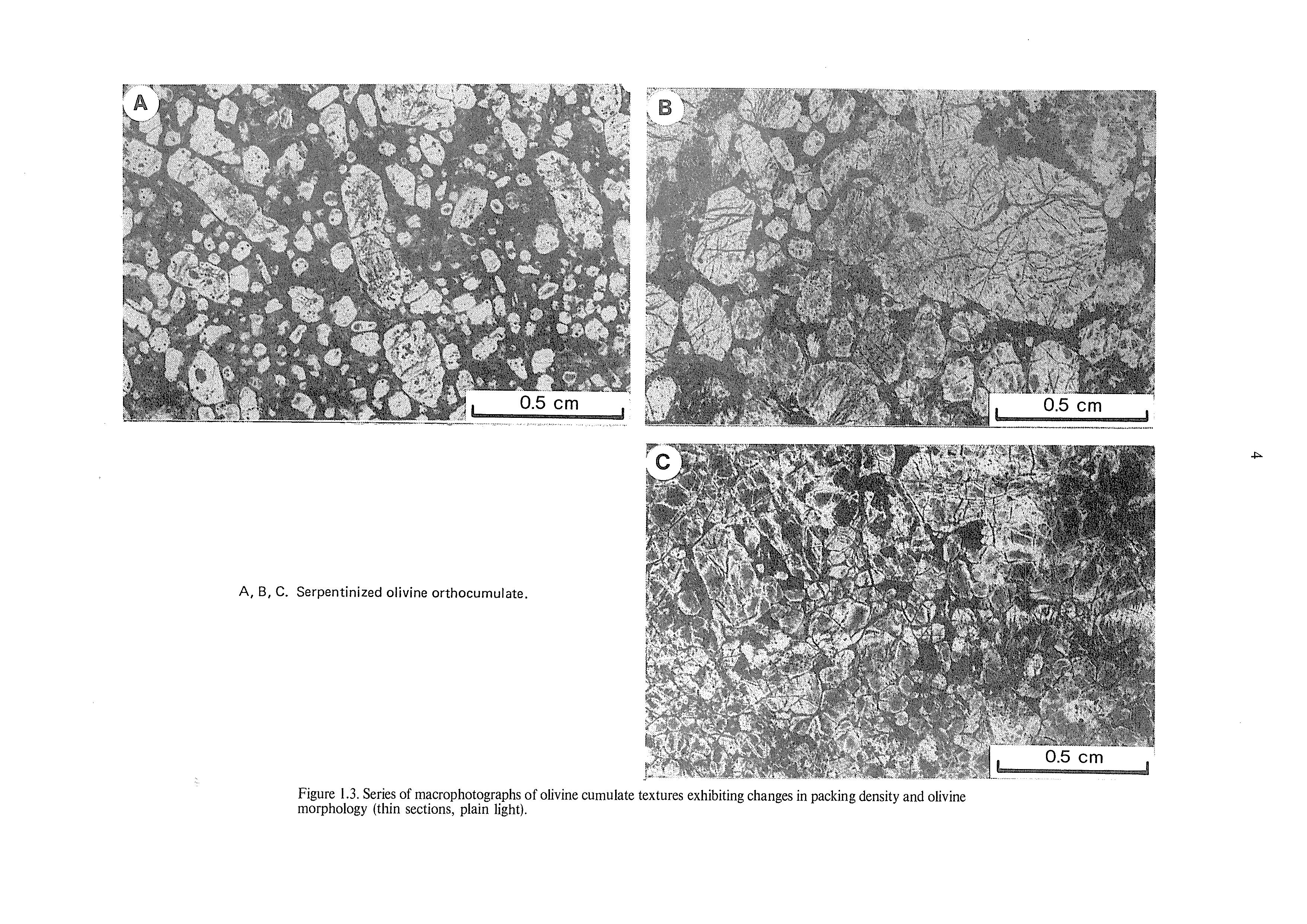
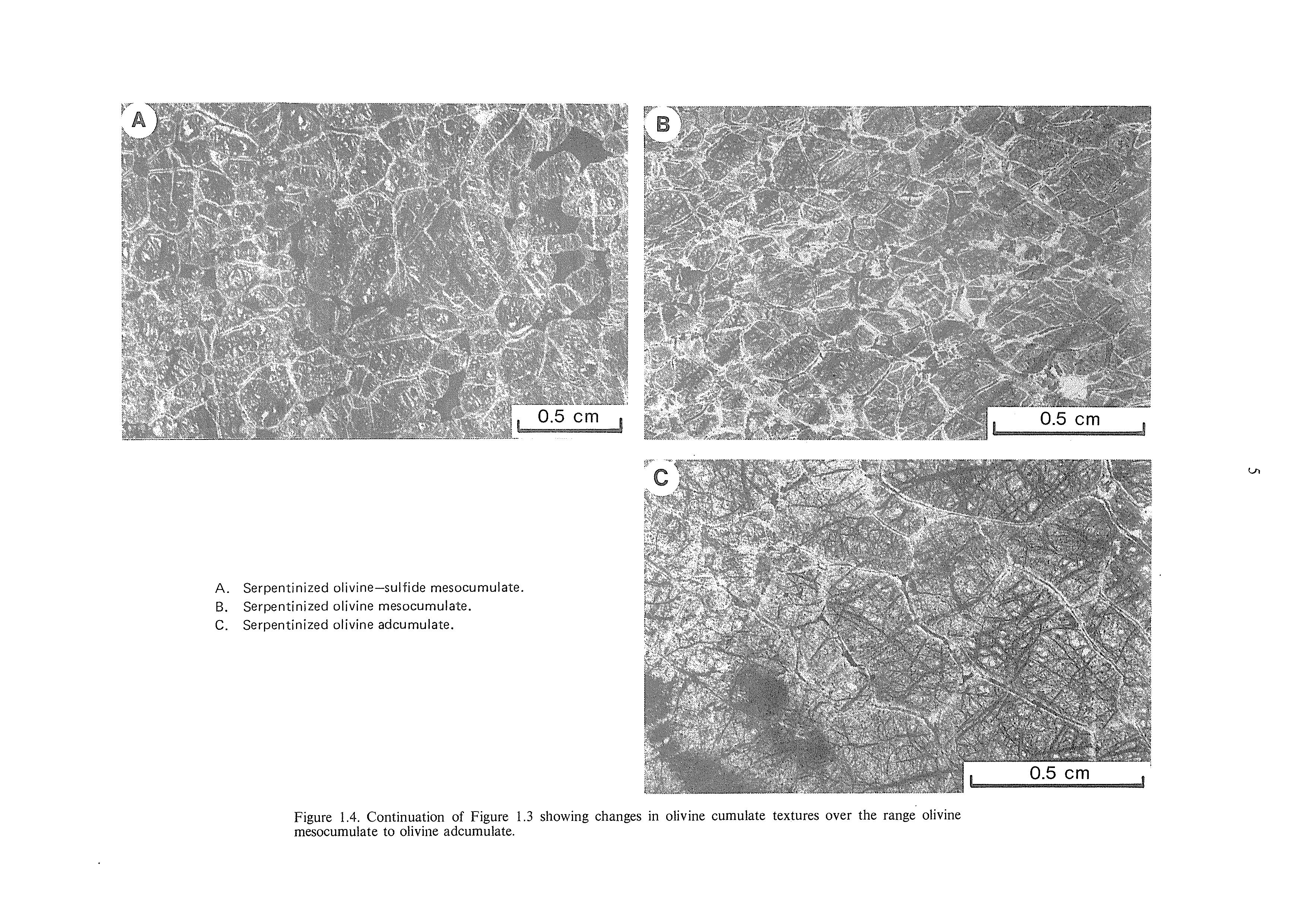
Cumulate textures are subdivided on the basis of the proportion of cumulus crystals to the crystallization products of magma trapped between the cumulus crystals. Ort~ocu~~lates are rocks which exhibit a high proportion of crystallized trapped intercumulus liquid and the cumulus crystals are subhedral to euhedral in form. Adcumulates are rocks which have little or no intercumulus material and are cha ized by anhedral crystals exhibiting a very high degree of mutual boundary contact and triple point junctions. cumulates are rocks in which the cumulus crystals exhibit extensive mutual boundary contact, but which retain some recognizable primary igneous porosity. Olivine orthocumulate, mesocumulate and adcumulate textures are illustrated in Figures 1.3 and 1.4.
Another important rock type is olivine harrisite (Fig. 1.5).This is a special case of a transition from orthocumulate towards spinifex texture, and is characterized by coarse, branching dendritic olivine crystals. This texture is similar to that of the type example of harrisite in the hum layered intrusion (
eory
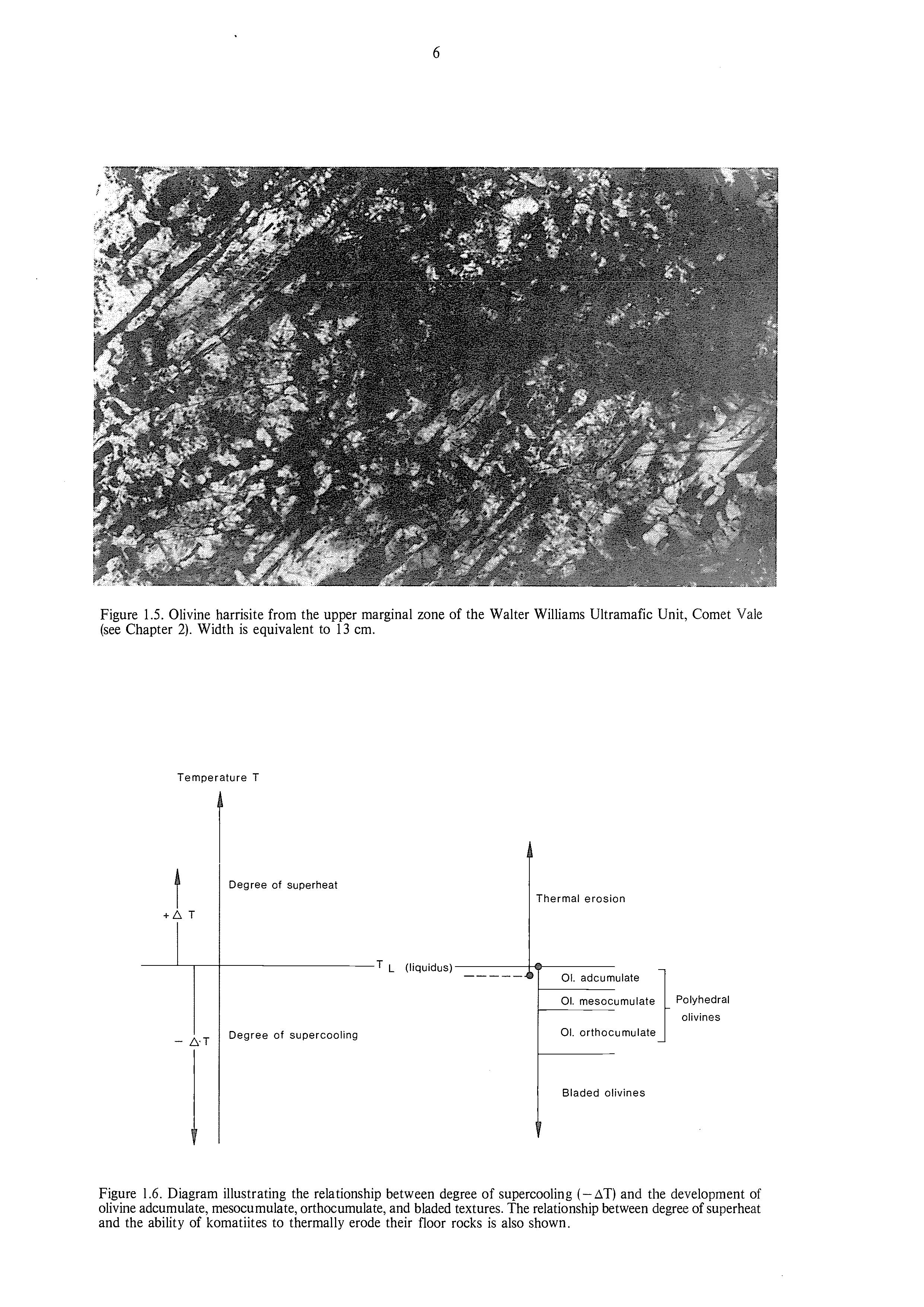
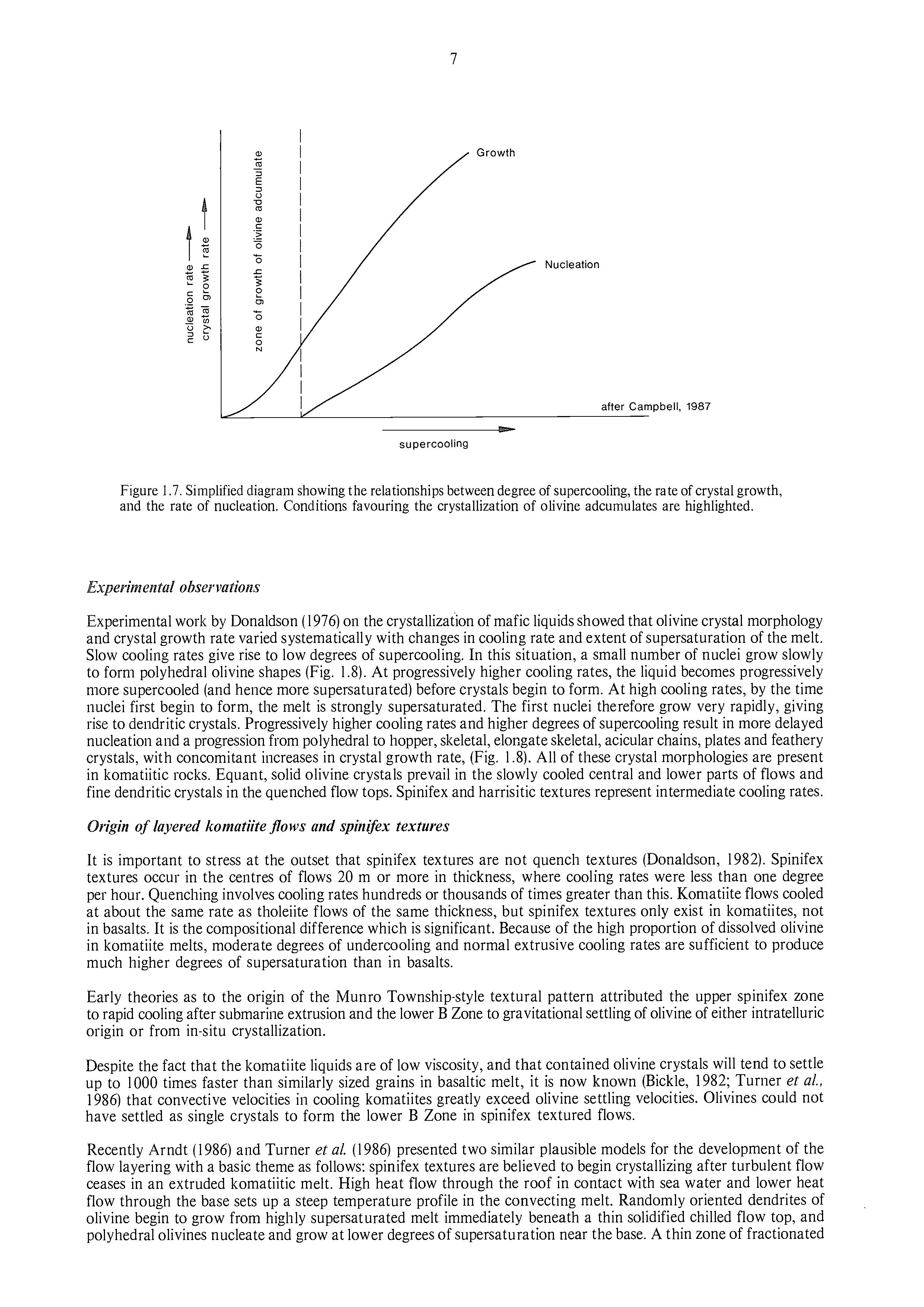
The texture of any igneous rock is the end result of the interplay of two fundamental processes: nucleation of new crystals, and growth of existing ones. Growth o isting crystals of a particular phase is energetically favourable whenever the liquid is saturated with that phase cleation of new crystals is more difficult, as it requires creation of new surfaces. Finite degrees of supersaturation are required before any stable nuclei can form and crystal growth can begin. Supersaturation can be achieved by a variety of mechanisms, the most important in the present context being supercooling (Fig. 1.6).This happens when the temperature of a liquid drops below its liquidus without any crystallization taking place.
A simplified diagrammatic sketch showing variation in the rates of nucleation and crystal growth as functions of supercooling is shown in Figure 1.7, after Campbell (1987). t limited degrees of undercooling both nucleation and crystal growth rate increase as a function of supercooling. Increases in crystal growth rate begin to be effective at lower degrees of supercooling than changes in the rate of nucleation. At very low degrees of supercooling conditions are possible which permit crystal growth but impede the formation of new nuclei. This is critical to the understanding of adcumulate textures, as discussed below.
1.3. Series of macrophotographs of olivine cumulate textures exhibiting changes in packing density and olivine morphology (thin sections, plain light).
A, B, C. Serpentinized olivine orthocumulate.
Figure
A. Serpentinized 01ivine-su Ifide mesocumuIate.
B. Serpentinized olivine mesocumuiate.
C. Serpentinized olivine adcumulate.
Figure 1.4. Continuation of Figure 1.3 showing changes in olivine cumulate textures over the range olivine mesocumulate to olivine adcumulate.
1.5. Olivine harrisite from the upper marginal zone of the Walter Williams
Unit, Comet Vale (see Chapter 2). Width is equivalent to 13 cm.
Temperature T
+A T
Degree of superheat
L (liquidus)
Degree of supercooling
Thermal erosion mulate Polyhedral olivines
Bladed olivines
Figure 1.6. Diagram illustrating the relationship between degree of supercooling (-AT) and the development of olivine adcumuiate, mesocumulate, orthocumulate, and bladed textures. The relationship between degree of superheat and the ability of komatiites to thermally erode their floor rocks is also shown.
Figure
Ultramafic
m3supercooling
Figure 1.7. Simplified diagram showing the relationshipsbetween degree of supercooling,the rate of crystal growth, and the rate of nucleation. Conditions favouring the crystallization of olivine adcumulates are highlighted.
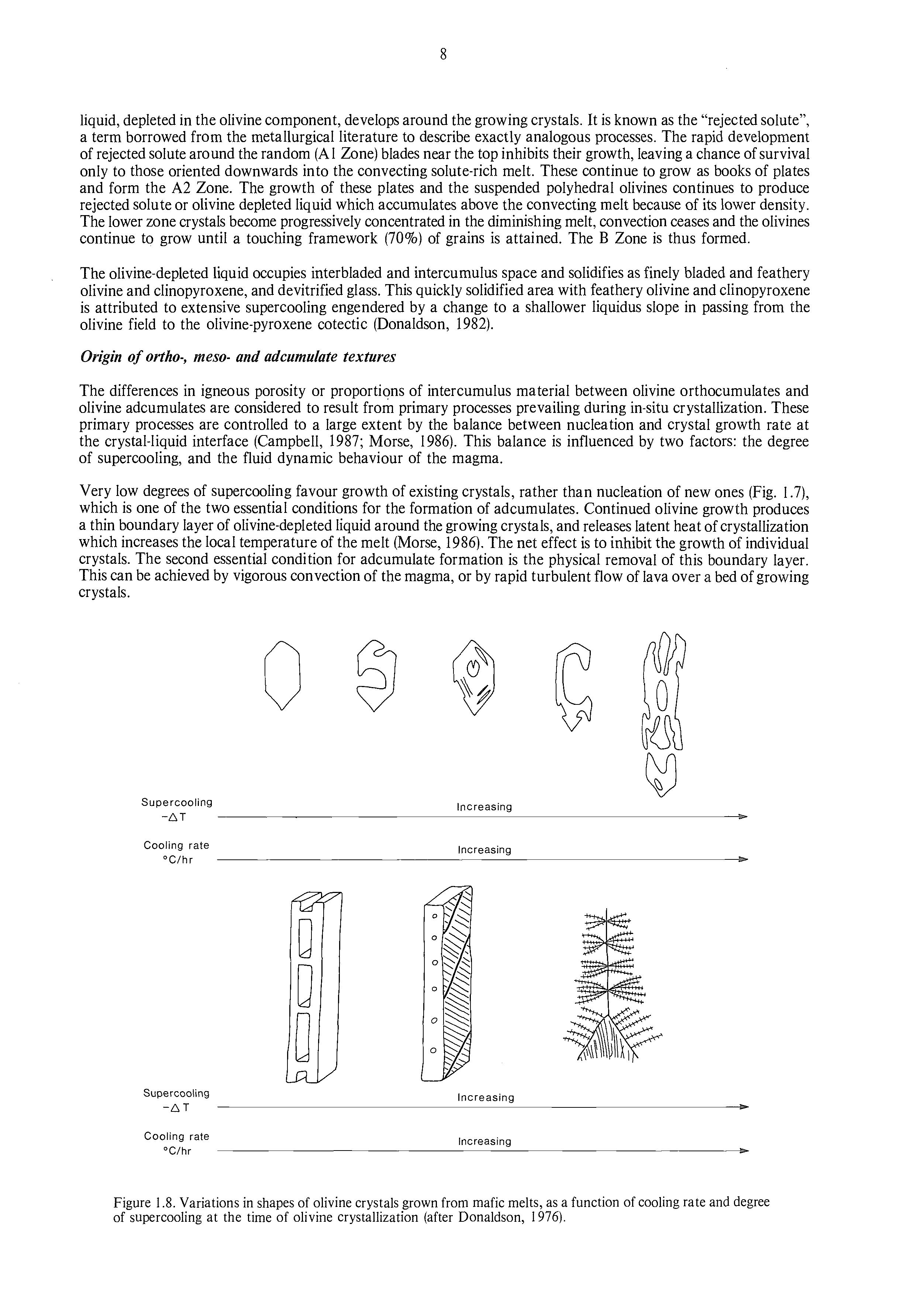
Experimental work by Donaldson (1976) on the crystallization of mafic liquids showed that olivine crystal morphology and crystal growth rate varied systematically with changes in cooling rate and extent of supersaturation of the melt. Slow cooling rates give rise to low degrees of supercooling. In this situation, a small number of nuclei grow slowly to form polyhedral olivine shapes (Fig. 1.8). At progressively higher cooling rates, the liquid becomes progressively more supercooled (and hence more supersaturated) before crystals begin to form. At high cooling rates, by the time nuclei first begin to form, the melt is strongly supersaturated. The first nuclei therefore grow very rapidly, giving rise to dendritic crystals. Progressively higher cooling rates and higher degrees of supercooling result in more delayed nucleation and a progression from polyhedral to hopper, skeletal, elocgate skeletal, acicular chains, plates and feathery crystals, with concomitant increases in crystal growth rate, (Fig. 1.8). All of these crystal morphologies are present in komatiitic rocks. Equant, solid olivine crystals prevail in the slowly cooled central and lower parts of flows and fine dendritic crystals in the quenched flow tops. Spinifex and harrisitic textures represent intermediate cooling rates.
rigin of layered komatiite jloivs and spinifex textures
It is important to stress at the outset that spinifex textures are not quench textures (Donaldson, 1982). Spinifex textures occur in the centres of flows 20 m or more in thickness, where cooling rates were less than one degree per hour. Quenching involves cooling rates hundreds or thousands of times greater than this. Komatiite flows cooled at about the same rate as tholeiite flows of the same thickness, but spinifex textures only exist in komatiites, not in basalts. It is the compositional difference which is significant. Because of the high proportion of dissolved olivine in komatiite melts, moderate degrees of undercooling and normal extrusive cooling rates are sufficient to produce much higher degrees of supersaturation than in basalts.
Early theories as to the origin of the Munro Township-style textural pattern attributed the upper spinifex zone to rapid cooling after submarine extrusion and the lower B Zone to gravitational settling of olivine of either intratelluric origin or from in-situ crystallization.
Despite the fact that the komatiite liquids are of low viscosity, and that contained olivine crystals will tend to settle up to 1000 times faster than similarly sized grains in basaltic melt, it is now known (Bickle, 1982; Turner et al., 1986) that convective velocities in cooling komatiites greatly exceed olivine settling velocities. Olivines could not have settled as single crystals to form the lower B Zone in spinifex textured flows.
Recently Arndt (1986) and Turner et a/. (1986) presented two similar plausible models for the development of the flow layering with a basic theme as follows: spinifex textures are believed to begin crystallizing after turbulent flow ceases in an extruded komatiitic melt. High heat flow through the roof in contact with sea water and lower heat flow through the base sets up a steep temperature profile in the convecting melt. Randomly oriented dendrites of olivine begin to grow from highly supersaturated melt immediately beneath a thin solidified chilled flow top, and polyhedral olivines nucleate and grow at lower degrees of supersaturation near the base. A thin zone of fractionated
liquid, depleted in the olivine component, develops around the growing crystals. It is known as the “rejected solute”, a term borrowed from the metallurgical literature to describe exactly analogous processes. The rapid development of rejected solute around the random (A1 Zone) blades near the top inhibits their growth, leaving a chance of survival only to those oriented downwards into the convecting solute-rich melt. These continue to grow as books of plates and form the A2 Zone. The growth of these plates and the suspended polyhedral olivines continues to produce rejected solute or olivine depleted liquid which accumulates above the convecting melt because of its lower density. The lower zone crystals become progressively concentrated in the diminishing melt, convection ceases and the olivines continue to grow until a touching framework (70%) of grains is attained. The B Zone is thus formed.
The olivine-depleted liquid occupies interbladed and intercumulus space and solidifies as finely bladed and feathery olivine and clinopyroxene, and devitrified glass. This quickly solidified area with feathery olivine and clinopyroxene is attributed to extensive supercooling engendered by a change to a shallower liquidus slope in passing from the olivine field to the olivine-pyroxene cotectic (Donaldson, 1982).
Origin of ortho-, meso- and adcumulate textures
The differences in igneous porosity or proportions of intercumulus material between olivine orthocumulates and olivine adcumulates are considered to result from primary processes prevailing during in-situ crystallization. These primary processes are controlled to a large extent by the balance between nucleation and crystal growth rate at the crystal-liquid interface (Campbell, 1987; Morse, 1986). This balance is influenced by two factors: the degree of supercooling, and the fluid dynamic behaviour of the magma.
Very low degrees of supercooling favour growth of existing crystals, rather than nucleation of new ones (Fig. 1.7), which is one of the two essential conditions for the formation of adcumulates. Continued olivine growth produces a thin boundary layer of olivine-depletedliquid around the growing crystals, and releases latent heat of crystallization which increases the local temperature of the melt (Morse, 1986). The net effect is to inhibit the growth of individual crystals. The second essential condition for adcumulate formation is the physical removal of this boundary layer. This can be achieved by vigorous convection of the magma, or by rapid turbulent flow of lava over a bed of growing crystals.
Figure 1.8. Variations in shapes of olivine crystals grown from mafic melts, as a function of cooling rate and degree of supercooling at the time of olivine crystallization (after Donaldson, 1976).
Higher degrees of supercooling favour the nucleation and growth of new crystals at the top of the crystal pile, trapping the olivine-depleted boundary layer before it can be physically removed. If the cooling rate is sufficiently rapid to freeze in the liquid between the olivine grains, orthocumulates will be formed. Mesocumulates represent the transitional case.
uinmary
Textures of komatiites indicate the conditions under which they crystallized: rapid cooling and high degrees of supercooling for fine random spinifex, moderate cooling rates for coarse spinifex textures, and slow cooling rates for polyhedral cumulus-textured olivines. Adcumulates indicate a dynamic regime with rapid turbulent flow of lava, in which temperatures at the site of crystal growth never dropped very far below the liquidus.
The crystallization of cumulate rocks, by definition, involves fractional crystallization of the parent magma and a systematic change in its composition. This differentiation can take place on a range of scales and under a range of conditions - in a thin ponded lava flow, along the length of an extensive linear flow, or in a deep crustal magma chamber. Komatiite flows in greenstone belts show a spectrum of original liquid compositions from a maximum of about 32% MgO (by weight) down to MgO contents at the upper end of the range of high-Mg basalts. Much of this chemical variation is probably due to varying degrees of fractional crystallization of olivine from primitive mantle melts. Much of the high-Mg basalt associated with komatiites in greenstone belts may be derived from komatitic parent liquids.
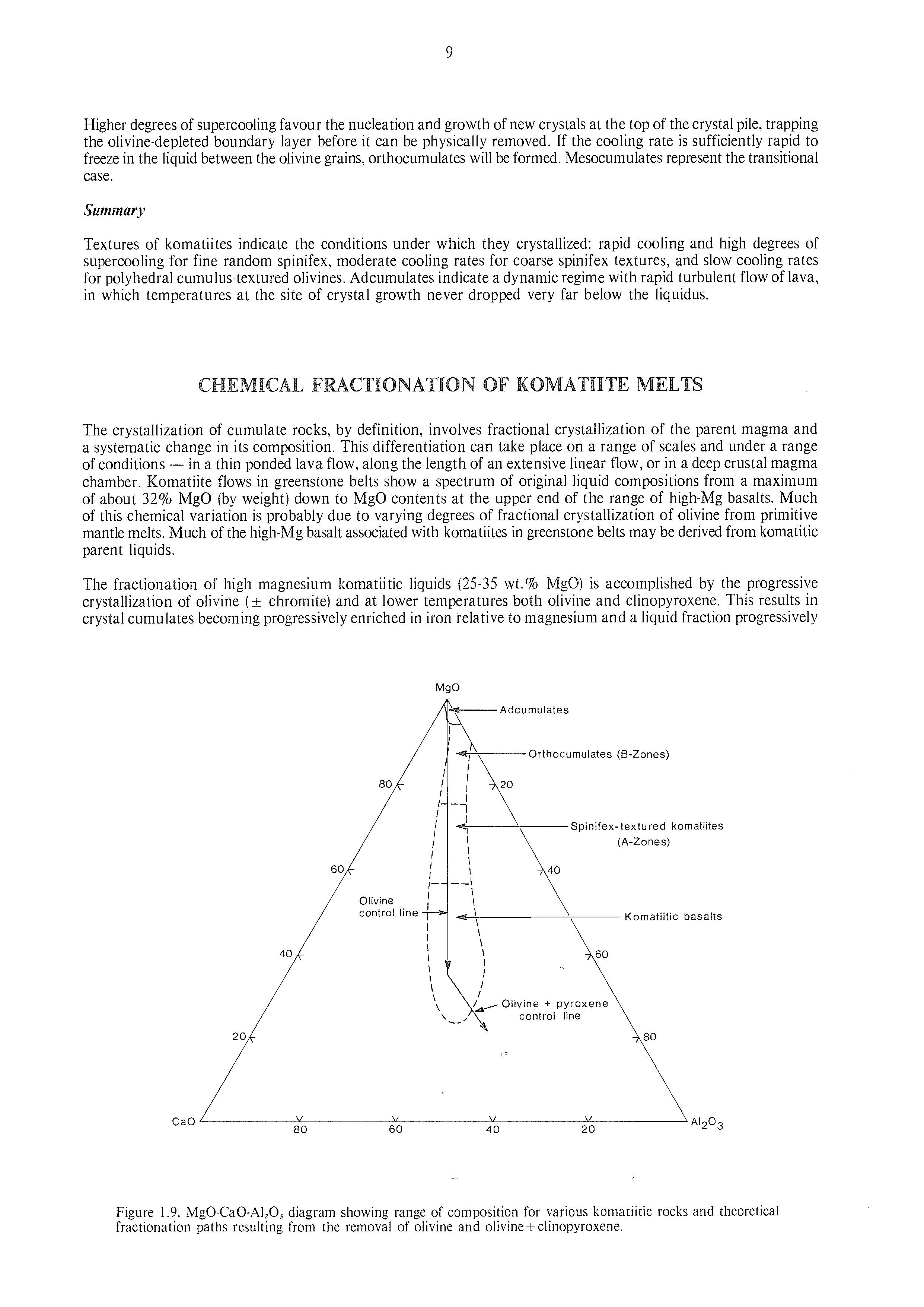
The fractionation of high magnesium komatiitic liquids (25-35 wt.% 1 is accomplished by the progressive crystallization of olivine ("r chromite) and at lower temperatures both olivine and clinopyroxene. This results in crystal cumulates becoming progressively enriched in iron relative to magnesium and a liquid fraction progressively
Figure 1.9. MgO-CaO-AI,O, diagram showing range of composition for various komatiitic rocks and theoretical fractionation paths resulting from the removal of olivine and olivine +clinopyroxene.
X Forsterite
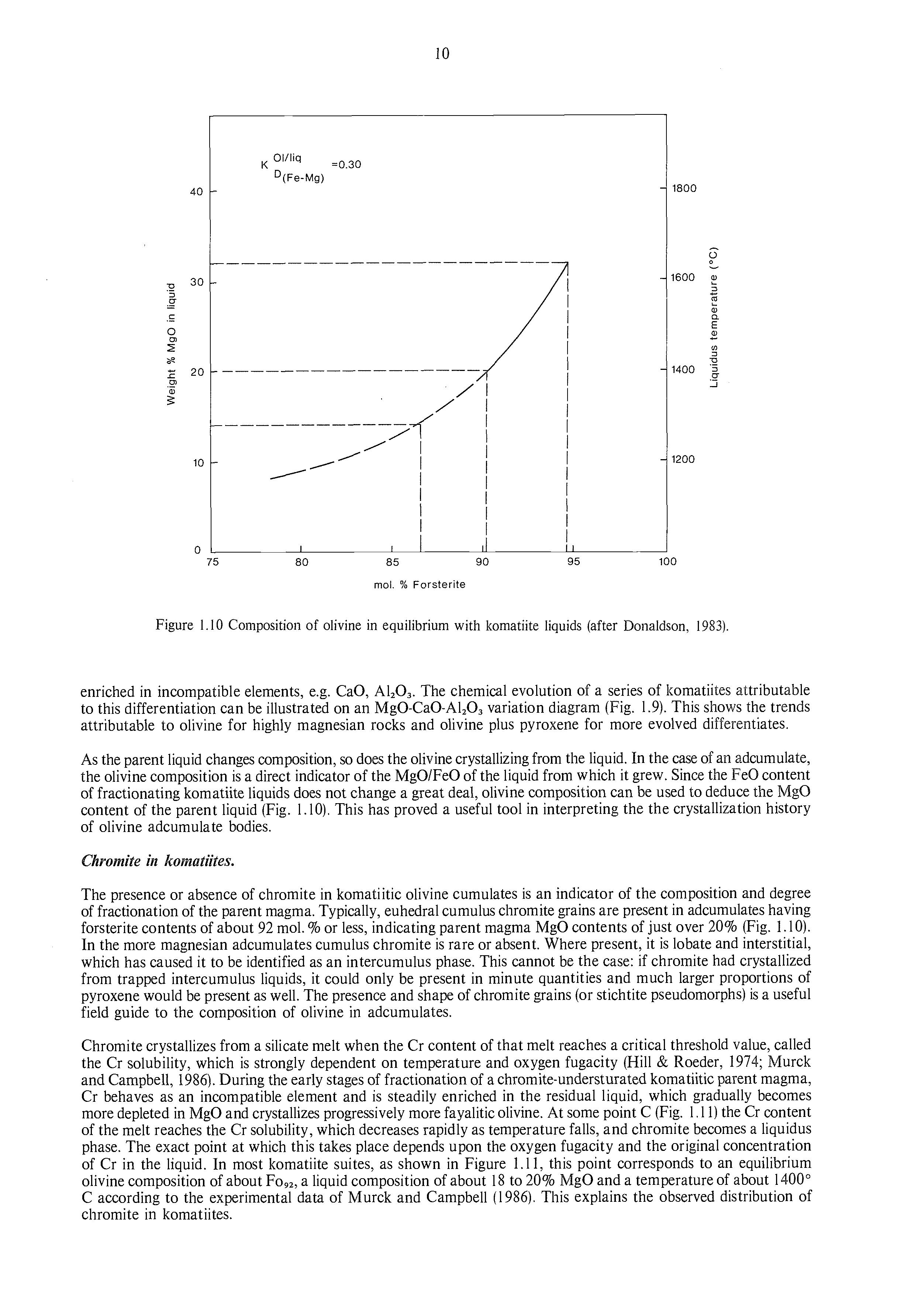
Figure 1.10 Composition of olivine in equilibrium with komatiite liquids (after Donaldson, 1983).
enriched in incompatible elements, e.g. CaO, A1,0,. The chemical evolution of a series of komatiites attributable to this differentiation can be illustrated on an MgO-CaO-Al,O, variation diagram (Fig. 1.9). This shows the trends attributable to olivine for highly magnesian rocks and olivine plus pyroxene for more evolved differentiates.
As the parent liquid changes composition, so does the olivine crystallizing from the liquid. In the ase of an adcumulate, the olivine composition is a direct indicator of the MgOlFeO of the liquid from which it grew. Since the FeO content of fractionating komatiite liquids does not change a great deal, olivine composition can be used to deduce the MgO content of the parent liquid (Fig. 1.10). This has proved a useful tool in interpreting the the crystallization history of olivine adcumulate bodies.
The presence or absence of chromite in komatiitic olivine cumulates is an indicator of the composition and degree of fractionation of the parent magma. Typically, euhedral cumulus chromite grains are present in adcumulates having forsterite contents of about 92 mol. Yo or less, indicating parent magma MgO contents of just over 20% (Fig. 1.10). In the more magnesian adcumulates cumulus chromite is rare or absent. Where present, it is lobate and interstitial, which has caused it to be identified as an intercumulus phase. This cannot be the case: if chromite had crystallized from trapped intercumulus liquids, it could only be present in minute quantities and much larger proportions of pyroxene would be present as well. The presence and shape of chromite grains (or stichtite pseudomorphs) is a useful field guide to the composition of olivine in adcumulates.
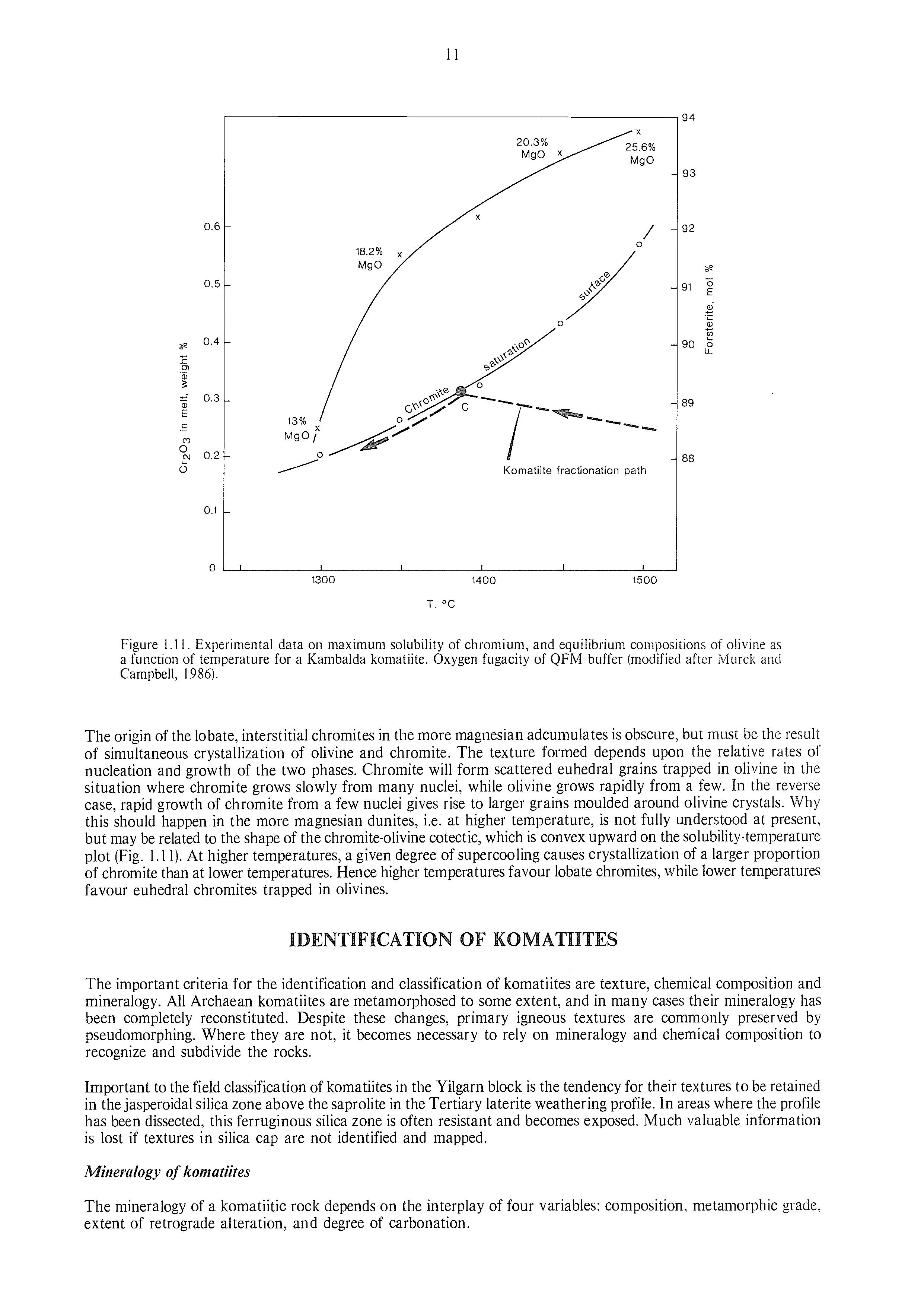
Chromite crystallizes from a silicate melt when the Cr content of that melt reaches a critical threshold value, called the Cr solubility, which is strongly dependent on temperature and oxygen fugacity (Hill & Roeder, 1974; Murck and Campbell, 1986). During the early stages of fractionation of a chromite-understurated komatiitic parent magma, Cr behaves as an incompatible element and is steadily enriched in the residual liquid, which gradually becomes more depleted in MgO and crystallizes progressively more fayalitic olivine. At some point C (Fig. 1.11) the Cr content of the melt reaches the Cr solubility, which decreases rapidly as temperature falls, and chromite becomes a liquidus phase. The exact point at which this takes place depends upon the oxygen fugacity and the original concentration of Cr in the liquid. In most komatiite suites, as shown in Figure 1.11, this point corresponds to an equilibrium olivine composition of about Fog,, a liquid composition of about 18 to 20% MgO and a temperature of about 1400" C according to the experimental data of Murck and Campbell (1 986). This explains the observed distribution of chromite in komatiites.
Figure 1. I 1. Experimental data on maximum solubility of chromium, and equilibrium compositions of olivine as a function of temperature for a Kambalda komatiite. Oxygen fugacity of QFM buffer (modified after Murck and Campbell, 1986).
The origin of the lobate, interstitial chromites in the more magnesian adcumulates is obscure, but must be the result of simultaneous crystallization of olivine and chromite. The texture formed depends upon the relative rates of nucleation and growth of the two phases. Chromite will form scattered euhedral grains trapped in olivine in the situation where chromite grows slowly from many nuclei, while olivine grows rapidly from a few. In the reverse case, rapid growth of chromite from a few nuclei gives rise to larger grains moulded around olivine crystals. Why this should happen in the more magnesian dunites, i.e. at higher temperature, is not fully understood at present, but may be related to the shape of the chromite-olivine cotectic, which is convex upward on the solubility-temperature plot (Fig. 1.11). At higher temperatures, a given degree of supercooling causes crystallization of a larger proportion of chromite than at lower temperatures. Hence higher temperatures favour lobate chromites, while lower temperatures favour euhedral chromites trapped in olivines.
The important criteria for the identification and classification of komatiites are texture, chemical composition and mineralogy. All Archaean komatiites are metamorphosed to some extent, and in many cases their mineralogy has been completely reconstituted. Despite these changes, primary igneous textures are commonly preserved by pseudomorphing. Where they are not, it becomes necessary to rely on mineralogy and chemical composition to recognize and subdivide the rocks.
Important to the field classification of komatiites in the Yilgarn block is the tendency for their textures to be retained in the jasperoidal silica zone above the saprolite in the Tertiary laterite weathering profile. In areas where the profile has been dissected, this ferruginous silica zone is often resistant and becomes exposed. Much valuable information is lost if textures in silica cap are not identified and mapped.
neralogy of komatiites
The mineralogy of a komatiitic rock depends on the interplay of four variables: composition, metamorphic grade. extent of retrograde alteration, and degree of carbonation.
mposition. Compositional variability arises from two factors: the degree of differentiation of the parent magma, quid to cumulus olivine in the igneous precursor. The first factor can be avoided (about 25 to 32%) komatiite lavas, i.e. those that give rise to typical olivine spinifex itional variability for practical purposes to a linear mixture of two end members:
and the initial proporti by considering only hig textures. This reduces komatiite magma and cumulus olivine, with flow tops and olivine adcumulates respectively Olivine orthocumulates fall in the centre, and spinifex zones close to the magma component spectrum of compositions is reflected in the modal proportion of either olivine or serpentine (tbrucite) to Ca and A1 bearing minerals such as chlorite and tremolitelactinolite.
ic Grade. Owing to their ultramafic compositions, komatiites are especially susceptible to hydration at tures. Alteration occurring prior to the onset of the main metamorphic episode results in serpentinization of olivine and hydration of the glassy groundmass component. During prograde metamorphism, dehydration reactions result in formation of new metamorphic minerals from breakdown of low-temperature alteration products. Lizardite and chrysotile serpentine give way to antigorite in the greenschist facies. Chlorite forms at low grades and remains stable over a wide temperature interval. It is the dominant Al-bearing mineral in most metam Tremolitic amphibole is the principal Ca-bearing mineral at mid-greenschist facies and above. forms from the dehydration of serpentine at upper greenschist to lower amphibolite facie composition.
Primary igneous minerals may also be retained. Relic pyroxenes are commonly preserved at low metamorphic grades, but tend to be relaced by amphiboles at amphibolite facies. Preservation of igneous olivine is also a function of Ontario (Arndt, 1986; Sarah-Jane Barnes et al., 1983), and fresh igneous olivine occurs rd and Marshall Pool (Donaldson, 1983). Olivine is hardly ever retained in rocks at (300-350" C) for kinetic reasons: serpentinization is most rapid in this temperature been meta~orphoseda at low grades, but fresh spinifex olivine has been reported in flows at by retrograde ser~ntini~~ion, relic igneous olivine is common
trip, both in fresh drill core and as a ghost texture in lateritic silica cap.
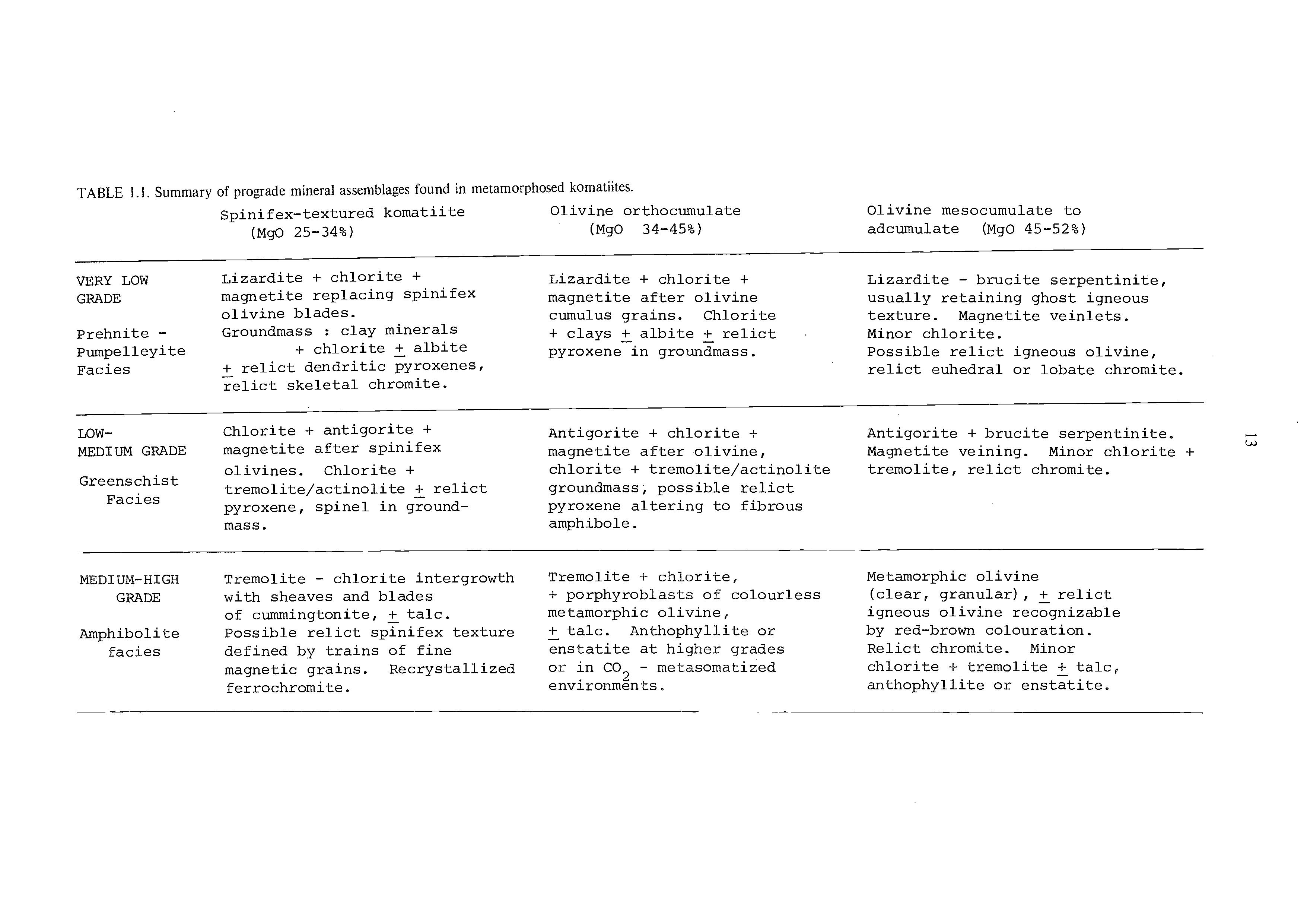
The combined effects of composition and metamorphic grade on prograde mineralogy are summarised in Table 1.1. The most important int is that spinifex textured A-zones and flow tops become converted to amphibolegreenchist and amphibolite facies. Ghost spinifex textures may be preserved, usually agnetite grains, but in many cases these r s consist of fine-grained matted intergrowths nd chlorite with no mesoscopic texture. h rock units have commonly been mapped rocks, as distinct from texturally recognizable komatiites, but they should be classified e orthocumulates show similar mineralogy, except for the presence of porphyroblastic phibolite facies and above. As a rough rule of thumb, in amphi~l~tefacies komatiites, olivine in the rock is about the same as the original proportion of cumulus olivine in the igneous protolith. Olivine adcumulates are converted to lizarditelbrucite serpentinites at low grade, antigoritelbrucite serpentinites at intermediate grade and monomineralic metamorphic olivine rocks (dunites)at high c or less commonly anthophyllite or enstatite may develop in orthocumulates and mesocumulates at higher iic groundmass pyroxene may be found at low grades, but is typically converted to amphibole at higher grades.
etrograde ~e~u~or~~is~. The picture is complicated by the reversion of high-temperature prograde metamorphic minerals to hydrous low-grade assemblages during subsequent interaction with low-temperature fluids. The most obvious effect of this is the conversion of metamorphic and relic igneous olivine to lizardite plus brucite. This late serpentinization usually gives rise to pseudomorphs, so that under favourable conditions serpentinized metamorphic olivine can be distinguished from serpentinized igneous olivine on the basis of porphyroblastic or bladed habit. Enstatite and anthophyllite are often retrogressed to talc. Tremolite and chlorite typically survive retrograde effects.
As an example of a possible metamorphic history, an original olivine orthocumulate may first undergo sea-floor alteration to an assemblage of serpentine (lizardite), chlorite, clays, and albite. n metamorphism to amphibolite facies, this is converted to tremolite, chlorite, metamorphic olivine, and possibly talc. ubsequently, the olivine is serpentinized giving a present-day dis-equilibrium assemblage of tremolite, chlorite, talc, lizardite, magnetite, and bruci te.
TABLE 1.1, Summary of prograde mineral assemblages found in metamorphosed komatiites.
Spinifex-textured komatiite Olivine orthocumulate Olivine mesocumulate to adcumulate (MgO 45-52%) (MgO 34-45%) (MgO 25-34%)
VERY LOW GRADE magnetite replacing spinifex
prehnite - Groundmass : clay minerals pumpelleyite + chlorite 5 albite
Facies -
Lizardite + chlorite + Lizardite - brucite serpentinite, magnetite after olivine usually retaining ghost igneous cumulus grains. Chlorite texture. Magnetite veinlets. + clays+ albite 5 relict pyroxene in groundmass. Possible relict igneous olivine,
Lizardite + chlorite + olivine blades. Minor chlorite. relict euhedral or lobate chromite. + relict dendritic pyroxenes, relict skeletal chromite.
LOWMEDIUM GRADE magnetite after spinifex
Greenschis t Facies
mDI UM- HIGH
Antigorite + chlorite + Antigorite + brucite serpentinite.
Chlorite + antigorite + magnetite after olivine, Magnetite veining. Minor chlorite + olivines. Chlorite + chlorite + tremolite/actinolite tremolite, relict chromite.
tremolite/actinolite 5 relict groundmass, possible relict pyroxene, spinel in ground- pyroxene altering to fibrous mass. amphibole.
Tremolite - chlorite intergrowth
Tremolite + chlorite, GRADE with sheaves and blades + porphyroblasts of colourless of cmingtonite, 2 talc. metamorphic olivine I Amphibolite Possible relict spinifex texture 5 talc. Anthophyllite or facies defined by trains of fine enstatite at higher grades magnetic grains. Recrystallized or in CO - metasomatized ferrochromite. environments 2
Metamorphic olivine (clear, granular), relict igneous olivine recognizable by red-brown colouration . Relict chromite. Minor chlorite + tremolite + talc, anthophyllite or enstatite.
A typical differentiated komatiite flow, starting with a lower cumulate B-zone and an upper spinifex textured Azone (Fig. 1.12) at amphibolite facies, is converted to a lower zone of olivine(or retrograde serpentine)-tremolitechlorite rock, and an upper zone of amphibole-chlorite rock, with minor metamorphic olivine (or serpentine) in the original A-zone. Sequences of such flows will appear as alternations of olivine-tremolite-chloriteand tremolitecummingtonite-chlorite rocks, as will be demonstrated at Agnew.
Carbonate alteration. Komatiites, or any other ultramafic rocks, are highly susceptible to carbonate alteration, as a result of the instability of serpentine minerals in the presence of fluids with even minor proportions of CO,. Either lizardite or antigorite is readily converted to talc plus magnesite (or dolomite in rocks with significant amounts of CaO). Talc-carbonate alteration can occur during prograde metamorphism or during retrograde alteration (or both, as has apparently happened at Agnew). Minor amounts of magnesite or (more commonly) dolomite may be found in any of the assemblages listed in Table 1.1. It appears that the presence of carbonate favours the retention of pseudomorphed spinifex textures in amphibolite facies rocks. The talc-magnesite assemblage breaks down to either forsterite plus talc or forsterite plus magnesite at about 550" C (low- to mid-amphibolite). Pervasive talc carbonate alteration is especially prevalent near major shear zones which have channelled carbonate-bearing metamorphic fluids, and consequently in many cases original textures are totally obliterated.
Chemical criteria for identi$cation of komafiites
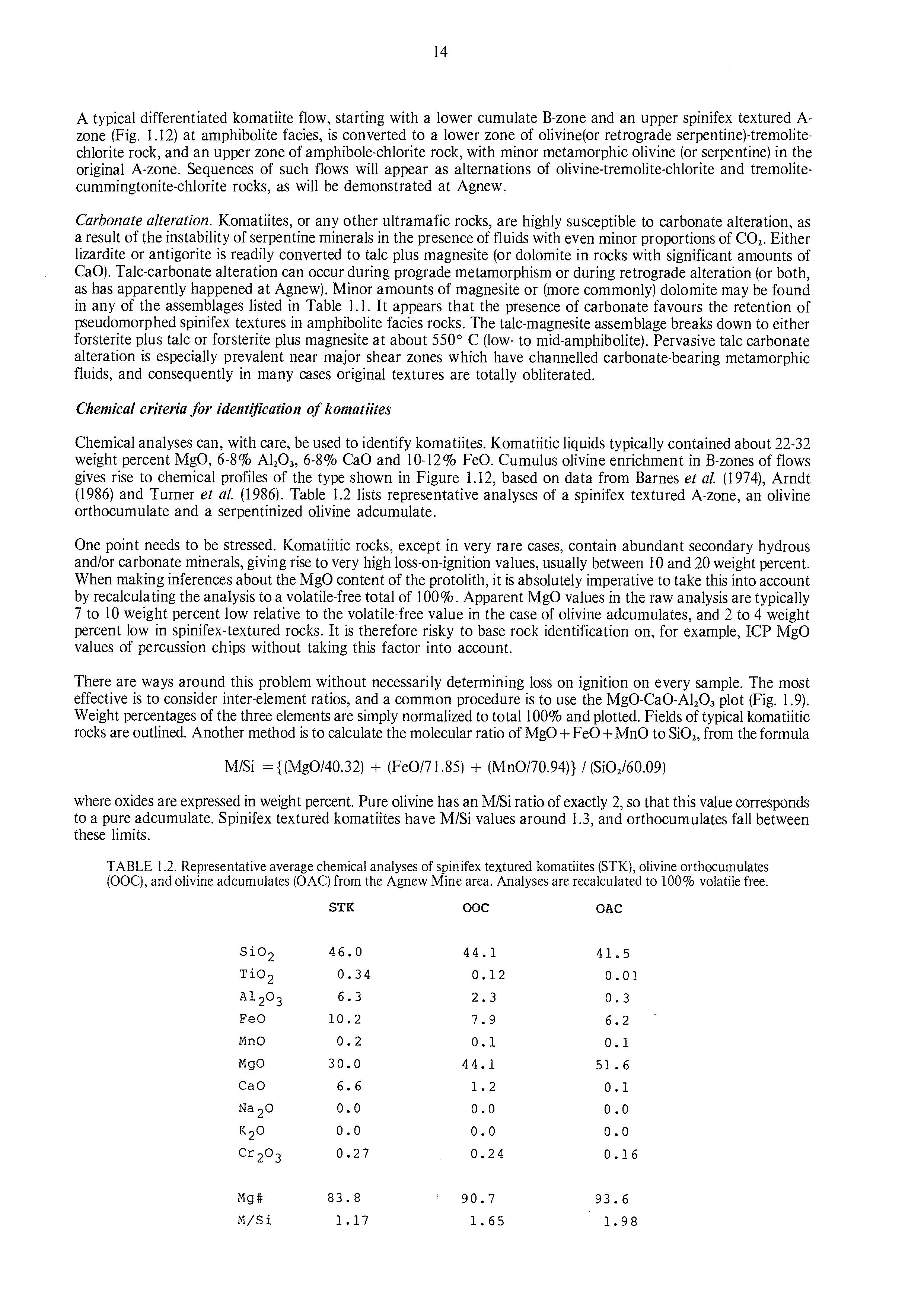
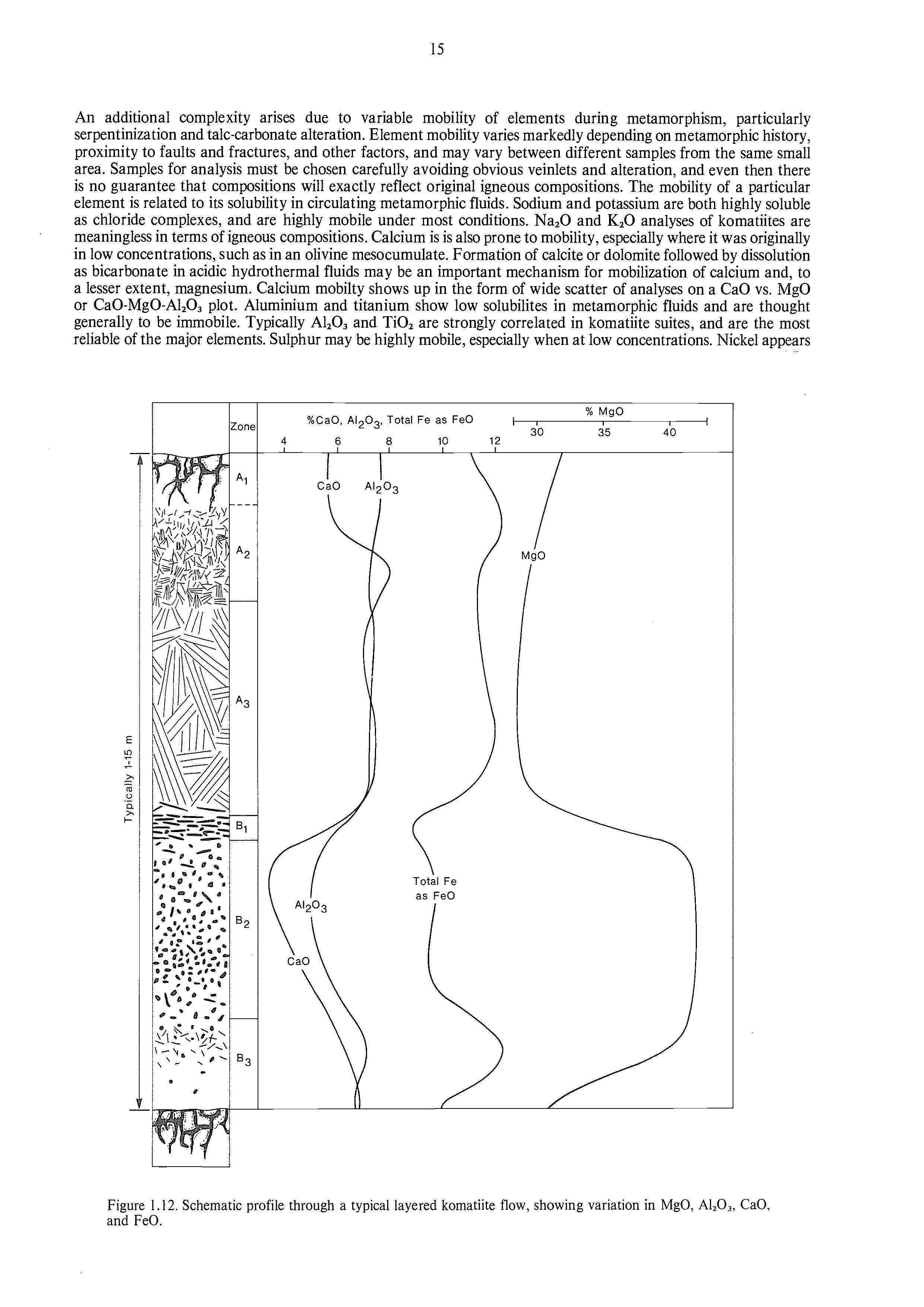
Chemical analyses can, with care, be used to identify komatiites. Komatiitic liquids typically contained about 22-32 weight percent MgO, 6-8% A1203,64% CaO and 10-12% FeO. Cumulus olivine enrichment in B-zones of flows gives rise to chemical profiles of the type shown in Figure 1.12, based on data from Barnes et al. (1 974), Arndt (1986) and Turner et al. (1986). Table 1.2 lists representative analyses of a spinifex textured A-zone, an olivine orthocumulate and a serpentinized olivine adcumulate.
One point needs to be stressed. Komatiitic rocks, except in very rare cases, contain abundant secondary hydrous andlor carbonate minerals, giving rise to very high loss-on-ignition values, usually between 10 and 20 weight percent. When making inferences about the MgO content of the protolith, it is absolutely imperative to take this into account by recalculating the analysis to a volatile-free total of 100%. Apparent MgO values in the raw analysis are typically 7 to 10 weight percent low relative to the volatile-free value in the case of olivine adcumulates, and 2 to 4 weight percent low in spinifex-textured rocks. It is therefore risky to base rock identification on, for example, ICP MgO values of percussion chips without taking this factor into account.
There are ways around this problem without necessarily determining loss on ignition on every sample. The most effective is to consider inter-element ratios, and a common procedure is to use the MgO-CaO-Al,O, plot (Fig. 1.9). Weight percentages of the three elements are simply normalized to total 100% and plotted. Fields of typical komatiitic rocks are outlined. Another method is to calculate the molecular ratio of MgO + FeO + MnO to SiO,, from the formula
MlSi = { (MgOl40.32) + (Fe017 1.85) + (MnOl70.94)) I (Si0,/60.09)
where oxides are expressed in weight percent. Pure olivine has an MlSi ratio of exactly 2, so that this value corresponds to a pure adcumulate. Spinifex textured komatiites have MlSi values around 1.3, and orthocumulates fall between these limits.
TABLE 1.2. Representative average chemical analyses of spinifex textured komatiites (STK),olivine orthocumulates (OOC),and olivine adcumulates (OAC)from the Agnew Mine area. Analyses are recalculated to 100% volatile free.
An additional complexity arises due to variable mobility of elements during metamorphism, particularly serpentinization and talc-carbonate alteration. Element mobility varies markedly depending on metamorphic history, proximity to faults and fractures, and other factors, and may vary between different samples from the same small area. Samples for analysis must be chosen carefully avoiding obvious veinlets and alteration, and even then there is no guarantee that compositions will exactly reflect original igneous compositions. The mobility of a particular element is related to its solubility in circulating metamorphic fluids. Sodium and potassium are both highly soluble as chloride complexes, and are highly mobile under most conditions. Na,O and K,O analyses of komatiites are meaningless in terms of igneous compositions. Calcium is is also prone to mobility, especially where it was originally in low concentrations, such as in an olivine mesocumulate. Formation of calcite or dolomite followed by dissolution as bicarbonate in acidic hydrothermal fluids may be an important mechanism for mobilization of calcium and, to a lesser extent, magnesium. Calcium mobilty shows up in the form of wide scatter of analyses on a CaO vs. MgO or CaO-MgO-AI,O, plot. Aluminium and titanium show low solubilites in metamorphic fluids and are thought generally to be immobile. Typically A1,0, and TiO, are strongly correlated in komatiite suites, and are the most reliable of the major elements. Sulphur may be highly mobile, especially when at low concentrations. Nickel appears
A1203,
Figure 1.12. Schematic profile through a typical layered komatiite flow, showing variation in MgO, A1203,CaO, and FeO.
to be fairly immobile (Donaldson 1981). Among trace elements, the rare earth elements with the exception of Eu and Ce are immobile through most styles of metamorphism and alteration except the most intense hydrothermal leaching, as are Zr and Y.
Terminology and Rock Names
Since all komatiites are metamorphosed, confusion arises with terminology. In rocks where original igneous textures are preserved, eg, spinifex-textured komatiites or olivine adcumulates, it is appropriate to use igneous rock names. Metamorphic rock names can be used for rocks whose original igneous features have been obliterated; for example “tremolite-chlorite-olivine-enstatiterock”, or “serpentine-tremolite-chloriterock”. In the case where metamorphic olivine has undergone retrograde serpentinization, the rock should be named according to its pre-serpentinization olivine content, e.g., “serpentinized olivine-tremolite-chloriterock” rather than “serpentine-tremolite-chloriterock”, in recognition of the late-stage nature of the serpentinization. In most cases, however, it would be more informative to refer to these rocks as “meta-komatiites”, with additional qualifiers such as “A-zone”, “orthocumulate” etc. This usage may be somewhat arbitrary, in that all komatiites are meta-komatiites, but it brings the terminology in line with that commonly applied to greenstone belt basalts. The precise choice of terminology is less important than the general point, which is that amphibole-chlorite rocks of komatiitic origin and komatiites with preserved spinifex textures should be recognized as the same rock type from a stratigraphic viewpoint.
CHAPTER 2
The supracrustal rocks that extend from Siberia through Broad Arrow to Menzies are, in general aspect, typical of the greenstones of the Norseman-Wiluna Belt (Fig. 2.1). Almost all the rock types occurring in this area are common in the other greenstone belts and the lithostratigraphy of this area is readily correlated with that of some other areas in the Belt (e.g., Kalgoorlie and Kambalda). There is however, one striking difference: the presence, at the base of the komatiite pile, of a laterally extensive unit of coarse-grained olivine adcumulate. It is this unit that will be inspected during the first day of the field trip.
This is the most extensive body of olivine adcumulate known to exist in the Yilgarn Block. To the south, in the Kalgoorlie-Norsemanarea, the most olivine-rich rocks are mesocumulates and these appear to be relatively uncommon. The adcumulate bodies between Agnew and Wiluna and those in the Forrestannia area all appear to laterally restricted with widths, as presently exposed, of 1-3 km. The adcumulate body, which we have called the Walter Williams Ultramafic Unit (see frontispiece), can be traced over an area of 35 x 100 km and its full extent has not yet been determined. During the field trip, textures and rock types within the Walter Williams Ultramafic Unit will be seen and the contrast in physical volcanological environments between overlying spinifex-textured flows and adcumulate sheet will be discussed.
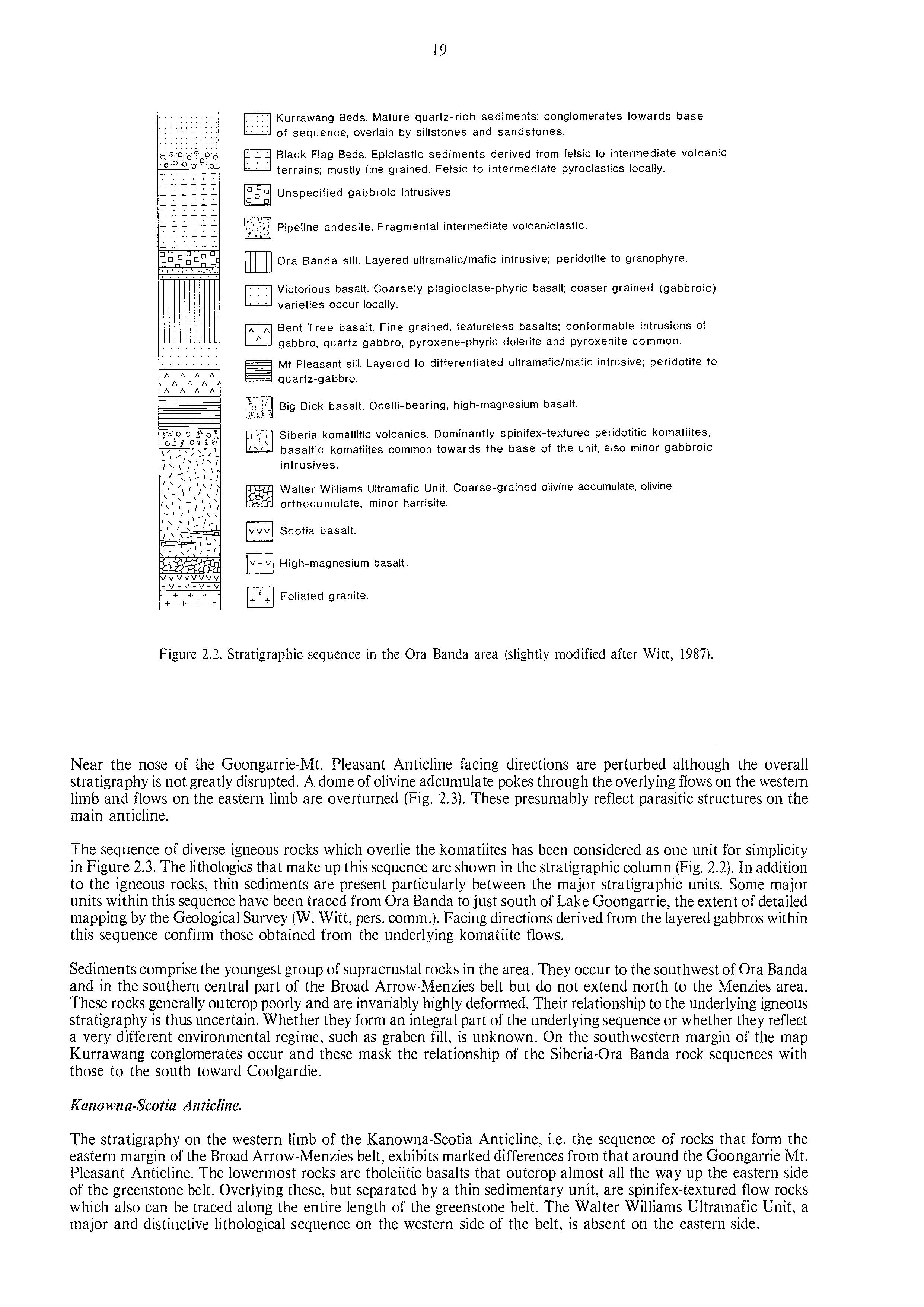
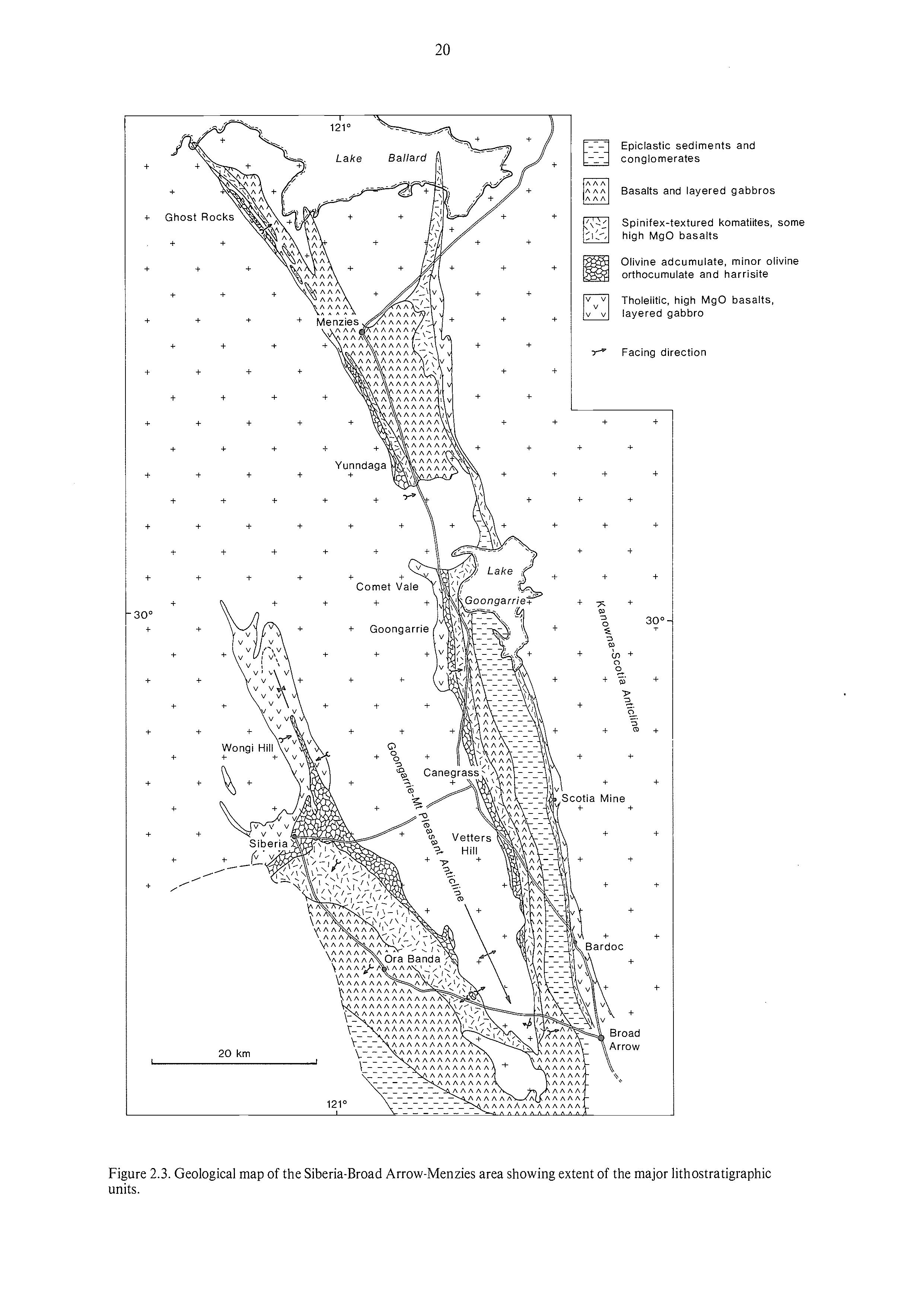
The generally good exposure with well-perserved igneous textures together with data from extensive mineral exploration have enabled a regional stratigraphy to be erected that is applicable to the Siberia-Broad Arrow-Menzies area and which is probably valid over a much larger area. The stratigraphy in the Ora Banda area has recently been described by Witt (1987), Figure 2.2. Several of the stratigraphic units, including the komatiites, can confidently be traced from the Siberia area to north of Menzies. A simplified geological map of this area and has been contructed with the aid of maps from J.A. Hallberg (consultant), N. Harrison (BHP) and N. Herriman (CRA), Figure 2.3. The stratigraphy consists of a lower series of basalts, a thick pile of komatiites, a series of layered gabbroic bodies and basalts and finally a sedimentary sequence. These rocks have been generally little deformed by open regional scale folds. In the following notes, the sequences around the Goongarrie-Mt. Pleasant and the Kanowna-Scotia Anticlines are described separately.
Pleasant Anticline
The lowermost rocks of the stratigraphy that are preserved, those below the komatiites, are best exposed west and north of Siberia. Here the lowest unit consists of high magnesian basalts. Above this are tholeiitic basalts and layered gabbros. These are particularly we11 exposed in the Wongi Hill area where facing directions from the gabbros indicate the presence of a gently southerly-plunging syncline. The only other locality where a significant thickness of this footwall sequence is present is in the Gmngarrie-Comet Vale area, although here exposure is poor. Elsewhere around the Goongarrie-Mt. Pleasant Anticline the footwall sequence is either stoped out by granite or present as only a thin sliver of tholeiitic basalt on the margin of the greenstone belt.
The footwall tholeiitic basalts exposed in the Missouri open pit north of Siberia are pillowed. These well-preserved pillows contain no vesicles and this implies formation at water depths greater than about 500 m (Jones, 1969).
The komatiite pile can be divided into two very different units: the Walter Williams Ultramafic Unit, composed largely of olivine adcumulate, and the overlying Siberia Komatiitic Volcanics made up of spinifex-textured flow rocks (Witt, 1987), Figure 2.2. Details of these units are given in the next section although aspects important to the regional geology are discussed here. Differentiation in the flows provide evidence of facing direction throughout the area. On the western limb of the Goongarrie-Mt. Pleasant Anticline the facing directions are consistently southwesterly. Exposures in steep-sided creeks south-east of Siberia indicate the dips of the flows to be extremely shallow, consistent with the width of the outcrop of the komatiites in this area compared with that on the eastern limb of the anticline. Igneous textures in the komatiites (and other rocks) on the eastern limb are well preserved and suggest that the apparent thickness of rock units here compared to the western limb is largely a function of a steeper dip rather than flattening due to deformation. Along the eastern limb facing directions derived from the flows are consistently easterly.
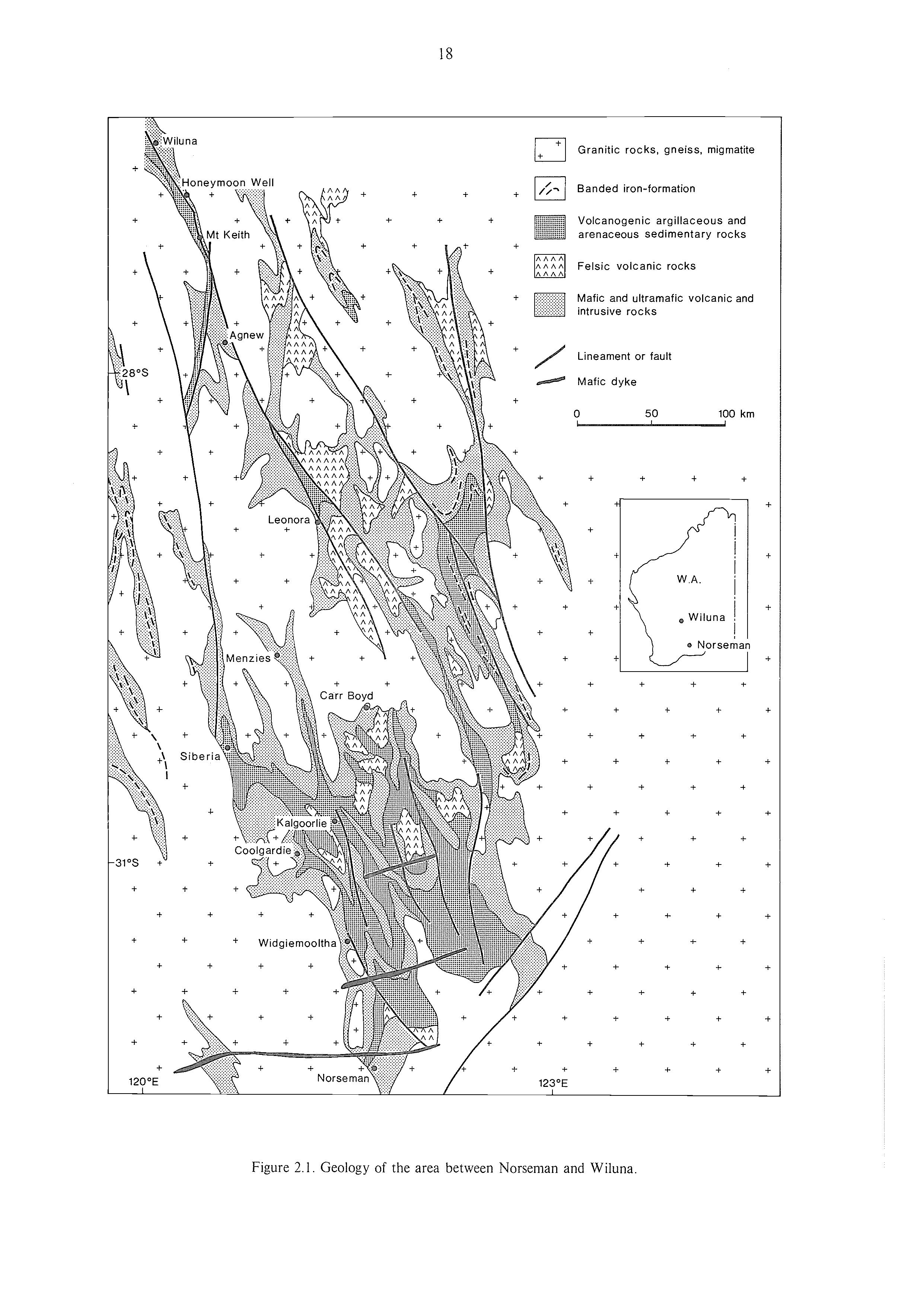
Figure 2.1. Geology of the area between Norseman and Wiluna.
Kurrawang Beds. Mature quartz-rich sediments; conglomerates towards base of sequence, overlain by siltstones and sandstones.
Black Flag Beds. Epiclastic sediments derived from felsic to intermediate volcanic - terrains; mostly fine grained. Felsic to intermediate pyroclastics locally.
Unspecified gabbroic intrusives
Pipeline andesite. Fragmental intermediate volcaniclastic
Ora Banda sill. Layered ultramafic/mafic intrusive; peridotite to granophyre.
Victorious basalt. Coarsely plagioclase-phyric basalt; coaser grained (gabbroic) varieties occur locally.
Bent Tree basalt. Fine grained, featureless basalts; conformable intrusions of gabbro, quartz gabbro, pyroxene-phyric dolerite and pyroxenite common.
Mt Pleasant sill. quartz-gabbro.
Layered to differentiated ultramafic/mafic intrusive; peridotite to
a'Big Dick basalt, Ocelli-bearing, high-magnesium basalt.
Siberia komatiitic volcanics. Dominantly spinifex-textured peridotitic komatiites. basaltic komatiites common towards the base of the unit, also minor gabbroic intrusives.
Walter Williams Ultramafic Unit. Coarse-grained olivine adcumulate, olivine orthocumulate. minor harrisite.
Scotia basalt.
High-magnesium basalt. Foliated granite.
Figure 2.2.
Stratigraphic sequence in the Ora Banda area (slightly modified after Witt, 1987).
Wear the nose of the Goongarrie- t. Pleasant Anticline facing directions are perturbed although the overall stratigraphy is not greatly disrupted. A dome of olivine adcumulate pokes through the overlying flows on the western limb and flows on the eastern limb are overturned (Fig. 2.3). These presumably reflect parasitic structures on the main anticline.
The sequence of diverse igneous rocks which overlie the komatiites has been considered as one unit for simplicity in Figure 2.3. The lithologies that make up this sequence are shown in the stratigraphic column (Fig. 2.2). In addition to the igneous rocks, thin sediments are present particularly between the major stratigraphic units. Some major units within this sequence have been traced from Ora Banda to just south of Lake Goongarrie, the extent of detailed mapping by the Geological Survey (W. Witt, pers. comm.). Facing directions derived from the layered gabbros within this sequence confirm those obtained from the underlying komatiite flows.
Sediments comprise the youngest group of supracrustal rocks in the area. They occur to the southwest of Ora Banda and in the southern central part of the Broad Arrow-Menzies belt but do not extend north to the Menzies area. These rocks generally outcrop poorly and are invariably highly deformed. Their relationship to the underlying igneous stratigraphy is thus uncertain. Whether they form an integral part of the underlying sequence or whether they reflect a very different environmental regime, such as graben fill, is unknown. On the southwestern margin of the map Kurrawang conglomerates occur and these mask the relationship of the Siberia-Ora Banda rock sequences with those to the south toward Coolgardie.
no wna-Scotia Anticline.
The stratigraphy on the western limb of the Kanowna-Scotia Anticline, i.e. the sequence of rocks that form the eastern margin of the Broad Arrow-Menzies belt, exhibits marked differences from that around the Goongarrie-Mt. Pleasant Anticline. The lowermost rocks are tholeiitic basalts that outcrop almost all the way up the eastern side of the greenstone belt. Overlying these, but separated by a thin sedimentary unit, are spinifex-textured flow rocks which also can be traced along the entire length of the greenstone belt. The Walter Williams Ultramafic Unit, a major and distinctive lithological sequence on the western side of the belt, is absent on the eastern side.
+ Ghost Rock
1 20 km
+ Goongarrie
Epiclastic sediments and
Olivine adcumulate, minor olivine orthocumulate and harrisite
Tholeiitic, high MgO basalts,
9 Facing direction
Figure 2.3. Geological map of the Siberia-Broad Arrow-Menzies area showing extent of the major lithostratigraphic units.
Differentiation in the spinifex-textured flows clearly indicates westerly facings along the entire length of outcrop.
Epiclastic sediments occur west of the spinifex flows so that the sequence of basalts and layered gabbros present in the stratigraphic section around the Goongarrie- leasant Anticline is absent on this eastern side of the greenstone belt.
On a regional scale the structure is dominated by several south-southeast trending shallowly-plunging anticlines and synclines with the greenstones mostly occupying the synclines and granite forming the anticlinal crests. The extent and coherency of rock units in the greenstone belt suggests that the stratigraphy is relatively intact and that the structure is relatively simple.
The main uncertainty concerns the relationship between the stratigraphy on the eastern and western side of the enzies bell. Facing directions face inward on both sides and, as the central sedimentary unit does not extend to the north, the belt appears to be a shallowly plunging syncline. On the eastern side, the contact between the flow rocks and the central sedimentary unit may be a fault, thus accounting for the absence of basalts and layered gabbros that occupy this stratigraphic position around the Goongarrie-Mt. Pleasant Anticline. Faulting however cannot account for the absence of the Walter Williams Ultramafic Unit from the eastern sequences although the adcumulate at Scotia is a possible correlative unit. This possibility is discussed below.
It appears that there is a major feature that runs up the central part of this greenstone belt. Based on the similarity of the lithologies that are present on both sides of the belt and on the volcanological characteristics of these rocks, particularly the komatiites, we suggest that the footwall tholeiite and komatiite units on each side of the belt are chrono-stratigraphicallyequivalent, and infer that the linear feature, whatever it represents, was present at the time these rocks formed.
This unit can be traced from southwest of Siberia to the shores of Lake Ballard northwest of Menzies (Fig. 2.3). Outcrop of the unit consists mostly of siliceous laterite with a wide variety of olivine cumulate textures although in a few places the lower and upper sections of the unit outcrop as weathered serpentinites. Textures in outcrop and data from drill holes allow the unit to be subdivided and these subdivisions can be recognized throughout the extent of the unit as defined to date.
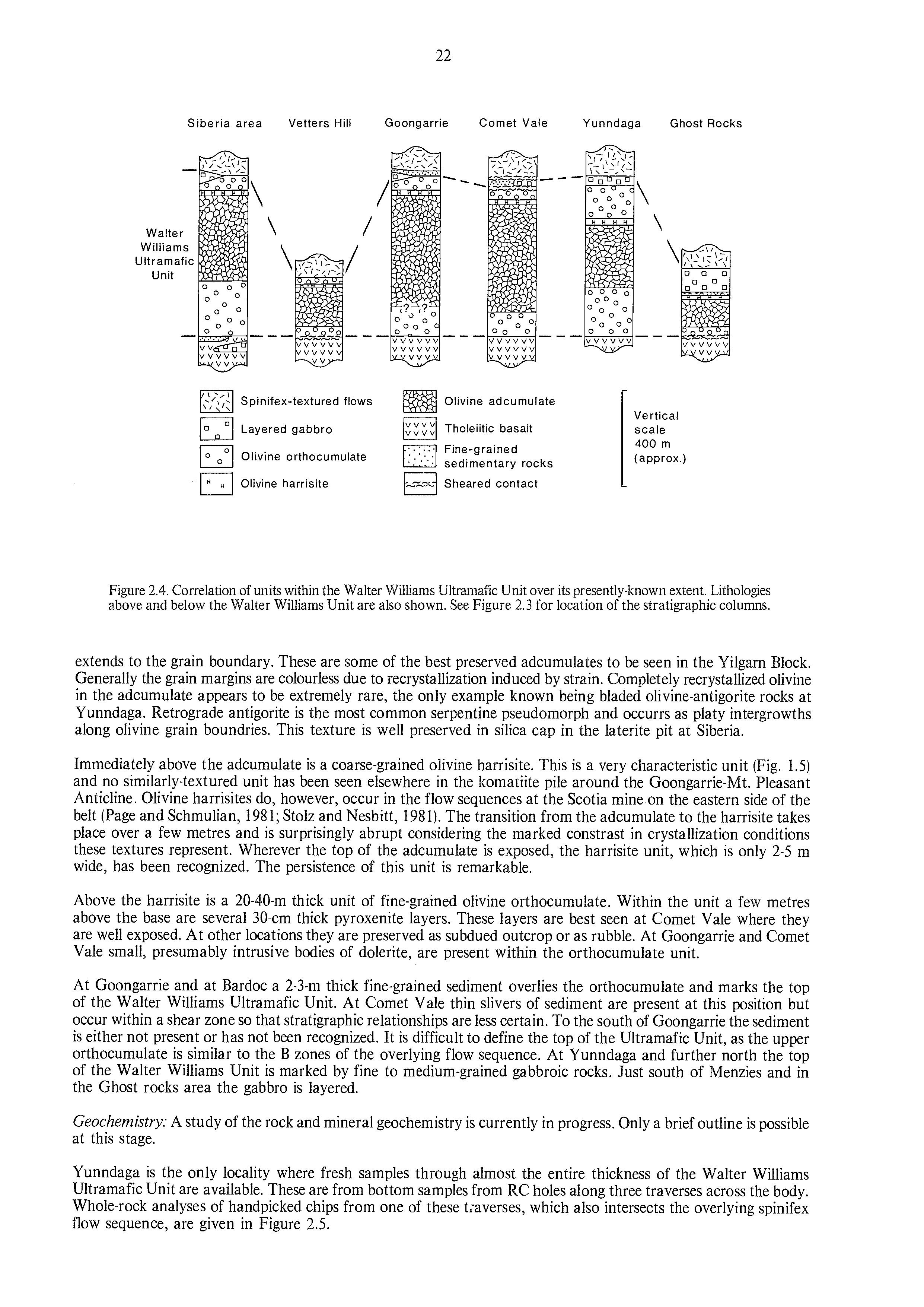
Figure 2.4 shows the stratigraphy of the Walter Williams Ultramafic Unit and enclosing rocks at six localities (see Fig. 2.3). Mapping and high resolution aeromagnetics suggest that the unit is relatively uniform in thickness and continuous except where granite has intruded the sequence.
Estimates of the true thickness of the unit are greatly hampered by the lack of dip information, and the relative thicknesses shown in Figure 2.4 are highly schematic. The true thickness of the unit in the southern part is probably 600-900 m. At Vetters Hill the outcrop thickness is about 200 m, just south of Menzies it is only 50 m and at Ghost Rocks it is again 100-200m. The unit certainly appears to thin from about 10 km south of Menzies northward to Lake Ballard although this may in part be due to deformation as some of the rocks in this area are highly strained.
The lowest subunit, basal to the adcumulate, is a loosely-packed, fine to medium grained olivine orthocumulate containing pyroxene and rare amphibole oikocrysts. It is similar to some of the marginal rocks from the Marshall Pool and Mt. Clifford dunites (see Donaldson et al., 1986). The unit is serpentinized to varying degrees although igneous textures are generally well preserved, Very few drill holes intersect the lower contact and in none is a chilled margin preserved.
Upward through the orthocumulate unit the olivine grain size and packing density increase so that the rock gradually changes to mesocumulate then to an adcumulate. The adcumulate has a grain size of 1-2 cm although just south of Menzies it is only 2-3 mm. Such a fine-grain size is rare in these rocks. Samples obtained from the few drill holes that intersect the adcumulate show the olivine to be mostly fresh. The olivine has a brown pleochroism typical of metamorphosed relic igneous olivine. In some of the adcumulate from northeast of Ora Banda the brown colour
Spinifex-textured flows
Layered gabbro
Olivine orthocumulate
Olivine harrisite
Olivine adcumulate
Tholeiitic basalt
Fine-grained . . sedimentary rocks
Sheared contact
Vertical scale 400 m (approx.)
Figure 2.4. Correlation of units within the Walter Williams Ultramafic Unit over its presently-known extent. Lithologies above and below the Walter Williams Unit are also shown. See Figure 2.3 for location of the stratigraphic columns.
extends to the grain boundary. These are some of the best preserved adcumulates to be seen in the Uilgarn Generally the grain margins are colourless due to recrystallization induced by strain. Completely recrystallized olivine in the adcumulate appears to be extremely rare, the only example known being bladed olivine-antigorite rocks at Yunndaga. Retrograde antigorite is the most common serpentine pseudomorph and occurrs as platy intergrowths along olivine grain boundries. This texture is well preserved in silica cap in the laterite pit at Siberia.
Immediately above the adcumulate is a coarse-grained olivine harrisite. This is a very characteristic unit (Fig. 1.5) and no similarly-textured unit has been seen elsewhere in the komatiite pile around the Goongarrie-Mt. Pleasant Anticline. Olivine harrisites do, however, occur in the flow sequences at the Scotia mine on the eastern side of the belt (Page and Schmulian, 1981; Stolz and Nesbitt, 1981). The transition from the adcumulate to the harrisite takes place over a few metres and is surprisingly abrupt considering the marked constrast in crystallization conditions these textures represent. Wherever the top of the adcumulate is exposed, the harrisite unit, which is only 2-5 m wide, has been recognized. The persistence of this unit is remarkable.
Above the harrisite is a 20-40-m thick unit of fine-grained olivine orthocumulate. Within the unit a few metres above the base are several 30-cm thick pyroxenite layers. These layers are best seen at Comet Vale where they are well exposed. At other locations they are preserved as subdued outcrop or as rubble. At Goongarrie and Comet Vale small, presumably intrusive bodies of dolerite, are present within the orthocumulate unit.
At Goongarrie and at Bardoc a 2-3-m thick fine-grained sediment overlies the orthocumulate and marks the top of the Walter Williams Ultramafic Unit. At Comet Vale thin slivers of sediment are present at this position but occur within a shear zone so that stratigraphic relationships are less certain. To the south of Goongarrie the sediment is either not present or has not been recognized. It is difficult to define the top of the Ultramafic Unit, as the upper orthocumulate is similar to the B zones of the overlying flow sequence. At Yunndaga and further north the top of the Walter Williams Unit is marked by fine to medium-grained gabbroic rocks. Just south of Menzies and in the Ghost rocks area the gabbro is layered.
Geochemistry:A study of the rock and mineral geochemistry is currently in progress. Only a brief outline is possible at this stage.
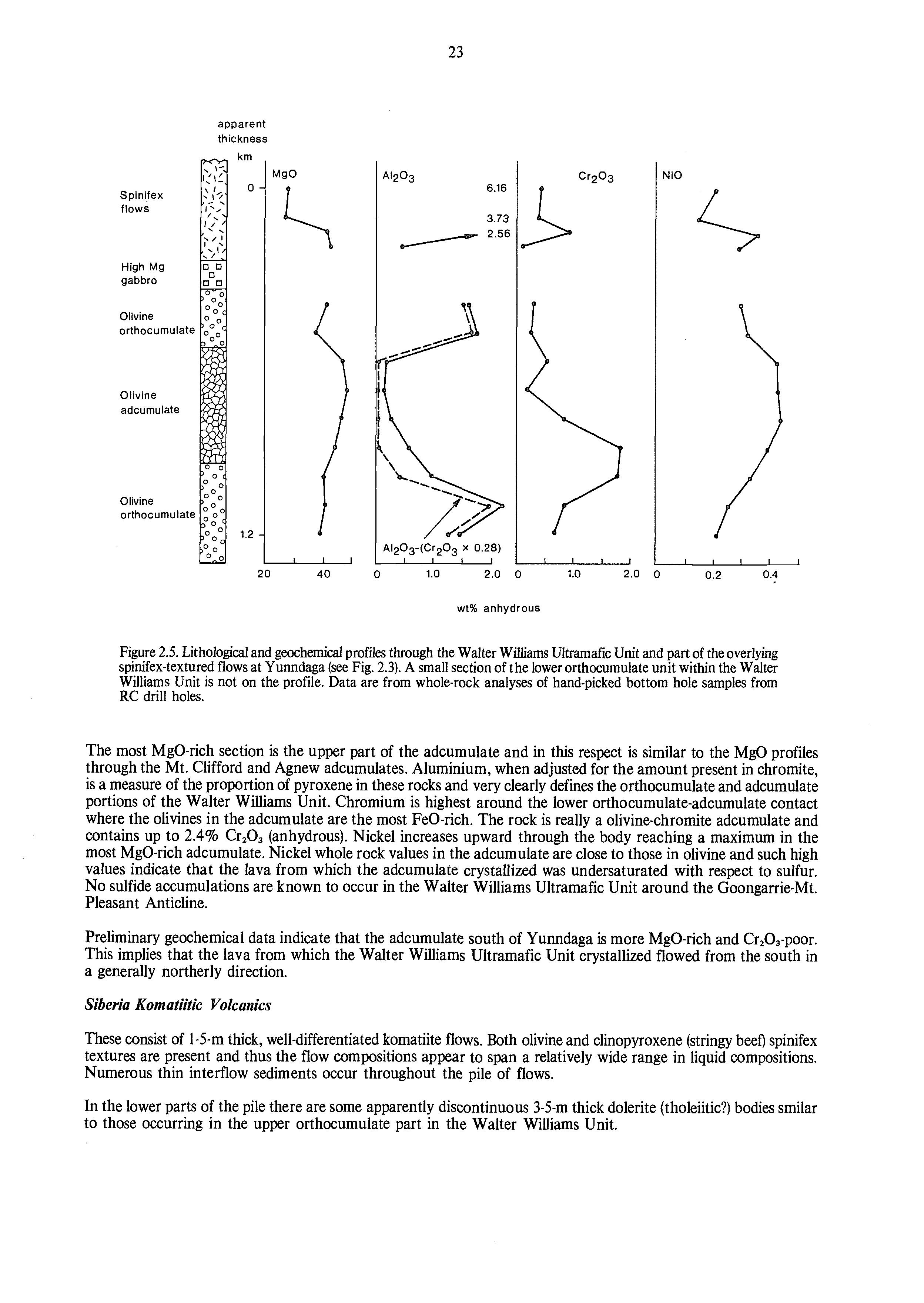
Yunndaga is the only locality where fresh samples through almost the entire thickness of the Walter Williams Ultramafic Unit are available. These are from bottom samples from RC holes along three traverses across the body. Whole-rock analyses of handpicked chips from one of these t;averses, which also intersects the overlying spinifex flow sequence, are given in Figure 2.5.
Siberia area Vetters Hill Goongarrie Comet Vale Yunndaga Ghost Rocks \
Figure 2.5. Lithologial and geochemical profiies through the Walter Williams Ultramafie Unit and part of the overlying spinifex-textured flows at Yunndaga (see Fig. 2.3). A small section of the lower orthocumulate unit within the Walter Williams Unit is not on the profile. Data are from whole-rock analyses of hand-picked bottom hole samples from RC drill holes.
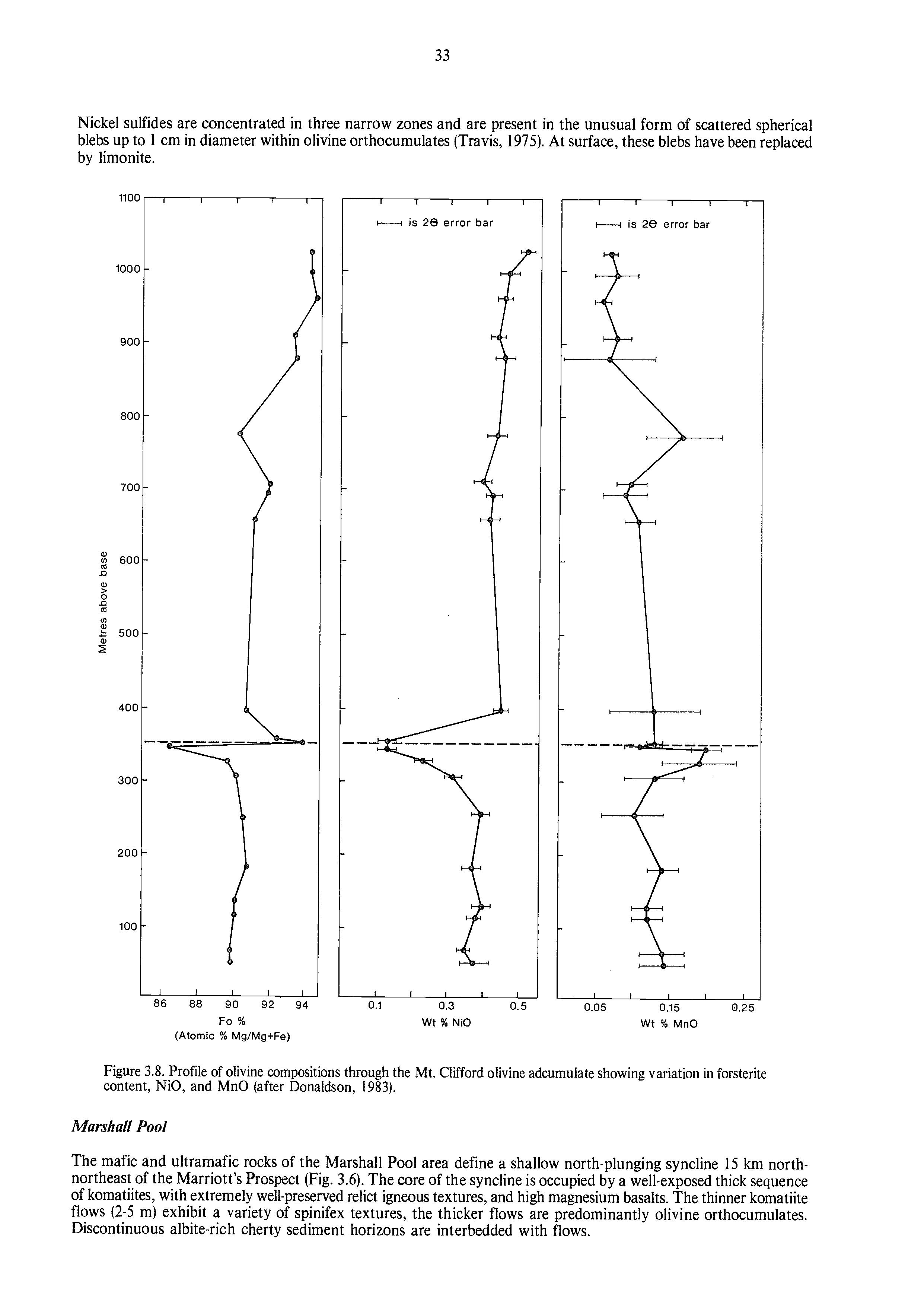
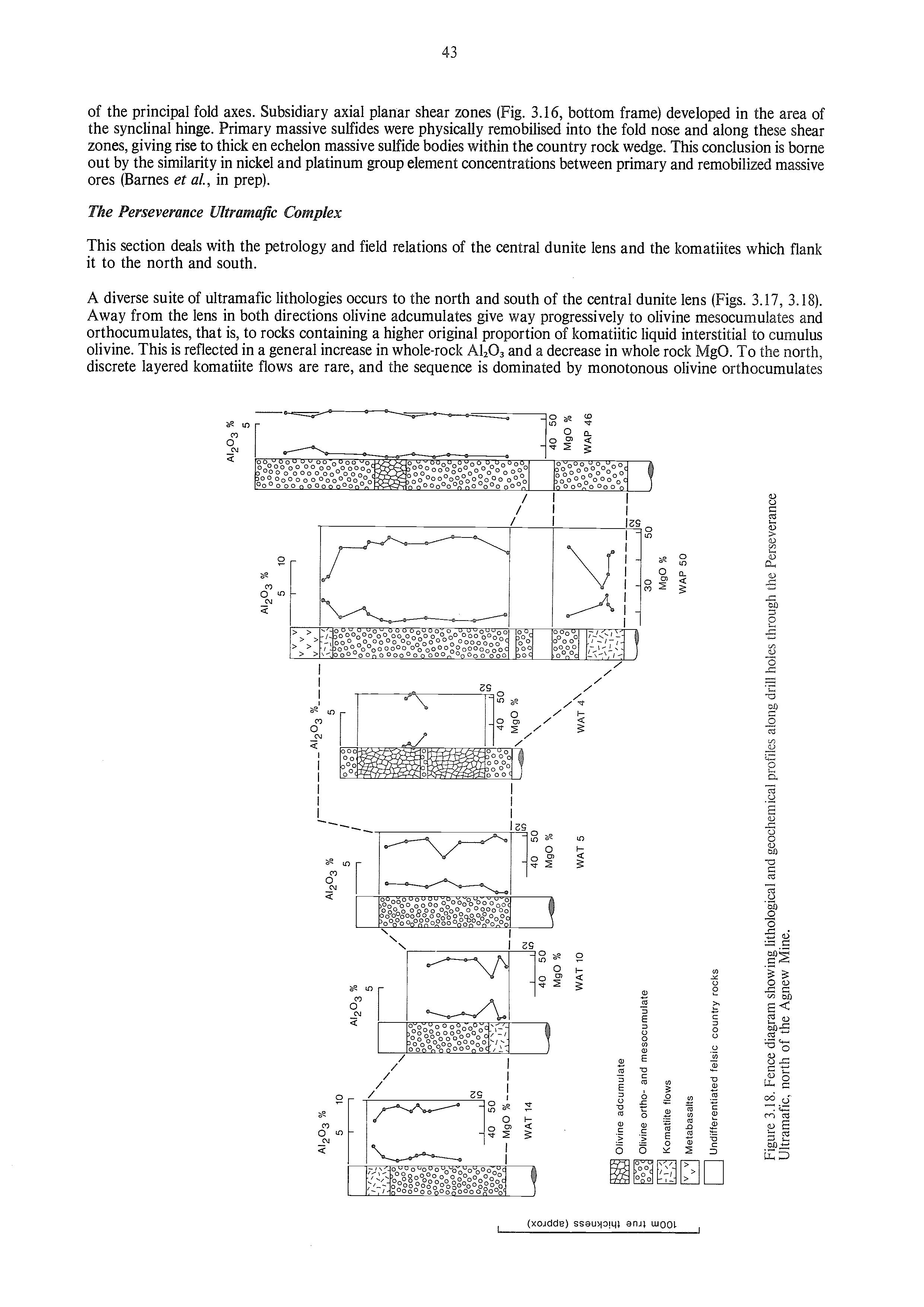
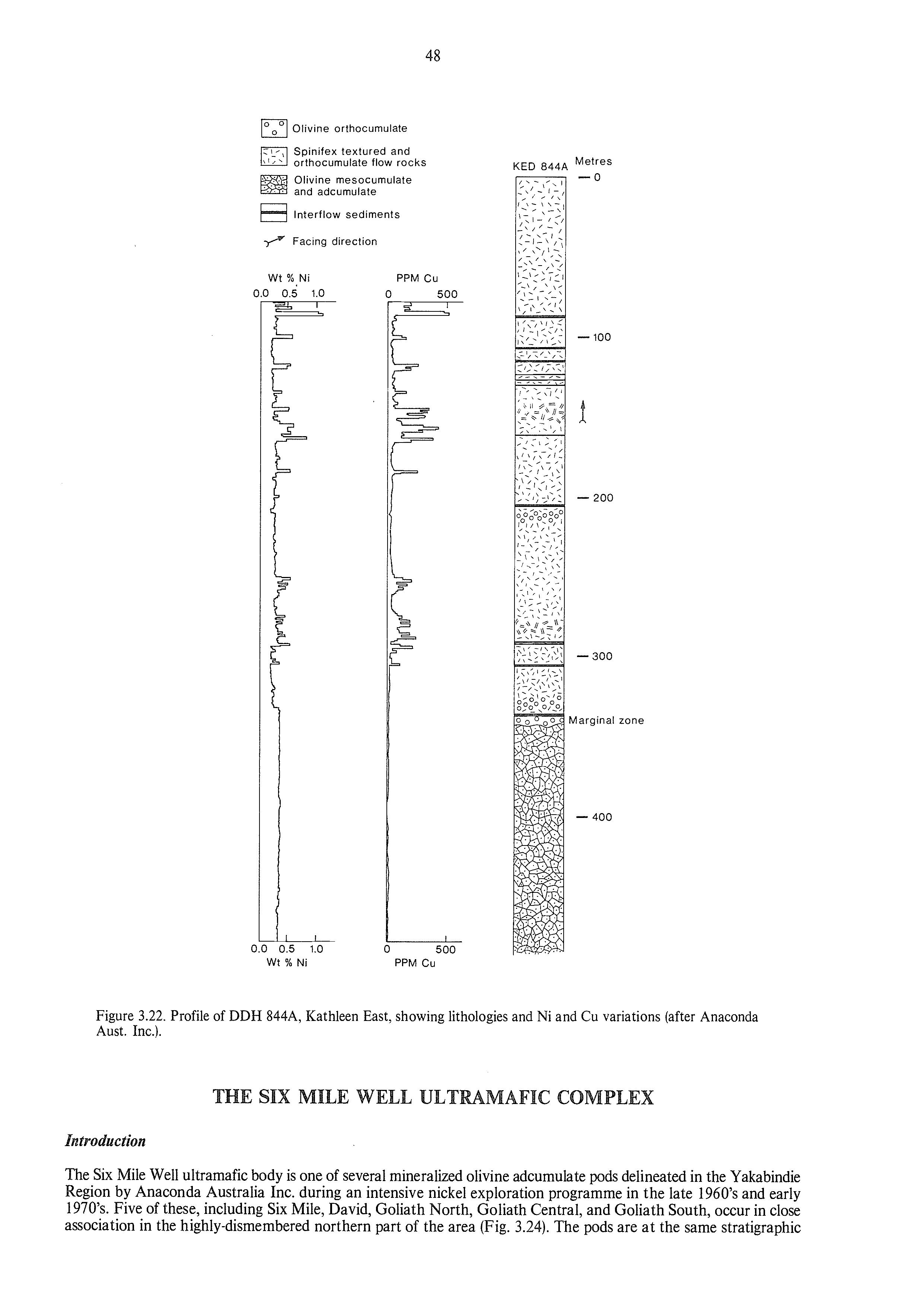
The most MgO-rich section is the upper part of the adcumulate and in this respect is similar to the MgO profiles through the Mt. Clifford and Agnew adcumulates. Aluminium, when adjusted for the amount present in chromite, is a measure of the proportion of pyroxene in these rocks and very clearly defines the orthocumulate and adcumulate portions of the Walter Williams Unit. Chromium is highest around the lower orthocumulate-adcumulatecontact where the olivines in the adcumulate are the most FeO-rich. The rock is really a olivine-chromite adcumulate and contains up to 2.4% Cr,O, (anhydrous).Nickel increases upward through the body reaching a maximum in the most MgO-rich adcumulate. Nickel whole rock values in the adcumulate are close to those in olivine and such high values indicate that the lava from which the adcumulate crystallized was undersaturated with respect to sulfur. No sulfide accumulations are known to occur in the Walter Williams Ultramafic Unit around the Goongarrie-Mt. Pleasant Anticline.
Preliminary geochemical data indicate that the adcumulate south of Yunndaga is more MgO-rich and Cr,O,-p?. This implies that the lava from which the Walter Williams Ultramafic Unit crystallized flowed from the south in a generally northerly direction.
Siberia Komatiitic Volcanics
These consist of 1-5-m thick, well-differentiatedkomatiite flows. Both olivine and clinopyroxene (stringybeef) spinifex textures are present and thus the flow compositions appear to span a relatively wide range in liquid compositions. Numerous thin interflow sediments occur throughout the pile of flows.
In the lower parts of the pile there are some apparently discontinuous 3-5-m thick dolerite (tholeiitic?)bodies smilar to those occurring in the upper orthocumulate part in the Walter Williams Unit.
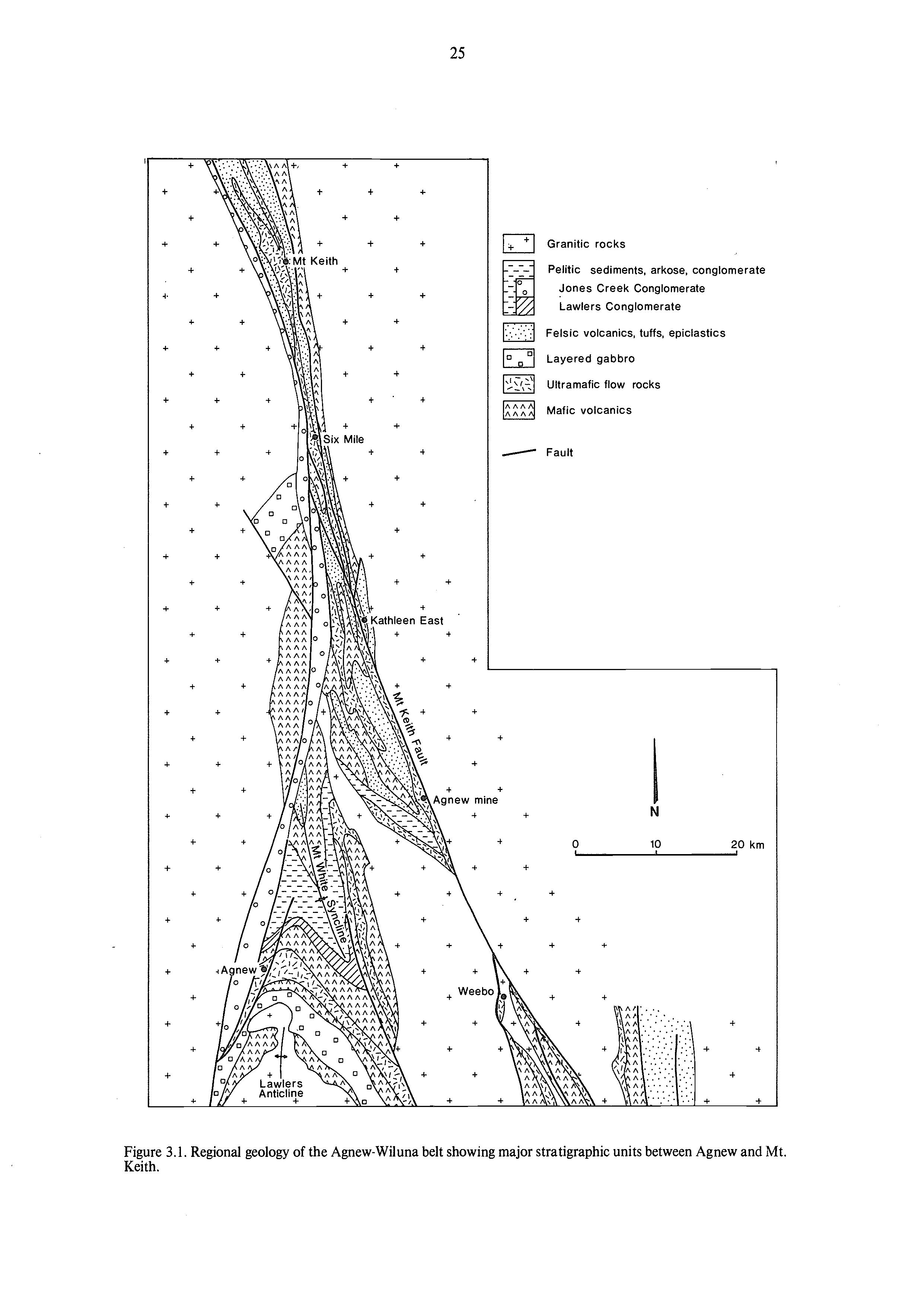
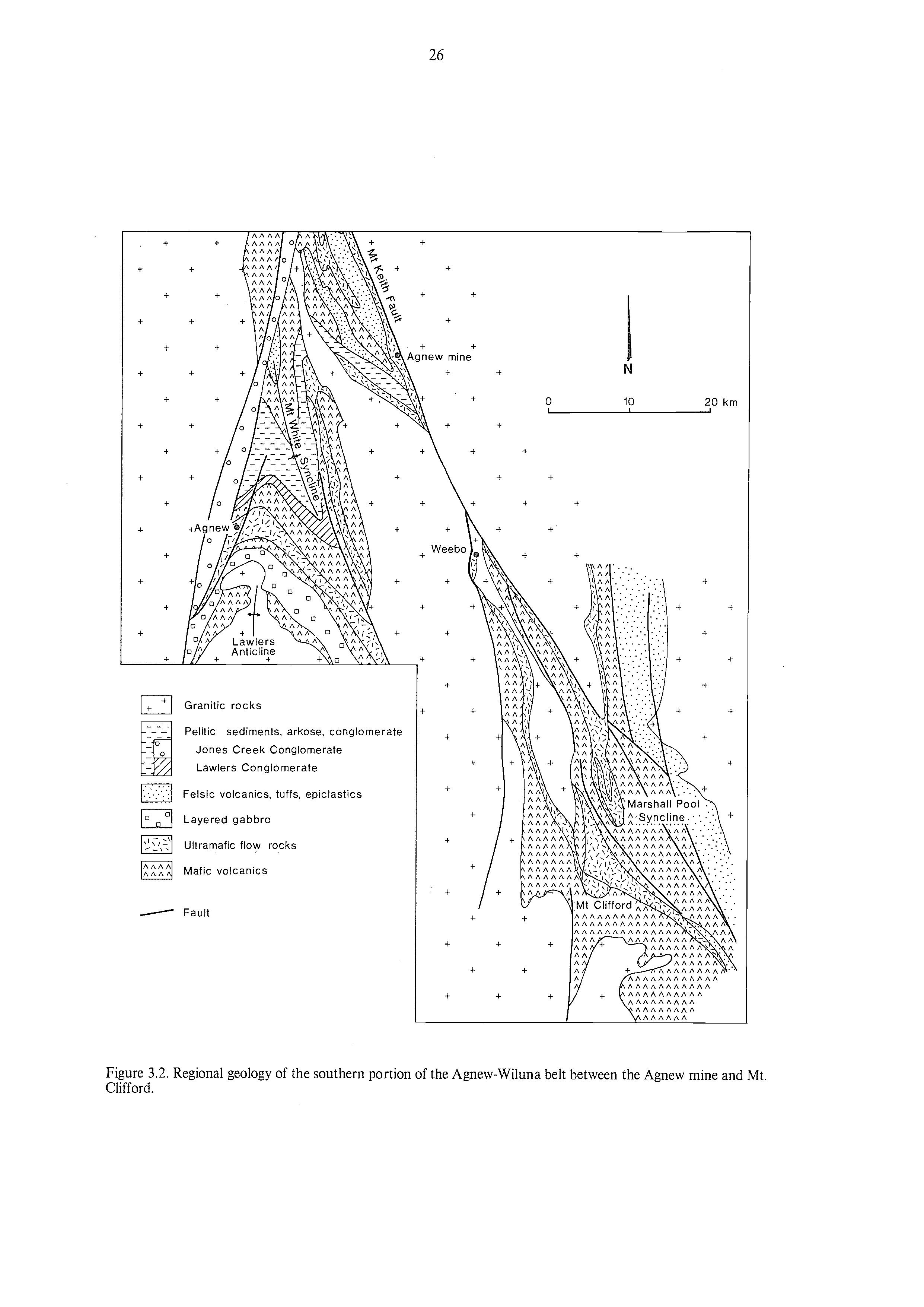
The Agnew-Wiluna Greenstone Belt forms the northern third of the Norseman-Wiluna Greenstone Belt (Fig. 2.1). North from Mt. Clifford, the belt thins considerably and is characterized by major tectonic lineaments or strike faults (e.g. Mt. Keith fault) traceable over hundreds of kilometres, complex folding, and generally steep dips (Figs. 3.1 and 3.2). Conditions of peak metamorphism increase southward from prehnite-pumpellyite grades in the north near Wiluna to lower amphibolite in the Agnew Area and decrease to lower greenschist in the region of Mt. Clifford and Marshall Pool. Faulting in the Belt produced elongate tectonic slices within which lithological correlation is relatively easy if suitable exposure exists. However, general lack of exposure, extensive fault imbrication, the development of cross faults, and steep plunges in some areas combine to render difficult the construction of regionally applicable stratigraphic columns.
Despite these complexities, several studies of aspects of the regional stratigraphy of this belt have been undertaken, (Durney, 1972; Marston and Travis, 1976; Thom and Barnes, 1977; Naldrett and Turner, 1977; Platt et al., 1978; Bunting and Williams, 1979; and others). Naldrett and Turner (1977) documented surface geology over the area between Agnew and Six Mile Well, augmented by detailed stratigraphic, geochemical, and petrographic data from diamond drill core obtained during the extensive nickel exploration programme conducted in the Yakabindie area by Ana tion of the stratigraphy can confidently be extended north from Six Well to 11, where interpretations are based solely on drilling and remote sensing data because deep lateritic weathering profiles and transported overburden obscure fresh lithologies.
ust. Inc. Their interp eith and Honeymoon
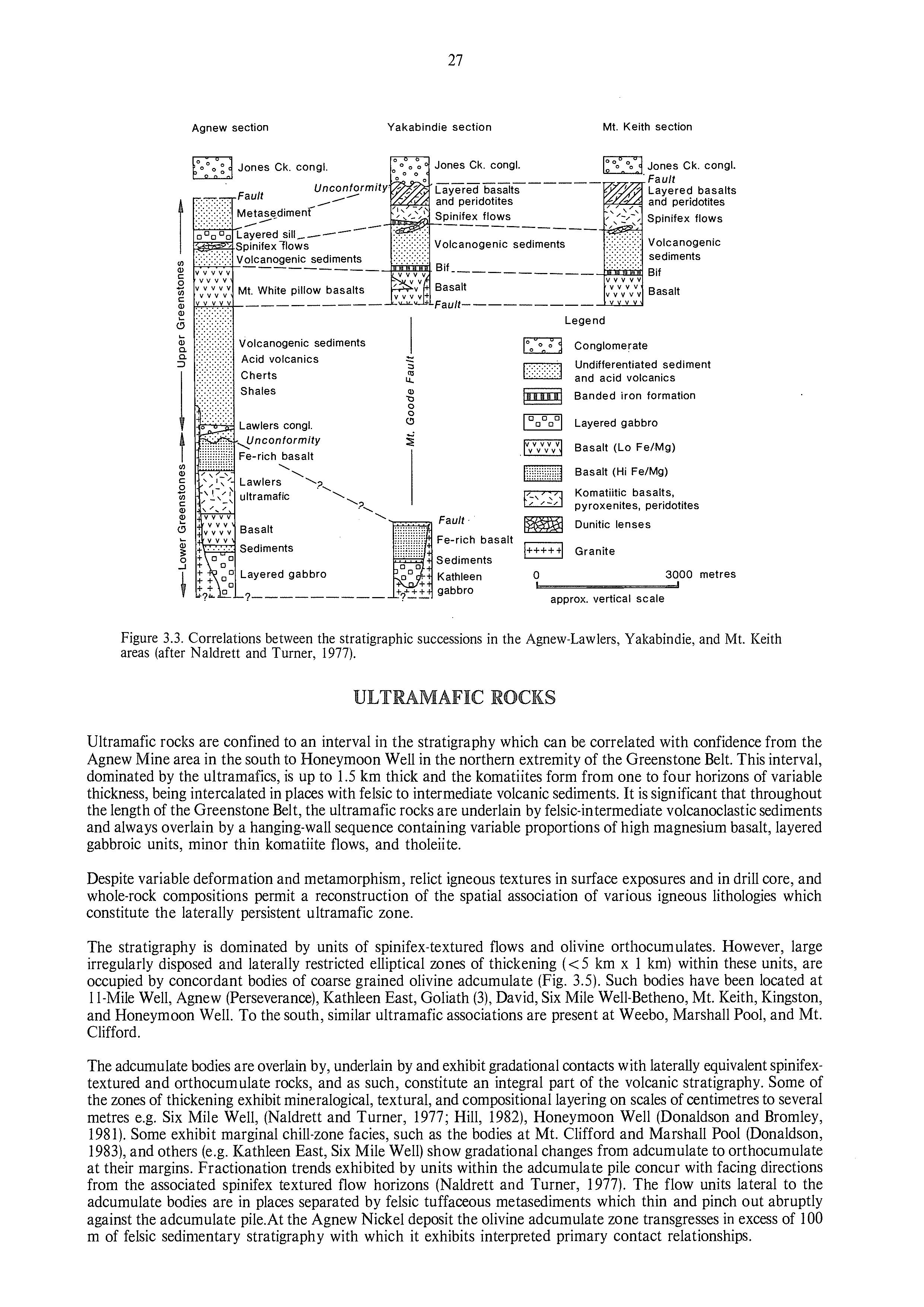
Naldrett and Turner propose a subdivision into Lower and Upper Greenstone sequences for lithologies between Agnew and Mt. Keith (Fig. 3.3). Lower Greenstones are exposed in the south in the Agnew-Lawlers area in the shallow, north-plunging Lawlers Anticline (Fig. 3.1) and include a sequence of layered gabbros, mafic volcanics, and komatiites, which are overlain by a sequence of siltstones, pebbly sandstones, and conglomerates, collectively called the Lawlers Conglomerate. Supracrustal units, which are exposed west of the Jones-Creek Conglomerate in the area around Mt. Goode, are also assigned to this lower sequence.
Lithologies above the Lawlers Conglomerate (e.g. in the Mt. White Syncline) constitute the upper Greenstones and the remaining lithologies between Agnew and Wiluna are assigned to this sequence. Regional correlations proposed by Naldrett and Turner are illustrated in Figure 3.3. The Upper Greenstone sequence contains komatiite units of specific interest to this treatise, and the significant stratigraphic section is that of a lower basalt unit including minor high magnesian variants, overlain by a thin chert, a thick series of felsic volcanoclastic and minor pelitic sediments, and black shales, followed by a zone dominated by komatiitic volcanics, and an upper series characterized by frequent facies variations, and including thin komatiite flows, layered gabbroic units and high magnesium and tholeiitic basalts.
The Jones Creek conglomerate (Fig. 3.1) is the youngest unit and is interpreted to have formed in a linear basin or graben structure.
It is difficult to confidently extend correlations southward to the areas of Weebo, Marshall Pool, and Mt. Clifford (Fig. 3.2) and their position relative to the Agnew-Wiluna stratigraphic pile is largely unknown.
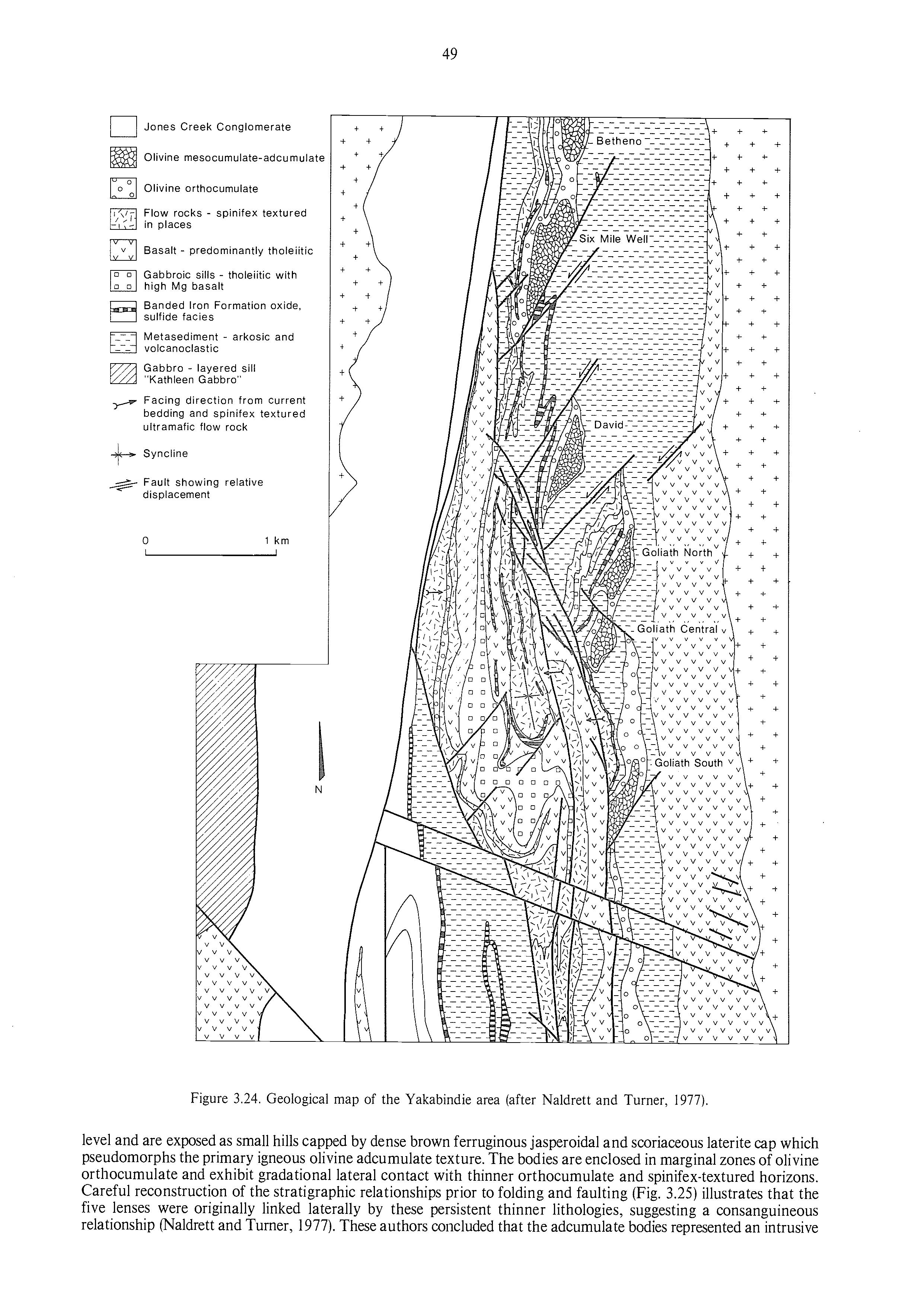
Despite complex structural disruption and some areas of poor outcrop, the Upper Greenstone lithologies of Naldrett and Turner are well exposed in the Yakabindie area. In addition, well-established facing directions have been obtained in the area from drill holes through sequences of ultramafic flows.
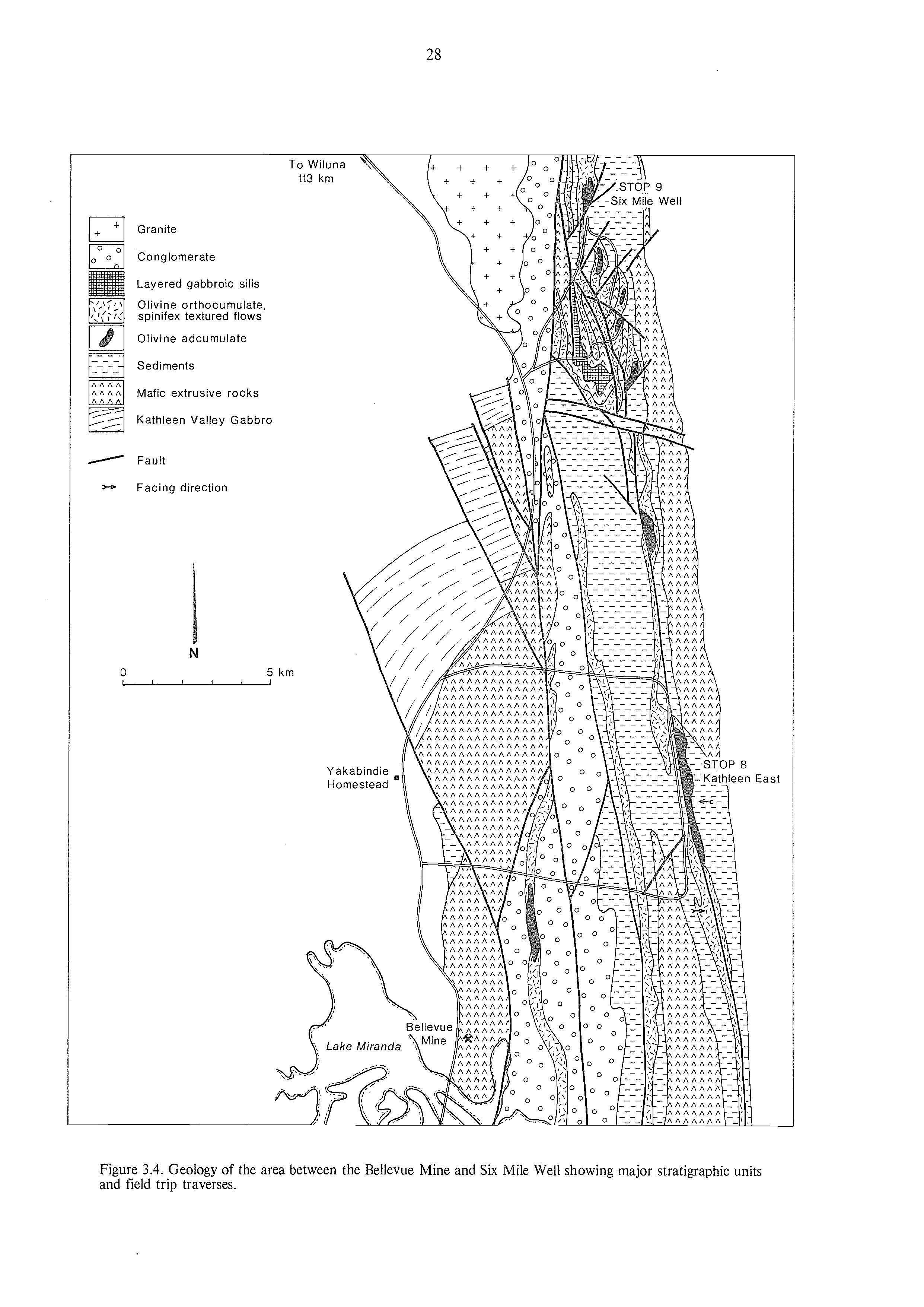
South west of Kathleen East (Fig. 3.4), lowermost basaltic rocks outcrop in the core of an anticline with a shallow northerly plunge. The basaltic rocks are overlain by felsic volcanic tuffs and epiclastic sediments and in turn by komatiitic volcanics and basalt. Part of the eastern limb of the anticline has been removed by the Mt. Keith fault in the Kathleen East area. East of the fault the sequence is represented by west-facing and steeply-dipping lithologies forming the eastern limb of a disrupted synclinal structure. Here, the komatiite units abut the fault.
In the northern part of the area near Six Mile Well, the Mt. Keith fault transects the stratigraphy westwards and a complex series of strike slip and oblique faults has removed some of the lower lithologies. The stratigraphy above the komatiite units is exposed in a shallow north plunging syncline referred to as the “Serp Hill” Syncline.
Figure 3.1. Regional geology of the Agnew-Wiluna belt showing major stratigraphic units between Agnew and Mt. Keith.
Granitic rocks
Pelitic sediments, arkose. conglomerate
Jones Creek Conglomerate
Lawlers Conglomerate
Felsic volcanics. tuffs, epiclastics
Layered gabbro
Ultramafic flow rocks
Mafic volcanics
---I Fault
3.2. Regional geology of the southern portion of the Agnew-Wiluna belt between the Agnew mine and Mt Clifford.
Figure
Agnew section
Jones Ck. congl.
r 0 --"I ---Fault
ayered sill,-----
Yakabindie section
Jones Ck. congl.
Uncontorrnityu i:
ayered basalts
Mt. Keith section
Ed. Jones Ck. congl.
Fault
Layered basalts /- and peridotites and peridotites pinifex flows
Volcanogenic sediments
Volcanogenic sediments
Bif---
Basalt a,
Spinifex flows
Volcanogenic
sediments
Bif
Legend onglomerate ndifferentiated sediment
id acid volcanics
Banded iron formation
Layered gabbro
Basalt (Lo Fe/Mg)
Basalt (Hi Fe/Mg)
pyroxenites, peridotites
Komatiitic basalts, Dunitic lenses
3000 metres
approx. vertical scale
Figure 3.3. Correlations between the stratigraphic successions in the Agnew-Lawlers, Yakabindie, and Mt. Keith areas (after Naldrett and Turner, 1977).
Ultramafic rocks are confined to an interval in the stratigraphy which can be correlated with confidence from the Agnew Mine area in the south to Honeymoon Well in the northern extremity of the Greenstone Belt. This interval, dominated by the ultramafics, is up to 1.5 km thick and the komatiites form from one to four horizons of variable thickness, being intercalated in places with felsic to intermediate volcanic sediments. It is significant that throughout the length of the Greenstone Belt, the ultramafic rocks are underlain by felsic-intermediate volcanoclastic sediments and always overlain by a hanging-wall sequence containing variable proportions of high magnesium basalt, layered gabbroic units, minor thin komatiite flows, and tholeiite.
Despite variable deformation and metamorphism, relict igneous textures in surface exposures and in drill core, and whole-rock compositions permit a reconstruction of the spatial association of various igneous lithologies which constitute the laterally persistent ultramafic zone.
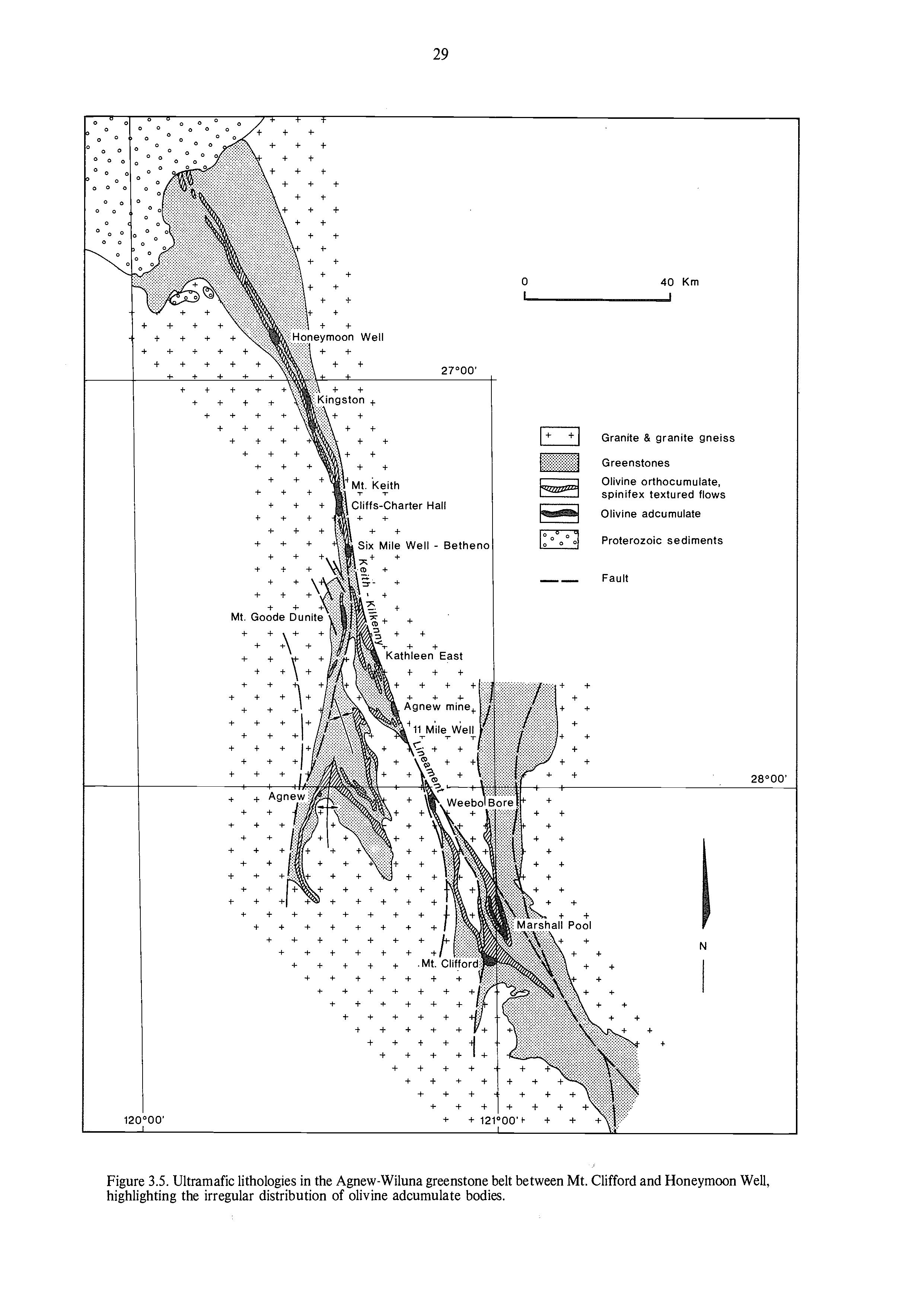
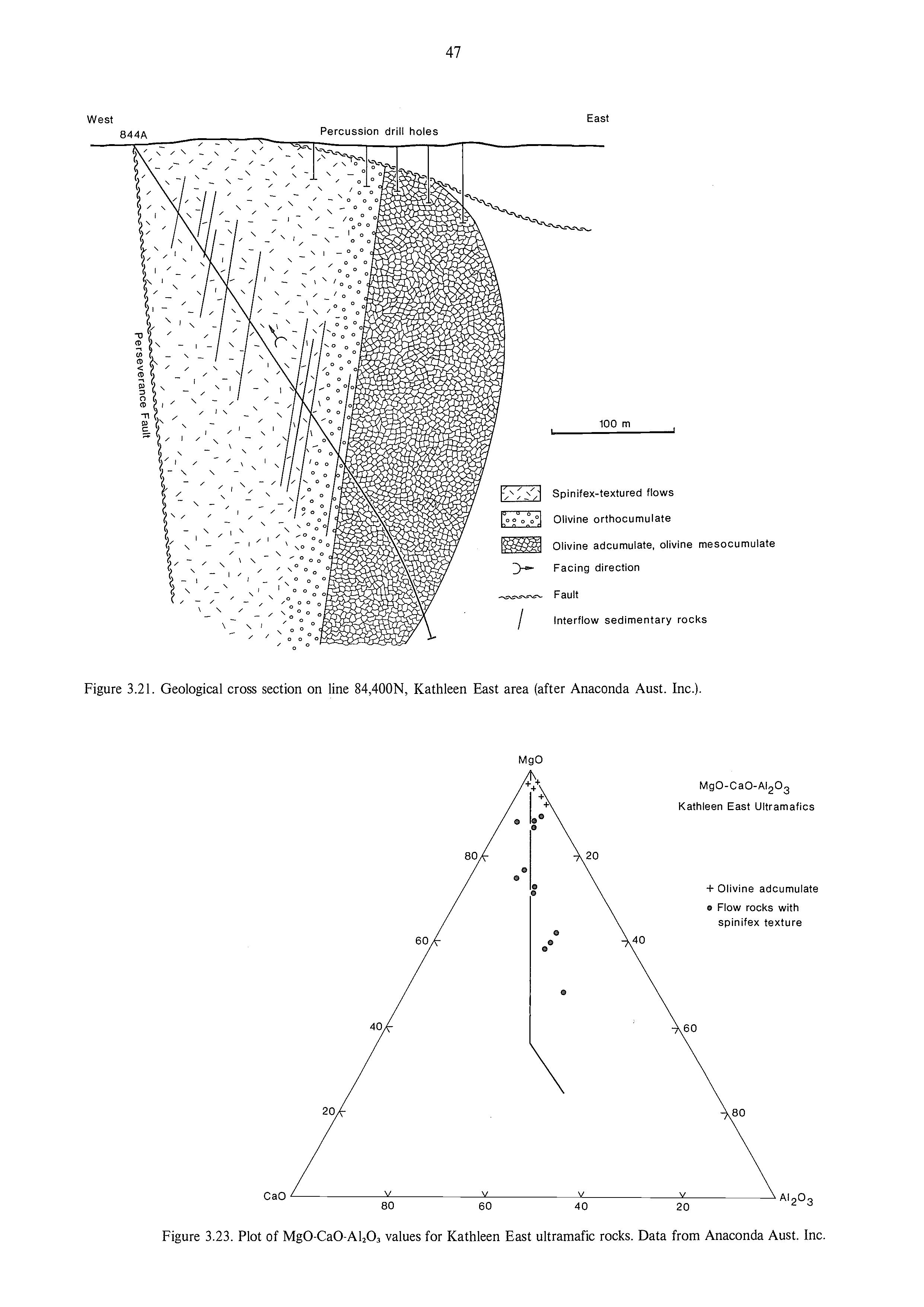
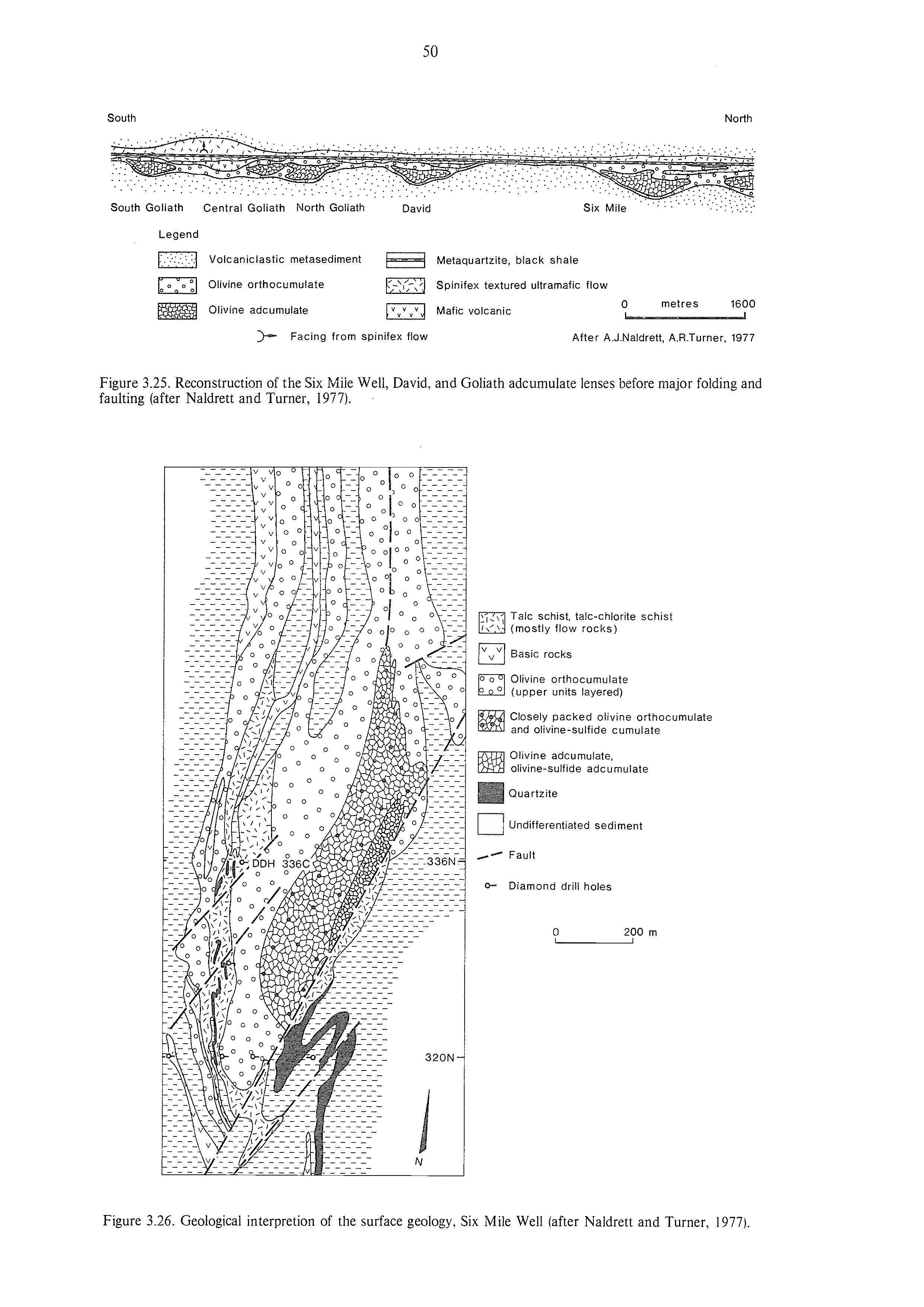
The stratigraphy is dominated by units of spinifex-textured flows and olivine orthocumulates. However, large irregularly disposed and laterally restricted elliptical zones of thickening (<5 km x 1 km) within these units, are occupied by concordant bodies of coarse grained olivine adcumulate (Fig. 3.5). Such bodies have been located at 1 1-MileWell, Agnew (Perseverance),Kathleen East, Goliath (3),David, Six Mile Well-Betheno,Mt. Keith, Kingston, and Honeymoon Well. To the south, similar ultramafic associations are present at Weebo, Marshall Pool, and Mt. Clifford.
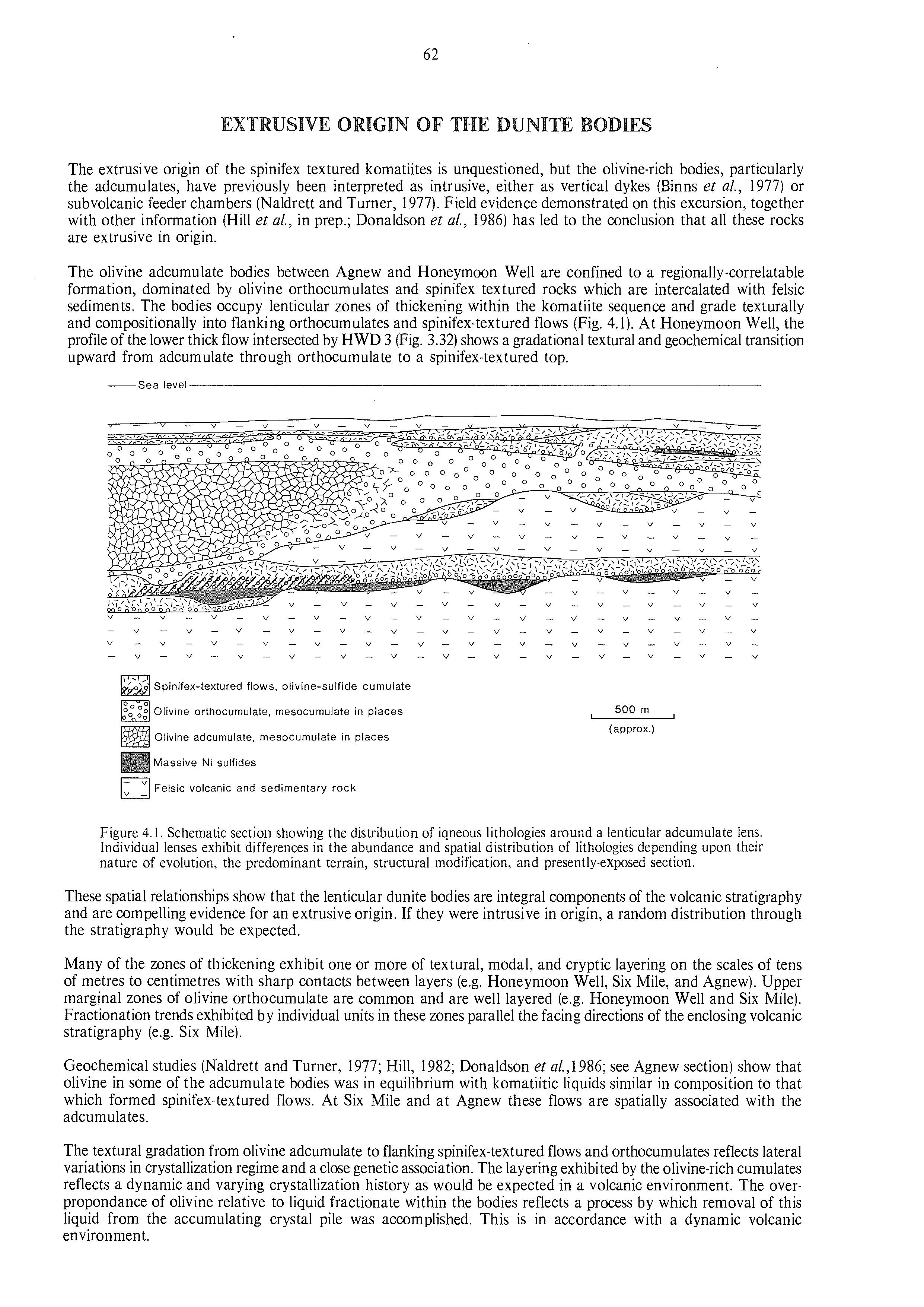
The adcumulate bodies are overlain by, underlain by and exhibit gradational contacts with laterally equivalent spinifextextured and orthocumulate rocks, and as such, constitute an integral part of the volcanic stratigraphy. Some of the zones of thickening exhibit mineralogical, textural, and compositional layering on scales of centimetres to several metres e.g. Six Mile Well, (Naldrett and Turner, 1977; Hill, 1982), Honeymoon Well (Donaldson and Bromley, 1981). Some exhibit marginal chill-zone facies, such as the bodies at Mt. Clifford and Marshall Pool (Donaldson, 1983),and others (e.g. Kathleen East, Six Mile Well) show gradational changes from adcumulate to orthocumulate at their margins. Fractionation trends exhibited by units within the adcumulate pile concur with facing directions from the associated spinifex textured flow horizons (Naldrett and Turner, 1977). The flow units lateral to the adcumulate bodies are in places separated by felsic tuffaceous metasediments which thin and pinch out abruptly against the adcumulate pile.At the Agnew Nickel deposit the olivine adcumulate zone transgresses in excess of 100 m of felsic sedimentary stratigraphy with which it exhibits interpreted primary contact relationships.
Granite
Conglomerate
Layered gabbroic sills
Olivine orthocumulate, ':, , , spinifex textured flows .
Olivine adcurnulate
Sediments
Mafic extrusive rocks
Kathleen Valley Gabbro
/ Fault - Facing direction
Figure 3.4. Geology of the area between the Beilevue Mine and Six Mile Well showing major stratigraphic units and field trip traverses.
40 Krn -
I + I Granite & granite gneiss a Greenstones
Olivine orthocurnulate, spinifex textured flows
Olivine adcumulate
1-1 Proterozoic sediments
Figure 3.5. Ultramafic lithologies in the Agnew-Wiluna greenstone belt between Mt. Clifford and Honeymoon Well, highlighting the irregular distribution of olivine adcumulate bodies.
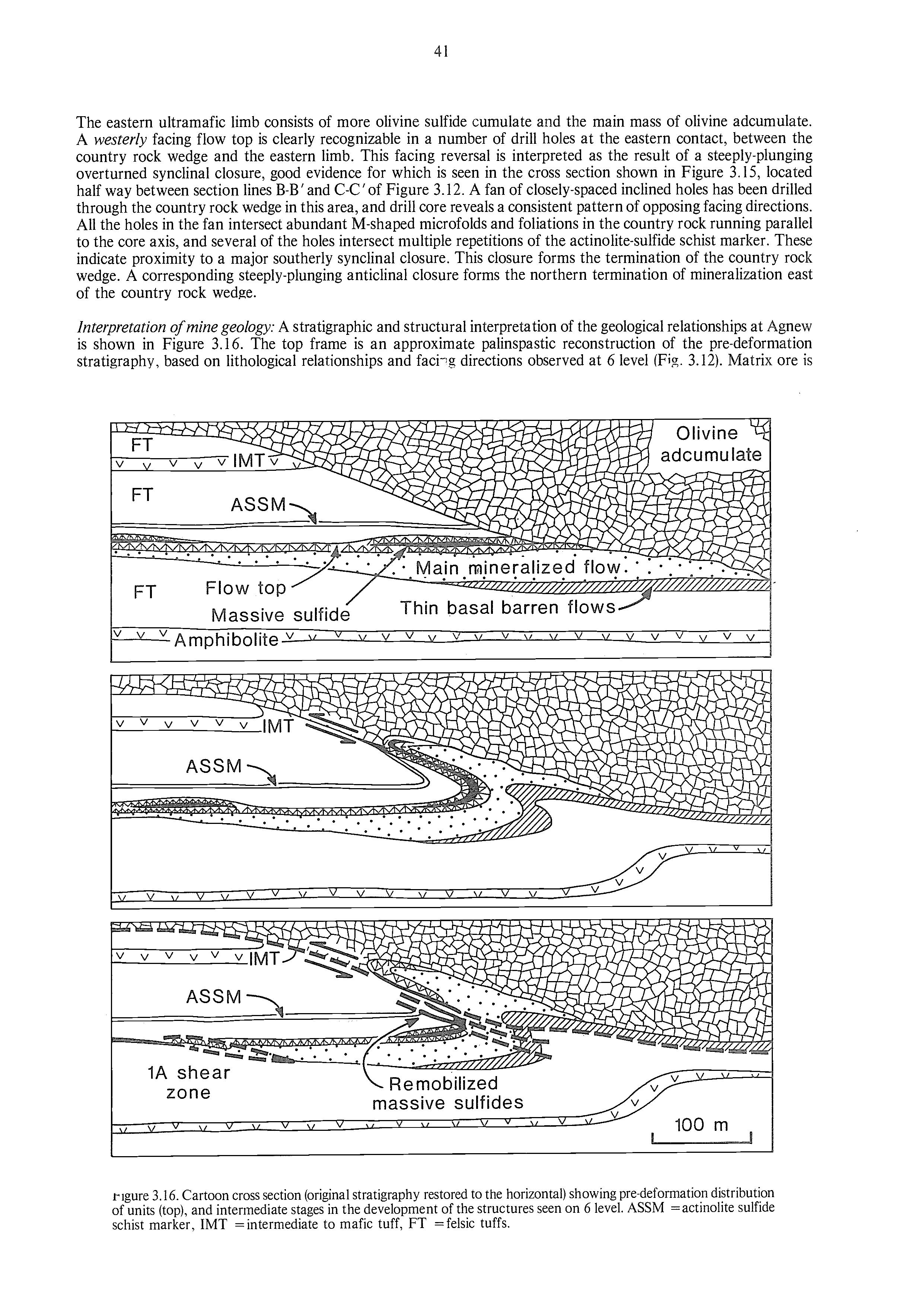
of low-grade disseminated nickel sulfide. th are present as zones of massive sulfid
Olivine adcumulate-orth~umulatelithologies host vast grade nickel reserves such as those at Agnew and Cliffs sulfide cumulate, associated with the komatiite flows. At Agnew, high grade mineralization is associated with thinner flows which lie stratigraphically below the olivine adcumulate lens.
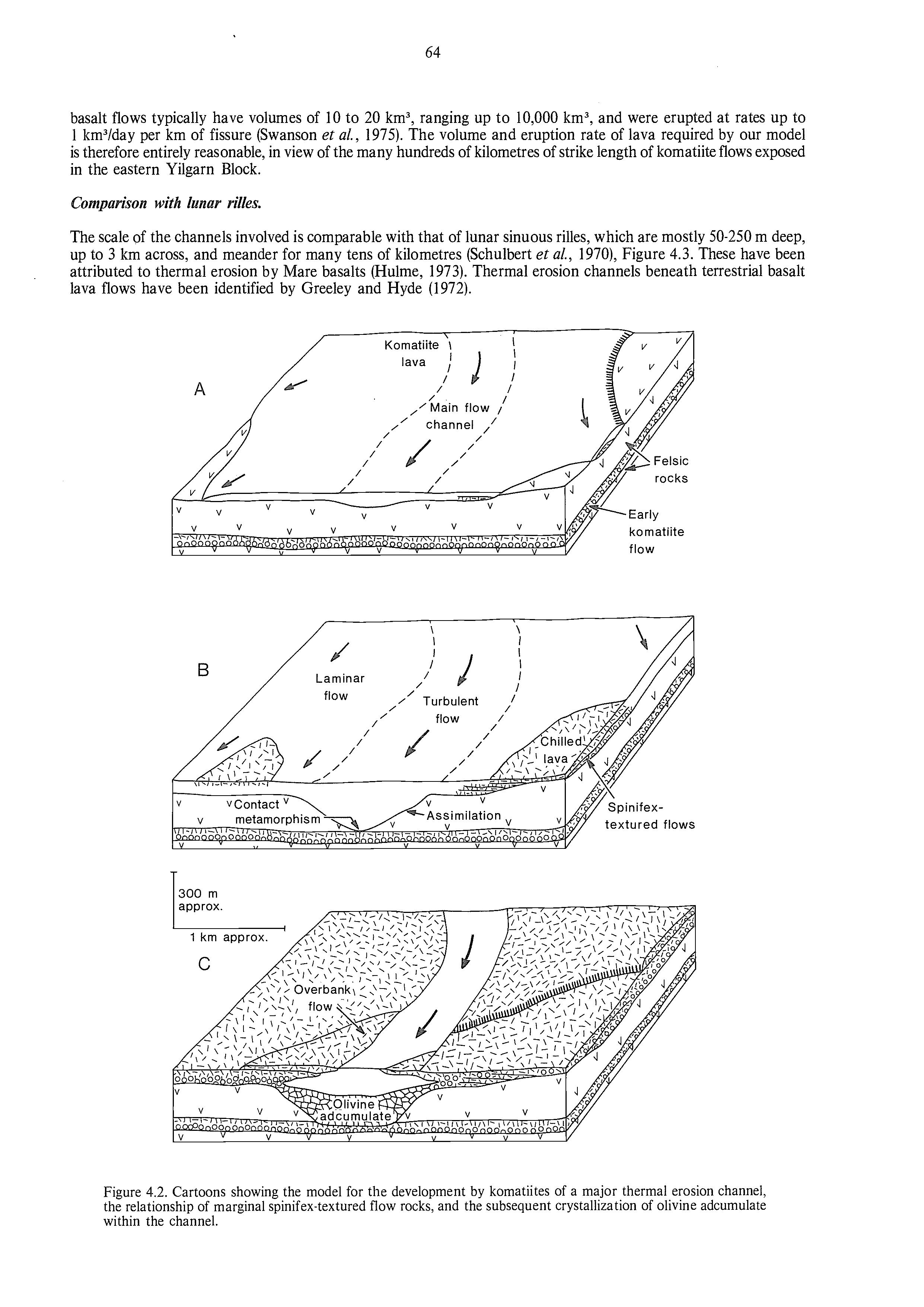
The large bodies of olivine adcumulate are believed to represent infilled zones of olivine accumulation such as continually replenished lava rivers or lakes, through which komatiite liquid has passed, and via which the extensive thinner horizons of spinifex-textured flows and olivine orthocumulates have been fed. The observed sediment pinchouts adjacent to these rivers and lakes are interpreted as the margins of thermal erosion channels, accomplished by the early continued passage of hot komatiite liquids.
These conclusions have resulted from detailed research on key areas, involving careful surface mapping of field relationships of the various ultramafic lithologies, and detailed petrographic and geochemical studies of diamond drill core.
arshall Pool Ultramafic Complexes are 50 km north of Leonora and occupy part of supracrustal constitutes a southern extension of the Agnew- iluna Greenstone elt (Fig. 3.2). The block
eak metamorphic grades range from low amphibolite to low greenschist facies from the northern end of the block is characterized by gently folded sequences of mafic, ultramafic and felsic volcanic rocks, and epiclastic rocks.
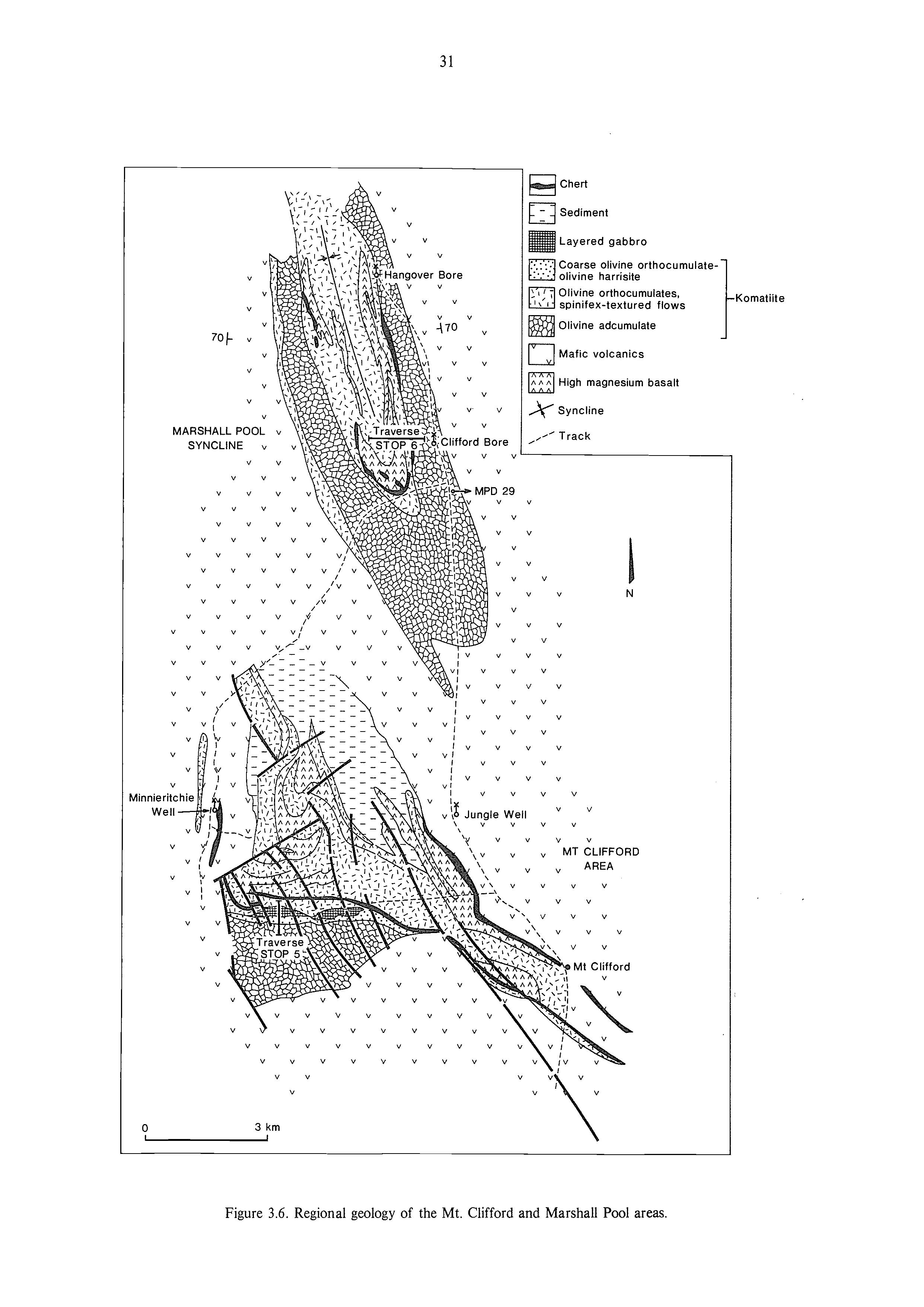
to its southern extremity. and extensive detailed mapping and exploration drilling programmes by eological mapping on a regional scale was unde onaldson er tkl. (1986). phic and geochemical exhibit generally similar strat~~ra~hicassociations Iteration, they have retained spectacular primary allow dips and open folds, and by an ultramafic cumulate body overlain by a thick sequence of spinifex-textured flows and oliv~ne-orthocumulates.The olivine adcumulates conformably overlie a thick sequence of pillowed tholeiitic basalts although they are separated from them in each area by a thin chloritic sedimentary unit. arshall Pool ultramafics are stratigraphically equivalent, ock percussion and wn conclusively whether the naldson et al. (1986) states that air e magnetic data and abundant shallow b regional geological interpretation of the orporation, is illustrated in Figure 3.6.
rotary drilling suggests that they Pool area, based on mapping by Clifford, the supracrustal lithologies define an asymmetrical fault bounded syncline plunging 45 O to the st (Fig. 3.6). At the base of the ultramafic stratigraphy is a I-km thick olivine adcumulate body, which outcrops sporadically as jasperoidal silica cap exhibiting primary igneous textures. Overlying the adcumulate is a layered gabbroic body which is, i rlain by a komatiite sequence comprising a laterally restricted 150-m thick olivine ort hocumula te unit Nickel Prospect), and an arcuate I-km thick pile of thin spinifex textured flows. Directly above the ne orthocumulate unit are two sediment horizons.
This stratigraphic succession, in which a layered gabbroic complex is in direct contact with the olivine-adcumulate body separating the adcumulate from overlying spinifex-textured flows, is similar to that exemplified by the Walter Williams ultramafic sequence to the north and south of enzies. The association is in contrast with that in the northern part of the Agnew-Wiluna Belt.
The upper marginal zone of t adcumulate body in contact with the base of the well-layered gabbro is reasonably well exposed in a few places. bbly outcrop in this zone illustrates a change, over a distance of about 30 m, from coarse-grained olivine adcumulate to an inhomogeneous olivine orthocumulate with pockets closely approaching olivine harrisite. Some samples exhibit remnant textures indicative of coarse-grained olivines and oikocrystic clinopyroxene. The contact between the olivine orthocumulate and the base of the overlying layered mafic sequence appears to be concordant, however the contact zone is diffuse and the relationship between the two units cannot be interpreted easily from surface exposure. Forty metres below the base of the layered gabbro the olivines of the
MARSHALL POOL v SYNCLINE
Chert
Sediment
Layered gabbro
Coarse olivine orthocumulai
olivine harrisite
Olivine orthocumulates, spinifex-textured flows
Olivine adcumulate
Mafic volcanics
High magnesium basalt
3.6. Regional geology of the Mt. Clifford and Marshall Pool areas.
rseX1l
Figure
adcumulate body have a composition more magnesian than Fog4 (Donaldson, 1983), Figure 3.8, and would have been in equilibrium with liquids containing in excess of 30 wt. % go. It is unlikely that the evolved olivine gabbros, noritic gabbros, and gabbros of the layered mafic complex would have crystallized from liquid with this magnesium content and this suggests that the coarse olivine orthocumulate forms the top of the olivine adcumulate body.
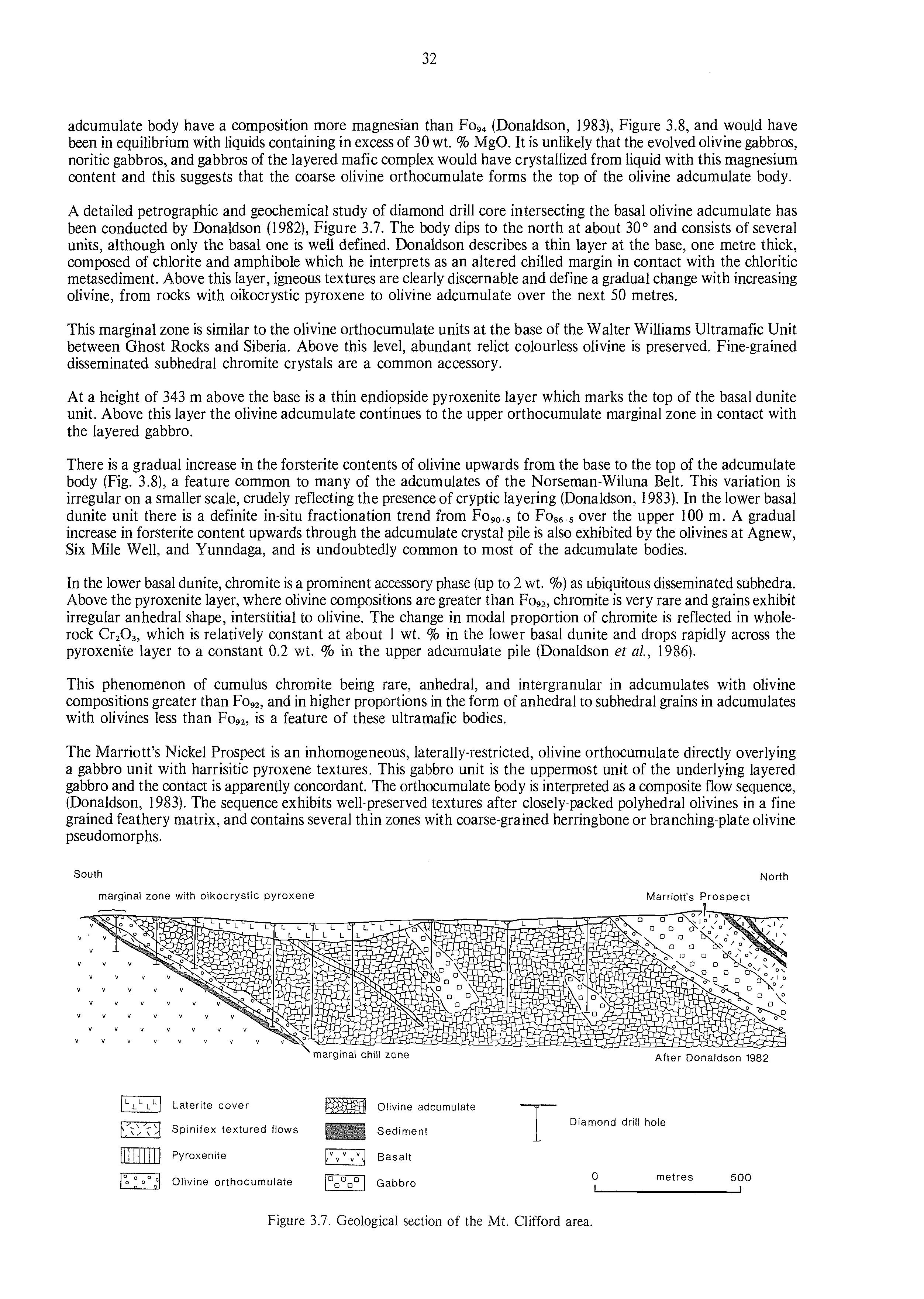
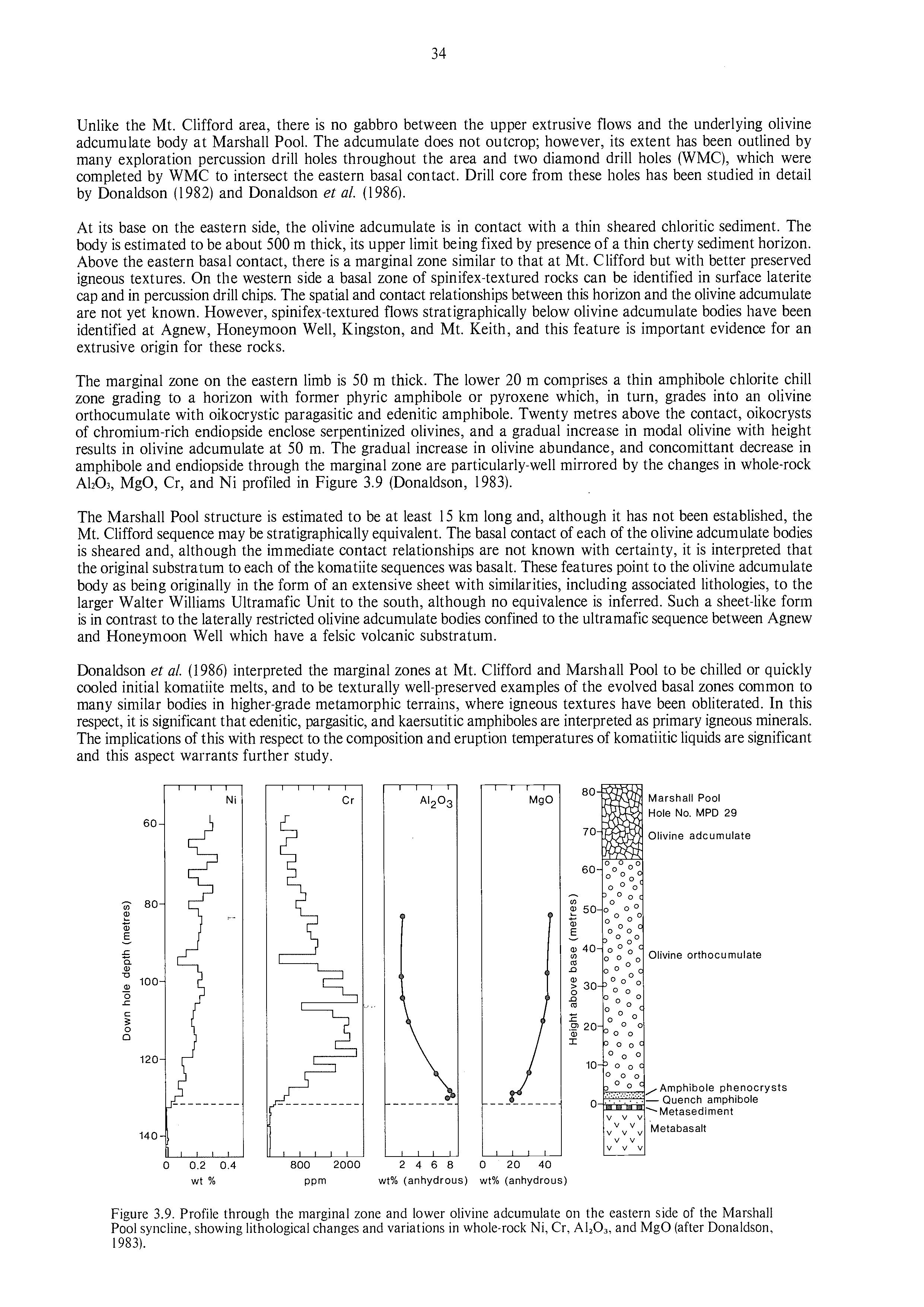
A detailed petrographic and geochemical study of diamond drill core intersecting the basal olivine adcumulate has been conducted by Donaldson (1982), Figure 3.7. The body dips to the north at about 30" and consists of several units, although only the basal one is well defined. Donaldson describes a thin layer at the base, one metre thick, composed of chlorite and amphibole which he interprets as an altered chilled margin in contact with the chloritic metasediment. Above this layer, igneous textures are clearly discernable and define a gradual change with increasing olivine, from rocks with oikocrystic pyroxene to olivine adcumulate over the next 50 metres.
This marginal zone is similar to the olivine orthocumulate units at the base of the Walter Williams Ultramafic Unit between Ghost Rocks and Siberia. Above this level, abundant relict colourless olivine is preserved. Fine-grained disseminated subhedral chromite crystals are a common accessory.
At a height of 343 m above the base is a thin epdiopside pyroxenite layer which marks the top of the basal dunite unit. Above this layer the olivine adcumulate continues to the upper orthocumulate marginal zone in contact with the layered gabbro.
There is a gradual increase in the forsterite contents of olivine upwards from the base to the top of the adcumulate body (Fig. 3.8), a feature common to many of the adcumulates of the Norseman-Wiluna Belt. This variation is irregular on a smaller scale, crudely reflecting the presence of cryptic layering (Donaldson, 1983). In the lower basal dunite unit there is a definite in-situ fractionation trend from Fo~~.~ to Fo86.5over the upper 100 m. A gradual increase in forsterite content upwards through the adcumulate crystal pile is also exhibited by the olivines at Agnew, ile Well, and Yunndaga, and is undoubtedly common to most of the adcumulate bodies.
In the lower basal dunite, chromite is a prominent accessory phase (up to 2 wt. %) as ubiquitous disseminated subhedra. Above the pyroxenite layer, where olivine compositions are greater than Fog2,chromite is very rare and grains exhibit irregular anhedral shape, interstitial to olivine. The change in modal proportion of chromite is reflected in wholerock Cr203,which is relatively constant at about 1 wt. % in the lower basal dunite and drops rapidly across the pyroxenite layer to a constant 0.2 wt. 9'0 in the upper adcumulate pile (Donaldson et al., 1986).
This phenomenon of cumulus chromite being rare, anhedral, and intergranular in adcumulates with olivine compositions greater than F092, and in higher proportions in the form of anhedral to subhedral grains in adcumulates with olivines less than Fog2,is a feature of these ultramafic bodies.
The Marriott's Nickel Prospect is an inhomogeneous, laterally-restricted, olivine orthocumulate directly overlying a gabbro unit with harrisitic pyroxene textures. This gabbro unit is the uppermost unit of the underlying layered gabbro and the contact is apparently concordant. The orthocumulate body is interpreted as a composite flow sequence, (Donaldson, 1983). The sequence exhibits well-preserved textures after closely-packed polyhedral olivines in a fine grained feathery matrix, and contains several thin zones with coarse-grained herringbone or branching-plate olivine pseudomorphs.
South North marginal zone with oikocrystic pyroxene Marriott's Prospect
Figure 3.7. Geological section of the Mt. Clifford area.
Nickel sulfides are concentrated in three narrow zones and are present in the unusual form of scattered spherical blebs up to 1 cm in diameter within olivine orthocumulates (Travis, 1975).At surface, these blebs have been replaced by limonite.
Figure 3.8. Profile of olivine compositions through the Mt. Clifford olivine adcumulate showing variation in forsterite content, NiO, and MnO (after Donaldson, 1983).
Marshall Pool
The mafic and ultramafic rocks of the Marshall Pool area define a shallow north-plunging syncline 15 km northnortheast of the Marriott’s Prospect (Fig. 3.6). The core of the syncline is occupied by a well-exposed thick sequence of komatiites, with extremely well-preserved relict igneous textures, and high magnesium basalts. The thinner komatiite flows (2-5 m) exhibit a variety of spinifex textures, the thicker flows are predominantly olivine orthocumulates. Discontinuous albite-rich cherty sediment horizons are interbedded with flows.
Unlike the Mt. Clifford area, there is no gabbro between the upper extrusive flows and the underlying olivine adcumulate body at Marshall Pool. The adcumulate does not outcrop; however, its extent has been outlined by many exploration percussion drill holes throughout the area and two diamond drill holes (WMC), which were completed by WMC to intersect the eastern basal contact. Drill core from these holes has been studied in detail by Donaldson (1982) and Donaldson et al. (1986).
At its base on the eastern side, the olivine adcumulate is in contact with a thin sheared chloritic sediment. The body is estimated to be about 500 m thick, its upper limit being fixed by presence of a thin cherty sediment horizon. Above the eastern basal contact, there is a marginal zone similar to that at Mt. Clifford but with better preserved igneous textures. On the western side a basal zone of spinifex-textured rocks can be identified in surface laterite cap and in percussion drill chips. The spatial and contact relationships between this horizon and the olivine adcumulate are not yet known. However, spinifex-textured flows stratigraphically below olivine adcumulate bodies have been identified at Agnew, Honeymoon Well, Kingston, and Mt. Keith, and this feature is important evidence for an extrusive origin for these rocks.
The marginal zone on the eastern limb is 50 m thick. The lower 20 m comprises a thin amphibole chlorite chill zone grading to a horizon with former phyric amphibole or pyroxene which, in turn, grades into an olivine orthocumulate with oikocrystic paragasitic and edenitic amphibole. Twenty metres above the contact, oikocrysts of chromium-rich endiopside enclose serpentinized olivines, and a gradual increase in modal olivine with height results in olivine adcumulate at 50 m. The gradual increase in olivine abundance, and concomittant decrease in amphibole and endiopside through the marginal zone are particularly-well mirrored by the changes in whole-rock A1203, MgO, Cr, and Ni profiled in Figure 3.9 (Donaldson, 1983).
The Marshall Pool structure is estimated to be at least 15 km long and, although it has not been established, the Mt. Clifford sequence may be stratigraphically equivalent. The basal contact of each of the olivine adcumulate bodies is sheared and, although the immediate contact relationships are not known with certainty, it is interpreted that the original substratum to each of the komatiite sequences was basalt. These features point to the olivine adcumulate body as being originally in the form of an extensive sheet with similarities, including associated lithologies, to the larger Walter Williams Ultramafic Unit to the south, although no equivalence is inferred. Such a sheet-like form is in contrast to the laterally restricted olivine adcumulate bodies confined to the ultramafic sequence between Agnew and Honeymoon Well which have a felsic volcanic substratum.
Donaldson et al. (1986) interpreted the marginal zones at Mt. Clifford and Marshall Pool to be chilled or quickly cooled initial komatiite melts, and to be texturally well-preserved examples of the evolved basal zones common to many similar bodies in higher-grade metamorphic terrains, where igneous textures have been obliterated. In this respect, it is significant that edenitic, pargasitic, and kaersutitic amphiboles are interpreted as primary igneous minerals. The implications of this with respect to the composition and eruption temperatures of komatiitic liquids are significant and this aspect warrants further study.
Marshall Pool Hole No. MPD 29 Olivine adcurnulate
Olivine orthocurnulate
Amphibole phenocrysts - Quench amphibole ‘Metasedirnent
Figure 3.9. Profile through the marginal zone and lower olivine adcumulate on the eastern side of the Marshall Pool syncline, showing lithological changes and variations in whole-rock Ni, Cr, A1,0,, and MgO (after Donaldson, 1983).
Introduction
The Agnew (formerly known as Perseverance) nickel deposit is the largest known accumulation of nickel sulfides associated with komatiites, and one of the largest nickel sulfide deposits of any class in the world. Previously, the Agnew deposit has been regarded as the foremost example of the class of “intrusive dunite associated” deposits (Martin and Allchurch, 1975; arston et al., 198 1). More recently, as detailed in this field guide, many of the “intrusive dunite” lenses of Western Australia, including that at Agnew, have been re-interpreted as being integral parts of the extrusive komatiite succession. Genetic models for this class of ore deposits were therefore in need of re-evaluation.
The distribution of ultramafic rock types in the Agnew area is shown in Figure 3.10. The prominent feature is the Perseverance lens, a body of essentially pure olivine adcumulate or dunite about 2 km north to south, 700 m east to west and at least 1100 m, and probably much more, in vertical extent, plunging at 70-80” to the south. The core of the lens shows very coarse grain sizes up to 2 cm, and classic mosaic or polygonal adcumulate texture. The lens is flanked to the north and south by laterally-extensive sequences of olivine-rich komatiites. Spinifex textures are locally preserved to the south of the lens, but the flanking rocks are dominantly olivine orthocumulates interpreted as B-zones of phenocryst-rich komatiite flows. The dunite lens and the flanking komatiite sequence is referred to as the Perseverance Ultramafic Complex. The Complex is overlain by a mixed sequence of highly-deformed talcrich metakomatiites, high- g metabasalts, and felsic metavolcanics, truncated by the major Perseverance Fault which forms the eastern margin of the Greenstone Belt. The whole sequence is steeply overturned, youngs to the east, and dips zt 70-80” to the west.
The area has been subjected to peak metamorphic temperatures of about 550” C and pressures up to 3 kb, and the komatiites have mostly been reconstituted to olivine-tremolite-chlorite-cummingtoniteassemblages, with talc and prograde antigorite in the more magnesian rocks. Enstatite and anthophyllite occur in areas which have been infiltrated by C0,-rich fluids (Gole et al., 1937).
The principal zone of mineralization is present at the western contact of the lens, to the north of its thickest development. There are two principal types of mineralization: massive ore, and variably recrystallised matrix or net-textured ore consisting of about 30 to 50 modal percent sulfide interstitial to olivine. The ultramafic rocks hosting the ore bodies extend out into the country rocks to the north of the main lens and are conformable with the country rock stratigraphy. These ultramafic rocks thin to the north forming the 1A shoot. The 1A shoot contains slivers of sheared ultramafic rock as well as massive sulfides, and has been interpreted as a highly tectonised fault zone. The shoot has been traced continuously 600 m to the north of the main ultramafic lens.
On strike with the 1A shoot and about 2 km to the north is the and faulted body of massive metakomatiite up to 50 m north, and the mineralized data suggest that the ore-bearing ultramafic rock same flow unit.
eward deposit. This is a complexly-folded lfide rocks associated with a body of sheared reports). This deposit plunges shallowly to the mine area. The fie1 elationships and chemical ine and at Rocky’s ward are portions of the
The stratigraphy of the country rock sequence is summarized in Figure 3.1 1. Regional deformation has produced a distinct flattening of phenocrysts and inclusions in the country rock, and hence original thicknesses must have been greater than those shown. The column to the north of the mine area is based on surface exposure and extensive drilling, and is consistent over a horizontal distance of about 2 km and a vertical depth of 1 km. A dominantly metasedimentary sequence of quartz-biotite-feldspar schists and gneisses with abundant garnet and/or actinoliterich layers gives way to the east to feldspar-phyric felsic metavolcanics of dacitic to rhyolitic composition, probably of pyroclastic origin. Two distinctive marker units have been identified in drilling between the 1A shoot and the base of the Perseverance ultramafi tinolitesulfide Schist marker ), a distinctive 1-2-m thick layer of finely interbanded massive pyrrhotite coarse, dark green actinolite, in d as an original exhalative sulfide horizon, and a 5 to 20-m thick band m-grained actinolitic amphibolite with interlayers of felsic metavolcanic, interpreted as an intermediate tuff ( e portion of the stratigraphy above the 1A shoot position is apparently truncated by the base of the Perseverance lens.
The area has been subjected to strong penetrative deformation. In a study of the Lawlers area 20 km south-west of the Agnew deposit, Platt et al. (1978) identified an early episode of isoclinal folding (Dl),re-folded about a series of large amplitude (several km) W-trending upright folds (D2). The Agnew deposit occurs within the overturned east limb (average dip about 30” to the West) of a D2 anticline. The prominent structural feature, recognizable underground and in the field, is a set of 1 to 70-m amplitude open folds with axes plunging at about 20” to the north. These structures fold a strong penetrative bedding-parallel foliation, and are probably related to the regional
Graphitic-sulfidic schist
Gabbro
r-l ASSMActinolite-sulfide schist u
Spinifex-textured flow rocks
Olivine orthocumulate rocks
Olivine mesocumulate-adcumulate rocks
Massive Ni sulfides
Dominantly felsic volcanics
Granitoids
Disseminated Ni sulfides +DDH holes
Major
3.10. Geological plan of the Agnew mine area, showing locations of drill holes used in sampling the Perseverance Ultramafic body.
Figure
j PFMV\
Perseverence Fault
Metakornatiites, high Mg basalts, metasedirnents
Perseverence ultrarnafic-olivine adcurnulates, orthocurnulates
Figure 3.1 1. Simplified stratigraphic columns between the 60A ultramafic and the Perseverance fault. Column on left is approximately 500 m north of the mine shaft, column on right approx. 200 m south of shaft. PFMV =porphyritic felsic metavolcanics; IMT =intermediate to mafic tuffs; ASSM = actinolite sulfide schist marker; QBF =quartzbiotite-feldspar schists. Thicknesses shown are average present-day estimates, and do not allow for flattening during deformation.
D2 anticline. A second foliation or crenulation cleavage is locally developed at D2 fold hinges. D2 folds are related to movement on the ductile Perseverance and Waronga (also known as Mt. Goode Rift) faults, which form respectively the eastern and western boundaries of the Greenstone Belt (Platt et al., 1978).
Mine geology
A geological map of 6 level (800 m below surface elevation) of the Agnew Mine is shown in Figure 3.12. There are few underground openings on this level, and the geological interpretation is based on closely spaced horizontal drill holes. Figure 3.13 shows a cross section along line B-B’ of Figure 3.12, through the mineralized zone and the stratigraphically overlying Perseverance Ultramafic. The map and cross section show the same general relationships, and the following discussion is based mainly on the geology as seen on 6 level.
c]Countiy rocks
[7 Olivine-sulfide cumulates
@% (metamorphosed komatiites)
ASSM Actinolite sulfide schist marker
IMT Intermediate/mafic tuff
Tremolite-chlorite-olivine rocks Massive sulfides + Facing direction from flow tops Olivine adcumulates and mesocumulates 4' Fault
\ Diamond drill hole
Figure 3.12. Geological plan of number 6 level (SO0 m below surface elevation) based on horizontal diamond drill holes, showing facing directions as inferred from original komatiite flow tops.
Surface
Figure 3.1 3. Geological cross section through the Perseverance dunite lens and the Agnew nickel deposit, section line 190SON, looking north.
Olivinetremolite-chlorita
chlorite
sulfide cumulatc
chlorite rock
Massive
Figure 3.14. Profile along driU hole WPU 460 (horizontal hole on 3 level) showing variations in whole-rock composition through the main mineralized flow unit.
Two limbs of ultramafic rock are present, separated by a southerly-closing wedge of felsic metasedimentary and metavolcanic rocks. The southern termination of this country rock wedge plunges steeply to the south above the 700-m elevation, and steeply to the north below this level.
South of the section line B-B‘, the ultramafic rocks at the westernmost contact with the felsic country rocks consist of a sequence of weakly-mineralized olivine-tremolite-cummingtonite-chloriterocks. This sequence, up to about 10 m thick, shows rapid fluctuations in proportion of olivine to amphibole plus chlorite, reflected in the whole-rock chemical composition, and is interpreted as a series of up to four thin metamorphosed komatiite flows, each originally consisting of a cumulus olivine-enriched B zone overlain by a spinifex-textured A-zone. Original igneous textures have now been completely destroyed by deformation and metamorphism. Within each flow, the olivine content decreases from about 80% in the B-zone to an olivine-free amphibole-chlorite rock representing the flow top, indicating a facing direction to the east. This sequence is referred to as the “basal barren flows”. Drill core of this interval will be inspected.
Directly overlying the basal barren flows is a variably-thick unit of olivine-sulfide cumulate (net-textured or matrix ore) and bladed olivine-sulfiderock (metamorphically-recrystallizedmatrix ore). The eastern margin of this mineralized unit, where in contact with the country rock wedge, shows a drop-off in olivine and sulfide and an increase in amphibole and chlorite, as seen in the basal barren flows. This relationship has been recognized in numerous drill holes, and shows up in chemical profiles (Fig. 3.14). This unit is a thick east-facing komatiite flow with accumulated sulfide liquid in the lower part. To the north, the mineralized unit becomes progressively faulted out and highly attenuated by shearing, and grades laterally and vertically into the 1A shoot, as described above. This unit is correlatable with the Rocky’s Reward deposit where a thick sulfide-bearing flow is again present. This relationship constitutes qtrong evidence that Rocky’s Reward, the 1A shoot, and the main Agnew ore body are all part of an originally continuous mineralized flow. This flow faces east, and must pre-date the development of the adcumulate.
6 Level
Figure 3.15. Geological cross section, looking north, drawn half way between sections B-B’and C-C’of Figure 1.5, showing evidence for a vertically-plungingsynclinal axis forming the southern termination of the country rock wedge. ASSM = actinolite sulfide schist marker. M-shaped ornament shows locations of microfold closures having axial planes approximately normal to the drill core. Oac =olivine adcumulate, OSc =olivine sulfide cumulate (matrix ore), OTC =olivine-tremolitechlorite rock, TC =tremolite-chlorite schist, FV =felsic metavolcanics, MSu = massive sulfide.
The eastern ultramafic limb consists of more olivine sulfide cumulate and the main mass of olivine adcurnulate. A westerly facing flow top is clearly recognizable in a number of drill holes at the eastern contact, between the country rock wedge and the eastern limb. This facing reversal is interpreted as the result of a steeply-plunging overturned synclinal closure, good evidence for which is seen in the cross section shown in Figure 3.15, located half way between section lines B-B’ and C-C’of Figure 3.12. A fan of closely-spaced inclined holes has been drilled through the country rock wedge in this area, and drill core reveals a consistent pattern of opposing facing directions. All the holes in the fan intersect abundant M-shaped microfolds and foliations in the country rock running parallel to the core axis, and several of the holes intersect multiple repetitions of the actinolite-sulfide schist marker. These indicate proximity to a major southerly synclinal closure. This closure forms the termination of the country rock wedge. A corresponding steeply-plunging anticlinal closure forms the northern termination of mineralization east of the country rock wedge.
Interpretation of mine geology: A stratigraphic and structural interpretation of the geological relationships at Agnew is shown in Figure 3.16. The top frame is an approximate palinspastic reconstruction of the pre-deformation stratigraphy, based on lithological relationships and fackg directions observed at 6 level (Fig. 3.12). Matrix ore is
rigure 3.16. Cartoon cross section (originalstratigraphy restored to the horizontal) showing pre-deformation distribution of units (top), and intermediate stages in the development of the structures seen on 6 level. ASSM =actinolite sulfide schist marker, IMT =intermediate to mafic tuff, FT =felsic tuffs.
massive sulfides
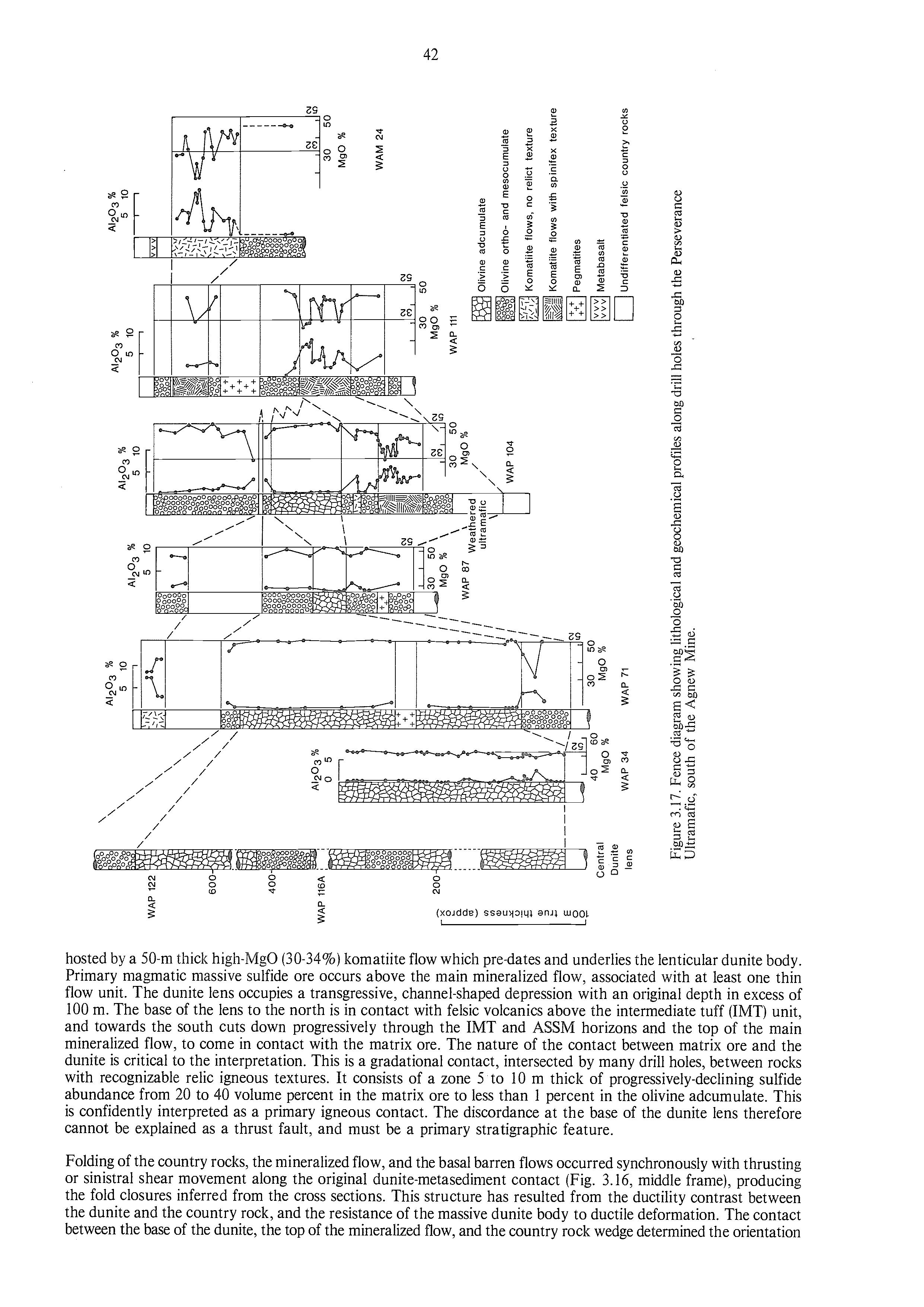
hosted by a 50-m thick high- g0 (30-34%)komatiite flow which pre-dates and underlies the lenticular dunite body. Primary magmatic massive sulfide ore occurs above the main mineralized flow, associated with at least one thin flow unit. The dunite lens occupies a transgressive, channel-shaped depression with an original depth in excess of 100 m. The base of the lens to the north is in contact with felsic volcanics above the intermediate tuff (IMT) unit, and towards the south cuts down progressively through the IMT and ASSM horizons and the top of the main mineralized flow, to come in contact with the matrix ore. The nature of the contact between matrix ore and the dunite is critical to the interpretation. This is a gradational contact, intersected by many drill holes, between rocks with recognizable relic igneous textures. It consists of a zone 5 to 10 m thick of progressively-decliningsulfide abundance from 20 to 40 volume percent in the matrix ore to less than 1 percent in the olivine adcumulate. This is confidently interpreted as a primary igneous contact. The discordance at the base of the dunite lens therefore cannot be explained as a thrust fault, and must be a primary stratigraphic feature.
Folding of the country rocks, the mineralized flow, and the basal barren flows occurred synchronously with thrusting or sinistral shear movement along the original dunite-metasediment contact (Fig. 3.16, middle frame), producing the fold closures inferred from the cross sections. This structure has resulted from the ductility contrast between e dunite and the country rock, and the resistance of the massive dunite body to ductile deformation. The contact tween the base of the dunite, the top of the mineralized flow, and the country rock wedge determined the orientation
es. Subsidiary axial planar shear zones ( imary massive sulfides were physically re into the fold nose an zones, giving rise to thick en echelon massive sulfide out by the similarity in nickel and platinum group element concentrationsbetw ores (Barnes et al., in prep).
edge. %is conclusion is borne ary and remobilized massive
rseverance lex
This section deals with the petrology and field relations of the central dunite lens and the komatiites which flank it to the north and south.
A diverse suite of ultramafic lithologies occurs to the north and south of the central dunite lens (Figs. 3.17, 3.18). Away from the lens in both directions olivine adcumulates give way progressively to olivine mesocumulates and orthocumulates, that is, to rocks containing a higher original proportion of komatiitic liquid interstitial to cumulus olivine. This is reflected in a general increase in whole-rock discrete layered komatiite flows are rare, and the sequence is dominated by monotonous olivine orthocumulates and a decrease in whole rock
and their metamorphosed equivalents. These rocks display layering defined by varying proportions of olivine, on a scale of tens of centimetres. They are interpreted as a sequence of undifferentiated olivine-richflows, analogous to the spinifex-freeflows described by Arndt et al. (1977). To the south of the dunite lens, differentiated flows are well developed, displaying olivine-enriched cumulus B-zones and A-zones with relict igneous spinifex textures. Individual flows range in thickness from about one to ten metres. In drill holes WAP 104 and WAP 11 1, spinifextextured komatiite flows are found beneath adcumulates or their lateral equivalents. In WAM 24, the most southerly hole sampled, adcumulates and mesocumulates are absent altogether, and the most evolved rocks in the unit having contents in A-zones of flows down to 15% are found.
hole rock geochemical data indicate that the flanking komatiite flows are all depleted in nickel relative to normal matiites, as a result of pre-emplaaiment segregation of immisciblesulfide liquid. Olivine cumulates at the northern and southern margins of the central lens show the most pronounced depletion, having original Ni contents of less than 0.1 weight percent. The more distal flows crystalked cumulus olivines with about 0.2 weight percent Ni, compared with 0.35 percent Ni in olivines in the central part of the dunite lens.
inely disseminated sulfides, ranging in abundance up to a few percent, are ubiquitous in the Perseverance Ultramafic to the north of the dunite lens. Sulfides are ale disseminated throughout the rocks to the south, but in noticeably
The Central Dunite Lens: Drill holes WAP 116A and WAP 122 (Fig. 3.13) provide a continuous profile through the central dunite lens, from its basal contact with the main mineralized flow of the Agnew nickel deposit, through 600-700 m of olivine adcumulates with minor mesocumulate layers, into a highly-sheared and deformed section of metakomatiites adjacent to the Perseverance Fault. Coarse igneous adcumulate textures are well preserved throughout the adcumulate except in alteration zones related to pegmatite intrusions. Fresh olivine is abundant.
st that parent magmas ve been made on the
Forsterite content shows a steady increase from about 93 to 94.5 mol. %from bottom to top of the lens (Fig. 3.19). dunite lens became steadily more magnesian with time. Similar Clifford dunite (Donaldson, 1982). Nickel content of olivine is a~prox~mate~yconstant i0 (0.35 % Ni) throughout. The constant Ni content reflects the b liquids and lower partition coefficients at higher temperatures (Arndt, 1977), and indicates a lack of extensive sulfide liquid fractionation from the dunite parent magmas.
Evolution of the Perseverance Ultramfic Complex:The base of the Perseverance dunite lens has a discordant channellike geometry, and cuts down through at least 150 m of felsic country rocks. This is interpreted as the result of thermal erosion at the base of a long-lived, turbulently-flowingkomatiite lava river. The disposition of rock types and variation in original olivine composition in the Perseverance Ultramafic is interpreted as the result of episodic overflow of the central lava river, coupled with temporal variation in the composition of the lava.
athleen East area is 8 km east of Yakabindie Homestead and about 20 km south of the Six Mile Well ultramafic complex with which it is interpreted to be stratigraphically equivalent. The lithologies in the area constitute part of the Upper Greenstone Sequence of Naldrett and Turner (1977).
At Kathleen East the ultramafic rocks are present within the eastern limb of a shallowly north-plunging syncline of which the core and much of the western limb have been removed by the Perseverance Fault (Fig. 3.4). The stratigraphy strikes in north-northwest direction. The present trace of the Perseverance fault is marked by a linear zone of shearing (20 m wide) and a prominent line of white quartz blows. The fault generally parallels the stratigraphy; however, towards the south of the area, it swings towards the southeast to cut the stratigraphic pile at a low angle. As a result, ultramafic rocks become exposed west of the fault.
athleen East area has been explored for nickel by Anaconda Australia Inc. and the ultramafic rocks have been mapped in detail and extensively sectioned, primarily by rotary air blast and percussion drilling. Two diamond holes have been drilled.
The stratigraphy is exposed as subdued oxidized rubbly outcrop and the ultramafic lithologies for the most part are exposed as chocolate-brownjasperoidal silica cap and buff-brown silica cap over olivine adcumulate and olivine orthocurnulate respectively. Within the fault zone the ultramafics are extensively sheared, and are identifiable in drill chip and core by metamorphic mineralogy and chemical composition. Away from the fault, relict igneous textures are common.
3.19. Profile of olivine compositions through the Perseverance dunite lens, along drill holes WAP 116a and WAP 122.
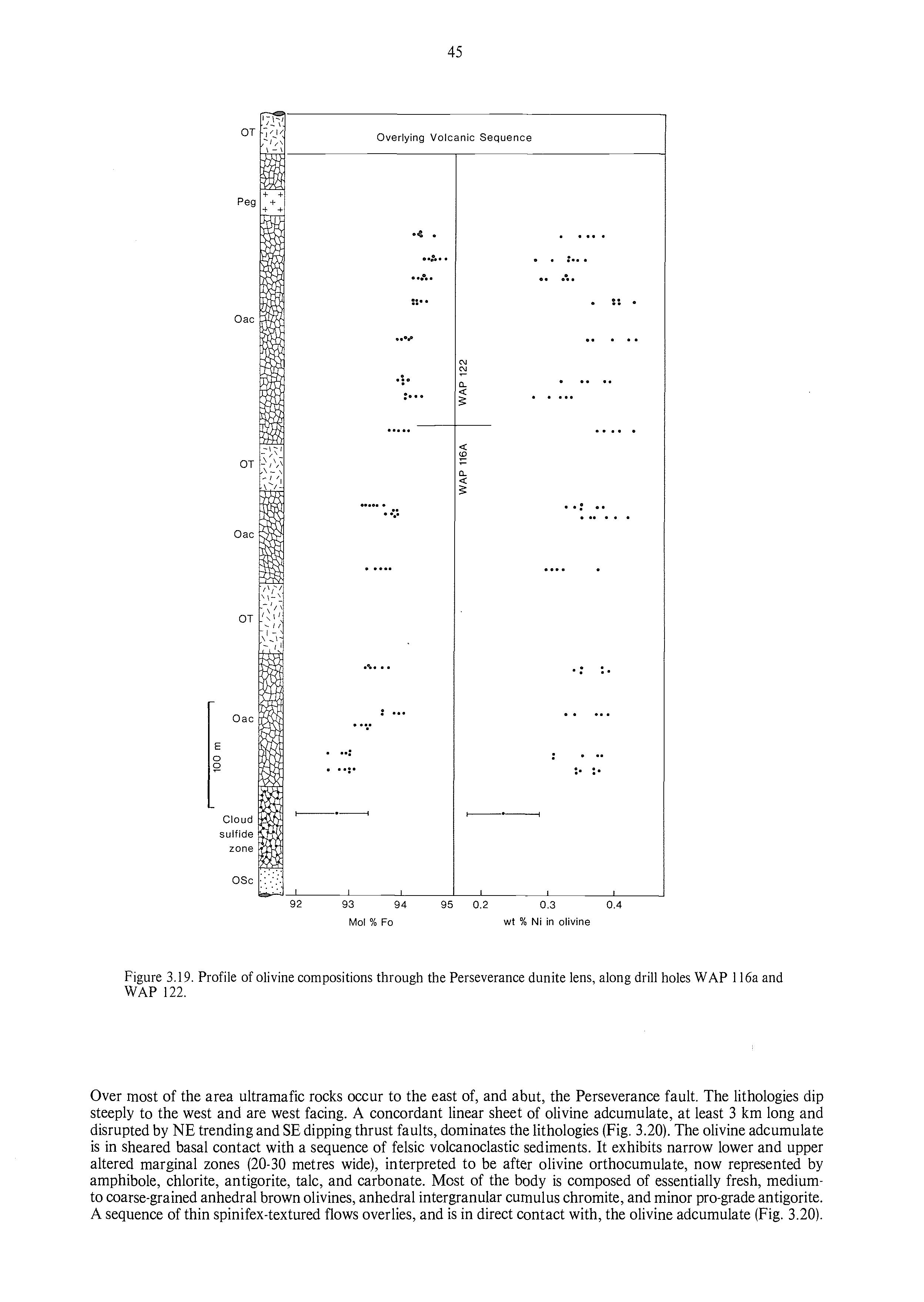
Over most of the area ultramafic rocks occur to the east of, and abut, the Perseverance fault. The lithologies dip steeply to the west and are west facing. A concordant linear sheet of olivine adcumulate, at least 3 km long and disrupted by NE trending and SE dipping thrust faults, dominates the lithologies (Fig. 3.20). The olivine adcumulate is in sheared basal contact with a sequence of felsic volcanoclastic sediments. It exhibits narrow lower and upper altered marginal zones (20-30 metres wide), interpreted to be after olivine orthocumulate, now represented by amphibole, chlorite, antigorite, talc, and carbonate. Mcst of the body is composed of essentially fresh, mediumto coarse-grained anhedral brown olivines, anhedral intergranular cumulus chromite, and minor pro-grade antigorite. A sequence of thin spinifex-textured flows overlies, and is in direct contact with, the olivine adcumulate (Fig. 3.20).
Figure
The sequence is characterized by thin chloritic interflow sediments and most of the flows have concentrations of sulfide in their basal zones. On section 84400N (Figs. 3.21, 3.22), textures have been obliterated from many of the hangingwail flows, however the cyclic distribution of nickel through the stratigraphic profile illustrates the sequence, and is in contrast to the constant 0.3 wt. %Ni exhibited by the olivine adcumulate. Compositional differences between the lithologies are also well displayed in the MgO-CaO-Al,O, diagram in Figure 3.23. Departure from the expected fractionation trends by the spinifex-textured flow rocks reflects their loss of calcium during metamorphism.
At its northern end, the olivine adcumulate grades laterally into a sequence of olivine orthocumulates and spinifextextured flows. This lateral change has been traced by percussion drilling and textures are visible in percussion drill chips on line 85600
Spinifex-textured flows
g.o"l Olivine orthocumulate rocks
Olivine mesocumulate-adcumulate rocks
High MgO basalt
1>,>1
Undifferentiated basic volcanics
Undifferentiated sedimentary rocks
-v- Fault
Facing direction
%, Diamond drill hole
0 250 m
Figure 3.20. Geological map of the Kathleen East area (after Anaconda Aust. Inc.).
Mg0-Ca0-AI2O3 Kathleen East Ultramafics + Olivine adcumulate m Flow rocks with spinifex texture
3.23. Plot of MgO-CaO-Al,O, values for Kathleen East ultramafic rocks. Data from Anaconda Aust. Inc.
Figure 3.21. Geological cross section on line 84,40ON, Kathleen East area (after Anaconda Aust. Inc.).
!socumulate
Figure
loeo] Olivine orthocurnulate
Spinifex textured and orthocurnulate flow rocks
Olivine mesocumulate and adcurnulate lnterflow sediments
/ Facing direction
Profile of DDH 844A, Kathleen East, showing lithologies and Ni and Cu variations (after Anaconda Aust. Inc.).
troduction
The Six Mile Well ultramafic body is one of several mineralized olivine adcumulate pods delineated in the Yakabindie Region by Anaconda Australia Inc. during an intensive nickel exploration programme in the late 1960's and early 1970's. Five of these, including Six Mile, David, Goliath North, Goliath Central, and Goliath South, occur in close association in the highly-dismembered northern part of the area (Fig. 3.24). The pods are at the same stratigraphic
KED 844A Metres
Figure 3.22.
Jones Creek Conglomerate
Olivine mesocumulate-adcumulate
Olivine orthocumulate
Flow rocks - spinifex textured in places
Basalt - predominantly tholeiitic
Gabbroic sills - tholeiitic with high Mg basalt
Banded Iron Formation oxide, sulfide facies
Metasediment - arkosic and volcanoclastic
Gabbro - layered sill "Kathleen Gabbro"
Facing direction from current bedding and spinifex textured ultramafic flow rock
Syncline
Fault showing relative displacement
0 1 km
Figure 3.24. Geological map of the Yakabindie area (after Naldrett and Turner, 1977).
level and are exposed as small hills capped by dense brown ferruginous jasperoidal and scoriaceous laterite cap which pseudomorphs the primary igneous olivine adcumulate texture. The bodies are enclosed in marginal zones of olivine orthocumulate and exhibit gradational lateral contact with thinner orthocumulate and spinifex-textured horizons. Careful reconstruction of the stratigraphic relationships prior to folding and faulting (Fig. 3.25) illustrates that the five lenses were originally linked laterally by these persistent thinner lithologies, suggesting a consanguineous relationship (Naldrett and Turner, 1977).These authors concluded that the adcumulate bodies represented an intrusive
South North
six Mile
South Goliath Central Goliath North Goliath David Legend
Volcaniclastic metasediment Metaquartzite, black shale
Olivine orthocumulate
Olivine adcumulate Mafic volcanic
>.- Facing from spinifex flow
Spinifex textured ultramafic flow 0
After A.J.Naldrett, A.R.Turner, 1977
3.25. Reconstruction of the Six Mile Well, David. and Goliath adcumulate lenses before major folding and faulring (after Naldrett and Turner, 1977).
Talc schist, talc-chlorite schist t’\ (mostly flow rocks)
Basic rocks
Olivine orthocumulate (upper units layered)
Closely packed olivine orthocumi and olivine-sulfide cumulate
Olivine adcumulate, olivine-sulfide adcumulate
Undifferentiated sediment
MH Fault
o- Diamond drill holes
0 200 m date
1977).
Figitre
Figure 3.26. Geological interpretion of the surface geology, Six Mile Well (after Naldrett and Turner,
phase of komatiitic magmatism, and, as such, were linked feeder zones to overlying flow rocks. They were filled during the intrusion of crystal-charged magma comprising 90% olivine grains and 10% silicate liquid surrounded by a lubricating sheath richer in liquid represented by the olivine orthocumulates.
Results of a more recent detailed study of the southern part of the Six Mile Complex (Hill, 1982), constrain further the genesis of the olivine adcumulate lens to one which has crystallized in place, in a dynamic regime consanguineous with the laterally equivalent more evolved units.
Geology of x
x or zone of thickening is 900 m long x 400 m thick and is concordant with its northtigraphy. Its western margin dips steeply westward and is sheared, and its eastern (Fig. 3.26). To the north, the dunite body exhibits gradational margin is a fault that strik contact with a zone of olivine orthocumulate.
The surface expression of the body is subdued and varies from rubbly friable goethitic silica cap over the olivine adcumulate to fresh outcrops of serpentinized olivine orthocumulate on the western margin. The complex has been metamorphosed, peaking at lower amphibolite facies, and present mineral assemblages include olivine, serpentine (lizardite, antigorite), brucite, magnetite, pyroaurite, magnesite, dolomite, talc, chlorite, and tremolite. Igneous textures have been largely preserved.
Naldrett and Turner (1 977) described igneous layering or cyclicity in the peridotite envelope on the western margin of the complex. This cyclicity was reflected in regular variations in MgO, CaO, and Al,O,, indicative of a west facing direction in keeping with that of the surrounding stratigraphy. They illustrate chemical variation with a section along aldrett and Turner, 1977).
At the southern end of the complex, the fault at the eastern footwall contact is steep near-surface and shallows appreciably at depth. A true igneous contact was thus not intersected in this area, despite deep drilling, and the true nature of the footwall contact is unknown; however, a sign~ficantlywider section of the complex has been igure 3.27 is a detailed geological cross-section of the complex drawn along line 320
There is a gradational evolution in igneous textures from olivine adcumulate to olivine orthocumulate westward and upward across the igneous stratigraphy, and a consistent correlatable primary igneous lamination.
four major igneous zones or macro-layers, with characteristic predominant igneous features can ndaries between the various macro-layers are somewhat diffuse although within each layer sharp contacts are common between contrasting igneous lithologies and between finer-scale textural and grain-size layers. Correlation of the macro-layers from drill hole to drill hole within the single drill section is possible. Intense alteration and local severe tectonic disruption inhibit correlation between drill sections, however sufficient evidence is present to indicate that there is a steep southeasterly plunge to the complex.
Zone I: The western marginal orthocumulate zone is characterized by textures which exhibit cyclicity from medium grained olivine mesocumulate-adcumulate to olivine orthocumulate on a scale of several metres. Some of the more evolved orthocumulates contain serpentinized pyroxene oikocrysts (Fig. 3.28), others contain relics of primary unaltered intercumulus aluminous amphibole and apatite. In the orthocumulates, olivine is commonly bimodal in size ranging from 300 pm to 3 mm (Fig. 1.3). The present mineralogy of the rocks of this unit includes antigorite pseudomorphs after olivine, rarer lizardite, chlorite, talc, ferroan magnesite dolomite, very rare brucite, and ubiquitous minor fine grained subhedral zoned spinel. The bulk of the rocks in this zone are barren of sulfide.
Zone 2: Zone 2 on section 320, is 100 m thick. It is characterized by abrupt textural and grain-size layering and is dominated by closely packed olivine orthocumulate and olivine sulfide orthocumulate (Fig. 3.28). Cumulus sulfide is generally confined to finer grained layers which contain higher proportions of intercumulus liquid. Some layers are coarse grained and exhibit adcumulate textures. Contacts between mineralized and unmineralized lithologies are generally sharp (Fig.3.28).
Serpentine pseudomorphs after olivine vary from antigorite-carbonate assemblages to lizardite-brucite. Primary intercumulus silicates have been altered to chlorite, talc, and carbonate. Rare cumulus subhedral spinel is ubiquitous.
Relic primary olivine was found in only three samples of core from the lower half of this zone on the 320N section. The olivines are unzoned and have compositions of Fo89, Fogl 27 and Fog, 2.
Zone 3: Zone 3 is an essentially sulfide-free coarse grained ( - I cm) mosaic textured olivine adcumulate (Fig. 1.4). A large proportion of this zone contains relict olivine and in places the rock is essentially unaltered. Olivine compositions range from Foq3, to Fog4 ,and are relatively uniform throughout the zone. Chromite is very rare in this adcumulate but in contrast to the other units it is characteristically anhedral.
Figure 3.27. Geological cross section on line 320N, Six Mile Well area.
rmost unit intersected by drilling. It is the second significant sulfide-bearing zone on coarse-grained olivine adcumulate is the dominant lithology, however the zone is ce of grain size, textural, and phase layering (Fig. 3.28). Abrupt changes fr medium-grained olivine-sulfide mesocumulate to coarsegrained barren olivine adcumulate are common. olivine is present in the upper levels of the unit and its composition is within the range Fog2 to FoV38.
Various plots of whole-rock compositions and the compositions of contained rare relic olivines, characterize each of the major units. The gradual change from olivine adcumulate to orthocumulates with higher initial igneous porosities, and a concomittant fractionation towards more evolved compositions upwards across the complex from Zone 3 to the western margin, is suggested by plots of Mg0-Fe0-Si02and MgO-FeO-Al,O, for representative samples from each zone (Figs. 3.29, 3.30). Significant cyclic variations in compositions from Zone 1 have been described aldrett and Turner (1977). This feature and the wide range in compositions illustrated by rocks from Zone 2, are in direct contrast to the tight groupings displayed by the rocks from Zones 3 and 4. The olivine adcumulates from Zone 4 are consistently more iron-rich than those from overlying Zone 3.
The ell complex exhibits textural, mineralogical, and compositional layering on scales which range from centimetres to tens of metres. The layering parallels an igneous lamination and is concordant with the dip and strike of the enclosing stratigraphy. The complex is characterized by thick zones of olivine adcumulate, and cyclic layering whose mineralogical and chemical features indicate a west-facing, in accordance with the surrounding spinifex-textured volcanics. There is a gradual change to more fractionated rocks towards the top of the complex.
ZS
Figure 3.28. A variety of igneous textures exhibited by rocks from the Six Mile Well ultramafic complex. A: Olivine orthocumulate with oikocrystic clinopyroxene. B: Olivine-sulfide orthocumulate. C: Contact between olivine-sulfide orthocumulate and olivine orthocumulate. D: Fine-scale layering of olivine adcumulate and olivine-sulfideadcumulate.
Figure 3.29. Mg0-Fe0-Si0, (atomic proportions) plot of bulk compositions, Six Mile Well ultramafic body showing change towards progressively more evolved lithologies upwards through the complex. Compositions of contained olivines are plotted for some samples.
These features are not consistent with an origin via the intrusion of a crystal-charged mush. A magma of 90% crystals and 10% silicate liquid would not have the physical properties of a crystal mush and could not be intruded as such. The layering within the Six Mile body could not be produced during such a process.
The accumulation of thick zones of olivine adcumulate and orthocumulate, characterized by mineralogical, textural and compositional layering, is indicative of in-situ crystallization in a relatively dynamic magmatic environment involving continued replenishment of komatiite magma and periodic variation in factors such as magma composition, cooling rate, and the degree of supercooling.
The Six Mile Well complex is confined to a stratigraphic horizon of ultramafic lithologies including spinifex-textured flows and olivine orthocumulates. A gradual change along strike from olivine adcumulates to orthocumulates northwards has been documented by extensive diamond drilling. It is proposed that the spinifex-textured rocks, olivine orthocumulates, and the Six Mile Well lithologies are consanguineous. It is proposed that they formed at the surface and that their textural and compositional differences reflect differences in their physico-chemical environments of formation.
3.30. Mg0-AI20,-Si0, (weight proportions) plot of bulk compositions, Six Mile Well ultramafic body, showing change towards more evolved compositions upwards through the complex. The range in olivine compositions is also shown.
Figure
Introduction.
The Honeymoon Well area, 40 km south of Wiluna, will not be visited on the excursion. The area is almost devoid of outcrop, being covered by aeolian sand and clay-rich lake sediments. The ultramafic sequence at Honeymoon Well is currently the subject of a CSIRO research project sponsored by CSIRO, CRA, and WAMPRI. A brief outline of the results of this work to date, which allows the ultramafic succession here to be compared with that in other areas, is appropriate.
The geology of the area has previously been described by Donaldson and Bromley (1981). In the current project all thirty-eight diamond holes drilled into the ultramafic sequence have been relogged, and bottom-hole samples from about 400 RC holes identified. This, together with high resolution aeromagnetics, has enabled a new geological map to be constructed for the area.
Geology.
The ultramafic succession at Honeymoon Well trends north-south and consists of a central thick zone of olivine cumulates, dominated by coarse-grained olivine adcumulate and mesocumulate. This zone is mantled on its eastern and western margins by west-facing sequences of spinifex-textured flows. To the north and south the adcumulates and mesocumulates grade into thinner sequences of mostly olivine orthocumulates (Fig. 3.3 1). A westward-facing orientation for the stratigraphy agrees with that reported by Elias and Bunting (1978)but is contrary to that suggested by Donaldson and Bromley (198 1).
Olivine adcumulate-mesocumulate
Olivine mesocumulate
o Olivine orthocumulate, spinifex
textured rocks
Undifferentiated country rock
Faults and magnetic lineaments
/Diamond drill hole
Facing direction
0 1 km
Figure 3.3 I. Geological map of the Honeymoon Well area showing the distribution of komatiite lithologies
In the north and south of the oneymoon Well area, enclaves of metasedimentary and metavolcanic rocks separate eastern and western ultramafi equences. Numerous similar enclaves of country rock separating two major ultramafic sequences are present over a strike length of 60 km southward from Honeymoon ell to just north of Six Mile
Honeymoon Well area has undergone lowermost greenschist facies regional metamorphism (Donaldson and mley, 1981). The mineralogy of the adcumulate and mesocumulate rocks is now dominated by lizardite-magnetitestichtite-brucite and minor antigorite-carbonate and talc-carbonate assemblages (Donadson and Bromley, 1981). Lithologies rich in Ca and A1 are now tremolite-chlorite rocks. etween the country rock enclaves, the eastern and western ultramafic sequences are in contact.
tailed knowledge of the geology at Honeymoon Well is only possible where there are diamond drill data. Extensive drilling has taken place along the north-central section of the eastern contact and the central part of the western contact where nickel sulfide concentrations are present.
rgin: The most northerly diamond hole on the eastern contact of the ultramafic sequence, HWD 3, intersected four spinifex-textured flows between 82 m (the beginning of coring) and 119.3 m, and one thick flow from 119.3 m to the eastern contact at 304 m (Fig. 3.32). This latter flow gradually changes downhole from
Spinifex-textured rocks
Olivine orthocumulate
Olivine adcumulate
Country rock
Figure 3.32. Lithological and geochemical profile of HWD 3 (see Fig. 3.31 for location).
orthocumulate beneath the spinifex zone to mesocumulate then adcumulate at about 180 m. Olivine pseudomorphs in the adcumulate are medium-sized polyhedra. Stichtite pseudomorphs after chromite are equant. The adcumulate extends to around 255 m except for a 15-m interval of orthocumulate. Orthocumulate forms the lower part of the flow from the adcumulate to the contact. The dip in the vicinity of NWD 3 is westerly, and intervals down H 3 are approximately true thicknesses. Rock relationships displayed in this hole provide convincing evidence that adcumulates may form in volcanic regimes.
Diamond drill holes located 300 m to the south of HWD 3 encountered sulfide-bearingultramafic rocks. The sulfides extend to the south over a strike length of about 1 km. A gate of diamond drill holes 900 m south of HWD 3 provides a good cross section through the sulfidebearing zones on the eastern margin (Fig. 3.33). The sequence consists of a lower olivine mesocumulate, one part of which is sulfide-bearing. Overlying this is a distinctive, coarseto medium-grained, loosely-packed olivine-sulfideorthocumulate (Fig. 3.34). Olivine grain shapes, sizes, and packing density vary throughout this unit. The mineralogy of this unit is dominated by antigorite-carbonate assemblages, whereas the mesocumulates are dominated by lizardite-brucite.
Above the olivine-sulfide orthocumulate and extending westward is a mesocumulate with uniform grain size and mineralogy. The mesocumulate presumably belongs to the mass of mesocumulate and adcumulate that forms the central core of the Honeymoon Well komatiite sequence (Fig. 3.31).
To the south, below the country rock enclave, a diamond hole intersected a sulfide-free sequence with similarities to that just described. The sequence is, from east to west, a lower mesocumulate unit and an overlying orthocumulate with textures similar to the olivine-sulfide orthocumulate further north. Above the orthocumulate are tremolitechlorite schists which were probably once spinifex-textured rocks.
Western Margin: Along the central section of the western margin, where diamond drilling is concentrated, the ultramafic rocks consist of diverse lithologies varying from very coarse-grained adcumulates to spinifex-textured flows, some of which contain units of olivine harrisite.
OSmc Olivine-sulfide mesocumulate
Omc Olivine mesocumulate
OSoc Olivine-sulfide orthocumulate
Ooc Olivine orthocurnulate
Talc-carbonate
Figure 3.33. Cross section of the eastern sulfide-bearing margin of the Honeymoon Well komatiite sequence. Section is 300 m south of HWD 3 (see Fig. 3.31).
HWD 24A
HWD 26A
HWD 32
Spinifex-textured flows were encountered in six diamond holes over a strike length of 2.4 km. Facing directions derived from asymmetric differentiation in flows, and confirmed by geochemical profiles, show the sequence on the western margin to young in a westerly direction. On the section containing HWD 19, a gate of four diamond drill holes (Fig. 3.35) shows stratigraphic and structural relationships critical to the understanding of the geology dong the western margin. On this section, holes WD 8, HWD 33, and the upper section of HWD 38 intersected olivine mesocumulates and adcumulates, whereas in HWD 19 and in the lower part of HWD 38 spinifex-textured flows were encountered. The facing direction in the flows away from the contact show the sequence to be overturned, dipping 30-50 degrees to the east and facing west.
The contact between the ultramafic sequence and the basalts to the west is a major fault. The facing direction in the flows near this faulted contact is reversed due to drag folding. The basalts appear to dip steeply to the east, whereas the contact with the ultramafics mostly dips steeply to the west. The faulted contact cuts across the strike
0.0. OSmc Olivine-sulfide mesocumulate Oat Olivine adcumulate
Spinifex-textured flow rocks 1-
Figure 3.35. Cross section of the western sulfide-bearing margin of the Honeymoon Well komatiite sequence. Section includes HWD 19 (see Fig. 3.31 for location).
Omc Olivine mesocurnulate
of the ultramafic sequence so that different levels of the stratigraphy abut the contact along its length. At the depth reached by drilling, the spinifex-texturedflows form only a relatively thin sliver between the contact and mesocumulateadcumulate to the east. It is expected that more of the flow sequence is preserved at deeper levels.
Most diamond holes along this contact were drilled to the east, essentially down dip. Igneous layering in the core is consistently at a low angle to the core axis. This has hampered the reconstruction of the stratigraphic section in this upper part of the ultramafic sequence.
The sulfide zones are present in olivine-sulfide mesocumulate and spinifex flows (Fig. 3.35). The mesocumulate has consistently much thicker intersections of sulfide and generally higher Ni grades than the spinifex flows.
The mesocumulates and adcumulates immediately below the spinifex-textured flows on the western margin display very marked textural and compostional layering (Fig. 3.34). Donaldson and Bromley (198 1) documented large-scale cryptic and modal layering with significant variations in Cr,O,, Mg/Fe, and MISi. Centimetre-scale layering is abundant and is defined by grain size and mineralogical variations. Marked variations in the proportion of stichtite are present within the mesocumulate. Variations in the packing density of olivine are also common producing alterating thin (1-5 cm) layers of orthocumulate (Fig. 3.34) and mesocumulate. Thicker metre-scale layers of mesocumulate and adcumulate are also present.
Much of the adcumulate is texturally very uniform (Fig. 3.34). Very coarse-grained anhedral olivine pseudomorphs and lobate intergranular stichtite exhibit little variation over several hundred metres of core. The adcumulate is cryptically layered as shown by Donaldson and Bromley (198 1).
The zone of ultramafic rock in the central core at Honeymoon Well has only been sampled by RC drilling. The relative distributions of olivine adcumulate and olivine mesocumulate are thus poorly known, although both lithologies are known to be present.
Lateral to the central core - to the west of the country rock enclaves - the adcumulates and mesocumulates rapidly give way to orthocumulates towards the north and south. The orthocumulates in the south are loosely packed and harrisites are present in places near the western contact. Immediately south of the Honeymoon Well area, spinifextextured flows are again present on this contact. The contact here appears to be intact.
Country Rocks.
The footwall rocks of the ultramafic sequence are mostly felsic to intermediate, volcanic and volcanoclastic rocks. These range from fine-grained quartz-felspar-chlorite-muscoviteschists to coarse-grained polymictic fragmentals with felsic to intermediate matrix-supported angular fragments. Some of the eastern diamond drill holes encountered gabbro, of tholeiitic parentage (Donaldson and Bromley, 198l), in the immediate footwall.
The enclaves of country rock between the two main ultramafic units are dominantly felsic volcanic and volcanoclastic rocks, with minor gabbro and basalt on their eastern margin.
The country rocks immediately to the west of the ultramafic sequence vary along strike as a result of movement on the faulted contact. In the central section, pillowed basalts with minor interflow sediments form the immediate hanging wall formation. These rocks extend several hundred metres to the west. Whole-rock analyses show them to be tholeiites (Donaldson and Bromley, 1981). To the south, where the contact appears to be intact, high MgO basalts, chert, and other fine-grained sediments form the immediate contact rocks.
Summary
The ultramafic succession at Honeymoon Well is similar in many respects to the other major komatiite complexes in the Agnew-Wiluna belt. The main mass of adcumulate, with very coarse-grained olivine pseudomorphs and lobate stichtite after chromite, occupies a central zone between enclaves of felsic country rock. At this location, two major ultramafic sequences are linked by a central zone of thickening, whereas along strike these sequences are separated by the country rock enclaves. The adcumulate grades laterally into olivine orthocumulate in areas stratigraphically above the enclaves.
A feature, not clearly demonstrated at other localities, is the presence of olivine adcumulate within a well-defined, very thick spinifex-textured flow. This flow is at the base of the komatiite pile, well below the main mass of adcumulate. Spinifex flows also overlie and cap the ultramafic sequence above the central mass of adcumulate.
The country rocks in the enclaves are similar to the predominantly felsic footwall sequence. The eastern komatiite sequence appears to have formed penecontemporaneously with these felsic rocks. The spatial relationship between the felsic rocks and the main adcumulate body is indirect evidence for the process of thermal erosion by komatiites. If the apparent stratigraphic thickness at Honeymoon Well is anywhere near the original real thickness, then thermal erosion on a massive scale must have taken place.
The localities visited on the field trip exemplify four different styles of occurrence of komatiites.
1. Thick sequences of thin, well-differentiated spinifex-textured komatiite flows, as seen at Marshall Pool. These conform to the standard Munro Township-style pattern as described by Pyke et al. (1973) and Arndt et al. (1977).
2. Thick, laterally-extensive layered sheets, with central adcumulates overlain by orthocumulates and harrisites, as in the Siberia-Menzies belt.
3. Lenticular olivine adcumulate bodies occupying zones of thickening within komatite sequences, flanked by orthocumulates and spinifex-textured flows, as at Agnew, Honeymoon Well, and in the Yakabindie area.
4. Extensive sequences of orthocumulate and mesocumulate rocks, with spinifex-textures rare or absent, linking adcumulate lenses between Agnew and Honeymoon Well.
These styles of Occurrence are important features of the physical volcanology of komatiites and each reflects a different physico-chemical environment of formation.
size of lava ~~~~$
The length, thickness, and areal extent of lava flows depend on a variety of factors, the main ones being viscosity, eruption rate, and the nature of the topography on which they are erupted. Komatiitic lavas, having very low viscosities (comparable to that of water), flow rapidly over large areas, in contrast to silicic lavas which form thick, domeshaped flows close to their vents.
Eruption rate and topography are closely inter-related variables. Rapid, high volume eruptions of mafic lavas generate lava plain topography, as exemplified by continental flood basalt provinces such as the Columbia River Plateau and the Deccan Traps, and by the lunar maria. More episodic, smaller volume eruptions give rise to construction of central cones, of which the Hawaiian volcanos are the best example. The volcanic topography exerts a major influence on the geometry of individual flows. Eruption onto steep slopes results in strongly-elongate linear flows, as are common on Hawaii. Eruption onto surfaces of low relief generates equidimensional lobate flows.
Eruption rate exerts an important control on the internal structure of lava flows. Volcanologists distinguish between “lava flows” and “cooling units”. A lava flow is a unit generated by a single continuous episode of eruption. A single flow may consist of one or many cooling units, whose defining characteristic is a flow top which has cooled and solidified before more lava arrived on top of it. “Compound flows” are lava flows made up of many individual flow units. Pillowed basalt flows are good examples of this. High eruption rates give rise to extensive “simple flows” consisting of single flow units, and compound flows arise from low eruption rates (Williams and Walker, 1973).
Based on the physical properties of komatiite magma, Huppert and Sparks (1985) have calculated that an unimpeded flow may travel up to 150km before the mean temperature of the lava will drop from 1600 to 1350” C. Provided effusion rates are high, which is likely for komatiites, very extensive single eruptive units will form.
The thin, well-differentiatedkomatiite flows at Marshall Pool, like those at Munro Township and other classic localities, are thought to be examples of compound flows; thin flow units budded off from one another in the manner of pillowed basalts, and differentiated rapidly in place to give rise to spinifex textured tops and lower cumulate zones. In contrast, the lenticular bodies of olivine adcumulate in the Agnew-Wilunabelt, and the Siberia -Menziesadcumulate sheet, represent individual cooling units of great thickness and extent which we interpret as the result of prolonged, rapid eruption.
The contrast in geometry between the sheet-like and lenticular dunite bodies arises from the nature of the topography and the composition of the floor rocks over which the lavas were erupted. Lenticular bodies form on felsic substrates and sheet-like bodies on mafic substrates. We shall now discuss models for the origin of these two contrasting styles of occurrence of olivine adcumulate and associated komatiitic rocks.
The extrusive origin of the spinifex textured komatiites is unquestioned, but the olivine-rich bodies, particularly the adcumulates, have previously been interpreted as intrusive, either as vertical dykes (Binns et al., 1977) or subvolcanic feeder chambers (Naldrett and Turner, 1977). Field evidence demonstrated on this excursion, together with other information (Hill et al., in prep.; Donaldson et al., 1986) has led to the conclusion that all these rocks are extrusive in origin.
The olivine adcumulate bodies between Agnew and Honeymoon Well are confined to a regionally-correlatable formation, dominated by olivine orthocumulates and spinifex textured rocks which are intercalated with felsic sediments. The bodies occupy lenticular zones of thickening within the komatiite sequence and grade texturally and compositionally into flanking orthocumulates and spinifex-textured flows (Fig. 4.1). At Honeymoon Well, the profile of the lower thick flow intersected by HWD 3 (Fig. 3.32) shows a gradational textural and geochemical transition upward from adcumulate through orthocumulate to a spinifex-textured top.
---Sea level
Spinifex-textured flows, olivine-sulfide cumulate
Olivine orthocumulate, mesocumulate in places
Olivine adcumulate, mesocumulate in places
Massive Ni sulfides
Felsic volcanic and sedimentary rock
500 m (approx.)
Figure 4.1. Schematic section showing the distribution of iqneous lithologies around a lenticular adcumulate lens. Individual lenses exhibit differences in the abundance and spatial distribution of lithologies depending upon their nature of evolution, the predominant terrain, structural modification, and presently-exposed section.
These spatial relationships show that the lenticular dunite bodies are integral components of the volcanic stratigraphy and are compelling evidence for an extrusive origin. If they were intrusive in origin, a random distribution through the stratigraphy would be expected.
Many of the zones of thickening exhibit one or more of textural, modal, and cryptic layering on the scales of tens of metres to centimetres with sharp contacts between layers (e.g. Honeymoon Well, Six Mile, and Agnew). Upper marginal zones of olivine orthocumulate are common and are well layered (e.g. Honeymoon Well and Six Mile).
Fractionation trends exhibited by individual units in these zones parallel the facing directions of the enclosing volcanic stratigraphy (e.g. Six Mile).
Geochemical studies (Naldrett and Turner, 1977; Hill, 1982; Donaldson et a1.,1986; see Agnew section) show that olivine in some of the adcumulate bodies was in equilibrium with komatiitic liquids similar in composition to that which formed spinifex-textured flows. At Six Mile and at Agnew these flows are spatially associated with the adcumulates.
The textural gradation from olivine adcumulate to flanking spinifex-textured flows and orthocumulates reflects lateral variations in crystallization regime and a close genetic association. The layering exhibited by the olivine-rich cumulates reflects a dynamic and varying crystallization history as would be expected in a volcanic environment. The overpropondance of olivine relative to liquid fractionate within the bodies reflects a process by which removal of this liquid from the accumulating crystal pile was accomplished. This is in accordance with a dynamic volcanic environment.
We have yet to find demonstrably extrusive rocks lateral to the dunite in the Menzies-Siberia belt and structure has precluded the observation of flanking lithologies at Mt. Clifford and Marshall Pool (Donaldson, 1982). We are confident in also interpreting these sheet-like dunites as extrusive in origin. They exhibit similar internal features to the lenticular bodies. They contain cryptic layering and zones of differentiation (e.g. Mt Clifford, Donaldson, 1982). They have an over abundance of olivine cumulate relative to that expected from in situ fractionation. Their crystallization history is in accordance with a dynamic volcanic environment.
a1 erosion.
apping at Agnew and Honeymoon Well (and also at Mt. Keith-Kingston, not discussed in this guide) shows intervals of felsic sediments and volcanics between two ultramafic units being progressively cut out by lenses of olivine adcumulate which connect the two units.
The base of the Perseverance dunite lens in the Agnew mine area (Fig. 3.16) has a discordant channel-like geometry, and cuts down through at least 150 m of felsic country rocks. This feature is interpreted as a thermal erosion channel akin to lunar sinuous rilles, formed by melting of floor rocks beneath an extensive komatiite lava river. The ability of komatiites to melt the rocks over which they flow was predicted theoretically by Huppert and Sparks (1985), and arises from the combination of high liquidus temperatures and low viscosity, which induces turbulent flow. In the case of all the lenticular dunite bodies of the Agnew-Wiluna belt, parent lavas were erupted onto felsic metavolcanic rocks having liquidus temperatures well below the temperature of the komatiite lavas.
igure 4.2 illustrates the general model for the origin of the olivine adcumulate lenses. Prolonged, rapid, and continuous eruption of komatiite lava occurred on a substrate of dominantly-felsic volcanic rocks. This flow initially became channellized between “levees” of solidified lava. Continued flow of superheated lava resulted in deepening of the central channel by melting and assimilation of its felsic volcanic floor and walls. At Agnew, over 100 m of felsic rocks were melted and assimilated beneath the axis (thalweg) of the main flow channel. As flow rates declined and the lava temperature dropped, thermal erosion ceased and crystallization of olivine began on the floor and walls of the channel. At Agnew and Honeymoon Well the dunite lenses bottom out against a lower sequence of komatiites dicating that these sequences acted as thermal barriers playing a large role in the cessation of thermal erosion. eterogeneous nucleation and crystallization of olivine at low degrees of supercoolingon a heated substrate produced adcumulate. The adcumulate bodies formed as long sinuous ribbons with lenticular cross sections. Some bodies have a thin basal zone of olivine orthocumulate, particularly on channel walls (e.g. Six Mile and Kathleen East) which reflect initial higher cooling rates through the channel substrate. Periodic overflow of the central channel produced the flanking rocks. These were emplaced episodically as thin cooling units on a cold substrate, giving rise to orthocumulates and spinifex-textured flow units.
The textural layering exhibited by some of the dunite bodies reflects variations in the extent of supercooling at the crystal liquid interface, due to fluctuations in flow rate. Modal layering such as fluctuations in chromite abundance and cryptic layering, that is, variations in olivine composition through the lenses, arise from changes in the composition of the flowing lava. These changes arise from fractionation of the parent komatiite magma, either en route from the mantle to the surface, or as it flows over the surface.
The “lava river” model provides an explanation for the large surplus of cumulus olivine relative to komatiitic liquid represented by the dunite lenses. The lava river mechanism allows for the parent magma to the olivine adcumulate to have drained away downstream. An intrusive mechanism would require initial emplacement of an extremely olivine-rich crystal mush, a difficult feat in view of the high density and extremely high viscosity involved, followed by highly efficient filter pressing to remove virtually all of the liquid component. This is inconsistent with current understanding of the origin of adcumulates (see Chapter 1).The coarse-grained nature of the dunite, a feature often taken as evidence for an intrusive origin, is an expected characteristic of crystallization’af low degrees of supercooling in a hot, long-lived lava flow channel. A dynamic volcanological model, taking into account the extreme fluidity of komatiitic lavas, accounts for the vast accumulation of olivine within the dunite bodies. es of lave involved.
Huppert and Sparks (1985) show that thermal erosion channels could develop depths in excess of 100 m within 10 km of the source of the flow, if the flow was active over a period of about three months at a flow rate of 10 m2s-*(their Fig. 7). Assuming an average flow thickness of 100 m, this corresponds to eruption rates of 10,000 m3s-*,or about 1 km3/day, and total volumes of the order of 100 km3. For comparison, individual Columbia River
basalt flows typically have volumes of 10 to 20 km3, ranging up to 10,000 km3, and were erupted at rates up to 1 kmYday per km of fissure (Swanson et al., 1975). The volume and eruption rate of lava required by our model is therefore entirely reasonable, in view of the many hundreds of kilometres of strike length of komatiite flows exposed in the eastern Yilgarn Block.
Comparison with lunar rilles.
The scale of the channels involved is comparable with that of lunar sinuous rilles, which are mostly 50-250 m deep, up to 3 km across, and meander for many tens of kilometres (Schulbert et al., 1970), Figure 4.3. These have been attributed to thermal erosion by Mare basalts (Hulme, 1973). Thermal erosion channels beneath terrestrial basalt lava flows have been identified by Greeley and Hyde (1972).
flows
Figure 4.2. Cartoons showing the model for the development by komatiites of a major thermal erosion channel, the relationship of marginal spinifex-textured flow rocks, and the subsequent crystallization of olivine adcurnulate within the channel.
textured
Figure 4.3. The sinuous rilles of Rima Prinz I (bottom) and 11. The width of the field is 50 km. (Lunar Orbiter 5, medium-resolution frame 191).
illiams Ultramafic t contains the most extensive adcumulate unit of any kornatiite in the m the other adcumulate bodies. The presently-defined extent is abo 100 km and it appears to have been, prior to disruption by granite intrusion, a sheet4 adcumulate bodies at it than to the laterally restricted under cover, has been traced for 15 km evident in the souther t. Clifford body is partly fault-bounde unites are stratigraphically equivalent so that the dunite sheet may have bee
he stratigraphic positions of the 001 adcumulates, at the base of ubstratum of tholeiitic basalt, are remarkably s sheet, a layered gabbro lies between the rlain by spinifex-text and in the norther
arguments presented above for the volcanic origin of the iven volume of komatiitic olivine adcumula olivine dissolved in the liquid crystallizes. Unit there is insufficient liquid (as e liquid from which the adcumula~eformed must be preserved in distal units. For crystals to form and the fractionated liquid to be removed over the area now covered by the adcumulates, very efficient repienishmen~and removal of the magma are required. This could only take place in a volcanic environment where lava flow rates may be very high.
The basal orthocumulate crystallized during the early history of the flow when heat loss from the lava would have been to a cool substrate, and to cool sea ater from the flow top. The orthocumulate textures indicate moderate degrees of supercooling that continually produced abundant new olivine nuclei.
eat loss through the floor effectively stopped, once a thin layer of orthocumulates developed on the floor. The nt of heat conducted through these rocks was negligible over the relatively short time the flow was active. rgin and immediate!y-overlying orthocumulates had formed, cooling of the flow was via heat apid turbulent convection of the lava ensured a near-uniform temperatme profile through the rature of the lava and the extent of supercooling were set by a balance between heat loss to the overlying sea-water, heat gain by new magma injection and by crystallization (latent heat).
The transition from the lower orthocumulate to the adcumulate reflects a lowering of the degree of supercooling of the lava. At a given lava composition this requ Clifford body an olivineclinopyroxene adcumulate is present riying adcumulate reflects a change in lliams Unit (Fig. 2.5) olivine becomes more primitive with time. This requires s temperature must also have risen. For the adcumulate to grow, the site of crystallization on the floor of the flow must have been largely insulated from heat loss from the top of the flow. This implies an increase in flow rate (greater heat input) or the devolopment of a thicker flow perhaps due to damming or both.
The sharp contact between the top of the adcumulate and the olivine harrisite in alter’s flow indicates a marked increase in the supercooling of the lava. This was presumably triggered by a rapid decline in the flow rate causing a net heat Ioss. The overlying orthocumulate reflects a return to a moderate degree of supercooling prior to cessation and final solidification of the flow. The lithologies in this upper unit are not well known due to poor outcrop.
Theoretical predictions based on the physical properties of komatiite magma suggest that single eruptive units may extend for great distances and cover very large areas. ocumentation of field relations is required to prove that the komatiites did in fact flow over these distances which uld have important implications for attempts to reconstruct greenstone belt stratigraphy and structure. espite lateral changes in texture and composition which would result from changes in the physico-chemical conditions of formation, these komatiites would constitute time-correlative units. This would permit chrono-stratigraphic correlation to be made between areas of quite different overall stratigraphy.
Of all the komatiite lithologies, the adcumulate bodies provide the most compelling evidence that huge volumes of komatiite lava must have been erupted during single volcanic events. If our model for the origin of the lenticular shape of some of the adcumulates is correct, that is, they occupy thermal erosion channels, then large volumes of lava are required just for the erosion process. In addition, all the adcumulate bodies are accumulations of crystals (i.e. enrichments in olivine relative to parent magma compositions)which grew from continually-fractionating magma which flowed laterally away from the site of crystallization. This fractionation process continued until the very last stages of the lava flow. The adcumulate and mesocumulate bodies present in the komatiitic sequences amount to a huge volume of olivine. The questions are raised, therefore: how far did the residual liquid travel before it solidified, and can this liquid or its crystallization products be recognized in the greenstone sequences distal to the adcumulates?
Although the adcumulate bodies in the Agnew-Wiluna belt are laterally restricted, the komatiite sequences in which they occur can be traced for considerable distances. For example the two main ultramafic units present at Honeymoon ell can be traced southwards over a strike length of 65 km to just north of Six Mile Well (G. Balfe, pers. comm.). The greenstone sequence in this part of the belt appears to be disposed as a single limb of a major regional fold so only the present strike extent of the units can be established.
aldrett and Turner (1977) correlated the ultramafic units and other parts of the stratigraphy north from Agnew through Yakabindie to Mt. Keith. In the Yakabindie area there is only one main komatiite unit and although this ad correlation is possible, details of where and in what form the second ultramafic unit begins in the Six Mile 11 area are yet to be established. This change may have resulted from facies changes in the komatiite sequence.
area where detailed correlation of flow units is possible is the Siberia-Menziesarea. Here the Walter Williams Ultramafic Unit has an areal extent, as defined to date, of about 35 x 100 km. This is small compared to single ’ ’ts of, for example, continental flood basalts which may be only 50m thick but cover 130,000 kmz. The iams Unit must have been much larger than presently defined. The areal coverage of the fractionated residual lava must be, at a minimum, considerably larger than the presently known extent of the adcumulate. It may well be very much larger.
reliminary geochemical data suggest that the source of the Walter Williams flow is to the south of the most southerly outcrop and that flow was in a generally northwesterly direction. The surface upon which the illiams flow erupted appears to have been an extensive lava plain, formed by tholeiitic pillowed basalts, with a paieoslope in a northwesterly direction. A lithostratigraphic unit very similar to the Walter Williams Unit pillowed tholeiitic basalts has been identified northwest of Menzies in the Kurrajong Anticline enstone Belt. This is about 30 km beyond the outcrop of the Walter Williams Unit on the shores hole-rock and mineral chemistry will be needed to test the possibility that this is indeed part of
unit does not extend from the western side to the eastern side of the Broad Arrow-Menzies Greenstone wever, the surface onto which the flow erupted is present on both sides; that is the upper contact of the tholeiitic basalts. On the eastern side of this belt spinifex-textured flows directly overly these tholeiites. These flows may be lateral equivalents to the orthocumulate and adcumulate in the Walter Williams Unit, but more likely they correlate with the Siberia Komatiitic Volcanics that overlie this unit on the western side of the greensone belt. Thus a physical barrier with a strike parallel to the present greenstone belt may have prevented the Walter Williams flow from extending to the east. It may have been a rift margin or other paleotopographic feature high enough to be a barrier to the Walter Williams lava. The adcumulate at the Scotia mine is possibly the only extension of Walter’s flow to the east side of the belt. This may have been a channel via which the lava flowed eastwards from the main sheet. Detailed geochemistry is needed to test this proposal.
There is the potential that the Walter Williams flow covered a such a huge area that parts of it are now preserved in several adjacent greenstone belts. Such a phenomenon may be relatively common in Archaean stratigraphy. It can be envisaged that komatiite flows with high effusion rates, could very rapidly spread across the sea floor and cover a substrate composed of different lithologies. For example a flow may erupt on the slopes of an eroded felsic volcanic edifice, which has a relatively restricted areal extent, and flow down even a very sight palaeoslope to cover a distal pillow basalt plain tens to hundreds of kilometres away. As happens in the Walter Williams Unit, the flow would fractionate and the composition and mineralogy of the rocks crystallized from the flow would vary along its length. Near the vent, the rocks would be olivine-rich, distally they would more pyroxene-rich and lithologies could change from olivine adcumulate to high MgO basalt. The resulting stratigraphies would be quite different depending upon their positions relative to the vent, as depicted in Figure 4.4.Such differences in stratigraphy are yet to be documented in the Yilgarn Block. Perhaps the distal facies of the Walter Williams flow will show these relations.
A corollary of the process by which a single komatiite flow may cover a very large area is that relatively few vent sites are required to account for the vast strike length of komatiites now preserved in the greenstone belt sequences. The Walter Williams flow appears to have had a source to the south of the present outcrop. This could have been a single vent or perhaps a series of localized fractures. The major komatiite units in the Agnew-Wiluna belt may
have formed from relatively few eruptive events. The dunite pods may belong to different channels fed from individual vents or some may be part of the same sinuous rille which the present surface intersects in different places.
Resolution of such proposals is possible and relies on good geological maps, careful documentation of the rocks, and a large geochemical data base. The komatiites have the potential to help unravel much about the development and evolution of the Archaean stratigraphy.
Arndt,N.T., 1977. Partitioning of nickel between olivine and ultrabasic and basic komatiite liquids. Carnegie Inst. Washington
Yearbook, 76:553-557.
Arndt,N.T., 1986. Differentiation of komatiite flows. J. Petrol., 27:279-303.
Arndt,N.T. and Nisbet, E.G., 1982. What is a komatiite? In: N.T. Arndt and E.G. Nisbet (eds.),Komatiites, George Allen and Unwin, London, pp. 19-28.
Arndt,N.T., Naldrett,A.J. and Pyke, D.R., 1977. Komatiitic and iron-rich tholeiitic lavas of Munro Township, Northeast Ontario. J. Petrol., 18:319-369.
Barnes,R.G., Lewis,J.D. and Gee,R.D., 1974. Archean ultramafic lavas from Mt. Clifford. West. Aust. Geol. Surv. Ann. Rept. for 1973, pp. 59-70.
Barnes, Sarah-Jane, 1985. The petrography and geochemistry of komatiite flows from the Abitibi greenstone belt, and a model for their formation. Lithos, 18:24 1-270.
Barnes, Sarah-Jane, Gorton,M.P. and Naldrett,A.J., 1983. A comparative study of olivine and clinopyroxene spinifex flows from Alexo, Abitibi Greenstone Belt, Ontario, Canada. Contrib. Mineral. Petrol., 83:293-308.
Barnes, Stephen J., Gole,M.J. and HilI,R.E.T., 1987. The Agnew nickel deposit, Western Australia: stratigraphy, structure, geochemistry and origin. Western Australian Mining and Petroleum Research Inst. Report 32, 187 pp.
Barnes, Stephen J., Gole,M.J. and Hill,R.E.T., 1987. The Agnew nickel deposit, Western Australia. I. Stratigraphy and structure. Econ. Geol., in press.
Barnes, Stephen J., Gole,M.J. and HilI,R.E.T., 1987. The Agnew nickel deposit, Western Australia. 11. Sulfide geochemistry, with emphasis on the platinum group elements. Econ. Geol., in press.
Bickle,M.J., 1982. The magnesium contents of komatiitic liquids. In: N.T. Arndt and E.G. Nisbet (eds.), Komatiites. George Allen and Unwin, London, pp. 479-494.
Billington,L.G., 1984. Geological review of the Agnew nickel deposit, Western Australia, in Sulphidedeposits in mafic and ultramafic rocks. In: D.L. Buchanan and M.J.Jones (eds).,Sulphide deposits in mafic and ultramajk rocks, Inst. Mining Metall., London,
pp. 43-54.
Binns,R.A. and Champness,P.E., 1985. Analytical electron microscope study of red-brown olivines in ultramafic rocks from the Yilgarn Block, W.A. CSIRO Division of Mineralogy and GeochemistryResearch Review 1985, CSIRO, Canberra, pp.
32-33.
Binns,R.A., Groves,D.I. and Gunthorpe,R.J., 1977. Nickel sulphides in Archaean ultramafic rocks of Western Australia. In: A.V.Sidorenko (ed.), Correlation of the Precambrian, Moscow, Nauka, 2:349-380.
Binns,R.A., Gunthorpe,R.J., and Groves,D.I., 1976. Metamorphic patterns and development of greenstone belts in the Eastern Yilgarn Block, Western Australia. In: B.F.Windley (ed.), The Early History of the Earth, Wiley, London, pp. 303-313. Bunting,3.A. and Williams,S.J., 1979. Explanatory notes on the Sir Samuel 1:250,000 geological map sheet, WA. West. Aust. Geol. Surv., Perth, 40 pp. Campbell,I.H., 1978. Some problems with the cumulus theory. Lithos, 11:311-323.
Camphell,I.H., 1987. Distribution of orthocumulate textures in the Jimberlana Intrusion. J. Geol., 95:35-54.
Donaldson,C.H., 1974. Olivine crystal type in harrisitic rocks of the Rhum Pluton and in Archean spinifex rocks. Bull. Geol.
Soc. Am., 85:1721-1726.
Donaldson,C.H., 1976. An experimental investigation of olivine morphology. Contrib. Mineral. Petrol., 57: 187-213.
Donaldson,C.H., 1982. Spinifex-textured komatiites: a review of textures, mineral compositions and layering. In: N.T. Arndt and E.G. Nisbet, (eds.), Komatiites, George Allen and Unwin, London, pp. 213-244.
Donaldson,M.J. 1981. Redistribution of ore elements during serpentinization and taic-carbonate alteration of some Archean dunites, Western Australia. Econ. Geol., 76: 1698-17 13.
Donaldson, M.J., 1982. Mount Clifford - Marshall Pool area, In: D.I. Groves and C.M. Lesher, (eds.),Regional Geology and nickel deposits of the Norseman-Wiluna Belt, Western Australia, University of Western Australia Extension Service, Publication 7, Nedlands, W.A., pp. C53-C67.
Donaldson,M.J., 1983. Progressive alteration of barren and weakly mineralized Archaean dunites from Western Australia: a petrological, mineralogical and geochemical study of some komatiitic dunitesfrom the Eastern GoldJelds Province. Unpubl. Ph.D. thesis, Univ. Western Australia.
76: 1550-1565.
Donaldson,M.J. and Bromley,G.J., 1981. The Honeymoon Well nickel sulfide deposits, Western Australia. Econ. Geol., Donaldson,M.J., Lesher,C.M., Groves,D.I. and Gresham,J.J., 1986. Comparison of Archaean dunites and komatiites associated with nickel mineralization in Western Australia: implications for dunite genesis. Mineralium Deposita, 2 1:296-305. Durney,D.W., 1972. A major unconformity in the Archaean, Jones Creek, Western Australia. J. Geol. Soc. Australia, 19:25 1-259. Elias,M. and Bunting,J.A., 1978. Explanatory notes on the Wiluna 1:250,000 geological sheet, Western Australia. West. Aust. Evans,B.W. and Tromsdorff,V., 1974. Stability of enstatite + talc, and CO, metasomation of metaperidotite, Val d’Efra, Lepontine Gole,M.J. and Hill,R.E.T., 1985. Metamorphism at the Agnew Nickel Mine -preliminary data from the ultramafic rocks. CSIRO Gole,M.J., Barnes,S.J. and HiIl,R.E.T., 1987. The role of fluids in the metamorphism of komatiites, Agnew nickel deposit, Western Greeley,R. and Hyde,J., 1972. Lava tubes of the Cave Basalt, Mt. St. Helens, Washington. Geol. Soc. Amer. Bull., 83:2397-2418. Groves,D.I., Korkiakoski,E.A., McNaughton,N.J., Lesher,C.M. and Cowden, A,, 1986. Thermal erosion by komatiites at Kambalda, Western Australia and the genesis of nickel ores. Nature, 3 19:136-139. HiII,R.E.T., 1982. The Six Mile Well nickel deposit. In: D.I. Groves and C.M. Lesher, (eds.),Regional Geology and nickel deposits of the Norseman - Wiluna Belt, Western Australia. Univ. West. Australia Geol. Dept. Ext. Serv. Publ. 7, ClOl-ClO9. HiII,R. and Roeder,P., 1974. The crystallization of spinel from basaltic liquid as a function of oxygen fugacity. J. Geol., 82:709-729.
Geol. Survey, Perth. 35 pp. Alps. Am. J. Sci., 274:274-296.
Division of Mineralogy and Geochemistry Research Review 1985, CSIRO, Canberra, pp. 30-31. Australia. Contrib. Mineral. Petrol., 96:151-162.
Hill,R.E.T., Gole,M.J. and Thompson,J.F.H., 1985. Characteristics of centres of Archean komatiitic volcanism, exemplified by lithologies in the Agnew area, Yilgarn Block, Western Australia (abstract). Canad. Mineral., 23:327. Hulme,G., 1973. Turbulent lava flow and the formation of lunar sinuous rilles. Modern Geology, 4:107-117. Huppert,H.E. and Sparks,R.S.J., 1985. Komatiites I: Eruption and Flow. J. Petrol., 26:694-725. Irvine,T.N., 1982. Terminology for layered intrusions. J. Petrol., 23:127-162. Jones,J.G., 1969. Pillow lavas as depth indicators. Amer. J. Sci., 267:181-195. McBinney,A.R. and Noyes,R.M., 1977. Crystallisation and layering of the Shaergaad intrusion. J. Petrol., 20:487-544. Marston,R.J. and Travis,G.A., 1976. Stratigraphic implications of heterogeneous deformation in the Jones Creek conglomerate, Marston,R.J., Groves,D.I., Hudson,D.R. and Ross,J.R., 1981. Nickel sulfide deposits in Western Australia: a review. Econ. Geol., Martin,J.E. and Allchurch,P.D., 1975. Perseverance nickel deposit. In: C.L.Knight (ed.), Economic Geology of Australia and Morse,S.A., 1986. Convection in aid of adcumulus growth. J. Petrol., 27:1183-1214. Murck,B.W. and Campbell,I.H., 1986. The effects of temperature, oxygen fugacity and melt composition on the behaviour of
Kathleen Valley, Western Australia. J. Geol. SOC.Australia, 23: 141-156.
76: 1330-1363.
Papua New Guinea, I. Metals. Melbourne, Australia Inst. Mining Metall., Mon. 5: 149-155.
chromium in basic and ultrabasic melts. Geochim. Cosmochim. Acta, 50: 1871-1888.
Naldrett,A.J. and Mason,G.D., 1968. Contrasting Archean ultramafic igneous bodies in Dundonald and Clergue townships, Naldrett,A.J. and Turner,A.R., 1977. The geology and petrogensis of a greenstone belt and related nickel sulphide mineralisation Nesbitt,R.W., 1971. Skeletal forms in the ultramafic rocks of the Yilgarn Block, Western Australia: evidence for an Archaean Platt,J.P., Allchurch,P.D. and Rutland,R.W.R., 1978. Archaean tectonics in the Agnew supracrustal belt, Western Australia. Pyke,D.R., Naldrett,A.J. and Eckstrand,O.R., 1973. Archean ultramafic flows in Munro Township, Ontario. Bull. Geol. SOC. Schulbert,G., Lingenfelter,R.E. and Peafe,S:J., 1970. The mo@hslogy, distribution and origin of lunar sinuous rilles. Review
Ontario. Canadian J. Earth Sci., 5:lll-143. at Yakabindie, Western Australia. Precambrian Res., 3:43-103.
ultramafic liquid. Special Publ. Geol. Soc. Australia, 3:331-348. Precambrian Research, 7:3-30. Amer., 84:955-978. of Geophysics and Space Physics, 8:199-224.
Sparks,R.S.J., Kerr,R.C., McKenzie,D.P. and Tait,S.R., 1985. Postcumulus processes in layered intrusions. Geol. Mag., 122555568. Swanson, D.A., Wright, T.L. and Helz, R.T., 1975. Linear vent systems and estimated rates of magma production and eruption for the Yakina Basalt on the Columbia Plateau. Amer. J. Sci., 275:877-905.
Thom,R. and Barnes,R.G., 1977. Explanatory notes on the Leonora 1:250,000 geological map sheet, W.A. West. Aust. Geol. Surv., Perth, 31 pp.
Travis,G.A., 1975. Mount Clifford d.), Economic Geology of Australia and Papua New Guinea, I. Metals. Aust. Inst. Mining Turner,J.S., Huppert,H.E. and Sparks,R.S. Experimental and theoretical ipvestigations of post-emplacement cooling and crystallization. J. Petrol., 27:397-439.
Wager,L.R., Brown,G.M. and Wadsworth,W.J., 1960. Types of igneous cumulates. J. Petrol., 1:73-85.
adcumulus texture. EOS Trans. American Geophysical Union, (abstract) 66:362.
Walker,D., Jurewicz,S. and Watson,E.B., 1985. Experimental observation of an isothermal transition from orthocumulus to Walker,G.P.L., 1973. Lengths of lava flows. Philos. Trans. Roy. SOC.London A, 274:107-118. Williams,H. and McBirney,A.R., 1979. Volcanology. Freeman Witt,W., 1987. Stratigraphy and layered maficlultramafic intru
ooper and Co., San Francisco, 397 pp. s of the Ora Banda region, Bardoc 1:100,000 sheet, Eastern Goldfields: an excursion guide. In: W.K. Witt and C.P. Sivager (eds), The Second Eastern Goldfields Geological Field Conference, Abstracts and Excursion Guide, Geological Society of Australia, Perth, pp. 49-63.
1 -SIBERIA TO COMET VALE
STOP 1: 1.3 km NORTH OF SIBERIA TOWN SITE (Fig. AI.1).
The footwall tholeiitic basalt and the lower orthocumulate unit of the Walter Williams Ultramafic Unit are exposed. The orthocumulate outcrops as weathered serpentinite. Outcrop and chips from drill holes into the laterite indicate that the orthocumulate extends several hundred metres to the east of the contact suggesting a very low dip. Rocks adjacent to the contact are intruded by pegmatites.
The Missouri, Sand King, and Camperdown gold mines are a few kilometres north along this contact. The stop area itself has been worked as a dryblowing patch.
STOP 2: WMC LATERITE PIT (Fig. AI.1).
Siliceous laterite with well-preserved adcumulate textures is abundant in the upper levels of the pit. Pseudomorphs of adcumulate with fine-bladed antigorite along grain boundries are also present on the northern side of the pit. The pit was mined for silica (with a bonus of up to 2% Ni) for the WMC nickel semlter.
Figure AI.1. Simplified geological map of the Siberia area showing location of stops 1 and 2 of the excursion.
3: L.
A complete section through the Walter Williams Ultramafic Unit is seen in the siliceous laterite that caps the hill. The ultramafic unit is unusually thin at this locality having an apparent thickness of about 150 m compared to 600-900 m elsewhere in its southern outcrop area. The facing is easterly and we shall walk down stratigraphy (at least initially).
From the road to just past the fence are serpentinites with fine-grained orthocumulate and uncommon spinifex textures. Rubble covers the lower part of the hill, although a few low outcrops of orthocumulate occur. About %of the way up the hill are olivine harrisites in thin rubbly outcrop. Above these and extending to the back slope is adcumulate-textured siliceous laterite. Laterite with orthocumulate textures occurrs just above the contact with strongly-foliatedmetabasalt. There is a marked contrast in the preservation of igneous textures between the ultramafic and mafic rocks over this contact. From the top of the hill, the dump at the Sand King open pit mine, near the western extent of the Walter Williams Unit, is visible.
I.2).
The upper sections of the Walter Williams Unit and the overlying spinifex-textured flow sequence (Siberia Komatiitic Volcanics) will be seen. At the beginning of the traverse, on the old WMC grid base line, and on the flat area immediately to the east, the adcumulate is covered by ferrugineous laterite cap and only in a few places are adcumulate textures preserved. Down the eastern slope of the hill, lower down the laterite profile, adcumulate textures are well displayed in siliceous laterite. The olivine harrisite and its abrupt contact with the adcumulate can be seen just before the steep drop on the eastern side of the hill. The harrisites have been etched by weathering and their threedimensional shapes are well shown. Down the slope fine-grained othocumulate with several 30-cm thick pyroxenite layers outcrop. On the flat ground further east only patchy low outcrop of orthocumulate is present. The rocks here are highly sheared and numerous pegmatites are present. Two major shear zones intersect in this area (Fig. 1.2). Across the shear zones to the northeast are unstrained spinifex-textured flows that form part of the Siberia omatiitic Volcanics. These are part of a rotated block striking southeastly bounded to the south by a shear zone and to the north by intrusive granite.
-MT. CLIFFORD TO LEINSTER
T. CLIFFORD AREA.
The visit to the Marriott’s-Mt. Clifford area will involve walking a traverse from the upper spinifex-textured flow sequence southwards to rubbly silica cap over the olivine adcumulate body (Fig. 3.6). Participants will proceed across the Marriott’s olivine-orthocumulate flow, noting zones with unusual disseminated spheres of sulfide now oxidised to limonite, across the layered gabbro and inspect the contact zone of the basal gabbro units with the upper olivine orthocumulate of the dunite body.
LS
The excursion will stop near Clifford Bore and walk a traverse westwards across the eastern limb of the syncline (Fig. 3.6). In the core of the syncline the komatiite flow sequence is exposed and the rocks exhibit an extremely well preserved variety of spinifex textures.
7.-A OSIT
The excursion will visit the surface gossan of the Rocky’s Reward deposit, the northward extension of the mineralized flow which was mined at Agnew. The gossan is developed over massive sulfides and bladed olivine-sulfide rocks associated with a deformed body of meta-komatiite up to 50 m thick. A smaller gossan to the west of the main outcrop shows preservation of coarse metamorphic bladed olivine textures. We shall then walk a traverse (Fig. 3.10) through the stratigraphy above the Rocky’s Reward flow, which is dominated by strongly foliated felsic metavolcanic rocks. The overlying Perseverance Ultramafic Unit bifurcates just south of this point, and consists of a lower unit of intercalated orthocumulates and tremolite-chlorite metakomatiite, visible in percussion chips, and an upper metakomatiite unit exposed as silica cap. The felsic sequence between the top of the Rocky’s Reward flow and the lower Perseverance Ultramafic Unit is truncated by the thermal erosion channel now occupied by the Perseverance dunite lens, which forms a slight topographic rise visible to the south. The upper Perseverance Ultramafic Unit is overlain by felsic metavolcanic rocks. This overlying sequence incorporates the pyrite-rich exhalative “East Reward” horizon which forms a prominent gossan. Quartz blows along the Perseverance Fault are visible from the top of this gossan, with granites beyond.
We shall then visit the Camp 2 core yard, to inspect diamond drill core through the Agnew deposit itself. We shall discuss the recognition of facing directions in completely re-textured and reconstituted komatiite flows, and see some of the critical evidence used in reconstructing the original stratigraphy of the mine area. We shall also see examples of the wide variety of metamorphic assemblages and textures found in the deposit. We shall also see drill core through typical thin layered komatiite flows from the Yakabindie area.
Spinifex-textured komatiites
500m ocelli-bearing high MgO basalts I Olivine orthocumulate, pyroxenite layers in eastern unit
Olivine adcumulate
3 -YAKABINDIE AREA
STOP 8: KATHLEEN EAST
The initial stop is in the core of the Kathleen East anticline (Fig. 3.4) on basalt which is the lowermost unit outcropping in the Yakabindie area, and which is near the base of the Upper Greenstones of Naldrett & Turner (1977). From this point the regional geology can be put into perspective. The route will then follow the old Anaconda exploration baseline northwards and stop at two locations on the Perseverance Fault to inspect the ultramafic rock associations.
Figure AI.2. Geological map of the Comet Vale area.
At the first stop, chocolate-brown silica cap over olivine adcumulate abuts the fault on the western side. The silica cap contains evidence in places of disseminated sulfide. At this location sheared komatiite flows recognized as talctrernolite-chlorite in RAB chips are present on the eastern side of the fault. Drill core taken from this unit to the south indicates an east facing.
Participants will then travel approximately 2 km north to the second stop and visit a location where percussion drilling has traced a gradational contact of the olivine adcumulate northwards into olivine orthocumulate and spinifex textured flows (Fig. 3.20). At this location the olivine adcumulate is overlain by and in contact with a sequence of spinifex textured flows (Fig. 3.21), section DDH 844A.
Travei west 10 the Agnew--Wiluna Road, across the stratigraphy and north 12.2 km to detour which passes eastward through the Serp-Hill Syncline past the Goliath and David complexes and proceeds to Six Mile Well (Fig. 3.4).
The vehicles will stop at Six Mile Well and participants will traverse the southern end of the Six Mile Complex (Fig. 3.26). The traverse passes westward over well-folded chert at the SE fault contact with the complex, and proceeds across a zone of no outcrop over the olivine adcumulate to the well-exposed olivine orthocumulates of Zone 1 (Fig. 3.27). This unit is well exposed as serpentinite with good relic igneous texture. In the immediate hanging wall area, there are subdued outcrops of sheared orthocumulate, now talc schist, enclosing the hanging wall chert. Spinifex textures are present in the overlying flows which outcrop in the creek bed beyond the upper contact.
En route back to the vehicles the traverse will trend northwards and eastwards across scoriaceous silica cap over the olivine adcurnulate body, and the eastern fault contact.