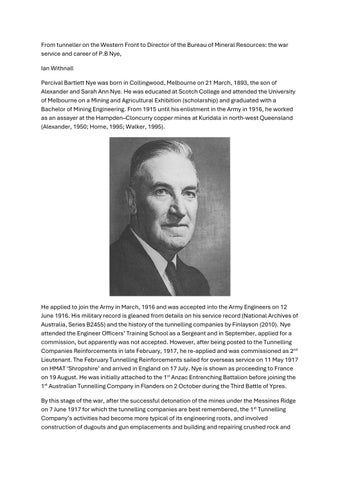
From tunneller on the Western Front to Director of the Bureau of Mineral Resources: the war service and career of P.B Nye, Ian Withnall Percival Bartlett Nye was born in Collingwood, Melbourne on 21 March, 1893, the son of Alexander and Sarah Ann Nye. He was educated at Scotch College and attended the University of Melbourne on a Mining and Agricultural Exhibition (scholarship) and graduated with a Bachelor of Mining Engineering. From 1915 until his enlistment in the Army in 1916, he worked as an assayer at the Hampden–Cloncurry copper mines at Kuridala in north-west Queensland (Alexander, 1950; Home, 1995; Walker, 1995).
He applied to join the Army in March, 1916 and was accepted into the Army Engineers on 12 June 1916. His military record is gleaned from details on his service record (National Archives of Australia, Series B2455) and the history of the tunnelling companies by Finlayson (2010). Nye attended the Engineer Officers’ Training School as a Sergeant and in September, applied for a commission, but apparently was not accepted. However, after being posted to the Tunnelling Companies Reinforcements in late February, 1917, he re-applied and was commissioned as 2nd Lieutenant. The February Tunnelling Reinforcements sailed for overseas service on 11 May 1917 on HMAT ‘Shropshire’ and arrived in England on 17 July. Nye is shown as proceeding to France on 19 August. He was initially attached to the 1st Anzac Entrenching Battalion before joining the 1st Australian Tunnelling Company in Flanders on 2 October during the Third Battle of Ypres. By this stage of the war, after the successful detonation of the mines under the Messines Ridge on 7 June 1917 for which the tunnelling companies are best remembered, the 1st Tunnelling Company’s activities had become more typical of its engineering roots, and involved construction of dugouts and gun emplacements and building and repairing crushed rock and
plank roads to allow the forward movement of troops and artillery. Just after Nye joined the company, the weather in Flanders deteriorated markedly, and after two days of solid rain, the already sodden battlefield turned into the muddy morass for which Paschendale has become synonymous. The tunnelling companies and other engineering units worked feverishly to build plank roads, and to construct and stabilise gun platforms on the muddy substrate. Dugouts became flooded and had to be drained and pumped out. However, on 10 October after only a week with the Company, and just before the beginning of First Battle of Paschendale, Nye suffered a gunshot wound to the left shoulder. The wound necessitated him being transferred to the 4th London General Hospital, where he remained from 17 October until 30 November. On his discharge from the hospital, he was promoted to Lieutenant and returned to his unit near Ypres on 22 December. In late March, 1918, during the German Spring Offensive, the 1st Tunnelling Corps was ordered to move south into France near Arras to help construct a new defensive line of trenches, dugouts and machine-gun emplacements in the event that the German assault continued its advance. In the end, the offensive stalled and the line was not needed. By August, as the war reached its final phase, the Allies prepared their plans to push back the Germans, and the tunnelling companies were directed to provide parties of men to advance with the infantry to locate suitable dugouts for headquarters, clear them of booby-traps and landmines, and to locate water supplies in the areas captured from the Germans. Lieutenant Nye was appointed to command a party attached to the 3rd Australian Division. When the last infantry units of the Australian Corps were removed from battle in early October, the 1st Tunnelling Corps chose to continue its work of repairing roads and clearing mines as the Germans retreated eastwards. These tasks continued well after hostilities ended on 11 November, and in early 1919, Lieutenant Nye was one of 8 men of the company who were recommended for gallantry medals for this work. However, the recommendation for a Military Cross was not accepted, and he was to receive only the standard service medals. Nevertheless, the recommendation reads: In the advance from BONY to PREMONT from September 29th 1918 to 5th October 1918, he was in charge of a party detailed for forward road reconnaissance and the search for and removal of enemy booby traps and mines. Under heavy shell and machine gun fire he successfully completed this work and cleared the way for oncoming transport. At BUSIGNY from October 5th to November 1st he was in charge of party detailed for road diversion repairs under long range shell fire. He again successfully completed this important work. At CATTILLON to SANS DU NORD, from November 4th -November 11th he was in charge of a party attached to 46th Division for mine searching on roads and bridges. By his pertinacity and courage he located and removed many mines including at least two delayed action types. From November 11th to December 21st, from SANS DU NORD to NAMUR he has continued to lead the search parties and has unloaded several hundred shells and cases of explosive any of which might have been delayed action type. His personal
courage and leadership have been of the highest order and have had a wonderfully inspiring effect on the Sappers whom he has led in a task which calls for more than ordinary nerve. Australian War Memorial: recommendation file for honours and awards, AIF, 1914-18 War, Royal Australian Engineers, Australian Tunnelling Coys 12.11.1918 to 28.2.1919 Lieutenant Nye sailed from England for Australia on the ‘Borda’ on 11 May, 1919, arriving in Melbourne on 27 June. He was officially discharged from the Army on 27 July, and on 16 August he married Harriett Leah Louisa Reeve. Nye’s biography in the Encyclopedia of Australian Science (Walker, 1995), records that for a short time after his war service (1919–20), he held the position of petrologist at the National Museum of Victoria, but his long-term geological career began when he joined the Geological Survey of Tasmania in Launceston in 1920. His career with that organisation is recorded by Bacon (1989). The respected Government Geologist, W. H. Twelvetrees, had died the previous year and the new head of the Survey when Nye joined was Clive Loftus Hills (see article by C. Bacon, this issue). Other geologists with the Survey were A.M. Reid and H.G.W. Keid. Hills wasted no time in instigating a program of systematic mapping in Tasmania’s Midlands district to determine the potential for groundwater, and he assigned Nye to the job with some assistance from Keid. The work was published by Nye (1921) and was followed by three other reports on underground water supply, covering the various settled areas in the south of the State. In 1922, Nye upgraded his qualifications to a Masters of Science, awarded by the University of Melbourne. He also carried out smaller geological examinations of various mines and prospects, and contributed to the preparation of a comprehensive survey of the coal resources of Tasmania, which is acknowledged as one of Hills’ most important works with the Geological Survey (Hill et al., 1922). In spite of these responsibilities, the autocratic Hills declined to recommend Nye and Keid for an annual pay increment in 1921, and dismissed Keid in 1922. He also clashed with the Minister and Secretary for Mines and almost everyone else in the Department, resulting in him being stood down in 1923 while an enquiry was held into the alleged friction. The Commissioner found in his favour and would have reinstated him had not Nye and the rest of the Survey staff written to the Minister stating that "his reinstatement would lead to constant friction” (Bacon, 1989). Hills' title as Director was abolished and he resigned, leaving A. M. Reid and P. B. Nye as Government Geologists, answerable to the Secretary. They continued conducting geological investigations and writing reports of their findings. Reid became increasingly involved in matters of policy and planning, and, after some lobbying, was appointed as Director of Mines in 1926. This left Nye as the sole Government Geologist. In 1927 two assistants, F. Blake and Q.J. Henderson (first and second year geology students respectively), were appointed to assist him. In addition to answering a constant stream of public enquiries and letters, and researching and writing geological reports, he also lectured in geology at the University of Tasmania. Trove records 11 published reports authored by Nye at the Geological Survey of Tasmania, but numerous unpublished reports are also held by the Survey.
In 1934, Nye, was granted leave of absence from his position as Government Geologist in Tasmania to become the Executive Officer of the Aerial, Geophysical, Geological Survey of Northern Australia (AGGSNA). The Survey was set up by the Commonwealth Government in 1934 to assess the potential for mineral development of northern Australia above the 22nd parallel (Wilkinson, 1996, pp24–27). It incorporated aerial photography flown by the RAAF to assist geological mapping, and new geophysical techniques such as resistivity, gravity and, magnetic surveys over known mining fields. Jointly funded by the Commonwealth and the Western Australian and Queensland Governments, it investigated gold and mineral fields as widely dispersed as Wiluna, Marble Bar and Halls Creek in Western Australia, Tennant Creek, Pine Creek, Arltunga, The Granites and Daly River in the Northern Territory, and the Cloncurry, Lawn Hill, Croydon, Herberton, Chillagoe and Hodgkinson areas in Queensland. The field headquarters was in Cloncurry, with field operations beginning in 1935 and continuing until 1940. The Survey was disbanded in 1942 after producing more than 100 reports and maps. Of these, Nye is recorded as a co-author of 26 reports, most of them with J.M. Rayner, who was AGGSNA’s Chief Geophysicist. While seconded to AGGSNA he also managed to complete a report on the geology and mineral resources of Tasmania, published in 1938 (Nye & Blake, 1938). During this period, with war threatening in Europe, a company, which was mining iron ore at Yampi Sound in the Kimberleys, proposed exporting the ore to Japan. The Australian Government realised that iron ore would be a highly strategic commodity in the event of a war, and consulted Nye as Executive Officer of AGGSNA. Nye reported that Australia’s known reserves were limited and advised that export be prohibited to conserve those resources (Wilkinson, 1996, p29). His opinion was backed up by George Woolnough, the Government’s Geological Advisor, and consequently in 1938 an export embargo was imposed on iron ore. It was not lifted until 1960, when large deposits of iron ore were discovered in the Pilbara region and demand for raw materials by Japan was increasing rapidly. After the completion of the AGGSNA field operations, Nye returned to the Geological Survey of Tasmania, but resigned after 3 months in November, 1941. On the retirement of George Woolnough in 1941, Harold Raggatt had been appointed Geological Advisor, and used the war as a lever to expand the Government’s small Geological Branch (Wilkinson, 1996, p35). Nye was appointed as Assistant Geological Advisor and Raggatt went on to recruit other geologists and geophysicists who were finishing their tasks for AGGSNA. In 1942, approval was given for the enlarged Geological Branch to be renamed the Mineral Resources Survey, with Raggatt as Director and Nye as Assistant Director. J.M. Rayner was Chief Geophysicist and N.J. Fisher was Chief Geologist. Its aim of undertaking systematic assessments of Australia’s mineral resources, however, was overtaken by the urgency of the war, requiring Raggatt’s group to meet a request from Britain for an inventory of all resources needed for military defence purposes. During this time, Nye collaborated with Clem Knight in an investigation of the King Island scheelite deposit by the Mineral Resources Survey on behalf of the Commonwealth Minerals Committee. The deposit was recognised as an important and extensive resource of tungsten (Nye & Knight, 1943). However, as the end of the war approached, Raggatt began building a case to the Government for the establishment of a Commonwealth geological survey, an idea that he had carefully
nurtured since the 1930s (Wilkinson, 1996, pp37–45). In 1946, Cabinet approved the foundation of the Bureau of Mineral Resources, Geology and Geophysics, and Raggatt, its chief architect became its first Director. Nye was appointed Deputy Director. In 1951, after a cabinet reshuffle, the new Minister for National Development chose Raggatt as his head of department, and Nye was appointed to replace him as Director of the BMR with J.M. Rayner as Deputy. Wilkinson (1996, p98) noted that, although the logical choice and geologically well-credentialed, Nye was nearing the end of his career and had none of the dynamism of the younger Raggatt. It soon became apparent that Raggatt still ran the agenda from his new position as Secretary of the Department of National Development, and continued to do most of the liaison with government ministers and mining company executives. Not surprisingly, BMR policies and activities already in train remain unchanged. Nye was awarded an OBE for services to geology in 1955 and retired in 1958, being replaced by his deputy, J.M. Rayner. In retirement he returned to Melbourne and did consulting work. Always referred to by his initials, P.B., and never by his first name even by close associates, Nye was described as a 'gentleman of the old school' who frequented the Melbourne turf clubs and moved at a leisurely pace, rarely showing any anger or frustration. He died on 22 August 1985 in West Heidelberg, Victoria.
REFERENCES Alexander, J.A., 1950. Who’s Who in Australia 1950. XIVth Edition. Colorgravure Publications, Melbourne, Australia. Australian War Memorial. Recommendation file for honours and awards, AIF, 1914-18 War, Royal Australian Engineers, Australian Tunnelling Coys 12.11.1918 to 28.2.1919. AWM28 2/236. https://www.awm.gov.au/collection/R1587437. Accessed 29 April, 2018. Bacon, C.A., 1989. One hundred years of the Department of Mines. Tasmania Department of Mines, unpublished report 1989/09. http://www.mrt.tas.gov.au/mrtdoc/dominfo/download/UR1989_09/UR1989_09.pdf. Accessed 29 April, 2018. Finlayson, D., 2010. Crumps and Camouflets: Australian tunnelling companies on the Western Front. Big Sky Publishing, Newport, Australia, 480pp. Hills, L., Reid, A.M., Nye, P.B., Keid, H.G.W. & Reid, W.O., 1922. The Coal Resources of Tasmania. Geological Survey of Tasmania, Mineral Resources 7. Home, R.W. (with the assistance of Needham, Paula J.), 1995. Nye, Percival Bartlett, in Physics in Australia to 1945. Australian Science Archives Project, June 1995, http://www.asap.unimelb.edu.au/bsparcs/physics/P002235p.htm. Accessed 29 April, 2018. National Archives of Australia, Series B2455: NYE, Percival Bartlett, Lieutenant: First Australian Imperial Force Personnel Dossiers, 1914-1920.
https://recordsearch.naa.gov.au/SearchNRetrieve/Interface/ViewImage.aspx?B=8005077. Accessed 29 April, 2018. Nye, P.B. & Knight, C.L., 1943. The King Island scheelite mine. Department of Supply and Shipping. Mineral Resources Survey Branch, Geological Series, 2. Retrospectively designated as Bureau of Mineral Resources, Geology and Geophysics, Bulletin 11, 32pp. Nye, P.B., 1921. The underground water resources of the Midlands. Underground Water Supply Paper 1. Tasmania Department of Mines, 142pp. Nye, P.B. & Blake, F., 1938. The geology and mineral deposits of Tasmania. Geological Survey of Tasmania, Bulletin 44, 112pp. Trove. Nye, P B (1893-1985). National Library of Australia. https://trove.nla.gov.au/people/549158?c=people. Accessed 29 April, 2018. Walker, R., 1995. Nye, P B (1893-1985) OBE. Encylopedia of Australian Science. http://www.eoas.info/biogs/P002235b.htm. Accessed 29 April, 2018. Wilkinson, R., 1996. Rocks to Riches: the story of Australia’s national geological survey. Allen & Unwin, St Leonards, Australia, 446pp.