Chairman: Dr Kenny J. Travouillon Western Australian Museum, Perth
Vice Chair: Dr John Gorter
Secretary: Heidi Allen Dept. Mines, Industry Regulation and Safety
Treasurer: Dr Daniel Mantle, MGPalaeo
Editor, Alcheringa: Dr. Benjamin Kear, Uppsala University, Sweden
Editor, AAP Memoirs: Dr Ian Percival, Geological Survey of NSW
Editor, Nomen nudum: Rodney Berrell, Curtin University
Nomen nudum is the annual newsletter of Australasian Palaeontologists (AAP). It is published to acquaint members with the activities of palaeontological colleagues and with any other items of current interest. Enquiries and contributions should be directed to the editor (see above).
Membership of AAP (including personal subscription to the peer-reviewed international journal Alcheringa), is available to all palaeontologists (professional, amateur, active and retired), particularly – but not restricted to – those with interests in fossils of Australia, New Zealand, and Papua New Guinea. Details of membership requirements, categories and fees are available from the Geological Society of Australia website, which also has information regarding titles and prices of the AAP Memoirs series (52 volumes published since 1983). Library subscriptions to Alcheringa should be addressed to Taylor & Francis (http://www.tandfonline.com/toc/talc20/current).
Opinions expressed in this newsletter are those of individual contributors and do not necessarily reflect the views of Australasian Palaeontologists nor the Geological Society of Australia, Inc. Mention of a product or service should not be construed as constituting endorsement by either body.
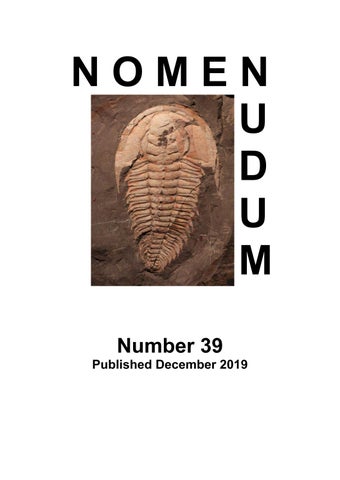
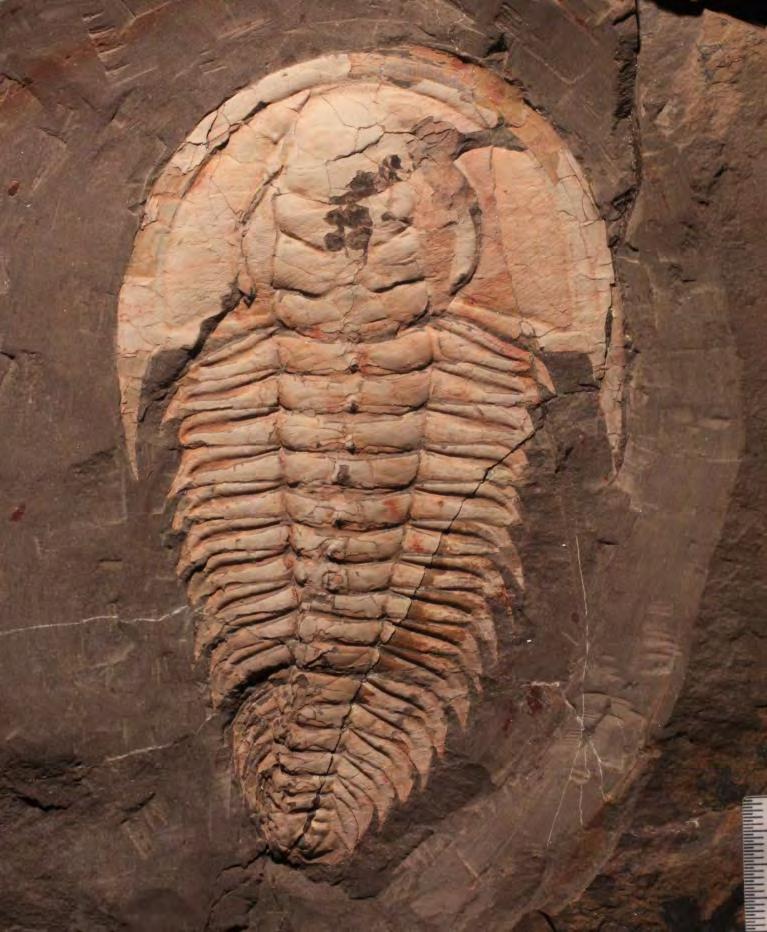
Front cover: Redlichia rex from the lower Cambrian Emu Bay Shale Konservat-Lagerstätte of South Australia. Photo supplied by James Holmes. https://doi.org/10.1080/14772019.2019.1605411
Queensland ………… Page 52 South Australia ………………………………………………..........................Page 58 Tasmania …………………………………………………………................. Page 62 Victoria …………………………………………………………….……….....Page 63
Western Australia … Page 80 New Zealand …………………………………………………………………..Page 86 Sweden………… Page 93
United States …………………………………………………………………..Page 96
Contact details for contributors to this issue (alphabetical) …… Page 97
FROM THE CHAIR
It’s been just over a year since the Western Australia Council took over from the South Australian Council. As a reminder, the committee is composed of myself as the Chair, Vice Chair, Dr John Gorter, Secretary, Dr Heidi Allen and Treasurer, Dr Daniel Mantle.
The previous council had done an excellent job in revitalising AAP, with the resurrection of Palaeo Down Under and the creation of awards. We wanted to continue their legacy by adding more events, more awards and getting the Palaeontology community together.
We started by organising seminars across the country. We organised first the Perth AAP seminar which around 40 people attended. For the Adelaide seminar, we collaborated with the Flinders University Palaeontological Society and the University of Adelaide Palaeontological Society to organise the event. In Sydney, UNSW and the Riversleigh Society collaborated with us to hold the event. We were planning seminars in Melbourne and Brisbane, but they couldn’t be organised this year. Instead, we sponsored the lunch at the Selwyn Symposium in Melbourne, and we attended the Annual Meeting of the Society of Vertebrate Palaeontology (SVP) in Brisbane, in collaboration with GSA (many thanks Sue for holding the booth). We had a booth where we ran a raffle to attract new members, giving away 3D skulls and copies of our journals.
We introduced two new awards, the AAP Student Travel Award for one student to travel to a conference, and the AAP Dorothy Hill Award, for the best paper on Australasian Palaeontology, both given annually. The AAP Student Travel Award was awarded to Elizabeth Dowding who then presented her work on Devonian biogeography at SVP. The other award will be given in January 2020. We also changed the frequency of the Robert Etheridge Jr Medal to annually and awarded this year Dr Kath Grey for her immense lifetime contribution to Australasian Palaeontology.
AAP was invited to represent Palaeontologists on the committee for Taxonomy Australia, which led to creation of a Fossil National Species List. This list will be eventually available on our website, for researchers to check the latest taxonomic names, and this will be used for the Atlas of Living Australia to expand and include fossil data. We started recruiting Palaeontologists to help put the list together, but more are welcome to join. We are also managing the Australian data for the NOW Database, which is a Fossil Mammal Database. We are also looking for more contributors to help.
In the coming year, we intend to organise the AAP seminars again in most states. We would like to also build a new website so then it can be used for the launch of Palaeo Down Under 3, which will happen in 2022. We also would like to get more involved with the Australian Earth Science Convention (AESC) happening in Tasmania in 2021, and CAVEPS happening in Melbourne also that year. Finally, we would like to start organising Field Trip open only to AAP members, to help collect fossils from site that are currently not being worked by funded research, in order to help increase our understanding of the fossil records in Australasia.
Kenny J. Travouillon
Chair, Australasian Palaeontologists
Western Australian Museum, Perth
CONFERENCE ANNOUNCEMENTS
8th INTERNATIONAL MEETING ON MESOZOIC FISHES
Bio-crises and Recoveries
Ortisei-Dolomites-Italy
7-14 September 2020
Ortisei, November 23, 2019
Dear Colleagues and Friends,
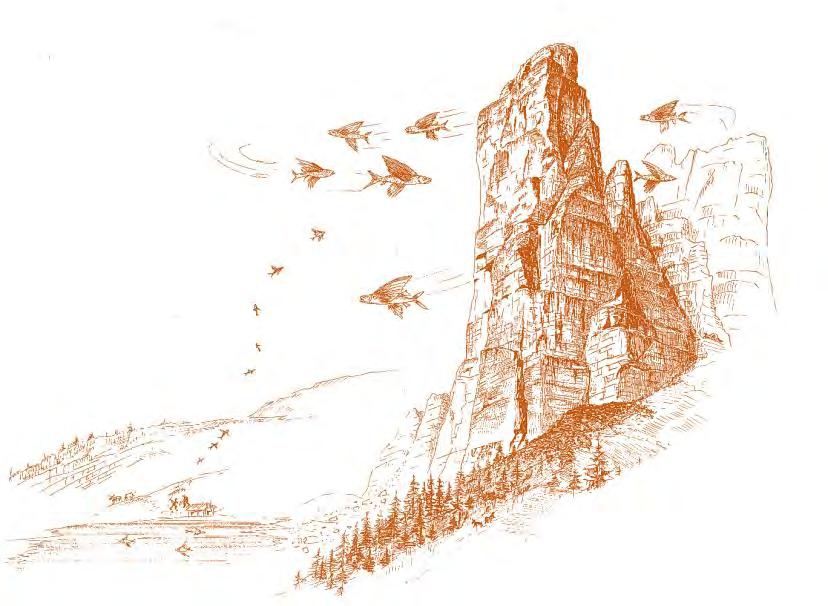
Here we are with the second circular on the 8th International Meeting on Mesozoic Fishes that will be held next year from September 7 in the Dolomites, at Ortisei. This is the main village of the Gardena Valley, one among the small alpine areas where the ancient Ladin language is spoken. Actually, interestingly enough, in each of the four valleys (Gardena, Badia, Fassa, Cordevole) surrounding the Sella Mountain, the spoken Ladin is slightly different. The Gardena natives can speak Ladin, Italian and German, switching from one language to another accordingly with the speaker.
About 50 people answered to the first circular: very few of them are ‘students’, many more are retired people, still working on their topics. The general program remains the one proposed in the first circular. In the morning of Monday September 7, a bus will take most of the attendants from Milano to Ortisei within lunch time. Late in the afternoon registration and an ice-breaker party will be held at the Museum Gherdëina. The Museum will be open also in the following days, so everybody will be able to visit its very interesting collections (www.museumgherdeina.it/334.html).
Four days of oral communications are planned, from Tuesday 8 to Friday 11, but one afternoon will be devoted to the social event: lunch on top of the Seceda Mountain. Considering the number of the proposed talks, 25-30 minutes will be allowed for each communication, leaving plenty of time for discussions.
This 8th meeting focuses on what happened to fishes both during and after the several Mesozoic crises. Did fishes follow the general pattern? What happened to marine and fresh water assemblages during the recoveries? To which extent fishes’ evolution and the rise of new groups have been affected by the crises themselves? However, like in the previous meetings, any other topic regarding Mesozoic fishes will be welcome. Despite our requests, based on the fact that the Dolomites are inscribed in the Unesco World Heritage list, we are very sorry to say that we got no grants to support travel and lodging expenses for any of the attendants.
Closure of access to geoscience and biodiversity collections at the Queensland Museum
The Queensland Museum Network is the keeping place for the State Collection of more than 1.2 million objects and specimens and more than 14 million research collection items. Collection care is an ongoing priority for the museum and in 2020 the collection stores, laboratories and research office will be undergoing significant renewal. This project will also result in the relocation of some staff. This work is supported by a Queensland government grant of $16.1 million and will be undertaken by GHD Woodhead. Due to the impact of this planned work access to collections will be restricted for the coming months. From December 2019 to early 2021, loans of objects for research or exhibitions will not be possible. The closure means that we will not be able to host researchers in the collection or service requests from community to access collections. If you have contacted the museum regarding a proposed loan request or a planned research visit, then we will attempt to service that request and a Queensland Museum Network contact will get in touch to ensure that we can accommodate your needs.
Our collections at the Museum of Tropical Queensland in Townsville, Cobb and Co Museum at Toowoomba and the Workshops Rail Museum at Ipswich will be operating with business as usual through this period, and our Education Loan Program will continue to operate across the State.
If you have any queries regarding access to geoscience and biodiversity collections in the QMN please contact the appropriate collection manager in these areas.
Regards
Dr Andrew Rozefelds Acting Head of Biodiversity and Geoscience Collections Queensland Museum
PhD Scholarship in Palaeontology at UNE (Domestic students only)
The School of Environmental and Rural Science at the University of New England is offering an exciting PhD project in palaeontology. We are looking for a motivated individual with a passion for science to join our thriving Palaeoscience Research Centre (https://www.une.edu.au/research/research-centres-institutes/palaeoscience-research-centre).
The University is offering an RTP Domestic Stipend Scholarship for the successful domestic candidate. This amounts to AU$30,000 per annum, tax free for up to three years to support a full-time PhD candidate. The School will also provide an operating budget of up to $3500 per annum (plus other funding opportunities), and additional support will be available through a recently funded Australian Research Council (ARC) Discovery Project (see below).
Project outline
An ARC-funded project (DP200102005) focused on predation as a major ecological driver of early animal evolution administered by UNE and led by Prof. John Paterson aims to quantify the performance of predators and the evolutionary responses of prey species during the Cambrian Period, over 500 million years ago. A major objective of this research is to quantitatively document the morphology, associated injuries, and distribution (in time and space) of select Cambrian shelly prey species to determine if predators were indeed inducing morphological responses during the earliest phase of animal evolution – a process referred to as escalation. This objective will form the basis of the PhD thesis, though the candidate will be encouraged to develop his or her own research program. We are looking for a candidate with a First-Class Honours or Master’s degree, preferably in palaeontology or evolutionary biology. A candidate with a knowledge of statistical methods, proficiency in coding within R, and/or morphometrics is desirable. It is expected that the successful applicant will publish high quality journal articles as components of the doctoral thesis.
Supervisory team at UNE: Prof. John Paterson, Dr Russell Bicknell, Dr Marissa Betts
Applications and enquiries
Enquiries
For further enquiries, please contact Prof. John Paterson (jpater20@une.edu.au).
How to apply?
Details on how to apply can be found at the following link: https://www.une.edu.au/research/hdr/hdr-scholarships/palaeoscience-research-scholarship All applications should include:
1. A statement explaining how your academic background, experience and interests make you a suitable candidate for the project; and
2. Curriculum Vitae, including lists of any publications and technical skills (lab and/or field based)
Shortlisted applicants may be requested to provide two reference letters and an example of their written work (publication or thesis), as well as partake in an informal interview (in person, or via Skype or other media).
Applications close on Monday, 3 February 2020.
Preferred start date for the successful candidate is 30 March 2020, but an alternative time is negotiable.
Rostral tubules in fossil and living dipnoans are vascular, not neural
Dipnoans are unusual in that well preserved Devonian species such as Chirodipterus australis, can be compared with the living Australian lungfish, Neoceratodus forsteri, providing a clearer understanding of structures that are otherwise confusing. Most Devonian lungfish have a system of ossified tubules in the snout and mandible, usually interpreted as housing the innervation of sense organs in the skin, although the structure and arrangement of these tubules is more consistent with a vascular system. Analysis of a series of thin sections of the head of a specimen of C australis (WAM 86.9.647) and comparison with structures present in the head of the living lungfish shows that three independent systems are present in the dipnoan head, and that the systems are separate. One consists of nerves to the electroreceptors, branches of cranial nerve V in the snout and cranial nerve VII in the mandible, developing early in hatchling life. A second involves blood vessel capillaries to carry nutrients to skin cells and remove metabolic products. A third consists of vessels associated with the lymphatic loops that pass into the epidermis and help to protect the snout and mandible from infection. Mechanoreceptors and their associated canals are separate, and innervated by branches of cranial nerves. Nerves are slender and straight, and capillaries and lymphatic vessels follow a tortuous path and frequently form anastomoses. Traces of the ossifications around the lymphatic system, entering the superficial layers of the dermis, are present in the sections of fossil material, as are the remnants of electroreceptors and pore canals. Living fish can be used to understand fossils.
Anne Kemp
9 Hampton Grove, Norwood, Adelaide, Australia, 5067 annerkemp@gmail.com
OBITUARY
Russell Clark Perembo (12 August 1958 – 26 June 2019) First Papuan New Guinean Palaeontologist
The Australasian palaeontological community lost a significant colleague in the death of Russell Clark Perembo, after a short illness in July 2019. Russell was the first Papua New Guinean to become a palaeontologist having completed a MSc at the University of Queensland under the supervision of Geoffrey Playford in 1986, and a PhD at the University of Western Australia under the supervision of David Haig in 1995. He was the first Papua New Guinean to achieve a doctorate degree in any of the Earth sciences, and became the first indigenous person from PNG to be Professor of Geology and Head of Earth Science at the University of Papua New Guinea (from 2013). An obituary describing Russell's career appeared in The Australian Geologist, December 2019.
Russell's early palaeontological studies focused on foraminifera from Miocene foreland basin deposits of the Papuan Basin. His Honours work done at UPNG in 1983 examined the Middle to Upper Miocene succession exposed at Delena Headland on the Papuan coast west of Port Moresby and dealt with the stratigraphy and foraminiferal assemblages from deepwater mudstones of the Middle Miocene to shallow-water limestone facies in the Upper Miocene. He undertook a more detailed study of this succession for his Masters thesis. His PhD work was on the deep-water Lower Miocene foreland basin deposits (Lai Siltstone and equivalents) that extend from the western Papuan Basin in PNG to the southern Papuan Peninsular. During his PhD studies in 1990 he served as a shipboard palaeontologist on Ocean Drilling Program (ODP) Leg 134 in the central New Hebrides Island Arc, and published a research paper on the Miocene to Pliocene planktonic foraminifers from the North Aoba Basin. Russell also published several joint papers with David Haig on aspects of the Papuan Basin Miocene succession, but much of his thesis work remains unpublished. It is hoped that major parts of this will be published during the next few years.
Russell's return to UPNG in 1995 began a long collaboration in research and teaching with Hugh Davies. He continued and broadened his biostratigraphic and field studies working in many areas of PNG and continued an interest in marine geological expeditions as a shipboard palaeontologist on ODP Leg 180 in the Western Woodlark Basin, and a participant on R/V Kila Moana cruise KM04-19 in the Bismarck Sea. He taught palaeontology and stratigraphy
with great enthusiasm and provided his students with vital tools necessary to work in the complex geology of PNG. He also greatly assisted the research efforts of visiting geologists through friendly advice and participating in and organizing aspects of field work. He cosupervised several PhD students from the University of Western Australia.
News of Russell's death was met with great shock among his colleagues at UPNG, in the geological community in PNG, and among those elsewhere who knew him. He is survived by his wife Lynne, and their children Vagi, Hannahlynn and Marilynn as well as by his sister Edna and brother Mackenzie. He was buried in his home village among the oil palms at Arehe Block near Popondetta. Russell Clark Perembo will be remembered and honoured for being the first PNG palaeontologist and for his leadership and friendship to so many geologists associated with Papua New Guinea.
David Haig
Oceans Graduate School, University of Western Australia
(20th Feb 1937 – 26th June 2019)
Not soon, nor suddenly! No! Never to let go!
My hand in yours…. – Hart Crane (1899–1932)
My wife, Ruth Mawson, passed away at 8.30 a.m. on 26 June 2019 in the Bella Vista Gardens Nursing Home in Bella Vista, a northwestern suburb of Sydney. She was born and schooled in Cooma, a town renowned for cold winters and occasional snow, trout fishing and eventually becoming the headquarters of the Snowy Mountains Hydroelectric Scheme. Her mother, Bessie (née Yunker from Charleville, Queensland), was a noteworthy pianist from a German family from Munich. She made a living providing musical accompaniment for silent films. Ruth’s father, Frank, was a genial builder of houses and even much larger structures. Frank traced his origins back to English migrants drawn to Australia by the gold-rushes, specifically in the vicinity of Kiandra in the Snowy Mountains of southeastern Australia. The small Mawson clan split up: one portion to Cooma, the other to Adelaide. It is said that Antarctic explorer Sir Douglas Mawson’s biologist daughter Patricia was strikingly like Ruth: so much so that people encountering Ruth around the Macquarie University campus and who knew Patricia (from Adelaide) would, in total innocence, ask Ruth what she was doing in Sydney. Reflections from the same gene pool?
Ruth was delighted while travelling with me by ferry from Copenhagen to Malmö―en route to visit our inimitable friends, conodontologist Lennart Jeppsson and his wife, AnnSophi, in Lund―when an immigration officer noted she had a Scandinavian name and asked if she was on her way to visit Swedish relatives. She expressed disappointment that she had no known relatives in Scandinavia, perhaps none since the Vikings ‘colonized’ England, long before her time.
Ruth was renowned for her affable personality and unflappable manner. Friendships formed in childhood never wavered throughout Ruth’s life. Among such were her close attachment to Marlene Antow who lived only a stone’s throw from the Mawson home in Cooma (they had been friends for nearly 80 years when Ruth was a toddler) and her sister Shirley Venables (née Mawson). Both are genial personalities who outlasted Ruth. Within moments of meeting my parents, Ruth and they were friends for life. It was the same at the foci of all of her teaching and research activities: in West Wyalong, Moruya, Merimbula, Windellama, Buchan and in the Mareeba and Charters Towers–Greenvale districts of northern Queensland and in uncounted other places around the world, especially in India, far
Ruth Mawson
northwest Pakistan, Nepal, France, Germany, Spain, Belgium, Sweden, Italy, the USA, and China particularly Nanjing and several places in Xinjiang. Friendships in all of them remained pivotal in her life.
Ruth was interested in everything to do with the history of her native Cooma, the Snowy Mountains, the south coast of New South Wales and the adjoining mountainous and coastal regions of eastern Victoria. The entire region is punctuated with numerous friends of hers. She loved everyone and everything from the flora of Alpine bogs to the intertidal faunas and floras of rock platforms She enjoyed watching waves and near-shore migrating whales. Recollections of that region and its personalities were among the last to leave her memory.
For Ruth, spending time in the silence and majesty of the great Mountain Ash forests of eastern Victoria, watching the vigorous waves wrapping around Cape Liptrap or pounding on the Early Devonian limestone headlands on the western side of Waratah Bay were visibly psychologically uplifting for her Also fascinating for her were the great fountains in France, Italy and Australia among the last especially Victor Cusak’s enormous kinetic-fountain sculpture, Man, Time and the Environment constructed of bronze, stainless steel and glass in Sydney’s suburban Hornsby.
Ruth’s first teaching assignment after graduating with a teaching degree from the University of Sydney was with the New South Wales Department of Education at the West Wyalong high school in the often parched interior of New South Wales. She arrived there with an unshakeable passion for teaching everything that others tried to sidestep: history (especially Australian history), English language and literature, sports (for instance
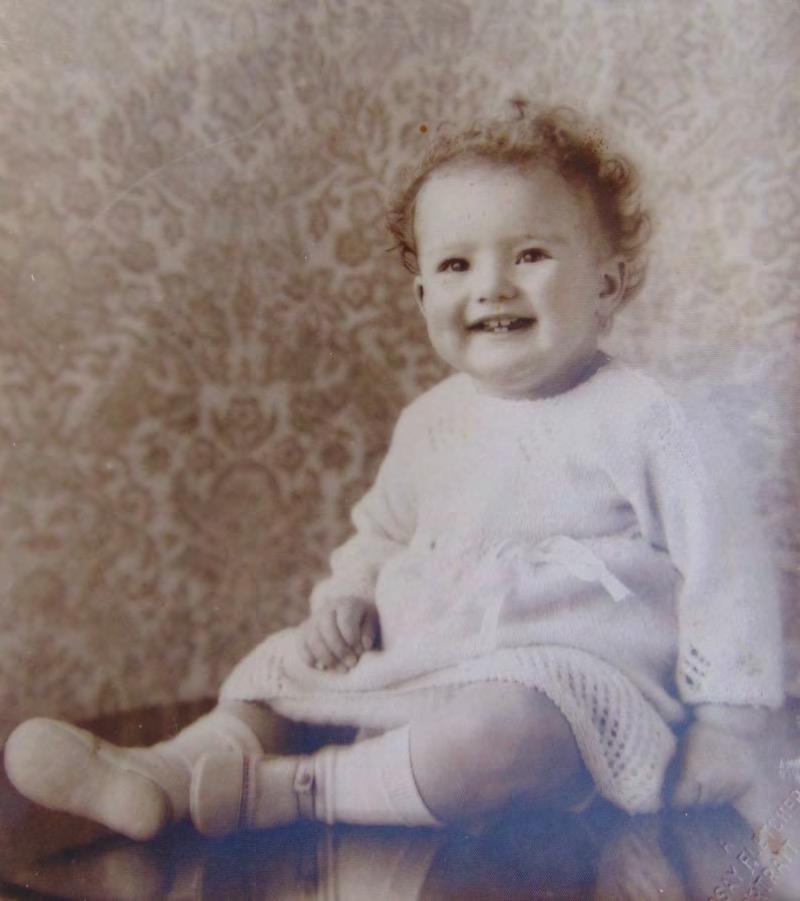
Ruth at Christmas 1937 or early in 1938: a gorgeous child with an endearing smile a hallmark that persisted throughout her life
swimming―with gusto), and even business principles and practice. Ruth, singularly modest and optimistic, as always, was greeted with proverbial open arms by the West Wyalong citizenry. She swiftly became known to everyone in that warm-hearted town, and remained a close friend of many of its inhabitants and others from the surrounding countryside for the rest of her life.
Ruth’s next teaching position was on the coast in Moruya high school, an utterly different context. Trying to teach children passionate about sand and surfing to the exclusion of all else was a very different challenge, but she won their attention by using surfing magazines to improve their reading skills and, with the late Kevin Hyland (another student of ours) as driver, organized teaching significant slabs of the curricula by bus tours to relevant places in eastern Australia. There was also a spinoff from the students, for instance she learned what ‘hanging five’ on a surfboard meant. Coincidentally, among Ruth’s many students at Moruya that became numbered among her long-lasting friends, is Peter Collett who married my daughter Nadia’s school friend, Julie Penman. In those days, Ruth had a much loved Golden Retriever which she named Rolly Brown it accompanied her wherever she went.
Around the time that Ruth shifted to Moruya, her father built three skillion-roofed holiday houses at Merimbula, one for each of the three Mawson children. Her brother Eric soon turned his into cash. Her sister Shirley retained hers for a decade or two. Ruth’s house, where she often spent weekends with her parents, was in Main Street, Merimbula, a stone’s throw from the edge of Merimbula Lake and a little more than a half kilometre from Merimbula’s main shopping centre. It was beautifully located for swift connections by air to Melbourne and Sydney from Merimbula Airport over stunningly scenic coastlines. Merimbula and its northern suburb, Tura Beach, has a marvellous ensemble of ocean views, beaches, shallow lakes, a museum, an aquarium, and the diverse flora of 30+ salt-resistant species along the Merimbula Lake salt-marsh boardwalk (1.7 km in length and very dear to Ruth), as well as occasional Saturday or Sunday farm-produce markets in Merimbula and in nearby towns.
Concurrent with her secondary school teaching, Ruth swiftly completed extraordinarily heavy loads of diverse subjects by distance education at Macquarie University ranging from English language and literature to geology and palaeontology. She then undertook a BSc (Hons) on the stratigraphy and palaeontology (conodonts and silicified faunas, especially brachiopods and gastropods) of the latest Silurian and Early Devonian limestones of the Windellama area (about 60 km east of Canberra) coupled with a third-year course in Invertebrate Zoology (without relevant first and second year courses) ―in which, as usual with all university subjects, she was placed first in the class.
It seemed that she received First Class Honours for every subject she broached. She was immediately given a tutorship for palaeontology and first year earth sciences, followed soon afterwards by tutoring and lecturing positions then, in rapid succession, promotion to senior lecturer and then Associate Professor.
After a few years of secondary school teaching, Ruth had slipped sideways into the sciences from English language and literature and Australian history, coming to rest in geology, palaeontology and biology. She was a natural teacher who could be droll and whimsical, but the hallmark of whatever she articulated or wrote on any subject, whether in the arts or sciences, was her endearing modesty―never bombast; no “reading the riot act” to anyone. On being offered a position as tutor in Earth Sciences, she bought a first-floor apartment near the northeast end of Cottonwood Crescent close to the then very new Macquarie Shopping Centre and within easy walking distance of Macquarie University.
About 1981, Ruth bought a three-bedroom, two-storey townhouse with small gardens back and front at 35/20-24 Busaco Rd, Eastwood, close to the northern corner of Macquarie University.
By 1985, Ruth discovered that Merimbula’s regional council (the Eurobodalla Shire) had dramatically increased the annual land tax on her holiday home―without informing her that it had been ‘re-zoned’ for future development of a large holiday hotel-motel. Ruth immediately decided on buying a block of land in a much quieter area of Merimbula, west of its main business area, and building a house upslope and looking south-westwards across the boardwalk and Top Lake. She paid a last visit with me in mid-winter before signing the contract of purchase. The ambience along the boardwalk at that time of year proved to be miserably cold and exposed to winter gales. That revelation convinced Ruth to look elsewhere in Merimbula or in nearby Tura Beach for a suitable house, or for a vacant allotment on which a substitute dwelling could be built. In near-record time, she looked at dozens of houses, decided to buy a nearly new home belonging to a Mr Smith in a ‘battleaxe’ block in wonderful Tura Beach, swiftly undertook the paperwork without noting the address, and then next day had no idea where the house was located.
Fortunately, she had our mutual friend Graham Felton with her. They spent a few hours zigzagging around Tura Beach, asking various people if there were a Mr Smith (the most common English surname) living nearby. The quest encountered several wrong Mr Smiths before they found a person who could point out which was Ruth’s new holiday home―in Golf Circuit. It proved to be a delightfully designed ranch-type house with eight rooms, two bathrooms and a half-acre of garden with healthy camellias and tree-ferns close to the house. It was to prove perfect for planting trees with a long geological history, especially several species of Araucaria, Podocarpus, cycads and more tree-ferns, mostly propagated by a young couple who for a few months brought their young plants to the Candelo market for sale.
Many friends were given the pleasure of spending their vacations in Ruth’s immensely agreeable retreat. Regrettably, after about 20 years, a decision was made to sell it. To our
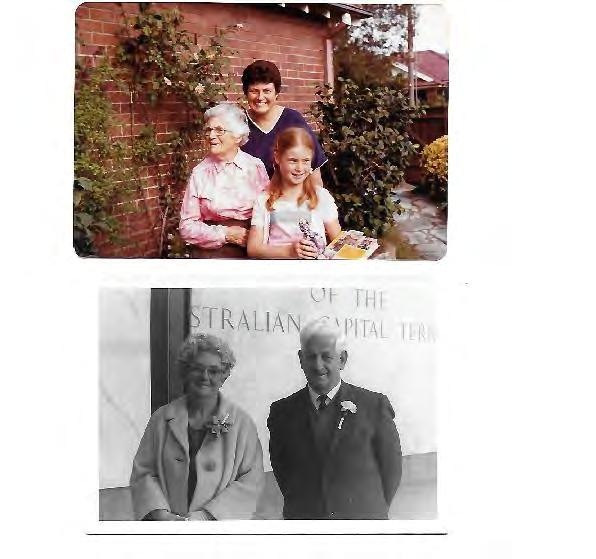
Above: Ruth with her mother, Bessie Mawson, and niece Ruth Venables. Below: Bessie Mawson with Ruth’s father, Frank Mawson.
chagrin, the new owners bulldozed the garden, living fossils, camellias and all. It was a heartrending sight that neither of us wanted to look at again!
Long before that, Ruth had commenced and completed her Doctor of Philosophy in less than minimum time. For her Honours degree, she had focused on very early Devonian and latest Silurian conodont faunas of the limestone sequences at Windellama. Meticulous bedby-bed sampling of kilometres of late Early Devonin limestones and marls exposed in road cuttings and quarries of the Buchan‒Murrrindal and Bindi areas in eastern Victoria were the main foci of her doctoral investigations She acid-leached hundreds of samples for conodonts from those areas. Copies of her thesis were sent to two external examiners, the leading figures in the world of conodont studies at that time: the late Willi Ziegler, director of the Senckenberg complex of 23 museums in Germany, and Gilbert Klapper of the University of Iowa in the USA. The Macquarie postgraduate office anticipated reports from the examiners would be back in about three months. Both examiners cabled 100% positive responses in a mere two to three weeks without a word from either of them suggesting clarification of any inferences or correcting even a spelling error or two. There were none!
Ruth and I, colluding with friends from Biological Sciences including the late Frank Mercer, Alison Downing (and her parents) and Noel Tait, had fun generating a biogeographic garden at the university featuring trees and shrubs from groups with a long geological history (such as the aracaurias and ….., and finding elegant and instructive rocks, mostly 5 tonnes or more in weight, to be trucked in for “our garden” from assorted places in eastern Australia Because there was no financial contribution from Macquarie University towards generating this feature for our campus, we generated funding by launching a series of exacting but successful functions: several barbecues and a large number of breakfasts: French (several) as well as Italian, Chinese, Japanese, Indian and American ones, the last articulated by our professorial friend, Blair Hostetler. Our biogeographic garden now bears the name of our late, dynamic and much appreciated head of our School of Earth and Planetary Sciences, Jim Rose, who was very supportive of our initiative.
Ruth projected leadership qualities with subtle strength, as well as with tenacity and commanding intelligence. She was always non-arrogant. At Macquarie, she was loved and respected university-wide, renowned for her kindness and for her compassion without prejudice.
Ruth didn’t care about ethnicity, religion or political affiliation. On several occasions, it was these characteristics that brought senior-most university administrators to seek her counsel on sensitive psychosocial problems of individual students. Though not a psychiatrist, I know that her compassionate counsel, quietly given, saved lives.
Ruth was immensely supportive of socially and financially disadvantaged people. Whether afflicted with mental illnesses or not, all were treated the same. Her limited financial resources were poured into good causes, such as her favourite charities, the Fred Hollows Foundation’s global sight restoring programs, Médicins sans Frontières and the Foundation for National Parks and Wildlife. Her contributions to the last of these were rewarded with a deluge of superb toys: reproductions of Australian birds, mammals and marine creatures that were eventually dispatched to the two daughters of her niece, Ruth Venables, in Brisbane.
Ruth became fascinated by the behaviour of octopuses which she observed underwater when teaching our course on reef dynamics. A large and superb model of one of these was prominent in her suite in the Bella Vista Gardens Nursing Home where she spent the last months of her life, and was displayed on her coffin during her funeral.
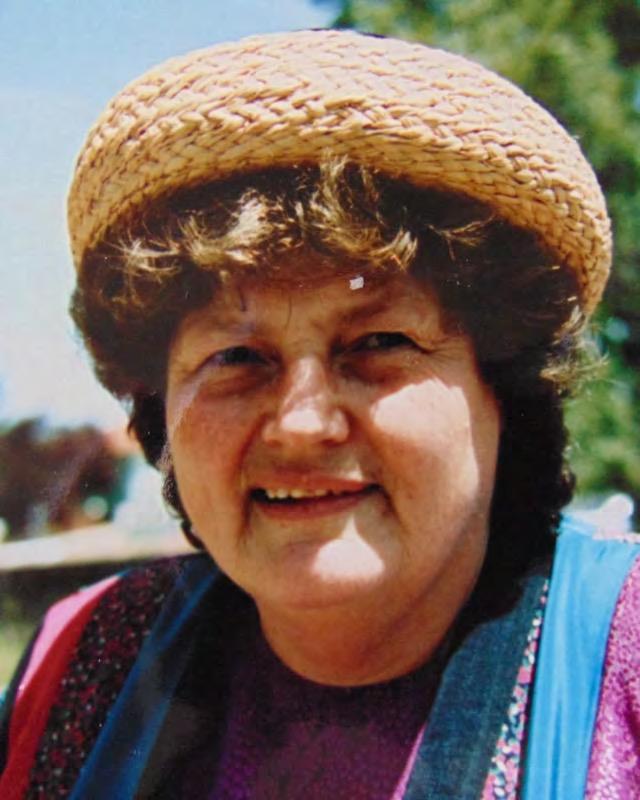
Ruth, late in her career, with the same endearing smile
Ruth was a crowd favourite for her down-to-earth skill as a raconteur. She never dwelt on mortality, spirituality or faith, but was appalled by the violent intrusion of European ‘civilization’ into this part of our globe in 1788. Her empathy with Aboriginal Australia was admirable. She relished the melancholic emptiness of inland Australia from the Canning Basin of northwestern Australia, the watershed of the Burdekin River and its tributaries (especially the Broken River), and the alpine and subalpine high country of eastern Victoria and its extension into southeastern New South Wales. They and Macquarie University were all parts of her emotional palette: poetic, hypnotic and with a broad emotional range.
Ruth was always a rigorous investigator. She could be a playful, charming and quizzical presence, a questioner of social systems, her memory and her own assumptions. As an enthusiastic mentor, she could see through all the nonsense of students eager to take short cuts, and loved them anyway. She was without parallel as a wonderfully clear and enthusiastic mentor and as an inspiring teacher with a natural interest in young people. Her discussion of her philosophy and her methods the why and the how of her research was always informative and incisive. She helped you think about her science, which in turn helped you think about everything else.
Ruth’s outputs of teaching and research were prodigious. She was a workaholic who seemed never to have contemplated mortality. She could work for weeks at a time with no more than a couple of brief catnaps per day of 20 or 30 minutes. She seemed to be everywhere at once.
Ruth’s interest in the world beyond Australia’s shores expanded greatly, often as spinoffs from scientific meetings. Her favourite cities encountered on her travels were Ravenna for its early Byzantine mosaics, Padova (= Padua) for Giotto’s murals in the Scrovegni Chapel, Nanjing for its collection of large archaic geophysical instruments on a hilltop near the centre of the city, and Paris for many things. It was almost de rigueur for Ruth in Paris to stay in the extraordinarily cute Hôtel du Mont-Blanc in rue de la Huchette, a hotel that was once frequented by Pablo Neruda, Henry Miller and Napoleon Bonaparte, to have lunch under the art deco dome in Au Printemps, to spend a few hours among arguably the world’s foremost collection of oriental art in the Musée Guimet, to take an occasional coffee at the Deux Magots and Café Flore in the domain of Simone de Beauvoir, Jean-Paul Sartre, Ernest Hemingway and Pablo Picasso and to dine at least once each visit in one or
more of Paris’s old-fashioned restaurants such as le Procope that was once frequented by Molière, Voltaire, the great advocate of freedom of speech, freedom of religion, and separation of church and state, and Honoré de Balzac. It is said to have been the birthplace of the Encyclopédie conceived by Denis Diderot and Jean d'Alembert
Ruth nevertheless relished visiting Australian coffee shops, especially the Beanmeister, Café Express and the Sit and Sip in Castle Hill, and Brunetti’s and Pellegrini’s in Melbourne. She had fond, but sad memories of the last, being warmly greeted many times by our barista friend of many years, Sisto Malaspina, stabbed to death by a terrorist but, being much loved by thousands of people, fittingly given a state funeral by the government of Victoria.
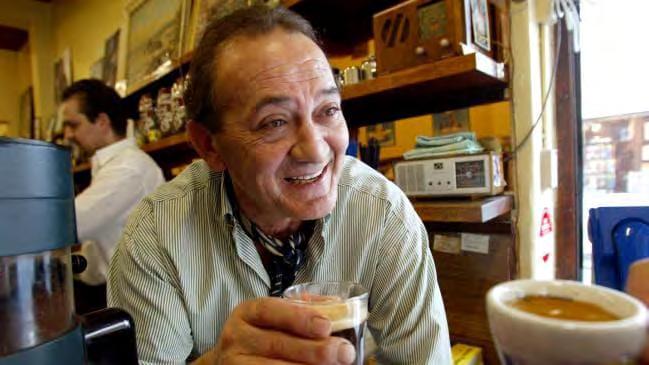
Sisto Malaspina, friend of Ruth and me, barista extraordinaire, 50% owner of the renowned and historic Pellegrini’s Café in Bourke St, Melbourne, pioneer of Melbourne’s coffee scene, murdered in Bourke St Melbourne on 10 November 2018 by a terrorist. Source: News Corp Australia
Retiring when she did, Ruth missed out on the changeover of Macquarie University’s vice-chancellors from Steven Schwartz to Bruce Dowton, Macquarie’s fifth Vice-Chancellor. This took place without a breathing space between them. Ruth and I, as well as Macquarie University in general, missed out on something analogous to the brief sweet interlude between Robespierre and Napoleon!
In retirement Ruth moved to a capacious home in Castle Hill, an outer suburb of Sydney. Two large rooms with dimensionally appropriate tables were immediately covered with cumulates of reprints, photo copies, materials for her never-completed family history, and half-written manuscripts on conodont faunas from Xinjiang (far western China, hard against Mongolia and Kazakhstan), New Zealand and her beloved Broken River region of Queensland’s far north where majestic and photogenic ‘Droughtmaster’ cattle would be curious about what was going on, while we cooked meals, or perhaps wondering why we were down on our knees collecting fossils. How could one attack a T-bone steak from one of those wonderful creatures?
A large compactus taking up the entire side of a large new room, was built into her Castle Hill home. It soon became jam-packed with scientific literature, quite a lot of it, especially Russian and Chinese literature, not available in Australian libraries.
In Castle Hill, Ruth developed additions to her vast coterie of friends scattered over about 30 countries. They provided the amplified affection she deserved after her long and incredibly fruitful career in teaching, scientific research and empathetic student advising.
Among her other great loves―music, literature, mosaics, architecture, theatre and film―the last reigned supreme. She had a noteworthy love for films produced by Scandinavian, French, Czech, Russian, Mongolian, Indian (not Bollywood) and Japanese film makers especially Ingmar Bergman, Agnès Varda, Ken Loach, Nikita Mikhalkov, Andrei Zvyagintsev, Davaagiin Byambasüren, Satyajit Ray, Pedro Almodóvar and Akira Kurosawa. We avidly watched the reviews of films, particularly in The Guardian, and waited for their appearance in Sydney cinemas, mostly in the Roseville cinemas but occasionally the more distant Hayden Orpheum Picture Palace in Cremorne until it became too difficult for her to mount the stairs in either place.
Like our very dear Siberian friend, Rimma Gratsianova, Ruth was passionate about ballets and could listen all day to classical music, particularly the great symphonies and concertos, especially those of Tchaikovsky (symphonies 5 and 6) and by his foremost student, Rachmaninov (such as the ‘Rach3’ concerto). She remembered with affection being embraced and kissed by David Helfgott (renowned for the film Shine) after one of his concerts.
One of Ruth’s passions was adding to a small collection of elegant scarves, especially from Hermès and Chanel in Paris, from the successors to the famed silk merchant, Jim Thompson in Bangkok, and by the king of floral designs, Ken Scott (Milano), the last by repeatedly tracking down his scarves via the Internet.
Ruth survived two major operations for cancers, five years apart, and may have been afflicted with a third cancer (or cancers) suggested by dramatically high calcium appearing in her blood analyses five years later, during 2019. In view of her frail physical condition (too frail for her to undergo surgery), it was deemed useless to X-ray her from head to toe just to find out where they (if any) might be.
Ruth, incidentally, had little time for the canned blather of commercial television but, curiously, during the last nine months of her life, there was a sort of anything-goes rapprochement to the commercial television that she had long treated with contempt.
Though often in profound pain, Ruth was never saccharine about life and death. She was philosophical and pragmatic right to the end, with an entire morning of remarkable comprehension and wit during the morning of 25 June 2019, the day before her death. Almost the last words she articulated was a desire to become well again and get back her driver’s license which she had had for 63 years. It had lapsed three years before she passed away in the Bella Vista Gardens Aged Care facility. She wanted to make a last visit to friends by driving around Australia and then flying to visit others domiciled overseas.
Ruth’s death at 8.30 a.m. on 26 June 2019 followed a long illness extending over almost a year punctuated by several bouts in hospitals: once in the Hornsby Public Hospital, once in the Sydney Adventist Hospital in Wahroonga, once in the Lane Cove Private Hospital, the others in the Norwest Private Hospital in Bella Vista. Despite numerous interludes of severe pain she never complained. Her great placidity triumphed over her repeated pain until the last night when, because of obvious pain, relief was given by an injection of morphine at about 10.30 p.m. and she lapsed into sleep, only to die the next morning at 8.30 a.m.
I spent most of 25June at Ruth’s bedside in the Bella Vista Gardens facility. I went home to sleep [In hindsight, I wish I had remained with her]. I was getting ready to return to the Bella Vista Gardens next morning when the phone rang at 8.45 a.m. and I was informed that Ruth had passed away 15 minutes earlier. I was out the door within minutes and back at the Bella Vista Gardens where I sat at her side for about five hours, thunderstruck, not wanting to see anybody, wishing I were dead with her, desultorily getting up briefly to pick
up her belongings for bringing back to her last home at 228 Ridgecrop Drive, Castle Hill. I scribbled the first three pages of this obituary. It was the rock-bottom interval of my life. On 3 July, daughter Nadia arrived from her home in Rockley, about 3 ½ hours away and took what had been written to a branch of Officeworks in Victoria Ave and had the staff make 100 photo copies of it for availability at the funeral. It proved to be a good guess at the number of mourners who would be in attendance at her funeral.
The funeral took place on 4 July 2019 at the White Ladies Funeral Parlour, corner of Pennant Hills Rd and Boundary Rd, Pennant Hills. It was focused around the following classical music a selection of the many humane items, without grandiloquence, that appealed greatly to her.
Modest Moussorgsky: Prelude (Dawn) from Khovanschina 5 mins
Frédéric Chopin – Prelude in B minor op. 28 n. 6 2.5 mins
Erik Satie: Gymnopédie n.1. 4 mins
Frédéric Chopin - Nocturne n. 20 in C Sharp Minor 5:08 mins
Andrea Bocelli – Con te partirò. [original version in Italian] 4.14 mins
Erik Satie: Gnossienne n. 1 4–5 min
Claude Debussy playing his Clair de Lune 5:03 mins
Interspersed with these were two superbly humorous celebrations of Ruth: Dr Noel Tait – Memories of Ruth
Dr Andrew Simpson – More Memories of Ruth
The funeral service ended with an invitation for me to follow four of the ‘white ladies’ manoeuvring the trolley (with Ruth's coffin) outside. The entire audience of almost 100 followed me. To watch the coffin being loaded into the hearse, screwed down, and the hearse (with coffin and Ruth) disappear out of sight down Boundary Rd, Pennant Hills, heading for the Castlebrook Crematorium at Rouse Hill, was singularly gut-wrenching...
Morning tea provided by our friends David and Amanda Mifsud of the Beanmeister restaurant and coffeehouse at 1/10 Salisbury Road, Castle Hill, was elegant and copious! It was the most impressive and thoughtful morning tea I have ever experienced. They too miss Ruth immensely.
Thursday 29 August 2019 was a sad day with steady, misty rain―gut-wrenching. I received a call to the Castlebroook Crematorium at Rouse Hill, received Ruth's ashes, and for about 20 minutes watched a staggering number of ducks and corellas quietly busy, almost within arm's reach, focused on the fauna of the wet lawns as though oblivious to the rain (Ruth would have loved the ambiance), and then slowly brought her ashes back to her home. A truly great, intelligent, much loved and humble soul was no more.
When spring turns to summer this year when the cold, wet and occasional winter snows have left the Australian Alps, her ashes will be distributed in two areas very dear to her: at Native Dog Plain, the main head of the Buchan River and at Cowombat Plain on the headwaters of the Indi (= Murray) River. Her doctoral thesis had focused on the conodont faunas of that region, and especially of the nearby Buchan and Bindi areas in eastern Victoria.
Ruth’s scientific and teaching output
Incidental to her teaching overload, Ruth produced 70 scientific publications (peer reviewed) including four stand-alone edited volumes, and pumped out an enormous number of
published abstracts and a lesser number of conference chronicles, book reviews and other lightly reviewed publications, such as field guides for conference excursions. Because of Ruth’s literary background, our excursions mounted for conferences and subjects we taught, necessarily included stops at sites connected with Australia’s foremost literary figures: for instance near the home of Miles Franklin (1879–1954)―her home is now subaqua in a Snowy Mountains dam at Talbingo―and the remains of the home of Henry Lawson (1867–1922) at Eurunderee near Mudgee.
Ruth’s publications include significant portions of three Queensland geological maps and the ‘Englishing’ of numerous postgraduate theses too often not acknowledged for doing so! A brief list of Ruth’s principal scientific publications is given at the end of this discourse.
For many years Ruth was joint-director (with me) of the Macquarie University Centre for Ecostratigraphy and Palaeobiology. She was a great committee person. She served on at least 16 committees, some for many years such as being chair-person of Macquarie’s curriculum committee, and as a titular member of the UNESCO Commission on Stratigraphy’s Subcommission on Devonian Stratigraphy. Four of the six events where Ruth’s dynamism was pivotal to their success were:
1976 (September) Ruth was the power behind organizing a meeting of the Subcommission on Devonian Stratigraphy (in Sydney) followed by a 10-day field excursion (by plane and jeep) to the principal Devonian sequences of eastern Australia between eastern Victoria and the far north of Queensland.
1995 (July‒early August) Joint organizer with me of the First Australian Conodont Symposium (AUSCOS-I) and conjoined Symposium in honour of our friend, Professor Arthur J. Boucot (formerly of Caltech and the State University of Oregon Corvallis, the titan of Palaeozoic stratigraphy and palaeontology, especially brachiopods), and attendant excursions in south-eastern Australia, northern Queensland and a post-conference workshop on reef dynamics at Heron Island. The latter included a group of eight palaeontologist friends from the Soviet Academy of Science in Novosibirsk and from Tashkentgeologiya in Uzbekistan, funded by us and our friends.
2000 Orange, principal organizer of the Australasian Palaeontological Convention (APC-2000), the Third International Symposium on the Silurian System (McCoy Symposium), plus the conjoined Second Australasian Conodont Symposium (AUSCOS-II) and the associated 8th International Meeting of UNESCO’s International Geological Program Project 421. She organized a slew of relevant pre-conference and post-conference excursions.
2002 Ruth was the powerhouse behind organising the First International Palaeontological Congress (in Sydney) with a flock of symposia and 24 major pre- and postconference excursions, all of which, to our delight, proved viable (our Broken River one, principally organised by Ruth, attracting 64 participants).
The congress attracted 424 participants, more than 400 of whom flew in from overseas. To have Ruth’s name associated with scientific meetings was always guaranteed to attract vast numbers of foreign participants. The numerous field guides and stand-alone volumes of scientific papers resulting from these symposia, testify to the all-embracing excellence of her organisational skills and sustained energies.
Ruth’s scientific work focused on teaching methods, transgression-regression patterns (globally) of seas in the deep past and the sequence of marine communities dominated by brachiopods (‘lamp shells’, for about 200-million years the major components of most marine communities) and conodonts a long-extinct but important group of plankton for a couple of hundred million years. Her research extended into life crises in the deep past―far more than the half dozen such events asserted incorrectly by popular science! There are in fact dozens of them at various scales.
Australia has numerous very fossiliferous marine limestones but not enough palaeontologists to extract maximum information from them about what may have caused individual life-crises and how the oceans recovered from them during geological time. Ruth’s field investigations about these and related topics took place not only in Australia but in a half dozen other countries. Her research was also directed towards increasing precision in ‘time-alignments’ between rock sequences in Australia and intercontinentally, making sure that calibrating of events, nearly always by using her beloved conodonts, continent to continent, was based on highest precision as to time.
Ruth reveled in mapping and thereby elucidating enormous debris-flow complexes of the deep past with limestone blocks up to kilometric scale, using conodonts to determine ages of individual blocks and determining their orientations (right way up or not) in the Broken River-Greenvale-Camel Creek area west of Townsville in northern Queensland, the Hill End Trough (Euchareena-Wellington and adjacent Mudgee-Queens Pinch areas), the Tamworth Belt of northern New South Wales, and the Indi, upper Buchan, and Wombat Creek areas as well as well as the Walhalla Synclinorium of eastern Victoria. Publications about the enormous debris-flow complexes of the Townsville hinterland and the Hill End Trough were published in 1989, 1994, 1995 and 1999 and the eastern Victorian ones in 1994, 1995 and 2005.
An integrated study of the Devonian and pre-Devonian sedimentary rock systems of the Tamworth Belt, their environments, chronologic framework and palaeogeography involved scientists from Macquarie University, University of Technology Sydney and the University of Sydney. It focused importantly on conodonts (primarily Ruth again) to provide timeconstraints on everything. This involved not only much conodont work by Ruth, but important conodont investigations by research students, especially Terry Furey-Greig and Robert Morgan under Ruth’s guidance.
A major component of Ruth’s research from the 1970s onwards was concerned with the geology, palaeontology and biogeography (during deep time) of the Himalaya, Karakoram and Hindu Kush and contributing to a massive exercise in combating scientific fraud now clearly flagged by a dozen publications by her and others of the Macquarie group. Monographs on Palaeozoic conodonts from Nowshera, the Khyber region and Chitral (all Pakistan), from Spiti (India), and China’s northwest Xinjiang (left incomplete by her death) and an enormous bibliography of the Phanerozoic palaeontology and stratigraphy of Pakistan (all co-authored with me) are testament to her productivity.
At Macquarie Ruth strove to develop a more relevant, interdisciplinary pitch, confronting the whole gamut of things palaeobiologic, including palaeoecology and biogeography in the deep past. Courses were made relevant to the clientele gleaned not only from earth sciences but from biological sciences, chemistry and the arts (principally archaeology). This method of teaching has been spelled out by us (Ruth and me) in a few publications (notably Journal of Geological Education, 35:246–255; and 41:231–243).
After arriving at Macquarie, Ruth became variously involved in the teaching of nine courses, all of the units designed for distance education as well. Of these, the main foci were 1. To engender an appreciation of man’s historical-biological debt to the chains of lesser creatures among which Homo sapiens evolved; 2. To engender a feeling for ecosphere/biosphere evolution; 3. At the same time, to nurture in students a capacity for operating inventively on their own, for evaluating ideas and sifting reason from assertion.
The principal impact of this, as far as society is concerned, has been pouring into the secondary-school education system more than 1000 graduates (mainly as biology teachers) with substantial exposure to modern evolutionary palaeontology. She taught students and others how to see life on our planet, Earth, in all its fragility and magnificence.
As a pivotal teaching and research tool we designed and had constructed the largest acid-leaching laboratory in the world. It was inspired by a highly personal one that our late friend Art Boucot had had constructed in a car-park at Caltech in Pasadena, California. It proved pivotal for exploiting the abundance of silicified faunas so widespread in Australia (of Cambrian to Mississippian age) as the main basis for our program of practical work in palaeontology at senior levels. Our acid-leaching facility was of prime importance for extracting conodonts for our research initiatives Australia-wide as well as in Pakistan, India, India, Nepal and China, and also helped us advance knowledge of marine communities in the deep past the fossils coming from the acid baths provided pivotal numerical data. The main spinoff from all this was that for about 30 years, Macquarie’s postgraduate palaeobiology group was the largest in Australia, producing numerous postgraduates (= graduate level in American terms).
Confronted over portions of two years by massive theft of much of our best teaching specimens, especially ones that could be slipped into a pocket or a briefcase, and the reappearance of a few of them (of which we still had the counterpart!) in someone’s personal museum collection where some, in fact collected by Ruth, were on display (an entry fee was being charged), did not faze her at all.
Ruth’s solution was grand-scale re-collecting focused on large specimens (10 to 100 kg.), the largest ones of which would challenge even an Olympic weight-lifter to attempt surreptitious removal from our laboratory benches. With four-wheel-drive vehicle and trailer, and an eye to where huge specimens could be easily manoeuvred onto a trailer, and with additional manpower back at the university, the problem was solved, definitively. A greater disappointment to us was that the culprit was intellectually sharp with the potential to have undertaken a PhD in minimum time following an Honours degree with us, and perhaps a career in palaeobiogeography or highest precision bostratigraphy.
Ruth’s contribution to every aspect of tertiary education at Macquarie University was golden. She was a mentor to dozens of students at all levels―undergraduate to doctoral. During the many years we taught together, we shared supervision of at least 31 successful doctoral students and numerous BSc (Hons), MSc and M App Sci candidates. During almost 40 years we team-taught often enormous classes in earth sciences (especially palaeontology) and in coral reef dynamics and museology Wherever possible, there was a significant field component, mostly in Australia and the southwest Pacific (for contemporary and Cenozoic reefs), but also in nearby Asia (Thailand, China, Nepal, India and in Chitral―in the far northwest of Pakistan, hard against the Afghan border
Early in our offerings of courses in coral reef dynamics, coupled with a few lectures on marine ecology and biogeography, Ruth and I decided that we needed competence in scuba diving. We undertook a course that melded lectures and practical sessions in scuba diving in Manly and Fairlight, adjacent seaside suburbs at the entrance to Sydney’s harbour, Port Jackson. The program was run by Phil Lane, chief accountant with the Manly Shire Council. Phil had a noticeable speech impediment that we assumed to be a reflection of his early years when, experimenting with home-made diving equipment and having little knowledge of the behaviour of gases with increasing water depth. We imagined Phil to have had a fairly major bout of ‘the bends. His diving in those days was done using a multiplicity of sweaters he was always wet to the skin and apparatuses made from pipes used by plumbers. Phil and a former pupil of his took charge of snorkeling and scuba diving on two or three of the early offerings of our reef dynamics course on Heron Island; they performed admirably.
Several years later when 90 students enrolled for our course, we divided them into three groups: two groups of thirty for Heron Island, one group of 30 (with several friends and
tutors) for the Yaté‒Goro coast of southernmost New Caledonia where there are not only superb present-day (‘living’) coral reefs but associated fossilized reefs many thousands of years old. The fossilized reefs, many of them abraded and polished by carbonate sand and exposed in cliffs, are in fact easier to study than the adjacent living reefs. On a prior reconnaissance visit, Ruth and I arranged with our friend, the grand-chief of the Yaté‒Goro coast and the Isle of Pines, who dwelt at Goro in the midst of these wonderful modern and ancient reefs, to camp at a ‘relais’ (a sort of motel consisting of elegant thatched huts) that he was having built. When we arrived with our students and staff, the grand-chief insisted that Ruth, the late Kevin Hyland (our friend of many years) and I should be his and his family’s guests in his home 200 or 300 metres towards Yaté. We three were treated like visiting royalty! Some years later, we paid a reconnaissance visit to examine the fossil and recent reefs of the Isle of Pines and the Loyalty Islands, but the ancient and recent ones of the Yaté‒Goro coast of southern New Caledonia “took the prize”.
Ruth had a passion for community service. Her principal activities were: 1. For eight or nine years sharing responsibility with Dr Noel Tait and me in running weekend programs of intensive lectures for senior secondary school biology and geology students peaking at 700 students for one such weekend school. 2. Enthusiastically introducing people of all ages to palaeontology in the field focused on localities where fossils occur in abundance and discussing, on site, their implications regarding long extinct marine communities. 3. Organising Continuing Education courses in reef science on the Great Barrier Reef (principally on Heron Island but twice on Lady Eliot Island) and on New Caledonia and Vanuatu, and on museology in Thailand. 4. For a decade or more, Ruth chaired a main section of the Eureka Prizes, articulated by the Australian Museum in Sydney. These prizes are Australia’s most comprehensive national science awards, honouring excellence across areas of research & innovation, leadership, science engagement, and school science. They are presented annually in partnership with 14 or more of Australia’s leading scientific institutions, corporations, universities and government organisations. The Eureka Prizes raise the profile of science and science-engagement in the community by celebrating outstanding achievement.
Ruth was charismatic in all these ventures. Many enthusiastic participants in our field ventures―’venerables’, adolescents and even toddlers subsequently undertook degree programs with us at Macquarie University. Such activities were great public-relations exercises.
Interleaved with Ruth’s teaching and other socially responsible activities were onslaughts on conodont faunas connected with some of the scores of extinction events at all scales that have afflicted the history of life. Ruth and my initial attacks focussed on two sizable Silurian events: the Ireviken and Lau events expressed superbly in the calcareous rock sequences in Boree Creek in central New South Wales, and a several places is the watershed of the Broken River of northern Queensland respectively. These aligned precisely in time including their micro-events with two Silurian events identified from superb conodont investigations by our late lamented friend Lennart Jeppsson in magnificent rock outcrops on the island of Gotland in the Baltic Sea. It was Lennart who coined the names Ireviken and Lau events for these major global perturbations. He was stunned how such events could be aligned chronologically so precisely, bed-by-bed (almost centimetre by centimetre), despite having accumulated on opposite sides of the world during those intervals of global catastrophe (cf. Jeppsson et al., 2007 and 2012).
Collecting with Lennart on Gotland―saturated with Viking history―may have been Ruth’s most joyous interlude among beautiful geology teeming with fossils, followed closely by Pakistan’s northwestern Chitral and a half-dozen richly fossiliferous areas in eastern Australia: at Windellama (the first area she mapped), Buchan and Bindi (her doctoral areas),
northern Queensland’s Broken River watershed, and mapping enormous debris flows and limestone blocks up to kilometric scale of the Stuart Town–Nubrigyn–Euchareena area of central New South Wales, and dating them by conodonts (Talent & Mawson 1999), To those must be added luxuriating in the Silurian geology and palaeontology and contemporary Alpine floras and faunas especially of bogs of the Australian Alps, and specifically on the geology of the upper reaches of the Indi, Buchan and Snowy rivers to the south of her muchcherished home town, Cooma.
For several years, Ruth derived pleasure from snapshots of family, students and various field ventures, but developed a passion for elegant photography after the first moon landing on 20 July 1969 when a Hasselblad camera with specially designed 200-exposure film magazine was discarded among footprints on the moon a total of 12 Hasselblads were eventually left on the moon prior to the last manned landing on 11 December 1972. Inspired by the lunar Hasselblads, she purchased one with wide-angle and telephoto lenses especially for documenting people on our numerous ventures, with and without students. She looked forward to retiring and, with her Hasselblad, indulging her photographic passion in Nepal, Chitral (northernmost Pakistan), Zanzibar, Vanuatu, Morocco and in the jungles of southwest Bangladesh the second last specifically for the astounding fossils and atmospheric rock shops around Erfoud. After retiring she remained overwhelmed by a surfeit of scientific projects and then ill-health intervened.
At this pivotal time for our species and our planet, the threats, the consequences of nonaction and ignoring the potential solutions based on scientific facts are glossed over or completely ignored. Ruth was repeatedly left dumfounded by the triumph of commercial interests, political prejudice and even blatant lies uttered daily in the gutter press and in parliaments of the world (especially in the USA and Australia), despite the compelling scientific evidence available. She was aghast at the way the majority of mankind seemed determined to do next to nothing about the climate-change disaster coming upon us. Governments and their parliamentary oppositions worldwide (especially in Australia with its surfeit of politicians on the wrong side of history) are fighting what can only become a deadlier world for future generations.
It was remarkable the way animals including elephants, an enormous spectrum of dogs of all descriptions, and small children toddlers and all trusted Ruth instinctively. Her last dog, a female Tibetan spaniel she named Chung (= Tibetan for ‘rice wine’), was intensely devoted to her and lived much of her life between Ruth’s feet in her university office. On many occasions, Chung’s body language expressed obvious contempt for dogs behaving uselessly: fetching sticks and balls. Chung, obviously sensing her end, died trying desperately to get up two flights of stairs from the basement of our Macquarie University building to join Ruth in her office.
Ruth especially loved the epoch-making proto-Renaissance painting and architectural masterpieces in Florence and Padova of Giotto di Bondone (c.1267–1337; known universally as Giotto, and no more), especially his frescos in the Scrovegni Chapel (1303 to 1305 AD) in Padova. It took her two trips from Florence where she was staying, to Siena, also in Tuscany, to get access to a near contemporary of Giotto, Duccio di Buoninsegna’s enormous late 13th to early 14th century classic masterpiece, his Maestà. His obvious tenacity and passion left a lasting impression on her. She loved the spectacular corpus of paintings by Pieter Breughel the Elder in the Kunsthistorisches Museum in Vienna, and the intricate elegance of Rogier Van der Weyden and Hans Memling’s paintings in Bruges, especially the latter’s St Ursula reliquary in Bruges’ Sint-Jan Museum
A special passion of Ruth’s during her global travels was to track down and spend time (sometimes more than once) in awe of a dozen or more of Johannes Vermeer’s remarkable
paintings in Amsterdam, Den Haag, Frankfurt, New York, Paris, Vienna and Washington. Especially moving for her were his Allegory of Painting (in the Kunsthistorisches Museum in Vienna), his View of Delft (in Den Haag) and The Lacemaker (in the Louvre in Paris), the last redolent of contemporary lacemakers she had admired in the vicinity of the cathedrals in Chartres and Brussels.
Ruth’s first-hand knowledge of museums and galleries was pivotal in setting up Macquarie’s very successful program in Museum Studies.
Ruth was glad that by 2008 she had faded out from ‘full-on’ teaching at Macquarie University concurrent with the retirement of our much-loved Vice Chancellor Di Yerbury. Ruth’s research by then had become focused primarily on the stratigraphy and conodont chronology of three major areas: the enormously fossiliferous Early Ordovician to Early Mississippian rocks of the Broken River watershed of northern Queensland, the surface and subsurface Devonian of the Darling Basin of western New South Wales, and the Late Devonian to earliest Carboniferous of northern Xinjiang, China’s westernmost province the latter two were well on the way to completion.
Ruth was infatuated with the medley of peoples and cultures of Xinjiang, the dominant Han and Uyghur peoples (about eight million each) and the Kazakhs, Uzbeks, Mongols, Kyrgiz and many other minor groups. Of special interest to her was the enormous diversity of teapots in Xinjiang and at Dunhuang in adjacent Gansu. She collected these with gusto and set up a major display of them at her home in Castle Hill. These were later gifted to her stepdaughter, Nadia Talent.
Ruth was delighted by the peoples of Chitral (north-westernmost Pakistan), especially the wonderfully genial Ismailis and above all the Kalash: a small proto-Indo-Aryan group living in three of Chitral’s valleys as a small and delightfully kind and colourful inlier surrounded by a sea of Islamic groups (primarily Sunni Muslims). The Kalash have obvious ethnolinguistic connections with various other peoples of southern Asia from India to Anatolia and farther westwards. They are like ‘living fossils’ descended from the Aryans who diffused across the Hindu Kush into the Indian subcontinent from the central Asian steppes commencing about 4,000 BC, peaking around 3,500 years ago, bringing with them Indo-Iranian languages. This inference is supported by archaeologic, anthropologic, genetic and literary research. It is thought that the spread of those peoples was propelled by aridization of central Asia and associated profound ecologic changes.
Ruth felt very lucky to have done fieldwork in that region so much so that, had she been still alive and physically well, she would be happy to go back to Chitral and be among the Kalash again for an extended stay Ruth was not into religions; she found the 1,000+ sects of both Christianity and Islam to be interesting but bewildering. If it were possible for an outsider to be admitted to the Kalash, Ruth would have been first “across the line!” It is possible that during the last Australian census, she may have ticked the box for Kalash!
The long-delay in our retirement from Macquarie University was brought about by our mathematician friend and Deputy Vice-Chancellor, John Loxton, calling Ruth and me to his office and insisting our departure might leave a vacuum that could result in imploding of the palaeontology area. He requested us to continue for a few more years. This curtailed completion of several major editing tasks and research projects (especially on extinction events in the deep past) that were very dear to us.
Our eventual departure was followed university-wide by the rumbling chaos of administrative eras that contrasted greatly with that of the Di Yerbury era, and before that, the Edmund Webb era. The rumbling continues to this day without a breathing space between them and the next two vice-chancellors.
Incidental to her seemingly endless teaching overload, Ruth ‘Englished’ numerous theses (most of them PhD theses) including even a couple of theses in Australian literature. Among them was a BA (Hons) thesis by Jacquelline Isaacs who subsequently, following in Ruth’s footsteps, transferred to a scientific domain: She successfully undertook a PhD in Medical Science (at the time of writing this essay, Jackie is now 47). The number of BSc (Hons), MSc and M Geosci theses Ruth edited by dozens of postgraduates escapes me. She polished scores of manuscripts by our palaeontology postgraduate students for publication too often not acknowledged for having done so!
It has been a privilege to have shared my teaching career with Ruth, and for me coming to know the hidden depths of this gorgeous puzzle of a hyperdynamic person. She was very much a polymath. There were many moments that must be described as pure magic. I keep such moments close, picking them up every once in a while, the way she would have picked up a particularly elegant silicified fossil (there were many of these, products of our acidleaching facility), standing in awe of the late Mediaeval La Dame et Le Licorne tapestries in the bowels of the Musée Cluny in Paris, stunned by Lorenzo Ghiberti’s bronze doors (Porta del Paradiso) on the Florence Baptistry, looking up astonished at the Art Deco ceiling of Au Printemps while dining (in Paris), exploring the ancient heart-area of Kashgar (= Kashi in Chinese) in the far south of Xinjiang; marveling at the colourful Kalash, an outlier of protoAryan people in northwestern Pakistan, watching her at Varanasi in India, tenderly and thoughtfully contemplating the ashes from funeral pyres floating on the Ganges (and refusing to disturb them by stepping among them), enraptured by baby octopuses swiftly building tiny homes from seashells and small plastic off-cuts remaindered by plumbers, and having so many wonderful events punctuated by heart-tugging, waif-hugging scenes in villages around the world.
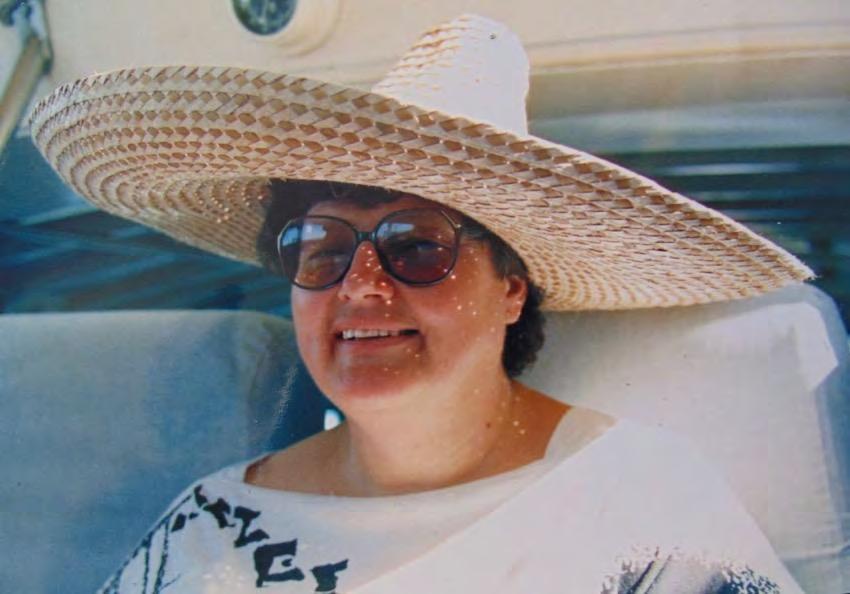
Ruth wearing a Mexican hat, returning by ferry to Gladstone from our last course on coral reef dynamics on the Great Barrier Reef on Heron Island
Among many memorable moments for Ruth was being in Bhaktapur outside the national art gallery of Nepal, the former palace of the much-loved patron of the arts, King Bhupatindra Mala (ruled 1696–1722) who completed building the 55-window palace commenced by his father. Bhupatindra’s sudden and inexplicable death in 1722 gave rise to the myth that his spirit had departed as a little bird. Two windows of the upper level of the palace, open at that time, were kept with shutters open to facilitate his return. Finally, Bhaktapur’s citizens gave up hope. By chance, Ruth witnessed the shutters being closed after remaining open for about 270 years.
Add to such events, Ruth’s rapture at being in Antwerp among its café-filled ‘state of the art’ cobbled lanes and its vast number (50+) of elegant museums including the Royal Museum of Fine Arts, famed for its Renaissance Flemish paintings, the Museum Mayer van den Bergh if only for ‘Mad Meg’, arguably the greatest of Pieter Breughel the Elder’s paintings rivaling or even excelling the best of her much loved Northern Renaissance artist Hieronymus Bosch’s masterpieces, spending a day (or even two) in Antwerp’s world famous zoo, and another taking in the Plantin-Moretus Museum, by far the greatest of all early printing houses.
What was her most moving experience? Possibly the magic of being on the first tourboat on a windless day in Bruges, gliding past its early Renaissance Flemish buildings reflected in its canals as though in vast linear mirrors. Bruges and Antwerp were very special for Ruth.
On a different scale, was Ruth’s pleasure at the welded stainless steel artworks made by our late and inimitable palaeobotanist friend, Fran Hueber, formerly of the US National Museum, who could bend metal to his gentle will and seemed on the way to rewriting his chosen area of art expertise. He was verbally gifted, creative, and re-imagined the world with almost Zen-like attention to creating his ‘divine accidents’ as he called his art works. Like Ruth, he passed away too soon just before her.…
Summary Ruth, a joyous workaholic, was like sunshine―all days ceased to be overcast when she was on the scene. Her dynamism was exciting. Up to her last day at the university, she kept everything spiralling upwards in a mix of encouragement, ideas and positive decisions. At every turn she demonstrated intelligence, enthusiasm and empathy and she was always breathtakingly humane Ruth’s mind could always make the mundane become poetic. She could challenge almost any combination of chaotic systems and diplomatically convert them into order. Ruth had a laudable capacity for imaginative and realistic solutions for what might otherwise appear to be intractable problems. She had a relentless faith in people. She outclassed everyone in her orbit without attempting in any way to do so.
Ruth was passionate about social justice and, unlike so many opinionated but in fact ignoramus politicians of our time [their names are known to all], was intensely sincere about the urgent need for ecological justice at all scales. She was appalled by recent Australian governments that, confronted by overwhelming evidence for climate change, appear to have abandoned integrity and scientific facts for ideologically driven incompetence and ‘hippocket-nerve’ economics All that notwithstanding, she never succumbed to the prevailing cynicism of the late 20th and early 21st centuries.
Ruth left a big hole in the world. She epitomised the virtues of patient listening, amiability and honest expression of feelings. She was passionate and thoughtful to the end. Ruth was fresh flowers personified. She may be gone, but her glow continues unabated! Ruth was a unique teacher. She was a role model to end all role models!
Ruth’s most important publications (exclusive of abstracts, conference chronicles, book reviews and most of her geological mapping). Asterisked items are of greater importance
Williams, M.A.J., Medani, A.H., Talent, J.A., & Mawson, R., 1974, A note on upper Quaternary sub-fossil Mollusca west of Jebel Aulia. Sudan Notes and Records 54: 168–172. [Ruth undertook other work, mostly unpublished, on the taxonomy of African Quaternary molluscs]
*Mawson, R. 1975. The geology of the Windellama area, New South Wales. Journal and Proceedings of the Royal Society of New South Wales 108: 29–36.
Talent, J.A., & Mawson, R., 1979. Palaeozoic–Mesozoic biostratigraphy of Pakistan in relation to biogeography and the coalescence of Asia. In A. Farah & K. De Jong (eds), Geodynamics of Pakistan: 81–102.
Talent, J.A., Conaghan, P.J., Mawson, R., Molloy, P.D., & Pickett, J.W., 1982, Intricacy of tectonics in Chitral (Hindu Kush): faunal evidence and some regional implications. Misc. Pub. geol. Surv. India 41 (III): 77–101.
*Mawson, R., Jell, J.S., & Talent, J.A., 1985, Stage boundaries within the Devonian: implications for application to Australian sequences. Courier Forschungsinstitut Senckenberg 75: 1–15.
*Mawson, R., 1986. Early Devonian (Lochkovian) conodont faunas from Windellama, New South Wales. Geologica et Palaeontologica 20: 39–71, 9 pls.
*Mawson, R., 1987. Early Devonian conodont faunas from Buchan and Bindi, Victoria, Australia. Palaeontology 30 (2): 251–297, 11 pls.
Yolkin, E.A., Talent, J.A., Mawson, R., et al. 1987, Alignment of reference stratigraphic scales for the Devonian of Siberia, Central Asia, Vietnam and Australia. Proceedings First Conference on Geology of Indochina (Ho-Chi-Minh, Vietnam, 1986), v. 1: 59–77.
*Talent, J.A., Mawson, R., & Stewart, M.I., 1987. Teaching paleontology with an acidleaching facility. Journal of Geological Education 35 (5): 246–255.
Withnall, I.W. and 11 co-authors including Mawson, R., 1988, Stratigraphy, sedimentology, biostratigraphy and tectonics of the Ordovician to Carboniferous, Broken River Province, North Queensland. Geological Society of Australia, Sedimentary Group Field Guide Series 5: 200 pp.
Jell, P.A., Jell, J.S., Johnson, B.D., Talent, J.A., & Mawson, R., 1988. Crinoids from Devonian limestones of eastern Australia. Memoirs of the Queensland Museum, 25: 355–402. [based almost entirely on species collected by RM and JAT]
Withnall, I.W., Lang, S.C., Jell, J.S., McLennan, T.P.T., Talent, J.A. and Mawson, R., 1988g. Burges 7859 geological map 1:100,000 (preliminary ed.). Queensland Department of Mines.
Mawson, R., Talent, J.A., Wilson, G. et al., 1988, Conodont data in relation to resolution of stage and zonal boundaries for the Devonian of Australia. In: N.J. McMillan, A.F. Embry & D.J. Glass (eds), Devonian of the World. Canadian Soc. Petrol. Geol. Mem. 14, vol. III: 485–527.
Lang, S.C., Withnall, I.W., Jell, J.S., Talent, J.A., & Mawson, R., 1989. Revision of the stratigraphy of the Broken River area, north Queensland. Queensland Govt Min. J. 90: 251–261.
Talent, J.A., Mawson, R., et al., 1989, Himalayan palaeontologic database polluted by recycling and other anomalies. Journal of the Geological Society of India 34: 575–586.
*Mawson, R., & Talent, J.A., 1989, Late Emsian–Givetian conodont stratigraphy and biofacies – carbonate slope and offshore shoal to lagoon and nearshore carbonate ramp – Broken River, north Queensland, Australia. Courier Forschungsinstitut Senckenberg 117: 205–259.
*Mawson, R., Talent, J.A., et al., 1992, Conodont data in relation to sequences about the Pragian–Emsian boundary (Early Devonian) in southeastern Australia. Proceedings of the Royal Society of Victoria 104: 23–56.
*Withnall, I.W., Lang, S.C., Talent, J.A., Mawson, R., et al., 1992. Broken River Special 1:250,000 geological map. Geological Survey of Queensland.
*Talent, J.A., & Mawson, R., 1993. Teaching reef environments and paleoecology on contemporary and Quaternary reefs. Journal of geological Education 41: 231–243.
Simpson, A.J., Bell, K.N., Mawson, R., & Talent, J.A., 1993. Conodonts and foraminifers from the late Ludlow (Late Silurian) at Cowombat, south-eastern Australia. Memoirs of the Association of Australasian Palaeontologists 15: 141–159.
Andrew, A.S., Hamilton, P.J., Mawson, R., Talent, J.A., & Whitford, D.J., 1994. Isotopic correlation tools in the mid-Palaeozoic and their relation to extinction events. APEA (Australian Petroleum Exploration Association) Journal 34 (part I): 268–277.
*Mawson, R., & Talent, J.A., 1994. The Tamworth Group at Attunga, New South Wales: conodont data and inferred ages. Courier Forschungsinstitut Senckenberg 168: 37–59.
*Talent, J.A., & Mawson, R., 1994. Conodonts in relation to the age and environmental framework of the Burdekin Basin (mid-Devonian), north–eastern Australia. Courier Forschungsinstitut Senckenberg 168: 61–81.
*Mawson, R., & Talent, J.A., 1994. Age of an Early Devonian carbonate fan and isolated limestone clasts and megaclasts, east-central Victoria. Proceedings of the Royal Society of Victoria 106: 31–70.
*Sloan, T.R., Talent, J.A., Mawson, R., Simpson, A.J et al.., 1995. Conodont data from Silurian–Middle Devonian carbonate fans, debris flows, allochthonous blocks and adjacent autochthonous platform margins: Broken River and Camel Creek areas, north Queensland, Australia. Courier Forschungsinstitut Senckenberg 182: 1–77.
*Wall, R., Mawson. R., Talent, J.A., and Cooper, B.J., 1995. Late Pragian conodonts from an environmentally hostile context, the Lilydale Limestone of central Victoria. Courier Forschungsinstitut Senckenberg 182: 371–387.
*Mawson, R., Talent, J.A. & Furey-Greig, T.M., 1995. Coincident conodont faunas (late Emsian) from the Yarrol and Tamworth belts of northern New South Wales and central Queensland; Courier Forschungsinstitut Senckenberg 182: 421–445.
*Mawson, R., & Talent, J.A. (eds), 1995. Contributions to the First Australian Conodont Symposium (AUSCOS 1) held in Sydney, Australia, 18–21 July 1995. Courier Forschungsinstitut Senckenberg 182: 574 pp.
*Molloy, P.D., Talent, J.A., & Mawson, R, 1997. Late Devonian–Tournaisian conodonts from the eastern Khyber region, north-west Pakistan. Rivista Italiana di Paleontologia e Stratigrafia 103: 123–148.
*Mawson, R., & Talent, J.A., 1997. Famennian–Tournaisian conodonts and Devonian–Early Carboniferous transgressions and regressions in north-eastern Australia. Geological Society of America Special Paper 321: 189–233.
*Mawson, R., Pang, D., & Talent, J.A., 1998. G.J. Hinde's (1899) Devonian radiolarians from the Tamworth area, north-eastern New South Wales: stratigraphic and chronologic context. Proceedings of the Royal Society of Victoria 109: 233–256.
*Mawson, R., 1998. Thoughts on late Pragian–Emsian polygnathid evolution: documentation and discussion. Palaeontologia Polonica 58, 201–211.
*Talent, J.A. & Mawson, R., 1999. North-eastern Molong Platform and adjacent Hill End Trough, New South Wales: mid-Palaeozoic conodont data, age-inferences, and implications regarding platform exposure and carbonate sedimentation offshore. Abhandlungen der Geologische Bundesanstalt (Wien). 54: 49–105.
*Talent, J.A., Gaetani, M., Mawson, R., Molloy, P.D. & Conaghan, P.J., 1999. Early Ordovician and Devonian conodonts from the western Karakoram and Hindu Kush, northernmost Pakistan. Rivista Italiana di Paleontologia e Stratigrafia 105: 201–230.
*Mawson, R. & Talent, J.A., 1999. Silicified Early Devonian (Lochkovian) brachiopods from Windellama, southeastern Australia. Senckenbergiana lethaea 79: 145–190.
*Mawson, R. & Talent, J.A., 1999. Early Carboniferous (mid-Tournaisian) conodonts from northeastern Queensland (Ruxton and Teddy Mountain formations): age-implications and stratigraphic alignments. Bolletino della Società Paleontologica Italiana, 37: 407–425.
*Mawson, R., Talent, J.A. & Long, J. (eds), 2000. North Gondwana Mid-Palaeozoic Terranes and Biota. Records of the Western Australian Museum Records, Supplement 58: 407 pp.
Feist, M., Feist, R., Mawson, R. & Talent, J.A., 2000. First fossil charophytes from Australia: a Sycidiale from the Frasnian (Late Devonian) Mytton Formation of northeastern Australia. Western Australian Museum Records, Supplement 58: 249–253
*Talent, J.A., Mawson, R. & 21 others, 2000. Devonian biogeography of Australia and adjoining regions. Memoirs of the Association of Australasian Palaeontologists 23: 167–257.
*Mawson, R., & Talent, J.A., 2000. The Devonian of eastern Australia: stratigraphic alignments, stage and series boundaries, and the transgression–regression pattern reconsidered. Courier Forschungsinstitut Senckenberg 225: 243–270.
Feist, R., Talent, J.A. & Mawson, R., 2001. Devonian trilobites from the Shogrām Formation, Kurāgh, Chitral (NW Pakistan). Alcheringa 25: 107–115.
Talent, J.A. & Mawson, R., 2001. Bibliography of Phanerozoic palaeontology and stratigraphy of Pakistan. University of Peshawar, Geological Bulletin 34: 1–81.
*Draganits, E., Mawson, R. Talent, J.A. & Krystyn, L., 2002. Lithostratigraphy, conodont biostratigraphy and depositional environment of the Middle Devonian (Givetian) to Early Carboniferous (Tournaisian) Lipak Formation in the Pin Valley (Spiti, NW India). Rivista Italiana di Paleontologia e Stratigrafia, 108: 7–35.
Mawson, R., Smith, D. & Talent, J.A., 2002. Silicified Early Devonian (Lochkovian) gastropods from Windellama, south-eastern Australia. Memoirs of the Association of Australasian Palaeontologists, 27: 59–73.
*Talent, J.A., Mawson, R. & Simpson, A.J., 2003. Silurian of Australia and New Guinea. In: Landing, E. & Johnson, M.E. (eds), Silurian Lands and Seas Paleogeography outside of Laurentia. New York State Museum Bulletin 493: 181–220.
*Mawson, R. & Talent, J.A., eds, 2003. Contributions to the Second Australian Conodont Symposium (AUSCOS II), held in conjunction with Palaeontology Down Under 2000 in Orange, Australia,3–7 July 2000. Courier Forschungs-institut Senckenberg 245: 491 pp.
*Talent, J.A., Mawson, R. & Simpson, A.J., 2003. The "lost" Early Ordovician–Devonian Georgetown Carbonate Platform of northeastern Australia. Courier Forschungsinstitut Senckenberg, 242: 71–79.
*Mawson, R. & Talent, J.A., 2003. Conodont faunas from sequences on or marginal to the Anakie Inlier (central Queensland, Australia) in relation to Devonian transgressions. Bulletin of Geosciences (Czech Geological Survey), 78: 335–358.
*Brime, C., Talent, J.A. & Mawson, R., 2003. Low grade metamorphism in the Palaeozoic sequences of the Townsville hinterland of northeastern Australia. Australian Journal of Earth Sciences, 50: 751–767.
Mawson, R., Talent, J.A. & Simpson, A.J. 2003. Conodonts. In Chapter 22 Palaeontology: "The biogeohistory of Victoria". Geology of Victoria (3rd Edition) Ed. W.D. Birch, pp. 616–618. Geological Society of Australia (Victorian Division), Melbourne.
*Mawson, R. & Talent, J.A., eds, 2003. Contributions to the Second Australian Conodont Symposium (AUSCOS II), held in conjunction with Palaeontology Down Under 2000 in Orange, Australia,3–7 July 2000. Courier Forschungs-institut Senckenberg 245: 491 pp.
Mawson, R. & Talent, J.A., 2003. [Willi Ziegler]. Courier Forschinstitut Senckenberg 245: iii
*Mawson, R., Talent, J.A., Molloy, P.D. & Simpson, A.J., 2003. Latest Silurian and Early Devonian conodonts from Nowshera, NWFP, Pakistan. Courier Forschungsinstitut Senckenberg 244: 83-105.
Webster, G.D., Maples, C.G., Mawson, R. & Dastanpour, 2003. A cladid-dominated Early Mississippian crinoid and conodont fauna from Kerman Province, Iran and revision of the glossocrinids and rhenocrinids. Paleont. Soc. Memoir 60 (Supplement to Journal of Paleontology 77: 35 pp.
Simpson, A. & Mawson, R., 2003. Macquarie University’s undergraduate degree in Museum Studies. Museologia 3: 133-138.
*Gaetani, M., Zanchi, A., Angiolini, L., Olivini, G., Sciunnach D., Brunton, H., Nicora, A., Mawson, R., and six others, 2004. The Carboniferous of the Western Karakoram (Pakistan). 23 (2): 275-305.
Khan, Fazl-i-Rabbi, Shadat-ur-Rehaman, Mawson R., Afrida, M. I., 2004. Latest Tournaisian (Early Carboniferous) conodonts from the Tabai Limestone, Tirah, northwestern Pakistan. Rivista Italiana di Paleontologia e Stratigrafia, 110: 643-649.
*Taube, A., Mawson, R. & Talent, J. A., 2005. Repetition of the Mount Morgan stratigraphy and mineralization in the Dee Range, central Queensland, Australia: implications for exploration. Economic Geology 100 (2): 375–384.
*Talent, J. A., Simpson, A., Molloy, P. & Mawson, R., 2005. Conodonts from the Wombat Creek Group and "Wibenduck Limestone" (Silurian) of eastern Victoria. Proceedings of the Royal Society of Victoria 115: 265–291.
*Jeppsson, L., Talent, J. A., Mawson, R., Simpson, A. J., and six others, 2007. High resolution Late Silurian correlations between Gotland, Sweden, and the Broken River region, NE Australia: lithologies, conodonts and isotopes Palaeoclimatology, Palaeoecology, Palaeogeography 245: 115-137.
*Gaetani, M., Mawson, R., and three others, 2008. The Devonian of Western Karakorum. Acta Geologica Polonica 58: 261‒285.
*Joachimski, M. M., Breisig, S., Buggisch, W., Talent, J. A., Mawson, R., Gereke, M., Morrow, J. R. & Weddige, K., 2009. Devonian climate and reef evolution: insights from oxygen isotopes in apatite. Earth and Planetary Science Letters 284: 599-609. [Most of the conodont specimens used for these isotopic analyses were from Ruth and my conodont material, with associated stratigraphy by me and chronologically constraints provided by Ruth on the basis of our conodonts]]
*Decombeix, A.-L., Meyer-Berthaud, B., Galtier, J., Talent, J.A. & Mawson, R., 2010. Arborescent ligonophytes in the Tournaisian vegetation of Queensland (Australia): paleoecological and paleogeographical significance. Palaeogeography, Palaeoclimatology, Palaeoecology 301: 39-55 (Online: 22 December 2010).
Suttner, T., Kido, E., Chen, X-q, Mawson, R. and 7 others, 2014. Stratigraphy and facies development of the marine Late Devonian near the Boulongour reservoir, northwest Xinjiang, China. Journal of Asian Earth Sciences 80: 101-118.
*Mathieson, D., Mawson R., Simpson, A.J. & Talent J.A. 2016. Late Silurian (Ludlow) and Early Devonian conodonts from the Cobar Supergroup, western New South Wales, Australia. Bulletin of Geosciences 91: 583‒652.
*Fryda, J., Talent, J.A. & Mawson, R. (ms. in prep.) Silicified Devonian gastropods from eastern Australia [for Palaeontographica; c. 90 species, mostly new]
Nine of Ruth’s many non-refereed or lightly refereed reports:
Talent, J.A., Mawson, R., et al., 1986. Shallow Tethys 2, Palaeozoic excursion, Wagga to Mudgee, 18–20th September 1986. Wagga Wagga, Riverina–Murray Institute of Higher Education. 31 pp.
Talent, J.A., Mawson, R., Andrew, A.S., Hamilton, P.J., Whitford, D.J., 1993. Middle Palaeozoic extinction events: faunal and isotopic data. Research Report, Centre for Isotope Studies (CSIRO Mineral Research Laboratories), North Ryde, 98–108.
Talent, J.A., Mawson, R., Brock, G.A., Simpson, A.J., & Cook, A.G., 1995. Ordovician–Early Carboniferous of the Broken River area. Excursion guide, AUSCOS–I/Boucot post-conference excursion 3A, 27 p. Macquarie University Centre for Ecostratigraphy and Palaeobiology (MUCEP), Sydney.
Mawson, R., Talent, J.A., Wilson, G. & Cockle, P., 1998. Abstract book, Isfahan meeting IGCP 421 (5–20 December, 1998), 64 pp. Geology Department, University of Esfahan, Iran. [editing]
Talent, J.A., Khan, F. & Mawson, R. (eds), 1999. Abstract book, Peshawar meeting IGCP 421 (8–26 September 1999), 65 pp. National Centre of Excellence in Geology, University of Peshawar, Pakistan [editing]
Talent, J.A., Mawson, R. Wright, A.J. & Bauer, J., 2000. .Excursion guidebook Palaeozoics of east-central New South Wales. Pre-conference excursion for ‘Palaeontology Down Under’. Macquarie University Centre for Ecostratigraphy and Palaeobiology (MUCEP)
Talent, J.A., Mawson, R., Furey-Greig, T. & Blake, P., 2000. Excursion guidebook Palaeozoics of northeastern Australia. Post-conference excursion for ‘Palaeontology Down Under’. Macquarie University Centre for Ecostratigraphy and Palaeobiology (MUCEP).
*Talent, J.A., Mawson, R., Simpson, A.J. & Brock, G.A., 2002. Ordovician–Carboniferous of the Townsville Hinterland: Broken River and Camel Creek regions, Burdekin and Clarke River Basins. Macquarie University Centre for Ecostratigraphy and Palaeobiology Special Publication 1: 82 pp.
*Talent, J.A., Mawson, R. et al. 2003. Final Report for Eastern Star Gas and NSW Department of Mineral Resources: On information gleaned from Darling Basin cores. Macquarie University Centre for Ecostratigraphy and Palaeobiology (MUCEP), 147 pp. [Open file: NSW Department of Mineral Resources].
John Talent
RESEARCH REPORTS
AUSTRALIAN CAPITAL TERRITORY
Australian National University Research School of Earth Sciences
Lynne Bean (RSES, ANU) has continued to work towards her PhD. This year she travelled to Kansas University in March to work with Gloria Arratia to finalise a paper which was subsequently published in October, see below. She attended SVP in Brisbane in October. She is now working on a paper on the Archaeomenidae.
Bean, & Arratia, G. 2019. Anatomical revision of the Australian teleosts Cavenderichthys talbragarensis and Waldmanichthys koonwarri impacting on previous phylogenetic interpretations of teleostean relationships. Alcheringa: An Australasian Journal of Palaeontology. DOI: 10.1080/03115518.2019.1666921.
Bean, Lynne B, & Arratia, Gloria, 2019. Outstanding morphology of some Mesozoic Gondwana fish conflicting previous taxonomic and phylogenetic interpretations Journal of Vertebrate Paleontology, Program and Abstracts, 2019, p.59.
Department of Applied Mathematics
Gavin Young is still based in the Department of Applied Mathematics (Research School of Physics). Here, the ANU high resolution XCT and 3D printing facilities were developed, and are applied in a wide range of research areas. With PhD student Yuzhi Hu research continues investigating internal structure of Devonian vertebrates using these facilities. He visited China twice in 2019, in August for the 15th ISELV (International Symposium on Early and Lower Vertebrates) held in Qujing, Yunnan Province, and in September for the 4th International Conference on Palaeogeography held at the China University of Petroleum (Beijing). In Beijing he also visited IVPP (Institute of Vertebrate Paleontology & Paleoanthropology) to continue research projects with colleagues You-An Zhou and Jing Lu. They both returned to Australia in early November for a field project in the Upper Devonian on the NSW south coast south of Eden (funded by the Chinese Academy of Sciences) which involves extracting large Famennian sarcopterygians (lobe-finned fishes) preserved as near complete impressions. These have been known for some time, but remain undescribed as they occur in a cliff face with difficult access requiring helicopter support. Matt McCurry (Australian Museum), and Yuzhi Hu, Bob Dunstone, Ben Young, and Alex Watt (all ANU) also participated in this field work. The research with Bob Dunstone, Peter Ollerenshaw, and others, on the giant lobe-fin Edenopteron (from another south coast locality) continued, with a new paper published in AJES. Also being researched are various articulated examples of the placoderm fish Remigolepis, and various projects with Carole Burrow (Queensland Museum) including new discoveries from the Cravens Peak Beds of the Georgina Basin. All field activities on the NSW south coast are in the Ben Boyd National Park, and are covered by a Scientific Licence from NSW National Parks.
Ms Yuzhi Hu continues her PhD research using CT scanning and 3D printing to investigate braincase preservation in the Devonian fossil vertebrates, mainly from the Early Devonian of Burrinjuck. Current focus concerns evolution of teeth and denticle structure and growth of the gnathal bones inside the jaw. During 2019 she attended and presented at the 15th ISELV in Yunnan Province, China, and the Society of Vertebrate Paleontology Sympsium in Brisbane in October. She has also been involved with Dr Jing Lu (IVPP,
Beijing) and Dr Ajay Limaye (ANU Supercomputer Facility) presenting workshops across China on Ajay’s Drishti 3D visualization software.
Young GC, Dunstone RL, Ollerenshaw PJ, Lu J & Crook B 2019. New information on the giant Devonian lobe-finned fish Edenopteron from the New South Wales south coast. Australian Journal of Earth Sciences. DOI: https://doi.org/10.1080/08120099.2019.1651769
Hu YZ, Young, GC, Lu, J. 2019. The Upper Devonian tetrapodomorph Gogonasus andrewsae from Western Australia: reconstruction of the shoulder girdle and opercular series using X-ray micro-computed tomography. Palaeoworld. DOI: https://doi.org/10.1016/j.palwor.2019.07.008
Burrow CJ, Turner S, Trinajstic K & Young GC 2019. Late Silurian vertebrate microfossils from the Carnarvon Basin, Western Australia. Alcheringa DOI: https://doi.org/10.1080/03115518.2019.1566496
Dunstone RL & Young GC 2019. New Devonian plant fossil occurrences on the New South Wales south coast: geological implications. Australian Journal of Earth Sciences. DOI: https://doi.org/10.1080/08120099.2018.1533495
Hu YZ, Young, GC, Burrow, C, Zhu, YA, Lu, J, 2019. High resolution XCT scanning reveals complex morphology of gnathal elements in an Early Devonian arthrodire. Palaeoworld https://doi.org/10.1016/j.palwor.2018.12.003
Lu J, Young GC, Hu YZ, Qiao T, Zhu M, 2019. The posterior cranial portion of the earliest known Tetrapodomorph Tungsenia paradoxa and the early evolution of tetrapodomorph endocrania. Vertebrata Palasiatica . DOI: 10.19615/j.cnki.1000-3118.
NEW SOUTH WALES
Australian Museum, Sydney
Palaeontology Department
Matthew McCurry (Curator of Palaeontology at the Australian Museum and jointly appointed with UNSW, Sydney) is working on research projects concerning the sensory evolution and feeding mechanics of secondarily aquatic tetrapods. Current projects include looking at brain size evolution in whales over geological time and a newly discovered Miocene deposit, tentatively named McGrath's Flat near Gulgong, NSW with Michael Frese & Robert Beattie. Collections highlights this year at the museum included a massive project to 3D scan and rehousing over 250 slabs Devonian fossil fish material stored in a new purpose build facility at Canowindra; as well as The Science Festival which was well received by visitors.
McCurry, M.R., Evans, A.R., Fitzgerald, E.M., McHenry, C.R., Bevitt, J., & Pyenson, N.D. 2019. The repeated evolution of dental apicobasal ridges in aquatic-feeding mammals and reptiles. Biological Journal of the Linnean Society 127, 245–259.
Joshua White (Matthew McCurry’s Honours student) just submitted his thesis assessing the diet of Hulitherium using orientation patch count analysis. He presented the primary results at SVP 2019 in as a poster presentation and plans to publish the results in the future.
Patrick Smith (Research Assistant/Technical Officer at the Australian Museum & Honorary Associate at Macquarie University, Sydney) is currently working on the biostratigraphy of the Ordovician trilobites in the Australian Museum collections. This includes producing publications on:
(1) Late Darwillian material from Stairway Sandstone & Stokes Siltstone in the Amadeus Basin, NT (with John Laurie), one of the taxa being the largest trilobite recorded from Australia, with a pygidium over 22 cm in length [sag.]
(2) Mid-Katian material from Gunningbland Formation in the Northparkes Volcanic Group, NSW which he’s publishing as two papers (one on taxonomy with David Holloway and another on biostratigraphy with Yong-Yi Zhen & Ian Percival)
(3) Tremadocian material from a unit mapped as the Nootumbulla Sandstone in the Mootwingee Group, NSW near Kandie Tank (with Yong-Yi Zhen and Ian Percival). Alongside this Ordovician material, Patrick is also working on international Cambrian specimens, including a project on Middle Cambrian trilobites from the Tasman Formation, New Zealand (with Roger Cooper, Jim Jago and John Laurie) and another on Early–Middle Cambrian trilobites from Mongolia (with Marissa Betts & Christian Skovsted).
Smith, P.M., Brock, G.A. & Paterson, J.R. 2019. Shelly fauna from the Cambrian (Miaolingian, Guzhangian) Shannon Formation and the SPICE event in the Amadeus Basin, Northern Territory. Alcheringa In Press https://doi.org/10.1080/03115518.2019.1660405
Graham McLean (Collection assistant at the Australian Museum, Sydney) is presently involved in the creation of a report summarising the taxonomic history of every taxon
described in the Triassic of the Sydney Basin. The report will comprise three volumes addressing the geology and geography, the taxa of the Narrabeen Group, the Hawkesbury Sandstone, and the Wianamatta Group. He also currently working with Matthew, Michael & Robert on collecting out at a newly discovered Miocene deposit.
Jacqueline Nguyen (Scientific Officer, Ornithology Research at the Australian Museum, Sydney) continues her research on fossil passerines. She was recently awarded an ARC DECRA fellowship at Flinders University, starting in 2020, to study the evolutionary history of songbirds, using fossil, morphological, and genetic data.
Nguyen, J.M.T. 2019. A new species of bristlebird (Passeriformes, Dasyornithidae) from the early Miocene of Australia. Journal of Vertebrate Paleontology 39, e1575838.
Michael Frese (Research Associate at the Australian Museum, Sydney and Associate Professor at the University of Canberra) continues his research on the Jurassic Talbragar Fish Bed and a newly discovered Miocene deposit, tentatively named McGrath's Flat near Gulgong, NSW with Matthew & Robert.
Robert Beattie (Research associate at the Australian Museum, Sydney) continues his research with Michael and on the Jurassic Talbragar Fish Bed and a newly discovered Miocene deposit, tentatively named McGrath's Flat near Gulgong, NSW.
University of New South Wales
Palaeontology, Geobiology and Earth Archives (PANGEA) Research Centre, School of Biological, Earth and Environmental Sciences (BEES), University New South Wales, Sydney, NSW 2052, Australia (http://www.pangea.unsw.edu.au/)
Elizabeth M. Dowding, is working on Global Devonian Biogeography with special consideration of the patterns of extinction and recovery.
Dowding E M and Ebach, M C. 2019, Evaluating Devonian bioregionalization: quantifying biogeographic areas. Paleobiology. DOI: 10.1017/pab.2019.30
Roy Farman has finished his Masters of Scientific Studies under the supervision of Dr. Phil Bell at the University of New England. He reinterpreted tracks as swim traces from the Hawkesbury Sandstone of Sydney, New South Wales (publication under review). He continues to research tracks/traces from the Hawkesbury Sandstone. He has now started his PhD under the supervision of Prof. Mike Archer, Prof. Sue Hand and Dr. Ian Graham at UNSW, looking at fossil frogs from Riversleigh and Murgon deposits.
University of New England, Armidale School of Environmental and Rural Science
Ian Metcalfe (University of New England) continues work on Palaeozoic and Triassic conodonts (taxonomy, biostratigraphy, biogeography, ecology) from SE Asia (especially Malaysia), China and Australia aimed at elucidating tectonic evolution, Permian mass extinctions and timescale calibration.
Wu, K., Tian, L., Liang, L., Metcalfe, I., Chu, D., Tong, J. 2019. Recurrent biotic rebounds during the Early Triassic: biostratigraphy and temporal size variation of conodonts from the Nanpanjiang Basin, South China. Journal of the Geological Society. In press. DOI: https://doi.org/10.1144/jgs2019-065
Quanshu Yan, Ian Metcalfe, Xuefa Shi, Pingyang Zhang & Fengchun Li. 2019. Early Cretaceous granitic rocks from the southern Jiaodong Peninsula, eastern China: Implications for lithospheric extension. International Geology Review 61, 821-838. DOI: https://doi.org/10.1080/00206814.2018.1474388
Quanshu Yan, Pingyang Zhang, Ian Metcalfe, Yanguang Liu, Shiying Wu, Xuefa Shi. 2019. Geochemistry of axial lavas from the mid-and southern Mariana Trough, and implications for back-arc magmatic processes. Mineralogy and Petrology. In press. DOI: https://doi.org/10.1007/s00710-019-00683-x
Wu, K., Tong, J., Metcalfe, I., Liang, L., Xiao, Y., Tian, L. 2020 Quantitative stratigraphic correlation of the Lower Triassic in South China based on conodont unitary associations. Earth Science Reviews. In press. Available on-line November 2019. DOI: https://doi.org/10.1016/j.earscirev.2019.102997
Palaeoscience Research Centre
The Palaeoscience Research Centre (PRC) at the University of New England is one of the biggest research groups of its kind in Australia, encompassing The Dino Lab (coordinated by Dr Phil Bell and Dr Nic Campione) and the FEAR Lab (coordinated by Prof Stephen Wroe). Collectively, the PRC covers many facets of palaeontology and palaeoanthropology. Key research areas include: early animal evolution and modes of exceptional preservation during the Cambrian; dinosaur palaeobiology; morphometrics and macroevolutionary modelling; biomechanics of ancient animals (especially vertebrates); microfossils and palaeobiogeographic reconstructions; extinction dynamics; and hominid anatomy and evolution. Further details about the Centre’s members, research programs, facilities, news and events can be found on the website: www.palaeoscience.com
Staff and students in the PRC have had some great successes in 2019. We congratulate PRC graduates Dr Russell Bicknell (PhD, with Chancellor’s Doctoral Research Medal), Dr Tom Brougham (PhD), Lachlan Hart (MSc) and Timothy Frauenfelder (Hons, with University Medal). Congratulations also to Dr. Russell Bicknell and Dr Tom Brougham who were successful in securing UNE postdoctoral fellowships with the PRC. Our teams have also had several productive field seasons this year, including to the Grande Prairie area (with the Boreal Alberta Dinosaur Project) and Dinosaur Provincial Park in Alberta, Canada, northern British Columbia in Canada, the Khuvsgul region of northern Mongolia, the Surat Basin in southern Queensland, Lightning Ridge in northern NSW, the Winton Formation in central Queensland, and the Flinders Ranges in South Australia.
The PRC has had excellent representation at national and international conferences in 2019 including the North American Paleontological Convention (NAPC) at the University of California, Riverside, the 79th annual Society of Vertebrate Palaeontology (SVP) Brisbane in early October, and the GSA Earth Science Student Symposium (GESSS), in Sydney. The PRC farewells Lachlan Hart who will continue his palaeontological studies as a PhD student with Dr Matt McCurry (Australian Museum, UNSW), and welcomes Nick Hartnett who will start an MSc in early 2020 on the vertebrate biota of the Abel Head Formation on South Island, New Zealand, supervised by Dr Nic Campione, Russell Bicknell, and Julie Vry (Victoria University of Wellington).
The PRC is very pleased to announce the recent ARC success of Prof. John Paterson and collaborators Stephen Wroe, Russell Bicknell and Greg Edgecombe. This three year Discovery Project (DP200102005) will focus on predation and early animal evolution. The research team is looking for a prospective PhD student (funded through a domestic scholarship) to undertake a project on escalation in early Cambrian shelly fossils from South Australia – interested individuals should contact John directly.
Betts, Marissa J. (Postdoctoral Fellow) has been delving into a variety of Cambrian-centric projects this year. These have included continued research into the Precambrian-Cambrian successions in Mongolia, integrated biostratigraphy and chronostratigraphy of lower Cambrian successions in Antarctica, early Cambrian shelly fossil assemblages from Kangaroo Island and shelly fossil preservation and taphonomic biases in lower Cambrian carbonates from South Australia. To drive these projects forward Marissa has travelled to Sweden to work with collaborators at the Naturhistoriska Riksmuseet in Stockholm and Uppsala University (April–May). She and her collaborators also conducted another field season to Mongolia to sample Precambrian and lower Cambrian rocks, this time in the northern Khuvsgul region (July–August). Fieldwork to the Flinders Ranges in November was supported by recent NSF success of collaborator Dr Sarah Jacquet (ex-Macquarie University, now based at the University of Missouri). This year Marissa was also successful for a 2.5 week Research Stay funded by the Deutsche Akademischer Austauschdienst (DAAD) and travelled to Germany to work at the Freie Universität, Berlin with Dr Michael Steiner on early Cambrian problematica (May). In June–July she presented work at the North American Paleontological Convention (NAPC) at the University of California, Riverside and attended pre- and post-conference field trips to early and middle Cambrian sites in Nevada, Utah and Idaho. Recently, in addition to her research, Marissa is excited to have been selected as a STEM coach for the Curious Minds program which supports high-school girls interested in STEM subjects.
Betts, M.J., Claybourn, T., Brock, G.A., Jago, J.B., Skovsted, C.B. and Paterson, J.R. 2019. Early Cambrian shelly fossils from the White Point Conglomerate, Kangaroo Island, South Australia. Acta Palaeontologica Polonica 64: 489–522.
Jacquet, S.M., Betts, M.J., Huntley, J. and Brock, G.A. 2019. Facies, phosphate and fossil preservation potential across a lower Cambrian carbonate shelf, Arrowie Basin, South Australia. Palaeogeography, Palaeoclimatology, Palaeoecology 533, 109200. Jago, J.B., Gehling, J.G., Betts, M.J., Brock, G.A., Dalgarno, C.R., García-Bellido, D.C., Haslett, P.W., Jacquet, S.M., Kruse, P.D., Langsford, N., Mount, T.J. & Paterson, J.R., 2019-in press. The Cambrian System in the Arrowie Basin, Flinders Ranges, South Australia. Australian Journal of Earth Sciences, doi: 10.1080/08120099.2018.1525431.
Russell Bicknell completed his Ph.D. research under the supervision of Professor John Paterson and Professor Stephen Wroe and has since started his position as a post-doctoral research fellow at UNE where he will explore the evolution of Cambrian predation. He also continues his work into the taxonomy of horseshoe crabs. He has erected four taxa this year: Sloveniolimulus rudkini, Pickettia carteri, Tasmaniolimulus patersoni and Albalimulus bottoni and continues to explore facets of the more under-studied fossil horseshoe crabs across the Phanerozoic. This line of research results in collaboration between himself and researchers within the USA, Slovenia, France and Switzerland. He continues to develop his magnum opus of horseshoe crabs: a work that will present all known horseshoe crab species in one publication and will have it back in review early 2020. He begins important research into documenting Australia’s sea scorpions and plans to have this in review in the middle of
next year. He continues his research into the response of trilobites to predation and in doing so collaborates with Dr Stephen Pates (Harvard University) and Mr Braydon Holland (UNE). Beyond this, he begins work on a new phylogenetic analysis of horseshoe crabs with Dr Thomas Brougham (UNE) and Dr Nicolas Campione (UNE) to uncover more patterns over evolution experienced by this group.
Barlow, M. M., Bicknell, R. D. C., & Andrew, N. R. (2019). Cuticular microstructure of Australian ant mandibles confirms common appendage construction. Acta Zoologica, in press.
Bicknell, R. D. C. (2019). Xiphosurid from the Upper Permian of Tasmania confirms Palaeozoic origin of Austrolimulidae. Palaeontologia Electronica, 22, 1–13.
Bicknell, R. D. C., Amati, L., & Ortega-Hernández, J. (2019a). New insights into the evolution of lateral compound eyes in Palaeozoic horseshoe crabs. Zoological Journal of the Linnean Society, 187, 1061-1077.
Bicknell, R. D. C., Brougham, T., Charbonnier, S., Sautereau, F., Hitij, T., & Campione, N. E. (2019b). On the appendicular anatomy of the xiphosurid Tachypleus syriacus and the evolution of fossil horseshoe crab appendages. The Science of Nature, 106, 38.
Bicknell, R. D. C., Lustri, L., & Brougham, T. (2019c). Revision of ‘Bellinurus’ carteri (Chelicerata: Xiphosura) from the Late Devonian of Pennsylvania, USA. Comptes Rendus Palevol, in press.
Bicknell, R. D. C., Paterson, J. R., & Hopkins, M. J. (2019d). A trilobite cluster from the Silurian Rochester Shale of New York: predation patterns and possible defensive behavior. American Museum Novitates, 39, 1–16.
Bicknell, R. D. C., & Pates, S. (2019). Xiphosurid from the Tournaisian (Carboniferous) of Scotland confirms deep origin of Limuloidea. Scientific Reports, 9, 17102.
Bicknell, R. D. C., Pates, S., & Botton, M. L. (2019e). Euproops danae (Belinuridae) cluster confirms deep origin of gregarious behaviour in xiphosurids. Arthropoda Selecta, 28, in press.
Bicknell, R. D. C., Žalohar, J., Miklavc, P., Celarc, B., Križnar, M., & Hitij, T. (2019f). A new limulid genus from the Strelovec Formation (Middle Triassic, Anisian) of northern Slovenia. Geological Magazine, 156, 2017-2030.
John Paterson continues to explore various aspects of the Cambrian in Australia and overseas. As usual, research on the early Cambrian Emu Bay Shale Konservat-Lagerstätte (Kangaroo Island) carries on, with several manuscripts on the beasts and their palaeobiology/palaeoecology at various stages of preparation. A long-term study with Mike Lee and Greg Edgecombe on trilobite evolutionary rates and the duration of the Cambrian explosion was finally published in PNAS earlier this year (listed below). Other ongoing projects include: early Cambrian shelly faunas of South Australia; exceptionally-preserved early Cambrian fossils from the Chengjiang and Guanshan biotas in China (with Northwest University colleagues); and a Burgess-Shale-type biota from the early Cambrian of British Columbia, Canada (with Rudy Lerosey-Aubril, Javier Ortega-Hernández and Bob Gaines). The next three years (2020–22) will also focus on an Australian Research Council Discovery Project (DP200102005) about predation as a major ecological driver of early animal evolution, in collaboration with Stephen Wroe, Russell Bicknell and Greg Edgecombe. The research team is also looking for a prospective PhD student (funded through a domestic scholarship) to undertake a project on escalation in early Cambrian shelly fossils from South Australia – interested individuals should contact John directly.
Bicknell, R.D.C., Paterson, J.R. & Hopkins, M.J., 2019. A trilobite cluster from the Silurian Rochester Shale of New York: predation patterns and possible defensive behavior. American Museum Novitates 3937, 1–16.
Betts, M.J., Claybourn, T.M., Brock, G.A., Jago, J.B., Skovsted, C.B. & Paterson, J.R., 2019. Shelly fossils from the lower Cambrian White Point Conglomerate, Kangaroo Island, South Australia. Acta Palaeontologica Polonica 64(3), 489–522.
Holmes, J.D., Paterson, J.R. & García-Bellido, D.C., 2019-in press. The trilobite Redlichia from the lower Cambrian Emu Bay Shale Konservat-Lagerstätte of South Australia: systematics, ontogeny and soft-part anatomy. Journal of Systematic Palaeontology, doi: 10.1080/14772019.2019.1605411.
Jago, J.B., Gehling, J.G., Betts, M.J., Brock, G.A., Dalgarno, C.R., García-Bellido, D.C., Haslett, P.W., Jacquet, S.M., Kruse, P.D., Langsford, N., Mount, T.J. & Paterson, J.R., 2019-in press. The Cambrian System in the Arrowie Basin, Flinders Ranges, South Australia. Australian Journal of Earth Sciences, doi: 10.1080/08120099.2018.1525431.
Paterson, J.R., 2019-in press. The trouble with trilobites: classification, phylogeny, and the cryptogenesis problem. Geological Magazine, doi: 10.1017/S0016756819000426.
Paterson, J.R., Edgecombe, G.D. & Lee, M.S.Y., 2019 Trilobite evolutionary rates constrain the duration of the Cambrian explosion. Proceedings of the National Academy of Sciences of the United States of America 116(10), 4394–4399.
Smith, P.M., Brock, G.A. & Paterson, J.R., 2019-in press. Shelly fauna from the Cambrian (Miaolingian, Guzhangian) Shannon Formation and the SPICE event in the Amadeus Basin, Northern Territory. Alcheringa, doi: 10.1080/03115518.2019.1660405.
Yun, H., Brock, G.A., Zhang, X.L., Li, L.Y., García-Bellido, D.C. & Paterson, J.R., 2019. A new chancelloriid from the Emu Bay Shale (Cambrian Stage 4) of South Australia. Journal of Systematic Palaeontology 17(13), 857–867.
THE FEAR LAB @ UNE
Dr. Gabriele Sansalone (Research Fellow, University of New England) is a Research Fellow at UNE in the Palaeoscience Research Centre (FEAR Labs) Dr. G. Sansalone is a vertebrate paleontologist specialized in the use of quantitative shape analysis, phylogenetic comparative methods and finite elements analysis. His work is focused on understanding the adaptation and evolution of vertebrates, with particular interest in subterranean mammal evolution, birds of prey feeding adaptation, primates brain and cranial evolution. Currently one of his main projects is focused on the feeding biomechanics of marsupial and placental carnivores.
Han Hu (Postdoctoral Fellow, Palaeoscience Research Centre, University of New England) continues her postdoctoral project about the early evolution of birds in the Palaeoscience Research Centre at UNE. She and her collaborators described a new specimen of Sapeornis chaoyangensis, an Early Cretaceous stem bird, which includes an intact vomer. Using high-resolution CT scans, they reconstructed the 3D models of the vomer for Sapeornis and a non-avian dinosaur Sinovenator changii. 3D geometric morphometric shape analysis that have included those models and a large dataset of modern birds indicates that these two extinct species exhibited limited, if any, cranial kinesis. The results suggest that the cranial kinesis observed in modern birds may originate within the Neognathae and may have facilitated the diversification and evolutionary success of this lineage. She has visited the Institute of Vertebrate Paleontology and Paleoanthropology in China to check more specimens of Mesozoic birds, and also attended and gave a talk in the 2019 Annual meeting of Society of Vertebrate Paleontology, Brisbane.
FEAR Lab Publications
Hu, H., Sansalone, G., Wroe, S., McDonald, P. G., O’Connor, J. K., Li, Z., Xu X., Zhou, Z. 2019. Evolution of the vomer and its implications for cranial kinesis in Paraves. Proceedings of the National Academy of Sciences, 116:19571-19578.
Klinkhamer A.J., Woodley N., Neenan J.M., Parr W.C.H., Clausen P., Sánchez-Villagra M.R., Sansalone G., Lister A.M., Wroe S. 2019. Head to head: the case for fighting behaviour in Megaloceros giganteus using finite elements analysis. Proceedings of the Royal Society B, 286(1912): 20191873.
Melchionna M., Mondanaro A., Serio C., Castiglione S., Di Febbraro M., Rook L., Felizola Diniz-Filho J., Manzi G., Profico A., Sansalone G., Raia P. 2019. Macorevolutionary trends of brain mass in Primates. Biological Journal of the Linnean Society https://doi.org/10.1093/biolinnean/blz161
Sansalone, G., Colangelo, P., Loy, A., Raia, P., Wroe, S., & Piras, P. 2019. Impact of transition to a subterranean lifestyle on morphological disparity and integration in talpid moles (Mammalia, Talpidae). BMC evolutionary biology, 19(1): 1-15.
Xing, L., O’Connor, J. K., Chiappe, L. M., McKellar, R. C., Carroll, N., Hu, H., Bai, M., Lei, F. A New Enantiornithine Bird with Unusual Pedal Proportions Found in Amber. Current Biology (2019), https://doi.org/10.1016/j.cub.2019.05.077.
Neaux D., Wroe S., Ledogar J.A., Ledogar S.H., Sansalone G. 2019. Morphological integration affects the evolution of midline cranial base, lateral basicranium and face across primates. American Journal of Physical Anthropology 170(1): 37-47.
Mitchell, D.R., Sherratt, E., Sansalone, G., Ledogar, J.A., Flavel, R.J., Wroe, S. (in press).
Feeding Biomechanics Influences Craniofacial Morphology at the Subspecies Scale among Australian Pademelons (Macropodidae: Thylogale). Journal of Mammalian Evolution, 1-11.
Tsang L., Wilson LAB, Ledogar J., Wroe S., Attard M., Sansalone G. 2019. Raptor talon shape and biomechanical performance are controlled by relative prey size but not by allometry. Scientific Reports, 9(1): 7076
Schwermann, A.H., He, K., Peters B.J., Plogschties, T., Sansalone, G. 2019. Systematics and macroevolution of extant and fossil scalopine moles (Mammalia: Talpidae).
Palaeontology. 62(4): 661-676.
THE DINO LAB @ UNE
The UNE Dino Lab had an exciting 2019, including a number of HDR completions and commencements, numerous publications, successful field trips, and conference attendance. Dino Lab publications (listed below) saw the description of two new ornithopods (Weewarrasaurus and Fostoria), a new species of the crocodylomorph Isisfordia (by MSc student Lachlan Hart), a revised geology and geochronology of the Griman Creek Formation, documentation of soft tissues from a remarkable new dinosaur ‘mummy’, a predictive framework for assessing locomotion in kangaroos, and a comprehensive evaluation of the evolution of integumentary structures in archosaurs. Nic and Phil had a successful field season as co-leaders of the Boreal Alberta Dinosaur Project, in Canada: UNE MSc Student Brayden Holland successfully led collection at the Spring Creek locality and the crew discovered an almost complete duck-billed dinosaur skull from the large crested dinosaur, Lambeosaurus, which is currently being described. Finally, the Dino Lab featured prominently at this year’s Society of Vertebrate Paleontology Conference (held in Brisbane), successfully presenting 13 abstracts.
Dino Lab 2019 completions:
Thomas Brougham (PhD): Pterosaur and theropod diversity from the mid-Cretaceous Griman Greek Formation at Lightning Ridge and a review of Australian theropod taxonomy and palaeobiogeography.
Roy Minden Farman (MSc): Australia’s Earliest Tetrapod Swimming Traces from the Hawkesbury Sandstone (Middle Triassic) of the Sydney Basin.
Lachlan Hart (MSc): Cretaceous crocodyliforms from Lightning Ridge, NSW
Tim Frauenfelder (Hons, with University Medal): Isolated sauropod teeth (Titanosauriformes, Titanosauria) from the Griman Creek Formation (Cenomanian), Lightning Ridge, Australia.
Dino Lab 2019 commencements:
Brayden Holland (MSc): Taphonomy and systematics of a high-latitude juvenile lambeosaurine bonebed from northwestern Alberta, Canada
Tim Frauenfelder (PhD): Dinosaur dietary implications from the biomechanics and morphology of teeth
Justin Kitchener (PhD): On the identification and evolution of burrowing behaviour in ornithopod dinosaurs
Dr Matthew Herne (Postdoctoral Researcher): Muttaburrasaurus langdoni from the Early Cretaceous (Allaru and Mackunda Formations) of central western Queensland
Dino Lab Heads:
Phil Bell continues his ARC DECRA-funded work on the dinosaurs from the Griman Creek Formation at Lightning Ridge (NSW). After a very satisfying year of results, including the description of new ornithopods, and key sedimentological and chronostratigraphic work, this work will draw to a close in April 2020. Other research this year has seen a return to his work on the epidermal scales of dinosaurs. This includes synchrotron-based documentation of organic remains in the skin of a new hadrosaur ‘mummy’ from Canada (Barbi et al., 2019), an ongoing review of theropod epidermal scales, and a redescription of soft tissues of the compsognathid Juravenator from Germany (with Dr Christophe Hendrickx and co-authors). A new long-term study on the palaeoecology of the Dinosaur Park Formation (Canada) based on mixed-taxon macrofossil bonebeds was initiated this year with colleagues from the Royal Tyrrell Museum.
Nicolás Campione officially commenced his ARC DECRA in June, which explores the role diet in the instigation and maintenance of dinosaur dominance throughout the Mesozoic. Between March–May 2019, Nic welcomed Uppsala University PhD candidate Mohamad Bazzi (supervised by Prof. Per Ahlberg) to carry out work on shark dental anatomy and variation over time. During this time, Mohamad and Nic successfully resolved methodological protocols, generating the results for a forthcoming publication on the extinction and survival of sharks across the end-Cretaceous extinction event. In 2020, Nic is excited to welcome postdoctoral researcher Dr Thomas Brougham, who will explore the estimation of missing data in phylogenetic matrices with potential important implications for phylogenetic and macroevolutionary studies (this project is co-advised by Profs John Paterson and Jeremy Bruhl).
Dino Lab Postdoctoral Fellows:
Matt Herne (mherne2@une.edu.au) is a Postdoctoral Fellow at UNE primarily investigating Muttaburrasaurus langdoni from the Early Cretaceous (Allaru and Mackunda Formations) of central western Queensland. Through 2019, Matt’s work focused on a revision of the holotype skull utilising 3D CT imagery, technology that was unavailable to the original researchers. This work has been collaborative with the Queensland Museum, and findings from this investigation will soon be submitted for publication, including new insight on the function of the ‘inflated’ snout, so characteristic of this taxon. Matt’s year kicked off with the publication of another new small-bodied ornithopod from Victoria, Galleonosaurus dorisae and he contributed to the publication of another ornithopod from Lightning Ridge, the iguanodontian Fostoria dhimbangunmal. In September, Matt was invited as a keynote speaker on Australian ornithopods at the 8th International Symposium about Dinosaurs, Palaeontology and their Environment in Spain. His extended stay in the region allowed time
for fieldwork in this breathtaking region of the Iberian Peninsula and museum visits to examine ornithopod specimens. Matt’s year additionally involved assisting the Barcaldine Regional Council and the Muttaburra community with scientific content for displays in their new Muttaburrasaurus Interpretation Centre, opening in 2020. Matt has been thrilled to commence his Postdoc with Phil Bell, John Paterson and team at UNE’s Palaeoscience Research Centre, and notes the opportunities for scientific contribution and community outreach this privileged position allows.
Matt White (fossilised@hotmail.com) continues his Post-Doctoral research on dinosaur material from the Winton Formation, near Winton (QLD). The past 12 months saw the description of new megaraptorid material, we discovered in 2018. Ongoing work in the central Queensland region includes new trackway descriptions and the description of a new 95 Ma crocodyliform.
Dino Lab Postgraduate students: Tom Brougham (tbrougha@paravian.net) graduated in 2019 with a PhD focussed primarily on the theropod fauna from the mid-Cretaceous Griman Creek Formation of Lightning Ridge, NSW. Alongside his thesis work, he has also collaborated with other members of the Palaeoscience Research Centre on the description of a new iguanodontian from Lightning Ridge, a new crocodyliform from the Winton Formation in Queensland and morphological and taxonomic reappraisals of horseshoe crabs. He also successfully obtained a three-year postdoctoral research fellowship at the University of New England, which commences in January 2020. His postdoctoral research will examine methods of estimating missing data from discrete character cladistic matrices and its consequences for phylogenetic and macroevolutionary hypothesis generation.
Nathan Enriquez (paleoworld101@gmail.com; MSc student, UNE), under the supervision of Dr. Phil Bell and Dr. Nicolás Campione, continues his Masters thesis work describing a large in-situ dinosaur track site from the Late Cretaceous Wapiti Formation near Grande Prairie in Alberta, Canada. His main research contributions have been the applications of using tyrannosaurid tracks for understanding ontogenetic changes in their body morphology and gait (currently in review at the Journal of Vertebrate Paleontology), description of the first probable troodontid tracks from North America, as well as an overall descriptive and palaeoecological synthesis of his focal track site. The first of these papers is currently in review with a second nearing submission. Nathan returned to Alberta in July–August 2019 for additional fieldwork with the Boreal Alberta Dinosaur Project (BADP), assisting with excavation activities and prospecting at a number of dinosaur-bearing localities in the Grande Prairie area. During 2019 he presented two seminars on the findings of his track site work, at both the 79th annual Society of Vertebrate Palaeontology (SVP) conference in Brisbane during early October, as well as winning runner-up best talk during the second day of the 2019 GSA Earth Science Student Symposium (GESSS), held at the University of New South Wales in late October and early November. Nathan is due to complete his Masters degree in the new year, before beginning a PhD towards the end of 2020.
Brayden Holland (blongle2@myune.edu.au; MSc student, UNE) commenced his Masters degree in February 2019, working under the supervision of Drs Nicolás Campione and Phil Bell. His research focuses on the palaeobiological and palaeoecological information that can be obtained from hadrosaurid bonebeds. As part of this research, Brayden is describing a hadrosaurid bonebed, the Spring Creek Bonebed, from central-west Alberta, Canada. The bonebed is within Unit 3 of the Late Cretaceous Wapiti Formation. Fieldwork occurred in July-August 2018 and 2019, resulting in the collection of over 300 specimens from at least 7 juvenile hadrosaurids. The recovery of cranial material has allowed the hadrosaurids to be
identified to the subfamily Lambeosaurinae. The exclusivity of juveniles has allowed for inquest into hadrosaurid life history strategies, and lambeosaurine ontogeny. Brayden presented his initial findings at the 2019 GSA Earth Science Student Symposium (GESSS), in Sydney.
Timothy Frauenfelder (timothy.frauenfelder@gmail.com; PhD student, UNE) was awarded his Honours with University Medal in February 2019. His honours research focused on describing sauropod teeth from the Griman Creek Formation, Lightning Ridge. He is currently in the process is submitting his first paper on his honours project. A second paper on sauropod tooth indices is slated for submission in early 2020. In October 2019, Tim commenced his PhD, supervised by Dr Nicolas Campione, Prof. Stephen Wroe, Dr Phil Bell and Assoc. Prof. Anthony Dosseto (University of Wollongong). His PhD will focus on exploring the dietary dynamics of dinosaurs through the use of tooth biomechanics. His project aims to integrate the Australian dinosaurian fauna within a global context. Tim’s first co-authored paper was published on the new dinosaur Fostoria dhimbanunmal from Lightning Ridge. Tim presented a poster on sauropod tooth indices at the Society of Vertebrate Palaeontology (SVP) in Brisbane late 2019. He also gave a three-minute flash talk at the GSA Earth Science Student Symposium (GESSS) in Sydney on his honours project. Following a successful fieldwork season to Surat, Queensland last year, Tim is currently trying to organise funding to head back out there to find more dinosaur material.
Justin Kitchener (jkitche3@myune.edu.au; PhD candidate, UNE) began his PhD research into burrowing and digging-related traits in small ornithopod dinosaurs. Burrowing is known in the small North American ornithopod Oryctodromeus. A diverse fauna of high latitude small ornithopods, and the presence of purported dinosaur burrow structures in Victoria, invite an investigation of digging traits within Australian fossil ornithopod material. In October he attended the Symposium of Vertebrate Palaeontology in Brisbane, Australia, presenting a talk on research describing Australian neonate and perinate ornithopod dinosaurs. A shortened version of this talk was also presented at GESSS at UNSW in early November. This research is current in press in Scientific Reports.
Dino Lab Publications:
Barbi, M., Bell, P.R., Fanti, F., Dynes, J.J., Buttigieg, J., Kolaceke, A. & Currie, P.J. (2019). Epidermal cell layers in exceptionally preserved hadrosaur (Dinosauria: Ornithischia) skin. PeerJ 7:e7875.
Bell, P.R., Bicknell, R.D.C., Smith, E.T. (in press). Crayfish bio-gastroliths from eastern Australia and the mid-Cretaceous distribution of Parastacidae. Geological Magazine Bell, P.R., Fanti, F., Hart, L.J., Milan, L. A., Craven, S.J., Brougham, T., Smith E. (2019). Revised geology, age, and vertebrate diversity of the dinosaur-bearing Griman Creek Formation (Cenomanian), Lightning Ridge, New South Wales, Australia. Palaeogeography, Palaeoclimatology, Palaeoecology 514:655–671.
Bell, P.R., Brougham, T., Herne, M.C., Frauenfelder, T., Smith, E.T. (2019) Fostoria dhimbangunmal gen. et sp. nov., a new iguanodontian (Dinosauria, Ornithopoda) from the mid-Cretaceous of Lightning Ridge, NSW, Australia. Journal of Vertebrate Paleontology e1564757
Bicknell, R. D. C., T. Brougham, S. Charbonnier, F. Sautereau, T. Hitij, and N. E. Campione. 2019. On the appendicular anatomy of the xiphosurid Tachypleus syriacus and the evolution of fossil horseshoe crab appendages. The Science of Nature 106(7):38.
Bicknell, R.D.C., Lustri, L., Brougham, T., 2019. Revision of “Bellinurus” carteri (Chelicerata: Xiphosura) from the Late Devonian of Pennsylvania, USA. Comptes Rendu Palevol.
Brougham, T. and N. E. Campione. Moderate Revisions. Body size correlates with discrete character morphological proxies. Paleobiology
Brougham, T., Smith, E. T., & Bell, P. R. (2019). New theropod (Tetanurae: Avetheropoda) material from the ‘mid’-Cretaceous Griman Greek Formation at Lightning Ridge, New South Wales, Australia. Royal Society Open Science 6(1):180826.
Campione, N. E., P. M. Barrett, and D. C. Evans. In Press. On the ancestry of feathers in Mesozoic dinosaurs. In C. Foth and O. W. M. Rauhut (eds.), The Evolution of Feathers. Fascinating Life Sciences, Springer Nature.
Den Boer, W., N. E. Campione, B. P. Kear. 2019. Climbing adaptations, ecological convergence and locomotory disparity in ancient stem ‘kangaroos’. Royal Society Open Science 6(2):181617.
Hart, L. J., Bell, P. R., Smith, E. T., & Salisbury, S. W. (2019). Isisfordia molnari sp. nov., a new basal eusuchian from the mid-Cretaceous of Lightning Ridge, Australia. PeerJ 7:e7166.
Herne, M. C., J. P. Nair, A. R. Evans, and A. M. Tait. 2019. New small-bodied ornithopods (Dinosauria, Neornithischia) from the Early Cretaceous Wonthaggi Formation (Strzelecki Group) of the Australian-Antarctic rift system with revision of Qantassaurus intrepidus Rich & Vickers-Rich, 1999. Journal of Paleontology 93:543–584.
Kitchener, J.L., Campione, N.E., Smith, E.T., Bell, P.R. (in press). High-latitude neonate and perinate ornithopods from the mid-Cretaceous of southeastern Australia. Scientific Reports.
Poropat, S.F., White, M.A., Vickers-Rich, P & Rich, T.H. (2019): New megaraptorid (Dinosauria: Theropoda) remains from the Lower Cretaceous Eumeralla Formation of Cape Otway, Victoria, Australia, Journal of Vertebrate Paleontology, DOI: 10.1080/02724634.2019.1666273
White, M.A., Bell, P.R., Poropat, S.P., Pentland, A.H., Rigby, S.L., Elliot, R.A., Sloan, T., Elliot, D.A. (in press). New theropod remains and implications for megaraptorid diversity in the Winton Formation (lower Upper Cretaceous), Queensland, Australia. Royal Society Open Science.
Macquarie University
Library Archives and Collections
Andrew Simpson. 2019 brought the opportunity to process samples from field work the previous year on mid Palaeozoic sequences in NSW and Queensland. A number of collaborative palaeontological and museum studies projects continue. Works on Ordovician, Silurian and Devonian conodont faunas and university museum collections are anticipated for publication in following years. Other collaborative opportunities are welcomed.
Frýda, J., Simpson, A. J., & Frýdová, B. 201). First complete record of the early Sheinwoodian carbon isotope anomaly from Australia. In F. M. Petti, G. Innamorati, B. Carmina, & D. Germani (Eds.), 3rd International Congress on Stratigraphy - Strati 2019: abstract book (p. 168). Milan: Societa Geologica Italiana.
University of Wollongong
Prof Guang Shi moved to the University of Wollongong (UoW) in mid-March 2019 to take up the position as Head of School for the newly established School of Earth, Atmospheric
and Life Sciences at UoW. He has continued to work on Late Palaeozoic brachiopod faunas, biostratigraphy, biogeography and extinction patterns. He is also interested in finding out (i) how body size of marine species and communities evolved in response to mass extinctions and global warming, and (ii) how marine ecosystems behaved and evolved across the Permian-Triassic boundary extinction and, in particular, whether or not there were any critical early warning signals detectable from the fossil and biogeochemical records.
He, W.H., Shi, G.R., Zhang, K.X., Yang, T.L., Shen, S.-Z. and Zhang, Y. 2019 (eds).
Brachiopods Around the Permian-Triassic Boundary of South China. Springer, Singapore, 261 pp.
Cisterna G.A., Sterren A.F., Shi G.R., Halpern K. & Balseiro D. 2019. Brachiopod assemblages of the Eurydesma Fauna in glacial-deglacial sequences from Argentina and Australia. Riv. It. Paleont. Strat., 125, 805–826.
Feng, X., Chen, Z-Q., Bottjer, D. J., Wu, S., Zhao, L., Xu, Y., Shi, G.R., Huang, Y., Fang, Y. and Tu, C. 2019. Unusual shallow marine matground-adapted benthic biofacies from the Lower Triassic of the northern Paleotethys: Implications for biotic recovery following the end-Permian mass extinction. Earth-Science Reviews 189, 194–219.
Garbelli, C., Shen, S.-Z., Immenhauser, A., Brand, U., Buhl, D., Wang, W.Q., Zhang, H. and Shi, G.R. 2019. Timing of Early and Middle Permian deglaciation of the southern hemisphere: Brachiopod-based 87Sr/86Sr calibration. Earth and Planetary Science Letters 516, 122-135.
Lee, S., Shi, G.R., Jung, J. and Kim, N.K. 2019. Discovery of ventrally directed spiralia in a Permian spiriferellid brachiopod and implications for its feeding system. Lethaia 52, 513‒522
Lee, S., Shi, G.R., Woo, J., Park, T.-Y. S., Oh, J.-R., Kim, N.K., Nakrem, H.A. and Tazawa, J.-I. 2019. Permian spiriferellid brachiopods from northern Pangea: taxonomy, biostratigraphy, macroevolution and implications for palaeoenvironmental and palaeobiogeographical reconstructions. Journal of Systematic Palaeontology 17, 1871‒1925
Luo, M., Chen, Z.Q., Shi, G.R., Feng X.Q., Yang, H., Fang, Y.H. and Li, Y. 2019. Microbially induced sedimentary structures (MISSs) from the Lower Triassic Kockatea Formation, northern Perth Basin, Western Australia: palaeoenvironmental implications. Palaeogeography, Palaeoclimatology, Palaeoecology 519, 236–247.
Wu, H., Shi, G.R. and Sun, Y. 2019. The latitudinal gradient of shell ornament–A case study from Changhsingian (Late Permian) brachiopods. Earth-Science Reviews 197:102904, https://doi.org/10.1016/j.earscirev.2019.102904
Xu, W., Sun, Z., Shi, G.R., Lu, J., Yu, L., Niu, Y., Zhao, Y., Han, X., Wang, B., Song, B. and Cao, Y. 2019. First report of coupled Early Permian paleomagnetic and geochronologic data from the Dunhuang block (NW China), and implications for the tectonic evolution of the Paleo-Asian ocean. Gondwana Research 67, 46–63
Dr Facheng Ye (Associate Research Fellow at the University of Wollongong) has recently (2019) obtained his PhD from the University of Milan and moved to the University of Wollongong. He mainly works on the shell micro-structures of modern and fossil brachiopod shells, and tries to understand how the shell structure responses to the environmental/climate change, and their evolutional change during the geological time. In addition, he is also interested in the biogeography of living brachiopods.
Ye, F., Jurikova, H., Angiolini, L., Brand, U., Crippa, G., Henkel, D., Laudien, J., Hiebenthal, C. and Šmajgl, D. 2019. Variation in brachiopod microstructure and isotope
geochemistry under low pH–ocean acidification–conditions. Biogeosciences 16, 617–642.
Dr Sangmin (Sam) Lee also moved to the University of Wollongong and is continuing his research on the taxonomy, palaeobiogeography, and phylogeny of brachiopods, mainly from the mid-high latitudinal regions during the late Palaeozoic (including Spitsbergen and Australia). In particular, he is currently focusing on the detailed taxonomy of the Permian brachiopods from the southern Sydney Basin, figuring out their evolution under the cold environments. He is also trying to understand how various shell beds from the basin were formed.
Lee, S., Shi, G.R., Jung, J. and Kim, N.K. 2019. Discovery of ventrally directed spiralia in a Permian spiriferellid brachiopod and implications for its feeding system. Lethaia 52, 513‒522
Lee, S., Shi, G.R., Woo, J., Park, T.-Y. S., Oh, J.-R., Kim, N.K., Nakrem, H.A. and Tazawa, J.-I. 2019. Permian spiriferellid brachiopods from northern Pangea: taxonomy, biostratigraphy, macroevolution and implications for palaeoenvironmental and palaeobiogeographical reconstructions. Journal of Systematic Palaeontology 17, 1871‒1925
School of Earth, Atmospheric and Life Sciences (SEALS), Faculty of Science, Medicine and Health
Tony Wright (Honorary Principal Fellow, SEALS): Studies are focused on corals and brachiopods as follows:
1. Devonian tetracorals of the Mudgee area, NSW, with particular reference to faunas from the Mount Frome Limestone and the Sutchers Creek Formation. As reported in the 2015 Nomen Nudum, I am working with Ross McLean on Devonian corals, and one Silurian fauna. A monograph in the AAP memoir series on east Australian Early Devonian Phillipsastrea is in press (see below).
2. I am also working on Devonian operculate corals, with various faunas from North Viet Nam, southern China, Germany, Poland, Morocco, Algeria and, of course, eastern Australia in various stages of the pipeline.
3. Description of some brachiopods from the Mount Frome Limestone is under way. The occurrences of Zdimir from Mudgee and the Burdekin Basin are being documented jointly with John Talent. A manuscript on the new giant stropheodontid genus from Mount Frome that has been masquerading as Megastrophia for years is also taking shape. The new genus shows some remarkable similarities with the Carboniferous Gigantoproductus group which has been the focus of much attention recently. The most important development for my research has been the appointment early this year of Professor Guang Shi as Head of SEALS at the University of Wollongong. Guang has established his research laboratory here with an excellent photographic setup. This will go a long way to replacing the photographic facility I had enjoyed for years until this was ‘repurposed’ without consultation by (yes, you guessed it) a geochemist.
I attended the 13th International Symposium on Fossil Cnidaria and Porifera in Modena, Italy in September.
Wright, A.J., 2013a. Notes on the Early Devonian brachiopod Leptaena ouralensis de Verneuil, 1845. Memoirs of the Association of Australasian Palaeontologists 44, 87-93.
Wright, A.J., 2013b. First occurrence and biogeographic significance of the operculate tetracoral Goniophyllum from the Wenlock (Silurian) of Baillie-Hamilton Island,
Canadian Arctic. Memoirs of the Association of Australasian Palaeontologists 44, 143148.
Wright, A.J. & Garratt, M.J., 2013. Morphology and taxonomy of the late Silurian rhynchonellide brachiopod Notoconchidium Memoirs of the Association of Australasian Palaeontologists 44, 191-207.
Wright, A.J., 2015a. A new species of the early Silurian operculate coral Goniophyllum from Norway. GFF 137(3), 195–196.
Wright, A.J., 2015b. Erratum. GFF 137(4), 398.
Wright, A.J., Plusquellec, Y. & Gourvennec, R., 2016 Devonian operculate corals (Calceolidae, Cnidaria) from the Massif Armoricain, France. Alcheringa 40, 313-340.
Plusquellec, Y. & Wright, A.J., 2017. Revision of the Early Devonian tabulate coral Pleurodictyum bifidum from New South Wales. Alcheringa 41, 22–36.
Wright, A.J., in press. Diversification, evolution and biogeographic significance of the Silurian and Devonian operculate corals. (Earth and Life 2, ed. J.A. Talent)
McLean, R.A & Wright, A.J., in press, 2020. The rugose coral Phillipsastrea D’Orbigny and other plocoid genera in the late Silurian to Early Devonian of eastern Australia: revision of previously assigned species and new records. Australasian Palaeontological Memoir 54.
Geological Survey of New South Wales
WB Clarke Geoscience Centre, Londonderry
Ian Percival officially retired from the role of Palaeontologist in mid-2018, and is now an Honorary Research Associate of the Geological Survey of NSW. My research continues to concentrate on Early Palaeozoic conodonts and brachiopods, working mainly with Yong Yi Zhen on faunas from New South Wales and Western Australia (in collaboration with the Geological Survey of WA). In 2019 I co-authored several papers on the palaeontological and sedimentological significance of the Cliefden Caves and Fossil Hill area of central NSW that appeared in a special issue of Australian Journal of Earth Sciences focussing on geoheritage. I visited the Nanjing Institute of Geology & Palaeontology in October 2019 to work with colleagues there on several projects involving study of Late Ordovician biotas, extinction mechanisms and stratigraphy across the Ordovician-Silurian boundary. With the able assistance of Sarah Martin (Perth, WA), editing of Australasian Palaeontological Memoir 52, containing papers from the International Bryozoology Association Symposium held in Melbourne in April 2016, was completed and the volume was published in November. We anticipate that two more AP Memoirs (one on archaeocyaths from the Ajax Mine in the northern Flinders Ranges of SA, the other on Silurian corals from central NSW) will go to press in early 2020, while another two Memoirs are currently at varying stages in the editorial process.
Yong Yi Zhen is a Senior Research Scientist (Palaeontologist) with the Geological Survey of New South Wales. During 2019, I successfully completed a major data entry project of the conodont specimens preserved in 6000+ chert thin sections, mostly sampled from Ordovician turbidites in the Lachlan Orogen of New South Wales. Over 4000 better preserved specimens have been photographed, which will form part of the Digital Fossil Atlas of NSW, an ongoing project that I am currently working on. This year my research has concentrated on (1) documentation of Middle Ordovician (Goldwyer and Nita formations) conodonts from subsurface Canning Basin including revision of those described by Watson in 1988; and (2) documentation of a fauna from the subsurface Lower Devonian in the Northparkes porphyry district of central western NSW. Several papers resulting from active collaboration with
Chinese palaeontologists from the Nanjing Institute of Geology & Palaeontology, which I visit each year on annual leave (more like a working holiday), have been published in 2019
Zoë Wyllie is a palaeontologist (technical officer and data entry) at the Geological Survey of NSW and a Master of Research Candidate at Macquarie University. As well as my regular duties at the Geological Survey of NSW, I am currently working on a masters thesis on the Canowindra Fauna for submission in 2020. My research involves a taphonomic study of the fauna with an emphasis on population characteristics and palaeoenvironment.
Publications by Yong Yi Zhen and Ian Percival in 2019
Brocx, M., Semeniuk, V. & Percival, I.G., 2019. Global geoheritage significance of Ordovician stratigraphy and sedimentology in the Cliefden Caves area, central western New South Wales. Australian Journal of Earth Sciences 66, 879-890.
Fang, X., Zhen, Y.Y., Zhang, Y.D., Wang, Z.H., Li, W.J. & Ma, X., 2019. New biostratigraphic data of the Middle–Upper Ordovician Datianba Formation from Yongshun and Taoyuan areas, Hunan, China. Journal of Stratigraphy 43 (2), 158-170 (in Chinese with English abstract).
Percival, I.G., Webby, B.D. & Burkitt, H.D.T., 2019. Ordovician strata in the Cliefden Caves area, New South Wales: a case study in the preservation of a globally significant palaeontological site. Australian Journal of Earth Sciences 66, 869-877.
Semeniuk, V., Percival, I.G. & Brocx, M. 2019. Subaerial disconformities, microkarst and palaeosols in Ordovician limestones at Bowan Park and Cliefden Caves, New South Wales, and their geoheritage significance. Australian Journal of Earth Sciences 66, 891906.
Wang, G.X., Zhan, R.B. & Percival, I.G., 2019. The end-Ordovician mass extinction: a single pulse event? Earth Science Reviews 192, 15-33.
Wang, Z.H., Zhen, Y.Y., Bergström, S.M., Wu, R.C., Zhang, Y.D. & Ma, X. 2019. A new conodont biozone classification of the Ordovician System in South China. Palaeoworld 28 (1-2), 173-186.
Yu, S.Y., Fang, X., Munnecke, A., Li, W.J., Zhen, Y.Y., Li, Y., Wang, Z.H. & Zhang, Y.D., 2019. First documentation of Middle Ordovician warm-water carbonates in the Mount Jolmo Lungma (Mount Everest) area, southern Xizang (Tibet), China, and its paleogeographic implications. Palaeogeography, Palaeoclimatology, Palaeoecology 530 (15), 136-151.
Zhang, Y.D., Zhan, R.B., Zhen, Y.Y., Wang, Z.H., Yuan, W.W., Fang, X., Ma, X. & Zhang, J.P., 2019. Ordovician integrative stratigraphy and timescale of China. Science China Earth Sciences 62 (1), 61-88 [Chinese version in Science China Earth Sciences 49 (1), 66-92].
Zhang, Y.D., Zhan, R.B., Zhen, Y.Y., Fang, X., Yuan, W.W., J.P. Zhang, J.P. & Li, W.J., 2019. An integrative stratigraphy for the Ordovician System of China: framework and questions. Pp. 249-252 in O.T. Obut, N.V. Sennikov and T.P. Kipriyanova (eds), 13th International Symposium on the Ordovician System: Contributions of International Symposium. Novosibirsk, Russia (July 19-22, 2019), Novosibirsk, Publishing House of SB RAS, 263 pp.
Zhen, Y.Y., 2019. Conodont biostratigraphy of the Horn Valley Siltstone, Amadeus Basin in central Australia. Pp. 253-255 in O.T. Obut, N.V. Sennikov and T.P. Kipriyanova (eds), 13th International Symposium on the Ordovician System: Contributions of International Symposium. Novosibirsk, Russia (July 19-22, 2019), Novosibirsk, Publishing House of SB RAS, 263 pp.
Zhen, Y.Y., 2019. Revision of two phragmodontid species (Conodonta) from the Darriwilian (Ordovician) of the Canning Basin in Western Australia and phylogeny of the Cyrtoniodontidae. Alcheringa 43 (4), in press.
Zhen, Y.Y. & Wells, T.J. 2019. Conodonts, corals and stromatoporoids from subsurface Lower Devonian in the Northparkes porphyry district of central western New South Wales and regional stratigraphic implications. Proceedings of the Linnean Society of New South Wales 141, 59-80
Zhen, Y.Y., Percival, I.G., Woo, J.S. & Park, T.Y.S., 2019. Latest Cambrian–earliest Ordovician conodonts and microbrachiopods from northern Victoria Land, Antarctica: Handler Ridge revisited. Palaeoworld 28 (1-2), 13-23.
Zhen, Y.Y., Zhang, Y.D., Fang, X., Wang, Z.H., Yu, S.Y. & Li, W.J., 2019. Revised Ordovician lithostratigraphy and conodont biostratigraphy of southern-central Xizang (Tibet). Pp. 257-259 in O.T. Obut, N.V. Sennikov and T.P. Kipriyanova (eds), 13th International Symposium on the Ordovician System: Contributions of International Symposium. Novosibirsk, Russia (July 19-22, 2019), Novosibirsk, Publishing House of SB RAS, 263 pp.
Zhen, Y.Y., Normore, L.S., Dent, L.M. & Percival, I.G., 2020. Middle Ordovician (Darriwilian) conodonts from the Goldwyer Formation of the Canning Basin, Western Australia. Alcheringa 44 (1), in press.
Independent researchers
W.B.K. Holmes and Dr H.M. Anderson-Holmes
A description of the Middle Miocene Flora from the Chalk Mountain diatomite deposit in the Warrumbungle Mountains was recently published in Volume 41 of the Proceedings of the Linnean Society of NSW. This follows previous publications describing the palynology and Eucalyptus fruits and leaves and a Ceratopetalum flower. Important new elements in the flora include the presence of a Horsetail species, only the second record of its post Cretaceous presence in Gondwana and the first fossil record of a Stinging Tree, Dendrocnide sp. The presence of rainforest and sclerophyll remains indicated a warming and drying climate of the region as the Australian Plate moved northwards.
A final paper describing sundry leaf forms, seeds, stems and roots from the Triassic Nymboida Coal Measures is in progress. A recent visit to the Nymboida quarry sites revealed the Reserve Quarry fossil exposures have been totally bulldozed, with large signs identifying the site as a regeneration area! The exposures in the old Coal Mine Quarry are extremely eroded and bear large trees and forest regrowth. Both localities were close to the disastrous bushfires that have recently (8/9 Nov. 2019) swept through the region. Together with global authors we undertook a major reassessment of the important Gondwana Triassic plant Dicroidium and the associated seed-bearing organ Umkomasia, and pollenorgan Pteruchus. These have been been published as three parts in Alcheringa
Holmes, W.B.K. and Anderson, H.M. 2019. The Middle Miocene Flora of the Chalk Mountain Formation, Warrumbungle Volcano Complex, N.S.W. Australia, Proceedings of the Linnean Society of N.S.W. 141, S19-S32.
Anderson, H.M. et al. 2019. Umkomasia (megasporophyll): Part 1 of a reassessment of Gondwana plant genera and a reclassification of some previously attributed. Alcheringa 43. 43-70. ISSN 0311-5518.
Anderson, H.M. et al. 2019. Pteruchus (microsporophyll): Part 2 of a reassessment of Gondwana plant genera and a reclassification of some previously attributed. Alcheringa (on line).
Anderson, H.M. et al. (2019). Dicroidium (foliage) and associated wood genera : Part 3 of a reassessment of Gondwana plant genera and a reclassification of some previously attributed. Alcheringa (on line).
QUEENSLAND
Queensland Museum, Hendra
Carole J. Burrow remains an Honorary Research Fellow with the QM, working on midPalaeozoic jawed fishes. Collaborative work continues with Mike Newman (Wales) and Jan den Blaauwen (Netherlands) on descriptions of the Middle Devonian acanthodians of Scotland and Spitsbergen, with Sue Turner (QM) and Daniel Snyder (Colorado) on North American gyracanthids, with John Maisey (Florida) and colleagues on calcified cartilage in early sharks, and with Gavin Young (Canberra), Yuzhi Hu (ANU), Jing Lu and You-An Zhu (IVPP Beijing) on the Cravens Peak Beds fauna and gnathal plates of Early Devonian placoderms. A field trip to northern Queensland earlier this year yielded some new specimens of an antiarch placoderm from Gilberton, formerly only known from one dermal plate, under study now by Gavin Young and Carole. Carole attended the 15th International Symposium on Early and Lower Vertebrates in Qujing, China, as well as the pre- and post-conference field trips to some interesting sites in Yunnan and Hunan provinces, as well as the SVP annual meeting in her home town of Brisbane.
Carole would still appreciate help in contacting Ross Parkes (formerly of CSIRO), about locating material from Nevada that Ross worked on for his Honours thesis at MUCEP.
Blaauwen, J.L.den, Newman, M.J. & Burrow, C.J. 2019. A new cheiracanthid acanthodian from the Middle Devonian (Givetian) Orcadian Basin of Scotland and its biostratigraphic and biogeographical significance. Scottish Journal of Geology 55(2), 166–177. doi:10.1144/sjg2018-023
Burrow, C.J., Turner, S., Trinajstic, K., and Young, G.C. 2019. Late Silurian vertebrate microfossils from the Carnarvon Basin, Western Australia. Alcheringa: An Australasian Journal of Palaeontology, 43(2), 204-219. doi:10.1080/03115518.2019.1566496
Hu, Y.-Z., Young, G.C., Burrow, C., Zhu, Y.-A. & Lu, J. 2019. High resolution XCT scanning reveals complex morphology of gnathal elements in an Early Devonian arthrodire. Palaeoworld 28(4), 525-534. doi:10.1016/j.palwor.2018.12.003
Maisey, J.G., Janvier, P., Pradel, A., Denton, J.S.S., Bronson, A., Miller, R. & Burrow, C.J. 2019. Doliodus and pucapampellids: contrasting perspectives on stem chondrichthyan morphology. In: C. Underwood, M. Richter, and Z. Johanson (eds.), Evolution and Development of Fishes. pp. 87-109. Cambridge University Press, Cambridge. doi:10.1017/9781316832172.006
Newman, M.J., Burrow, C.J. & den Blaauwen, J.L. 2019. The Givetian vertebrate fauna from the Fiskekløfta Member (Mimerdalen Subgroup), Svalbard. Part I. Stratigraphic and faunal review. Part II. Acanthodii. Norwegian Journal of Geology 99(1). doi:10.17850/njg99-1-01
University of Queensland, Brisbane
Lucy Leahey is working on the ankylosaurian dinosaurs of Queensland (Minmi paravertebra, Kunbarrasaurus ieversi as well as those informerly assigned to Minmi)
Leahey, L.G., S.W. Salisbury & R.E. Molnar. 2007. Cranial osteology of Minmi sp., a basal ankylosaurid thyreophoran (Dinosauria: Ornithischia) from the Early Cretaceous (Albian) Allaru Formation of Richmond, north-western Queensland, Australia. In
Warren, A. (ed), 2007 Conference on Australian Vertebrate Evolution, Palaeontology and Systematics, 2007, Geological Society of Australia, Abstracts 85, 57.
Leahey, L., Molnar, R. E. and Salisbury, S.W. 2008. The cranial osteology of Minmi sp., a basal ankylosauromorph (Ornithischia: Dinosauria) from the Early Cretaceous (Albian) Allaru Formation of Richmond, north-western Queensland, Australia. Journal of Vertebrate Paleontology 28(Supplement to Number 3), 104A.
Leahey, L., Molnar, R.E. and Salisbury, S.W., 2009. Minmi and the ankylosauromorph palate. In: K.J. Travuillon, T.H. Worthy, S.J. Hand and P. Creaser (Editors), Conference on Australian Vertebrate Evolution, Palaeontology and Systematics, 2009. Geological Society of Australia, Abstracts 93,43.
Leahey, L., Molnar, R.E. & Salisbury, S.W. 2010. Postcranial osteology of Minmi sp., a basal ankylosauromorph (Dinosauria: Ornithischia) from the Early Cretaceous (Albian) Allaru Mudstone of Queensland, Australia. Journal of Vertebrate Paleontology 30(Supplement to Number 5),121A.
Leahey, L. & Salisbury, S.W. 2011. First evidence of the ankylosaurian dinosaurs (Ornithischia, Thyreophora) from the mid-Cretaceous (latest Albian-Cenomanian) Winton Formation of Queensland, Australia. Record - Geological Survey of Western Australia, 99, CAVEPS Perth 2011; 13th conference on Australasian vertebrate evolution palaeontology and systematics; programme, Abstracts.
Leahey, L. & Salisbury, S.W. 2013. First evidence of ankylosaurian dinosaurs (Ornithischia: Thyreophora) from the mid-Cretaceous (late Albian–Cenomanian) Winton Formation of Queensland, Australia. Alcheringa 37(2), 249-257.
Leahey, L.G., R.E. Molnar., K. Carpenter, L. M. Witmer & S.W. Salisbury. 2015. Cranial osteology of the ankylosaurian dinosaur formerly known as Minmi sp.(Ornithischia: Thyreophora) from the Lower Cretaceous Allaru Mudstone of Richmond, Queensland, Australia. PeerJ 3:e1475; DOI 10.7717/peerj.1475
Leahey, L., Molnar, R.E. & Salisbury, S.W. 2019. More than Minmi: a new Australian ankylosaurian dinosaur from the Lower Cretaceous (Albian) of Queensland, with implications for understanding global thyreophoran diversity. Journal of Vertebrate Paleontology 39(Supplement), 139A.
(Popular science article)
Leahey, L. (June 2016). A dinosaur with an ID crisis. Australasian Science 37(5): 20–23.
School of Chemistry and Biomolecular Sciences
Anthony Romilio researches Australasian dinosaur footprints using 3D photogrammetry methods (aerial- and ground-based) in collaboration with colleagues in Brisbane, Jinju-si (South Korea), Beijing (China), and elsewhere. In January 2019, he was invited to conduct field work in Jinju with colleagues from Chinju National University of Education and the South Korean Cultural Heritage Administration. Papers on this site’s extraordinary track abundance, diversity, and significant trackmaker speed estimates are underway. In April 2019, he conducted another field campaign to Lark Quarry Conservation Park to document the Lark Quarry surface and additional tracksite localities.
Some recent publications (additional https://scmb.uq.edu.au/profile/5490/anthony-romilio): Xing, L.D., Niu, K., Lockley, M.G., Klein, H., Romilio, A., Persons, W.S.IV., & Brusatte, S.L. 2019. A probable tyrannosaurid track from the Upper Cretaceous of Southern China. Science Bulletin 64, 1136–1139.
Li, D.Q., Xing, L.D. Lockley, M.G., Romilio, A., Yang, J.T., Li, L.F., 2019. The first theropod tracks from the Middle Jurassic of Gansu, Northwest China: new and rare evidence of quadrupedal progression in theropod dinosaurs. Journal of Palaeogeography 8, 1–11.
Kim, K.S., Lim, J.D., Lockley, M.G., Xing, L.D., Kim, H.D., Piñuela, L., Romilio, A., Yoo, J.S., Kim, J.H., Ahn, J. 2018. Smallest known raptor tracks (Dromaeosauripus) suggest microraptorine activity in lakeshore setting. Scientific Reports 8:16908, 1–10.
Jannel, A., Nair, J.P., Panagiotopoulou, O., Romilio, A., Salisbury, S.W., 2019. “Keep your feet on the ground”: Simulated range of motion and hind foot posture of the Middle Jurassic sauropod Rhoetosaurus brownei and its implications for sauropod biology. Journal of Morphology. 2019, 1–30.
School of Earth and Environmental Sciences
Prof. Jonathan Aitchison (School of Earth and Environmental Sciences, The University of Queensland) is still the Head of School and is continuing work on early Paleozoic radiolarian faunas, where his PhD students are revolutionising systematics using micro-CT technologies. He is also continuing work on the Tethyan mid-Cretaceous radiolarians of southern Tibet and China.
Aitchison, J.C., Ao, A., Bhowmik, S., Clarke, G.L., Ireland, T.R., Kachovich, S., Lokho, K., Stojanovic, D., Roeder, T., Truscott, N., Zhen, Y. & Zhou, R., 2019. Tectonic evolution of the western margin of the Burma microplate based on new fossil and radiometric age constraints. Tectonics 38, 1718-1741.
Ali, J. & Aitchison, J.C., 2019 in press. Time of re-emergence of Christmas Island and its biogeographical significance. Palaeogeography, Palaeoclimatology, Palaeoecology https://doi.org/10.1016/j.palaeo.2019.10
Kachovich, S & Aitchison, J.C., 2019 in press. Micro-CT study of Middle Ordovician Spumellaria (radiolarians) from western Newfoundland, Canada. Journal of Paleontology.
Kachovich, S., Sheng, J. & Aitchison, J.C., 2019. Adding a new dimension to investigations of early radiolarian evolution. Scientific Reports 9, 6450 doi: 10.1038/s41598-01942771-0
Wang, T.Y., Li, G.B., Aitchison, J.C., Ding, L. & Sheng, J., 2019. Evolution of midCretaceous radiolarians in response to oceanic anoxic events in the eastern Tethys (southern Tibet, China). Palaeogeography, Palaeoclimatology, Palaeoecology 536 109369. doi:10.1016/j.palaeo.2019.109369.
Wang, T.Y., Li, G.B., Aitchison, J.C. & Sheng, J., 2019 in press. Eocene Ostracods from southern Tibet: Implication for the disappearance of Neo-Tethys. Palaeogeography, Palaeoclimatology, Palaeoecology.
Jennifer Cooling has just submitted her PhD thesis 'Palynology of the Jurassic-Cretaceous transition, northern Surat Basin, Queensland Australia'. This project completes the detailed palynological study of the Surat Basin sequence having examined assemblages from the upper Westbourne Formation, Gubberamunda Sandstone, Orallo Formation and lower Mooga Sandstone. An in-depth taxonomic and biostratigraphic review of these assemblages, containing 222 taxa, has led to a revised set of correlations for the lithostratigraphy, biostratigraphy and geochronology of these formations. Further analysis of these assemblages shows that the parent flora of ferns, conifers, lycopods, bryophytes and seed ferns grew under humid, warm-temperate conditions.
Details of two new U-Pb CA-TIMS dates from the upper Orallo Formation and associated palynological zone are soon to be available in
Cooling, J.J., Crowley, J.L., McKellar, J.L., Esterle, J.S., Nicoll, R.S., & Bianchi, V. (In press). “Stratigraphic constraints on the Early Cretaceous Orallo Formation, southeastern Queensland: U-Pb dating of bentonite and palynostratigraphy of associated strata”. Australian Journal of Earth Sciences.
Prof. Gregory E. Webb is working on several key projects. Geochemical investigations on Holocene and Pleistocene cores from Heron and One Tree reefs in the southern GBR is continuing and several major papers have been produced in 2019 with some unpublished results having been presented at the 13th International Conference on Paleoceanography held in Sydney in September of this year. That work is a collaboration with the University of Sydney and Queensland University of Technology. Marcos Salas-Saavedra obtained his UQ PhD this year as part of the project for developing a water quality history of the southern GBR for the Holocene. Additional collaboration with Dr. Richard Murphy at the University of Sydney has been aimed at understanding the water content of coral skeletons and using hyperspectral imaging to aid vetting of corals for dating and environmental geochemistry. Dr. Narottam Saha has continued to publish geochemical records from reef corals that aid understanding of palaeoclimate and catchment processes. A new paper out in EPSL (see below) presents a potential new tool for understanding the rate of clearing and burning in catchments. PhD student Tania Kenyon continues work on physical and biological dynamics of rubble on coral reefs with Prof. Peter Mumby and Drs. Sophie Dove and Daniel Harris. PhD student Atefeh Sansoleimani is working on the subsurface geology of the Great Barrier Reef and PhD student Caroline Brownhall is working on the Miocene palynology of cores in the Coral Sea as well as the palynology of palaeosols recovered from reef cores in the GBR. Vikram Vakil is still investigating Australian Cretaceous ichthyosaurs and plesiosaurs and papers should be out before long. Deep echinoid studies continue with former Robert Day Postdoctoral Fellow Morana Mihaljević and a new Robert Day Postdoctoral Fellow was appointed this year. New Fellow Dr. Goran Andjic will be working on radiolarian biostratigraphy in the Queensland part of the New England Origin. Additional work is taking place on laser ablation- ICP-MS mapping of modern and ancient corals and microbialites. The second half of 2019 was very busy with Prof. Webb being on the host committees for two conferences in Brisbane. The 79th annual meeting of the Society for Vertebrate Paleontology met in Brisbane in October of 2019. This was the first time it has been held in the southern hemisphere. The meeting was a great time to showcase Australia’s rich vertebrate palaeontological heritage. Then in early November, the 2nd Dorothy Hill Women in Earth Sciences Symposium was held. Dr. Laurie Menviel and Dr. Gilbert Price gave talks on things palaeontological. The meeting proved a great success.
Decombeix, A.-L., Galtier, J., McLoughlin, S., Meyer-Berthaud, B, Webb, G.E. & Blake, P.R. 2019. Early Carboniferous lignophyte tree diversity in Australia: woods from the Drummond and Yarrol basins, Queensland. Review of Palaeobotany and Palynology 263, 47-64.
Leonard, N.D., Welsh, K.J. Nguyen, A.D., Sadler, J., Pandolfi, J.M., Clark, T.R., Zhao, J-x., Feng, Y-x & Webb, G.E. 2019. High resolution geochemical analysis of massive Porites sp. corals from the Wet Tropics, Great Barrier Reef; rare earth elements, yttrium and barium as indicators of terrigenous input. Marine Pollution Bulletin 149, 110634
Saha, N., Webb, G.E., Christy, A.G. & Zhao, J.-X. 2019. Vanadium in the massive coral Porites: A potential proxy for historical wood clearing and burning. Earth and Planetary Science Letters 527, 115793.
Saha, N., Webb, G.E., Zhao, J.X., Nguyen, A.D., Lewis, S.E. & Lough, J.M. 2019. Coralbased high-resolution rare earth element proxy for terrestrial sediment discharge affecting coastal seawater quality, Great Barrier Reef. Geochimica et Cosmochimica Acta 254, 173-191.
Sanborn, K.L., Webster, J.M., Webb, G.E., Braga, J.-C., Humblet, M., Nothdurft, L., Patterson, M.A., Dechnik, B., Warner, S., Graham, T., Murphy, R.J., Yokoyama, Y., Obrachta, S.P. & Zhao, J.-X. 2019. A new model of Holocene reef initiation and growth in response to sea-level rise on the Southern Great Barrier Reef. Sedimentary Geology 105556.
Geoffrey Playford (Emeritus Prof., School of Earth and Environmental Sciences, Univ. Queensland) is continuing research on Eastern Gondwanan Upper Palaeozoic spore-pollen palynology, with stratigraphic and palaeogeographic emphasis. With Reed Wicander (Adjunct Prof., UQ; Emeritus Prof., Central Michigan Univ.), studies continue on the Devonian palynology (mainly microphytoplankton) of eastern U.S.A.
Mississippian miospores from the Lyall Formation, Clarke River Basin, north Queensland. 1, Knoxisporites ruhlandii; 2, Verrucosisporites adjeratus; 3, Granulatisporites frustulentus; 4, Rattiganispora acuminata; 5, Ascetospora carnosa; 6, Exallospora coronata; 7, cf. Convolutispora sp. Scale bars = 20 µm.
Publications
Playford, G. 2019. Palynology of the Mount Johnstone Formation (Mississippian), southern New England Orogen, New South Wales, Australia. Palynology, DOI:10.1080/01916122.2019. 16582236. London.
Peyrot, D., Playford, G., Mantle, D.J., Backhouse, J., Milne, L.A., Carpenter, R.J., Foster, C., Mory, A.J., Mcloughlin, S., Vitacca, J., Scibiorski, J., Mack, C.L. & Bevan, J. 2019. The greening of Western Australian landscapes: the Phanerozoic plant record. Journal of the Royal Society of Western Australia, 102: 52-82.
Gilbert Price is a Senior Lecturer in Palaeontology at The University of Queensland. He is a vertebrate palaeoecologist and geochronologist, particularly interested in the evolution and emergence of Australia’s unique ecosystems and fauna, and their response to prehistoric climatic changes. His major research focus has been on the development of palaeoecological models for Australia’s Pleistocene megafauna. Critically, this also involves the production of reliably-dated records for the extinct species Gilbert is the coordinator of UQ’s PalaeoResearch Group (palaeo-research.group.uq.edu.au), Associate Editor of Alcheringa, and was Co-Chair of the Host Committee of the Society of Vertebrate Paleontology meeting held in Brisbane in October 2019, and a past secretary of the Australasian Association of Palaeontologists.
Publications: (pre-2019 see www.diprotodon.com)
Carro, S.C.S., Gilbert, F., Bulbeck, D., O'Connor, S., Louys, J., Spooner, N., Questiaux, D., Arnold, L., Price, G.J. and Wood, R., 2019. Somewhere beyond the sea: Human cranial remains from the Lesser Sunda Islands (Alor Island, Indonesia) provide insights on Late Pleistocene peopling of Island Southeast Asia. Journal of Human Evolution 134, 102638. Nicholas, W.A., Lachlan, T., Murray-Wallace, C.V. and Price, G.J., 2019. Amino acid racemisation and uranium-series dating of a last interglacial raised beach, Kingscote, Kangaroo Island, southern Australia. Transactions of the Royal Society of South Australi, 143(1), 1-26.
Price, G.J., Louys, J., Smith, G.K. and Cramb, J., 2019. Shifting faunal baselines through the Quaternary revealed by cave fossils of eastern Australia. PeerJ 6, p.e6099.
Stewart, M., Louys, J., Groucutt, H.S., Candy, I., Clark-Wilson, R., Breeze, P.S., Drake, N.A., Price, G.J., Al-Mufarreh, Y.S., Soubhi, S.A. and Zalmout, I.S., 2019. Taphonomic and zooarchaeological investigations at the middle Pleistocene site of Ti's al Ghadah, western Nefud Desert, Saudi Arabia. Quaternary Science Reviews 218, 228-253.
Travouillon, K.J., Simoes, B.F., Miguez, R.P., Brace, S., Brewer, P., Stemmer, D., Price, G.J., Cramb, J. and Louys, J., 2019. Hidden in plain sight: reassessment of the pig-footed bandicoot, Chaeropus ecaudatus (Peramelemorphia, Chaeropodidae), with a description of a new species from central australia, and use of the fossil record to trace its past distribution. Zootaxa 4566 (1), 1-69.
Westaway, M.C., Price, G., Miscamble, T., McDonald, J., Cramb, J., Ringma, J., Grün, R., Jones, D. and Collard, M., 2019. A palaeontological perspective on the proposal to reintroduce Tasmanian devils to mainland Australia to suppress invasive predators. Biological Conservation 232, 187-193.
SOUTH AUSTRALIA
South Australian Museum, Adelaide
Pierre Kruse (Honorary Research Associate, South Australian Museum, Adelaide) continues his biostratigraphic project on archaeocyaths from Wirrealpa Mine, Flinders Ranges, while also grappling with Cambrian global correlations. His Ajax Mine biostratigraphic study, written jointly with Françoise Debrenne (ex Muséum National d’Histoire Naturelle (MNHN), Paris), has been accepted for publication as Australasian Palaeontological Memoir 53, which should appear in early 2020. Also slated for an early 2020 print release (currently available online) are contributions to two articles in the forthcoming Australian Journal of Earth Sciences special volume on the Flinders Ranges: one dealing with the Cambrian System in the Arrowie Basin, the other with the trilobite Pagetia from Yorke Peninsula. Pierre’s work with Yang Aihua (Nanjing University, China) on calcimicrobialarchaeocyathan reef palaeoecology in the Tianheban Formation of South China; and with Elena Moreno-Eiris and Antonio Perejón (Universidad Complutense, Madrid, Spain) on cryptic archaeocyaths at Las Ermitas, Spain are still in the pipeline.
University of Adelaide School of Biological Sciences
Assoc. Prof. Diego C. García-Bellido (& Senior Researcher South Australian Museum). Diego’s main interest is the taxonomical diversity and functional morphology of the early metazoans generated during the Cambrian ‘explosion’, and the phylogenetic relationships between the animal groups that appeared with this unique evolutionary event. His present projects aim at comparing the Ediacara biota with the Emu Bay Shale and other Cambrian Lagerstätten from a palaeoecological perspective. He is now on ongoing positions at the University of Adelaide and South Australian Museum (50/50). In the last twelve months he has carried out one excavation at the Emu Bay Shale and two field trips to Nilpena Station (Flinders Ranges). Diego is also involved in the development of the nomination for the Flinders Ranges UNESCO World Heritage Site and the study of Ordovician assemblages in Western Gondwana (Spain & Morocco). In relation to the former, the Government of South Australia acquired in April the western half of Nilpena Station with the aim of securing its fossils and developing the area as part of an amalgamated Ediacara Conservation Park under the supervision of Department of Environment and Water. This year Diego led, as “resident palaeontologist”, a South Australian Museum Waterhouse Club visit to the Antarctic Peninsula, with a short escapade to Patagonia (southern Chile and southern Argentina), plus a short trip to Kangaroo Island. This is the second year of University of Adelaide’s winter intensive course on Field Palaeontology, where we had two groups, each spending one week excavating the Cambrian of Emu Bay Shale (Kangaroo Island) and one week on the Pleistocene-Holocene micro- and megafauna of Naracoorte Caves National Park We counted this year with the help of PhD candidate Mr James Holmes. The Ediacaran-Cambrian Research Group in Adelaide is now more experienced and adding new members:
Ms Felicity Coutts finished her UofA PhD entitled “Palaeoecology of Ediacaran communities from the Flinders Ranges of South Australia” in May 2019 for which she received a Dean’s Commendation for Doctoral Thesis Excellence.
Ms Lily Reid has also recently submitted her PhD entitled “Palaeoenvironments and palaeoecology of the Ediacara biota Flinders Ranges (South Australia)" through UniSA
and Mr James Holmes is on his third year of a UofA PhD on EBS trilobite systematics, morphometrics and growth patterns, particularly Redlichia and Estaingia [see his separate entry in Nomen Nudum]. We have welcomed a new Honours student: Ms Tory Botha, working on the palaeobiology and phylogenetic affinities of the Ediacaran Eoandromeda, cosupervised with our colleague Prof. Mary Droser from University of California – Riverside. Besides the papers and conference abstracts below, Diego has several manuscripts in preparation on Australian, Spanish and Moroccan material of Ediacaran, Cambrian and Ordovician age.
Cracknell, K.; Ankor, M.J.; García-Bellido, D.C. & Rahman, I.A. 2018. Evaluating the palaeobiology of the pentaradial Ediacaran organism Arkarua using computational fluid dynamics. In: 62nd Annual Meeting of the Palaeontological Association, Programme, Abstracts and AGM papers, p. 75. 14th–17th December, University of Bristol (UK).
García-Bellido, D.C. 2019. The Ediacaran and Cambrian fossil record in South Australia. Australasian Palaeontologist (AAP) Symposium, p. 14. 27 April, Adelaide (Australia).
Gehling, J.G.; García-Bellido, D.C.; Droser, M.L.; Tarhan, L.G. & Runnegar, B. 2019. The Ediacaran-Cambrian transition: sedimentary facies versus extinction. Estudios Geológicos, 75 (2): e099. (doi: 10.3989/ egeol.43601.554).
Gutiérrez-Marco, J.C.; García-Bellido, D.C.; Cárdenas, J. & Chacaltana, C.A. 2018. Nuevos restos de organismos de cuerpo blando en la Formación San José (Ordovícico) de la Cordillera Oriental Peruana, pp. 38–42. In: Tejada Medina, L. & Chacaltana, C.A. (eds.). II Simposio Internacional de Paleontología del Perú, INGEMMET, Sociedad Geológica del Perú, Peru (ISBN 978-612-47898-1-6).
Gutiérrez-Marco, J.C.; Sá, A.A.; Álvaro, J.J.; Rábano, I.; Zamora, S.; Colmenar, J.; Pereira, S. & García-Bellido, D.C. 2019. A correlation of the Ordovician of the Anti-Atlas (Morocco) with reference to the global and regional chronostratigraphic scales. In: Petti, F., Innamorati, G., Carmina, B. & Germani, D. (Eds.), Abstracts Book 3rd International Congress on Stratigraphy “Strati 2019”. Società Geologica Italiana, Roma, 437 (ISBN 978-88-9426-968-0).
Gutiérrez-Marco J.C.; Pereira, S.; García-Bellido D.C. & Rábano, I. 2019. Ordovician trilobites from the Tafilalt Lagerstätte: new data and reappraisal of the Bou Nemrou assemblage pp. 1–41. In: Hunter, A.W.; Álvaro, J.J.; Lefebvre, B.; Van Roy, P. & Zamora, S. (eds), The Great Ordovician Biodiversification Event: Insights from the Tafilalt Biota, Morocco. Geological Society, London, Special Publications, 485 (doi: 10.1144/SP485-2018-126).
Gutiérrez-Marco, J.C.; Piçarra, J.M.; Meireles, C.A.; Cózar, P.; García-Bellido, D.C.; Pereira, Z.; Vaz, N.; Pereira, S.; Lopes, G.; Oliveira, J.T.; Quesada, C.; Zamora, S.; Esteve, J.; Colmenar, J.; Bernárdez, E.; Coronado, I.; Lorenzo, S. & Sá, A.A. 2019. Early Ordovician–Devonian passive margin stage in the Gondwanan units of the Iberian Massif, pp. 75–98. In: Quesada, C. & Oliveira, J.T. (eds), The Geology of Iberia: a geodynamic approach. Vol. 2, The Variscan Cycle (J.F. Simancas, ed.). Springer Verlag, Regional Geology Review series, Berlin, VIII+692 pp. (ISBN 978-3-030-10519-8)
Gutiérrez-Marco, J.C.; Rábano, I. & García-Bellido, D.C. 2019. The nileid trilobite Symphysurus from upper Tremadocian strata of the Moroccan Anti-Atlas: taxonomic reappraisal and palaeoenvironmental implications. Fossils and Strata, 64: 155–171.
Holmes, J.D.; Paterson J.R. & García-Bellido, D.C. 2019. A giant new trilobite from the Emu Bay Shale, Kangaroo Island. Australasian Palaeontologist (AAP) Symposium, p. 16. 27 April, Adelaide (Australia).
Holmes, J.D.; Paterson J.R. & García-Bellido, D.C. 2019. Ontogeny of the trilobite Estaingia bilobata from the Cambrian Series 2 (Stage 4) Emu Bay Shale, South Australia In: Droser et al. (eds.), 11th North American Paleontological Conference Program with Abstracts. PaleoBios, 36 (Supplement 1): 173–174.
Holmes, J.D.; García-Bellido, D.C. & Paterson, J.R. Published online: 12 June 2019. The trilobite Redlichia from the lower Cambrian Emu Bay Shale Konservat-Lagerstätte of South Australia: systematics, ontogeny and soft-part anatomy. Journal of Systematic Palaeontology (doi: 10.1080/14772019.2019.1605411).
Published Online: 11 Dec 2018. The Cambrian System in the Arrowie Basin, Flinders Ranges, South Australia. Australian Journal of Earth Sciences (doi: 10.1080/08120099.2018.1525431)
Reid, L.M.; Payne, J.L.; García-Bellido, D.C. & Jago J.B. Published online 7 November 2019. The Ediacara Member, South Australia: lithofacies and palaeoenvironments of the Ediacara biota. Gondwana Research (doi: 10.1016/j.gr.2019.09.017).
Yun, H.; Brock, G.A.; Zhang. X-L.; Li, L-Y.; García-Bellido, D.C. & Paterson J.R. 2019. A new chancelloriid from the Emu Bay Shale (Cambrian Stage 4) of South Australia. Journal of Systematic Palaeontology, 17 (13): 857–867.
James Holmes is a third year PhD student at the University of Adelaide under the supervison of A. Prof. Diego García-Bellido and Prof. John Paterson (University of New England), working on the ontogeny of several species of trilobite from the early Cambrian of South Australia. The majority of his PhD thus far has been dedicated to a detailed study of the ontogeny and soft-part anatomy of the trilobite Redlichia from the Emu Bay Shale Lagerstätte at Big Gully (Kangaroo Island). He is now focusing on the ontogeny of Estaingia bilobata from the same locality, as well as that of Redlichia guizhouensis from the Ramsay and Wirrealpa Limestones on the mainland. In June, he attended the 11th North American Paleontological Convention (NAPC) at the University of California, Riverside, presenting an oral on the ontogeny of the trilobite Estaingia bilobata from the Emu Bay Shale. He conducted fieldwork on Kangaroo Island with the South Australian Museum in April, and in the Flinders Ranges in November with colleagues from UNE and the University of Missouri.
Holmes, J.D., Paterson, J.R. & García-Bellido, D.C., 2019. The trilobite Redlichia from the lower Cambrian Emu Bay Shale Konservat-Lagerstätte of South Australia: systematics, ontogeny and soft-part anatomy. Journal of Systematic Palaeontology. doi.org/10.1080/14772019.2019.1605411
Holmes, J.D., Paterson J.R. & García-Bellido, D.C. 2019 A giant new trilobite from the Emu Bay Shale, Kangaroo Island. Australasian Palaeontologist (AAP) Symposium, p. 16. 27 April, Adelaide (Australia)
Holmes, J.D., Paterson J.R. & García-Bellido, D.C. 2019. Ontogeny of the trilobite Estaingia bilobata from the Cambrian Series 2 (Stage 4) Emu Bay Shale, South Australia. In: Droser et al. (eds.), 11th North American Paleontological Conference Program with Abstracts. PaleoBios 36 (Supplement 1), 173–174.
University of Adelaide School of Physical Sciences
Brian McGowran, now into his seventh decade of publishing, is making progress of sorts in Southern limestones under western eyes. The conference mentioned here was a splendid effort, setting a high standard for what one hopes will be its successors.
McGowran, B. 2019. From Austral hothouse to modern icehouse: southern Australia through the Cenozoic Era. Australasian Palaeontologists, South Australian Symposium, Flinders University, 27 April 2019, Abstracts, 20.
University of South Australia School of Natural and Built Environments
Jim Jago is continuing to work on the Cambrian trilobites of Tasmania, South Australia and Antarctica. A review paper on the Cambrian trilobites of Northern Victoria Land, Antarctica with Roger Cooper and Chris Bentley was published earlier this year. Current projects include a late Cambrian fauna from the south coast of Tasmania (with John Laurie and Kim Bischoff) and a paper on some trilobites from the Professor Range area of western Tasmania (with Chris Bentley and Keith Corbett). Jim is involved in the study of the Big Gully biota, a Burgess Shale type fauna from Kangaroo Island. Workers on this project include Mike Lee, Jim Gehling, John Paterson, Greg Edgecombe, Diego Garcia-Bellido, Glenn Brock and Jim Jago. In the last two years considerable time has gone into preparing papers for a special issue of the Australian Journal of Earth Sciences on the Flinders Ranges. Other projects include the stratigraphy and sedimentology of the Kanmantoo Group (with J. Gum, A. Burtt and P. Haines) and the history of geology (with B. Cooper).
Betts, M.J., Claybourn, T.M., Brock, G.A., Jago, J.B., Skovsted, C.B. & Paterson, J.R., 2019. Early Cambrian shelly fossils from the White Point Conglomerate, Kangaroo Island, South Australia. Acta Palaeontologica Polonica, 64, 489-522. doi.org/10.4202/app.00586.2018
Jago, J.B., Bentley, C.J. & Cooper, R.A., 2019. Cambrian biostratigraphy of the Bowers back-arc basin, Northern Victoria Land, Antarctica a review. Palaeoworld, 28, 276288.
Jago, J.B., Bentley, C.J., Laurie, J.R. & Corbett, K.D., 2019. Some middle and late Cambrian trilobites and brachiopods from the Adamsfield Trough, Tasmania. Alcheringa 43, 1-17. doi.org/10.1080/03115518.2018.1480801
Jago, J.B., Gehling, J.G., Betts, M.J., Brock, G.A., Dalgarno, C.R., Garcia-Bellido, D.C., Haslett, P.G., Jacquett, S.M., Kruse, P.D., Langsford, N.R., Mount, T,J., & Paterson, J.R. The Cambrian System in the Arrowie Basin, Finders Ranges, South Australia. Australian Journal of Earth Sciences (accepted for publication). doi: 10.1080/08120099.2018.1525431.
Jago, J.B. & Kruse, P.D., 2020. Significance of the middle Cambrian (Wuliuan) trilobite Pagetia from Yorke Peninsula, South Australia. Australian Journal of Earth Sciences (accepted for publication). doi: 10.1080/08120099.2019.1643405.
Langsford, N., Raimondo, T. & Jago, J., 2020. Red crust: evidence for an early Paleozoic oceanic anoxic event. Australian Journal of Earth Sciences (accepted for publication). doi:10.1080/08120099.2018.1563827
Mount, T.J., Jago, J.B., Langsford, N.R. & Dalgarno, C.R., 2020. Geological setting of the Moorowie Formation, lower Cambrian Hawker Group, Mt Chambers Gorge, eastern Flinders Ranges, South Australia. Australian Journal of Earth Sciences (accepted for publication). doi: 10.1080/08120099.2019.1586771
Reid, L., Holmes, J., Payne, J., Garcia-Bellido, D., & Jago, J. Taxa, turnover and taphofacies: a preliminary analysis of facies-assemblage relationships in the Ediacara Member (Flinders Ranges, South Australia). Australian Journal of Earth Sciences (accepted for publication). doi: 10.1080/08120099.2018.1488767.
Contributions
VICTORIA
Deakin University (Burwood Campus, Melbourne)
Tamara Camilleri is completing her PhD under the supervision of Dr Mark Warne and Dr Elizabeth Weldon at Deakin University, and Dr David J. Holloway at Museums Victoria. Tamara is currently working on the reclassification of mid-Palaeozoic Ostracoda of Victoria, particularly the Fairy Bed Formation, the Norton Gully Sandstone and the ‘Illeanus’ band in Eastern Victoria and recently published work on some North American species. Her research also involves palaeoenvironmental geology and the development of understanding depositional environments.
Camilleri, T.T.A., Warne, M.T., Holloway, D.J., & Weldon, E.A. 2019. Revision of the ostracod genus Velibeyrichia Henningsmoen, 1954 from the Silurian and Lower Devonian of North America, Alcheringa, 43(4), 511-522, DOI: 10.1080/03115518.2019.1590638
Tara Lewis (Deakin University) continues her palaeoecological research on Quaternary plant macrofossils from sites around Australia and the Indo-Pacific. Her busy teaching schedule this year included leading a study tour to China and teaching an intensive unit as part of the MoE 2+2 International Partnership Program at Hubei University.
Nick Porch (Deakin University) is pursuing research into human impact on Indo-Pacific ecosystems using late Holocene insect subfossils; 2019 saw the sorting of material collected from new sites on Samoa and work continuing on the overwhelming number of new species from Polynesian subfossil records. This included a publication on the development of Polynesian agricultural systems and its impact on the indigenous biota (Prebble et al. 2019). Nick is delving in to taxonomy by describing new subfossil species of zopherid beetles from the Austral Archipelago of French Polynesia, focussing initially on the genus Pycnomerus (Zopheridae); Nick’s former honours students Kelly Greig and Tessa Smith have described five new species from the island of Raivavae (Porch et al. in press), adding to the two previously described species from Rimatara. Next cabs off the rank will be Kelly's honours publication, which will describe a further 12 species from the island of Tubuai, eight of them only known from the prehuman subfossil record of the island, and Maddy Barker's undergraduate work on the family Ptinidae from Rodrigues (seven new subfossil species and three living species).
Maddison, D.R., Kanda, K., Boyd, O.F., Faille, A., Porch, N., Erwin, R.L., and Roig-Juñent, S. 2019. Phylogeny of the beetle supertribe Trechitae (Coleoptera: Carabidae): Unexpected clades, isolated lineages, and morphological convergence. Molecular Phylogenetics and Evolution 132, 151-176.
Porch, N., Smith, T.R. and Greig, K. in press. Five new Pycnomerus Erichson (Coleoptera: Zopheridae: Pycnomerini) from Raivavae, French Polynesia. Zootaxa. Prebble, M., Anderson, A.J., Augustinus, P., Emmitt, J., Fallon, S.J., Fureye, L.L., Holdaway, S.J., Jorgensen, A., Ladefoged, T.N., Matthews, P.J., Meyer, J-Y., Phillipps, R., Wallace, R., and Porch, N. 2019. Early tropical crop production in marginal subtropical and temperate Polynesia. Proceedings of the National Academy of Sciences 116 (18), 8824-8833.
Mark Warne (Deakin University). I am continuing research on late Cenozoic ostracod proxy records of surface ocean current evolution, adjacent to the southern Australian margin. In
connection with this research, I am also investigating the systematics and Cenozoic biogeography / palaeobiogeography of Australian marine ostracod taxa. I am also continuing work on the systematics of Palaeozoic Ostracoda with Tamara Camilleri (postgraduate student; Deakin University). Two honours students, Abbey MacDonald and Conna Matthews are also working under my supervision on mid Miocene and Holocene ostracod faunas from SE Australia. Further, I am working on the Cretaceous ostracod fauna of the Otway Basin in SE Australia (in collaboration with Stephen Gallagher of The University of Melbourne).
Warne, M.T., 2018. Comments on the ostracod species Neohornibrookella transoceanica (Teeter, 1975), and its broader generic significance. Zootaxa 4407(2), 298–300. http://dx.doi.org/10.11646/zootaxa.4407.2.12
Camilleri, T.T.A., Warne, M.T., Holloway, D.J. & Weldon, E.A. 2019. Revision of the ostracod genus Velibeyrichia Henningsmoen, 1954 from the Silurian and Lower Devonian of North America. Alcheringa, 43 (4), 511-522. https://doi.org/10.1080/03115518.2019.1590638
Elizabeth (Liz) Weldon (Deakin University) has been working with colleagues from China University of Geosciences (Wuhan) on Late Permian and Lower Triassic deep water brachiopods from South China. Liz has also been an Associate PhD Supervisor for Yang Bo working on Permian brachiopods from the Sydney Basin, and Tamara Camilleri working on the systematics of Palaeozoic ostracods.
Camilleri, T.T.A., Warne, M.T., Holloway, D.J., & Weldon, E.A. 2019. Revision of the ostracod genus Velibeyrichia Henningsmoen, 1954 from the Silurian and Lower Devonian of North America, Alcheringa, 43(4), 511-522, DOI: 10.1080/03115518.2019.1590638
He, W-H., Weldon, E.A., Yang, T-L., Wang, H., Xiao, Y-F., Wu, H-T., Zhang, K-X., Wang, Y-B. & Wu, S.B. 2019. The palaeoenvironmental and palaeobiogeographical significance of the Late Permian deep-water brachiopod fauna from Dongpan, South China, including descriptions of Micromartinia He & Weldon gen. nov. (Micromartiniidae He & Weldon fam. nov.) and Minutomarginifera nom. nov., Journal of Systematic Palaeontology, DOI: 10.1080/14772019.2019.1685606
Bo Yang (Deakin University) is completing his PhD under the supervision of Dr Mark Warne and Dr Elizabeth Weldon at Deakin University, and Prof. Guang Shi at University of Wollongong. Bo’s project is on the brachiopod faunas of the Wandrawandian Formation, southern Sydney Basin, Australia. Bo is working on the systematics, and is also examining the shell microstructures of the brachiopods. In addition, Bo is using this data to investigate the evolutionary trends of the fauna, and the responses to environmental change on the shell fabrics.
Federation University Australia
Stephen Carey. The preparation of manuscripts reporting on a systematic survey of Pleistocene vertebrate trace fossils from coastal dune limestones of southern Australia, with Aaron Camens (Flinders University) and John Sherwood (Deakin University) is the current focus of Stephen Carey’s research activity.
Carey, S.P., Sherwood, J.E., Kay, M., McNiven, I.J. & Bowler, J.M. 2018. The Moyjil site, south-west Victoria, Australia: stratigraphic and geomorphic context. Proceedings of the Royal Society of Victoria 130(2), 14–31 (special issue).
Sherwood, J.E., Bowler, J.M., Carey, S.P., Hellstrom, J. McNiven, I.J., Murray-Wallace, C.V., Prescott, J.R., Questiaux, D.G., Spooner, N.A., Williams, F.M. & Woodhead, J.D. 2018. The Moyjil site, south-west Victoria, Australia: chronology. Proceedings of the Royal Society of Victoria 130(2), 32–49 (special issue).
Bowler, J.M., Price, D.M., Sherwood, J.E. & Carey, S.P. 2018. The Moyjil site, south-west Victoria, Australia: fire and environment in a 120,000-year coastal midden nature or people? Proceedings of the Royal Society of Victoria 130(2), 71–93 (special issue).
The University of Melbourne www.earthsci.unimelb.edu.au and https://ashleighhood.com/
The School of Earth Sciences at the University of Melbourne has several staff working on a variety of palaeontological research themes. Our research interests range from the origin of animal life in the Cryogenian 650 million years ago (Wallace, Hood) to Mesozoic to Cenozoic foraminifera, environments and palynomorphs from northwest and southeast Australia (Gallagher, Wallace, Tosolini, Wagstaff, McLaren, Cupper). Other research includes dating mega-marsupial and early human fossils (Cupper). Several students have successfully completed palaeontology MSc projects in 2019.
A full list of our staff, students and publications follows:
Staff: Assoc Prof. Malcolm Wallace Reader: Neoproterozoic Cryogenian Life and reefs
Assoc. Prof. Stephen Gallagher Reader: Mesozoic to Cenozoic micropalaeontology and palaeoceanography using foraminifera especially on IODP Expedition 356;
Dr. Sandra McLaren Lecturer/Research Fellow: dating the onset of aridity in Australia
Dr. Anne-Marie Tosolini Lecturer: Cretaceous to Paleogene palaeobotany of Antarctica and southeast Australia;
Dr Matt Cupper Research Fellow: dating megafauna sites and human fossils; Dr. Barbara Wagstaff Research Fellow: Mesozoic to Cenozoic palynology;
Dr Ashleigh Hood DECRA Research Fellow: Cryogenian geochemistry
Post graduate students (completed 2019):
PhD: Vera Korasidis Palynology of Latrobe Valley coals.
PhD: Maxwell Lechte Precambrian Ironstones
Post graduate students (ongoing):
PhD: Kelsey Lamonthe Noeproterozoic of the Flinders Ranges
PhD: Liz Mahon Gippsland Basin coals
PhD: Jackson McCaffrey reefs of the Northwest Shelf.
PhD: Brennan O’Connell Phanerozoic oxygenation
PhD: Tony Sandler Echinoid taxonomy in the Miocene
PhD: Alice Schuster Phanerozoic and Neoproterozoic oxygenation
Palaeo-related publications 2019- (in press for 2020)
Auer, G., De Vleeschouwer, D., Smith, R., Bogus, K.A., Groeneveld, J., Grunert, P., Castañeda, I., Patrick, B., Christensen, B.A., Fulthorpe, C.S., Gallagher, S.J., Henderiks, J., 2019. Timing and pacing of Indonesian Throughflow restriction to Late Pliocene climate shifts. Paleoceanography and Paleoclimatology, v. 34(4), 635657. doi.org/10.1029/2018PA003512
Bond, D., Percival, L., Rakociński, M., Marynowski, L., Hood, A., Adatte, T., Spangenberg, J. and Follmi, K., 2020. Phosphorus-cycle disturbances during the Late Devonian anoxic events. Global and Planetary Change, 184. 103070
Gallagher, S.J. and deMenocal, P.B., 2019. Finding dry spells in Ocean Sediments. Oceanography v. 32 (1), 38-41. https://doi.org/10.5670/oceanog.2019.120
Hallenberger, M., Reuning, L., Gallagher, S.J., Back, S., Ishiwa, T., Christensen, B.A., and Bogus, K., 2019. Increased fluvial runoff terminated inorganic aragonite precipitation on the Northwest Shelf of Australia during the early Holocene. Scientific Reports, v. 9:18356. https://doi.org/10.1038/s41598-019-54981-7
Ishiwa, T., Yokoyama, Y., Reuning, L., McHugh, C.M., De Vleeschouwer, D., Gallagher, S.J. 2019. Australian summer monsoon variability in the past 14,000 years revealed by IODP Expedition 356 sediments, Progress in Earth and Planetary Science v. 6, 117 doi.org/10.1186/s40645-019-0262-5
Korasidis, V.A. and Wagstaff, B.E., 2020. The rise of flowering plants in the high southern latitudes of Australia. Review of Palaeobotany and Palynology, 272, 104-126.
Korasidis, V.A., Wallace, M.W., Dickinson, J.A. and Hoffman, N., 2019. Depositional setting for Eocene seat earths and related facies of the Gippsland Basin, Australia. Sedimentary Geology, 390, 100-113.
Korasidis, V.A., Wallace, M.W., Wagstaff, B.E. and Hill, R.S., 2019. Evidence of fire in Australian Cenozoic rainforests. Palaeogeography, Palaeoclimatology, Palaeoecology, 516, 35-43.
Korasidis, V.A., Wallace, M.W., Wagstaff, B.E. and Hill, R.S., 2019. Terrestrial cooling record through the Eocene-Oligocene transition of Australia. Global and planetary change, 173, 61-72.
MA Lechte, MW Wallace, A van Smeerdijk Hood, W Li, G Jiang, GP Halverson, Dan Asael, SL McColl, NJ Planavsky, 2019. Subglacial meltwater supported aerobic marine habitats during Snowball Earth Proceedings of the National Academy of Sciences pans.org/cgi/doi/10.1073/pnas.1909165116
Media associated with this paper
https://edition.cnn.com/2019/12/03/world/life-survive-ice-age-snowball-earth-scn/index.html https://www.nytimes.com/2019/12/02/science/snowball-earth-ice-age.html (Nature Briefings had a short summary and link to this too.)
McCaffrey, J., Wallace, MW., Gallagher, S.J. 2020. A Cenozoic Great Barrier Reef on Australia’s North West Shelf. Global and Planetary Change v. 184, 1030148. https://doi.org/10.1016/j.gloplacha.2019.103048
Saavedra-Pellitero, M., Baumann, K-H, Gallagher, S.J., Sagawa, T. and Tada, R., 2019. Paleoceanographic evolution of the Japan Sea over the last 460 kyr - a coccolithophore perspective. Marine Micropalaeontology v. 152, 101720 doi:10.1016/j.marmicro.2019.01.001
Sadler, T., Holmes, F.C. and Gallagher, S.J., 2019. Two new species of the echinoid genus Monostychia from the Miocene of Victoria and a redescription of M. etheridgei Tenison-Woods, 1877. Alcheringa v. 43, 279-290. doi.org/10.1080/03115518.2018.1528508
Wei, G.Y., Ling, H.F., Shields, G.A., Chen, T., Lechte, M., Chen, X., Qiu, C., Lei, H. and Zhu, M., 2019. Long-term evolution of terrestrial inputs from the Ediacaran to early Cambrian: Clues from Nd isotopes in shallow-marine carbonates, South China. Palaeogeography, Palaeoclimatology, Palaeoecology 535, 109367.
Tarhan, L.G., Hood, A.V., Droser, M.L., Gehling, J.G., Briggs, D.E., Gaines, R.R., Robbins, L.J. and Planavsky, N.J., 2019.Petrological evidence supports the death mask model for the preservation of Ediacaran soft-bodied organisms in South Australia: COMMENT. Geology, 47(8), e473-e473.
Museum Victoria
Tom Rich. A block of Eumeralla Formation 40 cm across collected in February 2017 contained 11 tetrapod fossils representing both major groups of dinosaurs and a turtle. This is the highest concentration of tetrapods found in four decades of collecting in the Early Cretaceous on the Victorian coast. At the time collected, it was not clear whether this concentration was a fluke or the harbringer of an extensive cornucopia at this site near the Cape Otway Lighthouse, Eric the Red West. To decide, a three day test excavation was carried out at this locality in early November 2019. The favourable results achieved by a small field party despite harsh weather has justified plans to carry out a three week effort in February 2020.
Noddy, a partial skeleton of an ornithopod found as the name implies in a nodule in October 2010 has been prepared on both sides and then scanned at the Australian Synchrotron. Rendering of the data in preparation for production of 3D prints of the partial skull and proximal vertebrae is being carried out jointly by Laura Porro, Steve Poropat and Ruairidh Duncan. Found within a few hundred metres of the Flat Rocks site, the relationship of this specimen with any of those at the Flat Rocks site can only be determined once the 3D prints of Noddy become available.
Lesley Kool, Ben Kear and Márton Rabi are completing a paper on the oldest known meiolaniform turtle. Excavated from Hauterivian-Barremian deposits in the Eumeralla Formation of South-East Australia, it is also possibly ancestral to the giant horned turtles (Meiolaniidae) of Australia and the southwest Pacific.
On the basis of palynological data, Barbara Wagstaff has submitted a manuscript to Alcheringa devoted to establishing a chronological framework for the fossil tetrapod sites known along the Victorian coast.
Rich, T.H., Lawson, P.F., Vickers-Rich, P. and Tedford, R.H., 2019. RA Stirton: pioneer of Australian mammalian palaeontology. Transactions of the Royal Society of South Australia, pp.1-39.
Rich, T. H. 2019. The 700. Deposits Magazine. Issue 58, 6-10.
Monash University
Palaeontology and Basin Studies Group (School of Earth, Atmosphere and Environment)
The team’s 2019 palaeontology research led by Jeff Stilwell focuses on major new discoveries of animals, plants, fungi, and microorganisms in amber from a diversity of sites and ages in Australia, Chatham Islands (New Zealand), Italy, and Myanmar. Other projects include palaeoclimate studies from the Cretaceous ‘hothouse’ in the Chatham Islands
geologic record and also large-scale palaeontology projects with Museums Victoria. Recently, a revision of a paper detailing the high resolution 3-D microtomography of a fossil Antarctic barnacles group was submitted by Jeff with Prof. John Buckeridge (RMIT) and Drs Joseph Bevitt and David Zahra of ANSTO. Dr Chris Mays, Dr Daniel Thompson, Dr David Briguglio, Dr Chris Consoli, and Dr Sarah Martin, remain active affiliates at Monash, and we have had one 2019 PhD completion by Toban Wild on Batavia Knoll palaeontology and one Honours H1 completion by Jordan Nicholson on a quite spectacular inclusion in burmite from Myanmar. Chris Mays and Jeff’s new book on the palaeontology of the Chatham Islands is currently in press with Cambridge Scholars Publishing and should hopefully be out next year.
The group’s research remains concentrated on polar Cretaceous and Paleogene biotas and associated palaeoenvironments during the last major greenhouse phase of the Phanerozoic. And, we are expanding now into the Triassic in Australia and Italy with discoveries and study of new ambers. The group has been productive again this year with more peer-reviewed papers and book submitted, accepted and published in 2018 and 2019 in Journal of Systematic Palaeontology, Palaeontologia Electronica, Organic Geochemistry, Cretaceous Research, Journal of Palaeontology, Palaeogeography Palaeoclimatology Palaeoecology, and Cambridge Scholars Publishing, along with several secured grants; many are listed below. Our current industry and institution portfolio includes Museums Victoria Robert Blackwood Seed grant with a view to submit an ARC-LP in 2020, Esso Australia, ANSTOAustralian Synchrotron, University of Plymouth (UK), University of Goettingen (Germany), University of Padova (Italy), Instituto Geológico y Minero (Spain), University of Hong Kong, among others. Research funding in palaeontology continues to be a challenge, but there has been some success in 2019 and also applications for graduate students in the field (more currently applying), with completed projects across a spectrum of specialties and sites. The expansion of the amber research into the Cretaceous burmite of Myanmar has been quite rewarding with the major discovery of the world’s oldest snail with soft parts preserved (including tentacle and foot), the oldest lizard skin patterns as studied by 2018 Honours (H1 award) student Kalinda Korkman, and a spectacular superprecocial fledgling dinosaur in burmite studied by Jordan Nicholson for his 2019 Honours project (see figures below), Jeff Stilwell, and many colleagues, with a view to publish a short paper on the specimen in 2020. Associate Professor Alistair Evans (Monash Biological Sciences) and Jeff are nearly finished with a major paper on an extraordinary fossil, which is set to take the world by storm in the near future. Watch this space!
Associate Professor Jeff Stilwell has had another busy teaching and research year in 2019 with a major focus on the amber discoveries. Teaching and administration duties have increased in 2019 and are set to get more intense in 2020 at the expense of research time, unfortunately. It is taking much longer than anticipated to publish the first major synthesis of the Australian amber discoveries, but now that the writing is done for this paper, it should see the light of day soon. This research relates to his ARC-DP140102515 grant (2014-17) with Dan Bickel of the Australian Museum (AM), David Cantrill, Ken Walker of Museums Victoria, of the Royal Botanic Gardens Victoria and colleagues in Spain, Germany and the UK. Jeff has renewed his affiliate status with the Australian Museum (Dec. 2017-Dec. 2020), ties with the AM remain active. Many of the organisms trapped in the Australian amber have no prior fossil record, so there is a vast amount of research to be done to work out affinities and reconstruct the terrestrial ecosystems with colleagues in Australia and around the globe, as much as these new data allow. The first ever talk on in situ Triassic to Paleogene amber of Australia was given by Jeff at the 8th International Conference on Fossil Insects, Arthropods and Amber, Santo Domingo, Zona Colonial, Dominican Republic, 7th-13th April, 2019, which took the amber palaeontology world by storm, as I presented with many colleagues (see full
citation below) the oldest inclusions in amber from Australia, including the first S Gondwanan animals and plants in amber, many of which have never been recorded as fossils before (e.g. ants and many other groups). Several quality papers are in preparation on the amber with many more submitted over time. Further research continues on the fossil avian remains of the Takatika Grit on the Chatham Islands in collaboration with colleagues from the University of Texas-Austin and others. A separate paper based on the discoveries of the first Paleocene fossil bird skeletons made in 2006 in the Chathams by Jeff and team has finally come to light by Jacob Blokland (Flinders University) and colleagues in Paleontologia Electronica (in press), describing a new genus and species, Kupoupou stilwelli. I feel quite honoured! A major book on the palaeontology of the Chatham Islands has now been proofread with co-author Chris Mays and should be published in 2020, all going well. A project on fossil Antarctic barnacles has also been completed by Jeff and Prof. John Buckeridge (RMIT, and also now a Monash affiliate), and Drs Joseph Bevitt and David Zahra of ANSTO A major documentary on mass extinction featuring Jeff was finished in late 2018 with Astro Media (Melbourne) (see below) and is currently available on Amazon Prime. Another documentary on amber was also completed in mid-2019, and this should be available for view soon. Jeff will also participate in the December 2019 Peretti Burmese Amber Inclusions Symposium in Bangkok, thanks to an invitation by Drs Adolf Peretti and Michael Pittman. A Science Show interview with Robyn Williams AO (ABC) in November showcases Jeff’s mass extinction research.
Dr Andy Langendam (Monash University, Melbourne) commenced in mid-2016 as the technical officer currently working on the ARC project "The first Mesozoic fossiliferous amber from Southern Gondwana". Andy is managing the labour intensive amber preparation for study and advanced imaging, developing and refining new techniques for high definition and 3D imaging of amber inclusions, implementing new standards for the preparation and conservation of amber, advising, and guiding students and researchers, as well as learning the ropes of the BK Advanced Imaging System to image the smallest of bioinclusions. Andy, along with 2017 Honours student and now Monash affiliate Lachlan Sutherland, assists with our student volunteer program to sort through a huge volume of bulk sediment to search for amber, especially in the deposits from Tasmania and Victoria. In Jeff Stilwell’s and Chris Mays’ eyes, Andy has made huge advances in amber palaeontology with many new significant discoveries, which relate to the extraction of relatively large pieces of amber. Our BK imaging has expanded to include external funding for Monash medicine and also Old Master art, which exemplifies the power of the BK.
Mr Lachlan (Lachie) Sutherland (Monash University), a 2018 Honours H1 graduate, is currently the lab manager for the amber project, where he oversees our large cohort of student volunteers. Lachie is contemplating a PhD program. Lachie has been successfully trialling various amber polishing methods and refined ways of extracting the amber from the Eocene coal, which keeps giving!
High profile PhD projects have already had successful outcomes, including the collaborative project by Toban Wild (awarded his doctorate in November 2019) with sponsorship from the University of Tasmania and the University of Sydney on both Cretaceous macro- and microfossils discovered in deep water in the Perth Abyssal Plain, particularly Batavia Knoll; significantly, these are the first palaeontologic data being gathered from Batavia Knoll, with surprising results. Toban and Jeff have just published a major paper to Palaeogeography Palaeoclimatology Palaeoecology assessing the tectonic and palaeobiogeographic significance of the Batavia Knoll Cretaceous invertebrate assesmblage. Andrew (‘Drew’) Giles continues his PhD on fossiliferous deposits of the Wairarapa, New Zealand. Andrew Coward completed his Honours project on the geochemistry of the Paleogene amber deposits
of Australia with flying colours, securing an H1 for his stellar efforts and is also a lead author paper in 2018 in Organic Geochemistry on the amber (see papers below).
Staff Roles and Expertise for 2018-19:
Assoc. Prof. Jeffrey Stilwell (Chief Investigator and Leader) - Mesozoic-Cenozoic biostratigraphy, macro- and micropalaeontology, and palaeoenvironments
Dr Chris Mays (Monash Affiliate) – Palaeobotany, palynology, biostratigraphy
Dr Andy Langendam Imaging specialist and technical officer for amber project and also BK Imaging System
Prof. Emer. Pat Vickers-Rich – Palaeontology, Precambrian biotas and palaeoenvironments
Dr James Driscoll – Sedimentology, stratigraphy and basin studies
Dr Daniel Thompson (3D Oil Ltd) – Petroleum geoscience – external consultant and advisor
Dr David Briguglio (3D Oil Ltd) Petroleum geoscience external consultant and advisor
Dr Chris Consoli (Global CCS Institute) Carbon capture/storage in basin systems
Prof. David Cantrill (Research collaborator and advisor, Royal Botanic Gardens, Melbourne) – palaeobotany
Dr Dan Bickel (Research collaborator and advisor, Australian Museum, Sydney) –palaeoentomology
Dr Sarah Martin (Research collaborator and advisor, Geological Survey of Western Australia, Perth) – palaeoentomology
Prof. John Buckeridge (Research collaborator and Monash Honourary Affiliate) invertebrate palaeontology
Dr Joseph Bevitt (Research collaborator and advisor, ANSTO) scientific imaging specialist
Current PhD, MSc and Honours Students and Projects at Monash since 2017:
Mr Toban Wild (PhD) – ‘Keystones in East Gondwana breakup: palaeontology and provenance of sedimentary strata from Batavia and Gulden Draak knolls, Perth Abyssal Plain, eastern Indian Ocean’ [graduated 2019]
Mr Mitchell O’Mara (PhD) – ‘Stratigraphy and sedimentology of Paleozoic rocks, Tasmania’ [graduated 2019]
Mr Andrew (Drew) Giles (PhD) ‘Understanding the inception, episodic growth, and depocentre migration within an accretionary wedge: A structural and sedimentary synthesis, northern Wairarapa, North Island, New Zealand’
Ms Kalinda Korkman (Honours H1, completed November 2018) ‘Mid-Cretaceous Bioinclusions in Burmese Amber: Investigating the palaeoecology and palaeoenvironments of an equatorial supergreenhouse ecosystem’[note: Kalinda received the 2018 Esso Australia prize]
Mr Jordan Nicholson (Honours H1, completed November 2019) 'A Superprecocial Enantiornithine (Dinosauria: Theropoda: Avialae) hatchling represents inferred remains of a mid-Cretaceous meal. A reconstruction of a 99 Ma ecosystem based on an exceptionally inclusion-rich piece of Burmese amber’ [note: Jordan received the 2019 Esso Australia prize]
Grants 2018-19
2019 (CI1) Peretti Burmese Amber Inclusions Symposium Travel Award (Airfare plus Hotel and all expenses paid by symposium organisers), 14th-18th December 2019, Bangkok, Thailand ($1700 plus hotel, etc.)
2019 (CI1) Faculty of Science Strategic Uplift Scheme Award, with Alistair Evans (Biology), ‘Amber as The ‘Holy Grail’ in Palaeontology: Major New Fossil Discoveries Reveal the Origins of Modern Biotas’ ($19,869)
2019 (CI1) Australian Synchrotron Beamtime Application, ANSTO, Reference # : AS193/IMBL/15055, Co-Proposers Andrew Langendam, Joseph Bevitt, Jordan Nicholson, ‘3-D Imaging of an Extraordinary Feathered Dinosaur Wing and Associated Bioinclusions Preserved in Cretaceous Amber (Burmite)’ ($65,568)
2018 (CI1) Australian Synchrotron Beamtime Application, ANSTO, Reference # AS182/IMBL/13315, M13315, 2018/2, Co-proposer Andrew Langendam, ‘3D Imaging of the Oldest Recorded Animals and Plants in Amber from Southern Gondwana’ ($32,784)
2018-19 Monash University Faculty of Science, School of Earth, Atmosphere and Environment, 2nd year teaching enhancement fund ($40,000)
2018 (CI1) ESSO student scholarship award for Honours students in 2019 ($2,000)
2017-18 (Stilwell, CI1, with Chris Mays) Robert Blackwood Research Seed Scheme (administered through Monash), ‘Amber as a Portal into Ancient Greenhouse Ecosystems of Southern Australia’ ($22,500)
2016-19 Padmanabhan, E. A. R. (and team), including Stilwell and Gamage, R. P. (CIs, Monash University), UTP/PETRONAS, ‘Impact of Rock Heterogeneities on Fracking and De/sorption Potentials in Some Selected Shales’ (RM 271,730.00 ~<A$84,000)
Selected Publications 2018-19:
Stilwell, J. D., and Mays, C. In press. Lost World of Rēkohu: Ancient ‘Zealandian’ Animals and Plants of the Chatham Islands. Cambridge Scholars Publishing. [book]
Stilwell, J. D., Buckeridge, J. St J., Bevitt, J., and Zahra, D. Revision submitted Nov. 2019. Fossil barnacles from the Antarctic Peninsula: refining ways of exploring the nature of rare and/or delicate specimens. Journal of Paleontology.
Wild, Toban J., and Stilwell, J. D. 2019. Palaeobiogeographic and tectonic significance of mid-Cretaceous invertebrate taxa from Batavia Knoll, eastern Indian Ocean. Palaeogeography, Palaeoclimatology, Palaeoecology 522, 89-97
Xing, L., Ross, A.J., Stilwell, J.D., Fang, J., and McKellar, R.C. 2019. Juvenile snail with preserved soft tissue in mid-Cretaceous amber from Myanmar suggests a cyclophoroidean (Gastropoda) ancestry. Cretaceous Research 93, 114-119. https://doi.org/10.1016/j.cretres.2018.09.013
Coward, A.J., Mays, C., Patti, A.F., Stilwell, J.D., Viegas, P., and O’Dell. 2018 Taphonomy and chemotaxonomy of Eocene amber from southeastern Australia. Organic Geochemistry 118, 103-115.
Mays, C., Cantrill, D. J., Stilwell, J. D., and Bevitt, J. 2018. Neutron tomography of Austrosequoia novae-zeelandiae comb. nov. (Late Cretaceous, Chatham Islands, New Zealand): implications for Sequoioideae phylogeny and biogeography. Journal of Systematic Palaeontology 16:7, 551-570 DOI: 10.1080/14772019.2017.1314898.
Fielding, C.R., Frank, T.D., Vajda, V., McLoughlin, S., Tevyaw, A.P., Winguth, A., Winguth, C., Nicoll, R.S., Bocking, M., Crowley, J.L., 2019. Age and pattern of the southern high-latitude continental end-Permian extinction constrained by multiproxy analysis. Nature Communications, 10. doi: 10.1038/s41467-018-07934-z.
Mays, C., Cantrill, D.J., 2019. Protodammara reimatamoriori, a new species of conifer (Cupressaceae) from the Upper Cretaceous Tupuangi Formation, Chatham Islands, Zealandia. Alcheringa 43, 114–126.
Mays, C., Coward, A.J., O'Dell, L., Tappert, R., 2019. The botanical provenance and taphonomy of Late Cretaceous Chatham amber, Chatham Islands, New Zealand. Review of Palaeobotany and Palynology 260, 16–26.
McLoughlin, S., Maksimenko, A., Mays, C., 2019. A new high-paleolatitude late Permian permineralized peat flora from the Sydney Basin, Australia. International Journal of Plant Sciences 180, 513–539.
Mays, C., Vajda, V., Frank, T.D., Fielding, C.R., Nicoll, R.S., Tevyaw, A.P., McLoughlin, S., in press. Refined Permian–Triassic floristic timeline reveals early collapse and delayed recovery of south polar terrestrial ecosystems. GSA Bulletin (accepted 14th November, 2019).
Vajda, V., McLoughlin, S., Mays, C., Frank, T., Fielding, C.R., Tevyaw, A., Lehsten, V., Bocking, M., Nicoll, R.S., in press. End-Permian (252 Mya) deforestation, wildfires and flooding an ancient biotic crisis with lessons for the present. Earth and Planetary Science Letters (accepted 2nd October, 2019).
Other Works, including reports and documentaries Martin, S.K., and Stilwell, J.D. 2019. F53427-53433: macrofossils from the Maxi beds, southern Perth Basin. Palaeontology Report 2019/02. Geological Survey of Western Australia, 11 pages.
Thomson, A., Stilwell, J. et al. (Completed expected out 2019 or early 2020) Amber 100 Million Year Old Treasures Unearthed, 42 minutes. Intended for Amazon Prime Video [Stilwell as Narrator and key interviewee and contributed to the documentary content]
Thomson, A., Stilwell, J. et al. 2018. The Next Great Extinction Event. Astro Media Pty Ltd, 48 minutes. Amazon Prime Video [Stilwell was a key interviewee and contributed to the documentary content.]
Mays, C., McLoughlin, S., 2019. Caught between mass extinctions the rise and fall of Dicroidium. Deposits 59, 43–47.
Conference Abstracts
Stilwell, J., Peñalver, E., Mays, C., Sutherland, L., Arillo, A., Bickel, D., Cantrill, D., Schmidt, A., Price, G., Walker, K., and Langendam, A. 2019. Late Triassic to early Paleogene Fossiliferous Ambers of Australia reveal ancient windows into Southern Pangea and Gondwana terrestrial worlds. Abstracts Volume, p. 85-86 (Nascimbene, P. C., Ed.), 8th International Conference on Fossil Insects, Arthropods and Amber, Santo Domingo, Zona Colonial, Dominican Republic, 7th-13th April, publisher Amber World Museum and International Palaeoentomological Society [Invited talk]
Khan, T.M., Anderson, B.M., Allmon, W.D., and Stilwell, J. D. 2018. Paleoenvironmental interpretation of Turritelline gastropod-dominated assemblages (TDAs) from the La Meseta Formation (middle to upper Eocene), Seymour Island, Antarctia. Abstract from GSA Annual Meeting, 2018, Indianapolis, United States, 04/11 to 07/11/2018, https://gsa.confex.com/gsa/2018AM/webprogram/Paper323763.html
Extraordinary, inferred superprecocial fledgling of probable enantiornithine preserved in 99 Ma burmite from Myanmar currently under study by Jordan Nicholson, Jeff Stilwell, Joseph Bevitt, Alistair Evans, Lida Xing, and Michael Pittman.
RMIT University, Earth & Oceanic Systems Research Group
John Buckeridge continues with work on the palaeontology, palaeoecology and distribution of cirripedes. In December 2018, he was appointed Professor Emeritus at RMIT and subsequently has accepted an Adjunct Research position at Museums Victoria in Melbourne. Although he will continue with some teaching and research supervision at RMIT, he plans to concentrate on marine invertebrates, especially cirripedes. It is an occupational necessity for earth scientists to reflect upon the passing of time; however, time often passes quicker than expected – and sadly, John has written a number of obituaries for scientists who passed away in 2019. Two of these are included in the publications list
Baragwanathia longifolia, an early club moss from Yarra Valley, Victoria.
Image from: The Baragwanathia Flora. Australian Age of Dinosaurs journal volume 16 (2019).
Fearghus McSweeney is now well advanced in his doctoral studies in palaeobotany, and is demonstrating a remarkable ability to find and excavate exquisite plant remains from the Palaeozoic of Victoria. Fearghus and John have published the results of Fearghus’ honours research into Miocene Porifera of the Batesford Limestone, Victoria, and were joined in authorship by Michelle Kelly, sponge taxonomist with NIWA (Auckland). They have also published some of their geological observations in magazines that lie outside traditional earth science. This, in anticipation that the wonders of geology will reach a broader audience.
Buckeridge J.S., Chan, B.K.K. and S-W Lee, 2018. Accumulations of the fossils of the whale barnacle Coronula bifida Bronn, 1831 (Thoracica: Coronulidae) provides evidence of a late Pliocene cetacean migration route through the Straits of Taiwan. Zoological Studies 12 pp. doi:10.6620/ZS.2018.57-54
Coletti G., Bosio G., Collareta A., Buckeridge J., Consani S. and A. El Kateb, 2018. Palaeoenvironmental analysis of the Miocene barnacle facies: case studies from Europe and South America. Geologica Carpathica 69(6): 573–592. doi:10.1515/geoca-20180034
Perreault, R. T. and J. S. Buckeridge, 2019. Paleogene Verrucidae (Cirripedia: Verrucomorpha) of North America, with descriptions of three new species. Zootaxa 4712 (1): 034–050. doi.org/10.11646/zootaxa
Buckeridge, J.S., Kočí, T., Schlögl, J., Tomašových,A. and M. Kočová Veselská, 2019. Deep-water cirripedes colonizing dead shells of the cephalopod Nautilus macromphalus from New Caledonian waters. Integrative Zoology 14: 561–575. doi:10.1111/17494877.12389
Collareta A., Coletti G., Bosio G., Buckeridge J., de Muizon, C., DeVries, T., Varas-Malca, R., Altamirano-Sierra, A., Urbina-Schmitt, M. and G. Bianucci, 2019. A new barnacle (Cirripedia: Thoracica) from the early Miocene of Peru: Palaeoecological and palaeobiogeographical implications. Neues Jahrbuch für Geologie und PaläontologieMonatseft 292(3): 321–338. doi: 10.1127/njgpa/2019/0825
McSweeney, F., Buckeridge, J. and M. Kelly, 2019. Porifera (Calcarea: Lithonida) from the Lower Miocene Batesford Limestone, including a new species Monoplectroninia malonei sp. nov. Proceedings of the Royal Society of Victoria. 131: 7–17. www.publish.csiro.au/RS/pdf/RS19001
McSweeney F. and J. S. Buckeridge, 2019. The Baragwanathia Flora. Australian Age of Dinosaurs journal 16: 74–86.
Buckeridge, J. S., 2019. Jean-Marc Jallon. International Union of Biological Sciences website. http://www.iubs.org/records/eminent-biologist-jean-marc-jallon-passedaway.html
Coletti, G., Collareta, A., Bosio, G. and J. Buckeridge. 2019. Miocene barnacle facies: a review with examples from the Old World (Italy and France) and the New World (Peru). Proceedings of the 34th International Association of Sedimentologists. Earth Science Department of Sapienza University of Roma, Rome, September 10th-13th 2019. (Abstract)
Coletti, G., Collareta, A., Bosio, G., Urbina-Schmitt, M. and J. Buckeridge. 2019. Perumegabalanus calziai gen. et sp. nov., a new intertidal megabalanine barnacle from the early Miocene of Peru. Neues Jahrbuch für Geologie und Paläontologie-Monatseft 294(2): 197–212. doi:10.1127/njgpa/2019/0856
Buckeridge, J. S. and F. McSweeney, 2019. Remarkable underwater, late Miocene slumping at Red Bluff, Southeast Australia. Deposits 60: 4–7.
Buckeridge, J. S., 2019. A light dimmed in Zoological Sciences: Emeritus Professor Abraham Haim (5 August 1943 to 30 January 2019). Integrative Zoology 14: 619–620. doi: 10.1111/1749-4877.12390
Swinburne University of Technology, Hawthorn, Victoria
Adele H. Pentland (also Research Associate at the Australian Age of Dinosaurs Museum, Winton) continued her work on Australian Cretaceous pterosaurs in fulfilment of her PhD. This year saw the publication of a new genus and species of ornithocheirid pterosaur from the Winton Formation, Ferrodraco lentoni, constituting the most complete pterosaur reported from Australia to date. Fieldwork in 2019 conducted with the Australian Age of Dinosaurs Museum, Winton, Queensland resulted in the excavation of a floodplain depositing, resulting in the recovery of sauropod elements and teeth from several taxa. Fieldwork in Victoria (at Cape Otway with Melbourne Museum) also resulted in the discovery of numerous interesting fossils.
Pentland, A.H., Poropat, S.F., Sloan, T. Elliott, R.A., Elliott, H.A., Elliott, J.A. and Elliott, D.A, 2019. Ferrodraco lentoni gen. et sp. nov., a new ornithocheirid pterosaur from the Winton Formation (Cenomanian–lower Turonian) of Queensland, Australia. Scientific Reports, 9, 13454 (new taxon named: Ferrodraco lentoni).
White, M.A., Bell, P.R., Poropat, S.F., Cook, A.G., Pentland, A.H., Rigby, Samantha; Sloan, T. and Elliott, D.A., in press. New megaraptorid remains from the lower Upper Cretaceous Winton Formation, Queensland, Australia. Royal Society Open Science.
Stephen F. Poropat (Swinburne University of Technology, Melbourne; also Research Associate at the Australian Age of Dinosaurs Museum [AAOD], Winton and Melbourne Museum) is working largely on Australian Cretaceous sauropod dinosaur systematics, osteology, phylogenetic relationships, and palaeobiogeography. Fieldwork in Winton, Queensland with the Australian Age of Dinosaurs Museum revealed the best preserved sauropod footprints ever found in Australia, whereas fieldwork at another site yielded an abundance of teeth from sauropods, theropods, crocodylomorphs, pterosaurs (possibly), plesiosaurs and lungfish. Poropat has been supervising a PhD student working on Australian pterosaurs (Adele Pentland), a Master’s student digitising the AAOD sauropod collection (Samantha Rigby) and an Honours student working on Victorian Cretaceous ornithopod jaws (Ruairidh Duncan). Former Honours students Elaine Anderson (Victorian Cretaceous odonatans) and Cassia Paragnani (Victorian Cretaceous crocodylomorphs) are readying their respective theses for publication. Poropat is aiming to complete two major manuscripts on Australian sauropods one fully describing the holotype specimen of Savannasaurus elliottorum, the other fully describing the referred specimen of Diamantinasaurus matildae by the end of 2019.
Klinkhamer, A. J., H. Mallison, S. F. Poropat, G. H. K. Sinapius, and S. Wroe. 2018. Three‐dimensional musculoskeletal modelling of the sauropodomorph hind limb: the effect of postural change on muscle leverage. Anatomical Record 301:2145–2163.
Klinkhamer, A. J., H. Mallison, S. F. Poropat, T. Sloan, and S. Wroe. 2019. Comparative three-dimensional moment arm analysis of the sauropod forelimb: implications for the transition to a wide-gauge stance in titanosaurs. Anatomical Record 302:794–817.
Pentland, A. H., S. F. Poropat, T. R. Tischler, T. Sloan, R. A. Elliott, H. A. Elliott, J. A. Elliott, and D. A. Elliott. 2019. Ferrodraco lentoni gen. et sp. nov., a new ornithocheirid pterosaur from the Winton Formation (Cenomanian–lower Turonian) of Queensland, Australia. Scientific Reports 9:13454.
Poropat, S. F., M. A. White, P. Vickers-Rich, and T. H. Rich. 2019. New megaraptorid (Dinosauria: Theropoda) remains from the Lower Cretaceous Eumeralla Formation of Cape Otway, Victoria, Australia. Journal of Vertebrate Paleontology 39.
Patricia Vickers-Rich (School of Earth, Atmosphere and Environment, Monash University, Clayton and Swinburne University of Science and Technology, Hawthorn). Together with Tom Rich and Kaja Antlej of Deakin University, the Little L Exhibition, an experiment at the National Wool Museum, Geelong, was put on to test conveying information about Leaellynasaura using both virtual and augmented reality techniques. Leaellynasaura is also the focus of an exhibition that will open at the Singapore Science Centre in May 2019. She continued as supervisor of several PhD students working on the Precambrian of Africa, Iran and Siberia (Les Kriesfeld at Monash University, Julia Shuvalova and Farnoosh Farjandi at Swinburne University) and was associate supervisor for Adele Pentland working of pterosaurs. Fieldwork in 2019 concentrated on the late Neoproterozoic sequences in Namibia, where a major effort is underway to submit a World Heritage Application to protect this region, which hosts the very last record of the Ediacaran biota and transition to the Modern World of the Cambrian. And, in addition to that, emphasis was also placed on the Early Cretaceous polar biota of southern Victoria together with Dr Tom Rich and a team of dedicated volunteers (see T. Rich submission).
Books
Rich, T. H. & Vickers-Rich, P., out in early 2020. The Dinosaurs of Darkness. Indiana University Press, Bloomington.
Popular Books
In 2019 one more translation of the children’s reader O Mundo Perdido Timor Leste. A Boy and a Crocodile Travel Through Time authored by Nobel-Laureate Dr Jose Ramos-Horta and Dr Patricia Vickers-Rich was completed and another is in progress. These were in Italian and Farsi. These will be published through NewArtWorx and PrimeSCI!, Melbourne.
Technical publications
Antlej, K., Horan, B., Mortimer, M., Leen, R., Allaman, M., Vickers-Rich, P. & Rich, T., 2019, in press Mixed reality for museum experiences: A co-creative tactile-immersive virtual coloring game. Digital Heritage.
Cui, H., Kaufman, A. J., Zou, H., Kattan, F. H., Trusler, P., Smith, J., Ivantsov, A. Yu, Rich, T. H., Al Qubsani, A., Yazedi, A., Liu, X.-M., Goderis, S., Claeys, P. & Vickers-Rich, P.., in final preparation. Uncovering the Ediacaran 87Sr/86Sr anomaly on the Arabian Sheild. Precambrian Research.
Geyer, G., Linnemann, U., Vickers-Rich, P., Gartner, A., Ovtcharova, M., Hofmann, M. & Zieger, J. (2019, in advanced preparation). The Ediacaran-Cambrian boundary interval revisited: An updated record of the Swartpunt section (Nama Supergroup, Namibia) and its significance for the Ediacaran-Cambrian biostratigraphy and faunal turnover.
Ivantsov, A. Yu., Vickers-Rich, P., Zakrevskaya, M. A. & Hall, M., 2019, in press. Conical thecae of Precambrian macroorganisms. Paleontological Zhurnal: 1-9, plus figures.
Kundrat, M., Rich, T. H., Lindgren, J., Sjovall, P., Vickers-Rich, P., Chiappe & Kear, B., due out in 2020 A polar dinosaur feather assemblage from Australia. Gondwana Research
Linnemann, U., Ovtcharova, M., Schaltegger, U., Garter, A., Vickers-Rich, P., Rich, T., Plesseen, B., Hofmann, M., Zieger, J., Krause, R., Kriesfeld, L. & Smith, J., 2019. New high-resolution age data indicate rapid, ecologically-driven onset of the Cambrian explosion. Terra Nova, 31: 49-58.
Poropat. S. F., White, M. A., Vickers-Rich, P. & Rich, T. H., 2019. New megaraptorid (Dinosauria: Theropoda) remains from the Lower Cretaceous Eumeralla Formation of Cape Otway, Victoria, Australia. Journal of Vertebrate Paleontology, https://doi.org/10.1080/02724634.2019.1666273
Rich, T. H., Flannery, T. F. & Vickers-Rich, P., 2019, in press. Evidence for a remarkably large-toothed monotreme from the Early Cretaceous of Lightning Ridge, NSW, Australia. In: Ashok Sahni Festschrift, Vertebrate Paleobiology and Paleoanthropology Book Series, Springer (Eds. Prasad & Patnaik).
Rich, T.H., Trusler,P, Kool, L., Pickering, D., Evans, A., Siu, K., Maksimenko, A., Kundrat, M., Gostling, N.J., Morton, S., Vickers-Rich, P., 2019, in press A third, remarkably small, tribosphenic mammal from the Mesozoic of Australia In: Ashok Sahni Festschrift, Vertebrate Paleobiology and Paleoanthropology Book Series, Springer (Eds. Prasad & Patnaik).
Abstracts.
Kaufman, A. J., Kriesfeld, L., Narbonne, G. M. & Vickers-Rich, P., 2019. When life got hard: An environmental driver for Metazoan biomineralization. Keynote address, Geological Society of America Pardee Symposium, Phoenix, Arizona, 22-25 September 2019.
Kear, B. P., Kool, L., Lee, M., Snitting, D., Rich, T. H. & Vickers-Rich, P., 2019. Cretaceous polar meiolaniform resolves stem turtle relationships. Society of Vertebrate Paleontology Annual Conference, Brisbane.
Ovtcharova, M., Messori, F., Linnemann, U., Hofmann, M., Zieger, J., Geyer, G., VickersRich, P., Soldatenko, Y. & Albani, A. El., 2019. Detailed Ediacaran timeline for White Sea and Nama fossil assemblages (Namibia and Ukraine). Goldschmidt2019.
Paragnani, C., Poropat, S. F., Vickers-Rich, P. & Rich, T. H., 2019. Australia’s oldest and highest palaeolatitude crocodylomorphs from the Lower Cretaceous Eumeralla Formation (Upper Aptian-Lower Albian) of Dinosaur Cove, Victoria. Society of Vertebrate Paleontology Annual Conference, Brisbane.
Rich, T. H., Flannery, T., Evans, A. R., White, M., Ziegler, T., Maguire, A. & Vickers-Rich, P., 2019. Affinities of Australian Tribosphenic Mesozoic mammals. Society of Vertebrate Paleontology Annual Conference, Brisbane.
Lectures (examples, but not entire)
Plenary Lecture – Victorian Biodiversity Conference (A Life of Continual Prospecting…Curiosity and Critical Thinking from Birth!), Melbourne School of Design, Melbourne University, 8 February 2019.
Namibian Scientific Society Lectures, Windhoek and Swakopmund. (From Biotic Weirdness to the Modern World –Namibia 545 Million Years Ago) 3 July/31 July 2019
Exhibitions
O Mundo Perdido Timor-Leste. The Long History of Timor-Leste – Permian to Present, 2019. In place and Curated at the Xanana Gusmao Cultural Centre, Dili, Timor-Leste, launched in 2018 and now a permanent exhibition. Two more regional Exhibitions in the highland village of Aileu (in cooperation with the Friends of Aileu [Moreland City Council, Melbourne], the Public Library of Aileu and the Maryknoll Catholic Sisters) and another at the Catholic Selesian Brothers Compound in Baucau were upgraded, 2018 and continue to be curated and managed by locals. The Friends of Aileu, based in Moreland, Victoria continue to support this exhibition and its outreach in cooperation with PrimeSCI! based at Swinburne University of Technology.
DinoQuest, the Dinosaurs of Darkness Launched in early 2019, a cooperative project of the Singapore Science Center, Singapore and DigiMagic and PrimeSCI!, now wholy based at Swinburne University of Technology (Wantirna Campus in suburban Melbourne). Funds raised for participation in this planning project and provision of our research material concerning the polar dinosaurs of Victoria, $100,000+. Working as a cooperative venture
with the Singapore Science Centre, this exhibition is to tour in 2020 for upwards of 5 years and continue to generate funding for research both at Swinburne University and Monash University, Melbourne. More than 100,000 visitors attended this expo in Singapore in a short period of time and its residence was extended for 1 month in September because of its popularity.
Little L. A Virtual Reality Experience regarding the ongoing Field Research into the Cretaceous of Polar Victoria and the polar dinosaurs that have been discovered by Palaeontologists from Monash University, Swinburne University of Technology and Museum Victoria, working in concert on the VR and exhibition with a team from Deakin University, Geelong. On show at the National Wool Museum, Geelong from late 2017 through March 2018. Negotiations are now underway between Deakin and the Singapore Science Centre to enhance and use this exhibition in an international program. (T. H. Rich and P. VickersRich). https://www.geelongaustralia.com.au/nwm/calendar/item/8d56891cf2b6d61.aspx
What Happened to Australia’s Megafauna? A joint project was carried out with Ecolink in Bacchus Marsh, Victoria with the installation of an exhibition showcasing the large dromornithid bird, Bullockornis, a member of the now deceased megafauna that characterized the late Cenozoic of Australia. Along with the installation of this skeleton, PrimeSCI! (Swinburne and Monash) provided educational materials crafted over the last two decades for use in both Primary and Secondary schools and continue to provide opportunities for the training of Tertiary students in science communication. Additional materials have been provided to support this excellent resource in rural Victoria, and this is ongoing.
Grants Awarded/Field Conferences Organized
The End of a Supereon – Winners and Losers at the Precambrian-Phanerozoic Transition UNESCO International Geosciences Programme IGCP673. A follow on project with the opportunity of 5 years funding from both the International and the National IGCP Committees, and with 97 participating researchers from 27 countries. This project follows on from IGCP Projects 493 and 587 – which were chosen at the 40th Anniversary of this UNESCO Programme as two of the top 40 of more than 600 projects over the funding of this programme. The focus of this project is the time of biotic change from 550 to 535 million years ago, best recorded in the sedimentary sequences of southern Africa. As a result of 2019 activities links with the Namibian Scientific Society’s Museum in Swakopmund have set a program in motion to revise the palaeontology section there and another smaller regional museum is under planning for the Aus region.
Field Workshop – Precambrian-Cambrian Boundary, Ediacara Biota Snowball Earth Deposits and the Geology of the Nama Basin around Aus (Southern Namibia), 4 March-12 March 2019. Leaders: Ulf Linnemann, Pat Vickers-Rich, Maria Ovtcharova, Andreas Gartner, Mandy Hofmann and Johannes Zieger. 22 International Participants. Part of UNESCO IGCP673 project. Abstract Volume produced.
Documentaries
At the request of the UNESCO International Geosciences Committee (Paris), a 1.5 minute documentary of my team’s research carried out on IGCP673 was produced by doco maker Steve Pritchard in 2019, From Biotic Weirdness to the Modern World, and submitted to UNESCO for use in their website and for recording of not only our project IGCP673 but also projects 495 and 587, the precursors to 673. This doco was used in public presentations and in the DinoQuest exhibition in Singapore.
Two further documentaries are underway related to Alfred Russel Wallace, Darwin’s coproposer of evolution by natural selection. This doco deals with his collecting efforts in Southeast Asia in the 1850’s and 1860’s and is being developed in concert with Prof John van Wyhe at the National University of Singapore and the Singapore Science Centre where this team developed an inhouse exhibition that ran for 2 years and is now being prepared to travel as a joint operation. Another further doco is under construction concerning our work on polar dinosaurs along the Victorian coast, where we have been filming for the last decade – in cooperation with Museum Victoria, the Bunurong, Wurrungerie and Eastern Maar People, Parks Victoria and several universities (Monash University, Swinburne University of Technology and Deakin University) as well as local entities (RACV, Otway Lightstation –where we have developed regional exhibitions) and other community groups.
WESTERN AUSTRALIA
Curtin University, Perth
PACE:
Palaeontology, Ancient Climates and Environment
Milo Barham has been distracted by sediment tracking, provenance and basin evolution but continues to pursue interests in palaeontology. Primarily, oxygen isotopes in chordate biogenic apatite remain the focus of study, with investigations of the controls and applications of the palaeoenvironmental proxy to both terrestrial (Cenozoic micromammal) and marine (Palaeozoic) realms. Furthermore, research continues on conodont and microvertebrate biostratigraphy in the mid to late Palaeozoic.
Rodney Berrell is continuing to work on his PhD project entitled “Early vertebrates from the Mesozoic of Eastern Australia”. This project is focusing on the Mesozoic Fish record (diversity, systematics and taxonmny) from the eastern half of the contient, including the Eromanga Basin of Queensland. This year saw Dugaldia emmilta redescribed as an ichthyodectiform fish and a big literature review of Australians Mesozoic accepted for publication.
Rodney has been editor of Nomen Nudum since 2016.
Catherine Boisvert is continuing to focus on elephant shark developmental biology as a way to understand early gnathostome innovations and continues to collaborate with Kate Trinajstic on Gogo fossils scanned at the Synchrotron. She has been selected for Homeward Bound, a global leadership programme for women culminating in a trip to Antarctica (November 2019), raising awareness about climate change and conservation. She is working with her student Jacob Pears on mineralisation in elephant shark and chondrichthyan breeding and conservation with her student Melissa Cristina Marquez. In addition to her paper published in Cell this year about the evolution of bipedal locomotion, she contributed chapters to two books. Two of those book chapters are coming out in November in a book called "Heads, Jaws, and Muscles: Anatomical, Functional, and Developmental Diversity in Chordate Evolution" published by Springer.
Kate Trinajstic is working on the evolution of novel structures, particularly the musculoskeletal system in placoderms, soft-tissue preservation, palaeoenvironments and biostratigraphy of early-vertebrates from Western Australia. Research continues with John Long and HDR candidate Sarah Hearne on the Gogo Reefs looking at the evolution of niche separation. I continue to work with Milo Barham to evaluate the suitability and accuracy of different vertebrate mineralised tissues as proxies for recording ontogenetic, phylogenetic and environmental signals. Work continues with Heidi Allen on Upper Devonian biostratigraphy using both conodonts and microvertebrates in the Canning, Carnarvon and Perth Basins.
Antonosyan, M., Seersholm, F.V., Grealy, A.C., Barham, M., Werndly, D., Margaryan, A., Cieślik, A., Stafford, T.W., Allentoft, M.E., Bunce, M., & Yepiskoposyan L. 2019. Ancient DNA shows high faunal diversity in the Lesser Caucasus during the Late Pleistocene. Quaternary Science Reviews 219, 102-111.
Barr, J. I., C. A. Boisvert, R. Somaweera, K. Trinajstic, and P. W. Bateman. 2019. "Reregeneration to reduce negative effects associated with tail loss in lizards." Scientific Reports 9 (1)
Berrell, R. W., & Cavin, L. 2019. Revision of Dugaldia emmilta (Teleostei, Ichthyodectiformes) from the Early Cretaceous of Australia. Journal of Vertebrate Paleontology, Program and Abstracts, 2019, page 63.
Berrell, R. W., Boisvert, C., Trinajstic, K., Siversson, M., Alvarado-Ortega, J., Cavin, L., Salisbury, S., & Kemp, A. In Press. Mesozoic Fishes of Australia. Alcheringa https://doi.org/10.1080/03115518.2019.1701078.
Boisvert, C. A., Johnston, P., Trinajstic, K., Johanson, Z. 2019. Chondrichthyan Evolution, Diversity, and Senses. In: Ziermann, J., Diaz Jr, Raul E., Diogo, Rui (Eds.) Heads, Jaws, and Muscles. Springer pp. 65-91.
Burrow, C. J., S. Turner, K. Trinajstic, and G. C. Young. 2019. Late Silurian vertebrate microfossils from the Carnarvon Basin, Western Australia. Alcheringa 43 (2): 204-219. Cavin, L., & Berrell, R. W. 2019. Revision of Dugaldia emmilta (Teleostei, Ichthyodectiformes) from the Toolebuc Formation, Albian of Australia, with comments on the jaw mechanics. Journal of Vertebrate Paleontology, 39:1, DOI: 10.1080/02724634.2019.1576049Chen, D., V. Vaskaninova, H. Blom, S. Sanchez, P. Tafforeau, Z. Johanson, K. Trinajstic, and P. E. Ahlberg. 2019. "Developmental Relationships between Teeth and Jawbones in Stem Gnathostomes and Stem Osteichthyans Revealed by 3D-Histology: Insight into the Evolution of Tooth Replacement and Tooth Organization.” WILEY.
Choo, B., J. Lu, S. Giles, K. Trinajstic, and J. A. Long. 2019. A new actinopterygian from the Late Devonian Gogo Formation, Western Australia. Papers in Palaeontology 5 (2): 343363.
Johanson, Z., Boisvert, C. A., and Trinajstic, K. 2019. Early Vertebrates and the Emergence of Jaws. In: Ziermann, J., Diaz Jr, Raul E., Diogo, Rui (Eds.) Heads, Jaws, and Muscles. Springer pp. 23-44.
Johanson, Z., K. Trinajstic, S. Cumbaa, and M. J. Ryan. 2019. Fusion in the vertebral column of the pachyosteomorph arthrodire Dunkleosteus terrelli ('Placodermi'). Palaeontologia Electronica 22 (2).
Pears, J. B., S. M. Ferguson, C. A. Boisvert, and P. W. Bateman. 2019. Does fluctuating asymmetry of hind legs impose costs on escape speed in house crickets (Acheta domesticus)? Acta Ethologica 22 (1): 39-45.
Trinajstic, K., J. A. Long, A. O. Ivanov, and E. Mark-Kurik. 2019. A new genus of ptyctodont (Placodermi) from the late Devonian of Baltic area. Palaeontologia Electronica 22 (2): 1-19.
MGPalaeo, Perth
Daniel Mantle is a consultant palynologist working on Australasian Carboniferous–Cretaceous projects. He has a particular interest in the Late Triassic of the North West Shelf and the correlation of the Australian palynological zonation to the geological timescale.
Peyrot, D., Playford, G., Mantle, D.J., Backhouse, J., Milne, L.A., Carpenter, R.J., Foster, C., Mory, A., McLoughlin, S., Vitacca, J. & Scibiorski, J., 2019. The greening of Western Australian landscapes: the Phanerozoic plant record. Journal of the Royal Society of Western Australia, 102, 52-82.
Wainman, C.C., Mantle, D.J., Hannaford, C., & McCabe, P.J. (2019). Possible freshwater dinoflagellate cysts and colonial algae from the Upper Jurassic strata of the Surat Basin, Australia. Palynology, 43(3), 411-422, DOI: 10.1080/01916122.2018.1451785.
Wainman, C.C., Borissova, I., Harry, D.L., Hobbs, R.W., Mantle, D.J., Maritati, A., Lee, E.Y. and the Expedition 369 Scientists, 2020. Evidence for non-marine Jurassic to earliest Cretaceous sediments in the pre-breakup section of the Mentelle Basin, southwestern Australia. Australian Journal of Earth Sciences, 67(1), 1-17, DOI: 10.1080/08120099.2019.162758.
Murdoch University
Meg Martin is completing her PhD under the supervision of Dr Natalie Warburton, Prof Trish Fleming at Murdoch University and Dr Kenny Travouillon at WA Museum. Meg is currently working on the covariation between forelimb musculature and forelimb bone shape in Australian marsupials, particularly focussing on forelimb adaptations for digging. This year the first two experimental chapters of her PhD were published in Journal of Morphology
Martin, M. L., Warburton, N. M., Travouillon, K. J. & Fleming, P. A. 2019. Mechanical similarity across ontogeny of digging muscles in an Australian marsupial (Isoodon fusciventer). Journal of Morphology. 280, 423-435. http://doi.org/10.1002/jmor.20954
Martin, M. L., Travoillon, K. J., Sherratt, E., Fleming, P. A. & Warburton, N. M. 2019. Covariation between forelimb musculature and bone shape in an Australian scratchdigging marsupial: comparison of morphometric methods. Journal of Morphology. 1-16. https://doi.org/10.1002/jmor.21074
The University of Western Australia
Oceans Graduate School, University of Western Australia
David Haig. In January 2019, David Haig moved from the School of Geoscience to the Oceans Graduate School at the University of Western Australia where he has a better view from the 5th floor of a very modern air-conditioned building. He continues enjoying retirement doing full-time research on a wide range of topics covering the last 350 million years. Papers published this year include:
Haig, D.W., 2019. Early Permian transition from continental ice-sheet cover to warmtemperate episodes in the East Gondwana Lowlands. Kölner Forum für Geologie und Palaontologie 23, 136–137.
Riera, R., Haig, D.W., Bourget, J., 2019. Stratigraphic revision of the Miocene Trealla Limestone (Cape Range, Western Australia): Implications for Australasian foraminiferal biostratigraphy. Journal of Foraminiferal Research 49, 319-339.
Trotter, J.A., Pattiaratchi, C.B., Montagna, P., Taviani, M., Falter, J., Thresher, R., Hosie, A.M., Haig, D., Foglini, F., Hua, Q., McCulloch, M., 2019. First ROV exploration of the Perth Canyon: canyon setting, faunal observations, and anthropogenic impacts. Frontiers in Marine Science, section Deep-Sea Environments and Ecology: doi: 10.3389/fmars.2019.00173
Haig, D.W., Mossadegh, Z.K., Parker, J.H., Keep, M., 2019a. Middle Eocene neritic limestone in the type locality of the volcanic Barique Formation, Timor-Leste: microfacies, age and tectonostratigraphic affinities. Journal of Asian Earth Sciences: X; https://doi.org/10.1016/j.jaesx.2018.100003
Western Australian Museum, Perth
Kenny J. Travouillon (Curator of Mammalogy) is continuing to work at the Western Australian Museum. This year, he worked on his ABRS grant, gathering morphological and molecular data to revise the order Peramelemorphia. This research took him to the TMAG and QVMAG in Tasmania, Museum Victoria and the South Australian Museum. He continues to co-supervise Meg Martin (PhD student) at Murdoch University and is starting to
co-supervise Jake Newman-Martin at Curtin University, working on a Nullarbor cave deposit. He is continuing his role as Chair of Australasian Palaeontologists.
Eldridge, M.D.B., Beck, R.M.D., Croft, D.A., Travouillon, K.J. & Fox, B.J. 2019. An emerging consensus in the evolution, phylogeny, and systematics of marsupials and their fossil relatives (Metatheria). Journal of Mammalogy 100(3), 802–837. https://doi.org/10.1093/jmammal/gyz018
Martin, M.L., Warburton, N.M., Travouillon, K.J. & Fleming, P.A. 2019. Mechanical similarity across ontogeny of digging muscles in an Australian marsupial (Isoodon fusciventer). Journal of Morphology. 280, 423-435. http://doi.org/10.1002/jmor.20954
Martin, M.L., Travouillon, K.J., Sherratt, E., Fleming, P.A. & Warburton, N.M. 2019. Covariation between forelimb musculature and bone shape in an Australian scratchdigging marsupial: comparison of morphometric methods. Journal of Morphology. 1-16. https://doi.org/10.1002/jmor.21074
Travouillon, K.J., Simões, B.F., Portela Miguez, R., Brace, S., Brewer, P., Stemmer, D., Price, G.J., Cramb, J, & Louys, J. 2019. Hidden in plain sight: reassessment of the pigfooted bandicoot, Chaeropus ecaudatus (Peramelemorphia, Chaeropodidae), with a description of a new species from central australia, and use of the fossil record to trace its past distribution. Zootaxa 4566, 1-69. http://dx.doi.org/10.11646/zootaxa.4566.1
Warburton, N.M., Travouillon, K.J., & Camens, A.B. 2019. Skeletal atlas of the Thylacine (Thylacinus cynocephalus). Palaeontologia Electronica 22.2.29A 1-56. https://doi.org/10.26879/947
Jake Newman-Martin (Western Australian Museum and Curtin University, Perth) is working on deposits from Horseshoe cave (N59) on the Nullarbor, the cave contains a variety of mammalian remains from the Late Pleistocene through to modern times. Using these remains, it is possible to gain an insight into the ecology and environmental changes that occurred on the Nullarbor based on the changes in faunal abundance and presence within the spits sampled of the cave.
Geological Survey, Department of Mines, Industry Regulation and Safety (DMIRS)
In 2017, the Geological Survey underwent reorganisation as part of a State Government wide initiative, with the previous Department of Mines and Petroleum becoming the Department of Mines, Industry Regulation and Safety (note changes to email and postal addresses). Known formally as the Geological Survey and Resource Strategy Division, the GSWA name and logo is retained for publications and branding purposes.
In September 2019, the Geological Survey established a Paleontology Section (under the State Geoscience Branch), consisting of two staff palaeontologists. The Paleontology Section maintains the Survey’s Paleontology collection (excluding those samples registered as part of Petroleum relinquishment collection); obtains and publishes a range of paleontological data; and manages the State’s geoheritage sites, including the Geoheritage Reserves. Please ensure primary contact with GSWA regarding all paleontology related enquiries, requests and projects is via the Paleontology Section staff
General email: Paleontology@dmirs.wa.gov.au
Heidi Allen = Precambrian and Paleozoic paleontology, stromatolites, ichnology Heidi.Allen@dmirs.wa.gov.au
Sarah Martin = collections access, geoheritage, Mesozoic and Cenozoic paleontology, palynology Sarah.Martin@dmirs.wa.gov.au Collections
The GSWA Paleontology Collection remains open to all researchers, both within Australia and internationally. Work continues on an ongoing project to digitize the collection’s catalogue, and attempts to recover past (and often very overdue!) loans made by GSWA to various Australian institutions. Any information regarding the location of potential Survey samples (generally numbered with an F- prefix) is most welcome. GSWA is also currently investigating improved methods of collection imaging and data delivery, including 3D scanners for macrofossils and slide scanners for microfossil collections.
Publications
GSWA’s historic informal paleontology reports are available online to search and download via eBookshop (http://www.dmp.wa.gov.au/ebookshop-1508.aspx; click ‘Paleontology Reports’ under ‘Book series’ or use the ‘Advanced search’ function). These reports include a set of period summaries (akin to GSWA Bulletin 136 ‘Palaeontology of the Permian of Western Australia’, but covering the individual periods from the Precambrian to Quaternary) collated in the late 1980s and early 1990s. A new series of GSWA Paleontology Reports was established in 2016, providing an avenue for the rapid communication of basic data or oneoff discoveries. This new series of reports will also publish paleontological consultancy reports commissioned by GSWA as part of routine project work. The Paleontology reports are currently obtainable via text and keyword searches, with future plains for spatial searching via the GeoVIEW.WA platform (http://www.dmp.wa.gov.au/GeoView-WAInteractive-1467.aspx).
All other GSWA publications (>100 years’ worth) are similarly available for free download through eBookshop just type in appropriate search criteria Use the DOWNLOAD button to obtain a pdf file (to download, print, or both).
Heidi-Jane Allen (Paleontology Group, State Geoscience Branch) is predominantly working on Proterozoic paleontology in her role with GSWA. Projects include Neoproterozoic paleontology of the Centralian Superbasin and regional mapping of stromatolitic units within the Turee Creek and Wyloo Groups. Heidi is also working on the trace fossil assemblages and new age constraints for the Tumblagooda Sandstone that will result in a stratigraphic revision of the Southern Carnarvon Basin.
Heidi is the secretary for GSA special interest group Australasian Palaeontologists.
Allen, H.J. & Haines, P.W., 2019. F52644–F52652: Tonian stromatolite Tungussia erecta in the Pollock Hills, Amadeus Basin, Western Australia. Geological Survey of Western Australia, Paleontology Report 2019/1, 4p.
Haines, P.W. & Allen, H.J., 2019. Hydrocarbon and helium prospectivity of the Amadeus and Murraba basins in Western Australia. In Keep, M. & Moss, S.J., eds, The Sedimentary Basins of Western Australia V: Proceedings of the Petroleum Exploration Society of Australia Symposium, Perth, Western Australia, 17p.
Kath Grey (Consultant paleontologist) is still undergoing cancer treatment. Results so far have been promising. In between medical appointments she has been dealing with editorial corrections for the ‘Handbook for the study and description of microbialites’ (co-written with Stan Awramik of UCSB), which is now scheduled for release in early 2020. Please direct future enquiries about GSWA collection access to Sarah Martin, and contact Heidi Allen for Precambrian paleontology.
In 2019, Kath was awarded the Robert Etheridge Jr Medal by the AAP’s Executive Committee, in recognition of her outstanding contribution to Western Australian paleontology, particularly microbialite and Precambrian studies.
Sarah Martin (Paleontology Group, State Geoscience Branch) is the primary contact for matters relating to GSWA’s paleontology collection, including loans. Outside of curation work, Sarah continues her project reviewing the biostratigraphy of the southern Perth Basin. The first part of this work, collating all historic biostratigraphic data for the Harvey area of the southern Perth Basin, was published in 2018. Sarah is also providing paleontological support to other GSWA projects.
Sarah also continues to work on Mesozoic insects, including: finalizing publication of her PhD research on Early Jurassic insects from Western Australia; continuing work on the Early Cretaceous Koonwarra insect assemblage of Victoria; and continuing research on insects from the Lower Triassic Kockatea Formation (in association with UWA).
Sarah is production editor of the Australasian Paleontologists’ Memoirs, one of many Associate Editors for Alcheringa: An Australasian Journal of Palaeontology, and is the Australasian representative on the International Palaeoentomological Society’s Scientific Committee.
Thomas, C.M. & Martin, S.K. 2019. Tectonostratigraphy and structures of the southern Perth Basin. In Keep, M. & Moss, S.J., eds, The Sedimentary Basins of Western Australia V: Proceedings of the Petroleum Exploration Society of Australia Symposium, Perth, Western Australia, 21p. Anderson, E., Poropat, S. & Martin. S. 2019. Cretaceous Odonata from the Koonwarra Lagerstatte, Victoria, Australia. 8th International Conference on Fossil Insects, Arthropods and Amber, 7–11 April, 2019, Santo Domingo, Dominican Republic, Poster.
NEW ZEALAND
GNS Science, Lower Hutt
PO Box 30368 Lower Hutt, New Zealand 5040; +64 4 570 1444
Marcus Vandergoes, m.vandergoes@gns.cri.nz (Paleontology Team)
Reorganisation of the research activities and structure of the Institute and its former Paleontology Department, foreshadowed in the previous Nomen Nudum, took effect in early 2019. Cortese, Crampton, Crouch, Grant (now on extended contract), Hollis, Kennedy, Li, Prebble, Shepherd and Vandergoes were allocated to the Paleontology Team (led by Prebble), which has an emphasis on paleoenvironmental research. They were joined by 3year postdoc Dan Lowry during the year – Dan is an ice sheet modeller who will work in Antarctic climate and sea rise projects. Biostratigraphers Clowes, Crundwell and Morgans joined the Geological Mapping and Stratigraphy Team. Retired emeritus staff Beu, Cooper, Mildenhall, Scott, and Strong, and contractor Raine are attached to one or other of these teams, which are part of a new Surface Geosciences department led by Roncaglia Levy assumed the high-level position of theme leader for environment and climate research. Paleontology technicians Sonja Bermudez, Henry Gard, Lizette Reyes, Marianna Terezow (paleontology curator), and Roger Tremain, with emeritus curator Simes transferred to a separate Laboratories and Collections department and have been joined by Mus Hertoghs
It has been a very productive year for GNS paleontologists (Clowes, Crouch, Hollis, Kennedy, Morgans, Shepherd, Strong) undertaking work on the climate and depositional history of the SW Pacific during the Paleogene. The work has included studies of the enigmatic middle Paleocene marine source rock, the Waipawa Formation, the regional impact
of the K-Pg boundary event and the early Eocene climatic optimum, the timing of regional tectonic events in the middle Eocene, and a global compilation of climate proxy data and analytical methods with a focus on the late Paleocene and early Eocene. Some of the GNS team, including also Cortese, Crundwell and Prebble, have also been busy on post-cruise micropaleontological studies in their roles as shipboard or shore-based paleontologists for IODP expeditions 369, 371, 372, 374, 375 and 379.
Focus of paleontological research at GNS Science is moving up the stratigraphic column. Cortese, Crundwell, Kennedy, Morgans and Prebble continue Neogene paleooceanographic, paleoclimate and biostratigraphic studies around New Zealand, and these have a link to Antarctic paleoclimate and sea-level research by Levy, Golledge (on part-time secondment from Victoria University), Grant and Lowry Lakes380, a major project commenced in 2018 and co-led by Vandergoes in association with the Cawthron Institute, will characterise the health of New Zealand lakes by analysing sediment cores from 380 locations nationwide to provide a record of water quality and changes in the landscape over the last 1000 years, covering the pre-settlement, Polynesian, and European phases. Vandergoes and GNS technicians are heavily involved in the field programme for this project, Shepherd in sediment characterisation, and Li in palynology.
The Palaeontology group has a strong tradition of public communication/outreach, including contribution to museum exhibits and public-interest science publications. In recent years, we have been contributing to ‘GeoCamps’: one- or two-week field schools for 11-13 years old school children from rural areas, with a focus on earth sciences and environmental change. In the last three years camps have been held in Northland and the Wairarapa, and we have government and industry funding to run four GeoCamp events during 2020.
James Crampton has for several years divided his time between GNS Science and Victoria University of Wellington, where he teaches undergraduates and supervises PhD student Tom Womack, who is working on spatial structuring of Cenozoic mollusc diversity and its relationship to environmental heterogeneity. Recently appointed professor, he will transfer full-time to the university at the end of 2019. As well as research on Cretaceous faunas, he continues to work with Roger Cooper, Michael Foote (University of Chicago) and Pete Sadler (University of California, Riverside) on aspects of macroevolution in the graptoloid clade. James was recently elected a fellow of the Royal Society of New Zealand in recognition of his contributions to paleobiological theory.
Hamish Campbell for many years acted as resident geologist at Te Papa, as part of GNS Science's liaison with the national museum, and has been very active in public promotion of geology and paleontology, including in TV programmes such as the New Zealand version of "Coast". He is also the New Zealand representative for IGCP, and has assisted many overseas scientific visitors, for example in organising a symposium and field trip for IGCP 632
“Continental Crises of the Jurassic” in late 2018 Hamish lost his position during the GNS restructuring and transferred to the emeritus staff during 2019, but continues research into Mesozoic terranes of Zealandia.
Dallas Mildenhall continues to work a day or two a week at GNS Science. Recent papers include collaborations with John Conran (Adelaide) and Otago University paleobotanists (Lee, Bannister, Kaulfuss) on Neogene plants from southern New Zealand localities. His current focus is primarily on the preparation of a database on New Zealand macrofossil plants. He continues to consult in forensic palynology and lecture on this topic at the New University of Lisbon, Portugal.
Other retired staff Beu and Strong continue to work on Cenozoic mollusca and foraminifera respectively, and Raine on Mesozoic palynology and melissopalynology.
Adams, C.J., Campbell, H.J., Mortimer, N. & Griffin, W.L. 2019. Crossing Cook Strait: terranes of the Marlborough Schist, Kapiti Island and Wellington. P. 323-330, doi 10.1144/M49.4 IN: Robertson, A.H.F. (ed.), Paleozoic-Mesozoic geology of South Island, New Zealand: subduction-related processes adjacent to SE Gondwana. Memoir, Geological Society of London 49.
Bostock, H., Prebble, J.G., Cortese, G., Hayward, B., Calvo, E., Quiros-Callazos, L., Kienast, M. & Kim, K. 2019. Paleo-productivity in the SW Pacific Ocean during the early Holocene Climatic Optimum. Paleoceanography and paleoclimatology 34: 580-599, doi 10.1029/2019PA003574.
Boulton, C., Niemeijer, A.R., Hollis, C.J., Townend, J., Raven, M.D., Kulhanek, D.K. & Shepherd, C.L. 2019. Temperature-dependent frictional properties of heterogeneous Hikurangi Subduction Zone input sediments, ODP Site 1124. Tectonophysics 757: 123139, doi 10.1016/j.tecto.2019.02.006.
Brahney, J., Ballantyne, A.P., Vandergoes, M.J., Baisden, W.T. & Neff, J.C. 2019. Increased dust deposition in New Zealand related to twentieth century Australian land use. Journal of Geophysical Research, Biogeosciences 124: 1181-1193, doi 10.1029/2018JG004627.
Browne, G.H., Adams, C.J., Campbell, H.J., Kennedy, E.M., Raine, J.I., Strogen, D.P. & Sahoo, T.R. 2019. Fluvial and lacustrine successions in the youngest part of the Murihiku Supergroup, New Zealand. Gondwana Research 78: 58-76, doi 10.1016/j.gr.2019.08.001
Campbell, H.J. & Hudson, N. 2019. Focus on the Jurassic: the 7th Symposium of IGCP 632, held during 2018 Geosciences, Napier (GSNZ annual conference). Geoscience Society of New Zealand newsletter 28: 38-39.
Campbell, H.J. & Mortimer, N. 2019. Announcing a substantive new contribution to our understanding of New Zealand's basement geology. Geoscience Society of New Zealand newsletter 28: 32-33.
Campbell, H.J. 2019. Biostratigraphic age review of New Zealand's Permian-Triassic central terranes. P. 31-41, doi 10.1144/M49.6 IN: Robertson, A.H.F. (ed.), Paleozoic-Mesozoic geology of South Island, New Zealand: subduction-related processes adjacent to SE Gondwana. Memoir, Geological Society of London 49.
Conran, J.G., Kaulfuss, U., Bannister, J.M., Mildenhall, D.C. & Lee, D.E. 2019. An Akania (Akaniaceae) inflorescence and associated pollen from the Early Miocene of New Zealand. American journal of botany 106: 1-11, doi 10.1002/ajb2.1236.
Cortese, G., Prebble, J.G. & Hollis, C.J. 2019. Paleoenvironmental reconstruction using marine microfossils. 7 p. IN: Vandergoes, M.J., Faure, K., Turnbull, J.C., Keller, E.D., Cowan, H. & Wanden, R., Quaternary Techniques Short Course, 9 & 10 May 2019, National Isotope Centre. Lower Hutt, N.Z.: GNS Science.
Crampton, J.S., Mortimer, N., Bland, K.J., Strogen, D.P., Sagar, M.W., Hines, B.R., King, P.R. & Seebeck, H. 2019. Cretaceous termination of subduction at the Zealandia margin of Gondwana: the view from the paleo-trench. Gondwana Research 70: 222-242, doi 10.1016/j.gr.2019.01.010.
Crampton, J.S. & Schiøler, P. 2019. Measured section through the boundary stratotype sections of the Arowhanan, Mangaotanean and Teratan stages (Late Cretaceous) in Mangaotane Stream, Raukumara Peninsula, New Zealand. GNS science report 2019/32: 141 p.
Crouch, E.M., Shepherd, C.L., Morgans, H.E.G., Naafs, B.D.A., Dallanave, E., Philips, A., Hollis, C.J. & Pancost, R.D. 2019. Climatic and environmental changes across the Early Eocene Climatic Optimum at mid-Waipara River, Canterbury Basin, New Zealand: EarthScience reviews, online first: doi 10.1016/j.earscirev.2019.102961.
Crundwell, M.P. 2019. Humble beginnings - micropaleontology and applied foraminiferal biostratigraphy. Geoscience Society of New Zealand newsletter 27, 19-23.
Dijkstra, H.H. & Beu, A.G. 2018. Living scallops of Australia and adjacent waters (Mollusca: Bivalvia: Pectinoidea: Propeamussiidae, Cyclochlamydidae and Pectinidae). Records of the Australian Museum 70: 113-330, doi 10.3853/j.2201-4349.70.2018.1670.
Duncan, B., McKay, R., Bendle, J., Naish, T.R., Inglis, G.N., Moossen, H., Levy, R.H., Ventura, G.T., Lewis, A., Chamberlain, B. & Walker, C. 2019. Lipid biomarker distributions in Oligocene and Miocene sediments from the Ross Sea region, Antarctica: implications for use of biomarker proxies in glacially-influenced settings. Palaeogeography, palaeoclimatology, palaeoecology 516: 71-89, doi 10.1016/j.palaeo.2018.11.028.
Foote, M., Sadler, P.M., Cooper, R.A. & Crampton, J.S. 2019. Completeness of the known graptoloid palaeontological record. Journal of the Geological Society 176: 1038-1055, doi 10.1144/jgs2019-061.
Gangl, S.K., Moy, C.M.; Stirling, C.H., Jenkyns, H.C., Crampton, J.S., Clarkson, M.O., Ohneiser, C. & Porcelli, D. 2019. High-resolution carbon isotope stratigraphies for the palaeo-Pacific Ocean during ‘OAE-2’: insights into the timing, duration and global extent of ocean anoxia. Earth and planetary science letters 518: 172-182, doi 10.1016/j.epsl.2019.04.028.
Gemmell, M.R., Trewick, S.A., Crampton, J.S., Vaux, F., Hills, S.F.K., Daly, E.E., Marshall, B.A., Beu, A.G. & Morgan-Richards, M. 2018. Genetic structure and shell shape variation within a rocky shore whelk suggest both diverging and constraining selection with gene flow. Biological Journal of the Linnean Society 125: 827-843, doi 10.1093/biolinnean/bly142.
Grant .G.R., Naish, T.R., Dunbar, G.B., Stocchi, P., Kominz, M.A., Kamp, P.J.J., Tapia, C.A., McKay, R.M., Levy, R.H. & Patterson, M.O. 2019. The amplitude and origin of sealevel variability during the Pliocene epoch. Nature 574: 237-241, doi 10.1038/s41586019-1619-z.
Grant, G.R., Sefton, J.P., Patterson, M.O., Naish, T.R., Dunbar, G.B., Hayward, B.W., Morgans, H.E.G., Alloway, B.V., Seward, D., Tapia, C.A., Prebble, J.G., Kamp, P.J.J., McKay, R., Ohneiser, C. & Turner, G.M. 2018. Mid- to late Pliocene (3.3–2.6 Ma) global sea-level fluctuations recorded on a continental shelf transect, Whanganui Basin, New Zealand. Quaternary science reviews, 201: 241-260, doi 10.1016/j.quascirev.2018.09.044.
Hines, B., Gazley, M.F., Collins, K.S., Bland, K.J., Crampton, J.S. & Ventura, G.T. 2019. Chemostratigraphic resolution of widespread reducing conditions in the southwest Pacific Ocean during the Late Paleocene. Chemical geology 504: 236-252, doi 10.1016/j.chemgeo.2018.11.020.
Hinojosa, J., Moy, C.M., Vandergoes, M.J., Feakins, S.J. & Sessions, A.L. 2019. Hydrologic change in New Zealand during the last deglaciation linked to reorganization of the Southern Hemisphere westerly winds. Paleoceanography and paleoclimatology, online first: doi 10.1029/2019PA003656.
Hollis, C.J., Dunkley Jones, T., Anagnostou, E., Bijl, P.K., Cramwinckel, M.J., Cui, Y., Dickens, G.R., Edgar, K.M., Eley, Y., Evans, D., Foster, G.L., Frieling, J., Inglis, G.N., Kennedy, E.M., Kozdon, R., Lauretano, V., Lear, C.H., Littler, K., Lourens, L., Meckler, A.N., Naafs, B.D.A., Pälike, H., Pancost, R.D., Pearson, P.N., Röhl, U., Royer, D.L., Salzmann, U., Schubert, B.A., Seebeck, H., Sluijs, A., Speijer, R.P., Stassen, P., Tierney, J., Tripati, A., Wade, B., Westerhold, T., Witkowski, C., Zachos, J.C., Zhang, Y.G., Huber, M. & Lunt, D.J. 2019. The DeepMIP contribution to PMIP4: methodologies for selection, compilation and analysis of latest Paleocene and early Eocene climate proxy data, incorporating version 0.1 of the DeepMIP database. Geoscientific model development 12: 3149-3206, doi 10.5194/gmd-12-3149-2019.
Jago, J.B., Bentley, C.J. & Cooper, R.A. 2019. Cambrian biostratigraphy of the Bowers backarc basin, Northern Victoria Land, Antarctica: a review. Palaeoworld 28: 276-288, doi 10.1016/j.palwor.2018.12.002.
Jovane, L., Florindo, F., Acton, G., Ohneiser, C., Sagnotti, L., Strada, E., Verosub, K.L., Wilson, G.S., Iacoviello, F., Levy, R.H. & Passchier, S. 2019. Miocene glacial dynamics recorded by variations in magnetic properties in the ANDRILL-2A drill core. Journal of Geophysical Research, Solid Earth 124: 2297-2312, doi 10.1029/2018JB016865.
Kaulfuss, U., Conran, J.G., Bannister, J.M., Mildenhall, D.C. & Lee, D.E. 2019. A new Miocene fern (Palaeosorum: Polypodiaceae) from New Zealand bearing in situ spores of Polypodiisporites. New Zealand Journal of Botany 57: 2-17, doi 10.1080/0028825X.2018.1560336.
Kulhanek, D.K., Levy, R.H., Clowes, C.D., Prebble, J.G., Rodelli, D., Jovane, L., Morgans, H.E.G., Kraus, C., Zwingmann, H., Griffith, E.M., Scher, H.D., McKay, R.M. & Naish, T.R. 2019. Revised chronostratigraphy of DSDP Site 270 and late Oligocene to early Miocene paleoecology of the Ross Sea sector of Antarctica. Global and Planetary Change 178: 46-64, doi 10.1016/j.gloplacha.2019.04.002.
Lawrence, M.J.F., Morgans, H.E.G. & Crundwell, M.P. 2019. Carbonate rocks of offshore northern Zealandia. New Zealand Journal of Geology and Geophysics, online first: doi 10.1080/00288306.2019.1626745.
Levy, R.H., Meyers, S.R., Naish, T.R., Golledge, N.R., McKay, R.M., Crampton, J.S., DeConto, R.M., De Santis, L., Florindo, F., Gasson, E.G.W., Harwood, D.M., Luyendyk, B.P., Powell, R.D., Clowes, C. & Kulhanek, D. 2019. Antarctic ice sheet-ocean connections enhance Earth system sensitivity to obliquity forcing. Nature Geoscience 12: 132-137, doi 10.1038/s41561-018-0284-4.
Mateo, P., Keller, G., Adatte, T., Bitchong, A.M., Spangenberg, J.E., Vennemann, T. & Hollis, C.J. 2019. Deposition and age of Chicxulub impact spherules on Gorgonilla Island, Colombia. Geological Society of America bulletin, online first: doi 10.1130/B35287.1. Morgans, H.E.G. & Clowes, C.D. 2019. Proposed new reference section for the base of the Bortonian stage (middle Eocene), New Zealand. New Zealand Journal of Geology and Geophysics 62: 100-110, doi 10.1080/00288306.2018.1531035.
Mortimer, N., Campbell, H.J. & Moerhuis, N. 2019. Chatham Schist. New Zealand Journal of Geology and Geophysics, online first: doi 10.1080/00288306.2019.1662817.
Mortimer, N., Dadd, K.A., O'Toole, L., Crundwell, M.P., Seton, M., Williams, S., Etienne, S. & Collot, J. 2019. Eocene nephelinite and basanite from the Fairway Ridge, North Zealandia. Deep-sea Research part I, oceanographic research papers 152: article 103101, doi 10.1016/j.dsr.2019.103101.
Mortimer, N., Turnbull, R.E., Robertson, A.H.F. & Campbell, H.J. 2019. A 251 Ma diorite clast from a Maitai Group conglomerate and a c. 259 Ma microdiorite sill intruding the Productus Creek Group, Southland, New Zealand: note. P. 287-292, doi 10.1144/M49.1
IN: Robertson, A.H.F. (ed.), Paleozoic-Mesozoic geology of South Island, New Zealand: subduction-related processes adjacent to SE Gondwana. Memoir, Geological Society of London 49.
Naeher, S., Hollis, C.J., Clowes, C.D., Ventura, G.T., Shepherd, C.L., Crouch, E.M., Morgans, H.E.G., Bland, K.J., Strogen, D.P., Sykes, R. 2019. Depositional and organofacies influences on the petroleum potential of an unusual marine source rock: Waipawa Formation (Paleocene) in southern East Coast Basin, New Zealand. Marine and Petroleum Geology 104: 468-488, doi 10.1016/j.marpetgeo.2019.03.035.
Ohneiser, C., Yoo, K.-C., Albot, O.B., Cortese, G., Riesselman, C., Lee, J.I., McKay, R., Bollen, M., Lee, M.K., Moon, H.S., Kim, S., Beltran, C., Levy, R.H. & Wilson, G.S. 2019. Magneto-biostratigraphic age models for Pleistocene sedimentary records from the Ross Sea. Global and Planetary Change 176: 36-49, doi 10.1016/j.gloplacha.2019.02.013.
Reichgelt, T., Kennedy, E.M., Conran, J.G., Lee, W.G. & Lee, D.E. 2019. The presence of moisture deficits in Miocene New Zealand. Global and Planetary Change 172: 268-277, doi 10.1016/j.gloplacha.2018.10.013.
Robertson, A.H.F., Campbell, H.J., Johnston, M.R. & Mortimer, N. 2019. Introduction to Paleozoic-Mesozoic geology of South Island, New Zealand: subduction-related processes adjacent to SE Gondwana. P. 1-14, doi 10.1144/M49.7 IN: Robertson, A.H.F. (ed.)
Paleozoic-Mesozoic geology of South Island, New Zealand: subduction-related processes adjacent to SE Gondwana. Memoir, Geological Society of London 49.
Robertson, A.H.F., Campbell, H.J., Johnston, M.R. & Palamakumbra, R. 2019. Construction of a Paleozoic-Mesozoic accretionary orogen along the active continental margin of SE Gondwana (South Island, New Zealand): summary and overview. P. 331-372, doi 10.1144/M49.8 IN: Robertson, A.H.F. (ed.), Paleozoic-Mesozoic geology of South Island, New Zealand: subduction-related processes adjacent to SE Gondwana. Memoir, Geological Society of London 49.
Sand, C., Grant-Mackie, J.A., Campbell, H.J. & Turnbull, J.C. 2019. Seashore settlement patterns in the Koné and Naïa periods: case studies from southwestern New Caledonia. Journal of Island and Coastal Archaeology 14: 130-142, doi 10.1080/15564894.2018.1513101.
Scott, G.H. 2019. Recognition of Truncorotalia crassaformis as a modern planktonic foraminiferal morphospecies in the Caribbean and Equatorial Atlantic Ocean and proposal of a neotype. Journal of Foraminiferal Research 49: 94-102, doi 10.2113/gsjfr.49.1.94.
Strogen, D.P., Higgs, K.E., Griffin, A.G. & Morgans, H.E.G. 2019. Late Eocene - Early Miocene facies and stratigraphic development, Taranaki Basin, New Zealand: the transition to plate boundary tectonics during regional transgression. Geological Magazine 156: 1751-1770, doi 10.1017/S0016756818000997.
Strong, C.P. 2019. Uppermost Teurian to lowermost Bortonian foraminiferal biostratigraphy of the Mead Stream section, Clarence River valley, Kaikoura district, New Zealand. GNS Science report 2019/25: 32 p., doi 10.21420/E2T1-HC11.
Strong, E.E., Puillandre, N., Beu, A.G., Castelin, M. & Bouchet, P. 2019. Frogs and tuns and tritons: a molecular phylogeny and revised family classification of the predatory gastropod superfamily Tonnoidea (Caenogastropoda). Molecular Phylogenetics and Evolution 130, 18-34, doi 10.1016/j.ympev.2018.09.016.
Songtham, W., Kruainok, P., Punwong, P. & Mildenhall, D.C. (in press). Recent changes in depositional environments by a meandering river and a marine incursion, Pak Nam Pram area, Pran Buri, Prachuap Khiri Khan, south western Thailand. Songklanakarin Journal of Science and Technology SJST-2018-0075.R1.
Sutherland, R., Dickens, G.R., Blum, P., Agnini, C., Alegret, L., Asatryan, G., Bhattacharya, J., Bordenave, A., Chang, L., Collot, J., Cramwinckel, M.J., Dallanave, E., Drake, M.K., Etienne, S.J.G., Giorgioni, M., Gurnis, M., Harper, D.T., Huang, H.-H.M., Keller, A.L., Lam, A.R., Li, H., Matsui, H., Morgans, H.E.G., Newsam, C., Park, Y.-H., Pascher, K.M., Pekar, S.F., Penman, D.E., Saito, S., Stratford, W.R., Westerhold, T. & Zhou, X. 2019. Expedition 371 summary. 33 p. IN: Sutherland, R., Dickens, G.R., Blum, P. & Expedition 371 Scientists, Tasman Frontier subduction initiation and Paleogene climate. College Station, TX: International Ocean Discovery Program. Proceedings of the International Ocean Discovery Program 371.
Terezow, M., Hollis, C.J., Shepherd, C.L., Cooper, S.K., Hayward, B.W. & White, L. 2018. Te Kura Kohatu (School of Rock 2018) completion report. GNS Science miscellaneous series 126: 95 p., doi 10.21420/Q9YF-N837.
Vandergoes, M.J., Faure, K., Turnbull, J.C., Keller, E.D., Cowan, H. & Wanden, R. 2019. Quaternary Techniques Short Course, 9 & 10 May 2019, National Isotope Centre. Lower Hutt, N.Z.: GNS Science. 1 v.
Geomarine Research, Auckland
Bruce Hayward is semi-retired but still continues with some research on foraminiferal proxy evidence for distinguishing in-situ deep-sea hemipelagite from transported tails of earthquake-generated turbidites in the Hikurangi Trough, the molecular and morphological identity of Recent species of Ammonia and Elphidium world-wide, and editorship of the World Register of Marine Species (Foraminifera fossil and Recent). The first half of 2019 was mostly devoted to completion of my new book Volcanoes of Auckland: a field guide which was published in November. The second half of 2019 was mostly devoted to preparation of a large manuscript on the molecular and morphological discrimination and biogeography of over 50 living species of Ammonia globally, almost all of which have been lumped under the name Ammonia beccarii at various times in the past 50 years. Ashwaq Sabaa continues to come in one day a week to work on contract foraminiferal studies on planktic foraminiferal faunas as proxies for Quaternary SSTs and the turbidite foraminiferal studies.
Bostock, H.C., Prebble, J.G., Cortese, G., Hayward, B.W., Calvo, E., Kienast, M., Kim, K. 2019. Paleo-productivity in the southwest Pacific Ocean during the early Holocene climatic optimum. Paleoceanography and Paleoclimatology 34, 580-599.
Hayward, B.W., Holzmann, M., Tsuchiya, M. 2019. Combined molecular and morphological taxonomy of the beccarii/T3 group of the foraminiferal genus Ammonia. Journal of Foraminiferal Research 49, 367-389.
Hayward, B.W., Sabaa, A.T., Triggs, C.M. 2019. Using foraminiferal test-size distribution and other methods to recognise Quaternary bathyal turbidites and taphonomicallymodified faunas. Marine Micropaleontology 148, 65-77.
Hayward, B.W. 2019. Volcanoes of Auckland: A field guide. Auckland University Press. 335 p.
Hayward, B.W. 2019. Overseas observations relevant to the establishment of global Geoparks in New Zealand. Geoscience Society of New Zealand Newsletter 29, 12-21.
Hayward, B.W., Fordyce, E. 2019. Retirement of Daphne Lee. Geoscience Society of New Zealand Newsletter 29, 40-43.
Independent researchers
Donald MacFarlan continues to work on New Zealand and New Caledonian Jurassic brachiopods. The paper I presented at the Milan International Brachiopod Congress last year is now published:
I am starting to write a manuscript on the spiriferinids which are the last remaining major group to be surveyed, (and the last of their line) and collating data on disciniscids and other minor groups to complete the survey. I am also starting to look at some Latest Triassic (Otapirian / Rhaetian) terebratulides and spiriferinids, and at the end-Triassic crisis.
MacFarlan D.A.B. 2019. Early Jurassic Terebratulide Brachiopods from Zealandia. Rivista Italiana di Paleontologia e Stratigrafia, 125(3): 551-586.
Department of Palaeobiology, Swedish Museum of Natural History
Vivi Vajda continues work on high-resolution palynology, sedimentology, and geochemistry of major extinction and biotic radiation events in Earth’s history especially key boundary sections for the Permian–Triassic, Triassic–Jurassic and Cretaceous–Paleogene transitions in eastern Australia (Sydney Basin), New Zealand, China, western North America, Mexico and Colombia. Vivi is Head of the Department of Palaeobiology at the Swedish Museum of Natural History in Stockholm.
Bermúdez, H.D., Arenillas, I., Arz, J.A., Vajda, V., Renne, P.R., Gilabert, V. & Rodríguez, J.V., 2019. The Cretaceous/Paleogene boundary deposits on Gorgonilla Island. In: Gómez, J. & Mateus–Zabala, D. (editors), The Geology of Colombia, Volume 3 Paleogene – Neogene. Servicio Geológico Colombiano, Publicaciones Geológicas Especiales 37, 19 p. Bogotá. https://doi.org/10.32685/pub.esp.37.2019.01
Fielding, C. R., Frank, T. D., McLoughlin, S., Vajda, V., Mays, C., Tevyaw, A.P., Winguth, A., Winguth, C., Nicoll, R.S., Bocking, M. & Crowley, J.L., 2019. Age and pattern of the southern high-latitude continental end-Permian extinction constrained by multiproxy analysis. Nature Communications 10, 385, https://doi.org/10.1038/s41467-018-07934-z
Gulick, S, Bralower, T.J, Ormö, J. Hall, B., Grice, K., Schaefer, B., Lyons, S., Freeman, K.H., Morgan, J.V., Artemieva, N., Kaskes, P., De Graaff, S.J., Whalen, M.T, Collins, G.S., Tikoo, S.M., Verhagen, C., Christeson, G.L., Claeys, P., Coolen, M.J.L., Goderis, S., Goto, K., Grieve, R., McCall, N., Osinski, G.R., Rae, A.S.P., Riller, U., Smit, J., Vajda, V. & Wittmann, A., 2019. The first day of the Cenozoic. Proceedings of the National Academy of Sciences 116, 19342–19351. https://doi.org/10.1073/pnas.1909479116
Peng, J., Li, J., Slater, S. M., Zhang, Q., Zhu, H. & Vajda, V., 2019. Triassic vegetation and climate evolution on the northern margin of Gondwana: a palynological study from Tulong, southern Xizang (Tibet), China. Journal of Asian Earth Sciences 175, 74–82. https://doi.org/10.1016/j.jseaes.2018.06.005
Qu, Y., McLoughlin, N., van Zuilen, M. A., Whitehouse, M., Engdahl, A. & Vajda, V. 2019. Evidence for molecular structural variations in the cytoarchitectures of a Jurassic plant. Geology 47, 325–329.
Qvarnström, M., Anagnostakis, S., Lindskog, A., Scheer, U., Vajda, V., Rasmussen, B.W., Lindgren, J. & Eriksson, M.E., 2019. Multi‐proxy analyses of Late Cretaceous coprolites from Germany. Lethaia 52, 550–569. DOI: 10.1111/let.12330
Rubinstein, C.V. & Vajda, V., 2019. Baltica cradle of early land plants? Oldest record of trilete spores and diverse cryptospore assemblages; evidence from Ordovician successions of Sweden. GFF 141, 181–190, DOI: 10.1080/11035897.2019.1636860
Slater, S.M., Twitchett, R.J., Danise, S. & Vajda, V., 2019. Substantial vegetation response to Early Jurassic global warming with impacts on oceanic anoxia. Nature Geoscience 12, 462–467. https://www.nature.com/articles/s41561-019-0349-z
Smith, V., Warny, S., Jarzen, D.M., Demchuk, T., Vajda, V. & The Expedition 364 Science Party, 2019. Palaeocene–Eocene miospores from the Chicxulub impact crater, Mexico. Part 1: spores and gymnosperm pollen. Palynology, DOI: 10.1080/01916122.2019.1630860
Steinthorsdottir, M., Vajda, V. & Pole, M., 2019. Significant transient pCO2 perturbation at the New Zealand Oligocene-Miocene transition recorded by fossil plant stomata. Palaeogeography, Palaeoclimatology, Palaeoecology 515, 152–161. Journal website
Steinthorsdottir, M., Vajda, V., Pole, M. & Holdgate, G., 2019. Moderate levels of Eocene pCO2 indicated by Southern Hemisphere fossil plant stomata. Geology 47, 914–918. https://doi.org/10.1130/G46274.1
Stephen McLoughlin continues work on palaeobotanical aspects of the Permian-Triassic transition in eastern Australia and Antarctica. He is also working on the systematics, anatomy, and palaeoecology of various Mesozoic plant assemblages from eastern Australia, China and Sweden that are funded by the Swedish Research Council and National Science Foundation. He is particularly investigating plant-insect-fungal interactions in the PermianMesozoic fossil record. Steve is an Honorary Editor for Alcheringa
Decombeix, A.-L-, Galtier, J., McLoughlin, S., Meyer-Berthaud, B., Webb, G.E. & Blake, P. 2019. Early Carboniferous lignophyte tree diversity in Australia: woods from the Drummond and Yarrol basins, Queensland. Review of Palaeobotany and Palynology 263, 47–64.
Fielding, C.R., Frank, T.D., McLoughlin, S., Vajda, V, Mays, C., Tevyaw, A.P., Winguth, A., Winguth, C., Nicoll, R.S., Bocking, M. & Crowley, J.L., 2019. Age and pattern of the southern high-latitude continental end-Permian extinction constrained by multiproxy analysis. Nature Communications 10, 385, https://doi.org/10.1038/s41467-018-07934-z
Kalthoff, D.C., Schulz-Kornas, E., Corfe, I., Martin, T. McLoughlin, S. & Schultz, J.A., 2019. Complementary approaches to tooth wear analysis in Tritylodontidae (Synapsida, Mammaliamorpha) reveal a generalist diet. PLoS ONE 14(7), e0220188. https://doi.org/10.1371/journal.pone.0220188
Li, J., Sha, J., McLoughlin, S. & Wang, X., 2019. Mesozoic and Cenozoic palaeogeography, palaeoclimate and palaeoecology in the eastern Tethys. Palaeogeography, Palaeoecology, Palaeogeography 515: 1–5. (Editorial)
McLoughlin, S. & Pott, C., 2019. Plant mobility in the Mesozoic: disseminule dispersal strategies of Chinese and Australian Middle Jurassic to Early Cretaceous plants. Palaeogeography, Palaeoecology, Palaeogeography 515, 47–69. https://doi.org/10.1016/j.palaeo.2017.12.036
McLoughlin, S. & Prevec, R., 2019. The architecture of Permian glossopterid ovuliferous reproductive organs. Alcheringa 43, 480–510.
McLoughlin, S., Maksimenko, A. & Mays, C., 2019. A new high-paleolatitude permineralized peat flora from the late Permian of the Sydney Basin, Australia. International Journal of Plant Sciences 180, 513–539. DOI: 10.1086/702939
Mays, C. & McLoughlin, S., 2019. Caught between mass extinctions the rise and fall of Dicroidium Deposits Magazine 59, 43–47.
Peyrot, D., Playford, G., Mantle, D.J., Backhouse, J., Milne, L.A., Mack, C.L., Carpenter, R.J., Foster, C., Mory, A.J., McLoughlin, S., Vitacca, J., Scibiorski, J. & Bevan, J., 2019. The greening of Western Australian landscapes: the Phanerozoic plant record. Journal of the Royal Society of Western Australia 102, 52–82.
Swenson, U., Havran, J.C., Munzinger, J., McLoughlin, S. & Nylinder, S., 2019. Metapopulation vicariance, age of island taxa and dispersal: A case study using the Pacific plant genus Planchonella (Sapotaceae). Systematic Biology 68, 1020–1033. syz025, DOI:10.1093/sysbio/syz025
Chris Mays is continuing a postdoctoral fellowship at the Swedish Museum of Natural History working on the palynology and macroflora of the Permian–Triassic transition in eastern Australia (Sydney Basin). He also continues work on various projects relating to the Cretaceous floras of southeastern Australia and Sweden, amber of Australia, and the fossil flora of the Chatham Islands for which he is employing tomographic reconstructions of plant organs.
McLoughlin, S., Maksimenko, A. & Mays, C., 2019. A new high-paleolatitude permineralized peat flora from the late Permian of the Sydney Basin, Australia. International Journal of Plant Sciences 180, 513–539. DOI: 10.1086/702939
Fielding, C.R., Frank, T.D., McLoughlin, S., Vajda, V, Mays, C., Tevyaw, A.P., Winguth, A., Winguth, C., Nicoll, R.S., Bocking, M. & Crowley, J.L., 2019. Age and pattern of the southern high-latitude continental end-Permian extinction constrained by multiproxy analysis. Nature Communications 10, 385, https://doi.org/10.1038/s41467-018-07934-z
Mays, C. & Cantrill, D.J., 2019. Protodammara reimatamoriori, a new species of conifer (Cupressaceae) from the Upper Cretaceous Tupuangi Formation, Chatham Islands, Zealandia. Alcheringa 43, 114–126.
Mays, C. & McLoughlin, S., 2019. Caught between mass extinctions the rise and fall of Dicroidium Deposits Magazine 59, 43–47.
Stilwell, J., Peñalver, E., Mays, C., Sutherland, L., Arillo, A., Bickel, D., ... Langendam, A., 2019. Late Triassic to early Paleogene fossiliferous ambers of Australia reveal ancient windows into Southern Pangean and Gondwanan terrestrial worlds. Abstract from International Conference on Fossil Insects, Arthropods and Amber, 2019, Santo Domingo, Dominican Republic. 2 pp.
Stilwell, J., & Mays, C. (In press). Lost World of Rēkohu: Ancient ‘Zealandian’ Animals and Plants of the Remote Chatham Islands. Cambridge Scholars Publishing, UK.
Mays, C., Coward, A.J., O'Dell, L.A. & Tappert, R. 2019. The botanical provenance and taphonomy of Late Cretaceous Chatham amber, Chatham Islands, New Zealand. Review of palaeobotany and palynology 260, 16–26.
UNITED STATES
University of Oregon, Eugene Department of Earth Sciences
Greg Retallack continues with several Australian projects, two of them published this year. First was a study of unusual bedding found at the Nilpena Ediacaran site of South Australia: thin, white, fine sandstone layers alternating with thick, brown flagstones. After discovery of these same structures in Pennsylvanian sandstones of Indiana and Eocene sandstones of Wyoming, together with granulometric studies of all three localities, it was concluded that these are wind-drift layers between thicker bed of floods on fluvial levees. Thus, the difference in ecological succession of Ediacaran fossils in the different layers, reflects growth of vegetation, as for the Pennsylvanian examples.
Second was a reevaluation of the sedimentology and paleopedology of the puzzling Paleoproterozoic (1.9 Ga) hairpin traces (Myxomitodes stirlingensis) of the Stirling Range Sandstone in southwestern Australia. An array of paleosols is evidence that these were terrestrial fossils, and probably social amebae, also known as slime molds. These fascinating creatures that are unicellular and multicellular in different phases of their life cycle were evidently always terrestrial rather than marine.
Retallack, G.J. 2019. Soils of the Past: an Introduction to Paleopedology. Third Edition, Wiley, Chichester, Oxford, 537 p.
Guo, X.-L., Retallack, G.J., Lü, B., He, L.-S., & Song, H. 2019. Paleosols in Devonian redbeds from Northwest China and their paleoclimatic characteristics. Sedimentary Geology 379, 16-24.
Mao, X.-G. & Retallack, G.J. 2019. Late Miocene drying of central Australia. Palaeogeography, Palaeoclimatology, Palaeoecology 514, 292-304.
Retallack, G.J. 2019a. Interflag sandstone laminae, a novel fluvial sedimentary structure with implication for Ediacaran paleoenvironments. Sedimentary Geology 379, 60-76.
Retallack, G.J. 2019b. Soils and land use at the Ancient Greek colonial temples of southern Italy. Journal of Archeological Science Methods 24, 946-954.
Retallack, G.J. & Mao, X.-G., 2019. Paleoproterozoic (ca. 1.9 Ga) megascopic life on land in Western Australia. Palaeogeography, Palaeoclimatology, Palaeoecology, 532, p.109266.
Retallack, G.J. & Noffke, N., 2019, Are there ancient soils in the 3.7 Ga Isua Greenstone Belt, Greenland? Palaeogeography, Palaeoclimatology, Palaeoecology 514, 18-30.
CONTACT DETAILS
(ALPHABETICAL) FOR CONTRIBUTORS TO THIS ISSUE OF NOMEN NUDUM
A
Jonathan Aitchison
School of Earth and Environmental Sciences, The University of Queensland, St. Lucia, QLD 4072
Tel: 07 3346 7010
Email: jona@uq.edu.au
Heidi-Jane Allen
Geological Survey and Resource Strategy Division, Department of Mines, Industry Regulation and Safety, 100 Plain St, East Perth WA 6004
Australia
Tel: 0404 840 546
Email: heidi.allen@dmirs.wa.gov.au
B
Dr. Milo Barham
Centre for Exploration and Targeting – Curtin Node, The Institute of Geoscience Research, (TIGeR), School of Earth and Planetary Sciences, Curtin University, GPO Box U1987, Perth, WA 6845, Australia.
Tel. +61 8 92663005
Email: milo.barham@curtin.edu.au
Lynne Bean
Research School of Earth Sciences 142 Mills Road
Australian National University Acton ACT 2601
+61 (0)401 968 253 Lynne.bean@anu.edu.au
Robert Beattie
Australian Museum 1 William Street, Sydney, NSW, 2010
Tel: 02 9320 6122
Email: rgbeattie@bigpond.com
Phil R. Bell
Palaeoscience Research Centre
Earth Studies building (C02) University of New England,
Armidale, NSW 2351
Australia
Tel: (02) 6773 2329
Email: pbell23@une.edu.au
Rodney Berrell
School of Earth and Planetary Sciences, Curtin University, Perth, WA 6845, Australia
Tel. 0407081025
Email: rodneyberrell@yahoo.com
Marissa J. Betts
Palaeoscience Research Centre
Earth Studies building (C02)
School of Environmental and Rural Science
University of New England, Armidale, NSW 2351
Australia
Tel: +61 450 249 662
Email: marissa.betts@une.edu.au
website: https://marissajbetts.wordpress.com/
Russell Bicknell
Palaeoscience Research Centre
Earth Studies building (C02)
School of Environmental and Rural Science
University of New England, Armidale, NSW 2351
Australia
Email: rdcbicknell@gmail.com
Catherine Boisvert
School of Molecular and Life Sciences (MLS)
Curtin University, GPO Box U1987
Perth, WA 6845, Australia
Email: Catherine.Boisvert@curtin.edu.au
Tom Brougham
Palaeoscience Research Centre
Earth Studies building (C02)
School of Environmental and Rural Science
University of New England, Armidale, NSW 2351
Australia
Email: tbrougha@myune.edu.au
John Buckeridge
Earth & Oceanic Systems Group
RMIT University
P.O. Box 2476 Melbourne 3001, VIC Australia
Email: john.buckeridge@rmit.edu.au
Carole J. Burrow
Queensland Museum
Hendra C
Tamara Camilleri
School of Life and Environmental Sciences, Deakin University, Burwood Campus, 221 Burwood Highway, Burwood, VIC 3125
Email: tamara.camilleri@deakin.edu.au
Dr Nicolás Campione
Palaeoscience Research Centre
Earth Studies building (C02)
School of Environmental and Rural Science
University of New England, Armidale, NSW 2351
Australia
Tel: +61267731906
Email: ncampion@une.edu.au
Website: campionelab.weebly.com
Twitter: @PaleoNic
Stephen Carey
School of Science, Engineering and Information Technology, Federation University Australia, PO Box 663, Ballarat, Vic 3353