Number 42 Published January 2023
Australasian Palaeontologists (AAP) https://www.australasianpalaeontologists.org/
Chairman: Kenny J. Travouillon, Western Australian Museum
Vice Chair: John Gorter
Secretary: Heidi Allen, Department of Mines, Industry Regulation and Safety (vacant as of December 2022)
Treasurer: Daniel Mantle, MGPalaeo
Publications Officer: Sarah Martin, Department of Mines, Industry Regulation and Safety
Webmaster: Elizabeth Dowding, University of Oslo
Editor, Alcheringa: Benjamin Kear, Swedish Museum of Natural History
Editor, AAP Memoirs: Ian Percival, Geological Survey of NSW
Editor, Nomen nudum: Sarah Martin, Department of Mines, Industry Regulation and Safety (interim)
Nomen nudum is the annual newsletter of Australasian Palaeontologists (AAP). It is published to acquaint members with the activities of palaeontological colleagues and with any other items of current interest. Enquiries and contributions should be directed to the editor (see above).
Membership of AAP (including personal subscription to the peer-reviewed international journal Alcheringa), is available to all palaeontologists (professional, amateur, active and retired), particularly — but not restricted to — those with interests in fossils of Australia, New Zealand, and Papua New Guinea. Details of membership requirements, categories and fees are available from the Geological Society of Australia website, which also has information regarding titles and prices of the AAP Memoirs series (55 volumes published since 1983). Library subscriptions to Alcheringa should be addressed to Taylor & Francis (http://www.tandfonline.com/toc/talc20/current).
Opinions expressed in this newsletter are those of individual contributors and do not necessarily reflect the views of Australasian Palaeontologists nor the Geological Society of Australia, Inc. Mention of a product or service should not be construed as constituting endorsement by either body.
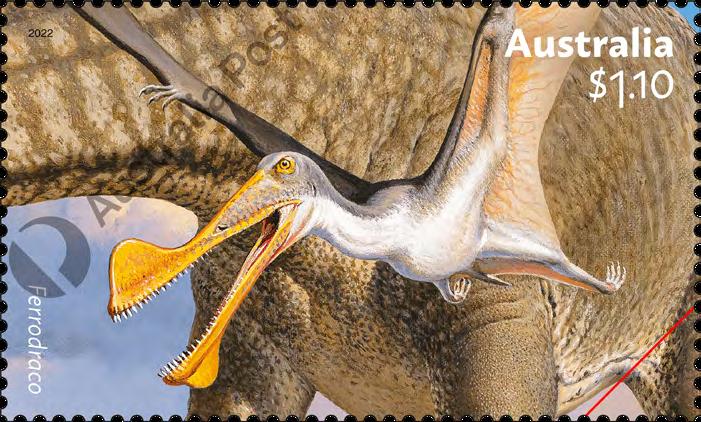
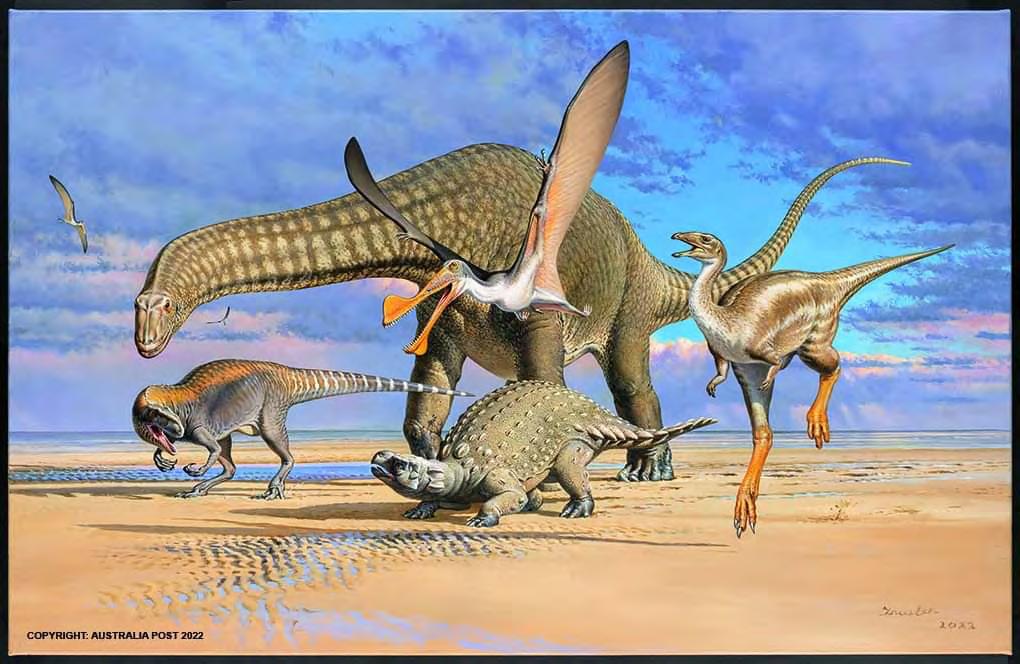
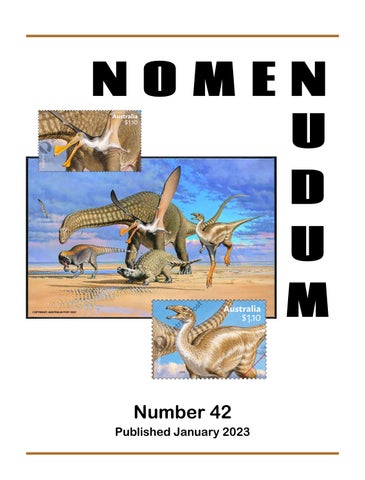
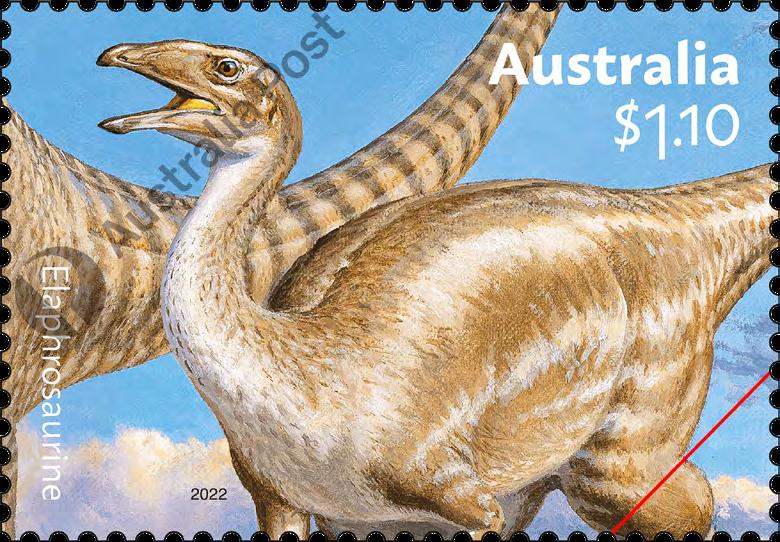
Front cover: ‘Australian Dinosaurs’ stamp series issued by Australia Post on 5 September 2022, based on artwork by Peter Trusler (central image). Highlighted stamps are of pterosaur Ferrodraco (top left) from Winton, Queensland, and an elaphrosaurine (bottom right) from Cape Otway, Victoria. Provided by Adele Pentland.
© Australasian Palaeontologists, January 2023.
ISSN 1447-4662
Our fourth year in council, the Western Australia Council, consisting of myself as the Chair, John Gorter as Vice Chair, Heidi Allen as Secretary and Daniel Mantle as Treasurer, welcomed two new committee members, Elizabeth Dowding as webmaster and Sarah Martin as Publishing Officer. 2022 continued to be affected by COVID-19, and as a result we decided to move PDU3 to 2023 to make sure that COVID-19 would have less an impact on the conference.
At our AGM this year, we awarded the 2022 Mary Wade Award for best paper in Alcheringa by an early career research and the 2021 AAP Dorothy Hill Award for best paper by a middle-career researcher.
Our checklists continue to grow (please see our website: https://www.australasianpalaeontologists.org/ databases). We are looking for more contributors to take on other taxonomic groups.
Our membership had a small increase (3) in members since last year, with currently 123 financial members. Our social media presence is on the rise, with 88 new followers on Facebook, 69 on Instagram, and 66 on Twitter.
Our Treasurer reported our 2021 profit and loss. We made a modest loss this year, due to paying deposits for PDU3, which we won’t recoup until after PDU3.
Alcheringa Chief Editor, Ben Kear, reported a steady impact factor of the journal, at 1.395, and Alcheringa achieved the highest ever total citations in 2021 index year (1245). Submission intake increased in 2022.
Nomen Nudum editor, Rodney Berrell, is stepping down this year but a new editor was voted in at the AGM, Patrick Smith. We thank Rodney for his long service to AAP and Nomen Nudum and wish him well. Welcome to Patrick Smith and hope you will enjoy the new position!
Finally, due to personal reasons, Heidi Allen has resigned as AAP Secretary. We thank her for her contribution to AAP the past four years and wish her well. We will organise a Special General Meeting (SGM) in January or February to vote in a new Secretary.
We are looking forward to 2023 and welcoming everyone to Perth in July for Palaeo Down Under 3 (PDU3). Please join the conference mailing list here: https://www.australasianpalaeontologists.org/pdu3.
At PDU3, we will have a final AGM for the Western Australian Council, to report our final six months activities and vote in the new council replacing us, from New South Wales.
Kenny J. Travouillon Chair, Australasian Palaeontologists
Western Australian Museum, Perth
The 2022 awards of Australasian Palaeontologists were presented at the specialist group’s AGM at Public House in Perth, and also virtually on Zoom, on 23 November.
The Mary Wade Prize is awarded to the best paper(s) published in the previous two years in a peer-reviewed Australasian Palaeontologists publication (currently, Alcheringa and Australasian Palaeontological Memoirs) by an early career researcher as sole or first author. ‘Early career’ is defined as any tertiary student, or any researcher who has graduated less than five years previously at the time of submission of the paper. Provided authors meet the above criteria, publications by any Australasian, or by any researcher that deal with material predominantly from the Australasian region, will be eligible for consideration.
The 2022 Mary Wade Prize was awarded to Mr Isaias Santos Barros for his lead authorship of the collaborative article:
Barros, I.S., Haig, D.W. & McCartain, E. 2022. Uppermost Triassic Halstätt-like cephalopod limestone (Lilu Facies) and Foraminifera, Timor-Leste: Alcheringa: An Australasian Journal of Palaeontology, https://doi.org/10.1080/03115518.2022.2112288.
The award included an engraved trophy and $1000 cash prize. Early career palaeontological researchers are encouraged to publish their results in the journals of Australasian Palaeontologists, in order to be eligible for the prize.
The AAP Dorothy Hill Award is awarded to the best paper published in a calendar year in any peer-reviewed journal on Australasian Palaeontology by a middle-career researcher as sole or first author. ‘Middle career’ is defined as any researcher that are between six years after graduation and retirement. Provided authors meet the above criteria, publications by any Australasian researcher, or on any material predominantly from the Australasian region, will be eligible for consideration.
The 2021 AAP Dorothy Hill Award was awarded to Prof. Kate Trinajstic for her lead authorship of the collaborative article:
Trinajstic, K., Briggs, D. & Long, J. 2021. The Gogo Formation Lagerstatte: a view of Australia’s first barrier reef: Journal of the Geological Society 129(1), jgs2021-105. https://doi.org/10.1144/jgs2021105.
The award included a certificate and $1000 cash prize. Middle-career palaeontological researchers are encouraged to submit their papers to AAP, in order to be eligible for the award.
Australasian Palaeontologists (AAP) cordially invites all palaeontologists from Australia, New Zealand and around the world to participate in Palaeo Down Under 3 (PDU3) in Perth (Australia) on 10–14 July 2023. The proposed conference programme covers all aspects of palaeontology and associated disciplines. PDU3 will include guest keynote lectures, general and thematic sessions, symposia and posters. The conference is operating in a hybrid format, including both virtual and in-person options.
A first circular for the conference was released in December 2021, with the second circular released in January 2023. Registration for the conference and one of the two field trips is open now, via the Humantix website:
Conference: https://events.humanitix.com/palaeodownunder-3-pdu3
Post-conference field trip: https://events.humanitix.com/pdu3-post-conference-trip-kalbarri
A call for abstracts and conference papers, plus registration for the second fieldtrip, will be available in February.
Bookmark the conference webpage to keep up with conference news!
https://www.australasianpalaeontologists.org/pdu3
We look forward to welcoming you in Perth!
Lynne Bean, Research School of Earth Sciences, Australian National University is working on descriptions of Aphnelepis australis and Aetheolepis mirabilis from the Talbragar Fossil Fish Bed. The phylogenetic analysis and preparation of the paper has been delayed by medical issues and a holiday in New Zealand. This work will continue in 2023 and will include collaboration with Dr Soledad Gouiric Cavalli in Argentina as well as Emeritus Professor Mark Wilson (Chicago) and Professor Gloria Arratia (U. Kansas).
Gavin Young continues his research at the Research School of Physics with Bob Dunstone, Peter Ollerenshaw, and in the RSES Bob Burne. Outside collaborations are mainly with Dr Carole Burrow at the Queensland Museum, and Prof. Jing Lu and Dr You-An Zhou at IVPP [Institute of Vertebrate Paleontology & Paleoanthropology, Beijing]. Under study with Carole and Jing [also with Alison Basden-Hyde] are new specimens of the ?stem osteichthyan Ligulalepis from NSW Lower Devonian limestones including Wee Jasper. Other collaborative projects continue to be delayed due to Covid 19 restrictions; e.g. the manuscript still being finalized on the enigmatic Palaeospondylus, known for over 100 years only from its type area (Middle Devonian Orcadian Basin of Scotland). We are describing a new species from the Early Devonian of the Georgina Basin.
The field project at Eden on the NSW south coast was progressed with nine days of fieldwork in December 2021 and February 2022. Participants were: GC Young (9 days), Ben Young (6 days), Yuzhi Hu (5 days), Ian and Isaac Schoon (3 days), Sean Li (1 day), Celia O’Donnell (1 day). Access was provided by NSWNP, but after six days in December the track became impassable due to the boggy conditions. By February it had dried out somewhat, enabling us to get back in for another three days work, with tremendous assistance from Ian Schoon. We excavated more material of articulated Upper Devonian Gondwana sarcopterygians (lobe-finned fishes), all unknown to science except for Edenopteron (described in 2013). Since February, the extreme wet weather has prevented our return to finalise the excavation. Ian managed to walk in and check that our fossil stockpile was still intact (in late August 2022).
Little progress was made on a manuscript describing the very large articulated Remigolepis specimens from the Eden localities.
Polish Devonian coral experts Mikołaj Zapalski and Błażej Berkowski, who are working with John Pickett, visited Australia in July, and I took them out to Wee Jasper to examine abundant corals in the limestones. They took samples for an ongoing study of Devonian mesophotic coral ecosystems.
Casas, J.E., Berry, C., Moody, J.M. & Young. G. 2022. Formación Campo Chico, una increíble Ventana a la flora y fauna fósil del Devónico (Givetiano-Frasniano) en la Sierra de Perijá, Venezuela. Publicacion Electronica de la Asociación Paleontológica Argentina 22(1), 20–35, http://dx.doi.org/10.5710/PEAPA.08.03.2022.401
We continue to concentrate on implementing the new collection management system EMu for our fossil collections, with an emphasis on getting the CPC (Commonwealth Palaeontology Collection, GA’s collection of published fossil material) in suitable order for uploading. Information on our extensive collection of
unpublished material will follow as soon as possible after. For light relief, we spent an enjoyable few days in March in the field with the Australian Museum team at McGrath’s Flat, and also participated in GA’s activities for National Science Week and Earth Science Week.
A highlight of 2022 for the Collections team was hosting several visiting researchers (all at the same time, by happy coincidence) in October as they undertook work on several trilobite-fossil related projects. The visitors included Dr Melanie Hopkins and Mark Nikolic from the American Museum of Natural History, and Prof. John Paterson and Dr Russell Bicknell from the University of New England. During this impromptu ‘Trilo-Fest’, hundreds of published and unstudied specimens from the GA’s palaeontology collections were examined, exciting discoveries made, and ideas for research projects generated, to be followed up on in 2023.
When time permits, Natalie Schroeder (Collection Manager, National Mineral & Fossil Collection) continues to work on an enigmatic creature known informally as ‘petalloid’ from the early Cambrian of Kangaroo Island.
Craig Munns recently graduated with Honours in Palaeontology (UNE), having performed his research at GA. Craig is continuing to research specimens from the GA collection for a paper to be published in September. The subject of his paper is the biostratigraphy of the Thorntonia Limestone (Middle Cambrian, Georgina Basin, Northern Australia). As well as developing a paper for publication, Craig is contributing to GA’s detailed knowledge of their collection. Craig is working closely with emeritus palaeontologist John Laurie and members of GA’s Collection Management team.
See John Laurie’s entry under Macquarie University.
Geoscience Australia specimens featured in the following publications in 2022:
Beck, R.M., Voss, R.S. & Jansa, S.A. 2022. Craniodental morphology and phylogeny of marsupials. Bulletin of the American Museum of Natural History 457(1), 1–352.
Camilleri, T.T., Weldon, E.A. & Warne, M.T. 2022. Review of the type material for two Palaeozoic ostracod species from southeast Australia. Alcheringa: An Australasian Journal of Palaeontology 46, 1–3.
McLoughlin, S. 2022. Late Permian flora of the Little River Coal Measures, northeastern Australia. Geophytology 50, 37–48
Mays, C. & McLoughlin, S. 2022. End-Permian burnout: The role of Permian–Triassic wildfires in extinction, carbon cycling, and environmental change in eastern Gondwana. Palaios 37(6), 292–317.
Riding, J.B., Mariani, E. & Fensome, R.A. 2022. A review of the Jurassic dinoflagellate cyst genus Gonyaulacysta Deflandre 1964 emend. nov. Review of Palaeobotany and Palynology 299, 104605.
Vitacca, J.J., Sinclair, N., Mantle, D.J., Marshall, N. & Peyrot, D. 2022. The taxonomy of selected marine microplankton from the Middle and Upper Jurassic (Callovian–Kimmeridgian) of the North West Shelf, Australia. Review of Palaeobotany and Palynology 304, 104668.
Palaeontology
Matthew McCurry (Curator of Palaeontology at the Australian Museum and jointly appointed with UNSW, Sydney) is working on research projects concerning the sensory evolution and feeding mechanics of secondarily aquatic tetrapods. Current projects include looking at brain size evolution over geological time and a newly discovered Miocene deposit, named McGrath’s Flat near Gulgong, NSW with the aid of an ARC linkage Grant in partnership with UNSW. Recently Matt has also finished designing content for the “Sharks” exhibition (which opened late 2022) and assisted with the installation of a new Nikon XT H 225 micro-CT scanner for the museum which will be used to image specimens.
McCurry, M.R., Cantrill, D.J., Smith, P.M., Beattie, R., Dettmann, M., Baranov, V., Magee, C., Nguyen, J.M.T., Forster, M.A., Hinde, J., Pogson, R., Wang, H., Marjo, C.E., Vasconcelos, P. & Frese, M. 2022. A Lagerstätte from Australia provides insight into the nature of Miocene mesic ecosystems. Science Advances 8, eabm1406.
Fischer, V., Bennion, R.F., Foffa, D., MacLaren, J.A., McCurry, M.R., Melstrom, K.M. & Bardet, N. 2022. Ecological signal in the size and shape of marine amniote teeth. Proceedings of the Royal Society B 289, 20221214.
Hart, L.J., Campione, N.E. & McCurry, M.R. 2022. On the estimation of body mass in temnospondyls: a case study using the large‐bodied Eryops and Paracyclotosaurus Palaeontology 65, e12629.
Moulds, M., Frese, M. & McCurry, M.R. in press. New cicada fossils from Australia (Hemiptera: Cicadoidea: Cicadidae) with remarkably detailed wing surface nanostructure. Alcheringa.
Cantrill, D.J., Ohlsen, D., McCurry, M.R. & Frese, M., in press. Gleichenia nagalingumiae sp. nov., a remarkably well–preserved fossil species with in situ spores from the Miocene of Australia. Review of Palaeobotany and Palynology
Lachlan Hart (Matthew McCurry’s PhD student and Technical Officer at the Australian Museum, Sydney) is continuing his PhD project looking at temnospondyls from the Mesozoic of New South Wales. Recently he has published an estimation of temnospondyl body mass using Eryops and Paracyclotosaurus as a case study. Lachlan is also nearly finished describing a near complete, articulated temnospondyl discovered in the mid-1990s within a retaining wall on the Central Coast of New South Wales. It was subsequently donated to the Australian Museum in 2003 and has been left unstudied in the collections. The specimen, which is likely to represent a new species, has both skeletal and soft tissue elements preserved.
Hart, L.J., Campione, N.E. & McCurry, M.R. 2022. On the estimation of body mass in temnospondyls: a case study using the large‐bodied Eryops and Paracyclotosaurus. Palaeontology 65, e12629.
Joshua White (Professor Tim Denham and Matthew McCurry’s PhD student) is continuing his PhD at the Australian National University and the Australian Museum. His thesis is currently entitled ‘Diet of Ancient Marine Reptiles’ and it focuses on understanding the relationship between form and function of marine reptile teeth to infer the diet of these extinct organisms, and better understand the evolution of marine reptiles. Recently he submitted the first chapter of his thesis, on the stomach contents of ‘Eric the opalised plesiosaur’ for publication.
Jacqueline Nguyen (Scientific Officer, Ornithology at the Australian Museum, Sydney and ARC DECRA Fellow at Flinders University, Adelaide) is working on research projects concerning songbird evolution. Current projects include Oligo–Miocene songbirds from South Australia and Queensland, the Big Questions in Paleontology Project, and fossil calibrations and the avian evolutionary timescale. She splits her time between her DECRA at Flinders and her role at the Australian Museum.
McCurry, M.R., Cantrill, D.J., Smith, P.M., Beattie, R., Dettmann, M., Baranov, V., Magee, C., Nguyen, J.M.T., Forster, M.A., Hinde, J., Pogson, R., Wang, H., Marjo, C.E., Vasconcelos, P. & Frese, M. 2022. A Lagerstätte from Australia provides insight into the nature of Miocene mesic ecosystems. Science Advances 8, eabm1406.
Steell, E.M., Nguyen, J.M., Benson, R B. & Field, D.J. in press. Comparative anatomy of the passerine carpometacarpus helps illuminate the early fossil record of crown Passeriformes. Journal of Anatomy
Tara Djokic (Research associate at the Australian Museum, Sydney) is currently researching the fossilisation processes and chemical evolution that occurred at McGrath’s Flat and the early appearance of life on Earth.
Johnson, C.M., Zheng, X.Y., Djokic, T., Van Kranendonk, M.J., Czaja, A.D., Roden, E.E. & Beard, B.L. 2022. Early Archean biogeochemical iron cycling and nutrient availability: New insights from a 3.5 Ga land-sea transition. Earth-Science Reviews 228, 103992.
Johnson, C.M., Zheng, X.Y., Djokic, T., Van Kranendonk, M.J., Czaja, A.D., Roden, E.E. & Beard, B.L. (2022). Reply to Comment by Birger Rasmussen and Janet R. Muhling on “Early Archean biogeochemical iron cycling and nutrient availability: New insights from a 3.5 Ga land-sea transition” by Johnson et al. Earth-Science Reviews 231, 104087.
Patrick Smith (Technical Officer at the Australian Museum & Adjunct Associate at Macquarie University, Sydney) is working on to databasing the Australian Museum’s entire Palaeontology Collection. Alongside this collections work Patrick is also researching the biostratigraphy of the Cambrian to Devonian trilobites and conodonts across Australia. In particular, he is focusing on the southern Canning Basin (Western Australia), Amadeus Basin (Northern Territory), Koonenberry Belt (New South Wales), Parkes Platform (New South Wales), and the southern Cobar Basin (New South Wales) in collaboration with Yong-Yi Zhen, Ian Percival, Barry Webby, Peter Jell & Heidi Allen. All these deposits host important sedimentary windows and are poorly constrained temporally.
Alongside this material, Patrick is also working on international Cambrian specimens, including a project on Middle Cambrian trilobites from the Tasman Formation, New Zealand (with Jim Jago and John Laurie, inspired by the late Roger Cooper) and another on Early Cambrian trilobites from Mongolia (with Marissa Betts, Christian Skovsted & Timothy Topper).
McCurry, M.R., Cantrill, D.J., Smith, P.M., Beattie, R., Dettmann, M., Baranov, V., Magee, C., Nguyen, J.M.T., Forster, M.A., Hinde, J., Pogson, R., Wang, H., Marjo, C.E., Vasconcelos, P. & Frese, M. 2022. A Lagerstätte from Australia provides insight into the nature of Miocene mesic ecosystems. Science Advances 8, eabm1406.
Bicknell, R.D., Smith, P.M., Bruthansová, J. & Holland, B. 2022. Malformed trilobites from the Ordovician and Devonian. PalZ 96, 1–10.
Bicknell, R.D., Smith, P.M., Brougham, T. & Bevitt, J.J. 2022. An earliest Triassic age for Tasmaniolimulus and comments on synchrotron tomography of Gondwanan horseshoe crabs. PeerJ 10, e13326.
Bicknell, R.D. & Smith, P.M. 2022. Examining abnormal Silurian trilobites from the Llandovery of Australia. PeerJ 10, e14308.
Bicknell, R.D., Smith, P.M., Howells, T.F. & Foster, J.R. in press. New records of injured Cambrian and Ordovician trilobites. Journal of Paleontology.
Ailie Mackenzie (Technical Officer at the Australian Museum, Sydney) is currently working as a Technical Officer in the Palaeontology Collection, assisting the registration of fossil specimens, and intends to begin a PhD in reptile palaeobiology in the near future.
Thomas Peachey (3D digitisation Technical Officer at the Australian Museum, Sydney) continues in his role at the museum. He will also now be assisting in the upkeep of the new Nikon XT H 225 CT scanner. Currently he is interested in discussing opportunities around 3D imaging and palaeobiology.
Robert Jones (Senior Fellow at the Australian Museum, Sydney) continues assisting with important collection duties working alongside Matthew, Patrick, and Graham. He also takes an active interest in Triassic of the Sydney Basin, occasionally collecting material when exposed on Sydney’s northern beaches.
Graham McLean (Honorary Research Associate and Collection assistant at the Australian Museum, Sydney) is almost ready to publish a set of Technical Reports which will review the taxonomic history of every taxon discovered and described from the Triassic Period of the Sydney Basin. These reports will summarise the geology of the three geological groups formed during this period, the Narrabeen Group, the Hawkesbury Sandstone and the Wianamatta Group, and provide details of fossil type specimens, their locations in collections and journal paper references. Other specimens held in general collections will also be listed. Finally, possible ecosystems will be discussed using the fossil evidence reviewed. The aim of these reports is to allow researchers rapid introduction to available research material held in the Australian Museum collection.
Michael Frese (Honorary Research Associate at the Australian Museum and Associate Professor at the University of Canberra) conducts research across various fields including virology, microbiology and palaeontology. His palaeontological research focusses on the Upper Jurassic Talbragar Fish Bed and the Miocene McGrath Flat lagerstätte.
McCurry, M.R., Cantrill, D.J., Smith, P.M., Beattie, R., Dettmann, M., Baranov, V., Magee, C., Nguyen, J.M.T., Forster, M.A., Hinde, J., Pogson, R., Wang, H., Marjo, C.E., Vasconcelos, P. & Frese, M. 2022. A Lagerstätte from Australia provides insight into the nature of Miocene mesic ecosystems. Science Advances 8, eabm1406.
Li, Y., Frese, M., Chen, J., Beattie, R. & Chang, S.C. 2022. The first protopsyllidiid (Hemiptera: Sternorrhyncha) from the Upper Jurassic of Australia. Alcheringa 46, 94–104.
Moulds, M., Frese, M. & McCurry, M.R. in press. New cicada fossils from Australia (Hemiptera: Cicadoidea: Cicadidae) with remarkably detailed wing surface nanostructure. Alcheringa
Cantrill, D.J., Ohlsen, D., McCurry, M.R. & Frese, M., in press. Gleichenia nagalingumiae sp. nov., a remarkably well-preserved fossil species with in situ spores from the Miocene of Australia. Review of Palaeobotany and Palynology.
Robert Beattie (Research associate at the Australian Museum, Sydney) continues his research with Matthew McCurry and Michael Frese on the Upper Jurassic Talbragar Fish Bed and the Miocene McGrath Flat lagerstätte.
McCurry, M.R., Cantrill, D.J., Smith, P.M., Beattie, R., Dettmann, M., Baranov, V., Magee, C., Nguyen, J.M.T., Forster, M.A., Hinde, J., Pogson, R., Wang, H., Marjo, C.E., Vasconcelos, P. & Frese, M. 2022. A Lagerstätte from Australia provides insight into the nature of Miocene mesic ecosystems. Science Advances 8, eabm1406.
Li, Y., Frese, M., Chen, J., Beattie, R. & Chang, S.C. 2022. The first protopsyllidiid (Hemiptera: Sternorrhyncha) from the Upper Jurassic of Australia. Alcheringa 46, 94–104.
Malte C Ebach (Australian Museum, Sydney & UNSW) is working on various projects, such as global bioregionalisation, the effects of dynamic topography on the Australian landscape and biota (with MPhil student Mackenzie Baker, UNSW), the effects of tectonics on Neotropical biogeography (with PhD student Lize Hermogenes de Mendonça, UNSW), and has dabbled a bit in Coronavirus classification.
Dowding, E.M., Ebach, M.C. & Mavrodiev, E.V. 2022. Validating marine Devonian biogeography: a study in bioregionalization. Palaeontology 65, e12578, https://doi.org/10.1111/pala.12578
Morrone, J.J. & Ebach M.C. 2022. Toward a terrestrial biogeographical regionalisation of the world: historical notes, characterisation and area nomenclature. Australian Systematic Botany 35, 89–126, http://dx.doi.org/10.1071/SB22002
Mavrodiev, E.V., Tursky, M.L., Mavrodiev, N.E., Schroder, L., Laktionov, A.P., Ebach, M.C. & Williams, D.M. 2022. On Classification and Taxonomy of Coronaviruses (Riboviria, Nidovirales, Coronaviridae) with Special Focus on Severe Acute Respiratory Syndrome-Related Coronavirus 2 (SARS-CoV-2). Mathematical Biology and Bioinformatics 17, 289–311, http:// dx.doi.org/10.17537/2022.17.289.
Ebach, M.C. 2022. Les origines de la biogéographie: un point de vue personnel. In: La biogéographie, ISTE Group, 7–35, http:// dx.doi.org/10.51926/iste.9060.ch1.
WB Clarke Geoscience Centre, Londonderry
Ian Percival spent the majority of his spare time this year editing his allocation of manuscripts submitted for the Global Synthesis of the Ordovician System (a Geological Society of London Special Publication in 2 volumes, of which he is one of four co-editors), which is on schedule to be published in mid-2023 to coincide with the 14th International Symposium on the Ordovician System to be held in Tallinn, Estonia. Ian is also contributing two chapters to this monumental work, one on Australia and New Zealand (with Yong Yi Zhen and Leon Normore) and the other (considerably smaller) on the Ordovician of Antarctica (with Dick Glen and Yong Yi). Apart from that, he worked intermittently on several other projects with Yong Yi. Two papers with Chinese colleagues appeared in 2022.
Yan, G.Z., Wu, R.C., Huang, B., Percival, I.G., Gong, F.Y., Wei, X. & Li, L.X. 2022. Llandovery (Silurian) conodont biofacies on the Yangtze Platform of South China and their palaeoenvironmental implications. Journal of Asian Earth Sciences 225, article 105044, https://doi.org/10.1016/j.jseaes.2021.105044
Cui, Y.N., Wang, G.X. & Percival, I.G. 2022. Early heliolitine tabulate corals from the Sandbian (Upper Ordovician) in the YunnanSichuan border area, Southwest China. Palaeoworld, https://doi.org/10.1016/j.palwor.2022.01.004
Jodie Rutledge works for the Palaeontology unit of the GSNSW undertaking data entry and assisting Yong Yi in various outreach, collection management and research projects.
Yong Yi Zhen has been working on several projects this year documenting the geology and biostratigraphy of NSW, jointly with Ian Percival, Patrick Smith, Des Strusz and others. These include a semi-monographic work reviewing Ordovician to Devonian fossils from the southern Cobar Superbasin, and studies of Middle–Late Ordovician conodonts from various parts of the Junee–Narromine Volcanic Belt. He has contributed to four chapters for the Global Synthesis of the Ordovician System (a Geological Society of London Special Publication) in collaboration with local and international colleagues.
Li, W.J., Fang, X., Yu, S.Y., Burrett, C., Zhen, Y.Y., Huang, J.Y. & Zhang, Y.D. 2022. Middle Ordovician shallow-water gastropods from southern Xizang (Tibet), western China. Palaeoworld, https://doi.org/10.1016/j.palwor.2022.08.003.
Chen, Z.Y., Zhang, D., Zhen, Y.Y., Li, W.J., Wu, R.C., Chen, Q., Zhao, A.K. & Zhang, Y.D. 2022. Uppermost Katian (Ka4, Upper Ordovician) conodonts in South China: Biostratigraphy, biofacies, and paleobiogeography. Marine Micropaleontology, https://doi.org/10.1016/j.marmicro.2022.102154
Chen, Z-Y., Zhang, D., Zhen, Y.Y., Li, W-J., Wu, R.C., Chen, Q., Zhao, A-K. & Zhang, Y-D. 2022. Uppermost Katian (Ka4, Upper Ordovician) conodonts in South China. In: Program and Abstracts, 2022 Pander Society Fifth International Conodont Symposium (ICOS5). Chen, Y., Jiang, H-S. & Lai, X-L. (eds), p. 18.
Zhen, Y.Y., Zhang, Y-D., Chen, Z-Y. & Wang, L-W. 2022. Origination of the ramiform–pectiniform apparatuses in conodonts — New evidence from the Lower Ordovician of South China and Australia. In: Program and Abstracts, 2022 Pander Society Fifth International Conodont Symposium (ICOS5). Chen, Y., Jiang, H-S. & Lai, X-L. (eds), p. 73.
Zhen, Y.Y., Wells, T., Simpson, C. & Parslow, J. 2022. Late Ordovician subsurface carbonates and fossil assemblages from the area immediate west and northwest of Peak Hill in central New South Wales and their regional correlation. Australian Journal of Earth Sciences 69(5), 690–710.
Zhen, Y.Y., Bauer, J.A. & Bergström, S.M. 2022. Revision of Histiodella labiosa Bauer, 2010, and its inferred phylogeny in the evolution of Middle Ordovician conodont genus Histiodella Harris, 1962. Journal of Paleontology 96(5), 1149–1165.
Zhen, Y.Y., Allen, H.J. & Martin, S.K., 2022. Early Ordovician conodonts from Barnicarndy 1 stratigraphic well of the southern Canning Basin, Western Australia. Alcheringa: An Australasian Journal of Palaeontology 46(1), 43–58.
Matthew Kosnik (School of Natural Sciences, Macquarie University) is a taphonomist and conservation palaeobiologist working mainly on Holocene mineralised marine invertebrates.
Bauder, Y., Mamo, B., Brock, G.A. & Kosnik, M.A. 2023. One Tree Reef Foraminifera: a relic of the pre-colonial Great Barrier Reef. Geological Society, London, Special Publications (2022), 529 (1), https://doi.org/10.1144/SP529-2022-64
John Laurie (Visiting Fellow, Macquarie University) now works mostly on Cambrian biostratigraphy and stratigraphy of the Georgina Basin, with two projects currently under way, one of which is with Craig Munns and John Paterson (both UNE), while the other is a lone affair on the Cambrian faunas from Hunt 1 well. Also recently submitted is a paper on the Miaolingian (Cambrian) agnostid and trilobite faunas from the northern part of the South Island in New Zealand (with Pat Smith, Jim Jago, John Simes and the late Roger Cooper) and another on the Furongian (Cambrian) agnostid and trilobite faunas from southernmost Tasmania (with Jim Jago and Kim Bischoff). Another couple of projects under way include a reassessment of the morphology and taxonomy of the pseudagnostids, a group that has been bouncing around between major agnostid lineages over the past couple of decades.
Zhen, Y.Y., Laurie, J.R., Percival, I.G., Nicoll, R.S. & Cooper, B.J. in press. Ordovician conodonts from the Horn Valley Siltstone of the Amadeus Basin, central Australia. Australasian Palaeontological Memoirs
Smith, P.M., Laurie, J.R., Jago, J.B., Cooper, R.A. & Simes, J.E. submitted. Miaolingian (Cambrian) agnostids and trilobites from the Cobb Valley area, South Island, New Zealand. Australasian Palaeontological Memoirs.
Briony Mamo (Macquarie University) now only pursues research in her spare time as an honorary research fellow in the Palaeobiology Laboratory at Macquarie University. Nevertheless, Dr Mamo’s ongoing projects with the International Ocean Discovery Program and Swire Institute of Marine Science (HKU) continue to apply recovered microfossil assemblages (namely foraminifera) to environmental questions. Currently they focus on modern carbonate ecosystems and how Cenozoic seafloor conditions reflect the development of oceanic currents and palaeoclimate.
Mamo, B.L., Cybulski, J.D., Hong, Y., Harnik, P.G., Chao, A., Tsujimoto, A., Wei, C.L., Baker, D.M. & Yasuhara, M. 2023. Modern biogeography of benthic foraminifera in an urbanized tropical marine ecosystem. Geological Society, London, Special Publications, 529(1), SP529-2022-175.
Bauder, Y., Mamo, B., Brock, G.A. & Kosnik, M. 2023. One Tree Foraminifera: a relic of the pre-colocial Great Barrier Reef. Geological Society, London, Special Publications 529(1), SP529-2022-64.
Yasuhara, M., Huang, H.M., Reuter, M., Tian, S.Y., Cybulski, J.D., O’dea, A., Mamo, B.L., Cotton, L.J., Di Martino, E., Feng, R., Tabor, C.R., Reygondeau, G., Zhao, Q., Warne, M.T., Aye, K.T., Zhang, J., Chao, A., Wei, C., Condamine, F.L., Kocsis, A.T., Kiessling, W., Costello, M.J., Tittensor, D.P., Chaudhary, C., Rillo, M.C., Doi, H., Dong, Y., Cronin, T.M., Saupe, E.E., Lotze, H.K., Johnson, K.G., Renema, W., Pandolfi, J.M., Harzhauser, M., Jackson, J.B.C. & Hong, Y. 2022. Hotspots of Cenozoic tropical marine biodiversity. Oceanography and Marine Biology: An Annual Review 60, 243–300.
Fontanier, C., Deflandre, B., Rigaud, S., Mamo, B., Dubosq, N., Lamarque, B., Langlet, D., Schmidt, S., Lebleu, P., Poirier, D., Cordier, M.-A. & Grémare, A. 2022. Live (stained) benthic foraminifera from the West-Gironde Mud Patch (Bay of Biscay, NE Atlantic): Assessing the reliability of bio-indicators in a complex shelf sedimentary unit. Continental Shelf Research 232, 104616.
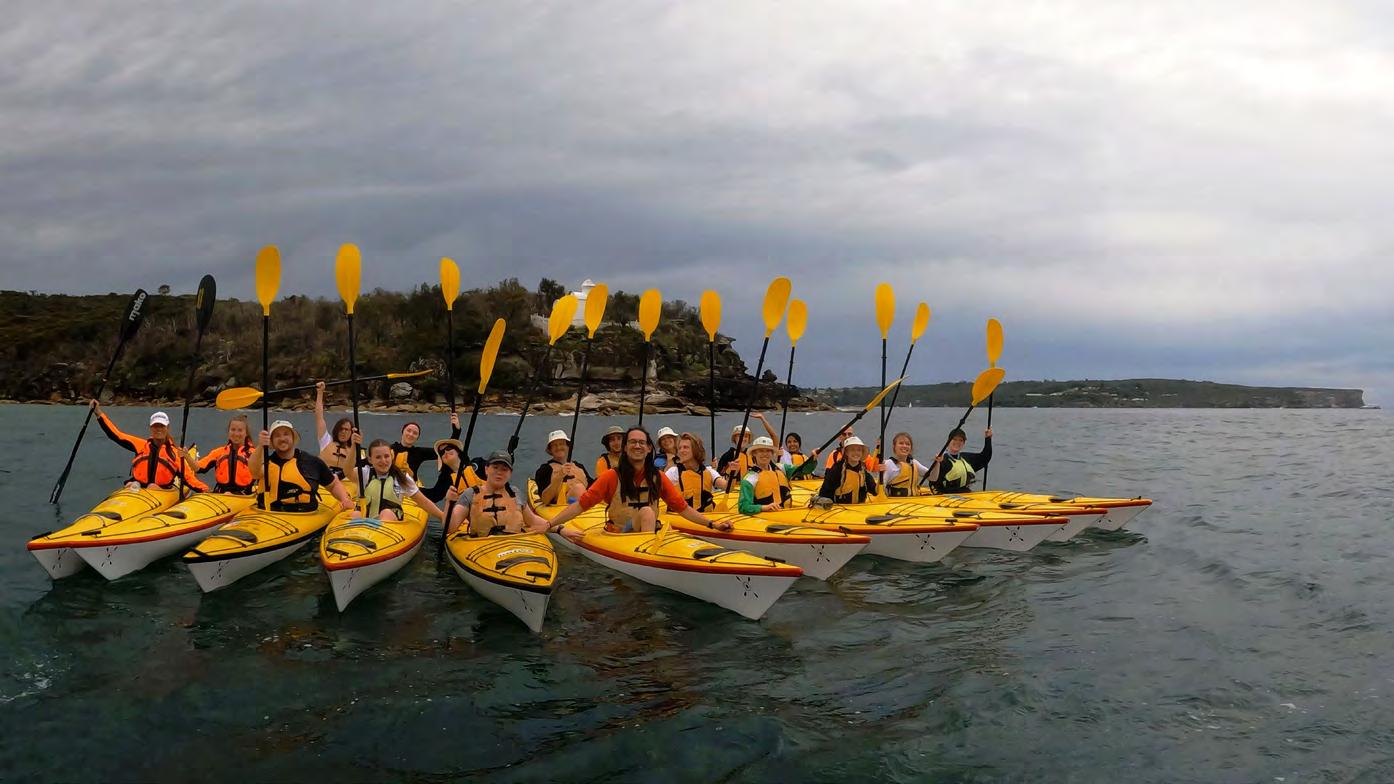
Briony with colleagues Matthew Kosnik, Simon George and Stefan Loehr at the 2022 ANZIC Masterclass kayaking with students in Cobblers Bay, Sydney.
Ian Metcalfe (University of New England) continues work on taxonomy, biostratigraphy, biogeography and ecology of Paleozoic and Triassic conodonts from Southeast Asia (especially Malaysia), China and Australia, aimed at elucidating biological and tectonic evolution, Permian mass extinctions and timescale calibration. Work on high-precision U–Pb zircon CA-TIMS isotopic age calibration of Permian–Triassic transitional sequences, and on the nature and age of the end-Permian mass extinction in Australia continue. High-precision U–Pb zircon CA-TIMS dating of Lower Triassic marine reptile evolution in China continues with collaborators in China and the USA. Recent work with Guang Shi (Wollongong University) and other colleagues on fossil material from core sections the Perth Basin, Western Australia led to the first systematic description of marine macrofossils from the P–Tr transition Australia. Work with University of New England colleagues Tim Chapman and Luke Milan, Jim Crowley (Boise State University) and Phil Blevin (NSW Geological Survey) demonstrated the importance of subduction-related arc super-eruptions as cryptic drivers of the end-Permian mass extinction. This was published in Nature Geoscience.
Ian Metcalfe’s palaeontological work forms a contribution to the University of New England Palaeoscience Research Centre:
https://www.une.edu.au/research/research-centres-institutes/palaeoscience-research-centre
Chapman, T., Milan, L.A., Metcalfe, I., Blevin, P.L. & Crowley, J.L. 2022. Pulses in silicic arc magmatism initiate end-Permian climate instability and extinction. Nature Geoscience 15, 411–416.
Shi, G. R., Metcalfe, I., Lee, S., Chu, D., Wu, H., Yang, T. & Zakharov, Y.D. 2022. Marine invertebrate fossils from the Permian–Triassic boundary beds of two core sections in the northern Perth Basin, Western Australia. Alcheringa 46, 156–173.
The Palaeocience Research Centre at UNE is steered by Prof. John Paterson and Drs Marissa Betts, Nic Campione and Phil Bell. While we were able to return to some post-covid normality, understaffing at UNE took its toll. Nevertheless, we were able to return to fieldwork in Alberta (Canada), Lightning Ridge and the Flinders Ranges, which was extremely rewarding. This year, we farewelled Dr Matthew Herne, who completed his Postdoctoral Fellowship studying Muttaburrasaurus and some new discoveries he has made in the Cretaceous of Queensland. Matt is moving on to some exciting work back in Queensland and we look forward to hearing more about this soon! Congratulations to Nick Hartnett, who completed his MSc on Cenozoic marine vertebrates from the Oligocene of New Zealand, and to our Honours students who handed in this year: Kai Allison (estimating centre of mass in dinosaurs), Nick Hartnett (Cenozoic marine vertebrates from New Zealand), Hayden Henderson (preliminary taphonomy of a dinosaur-bearing locality at Lightning Ridge), and Stephanie Richter Stretton who was awarded the University Medal (biostratigraphy of the Cambrian, Flinders Ranges). Moving into 2023, Hayden will begin his MSc, Stephanie will begin her PhD, and we will welcome Emily Herbert commencing their honours. We also farewell Postdoctoral Fellow Russell Bicknell who is moving on to a coveted postdoctoral position at the American Museum of Natural History. Congratulations Russ! Nic Campione and Marissa Betts will both be taking up their ARC DECRAs (dinosaur dental complexity and Cambrian palaeobiogeography, respectively), which were put on hold due to covid earlier in the year. After a tough year of understaffing, we also look forward to welcoming a replacement for Marissa while she is enjoying her DECRA research over the next three years. Special congratulations to Marissa whose documentary ‘ROLA(Stone)’ won the Geoscience Professionals category at the Earth Futures Festival in Sydney. Her film explores the connection between the geology of the NSW tablelands and knowledge held by local Anaiwan traditional custodians. This is a great film to show your undergraduate students and can be watched in full here: https://www.earthfuturesfestival.com/the-films/v/rola
Staff
Phil Bell
Marissa Betts
PRC Graduate students
Olivia Devereaux (MSc)
Nathan Enriquez (PhD)
Tim Frauenfelder (PhD)
Hayden Henderson (MSc)
Nic Campione
John Paterson
Justin Kitchener (PhD)
Stephanie Richter Stretton (PhD)
Amber Whitebone (PhD)
Bell, P. R., Hendrickx, C., Pittman, M., Kaye, T.G. & Mayr, G. 2022. The Exquisitely Preserved Integument of Psittacosaurus and the Scaly Skin of Ceratopsian Dinosaurs. Communications Biology 5(1), 1–16.
Bell P.R., Hendrickx C., Pittman M. & Kaye T.G. 2022. Oldest preserved umbilical scar reveals dinosaurs had belly buttons. BMC Biology, https://doi.org/10.1186/s12915-022-01329-9.
Benson, R.B., Brown, C.M., Campione, N.E., Cullen, T.M., Evans, D.C. & Zanno, L.E., 2022. Comment on “The influence of juvenile dinosaurs on community structure and diversity”. Science 375(6578), p.eabj5976.
Bicknell, R.D.C. & Smith, P.M. 2022. Examining abnormal Silurian trilobites from the Llandovery of Australia. PeerJ 10, e14308.
Bicknell, R.D.C. & Smith, P.M., Howells, T.F. & Foster, J.R.. 2022. New records of injured Cambrian and Ordovician trilobites. Journal of Paleontology, 1–9.
Bicknell, R.D.C., Kimmig, J., Budd, G.E., Legg, D.A., Bader, K.S., Haug, C. , Kaiser, D., Laibl, L., Tashman, J.N. & Campione, N.E. 2022. Habitat and developmental constraints drove 330 million years of horseshoe crab evolution. Biological Journal of the Linnean Society 136(1), 155–172.
Bicknell, R.D.C., Naugolnykh, S.V. & McKenzie, S.C. 2022. On Paleolimulus from the Mazon Creek Konservat-Lagerstätte. Academie des Sciences. Comptes Rendus. Palevol.
Bicknell, R.D.C., Smith, P.M., Brougham, T. & Bevitt, J.J. 2022. An earliest Triassic age for Tasmaniolimulus and comments on synchrotron tomography of Gondwanan horseshoe crabs. PeerJ 10, e13326.
Bicknell, R.D.C., Melzer, R.R. & Schmidt, M. 2022. Three-dimensional kinematics of euchelicerate limbs uncover functional specialization in eurypterid appendages. Biological Journal of the Linnean Society 135(1), 174–183.
Bicknell, R.D.C. & Naugolnykh, S.V. 2022. Palaeoecological reconstruction of the Late Devonian Lebedjan biota. Historical Biology, 1–9.
Bicknell, R.D.C., Smith, P.M., Bruthansová, J. & Holland, B. 2022. Malformed trilobites from the Ordovician and Devonian. PalZ 96(1), 1–10.
Bicknell, R.D.C., Holmes, J.D., Pates, S., Garcia-Bellido, D.C. & Paterson, J.R. 2022. Cambrian carnage: Trilobite predator–prey interactions in the Emu Bay Shale of South Australia. Palaeogeography, Palaeoclimatology, Palaeoecology 591(110877).
Bicknell, R.D.C., Simone, Y., vander Meijden, A., Wroe, S., Edgecombe, G.D. & Paterson, J.R. 2022. Biomechanical analyses of pterygotid sea scorpion chelicerae uncover predatory specialisation within eurypterids. PeerJ 10, e14515.
Bicknell, R.D.C., Tashman, J.N., Edgecombe, G.D. & Paterson, J.R. 2022. Carboniferous horseshoe crab musculature suggests anatomical conservatism within Xiphosurida. Papers in Palaeontology 8(1), e1403.
Brown, C.M., Campione, N.E., Mantilla, G.P.W. & Evans, D.C. 2022. Size-driven preservational and macroecological biases in the latest Maastrichtian terrestrial vertebrate assemblages of North America. Paleobiology 48(2), 210–238.
Enriquez, N.J., Campione, N.E., White, M.A., Fanti, F., Sissons, R.L., Sullivan, C., Vavrek, M.J. & Bell, P.R. 2022. The Dinosaur Tracks of Tyrants Aisle: An Upper Cretaceous ichnofauna from Unit 4 of the Wapiti Formation (upper Campanian), Alberta, Canada. PLoS ONE 17(2), e0262824.
Fanti, F., Bell, P.R., Vavrek, M., Larson, D., Koppelhus, E., Sissons, R.L., Langone, A., Campione, N.E. & Sullivan, C. 2022. Filling the Bearpaw gap: Evidence for palaeoenvironment-driven taxon distribution in a diverse, non-marine ecosystem from the late Campanian of west-central Alberta, Canada. Palaeogeography, Palaeoclimatology, Palaeoecology, https://doi. org/10.1016/j.palaeo.2022.110923
Frauenfelder, T.G., Bell, P.R., Brougham, T., Bevitt, J., Bicknell, R.D.C., Kear, B.P., Wroe, S. & Campione, N.E. 2022. New ankylosaurian cranial remains from the Lower Cretaceous (upper Albian) Toolebuc Formation of Queensland, Australia. Frontiers in Earth Science 10, 803505, https://doi.org/10.3389/feart.2022.803505
Hart, L.J., Campione, N.E. & McCurry, M.R. 2022. On the estimation of body mass in temnospondyls: a case study using the large‐bodied Eryops and Paracyclotosaurus. Palaeontology 65(6), p.e12629.
Hendrickx, C., Bell, P.R., Pittman, M., Milner, A.R.C., Cuesta, E., O’Connor, J., Loewen, M., Currie, P.J., Mateus, O., Kaye, T., and Delcourt, R. 2022. Morphology and distribution of scales, dermal ossifications, and other non-feather integumentary structures in non-avialan theropod dinosaurs. Biological Reviews, https://doi.org/10.1111/brv.12829
Li, L-Y, Topper, T.P., Betts, M.J., Dorjnamjaa, D., Gundsambuu, A., Baktuyag, E., Li, G-X. & Skovsted, C.B. 2022. Calcitic shells in the aragonite sea of the earliest Cambrian. Geology 51, 8–12.
Libke, C., Bell, P.R., Somers, C.M. & McKellar, R. 2022. New scale type from a small-bodied hadrosaur in the Frenchman Formation of southern Saskatchewan: potential implications for integumentary diversity in Edmontosaurus annectens. Cretaceous Research 136, 105215.
Pittman, M., Bell, P.R., Miller, C.V., Enriquez, N.J., Wang, X., Zheng, X., Tsang, L.R., Tse, YT., Landes, M., & Kaye, T.G.. 2022. Exceptional preservation and foot structure reveal ecological transitions and lifestyles of early theropod flyers. Nature Communications 13, 7684.
Pittman, M., Enriquez, N.J., Bell, P.R., Kaye, T.G. & Upchurch, P. 2022. Newly detected data from Haestasaurus and review of sauropod skin morphology suggests Early Jurassic origin of skin papillae. Communications Biology 5, 1–8.
Plotnick, R.E. & Bicknell, R.D.C. 2022. The Eurypterid Endostoma and Its Homology with Other Chelicerate Structures. Bulletin of the Peabody Museum of Natural History 63(2), 91–109.
Schmidt, M., Melzer, R.R., Plotnick, R.E. & Bicknell, R.D.C. 2022. Spines and baskets in apex predatory sea scorpions uncover unique feeding strategies using 3D-kinematics Iscience 25(1), 103662.
Topper, T.P., Betts, M.J., Dorjnamjaa, D., Li, G-X., Li, L-Y., Altanshagai, G., Enkhbaatar, B. & Skovsted, C.B. 2022. Locating the BACE of the Cambrian: Bayan Gol in western Mongolia and global correlation of the Ediacaran-Cambrian boundary. Earth-Science Reviews 229 (104017).
White, M.A., Bell, P.R., Campione, N.E., Brougham, T., Sansalone, G., Molnar, R., Wroe, S. & Elliot, D. 2022. Abdominal contents reveal Cretaceous crocodyliforms ate dinosaurs. Gondwana Research 106, 281–302.
Zong, R. & Bicknell, R.D.C. 2022. A new bilaterally injured trilobite presents insight into attack patterns of Cambrian predators. PeerJ 10, e14185.
Prof. Guang Shi has continued to work on Permian and Permian–Triassic faunas, biostratigraphy, biogeography and extinction patterns, as well as on aspects of the global biogeography of living brachiopods.
Shi, G.R., Metcalfe, I., Lee, S., Chu, D.L., Wu, H.T., Yang, T.L. & Zakharov, Y.D. 2022. Marine invertebrate fossils from the Permian-Triassic boundary beds of two borehole sections in the northern Perth Basin, Western Australia. Alcheringa 46, 156–173, https://doi.org/10.1080/03115518.2022.2062783
Garbelli, G., Angiolini, L., Posenato, R., Harper, E.M., Lamare, M.D., Shi, G.R. & Shen, S.Z. 2022. Isotopic time-series (δ13C and δ18O) obtained from the columnar layer of Permian brachiopod shells are a reliable archive of seasonal variations. Palaeogeography, Palaeoclimatology, Palaeoecology 607, 111264, https://doi.org/10.1016/j.palaeo.2022.111264
Shi, G.R., Nutman, A.P., Lee, S., Jones, B.G. & Bann, G.R. 2022. Reassessing the chronostratigraphy and tempo of climate change in the Lower-Middle Permian of the southern Sydney Basin, Australia: Integrating evidence from U–Pb zircon geochronology and biostratigraphy. Lithos 410–411, 106570, https://doi.org/10.1016/j.lithos.2021.106570.
Shi, G.R., Lee, S., Kotlyar, G.V. & Zakharov, Y.D. 2022. Permian brachiopods from South Primorye, Far East Russia: systematics and palaeogeographic and palaeoceanographic implications. Alcheringa 46, 59–84, https://doi.org/10.1080/03115518.2022. 2035434
Lee, S., Shi, G.R., Nakrem, H.A., Woo, J. & Tazawa, J.-I. 2022. Mass extinction or Extirpation: Permian biotic turnovers in the northwestern margin of Pangea. Geological Society of America Bulletin 134, 2399–2414, https://doi.org/10.1130/B36227.1.
Ye, F., Shi, G.R. & Bitner, M.A. 2021. Global biogeography of living brachiopods: Bioregionalization patterns and possible controls. PLoS ONE 16(11), e0259004, https://doi.org/10.1371/journal.pone.0259004
Assoc. Prof. Tony Wright (Honorary Principal Fellow) is focusing on taxonomic, biostratigraphic, biogeographic and evolutionary studies of mainly Devonian corals and brachiopods as follows:
• Revision of the Devonian tetracoral genus Trapezophyllum.
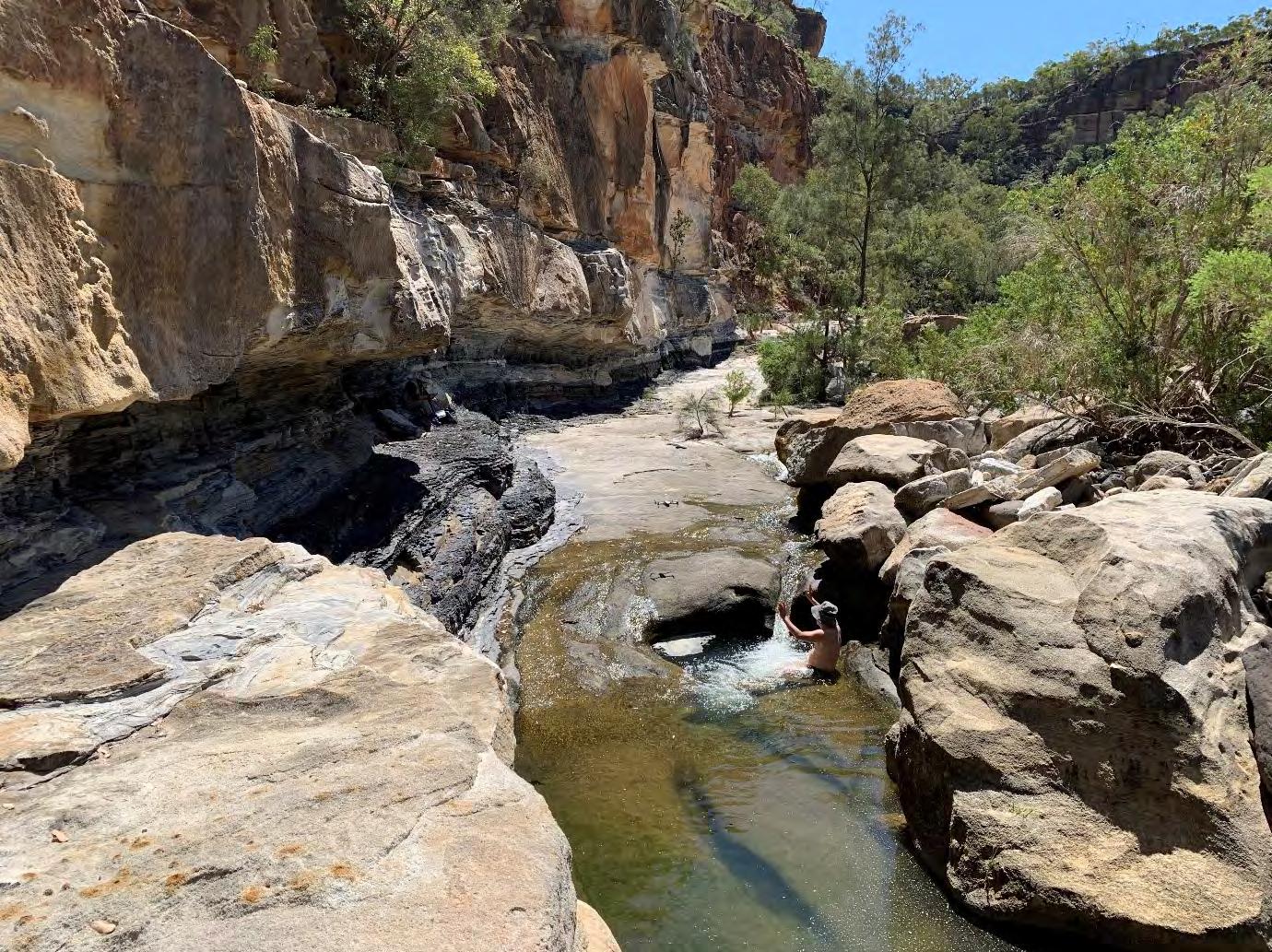
Guang Shi and Niu Yazhuo at a Permian–Triassic boundary section in the Porcupine Gorge National Park (northern Galilee Basin), Queensland (Sep. 2022, photographed by Sam Lee)
• Taxonomy, evolutionary relationships and biogeographic affinities of calceolide corals from north Viet Nam: co-authored with Tong-Dzuy Thanh, Ta Hoa Phuong and Nguyen Huu Hung.
• Occurrences of the Devonian pentameride brachiopod Zdimir in eastern Australia: co-authored with J.A. Talent.
• A giant new strophodontide brachiopod genus from the Devonian (upper Emsian to lower Eifelian) Mount Frome Limestone, New South Wales, Australia.
• Further studies of operculate corals from eastern Australia and other regions.
• Dr Ross McLean (Honorary Principal Fellow in UOW) and I are also working on a new Silurian coral fauna from ‘Ulah’, south of Orange, NSW, including descriptions, discussions and revisions of corals of this age, mainly in NSW.
McLean, R.A. & Wright, A.J. 2022. New and revised Llandovery (early Silurian) rugose corals from central western New South Wales. Proceedings of the Linnean Society of New South Wales 144, 11–77.
Robert Marks (Honours graduate at UOW) is a research assistant working on developing a workflow to assess reconstructions of past configurations of tectonic plates using paleobiogeography. His work focuses on brachiopod fossil distribution, and the openly available method can be applied to many different organisms. This work is supervised by Dr Nicolas Flament, Dr Sam Lee and Prof. Guang Shi. Robert recently completed an Honours project, supervised by Dr Nicolas Flament, exploring the sinking of subducted tectonic plates through the mantle using numerical models of mantle convection. He presented his Honours work at the Virtual GSA Earth Science Student Symposium, at which he was awarded the People’s Choice Award.
Dr Facheng Ye (Associate Research Fellow) mainly focuses on micro-structure of modern and fossil brachiopod shells and tries to understand how the shell structure responds to environmental/climate change and their evolutional change during geological time.
Simonet Roda, M., Griesshaber, E., Angiolini, L., Rollion-Bard, C., Harper, E.M., Bitner, M.A., Milner Garcia, S., Ye, F., Henkel, D., Häussermann, V. & Eisenhauer, A. 2022. The architecture of Recent brachiopod shells: diversity of biocrystal and biopolymer assemblages in rhynchonellide, terebratulide, thecideide and craniide shells. Marine Biology 169, 1–52.
Ye, F., Shi, G.R. & Bitner, M.A. 2021. Global biogeography of living brachiopods: Bioregionalization patterns and possible controls. PLoS ONE 16, e0259004, https://doi.org/10.1371/journal.pone.0259004.
Dr Sangmin (Sam) Lee (Research Fellow) is continuing his palaeontological research on taxonomy, palaeobiogeography and phylogeny of Paleozoic marine macroinvertebrate fossils. In particular, he is focusing on the taxonomic revision of Permian brachiopods from the Southern Sydney Basin (SSB) in eastern Australia, looking for their evolutionary trends in high-latitudinal environments. His taxonomic paper about the Permian brachiopods from the Snapper Point Formation in the SSB was recently accepted, through collaboration with Prof. Bruce Runnegar (University of California, Los Angeles) and Prof. J. Bruce Waterhouse (Oamaru, New Zealand). Sam is currently preparing another taxonomic paper about brachiopod fauna from the Nowra Sandstone also in the SSB.
Additionally, he is also working on detailed taxonomy and palaeobiogeography of some Cambro–Ordovician brachiopods from the Taebaeksan Basin in South Korea, collaborating with Yeongju Oh (PhD student at Korea Polar Research Institute) and Prof. Dong-Chan Lee (Chungbuk National University).
Shi, G.R., Metcalfe, I., Lee, S., Chu, D.L., Wu, H.T., Yang, T.L. & Zakharov, Y.D. 2022. Marine invertebrate fossils from the Permian-Triassic boundary beds of two borehole sections in the northern Perth Basin, Western Australia. Alcheringa 46, 156–173, https://doi.org/10.1080/03115518.2022.2062783
Kwon, H., Woo, J., Oh, J.-R., Joo, Y.J., Lee, S., Nakrem, H.A. & Sim, M.S. 2022. Responses of the biogeochemical sulfur cycle to Early Permian tectonic and climatic events. Earth and Planetary Science Letters 591, 117604, https://doi.org/10.1016/j. epsl.2022.117604
Shi, G.R., Nutman, A.P., Lee, S., Jones, B.G. & Bann, G.R. 2022. Reassessing the chronostratigraphy and tempo of climate change in the Lower-Middle Permian of the southern Sydney Basin, Australia: Integrating evidence from U–Pb zircon geochronology and biostratigraphy. Lithos 410–411, 106570, https://doi.org/10.1016/j.lithos.2021.106570.
Shi, G.R., Lee, S., Kotlyar, G.V. & Zakharov, Y.D. 2022. Permian brachiopods from South Primorye, Far East Russia: systematics and palaeogeographic and palaeoceanographic implications. Alcheringa 46, 59–84, https://doi.org/10.1080/03115518.2022. 2035434
Lee, S., Shi, G.R., Nakrem, H.A., Woo, J. & Tazawa, J.-I. 2022. Mass extinction or Extirpation: Permian biotic turnovers in the northwestern margin of Pangea. Geological Society of America Bulletin 134, 2399–2414, https://doi.org/10.1130/B36227.1.
Oh, Y., Lee, D.-C., Lee, S., Lee, S.-B., Hong, P.S. & Hong, J. 2022. Palaeobiogeography of the family Nisusiidae (Cambrian rhynchonelliform brachiopods) using the ‘area-transition count’ method and systematic revision of Korean species. Papers in Palaeontology 8, e1420, https://doi.org/10.1002/spp2.1420
Dr Yazhuo Niu (Visiting Academic Fellow in UOW, originally from Xi’an Centre of Geological Survey, China Geological Survey) is working on the Early–Middle Permian sedimentary facies and provenance in the Sydney Basin and paleogeographic reconstruction and crustal growth in the Central Asian Orogenic belt.
Zhang, Q., Niu, Y.-Z., Yao, J.-L., Zhao, G.-C., Han, Y.-G. & Liu, Q. 2022. Paleogeographic affinity of the Alxa Block across the Archean–Proterozoic: Insights from metamorphosed Archean basement. Precambrian Research 381, 106864, https://doi. org/10.1016/j.precamres.2022.106864
Zhang Y.-X., Tang J.-R., Niu Y.-Z., Zhang J.-Y., Zhao Y, Wei J.-S., Jiang G.-Z. & Wang L.-W. 2022. Resource advantage and geological work suggestions under carbon neutralization in Northwest China. Geology in China 49, 1458–1480, https://doi. org/10.12029/gc20220507.
Julien Louys (Australian Research Centre for Human Evolution, Griffith University) is working on several projects across Southeast Asia and Australia, notably for the latter the underwater fossil deposits of Mt Gambier, South Australia, for which he and his team were recently awarded an ARC Linkage Project in collaboration with the Cave Divers Association of Australia and the South Australian Museum.
Louys, J., Duval, M., Beck, R.M.D., Pease, E., Sobbe, I., Sands, N. & Price, G.J. 2022. Cranial remains of Ramsayia magna from the Late Pleistocene of Australia and the evolution of gigantism in wombats (Vombatidae; Marsupialia). Papers in Palaeontology 8, e1475, https://doi.org/10.1002/spp2.1475
Miszkiewicz, J.J., Louys, J. & Mahoney, P. 2022. Cartesian coordinates in two-dimensional bone histology images for Quaternary bone remodelling research. Open Quaternary 8, 12, http://doi.org/10.5334/oq.117
Basilia, P., Miszkiewicz, J.J., Nganvongpanit, K., Zaim, J., Rizal, Y., Aswan, Puspaningrum, M., Trihascaryo, A., Price, G., van der Geer, A.A.E. & Louys, J. 2022. Bone histology in a fossil elephant (Elephas maximus) from Pulau Bangka, Indonesia. Historical Biology, https://doi.org/10.1080/08912963.2022.2092850
DeSantis, L.R.G., Pardi, M.I., Du, A., Greshko, M.A., Yann, L.T., Hulbert, R.C. Jr. & Louys, J. 2022. Global long-term stability of individual dietary specialization in herbivorous mammals. Proceedings of the Royal Society B 289, 20211839, https://doi. org/10.1098/rspb.2021.1839
Louys, J., Duval, M., Price, G., Westaway, K., Zaim, Y., Rizal, Y., Aswan, Puspaningrum, M., Trihascaryo, A., Breitenbach, S., Kwiecien, O., Cai, Y., Higgins, P., Albers, P., De Vos, J. & Roberts, P. 2022. Speleological and environmental history of Lida Ajer cave, western Sumatra. Philosophical Transactions of the Royal Society B 377, 20200494, https://doi.org/10.1098/ rstb.2020.0494
Honorary Research Fellow Carole J. Burrow continues to work on mid-Paleozoic jawed fishes. With the easing of travel restrictions in 2021, she managed a short study trip to the Indiana State Museum in Indianapolis in June, where she was hosted by Damon Lowe, Peggy Fisherkeller, and Katie Barbour, followed by a visit to the Natural History Museum in London hosted by Emma Barnard and Zerina Johanson. Other early vertebrate workers encountered there included Kate Trinajstic and Wayne Itano, who were also on their way to the 16th Early Vertebrates/Lower Vertebrates (EVLV) Conference in Valencia, Spain. Carole gave a talk on bits and pieces of the stem bony fish Ligulalepis at this highly successful and informative meeting. Collaborative work with Mike Newman (Wales) and Jan den Blaauwen (Netherlands) on descriptions of the Devonian acanthodians of Scotland has finally come close to completion with articles published and in press on the mesacanthid acanthodians. A decade-plus collaboration with Mike Murphy (California) and Sue Turner (QM) on vertebrate microremains from Silurian–Devonian boundary beds in the North Roberts Mountains, Nevada, has also come to fruition, with a manuscript in press. Description of another North American fauna — acanthodian bits and pieces from Death Valley, California — is also in press. She continues to work with Sue Turner and Daniel Snyder (Iowa) on North American gyracanthids, as well as with Sue on Devonian vertebrate microremains from the Northern Territory, and with Gavin Young (Canberra), Yuzhi Hu (ANU), Jing Lu and You-an Zhu (IVPP Beijing) on the Cravens Peak Beds fauna from western Queensland. Carole also contributed to a large manuscript, submitted as a special volume for the GSNSW Quarterly News on Ordovician–Devonian fossils from the southern Cobar Superbasin and underlying strata in central New South Wales, by Yong-Yi Zhen (GSNSW) and colleagues.
Burrow, C. & Marss T. 2022. Neotypes for some upper Silurian acanthodian taxa from the Baltic Sea Region and the Welsh Borderland. Estonian Journal of Earth Sciences 7, 17–24, https://doi.org/10.3176/earth.2022.02
Burrow, C. & Elliott, D.A. in press. Acanthodian fauna from the Early Devonian (Emsian) of Death Valley, California. Paleobios.
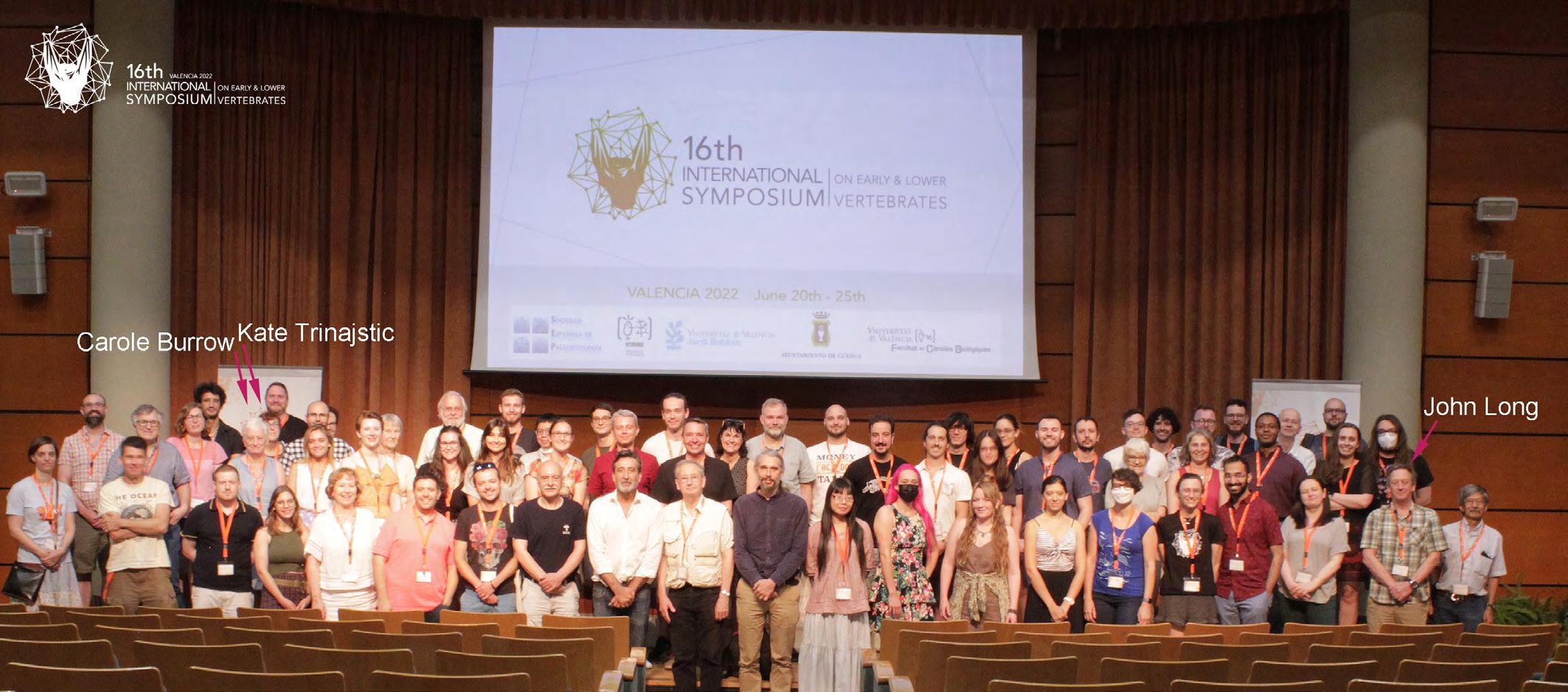
Attendees at the 16th EVLV conference in Valencia, Spain in June 2022, with Australian contingent arrowed.
Burrow, C.J., Blaauwen, J.L.d. & Newman, M.J. 2022. New information on the Early Devonian acanthodian Mesacanthus mitchelli from the Midland Valley of Scotland. Scottish Journal of Geology 58(2), sjg2021-2004, https://doi.org/doi:10.1144/ sjg2021-00.
Burrow, C.J., Murphy, M.A. & Turner, S. in press. Late Silurian to earliest Devonian vertebrate biostratigraphy of the Birch Creek II section, Roberts Mountains, Nevada, U.S.A. Paleobios.
Newman, M., den Blaauwen, J., Burrow, C., Jones, R. & Davidson, R. in press. The Middle Devonian acanthodian Orcadacanthus n. gen. from the Orcadian Basin of Scotland. Palaeontologia Electronica
Peter Jell is continuing projects on: 1) the Silurian/Devonian echinoderms, mainly stelleroids, of central Victoria, the Yass/Canberra shelf and a few other parts of NSW; 2) Cambrian faunas of the Gnalta area, western NSW (with Patrick Smith and Michael Leu); 3) Cretaceous echinoderms of Australia as part of a review of Australian Mesozoic macroinvertebrate marine faunas; 4) Tertiary articulate crinoids from southern Australia with Tomasz Baumiller and Ben Thuy; 5) the Late Permian fauna of the Condamine Beds near Warwick, Queensland (with Rob Willinck and John S. Jell); 6) Echinoderm fauna of the Fox Bay Formation, Falkland Islands.
Jell, P.A. 2022. Hunting fossil echinoderms in the Devonian of the Falkland Islands. The Falkland Islands Journal 2022, 53‒65. Jell, P.A. 2022. Trilobite appendages preserved as silica replacements. The Trilobite Papers 25, 18, 19.
Susan Turner (Queensland Museum Geosciences & Acta Geologica Sinica scientific editing team) is working on various Paleozoic and Mesozoic vertebrates, mainly agnathan thelodonts (from Australia, Canada — Burrow et al. in press, Turkey, UK, USA), gyracanths (currently from Iowa with Carole Burrow and Daniel Snyder), and various sharks, including Doliodus and Lazarus xenacanths (with Carole, John Long, Rodrigo-Soler-Gijon and Steve Avery). She has just finished an article for Episodes about women’s contributions to the work of the IUGS as part of their 60th Anniversary celebration.
She attended her first virtual conference of the International Symposium on Early/ Lower Vertebrates held in Valencia, Spain in July and presented a poster. In September 2022, she talked about French women
vertebrate palaeontologists at the INHIGEO conference at the French National Prehistoric Museum, Les Eyzies as part of her work on the history of women in VP (e.g. Berta & Turner 2020, Turner & Berta 2021), and later that month paid homage to her colleague and friend Professor Emeritus Alain Blieck, who died of COVID in February 2022.
Sue also has an ongoing project looking at women in the geosciences and she maintains Facebook pages on ‘Ichthyolith Issues’ (c. Susan Turner) ‘Women in Geoscience’.
Berta, A. & Turner, S. 2020. Rebels, Scholars and Explorers: Women in Vertebrate Paleontology. Johns Hopkins University Press, Baltimore, 350 pp and online appendices, https://jhupbooks.press.jhu.edu/title/rebels-scholars-explorers
Burrow, C.J. Murphy, M.A. & Turner, S. 2022 in press. Late Silurian to earliest Devonian vertebrate biostratigraphy of the Birch Creek II section, Roberts Mountains, Nevada, U.S.A. Palaeobios
Turner, S. 2022a. Introduction. To our Honoured colleagues, Drs Tiiu Märss and Philippe Janvier. In: Proceedings 16th ISE/LV, June 20–24, Valencia, Spain. Parades Allaga, M.V., Manzanares, E., Mondejar Fernandez, J., Ros-Franch, S., Botella, H. & Martinez-Perez, C. (eds). Ichthyolith Issues Special Publication 15, p. 1.
Turner, S. 2022b. To Shed or Not to Shed, THAT is the question. In: Proceedings 16th ISE/LV, June 20–24, Valencia, Spain. Parades Allaga, M.V., Manzanares, E., Mondejar Fernandez, J., Ros-Franch, S., Botella, H. & Martinez-Perez, C. (eds). Ichthyolith Issues Special Publication 15, p. 61 [poster]
Turner, S. 2022c. La chasse aux ossements fossiles: French women in vertebrate palaeontology. In: Cohen, C. et al. (eds). 47th INHIGEO, Les Eyzies, France, 16–21 September 2022: conference abstracts, 1p.
Turner, S. 2022. Alain Blieck 1949–2022. Short memorial by ST. Accessed: 22 January 2023, http://iselv.uv.es/in-memory-ofdr-alain-blieck/.
Turner, S. 2022. Alain Blieck and the vertebrates. Memories of Sue Turner. Hommage a AB. Societe geologique du Nord, USTL, Villeneuve d’Ascq, September 28th [online talk]
Turner, S. & Berta, A. 2021. Illustrating the unknowable: women paleoartists through time who determined the look of ancient vertebrates. In: The Evolution of Paleontological Art. Clary, R.M., Rosenberg, G.D. & Evans, D. (eds). Geological Society of America (GSA) Memoir 218, 22p.
Anthony Romilio continues to work on dinosaur ichnites from Australia, USA, China and Korea. Several significant new dinosaur tracksites from Queensland and Victoria will be published in 2023.
Romilio, A. & Godfrey, T. 2022. A new dinosaur tracksite from the Lower Cretaceous (Aptian–Albian) Eumeralla Formation of Wattle Hill, Victoria, Australia: a preliminary investigation. Historical Biology 34(12), 2315–2323. https://doi.org/10.1080/ 08912963.2021.2014481
Romilio, A., Klein, H., Jannel, A. & Salisbury, S.W. 2022. Saurischian dinosaur tracks from the Upper Triassic of southern Queensland: possible evidence for Australia’s earliest sauropodomorph trackmaker. Historical Biology 34(9), 1834–1843. https://doi.org/10.1080/08912963.2021.1984447
Kim, K.S., Lockley, M.G., Romilio, A., Bae, S.M. & Lim, J.D. 2022. Fish swim traces from the Jindong Formation (Cretaceous) Korea: Implications for lake basin ichnofacies and paleoecology. Cretaceous Research 131, 105070. https://doi.org/10.1016/j. cretres.2021.105070
Lallensack, J.N., Romilio, A. & Falkingham, P.L. 2022. A machine learning approach for the discrimination of theropod and ornithischian dinosaur tracks. Journal of the Royal Society. Interface 19, 20220588, 1–8. https://doi.org/10.1098/ rsif.2022.0588
Lallensack, J.N., Buchwitz, M. & Romilio, A. 2022. Photogrammetry in ichnology: 3D model generation, visualisation, and data extraction. Journal of Paleontological Techniques 22, 1–18.
Lockley, M.G., Hadden, G. & Romilio, A. 2022. A Late Triassic theropod track assemblages from the basal Wingate Sandstone, western Colorado: implications for regional correlation and the megatracksite concept. Historical Biology, 1–8, https://doi. org/10.1080/08912963.2022.2056838
Lockley, M.G., Goodell, Z., Evaskovich, J., Krall, A., Schumacher, B.A. & Romilio, A. 2022. Small bird and mammal tracks from a mid-Cenozoic volcanic province in Southern Colorado: implications for palaeobiology. Historical Biology 34(1), 130–140, https://doi.org/10.1080/08912963.2021.1903456
Xing, L., Wang, Y., Lockley, M.G., Li, M., Gao, L., Yin, Z., Romilio, A., Persons IV, S.W., Wang, M., Xu, X. & Wan, X. 2022. Theropod and other dinosaurian tracks from the upper Lower Cretaceous of northeastern China: overlooked Fuxin Biota records reinvestigated. Cretaceous Research 135, 105190, 1–9, https://doi.org/10.1016/j.cretres.2022.105190
Xing, L., Lockley, M.G., Romilio, A., Wang, T. & Liu, C. 2022. Dinosaur tracks from the Lower Jurassic Lufeng Formation of Northern Central Yunnan, China. Biosis: Biological Systems 3(1), e004, https://doi.org/10.37819/biosis.003.01.0169
Gordon Grigg, an Emeritus Professor at the University of Queensland, with five other authors, published a paper early in 2022 that interpreted a combination of biochemical, physiological and palaeontological evidence to show that whole-body endothermy (warm-bloodedness) was characteristic of Sauropsida and Synapsida from their earliest age (at Carboniferous) and, furthermore, that the endothermy seen in mammals and birds appears to be homologous.
The study was prompted by research work showing similarity between the biochemical mechanisms driving regulatory heat production in mammals and birds, suggesting that their endothermy could have common ancestry. If so, we reasoned, very early occurrences of endothermy would be expected. Accordingly, an extensive survey of paleontological literature was undertaken using six proxies for endothermy. The results provided good evidence for whole-body endothermy in Pareiasauria and in ‘pelycosaurs’ (e.g. Edaphosauria and Sphenacodontia), early sauropsids and synapsids respectively and, indeed, it was widespread throughout the ancestry of today’s mammals, birds and crocodylians. These conclusions are in stark contrast with currently accepted opinions about both the age at which endothermy evolved among amniotes and because it has always been assumed that endothermy evolved independently in birds and mammals.
Grigg, G.C., Nowack, J., Bicudo, J.E.P.W., Bal, N.C., Woodward, H.N. & Seymour, R.S. 2022. Whole-body endothermy: ancient, homologous and widespread among the ancestors of mammals, birds and crocodylians. Biological Reviews 97, 766–801, https://doi.org/10.1111/brv.12822 (Open access).
Jorgo Ristevski (School of Biological Sciences, The University of Queensland) has now completed his PhD at the University of Queensland. The title of his PhD thesis is ‘New insights into the taxonomic diversity and evolution of crocodylians from the Cenozoic Era of Australia’. Jorgo studies extinct crocodylomorphs, focusing on their morphology, palaeoneurology, phylogeny, taxonomic diversity, and evolution. Some of the methods he utilizes include descriptive and comparative anatomy, interpreting data obtained from computed tomographic (CT) scans, and phylogenetic analyses. In 2022, he published two peer-reviewed papers including his first solo-author peer-reviewed study. He is currently seeking postdoctoral opportunities in Australia.
Ristevski, J. 2022. Neuroanatomy of the mekosuchine crocodylian Trilophosuchus rackhami Willis, 1993. Journal of Anatomy 241(4), 981–1013, https://doi.org/10.1111/joa.13732.
Ristevski, J., Weisbecker, V., Scanlon, J.D., Price, G.J. & Salisbury, S.W. 2022. Cranial anatomy of the mekosuchine crocodylian Trilophosuchus rackhami Willis, 1993. The Anatomical Record, 1–59, https://doi.org/10.1002/ar.25050
Ristevski, J. 2022. Data from: Neuroanatomy of the mekosuchine crocodylian Trilophosuchus rackhami Willis, 1993. Dryad, Dataset, https://doi.org/10.5061/dryad.fbg79cnx4
Ristevski, J., Weisbecker, V., Scanlon, J.D., Price, G.J. & Salisbury, S.W. 2022. Data from: Cranial anatomy of the mekosuchine crocodylian Trilophosuchus rackhami Willis, 1993. Dryad, Dataset, https://doi.org/10.5061/dryad.gmsbcc2qm
Ristevski, J. 2022. Inside the head of one of the smallest crocodylians: paleoecological insights from the neuromorphology of Trilophosuchus rackhami, and tracing the origins of Mekosuchinae. Journal of Vertebrate Paleontology, Program and Abstracts, 2022, 283–284.
Ristevski, J. 2022. An ancient gharial: The latest puzzle piece in Australian crocodylian evolution. Australian Age of Dinosaurs Journal 19, 25–26.
Jennifer Cooling (University of Queensland, Brisbane) is working on Australian palynological assemblages from the Jurassic to the recent(ish). She is currently working on several Holocene peat cores collected from southwest Tasmania, as well as investigating the palynological productivity potential of a number of Neogene and Paleogene megafaunal sites. The taxonomic section of her thesis is now in the final stages of preparation as a journal article and should be ready for submission soon, as is a follow up manuscript on the Cenozoic core published last year.
Yu, T., Cooling, J., Esterle, J., Chadwick, T. & Babaahmadi, A. 2022. Origins of clay-rich strata in Cenozoic paleochannel deposits: an example from Suttor Formation, Queensland. Australian Journal of Earth Sciences 70, 40–59.
Gilbert Price is a Senior Lecturer in Palaeontology at The University of Queensland. He is a vertebrate palaeoecologist and geochronologist, particularly interested in the evolution and emergence of Australia’s unique ecosystems and fauna, and their response to prehistoric climatic changes. His major research focus has been on the development of palaeoecological models for Australia’s Pleistocene megafauna. Critically, this also involves the production of reliably dated records for the extinct species. Gilbert is the coordinator of UQ’s Palaeo-Research Group, Associate Editor of Alcheringa, was Co-Chair of the Host Committee of the Society of Vertebrate Paleontology meeting held in Brisbane in October 2019, and a past secretary of the Australasian Association of Palaeontologists.
See www.TheFatWombat.com for pre-2022 publications.
Basilia, P., Miszkiewicz, J.J., Nganvongpanit, K., Zaim, J., Rizal, Y., Aswan, Puspaningrum, M.R., Trihascaryo, A., Price, G.J., van der Geer, A.A. & Louys, J. In press. Bone histology in a fossil elephant (Elephas maximus) from Pulau Bangka, Indonesia. Historical Biology, 1–12.
Louys, J., Duval, M., Beck, R.M.D., Pease, E., Sobbe, I., Sands, N. & Price, G.J. 2022. Cranial remains of Ramsayia magna from the Late Pleistocene of Australia and the evolution of gigantism in wombats (Vombatidae; Marsupialia). Papers in Palaeontology 8, e1475.
Louys, J., Duval, M., Price, G.J., Westaway, K., Zaim, Y., Rizal, Y., Aswan, Puspaningrum, M., Trihascaryo, A., Breitenbach, S.F. & Kwiecien, O. 2022. Speleological and environmental history of Lida Ajer cave, western Sumatra. Philosophical Transactions of the Royal Society B 377(1849), p.20200494.
Price, G.J. 2022. Wandering mastodons reveal the complexity of Ice Age extinctions. Proceedings of the National Academy of Sciences 119, p.e2208044119.
Ristevski, J., Weisbecker, V., Scanlon, J.D., Price, G.J. & Salisbury, S.W. 2022. Cranial anatomy of the mekosuchine crocodylian Trilophosuchus rackhami Willis, 1993. The Anatomical Record 306, 239–297.
Gregory E. Webb (School of Earth and Environmental Sciences, The University of Queensland) is continuing on geochemical investigations on Holocene and Pleistocene cores and beachrock from Heron
and One Tree reefs in the southern GBR. PhD student Atefeh Sansoleimani is continuing work on the subsurface geology of the Great Barrier Reef and published a paper on active subsidence in the GBR (Sansoleimani et al., 2022). PhD student Jenna McGovern continues a project on cores in the southern Canning Basin, which may penetrate Devonian Reef facies, as part of an exploration project supervised through the Strategic Minerals Institute by Karen Connors and Steven Micklethwaite. PhD student Vikram Vakil is still working on Australian Quaternary small faunas with Gilbert Price as Principal Advisor. He has recently presented on a new extinct species of the rat Notomys. Josh Reid has begun a PhD on new core material from Heron Reef. Brett Pidgeon began a PhD on the Springbok Sandstone of the Surat Basin in Queensland. Honours student Tia Robinson is working on Holocene aged tufas form the Darling Downs fossil localities. Additional work on reef cores is being undertaken with Jody Webster (USYD) and Joseph Bevitt at the Australian Centre for Neutron Scattering.
Louys, J., Cramb, J., Ferguson, K., Kemp, J., Wood, R., Miszkiewicz, J.J., Dias Guimarães, N.R., Higgins, P., Travouillon, K.J., Hocknull, S.A., Webb, G.E. & Price G.J. 2022. Interim report on the vertebrate deposits recovered from the Capricorn Caves, Rockhampton, Queensland. Alcheringa. (accepted 7/10/2022)
Webb, G.E. & Webster, J.M. 2022. Scientific drilling on the GBR - unlocking the history of the reef. In: Australia’s Coral Reefs: Perspectives from Beyond the Water’s Edge. Hamylton, S., Hutchings, P. & Hoegh-Guldberg, O. (eds). CSRIO Publishing, 124–129, http://doi.org/10.1071/9781486315499
Webster, J.M., Dechnik, B., Sanborn, K., Yokoyama, Y., Braga, J.C., Renema, W., Humblet, M., Beaman, R.J., Nothdurft, L.D. Webb, G.E., Zhao, J.X., Murphy, R.J., Gallagher, S.J., O’Leary, M. & Paumard, V. 2022. Coral reef development and sealevel changes over the past 50,000 years: new evidence from the north-west shelf of Australia. In: Coral Reefs and Sea-Level Change: Quaternary Records and Modelling. Camoin, G., Samankassou (eds). International Association of Sedimentologists Special Publication 49, 215–273.
Kenyon, T.M., Doropoulos, C., Wolfe, K., Webb, G.E., Dove, S., Harris, D. & Mumby, P.J. 2022. Coral rubble dynamics in the Anthropocene and implications for reef recovery. Limnology and Oceanography 9999, 1–38. https://doi.org/10.1002/ lno.12254.
Sansoleimani, A., Webb, G.E., Harris, D.L., Phinn, S.R. & Roelfsema, C.M. 2022. Antecedent topography and active tectonic controls on Holocene reef geomorphology in the Great Barrier Reef. Geomorphology 413, 108354. https://doi.org/10.1016/j. geomorph.2022.108354
Salas-Saavedra, M., Webb, G.E., Sanborn K.L., Zhao J.-X., Webster J.M., Nothdurft L.D. & Nguyen, A. 2022. Holocene microbialite geochemistry records > 6000 years of secular influence of terrigenous flux on water quality for the southern Great Barrier Reef. Chemical Geology 604, 120871. https://doi.org/10.1016/j.chemgeo.2022.120871.
Adele H. Pentland (PhD Candidate; also Research Associate at the Australian Age of Dinosaurs Museum, Winton) continued her work on Australian Cretaceous pterosaurs. A full osteological description of Ferrodraco lentoni, the most complete pterosaur from Australia was published in the Journal of Vertebrate Paleontology. Pentland was lead author on a second paper, describing two isolated anhanguerian pterosaur femora from western Queensland. Fieldwork conducted with the Australian Age of Dinosaurs Museum, Winton, Queensland resulted in the excavation of two sites and recovery of sauropod remains, and isolated teeth from several taxa. This year also saw the publication of two sauropod papers, including the description of a juvenile Diamantinasaurus with Samantha Rigby and colleagues, and isolated sauropod teeth with Dr Stephen Poropat and colleagues. Ferrodraco and the elaphrosaurine theropod (described with Dr Stephen Poropat and colleagues in 2020) were featured in an Australia Post stamp series, illustrated by Peter Trusler (see this volume’s cover).
Pentland, A.H., Poropat, S.F., White, M.A., Rigby, SL., Bevitt, J.J., Duncan, R.J., Sloan, T., Elliott, RA., Elliott, H.A., Elliott, J.A & Elliott, D.A. 2022. The osteology of Ferrodraco lentoni, an anhanguerid pterosaur from the mid-Cretaceous of Australia. Journal of Vertebrate Paleontology, e2038182. https://doi.org/10.1080/02724634.2021.2038182.
Pentland, A.H., Poropat, S.F., White, M.A., Rigby, S.L., Vickers-Rich, P., Rich, T.H. & Elliott, D.A. 2022. New anhanguerian pterosaur remains from the Lower Cretaceous of Queensland, Australia. Alcheringa: An Australasian Journal of Palaeontology 46, 188–197. https://doi.org/10.1080/03115518.2022.2065028.
Rigby, S.L., Poropat, S.F., Mannion, P.D., Pentland, A.H., Sloan, T., Rumbold, S.J., Webster, C.B. & Elliott, D.A. 2022. A juvenile Diamantinasaurus matildae (Dinosauria: Titanosauria) from the Upper Cretaceous Winton Formation of Queensland, Australia, with implications for sauropod ontogeny. Journal of Vertebrate Paleontology, e2047991.
Poropat, S.F., Frauenfelder, T.G., Mannion, P.D., Rigby, S.L., Pentland, A.H., Sloan, T. & Elliott, D.A. 2022. Sauropod dinosaur teeth from the lower Upper Cretaceous Winton Formation of Queensland, Australia and the global record of early titanosauriforms. Royal Society Open Science, 9(7), 220381.
Pierre Kruse (Honorary Research Associate, South Australian Museum, Adelaide) continues his biostratigraphic project on archaeocyaths from Wirrealpa Mine, Flinders Ranges. His paper on proposed higher subdivisions of the Cambrian, released online in 2021, has now been formally published in Episodes.
Pierre’s work with Yang Aihua (Nanjing University, China) on calcimicrobial–archaeocyathan reef palaeoecology in the Tianheban Formation of South China, and with Elena Moreno-Eiris and Antonio Perejón (Universidad Complutense, Madrid, Spain) on cryptic archaeocyaths at Las Ermitas, Spain, are still in the pipeline.
Kruse, P.D. 2022. Proposal for a scale of Cambrian subsystems (if such is needed at all). Episodes 45, 53–54.
Jim Jago (University of South Australia-STEM) is continuing to work on the Cambrian trilobites of Tasmania, South Australia and New Zealand. Current projects include the Cambrian trilobites from the Cobb Valley, New Zealand collected by the late Roger Cooper. This project is being done with Patrick Smith and John Laurie. Another project is on a late Cambrian fauna from the south coast of Tasmania (with John Laurie and Kim Bischoff). Jim, Sun Xiaowen and Chris Bentley are in the process of studying the remaining undescribed trilobites from the Warburton Basin. A recent project (with Diego Garcia-Bellido, Nick Lemon, Jim Gehling and Richard Jenkins) has dealt with an enigmatic fossil from the early Cambrian Heatherdale Shale, south of Adelaide. Jim is involved in the study of the Big Gully biota, a Burgess Shale type fauna from Kangaroo Island. Workers on this project include Mike Lee, Jim Gehling, John Paterson, Greg Edgecombe, Diego Garcia-Bellido, Glenn Brock and Jim Jago. Other projects include the stratigraphy and sedimentology of the Kanmantoo Group (with Justin Gum, Andy Burtt and Peter Haines).
Jago, J.B., Gehling, J.G., Lemon, N.M., Jenkins, R.J. F. & Garcia-Bellido, D.C. (accepted for publication). A large enigmatic fossil from the early Cambrian (Series 2, Stage 3) Heatherdale Shale of South Australia. New Zealand Journal of Geology and Geophysics, https://doi.org/10.1080/00288306.2022.2157846.
Jago, J.B. & Bentley, C.J. 2022. The stratigraphically lowest known Cambrian trilobites from the Dial Range Trough, north-west Tasmania and from western Tasmania. Alcheringa 46, 33–42, https://doi.org/10.1080/03115518.2022.2043438
Mark Warne currently has one active palaeontological research project: ostracod proxy records of Holocene environmental change in southeast Australian estuaries.
Abbey McDonald (PhD student) continues her research on the latest Miocene to early Pliocene ostracod faunas of southeastern Australia.
Yasuhara, M., Huang, H-H.M., Reuter, M., Tian, S.Y., Cybulski, J.D., O’Dea, A., Mamo, B.L., Cotton, L., Di Martino, J.E., Feng, R., Tabor, C.R., Reygondeau, G., Zhao, Q., Warne, M.T., Aye, K., Zhang, J., Chao, A., Wei, C-L., Condamine, F.L., Kocsis A.T., Kiessling, W., Costello, M.J., Tittensor, D.P, Chaudhary, C., Rillo, M.C., Doi, H., Dong, Y., Cronin, T.M., Saupe, E.E, Lotze, H.K., Johnson, K.G., Renema, W., Pandolfi, J.M., Harzhauser, M., Jackson, J.B.C. & Hong, Y. 2022. Hotspots of Cenozoic tropical marine biodiversity. Oceanography and Marine Biology: An Annual Review 60, 243–300. https://doi. org/10.1201/9781003288602-5
McDonald, A.P. & Warne, M.T. 2022. Latest Miocene Ostracoda from the Bookpurnong Formation, Murray Basin, southeastern Australia: shallow marine migrants into an epicontinental sea. Alcheringa 46(3/4), 301–339 https://doi.org/10.1080/031155 18.2022.2133169
Camilleri, T.A.A., Weldon, E.A. & Warne, M.T. 2022. Review of the type material for two Palaeozoic ostracod species from southeast Australia. Alcheringa 46(3/4), 340–342. https://doi.org/10.1080/03115518.2022.2129783.
Jake Kotevski (PhD Candidate, School of Biological Sciences, Monash University). Having completed his honours thesis in 2021, Jake began his PhD in February of 2022 with Dr Stephen Poropat, and Assoc. Profs Alistair Evans and Justin Adams, entitled ‘Revisions of the Victorian theropod fauna and the phylogenetic position of the Megaraptora’. Jake has begun the task of reviewing and reappraising the entire collection of non-avian theropods in at Melbourne Museum. In 2022, Jake published his first paper, in a joint effort with Steve Poropat, on the first dinosaur tooth reported from Australia (and first megaraptoran worldwide). Jake was awarded the Monash University-Museums Victoria Top-up scholarship to continue his work, and received the People’s Choice for best PhD talk at Monash GEMMZ conference 2022.
Kotevski, J. & Poropat, S.F. 2022. On the first dinosaur tooth reported from Australia (Theropoda: Megaraptoridae). Alcheringa: An Australasian Journal of Palaeontology 46(2), 174–179.
Patricia Vickers-Rich (Swinburne University of Science and Technology and Monash University) and Thomas Rich and Tim Ziegler (Museums Victoria) have carried out the following fieldwork in 2022.
Tim Ziegler (Collection Manager Vertebrate Palaeontology, Museums Victoria) is conducting field surveys of caves in eastern Victoria to locate, document, and retrieve Quaternary vertebrate fossils.
Until recently only a few dinosaur ichnites or tracks had been recognised in Victoria. In the past few years a few hundred have been found by members of the public along both the Bass and Otway coasts.
Anthony Martin (Emory University, Atlanta, Georgia) spent a few weeks in May working particularly with Melisa Lowery and Michael Cleeland, systematically searching for not only dinosaur ichnites but numerous other types of traces as well. One of these was a circular burrow structure more than 1 metre in diameter.
Accompanied by Mike Hall and Peter Swinkels, Pat Vickers-Rich and Tom Rich spent a month and a half in southern Namibia. Their objective was to consolidate information about the latest Proterozoic there gained over the past two decades. However, towards the end of the field work, Mike and Peter discovered a new fossil site that produced much larger specimens of the enigmatic Peridinium than had previously been found anywhere.
Martin, A.J., Lowery, M., Hall, M., Seeget-Villers, D.E., Peter Swinkels, P., Lesley Kool, L., Rich, T.H. &Vickers-Rich, P. 2022. Dinosaur tracks great and small in the Early Cretaceous Wonthaggi Formation of Victoria, Australia. In: Society of Vertebrate Paleontology, 82nd Annual Meeting SVP 20222 Program Guide, 245–246.
Flannery, T.F., Rich, T.H., Vickers-Rich, P., Ziegler, T., Veatch, E.G. & Helgen, K.M. 2022. A review of monotreme (Monotremata) evolution. Alcheringa: An Australasian Journal of Palaeontology 46, 1–18.
Flannery, T.F., Rich, T.H., Vickers-Rich, P., Veatch, E.G. & Helgen, K.M. 2022. The Gondwanan origin of Tribosphenida (Mammalia). Alcheringa: An Australasian Journal of Palaeontology 46, 277–290.
Rich, T.H., Lowery, M., Hall, M., Kool, L., Bevitt, J., White, M. & Vickers-Rich, P. 2022. A new Cretaceous fossil mammal locality from the Bass Coast of southeastern Australia. Alcheringa: An Australasian Journal of Palaeontology 46, 349–353, https://doi.org/10.1080/03115518.2022.2119600
Rich, T.H., Krause, D.W., Trusler, P., White, M.A., Kool, L., Evans, A.R., Morton, S. & Vickers-Rich, P. 2022. Second specimen of Corriebaatar marywaltersae from the Lower Cretaceous of Australia confirms its multituberculate affinities. Acta Palaeontologica Polonica 67, 115–134.
Vickers-Rich, P. & Rich, T.H. 2022. 43 T-Shirts, Not the Answer to Everything but with a Few Good Guesses. A Palaeontological Journey Through 700 Million Years: New Artworx, Melbourne, 376p. plus Appendices data card.
Vickers-Rich, P. with Rozanov, A. & Rich, T.H. 2022. The Great Russian Dinosaurs Exhibition: A Russian-Australian Joint Venture (1993–1997) at the time of the Transition from the USSR to the Russian Federation. A Time of Stress in Science: New Artworx, Melbourne, 302p. plus Appendices data card (new edition).
Earth & Oceanic Systems Research Group, RMIT City Campus, Melbourne
In 2022, the sole remaining postgraduate student at RMIT who had been studying palaeontology graduated. There is no longer a palaeontologist on the tenured staff, and this seems unlikely to change in the foreseeable future. There has been a gradual drop in students seeking to study geology for some time — and this has been accentuated by the current portrayal of geology, especially when related to extractive industries. Interest remains in the undergraduate realm for courses, especially field-based courses that may help understand environmental change. Palaeontology has always been a fun subject that opens minds and provides solutions and over the last few decades, RMIT ran a series of field-based courses to harness this interest. However, field-based courses are increasingly being impacted by the regulatory framework, e.g. occupational health and safety, especially when the trips are structured to run over several days. A good undergraduate fieldbased course takes a lot of time, effort and money to organise; sadly, it is increasingly losing support from university administration.
John Buckeridge remains involved with research on the palaeontology, palaeoecology and distribution of cirripedes and other marine invertebrates. His interest in taxonomy and the species concept continues through the International Union of Biological Sciences delegate on the IUBS Taxonomy Working Group.
McSweeney, F.R., Shimeta, J. & Buckeridge, J.S. 2022. Lower Devonian Zosterophyllum-like plants from central Victoria, Australia, and their significance. Memoirs of Museum Victoria 81, 25–41, https://doi.org/10.24199/j.mmv.2022.81.02.
McSweeney, F.R., Shimeta, J. & Buckeridge, J.S. 2022. Taungurungia gen. nov., from the Lower Devonian of Yea, central Victoria, Australia. Memoirs of Museum Victoria 81, 43–53, https://doi.org/10.24199/j.mmv.2022.81.03
Kočí, T., Goedert, J.L. & Buckeridge, J.S. 2022. Eocene tube-dwelling annelids (Polychaeta: Sedentaria) from the Black Hills, western Washington State: the first record of Neodexiospira from North America. Paläontologische Zeitschrift, https://doi. org/10.1007/s12542-022-00604-y.
Schnabel, K., Peart R., Bradford-Grieve J., Buckeridge J., Eagar S., Hosie A. & Gerken, S. 2022. Twenty years on: Updating the Inventory of New Zealand Crustacea. In: Proceedings of the XI Congresso Brasileiro sobre Crustáceos (CBC) / The Crustacean Society (TCS) Summer Meeting 6–9 June 2022, Abstract and Poster.
Perreault, R.T., Collareta, A. & Buckeridge, J.S. 2022. A new species of the archaic “turtle barnacle” genus Protochelonibia (Coronuloidea, Chelonibiidae) from the upper Rupelian Chickasawhay Formation of Mississippi (U.S.A.) Neues Jahrbuch für Geologie und Paläontologie Abhandlungen 305(3), 225–235, https://doi.org/10.1127/njgpa/2022/1087
Schmitt, M. & Buckeridge, J.S. 2022. In memoriam Walter Joseph Bock (20 November 1933 – 27 January 2022): A life dedicated to teaching and research in the biological sciences Integrative Zoology 17(6), https://doi.org/10.1111/1749-4877.12691
Buckeridge, J.S. & Mills, S. 2022. Beloved Barnacles, a guide to the barnacles of New Zealand. Version 1.0 (18 species), 32p. https://niwa.co.nz/coasts-and-oceans/marineidentification-guides-and-fact-sheets [online 9th November 2022].
Bisconti, M., Scotton, R., Santagati, P., Foresi, L.M., Ragaini, L., Tartarelli, G., Carnevale, G., Buckeridge, J., Koenig, E., Tabolli, J., Nannini, P. & Tarantini, M. 2022. A whale in a vineyard: palaeontological preparation and education during the ‘Brunella’ Project, a large-scale conservation effort focused on a Pliocene whale in southern Tuscany. Geoheritage 15(1), https://doi.org/10.1007/s12371-02200766-w.
Fearghus McSweeney graduated with his doctorate in 2022, and has published a series of excellent manuscripts on the Lower Devonian palaeobotany of Victoria. Two of his more recent publications are listed here. Fearghus remains dedicated to palaeobiology, and is currently working, with John, on a new project ‘Cenozoic Palaoeobotany of selected sites in Victoria’.
McSweeney, F.R., Shimeta, J. & Buckeridge, J.S. 2022. Lower Devonian Zosterophyllum-like plants from central Victoria, Australia, and their significance. Memoirs of Museum Victoria 81, 25–41, https://doi.org/10.24199/j. mmv.2022.81.02
McSweeney, F.R., Shimeta, J. & Buckeridge, J.S. 2022. Taungurungia gen. nov., from the Lower Devonian of Yea, central Victoria, Australia. Memoirs of Museum Victoria 81, 43–53, https://doi.org/10.24199/j.mmv.2022.81.03
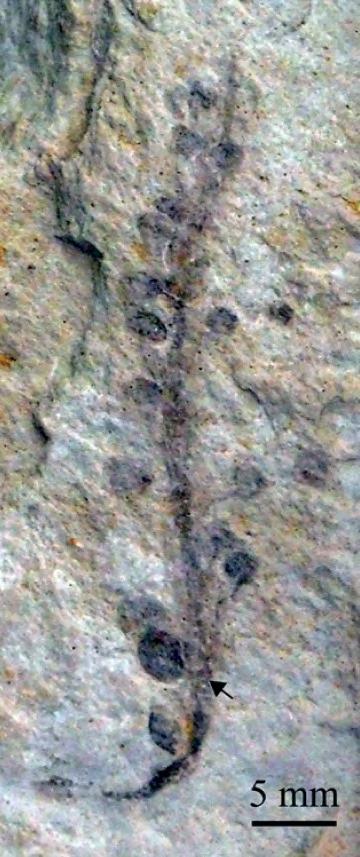
A fine specimen, considered likely to be Zosterophyllum, from the Lower Devonian, Wilson Creek Shale Formation on Frenchmans Spur, 10 km west of Matlock (From McSweeney, F.R., Shimeta, J. & J.S. Buckeridge, (2022: Fig 4B).
John Curtin Distinguished Professor Kliti Grice was awarded an ARC Laureate Fellowship in 2021. For her fellowship program ‘Interpreting the molecular record in extraordinarily preserved fossils’, she will explore a new way of interpreting Earth’s past. She leads a large team of staff and students (25) in exploring interdisciplinary research spanning Chemistry, Biology, Geology, Agriculture, Environment, Medicine, Palaeontology, Palynology, Microbiology disciplines.
Stephen Poropat (Research Associate at Curtin University, Perth; Research Associate at the Australian Age of Dinosaurs Museum, Winton). I have been continuing my research on Australian dinosaurs, particularly sauropods. This year I lead authored a paper describing the first sauropod teeth from Queensland, and I was a co-author on a paper led by my former Masters student, Samantha Rigby, describing the first juvenile sauropod from Australia. Sam submitted her Masters thesis in August and passed with flying colours; she is planning to submit an additional manuscript on Australian sauropods in 2023. I have two major Australian sauropod-focused projects underway, as well as a manuscript in review on a fantastic new sauropod specimen from the Winton Formation.
In July 2022, I started a postdoctoral position with Prof. Kliti Grice at the Western Australian Organic & Isotope Geochemistry Centre, Curtin University. Prof. Grice, who was recently awarded the title of Western Australian Scientist of the Year, received ARC Laureate funding to look into exceptional fossil preservation in concretions. Thus, I will now be turning the bulk of my attention to that topic as well — if you are willing to share knowledge or specimens about this topic, please get in touch!
I have continued to supervise Ph.D. student Adele Pentland, who published two papers this year on Australian pterosaurs (with me as a co-author) and has another in review (also with me as a co-author). I am also now co-supervising a few additional Ph.D. students (Jake Kotevski: Victorian theropods; Luke Brosnan: evolution of bone marrow and exceptional fossil preservation).
Pentland, A.H., Poropat, S.F., White, M.A., Rigby, S.L., Bevitt, J.J., Duncan, R.J., Sloan, T., Elliott, R.A., Elliott, H.A., Elliott, J.A. & Elliott, D.A. 2022. The osteology of Ferrodraco lentoni, an anhanguerid pterosaur from the mid-Cretaceous of Australia. Journal of Vertebrate Paleontology 41, e2038182.
Rigby, S.L., Poropat, S.F., Mannion, P.D., Pentland, A.H., Sloan, T., Rumbold, S.J., Webster, C.B. & Elliott, D.A. 2022. A juvenile Diamantinasaurus matildae (Dinosauria: Titanosauria) from the Upper Cretaceous Winton Formation of Queensland, Australia, with implications for sauropod ontogenetic growth. Journal of Vertebrate Paleontology 41, e2047991.
Poropat, S.F., Frauenfelder, T.G., Mannion, P.D., Rigby, S.L., Pentland, A.H., Sloan, T. & Elliott, D.A. 2022. Sauropod dinosaur teeth from the lower Upper Cretaceous Winton Formation of Queensland, Australia and the global record of early titanosauriforms. Royal Society Open Science 9, 220381.
Kotevski, J. & Poropat, S.F. 2022. On the first dinosaur tooth reported from Australia (Theropoda: Megaraptoridae). Alcheringa 46, 174–179.
Pentland, A.H., Poropat, S.F., White, M.A., Rigby, S.L., Vickers-Rich, P., Rich, T.R. & Elliott, D.A. 2022. New anhanguerian (Pterosauria: Pterodactyloidea) remains from the Early Cretaceous of Queensland, Australia. Alcheringa 46, 188–197.
Milo Barham has been distracted by sediment tracking, provenance and basin evolution and has unfortunately little time to pursue his interests in palaeoenvironments, O-isotopes in chordate biogenic apatite and microvertebrates in the mid- to late Paleozoic. Milo co-supervisors Jake Newman-Martin with Alison Blyth, Kate Trinajstic and Kenny Travouillon who is working on the taxonomy of peramelemorphians.
Nomen Nudum Number 42, 2022
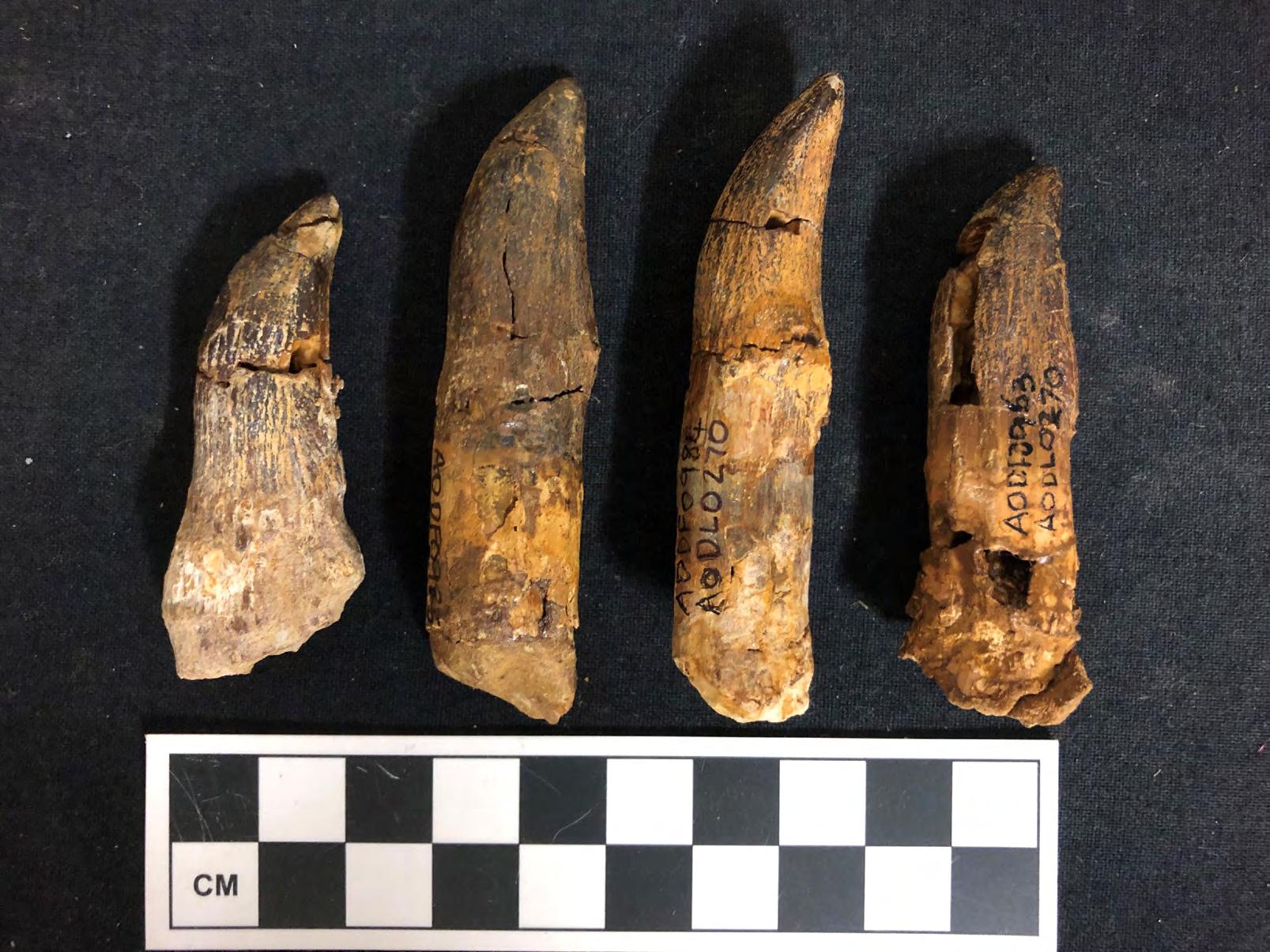
Four diamantinasaurian sauropod teeth from the Upper Cretaceous Winton Formation of Queensland, Australia. Photo (C) Trish Sloan / Australian Age of Dinosaurs Museum of Natural History.
Rodney Berrell (Curtin University) is continuing to work on their PhD project entitled ‘early vertebrates from the Mesozoic of Eastern Australia’. This project is focusing on the Mesozoic fish record (diversity, systematics and taxonomy) from Australia and is expected to be completed by the end of 2022.
Research has continued to focus on a redescription of Promecosomina formosa from the Early Triassic of the Sydney Basin, which is nearing completion.
This year has also seen efforts to work and publish on the fossil fish record from the Griman Creek Formation of Lightning Ridge, NSW, Australia with a paper on a new halecomorph fish submitted for publication in Cretaceous Research (pending review).
Rodney continues to collaborate with Mesozoic Fishes researchers and aims to continue research well after completion.
After 6 years of being the editor of Nomen Nudum, Rodney has retired to focus on PhD completion.
Alison Blyth is focusing on the use of new chemical approaches to understanding changes and connections in ecosystems, environments and climate. Particularly the use of biomarkers and stable isotopes in cave sediments and speleothems to identify past changes in climate and the associated environmental response; compound specific isotopes to identify ecosystem interactions such as carbon source or trophic level, and their response to environmental perturbations. In addition, she looks at low abundance radiocarbon dating to resolve the timing of different source inputs to terrestrial palaeo-records. She is developing new ways to measure isotopes in mammalian fossils, particularly micro-mammals.
Catherine Boisvert continues to combine developmental biology of modern sharks (elephant sharks) with palaeontology to understand the origins of paired fins, muscle and the patterning of the skeleton. Her recent
work includes the reconstruction of soft tissue anatomy in fossil through the water to land transition; and studies on the evolution of pelvic structures. Catherine supervisors Jacob Pears who is in the final stages of his PhD.
Kate Trinajstic is working on the evolution of novel structures, particularly the musculoskeletal system in placoderms, soft-tissue preservation, palaeoenvironments and biostratigraphy of early-vertebrates from Western Australia in collaboration with John Long and Alice Clements (Flinders University). This collaborative research is utilising synchrotron and neutron microtopography to better understand the internal anatomy of early vertebrates. Kate is currently supervising four PhD students including looking at the evolution of niche separation, evolution of bone, regeneration of cartilage and ecology of snakes in urban environments.
Barr, J.I., Boisvert, C.A., Trinajstic, K. & Bateman, P.W. 2022. Ontogeny and caudal autotomy fracture planes in a large scincid lizard, Egernia kingii. Scientific Reports 12, 7051.
Guareschi, E.E. et al. 2022. Bone diagenesis in the marine environment: Characterization and distribution of trace elements in terrestrial mammalian bones recovered from historic shipwrecks. International Journal of Osteoarchaeology 32, 509–523.
Lebedev, O.A., Johanson, Z., Kuznetsov, A.N., Tsessarsky, A., Trinajstic, K. & Isakhodzayev, F.B. 2022. Feeding in the Devonian antiarch placoderm fishes: a study based upon morphofunctional analysis of jaws. Journal of Paleontology 96, 1413–1430.
McAllister, M.S. et al. 2022. Investigating the palaeoenvironmental context of Late Pleistocene human dispersals into Southeast Asia: a review of stable isotope applications. Archaeological and Anthropological Sciences 14, 8.
Molnar, J.L., Diogo, R. Werneburg, I., & Boisvert,C.A. (eds). 2022. Tetrapod water-land transition: Reconstructing soft tissue anatomy and function. Frontiers Media SA.
Pears, J.B., Tillett, C., Tahara, R., Larsson, H.C., Trinajstic, K. & Boisvert, C.A. 2022. The Development of the Chimaeroid Pelvic Skeleton and the Evolution of Chondrichthyan Pelvic Fins. Journal of Developmental Biology 10, 53.
Pears, J.B., Tillett, C., Tahara, R., Larsson, H.C., & Boisvert, C.A. 2022. Imaging with the Past: Revealing the Complexity of Chimaeroid Pelvic Musculature Anatomy and Development. Frontiers in Ecology and Evolution 9, 999.
Saccò, M., et al. 2022 Stygofaunal diversity and ecological sustainability of coastal groundwater ecosystems in a changing climate: The Australian paradigm. Freshwater Biology 67, 2007-20.
Sandstrom, M.R., et al. 2022. Age constraints on surface deformation recorded by fossil shorelines at Cape Range, Western Australia: Reply. GSA Bulletin 134, 1621–1624.
Trinajstic, K., et al. 2022. Exceptional preservation of organs in Devonian placoderms from the Gogo lagerstätte. Science 377, 1311–1314.
Trinajstic, K., Briggs, D.E. & Long, J.A. 2022. The Gogo Formation Lagerstätte: a view of Australia’s first great barrier reef. Journal of the Geological Society 179, 2021–105.
In 2017, the Geological Survey of Western Australia underwent reorganisation as part of a State Government wide initiative, falling within the Department of Mines, Industry Regulation and Safety. Known formally as the Geological Survey and Resource Strategy Division, the GSWA name and logo is retained for publications and branding purposes.
In September 2019, the Geological Survey established a Paleontology Section (under the State Geoscience Branch), consisting of two staff palaeontologists. The Paleontology Section maintains the Survey’s
Paleontology collection (excluding those samples registered as part of Petroleum relinquishment collection); obtains and publishes a range of paleontological data; and manages the State’s geoheritage sites, including the Geoheritage Reserves. Please ensure primary contact with GSWA regarding all paleontology and geoheritage related enquiries, requests and projects is via the Paleontology Section staff.
Heidi Allen = Precambrian and Paleozoic paleontology, stromatolites, ichnology.
Sarah Martin = collections access, geoheritage, Mesozoic and Cenozoic paleontology, palynology.
General email: Paleontology@dmirs.wa.gov.au
Geoheritage enquiries: Geoheritage@dmirs.wa.gov.au
Collections
The GSWA Paleontology Collection remains open to all researchers, both within Australia and internationally. Work continues on an ongoing project to digitize the collection’s catalogue, and attempts to recover past (and often very overdue!) loans made by GSWA to various Australian institutions. Any information regarding the location of potential Survey samples (generally numbered with an F- prefix) is most welcome.
GSWA is currently investigating improved methods of collection imaging and data delivery, including slide scanners for microfossil collections, as part of a larger Data Transformation Program. The first part of this project involved the purchase of 3D scanners for macrofossil imaging in 2021, and will be followed by the installation of two slide scanners in 2023; GSWA also has a tabletop SEM and other imagery and analysis techniques through agreements with other universities across Australia.
Publications
GSWA’s historic informal paleontology reports are available online to search and download via eBookshop (http://www.dmirs.wa.gov.au/ebookshop; click ‘Paleontology Reports’ under ‘Book series’ or use the ‘Advanced search’ function). These reports include a set of period summaries (akin to GSWA Bulletin 136 ‘Palaeontology of the Permian of Western Australia’, but covering the individual periods from the Precambrian to Quaternary) collated in the late 1980s and early 1990s. A new series of GSWA Paleontology Reports, established in 2016, provides an avenue for the rapid communication of basic data or one-off discoveries. This new series of reports also publishes paleontological consultancy reports commissioned by GSWA as part of routine project work. The Paleontology reports are currently obtainable via text and keyword searches, with future plains for spatial searching via the GeoVIEW.WA platform (http://www. dmirs.wa.gov.au/GeoView).
All other GSWA publications (>100 years’ worth) are similarly available for free download through eBookshop — just type in appropriate search criteria. Use the DOWNLOAD button to obtain a pdf file (to download, print, or both).
GSWA recently established a webinar series highlighting recent research within the Division. These are accessible through the GSWA website (http://www.dmirs.wa.gov.au/GSWAwebinars). Past webinars include:
• Western Australia’s wealth of microbialites by Heidi Allen
• Geoheritage: protecting Western Australia’s rock stars by Sarah Martin
Heidi-Jane Allen (Palaeontology Group, State Geoscience Branch) is working on new age constraints for the Tumblagooda Sandstone that will result in a stratigraphic revision of the Southern Carnarvon Basin and a book in the GSWA Unearthed Series (Kalbarri Unearthed) to be published in 2023. Other current projects include Ordovician palaeontology of the Canning Basin with studies completed on the Cobb Embayment in 2022 and work in the Barnicarndy Graben ongoing. A systematic study of trilobites from Barnicarndy 1 in collaboration with Patrick Smith (Australian Museum) is imminent. Work on the Neoproterozoic palaeontology of the Centralian Superbasin, regional mapping of stromatolitic units within the Turee Creek and Wyloo Groups, and work on modern microbialite sites in Western Australia is also progressing.
Allen, H.J. & Haines, P.W. 2022. Arumberia occurrences in the Murraba Basin — a biostratigraphic review. In: Central Australian Basins Symposium IV, Darwin, August 29–30.
Haines, P.W., Allen, H.J., Wingate, M.T.D., Normore, L.S., Lu, Y. & Fielding, I.O.H. 2022. The Murraba Basin revisited –interpretations refined by detrital zircon data. In: Central Australian Basins Symposium IV, Darwin, August 29–30
Haines, P.W., Allen, H.J., Wingate, M.T.D., Zhan, Y., Dent, L.M. & Lu, Y. 2022. Cobb Embayment: Ordovician syntectonic siliciclastic deposition on the eastern margin of the Canning Basin, Western Australia: Geological Survey of Western Australia, Report 222, 40p.
Zhen, Y.Y., Allen, H.J. & Martin, S.K., 2022. Early Ordovician conodonts from Barnicarndy 1 stratigraphic well of the southern Canning Basin, Western Australia. Alcheringa: An Australasian Journal of Palaeontology 46(1), 43–58.
Kath Grey (consultant paleontologist) is mostly retired. Around her various medical treatments, she continues to document specimens in the collection and is also working on some unfinished projects. Please direct future enquiries about GSWA collection access to Sarah Martin, and contact Heidi Allen for Precambrian paleontology.
Sarah Martin (Paleontology Group, State Geoscience Branch) is the primary contact for matters relating to GSWA’s paleontology collection, including loans. Outside of curation work, Sarah continues her project reviewing the biostratigraphy of the southern Perth Basin. The first part of this work, collating all historic biostratigraphic data for the Harvey area of the southern Perth Basin, was published in 2018. Sarah is providing paleontological support to other GSWA projects as needed, and is the main contact for geoheritage enquiries within Western Australia.
Sarah’s other research interests include Mesozoic insects, amber and Cenozoic echinoids.
Sarah is Publication Officer for GSA special interest group Australasian Palaeontologists, Production Editor of the Australasian Palaeontologists’ Memoirs and is the Australasian representative on the International Palaeoentomological Society’s Scientific Committee. She resigned from her position as an Associate Editor for Alcheringa: An Australasian Journal of Palaeontology in mid-2022.
McNamara, K.J. & Martin, S.K. 2022. Middle Eocene echinoids from the western Eucla Basin, Western Australia. Records of the Western Australian Museum 37, 31–56, http://dx.doi.org/10.18195/issn.0312-3162.37.2022.031-056
McNamara, K.J., Ah Yee, C. Holmes, F., Krause, J. & Martin, S.K. 2021. Checklist of the Fossil Echinoid Species of Australia, https://www.australasianpalaeontologists.org/databases (updated February 2022).
Zhen, Y.Y., Allen, H.J. & Martin, S.K. 2022. Early Ordovician conodonts from Barnicarndy 1 stratigraphic well of the southern Canning Basin, Western Australia. Alcheringa: An Australasian Journal of Palaeontology 46(1), 43–58.
Kailah Thorn (Edward de Courcy Clarke Earth Science Museum, University of Western Australia) is preparing for a change of scenery! She has just accepted a new role with the Western Australian Museum as Technical Officer for Terrestrial Vertebrates. Although she is looking forward to once again getting her hands dirty with biologists, this does mean that the EdCC collection will be closed in the short term. Watch this space for more extinct lizard publications in the coming years as she has been promised some research time in her new role and has a few projects to polish off.
Ramm, T., Thorn, K.M., A. Hipsley, C., Müller, J., Hocknull, S. & Melville, J. 2022. Herpetofaunal diversity changes with climate: evidence from the Quaternary of McEachern’s Deathtrap Cave, southeastern Australia. Journal of Vertebrate Paleontology 41, 5, e2009844.
Kenny J. Travouillon (Curator of Mammalogy, Acting Curator of Ornithology, Western Australian Museum, Perth) is continuing to work at the Western Australian Museum, continuing his work on his ABRS grant, revising Australian bandicoots and bilbies. He is supervising three PhD students (Kate Rick, UWA; Jake Newman-Martin, Curtin Uni; Shelby Middleton, ECU), a Masters student (Emma Johnston, UWA) and two Honours student (Hayley Winter and Chloe Karafilis-Brown, Murdoch Uni). He is continuing his role as Chair of Australasian Palaeontologists and President of the Australian Mammal Society recently.
Travouillon, K.J., Butler, K., Archer, M. & Hand, S.J. 2022. Two new species of the genus Gumardee (Marsupialia, Macropodiformes) reveal the repeated evolution of bilophodonty in kangaroos, Alcheringa 46, 105–128, https://doi.org/10. 1080/03115518.2021.2012595.
Thiele, K.R., Harvey, M.S., Hutchings, P., May, T.W., Melville, J. & Travouillon, K.J. 2022. Introducing the Australian Journal of Taxonomy, a new, fully-online, fully open-access journal for the rapid publication of new Australian species and other taxa. Australian Journal of Taxonomy 1, 1–7, https://doi.org/10.54102/ajt.qxi3r.
Jackson, S.M., Baker, A.M., Eldridge, M.D.B., Fisher, D.O., Frankham, G.J., Lavery, T.H., MacDonald, A.J., Menkhorst, P.W., Phillips, M.J., Potter, S., Rowe, K.C., Travouillon, K.J. & Umbrello, L.S. 2022. The Importance of appropriate taxonomy in Australian mammalogy. Australian Mammalogy, https://doi.org/10.1071/AM22016.
Shaw. R.E., Spencer, P.B., Gibson, L.A., Dunlop, J.A., Kinloch, J.E., Mokany, K., Byrne, M., Moritz, C., Davie, H., Travouillon, K.J. & Ottewell, K.M. 2022. Linking life history to landscape for threatened species conservation in a multiuse region. Conservation Biology 18, e13989, https://doi.org/10.1111/cobi.13989.
Bruce Hayward (Geomarine Research, Auckland) is semi-retired but continues with research on foraminiferal taxonomy and supporting graduate student’s applied foraminiferal research. He is now working on a global review of the molecular and morphological taxonomy of living Elphidiidae (foraminifera) in collaboration with Maria Holzmann (Switzerland).
Brook, F.J. & Hayward, B.W. 2022. Taxonomy and taphonomy of Pliocene bulimoid land snails from Māngere, New Zealand, with descriptions of a new genus and two new species (Gastropoda: Bothriembryontidae: Placostylinae. New Zealand Journal of Geology and Geophysics 65, 491–506.
Garrett, E., Gehrels, W.R., Hayward, B.W., Newnham, R., Gehrels, M.J., Morey, C.J. & Dagendorf, S. 2022. Drivers of 20th century sea‐level change in southern New Zealand determined from proxy and instrumental records. Journal of Quaternary Science 37, 1025–1043.
Hayward, B.W. 2022. Geological setting and interpretation of fossil moa footprints, Mosquito Beach, Kaipara South Head. Geocene 29, 2–7.
Hayward, B.W. 2022. Fossil casts of large estuarine mussels at Wattle Downs, South Auckland. Geocene 29, 23–24.
Hayward, B.W. 2022. Early Miocene ghost shrimp burrow network. Geoscience Society of New Zealand Newsletter 37, 20–21.
Hayward, B.W. 2022. Mountains, volcanoes, coasts and caves: origins of Aotearoa New Zealand’s natural wonders. Auckland University Press, 384p.
Hayward, B.W. 2022. Book Review: “Fossil treasures of Foulden Maar, A window into Miocene Zealandia.” by Daphne Lee, Uwe Kaulfuss and John Conran, Otago University Press. Geoscience Society of New Zealand Newsletter 38, 56–58.
Hayward, B.W., Hopkins, J.L., Morley, M.S. & Kenny, J.A. 2022. Microfossil evidence for a possible maar crater and tuff ring beneath Rangitoto Volcano, Auckland, New Zealand. New Zealand Journal of Geology and Geophysics, https://doi.org/10.1 080/00288306.2022.2120505
Hayward, B.W. & Marshall, B.A. 2022. Fossil molluscs on wood fall in early Miocene Waitemata Group. Geocene 29, 8–10.
Hayward, B.W., Sabaa, A.T., Howarth, J., Orpin, A., Strachan, L.J. & Tickle, S.E. 2022. Foraminiferal insights into the complexities of the turbidity currents triggered by the 2016 Kaikoura Earthquake, New Zealand. Marine Micropaleontology 176, 102171.
Hayward, B.W., Sabaa, A.T., Howarth, J.D., Orpin, A.R. & Strachan, L.J. 2022. Foraminiferal evidence for the provenance and flow history of turbidity currents triggered by the 2016 Kaikōura Earthquake, New Zealand. New Zealand Journal of Geology and Geophysics, https://doi.org/10.1080/00288306.2022.2103157.
Hayward, B.W. & Serandrei-Barbero, R. 2022. Obituary. Alberto D. Albani, 1935–2021. Journal of Foraminiferal Research 52, 120–121.
Hayward, B.W., Holzmann, M., Pawlowski, J., Wollenburg, J. & Majewski, W. in press. Taxonomy and biogeography of living species of the Family Notorotaliidae (Notorotalia, Parrellina, Porosorotalia, Buccella). Micropaleontology
Staff news
Paleontology and paleoenvironmental researchers and technicians are spread across several teams at GNS Science. Joe Prebble leads the Paleontology Team which includes Giuseppe Cortese, Erica Crouch, Liz Kennedy, Xun Li, Claire Shepherd, Greer Gilmer, Martin Tetard, and Marcus Vandergoes. Chris Clowes, Martin Crundwell and Georgia Grant sit within the Geological Mapping and Stratigraphy Team. Both of these teams are in the Surface Geosciences Department, managed by Lucia Roncaglia Paleontology technicians Henry Gard, Mus Hertoghs, Lizette Reyes, Te Aomania Te Koha, Marianna Terezow and Roger Tremain, are within the Laboratories and Collections Team led by Sonja Bermudez.
Retired emeritus paleontology staff Alan Beu, Hamish Campbell, Dallas Mildenhall, Hugh Morgans, George Scott, John Simes, Percy Strong, and Ian Raine are associated with various teams. Richard Levy is the Environment and Climate Theme Leader for GNS.
Two researchers have joined the Paleontology Team in the last year: Greer Gilmer and Martin Tetard. Greer has recently completed a PhD in Holocene environmental change in the Southern Ocean at University of Otago. She has joined GNS Science on a Whitinga Fellowship, and as an Associate Investigator on a 5-year Endeavour Programme (NZ government-funded) understanding carbon burial in Fiordland. Martin joined GNS from France, where he completed a PhD at the CEREGE laboratory, on Quaternary environmental change using benthic forams and radiolaria. Martin also has skills in automated image capture and classification workflows for microfossils, and will be involved in a range of projects applying these skills at GNS.
A new Endeavour funded research programme led by Otago University is underway (https://www.gns. cri.nz/research-projects/fjords-as-carbon-sinks/). This programme aims to understand dynamics of carbon sequestration in Fiordland, South Island New Zealand. Marcus Vandergoes and Greer Gilmer are involved in the project from the Paleontology Team.
The Lakes380 Research programme (https://lakes380.com/), will conclude in March 2023. This is a five-year research project to understand the environmental, social and cultural histories of 10% of New Zealand’s 3,800 lakes (>1 ha). The project involved collecting and analysing lake sediments and water samples, as well as interviews and field visits. The project is jointly lead by Marcus Vandergoes at GNS and Suzie Wood at Cawthron Research. The Lakes380 project draws on the skills of several other GNS paleontologists including Claire Shepherd, Lizette Reyes, Marianna Terezow, Xun Li, Erica Crouch, and Chris Clowes. A significant number of publications and results are emerging from the project — over 20 so far, and the team is working on a range of follow-up projects with land managers across New Zealand. Georgia Grant has been selected to sail on IODP Expedition 400 NW Greenland Glaciated Margin.
Marianna Terezow led an article on a cetacean (probable whale) fossil vertebra that was recovered by conservation colleagues in the Maungataniwha area, northwest Hawke’s Bay. The article appeared in GNS internal newsletters, and the story was picked up by media: https://www.stuff.co.nz/science/129217038/ hunting-trip-leads-to-discovery-of-a-bit-of-bone-thats-million-of-years-old
Erica Crouch continues as Associate Investigator on an exciting Marsden funded project led by Dr Vanesa De Pietri of University of Canterbury — ‘Avian diversity in the aftermath of the Cretaceous-Paleogene (K/Pg) mass extinction: Zealandia as a hub for the evolution of marine birds’. Erica is working on the biostratigraphy of a section that yielded the bird bones.
A 2-year project to update the New Zealand Geological timescale has started during 2022. The project is led by Chris Clowes, and will include contributions from several researchers including Erica Crouch, Martin
Crundwell, and Liz Kennedy. The most recent NZ timescale update is Raine (2015) which pre-dates the latest international timescale.
Planning is well advanced to drill at two locations along the Siple Coast of West Antarctica, scheduled for Antarctic Field Seasons 23/23 and 24/25. This project, supported by the Antarctic Science Platform and a number of international collaborators, aims to understand West Antarctic variability over the Holocene and late Quaternary (https://www.gns.cri.nz/research-projects/swais-2c/). The New Zealand co-lead of this project is Richard Levy, while GNS paleontologists Joe Prebble, Chris Clowes, Giuseppe Cortese and Martin Tetard are on the science team.
Palynology records from 7 sedimentary cores collected from Hokianga Harbour, Northland have been documented and interpreted in a report by Chris Clowes, Liz Kennedy, and Kyle Bland. This research is part of a project with Te Rarawa iwi to understand influences on sedimentation in Hokianga Harbour.
Ian Raine’s GNS subcontract work for the NZ Trees for Bees Research Trust culminated in a manual of techniques for beekeepers to prepare and study pollen from bee loads and honey, and an associated online pollen identification database and key (Raine et al 2022a, b). He also contributed to research papers by Xun Li and others on NZ Leptospermum and Kunzea pollen morphology, and by Erica Crouch et al. on the Late Cretaceous of IODP Site U1509 and on NZ Paleocene-Eocene stratigraphy. An interesting diversion was identifying the age and likely source of coal from early shipwrecks along the NW Wellington coast (some North Hemisphere Carboniferous, some NSW Hunter Valley Permian, some NZ Eocene). Ian completed a 5-year post-retirement spell as part-time contractor in July, and transitioned to GNS Science emeritus staff. Currently he is working up earlier research on a biostratigraphic subdivision of the NZ Haumurian Stage (Campanian-Maastrichtian).
A recent study by Erica Crouch, Chris Clowes, Ian Raine and others presents new palynomorph and benthic foraminiferal assemblages from IODP Site U1509 (Expedition 371), New Caledonia Trough. The study shows a transition from a latest Cretaceous vegetated sediment source region to a fully oceanic environment in the Paleocene.
A GNS Science Report led by Erica Crouch focuses on Paleogene strata of the Zealandia Megasequence and provides a review of the stratigraphy and correlation of New Zealand’s non-marine Paleogene strata. It is the third report in a series, with the previous reports focusing on the Jurassic to Early Cretaceous and the mid-Cretaceous. New paleoclimate estimates are provided from the Paleocene and Eocene, as well as new coaly source rock abundance assessments. An overview of New Zealand Paleocene to Eocene climate and vegetation is also given.
Members of the GNS Geological Mapping and Stratigraphy team and the Paleontology team continue with earth science education outreach events in Te Tai Tokerau/Northland, with two iwi and Ministry of Education funded events during 2022 held at Waimanoni Marae in Awanui, and NZ government funding secured for two further events during 2023.
The 2022 Quaternary Techniques workshop was run at GNS in August. This year’s course was organised by Joe Prebble, Georgia Grant, Claire Shepherd, and Dan Lowry. This is the 18th year this course has been run at GNS.
Adams, C.J., Campbell, H.J., Korsch, R.J. & Griffin, W.L. 2022. Detrital zircons in Triassic–Cretaceous sandstones, ClarenceMoreton Basin, eastern Australia: speculations upon Australia and Zealandia provenances. Australian Journal of Earth Sciences 69(7), 909–928, https://doi.org/10.1080/08120099.2022.2070277.
Adams, C.J., Mortimer, N., Campbell, H.J. & Griffin, W.L. 2022. Detrital zircon provenance of Permian to Triassic Gondwana sequences, Zealandia and eastern Australia. New Zealand Journal of Geology and Geophysics 65(3), 457–469, https://doi.or g/10.1080/00288306.2021.1954957
Biessy, L., Pearman, J.K., Waters, S., Vandergoes, M.J. & Wood, S.A. 2022. Metagenomic insights to the functional potential of sediment microbial communities in freshwater lakes. Metabarcoding and Metagenomics 6, e79265, https://doi.org/10.3897/ mbmg.6.79265
Bland, K.J., Morgans, H.E.G., Strogen, D.P. & Harvey, H. 2022. Litho- and biostratigraphy of a late Oligocene–Early Miocene succession in the Weber area, southern Hawke’s Bay, and implications for early Hikurangi subduction-margin evolution. New Zealand Journal of Geology and Geophysics, Online first, https://doi.org/10.1080/00288306.2022.2108069
Brasell, K.A., Pochon, X., Howarth, J., Pearman, J.K., Zaiko, A., Thompson, L., Vandergoes, M.J., Simon, K.S. & Wood, S.A. 2022. Shifts in DNA yield and biological community composition in stored sediment: implications for paleogenomic studies. Metabarcoding and Metagenomics 6, e78128, https://doi.org/10.3897/mbmg.6.78128.
Cadd, H., Sherborne-Higgins, B., Becerra-Valdivia, L., Tibby, J., Barr, C., Forbes, M., Cohen, T.J., Tyler, J., Vandergoes, M.J., Francke, A., Lewis, R., Arnold, L.J., Jacobsen, G., Marjo, C. & Turney, C. 2022. The application of pollen radiocarbon dating and Bayesian age-depth modelling for developing robust geochronological frameworks for wetland archives. Radiocarbon 64(2), 213–235, https://doi.org/10.1017/RDC.2022.29
Campbell, M.J., Mortimer, N., Rosenbaum, G., Allen, C.M., Vasconcelos, P.M. & Campbell, H.J. 2022. Age and structure of the Permian Brook Street Terrane, Takitimu Mountains, New Zealand. New Zealand Journal of Geology and Geophysics, Online first, https://doi.org/10.1080/00288306.2022.2105903
Chorley, H., Levy, R.H., Naish, T., Lewis, A., Cox, S., Hemming, S., Ohneiser, C., Gorman, A., Harper, M., Homes, A., Hopkins, J., Prebble, J.G., Verrett, M., Dickinson, W., Florindo, F., Golledge, N., Halberstadt, A.R., Kowalewski, D., McKay, R., Meyers, S., Anderson, J., Dagg, B. & Lurcock, P. 2022. East Antarctic Ice Sheet variability during the middle Miocene Climate Transition captured in drill cores from the Friis Hills, Transantarctic Mountains. Geological Society of America Bulletin, Online first, https://doi.org/10.1130/B36531.1
Claussmann, B., Bailleul, J., Chanier, F., Mahieux, G., Caron, V., McArthur, A.D., Chaptal, C., Morgans, H.E.G. & Cendeville, B.C. 2022. Shelf-derived mass-transport deposits: origin and significance in the stratigraphic development of trench-slope basins. New Zealand Journal of Geology and Geophysics 65(1), 17–52, https://doi.org/10.1080/00288306.2021.1918729
Clowes, C.D., Kennedy, E.M. & Bland, K.J. 2022. Vegetation history from Hokianga Harbour: snapshots from the palynology of seven cores. GNS Science internal report 2022/13. 51p.
Crosta, X., Kohfeld, K.E., Bostock, H.C., Chadwick, M., Du Vivier, A., Esper, O., Etourneau, J., Jones, J., Leventer, A., Müller, J., Rhodes, R.H., Allen, C.S., Ghadi, P., Lamping, N., Lange, C.B., Lawler, K.A., Lund, D., Marzocchi, A., Meissner, K.J., Menviel, L., Nair, A., Patterson, M., Pike, J., Prebble, J.G., Riesselman, C., Sadatzki, H., Sime, L.C., Shukla, S.K., Thöle, L., Vorrath, M.E., Xiao, W. & Yang, J. 2022. Antarctic sea ice over the past 130 000 years – Part 1 : a review of what proxy records tell us. Climate of the past 18(8), 1729–1756, https://doi.org/10.5194/cp-18-1729-2022
Crouch, E.M., Clowes, C.D., Raine, J.I., Alegret, L. & Cramwinkel, M.J., Sutherland, R. 2022. Latest Cretaceous and Paleocene biostratigraphy and paleogeography of northern Zealandia, IODP Site U1509, New Caledonia Trough, southwest Pacific. New Zealand Journal of Geology & Geophysics, 25p. https://doi.org/10.1080/00288306.2022.2090386.
Crouch, E.M., Kennedy, E.M., Griffin, A.G., Raine, J.I., Clowes, C.D., Reichgelt, T. & Sykes, R. 2022. Materials for improved assessment of the petroleum source rock potential of New Zealand coaly rocks, 3: Paleocene–Eocene stratigraphy, coal abundance, flora, and climate. GNS Science Report 2021/02, 145p. https://doi.org/10.21420/MZQ1-R764.
Crundwell, M.P. & Woodhouse, A. 2022. A detailed biostratigraphic framework for 0–1.2 Ma Quaternary sediments of northeastern Zealandia. New Zealand Journal of Geology and Geophysics, Online first, https://doi.org/10.1080/00288306.2022.2 054828.
Crundwell, M.P. & Woodhouse, A. 2022. Biostratigraphically constrained chronologies for Quaternary sequences from the Hikurangi margin of north-eastern Zealandia. New Zealand Journal of Geology and Geophysics, Online first, https://doi.or g/10.1080/00288306.2022.2101481
Defliese, W.F., Crundwell, M.P., Bostock, H. & Hollis, C.J. 2022. Mid-Miocene ocean temperatures from paired coccolith [delta]47 and foraminifera Mg/Ca ratios. In: Goldschmidt Hawai’i 2022. White Iron Conferences Limited, Cambridge, U.K, 10–15 July, abstract 10479.
Duncan, B., McKay, R., Levy, R.H., Naish, T.R., Prebble, J.G., Sangiorgi, F., Krishnan, S., Hoem, F., Clowes, C.D., Dunkley Jones, T., Gasson, F., Kraus, C., Kulhanek, D.K., Meyers, S.R., Moossen, H., Warren, C., Willmott, V., Ventura, G.T. & Bendle, J. 2022. Climatic and tectonic drivers of late Oligocene Antarctic ice volume. Nature Geoscience 15, 819–825, https://doi.org/10.1038/s41561-022-01025-x.
Gregersen, R., Howarth, J.D., Wood, S.A., Vandergoes, M.J., Puddick, J., Moy, C., Li, X., Pearman, J.K., Moody, A. & Simon, K.S. 2022. Resolving 500 years of anthropogenic impacts in a mesotrophic lake: nutrients outweigh other drivers of lake change. Environmental Science & Technology, [Online first], https://doi.org/10.1021/acs.est.2c06835
Griffin, A.G., Bland, K.J., Morgans, H.E.G. & Strogen, D.P. 2022. A multifaceted study of the offshore Titihaoa-1 drillhole and a Neogene accretionary slope basin, Hikurangi subduction margin. New Zealand Journal of Geology and Geophysics 65(1), 79–104, https://doi.org/10.1080/00288306.2021.1932527
Henrys, S.A., Stagpoole, V.M., Rattenbury, M.S., Bertrand, E.A., Wallace, L.M., Bannister, S., Kellett, R.L., Black, J., Hillman, J.I.T., Grant, G.R., de Ronde, C.E.J., Bassett, D., Cortese, G., Strogen, D.P., Pickery, J. , FitzGerald, T., Coulson, A. & Smith, G. 2022. Pūtaiao Aronuku ā-Whenua, ā-Moana: Land and Marine Geoscience theme plan. GNS Science internal report 2022/12, 70p.
Higgs, K.E., Clowes, C.D., Strogen, D.P. & Raine, J.I. 2022. Rift-related sedimentation patterns and sandstone provenance in the Aotea Basin. Part 1: stratigraphic framework. GNS Science report 2022/44, https://doi.org/10.21420/GTBP-RB45
Holdgate, G.R., Sluiter, I.R.K., Clowes, C.D. & Hannah, M.J. 2022. The spatial and temporal occurrence and significance of dinoflagellates and other marine fossils within onshore coal measures, Gippsland Basin, Australia. Australian Journal of Earth Sciences 69(5), 630–649, https://doi.org/10.1080/08120099.2022.2002930
Hollis, C.J., Naeher, S., Clowes, C.D., Naafs, B.D.A., Pancost, R.D., Taylor, K.W.R., Dahl, J.A., Ventura, G.T. & Sykes, R. 2022. Late Paleocene CO2 drawdown, climatic cooling, and terrestrial denudation in the southwest Pacific. Climate of the past 18, 1295–1320, https://doi.org/10.5194/cp-2021-122
Hori, R.S., Ikehara, M., Takemura, A., Aita, Y., Takahashi, S., Yamakita, S., Spörli, K.B. & Campbell, H.J. 2022. Early Triassic OAEs and organic compounds recorded from a pelagic Permian–Triassic boundary sequence in the Southern Hemisphere. In: Goldschmidt Hawai’i 2022. White Iron Conferences Limited Cambridge, U.K., 10–15 July, abstract 12574.
Kim, S., Lee, M.K., Shin, J.Y., Yoo, K.-C., Lee, J.I., Kang, M.-I., Moon, H.S. & Prebble, J.G. 2022. Variation in magnetic susceptibility in the Bellingshausen Sea continental rise since the last glacial period and implications for terrigenous material input mechanisms. Palaeogeography, Palaeoclimatology, Palaeoecology 594, article 110948, https://doi.org/10.1016/j. palaeo.2022.110948
Krapp, M., Kvale, K.F., Keller, E.D., Prebble, J.G. & Cortese, G. 2022. Marine ecoregions and their sensitivity to past and future climate change. In: 13th International Conference on Southern Hemisphere Meteorology and Oceanography, Conferences & Events Ltd, Wellington, N.Z., 15–17 February 2022, 8–12.
Lam, A.R., Crundwell, M.P., Leckie, R.M., Albanese, J. & Uzel, J.P. 2022. Diachroneity rules the mid-latitudes: a test case using Late Neogene planktic foraminifera across the western Pacific. Geosciences (Basel, Switzerland) 12(5), article 190, https:// doi.org/10.3390/geosciences12050190.
Levy, R.H., Dolan, A.M., Escutia, C., Gasson, E.G.W., McKay, R.M., Naish, T.R., Patterson, M.O., Pérez, L.F., Shevenell, A.E., van de Flierdt, T., Dickinson, W., Kowalewski, D.E., Meyers, S.R., Ohneiser, C., Sangiorgi, F., Williams, T., Chorley, H.K., De Santis, L., Florindo, F., Golledge, N.R., Grant, G.R., Halberstadt, A.R.W., Harwood, D.M., Lewis, A.R., Powell, R. & Verret, M. 2022. Antarctic environmental change and ice sheet evolution through the Miocene to Pliocene — a perspective from the Ross Sea and George V to Wilkes Land Coasts. In: Antarctic climate evolution, 2nd ed. Florindo, F., Siegert, M., De Santis, L. & Naish, T.R. (eds). Elsevier, San Diego, USA, 389–521, https://doi.org/10.1016/B978-0-12-819109-5.00014-1 Li, X., Prebble, J.G., de Lange, P.J., Raine, J.I. & Newstrom-Lloyd, L. 2022. Discrimination of pollen of New Zealand mānuka (Leptospermum scoparium agg.) and kānuka (Kunzea spp.) (Myrtaceae). PLOS ONE 17(6), e0269361, https://doi. org/10.1371/journal.pone.0269361.
Litchfield, N.J., Morgenstern, R., Clark, K.J., Howell, A., Grant, G.R. & Turnbull, J.C. 2022. Holocene marine terraces as recorders of earthquake uplift: insights from a rocky coast in southern Hawke’s Bay, New Zealand. Earth Surface Processes and Landforms, Online first, https://doi.org/10.1002/esp.5496
Lowe, V., Cortese, G., Lawler, K.-A., Civel-Mazens, M. & Bostock, H.C. 2022. Ecoregionalisation of the Southern Ocean using radiolarians. Frontiers in Marine Science 9, article 829676, https://doi.org/10.3389/fmars.2022.829676.
McClymont, E., Ho, S.L., Ford, H., White, S., Groenveld, J., Bolton, C., Thirumalai, K., Grant, G.R., Patterson, M., AlonsoGarcia, M. & Hoogakker, B. 2022. Assessing Late Pliocene climate variability over glacial–interglacial timescales (PlioVAR). In: The warm Pliocene: Bridging the geological data and modelling communities, Leeds, United Kingdom, 23–26 Aug 2022 Copernicus Gesellschaft, Goettingen, Germany, abstract GC10-Pliocene-52.
Noda, A., Greve, A., Woodhouse, A. & Crundwell, M.P. 2022. Depositional rate, grain size and magnetic mineral sulfidization in turbidite sequences, Hikurangi Margin, New Zealand. New Zealand Journal of Geology and Geophysics, Online first, https://doi.org/10.1080/00288306.2022.2099910
Pearman, J.K., Adamson, J., Thomson-Laing, G., Thompson, L., Waters, S., Vandergoes, M.J., Howarth, J.D. & Wood, S.A. 2022. Deterministic processes drive national-scale patterns in lake surface sediment bacteria and eukaryotic assemblage composition. Limnology and Oceanography, Online first, https://doi.org/10.1002/lno.12247
Pearman, J.K., Biessy, L., Howarth, J.D., Vandergoes, M.J., Rees, A. & Wood, S.A. 2022. Deciphering the molecular signal from past and alive bacterial communities in aquatic sedimentary archives. Molecular Ecology Resources 22(3), 877–890, https://doi.org/10.1111/1755-0998.13515.
Pearman, J.K., Thomson-Laing, G., Thomson-Laing, J., Thompson, L., Waters, S., Reyes, L., Howarth, J.D., Vandergoes, M.J. & Wood, S.A. 2022. The role of environmental processes and geographic distance in regulating local and regionally abundant and rare bacterioplankton in lakes. Frontiers in Microbiology 12, article 793441, https://doi.org/10.3389/fmicb.2021.793441
Pearman, J.K., Wood, S.A., Vandergoes, M.J., Atalah, J., Waters, S., Adamson, J., Thomson-Laing, G., Thompson, L., Howarth, J.D., Hamilton, D.P., Pochon, X., Biessy, L., Brasell, K.A., Dahl, J.A., Ellison, R., Fitzsimons, S.J., Gard, H.J.L., Gerrard, T., Gregsersen, R., Holloway, M., Li, X., Kelly, D.J., Martin, R., McFarlane, K., McKay, N.P., Moody, A., Moy, C.M., Naeher, S., Newnham, R., Parai, R., Picard, M., Puddick, J., Rees, A.B.H., Reyes, L., Schallenberg, M., Shepherd, C.L., Short, J., Simon, K.S., Steiner, K., Šunde, C., Terezow, M.G. & Tibby, J. 2022. A bacterial index to estimate lake trophic level: national scale validation. Science of the Total Environment 812, article 152385, https://doi.org/10.1016/j.scitotenv.2021.152385.
Pearson, A.R., Fox, B.R.S., Vandergoes, M.J. & Hartland, A. 2022. The sediment fluorescence-trophic level relationship: using water-extractable organic matter to assess past lake water quality in New Zealand. New Zealand Journal of Marine and Freshwater Research 56(2), 213–233, https://doi.org/10.1080/00288330.2021.1890624
Petherick, L.M., Knight, J., Shulmeister, J., Bostock, H., Lorrey, A., Fitchett, J., Eaves, S., Vandergoes, M.J., Barrows, T.T., Barrell, D.J.A., Eze, P.N. & Hesse, P. 2022. An extended last glacial maximum in the Southern Hemisphere: a contribution to the SHeMax project. Earth-Science Reviews 231, article 104090, https://doi.org/10.1016/j.earscirev.2022.104090
Picard, M., Pochon, X., Atalah, J., Pearman, J.K., Rees, A., Howarth, J.D., Moy, C.M., Vandergoes, M.J., Hawes, I., Khan, S. & Wood, S.A. 2022. Using metabarcoding and droplet digital PCR to investigate drivers of historical shifts in cyanobacteria from six contrasting lakes. Scientific Reports 12(1), article 1280, https://doi.org/10.1038/s41598-022-14216-8.
Picard, M., Wood, S.A., Pochon, X., Vandergoes, M.J., Reyes, L., Howarth, J.D., Hawes, I. & Puddick, J. 2022. Molecular and pigment analyses provide comparative results when reconstructing historic cyanobacterial abundances from lake sediment cores. Microorganisms 10(2), article 279, https://doi.org/10.3390/microorganisms10020279
Pocknall, D.T., Clowes, C.D. & Jarzen, D.M. 2022. Spinizonocolpites prominatus (McIntyre) Stover & Evans: fossil Nypa pollen, taxonomy, morphology, global distribution, and paleoenvironmental significance. New Zealand Journal of Geology and Geophysics, Online first, https://doi.org/10.1080/00288306.2022.2078376
Prebble, J.G., Dunbar, G., van den Bos, V., Li, X., Vandergoes, M.J., Richardson, S., Horgan, H., Holt, K.A., Howarth, J.D. & Levy, R.H. 2022. Toward a novel multi-century archive of tree mast using pollen from lake sediments. The Holocene 32(11), 1184–1192, https://doi.org/10.1177%2F09596836221114292.
Raine, I., Li, X. & Newstrom-Lloyd, L. 2022a. Pollen analysis for New Zealand beekeepers. Havelock North (New Zealand): New Zealand Trees for Bees Research Trust, 98p. PDF available at https://treesforbeesnz.org/pollen-analysis-manual
Raine, J.I., Li, X. & Newstrom-Lloyd, L. 2022b. New Zealand Bee Pollen Catalogue. https://keys.landcareresearch.co.nz/ nzbeepollen/key/nzbeepollen/media/index.htm.
Rigo, M. & Campbell, H.J. 2022. Correlation between the Warepan/Otapirian and the Norian/Rhaetian stage boundary: implications of a global negative [delta]13Corg perturbation. New Zealand Journal of Geology and Geophysics 65(3), 397–406, https://doi.org/10.1080/00288306.2021.1896558
Nudum Number 42, 2022
Rigo, M., Onoue, T., Tomimatsu, Y., Godfrey, L., Campbell, H.J., Golding, M., Husson, J., Satolli, S., Concheri, G., Chiari, M., Sato, H., Soda, K., Katz, M., Tackett, L., Lei, J., Maron, M., Zaffani, M., Bertinelli, A. & Tanner, L. 2022. Biotic extinction at the Norian/Rhaetian boundary (Upper Triassic): geochemical and isotope evidence of a previously unrecognised global event. In: Goldschmidt Hawai’i 2022. White Iron Conferences Limited, Cambridge, U.K., 10–15 July, abstract 11474.
Short, J., Tibby J., Vandergoes, M.J., Wood, S.A., Lomax, N., Puddick, J., Pearman, J.K., Howarth, J.D., Moy, C.M., Šunde, C., Martin, R., Li, X., Moody, A., Dahl, J.A., Shepherd, C.L. & McFarlane, K. 2022. Using palaeolimnology to guide rehabilitation of a culturally significant lake in New Zealand. Aquatic Conservation (Online) 32(6), 931–950, https://doi. org/10.1002/aqc.3808
Steiner, K., Dyer, N., Lee, C.K., Vandergoes, M.J. & Wood, S.A. 2022. Development of a triplex droplet digital polymerase chain reaction assay for the detection of three New Zealand native freshwater mussels (Echyridella) in environmental samples. Environmental DNA 4(5), 1065–1077, https://doi.org/10.1002/edn3.302.
Stratford, W.R., Sutherland, R., Dickens, G.R., Blum, P., Collot, J., Gurnis, M., Saito, S., Bordenave, A., Etienne, S.J.G., Agnini, C., Alegret, L., Asatryan, G., Bhattacharya, J., Chang, L., Cramwinckel, M.J., Dallanave, E., Drake, M.K., Giorgioni, M., Harper, D.T., Huang, H.H.M., Keller, A.L., Lam, A.R., Li, H., Matsui, H., Morgans, H.E.G., Newsam, C., Park, Y.-H., Pascher, K.M., Pekar, S.F., Penman, D.E., Westerhold, T. & Zhou, X. 2022. Timing of Eocene compressional plate failure during subduction initiation, northern Zealandia, southwestern Pacific. Geophysical Journal International 229(3), 1567–1585, https://doi.org/10.1093/gji/ggac016
Sullivan, N., Sadler, P.M., Grant, G.R., Meyers, S.R., Crampton, J.S., Levy, R.H. & McKay, R.M. 2022. Strategies for the integration of astrochronology and constrained optimization (CONOP) in the Southern Ocean. In: GSA Connects 2022 meeting in Denver, Colorado. Boulder, Colorado. Geological Society of America Abstracts with programs 54(5), abstract 244-9, https://doi.org/10.1130/abs/2022AM-383410
Taylor, S.P., Patterson, M.O., Lam, A.R., Jones, H., Woodard, S.C., Habicht, M.H., Thomas, E.K. & Grant, G.R. 2022. Expanded North Pacific Subtropical Gyre and heterodyne expression during the Mid-Pleistocene. Paleoceanography and Paleoclimatology 37(5), e2021PA004395, https://doi.org/10.1029/2021PA004395
Thomson-Laing, G., Howarth, J.D., Vandergoes, M.J. & Wood, S.A. 2022. Optimised protocol for the extraction of fish DNA from freshwater sediments. Freshwater biology 67(9), 1584–1603, https://doi.org/10.1111/fwb.13962
Venugopal, A.U., Bertler, N.A.N., Pyne, R.L., Kjær, H.A., Winton, V.H.L., Mayewski, P.A. & Cortese, G. 2022. Role of mineral dust in the nitrate preservation during the glacial period: Insights from the RICE ice core. Global and Planetary Change 209, article 103745, https://doi.org/10.1016/j.gloplacha.2022.103745
Woodhouse, A., Barnes, P.M., Shorrock, A., Strachan, L.J., Crundwell, M.P., Bostock, H.C., Hopkins, J., Kutterolf, S., Pank, K., Behrens, E., Greve, A., Bell, R., Cook, A., Petronotis, K., LeVay, L., Jamieson, R.A., Aze, T., Wallace, L.M., Saffer, D. & Pecher, I.A. 2022. Trench floor depositional response to glacio-eustatic changes over the last 45 ka, northern Hikurangi subduction margin, New Zealand. New Zealand Journal of Geology and Geophysics, Online first, https://doi.org/10.1080/0 0288306.2022.2099432
Catherine Reid, Jamie Shulmeister, Matiu Prebble and Vanesa De Pietri and students are all busy with various marine and terrestrial micropalaeontology and vertebrate palaeontology projects.
Catherine Reid continues working on various Permian bryozoan projects and collaborating with Patrick Wyse Jackson (Trinity College Dublin) and Marcus Key (Dickinson College US) to use a metric for quantifying calcium carbonate in Paleozoic bryozoan skeletons to investigate responses to changes in ocean chemistry. This has resulted in several papers over 2022–2023. Catherine is also supporting students in locally based research in sedimentation, foraminiferal distribution and micro-palaeontological records of Horomaka | Banks Peninsula. She is also collaborating with Paul Scofield and Vanesa De Pietri of Canterbury Museum to support student vertebrate palaeontology projects.
Vanesa De Pietri is well underway on her Marsden funded project ‘Avian diversity in the aftermath of the Cretaceous-Paleogene (K/Pg) mass extinction: Zealandia as a hub for the evolution of marine birds’ collaborating with Paul Scofield (SEE adjunct and Canterbury Museum), Leigh Love and Al Mannering (independent collaborators), Gerald Mayr (Senckenberg Museum), Chris Hollis (Victoria University), Chris Clowes and Erica Crouch (GNS Science), and Catherine Reid. Everyone got together in September for a workshop and field day collecting new material in the Waipara River. There is a funded MSc project associated with this Marsden on the stratigraphy, sedimentology and geochemistry of the Waipara Greensand that comes with a $22k stipend. If you have students who may be interested please get in touch.
Vanesa continues to lead NZ side fieldwork research on the St Bathans Fauna with Trevor Worthy (Flinders University) leading research on this Fauna from Australia.
Matiu Prebble has been supervising Marie Tallon who is visiting on her Master’s internship program from the University of Lyon, France. In November, she joined Matiu and Cheri van Schrabendijjk-Goodman (also supervised by Matiu) coring the islets of the Lower Waikato for her PhD research using eDNA and microfossils records to set restoration baselines for these unique cultural environments. Marie also joined Matiu on a French Embassy funded project to Wallis et Futuna in December. There they cored wetlands on ‘Uvea and Futuna, as part of a collaboration with a French, Irish, British and American research team. Its hoped that Marie will embark on a PhD with a collaborating Swiss research team from ETH, working on the Wallis et Futuna cores, as well as cores from the offshore islands of Aotearoa, as part of the Marsden project, which Matiu leads. She still has to make up her mind!
Matiu was a co-ordinating lead author for the Oceania chapter of the United Nations Environment Program Global Peatlands Assessment in November 2022. The report covers the extent, age, and carbon retaining capacity of peatlands, along with assessments of their conservation and restoration. A summary of the palaeoecological value of peatlands in Oceania is also provided.
He also contributed a chapter to a volume on traditional Māori voyaging as part of the Tuia 250 celebrations, along with eminent scholars such as Dame Anne Salmond. Here he presented fossil records from the Bay of Islands which demonstrate how economic plants, particularly leafy green vegetables were rapidly transported around Aotearoa during the early phase of Māori settlement.
PhD student Jo Hanson continues her research on marine and terrestrial connections now focussed on Whakaraupō | Lyttelton Harbour. She is using a combination of micro-fossils (foraminifera, pollen and micro-charcoal), geochemistry (X-ray Fluorescence and radiometric dating) and sedimentology (particle size analysis) on intertidal sediment cores, she is aiming to create a vegetation baseline and reconstruct changes in the landscape since human arrival in Whakaraupō.
George Young supervised by Paul Scofield has successfully completed his MSc research on a Late Cretaceous ichthyosaur within a concretion from North Canterbury and his currently preparing his research for publication, and Sophie Kelly has just started her MSc thesis with Vanesa De Pietri on late Miocene birds from Taranaki.
Olivia Doyle, Michael Thwaites, Josh Evans and Jessie Henwood continue to work, or are underway on MSc research projects in Lyttelton Harbour, supervised by Catherine Reid looking at sedimentation and foraminiferal and cockle records over the late Holocene.
De Pietri, V.L., Mayr, G., Costeur, L. & Scofield R.P. 2022. New records of buttonquails (Aves, Charadriiformes, Turnicidae) from the Oligocene and Miocene of Europe. Comptes Rendus - Palevol 11, 235–244. http://dx.doi.org/10.5852/crpalevol2022v21a11
Key, M.M., Wyse Jackson, P.N. & Reid C.M. 2022. Trepostome bryozoans buck the trend and ignore calcite-aragonite seas. Palaeobiodiversity and Palaeoenvironments 102(2), 253–263. http://dx.doi.org/10.1007/s12549-021-00507-x.
Mayr, G., De Pietri, V. & Scofield, R.P. 2022. New bird remains from the early Eocene Nanjemoy Formation of Virginia (USA), including the first records of the Messelasturidae, Psittacopedidae, and Zygodactylidae from the Fisher/Sullivan site. Historical Biology 34(2), 322–334. http://dx.doi.org/10.1080/08912963.2021.1910820
Prebble, M. 2022. Critiquing Cook’s Observations of Māra Māori Cultivations in Northern Aotearoa New Zealand in 1769 using Fossil Evidence for Korare - Leafy Green Vegetables. Accessed 28 January 2023, https://voyagingwananga.nz/drmatiu-prebble/
Prebble, M. et al. 2022. Global Peatlands Assessment: The State of the World’s Peatlands. Evidence for action toward the conservation, restoration, and sustainable management of peatlands. Main Report, Global Peatlands Initiative, United Nations Environment Programme (UNEP), Nairobi, https://www.unep.org/resources/global-peatlands-assessment-2022.
Reid, C.M., Wyse Jackson, P.N. & Key, M.M. 2022. Latitudinal influences on bryozoan calcification through the Paleozoic. Paleobiology First View, 1–13. http://dx.doi.org/10.1017/pab.2022.31
Worthy, T.H., Scofield, R.P., Hand, S.J., De Pietri, V.L. & Archer, M. 2022. A swan-sized fossil anatid (Aves: Anatidae) from the early Miocene St Bathans Fauna of New Zealand. Zootaxa 5168(1), 39–50. http://dx.doi.org/10.11646/zootaxa.5168.1.3
Worthy, T.H., Scofield, R.P., Salisbury, S.W., Hand, S.J., De Pietri, V.L. & Archer, M. 2022. Two new neoavian taxa with contrasting palaeobiogeographical implications from the early Miocene St Bathans Fauna, New Zealand. Journal of Ornithology 163(3), 643–658. http://dx.doi.org/10.1007/s10336-022-01981-6
Worthy, T.H., Scofield, R.P., Salisbury, S.W., Hand, S.J., De Pietri. V.L., Blokland, J.C. & Archer, M. 2022. A new species of Manuherikia (Aves: Anatidae) provides evidence of faunal turnover in the St Bathans Fauna, New Zealand. Geobios 70, 87107. http://dx.doi.org/10.1016/j.geobios.2021.08.002.
Report of activity in paleobotany, paleontology and paleoecology for 2021–2022
Daphne Lee and members of her research group continue their investigations on many aspects of New Zealand Cenozoic paleobotany, paleoecology and paleoclimatology. The main outcome of our research in the past two years has been the publication of our book entitled: ‘Fossil Treasures of Foulden Maar: A Window into Miocene Zealandia’ that summarises our research on Foulden Maar since 2004. The book deals with most aspects of this remarkable Konservat-Lagerstätte deposit with chapters on the geological context, diatomite and mining, life in the lake, fossil plants including ferns, conifers and flowering plants, fungi, spiders and insects, climate signals and the still uncertain future of the site. The overseas company who owns the mining site went into receivership in June 2019 and since then no scientific researchers and/ or university students have been allowed access. In November 2019, the Dunedin City Council took over responsibility for negotiating with the receivers and we are hopeful that scientific and educational access to the site will be restored in due course.
Uwe Kaulfuss, now based at the University of Göttingen, is continuing his research into his research on New Zealand fossil insects and spiders from the Hindon and Foulden maar sites and also from many new amber localities which are yielding a wide diversity of terrestrial arthropods new to science.
Tammo Reichgelt, now at the University of Connecticut, continues to work with colleagues in New Zealand on aspects of paleobotany and climate.
Jeffrey Robinson has been creating a digital database of the three fossil collections (vertebrates, invertebrates and plants) in the Otago University Geology Museum. The database is at a very early stage of development but the three collections are now online via links on the Geology Department website: https://www.otago. ac.nz/geology/about/museum/otago055274.html
Jeffrey is a guest editor on a Special Issue of the New Zealand Journal of the Royal Society on ‘Fossil vertebrates from southern Zealandia’, with an emphasis on specimens held in the Otago University Geology Department. This special issue is due out early in 2024. He is also working on a series of papers on Recent and Cenozoic brachiopods: two papers were published in the past 12 months and at least two more should be out in 2023.
Marcus Richards is working alongside Jeffrey Robinson, Sophie White, Dianne Nyhof and Daphne Lee managing the extensive fossil collections in the Department of Geology. Marcus is also working alongside several teams of researchers to publish a range of papers on vertebrates for the upcoming JRSNZ special issue. He hopes to publish papers on fossil penguins from his MSc thesis in the coming year.
Ian Geary has been awarded his PhD on the systematics and paleoecology of a remarkable array of wellpreserved fossil leaves, fruits and seeds from new fossil localities of Pliocene age near Auckland.
Mathew Vanner has successfully defended his PhD on fossil wood of Jurassic to Miocene age from southern Zealandia and has several papers in preparation on aspects of his thesis research.
John Conran, University of Adelaide, is continuing his collaboration in studying Eocene, Oligocene and Miocene fossil floras and climates in southern New Zealand.
Jennifer Bannister continues her research on leaf fossils and flowers from Foulden and Hindon maars.
While Ewan Fordyce is now retired from active research, three of his PhD students, Amber Coste, Katie Matts and Moyna Muller and two MSc students, Dannielle Eagles and Shane Meekin, have graduated in the past two years.
Colleagues and former students compiled a remarkable tribute for Ewan to celebrate the occasion of his being awarded the status of Emeritus Professor by the University of Otago. It contains dozens of written tributes, anecdotes and photos of field work in which Ewan has taken part across the globe.
Thomas, D. & Lee, D. (eds). 2022. R. Ewan Fordyce: Tribute from a Global Community. Geoscience Society of New Zealand Miscellaneous Publication 160, 92pp.
This publication is available as a PDF file that can be downloaded from the Geoscience Society of NZ website at: https://gsnz.org.nz/publications-andwebstore/product/163
(for direct download use this link: https://gsnz.org. nz/assets/Uploads/Shop/Products/MP160_REwanFordyce_tribute_220601.pdf)
Felix Marx, now at the Museum of New Zealand Te Papa Tongarewa, continues as an Honorary Senior Lecturer at the Department of Geology and investigates the evolution of marine mammals from New Zealand and beyond. Felix has recently received a prestigious Marsden Fund award for a project titled ‘Fish, squid and krill: deep-time evolution of marine tetrapod feeding ecology’.
Publications and theses submitted in 2021–2022 include:
Bennion R.F., MacLaren J.A., Coombs E.J., Marx F.G., Lambert O. & Fischer V. 2022. Convergence and constraint in the evolution of mosasaurid reptiles and early cetaceans. Paleobiology, advance online publication, https://doi.org/10.1017/ pab.2022.27.
Bosio, G., Collareta, A., Di Celma, C., Lambert, O., Marx, F.G., de Muizon, C., et al. 2021. Taphonomy of marine vertebrates of the Pisco Formation (Miocene, Peru): Insights into the origin of an outstanding Fossil-Lagerstätte. PLoS ONE, 16(7), e0254395, https://doi.org/10.1371/journal.pone.0254395.
Carroll, E.L., McGowen, M.R., McCarthy, M.L., Marx, F.G., Aguilar, N., Dalebout, M., … Fordyce, R.E., et al. 2021. Speciation in the deep: Genomics and morphology reveal a new species of beaked whale Mesoplodon eueu Proceedings of the Royal Society B 288(1962), 20211213, https://doi.org/10.1098/rspb.2021.1213.
Collareta, A., Marx, F.G., Casati, S., Di Cencio, A., Merella, M. & Bianucci, G. 2021. A cetotheriid whale from the Miocene of the Mediterranean. Neues Jahrbuch für Geologie und Paläontologie - Abhandlungen 301, 9–16.
Collareta, A., Lambert, O., Marx, F.G., de Muizon, C., Varas Malca, R., Landini, W., Bosio, G., Malinverno, E., Gariboldi, K., Gioncada, A., Urbina, M. & Bianucci, G. 2021. Vertebrate palaeoecology of the Pisco Formation (Miocene, Peru): glimpses into the ancient Humboldt Current Ecosystem. Journal of Marine Science and Engineering 9(11), 1188, https://doi. org/10.3390/jmse9111188.
Collareta, A., Di Celma, C., Bosio, G., Pierantoni, P.P., Malinverno, E., Lambert, O., Marx, F.G., Landini, W., Urbino, M. & Bianucci, G. 2021. Distribution and paleoenvironmental framework of middle Miocene marine vertebrates along the western side of the lower Ica Valley (East Pisco Basin, Peru). Journal of Maps 17, 7–17, https://doi.org/10.1080/17445647.2020.18 50535.
Coste, A. 2021. Daunting dentitions: Relationships and functional morphology of three new Oligocene dolphins with tusk-like teeth from New Zealand. Unpublished PhD Thesis, University of Otago.
Dewaele, L., Gol’din, P., Marx, F.G., Lambert, O., Laurin, M., Obada, T. & de Buffrénil, V. 2022. Hypersalinity drives convergent bone mass increases in Miocene marine mammals from the Paratethys. Current Biology 32, P248–255.E2, https://doi. org/10.1016/j.cub.2021.10.065
Eagles, D. 2021. Paretio puzzle whale (Cetacea: Mysticeti) pieces together past and phylogeny. Unpublished MSc Thesis, University of Otago.
Geary, I.J. 2022. Late Pliocene and Pleistocene fossil plants, fungi and arthropods of the Auckland region, New Zealand Unpublished PhD Thesis, University of Otago.
Hocking, D.P., Marx, F.G., Wang, S., Burton, D., Thompson, M., Park, T., Burville, B., Richards, H.L., Sattler, R., Robbins, J., Portela Miguez, R., Fitzgerald, E.M.G., Slip, D.J., Evans, A.R. 2021. Convergent evolution of forelimb-propelled swimming in seals. Current Biology 31, 2404–2409.e2, https://doi.org/10.1016/j.cub.2021.03.019
Hocking, D.P., Park, T., Rule, J.P., Marx, F.G. 2021. Prey capture and processing in fur seals, sea lions and walruses. In: Ethology and Behavioral Ecology of Eared Seals and the Walrus. Campagna, C. & Harcourt, R. (eds). Springer, Berlin, 101–121.
Lambert, O., Wanzenböck, G., Pfaff, C., Louwye, S., Kriwet, J. & Marx, F.G. 2022. First eurhinodelphinid dolphin from the Paratethys reveals a new family of specialised echolocators. Historical Biology, Advance online publication, https://doi.or g/10.1080/08912963.2022.2077645
Lee, D.E., Kaulfuss, U. & Conran, J.G., 2022. Fossil Treasures of Foulden Maar: A Window into Miocene Zealandia. Otago University Press, Dunedin, New Zealand, 216p.
Marx, F.G. & Fordyce, R.E. 2021. Cetacea (whales, dolphins and porpoises). In: Encyclopaedia of Life Sciences/ eLS vol. 2. John Wiley & Sons Ltd, 1–10, https://doi.org/10.1002/9780470015902.a0001574.pub2
Matts, K. 2022. Morphology and systematics of the fossil penguin Platydyptes. Unpublished PhD Thesis, University of Otago.
McCurry, M.R., Marx, F.G., Evans, A.R., Park, T., Pyenson, N.D., Kohno, N., et al. 2021. Brain size evolution in whales and dolphins: New data from fossil mysticetes. Biological Journal of the Linnean Society 133, 990–998, https://doi.org/10.1093/ biolinnean/blab054.
Meekin, S. 2022. New Stem Odontoceti of Southern Zealandia. Unpublished MSc Thesis, University of Otago.
Muller, M.K. 2021. Comparative anatomy and functional morphology of the forelimb in cetaceans from New Zealand. Unpublished PhD Thesis, University of Otago.
O’Gorman, J.P., Otero, R.A., Hiller, N., O’Keefe, R.F., Scofield, R.P. & Fordyce, R.E. 2021. CT-scan description of Alexandronectes zealandiensis (Elasmosauridae, Aristonectinae), with comments on the elasmosaurid internal cranial features. Journal of Vertebrate Paleontology, 41(2), e1923310, https://doi.org/10.1080/02724634.2021.1923310.
Reichgelt, T, Lee, W.G. & Lee, D.E. 2022. The extinction of Miocene broad-leaved deciduous Nothofagaceae and loss of seasonal forest biomes in New Zealand. Review of Palaeobotany and Palynology 307, 104779, https://doi.org/10.1016/j. revpalbo.2022.104779
Robinson, J.H. 2021. Description and figures of new lectotype and paralectotype material of Recent brachiopod Thecidellina maxilla (Hedley, 1899). Records of the Australian Museum 73(5), 137–146, https://doi.org/10.3853/j.2201-4349.73.2021.1776.
Robinson, J.H. 2022. A Late Oligocene brachiopod fauna from a rocky shore deposit at Cosy Dell farm, Southland, New Zealand. Proceedings of the Royal Society of Victoria 133(2), 57–66, https://doi.org/10.1071/RS21009
Rule, J.P, Marx, F.G., Evans, A.R., Fitzgerald, E.M.G., Adams, J.W. 2022. True seals achieved global distribution by breaking Bergmann’s rule. Evolution 76, 1260–1286, https://doi.org/10.1111/evo.14488.
Tanaka, Y., Ortega, M. & Fordyce, R.E. 2022. A new early Miocene archaic dolphin (Odontoceti, Cetacea) from New Zealand, and brain evolution of the Odontoceti. New Zealand Journal of Geology & Geophysics, Advance online publication, https:// doi.org/10.1080/00288306.2021.2021956
Tennyson, A.J.D., Greer, L., Lubbe, P., Marx, F.G., Richards, M.D., Giovanardi, S. & Rawlence, N.J. 2022. A new species of large duck (Aves: Anatidae) from the Miocene of New Zealand. Taxonomy 2, 136–144, https://doi.org/10.3390/taxonomy2010011.
Viglino, M., Buono, M. R., Tanaka, Y., Cuitiño, J.I. & Fordyce, R.E. 2022. Unravelling the identity of the platanistoid Notocetus vanbenedeni Moreno, 1892 (Cetacea, Odontoceti) from the early Miocene of Patagonia (Argentina). Journal of Systematic Palaeontology 20(1), 2082890, https://doi.org/10.1080/14772019.2022.2082890
James Crampton continues to work on aspects of New Zealand Cretaceous geology, including the local geological timescale and tectonostratigraphic evolution. He is now Editor in Chief for the journal Paleobiology and is editing a special issue of the New Zealand Journal of Geology and Geophysics in honour of the late Roger Cooper, which is nearing completion.
James’ MSc student Callum Whitten completed a study of evolution and ecophenotypy in the Pliocene endemic gastropod Pelicaria, which employed new morphometric methods to quantify trait changes across time and space; this work will be written up for publication in the coming months. James currently has three MSc students studying extinction risk in New Zealand marine molluscs and aspects of New Zealand Cretaceous tectonics, and a new PhD student studying the taxonomy and biogeography of Early Cretaceous belemnites.
Clowes, C., Crampton, J.S., Bland, K.J., Collins, K., Prebble, J., Raine, I., Strogen, D., Terezow, M. & Womack, T. 2021. The New Zealand Fossil Record File: a unique paleontological resource. New Zealand Journal of Geology and Geophysics 64, 62–71, https://doi.org/10.1080/00288306.2020.1799827
Hines, B.R., Seebeck, H., Crampton, J.S., Bland, K.J. & Strogen, D.P. 2022. Reconstructing a dismembered Neogene basin along the active Hikurangi Subduction margin, New Zealand. Geological Society of America Bulletin 2022, https://doi. org/10.1130/B36308.1
Strogen, D.P., Seebeck, H.C., Hines, B.R., Bland, K.J. & Crampton, J.S. 2022. Paleogeographic evolution of Zealandia: midCretaceous to present. New Zealand Journal of Geology and Geophysics 2022, https://doi.org/10.1080/00288306.2022.211 5520
Donald MacFarlan continues to work on a taxonomic survey of New Zealand and New Caledonian Mesozoic brachiopods. A manuscript on the last major group to be described, the spiriferinides has been submitted, and a manuscript on Latest Triassic (Rhaetian/Otapirian) terebratulides is well advanced. I am assembling material and data on New Zealand Cretaceous Brachiopoda, which are very poorly known. Jeffrey Robinson and I are working on a revision of the living and fossil Brachiopoda for a NIWA project to update the marine parts of the faunal lists in Gordon (ed). 2009. I am handling the earlier Paleozoic and Mesozoic faunas, Bruce Waterhouse is working on the Permian, and Jeffrey the Cenozoic and Recent. I have also submitted a more limited revision of Triassic and Jurassic Mollusca.
I am continuing to acquire measurement data in Zealandian Mesozoic data, and am now working on Triassic athyrids and spiriferinides.
I gave a talk on ‘Zealandian Brachiopods and the Jurassic Crises’ at the Geoscience Society of New Zealand Conference in Palmerston North in November 2022.
The department hosts around 12 permanent and short-term researchers and students, along with a similar number of curatorial staff and emeriti. Staff of the department organized the 11th European Palaeobotany and Palynology Conference in 2022—the first major in-person conference in this field since the outbreak of the COVID pandemic. The conference was a great success and attracted a large number of students, many of whom experienced their first international meeting. Fieldwork has been limited over the past two years owing to travel restrictions to many countries. However, field sampling is once again ramping up with expeditions by several researchers to Australasia expected in 2023.
Vivi Vajda is Head of the Department of Palaeobiology and continues work on high-resolution palynology and geochemistry of major extinction events and biotic radiations through Earth’s history. Apart from collaboration with Guang Shi (University of Wollongong) on Permian palynology of Australia, she has projects on the palynology and geochemistry of selected Palaeozoic and Mesozoic successions in New Zealand, central America, and Madagascar. She is also investigating the taxonomy, palaeoecology and biostratigraphy of Triassic–Jurassic macrofloras of Sweden using a range of microscopic and X-ray tomographic techniques, and has a study in press that reinterprets the enigmatic Devonian giant fungus Prototaxites as a horizontal rhizomorph.
Stephen McLoughlin is professor of palaeobotany in the department and is especially focusing on fossil plant systematics, biostratigraphy, and fossil plant–insect–fungal interactions of Permian–Triassic successions in Australia, Antarctica and related regions of Gondwana. He also has several minor projects on the systematics, anatomy, and palaeoecology of various Mesozoic to Paleogene plant macrofossil and megaspore assemblages from Australia, Sweden and China. Steve is an Assistant Editor for Alcheringa.
Sam Slater is a research fellow in the department working on palynological signatures of major environmental crises in Earth’s history. He has been using ‘ghost fossils’ of coccoliths preserved as imprints on palynomorphs from New Zealand, Sweden, Germany and Japan to explore the biotic and environmental conditions through oceanic anoxia events.
Tim Topper is a research fellow in the department working on Cambrian shelly faunas to explore the radiation of early skeletonized invertebrates. His work is targeting exceptional fossil deposits from China and Mongolia along with having a continuing interest in Australian material.
Chen, F., Topper, T.P., Skovsted, C.B., Strotz, L.C., Shen, J. & Zhang, Z. 2022. Cambrian ecological complexities: perspectives from the earliest brachiopod-supported benthic communities in the early Cambrian Guanshan Lagerstätte. Gondwana Research 107, 30–41, https://doi.org/10.1016/j.gr.2022.02.008
Danise, S., Slater, S.M., Vajda, V. & Twitchett, R.J. 2022. Land-sea ecological connectivity during a Jurassic warming event. Earth and Planetary Science Letters 578, 17290, https://doi.org/10.1016/j.epsl.2021.117290
Fan Liu, F., Skovsted, C.B., Topper, T.P. & Zhang, Z. 2022. A fresh look at the Hyolithid Doliutheca from the Early Cambrian (Stage 4) Shipai Formation of the Three Gorges Area, Hubei, South China. Biology 11(6), 875, https://doi.org/10.3390/ biology11060875
Feng, Z., Gou, X.-D., McLoughlin, S., Wei, H.-B. & Guo, Y. 2022. Nurse logs: A common seedling strategy in the Permian Cathaysia Flora. iScience 25, 105433, https://doi.org/10.1016/j.isci.2022.105433
Fielding, C.R., Frank, T., Savatic, K., Mays, C., McLoughlin, S., Vajda, V. & Nicoll, R. 2022. Environmental change in the late Permian of Queensland, NE Australia: the warmup to the end-Permian Extinction. Palaeogeography, Palaeoclimatology, Palaeoecology 594, 110936, https://doi.org/10.1016/j.palaeo.2022.110936
Li, L., Skovsted, C.B. & Topper, T.P. 2022, Deep origin of the crossed-lamellar microstructure in early Cambrian molluscs. Palaeontology 65, e12620, https://doi.org/10.1111/pala.12620
Liu, F. Skovsted, C. B., Topper, T.P. & Zhang, Z. 2022. Hyolithid-like hyoliths without helens from the early Cambrian of South China, and their implications for the evolution of hyoliths. BMC Ecology and Evolution 22, 64, https://doi.org/10.1186/ s12862-022-02022-9
Mays, C. & McLoughlin, S. 2022. End-Permian burnout: The role of Permian-Triassic wildfires in extinction, carbon cycling and environmental change in eastern Gondwana. Palaios 37, 292–317, https://doi.org/10.2110/palo.2021.051
Mays, C., Vajda, V. & McLoughlin, S. 2022. Rise of the toxic slime. Scientific American 327, 56–63, https://www. scientificamerican.com/article/toxic-slime-contributed-to-earth-rsquo-s-worst-mass-extinction-mdash-and-it-rsquo-smaking-a-comeback/
McLoughlin, S. 2022. Late Permian flora of the Little River Coal Measures, northeastern Australia. Geophytology 50, 37–48, https://www.researchgate.net/publication/360835744_Late_Permian_flora_of_the_Little_River_Coal_Measures_ northeastern_Australia
McLoughlin, S. 2022. The history of palaeobotanical research at the Swedish Museum of Natural History. In: 11th European Palaeobotany and Palynology Conference Abstracts, Program and Proceedings. McLoughlin, S. (ed.). Swedish Museum of Natural History, Stockholm, 11–34.
McLoughlin, S. & Mays, C. 2022. Synchrotron X-ray imaging reveals the three-dimensional architecture of beetle borings (Dekosichnus meniscatus) in Middle–Late Jurassic araucarian conifer wood from Argentina. Review of Palaeobotany and Palynology 297, 104568, https://doi.org/10.1016/j.revpalbo.2021.104568
McLoughlin, S. & Vajda, V. 2022. Palaeobotanical collections and facilities at the Swedish Museum of Natural History. In: 11th European Palaeobotany and Palynology Conference Abstracts, Program and Proceedings. McLoughlin, S. (ed.). Swedish Museum of Natural History, Stockholm, 35–43.
McLoughlin, S. & Vajda, V. 2022. The range of palaeobotanical studies in Sweden and future opportunities for research. In: 11th European Palaeobotany and Palynology Conference Abstracts, Program and Proceedings. McLoughlin, S. (ed.). Swedish Museum of Natural History, Stockholm, 45–56.
Mendes, M.M., Vajda, V., Cunha, P.P., Dinis, P., Svobodová, M. & Doyle, J.A. 2022. A Lower Cretaceous palynoflora from Carregueira (Lusitanian Basin, westernmost Iberia): taxonomic, stratigraphic and palaeoenvironmental implications. Cretaceous Research 130, 105036, https://doi.org/10.1016/j.cretres.2021.105036
Olsen, P., Sha, J., Fang, Y., Chang, C., Whiteside, J.H., Kinney, S., Sues, H.D., Kent, D., Schaller, M. & Vajda, V. 2022. Arctic ice and the ecological rise of the dinosaurs. Science Advances 8 (26), eabo6342, https://doi.org/10.1126/sciadv.abo6342
Peng, J., Slater, S.M. & Vajda, V. 2022. A Late Triassic vegetation record from the Huangshanjie Formation, Junggar Basin, China: possible evidence for the Carnian Pluvial Episode. Geological Society, London, Special Publications 521 (1), 95–108, https://doi.org/10.1144/SP521-2021-151
Philippe, M., McLoughlin, S., Strullu-Derrien, C., Bamford, M., Kiel, S., Nel, A. & Thévenard, F. 2022. Life in the woods: taphonomic evolution of a diverse saproxylic community within fossil woods from Upper Cretaceous submarine mass flow deposits (Mzamba Formation, southeast Africa). Gondwana Research 109, 113–133, https://doi.org/10.1016/j.gr.2022.04.008
Slater, S.M., Bown, P., Twitchett, R.J., Danise, S. & Vajda, V. 2022. Global record of “ghost” nannofossils reveals plankton resilience to high CO2 and warming. Science 376, 853–856, https://doi.org/10.1126/science.abm7330
Sui, G., Lin, Y., McLoughlin, S., Yang, S.-L. & Feng, Z. 2022. A new lycophyte megaspore, Paxillitriletes permicus, from the upper Permian of Southwest China. Review of Palaeobotany and Palynology 304, 104722, https://doi.org/10.1016/j. revpalbo.2022.104722
Topper, T.P., Betts, M.J., Dorjnamjaa, D., Li, G., Li, L., Altanshagai, G., Enkhbaatar, B. & Skovsted, C.B. 2022. Locating the BACE of the Cambrian: Bayan Gol in southwestern Mongolia and global correlation of the Ediacaran-Cambrian boundary. Earth-Science Reviews 229, 104017, https://doi.org/10.1016/j.earscirev.2022.104017
Chris Mays (University College Cork [UCC], Ireland) began his new role as Lecturer in Palaeontology in February 2022. In Cork, he continues his study of continental ecosystem responses to the Permian–Triassic transition of eastern Australia (Sydney, Bowen and Tasmania basins). This year marks the initiation of his new research team at UCC with the two new PhD candidates: Ms Holly-Anne Turner is studying the ‘hangover flora’ of Sydney Basin following the end-Permian event (project funded through the Irish Research Council); Mr Marcos Amores is investigating a unique cooling event during the Early Triassic, which signalled the clearest, earliest sign of recovery following the end-Permian catastrophe (project funded through the Science Foundation Ireland Research Centre in Applied Geosciences). Chris also continues work on various projects relating to the Cretaceous floras of southeastern Argentina, Australia, Mongolia and Sweden, and the fossil flora of the Chatham Islands, New Zealand. He has been developing and applying high-energy tomography (neutron, synchrotron X-ray) and spectroscopy (synchrotron X-ray fluorescence) to reconstruct fossil plants and their adaptations during times of past environmental turmoil. Chris is an Associate Editor of Alcheringa.
Mays, C. & McLoughlin, S., 2022. End-Permian burnout: The role of Permian-Triassic wildfires in extinction, carbon cycling and environmental change in eastern Gondwana. Palaios 37, 292–317.
Mays, C., Vajda, V. & McLoughlin, S., 2022. Rise of the toxic slime. Scientific American, July 1st, 56–63.
McLoughlin, S. & Mays, C., 2022. Synchrotron X-ray imaging reveals the three-dimensional architecture of beetle borings (Dekosichnus meniscatus) in Middle Jurassic araucarian conifer wood from Argentina. Review of Palaeobotany and Palynology 297, 104568, https://doi.org/10.1016/j.revpalbo.2021.104568.
Santamarina, P.E., Barreda, V.D., Iglesias, A., Varela, A.N. & Mays, C., 2022. Comparison of mid-Cretaceous (Cenomanian–Turonian) high-latitude palynofloras from Patagonia and New Zealand: Richness, ecology, and provincialization. Palaeogeography, Palaeoclimatology, Palaeoecology 604, 111216, https://doi.org/10.1016/j.palaeo.2022.111216
Fielding, C.R., Frank, T.D., Savatic, K., Mays, C., McLoughlin, S., Vajda, V. & Nicoll, R.S., 2022. Palaeoenvironmental change in the upper Permian of Queensland, NE Australia: the warmup to the end-Permian extinction. Palaeogeography, Palaeoclimatology, Palaeoecology 594, 30p., https://doi.org/10.1016/j.palaeo.2022.110936.
Gregory Retallack (University of Oregon) retired July 2021 from teaching, but remains active in research as emeritus professor, with a new popular book and 14 papers for 2022. Three issues are of Australian interest.
The book ‘Soil grown tall’ is a new look at major events in the history of life from the evidence of paleosols. It is an introduction to the role of soil in mediating global change in the geological past, and hopefully also the near future. A key concept is the Proserpina Principle, that plants cool and animals warm by means of greenhouse gases. The book is most easily obtained from Amazon.com.
Causes of Neoproterozoic Snowball Earth are identified as biological enhancement of weathering, with evolution of lichens. A new basal Ediacaran lichen Ganarake scalaris has also been described. Biological enhancement of weathering consumed carbon dioxide by both silicate weathering and biomass building. This was similar to Ice Ages of the Ordovician due to soils of non-vascular land plants, forested soils of the Carboniferous–Permian and of the Neogene due to grassland soils. The reason Snowball Earth was so extensive is because lichens are so much more tolerant of freezing than plants.
The iconic Ediacaran fossil Dickinsonia remains the gift that keeps on giving with new papers on damage repair indicating fractal apical meristematic growth like plants and lichens, and on fungal cords attached to Dickinsonia in a gypsic paleosol.
Emerson, L.F., Retallack, G.J. & Hughes, B.G. 2022. Early Miocene Cape Blanco flora of Oregon. University of Oregon Museum of Natural History Bulletin 28, 1–62.
Bayon, G., Bindeman, I.N., Trinquier, A., Retallack, G. & Bekker, A. 2022. Coevolution of continental weathering and atmospheric oxygen since early Proterozoic. Earth and Planetary Science Letters 584, 117490.
Gusick, A.E., Maloney, J., Braje, T.J., Retallack, G., Johnson, L., Klotsko, S., Anis, A. & Erlandson, J.M. 2022. Terrestrial Sediments on the Seafloor: Refining Archaeological Paleoshoreline Estimates and Paleoenvironmental Reconstruction off the California Coast. Frontiers in Earth Science 10, 941911,1357.
Mao, X.G., Retallack, G.J. & Liu, X.-M. 2022. Early Cretaceous paleosols and paleoenvironments in Zhangye Danxia Geopark, Gansu, China. Palaeogeography, Palaeoclimatology, Palaeoecology 601, 111126.
Retallack, G.J. 2022a. Soil carbon dioxide planetary thermostat. Astrobiology 22, 116–123.
Retallack, G.J. 2022b. Ordovician-Devonian lichen canopy before evolution of woody trees. Gondwana Research 106, 211–223.
Retallack, G.J. 2022c. Soil salt and microbiome diversification over the past 3700 million years. Palaeogeography, Palaeoclimatology, Palaeoecology 598, 111016.
Retallack, G.J. 2022d. Internal structure of Cambrian Arumberia, Noffkarkys and Hallidaya preserved in shale. Journal of Palaeosciences 71, 1–18.
Retallack, G.J. 2022e. Repaired Dickinsonia specimens as clues to Ediacaran vendobiont biology. PLOS One 17(6), e0269638.
Retallack, G.J. 2022f. Ferruginous biofilm preservation of Ediacaran fossils. Gondwana Research 110, 73–89.
Retallack, G.J. 2022g. Comment on “Kawahara, H., Yoshida, H., Yamamoto, K., Katsuta, N., Nishimoto, S., Umemura, A., Kuma, R., 2022. Hydrothermal formation of Fe-oxide bands in zebra rocks from northern Western Australia”. Chemical Geology 590, 120699.
Retallack, G.J. 2022h. Sacred soils of Ancient Egypt. Geoderma 249, 116191.
Retallack, G.J. 2022i. Biotic enhancement of weathering over the past 3.7 billion years. GSA Today 32(12), 4–9.
Retallack, G.J. 2022j. Aulozoon, another problematic Ediacaran fossil from South Australia. Journal of Palaeosciences 71(2), 143−157.
Retallack, G.J. 2022k. Early Ediacaran lichen from Death Valley, California, USA. Journal of Palaeosciences 71(2), 187−218.
Retallack, G.J. 2022l. Soil grown tall: the epic saga of life from earth. Springer Nature, Cham, Switzerland, 303p.
AHeidi Allen
Geological Survey of Western Australia Department of Mines, Industry Regulation and Safety 100 Plain St East Perth, WA 6004
+61 8 9222 3671
Heidi.Allen@dmirs.wa.gov.au
B
Lynne Bean
RSES, Australian National University 142 Mills Road
Acton, ACT 2601
+61 401 968 253 Lynne.bean@anu.edu.au
Robert Beattie
Australian Museum
1 William Street
Sydney, NSW 2010 +61 2 9320 6122 rgbeattie@bigpond.com
Phil Bell
Palaeoscience Research Centre, Earth Science building (C02)
School of Environmental and Rural Science University of New England Armidale, NSW 2351 pbell23@une.edu.au
Rodney Berrell
Department of Earth and Planetary Sciences, Curtin University
Perth, WA 6845
+61 407 081 025 rodneyberrell@yahoo.com
Sonja Bermudez
GNS Science
P.O. Box 30368
Lower Hutt 5040, New Zealand
+64 4 570 4850
s.bermudez@gns.cri.nz
Marissa Betts
Palaeoscience Research Centre, Earth Science building (C02)
School of Environmental and Rural Science
University of New England Armidale, NSW 2351 mbetts@une.edu.au
Alan Beu
GNS Science
P.O. Box 30368
Lower Hutt 5040, New Zealand
+64 4 570 4847 a.beu@gns.cri.nz
John Buckeridge
Earth & Oceanic Systems Group, RMIT University
GPO Box 2476 Melbourne, VIC 3001 John.buckeridge@rmit.edu.au
Carole Burrow Queensland Museum carole.burrow@gmail.com
C
Hamish Campbell
GNS Science
P.O. Box 30368
Lower Hutt 5040, New Zealand +64 4 570 4649 h.campbell@gns.cri.nz
Nic Campione
Palaeoscience Research Centre, Earth Science building (C02)
School of Environmental and Rural Science
University of New England Armidale, NSW 2351 ncampion@une.edu.au
Chris Clowes
GNS Science
P.O. Box 30368
Lower Hutt 5040, New Zealand
+64 4 570 4574 c.clowes@gns.cri.nz
Jennifer Cooling School of Earth and Environmental Sciences
The University of Queensland St Lucia, QLD 4072 +61 419 716 367 j.cooling@uq.edu.au
Giuseppe Cortese
GNS Science
P.O. Box 30368
Lower Hutt 5040, New Zealand
+64 4 570 4553 g.cortese@gns.cri.nz
James Crampton
School of Geography, Environment and Earth Sciences
Te Herenga Waka–Victoria University of Wellington PO Box 600
Wellington 6140, New Zealand +64 27 264 4306 james.crampton@vuw.ac.nz
Erica Crouch
GNS Science
P.O. Box 30368
Lower Hutt 5040, New Zealand
+64 4 570 4810 e.crouch@gns.cri.nz
Martin Crundwell
GNS Science
P.O. Box 30368
Lower Hutt 5040, New Zealand +64 4 570 4882 m.crundwell@gns.cri.nz
D
Tara Djokic
Australian Museum
1 William Street
Sydney, NSW 2010 tara.djokic@unswalumni.com
Malte C Ebach mcebach@gmail.com
FMichael Frese University of Canberra Faculty of Science and Technology michael.frese@canberra.edu.au
GHenry Gard
GNS Science
P.O. Box 30368
Lower Hutt 5040, New Zealand
+64 4 570 4707 h.gard@gns.cri.nz
Greer Gilmer
GNS Science
P.O. Box 30368
Lower Hutt 5040, New Zealand
+64 3 4799678 g.gilmer@gns.cri.nz
Georgia Grant
GNS Science
P.O. Box 30368
Lower Hutt 5040, New Zealand
+64 4 570 4213 g.grant@gns.cri.nz
Kath Grey
4 Wallis Lane, Lesmurdie, WA 6076 +61 8 9291 3524 kath.grey@gmail.com
Gordon Grigg
639 Gold Creek Rd Brookfield, QLD 4069
+61 437 298 120 g.grigg@uq.edu.au
HLachlan Hart
Australian Museum
1 William Street
Sydney, NSW 2010 +61 2 9320 6334 l.hart@unsw.edu.au
Bruce W Hayward
Geomarine Research
19 Debron Avenue Remuera 1050, New Zealand b.hayward@geomarine.org.nz
Mus Hertoghs
GNS Science
P.O. Box 30368
Lower Hutt 5040, New Zealand +64 4 570 4672 m.hertoghs@gns.cri.nz
JJim Jago
University of South Australia – STEM Mawson Lakes, SA 5095 jim.jago@unisa.edu.au
Peter Jell
School of Earth and Environmental Sciences
The University of Queensland Brisbane, QLD 4072 amjell@bigpond.com.au
Robert Jones
Australian Museum 1 William Street Sydney, NSW 2010 +61 2 9320 6122 robert.jones@austmus.gov.au
K
Liz Kennedy
GNS Science
P.O. Box 30368
Lower Hutt 5040, New Zealand +64 4 570 4838 e.kennedy@gns.cri.nz
Matthew Kosnik
School of Natural Sciences
14 Eastern Road
Macquarie University, NSW 2109 +61 2 9850 7248 Matthew.Kosnik@mq.edu.au
Jake Kotevski
4/309 Cumberland Road,
Pascoe Vale, VIC 3044 (+61) 0449 758 160 jake.kotevski@monash.edu / kotevskij2401@outlook. com.au
Peter D. Kruse
PO Box 825
Normanville, SA 5204 +61 8 8598 3136 archaeo.kruse@gmail.com
LJohn Laurie
Emeritus Palaeontologist, Geoscience Australia AND Visiting Fellow, Macquarie University john.r.laurie@gmail.com
Daphne E Lee
Department of Geology, University of Otago PO Box 56 Dunedin 9054, New Zealand +64 3-4797519 daphne.lee@otago.ac.nz
Sangmin (Sam) Lee School of Earth, Atmospheric and Life Sciences, University of Wollongong Northfields Avenue Wollongong, NSW 2522 +61 2 4221 5317 lsam@uow.edu.au / sangminlee76@gmail.com
Richard Levy
GNS Science
P.O. Box 30368
Lower Hutt 5040, New Zealand +64 4 570 4236 r.levy@gns.cri.nz
Xun Li
GNS Science
P.O. Box 30368
Lower Hutt 5040, New Zealand +64 4 570 4399 x.li@gns.cri.nz
Julien Louys
Australian Research Center for Human Evolution Environmental Futures Research Institute
Griffith University
Nathan, QLD 4111 j.louys@griffith.edu.au
M
Matthew McCurry
Australian Museum 1 William Street Sydney, NSW 2010 +61 2 9320 6334
Matthew.Mccurry@austmus.gov.au
Donald MacFarlan 13 Fairfax Terrace Frankleigh Park
New Plymouth 4310, New Zealand donald.macfarlan@xtra.co.nz
Ailie Mackenzie
Australian Museum 1 William Street Sydney, NSW 2010 +61 2 9320 6334
Ailie.Mackenzie@austmus.gov.au
Graham McLean
Australian Museum 1 William Street Sydney, NSW 2010 +61 2 9320 6334 mcleangg@bigpond.com
Stephen McLoughlin steve.mcloughlin@nrm.se
Fergus McSweeney
Earth & Oceanic Systems Group, RMIT University
GPO Box 2476 Melbourne, VIC 3001 tidal75@gmail.com
Briony Mamo
Level 2 Educational Services School of Psychological Sciences
Faculty of Medicine, Health & Human Sciences
Australian Hearing Hub 16 University Avenue Macquarie University, NSW 2109 +61 2 9850 4067 briony.mamo@mq.edu.au
Robert Marks
School of Earth, Atmospheric and Life Sciences, University of Wollongong Northfields Avenue Wollongong, NSW 2522 rm181@uowmail.edu.au
Sarah Martin
Geological Survey of Western Australia Department of Mines, Industry Regulation and Safety 100 Plain St
East Perth, WA 6004 +61 8 9470 0302 Sarah.Martin@dmirs.wa.gov.au
Chris Mays
School of Biological, Earth and Environmental Sciences, University College Cork Distillery Fields, North Mall Campus Cork T23 N73K, Ireland
+353 85 761 9233 cmays@ucc.ie
Ian Metcalfe
Earth Sciences, Building CO2 University of New England Armidale, NSW 2351 +61 2 6772 6297 imetcal2@une.edu.au
Dallas Mildenhall
GNS Science
P.O. Box 30368
Lower Hutt 5040, New Zealand +64 4 570 4696 d.mildenhall@gns.cri.nz
Hugh Morgans
GNS Science
P.O. Box 30368
Lower Hutt 5040, New Zealand
+64 4 570 4857
h.morgans@gns.cri.nz
N
Jacqueline Nguyen
Australian Museum 1 William Street
Sydney, NSW 2010
+61 2 9320 6495 jacqueline.nguyen@austmus.gov.au
Yazhuo Niu
School of Earth, Atmospheric and Life Sciences, University of Wollongong Northfields Avenue Wollongong, NSW 2522 +61 2 4221 5317 / +61 480 304 184 nyazhou@uow.edu.au
PJohn Paterson
Palaeoscience Research Centre, Earth Science building (C02)
School of Environmental and Rural Science University of New England Armidale, NSW 2351 jpater20@une.edu.au
Thomas Peachey Australian Museum
1 William Street Sydney, NSW 2010 +61 2 9320 6122 thomas.peachey@austmus.gov.au
Adele Pentland Eskdale Station 10268 Winton Eskdale Road Winton, Qld 4735 +61 7 4741 7326 / +61 433 700 818 pentlandadele@gmail.com
Ian Percival
Geological Survey of New South Wales
WB Clarke Geoscience Centre 947–953 Londonderry Rd Londonderry, NSW 2753 ianpercival1952@gmail.com
Steven Petkovski Curator/Team Lead Geoscience Australia 101 Jerrabomberra Ave Symonston, ACT 2609 +61 2 6249 9303 Steven.Petkovski@ga.gov.au
Stephen Poropat
School of Earth and Planetary Sciences, Faculty of Science and Engineering Curtin University Kent St
Bentley, WA 6102 +61 422 299 771 stephenfporopat@gmail.com
Joe Prebble
GNS Science
P.O. Box 30368
Lower Hutt 5040, New Zealand +64 4 570 4702 j.prebble@gns.cri.nz
Gilbert Price School of Earth and Environmental Sciences
The University of Queensland St Lucia, QLD 4072 +61 7 3365 7980 g.price1@uq.edu.au
RJ. Ian Raine GNS Science
P.O. Box 30368
Lower Hutt 5040, New Zealand +64 4 570 4844 i.raine@gns.cri.nz
Gregory J. Retallack
Department of Earth Sciences University of Oregon Eugene, Oregon 97403, USA gregr@uoregon.edu
Lizette Reyes GNS Science
P.O. Box 30368
Lower Hutt 5040, New Zealand
+64 4 570 4895 l.reyes@gns.cri.nz
Thomas H. Rich
Museum Victoria P.O. Box 666
Melbourne, VIC 3001 trich@museum.vic.gov.au
Jorgo Ristevski
School of Biological Sciences, Goddard Building (Building 8)
The University of Queensland Brisbane, QLD 4072 jorgo.ristevski@gmail.com
Anthony Romilio
The University of Queensland a.romilio@uq.edu.au
Lucia Roncaglia
GNS Science
P.O. Box 30368
Lower Hutt 5040, New Zealand +64 4 570 4550 l.roncaglia@gns.cri.nz
Jodie Rutledge
Geological Survey of New South Wales 516 High St
Maitland, NSW 2320 +61 439 600 450 jodie.rutledge@regional.nsw.gov.au
SNatalie Schroeder
Collections Palaeontologist
Geoscience Australia
101 Jerrabomberra Ave
Symonston. ACT 2609 +61 2 6249 9051
Natalie.Schroeder@ga.gov.au
George Scott
GNS Science
P.O. Box 30368
Lower Hutt 5040, New Zealand +64 4 570 4853 g.scott@gns.cri.nz
Claire Shepherd
GNS Science
P.O. Box 30368
Lower Hutt 5040, New Zealand +64 4 570 4758 c.shepherd@gns.cri.nz
Guang Shi
School of Earth, Atmospheric and Life Sciences, University of Wollongong Northfields Avenue Wollongong, NSW 2522 +61 2 4221 3013 guang@uow.edu.au
John Simes
GNS Science
P.O. Box 30368
Lower Hutt 5040, New Zealand
+64 4 570 4896 j.simes@gns.cri.nz
Sam Slater sam.slater@nrm.se
Patrick Smith
Australian Museum 1 William Street Sydney, NSW 2010 +61 2 9320 6122
Patrick.Smith@austmus.gov.au
Percy Strong
GNS Science
P.O. Box 30368
Lower Hutt 5040, New Zealand
+64 4 570 4808 p.strong@gns.cri.nz
TTe Aomania Te Koha
GNS Science
P.O. Box 30368
Lower Hutt 5040, New Zealand
+64 4 570 4684 t.tekoha@gns.cri.nz
Marianna Terezow
GNS Science
P.O. Box 30368
Lower Hutt 5040, New Zealand
+64 4 570 4551 m.terezow@gns.cri.nz
Martin Tetard
GNS Science
P.O. Box 30368
Lower Hutt 5040, New Zealand m.tetard@gns.cri.nz
Kailah Thorn
Western Australian Museum (after 27 February 2023) Locked bag 49, Welshpool DC, WA 6986
+61 427 117 468
Kailah.thorn@gmail.com
Tim Topper timothy.topper@nrm.se
Kenny J. Travouillon
Western Australian Museum
Locked Bag 49
Welshpool DC, WA 6986 +61 8 9212 3788 Kenny.Travouillon@museum.wa.gov.au
Roger Tremain
GNS Science
P.O. Box 30368
Lower Hutt 5040, New Zealand +64 4 570 4786 r.tremain@gns.cri.nz
Susan Turner
69 Kilkivan Ave
Kenmore, Qld 4069 +61 7 3701 7286 paleodeadfish@yahoo.com
Vivi Vajda vivi.vajda@nrm.se
Marcus Vandergoes
GNS Science
P.O. Box 30368
Lower Hutt 5040, New Zealand +64 4 570 4541
m.vandergoes@gns.cri.nz
Patricia Vickers Rich Faculty of Science, Engineering and Technology Swinbourne University, Victoria prich@swin.edu.au
W
Mark Warne
Deakin University (Melbourne Campus) 221 Burwood Hwy
Burwood, VIC 3125 +61 3 92517622 mark.warne@deakin.edu.au
Gregory E. Webb
School of Earth and Environmental Sciences
The University of Queensland St Lucia, QLD 4072 +61 7 3365 2181 g.webb@uq.edu.au
Joshua White
Australian National University Department of Applied Mathematics Materials Physics Joshua.white@anu.edu.au
Anthony Wright School of Earth, Atmospheric and Life Sciences, University of Wollongong Northfields Avenue Wollongong, NSW 2522 tony.wright@optusnet.com.au / awright@uow.edu.au
YFacheng Ye School of Earth, Atmospheric and Life Sciences, University of Wollongong Northfields Avenue Wollongong, NSW 2522 (or 6/19 Staff Street, Wollongong NSW 2500) +61 404 687 408 facheng@uow.edu.au
Gavin Young Department of Materials Physics, Research School of Physics
Australian National University Canberra, ACT +61 (0)414 891 413 Gavinyoung51@gmail.com
Z
Tim Ziegler Museum Victoria P.O. Box 666
Melbourne, VIC 3001
Yong Yi Zhen
Geological Survey of New South Wales
WB Clarke Geoscience Centre 947–953 Londonderry Rd Londonderry, NSW 2753 +61 2 4777 7810 yong-yi.zhen@regional.nsw.gov.au