TABLE OF CONTENTS
Chairperson’s Message Page 4
Conference Announcements
AGCC Australian Geoscience Council Convention ……… Page 4
Royal Society of Western Australia 2018 Symposium..….. Page 5
News
Queensland Museum and PCOL Status…………………… Page 8
CAVEPS and SVP in 2019………… Page 13
Available Reprints………………………………………… Page 15
Obituary
Kenton Stuart Wall Campbell (1927–2017) …..…………. Page 16
Reports of Research Activities (by region)
Australian Capital Territory ……………………………………… Page 31
New South Wales ………………………………………………… Page 34
Northern Territory………………………………………………… Page 49
Queensland ……………………………………………………….. Page 49
South Australia ………………………………………………........ Page 56
Tasmania …………………………………………………………. Page 61
Victoria …………………………………………………………… Page 62
Western Australia …… Page 79
New Zealand ……………………………………………………… Page 84
Hong Kong ……………………………………… Page 98
Russia……………………………………………………………. Page 98
Sweden…………… Page 100
United Kingdom …………………………………………………. Page 101
United States ……… Page 102
Contact details for contributors to this issue (alphabetical) …… Page 105
FROM THE CHAIR
I trust that the year has been a rewarding one for all our AAP members and Nomen nudum contributors. Our next major meeting will not be the planned AESC in Hobart. This conference has been cancelled in favour of the inaugural Australian Geoscience Council Convention, to be held in Adelaide during 14-18 October 2018. This will also be the occasion for AAP’s annual general meeting, at which a new Executive Committee will take charge of our specialist group. I invite all members to attend and participate in the AGCC, which includes themes of interest to palaeontologists of a variety of persuasions. The conference website is at agcc.org.au.
Hope to see you there.
Pierre Kruse Chairman, Australasian Palaeontologists
South Australian Museum, Adelaide
CONFERENCE ANNOUCEMENTS
Scientific & Technical Program
The overall theme of the AGCC 2018, BIG ISSUES AND IDEAS IN GEOSCIENCE, will be a key differentiator from other conferences. It will offer the opportunity to examine and consider some of the emerging issues that affect all geoscientists and society at large. These topics will attract attention from industry, government and academia, and they will create opportunities for non-geoscientists to engage and participate in Adelaide. This approach is strongly aligned with the AGC’s vision to ‘raise the profile of Geoscience to be pre-eminent in Australia’. We also hope to expose delegates to ideas they would not normally engage with in routine technical talks, and to attract geoscientists and others who don’t normally attend our various Member Organisations conferences and events.
The scientific program for the AGCC 2018 will take place over four days (Monday 15 to Thursday 18 October 2018), with Tuesday specifically dedicated to the overall Convention theme. Workshops and field trips will be held both before and after the Convention.
The Royal Society of Western Australia announces its 2018 symposium:
Landscapes, Seascapes & Biota: Unique WA Past, Present & Future University Club, UWA 27–28 July 2018
Keynote Talks will present reviews on broad topics that together will provide a substantial overview of the latest understanding of major aspects of the natural sciences in Western Australia. The review manuscripts will be published in the Journal of the Royal Society of Western Australia as a symposium volume.
Posters will outline the results of specific research projects and be on any aspect of the natural sciences related to Western Australia, or on research being done in Western Australia on natural science topics elsewhere. The natural sciences include, for example, the Biological, Earth and Planetary, Marine and Environmental, and Archaeological Sciences. Prizes will be offered for the best posters displayed by postgraduate students (Honours, Masters, PhD levels), and by early Career researchers (work done within 5 years after graduation). Posters are to be accompanied by 3 minute e-Posters presentations which will be shown during the symposium e-Poster sessions and later placed, with authors' permission, on the Society's website.
Registration details for the symposium will be made available in mid February 2018, together with a call for posters, on the Society’s web site: www.rswa.org.au
Provisional Program
8–8.30: Morning Coffee/Tea
Friday 27 July 2018
8.30–9: 1. Welcome to Country & Opening of Symposium
9–9.30: 2. Keynote talk: [Archean WA]: Simon Wilde et al.
9.30–10: 3. Keynote talk: The assembly and reworking of cratonic WA: a legacy of three Precambrian supercontinent cycles: Zheng-Xiang Li, Sergei Pisarevsky, Yebo Liu, Camilla Stark, Uwe Kirscher, Ross Mitchell
10–10.30: 4. Keynote talk: Western Australia’s Phanerozoic phases and phenomena: interrelationships between tectonics, climate and landscape over the last 540 million years: Arthur Mory, David Haig, John Backhouse, Peter Haines
10.30–11.30: POSTERS & Morning Tea (Banquet Hall): e-poster presentations
11.30–12: 5. Keynote talk: News ways to image ancient environments in Western Australia: Julien Bourget et al.
12–12.30: 6. Keynote talk: New ways to image modern landscapes & seascapes: Nik Callow, Ben Radford, Sharyn Hickey
12.30–2: POSTERS & Lunch (Banquet Hall): e-poster presentations
2–2.30: 7. Keynote talk: The evolution of life: Its preservation across ocean anoxic events (and major mass extinction events) from biomolecules and geomolecules to cellular remains: Kliti Grice
2.30–3: 8. Keynote talk: Microbiomes of Western Australian marine environments: Megan Huggett, Chris Kavazos, Rachele Bernasconi, Charlie Phelps, Flavia Tarquinio. Belinda Martin, Pep Gasol, Jackie Jones
3–3.30: 9. Keynote talk: Fossil algae and unicellular "Protista" in ancient environments of Western Australia a unique Southern Hemisphere record: David Haig, Richard Howe, Daniel Mantle, Daniel Peyrot, John Backhouse
3.30–4: POSTERS & afternoon Tea (Banquet Hall)
4–4.30: 10. Keynote talk: Greening of WA landscapes: the Phanerozoic plant record: Daniel Peyrot, Daniel Mantle, John Backhouse
4.30–5: 11. Keynote talk: Modern terrestrial plant biogeography in WA: collection patterns and biases: Paul Gioia
5–5.30: 12. Keynote talk: Modern seagrass and macroalgal biogeography in WA, an update: Diana Walker, John Huisman, Kieryn Kilminster, John Kuo
6–7 pm: Public talk: Assembling the Human Body Plan A Tale Told By Fossils: John Long Saturday 28 July 2018
8.30–9: Morning Coffee/Tea
9–9.30: 13. Keynote talk: Major changes in WA shallow marine invertebrate faunas during the Phanerozoic long and short-term controls: Eckart Hakansson, Ken McNamara, David Haig
9.30–10: 14. Keynote talk: Marine invertebrate biogeography of the North West shelf: A tribute to Barry Wilson: Lisa Kirkendale, Zoe Richards, Andrew Hosie
10–10.30: 15. Keynote talk: Invertebrates colonizing ancient landscapes - the Phanerozoic WA record: Ken McNamara, Sarah Martin
10.30–11.30: POSTERS & Morning Tea (Banquet Hall): e-poster presentations
11.30–12: 16. Keynote talk: Invertebrates in modern WA terrestrial and inland-water environments: Mark Harvey, Kym Abrams, Catherine Car, Raphael Didham, Joel Huey, William Humphreys, Annette Koenders, Jonathan Majer, Melinda Moir, Adrian Pinder, Michael Rix, Nikolai Tatarnic
12–12.30: 17. Keynote talk: Fossil vertebrates from ancient marine environments in Western Australia: Mikael Siversson, Kate Trinajstic, John Long
12.30-1: 18. Keynote talk: Dinosaurs and other terrestrial and freshwater vertebrates from the Western Australian segment of ancient Gondwana: Steve Salisbury, John Long
1–2: POSTERS & Lunch (Banquet Hall): e-poster presentations
2–2.30: 19. Keynote talk: Late Quaternary mammalian faunal responses to environmental change in southwestern Australia: Gavin Prideaux, Grant Gully
2.30–3: 20. Keynote talk: Human origins in Western Australia: Joe Dortch, Jane Balme, Peter Veth, Kate Morse, Jo McDonald
3–3.30: 21. Keynote talk: Runoff and groundwater responses to climate change in Southwest Western Australia: Don McFarlane, Richard George, Richard Silberstein, Steve Charles
3.30–4: Afternoon Tea (Banquet Hall)
4–4.30: 22. Keynote talk: Future WA - collision with Asia progresses in short-term and long-term: implications for changes in land masses, shallow seas, oceanographic currents, climate and biota: Myra Keep, Ann Holbourn, Wolfgang Kuhnt, Stephen Gallagher
4.30–5: 23. Keynote talk: Old climatically-buffered infertile landscapes and seascapes yield new perspectives on Western Australia’s biodiversity and its conservation: Steve Hopper, Hans Lambers, Tim Langlois
5–5.30: 24. Keynote talk: Implications for Human communities from future environmental change in Western Australia: Petra Tschakert
from 6.30 pm: President's Dinner (including presentation of prizes for best posters
Queensland Museum awarded PCOL (Protection of Cultural Objects on Loan) status by Federal Government will drive change in the way we manage incoming collections
Andrew Rozefelds, Head of Geosciences, Queensland Museum
The Queensland Museum secured PCOL (Protection of Cultural Objects on Loan) status in December 2016. The Federal Government Act protects international loans by limiting the circumstances in which lenders, borrowing institutions, exhibition facilitators and people working for them can lose ownership, physical possession, custody or control of objects while they are in Australia. The protection provided by the Act is often referred to as immunity from seizure and suit.
In order to secure this status the QM had to demonstrate that it had, in place, the appropriate procedures and policies. This process of reviewing our existing policies and procedures, took 18 months and was to ensure that these policies were in-line with the Federal Government Act. PCOL status is in place for 5 years and failure to comply with the appropriate due diligence could result in the QM losing its status. PCOL status also has implications for how we manage all incoming collections and it is therefore important that the paleontological community understand these requirements. To ensure we align with these requirements we have reviewed and updated our collections procedures and guidelines.
Why is PCOL status important?
PCOL is consistent with best practice in managing collections and is consistent with accepted museum procedures. Equally importantly, many cultural heritage organisations (Museums and Art Galleries) are increasingly reliant upon raising and generating funding through major and often expensive touring shows which provide the opportunities for international touring exhibitions to come to Australia. Cultural tourism events are seen as an increasingly important mechanism in encouraging new visitors and repeat visitation. In the past legal actions have impacted upon existing touring shows and exhibitions. Threats of legal action may also put proposed exhibitions in jeopardy. PCOL status requires Australian institutions to apply due diligence to all incoming exhibitions, content lists are assessed and items whose provenance is unclear or questionable, in some way, may be rejected. It is also becoming increasingly evident that overseas organisations will require Australian institutions to have PCOL status for all major international touring events.
Adding material to the Geosciences Collection (Extracts from Collection Policies)
Part of the core business of the Queensland Museum Network is to acquire material for addition to the collection, by way of field collection, gift, purchase, exchange, or donation. We also acquire material through the Federal Government’s Cultural Gifts Program and through bequests. This material includes zoological samples, cultural heritage objects, rocks, fossils, meteorites, minerals etc. In all cases staff must undertake due diligence in order to ensure the Museum only acquires material with clear provenance; where the vendor or donor
has legal title or at least legal authority, the item is authentic and is not identified as having been looted or illegally obtained or exported.
Staff are required to make professional judgements on the extent of due diligence required on a case by case basis based on the specific situation and the specimens in question; assessing the potential risks and balancing the resources required in each situation to mitigate those risks; in accordance with the parameters of QM 305 Due Diligence Policy and QM 306 Due Diligence Procedure.
All documentation must be scanned and attached to the relevant record in our database (Vernon) and hard copies must be kept in the appropriate file located in the Collections and Research Records area (whether that is the designated CRRC located in the QM&S Library or a campus/Collection specific repository) in accordance with QM319 Collections and Research Record Keeping Procedure.
The Specific Codes of Practice, legal requirements and ethical guidelines for receipt of collected and donated material is outlined in the QM46 Acquisition Policy and overarching QM78 QMN Collection Policy; but the main conventions which staff must be aware of are: ICOM Code of Ethics for Natural History Museums, 2013; Environmental Protection and Biodiversity Conservation Act, 1999; UN Convention on Biological Diversity, 1992; CITES Convention, 1975 and the Nagoya Protocol on Access to Genetic Resources and the Fair and Equitable Sharing of Benefits Arising from their Utilization, 2010.
Implications
for the management of Palaeontological Collections
With PCOL (Protection of Cultural Objects on Loan) we re-examined our procedures to ensure that they are consistent with the Act. It is worth pointing out that many of these requirements are not new, and citing evidence of permits and other appropriate approvals, identifying conflicts of interest, and funding sources are a requirement for publication in many journals. The requirements at QM, regarding the documentation of collections have changed, and it is important that the reason for these changes and their implications are understood by the research community.
Requirements for incoming collections and permit requirements
• QM will, in the future, require evidence of permits that show that the material was acquired legally, i.e., that appropriate permits were in place.
• All specimens lodged must have collection dates which are consistent with the relevant permits.
• Material collected in National Parks and State Forest will require supporting documentation demonstrating that they were legally collected.
• Material collected in freehold land will similarly require supporting documentation that the collector had the permission of the property owner to be both on the property, and was also given permission by the land owner to collect.
• Collecting in Queensland Forestry areas will require permits from Queensland Department of Fisheries and Agriculture.
• We will be unable to accept future donations into the State collection that do not meet these criteria.
Provision of Registration numbers
Evidence of the appropriate permits and adequate documentation will be required before the Queensland Museum can issue registration numbers in the future. Permission to use QM registration numbers that may have been issued in the past is rescinded, and researchers will need to request a suite of numbers that pertain to the specimens being cited in each paper. We will not be providing bulk suites of numbers in the future.
QM relationship with other Government Departments
We are in discussion with Queensland government departments regarding the issuing of permits for collecting, and the QM will seek to be involved in all discussions where there is an expectation that collections will be lodged in the Museum, so that they are both consistent with and comply with our PCOL status, but also to ensure that the QM is adequately resourced to manage these incoming collections.
Legacy issues regarding collections collected prior to 2016
Collections made prior to December 2016 will require supporting documentation from the collector that these collections were made legally and with the permission of the land owner/manager. In the absence of permits, emails and/or correspondence a signed letter/statutory declaration from the donor will be needed outlining the background to collection and the arrangements by which the material was collected. QM staff will assess each proposed donation on a case by case approach.
Donation of specimens and associated data to the Queensland Museum
Collecting fossils is a rigorous pursuit and appropriate data should be lodged with incoming collections. As the guidelines from the Ethics Committee of the Society for Vertebrate Palaeontology points out: “The collection of fossils from field localities includes not only retrieving fossils with care but also documenting their provenance in terms of stratigraphic, geographic, taphonomic and palaeoenvironmental information. Field data, whether in the form of notebooks, electronic files or any other format, should accompany the fossils collected from public lands (and from private lands if so stipulated) to their deposition in a qualified, publicly accessible repository.”
• To avoid double or triple handling, when requesting QM registration numbers it is more efficient if the specimens being described, associated data and copies of permits are lodged with the museum at the same time as the request for registration numbers. (Intellectual property rights relating to the use of this data will be recognized, and data would only be released in accordance with Personal Information Protection legislation, and, if we are advised we can also restrict access to sensitive data, and/or to material that is currently being prepared for publication).
• The reason for this is three fold, the Queensland Museum is audited on its collections by the State Government annually; there is an expectation from the research community that these specimens will be lodged in the museum within a reasonable time; and increasingly there will be expectations, in regards to permits, that specimens are lodged with the relevant museum within an agreed time frame.
• Issuing of registration numbers implies a tacit understanding that there is a transfer of ownership of specimens to the museum. The museum, however, takes no responsibility for collections until they have been physically transferred to the Museum.
• As research is completed the published collections need to be lodged in an appropriate museum or herbarium, in line, with the requirements of the International Codes of Zoological or Botanical Nomenclature (if type material is being described). Material that is not formally lodged in an official repository, could be viewed as having no status under these Codes, and therefore is not validly published.
• We also anticipate that with the development and increased use of digital files with 3D content that the requirement to examine original specimens for some collections will decrease. To reduce the risk of damaging original specimens, particularly type material, the scanning of specimens will be permitted if existing 3D files are not available, or if the existing 3D files can be shown to be unsuitable. We expect that 3D data files generated through scanning will also be made available to the museum and any intellectual property rights relating to the use of this data would be recognized.
Auditing the Collection
Lodgement in a State Museum, that has a statutory role to maintain collections, provides greater security for these collections and importantly allows other researchers to access this material. Under State Government audit requirements annual audits of QM specimens are undertaken and to comply with audit requirements a subset of specimens need to be sighted and located for all specimens whether they are currently in the collection or on loan. To comply with audit requirements we need to know where all of our collections are located. The museum, as mentioned previously, takes no responsibility for collections that in the past have not been transferred (submitted) to the Museum.
Concluding Comments
Managing museum collections is challenging and is often undertaken under less than ideal conditions with limited resources and few staff in an environment where there are often competing pressures of curating museum collections, developing exhibitions and being involved in various forms of public engagement.
By informing the palaeontological community as to our expectations, and addressing poor and or time-consuming practices, we can go a long way to ensuring that all incoming collections have gone through the appropriate due diligence and are incorporated into the collection in a timely manner and thereby manage expectations from the research community.
Collections that have incomplete, incorrect or not up to date, hand-written data and/or require conservation or repair are more time consuming and ultimately will absorb our limited resources. Simple steps like the provision of collection data in data files that are up to date, provision of images that allow for their integration into museum databases potentially frees up time allowing us to deal with the legacy issues in other parts of our collections. We are happy to provide advice as to the data standards required in this respect.
The increased use of digital 3D data files potentially reduces the need for time consuming loans of specimens, and the associated costs of postage/airfares and the associated risk of damage or loss of these collections through moving them; but it also generates new challenges in terms of the storage, access and maintenance of these files as technology develops and changes.
These comments are very much a work in progress and we do ask that the palaeontological community get on board to ensure that our fossil heritage of Australia is preserved and accessible, in the broadest possible sense, for researchers in the future. With the publication of Nomen Nudum we wanted to bring these changes in the way we will operate in the future to the attention of the research community involved in collecting, studying and preserving our geoheritage.
CAVEPS and SVP in 2019
Dear Australasian Vertebrate Palaeontology (VP) Community,
On Tuesday Dec 5th, 2017 we held the inaugural meeting of the Host Committee for the Society of Vertebrate Paleontology’s (SVP) 2019 Annual Meeting and the subject of CAVEPS, as relayed to us from discussions held in Queenstown at the last meeting, came up and was discussed at length. Many of the Australasian VP Community felt that SVP 2019 would compete with CAVEPS that year, and that options for holding CAVEPS in 2019 might not be supported. In this email I want to draw the whole Australasian VP community to the latest news about the SVP meeting to be held in Brisbane Oct 9-12th 2019, and the opportunities for the entire VP community to benefit and take advantage of this once in a lifetime opportunity. 2019 will likely see more vertebrate palaeontologists visiting Australia during a single calendar year than ever before (we expect around 800 delegates to attend from around the world). This will provide excellent opportunities for our students to meet and network with the wider VP community, and compete for a number of SVP student awards.
But what about CAVEPS 2019? We suggest that we basically transplant the talks and posters we would have presented at CAVEPS into the SVP meeting. We realise that this means many talks may not be selected as the program committee of SVP chooses by blind review which abstract submissions get oral presentations. However, if abstracts are submitted as part of specialist SVP Symposia there is more control over who gives a talk within those sessions. SVP meetings are of a scale that would allow us to hold all of the sessions that would occur at a typical CAVEPS meeting, but it needs be done in such a way that the talks are incorporated into the structure of an SVP meeting, by proposing specialist symposia.
Symposia: The suggestion from the committee was that we prepare in advance and nominate a number of specific symposia that will cover the broad range of CAVEPS topics, e.g., specialist symposia on marsupials, dinosaurs, birds, early vertebrates, ancient DNA in palaeontology, etc. They could potentially run back to back so not as not to compete with each other and be the main theme in the largest lecturing spaces. For more information about what SVP symposia involve, see: http://vertpaleo.org/Annual-Meeting/Symposia.aspx
For more discussion based topics, there is also the option for workshops, see below for more details.
Field Trips. With field trips we hope to offer our delegates the chance to see key Australian VP sites, the Great Barrier Reef and Gondwanan rainforests, and Australian animals. These can range from day trips close to Brisbane or 3-5 day field trips incorporating flights, 4WDs and outback accommodations. The final number of field trips will of course be limited, and spots will be offered on a first come basis. We appeal to the whole Aussie-NZ VP community to suggest possible field trips they would like to run for SVP 2019 and we will help coordinate and provide information with regard to what is required. SVP field trips must be cost neutral (i.e., no profits can be made nor salaries paid to members who organise or lead the trips). SVP pays for costs up front as the funds for the field trips are paid at registration and go straight to SVP, not to the field trip organisers. For more information about preparing field trip proposals, see: http://vertpaleo.org/Annual-Meeting/Field-Trips.aspx
Workshops: Please consider possible workshops to be held at SVP in 2019. These can be specific to skills needing to be taught for VP research, like phylogenetics workshops, or be broader in scope, for example at Calgary SVP 2017 there was a workshop held on philosophy and palaeontology sponsored by the Humanities Department of the university. More information on SVP workshop proposals can be found here:-http://vertpaleo.org/AnnualMeeting/Workshops.aspx
Student awards and opportunities. Students can apply for and compete for a number of cash and prestigious SVP awards as long as they are SVP members. There’s the Colbert Prize (best student poster), Patterson Memorial Award (for student fieldwork), the Cohen Award for Student Research, The Romer Prize for best student presentation (special session); The Wood Award (for students working with collections) and The Taylor and Francis Award for the best student papers in JVP each year. There are also 4 categories of Lazendorf Art Awards anyone can enter (e.g., for technical drawing, computer animations, etc). Jackson Travel grants help defray student travel costs for SVP meetings. It is also a chance to honour our more senior palaeontologists by proposing them for other SVP Honorary or lifetime achievement awards. For more information about all the SVP awards, see: http://vertpaleo.org/the-Society/Awards.aspx
Finally, we invite designs for the logo for SVP 2019. Budding or professional palaeoartists please send in your draft artwork ideas and the Host Committee will decide on which one should go ahead. We would like some consideration of indigenous themes, with appropriate permissions, if possible (e.g., as background or banner –see SVP 2018 Logo attached as an example). We would like to have submissions by end of May 2018 as we wish to establish the logo early next year for future correspondences.
This SVP meeting will be the first in the Southern Hemisphere so we hope that you will want to be part of this event. So we are encouraging everyone to get behind SVP 2019 and make the most of this one-off opportunity to meet and hear talks from a large number of international vertebrate palaeontologists, fossil preparators and so on, present their work and compete for prestigious awards.
Cheers, John
Prof. John Long
SVP Past President, on behalf of the SVP 2019 Host Committee: Scott Hocknull, Gilbert Price (Co-Chairs), Gregg Webb, Steve Salisbury, Vera Weisbecker, Sue Hand, Carole Burrow, Sue Turner, Andrew Rozefelds. ********************************************************
AVAILABLE REPRINTS
Hard copies of various monographs (and some reprints), from the former KSW Campbell and ANU Geology Dept. collections, are available if anyone wants them, otherwise they will be disposed of.
If you would like one or more of the listed items send an email and your postal address to Gavinyoung51@gmail.com, and I will mail them to you.
Campbell, KSW. 1952. Geology of the Cressbrook/Buaraba area. UQ Dept Geology Papers
Campbell, KSW. 1961. New species Permian spiriferoids Ingelarella and Notospirifer from Queensland and their stratigraphic implications. Palaeontographica Abt A 117: 192 p.
Campbell, KSW. 1965. Australian Permian terebratuloids. BMR Bull 68, 147 p.
Campbell, KSW. 1975. The functional anatomy of phacopid trilobites: musculature and eyes.
J Proc RSNSW 108: 168-188.
Campbell, KSW and Bein, J. 1971. Some Lower Carboniferous crinoids from NSW. J Paleontology 45(3): 419-436.
Campbell, KSW and Talent, JA. 1967. Malurostrophia, a new genus of stropheodontid brachiopod from the Devonian of Australia. Proc RSV 80(2): 309-333.
Chatterton, B. 1973. Brachiopods of the Murrumbidgee Group, Taemas, NSW. BMR Bull 137, 146 pp.
Grant, RE. 1972. The lophophore and feeding mechanism of the Productidina (Brachiopoda). J Paleontology 46(2): 213-248.
Hou & Bergstrom 1997. Arthropods of the Lower Cambrian Chengjiang fauna, SW China. Fossils & Strata 45, 116 pp.
Johnston, PA. 1993. Lower Devonian Pelecypoda from southeastern Australia. AAP Memoir 14. 134 p.
Mahoney J & Ride WDL 1975. Genera and species of fossil Mammalia 1838-1968. WA Museum Spec. Publ No 6, 250 pp.
Mayr, E (ed) 1952. Problem of land connections across the S. Atlantic (Mesozoic). Bull. AMNH 99, 258 pp.
Mitchell, J. 1920. The Atrypidae of NSW, with references to those recorded from other states of Australia. Proc Linn Soc NSW 45(2): 266-276.
Mitchell, J. 1922. Descriptions of two new trilobites, and note on Griffithides convexicaudatus Mitchell. Proc Linn Soc NSW 47(4): 535-540.
Owens, RM. 1973. British Ordovician and Silurian Proetidae (Trilobita). Palaeont Soc Monograph, 98 p, 15 pl.
Rich, P. 1979. The Dromornithidae. BMR Bull 184, 194 pp. [multiple copies]
Simpson, GG 1945. Classification of mammals. Bull. AMNH 85, 350 pp. [2 copies]
Strusz, D 1990. Catalogue of Brachiopoda in the CPC collection. BMR Report 298, 289 pp.
Strusz, D 1994. Catalogue of Conodonta in the CPC collection. BMR Record 1994/35, 283 pp.
OBITUARY
Kenton Stuart Wall Campbell (9 September 1927 – 17 June 2017)
The passing of Emeritus Professor Ken Campbell FAA, in his 90th year, marked the end of an era of high quality palaeontological research at ANU, and an academic career of almost 70 years that placed Ken as one of the most outstanding researchers in Australian palaeontology during the 20th Century. Perhaps his status may be compared only with that of his original mentor and teacher, Professor Dorothy Hill FRS FAA (1907-1997). She was establishing a centre for palaeontology that later achieved international recognition when Ken Campbell began as an undergraduate in geology at the University of Queensland. Ken also played a key role in the establishment of the Association of Australasian Palaeontologists in 1974, when the Queensland Palaeontographical Society of Dorothy Hill merged with the GSA Specialist Group in Palaeontology and Biostratigraphy. Ken was Vice-President of the inaugural AAP committee, and the second AAP President (1976-77).
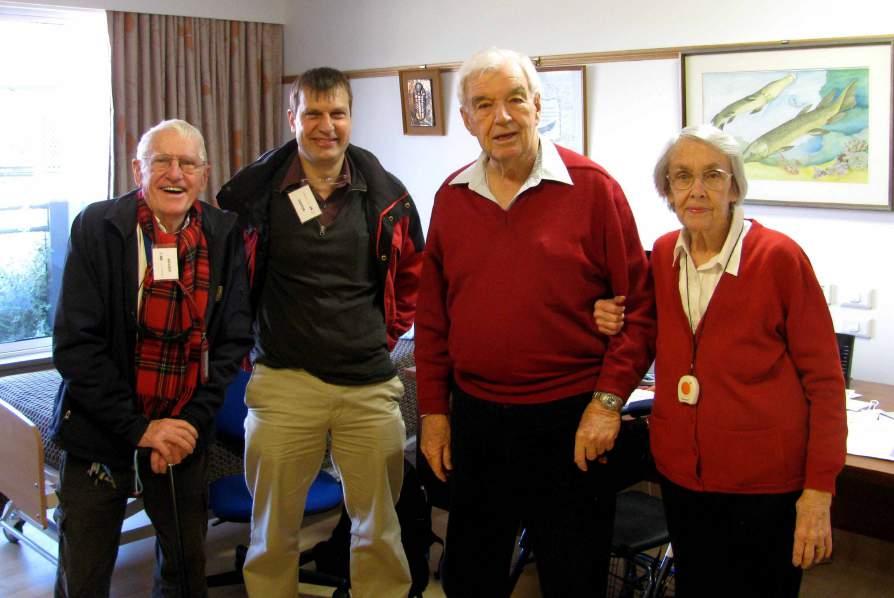
Dick Barwick and Charles Marshall visit Ken and Daphne Campbell at St. Andrew’s Retirement Village, 1 August 2012.
Ken Campbell was born in Ipswich, Queensland. After attending Brisbane Grammar School (1942-45), he went on to the University of Queensland (UQ), selecting geology as a subject because his school friend Ross Staines recommended it. This proved a serendipitous choice for Australian geology and palaeontology. Ken excelled in geology, but he felt the foundations of geology were taught as accepted fact, to the exclusion of developing new
concepts. This seemed contrary to the purpose of scientific endeavour. In third year he combined geology with mathematics, but was already developing an interest in fossils as evidence of evolution. His essay on nautiloid evolution attracted the attention of Dr (later Professor) Dorothy Hill, who suggested he might consider an extra year of study to do honours, with her as supervisor.
In those stringent times, an extra university year supported by the family, rather than getting a job as a school teacher (Ken’s first inclination), needed serious consideration. Dr Hill resolved the dilemma by offering Ken a paid research assistant position, to help with her work on forams from Timor exploration wells, for which she had a grant. In retrospect, Ken recognised his decision to take up Dr Hill’s offer in 1948 as one of the most important of his career, setting the scene for a lifetime’s work in scientific research. Ken’s Honours project involved geological mapping of an area in the Brisbane valley, requiring a train trip to Esk and pushbike to the field, but he later improved the travel situation by buying an ex-army motorbike. As a part-time research assistant he had two years to complete his mapping project. He graduated Bachelor of Science with First Class Honours in 1949, his Honours work resulting in Ken’s first publication. ‘The Geology of the Cressbrook-Buaraba area’ (1952), is a masterful study on the detailed geology of this part of the Brisbane valley, which also included Ken’s first descriptions of Permian fossils.
During 1950-51 Ken had an ‘Assistant Geologist’ position with the Queensland Geological Survey, helping to compile a geological map using reconnaissance air photos of North Queensland taken by the US Army during the war. He also had the opportunity to go with the Shell Oil Company to central Queensland, sampling Permian fossils at Cattle Creek and Ingelara, to help with his study of the material from his Honours mapping area. Involvement in both projects was organised by Dorothy Hill. He worked on geological mapping during the day, and pursued his palaeontological interests after hours, eventually submitting this work for his MSc degree at UQ, awarded in 1951.
During this period Ken also became acquainted with a young lady employed as personal assistant to Prof. Hill, Daphne Watson, the love of his life, to whom he later proposed. They were married in May 1951, and were together for 64 years (Daphne died in June 2015).
Ken was never prepared to take scientific data for granted – he wanted to analyse it for himself before accepting any evidence as reliable. No doubt this was a quality recognised by Dorothy Hill in her young honours student, indicating an aptitude for scientific research. Ken was unconvinced about his north Queensland geology compilation, an extremely piecemeal activity and no more than a first hypothesis that needed testing with new field data. But the Geological Survey did not agree to his fieldwork request, and he questioned the scientific validity of the work so far with Dr Hill. Frustrated by the lack of support, and against her wishes, he decided not to pursue the geological mapping project, but rather look for a job as a school teacher – he was now engaged to be married, and felt a responsibility for obtaining reliable employment.
Ken found a position as a Mathematics Master at Albury Grammar School, which he took up in January 1951, but this lasted no more than a year. Ken recounted geological disagreements at Albury, when the geography teacher asserted that the Snowy Mountains was a folded mountain belt, which the Mathematics Master knew was completely wrong. These difficulties were resolved towards the end of the school year, when Ken received a message from Brisbane that the New England University College in Armidale was looking for a temporary lecturer in palaeontology. Ken contacted the Head of Department, Dr Alan Voisey, and stopped in Armidale for an interview on the way to Brisbane for Christmas, 1951. Ken
was offered the position, which ended his secondary school teaching career. Nevertheless, his teaching commitment to university students remained a hallmark of his later career (and in the 1960s he organised geology short courses for school science teachers under the NSW Education Dept. Wyndham Scheme).
Ken and Daph moved to Armidale for the start of the 1952 academic year. He taught palaeontology, stratigraphy, and some sedimentology, and did much fieldwork both with students and for research, especially in the Carboniferous west of Tamworth. But before year’s end Dr Voisey had taken leave for a Visiting Professorship in the US, and the only other staff member won a scholarship to Cambridge. Thus, Ken Campbell, temporary lecturer, became the de facto ‘Head of Department’, with a staff of one! The following year Ken was made permanent, remaining at UNE as Lecturer, then Senior Lecturer, until the end of 1960. He expanded his brachiopod studies into the Carboniferous, and pursued his palaeontological research during long vacations at UQ under Dorothy Hill’s supervision. This was submitted as a thesis entitled ‘Upper Palaeozoic Studies’, for which he was awarded his PhD in 1958.
Over the next decade Ken published many significant papers on Permo-Carboniferous fossils, with a special focus on brachiopods. During his period at UNE, following his mentor Prof. Hill’s example at UQ, Ken developed a strong palaeontology school, supervising BSc Honours students Brian Engel, John Roberts and John Pickett, all of whom went on to make a major contribution to Australian palaeontology. His first trilobite paper (1960) erected a new Carboniferous genus Australosutura, with a ‘Gondwanan’ distribution, being known from Argentina and Australia. His brachiopod studies culminated in the 146 pp. monograph (1965) on Permian terebratuloids from Australia (BMR Bulletin 68). His trilobite research (mainly Silurian-Devonian) included collaboration with Harry Whittington in Cambridge (1958: Nuffield Dominion Travelling Fellowship), and at Harvard in 1965 (Australian-American Education Foundation Award; NSF Award). This resulted in significant monographs, on silicified Silurian trilobites from Maine (with Whittington), and two bulletins of the Oklahoma Geological Survey Bulletin in 1967 and 1977 (68, 222 pp. respectively). Other invertebrate groups he published on included Carboniferous cephalopods (1964, 1983), receptaculitids (1974), and echinoderms (1971, 1986).
The 1958 sojourn in Cambridge, the first overseas visit for the Campbell family, also broadened Ken’s scientific horizons. He met Martin Rudwick whose experimental methods with the aberrant Permian brachiopod Prorichthofenia inspired Ken towards a deeper consideration of functional morphology – a focus he retained throughout his palaeontological research. Ken recognised the value of study leave both for research and teaching – rather than the pedestrian approach of learning names and stratigraphic distributions, fossils could also be interpreted as living animals. Analysis of morphology and environment to interpret how extinct animals may have functioned in feeding, respiration etc. were concepts that produced positive feedback from students when Ken elaborated these ideas in his lectures to undergraduates.
In 1960 Ken applied for an advertised position in micropalaeontology at the new ANU Geology Department. Although he had done no work on Foraminifera since his honours year, he felt he could teach the subject adequately. His other research would also add strength to the teaching program being developed by Foundation Professor of Geology David Brown (also a palaeontologist). Ken was appointed Senior Lecturer to commence in the 1961 Academic year, and the Campbell family moved to Canberra, which remained Ken’s home base for the rest of his career. A major output from ANU Geology in 1968 was Ken’s contribution (with David Brown and sedimentologist Keith Crook) to the widely acclaimed
textbook ‘The Geological Evolution of Australia and New Zealand’, the first comprehensive stratigraphic summary for the Australasian region, and a testament to the strong staff collaboration that developed in the ANU Geology Department under Prof. Brown’s leadership.
Having moved to Canberra, Ken turned his attention to the Siluro-Devonian palaeontology of the Canberra region, including the spectacularly fossiliferous limestones around Burrinjuck Dam. These were regularly visited for student field trips, with various 3rd year mapping, Honours, MSc and PhD projects undertaken in the Mountain Creek, Taemas, Cavan, and Good Hope areas. This area had also produced numerous Burrinjuck Devonian fish samples collected by the British Natural History Museum (BM) in 1962, the removal of which without Prof. Brown’s knowledge caused great concern (see my article in The Australian Geologist June 2015, pp. 29-32). Thus both Ken Campbell and David Brown were very aware of this internationally significant vertebrate fossil resource in the local area, a relevant fact for Ken’s later research direction (see below).
Ken became Head of the ANU Geology Department (a 3 year appointment) when Prof. Brown relinquished his chair at the end of 1976. Ken also served as Deputy Dean (one year) and Dean of the Faculty of Science (two years) before being appointed Professor and Head of Department in 1983. He stood down as departmental head in 1988, but remained Professor of Geology until his retirement at the end of 1992.
Ken Campbell always stood up for what he believed in, and in these new roles there were many challenges to be met in a rapidly changing university environment. These consumed much of his time and energy, although any diminution of his teaching and research output is hardly evident. In 1991 the department had to vacate the original purpose-built Geology Building to make way for an engineering department. Ken was very concerned that the original building would be lost while he was Professor of Geology, and (with others) fought long and hard to resist the move, to no avail. However the efforts of resistance ensured that the new accommodation in the former Botany Building was the best that could be obtained under the circumstances. Ken showed a selfless determination that due recognition be given to his esteemed friend and colleague David Brown for founding the Geology Department, and one of his last official acts, in March 2011, was presiding over the opening of a commemoration stone for D.A. Brown that he had organised to be mounted in the foyer of the original Geology building.
Ken received many fellowships, honours and awards during his distinguished career. His initial CSIRO Research Studentship at UQ (1948-50) was followed by a Nuffield Dominion Travelling Fellowship to Cambridge (1958), Fulbright and NSF Awards to the US (1965), a NATO Award to Oslo (1973), and the W.B. Clarke Memorial Lecture (R. Soc. NSW, 1975). In 1983 he was elected to the Australian Academy of Science, being cited as ‘one of Australia’s most distinguished palaeontologists’. Subsequently he was awarded the Mawson Medal of the Academy of Science (1986), the W.R. Browne Medal of the Geological Society of Australia (2006), and the W.B. Clarke Medal of the NSW Division of the Geological Society (2010). In 2012, Ken received the Raymond C. Moore Medal of the US Society for Sedimentary Geology. The citation read: ‘The extraordinary breadth and global significance of your research achievements, your diverse international collaborations, and the exceptional scientific progeny your teachings have spawned, all qualify you for this appropriate honour’. This was his last award, near the end of his career when health problems were appearing, and it was greatly appreciated and lifted his spirits.
Ken also had numerous fossil species and genera named in his honour by palaeontological colleagues in Australia, the United States, China and Canada, including
brachiopods (Neospirifer campbelli, Fluctuaria campbelli, Kitakamithyris campbelli, Spinulicosta campbelli, Imperiospira campbelli), coral (Lithostrotion campbelli), bivalve molluscs (Cornellites campbelli, Inaequidens campbelli), a crinoid (Campbellicrinus compactus), trilobites (Primaspis campbelli, Acanthopyge campbelli), and fossil fishes (Kenichthys campbelli, Campbellodus decipiens, Howittacanthus kentoni, Amadeodipterus kencampbelli).
Ken contributed to the academic and scientific communities in many other ways in addition to his research output, serving on various councils and committees at the ANU and in the AAS. He organised various symposia and edited major volumes, for example Essays in honour of Dorothy Hill (1969), the 1973 Gondwana Symposium (published 1975), and a Rates of Evolution Symposium (with Max Day; published 1987).
Ken’s research output had already earned him an international reputation across various fields of invertebrate palaeontology, but he continued to broaden his horizons, for example his interest in molecular biology and gene regulation through collaborations with George Miklos (published in 1994). Otherwise, however, almost all of his research output after his retirement (comprising some 30 publications) was in the field of vertebrate palaeontology.
As the first ANU Geology honours student in vertebrate palaeontology, I was mentored by Ken Campbell in the early years of his research interest in fossil vertebrates. I present here some details on how that came about. In 1964 Prof. F.H.T. Rhodes from the UK visited the department, and Ken Campbell and Prof. Brown (with ANU Vice-Chancellor Prof. L. Huxley) arranged a day trip to Taemas to show Frank Rhodes the ‘Shearby’s Wallpaper’ fossil site. On this day Ken made a spectacular discovery that would have a major impact on his subsequent research. He found a beautiful lungfish skull, the excitement of which he said caused him to punch the air, and exclaim ‘I am the greatest!’, in the style of then boxing champion Cassius Clay!
Following Prof. Brown’s complaints to the BM about removal of significant Burrinjuck fossil fish to London, casts of type specimens, and information on acetic acid preparation, had been obtained from Dr Errol White, Keeper of Palaeontology at the BM. An acid etching facility was therefore set up at the back of the geology building, and Ken started preparing out his new skull, the second known example of the primitive lungfish Dipnorhynchus sussmilchi (Etheridge). Ken’s first vertebrate palaeontology paper (published 1965) was a preliminary report of this discovery. The type specimen of Dipnorhynchus, found near Taemas some 70 years previously, was borrowed from the Australian Museum and also acid etched, to reveal a complete braincase and palate. Ken arranged a collaboration with Dr Keith Thomson, a vertebrate palaeontologist from Yale University who visited the ANU in 1967, and their co-authored monograph on Dipnorhynchus was published in 1971.
I was an undergraduate student for Ken Campbell’s palaeontology lectures in in 196667, but my research collaboration with him began with my 1969 Honours project on acid preparation and study of Devonian fish from the limestones of the Goodradigbee valley near Wee Jasper. This area had been visited only once by the BM, but proved to be a rich source of new fossil fish specimens. Much later, Ken Campbell and Dick Barwick were to make numerous collecting trips to Wee Jasper, and developed a close friendship and long collaboration with Helen and Ian Cathles, whose property bordered Lake Burrinjuck. Ken provided geological information, coral samples etc. to augment the display of fossil fish that the Cathles set up in their restored ‘Cooradigbee’ Homestead.
During his visit to Europe in 1973, Ken Campbell had taken my photographs and illustrations of some of the very strange new fossil fish skulls from Wee Jasper to show Dr
Errol White at the BM. This connection paved the way for my PhD research in London on the Burrinjuck fish material in 1974-76. An incident at the museum is worth recounting, as it demonstrates the international reach of Ken Campbell’s reputation, which helped in raising the profile of Australasian palaeontology. One day in 1975, Colin Patterson, an outstanding paleontologist in the museum (he wrote the ‘Evolution’ handbook for the museum, published by UQ Press in 1978), rushed into my office exclaiming: “Ken Campbell has written a paper called ‘A spectre is haunting palaeontology’, in some new Australian palaeontology journal! Do you have a copy?”
I was able to inform him Alcheringa was an Aboriginal term meaning ‘in the beginning’, and Ken’s paper was entitled ‘Cladism and phacopid trilobites’, even if there was an allusion to the opening words of the Marx-Engels ‘Communist Manifesto’ in Ken’s first sentence! (In fact, Ken was attending the International Geological Congress in Prague in August 1968 when the Russians moved in and the congress was aborted). Ken’s provocative paper certainly helped put Alcheringa into the minds of many overseas palaeontologists.
A second paper in the first volume of Alcheringa (published 1977) was the third vertebrate palaeontology publication by Ken Campbell (co-authored with his 1972 Honours student Maurice Bell). This was significant for two reasons. It describes the first, and still is the only known Devonian tetrapod body fossil from the entire Gondwana supercontinent (Metaxygnathus, a lower jaw from Forbes, NSW). Metaxygnathus was dismissed as merely the jaw of a fish by Northern Hemisphere researchers, until they found new specimens confirming its tetrapod affinities. Ken Campbell said in 1998: “we always knew we were right – it just took them two decades to agree with us!”
Also worth noting is that the Metaxygnathus jaw in the 1977 paper was drawn by Dr R.E. (Dick) Barwick from the ANU Zoology Department. This was actually the first published collaboration between Dick and Ken, which subsequently led to numerous coauthored publications on Devonian-Carboniferous vertebrates.
Ken also collaborated with many distinguished overseas vertebrate paleontologists, including Prof. Moya Smith (Guys Medical School, London), Prof. H.-P. Schultze (Univ. Kansas), Prof. Dick Fox (Univ. Alberta), Dr. Elga Mark-Kurik (Tallinn), Dr Mahala Andrews (Edinburgh), and Prof. Per Ahlberg (Uppsala). In his most recent publications Ken embraced the latest technology in fossil research, collaborating with Prof. Tim Senden in the ANU Dept. of Applied Maths, where high resolution micro-CT scanners were applied to investigate internal structures of the braincase, bone histology, sensory canal systems etc.
Ken’s very extensive research output will be a lasting legacy to science, but not to be forgotten are the numerous students mentored and supervised by Ken, who went on to make major contributions to various aspects of the earth sciences both in Australia and overseas.
Ken and Dick Barwick were particularly proud of their former student Charles Marshall, who left Canberra for a PhD at the University of Chicago, held a prestigious Harvard Professorship in Paleontology, and is now Director of the University of California Museum of Paleontology (see image above).
Having worked very closely with Ken in teaching and research since I returned to the ANU in 1997, I take this opportunity to put on record the enormous effort he expended over the last 15 years on two issues very close to his heart: the continuation of vertebrate palaeontology teaching and research at ANU, and long term protection for the internationally significant fossil vertebrate collection built up during his five decades of ANU research since he picked up his first Dipnorhynchus skull at Taemas.
Vertebrate Palaeontology when I was an undergraduate was a third year unit covering all vertebrate groups (agnathans, jawed fishes, amphibians, reptiles, birds and mammals),
mainly taught by Prof. Brown (mammals were taught by M. Plane, Bureau of Mineral Resources). From 1978 until Ken’s retirement, he taught vertebrate palaeontology in alternate years in a course of some 18-21 lectures and 12 practical sessions. I contributed 6-7 lectures on Devonian fishes, and Ken covered all other groups, with mammals being taught by Dr David Ride from 1988 after he came to ANU. From 1997 the course was reinstated but much reduced, focusing only on Palaeozoic vertebrates, the main research strength at ANU. There were only 3 lectures and 2 practical sessions, later reduced to one prac, as the vertebrates were squeezed into the general second year palaeontology course (covering all invertebrate groups).
Nevertheless, the vertebrate palaeontology component of undergraduate teaching regularly attracted amongst the highest student numbers for second year earth science units, with a strong contingent from biology. In 2008, after the merger with RSES, Ken Campbell lobbied unsuccessfully for reinstatement of vertebrate palaeontology as a stand-alone unit that would boost student numbers. However, the reality, as then stated by the RSES Director, was that palaeontology was not part of the RSES strategic plan, and vertebrate research was supported mainly by outside funding, and a minor part of ANU earth science activities except as kept going by visiting fellows.
By that time Ken no longer gave lectures, but regularly attended the vertebrate palaeontology practical sessions to demonstrate the exceptional Gogo lungfish material –amazing fossils of skulls and braincases with all the jaws and gill arch cartilages in place. As I had observed for decades, Ken’s commitment and teaching engagement, his consummate skill in handling some of the world’s most precious and fragile fossils, and his deep knowledge of the subject, still engendered great enthusiasm, interest, and respect with all undergraduate students. Regrettably, the practical session in 2011 was the last Ken attended, as from 2012 I was required to give lectures in the new RSES building, whilst the fragile fossil fish collection remained in the strongroom of the previous Geology Department, and could not be accessed for teaching. For the last year that I was involved in teaching (2014), the vertebrate component actually expanded, with my five lectures on Palaeozoic vertebrates, one on Talbragar fish by Lynne Bean, a practical session involving casts, 3D printouts from CT scanned specimens, and a tour of the CT lab, plus a one day field trip to Wee Jasper.
From the late 1960s, the exceptionally fragile acid-etched fossil fish skulls and braincases from Burrinjuck and Gogo were locked away in a fire-proof strongroom adjacent to the offices of Dr Campbell and Prof. Brown, who had the only keys. In the refurbished Botany building, to which the Geology Department relocated in 1991, a new locked fireproof store was provided upstairs to house the acid-etched vertebrates and other type and valuable fossils. The main Geology Museum, including numerous purchased overseas and historically significant fossils, unpublished honours and postgraduate material etc., was relocated to the ground floor of the new building.
Ken Campbell’s increasing concern about the long-term future of the ANU fossil collection resulted from the loss of the Geology Museum curator position in 2001, when Dr Tim Munson finished at ANU and was not replaced. Ken approached the ANU ViceChancellor on this issue, and started lobbying to retrieve this curatorial function for the Geology Museum. He was referred to the Deputy Vice-Chancellor (Research), and arranged a meeting with him, which I also attended (11 June 2003), but neither of us was much encouraged. This was the first of many meetings Ken organised, as he lobbied the ANU to recognise all of its research collections, which elsewhere were either held in dedicated university museums, or were lodged in appropriate collecting institutions (e.g. the various State Museums). However, with little momentum from other parts of the university, Ken
decided to focus only on the fossil collection, and in particular the internationally significant fossil fish material.
In 2005 Ken made contact with the National Museum of Australia (NMA), the then Director (Craddock Morton) having been one of Ken’s former students. Various letters were exchanged, and NMA staff visited the department and surveyed the collection (31 Oct 2005). The proposal was for a collaboration between ANU and the NMA, the latter taking over responsibility for the collections, which could remain on campus as long as research continued. This proposal did not proceed, and some years later I learnt from a subsequent NMA Director that a follow up at a higher level had led to rejection by the ANU (at the time neither Ken nor myself had any idea our plans had been thwarted by the ANU).
By the mid 2000’s the fireproof store was full, and the overflow of type fossils was housed downstairs in less secure accommodation – the former office of the Museum Curator (as far as possible the most fragile specimens were kept upstairs in the locked strongroom). But in 2008 the Geology Department was merged into the Research School of Earth Sciences (RSES), with a much broader range of earth science disciplines. Ken made a submission regarding inadequate storage for the growing type collection, and proposed an additional fireproof storage area in unused laboratory space. Plans were drafted up, but again nothing eventuated, being overtaken by events. There was a change of leadership, with the external appointment of a new RSES Director in February 2010, an agreed condition entailing the two parts of RSES being brought physically together in a new RSES building. There was little understanding nor consultation about collection storage requirements in planning that new building.
Ken contacted Pro Vice-Chancellor Prof. Mandy Thomas about collection protection, with a new plan to set up an endowment fund to secure a curatorial position at ANU. Ken approached one of his most successful former students, Dr Bob Day (his second palaeontology PhD at ANU, 1968), who later became Chief Government Geologist and Director-General of Mines and Energy in Queensland. A pilot scheme was started for a parttime shared research and curatorial position in vertebrate palaeontology, but regrettably that did not continue. Neither Ken nor Bob Day found acceptable an RSES proposal to redirect endowment funds to scientific fields other than palaeontology. Bob Day withdrew his support, and transferred his funding for a postdoctoral position in vertebrate palaeontology at UQ. However, a positive outcome of Ken’s efforts was a survey of all ANU collections across campus, leading to a formal ANU Collections Policy document from the PVC’s office in January 2009.
Ken continued to lobby strongly for collection protection with the RSES Director, but there was decreasing sympathy for the importance of palaeontology collections, and teaching of the subject. Ken’s Visiting Fellowship at RSES was not renewed in 2011; it was pointed out that an Emeritus Professor already had all the same privileges, but there were also concerns about Ken’s health. In October 2011 all occupants of the former Geology building were advised of a plan to relocate to a new building in 2012 – except for palaeontology (including the collections and the Geology Museum), which would remain until a refurbished original John Curtin School building was finished.
The original Geology building was eventually vacated by RSES in early 2015, but from late 2011 Ken Campbell had continued his research mainly from a home office. He still regularly visited the department for his collaboration with Dick Barwick (regrettably Dick died in November 2012). During this period Ken persisted with his mentoring of students, and any others interested in vertebrate palaeontology and evolution (e.g. Nicola Power, Honours 1 on Burrinjuck placoderms 2010; James Hunt and Greg Bell, MSc projects on
Kenichthys-like early tetrapodomorph fishes from Wee Jasper and antiarch placoderms from Forbes; Alice Clement, PhD 2011 on Gogo Devonian lungfish; Lynne Bean, current PhD on Talbragar fossil fishes).
Ken experienced health problems in 2011-12. In mid 2012 Ken and Daph moved into temporary Respite Care whilst Ken’s condition was monitored. Ken told me a specialist investigating possible memory loss asked if he could remember any animals (cow, dog, horse, perhaps?). Ken refrained from listing numerous species of Permian brachiopods, Devonian fish, and Silurian trilobites, which would have confounded the medical specialist! In late 2012 they moved into John Flynn House at St Andrew’s Retirement Village, Woden, ACT, where they occupied adjacent rooms. This proved a very effective arrangement, with Ken’s room mainly functioning as an office for his research (see image above), and Daph’s room for entertainment of visitors. Various overseas research colleagues visited Ken at St Andrews, including Prof. Per Ahlberg (Uppsala), and Prof. Charles Marshall (Univ. California). Ken was still preparing manuscripts and working on the text for a book during 2017. He is survived by his three children Rodney, Rosslyn and Ian and their partners, five grandchildren, and nine great-grandchildren.
I thank Ian Campbell for information about Ken’s early career, and comments on a draft that greatly improved this document. Bob Burne provided copies of documents he and Dick Barwick prepared for the R.C. Moore Medal nomination. Other information came from John Long’s article in The Conversation (26 June 2017), and Peter Jell’s summary in the 459 page Festschrift ‘Palaeontological studies in honour of Ken Campbell’, published as AAP Memoir 15 (1993; P.A. Jell, Editor). A co-authored biographical memoir for Historical Records of Australian Science is in preparation (contact John Long for details).
Dr Gavin Young, ANU
Email: Gavinyoung51@gmail.com
Ken Campbell’s Publications (chronological order)
Campbell K.S.W. 1952. The geology of the Cressbrook-Buaraba area. Pap. Dept. Geol. Univ. Qld 3(15), 1-44.
Campbell, K.S.W. 1953. The Fauna of the Permo-Carboniferous Ingelbara Beds of Queensland. Pap. Dept. Geol. Univ. Qld 4(1), 1-30.
Hill D., Tweedale D.W., Hawthorne W. & Campbell K.S.W. 1953. Geological Map of Queensland, 40 miles to 1 inch. Geological Survey of Queensland.
Campbell K.S.W. 1955. Phricodothyris in New South Wales. Geol. Mag. 92, 374-384.
Campbell K.S.W. 1956. Some Carboniferous productid brachiopods from New South Wales. Journal of Paleontology 30, 463-480.
Campbell K.S.W. 1957. A Lower Carboniferous brachiopod-coral fauna from New South Wales. Journal of Paleontology 31, 34-98.
Campbell K.S.W. 1958. Upper Paleozoic Studies. Unpublished PhD Thesis. University of Queensland.
Campbell K.S.W. 1959. The Martiniopsis-like spiriferids of the Queensland Permian. Palaeontology 1, 333-350.
Campbell K.S.W. 1959. The type species of three upper Palaeozoic punctate spiriferoids. Palaeontology 1, 351-363.
Amos A.J., Campbell K.S.W. & Goldring R. 1960. Australosutura gen. nov. (Trilobita) from the Carboniferous of Australia and Argentina. Palaeontology 3, 227-236.
Campbell K.S.W. 1960. The Middle Bowen of the Homevale area, north of Nebo. J. Geol. Soc. Aust. 7, 199-201.
Campbell K.S.W. 1960. The brachiopod genera Ingelarella and Notospirifer in the Permian of Queensland. Journal of Paleontology 34, 1106-1123.
Campbell K.S.W. 1960. The Brisbane Valley. J. Geol. Soc. Aust. 7, 223-224.
Campbell K.S.W. 1961. New Species of the Permian spiriferoids Ingelarella and Notospirifer from Queensland and their stratigraphic implications. Palaeontographica A117, 159192.
Campbell K.S.W. 1961. Carboniferous fossils from the Kuttung rocks of New South Wales. Palaeontology 4, 428-474.
Campbell, K.S.W. 1962. Marine Fossils from the Carboniferous glacial rocks of New South Wales. Journal of Paleontology 36, 38-52.
Campbell K.S.W. & Engel B.A. 1963. The faunas of the Tournaisian Talcumba Sandstone and its members in the Werrie and Belvue Synclines, New South Wales. Journal Geological Society of Australia 10, 55-125.
Campbell K.S.W. & Roberts J. 1964. Two species of Delepinea from New South Wales. Palaeontology 7, 514-524.
Brown D.A., Campbell K.S.W. & Roberts J. 1965. A Viséan cephalopod fauna from New South Wales. Palaeontology 7, 682-694.
Campbell K.S.W. 1965. Australian Permian terebratuloids. Bur. Miner. Resour. Aust Bull. 68, 1-146, 17 pl.
Campbell K.S.W. 1965. An almost complete skull roof and palate of the dipnoan Dipnorhynchus sussmilchi (Etheridge). Palaeontology 8, 634-637.
Campbell K.S.W. 1966. The generic affinities of the brachiopod Acantheria? rangariensis Campbell J. geol Soc. Aust. 13, 313.
Campbell, K.S.W. 1967. Trilobites of the Henryhouse Formation (Silurian) in Oklahoma. Bull. Oklahoma Geol. Surv. 115, 1-68.
Whittington H.J. & Campbell K.S.W. 1967. Silicified Silurian trilobites from Maine. Bull. Mus. Comp. Zool. Harv. 135, 447-482.
Campbell K.S.W. 1967. Geographic and stratigraphic implications of a study of the Henryhouse trilobite fauna (Silurian) in Oklahoma. Tulsa. Geol. Soc. Digest 35, 253258.
Campbell K.S.W. 1967. Review of ‘Treatise on invertebrate palaeontology. Part H. Brachiopoda’. Biol. Rev. 42, 53.
Campbell K.S.W. & Talent J.A. 1967. Malurostrophia, a new genus of stropheodontid brachiopod from the Devonian of Australia. Proc. R. Soc. Vict. 80, 309-330.
Brown D.A., Campbell K.S.W. & Crook K.A. 1968. The geological evolution of Australia and New Zealand. Pergamon Press, London. 409 pp.
Campbell K.S.W. (Ed) 1969. Stratigraphy and Paleontology. Essays in honour of Dorothy Hill. Australian National University Press, Canberra. 390 pp.
Campbell K.S.W. & McKellar R.G. 1969. Eastern Australian Carboniferous invertebrates: sequence and affinities. In Statigraphy and palaeontology. Essays in honour of Dorothy Hill. Canberra. Australian National University Press. 77-117.
Campbell K.S.W. 1969. Carboniferous system. J. geol. Soc. Aust. 16, 244-245.
Engel B.A., Roberts J. & Campbell K.S.W. 1969. Lower and middle Hunter Valley. J. geol. Soc. Aust. 16, 249-253.
Engel B.A., McKelvey B.C. & Campbell K.S.W. 1969. Stroud-Gloucester and Myall Synclines. J. geol. Soc. Aust. 16, 253-255.
Campbell K.S.W. 1969. Manning and Hastings Valleys. Macleay Valley. Ashford-Bonshaw area. Dake area, Armidale area, Bingara area. Palaeogeography. J. geol. Soc. Aust. 16, 257-261.
Campbell K.S.W. & Roberts J. 1969. The faunal sequence and overseas correlation. J. geol. Soc. Aust. 16, 261-264.
Campbell K.S.W. 1969. Correlation of the Shoalhaven Group. J. geol. Soc. Aust. 16, 357370.
Dasch, E.J. & Campbell K.S.W. 1970. Strontium-isotope evidence for marine or freshwater origin of fossil dipnoans and arthrodires. Nature, Lond. 227, 1159.
Campbell K.S.W. & Durham G.J. 1970. A new trinucleid trilobite from the Upper Ordovician of New South Wales. Palaeontology 13, 573-580.
Campbell K.S.W. & Bein J. 1971. Some Lower Carboniferous crinoids from New South Wales. J. Paleont. 45, 419-436.
Campbell K.S.W., Dear J.F., Rattigan J.H. & Roberts J. 1971. Correlation chart for the Carboniferous System in Australia. Proc Symp. on Gondwana Strat. Beunos Aires, 471474.
Campbell K.S.W. (Ed.) 1972. The Devonian System in Australia. Geological Society of Australia Journal 18, 425-490; 19, 81-162.
Banks M.R., Campbell K.S.W. & Dickins J.M. 1970. Correlation charts for the Carboniferous, Permian, Triassic and Jurassic Systems in Australia. Symposial Internacional
Thompson, K.S. & Campbell K.S.W. 1971. The structure and relationships of the primitive lungfish – Dipnorhynchus sussmilchi (Etheridge). Bull. Peabody Mus. nat. Hist. 38, 1109.
Campbell K.S.W. 1971. Some Lower Carboniferous crinoids from New South Wales. Journal of Palaeontology 45, 419-436.
Campbell K.S.W. & McKelvey B.C. 1972. The geology of the Barrington district, NSW. Pacific Geology 3, 7-48.
Campbell K.S.W. & Davoren P.J. 1972. Biogeography of Australian Early-Middle Devonian trilobites. J. geol. Soc. Aust. 19, 88-93.
Crawford, A.R. & Campbell K.S.W. 1973. Large-scale displacement within AustraliaAntarctica in the Ordovician. Nature (Phys. Sci.), Lond. 241, 11-14.
Crawford A.R., & Campbell K.S.W. 1973. Drs Crawford and Campbell Reply. Nature (Phys. Sci.) Lond. 244, 64.
Jones P.J., Campbell K.S.W. & Roberts J. 1973. Correlation chart for the Carboniferous System of Australia. BMR Bull. 156A, 1-40.
Campbell K.S.W. 1973. A Species of the trilobite Dalmanitina (Dalmanitina) from Australia. Geol. For. Stockh. Forth. 95, 69-77.
Campbell K.S.W., Holloway D.J. & Smith W.D. 1974. A new receptaculitid genus, Hexabactron, and the relationships of the Receptaculitaceae. Palaeontographica A146, 52-77.
Holloway D.J. & Campbell K.S.W. 1974. The Silurian trilobite Onychopyge Woodward. Palaeontology 17, 409-421.
Campbell K.S.W. (Ed) 1975. Gondwana Geology: Papers Presented at the Third Gondwana Symposium, Canberra Australia, 1973. Australian National University Press, 705pp.
Campbell K.S.W. 1975. Cladism and phacopid trilobites. Alcheringa 1, 87-96.
Campbell K.S.W. 1975. The functional anatomy of phacopid trilobites: musculature and eyes. J. Proc. R. Soc. N.S.W. 108, 168-188.
Campbell K.S.W. 1975. The Functional morphology of Cryptolithus. Fossils and Strata 4, 65-86.
Campbell K.S.W. 1976. Yass-Taemas. International Geological Congress. Excursion Guide 9B, 1-16.
Runnegar B.N. & Campbell K.S.W. 1976. Late Palaeozoic Faunas of Australia. Earth Science Reviews 12, 235-257.
Skwarko S.K., Nicoll R.S., & Campbell K.S.W. 1976. The Late Triassic molluscs, conodonts and brachiopods of the Kuta Formation, Papua New Guinea. BMR J. Aust. Geol. Geophys. 1, 219-230.
Campbell K.S.W. 1977. Trilobites of the Haragan, Bois d'Arc, and Frisco Formations (Early Devonian) Arbuckle Mountains region, Oklahoma. Bull Oklahoma Geol. Surv. 123, 1227.
Campbell K.S.W., Rodgers, P.A. & Benbow, M. 1977. Fossiliferous Lower Devonian boulders from the Cretaceous of South Australia. Quart. Geol. Notes, Geol. Surv. S. Aust. 62, 9-13.
Campbell K.S.W. & Bell, M.W. 1977. A primitive amphibian from the Late Devonian of New South Wales. Alcheringa 1, 369-381.
Campbell K.S.W. & Chatterton B.D., 1979. Coleospira: Do its double spires simply imply a double lophophore? Alcheringa 3, 209-223.
Chatterton B.D.E., Johnston B.D. & Campbell K.S.W.1979. Silicified Lower Devonian trilobites from New South Wales. Palaeontology 22, 799-837.
Chatterton B.D.E. & Campbell K.S.W. 1980. Silurian trilobites from near Canberra and some related forms from the Yass Basin. Palaeontographica A167, 77-119.
Flint R.B., Ambrose, A.J. & Campbell, K.S.W. 1980. Fossiliferous Lower Devonian boulders in the Ctetaceous sediments of the Great Australian Basin. Trans. R. Soc. S. Aust 104, 57-65.
Campbell K.S.W. 1981. Lungfishes – alive and extinct. Bull. Field Mus. nat. Hist. 52 (8), 3-5.
Campbell, K.S.W. 1982. A note on the Haragan Trilobite Dicranurus humanus elegantus. Oklahoma Geol. Notes 42, 4-6.
Campbell K.S.W & Le Duy Phoc 1982. A Late Permian actinopterygian fish from Australia. Palaeontology 26, 63-70.
Campbell K.S.W. & Bell M.W. 1982. Soederberghia (Dipnoi) from the Late Devonian 0f New South Wales. Alcheringa 6, 143-149.
Campbell K.S.W & Barwick R.E. 1982. A new species of the lungfish Dipnorhynchus from New South Wales. Palaeontology 25, 509-527.
Campbell K.S.W & Barwick R.E. 1982. The neurocranium of the primitive Dipnoan Dipnorhynchus sussmilchi (Etheridge). Journal of Vertebrate Paleontology 2, 286-327.
Campbell K.S.W. & Barwick R.E. 1983. Early evolution of dipnoan dentitions and a new genus Speonesydrion. Association of Australasian Palaeontologists, Memoir 1, 17-49, 23 figs.
Campbell K.S.W., Brown D.A. & Coleman, A.R. 1983. Ammonoids and the correlation of the Lower Carboniferous of Eastern Australia. Alcheringa 7, 75-123.
Campbell K.S.W. & Barwick R.E. 1984. Speonesydrion, an early dipnoan with primitive tooth plates. PaleoIchthyologica 2, 1-48, 26 figs, 1 tab.
Campbell K.S.W. & Barwick R.E. 1984. The choana, maxillae, premaxillae and anterior palatal bones of Early Dipnoans, Proc. Linn. Soc. N.S.W. 107, 147-170.
Long J.A. & Campbell K.S.W. 1985. A new lungfish from the Lower Carboniferous of Victoria, Australia. Proc. R. Soc. Vict. 97, 87-93.
Campbell K.S.W & Barwick R.E. 1985. An advanced dipnorhynchid lungfish from the Early Devonian of New South Wales, Australia. Records of the Australian Museum 37, 301316, 11 figs.
Schultze, H.-P. & Campbell K.S.W. 1986. Characterization of the Dipnoi, a monophyletic group. Journal of Morphology, Supplement 1, 25-37.
Campbell K.S.W. & Barwick R.E. 1986. Paleozoic lungfishes – a review. Journal of Morphology, Supplement 1, 93-131.
Smith M.M. & Campbell K.S.W. 1987. Comparative morphology, histology and growth of the dental plates of the Devonian dipnoan Chirodipterus Phil. Trans. R. Soc. London B 317, 329-363.
Campbell K.S.W. & Smith M.M. 1987. The Devonian Dipnoan Holodipterus: dental form, variation and remodeling growth mechanisms. Rec. Aust. Mus. 39, 13412-167.
Campbell K.S.W. & Day M.F. (Eds) 1987. Rates of Evolution. Allen and Unwin, London. 314 pp.
Campbell K.S.W. & Marshall, C.R. 1987. Rates of evolution among Palaeozoic echinoderms. In Rates of Evolution, Campbell K.S.W. & Day M.F. eds, Allen & Unwin, London, 61100.
Campbell K.S.W., 1987. Evolution Evolving. J. Proc. R. Soc. 120, 9-19.
Smith M.M., Smithson T.R. & Campbell K.S.W. 1987. The relationships of Uronemus a Carboniferous Dipnoan with highly modified tooth plates. Phil. Trans. R. Soc. Lond. B 317, 299-327.
Campbell K.S.W. & Barwick R.E. 1988. Geological and paleontological information and phylogenetic hypotheses. Geological Magazine 125, 207-227.
Campbell K.S.W. & Barwick R.E. 1988. Uranolophus: a reappraisal of a primitive dipnoan. Association of Australasian Paleontologists Memoir 7, 87-144, 44 figs.
Campbell K.S.W. 1988. Review of Menad 1986, ‘The ocean of truth – a personal history of global tectonics’. Earth Science Reviews 25, 258-260.
Young G.C., Campbell K.S.W. & Barwick R.E. 1989. Pelvic girdles of Lungfishes (Dipnoi). In R.W. Le Maitre (ed.) Pathways in geology: essays in honour of Sherbon Hills, 5975, 13 figs.
Campbell K.S.W. 1990. Palaeontological contributions to modern evolutionary theory. 1986 Mawson Lecture. Aust. J. Earth Sciences 37, 247-265.
Zhou ZQ. & Campbell K.S.W. 1990. Devonian Phacopacean trilobites from the Zhusilenghaierhan region, Fjin Qui, Western Inner Mongolia, China. Palaeontographica A214, 57-77.
Campbell K.S.W. & Barwick R.E. 1990. Paleozoic dipnoan phylogeny: functional complexes and evolution without parsimony. Paleobiology 16, 145-169, 7 figs.
Campbell K.S.W. & Barwick R.E. 1991. Teeth and tooth plates in primitive lungfish and a new species of Holodipterus. pp 429-436, In Chang Meemann, Lui Yuhai & Zhang
Guorui (eds), Early Vertebrates and Related Problems of Evolutionary Biology. Science Press, Beijing.
Wang Shitao, Drapala V., Barwick R.E. & Campbell K.S.W. 1993. The dipnoan species Sorbitorhynchus deleaskitus, from the Lower Devonian of Guangxi, China. Philosophical Transactions of the Royal Society of London B 340, 1-24, 20 figs.
Pridmore P.A., Campbell K.S.W. & Barwick R.E. 1994. Morphology and phylogenetic position of the holodipteran dipnoans of the Devonian Gogo Formation of northwestern Australia. Philosophical Transactions of the Royal Society of London B 344, 105-164.
Miklos G.L.G. & Campbell K.S.W. 1994. The rapid emergence of bio-electronic novelty,
neuronal architectures, and organismal performance. pp. 269-293 In Flexibility and Constraint in Behavioral Systems. R.J. Greenspan and C.P. Kyriacou (eds). John Wiley and Sons.
Miklos G.L.G. & Campbell K.S.W. 1994. From protein domains to extinct phyla: reverse engineering approaches to the evolution of biological complexities. pp. 501-516. In Bengston, S. (ed.) Early Life on Earth, Nobel Symposium 84, Columbia University Press.
Long J.A., Campbell K.S.W. & Barwick R.E. 1994. A new genus, Ichnomylax, from the Lower Devonian of Victoria, Australia. Journal of Vertebrate Paleontology 14, 127131.
Fox R.C., Campbell K.S.W., Barwick R.E. & Long J.A. 1995. A new osteolepiform fish from the Lower Carboniferous Raymond Formation, Drummond Basin, Queensland. Memoirs of the Queensland Museum 38, 97-221. 80 figs.
Campbell K.S.W., Barwick R.E. & Pridmore P.A. 1995. On the nomenclature of the roofing and cheek bones in primitive dipnoans. Journal of Vertebrate Paleontology 15, 28-36.
Barwick R.E. & Campbell K.S.W. 1996. A Late Devonian Dipnoan, Pillararhynchus, from Gogo, Western Australia, and its relationships. Palaeontographica A239, 1-42.
Long J.A., Barwick R.E. & Campbell K.S.W. 1997. Osteology and functional morphology of the osteolepiform fish Gogonasus andrewsae Long, 1985, from the Upper Devonian Gogo Formation, Western Australia. Records of the Western Australian Museum, Supplement 53, 1-89, 62 figs.
Campbell K.S.W, Barwick R.E. & Mark-Kurik E. 1997. Tarachomylax - a new Early Devonian dipnoan from Severnaya Zemlya, and its place in the evolution of the Dipnoi. Geobios 30, 45-73, 16 figs.
Campbell K.S.W & Barwick R.E. 1998. A new tooth-plated dipnoan from the Upper Devonian Gogo Formation and its relationships. Memoirs of the Queensland Museum 42, 403-437.
Campbell K.S.W. & Jell J.S. 1998. Dorothy Hill 1907-1997. Historical Records of Australian Science. CSIRO 12, 205-228.
Campbell K.S.W. & Jell J.S. 1999. Dorothy Hill, AC. CBE. 10 September 1907-23 April 1997. Biographical Memoirs of Fellows of the Royal Society 45, 195-217.
Campbell K.S.W. & Barwick R.E. 1999. Dipnoan fishes from the Late Devonian Gogo Formation of Western Australia. Records of the Western Australian Museum, Supplement 57, 107-138, 62 figs
Campbell K.S.W & Barwick R.E.1999. Middle Devonian tooth-plates from Estonia, Journal of Vertebrate Paleontology 19, 220-233, 11 figs.
Campbell K.S.W & Barwick R.E. 1999. A new species of Dipnorhynchus, D. cathlesae, from Wee Jasper, New South Wales. Records of the Australian Museum 51, 123-140, 14 figs.
Campbell K.S.W & Barwick R.E. 2000. The braincase, mandible and dental structures of the Early Devonian lungfish Dipnorhynchus kurikae from Wee Jasper, New South Wales. Records of the Australian Museum 52, 1-26, 17 figs.
Campbell K.S.W., Barwick R.E. & Lindley I.D. 2000. New data on the structure of the Early Devonian lungfish Dipnorhynchus. Alcheringa 24, 277-298.
Campbell K.S.W & Barwick R.E. 2001. Diabolepis and its relation to the Dipnoi. Journal of Vertebrate Paleontology 21, 227-241.
Campbell K.S.W. & Barwick R.E. 2002. The axial postcranial structure of Griphognathus whitei from the Upper Devonian Gogo Formation of Western Australia: comparisons
with other Devonian dipnoans. Records of the Western Australian Museum 21, 167201.
Campbell K.S.W., Barwick, R.E., Chatterton B.D.E. & Smithson T.R. 2002. A new Middle Devonian dipnoan from Morocco: structure and histology of the dental plate. Records of the Western Australian Museum 21, 39-61, 13 figs.
den Blauwen, J.L. K.S.W. Campbell K.S.W. & Barwick R.E. 2005. Structure and function of the tooth plates of the Devonian lungfish Dipterus valenciennesi from Caithness and the Orkney Islands. Records of the Western Australian Museum 23, 91-113.
Andrews M., Long J.A., Ahlberg P.A., Barwick R.E. & Campbell K.S.W. 2006. Osteology and Functional morphology of the Sarcopterygian Onychodus jandemarrai n. sp from Gogo, Western Australia. Transactions of the Royal Society of Edinburgh, Earth Sciences 96, 197-307.
Campbell K.S.W., Barwick R.E. & den Blauwen J.L. 2006. Structure and Function of the shoulder Girdle in Dipnoans: New Material from Dipterus valenciennesi. Senkenbergiana lethaea 86, 77-91.
Campbell K.S.W. & Barwick R.E. 2006. Morphological innovation through gene regulation: an example from Devonian Onychodontiform fish. International Journal of Developmental Biology 50, 371-375.
Campbell K.S.W. & Barwick R.E. 2006. Structure and Function of the Shoulder Girdle in dipnoans: New Material from Dipterus valenciennesi Senckenbergiana Lethaea 86, 7791.
Campbell K.S.W. & Barwick R.E. 2007. The structure and stratigraphy of Speonesydrion from New South Wales, Australia, and the dentition of primitive dipnoans.
Palaontologische Zeitschrift 81, 146-159.
Campbell K.S.W. & Barwick R.E. 2008. New alternative explanations of the origin of the Devonian Dipnoan tooth plates. Senkenbergiana Lethaea 88, 213-228.
Campbell K.S.W., Barwick R.E. & Senden T.J. 2009. Evolution of dipnoans (lungfish) in the Early Devonian of southeastern Australia. Alcheringa 33, 59-78.
Campbell K.S.W., Barwick R.E. & Senden T.J. 2010. Perforations and tubules in the snout region of Devonian dipnoans. In Morphology, Phylogeny and Paleobiogeography of Fossil Fishes, D.K. Elliott, J.G. Maisey, X. Yu & D. Mao (eds), pp. 325-361.
Campbell K.S.W. & Barwick R.E. 2011. A new Osteichthyan fish from the Gogo, Formation, Western Australia’ Journal R. Soc. Western Australia 94, 473-502.
Campbell K.S.W., Barwick R.E. & Senden T.J. 2012. Development of the posterior endocranium of the Devonian dipnoan Griphognathus whitei J. Vert. Paleontology 32, 781-798.
Campbell K.S.W. & Wragg S. 2014. Structural details of Early Devonian dipnoans. Australian Journal of Zoology 62, 18-25
RESEARCH REPORTS
AUSTRALIAN CAPITAL TERRITORY
Australian National University Research School of Earth Sciences, ANU, Canberra
Lynne Bean continues to work towards a PhD on fish from Talbragar and Koonwarra. She undertook a 12 week study tour from mid-March until mid-June 2017, visiting museums and catching up with colleagues in MACN Buenos Aires, National University of La Plata, Museo Egidio Feruglio in Trelew, University of Cordoba all in Argentina, then the American Museum of Natural History New York, the Field Museum and Loyola University Chicago. The highlight of the tour was spending six weeks at Kansas University, Lawrence, Kansas, working with Prof Gloria Arratia on issues of morphology and phylogeny. In August she attended the 7th International Meeting on Mesozoic Fishes at Mahasarakham University in northeast Thailand. An extended abstract of Lynne’s presentation was published in August.
From mid-August until late October Lynne taught the palaeontology component of the Geobiology course at RESE, ANU. During this time her PhD was suspended, but now she is concentrating on researching the Mesozoic fish families Luisiellidae and Archaeomenidae.
Bean, L. B. 2017a. Reappraisal of Mesozoic fishes and associated invertebrates and flora from Talbragar and Koonwarra, Eastern Australia. Proceedings of the Royal Society of Victoria. 129(1) 7-20. http://www.publish.csiro.au/RS/RS17001
Bean, L.B. 2017b. A comparison between the fossil fish faunas from the Talbragar Fossil Fish Bed near Gulgong, NSW and the Koonwarra Fossil Bed, Gippsland, Victoria, Australia: Upper Jurassic vs Lower Cretaceous times. Research and Knowledge. 3(1): 51-56. http://rk.msu.ac.th
Desmond Strusz (Australian National University, Canberra, and Australian Museum, Sydney) ontinues his work on Silurian brachiopod faunas. A paper with Ian Percival (NSW Geological Survey) on the fauna of the Delegate River Mudstone of the Quidong Basin in far southeastern New South Wales has been accepted for publication, and a smaller paper on similar faunas near Bredbo (type area of the Cappanana Formation and Colinton Volcanics) was published in late December in Proceedings of the Linnean Society of NSW
There are some as yet unstudied Canberra localities where preservation is probably good enough for publication, and this will be tackled in 2018. He also holds a collection of Silurian brachiopods from Anticosti Island whose taxonomy needs updating following a spate of publications by Paul Copper and Jisuo Jin. They will eventually be lodged with Geoscience Australia, where they will join collections of comparative material of Silurian and Devonian age from the UK, Gotland, Poland, the Eifel Hills in Germany, and the USA.
Strusz, D.L 2017. Silurian brachiopods from the Bredbo area north of Cooma, New South Wales, Australia. Proceedings of the Linnean Society of New South Wales 139, 85-106.
Research School of Physics & Engineering, ANU, Canberra
Gavin Young. The death of Emeritus Prof. Ken Campbell in his 90th year in June 2017 marked the end of an era of high quality palaeontological research at ANU. Ken’s outstanding contributions to research on Devonian lungfishes, his research focus for nearly five decades, was initiated in 1964 when he discovered, during an excursion to the Shearsby’s Wallpaper fossil site at Taemas, only the second skull ever found of the famous Early Devonian lungfish Dipnorhynchus. Ken’s last papers on lungfish featured images using the latest XCT scanning techniques contributed by co-author Prof. Tim Senden of the Department of Applied Mathematics (Research School of Physics & Engineering). They developed and built the high-resolution scanners now used to study fossils. Research on Palaeozoic vertebrates at ANU continues within that department, with new scanners being developed using helical rather than circular data acquisition to increase both the resolution and size of fossils that can be scanned.
Gavin Young continues his research in the Dept. of Applied Maths (RSPE) with current projects on placoderm skulls and braincases from the Burrinjuck Early Devonian limestones (with Yuzhi Hu and Jing Lu), early tetrapodomorph fishes from Hatchery Creek (with Jing Lu and James Hunt), various forms from the Early Devonian Cravens Peak limestone in the Georgina Basin (with Carole Burrow), and antiarchs (Remigolepis) and large sarcopterygians from the Upper Devonian of the south coast (with Bob Dunstone).
Bob Dunstone has continued the field activities in the south coast Devonian with colleague Peter Ollerenshaw. Further excavation at the type locality for the giant lobe-finned fish Edenopteron keithcrooki Young et al. 2013 has yielded new Edenopteron skull material, and some previously missing elements of the extrascapular series and shoulder girdle. Spectacular new examples of the placoderm fish Remigolepis are of considerable size; they include skulls and intact tails, with bone and scale tissue preserved. Excavation has commenced at another site further south in the coastal cliffs of Ben Boyd National Park, yielding articulated remains of complete lobe-finned fish possibly related to taxa described from the Aztec Siltstone of Victoria Land, Antarctica. This fieldwork is covered by a Scientific Licence from NSW National Parks.
Ms Yuzhi Hu continues her part-time PhD research using CT scanning and 3D printing to investigate braincase preservation in the Early Devonian fossil vertebrates from Burrinjuck. Current focus concerns denticle structure of the gnathal bones inside the jaw, in relation to recent ideas about the evolution of teeth.
Dr Jing Lu (Institute of Vertebrate Paleontology & Paleoanthropology, Beijing) completed her ANU Postdoctoral Fellowship in the Dept. Applied Maths in June 2017. She returned in August-September to progress work analyzing new XCT data on a range of fossil skulls and braincases from Burrinjuck. During the year she had co-authored manuscripts accepted (Nature Communications, Vertebrata PalAsiatica) on new Chinese specimens of stemsarcopterygians and stem-tetrapods.
Other visitors during the year were Dr You-An Zhou (Uppsala) and Dr Carole Burrow (Queensland Museum), working on ancient vertebrate eye preservation, and Flinders University PhD student Ben King, working on electroreception. Alex Watt (RSES)
continues with acid extraction of Burrinjuck Devonian arthrodire bones for an undergraduate student project. In March, a French Documentary team working on ‘The secret story of our body’ project visited the CT lab to film scanning and 3D printouts of 400 million year old vertebrate eye structures. In April, Alasdair Macleod and Cameron Slatyer (Cavan Station and Australian Museum) were shown through the ANU CT scanning facility, and discussed the future of the ANU fossil collection. In August, following our Scientific Reports publication, a video team from the Australian Academy of Science did filming for their Vimeo project.
Hu, YZ., Lu, J. & Young, G.C. 2017. New findings in a 400 million-year old Devonian placoderm shed light on jaw structure and function in basal gnathostomes. Scientific Reports 7, 7813. doi:10.1038/s41598-017-07674-y.
King, B., Hu, YZ. & Long, J. (in press). Electroreception in early vertebrates: survey, evidence and new information. Palaeontology.
Lu, J., Zhu, M., Ahlberg, P.E., Qiao, T., Zhu, YA., Zhao, WJ. & Jia, LT. 2016. A Devonian predatory fish provides insights into early evolution of modern sarcopterygians. Science Advances 2, e1600154.
Lu, J., Giles, S., Friedman, M., Den Blaauwen, J.L. & Zhu, M. 2016. The oldest actinopterygian highlights the cryptic early history of the hyperdiverse ray- finned fishes. Current Biology 26, 602–608.
Geoscience Australia, Canberra
John Laurie still mostly divides his time between working on the Cambrian biostratigraphy of the Georgina Basin and Tasmania, and the Chemical Abrasion-Isotope Dilution Thermal Ionisation Mass Spectrometry (CA-IDTIMS) project. The large paper on the recalibration of the Guadalupian and Lopingian (middle and late Permian) spore pollen zonation was published late last year and an overview of its ramifications for calibrating the stratigraphy was presented at the London AAPG International Conference and Exhibition, by Tegan Smith. Another presentation is to be given at the AEGC in Sydney early in 2018. A paper on the remaining part of the Permian (the Cisuralian) is under way; and a paper on the Triassic is in the early stages. A paper on Cambrian trilobite and brachiopod faunas from Tasmania is in preparation (with Jim Jago and Chris Bentley). John’s last volume as editor of the AAP Memoirs (his 32nd; by Challinor & Hudson) was published earlier this year.
A couple of other, seemingly perennial projects have moved little in the last year and include one on Late Cambrian trilobite faunas from southernmost Tasmania (with Jim Jago and Kim Bischoff) and another on the middle Cambrian biostratigraphy in Hunt 1 well in the Georgina Basin. It is planned to restart these before the end of the year.
Challinor, A.B. & Hudson, N., 2017. Early and Middle Jurassic belemnites of New Zealand. Australasian Palaeontological Memoirs 50, 1-69.
Laurie, J.R., Bodorkos, S., Nicoll, R.S., Crowley, J.L., Mantle, D.J., Mory, A.J., Wood, G.R., Backhouse, J., Holmes, E.K., Smith, T.E. & Champion, D.C., 2016. Calibrating the
middle and late Permian palynostratigraphy of Australia to the geological time-scale via U-Pb zircon CA-IDTIMS dating. Australian Journal or Earth Sciences 63, 701-730. Smith, T., Bernecker, T., Bodorkos, S., Gorter, J., Hall, L., Hill, T., Holmes, E., Kelman, A., Khider, K., Laurie, J., Lech, M., McKellar, J., Mory, A., Nicoll, R., Owens, R., Palu, T., Phillips, L., Stephenson, M. & Wood, G., 2017. The impact of recalibrating palynological zones to the chronometric timescale: revised stratigraphic relationships in Australian Permian and Triassic hydrocarbon-bearing basins. AAPG/SEG International Conference & Exhibition, London, October, 2017, Poster.
Bob Nicoll continues his emeritus work at GA, co-ordinating the acquisition of CA-IDTIMS high resolution Zircon dates and assisting their interpretation. The actual dating is conducted at Boise State in Idaho and also at ANU, and supports teams including John Laurie, Simon Bodorkos and Tegan Smith at GA, Erin Holmes, Kevin Ruming, Phil Blevin and Malcolm Bocking in NSW, Arthur Mory in WA, John McKellar and Joan Esterle in Qld and Chris Fielding and Tracy Frank in Nebraska with Steve McLoughlin and Vivi Vajda in Sweden. To date some 150 robust dates have been generated and over 800 samples carefully acquired for current and future work. The work is based on volcanic tuff horizons, from both outcrop and borecore, and is aimed at better defining the age of strata and palynology from the Early Carboniferous to late Jurassic. The dates produced provide accuracy of +/-50,000 to 100,000 years with the best being about +/-10,000 years! In addition to examining the PT boundary the work aims to establish the age and duration of major sedimentary events throughout Australia such as major marine transgressions as well as climatic and extinction events. The work is also enabling some airfall tuffs to be tied to their caldera sources in Eastern Australia.
Nicoll, R.S., Bocking, M.A., Smith, T.E., Crowley, J.M., Bodorkos, S., Holmes, E.K., Mantle, D. & Wood, G.R., 2017 Dating of marine incursions and unconformities in the Sydney and Gunnedah basins of New South Wales using U-Pb zircon CA-IDTIMS dating of intercalated tuffs. Abstract 40th Sydney Basin Symposium, Maitland NSW
NEW SOUTH WALES
Macquarie University, Sydney Department of Biological Sciences
Matthew Kosnik works with molluscan material preserved in Holocene sediments to address questions of conservation palaeobiology and taphonomy. I am in the process of publishing work from One Tree Reef (GBR, QLD), Port Jackson and Pittwater (NSW).
Kowalewski, M., S. Casebolt, Q Hua, KE Whitacre, DS Kaufman, M.A. Kosnik. 2018. One fossil record, multiple time resolutions: Disparate time-averaging of echinoids and mollusks on a Holocene carbonate platform. Geology in press. Agbaje, O.B.A., R. Wirth, L.F.G. Morales, K. Shirai, M.A. Kosnik, D.E. Jacob. 2017. Architecture and composition of crossed-lamellar bivalve shells: The Southern giant clam (Tridacna derasa, Röding, 1798). Royal Society Open Science 4(9), 170622
Ritter, M., F. Erthal, M.A. Kosnik, J.C. Coimbra, and D.S. Kaufman. 2017. Spatial variation in the temporal resolution of subtropical shallow-water molluscan death assemblages. Palaios 32, 572-583.
Kosnik, M.A., Q. Hua, D.S. Kaufman, M. Kowalewski, K.E. Whitacre. 2017. Radiocarboncalibrated amino acid racemization ages from Holocene sand dollars (Peronella peronii). Quaternary Geochronology 39, 174-188.
Whitacre, K.E., D.S. Kaufman, M.A. Kosnik, P.J. Hearty. 2017. Converting A/I values (ion exchange) to D/L values (reverse phase) for amino acid geochronology. Quaternary Geochronology 37, 1-6.
Macquarie University, Sydney Department of Ancient History
Andrew Simpson (Honorary Fellow). During 2017 Andrew has been engaged in a number of collaborative palaeontological and museum studies projects. Works on Silurian and Devonian conodont faunas and university museum collections are anticipated for publication in following years. Having ceased full time work, he welcomes opportunities for collaborative work.
Simpson, A.J. 2017. Beyond visitor statistics: value propositions and metrics for university museums and collections. Museum Management and Curatorship 32(1): 20-39.
Fitzherebert, J., Mawson, R., Mathieson, D., Simpson, A., Simpson, C. & Nelson, M. 2017. Metamorphism in the Cobar Basin: current state of understanding and implications for mineralisation New South Wales Geological Survey, Quarterly Notes 148: 1-35.
Simpson, A. & Abdul Rahim, H. 2017. Pictures of porphyry: University of Canberra’s geology collection – who gives a schist? The 17th Annual UMAC Conference. Global Issues in University Museums and Collections: Objects, Ideas, Ideologies, People. Hosted by the University of Helsinki and the University of Jyväskylä, Finland, September 5th – 8th, 2017. Conference Publication. P. 23.
University of New South Wales
Palaeontology, Geobiology and Earth Archives (PANGEA) Research Centre, School of Biological, Earth and Environmental Sciences (BEES), University New South Wales, Sydney, NSW 2052, Australia (http://www.pangea.unsw.edu.au/)
UNSW PANGEA is a multi-disciplinary research group comprising one of the largest university research facilities of its kind in Australia. The Centre houses research expertise in many key areas of the 'palaeosciences' and related Earth and Environmental sciences. Professor Sue Hand (Director of PANGEA) has become UNSW’s first female Professor of Geology, having succeeded Assoc. Prof. Darren Curnoe who was the inaugural Director.
Malte C Ebach (PANGEA Deputy Director) has been working on bioregonalisation of Australasia and on the history of biogeography (m.ebach@unsw.edu.au). His student
Elizabeth M Dowding is working on Devonian biogeography and systematics of the homalonotids (trilobites) (dowding.e.m@gmail.com).
Assoc. Professor Darren Curnoe (Inaugural Director) is also the Chief Investigator, ARC Centre of Excellence for Australian Biodiversity and Heritage at UNSW (d.curnoe@unsw.edu.au). His student Raynold Mendoza has been working on the Palaeoarchaeological standpoint of the Niah Caves, Sarawak: An isotopic and morphological investigation (r.mendoza@student.unsw.edu.au).
Dr Patrick Smith, formerly the Palaeontologist at Kronosaurus Corner in Queensland, is the technical officer in the Biological, Earth and Environmental Sciences (p.m.smith@unsw.edu.au).
Dr Matt McCurry (Matthew.McCurry@austmus.gov.au), formerly of Monash University primarily focused on fossil whales, has been given a joint appointment between the Australian Museum (80%) and UNSW (20%).
Australian Centre for Astrobiology
Martin Van Kranendonk (ACA Director & BEES Head of School) works all aspects of Early Earth, biosignatures and habitats of earliest life, and the evolution of the planetary system through time. (martin.vankranendonk@unsw.edu.au).
Postgraduate research students include Erica Barlow (e.barlow@unsw.edu.au). Georgia Soares (georgia.soares1@gmail.com). Richard Blake (r.blake@student.unsw.edu.au). Tara Djokic (t.djokic@student.unsw.edu.au). Brendan Nomchong (b.nomchong@unsw.edu.au).
Vertebrate Palaeontology Lab led by Professor Mike Archer reports that the new palaeontological preparation, research and storage laboratories for work at Riversleigh, Hazel Creek, Murgon, New Zealand etc. are now up and running in the new building at UNSW. Hence acid-processing can again continue, as can sorting etc. Great!
Professor Mike Archer continues to spearhead research on a range of palaeo issues as well as deExtinction projects, biofuel initiatives, innovative conservation programs based on palaeontological discoveries, Indigenous palaeontologists, Evolution/Creation trends, and a strange tusk that shouldn’t be in Australia (m.archer@unsw.edu.au).
Professor Sue Hand is involved a wide range of palaeo research projects about bats from France, Australia and New Zealand, marsupials and other vertebrates. Both Mike and Sue received a new ARC DP Grant (2018-2020) to focus for the next three years on the Early Eocene deposits at Murgon, Queensland (s.hand@unsw.edu.au)
Dr Robin Beck (currently at the University of Salford, UK) will be joining the team starting in 2018. The ARC DP Grant focused on Riversleigh will enable us to mount the 42nd Annual Expedition to Riversleigh in July 2018. Additional research projects involve Assoc. Prof.
David Cohen and colleagues exploring ways to remove iron from some of Riversleigh’s more recalcitrant limestones.
Dr Karen Black (k.black@unsw.edu.au) is continuing to explore the often strange postcranial anatomy of many of Riversleigh’s mammals with a focus on the Middle Miocene beasts of AL90 Site.
Drs Anna Gillespie (a.gillespie@unsw.edu.au) and Troy Myers (t.myers@unsw.edu.au) are kept very busy coordinating the labs and field trips. Anna is also churning out papers on Riversleigh marsupial lions including one just named after David Attenborough. Troy is publishing as well on Riversleigh possums and palaeoecology in general.
Laura A. B. Wilson (ARC DECRA Fellow) is working on the evolution of growth and developmental patterns in mammals using 3D modelling and morphometric approaches (laura.wilson@unsw.edu.au).
Dr Hayley Bates just received her PhD, which has been focused on the past, present and future of Burramys pygmy-possums. Hayley now has a permanent position in UNSW as an Associate Lecturer (h.bates@unsw.edu.au).
Dr Arthur White, President of the Riversleigh Society, continues to churn out papers on fossil turtles, toad problems, and the modern biota of Riversleigh.
Postgraduate research students include Michael Stein who is rounding the last corner on his palaeo-crocodile PhD research (michael.stein@student.unsw.edu.au) James Strong who is discovering as part of his PhD extraordinary diversity among Riversleigh’s fossil gastropods (j.strong@student.unsw.edu.au). Chris Palmer who has started a PhD on Riversleigh palaeoecology. Daniel Traub who is doing his MSc on the Early Cretaceous Hazel Creek fauna from Queensland. Camilo López-Aguirre is working on the evolution and development of the forelimbs in chiropterans (c.lopez-aguirre@unsw.edu.au). Mathew Stewart who is doing his PhD on Pleistocene mammals from Saudi Arabia (ms231@uowmail.edu.au). Bok Khoo who continues his MSc research on the strange diprotodontid from Floraville (bok.khoo@student.unsw.edu.au)
Recent honours students include Manisha Hari Rajan (bizarre middle ear structure in Burramys), Corey Bennett (the Trevor’s Pit Local Fauna), Pippa Binfield (possums and dasyurids from Riversleigh and central Australia) and Hamish Craig (marsupial lion dental function).
Other news
Field trips in 2017 have taken place to Riversleigh and Hazel Creek (July) and, as part of a post conference, to St Bathans, NZ, to collect stromatolites for dating. Field trips in 2018 will include expeditions to Riversleigh, Murgon, Hazel Creek, New Zealand and elsewhere.
Conferences attended and/or presented at include the Riversleigh Symposium held at UNSW in December, 2016, CAVEPS meeting in Queenstown, NZ in October 2017, Messel
(Germany) in November 2017, SVP meeting in Calgary (Canada) in 2017, and, planning ahead, the up and coming SVP meeting that will be held in Brisbane in 2019.
The Riversleigh Society awarded two medals in 2017: to Assoc. Prof. Trevor Worthy (Flinders University), and Dr Ken Aplin (formerly CSIRO), both for extraordinary achievements in vertebrate palaeontology.
Select Publications
Binfield P;Archer M;Hand SJ;Black KH;Myers TJ;Gillespie AK;Arena DA, 2017, 'A new Miocene carnivorous marsupial, Barinya kutjamarpensis (Dasyuromorphia), from central Australia', Alcheringa, 41, 46-53, http://dx.doi.org/10.1080/03115518.2016.1180029
Butler K;Travouillon KJ;Price GJ;Archer M;Hand SJ, 2017, 'Species abundance, richness and body size evolution of kangaroos (Marsupialia: Macropodiformes) throughout the OligoMiocene of Australia', Palaeogeography, Palaeoclimatology, Palaeoecology, vol. 487, pp. 25 - 36, http://dx.doi.org/10.1016/j.palaeo.2017.08.016
Djokic T;Van Kranendonk MJ;Campbell KA;Walter MR;Ward CR, 2017, 'Earliest signs of life on land preserved in ca. 3.5 Ga hot spring deposits.', Nat Commun, vol. 8, pp. 15263, http://dx.doi.org/10.1038/ncomms15263
Dowding, E.M. & Ebach, M.C. 2017. Zealandia is not a continent. Nature 543, 179.
Ebach, M.C. (2017) Reinvention of Australasian Biogeography Reform, Revolt and Rebellion. CSIRO Publishing, Melbourne.
Ebach, M.C. (2017) Handbook of Australasian Biogeography. CRC Press, Boca Raton.
Ebach, M.C. & Michaux, B. (2017) Establishing a Framework for a Natural Area Taxonomy. Acta Biotheoretica 65, 167-177.
Ebach, M.C. & Dowding, E.M. 2017. Theodor Arldt (1878-1960): Parochial pauker and pioneering palaeobiogeographer. Zootaxa 4319, 157-168.
Hwong YL;Oliver C;Van Kranendonk M;Sammut C;Seroussi Y, 2017, 'What makes you tick? The psychology of social media engagement in space science communication', Computers in Human Behavior, vol. 68, pp. 480 - 492, http://dx.doi.org/10.1016/j.chb.2016.11.068
López-Aguirre C;Archer M;Hand SJ;Laffan SW, 2017, 'Extinction of South American sparassodontans (Metatheria): environmental fluctuations or complex ecological processes?', Palaeontology, vol. 60, pp. 91 - 115, http://dx.doi.org/10.1111/pala.12272
Myers TJ;Black KH;Archer M;Hand SJ, 2017, 'The identification of Oligo-Miocene mammalian palaeocommunities from the Riversleigh World Heritage Area, Australia and an appraisal of palaeoecological techniques', PeerJ, vol. 2017, http://dx.doi.org/10.7717/peerj.3511
Schweizer A, Lebrun R, Wilson LAB, Costeur L, Schmelzle T, Sánchez-Villagra MR. 2017. 3D models related to the publication: Size variation under domestication: conservatism in the inner ear shape of wolves, dogs and dingoes. MorphoMuseuM 3:4-e1
Schweizer A, Lebrun R, Wilson LAB, Costeur L, Schmelzle T, Sánchez-Villagra MR. 2017. Size variation under domestication: conservatism in the inner ear shape of wolves, dogs and dingoes. Scientific Reports 7(1): 13330
Stein MD;Yates A;Hand SJ;Archer M, 2017, 'Variation in the pelvic and pectoral girdles of Australian Oligo-Miocene mekosuchine crocodiles with implications for locomotion and habitus', PeerJ, vol. 2017, http://dx.doi.org/10.7717/peerj.3501
Sugitani K;Van Kranendonk MJ;Oehler DZ;House CH;Walter MR, 2017, 'Comment: Archean coastal-plain paleosols and life on land', Gondwana Research, vol. 44, pp. 265269, http://dx.doi.org/10.1016/j.gr.2016.12.002
Travouillon KJ;Louys J;Price GJ;Archer M;Hand SJ;Muirhead J, 2017, 'A review of the Pliocene bandicoots of Australia, and descriptions of new genus and species', Journal of Vertebrate Paleontology, vol. 37, http://dx.doi.org/10.1080/02724634.2017.1360894
Van MJ;Deamer DW;Djokic T, 2017, 'Life springs', Scientific American, vol. 317, pp. 28 –35
Williams, D.M. & Ebach, M.C. (2017) What is Intuitive Taxonomic Practise? Systematic biology, 66, 637-643.
Wilson LAB, Humphrey LT. 2017. Voyaging into the third dimension: a perspective on virtual methods and their application to studies of juvenile sex estimation and the ontogeny of sexual dimorphism. Forensic Science International 278: 32-46
Wilson LAB, Ives R, Humphrey LT. 2017. Quantification of 3D curvature in the iliac crest: ontogeny and implications for sex determination in juveniles. American Journal of Physical Anthropology 162(2): 255-266
Dr Rick Arena (UNSW, Sydney) is an Adjunct Senior Lecturer at the PANGEA Research Centre, School of Biological, Earth and Environmental Sciences, at UNSW, Sydney, Australia. He works on the geology and palaeontology, biostratigraphy of Australian Cenozoic vertebrate fossil deposits, with a focus on those at the Riversleigh World Heritage Area in northwest Queensland.
Arena, D.A., 2017. Riversleigh biostratigraphy and Australian Cenozoic biochronology. 16th Conference of Australasian Vertebrate Evolution and Systematics (CAVEPS).
Dr Patrick M. Smith (University of New South Wales, Honorary Associate Macquarie University) is continues to publish on the taxonomy and biostratigraphy of important fossil groups from the Cambrian Series 2–3 (Ordian–Mindyallan) units of the Pertaoorrta Group, Amadeus Basin. This has included his most recent descriptions of trilobites from the Goyder Formation and linguliform brachiopods from the Giles Creek Dolostone. Associated with this has been research with Susanne Schmid (CSIRO, Western Australia) looking at carbon isotope variation in the Goyder Formation and comparing it with the globally reported “SPICE event”. This study has been the first to demonstrate that this isotope event can be related to facies changes and be linked to sediment cyclicity at different orders. Patrick has also been working on the taxonomy of ammonites from the Rolling Downs Group in the Eromanga Basin after finishing his employment as curator at Kronosaurus Korner (Richmond, Queensland). This has included a recent study with Don McKenzie re-examining the biostratigraphically useful ammonite Naramoceras breadeni McNamara, 1985 which is recognised as a mixture of two taxa.
Smith, P.M., Paterson, J.R. & Brock, G.A. in press. Trilobites and agnostid arthropods from the Goyder Formation (Cambrian Series 3, Guzhangian; Mindyallan), Amadeus Basin, central Australia. Zootaxa
University of New England, Armidale
Palaeoscience Research Centre
The Palaeoscience Research Centre at the University of New England represents one of the biggest research groups of its kind in Australia, and covers many facets of palaeontology and palaeoanthropology. Key areas of research include: early animal evolution and modes of exceptional preservation during the Cambrian ‘explosion’; dinosaur palaeobiology; biomechanics of ancient animals (especially vertebrates); microfossils and palaeobiogeographic reconstructions; extinction events; and hominid anatomy and evolution. Further details about the Centre’s members, research programs, facilities, news and events can be found on the website: www.palaeoscience.com. Some highlights for 2017 include: a surge of new staff and students joining the group (including Dr Marissa Betts, Dr Nic Campione, Dr Han Hu, Dr Gabriele Sansalone and Dr Matt White); several high profile publications in journals such as Biological Reviews, Biology Letters, Gondwana Research, Proceedings of the Royal Society B, and Scientific Reports; national 3-Minute Thesis competition success for Masters student, Lachlan Hart; and the production of fossil beer (see: http://www.abc.net.au/news/2017-09-22/fossil-beer-the-latest-innovation-to-hit-boomingcraft-brewing/8968216)!
Phil Bell commenced his ARC DECRA project entitled “Opalised fossils and the evolution and diversity of Australian dinosaurs”, which focuses on the mid-Cretaceous Griman Creek Formation at Lightning Ridge. This work will include taxonomic revision, descriptions of new taxa, revised stratigraphy/geology and the first radiometric dates. Last year, Phil co-led a National Geographic-funded expedition to Mongolia’s Gobi Desert focusing on the systemic problem of illegal fossil poaching. This work has led to a co-edited a special volume of Palaeogeography, Palaeoclimatology, Palaeoecology, which is the culmination of many years of work by colleagues from around the world. The printed issue comprising 14 papers will be available early 2018.
Bell, P.R., Campione, N.E., Person IV, W.S., Currie, P.J., Larson, P.L., Tanke, D.H., Bakker, R.T. 2017. Tyrannosaurioid integument reveals conflicting patterns of gigantism and feather evolution. Biology Letters 13, 20170092.
Brougham, T., Smith, E., Bell, P.R. 2017. Isolated teeth of Anhangueria (Pterosauria: Pterodactyloidea) from the Lower Cretaceous of Lightning Ridge, New South Wales, Australia. PeerJ 5, e3256
Bell, P.R., Burns, M.E., Smith, E. 2017. A probable ankylosaurian (Dinosauria, Thyreophora) from the Early Cretaceous of New South Wales, Australia. Alcheringa. doi: 10.1080/03115518.2017.1384851.
Fanti, F., Bell, P.R., Currie, P.J., Tsogtbaatar, K. Accepted. The Nemegt Formation one of the best field laboratories for interpreting Cretaceous ecosystems. Palaeogeography, Palaeoclimatology, Palaeoecology.
Fanti, F., Bell, P.R., Tighe, M., Milan, L.A., Dinelli, E. Accepted. Geochemical fingerprinting as a tool for repatriating poached dinosaur fossils in Mongolia: a case study for the Nemegt Locality, Gobi Desert, Mongolia. Palaeogeography, Palaeoclimatology, Palaeoecology. doi:10.1016/j.palaeo.2017.10.032
Bell, P.R., Ryan, M.J., Evans, D.C., Eberth, D.A., Fanti, F., Tsogtbaatar, Kh. Accepted. Sedimentological and taphonomic observations on the "Dragon's Tomb" Saurolophus (Hadrosauridae) bonebed, Nemegt Formation (Upper Cretaceous), Mongolia. Palaeogeography, Palaeoclimatology, Palaeoecology.
Marissa Betts is a Postdoctoral Fellow in the Palaeoscience Research Centre and has begun a joint project between UNE and Northwest University (Xi’an, China) looking for early Cambrian small carbonaceous microfossils. Fieldwork in 2017 to Canada, western Mongolia and China has produced abundant samples for hydrofluoric acid processing. She is still engaged with early Cambrian shelly fossil palaeobiology and biostratigraphy, and is currently focused on developing the early Cambrian chronostratigraphy for South Australia through the integration of biostratigraphic, chemostratigraphic and radiometric data.
Betts, M.J., Paterson, J.R., Jago, J.B., Jacquet, S.M., Skovsted, C.B., Topper, T.P. & Brock, G.A. 2017. Global correlation of the early Cambrian of South Australia: Shelly fauna of the Dailyatia odyssei Zone. Gondwana Research 46, 240-279.
Russell Bicknell continues to work on his PhD under the supervision of Professor John Paterson and Professor Stephen Wroe. He is exploring predation during the Cambrian Explosion. He is using Finite Element Analysis to model and compare the crushing ability of the modern horseshoe crab Limulus polyphemus and the Cambrian Burgess Shale arthropod Sidneyia inexpectans. This work also employs micro-CT technology, with the scans of L. polyphemus used for 3D muscle and exoskeleton dissections and reconstructions. A separate project uses multivariate statistical analyses to explore the predator-driven (escalated) evolution of the small shelly fossil Lapworthella fasciculata from the early Cambrian of South Australia. Research on Cambrian trilobite predation focuses on Redlichia from the Emu Bay Shale (Kangaroo Island), and a collaboration with Steve Pates (PhD student at Oxford) to document injured species from Italy. He has also contributed to a publication documenting the autecology of the Ediacaran organism Parvancorina minchami
Bicknell, R.D.C. & Paterson, J.R. 2017. Reappraising the early evidence of durophagy and drilling predation in the fossil record: implications for escalation and the Cambrian Explosion. Biological Reviews, doi: 10.1111/brv.12365.
Paterson, J.R., Gehling, J.G., Droser, M.L. & Bicknell, R.D.C. 2017. Rheotaxis in the Ediacaran epibenthic organism Parvancorina from South Australia. Scientific Reports 7, doi: 10.1038/srep45539.
Bicknell, R.D.C. & Paterson, J.R., 2017. Finite Element Analyses of Limulus polyphemus and Sidneyia inexpectans: an innovative approach to studying the crushing ability of modern and fossil arthropods. International Workshop on the Evolution of Cambrian Arthropods – Taxonomy, Ontogeny and Phylogeny, 1-6 Sep. 2017, Xi’an, China.
Brock, G.A., Paterson, J.R., Betts, M.J., Jacquet, S.M., Bicknell, R.D.C., Skovsted, C.B., Clayborn, T.M., Topper, T.P. & Holmer, L.E., 2017. The Cambrian radiation in East Gondwana: An Austral review of animal evolution, ecology and environments.
International Symposium on the Ediacaran-Cambrian Transition 2017, abstract volume.
Tom Brougham continues his PhD research on Australian theropods from the midCretaceous Griman Creek Formation of Lightning Ridge, NSW. He presented preliminary research describing new associated material representing carcharodontosaurian and coelurosaurian theropods at the Society of Vertebrate Palaeontology Annual Meeting in Calgary in August; a completed manuscript has been submitted for publication. He also contributed the first published description of pterosaur material from NSW, consisting of the crowns of two ornithocheiroid teeth.
Brougham, T., Smith, E.T., Bell, P.R., 2017. Isolated teeth of Anhangueria (Pterosauria: Pterodactyloidea) from the Lower Cretaceous of Lightning Ridge, New South Wales, Australia. PeerJ 5, e3256, doi: 10.7717/peerj.3256.
Brougham T., Bell, P.R., 2017. Two new theropods described from associated material from the Lower Cretaceous Griman Creek Formation of Lightning Ridge, NSW, Australia. Journal of Vertebrate Paleontology, Programs and Abstracts 2017, 87-88.
Nicolás Campione was recently hired as Lecturer in Palaeontology, joining UNE’s Palaeoscience Research Centre. Dr. Campione is a Canadian vertebrate palaeontologist specializing in the use of quantitative methods to understand evolutionary and extinction dynamics in the history of vertebrates. His work is primarily on dinosaurs and their body sizes, but also sinks his teeth into the evolution of dental shape and ecology in sharks. Currently, Dr. Campione’s main projects include: the ancestry of dinosaurian integument (skin), comparing methodologies for the estimation of body masses in dinosaurs, disparity of sharks across the Cretaceous–Palaeogene Boundary, and a re-description of a Chinese hadrosauroid dinosaur (Tanius). Dr. Campione, along with Dr. Phil Bell (UNE) and a team of international palaeontologists, heads the Boreal Alberta Dinosaur Project (BADP). The project seeks to reveal the diversity of dinosaurs and other vertebrates from Northwestern Alberta, Canada, including the much-ignored Wapiti Formation. The project started in 2014, and has produced several hundred new specimens. Of note, however, is this summer’s discovery of the first lambeosaurine (crested) duck-billed dinosaur from the region. This new discovery is currently being prepared by collaborators at the University of Alberta in Edmonton and will undoubtedly lead to a greater understanding of the evolution and distribution of dinosaurs in the twilight of the Mesozoic.
Benson, R.B.J., Hunt, G., Carrano, M.T. & Campione, N. In Press. Cope's rule and the adaptive landscape of dinosaur body size evolution. Palaeontology. Campione, N.E. 2017. Extrapolating body masses in large terrestrial vertebrates. Paleobiology 43(4), 693–699.
Bell, P.R., Campione, N.E., Persons IV, W.S., Currie, P.J., Larson, P.L., Tanke, D.H., & Bakker, R.T. 2017. Tyrannosauroid integument reveals conflicting patterns of gigantism and feather evolution. Biology Letters 13, 20170092.
Lachlan Hart continues his Masters research on Cretaceous crocodyliforms of Lightning Ridge, NSW. He is aiming to resolve the phylogenetic affinities of these fossils and determine their significance at a Gondwanan level, with a particular focus on drawing comparisons with other Australian taxa. Lachlan’s research will be featured in an upcoming edition of Cosmos magazine as a winner of their “Editor’s Choice” award at the Asia-Pacific 3 Minute Thesis Competition.
Hart, L.J., Bell, P.R., & Salisbury, S.W. 2017. Cretaceous Crocodyliforms of Australia – new evidence of the origin of crocodiles from the Griman Creek Formation, Lightning Ridge, NSW [abstract]. Proceedings of GSA Earth Sciences Student Symposium, November 10, 2017, Sydney, (p 16). Geological Society of Australia.
Justin Ledogar continues his work on craniofacial evolution in fossil hominins and modern humans. Current research focuses on fossil members of the genus Homo. One project suggests that constraints on bite force production may have characterised the origins of our genus, thus raising questions about the functional significance and evolution of bite force leverage in hominins. A recently awarded Professional Development Grant from the American Association of Physical Anthropologists is being used to more closely examine the correlation between biting performance and dietary ecology across extant primates. Other related projects include nasal dynamics and metabolism in Neanderthals and patterns of craniofacial modularity in humans and extant non-human primates.
Neaux, D., Bienvenu, T., Guy, F., Daver, G., Sansalone, G., Ledogar, J.A., Rae, T.C., Wroe, S., Brunet, M. 2017. Relationship between foramen magnum position and locomotion in extant and extinct hominoids. Journal of Human Evolution 113, 1-9.
Ledogar, J.A., Benazzi, S., Smith, A.L., Weber, G.W., Carlson, K.B., Dechow, P.C., Grosse, I.R., Ross, C.F., Richmond, B.G., Wright, B.W., Wang, Q., Byron, C., Carlson, K.J., de Ruiter, D.J., Pryor, L.C., Strait, D.S. 2017. The biomechanics of bony facial “buttresses” in South African australopiths: an experimental study using finite element analysis. Anatomical Record 300, 171-195.
Rudy Lerosey-Aubril’s research on Palaeozoic exceptionally-preserved faunas has focused on two main topics this year. One involves several studies demonstrating that the later Cambrian (i.e. the last 15 million years of the Cambrian) represents a critical period in the early history of metazoans, marked by the evolution of crown-group members of various phyla. Recent months have been dedicated to palaeobiological/palaeoecological studies of early Cambrian arthropods, with two papers focused on how predation might have shaped/driven the rapid expansion and increasing complexity of marine ecosystems at that time. Two visits to China greatly helped strengthen collaborations with different Chinese research groups, which should result in an even greater development of these two research projects next year.
Lefebvre, B. & Lerosey-Aubril, R. 2017 (online). Laurentian origin of solutan echinoderms: new evidence from the Guzhangian (Cambrian Series 3) Weeks Formation of Utah, USA. Geological Magazine, doi: 10.1017/S0016756817000152.
Lerosey-Aubril, R. 2017. Exceptional preservation in the later Cambrian: insights into a cryptic phase of the early evolution of animals. In Zhang, Y.D., Zhan, R.B., Fan, J.X. & Muir, L.A. (eds.), Filling the gap between the Cambrian Explosion and the GOBE –IGCP Project 653 Annual Meeting 2017, Extended Summaries, pp. 61–65. Hangzhou, Zhejiang University Press.
Lerosey-Aubril, R. & Skabelund, J. 2017 (online). Messorocaris, a new sanctacaridid-like arthropod from the middle Cambrian Wheeler Formation (Utah, USA). Geological Magazine, doi: 10.1017/S0016756817000504.
Lerosey-Aubril, R., Zhu, X. & Ortega-Hernández, J. 2017. The Vicissicaudata revisited –insights from a new aglaspidid arthropod with caudal appendages from the Furongian of China. Scientific Reports 7, 11117, doi: 10.1038/s41598-017-11610-5.
Lerosey-Aubril, R., Paterson, J.R., Gibb, S. & Chatterton, B.D.E. 2017. Exceptionallypreserved late Cambrian fossils from the McKay Group (British Columbia, Canada) and the evolution of tagmosis in aglaspidid arthropods. Gondwana Research 42, 264–279.
Zhu, X., Lerosey-Aubril, R. & Ortega-Hernández, J. 2017. The Furongian Guole KonservatLagerstätte from South China. In Zhang, Y.D., Zhan, R.B., Fan, J.X. & Muir, L.A. (eds.), Filling the gap between the Cambrian Explosion and the GOBE – IGCP Project 653 Annual Meeting 2017, Extended Summaries, pp. 245–248. Hangzhou, Zhejiang University Press.
Ian Metcalfe continues his work on conodonts in SE Asia (Malaysia, Thailand, Myanmar, Indonesia), China and Australia, including taxonomy, biostratigraphy, biogeography, colour and textural alteration. Both micro-and macro-fossils continue to be used to elucidate the evolution of multiple Tethyan ocean basins and orogenesis in Asia. Some limited Ordovician conodont faunas from Myanmar are being worked up for publication (with Dr Yong-Yi Chen, NSW Geological Survey and Kyi Pyar Aung, Meiktila University, Myanmar). Conodont biostratigraphic studies and CA-TIMS dating of volcanic ashes in the Permian-Triassic boundary interval in Malaysia are nearing completion. Newly discovered Lower Permian conodont faunas from the Kanthan Limestone, Pahang, Malaysia are being written up for publication. Work continues on multi-element taxonomy of Lower Triassic conodonts in the northern Perth Basin, Australia. Macrofossils from the Permian-Triassic transition in the Perth Basin are being worked up for publication (with Prof Guang Shi and colleagues, Deakin University).
Metcalfe, I., Henderson, C.M. Wakita, K. 2017. Lower Permian conodonts from PalaeoTethys Ocean Plate Stratigraphy in the Chiang Mai-Chiang Rai Suture Zone, northern Thailand. Gondwana Research 44, 54–66.
Metcalfe, I. 2017. Tectonic evolution of Sundaland. Bulletin of the Geological Society of Malaysia 63, 27–60.
Quanshu Yan, Metcalfe, I. & Xuefa Shi. 2017. U-Pb isotope geochronology and geochemistry of granites from Hainan Island (northern South China Sea margin):
constraints on late Paleozoic-Mesozoic tectonic evolution. Gondwana Research 49, 333–349.
Tianyu Zhao, Qinglai Feng, Metcalfe, I., Milan, L.A., Guichun Liu & Zhibin Zhang. 2017. Detrital zircon U-Pb-Hf isotopes and provenance of Late Neoproterozoic and Early Paleozoic sediments of the Simao and Baoshan Blocks, SW China: Implications for Proto-Tethys and Palaeo-Tethys evolution and Gondwana reconstruction. Gondwana Research 51, 193–208.
Metcalfe, I. 2017. Devonian and Carboniferous stratigraphy and conodont biostratigraphy of the Malay Peninsula in a regional tectonic context. Stratigraphy 14, 259-283.
D. Rex Mitchell is using a combination of shape analyses and biomechanical analyses to investigate the relationship between dietary preference and the shape and structure of the cranium in herbivorous diprotodonts; with emphasis on the Macropodiformes. The findings from this project will allow future research to predict potential feeding ecologies from morphological attributes of the crania for both extant and extinct species. This information will be useful in the conservation and management of threatened or endangered species and for better understanding prehistoric environments. Currently, one manuscript is receiving final edits for submission to a journal. This explores broad-scale interspecific variation in cranial shape across the Macropodiformes and how this variation correlates with feeding ecology and other potential factors. Investigations are currently underway to explore how consistent these findings are for other diprotodont herbivores, including wombats, koalas, and several extinct macropods from the Miocene and Pleistocene.
Mitchell, D.R. & Reid, A. 2017. Octopus kapalae, sp. nov.: A new species of Octopus from south-eastern Australia. Proceedings of the Linnean Society of New South Wales 139, 57-67.
John Paterson soldiers on with a variety of Cambrian projects around the world. Research on various aspects of the Emu Bay Shale Konservat-Lagerstätte (Kangaroo Island) continues, including: the sedimentology and depositional setting (involving Bob Gaines, Pomona College, USA); the geochemistry of the Lagerstätte interval using samples taken from the core (‘Big Gully 1’) that was drilled in January this year; and other manuscripts on various Emu Bay Shale animals. Other projects/manuscripts at advanced stages include: the origin and early evolution of Cambrian trilobites; aspects of Cambrian predation (with PhD student, Russell Bicknell); Cambrian chronostratigraphy and shelly faunas of South Australia (with postdoc, Marissa Betts); early Cambrian arthropods from the Chengjiang Biota in China (with Jianni Liu, Northwest University); and a Burgess-Shale-type assemblage from the early Cambrian of British Columbia, Canada (with Rudy Lerosey-Aubril).
Betts, M.J., Paterson, J.R., Jago, J.B., Jacquet, S.M., Skovsted, C.B., Topper, T.P. & Brock, G.A., 2017. A new lower Cambrian shelly fossil biostratigraphy for South Australia: Reply. Gondwana Research 44, 262-264.
Betts, M.J., Paterson, J.R., Jago, J.B., Jacquet, S.M., Skovsted, C.B., Topper, T.P. & Brock, G.A., 2017. Global correlation of the early Cambrian of South Australia: Shelly fauna of the Dailyatia odyssei Zone Gondwana Research 46, 240-279.
Bicknell, R.D.C. & Paterson, J.R., 2017. Reappraising the early evidence of durophagy and drilling predation in the fossil record: implications for escalation and the Cambrian Explosion. Biological Reviews, doi: 10.1111/brv.12365.
Edgecombe, G.D., Paterson, J.R., García-Bellido, D.C., 2017. A new aglaspidid-like euarthropod from the early Cambrian Emu Bay Shale of South Australia. Geological Magazine 154(1), 87-95.
Lerosey-Aubril, R., Paterson, J.R., Gibb, S. & Chatterton, B.D.E., 2017. Exceptionallypreserved late Cambrian fossils from the McKay Group (British Columbia, Canada) and the evolution of tagmosis in aglaspidid arthropods. Gondwana Research 42, 264279.
Paterson, J.R., Gehling, J.G., Droser, M.L. & Bicknell, R.D.C., 2017. Rheotaxis in the Ediacaran epibenthic organism Parvancorina from South Australia. Scientific Reports 7, 45539, DOI: 10.1038/srep45539.
Schroeder, N.I., Paterson, J.R. & Brock, G.A., 2017. Eldonioids with associated trace fossils from the lower Cambrian Emu Bay Shale Konservat-Lagerstätte of South Australia. Journal of Paleontology, doi: 10.1017/jpa.2017.92.
Matt White commences postdoctoral research at UNE in January 2018 to work on the project “Crocodiles fed on dinosaurs: Unique feeding behaviour revealed by synchrotron imaging of extraordinary fossils”. The specimen, in which this research will be based on, was discovered on private property just outside Winton, Queensland. The specimen is preserved in a concretion, which has been painstakingly pieced back together following its initial discovery with a front-end loader. Matt plans to describe the new specimen with the aid of synchrotron imaging, which will maximise the recovery of palaeontological information such as soft tissue and potential stomach contents. Matt will also continue his research on various aspects of the holotype specimen of Australovenator wintonensis, which was the basis for his doctorate.
Klinkhamer, A.J, Wilhite, D.R., White, M.A., Wroe, S. 2017. Digital dissection and threedimensional interactive models of limb musculature in the Australian estuarine crocodile (Crocodylus porosus). PLoS ONE 12, e0175079. White, M.A., Cook, A.G., Rumbold, S.J. 2017. A methodology of theropod print replication utilising the pedal reconstruction of Australovenator and a simulated paleo-sediment. PeerJ 12, e3427.
Stephen Wroe is a Professor in the Zoology Department within the School of Environmental and Rural Science at UNE. Wroe’s background is in zoology, palaeontology, phylogenetics, ecology and biogeography. He currently applies sophisticated 3D computer imaging and engineering softwares, as well as shape analyses, to address the relationships between form and function in living and extinct species within evolutionary contexts. Taxa investigated range from ancient fish to Neanderthals and modern humans. He is Director of the Function,
Evolution and Anatomy Research lab (FEARlab) - a multidisciplinary team operating across the School of Environmental and Rural Sciences (UNE) and the School of Engineering at the University of Newcastle. Wroe’s current research focuses on a wide range questions from understanding the evolution of the human face and primate brains to killing behavior in the giant Haast’s eagle of New Zealand. Wroe’s research group includes postdocs, Justin Ledogar and Chris Goatley. Four more postdocs will join UNE to work with the FEARlab in January of 2018. He currently supervises 5 PhD and 2 Honours students at UNE and further co-supervises five others at UNE and other institutions. Students and postdocs in the FEARlab are engaged in projects addressing wide-ranging subjects including: the biomechanics of locomotion in extinct taxa such as sauropod dinosaurs and giant extinct kangaroos, feeding biomechanics of kangaroos, fish, and Cretaceous birds, hominid craniofacial biomechanics and evolution, and mechanical behavior of the human hyoid bone and antlers of the giant deer (Megaloceros) among others.
D Neaux, T Bienvenu, F Guy, G Daver, G Sansalone, JA Ledogar, TC Rae, Wroe, S. 2017. Relationship between foramen magnum position and locomotion in extant and extinct hominoids. Journal of Human Evolution 113, 1-9.
TG Davies, IA Rahman, S Lautenschlager, JA Cunningham, RJ Asher, Wroe, S. 2017. Open data and digital morphology. Proc. R. Soc. B 284(1852), 201701947.
AJ Klinkhamer, DR Wilhite, MA White, S Wroe. 2017. Digital dissection and threedimensional interactive models of limb musculature in the Australian estuarine crocodile (Crocodylus porosus). PLoS ONE 12(4), e017507.
LRG DeSantis, JH Field, S Wroe, JR Dodson. 2017. Dietary responses of Sahul (Pleistocene Australia-New Guinea) megafauna to climate and environmental change. Paleobiology 43(2), 181-195.
Geological Survey of New South Wales
WB Clarke Geoscience Centre, Londonderry
Ian Percival is working in a semi-retired capacity as palaeontologist in the Geological Survey of NSW, having reduced his salaried hours to one day per week this year. Much of his otherwise supposedly free time remains devoted to writing papers, editing, reviewing etc (as seems to be the case with many retired palaeontologists of his acquaintance). During 2017 Ian (together with Yong Yi Zhen) participated in two overseas conferences and their associated field trips: the first, the 4th International Conodont Symposium in Valencia, Spain, was held in June in conjunction with Annual Meetings of the Silurian and Devonian Subcommissions. Field trips to the Spanish Pyrenees, Prague Basin and Carnic Alps (including the famous Cellon section) provided the opportunity to see in detail some of the best exposed and well-studied Silurian and Devonian successions in Europe. The second conference was the Annual Field Meeting of IGCP 653, held in Yichang, China in October, with a post conference excursion to Ordovician and Cambrian outcrops in Hunan and Hubei provinces, including several GSSP localities. Research work throughout the last 12 months concentrated on preparation of extended summary papers for these conferences, together with seeing through to publication several manuscripts from preceding years. My research continues to focus on Early Palaeozoic conodonts and brachiopods, working mainly with
Yong Yi Zhen on faunas from New South Wales, Western Australia (in collaboration with the Geological Survey of WA), and with colleagues in China.
Yong Yi Zhen is working on a number of projects (jointly with Ian Percival) focused on the late Cambrian to Early Devonian conodont biostratigraphy and palaeobiogeography of NSW, and more broadly, eastern Gondwana and peri-Gondwana. Highlights of their research in 2017 include (1) reporting the discovery of the Iapetognathus fauna from far western NSW, which precisely locates the Cambrian-Ordovician boundary in Australia; (2) formally defining the Upper Ordovician conodont biozones of Australia and their correlation; (3) documenting Early Devonian (Lochkovian) conodont faunas from the southern Thomson Orogen and northern Lachlan Orogen in north-western NSW; and (4) continuing collaborative research with the Geological Survey of WA involving integration of Ordovician biostratigraphy with CA-IDTIMS age dating to refine the precision of the Early Ordovician timescale and global correlations. Yong Yi is also managing the current Digitization Project of the GSNSW fossil collection. A significant milestone in this project was attained late in 2017 with the first public release (online) of data including all the conodonts and other microfossils in the GSNSW collection.
Please note our e-mail addresses will change in early 2018 due to the transfer of the Geological Survey of NSW (and the Division of Resources & Energy) into the NSW Department of Planning & Environment – though messages sent to our current addresses will be forwarded to the new ones till the end of 2018. (Phone numbers will also change but new ones are unknown at this time).
Consolidated list of publications in 2017
Normore, L.S., Zhen, Y.Y., Dent, L.M., Crowley, J.L., Percival, I.G. & Wingate, M.T.D. 2017. CA-IDTIMS geochronology of Lower Ordovician subsurface stratigraphy in the Canning Basin, Western Australia and integration with conodont biostratigraphy. Extended summary paper for IGCP Project 653 Annual Meeting, Yichang, China, October 8-12, 2017. Hangzhou: Zhejiang University Press, 121-123.
Percival, I.G. & Zhen, Y.Y. 2017. Précis of Palaeozoic palaeontology in the Southern Tablelands region of New South Wales. Proceedings of the Linnean Society of New South Wales 139, 9-56.
Wang, G.X., Zhan, R.B., Huang, B., Luan, X.C., Wu, R.C. & Percival, I.G. 2017. New data on lithostratigraphy and biostratigraphy of near-shore Hirnantian (latest Ordovician) succession in Southwest China. Abstract, The Fourth International Conference of Geobiology – rocks, life & climate. Wuhan, China: June 24-26, 2017.
Wang, G.X., Zhan, R.B., Huang, B. & Percival, I.G. 2017. Coral faunal turnover through the Ordovician-Silurian transition in South China and its global implications for carbonate stratigraphy and macroevolution. Geological Magazine 154(4), 829-836.
Wang, Z.H., Zhen, Y.Y., Bergstrom, S.M., Wu, R.C., Zhang, Y.D. & Ma, X. 2017. A new conodont biozone classification of the Ordovician System in South China. Extended summary paper for IGCP Project 653 Annual Meeting, Yichang, China, October 8-12, 2017. Hangzhou: Zhejiang University Press, 181-186.
Wang, Z.H., Wu, R.C., Zhen, Y.Y. & Zhang, Y.D., 2017. Ordovician conodont biostratigraphy in the platform and slope facies areas of the Tarim Basin, Xinjiang-indicating a significant depositional gap and the absence of the Dapingian strata. Journal of Stratigraphy 41 (4), 357-367.
Wang, Z.H., Zhen, Y.Y., Ma, X. and Zhang, Y.D., 2017. Middle to Upper Ordovician conodont succession from the Qiliao section of Shizhu, Chongqing revealing a depositional hiatus between lower Darriwilian and Sandbian. Acta Palaeontologica Sinica 56 (1), 37-53 (in Chinese with English abstract).
Zhen, Y.Y., Hegarty, R., Percival, I.G. & Pickett, J.W. 2017. Early Devonian conodonts from the southern Thomson Orogen and northern Lachlan Orogen in north-western New South Wales. Proceedings of the Linnean Society of New South Wales 139, 69-83.
Zhen, Y.Y. & Percival, I.G. 2017. Late Ordovician conodont biozonation of Australia – current status and regional biostratigraphic correlations Alcheringa 41(3), 285-305.
Zhen, Y.Y., Percival, I.G., Normore, L.S. & Dent, L.M. 2017a. Larapintine Seaway across Australia disproved by Early Ordovician conodont distribution. Fourth International Conodont Symposium, University of Valencia, June 2017, Extended Abstracts (CDROM). Cuadernos del Museo Geominero 22, 41-45.
Zhen, Y.Y., Percival, I.G., Normore, L.S. & Dent, L.M. 2017b. Floian (Early Ordovican) conodonts of the Canning Basin, Western Australia – biostratigraphy and palaeobiogeographic affinities with Chinese faunas. Extended summary paper for IGCP Project 653 Annual Meeting, Yichang, China, October 8-12, 2017. Hangzhou: Zhejiang University Press, 233-239.
Zhen, Y.Y., Percival, I.G. & Webby, B.D. 2017a. Towards a more precisely defined Cambrian/Ordovician boundary in Australia. Fourth International Conodont Symposium, University of Valencia, June 2017, Extended Abstracts (CD-ROM). Cuadernos del Museo Geominero 22, 33-37.
Zhen, Y.Y., Percival, I.G. & Webby, B.D. 2017b. Discovery of Iapetognathus fauna from far western New South Wales: towards a more precisely defined Cambrian–Ordovician boundary in Australia. Australian Journal of Earth Sciences 64(4), 487-496.
Zhen, Y.Y., Percival, I.G., Woo, J.S. & Park, T.-Y. 2017. Latest Cambrian–earliest Ordovician conodonts and microbrachiopods from northern Victoria Land, Antarctica. Extended summary paper for IGCP Project 653 Annual Meeting, Yichang, China, October 8-12, 2017. Hangzhou: Zhejiang University Press, 241-242.
Zhen, Y.Y., Wang, G.X. & Percival, I.G. 2017. Conodonts and tabulate corals from the Upper Ordovician Angullong Formation of central New South Wales, Australia. Alcheringa 41, 141-168.
No Affiliation
Barry Webby has not made a great deal of progress on his various research projects during 2017, but hopes in 2018, to resume work on the central N.S.W. Silurian stromatoporoid faunas, in a joint project with Zhen Yong Yi, including work by the late Doug Morris who previously completed a Masters study on the topic. An attempt will also be made on a final contribution on the Silurian-Devonian stromatoporoids from the Broken River region of Queensland.
No Contributions
NORTHERN TERRITORY
QUEENSLAND
Griffith University, Nathan
Julien Louys is currently working on Pleistocene fossil mammasl from Sumatra, funded by an ARC Future Fellowship grant
Samper Carro, S.C., Louys, J., O’Connor, S. in press. Methodological considerations for icthyoarchaeology from the Tron Bon Lei sequence, Alor, Indonesia. Archaeological Research in Asia
Wood, J.R., Alcover, J.A., Blackburn, T.M., Bover, P., Duncan, R.P., Hume, J.P., Louys, J., Meijer, H.J.M., Rando, J.C., Wilmshurst, J.M., in press. Island extinctions: processes, patterns, and potential for ecosystem restoration. Environmental Conservation
O’Connor, S., Louys, J., Kealy, S., Samper Carro, S.C., in press. Hominin dispersal and settlement east of Huxley’s Line: The role of sea-level changes, island size, and subsistence behaviour. Current Anthropology
Louys, J., Herrera, M., Hawkins, S., Aplin, K., Reepmeyer, C., Hopf, F., Donnellan, S.C., O’Connor, S., Tanudirjo, D.A., in press. Neolithic dispersal implications of murids from late Holocene archaeological and modern natural deposits in the Talaud Islands, northern Sulawesi. In: The Archaeology of Sulawesi: From the Pleistocene to the Historic Period, an Update. Terra Australis. David Bulbeck, Sue O’Connor and Juliet Meyer, eds. Canberra: ANU E Press.
O’Connor, S., Mahirta, Samper Carro, S.C., Hawkins, S., Kealy, S., Louys, J., Wood, R. in press. Fishing in life and death: Pleistocene fish-hooks from a burial context in Alor Island, Indonesia. Antiquity
Hawkins, S., Samper Carro, S.C., Louys, J., Aplin, K., O’Connor, S., Mahirta, in press. Human palaeoecological interactions and owl roosting at Tron Bon Lei, Alor Island, eastern Indonesia. Journal of Coastal and Island Archaeology
Travouillon, K.J., Louys, J., Price, G.J., Archer, M., Hand, S.J., Muirhead, J., 2017. A review of the Pliocene bandicoots of Australia, and descriptions of new genus and species. Journal of Vertebrate Paleontology 37: e1360894.
Kealy, S., Louys, J., O’Connor, S., 2017. Reconstructing palaeogeography and inter-island visibility in the Wallacean Archipelago during the likely period of Sahul colonisation, 65-45,000 years ago. Archaeological Prospection 24: 259-272.
Louys, J., Kealy, S., O'Connor, S., Price, G.J., Hawkins, S., Aplin, K., Rizal, Y., Zaim, J., Mahirta, Tanudirjo, D.A., Santoso, W.D., Hidayah, A.R., Trihascaryo, A., Wood, R., Bevitt, J., Clark, T., 2017. Differential preservation of vertebrates in Southeast Asian caves. International Journal of Speleology 46: 379-408.
Price, G.J., Ferguson, K.J., Webb, G.E., Feng, Y., Higgins, P., Nguyen, A.D., Zhao, J., Joannes-Boyau, R., Louys, J., 2017. Seasonal migration of marsupial megafauna in
Pleistocene Sahul (Australia – New Guinea). Proceedings of the Royal Society B 284: 20170785.
Westaway, K.E., Louys, J., Due Awe, R., Morwood, M.J., Price, G.J., Zhao, J.-x., Aubert, M., Joannes-Boyau, R., Smith, T., Skinner, M.M., Compton, T., Bailey, R.M., van den Bergh, G.D., de Vos, J., Pike, A.W.G, Stringer, C., Saptomo, E.W., Rizal, Y., Zaim, J., Santoso, W.D., Trihascaryo, A., Kinsley, L., Sulistyanto, B. 2017. An early modern human presence in Sumatra 73,000-63,000 years ago. Nature 548: 322-325.
Breeze, P.S., Groucutt, H.S., Drake, N.A., Louys, J., Scerri, E.M.L., Armitage, S.J., Zalmout, I.S.A., Memesh, A.M., Haptari, M.A., Soubhi, S.A., Matari, A.H., Zahir, M., Al-Omari, A., Alsharekh, A.M., Petraglia, M.D., 2017. Prehistory and palaeoenvironments of the western Nefud Desert, Saudi Arabia. Archaeological Research in Asia 10: 1-16.
Price, G.J., Cramb, J., Louys, J., Feng, Y., 2017. Palaeontology of northeastern Australian caves. In: Moore K., White S. (Eds), 2017. Proceedings of the 17th International Congress of Speleology, July 22–28, Sydney, NSW Australia, pp. 25-28.
Hawkins, S., O'Connor, S., Maloney, T., Litster, M., Kealy, S., Fenner, J., Aplin, K., Boulanger, C. Brockwell, S., Willan, R., Piotto, E., Louys, J., 2017. Oldest human occupation of Wallacea at Laili Cave, Timor-Leste, shows broad-spectrum foraging responses to late Pleistocene environments. Quaternary Science Reviews 171: 58-72
James Cook University, Townsville
Espen Knutsen has recently joined the Geosciences staff as a collaborative appointment shared by the Queensland Museum and the University. Espen’s research interests are primarily in Mesozoic reptiles.
Paul Dirks and Eric Roberts continue their collaborative research on the hominid record of the “Cradle of Humankind” district adjacent to Johannesburg, South Africa. Their recent publication, with colleagues, on the age of Homo naledi, a diminutive hominoid documented from abundant fossils in the dark recesses of a remote and inaccessible cave chamber is especially worthy of note. Dating from about 200 Ka, this species co-existed with our own. The find and its age show that humanoid evolution is clearly more diverse than hitherto appreciated.
Eric Roberts, graduate students and collaborators continue diverse research interests including Mesozoic - Cenozoic paleoecology and the fossil record of the East African rift system.
Berger, Lee R., Hawks, John, Dirks, Paul H.G.M., Elliott, Marina, and Roberts, Eric M. (2017) Homo naledi and Pleistocene hominin evolution in subequatorial Africa. eLife, 6. pp. 1-19.
Hawks, John, Elliott, Marina, Schmid, Peter, Churchill, Steven E., DeRuiter, Daryl, Roberts, Eric M., Hilbert-Wolf, Hannah, Garvin, Heather M., Delezene, Lucas K., Williams, Scott A., Feuerriegel, Elen M., Randolph-Quinney, Patrick, Kivell, Tracy L., Laird, Myra F., Tawane, Gaokgatlhe, DeSilva, Jeremy M., Bailey, Shara E., Brophy, Juliet K., Meyer, Marc, Skinner, Matthew M., Tocheri, Mathew W., VanSickle, Caroline, Walker, Christopher S., Campbell, Timothy L., Kuhn, Brian, Kruger, Ashley, Tucker, Steven, Gurtov, Alia, Hlophe, Nompumelelo, Hunter, Rick, Morris, Hannah, Peixotto, Becca, Ramalepa, Maropeng, van Rooyen, Dirk, Tsikoane, Mathabela, Boshoff, Pedro, Dirks,
Paul H.G.M., and Berger, Lee R. (2017) New fossil remains of Homo naledi from the Lesedi Chamber, South Africa eLife, 6. pp. 1-63.
Dirks, Paul H.G.M., Roberts, Eric M., Hilbert-Wolf, Hannah, Kramers, Jan D., Hawks, John, Dossetto, Anthony, Duval, Mathieu, Elliott, Marina, Evans, Mary, Grün, Ranier, Hellstrom, John, Herries, Andy I.R., Joannes-Boyau, Renaud, Makhubela, Tebogo V., Placzek, Christa J., Robbins, Jessie, Spandler, Carl, Wiersma, Jelle, Woodhead, Jon, and Berger, Lee R. (2017) The age of Homo naledi and associated sediments in the Rising Star Cave, South Africa. eLife, 6. pp. 1-59.
Tucker, Ryan T., Roberts, Eric M., Darlington, Vicki, and Salisbury, Steven W. (2017) Investigating the stratigraphy and palaeoenvironments for a suite of newly discovered mid-Cretaceous vertebrate fossil-localities in the Winton Formation, Queensland, Australia Sedimentary Geology, 358. pp. 210-229.
Mtelela, Cassy, Roberts, Eric M., Hilbert-Wolf, Hannah L., Downie, Robert, Hendrix, Marc S., O'Connor, Patrick M., and Stevens, Nancy J. (2017) Sedimentology and paleoenvironments of a new fossiliferous late Miocene-Pliocene sedimentary succession in the Rukwa Rift Basin, Tanzania. Journal of African Earth Sciences, 129. pp. 260-281.
Carr, Thomas D., Varricchio, David J., Sedlymeyer, Jayc C., Roberts, Eric M., and Moore, Jason R. (2017) A new tyrannosaur with evidence for anagenesis and crocodile-like facial sensory system Scientific Reports, 7. pp. 1-11.
Gorscak, Eric, O'Connor, Patrick M., Roberts, Eric M., and Stevens, Nancy J. (2017) The second titanosaurian (Dinosauria: Sauropoda) from the middle Cretaceous Galula Formation, southwestern Tanzania with remarks on African titanosaurian diversity Journal of Vertebrate Paleontology, 37 (4).
Roberts, Eric M., Todd, Christopher N., Aanen, Duur K., Nobre, Tânia, Hilbert-Wolf, Hannah L., O'Connor, Patrick M., Tapanila, Leif, Mtelela, Cassy, and Stevens, Nancy J. (2016) Oligocene termite nests with in situ fungus gardens from the Rukwa Rift Basin, Tanzania, support a paleogene African origin for insect agriculture PLoS ONE, 11 (6). pp. 1-17.
University of Queensland, Brisbane School of Earth and Environmental Sciences
Tectonics and Biostratigraphy Research Group
Jonathan Aitchison and the Tectonics and Biostratigraphy Research Group (Sarah Kachovich, Denis Stojanovic, Gayane Asatryan, Renjie Zhou, Lulu He, Ye Yan, Yan Zhang and Qiangfen Ma) continue to use radiolarian microfossils to provide biostratigraphic constraints in tectonic complex areas where age control is needed in tectonic reconstructions. Members of the team are also working on an ARC DP funded project examining Early Paleozoic radiolarian evolution and looking at early radiolarians using new microCT techniques. This research has also involved collaboration with several overseas radiolarists and has resulted in the recent publication of an open-access volume of Geodiversitas dealing with Paleozoic Radiolaria.
Danelian, T., Caridroit, M., Noble, P.J., Aitchison, J.C., 2017. Foreward. Geodiversitas 3, 345-350. doi:10.5252/g2017n3a2
Danelian, T., Aitchison, J.C., Noble, P.J., Caridroit, M., Suzuki, N., 2017. Historical insights on nearly 130 years of research on Paleozoic radiolaria.Geodiversitas 3, 351-361. doi: 10.5252/g2017n3a2
Caridroit, M., Danelian, T., O'Dogherty, L., Cuvelier, J.C., Aitchison, J.C., Pouille, L., Noble, P.J., Dumitrica, P., Suzuki, N., Kuwahara, K., Maletz, J., Feng, Q.L., 2017. An illustrated catalogue and revised classification of Paleozoic radiolarian genera. Geodiversitas 3, 363-417. doi: 10.5252/g2017n3a3
Noble, P.J., Aitchison, J.C., Danelian, T., Dumitrica, P., Maletz, J., Suzuki, N., Cuvelier, J.C., Caridroit, M., O’Dogherty, L., 2017. Taxonomy of Paleozoic radiolarian genera. Geodiversitas 3, 419-502. doi: 10.5252/g2017n3a4
Aitchison, J.C., Suzuki, N., Caridroit, M., Danelian, T., Noble, P., 2017. Paleozoic radiolarian biostratigraphy. Geodiversitas 3, 503-531. doi: 10.5252/g2017n3a5 (downloadable wall-size range chart is also on-line)
Aitchison, J.C., O’Dogherty, L., Suzuki, N., 2017. Inventory of Paleozoic radiolarian species (1880-2016). Geodiversitas 3, 533-637. doi: 10.5252/g2017n3a6
Queano, K.L., Marquez, E.J., Dilamanta, C.B., Aitchison, J.C., Ali, J.R., Yumul Jr, G.P., 2017. Mesozoic radiolarian faunas from the northwest Ilocos Region, Luzon, Philippines and their tectonic significance. The Island Arc DOI: 10.1111/iar.12195.
Liu, J., Organ, C.L., Benton, M.J., Brandley, M.C., Aitchison, J.C., 2017. Live birth in an archosauromorph reptile. Nature Communications 8, doi: 10.1038/ncomms14445.
Cheung, M.-C., Zong, Y., Zheng, Z., Liu, Z., Aitchison, J.C., 2017. Holocene temperature and precipitation variability on the central Tibetan Plateau revealed by multiple palaeoclimatic proxy records from an alpine wetland sequence. The Holocene doi: 10.1177/0959683617702225.
Hüpers, A., Torres, M.E., Owari, S., McNeill, L.C., Dugan, B., Henstock, T.J., Milliken, K.L., Petronotis, K.E., Backman, J., Bourlange, S., Chemale, F., Chen, W., Colson, T.A., Frederik, M.C.G., Guèrin, G., Hamahashi, M., House, B.M., Jeppson, T.N., Kachovich, S., Kenigsberg, A.R., Kuranaga, M., Kutterolf, S., Mitchison, F.L., Mukoyoshi, H., Nair, N., Pickering, K.T., Pouderoux, H.F.A., Shan, Y., Song, I., Vannucchi, P., Vrolijk, P.J., Yang, T., Zhao, X., 2017. Release of mineral-bound water prior to subduction tied to shallow seismogenic slip off Sumatra. Science 356, 841.
McNeill, L.C., Dugan, B., Backman, J., Pickering, K.T., Pouderoux, H.F.A., Henstock, T.J., Petronotis, K.E., Carter, A., Chemale, F., Milliken, K.L., Kutterolf, S., Mukoyoshi, H., Chen, W., Kachovich, S., Mitchison, F.L., Bourlange, S., Colson, T.A., Frederik, M.C.G., Guèrin, G., Hamahashi, M., House, B.M., Hüpers, A., Jeppson, T.N., Kenigsberg, A.R., Kuranaga, M., Nair, N., Owari, S., Shan, Y., Song, I., Torres, M.E., Vannucchi, P., Vrolijk, P.J., Yang, T., Zhao, X., Thomas, E., 2017. Understanding Himalayan erosion and the significance of the Nicobar Fan. Earth and Planetary Science Letters 475, 134-142.
Prof. Gregory E. Webb continues work in the new School of Earth and Environmental Sciences. He is working on a variety of projects, including: Holocene and Pleistocene reef formation in the southern Great Barrier Reef with Jody Webster (USyd), Luke Nothdurft (QUT), Juan Carlos Braga (Granada), and Trevor Graham from Geocoastal Group; geochemistry of corals and reefal microbialites with PhD students Narottam Saha, who submitted in 2017, and Marcos Salas-Saavedra; modern deep sea corals from the Tasmantid Seamount Chain with postdoc Dr. Asuka Sentoku; Miocene reefal carbonates from the Tasmantid Seamount Chain and deep sea taphonomic processes and carbonate diagenesis with Robert Day Postdoctoral Fellow Morana Mihaljević, who finishes in late 2017; lacustrine stromatolites from South Australia PhD student Anderson Chagas with Profs
Gordon Southam and Robert Burne; trace element geochemistry of vertebrate bones as environmental indicators with PhD student Kyle Ferguson and Dr. Gilbert Price; postcranial remains of ichthyosaurs and plesiosaurs with MSc student Vikram Vakil and Dr. Alex Cook; physical and biological dynamics of rubble on coral reefs with PhD student Tania Kenyon, and Prof. Peter Mumby and Drs. Sophie Dove and Daniel Harris.
Salas-Saavedra, M., Dechnik, B., Webb, G.E., Webster, J.M., Zhao, J.X., Nothdurft, L.N., Clark, T.R., Graham, T. & Duce, S. 2018. Holocene reef growth over irregular Pleistocene karst confirms major influence of hydrodynamic factors on Holocene reef development. Quaternary Science Reviews 180, 157-176. (online 2/12/2017)
Price, G.J., Ferguson, K.J., Webb, G.E., Feng, Y.X., Higgins, P., Nguyen, A.D., Zhao, J.X., Joannes-Boyau, R. & Louys, J. 2017. Megafaunal marsupial migration and ecological collapse in Pleistocene Australia. Proceedings Royal Society B 284, 20170785.
McCutcheon, J., Nothdurft, L., Webb, G.E., Shuster, J., Nothdurft, L., Paterson, D. & Southam, G. 2017. Microbial beachrock formation: Implications for sand cay stability in the Great Barrier Reef. Chemical Geology 465, 21-34.
Denayer, J. & Webb, G.E. 2017. Earliest Mississippian rugose corals of eastern Australia: post-disaster fauna across the Devonian-Carboniferous Boundary? Palaeobiodiversity and Palaeoenvironments 97, 655-667.
Dechnik, B., Webster, J.M., Webb, G.E., Nothdurft, L., Dutton, A., Braga, J.C., Zhao, J.X., Duce & Sadler, J. 2017. The evolution of the Great Barrier Reef during the Last Interglacial Period. Global and Planetary Change 149, 53-71.
Dechnik, B., Webster, J.M., Webb, G.E., Nothdurft, L. & Zhao, J.X. 2017. Successive phases of Holocene reef flat development: Evidence from the mid- to outer Great Barrier Reef. Palaeogeography, Palaeoclimatology, Palaeoecology 466, 221-230.
Sentoku, A., Tokuda, Y., Ezaki, Y. & Webb, Gregory E. 2017. Modes of regeneration and adaptation to soft-bottom substrates of the free-living solitary scleractinian Deltocyathoides orientalis Lethaia. DOI: 10.1111/let.12228
Murphy, R.J., Webster, J.M., Nothdurft, L., Dechnik, B., McGregor, H., Patterson, M.A., Sanborn, K., Webb, G.E., Kearney, L.I., Rintoul, L. & Erler, D.V. 2017. Hyperspectral imaging of fossil reef cores: a novel tool for assessing diagenesis and clay mineralogy with implications for reconstructing past environmental and climatic changes. Geochemistry, Geophysics, Geosystems 18, 3209-3230.
Other News:
Gregg Webb will be convening session d. Ancient and historical record of life in Australia as part of the Life on Earth – origins and diversity theme at the upcoming Australian Geoscience Council Convention, AGCC 2018, to be held in Adelaide 14-18 Oct 2018. The theme seeks to unite a wide spectrum of papers covering significant palaeobiological topics on Australia’s Phanerozoic faunas and floras. Ideally papers will present new and significant work including syntheses and cross-disciplinary findings of broader interest to the palaeontological community and to broader geoscience. The theme welcomes topics in invertebrate and vertebrate palaeobiology and palaeobotany/palynology as well as palaeoecology, taphonomy, ichnology and geochemistry. Please plan on attending if you can!
Geoffrey Playford (Prof. Emeritus) has several projects underway – including a comprehensive taxonomic and biostratigraphic reappraisal of the profuse Carboniferous/Mississippian palynoflora (the Grandispora maculosa Assemblage) that was originally reported (Playford & Helby, 1968) from the Mount Johnstone Formation (aka Italia Road Formation), Balickera, Southern New England Orogen, New South Wales. Geoff’s long-term colleague, Prof. Reed Wicander, will be continuing their research collaboration during the latter’s 3-4 months’ annual visit from Central Michigan University in the first half of 2018, focusing on Ordovician–Devonian microphytoplankton (particularly acritarchs).
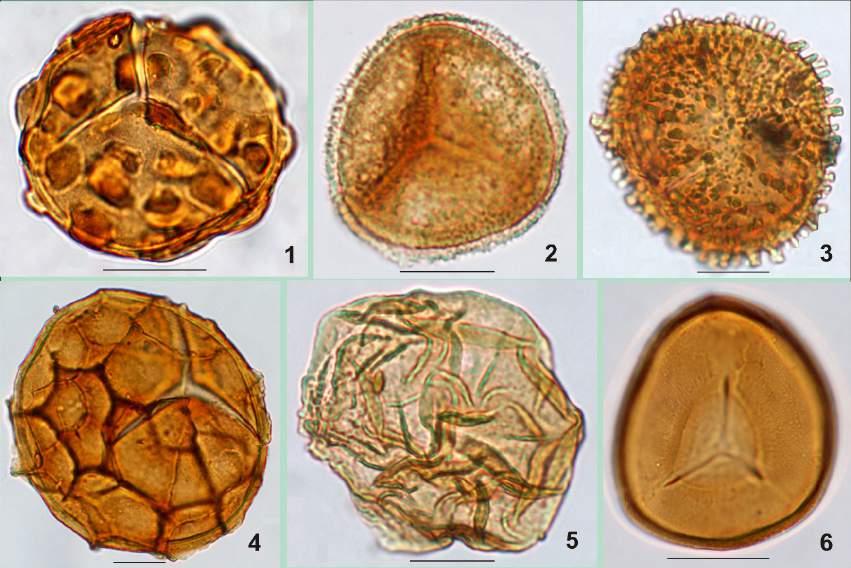
Some characteristic miospores of the Mississippian Grandispora maculosa zonal assemblage, Mount Johnstone Formation, N.S.W. 1, Verrucosisporites quasigobbettii; 2, Grandispora maculosa; 3, Raistrickia radiosa; 4, Reticulatisporites magnidictyus; 5, Velamisporites cortaderensis; 6, Psomospora detecta. Scale bars = 20 µm.
Playford, G. 2017. Intraspecific variation and palaeogeographic dispersal of the Mississippian miospore Reticulatisporites magnidictyus Playford & Helby, 1968. Palynology, DOI: 10.1080/01916122.2017.1331938. London.
Playford, G., Hashemi, H. & Wicander, R. 2017. The palynostratigraphy of the Lower Carboniferous (middle Tournaisian–upper Viséan) Shishtu Formation from the Howze-Dorah section, southeast Tabas, central Iranian Basin: discussion. Palynology, DOI: 10.1080/01916122.2016.1268520. London.
Playford, G. & Mory, A.J. 2017. Composition and occurrence of the Grandispora maculosa zonal assemblage (Mississippian) in the subsurface of the Carnarvon Basin and the Coolcalalaya Sub-basin of Western Australia, and its Gondwanan distribution. Rivista Italiana di Paleontologia e Stratigrafia, 123(2), 275-318. Milan.
Wicander, R. & Playford, G. 2017. Organic-walled microphytoplankton assemblage of the Middle Devonian (Givetian) Arkona, Hungry Hollow and Widder formations, Ontario, Canada: biostratigraphic and palaeogeographic significance. Boletín Geológico y Minero 128(4), 517–539 Madrid.
Wicander, R. & Playford, G. in press. Organic-walled microphytoplankton from the Middle Devonian (Givetian) Gravel Point Formation, Michigan, U.S.A. Palynology. London.
Gilbert Price is a Lecturer in Palaeontology at The University of Queensland. He is a vertebrate palaeoecologist and geochronologist, particularly interested in the evolution and emergence of Australia’s unique ecosystems and fauna, and their response to prehistoric climatic changes. His major research focus has been on the development of palaeoecological models for Australia’s Pleistocene megafauna. Critically, this also involves the production of reliably-dated records for the extinct species. Gilbert is the coordinator of UQ’s PalaeoResearch Group (palaeo-research.group.uq.edu.au), a past secretary of the Australasian Association of Palaeontologists, Associate Editor of Alcheringa, and Co-Chair of the Host Committee of the Society of Vertebrate Paleontology meeting to be held in Brisbane in October 2019.
Publications: (pre-2017 see www.diprotodon.com)
Stewart, M., Louys, J., Price, G.J., Drake, N., Groucutt, H.S. &Petraglia, M. accepted 30/11/2017. Middle and Late Pleistocene mammal fossil records of Arabia and surrounding regions: Implications for biogeography and hominin dispersals. Quaternary International Cobden, R., Clarkson, C., Price, G.J., David, B., Geneste, J.-M., Delannoy, J.-J., Barker, B., Lamb, L. & Gunn, R.G. 2017. The identification of extinct megafauna in rock art using geometric morphometrics: A Genyornis newtoni painting in Arnhem Land, northern Australia? Journal of Archaeological Science 87, 95-107.
Price, G.J., Ferguson, K.J., Webb, G.E., Feng, Y.-x., Higgins, P., Nguyen, A.D. Zhao, J.-x., Joannes-Boyau, R. & Louys, J. 2017. Seasonal migration of marsupial megafauna in Pleistocene Sahul (Australia – New Guinea). Proceedings of the Royal Society of London B 285 (1863), 20170785.
Butler, K., Travouillon, K.J., Price, G.J., Archer, M. & Hand, S.J. 2017. Species abundance, richness and body size evolution of kangaroos (Marsupialia: Macropodiformes) throughout the Oligo-Miocene of Australia. Palaeogeography, Palaeoclimatology, Palaeoecology 487, 25-36.
Travouillon, K.J., Louys, J., Price, G.J., Archer, M., Hand, S.J. & Muirhead, J., 2017. A review of the Pliocene bandicoots of Australia, and descriptions of new genus and species. Journal of Vertebrate Paleontology, e1360894.
Louys, J., Kealy, S., O'Connor, S., Price, G.J., Hawkins, S., Aplin, K., Rizal, Y., Zaim, J., Mahirta, M., Tanudirjo, D.A. Santoso, W.D., Hidayah, A.R., Trihascaryo, A., Wood, R., Bevitt, J. & Clark, T. 2017. Differential preservation of vertebrates in Southeast Asian caves. International Journal of Speleology 46(3), 379-408.
Price, G.J., Cramb, J., Louys, J. & Feng, Y.-x. 2017. Palaeontology of northeastern Australian caves. In Moore K. & White S. (Eds). Proceedings of the 17th International Congress of Speleology, July 22–28, Sydney, New South Wales, Australia. Australian Speleological Federation Inc. Sydney. Pp: 25-28.
Westaway, K.E., Louys, J. Due Awe, R., Morwood, M.J., Price, G.J., Zhao, J.-x., Aubert, M., Joannes-Boyau, R., Smith, T., Skinner, M.M., Compton, T., Baily, R.M., van den Bergh, G.D., de Vos, J., Pike, A.W.G., Stringer, C., Saptomo, E.W., Rizal, Y., Zaim, J., Santoso,
W.D., Trihascaryo, A., Kinsley, L. & Sulistyanto, B. 2017. An early modern human presence in Sumatra 73,000–63,000 years ago. Nature 548, 322-325.
Queensland Museum
Peter Jell (Queensland Museum and School of Earth and Environmental Sciences, University of Queensland) is working on several papers on Australian Echinoderms with a view to grouping them for publication
1) Silurian and Devonian Asterozoa of central Victoria
2) Echinoderms of the Yass- Canberra Shelf
3) Permian Asterozoa of Australia
4) A Carboniferous ophiuroid from NSW
5) A Permian starfish from Timor
6) Echinoderms of the Great Australian Superbasin
7) Comatulid crinoids of Australia
8) Cymbionites and Peridionites in the middle Cambrian of Queensland.
Cambrian projects continuing are the fauna of the Coonigan Fm in western NSW and fauna of the Currant Bush Limestone in NW Qld.
Peter A. Jell, Jack T. Woods & Alex G. Cook (2017): Mecochirus Germar (Decapoda: Glypheoidea) in the Lower Cretaceous of Queensland, Alcheringa 41(4). DOI: 10.1080/03115518.2017.1318169
SOUTH AUSTRALIA
South Australian Museum, Adelaide
Pierre Kruse (Honorary Research Associate, South Australian Museum) is close to finalising his epic Ajax Mine biostratigraphic study, jointly with Françoise Debrenne (ex Muséum National d’Histoire Naturelle (MNHN), Paris). A first draft text (over 80 species) is compiled, and the great majority of figures completed.
Pierre also commented on controversial global correlations proposed in a couple of publications, as well as having a hand in a short summary paper on the Flinders Ranges ‘red crust’ (also known as the Flinders Unconformity).
The year was punctuated by three mid-year visits to the Flinders Ranges with various colleagues. A short trip to Nanjing, China in November allowed him to collaborate with Yang Aihua (Nanjing University) on calcimicrobial-archaeocyathan reefs in the Tianheban Formation – China’s youngest archaeocyaths. A review paper is planned. Research on cryptic archaeocyaths at Las Ermitas, Spain with Elena Moreno-Eiris and Antonio Perejón (Universidad Complutense, Madrid) is still in the pipeline.
Kruse, P.D., Zhuravlev, A.Yu., Parkhaev, P. & Zhu M. 2017. Comment: A new lower Cambrian shelly fossil biostratigraphy for South Australia by Marissa J. Betts, John R.
Paterson, James B. Jago, Sarah M. Jacquet, Christian B. Skovsted, Timothy P. Topper & Glenn A. Brock. Gondwana Research 44, 258-261.
Reitner, J., Langsford. N. & Kruse, P.D. 2017. An unusual ferruginous-calcitic Frutexites microbialite community from the lower Cambrian of the Flinders Ranges, South Australia. Paläontologische Zeitschrift 91(1), 3 p. Landing, E. & Kruse, P.D. 2017. Integrated stratigraphic, geochemical, and paleontological late Ediacaran to early Cambrian records from southwestern Mongolia: Comment. Geological Society of America Bulletin 129(4), 4 p.
University of Adelaide School of Biological Sciences
Diego C. García-Bellido. Diego’s main interest is the taxonomical diversity and functional morphology of the early metazoans generated during the Cambrian ‘explosion’, and the phylogenetic relationships between the animal groups that appeared with this unique evolutionary event. His present project aims at comparing the Ediacara biota with the Emu Bay Shale and other Cambrian Lagerstätten from a palaeoecological perspective. In the last twelve months he has carried out the drilling of a 100m core at the Emu Bay Shale (funded by the National Geographic Society) and two excavations, as well as three field trips to the Flinders Ranges. Diego is also involved in the study of Ordovician assemblages in Western Gondwana (Spain & Morocco). This year he attended the following meetings: 1st International Palaeontological Congress of the Region of Atacama (Chile), the International Symposium on the Ediacaran-Cambrian Transition (ISECT-17) in Newfoundland (on the way there he visited the Cambrian Lagerstätten in Utah, with Prof. Robert Gaines from Pomona College, USA, and Prof. John Paterson from UNE, Armidale), and the International Workshop on Evolution of Cambrian Arthropods – Taxonomy, Ontogeny and Phylogeny in Xian and Chengjiang (China). The Ediacaran-Cambrian Research Group in Adelaide keeps gathering momentum, and Diego is presently supervising Ms Felicity Coutts (UoA, finishing her PhD on Ediacaran fossils), Mr James Holmes (UoA, on his first year of a PhD on EBS trilobite morphometrics and growth patterns) and Ms Lily Reid (UniSA, on her second year of a PhD on Ediacaran facies and assemblages). Besides the papers and conference abstracts below, he has several manuscripts in preparation on Australian, Spanish and Moroccan material of Ediacaran, Cambrian and Ordovician age.
Coutts, F.J.; Bradshaw, C.J.A.; García-Bellido, D.C. & Gehling, J.G. In press. Evidence of sensory-driven behavior in the Ediacaran organism Parvancorina: implications and autecological interpretations. Gondwana Research. Coutts, F.J.; Gehling, J.G.; García-Bellido, D.C. & Bradshaw, C.J.B. 2017. Growth and development of the Ediacaran fossil Parvancorina, from the Flinders Ranges of South Australia. In: D.McIlroy (ed.) International Symposium on the Edicaran-Cambrian Transition, p. 23. ISECT-2017, 136 pp. 20–22 June, St. John’s, Newfoundland, Canada. Drage, H.B.; Holmes, J.D.; García-Bellido, D.C. & Daley, A.C. In press. An exceptional record of Cambrian trilobite moulting behaviour preserved in the Emu Bay Shale, South Australia. Lethaia.
Edgecombe, G.D.; Paterson, J.R. & García-Bellido, D.C. 2017. A new aglaspidid-like arthropod from the early Cambrian Emu Bay Shale of South Australia. Geological Magazine, 154 (1): 87–95.
García-Bellido, D.C. 2017. The challenges of preserving the Emu Bay Shale: a unique fossil resource on a small island. In: Conference Abstracts, 15th Islands of the World Conference–International Small Islands Studies Association (ISISA), p. 8. ISISA 15, 2–7 July, Kingscote, Kangaroo Island.
Gutiérrez-Marco, J.C.; García-Bellido, D.C.; Sá, A.A. & Rábano, I. 2017. Digestive and appendicular soft-parts, with behavioural implications, in a large Ordovician trilobite from the Fezouata Lagerstätte, Morocco. Scientific Reports, 6, 39728.
Gutiérrez-Marco, J.C.; Rábano, I. & García-Bellido, D.C. 2017. The nileid trilobite
Symphysurus from upper Tremadocian strata of the Moroccan Anti-Atlas: taxonomic reappraisal and palaeoenvironmental implications. In: Pärnaste, H. (ed.), Abstracts 6th International Conference on Trilobites and their Relatives, p. 20. TRILO 6, 7–10 July, Tallinn, Estonia (ISBN 978-9949-81-861-7).
Gutiérrez-Marco, J.C.; Rábano, I., García-Bellido, D.C. & Sá, A.A. 2017. Selenopeltis longispina (Trilobita, Odontopleurida) from the Ordovician of Morocco: a reappraisal based on new skeletal and soft-bodied features. In: Pärnaste, H. (ed.), Abstracts 6th International Conference on Trilobites and their Relatives, Libris Est OÜ, Tallinn, pp. 20–21. TRILO 6, 7–10 July, Tallinn, Estonia.
Gutiérrez-Marco, J.C.; Sá, A.A.; García-Bellido, D.C. & Chacaltana, C.A. In press. Recent geoethic issues in Moroccan and Peruvian paleontology. Annals of Geophysics
Gutiérrez-Marco, J.C.; Sá, A.A.; García-Bellido, D.C. & Rábano, I. 2017 The BohemoIberian regional chronostratigraphic scale for the Ordovician System and palaeontological correlations within South Gondwana. Lethaia, 50 (2): 258–295.
Holmes, J.D.; García-Bellido, D.C. & Lee, M.S.Y. In press. Relationships between Cambrian Lagerstätten assemblages using multivariate, parsimony and Bayesian methods. Gondwana Research
Holmes, J.D.; García-Bellido, D.C. & Lee, M.S.Y. 2017. Assemblage relationships between Burgess Shale-type biotas in space and time. In: D. McIlroy (ed.) International Symposium on the Edicaran-Cambrian Transition, p. 46. ISECT-2017, 20–22 June, St. John’s, Newfoundland, Canada.
Paterson J.R.; Gaines, R.R.; García-Bellido, D.C.; Jago, J.B. & Gehling, J.G. 2017. Bucking the BST brand: New investigations into the palaeoenvironment and preservation of the early Cambrian Emu Bay Shale biota, South Australia. In: D. McIlroy (ed.) International Symposium on the Edicaran-Cambrian Transition, p. 98. ISECT-2017, 20–22 June, St. John’s, Newfoundland, Canada.
Reid, L.M.; García-Bellido, D.C. & Gehling, J.G. In press An Ediacaran opportunist? Characteristics of a juvenile Dickinsonia costata population from Crisp Gorge, South Australia. Journal of Paleontology.
Reid, L.M.; García-Bellido, D.C.; Payne, J. L.; Runnegar, B. & Gehling, J.G. 2017. Possible evidence of primary succession in a juvenile-dominated Ediacara fossil surface from the Flinders Ranges, South Australia. Palaeogeography, Palaeoclimatology, Palaeoecology, 476 (1): 68–76.
Reid, L.M.; García-Bellido, D.C.; Runnegar, B. & Gehling, J.G. 2017. Stranger things: characteristics of a juvenile population of Dickinsonia costata. In: D. McIlroy (ed.)
International Symposium on the Edicaran-Cambrian Transition, p. 105. ISECT-2017, 20–22 June, St. John’s, Newfoundland, Canada.
Bob Hill is working on several Cenozoic macrofossil sites in south-eastern Australia. During 2017 he had Prof. Sung Soo Whang from South Korea as a visiting Fellow and Whang spent the entire year working on the contents of the Stuart Creek silcrete flora. This has resulted in one submitted manuscript and another in preparation. PhD students Myall Tarran and Yelarney Berr continued to progress well in their palaeobotanical research and postdoctoral fellow Kathryn Hill continued her work on stomatal response to climate change.
Tarran, M., Wilson, P.G., Macphail, M.K., Jordan, G.J. & Hill, R.S. 2017. Two fossil species of Metrosideros (Myrtaceae) from the Oligo-Miocene Golden Fleece locality in Tasmania, Australia. American Journal of Botany 104, 1-14. Carpenter, R.J., Tarran, M. & Hill, R.S. 2017. Leaf fossils of Proteaceae subfamily Persoonioideae, tribe Persoonieae: tracing the past of an important Australasian sclerophyll lineage. Australian Systematic Botany 30, 148-158.
University of Adelaide
School of Physical Sciences
Department of Earth Sciences
Brian McGowran is now thirty thousand words into Southern Limestones under Western Eyes, a dreamy longform consideration of how we got to where we are in geohistory and biohistory. Its trajectory is somewhat sporadic, for, in the unlikely event that he writes his memoirs, this spring will be encapsulated under From myocardial infarction to urethral stenosis, which tended to perturb routines and wreck outcomes. Meanwhile, the marine and terrestrial palynologists at Utrecht, who have really advanced the Paleogene history of the Australo-Antarctic Gulf in recent years, found that the section on the Otway coast records the Paleocene-Eocene hothouse and thermal maximum, for the study of which Brian revisited his foraminiferal work of the 1960s.
Liz Reed is continuing work on several Quaternary cave deposits at Naracoorte. This research centres on refining chronologies and palaeoenvironmental context of key megafauna fossil sites. It is a collaborative project between Liz and many colleagues from University of Adelaide, University of Melbourne and University of Queensland. Recent grant success for this research includes an ARC Linkage grant LP160101249 Naracoorte Caves: a critical window on faunal extinctions and past climates. Her other work focuses on taphonomic and palaeoecological analyses of vertebrate assemblages from cave deposits at Naracoorte, Nullarbor and in Tasmania.
This year Liz and Dr Lee Arnold welcome five new Honours students to the Naracoorte research group. Priya will be working on fire history and environmental proxies from Alexandra Caves, Patrick Tavasci and Alex Butter are doing palaeoecological studies of Quaternary small mammal faunas, Nerita Turner is working on megafauna deposits from Specimen Cave, and Rachael Mahlknecht will be refining the chronology of Specimen Cave using OSL dating.
In 2019, Facutly of Sciences will be offering Major programs in palaeontology. Liz will be delivering a new course in Field Palaeontology with Assoc. Prof. Diego Garcia-Bellido.
Jessie-Briar Treloar is continuing to work on her PhD (supervised by Liz Reed, Mark Hutchinson and Marc Jones) investigating small mammals across the Pleistocene megafauna extinction boundary from the Naracoorte Caves fossil deposits over Marine Isotope Stage 4 to 3 (~70 ka BP to ~30 ka BP). She will be investigating the response of the small mammal palaeocommunities to climate over this time period. She will also be looking at the maxilla and dentary morphology of several species of Pseudomys from the same time period, and how taphonomy affects the interpretation of palaeoecological investigations also from the same time period. Part of this research includes extensive taphonomic study of modern owl pellets.
Lee, Arnold, Martina Demuro, Nigel Spooner, Gavin Prideaux, Matthew McDowell, Aaron Camens, Elizabeth Reed, Josep Maria Pares, Juan Luis Arsuaga, Jose Maria Bermudez de Castro, Eudald Carbonell. (in press) Single-grain TT-OSL bleaching characteristics: Insights from modern analogues and OSL dating comparisons. Quaternary Geochronology. https://doi.org/10.1016/j.quageo.2018.01.004
Reed, E. (2017). Once more unto the deep: early history of Cathedral Cave, Naracoorte. Journal of the Australasian Cave and Karst Management Association, 106, 9-14.
Reed, E. Quaternary bat fossils from southeastern Australia reveal long-term patterns of cave habitation: Implications for conservation of the critically endangered southern bent-wing bat. International Mammal Congress, Perth, July 2017.
Reed, E. The contribution of cave sites to the understanding of Quaternary Australian megafauna records (Plenary). International Congress of Speleology, Sydney, July 2017.
Reed, E. H. & Arnold, L.; (2017); Naracoorte, where half a million years of biodiversity and climate history are trapped in caves. The Conversation, June 6th 2017.
Treloar, J. Using subfossils to create a baseline: A pre-European small mammal assemblage of the north-western Flinders Ranges, South Australia. International Mammal Congress, Perth, July 2017.
University of South Australia
Jim Jago (School of Natural and Built Environments) is continuing to work on the Cambrian trilobites of Tasmania, South Australia and Antarctica. Current projects include a late Cambrian fauna from the south coast of Tasmania with John Laurie and a paper on some of the trilobites and brachiopods from the Adamsfield Trough, Tasmania (with Chris Bentley, John Laurie and Keith Corbett). In the last ten years a lot of time has gone into the Big Gully biota, a Burgess Shale type fauna from Kangaroo Island. Workers on this project include Mike Lee, Jim Gehling, John Paterson, Greg Edgecombe, Diego Garcia-Bellido, Glenn Brock and Jim Jago. Other projects include the stratigraphy and sedimentology of the Kanmantoo Group (with J. Gum, A. Burtt and P. Haines) and the history of geology (with B. Cooper).
Sun, X.W., Bentley, C.J. & Jago, J.B., 2017. The significance of Cambro-Ordovician trilobites from the Kalladeina 1 drill hole, Warburton Basin, South Australia. Australian Journal of Earth Sciences 64, 471-485. http://dx.doi.org/10 1080/08120099.2017.1319420.
Betts, M.J., Patterson, J.R., Jago, J.B., Jacquet, S.M., Skovsted, C.B., Topper, T. P. & Brock, G.A., 2017. Global correlation of the early Cambrian of South Australia: Shelly fauna of the Dailyatia odyssei Zone. Gondwana Research 46, 240-279.
Betts, M.J., Paterson, J.R., Jago, J.B., Jacquet, S.M., Skovsted, C.B., Topper, T. P. & Brock, G.A., 2017. A new lower Cambrian shelly fossil biostratigraphy for South Australia, Reply. Gondwana Research 44, 262-264.
TASMANIA
University of Tasmania
Dr Matt McDowell (Biological Sciences) recently accepted a Postdoctoral Research Fellowship at the University of Tasmania within the Dynamics of Eco-Evolutionary Patterns (D.E.E.P.) group and the University of Tasmania Node of the ARC Centre of Excellence for Australian Biodiversity and Heritage (CABAH) He will continue to research the impacts that Aborigines, megafaunal extinction and Europeans had on Australia’s biodiversity by studying animal remains from zooarchaeological and palaeontological assemblages from across Australia, but with a focus on the fauna of Tasmania. He continues to co-supervise Diana Fusco and Ariel Marcy.
Liddle, N.R., McDowell, M.C. & Prideaux, G.J. 2017. Insights into the pre-European mammalian fauna of the southern Flinders Ranges, South Australia Australian Mammalogy doi.org/10.1071/AM17035.
Gray, J.A., McDowell, M.C., Hutchinson, M.N. & Jones, M.E.H. 2017. Geometric morphometrics provides a more-objective approach for interpreting the affinity of fossil lizard jaws. Journal of Herpetology 51, 375-382.
Patrick Quilty (University of Tasmania, Honorary Research Professor)
Core E27-23
A major paper is on a 9.5 m core covering the last 52 ka from SW of Macquarie Island. It was to be a simple foram paper but it got much more complex caused by all the climatic/oceanographic changes over that period. Three papers, all roughly drafted but depending on co-authors.
The second paper is on ice-rafted debris and volcanic glass that has come from Antarctica. All major element and REE element analyses have been done and it is an easy paper when the foram paper is done. I need to work with a volcanologist to finish this one and I think we have plenty.
The third paper will compare O isotope and other data from this core with that from Law Dome in Antarctica. I work with IMAS glaciologists for that. Fantastic correlation but I pick events that don’t show up in the ice. Great stuff.
Modern Antarctic forams
This project is to document and modernise the nomenclature of modern forms from a large part of the East Antarctic margin. It began as a hobby about 20 years ago but is now partially active. Polish Polar Research has agreed to publish it. Text is well advanced: almost all SEM
work is done and plates are being made. I don’t know when this will be done as it is lower priority than the E27-23 core. More literature work to be done but that is in hand.
Ooids from glacial Antarctica
An odd one.
In several localities near the Australian station of Davis, in Pliocene and modern sandy sediments, I find 200 micron calcite spheres that formed in waters about 0°C. They are identical with ooids from European Jurassic oolites but contrast sharply with those from modern tropical environments that are aragonite, not spherical etc. Many analyses done and a rough text. Imaging now done.
VICTORIA
Deakin University (Burwood Campus, Melbourne)
Prof. Guang Shi has continued to work on Late Palaeozoic brachiopod faunas, biostratigraphy, biogeography and extinction patterns. As part of an ARC-funded research project, he is also interested in finding out (i) how body size of marine species and communities evolved in response to mass extinctions and global warming, and (ii) how marine ecosystems behaved and evolved across the Permian-Triassic boundary extinction and, in particular, whether or not there were any critical early warning signals detectable from the fossil and biogeochemical records.
Haig, D.W., Mory, A.J., McCartain, E., Backhouse, J, Håkansson, E., Ernst, A.J., Nicoll, R.S., Shi, G.R , Bevan, J.C., Davydov, V.I., Hunter, A., Keep, M., Martin, S.K., Peyrot, D., Kossavaya, O., Santos, Z.D. 2017. Late Artinskian–Early Kungurian (Early Permian) warming and maximum marine flooding in the East Gondwana interior rift, Timor and Western Australia, and comparisons across East Gondwana. Palaeogeography, Palaeoclimatology, Palaeoecology 468, 88–121.
He, W.H., Shi, G.R., Xiao, Y.F., Zhang, K.X., Yang, T.L., Wu, H.T., Zhang, Y., Chen, B., Yue, M.L., Shen, J., Wang, Y.B., Yang, H., Wu, S.B. 2017. Body size changes of latest Permian brachiopods in varied palaeogeographic settings in South China and implications for miniaturization and mass extinction. Palaeogeography, Palaeoclimatology, Palaeoecology 486, 33–45
Lee, S., Jung, J. Shi, G.R. 2017. A three-dimensional geometric morphometric study of the development of sulcus versus shell outline in Permian neospiriferine brachiopods. Lethaia xx, yy–zz
Lee, S., Shi, G.R., Park, T.-Y.S., Oh, J.-R., Mii, H.-S. and Lee, M. 2017. Virtual palaeontology: the effects of mineral composition and texture of fossil shell and hosting rock on the quality of X-ray microtomography (XMT) outcomes using Palaeozoic brachiopods. Palaeontologia Electronica 20.2.3T: 1-25 palaeoelectronica.org/content/2017/1891-xmt-on-brachiopod-foss.
Luo, M., Shi. G.R., Chen, Z.Q., Hu, S.X., Huang, J.Y., Zhang, Q.Y., Zhou, C.Y., Fang, Y.H. 2017. Youngest ambient inclusion trails from Middle Triassic phosphatized coprolites, southwestern China: new insights into an old intriguing phenomenon. Gondwana Research.
Luo, M., Shi. G.R., Hu, S.X., Benton, M.J., Chen, Z.Q., Huang, J.Y., Zhang, Q.Y., Zhou, C.Y., Wen, W., 2017. Early Middle Triassic trace fossils from the Luoping Biota, southwest China: evidence of recovery from mass extinction. Palaeogeography, Palaeoclimatology, Palaeoecology.
Luo, M., Shi, G.R., Lee, S., Yang, B. 2017. A new trace fossil assemblage from the Middle Permian Broughton Formation, southern Sydney Basin (southeastern Australia): Ichnology and palaeoenvironmental significance. Palaeogeography, Palaeoclimatology, Palaeoecology 485, 455–465.
Luo, M., Shi, G.R. 2017. First record of a complex marine trace fossil (Protovirgularia) from the Middle Permian of southeastern Gondwana (southern Sydney Basin, Australia): ichnology, palaeoecology and taphonomy. Alcheringa 41, 335–349.
Luo, M., Hu, S., Benton, M., Shi, G.R., Zhao, L., Huang, J., Song, H., Wen, W., Zhang, Q., Fang, Y., Huang, Y., Chen, Z.Q. 2017. Taphonomy and geobiology of early Middle Triassic coprolites from the Luoping biota, southwest China: implications for reconstruction of fossil food webs. Palaeogeography, Palaeoclimatology, Palaeoecology 474, 232–246
Wu, H.T., Shi, G.R., He, W.H. 2017. A quantitative taxonomic review of Fusichonetes and Tethyochonetes (Chonetidina, Brachiopoda). Journal of Paleontology 91, 1296–1305.
Xu, Y.L., Chen, Z.Q., Feng, X.Q., We, S.Q., Shi, G.R., Tu, C.Y., 2017. Proliferation of MISS-related microbial mats following the end-Permian mass extinction in the northern Paleo-Tethys: Evidence from southern Qilianshan region, western China. Palaeogeography, Palaeoclimatology, Palaeoecology 474, 198–213
Zhang, Y., Shi, G.R , Wu, H.T., Yang, T.L., He, W.H., Yuan, A.H., Lei, Y. 2017. Community replacement, ecological shift and early warning signals prior to the end-Permian mass extinction: A case study from a nearshore clastic-shelf section in South China Palaeogeography, Palaeoclimatology, Palaeoecology 487, 118–135
Dr Mark Warne is researching late Cenozoic ostracod proxy records relating to the palaeooceanographical evolution of seas surrounding Australia. In particular I am looking at the development and strength of surface ocean currents as well as the history of different types of upwelling systems. As an integral part of this research, I am also investigating the systematics and Cenozoic biogeography / palaeobiogeography of relevant marine ostracod taxa. I am also working on the systematics of Palaeozoic Ostracoda with Tamara Camilleri (Deakin University). I recently gave a talk on Cenozoic ostracod biogeography and Indo-Pacific palaeoceanography at the 18th International Symposium on Ostracoda at the University of California, Santa Barbara (USA).
Camilleri, T. T. A., Warne, M.T. & Holloway, D.J. 2017. Review and clarification of Bungonibeyrichia Copeland, 1981 (Ostracoda) from the upper Silurian-Lower Devonian of New South Wales, Australia. Alcheringa 41 (3), 397-402.
Dr Nicholas Porch is continuing his research into human impact on Indo-Pacific ecosystems using late Holocene insect subfossils. 2017 saw the resampling of sites on Tubuai and Raivavae (French Polynesia) and sorting and identification of material from Grotte Fougere on the Mascarene island of Rodrigues (Indian Ocean), the island of Corvo in the Azores and Tubuai and Raivavae in French Polynesia. Nick is beginning to delve in to taxonomy by
starting the process of describing new subfossil species that likely represent extinct species staring with the zopherid beetle fauna of the Austral Archipelago of French Polynesia.
Porch, N. & Smith, T. 2017. New Pycnomerus Erichson (Coleoptera: Zopheridae: Pycnomerini) from Rimatara, French Polynesia. Zootaxa 4237, 154–166.
Dr Elizabeth (Liz) Weldon is currently working on the taxonomy, biogeography and palaeoecology of Permian brachiopods, bivalves and conulariids. Liz continues to teach ‘Life on an evolving planet’ to a large cohort of first year students, and ‘Biogeography’ at second year level. Liz is about to begin working on a book with colleagues from China University of Geosciences on the Permian-Triassic boundary.
Dr Sanja Van Huet is working on a multidisciplinary and multi-institutional research project re-excavating the Lancefield megafauna deposit in Lancefield, Victoria. Sanja is continuing working on fossil emu material from Kangaroo and King Island; which was the focus of Tori Brewster’s Honours project; completed in 2016 and reported in the last edition of Nomen Nudum
Sanja is also continuing her taphonomical research related to the discovery of an almost complete Zygomaturus skeleton at the Bay of Islands, Nepean Peninsula, Victoria, following on Chava Rodriguez Honours project; also completed in 2016 and reported in the last edition of Nomen Nudum.
Dr Mao Luo is working on Permian-Middle Triassic bio-sedimentary structures (including microbialites and trace fossils) and uses them as tools to understand the timing and process of biotic recovery after the Permian-Triassic Mass Extinction. He is also getting involved in studying the ichnology of Early-Middle Permian in southern Sydney Basin, to explore its usage for palaeoenvironmenta reconstruction.
Luo, M., Shi. G.R; Chen, Z.Q., Song, H.J., Hu, S.X., Huang, J.Y., Zhang, Q.Y., 2017. Early Middle Triassic trace fossils from the Luoping Biota, southwest China: implications for trace-making organisms from recovered ecosystem. Palaeogeography, Palaeoclimatology, Palaeoecology
Luo, M., Shi, G.R., Lee, S., Yang, B., 2017. New trace fossil assemblage from the Middle Permian Broughton Formation, Southern Sydney Basin (Australia): ichnology and palaeoenvironmental significance. Palaeogeography, Palaeoclimatology, Palaeoecology 485, 455–465
Luo, M., Hu, S.X., Benton, M.J., Shi, G.R., Zhao, L.S., Huang, J.Y., Song, H.J., Wen, W., Zhang, Q.Y., Fang, Y.H., Huang, Y.G., Chen, Z.Q., 2017. Taphonomy and palaeobiology of early Middle Triassic coprolites from the Luoping biota, southwest China: implications for reconstruction of fossil food webs. Palaeogeography, Palaeoclimatology, Palaeoecology 474, 232–246.
Feng, X.Q., Chen, Z.Q., Woods, A., Pei, Y., Wu, S.Q., Fang, Y.H., Luo, M., Xu, Y.L., 2017. Anisian (Middle Triassic) marine ichnocoenoses from the eastern and western margins of
the Kamdian Continent, Yunnan Province, SW China: implications for the Triassic biotic recovery. Global and Planetary Change 157, 194–213.
Fang, Y.H., Chen, Z.Q., Kershaw, S., Li, Y., Luo, M., 2017. An Early Triassic (Smithian) stromatolite associated with giant ooid banks from Lichuan (Hubei), South China: environmental controls on its formation. Palaeogeography, Palaeoclimatology, Palaeoecology 486, 108-122.
Fang, Y.H., Chen Z.Q., Kershaw, S., Yang, H., Luo, M., 2017. Permian-Triassic boundary microbialites at Zuodeng Section, Guangxi Province, South China: geobiology and palaeoceanographic implications. Global and Planetary Change 152, 115–128.
Pei, Y., Chen, Z.Q., Fang, Y.H., Kershaw, S., Wu, S.Q., Luo, M., 2017. Volcanism, redox conditions, and microbialite growth linked with the end-Permian mass extinction: Evidence from the Xiajiacao section (western Hubei Province), South China. Palaeogeography, Palaeoclimatology, Palaeoecology
Dr Sangmin (Sam) Lee is continuing his research on the taxonomy, palaeobiogeography, and phylogeny of brachiopods, mainly from the mid-high latitudinal regions during the late Palaeozoic (including eastern Australia and Spitsbergen). He is also developing a 3-D geometric morphometric methodology applied to brachiopod external shells, using X-ray microtomographic and laser-scanning techniques.
Lee, S., J. Jung and Shi, G. R. 2017. A three-dimensional geometric morphometric study of the development of sulcus versus shell outline in Permian neospiriferine brachiopods. Lethaia, https://doi.org/10.1111/let.12217
Luo, M., Shi, G. R., Lee, S. and Yang, B. 2017. New trace fossil assemblage from the Middle Permian Broughton Formation, Southern Sydney Basin (southeastern Australia): ichnology and palaeoenvironmental significance. Palaeogeography, Palaeoclimatology, Palaeoecology 485, 455–465.
Lee, S., Shi, G. R., Park, T.-Y. S., Oh, J.-R., Mii, H.-S. and Lee, M. 2017. Virtual palaeontology: the effects of mineral composition and texture of fossil shell and hosting rock on the quality of X-ray microtomography (XMT) outcomes using Palaeozoic brachiopods. Palaeontologia Electronica 20.2.3T: 1‒25, https://palaeoelectronica.org/content/2017/1891-xmt-on-brachiopod-fossils
Zhang, Y., Lee, S., Wu, H.-T. and He, W.-H. 2017. Palaeobiogeographical distribution of Orbiculoidea (Brachiopoda, Discinoidea) responding to global climatic and geographical changes during the Palaeozoic. Palaeontology, https://doi.org/10.1111/pala.12339
Tamara Camilleri is completing her PhD under the supervision of Dr Mark Warne and Dr Elizabeth Weldon at Deakin University and Dr David J. Holloway at Melbourne Museum. Tamara is currently working on the reclassification of mid-Palaeozoic Ostracoda of Victoria, particularly the Fairy Bed Formation and the Norton Gully Sandstone in Eastern Victoria. Tamara has recently reclassified the ostracod taxa found within the Humevale Siltstone and Woori Yallock Formation in the Lilydale and Chirnside Park area. Her research also involves palaeoenvironmental geology and the development of understanding depositional environments.
Camilleri, T.T.A., Warne, M.T. & Holloway, D.J. 2017. Review and clarification of Bungonibeyrichia Copeland, 1981 (Ostracoda) from the upper Silurian-Lower Devonian of New South Wales, Australia. Alcheringa 41 (3), 397-402.
Bo Yang is working on his PhD project mainly about Brachiopod faunas of the Wandrawandian Formation, southern Sydney Basin, Australia. My recent study involves the lithostratigraphy and systematic palaeontology of brachiopods from Wandrawandian Formation.
Luo, M., Shi, G. R., Lee, S. and Yang, B. 2017. New trace fossil assemblage from the Middle Permian Broughton Formation, Southern Sydney Basin (southeastern Australia): ichnology and palaeoenvironmental significance. Palaeogeography, Palaeoclimatology, Palaeoecology 485, 455–465.
Rebecca Ballard is continuing with her research project in 2018, mapping a section of the Nepean Peninsula, Victoria using a drone. The project is recording a continuous extent of the palaeosol and aeolianite sequences in the Sorrento area and correlating this section with the Bridgewater Formation, which is recognised from South Australia and western Victoria. The Linnaean Society of NSW is partly funding this project.
Anja Thomsen completed her Honours this year: “Jaw disease in an extinct Pleistocene macropod, Macropus giganteus titan Owen, 1838 from Lancefield, Victoria”. Anja’s supervisors were Sanja Van Huet and Elizabeth Weldon, in collaboration with Ian Beveridge, Graham Coulson and Richard Ploeg from the Department of Veterinary Science at Melbourne University. Anja’s study aimed to determine the total prevalence of lumpy jaw in M g titan fossil bones from the Lancefield Classic Site assemblage, and complete the unfinished 1978 study by Horton and Samuel (1978). Horton and Samuel’s palaeopathology study showed a 2.4% prevalence of lumpy jaw (mandibular osteomyelitis), but not all mandibles in the collection were examined at this time. Anja concluded that the total prevalence of lumpy jaw at the Lancefield Classic Site was 1.55 %. This prevalence is low when compared to lumpy jaw prevalence in modern M. giganteus from Serendip Wildlife Sanctuary (54%) and in similar studies of wild sheep and deer populations in the northern hemisphere. Anja also concluded that the hypothesis for lumpy jaw, as an indication of the causes for the accumulation of kangaroos in the Lancefield fossil assemblage, could not be supported due to the lack of reliable reference data for lumpy jaw prevalence in wild macropods.
Tim Ziegler completed his Honours this year: “The reliability and validity of bone surface abrasion measurements in vertebrate taphonomy” Tim’s supervisors were Sanja Van Huet and Elizabeth Weldon.
Tim critically examined the prevailing method for measuring taphonomic abrasion on bone surfaces, the ‘Fiorillo scale’, an ordinal qualitative scale based on a subjective visual assessment. Despite wide use, the scale has not yet been formally validated. His study investigated the reliability and validity of the Fiorillo scale. An inter-rater reliability (IRR) experiment tested the degree of rater agreement among and between early stage raters, nonspecialists and specialists, for abrasion on vertebrate fossil surfaces. Results showed
observer bias to be greater between the experienced ‘specialist’ raters when compared with early stage raters. A pilot method was developed using higher-resolution imagery and experimental reproductions of abrasion features, to convincingly infer palaeoenvironmental conditions from isolated taphonomic data.
Congratulations to Tim on recently securing the position of Collection Manager, Vertebrate Palaeontology at Museums Victoria.
Roger Pierson maintains an interest in Gondwanan Permian palynology, and relict Permian landforms in Victoria, Australia.
Federation University Australia, Ballarat
Stephen Carey continues his involvement in a project on vertebrate fossil trackways from the Australian Pleistocene.
Camens, A.B., Carey, S.P. & Arnold, L.J. 2017. Vertebrate trace fossils from the Late Pleistocene of Kangaroo Island, South Australia. Ichnos, DOI 10.1080/10420940.2017.1337633.
Carey, S.P. & Hughes, M.J. 2017. Use, misuse and change of use of geological terms a guide for mineral industry geologists. In G.N. Phillips, ed., Australian Ore Deposits, The Australasian Institute of Mining and Metallurgy, Melbourne, Vic, pp. 47-50.
Museum Victoria
Thomas H. Rich On the penultimate day of a three week excavation at the Eric the Red West site that is located on the shore platform near the Cape Otway Lighthouse in the Early Cretaeous Eumerella Formation, a concentration of about fifteen small bones of both theropods and ornithopods was found in a few kilograms of rock. An effort will be made in 2018 to determine the extent of this concentration. Nothing like such a concentration of small bones has been previously encountered at this locality in eleven previous seasons when the site was worked.
The longest-lived order of mammals, the Multituberculata, are common in the Jurassic through Eocene of the Northern Hemisphere. Previously, the order was represented in Australia by a single lower premolar, a P4, the Holotype of Corriebaatar marywaltersae. In November 2017, a second P4 of the same species was found in a partial jaw. There may be enough morphological detail in this newly found specimen to determine whether the greater affinities of the species is with cimolodontan multituberculates kown from either the Western or Eastern Hemisphere. If such a relationship can be established, it would be the first time that an Australian Mesozoic mammal is found to have particular affinities with a particular mammalian group outside of Australa.
Submitted for publication in the same volume are two manuscripts describing extreme size variants in Australian Cretaceous mammals. One is a description of a single upper premolar of a monotreme found in the Cretaceous of Lightning Ridge. It appears to have belonged to the largest toothed monotreme that ever lived. At the other size extreme are two fragmentary
mandibles from the Cretaceous of Victoria. They are amongst the smallest mammals that ever lived.
First published in 2000, a second edition of the book Dinosaurs of Darkness is scheduled for producton in 2019 by Indiana University Press. As was the case with the first edition, the book will present a description of the field work undertaken and a summary of the scientific results of the project to understand the Ealy Cretaceous tetrapods of Victoria.
Casts of 3D rapid prototype models x10 or x20 natural size of nineteen of the better preserved Early Cretaceous mammals from Victoria have been distributed to twenty colleagues and institutions.
Rich, T.H. 2017. Australia’s Polar Cretaceous mammals. Deposits Magazine 50:18-24.
La Trobe University, Bendigo
John Neil (Hon. Research Associate). After more than 20yrs. as an Hon.Res.Associate, with a substantial (for an "amateur") publication record in conjunction with Australian friends and colleagues, I am preparing my "Swan Song", a taxonomic paper on a limited fauna of Cytherelloidea (Ostracoda) from the Batesford Quarry near Geelong, and comparative material from southern Australia and New Zealand.
My decision has been forced by the possible shut down of the SEM laboratory at La Trobe, Bendigo, and my increasing age (85, but still going strong). I have shifted my focus to providing sessions at Bendigo U3A (University of the Third Age) on geological, palaeontological, geographical and literary subjects. I will continue my membership of GSA etc. and follow developments with undiminished interest.
Monash University
Palaeontology and Basin Studies Group (School of Earth, Atmosphere and Environment)
The team’s 2017 research led by Jeff Stilwell and Chris Mays progresses greatly on systematic and applied palaeontology of major new discoveries of animals, plants, fungi, and microorganisms in amber from a diversity of sites and ages in Australia, Chatham Islands, Italy, and Myanmar. Other projects include palaeoclimate studies from the Cretaceous ‘hothouse’ in the Chatham Islands geologic record and also large-scale palaeontology projects with Museums Victoria. There have been significant outcomes for Monash palaeontology in 2017, despite the departure of Dr Chris Mays to take up a fellowship at the Naturhistoriska riksmuseet in Stockholm. Fortunately, Chris remains an affiliate at Monash
I am pleased to report that the Advanced BK Imaging System, purchased from Dun, Inc. (USA), is up and running with further lenses, so please let us know if you need any high resolution images taken! We are happy to help. Our research is still particularly focused on polar Cretaceous and Paleogene biotas and associated palaeoenvironments during the last
major greenhouse phase of the Phanerozoic. We are expanding now into the Triassic in Australia and Italy. The group has been productive again this year with more peer-reviewed papers accepted and published in 2017 in Journal of Systematic Palaeontology, Palaeontologia Electronica and Organic Geochemistry, along with several secured grants; many are listed below. Our current industry and institution portfolio includes UTP (Malaysia secured grant in Nov. 2016 for three years in collaboration with Monash Engineering), Museums Victoria, ESSO Australia, University of Texas-Austin (USA), Canterbury Museum (NZ), National Geographic Society Committee for Research and Exploration (USA), Australian Research Council (DP project on amber, June 2014 to June 2017), ANSTO, Australian Synchrotron, among others. The last five years have seen a dramatic increase in research funding for the group of >$2 million and number of keen graduate students in the field, with completed projects across a spectrum of specialties and sites. Despite the slowdown in petroleum, we are still conducting some research with several companies. Importantly, we intend to expand the amber research as well with a further project(s) in Myanmar.
Associate Professor Jeff Stilwell has had a hectic, but rewarding, teaching and research year in 2017 with a major focus on the amber discoveries. This research relates to his ARCDP140102515 grant (2014-17) with Dan Bickel of the Australian Museum and David Cantrill of the Royal Botanic Gardens Victoria. Jeff has renewed his affiliate status with the Australian Museum (Dec. 2017-Dec. 2020). Many of the organisms trapped in the Australian amber have no prior fossil record, so there is a vast amount of research to be done to work out affinities and reconstruct the terrestrial ecosystems with colleagues in Australia and around the globe, as much as these new data allow. Three quality papers are in preparation on the amber, and there will undoubtedly be more over time. Further research continues on the fossil avian remains of the Takatika Grit on the Chatham Islands in collaboration with colleagues from the University of Texas-Austin and also the Canterbury Museum. A major book on the palaeontology of the Chatham Islands has been completed with co-author Chris Mays. A project on fossil Antarctic barnacles has also been instigated by Jeff and Prof. John Buckeridge (RMIT and also now a Monash affiliate). Another major project relates to a documentary on mass extinction.
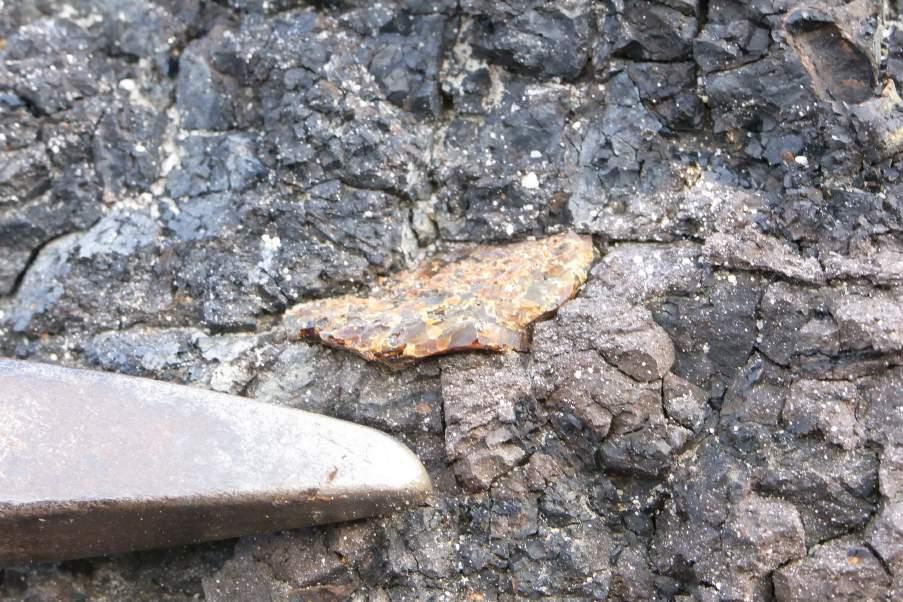
Australian Eocene amber in outcrop
Dr Chris Mays is presently researching the floral palaeoecology of polar and sub-polar palaeolatitudes of Eastern Gondwana (the Chatham Islands, New Zealand, and Winton, Queensland) during a period of global greenhouse conditions - specifically: the MidCretaceous Thermal Maximum. The aims of this research are twofold: 1) to assess the ecological repercussions of a pivotal phase of floral evolution: the emergence of flowering plants as the dominant floral group on Earth; and 2) provide a palaeontological analogue of floral adaptation patterns and biogeographic distribution in response to extreme global warming. He published a taxonomic monograph on the spore-pollen taxonomy of the midCretaceous Chatham Islands, New Zealand (AAP Memoir #47, 2015). Hannah Carle conducted research on the Chathams in 2015 for her Honours research with Chris Mays and Jeff Stilwell on the South Polar greenhouse Earth floras and environments.
Dr Andy Langendam commenced in mid-2016 as the technical officer currently working on the ARC project "The first Mesozoic fossiliferous amber from Southern Gondwana". Andy is managing the labour intensive amber preparation for study and advanced imaging, developing and refining new techniques for high definition and 3D imaging of amber inclusions, implementing new standards for the preparation and conservation of amber, advising, and guiding students and researchers, as well as learning the ropes of the BK Advanced Imaging System to image the smallest of bioinclusions. Andy assists with our student volunteer program to sort through a huge volume of bulk sediment to search for amber, especially in the deposits from Tasmania and Victoria. In Jeff Stilwell’s and Chris Mays’ eyes, Andy has made huge advances in amber palaeontology with many new significant discoveries, which relate to the extraction of relatively large pieces of amber.
Andy, with Jeff, is expanding the imaging to include external funding for Monash medicine and also Old Master art, which exemplifies the power of the BK.
High profile PhD projects have already had successful outcomes, including the collaborative project by Toban Wild with sponsorship from the University of Tasmania and the University of Sydney on both Cretaceous macro- and microfossils discovered in deep water in the Perth Abyssal Plain, particularly Batavia Knoll; significantly, these are the first palaeontologic data being gathered from Batavia Knoll, with surprising results. Shannon Herley has taken leave, but she is doing very well with her project on the sedimentology of Cretaceous deposits of southeastern Australia. Andrew (‘Drew’) Giles has commenced his PhD on fossiliferous deposits of the Wairarapa, New Zealand. Andrew Coward completed his Honours project on the geochemistry of the Paleogene amber deposits of Australia with flying colours, securing an H1 for his stellar efforts and also a lead author paper in Organic Geochemistry on the amber (see papers below). Lachlan Sutherland completed an H1 Honours project on Triassic amber of Australia and Italy and Stephen Piva completed an H1 Honours study on the Cenomanian-Turonian palaeoclimate from rocks of the Chatham Islands, New Zealand. Stephen in December was chosen as the winner of the Geological Society of New Zealand Annual Conference Best Student Honours Presentation, so well done Stephen!
Staff Roles and Expertise for 2016-17:
Assoc. Prof. Jeffrey Stilwell (Chief Investigator and Leader) - Mesozoic-Cenozoic biostratigraphy, macro- and micropalaeontology, and palaeoenvironments
Dr Chris Mays – Palaeobotany, palynology, biostratigraphy
Prof. Mike Hall - Basin Analysis and seismic interpretation
Prof. Emer. Pat Vickers-Rich – Palaeontology, Precambrian biotas and palaeoenvironments
Dr James Driscoll – Sedimentology, stratigraphy and basin studies
Dr Daniel Thompson (Conrad Petroleum, ex Kengaku Energy) – Petroleum geoscience –external consultant and advisor
Dr David Briguglio (3-D Oil Ltd) Petroleum geoscience external consultant and advisor
Dr Chris Consoli (Global CCS Institute) Carbon capture/storage in basin systems
Prof. David Cantrill (Research collaborator and advisor, Royal Botanic Gardens, Melbourne) – palaeobotany
Dr Dan Bickel (Research collaborator and advisor, Australian Museum, Sydney) –palaeoentomology
Dr Sarah Martin (Research collaborator and advisor, Geological Survey of Western Australia, Perth) – palaeoentomology
Prof. John Buckeridge (Research collaborator and Monash Honorary Affiliate in invertebrate palaeontology)
Current PhD, MSc and Honours Students and Projects at Monash since 2016
Mr James Driscoll (PhD, 2016) – ‘Upper Cambrian-Lower Ordovician sediments, northern Tasmania: An Analogue for the Development of Clastic Reservoirs’
Ms Shannon Herley (PhD) – ‘The effects of a transitional tectonic environment on sedimentation processes in the Late Cretaceous, southeastern Australia’
Mr Toban Wild (PhD) – ‘Keystones in East Gondwana breakup: palaeontology and provenance of sedimentary strata from Batavia and Gulden Draak knolls, Perth Abyssal Plain, eastern Indian Ocean’
Ms Prudence Perry (PhD) –‘Chronology and floral ecology of Early Cretaceous syn-rift sediments from the Gippsland Basin, Victoria’
Mr Mitchell O’Mara (PhD) – ‘Stratigraphy and sedimentology of Paleozoic rocks, Tasmania’
Mr Andrew (Drew) Giles (PhD) ‘Understanding the inception, episodic growth, and depocentre migration within an accretionary wedge: A structural and sedimentary synthesis, northern Wairarapa, North Island, New Zealand’
Mr Andrew Coward (Honours H1, completed mid-2016) ‘Taphonomy and chemotaxonomy of fossil-rich Eocene amber of South East Australia’.
Mr Lachlan Sutherland (Honours H1, completed November 2017) ‘Late Triassic Amber Bioinclusions: Contrasting resin-bearing localities of Italy and Australia in a Pangean palaeontologic and palaeoclimatic context’ [note: Lachie received the 2017 ESSO prize]
Mr Stephen Piva (Honours H1, completed November 2017) ‘The Cenomanian-Turonian δ13C record of the Chatham Islands, New Zealand: Implications for terrestrial stable carbon chemostratigraphy’ [note: Stephen received the 2017 ESSO prize and the 2017 Geological Society of New Zealand Annual Conference award for the Best Honours Student Presentation]
Grants 2016-17
2014-17 (Stilwell, CI1) Australian Research Council Discovery Projects (ARCDP140102515; JDS CI1 and administered through Monash with PIs Dan Bickel of Australian Museum and David Cantrill of Royal Botanic Gardens Melbourne), The first Mesozoic fossiliferous amber from Southern Gondwana: an ancient portal into an Australian polar greenhouse ($269,000 plus on-costs)
2017-18 (Stilwell, CI1, with Chris Mays) Robert Blackwood Research Seed Scheme (administered through Monash), ‘Amber as a Portal into Ancient Greenhouse Ecosystems of Southern Australia’ ($22,500)
2017 Australian Synchrotron beamline proposal, 2017/2, ‘Identifying the source of the oldest known amber of southern Gondwana’, N11959, J. Stilwell (Co-proposer) along with S. McLoughlin, J. Bevitt, D. Cantrill with C. Mays as CI1 (~$57,600)
2016-19 Padmanabhan, E.A.R. (and team), including Stilwell and Gamage, R.P. (CIs, Monash University), UTP/PETRONAS, ‘Impact of Rock Heterogeneities on Fracking and De/sorption Potentials in Some Selected Shales’ (RM 271,730.00 ~<A$84,000)
2016 Mays, C. (CI1), Cantrill, D., Kennedy, E., Raine, J., and Stilwell (CI), National Geographic Society Committee for Research and Exploration, Proposal # 9761-15, ‘MidCretaceous Fossil Forests of Zealandia and their Inhabitants’ ($31,900)
2016 Stilwell (CI1), Viegas, P. (PI), ANSTO Bragg Institute Neutron Beam Instrument Proposal, Round 2015-2 Neutron, ‘Experimental method for optimum imaging of first Southern Gondwanan fossiliferous amber’ (~$34,500)
2016 Stilwell (CI1), Viegas, P. (PI), ANSTO Bragg Institute Neutron Beam Instrument Proposal, Round 2016-2 Neutron, ‘Experimental method for optimum imaging of the first Southern Gondwanan fossiliferous amber’ (~$28,400)
2016 Stilwell (CI1), Viegas, P. (PI), ANSTO Bragg Institute Neutron Beam Instrument Proposal P5521, Round 2016-2 Neutron Travel Award, ‘Experimental method for optimum imaging of the first Southern Gondwanan fossiliferous amber’ ($1576.15)
2016 Mays, C. (CI1), Stilwell (CI), ANSTO Bragg Institute Neutron Beam Instrument Proposal P5524, Round 2016-2 Neutron, Neutron tomographic extraction of fertile plant fossils to reveal the source and function of the oldest known amber of southern Gondwana ($30,000)
2015-16 Stilwell (CI1) Argonne National Laboratory (USA), Advanced Photon Source, GUP-44779, Experimental method for optimum imaging of the first southern Gondwanan fossiliferous amber ($98,691)
Selected Publications 2016-17:
Coward, A.J., Mays, C., Patti, A.F., Stilwell, J.D., Viegas, P., and O’Dell. In press (Accepted 11/12/2017) Taphonomy and chemotaxonomy of Eocene amber from southeastern Australia. Organic Geochemistry.
Mays, C., Bevitt, J. J., and Stilwell, J. 2017. Pushing the limits of neutron tomography in palaeontology: Three-dimensional modelling of in situ resin within fossil plants. Palaeontologia Electronica 20.3.57A: 1-12. https://doi.org/10.26879/808, palaeoelectronica.org/content/2017/2066-neutron-scan-plant-resin.
Mays, C., Cantrill, D. J., Stilwell, J. D., and Bevitt, J. 2017 Neutron tomography of Austrosequoia novae-zeelandiae comb. nov. (Late Cretaceous, Chatham Islands, New Zealand): implications for Sequoioideae phylogeny and biogeography. Journal of Systematic Palaeontology, DOI: 10.1080/14772019.2017.1314898.
Stilwell, J.D., Vitacca, J., and Mays, C. 2016. South Polar greenhouse insects (Arthropoda: Insecta: Coleoptera) from the mid-Cretaceous Tupuangi Formation, eastern Zealandia. Alcheringa 40. http://dx.doi.org/10.1080/03115518.2016.1144385.
Whittaker, J., Williams, S., Wild, T., Watson, S., Halpin, Stilwell, J., and Daczko. 2016. Eastern Indian Ocean microcontinent formation driven by plate motion changes. Earth and Planetary Science Letters 454, 203-212.
Wild, Toban J., and Stilwell, J.D. 2016. First Cretaceous (Albian) invertebrate fossil assemblage from Batavia Knoll, Perth Abyssal Plain, eastern Indian Ocean: taxonomy and paleoecological significance. Journal of Paleontology 90(5), 959-980.
Stilwell, J.D. 2016. Zealandia’s oldest volutes (Mollusca: Gastropoda) from the early Paleogene of South Island and Chatham Islands post Gondwana break-up and evolutionary divergence. Journal of Paleontology 90(1), 31-42. doi: 10.1017/jpa.2016.19.
Martin, S.K., Skidmore, L.I., & Stilwell, J.D. 2016. A first record of Cretaceous aphids (Hemiptera, Sternorrhyncha, Aphidomorpha) in Australia, from the Lower Cretaceous Koonwarra Fossil Bed, Victoria. Zootaxa 4137 (1), 095-107 http://doi.org/10.11646/zootaxa.4137.1.7.
Conference Abstracts
Piva, S. B., Mays, C. and Stilwell, J. D. 2017. The Cenomanian-Turonian δ13C record of the Chatham Islands: implications for terrestrial stable carbon chemostratigraphy. In: Baker, J. and Rowe, M. (eds). Abstracts, Geosciences 2017, Auckland, Geoscience Society of New Zealand Miscellaneous Publication 147A. p. 87.
RMIT
University, Earth & Oceanic Systems Research Group
John Buckeridge continues his work on the palaeontology, palaeoecology, biology and distribution of marine invertebrates, especially barnacles. With a team led by Tom Koci (National Musem, Prague), he has described the earliest known “acorn barnacle” Archaeochionelasmus, which was collected from the Cretaceous Basin of the Czech Republic. Paul Ter (on ichnology) and Fearghus McSweeney (on palaeobotany) are moving ahead with their respective doctoral studies.
John and Alan Beu (GNS) have been working on the Castlepoint Limestone (East Coast New Zealand), and hope to submit a manuscript describing the depositional environment of the lithology early in 2018. John has started a project with Shih-Wei Lee (National Museum of Marine Science & Technology, Taiwan) and Benny Chan (Academia Sinica) on the Miocene whale epibiont Coronula from Taiwan. Hopefully this will enhance our understanding of the evolution of the complex relationship between barnacles and whales.
Figure: Coronula sp. from the Miocene of Taiwan. This is the earliest known occurrence of the genus, and is almost indistinguishable from modern representatives. It is part of an extensive collection made by amateur palaeontologists over two decades, and is now in the collections of Academia Sinica.
John is also working with Jeff Stillwell (Monash University) on an even earlier coronulid (Eocene?) recovered from the Antarctic Peninsula. It is however, unlikely to be Coronula s.s.
A new Neolepadine from the Solnhofen Limestone, has been published with German colleagues, led by Christina Nagler (Ludwig-Maximilians-Universität München); this describes one of the earliest mutual relationships between sponges and barnacles.
A book on the remarkably diverse and abundant invertebrate and vertebrate fossils of the Rickett’s Point Marine Sanctuary, Port Phillip, Victoria by Fearghus McSweeney and John was published early in the year. It is available for free down-load from
https://www.iubs.org/publi/otherpubli.html. It is one of a series of three books published by the Earth & Oceanic Systems Group – a further book, on the botany of Rickett’ Point is underway.
John has become involved with the current taxonomic impasse which concerns the robustness (or otherwise) of process for naming a new species. It is planned to submit a proposal for an IUBS Commission to evaluate the current system(s), and to see whether a more consistent approach to defining taxa can be established (see correspondence in Nature (below)).
Buckeridge, J.S. and W.A. Newman, 2017. The “Tears of the Virgin” at Lakes Entrance, Victoria were made by the intertidal barnacle Chthamalus antennatus Darwin (Cirripedia: Thoracica). Integrative Zoology 12: 228–236. doi: 10.1111/17494877.12244
Buckeridge, J. S., 2017. Taxonomy: swallow the costly medicine. Nature 545: 600 (29 June 2017). http://www.nature.com/
Kočí, T., Kočová V.M., Newman, W.A., Buckeridge, J.S. and J. Sklenář, 2017. Archaeochionelasmus nekvasilovae gen. et sp. nov. (Cirripedia, Balanomorpha, Chionelasmatoidea) from the Bohemian Cretaceous Basin (Czech Republic): the first bona fide Cretaceous neobalanoform. Zootaxa 4294(2): 181–196 doi: 10.11646/zootaxa.4294.2.3
McSweeney, F., 2017. An Investigation of Porifera from the Miocene Batesford Limestone, Victoria. 67 pp. Unpublished Bachelor of Science (Honours) thesis held in the RMIT University Library.
McSweeney, F. and J.S. Buckeridge, 2017. The fossils of the Urban Sanctuary: Rickett’s Point, Victoria 3193. Greypath Publications, Melbourne. 114 pp. ISBN 9781760563387.
Nagler, C., Haug, J. Glenner, H. and J. Buckeridge, 2017. Litholepas klausreschi sp. et gen. nov., a new neolepadine barnacle (Cirripedia, Thoracica) on Codites (Porifera) from the Jurassic Lithographic Limestone of southern Germany. Neues Jahrbuch für Geologie und Paläontologie 284(1): 29–42. doi: 10.1127/njgpa/2017/0646
The University of Melbourne www.earthsci.unimelb.edu.au
The School of Earth Sciences at the University of Melbourne has several staff working on a variety of palaeontological research themes. Our research interests range from the origin of animal life in the Cryogenian 650 million years ago (Wallace) to Mesozoic to Cenozoic foraminifera, environments and palynomorphs from northwest and southeast Australia (Gallagher, Wallace, Holdgate, Tosolini, Wagstaff, McLaren, Cupper). Other research includes dating mega-marsupial and early human fossils (Cupper). Several students have successfully completed palaeontology projects in 2017. A full list of our staff, students and publications follows:
Staff:
Assoc Prof. Malcolm Wallace Reader: Neoproterozoic Cryogenian Life and reefs
Assoc. Prof. Stephen Gallagher Reader: Mesozoic to Cenozoic micropalaeontology and palaeoceanography using foraminifera especially on IODP Expedition 356
Dr. Sandra McLaren Lecturer/Research Fellow: dating the onset of aridity in Australia
Dr. Anne-Marie Tosolini Lecturer: Cretaceous to Paleogene palaeobotany of Antarctica and southeast Australia
Dr Matt Cupper Research Fellow: dating megafauna sites and human fossils
Dr Guy Holdgate Research Fellow: palaeoenvironmental evolution of Cenozoic brown coal
Dr. Barbara Wagstaff Research Fellow: Mesozoic to Cenozoic palynology
Dr Ashleigh Hood Research Fellow: Cryogenian geochemistry
Dr Julia Dickinson Research Fellow: Gippsland stratigraphy
Post graduate students (current):
PhD: Vera Korasidis Palynology of Latrobe Valley coals.
PhD: Maxwell Lechte Precambrian Ironstones
PhD Liz Mahon Gippsland Basin coals
PhD: Jackson McCaffrey reefs of the Northwest Shelf.
PhD: Tony Sandler Echinoid taxonomy in the Miocene Mannum Limestone.
PhD: Alice Schuster Phanerozoic oxygenation
Aghaei, H., Hall, M., Wagstaff, B., Tait, A., 2017. Stratigraphic reconstruction of the Strzelecki Group outcrops in west Gippsland: new data on the present-day thickness and amount of erosion. Australian Journal of Earth Sciences, 64 (2), pp. 251-264.
Christensen, B.A., Renema, W., Henderiks, De Vleeschouwer, D., Groeneveld, J., Castañeda, I., Reuning, L., Bogus, K.A., Auer, G., Ishiwa, McHugh, C.M., Gallagher, S.J., Fulthorpe, C.S. and Exp. 356 Scientists. 2017. Indonesian Throughflow drove Australian climate from humid Pliocene to arid Pleistocene. Geophysical Research Letters, 44 doi. 10.1002/2017GL072977
Lipar, M., Webb, J., Cupper, M., Wang, N. 2017 Aeolianite, calcrete/microbialite and karst in southwestern Australia as indicators of Middle to Late Quaternary palaeoclimates. Palaeogeography, Palaeoclimatology, Palaeoecology 470, 11-29. DOI: 10.1016/j.palaeo.2016.12.019
Gallagher, S.J., Fulthorpe, C.S., Bogus, K.A. and Expedition 356 Scientists, 2017. Expedition 356 Summary. Proceedings of the IODP 356, 1- 43. doi.org/10.14379/iodp.proc.356.101.2017
Gallagher, S.J., 2017. Indonesian Throughflow: A 5-million-year history of the Indonesian Throughflow Current, the Australian Monsoon and subsidence on the Northwest Shelf of Australia: IODP Expedition 356, in, Exon, N., ed., Exploring the Earth under the Sea (Australian National University Press), p. 152- 155 doi.org/10.22459/EEUS.10.2017
Gallagher, S.J., 2017. A study of the Asian Monsoon in the Japan Sea: IODP Expedition 346, in, Exon, N., ed., Exploring the Earth under the Sea (Australian National University Press), p. 122-124 doi.org/10.22459/EEUS.10.2017 ISBN: 9781760461454
Groeneveld, J., Hendricks, J., Renema, W., McHugh, C.M., De Vlesschouwer, D., Christiansen, B.A.,Fulthorpe, C.S., Reunig, L., Gallagher, S.J., Bogus, K.A., Auer, G., Ishiwa, T. and Expedition 356 Scientists, 2017. Australian shelf sediments reveal shifts in Miocene southern Hemisphere Westerlies. Science Advances, 3, e1602567.
Holdgate, G.R., Sluiter, I.R.K., Taglieri, J., 2017. Eocene-Oligocene coals of the Gippsland and Australo-Antarctic basins – Paleoclimatic and paleogeographic context and
implications for the earliest Cenozoic glaciations Palaeogeography, Palaeoclimatology, Palaeoecology, 472, pp. 236-255.
Holdgate, G.R. and Norvick, M., 2017. Geological evolution of the Holocene Yarra Delta and its relationship with Port Phillip Bay. Australian Journal of Earth Sciences, 64 (3), pp. 301-318.
Hood A.v.S. and Wallace, M.W., 2017 Neoproterozoic carbonate mineralogy and its palaeoceanographic significance, Global and Planetary Change, in press. https://doi.org/10.1016/j.gloplacha.2017.11.006
Korasidis, V. A., Wallace, M. W., Jansen, B., 2017. The significance of peatland aggradation in modern and ancient environments Palaios. 32, 658-671.
Korasidis, V.A., Wallace, M. W., Wagstaff, B. E., Holdgate, G. R., 2017. Oligo-Miocene peatland ecosystems of the Gippsland Basin and modern analogues. Global and Planetary Change 149, 91-104.
Park, T., Evans, A. R., Gallagher, S.J. and Fitzgerald, E.M.G., 2017. Low frequency hearing preceded the evolution of giant body size and filter feeding in baleen whales, Proceedings of the Royal Society B, v. 284 (1848) 20162528. doi.org/10.1098/rspb.2016.2528
Sadler, T., Martin, S.K. and Gallagher, S.J., 2017. Three new species of the echinoid genus Monostychia Laube, 1869 from Western Australia, Alcheringa 41, 464473. doi.org/10.1080/03115518.2017.1282979
Sluiter, I.R.K., Holdgate, G.R., Blackburn, D.T., 2017. Fire and Late Oligocene to MidMiocene peat mega-swamps of south-eastern Australia: a floristic and palaeoclimatic interpretation. Australian Journal of Botany 64 (8), 609-625
Tarhan L.G, Hood, A.v.S., Droser M.L., Gehling J.G. and Briggs D.E.G., 2017. Comment–Delusions of dirt: Ediacara organisms were not soil dwellers Geology, 45. doi:10.1130/G38858Y.1
Tosolini, A-M., 2017. Palaeoecology: North–South Recovery Divide. Nature Ecology & Evolution, ISSN 2397-334X (online).
Wallace, M.W, Hood, A.v.S., Shuster, A., Greig, A., Planavsky, N.J. and Reed, C.P., 2017. Oxygenation history of the Neoproterozoic to early Phanerozoic and the rise of land plants, Earth and Planetary Science Letters, 466, 1219. https://doi.org/10.1016/j.epsl.2017.02.046
Swinburne University of Science and Technology, Hawthorn, Victoria
Elaine Anderson (also Volunteer with Melbourne Museum) is about to commence honours in 2018, with supervisors Dr Stephen F. Poropat and Dr Sarah Martin. The project will be on Odonata from the Koonwarra specimens held at Melbourne Museum.
Adele H. Pentland (also Research Associate at the Australian Age of Dinosaurs Museum, Winton) began research into the Australian Cretaceous pterosaur record in fulfillment of the degree of Doctor of Philosophy Fieldwork conducted with the Australian Age of Dinosaurs Museum, Winton, Queensland was successful in excavation of a new dig site, yielding a subadult sauropod derived from the Winton Formation. Among the finds were teeth, a nearcomplete neck with in situ cervical ribs, a partial thorax and appendicular elements, as well as possible gut contents.
Popular articles
Pentland, A. 2016. Blacksoil: Australovenator in Victoria: Part 2 Australian Age of Dinosaurs Museum of Natural History Annual 14, 8.
Stephen F. Poropat (also Research Associate at the Australian Age of Dinosaurs Museum, Winton and Melbourne Museum) has continued his work on Australian Cretaceous sauropod dinosaur systematics, osteology, phylogenetic relationships, and palaeobiogeography. This year saw the publication of a reappraisal of Austrosaurus mckillopi, and the submission of a review article on the Early Cretaceous palaeobiota of Victoria. Fieldwork in Victoria (with Dinosaur Dreaming) and Queensland (with the Australian Age of Dinosaurs Museum) was extremely successful. A highlight was the excavation of a tremendous new sauropod specimen from the Winton Formation which includes teeth, a near-complete neck, a partial thorax and appendicular elements, as well as possible gut contents Although his work on Eromanga Basin Cretaceous vertebrates is ongoing, he is now also working on Victorian Cretaceous fossils with Pat Vickers-Rich and Tom Rich.
Paulina Carabajal, A., Sterli, J., Georgi, J., Poropat, S.F. & Kear, B.P. 2017. Comparative neuroanatomy of extinct horned turtles (Meiolaniidae) and extant terrestrial turtles (Testudinoidea), with comments on the paleobiological implications of selected endocranial features. Zoological Journal of the Linnean Society 180, 930–950.
Poropat, S.F., Kool, L., Vickers-Rich, P. & Rich, T.H. 2017. Oldest meiolaniid turtle remains from Australia: evidence from the Eocene Kerosene Creek Member of the Rundle Formation, Queensland. Alcheringa 41, 231–239.
Poropat, S.F., Nair, J.P., Syme, C.E., Mannion, P.D., Upchurch, P., Hocknull, S.A., Cook, A.G., Tischler, T.R. & Holland, T. 2017. Reappraisal of Austrosaurus mckillopi Longman, 1933 from the Allaru Mudstone of Queensland, Australia’s first named Cretaceous sauropod dinosaur. Alcheringa 41, 543–580.
González Riga, B.J., Mannion, P.D., Poropat, S.F., Ortíz David, L.D. & Coria, J.P. in press. Osteology of the Late Cretaceous Argentinean sauropod dinosaur Mendozasaurus neguyelap: implications for basal titanosaur relationships. Zoological Journal of the Linnean Society.
Klinkhamer, A.J., Mallison, H., Poropat, S.F., Sloan, T. & Wroe, S. in review. Threedimensional musculoskeletal modelling and moment arm analysis of the neosauropod forelimb. Paleobiology.
Poropat, S.F., Martin, S.K., Tosolini, A.-M.P., Wagstaff, B.E., Bean, L.B., Kear, B.P., Vickers-Rich, P. & Rich, T.H. submitted. Early Cretaceous polar biotas of Victoria, southeastern Australia an overview of research to date. Alcheringa.
Popular articles
Poropat, S. 2017. Blacksoil: Head first at last, an Australian sauropod skull! Australian Age of Dinosaurs Museum of Natural History Annual 14, 7.
Poropat, S. 2017. Savannasaurus: From Gondwana to the grasslands. Australian Age of Dinosaurs Museum of Natural History Annual 14, 24–33.
Poropat, S., 2017. Dinosaur Stampede. Australian Age of Dinosaurs, Winton, Queensland, Australia. 61 pp.
Poropat, S. in press. The Koonwarra Fossil Bed. Ferns, flowers, fleas and fish... and feathers for good measure! Australian Age of Dinosaurs Museum of Natural History Annual 15
Patricia Vickers-Rich At the beginning of 2017, Patricia Vickers-Rich began a three year primarily research appointment at Swinburne University of Science and Technology. Likewise, in association with Pat, Stephen F. Poropat began a three-year postdoc there.
Pat’s research focuses on latest PreCambrian deposits from southern Namibia. This takes the form of describing and interpreting the multicellular organisms found in the deposits together with a number of colleagues documenting the physical aspects of the deposits. With several ash layers in the rock sequence, which spans the PreCambrian – Cambrian boundary, the area is uniquely set to provide a detailed history of the transition between the latest PreCambrian and Cambrian biotas. To this end, detailed geochronological and geochemical studies are currently underway.
Hinder, G., Vickers-Rich, P., van Schalkwyk, P., Schneider, G., 2016. The Fish River Canyon and Nama Group of Namibia. in: Africa’s Top Geological Sites. 35th International Geological Congress Commemorative Volume, Struik Nature [and imprint of Penguin Random House South Africa Pty Ltd], Cape Town, South Africa, 129-134. Ivantsov, A. Yu., Narbonne, G.M., Trusler, P.W., Greentree, C., Vickers-Rich, P., 2016. Elucidating Ernietta: new insight from exceptional specimens from the Ediacaran of Namibia. Lethaia 49, 540-554.
Ulf Linnemann., gustín Pieren Pidal., Mandy Hofmann., Kerstin Drost., Cecilio Quesada., Axel Gerdes., Linda Marko., Andreas Gärtner., Johannes Zieger., Jens Ulrich., Rita Krause., Patricia Vickers-Rich., Jana Horak. 2017. A ~565 Ma old glaciation in the Ediacaran of peri-Gondwanan West Africa Int J Earth Sci Geol Rundsch https://doi.org/10.1007/s00531-017- 1520-7
Poropat, S.F., Kool, L., Vickers-Rich, P., Rich, T.H., 2016. Oldest meiolaniid turtle remains from Australia: evidence from the Eocene Kerosene Creek Member of the Rundle Formation, Queensland. Alcheringa 41. doi: 10.1080/03115518.2016.1224441
Rich, T.H., Hopson, J.A., Gill, P.G., Trusler, P., Rogers-Davidson, S., Morton, S., Cifelli, R.L., Pickering, D., Kool, L., Siu, K., Burgmann, F.A., Senden, T., Evans, A.R., Wagstaff, B.E., Seegets-Villiers, D., Corfe, I.J., Flannery, T.F., Walker, K., Musser, A.M., Archer, M., Pian, R., Vickers-Rich, P., 2016. The mandible and dentition of the Early Cretaceous monotreme Teinolophos trusleri Alcheringa 40, 475-501.
Sharp, Alana C. ; Evans, Alistair R. ; Wilson, Siobhan A. ; Vickers-Rich, Patricia. 2017. First non-destructive internal imaging of Rangea, an icon of complex Ediacaran life. Precambrian Research, September 2017, Vol.299, pp.303-308.
Vickers-Rich, Soleimani, S., Farjandi, F., Zand, M., Linnemann, U., Hofmann, M., Wilson, S. A., Cas, R., Rich, T. H., 2017. New discoveries of large, complex organisms in the Late Neoproterozoic/Phanerozoic of Iran. Alcheringa
Curtin University, Perth
WESTERN AUSTRALIA
PACE: Palaeontology, Ancient Climates and Environment
Milo Barham has been diverted more fully into the world of sediment tracking and provenance but continues to pursue interests in palaeontology. Primarily, oxygen isotopes in chordate biogenic apatite remain the focus of study, with investigations of the controls and applications of the palaeoenvironmental proxy to both terrestrial (Cenozoic micromammal) and marine (Palaeozoic) realms. Two palaeontological papers published this year have investigated important histological and taphonomic considerations of oxygen-isotope studies in biogenic apatite. Furthermore, research continues on conodont and microvertebrate biostratigraphy in the Palaeozoic (Carboniferous primarily).
Barham, M., Blyth, A., Wallwork, M., Joachimski, M., Martin, L., Evans, N., Mawson, P., & McDonald, B., 2017. Digesting the data? Effects of predator ingestion on the oxygen isotopic signature of micromammal teeth. Quaternary Science Reviews 176, 71-84. Roelofs, B., Barham, M., Cliff, J., Joachimski, M., Martin, L., & Trinajstic, K. 2017. Assessing the fidelity of marine vertebrate microfossil δ18O signatures and their potential for palaeo-ecological and -climatic reconstructions. Palaeogeography, Palaeoclimatology, Palaeoecology 465, 79-92.
Catherine Boisvert is continuing to focus on elephant shark developmental biology as a way to understand early gnathostome innovations. She presented her work on the evolution of muscle formation at the Pan American Evolution and Development society in Calgary, Canada. She continues to collaborate with Kate Trinajstic on the evolution of reproduction and they have submitted a chapter for the book “Evolution and development of fish” edited by Zerina Johanson, Charlie Underwood and Martha Richter. Her collaborative work on the evolution of bipedal locomotion in chondrichthyans has been submitted to Cell.
Rodney Berrell is continuing to work on late Mesozoic fishes from the Eromanga Basin of Queensland as part of a PhD project based at Curtin University.
Kate Trinajstic is working on the evolution of novel structures, particularly the musculoskeletal system in placoderms, soft-tissue preservation, palaeoenvironments and biostratigraphy of early-vertebrates from Western Australia. Research continues with John Long and HDR candidate Sarah Hearne on the Gogo Reefs looking at the evolution of niche separation. I continue to work with Milo Barham to evaluate the suitability and accuracy of different vertebrate mineralised tissues as proxies for recording ontogenetic, phylogenetic and environmental signals. Work continues with Heidi Allen on Upper Devonian biostratigraphy using both conodonts and microvertebrates in the Canning, Carnarvon and Perth Basins.
Allen, H.J. & Trinajstic, K. 2017. An Early Devonian fish fauna from an unnamed sandstone in Wendy 1 drillhole, northern Perth Basin. Geological Survey of Western Australia, Paleontology Report 2017/1, 4p.
Johanson, Z., Smith, M., Sanchez, S., Senden, T., Trinajstic, K. and Pfaff, C., 2017. Questioning hagfish affinities of the enigmatic Devonian vertebrate Palaeospondylus. Royal Society Open Science, 4(7), p.170214.
Gess, R.W. and Trinajstic, K.M., 2017. New morphological information on, and species of placoderm fish Africanaspis (Arthrodira, Placodermi) from the Late Devonian of South Africa. PloS one, 12(4), p.e0173169.
Roelofs, B., Barham, M., Cliff, J., Joachimski, M., Martin, L. and Trinajstic, K., 2017. Assessing the fidelity of marine vertebrate microfossil δ 18 O signatures and their potential for palaeo-ecological and-climatic reconstructions. Palaeogeography, Palaeoclimatology, Palaeoecology, 465, pp.79-92.
Playton, Ted E., Roger M. Hocking, Eric Tohver, Kelly Hillburn, Peter W. Haines, Kate Trinajstic, Brett Roelofs et al. 2017. "Integrated stratigraphic correlation of Upper Devonian platform-to-basin carbonate sequences, Lennard Shelf, Canning Basin, Western Australia: Advances in carbonate margin-to-slope sequence stratigraphy and stacking patterns." SEPM Special Publications 248-301.
Hearne, S., M. Travers, R. Evans, A. Blyth, K. Trinajstic, J. McIlwain, and S. Newman. 2017. "Population connectivity of two reef fish species in northwestern Australia using otolith geochemistry: A pilot study." Report of Project 1.1.3 - Project 1.1.3.4c prepared for the Kimberley Marine Research Program, Western Australian Marine Science Institution, Perth, Western Australia, 31pp.
2016
Roelofs, B., Barham, M., Mory, A.J. and Trinajstic, K., 2016. Late Devonian and Early Carboniferous chondrichthyans from the Fairfield Group, Canning Basin, Western Australia. Palaeontologia Electronica, 19(1), pp.1-28.
Hairapetian, V., Roelofs, B.P., Trinajstic, K.M. and Turner, S., 2016. Famennian survivor turiniid thelodonts of North and East Gondwana. Geological Society, London, Special Publications, 423(1), pp.273-289.
Trinajstic, K. (2016) The Laidlaw Range in the Canning Basin (Upper Devonian) In Planet Earth - In Deep Time Palaeozoic Series Devonian & Carboniferous. Thomas J. Suttner; Erika Kido; Peter Königshof; Johnny A. Waters; Laura Davis; Fritz Messner (eds) Schweizerbart Scientific Publishers ISBN 978-3-510-65335-5. p 20.
Trinajstic, K., Hocking R. and Playton T.E. (2016) The section at Casey Falls, Canning Basin (Upper Devonian) In Planet Earth - In Deep Time Palaeozoic Series Devonian & Carboniferous. Thomas J. Suttner; Erika Kido; Peter Königshof; Johnny A. Waters; Laura Davis; Fritz Messner (eds) Schweizerbart Scientific Publishers ISBN 978-3-51065335-5, p 24
The University of Western Australia Biostratigraphy Group
David Haig continues an active retirement working on projects in Western Australian basins and Timor. Papers published during the last year are:
Haig, D.W., Mory, A.J., 2016. Middle Permian (Roadian) Foraminifera from mudstone facies of the type Baker Formation, Southern Carnarvon Basin, Western Australia. Journal of the Royal Society of Western Australia 99(2), 61-75.
Haig, D.W., Mory, A.J., McCartain, E., Backhouse, J., Håkansson, E., Ernst, A., Nicoll, R.S., Shi, G.R., Bevan, J.C., Davydov, V.I., Hunter, A., Keep, M., Martin, S., Peyrot, D., Kossavaya, O., Dos Santos, Z., 2017. Late Artinskian–Early Kungurian (Early Permian) warming and maximum marine flooding in the East Gondwana interior rift, Timor and Western Australia, and comparisons across East Gondwana. Palaeogeography, Palaeoclimatology, Palaeoecology 468, 88–121.
Haig, D.W., 2017. Permian (Kungurian) Foraminifera from Western Australia described by Walter Parr in 1942: reassessment and additions. Alcheringa doi: 10.1080/03115518.2017.1374459.
Western Australian Museum, Perth
Kenny J. Travouillon (Curator of Mammalogy) is continuing to work at the Western Australian Museum. He received a Churchill Fellowship that took him to Europe and the USA to examine modern and fossil specimens of peramelemorphians (types and non-types), to undertake a revision of the whole order, and describe new species from the Oligocene of central Australia.
Faith, J.T., Dortch, J., Jones, C., Shulmeister, J. & Travouillon, K.J. 2017. Large mammal species richness and late Quaternary precipitation change in southwestern Australia. Journal of Quaternary Science 32, 760-769. http://dx.doi.org/10.1002/jqs.2888.
Butler, K., Travouillon, K.J., Price, G.J., Archer, M. & Hand, S.J. 2017. Species abundance, richness and body size evolution of kangaroos (Marsupialia: Macropodiformes) throughout the Oligo-Miocene of Australia. Palaeogeography, Palaeoclimatology, Palaeoecology 487, 25-36 http://dx.doi.org/10.1016/j.palaeo.2017.08.016
Travouillon, K.J., Louys, J., Price, G.J., Archer, M., Hand, S.J., & Muirhead, J. 2017. A review of the Pliocene bandicoots of Australia, and descriptions of new genus and species. Journal of Vertebrate Paleontology 37(5), e1360894. http://dx.doi.org/10.1080/02724634.2017.1360894
Travouillon, K.J. & Phillips, M.J. accepted 24/11/2017. Total evidence analysis of the phylogenetic relationships of bandicoots and bilbies (Marsupialia: Peramelemorphia): reassessment of two species and description of a new species. Zootaxa
Geological Survey of Western Australia, Department of Mines, Industry Regulation and Safety (DMIRS)
The Geological Survey of Western Australia is currently (as of November 2017) part of a reorganisation of all Western Australian State government departments. As part of this change, the previous Department of Mines and Petroleum is now the new Department of
Mines, Industry Regulation and Safety (note changes to email and postal addresses). Other organisational changes are likely to occur early within 2018.
Despite this, the GSWA Paleontology Collection remains open to all researchers, both within Australia and internationally. Work continues on an ongoing project to digitize the collection’s catalogue, and attempts to recover past (and often very overdue!) loans made by GSWA to various Australian institutions. Any information or queries regarding the location of potential Survey samples (generally numbered with a F- prefix) is most welcome contact Sarah Martin. GSWA is also currently investigating improved methods of collection imaging and data delivery, including 3D scanners for macrofossils and slide scanners for microfossil collections.
GSWA’s historic informal paleontology reports are now available online to search and download (click ‘Paleontology Reports’ under ‘Using online catalogue’ at http://www.dmp.wa.gov.au/Geological-Survey/GSWA-publications-and-maps-1399.aspx).
This collection includes a set of period summaries (akin to GSWA Bulletin 136 ‘Palaeontology of the Permian of Western Australia’, but covering the individual periods from the Precambrian to Quaternary) collated in the late 1980s and early 1990s. A new series of GSWA Paleontology Reports has also been established in 2016, providing an avenue for the rapid communication of basic data or one-off discoveries. Presently, these reports are only obtainable via text and keyword search pages, although there are future plains for spatial searching via the GeoVIEW.WA platform (http://www.dmp.wa.gov.au/GeoView-WAInteractive-1467.aspx).
All GSWA publications (>100 years’ worth) are available for free from www.dmp.wa.gov.au/gswapublications just type in appropriate search criteria. Use the DOWNLOAD button to obtain a pdf file (to download, print, or both).
Heidi-Jane Allen (Basins & Energy Group) is working on Proterozoic stromatolites. Projects include systematic work on Neoproterozoic stromatolites of the Centralian Superbasin and regional mapping of stromatolitic units within the Turee Creek Group of the Hamersley Basin and Wyloo Group of the Ashburton Basin. Heidi is also working on the fossil assemblage of the Tumblagooda Sandstone and a stratigraphic revision of the Southern Carnarvon Basin. Recent fieldwork includes the Carnarvon, Hamersley, Ashburton and Murraba Basins.
Allen, H.J. & Trinajstic, K. 2017. An Early Devonian fish fauna from an unnamed sandstone in Wendy 1 drillhole, northern Perth Basin. Geological Survey of Western Australia, Paleontology Report 2017/1, 4p.
Haines, P.W. & Allen, H.J. 2016. The Murraba Basin: another piece of the Centralian Superbasin jigsaw puzzle falls into place, in GSWA 2016 extended abstracts: promoting the prospectivity of Western Australia, Geological Survey of Western Australia, Record 2016/2, 31–35.
Kath Grey (Consultant paleontologist) is semiretired but continues selected studies on organic walled microfossils and stromatolites. Work has continued on the Cryogenian of the western Amadeus Basin, with contributions on the palynology and stromatolite biostratigraphy to a paper by Heidi Allen and Peter Haines on the Aralka Formation of the Amadeus Basin. Work continues on broader issues of Neoproterozoic correlation. A
publication with former Curtin University Honours student Rhys Nicholls and Aaron Hunter (now in the UK) on late Mesoproterozoic or earliest Tonian organic-walled microfossils from the Badgeradda Group is in preparation. Another palynology paper, with former Monash University Honours student Nichole Morton, is also in preparation. Nichole’s results suggest that the so-called Munyarai Formation in the Munyarai Trough of the South Australian Officer Basin is older than currently assigned, and both it and part of the overlying (Cambrian) Observatory Hill Formation are actually Ediacaran in age. Work continues on a palynology systematics paper on a Mesoproterozoic assemblage from the upper Roper Group. A project has begun with a Singaporean researcher, Madeline Ang, to try to digitise study methods for conical stromatolites as part of an examination of axial zones. At long last the Microbialite Handbook (with Stan Awramik of UCSB) is in its final stage of preparation; the text and figures are compiled and the glossary and reference list are undergoing final corrections. Submission is planned for the end of 2017. Input to the GSWA fossil databases continues.
Sarah Martin (Basins & Energy Group) is the primary contact for matters relating to GSWA’s paleontology collection. Sarah is part of a Survey team reassessing the stratigraphy of the southern Perth Basin, and is presently focused on reviewing the biostratigraphy of this region. The first part of this work, collating all historic biostratigraphic data for the Harvey area of the southern Perth Basin, will be published in early 2018. Sarah is also providing paleontological support to other GSWA projects, including ongoing studies on the Ordovician of the Canning Basin.
Sarah also continues to work on Mesozoic insects, including: finalizing publication of her PhD research on Early Jurassic insects from Western Australia; continuing work on the Early Cretaceous Koonwarra insect assemblage of Victoria (in association with Monash University); and continuing research on insects from the Lower Triassic Kockatea Formation (in association with UWA). She recently contributed to a large summary paper summarizing all Cretaceous fossils from the state of Victoria (to be published in 2018). She has started working to describe some Permian trilobites from a new Western Australian locality, with the aim of reviewing all known Permian trilobites from the state.
Sarah is co-editor of the Australasian Paleontological Memoirs, and one of many Associate Editors for Alcheringa: An Australasian Journal of Palaeontology
Sadler, T., Martin, S.K. & Gallagher, S.J. 2017. Three new species of the echinoid genus Monostychia Laube, 1869 from Western Australia. Alcheringa 41, 464–473.
Haig, D.W., Mory, A.J., McCartain, E., Backhouse, J., Håkansson, E., Ernst, A., Nicoll, R.S., Shi, G.R., Bevan, J.C., Davydov, V.I., Hunter, A.W., Keep, M., Martin, S.K., Peyrot, D., Kossavaya, O. & Dos Santos, Z. 2017. Late Artinskian – Early Kungurian (Early Permian) warming and maximum marine flooding in the East Gondwana interior rift, Timor and Western Australia, and comparisons across East Gondwana. Palaeogeography, Palaeoclimatology, Palaeoecology 468, 88–121.
Consultants
Tony Cockbain (retired) does a little technical editing mainly ‘englishing’ Chinese papers on economic geology! and was a coauthor of Phil Playford’s final paper, which
was published in a volume dedicated to him ‘... in recognition of the invaluable contributions and impact his field research in the Devonian reef complexes of the Canning Basin, for over 50 years, has made on the art and science of carbonate systems worldwide'
Playford, P.E., Hocking, R.M. & Cockbain A.E. 2017. Devonian reef complexes of the Canning Basin, Western Australia: a historical review. In: New Advances in Devonian Carbonates: Outcrop Analogs, Reservoirs, and Chronostratigraphy, ed. Playton, T.E., Kerans, C. & Weissenberger, J.A.W. SEPM (Society for Sedimentary Geology) Special Publication No. 107 p. 227–247.
NEW ZEALAND
GNS Science, Lower Hutt
Highlights and news from the Paleontology team at GNS Science
Staff, visitors, and retirements:
The paleontology department is led by Lucia Roncaglia, and currently employs 14 researchers and four technicians, with nine (very active) emeritus research staff. Of the research staff, many specialise as palynologists (Erica Crouch, Chris Clowes, Xun Li, Joe Prebble). Other areas of expertise include foraminifera (Hugh Morgans, Martin Crundwell), radiolaria (Chris Hollis, Giuseppe Cortese), plant macrofossils (Liz Kennedy), marine shells (James Crampton), palynology, chironomids and biomarkers (Marcus Vandergoes), and Antarctic paleoclimate (Richard Levy, Nick Golledge). Claire Shepherd is employed on contract researching Paleogene and Neogene nannofossils, while Kristina Pascher is currently employed on a contract basis to work on NPC database and preparing post-cruise samples for radiolarian research.
Our collections manager is Marianna Terezow, while Henry Gard is employed as a Laboratory and Collection Technician. Roger Tremain and Sonja Bermudez are laboratory technicians.
We marked the retirement of palynologist Dr. Ian Raine in July after 43 years of service. Ian is still involved in several subcontracts and contestable projects and is now employed as contractor.
Our emeritus research staff include Ian Raine, Dallas Mildenhall, Alan Beu, Roger Cooper, John Simes, Graeme Stevens, Percy Strong, George Scott, and David Skinner.
Dallas Mildenhall celebrated his 50 years (1967-2017) of service with the institute in May.
Visitors to the department this year included a 3-month visit by Prof. Stephen Meyers, University of Wisconsin, Madison, partly overlapping with the 5-week visit by Prof. Peter Sadler (University of California Riverside). Both visits were very successful: Stephen worked with Richard Levy, James Crampton and Marcus Vandergoes, on a variety of projects. Peter worked with James Crampton and Roger Cooper. Peter’s visit continued the long term collaboration between our two institutes since 1996 and followed up a successful recent collaboration on species survivorship and paleoclimate. Tina van de Flierdt had a 3-month sabbatical stay April-June. Tina is an isotope geochemist from Imperial College London, and her research focus here is on Antarctic material, in collaboration with Richard Levy
In October 2017, the Royal Society of New Zealand awarded the Hutton medal to Roger Cooper. The Hutton Medal is awarded to researchers who, working within New Zealand, have significantly advanced understanding through work of outstanding scientific or technological merit. Roger is an internationally recognised paleobiologist who has made
important contributions to refinement of the geological me scale, to knowledge of factors that control biodiversity in the marine realm and on Zealandia, and to understanding of Zealandia’s geological foundations. He is an emeritus scientist at GNS Science and was employed by that organisation for 42 years. The Hutton Medal was established in memory of Captain F W Hutton FRS (1836-1905), who was the first President of the New Zealand Institute from 1904 to 1905. Hutton was a leader in colonial science almost since his arrival in New Zealand in 1866. The Royal Society of New Zealand Te Apārangi is the successor to the New Zealand Institute.
The inaugural lecture by James Crampton, Professor of Geology (Victoria University of Wellington), was held in May, entitled ‘Biodiversity: snakes and ladders through geological time’. James as worked half time at GNS and Victoria University for some years, and was recently appointed professor.
Research and Programmes
Along with commercial biostratigraphy and melissopalynology projects, there are a number of significant research programmes and projects that Department staff contribute to. The largest of these is the Global Change through Time programme, led by Richard Levy. This programme is focussed on understanding Cretaceous-recent global climate and New Zealand’s place in this. The Past Antarctic Climates Programme, focussed on improved understanding of Antarctic ice sheet behaviour under warmer-than present climates, is also led by Richard Levy. A number of staff also contribute to work understanding Cretaceous and Cenozoic source rocks in the Petroleum Basin Research programme, and a companion programme on petroleum source rocks, and migration.
Two new programmes are starting in the next year. Marcus Vandergoes and collaborators from around New Zealand won a 5-year research programme called “Lakes 380”. The project aims at a nationwide overview of health for 10% of our lakes (380) using environmental reconstructions which will cover the entire history of human induced landscape change and identify processes that have altered lake health. This will enable prioritisation of regions or lake types for protection, help in establishing informed and achievable restoration aspirations, and assist in limit setting processes. More information and progress of the project can be found at www.lakes380.com
Richard Levy and collaborators from Victoria University are about to begin a 5-year programme on the effects of sea level rise on the coastal environment around New Zealand. Key elements of NZ SeaRise programme are: 1. Improved region-specific estimates of the magnitude and rate of sea level rise by 2100 and beyond for a range of future climate scenarios outlined in the IPCC reports; 2. Generation of probabilistic sea level rise scenarios for NZ’s coastline for the main coastal cities.3. Co-designed impact assessment/risk programmes with local authorities, communities, iwi/hapū and stakeholders.
Richard Levy returned from Antarctica in early December after a successful field season in the drilling project in the Friis Hills of East Antarctica (see link to article on 60 years of science from Scott Base). They retrieved 150 metres of continuous sediment core of
Miocene age and discovered twenty glacial-interglacial cycles in the core; however no evidence of marine sediments as yet. Two media crews (from New Zealand and from the USA) were present at the drilling site: this added quite a bit of stress to the operation!
The department is contributing to the multitude of IODP expeditions scheduled for this region in the next few seasons. This is really fantastic for the marine geology scientific community in New Zealand. Hugh Morgans and Kristina Pascher sailed on the science team for the Tasman Sea Exp. 371, while Giuseppe Cortese will sail on IODP Expedition 374 from 4 January to 8 March 2018 drilling in the Ross Sea. Martin Crundwell and Claire Shepherd will sail on Expedition 375 Hikurangi Subduction Margin, 8 March to 5 May 2018.
Several Department of Paleontology staff attended a workshop on the ‘Decadal Plan for Biosystematics and Taxonomy in Australasia’, held in Wellington in November 2017. This was the last of a series of workshops held in Australia and New Zealand, led by Dr Kevin Thiele, as part of the development of the decadal plan. Information on the Decadal Plan for Biosystematics and Taxonomy in Australasia can be found on http://notobiotica.posthaven.com/the-decadal-plan
Outreach
A number of successful outreach activities have also been held over the past year, including events around the dinosaur footprints discovered in Northwest Nelson, multi-day earthscience workshops and day-camps held with school children in Northland, Māori groups in the Wairarapa and Hawkes’ Bay, and young adults with learning disabilities in the
Wellington Region. One example of this is a celebration of International Fossil Day (see Facebook #internationalfossilday). To mark the occasion James Crampton ran a public field trip in Wairarapa with around 90 people in attendance.
GNS Science and the Paleontology Department had success at the 2017 Deloitte Energy Excellence Awards, winning the “Community Initiative of the Year Award” for the GeoCamp programme in Northland. GeoCamp comprises a two-week field-based programme for students and their teachers, designed as an experience as close to undertaking “real science” as possible. This team includes Richard Levy and Joe Prebble
Selected publications from the GNS Paleontology Department over the last year
Anderson, J.T.H.; Wilson, G.S.; Fink, D.; Lilly, K.; Levy, R.H.; Townsend, D.B. 2017. Reconciling marine and terrestrial evidence for post LGM ice sheet retreat in southern McMurdo Sound, Antarctica. Quaternary Science Reviews, 157: 1-13; doi: 10.1016/j.quascirev.2016.12.007
Bakker, P.; Clark, P.U.; Golledge, N.R.; Schmittner, A.; Weber, M.E. 2017. Centennial-scale Holocene climate variations amplified by Antarctic Ice Sheet discharge. Nature, 541(7635): 72-76; doi: 10.1038/nature20582
Bertler, N.A.N.; Conway, H.; Dahl-Jensen, D.; Emanuelsson, D.B.; Winstrup, M.; Vallelonga, P.T.; Lee, J.E.; Brook, E.J.; Severinghaus, J.P.; Fudge, T.J.; Keller, E.D.; Baisden, W.T.; Hindmarsh, R.C.A.; Neff, P.D.; Blunier, T.; Edwards, R.; Mayewski, P.A.; Kipfstuhl, S.; Buizert, C.; Canessa, S.; Dadic, R.; Kjaer, H.A.; Kurbatov, A.; Zhang, D.; Waddington, E.D.; Baccolo, G.; Beers, T.; Brightley, H.J.; Carter, L.; Clemens-Sewall, D.; Ciobanu, V.G.; Delmonte, B.; Eling, L.; Ellis, A.A.; Ganesh, S.; Golledge, N.R.; Haines, S.; Handley, M.; Hawley, R.L.; Hogan, C.M.; Johnson, K.M.; Korotkikh, E.; Lowry, D.P.; Mandeno, D.; McKay, R.M.; Menking J.A.; Naish, T.R.; Noerling, C.; Ollive, A.; Orsi, A.; Proemse, B.C.; Pyne, A.R.; Pyne, R.L.; Renwick, J.; Scherer, R.P.; Semper, S.; Simonsen, M.; Sneed, S.B.; Steig, E.J.; Tuohy, A.; Venugopal, A.U.; Valero-Delgado, F.; Venkatesh, J.; Wang, F.; Wang, S.; Winski, D.A.; Winton, V.H.L.; Whiteford, A.; Xiao, C.; Yang, J.; Zhang, X. 2017. The Ross Sea dipoletemperature, snow accumulation and sea ice variability in the Ross Sea region, Antarctica, over the past 2,700 years. Climate of the past discussions. doi: 10.5194/cp2017-95
Bertler, N.; Levy, R.H; Turnbull, J. 2017. Discovery of ancient atmospheres in Antarctic Ice. World Meteorological Organization Greenhouse Gas Bulletin, 13:4-8, October 2017. Beu, A.G. 2017. Evolution of Janthina and Recluzia (Mollusca: Gastropoda: Epitoniidae). Records of the Australian Museum. 69(3): 119-222. https://doi.org/10.3853/j.22014349.69.2017.1666
Beu, A.G. 2017. Molluscan death assemblages from uplifted Holocene terraces, Mahia Peninsula, New Zealand, interpreted from present-day intertidal ecology. Alcheringa, 41(2): 181-206; doi: 10.1080/03115518.2016.1196433
Boyle, J.; Sheets, H.D.; Wu, S.-Y.; Goldman, D.; Melchin, M.J.; Cooper, R.A.; Sadler, P.M.; Mitchell, C.E. 2017. The impact of geographic range, sampling, ecology, and time on extinction risk in the volatile clade Graptoloida. Paleobiology, 43(1): 85-113; doi: 10.1017/pab.2016.33
Cochran, U.A.; Clark, K.J.; Howarth, J.D.; Biasi, G.P.; Langridge, R.M.; Villamor, P.; Berryman, K.R.; Vandergoes, M.J. 2017. A plate boundary earthquake record from a wetland adjacent to the Alpine fault in New Zealand refines hazard estimates. Earth and Planetary Science Letters, 464: 175-188; doi: 10.1016/j.epsl.2017.02.026
Conran, J.G.; Jackson, J.A.; Lee, D.E.; Kennedy, E.M. 2017. Gleichenia-like Korallipteris alineae sp. nov. macrofossils (Polypodiophyta) from the Miocene Landslip Hill silcrete, New Zealand. New Zealand journal of botany, 55(3): 258-275; doi: 10.1080/0028825X.2017.1317278
Conran, J.G., Kennedy, E.M , Bannister, J.M. in press. Early Eocene Ripogonaceae leaf macrofossils from New Zealand. Australian Systematic Botany. Dunbar, G.B.; Vandergoes, M.J.; Levy, R.H. 2017. Shifting winds write their history on a New Zealand lake bed. Eos, 98: doi: 10.1029/2017EO073279
Fogwill, C.J.; Turney, C.S.M.; Golledge, N.R.; Etheridge, D.M.; Rubino, M.; Thornton, D.P.; Baker, A.; Woodward, J.; Winter, K.; van Ommen, T.D.; Moy, A.D.; Curran, M.A.J.; Davies, S.M.; Weber, M.E.; Bird, M.I.; Munksgaard, N.C.; Menviel, L.; Rootes, C.M.; Ellis, B.; Millman, H.; Vohra, J.; Rivera, A.; Cooper, A. 2017. Antarctic ice sheet discharge driven by atmosphere-ocean feedbacks at the Last Glacial Termination. Scientific Reports, 7: article 39979; doi: 10.1038/srep39979
Frisia, S.; Weyrich, L.S.; Hellstrom, J.; Borsato, A.; Golledge, N.R.; Anesio, A.M.; Bajo, P.; Drysdale, R.N.; Augustinus, P.C.; Rivard, C.; Cooper, A. 2017. The influence of Antarctic subglacial volcanism on the global iron cycle during the Last Glacial Maximum. Nature communications, 8: 15425
Golledge, N.R.; Levy, R.H.; McKay, R.M.; Naish, T.R. 2017. East Antarctic ice sheet most vulnerable to Weddell Sea warming. Geophysical Research Letters, 44(5): 2343-2351; doi: 10.1002/2016GL072422
Golledge, N.R.; Thomas, Z.A.; Levy, R.H.; Gasson, E.G.W.; Naish, T.R.; McKay, R.M.; Kowalewski, D.E.; Fogwill, C.J. 2017. Antarctic climate and ice sheet configuration during the early Pliocene interglacial at 4.23 Ma. Climate of the past, 13(7): 959-975; doi: 10.5194/cp-13-959-2017
Hernandez-Almeida, I.; Cortese, G.; Yu, P.-S.; Chen, M.-T.; Kucera, M. 2017. Environmental determinants of radiolarian assemblages in the western Pacific since the last deglaciation. Paleoceanography, 32(8): 830-847; doi: 10.1002/2017PA003159
Higgs, K.E.; Crouch, E.M.; Raine, J.I. 2017. An interdisciplinary approach to reservoir characterisation: an example from the early to middle Eocene Kaimiro Formation, Taranaki Basin, New Zealand. Marine and petroleum geology, 86: 111-139; doi: 10.1016/j.marpetgeo.2017.05.018
Hines, B.; Hollis, C.J.; Atkins, C.B.; Baker, J.A.; Morgans, H.E.G.; Strong, C.P. 2017. Reduction of oceanic temperature gradients in the Early Eocene Southwest Pacific Ocean. Palaeogeography, Palaeoclimatology, Palaeoecology, 475: 41-54; doi: 10.1016/j.palaeo.2017.02.037
Hollis, C.J.; Stickley, C.E.; Bijl, P.K.; Schioler, P.; Clowes, C.D.; Li, X.; Campbell, H.J. 2017 The age of the Takatika Grit, Chatham Islands, New Zealand. Alcheringa, 41(3): 383-396; doi: 10.1080/03115518.2017.1296189
Hollis, C.J.; Shepherd, C.L.; Bermudez, S.; Cochran, U.A.; Houghton, K.M.; Terezow, M.; Thomson, J. 2017. Action Planet 2016: Unlocking the curious minds of youth with learning needs. GNS Science miscellaneous series 103. 50 p.; doi: 10.21420/G2401Q
Lee, J.I.; McKay, R.M.; Golledge, N.R.; Yoon, H.I.; Yoo, K.-C.; Kim, H.J.; Hong, J.K. 2017 Widespread persistence of expanded East Antarctic glaciers in the southwest Ross Sea during the last deglaciation. Geology, 45(5): 403-406; doi: 10.1130/G38715.1
Marshall, B.A., Beu, A.G. et al., 2017. Case 3706 – Trochus (Osilinus ?) capillaceus Philippi, 1849 (currently Cantharidus capillaceus; Mollusca, Gastropoda, Trochoidea): proposed conservation of the specific name. Bulletin of Zoological Nomenclature 74 (15 May 2017) ISSN 2057-0570.
Marsaglia K.M., Browne G.H., George S.C., Kemp D.B., Jaeger J.M., Carson D., Richaud M., and IODP Expedition 317 Scientific Party. The transformation of sediment into rock: Insights from IODP Site U1352, Canterbury Basin, New Zealand. Paper accepted, Journal of Sedimentary Research.
Mildenhall, D.C. 2017. The role of forensic palynology in sourcing the origin of falsified antimalarial pharmaceuticals. Palynology, 41(2): 203-206; doi: 10.1080/01916122.2016.1156587
Newstrom-Lloyd, L.; Raine, I.; Li, X. 2017. How to decipher a pollen profile. New Zealand Beekeeper, October 2017, pp.15-17.
O'Gorman, J.P.; Otero, R.A.; Hiller, N.; Simes, J.E.; Terezow, M.G. 2017. Redescription of Tuarangisaurus keyesi (Sauropterygia; Elasmosauridae), a key species from the uppermost Cretaceous of the Weddellian Province: Internal skull anatomy and phylogenetic position. Cretaceous Research, 71: 118-136; doi: 10.1016/j.cretres.2016.11.014
Otero, R.A.; O'Gorman, J.P.; Moisley, W.L.; Terezow, M.; McKee, J. 2017 A juvenile Tuarangisaurus keyesi Wiffen and Moisley 1986 (Plesiosauria, Elasmosauridae) from the Upper Cretaceous of New Zealand, with remarks on its skull ontogeny. Cretaceous Research: doi: 10.1016/j.cretres.2017.09.007
Pascher, K.M., Hollis, C.J. 2017. Radiolarian biostratigraphy of Ilôt Brun (Naval Base) and Denouel Quarry sections, New Caledonia. Lower Hutt (NZ): GNS Science. 22 p. GNS Science report 2017/34.
Prebble, J.G.; Bostock, H.C.; Cortese, G.; Lorrey, A.M.; Hayward, B.W.; Calvo, E.C.; Northcote, L.C.; Scott, G.H.; Neil, H.L. 2017. Evidence for a Holocene Climatic Optimum in the Southwest Pacific: a multiproxy study. Paleoceanography, 32(8): 763779; doi: 10.1002/2016PA003065
Prebble, J.G.; Reichgelt, T.; Mildenhall, D.C.; Greenwood, D.R.; Raine, J.I.; Kennedy, E.M.; Seebeck, H.C. 2017. Terrestrial climate evolution in the Southwest Pacific over the past 30 million years. Earth and Planetary Science Letters, 459: 136-144; doi: 10.1016/j.epsl.2016.11.006
Reichgelt, T.; Lee, W.G.; Lusk, C.H.; Kennedy, E.M. 2017. Changes in leaf physiognomy of New Zealand woody assemblages in response to Neogene environmental cooling. Journal of biogeography, 44(5): 1160-1171; doi: 10.1111/jbi.12980
Sanders, M.T.; Merle, D.; Bouchet, P.; Castelin, M.; Beu, A.G.; Samadi, S.; Puillandre, N. 2017. One for each ocean: revision of the Bursa granularis (Röding, 1798) species complex (Gastropoda: Tonnoidea: Bursidae). Journal of molluscan studies, 83(4): 384398; doi: 10.1093/mollus/eyx029
Schwarzhans, W.; Lee, D.E.; Gard, H.J.L. 2017. Otoliths reveal diverse fish communities in Late Oligocene estuarine to deep-water paleoenvironments in southern Zealandia. New
Zealand Journal of Geology and Geophysics, 50(4): 433-464. doi: 10.1080/00288306.2017.1365734
Scott, G.H. 2017. Guide to New Zealand Bolivinita (Foraminifera; Neogene - Quaternary). Lower Hutt, N.Z.: GNS Science. GNS Science monograph 28. 127 p.; doi: 10.21420/G2459G
Self-Trail, J.M., Seefelt, E.L., Shepherd, C.L., & Martin, V.A. (2017). Biostratigraphic and morphometric analyses of specimens from the calcareous nannofossil genus Tribrachiatus. Journal of Nannoplankton Research, 37 (2-3), 177-188.
Sutherland, R.; Collot, J.; Bache, F.; Henrys, S.A.; Barker, D.H.N.; Browne, G.H.; Lawrence, M.J.F.; Morgans, H.E.G.; Hollis, C.J.; Clowes, C.D.; Mortimer, N.; Rouillard, P.; Gurnis, M.; Etienne, S.; Stratford, W.R. 2017. Widespread compression associated with Eocene Tonga-Kermadec subduction initiation. Geology, 45(4): 355-358; doi: 10.1130/G38617.1
Terezow, M. 2017. Disaster prevention, preparedness and recovery plan for the National Paleontological Collection, GNS, Avalon. 2nd ed. Lower Hutt, N.Z.: GNS Science. GNS Science miscellaneous series 107. 28 p.; doi: 10.21420/G2JD06
Terezow, M.; Levy, R.H.; Hollis, C.J.; Cochran, U.A.; Bland, K.J. 2017. Te Kura Whenua ki Wairarapa & Porangahau wananga completion report. Lower Hutt, N.Z.: GNS Science. GNS Science miscellaneous series 108. 28 p.; doi: 10.21420/G2Z92N
Vaux, F.; Crampton, J.S.; Marshall, B.A.; Trewick, S.A.; Morgan-Richards, M. 2017. Geometric morphometric analysis reveals that the shells of male and female siphon whelks Penion chathamensis are the same size and shape. Molluscan research, 37(3): 194-201; doi: 10.1080/13235818.2017.1279474
Dallas Mildenhall has now officially retired but continues, under contract, to work Tuesdays at GNS Science. He is currently in the final 6 months of a three-year Marsden funded research project, “Captured in Amber”, in association with Otago University looking at the palynology of New Zealand araucarian amber deposits of Late Cretaceous and younger ages. He is also working on the palynology of the sinters from the Pink & White Terraces trying to find if a pollen signature can be obtained so that falsified sinters purportedly from the terraces, some selling for thousands of dollars, can be identified. He can occasionally be found on other days in his office doing administrative work on emails, databases, paper reviews, article writing, etc. He continues to lecture in forensic palynology at the New University of Lisbon, EGAS MONIZ, Almada Campus, Portugal. His current focus is on writing up or contributing to papers on forensic palynology and systematic palynology, biostratigraphy and palaeoenvironmental analyses of Neogene sediments associated with maar craters.
Mildenhall, D.C. 2017. The role of forensic palynology in sourcing the origin of falsified antimalarial pharmaceuticals. Palynology 41, 203-206.
Prebble, J.G., Reichgelt, T., Mildenhall, D.C., Greenwood, D.R., Raine, J.I.; Kennedy, E.M. & Seebeck, H.C. 2017. Terrestrial climate evolution in the Southwest Pacific over the past 30 million years. Earth and Planetary Science Letters 459, 136-144.
Schmidt, A.R., Kaulfuss, U., Bannister, J.M., Baranov, V., Beimforde, C., Bleile, N. & 20 others (in press). Amber inclusions from New Zealand. Gondwana Research.
Songtham, W., Kruainok, P., Punwong, P. & Mildenhall, D.C. (in press). Recent changes in depositional environments by a meandering river and a marine incursion, Pak Nam Pram area, Pran Buri, Prachuap Khiri Khan, south western Thailand. Proceedings of International Geological Correlation Programme 589.
Roger Cooper with James Crampton, Peter Sadler, Michael Foote and Steve Meyers has been using the CONOP global composite sequence of graptolite stratigraphic ranges for two papers, currently in review. The first (Crampton et al.) reports the first record of Milankovitch cycles determined from evolutionary rates in Paleozoic fossils; this implies that climatic factors have significantly influenced evolution in graptolites. The second (Foote et al.) reports the dependency of species diversification on diversity in graptolites; this implies biotic interactions also drive evolution and supports the ecological limits hypothesis of diversity.
Goldman, D., Sadler, P.M., Leslie, S.A., Cooper, R.A. 2017. The Geologic Time Scale 2020: Integrating the stratigraphic range data from Conodonts and other carbonate facies fossils. Joint 52nd Northeastern Annual Section and 51st North-Central Annual GSA Section Meeting – 2017. Conference abstract. DOI: 10.1130/abs/2017NE-290388
Boyle, J. T., D. Sheets, H.D., Wu, S.-Y., Goldman, D., Melchin, M.J., Cooper, R.A., Sadler, P.M. & Mitchell, C.E., Sheets, D., Wu, S.-Y., Goldman, D., Bergström, S.M., Sheets, H.D., Pantle, C., melchin, M. J., Cooper, R. A., Sadler, P. M., and Mitchell, C. E., 2017, The impact of geographic range, sampling, ecology and time on extinction risk in the volatile clade Graptoloidea: Paleobiology, v. 43, no. 1, p. 85-113.
University of Otago Department of Geology
Ewan Fordyce and students, and colleagues from beyond University of Otago continued research on the morphology, function, phylogeny and stratigraphy of fossil marine tetrapods. The main focus is on later Cretaceous and Cenozoic; material is held mainly in the Geology Museum, University of Otago. Sophie White continues to help with fossil preparation. Amongst students, Marcus Richards is finishing his MSc research on two New Zealand specimens of Palaeeudyptes-like penguins from Kyeburn (Central Otago, latest Eocene) and Kakanui (early Oligocene). Both specimens have associated bones, although not full skeletons. Marcus has presented conference posters and talks on the specimens at venues including Society of Vertebrate Paleontology-Dallas, and CAVEPS-Queenstown. Most recently Marcus contributed on fossil penguin research to the Geosciences Society of NZ Conference-Auckland where he was awarded the prize for best student presentation. Two new students from the UK have started PhD research on New Zealand material. Katie Matts (formerly University of Plymouth) is reviewing the latest Oligocene penguin Platydyptes, based on several associated partial skeletons and many isolated elements from the Otekaike Limestone. Material is readily dated by foraminifera. Platydyptes is close to the stem-crown transition in penguin phylogeny, and a review of morphology should help resolve taxonomy, inform function, and add details to cladistic coding. Amber Coste (formerly University of Southampton) is working on some long-problematic tusked Oligocene dolphins formerly
thought to be close to the European family Dalpiazinidae, but now regarded as a separate clade. These “tuskers” include skulls with associated earbones (tympanoperiotics, valuable in phylogenetics) and in some cases, partial skeletons. Phylogenetic studies should indicate whether the tuskers belong with the other diverse platanistoid dolphins from New Zealand, or elsewhere. Amber’s cosupervisor Carolina Loch brings skills in structure and function of mammalian teeth, especially cetaceans. Amber and Katie have already presented on their initial work at CAVEPS-Queenstown and Geosciences Society of NZ Conference-Auckland.
Moyna Müller is in the final stages of writing her PhD on musculoskeletal form and function of the cetacean (whale, dolphin) forelimb. The research involves modern material; results, especially bone anatomy, should be applicable to fossil cetaceans. Joshua Corrie is also in the final throes of PhD writing. His research has dealt with the fragmentary and longproblematic Oligocene archaeocete whale Kekenodon, which is being reinterpreted using other specimens, until now undescribed, from the Otago collections. Research has, again, involved taxonomy, morphology, function, and phylogeny. The outstanding specimen is a relatively complete skull, with a closely-matching mandible from a second individual. These reveal archaeocete ecomorphs in a late Oligocene cetacean assemblage which includes much more-crownward taxa.
Ewan is also a supervisor for PhD studies by Mariana Viglino (U of Buenos Aires) on the Patagonian platanistoid dolphin Notocetus, and by Ehecatl Hernandez Cisneros (CICIMAR- La Paz) on Oligocene Cetacea from Baja California Sur. Both Mariana and Ehecatl have visited to work with the Otago fossil collection, as has intern Manon Hullot (U of Lyon).
Recent visitors to the Geology Museum include Erich Fitzgerald (Museum Victoria), to work on fossil baleen whale earbones, and – with Alistair Evans (Monash) - on tooth form and function. Felix Marx (Monash/Museum Victoria) also worked in the Geology Museum on a joint project with Ewan Fordyce on the archaic mysticete whale Llanocetus denticrenatus (late Eocene, Antarctica). On a separate visit, Felix and Ewan researched a Pliocene Balaenoptera-like baleen whale at Museum of NZ-Te Papa Tongarewa. Ewan has also contributed to projects on fossil dolphin systematics with Gabriel Aguirre and Yoshi Tanaka (now, respectively, University of Zurich, and the Osaka Natural History Museum): a new record for a Papahu-like dolphin from New Zealand, and a new genus and species of archaic dolphin from Ecuador. Ewan and recently graduated U of Otago MSc student Henry Gard reported an Oligocene sea turtle. Amongst other recent Otago alumni, Bobby Boessenecker (now College of Charleston) and Ewan produced articles on the New Zealand Eomysticetidae or dawn baleen whales. Bobby and Morgan Churchill – former NSF EAPSI Fellow at University of Otago – also reported on a long-problematic Late Pliocene elephant seal, and redescribed the middle Pleistocene Neophoca palatina.
Ewan Fordyce contributed plenary addresses to conferences – on WN Benson (Australiantrained Professor of Geology at Otago, 1916), at the Geosciences Society of New Zealand 2016 Wanaka Conference – and on Zealandia as a southern Rosetta stone for 85 million years of marine tetrapods, at CAVEPS-Queenstown. For both conferences, Ewan ran 2-day field trips (one co-led by Marcus Richards) to the important fossil localities in the Waitaki Valley.
Ewan is currently senior editor, Journal of the Royal Society of New Zealand; is on the National Systematics and Taxonomic Collections Working Group (Museum of NZ), to establish strategic directions, policies and practice for national research; is active as scientific advisor for the Vanished World Centre and Trail (namely, fossil sites) in the Oamaru and Waitaki Valley districts; and is on the Committee for Taxonomy, Society for Marine Mammalogy.
Boessenecker, R. W., and R. E. Fordyce. 2017. Cosmopolitanism and Miocene survival of Eomysticetidae (Cetacea: Mysticeti) revealed by new fossils from New Zealand. New Zealand journal of geology and geophysics 60:145-157.
Boessenecker, R. W., and R. E. Fordyce. 2017. A new eomysticetid from the Oligocene Kokoamu Greensand of New Zealand and a review of the Eomysticetidae (Mammalia, Cetacea). Journal of systematic palaeontology 15:429-469.
Boessenecker, R. W., and R. E. Fordyce. 2017. Matapanui, a replacement name for Matapa Boessenecker & Fordyce, 2016 (vol 15, pg 471, 2017). Journal of systematic palaeontology 15:471-471.
Boessenecker, R. W., and M. Churchill. 2016. The origin of elephant seals: implications of a fragmentary late Pliocene seal (Phocidae: Miroungini) from New Zealand. New Zealand Journal of Geology and Geophysics 59:544-550.
Churchill, M., and R. W. Boessenecker. 2016. Taxonomy and biogeography of the Pleistocene New Zealand sea lion Neophoca palatina (Carnivora: Otariidae). Journal of Paleontology 90:375-388.
Coste, A., and R. E. Fordyce. 2017. Enigmatic Oligocene tusked dolphin, from the Waitaki region, New Zealand. CAVEPS: 16th Conference of Australasian Vertebrate Evolution, Palaeontology and Systematics, Queenstown: [unpaginated].
Coste, A., R. E. Fordyce, and C. Loch. 2017. What role for tusks in an Oligocene dolphin (Late Oligocene, Awamoko Valley)? Geoscience Society of New Zealand Miscellaneous Publication 134A: 23-24.
Dawson, S. M., R. E. Fordyce, S. H. Ridgway, T. E. Brough, and E. Slooten. 2017. Observations of a New Zealand dolphin (Cephalorhynchus hectori) breathing via its mouth. Marine Mammal Science 33:350-355.
Fordyce, R. E. 2017. The 150-year voyage of the Journal of the Royal Society of New Zealand. Journal of the Royal Society of New Zealand 47:219-220.
Fordyce, R. E. 2017. A toothless suction-feeding dolphin from the Otekaike Limestone (Waitakian Stage, latest Oligocene), Hakataramea Valley. Geoscience Society of New Zealand Miscellaneous Publication 134A: 32-33.
Fordyce, R. E. 2017. Plenary: Zealandia – a southern Rosetta stone for 85 million years of marine tetrapods. CAVEPS: 16th Conference of Australasian Vertebrate Evolution, Palaeontology and Systematics, Queenstown: [unpaginated].
Gard, H. J. L., and R. E. Fordyce. 2017. A fossil sea turtle (Testudines: Pan-Cheloniidae) from the upper Oligocene Pomahaka Formation, New Zealand. Alcheringa 41:134-140. Hernandez Cisneros, A. E., G. Gonzalez Barba, and R. Ewan Fordyce. 2017. Oligocene cetaceans from Baja California Sur, Mexico. Boletín de la Sociedad Geológica Mexicana 69:149-173.
Kear, B. P., R. E. Fordyce, N. Hiller, and M. Siversson. 2017. A palaeobiogeographical synthesis of Australasian Mesozoic marine tetrapods. Alcheringa 42: DOI:
10.1080/03115518.2017.1397428: 1-26.
Matts, K., and R. E. Fordyce. 2017. An ancient penguin of New Zealand: a new Platydyptes species? CAVEPS: 16th Conference of Australasian Vertebrate Evolution, Palaeontology and Systematics, Queenstown: [unpaginated].
Matts, K., and R. E. Fordyce. 2017. Ancient penguins of New Zealand: How many species of Platydyptes? Geoscience Society of New Zealand Miscellaneous Publication 134A: 6970.
Richards, M. D., D. E. Lee, H. J. L. Gard, and R. E. Fordyce. 2017. A jumble of hobbits and giants: Penguins and other vertebrates from the late Oligocene rocky shoreline at Cosy Dell, Southland, New Zealand. Geoscience Society of New Zealand Miscellaneous Publication 134A: 94-95.
Richards, M. D., and R. E. Fordyce. 2017. Fossils from Zealandia elucidate the history of Stem-penguins. CAVEPS: 16th Conference of Australasian Vertebrate Evolution, Palaeontology and Systematics, Queenstown: [unpaginated].
Tanaka, Y., J. Abella, G. Aguirre-Fernández, M. D. Gregori, and R. E. Fordyce. 2017. A new tropical Oligocene dolphin from Montañita/Olón, Santa Elena, Ecuador. PLoS One in press Dec 2017.
Tanaka, Y., and R. E. Fordyce. 2017. Awamokoa tokarahi, a new basal dolphin in the Platanistoidea (late Oligocene, New Zealand). Journal of systematic palaeontology 15:365-386.
Daphne Lee and members of her research group continue their investigations on many aspects of New Zealand Cenozoic paleobotany, paleoecology, paleoclimatology, sedimentology and stratigraphy. Uwe Kaulfuss has continued his research on fossils and sedimentology from the early Miocene Foulden Maar and Hindon Maar Complex Lagerstätten in Otago. A major paper on the sedimentology of Foulden Maar (Kaulfuss 2017) and a second paper on the geophysical characterisation of the maar (Jones et al. 2017) were published recently in NZ Journal of Geology & Geophysics. These complement a major review paper on the Foulden biota published in Alcheringa in 2016. As well as leaves, flowers with in situ pollen, and freshwater fish, including eels, some with soft parts preserved, Foulden and Hindon have now yielded over 400 fossil insects representing more than 25 families in eight orders. A paper based on an MSc project by Anna-Lena Möller based at Bonn University, Germany and co-supervised by Torsten Wappler and Uwe Kaulfuss documented the diversity of Miocene arthropod–plant interactions at Hindon Maar (Möller et al. 2017). In addition, Uwe has collected hundreds of new samples from numerous new sites for our Marsden-funded project on New Zealand amber. Currently, the oldest samples are from the early Late Cretaceous. An overview paper on inclusions which have been the subject of study by Alexander Schmidt's amber research group at the University of Göttingen in conjunction with Daphne Lee, Uwe Kaulfuss, Dallas Mildenhall, Liz Kennedy and John Conran and co-authors from 17 research institutions in 8 countries will be published in the near future. Jeffrey Robinson graduated with a PhD in December 2016. Seven papers on living and fossil brachiopods have been published from his PhD with one more on fossil craniid brachiopods in press. He is currently working on a monograph for NIWA on the living brachiopods of Zealandia. Ian Geary commenced a PhD thesis on the systematics and paleoecology of a remarkable array of well-preserved fossil fruits and seeds, leaves, wood, amber and bracket fungi from new fossil localities of probable late Miocene to Pliocene age
near Auckland. Henry Gard graduated in Dec 2016 with an MSc based on the paleoecology and sedimentology of the highly diverse molluscan fauna of the Duntroonian-Waitakian (Late Oligocene) Chatton Formation, Southland. To date, about 560 species have been recorded from the Chatton Formation, many of them undescribed. A paper on estuarine to deep-marine otoliths from Late Oligocene sites in southern NZ (Schwarzhans, Lee & Gard) was published recently. Werner Schwarzhans is currently working on a major revision of the otolith fauna of NZ which will include some 300 otolith-based species, up from the 160 or so species described in his 1980 monograph. Mike Ayress et al. (2017) recently published a paper on the ostracod biostratigraphy of the Cosy Dell fauna. A further paper on the ~120 ostracod species from Cosy Dell is in preparation. Jon Lindqvist, Henry Gard and Daphne Lee published an overview paper on the sedimentology of the Pomahaka Formation and its unusual estuarine biota, and another paper with Alan Beu, GNS and Bruce Marshall, Te Papa on the molluscan fauna including many new taxa is in nearly completed. Henry Gard and Ewan Fordyce published a paper on the fossil turtle from Pomahaka and papers on new crustaceans and the flora should be submitted in 2018. Mathew Vanner recently completed his MSc thesis on a diverse range of fossil wood samples from in situ fossil forests, silcrete and lignite deposits from throughout Otago and Southland. Rhian Gaffney carried out a study on Oligocene corals from southern New Zealand for his 2016 BSc (Hons) project, and discovered at least 17 species in 15 genera, including two hermatypic corals, and other species not previously recorded from New Zealand. John Conran, University of Adelaide, is continuing his collaboration in studying Eocene, Oligocene and Miocene fossil floras and climates in southern New Zealand. Papers on a new Gleichenia-like fern from Landslip Hill, new species of Hedycarya and Malloranga, and fungal paleoecology at Pikopiko were published. Isaac Kerr studied the phylogenetic relationships of living and fossil Ripogonum for his 2016 BSc (Hons) project at the University of Adelaide, co-supervised by John Conran, Michelle Waycott and Daphne Lee combining fossil and molecular techniques in a totalevidence approach. Jennifer Bannister continues her research on leaf fossils and flowers from Foulden and Hindon maars, and recently published a paper on an Eocene epiphyllous fungi mycobiota from Pikopiko Fossil Forest. Daphne Lee and Ewan Fordyce ran a successful session on new New Zealand paleontological research at the Geoscience Society of NZ annual conference held in Wanaka in late November 2016, as well as running pre- and post-conference field trips to sites of paleontological interest in North Otago and Central Otago respectively. These can be downloaded from http://www.gsnz.org.nz/conferencefield-trip-guides-c-2_9.html
Ayress MA, Robinson J, Lee DE 2017. Mid-Cenozoic ostracod biostratigraphic range extensions and taxonomic notes on selected species from a new Oligocene (Duntroonian–Waitakian) fauna from southern New Zealand. Alcheringa 41(4): 487–498.
Bannister JM, Conran JG, Lee DE 2016. Life on the phylloplane: Eocene epiphyllous fungi from Pikopiko Fossil Forest, Southland, New Zealand. New Zealand Journal of Botany 54(4): 412–432. Conran JG, Bannister JM, Mildenhall DC, Lee DE 2016. Hedycarya (Monimiaceae) macrofossils and associated Planarpollenites pollen from the early Miocene of New Zealand. American Journal of Botany 103(5): 1–19.
Conran JG, Lee DE, Reichgelt T 2016. Malloranga dentata (Euphorbiaceae: Acalyphoideae): a new fossil species from the Miocene of New Zealand. Review of Palaeobotany and Palynology 226(1): 58–64.
Conran JG, Jackson JA, Lee DE, Kennedy EM 2017. Gleichenia-like Korallipteris alineae sp. nov. macrofossils (Polypodiophyta) from the Miocene Landslip Hill silcrete, New Zealand. New Zealand Journal of Botany DOI: 10.1080/0028825X.2017.1317278
Engel MS, Kaulfuss U 2017. Diverse, primitive termites (Isoptera: Kalotermitidae, incertae sedis) from the early Miocene of New Zealand. Austral Entomology 56(1): 94–103.
Fox BRS, Wilson GS, Lee DE 2016. A unique annually laminated maar lake sediment record shows orbital control of Southern Hemisphere mid-latitude climate across the Oligocene–Miocene boundary. Geological Society of America Bulletin 128(3–4): 609–626.
Fox BRS, D'Andrea WJ, Wilson GS, Lee DE, Wartho J-A 2017. Interaction of polar and tropical influences in the mid-latitudes of the Southern Hemisphere during the Mi-1 deglaciation. Global and Planetary Change 155: 109–120.
Jones DA, Wilson GS, Gorman AR, Fox BRS, Lee DE, Kaulfuss U 2017. A drill-hole calibrated geophysical characterisation of the 23 Ma Foulden Maar stratigraphic sequence, Otago, New Zealand. New Zealand Journal of Geology and Geophysics 60(4): 465–477.
Kerr IA 2016. Phylogeny, fossil history and biogeography of Ripogonaceae. Unpublished Honours thesis, The University of Adelaide, Adelaide. 60 p.
Kerr IA, Conran JG, Lee DE, Waycott M 2016. Phylogeny, fossil history and biogeography of Ripogonaceae. In: Reisselmann C, Roben A eds. Abstracts, Geosciences 2016, Wanaka, Geoscience Society of New Zealand annual conference, 28 Nov–1 Dec 2016. GSNZ Miscellaneous Publication 145A. Wanaka, NZ, GSNZ. Pp. 103.
Lee DE, Kaulfuss U, Conran JG, Bannister JM, Lindqvist JK 2016. Biodiversity and palaeoecology of Foulden Maar: an early Miocene Konservat-Lagerstätte deposit in southern New Zealand. Alcheringa 40(4): 525–541.
Lee DE, Lee WG, Jordan GJ, Barreda VD 2016. The Cenozoic history of New Zealand temperate rainforests: comparisons with southern Australia and South America. New Zealand Journal of Botany 54(2): 100–127.
Lee DE, Kaulfuss U, Conran JG, Kennedy EM, Gard HJL, Lindqvist JK 2016. Paleobotany and sedimentology of Central Otago and Southland. In: Smillie, R. (compiler). Field Trip Guide Volume, Geosciences 2016 Conference, 28 November–1 December 2016, Wanaka, New Zealand. Geoscience Society of New Zealand Miscellaneous Publication 145B. 39pp.
Lindqvist JK, Gard HJL, Lee DE 2016. Geological setting, sedimentology and biota of the estuarine late Oligocene Pomahaka Formation, New Zealand. New Zealand Journal of Geology and Geophysics 59(2): 352–365.
Möller AL, Kaulfuss U, Lee DE, Wappler T 2017. High richness of insect herbivory from the early Miocene Hindon Maar crater, Otago, New Zealand. PeerJ 5: e2985.
Reichgelt T, Kennedy EM, Jones WA, Jones DT, Lee DE 2016. Contrasting palaeoenvironments of the mid/late Miocene Dunedin Volcano, southern New Zealand: climate or topography? Palaeogeography, Palaeoclimatology, Palaeoecology 441(4): 696–703.
Reichgelt T, Jones WA, Jones DT, Conran JG, Lee DE 2016. Diverse and abundant insect herbivory on Miocene Nothofagaceae of the Dunedin Volcano, Otago, New Zealand. Palaeobiodiversity and Palaeoenvironments 96(2): 265–279.
Robinson JH 2017. Early Miocene brachiopods of the Waitemata and Waitakere groups, Auckland and Northland, New Zealand. New Zealand Journal of Geology and Geophysics 60(1): 2–22.
Robinson JH, Donald KM, Brandt AJ, Lee DE 2016. Magasella sanguinea (Leach, 1814) and Magasella haurakiensis (Allan, 1931): resolving the taxonomic placement of these endemic New Zealand brachiopods using morphological and molecular traits. Journal of the Royal Society of New Zealand 46(2): 139–163.
Robinson JH 2017. A review of all Recent species in the genus Novocrania (Craniata, Brachiopoda). Zootaxa, 4329(6): 501–559. doi.org/10.11646/Zootaxa.4329.6.1
Robinson JH 2017. Sunken muscle scars in craniid brachiopods (Craniata): a long-standing misconception. Lethaia. doi.org/10.1111/let.12221
Schwarzhans W, Lee DE, Gard HJ 2017. Otoliths reveal diverse fish communities in late Oligocene estuarine to deep-water paleoenvironments in southern Zealandia. New Zealand Journal of Geology and Geophysics. 60(4): 433–464.
Vanner MR 2017. Cenozoic fossil wood of the southern South Island, New Zealand. Unpublished MSc thesis, University of Otago. 192pp.
Geomarine Research, Auckland
Bruce Hayward (Geomarine Research, Auckland) is semi-retired but continues some foraminiferal research on salt marsh records of subduction earthquakes off the NZ East Coast, salt marsh record of late Holocene sea level rise around NZ, foraminiferal proxy evidence for the source and sedimentation of Holcoene earthquake-generated turbidites Hikurangi Trough, the molecular and morphological identity of Recent species of Ammonia world-wide, compilation of the World Register of Marine Species (Foraminifera fossil and Recent). 2016 and 2017 were mostly devoted to preparation of my latest book on the geology, fossils and landforms of northern New Zealand.
Hayward, B.W., 2017. Out of the Ocean into the Fire. History in the rocks, fossils and landforms of Auckland, Northland and Coromandel. Geoscience Society of New Zealand Miscellaneous Publication 146, 336 p.
Hayward, B.W., Geary, I.J., 2017. Field Trip 6. Fossil highlights of Auckland. Field trip Guides, Geosciences 2017 Conference, Auckland, New Zealand. Geoscience Society of New Zealand Miscellaneous Publication 147B, 37 p.
Hayward, B.W., 2017. Darwin's geological observations in New Zealand. Geoscience Society of New Zealand Newsletter 22, 10-16.
Hayward, B.W., 2017. Late Eocene freshwater mussel fossils from the Drury Coal Measures. Geocene 15, 21-23.
Hayward, B.W., Geary, I.J., Williams, P., Alloway, B.V., Jamieson, A., 2017. Quaternary fossil forests and sequence of lignites/paleosols at Baylys Beach, Northland. Geocene 15, 7-13.
Independent researchers
Donald MacFarlan (independent researcher) is working on New Zealand and New Caledonian Early Jurassic terebratulide and spiriferinide brachiopods. The long-term intention is a full taxonomic survey of New Zealand and New Caledonian Jurassic brachiopods. The terebratulide manuscript is in draft form, and an outline was presented at the recent Geoscience Society of New Zealand conference.
MacFarlan, D.A.B. Middle and Late Jurassic terebratulides from New Zealand Palaeoworld 25 (2016) 467-95.
Note. While looking at New Zealand material in the Natural History Museum in London, I noted an Australian Jurassic terebratulide labelled “Adelaide Jurassic, T. Davidson collection. “Aulacothyris” is on a hand-written note with the specimen. I agree with the genus, and hope to give the specimen a better examination and description on my next visit. Can anyone in Australia suggest where this could come from?
HONG KONG
The University of Hong Kong
Briony Mamo continues her postdoctoral fellowship focusing on the impacts of changing climates on past ecosystem structure and stability. The project seeks to understand which changes in Earth’s biota are governed by changes in environmental conditions (e.g., temperature, productivity, carbonate saturation, etc.) versus biotic interactions (e.g., predation, competition, etc.), and (if both factors operate) their relative importance - a topic that remains hotly debated.
During the European summer Dr Mamo visited the MARUM Research Centre in Bremen, Germany for the IODP Expedition 356 post-cruise meeting where she is investigating past marine settings based on recovered microfossil assemblages, their associated biotopes and how sediment transport within submarine canyons obscures biostratigraphic signatures. She also gave invited talks at both ZMT (Leibniz Centre of Tropical Marine Research) in Bremen and the Max Planck Institute for Chemistry in Mainz.
Ongoing research projects include microfossil assemblages within volatile submarine settings, with colleagues at the Japan Agency for Marine-Earth Science and Technology (JAMSTEC) in Yokosuka, Japan, and the surprisingly rich biota across Hong Kong’s steep water quality gradient with colleagues at The Swire Institute of Marine Science (SWIMS), HKU.
Briony is convening several sessions at the upcoming American Geophysical Union Fall Meeting, 2017 in New Orleans (PP31E & PP34B – Paleoclimate variability in the IndoPacific Region).
Christensen, B.A., Renema, W., Henderiks, J., De Vleeschouwer, D., Groeneveld, J., Castañeda, I.S., Reuning, L., Bogus, K., Auer, G., Ishiwa, T., McHugh, C.M., Gallagher, S.J., Fulthorpe, C.S., Mamo, B.L., Kominz, M.A., McGregor, H.V., Petrick, B.F., Takayanagi, H., Levin, E., Korpanty, C.A., Potts, D.C., Baranwal, S., Franco, D.R., Gurnis, M., Haller, C., He, Y., Himmler, T. & Iwatani, H. 2017, Indonesian Throughflow drove Australian climate form humid Pliocene to arid Pleistocene, Geophysical Research Letters, 44(13), 6914–6925.
Hong, Y., Yasuhara, M., Iwatani, H., Seto, K., Yokoyama, Y., Yoshioka, K. & Mamo, B., 2017, Freshwater reservoir construction by damming a marine inlet in Hong Kong: Paleoecological evidence of local community change, Marine Micropaleontology, 132, 53–59.
RUSSIA
Saratov State University
Evgeny Popov is associate professor at the Saratov State University and has a research interest in fossil chondrichthyan fishes. The core of research activity is systematics and evolution of late Paleozoic, Mesozoic and Cenozoic holocephalian fishes (order Chimaeriformes mainly) in global context. Both MSc and PhD dissertation fulfilled in the
SSU were based on Russian holocephalian (suborder Chimaeroidei) records. Because of this activity Saratov University have now largest in the World collection of isolated MZ-CZ chimaeroid remains (ca. 10 000 dental plates, fine spines, head claspers etc.) from territory of the northern Eurasia (former USSR). In 2007 Evgeny have started a global revision of Chimaeroidei based on study of all available materials in Europe and North America. Morphological study of chimaeroid speciemens from Australia and New Zealand (GNS Science, Western Australian Museum, Museum Victoria, Queensland Museum, South Australian Museum) was conducted in 2010 and preliminary results were reported at the 2nd International Obruchev Symposium (Palaeozoic Early Vertebrates) in Russia (Saint Petersburg – Luga, August 1-6, 2011) (see reference below, the abstract is available via Evgeny’s RG profile). Several publications dealt with Australian and New Zealand chimaeroid material are in preparation now.
Popov, E.V. 2011. New data on chimaeroid fishes (Holocephali; Chimaeroidei) from the Cretaceous and Neogene of Australia. Abstract Volume of the II International Obruchev Symposium “Paleozoic Early Vertebrates”. Eds. O.Lebedev & A. Ivanov, St. Petersburg. P. 40-41.
SWEDEN
Department of Palaeobiology, Swedish Museum of Natural History
Vivi Vajda continues to work on high-resolution palynology, sedimentology, and geochemistry of major extinction and biotic radiation events in Earth’s history. She is investigating key boundary sections for the Permian–Triassic, Triassic–Jurassic and Cretaceous–Paleogene transitions in New Zealand, eastern Australia, China, western North America and Colombia. Vivi is Head of the Department of Palaeobiology at the Swedish Museum of Natural History in Stockholm.
Slater, S.M., McKie, T., Vieira, M., Wellman, C.H. & Vajda, V. 2017. Episodic river flooding events revealed by palynological assemblages in Jurassic deposits of the Brent Group, North Sea. Palaeogeography, Palaeoclimatology, Palaeoecology 485, 389–400
Peng, J., Li, J., Slater, S.M., Li, W., Zhu, H. & Vajda, V. 2017. Triassic palynostratigraphy and palynofloral provinces: evidence from southern Xizang (Tibet), China. Alcheringa 41, 1–20.
Li, L., Wang, Y., Vajda, V. & Liu, Z. 2017. Late Triassic ecosystem variations inferred by palynological records from Hechuan, southern Sichuan Basin, China. Geological Magazine, 1-18doi:10.1017/S0016756817000735
Vajda, V., Pucetaite, M., McLoughlin, S., Engdahl, A., Heimdahl, J. & Uvdal, P. 2017. Molecular signatures of fossil leaves provide unexpected new evidence for extinct plant relationships. Nature Ecology and Evolution 1, 1093–1099.
Yuan, Q., Vajda, V., Li, Q.K., Fan, Q.S., Wei, H.C., Qin, Z.J., Zhang, X.R., Shan, F.S. 2017. A late Eocene palynological record from the Nangqian Basin, Tibetan Plateau: Implications for stratigraphy and palaeoclimate. Palaeoworld 26 (2), 369-379.
Sha, J., Pan, Y., Gong, E. & Vajda, V. 2017. IGCP 632, The Jurassic–Cretaceous transition in North Eastern China (western Liaoning and Inner Mongolia): An IGCP meeting and field excursion on the continental Jurassic. EPISODES 40 (1), 79-84.
Cui, Y., Bercovici, A., Yu, J., Kump, L.R., Freeman, K.H., Su, S. & Vajda, V. 2017. Carbon cycle perturbation expressed in Terrestrial Permian – Triassic boundary sections in South China. Global and Planetary Change 148, 272-285.
Kustatscher, E., Ash, S.R., Karasev, E., Pott, C., Vajda, V., Yu, J. & McLoughlin, S. (in press 14.7.17). Flora of The Late Triassic. In: Tanner, L.H., ed., Late Triassic of the World. Topics in Geobiology 46, Springer, 545–622. Doi: 10.1007/978-3-319-68009-5_13
Stephen McLoughlin is working on projects dealing with Permian and Mesozoic seed-plants from eastern Australia, east Antarctica, and China that are funded by the Swedish Research Council and National Science Foundation. He is particularly targeting the floristic turnover at the Permian–Triassic transition in eastern Australia. After ten years as Chief Editor of Alcheringa, Steve stepped down in late 2016 to the position of Assistant Editor for the journal.
McLoughlin, S., 2017. Australia’s Permian vertebrates: where have they gone? Australian Age of Dinosaurs Magazine 14, 70–75.
McLoughlin, S., 2017. Antarctica’s Glossopteris forests. 52 More Things You Should Know About Palaeontology. CULLUM, A., & MARTINIUS, A.W Agile Libre, Nova Scotia, pp. 22–23.
Pole, M. & McLoughlin, S., 2017. The first Cenozoic Equisetum from New Zealand. Geobios 50, 259–265.
Bomfleur, B., Grimm, G.W., McLoughlin, S. 2017. The fossil Osmundales (Royal Ferns) a phylogenetic network analysis, revised taxonomy, and evolutionary classification of anatomically preserved trunks and rhizomes. PeerJ 5, e3433. doi: 10.7717/peerj.3433
Vajda, V., Pucetaite, M., McLoughlin, S., Engdahl, A., Heimdahl, J. & Uvdal, P. 2017. Molecular signatures of fossil leaves provide unexpected new evidence for extinct plant relationships. Nature Ecology and Evolution 1, 1093–1099.
McLoughlin, S., Pott, C. & Sobbe, I. (accepted 15.5.17) The diversity of Australian Mesozoic bennettitopsid reproductive organs. Palaeobiodiversity and Palaeoenvironments https://doi.org/10.1007/s12549-017-0286-z
Kustatscher, E., Ash, S.R., Karasev, E., Pott, C., Vajda, V., Yu, J. & McLoughlin, S. (in press 14.7.17). Flora of The Late Triassic. In: Tanner, L.H., ed., Late Triassic of the World. Topics in Geobiology 46, Springer, 545–622. Doi: 10.1007/978-3-319-68009-5_13
Dr Chris Mays is postdoctoral fellow at the Swedish Museum of Natural History (Naturhistoriska riksmuseet, Stockholm), and an adjunct research fellow at Monash University (Melbourne). His research focuses on the floral palaeoecology of polar and subpolar palaeolatitudes of Eastern Gondwana during two key intervals in Earth history: the Mid-Cretaceous Thermal Maximum (focusing on the Chatham Islands and Clarence Valley, New Zealand); and 2) the Permian–Triassic extinction event (focusing on the Sydney Basin, Australia). This research aims to: 1) to assess the ecological repercussions during these pivotal phases of floral evolution; and 2) provide palaeontological analogues of floral adaptation and replacement patterns in response to extreme global climatic change. To these ends, he has been developing and employing emerging ‘virtual extraction’ techniques, specifically neutron tomography and synchrotron X-ray tomography, at the Australian
Nuclear Science and Technology Organisation (ANSTO; Lucas Heights, NSW), and the Australian Synchrotron (Clayton, VIC), respectively. From mid-2015 to mid-2017, he was coordinating the Monash Undergraduate Palaeontology Volunteer Program, the largest undergraduate fossil preparation program in Australasia. He is also Associate Editor for Alcheringa: An Australasian Journal of Palaeontology. His work is been supported by the Australian Research Council, the National Science Foundation, ANSTO, AAP, the Australian Synchrotron, Monash University, National Geographic and the Paleontological Society.
Mays, C., Bevitt, J.J. & Stilwell, J.D. 2017 (in press). Pushing the limits of neutron tomography in palaeontology: three-dimensional modelling of in situ resin within fossil plants. Palaeontologia Electronica 20.3.57A, 12 pp.
Mays, C., Cantrill, D.J., Stilwell, J.D. & Bevitt, J.J., 2017. Neutron tomography of Austrosequoia novae-zeelandiae comb. nov. (Late Cretaceous, Chatham Islands, New Zealand): Implications for Sequoioideae phylogeny and biogeography. Journal of Systematic Palaeontology, 20 pp.
Mays, C., Cantrill, D.J. & Bevitt, J.J., 2017 (in press). Polar wildfires and conifer serotiny during the Cretaceous global hothouse. Geology.
UNITED KINGDOM
Durham University, Durham
Timothy P. Topper T has now spent nearly two years in the sunny north of England at Durham University. Tim continues his attempt to unravel various aspects of the Cambrian explosion and his focus of late has been turned towards elucidating taphonomic aspects of Burgess Shale-type deposits using Raman spectroscopy. Strong collaborations also continue with working groups in China that has resulted in a number of publications on fascinating Chinese organisms.
Fieldwork this year was conducted in the Cambrian successions of the Zavkhan Basin in Mongolia in an attempt to resolve numerous dating and correlation issues. The trip was quite successful with the minor exception of being slightly unprepared to conduct fieldwork in the snow.
It has been a busy year in terms of meetings and conferences and results of his research has been presented in Newfoundland (ISECT meeting), Seattle (GSA meeting) and London (PalAss meeting). The Cambrian carbonates of the Flinders Ranges continue to be studied as we strive towards establishing a strong chronostratigraphy for the Cambrian of South Australia.
Topper, Timothy P., Strotz, Luke C., Skovsted, Christian B. & Holmer, Lars E. (2017). Do brachiopods show substrate-related phenotypic variation? A case study from the Burgess Shale. Palaeontology 60(2): 269-279.
Betts, Marissa J., Paterson, John R., Jago, James B., Jacquet, Sarah M., Skovsted, Christian B., Topper, Timothy P. & Brock, Glenn A. (2017). Global correlation of the early
Cambrian of South Australia: Shelly fauna of the Dailyatia odyssei Zone. Gondwana Research 46: 240-279.
Topper, Timothy P. & Skovsted, Christian B. (2017). Keeping a lid on it: muscle scars and the mystery of the Mobergellidae. Zoological Journal of the Linnean Society.
The Natural History Museum, London
Greg Edgecombe, his lab, and collaborators continue studies on arthropods and annelids, mostly from the Palaeozoic, together with projects on myriapod systematics and phylogenomics. Peiyun Cong and Xiaoya Ma led projects on radiodontans and worms from the Cambrian Chengjiang biota. A book with Gonzalo Giribet, “The Invertebrate Tree of Life”, is taking shape.
Cong, P., Daley, A.C., Edgecombe, G.D. & Hou, X. 2017. The functional head of the Cambrian radiodontan (stem-group Euarthropoda) Amplectobelua symbrachiata. BMC Evolutionary Biology, 17:208.
Cong, P., Ma, X., Williams, M., Siveter, D.J., Siveter, D.J., Gabbott, S.E., Zhai, D., Goral, T. Edgecombe, G.D. & Hou, X. 2017. Host specific infestation in early Cambrian worms. Nature Ecology & Evolution, doi:10.1038/s41559-017-0278-4.
Edgecombe, G.D. 2017. Inferring arthropod phylogeny: fossils and their interaction with other data sources. Integrative and Comparative Biology 57, 467-476.
Fortey, R.A. and Edgecombe, G.D. 2017. An Upper Ordovician (early Katian) trilobite fauna from the Lower Ktaoua Formation, Morocco. Bulletin of Geosciences, doi:10.3140/bull.geosci.1649
Giribet, G. & Edgecombe, G.D. 2017. Current understanding of Ecdysozoa and its internal phylogenetic relationships. Integrative and Comparative Biology 57, 455-466. He, Y., Cong, P., Liu, Y., Edgecombe, G.D. & Hou, X. 2017. Telson morphology of Leanchoiliidae (Arthropoda: Megacheira) highlighted by a new Leanchoilia from the Cambrian Chengjiang biota. Alcheringa, doi:10.1080/03115518.2017.1320425.
Joshi, J. & Edgecombe, G.D. 2017. Tracking the variability of phenotypic traits on a molecular phylogeny: an example from scolopendrid centipedes in peninsular India. Organisms, Diversity & Evolution 17, 393-408.
Ortega-Hernández, J., Abdelfattah, A., Hearing, T.W., Harvey, T.H.P., Edgecombe, G.D., Hafid, A & el Hariri, K. 2017. A xandarellid artiopodan from the Tatelt Formation of Morocco – a middle Cambrian link between soft-bodied euarthropod communities in North Africa and South China. Scientific Reports 7, 42616.
UNITED STATES
University of California
J. William (Bill) Schopf and his colleagues have published three papers in 2017 of interest to readers of Nomen Nudum:
(1) In March, Schopf and his graduate student Amanda Garcia together with scientists in Japan published a study demonstrating that the enzymes in living systems encode a record of past environments showing that Earth’s near-surface photic-zone ocean temperature decreased over the past three billion years from 75ºC to the present 15ºC, a finding that fits well with earlier reported silicon- and oxygen-isotope studies of marine cherts.
(2) In September, Schopf and his co-workers at the University of Wisconsin and NASA's Jet Propulsion Laboratory announced the discovery in sediments of the Pilbara Craton of northwestern Western Australia of the first fossilized "microbial consortium" identified in the fossil record, an interdependent community of two types of ancient microbes, sulfate-reducing bacteria producing gaseous hydrogen sulfide used as the hydrogen-donor by anaerobic photosynthetic bacteria in the earliest form of photosynthesis. The Earth-surface setting of the community and the fact that oxygen is toxic to both types of microbe shows that at 3400 Ma there was virtually no oxygen in the atmosphere – a notion widely assumed that before this find was without firm paleobiologic backing.
(3) In a paper currently in press, Schopf and his co-workers use SIMS to document the carbon-isotope signatures of 11 specimens of five taxa of fossil microbes preserved in the 3465 Ma Apex chert of Western Australia, the oldest diverse assemblage of cellular fossils known. This study, using a thin section of the same rock from which the fossils were first reported in 1993 and the most comprehensive ever carried out on such ancient fossils, shows that two of the taxa are photosynthetic bacteria, one is an Archaeal methanogen, and two others are γ-Proteobacterial methanotrophs – the first cellular fossils of either of these groups to be identified in the fossil record. Although some workers have suggested that the Apex fossils may be mineralic artifacts, this study shows that the fossils are composed of carbonaceous kerogen, their taxon-correlated carbon isotope compositions validating the commonly assumed but difficult to firmly establish assumption that cellular and organismal morphology can provide the basis for assignment of fossil microbes to meaningful “modern biology-like” taxonomic categories. Moreover, the occurrence of anaerobic methanogens and methanotrophs in the Apex chert fits with their near-basal position on the rRNA “Tree of Life” and is consistent with an essentially anoxic Paleoarchean environment.
Garcia, A.K., Schopf, J.W., Yokobori, S-I., Akanuma, S. & Yamagish,A. 2017. Reconstructed ancestral enzymes suggest long-term cooling of Earth’s photic zone since the Archean. Proceedings of the National Academy of Sciences, USA 14, 4619-4624.
Schopf, J.W., Kudryavtsev, A.B., Osterhout, J.T., Williford, K.H., Kitajima, K., Valley, J.W. & Sugitani, K. 2017. An anaerobic ~3400 Ma shallow-water microbial consortium: presumptive evidence of Earth’s Paleoarchean anoxic atmosphere. Precambrian Research 299, 309-318.
Schopf, J.W., Kitajima, K., Spicuzza, M.J., Kudryavtsev & Valley, J.W. In Press. SIMS Analyses of the oldest known assemblage of microfossils documents their taxoncorrelated carbon isotopic compositions. Proceedings of the National Academy of Sciences, USA
University of Oregon, Eugene
Gregory Retallack (University of Oregon) has finally succeeded in publishing a second installment of a series on Archean paleosols from the Pilbara region of Western Australia. Unlike the Farrel Quartzite (3.0 Ga) paleosols, which contained microfossils, these Panorama Formation (3.5 Ga) paleosols have not yet yielded microfossils. The profiles, however, are identical, with many barite sand crystals as evidence for acid sulfate, rather than hydrolytic weathering on the early Earth.
The Ediacaran debate goes on with a stunning discovery of Ge/Si ratios in early diagenetic quartz cements of vendobiont holdfasts that were as high as 10, and thus diagnostic of soils. Marine cherts, and biogenic silica all has Ge/Si ratios less than 1. New appreciation for early silica cementation weakens the traditional pyritic death mask model, which has yet to be demonstrated around, but not within, in any vendobiont.
Another paper on the last of the Ediacarans documents the Middle to late Devonian problematicum Protonympha, which may be a holdover of forms like Spriggina Protonympha is never found with Devonian marine fossils, but with a variety of fossil plants of levee and lagoonal bay paleosols. Protonympha supports Adolf Seilacher’s interpretation of Spriggina as a frond with a holdfast, rather than a worm with a head.
As director of the Condon Collection of the Museum of Natural and Cultural History of the University of Oregon, Greg has been busy cataloguing fossil plants. Our holdings are online at paleo.uoregon.edu, including pictures, with more on the way. Oregon has a superb Pennsylvanian to Recent record of fossil plants, but holdings of Australian interest include Antarctic Permian and Triassic plants, and Ediacaran stromatolites and body fossils from around the world.
Retallack, G.J. 2017a. Exceptional preservation of soft-bodied Ediacara Biota promoted by silica-rich oceans: comment. Geology 44, e407.
Retallack, G.J. 2017b. Framboidal pyrite shroud confirms the ‘death mask’ model for moldic preservation of Ediacaran soft-bodied organisms – comment. Palaios 32, doi 10.2110/palo.2016.093.
Retallack, G.J. 2017c. Comment on: “Dickinsonia liftoff: evidence of current derived morphologies” by S. D. Evans, M. L. Droser, and J.G. Gehling, Palaeogeography Palaeoclimatology Palaeoecology 485, 999-1001.
Retallack, G.J. 2017d. The Devonian Problematicum Protonympha as another post Ediacaran vendobiont. Lethaia (in press)
Retallack, G.J. 2017e. Oldest recognized paleosols on Earth, Panorama Formation (3.46 Ga), Western Australia. Palaeogeography, Palaeoclimatology, Palaeoecology (in press)
Retallack, G.J., Bajpai, S., Liu, X., Kapur, V.V., and Pandey. S.K. 2017. Advent of strong Indian monsoon by 28 million years ago. Journal of Geology (in press).
Retallack, G.J., Krinsley, D.H., Robert Fischer, R., Joshua J. Razink, J.J., and Kurt A. Langworthy, K. 2017. Reply to comment by K. Sugitani et al. (2016) on the article “Archean coastal plain paleosols and life on land” by G.J. Retallack et al. (2016), Gondwana Research 40, 1-20. Gondwana Research 43 doi.10.1016/j.gr.2016.12.001
CONTACT DETAILS (ALPHABETICAL) FOR CONTRIBUTORS TO THIS ISSUE OF NOMEN NUDUM
A
Heidi-Jane Allen (nee Caldon)
Geological Survey of Western Australia, Department of Mines, Industry Regulation and Safety 100 Plain St, East Perth WA 6004
Australia
Tel: 0404 840 546
Email: heidi.allen@dmirs.wa.gov.au
Jonathan Aitchison 艾江山
Head, School of Earth and Environmental Sciences (SEES) Faculty of Science, University of Queensland Brisbane QLD 4072
Australia
Tel: +61 7 3346 7010
Tel: 61 7 3365 6899
Email: jona@uq.edu.au
Elaine Anderson
3/135 Union Rd, Langwarrin, Vic, Australia, 3910.
Tel: +61 434 296 637
Email: elaineanderson@y7mail.com
Derrick (Rick) Arena
P O BOX 62 Balgowlah NSW 2093
Tel. +61 2 99390909
Email: r.arena@unsw.edu.au
B
Rebecca Ballard
School of Life and Environmental Sciences, Deakin University, Burwood Campus, 221 Burwood Highway, Burwood, VIC 3125
Email: rdballar@deakin.edu.au
Dr. Milo Barham
The Institute of Geoscience Research and Palaeontology, Ancient Climates and Ecosystems Applied Geology, Curtin University, GPO Box U1987, Perth, WA 6845, Australia.
Tel. +61 8 92663005
Fax. +61 8 92663153
Email: milo.barham@curtin.edu.au
Lynne Bean
Research School of Earth Sciences
Jaeger 8, Building 142, Mills Road
Mills Road
Australian National University
Acton ACT 2601
Tel: 0401 968 253
Email: Lynne.bean@anu.edu.au
Phil Bell
Palaeoscience Research Centre
Earth Studies building (C02)
School of Environmental and Rural Science
University of New England, Armidale, NSW 2351
Australia
Phone: (02) 6773 2329
Email address: pbell23@une.edu.au
Rodney Berrell
Applied Geology, Curtin University, Perth, WA 6845, Australia
Tel. 0407081025
Email: rodneyberrell@yahoo.com
Marissa Betts
Palaeoscience Research Centre
Earth Studies building (C02)
School of Environmental and Rural Science
University of New England, Armidale, NSW 2351
Australia
Tel. 0450 249 662
Email: marissa.betts@une.edu.au
Russell Bicknell
Palaeoscience Research Centre
Earth Studies building (C02)
School of Environmental and Rural Science
University of New England, Armidale, NSW 2351
Australia
Tel. 0424 948 802
Email: rdcbicknell@gmail.com
Catherine Boisvert
Department of Environment & Agriculture
Curtin University, GPO Box U1987
Perth, WA 6845, Australia
Email: Catherine.Boisvert@curtin.edu.au
Tom Brougham
Palaeoscience Research Centre
Earth Studies building (C02)
School of Environmental and Rural Science
University of New England, Armidale, NSW 2351
Australia
Email: tbrougha@myune.edu.au
John Buckeridge
Earth & Oceanic Systems Group
School of Civil, Environmental & Chemical Engineering
RMIT University
P.O. Box 2476 Melbourne 3001, VIC Australia
Email: john.buckeridge@rmit.edu.au
Tori Brewster
School of Life and Environmental Sciences, Deakin University, Burwood Campus, 221 Burwood Highway, Burwood, VIC 3125
Email address: tbrewste@deakin.edu.au
C
Tamara Camilleri
School of Life and Environmental Sciences, Deakin University, Burwood Campus, 221 Burwood Highway, Burwood, VIC 3125
Email: tamara.camilleri@deakin.edu.au
Stephen Carey
School of Applied and Biomedical Sciences, Federation University Australia, PO Box 663, Ballarat, Vic 3353
Australia
Tel: (03) 5327 6268
Email: s.carey@federation.edu.au
Nicolás Campione
Palaeoscience Research Centre
Earth Studies building (C02)
School of Environmental and Rural Science
University of New England, Armidale, NSW 2351
Australia
Tel. (02) 6773 1906
Email: ncampion@une.edu.au
Tony Cockbain
104 Hensman Street
South Perth WA 6151
Tel: 0439 690 947
Email: geoedit@arach.net.au
Roger Cooper
Email: R.Cooper@gns.cri.nz
D
Elizabeth M. Dowding
Email: dowding.e.m@gmail.com
E
Greg Edgecombe
Department of Earth Sciences,
The Natural History Museum, Cromwell Road, London SW7 5BD, UK
Tel: + 44 20 7942 6464
Email: g.edgecombe@nhm.ac.uk
F
R. Ewan Fordyce
Department of Geology
University of Otago, Box 56, Dunedin 9054, NZ
Tel 0064 3 4797510
Email: ewan.fordyce@otago.ac.nz
G
Diego C. García-Bellido
ARC Future Fellow
School of Biological Sciences University of Adelaide Adelaide, SA 5005 and
Honorary Research Associate
South Australian Museum – Science Centre
Morgan Thomas Lane (off Kintore Ave.)
Adelaide, SA 5000
Kath Grey
4 Wallis Lane, Lesmurdie WA 6076, Australia
Telephone: (08) 9291 3524
Email: kath.grey@gmail.com
H
Lachlan J. Hart
Palaeoscience Research Centre
Earth Studies building (C02)
School of Environmental and Rural Science
University of New England, Armidale, NSW 2351
Australia
Emai: lhart5@myune.edu.au
Bruce W. Hayward
Geomarine Research 19 Debron Ave
Remuera, Auckland
New Zealand
Ph: 64 9 523 1667
www.geomarine.org.nz
Email: b.hayward@geomarine.org.nz
Professor Bob Hill
Director, Environment Institute
Benham Building
University of Adelaide SA 5005
Tel: 0409 286970
Email: bob.hill@adelaide.edu.au
J
Adjunct Professor Jim Jago
School of Natural and Built Environments
University of South Australia, Mawson Lakes, South Australia 5095
Australia
Tel: (08) 83023113
Email: jim.jago@unisa.edu.au
Peter Jell
Email: amjell@bigpond.com
KMatthew Kosnik
Department of Biological Sciences 14 Eastern Road
Macquarie University, NSW 2109
p: 02 9850 7248
email address: mkosnik.mq@gmail.com
Dr Peter (‘Pierre’) Kruse
PO Box 825, Normanville SA 5204 (08) 8598 3136
Email: archaeo.kruse@gmail.com
LAndy Langendam
School of Geosciences
Monash University
John R. Laurie
Geoscience Australia PO Box 378 Canberra ACT 2601
Australia
Tel: (02) 6249 9412
Email: john.r.laurie@gmail.com
Justin Ledogar
FEAR (Function, Evolution and Anatomy Research) Lab, Palaeoscience Research Centre
Earth Studies building (C02) School of Environmental and Rural Science
University of New England, Armidale, NSW 2351
Australia
Tel. (02) 6773 5651
Email: jledogar@une.edu.au
Daphne E Lee
Department of Geology, University of Otago, PO Box 56, Dunedin 9054, New Zeland
Tel: +64 3-4797525
Fax: +64 3-4797527
Email: daphne.lee@otago.ac.nz
Sangmin Lee
School of Life and Environmental Sciences, Deakin University, Burwood Campus, 221 Burwood Highway, Burwood, VIC 3125
Tel: +61 452 449 078
Email: sanglee@deakin.edu.au
Rudy Lerosey-Aubril
Palaeoscience Research Centre
Earth Studies building (C02)
School of Environmental and Rural Science
University of New England, Armidale, NSW 2351
Australia
Tel. (02) 6773 3296
Email: rlerosey@une.edu.au
Mao Luo
School of Life and Environmental Sciences, Deakin University, Burwood Campus, 221 Burwood Highway, Burwood, VIC 3125
Email: m.luo@deakin.edu.au
Julien Louys
Environmental Futures Research Institute, Griffith University, Nathan, 4111, Qld
Australia
Tel: (07) 37357908
Email: j.louys@griffith.edu.au
M
Chris Mays
Department of Paleobiology, Swedish Museum of Natural History, Box 50007, S-104 05 Stockholm
Sweden
Tel: +46 (0)8 519 551 61
Fax: +46 (0)8 5195 4221
Email: chris.mays@nrm.se
Donald MacFarlan
Email: donald.macfarlan@xtra.co.nz
Ariel Marcy
University of Tasmania
Briony Mamo
Postdoctoral Fellow
School of Biological Sciences and Department of Earth Sciences
The University of Hong Kong Pokfulam Road
Hong Kong, SAR
China
Tel: +852 2299 0305
Email: blmamo@hku.hk
Sarah Martin
Geological Survey of Western Australia, Department of Mines, Industry and Safety
100 Plain St, East Perth WA 6004
Telephone: (08) 9222 3324 / (08) 9470 0302
Email: Sarah.Martin@dmirs.wa.gov.au
Dr Matthew McDowell
Biological Sciences University of Tasmania
Private Bag 55, Hobart, TAS, 7001
AUSTRALIA
Tel.: +61 3 6226 2695
Email: matthew.mcdowell@utas.edu.au
Brian McGowran
School of Physical Sciences
The University of Adelaide, SA 5005, Australia 42 Sun Valley Drive, Glenalta SA 5052
Australia
Tel: +61 8 8278 2222
Email: brian.mcgowran@adelaide.edu.au
Stephen McLoughlin
Department of Paleobiology, Swedish Museum of Natural History, Box 50007, S-104 05 Stockholm
Sweden
Ph: +46 (0)8 5195 4142
Fax: +46 (0)8 5195 4221
Email: steve.mcloughlin@nrm.se
Ian Metcalfe
Earth Sciences, Earth Studies Building C02
School of Environmental and Rural Science
University of New England Armidale NSW 2351
Australia
Tel. 02 6772 6297
Email address: imetcal2@une.edu.au
Dr Dallas Mildenhall
GNS Science
1 Fairway Drive, Avalon 5010
P.O. Box 30368, Lower Hutt 5040
New Zealand
Tel. 64 4 570 4696 (direct); fax. 64 4 570 4600; Mobile 64 4 022 321 5649
Email: d.mildenhall@gns.cri.nz
Web http://www.gns.cri.nz
D. Rex Mitchell
Function, Evolution and Anatomy Research lab (FEARlab)
Palaeoscience Research Centre
School of Environmental and Rural Sciences
University of New England, Armidale, NSW 2351
Australia
Phone: (02) 6773 1460
Email: dmitch38@myune.edu.au N
John Neil
Email: J.Neil@latrobe.edu.au
PJohn Paterson
Palaeoscience Research Centre
Earth Studies building (C02)
School of Environmental and Rural Science
University of New England, Armidale, NSW 2351
Australia
Tel. (02) 6773 2101
Email: jpater20@une.edu.au
Adele Pentland
Eskdale Station, 10268 Winton Eskdale Road, Corfield, Queensland, Australia 4733.
Tel: +61 (7) 4741 7326 OR +61 433 700 818
Email: pentlandadele@gmail.com
Ian Percival
Geological Survey of NSW, WB Clarke Geoscience Centre, 947-953 Londonderry Rd, Londonderry NSW 2753, Australia.
Tel: 02 47770315
Email: ian.percival@industry.nsw.gov.au
Roger Pierson
Email: r_dpierson@yahoo.com
Geoffrey Playford
School of Earth and Environmental Sciences
The University of Queensland Brisbane, Qld, 4072
Australia
Tel: 07 3365 2366
Email: g.playford@uq.edu.au
Dr. Evgeny V. Popov
Department of Historical Geology and Paleontology, Geological Faculty, Saratov State University, 83 Astrakhanskaya Str., Saratov 410012 Russia
Tel: +7 903 381 5589 (cell)
Fax: +7 8452 516 952
Email: elasmodus74@gmail.com
tp://www.elasmodus.com [Rus/Eng] http://cretaceous.ru/people/popov/ [Rus]
https://www.researchgate.net/profile/Evgeny_Popov/
Nick Porch
School of Life and Environmental Sciences, Deakin University, Burwood Campus, 221 Burwood Highway, Burwood, VIC 3125
Tel: +61 3 9251 7620
Emai: nporch@deakin.edu.au
Stephen Poropat
Mailbox H44, PO Box 218, Hawthorn, Victoria, Australia 3122.
Phone: +61 (3) 9214 5152 OR +61 422 299 771.
Email: sporopat@swin.edu.au OR stephenfporopat@gmail.com
Dr Gilbert Price
School of Earth and Environmental Sciences, The University of Queensland, St Lucia 4072, Queensland, Australia
Tel: 07 3365 7980
Email: g.price1@uq.edu.au
Q
Patrick Quilty
Discipline of Earth Sciences University of Tasmania Private Bag 79 Hobart 7001
Email: p.quilty@utas.edu.au
R
J. Ian Raine
GNS Science
P.O. Box 30368 Lower Hutt New Zealand 5040
Email: i.raine@gns.cri.nz
Dr Liz Reed
Research Fellow vertebrate palaeontology
Earth Sciences, School of Physical Sciences. Environment Institute, Sprigg Geobiology Centre Honorary Research Associate, SA Museum. http://researchers.adelaide.edu.au/profile/liz.reed
Tel: 0437068704
Email: liz.reed@adelaide.edu.au
Gregory J. Retallack
Department of Earth Sciences University of Oregon
Eugene Oregon 97403 USA gregr@uoregon.edu
Thomas H. Rich
Curator of Vertebrate Palaeontology Museum Victoria P.O. Box 666
Melbourne, Victoria 3001
Australia
Email: trich@museum.vic.gov.au
Dr Patricia Vickers Rich Faculty of Science, Engineering and Technology Swinbourne University, Victoria, Australia
Email: prich@swin.edu.au
S
J. William Schopf
Department of Earth, Planetary, and Space Sciences Geology Building, 595 Charles E. Young Drive East University of California, Los Angeles Los Angeles, CA 90095 U.S.A.
Tel: (310) 825-1170
Email: Schopf@ess.ucla.edu
Guang R. Shi
School of Life and Environmental Sciences, Deakin University, Burwood Campus, 221 Burwood Highway, Burwood, VIC 3125
Australia
Tel: +61 3 9251 7619
Email: grshi@deakin.edu.au
Andrew Simpson
Honorary Fellow
Department of Ancient History
Macquarie University NSW 2109. Ph. 612 98509261
Email: andrew.simpson@mq.edu.au
Dr Patrick M. Smith
UNSW, E26, Bioscience South Via Gate 11 Botany Street, Kensington, 2052
Ph.+61 2 9385 1647
Email: p.m.smith@unsw.edu.au
Associate Professor Jeffrey D. Stilwell
Leader, Applied Palaeontology and Basin Studies Group
School of Earth, Atmosphere and Environment 9 Rainforest Walk (ex Bldg 28)
Monash University
Clayton VIC 3800
Australia
Ph. +61 3 9905 1642
Email: Jeffrey.Stilwell@monash.edu
Dr Desmond Strusz
97 Burnie Street
Lyons, ACT
Australia 2606
Tel:+61 2 62814569 or (+61) 0406 004 545
Email address: desmond-strusz@homemail.com.au
T
Anja Thomsen
School of Life and Environmental Sciences, Deakin University, Burwood Campus, 221 Burwood Highway, Burwood, VIC 3125
Email: fanjathomsen@gmail.com
Timothy P. Topper
Department of Earth Sciences, Durham University, Durham, UK, DH1 3LE
+44 (0) 191 334 2356
Email address: Timothy.Topper@durham.ac.uk
Kenny J. Travouillon
Western Australian Museum
Locked Bag 49, Welshpool DC, WA 6986, Australia
Tel: +61 8 9212 3788
Fax: +61 8 9212 3882
Email: Kenny.Travouillon@museum.wa.gov.au
Kate Trinajstic
Curtin University
Faculty of Science and Engineering School of Science
Kent Street, Bentley, Perth Western Australia, 6102
Email: K.Trinajstic@curtin.edu.au
V
Vivi Vajda
Department of Paleobiology, Swedish Museum of Natural History, Box 50007, S-104 05 Stockholm
Sweden
Ph: +46 (0)8-519 542 66
Fax: +46 (0)8 5195 4221
Email: vivi.vajda@nrm.se
Sanja Van Huet
School of Life and Environmental Sciences, Deakin University, Burwood Campus, 221 Burwood Highway, Burwood, VIC 3125
Australia
Email: s.vanhuet@deakin.edu.au
W
Mark Warne
School of Life and Environmental Sciences, Deakin University, Burwood Campus, 221 Burwood Highway, Burwood, VIC 3125
Australia
Tel: +61 3 9251 7622
Email: mwarne@deakin.edu.au
Gregory E. Webb
School of Earth and Environmental Sciences
The University of Queensland
St. Lucia, QLD 4072
07 3365 2181
Email: g.webb@uq.edu.au
Barry D. Webby
77 Woolwich Road
Hunters Hill, NSW 2110
Tel. +61-2-9816-4020
Email: bwebby25@gmail.com
Elizabeth Weldon
School of Life and Environmental Sciences, Deakin University, Burwood Campus, 221 Burwood Highway, Burwood, VIC 3125
Tel: +61 3 9251 7191
Email: weldon@deakin.edu.au
Matt White
Palaeoscience Research Centre
Earth Studies building (C02)
School of Environmental and Rural Science
University of New England, Armidale, NSW 2351
Australia
Email: fossilised@hotmail.com
Stephen Wroe
Director - The Function, Evolution & Anatomy Research Lab (FEARlab)
Palaeoscience Research Centre
School of Environmental and Rural Sciences University of New England, Armidale, NSW 2351
Australia
Phone: (02) 6773 3261
Email: swroe@une.edu.au
Y
Dr Gavin Young
Dept. Applied Mathematics
Research School of Physics & Engineering, ANU
Canberra ACT 2601
Australia
Tel: +61 (0) 414 891 413
Email: Gavinyoung51@gmail.com
Bo Yang
School of Life and Environmental Sciences, Deakin University, Burwood Campus, 221 Burwood Highway, Burwood, VIC 3125
Email: yabo@deakin.edu.au
Yong Yi Zhen
Geological Survey of NSW, WB Clarke Geoscience Centre, 947-953 Londonderry Rd, Londonderry NSW 2753, Australia. Telephone: 02 47770318
Email: yong-yi.zhen@industry.nsw.gov.au
Z
Tim Ziegler
Vertebrate Palaeontology, Museum Victoria 11 Nicholson Street, Carlton, VIC 3053
Email: tziegler@museum.vic.gov.au