New South Wales
University of New England, Armidale School of Environmental and Rural Science
Alan Baxter is a Lecturer at the University of New England. His main research focus is the application of biostratigraphical and sedimentological constraints to ancient and modern convergent margins. Alan’s current research is focused on the biostratigraphy of the Cocos Plate, using nannofossil samples he collected as a member of the IODP Expedition 344: Costa Rica Seismogenesis (A2) scientific team. Other areas of research include the sedimentology and biostratigraphy of the New England and Himalayan orogenic systems. Alan is interested to hear from any other microfossil researchers in Australia about potential projects, or from students who are interested in HDR opportunities in tectonics, biostratigraphy and sedimentology. His e-mail address is: alan.baxter@une.edu.au. In January 2015, Alan will sail on IODP Expedition 354: Bengal Fan as a nannofossil biostratigrapher.
Expedition 344 Scientists 2013. Costa Rica Seismogenesis Project, Program A Stage 2 (CRISP-A2): Sampling and quantifying lithologic inputs and fluid inputs and outputs of the seismogenic zone. IODP Preliminary Report 344 doi:10.2204/iodp.pr.344.2013.
Phil Bell continues his work on Cretaceous dinosaur faunas from western Canada and Australia. He helped found the Northern Alberta Dinosaur Research Group and in August co-led their first expedition to west-central Alberta, Canada in search of dinosaur and other vertebrate remains. Amongst other publications, he contributed two chapters to an edited volume entitled The Hadrosaurs, the definitive book on the so-called “duck-billed” dinosaurs, which will be released in December 2014.
Eberth, D.A. & Bell, P.R. In press. Stratigraphy of the Danek Bonebed (Upper Cretaceous Horseshoe Canyon Formation, central Alberta) and correlations with strata in the Drumheller and Grande Prairie regions. Canadian Journal of Earth Sciences.
Bell, P.R. & Currie, P.J. In press. Albertosaurus (Dinosauria: Theropoda) material from an Edmontosaurus bonebed (Horseshoe Canyon Formation) near Edmonton; clarification of palaeogeographic distribution. Canadian Journal of Earth Sciences
Bell, P.R. & Campione, N.E. In press. Taphonomy of the Danek Bonebed: a monodominant Edmontosaurus (Hadrosauridae) bonebed from the Horseshoe Canyon Formation, Alberta. Canadian Journal of Earth Sciences
Bell, P.R., Sissons, R., Burns, M.E., Fanti, F. & Currie, P.J. In press. New hadrosaurine material from the upper Campanian Wapiti Formation, west-central Alberta. In D.A. Eberth and D.C. Evans (eds.) The Hadrosaurs: Proceedings of the International Hadrosaur Symposium. Indiana University Press, Bloomington and Indianapolis.
Bell, P.R. In press. A review of hadrosaurid skin impressions. In D.A. Eberth and D.C. Evans (eds.) The Hadrosaurs: Proceedings of the International Hadrosaur Symposium. Indiana University Press, Bloomington and Indianapolis.
Bell, P.R., Currie, P.J. & Russell, D.A. 2015. Large caenagnathids (Dinosauria, Oviraptorosauria) from the uppermost Cretaceous of western Canada. Cretaceous Research 52, 101–107.
Bourke, J.M., Ruger Porter, W.M., Ridgely, R.C., Lyson, T.R., Schachner, E.R., Bell, P.R. & Witmer, L.M. 2014. Breathing Life into Dinosaurs: Tackling Challenges of Soft-Tissue Restoration and Nasal Airflow in Extinct Species. Anatomical Record 297, 2148–2186.
Prieto-Marquez, A., Wagner, J.R., Bell, P.R. & Chiappe, L.M. 2014. The latesurviving ‘duck-billed’ dinosaur Augustynolophus from the upper Maastrichtian of western North America and crest evolution in Saurolophini. Geological Magazine doi:10.1017/S0016756814000284.
Vavrek, M.J., Murray, A.M. & Bell, P.R. 2014. An early Late Cretaceous (Cenomanian) sturgeon (Acipenseriformes) from the Dunvegan Formation, northwestern Alberta, Canada. Canadian Journal of Earth Sciences 51, 677–681.
Bell, P.R., Fanti, F., Currie, P.J. & Arbour, V.M. 2014. A mummified duck-billed dinosaur with a soft-tissue cock’s comb. Current Biology 24, 1–6.
Bell, P.R., Fanti, F., Mitchell, M.T. & Currie, P.J. 2014. Marine reptiles (Plesiosauria and Mosasauridae) from the Puskwaskau Formation (Santonian–Campanian), west-central Alberta. Journal of Paleontology 88, 187–194.
John Cook is a graduate student investigating the biomechanics of Sthenurines under the supervision of Associate Professor Stephen Wroe. His primary interest is to determine if the largest kangaroo in the fossil record, Procoptodon goliah, was capable of hopping. He is using computer modelling including Finite Element Analysis to study stress distribution of the hindlimbs across the macropodoid superfamily to determine the primary locomotion of sthenurines. Dynamic analysis of the musculoskeletal systems is also being used to determine a probable style of locomotion for sthenurines, as well as gait and average speed.
Luca Fiorenza continues to work on dietary reconstructions of extinct hominin species by looking at dental macrowear through the use of a sophisticated 3D digital approach, called Occlusal Fingerprint Analysis. He has recently published a very comprehensive review on Neanderthal ecology with the collaboration of international experts in the field of palaeobotany, zooarchaeology, biomechanics and stable isotope analysis. He is now working on developing a new method that combine Finite Element Analysis with dental macrowear. The aim is to investigate the relationship between physical properties of food, tooth morphology and masticatory cycle in living and extinct non-human primates.
Fiorenza L., Benazzi S., Henry A., Salazar-García DC., Blasco R., Picin A., Wroe S. & Kullmer, O. 2014. To meat or not to meat? New perspectives on Neanderthal ecology. Yearbook of Physical Anthropology. DOI: 10.1002/ajpa.22659.
Fiorenza L. 2014. Reconstructing diet and behaviour of Neanderthals from Central Italy through dental macrowear analysis. Journal of Anthropological Sciences 93. DOI 10.4436/JASS.93002
Fiorenza L., Benazzi S., Moggi-Cecchi J., Menter C.G. & Ottmar, K. 2014 Dental macrowear analysis in Great Apes. American Journal of Physical Anthropology 153 (Issue S58), 117-118.
Lee Ann Hally is nearing completion of her PhD studies on middle Cambrian (Series 3) trilobites and agnostids of Australia.
Hally, L.A. & Paterson, J.R. 2014. Biodiversity, biofacies and biogeography of middle Cambrian (Series 3) arthropods (Trilobita and Agnostida) on the East Gondwana margin. Gondwana Research 26(2), 654-674.
Ada Klinkhamer is a PhD student working on the limb biomechanics of sauropods under the supervision of Associate Professor Stephen Wroe from the University of New England and Dr Stephen Poropat from the University of Uppsala, Sweden. She is also collaborating with the Australian Age of Dinosaurs Museum in Winton Queensland. Her project aims to investigate questions relating to weight distribution and locomotion in sauropods through utilising 3D digital techniques.
Ian Metcalfe continues his work on conodonts in SE Asia (Malaysia, Thailand, Burma, Indonesia), China and Australia, including taxonomy, biostratigraphy, biogeography, colour and textural alteration and oxygen isotopes. A major project dating volcanic ashes (using high-precision U-Pb zircon CA-IDTIMS) in Australia (in collaboration with Boise State University, USA), partly aimed at international calibration of endemic biozonal schemes of the Permian-Early Triassic in Australia, continues. A first major paper is now in press with Gondwana Research in which it is demonstrated that the Protohaploxypinus microcorpus palynology zone is temporally synchronous across Australia and is late Changhsingian in age. Work on Palaeozoic and Mesozoic biostratigraphy and biogeography in SE Asia in relation to the tectonic evolution of Asia and Tethyan ocean basins (including studies of radiolarians) continues and a major collaborative paper on evolutionary hotspots in SE Asia was published in 2014. Studies of Permian and Triassic conodonts in Pahang, Peninsular Malaysia have allowed the precise recognition of the Permian-Triassic boundary level in Malaysia and CA-IDTIMS dating of tuffs in conodont-bearing limestones in the late Changhsingian in Pahang are providing useful timescale calibration tie points. Results of this work are currently being prepared for publication. Studies of core material from the Perth Basin, Western Australia, which span the late Permian mass extinction and Permian-Triassic boundary level are being undertaken, including macro- and micro-fossils, magnetostratigraphy and stable carbon isotope stratigraphy. Biostratigraphy, chemostratigraphy and biomarker studies of the Induan-Olenekian boundary in the Perth Basin, WA also continue in collaboration with Curtin University.
Aung, K.P., Owens, R & Metcalfe, I. 2014. New Evidence for Carboniferous Age of the Taungnyo Group Exposed in the Loikaw Area, Kayah State. In: Win Swe, Soe Thura Tun, Myo Thant & Khin Zaw (Eds) Thirteenth Regional Congress on Geology, Mineral and Energy Resources of Southeast Asia GEOSEA 2014, Abstracts, 34-35. de Bruyn, M., Stelbrink, B., Morley, R.J., Hall, R., Carvalho, G.R., Cannon, C.H., van den Bergh, G., Meijaard, E., Metcalfe, I., Boitani, L., Maiorano, L., Shoup, R. & von Rintelen, T. 2014. Borneo and Indochina are Major Evolutionary Hotspots for Southeast Asian Biodiversity. Systematic Biology 63(6), 879–901. doi:10.1093/sysbio/syu047
Metcalfe, I., Crowley, J.L., Nicoll, R.S. & Schmitz, M. (in press) High-precision U-Pb CA-TIMS calibration of Middle Permian to Lower Triassic sequences, mass extinction and extreme climate-change in eastern Australian Gondwana. Gondwana Research. doi: 10.1016/j.gr.2014.09.002
Metcalfe, I. & Kyi Pyar Aung. 2014. Late Tournaisian conodonts from the Taungnyo Group near Loi Kaw, Myanmar (Burma): Implications for Shan Plateau stratigraphy and evolution of the Gondwana-derived Sibumasu Terrane. Gondwana Research 26, 1159–1172. doi:10.1016/j.gr.2013.09.004.
John Paterson continues to work on Cambrian biotas from Australia and overseas. Research and excavations of the early Cambrian Emu Bay Shale KonservatLagerstätte carries on (Paterson et al. 2014; García-Bellido et al. 2014), with several manuscripts in preparation. New and ongoing projects include: early Cambrian shelly faunas from the Arrowie Basin (Flinders Ranges, South Australia); middle Cambrian trilobites from the Amadeus Basin (Northern Territory); exceptionally preserved fossils from the early Cambrian Guanshan Biota (with colleagues from Northwest University, Xi’an, China); and a large scale phylogenetic analysis of Cambrian trilobites (using new Bayesian techniques) to determine their origin and morphological evolutionary rates.
García-Bellido, D.C., Lee, M.S.Y., Edgecombe, G.D., Jago, J.B., Gehling, J.G. & Paterson, J.R. 2014. A new vetulicolian from Australia and its bearing on the chordate affinities of an enigmatic Cambrian group BMC Evolutionary Biology, 14: 214, http://www.biomedcentral.com/1471-2148/14/214.
Hally, L.A. & Paterson, J.R. 2014. Biodiversity, biofacies and biogeography of middle Cambrian (Series 3) arthropods (Trilobita and Agnostida) on the East Gondwana margin. Gondwana Research 26(2), 654-674.
Jacquet, S.M., Brock, G.A. & Paterson, J.R. 2014. New data on Oikozetetes (Mollusca: Halkieriidae) from the lower Cambrian of South Australia. Journal of Paleontology 88(5), 1072-1084.
Laurie, J.R., Paterson, J.R. & Brock, G.A. (eds) 2014. Cambro-Ordovician Studies V. Memoirs of the Association of Australasian Palaeontologists 45, 419pp.
Paterson, J.R. 2014. Trilobites in early Cambrian tidal flats and the landward expansion of the Cambrian explosion: Comment. Geology 42, e341.
Paterson, J.R., Edgecombe, G.D. & Jago, J.B. 2014. The ‘great appendage’ arthropod Tanglangia: biogeographic connections between early Cambrian biotas of Australia and South China. Gondwana Research.
Smith, P.M., Brock, G.A. & Paterson, J.R. 2015. Fauna and biostratigraphy of the Cambrian (Series 2, Stage 4; Ordian) Tempe Formation (Pertaoorrta Group), Amadeus Basin, Northern Territory. Alcheringa
Smith, P.M., Paterson, J.R. & Brock, G.A. 2015. Trilobites from the Giles Creek Dolostone (Cambrian Series 3, Stage 5; Templetonian), Amadeus Basin, central Australia. Papers in Palaeontology
Emma Sherratt is working on the evolution of Anolis and Sphaerodactylus lizards in the Caribbean. She has been studying Miocene amber fossils, primarily from the Dominican Republic, to reveal how morphological variation in these ecologically diverse groups has changed through time. This work is done in collaboration with
researchers at Harvard University, the Smithsonian Natural History Museum, Sam Houston State University and Villanova University in the USA.
Castañeda, M. D. R., Sherratt, E., and Losos, J.B. 2014. The Mexican amber anole, Anolis electrum, within a phylogenetic context: implications for the origins of Caribbean anoles. Zoological Journal of the Linnean Society 172, 133-144.
Stephen Wroe is an Associate Professor in the Zoology Department within the School of Environmental and Rural Science at UNE. Wroe’s background is in zoology, palaeontology, phylogenetics, ecology and biogeography. He currently applies sophisticated 3D computer imaging and engineering softwares, as well as shape analyses, to address the relationships between form and function in living and extinct species within evolutionary contexts. Taxa investigated range from ancient fish to Neanderthals and modern humans.
He is Director of the Function, Evolution and Anatomy Research lab (FEARlab) - a multidisciplinary team operating across the School of Environmental and Rural Sciences (UNE) and the School of Engineering at the University of Newcastle. In 2013 he was awarded two large ARC Discovery grants as 1st CI and a level 2 Discovery Outstanding Researcher Award. The 1st of these focuses on digitally reconstructing and explaining the characteristic facial morphology of Neanderthals (with co-CIs Dr Luca Fiorenza (UNE) and Dr Will Parr (UNSW)), the 2nd (with coCI Dr Vera Weisbecker (UQ)) investigates the reptile-mammal jaw transition (a textbook example of evolutionary transformation.
Wroe’s research group includes newly appointed Lecturer Dr Emma Sherratt, Postdoctoral Fellow and Research Assistant Dr Marie Attard, (a second postdoc, Justin Ledogar will join the team next year). He currently supervises 3 PhD and 2 Honours students at UNE and further co-supervises four others at other institutions.
As well as the two Discovery projects noted above Wroe’s group is involved in a wide range of projects applying virtual reconstruction and Finite Element Analyses in analyses including: mechanics of fighting in the giant extinct Irish elk, comparisons of cranial mechanics in the extinct moa of New Zealand, modelling different surgical treatments of human mandibular fractures, mechanics of egg breakage, broad-based modelling of mammalian carnivore mechanics, microbiomechanics of human hyoid bones and cranial mechanics of toothed whales.
Aquilina, P., Wroe, S., Clausen, P., Chamoli, U. & Parr, W. 2013. Finite element analysis of 3 patterns of internal fixation of mandibular condyle fractures. The British Journal of Oral & Maxillofacial Surgery 51, 326-331.
Aquilina, P., Wroe, S., Clausen, P., Chamoli, U. & Parr, W. 2014a. Finite Element Analysis of Patient-Specific Condyle Fracture Plates. Craniomaxillofacial Trauma and Reconstruction 4, 251-232.
Aquilina, P., Wroe, S., Clausen, P., Chamoli, U. & Parr, W. 2014b. A biomechanical comparison of three 1.5mm plate and screw configurations and a single 2.0mm plate for internal fixation of a mandibular condylar fracture. Craniomaxillofacial Trauma and Reconstruction 7, 218-223.
Attard, M.R.G., Parr, W.C.H., Wilson, L.A.B., Archer, M., Hand, S., Rogers, T.L. & Wroe, S. 2014. Virtual reconstruction, biomechanical modeling and prey size preference of the Australian mid Cenozoic thylacinid, Nimbacinus dicksoni (Thylacinidae, Marsupialia). PLOS ONE, 9(4), e93088
Ferrara T., Boughton P., Slavich E. & Wroe, S. 2013. A novel method for single sample multi-axial nanoindentation of hydrated heterogeneous tissues based on testing great white shark jaws. PLoS ONE 8(Issue 12), e82261.
Field, J., Wroe, S., Trueman, C., Garvey, J. & Wyatt-Spratt, S. 2013. Looking for the Archaeological Signature in Australian Megafaunal Extinctions. Quaternary International 285, 76-88
Fiorenza, L., Benazzi, S., Henry, A., Salazar-García, D C., Blasco, R., Picin, A., Wroe, S. & Kullmer, O. 2014. (1st published online) To meat or not to meat? New perspectives on Neanderthal ecology. American Journal of Physical Anthropology DOI: 10.1002/ajpa.22659
Fry, B.G., Scheib, H., Messenger, K., Hocknull, S., Wroe, S., Sunagar, K., Goldstein, E.J.C., Tyrrell, K.L., Citron, D.M. & Jackson, T.N.W. in press. “Poisons and bacteria” in Venomous reptiles and their toxins: evolution, pathophysiology and biodiscovery. Oxford University Press, Oxford.
Lawn, B., Bush, M., Barani, A., Constantino, P. & Wroe, S. 2013. Inferring Biological Evolution from Fracture Patterns in Teeth. Journal of Theoretical Biology 338, 59-65.
Parr, W., Chamoli, U., Walsh, W., Jones, A. & Wroe, S. 2013. Finite element micromodelling of a human ankle bone reveals the importance of the trabecular network to mechanical performance: and new methods for the generation and comparison of 3D models. Journal of Biomechanics 46, 200-205.
Walmsley, C.W., Smits, P.D., Quayle, M.R., McCurry, M.R., Richards,H.S., Oldfield, C. C., Wroe, S., Clausen, P.D. & McHenry, C.R. 2013. Why the Long Face? The Mechanics of Mandibular Symphysis Proportions in Crocodiles: PLoS ONE 8, e53873.
Wroe S., Chamoli U., Parr W., Clausen P., Ridgely R. & Witmer L. 2013. Comparative Biomechanical Modeling of Metatherian and Placental SaberTooths: A Different Kind of Bite for an Extreme Pouched Predator. PLoS ONE 8, e66888.
Wroe, S., Field, J., Archer, M., Grayson, D.K., Price, G.J., Louys, J., Faith, J.T., Webb, G.E., Davidson, I. & Mooney,S. 2013. Climate change frames debate over the extinction of megafauna in Sahul (Pleistocene Australia-New Guinea). Proceedings of the National Academy of Sciences USA 110, 8777-8781.
Wroe, S., Field, J., Archer, M., Grayson, D.K., Price, G.J., Louys, J., Faith, J.T., Webb, G.E., Davidson, I. & Mooney,S. 2013. No empirical evidence for human overkill of megafauna in Sahul. Proceedings of the National Academy of Sciences USA, published ahead of print July 25, 2013, doi:10.1073/pnas.1310440110.
Macquarie University
Matthew Kosnik (Department of Biological Sciences) is working with molluscan material preserved in modern marine sediments to address questions in conservation palaeobiology and taphonomy. Currently writing up work based on samples from One Tree Island (GBR), completing fieldwork examining the Holocene sediment accumulating in Port Hacking and Pittwater, and beginning to writeup work based on samples from Port Jackson.
Briner, J., Kaufman, D.S., Bennike, O. & Kosnik, M.A. 2014. Amino acid ratios in reworked marine bivalve shells constrain Greenland Ice Sheet history during the
Holocene. Geology 42, 75-78.
Patrick M. Smith (Department of Biological Sciences) is a second year PhD student supervised by Glenn A. Brock. He is continuing to investigate the richly fossiliferous and hydrocarbon-bearing sedimentary rocks of the Cambrian Pertaoorrta Group in the Amadeus Basin, Northern Territory Patrick’s PhD studies largely focus on taxonomic documentation and biostratigraphy of important fossil groups from the Cambrian Series 2–3 (Ordian–Mindyallan) units of the Pertaoorrta Group. Presently he is describing the trilobites from the Goyder Formation, in and around, the Ross River Gorge area. Along side these descriptions he is also working on using trilobite biostratigraphy to correlate the stable carbon isotopic excursion (“OETE”) identified in the Giles Creek Dolostone at Ross River Gorge. The outcomes of these studies will be to develop a well constrained, high resolution, quantitative biostratigraphy of the Pertaoorrta Group in the Amadeus Basin. This will allow for precise correlation of sedimentary packages in surface outcrop and subsurface drillcore. It also will provide new data to assist with geospatial modelling, including interpretations associated with future geological mapping, sequence stratigraphy and geophysical surveys of the basin.
Smith, P.M., Brock, G.A., Paterson, J.R. & Topper, T.P. 2014. New bradoriid arthropods from the Giles Creek Dolostone (Cambrian Series 3, Stage 5; Templetonian), Amadeus Basin, central Australia. Memoirs of the Association of Australasian Palaeontologists 45, 233-248
Smith, P.M., Brock, G.A. & Paterson, J.R. 2014. Fauna and biostratigraphy of the Cambrian (Series 2, Stage 4; Ordian) Tempe Formation (Pertaoorrta Group), Amadeus Basin, Northern Territory. Alcheringa 39. doi: 10.1080/03115518.2014.951917.
Andrew Simpson is now an Honorary Fellow in the Department of Ancient History at Macquarie Uni. He is rediscovering the joys of palaeontology through work on Early Devonian conodonts from western New South Wales with David Mathieson, Ruth Mawson and John Talent. He is also rediscovering some Ordovician and Silurian conodont projects from New South Wales and Queensland.
Barry Webby continues to be fully occupied by checking of near-finalized Treatise versions for the scheduled two-volume work on the “Hypercalcified Porifera”. The material was previously submitted to the Treatise office in Lawrence, Kansas by the fifteen, globally widely dispersed, authors of the project, then edited by Jill Hardesty in that office, and published in 40 separate chapters of the newly established Treatise Online (that is, between 2010-2013). The current expectation is that the two, traditional, Treatise “blue-books” now in final assembly with the editorial support of Jill Hardesty, Elizabeth Brosnius and others, will go to press later this year, or early 2015. In total, the volumes will comprise well in excess of 1200 pages in print. The aim of the two volumes is to present comprehensive introductions and systematic descriptions of all the main hypercalcified fossil sponge groups namely, archaeocyaths, stromatoporoids and chaetetids and also to overview two other hypercalcified fossil sponge groups that display sphinctozoan and inozoan-type
morphologies [these latter were described systematically in another Treatise volume in 2004 by Finks & Rigby]. Additionally, the present volumes include, descriptions and discussions of the few known “living-fossil” hypercalcified sponges.
Other studies will be resumed next year as the above-mentioned Treatise work concludes. These include a number of collaborative projects, such as: (1) continuing long-term studies of Silurian-Devonian stromatoporoids from the Broken River region of North Queensland; (2) description of Ordovician sphinctozoans and other hypercalcified sponges from Kazakhstan; and (3) work on a few remaining undescribed Ordovician trilobites from central New South Wales.
Nestor, Heldur & Webby, Barry D. 2013. Biogeography of the Ordovician and Silurian Stromatoporoidea. In: Harper, D.A.T. & Servais, T. (eds) Early Palaeozoic Biogeography and Palaeogeography. Geological Society, London, Memoirs 38, 67-79. http:dx.doi.org/10.1144/M38.7.
University of New South Wales
School of Biological, Earth & Environmental Sciences
Rick Arena (Evolution of Earth & Life Systems Research Group) works on the palaeontology, geology and biostratigraphy of Australian Cenozoic vertebrate fossil deposits with a focus on those at the Riversleigh World Heritage Area in northwest Queensland.
[Refereed papers]
Archer, M., Arena, D.A., Bassarova, M., Beck, R., Black, K., Boles, W.E., Brewer, P., Cooke, B.N., Crosby, K., Gillespie, A., Godthelp, H., Hand, S.J., Holt, T., Kear, B., Louys, J., Morrell, A., Muirhead, J., Roberts, K.K., Scanlon, J.D., Travouillon, K.T. & Wroe, S. 2006. Current status of species-level representation in faunas from selected fossil localities in the Riversleigh World Heritage Area, northwestern Queensland. Alcheringa Special Issue 1, 1-17
Archer, M., Arena, D.A., Bassarova, M., Black, K., Brammall, J., Cooke, B., Creaser, P., Crosby, K., Gillespie, A., Godthelp, G., Gott, M., Hand, S.J., Kear, B., Krikmann, A., Mackness, B., Muirhead, J., Musser, A., Myers, T., Pledge, N., Wang, Y. & Wroe, S. 1999. The evolutionary history and diversity of Australian mammals. Australian Mammalogy, 21, 1-45.
Arena, D.A. 1997. The palaeontology and geology of Dunsinane Site, Riversleigh. Memoirs of the Queensland Museum 41, 171-179.
Arena, D.A. 2008. Exceptional preservation of plants and invertebrates by phosphatization, Riversleigh, Australia. PALAIOS 23, 495–502.
Arena, D.A., Archer, M., Godthelp, H., Hand, S.J. & Hocknull, S. 2011. Hammertoothed 'marsupial skinks' from the Australian Cenozoic. Proceedings of the Royal Society B, 278, 3529-3533.
Arena, D.A., Black, K.H., Archer, M., Hand, S.J., Godthelp, H. & Creaser, P. 2014. Reconstructing a Miocene pitfall trap: recognition and interpretation of fossiliferous Cenozoic palaeokarst. Sedimentary Geology. doi: 10.1016/j.sedgeo.2014.01.005.
Woodhead, J., Hand, S.J., Archer, M., Graham, I., Sniderman, K., Arena, D.A., Black, K.H., Godthelp, H., Creaser, P. & Price, L. 2014. Developing a radiometricallydated chronologic sequence for Neogene biotic change in Australia, from the Riversleigh World Heritage Area of Queensland. Gondwana Research.
doi.org/10.1016/j.gr.2014.10.004
[Conference papers and presentations]
Arena, D.A. 1998. Exceptional preservation from Dunsinane Site. Abstracts of the 2nd Riversleigh Symposium, December 3-4, UNSW, 1.
Arena, D.A. 2005. The geological history and development of the Riversleigh terrain during the middle Tertiary. Programme and Abstracts, 10th Conference on Australasian Vertebrate Evolution, Palaeontology & Systematics and Quaternary Extinctions Symposium, 11.
Arena, D.A. 2006. New marsupial taxa with unique dental specialisations from Riversleigh. Riversleigh Symposium 2006 Program and Abstracts, 7.
Arena, D.A. 2006. Processes in karst terrains and interpretation of Riversleigh palaeoenvironments. Riversleigh Symposium 2006 Program and Abstracts, 8
Arena, D.A. 2009. Riversleigh biostratigraphy: effects of karst processes. Programme and Abstracts, 12th Conference on Australasian Vertebrate Evolution, Palaeontology & Systematics and Quaternary Extinctions Symposium, 11.
Arena, D.A. 2009. 'Marsupial skinks' from Riversleigh. Programme and Abstracts, 12th Conference on Australasian Vertebrate Evolution, Palaeontology & Systematics and Quaternary Extinctions Symposium, 11.
Arena, D.A. & Black, K. 1997. An early-mid Miocene cave deposit at Riversleigh Conference on Australasian Vertebrate Evolution, Palaeontology and Systematics, Sydney, July 1997, Abstracts, 10-11.
Arena, D.A., Wroe, S. & Archer, M. 1998. Additional material referred to the dasyurid Ganbulanyi djadjinguli: phylogenetic and palaeobiological implications. Abstracts of the 2nd Riversleigh Symposium, December 3-4, UNSW, 1.
Black, K.H., Archer, M., Hand, S.J. & Arena, D.A. 2013. The diversity and biostratigraphy of Riversleigh’s diprotodontoids (Diprotodontidae, Palorchestidae): advances in understanding the biochronology of Australia’s mammal-bearing fossil deposits. Programme and Abstracts, 14th Conference on Australasian Vertebrate Evolution, Palaeontology & Systematics and Quaternary Extinctions Symposium, 27
Graham, I.T., Archer, M., Hand, S., Godthelp, H., Price, E., Arena, R., Creaser, P., Black, K. & Zhao, L., 2011. Riversleigh: documenting 25 million years of geological evolution. in: CAVEPS Perth 2011. 13th Conference on Australasian Vertebrate Evolution Palaeontology and Systematics April 27th-30th. Geological Survey of Western Australia, Record 2011/9, 38.
Woodhead, J., Archer, M., Hand, S., Godthelp, H., Graham, I., Creaser, P., Black, K., Arena, R. & Price, L., 2011. Preliminary radiometric ages for Cenozoic deposits in the Riversleigh World Heritage fossil area, NW Queensland. in: CAVEPS Perth 2011. 13th Conference on Australasian Vertebrate Evolution Palaeontology and Systematics April 27th-30th. Geological Survey of Western Australia, Record 2011/9, 87.
Elizabeth M. Dowding is currently undertaking an honours project on the palaeogeography of Early Devonian Eastern Gondwana (supervised by Malte C. Ebach).
Australian Museum, Sydney
Tegan A. Vanderlaan (Research Associate) was awarded her PhD from UNSW for her thesis on the Carboniferous and Permian trilobites of Eastern Australia (supervised by Malte C. Ebach and John R. Paterson). She is currently working on a systematic reappraisal of the trilobite family Phillipsiidae Oehlert, 1886.
Ebach, M.C., Williams, D.M. & Vanderlaan, T.A. 2013. Implementation as Theory, Hierarchy as Transformation, Homology as Synapomorphy. Zootaxa 3641, 587594.
Percival, I.G., Meakin, N.S. Sherwin, L. Vanderlaan, T.A. & Flitcroft, P.A. 2012. Permian fossils and palaeoenvironments of the northern Sydney Basin, New South Wales. Geological Survey of New South Wales, Quarterly Notes 138, 1-23.
Vanderlaan, T.A. 2011. Book Review. Systematic Biology 60, 732-733.
Vanderlaan, T.A. & Ebach, M.C. 2014. Systematic biostratigraphy: a solution to problematic classification systems in biostratigraphy. Palaeoworld 23, 105-111.
Vanderlaan, T.A. & Ebach, M.C. in press. A review of the Carboniferous and Permian trilobites of Australia. Zootaxa.
Vanderlaan, T.A., Ebach, M.C., Williams, D.M. & Wilkins, J.S. 2013. Defining and redefining monophyly: Haeckel, Hennig, Ashlock, Nelson and the proliferation of definitions. Australian Systematic Botany 26, 347-355.
University of Wollongong
Tony Wright is still working on an array of palaeontological topics as an honorary in the School of Earth & Environmental Sciences. Ross McLean has now joined the School as an honorary, and will no doubt be making inroads into NSW coral topics.
I am studying operculate corals from New South Wales, Queensland, Germany, Morocco, Poland and France. Studies of Calceola sensu stricto hinge on a definitive study of the quite poorly known type species Calceola sandalina, which will be based on Harald Prescher’s collections from the Eifel. Sadly Harald died suddenly in August, and the full implications of his untimely death are uncertain.
As previously reported, a derivative from my Lyon visit concerns the operculate coral Calceola gervillei Bayle, 1878, known only from the Early Devonian of Néhou, France (the type material of which I found in the Lyon museum). For my joint study with Yves Plusquellec and Rémy Gourvennec (Brest) of Devonian calceolides from Brittany, we have been allowed to borrow the Bayle type material. This MS seemed to be finalised until some of the original Collin material was found at the museum in Rennes.
I visited China in August 2014, and attended the IGCP 591 workshop in Kunming. Before the meeting I spent several days in the field in Guangxi province under the guidance of Kuang Guodon, hoping (with little success) to collect some critical Devonian calceolide material from the Lijiang area. This collecting did not yield any particularly significant material, but Kuang very kindly gave me some good material from his collections. After the Kunming meeting I visited Peking University, where I was fortunate to be able to study some of the type calceolide material described by Yoh & Yu (1957) and You (1988; =S.S. Yoh) in the Geological Museum. This study of Chinese material will provide a good platform for
comparisons of Chinese and Vietnamese calceolide species and assessment of biogeography and evolution of this group.
It is still hoped that the manuscript on an Early Devonian silicified fauna from near Mudgee will be finalised soon (Wright, Colquhoun et al., Early Devonian fossils from the Carwell Creek Formation, Mudgee district, New South Wales, Australia).
Wright, A.J. 2014. Evolution and biogeography of Silurian and Devonian operculate corals, 197-200. In: Zhan Renbin & Huang Bing (eds), IGCP 591 Field Workshop 2014, Kunming China. Nanjing University Press, Nanjing. 264 pp.
Geological Survey of New South Wales
Ian Percival (GSNSW Londonderry office) was gratified to see a considerable number of papers published this year that had been started (or in some cases completed and submitted) several years ago. Some of these papers tackled fields outside his normal comfort zone, with one reviewing palaeontological heritage legislation (or the lack of it) in Australia, another looking at the geochemistry of Ordovician cherts in the Lachlan Orogen (with Michael Bruce, a geochemist, as senior author), and finally a joint paper with multiple industry authors that appeared in Economic Geology on the geological setting of rocks hosting the Cadia gold-copper deposit (to which Ian contributed the biostratigraphy and a Silurian conodont figure). The backlog is not entirely cleared, but he is working on it – three manuscripts on Ordovician brachiopods from NSW are finally in the last stages of preparation. Projects underway at present include a palaeoecological assessment of the early Silurian Cotton Hill Formation biota (with Geoff Thomas), a collaborative study with Des Strusz on the Silurian brachiopod fauna from Quidong, and revision of several Ordovician graptolite faunas from NSW (Ian is assuming a coordinating role in this project, leaving systematic descriptions in the safe hands of Petr Kraft, Yuandong Zhang and Lawrence Sherwin). Ordovician conodont studies continue with Yong Yi Zhen, with a manuscript (Quinton et al.) in revision on isotopic analyses of conodont apatite using specimens from Ordovician limestones throughout NSW. Ian participated in two IGCP 591 conferences this year, one in Estonia and the other in Yunnan province, China. He also somehow found time to edit Ordovician News for the Subcommission on Ordovician Stratigraphy, and Nomen nudum.
Yong Yi Zhen (GSNSW Londonderry office) has been working with Ian Percival on various projects in collection management (digitization), in support of the Survey’s regional geological mapping projects. He continues research into NSW lower Palaeozoic fossils (mainly conodonts) and their biostratigraphic applications. In April 2014 he visited Nanjing Institute of Geology and Palaeontology while on annual leave, and finalized a manuscript with colleagues in Nanjing and Zhejiang, which is now published in Alcheringa. In late September and early October, Yong Yi attended the 4th IPC in Mendoza, Argentina and delivered two oral presentations at Symposium 20, “Ordovician biotas of Gondwana: responses to global climatic and eustatic events, and their biogeographic relationships within the Ordovician world”, and he also participated in the post-congress field trip in Argentine Precordillera.
[consolidated list of papers & abstracts]
Branagan, D.F., Pickett, J.W. & Percival, I.G. 2014. Geology and geomorphology of Jenolan Caves and the surrounding region. Proceedings of the Linnean Society of NSW 136, 99-130.
Bruce, M.C. & Percival, I.G. 2014. Geochemical evidence for provenance of Ordovician cherts in southeastern Australia. Australian Journal of Earth Sciences 61, 927-950. doi.org/10.1080/08120099.2014.956792
Bruce, M.C. & Percival, I.G. 2014. Geochemistry of Ordovician cherts from southeastern Australia – a potential pointer to their provenance. Abstracts CD, AESC, Newcastle July 2014.
Harris, A.C., Percival, I.G., Cooke, D.R., Tosdal, R.M., Fox, N., Allen, C.M., Tedder, I., McMillan, C., Dunham, P.D. & Collett, D. 2014. Marine volcanosedimentary basins hosting porphyry Au-Cu deposits, Cadia Valley, New South Wales, Australia. Economic Geology 109(4), 1117-1135.
Percival, I.G. 2014. Protection and preservation of Australia’s palaeontological heritage. Geoheritage 6, 205-216. DOI: 10.1007/s12371-014-0106-z
Percival, I.G. & Kruse, P.D. 2014. Middle Cambrian brachiopods from the southern Georgina Basin of central Australia. Memoirs of the Association of Australasian Palaeontologists 45, 349-402.
Percival, I.G. & Kruse, P.D. 2014. Biostratigraphy and biogeographic affinities of middle to late Cambrian linguiliformean brachiopods in Australasia. In R.B. Zhan & B. Huang (eds): IGCP 591 Field Workshop 2014, Kunming, China, Extended Summary volume, 109-116. Nanjing University Press, Nanjing.
Percival, I.G., Pickett, J., Engelbretsen, M., Mathieson, D. & Farrell, J. 2014. Faunal communities and biostratigraphy of the late Silurian Molong Limestone, central New South Wales. In H. Bauert, O. Hints, T. Meidla & P. Männik (eds.): 4th Annual Meeting of IGCP 591, Estonia, 10-19 June 2014, Abstracts and Field Guide, p.73. University of Tartu.
Percival, I.G., Thomas, G. & Sherwin, L. 2014. The Cotton Formation at Forbes, central New South Wales: a window into a Silurian deep-water environment. In H. Bauert, O. Hints, T. Meidla & P. Männik (eds.): 4th Annual Meeting of IGCP 591, Estonia, 10-19 June 2014, Abstracts and Field Guide, p.72. University of Tartu.
Percival, I.G., Zhen, Y.Y., Simes, J.E. & Cooper, R.A. 2014. Furongian (late Cambrian) brachiopods and associated conodonts from the Takaka Terrane in the Springs Junction – Maruia area, South Island, New Zealand. Memoirs of the Association of Australasian Palaeontologists 45, 55-70.
Quinn, C.D., Percival, I.G., Glen, R.A. & Xiao, W.J. 2014. Ordovician marginal basin evolution near the palaeo-Pacific east Gondwana margin, Australia. Geological Society of London, Journal 171, 723-736. DOI: 10.1144/jgs2012-034
Wang, Z.H., Bergström, S.M., Zhen, Y.Y., Zhang, Y.D. & Wu, R.C. 2014. A revision of the Darriwilian biostratigraphic conodont zonation in Tangshan, Hebei Province based on new conodont collections. Acta Palaeontologica Sinica 53(1), 1-15 (in Chinese with English abstract).
Wu, R.C., Percival, I.G., Stouge, S. & Zhan, R.B. 2014. Conodont diversification during the Ordovician: A perspective from North China and Tarim (Northwestern China). Science China: Earth Sciences 57, 397-407.
Wu, R.C., Stouge, S., Percival, I.G. & Zhan, R.B. 2014. Early – Middle Ordovician conodont biofacies on the Yangtze Platform margin, South China: applications to paleoenvironment and sea-level changes Journal of Asian Earth Sciences 96, 194204. DOI: 10.1016/j.jseaes.2014.09.003
Zhang, Y.D., Zhen, Y.Y., Munnecke, A. & Chen, X., 2014. Multidisciplinary approaches to the Ordovician stratigraphy in China and their implications. Abstract Volume, 4th International Palaeontological Congress, September 28 – October 3, 2014 Mendoza, Argentina, p.342.
Zhen, Y.Y. & Percival, I.G. 2014. Floian (Early Ordovician) conodont biogeography, biofacies, and biostratigraphy of the Australasian Superprovince. Abstract Volume, 4th International Palaeontological Congress, September 28 – October 3, 2014 Mendoza, Argentina, p.343.
Zhen, Y.Y. & Percival, I.G. 2014. Floian (Early Ordovician) conodont biogeography, biofacies, and biostratigraphic correlation between Australia and South China. In Zhan Renbin & Huang Bing (eds), Extended Summary of the International Geoscience Programme IGCP Project 591 Field Workshop, August 2014, Kunming, 234-237. Nanjing University Press, Nanjing.
Zhen, Y.Y., Percival, I.G. & Zhang, Y.D. 2014 Floian (Early Ordovician) conodontbased biostratigraphy and biogeography of the Australasian Superprovince. Palaeoworld 23, doi.org/10.1016/j.palwor.2014.10.011
Zhen, Y.Y. & Zhang, Y.D. 2014. Early Ordovician conodont biostratigraphy of the Jiangnan Slope, South China. In Zhan Renbin & Huang Bing (eds), Extended Summary of the International Geoscience Programme IGCP Project 591 Field Workshop, August 2014, Kunming, 238-241. Nanjing University Press, Nanjing.
Zhen, Y.Y., Zhang, Y.D., Tang, Z.C., Percival, I.G. & Yu, G.H. 2014. Early Ordovician conodonts from Zhejiang Province, southeast China, and their biostratigraphic and palaeobiogeographic implications. Alcheringa 39. DOI:10.1080/03115518.2015.958295
Lawrence Sherwin (GSNSW Orange office) has finished work on problematic correlations of Devonian formations in central NSW, with a resulting draft paper now in peer review. He is currently advising the NSW Planning Assessment Commission on potential conflicts between fossil sites and the Dubbo Zirconia project. Being now semi retired he has resumed work on some long delayed graptolite papers.
Northern Territory
Charles Darwin University, Darwin
James Valentine is continuing to investigate the relationships between morphospace and ecospace utilisation in the Burgess Shale and Chengjiang faunas. Two large databases documenting the morphology, skeleton types and ecospace use of all taxa in these two faunas will shortly be ready for data analysis.
He is continuing his work on Silurian oceanic turnover events. A manuscript documenting body size changes in acrotretid brachiopods during the Early Silurian Ireviken Event is nearly complete.
James has also continued to work with Macquarie University Ancient History PhD student, Aaron de Souza on the application of cladistics to Nubian ceramics. Preliminary results of this work were presented at the Third Australasian Egyptology Conference at Macqaurie University in July.
Queensland
The University of Queensland, Brisbane School of Earth Sciences
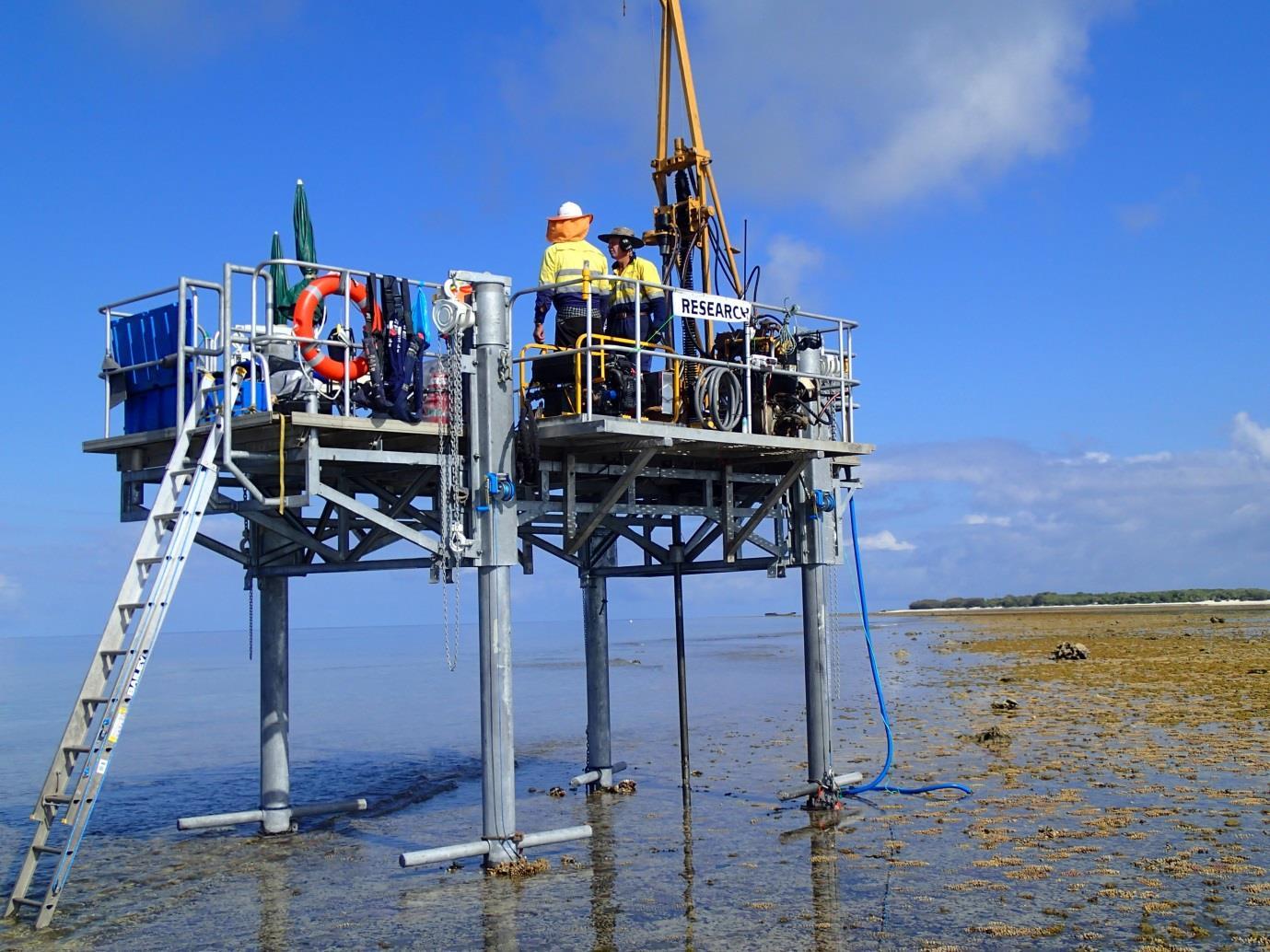
Prof. Gregory E. Webb (Integrated Palaeoenvironmental Research Group) continues as the head of IPRG and is working on Holocene and Pleistocene reef formation in the southern Great Barrier Reef, the geochemistry of corals, carbonate sediments and vertebrate bones as environmental indicators, Mississippian coral faunas of eastern Australia, with Dr. Julien Denayer, who has now returned to Belgium after his time as Dorothy Hill Postdoctoral Fellow, and on Archean microbialites and their geochemistry based on material form the Pilbara. He has just successfully deployed a marine-based drilling rig to extract cores from the GBR as part of UQ- and ARC-funded research (see photograph, below).
Sadler, J., Webb, G.E. & Nothdurft, L.D. 2014. Structure and palaeoenvironmental implications of inter-branch coenosteum-rich skeleton in corymbose Acropora species. Coral Reefs DOI 10.1007/s00338-014-1228-0 (accepted 1/10/2014available online)
Sadler, J., Webb, G.E., Nothdurft, L.D. & Dechnik, B. 2014 Geochemistry-based coral palaeoclimate studies and the potential of 'non-traditional' (non-massive Porites) corals: recent developments and future progression. Earth-Science Reviews 139, 291-316.
Kamber, B.S., Webb, G.E. & Gallaghar, M. 2014. The rare earth element signal in Archaean microbial carbonate: information on ocean redox and biogenicity. Journal of the Geological Society 171, 745-763; doi10.1144/jgs2013-110
Coring rig deployed on Heron Reef, GBR, October 2014.
Kenny J. Travouillon (Integrated Palaeoenvironmental Research Group) is continuing his work on describing new taxa from Oligo-Miocene sites around Australia, such as Riversleigh World Heritage Area (Queensland) and the Etadunna Formation (South Australia), focusing on Peramelemorphia (bilbies and bandicoots) and Macropodiformes (kangaroos), their biostratigraphy and phylogeny.
Bates, H., Travouillon, K.J., Cooke, B., Beck, R.M.D., Hand, S.J., & Archer, M. 2014. Three new Miocene species of musky rat kangaroos (Hypsiprymnodontidae, Macropodoidea): description, phylogenetics and palaeoecology. Journal of Vertebrate Paleontology 34, 383-396.
Beck, R.M.D., Travouillon, K.J., Aplin, K.P., Godthelp, H. & Archer, M. 2014. The osteology and systematics of the enigmatic Australian Oligo-Miocene metatherian Yalkaparidon (Yalkaparidontidae; Yalkaparidontia; ?Australidelphia; Marsupialia). Journal of Mammalian Evolution 21, 127-172.
Black, K.H., Travouillon, K.J., Den Boer, W., Kear, B.P., Cooke, B.N. & Archer, M. 2014. A new species of the basal “kangaroo” Balbaroo and a re-evaluation of stem macropodiform interrelationships. PLoS ONE 9(11), e112705. doi:10.1371/journal.pone.0112705.
Butler, K., Louys, J. & Travouillon, K.J. 2014. Extending dental mesowear analyses to Australian marsupials, with applications to six Plio-Pleistocene kangaroos from southeast Queensland. Palaeogeography, Palaeoclimatology, Palaeoecology 408, 11-25.
Gurovich, Y., Travouillon, K.J., Beck, R.M.D., Muirhead, J. & Archer, M. 2014 Biogeographical implications of a new mouse-sized fossil bandicoot (Marsupialia: Peramelemorphia) occupying a dasyurid-like ecological niche across Australia. Journal of Systematic Palaeontology 12, 265–290.
Travouillon, K.J., Archer, M., Hand, S.J. & Muirhead, J. 2014. Sexually dimorphic bandicoots (Marsupialia: Peramelemorphia) from the Oligo-Miocene of Australia, first cranial ontogeny for fossil bandicoots and new species descriptions. Journal of Mammalian Evolution DOI 10.1007/s10914-014-9271-8.
Travouillon, K.J., Cooke, B., Archer, M., & Hand, S.J. 2014. Revision of basal macropodids from the Riversleigh World Heritage Area with descriptions of new material of Ganguroo bilamina Cooke, 1997 and a new species. Palaeontologia Electronica 17.1, 20A.
Travouillon, K.J., Hand, S.J., Archer, M., & Black, K.H. 2014. Earliest modern bandicoot and bilby (Marsupialia, Peramelidae and Thylacomyidae) from the Miocene of the Riversleigh World Heritage Area, northwestern Queensland, Australia. Journal of Vertebrate Paleontology 34, 375-382.
Gilbert J. Price (Integrated Palaeoenvironmental Research Group) is an ARC DECRA Early Career Research Fellow. He is a vertebrate palaeoecologist and geochronologist, particularly interested in the evolution and emergence of Australia’s unique ecosystems and fauna, and their response to prehistoric climatic changes. His major research focus has been on the development of palaeoecological models for Australia’s Pleistocene megafauna. Critically, this also involves the production of reliably-dated records for the extinct forms. In addition to his ARC DECRA which focusses on late Quaternary palaeoecology of northern Queensland, he also has an ARC Discovery which aims to develop new direct dating methods (U-series and ESR)
of fossil vertebrates (in collaboration with Yue-xing Feng, UQ, and Renaud JoannesBoyau, SCU). For pre-2014 publications see www.diprotodon.com
Black, K., Louys, J. & Price, G.J. 2014. Understanding morphological variation in the extant koala as a framework for identification of species boundaries in extinct koalas (Phascolarctidae; Marsupialia). Journal of Systematic Palaeontology 12, 237-264.
Black, K.H., Price, G.J., Archer, M. & Hand, S.J. 2014. Bearing up well? Understanding the past, present and future of Australia’s koalas. Gondwana Research 25, 1186-1201.
Louys, J.C., Corlett, R.T., Price, G.J., Hawkins, S. & Piper, P.J. 2014. Rewilding the tropics, and other conservation translocations strategies in the tropical AsiaPacific region. Ecology and Evolution 4(2), 4380-4398.
Mackness, B., Black, K.H. & Price, G.J. in press 1/10/2014. Occurrence of Euowenia grata (De Vis, 1887) (Diprotodontidae, Marsupialia) from the Pliocene Spring Park Local Fauna, northeastern Queensland. Alcheringa
Sobbe, I.H. & Price, G.J. 2014. Confirmation of the presence of the Spotted - tailed Quoll, Dasyurus maculatus (Dasyuridae, Marsupialia) from the late Pleistocene King Creek catchment, Darling Downs, southeastern Queensland, Australia. Memoirs of the Queensland Museum – Nature 59, 9-10.
Wright, D.K., Thompson, J., Mackay, A., Welling, M., Forman, S.L., Price, G.J., Zhao, J.-x., Cohen, A.S., Malijani, O. & Gomani-Chindebvu, E. 2014. Renewed geoarchaeological investigations of Mwanganda's Village (Elephant Butchery Site), Karonga, Malawi. Geoarchaeology 29, 98-120.
Peter Jell is working on the following:- (1) Redescription of Middle Cambrian echinoderms from western Queensland (Cymbionites and Peridionites) with Jim Sprinkle; (2) Cambrian faunas of western New South Wales (Cymbric Vale, Coonigan and Nootumbulla Formations); (3) Fossil Asterozoa of Australia (Ordovician to Tertiary); (4) Mesozoic and Tertiary crinoidea of Australia; (5) Fossil faunas of the Middle Cambrian Currant Bush Formation, Queensland.
Jell, P.A. 2014. A Tremadocian asterozoan from Tasmania and a late Llandovery edrioasteroid from Victoria. Alcheringa 38, 528-540. Jell, P.A. 2014. Cambrian trilobites of Heathcote district, central Victoria, Australia. Acta Palaeontologica Sinica 53(4), Raven, R.J., Jell, P.A. & Knezour, R.A. (in press). Edwa maryae gen. et sp. nov. in the Norian Blackstone Formation of the Ipswich Basin the first Triassic spider (Mygalomorphae) from Australia. Alcheringa 39
Geoffrey Playford’s current research focuses mainly on Mississippian–Pennsylvanian palynostratigraphy of Eastern and Western Gondwana (Australia and northern Brazil). A current project is on diverse and well-preserved palynofloras of the northern Perth Basin that provide correlative links with eastern Australia (particularly) and elsewhere in Gondwana. Work continues on Mississippian palynostratigraphy of onshore, extensively-drilled basins of northern Brazil (Amazonas and Parnaíba basins) in collaboration with José Henrique Gonçalves de Melo of Petróleo Brasileiro S.A. (Petrobras) in Rio de Janeiro. PhD candidate Gary Pattemore is progressing well with his project on Triassic–Jurassic gymnosperms
(co-supervised with Gregg Webb, UQ, and John Rigby, QUT) and has undertaken extensive field collecting in SE Queensland.
Pattemore, G.A., Rigby, J.F. & Playford, G. 2014. Palissya: A global review and reassessment of Eastern Gondwanan material. Review of Palaeobotany & Palynology 210, 50-61.
James Cook University, Townsville
Paul Dirks continues with his research around the recent discovery of Anthropithecus sediba in South Africa which has contributed a great deal to our understanding of hominid evolution. Ongoing research into the cave system adjacent to Johannesburg and its fossil contents continues to be highly productive and frames new questions and insights. The Malapa site is now recognised as the richest hominid repository known from Africa or elsewhere.
Eric Roberts and his post-graduates continue research into the East African Rift and its vertebrate fossil record. In addition Eric has recently taken part in a US National Science Foundation expedition to the Antarctic Peninsula with the focus of examining its fossil record leading up to the K-T boundary.
Based on West Australian collections, Toni Williamson and Bob Henderson have established a new dwarf belemnite genus within the Dimitobelidae, the distinctive Austral group so well represented in Australian Cretaceous faunas.
[consolidated list of publications]
Blackburn, D., Roberts, E.M. & Stevens, N.J. (in press). The earliest record of the endemic African frog Family Ptychadenidae from the Oligocene Nsungwe Formation of Tanzania. Journal of Vertebrate Paleontology.
Dirks, P.H.G.M. & Berger, L.R. 2013. Hominin-bearing caves and landscape dynamics in the Cradle of Humankind, South Africa. Journal of African Earth Sciences 78, 109-131.
Gorscak, E., O’Connor, P.M., Stevens, N.J. & Roberts, E.M. 2014. The basal titanosaurian Rukwatitan bisepultus (Dinosauria: Sauropoda) from the middle Cretaceous Galula Formation, Rukwa Rift Basin, southwestern Tanzania. Journal of Vertebrate Paleontology 34, 1133-1154
Roberts, E.M., Jelsma, H. & Hegna, T. (in press). Mesozoic sedimentary cover sequences of the Congo Basin in the Kasai Region, Democratic Republic of Congo. In M. DeWit and F. Guilliocheau (eds.), Geology and Resource Potential of the Congo Basin Dedicated to L. Cahen and H. Kampunzu. Springer-Verlag, London.
Roberts, E.M., Lamanna, M.C., Clarke, J.A., Gorscak, E., Meng, J., Sertich, J.J.W., O’Connor, P.M., Claeson, K. & MacPhee, R.E.E. 2014. Stratigraphy and taphonomy of Latest Cretaceous vertebrates from Vega Island, James Ross Basin, Antarctica: implications for high-latitude terrestrial ecosystems. Palaeogeography, Palaeoclimatology, Palaeoecology 402, 55-72.
Williamson, T. & Henderson, R.A. (in press) Pumiliobelus, a new dwarf coleoid genus (Belemnoidea:Dimitobelidae) from Western Australia. Journal of Paleontology
Queensland Museum, Brisbane
Carole J. Burrow continues as an Honorary Research Fellow with the QM. Collaboration continues on acanthodians (and the occasional shark) from Scotland, other parts of Europe, and North America, as well as Australia. A manucript on one 'special' fish - the first shark from the Gogo Formation in Western Australia - is now in revision having spent nearly 10 years brewing, with Carole being one of a multinational cast of authors. Rather than attending one of the 'big' VP conferences this year, she attended a 'small' regional meeting at Brecon, Wales, on the Old Red Sandstone, copresenting contributions on the Welsh Borderlands vertebrate microremains with Sue Turner and Rod Williams, and macroremains with Mike Newman, Bob Davidson, Jan den Blaauwen and Roger Jones. A highlight of the meeting was the enthusiastic attendance by so many local 'amateur' geology buffs from the thriving regional organisations, with the number of attendees being well over one hundred.
Burrow, C.J. & Rudkin, D. 2014. Oldest near-complete acanthodian: the first vertebrate from the Silurian Bertie Formation Konservat-Lagerstätte, Ontario. PLoS ONE 9(8), 7. doi:10.1371/journal.pone.0104171 Newman, M.J., Burrow, C.J., Den Blaauwen, J.L. & Davidson, R.G. 2014. The Early Devonian acanthodian Euthacanthus macnicoli Powrie, 1864 from the Midland Valley of Scotland. Geodiversitas 36(3), 321-348. doi:10.5252/g2014n3a1 Trinajstic, K., Roelofs, B., Burrow, C.J., Long, J.A. & Turner, S. 2014. Devonian vertebrates from the Canning and Carnarvon Basins with an overview of Paleozoic vertebrates of Western Australia. Journal of the Royal Society of Western Australia 97, 133-151.
Susan Turner (Geoscience Consultant) is Scientific Editor for Acta Geologica Sinica (CAGS) and holds Honorary Adjunct/Associate positions at Curtin University, Monash University, Queensland Museum Ancient Environments, and Honorary Research Associate of the New Brunswick Museum, Canada. She is a member of INHIGEO, HOGG and ESHG and editor for JHOST, Journal of History of Science and Technology, University of Lisbon.
In 2014 she has tried to return to scientific work, notably with a look again at the microvertebrates of the Lower ‘Old Red Sandstone’ of Britain, as well as continuing work on a Silurian and Devonian, often in collaboration with Carole Burrow, on material from Canada, Iran (Vachik Hairapetian), western China and Pakistan (with John Talent), Turkey, USA - Maine, Nevada, Idaho, UK - Welsh Borderlands and of course, Australia (Carole Burrow, John Long, Brett Roelofs, Kate Trinajstic et al.).
Sue also continues work on Triassic and Jurassic sharks and recently was assisted at the Australian Museum by honorary palaeontologist, Bob Jones and volunteer Graham McLean.
Sue (along with Carole Burrow) is part of the group that continues to subvert the ‘conodonts are vertebrates’ mantra propounded over the last decades.
Sue contributes to IGCP projects 591 and 596. She has attended various conferences over the last two years, including giving talks at British VP meetings in Oxford (2012) and Edinburgh (2013) and in October 2014 attended the Old Red Sandstone Symposium in Wales. For more see: www.paleodeadfish.com
Burrow C.J., Turner, S., Nowlan, G.S. & Denison, R.H. 2013. Vertebrate
microremains from the Late Silurian of Arisaig, Nova Scotia, Canada. Journal of Paleontology 87(6), 1041-1059.
Carlisle, G. & Turner, S. 2013. Sopwith's Surprise. The Geoscientist, March, 21-23. published February 25th. http://www.geolsoc.org.uk/en/Geoscientist - March issue
Itano, W. & Turner, S. 2013. Lost & Found. 267. Found in the Fossil Fish Collection of the Natural History Museum Palaeontology Section. The Geological Curator, GCG Newsletter 9, no. 8, p. 447-448. www.geologicalcurator.co.uk
Itano, W. & Turner, S. 2013. Mystery Fossil 22. Pal Ass Newsletter 22, June, p.59.
Maisey, J., Turner, S., Miller, R. & Naylor, G. 2014. Dental patterning in the earliest sharks: implications for tooth evolution. Journal of Morphology; online Dec 2013 DOI: 10.1002/jmor.20242
Mark-Kurik E., Blieck A., Burrow C.J. & Turner, S. 2013. Early Devonian fishes from coastal De Long Strait, central Chukotka, Arctic Russia. Geodiversitas 35, 545-578.
Roelofs, B., Trinajstic, K., Turner, S., Hairapetian, V., Hansma, J. 2013. Vertebrate diversity and faunal turnover from the Late Devonian to Early Carboniferous in the Canning Basin, Western Australia. CAVEPS Abstract, Flinders Uni, Adelaide, 1 p.
Trinajstic, K., Roelofs, B., Barham, M., Playton, T. & Turner, S. 2014. The utility of survivor taxa for microvertebrate biostratigraphy and chemostratigraphy in Devonian and Carboniferous sections, Canning Basin Western Australia. Geological Society of Australia, 2014 Australian Earth Sciences Convention (AESC), Sustainable Australia, Newcastle, 7-10 July 2014. Geological Society of Australia, Abstracts 110: 218.
Trinajstic, K , Roelofs, B., Burrow, C.J., Long, J.A. & Turner, S. 2014. Devonian vertebrates from the Canning and Carnarvon Basins with an overview of Paleozoic vertebrates of Western Australia. Journal of the Royal Society of Western Australia 97, 133–151.
Turner, S. 2013. Geoheritage and Geoparks: One (Australian) Woman’s Point of View. Geoheritage 5, 249-264. DOI 10.1007/s12371-013-0085-5
Turner, S. 2013. Ageleodus ~ widespread mid-Palaeozoic ‘sharks’ known only from teeth. Stan Wood Symposium, VPCA Edinburgh, Aug 27-30, Abstracts, 1p.
Turner, S. 2013. 'Geotourism': Where Wise Birds Stay Awhile. see free appGeoExpro Magazine for iPad, June, 1-6.
Turner, S. Burrow, C.J. & Williams, R. 2014. Welsh Borderland bouillabaisse: bonebeds, age control, palaeo(bio)geography lifestyles and diversity of microvertebrates (thelodont, acanthodian, 'shark', placoderm scales). In: Old Red Sandstone Symposium, 3-5 October 2014, Elim Church Centre, Canal Road, Brecon, Powys, Programme and Abstracts.
Turner, S., Greenwood, D. & Carlisle, G. 2013. Thomas Sopwith's 1839 Great Stratigraphic section. In: 24th ICSTM, Knowledge at Work, Manchester July 2128, p. 275.
Vickers-Rich, P., Turner, S & Australian IGCP Committee 2014. Special Report 1. No more Australian IGCP National Committee funding for Australian IGCP projects? TAG no. 171, June, 28-30.
Wilkinson, J., Spring, K., Turner S. & Louys, J. 2013. The Chinchilla Rifle Range locality: Honouring past collectors and presenting a new detailed digital map. CAVEPS Abstract, Flinders Uni, Adelaide, p. x.
Geological Survey of Queensland
John McKellar reports on his publications this year: Palynofloras recovered by Bomfleur et al. (2014) from the Upper Triassic and Lower Jurassic of north Victoria Land (East Antarctica) suggest that the Hetttangian (basal Jurassic) there is represented by unconformity. In the Australian region, from palynostratigraphic evidence (de Jersey & McKellar, 2013), and indeed globally (as indicated by the latter authors), there is widespread hiatus at this level, associated with poorly understood tectonism during the Hettangian – ?earliest Sinemurian. From the sequencestratigraphic work of Ziolkowski et al. (2014), this event is represented in the Surat Basin (Queensland) by Sequence Boundary 1 (SB1) at the base of the Precipice Sandstone. SB1 separates this formation from the (older) stratigraphically and geographically isolated remnant strata of the early Hettangian Chong beds and the Rhaetian (latest Triassic) Eddystone beds at the base of the basin’s succession.
Bomfleur, B., Schöner, R., Schneider, J.W., Viereck, L., Kerp, H. & McKellar, J.L. 2014. From the Transantarctic Basin to the Ferrar Large Igneous Province New palynostratigraphic age constraints for Triassic–Jurassic sedimentation and magmatism in East Antarctica. Review of Palaeobotany and Palynology, 207, 18–37.
Ziolkowski, V., Hodgkinson, J., McKillop, M., Grigorescu, M. & McKellar, J.L. 2014. Sequence stratigraphic analysis of the Lower Jurassic succession in the Surat Basin, Queensland preliminary findings. Queensland Minerals and Energy Review Series, Department of Natural Resources and Mines, Queensland.
SOUTH AUSTRALIA
University of Adelaide
Diego C. García-Bellido is an ARC Future Fellow at the University of Adelaide (and Honorary Associate of the South Australian Museum) and was recently elected AAP Secretary (term 2014-2016). His main interest is the taxonomical diversity and functional morphology of the early metazoans generated during the Cambrian ‘explosion’, and the phylogenetic relationships between the animal groups that appeared with this unique evolutionary event. His present project aims at comparing the Ediacara biota with the Emu Bay Shale and other Cambrian Lagerstätten from a palaeoecological perspective, and looking at aspects such as predation and moulting on Modern marine invertebrates to test against what can be observed in the fossil record. Diego graduated in zoology at the Complutense University in Madrid, where he later completed his PhD in palaeontology (2002). His interest in early animal evolution took him to the University of Cambridge in 1994 and to the Burgess Shale (Canada) during the summers of 1995, 1997 and 2000. This was followed by a postdoc at the Royal Ontario Museum-Toronto (2003 and 2004) and several years at the Spanish Research Council (CSIC) in Madrid, where he run in parallel his interest on Burgess Shale faunas and on fossil Porifera (see publications below). Since 2007, Diego has been working with colleagues from the SAM, UniSA, UNE and NHM in excavating and studying the early Cambrian Emu Bay Shale Lagerstätte in Kangaroo Island, while collaborating with his Spanish partners in the Cambrian and Ordovician
faunas of Peri-Gondwana (Spain, Morocco, Argentina and Peru). In the last twelve months he has carried out two excavations at Emu Bay Shale, two field trips to the Flinders Ranges and one to the Andes of Northwestern Argentina. He has also recently published on the arthropods, lobopodians, worms and vetulicolians from Kangaroo Island, as well as trilobites from Spain and Morocco and ‘small shelly fossils’ from Spain. Several other manuscripts are in preparation on Australian and Spanish Cambrian and Ordovician material.
Aceñolaza, G.F., Albani, R., Bernárdez, E., García-Bellido, D.C., Gutiérrez-Marco, J.C., Rábano, I. & Sá, A.A. 2014. First Furongian (late Cambrian) trilobites from the Cantabrian Zone (northwestern Spain) Bulletin of Geosciences 89, 233–244.
Barragán, T., Esteve, J., García-Bellido, D.C., Zamora, S. & Álvaro, J.J. 2014.
Hadimopanella oezgueli Gedik, 1977: a palaeoscolecid sclerite inadequate for taxonomic purposes. Palaeontologia Electronica 17.3.42A: 1–20.
Barragán, T., Esteve, J., García-Bellido, D.C., Zamora, S. & Álvaro, J.J. 2014. New mid-Cambrian palaeoscolecid sclerites of Hadimopanella oezgueli from the Cantabrian Mountains, northern Spain. GFF 136, 22–25.
García-Bellido, D.C., Lee, M.S.Y., Edgecombe, G.D., Jago, J.B., Gehling, J.G. & Paterson, J.R. 2014. A new vetulicolian from Australia and its bearing on the chordate affinities of an enigmatic Cambrian group. BMC Evolutionary Biology 14, 214.
Gutiérrez-Marco, J.C. & García-Bellido, D.C. In press. Micrometric detail in palaeoscolecid worms from Late Ordovician sandstones of the Tafilalt KonservatLagerstätte, Morocco. Gondwana Research. doi: 10.1016/j.gr.2014.04.006
Gutiérrez-Marco, J.C., Sá, A.A., García-Bellido, D.C. & Rábano, I. 2014. The extent of the Middle Ordovician Dapingian Stage in peri-Gondwanan Europe and North Africa. Stratigraphic record, biostratigraphic tools, and regional chronostratigraphy. GFF 136, 90–94.
Rábano, I., Gutiérrez-Marco, J.C. & García-Bellido, D.C. 2014. A remarkable illaenid trilobite from the Middle Ordovician of Morocco. Bulletin of Geosciences 89, 365–374
Creveling, J.C., Fernández Remolar, D., Rodríguez-Martínez, M., Menéndez, S., Bergmann, K.D., Gill, B.C., Abelson, J., Amils, R., Ehlmann, B.L., GarcíaBellido, D.C., Grotzinger, J.P., Hallmann, C., Stack, K.M. & Knoll, A.H. 2013. Geobiology of a lower Cambrian carbonate platform, Pedroche Formation, Ossa Morena Zone, Spain. Palaeogeography, Palaeoclimatology, Palaeoecology 386, 459–478.
Daley, A.C., Paterson, J.R., Edgecombe, G.D., García-Bellido, D.C. & Jago, J.B. 2013. New anatomical information on Anomalocaris from the Emu Bay Shale Konservat-Lagerstätte (Cambrian, South Australia) and a reassessment of its inferred predatory habits. Palaeontology 56, 971–990.
García-Bellido, D.C., Paterson, J.R. & Edgecombe, G.D. 2013. Cambrian palaeoscolecids (Cycloneuralia) from Gondwana and reappraisal of species assigned to Palaeoscolex. Gondwana Research 24, 780–795.
García-Bellido, D.C., Paterson, J.R., Edgecombe, G.D. & Ma, X.Y. 2013. A “Collins’ monster”-type lobopodian from the Emu Bay Shale Konservat-Lagerstätte (Cambrian), South Australia. Alcheringa 37, 474–478.
Paterson, J.R., García-Bellido, D.C. & Edgecombe, G.D. 2012. New artiopodan arthropods from the Early Cambrian Emu Bay Shale Konservat-Lagerstätte of South Australia. Journal of Paleontology 86, 340–357.
Edgecombe, G.D., García-Bellido, D.C. & Paterson, J.R. 2011. A new leanchoiliid megacheiran arthropod from the lower Cambrian Emu Bay Shale, South Australia Acta Palaeontologica Polonica 56, 385–400.
García-Bellido, D.C. & Aceñolaza, G. 2011. The worm Palaeoscolex from the Cambrian of NW Argentina: extending the biogeography of Cambrian priapulids to South America. Alcheringa 35, 531–538.
Gehling, J.G., Jago, J.B., Paterson, J.R., García-Bellido, D.C. & Edgecombe, G.D. 2011. The geological context of the lower Cambrian (Series 2) Emu Bay Shale Lagerstätte and adjacent stratigraphic units, Kangaroo Island, South Australia Australian Journal of Earth Sciences 58, 243–257
Gutiérrez-Marco, J.C., Rábano, I. & García-Bellido, D. (eds.) 2011. Ordovician of the World. Instituto Geológico y Minero, Madrid. xvi+682 pp. ISBN: 9788478408573.
Lee, M.S.Y., Jago, J.B., García-Bellido, D.C., Edgecombe, G.D., Gehling, J.G. & Paterson, J.R. 2011. Modern optics in exceptionally preserved Early Cambrian arthropod eyes from Australia. Nature 474, 631–634.
Paterson, J.R., García-Bellido, D.C., Lee, M.S.Y., Brock, G.A., Jago, J.B. & Edgecombe, G.D. 2011. Acute vision in the Cambrian predator Anomalocaris and the origin of compound eyes. Nature 480, 237–240.
Paterson, J.R., Edgecombe, G.D., García-Bellido, D.C., Jago, J.B. & Gehling, J.G. 2010. Nektaspid arthropods from the lower Cambrian Emu Bay Shale Lagerstätte, South Australia, with a reassessment of lamellipedian relationships Palaeontology 53, 377–402.
Rábano, I., Sá, A.A., Gutiérrez-Marco, J.C. & García-Bellido, D.C. 2010. Two more Bohemian trilobites from the Ordovician of Portugal and Morocco. Bulletin of Geosciences 85, 415–424.
García-Bellido, D.C., Paterson, J.R., Edgecombe, G.D., Jago, J.B., Gehling, J.G. & Lee, M.S.Y. 2009. The bivalved arthropods Isoxys and Tuzoia with soft-part preservation from the lower Cambrian Emu Bay Shale Lagerstätte (Kangaroo Island, Australia). Palaeontology 52, 1221–1241.
García-Bellido, D.C., Vannier, J. & Collins, D. 2009. Soft-part preservation in two species of the arthropod Isoxys from the middle Cambrian Burgess Shale of British Columbia, Canada. Acta Palaentologica Polonica 54, 699–712.
Gutiérrez-Marco, J.C., Sá, A.A., García-Bellido, D.C., Rábano, I. & Valério, M. 2009. Giant trilobites and trilobite clusters from the Ordovician of Portugal. Geology 37, 443–446.
Vannier, J., García-Bellido, D.C., Hu S.-X. & Chen, A.-L. 2009 Arthropod visual predators in the early pelagic ecosystem: evidence from the Burgess Shale and Chengjiang biotas. Proceedings of the Royal Society - B 276, 2567–2574.
García-Bellido, D.C., Gutiérrez-Marco, J.C. & Chacaltana, C.A. 2008. First softbodied fossil from the Ordovician of Peru. Alcheringa 32, 313–320.
Rábano, I., Gozalo, R. & García-Bellido, D. (eds.) 2008. Advances in Trilobite Research 448 pp. Instituto Geológico y Minero, Madrid. ISBN 978-84-7840-759-0.
García-Bellido, D.C. & Collins, D.H. 2007. Reassessment of the genus Leanchoilia (Arthropoda, Arachnomorpha) from the Middle Cambrian Burgess Shale, British Columbia, Canada. Palaeontology 50, 693–709.
García-Bellido, D.C., Gozalo, R., Chirivella Martorell, J.B. & Liñán, E. 2007. The demosponge genus Leptomitus and a new species from the Middle Cambrian of Spain. Palaeontology 50, 467–479.
García-Bellido, D.C. & Collins, D.H. 2006. A new study of Marrella splendens (Arthropoda, Marrellomorpha) from the Middle Cambrian Burgess Shale, British Columbia, Canada. Canadian Journal of Earth Sciences 43, 721–742.
García-Bellido, D.C. & Rodríguez, S. 2005. Palaeobiogeographical relationships of poriferan and coral assemblages during the late Carboniferous and the closure of the western Palaeotethys Sea-Panthalassan Ocean connection. Palaeogeography, Palaeoclimatology, Palaeoecology 219, 321–331.
García-Bellido, D.C. & Collins, D.H. 2004. Moulting arthropod caught in the act. Nature 429, 40.
García-Bellido, D.C. & Rigby, J. K. 2004. Devonian and Carboniferous sponges from Spain. Journal of Paleontology 78, 431–455.
García-Bellido, D. C., Senowbari-Daryan, B. & Rigby, J. K. 2004. Cystothalamia vandegraaffi new species and other Sphinctozoan sponges from the Upper Carboniferous of Spain. Journal of Paleontology 78, 1037–1055.
Senowbari-Daryan, B. & García-Bellido, D. 2002. “Sphinctozoa” or chambered sponges (polyphyletic), pp. 1511–1538. In: J.N.A. Hooper & R.W.M Van Soest (eds.). Systema Porifera: A Guide to the classification of the Phylum Porifera. Kluwier Academic/Plenum Press, 1810 pp.
García-Bellido Capdevila, D. 2000. The Burgess Shale fossils at the Natural History Museum, London. The Geological Curator 7, 141-148.
García-Bellido Capdevila, D. & Conway Morris, S. 1999. New fossil worms from the Lower Cambrian of the Kinzers Formation, Pennsylvania, with some comments on Burgess Shale-type preservation. Journal of Paleontology 73, 394–402.
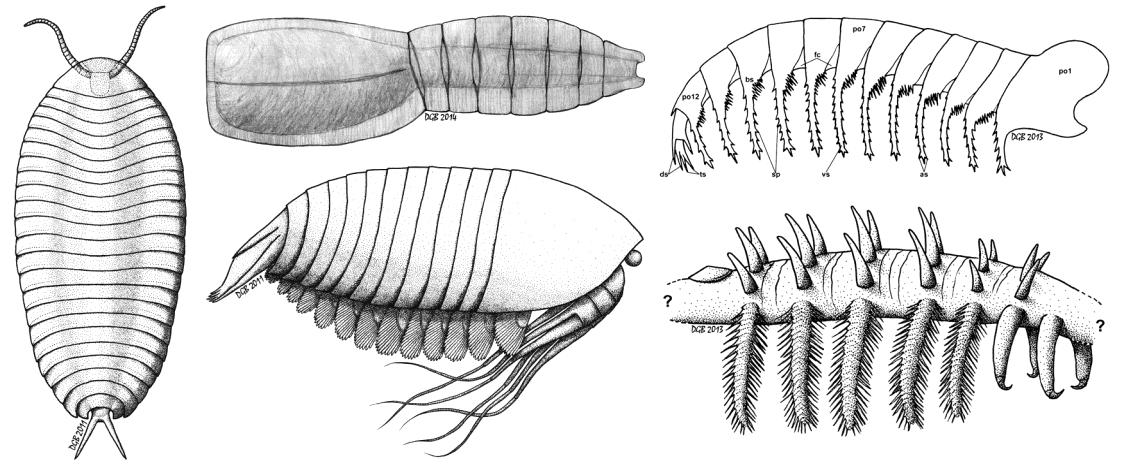
Reconstructions of some Emu Bay Shale taxa from the early Cambrian of Kangaroo Island (from left to right and top to bottom): Australimicola spriggi, Nesonektris aldridgei, Oestokerkus megacholix, Anomalocaris briggsi appendage and indeterminate Loulishaniid lobopodian.
University of South Australia
Barbara Hardy Centre, School of Natural and Built Environments
Barry Cooper (Adjunct Associate Professor) is based at the Mawson Lakes campus with palaeo colleagues John Cann and Jim Jago. I have a long standing historical project with Jim that deals with Robert Bedford (well-known archaeo researcher) from the pre WW2 era and his tortuous relations with Sir Douglas Mawson.
Given my major involvement as Secretary General of the International Commission on the History of Geological Sciences (INHIGEO) and the Heritage Stone Task Group (HSTG), my palaeo research output has been minimal for many years. However, I have contributed to the history of palaeontology over the past ten years. Resulting papers, in chronological order have been:
Cooper, B.J. & Jago, J.B. 2007. History of Cambrian Investigations in South Australia with particular reference to the biostratigraphy Memoir Association of Australasian Palaeontologists 33, 1-27.
Cooper, B.J. & Jago, J.B. 2007 Early Understanding of the Cambrian in South Australia. Special Publication, Earth Sciences History Group, Geological Society of Australia 1, 20-25.
Sweet, W.C. & Cooper, B.J. 2008 Classic Paper: C.H. Pander’s (1856) Introduction to Conodonts. Episodes 31, 431-436.
Cooper, B.J., Oldroyd, D., Turner, S. & Vickers-Rich, P. 2009. Reg Sprigg and the Ediacara fauna: an extraordinary discovery The Australian Geologist 153, 18 Jago, J.B & Cooper, B.J. 2011. The Emu Bay Shale lagerstätte: a history of investigations Australian Journal of Earth Sciences 58, 235-241.
Cooper, B.J. & Kidman, B. 2012. Ralph Tate (1840-1901): Pioneering Australian Geologist. Abstract #1336, 34th International Geological Congress, Brisbane Australia, August 2012 (Reprinted with commentary in Geological Society of Australia, Earth Sciences History Group Newsletter 43, 16-17, December 2012).
Cooper, B.J. 2014. Book Review: “The Great Fossil Enigma: The Search for the Conodont Animal” by Simon J. Knell. Indiana University Press 413pp (2013). Earth Sciences History 33(1), 179-181.
Jim Jago (Adjunct Associate Professor) is continuing to work on the Cambrian trilobites of Tasmania, South Australia and Antarctica. Current projects include late Middle Cambrian trilobites from limestone olistoliths from northern Victoria Land, Antarctica (with Chris Bentley and Roger Cooper), and a late Cambrian fauna from the south coast of Tasmania (with John Laurie). In the last four years a lot of time has gone into the Big Gully biota, a Burgess Shale type fauna from Kangaroo Island. Workers on this project include Mike Lee, Jim Gehling, John Paterson, Greg Edgecombe, Diego Garcia-Bellido, Glenn Brock and Jim Jago. Other projects include sedimentology of the Lake Frome Group (with C. Gatehouse and T. Casey), the stratigraphy of the Kanmantoo Group (with J. Gum, A. Burtt and P. Haines) and the history of geology (with B. Cooper).
Álvaro, J.J., Ahlberg, P., Babcock, L.E., Bordonaro, O.L., Choi, D.K., Cooper, R.A., Ergaliev, G.Kh., Gapp, I.W., Ghobadi Pour, M., Hughes, N.C., Jago, J.B., Korovnikov, I., Laurie, J.R., Lieberman, B.S., Paterson, J.R.,Pegel, T.V., Popov, L.E., Rushton, A.W.A., Sukhov, S.S., Tortello, M.F., Zhou, Z. & Żylinska, A. 2013. Global Cambrian trilobite palaeobiogeography assessed using parsimony analysis of endemicity. In Harper, D.A.T. & Servais, T. (eds) Early Palaeozoic Biogeography and Palaeogeography. Geological Society of London Memoirs 38, 273-296
Bentley, C.J. & Jago, J.B. 2014. A Cambrian Series 3 (Guzhangian) fauna with Centropleura from Christmas Hills, northwestern Tasmania. Memoirs of the Association of Australasian Palaeontologists 46, 267-296.
Cann, J.H., Lower, C. & Jago, J.B. 2014. Provenance and sediment characteristics of contemporary gravel deposits at Sellicks Beach, eastern shore of Gulf St Vincent, South Australia. Australian Journal of Earth Sciences 61, 819-836.
Jago, J.B. & Gatehouse, C.G., 2014. A small trace fossil assemblage from the ?middle Cambrian Pantapinna Sandstone, Flinders Ranges, South Australia and its palaeoenvironmental significance. Australian Journal of Earth Sciences 61, 837841.
Flinders University, Adelaide School of Biological Sciences
Trevor Worthy (Vice-Chancellor's Postdoctoral Research Fellow) reports that it has been a big year in Palaeontology at Flinders University in 2014. The new Vertebrate Palaeontological Laboratories were built and near completed by July. They were officially opened on 11 December by Professor Tim Flannery, so now we hold pride of place in corridors off the main entrance to the Biology Building.
My research interests focus on birds, with outputs not in the last Nomen nudum listed below. Projects continue on fossil birds and other vertebrates from the Early Miocene St Bathans Fauna of New Zealand, Moa and other Quaternary taxa from NZ, and Neogene birds of Australia. A highlight of the year was the understanding that kiwi and elephant birds are sister taxa – rather an unexpected relationship! A current focus in Australian research involves understanding the diversity and relationships of dromornithids, but there is a large void to fill re Neogene avifaunas for Australia so I expect I won’t run out of things to do for a while. To help in this task Warren Handley, who finished Honours with First Class this year on sexual dimorphism in dromornithids, will commence a PhD in 2015 on these and other fowl.
Chambers, G.K. & Worthy, T.H. 2013. Our evolving view of the kakapo and its allies. Notornis 60(3), 197-200.
Collins, C.J., Rawlence, N.J., Worthy, T.H., Scofield, R.P., Tennyson, A.J.D., Smith, I., Knapp, M. & Waters, J.M. 2014. Pre-human New Zealand sea lion (Phocarctos hookeri) rookeries on mainland New Zealand. Journal of the Royal Society of New Zealand 44(1), 1-16.
De Pietri, V., Camens, A.B. & Worthy, T.H. 2015. A new species of “Plainswanderer” (Aves: Pedionomidae) from the Oligocene of South Australia reveals lineage longevity on the continent. Ibis 157, 68-74.
Hand, S.J., Worthy, T.H., Archer, M., Worthy, J.P., Tennyson, A.J.D. & Scofield, R P 2013. Miocene mystacinids (Chiroptera: Noctilionoidea) indicate a long history for endemic bats in New Zealand. Journal of Vertebrate Paleontology 33(6), 1442-1448.
Lalas, C., Hamel, J., Tennyson, A.J.D. & Worthy, T.H. 2014. Southern extensions for Holocene records of Australian pelican (Pelecanus conspicillatus) and New Zealand musk duck (Biziura delautouri) in New Zealand Notornis 61, 106-108.
Lee, M. & Worthy, T.H. 2014. Flight of the kiwi. Australasian Science September 2014, 22-24.
Mitchell, K J , Llamas, B , Soubrier, J , Rawlence, N J , Worthy, T H , Wood, J , Lee, M.S.Y. & Cooper, A. 2014. Ancient DNA reveals elephant birds and kiwi are sister taxa and clarifies ratite bird evolution. Science 344, 898-900.
Nguyen, J.M.T., Boles, W.E., Worthy, T.H., Hand, S.J. & Archer, M. 2014. New specimens of the logrunner Orthonyx kaldowinyeri (Passeriformes: Orthonychidae) from the Oligo-Miocene of Australia. Alcheringa 38(2), 245-255.
Nguyen, J M T , Worthy, T H , Boles, W E , Hand, S J & Archer, M 2013. A new cracticid (Passeriformes: Cracticidae) from the Early Miocene of Australia. Emu 113, 374-382
Worthy, T.H., Anderson, A. & Sand, C. 2013. An extinct Austral snipe Aves: Coenocorypha from New Caledonia. Emu 113, 383-393.
Worthy, T H , Worthy, J P , Tennyson, A J D. & Scofield, R P. 2013. A bittern (Aves: Ardeidae) from the Early Miocene of New Zealand. Paleontological Journal 47(11), 1331-1343.
Worthy, T H , Worthy, J P., Tennyson, A J D , Salisbury, S W , Hand, S J & Scofield, R.P. 2013. Miocene fossils show that kiwi (Apteryx, Apterygidae) are probably not phyletic dwarves. Pp 63–80, In Göhlich, U.B. & Kroh, A. (eds): Paleornithological Research 2013 – Proceedings of the 8th International Meeting of the Society of Avian Paleontology and Evolution. p. I-XXX + 1-306, Vienna (Natural History Museum Vienna).
Vanesa De Pietri spent 2014 at Flinders University on a post-doc. While working on the fossil waders (Charadriiformes) of New Zealand and Australia, she finished up projects on the European Neogene.
De Pietri, V.L., Camens, A.B. & Worthy, T.H. 2015. A Plains-wanderer (Pedionomidae) that did not wander plains: a new species from the Oligocene of South Australia. Ibis 157, 68–74.
De Pietri, V.L. & Mayr, G. 2014 The enigmatic Ibidopodia from the early Miocene of France –The first Neogene record of Cariamiformes (Aves) in Europe. Journal of Vertebrate Paleontology 34(6), 1470–1475.
De Pietri, V.L. & Mayr, G. 2014 The phylogenetic relationships of the early Miocene stork Grallavis edwardsi, with comments on the interrelationships of living Ciconiidae (Aves). Zoologica Scripta 43(6), 576–585.
De Pietri, V.L. & Mayr, G. 2014. Re-appraisal of early Miocene rails (Aves, Rallidae) from central France: diversity and character evolution. Journal of Zoological Systematics and Evolutionary Research 52(4), 312–322.
De Pietri, V.L. & Scofield, R.P. 2014. The earliest European record of a Stone-curlew (Charadriiformes, Burhinidae) from the late Oligocene of France. Journal of Ornithology 155(2), 421–426.
Mayr, G. & De Pietri, V.L. 2014. Earliest and first Northern Hemispheric hoatzin fossils substantiate Old World origin of a “Neotropic endemic”. Naturwissenschaften 101(2), 143–148.
Rod Wells has three projects in the final stages of preparation, viz. (i) A reconstruction and analysis of the biomechanics of the skeleton of Thylacoleo, in association with Peter Murray and Steve Bourne, (ii) A study of the Late Pleistocene vertebrate faunas and depositional environments of the eastern Mount Lofty and Flinders Ranges in South Australia including associated and articulated skeletons of Diprotodon, (iii) An analysis of the Plio-Pleistocene depositional environments and faunas of the Lake Eyre Basin with particular focus on the Warburton and Kalakoopah drainage. The latter two projects in association with Aaron Camens from
the Flinders Palaeo lab. and the late Richard Tedford from the American Museum of Natural History.
Aaron Camens has recently taken up the position of Lecturer in Palaeontology at Flinders University. My research focus during this appointment is centred on the deposits of the Lake Eyre basin and will investigate aspects of the taxonomy, palaeoecology and stratigraphy of the sites and their contained faunas.
I am also in the final stages of writing up several collaborative projects including: i) documentation of numerous vertebrate trace fossil sites from the southern coast of Australia, including the description of Australia’s first Pleistocene vertebrate ichnotaxa; ii) a project investigating human colonisation of the Indian Ocean, with special focus on Madagascar; iii) investigation of biting traces on middle Miocene bones from a lacustrine site in New Zealand, and iv) investigation of Late Pleistocene vertebrate fossil localities of the eastern Mt. Lofty and Flinders Ranges.
De Pietri, V., Camens, A.B. & Worthy, T.H. 2015 A new species of “Plainswanderer” (Aves: Pedionomidae) from the Oligocene of South Australia reveals lineage longevity on the continent. Ibis 157, 68-74.
Llamas, B., Brotherton, P., Mitchell, K.J., Templeton, J.E.L., Thomson, V.A., Metcalf, J.L., Armstrong, K.N., Kasper, M., Richards, S.M., Camens, A.B., Lee, M.S.Y. & Cooper, A. 2015 Late Pleistocene Australian marsupial DNA clarifies the affinities of extinct megafaunal kangaroos and wallabies. Molecular Biology and Evolution, doi:10.1093/molbev/msu338
Jim Gehling (South Australian Museum and University of Adelaide) saw the completion of the Ediacara Fossil Gallery, with funds raised by members of the Ediacara Foundation (chaired by Mary Lou Simpson), and from Beach Energy, with the launch in December 2013. Jim is glad to get back to research on Ediacaran fossils
South Australian Museum, Adelaide
Ediacara Fossil Gallery South Australian Museum
from the Flinders Ranges and to a lesser extent on the Cambrian fossils of Emu Bay Kangaroo Island. Steps are being taken by the Nature Foundation of South Australia to purchase Nilpena Pastoral Lease in the Flinders Ranges in order to ensure the future conservation of the National Heritage Listed Ediacara fossil site at Nilpena. In collaboration with Mary Droser and her students (University of California, Riverside), Mary-Anne Binnie (Collection Manager, Palaeontology SA Museum) and long term volunteers, our field work at Nilpena has concentrated on mapping the full extent, both stratigraphically and geographically, of facies bearing fossils of the Ediacara biota, along with palaeoecological studies of the serially excavated fossil beds. Excavations at of a selected fossiliferous facies at the Ediacara Conservation Park, north of Nilpena, continue to produce fossils that are an order of size smaller than is common elsewhere in Flinders Ranges. These have been the subjects of research project by graduate student, Felicity Coutts (University of Adelaide). Diego GarciaBellido (Future Fellow, University of Adelaide) has begun to extend his research interests to investigation of the Ediacara biota with preliminary trips with Jim to Ediacara and other sites in the Flinders Ranges in 2014. In association with the 3rd International Conference of Geobiology in Wuhan, a field workshop conducted by the Ediacaran Subcommission of the ICS in South China in June, demonstrated the potential for intercontinental comparisons of Ediacara fossils and their biostratigraphic importance in future subdivision of the Ediacaran.
Droser, M.L., Gehling, J.J., Dzaugis, M.E., Kennedy, M.J., Rice, D. & Allen, M.F. 2014. A New Ediacaran fossil with a novel sediment displacive life habit. Journal of Paleontology 88, 145-151.
García-Bellido, D.C., Lee, M.S., Jago, J.B., Gehling, J.G. & Paterson, J.R. 2014. A new vetulicolian from Australia and its bearing on the chordate affinities of an enigmatic Cambrian group. BMC Evolutionary Biology 14, 214. Doi:10.1186/s12862-014-0214-z.
Gehling, J.G., Runnegar, B.N. & Droser, M.L., 2014. Scratch traces of large Ediacaran bilaterian animals. Journal of Paleontology 88, 284-298.
Gehling, J.G. & Droser, M.L., 2014. How well do fossil assemblages of the Ediacara Biota time? Forum Reply. Geology, 42. Doi:10.1130/G35403Y.1
Joel, L., Droser, M.L. & Gehling, J.G. 2014. A new enigmatic, tubular organism from the Ediacara Member, Rawnsley Quartzite, South Australia, Journal of Paleontology 88, 253-262.
Nettle, D., Halverson, G.P., Cox, G.M., Collins, A.S., Schmitz, M. Gehling, J.G., Johnson, P.R. & Kadi, K. 2014. A middle–late Ediacaran volcano-sedimentary record from the eastern Arabian-Nubian shield. Terra Nova 26, 120–129. Doi: 10.1111/ter.12077.
Michael Lee (South Australian Museum and University of Adelaide) continues to work on several aspects of vertebrate - and lately invertebrate - evolution. In particular, new Bayesian methods which co-estimate phylogeny as well as rates and patterns of evolution through time are being developed.
Beck, R. & Lee, M.S.Y. 2014. Ancient dates or accelerated rates? The tempo of morphological evolution in placental mammals. Proceedings: Biological Sciences 281: e20141278.
Garcia-Bellido, D.C., Lee, M.S.Y., Edgecombe, G.D., Jago, J.B., Gehling, J.G. & Paterson, J.R. 2014. A new vetulicolian from Australia strengthens chordate
affinities of an enigmatic Cambrian group. BMC Evolutionary Biology 14: e214 doi:10.1186/s12862-014-0214-z
Lee, M.S.Y., Cau, A., Naish, D. & Dyke, G.J. 2014. Sustained miniaturisation and evolutionary novelty in the dinosaurian ancestors of birds. Science 345, 562-566.
Lee, M.S.Y., Cau, A., Naish, D. & Dyke, G.J. 2014. Morphological clocks in palaeontology, and a mid-Cretaceous origin of crown Aves. Systematic Biology 63, 442-449.
Llamas, B., Brotherton, P., Mitchell, K.J., Templeton, J., Thomson, V.A., Metcalf, J., Armstrong, K.N., Kasper, M., Richards, S.R., Camens, A.R., Lee, M.S.Y. & Cooper, A. (in press) Upper Pleistocene Australian marsupial DNA clarifies the affinities of extinct megafaunal kangaroos and wallabies. Molecular Biology and Evolution
Long, J.A., Mark-Kurik, E., Johanson, Z., Lee, M.S.Y., Young, G.C., Zhu, M., Ahlberg, P.E., Newman, M., Jones, R., den Blaauwen, J., Choo, B. & Trinajstic, K. 2014. Reproductive structures in antiarch placoderms and early origins of vertebrate copulation. Nature doi:10.1038/nature13825
Mitchell, K.J. Llamas, B., Soubrier, J., Rawlence, N.J., Worthy, T.H., Lee, M.S.Y. & Cooper, A. 2014. Ancient DNA unites elephant birds with kiwis and clarifies ratite evolution. Science 344, 898-900.
Mitchell, K.J., Pratt, R.C., Watson, L.N., Gibb, G.C., Kasper, M., Edson, J., Hopwood, B., Male, D., Armstrong, K., Meyer, M., Hofreiter, M., Austin, J., Donnellan, S.C., Lee, M.S.Y., Phillips, M.J. & Cooper, A. 2014. Molecular phylogeny, biogeography, and habitat preference evolution of marsupials. Molecular Biology and Evolution 31, 2322-2330. doi: 10.1093/molbev/msu176
Oliver, P.M., Skipwith, P. & Lee, M.S.Y. 2014. Crossing the line: ecological release in body size in a trans-Wallacean gecko radiation. Biology Letters. doi: 10.1098/rsbl.2014.0479
[Articles for General Audience]
Garcia-Bellido, D. & Lee, M.S.Y. 2014. Meet our weirdest ever cousins. Australasian Science Dec 2014, 32-33.
Lee, M.S.Y. 2014. Flying Dinosaurs: How fearsome reptiles became birds (Book Review & Essay). The Conversation, Sept 1, 2014. (online news article, theconversation.edu.au)
Lee, M.S.Y., 2014. Survival of the littlest. Australasian Science Oct 2014: 20-22, Lee, M.S.Y. 2014. Michael S.Y.Lee - interview. In Issues in Palaeobiology: a Global View (M. R. Sanchez-Villagra & N. MacLeod, eds). Scidinge Hall Verlag. Zurich. Pp.135-141.
Lee, M.S.Y. & Dyke, G.J. 2014. How small birds evolved from giant meat eating dinosaurs. The Conversation, Aug 1, 2014. (online news article, theconversation.edu.au)
Lee, M.S.Y. & Worthy, T.W. 2014. Flight of the kiwi. Australasian Science Sept 2014: 22-24.
Pierre Kruse (Honorary Associate, South Australian Museum) continues work on his epic Ajax Mine biostratigraphic study, jointly with Françoise Debrenne (ex Muséum National d’Histoire Naturelle (MNHN), Paris). He is pleased to report that after four long years, on 28 August the South Australian Heritage Council designated Ajax Mine as a place of palaeontological and geological significance and added it to the South Australian Heritage Register as a State Heritage Place. This should ensure
ongoing protection to this world-class archaeocyath locality, sited adjacent to an intermittently active mining operation.
Two papers were published during the year, both in the AAP Memoirs. A followup summary paper with Ian Percival (Geological Survey of NSW, Sydney) will delineate a brachiopod-based biozonation for the Australian middle Cambrian, based on samples from the Georgina Basin. A comprehensive paper on the Lower Ordovician Florina Formation of the Daly Basin, with Tim Munson (NT Geological Survey, Darwin), is still in progress, as is research on cryptic archaeocyaths at Las Ermitas, Spain with Elena Moreno-Eiris (Universidad Complutense, Madrid).
Nearly all of August to October was devoted to an around-the-world conference crawl, firstly to the IGCP 591 Field Workshop in Kunming, China, then, after a month at the MNHN in Paris (working on Ajax Mine archaeocyaths), to the joint International Subcommission on Ediacaran Stratigraphy (ISES)-International Subcommission on Cambrian Stratigraphy (ISCS) field meeting in Ouarzazate, Morocco, and finally to the 4th International Palaeontological Congress in Mendoza, Argentina.
At long last, the end of the Porifera revised, volume 4 of the Treatise on Invertebrate Paleontology is in sight, with publication scheduled for January 2015. This will be 20 years since Pierre first began work on his contribution.
Kruse P.D. & Reitner, J.R. 2014. Northern Australian microbial-metazoan reefs after the mid-Cambrian mass extinction. Memoirs of the Association of Australasian Palaeontologists 45, 31-53.
Percival I.G. & Kruse P.D. 2014. Middle Cambrian brachiopods from the southern Georgina Basin of central Australia. Memoirs of the Association of Australasian Palaeontologists 45, 349-402.
Neville Pledge (Honorary Associate, South Australian Museum) currently has a couple of articles submitted for publication, which have occupied his attention for most of this year. One, a short paper notifying the discovery of marine fossils in an upland setting in the southern Mount Lofty Ranges, describes two teeth of an extinct and possibly new species of Port Jackson shark, Heterodontus sp. as a new record for the State. The other shark teeth present, collected by the local farmer, are too damaged to indicate a more precise age than ‘early-middle Tertiary’.
The main work of the year has been the revision and updating of a study of new material of the enigmatic possible possum Ektopodon, including a description of an almost-complete upper jaw bone (maxilla). This particular bone had previously been speculated about, based on an incomplete bone from the related Chunia illuminata, but the new specimen even surpassed that in its “coefficient of weirdity”. With new digital requirements for journals, my old photographs were not good enough and new images were taken and compiled into plates with the help of A. Tindall, who is currently digitising the SA Museum’s entomological collections.
Fossiliferous concentrate collected at Lake Ngapakaldi years ago is being examined minutely by volunteer Jenni Thurmer, who has participated in many expeditions to Lake Palankarinna etc. Many isolated, mostly broken marsupial and other teeth have been isolated, including those of ringtails and wallabies. The prize has been the second known tooth, an upper molar, of the koala Litokoala kutjamarpensis. Although this is slightly damaged, it is an important addition to the collection. Surprisingly for being the type locality of Ektopodon serratus, for which Stirton had several different specimens to describe, no more material has turned up.
This must illustrate that the deposit is not a simple channel, but a complex mess of inter-nested channels of different ages and/or ecologies.
Tasmania
Pat Quilty reports that Dr Max Banks died on 24 November 2014. Max will be widely remembered as the leader in Tasmanian palaeontology/stratigraphy for several decades since moving here in 1947 as the first appointment by Prof. S. Warren Carey to his new department at the University of Tasmania. An obituary is in press in the Papers and Proceedings of the Royal Society of Tasmania and another is in preparation for The Australian Geologist (TAG). The story of Max has taken up a lot of my time lately.
Corbett, K.D., Quilty, P.G. & Calver, C.M. (eds) 2014. Geological Evolution of Tasmania. Geological Society of Australia Special Publication No. 24. 660 pp. Quilty, P.G. & Whitehead, J. 2014. Allopolymorphina: a new Pliocene polymorphinid genus from Flinders Island, Tasman Sea. Journal of Foraminiferal Research 44, 445-451.
Victoria
The University of Melbourne www.earthsci.unimelb.edu.au
The School of Earth Sciences at the University of Melbourne has several staff working on a variety of palaeontological research themes. Our research interests range from the origin of animal life in the Cryogenian 650 million years ago (Wallace) to Mesozoic to Cenozoic foraminifera, environments and palynomorphs from northwest and southeast Australia (Gallagher, Wallace, Holdgate, Tosolini, Wagstaff, McLaren, Cupper). Our research has been support by an ARC Discovery grant during this time. Other research includes dating mega-marsupial and early human fossils (Cupper). Several PhD, MSc and Honours students have successfully completed palaeontology projects over the last 2 years. A full list of our staff, students and publications follows:
Staff:
Assoc Prof. Malcolm Wallace – Reader: Neoproterozoic Cryogenian Life and reefs
Assoc. Prof. Stephen Gallagher – Reader: Mesozoic to Cenozoic micropalaeontology and palaeoceanography using foraminifera; Dr. Sandra McLaren – Lecturer/Research Fellow: dating the onset of aridity in Australia
Dr. Anne-Marie Tosolini – Lecturer: Cretaceous to Paleogene palaeobotany of Antarctica and southeast Australia; a.tosolini@unimelb.edu.au
Dr Matt Cupper – Research Fellow: dating megafauna sites and human fossils
Dr Guy Holdgate - Research Fellow: the palaeoenvironmental evolution of Cenozoic brown coal
Dr. Barbara Wagstaff – Research Fellow: Mesozoic to Cenozoic palynology
Dr Ashleigh Hood – Research Fellow Cryogenian geochemistry
Recent Grants:
ARC Discovery 2013-2015: Wallace/Gallagher
Oxygenation of the oceans and the origin of animals
Post graduate students (current):
PhD: Simone de Morton – Carboniferous carbonates and stratigraphy.
PhD: Tony Sandler – Echinoid taxonomy in the Miocene Mannum Limestone.
MPhil: Ngoc Nguyen – Palynostratigraphy and climate of the Eocene.
Post graduate completions (2013-2014):
2014 PhD: Ashleigh Hood – Cryogenian reefs and dolomites.
2014 MSc: Matthew Consolmagno – Late Pleistocene stratigraphy of the Northwest Shelf.
2014 MSc: Hugh Elder – Forams and facies of the Great Barrier Reef
2014 MSc: Jackson McCaffrey – Oligocene environment and stratigraphy of Torquay.
2014 MSc: Sade Forbes - The basin-basement contact in the onshore Gippsland Basin.
2013 PhD: Peter Hoiles – Biogeography of the Indo-Pacific Warm Pool during the Quaternary
2013 MSc: Dale Mitchell – Stratigraphy of the Brighton Limestone, Flinders Ranges, S.A.
2013 MSc: Steven Dewar – Lake Bungunnia Limestone, Murray Basin, southeastern Australia.
BSc (Hons) completions:
2014 Vera Korasidis – Palynology of Early Cretaceous in the Otway Basin.
2014 Jack O’Callaghan – Seismic stratigraphy of the reefs on the Northwest Shelf.
2013 Natasha van Leeuwen – Carbonates and stromatolites of the West Basin Lake, Western Victoria.
2013 Thomas Agar – Optical dating of megafauna trace fossils in the Bridgewater Formation, Victoria, and implications for aeolianite depositional environments
Palaeontology related Publications (2013-2014): Cantrill, D.J., Bamford, M.K., Wagstaff, B.E. & Sauquet, H. 2013. Early Eocene fossil plants from the Mwadui kimberlite pipe, Tanzania. Review of Palaeobotany and Palynology 196, 19-35.
Expedition 346 Scientists, 2014. Asian Monsoon: onset and evolution of millennialscale variability of Asian monsoon and its possible relation with Himalaya and Tibetan Plateau uplift. IODP Preliminary Report, 346. doi:10.2204/iodp.pr.346.2014
Gallagher, S.J., Wallace, M.W., Hoiles, P.W. & Southwood, J.M. 2014. Seismic and stratigraphic evidence for reef expansion and onset of aridity on the Northwest Shelf of Australia during the Pleistocene. Marine and Petroleum Geology 57, 470481. Doi:10.1016/j.marpetgeo.2014.06.011
Gallagher, S.J., Exon, N. Seton, M., Ikehara, M., Hollis, C.J., Arculus, R., D’Hondt, S., Foster, C., Gurnis, M., Kennett, J.P., McKay, R., Malakoff, A., Mori, J., Takai, K. & Wallace, L. 2014. Exploring new drilling prospects in the southwest Pacific.
Scientific Drilling No. 2, 1-6. doi:10.5194/sd-2-1-2014.
Gallagher, S.J., Villa, G., Drysdale, R.N., Wade, B.S., Scher, H., Li, Q., Wallace, M.W. & Holdgate, G.R. 2013. A near field sea level record of East Antarctic Ice Sheet instability from 32 to 27 Million Years Ago. Paleoceanography 28, 1-13. doi:10.1029/2012PA002326.
Gallagher, S.J., Fulthorpe, C.S. & Bogus, K.A. 2014. Reefs, Oceans, and Climate: a 5 million year history of the Indonesian Throughflow, Australian monsoon, and subsidence on the Northwest Shelf of Australia. International Ocean Discovery Program Scientific Prospectus, 356. doi.org/10.14379/iodp.sp.356.2014
Holdgate, G.R., Wallace, M.W., Sluiter, I.R.K., Marcuccio, D., Fromhold, T.A. & Wagstaff, B.E. 2014. Was the Oligocene-Miocene a time of fire and rain? Insights from brown coals of the southeastern Australia Gippsland Basin. Palaeogeography, Palaeoclimatology, Palaeoecology 411, 65-78. DOI: 10.1016/j.palaeo.2014.06.004
Hood, A.V. & Wallace, M.W. 2014. Marine cements reveal the structure of an anoxic, ferruginous Neoproterozoic ocean. Journal of the Geological Society. http://dx.doi.org/10.1144/jgs2013-099
Li, C-L., Bye, J.A.T., Gallagher, S.J. & Cowan, T. 2013. Annual sea surface temperature lag as an indicator of regional climate variability. International Journal of Climatology 33, 2309-2317.
McLaren, S.N., Wallace, M.W., Gallagher, S.J., Wagstaff, B.E. & Tosolini, A-M., 2013. The development of a climate – an arid continent with wet fringes. In, Prins, H. & Gordon, I. eds., Invasion Biology and Ecosystem Theory (Cambridge University Press).
Tosolini, A-M., Cantrill, D.J. & Francis, J.E. 2013. Paleocene flora from Seymour Island, Antarctica: revision of Dusén's (1908) angiosperm taxa. Alcheringa 37, 1–26.
Tosolini, A-M., McLoughlin, S., Wagstaff, B.E., Cantrill, D.J. & Gallagher, S.J. 2014. Cheirolepidiacean foliage and pollen from Cretaceous high-latitudes of southeastern Australia Gondwana Research doi: 10.1016/j.gr.2013.11.008
Wagstaff, B.E., Gallagher, S.J., Norvick, M.S., Cantrill, D.J. & Wallace, M.W. 2013. High latitude Albian climate variability: Palynological evidence for long term drying in a greenhouse world. Palaeogeography, Palaeoclimatology, Palaeoecology 386, 501-511.
Wallace, M.W., Hood, A.v., Woon, E.M.S., Hoffmann, K.-H. & Reed, C.P. 2014. Enigmatic chambered structures in Cryogenian reefs: the oldest sponge-grade organisms? Precambrian Research 255, 109-123.
Wallace, M.W., Hood, A.v., Woon, E.M.S., Giddings, J.A. & Fromhold, T.A. 2014. The Cryogenian Balcanoona Reef Complexes of the Northern Flinders Ranges: Implications for Neoproterozoic ocean chemistry. Palaeogeography, Palaeoclimatology, Palaeoecology. doi: 10.1016/j.palaeo.2014.09.028.
Westaway, M.C., Cupper, M.L., Johnston, H. & Graham, I. 2013. The Willandra Fossil Trackway: Assessment of ground penetrating radar survey results and additional OSL dating at a unique Australian site. Australian Archaeology 76, 8590.
RMIT University, Earth & Oceanic Systems Research Group, PO Box 2476, Melbourne, Victoria 3000.
John Buckeridge continues his work on the palaeontology, palaeoecology, biology and distribution of marine invertebrates. An early 20th Century interpretation of the late Cretaceous to Palaeocene fossil Waiparaconus as a cirripede is addressed in a paper with co-authors Hamish Campbell (GNS) and Pierre Maurizot (BRGM) in Integrative Zoology With a stratigraphic distribution ranging from the Antarctic Peninsula, Australia, New Caledonia to New Zealand, Waiparaconus is now interpreted as a pennatulacean.
A new deep-sea stalked cirripede, Vulcanolepas scotiaensis is described from active seafloor venting on the Scotia Ridge, to the East of the Antarctic Peninsula. This extends the range of the neolepadine barnacles to the Atlantic Ocean.
Collaboration with colleagues at the University of Otago (Daphne Lee and Jeff Robinson) on a very localized, but nonetheless remarkable shelly marine deposit in Southland, New Zealand has resulted in description of one of the most diverse shallow-water barnacle assemblages known, with nine species recorded, five of which are new.
Burrows of the thalassinid shrimp Ophiomorpha beaumarisensis from the type locality, Rickett’s Point, Beaumaris, VIC.
Paul Ter is writing up his thesis on ichnofossils in the Port Phillip area (see figure opposite). He has plans to subdivide the Beaumaris Sandstone into three distinct palaeoecologic units.
The type section of the Beaumaris Sandstone lies on Crown Land adjacent to a motor yacht club that is currently applying for planning approval to extensively expand its footprint along the coast. Their development, if it proceeds, will deleteriously impact the most important Cainozoic fossil location in Australia. This is particularly worrying as the club’s “conservation track record” to date is poor, and many of the diverse vertebrate and invertebrate faunas in the Beaumaris Sandstone are found nowhere else. This exemplifies the ongoing struggle that many of us have in geoconservation - where the rights of developers sometimes transcend good stewardship. Environmental ethics remains a focus for the group, with a ‘snap-shot’ of Australian environmental issues being published in Integrative Zoology.
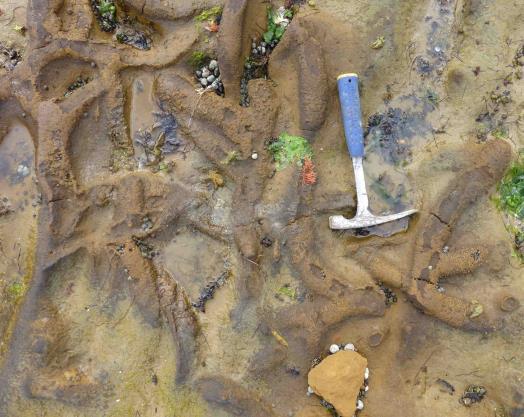
Buckeridge, J.S. 2014. Environmental Ethics: an overview, assessing the place of bioscientists in society, supplemented with selected Australian perspectives. Integrative Zoology 9(1), 14-23. dx.doi.org/10.1111/1749-4877.12028
Buckeridge, J.S., Campbell, H.J. & Maurizot, P. 2014. Unravelling the nature of Waiparaconus, a pennatulacean (Cnidaria: Octocorallia) from the late Mesozoicearly Cainozoic of the Southern Hemisphere. Integrative Zoology 9, 111–120. dx.doi.org/10.1111/1749-4877.12060
Buckeridge, J.S., Lee, D.E. & Robinson, J.H. 2014. A diverse shallow water barnacle fauna assemblage (Cirripedia: Thoracica) from the Oligocene of New Zealand.
New Zealand Journal of Geology and Geophysics 57(2): dx.doi.org/10.1080/00288306.2013.873472
Buckeridge, J.S., Linse, K. & Jackson, J.A. 2013. Vulcanolepas scotiaensis sp. nov., a new deep-sea scalpelliform barnacle (Eolepadidae: Neolepadinae) from hydrothermal vents in the Scotia Sea, Antarctica. Zootaxa 3745(5), 551–568. dx.doi.org/10.11646/zootaxa.3745.5.4
Kočová Veselská, M., Kočí, T. & Buckeridge, J.S. 2013. A systematic review of Stramentum (Stramentum) pulchellum (G.B. Sowerby jr, 1843) (Cirripedia, Thoracica, Stramentidae) from the Bohemian Cretaceous Basin, the Czech Republic. Acta Musei Nationalis Pragae, Ser. B. – Historia Naturalis 69(3-4), 151-158.
Ren, G., Buckeridge, J.S. & Li, J. 2014. Estimating Land Subsidence Induced by Groundwater Extraction in Unconfined Aquifers Using an Influence Function Method. Journal of Water Resources Planning and Management doi: 10.1061/(ASCE)WR.1943-5452.0000479
Monash University
Applied Palaeontology and Basin Studies Group
The team’s 2014 research led by Jeff Stilwell and Chris Mays has continued on systematic and applied palaeontology with respect to the predictability of petroleumbearing facies, employing diverse, integrated methods in palaeontology, and pure basic research on palaeo-equator to poles Cretaceous and Paleogene biotas and palaeoenvironments during the last major greenhouse phase of the Phanerozoic. The group has submitted many confidential industry reports and peer-reviewed papers; many are listed below and several others have been submitted and are in review. Our current industry and institution portfolio includes Shell International, Shell Australia, Origin Energy, Cue Energy, RMA West Linapacan, Karoon Gas, Geoscience Australia, University of Texas-Austin, National Geographic Society, and Australian Research Council, among others. The last five years have seen a dramatic increase in research funding for the group of >$1.7 million and number of keen graduate students in the field, with completed projects in the South Atlantic (Brazil-W Africa), New Zealand-Chatham Islands, Antarctica, Indonesia, Philippines, and many basins in Australia. During the last few years we have spread our collective ‘wings’, and we have started new projects with Cue Energy in Indonesia and RMA West Linapacan in the Philippines with promising results. This year Conor McLaren and Mitchell O’Mara completed exciting Honours projects with RMA on a new petroleum venture in the Palawan Basin in the Philippines, employing applied palaeontology and basin studies. Both Mitchell and Conor intend to start PhDs next year at Monash. Macrofossils discovered in deep water in the Perth Abyssal Plain have been studied this year by 2014 Honours student, Tobin Wild, with the first palaeontologic data being gathered from Batavia Knoll, with surprising results. Two papers are currently being prepared on the palaeontology and tectonic significance of the deep-water deposits. Toban intends to continue the study with Monash, UTAS and Sydney University in 2015 as a PhD investigation. All three students received top H1 Honours results with Conor leading with a fantastic 90 result and Mitchell and Tobin receiving 86, respectively.
Fieldwork has been conducted in the far reaches of the planet from Antarctica to Tanzania to remote areas in Tasmania. In March 2013 and 2014 Jeff Stilwell
participated on expeditions to the Antarctic Peninsula to search for Cretaceous fossils with his 2013 Honours student, Kevin Chen, and Andrew (Drew) Giles in 2014. A terrestrial assemblage of Aptian-Albian fossils was collected on Livingston Island (first ever fossils discovered in Walker Bay) and a paper will be submitted soon to Alcheringa. The 2014 expedition resulted in the discovery of suites of Late Cretaceous fauna and flora of ‘The Naze’ on James Ross Island and Humps Islands. Despite issues with the Argentine government on the return trip with respect to the collected fossils, negotiations continue with the Australian Antarctic Division and the Australian Embassy to work out a solution to the wrongfully confiscated material, despite the proper Antarctic Treaty documents carried during the expedition. Research continues also on early avian remains on the Chatham Islands with colleague, Julia Clarke, from the University of Texas-Austin, and we are close to submitting our first big paper on these important fossils. Other Takatika Grit fossils, collected by Jeff Stilwell, are being studied by Paul Scofield from the Canterbury Museum In other new research, a major discovery by Jeff of the first Mesozoic and earliest Cenozoic, fossiliferous amber in southern Gondwana has seen a flurry of activity by him and his team (nationally and internationally) from 2012-14 on learning more about the Late Cretaceous (Turonian) bioinclusions in the resin from the Otway Basin and the early Paleogene fossiliferous amber from Western Tasmania, and the new terrestrial life that once existed in the high southern latitudes. Finishing PhD student, Annie Quinney, is currently working hard to learn more about the bioinclusions in the amber, the trees that produced the resin and also palaeoclimatic implications. Further, 2014 Honours student, Will De Silva, has studied the Western Tasmanian amber with associated fieldwork resulting in some biotic surprises in the amber, which are currently ‘hush hush’. Will received an H1 result for his 2014 efforts. In fact, the fossil jewels in the amber are so significant that a new PhD student is being sought to study the deposit in more detail any prospective, high achieving students are welcome to contact Jeff Stilwell at Jeffrey.Stilwell@monash.edu. Jeff received the excellent news in November 2013 that he was awarded an Australian Research Council Discovery Project grant (ARC-DP1412515; total funds of ~$300K) for 2014-16(17) with colleagues, Prof. David Cantrill and Dr Dan Bickel, to study the bioinclusions in the amber. The DP project on the amber commenced formally in May 2014. In 2015, micro-CT and synchrotron imaging will continue on the amber, as the results this far have been phenomenal. There will also be another Honours project with new student, Adele Pentland, working on associated amber research.
Dr Chris Mays is presently researching the floral palaeoecology of polar and subpolar palaeolatitudes of Eastern Gondwana (the Chatham Islands, New Zealand, and Winton, Queensland) during a period of global greenhouse conditionsspecifically: the Mid-Cretaceous Thermal Maximum. The aims of this research are twofold: 1) to assess the ecological repercussions of a pivotal phase of floral evolution: the emergence of flowering plants as the dominant floral group on Earth; and 2) provide a palaeontological analogue of floral adaptation patterns and biogeographic distribution in response to extreme global warming. He presented his work at the 4th International Palaeontological Congress (IPC4) in Mendoza, Argentina, and published a taxonomic monograph on the the spore-pollen taxonomy of the mid-Cretaceous Chatham Islands, New Zealand (AAP Memoir #47, in press).
In conjunction with Assoc. Prof. Jeffrey Stilwell, Chris has been supervising a PhD student, Annie Quinney, whose project has been focussing on the oldest recorded amber of Southern Gondwana. 2014 Honours student, Elyse Butterfield, has
researched floral palaeoecology and palaeoenvironments of Cretaceous fossils from the Eromanga Basin, Queensland with a Distinction result. Hannah Carle will head to the Chathams in 2015 for her Honours research with Jeff Stilwell and Chris Mays on the South Polar greenhouse Earth floras and environments.
Pedro A Viegas (Monash University, Melbourne) is a Natural History Curator and Conservator currently working on the ARC project "The first Mesozoic fossiliferous amber from Southern Gondwana". Pedro is managing both the laboratory and expedition sides of the project, developing new techniques for high definition and 3D imaging of amber inclusions, implementing new standards for the preparation and conservation of amber, advising and guiding students and researchers on their amber related investigations as well as developing and leading all field work related activities.
Staff Roles and Expertise for 2014-15:
Assoc. Prof. Jeffrey Stilwell (Chief Investigator and Leader) - Mesozoic-Cenozoic biostratigraphy, macro- and micropalaeontology, and palaeoenvironments
Prof. Mike Hall - Basin Analysis and seismic interpretation
Dr Chris Mays – Palaeobotany, palynology, biostratigraphy
Assoc. Prof. Alan Tait (Honorary Fellow) - Sedimentology and stratigraphy
Dr Ray Bate (UK) – Ostracod biostratigraphy – external consultant and advisor
Dr Alan Partridge (Biostrata Pty Ltd, Melbourne) - Palynomorph biostratigraphy –external consultant and advisor
Dr Andre Coffa (Pietrovin and RMA Energy, Melbourne) - Petroleum geoscience –external consultant and advisor
Dr Daniel Thompson (RMA Energy, Melbourne) – Petroleum geoscience – external consultant and advisor
Dr Kath Grey (Honorary Research Fellow; Geological Survey, WA (retired 2013))Microbialites, stromatolites, inter-tidal biostratigraphy and palaeoenvironments
Prof. David Cantrill (Research collaborator and advisor, Royal Botanic Gardens, Melbourne) – palaeobotany
Dr Dan Bickel (Research collaborator and advisor, Australian Museum, Sydney) –palaeoentomology
Dr Sarah Martin (Research collaborator and advisor, Geological Survey of Western Australia, Perth) – palaeoentomology
Dr Han van Gorsel (Adjunct Research Fellow, Houston, Texas, USA) –micropalaeontology and basin analysis
Current PhD, MSc and Honours Students and Projects at Monash
Mr Hamed Aghaei (PhD, completed 2014) – ‘The Structural, Stratigraphic and Hydrocarbon Potential Evolution of the Onshore Gippsland Basin, Victoria, Australia’
Mr David Briguglio (PhD) – ‘Structural and Stratigraphic Evolution of the Onshore Otway Basin, Western Victoria’
Mr James Driscoll (PhD) – ‘Upper Cambrian-Lower Ordovician sediments, northern Tasmania: An Analogue for the Development of Clastic Reservoirs’
Mr Amir Mahmud (PhD, completed 2014) – ‘Basin Evolution of Upper CambrianOrdovician Sediments in the West Coast Range of Tasmania’
Ms Annie Quinney (PhD) – ‘Diversity of inclusions in Late Cretaceous amber from the Otway Basin, Australia’. This discovery is significant not only because amber is
extremely rare in Australia, but this is also the oldest amber found in Australia. Furthermore, it has the potential to preserve high latitude flora and fauna from a time period in which little is known due to a poor fossil record.
Ms Alana Sharp (PhD, completed 2014) – ‘Cranial form and function of the largest ever marsupial, Diprotodon optaum: a comparative finite element analysis’. Alana’s PhD, under the supervision of Prof. Patricia Vickers-Rich and Dr. Tom Rich, investigated the cranial morphology and biomechanics of Diprotodon using 3D modelling and finite element analysis, with the aim of testing functional hypotheses concerning the extensive endocranial sinuses. Alana used a novel approach to 3D digitally reconstruct the jaw-closing muscles of Diprotodon to analyse jaw movements, muscle forces and bite force. For comparisons, Alana also reviewed the anatomy of Vombatus ursinus and Phascolarctos cinereus using dissections and CT and MRI technology. Results on the anatomy and biomechanics of Diprotodon and V. ursinus will be submitted for publication later this year. Finite element analysis of Diprotodon, and other species is also under-way. Alana presented preliminary results at SVPCA in Oxford (2012) and CAVEPS in Adelaide (2013) and studied under the supervision of Drs. Emily Rayfield and Jen Bright at the University of Bristol.
Mr David Elliott (PhD) – ‘Systematics and palaeoenvironments of the Ediacaran fauna’
Mr Peter Trusler (PhD) – ‘New insights into Palorchestes’
Ms Shannon Herley (PhD) –‘The effects of a transitional tectonic environment on sedimentation processes in the Late Cretaceous, southeastern Australia’
Mr Kevin Chen (Honours H1 result, Dec. 2013) ‘Palaeoenvironmental reconstruction of Livingston Island, Antarctic Peninsula in the Early Cretaceous: interpretations from the Walker Bay Erratics’
Mr Jesse Vitacca (Honours H1 result, Dec. 2013) ‘Palaeoenvironmental evolution of the Mahakam Delta sequences of the Kutei Basin, Indonesia: employing biostratigraphy and basin analysis techniques’
Ms Prudence Perry (Honours H1 result, Dec. 2013) ‘Palaeoenvironmental reconstruction of the Cenozoic Mahakam Delta, Indonesia: characterisation of palynofacies and their associations using organic matter and marine microfossil assemblages’
Mr Conor McLaren (Honours H1 result, highest mark of 2014=90, Dec. 2014) An assessment of the petroleum prospectivity of a Lower Miocene calciturbidite play: the West Linapacan B Structure, Northwest Palawan Basin, Philippines’
Mr Mitchell O’Mara (Honours H1 result, Dec. 2014) Calciturbidite heterogeneity of the West Linapacan A Field, Philippines: an investigation of reservoir architecture and continuity through the use of high-resolution biostratigraphy and well correlation’
Mr Toban Wild (Honours H1 result, Dec. 2014) The life and times of Batavia Knoll, Perth Abyssal Plain: new palaeontological insights into East Gondwana breakup during the mid-Cretaceous’
Mr Will De Silva (Honours H1 result, Dec. 2014) Sub-polar fossiliferous amber from the Lower Eocene Macquarie Harbour Formation, Strahan, Tasmania: taxonomic composition and palaeoenvironmental assessment.
Selected Publications:
Briguglio, D., Kowalczyk, J., Stilwell, J.D., Hall, M. & Coffa, A. 2013. Detailed paleogeographic evolution of the Bass Basin: Late Cretaceous to present. Australian Journal of Earth Sciences 60, 719-734.
Foffa, D., Whiteside, D.I., Viegas, P.A. & Benton, M.J. 2014. Vertebrates from the Late Triassic Thecodontosaurus-bearing rocks of Durdham Down, Clifton (Bristol, UK). Proceedings of the Geologists’ Association 125, 317–328.
Mays, C. (in press). A Late Cretaceous (Cenomanian–Turonian) south polar palynoflora from the Chatham Islands, New Zealand. Memoirs of the Association of Australasian Palaeontologists, 47.
Mays, C.M. & Stilwell, J.D. 2013. Pollen and spore biostratigraphy of the mid Cretaceous Tupuangi Formation, Chatham Islands, New Zealand. Review of Palynology and Palaeobotany 192, 79-102
Mays, C., Tosolini, A-M., Cantrill, D.J. & Stilwell, J.D. 2014. (in press) Late Cretaceous (Cenomanian-Turonian) macroflora from the Chatham Islands, New Zealand: Bryophytes, Lycophytes and Pteridophytes. Gondwana Research. http://dx.doi.org/10.1016/j.gr.2014.03.017.
Quinney, A., Mays, C., Stilwell, J., Zelenitsky, D. & Therrien, F. (in press). The range of bioinclusions and pseudoinclusions preserved in a new Turonian (~90 Ma) amber deposit from southern Australia. PLOS One.
Sorrentino-Mariconda, L., Stilwell, J.D. & Mays, C. 2014. A model of tephra dispersal from an early Palaeogene shallow submarine Surtseyan-style eruption(s), the Red Bluff Tuff Formation, Chatham Island, New Zealand. Sedimentary Geology 300 (2014), 86–102
Stilwell, J.D. 2014. Expansion of the rare trochid Calliovarica (Mollusca: Gastropoda) into eastern Zealandian waters during the late Paleocene-early Eocene thermal event. Alcheringa 38, 239-244.
Thompson, D.L., Stilwell, J.D. & Hall, W.M. (in press). Lacustrine carbonate reservoirs from Early Cretaceous rift lakes of Western Gondwana: Pre-Salt coquinas of Brazil and West Africa. Gondwana Research.
Van den Berg, T., Whitesid,e D.I., Viegas, P., Schouten, R. & Benton, M.J. 2012. The Late Triassic microvertebrate fauna of Tytherington. Proceedings of the Geologists’ Association 123(4) 638-648.
Viegas, P.A. & Benton, M.J. 2014. The Bristol Dinosaur Project – A conservation and preparation overview. Journal of Paleontological Techniques 13, 50-64.
Dr Patricia Vickers-Rich has again been heavily involved in IGCP project 587: Identity, Facies and Time – the Ediacaran (Vendian) Puzzle, of which she is a coleader. This year several symposia and field workshops were organised, including: Yangtze Gorges, 2014 - A Symposium and Field Worshop on Ediacaran Subdivision and Correlation and Cryogenian Glaciations, held in Yichang, China, June 11-22, 2014. A Symposium on Neoproterozoic palaeobiology: preservation, palaeobiology, environments and phylogeny was held during the 4th International Palaeontological Congress (IPC) in Mendoza, Argentina 28 Sept.to 3 Oct. 2014. A Field workshop on the Nama Group of Namibia (May/June 2014) was held at Farm Aar in Namibia Pat gave the Keynote address on “The importance of early childhood education in the earth sciences” to the 7th Conference of the African Association of Women in Geoscience, Windhoek, 3-9 Nov. 2014 at the Namibian Geological Survey, Windhoek.
Two major exhibitions were staged, one in Adelaide (a significant update to the Ediacaran Fossil Gallery “First Life”) and another in Singapore (Dinosaurs: Dawn to Extinction) at the ArtScience Museum which had an entire hall dedicated to the
Precambrian and Palaeozoic. Two smaller exhibitions were held in regional centres (Bathurst and Geelong), all highlighting research results of IGCP587.
Inspiring Australia Project: “Hidden National Treasure” Geotourism Training: 2012-2014. Under the Inspiring Australia program, a grant was awarded to develop geo-tourism skills for successful applicants with particular emphasis on the fossil assets of the Flinders Ranges. The project was managed by Damia Ettakadoumi and Chris Matthews of Straight Up Science, and included Certificate Training for tour guiding followed by a program, run by Jim Gehling and Chris Matthews, designed to highlight the geological treasures of the Cryogenian, Ediacaran and Cambrian rock formations in the central Flinders Ranges The Flinders is one of 16 regions chosen for the Australia’s National Landscapes program, a tourism development and conservation partnership managed by Tourism Australia and Parks Australia
National Heritage Listed Ediacara Fossil Site at Nilpena: More than 600 m2 of fossiliferous beds have been excavated, inverted and re-assembled in stratigraphic series at Nilpena west of the Flinders Ranges in South Australia from 7 sites.
Travis Park is currently in the second year of his PhD which is investigating the hearing abilities of archaic toothed baleen whales. He is also continuing his research on Australian fossil penguins with one paper published this year and several nearing completion. He also communicates the latest palaeontological findings to the general public via social media and his blog, called Blogozoic, on the SciLogs blogging network.
Fitzgerald, E.M.G., Park, T. & Worthy, T. 2012. First giant bony-toothed bird (Pelagornithidae) from Australia. Journal of Vertebrate Palaeontology 32, 971–974.
Park, T. 2012. Tracing the evolution of modern penguins (Aves: Spheniscidae) using fossils from Australia. Unpublished Honours thesis. 51 pp. Park, T. 2014. Redescription of the Miocene penguin Pseudaptenodytes macraei Simpson (Aves: Sphenisciformes) and redefinition of the taxonomic status of ?Pseudaptenodytes minor Simpson. Alcheringa 38, 450–454.
Park, T. & Fitzgerald, E.M.G. 2012. A late Miocene–early Pliocene Mihirung bird (Aves:Dromornithidae) from Victoria, southeast Australia. Alcheringa 36, 419–422.
Park, T. & Fitzgerald, E.M.G. 2012. A review of Australian fossil penguins (Aves: Sphenisciformes). Memoirs of Museum Victoria 69, 309–325
Deakin University, Burwood Campus (Melbourne)
Guang Shi continues his work on Late Palaeozoic brachiopod faunas, biostratigraphy, biogeography and extinction patterns, with ongoing active research collaborations with colleagues from Argentina, China, New Zealand, Russia and Taiwan. He has also recently initiated a research program on the macroevolution of Permian Triassic marine invertebrate body sizes in relation to global warming and the end-Permian mass extinction.
Cisterna G.A. & Shi G.R. 2014. Lower Permian brachiopods from Wasp Head Formation, Sydney Basin, southeast Australia. Journal of Paleontology 88, 531544.
Haig, D.W., Martin, S.K., Mory, A.J., McLoughlin, S., Backhouse, J., Rodney, W., Berrell, R.W., Kear, B.P., Hall, R., Foster, C.B., Shi, G.R. & Bevan, J.C. 2015. Early Triassic (early Olenekian) life in the interior of East Gondwana: mixed marine–terrestrial biota from the Kockatea Shale, Western Australia. Palaeogeography, Palaeoclimatology, Palaeoecology 417, 511–533.
Haig, D.W., McCartain, E., Mory, A.J., Borgesm, G., Davydov, V.I., Dixon, M., Ernst, A., Groflin, S., Håkansson, E., Keep, M., Santos, Z.D., Shi, G.R. & Soares, J. 2014. Postglacial Early Permian (late Sakmarian–early Artinskian) shallowmarine carbonate deposition along a 2000 km transect from Timor to west Australia. Palaeogeography, Palaeoclimatology, Palaeoecology 409, 180–204
He, W.H., Shi, G.R., Twitchett, R.J., Zhang, Y., Zhang, K.X., Song, H.J., Yue, M.L., Wu, S.B., Wu, H.T., Yang, T.L. & Xiao, Y.F. 2015. Late Permian marine ecosystem collapse began in deeper waters: evidence from brachiopod diversity and body size changes. Geobiology [In press, online version available: DOI: 10.1111/gbi.12119].
He, W.H., Shi, G. R., Zhang, Y., Yang, T.L., Zhang, K.X., Wu, S.B., Niu, Z.J. & Zhang, Z.Y. 2014. Changhsingian (latest Permian) deep-water brachiopod fauna from South China. Journal of Systematic Palaeontology 12, 907–960.
Zhang, Y., Shi, G.R., He, W.H., Zhang, K.X. & Wu, H.T. 2014. A new Changhsingian (Late Permian) brachiopod fauna from Zhongzhai section (South China), Part 2: Lingulida, Orthida, Orthotetida, Spiriferida. Alcheringa 38, 480–503
Zhang, Y.C., Shi, G.R., Shen, S.Z. & Yuan, D.X. 2014. Permian fusuline fauna from the Lower Part of the Lugu Formation in the central Qiangtang Block and its geological implications. Acta Geologica Sinica 88, 365-379.
Zhang, Y., Zhang, K.X., Shi, G.R., He, W.H., Yuan, D.X., Yue, M.L. & Yang, T.L. 2014. Restudy of conodont biostratigraphy of the Permian–Triassic boundary section in Zhongzhai, southwestern Guizhou Province, South China. Journal of Asian Earth Sciences 80, 75–83.
Mark Warne has research interests in: (1) the systematic taxonomy of Cenozoic Ostracoda from Australia and the Southwest Pacific; (2) Late Miocene to early Pleistocene stratigraphy, sedimentology and ostracod faunal cycles of the Bass Strait hinderland, southeast Australia, and (3) Mid Holocene to Recent coastal palaeoenvironments and ostracod assemblages of the Warrnambool and Port Fairy districts, southeast Australia.
Camilleri, T.A. & Warne, M.T. 2014 (online version) Preservation and assemblage characteristics of some ornate Lower Devonian Ostracoda from the Humevale Siltstone and Woori Yallock Formation, southeast Australia. Alcheringa [DOI: 10.1080/03115518.2014.951918].
Poore, G.C.B., Avery, L., Błażewicz-Paszkowycz, M., Browne, J., Bruce, N.L., Dane, E., Gerken, S., Glasby, C., Staples, D., Syme, A., Taylor, J., Walker-Smith, G., Warne, M., Watson, C., Williams,A., Wilson, R.S. & Woolley, S. 2015 (online version). Invertebrate diversity of the unexplored marine western margin of Australia: taxonomy and implications for global biodiversity. Marine Biodiversity [DIO: 10.1007/s12526-014-0255-y].
Dr Nick Porch (ARC DECRA Fellow) continues his research into human impacts on island ecosystems in the Indo-Pacific. This research uses the recent fossil record of
plants and insects to contextualise the impact of both prehistoric and recent human arrival on island biodiversity. It is demonstrating that a wide range of insects were extirpated following human settlement regardless of whether this was in prehistory (Polynesia) or more recently (Mascarenes). Also there is ample evidence that humans translocated a large number of pest species including taxa that are ranked amongst the world's most destructive invasive insects.
Dr Elizabeth (Liz) Weldon is currently working on the taxonomy, biogeography and palaeoecology of Permian brachiopods, bivalves and conulariids, principally from the southern Sydney Basin, eastern Australia. Liz continues to teach ‘History of Life’ to a large cohort of first year students, and ‘Biogeography’ at second year level. Currently Liz is supervising:
Shauna Stephens (Honours). Shauna is investigating the possible evolutionary influence of island isolation on the dentition of Macropus rufogriseus (co-supervisor with Dr Sanja Van Huet)
Kerry Wood (Summer Scholarship and Professional Practice). Kerry is assisting Liz with research on Australian Permian conulariids.
Roger Pierson maintains an interest in Gondwanan Permian palynology, and relict Permian landforms in Victoria, Australia.
Dr Sanja Van Huet is using features of the tarsometatarsus of extant and extinct Dromaius species to determine age groups biases in fossil bone accumulations. The following students are working on research projects under Sanja's supervision: Maggie Coombs is determining evidence for sexual dimorphism in the tarsosmetarsus of Dromaius sp.
Cameron McKenzie is reinvestigating the possible source and the depositional environment of the Lancefield megafaunal deposit at Lancefield, Victoria Chris Dixon is investigating the environmental and depositional history associated with the discovery of an almost complete Zygomaturus skeleton at Diamond Bay, Sorrento.
Shauna Stephens is investigating the possible evolutionary influence of island isolation on the dentition of Macropus rufogriseus (with Liz Weldon)
Dr Sangmin Lee commenced his Research Fellow position at Deakin University in March 2014, and is working with Professor Guang Shi on a number of Permian palaeontology and global biogeography projects, with a particular focus on Permian marine faunas of the Arctic region.
Tamara Camilleri is completing her Masters by research degree under the supervision of Dr Mark Warne and Prof. Guang Shi at Deakin University and Dr David J. Holloway at Melbourne Museum. Tamara is currently working on the reclassification of Mid-Palaeozoic Ostracoda of Victoria, particularly the Fairy Bed Formation and the Norton Gully Sandstone in Eastern Victoria. Tamara has also recently reclassified the ostracod taxa found within the Humevale Siltstone and Woori Yallock Formation in the Lilydale, Chirnside Park area. The research also involves palaeoenvironmental and palaeoecological analysis.
Camilleri, T.T.A. & Warne, M.T. (in press). Preservation and assemblage characteristics of some ornate Lower Devonian Ostracoda from the Humevale Siltstone and Woori Yallock Formation, southeastern Australia. Alcheringa 39.
Lisa Nink has just completed her Honours thesis entitled ‘The Systematic Palaeontology of the Plio-Pleistocene Childers Cove Local Fauna, Victoria, Australia’ under the supervision of Professor Guang Shi at Deakin University and Dr Thomas Rich at Museum Victoria. The Childers Cove Local Fauna consists mainly of marsupials and includes extinct megafaunal species such as Thylacoleo and Zygomaturus. The results of this study are currently being prepared for publication.
La Trobe University, Bendigo
John Neil (Honorary Research Associate) reports some spectacular results from a study of ostracodes from Miocene cave deposits at Riversleigh in western Queensland With co-operation from Henk Godthelp and others involved in the Riversleigh project, I obtained some sample residue from the treatment of pitfall limestone to pick for ostracodes. A large assemblage was obtained, with 20-30 specimens showing signs of remarkably good soft part preservation. I sought assistance through the ostracod workers newsletter, since my background does not include soft part study.
Collaboration with a group at the European Synchrotron Radiation Facility over several years resulted in two publications, one an extensive taxonomic paper, and the other reporting the discovery of preserved 16 mya sexual organs and included sperm, as revealed by nanotomographic scans (a world first for the preservation of fossil sperm). The ESRF team was led by Dr Renate Matzke-Karasz. The collaboration had extended over 7 years and included workers from Germany, Czech Republic and Japan.
I have now returned to taxonomic work, and studies of the ostracode assemblages from the Batesford Quarry collected originally by Dr Ken Bell.
Matzke-Karasz, R., Neil, J.V., Smith, R.J., Godthelp, H., Archer, M. & Hand, S.J. 2013. Ostracods (Crustacea) with soft part preservation from Miocene cave deposits of the Riversleigh World Heritage Area, NW Queensland, Australia. Journal of Systematic Palaeontology 11(7), 789-819.
Matzke-Karasz, R., Neil, J.V., Smith, R.J., Symonová, R., Morkovský, L., Archer, M., Hand, S.J., Cloetens, P. & Tafforeau, P. 2014. Subcellular preservation in giant ostracod sperm from an early Miocene cave deposit in Australia. Proceedings of the Royal Society B 281 no. 1786 (2014), 20140394.
Museum Victoria, Melbourne
Tom Rich continues research on the late Early Cretaceous polar tetrapods of Victoria. Specifically, an Albian site near Cape Otway called Eric the Red West has now yielded two mammal specimens after six field seasons. This compared to a Barremian or Albian site called Flat Rocks near Inverloch that yielded 52 mammalian lower jaws in 20 field seasons but no upper molars. That bias has been dubbed “the Samson Effect” {for etymology, see Judges 15:15-16, King James Bible} One of the
two mammalian specimens from Eric the Red West consists of two worn and broken upper molars. Poor quality though it is, that fossil does demonstrate the important fact that upper mammalian molars can occur at Eric the Red West. Hence the current emphasis on that site, because well preserved upper molars from there may resolve questions about the much disputed affinities of the mammalian family Ausktribosphenidae that more lower dentitions never will.
After having been submitted five times to three different journals over three years, finally in 2014 appeared in Alcheringa “Serendipaceratops arthurcclarkei Rich & Vickers-Rich, 2003 is an Australian Early Cretaceous ceratopsian”. Ceratopsians are a quite common and diverse group of dinosaurs in the Northern Hemisphere, particularly in eastern Asia and western North America. Northern Hemisphere reviewers of the manuscript were uncomfortable with accepting one isolated bone of the forearm, the ulna, as sufficient evidence that the group was also present in Australia.
Rolf Schmidt manages the Museum Victoria Invertebrate Palaeontology collection. All the Museum’s Palaeontology and Geology collections will move buildings in early 2016, and in the lead up to this, access to the collection may become more limited. Amongst Rolf’s projects is the photography (and potential 3D scanning) of MV type specimens, which will become part of our online collections database.
In time now freed up since handing over his AAP Treasurer role after more than 8 years, he is squeezing in some research on fossil bryozoans. Current focus is on the following:
(1) The Cretaceous/Palaeogene transition in Australia and how the regional bryozoan faunas responded (testing the hypothesis that they were less affected by the K/T event than the northern hemisphere);
(2) CT and Synchrotron scanning of bryozoans, with the potential to achieve (nondestructive) scans of Palaeozoic bryozoan fossils within artefacts from the UK in order to pinpoint their provenance;
(3) Trawling through museum collections looking for encrusting bryozoans that have been catalogued according to their substrate taxon (e.g. bivalve), with a good chance of finding overlooked new species.
Rolf is also very busy organising the 17th International Bryozoology Conference, to be held in April 2016 at Melbourne Museum.
Western Australia
University of Western Australia
John Backhouse (University of Western Australia and Backhouse Biostrat Pty Ltd) is still an Honorary Research fellow at UWA and also maintains a low level of consulting work, now almost entirely for onshore hydrogeology investigations. Research work has been on material from Timor Leste in conjunction with David Haig and others and more recently on the Perth Basin. His main research interest is a large project on the Late Carboniferous of the Canning Basin with Arthur Mory of the Geological Survey of WA.
David Haig, Senior Honorary Research Fellow in the Centre for Energy Geoscience (formerly Centre for Petroleum Geoscience and CO2 Sequestration), School of Earth & Environment, continues to enjoy a very active retirement pursing research interests in the late Paleozoic to Jurassic East Gondwana interior sag/rift, the Late Jurassic to Cenozoic west Australian passive margin, and the Timor collision.
[Consolidated Publications (2012-2014)].
Benincasa, A., Keep, M. & Haig, D.W. 2012. A restaining bend in a young collisional margin: Mount Mundo Perdido, East Timor. Australian Journal of Earth Sciences 59, 1-19.
Davydov, V.I., Haig, D.W. & McCartain, E. 2013. A latest Carboniferous warming spike recorded by a fusulinid-rich bioherm in Timor Leste: Implications for East Gondwana deglaciation. Palaeogeography, Palaeoclimatology, Palaeoecology 376, 22–38.
Davydov, V.I., Haig, D.W. & McCartain, E. 2014. Latest Carboniferous (Late Gzhelian) fusulinids from Timor Leste and their paleobiogeographic affinities.
Journal of Paleontology 88, 588–605.
Haig, D.W. 2012a. Palaeobathymetric gradients across Timor during 5.7-3.3 Ma (latest Miocene-Pliocene) and implications for collision uplift. Palaeogeography, Palaeoclimatology, Palaeoecology 331-332, 50-59.
Haig, D.W. 2012b. Stratigraphic reconstruction of Timor Leste. In Nogueira, P.M.M.P. (Ed.), 1st International Congress of Geology of Timor Leste, 1620th January, 2012, Dili, Timor Leste, pp. 59-62.
Haig, D.W. & Bandini, A.N. 2013. Middle Jurassic Radiolaria from a siliceous argillite block in a structural melange zone near Viqueque, Timor Leste: Paleogeographic implications. Journal of Asian Earth Sciences 75, 71–81.
Haig, D.W., Martin, S.K., Mory, A.J., McLoughlin, S., Backhouse, J., Berrell, R.W., Kear, B.P., Hall, R., Foster, C.B., Shi, G.R. & Bevan, J.C. 2015. Early Triassic (early Olenekian) life in the interior of East Gondwana: mixed marine-terrestrial biota from the Kockatea Shale, Western Australia. Palaeogeography, Palaeoclimatology, Palaeoecology 417, 511-533. http://dx.doi.org/10.1016/j.palaeo.2014.10.015.
Haig, D.W. & McCartain, E. 2012. Intraspecific variation in Triassic Ophthalmidiid Foraminifera from Timor. Revue de Microlaéontologie 55, 39-52.
Haig, D.W., McCartain, E., Mory, A.J., Gilsel B., Davydov, V.I., Dixon, M., Ernst, A.J., Groflin, S., Håkansson, E., Keep, M., Dos Santos, Z., Shi, G.R. & Soares, J. 2014. Postglacial Early Permian (late Sakmarian-early Artinskian) shallowmarine carbonate deposition along a 2000 km transect from Timor to west Australia. Palaeogeography. Palaeoclimatology, Palaeoecology 409, 180–204.
Mory, A.J., Crowley, J., Nicoll, R.S., Metcalfe, I., Mantle, D., Mundil, R. & Backhouse, J. 2012. Wordian (Middle Permian) U-Pb CA-IDTIMS isotopic ages from the Lightjack Formation, Canning Basin, Western Australia. Proceedings of the 34th International Geological Congress 2012. Brisbane, Australian Geosciences Council, p. 3386.
Ostragnay, D.B. & Haig, D.W. 2012. Foraminifera from microtidal rivers with large seasonal salinity variation, southwest Western Australia. Journal of the Royal Society of Western Australia 95, 137-153.
Taboada, A.C., Mory, A.J., Shi, G-R., Haig, D.W. & Pinilla, M.K. (in press). An Early Permian brachiopod-gastropod fauna from the Calytrix Formation, Barbwire Terrace, Canning Basin, Western Australia. Alcheringa.
Vachard, D., Haig, D.W. & Mory, A.J. 2014. Lower Carboniferous (middle Visean) foraminifers and algae from an interior sea, Southern Carnarvon Basin, Australia. Geobios 47, 57–74.
Curtin University, Perth
Palaeontology Ancient Climates and Ecosystem (PACE) was launched on 28th March 2014 with a one-day symposium highlighting palaeontology research being undertaken in Western Australia and the different expertise that are available in the state. Currently the multidisciplinary teams researchintegratesthefieldsof sedimentology,palaeontology,ecologyandgeochemistrytoinvestigatepalaeoclimatic, evolutionaryandenvironmentalprocessesinordertoreconstructaspectsoftheEarth’spast andbetterunderstandthecomplexitiesofthemodernenvironment,patternsofbiodivesity andthebiosphere.ThisyearmembersparticipatedinAAPG Houston, ICP4Mendoza andSVPBerlin.
Dr Milo Barham is a geologist whose research spans a broad field of sedimentology, palaeontology and geochemistry. Milo has been continuing work with B. Roelofs and K. Trinajstic examining Devonian microvertebrate and conodont assemblages from the Lennard Shelf, Canning Basin. In particular, investigating their O-isotope signatures with respect to interpreting palaeoenvironmental signals as well as palaeoecological, taphonomic and analytical controls. Milo, along with M. O’Leary, has been expanding his research in the Nullarbor Plains region into the Mesozoic sediment underlying the Eucla Basin to track the evolution of the southern margin of Australia in terms of depositional setting, sediment sourcing and crustal deformation. Milo obtained a number of small grants in 2014, including ~$35k in Chevron SEED funding to attempt absolute dating of the Mungaroo Fm. (NW Shelf) to tie local stratigraphic (in particular biostratigraphic) schemes to an absolute timescale and resolve where biostratigraphy is impossible. During 2014, Milo took up a position on the Sub-commission for Western Australian Stratigraphy.
Dr Alison Blyth is a geochemist whose research focuses on the use of organic biomarkers, stable isotopes, and radiocarbon in fossils, sediments, and the modern environment to understand how environments and ecosystems respond to past and present natural and anthropogenic change. Current areas of interest include the use of stable isotopes in modern and fossil materials to interrogate and quantify changes in invertebrate and vertebrate food webs, primary sources, and environments. This work is leading to multiple collaborations, including with Dr Colin Smith of Latrobe University, Dr Milo Barham, and biologists and ecologists across a range of organisations. Other research themes include the use of biomarker compounds, and stable and radiocarbon isotopes to better understand the sources and transportation of organic matter in modern environments and Quaternary archives.
Dr Ross Edwards is an ultra-trace environmental chemist with expertise in 1) ice core glaciochemistry and plaeo-atmospheric records, 2) atmospheric chemistry, and 3) aquatic chemistry. His primary research focuses on the recent evolution of the atmosphere with respect to climate forcing and bigeochemical feedbacks. This research involves the chemical analysis of particles and soluble species in ice core records at concentrations down to the parts per quadrillion level. Edwards works in
collaboration with national and international partners to drill and analyse ice core records from Antarctica, Greenland, and China. Edwards leads the Curtin University TRACE facility – a unique cleanroom laboratory for contamination free sample preparation and analysis. The facility houses ice core analysis equipment, ancient DNA sample preparation laboratories (TreND group) as well as advanced instrumentation for ultra-trace analysis by high-resolution inductively coupled plasma, single particle intracavity laser induced incandescence and field flow fractionation. Automated systems for the ultra-clean extraction of elements from seawater is also housed in the facility.
Dr Aaron W. Hunter is a geologist and palaeontologist whose research centres on marine invertebrates, specifically echinoderm palaeoecology, and biostratigraphy. He is interested in both fossil and living organisms, establishing their evolutionary origins and their relation to animals in existence today. Echinoderms are a significant component of the marine biota and his research integrates biological and geological data to reconstruct the palaeobiogeography and palaeoecology of the ancient oceans to understand the evolutionary biology behind the origin of complex life in the deep time marine realm. Aaron uses marine fossils as both bioindicators and biofacies indicators within sedimentary facies, asking important questions about changing marine biodiversity though time in response to major events such as marine revolutions or mass extinctions. These palaeo-data are correlated with the organism responses which occur under modern oceanic conditions. Aaron has an extensive global collaborative research network and his current research is based in South-East Asia and Australia.
Dr Michael O’Leary is a marine geoscientist with expertise in the fields of: 1) tropical coastal geomorphology, 2) coral reef and reef-island evolution, and 3) sea level rise and climate change. His primary research seeks to better understand the ecologic and geomorphic responses of tropical coastal environments to rising sea levels and global environmental change. O’Leary combines high precision GPS and GIS technologies and advanced field mapping to understand past sea level changes and the tectonic and geomorphic evolution of continental margins. He is a lead investigator on WAMSI’s Kimberley Marine Research Node (Reef Growth and Maintenance):1.3.1 Reef geomorphology, Holocene growth history and impacts for climate change. Other projects include an investigation of the evolution of the southern margin of Australia (principally the Bight and Eucla Basins) with the aim of gaining a better understanding of ancient ocean temperatures, currents, faunal provinces, sea level etc. in collaboration with Barham and Dr Nick Timms, Curtin University as well as the Geological Survey of Western Australia.
A/Professor Kate Trinajstic is a palaeontologist with expertise in the fields of: 1) reef evolution, 2) taphonomy in the area of exceptional preservation, 3) morphological changes in early vertebrate (placoderms) through time and 4) microvertebrate and conodont biostratigraphy. Her primary research seeks to understand the timing, anatomical and phylogenetic significance of when specialized sense organs, sexual dimorphism and diverse reproductive structures first evolved in fish, abilities which today allow high diversity in a small geographic range. Kate continues to use synchrotron-radiation and X-ray tomographic microscopy to provide detailed information on the morphology and environment of both modern and ancient fishes and has recently started using the Australian Synchrotron. Currently Kate is the
recipient of a QE11 Fellowship and an ARC DP led by Dr John Long (Flinders University).
Post Graduate Students
Charlotte Mack is continuing a PhD researching the palynology of the Mulga Rock uranium deposits in the southern Officer Basin for her PhD thesis titled “Palynology and stratigraphy of the southern Officer Basin and the implications for southern Australian biostratigraphy and palaeovegetation”. The project is supervised by Dr Lynne Milne and Associate Professor Kate Trinajstic also from Curtin University. Pollen and spore assemblages from Mulga Rocks have been dated as Late Eocene (Murray Basin equivalent of the Middle Nothofagidites asperus Zone). An unusually high percentage of affiliates of Myrtaceae (e.g. eucalypts) have been recognised and fossil pollen species have been identified in assemblages from Mulga Rock that can be aligned with modern species representative of scleromorphic and xeromorphic vegetation. These modern species occupy heath, woodland and/or dry sclerophyll forests today and may indicate that the vegetation may have been more fire-prone and occupied a drier environment. This research will make a significant contribution to knowledge of sclerophylly and xeromorphy in Australia.
Brett Roelofs is currently working on Late Devonian placoderms as well as conodont and microvertebrate remains from the Late Devonian and Early Carboniferous in the Canning Basin of Western Australia. New placoderm discoveries from the Givetian and Famennian, in the Mid-Late Devonian, are providing new data on the distribution and origin of placoderms within the basin. Continued investigation into microvertebrates is allowing a more refined biostratigraphy for the Famennian (Late Devonian) in the Canning Basin. In addition a largely undescribed microvertebrate fauna from the Tournaisian (Early Carboniferous) is currently under investigation. A continued faunal relationship, from the Late Devonian to the Early Carboniferous, is becoming further confirmed between shark faunas in the Canning Basin and other areas of Northern Gondwana. In addition, to better understand palaeoclimates and the potential drivers of extinctions in the Late Devonian and Early Carboniferous, oxygen isotopes from biogenic apatite are currently being employed. Importantly, a range of taxa (fish and conodonts) are under analyses to better determine the effects of diagenesis and potential isotopic fractionation between groups.
Rodney Berrell has commenced a PhD looking at the late Mesozoic fossil fishes from the Eromanga Basin in order to determine faunal diversity, population dynamics, and evolution of the taxa as the basin is transformed from shallow marine to terrestrial depositional environments over a period of ~ 10 million years. A primary aim of this study is to look at microvertebrate material. To date the described Mesozoic fish remains from the Eromanga Basin are limited to fishes with a body size in excess of 1m in length. It is currently unknown if this is a taphonomic or sampling effect. There is a wealth of microvertebrate material known but unstudied suggesting that the lack of data is the result of under-sampling. The fish taxa known include chondrichthyans, actinopterygians and the dipnoans. Out of the ~25 described taxa, only 4 of these are found in freshwater sediments
[Selected Group Publications]
Barham, M., Murray, J., Sevastopulo, G.D. & Williams, D.M. (in press). Conodonts of the genus Lochriea in Ireland and the recognition of the Viséan-Serpukhovian (Carboniferous) boundary. Lethaia doi:/10.1111/let.12096.
Barham, M. (in press) Fossils explained: Comprehending conodonts. Geology Today
Blyth, A.J., Jex, C.N, Baker, A., Khan, S.J. & Schouten, S. 2014. Contrasting distributions of glycerol dialkyl glycerol tetraethers (GDGTs) in speleothems and associated soils. Organic Geochemistry 69, 1-10.
George, A.D., Chow, N. & Trinajstic, K. 2014. Oxic facies and the Late Devonian mass extinction, Canning Basin, Australia. Geology 42, 327-330.
Hairaptetian, V., Roelofs, B., Trinajstic, K. & Turner, S. (in press). Famennian survivor turiniid thelodonts of North and East Gondwana. Geological Society
Special Publication
Hansma, J., Tohver, E., Yan, M., Trinajstic, K., Roelofs, B., Peek, S., Slitznick, S.P., Kirschvink, J., Playton, J., Haines, P. & Hocking, R. 2015. Late Devonian carbonate magnetostratigraphy from the Oscar and Horse Spring Ranges, Lennard Shelf, Canning Basin, Western Australia. Earth and Planetary Science Letters 409, 232-242.
Haig, D.W., Martin, S.K., Mory, A.J., McLoughlin, S., Backhouse, J., Berrell, R.W., Kear, B.P., Hall, R., Foster, C.B., Shi, G.R. & Bevan, J.C. 2015. Early Triassic (early Olenekian) life in the interior of East Gondwana: mixed marine-terrestrial biota from the Kockatea Shale, Western Australia. Palaeogeography, Palaeoclimatology, Palaeoecology 417, 511-533. http://dx.doi.org/10.1016/j.palaeo.2014.10.015.
Johanson, Z. & Trinajstic. K. 2014. Fossilized ontogenies: The contribution of placoderm ontogeny to our understanding of the evolution of early gnathostomes. Palaeontology 57(3), 505-516.
Long, J.A., Mark-Kurik, E., Johanson, Z., Lee, M.S.Y., Young, G.C., Min, Z., Ahlberg, P.E., Newman, M., Jones, R. Blaauwen, J-d. , Choo, B. & Trinajstic, K. 2014. Copulation in antiarch placoderms and the origin of gnathostome internal fertilization. Nature doi:10.1038/nature13825
Murray, J., Lynch, E.P., Domínguez-Alonso, P. & Barham, M. (in press). Stratigraphy and sedimentology of Azokh Cave, in Fernandez-Jalvo, Y., Andrews, P., King, T. & Yepiskoposyan, L. (eds.), Azokh Cave and the Transcaucasian Corridor [forthcoming volume of the Vertebrate Paleobiology and Paleoanthropology Springer Book Series edited by E. Delson and E. Sargis]
Rovere, A., Raymo, M.E., Mitrovica, J.X., Hearty, P.J., O'Leary, M.J. & Inglis, J.D. 2014. The Mid-Pliocene sea-level conundrum: Glacial isostasy, eustasy and dynamic topography. Earth and Planetary Science Letters 387, 27-33.
Sevastopulo, G.D. & Barham, M. 2014. Correlation of the base of the Serpukhovian Stage (Carboniferous; Mississippian) in northwest Europe. Geological Magazine 151, 244-253.
Trinajstic, K., Roelofs, B., Burrow, C.J., Long, J.A. & Turner, S. 2014. Devonian vertebrates from the Canning and Carnarvon Basins with an overview of Paleozoic vertebrates of Western Australia. Journal of the Royal Society of Western Australia 97, 133–151.
Trinajstic, K., Boisvert, C., Long, J.A., Maksimenko, A. & Johanson, Z. 2014. Pelvic and reproductive structures in placoderms (stem gnathostomes). Biological Reviews DOI: 10.1111/brv.12118.
Geological Survey of Western Australia, Department of Mines and Petroleum
The GSWA Paleontology Collection remains open to all researchers, both within Australia and internationally. Recent work has included an ongoing project to digitise the collection’s catalogue, and attempts to recover past (and often very overdue!) loans made by GSWA to various Australian institutions. Any information or queries regarding potential Survey samples (generally numbered with a F- prefix) is most welcome contact Sarah Martin.
Plans are also underway to make all of GSWA’s historic informal paleontology reports available online, including a set of period summaries (akin to GSWA Bulletin 136 ‘Palaeontology of the Permian of Western Australia’, but covering the individual periods from the Precambrian to Quaternary) collated in the late 1980s and early 1990s.
All GSWA publications (>100 years’ worth) are available for free from www.dmp.wa.gov.au/gswapublications just type in appropriate search criteria. Use the DOWNLOAD button to obtain a pdf file (to download, print, or both). For posters, change the cabinet (top right) from ‘GSWA Geoscience Products’ to ‘GSWA Posters and Flyers’.
Heidi-Jane Allen (Basins & Energy Group) is working on Neoproterozoic biostratigraphy of the Amadeus Basin in collaboration with Kath Grey and Peter Haines with an aim to expand this to a greater Centralian Superbasin project in the coming year. Heidi is also working on Palaeozoic (Ordovician–Devonian) biostratigraphy of the Canning and Carnarvon Basins in collaboration with Kate Trinajstic (Curtin University) and is part of a working group on the Eucla Basin in collaboration with Curtin University.
Allen, H-J , Grey, K. & Haines, P W. 2012. Neoproterozoic stromatolite biostratigraphy in the western Amadeus, in Central Australian Basin Symposium III, (G J Ambrose & J Scott, eds). Petroleum Exploration Society of Australia, Special Publication, CD-ROM, 11p.
Allen, H-J., Grey, K. & Haines, P.W. 2012. Stromatolite biostratigraphy in the western Amadeus Basin: Proceedings of the 34th International Geological Congress (34IGC), Brisbane, 5–10 August, Abstracts, p. 1307.
Grey, K , Allen, H-J , Hill, A. & Haines, P W. 2012. Neoproterozoic biostratigraphy of the Amadeus Basin, in Central Australian Basin Symposium III, (G J Ambrose & J. Scott, eds). Petroleum Exploration Society of Australia, Special Publication, CD-ROM, 18p.
Haines, P.W. & Allen, H-J. 2014. Geology of the Boord Ridges and Gordon Hills: Key Stratigraphic Section in the Western Amadeus Basin, Western Australia. GSWA Record 2014/11, 21p.
Haines, P.W., Allen, H-J., Grey, K. & Edgoose, C. 2012. The western Amadeus Basin: revised stratigraphy and correlations, in Central Australian Basin Symposium III (G.J. Ambrose & J. Scott, eds). Petroleum Exploration Society of Australia, Special Publication, CD-ROM, 6p.
Haines, P W , Allen, H-J , Wingate, M T D , Kirkland, C L. & Edgoose, C. 2012. Syntectonic (Petermann Orogeny) deposition tracked through detrital zircon geochronology, western Amadeus Basin, central Australia: Proceedings of the 34th International Geological Congress (34IGC), Brisbane, 5–10 August, Abstracts, p. 1091.
Haines, P.W., Allen, H-J., Wingate, M.T.D., Kirkland, C.L. & Hocking, R.M. 2011. Ice movement direction and detrital zircon provenance data for early Permian glacial deposits, Amadeus Basin, eastern Western Australia: Abstracts, XVII International Congress on the Carboniferous and Permian, Perth, 3–8 July, p. 63. Hocking, R., Haines, P. & Allen, H-J. 2014. The Devonian Reef Complexes of the Canning Basin in Context: Subsurface and Adjacent Basins: AAPG Annual Conference and Exhibition 2014, Houston, TX, April 6 – 9, 2014, Abstracts.
Kath Grey (Consultant paleontologist) is enjoying retirement but is still maintaining an interest in scientific studies. She is working on both the stromatolites and palynology of the Amadeus Basin, focussing mainly on the western part of the basin currently being re-assessed by Peter Haines and Heidi Allen. Kath also continues her interests in older Proterozoic and Archean acritarchs and stromatolites, including a project on Mesoproterozoic stromatolites from the North Australian Craton in conjunction with GSWA mapping geologist Chris Phillips. The text for a handbook for the study and description of stromatolites and other microbialites with Stan Awramik is nearly complete and the focus is now on selecting appropriate illustrations. Input to the GSWA fossil databases also continues.
Sarah Martin (Basins & Energy Group) took over management of GSWA’s paleontology collection in 2012 and is the primary contact for matters relating to this collection. She is also part of a Survey team reassessing the stratigraphy of the Southern Perth Basin, and is presently focussed on reviewing the biostratigraphy of this region.
Sarah also continues to work on Mesozoic insects, including: finalising publication of her PhD research on Early Jurassic insects from Western Australia; continuing work on the Early Cretaceous Koonwarra insect assemblage of Victoria (in association with Monash University); and commencing research on insects from the Lower Triassic Kockatea Formation (in association with UWA).
Haig, D.W., Martin, S.K., Mory, A.J., McLoughlin, S., Backhouse, J., Berrell, R.W., Kear, B.P., Hall, R., Foster, C.B., Shi, G.R. & Bevan, J.C. 2015. Early Triassic (early Olenekian) life in the interior of East Gondwana: mixed marine-terrestrial biota from the Kockatea Shale, Western Australia. Palaeogeography, Palaeoclimatology, Palaeoecology 417, 511-533. doi:10.1016/j.palaeo.2014.10.015. McLoughlin, S., Martin, S.K. & Beattie, R. (in press). The record of Australian plant–arthropod interactions. Gondwana Research doi: 10.1016/j.gr.2013.11.009.
Tony Cockbain (South Perth, WA) has finally retired from editing the RSWA Journal with his swan song being the Centennial Issue ‘Celebrating 100 years of the Royal Society of Western Australia Promoting Science in Western Australia: a review of some achievements’. While the 17 papers cover a wide spectrum of science, several will be of particular interest to palaeontologists: trace fossils from the Tumblagooda Sandstone; Devonian vertebrates from the Canning and Carnarvon Basins; and stromatolite research in Shark Bay. I have also been involved in the GSWA’s project ‘Western Australia unearthed' (a series of volumes that chronicle the geological evolution of Western Australia) in the writing of ‘Australia goes it alone'.
Cockbain, A.E. 2014. Australia goes it alone the emerging island continent 100 Ma to present. Geological Survey of Western Australia, Perth.
Cockbain, A.E. 2014. Preface. Promoting science in Western Australia, a review of some achievements. WA Science Journal of the Royal Society of Western Australia 97, iii-v.
V & C Semeniuk Research Group, Warwick, WA.
Over the past year, Vic Semeniuk, in collaboration with Chris Semeniuk, Joy Unno, and Penelope Clifford, within the V & C Semeniuk Research Group, continued to research in Western Australia Quaternary stratigraphic sequences, their fauna and flora, and their taphonomy along the coast and in wetlands, and develop Holocene and Pleistocene models for interpreting ancient sequences and climate and palaeoecology. In collaboration with Ian Percival and Barry Webby, Vic continues investigations into Ordovician limestones with the objective to reconstruct their palaeoenvironments and palaeoecology at Bowan Park and Cliefden Caves. In collaboration with Barry Webby, Vic is continuing investigations into the ultrastructure of stromatoporoids, their diagenesis, and the interactions between stromatoporoid and enclosing sediments. Recently, Joy Unno and Vic published a paper on the complex ichnology of a tidal flat crustacean in Western Australia that is also preserved as ichnofossils in the indurated middle Holocene carbonate sediments.
Semeniuk, V & Unno, J 2014 Complex ichnology of the Western Australian soldier crab Mictyris occidentalis Unno 2008 (Brachyura: Mictyridae) - the 'Rosetta Stone' to interpreting population age structure and age-related behaviour. Ichnos 21, 44–61.
NEW ZEALAND
Institute of Geological & Nuclear Sciences, Lower Hutt
Highlights and news from the Paleontology team at GNS Science
Paleogene climate and biostratigraphic research
Fossil- and geochemistry-based climate reconstructions of the Paleogene of the SW pacific (Pancost et al., 2013; Taylor et al., 2013; Contreras et al., 2013) are beginning to fall in line with reconstructions based on climate models (Hollis et al., 2012), giving some confidence in the capacity of models to predict the regional impacts of global warming.
Major advances have been made in the calibration and interpretation of climatic events in the early Cenozoic, further clarifying the links between global climatic events and a more energetic hydrological cycle in New Zealand (Slotnick et al., 2014), including the first-ever magnetostratigraphic calibration of Paleogene strata in New Zealand (Dallanave et al., 2014, in review).
A new Paleocene dinoflagellate zonation has been produced that provides a refined subdivision for a time period of interest for both petroleum exploration and paleoclimate research (Crouch et al., 2014), and a significant cooling event in the late Paleocene has been identified that is inferred to be linked to ice sheet growth in
Antarctica (Hollis et al., 2014). A serendipitous outcome of this latter study has been improved understanding of the conditions that led to deposition of a widespread petroleum source rock.
The IPCC Assessment Report 5 Working Group 1 report includes results of Eocene research generated by GNS paleontologists and collaborators in the context of a summary prepared by Chris Hollis.
Cretaceous biostratigraphy
A new dinoflagellates cyst zonation for the Arowhanan Stage (late Cenomanian) fills an age gap in the dinoflagellate biostratigraphy and will aid in petroleum exploration of Late Cretaceous source rocks (Schiøler & Crampton, 2014). On-going work aims to link this new Arowhanan zonation with the existing Piripauan-Haumurian (Santonian-Maastrichtian) dinoflagellate zonation. Biostratigraphic work in the Arowhanan has informed, and benefitted from, recent identification of the Cenomanian-Turonian boundary carbon isotope event in New Zealand (Hasegawa et al., 2013). Study of this boundary, and associated oceanographic and anoxic events, will continue with a study of uranium isotopes, a project led by Claudine Stirling at Otago University and involving James Crampton and Hugh Jenkyns (Oxford University).
IODP
GNS paleontologists have continued to play a lead role in promoting New Zealand’s participation in the International Ocean Discovery Program (IODP), through the Australian and New Zealand IODP Consortium (ANZIC). Chris Hollis stepped down as chair of NZ committee and NZ representative on the ANZIC council, having succeeded in securing NZ’s membership in the next phase of IODP, which includes several New Zealand-led proposals that are likely to result in JOIDES Resolution expeditions in 2017 and 2018. He is replaced by Stuart Henrys. Giuseppe Cortese continues as national coordinator.
New Zealand Fossil Record File
James Crampton attended a workshop in Washington DC in May 2014 to discuss the global integration of paleobiological data from the full array of cyberinfrastructure resources, with an emphasis on sample-based information. James was invited to attend in recognition of the importance of the Fossil Record Electronic database (FRED). The workshop was an important step towards the implementation of international best-practice in FRED, and the development of interoperability between FRED and other international databases. After discussions and analysis lasting over a year, we are close to having an automated protocol for designating 'Adopted Age' in FRED, as a solution to a major problem in the recording and extraction of meaningful geological ages; this protocol will be implemented in the coming year. At the same time, we have initiated a review of the FRED database that will help to inform any redevelopment of the database in the face of growing technical debt, and growing needs and expectations of the user community.
Macropaleontology
The first well-preserved Cretaceous freshwater Mollusca recorded from New Zealand has been described, including a new genus and species of gastropod and elements of
the Gondwana biota that survive elsewhere but are now extinct in New Zealand, and others which have a record to the present day (Beu et al., 2014).
Resolution of a long-standing debate about whether the fossil record is pervasively and profoundly biased by loss of aragonite shells (relative to calcitic shells), or not, is at hand. The bias is shown to be essentially non-existent in siliciclastic, but large in carbonate environments – no-one has documented this contrast previously. Importantly, it is also demonstrated that the bias in carbonate environments reflects both dissolution of aragonitic shells (taphonomic loss) but also an original ecological preference of calcitic taxa for these environments; the ecological and taphonomic effects are of about the same magnitude (Foote, Crampton et al., in press in Paleobiology).
Quaternary temperatures and modern analogue data
Foraminifera-based sea surface temperature estimates for the Last Interglacial (Marine Isotope Stage 5e) reveal ocean conditions around NZ during a time interval of slightly warmer than present climate (Cortese et al., 2013), and suggest expanded influence of the East Australian Current and associated eddies, warming the western Tasman Sea and offshore south-eastern New Zealand more than other regions.
For the first time, a review of marine paleoclimate/paleotemperature records for the Australian-NZ Sector of the Southern Ocean over past 30 ka has been completed (Bostock et al., 2013).
A modern reference dataset for dinoflagellates in the SW Pacific has been established, and data from two sediment trap moorings has been reported on (Prebble et al., 2013a, b).
A calibration dataset for the leaf morphology-based paleoclimate method CLAMP (Climate Leaf Analysis Multivariate Program) was published for the Southern Hemisphere; previous calibrations have mostly focussed on the Northern Hemisphere or are regionally specific calibrations (Kennedy et al., 2014).
Honours
James Crampton was elected to Vice-President (one of five) of the International Palaeontological Association at the 4th International Palaeontological Congress in Mendoza, Argentina, in October 2014.
Marianna Terezow was awarded the Kingma Award at the 2013 NZ Geosciences conference for her outstanding contribution in the form of co-authored publications, collection-curation work and outreach.
Collections
Over the course of the year, more than 25 scientists, representing 9 countries, have visited the National Paleontology Collection at GNS Science. John Simes and Marianna Terezow have responded to remote requests for images, casts, or metadata and have lodged specimens in the collections for researchers based elsewhere.
Events
The Dinosaur Footprints touring exhibition was launched in June 2014, with substantial input from Greg Browne, Marianna Terezow, John Simes, Lucia Roncaglia and Hamish Campbell. This exhibition showcases New Zealand’s only
known dinosaur footprints which were found in Late Cretaceous tidal sediments from Northwest Nelson. The exhibition will tour about 10 New Zealand venues until 2016.
The Quaternary Techniques workshop was held in May 2014, this is the 11th year of this highly successful workshop hosted at GNS and attracted its largest attendance to date, with 53 participants from New Zealand and overseas universities.
Te Kura Whenua camp: GNS Science and Ngati Kahungunu Iwi Incorporated (NKII) held their second Earth science wananga over three days at Putahi Marae in Frasertown, Wairoa. There was a very wide range of participants from senior kaumatua and rangatira within the iwi to numerous emerging leaders. We also encouraged participation by rangatahi, youth, who benefitted greatly from the experience. Feedback was extremely positive. The GNS team included Richard Levy, Chris Hollis and PhD student Kristina Pascher from the Paleontology Department as well as Fiona Coyle, Rawiri Faulkner, Diane Bradshaw and. Kyle Bland.
Funding proposals
GNS paleontologists have also participated fully in the development of proposals to address four of the New Zealand government-initiated National Science Challenges: Deep South, Sustainable Seas, Land and Water and Biological Heritage.
Dallas Mildenhall (co-Principal Investigator) and Liz Kennedy (Associate Investigator) will be working on a new Marsden-funded project entitled ‘Captured in amber: ecological complexity in New Zealand's ancient araucarian forests’. This 3year project led by Daphne Lee from Otago University (co-Principal Investigator) aims to gain insights into life preserved in New Zealand fossil amber over the last 80 million years.
Marcus Vandergoes is an Associate Investigator on a new Marsden-funded Fast Start project entitled: “The terrestrial carbon cycle in transition: tracking changes using novel tracers on multiple timescales”. The Principal Investigator is A. Harland (Waikato University).
Individual reports
Ian Raine Main activities since the last report in Nomen nudum have been in palynological consulting work for petroleum exploration in the Taranaki Basin, and continuing research into a more detailed NZ Late Cretaceous miospore zonation, pollen analysis of NZ honeys, NZ Early Eocene vegetation and paleoclimate, and with Vivi Vajda (Lund University) on the K/T boundary.
Roger Cooper is currently using the CONOP (Constrained optimisation) method and database to analyse the extinction dynamics and survivorship of Ordovician and Silurian graptolites, with James Crampton (GNS Science), Mike Foote (Univ. Chicago) and Pete Sadler (UCLA Riverside). With Jim Jago and Chris Bentley (Adelaide), the last of the major trilobite faunas collected during our expeditions to Northern Victoria Land (1974, 1981) are being described. Various contributions for the Graptolite Online Treatise are in preparation or have been completed.
Student news
Matt Ryan is completing his PhD on Quaternary climate change (Victoria University of Wellington - VUW), co-supervised by Marcus Vandergoes.
Heidi Roop is completing her PhD on Holocene climate change (VUW), cosupervised by Richard Levy and Marcus Vandergoes.
Kristina Pascher, Claire Shepherd, both co-supervised by Hollis (Cortese cosupervisor for Pascher; Crampton co-supervisor for Shepherd), began PhD projects at VUW on Paleogene micropaleontology and paleoclimate.
Sina Panitz (U. Potsdam) completed her MSc thesis on applying a modern radiolaria dataset to core Y9 (co-supervised by Giuseppe Cortese).
Tammo Reichgelt (University of Otago) is completing his PhD on NZ Miocene climate and ecosystems from plant fossils (co-supervised by Liz Kennedy).
The Paleontology Department has recently purchased a desktop SEM, an exciting addition to our research tools and several staff will be trained to operate it in the near future.
Selected publications 2013- 2014 (consolidated listing)
Barrell, D.J.A., Almond, P.C., Vandergoes, M.J., Lowe, D.J. & Newnham, R.M. 2013. A composite pollen-based stratotype for inter-regional evaluation of climatic events in New Zealand over the past 30,000 years (NZ-INTIMATE project). Quaternary Science Reviews 74, 4-20.
Beu, A.G., Marshall, B. & Reay, M.B. 2014. Mid-Cretaceous (Albian-Cenomanian) freshwater Mollusca from the Clarence Valley, Marlborough, NZ, and their biogeographical significance. Cretaceous Research 49, 134-151.
Bostock, H.C., Barrows, T.T., Carter, L., Chase, Z., Cortese, G., Dunbar, G.B., Ellwood, M., Hayward, B., Howard, W., Neil, H.L., Noble, T.L., Mackintosh, A., Moss, P.T., Moy, A.D., White, D., Williams, M.J.M. & Armand, L.K. 2013. A review of the Australian-New Zealand sector of the Southern Ocean over the last 30 ka (Aus-INTIMATE project). Quaternary Science Reviews 74, 35-57
Boyle, J.T., Sheets, H.D., Wu, S.-Y., Goldman, D., Melchin, M.J., Cooper, R.A., Sadler, P.M. & Mitchell, C.E. 2013. A re-examination of the contributions of biofacies and geographic range to extinction risk in Ordovician graptolites. GFF 136(1), 38-41. DOI: 10.1080/11035897.2013.861864
Collins, K.S., Crampton, J.S. & Hannah, M. (In press). Stratocladistic analysis and taxonomic revision of the character-poor New Zealand crassatellid bivalves Spissatella and Eucrassatella Journal of Molluscan Studies
Conran, J.G., Mildenhall, D.C., Lee, D.E., Lindqvist, J.K., Shepherd, C., Beu, A.G., Bannister, J.M. & Stein, J.K. 2014. Subtropical rainforest vegetation from Cosy Dell, Southland: plant fossil evidence for Late Oligocene terrestrial ecosystems. New Zealand Journal of Geology and Geophysics, on-line, doi: 10.1080/00288306.2014.888357.
Contreras, L., Pross, J., van de Schootbrugge, B., Bijl, P.K., Raine, J.I., Koutsodendris, A. & Brinkhuis, H. 2013. Early to Middle Eocene vegetation dynamics at the Wilkes Land Margin (Antarctica). Review of Paleobotany and Palynology 197, 119-142.
Contreras, L., Pross, J., Bijl, P.K., O'Hara, R.B., Raine, J.I., Sluijs, A. & Brinkhuis, H. 2014. Southern high-latitude terrestrial climate change during the Paleocene–Eocene derived from a marine pollen record (ODP Site 1172, East Tasman Plateau). Climates of the Past Discussions 10, 291-340.
Cook, C.P., Hill, D., van de Flierdt, T., Williams, T., Hemming, S.R., Dolan, A.M., Pierce, E.L., Escutia, C.D., Harwood, D., Cortese, G. & Gonzalez, J.J. 2014. Sea surface temperature control on the distribution of far-travelled Southern Ocean
ice-rafted detritus during the Pliocene. Paleoceanography 29. doi:10.1002/2014PA002625
Cooper, R.A., Sadler, P.M., Munnecke, A. & Crampton, J.S. 2014 [2013]. Graptoloid evolutionary rates track Ordovician-Silurian global climate change. Geological Magazine 151, 349-364.
Cortese, G. 2014. Radiolarian researchers based in Italy during the late nineteenth and early twentieth centuries. Journal of Micropalaeontology 33(1), 95–103. doi:10.1144/jmpaleo2012-023
Cortese, G., Dunbar, G.B., Carter, L., Scott, G.H., Bostock, H., Bowen, M. & Crundwell, M.P. 2013. Southwest Pacific Ocean response to a warmer world: insights from Marine Isotope Stage 5e. Paleoceanography 28, 1-14. doi:10.1002/palo.20052
Crame, J.A., Beu, A.G., Ineson, J.R., Francis, J.E., Whittle, R.J. & Bowman, V.C. (in press). The early origin of the Antarctic marine fauna and its evolutionary implications. PLoS ONE
Crouch, E.M., Willumsen, P.S., Kulhanek, D. & Gibbs, S. 2014. A revised Paleocene (Teurian) dinoflagellate cyst zonation from eastern New Zealand. Review of Palaeobotany and Palynology 202, 47-79.
Dallanave, E., Bachtadse, V., Agnini, C., Muttoni, G., Hollis, C.J., Hines, B.R., Morgans, H.E.G., Strong, C.P., Tauxe, L. & Crampton, J.S. 2014. Early-middle Eocene magneto-biochronology of the Southern Pacific Ocean: new data from the South Island of New Zealand. Rendiconti Online 31, 50-51 [CBEP 2014 Conference Proceedings].
Golledge, N.R., Menviel, L., Carter, L., Fogwill, C.J., England, M.H. & Cortese, G. Antarctic meltwater pulse 1A from a positive ice-ocean feedback mechanism. Nature Communications. (accepted August 2014).
Hasegawa, T , Crampton, J , Schiøler, P , Field, B. & Fukushi, K 2013. Carbon isotope stratigraphy and inferred ocean oxia through Cenomanian-Turonian boundary (Upper Cretaceous) sequences in New Zealand. Cretaceous Research 40, 61-80.
Hines, B.R., Kulhanek, D.K., Hollis, C.J., Atkins, C.B. & Morgans, H.E.G. 2013. Paleocene–Eocene Stratigraphy and Paleoenvironment at Tora, southeast Wairarapa, New Zealand. New Zealand Journal of Geology and Geophysics 56, 243-262.
Hollis, C.J., Tayler, M.J.S., Andrew, B., Taylor, K.W., Lurcock, P., Bijl, P.K., Kulhanek, D.K., Crouch, E.M., Nelson, C.S., Pancost, R.D., Huber, M., Wilson, G.S., Ventura, G.T., Crampton, J.S., Schiøler, P. & Phillips, A. 2014a. Organicrich sedimentation in the South Pacific Ocean associated with Late Paleocene climatic cooling. Earth-Science Reviews 134, 81-97.
Hollis, C.J., Pascher, K.M., Hines, B.R., Littler, K., Kulhanek, D.K., Strong, C.P., Zachos, J.C., Eggins, S.M. & Phillips, A. 2014b. Was the Early Eocene ocean unbearably warm or are the proxies unbelievably wrong? . Rendiconti Online 31, 109-110 [CBEP 2014 Conference Proceedings].
Kennedy, E.M., Arens, N.C., Reichgelt, T., Spicer, R.A., Spicer, T.E.V., Stranks, L. & Yang, J. 2014. Deriving temperature estimates from Southern Hemisphere leaves. Palaeogeography, Palaeoclimatology, Palaeoecology 412, 80-90.
Lee, D.E., Lindqvist, J.K., Beu, A.G., Robinson, J.H., Ayress, M.A., Morgans, H.E.G. & Stein, J.K. 2014 Geological setting and diverse fauna of a Late Oligocene rocky shore ecosystem, Cosy Dell, Southland. New Zealand Journal of Geology and Geophysics, on-line, doi: 10.1080/00288306.2014.898666.
Maletz, J., Bates, D., Brussa, E.D., Cooper, R.A., Lenz, A.C., Riva, J.F., Toro, B.A. & Zhang, Y-D. 2014. Chapter 12: Glossary of the Hemichordata, in Treatise on Invertebrate Paleontology, Part V, Revision 2. Treatise Online No 62. Paleontological Institute, The University of Kansas, Lawrence, KA.
Massaferro J., Larocque-Tobler, I., Brooks, S.J., Vandergoes, M., DieffenbacherKrall, A. & Moreno, P. (in press). Quantifying climate change in Huelmo mire (Chile, Northwestern Patagonia) during the Last Glacial Termination using a newly developed chironomid-based temperature model. Palaeogeography, Palaeoclimatology, Palaeoecology
Masson-Delmonte, V., Schulz, M. (Hollis as contributing author), 2013. Chapter 5: Information from Paleoclimate Archives. IPCC Assessment Report 5, Working Group 1: The Physical Science Basis
Matsuzaki, K.M.R., Nishi, H., Suzuki, N., Cortese, G., Eynaud, F., Takashima, R., Kawate, Y. & Sakai, T. 2014. Paleoceanographic history of the Northwest Pacific Ocean over the past 740 kyr, discerned from radiolarian fauna. Palaeogeography, Palaeoclimatology, Palaeoecology 396, 26-40.
Mildenhall, D.C., Kennedy, E.M., Lee, D.E., Kaulfuss, U., Bannister, J.M., Fox, B. & Conran, J.G. 2014. Palynology of the Early Miocene Foulden Maar, Otago, New Zealand: diversity following destruction. Review of Palaeobotany and Palynology 204, 27-42. DOI: 10.1016/j.revpalbo.2014.02.003.
Mildenhall, D.C., Kennedy, E.M., Prebble, J. & Shepherd, C.L. 2014. A distinctive diporate pollen grain (Apocynaceae?) from the Late Oligocene – Early Miocene of New Zealand. New Zealand Journal of Geology and Geophysics, 57(2), 264268.
Mildenhall, D.C., Mortimer, N., Bassett, K.N. & Kennedy, E.M. 2014. Introduction to the special issue Oligocene Paleogeography of New Zealand: maximum marine transgression. New Zealand Journal of Geology and Geophysics 57(2).
Morgans, H.E.G. 2013. Oligocene to Pliocene biostratigraphy of the marine sequences in exploration wells in the Kupe region, South Taranaki Bight, New Zealand. GNS Science Report 2013/48 (Sept 2013): 99 p + CD.
Mortimer, N., Rattenbury, M.S., King, P.R., Bland, K.J., Barrell, D.J.A., Bache, F., Begg, J.G., Campbell, H.J., Cox, S.C., Crampton, J.S., Edbrook, S.W., Forsyth, P.J., Johnston, M.R., Jongens, R., Lee, J.M., Leonard, G.S., Raine, J.I., Skinner, D.N.B., Timm, C., Townsend, D.B., Tulloch, A.J., Turnbull, I.M. & Turnbull, R.E. (in press). High-level stratigraphic scheme for New Zealand rocks. New Zealand Journal of Geology & Geophysics. doi:10.1080/00288306.2014.946062. Norris, R.D., Wilson, P.A., Blum, P. & Expedition 342 Scientists (including Hollis), 2014. Proceedings of the IODP 342, doi:10.2204/iodp.proc.2342.2014.
Pancost, R.D., Taylor, K.W.R., Inglis, G.N., Kennedy, E.M., Handley, L., Hollis, C.J., Crouch, E.M., Pross, J., Huber, M., Schouten, S., Pearson, P.N., Morgans, H.E.G. & Raine, J.I. 2013. Early Paleogene evolution of terrestrial climate in the SW Pacific, Southern New Zealand. Geochemistry, Geophysics, Geosystems 14, 5413–5429 doi: 10.1002/2013gc004935.
Panitz, S., Cortese, G., Neil, H.L. & Diekmann, B. (accepted). A Radiolarian-based paleoclimate history of Core Y9 (Northeast of Campbell Plateau, New Zealand) for the last 160 kyr. Marine Micropaleontology
Percival, I.G., Zhen, Y.Y., Simes, J.E. & Cooper, R.A. 2014 Furongian (late Cambrian) brachiopods and associated conodonts from the Takaka Terrane in the Springs Junction – Maruia area, South Island, New Zealand. in Laurie, J.R. (ed)
Cambro-Ordovician studies V. Memoir of the Association of Australasian Palaeontologists 45, 55-70.
Pojeta Jr., J., Simes, J.E. & Cooper, R.A. 2014 New Zealand Cambrian and Ordovician micromolluscs. in Laurie, J.R., (ed) Cambro-Ordovician studies V. Memoir of the Association of Australasian Palaeontologists 45, 1-16.
Prebble, J.G., Crouch, E.M., Carter, L., Cortese, G., Bostock, H. & Neil, H. 2013a. An expanded modern dinoflagellate cyst dataset for the Southwest Pacific and Southern Hemisphere with environmental associations. Marine Micropaleontology 101, 33-48.
Prebble, J.G., Crouch, E.M., Carter, L., Cortese, G. & Nodder, S.D. 2013b. Dinoflagellate cysts from two sediment traps east of New Zealand. Marine Micropaleontology 104 (2013), 25–37.
Prebble, J.G., Crouch, E. & Cortese, G. 2014. Data report: Quaternary dinoflagellate cyst and pollen census counts from IODP Site 1352B, Canterbury Basin, New Zealand. Proceedings IODP, Vol. 317, doi 10.2204/iodp.proc.317.207.2014.
Roncaglia, L., Fohrmann, M., Milner, M., Morgans, H.E.G. & Crundwell, M.P. 2013. Well log stratigraphy in the central and southern offshore area of the Taranaki Basin, New Zealand. GNS Science report 2013/27. iii, 26 p. + enclosures.
Sadler, P.M., Cooper, R.A. & Crampton, J.S. 2014. High-Resolution Geobiologic Time-Lines: Progress and Potential, Fifty Years after the Advent of Graphic Correlation. The Sedimentary Record 12(3), 4-9.
Schioler, P. & Crampton, J. 2014. Dinoflagellate biostratigraphy of the Arowhanan Stage (upper Cenomanian-lower Turonian) in the East Coast Basin, New Zealand. Cretaceous Research 48, 205-224.
Schmidt, K., De La Rocha, C.L., Gallinari, M. & Cortese, G. 2014. Not all calcite ballast is created equal: differing effects of foraminiferan and coccolith calcite on the formation and sinking of aggregates. Biogeosciences Discussions 11(1), 135145.
Schneider, S., Crampton, J.S. & Lukeneder, A. 2013. Propeamussiidae, Inoceramidae, and other Bivalvia from the Lower Cretaceous Puez Formation (Valanginian to Cenomanian, Dolomites, South Tyrol, Italy). Cretaceous Research 46, 216-231. Scott, G.H. 2013. Biostratigraphy: interpretations of Oppel’s zones. Earth-Science Reviews 126, 266-274.
Slotnick, B.S., Dickens, G.R., Hollis, C.J., Crampton, J.S., Strong, C.P. & Zachos, J.C. 2014. Extending lithologic and stable carbon isotope records at Mead Stream (New Zealand) through the Middle Eocene. Rendiconti Online 31, 201-202 [CBEP 2014 Conference Proceedings].
Strelin, J.A, Kaplan, M.R., Vandergoes, M.J., Denton, G.H. & Schaefer, J.M., 2014. Holocene glacier history of the Lago Argentino basin, Southern Patagonian Icefield. Quaternary Science Reviews 99, 1-22.
Taylor, K.W.R., Huber, M., Hollis, C.J., Hernandez-Sanchez, M.T. & Pancost, R.D. 2013. Re-evaluating modern and Palaeogene GDGT distributions: Implications for SST reconstructions. Global and Planetary Change 108, 158-174.
Vandergoes, M.J., Hogg, A.G., Lowe, D.J., Newnham, R.M., Denton, G.H., Southon, J., Barrell, D.J.A., Wilson, C.J.N., McGlone, M.S., Allan, A.S.R., Almond, P.C., Petchey, F., Dabell, K., Dieffenbacher-Krall, A.C. & Blaauw, M. 2013. A revised age for the Kawakawa/Oruanui tephra, a key marker for the Last Glacial Maximum in New Zealand. Quaternary Science Reviews 74, 195-201.
University of Otago
Daphne Lee (Geology Department) and co-PI, Dallas Mildenhall from GNS Science, have been awarded Marsden funding for a new three-year project entitled "Captured in amber: ecological complexity in NZ's ancient araucarian forests". New Zealand amber is abundant in coal and other sediments, but it is opaque and was previously thought to lack fossils. However, our pilot study has already revealed a remarkable number of new species including exquisitely preserved organisms such as spiders and their webs, pseudoscorpions, mites, midges, wasps, ants, beetles, moths or butterflies and many types of fungi, as well as pollen and wood. Other people involved in this exciting research include Uwe Kaulfuss, Jon Lindqvist and Jennifer Bannister at University of Otago, Liz Kennedy at GNS Science, John Conran, University of Adelaide, and Alexander Schmidt and his amber research group at the University of Göttingen.
Uwe Kaulfuss has continued research on fossils in lake sediments from the early Miocene Foulden Maar and an overview paper on the diversity of arthropods was published recently in Lethaia. Preliminary excavations at a new Miocene maar lake deposit at Hindon by Daphne Lee, Jon Lindqvist and Uwe Kaulfuss in early 2014 have yielded a well–preserved terrestrial biota, including diverse arthropods, which are currently under study. An MSc project at the University of Bonn, Germany, cosupervised by Torsten Wappler and Uwe Kaulfuss, will provide a first look into the diversity of Miocene arthropod–plant interactions at Hindon Maar. Several field trips by Uwe Kaulfuss in 2014 have established numerous new South Island amber localities (Cretaceous to Pliocene).
A Special Issue of New Zealand Geology and Geophysics on NZ Oligocene-Miocene paleogeography was published in mid-2014, with several papers dealing with rocky shore sites in southern New Zealand, one of which, Cosy Dell, has a remarkable, extremely diverse molluscan and ostracod fauna. Henry Gard completed an Hons project on the paleoecology of the late Oligocene estuarine Pomahaka Formation, while Marcus Richards's Hons thesis explored the paleogeography of the East Maniototo area.
Jeffrey Robinson is continuing research on living and fossil brachiopods, mainly craniids, for his PhD thesis. A paper in Lethaia records the first known examples of repair of predatory drill-holes in the shells of living brachiopods and discusses how the drill-holes are repaired and possible implications for brachiopod biology. Two other short papers look in detail at the anatomy of modern craniid brachiopods, including gut structure, and the function of several pairs of muscles. A new mechanism for opening the valves of these brachiopods is proposed.
Tammo Reichgelt has almost completed his PhD research on paleoclimate records from Miocene New Zealand using CLAMP and related methods. Joe Jackson has been working on an MSc on the fossil plants preserved in the Miocene Landslip Hill silcrete.
John Conran, University of Adelaide, is continuing his collaboration in a Marsdenfunded research project on Miocene fossil floras and climates in southern New Zealand. In addition, the trans-Tasman ARC-funded project entitled: "The Eocene high latitude Australasian ‘tropics’ in a changing climate – clarifying the evidence"
has produced an initial comparison of three late Eocene sites in Southland (Pikopiko, Puysegur and Waicoe) as well as progression on several papers on some of the more conspicuous floristic elements in these and other Eocene sites. He is also part of a multi-author collaborative project coordinated through UNE on fossil sedges entitled: Synchotron analysis of fossils calibrates molecular phylogeny of mapaniid sedges, recent funding success resulting in a session in early Oct 2014 where a range of fossil fruits and seeds were scanned.
Jennifer Bannister is continuing her research on leaf fossils and flowers from Foulden and Hindon maars, and Eocene epiphyllous fungi from Pikopiko Fossil Forest.
Publications since 2013 include:
Baird, M J , Lee, D E. & Lamare, M D. 2013. Reproduction and growth of the Terebratulid Brachiopod Liothyrella neozelanica Thomson, 1918 from Doubtful Sound, New Zealand. Biological Bulletin 225, 125–136.
Buckeridge, J S , Lee, D E & Robinson, J H 2014. A diverse shallow-water barnacle assemblage (Cirripedia: Sessilia) from the Oligocene of Southland, New Zealand. New Zealand Journal of Geology and Geophysics 57, 253–263.
Carpenter, R J , Bannister, J M , Lee, D E & Jordan, G J. 2014. Nothofagus subgenus Brassospora (Nothofagaceae) leaf fossils from New Zealand: a link to Australia and New Guinea? Botanical Journal of the Linnean Society 174, 503–515.
Conran, J.G., Bannister, J.M., Mildenhall, D.C., Lee, D.E., Chacon, J. & Renner, S.S. 2014. Leaf fossils of Luzuriaga and a monocot flower with in situ pollen of Liliacidites contortus Mildenh. & Bannister sp. nov. (Alstroemeriaceae) from the Early Miocene. American Journal of Botany 101, 141–1455.
Conran, J G , Lee, W G , Lee, D E , Bannister, J M. & Kaulfuss, U. 2014. Reproductive niche conservatism in an isolated island biota over 20 million years. Biology Letters 10(10), 2014.0647 (6 pp.)
Conran, J G , Mildenhall, D C , Lee, D E , Lindqvist, J K , Shepherd, C , Beu, A G , Bannister, J.M. & Stein, J.K. 2014. Subtropical rainforest vegetation from Cosy Dell, Southland: plant fossil evidence for Late Oligocene terrestrial ecosystems. New Zealand Journal of Geology and Geophysics 57, 236–252.
Kaulfuss, U., Harris, A.C., Conran, J.G. & Lee, D.E. 2014. An early Miocene ant (subfam. Ambyloponinae) from Foulden Maar: the first fossil Hymenoptera from New Zealand. Alcheringa 38, 568–574.
Kaulfuss, U , Lee, D E , Barratt, B I P , Leschen, R A B , Lariviere, M -C , Dlussky, G M , Henderson, I M. & Harris, A C. 2014. A diverse terrestrial arthropod fauna in Zealandia: evidence from the early Miocene Foulden Maar fossil lagerstätte. Lethaia DOI: 10.1111/let.12106
Lee, D.E., Lindqvist, J.K., Beu, A.G., Robinson, J.H., Ayress, M.A., Morgans, H.E.G. & Stein, J K 2014. Geological setting and diverse fauna of a Late Oligocene rocky shore ecosystem, Cosy Dell, Southland. New Zealand Journal of Geology and Geophysics 57, 195–208.
Mildenhall, D C , Kennedy, E M , Lee, D E , Kaulfuss, U , Bannister, J M , Fox, B & Conran, J.G. 2014. Palynology of the Early Miocene Foulden Maar, Otago, New Zealand: diversity following destruction. Review of Palaeobotany and Palynology 204, 27–42.
Reichgelt, T., Jones, W.A., Jones, D.T., Conran, J.G., Bannister, J.M., Kennedy, E M , Mildenhall, D C. & Lee, D E. 2014. The flora of Double Hill (Dunedin
Volcanic Complex, Middle–Late Miocene) Otago, New Zealand. Journal of the Royal Society of New Zealand, DOI: 10.1080/03036758.2014.923476
Robinson, J.H. 2014. The muscles, body wall and valve-opening mechanism of extant craniid (inarticulated) brachiopods. Journal of Natural History 48, 1–22.
Robinson, J.H. 2014. Variations in the gut of craniid (inarticulated) brachiopods. Zoological Science 31(8), 542–545
Ewan Fordyce and PhD students continue research on evolution, systematics and morphology of Cetacea - whales and dolphins - and other vertebrates mostly from New Zealand mid-Cenozoic strata. There is also some ongoing work on extant material. Recent visiting reseachers include Hiroto Ichishima (Fukui Prefectural Dinosaur Museum) on beaked whales, and Mike Gottfried (Michigan State University) on fossil teleosts. Ewan has continued research with the PhD students on early baleen whales and dolphins, has finished the initial field/lab project on the "Lost Mammals of Zealandia", has worked with Felix Marx (now postdoctoral fellow at National Museum of Nature and Science, Tsukuba, Japan) on a new large phylogenetic analysis of Mysticeti, and has been collecting and preparing vertebrates from the NZ lower to middle Paleocene as part of a study of vertebrate recovery from the K-Pg event. Ewan has also worked a little with Daphne Lee’s group on terrestrial biotas. Carolina Loch has continued her postdoc in dentistry at University of Otago, working recently on ultrastructure of modern and fossil cetacean teeth. Yoshi Tanaka has just submitted his PhD on NZ Oligocene platanistoid dolphins, and has published the first contribution - naming a new genus, Otekaikea, which appeared in PloS One. Robert (Bobby) Boessnecker has nearly completed his PhD on Eomysticetidae, from NZ, and recently published on a new genus, Torhoraata, including material collected by Marples and by Fordyce. Another PhD paper deals with Osedax traces on NZ fossil mysticete bones. Bobby continues to publish on fossil marine mammals from the US west coast. C-H Tsai will soon complete his PhD on early baleen whales from the Kokoamu Greensand (early Chattian), and meanwhile has published several papers on evo-devo in modern and fossil mysticetes. Josh Corrie is well into his PhD on Kekenodon-like archaeocetes from NZ, with manuscript largely complete on an informative relatively complete skull. Moyna Muller is working mainly on cetacean flipper musculoskeletal systems. Simone Hicks succesfully completed her PhD on foraminifera from Runangan (late Priabonian) sedimentary rocks associated with the Waiareka Volcanics of North Otago, and has returned to Germany. Sophie White has continued to help run the fossil prep lab.
Ando, T. & Fordyce, R E 2014. Evolutionary drivers for flightless, wing-propelled divers in the Northern and Southern Hemispheres. Palaeogeography Palaeoclimatology Palaeoecology 400, 50-61.
Boessenecker, R W. & Fordyce, R E 2014. A new eomysticetid (Mammalia: Cetacea) from the Late Oligocene of New Zealand and a re-evaluation of ‘Mauicetus’ waitakiensis Papers in Palaeontology 1: DOI 10.1002/spp2.1005. Boessenecker, R.W. & Fordyce, R.E. 2014. Trace fossil evidence of predation upon bone-eating worms on a baleen whale skeleton from the Oligocene of New Zealand. Lethaia DOI: 10.1111/let.12108.
Boessenecker, R.W., Perry, F.A. & Schmitt, J.G. 2014. Comparative Taphonomy, Taphofacies, and Bonebeds of the Mio-Pliocene Purisima Formation, Central
California: Strong Physical Control on Marine Vertebrate Preservation in Shallow Marine Settings. PLoS One 9(3): e91419-Article No.: e91419.
Buono, M.R., Reidenberg, J.S., Fernández, M.S. & Fordyce, R.E. 2014. Anatomy of nasal complex in the Southern Right Whale, Eubalaena australis (Cetacea, Mysticeti). Journal of Anatomy doi: 10.1111/joa.12250.
Butti, C., Fordyce, R.E., Ann Raghanti, M., Gu X., Bonar, C.J., Wicinski, B.A., Wong E W , Roman, J , Brake, A , Eaves, E et al. 2014. The cerebral cortex of the Pygmy Hippopotamus, Hexaprotodon liberiensis (Cetartiodactyla, Hippopotamidae): MRI, cytoarchitecture, and neuronal morphology. The Anatomical Record 10.1002/ar.22875.
El Adli, J.J., Demere, T.A. & Boessenecker, R.W. 2014. Herpetocetus morrowi (Cetacea: Mysticeti), a new species of diminutive baleen whale from the Upper Pliocene (Piacenzian) of California, USA, with observations on the evolution and relationships of the Cetotheriidae. Zoological Journal of the Linnean Society 170(2), 400-466.
Gottfried, M.D. & Fordyce, R.E. 2014. A Late Triassic chimaeroid egg capsule from New Zealand: early evidence of chimaeroid reproductive mode from the eastern margin of Gondwana. Journal of Systematic Palaeontology doi.org/10.1080/14772019.2014.880752.
Gottfried, M D. & Fordyce, R E 2014. An Early Triassic basal actinopterygian fish (Osteichthyes) from D’Urville Island, New Zealand. New Zealand Journal of Geology and Geophysics DOI: 10.1080/00288306.2014.898314.
Loch, C., Swain, M.V., Fraser, S.J., Gordon, K.C., Kieser, J.A. & Fordyce, R.E. 2014. Elemental and chemical characterization of dolphin enamel and dentine using Xray and Raman microanalyzes (Cetacea: Delphinoidea and Inioidea). Journal of Structural Biology 185(1), 58-68.
Scott, J M , Lee, D E , Fordyce, R E. & Palin, J M 2014. A possible Late OligoceneEarly Miocene rocky shoreline on Otago Schist. New Zealand Journal of Geology and Geophysics 57(2), 185-194.
Tanaka, Y. & Fordyce, R E 2014. Fossil dolphin Otekaikea marplesi (latest Oligocene, New Zealand) expands the morphological and taxonomic diversity of Oligocene cetaceans. PLoS One 9(9): e107972.
Tsai, C-H. & Fordyce, R.E. 2014. Disparate heterochronic processes in baleen whale evolution. Evolutionary Biology 1-9 10.1007/s11692-014-9269-4.
Tsai, C-H. & Fordyce, R E 2014. Juvenile morphology in baleen whale phylogeny. Naturwissenschaften doi 10.1007/s00114-014-1216-9.
Tsai, C-H , Fordyce, R E , Chang, C-H. & Lin, L-K 2014. Quaternary fossil Gray Whales from Taiwan. Paleontological Research 18(2), 82-93.
University of Auckland
John (Jack) Grant-Mackie (Hon. Research Fellow) continued with occasional research projects, some commenced a few years ago, but most of quite recent origin. Two publications gave appeared during the year and one or two MSS have been submitted for publication. Of the latter, a major work on the Late Triassic Bryozoa of New Caledonia, with two German colleagues, is with the editor and should appear next year. A new project for which data are now being gathered examines an undescribed very Late Triassic orthoconic nautiloid from the upper part of the Monotis shellbeds (Late Triassic) of New Zealand.
Grant-Mackie, J.A. 2013. Makoiamya cotterallae, a new genus and species of bivalve (Ceratomyidae) from the latest Triassic of New Zealand and New Caledonia Zootaxa 3741(3), 327-348.
Grant-Mackie, J.A., Yamakita, S., Takemura, A., Aita, Y., Takahashi, S., Hori, R.S. & Campbell, H.J. 2014. A probable shark dorsal fin spine fragment from the Early Triassic of the Arrow Rocks sequence, Whangaroa, northern New Zealand. New Zealand Journal of Geology & Geophysics 57, 295-299.
Geomarine Research, Auckland
Bruce Hayward still remains active in foraminiferal research despite the loss of most research funding which has forced the laying off of all remaining staff and the closure of the separate research offices and laboratory. He continues to work in the application of Pleistocene and Holocene planktic and benthic foraminifera to understanding SW Pacific paleoceanography, and Holocene earthquake and sea level histories, as well as chief editor (Foraminifera) for the World register of Marine Species (WoRMS). Research Associate Margaret Morley (Geomarine Research, Auckland) continues her documentation of the ecological distribution of Holocene and Recent ostracods of northern New Zealand.
Barth, N.C., Kulhanek, D.K., Beu, A.G., Murray-Wallace, C.V., Hayward, B.W., Mildenhall, D.C. 2013. New c. 270 kyr strike-slip and uplift rates for the southern Alpine Fault and implications for the New Zealand plate boundary. Journal of Structural Geology 64, 39-52.
Bostock, H.C., Armand, L.K., Barrows, T.T., Carter, L., Chase, Z., Cortese, G., Dunbar, G., Ellwood, M., Hayward, B.W., Howard, W.R., Neil, H.L., Noble, T.L., Mackintosh, A., Moss, P.T., Moy, A.D., White, D., Williams, M.J. 2013. A review of the Australian-New Zealand sector of the Southern Ocean over the last 30 ka. Quaternary Science Reviews 74, 35-57.
Cortese, G., Dunbar, G., Scott, G.H., Carter, L., Bostock, H.C., Bowen, M., Neil, H., Crundwell, M.P., Sabaa, A.T., Hayward, B.W., Martinez, I., Sturm, A. 2013. Southwest Pacific Ocean response to a warmer world - insights from Marine Isotope Stage 5e.Paleoceanography 28, 585-598.
Figueira, B., Hayward, B.W. 2014. Impact of reworked foraminifera from an eroding salt-marsh front on sea-level studies, New Zealand. New Zealand Journal of Geology and Geophysics 57, 378-389.
Hayward, B.W. 2014. Monospecific and near-monospecific benthic foraminiferal faunas, New Zealand. Journal of Foraminiferal Research 44, 300-315.
Hayward, B.W., Figueira, B., Sabaa, A.T., Buzas, M.A. 2014. Multi-year life spans of high salt marsh agglutinated foraminifera from New Zealand. Marine Micropaleontology 109, 54-65.
Hayward, B.W., Scott, G.H. 2013. Historical review of New Zealand foraminiferal studies, in: Bowden, A.J., Gregory, F.J., Henderson, A.S. (Eds.), Landmarks in Foraminiferal Micropaleontology: History and Development. The Micropaleontological Society, Special Publications, London, pp. 271-283.
Seabourne Rust continues to research paleoecology and the New Zealand fossil record, including guiding groups of Australian school teachers around northern New Zealand examining aspects of the natural history of the Kauri tree (Agathis australis) . Other projects this year have been intensive fieldwork in the Wanganui Basin PlioPleistocene as part of the WABO team, a collaboration with paleontologists from the University of Oslo (Norway), NHM (London) and GNS (NZ) studying details of fossil bryozoan faunas including occupancy and competitive interaction between taxa. He also visited the University of Otago (Dunedin) to examine recent bryozoan faunas with Abby Smith to be used for further analysis in Europe.
Rust, S. 2014. Late Cretaceous shark vertebrae (Chondrichthyes) from Koutu Boulders, Hokianga, Northland. p 2-4 in Geocene 11, accessed from www.gsnz.org.nz/information/auckland-i-46.html#mag
SWEDEN
Department of Palaeobiology, Swedish Museum of Natural History
Stephen McLoughlin continues work on Permian and Mesozoic seed-plants from eastern Australia, east Antarctica, and China. His work is funded by the Swedish Research Council and particularly focusses on the architecture of glossopterid and bennettitalean gymnosperms, and the faunal and fungal interactions with these plants Stephen is currently the editor of Alcheringa.
Christian Pott continues work on the Bennettitales including a survey of reproductive structures from the Australian Mesozoic. His other work involves studies of a broad range of assemblages of Triassic to Cretaceous age from northern and central Europe and North China. He is currently the technical editor for Grana
Benjamin Bomfleur recently obtained a Swedish Research Council “Young Researcher postdoctoral fellowship” in the Department of Paleobiology. He is investigating the phylogeny of Mesozoic ferns, and is also studying a series of exceptional three-dimensionally preserved fossils including Permian seeds from northeastern Australia, and clitellate annelid cocoons from Antarctica.
[consolidated list of publications]
Bomfleur, B., Decombeix, A.-L., Schwendemann, A.B., Escapa, I.H., Taylor, E.L., Taylor, T.N., McLoughlin, S. 2014. Habit and ecology of the Petriellales, an unusual group of seed plants from the Triassic of Gondwana. International Journal of Plant Sciences 175, 1062–1075. DOI:10.1086/678087
Bomfleur, B., Klymiuk, A.A., Taylor, E.L., Taylor, T.N., Gulbranson, E.L. & Isbell, J.L. 2014. Diverse bryophyte mesofossils from the Triassic of Antarctica. Lethaia 47, 120-132.
Bomfleur, B., McLoughlin, S. & Vajda, V. 2014. Fossilized nuclei and chromosomes reveal 180 million years of genomic stasis in Royal Ferns. Science 343, 1376–1377 (+ online supplementary data pages 1–16, 2 video clips). DOI: 10.1126/science.1249884
Bomfleur, B., Schöner, R., John, N., Schneider, J.W., Elsner, M., Viereck-Goette, L. & Kerp, H. 2014 New Palaeozoic deposits of the Victoria Group in the Eisenhower Range, northern Victoria Land, Antarctica. Antarctic Science 26, 277–278
Bomfleur, B., Schöner, R., Schneider, J.W., Viereck, L., Kerp, H. & McKellar, J.L. 2014. From the Transantarctic Basin to the Ferrar Large Igneous Province: New palynostratigraphic age constraints for Triassic-Jurassic sedimentation and magmatism in East Antarctica. Review of Palaeobotany and Palynology 207, 18–37
Carpenter, R.J., McLoughlin, S., Hill, R.S, McNamara, K.J. & Jordan, G.J. 2014. Early evidence of xeromorphy in angiosperms: stomatal encryption in a new Eocene species of Banksia (Proteaceae) from Western Australia. American Journal of Botany 109, 1486–1497.
Decombeix, A.-L., Bomfleur, B., Taylor, E.L. & Taylor, T.N. 2014. New data on the anatomy and systematic affinities of corystosperm wood from the Triassic of Antarctica. Review of Palaeobotany and Palynology 203, 22–34.
Hübers, M., Bomfleur, B., Pott, C., Krings, M. & Kerp, H. 2014. A reappraisal of Mississippian (Tournaisian and Visean) adpression floras from central and northwestern Europe. Zitteliana 54, 39–52.
Launis, A , Pott, C. & Mørk, A. 2014. A glimpse into the Carnian: Late Triassic plant fossils from Hopen, Svalbard. Norwegian Petroleum Directorate Bulletin 11, 3542
McLoughlin, S., Bomfleur, B. & Vajda, V. 2014. A phenomenal fossil fern –forgotten for 40 years. Deposits Magazine 40, 16–21.
McLoughlin, S., Jansson, I.-M. & Vajda, V. 2014. Megaspore and microfossil assemblages reveal diverse herbaceous lycophytes in the Australian Early Jurassic flora. Grana 53, 22–53.
Pott, C. 2014. A revision of Wielandiella angustifolia – a shrub-sized bennettite from the Rhaetian–Hettangian of Scania, Sweden, and Jameson Land, Greenland. International Journal of Plant Sciences 175, 467-499
Pott, C. 2014. The Triassic flora of Svalbard. Acta Palaeontologica Polonica 59, 709740.
Pott, C., Guhl, M. & Lehmann, J. 2014. The Early Cretaceous flora from the Wealden facies at Duingen, Germany. Review of Palaeobotany and Palynology 201, 75105
Pott, C. & McLoughlin, S. 2014. Divaricate growth habit in Williamsoniaceae (Bennettitales): unravelling the ecology of a key Mesozoic plant group. Palaeobiodiversity and Palaeoenvironments 94, 307–325.DOI 10.1007/s12549014-0157-9
Rößler, R., Philippe, M., van Konijnenburg-van Cittert, J.H.A., McLoughlin, S., Sakala, J., Zijlstra, G. & 35 others, 2014. Which name(s) should be used for Araucaria-like fossil wood? – Results of a poll. Taxon 63, 177–184. Vajda, V., McLoughlin, S. & Bomfleur, B. 2014. Fossilfyndet i Korsaröd. Geologiskt Forum 82, 24–29.
Van Konijnenburg-van Cittert, J H A , Kustatscher, E , Bauer, K , Pott, C., Schmeißner, S., Dütsch, G. & Krings, M. 2014. A Selaginellites from the Rhaetian of Wüstenwelsberg (Upper Franconia, Germany). Neues Jahrbuch für Geologie und Paläontologie, Abhandlungen 272, 115-127
Lund University
Vivi Vajda (Department of Earth and Ecosystem Sciences) continues to work on high-resolution palynology, sedimentology, and geochemistry of major extinction and biotic radiation events in Earth’s history. She is especially investigating sections in New Zealand, eastern Australia, NW China, western North America and Colombia. She supervises a research student investigating Late Cretaceous biotas from the Kristianstad Basin, southern Sweden. In April 2015, Vivi will take up the position of Head of the Department of Palaeobiology at the Swedish Museum of Natural History in Stockholm.
Badawy, A.S., Mehlqvist, K., Vajda, V., Ahlberg, P. & Calner, M. 2014. Late Ordovician (Katian) spores in Sweden – oldest land plant remains from Baltica. GFF Scandinavian Journal of Earth Sciences 136, 16–21.
Bercovici, A., Cui, Y., Forel, M.-B., Yu, Y. & Vajda, V. (in press). Terrestrial paleoenvironment characterization across the Permian–Triassic boundary in South China. Journal of Asian Earth Sciences.
Bomfleur, B., McLoughlin, S. & Vajda, V. 2014. Fossilized nuclei and chromosomes reveal 180 million years of genomic stasis in Royal Ferns. Science 343(6177), 1376–1377.
McLoughlin, S., Jansson, I.-M. & Vajda, V. 2014. Megaspore and microfossil assemblages reveal diverse herbaceous lycophytes in the Australian Early Jurassic flora. Grana 53, 22–53.
Mehlqvist, K., Larsson, K. & Vajda, V 2014. Linking upper Silurian terrestrial and marine successions Palynological study from Skåne, Sweden. Review of Palaeobotany and Palynology 202, 1–14.
Mehlqvist, K., Wigforss-Lange, J. & Vajda, V. (in press) Late Silurian (Ludfordian) palynological assemblages from Sweden (Klinta) reveal stable terrestrial environments during times of extreme marine conditions. Earth and Environmental Science Transactions of the Royal Society of Edinburgh.
Steinthorsdottir, M. & Vajda, V. (in press). Early Jurassic (late Pliensbachian) CO2 concentrations based on stomatal analysis of fossil conifer leaves from eastern Australia. Gondwana Research http://dx.doi.org/10.1016/j.gr.2013.08.021
Vajda, V. & Bercovici, A. (in press) The global vegetation pattern across the Cretaceous–Paleogene mass-extinction interval – an integrated global perspective. Global and Planetary Change.
Vajda, V., Ocampo, A., Ferrow, E & Bender Koch, C. (in press) Nano particles as the primary cause for long-term sunlight suppression at high southern latitudes following the Chicxulub impact –evidence from ejecta deposits in Belize and Mexico Gondwana Research
UNITED KINGDOM
The Natural History Museum, London
Greg Edgecombe splits his time between research on higher-level arthropod phylogenetics, centipede systematics, and Cambrian animals known from soft-part preservation. The latter has in recent years concentrated on the Emu Bay Shale (South Australia) and Chengjiang (Yunnan, China) Konservat-Lagerstätten.
Dunn, C.W., Giribet, G., Edgecombe, G.D. & Hejnol, A. 2015. Animal phylogeny and its evolutionary implications. Annual Review of Ecology, Evolution and Systematics 45, 371-395.
Bonato, L., Edgecombe, G.D. & Minelli, A. 2014. Geophilomorph centipedes from the Cretaceous amber of Burma. Palaeontology 57, 97-100.
Cong, P., Ma, X., Hou, X., Edgecombe, G.D. & Strausfeld, N.J. 2014. Brain structure resolves the segmental affinity of anomalocaridid appendages. Nature 513, 538542.
Daley, A.C. & Edgecombe, G.D. 2014. Morphology of Anomalocaris canadensis from the Burgess Shale. Journal of Paleontology 88, 68-91.
Edgecombe, G.D. & Legg, D.A. 2014. Origins and early evolution of arthropods. Palaeontology 57, 457-468.
Fernández, R., Laumer, C.E., Vahtera, V., Libro, S., Kaluziak, S., Sharma, P.P., Peréz-Porro, A.R., Edgecombe, G.D. & Giribet, G. 2014. Evaluating topological conflict in centipede phylogenetics using transcriptomic datasets. Molecular Biology and Evolution 31, 1500-1513.
García-Bellido, D.C., Lee, M.S.Y., Edgecombe, G.D., Jago, J.B., Gehling, J.G. & Paterson, J.R. 2014. A new vetulicolian from Australia and its bearing on the chordate affinities of an enigmatic Cambrian group. BMC Evolutionary Biology 14, 214.
Ma, X., Aldridge, R.J., Siveter, D.J., Siveter, D.J., Hou, X. & Edgecombe, G.D. 2014. A new exceptionally preserved Cambrian priapulid from the Chengjiang Lagerstätte. Journal of Paleontology 88, 371-384.
Ma, X., Cong, P., Hou, X., Edgecombe, G.D. & Strausfeld, N.J. 2014. An exceptionally preserved arthropod cardiovascular system from the early Cambrian. Nature Communications 5, 3560.
Paterson, J.R., Edgecombe, G.D. & Jago, J.B. 2014. The ‘great appendage’ arthropod Tanglangia: biogeographic connections between early Cambrian biotas of Australia and South China. Gondwana Research 25, doi:10.1016/j.gr.2014/02.008.
UNITED STATES OF AMERICA
University of Oregon, Eugene
Gregory Retallack reports that discovery of paleosols on Mars was the biggest research news from the Retallack laboratory this year. The superb analytical capabilities of Curiosity Rover now allow unprecedented geochemical evaluation of weathering in Mars some 3.7 billion years ago. The paleosols are thin, gray and have many sulfate nodules, amazingly similar to Archean (3.3-3.5 Ga) paleosols from the Pilbara region of Western Australia, which have been under scrutiny for the past decade and now are approaching readiness for prime time. Debate over the affinities and habitats of Ediacaran fossils continues with a bit of back and forth in published comments, but two new studies also add fuel to the fire. Newfoundland Ediacaran fossils may not have been deep water after all. Furthermore, numerous paleosols in the Bunyeroo, Wonoka, and Bonney Formations of South Australia allow a better understanding of the Wonoka-Shuram isotopic anomaly, which is no longer the biggest isotopic excursion in Earth history, but a short sharp shock coincident with the ECAP acritarch mass extinction.
As director of the Condon Collection of the Museum of Natural and Cultural History at the University of Oregon, Greg has been active rearranging collections in new dust-proof cabinets. Digitization efforts led by Edward Davis have also come to fruition with publication of our fossil catalog online through the portal “paleo.uoregon.edu”. The collection includes some Australian fossils, and we are especially proud of our Precambrian and early Paleozoic “paleobotany” collection. Paleobotany deals with more than just land plants, and has been the traditional home of Precambrian Paleobiology.
Breecker, D.O. & Retallack, G.J. 2014. Refining the pedogenic carbonate atmospheric CO2 proxy and application to Miocene CO2 Palaeogeography Palaeoclimatology Palaeoecology 406, 1-8.
Narkiewicz, M. & Retallack, G.J. 2014. Paleosols and paleoenvironments of the earliest tetrapod tracks in the Eifelian of the Holy Cross Mountains, Poland. Sedimentary Geology 299, 74-87.
Retallack, G.J. 2014a. Precambrian life on land. The Palaeobotanist 63, 1-15.
Retallack, G.J. 2014b. Comment on “Evidence for Cnidaria-like behavior in c. 560 Ma Ediacaran Aspidella” by Latha R. Menon, Duncan McIlroy and Martin D. Brasier. Geology 42, e323, doi:10.1130/G34895C.1
Retallack, G.J. 2014c. Comment on “Affirming life aquatic for the Ediacara biota in China and Australia” by Xiao, S., Droser, M., Gehling, J.G., Hughes, I.V., Wan, B., Chen, Z., and Yuan, X. Geology 42, e325, doi:10.1130/G35030C.1
Retallack, G.J. 2014d. Volcanosedimentary paleoenvironments of Ediacaran fossils in Newfoundland. Geological Society of America Bulletin 126, 619-638.
Retallack. G.J. 2014e. Comment on “How well do fossil assemblages of the Ediacaran biota tell time?” by James G. Gehling and Mary L. Droser. Geology, 42, e322, doi: 10.1130/G34781C.1.
Retallack, G.J. 2014f. Paleosols. 383-408 in Handbook of Paleoanthropology, Volume 1. Principles, methods and approaches (W. Henke & I. Tattersall, eds). Springer, Berlin.
Retallack, G.J. 2014g. Paleosols and paleoenvironments of early Mars. Geology 42, 755-758.
Retallack, G.J., Marconato, A., Osterhout, J.T., Watts, K.E. & Bindeman, I.N. 2014. Revised Wonoka isotopic anomaly in South Australia and Late Ediacaran mass extinction. Journal of the Geological Society of London 171, 709-722.
Sheldon, N.D., Chakrabarti, R., Retallack, G.J. & Smith R.M.H. 2014. Contrasting geochemical signatures on land from the Middle and Late Permian extinction events. Sedimentology, 61, doi: 10.1111/sed.12117.
Zhou, Y., Retallack, G.J. & Huang, C. 2014. Early Eocene paleosol developed from basalt in southeastern Australia: Implications for paleoclimate. Arabian Journal of Geosciences, 7: doi 10.1007/s12517-014-1328-8.
CONTACT DETAILS OF CONTRIBUTORS (alphabetical)
Heidi-Jane Allen (nee Caldon)
Geological Survey of Western Australia, Department of Mines and Petroleum, 100 Plain St, East Perth WA 6004
Tel: 0404 840 546
E-mail: heidi.allen@dmp.wa.gov.au
Rick Arena
PO Box 62
Balgowlah NSW 2093
Ph. 02 9939 0909
Fax 02 9977 6153 r.arena@unsw.edu.au
John Backhouse
55 Lake Monger Drive, Wembley, WA 6014
Ph: (08) 9380 6630
E-mail: jbackhou@arach.net.au
Milo Barham PACE
Curtin University
GPO Box U1987
Perth Western Australia 6845
(08) 9266 2492
milo.barham@curtin.edu.au
Alan Baxter
Division of Earth Sciences, Earth Studies building (C02)
School of Environmental and Rural Science
University of New England, Armidale, NSW 2351
AUSTRALIA
Phone: (02) 6773 2843
Fax: (02) 6773 3300
Email: alan.baxter@une.edu.au
Phil Bell
Division of Earth Sciences, Earth Studies building (C02)
School of Environmental and Rural Science
University of New England, Armidale, NSW 2351
AUSTRALIA
Phone: (02) 6773 2329
Email: pbell23@une.edu.au
Rodney Berrell PACE
Curtin University
GPO Box U1987
Perth Western Australia 6845 (08) 9266 2492 rodneyberrell@yahoo.com
Alison Blyth PACE
Curtin University
GPO Box U1987
Perth Western Australia 6845 (08) 9266 2492
Alison.Blyth@curtin.edu.au
Benjamin Bomfleur
Department of Paleobiology, Swedish Museum of Natural History, Box 50007, S-104 05 Stockholm SWEDEN
Phone: +46 (0)8 519 551 50
Fax: +46 (0)8 5195 4221
E-mail: Benjamin.Bomfleur@nrm.se
John Buckeridge
Earth & Oceanic Systems Group
School of Civil, Environmental & Chemical Engineering
RMIT University
P.O. Box 2476 Melbourne 3001, VIC. john.buckeridge@rmit.edu.au
Carole J. Burrow
Ancient Environments, Queensland Museum, 122 Gerler Road, Hendra, 4011, Qld
Tel: 07 33916626
Fax: 07 38461918
E-mail: carole.burrow@gmail.com
Tamara Camilleri
School of Life and Environmental Sciences, Deakin University Burwood Campus, 221 Burwood Highway, Burwood, Victoria 3125
Tel: (03) 92468529
E-mail: tamara.camilleri@deakin.edu.au
Tony Cockbain 104 Hensman Street
South Perth WA 6151
08 93677037 0439 690 947 geoedit@arach.net.au
John Cook
Function, Evolution and Anatomy Research lab (FEARlab) Zoology, School of Environmental and Rural Sciences University of New England, Armidale, NSW 2351 AUSTRALIA
Email: paleorugger@gmail.com
Barry J. Cooper
Barbara Hardy Centre School of Natural and Built Environments
University of South Australia (Mawson Lakes Campus) GPO Box 2471
Adelaide SA 5001
Roger Cooper
GNS Science, PO Box 30368 Lower Hutt, New Zealand
R.Cooper@gns.cri.nz
Elizabeth M. Dowding
School of Biological, Earth & Environmental Sciences
UNSW, Sydney 2052, NSW, Australia.
P: +61 2 9385 2008
E: e.dowding@unsw.edu.au
Vincent Dupret
Research School of Physics and Engineering
College of Physical and Mathematical Sciences
Department of Applied Mathematics
Building 84, Mills Road
The Australian National University Acton, ACT, 2601 Australia
Tel: +61 2 6125 7583
email: vincent.dupret@anu.edu.au http://physics.anu.edu.au/people/profile.php?ID=1733
Greg Edgecombe Department of Earth Sciences
The Natural History Museum Cromwell Road
London, SW7 5BD, UK
Telephone: 44 20 7942 6464
E-mail: g.edgecombe@nhm.ac.uk
Ross Edwards PACE
Curtin University GPO Box U1987
Perth Western Australia 6845 (08) 9266 2492
R. Edwards@curtin.edu.au
Luca Fiorenza
Archaeology & Palaeoanthropology
Earth Studies Building (C02), Room 112
University of New England
Armidale NSW 2351 Australia
Phone +61 2 6773 2357
Fax: +61 2 6773 3030
Email: lfiorenz@une.edu.au
R Ewan Fordyce
Department of Geology University of Otago, Box 56, Dunedin 9054, NZ
tel +64 3-4797510
fax +64 3-4797527 ewan.fordyce@otago.ac.nz
Diego C. García-Bellido Benham Laboratories, Office 101 School of Biological Sciences North Terrace Campus
The University of Adelaide Adelaide, SA 5005
Phone: (08) 8313 4870
Fax: (08) 8313 6222
Email: Diego.Garcia-Bellido@adelaide.edu.au
Jack Grant-Mackie
31 Moira St, Ponsonby, AUCKLAND 1021, NZ.
Ph: 64-9-378-4779.
Email: grant-mackie@xtra.co.nz
Kath Grey
4 Wallis Lane, Lesmurdie WA 6076
Tel: (08) 9291 3524
E-mail: kath.grey@gmail.com
David W. Haig
Senior Honorary Research Fellow Centre for Energy Geoscience School of Earth & Environment (M004)
The University of Western Australia 35 Stirling Highway, WA Crawley 6009
Australia
Mobile: +61 437 216 036 email: david.haig@uwa.edu.au
Lee Ann Hally
Division of Earth Sciences, Earth Studies building (C02) School of Environmental and Rural Science
University of New England, Armidale, NSW 2351
Email: lhally2@myune.edu.au
Bruce W. Hayward
Geomarine Research, 49 Swainston Rd, St Johns, Auckland, 1072, New Zealand
Ph +64 09 578 1491 b.hayward@geomarine.org.nz http://geomarine.org.nz/
Aaron W. Hunter PACE
Curtin University GPO Box U1987 Perth Western Australia 6845 (08) 9266 2492 aaron.hunter@curtin.edu.au
Jim Jago
Barbara Hardy Centre, School of Natural and Built Environments
University of South Australia Mawson Lakes
South Australia 5095
Phone: (08) 83023113 jim.jago@unisa.edu.au
Peter Jell
School of Earth Sciences, University of Queensland, St Lucia Qld 4072
Telephone: 07 33249449
E-mail p.jell@uq.edu.au
Ada Klinkhamer
Function, Evolution and Anatomy Research lab (FEARlab) Zoology, School of Environmental and Rural Sciences
University of New England, Armidale, NSW 2351
Email: aklinkha@myune.edu.au
Matthew Kosnik
Department of Biological Sciences
Macquarie University, NSW 2109
Phone: +61-2-98507249
E-mail: matthew.kosnik@mq.edu.au
John R. Laurie
Geoscience Australia
GPO Box 378 Canberra ACT 2601
Tel: (02) 6249 9412
E-mail: john.laurie@ga.gov.au
Daphne E. Lee
Department of Geology, University of Otago, PO Box 56, Dunedin 9054, NZ
tel +64 3-4797525
fax +64 3-4797527
daphne.lee@otago.ac.nz
Sangmin Lee
School of Life and Environmental Sciences, Deakin University Burwood Campus, 221 Burwood Highway, Burwood, Victoria 3125
Telephone number (03) 92468529
E-mail address: sanglee@deakin.edu.au
Charlotte Mack PACE
Curtin University
GPO Box U1987
Perth Western Australia 6845
(08) 9266 2492
Charlotte.Mack@curtin.edu.au
Sarah Martin
Geological Survey of Western Australia, Department of Mines and Petroleum, 100 Plain St, East Perth WA 6004
Tel: (08) 9222 3324 / (08) 9470 0302
E-mail: Sarah.Martin@dmp.wa.gov.au
John L. McKellar
Energy Geoscience, Geological Survey of Queensland Department of Natural Resources and Mines
PO Box 15216
City East QLD 4002 Australia
Telephone: 07 303 55235 (international +61 7 303 55235)
Fax number: 07 303 31854 (international +61 7 303 31854)
E-mail: john.mckellar@dnrm.qld.gov.au
Stephen McLoughlin
Department of Paleobiology, Swedish Museum of Natural History, Box 50007, S-104 05 Stockholm SWEDEN
Ph: +46 (0)8 5195 4142
Fax: +46 (0)8 5195 4221
Email: steve.mcloughlin@nrm.se
Ian Metcalfe
Division of Earth Sciences, Earth Studies building (C02)
School of Environmental and Rural Science
University of New England, Armidale, NSW 2351
Australia
Tel: 02-67733499
Email: imetcal2@une.edu.au
Lisa Nink
School of Life and Environmental Sciences, Deakin University Burwood Campus, 221 Burwood Highway, Burwood, Victoria 3125
Telephone number (03) 92468529
E-mail: lnink@museum.vic.gov.au
Michael O’Leary PACE
Curtin University GPO Box U1987
Perth Western Australia 6845 (08) 9266 2492
mick.oleary@curtin.edu.au
Travis Park
School of Biological Sciences, Faculty of Science, Building 19, Clayton Campus, Monash University, Victoria 3800, Australia (03) 8341 7733 travis.park@monash.edu
Geosciences, Museum Victoria, GPO Box 666, Melbourne, Victoria 3001, Australia tpark@museum.vic.gov.au
John R. Paterson
Division of Earth Sciences, Earth Studies building (C02)
School of Environmental and Rural Science
University of New England, Armidale, NSW 2351
Australia
Phone: (02) 6773 2101
Fax: (02) 6773 3300
Email: jpater20@une.edu.au
Ian Percival
Geological Survey of New South Wales
WB Clarke Geoscience Centre
947-953 Londonderry Road, Londonderry. New South Wales 2753
T: 02 4777 0315
F: 02 4777 4397
E: ian.percival@trade.nsw.gov.au
Roger Pierson
School of Life and Environmental Sciences, Deakin University Burwood Campus, 221 Burwood Highway, Burwood, Victoria 3125. Telephone number: 61 3 9251 7191
E-mail address: r_dpierson@yahoo.com.au
Geoffrey Playford
School of Earth Sciences
The University of Queensland Brisbane, QLD 4072
Australia
Telephone: 07 3365 2366
Fax: 07 3365 1277
Email: g.playford@uq.edu.au
Nick Porch
School of Life and Environmental Sciences, Deakin University Burwood Campus, 221 Burwood Highway, Burwood, Victoria 3125
Telephone number: 3 9251 7620
E-mail address: nicholas.porch@deakin.edu.au
Christian Pott
Department of Paleobiology, Swedish Museum of Natural History, Box 50007, S-104 05 Stockholm SWEDEN
Phone: +46 (0)8 519 551 50
Fax: +46 (0)8 5195 4221
E-mail: christian.pott@nrm.se
Gilbert Price School of Earth Sciences, The University of Queensland, St Lucia 4072, Queensland, Australia
Ph: 07 3365 7980
Fax: 07 3365 1277
Email: g.price1@uq.edu.au
J. Ian Raine
GNS Science
P.O. Box 30368 Lower Hutt
New Zealand
Ph: +64 4 570 4844
Fx: +64 4 570 4600
E-mail: i.raine@gns.cri.nz
Gregory J. Retallack
Department of Geological Sciences University of Oregon Eugene Oregon 97403. USA gregr@uoregon.edu
Thomas H. Rich
Curator of Vertebrate Palaeontology
Museum Victoria P.O. Box 666
Melbourne, Victoria 3001
Australia
Telephone within Australia: (03) 9270 5054
International Telephone: +613 9270 5054
FAX within Australia: (03) 9270 5043
International FAX: +613 9270 5043
e-mail: trich@museum.vic.gov.au
Brett Roelofs PACE
Curtin University GPO Box U1987 Perth Western Australia 6845 (08) 9266 2492 brett.roelofs@postgrad.curtin.edu.au
Seabourne Rust
6702 State Highway 12, RD3, Waimamaku, Northland, New Zealand (09) 4058432 seabourne.rust@gmail.com
Vic Semeniuk
V & C Semeniuk Research Group 21 Glenmere Rd., Warwick, WA, 6024 vcsrg@iinet.net.au
Emma Sherratt
Function, Evolution and Anatomy Research lab (FEARlab) Zoology, School of Environmental and Rural Sciences University of New England, Armidale, NSW 2351 Phone: 61 2 6773 5038 Email: emma.sherratt@une.edu.au
Lawrence Sherwin
Geological Survey of New South Wales Department of Trade & Investment Locked bag 21, Orange New South Wales 2800 02 6360 5349 lawrence.sherwin@trade.nsw.gov.au
Guang Shi
School of Life and Environmental Sciences, Deakin University Burwood Campus, 221 Burwood Highway, Burwood, Victoria 3125
Telephone: 61 3 9251 7619
E-mail: grshi@deakin.edu.au
Andrew Simpson
c/- Museum of Ancient Cultures
Department of Ancient History, Macquarie University 2109 ph (+61) 0419417240 andrew.simpson@mq.edu.au
Patrick M. Smith
Department of Biological Sciences
Macquarie University North Ryde, NSW 2109
Australia
Phone: +61-2-98507719
Email: patrick-mark.smith@students.mq.edu.au
Des Strusz
97 Burnie Street, Lyons, ACT 2606 tel. 02 62814569
e-mail: desmond-strusz@homemail.com.au
Kenny J. Travouillon
School of Earth Sciences
The University of Queensland St Lucia, QLD 4072
Australia
Tel: +61 7 33652176
Fax: +61 7 3365 1277
E-mail: k.travouillon@uq.edu.au
Kate Trinajstic PACE
Curtin University
GPO Box U1987
Perth Western Australia 6845 (08) 9266 2492
K.Trinajstic@curtin.edu.au
Vivi Vajda
Department of Earth and Ecosystem Sciences
Division of Geology, Lund University
Sölvegatan 12, S-223 62 Lund, SWEDEN
Telephone: +46 46-2224635
Fax: +46 46-2224419
E-mail: Vivi.Vajda@geol.lu.se
James Valentine
School of Academic Language and Learning
Orange 4, Level 2
Charles Darwin University
Darwin, NT 0909 Australia
Phone: +61-8-89466607
Fax: +61-8-89466799
E-mail: james.valentine@cdu.edu.au
Tegan A. Vanderlaan
10/15-17 Park Avenue Randwick NSW 0439 983 449 tegan_av@hotmail.com
Sanja Van Huet
School of Life and Environmental Sciences, Deakin University Burwood Campus, 221 Burwood Highway, Burwood, Victoria 3125
Telephone (03) 92468529
E-mail: s.vanhuet@deakin.edu.au
Patricia Vickers-Rich
School of Earth, Atmosphere and Environment Monash University, Melbourne (Clayton), Victoria 3800 Australia
Tel.: +61 3 9905 4889
Fax: +61 3 9905 4903 pat.rich@monash.edu
Mark Warne
School of Life and Environmental Sciences, Deakin University Burwood Campus, 221 Burwood Highway, Burwood, Victoria 3125
Telephone: 61 3 9251 7622
E-mail: mwarne@deakin.edu.au
Gregory E. Webb
School of Earth Sciences
The University of Queensland St Lucia, QLD 4072
Australia
Tel.: +61 7 33652181
Fax: +61 7 3365 1277
E-mail: g.webb@uq.edu.au
Barry D. Webby
77 Woolwich Road
Hunters Hill, NSW 2110
Tel. -61-2-9816-4020
Email: bwebby25@gmail.com
Elizabeth (Liz) Weldon
School of Life and Environmental Sciences, Faculty of Science, Engineering and Built Environment, Deakin University, Burwood Campus, 221 Burwood Highway, Burwood, Victoria 3125
Telephone: +61 3 92468529
E-mail: weldon@deakin.edu.au
Trevor H. Worthy
School of Biological Sciences, Flinders University, GPO 2100, Adelaide 5001, SA, Australia. Phone: +61 8 82013461
Email: trevor.worthy@flinders.edu.au
Anthony J. Wright
School of Earth & Environmental Sciences, University of Wollongong, Wollongong NSW 2522
Home phone: 02 42297129
Email: tony.wright@optusnet.com.au
Stephen Wroe
Director - Function, Evolution and Anatomy Research lab (FEARlab) Zoology, School of Environmental and Rural Sciences University of New England, Armidale, NSW 2351 Australia
Phone: 61 2 6773 3261
Email: swroe@une.edu.au
Yong Yi Zhen
Geological Survey of NSW, WB Clarke Geoscience Centre, 947-953 Londonderry Rd, Londonderry NSW 2753, Australia. Telephone number 02 47770318
E-mail address: yong-yi.zhen@trade.nsw.gov.au