Number 28
Published November 2003 (for 2001-2002)
Number 28
Published November 2003 (for 2001-2002)
Office Bearers
President:- John Buckeridge (john.buckeridge@aut.ac.nz)
Vice President:-David Haig (dhaig@geol.uwa.edu.au)
Honorary Secretary:- Geoff Wood (Geoff.Wood@santos.com.au)
Treasurer:- Guang Shi (grshi@deakin.edu.au)
Editor Alcheringa:- Tony Wright (awright@uow.edu.au)
Editor AAP Memoirs:- John Laurie (John.Laurie@ga.gov.au)
Editors nomen nudum:- Andrew Simpson (asimpson@els.mq.edu.au) Peter Molloy (pmolloy@laurel.ocs.mq.edu.au) James Valentine (jvale002@student.mq.edu.au)
Nomen nudum is the newsletter of the Association of Australasian Palaeontologists (AAP), a Specialist Group of the Geological Society of Australia, Inc. Nomen nudum is supplied free of charge as a service to members of AAP.
Nomen nudum is published annually to acquaint members with the activities of palaeontological colleagues and with any other items of current interest. Inquiries and suggestions should be directed to one of the editors (contact details above), or by phone to Andrew Simpson (61 2) 9850 8183.
Opinions expressed in this newsletter are those of individual contributors and do not necessarily reflect the views of the Association of Australasian Palaeontologists or the Geological Society of Australia. Mention of a product or service should not be construed as constituting endorsement by either organization.
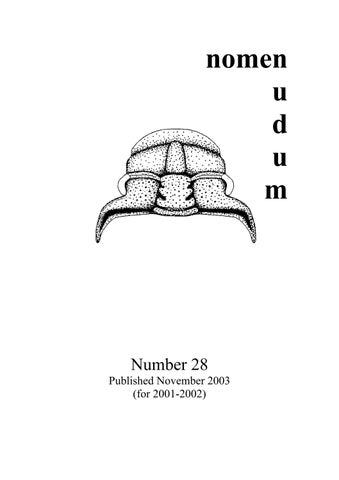
Cover illustration:- John Paterson’s cranidium! Well not John’s actual cranidium, but, a dorsal view of the cranidium holotype of the trilobite Penarosa retifera Öpik, 1970 (CPC 7292), drawn by John, from the Middle Cambrian Currant Bush Limestone of western Queensland.
© Association of Australasian Palaeontologists, November 2003. ISSN 1447-4662
Contents
From your President4
From the Editors5
Regarding Gilbert6 Who Looks After our University Geology Collections?17 From the Association20
New AAP Publications20 Report from the Editor of Alcheringa35 Reports of Meetings36
First International Palaeontological Congress (IPC 2002), Sydney, Australia (6-10 July 2002)36
Chinosaurs Down Under40
Climate and Biota of the Early Paleogene, Northwest College, Powell, Wyoming USA, July 3-8, 200143
Forams 200246
Announcements49
The Measurement and Origin of Biodiversity49
First Circular CAVEPS 2005 and Quaternary Extinction Symposium50
The Dorothy Hill Award52 Research Reports52
Adelaide University52
Auckland University of Technology53
Australian Museum54
Australian National University55
Deakin University68
Geological Survey of New South Wales71
Geological Survey of Queensland72
Geoscience Australia73
Macquarie University Centre for Ecostratigraphy and Palaeobiology75
Northern Territory Geological Survey82
Queensland Museum83
South Australian Museum83
University of Melbourne: School of Botany – Isabel Cookson Laboratory84
University of Melbourne: School of Earth Sciences86
University of Queensland: Department of Botany87
University of Queensland: Department of Earth Sciences88
University of Queensland: Department of Zoology and Entomology88
University of South Australia89
University of Tasmania90
University of Western Australia: Department of Earth Sciences91
University of Western Australia: Department of Geography95
Victoria University96
Individual Researcher Reports98 Publications100
Publication List 2001-2002100
Publications not recorded in 1999-2000 nomen nudem 117
The 2002 year will be remembered in Australasian palaeontology circles primarily for the holding of the First Palaeontological Congress, in Sydney in July 2002. Although I was unable to attend, reports indicate that the Congress was a resounding success. John Talent, in his summary of the Congress, noted that more than 400 palaeontologists from 35 countries attended. This resulted in 199 oral presentations complemented by 172 posters. The success of the Congress is a credit to the organisers, especially John Talent, and to all who participated, and also to those, including our Society and Macquarie University, who generously sponsored the event.
An objective of IPC2002 was to demonstrate that palaeontology is still alive and relevant in today’s scientific world. From what I have read, I am confident that this was achieved. In particular, it seems that it reinforced the notion that many of us have: that to survive, scientists need to collaborate and to network with each other. Palaeontologists and ontologists have long seen the need to co-operate to unravel complicated concepts such as evolution and biogeography. Further, an initiative to cooperatively link is increasingly asked of us when applying for government funding: to gain success one needs to adopt as broad an approach as possible. In New Zealand, funding success in enhanced by collaboration between universities, Crown Research Institutes, the public and importantly, Iwi.(i.e. indigenous Maori interests). In addition, the New Zealand Government is showing increasing interest in research projects that can be shown to be applied. In particular, they have appeal if they can be shown to be financially viable. In traditional palaeontology this may be difficult to demonstrate, but we have one useful card to play… that of sustainability.
Sustainability is increasingly the buzz-word in New Zealand funding circles, and I am certain that similar attitudes exist in Australia. In New Zealand, we have a special research fund ear-marked for sustainable development (S.D.). Paleontology, in the broad sense, as a window on past environments and change, has much to offer, and we should embrace the opportunity to actively participate in predictive analyses. There is one area of concern however, and this is the general decrease in the number of specialist systematists. The current cohort of specialists is becoming aged. The average age in New Zealand is well over 50. However, we are still not replacing those that we are losing. There are all too few young folk picking up the challenge to become systematic palaeontologists (or even systematic biologists). Both Australia and New Zealand are signatories to several international conventions that require a high level of systematic expertise. On present evidence, it appears that in New Zealand, we are unlikely to achieve to achieve our goals to complete biodiversity inventories by 2006.
Looking to 2003: Agreement has been reached to hold a special meeting of AAP in conjunction with the Geological Society of New Zealand's Annual Conference. This will be held in Dunedin in early December, 2003. It is planned to run field trips in association with this conference. Details are still being finalised, but trips will include the classic North Canterbury late Cretaceous sequences at Haumuri Bluff, and the wonderfully fossiliferous Cainozoic of Oamaru.
The challenge then, is greater than ever before: for us to inspire, and to provide the opportunities to encourage young Australians and New Zealanders move into fields
that embrace palaeo-biosystematics. We may not get them into pure palaeontology, and this may be a good thing. The new systematists will need to be aware of the past as well as the future. They will need to think outside the square. Australasian palaeontologists have a pivotal part to play…
Yours in palaeontology and biosystematics…
John Buckeridge Faculty of Science & Engineering
Auckland University of Technology
This is the second edition of nomen nudum available as a pdf document through the AAP website. The earlier edition (nomen nudum 27, covering the period 1999-2000) seemed to cause little consternation in terms of the new mode of delivery.
Nomen nudum 28 brings the newsletter of the Australasian Association of Palaeontologists back up to date. This edition covers the period 2001 – 2002. As outlined in our earlier editorial and various email messages to many of you, we now plan to revert to an annual publication. There will be a call for contributions for nomen nudum 29 (covering 2003) early in 2004.
Yes indeed, the appearance of this edition late in 2003 is a lot later than we had anticipated and hoped. This is entirely our responsibility and we apologise for the delay in transmission. Working conditions seem to have changed dramatically in Australia in the last few years. Many of us work on contract and juggle many responsibilities (often not many of them are palaeontological ones) and the production of our newsletter is a voluntary undertaking that must be squeezed in between other tasks. We are not attempting to make excuses for the late arrival of nomen nudum 28, but simply ask for your patience when things fall behind schedule. To help rectify the situation we have enlisted the assistance of one extra volunteer to hasten the completion of this issue and may expand the editorial team even further next year.
Nomen nudum can be an important networking tool amongst the Australasian palaeontological community. Even though many of you may have been forced to downscale your palaeontological endeavours in recent years we must continue to share news, views, reviews and resources with colleagues. Please consider writing something for our next edition. As you will see in this edition AAP has been involved either indirectly or directly with some fairly outstanding and significant events recently such as IPC 2002 and Forms 2002. Where should the Association go from here?
The editors, on behalf of the committee, would like to express our thanks to all the people who acted as co-ordinators at each institution. Without their help in organizing the reports and lists of publications this magazine would not be possible. We would also like to express our thanks to the individual researchers who sent in a report and list of publications for 2001 – it was great to hear from you.
Andrew Simpson, Peter Molloy & James Valentine Editors – nomen nudum
Like most paleontologists, Gilbert Klapper started along traditional paths of biostratigraphy and taxonomy, but it was not long before he was walking his own road, much of it unpaved. Though he looked back to where we have been and produced exemplary studies in taxonomy and biostratigraphy, it was not long before multi-element taxonomy and, later, graphic correlation and shape-analysis, loomed on the horizon. In these areas he became a practitioner without peer, with high originality. His performance has been astounding.
Nevertheless, during his BS (completed in 1956) at Stanford University, concentration on his coursework wandered. He preferred golf to laboratories and lecture theatres. He would dearly loved to have become a disk jockey, wowing listeners with his already encyclopedic knowledge of jazz, its great performers and memorable performances. His love for jazz never waned, nor did his passion for classical music, including piano recitals and opera. He moved to the University of Kansas (Lawrence) for his MS (completed in 1958), worked for 18 months for Shell Oil Company in Baton Rouge, then went to the State University of Iowa (now the University of Iowa) for his PhD (awarded in August 1962), then to a one-year NSF post-doctoral fellowship at the Illinios Survey and at the Geologisches Landesamt Nordrhein-Westfalen in Krefeld, followed by five years with Pan American Petroleum (subsequently Amoco) in Tulsa and, finally, 30 years at the University of Iowa (1968--1998). At Iowa he supervised 16 graduate students for PhD, and seven for MS. He was Visiting Professor at Oregon State University, Corvallis, in 1978, Visiting Professor at the University of Chicago in 1989, and from 1981 to 1989 was a consultant to Amoco in Tulsa and Houston, and to Amoco Canada. He has given numerous invited lectures, foremost among them being invited to be the James Hudnall Distinguished Lecturer at the University of Chicago in 1989. In April 1995 he was awarded the Pander Society Medal for his seminal contributions to study of the Conodonta.
Gilbert focused initially on conodont taxonomy and biostratigraphy, but subsequently rose to the top with big ones: multi-element taxonomy, shape analysis, and graphic correlation. He wasn’t the first to toy with these ideas, but it was his insight, and the sustained and elegant way in which he elaborated on these initiatives that changed the world of conodontology to completely new directions—directions which took most of us a decade or more to take on board with all their implications. Many, among them the late Willi Ziegler, were slow to accept the power of shape analysis and graphic correlation, preferring eyeballing—in Willi's case, as with Gilbert, with an unusually perceptive eye. But Gilbert wanted to make taxonomy less subjective
Gilbert became impressed by graphic correlation, pioneered by Al Shaw, and, in the late 1980s and 1990s carried this technique to new dimensions. Fascination with shape analysis developed about the same time. Again his fervour and his unremitting concentration brought about a revolution in thinking, but, because of the drudgery involved, the techniques have been slow to gain wide acceptance.
Though he contributed elegant conodont studies on all intervals of time from Silurian to Carboniferous, with a modicum of Ordovician, he eventually focused on the Frasnian with characteristic energy, setting about improving its zonation. His work, particularly on the Montagne Noire (southern France), Canning Basin (NW Australia) and western Canada sections, aligned by graphic correlation, resulted in a scheme of 13 intervals (MA 1--13), the rubric MA being for the Montagne Noire sequences pivotal in his analysis. He insisted (and continues to insist) these intervals are more precise than the zonal schemes, each named for salient taxa, elaborated over the previous 30 years, primarily by the late Willi Ziegler, Charles Sandberg and himself. If we leave aside the five volumes of the Catalogue of Conodonts— a devastatingly daunting project—to which he contributed a vast amount of material, and the Treatise on Invertebrate Paleontology, Part W: Miscellanea, Supplement 2 (Conodonta), for which he contributed the material for all genera with Silurian or Devonian type species, there is still a surprising number of benchmark papers authored or coauthored by Gilbert. A glance at the accompanying bibliography is enough to confirm this.
A few small vignettes will exemplify Gilbert's character. For many years he lived at 804 Ronald St, Iowa City, a house teaming with books except for a Spartan lounge room: a cavernous studio dedicated to hi-fi equipment and an immense collection of vinyl records—his beloved "pizzas", as he calls them. He prefers "pizzas", insisting that CDs have not equalled the quality of the best LPs. Ronald St had been the abode of two remarkable writers: Bharati Mukherjee and John Irving, both prominent in the creative writing program for which the University of Iowa has long been renowned. In fact the garage of 804 Ronald St was the site of an infamous, fortunately imaginary, event in Irving's The World According to Garp
Gilbert is renowned for has writing style, especially for his precision, attention to detail, and absence of superfluous wordage. He has always read widely and critically: poetry, biography, novels, history, philosophy. During his boyhood and youth, Gilbert benefited from a home with an intellectual atmosphere, a prime focus of which at weekends was the New York Times. From this Gilbert developed a passion for reading book reviews, a passion which persists. Gilbert could have been a novelist, a travel writer or a poet, but insists, mistakenly, that he lacks the necessary talent. Favourite haunts of Gilbert are the Prairie Lights bookshop in Iowa City and Powell's in Chicago where he can spend hours in quest of new and exciting authors. Great novelists and poets have been prominent among his heroes. There has been a succession of them: Jerzy Kosinski, Cormack McCarthy and Don DeLillo are ones I recall. He thought he had found a great one when Jerzy Kosinski burst into prominence with his Painted Bird, a scorchingly vivid, supposedly autobiographic account of survival through the holocaust in wartime Poland. Petty mendacity is a common element in autobiographies—much more so than in palaeontology or other sciences—but Gilbert, like many others, was profoundly disappointed when
Kosinski's book proved to be a collage of plagiarised slabs of text and stunning, gratuitously gruesome, exaggerations of other people's experiences.
Ever since he was a member of the golf team at Stanford, golf clubs have been semisacred items for Gilbert. In addition to various golf courses around Laurentia, he has performed at St Andrew's in Scotland, and at Tura Beach, Mallacoota and Narooma in Australia—the last requiring a ball be driven from cliff-top to cliff-top over a ravine with an arm of the Pacific Ocean below. He carried a golf club around northern Pakistan and Xinjiang in 1999, driving golf balls from high passes—the Lowarai, Shandur and Khunjerab passes—and across the ferocious Yarkhun River near the Pakistan--Afghanistan border. Wherever he goes, a golf club, if it can possibly be fitted in, is an essential item in his paraphernalia.
Gilbert's pursuit of excellence extends to everything. He is renowned for the excellence of his illustrations of conodonts; he is a meticulous cook. He has been known to do a 400-mile round-trip to Chicago and back to purchase better quality garlic and olive oil than can be found in Iowa City, and for several years was importing coffee from the island of Atiu in the Cook Islands because of difficulty of obtaining highest quality coffee, even by mail-order, from North American sources. Only highest quality arabica coffee is acceptable; robusta coffee is not allowed to pollute his coffee pots.
Despite hillsides infested with the spikey Mediterranean vegetation, Gilbert immensely enjoyed collaboration with Raimund Feist in sampling sequences in the Montagne Noire, and working with Phillip Playford's group in the Canning Basin. During his several visits to Australia, Gilbert was quick to adopt elements of the Australian lifestyle, such as the Akubra hat and the "G-dae!" greeting, and swiftly added a sheaf of pivotal Australian items to his arsenal of dates, sayings, and knowledge of Australian icons, outgunning former colleague and expatriate Australian, Brian Glenister, with his knowledge on such matters. He has a fondness for Australian films, including Gallipoli and Breaker Morant among his favorite movies of all time. Though he enjoyed camping under the stars in the Canning Basin and relished its conodonts, he failed to be amused by its insects, especially the billions of flies with their penchant for suicide by incorporation into his sandwiches—and he a vegetarian. I recall his words, articulated with deep feeling, after his first field season in the Canning: "You didn't tell me about the flies!"
Gilbert has always had a passion for motorbikes, especially Harley-Davidsons, but there is no way he would take off around Laurentia, or around the globe on a Harley. He would, of course, relish the exhilaration of wind through his hair, somewhere, anywhere, but to grow old disgracefully, with black leather jacket and eagle on the back? Never!
As a man, Gilbert is especially private, unassuming and without hubris. This tends to give his charm a hint of reserve, even a modicum of inscrutability. For him, science is above politics. Witness his generosity to colleagues from all parts of the globe, and the way he will devote hours to scrutinizing plates of photos of conodonts. I have seen him do this on railway platforms, in restaurants, in trains and buses, responding patiently to the same question asked repeatedly. He has a wonderfully retentive, even
photographic memory. He seems able to remember every figure on every plate he has ever seen, and even the position on the plate.
Gilbert is someone who operates out of his own, intensely personal ethical code, one characterised by great compassion. He could never abide the hauteur, the arrogance and the sarcasm of those occasional academics who should have been compassionate gurus. Having known many colleagues, including close friends, who have died, or may well have died, from using bromoform and tetrabromoethane (without adequate fume-cupboards) for separating conodonts from other acid-insoluble materials, Gilbert has been a passionate campaigner against use of these highly toxic and insidious heavy liquids.
I know of no one who is more profoundly moved by the countless acts of infamy and the inhumanity that infest our globe. I recall how deeply moved he was by an exhibition of photographs—the innocence of tea workers in Rwanda just prior to the holocaust; the ship-breakers of the Chittagong shoreline in Bangladesh; the cocoa people of Brazil; the kafkaesque textile factories of Kazakhstan; and oil-covered technicians extinguishing tornados of flame in Kuwait—by Sebastião Selgado, arguably the greatest photographer of our time, at the Art Gallery of New South Wales in 1995. In short, he has always had a soft spot for the destitute, for the countless thousands who lead haunted lives, for those confronted by frontiers for everything except dreams, for those who adapt, resist and survive.
Gilbert can never be accused of narcissism, nor has he been one who needs the approval of his peers yet, if we had to select the most pivotal 20 or 30 papers in condontology, several of them would have Gilbert as an author. For him, the pursuit of perfection—the right word to convey the exact meaning, with the precise spin—has been a lifelong passion. Every task is undertaken with vigour, with minimal noise! He has no time for the sloppy, the devious, the bald assertion, the imprecise observation, or the uninformative illustration. He is a great admirer of those who can frame new questions, devise ways of answering them, and set about doing so.
He is a fervent admirer of excellence and innovation, whether it be the coruscating prose of the late Stephen Jay Gould, the "Chicago School" of palaeontology, whole galaxies of great jazz artists—Louis Armstrong (I can imagine Gilbert as a jazz trumpeter!), Thelonius Monk, Duke Ellington, John Coltrane, Miles Davis, Keith Jarrett and, more recently, the new wave of Cubans, José Ferrer and the Buena Vista Social Club, to name a few—and great classical pianists—Vladimir Horowitz, Alicia de Larrocha, Murray Perahia, Shura Cherkassky, Sviatoslav Richter, Glen Gould and dozens more—and that rara avis, the admirable and heroic Jess Johnson, with whom he co-authored 14 papers.
Gilbert's office at the University of Iowa was notorious for its piles of papers and reprints—so enormous as to frequently cause him to work in the nearby A.K. Miller room. Visitors were discouraged from looking into his room or photographing what seemed to be a monumental clutter but, on request for a specific item, Gilbert would drive adits through the cumulates with uncanny accuracy to extract the desired items. Gilbert taught many courses at the University of Iowa, during his later years teamteaching highly popular courses on palaeontology and evolution with Ann ("Nancy") Budd. For many years Gilbert was the department's diligent member of the
university's library committee; it was the perfect committee role for someone with such a passion for books and intellect. In late 1991, in one of those "demolition derbies" that seem increasingly to plague universities around the globe, Gilbert was prominent in successfully defending the department from those wanting to destroy it—to make way for more trendy initiatives.
Gilbert once participated in a marine ecology/palaeoecology venture in Florida, but exposure to Heron Island reef (southern Great Barrier Reef) and to the superb Late Cenozoic raised reefs of the Cook Islands in 1993 provided new perspectives, not only of reefs, but of their guileless inhabitants, coffee growing and, at Oravaru Beach on Atiu, there was the opportunity to stand on the historic spot where James Cook in 1777, unaware of the magic underfoot, landed on an ancient reef superbly exhumed by intertidal activity.
How many of our colleagues, as they approach retirement, fade away with increasingly tired lectures? Some even retire into departments soon after receiving tenure. Not Gilbert! Through 1996 and 1997, almost until the day of his retirement, he was industriously revamping lectures. He found retirement in May 1998 to be especially agreeable. He subsequently found Rose and felicity and, in his new domain, in the northern part of the Chicago agglomeration, he has a convenient linkage to Northwestern University. May he and Rose have many future pilgrimages to golf courses and coffeehouses around the world!
The Gilbert Klappers are not only innovators, treading unexplored pathways, but, because of their insistence on standards, have kept the twin flags of palaeontology and biostratigraphy flying vigorously. What should we award Gilbert for his achievement? Ten out-of-10? The purists, who never award full marks, may quibble: "You've got no standards!" But let it be said, honestly: Gilbert's performance definitely warrants a 10out-of-10, or even 11-out-of-10 as one colleague insists. Gilbert's performance merits a standing ovation!
Acknowledgments
This essay on Gilbert and his career has benefited from salient information provided by Nancy Budd and Ruth Mawson.
John A. Talent
Centre for Ecostratigraphy & Palaeobiology Department of Earth & Planetary Sciences Macquarie University, NSW 2109
Graduate Students of Gilbert Klapper:Ph.D.:- H. R. Lane, J. Straka, J. F. Baesemann, B. Perlmutter, R. S. Nicoll, D. B. Johnson, J. E. Barrick, K. M. Chauff, T. McHargue, A. Dombrowski, M. Tynan, J. Groves, M. I. Pavlicek, J. Day, F. S. Rogers, R. A. Metzger. M.S.:- D. B. Johnson, J. E. Barrick, D. Routh, M. Tynan, M. Woodruff, R. A. Metzger, J. A. Kralick.
Publications by Gilbert Klapper:Klapper, G. 1958. An Upper Devonian conodont fauna from the Darby Formation of the Wind River Mountains, Wyoming. Journal of Paleontology, 32: 1082-1093.
nomen nudum No 28, Nov 2003
Klapper, G., & Furnish, W.M. 1962. Devonian-Mississippian Englewood Formation in Black Hills, South Dakota. Bulletin of the American Association of Petroleum Geologists, 46: 2071-2078.
Klapper, G. 1962. Upper Devonian and Lower Mississippian conodont zones in Montana, Wyoming and South Dakota. PhD dissertation, University of Iowa.
Klapper, G., & Furnish, W.M. 1963. Conodont zonation of the early Upper Devonian in eastern Iowa. Proceedings of the Iowa Academy of Science, 69: 400-410.
Ziegler, W., Klapper, G. & Lindström, M. 1964. The validity of the name Polygnathus (Conodonta, Devonian and Lower Carboniferous). Journal of Paleontology, 38: 421-423.
Beckmann, H., Collinson, C., Helms, J., Huckriede, R., Klapper, G., Krebs, W., Lindström, M., Rhodes, F. H. T., Walliser, O. H., & Ziegler, W. 1965. Sind Conodonten Reste fossiler Algen (Zur Hypothese von K. Fahlbusch, 1964). Neues Jahrbuch für Geologie und Paläontologie, Monatshefte, 1964(7): 385-399.
Glenister, B. F. & Klapper, G. 1966. Upper Devonian conodonts from the Canning Basin, Western Australia. Journal of Paleontology, 40: 777-842.
Klapper, G. 1966. Upper Devonian and Lower Mississippian conodont zones in Montana, Wyoming, and South Dakota. University of Kansas Paleontology Contributions, Paper 3: 1-43.
Sandberg, C. A. & Klapper, G. 1967. Stratigraphy, age, and paleotectonic significance of the Cottonwood Canyon Member of the Madison Limestone in Wyoming and Montana. U. S. Geological Survey Bulletin, 1251: B1-B70.
Klapper, G., Lindström, M. & Ziegler, W. 1967. Polygnathus Hinde, 1879 (Conodonta): Proposed designation of a type-species under the plenary powers. Bulletin of Zoological Nomenclature, 24: 239-242.
Sandberg, C.A. & Klapper, G. 1967. Stratigraphy, age and paleotectonic significance of the Cottonwood Canyon Member of the Madison Limestone in Wyoming and Montana. United States Geological Survey Bulletin, 1251-B: 1-70.
Klapper, G. & Ziegler, W. 1967. Evolutionary development of the Icriodus latericrescens group (Conodonta) in the Devonian of Europe and North America. Palaeontographica, Abteilung A: Palaeozoologie-Stratigraphie, 127: 68-82.
Klapper, G. 1968. Review: Lindström, M., Conodonts. Quarterly Reviews of Biology, 42: 535.
Orr, R.W. & Klapper, G. 1968. Two new conodont species from Middle-Upper Devonian boundary beds of Indiana and New York. Journal of Paleontology, 42: 1066-1075.
Amsden, T.W., Klapper, G., & Ormiston, A. R. 1968. Lower Devonian limestone of post-Hunton age, Turkey Creek inlier, Marshall County, south-central Oklahoma. American Association of Petroleum Geologists, Bulletin, 52: 162--166.
Klapper, G. 1969. Lower Devonian conodont succession in central Nevada. Special Paper, Geological Society of America, 121: 521-522.
Klapper, G., Collinson, C., Huddle, J.W., Orr, R.W., Rickard, L.V., Sandberg, C.A., Schumacher, D., Seddon, G. & Uyeno, T.T. 1969. North American Devonian conodont biostratigraphy. Geological Society of America, Abstracts with Programs, 1969(6): 27.
Berdan, J.M., Berry, W.B.N., Boucot, A.J., Cooper, G.A., Jackson, D.E., Johnson, J.G., Klapper, G., Lenz, A.C., Martinsson, A., Oliver, W.A., Jr., Rickard, L.V. & Thorsteinsson, R. 1969. Siluro-Devonian boundary in North America. Geological Society of America Bulletin, 80: 21652174.
Klapper, G. 1969. Lower Devonian conodont sequence, Royal Creek, Yukon Territory, and Devon Island, Canada, with a section on Devon Island stratigraphy by A.R. Ormiston. Journal of Paleontology, 43: 1-27.
Klapper, G. 1969. Lower Devonian conodont sequence, Royal creek, Yukon Territory, and Devon Island, Canada; correction. Journal of Paleontology, 43: 855.
Klapper, G., Philip, G.M. & Jackson, J.H. 1970. Revision of the Polygnathus varcus group (Conodonta, Middle Devonian). Neues Jahrbuch für Geologie und Paläontologie, Monatshefte, 1970: 650-667
Klapper, G., Collinson, C., Huddle, J.W., Orr, R.W., Rickard, L.V., Sandberg, C.A., Schumacher, D., Seddon, G. & Uyeno, T. T. 1969. North American Devonian conodont biostratigraphy. In W.C. Sweet & S.M. Bergstrom (eds). Symposium on Conodont Biostratigraphy. Geological Society of America Memoirs, 127: 285-316.
Klapper, G., Berry, W.B.N. & Boucot, A.J. 1970. In W.B.N. Berry & A.J. Boucot (eds). Conodont correlations. Correlation of the North American Silurian rocks. Geological Society of America Special Papers, 102: 35-38.
nomen nudum No 28, Nov 2003
Klapper, G. 1971. Patrognathus and Siphonodella (Conodonta) from the Kinderhookian (Lower Mississippian) of western Kansas and northwestern Nebraska. Kansas Geological Survey, Bulletin, 202 (3): 1-14.
Klapper, G. & Philip, G.M. 1971. Devonian conodont apparatuses and their vicarious skeletal elements. Lethaia, 4: 429-452.
Klapper, G. 1971. Sequence within the conodont genus Polygnathus in the New York lower Middle Devonian. Geologica et Palaeontologica, 5: 59-79.
Beinert, R.J., Klapper, G., Sandberg, C.A & Ziegler, W. 1971. Revision of Scaphignathus and description of Clydagnathus? ormistoni n. sp. (Conodonta, Upper Devonian). Geologica et Palaeontologica, 5: 81-91.
Klapper, G., Sandberg, C.A., Collinson, C., Huddle, J.W., Orr, R.W., Rickard, L.V., Schumacher, D., Seddon, G. & Uyeno, T.T. 1971. North American Devonian conodont biostratigraphy. In W.C. Sweet & S.M. Bergstrom (eds). Conodont biostratigraphy. Geological Society of America Memoir, 127: 285-316.
Amsden, T.W. & Klapper, G. 1972. Misener Sandstone (Middle-Upper Devonian), north-central Oklahoma. American Association of Petroleum Geologists Bulletin, 56: 2323-2334.
Klapper, G. & Philip, G.M. 1972. Familial Classification of reconstructed Devonian Conodont apparatuses. In Symposium on Conodont Taxonomy. Geologica et Palaeontologica, Sonderband, 1: 97-105.
Klapper, G., Lindström, M., Sweet, W.C. & Ziegler, W. 1973. Catalogue of conodonts. In W. Ziegler (ed). E. Schweizerbart'sche Verlagsbuchhandlung, Stuttgart, 1: 1-504 pp.
Perry, D.G., Klapper, G. & Lenz, A.C. 1974. Age of the Ogilvie Formation (Devonian), northern Yukon: Based primarily on the occurrence of brachiopods and conodonts. Canadian Journal of Earth Sciences, 11: 1055-1097.
Klapper, G. & Murphy, M.A. 1974. Silurian-Lower Devonian conodont sequence in the Roberts Mountains Formation of central Nevada. Geological Society of America, Abstracts with Programs, 1974(6): 522.
Klapper, G. & Murphy, M.A. 1974. Silurian-Lower Devonian conodont sequence in the Roberts Mountains Formation of central Nevada. University of California Publications in the Geological Sciences, 115: 1-62.
Klapper, G. 1975. Conodont zones and correlation of the Cedar Valley-State Quarry sequence; the Independence Shale problems. In P.H. Heckel, E.C. Kettenbrink & G. Klapper (eds).Devonian limestone facies: Cedar Valley and State Quarry limestones in the Iowa City region. Annual Tri-State Geological Field Conference Guidebook, 39th Annual Meeting. Iowa Geological Survey. Iowa City, pp. 1-19.
Klapper, G., Lindström, M., Sweet, W.C. & Ziegler, W. 1975. Catalogue of conodonts. In Ziegler, W. (ed). E. Schweizerbart'sche Verlagsbuchhandlung, Stuttgart, 2: 1-404.
Klapper, G. & Johnson, D. B. 1975. Sequence in conodont genus Polygnathus in Lower Devonian at Lone Mountain, Nevada. Geologica et Palaeontologica, 9: 65-83.
Barrick, J.E. & Klapper, G. 1976. Multielement Silurian (late Llandoverian--Wenlockian) conodonts of the Clarita Formation, Arbuckle Mountains, Oklahoma, and phylogeny of Kockelella Geologica et Palaeontologica: 10: 59-99.
Ziegler, W., Klapper, G. & Johnson, J.G. 1976. Redefinition and subdivision of the varcus Zone (conodonts, Middle-?Upper Devonian) in Europe and North America. Geologica et Palaeontologica, 10: 109-139.
Glenister, B.F., Klapper, G. & Chauff, K.M. 1976. Conodont pearls? Science, 193: 571-573.
Klapper, G. 1977. Conodonts. In A. Martinsson (ed).The Silurian-Devonian Boundary. International Union of Geological Sciences, Series A, 5: 318-319.
Klapper, G., Lindström, M., Sweet, W.C. & Ziegler, W. 1977. Catalogue of Conodonts. In W. Ziegler (ed). E. Schweizerbart'sche Verlagsbuchhandlung, Stuttgart, 3: 1-574.
Klapper, G. [with contributions by D.B. Johnson] 1977. Lower and Middle Devonian conodont sequence in central Nevada. In M.A. Murphy, W.B.N. Berry & C.A. Sandberg (eds). Proceedings of the 1977 Annual Meeting of the Paleontological Society on Devonian of Western North America. University of California, Riverside Campus Museum Contributions, 4: 33-54.
Klapper, G. 1977. Lower-Middle Devonian boundary conodont sequence in the Barrandian area of Czechoslovakia. Časopis pro Mineralogii a Geologii, 22: 401-406.
Klapper, G. & Johnson, D.B. 1977. Lower and Middle Devonian conodont sequence in central Nevada. Geological Society of America, Abstracts with Programs, 9(7): 1051.
nomen nudum No 28, Nov 2003
Pedder, A.E.H. & Klapper, G. 1977. Fauna and correlation of the type section of the Cranswick Formation (Devonian), Mackenzie Mountains, Yukon Territory. Geological Survey of Canada, Special Paper, 77-1B: 227-234.
Klapper, G. & Barrick, J.E. 1978. Conodont ecology; pelagic versus benthic. Lethaia, 11: 15-23.
Glenister, B.F., Klapper, G. & Chauff, K. 1978. Nautiloid uroliths composed of phosphatic hydrogel. Science, 199: 209.
Chauff, K.M. & Klapper, G. 1978. New conodont genus Apatella (Late Devonian), possible homeomorph Bactrognathus (Early Carboniferous, Osagean Series), and homeomorphy in conodonts. Geologica et Palaeontologica, 12: 151-164.
Klapper, G., Ziegler, W. & Mashkova, T.V. 1978. Conodonts and correlation of Lower-Middle Devonian boundary beds in the Barrandian area of Czechoslovakia. Geologica et Palaeontologica, 12: 103-116.
Johnson, J.G. & Klapper, G. 1978. Devonian brachiopods and conodonts from central Oregon. Journal of Paleontology, 52: 295-299.
Klapper, G. & Ziegler, W. 1979. Devonian conodont biostratigraphy. In M.R. House, C.T. Scrutton & M.G. Bassett (eds) The Devonian System. Special Papers in Palaeontology, 23: 199-224.
Klapper, G. & Johnson, J.G. 1979. Review: Jackson, D.E., Lenz, A.C. & Pedder, A.E.H. Late Silurian and Early Devonian graptolite, brachiopod and coral faunas from northwestern and Arctic Canada. Geoscience Canada, 6: 224.
Uyeno, T.T. & Klapper, G. 1980. Summary of conodont biostratigraphy of the Blue Fiord and Bird Fiord formations (Lower-Middle Devonian) at the type and adjacent areas, southwestern Ellesmere Island, Canadian Arctic Archipelago. Geological Survey of Canada, Papers, 80(1C): 81-93.
Johnson, J.G., Klapper, G. & Trojan, W.R. 1980. Brachiopod and conodont successions in the Devonian of the northern Antelope Range, central Nevada. Geologica et Palaeontologica, 14: 77-115.
Johnson, J.G., Klapper, G. & Trojan, W.R. 1980. Upper range of Stringocephalus (Devonian Brachiopoda). Newsletters on Stratigraphy, 8: 232-235.
Klapper, G. & Murphy, M.A. 1980. Conodont zonal species from the delta and pesavis zones (Lower Devonian) in central Nevada. Neues Jahrbuch für Geologie und Paläontologie, Monatshefte, 1980: 490-504.
Klapper, G. & Johnson, J.G. 1980. Endemism and dispersal of Devonian conodonts. Journal of Paleontology, 54: 400-455.
Klapper, G. 1981. Systematic descriptions [All genera with Silurian and Devonian type species]. In Treatise on Invertebrate Paleontology. Part W: Miscellanea, Supplement 2, Conodonta. Geological Society of America, Inc., and University of Kansas, Boulder and Lawrence. Klapper, G., Lindström, M., Sweet, W. & Ziegler, W. 1981. In W. Ziegler (ed). Catalogue of conodonts. E. Schweizerbart'sche Verlagsbuchhandlung, Stuttgart, 4: 1-445.
Klapper, G., Tsigler, V. [= Ziegler, W] & Mashkova, T.V. 1981. Konodontovyye zony kak pokazateli granitsy nizhnego-srednego devona [Conodont zones as indicators of the Lower--Middle Devonian boundary]. Izvestiya Akademii Nauk SSSR. Seriya Geologicheskaya, 1981(3): 9197.
Johnson, D.B. & Klapper, G. 1981. New Early Devonian conodont species of central Nevada. Journal of Paleontology, 55: 1237-1250.
Evans, J.C., Ketner, K.B., Harris, A.G., Dombrowski, A. & Klapper, G. 1981. Revised Paleozoic stratigraphy in northern Nevada. U.S. Geological Survey Professional Paper, 1275: 1-76.
Oliver, W.A. & Klapper, G. 1981. Introduction. In W.A. Oliver, Jr. & G. Klapper (eds). Devonian Biostratigraphy of New York, Part 1, Text. International Union of Geological Sciences, Subcommission on Devonian Stratigraphy, pp. 1-3.
Klapper, G. 1981. Review of New York Devonian conodont biostratigraphy. In W.A. Oliver, Jr. & G. Klapper (eds). Devonian Biostratigraphy of New York Part 1, Text. International Union of Geological Sciences, Subcommission on Devonian Stratigraphy, pp. 57-65.
Oliver, W.A. & Klapper, G. 1981. Introduction. In W.A. Oliver, Jr. & G. Klapper (eds). Devonian Biostratigraphy of New York. Part 2, Stop Descriptions. International Union of Geological Sciences, Subcommission on Devonian Stratigraphy, pp. 1-2.
Klapper, G. 1981. Bellona. In W.A. Oliver, Jr. & G. Klapper, (eds).Devonian Biostratigraphy of New York, Part 2, Stop Descriptions. International Union of Geological Sciences, Subcommission on Devonian Stratigraphy, pp. 41-42.
nomen nudum No 28, Nov 2003
Kirchgasser, W.T. & Klapper, G. 1981. Taughannock Falls. In W.A. Oliver, Jr. & G. Klapper (eds). Devonian Biostratigraphy of New York. Oliver, Part 2, Stop Descriptions .International Union of Geological Sciences, Subcommission on Devonian Stratigraphy, pp. 48-50.
Klapper, G. 1981. June's Quarry, Tully. In W.A. Oliver, Jr. & G. Klapper (eds). Devonian Biostratigraphy of New York, Part 2, Stop Descriptions. International Union of Geological Sciences, Subcommission on Devonian Stratigraphy, pp. 60--61.
Puchkov, V.N., Klapper, G. & Mashkova, T.V. 1982. Natural assemblages of Palmatolepis from the Upper Devonian of the northern Urals. Acta Palaeontologica Polonica, 26: 281-298. [Imprint 1981]
Ziegler, W. & Klapper, G. 1982. Subcommission on Devonian Stratigraphy: Decisions since 1973 and present status. In W. Ziegler & R. Werner (eds). On Devonian stratigraphy and palaeontology of the Ardenno-Rhenisch Mountains and related Devonian matters. Courier Forschungsinstitut Senckenberg, 55: 7-12.
Ziegler, W. & Klapper, G. 1982. The disparilis conodont zone, the proposed level for the Middle-Upper Devonian boundary. In W. Ziegler & R. Werner (eds) On Devonian stratigraphy and palaeontology of the Ardenno-Rhenisch Mountains and related Devonian matters. Courier Forschungsinstitut Senckenberg, 55: 463-492.
Ziegler, W. & Klapper, G. 1982. Proposal of the disparilis conodont zone as the level for the MiddleUpper Devonian series boundary. Geological Society of America, Abstracts with programs, 14(5): 293.
Ziegler, W. & Klapper, G. 1982. Devonian series boundaries; Decisions of the IUGS Subcommission. Episodes, 1982(4): 18-21.
Kendall, G.W., Johnson, J.G., Brown, J.O. & Klapper, G. 1983. Stratigraphy and facies across Lower Devonian-Middle Devonian boundary, central Nevada. American Association of Petroleum Geologists, Bulletin, 67: 2199-2207.
Bunker, B., Klapper, G. & Witzke, B. 1983. New stratigraphic interpretations of the Middle Devonian rocks of Winneshiek and Fayette counties, northeastern Iowa. Geological Society of Iowa, Field Trip Guidebook, 39: 1-38.
Klapper, G. 1983. Preliminary account of the Middle Devonian (varcus Zone)–Upper Devonian (Frasnian) conodont sequence in the eastern Montagne Noire. International Union of Geological Sciences Subcommission on Devonian Stratigraphy, 4 pp.
Klapper, G. & Barrick, J.E. 1983. Middle Devonian (Eifelian) conodonts from the Spillville Formation in northern Iowa and southern Minnesota. Journal of Paleontology, 57: 1222-1243.
Bunker, B.J. & Klapper, G. 1984. Conodont zones and correlation of the Cedar Valley State Quarry interval of eastern Iowa. In B.J. Bunker & G.R. Hallberg (eds). Overburden–underburden; An examination of Paleozoic and Quaternary Strata at the Conklin Quarry near Iowa City. Field Trip Guidebook, Geological Society of Iowa, 11: 15-18.
Klapper, G. & Bergström, S.M. 1984. The enigmatic Middle Ordovician fossil Archeognathus and its relations to conodonts and vertebrates. Journal of Paleontology, 58: 949-976.
Feist, R., Kirchgasser, W.T. & Klapper, G. 1985. Proposal for a Middle-Upper Devonian boundary stratotype. In W. Ziegler & R. Werner (eds). Devonian series boundaries; Results of Worldwide Studies. Courier Forschungsinstitut Senckenberg, 75: 409-410.
Feist, R. & Klapper, G. 1985. Stratigraphy and conodonts in pelagic sequences across the Middle-Upper Devonian boundary, Montagne Noire, France. Palaeontographica, Abteilung A: Palaeozoologie-Stratigraphie, 188: 1-18.
Klapper, G. 1985. Sequence in conodont genus Ancyrodella in Lower asymmetricus Zone (earliest Frasnian, Upper Devonian) of the Montagne Noire, France. Palaeontographica, Abteilung A: Palaeozoologie-Stratigraphie, 188: 19-34.
Witzke, B.J, Bunker, B.J. & Klapper, G. 1985. Devonian stratigraphy in the Quad Cities area, eastern Iowa--northwestern Illinios. In W.R. Hammer, R.C. Anderson & D.A. Schroeder (eds). Devonian, and Pennsylvanian Stratigraphy of the Quad Cities Region, Illinios--Iowa. Society of Economic Paleontologists and Mineralogists (SEPM), Great Lakes Section, 15th Annual Field Conference Guidebook, 19-64.
Ziegler, W. & Klapper, G. 1985. Stages of the Devonian System. Episodes, 8(2): 104-109.
Klapper, G. & Lane, H.R. 1985. Upper Devonian (Frasnian) conodonts of the Polygnathus biofacies, N.W.T., Canada. Journal of Paleontology, 59: 904-951.
Johnson, J.G., Klapper, G. & Sandberg, C.A., 1985. Devonian eustatic fluctuations in Euramerica. Geological Society of America Bulletin, 96: 567-587.
nomen nudum No 28, Nov 2003
Johnson, J.G., Klapper, G., Murphy, M.A. & Trojan, W.R. 1986. Devonian series boundaries in central Nevada and neighbouring regions, western North America. In W. Ziegler & R. Werner (eds). Devonian Series Boundaries; Results of World-wide Studies. Courier Forschungsinstitut Senckenberg, 75: 177-196. [Imprint 1985]
Feist, R., Kirchgasser, W.T., & Klapper, G. 1986. Proposal for a Middle-Upper Devonian boundary stratotype. In W. Ziegler & R. Werner (eds). Devonian Series Boundaries; Results of Worldwide Studies. Courier Forschungsinstitut Senckenberg, 75: 409-410. [Imprint 1985]
Johnson, J.G., Klapper, G. & Sandberg, C.A. 1986. Late Devonian eustatic cycles around margin of Old Red Continent. In M.J.M. Bless & Streel, M. (eds). Late Devonian Events around the Old Red Continent; Field Conference in Aachen (FRG), with Excursions in the Ardenne (Belgium), the Rheinisches Schiefergebirge (FRG) and in Moravia (CSSR). Annales de la Société Géologique de Belgique, 109: 141-147.
Klapper, G. & Foster, C.T., Jr. 1986. Quantification of outlines in Frasnian (Upper Devonian) platform conodonts. Canadian Journal of Earth, 23: 1214-1222.
Klapper, G. 1986. Thomas Joseph Morton Schopf, 1939-1984. Memorials, Geological Society of America, 16: 1-5.
Klapper, G. & Foster, C.T., Jr. 1987. Outline analysis of platform conodonts. Geological Society of America, Abstracts with Programs, 19(7): 728.
Klapper, G., Feist, R. & House, M.R. 1987. Decision on the boundary stratotype for the Middle/Upper Devonian series boundary. Episodes, 10(2): 97-101.
Klapper, G. 1988. Intent and reality in biostratigraphic zonation; a reply to Sandberg, Ziegler, and Bultynck (1988). Newsletters on Stratigraphy, 19: 179-183.
Klapper, G. 1989. The Montagne Noire Frasnian (Upper Devonian) conodont succession. In N.J. McMillan, A.F. Embry & D.J. Glass (eds). Devonian of the World; Proceedings of the Second International Symposium on the Devonian System; Volume III, Paleontology, Paleoecology and Biostratigraphy. Canadian Society of Petroleum Geologists, Memoirs, 14: 449-468. [Imprint 1988]
Klapper, G. & Lane, H.R. 1989. Frasnian (Upper Devonian) conodont sequence at Luscar Mountain and Mount Haultain, Alberta Rocky Mountains. In N.J. McMillan, A.F. Embry & D.J. Glass (eds). Devonian of the World; Proceedings of the Second International Symposium on the Devonian System; Volume III, Paleontology, Paleoecology and Biostratigraphy. Canadian Society of Petroleum Geologists, Memoirs, 14: 469-478. [Imprint 1988]
Goodfellow, W.D., Geldsetzer, H., McLaren, D.J., Orchard, M.J. & Klapper, G.1989. The FrasnianFamennian extinction; current results and possible causes. In N.J. McMillan, A.F. Embry & D.J. Glass (eds). Devonian of the World; Proceedings of the Second International Symposium on the Devonian System: Volume III, Paleontology, Paleoecology and Biostratigraphy. Canadian Society of Petroleum Geologists, Memoirs, 14: 9-21. [Imprint 1988]
Goodfellow, W.D., Geldsetzer, H., McLaren, D.J., Orchard, M.J. & Klapper, G. 1989. Geochemical and isotopic anomalies associated with the Frasnian-Famennian extinction. Historical Biology, 2: 51-72.
Klapper, G. 1989. The effect of graphic correlation, multielement taxonomy, and shape analysis on Upper Devonian, Frasnian conodont biostratigraphy. Geological Society of America, Abstracts with Programs, 21: 18.
Becker, R.T., Feist, R., Flajs, G., House, M.R. & Klapper, G. 1989. Frasnian-Famennian extinction events in the Devonian at Coumiac, southern France. Compte Rendu de l'Académie des Sciences, Paris, Série II, 309: 259-266.
Klapper, G. 1990. [Various contributions on Devonian conodonts]. In R. Feist (ed). The FrasnianFamennian boundary and adjacent strata of the eastern Montagne Noire [Southern France]. Subcommission on Devonian Stratigraphy ICS/IUGS, Guidebook of the Field Meeting. Institut des Sciences de l'Evolution, Université de Montpellier II, Montpellier, 69 pp.
Klapper, G. 1990. Frasnian species of the Late Devonian conodont genus Ancyrognathus. Journal of Paleontology, 64: 998-1025.
Johnson, J.G. & Klapper, G. 1990. Lower and Middle Devonian brachiopod-dominated communities of Nevada, and their position in a biofacies-province-realm model. Journal of Paleontology, 64: 902-941.
Barrick, J.E, Klapper, G. & Amsden, T.W. 1990. Stop 1; Hunton Group (Late Ordovician-Early Devonian). In S.M. Ritter (ed). Early to Middle Paleozoic conodont biostratigraphy of the Arbuckle Mountains, southern Oklahoma Oklahoma Geological Survey, Guidebook, 5-9.
nomen nudum No 28, Nov 2003
Barrick, J.E. & Klapper, G. 1990. Stop 2; Henryhouse and Haragan formations (Late Silurian-Early Devonian) and Woodford Shale (Late Devonian-Early Mississippian). In S.M. Ritter (ed). Early to Middle Paleozoic conodont biostratigraphy of the Arbuckle Mountains, southern Oklahoma, Oklahoma Geological Survey, Guidebook, 11-13.
Barrick, J.E, Klapper, G. & Amsden, T.W. 1990. Late Ordovician-Early Devonian conodont succession in the Hunton Group, Arbuckle Mountains and Anadarko Basin, Oklahoma. In S.M. Ritter (ed). Early to Middle Paleozoic conodont biostratigraphy of the Arbuckle Mountains, southern Oklahoma. Oklahoma Geological Survey, Guidebook, 55-62.
Klapper, G. & Johnson, J.G. 1990. Revisions of Middle Devonian conodont zones. Journal of Paleontology, 64: 934-936.
Klapper, G., Sweet, W.C. & Ziegler, W. 1991. In W. Ziegler (ed). Catalogue of conodonts. E. Schweizerbart'sche Verlagsbuchhandlung, Stuttgart, 5: 1-212.
Klapper, G. & Foster, C.T., Jr. 1991. Outline analysis of Late Devonian conodonts. Geological Society of America, Abstracts with Programs, 23(5): 279.
Klapper, G. 1991. Accuracy of biostratigraphic zones. Palaios, 6: 1.
Klapper, G. 1991. Multielement species-level taxonomy of Palmatolepis (Late Devonian, Frasnian). First Canadian Paleontology Conference and Pander Society Meeting, Program and Abstracts, 43.
Barrick, J.E. & Klapper, G. 1992. Late Silurian--Early Devonian conodonts from the Hunton Group (upper Henryhouse, Haragan, and Bois d'Arc formations), south-central Oklahoma. In J.R. Chaplin & J.E. Barrick (eds). Special Papers in Paleontology and Stratigraphy; a Tribute to Thomas W. Amsden. Oklahoma Geological Survey, Bulletin, 19-65.
Johnson, J.G. & Klapper, G. 1992. North American Midcontinent Devonian T-R cycles. In J.R. Chaplin & J.E. Barrick (eds) Special Papers in Paleontology and Stratigraphy; a Tribute to Thomas W. Amsden. Oklahoma Geological Survey, Bulletin, 127-135.
Kirchgasser, W.T. & Klapper, G. 1992. Graphic correlation using litho- and biostratigraphic markers in the uppermost Middle and Upper Devonian (Frasnian) of New York State. Geological Society of America, Abstracts with Programs, 24: 32.
Klapper, G. & Kirchgasser, W.T. 1992. Zonal and graphic correlation of the New York and Australian Upper Devonian Frasnian) conodont and ammonoid sequences. Geological Society of America, Abstracts with Programs, 24: 26.
Klapper, G. 1992. Biostratigraphy and biogeography of Frasnian, Upper Devonian conodonts. Paleontological Society Special Publication, 6: 1-166.
Ormiston, A.R. & Klapper, G. 1992. Paleoclimate controls on Upper Devonian source rock sequences and stacked extinctions. Paleontological Society Special Publication, 6: 1-227.
Klapper, G., Kirchgasser, W.T. & Baesemann, J.F. 1993. Graphic correlation of the Frasnian Upper Devonian composite. Geological Society of America, Abstracts with Programs, 25(2): 30.
Klapper, G. & Foster, C.T., Jr. 1993. Shape analysis of the Late Devonian conodont genus Palmatolepis. Paleontological Society Memoir, 32 (Supplement to Journal of Paleontology), 67(4): 1-35.
Klapper, G., Feist, R., Becker, R.T. & House, M.R. 1994. Definition of the Frasnian/Famennian stage boundary. Episodes, 16: 433-441.
Klapper, G., Oliver, W.A., Jr. & Prosh, E.C. 1995. The Detroit River Group is Middle Devonian; Early Devonian age of the Detroit River Group, inferred from Arctic stromatoporoids; discussion and reply. Canadian Journal of Earth Sciences, 32: 1070-1077.
Klapper, G., Kirchgasser, W.T. & Baesemann, J.F. 1995. Graphic correlation of a Frasnian (Upper Devonian) composite standard. In K.O. Mann & H.R. Lane (eds). Graphic correlation. Special Publication, SEPM (Society for Sedimentary Geology), 53: 177-184.
Klapper, G. 1995. Preliminary analysis for Frasnian, Late Devonian, conodont biogeography. Historical Biology, 10: 103-117.
Johnson, J.G., Klapper, G. & Elrick, M. 1996. Devonian transgressive-regressive cycles and biostratigraphy, northern Antelope Range, Nevada; establishment of reference horizons for global cycles. Palaios, 11: 3-14.
Klapper, G., Kuz'min, A.V. & Ovnatanova, N.S. 1996. Upper Devonian conodonts from the TimanPechora region, Russia, and correlation with a Frasnian composite standard. First Australian Conodont Symposium (AUSCOS-1) and the Boucot Symposium (18-21 July 1995), Abstracts, and Programme, p. 48.
Klapper, G., Kuz'min, A.V. & Ovnatanova, N.S. 1996. Upper Devonian conodonts from the TimanPechora region, Russia, and correlation with a Frasnian composite standard. Journal of Paleontology, 70: 131-152.
Kelly, B.K, Manger, W.L. & Klapper, G. 1997. Conodonts from the Chattanooga Shale and the Devonian-Mississippian boundary, southern Ozark region. Geological Society of America, Abstracts with Programs, 29(6): 159.
Klapper, G., Murphy, M.A. & Talent, J.A. (eds). 1997. Paleozoic Sequence Stratigraphy, Biostratigraphy, and Biogeography; Studies in Honor of J. Granville ("Jess") Johnson. Geological Society of America, Special Paper, 321: 1-401.
Klapper, G. 1997. Graphic correlation of Frasnian (Upper Devonian) sequences in Montagne Noire, France, and Western Canada. In G. Klapper, M.A. Murphy & J.A. Talent (eds). Paleozoic Sequence Stratigraphy, Biostratigraphy, and Biogeography; Studies in Honor of J. Granville ("Jess") Johnson. Geological Society of America, Special Paper, 321: 113--129.
Klapper, G. 1998. Frasnian (Upper Devonian) high-resolution conodont correlations. Geological Society of America, Abstracts with Programs, 30(2): 28.
McLean, R.A & Klapper, G. 1998. Biostratigraphy of Frasnian (Upper Devonian) strata in Western Canada, based on conodonts and rugose corals. Bulletin of Canadian Petroleum Geology, 46: 515-563.
Klapper, G. & Becker, R.T. 1998. Comparison of Frasnian (Upper Devonian) conodont zonations. In G. Bagnoli (ed). ECOS VII, Seventh International Conodont Symposium held in Europe. Abstracts, 53-54.
Klapper, G. & Becker, R.T. 1999. Comparison of Frasnian (Upper Devonian) conodont zonations. Bolletino della Società Paleontologica Italia, 37: 339-348.
House, M.R., Becker, R.T., Feist, R., Flajs, G., Girard, C. & Klapper, G. 2000. The Frasnian-Famennian boundary GSSP at Coumiac, southern France. Courier Forschungsinstitut Senckenberg, 225: 59-75.
House, M.R., Menner, V.V., Becker, R.T., Klapper, G., Ovnatanova, N.S. & Kuz'min, V. 2000. Reef episodes and sea-level change in the Frasnian of the southern Timan. Geological Society (London) Special Publication, 178: 147-176.
Klapper, G. 2000. Species of Spathognathodontidae and Polygnathidae (Conodonta) in the recognition of Upper Devonian stage boundaries. Courier Forschungsinstitut Senckenberg, 220: 153-159.
Klapper, G. 2002. [Various contributions on Devonian conodonts]. In R. Feist (ed). The Palaeozoics of the Montagne Noire, Southern France. IGCP 421, North Gondwana mid-Palaeozoic Biodynamics, and ECOS VIII, 8th European Conodont Symposium, Guidebook of Field Excursion. Institut des Sciences de l'Evolution, Université de Montpellier II, Montpellier, 85 pp.
A report in 1975 identified the areas of geology and anthropology as being the two most likely to develop collections in Australian Universities. Since then Australia has seen a relative decline of the traditional resource-based economy and a lessening demand for geology graduates. Over the last decade, but particularly since 1996, restructuring of the tertiary education sector has meant that university-based collections in areas that do not attract a significant student load, such as geology, are in danger because of a lack of adequate resources for their effective management.
Staff levels are an indicator of resources available for managing collections. The 1998 Australian Vice-Chancellors' Committee “Transforming Cinderella Collections” report showed 8 staff, Australia-wide, responsible for over a million specimens. A recent survey in 2002 shows these staff numbers are now down to around two and a half. Many large university geology collections have no staff and are essentially shut away. The large number of specimens needed for undergraduate teaching can muddle by without information management systems; those that result from basic research need such systems. Without adequate management systems and strategies, the knowledge-base of the earth sciences in Australia is at risk. Just try and track down
specimens that formed the basis of research projects in the 1970s and 1980s supposedly lodged in university collections. You might strike it lucky, but chances are you'll find there are already serious cracks in the system.
Back in the 1970s Australia had a strong economic reliance on the minerals and energy sector and there was a consistent demand for earth science graduates. Earth science departments in Australian universities had a high level of graduate throughput. Many departments developed their own geological collections to enhance teaching programs and underpin their research programs.
We all know that collections form the empirical basis of research findings; they provide a framework for research investigations. Many of the geological collections developed reflect research priorities, strengths and the history of their host universities. Consider universities that had vigorous palaeontologic research programs in the past (there are a few in this position) and ask yourself the question why should the university keep this material if it thinks it doesn't have a research future in this area?
Not all research projects in the earth sciences generate sets of research specimens. Palaeontologic research does, though the resultant collections may become housed elsewhere. Practices have been variable. Some earth science departments insist material from student research be housed in a departmental collection and the student's results not be released until information and specimens are lodged in an acceptable and useable form. Other departments hold specimens until research results are published and then lodge them in other institutions. Some departments have had a practice of lodging type specimens in state museums and keeping supporting material in house. Others have no requirements for students or supervisors. Even those with established procedures don't always follow them.
There is a blizzard of anecdotal evidence that geological collections have not fared well from the recent fiscal pressure on tertiary education. The changes, particularly rapid in the late 1990s have entailed considerable organisational restructuring. This has often involved clustering of related academic disciplines into broader administrative units. Many geology departments with declining staff numbers have been subsumed into environmental science “Divisions” or engineering “Faculties”. This has induced what is termed “disciplinary flux”. General, or support staff, traditionally responsible for collection management, have been hardest hit by these changes.
Since 1998, five positions associated with university earth science collections have been “destaffed” (to use the human resources vernacular); none of these has been replaced. One collection of 250,000 specimens has been transferred to a state museum. None of these collections have been recognised by their host institutions, leaving their fate to be decided by smaller administrative units such as faculties or departments, or alternatively, leaving their fate undecided.
The obvious decline in resources available for earth science collection management in universities is reflected in staff positions left unfilled. The burden of maintenance of collections falls on academic or other staff members, or volunteers who may not have appropriate knowledge or interest in effective collection management—or in the case
of palaeontology, remaining staff members may have no interest in that particular area. Decreased specimen requirements for teaching programs and research will lead to increase in the number of orphaned collections, and the number of institutions seeking to dispose of collections. In the absence of strategic planning by host institutions, these collections will inevitably suffer from information-loss, thus reducing their utility in future research.
Institutions need to make significance assessments of their research collections and seek alternative futures for them if they are not deemed to be within their future strategic needs. As noted above, there are numerous examples of research specimens from university projects undertaken in the 1970s and 1980s that are now lost. This is because many of the collections have been without staff and proper procedures for many years. Without an assessment of significance, we run the risk of disposing of raw data of scientific value. Without naming institutions, valuable research material has already simply been thrown out.
With declining demand, universities down-size or close departments, but there has been little or no articulation about how they deal with the material evidence left behind after the deed. Responsibility is shifted down the line; the institutional-level stewardship that should be provided to their portion of the Distributed National Collection is ignored. When universities maintained staff positions to manage scientific collections, it represented an investment in the intellectual integrity of work carried out in the institutions name. This is no longer possible, particularly in areas of low undergraduate demand. Responsibility for management of primary research data has quietly been sheeted back to the individual researcher.
In the past, much palaeontologic research in the university system was supported by the Australian Research Council. Funding programs for research supported by ARC are periodically reviewed. In a review of the discipline areas of sedimentology, stratigraphy and palaeontology, the problem of the management of primary data sources, specifically specimens, was identified back in 1995. The Review Committee recommended that Universities should be encouraged to provide more assistance for curatorial work. The ARC sidestepped this recommendation by asserting that universities are in a better position than the ARC to address this recommendation. It is obvious they haven't been able to do so.
So, if universities can no longer look after these collections, who can? As noted above, one university has transferred its collection to a state museum. Unfortunately, the transfer process did not follow the university's policy guidelines. So despite good intentions, the potential for information-loss has not been averted.
Does it really matter if no one looks after orphaned collections? Everyone recognises that research priorities change through time. But, inevitably, there will difficulties when attempts are made to validate earlier research results (as noted above, this is already occurring) and it will not only hamper specimen-based research investigation but perhaps even annihilate some of them.
A draft of a recent national inquiry into the future of earth science research gives a list of all the resources required for a vital Australian earth science research community in the future. They are all digital resources. The fact that digital information needs to be
based on a lithological reality has largely been overlooked and it appears that a significant part of the earth science research community has already turned its back on the problem.
The full report documenting the decline of staff and discussing the implications is available on the Museums Australia website. Go to the Museums Australia website at http://www.museumsaustralia.org.au/ search under events, and look at the list of papers for the 2003 Perth National Conference.
This report is not all hand-wringing and bemoaning the impending tragedy: information loss on a massive scale across large parts of an entire scientific discipline. Remedies are suggested. The problem is not restricted to universities and not restricted to Australia. Some countries have developed creative solutions. Here, however, we have yet to recognise there is a problem. To quote from a Joni Mitchell lyric in “Big Yellow Taxi”:
“You don't know what you've got till its gone!”
Andrew Simpson Museums Education Officer Division of Environmental & Life Sciences Macquarie University
From the Association
Below are abstracts from recent editions of the AAP Memoirs series. To purchase copies of the Memoirs please contact:-
Mrs M FrankelTel: (02) 9290 2194
Business ManagerFax: (02) 92902198
Geological Society of Australia, Inc.Email: misha@gsa.org.au Suite 706, 301 George St, Sydney NSW 2000, Australia
From the Association
WRIGHT, A.J., YOUNG, G.C., TALENT, J.A. & LAURIE, J.R. (eds), 2000. Palaeobiogeography of Australasian faunas and floras. Memoir of the Association of Australasian Palaeontologists 23, 1-515. ISBN 0-949466-21-2
Despite mankind’s demolition of so many taxa, the list of characteristic Australasian organisms – very distinctive on the world stage – remains seemingly endless. But where can we read about the patterns of development of these biotas through time?
Where can we find useful data – preferably organised in some way – on our 'deep past'? Our attempt to address these and related questions provided the rationale for mounting the enthusiastically attended conference on ‘Palaeobiogeography of Australasian Faunas and Floras’ (PAFF) held at the University of Wollongong, 8-11 December 1997, and its culmination, the present volume.
The rationale behind the conference and this publication was, then, the urgent need for a compact summary of the biogeographic relationships of the biotas of the Australasian region through time. Relevant data are scattered – often hidden – in a vast number of research papers. Four recent volumes, devoted primarily to the palaeogeographic evolution of Australia and neighbouring regions (Hall & Blundell, 1996; Hall & Holloway, 1998; Metcalfe et al., 1999; Veevers, 2000), provide a backdrop to broad scale considerations of past biogeography. Numerous authors, notably in six edited volumes of contributions (Keast, 1981; Barker & Greenslade, 1982; Archer & Clayton, 1984; Hill, 1994; Ladiges et al., 1991; Keast & Miller, 1996), have synthesised aspects of the biogeography of the Australian region, but no extended account of the biogeographic evolution of the Australasian region through ‘deep time’ – especially pre-Cainozoic time – has been presented since Talent’s (1984) contribution. Since then, a vast increase in primary data has been published, and there has been an increasing focus on biogeography as an important element in the evolution of our region.
The PAFF conference, attended by 120 delegates from 15 countries, consisted of 63 oral and 20 poster presentations, constructed around keynote addresses dealing with major topics, mostly biogeographic aspects of a specific interval of geologic time. The conference was sponsored by the Association of Australasian Palaeontologists, the International Association of Palaeontologists and the Geological Society of Australia, as well as International Geological Correlation Program projects 410 (The great Ordovician biodiversity event: implications for global correlation and resources) and 421 (North Gondwana mid-Palaeozoic bioevent/biogeography patterns in relation to crustal dynamics), both of which had meetings integrated with the PAFF conference.
Valuable logistic support for the PAFF conference was provided by units of the University of Wollongong, especially the School of Geosciences, as well as many individuals. Essential day-to-day assistance was provided by Adriana Garcia, Alexandra Golab, Narelle Irvine, Sue Murray, Daniel Palamara, Grant Pearson, Penny Williamson and Rosemary Wright. Without their assistance, the conference could not have obtained ‘lift off’. The associated post-conference excursion examined palaeontologically important sequences, floral associations and major sutures in SE New South Wales (12-16 December 1997; leaders John Talent & Ruth Mawson). This too could not have been successful without help from friends: Peter Molloy, Robert Morgan and Ross Parkes.
We are grateful to the scores of contributors – many of whom pushed aside urgent commitments to write their contributions – and to the chapter coordinators, many of who unwittingly accepted immense tasks of integration. Professor C. McA. Powell and his colleague Dr X. Li, of the Tectonics Special Research Centre, Department of Geology and Geophysics, University of Western Australia, using palaeomagnetic and tectonic data, prepared maps of Australasia and the world for a large number of timeslices. Though a detailed account of the development of the Australasian region,
based on these maps, is being published elsewhere (Li & Powell, in press), we laud the generosity of these colleagues in making their reconstructions available to the coordinators soon after the inception of the project. Their generosity was important in helping generate this volume.
Dates of submission of chapters varied widely. We are especially grateful to the longsuffering ‘early birds’ for their patience, and above all for their sympathetic persistence in driving us towards completion. All chapters have been peer reviewed. We are indebted to our reviewers, a score of them, who unobtrusively contributed significantly to this tome. We are also grateful to Dr John Laurie, AAP Memoirs editor, for a major input into production of what is presented here.
This volume evolved from presentations dealing with the 10 Phanerozoic systems and we had planned to include them all. Unfortunately, the Triassic could not be completed in time. Though the focus of the volume is exclusively Phanerozoic, we had intended that it would include consideration of the Precambrian floras and faunas, especially the distinctive Late Proterozoic Ediacara fauna – that unique assemblage of soft-bodied fossils marking the beginnings of the metazoan fossil record, and so well represented in the Australian region. Unfortunately that proved impossible.
Though the overviews presented here may vary in approach and style, we hope they will provide keys to the vast and often taxonomically unruly database that is available, and to its potential for contributing significantly towards solution (or partial solution) of a broad spectrum of questions in earth history, especially for the Southeast Asia-Pacific segment of the globe.
With increasing interest in the biogeography of SE Asia (e.g. Hall & Bkundell, 1996; Hall & Holloway, 1998; Metcalfe et al., 1999) and the Pacific region, we believe our contribution to be opportune. We expect this compendium of data will trigger further discussions of the biogeographic data and their importance in tracking the dispersion and reassembly of crustal blocks in the Australasian region. By persevering with this project we hope to have made a useful contribution to the documentation of the significance of Australasian fossils, especially in relation to their affinities with organisms of other continents.
Tony Wright, School of Geosciences, University of Wollongong
John Talent, Macquarie University Centre for Ecostratigraphy and Palaeobiology
Gavin Young, Department of Geology, Australian National University
REFERENCES
Archer, M. & Clayton, G. (eds), 1984. Vertebrate zoogeography and evolution in Australasia. Hesperian Press, Carlisle, Western Australia, 1283p.
Barker, W.R. & Greenslade, P.J.M. (eds), 1982. Evolution of the flora and fauna of arid Australia. Peacock Publications, Frewville, South Australia, 392p.
Dyne, G.R. & Walton, D.W. (eds), 1987. Fauna of Australia, vol. IA, General articles. Australian Government Publishing Service, Canberra, 339p.
Hall, R. & Blundell, D. (eds), 1996. Tectonic evolution of Southeast Asia. Geological Society of London, London, 566p.
Hall, R. & Holloway, J.D. (eds), 1998. Biogeography and geological evolution of SE Asia. Backhuys Publications, Leiden, 417p.
Hill, R.S. (ed.), 1994. History of Australian vegetation: Cretaceous to Recent Cambridge University Press, New York, 433p.
Keast, A. (ed.), 1981. Ecological biogeography of Australia, 3 vols. Junk, The Hague, 2142p.
Keast A. & Miller, S.E. (eds), 1996. The origin and evolution of Pacific island biotas, New Guinea to eastern Polynesia: patterns and processes. SPB Academic, Amsterdam, 531p.
Ladiges, P.Y., Humphries, C.J & Martinelli, L.W. (eds). 1991. Austral biogeography. CSIRO, Melbourne, 227p.
Li, Z.X. & Powell, C.McA., in press. An outline of the paleogeographic evolution of the Australasian region since the beginning of the Neoproterozoic. Earth Science Reviews.
Metcalfe, I., Jen Chi-sun, Chavet, J. & Hade, S. (eds), 1999. Gondwana dispersion and Asian accretion: IGCP 321 final results volume. Balkema, Rotterdam, 361p.
Talent, J.A., 1984. Australian biogeography past and present: determinants and implications. 57-93 in J.J. Veevers (ed.), Phanerozoic earth history of Australia Oxford University Press, Oxford.
Veevers, J.J., 2000. Billion-year earth history of Australia and neighbours in Gondwanaland. GEMOC Press, Sydney, 388p.
1: Palaeobiogeographic affinities of Australian Cambrian faunas. 1 G.A. Brock, M.J. Engelbretsen, J.B. Jago, P.D. Kruse, J.R. Laurie, J.H. Shergold, G.R. Shi & J.E. Sorauf
2: Ordovician palaeobiogeography of Australasia...63
B.D. Webby, I.G. Percival, G.D. Edgecombe, R.A. Cooper, A.H.M. VandenBerg, J.W. Pickett, J. PoJeta, G. Playford, T. Winchester-Seeto, G.C. Young, Y.-Y. Zhen, R.S. Nicoll, J.R.P. Ross & R. Schallreuter
3: Silurian palaeobiogeography of Australia....127 J.W. Pickett, C.J. Burrow, D.J. Holloway, T.J. Munson, L.G. Percival, R.B. Rickards, L. Sherwin, A.J. Simpson, D.L. Strusz, S. Turner & A.J. Wright
4: Devonian palaeobiogeography of Australia and adjoining regions.167
J.A. Talent, R. Mawson, J.C. Aitchison, R.T. Becker, K.N. Bell, M.A. Bradshaw, C.J. Burrow, A.G. Cook, G.M. Dargan, J.G. Douglas, G.D. Edgecombe, M. Feist, P.J. Jones, J.A. Long, J.R. Phillips-Ross, J.W. Pickett, G. Playford, R.B. Rickards, B.D. Webby, T. Winchester-Seeto, A.J. Wright, G.C. Young & Y.-Y. Zhen
5: Carboniferous palaeobiogeography of Australasia...259 P.J. Jones, I. Metcalfe, B.A. Engel, G. Playford, J. Rigby, J. Roberts, S. Turner & G.E. Webb
6: Palaeobiogeography of the Australasian Permian...287 N.W. Archbold
7: Jurassic palaeobiogeography of Australasia....311 J.A. Grant-Mackie, Y. Aita, B.E. Balme, H.J. Campbell, A.B. Chalinor, D.A.B. MacFarlan, R.E. Molnar, G.R. Stevens & R.A. Thulborn
8: Biogeographical observations on the Cretaceous biota of Australasia355 R.A. Henderson, J.S. Crampton, M.E. Dettmann, J.G. Douglas, D. Haig, S. Shafik, J. Stillwell & R.A. Thulborn
9: Australasian palaeobiogeography: the Palaeogene and Neogene record405 B. McGowran, M. Archer, P. Bock, T.A. Darragh, H. Godthelp, S. Hageman, S.J. Hand, R. Hill, Q.Y. Li, P.A. Maxwell, K.J. McNamara, M. Macphail, D. Mildenhall, A.D. Partridge, J. Richardson, S. Shafik, E.M. Truswell & M. Warne
10: Palaeobiogeography of the Quaternary of Australasia..471 P. Kershaw, P.G. Quilty, B. David, S. Van Huet & A. McMinn
LAURIE, J.R. & FOSTER, C.B. (eds), 2001. Studies in Australian Mesozoic Palynology II. Memoir of the Association of Australasian Palaeontologists 24, 1-235. ISBN 0-949466-22-0
For more than thirty years in Australia, palynology has been, and remains, an essential tool used by hydrocarbon and exploration and development companies to date and correlate rock sequences. Until the late 1980s, most exploration companies and government geological surveys maintained inhouse specialists to use and develop palynology for their exploration programs. This resulted in simultaneous and often independent development of spore-pollen and dinoflagellate cyst zonal schemes applied to local exploration permits or basins. Zone definition, supported by taxonomic descriptions of key taxa, was at best sporadic, and restricted to specific geographic areas and/pr time intervals. Many zones and their taxa were, and remain, known only by an informal alphanumeric code. By the early 1980s, an unpublished manuscript, complete with zonal definitions, stratigraphic ranges and photomicrographs of key taxa, was being used by the Industry, because it provided the first pan-Australian Mesozoic zonation. It allowed explorationists and researchers to compare basin events on either side of the continent, and between onshore and offshore basins.
The manuscript was published in 1987 by Herby, Morgan & Partridge as AAP Memoir 4 in this series. It has become the standard Australian Mesozoic palynological zonation, known simply as HMP 87 by Industry. The scheme was adopted by the Australian Geological Survey Organisation (AGSO) for use in its petroleum and marine basin studies program. Because of the scope of that work, namely to present an outline of integrated dinoflagellate cyst and spore-pollen zonations, Helby et al. (1987, p.1) noted ‘our scheme must be viewed as preliminary rather than comprehensive.’ It was clear that further study would result in better age control and finer zonal subdivision.
HMP 87 was a tool for its time, providing an essential framework for broad-scale exploration. However, with exploration successes technical and scientific requirements have changed. Production and development geology demands on high resolution biostratigraphy. In response to this demand, further informal subdivisions of the HMP 87 scheme have been developed, but again details are mostly unpublished
and key taxa are undescribed (see Bint & Marshall 1994). Despite the lack of published information, subsequent informal subzones of HMP 87 have become part of the Australian exploration and development framework, with alphanumeric codes being used in Industry well completion reports and published papers. This situation has arisen because under the Australian Petroleum (Submerged Lands) Act (PSLA 1967), all basic date from offshore wells, including references to biozonal schemes, should become open file (i.e. publicly available), after a mandated confidentiality period.
Consistent usage and application of these informal zones cannot be guaranteed without definition or systematic description of key species. A stable taxonomic base is a fundamental requirement for communication and consistent application of zonation concepts. This volume provides the taxonomic foundation for selected Jurassic and Early Cretaceous zones that are identified widely on the North West Shelf (NWS, Figs 1, 2). The zones referred to in the text (and Fig. 2) are left in alphanumeric nomenclature (eg 6aiia), the same as that used in the AGSO databases and in unpublished well completion reports produced by Helby over the past 10 years. The ranges of species, including those described as new, are given in relation to these alphanumeric zonal codes. Where appropriate and where new information is available, ages of the dinoflagellate cyst taxa, in relation to the standard Stages, are discussed. As was the case in AAP Memoir 4, the present papers provide a snapshot of dinoflagellate cyst biostratigraphy. Further studies should provide an even more detailed zonation which will incorporate event stratigraphies.
Material presented in this volume is derived from 56 wells, mostly from the offshore Carnarvon, Browse and Bonaparte basins of the NWS (fig. 1), with additional specimens from well sections in South Australia, Papua New Guinea, and from surface outcrop in New Zealand and Indonesia. More than 99% of the samples and specimens used in this study derive from material previously reported on by Robin Helby.
Fifty-five species of dinoflagellate cyst are described as new, another six species are emended to strengthen their stratigraphic utility, and 13 genera are proposed as new, while another nine are emended. More than 2100 specimens used in this taxonomic study occur as picked grain mounts. Many more specimens, in addition to those illustrated in this volume, have been photographed and access to all these images will be via the AGSO website, http://www.agso.gov.au
As the national geological research agency, AGSO also conducts its own offshore studies to provide pre-competitive data to attract exploration and investment in Australia. The biozonation schemes used in such studies need to be stable and clearly defined. In a new palaeontological initiative, AGSO has put in place a strategy involving industry, academia, government agencies and consultants, to validate key zones used in resource and exploration studies. This initiative has taken the form of a Virtual Centre for Economic Micropaleontology and Palynology (VCEMP). This volume is the first output from the VCEMP. James B. Riding, of the British Geological Survey, spent 12 months at AGSO working with the Timescales Project team, and with Robin Helby, to complete eight of the nine systematic dinoflagellate cyst studies presented here.
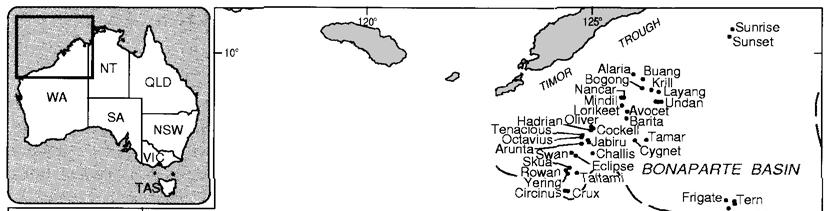
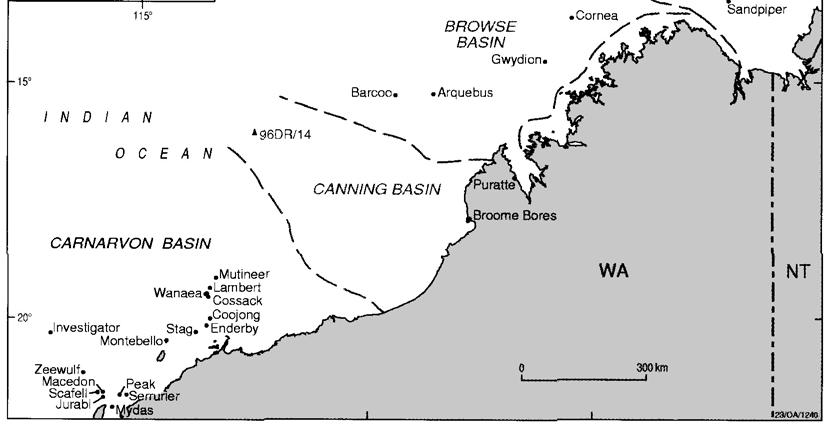
Fig. 1. Geographic distribution of wells and the dredge sample used in the following studies.
This project would not have been completed without the participation of Robin Helby who freely volunteered his time pro bono publico. AGSO acknowledges his essential contribution to the success of this venture.
Clinton Foster, AGSO, Canberra
BINT, A.N. MARSHALL, N.G., 1994. High resolution palynostratigraphy of the Tithonian Angel Formation in the Wanaea and Cossack oil fields, Dampier sub-basin. 554-554 in Purcell, P.G. & Purcell, R.R. (eds), Sedimentary basins of Western Australia. Petroleum Exploration Society of Australia, Perth. HELBY, R., MORGAN, R. & PARTRIDGE, A.D., 1987. A palynological zonation for the Australian Mesozoic. Memoir of the Association of Australasian Palaeontologists 4, 1-94.
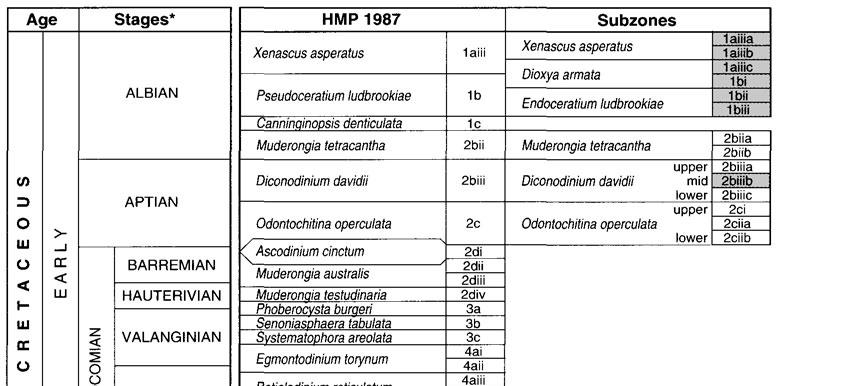
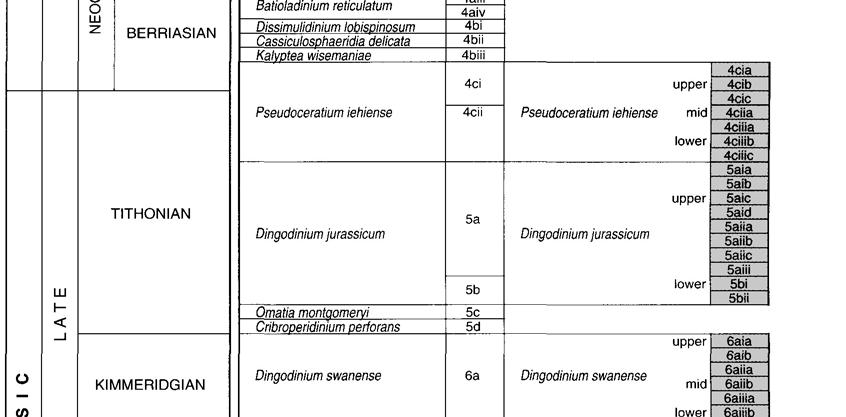
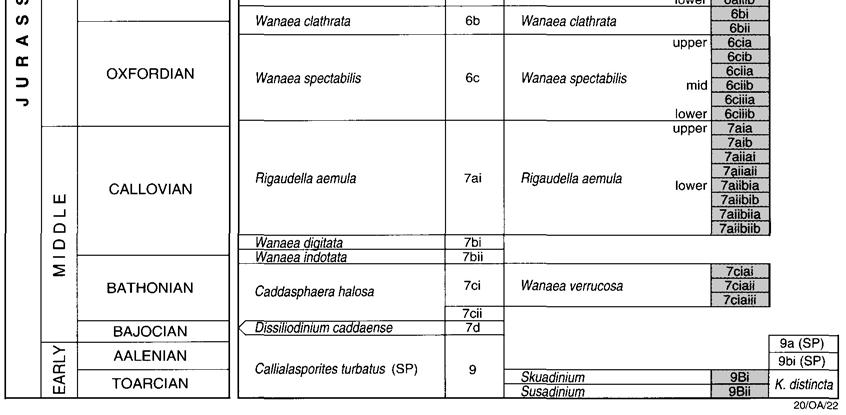
Fig. 2. Proposed subzones for HMP 87 by Helby & Partridge (in prep.). Stippled subzones are referred to in this volume. All subzones are shown at the same size because of the need for legibility. As a consequence, the relationship between the zones and Stages is indicative only. For example the Riganudella aemula Zone comprises eight subzones and appears to occupy most of the Callovian: in fact, these eight zones account for less than 2 Myr or about one third of the time span of the stage.
Early Jurassic (Toarcian) dinoflagellate cysts from the Timor Sea, Australia by James B. Riding & Robin Helby.....1
A selective reappraisal of Wanaea Cockson & Eisenack 1958 (Dinophyceae) by James B. Riding & Robin Helby.... .33
Phallocysta granosa sp. nov., a Mid Jurassic (Bathonian) dinoflagellate cyst from the Timor Sea, Australia by James B. Riding & Robin Helby.... .59
Microplankton from the Mid Jurassic (late Callovian) Rigaudella aemula Zone in the Timor Sea, north-western Australia by James B. Riding & Robin Helby....65
Dinoflagellate cysts from the Late Jurassic (Oxfordian) Waneae spectabilis Zone in the Timor Sea region by James B. Riding & Robin Helby.....111
Dinoflagellate cysts from the Late Jurassic (Kimmeridgian) Dinoodinium swanense Zone in the North-West Shelf and Timor Sea, Australia by James B. Riding & Robin Helby.....141
Marine microplankton from the Late Jurassic (Tithonian) of the north-west Australian region by James B. Riding & Robin Helby.....177
Bonbonadinium granulatum gen. et sp. nov., a Triassic (Tithonian) dinoflagellate cyst from the North-West Shelf, Australia by Robin Helby & Alan D. Partridge....221
Some stratigraphically significant dinoflagellate cysts from the Early Cretaceous (Aptian and Albian of Australia by James B. Riding & Robin Helby.....225
HAND, S.J. & LAURIE, J.R. (eds), 2001. Riversleigh Symposium 1998. Memoir of the Association of Australasian Palaeontologists 25, 1-154. ISBN 0949466-23-9
The year 2001 marks the 25th anniversary of my first visit to the fossil deposits at Riversleigh in northwestern Queensland. Following in the earlier palaeontological footsteps of Alan Lloyd, Dick Tedford, Mike Plane and Alan Bartholornai, the 1976 expedition with Henk Godthelp, Rudi Kahout and David Joffe was the first of many conducted by the Queensland Museum and later, with Suzanne Hand, the University of New South Wales. Ever since. Sue, Henk and I, accompanied by many enthusiastic
honours and PhD students, volunteers and long-standing colleagues like Anna Gillespie, Stephan Williams, Phil Creaser and Arthur White, have explored and sampled the richly fossiliferous rocks of Riversleigh.
More than 80 researchers from 26 institutions and 11 countries have become involved in analysis of Riversleigh and Murgon materials. It is in the nature of these places that new sites and new creatures are discovered each year. Research progresses on many fronts including biodiversity, phylogenetic systematics, functional morphology, palaeoecology, taphonomy, mineralisation, geo- and biocorrelation, geochronology, petrology and stratigraphy. Given the rate of new discoveries, expanding field work and new questions being asked, it is likely that research at Riversleigh and Murgon will continue for centuries. Each new discovery leads to others and steadily, understanding of what happened in Australia over the last 55 million years grows. Many controversies remain; this is an incentive to find new materials from more sites with new information to test competing hypotheses.
During our first expedition to Riversleigh, much of our time was spent chiselling out an especially well preserved kangaroo jaw from a limestone boulder at Tedford's Site D. This specimen became the holotype of the first kangaroo described from Riversleigh – Wabularoonaughtoni Archer, 1979. Since then, other researchers have puzzled and pronounced over Riversleigh’s enigmatic kangaroos, among them Bernie Cooke, Tim Flannery and Ben Kear whose papers in this volume represent the combined wisdom of 25 years of dedicated research.
This volume also sees other Riversleigh taxa revisited. Montypythonoides riversleighensis, the Oligo-Miocene python named by Meredith Smith and Michael Plane, is re-examined by John Scanlon and the origin of pythonines re-explored. Also revised in this volume, by Sue Hand et al., is the biogeographically intriguing genus Icarops, burrowing bats whose only living relatives are found in New Zealand. Stephen Wroe re-examines the definitions of, among other marsupial taxa, the families Dasyuridae and Thylacinidae in his description of a very plesiomorphic dasyuromorphian from Riversleigh's Gag Site.
A biostratigraphic framework for Australian Tertiary vertebrate assemblages is further developed with the description of new species of ringtail possums by Mina Bassarova et al., with one Paljara species being shared by the early Miocene of South Australia and Riversleigh. Kirsten Crosby et al. provide the first Tertiary record for scaly-tailed possums in describing a species of Wyulda, a lineage that emerged from middle Tertiary rainforests to inhabit northern Australia as its climate began to dry in the late Miocene. Troy Myers et al. review evidence for a late Miocene age for Riversleigh's Encore Local Fauna, as understanding of relative and absolute ages of Riversleigh assemblages is refined.
Biogeographic and potentially biocorrelative links to other continents are also documented here. A new species of the swiflet tribe Collocaliini, described by Walter Boles, pushes the record of this widely distributed group back to the late Oligoceneearly Miocene of Australia, and Arthur White describes the Southern Hemisphere's oldest trionychid - a new genus and species of turtle from early Eocene sediments at Murgon.
These important contributions to Australasian vertebrate palaeontology would not have been possible without the support of the Australian Research Grant Scheme, National Estate Grant Scheme (Queensland), University of New South Wales, Commonwealth Department of Environment, Sports and Territories, Queensland National Parks and Wildlife Service, Commonwealth World Heritage Unit, Earthwatch Pty Ltd, ICI Australia, Australian Geographic Society, Queensland Museum, Australian Museum, Royal Zoological Society of New South Wales, Linnean Society of New South Wales, Pasminco Pty Ltd, Surrey Beatty & Sons Pty Ltd and the Riversleigh Society. Vital assistance in the field has come from many hundreds of volunteers as well as staff and students of the University of New South Wales and the Australian Museum.
Michael Archer, Director, Australian Museum & Professor of Biological Science, University of New South Wales 30 June 2001
Montypythonoides: the Miocene snake Morelia riversleighensis (Smith & Plane, 1985) and the geographical origin of pythons ....1
John D. Scanlon
A new Eocene soft-shelled turtle (Trionychidae) from Murgon, south-eastern Queensland.........37
Arthur W. White
A swiftlet (Apodidae: Collocaliini) from the Oligo-Miocene of Riversleigh, northwestern Queensland.......45
Walter E. Boles
A new genus and species of dasyuromorphian from the Miocene of Riversleigh, northern Australia........53
Stephen Wroe
New Oligo-Miocene pseudocheirids (Marsupialia) of the genus Paljara from Riversleigh, northwestern Queensland.....61 Mina Bassarova, Michael Archer & Suzanne J. Hand
Wyulda asherjoeli, a new phalangerid (Diprotodontia: Marsupialia) from the early Miocene of Riversleigh, northwestern Queensland...77 Kirsten Crosby, Marika Nagy & Michael Archer
A review of macropodoid (Marsupialia) systematics with the inclusion of a new family..........83
B.P. Kear & B.N. Cooke
Bulungamayine (Marsupialia: Macropodidae) postcranial elements from the late Miocene of Riversleigh, northwestern Queensland...103
B.P. Kear, M. Archer & T.R Flannery
Postcranial morphology of Ganguroo bilamina Cooke, 1997 (Marsupialia: Macropodidae) from the middle Miocene of Riversleigh, northwestern Queensland ..........123
B.P. Kear, M. Archer & T.R Flannery
New Miocene Icarops material (Microchiroptera: Mystacinidae) from Australia, with a revised diagnosis of the genus.....139 Suzanne Hand, Michael Archer & Henk Godthelp
The Encore Local Fauna, a late Miocene assemblage from Riversleigh, northwestern Queensland.......147 Troy Myers, Kirsten Crosby, Michael Archer & Michael Tyler
N. & DRINNAN, A., 2002. Early Cretaceous (Neocomian) flora and fauna of the lower Strzelecki Group, Gippsland Basin, Victoria. Memoir of the Association of Australasian Palaeontologists 26, 1-144.
Fossil assemblages are described from the Tyers River Subgroup (late Berriasian to Hauterivian), Gippsland Basin, Victoria. The assemblages include plant macrofossils referable to 33 form-species of which five are new (Isoetites abundans Tosolini & McLoughlin, Coniopteris victoriensis Nagalingum & McLoughlin, Otozamites douglasii Drinnan, Brachyphyllum tyersensis Tosolini & Nagalingum, Otwayia hermata Tosolini & McLoughlin) and three are new combinations [Medwellia lacerata (Douglas) Nagalingum & McLoughlin, Rintoulia variabilis (Douglas) McLoughlin & Nagalingum, Pachydermophyllum austropapillosum (Douglas 1969) McLoughlin & Nagalingum]. Macrofossil assemblages include representatives of the Hepaticales, Isoetales, Equisetales, Filicopsida, seed-ferns, Coniferales and unionid bivalves. Co-preserved mesofossil suites include dispersed cuticle fragments, seed coats, seed megaspore membranes, microspore clusters, fern leptosporangia, charcoalified wood, resin blebs, epiphyllous fungal shields, clitellate annelid cocoons, insect exoskeleton fragments and coprolites. Sixteen lycophytic megaspore taxa were identified from the succession including six new species (Erlansonisporites confertus Tosolini, Favososporites brevis Tosolini, Hughesisporites australis Tosolini, Paxillitriletes rintoulensis Tosolini, Striatriletes imperfectus Tosolini, Trikonia locmaniensis Tosolini). These represent the first Neocomian megaspores formally described from Australia and their diversity and abundance indicates that lycophytes represented a significant component of the Early Cretaceous vegetation. The Tyers River Subgroup shares some taxa with the well studied Aptian Koonwarra flora of the Gippsland Basin but lacks several key elements (Ginkgoales, angiosperms and largeleafed araucarian conifers) and is more closely comparable to Jurassic floras of eastern Australia in its strong representation of bennettitalean, pentoxylalean and other seed-fern remains. The Tyers River Subgroup flora differs from coeval northwestern Australian floras in containing smaller-leafed bennettites, Komlopteris and Pachydermophyllum species and by the lack of dipteridacean and gleicheniacean/lophosoriacean fern macrofossils. This intra-Australian provincialism is interpreted to be largely a function of palaeolatitude-induced climatic differences. Six major biofacies (one divisible into four sub-facies) are recognized in the Tyers
River Subgroup and are attributable to three broad environmental settings within fluvial depositional tracts. Channel deposits host principally detrital plant remains derived from a broad range of riparian, upland and reworked floodbasin communities. Silty floodbasin deposits typically host a mixture of pteridosperm-, fern- and lycophyte-dominated assemblages derived from a mosaic of herb-, shrub- and small tree-dominated communities developed mainly in perennially or seasonally wet environments. Better drained, intervening levee, crevasse splay and neighbouring upland environments are interpreted to have hosted a conifer-dominated flora contributing to conifer-, root/rhizome-, megaspore- and clitellate-rich fossil associations. The floristic diversity, foliar morphology of selected species, strong representation of deciduous taxa and sedimentological data collectively suggest that seasonally cold conditions prevailed during the Neocomian-Aptian compared to the Albian in southeastern Australia.
LAURIE, J.R. (ed.) 2002. Palaeo Down Under conference: papers from the conference held at Kinross-Wolaroi School, Orange, New South Wales, July 2000 Memoir of the Association of Australasian Palaeontologists 27, 1188. ISBN 0-949466-25-5
Palaeontology Down Under 2000 was held at Orange, NSW (11-25 July 2000), in the heart of the most instructive Ordovician, Silurian and Early Devonian sequences in eastern Australia. Though essentially a general meeting catering for all aspects of palaeontology, Proterozoic to Recent, it included five subsets: the Second Australasian Conodont Symposium (AUSCOS-2), the Third International Symposium on the Silurian System (the Sir Frederick M'Coy Symposium), meetings of IGCP projects 410 (The Great Ordovician Biodiversification Event) and 421 (North Gondwana Mid-Palaeozoic Biodynamics), and a symposium in honour of Prof. Barry Webby, focusing mainly on subjects that have been dear to him during his highly productive career.
Palaeontology Down Under 2000 attracted 122 participants of whom 50 were international visitors. An additional 28 participants, concerned primarily with teaching earth sciences in secondary schools, participated in many of the activities of the meeting. The meeting included a two-hour workshop on Silurian conodont taxonomy and high-resolution biostratigraphy; this was run several times by Prof. Lennart Jeppsson (Lund). Two well attended excursions focused on mid-Palaeozoic stratigraphic sequences of particular interest to IGCP 421, a third focused on Ordovician sequences of interest to IGCP 410, and a fourth, at Heron Island, was devoted to reef dynamics:
1. Pre-conference excursion (8-10 July): Palaeozoic (primarily Silurian-Early Devonian) platform and shelf-margin sequences of east-central New South Wales (leaders: J.A. Talent, R. Mawson & A.J. Wright).
2. Post-conference excursion (16-20 July): Palaeozoic (primarily DevonianEarly Carboniferous) platform and shelf margin sequences of the Tamworth Belt (NE New South Wales) and east-central Queensland (leaders: J.A. Talent, R. Mawson & T. Furey-Greig).
3. Post-conference excursion (16-20 July): Key Ordovician sequences in eastcentral New South Wales (leaders: B.D. Webby and I.G. Percival).
4. Carbonate buildup workshop. Heron Island (21-25 July) (leader: J.S. Jell).
Because of the associated IGCP meetings, Palaeontology Down Under 2000 had a significant focus on bioevents (especially global extinctions and recoveries), major variations in biodiversity, and change in biogeographic differentiation during the Ordovician and mid-Palaeozoic. Integration of these data with the biofacies\lithofacies databases has been leading to increased precision in stratigraphic alignments and improved palaeogeographic and palaeoclimatologic syntheses.
Palaeontology Down Under 2000 was an exceptionally felicitous event, bringing together a large number of colleagues—including delegates from Pakistan, Myanmar, Mongolia, Poland, China, Thailand, Sweden, Russia, Spain, Portugal, Italy, France, Germany, Iran, Canada, USA, the Czech Republic and the UK—who normally have little or no opportunity to interact scientifically on biostratigraphic, stratigraphic and geodynamic problems transcending national boundaries.
This volume is the seventh of nine publications connected with Palaeontology Down Under 2000:
1. Cockle, C., Wilson, G.A., Brock, G.A., Engelbretsen, M.J., Simpson, A. & Winchester-Seeto, T. (eds), 2000. Palaeontology Down Under Abstracts. Geological Society of Australia Abstracts 61, 183p.
2. Talent, J.A., Mawson, R. Wright, A.J. & Bauer, J., 2000. Palaeontology
Down Under, Pre-conference Excursion Guidebook: Ordovician-Devonian of southeastern Australia. Macquarie University Centre for Ecostratigraphy and Palaeobiology, 73p.
3. Talent, J.A., Mawson, R., Furey-Greig, T. & Blake, P., 2000. Palaeontology Down Under, Post-conference Excursion Guidebook: Palaeozoics of the New England Orogen. Macquarie University Centre for Ecostratigraphy and Palaeobiology, 38p.
4. Percival. I.G., Pickett, J.W., Sherwin, L. & Webby, B.D., 2000. Biostratigraphy and biodiversity of Ordovician volcanic islands in the Lachlan Orogen, New South Wales [Guidebook, Post-conference excursion for Palaeontology Down Under]. Geological Survey of New South Wales, Palaeontological Report 2000/01, 47p.
5. Jell, J.S., 2000. Sir Frederick McCoy Symposium Carbonate/Buildup workshop. Heron Island (21-25 July 2000). Macquarie University Centre for Ecostratigraphy and Palaeobiology, 111p.
6. Brock, G.A. (ed.), 2001. The Barry Webby Volume. Alcheringa 25, 1 -261.
7. This volume.
8. Mawson, R. & Talent, J.A. (eds). Papers from the Second Australasian Palaeontological Symposium. Courier Forschungsinstitut Senckenberg (in press)
9. Edgecombe, G.D., Johansen, Z. & Zhen, Y.Y. (eds). Papers on Silurian Palaeontology (including items from the Sir Frederick M'Coy Symposium). Proceedings of the Royal Society of Victoria (in prep.).
Because of wide geographic and multidisciplinary participation, we believe Palaeontology Down Under 2000 to have made a modest, but we hope effective, contribution towards improved biostratigraphic alignments, better knowledge of a
broad spectrum of fossil biota, and to have contributed usefully to globalisation of scientific endeavour.
John A. Talent & Ruth Mawson
Macquarie University Centre for Ecostratigraphy and Palaeobiology, Sydney, Australia
Systematics, biostratigraphy and palaeoenvironments of Echidnops, a new genus of trilobite from the Late Silurian-Early Devonian of south-eastern Australia: Phacopidae of Victoria, Part 1......1
Andrew C. Sandford
Late Permian (Kazanian) ostracods and associated palynomorphs, from the Petrel Sub-basin, northwestern Australia .....33
Peter J. Jones & Clinton B. Foster
Quantitative biostratigraphy of Upper Ordovician to lowermost Silurian on the Yangtze Platform -with the design of Sinocor 2.0, software for graphic correlation .........53
Fan Jun-xuan, Chen Xu & Zhang Yuan-dong
Silicified Early Devonian (Lochkovian) gastropods from Windellama, southeastern Australia........59
Ruth Mawson, Donald Smith & John A. Talent
Lower Devonian acanthodian faunas and biostratigraphy of south-eastern Australia.........75
Carole J. Burrow
Palaeo-geomorphological significance of Miocene and Pliocene euryhaline Ostracoda in the Nepean 1 borehole, Port Phillip Basin, SE Australia.139
Mark T. Warne
Late Devonian (early Frasnian) microvertebrates and conodonts from the Chahriseh area near Esfahan, lran .....149
Sue Turner, Carole J. Burrow, Hossein Gholamalian & Mehdi Yazdi
Palaeodepth and temperature indicators of Torquay, Victoria, from azooxanthellate corals (Scleractinia) .....161
Monty Grover
Sequence biostratigraphy and evolutionary palaeoecology: foraminifera in the Cenozoic Era........167
Brian McGowran & Qianyu Li
During 2002, three issues of the journal rolled off the printer’s press during my first full year as editor. These were volume 25, parts 3-4, and volume 26, parts 1-2 and parts 3-4. The first of these appeared with a 2001 date, but was printed in January 2002. The second was printed in April 2002, and the last in September 2002.
In 26/3-4, there were 13 papers totalling 182 pages. In 26/1-2, there were 24 papers and 351 pages; this ‘bumper issue’ was completed in order to reduce the backlog to an acceptable level, now 12-18 months. 26/3-4 contained 11 papers, with 187 pages. A healthy supply of manuscripts is being processed, but more are always welcome.
No doubt the most traumatic event in the last 18 months since I took over from Glenn Brock (to whom the AAP owes a great debt of gratitude for his editorial work) has been the closure of Star Printery and the transfer of our operation to Ligare P/L, who bought Star Printery out. Anguish occasioned by this change was greatly reduced by the relocation of all the essential staff and equipment to Ligare, so there has been no drop in quality. In fact, several members of their staff have been a constant source of advice and assistance.
The majority of our papers in our journal is authored, at least in part, by AAP members (or, perhaps, Australasians). I would like to see more manuscripts from NZ authors, but it would be even nicer to see a general swing to membership by all authors. Perhaps the present occupancy of the presidency by John Buckeridge and the drive to hold an AAP meeting in NZ (maybe late 2003??) will spark further interest in AAP membership and participation.
A crucial part of our operation is carried out by our reviewers, whose endeavours are never really acknowledged formally. So it is a pleasure for me to thank them here. The staff of the head office of GSA are thanked for carrying out many activities which benefit the AAP: processing financial transactions, selling AAP publications (thanks Misha and Tanja for a great job at the IPC!!) and generally giving advice and guidance.
So keep those MSS rolling in!
Wollongong
Tony Wright School of Geosciences University of
First International Palaeontological Congress (IPC2002), Sydney, Australia (6-10 July 2002)
John A. Talent (Past-President, International Palaeontological Association Convenor, First International Palaeontological Congress (IPC2002)) in the field at Broken River during the Post 5 Field Excursion to the Broken River Region of northeast Queensland.
The onset of a new millennium has moved many scientific organisations and individuals to evaluate accomplishments of the past and to seek new and fruitful directions of enquiry. Many scientists, palaeontologists included, feel that their particular areas of research are under threat in what they see as disturbingly changing times. Perhaps this situation is "the norm". We should not be surprised if the palaeontologies, along with other sciences, are always doing battle with clever economic and social systems quick to exploit or sidestep the implications of the new data and new theories they and other sciences bring forward. Palaeontologists are prone to lament the decrease in numbers of university departments offering courses in their discipline and feel themselves to be under-appreciated handmaids of geology sensu lato, but stratigraphy, sedimentology, regional mapping and classical petrology, long taken for granted as core areas for training geologists, are all under pressure and in decline in tertiary institutions and geological surveys around the globe But the same phenomenon is occurring in other disciplines; taxonomy per se has disappeared from most departments of zoology and botany, and university after university is abandoning the teaching of classical physics. Granted, these areas or disciplines are not always taught inspiringly, but, in the case of palaeontology, without precise taxonomy (too time-consuming for most students in the Internet age), any exercise in high-precision stratigraphic alignments, palaeobiogeography or palaeoecologic analysis is prone to produce flawed if not disastrous results.
Increasingly strong and beneficial linkages are nevertheless developing between the palaeontologies and other areas of science, especially with the biological sciences, but also with chemistry (notably isotope chemostratigraphy) and archaeology. The palaeontologies find it easier than most areas of science to reach into the public domain. It is important that we capitalize on this!
Generation of an umbrella group, the International Palaeontological Association (IPA), for the many palaeontological societies worldwide goes back to the 16th International Geological Congress (1933, Washington), but it remained an
essentially passive organisation within the International Union of Geological Sciences until the 1960s when, due especially to the energies of Marius Lecompte (Brussels), it gained effectiveness as an organization rather tightly linked to the International Union of Geological Sciences. The first major initiative of IPA was to publish scientific material of highest quality and of general interest to palaeontologists, biologists and stratigraphers. Palaeobiology, integrating the study of fossil organisms with modern biology, has always been central to this enterprise, as have been phylogeny of higher taxonomic units, broad-scale palaeobiogeography and analysis of biologic and environmental events, always with an emphasis on providing information for large groups of earth and biological sciences. IPA (through the Lethaia Foundation, Oslo) publishes the periodical Lethaia (since 1968) and the series of monographs, Fossils and Strata, all renowned for sustained editorial excellence. IPA has published the Directory of Palaeontologists of the World (5th edition, 1989), now web-based, and Fossils of the World: an International Guide (1989). For many years, IPA has had a significant role in providing seed-money to help international research groups mount international meetings.
Mounting international palaeontological congresses at four-yearly intervals is a new initiative for IPA. The First International Palaeontological Congress (IPC2002), under the aegis of IPA and our local palaeontologic society, the Association of Australasian Palaeontologists (AAP), and hosted by the Macquarie University Centre for Ecostratigraphy and Palaeobiology (MUCEP) and the Australian Museum, took place in Sydney on 6-10 July 2002. It brought together more than 400 palaeontologists from 35 nations. Formal sessions took place at Macquarie University.
Twenty four symposia (in four parallel sessions) with 199 oral presentations and 172 posters focused on:
● Global extinction events (abrupt, gradual or polyphase);
● Terrestrialization;
● Evolution of pelagic communities through time;
● “Black smoker” and “cold seep” faunas past and present;
● Organic-rich facies, faunas and genesis;
● Experimental taphonomy and unusual preservation;
● Environmental records in skeletal materials;
● Numerical palaeobiogeography and morphometrics;
● Palaeozoic vertebrate zoogeography;
● Palaeozoic communities revisited;
● High precision biostratigraphic alignments;
● Implications of advances in fossil plant anatomy;
● Palynomorphs as environmental indicators;
● Towards zonation of the Proterozoic;
● Spongiomorphs;
● Dinosaur evolution and biogeography;
● Early mammalian evolution;
● Cainozoic mammalian biogeography;
● Molluscan functional morphology and biogeography;
● Trace fossils;
● Living fossils;
● Fossils and museums in the 21st century.
Two symposia celebrated the pivotal contributions of two seminal palaeontologists, Geoffrey Playford and the late Jane Gray.
Coupled with the Congress were final meetings of International Geological Correlation (IGCP) projects 410 and 421, the initial meeting of IGCP 471, and a meeting of the Pander Society. Future congresses will be appropriate venues for showcasing activities of IGCP projects with a strong palaeontologic focus.
Much appreciated has been the sustained enthusiasm of those who organised the broad spectrum of pre-, mid- and post congress excursions in Australia and New Zealand (11 major excursions, four one-day excursions and five half-day excursions: all viable).
Australia has many palaeontologically elegant Proterozoic and Phanerozoic sequences. Demonstrated during the major pre- and postCongress excursions were:
Conference delegates enjoying in the field at Broken River during the Post 5 Field Excursion to the Broken River Region of northeast Queensland.
● Terminal Proterozoic–Cambrian of the Flinders Ranges, South Australia;
● Ordovician–Silurian graptolite succession of SE Australia;
● Ordovician–Devonian of NE Australia (Broken River region);
● Devonian reef complexes of the Canning Basin, Western Australia;
● Palaeozoic fish localities of SE Australia;
● Permian of the southern Sydney Basin;
● Palaeozoic to Quaternary floras and landscapes of SE Australia
● Cainozoic terrestrial faunas of Riversleigh, NW Queensland;
● Mesozoic and Cainozoic sequences of the north island of New Zealand;
● Cainozoic sequences of SE Australia;
● Contemporary reef dynamics (Heron Island).
Excursion leaders infected all participants (more than 200 of them) with their enthusiasm for the Australian and New Zealand sequences they showcased.
The inaugural address on Palaeontology and kindred sciences face another century was given by Tat'yana Koren' (Russia). At the IPC2002 dinner, IPA treasurer Roger Kaesler (USA) spoke on the tribulations of being Treatise editor and on personalities encountered—formidable, amiable, quirky and altruistic—among the giants of our science. A new IPA executive, with Richard Aldridge (UK) as
president and Rosalie Maddocks (USA) as secretary-general, was inducted at a plenary meeting of IPA. Minor but necessary changes to the IPA constitution were unanimously approved. The next international palaeontological congress, IPC2006, will be held in China. We feel sure that our Chinese colleagues will have immense support comparable to what we had in mounting IPC2002.
IPA is grateful to the Vice-Chancellor of Macquarie University, Prof. Di Yerbury, for sustained interest and numerous courtesies that have greatly facilitated mounting IPC2002 at Macquarie, important among which were the art exhibition, Palaeographia, in the ViceChancellor's Gallery. The staff of the Gallery zestfully and imaginatively collaborated in amassing appropriate art pieces for this exhibition: pottery with palaeontologic motifs and paintings ranging from whimsical items inspired by palaeontology to scientific illustration, reconstruction of landscapes from the deep past, and aboriginal bark paintings depicting extermination of the megafauna. Palaeographia has been the most popular art exhibition mounted at Macquarie. The Vice-Chancellor graciously provided the "ice-breaker" party during which Congress participants, mostly unwittingly, ate their way through mouth-watering elements of the Australian fauna and flora. The National Opal Collection and our joint-host, the Australian Museum, also hosted receptions for Congress participants, the latter event coupled with a preview of an exhibition of dinosaurs from China. (See article in this issue.)




We are profoundly grateful to IPA for their faith in IPC2002 and the team which brought it to fruition. Above all we are grateful to the Macquarie University Centre for Ecostratigraphy and Palaeobiology (MUCEP) staff, research associates, students and friends who organised the technical program and skilfully managed registrations, finances, accommodation, displays, transport, publicity, dealt with deluges of requests for personalised invitations, and organised the associated program for science teachers and a splendid program for accompanying persons. Numerous friends provided accommodation for the overflow of participants. This massive input enabled IPC2002 to be mounted at a fraction of the cost of meetings employing professional conference-organising companies. Several stand-alone publications will result from the Congress; we are indebted to those (mainly symposium convenors) who have undertaken, some perhaps innocently, to edit these tomes.
IPC2002 was dedicated to demonstrating that the palaeontologies are not only alive but burgeoning as new and ever more exciting linkages develop across an increasingly broad spectrum of the sciences. Most importantly, this gathering provided a unique opportunity for dialogue, for sharing information about positive and innovative programs that are helping expand the boundaries of our science, and giving the palaeontologies greater cultural significance. IPC2002 has helped develop a momentum that will advance our science in the new millennium. It was hoped that IPC2002 would be bright, multicoloured, and overflowing with imagination and humour. In all respects it exceeded our hopes!
John A. Talent
Past-President, International Palaeontological Association Convenor, First International Palaeontological Congress (IPC2002)




Saturday July 6, 2002 saw the opening at the Australian Museum of the largest and most comprehensive exhibition of Chinese dinosaurs ever to travel south of the Equator. To date, it has attracted more visitors to the Australian Museum than any previous exhibition, with a record 50,000-plus visitors pouring in during the month of July alone.
The finishing touches are added to the huge Mamenchisaurus jingyanensis skeleton at the Australian Museum The exhibition was shipped in sea containers carrying 80 crates and took three weeks to re-assemble by Chinese and Australian technicians. Photo: S. Humphreys, copyright AM.
The opening at the AM in July marked the end of an exciting two-year journey to bring the Chinosaurs ‘Down Under’. In December 1999, Michael Wong of the Hong Kong Science Museum, on behalf of a consortium of Chinese regional museums, approached Australian Museum Director Mike Archer about an exhibition of some of the very best dinosaur material found in China. A similar exhibition was doing very well at the Hong Kong Science Museum. On offer were many real dinosaur skeletons as well as other reptiles, birds, plants, insects, and so on. Most of the material would be exhibited in Australia for the very first time. In 1982, two Chinese dinosaurs, Mamenchisaurus and Tsintaosaurus, had been exhibited at the Australian Museum and the Museum of Victoria and were big crowd-pleasers.
Negotiations began immediately and in April 2000, Mike and I (with our two daughters then aged 8 and 6) travelled to Hong Kong and mainland China to select specimens from museums and institutions across China. Along the way we were able to visit some of the fossil sites that produced the material. High points were a visit to the famous Danshanpu Dinosaur Quarry (around which the Zigong Dinosaur Museum is built) in Sichuan, and an expedition to quarries in the northeastern province of Liaoning that have produced the world’s first feathered dinosaurs as well as thousands of exquisitely preserved fish, frogs, lizards, insects, shrimp, plants, primitive birds and mammals.
Most specimens in the resulting Chinese Dinosaurs exhibition were lent from three leading Chinese museums – the Zigong Dinosaur Museum, the Beijing Natural History Museum and the National Geological Museum, also in Beijing. The material itself was originally collected from provinces all over China, including Yunnan, Shangdong, Sichuan, and Liaoning, the republic being blessed by an abundance of rocks of the right age to preserve dinosaur bones together with the right climate and topography to expose them. The specimens chosen range in age from over 200 million to about 80 million years old.
In June 2002, the dinosaurs and other specimens were shipped from mainland China to Sydney, where seven technicians from China spent three weeks with AM staff reassembling the skeletons.

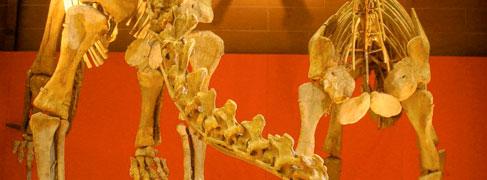
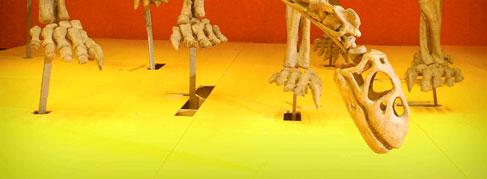
The 10-metre-long sauropod Shunosaurus lii is one of the best represented Chinese dinosaurs with more than 20 skeletons or partial skeletons collected. Photo: S. Humphreys & C. Bento, copyright AM.
On display in the AM exhibition were 11 large dinosaur skeletons, comprised of at least 65 percent bone: Omeisaurus tianfuensis, Shunosaurus lii (adult and juvenile), Mamenchisaurus youngi and M. jingyanensis, all planteating sauropods 20, 10, 22 and 25 metres-long respectively; Yangchuanosaurus huopingensis and Y. shangyouensis, towering flesh-eating allosaurs that may have lived sympatrically; Lufengosaurus huenei, a 7 metre-long, 210 million-year-old prosauropod; Huayangosaurus taibaii, one of the world’s oldest and most primitive stegosaurs; Psittacosaurus sinensis, a child-sized, parrot-beaked ceratopsian; Tsintaosaurus spinorhinus, a 5 metre-long hadrosaur with a unicorn-like horn on its head. Also on display was a 2 metre-long pliosaur cast, as well as dinosaur eggs, claws, teeth, spines, tail clubs, fish, plants, a tiny nothosaur, a turtle and a lizard-like reptile.
As impressive as the large dinosaur skeletons were, for palaeontologists the gems of the exhibition were probably the smaller feathered dinosaurs and ancient birds. On display were skeletons of four feathered dinosaurs, some of the world’s oldest birds, a reconstruction of each specimen by James Reece, and four spectacular interpretative models demonstrating the evolutionary transition from dinosaur to bird. The life-sized models were commissioned by the Australian Museum and, in consultation with Walter Boles, were painstakingly sculpted and feathered by Alan Groves modelmaker extraordinaire, who worked on the BBC’s Walking with Dinosaurs TV series.
The feathered dinosaur section of the Chinese Dinosaurs exhibition was sponsored by the Australian Skeptics Inc. as part of its commitment to educate the public about the overwhelming evidence for evolution. The Liaoning fossils provide convincing scientific evidence of the existence of transitional species in the form of missing links between dinosaurs and birds – transitional taxa long disputed by creation ‘scientists’.
Feathered dinosaurs were first discovered in China’s Liaoning Province in 1996. They were recovered from 125 million-year-old, fine-grained shales, mudstones and slates (Yixian Formation) near the villages of Jianshangou and Sihetun. Beautifully preserved are not only the bony remains of the little theropods - skeletons, claws and even their last meals - but also the impressions of downy feather-like structures forming haloes around them. The animals lived in and around freshwater lakes that once dotted the region. Erupting volcanoes rained fine ash into the lakes, and anything that died or fell into the water was quickly buried in the fine sediment at the bottom of the lakes.
The feather-like filaments covering the skin of the small Chinese dinosaurs range from very simple hair-like structures to feathers as complex as those of modern birds, but the proportions and structure of the limbs of these animals suggest that they could not have flown. Instead, the ‘proto-feathers’ of these small, agile dinosaurs are thought to have been used for insulation, protection, balance and display.
The bird-like dinosaurs Sinosauropteryx prima, Caudipteryx zoui, Protarchaeopteryx robusta, Sinornithosaurus millenii and Velociraptor mongoliensis, and the dinosaurlike birds Sinornis santensis, Confuciusornis sanctus and Changchengornis hengdaoziensis were featured in the AM exhibition. The latter two birds retain a number of ‘reptilian’ features including three grasping fingers in their hands, while
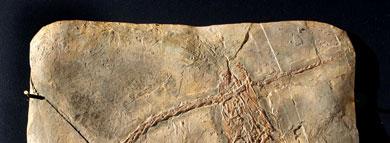
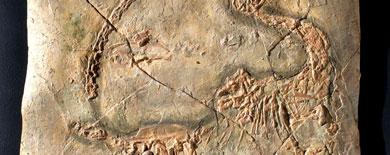
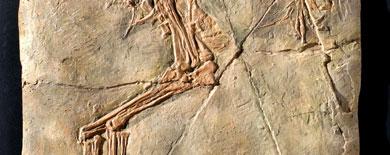
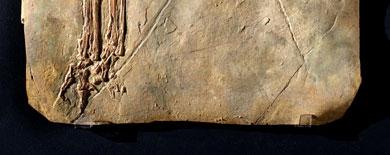
The first-discovered feathered dinosaur, Sinosauropteryx prima, meaning ‘first dragon bird of China’. Its one-metre-long skeleton, surrounded by a halo of primitive, hair-like feathers, was found in 1996 in the Sihetun quarry. Photo: S. Humphreys & C. Bento, copyright AM.
nudum No 28, Nov 2003
Sinornis retains a mouthful of teeth. The take-home message in this part of the exhibition is that the more than 10,000 kinds of birds alive today are a group of theropod dinosaurs -- and therefore dinosaurs are definitely not all extinct!
The Chinese Dinosaurs exhibition at the Australian Museum ran until February 23, 2003. Admission prices (includes general entry) are: families (2 adults, 2 children) $32; adults $13; children (5-15) $7; concession $8; under 5’s free.
Chinese Dinosaurs finished in Sydney in late February 2003 before heading north to Newcastle, across the Tasman to New Zealand, and then to other Australian venues.
The Australian Museum website provides more information about the Chinese Dinosaurs exhibition at http://www.amonline.net.au/chinese_dinosaurs/
Sue Hand
School of Biological, Earth and Environmental Sciences
University of New South Wales
The Australian Museum kindly hosted a function for IPC 2002 where delegates had an opportunity to view the Chinese Dinosaurs exhibition. One well known brachiopod worker from Deakin was seen looking singularly unimpressed and was overheard commenting disdainfully “Hrrrrmmmpff old dead chicken bones”.
This was selected as the most phylocentric comment of the conference and he won a bottle of IPC 2002 Palaeo Pinot for this erudite contribution. Yes Niel, it may be true, but crikey they had some pretty impressive chickens in the Mesozoic of China!
Editors
Climate and Biota of the Early Paleogene, Northwest College, Powell, Wyoming USA July 3-8, 2001
Sponsored by the National Science Foundation (USA), Smithsonian Institution (Paleobiology Dept. / National Museum of Natural History & Evolution of Terrestrial Ecosystems Program), University of Michigan Museum of Paleontology, and The Paleontological Society.
Why the Early Paleogene?:- Worldwide, the warmest interval of the Cenozoic was the Early Eocene, the latter part of which has been called the Cenozoic Global Thermal Optimum, or CGTO. The Early Eocene (55-49 million years ago) was a period of substantial globally warm climate, with numerous data indicating ice-free continents and poles, and shallow equator to pole temperature gradients. An additional warm episode in the early Paleogene, the Initial-Eocene Thermal Maximum, or IETM (formerly the Late Paleocene Thermal Maximum or LPTM), has been recognised from the marine isotopic record as a marked but short duration (10 kyr) warming event. During the IETM the deep sea and high-latitude oceans warmed from ~11°C to ~19°C, virtually eradicating meridional thermal gradients. Early
Paleogene warming led to profound changes in precipitation and continental weathering patterns, and had profound effects on both the marine and terrestrial biotas. The primary forcing factor for the warm early Paleogene is thought to be high concentrations of atmospheric CO2. The warm character of the early Paleogene has led to the recognition of the early Paleogene as a test bed for understanding environments and factors controlling climates in a world much warmer than today.
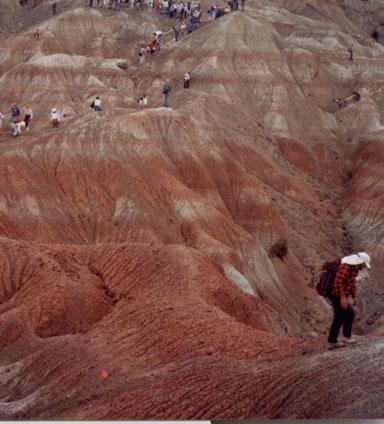
Pole Cat Bench near Powell, Wyoming. This mesa is a classic locality for early Paleogene mammals and plants. Note the red bands representing palaeosols superimposed on the fluvial-lacustrine sediments. Outcrop extends laterally for many kilometres, and with several hundred metres of continuous section.
In July 2001 over 150 palaeontologists, palaeoclimatologists, stratigraphers and other earth scientists and palaeobiologists from all over the world met in Powell, Wyoming, to present their ideas on a range of topics, including: the position of the PaleoceneEocene boundary and designation of a stratotype; Paleogene vertebrates, plants and other biota; and causes and effects of early Paleogene warmth. Understandably, there was a strong representation of US-based researchers, but there were also a small number of New Zealand (Chris Hollis and Liz Kennedy, IGNS) and Australian presenters (David Greenwood and Rachael Keefe, Victoria University, Melbourne; Haidi Hancock, JCU). The Powell meeting was the third in a series organised as part of the International Subcommission on Paleogene Stratigraphy (ICS, IUGS) programme on the Paleocene-Eocene boundary, which from the 2nd meeting in Göteborg in Sweden (July, 1999) has included a significant contribution from nonstratigraphers. The conference was a roaring success, largely through the able efforts of the organising committee, but particularly so from the efforts of Scott Wing and Amanda Ash from the Paleobiology Dept. of the National Museum of Natural History of the Smithsonian Institution.
Participation by the Australian presenters (and in many cases other non-US attendees) was partially or fully funded by the conference organisers from funds provided by the US National Science Foundation. A group comprised of US (David Dilcher & Doug Nichols), Russian (Valentin Krassilov), New Zealand (Liz Kennedy), Colombian (Carlos Jaramillo), and Australian delegates (Greenwood & Keefe) were also provided with a personal tour of Wyoming geology and the Denver Museum, by Kirk Johnson (Dept. of Earth & Space Sciences, Denver Museum of Nature & Science) and his crew, prior to and following the meeting.
Conference highlights:- Field trips to classic US western interior type localities for the North American Land Mammal Ages (a biostratigraphic framework based on classic Rocky Mountains layer cake stratigraphy and fossiliferous horizons extending exposed for 10’s of km) and classic palaeobotany localities;
• Fourth of July celebrations with a BBQ for more than 150 at Churchill Farms, locals who have offered hospitality to visiting palaeontologists and palaeobotanists for many years, followed by cold beer on Paleogene outcrop on the edge of town to watch the fireworks;
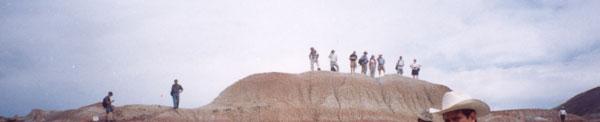
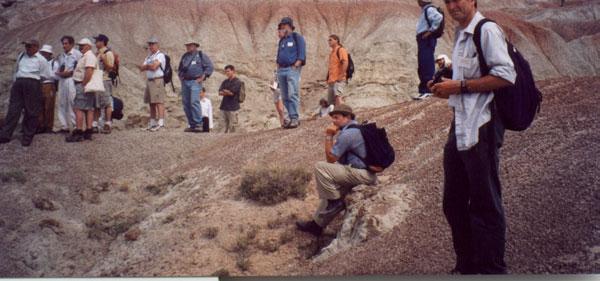
Dr Scott L. Wing, a palaeobotanist from the Smithsonian Institution, and one of the principal conference organisers, shown at Pole Cat Bench near Powell, Wyoming. This mesa is a classic locality for early Paleogene mammals and plants. Note the red bands representing palaeosols superimposed on the fluviallacustrine sediments. Outcrop extends laterally for many kilometres, and with several hundred metres of continuous section.
• Unbridled hospitality and interest in the conference, and of foreign visitors and our research by the local community of Powell;
• Wyoming;
• One after another (after another …) quality spoken presentations on every imaginable topic concerning the Paleogene, from a cross section of disciplines from stable isotopes, magnetostratigraphy, biostratigraphy, geochronology, vertebrate palaeontology, palaeobotany, palynology (spore-pollen and forams etc.) to climate modelling;
• Discussion on the designation of the base of the Ypresian as the Paleocene/Eocene Boundary, and selection of a stratotype (GSSP) for the P-E Boundary in the Dababiya Section (near Luxor, Upper Egypt) - subsequently accepted by ISPS (http://www.uni-tuebingen.de/geo/isps/);
• Many papers presented were already ‘in press’ in major specialist journals and those with a broader readership (e.g., Science), however selected presenters were invited to submit papers for publication in a peer reviewed conference volume (S.L. Wing, P. Gingerich, B. Schmitz & E. Thomas (Eds.). Causes and Consequences of Globally Warm Climates in the Early Paleogene. Geological Society of America Special Paper 369), to be published in March 2003.
Selected Talk Titles:-
Archibald, S.B. & Farrell, B. Eocene insect fauna of the Okanagan Highlands: Changes in diversity and assemblages through climate and time.
Berggren, W., Ali, J., Brinkhuis, H., Heilmann-Claussen, Van Couvering, J., Dupuis, C., Kent, D., King, C., Knox, R., Stott, L., & Ward, D. Chronostratigraphic terminology at the Paleocene/Eocene boundary.
Bice, K. & Marotzke, J. Mechanisms for thermal destabilization of methane at the Paleocene-Eocene boundary.
Bloch, J., Boyer, D. & Gingerich, P. Small mammals from Paleocene-Eocene freshwater limestones of the Fort Union and Willwood formations, Clarks Fork Basin, Wyoming: exceptional preservation in unique depositional environments. [echoes of Riversleigh]
nomen nudum No 28, Nov 2003
Brinkhuis, H. & Crouch, E. Cretaceous/Tertiary and Paleocene/Eocene parallels: a dinoflagellate perspective.
Clyde, W., Koch, P., Sheldon, N., Gunnell, G., & Bartells, W. Isotopic oscillations and mammalian faunal turnover in the Green River Basin during the Cenozoic global climatic optimum.
Fricke, H. Patterns of δ18O of early Eocene precipitation: Implications for the study of vapor transport, δ18O of nearshore oceans, and mountain building.
Greenwood, D.R., Vadala, A., Moss, P., & Keefe, R. Early Paleogene climates and vegetation in SE Australia.
Hicks, J. & Obradovich, J. Magnetostratigraphy of the Late Cretaceous to Early Paleogene in the Denver Basin, Colorado.
Hollis, C., Dickens, G., Field, B., Hancock, H., Jones, C., & Strong, P. Early Paleogene biosiliceous facies in the SW Pacific.
Hooker, J. & Dashzeveg, D. Europe-Asia mammalian faunal interchange in the Early Eocene.
Huber, M. & Sloan, L. Results from the first fully coupled general circulation model simulation of early Paleogene climate: What role do the oceans play in maintaining warm climates?
Nichols, D. & Fleming, R.F. Palynostratigraphic framework for age determination and correlation of Lower Paleogene rocks in the western interior of North America.
Norris, R., Bains, S., & Corfield, R. Biological-Climate feedback during transient global warming across the Paleocene-Eocene boundary.
Roehl, U., Norris, R., & Ogg, J. Astronomical forcing in Late Paleocene and Early Eocene sediments from ODP site 1051 (Blake Nose, Western North Atlantic) from XRF scanning data.
Royer, D., Wing, S., & Beerling, D. Estimating Early Paleogene atmospheric pCO2 from stomatal indices.
Sloan, L., Shellito, L., & Huber, M. Roles of atmospheric greenhouse gases and oceans in terrestrial Paleogene climates.
Wilde, V., Frankenhaeuser, H., & Nickel, B. Small-scale variations of Eocene vegetation in central Europe: Results and implications.
Further information:-
Greenwood, D.R., Moss, P.T., Rowett, A.I., Vadala, A.J., & Keefe, R.L. 2003. Plant communities and climate change in southeastern Australia during the early Paleogene. Ch. 22, In, S.L. Wing, P. Gingerich, B. Schmitz & E. Thomas (Eds.). Causes and Consequences of Globally Warm Climates in the Early Paleogene Geological Society of America Special Paper 369.
Forams 2002
The four-yearly meeting of those interested in the palaeontology and biology of foraminifera (Protista; Order Foraminiferida) was held at the University of Western Australia, Perth, 4th-8th February 2002. The conference was organized by Assoc. Professor David Haig and Dr. Stefan Revets, with the assistance of other members of the Biostratigraphy Group in the Departments of Geology and Geography at UWA. Over 200 participants, many from Europe, attended, and a late rush of registrations forced the refreshments centre into the lush outdoor setting of the tropical palm grove outside the Geology building. Four days were devoted to lectures and workshops, with a mid-conference excursion day on Wednesday. A post-conference field trip for a limited number of participants was led by David Haig. The trip covered the palaeontology and biology of foraminifera at localities of Permian, Jurassic and
Cretaceous ages, and modern marine environments, between Perth and Shark Bay, Western Australia.
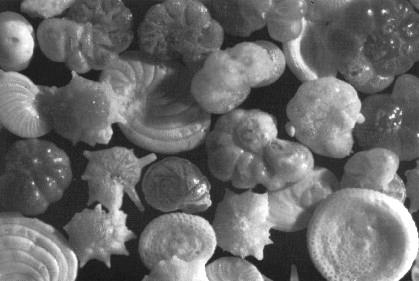
Forams 2002 Conference – the invitation to attend went out to many foram workers on this postcard of foraminiferal sand from Rocky Bay, Rottnest Island, W.A. (Photo: David Haig).
The lecture program commenced each morning with a plenary session with talks by invited speakers. The themes for the sessions were: A Sense of Place; Phylogeny and Evolution; Foraminiferal Distribution Patterns; and Applied Foraminiferal Investigations. After morning tea the lecture program broke up into three concurrent sessions of contributed papers, with themes running over one or several days : Environmental Proxies, Palaeoecology, Evolution, Ecology, Biostratigraphy: something for everyone. There were the inevitable clashes, but not too many, and lecture-hopping was possible because the lecture theatres were close to each other, and the program was kept to time by session chairpersons. The lectures were in many cases accompanied by beautifully illustrated Powerpoint computer presentations. Justin Parker of the Biostratigraphy Group is owed special acknowledgment for making sure that this aspect of the conference ran smoothly. Other post-graduate students and former students (including Rob Campbell, Barry Taylor, Matt Dixon, Kate Trinajstic and Margaret Smith) assisted with registrations, with the running of sessions and other day-to-day needs. A comprehensive volume of lecture and poster abstracts was edited by Stefan Revets. Kate Trinajstic and John Williamson organised a number of excursions for accompanying persons.
The final session on three days were concurrent workshop sessions on a variety of topics: standardisation of methods; advances in analyzing distribution data; reconciling evolutionary biology and foraminiferal taxonomy; cyclic changes and local, regional, and global chronologies; creating a virtual lab; experimental approaches to foraminiferal biology; does industry need foraminiferal environmental studies?; does industry need foraminiferal biostratigraphy? The workshops followed diverse formats, with some consisting of demonstrations, while others consisted of the chairperson putting forward a number of questions or points of discussion, followed by suitably animated discussion from the floor. Among those I attended, particularly impressive and interesting were microscope videos of foraminifera calcifying their test walls, using tracers to label calcium from different sources, given in the experimental approaches to foram biology by Jonathan Erez. Unfortunately due to the large number of presentations and due to administration duties this reviewer was able to sample only some of the interesting lectures and presentations on offer. A feature of the conference was the evening public lecture by Marie-Thérèse VénecPeyré to commemorate the bicentenary of the birth of Alcide d’Orbigny, and to outline his immense contribution to palaeontology.
The poster display consisted of so many high-quality offerings that it was difficult to look at all. The original plan to serve morning and afternoon teas in the poster room, to stimulate discussion of the posters, had to be abandoned when last-minute registrants swelled the conference size well beyond expectations, and the tea area was moved out into the gardens. Microscopes were set up in a lab so that participants could examine and discuss specimens during the conference.
The mid-conference field day took most participants to one of two destinations: by ferry to Rottnest Island, west of Perth, or south along the coastal plain to Penguin Island, the Peel-Harvey estuary and the thrombolites of Lake Clifton. Part of the survival kit issued to all conference registrants was a broad-brimmed hat, a water bottle and an insulated handbook satchel suitable for later use to carry chilled wine or beer. The Rottnest Island trip, conducted by David Haig, showed participants the Quaternary geology of the island and the modern environment, including stops at some of the island’s beautiful snorkelling bays to sample forams, and to look at coral on the most southerly reefs in the Indian Ocean. A microscope was set up on a table at the beach, and snorkellers were able to examine their collected living foraminifera on the spot, albeit in considerable haste, due to a packed excursion schedule. The Penguin Island trip, led by Marjorie Apthorpe and assisted by Bill Morgan, Pat Quilty and Jenny Bevan, after crossing the Swan coastal plain spent the hot morning at Penguin Island, a bird sanctuary just offshore from Rockingham. Here participants were given a tour of the Quaternary geology by Bill Morgan, swam and hunted larger forams in the sea-grass beds, watched captive rehabilitated penguins and the thousands of nesting seabirds, or did their own thing in the water on the ocean side of the island. The afternoon was spent at two stops in the Peel-Harvey estuarine system, including an enthusiastic sampling foray into a marginal swamp, which all participants miraculously survived despite their sandals. The excursion made its way to the thrombolites at Lake Clifton and finished at the adjacent winery with a late afternoon tasting. Despite the heat a good time was had by all on both field trips. Comprehensive guide books for the excursions were given to each participant. The Rottnest guide supplied was the publication by P. E. Playford and R. E. Leech, “Geology and Hydrology of Rottnest Island” (Geological Survey of W.A. Report 6, 1977). The illustrated guide book for the Penguin Island –Lake Clifton trip was written by David Haig, with contributions from M. Apthorpe and W. Morgan. The guide included foraminiferal lists and a bibliography.
The post-conference field excursion over eight days was described in a comprehensive illustrated guide for participants, which included an account of the regional geology, foraminiferal lists and references, written by
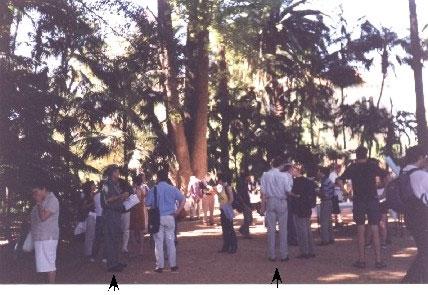
David Haig. As with all the conference handbooks, this guide was elegantly designed and laid out by Justin Parker. By all accounts, the excursion went very well.
The conference dinner on Thursday evening at the local yacht club, ably organized by Kate Trinajstic, provided a lively and relaxing evening near the end of the conference.
In summary, the weather was kind (mostly not too hot), the administrative arrangements came together, due to months of work on the part of the two conference organizers and in spite of the university’s administration via Extension Services, and the meeting appeared to be enjoyed by all. Particularly valuable was the interaction between workers on the biology and DNA composition of living foraminifera, and palaeontologists working on palaeoecology and biostratigraphy, each receiving a better understanding of the possibilities and limitations of each others’ methodologies for their own research.
A list of participants, and some images from events associated with the conference, can be found at the conference website: http://www.geol.uwa.edu.au/forams. The next meeting of the FORAMS conference will be in Brazil in 2006.
M. Apthorpe Apthorpe Palaeontology Pty Ltd
A one-day meeting to be held in association with the Australasian Association of Paleontologists / Geological Society of New Zealand annual conference, Dunedin, New Zealand, Friday 5th December, 2003
Understanding the origin, history and controls of biodiversity remains one of the primary goals of paleontology and biology. The measurement and interpretation of biodiversity data, however, is fraught with problems. In this meeting we will bring together paleontologists and biologists to explore some of the perplexing questions surrounding biodiversity. Using New Zealand and global examples of living and fossil clades, we will examine topics such as species-area effects, onshore-offshore diversity gradients in the marine realm, latitudinal gradients, and distortions of the paleobiodiversity record related to preservational biases.
The meeting has been scheduled to allow attendees to also participate in field trips associated with the Geological Society of New Zealand conference. Some of these trips will have a paleontological focus.
For further information please contact:
James Crampton, Institute of Geological & Nuclear Sciences, P.O. Box 30-368, Lower Hutt, New Zealand.
Ph. +64-4-570 4887
Fax. +64-4-570 4600
Email j.crampton@gns.cri.nz
First Circular: CAVEPS 2005 and Quaternary Extinction Symposium
10th Conference on Vertebrate Evolution Palaeontology and Systematics
Naracoorte Caves World Heritage Area, Naracoorte, South Australia, Australia
29th March to 2nd April 2005
You are invited to attend the 10th CAVEPS to be held at the World Heritage listed Naracoorte Caves National Park and nearby Naracoorte township, approximately 360 km SE of Adelaide (capital city of South Australia), in the Limestone Coast region of South Australia.
The Limestone Coast is well known for its Pleistocene vertebrate sites, with the most significant of these within the Naracoorte Caves World Heritage Area (serial nomination with Riversleigh). The region is also famous for its high quality wine (from the Coonawarra region), wetlands and karst features.
CAVEPS is a biennial meeting of vertebrate palaeontologists from around Australia and overseas. CAVEPS 2005 will consist of 3 days of general sessions including papers on all aspects of vertebrate palaeontology, culminating in a 2 day symposium which will focus on Quaternary extinctions and dating applications. In addition to the main sessions, a student forum is also proposed where students can present their project proposals or work in progress and benefit from professional input.
The conference will be held during the AVCC (Australian Vice Chancellors Commission) common vacation week and will commence on Tuesday 29th of March (Monday 28th is Easter Monday), and culminate on Saturday 2nd of April. As the conference is field-based there will be opportunities throughout the week to inspect key Pleistocene vertebrate sites, show caves and quarry sites. The park also has an interpretive fossil centre, fossil laboratory and collection storage facility, and bat observation centre. Visit the park website for more details about the facilities http://www.environment.sa.gov.au/parks/naracoorte/
There is ample transport from Adelaide or Melbourne via bus or regional air service. We are hoping to provide a bus for delegates arriving in Adelaide. At the Naracoorte Caves National Park there is a well-equipped camp ground and the Wirreanda Bunkhouse (dormitory accommodation for 50 people). The dormitories are shared and will cost approximately AU$10 per night for delegates. There is a licensed café on the park which is open during business hours serving everything from snacks to gourmet meals. Alternative accommodation options are available in the Naracoorte township (up to 4 star) which is 11 km S of the park. There are several restaurants and hotels in the township. We will provide more details regarding accommodation in future circulars.
Conference presentations will be held in the well-equipped Naracoorte Town Hall and at the National Park in the spacious Blanche Cave. Facilities will be available for slide and Powerpoint presentations (a call for papers will be issued with the second circular). There will be a welcome function at Orlando’s Russet Ridge winery (incorporating a tour of the wine making facilities) and a conference dinner. We are currently investigating the feasibility of package deals that will include registration costs, catering and accommodation (details in future circulars).
A post-conference trip is planned for the week following the conference (ie. April 4th to 8th). The trip will include a visit to the South Australian museum to inspect the fossil galleries, visits to mid-North Quaternary megafauna localities, the Flinders Ranges (Ediacaran localities), the Barossa Valley and Tertiary fossil localities along the River Murray.
Expressions of interest are sought for CAVEPS 2005. Please forward a brief reply indicating whether you hope to attend the conference and would like to remain on the mailing list.
Please register your interest by returning the following details:
Please delete all but one of the following responses to indicate your attention:
1. I intend to be at the conference and am interested in a post-conference excursion.
2. I intend to be at the conference but not go on a post-conference excursion.
3. I may go to the conference and may go on the post-conference excursion.
4. I may go to the conference but not go on the post-conference excursion.
5. I am unlikely to attend the 2005 conference, but please send further circulars.
6. I have no further interest CAVEPS conferences, please remove my name from the mailing list
Remember!!
it is your responsibility to notify us of changes to your email address and other contact details if you wish to remain on the mailing list for Caveps 2005.
Contact details:CAVEPS 2005, Naracoorte, South Australia
Conference convenors:-
Liz Reed:- email: liz.reed@flinders.edu.au
Steven Bourne:- email: Bourne.Steven@saugov.sa.gov.au
Formal postal address:CAVEPS 2005, c/- Naracoorte Caves National Park, PO Box 134, Naracoorte South Australia 5271, Australia
Phone: +61 (08) 8762 3412
Dr Katherine Trinajstic Postdoctoral Research Assistant, Department of Geology and Geophysics, University of Western Australia
Dr Trinajstic has made significant contributions to research in palaeontology. Her fieldwork, focusing on the Devonian microvertebrate fossils from the Gneudna Formation in Western Australia, has led to the discovery and description of important new fossil fish specimens. She has participated actively in international research projects and contributed to the development of an international timescale.
Katherine is the second winner of the Dorothy Hill Award (see nomen nudum 27), congratulations Katherine from all AAP members.
Name:-Brian McGowran
Contact details:-
Geology & Geophysics, Adelaide University, SA 5005
Email: brian.mcgowran@adelaide.edu.au
Report 2001-2002:- Brian McGowran retired in early 2002 and is now a Visiting Fellow at the new School of Earth & Environmental Sciences. His main complaint about thirty years’ teaching would be—were nostalgic ramblings important—the recurring problem of teaching palaeontology and earth and life history to students either lacking in biology or with little sense of geology and especially of geological time. The merging of geology and organismal biology puts palaeontology as an intellectual discipline more at the centre of things (and, praise be, the Head of School is distinguished palaeobotanist Bob Hill). Brian’s decade-long collaboration with Qianyu Li continued on the general theme of the neritic stratigraphy and environments of the southern Australian Cenozoic, the foraminifera being the main
tool and an always-watchful eye being kept on the place of the neritic between the pelagic and terrestrial realms. Thus far “retirement” has included leading an IPC-2002 excursion Sydney-Adelaide, with sterling support from Guy Holdgate and Stephen Gallagher, trying to finish a review for the AJES 50th birthday with Li, Guy and Stephen (sinfully late—my fault not theirs), and completing a monograph-length manuscript on biostratigraphy for Cambridge University Press.
Name:- John Buckeridge
Contact Details:-
Earth and Oceanic Science Research Institute (EOS) 24 St Paul Street, Auckland Private Bag 92006, Auckland, New Zealand
Ph:(+649) 9179717
Fax:(+649) 9179973
Email: john.buckeridge@aut.ac.nz
Report 2000-2001:- Earth and Oceanic Sciences (EOS), was established as a university sponsored Research Centre in 2000. The mission statement is broad, encompassing all facets of research involving human activities and natural phenomena within that zone twixt sea and land, and extending out to the shelf. Much of the research to date has involved sustainability engineering and environmental impact assessment, and as such falls outside the gambit of AAP. None-the-less, there has been a steady output in palaeontology, particularly with cirripedes (barnacles) and sponges. At the close of 2002, the university granted EOS full “Institute” status, and has increased funding sufficiently to permit appointment of a Post Doctoral Fellow in 2003. It is likely that this appointment will be in biosystematics.
In February 2000, the National Institute of Water and Atmospheric Research (NIWA) sponsored Species 2000, an ambitious attempt to catalogue New Zealand’s fossil and living biota. John Buckeridge undertook a review of the cirripedes, and with Michelle Kelly (NIWA), carried out the review of the sponges. At present, only the abstracts are available, although a summary was presented by Buckeridge and Gordon (2000), later that year. John Buckeridge continues with his work on cirripedes, with papers on Californian, Atlantic and Antarctic taxa complementing his work on New Zealand species. He is currently undertaking a revision of the Ibla group with Bill Newman (Scripps Institute of Oceanography, CA). John is now underway with a new NIWA monograph on Recent New Zealand Cirripedia; this is however, a long-term project and is unlikely to be completed before 2005. As current president of AAP, John gave two lectures on the evolution, palaeontology, systematics and biogeography of the cirripedes: at the University of Wollongong, and RMIT University, earlier in 2002.
In 2001, EOS Adjunct Michelle Kelly and John Buckeridge were awarded a Marsden Fund grant (Royal Society of New Zealand) to carry out research upon the biology, systematics and palaeontology of the lithistid sponges of the New Zealand Shelf. The
first outputs of this research are conference proceedings and are listed below. There are currently a number of papers in press, and these will appear in 2003.
Contact details:-
Australian Museum
Palaeontology Section, Australian Museum 6 College Street, Sydney South, NSW 2010
Ph: (02) 9320 6000
Fax: (02) 9320 6050
Name:-Greg Edgecombe
Contact details:-
Ph: (02) 9320-6279;
Email: greged@austmus.gov.au
Report 2001-2002:- Greg Edgecombe has focused on centipede phylogeny, the position of the Myriapoda in arthropod phylogeny, and systematics and biogeography of Australian centipedes, based on morphological and molecular sequence evidence. PDFs of publications on centipedes are available at the Museum’s website (http://www.amonline.net.au/invertebrates/other/index.htm). Palaeontological projects include: a revision of the Triassic isopod Protamphisopus (with Buz Wilson; to be published by Journal of Paleontology in 2003); a consideration of the myriapod stem group based on morphological characters in extant Myriapoda; a contribution to the trilobite chapter in the Webby et al. book on Ordovician biodiversification; styginid, asaphid and lichid trilobites from the Upper Ordovician of Tasmania; some Early Devonian trilobite faunas from New South Wales (with Tony Wright). In 2001, Greg was a Visiting Lecturer at the Humboldt-Universität zu Berlin, conducting studies with Stefan Richter on arthropod mandibles (see Zoologischer Anzeiger 241: 339-361).
Name:-Yongyi Zhen
Contact details:- Ph:(02) 9320-6132
Email: yongyi@austmus.gov.au
Report 2001-2002:- I am currently working on the Ordovician conodont faunas from New South Wales and China in collaboration with Ian Percival, Barry Webby, Jianbo Liu and others. A large paper joint with Ian Percival and Barry Webby documenting the Early Ordovician conodont faunas from the Mt. Arrowsmith and Koonenberry Gap areas of western New South Wales is in press in Records of the Australian Museum. A review paper joint with Ian Percival on the Ordovician conodont biogeography presented to the First International Palaeontological Congress in July 2002 is under the review process. A third paper joint with Ian Percival and John Farrell on the Late Ordovician conodont and brachiopod faunas from the allochthonous limestones in the Late Silurian Barnby Hills Shale of central New South Wales is also in press with the Proceedings of the Linnean Society of New South Wales.
Name:-Zerina Johanson
Contact details:-
Ph:(02) 9320-6142
Email: zerinaj@austmus.gov.au
Report 2001-2002:- Zerina Johanson’s current projects involve a phylogenetic analysis of the Dipnoi (with Per Ahlberg and Moya Smith), a redescription of the placoderm dentition (with Moya Smith), and studies on the axial and appendicular skeleton of Neoceratodus (with Jean Joss). The latter will involve characterising gene expression in the scapulocoracoid and the anterior vertebral column, with comparisons to actinopterygian and chondrichthyan taxa. This work is funded by an ARC Senior Fellowship and an Australian Museum Research Centre grant. Other projects undertaken include a description of the braincase of the Canowindra sarcopterygian Mandageria fairfaxi (with Per Ahlberg and Alex Ritchie, to be published in 2003 in Palaeontology) and studies on the clavobranchialis musculature in sarcopterygian fishes (in press at Contributions to Zoology) and the branchial and hypobranchial musculature in placoderms (in press at Journal of Vertebrate Paleontology). Zerina was a Visiting Lecturer at the Humboldt-Universität zu Berlin in 2001, and gave talks at the IPC held at Macquarie University in July 2002 and at the SVP in October 2002.
Name:-Robert Jones
Contact details:- Ph:(02) 9320 6234
Email: robertj@austmus.gov.au
Robert Jones, Collection Manager, was headed to South Africa as we compiled this report. He has represented the Museum on the Board of the Age of Fishes Museum at Canowindra since 2001, and consulted on the palaeontological displays at the Lord Howe Island museum. In 2002 he participated in the “Elliot” fieldtrip, searching for Cretaceous dinosaurs in Queensland.
Australian National University
Contact details:- Department of Geology
The Australian National University Canberra, ACT 0200
Ph:(02) 6125 2065
Fax:(02) 6125 5544
Names:-Campbell, K.S.W and Barwick, R.E.
Contact Details:-
Ph: (02) 6125 2061 and (02) 6125 3067
Email: ken.campbell@anu.edu.au and richard.barwick@anu.edu.au
Report 2001-2002:- We have had three issues concerning us during 2001-2002. The origin of dipnoans and their relationship to the primitive Chinese genus Diabolepis has caused difficulty. Our paper was first reviewed by a cladist who gave it the mark of 4 out of 10. Nevertheless it was published, and awakened us to the problems caused by people who accept the climate of opinion on a topic, and reject other
people’s work despite the fact that clear arguments are produced to support an alternative position.
Secondly we have published a paper on a strange Middle Devonian dipnoan, Dipnotuberculus from Morocco. This had many features in common with our Emsian Dipnorhynchus from the Burrinjuck. Although the tooth plates are of the same kind, they have a most remarkable dental structure.
Thirdly we have spent most of 2002 preparing a paper on Onychodus from Gogo. This is by far the best preserved species of the genus yet known. The work was begun by Mahala Andrews in Scotland, but she died in Iona after retiring from the Scottish Museum. The diagrams and photos she had prepared were sent to us in Canberra, and we have prepared a text, many illustrations based on new material collected by ourselves and by John Long from Perth. John has also read and added to the manuscript. The whole work has been read and added to by Per Ahlberg from the Natural History Museum London, where the bulk of the original collection is now housed. The paper will be submitted with Andrews as the first author. Two major features are the appearance of two spiral whorls of tusks in the anterior part of the mouth. These required a complete remodelling of the anterior part of the head. And secondly the articulation of the mandible was based in cartilage, making a very flexible structure. This also required a reorganisation of the whole head structure. Only the anterior braincase has been fully ossified making a structure like that of Psarolepis.
Our work on the postcranial skeleton of the Gogo dipnoan Griphognathus whitei has been published. The toothplates of the early dipnoan genus Speonesydrion are being reinvestigated. They need detailed comparison with Dipterus valenciennesi. We have collected several more specimens from the type region, but work on them has just begun.
Keywords:- Devonian; lungfish; postcranial skeleton; Onychodus; functional morphology.
Name:-Gavin Young (Visiting Fellow)
Contact details:- Ph:(02) 6125 3446
Email: gavin.young@geology.anu.edu.au
Report 1999-2000:- 1999 activities included teaching the Geology 2008 course as a temporary replacement for Patrick De Deckker, finalising mapping work on the Upper Devonian Hervey Group under a contract with AGSO, and various aspects of research on Palaeozoic vertebrates. Co-ordinating and preliminary editing of co-authored contributions from Australia for the fin al results volume of IGCP Project 328 ('Microvertebrate biochronology and marine/nonmarine correlation') took up significant time (published 2000). Macrovertebrate research in Paris during MarchJune 1999 (Visiting Professor, Museum national d'Histoire Naturelle), included attending the London symposium on 'Major events in early vertebrate evolution: palaeontology, phylogeny, and development' (April, 1999). Acid preparation of Early Devonian placoderm fish from Burrinjuck was carried out in the laboratory in Paris. Collaborative research with Professor Daniel Goujet and Dr Herve Lelievre (Paris) and Dr Elga Mark-Kurik (Tallinn) concerned new buchanosteid arthrodires from the
Burrinjuck, and from the Early Devonian of Saudi Arabia, and the large Cravens Peak collection from the Georgina Basin. Award of a Humboldt Prize in 1999 covered 6 months research at the Museum fur Naturkunde Humboldt Universitat, Berlin. A 3 month period in Berlin in 2000 focussed on the first Upper Devonian fish locality from South America (the large Venezuelan collection of 1992), and a range of assemblages from new fish localities in the Upper Devonian of New South Wales.
Report 2001-2002:- A second 3 month period in Berlin in 2001 finalised the Venezuelan work, and included research on the early evolution of the brain and extrinsic eye muscles in early vertebrates (presented at the International Conference on Vertebrate Morphology in Jena, July 2001). Presentations were given on Devonian sharks and placoderms at the Early Vertebrate Symposium in Flagstaff, Arizona (2000), and a paper on Devonian vertebrate biogeography was presented at the 15th Senckenberg Conference in Frankfurt (2001). Main projects for the year 2002 were the completion for publication of a monograph on the Early Devonian Wuttagoonaspis fauna from the Georgina Basin (a large collection assembled in 1974 and 1977), preparation of the field guide for the IPC 2002 Fish Excursion, and several papers on brachythoracid arthrodires from the Burrinjuck area, and Broken River (Queensland). Six manuscripts resulting from this work are now submitted or in press. Some considerable time was spent preparing a proposal for a new IGCP project (with Dr Zhu Min, IVPP, China), and in putting together papers for a proceedings volume from IPC vertebrate symposia to be published in Fossils & Strata (including a paper with Carole Burrow on acanthodian fish from the Devonian Aztec Siltstone, Antarctica).
Keywords:- Palaeozoic vertebrates; morphology; phylogeny; biogeography; systematics.
Name:-Barry Fordham
Contact details:-
CSIRO Sustainable Ecosystems
PO Box 284 Canberra, ACT 2601
Ph: (02) 6242 1530
Fax: (02) 6242 1782
Mob: 0421 611 913
Email: barry.fordham@csiro.au
Report 2001-2002:- Barry joined CSIRO Sustainable Ecosystems as Group Leader, National Futures (who model the physical economy of Australia) in August 2002. He has also joined the ANU paleontology discussion group, who hold interesting Xmas get-togethers. He continues biostratigraphic studies of conodonts as part of the Geological Survey of Queensland’s Yarrol Project and hopes to find time to return to more efforts conodontological as he settles in to Canberra.
Keywords:- conodonts; Ordovician; Silurian; Devonian; Lower Carboniferous.
Name:-Lynne Bean
Contact details:- Ph:6125 2059
Email: s3336714@geology.anu.edu.au
Report 2001-2002:- Lynne has just completed a study of Leptolepis talbragarensis, one of the best known Jurassic fish from Australia, for her Graduate Diploma thesis. The material comes from the non-marine deposits in the Surat Basin. Bulk collections, made in the 1880s, were stored in the Australian Museum and the NSW Geological Survey, but specimens were exchanged with Museums overseas. As a result, overseas workers have used these materials to make a contribution on the small amount of specimens available, but nobody in Australia has made any further descriptions. Arratia has made a new genus Cavenderichthys for this species, and has indicated strongly that it was not a Leptolepis.
The species occurs in a thin bed only 60cm thick, and this has been described as a mudstone or chert. It is largely an ash fall which has been silicified. This has filled a small lake in overbank deposits, and it is because of this phenomenon that the preservation of the specimens is so good.
Lynne’s analysis of the extensive material has shown up a number of characters particularly in the jaw suspension, the vertebral column and the caudal structure. This work supports the view that Cavenderichthys is a valid genus, and it should be placed in the Leptolepidae. The morphology also indicates that its age is Late rather than Early Jurassic. This has been confirmed by SHRIMP dates on the zircons obtained from a unit immediately below the fossil bed.
Keywords:- teleosts; Cavenderichthys; Late Jurassic; SHRIMP dates.
Name:-David Ride
Contact details:-
Ph:(02) 6281 2641
Email: d.ride@geology.anu.edu.au
Report:- David is working towards completing his guide and companion to the latest edition of the International Code of Zoological Nomenclature. He is also currently completing his studies on the mammal fauna of the Pleistocene of the northern Monaro (Southern Tablelands) of NSW.
Keywords:- ICZN; Pleistocene; mammals; NSW.
Name:-John Magee
Contact details:-
Ph:(02) 6125 2761
Email: jwmagee@geology.anu.edu.au
Report 2001-2002:- In collaboration with Gifford Miller, University of Colorado, Boulder, USA and Marilyn Fogel, Carnegie Institute, Washington, John is reexamining the extinction of the Australian megafauna. This question is being examined not just to resolve the long-standing debate about the relative roll of humans and climate change in the extinction but also to elucidate the role of longterm human impact in other facets of environmental change.
In Australia the extinct megafauna include marsupials, reptiles and the ostrich-sized bird Genyornis, and it seems likely that amongst herbivores, the extinction was selective for browsers rather than grazers. Debate on the cause of extinction has been bedevilled throughout by poor numerical chronology due to dependence, until recently, on radiocarbon which has been compromised by both the innately poor preservation of original carbon in bone under Australian conditions and the proximity of the extinction event to the resolution limits of the technique. Incorrectly younger dates due to contamination with younger carbon and association of reworked older faunal remains with younger dates have combined to suggest an almost certainly erroneous late survival of megafauna and long overlap with humans. Recent nonradiocarbon chronologies suggest an extinction date coeval across climatic zones and for a variety of taxa at 46-50±5ka, soon after the likely date of human arrival on the continent (55±5 ka), implicates a human role in the extinction but says nothing of the process. It is unlikely that the archaeological record will ever provide more than proof of human-megafauna overlap.
To finally resolve the extinction debate we need to obtain an unequivocal extinction chronology for a wide variety of taxa across a wide transect of climatic zones and to determine whether extinction was selective for dietary preference from an improved eco-physiological understanding of the animals and palaeodietary analyses. Before its extinction, Genyornis coexisted with emus at least across the arid and semi-arid zones where eggshells of both species occur relatively abundantly in aeolian sediments (Miller et al., 1999). While both are large flightless birds, they are taxonomically distant and are probably best regarded as convergent evolution within the bird lineage, with significant behavioural and physiological differences which resulted in Genyornis extinction and emu survival. In addition to being the most commonly occurring bio-mineral fossil, eggshell is far superior to bone for the preservation of its original chemistry, allowing excellent opportunities for chronology and isotopic palaeodietary studies. A major focus of our study is a comparison between Genyornis and emu characteristics across an environmental and climate gradient coupled with an examination of the timing and environmental context of Genyornis extinction, which we believe offers the best prospects for unravelling the cause and process of the extinction event.
Keywords:- extinction; megafauna; Dromornithids; Ratites; palaeoclimate; humanimpact.
Name:-Judith Caton
Contact details:- Ph:(02) 6125 3633
Email: j.caton@geology.anu.edu.au
Report 2001-2002:- Judith is studying the gastro-intestinal morphology and physiology of living hominids in order to model digestive strategies of fossil species. Theories that human predecessors were carnivores, which date back to the first fossil discoveries, overlook evidence to the contrary from living hominids. As the resultant models are based on new data from apes and humans, they are more realistic and based in an evolutionary context. Such models of fossil hominid digestive strategies will be used to re-assess the importance of meat-eating in human evolution, providing new insights into human diets and gut function.
Keywords:- fossil hominoids; modelling gut function; diets.
Name:-Samir Shafik (Visiting Fellow)
Contact details:-
Ph: (02) 6125 2065
Email: samir@geology.anu.edu.au
Report 2001-2002:- Samir has been out of circulation for the last 12 months due to illness. Now that he has almost recovered, Samir will soon resume his research work on nannofossil biostratigraphy. He will be focusing of several unfinished projects including the Oligocene/Miocene transition in the Torquay Basin, the Cainozoic section of the Great Australian Bight Basin, and Albian dredges from the offshore NW Australia.
Keywords:- nannofossil biostratigraphy; Cainozoic; Cretaceous; Australia.
Name:-Michelle Spooner
Contact details:-
Ph:(02) 6125 2070
Email: michelle@geology.anu.edu.au
Report 2001-2002:- Michelle completed her Honours thesis on “Late Quaternary palaeoceanography of the Banda Sea, with implications for past monsoonal climates” last year, under the supervision of Patrick De Deckker. The results of her Honours project are discussed in a paper currently submitted to the Journal of Asian Earth Sciences. After her Honours project, she enjoyed the hospitality of IFREMER and CNRS in France for two months, when she worked on deep-sea cores that she, and other ANU researchers, had taken from northwest Australian waters during the September 2000 cruise of the Marion Dufresne. On her return to Canberra, she momentarily left research for a full-time position at Geoscience Australia in the Marine Petroleum division.
Michelle was awarded an ANU scholarship, and by April 2002, she had started her PhD project with Patrick De Deckker as her supervisor. This has allowed her to return to her main interests in the investigation of the palaeoceanographic and palaeoclimatic responses in the Australasian region during the Late Quaternary. Using highresolution cores from the Marion Dufresne and micropalaeontological techniques, her PhD will focus on surface water interaction of the Leeuwin Current. Collaboration with the French teams at CNRS will continue into 2003.
Keywords:- Late Quaternary; palaeoceanography; palaeoclimate; micropalaeontology; Leeuwin Current; Marion Dufresne
Name:-Julie Trotter
Contact details:- Ph:(02) 6125 9967
Fax:02 6125 0738
Email: julie.trotter@anu.edu.au
Report 2001-2002:- JuIie is currently on 3 years leave of absence from CSIRO to pursue a PhD in conodont geochemistry. The initial research objective is to clarify the geochemical stability of conodont apatite tissues and the implications for diagenesis within apparently ‘pristine’ single conodont elements. From determining the criteria
to best discriminate primary geochemical signatures from secondary effects and background noise, the application to Ordovician and Early Silurian sequences will be pursued. This second phase of the project will apply multiproxy techniques (trace elements and isotope geochemistry) to key intervals within the context of geo- and bio-events (stasis, extinctions, radiations), to identify potential relationships between climate cycles, tectonics and fluxes in ambient seawater chemistry. Preliminary results of this research were presented in poster format at the International Palaeontological Congress meeting held at Macquarie University in July 2002. She anticipates (funding permitting) attending the 9th International Symposium on the Ordovician System next August to present new data on Ordovician ocean chemistry.
This research is being supported by an APA, some internal funding from RSES and Geology, and a Student Award from the Paleontological Society that she won earlier this year. Samples have kindly been provided by Chris Barnes and Bob Nicoll. Her supervisory panel represents diverse expertise from the geochemistry and palaeontology communities: Malcolm McCulloch (RSES), Steve Eggins (RSES), Patrick De Deckker (Geol. Dept), John Chappell (RSES), Chris Barnes (University of Victoria, BC, Canada) and Bob Nicoll (Geol. Dept). Expected completion of the project is January 2005.
Additionally, one foot has still been in the CSIRO camp to finalise a Sr Isotope Stratigraphy project on the Tofino Basin, British Columbia. This has been an integrated isotope-biostratigraphy study in collaboration with Chris Barnes (Univ. of Victoria) to help unravel the complex stratigraphy of this area, as part of a larger project to assess the potential hydrocarbon resources off the coast of British Columbia. A publication to be released within the Canadian petroleum community is anticipated next year.
Keywords:- conodont; Ordovician; geochemistry; apatite.
Name:-Marty Young
Contact details:- Ph:(02) 6125 5131 or (02) 6125 4312] Email: marty.young@geology.anu.edu.au; or myoung@coombs,anu.edu.au
Report 2001-2002:- Marty completed his Honours degree in 1999 at Victoria University of Wellington, NZ, where he used Cretaceous dinoflagellate cysts to date terrestrial (dinosaur) and marine reptile fossils found in sandstone and phosphatic concretions. He presented his results at the 1999 Annual Geological Society of New Zealand conference (held at Massey University), and was awarded a certificate of merit for his work. A paper from this project (titled ‘Dating the Dinosaurs; the palynology and stratigraphy of the Maungataniwha Sandstone, Hawkes Bay, NZ’) is due to be submitted to the New Zealand Journal of Geology and Geophysics (with his supervisor Michael Hannah as co-author). Marty subsequently moved to Canberra (March 2000) where he worked as a visiting fellow at the Australian National University with Patrick De Deckker, looking at Quaternary dinocysts from SE Asia. At the conclusion of this appointment, Marty was employed with AGSO (now Geoscience Australia) as a Visiting Palynologist on a two-year contract with Clinton Foster, where he examined Mesozoic through to Cenozoic dinocysts from deep
marine cores from the Great Australian Bight in order to date the material. An inhouse paper (‘Dinoflagellates as age indicators of deep marine hole sediments from the Great Australian Bight, South Australia’) was written at the finalization of his contact. In August 2001, Marty took up the offer of a scholarship with the ANU to begin work on his PhD. Under the co-supervision of Geoff Hope and Patrick De Deckker, he is using Quaternary organic- and calcareous-walled dinocysts to reconstruct the globally significant climate of SE Asia over the past (approximately) 100 ka. Another focal point to his research is the viability of AMS radiocarbon dating of organic-walled dinocysts, which he started late 2002.
Keywords:- dinoflagellates; dinocysts; organic-walled; calcareous-walled; palaeoenvironment.
Name:-Patrick De Decker
Contact details:-
Ph:(02) 6125 2057
Email: Patrick.Dedeckker@anu.edu.au
Report 2001-2002:- Patrick is continuing his investigations into Quaternary marine environments recorded in deep-sea cores in the Australian region. Collaboration with several colleagues on those cores has aimed at obtaining multidisciplinary records of environmental change. Work with Sander van der Kaars [Monash University] dealt with pollen, with Kyoma Takahashi [Hokkaido University] dealt with calcareous nanoplankton, Lena Maeda [Japan Geological Survey] with trace metals in bulk sediments, Franz Gingele [ARC-IREX Fellow form Germany] on clay analyses, François Guichard and Aurelie Girault [CNRS, France] and Arne Sturm [GEOMAR, Germany] on bulk sediments, and finally Eva Calvo, Carles Pelejero and Tim Barrows [all at ANU] on alkenone temperature signals at the sea surface. A manuscript on modern acantharians and their role in affecting the chemistry of waters near the sea-surface is near completion. These unicellular microorganisms, which resemble radiolarians, secrete a strontium sulphate skeleton - which are never found as fossils as sea water is undersaturated with respect to that mineral – play a significant role in recycling Sr and Ba in sea water near the sea surface, and surprisingly are often more common that planktic foraminifers.
Patrick has completed old work on a core from the playa Lake Frome in South Australia, using the chemistry of ostracod shells for determining past hydrological changes form the Flinders ranges region spanning the last 50,000 years.
Keywords:- Late Quaternary; ostracods; foraminifers; acantharians; shell chemistry; deep sea; Lake Frome.
Name:-Helen Bostock
Contact details:- Ph:(02) 6125 4303
Email: helenb@geology.anu.edu.au
Report 2001-2002:- Helen is presently half way through her PhD studies (The Palaeoceanography of the Capricorn Channel, Southern Great Barrier Reef) under the supervision of Bradley Opdyke. Originally from Cambridge, she completed a BA in Natural Sciences, and a MSc in Geology including her thesis on the diagenesis of the Aymamon Limestone (Miocene) in Puerto Rico. Helen is using a series of gravity
cores from the southern Great Barrier Reef to study the oceanographic changes in the Tasman/Coral Sea region during the last glacial cycle. She is primarily using stable isotopes and trace elements of a range of different species of planktic and benthic foraminiferids to study changes in the water masses at different depths throughout this period, specifically the Antarctic intermediate water (AAIW). She is about to participate on an ODP cruise to the Demerara Rise (NE South America) which will cause her to digress into Cretaceous climates and carbon modelling for a couple of months.
Keywords:- carbonates; palaeoceanography; oceanography; palaeoclimate; Foraminiferida; AAIW.
Name:-George Chaproniere (Visiting Fellow)
Contact details:- Ph:(02) 6125 4303
Email: gchaproniere@geology.anu.edu.au
Report 2001-2002:- George continues his studies on planktic foraminiferids from ODP Leg 189 Sites 1168 (west Tasmania margin) and 1172 (east Tasman Plateau). Site 1168 contains all planktic foraminiferal zones from the Pleistocene to Early Oligocene, with no measurable break. The assemblages are typically temperate, although incursions of warmer waters are recorded over some intervals. Together with excellent nannofossil assemblages and intermittent occurrences of dinoflagellates, an integrated biozonation will be possible. Unfortunately siliceous fossils (diatoms and radiolaria) are too rare to be integrated into this scheme. The Oligocene section is only present at this site, and though it is difficult to improve upon existing biozonation schemes, the distribution of the minute species, Chiloguembelina cubensis and Guembelitria triseriata within this interval may provide some hope for refining the long interval represented by the Turborotalia euapertura Zone. Site 1172 is yet to be studied in the same detail as for Site 1168, and as this site was under the influence of a different oceanographic regime (the Subtropical Front and East Australian Current) the biostratigraphic record may well show some differences to that in Site 1168. Two major differences are the gap between the Early and Late Oligocene, and a minor break at the end of the Miocene.
He has also worked on samples collected on various Geoscience Australia Cruises, mainly from the southern and eastern margins of Australia, the Norfolk Ridge and Lord Howe Rise. George continues to be the Australian Voting Member on the I.S.P.S. for Palaeogene Stratigraphy, and recently voted for the GSSP proposal for the base of the Eocene at the Dababiya section, Egypt.
Keywords:- planktic foraminiferids; Cenozoic; palaeoceanography; Australian margins.
Name:-Elsie Gretton
Report 2001-2002:- Elsie studied Quaternary foraminiferids for her Honours thesis, entitled “Palaeoceanographic changes offshore New Caledonia for the last 140,000 years”, which she completed in 2002.
Name:- David Lindley
Contact details:-
Ph:(02) 6125 9892
Email: lindley@geology.anu.edu.au
Report 2001-2002:- David completed his research on the Lower Devonian ischnacanthid acanthodian fish (the ‘spiny sharks’) fauna of the Murrumbidgee Group limestones at Lake Burrinjuck, New South Wales. Acanthodians of the Order Ischnacanthida possessed dentigerous jawbones with teeth firmly ankylosed on both upper and lower jawbones. Taxonomic results of this work, published in a series of papers in Alcheringa (Lindley 2000, 2002a, 2002b), documented well preserved jawbones, fin-spines and ornamented body scales, the only fossilised elements of these small, largely unossified fishes, from three levels in the sequence.
Biostratigraphic results of the work, presented at the IPC-2002, Sydney, indicated the presence of at least seven endemic ischnacanthid species, whose varied morphologies are considered indicative of rapid evolutionary change (Lindley 2002c).
David is also undertaking research on Tertiary echinoderm faunas in Papua New Guinea; the first systematic work on this group since the work of the Rev. J.E. Tenison-Woods, published in 1878. Material has been gathered during mineral exploration in the country and a field trip to Yule Island, northwest of Port Moresby, in January 2002. The Lower Pliocene Yule Island fauna is rich and diverse, with 19 species known to occur in the Kairuku Formation (Lindley 2002d, 2002e, 2002f). The Yule Island fauna is significant for its proximity (600km) to the northern Great Barrier Reef, with its well documented echinoderm faunas. No marine Tertiary is known from Queensland and his research is now focussing on the implications of the Yule fauna for the origins of northern Australian tropical echinoid faunas. Without palaeontological evidence, previous workers, including most recently Robert Endean, concluded that tropical northern Australian faunas were derived from Recent East Indian and West Pacific stocks. However, nearly half of the Lower Pliocene Yule Island species are represented in northern Australia stocks.
Keywords:- acanthodian fishes; Devonian; Murrumbidgee Group; New South Wales; echinoids; Pliocene; Kairuku Formation; Papua New Guinea.
Name:-Peter J. Jones (Visiting Fellow)
Contact details:- Ph:(02) 6125 3372
Email: peter.jones@geology.anu.edu.au
Report 2001-2002:- Peter Jones and Chen Pei-ji (Nanjing) continued the taxonomic revision of some Triassic and Permian conchostracan genera based on a redescription of their type species originally described from Australia. Genera considered so far are Nudusia, Palaeolimnadia, and Cyclestherioides.
The type species of the monotypic genus Ankumia, (A. bosqueti van Veen 1932; Late Cretaceous [Maastrichtian] from the Netherlands) was redescribed, and its multilamellar carapace interpreted as a pathological result of interrupted ecdysis (moult-retention) within the platycope genus Platella Coryell & Fields 1937. Thus, the genus Ankumia is regarded as a nomen dubium, unrelated to the puzzling crustacaean group Eridostraca, in which the multilamellar shell appears to be the
natural growth pattern of the animal. The results are in press in the Journal of Micropalaeontology.
Permian ostracods, described from the Bonaparte Basin of northwestern Australia, for the first time, indicate a correlation to the Late Permian (Kazanian) of the East European Platform. The ostracods, associated in an offshore well with palynomorphs (studied by Clinton Foster, GA), indicate a marine environment, and provide a potential faunal tie for a specific palynomorph zone to the type Kazanian Stage. The results are in press in AAP Memoir 27.
Latest Devonian and Early Carboniferous paraparchitid ostracods from the Bonaparte Basin were described, and their biostratigraphic and palaeozoogeographic links established. Preliminary results were presented at the Geoff Playford Symposium, during the First International Palaeontological Congress (IPC 2002) Sydney, NSW (610 July, 2002); final results have been accepted for publication in the AAP Memoir series .
Peter continues as a corresponding member of the Subcommission on Carboniferous Stratigraphy of the International Stratigraphic Commission, International Union of Geological Sciences. As a co-author, he contributed to a paper by Manfred Menning (Potsdam) and others, that proposed a resolution to recent problems of nomenclature within the Carboniferous Period. In 2001, he provided taxonomic and palaeoecological advice to Darren Ferdinando, a PhD student (University of Western Australia) for his thesis on Early Permian ostracods from the Perth Basin. Results of two consulting contracts with Agip Australia Ltd, reviewing Late Devonian and Early Carboniferous biostratigraphy of the Bonaparte Basin, were prepared as three company reports in February and September 2002.
Keywords:- Crustacea; Ostracoda; Palaeozoic; global; Australia.
Name:-Annette Mackintosh
Contact details:- Ph:(02) 6125 4303
Email: annette@geology.anu.edu.au
Annette recently completed an Honours degree at the University of Wollongong on the Shallow Marine Foraminifera of Lord Howe Island in the South Pacific, which was part of a larger project looking at carbonate sedimentation on the shelf surrounding the island with Brian Jones and David Kennedy. A summary of results of the project was published in the abstracts for IPC 2002. She has just started (September 2002) a Ph.D. study of the microbiota (specifically, interstital /stygofaunal ostracods) from groundwaters in the Pilbara, WA on a 3-year grant from CALM [Conservation of Land and Management based in WA] awarded to Patrick De Deckker. Her main focus is to address the lack of ecological information of groundwater fauna. She would appreciate any information about stygofaunal studies in Australia or overseas.
Keywords:- ostracods; stygofauna; foraminiferids; groundwater; Pilbara; microbiota; interstitial.
Name:-Robert S. Nicoll (Visiting Fellow)
Contact details:- Ph:work (02) 6125 4303; home (02) 6258-4140
Email: bnicoll@goldweb.com.au
Report 2001-2002:- Bob Nicoll continues work on Ordovician through Triassic conodonts, especially on faunas from around the Permian-Triassic boundary in China and Permian faunas from the Canning Basin. A look at Ordovician and Silurian conodonts from the Carnarvon Basin, with Arthur Mory (GSWA) and Godfrey Nowlan (GSC), is also in progress.
Keywords:- conodonts; Cambrian – Triassic; thermal maturation; conodont biology.
Name:-Laura Sbaffi (Visiting Fellow)
Contact details:- Ph:(02) 6125 2070
Email: laura@geology.anu.edu.au
Report 2001-2002:- Laura arrived at ANU from the University of East Anglia, UK, in March 2002. Originally from Italy, she received her Master's Degree in Geology from the University of Urbino in 1996, and her PhD Degree in Palaeoceanography from the University of Trieste in 2000, with a dissertation on the microfauna of the Mediterranean Sea and its use in palaeoclimatic reconstructions of the Late Quaternary. In March 2001, Laura started a research project with Mark Chapman at the University of East Anglia. While in England, she worked on millennial-scale climate variability of the last three glacial cycles in the subtropical North Atlantic Ocean through the study of planktic foraminifera associations, with particular focus on sea surface temperature (SST) reconstructions.
Laura is now working with Patrick De Deckker on the pteropod’s (marine molluscs) response to climatic changes during the last 21,000 years in the southern Pacific Ocean, northwest of Australia. She is also working at Geoscience Australia with Clinton Foster on abnormal pollen from the Permian-Triassic.
Keywords:- micropalaeontology; palaeoceanography; pelagic environment; climate variability; climate forcing.
Name:-Desmond Strusz
Contact details:- Ph:(02) 6125 3776 work; (02) 6281 4569 home
Fax:6125 5544
Email: dstrusz@geology.anu.edu.au
Report 2001-2002:- Des Strusz has continued his attack on the Silurian brachiopods from the Yass sequence. The first group tackled, previously completely unpublished, were the orthoids - that paper is now out, and includes a discussion of the age, biostratigraphy and ecostratigraphy of the sequence. A second paper, on the strophomenatans, has been returned to the editor after revision - little really new there, but a significant reduction in species compared with Mitchell's original work eighty years ago. Work has now started on a smaller but more difficult group, the pentameroids. First impression - nothing unknown, but systematics needs updating. Meanwhile, the fossils used previously to date the Mundoonen Sandstone, east of Yass, were reassessed in a joint paper with Lawrence Sherwin, and a paper with Tony
Wright on a small graptolite-associated Wenlock brachiopod fauna from near Orange is in preparation.
Coral work is unfortunately now in abeyance, following Tim Munson's move to Darwin. However, Des continues to act as Australian correspondent for the Association for the Study of Fossil Cnidaria and Porifera (whose next meeting is in Graz in July 2003). He also remains a corresponding member of the Subcommission on Silurian Stratigraphy.
Keywords:- brachiopods; corals; Silurian; Devonian; systematics; biostratigraphy.
Name:-Liz Truswell
Contact details:- Ph:(02) 6125 0619
Email: liz.t@effect.net.au
Report 2001-2002:- Liz has had a busy couple of years, trying to mix science and an art practice. Palynological work has for the most part focussed on spore, pollen and dinoflagellate assemblages from the ODP drilling in Prydz Bay, East Antarctica. There, Site 1166 has provided a key to the Tertiary stratigraphy, and to the earliest evidence for glaciation on the Antarctic continent. Assemblages recovered from siltstones, with glacial dropstones, at this site enabled a Late Eocene age to be established for the onset of glaciation. Dinocysts provided the most effective age control. Pollen and spore assemblages suggested the presence of a terrestrial vegetation consisting of 'rainforest scrub', with dominant Nothofagus and conifers, and an understorey impoverished in ferns and other angiosperms.
With Mike Macphail, Liz has completed two chapters on the palynology of the drilled sites for inclusion in the ODP Scientific Report. One deals with Site 1166, the other with combined results from Sites 1165 and 1167, where the sequences are of Neogene age and most palynomorphs recycled. The pollen suites at Site 1166 also yielded sparse pollen representing the insectivorous family Droseraceae, and Liz and Mike have completed a paper on this - the first report of the family from Antarctica. The work was presented at the Geoffrey Playford Symposium during the International Palaeontological Congress in Sydney, and is in press in the proceedings volume of that meeting.
On the art side, a large (4m long) drawing, based on an impression of Antarctic vegetation, and using recycled scientific text with a charcoal overlay, was 'unveiled' in a ceremony in the foyer of the geology dept at ANU in June. Another set of 10 drawings, based on the landscapes evoked by old mine dumps at Captains Flat, was exhibited in October as part of the exhibition, 'Factor of Ten' at the ANU in October.
Liz has remained much involved with the Advisory Board for the Cooperative Research Centre for Coastal Zone, Estuary and Waterway Management, which is headquartered in Brisbane. This involvement has meant board meetings in Brisbane, and attendance at the annual workshop of the CRC in Noosa in September, where the initiation of new projects for the second half of the CRC was the major issue. In October Liz attended a meeting in Gladstone - 'Focus on Port Curtis', and presented the keynote address, entitled 'A sense of place' - drawing its inspiration from George Seddon's writings on Australian landscape.
In the belief that we must share our research with as wide a section of the community as possible, talks have been presented this year in Canberra to the Society for Growing Australian Plants, to the Independent Scholars Association of Australia, to the Lake George Festival, as well as to audiences in the Geology Department at ANU.
Keywords:- palynology; Antarctica; Eocene; insectivorous plants.
Name:-Natalie Sinclair
Contact details:-
Ph:(02) 6125 9413
Email: Natalie.Sinclair@ga.gov.au
Report 2001-2002:- Natalie completed her Honours thesis on Middle to Late Triassic palynology, stratigraphy and environment of deposition of the Challis Oil Field, Northwest Shelf, Australia, last year, under the co-supervision of Clinton Foster (GA) and Jonathan Clarke. She was awarded one of the 7 Graduate School Scholarships funded by the ANU Endowment for Excellence this year, and has commenced work for the PhD degree. Her research will be on Cretaceous palynology of the Otway Basin, under the joint supervision of Eric Monteil (GA), Woodside Petroleum, and Patrick De Deckker.
Keywords:- palynology; Triassic Northwest Shelf; Cretaceous Otway Basin.
Deakin University
Contact details: School of Ecology and Environment 662 Blackburn Road, Clayton, Victoria 3168
Name:Monica Campi
Contact details:Ph:(03) 9244 7137
Fax:(03) 9244 7480
Email: campi@deakin.edu.au
Report 2001-2002:- Monica is a current PhD student studying brachiopod faunal dynamics during the Permian in Sichuan Province, China and the Central Belt of Peninsular Malaysia. In 2002 Monica attended the IPC in Sydney and presented a paper on the brachiopod faunal dynamics of the Liangshan and Chihsia Formations of the Chuanmu section, China. This year Monica also acted as a guest editor for a special issue of the Journal of China University of Geosciences which covered the International Symposium on the Global Stratotype of the Permian-Triassic Boundary and the Paleozoic-Mesozoic Events, held in Changxing, China in 2001.
Keywords:- Permian; brachiopods; palaeoecology; palaeobiogeography; faunal dynamics.
Name:- Elizabeth A. Weldon
Contact Details:- School of Ecology and Environment 221 Burwood Highway, Burwood, Victoria 3125
Email: eweldon@deakin.edu.au
Report 2001-2002:- Liz is a current PhD student studying the ‘Late Permian macrofossils of the Broughton Formation, southern Sydney Basin.’ In 2002 Liz colead the Permian field excursion for the IPC with her supervisor Guang Shi and presented a paper on the palaeoecology of the Late Permian Broughton Formation. Earlier, in 2001, Liz presented a paper on ‘the global distribution of Permian conulariids at the ISRGA in Osaka, Japan.’
Keywords:- Permian; brachiopods; bivalves; conulariids; palaeoecology; palaeobiogeography.
Name:- Associate Professor G.R. Shi
Contact details:- Email: grshi@deakin.edu.au
Report 2001-2001:- Guang has been involved in IGCP Project 411 “Geodynamics of Gondwanaland-derived terranes in E & S Asia”, and has embarked on a project aimed at documenting and elucidating the taxonomic and biogeographic links between Permian marine faunas of East Asia, especially those from the Russian Far East, NE China and Japan, and those of Australia and Peri-Gondwana. This research is being carried out in collaboration with colleagues from Russia, China and Japan, and 2002 has seen several visitors to Deakin.
Professor Yuansheng Du, China University of Geosciences (Wuhan), China, visited Guang Shi for 6 months (June to December 2002), collaborative research on possible Permian seismite sequences of the southern Sydney Basin, eastern Australia.
Professor Shuzhong Shen, Nanjing Institute of Geology and Paleontology, Chinese Academy of Sciences, visited Guang Shi for 6 weeks (December 2001 to January 2002), conducted collaborative research on Permian of Tibet.
Professor Jun-ichi Tazawa, Niigata University, Japan, visited Deakin for 4 weeks (November to December 2002), working with Guang Shi and Neil Archbold on Permian brachiopods and biogeography.
Dr. Dongli Sun, Nanjing Institute of Geology and Palaeontology, Chinese Academy of Sciences, visited Guang Shi for 2 weeks in July 2002, worked with Guang Shi on Permian mixed marine faunas of western Tibet.
Guang also has two new postgraduate students starting their studies this year, with Mr. Benjamin MacGregor commencing a M.Sc course on Permian trace fossils of the Broughton Formation, southern Sydney Basin, eastern Australia and Mr. Yuanqiao Peng (ex China University of Geosciences, Wuhan, China) commencing a PhD project on Correlation of Permian-Triassic events between marine and nonmarine sequences.
Keywords:- palaeobiogeography; Permian; brachiopods; bipolar distribution.
Name:-Doug McCann
Report 2001-2002:- Doug McCann is doing a PhD on Early Permian foraminifera. Studies have begun on samples collected at Bacchus Marsh, Victoria. These Permian glacially derived sequences have historically attracted world attention because of their close association with the Glossopteris flora. Samples were taken from conglomerate, sandstone, siltstone and mudstone strata and a preliminary examination reveals a distinct assemblage of arenaceous forams including genera such as Ammodiscus, Hyperammina, Ammobaculites, Textularia, Reophax, Tolypammina, and Pelosina. A number of other genera have also been tentatively identified. The discovery of forams in the Bacchus Marsh Permian strata is significant because geologists had previously assumed that the sequence was mainly of terrestrial origin.
Keywords:- Permian; Foraminifera; arenaceous; Bacchus Marsh.
Name:-Mark Warne
Contact details:-
School of Ecology and Environment 221 Burwood Highway, Burwood, Victoria, 3125, Australia
Ph:+61 (03) 9251 7622
Fax:+61 (03) 9251 7626
Email: mwarne@deakin.edu.au
URL: http://www.deakin.edu.au/~mwarne/
Report:- During 2001-2002 Mark Warne has continued research on the fossil Cenozoic Ostracoda of SE Australia and the living Ostracoda from Northern Australia and SW Pacific region. Specific ostracod topics researched included:
• the taxonomy of living cytheracean ostracods;
• mechanisms of ostracod evolution in the tropical SW Pacific region;
• ostracod biogeography with special reference to Wallace's line;
• ostracod ecology with particular reference to thermophilic, euryhaline and interstitial fossil and living faunas.
He delivered papers at the 14th International Symposium on Ostracoda (ISO 2001), at the 16th Australian Geological Conference (Geoscience 2002) and at the First International Palaeontological Congress (IPC 2002). An applied focus of his research has been the use of Pliocene and Quaternary fossil ostracod distribution patterns as proxy records of late Cenozoic palaeoenvironmental and palaeoclimatic change in SE Australia. He also has an ongoing research interests on the Cretaceous and Devonian ostracod faunas of Australia.
During 2002 Mark Warne supervised the following Deakin University "Earth Science" honours projects. Jennifer Gleeson - The late Cenozoic foraminifera of the Black Rock Sandstone, Beaumaris, SE Australia. Matt White - Formation of the Pleistocene "Nelson Bay Formation bone beds", Portland, SE Australia. Bryce WebbThe Quaternary Ostracoda of the Yarra Delta, Port Melbourne, SE Australia.
Key Words:- Ostracoda; Cenozoic; palaeoenvironments; Australia; Pacific Ocean.
Name:- Professor Neil W. Archbold
Contact details:- Email: narchie@deakin.edu.au
Report 2001-2002:- Neil continued work on Late Palaeozoic faunas, particularly brachiopods (is there any other group?), including Australia, Argentina, Timor, Japan et al. Visitors have included Gabriela Cisterna from Argentina, Professor Tazawa from Niigata, Japan. In late 2001 he visited the Natural History Museum London (Sarah Long) and the Natural History Museum, Leiden, Netherlands (Cor WinklerPrins).
Keywords:- Late Palaeozoic; Brachiopoda; Gondwana; Pangea; palaeobiogeography; correlations.
Name:-Ian Percival
Specialist Services & Applied Research Section, Geological Survey of New South Wales
Contact details:- PO Box 76, Lidcombe NSW 2141 Australia Ph:(02) 9649 5266
Fax:(02) 9646 3224
Email (work): percivai@minerals.nsw.gov.au
Email (home): iperciva@laurel.ocs.mq.edu.au
Report 2001-2002:- Conodont studies in the Early Palaeozoic (Ordovician to Early Devonian) of the Lachlan Fold Belt in central New South Wales, and the Early Ordovician of the Koonenberry Fold Belt in the far west of the state, continued to occupy most of my research time during the past two years. A number of systematic and biostratigraphic papers arising from these projects were completed and published, in co-operation with (amongst others) colleagues from the Australian Museum, Macquarie University, current and former AGSO staff, and the University of Wollongong. Two major manuscripts documenting Early Ordovician conodont faunas from these regions are in press (scheduled to appear in 2003), both as a result of collaboration with Yongyi Zhen and Barry Webby. The first of a number of papers dealing with Ordovician conodonts preserved in cherts in NSW was published in late 2002 (Lyons and Percival), and several other manuscripts on related faunas from across the state are in advanced stages of preparation. I was also able to return to description of brachiopods and molluscs over the past two years, with papers produced on Ordovician and Silurian macrofaunas from the central west of NSW. The middle part of each year seemed particularly busy; I assisted Glenn Brock in editing the Barry Webby volume (25, parts 1/2) of Alcheringa in 2001, and had a hand in four papers published therein, while in mid-2002 my participation in the International Palaeontological Congress involved presenting a paper, poster, and co-authoring a guidebook for a post-conference excursion. Since then I have been assisting Barry Webby in editing a book on the Great Ordovician Biodiversification Event for publication by Cambridge University Press, perhaps in 2003.
Keywords:- Brachiopoda; Conodonta; Mollusca; Early Palaeozoic; biostratigraphy.
Name:-Lawrence Sherwin
Contact details:-
Geological Survey of New South Wales PO Box 53, Orange NSW 2800
Ph:(02) 6392 6349
Fax:(02) 6392 6363
Email: sherwinl@minerals.nsw.gov.au
Report (2001-2002):- Lawrence Sherwin attended the Siberian-Mongolian field meeting of IGCP 410 in late 2001, and was involved in leading excursions for IPC 2002. He continues active mapping of the Goulburn 1:250 000 sheet, with special emphasis on elucidating the Ordovician stratigraphy by applying numerous graptolite occurrences. He also began some cooperative projects with Tatiana Koren' (VSEGEI, St Peterburg) on Early Silurian graptolites from Goulburn and Late Ordovician graptolites from near Orange. A paper on the Late Silurian - Early Devonian fauna east of Goulburn is well advanced.
Keywords:- graptolites; trilobites; Ordovician; Silurian; biostratigraphy.
Name:-John Pickett
Contact details:- Specialist Services Section, Geological Survey of NSW P.O. Box 76, Lidcombe NSW 2141
Ph:(02) 9649 5266
Email: picketj@cherry.com.au
Report 2001-2002:- John Pickett regretfully passed up the opportunity to attend the IPC in Sydney, but did at least manage to contribute by writing an excursion guide for the Mount Tomah Botanic Gardens trip. At the meeting the second version of the computer database on Australasian corals, Ozcorals, was released. This program is now downloadable from the AAP website.
Proposed developments at the Little Bay hospital site in Sydney’s southeastern suburbs reawakened interest in the Miocene site there, resulting in a second article due to appear in AJES in early 2003: Stratigraphic relationships of laterite at Little Bay, near Maroubra, New South Wales.
Name:-John McKellar
Contact details:- Geological Survey of Queensland
Natural Resources Sciences
Department of Natural Resources & Mines Block A, 80 Meiers Road
Indooroopilly QLD 4068
Ph:(07) 3362 9350
Fax:(07) 3362 9343
Email: john.mckellar@nrm.qld.gov.au
Report 2001-2002:- John McKellar’s monographic treatment of the Jurassic palynology, biostratigraphy and palaeogeography of the Surat Basin will be published by the Geological Survey in 2003. It also embraces his views on the late Palaeozoicearly Mesozoic geological evolution of eastern Australia, based on the premise that definitive formation of the massive Pangaean supercontinent in the mid Carboniferous and the ensuing development of its underlying, self-induced thermal anomaly (from mantle heat-loss retardation) created a mass imbalance in Earth’s rotation. There is supporting evidence from a number of disciplines that indicates Earth was indeed reorientated on its rotation axis (true polar wander) in order to correct this major phase rotational disorder, which essentially extended from the latest Carboniferous to the Early Jurassic. In a related paper and oral presentation, an outline of the geophysical controls on the late Palaeozoic - early Mesozoic geological evolution and floral succession of eastern Australia was presented to the Playford-Symposium segment of IPC 2002.
Keywords:- palynology; biostratigraphy; palaeogeography; palaeoclimate; geological evolution; Late Palaeozoic; Mesozoic; eastern Australia; Gondwana; Pangaea.
Contact Details:-
GPO Box 378
Canberra ACT 2601
Ph: (02) 6249 9111
Name:-John Laurie
Contact Details:-
Ph:(02) 6249 9412
Email: John.Laurie@ga.gov.au
Report 2001-2002:- John has had little time for palaeontology recently what with compiling data on major Australian source rocks and loading data for onshore basins into the Basins database at Geoscience Australia. Because of this, and the editing of two AAP Memoirs per annum, few projects have advanced much over the last few years. However, one on the Ord Basin Early Middle Cambrian trilobites has been submitted for publication as a Northern Territory Geological Survey Report (Pierre Kruse has done the brachiopods and other shelly fossils while Barry Webby has sorted out the trace fossils). A manuscript on the mostly agnostid fauna from the Northern Territory Geological Survey stratigraphic corehole Elkedra 3 is finished and awaits completion of a companion paper on a similar fauna from Pacific Oil & Gas Baldwin 1. A short paper on trilobites from the Murrawong Creek Formation (with Terry Sloan) is under way again after many years of inaction, while one on the Early Ordovician trilobites from the Horn Valley Siltstone is next on the list. Several others will take some time to get anywhere.
Keywords:- Cambrian; Ordovician; Trilobita; Agnostida; biostratigraphy; taxonomy; Northern Territory; New South Wales.
Name:-Vicki Passlow
Contact details:-
Ph:(02) 6249 9588
Email: vicki.passlow@ga.gov.au
Report 2001-2002:- Vicki has been working in the Seabed Mapping and Characterisation project over the past two years. This new project is working on ways to use geological proxies to map habitats. Vicki’s work has focused on ways to link palaeontological information to biological data. Recent work has included a study of Bass Strait biota and sediments carried out in conjunction with Tim O’Hara of the Victorian Museum. This extensive study has identified the richness of the region’s biota, as well as highlighting some of the issues involved with large-scale mapping of habitat. The results are due to be published early next year as a Geoscience Australia Record.
Results from Torres Strait sediments collected on Franklin cruise 01/02 earlier this year are being published as Geoscience Australia Record 2002/26. Data derived from the biota preserved in sediments were used to supplement sedimentological data and video footage and to interpret depositional environments. Further research on the use of foraminifera as environmental indicators, based on the Torres Strait material, is continuing with Alix King of Geoscience Australia.
Keywords:- sedimentology; Foraminifera; seabed mapping; environment; habitat.
Name :Clinton Foster
Contact Details:- Ph:(02) 6249 9447
Email: clinton.foster@ga.gov.au
Report 2001-2002:- Clinton continues to work on Permian-Triassic palynofloras from the Junggar Basin, NW China, as part of the ARC funded research project A39906543 awarded to Ian Metcalfe. Outcomes of this work include a paper showing that the so-called fungal spike at the P/T boundary results from an algal bloom (Foster, C.B., Stephenson, M.H., Marshall, C., Logan, G.A., & Greenwood P., A revision of Reduviasporonites Wilson 1962: description, illustration, comparison and biological affinities. Palynology 26, 2002), this finding impacts on the D3 (death, destruction and decay) scenario proposed by many workers. This study was completed with Mike Stephenson while was working at Geoscience Australia. Several new, cosmopolitan genera have been recognised in the latest Permian from the Junggar Basin: this is a collaborative study with Sergey Afonin from Moscow, and Chinese colleagues. Sergey spent several months at GA working on this material and continues in Moscow. The Geoffrey Playford Symposium was convened by Clinton at the IPC in July: an excellent set of papers was presented. Work on kerogen carbon isotopes from the Permian and Jurassic is continuing with colleagues in Australia and the UK: abstracts, and a paper, was presented at the IPC, and to the International Geochemical Conference in 2003. The Virtual Centre of Economic Micropalaeontology & Palynology (VCEMP), chaired by Clinton, held a special purpose meeting in Adelaide in December to resolve issues surrounding biozones on the NWS. An upgraded dinocyst zonation for application across the NWS will be completed by May 2003. This is a vital outcome; details will be released at APPEA 2003.
2003
Keywords:- Permian; Triassic; palynology; Junggar Basin; China; dinocyst; biozonation.
Name:-Eric Monteil
Contact details:-
Ph: (02) 6249 9304
Email: eric.monteil@ga.gov.au
Report 2001-2002:- Eric has taken over from Clinton Foster as Project Leader of the Timescales-VCEMP Project within Geoscience Australia. He also takes on the role of Mentor/Supervisor for Natalie Sinclair's PhD project at ANU. He has been working in the Bight Basin with GA Regional Projects, revising ages of Cretaceous dinocyst assemblages, and elucidating fully the dinocyst assemblages from Jerboa #1. This has been a major and significant revision, tied into the sequence stratigraphic framework for the Basin established by GA. Eric is establishing the IPS (Integrated Paleontological Systems) software expert system at GA and is arranging an IPS forum at to be held at GA in 2003
Keywords:- Cretaceous; dinocyst; biozonation; Bight Basin.
Macquarie University Centre for Ecostratigraphy and Palaeobiology
Contact Details:- MUCEP
Department of Earth and Planetary Sciences, Macquarie University 2109
Ph:(02) 9850 7484
Fax:(02) 9850 6053
Name:-Ruth Mawson
Contact details:-
Ph:(02) 9850 8336
Email: rmawson@laurel.ocs.mq.edu.au
Name:-John Talent
Contact details:-
Ph:(02) 9850 8336
Email: jtalent@laurel.ocs.mq.edu.au
Report 2001-2002:- Ruth and John have been working in collaboration on a number of projects which include:
• North Gondwana conodont faunas: biostratigraphic alignments and changes in ocean chemistry through extinction events and chronostratigraphic underpinning of Silurian sections in Australia and Sweden (in association with colleagues from CSIRO (Drs D. Whitford, A. Andrew & J. Trotter) and Profs Lennart Jeppsson (Lund, Sweden) and Enrico Serpagli (Modena, Italy).
Progress is being made on a long manuscript on isotopic data through the midLate Silurian Lau Event as expressed in sequences on Gotland (Sweden), in Sardinia, and in the Broken River region of north eastern Queensland. During May and September 2001, John visited Prof. Jeppsson in Lund to further three long manuscripts in preparation.
• Mid–Palaeozoic of eastern Australia: basin architecture, chronologic framework and thermal history and Ordovician of northeastern Australia: conodont biostratigraphy, stratigraphic alignments, palaeogeographic and biogeographic implications. This continues to be a principal focus of our research. Field work was undertaken in the Broken River area of north eastern Queensland, and west of Emerald. Mapping and sampling of autochthonous and allochthonous limestone sequences, especially carbonate members of the Shield Creek Formation and carbonates in the underlying Ralph Flint Formation was completed. Acid-leaching of samples and most SEM of the photography of microfossils has also been completed. We are now in the phase of writing up the chronologic data and its implications in regard the geological history of the region. Sampling of Silurian carbonate sequences in the Hodgkinson Basin (Cairns hinterland: Chillagoe and Bellevue areas) and in central Queensland around the Anakie High (Emerald, Alpha and Nogoa R about ‘Telemon’ and ‘Broken Dray’) has produced conodonts useful not only for dating these sequences, but based on their CAI (Colour Alteration Indices) have yielded quantitative data on their thermal history. Associated with these activities was reconnaissance sampling of mudrocks for illite crystallinity data, the x-ray component of this is being undertaken by Prof. C. Brime, (Oviedo). We have, in addition, been sampling mudrocks (c. 70% complete) on an E–W traverse of the Lachlan Fold Belt: Forster-Gloucester-Wellington-Cobar supplemented by a modicum of data from cores from the Darling Basin of farwestern NSW.
• North Gondwana mid-Palaeozoic biogeography/bioevents in relation to crustal dynamics – UNESCO IGCP project 421. This continues to be an ongoing commitment for which we have compiled two excursion guidebooks (incorporating much original data), and ran two UNESCO – IGCP conferences: in Frankfurt, Germany (May 2001) and in south west Siberia and Mongolia (Aug-Sept 2001), prepared abstract volumes, and are presently editing volumes of papers emanating from these conferences. Editing of publications emanating from meetings of IGCP Project 421 and the “Palaeontology Down Under” meeting in Orange has been a prime focus of other work during 2001-2002.
Name:-Glenn Brock
Contact details:-
Ph:(02) 9850 8335
Email: gbrock@laurel.ocs.mq.edu.au
Report 2001-2002:- Since an initial publication on South Australian faunas (Brock & Cooper, 1993), Glenn's research into Australian Cambrian faunas has continued. This led Glenn to organise the Cambrian chapter for the Palaeobiogeography of Australasian faunas and floras (now published).
Glenn has also extended his area of research to include Ordovician aged faunas. He is currently documenting Ordovician lingulate brachiopod assemblages from the midOrdovician Emmanuel Formation, Canning Basin, WA. In collaboration with John Paterson, he is also describing new Early Ordovician brachiopods from the Mt. Arrowsmith region, NSW.
nomen nudum No 28, Nov 2003
Research on Siluro-Devonian faunas is a major contribution to IGCP421 North Gondwana mid-Palaeozoic bioevent/biogeography patterns in relation to crustal dynamics. Collaborative studies with James Valentine and Peter Molloy investigating faunal turnover of lingulate brachiopods through the Early Silurian Ireviken Event has been completed (Valentine et al., in press) and an associated project documenting the evolution and palaeoecology of brachiopods previously considered to have become extinct in the Ordovician, but surviving into the Silurian in Australia is currently underway. A monograph documenting the highly diverse silicified articulate brachiopods from the Early Devonian Garra Limestone at Eurimbla was submitted for publication in late 2001. Collaborative work with Dr M. Yazdi, Dept. of Geology, University of Esfahan, Iran investigating the palaeobiogeography of Devonian brachiopod assemblages from Iran is continuing as part of an IGCP421 project.
Name:-Pat Conaghan
Contact details:-
Email: pconagha@atlas.es.mq.edu.au
Report 2001-2002:- As an Honorary Research Associate of MUCEP in the Department of Earth and Planetary Sciences, Pat has been involved in the Darling Basin project. He also assists in the supervision of several postgraduates from MUCEP and the Department of Ancient History at Macquarie University.
Name:-Theresa Winchester-Seeto
Contact details:- Email: twinches@laurel.ocs.mq.edu.au
Report 2001-2002:- Theresa has continued her work on Darriwilian chitinozoans from the Canning Basin, making it possible for her to contribute to three international projects. The first involves compilation of a database of species names (Commission Internationale de Microflore du Paléozoïque (CMP) Working Party), which was presented at a conference in Lille in September, 2002. This compilation was a precursor to work on aligning the three main biozonation schemes that exist of the Ordovician. Theresa has also contributed to the chapter on “Chitinozoa” in a major volume entitled “The Great Ordovician Biodiversity Event”, submitted in May, 2002.
In collaboration with her colleague, Mohammad Ghavidel-Syooki from the Exploration Division of the Iranian Oil Co., Theresa has investigated superb Late Ordovician material from the Alborz Ranges, and some interesting Early Silurian chitinozoans from the Zagros Basin in southern Iran. Recent discoveries of Early Silurian chitinozoans from the Boree Creek area of New South Wales are being investigated.
Theresa has also been heavily involved in the Darling Basin project, attempting to extract palynomorphs from several bore holes in the Darling Basin. These have yielded linings of agglutinated foraminifers indicating hitherto unsuspected marine intervals. Chitinozoans from the Blantyre #1 core are an exciting new discovery promising pivotal data on the age of the strata intersected.
Name:-Andrew Simpson
Contact details:-
Ph:(02) 9850 8183
Email: asimpson@els.mq.edu.au
Report 2001-2002:- In association with various colleagues from MUCEP, Andrew has utilised conodont data to shed light on patterns of geologic, tectonic and palaeogeographic events during Silurian time. Systematic studies from rigorous sampling strategies has extended this knowledge to the north (Broken River Region) and the south (eastern Victoria) of the Tasman Fold Belt and has improved the timeconstraints in regional geological syntheses and has strengthened the integrity of tectonic models constructed from this knowledge-base.
A by-product of this work has been an increased understanding of evolutionary relationships between major conodont lineages. Australian sequences investigated (with colleagues in MUCEP, CSIRO and Prof. L. Jeppsson (Univ. Lund, Sweden)) has focused on the documentation and dating of Silurian extinction events.
Name:-Barry Webby
Contact details:-
Email: bwebby@laurel.ocs.mq.edu.au
Report 2001-2002:- Barry is continuing to work on various Ordovician projects with Yong Yi Zhen, Ian Percival, Kingsley Mills and Pierre Kruse involving Ordovician conodonts from sequences in New South Wales, in particular from the CambroOrdovician boundary and Early Ordovician successions. Other continuing projects include revision of the Treatise of Invertebrate Paleontology, Part E, Porifera 2 (on the calcisponges) and the Treatise database Paleobank funded by the National Science Foundation, as well as some projects on Cambrian and Ordovician trace fossils. A long manuscript entitled “Ordovician reef development: from slime to coralline” has been completed and is now in press as a book chapter of the SPEM special publication on Phanerozoic Reef Patterns, part of a larger database project by an international group centred on the University of Erlangen, Germany. Another large joint review with a dozen co-authors, “Ordovician biogeography of Australasia” was published by the Australian Association of Palaeontologists. Barry is continuing to work actively with Florentin Paris and Mary Droser to achieve good results fro the IGCP project 410 (The Great Ordovician Biodiversification Event). For additional details, see the IGCP 410 web page: http://www.es.mq.edu.au/mucep/icgp410.htm.
Name:-Margaret Anderson
Contact details:-
Email: manders@laurel.ocs.mq.edu.au
Report 2001-2002:- Margaret has continued her valuable work on separations and picking of conodont residues, organising plate-making efforts, assisting with computer-based projects such as data entry of the OPUS entries and numerous other essentials. A paper by Margaret on belodellid and neopanderodid conodonts will appear in the upcoming AUCOS volume.
Name:-Alison Basden
Contact details:-
Email: abasden@laurel.ocs.mq.edu.au
Report 2001-2002:- Alison completed her PhD thesis on the Early Devonian micro and macro fish faunas of the Burrinjuck (New South Wales), Buchan and Tyers (Victoria) areas for which she received a Vice Chancellor’s commendation. She has recently submitted two long papers emanating from her thesis for publication concerning the microvertebrate fauna for Buchan (except the thelodonts, which were published in 1999) to the Proceedings of the Royal Society of Victoria and the other to the Natural History Museum’s new journal, Systematic Palaeontology, containing descriptions of Burrinjuck microvertebrates from the NHM collections that came from Harry Toomb’s 1955 and 1963 expeditions.
Name:-Peter Cockle
Contact details:-
Email: pcockle@laurel.ocs.mq.edu.au
Report 2001-2002:- Peter continues his PhD work on palaeobiogeographic computer modeling of mid-Palaeozoic faunas. He visited Valya Yolkina, Academy of Science, Novosibirsk, to work with her on comparative methods of analysing data and was fortunate enough to attend the field excursion and IGCP421 meeting in Mongolia in August 2001.
Name:-Damian Cole
Contact details:- Email: djcole@hinet.net.au
Report 2001-2002:- Damian continues his work on conodonts and other microfossils from numerous small limestone bodies in the vicinity of Michelago and the Wombeyan Caves of New South Wales to collect data concerning their age.
Name:-James Daniell
Contact details:
Email: James.Daniell@agso.gov.au
Report 2001-2002:- James was awarded an MSc on the autochthonous to allochthonous transition in the vicinity of Croker’s Crossing along the Broken River and northwards to Diggers Creek, north Queensland. His paper on the results of his work will appear in the AUCOS II volume. James now works as a Geologist at Geoscience Australia, Canberra.
Name:-Clare Dempsey
Report 2001-2002: Undertaking an Honours project in 2002, Clare investigated the possible role plants have played in extinction events in the Devonian and/or how these events may have affected the plant cover of landmasses during the Devonian.
Name:-Michael Engelbretsen
Contact details:- Email: menglebr@laurel.ocs.mq.edu.au
Report 2001-2002:- Michael has continued his work on Australian Cambrian and Ordovician phosphatic micro-brachiopods and Chinese Cambrian phosphatic microbrachiopods.
Name:-John Farrell
Contact details:-
Email: john.farrell@mq.edu.au
Report 2001-2002:- John has completed his PhD thesis on Ordovician, Late Silurian and Early Devonian conodonts from central western NSW and is in the midst of writing up his findings for publication. One paper has already been published on reworked Silurian and Ordovician conodonts from the Late Devonian Catombal Group while three others have been accepted for publication. He is also working on Early Devonian polyplacophans with Richard Hoare from Bowling Green State University USA and silicified Lochkovian gastropods with Jiri Fryda from the Czech Geological Survey and Alex Cook from the Queensland Museum.
Name:-Terry Furey-Greig
Report 2001-2002:- Terry continues his work on Ordovician and Silurian conodont faunas from the Tamworth Belt with 2 papers in press in the AUSCOS II volume. He is presently collaborating with MUCEP members on the biogeographic implications of Late Ordovician to Middle Devonian conodont faunas globally and on Ordovician conodont faunas from central north Queensland.
Name:-David Mathieson
Contact details:- Email: dmath001@student.mq.edu.au
Report 2001-2002:- David’s research on small limestone intervals in the CobarBourke region of western New South Wales areas is progressing well, especially as a section he has sampled at Mountain Dam has yielded unexpected and exciting Lochkovian conodont faunas.
Name:-Peter Molloy
Contact details:- Email: pmolloy@laurel.ocs.mq.edu.au
Report 2001-2002:- A salient part of Peter’s PhD project is centimetre by centimetre sampling of a superb sequence through one of the great global Silurian extinction events, the Ireviken Event across the Llandovery-Wenlock boundary at Boree Creek, in the Orange district of mid-western New South Wales. His work is showing most of the events discriminated by Lennart Jeppsson on the island of Gotland, Sweden can also be discriminated in Australia, showing these sub-events to have been global in nature. He is also involved in investigation of sequences about the same age in the Mitta Mitta River, Gibbo River and Wombat Creek areas of eastern Victoria.
Name:-Bob Morgan
Contact details:- Email: BOB.M@onaustralia.com.au
Report 2001-2002:- Bob has continued his work on mid-Devonian conodont faunas from the Moore Creek area of northern New South Wales and is also involved in collaborative work on conodont biostratigraphy (with Ruth Mawson and John Talent) on the Tamworth Belt of New South Wales. Bob also attended the IGCP421 meeting in Frankfurt in May 2001, presenting a poster on his findings from the Moore Creek area. On the return trip, Bob spent a week with Medhi Yazdi and Mortez Tabaei at
Esfahan. Bob submitted his MSc early in 2002 and is continuing research in an honorary capacity.
Name:-Ross Parkes
Contact details:- Email: rparkes@rna.bio.mq.edu.au
Report 2001-2002:- Ross continues his studies on the biostratigraphy and palaeoecology of the Silurian at Quidong (south eastern New South Wales), based on conodonts, chitinozoans and coral faunas and carbonate sedimentology under the watchful eye of Pat Conaghan.
Name:-John Paterson
Contact details:- Email: agnostid@hotmail.com
Report 2001-2002:- John successfully completed his Honours project in 2001 on Early Ordovician faunas from Mount Arrowsmith, north-west NSW. These contained trilobites as well as cephalopods, brachiopods, various molluscs and some wellpreserved conodonts, from which several papers are in preparation for publishing. His Honours earned him an APA and he commenced a PhD in 2002 focusing on trilobite faunas from the Flinders Ranges (South Australia).
Name:-Don Smith
Contact details:- Email: devoniansmith@one.net.au
Report 2001-2002:- In association with Ruth Mawson and John Talent, Don has completed a paper on the silicified gastropods from the Windellama Limestone. A manuscript on the Garra Limestone gastropods is in progress.
Name:-Luke Strotz
Contact details:- Email: lukestrotz@yahoo.com.au
Report 2001-2002:- Luke completed his Honours project on foraminifers from Tuross and Coila estuaries on the south coast of New South Wales mid 2002. He was awarded an APA and will commence a PhD in 2003 on the distribution of agglutinated foraminifera from modern estuarine environments in comparison to faunas from Australia's Permian and Cretaceous inland seas.
Name:-James Valentine
Contact details:- Email: jvale002@student.mq.edu.au
Report 2001-2002:- James commenced his PhD in 2001 looking at the faunal turnover of Early Silurian linguliformean brachiopods through the Ireviken Event with Peter Molloy, at Boree Creek in the Orange district of mid-western New South Wales. His study of the brachiopods was expanded last year to include faunas of Late Silurian/Early Devonian age from various localities in New South Wales in conjunction with several other MUCEP members.
Name:-George Wilson
Contact details:-
Email: gawilson@laurel.ocs.mq.edu.au
Report 2001-2002:- George continues his PhD studies on the silicified brachiopods faunas from the Garra Limestone, especially from Wellington, NSW. He has a large paper in an advanced stage of preparation that will constitute a major part of his PhD work.
Name:-Pierre Kruse
Contact Details:-
Northern Territory Geological Survey PO Box 3000, Darwin NT 0801
Ph:(08) 8999 5451
Fax:(08) 8999 6824
Email: Pierre.Kruse@nt.gov.au
URL: www.dbird.nt.gov.au/ntgs
Report 2001-2002:- The Southern Georgina module of NTGS’ Georgina Basin project formally wound up in early 2003, with a petroleum study (Ambrose et al 2001) and explanatory notes for two map sheets (Tobermorey and Sandover River; Kruse et al 2002a, 2002b) already produced, and the corresponding maps and other products in the pipeline. The Tobermorey map has since been published, as has a 1999-2002 drilling report (Kruse 2003). A comprehensive Southern Georgina summary report and 1:500 000 regional geological map are still in the works. Southern and central Georgina Basin biostratigraphic studies, mainly dealing with brachiopods and trilobites (the latter by John Laurie), are underway.
Some longstanding research projects have also come to fruition, with publications on Georgina Basin hyoliths (Kruse 2002) and archaeocyathan systematics (Debrenne et al 2002). This latter is currently being revised for the Porifera 2 volume of Treatise on Invertebrate Paleontology. A joint paper on Ord Basin stratigraphy and palaeontology with John Laurie and Barry Webby is on the verge of completion, and is slated for publication jointly by NTGS and AAP.
It is planned to have these off my hands early next year, after which Iranian sponge reefs, Ord and Wiso Basin hot and cold seeps and Daly and Georgina Basin sponges can receive some long-overdue attention.
Keywords:- Cambrian; Archaeocyatha; Porifera; Brachiopoda; Hyolitha; Georgina Basin.
Museum
Name:-Peter Jell
Contact details:- Peter@qm.qld.gov.au
Report 2001-2002:- Peter Jell continues research on Cambrian trilobites and on Palaeozoic echinoderms of Australia.
Larger Cambrian projects are:
• A list of all available generic names for trilobites is almost completed in conjunction with Jonathan Adrain and should be published early in 2003.
• Continuing study of the Cambrian faunas of the Gnalta Syncline and adjacent areas in western NSW is well advanced. This covers the fossil fauna of the First Discovery Limestone not already published as well as trilobites of the over- and underlying strata.
• Another large work continuing from my earlier publications is the documentation of the fauna of the Currant Bush Limestone, including the Gowers and Chummy Bore Formations and immediately adjacent formations.
• I also have unfinished projects on the Cambrian trilobite faunas of Heathcote and Dolodrook River in Victoria.
Echinoderm projects include:
• The Silurian and Devonian asterozoans of Victoria.
• The echinoderm fauna of the Yass Basin.
• Carboniferous and Permian asterozoans of Australia.
• Numerous small projects on Palaeozoic crinoids from many different localities, mainly in eastern Australia.
• Cretaceous echinoderms of the Artesian Basin and Carnarvon Basins.
• Comatulid crinoids from the Tertiary of Southern Australia.
South Australian Museum
Name:-Jim Gehling
Contact Details:- South Australian Museum
North Terrace, Adelaide, South Australia 5000. Ph:(08) 8207 7441
Fax:(08) 8207 7222
Email: Gehling.jim@saugov.sa.gov.au; jgehling@ozemail.com.au
Report 2001-2002:- After spending two years on a fellowship at Queen's University in Canada, collaborating with Guy Narbonne on the Ediacarian succession of SE Newfoundland, Jim is currently working on a contract for the SA Museum on the development of the Fossil Gallery. The new fossil gallery will feature those aspects of the fossil record that are best represented in South Australia, namely, the Ediacarian and Cambrian of the Adelaide fold belt, the Cretaceous of the Eromanga Basin and
nomen nudum No 28, Nov 2003
South Australian Pleistocene vertebrate fauna. Mary Droser, Sören Jensen (UC, Riverside) and Jim have continued working on the Proterozoic-Cambrian transition as part of an NSF project that includes South Australia, Namibia, western USA and Newfoundland. This study of the evolution of ichnofabrics and trace fossil behaviour is now shifting into palaeoecological studies of the Ediacara biota in South Australia. In the near future, we hope to be able to amalgamate the Ediacaran and Cambrian fossil collections from the SA Museum and University of South Australia at SA Museum, for research purposes.
In May-June, 2001, Jim worked with Queen's University colleagues Guy Narbonne and Bob Dalrymple to run an excursion to study the Avalon succession and fossils in South East Newfoundland in conjunction with the annual meeting of the Geological Association of Canada. An over-subscribed excursion was run by Jim and Ben McHenry (SA Museum) to the Ediacarian and Cambrian succession of the Central Flinders Ranges for the First International Palaeontological Congress held in Macquarie University, NSW, in July 2002. Jim and colleagues at SA Museum are working with local communities in South Australia to encourage land managers to take an active role protecting and managing sites of palaeontological interest with view to sustainable, concurrent use of some sites for scientific investigation and nature based tourism.
Keywords:- Ediacara; Ediacarian; Neoproterozoic; taphonomy; palaeoecology; biostratigraphy.
University of Melbourne: School of Botany – Isabel Cookson Laboratory
Contact details:- Isabel Cookson Laboratory
School of Botany
The University of Melbourne
Vic 3010
Fax:+61 (03) 9347 5460
Name:-Stephen McLoughlin
Contact details:-
Ph:+61 (03) 8344 7150
Email: smclo@unimelb.edu.au
(From Easter, 2003, Stephen McLoughlin will be taking up a lectureship in Clastic Sedimentology in the School of Resource Sciences, Queensland University of Technology.)
Name:-Andrew Drinnan
Contact details:-
Ph:+61 (03) 8344 5252
Email: and@unimelb.edu.au
Name:-Nathalie Nagalingum
Contact details:-Ph :+61 (03) 8344 7150
Email: nnagalingum@yahoo.com
Name:-Eroia Barone-Nugent
Contact details:-Ph:+61 (03) 8344 7150
Email: e.barone-nugent@pgrad.unimelb.edu.au
Report 2001-2002:- Andrew Drinnan and Stephen McLoughlin continue to work on a series of projects associated with Permian to Paleocene floristic change in Australia and Antarctica. One study, largely the results of the recently completed PhD research of Nathalie Nagalingum, involved an Australia-wide analysis of the relative diversity and abundance trends for major palynomorph groups through the Cretaceous. This work particularly focused on the fluctuating fortunes of various fern families throughout the period, but also revealed that gymnosperm diversity was relatively unaffected on this continent by the rise of angiosperms in the midCretaceous. Andrew Drinnan has also received one-year funding from a University of Melbourne International Collaborative Grant with Rick Lupia (University of Oklahoma) to look at broad-scale trends in spore-pollen abundance and diversity across Australia from the K-T boundary up to the end of the Paleogene. This will be a broad-scale study of all published and unpublished palynology records that will be added to the existing Cretaceous database in order to provide a broad-scale, longterm, "background" indication of vegetation change from the latest Cretaceous to Early Cenozoic.
Much work has also been carried out in this department on megaspores and other mesofossils. Stephen McLoughlin, Andrew Drinnan and Sofie Lindström (University of Lund) continue to work on the macrofossil, mesofossil and palynomorph assemblages from the Amery Group, East Antarctica. These assemblages contain rich lycophyte megaspore suites spanning the Late Permian to Late Triassic. The PhD studies of Eroia Barone-Nugent have also revealed a substantial range of pleuromeian megaspores from the Upper Triassic Leigh Creek Coal Measures of South Australia, together with a rich macroflora dominated by corystosperms. Studies on Neocomian to Albian fluvial sequences from southeastern Australian basins have yielded diverse lycophyte megaspore assemblages and dramatic influxes of fern megaspores in the late Aptian and late Albian. The Neocomian macrofossil and megaspore assemblages were recently described in a large monograph [AAP Memoir 26]. Descriptions of the Aptian-Albian assemblages and a preliminary biostratigraphic scheme based on their distribution are currently in press (Cretaceous Research).
Anthony Vadala submitted his PhD in 2001 on a Paleocene macroflora from Cambalong Creek in the southern highlands of New South Wales. In 2002 he completed a Diploma of Education and will be taking up a secondary school teaching position in 2003.
Keywords:- palaeobotany; palynology; Permian; Mesozoic; Paleogene.
University of Melbourne: School of Earth Sciences
Name:- Dr. Stephen Gallagher
Contact details:-
School of Earth Sciences
University of Melbourne
Victoria 3010
Ph:+61 (03) 8344 6513
Fax:+61 (03) 8344 7761
Email: sjgall@unimelb.edu.au
URL: http://www.earthsci.unimelb.edu.au/
Research Group:-
• Dr Malcolm Wallace (Sedimentologist)
• Dr. Guy Holdgate (Stratigrapher)
• Dr. Stephen Gallagher (Micropalaeontology)
• Dr. Andrew Smith (Micropalaeontologist)
• Dr. Barbara Wagstaff (Palynolgist)
Present palaeontology research themes:-
• Irish Carboniferous platform carbonates, microfossils, stratigraphy and cyclicity.
• Mesozoic and Tertiary microfossils & stratigraphy of the North Sea Basin, U.K. & elsewhere.
• Neotectonics in southeastern Australia (dating using Sr Isotopes and biostratigraphy).
• Tertiary palynology, palaeoenvironments and seismic Stratigraphy of southeastern Australia.
• Cretaceous palynology, foraminifera and stratigraphy of southeast Australia.
• Anatomy and growth history of non-tropical carbonate shelves in southeastern Australia.
• Modern and Quaternary sea level changes & foraminiferal ecology.
• Antarctic Pliocene Macrofossils
Current & Recent Grants (2001-):-
• ARC Linkage (2002-2004): WALLACE/GALLAGHER
seismic velocity problems associated with Cretaceous-Tertiary carbonate sediments that overlie oil & gas fields of the Northwest Shelf.
• Australian Research Council SPIRT Scheme (2001-2003): GALLAGHER/QUILTY/WALLACE (Chief Investigator)
The stratigraphy of Late Cretaceous to Early Tertiary petroleum prospective strata of Southeast Australia and Southern Ocean evolution.
Current PhD Students in palaeontology related projects:-
• Tiffany Gourley - Palaeoenvironments and biostratigraphy of the Murray Basin.
• Georgia Boyd - Late Cretaceous foraminifera from the Otway Basin
• Andrew Sandford - Silurian to Devonian Trilobites & Stratigraphy of the Melbourne Trough
• Julie Dickinson - Microfossils/phosphates of the Otway Basin
• Lucy Harding - Antarctic Pliocene Molluscs (part-time) cosupervised with Dr. Tom Darragh Museum of Victoria.
PhD completion:-
• Andrew Smith BSc PhD – Recent facies and foraminiferal Ecology of Southeastern Australia and its use in the palaeoenvironmental interpretation of the Cainozoic Seaspray Group in the Gippsland Basin. Graduated Dec 2002.
Recent Honours Palaeo Students:-
• Rachel Parkinson – Quaternary to Recent evolution of the Otway Shelf Corrine Mays-Pliocene to Recent evolution of the Gippsland Shelf.
• Anthony Vocale – Cretaceous palaeoenvironments and stratigraphy of the Timboon Sand, Otway Basin
Keywords:- palynology; foraminifera; stratigraphy; palaeoenvironments; Cretaceous; Tertiary.
University of Queensland: Department of Botany
Name:-Mary Dettmann
Contact details:- Department of Botany
University of Queensland
Brisbane, Qld 4072
Ph:(07) 3365 2744
Fax:(07) 3365 1699
Email: M.Dettmann@botany.uq.edu.au
Report 2001-2002:- Mary divides her time between the University of Queensland and the Queensland Museum working on Cretaceous and Tertiary palynomorphs and Tertiary fossil fruit stones. The latter research, which is in collaboration with Trevor Clifford, has involved investigation of fossil fruit taxa described by Mueller in the 1870's and 1880's from deep lead sediments in Victoria and New South Wales.
Results of the aerobiological study undertaken by Brett Green as part of his Honours research have been published or are in press.
Keywords:- palynomorphs; fossil fruit stones; fossil seeds; Cretaceous; Tertiary; airborne pollen.
University of Queensland: Department of Earth
Name:- Geoffrey Playford
Contact details:- Department of Earth Sciences
The University of Queensland
Brisbane, Qld 4072
Australia
Ph: (07) 3365 2366
Fax: (07) 3365 1277
Email: g.playford@earth.uq.edu.au
Report (2001-2002):- Palaeopalynological research and postgraduate supervision, with mainly stratigraphic emphasis, including Devonian-Permian and Mesozoic spores and pollen grains, and Ordovician and Devonian acritarchs. Ongoing collaboration with Rodolfo Dino (Petrobras and Universidade do Estado do Rio de Janeiro); Marco Tongiorgi (Università di Pisa); and Reed Wicander (Central Michigan University, U.S.A.). Spent nine months (May 2001-January 2002) in Rio de Janeiro researching upper Palaeozoic palynofloras jointly with R. Dino; also short course presentation on acritarchs and prasinophytes in Rio, and fieldwork in Paraná and Parnaíba Basins.
University of Queensland: Department of Zoology and Entomology
Name:-Carol J. Burrow
Contact details:- Department of Zoology and Entomology
University of Queensland
4072 QLD
Ph:(07) 3365 4825
Fax:(07) 3365 1655
Email: CBurrow@uq.edu.au
Report (2001-2002):- My work has concentrated on Mid Palaeozoic fossil fish, in particular the Acanthodii. In March 2001, I managed a couple of short visits to the Museum of Comparative Zoology in Cambridge, Massachusetts and the Field Museum in Chicago, en route to Moscow to attend the Obruchev Symposium, where I presented a poster on Early Devonian fish from western USA. My Ph D was eventually conferred in May 2001, and much of the year was spent converting the thesis into manuscripts suitable for publication and working on new material from here, there, and everywhere (including a diversion into the invertebrates!). Sue Turner and I went on a field trip in August to central Queensland, to the Early Carboniferous Ducabrook locality (also visited in June) and to another new Early Carboniferous vertebrate site south of Charters Towers.
I commenced my ARC Postdoctoral Fellowship in 2002; the project is titled ‘Australia’s oldest jawed fishes: evolution, biostratigraphy and biogeography’. My work in the lab was facilitated by the grant-funded acquisition of a digital imaging
system and dissecting microscope, and upgraded computer system. I made a field trip to central NSW, from 15-21 May 2002, to recollect from old sites and collect from other earliest Devonian sites reported to have fish.
Several manuscripts based on topics covered in my Ph D thesis, including the Lower Devonian acanthodian faunas of south-eastern Australia, and gnathostomes from the Grampians, were processed during the year. Other work undertaken and submitted or accepted for publication during 2002 (as sole or co-author) included descriptions of earliest Devonian fish remains from central NSW, Late Devonian acanthodians from Colombia, Carboniferous gyracanthidid acanthodian from central Queensland, a Late Silurian acanthodian from Nevada, a Late Devonian ischnacanthid acanthodian from NSW, and a Late Devonian ischnacanthid acanthodian from New York.
I was one of the many participants at IPC2002 in Sydney, and gave presentations on several acanthodian-related topics: ischnacanthid acanthodian taxonomy and phylogeny, late Middle Devonian Antarctic diplacanthid acanthodians, and an unusually preserved vertebrate fauna from the Early Carboniferous of north central Queensland. The ensuing field trip through selected Devonian fossil fish sites in NSW, for which I was one of the designated drivers, was a memorable experience. A couple of manuscripts - on ischnacanthids and an acanthodopsid acanthodian from the Early Carboniferous of central Queensland, and on the Antarctic diplacanthids (coauthor Gavin Young, ANU, Canberra), were subsequently submitted for inclusion in the IPC2002 volume to be published in Fossils and Strata.
Shortly after this trip I travelled to New York state, and was able to collect samples from the fossiliferous Late Devonian limestones near Buffalo. After New York, I went on to Munich to view the Lower Devonian fish in the Palaeontological Institute collection.
A field trip with Dr Susan Turner (QM, Brisbane) was undertaken in the later half of the year to collect more of the Early Carboniferous fossil fish nodules from our north central Queensland site.
Keywords:- Devonian; Carboniferous; acanthodians.
Contact details:-
University of South Australia
School of Geoscience, Minerals and Civil Engineering
University of South Australia Mawson Lakes
South Australia 5095
Fax:(08) 8302 3451
Name:- Jim Jago
Contact details:-
Ph:(08) 8302 3113
Fax:(08) 8302 3451
Email: jim.jago@unisa.edu.au
Report 2001-2002: Research continues on Cambrian faunas from Tasmania, northern Victoria Land (Antarctica) and South Australia. Specific projects include a Glyptagnostus stolidotus Zone fauna from northern Victoria Land with Roger Cooper (IGNS, New Zealand) and late Middle Cambrian faunas from Tasmania with Jin-song Bao and Peter Baillie. A late Late Cambrian fauna from southern Tasmania is being studied along with John Laurie of AGSO. In addition, studies on the stratigraphy, sedimentology and trace fossils of the Early Cambrian Kanmantoo Group, southern Adelaide Fold Belt, continue in conjunction with Colin Gatehouse, Andy Burtt, Justin Gum and Peter Haines.
Name:-Prof. Patrick Quilty
Contact details:-
School of Earth Sciences
University of Tasmania, GPO box 252-79
Hobart, Tasmania, 7001
Ph:mornings (03) 6226 2814; afternoon (home) (03) 6225 3217
Fax:(03) 6223 2547
Email: pquilty@bay.csuhayward.edu
Report 2001-2002:- The key events this year have been the publication in Antarctic Science of the description of the first new genus and species of Pliocene dolphin (Asutralodelphis mirus) from Antarctica (the only documented post-Jurassic vertebrate from East Antarctica). Another event was the publication in Alcheringa of the record of Cretaceous radiolaria from just offshore southeastern Tasmania, thus documenting the first marine Cretaceous from Tasmania as mentioned in AJES a few years ago.
A key development for 2004 is the agreement to hold the 17th Australian Geological Convention in Hobart, 8-13 February 2004, at Wrest Point Casino complex. Muggins is the convener. It should be an ideal time in Hobart with the Royal Hobart Regatta to be held on 9 February and events to commemorate the bicentennial of the foundation of Hobart also scheduled. The theme of the meeting is 'Dynamic Earth; past, present, and future' with the aim of acting as a tribute to Prof. S. Warren Carey who died earlier this year, aged 90. A flyer for the meeting should have been included in the latest edition of TAG.
I will be meeting with the executive of the GSAmerica next Monday to discuss GSAmerica involvement in the meeting. It seems likely that a significant US contingent will make the trip to Hobart.
I gave one of the keynote talks at the Forams 2002 meeting in Perth that was a very good meeting.
I am here trying to finish off my contribution to a research project on the changes in the Antarctic marine environment around Prydz Bay Antarctica over the last 2-3 Ma, resulting from ODP Leg 188 drilling in the region in 2000.
I am giving a paper next Monday (October 28) in Denver at a GSAmerica meeting on the Late Neogene environment of Antarctica.
University of Western Australia: Department of Earth Sciences
Contact details:-
35 Stirling Highway, Crawley, WA 6009
URL: http://www.geol.uwa.edu.au and http://www.geog.uwa.edu.au
Staff and students in the above two departments (now linked as one) whose research comes under the broad heading of “Biostratigraphy” include the following persons.
Name:-Associate Professor David Haig
Contact details:-
Ph:(08) 9380 2673; (08) 9380 1926
Email: dhaig@geol.uwa.edu.au
Report 2001-2002:- Research interests include: Mesozoic and Cenozoic foraminiferal biostratigraphy from the northern and western margins of the Australian continent and the Melanesian Arc. Cretaceous sea-level changes on the Australian continent. Cretaceous through Miocene stratigraphy of the onshore Carnarvon and Perth Basins. Mesozoic and Cenozoic stratigraphy of sedimentary basins in Papua New Guinea. Modern biogenic sediments and foraminiferal distributions in the Papuan Lagoon and the Solomon Sea, New Guinea; and along the Western Australian coast. Recent work has focused on the mid-Cretaceous of the southern Carnarvon Basin, and on the Permian sedimentation history of the same area.
Keywords:- foraminifera; Permian; Cretaceous; Holocene; Carnarvon Basin; Exmouth Gulf.
Name:-Dr. John Backhouse (part-time Senior Research Fellow)
Contact details:- Ph:(08) 9380 7329
Email: jbackhou@geol.uwa.edu.au
Report 2001-2002:- In the last year John has completed a Merriwa project on the Late Triassic (with Basil Balme), and presented some results at the WABS conference in Perth in October. He now works on the Aptian and Albian dinocyst biostratigraphy of the Southern Carnarvon Basin, as part of a major project by the UWA biostratigraphy group on the Cretaceous of the Carnarvon Basin. John supports
himself with palynological consulting work, mainly in the Permian and JurassicCretaceous.
Research interests:-
• Triassic palynology of the Dampier Sub-basin, North West Shelf of Australia – in conjunction with D. Haig and B. E. Balme (Merriwa Project 313). Largely industry funded; involves erecting a detailed palynological zonation for the Norian-Rhaetian in the Dampier Sub-basin.
• Cretaceous palynology of the Carnarvon Basin, Western Australia (Lower and mid Cretaceous in the onshore southern Carnarvon Basin).
• Jurassic, Permian and Carboniferous palynology.
Keywords:- palynology; Triassic; Cretaceous; Jurassic; Permian; Carboniferous.
Name:-Dr. Stefan Revets (Queen Elizabeth II Fellow)
Report 2001-2002:- Stefan completed his fellowship and returned to Belgium in June 2002.
Keywords:- foraminifera; taxonomy
Recent PhD completions:-
Name:-Dr. Kate Trinajstic
Contact details:- ktrinajs@geol.uwa.edu.au
Report 2001-2002:- Research interests include microvertebrates and conodonts (Paleozoic). Currently employed part-time on a sedimentology project for Dr. Annette George (UWA – Geology).
Keywords:- microvertebrates; conodonts; Paleozoic; sedimentology.
Name:-Dr. Richard Howe
Report 2001-2002:- Research interests include nannoplankton. Richard has taken up a post-doc with Dr. Paul Sikora at the University of Utah, USA.
Keywords:- nannoplankton; Cretaceous.
Name:-Dr. Mark Gunson
Report 2001-2002:- Research interests include foraminifera (Cretaceous and Paleogene).
Name:-Dr. Greg Milner
Contact details:- c/o ATA Environmental, 2 Bulwer St, Perth.
Report 2001-2002:- Research interests: foraminifera (Palaeogene)
Name:-Geoff Deacon
Contact details:- c/o Western Australian Museum, Francis St., Perth WA 6000)
Report 2001-2002:- Thesis title: The Quaternary history of the Joseph Bonaparte Gulf, of relevance to the recovery of diamonds in ancient river beds. Research interests include foraminifera and Holocene sedimentology.
Name:-Darren Ferdinando
Contact details:- Exploration & Production Branch - Petroleum Division, Department of Mineral and Petroleum Resources, 100 Plain Street, East Perth, WA 6004
Ph:+61 (08) 9222 3445
Fax:+61 (08) 9222 3799
Email: darren.ferdinando@mpr.wa.gov.au
Report 2001-2002:- I have recently submitted my PhD thesis (to the Dept of Geology & Geophysics, University of Western Australia) on the palaeoecology and taxonomy of ostracodes and foraminifera of the Early Permian Fossil Cliff Member in the northern Perth Basin. Since then I have moved from the Geological Survey of WA to take up a job within the Petroleum Division of the Western Australian Dept of Mineral and Petroleum Resources as a petroleum resources geologist. I am taking a break from palaeontology until my thesis is examined, after which I will look at publishing parts of my thesis relating to the ostracodes.
Keywords:- ostracods; foraminifera; Permian.
Name:-Chris New
Report 2001-2002:- Recently completed an Honours thesis on foraminifera and sedimentology at Jurien Bay, W.A.
Keywords:- foraminifera; sedimentology; Holocene; Jurien Bay; Western Australia.
Current PhD students:-
Name:-Robert Campbell
Contact details:-
Email: rcampbell@geol.uwa.edu.au
Report 2001-2002:- Research interests include foraminifera and nannofossils (Cretaceous). PhD project on Bonaparte Basin micropalaeontology (Cretaceous).
Keywords: foraminifera; nannofossils; Cretaceous; Timor Sea.
Name:-Barry Taylor
Contact details:
Email: btaylor@geol.uwa.edu.au
Keywords: foraminifera; palynology (Cretaceous); Muderong Shale; Carnarvon Basin.
Name:-Matt Dixon
Report 2001-2002:-Thesis topic: Turonian-Coniacian-Santonian palynology (mainly dinoflagellates) of the Carnarvon Basin.
Keywords: palynology; Cretaceous.
Name:-Justin Parker
Contact details:- Email: jparker@geol.uwa.edu.au
Report 2001-2002:- Justin Parker has spent the last six months (June-December 2002) in Mongolia on contract computing work. He hopes to earn enough to fund the remainder of his PhD studies.
PhD project (part-time): Sediment distribution patterns in a back-reef lagoon, Ningaloo Reef, Western Australia. The overall aim of this study is to examine variation in sediment composition in the back-reef lagoon of Ningaloo Reef, and deduce factors controlling the distribution patterns. This will be done by: determination of the biogenic composition of sediment from different areas of the lagoon; determination of the chemical composition and mineralogy of the biogenic sediment, including use of trace elements as environmental indicators; charting of spatial distribution patterns of the biological, mineralogical and chemical data; testing models for environmental habitat mapping. Further details at http://www.geol.uwa.edu.au/geology/postgrad/jparker/jparker.html
Keywords:- Ningaloo Reef; Holocene; foraminifera; sediment distributions; geographic information systems; carbonate platform.
Name:-Marjorie Apthorpe
Contact details:-
Apthorpe Palaeontology Pty Ltd 69 Bacchante Circle, Ocean Reef W.A. 6027
Ph/Fax: (08) 9300 8573
Email: aptpal@ozemail.com.au
Report 2001-2002:- Marjorie Apthorpe continued to work as a foraminiferal micropalaeontologist / marine geologist on geotechnical projects in offshore northwest Australia and Indonesia.
PhD project (part-time): Triassic and Jurassic foraminifera from Western Australia, mainly on offshore material. Recently completed work involved a revision of the types of the Jurassic genus Reinholdella, and revision of Frederick Chapman’s (1904) Jurassic foraminifera from the Geraldton area of Western Australia. Prepared two posters, on Australian Jurassic planktic foraminifera, and on longevity and behaviour of Recent Amphisorus in an aquarium, for the FORAMS 2002 conference, held in Perth in February 2002.
Keywords: foraminifera; Triassic; Jurassic; Recent; palaeoenvironments; sedimentology.
University of Western Australia: Department of Geography
Name:-Prof. John Dodson
Contact Details:- Email: johnd@geog.uwa.edu.au
Keywords:- palynology; Quaternary.
Name:-Dr. Lynne Milne (Post-doctoral Fellow)
Contact details:- Email: lmilne@geog.uwa.edu.au
Keywords: palynology; taxonomy; Permian; Mesozoic; Cenozoic; forensic palynology.
Name:-Dr. Liz Pickett
Contact details:- Email: lpickett@geog.uwa.edu.au
Keywords:- palynology; Quaternary.
Name:-Dr. Antje Ramrath
Contact details:- Email: aramrath@geog.uwa.edu.au
Keywords:- diatoms; Cenozoic.
PhD students:-
Name:-Freea Itzstein-Davey
Contact details:- Email: freeaitz@geog.uwa.edu.au
Keywords:- palynology; Quaternary; Cenozoic.
Names:-Sarah Grimes
Contact details:- Email: sgrimes@geog.uwa.edu.au
Keywords: palynology; Quaternary.
Name:-Annabel Morris
Contact details:- Email: amorris@geog.uwa.edu.au
Keywords: palynology; Quaternary.
Name:-Sandie McHugh
Contact details:- Ph:(08) 9380 3546
Email: smchugh@geog.uwa.edu.au
Report 2001-2002:- PhD project: palaeohydrology of lakes and wetlands on the Swan Coastal Plain: a multi-disciplinary approach using diatom analysis, geochemistry and groundwater modelling.
The main aim of this project is to decipher the palaeohydrology of selected lakes and wetlands situated on the Gnangara Mound, a major unconfined aquifer in Western Australia. Due to a general decline in water-levels, many of these lakes have become acidified causing a decline in macroinvertebrate diversity and productivity. Lake acidification, only recently identified as the major management concern for the lakes on the Swan Coastal Plain, is thought to be due to the exposure and oxidation of acid sulphate soils found at depth within the lake sediments.
In order to appropriately manage these sensitive systems, an understanding of the natural range of water level variability sustainable by these lakes, over their “lifehistory”, is required therefore a stratigraphic analysis of lake sediments has been adopted. The methodology is based on standard palaeolimnological techniques focusing largely on diatom biostratigraphy. Fossil diatom assemblages are known to provide accurate information on pH and water level variation in lake and wetland environments, and their use to reconstruct past hydrological conditions is well documented. Preliminary results from Lake Jandabup, a seasonally acidified lake, show that diatoms are good indicators of relative pH fluctuation and this suggests that water levels have varied in the past. Given that the water levels within these lakes are primarily maintained by rainfall, water-level history is an excellent indicator of past climate change and will be used to gain a better understanding of Holocene palaeoclimate in the Southwest of Western Australia.
Keywords:- diatoms; Quaternary.
Name:- David R. Greenwood
Contact details:-
School of Life Sciences
Victoria University, PO Box 14428
Melbourne City MC, VIC 8001
Email: David.Greenwood@vu.edu.au
Personnel:- Postdoctoral fellow – Anthony Vadala (completed, January 2002); PhD students – David Steart, Mark Scarr and Rachael Keefe. Our group also enjoys regular contact with Jack Douglas, Alan Partridge (BIOSTRATA Pty Ltd), Ray Carpenter (University of Adelaide), Patrick Moss (University of Wisconsin), Andrew Rowett (PIRSA) and Jim Basinger (University of Saskatchewan, Canada).
Research interests:- Paleocene, Eocene and Miocene climates and vegetation of south-eastern Australia, northern South Australia, and Canada; taphonomy of fossil macrofloras; leaf stomatal analysis of past atmospheric CO2 levels; combined macrofloral-microfloral analyses.
Research funding 2001-2002:- ARC Small Grants Ancient forests & climates of a greenhouse earth: the early Paleogene of SE Australia - $21,000. (with L. Sloan, University of California Santa Cruz & P. Moss, University of Iowa).
Report 2001-2002:- At the start of 2001 we were joined by a new PhD student, Rachael Keefe, who had completed an Honours project with David Greenwood in 2000. Rachael’s research project is a diverse well preserved Early to Middle Eocene leaf flora from the abandoned Brandy Creek gold mine at Dinner Plains, to the east of Mt Hotham in Victoria. Her project will examine the paleoecology of the vegetation, combining quantitative macrofossil and microfossil palaeobotany. An attempt early in 2001 by Greenwood, Jack Douglas, Keefe, Vadala and Steve MacLoughlin to find the Miocene Sentinel Rock macroflora site, on the Otways coast, was thwarted (Steve located the site - where he said it should be - on a later visit). We were also treated to customary (legendary) Douglasian hospitality and tall tales and entreaties to divert lifetimes devoted to the Tertiary, to the great Baragwanathian saga.
For the second half of 2001, David Greenwood was on sabbatical in Canada in the Dept. of Geological Sciences, University of Sasktachewan. While in Canada, David completed some long standing projects, and together with Rachael Keefe, presented a paper and poster at the Climate and biota of early Paleogene international conference in Wyoming. The end of 2001 saw Anthony Vadala end his formal association with the group, as funding for his postdoc ran down. Anthony remains associated with the group as a visiting researcher.
David Steart and Mark Scarr are currently writing their theses. Some of David Steart’s work on the taphonomy of parautochthonous and allochthonous leaf deposition in cool temperate rainforests (Nothofagus cunninghamii dominated) and tall open forest (Euc. regnans) is ‘in press’ in the journal Archiv für Hydrobiologie. Mark Scarr’s study of the response of stomatal frequency to historical changes in atmospheric CO2 levels has shown that Acacia melanoxylon and Eucalyptus obliqua systematically reduced stomatal numbers over the last 100 years, during which time p CO2 increased by 25%. His research was boosted in 2002 through experimental growth trials for his target species in Mark Hovenden’s glasshouses at the University of Tasmania, and a collaboration with Greg Jordan to assess p CO2 in the Pleistocene using fossil A. melanoxylon phyllodes from Tasmania. Unfortunately personal problems lead Mick Whyms to withdraw in 2001 from his Masters examining the northern South Australia Stuart Creek Late Miocene silcrete macroflora.
Group members, David Greenwood and Rachael Keefe presented papers at the IPC conference at Macquarie University in July 2002, as part of Steve MacLoughlin’s symposium on Cretaceous-Cenzoic environments. MacLoughlin, Vadala, Keefe (ably assisted for some sites by Douglas and Greenwood), ran an IPC pre-conference field trip to Victorian geological and palaeobotanical sites, including a tour of the Angelsea mine, where only a sad small pile of weathered Middle Eocene mudstone was available for the visitors to prospect for leaf fossils; discussion centred on ‘fishing trip
tales’ when Greenwood uttered remarks such as ‘last time I was here, we found a leaf this big (hands extended)’.
In early 2002 Ray Carpenter, Bob Hill (University of Adelaide), Alan Partridge and David Greenwood initiated a collaboration on the taxonomic analysis of the Early Eocene Hotham Heights macroflora and microflora. Greenwood also completed a first collaboration on Gippsland Basin palaeoenvironments, with Stephen Gallagher’s group (Melbourne University, Earth Sciences). Work on reconstructing the palaeoelevation of the Bogong High Plains and surrounding areas, combining palaeobotanical and geomorphological methods, continues with John Webb (LaTrobe University, Earth Sciences) and Meredith Orr (Monash University, Geography & Environmental Sciences). Patrick Moss visited in August 2002, prior to taking up his new position at the University of Wisconsin.
The ‘lowlight’ for 2002 was the unannounced and still unexplained removal of the Palaeobotany Group’s webpage from the Victoria University domain. The webpage remains ‘offline’ and this situation exacerbates the sparse presence of Australian macrofloral palaeobotany on the internet. There is an urgent need for a new webpage that promotes Australian Tertiary macrofloral palaeobotany, and the various groups involved. Development of the AUSTFLOR database of Australian Tertiary macrofloral sites, and a bibliography of Australian Tertiary palaeobotany, continues and will be made available through a new webpage as searchable relational databases. David Greenwood is the International Organisation of Palaeobotany (IOP) membership contact for Australasia.
Name:-Roger Cooper
Contact details:-
R.Cooper@gns.cri.nz
Report 2001-2002:- The description of late Eastonian to early Bolindian graptolites from Wangapeka Valley, New Zealand with Fons VandenBerg, has been completed. A Hirnantian trilobite-brachiopod fauna from the same area has also been described (with Robin Cocks). A method for compensating for bias introduced in the conversion of stratigraphic range chart data to diversity curves has been included in the IGCP 410 volume on the great Ordovician Biodiversity Event (Webby, Droser, Paris, editors). This problem is circumvented in the computer optimising method (CONOP) used by Peter Sadler and myself for the Ordovician and Silurian timescales. In addition to the scaled composite, from which the timescale is derived, the method produces a standing diversity curve through the Ordovician to earliest Devonian, particularly interesting as it spans the entire stratigraphic range of the graptolite clade. It also produces very precise stratigraphic ranges of species, that will be a sound base for studies of macroevolutionary rates. The database now comprises over 1400 species and 200 stratigraphic sections worldwide. Other projects include the compilation of, and contribution to, a monograph on the New Zealand Geological Timescale, which fully reviews the New Zealand scale and gives the stratigraphic basis for all stages. Over 16 authors are involved.
Name:-Stewart Edgell
Contact details:-
Phone/Fax: (02) 6295 1686
Email: sedgell@msn.com.au
Report 2001-2002:- Stewart Edgell is an Independent Petroleum Consultant based in Canberra. Interests include Palaeontology, Petroleum Geology, Hydrogeology, Remote Sensing, and Archaeological Geology.
Name:-J.M. Dickins
Contact details:- 14 Bent St
Turner, ACT 2612
Ph:(02) 6248 7638
Email: jmgad@ozemail.com.au
Report 2001-2002:- Mac is continuing with the description of the Permian bivalves and gastropods from the Cranky Corner Basin which is immediately north of the main Sydney Basin. This fauna is one of the oldest Permian faunas in Australia and has implications for correlation with other parts of the world. The study has indicated the likelihood of an important hiatus in eastern Australia between the Allandale fauna and faunas in younger formations.
He has completed and sent off for publication a paper summarizing the Permian of Australia and discussing problems on the subdivision and correlation of the world Permian.
He has refereed papers and provided information on Australia, Greece, South America and South Africa and is participating in an isotope study based on Permian material from Australia with Brock University, Ontario, Canada.
He has been increasingly involved in using palaeontology for solution of geological problems and in particular applying this understanding to important world events such as global extinctions and tectonic-magmatic events The use of accurate paleontological dating has shown a clear relationship between the organic and tectonic-events. The Hunter Bowen (or Hunter-Bowen-Indosinian) Folding ‘Orogenic’ event, for example, is a synchronous world-wide event associated with major organic change. This conflicts with current plate tectonic orthodoxy as witnessed by the recent letter he has sent to the Australian Geologist.
Locally he has been providing information on ground water to community organizations and prepared a geological report for the recently constructed Canberra Hospice.
Please note: All publications submitted to Nomen Nudum are recorded in good faith, the editors do not check entries or seek more complete details.
Adendorff, R., McLoughlin, S. & Bamford, M.K. (in press). A new genus of ovuliferous glossopterid fruits from South Africa. Palaeontologia africana. Adendorff, R., Bamford, M.K. & McLoughlin, S. (in press). Liknopetalon: a review of a rare Gondwanan, Permian pteridophyte. Review of Palaeobotany and Palynology.
Adrain, J.M., Edgecombe, G.D. & Lieberman, B.S. (eds.) 2001. Fossils, Phylogeny, and Form: An Analytical Approach. Kluwer/Plenum, 402 p. Ahlberg, P.E., Johanson, Z. & Daeschler, E.B. 2001. The Late Devonian lungfish Soederberghia (Sarcopterygii, Dipnoi) from Australia and North America, and its biogeographical implications. Journal of Vertebrate Paleontology, 21: 1-12. Ambrose, G.J., Kruse, P.D. & Putnam, P.E. 2001. Geology and hydrocarbon potential of the southern Georgina Basin, Australia. APPEA Journal, 41: 139-163.
Apthorpe, M.C. (in press). Lower to basal Middle Triassic Foraminifera from the Locker Shale of Hampton-1 well, Western Australia. Journal of Micropalaeontology.
Archbold, N.W. 2002. Peri-Gondwanan Permian correlations: The Meso-Tethyan Margins. In Keep, M. & Moss, S.J. (eds). The Sedimentary Basins of Western Australia 3: Proceedings of the Petroleum Exploration Society of Australia Symposium, Perth, Western Australia, pp. 223-240.
Backhouse, J. & Balme, B.E. 2002, Late Triassic palynology of the Northern Carnarvon Basin. Minerals and Energy Research Institute of Western Australia, Report No. 226: 1-168.
Backhouse, J., Balme, B.E., Helby, R., Marshall, N.G. & Morgan, R. 2002. Palynological zonation and correlation of the latest Triassic, Northern Carnarvon Basin. In Keep, M. & Moss, S.J. (eds). The Sedimentary Basins of Western Australia. Proceedings of the Petroleum Exploration Society of Australia Symposium, Perth, 3: 179-201.
Barone-Nugent, E., McLoughlin, S. & Drinnan, A.N. (in press). Two new species of Rochipteris from Upper Triassic (Carnian-Norian) strata of the Leigh Creek and Ipswich basins, Australia. Review of Palaeobotany and Palynology.
Basden, A. & Young, G.C. 2001. A primitive actinopterygian neurocranium from the Early Devonian Taemas Formation, Burrinjuck area, New South Wales, Australia. Journal of Vertebrate Paleontology, 21: 754-766.
Blieck, A.R.M. & Turner, S. 2002. Global Ordovician vertebrate biogeography. In Brock, G.A. & Talent, J.A. (eds). IPC.2002. Geological Society of Australia Abstracts, 68: 18-19.
Blieck, A. & Turner S. (in press). Global Ordovician vertebrate biogeography. In Servais, Th. Alvaro, J.J. & Blieck, A. (eds). Palaeogeography, Palaeoclimatology, Palaeoecology.
Bostock H.B. & Opdyke B.N., 2002. Sedimentation rates within the Capricorn Channel, southern Great Barrier Reef, Australia. Abstract in conference proceedings of the 16th AGC 2002, Adelaide. Geological Society of Australia, Abstracts, 67: 354.
Boyd, G.A. & Gallagher, S.J. 2001. The sedimentology and palaeoenvironments of the Late Cretaceous Sherbrook Group in the Otway Basin. In Hill, K.C. & Bernecker, T. (eds), Eastern Australasian Basin Symposium, A Refocussed Energy Perspective for the Future. Petroleum Exploration Society Special Publication, 475-483.
Buckeridge, J.S. 2000. A new deep-sea vent barnacle, Neolepas osheai sp. nov. (Cirripedia: Thoracica) from the Brothers Caldera, South-west Pacific Ocean. New Zealand Journal of Marine and Freshwater Research, 34: 409-418.
Buckeridge, J.S. 2000. A new species of Austrobalanus (Cirripedia, Thoracica) from Eocene erratics, Mount Discovery, McMurdo Sound, East Antarctica. Paleobiology and Paleoenvironments of Eocene Rocks, McMurdo Sound, East Antarctica. Antarctic Research Series, 76: 329-333.
Buckeridge, J.S. 2000. Barnacles: Crustaceans in Armour. In D. Gordon (ed). Abstracts of the Species 2000 (New Zealand) Conference. Wellington, 1-5th February.
Buckeridge, J.S. 2000. Cirripedes as palaeoecological indicators in the Te Aute lithofacies limestone, North Island, New Zealand. Memoirs of the Queensland Museum, 45(2): 221-225.
Buckeridge, J.S. & Gordon, D. 2000. Species 2000 New Zealand: Outcomes of the Symposium. Abstracts of the XVIII (New) International Congress on Zoology, University of Athens, Athens, Greece, 7.
Buckeridge, J.S. & Finger, K.L. 2001. First record of a fossil verrucid barnacle in California. Verruca digitali sp. nov. (Cirripedia: Thoracica) from the late Miocene. Journal of Crustacean Biology 21(2): 443-449.
Buckeridge, J.S. & Kelly, M. 2002. Early Cainozoic hexactinellid sponges (Phylum Porifera) from the Tutuiri Greensand, Chatham Island, New Zealand. Proceedings of the Geological Society of New Zealand Annual Conference, 10.
Burrow, C.J. 2002. Acanthodian faunas and biostratigraphy of the Lower Devonian in south-eastern Australia. Memoirs of the Association of Australasian Palaeontologists 27: 75-137.
Burrow, C.J. 2002. Evolution and relationships of acanthodians with dentigerous jaw bones. First International Palaeontological Congress, Sydney. Geological Society of Australia, Abstracts 68: 26-27.
Burrow, C.J., Braddy, S.J., & Douglas, J.G. 2002. Pterygotidid eurypterid chelicera from the Lower Devonian of Victoria. Alcheringa 25: 263-268.
Burrow, C.J. & Turner, S. 2002. Unusual preservation of vertebrate remains from the Carboniferous of north Queensland. In Brock, G.A. & Talent, J.A. (eds). IPC 2002. Geological Society of Australia. Sydney Abstracts, 68: 193.
Burrow, C.J. & Young, G.C., 2002. Diplacanthid acanthodians from the Aztec Siltstone (Late Middle Devonian), Antarctica. First International Palaeontological Congress, Sydney, 2002, Geological Society of Australia, Abstracts, 68: 194.
Cacho, I., Grimalt, J.O., Canals, M., Sbaffi, L., Shackleton, N.J., Schönfend, J. & Zahn, R. 2001. “Variability of the western Mediterranean Sea surface temperature during the last 30,000 years and its connection with the Northern Hemisphere climatic changes”. Paleoceanography,16(1):40-51.
Campbell, K.S.W & Barwick, R.E. 2001. Diabolepis and its relationship to Dipnoi. Journal of Vertebrate Paleontology, 21: 227-241.
Campbell, K.S.W. & Barwick, R.E. 2002. The axial postcranial structure of Griphognathus whitei from the Upper Devonian Gogo Formation of Western Australia, and its relation to other Devonian dipnoans. Records of the Western Australian Museum, 21: 167-201.
Campbell, K.S.W., Barwick, R.E., Chatterton, B.D.E & Smithson, T.R. 2002. A new Middle Devonian dipnoan from Morocco: structure and histology of the dental plates. Records of the Western Australian Museum, 21: 39-61.
Campi, M.J. & Shi, G.R. 2002. Linshuichonetes gen. nov., a new rugosochonetid (Brachiopoda) genus from the Liangshan Formation (Early Permian) in Sichuan, China, and its ecology. Acta Palaeontologica Sinica, 41(1): 105-118.
Campi, M.J. & Shi, G.R. 2002. The Leptodus Shales in the Central Belt of Peninsular Malaysia: definition, distribution and palaeobiogeographical significance. Journal of Asian Earth Sciences, 20: 703-717.
Charlton, T.R., Barber, A.J., Harris, R.A., Barkham, S.T. Bird, P.R., Archbold, N.W., Morris, N.J., Nicoll, R.S., Owen, H.G., Owens, R.M., Sorauf, J.E., Taylor, P.D., Webster, G.D., & Whittaker, J.E. 2002. The Permian of Timor: its stratigraphy, palaeontology and palaeogeography. Journal of Asian Earth Science, 20: 719-774.
Charlton, T.R., Barber, A.J., Harris, R.A., Barkham, S.T., Bird, P.R., Archbold, N.W., Morris, N.J., Nicoll, R.S., Owen, H.G., Owens, R.M., Sorauf, J.E., Taylor, P.D., Webster, G.D. & Whittaker, J.E. 2002. The Permian of Timor: stratigraphy, palaeontology and palaeogeography. Journal of Asian Earth Sciences, 20: 719-774.
Chen, Z.Q. & Shi, G.R. 2001. Late Carboniferous to Early Permian brachiopod faunas from the Bachu and Kalpin areas, Tarim Basin, NW China. Alcheringa 25, 293-326.
Chen, Z.Q. & Shi, G.R. 2002. A new genus of rhynchonellid brachiopod from the Lower Triassic of South China and implications for timing the recovery of brachiopoda after the end-Permian mass extinction. Palaeontology, 45(1): 149-164.
Chivas, A.R, De Deckker, P., Wang, S. & Cali, J. 2002. Oxygen-isotope systematics of the nektic ostracod Australocypris robusta. In: Holmes, J. & Chivas, A.R. (eds). Applications of the Ostracoda in Quaternary Research. American Geophysical Monograph, 131: 301-313.
Cooper, R.A. in press. Measures of diversity. In Webby, B.D., Droser, M.L. & Paris, F. (eds). The Great Ordovician biodiversification event. Columbia University Press.
Cooper et al. in press. Phylum protochordata In: Gordon, D. ed. The New Zealand Inventory of Biodiversity: A Species 2000 Symposium Review
Cooper, R.A., Crampton, J.S. & Sadler, P.M. 2001. CONOP - a new tool in basin exploration. PESA News, October/November: 80-81.
Cooper, R.A., Maletz, J., Taylor, L., Zalasiewicz, J.A. in press. Estimates of Ordovician mean standing diversity in low, middle and high paleolatitudes. In Webby, B.D., Droser, M.L. & Paris, F. (eds.) The Great Ordovician biodiversification event. Columbia University Press.
Cooper, R.A. & Sadler, P.M. 2002. Optimised biostratigraphy and its applications in basin analysis, timescale development and macroevolution. Geological Society of Australia, Abstracts number 68, first International Palaeontological Congress (IPC2002): 38.
Cisterna, G.A., Simanauskas, T., & Archbold, N.W. 2002. Permian brachiopods form the Tupe Formation, San Juan Province, Precordillera, Argentina. Alcheringa, 26: 177-200.
Clifford, H.T. & Dettmann, M.E. 2002. A winged fruit from the Tertiary of Queensland. Memoirs of the Queensland Museum, 48: 79-83.
Clifford, H.T. & Dettmann, M.E. 2001. Drupe - a term in search of a definition. Austrobaileya, 6: 127-131.
Crostella, A. & Backhouse, J. 2000. Geology and petroleum exploration of the central and southern Perth Basin, Western Australia. Western Australia Geological Survey, Report, 57: 1-85.
Debrenne, F., Zhuravlev, A.Yu. & Kruse, P.D. 2002. Class Archaeocyatha Bornemann, 1884. Bibliography of Class Archaeocyatha. In J.N.A. Hooper & R.W.M. van Soest (eds), Systema Porifera: a guide to the classification of sponges. Volume 2. Kluwer Academic/Plenum, New York, 1539-1699.
De Deckker, P. 2001. Late Quaternary cyclic aridity in tropical Australia. Palaeogeography, Palaeoclimatology, Palaeoecology, 170: 1-9.
De Deckker, P., 2002. Ostracod palaeoecology. In Holmes, J.& Chivas, A.R. (eds). Applications of the Ostracoda in Quaternary Research. American Geophysical Monograph, 131: 121-134.
De Deckker, P. 2002. A discussion on the possible significance of the “Warm Pool” on global oceanic circulation during the Late Quaternary. In Chen-Tun, A. (ed). Marine Environment: The Past, Present and Future, Sueichan Press, Taipei, pp. 1-8.
De Deckker, P. & Gingele, F.X. 2002. On the occurrence of the giant diatom Ethmodiscus rex in a 80 ka record from a deep-sea core, southeast of Sumatra, Indonesia: implications for tropical palaeoeceanography. Marine Geology, 183: 31-43.
De Deckker, P. Tapper, N.J. & van der Kaars, S. 2002. The status of the Indo-Pacific Warm Pool and adjacent land at the Last Glacial Maximum. Global and Planetary Change, 35: 25-35.
Dettmann, M.E. & Clifford, H.T. 2001. The fossil record of Elaeocarpus L. fruits. Memoirs of the Queensland Museum, 46: 461- 497.
Dettmann, M.E. & Clifford, H.T. 2002. Spondylostrobus F.Muell.: operculate fruits of an extinct dicotyledon from the mid-Tertiary of Australia. Review of Palaeobotany and Palynology, 122: 219-23.
Dickins, J.M. 2001. Tethys and the relationship of southeast Asia and Gondwanaland in the Lower Permian. In Contributions to Geology and Palaeontology of Gondwana in Honour of Helmut Wopfner. Weiss, R.H. (ed.), Geol. Inst., Univ. Cologne 127-135.
Dickens, J.M. 2001. Nature and problems of the crust and mantle; an overview. Himalayan Geology, 22 (1): 1-14.
Dickins, J.M. & Choi, D.R. 2001. Neogene events and the modern world. Himalayan Geology, 22 (1): 199-206.
Dickinson, J., Wallace, M., Holdgate, G., Gallagher, S.J. & Thomas, L. 2002. Origin and timing of the Miocene-Pliocene unconformity in southeast Australia. Journal of Sedimentary Research, 72(2): 317-332.
Dickinson, J., Wallace, M., Holdgate, G., Daniels, J., Gallagher, S.J. & Thomas, L. 2001. Neogene tectonics in southeast Australia: implications for petroleum systems. APPEA Journal, 41(1): 37-51.
Dino, R. & Playford, G. 2001. Late Carboniferous spore-pollen flora of the Piauí Formation, Parnaíba Basin, Brazil: stratigraphic and palaeoecological implications. In J.H.G. Melo & G.J.S. Terra (eds). Correlação de seqüências paleozóicas Sul- Americanus; Ciência-Técnica-Petróleo, Seção: Exploração de Petróleo, 20: 149-151.
Dino, R & Playford, G. 2002a. Stratigraphic and palaeoenvironmental significance of an Upper Carboniferous palynoflora from the Piauí Formation, Parnaíba Basin, northeastern Brazil. Paleontological Research, 6: 23-40.
Dino, R. & Playford, G. 2002b. Miospores common to South American and Australian Carboniferous sequences: stratigraphic and phytogeographic implications. Canadian Society of Petroleum Geologists, Memoir, 19: 336359.
Droser, M.L, Jensen, S. & Gehling, J.G. 2002. Trace fossils and substrates of the terminal Proterozoic - Cambrian transition: implications for the record of early bilaterians and sediment. Proceedings of the National Academy of Science, 99: 12572-12576.
Droser, M.L., Jensen, S., Gehling, J.G., Myrow, P.M. & Narbonne, G.M. 2002. Lowermost Cambrian Ichnofabrics from the Chapel Island Formation, Newfoundland: Implications for Cambrian Substrates. Palaios, 17: 3-15.
Ebach, M.C. & Edgecombe, G.D. 2001. Cladistic biogeography: component-based methods and paleontological application. In Adrain, J.M., Edgecombe, G.D. & Lieberman, B.S. (eds). Fossils, phylogeny, and form: an analytical approach Kluwer/Plenum, New York, pp. 235-289.
Edgecombe, G.D. 2000. Trilobites. In J.A. Talent et al. Devonian palaeobiogeography of Australia and adjoining regions. In Wright, A.J., Talent, J.A., Young, G.C. & Laurie, J.R (eds). Palaeobiogeography of Australasian faunas and floras. Memoir of the Association of Australasian Palaeontologists, 23: 203-205.
Edgecombe, G.D. & Sherwin, L. 2001. Early Silurian (Llandovery) trilobites from the Cotton Formation, near Forbes, New South Wales, Australia. Alcheringa, 25: 87105.
Edgell, H. Stewart. 2001. Karst and Hydrogeology of Dhofar, southern Oman. In Present state and future trends of Karst studies. Proceedings of the 6th International Symposium and Field Seminar, Marmaris, Turkey, International Hydrological Programme, IHP-V. Technical Documents in Hydrology, 49(2): 617-628.
Edgell, H. Stewart. 2001. Significance of reef limestones as oil and gas reservoirs in the Middle East and North Africa, 1-16 at http://membres.tripod.fr/middle_east/Edgell_2001.htm.
Edgell, H. Stewart. 2002. Upper Devonian Foraminifera and Charophyta of the Canning Basin, northwestern Australia. First International Palaeontological Congress, (IPC2002), Macquarie University, Sydney, Geological Society of Australia, Abstracts, 68: 45-46.
Edgell, H. Stewart. 2002. Shuttle Imaging Radar scenes of the legendary Lost City of Ubar and the reality of Ubar. Geological Society of America, Annual Meeting, Denver, Archaeological Geology Session, Abstracts, 183.
Exon, N.F., Hill, P.J., Keene, J.B., Chaproniere, G.C., Howe., R., Harris., P., Heap, A. & Leach., A. 2002. Basement rocks and younger sediments on the southeast Australian continental margin: RV Franklin cruise FR3/01. Geoscience Australia Record 2002/06.
Exon, N.F., Hill, P.J, Partridge, A., Chaproniere, G.C. & Keene, J.B. 2002.Cretaceous volcanogenic and Miocene calcareous strata dredged from the deepwater Gippsland Basin on R/V Franklin Research Cruise FR11/98. Geoscience Australia Record 2002/07.
Eyles, N., Mory, A.J. & Backhouse, J. 2002. Carboniferous?-Permian palynostratigraphy of west Australian marine rift basins: resolving tectonic and eustatic controls during Gondwanan glaciations. Palaeogeography, Palaeoclimatology, Palaeoecology, 184: 305-319.
Farrell, J.R. 2002. Reworked Silurian and Ordovician conodonts from the Late Devonian Catombal Group, central western New South Wales. Alcheringa, 26: 37-48.
Farrell, J., Percival, I.G. & Zhen, Y.Y. 2002. Late Ordovician limestones emplaced in Silurian Barnby Hills Shale, central New South Wales. IPC2002, Geological Society of Australia, Abstracts, 68: 207-208.
Farrell, J.R., Percival, I.G. & Zhen, Y.Y. 2002. Late Ordovician limestones emplaced in Silurian Barnby Hills Shale, central New South Wales. In (eds). First International Palaeontological Congress, 6-10 July, 2002, Macquarie University. Geological Society of Australia Abstracts 68: 179-180.
Ferdinando, D. D., 2002. Geology of the Merewether 1:100 000 Sheet: Western Australia Geology Survey, 1:100 000 Geological Series Explanatory Notes.
Ferdinando, D.D. (in press). Foraminiferal assemblages in the Fossil Cliff Member of the Holmwood Shale, northern Perth Basin. Western Australia Geological Survey, Annual Review 2000-2001.
Ferdinando, D.D. & Tetlaw, N.S. 2000. Merewether, W.A.: Western Australia Geological Survey, 1:100 000 Geological Series.
Foster, C.B., Wicander, R. & Playford, G. 2002. Eomerismopedia maureeniae n. g. n. sp., a chroococcacean cyanobacterium from the lower Ordovician Coolibah Formation, Georgina Basin, Queensland, Australia. Neues Jahrbuch für Geologie und Paläontologie, Monatshefte, 2002(2): 65-74.
Gallagher, S.J., Smith, A.J., Jonasson, K, Wallace, M., Holdgate, G., Daniels, J. & Taylor, D. 2001. The Miocene palaeoenvironmental and palaeoceanographic evolution of the Gippsland Basin, Southeast Australia: a record of Southern Ocean change. Palaeogeography, Palaeoclimatology, Palaeoecology, 172(12): 53-80.
Gallagher, S.J., Greenwood, D.R., Smith, A.J., Taylor, D., Wallace, M.W., Holdgate, G.R., & Daniels, J. in press. The Pliocene palaeoenvironmental and climatic evolution of southeast Australia: evidence from the Gippsland Basin. Palaeogeography, Palaeoclimatology, Palaeoecology.
Garvey, J., Warren, A. & Turner, S. 2002. Taphonomy of a Tournaisian fossil fish locality near Mansfield, Victoria. In Brock, G.A. & Talent, J.A. (eds). IPC 2002. Geological Society of Australia. Sydney. Abstracts, 68: 63.
Garvey, J., Warren, A. & Turner, S. 2002. Taphonomy and paleoecology of an Early Carboniferous fish locality, Australia . SVP Abstracts, Norman Okhlahoma, October 6-12, 2002. Journal of Vertebrate Paleontology, 24: 56A.
Gehling, J.G. 2000. Sequence stratigraphic context of the Ediacara Member, Rawnsley Quartzite, South Australia: a taphonomic window into the Neoproterozoic biosphere. Precambrian Research, 100: 65-95.
Gehling, J.G., Jensen, S., Droser, M.L., Myrow, P.M. & Narbonne, G.M. 2001. Burrowing below the basal Cambrian GSSP, Fortune Head, Newfoundland. Geological Magazine, 138: 213-218.
Gehling, J.G., Narbonne. G.M. & Anderson, M.M. 2000. The first named Ediacaran body fossil: Aspidella: terranovica Billings 1872. Palaeontology, 43: 427-456.
Gingele, F. X., De Deckker, P. & Hillenbrand, C.-D. 2001. Clay mineral distribution in surface sediments between Indonesia and NW Australia - source and transport by ocean currents. Marine Geology, 179: 135-146.
Gingele, F. X., De Deckker, P. & Hillenbrand, C.-D. 2001. Late Quaternary fluctuations of the Leeuwin Current and palaeoclimates on the adjacent land masses – clay mineral evidence. Australian Journal of Earth Sciences, 48: 867-874.
Gingele, F.X., De Deckker, P., Girault, A. & Guichard, F., 2002. High resolution history of the South Java Current during the last 80ka. Palaeogeography Palaeoclimatology Palaeoecology, 183: 247-260.
Giribet, G., Edgecombe, G.D. & Wheeler, W.C. 2001. Arthropod phylogeny based on eight molecular loci and morphology. Nature, 413: 157-161.
Giribet, G., Edgecombe, G.D., Wheeler, W.C. & Babbitt, C. 2002. Phylogeny and systematic position of Opiliones: a combined analysis of chelicerate relationships using morphological and molecular data. Cladistics, 18: 5-70.
Greenwood, D.R. 2001. Climate - wood and leaves. In D.E.G. Briggs & P.R. Crowther (eds). Palaeobiology II. Blackwell Scientific, London, pp. 480-483.
Greenwood, D.R. & Christophel, D.C. in press. The origins and Tertiary history of Australian ‘tropical’ rainforests. In C. Moritz, E. Bermingham & C. Dick (eds). Tropical Rainforest Diversity: Past and Future. Chicago University Press, Chicago.
Greenwood, D.R., Haines, P.W. & Steart, S.C. 2001. New Species of Banksieaeformis and a Banksia ‘Cone’ (Proteaceae) from the Tertiary of central Australia. Australian Systematic Botany, 14(6): 870-890.
Greenwood, D.R., Moss, P.T., Rowett, A.I., Vadala, A.J. & Keefe, R.L. 2003. Plant communities and climate change in southeastern Australia during the early Paleogene. In S.L. Wing, P. Gingerich, B. Schmitz & E. Thomas (eds). Causes and Consequences of Globally Warm Climates in the Early Paleogene Geological Society of America Special Paper, 369: .
Hancock, H.L., Chaproniere, G.C., Dickens, G.R. & Henderson, R.A. 2002. Early Palaeogene planktic foraminiferal and carbon isotope stratigraphy, Hole 762C, Exmouth Plateau, northwest Australian margin. Journal of Micropalaeontology, 21: 29–42.
Holdgate, G.R., Gallagher, S.J., Keen, D., Moore, D., Shafik, S., Smith, A.J. & Wallace, M.W. 2002. Quaternary history and tectonics of the Gippsland Shelf, Victoria. Abstract in conference proceedings of the 16th AGC 2002, Adelaide. Geological Society of Australia, Abstracts 67: 362.
Holdgate, G.R., Gallagher, S.J. & Wallace, M.W. 2002. Tertiary coal geology and stratigraphy of the Port Phillip Basin, Victoria. Australian Journal of Earth Sciences, 49: 437-453.
Holdgate, G.R., Guerin, B., Wallace, M.W. & Gallagher, S.J. 2001. The marine geology of Port Phillip, Victoria. Australian Journal of Earth Sciences, 48 (3): 439-455.
Holdgate, G.R., Smith, T.J., Gallagher, S.J. & Wallace, M.W. 2001. Geology of coalbearing Palaeogene sediments, onshore Torquay Basin, Victoria. Australian Journal of Earth Sciences, 48(4): 657-679.
2003
Howe, R.W., Haig, D.W. & Apthorpe, M.C. 2000. Cenomanian-Coniacian transition from siliciclastic to carbonate marine deposition, Giralia Anticline, Southern Carnarvon Platform, Western Australia. Cretaceous Research, 21: 517-551.
Huffman, M.A. & Caton, J.M. 2001. Self-induced increase of gut motility and the control of parasitic infections in wild Chimpanzees. International Journal of Primatology, 22(3), 329-346.
Hussey, K.J., Beier, P.R., Crispe, A.J., Donnellan, N. & Kruse, P.D. 2001. Helen Springs, Northern Territory - 1:250 000 geological map series. Northern Territory Geological Survey Explanatory Notes SE53-10, v+63 p.
Jago, J.B. & Brown, A.V. 2001. Late Middle Cambrian trilobites from Trial Ridge, southwestern Tasmania. Papers and Proceedings of the Royal Society of Tasmania, 135: 1-14.
Jago, J.B. & Cooper, R.A. 2002. A Glyptagnostus stolidotus fauna from Northern Victoria Land, Antarctica. Palaeoworld, 13: 263-265
Jago, J.B. & Haines, P.W. 2002. Repairs to an injured early Middle Cambrian trilobite, Elkedra area, Northern Territory. Alcheringa, 26: 19-21.
Jago, J.B., Gum, J.C., Burtt, A.C. & Haines, P.W. in press. Stratigraphy of the Kanmantoo Group: a critical element of the Adelaide Fold Belt and the Palaeo-Pacific plate margin, eastern Gondwana. Australian Journal of Earth Sciences.
Jago, J.B., Lin Tian-rui & Dunster, J.N. 2002. A new species of the trilobite Abadiella from the Lower Cambrian of the eastern Officer Basin, South Australia. Acta Palaeontologica Sinica, 41: 428-433.
Jensen, S., Droser, M.L. & Gehling, J.G. in press. Trace fossil preservation and the early evolution of animals. Palaeogeography, Palaeoclimatology, Palaeoecology.
Jensen, S., Gehling, J.G., Droser, M.L. & Grant, S.W.F. 2002. A scratch circle origin for the medusoid fossil Kullingia. Lethaia, 35: 291-299.
Jensen, S., Saylor, B.Z., Gehling, J.G. & Germs, G.J.B. 2000. Complex trace fossils from the terminal Proterozoic of Namibia. Geology, 28: 143-146.
Johanson, Z. 2002. Vascularization of the osteostracan and antiarch (Placodermi) pectoral fin: similarities, and implications for placoderm relationships. Lethaia, 35: 169-186.
Johanson, Z. & Ahlberg, P.E. 2001. Devonian rhizodontids (Sarcopterygii; Tetrapodomorpha) from East Gondwana. Transactions of the Royal Society of Edinburgh, Earth Sciences, 92: 43-74.
Jones P.J. 2002. Latest Devonian and Early Carboniferous paraparchitoid ostracods from the Bonaparte Basin, NW Australia: their biostratigraphy and palaeozoogeographic links. First International Palaeontological Congress, Sydney, 2002, Geological Society of Australia Abstracts 68: 85.
Jones, P.J. in press. Ankumia VAN VEEN, 1932 (nomen dubium); pathological moult retention in the Cytherellidae (Platycopida: Ostracoda). Journal of Micropalaeontology.
Jones P.J. & Foster, C.B., 2002. Late Permian (Kazanian) ostracods, and associated palynomorphs, from the Petrel Subbasin, northwestern Australia. Memoir of the Association of Australasian Palaeontologists, 27: 33-51.
Kelly, M., Lee, D., Kelly, S. & Buckeridge, J.S. 2002. A new fossil lithistid sponge from southern New Zealand: palaeoecology and evolutionary links. Proceedings of the New Zealand Marine Sciences Conference, 2002 (Abstract and Poster).
Kelly, M., Lee, D., Kelly, S. & Buckeridge, J.S. 2002. Late Eocene fossil sponges from Southern New Zealand: conspecificity with a living species of Pleroma (Order ‘Lithistida’, Family Pleromidae), from northern New Zealand. VI International Sponge Conference. Genoa, Italy, 29th September – 4th October 2002. (Poster).
Kemp, N.R. & Turner, S. 2002. Cretaceous chrondrichthyan biodiversity in Early Cretaceous seaways of Queensland. In Brock, G.A., & Talent, J.A. (eds). IPC 2002. Geological Society of Australia. Sydney Abstracts, 68: 226-227.
Kruse, P.D. 2002. Biostratigraphic potential of Middle Cambrian hyoliths from the eastern Georgina Basin. Alcheringa, 26: 353-398.
Kruse, P.D., Brakel, A.T., Dunster, J.N. & Duffett, M.L. 2002a. Tobermory, Northern Territory – 1:250 000 geological map series. Northern Territory Geological Survey Explanatory Notes SF53-12, v+58 p.
Kruse, P.D., Mohammed, L.C., Dunster, J.N. & Duffett, M.L. 2002b. Sandover River, Northern Territory – 1:250 000 geological map series. Northern Territory Geological Survey Explanatory Notes SF53-08, iv+30 p.
Li, Q., McGowran, B. & Brunner, C.A. 2002. Neogene planktonic foraminiferal biostratigraphy of Sites 1126, 1128, 1130, 1132 and 1134, ODP Leg 182, Great Australian Bight. In, Hine, A.C., Feary, D.A., & Malone, M.J., Editors, Proceedings of the Ocean Drilling Program, Scientific Results, 182[Online]. Available from World Wide Web: http://wwwodp.tamu.edu/publications/182_SR/182sr.htm. [Cited 2003-01-16]
Li, Q., McGowran, B. & James, N.P. 2002. Eocene-Oligocene planktonic foraminiferal biostratigraphy of ODP Sites 1126, 1130, 1132 and 1134, Great Australian Bight. In, Feary, D.A., Hine, A.C., Malone, M.J., et al., Proceedings of the Ocean Drilling Program, Initial Reports, 182[CD-ROM ISSN 1096-2522].
Lindley, I.D. 2001. Who killed the fish? Australian Geographic, 61: 11.
Lindley, I.D. 2001. Tertiary echinoids from Papua New Guinea. Proceedings of the Linnean Society of New South Wales, 123: 119-139.
Lindley, I.D. 2002a. Lower Devonian ischnacanthid fish (Gnathostomata: Acanthodii) from the Taemas Limestone, Lake Burrinjuck, New South Wales. Alcheringa, 25: 269-291.
Lindley, I.D. 2002. Acanthodian, onychodontid and osteolepidid fish remains from the middle-upper Taemas Limestone (Early Devonian), Lake Burrinjuck district, New South Wales. Alcheringa, 26: 103-126.
Lindley, I.D. 2002. Lower Devonian ischnacanthid (Gnathostomata: Acanthodii) biostratigraphy of the Murrumbidgee Group (latest Pragian-Emsian), southeastern New South Wales. First International Palaeontological Congress, Sydney, 2002, Geological Society of Australia, Abstracts, 68: 102103.
Lindley, I.D. 2002. Echinoids of the Kairuku Formation (Lower Pliocene), Yule Island, Papua New Guinea: Clypeasteroida. Proceedings of the Linnean Society of New South Wales, 124: 29-40.
Lindley, I.D. in press. Echinoids of the Kairuku Formation (Lower Pliocene), Yule Island, Papua New Guinea: Regularia. Proceedings of the Linnean Society of New South Wales
Lindley, I.D. in press. Echinoids of the Kairuku Formation (Lower Pliocene), Yule Island, Papua New Guinea: Spatangoida. Proceedings of the Linnean Society of New South Wales.
Lukasik, J., James, N.P., McGowran, B., & Bone, Y. 2000. An epeiric ramp: lowenergy, cool-water carbonate facies in a Tertiary inland sea, Murray Basin, South Australia. Sedimentology, 47: 851-881.
Lyons, P. & Percival, I.G. 2002. Middle to Late Ordovician age for the Jindalee Group of the Lachlan Fold Belt, New South Wales: conodont evidence and some tectonic implications. Australian Journal of Earth Sciences, 49: 801808.
Mackintosh, A. 2002. Shallow marine Foraminifera of the Lord Howe Island Shelf. First International Palaeontological Congress, Sydney, 2002, Geological Society of Australia, Abstracts, 68: 236-237.
Magee, J.W. & De Deckker, P. (eds). 2001. Australian Quaternary studies: a tribute to Jim Bowler. Quaternary International, 83/85: 1-292.
Marchal, O., Cacho, I., Stocker, T.F., Grimalt, J.O., Calvo, E., Martrat, B., Shackleton, N., Vautravers, M., Cortijo, E., van Kreveld, S., Andersson, C., Koç, N., Chapman, M., Sbaffi, L., Duplessy J.C., Sarnthein, M., Turon, J.L., Duprat, J. & Jansen, E. 2002. Apparent long-term cooling of the sea surface in the northeast Atlantic and Mediterranean during the Holocene. Quaternary Science Reviews, 21: 455-483.
Marshall, C.P., Leong Mar, G., Nicoll, R.S. & Wilson, M.A. 2001. Organic geochemistry of artificially matured conodonts. Organic Geochemistry, 32: 1055-1071.
Martinez, J.I., De Deckker, P. & Burrows, P. 2002. Palaeoceanography of the IndoPacific Warm Pool during the Last Glacial Maximum: long-term climatic monitoring of the maritime continent. In: Kershaw, P., David, B., Tapper, N., Penny, D. & Brown, J. (eds). Bridging Wallace’s Line. The environmental and cultural history and dynamics of the SE-Asian-Australian region. Advances in Geoecology 34, 147-172.
McFarlan, A.B., Bradshaw, M.A., Campbell, H.J., Cooper, R.A., Lee, D.E., MacKinnon, D.I., Waterhouse, J.B. in press. Phylum Brachiopoda In: Gordon, D. (ed). The New Zealand Inventory of Biodiversity: A Species 2000 Symposium Review.
McGowran, B., Archer, M., Bock, P. Darragh, T.A., Godthelp, H., Hagman, S., Hand, S.J., Hill, R., Li, Q., Maxwell, P.A., McNamara, K.J., Macphail, M., Mildenhall, D., Partridge, A.D., Richardson, J., Shafik, S., Truswell, E.M. & Warne, M. 2000. In A.R. Wright, G.C. Young, J.A. Talent & J.R. Laurie (eds). Australasian palaeobiogeography: the Palaeogene and Neogene record in Palaeobiogeography of Australian Faunas and Floras. Memoir of the Association of Australasian Palaeontologists, 23: 405-470.
McGowran, B., Holdgate, G.R., Li, Q., & Gallagher, S.J. 2002. Cenozoic stratigraphic succession in the sedimentary basins of southeastern Australia. Geological Society of Australia and Australasian Association of Palaeontologists, ISBN 1 876125 30 6.
McGowran, B. & Li, Q. 2002. Sequence biostratigraphy and evolutionary palaeoecology: Foraminifera in the Cenozoic Era. Memoirs of the Association of Australasian Palaeontologists, 27: 167-188.
McLoughlin, S. 2001. The breakup history of Gondwana and its impact on preCenozoic floristic provincialism. Australian Systematic Botany, 49: 271-300.
McLoughlin, S. 2002. Cretaceous-Cenozoic Floras and Landscapes of Southeastern Australia. First International Palaeontological Congress; Pre-Congress Fieldtrip 1, Excursion Guidebook. Association of Australasian Palaeontologists, Melbourne, 117 pp.
McLoughlin, S. & McNamara, K. 2001. Ancient Floras of Western Australia. Department of Earth and Planetary Sciences, Western Australian Museum, 42 pp.
McLoughlin, S., Tosolini, A.-M., Nagalingum, N. & Drinnan, A.N. 2002. The Early Cretaceous (Neocomian) flora and fauna of the lower Strzelecki Group, Gippsland Basin, Victoria, Australia. Memoirs of the Association of Australasian Palaeontologists, 26: 1-144.
McKellar, 2002. Late Palaeozoic - early Mesozoic floral succession in eastern Australia: a geophysical perspective. In G.A. Brock & J.A. Talent, (eds). First International Palaeontological Congress (IPC 2002). Geological Society of Australia, Abstracts, 68: 110-111.
Menning, M., Belka, Z., Chuvashov, B., Engel, B.A., Jones, P.J., Kullmann, J., Utting, J., Watney, L. & Weyer, D. 2001. The optimal number of Carboniferous series and stages. Newsletters on Stratigraphy, 38(2/3): 201207.
Metcalfe, I., Nicoll, R.S., Mundil, R., Foster, C., Glen, J., Lyons, J., Wang, X., Wang, C-Y., Renne, P.R., Black, L., Qu, X. & Mao, X. 2001. The Permian-Triassic boundary & mass extinction in China. Episodes, 24: 239-244.
Muller, A. & De Deckker, P. in press. Mg, Ca and Sr in waters of the southern Tasman Sea at the confluence of the Indian, Pacific and Southern Oceans. Marine and Freshwater Research.
Mundil, R., Metcalfe, I., Ludwig, K.R., Renne, P.R., Oberli, F. & Nicoll, R.S. 2001. Timing of the Permian-Triassic biotic crisis: implications from new zircon U/Pb age data (and their limitations). Earth and Planetary Science Letters, 187: 131-145.
Murray, C.G., Blake, P.R., Hutton, L.J., Withnall, I.W., Hayward, M.A., Simpson, G.A. & Fordham, B.G. in press. Discussion. Yarrol terrane of the northern New England Fold Belt: forearc or backarc? Australian Journal of Earth Sciences. Nagalingum, N., Drinnan, A.N. & McLoughlin, S. & Lupia, R. 2002. Patterns of fern diversification in the Cretaceous of Australia. Review of Palaeobotany and Palynology, 119: 69-92.
Narbonne, G.M. & Gehling, J.G. in press. Life after Snowball: the oldest complex Ediacaran fossils. Geology. Newman, W.A., Ross A. & Buckeridge, J.S. 2002. Deep-water scalpellomorph/coral symbiosis (Cirripedia, Pedunculata/Hexacorallia, Scleractinia) in the North Atlantic. Crustaceana 75(3/4): 517-525.
Nicoll, R.S. 2002. Conodont biostratigraphy and palaeogeography of the Triassic on the western, northwestern and northern margins of the Australian Plate. In: Keep, M. & Moss, S.J. (eds). The Sedimentary Basins of Western Australia 3. Proceedings of the Petroleum Exploration Society of Australia Symposium, Perth, W.A., pp. 167-177.
Nicoll, R.S. & Metcalfe, I. 2001. Cambrian to Permian conodont biogeography in East Asia-Australasia. 59-72 In: Metcalfe, I., Smith, J.M.B., Morwood, M. & Davidson, I. (eds). Faunal and Floral Migrations and Evolution in SE AsiaAustralasia. Balkema, Lisse, pp. 59-72.
Nicoll, R.S., Metcalfe, I. & Wang C.Y. 2002. New species of the conodont Genus Hindeodus and the conodont biostratigraphy of the Permian-Triassic boundary interval. Journal of Asian Earth Science, 20: 609-631.
Opdyke B.N., Spero H.J., Lea D., Bostock H.C. & Fifield K. 2001. MD97-2167: A 470,000 yr climate record from the Scott Plateau on the Southwestern edge of the Western Pacific Warm Pool. Abstract in conference proceedings of the Fifth Australian Marine Geoscience conference, Hobart, June 2001: 7.
Packham, G.H., Percival, I.G., Rickards, R.B. & Wright, A.J. 2001. Late Silurian and Early Devonian biostratigraphy in the Hill End Trough and the Limekilns area, New South Wales. Alcheringa, 25(1-2): 251-261.
Parker, K.E., Warren, A.A., Webb, J.A. & Turner, S. 2002. Australian Lower Carboniferous tetrapod site: taphonomy and geology. In Brock, G.A. & Talent, J.A. (eds). IPC 2002. Geological Society of Australia. Sydney Abstracts. 68: 254.
Percival, I.G. 2001. Barry Deane Webby: an appreciation. Alcheringa, 25(1-2): 1-7.
Percival, I.G., Webby, B.D. & Pickett, J.W. 2001. Ordovician (Bendigonian, Darriwilian to Gisbornian) faunas from the northern Molong Volcanic Belt of New South Wales. Alcheringa, 25(1-2): 211-250.
Pickett, J.W. 2002. Calcarea: Overview of fossil taxa. In Hooper, J.N.A. & van Soest, R.W.M. (eds). Systema Porifera, a guide to the classification of sponges. KluwerAcademic/Plenum Publishers, New York, 2: 1117-1119.
Pickett, J.W., 2002. Order Heteractinida Hinde, 1887. In Hooper, J.N.A. & van Soest, R.W.M. (eds). Systema Porifera, a guide to the classification of sponges. Kluwer Academic/Plenum Publishers, New York, 2: 1121-1139.
Pickett, J.W. & Percival, I.G. 2001. Ordovician faunas and biostratigraphy in the Gunningbland area, central New South Wales. Alcheringa, 25(1-2): 9-52.
Playford, G. 2001. A short course in acritarchs and prasinophyte phycomata Universidade do Estado do Rio de Janeiro (UERJ), Faculdade de Geologia, Departamento de Estratigrafia e Paleontologia, 62 pp.
Playford, G. & Dino, R. 2002. Permian palynofloral assemblages of the Chaco-Paraná Basin, Argentina: systematics and stratigraphic significance. Revista Española de Micropaleontología, 34: 235-288.
Playford, G., Dino, R. & Marques-Toigo, M. 2001. The upper Palaeozoic miospore genus Spelaeotriletes Neves and Owens, 1966, and constituent Gondwanan species. Journal of South American Earth Sciences, 14: 593-608.
Pollock, R.M., Li , Q., McGowran, B. & Lang, S.C. 2002. Oligo-Miocene canyons in the Gambier Sub-basin, southern Australia—deepwater analogues for petroleum exploration. APPEA Journal, 42: 311-329.
Rickards, R.B., Percival, I.G., Simpson, A.J. & Wright, A.J. 2001. Silurian biostratigraphy of the Cadia area, south of Orange, New South Wales. Proceedings of the Linnean Society of New South Wales, 123: 173-191.
Revets, S.A. 2001. The genus Rotorbinella Bandy, 1944 and its classification. Journal of Foraminiferal Research, 31(4): 315-318.
Revets, S.A. 2001. The revision of Gavelinella Brotzen, 1942, Berthelina Malapris, 1965 and Lingulogavelinella Malapris, 1965. Cushman Foundation for Foraminiferal Research, Special Publication, 37: 1-110.
Ritchie, A. & Edgecombe, G.D. 2001. An odontogriphid from the Upper Permian of Australia. Palaeontology, 44: 861-874.
Robert, C.M., Exon, N.F., Kennett, J.P., Malone, M.J., Brinkhuis, H., Chaproniere G.C.H., Ennyu, A., Fothergill, P., Fuller, M.D., Grauert, M., Hill, P.J., Janecek, T.R., Kelly, D.C., Latimer, J.C., McGonigal Roessig, K., Nees, S., Ninnemann, U.S., Nürnberg, D., Pekar, S.F., Pellaton, C.C., Pfühl, H.A., Röhl, U., Schellenberg, S.A., Shevenell, A.E., Stickley, C.E., Suzuki, N., Touchard, Y., Wei, W. & White, T.S. 2001. L’ouverture océanique au sud de la Tasmanie durant le Paléogène et ses conséquences paléocéanographiques : résultats préliminaires de la minéralogie des argyles (leg ODP 189). Comptes Rendus. Academie de Sciences, Paris, Sciences de la Terre et des planètes / Earth and Planetary Sciences, 332 (2001): 323–329
Sadler, P.M. & Cooper, R.A. in press. Best-fit intervals and consensus sequences. In Harris, P. (ed). High Resolution Approaches in Stratigraphy. Plenum Press.
Sadler, P.M. & Cooper R.A. in press. Calibration of the Ordovician timescale. In Webby, B.D., Droser, M.L. & Paris, F. (eds). The Great Ordovician biodiversification event. Columbia University Press.
Sajjadi, F. & Playford, G. 2002a. Systematic and stratigraphic palynology of Late Jurassic-earliest Cretaceous strata of the Eromanga Basin, Queensland, Australia: Part One. Palaeontographica, Abteilung B, 261: 1-97.
Sajjadi, F. & Playford, G. 2002b. Systematic and stratigraphic palynology of Late Jurassic-earliest Cretaceous strata of the Eromanga Basin, Queensland, Australia: Part Two. Palaeontographica, Abteilung B, 261: 99-165.
Sbaffi, L., Wezel, F.C., Kallel, N., Paterne, M., Cacho, I., Ziveri, P. & Shackleton, N.J. 2001. “Response of the pelagic environment to palaeoclimatic changes in the central Mediterranean Sea during the Late Quaternary”. Marine Geology, 178: 39-62.
Sbaffi, L., Wezel, F.C., Curzi, G. & Zoppi, U. in press. Millennial to centennial scale palaeoclimatic variations during Termination I and the Holocene in the central Mediterranean Sea. Global and Planetary Change.
Sherwin, L. & Strusz, D.L. 2 002. Dating the Mundoonen Sandstone. First International Palaeontological Congress, Sydney, 2002, Geological Society of Australia, Abstracts, 68: 273.
Shen Shuzhong & Archbold, N.W. 2002. Chonetoidea (Brachiopoda) from the Lopingian (Late Permian) of South China. Alcheringa, 25: 327-349.
Shen Shuzhong & Shi, G.R. 2002. Paleobiogeographical extinction patterns of Permian brachiopods in the Asian-western Pacific region. Paleobiology, 28(4): 449-463.
Shen Shuzhong, Shi, G.R. & Fang Zeng-jie. 2002. Permian brachiopod faunas from Yongde, Baoshan block, western Yunnan, China. Journal of Asian Earth Sciences, 20: 665-662.
Shen Shuzhong, Sun Dongli & Shi, G.R. In press. A Capitanian (late Middle Permian) brachiopod fauna from an exotic limestone block at Xiukang in Lhaze County of Tibet. Journal of Asian Earth Sciences
Shen Shuzhong, Cao Changqun, Shi, G.R., Wang Xiangdong, Mei Shilong & Jin Yugan. In press. Lopingian (Late Permian) stratigraphy and deposition in southern Tibet and its correlation over the peri-Gondwana region. Newsletter of Stratigraphy.
Sherwin, L. & Rickards, B. 2002. Late Silurian (Pridoli) graptolites from the Wallace Shale, New South Wales. Alcheringa, 26: 87-101.
Shi, G.R. 2001. Palaeobiogeography of marine communities. In Briggs, D.E.G. & Crother, P.R. (eds). Palaeobiology II, Blackwell Science, pp. 440-444.
Shi, G.R., Campbell, H.J. & Raksaskulwong, L. 2002. Early Permian brachiopods from Central and Northern Peninsular Thailand. In Hills, L.V., Henderson, C.M. & Bamber, E.W. (eds). Carboniferous of the world. Canadian Society of Petroleum Geology, Memoir 19:
Shi, G.R. & Chen, Z.Q. 2002. Permophricodothyris Pavlova, 1965 (Brachiopoda, Spiriferida) from the Permian of South China: its morphology, biostratigraphy and distribution. Paläontologische Zeitschrift, 76(2): 369-383.
Shi, G.R. & Metcalfe, I. (eds). 2002. Permian of Southeast Asia. Journal of Asian Earth Sciences (Special Issue), 20(6): 549-774.
Shi, G.R., Shen Shuzhong, Campbell, H.J.& Raksaskulwong, L. 2001. A Meekelladominated Early Permian brachiopod assemblage from central Peninsular Thailand. In Weiss, R.H. (ed).Contributions to Geology and Palaeontology of Gondwana in Honour of Helmut Wopfner. Geological Institute, University of Cologne, Germany, pp. 441-451.
Shi, G.R., Tazawa, J. & Shen Shuzhong. 2002. Middle Permian brachiopod fauna from Xiujmqingqi, Inner Mongolia. China, and palaeobiogeographical implications. Palaeontological Research, 6(3): 285-297.
Shipboard Scientific Party, 2002. Leg 189 summary. Chaproniere G.C.H. In Exon, N.F., Kennett., J.P., Malone, M.J. et al., Proceedings of the Ocean Drilling Program, Initial Reports, 189: 1-98.
Simanauskas, T. & Archbold, N.W. 2002. Early Permian Jakutoproductus (Productida: Brachiopoda) from Patagonia, Argentina. Alcheringa, 26: 465474.
Sinclair, N., 2002. The sedimentology, palynology, and environment of deposition of the Mid to Late Triassic (Ladinian to Norian) of the Challis Oil Field, North West Shelf, Australia. IPC2002, Geological Society of Australia, Abstracts 68: 274-275.
Smith, A.J., Gallagher, S.J., Wallace, M., Holdgate, G., Daniels, J. & Keene, J.K. 2001. The Recent temperate foraminiferal biofacies of the Gippsland Shelf: an analogue for Neogene environmental analyses in southeastern Australia. Journal of Micropalaeontology, 20: 127-142.
Stanley, S., Chopra, P. & De Deckker, P. 2002. Sea level changes in SE Asia over the last 150,000 years. Implications for geographical settings and oceanic currents. In: Chen-Tun, A.C. (ed). Marine Environment: The Past, Present and Future (Ed.) , Sueichan Press, Taipei, pp. 76-78. Text and animation available at http://aedol.anu.edu.au/sealevel/commentary.html.
Stanley, S. & De Deckker, P. 2002. A Holocene record of allochthonous mineral grains into an Australian alpine lake; implications for the history of climate change in southeast Australia. Journal of Paleolimnology, 27: 207-219.
Steart, D.S., Boon, P.I., Greenwood, D.R. & Diamond, N. in press. Transport of leaf litter in upland streams of south-eastern Australian Eucalyptus and Nothofagus forests. Archiv für Hydrobiologie
Strusz, D.L. 2001. Review: Jin, Jisuo & Copper, Paul - Late Ordovician and Early Silurian pentamerid brachiopods from Anticosti Island, Québec, Canada. The Australian Geologist, 121: 44-45.
Strusz, D.L. 2002. Brachiopods of the Orders Protorthida and Orthida from the Silurian of the Yass Syncline, southern New South Wales. Alcheringa, 26: 4986.
2003
Suzuki, A, Gagan, M.K., De Deckker, P., Omura, A., Yukino, I. & Kawahata, H. 2001. Last Interglacial coral record of enhanced insolation seasonality and seawater 18O enrichment in the Ryuku Islands, the northwestern Pacific Journal of Geophysical Research Letters, 28: 3685-3688.
Swenson, U., Backlund, A., McLoughlin, S. & Hill, R.S. 2001. Nothofagus biogeography revisited with special emphasis on the enigmatic distribution of subgenus Brassospora in New Caledonia. Cladistics, 17: 28-47.
Swenson, U., Hill, R. & McLoughlin, S. 2001. Biogeography of Nothofagus supports the sequence of Gondwana break-up. Taxon, 50: 1025-1041.
Tosolini, A.-M., McLoughlin, S. & Drinnan, A.N. (in press). Early Cretaceous megaspore assemblages from southeastern Australia. Cretaceous Research
Thulborn, R.A. & Turner, S. The last dicynodont. Proceedings of the Royal Society of London B.
Trotter, J.A., Eggins, S.M., McCulloch, M.T. & Barnes, C.R. 2002. Conodont geochemistry – in-situ chemical profiling of single conodont elements using La-ICPMS. First International Palaeontological Congress, Sydney, 2002, Geological Society of Australia, Abstracts, 68: 286.
Truswell, E.M. & Macphail, M.K. 2002. Pollen of Droseraceae from Tertiary sequences in East Antarctica. First International Palaeontological Congress, Sydney, 2002, Geological Society of Australia, Abstracts, 68: 158.
Turner, S. 2002. Review of Tektites in the geological record: showers of glass from the sky, by McCall, G.J.H. Geological Society Earth in View Series. The Australian Geologist, 123: 34.
Turner, S. 2002. Review of Paleobase: Macrofossils Part 1.0. edited by Norman MacLeod, The Natural History Museum, London CD-Rom. The Australian Geologist, 123: 35-36.
Turner, S. 2002. “Fish Kills” as unusual taphonomic events: A new database for Gondwana. In Brock, G.A. & Talent, J.A. IPC 2002. Geological Society of Australia. Sydney Abstracts, 68: 287-288.
Turner, S. 2002. Stages in the origin of vertebrates:analysis from actual fossil evidence. Journal of Vertebrate Paleontology, 24: 116A.
Turner, S. 2002. Review of Tektites in the geological record: showers of glass from the sky, by McCall, G.J.H. Geological Society Earth in View Series. The Australian Geologist, 123: 34.
Turner, S. 2002. Review of Paleobase: Macrofossils Part 1.0. edited by Norman MacLeod, The Natural History Museum, London CD-Rom. The Australian Geologist, 123: 35-36.
Turner, S. 2002. “Fish Kills” as unusual taphonomic events: A new database for Gondwana. In Brock, G.A. & Talent, J.A. IPC 2002. Geological Society of Australia. Sydney Abstracts, 68: 287-288.
Turner, S. 2002. Stages in the origin of vertebrates:analysis from actual fossil evidence. Journal of Vertebrate Paleontology, 24: 116A.
Turner, S. in Nield, T. et al. 2002. Peigi Wallace, 1944-2001. Obituary. Annual Report of the Geological Society of London, :45.
Turner, S. (in press) Fish Propulsion. In Encyclopedia of Oceanography and Marine Sciences. Fitzroy Dearborn/Moschovitis Group, Chicago/New York, Turner, S. (in press). Guano. In Encyclopedia of Oceanography and Marine Sciences. Fitzroy Dearborn/Moschovitis Group, Chicago/New York, Turner, S. (in press). Oceanic microfossils. In Encyclopedia of Oceanography and Marine Sciences. Fitzroy Dearborn/Moschovitis Group, Chicago/New York,
Turner, S. (in press). Parting the Waters. Review of The Geology of Jordan, by Horowitz, A. (ed). Balkema Press. The Australian Geologist.
Turner, S., Blieck, A.R.M. & Nowlan, G.S. (in press). Cambrian-Ordovician vertebrates. In Droser, M., Webby, B.D. & Feist, R. (eds). IGCP410 The Great Ordovician Biodiversity Event. Columbia University Press.
Turner, S., Blieck, A.R.M. & Nowlan, G.S. (in press). Cambrian-Ordovician vertebrates database. Bulletin GS du Nord.
Turner, S., Burrow, C.J., Gholamalian, H. & Yazdi, M. (2002). Late Devonian (early Frasnian) microvertebrates and conodonts from the Chahriseh area near Esfahan, Iran. Memoir of the Association of Australasian Palaeontologists, 27: 149-159.
Turner, S., Burrow, C.J. & Warren, A. 2002. Gyracanthides versus Gyracanthus: new gyracanthidid remains from the Carboniferous of Queensland. In Brock, G.A. & Talent, J.A. IPC 2002. Geological Society of Australia, Sydney Abstracts, 68: 158-159.
Turner, S., Burrow, C.J. & Warren, A. 2002. Gyracanthides versus Gyracanthus: new gyracanthidid remains from the Carboniferous of Queensland. In Brock, G.A. & Talent, J.A. IPC 2002. Geological Society of Australia, Sydney Abstracts, 68: 158-159.
Turner, S. & Harrington, H.J. 2002. 30th anniversary of IGCP. The Australian Geologist, 30: 31-32.
Turner, S. & Harrington, H.J. 2002. 30th anniversary of IGCP. UNESCO NEWS, September: 8.
Turner, S. & Sachs, S. 2002. News from Members. Queensland Museum, Brisbane, Australia. SVP News Bulletin, 182: 55/92-56/92 on-line.
Vadala, A.J. & Greenwood, D.R. 2001. Australian Paleogene vegetation and environments: evidence for palaeo-Gondwanic elements in the fossil records of Lauraceae and Proteaceae. In I. Metcalfe, J.M.B. Smith, & I. Davidson (eds). Faunal and floral migrations and evolution in SE Asia-Australasia Swets & Zeitlinger Publishers, Lisse, pp. 196-221.
VandenBerg, A.H.M., Wright, A.J., Percival, I.G., Sherwin, L. & Richards, R.B. 2002. Ordovician-Silurian graptolite succession of southeastern Australia. First International Palaeontological Congress (IPC-2002), Post-2 Field Excursion guidebook, 66 pp. (unpublished).
van der Kaars, S. & De Deckker, P. 2002. A Late Quaternary pollen record from deep-sea core Fr10/95-GC17 offshore Cape Range Peninsula, northwestern Western Australia. Review Palaeobotany Palynology, 120: 17-39.
van der Kaars, S. & De Deckker, P. in press. Pollen distribution in marine sediments offshore Western Australia. Review Palaeobotany Palynology.
Waisfeld, B.G., Vaccari, N.E., Chatterton, B.D.E. & Edgecombe, G.D. 2001. Systematics of Shumardiidae (Trilobita), with species from the Ordovician of Argentina. Journal of Paleontology, 75: 827-859.
Wallace, M.W., Holdgate, G.R., Daniels, J., Gallagher, S.J. & Smith, A. 2002. Sonic velocity, submarine canyons and burial diagenesis in Oligocene-Recent cool water carbonates, Gippsland Basin, SE Australia. AAPG Bulletin, 86(9): 15931607.
Wang, X.D., Shi, G.R. & Sugiyama, T. 2002. Permian of West Yunnan, southwest China: a stratigraphic synthesis. Journal of Asian Earth Sciences, 20: 647-656.
Warne, M.T., 2001. Comments on the ostracod genus Bairdia M'Coy, 1844. The Victorian Naturalist, 118(6): 283-284.
Warne, M.T. 2001. Observations on Ponticocytheresis tricristata (Brady, 1880) from the Admiralty Islands, Papua New Guinea and comments on Quaternary ostracod evolution within the SW Pacific Ocean. Proceedings of the Royal Society of Victoria, 113(2): 229-235.
Warne, M.T. 2001. The global Pliocene climatic equability and coastal ostracod faunas of SE Australia. Abstracts of the 14th International Symposium on Ostracoda, Shizuoka University, Japan, 27.
Warne, M.T. 2002. Climate influenced occurrences of ostracod clades: instances of punctuated biogeohistory from the upper Cenozoic of southeastern Australia. Abstracts from the 1st International Palaeontological Convention. Geological Society of Australia Abstracts, 68: 169-170.
Warne, M.T. 2002. Palaeosalinity transformations of the Miocene - Pliocene boundary in southeastern Australia: Evidence from fossil Ostracoda. Abstracts of the 16th Australian Geological Convention. Geological Society of Australia Abstracts, 67: 399.
Warne, M.T. 2002 (in press) Palaeo-geomorphological significance of Miocene and Pliocene euryhaline Ostracoda in the Nepean 1 borehole, Port Phillip Basin, SE Australia. (Papers from the Second Australian Palaeontological Convention, February 2000; Ed. J.R. Laurie) Memoir of the Association of Australasian Palaeontologists 27: 139-148.
Warren, A. & Turner, S. 2002. Ducabrook tetrapod: 2002. In Brock, G.A. & Talent, J.A. IPC 2002. Geological Society of Australia. Sydney Abstracts, 68: 170171.
Warren, A.A.W. & Turner, S. (in press). A stem tetrapod from the Viséan Ducabrook Formation, Queensland, Australia. Palaeontology
Webby, B.D. & Edgecombe, G.D. 2000. Biogeographic relationships - Trilobites, p. 8186. In Webby, B.D. et al. Ordovician biogeography of Australasia. In Wright, A.J., Talent, J.A., Young, G.C. & Laurie, J.R. (eds). Palaeobiogeography of Australasian faunas and floras. Memoirs of the Association of Australasian Palaeontologists, 23: 81-86.
Webby, B.D. & Zhen, Y.Y. 2000. Stromatoporoidea. In Talent et al. Devonian palaeobiogeography of Australia and adjoining regions. In Wright, A.J., Talent, J.A., Young, G.C. & Laurie, J.R. (eds). Palaeobiogeography of Australasian faunas and floras. Memoirs of the Association of Australasian Palaeontologists, 23: 196-198.
Wright, A.J. & Cooper, R.A. in press. Trilobita In: Gordon, D. (ed). The New Zealand Inventory of Biodiversity: A Species 2000 Symposium Review. Wright, A. & Zhen, Y.Y. 2000. Rugosa. In Talent et al. Devonian palaeobiogeography of Australia and adjoining regions. In Wright, A.J., Talent, J.A., Young, G.C. & Laurie, J.R. (eds). Palaeobiogeography of Australasian faunas and floras. Memoirs of the Association of Australasian Palaeontologists, 23: 198-199.
Yokoyama, Y., De Deckker, P., Lambeck, K. & Fifield, L.K. 2001. Sea-level at the Last Glacial Maximum: evidence from northwestern Australia to constrain ice volumes for oxygen isotope 2. Palaeogeography Palaeoclimatology Palaeoecology, 165: 281-297.
Young, G.C., Goujet, D. & Lelievre, H. 2001. Extraocular muscles and cranial segmentation in primitive gnathostomes – fossil evidence. Journal of Morphology 248: 304.
Young, G.C., Lelièvre, H. & Goujet, D. 2001. Primitive jaw structure in an articulated brachythoracid arthrodire (placoderm fish; Early Devonian) from southeastern Australia. Journal of Vertebrate Paleontology, 21: 670-678.
Young, G.C. 2002. Palaeozoic fish localities, SE Australia. First International Palaeontological Congress, 2002, Post-3 Field Excursion Guidebook, 53 pp.
Young, G.C. & Moody, J.M. 2002. A Middle-Late Devonian fish fauna from the Sierra de Perijá, western Venezuela, South America. Mitteilungen aus dem Museum für Naturkunde in Berlin, Geowissenschaftliche Reihe 5, 155-206.
Zhen, Y.Y., Nicoll, R.S., Percival , I.G., Hamedi, M.A. & Stewart, I. 2001.
Ordovician Rhipidognathid Conodonts from Australia and Iran. Journal of Paleontology, 75: 186-207.
Zhen, Y.Y., Nicoll, R.S., Webby, B.D. & Percival, I.G. 2000. Conodonts. In Webby, B.D. et al. Ordovician biogeography of Australasia. In Wright, A.J., Talent, J.A., Young, G.C. & Laurie, J.R. (eds). Palaeobiogeography of Australasian faunas and floras. Memoirs of the Association of Australasian Palaeontologists, 23: 8890.
Zhen, Y.Y. 2001. Distribution of the Late Ordovician conodont genus Taoqupognathus in eastern Australia and China. Acta Palaeontologica Sinica, 40: 351-361.
Zhen, Y.Y., Nicoll, R.S., Percival, I.G., Hamedi, M.A. & Stewart, I. 2001. Ordovician rhipidognathid conodonts from Australia and Iran. Journal of Paleontology, 75: 186-207.
Zhen, Y.Y. & Percival, I.G. 2002. Ordovician conodont biogeography – reconsidered. IPC2002, Geological Society of Australia, Abstracts, 68: 179-180.
Zhou, W., Head, M.J., Zhisheng, A., De Deckker, P., Liu, Z., Liu, X., Liu, X., Donahue, D., Jull, A. J. T. & Beck. J. W. 2001. Tropical evidence for a spatial structure of tropical-polar interconnections during the Younger Dryas Episode Earth and Planetary Science Letters 191: 231-239.
Publications not Recorded in 1999-2000 nomen nudum
Barrows, T. T., Juggins, S., De Deckker, P., Thiede, J. & Martinez, J. I., 2000. SeaSurface temperatures of southwest Pacific Ocean during the Last Glacial Maximum. Paleoceanography, 15: 95-109.
Blieck, A., Turner, S., Young, G.C. et al. 2000. Devonian vertebrate biochronology and global marine/non-marine correlation. Courier Forschungsinstitut Senckenberg, 220: 161-193.
Caton, J.M., 2000. Evolution of the Hominid digestive strategy: re-evalution of meateating hypotheses. Proceedings of the Third Comparative Nutrition Society Symposium, Pacific Grove, CA, August 4-9, 2000, 20-25.
Caton, J.M. & Hume, I.D., 2000. Chemical reactors of the mammalian gastrointestinal tract. Zeitschrift füf Säugetierkunde (International Journal of Mammalian Biology) 65, 33-50.
Caton, J.M., Lawes, M. & Cunningham,C., 2000. Digestive strategy of the south-east African lesser bushbaby, Galago moholi. Comparative Biochemistry and Physiology Part A, 39-48.
Dickins, J.M. 1999. Mid-Permian Kubergandian-Murgabian bivalves from the Khuff Formation, Oman: implications for world events and correlation. Riv. Ital. Paleont. Strat., 105: 23-26.
Dickins, J.M. 2000. The northern margin of Gondwanaland: uppermost Carboniferous to lowermost Jurassic and its correlation. In Permian-Triassic evolution of Tethys and western circum-Pacific Yin, H, Dickins, J.M., Shi, G.R., Tong, J. (eds), Elsevier Developments in Palaeontology and Stratigraphy, 18: 257-270.
Li, Q. & McGowran, B. 2000. The Miocene foraminifera from Lakes Entrance Oil Shaft, southeastern Australia. Association of Australasian Palaeontologists, Memoir, 22: 1-142.
Li, Q., McGowran, B. & White, M.R. 2000. Foraminiferal biostratigraphic and biofacies packages in the mid-Cainozoic Gambier Limestone, South Australia: reappraisal of foraminiferal evidence. Australian Journal of Earth Sciences, 47: 955-970.
Martinez, J.I., De Deckker, P. & Burrows, P., 1999. Palaeoceanography of the Last Glacial Maximum in the eastern Indian Ocean: Planktonic foraminiferal evidence. Palaeogeography, Palaeoclimatology, Palaeoecology, 147: 73-99.
McGowran, B. & Li, Q. 2000. Evolutionary palaeoecology of Cainozoic foraminifera: Tethys, IndoPacific, southern Australasia. Historical Biology, 15: 3-28.
Miller, G.H., Magee, J.W., Johnson, B.J., Fogel, M.L., Spooner, N.A., McCulloch, M.T. & Ayliffe, L.K. 1999. Pleisocene extinction of Genyornis newtoni: Human impact on Australian megafauna. Science, 283, 205-208.
Nees, S., Armand, L., De Deckker, P., Labracherie, M. & Passlow, V. 1999. A diatom and benthic foraminiferal record from the South Tasman Rise (southeastern Indian Ocean): implications for palaeoceanographic changes for the last 200,000 years. Marine Micropaleontology, 38: 69-89.
Wright, A.J., Talent, J.A. & Young, G.C. 2000 (eds). Special issue: Palaeobiogeography of Australasian Faunas and Floras. Historical Biology, 15: 1-191.
Yokoyama, Y., Lambeck, K., De Deckker, P. & Fifield, L.K. 2000. Timing of the Last Glacial Maximum from observed sea-level minima. Nature, 406: 713716.
Young, G.C. 1999. Preliminary report on the biostratigraphy of new placoderm discoveries in the Hervey Group (Upper Devonian) of central New South Wales. Records of the Western Australian Museum, Supplement, 57: 139-150.
Young, G.C. 1999. The Hervey Group (Middle-Upper Devonian) on the Grenfell 1:100 000 sheet, NSW (Lachlan Fold Belt). AGSO Record, 1999/17: 1-29.
Young, G.C. 1999. The Hervey Group (Middle-Upper Devonian) on the Parkes 1:100 000 sheet, NSW (Lachlan Fold Belt). AGSO Record, 1999/18: 1-22.
Young, G.C. 1999. Acanthodians. pp. 3-10 in volume 1 [A-L] of Singer, R. (Editor), Encyclopedia of Paleontology, 2 vols, 1435 pp. Fitzroy Dearborn publishers, Chicago, London.
Young, G.C. 2000. Replacement name for Areyonga Young 1997 (preoccupied name). Journal of Vertebrate Palaeontology, 20: 611.
Young, G.C. 2000. Ordovician vertebrates: In, Webby, B.D. et al., Ordovician Palaeobiogeography of Australasia. Association of Australasian Palaeontologists. Memoir, 23: 63-126.
Young, G.C. & Janvier, P. 1999. Early-Middle Palaeozoic vertebrate faunas in relation to Gondwana dispersion and Asian accretion. pp. 115-140 In: ‘Gondwana dispersion and Asian accretion’ IGCP 321 Final results volume, Balkema.
Young, G.C., Long, J.A. & Burrow, C. 2000. Devonian vertebrates. In: Wright, A.J., Young, G.C. & Talent, J.A. (eds). Palaeobiogeography of Australasian Faunas and Floras. Association of Australasian Palaeontologists, Memoir, 23: 209-218.
Young, G.C., Moody, J. & Casas, J. 2000. New discoveries of Devonian vertebrates from South America, and implications for Gondwana-Euramerica contact. Comptes Rendus de l’Academie des Sciences, Paris, 331: 755-761.
Young, G.C., Sherwin, L., & Raymond, O.L., 2000. Hervey Group. pp. 125-149, In: Lyons, P., Raymond, O.L. & Duggan, M.B. (eds). Forbes 1:250 000 Geological Sheet S155-7, 2nd edition, Explanatory Notes. AGSO Record 2000/20, xviii + 230 pp.
Young, G.C. & Turner, S. 2000. Devonian microvertebrates and marine-nonmarine correlation in East Gondwana: Overview. Courier Forschungsinstitut Senckenberg, 223: 453-470.