RESEARCH REPORTS
AUSTRALIAN CAPITAL TERRITORY
Australian National University Research School of Earth Sciences, ANU, Canberra
Patrick De Deckker, despite being 'officially retired', is still an emeritus at the ANU in the Research School of Earth Sciences. This year, in particular, he worked at home and was able to complete several papers. Those of palaeontological nature are:
De Deckker, P., Moros, M., Perner, K., Blanz, T., Wacker, L., Schneider, R., Barrows, T.T., O’Loingsigh, T., Jansen, E. 2020. Climatic evolution in the Australian region over the last 94 ka - spanning human occupancy - and unveiling the Last Glacial Maximum. Quaternary Science Reviews 106593
Mojtahid, M., Michel, E., De Deckker, P., 2020. From source to sink - a new perspective on the past dynamics of the Murray Canyon Group from benthic foraminiferal communities. Marine Micropaleontology 160, 101877.
De Deckker, P., Van Der Kaars, S., Macphail, M., Hope, G., 2019. Land-sea correlations in the Australian region: 460k years of changes recorded in a deep-sea core offshore Tasmania. Part 1: the pollen record. Australian Journal of Earth Sciences 66, 1-15.
De Deckker, P., Barrows, T.T., Stuut, J-B., Van Der Kaars, S., Ayress, M.A., Rogers, J., Chaproniere, G., 2019. Land-sea correlations in the Australian region: 460k years of changes recorded in a deep-sea core offshore Tasmania. Part 2: the marine compared with the terrestrial record. Australian Journal of Earth Sciences 66, 17-35.
De Deckker, P., Arnold, L.J, Van Der Kaars, S., Bayon, G., Stuut, J-B.W., Perner, K., Lopes Dos Santos, R., Uemura, R., Demuro, M. 2019. Marine Isotope Stage 4 in Australasia: a full glacial culminating 65,000 years ago – global connections and implications for human dispersal. Quaternary Science Reviews 204, 187-207.
Stuut, J-B. W., De Deckker, P., Saavedra-Pellitero, M., Bassinot, F., Drury, A-J., Walczak, M.H., Kana Nagashima, K., Murayama, M. 2019. A 5.3-million-year history of monsoonal precipitation in northwestern Australia. Geophysical Research Letters 46. https://doi.org/10.1029/2019GL083035
De Deckker, P. 2019. Groundwater interactions control dolomite and magnesite precipitation in saline playas in the Western District Volcanic District Plains of Victoria, Australia. Sedimentary Geology 380, 105-126.
Patrick has started a new project looking at the presence of pteropods in deep-sea cores that will provide information on changes in alkalinity through time spanning the last few glacial/interglacial cycles. He also is the leading author on a paper dealing with the palynological record from a deep-sea core obtained offshore Kangaroo Island and that will inform on vegetation changes spanning the last 125k years in the Murray-Darling Basin.
Department of Applied Mathematics, ANU, Canberra
Gavin Young continues his research at the Department of Applied Mathematics (Research School of Physics). PhD student Yuzhi Hu is now writing up her PhD [by publication], based
on the ANU high resolution XCT and 3D printing facilities developed in the Applied Maths Department. colleagues You-An Zhou and Our Eden (Upper Devonian fish) field project on the NSW south coast is supported by Chinese Academy of Sciences funding from Dr Jing Lu at IVPP (Institute of Vertebrate Paleontology & Paleoanthropology) in Beijing. This suffered major setbacks with the entire region ravaged by bush fires in January, followed by travel restrictions resulting from the Covid19 pandemic. We made two visits to the site during the year (June, September) when we established that our fossil stockpile on the cliff face was unburnt and in good condition, but we replaced the tarp to give better weather protection. The timing to finalise the excavation and extracting the collection (requiring helicopter support) for transfer to the Australian Museum remains uncertain at this stage.
In February a large collection of fossil fish including types of Antarctic acanthodians and various research materials held in Canberra by Alex Ritchie were transferred to the Australian Museum in Sydney.
Research with Bob Dunstone, Peter Ollerenshaw and others on the giant lobe-finned fish Edenopteron has progressed, with collection of a new skull from the type locality, and analysis of the detailed stratigraphic and depositional context for the several south coast fossil fish localities in the Worange Point Formation in collaboration with sedimentologist Prof. Bob Burne (RSES). Other collaborations (with publications in preparation or in press) include with Carole Burrow (Queensland Museum) on Remigolepis, with John Long, Brian Choo, Alice Clement (Flinders University) and others on osteichthyans from central Australia, and with You-An Zhou, Jing Lu, Yuzhi Hu and others on Brindabellaspis.
Hu Y, Limaye A, Lu J. 2020 3D Segmentation of computed tomography data using Drishti Paint: new tools and developments. R. Soc. Open Sci. 7: 201033. DOI: https://doi.org/10.1098/rsos.201033.
Young GC, & Lu J. 2020. Asia-Gondwana connections indicated by Devonian fishes from Australia: palaeogeographic considerations. Journal of Palaeogeography https://doi.org/10.1186/s42501-020-00057-x.
Young GC & Burrow, CJ [in press]. Late Devonian antiarch remains (placoderm fish) from the Gilberton Formation, north Queensland. Memoirs of the Queensland Museum –Nature.
Geoscience Australia, Canberra Collections Team
CPC Rejuvenation Project
Work continues apace on upgrading and updating information on the Commonwealth Palaeontological Collection (Geoscience Australia’s collection of published fossil material). We have received funding for a new collection management database so are exploring our options in this area. We look forward to our collections being more easily accessible for researchers and more up to date in 2021!
Bulk Fossil Project
Geoscience Australia (GA) funded a project to commence work on their Bulk Fossil Collection which saw one individual (Joshua White) digitise and identify unregistered fossil material. During the course of 4 months, over 1,000 fossil specimens were identified and digitised. Highlights of the work conducted in the Bulk Fossil Collection, included:
Ø Digitisation and curation of the late Dr. Mary White (1926-2018) palaeobotany collection which includes her publication material from 1956 to 1976. This collection contains material from various sites across Australia.
Ø Rearranging the Commonwealth Palaeontological Collection (CPC).
Ø Finding various published specimens of nautiloids, ammonites and placoderms.
Natalie Schroeder (Collection Manager, National Mineral & Fossil Collection) has had the occasional opportunity to engage in research (e.g., collaborating with Russell Bicknell from UNE on material collected by Arthur Wade’s 1924 expedition in the Kimberley, WA), and continues to work on an enigmatic creature, known informally as ‘petalloid’ from the early Cambrian of Kangaroo Island.
Joshua White (Palaeontological Collection Assistant) is continuing to publish his honours results where he assessed the diet of an extinct diprotodont, Hulitherium tomasettii using dental complexity and microwear analysis. Joshua plans to continue his studies by undertaking a PhD project at the Australian National University next year, where he will investigate the diet of marine reptiles using CT scans. For the last 9 months, Joshua has been working with Natalie Schroeder to manage the Commonwealth Palaeontological Collection (CPC) and Bulk Fossil Collection (BFC).
John Laurie (Emeritus Palaeontologist) now works mostly on Cambrian biostratigraphy and stratigraphy of the Georgina Basin, but has also been involved in writing a monograph on early Ordovician conodonts from the Horn Valley Siltstone in the Amadeus Basin (with Yong Yi Zhen and others) and another on the Mississippian ostracods from the Bonaparte and Canning basins (with Peter Jones and Andrew Kelman). Current projects well advanced are on the biostratigraphy of the early Cambrian Thorntonia Limestone from the Georgina Basin (with Craig Munns, University of New England); trilobites from the Ordovician Stairway Sandstone and Stokes Siltstone from the Amadeus Basin (with Pat Smith, Australian Museum); middle Cambrian trilobites and agnostids from the northern South Island of New Zealand (with Jim Jago, University of South Australia, the late Roger Cooper, IGNS, and Pat Smith). A couple of other projects have moved little in the last few years and include one on Late Cambrian trilobite faunas from southernmost Tasmania (with Jim Jago and Kim Bischoff) and another on the middle Cambrian biostratigraphy in Hunt 1 well in the Georgina Basin.
Craig Munns (Honours Student, UNE & GA) is continuing to collect and identify specimens from drill core housed in the Geoscience Australia collection. This is being conducted for his honours thesis, the subject of which is the biostratigraphy of the Thorntonia Limestone (Middle Cambrian, Georgina Basin, Northern Australia). As well as working towards his honours thesis (UNE, Armidale, NSW), Craig is contributing to GA's detailed knowledge of their collection. Craig is working closely with emeritus palaeontologist John Laurie and members of Geoscience Australia’s Commonwealth Palaeontological Collection (CPC) management team.
Geoscience Australia specimens featured in the following publications in 2020:
Bicknell, R.D., Smith, P.M. & Poschmann, M., 2020. Re-evaluating evidence of Australian eurypterids. Gondwana Research
Bicknell, R.D., Smith, P.M., Schroeder, N. & Kimmig, J., 2020. Reconsidering the ‘phyllocarid’ from the Wade Creek Formation. Alcheringa: An Australasian Journal of Palaeontology, pp.1-3.
Jones, P.J., Kelman, A. & Laurie, J.R., in press. Mississippian Ostracoda from the Bonaparte and Canning basins, NW Australia: Platycopina and Podocopida, their biostratigraphy, palaeoecology and palaeozoogeographic links. Australasian Palaeontological Memoirs
Smith, P.M., & Laurie, J.R. (in press). Trilobites from the mid-Darriwilian (Middle Ordovician) of the Amadeus Basin, central Australia
Smith, P.M., Brock, G.A. & Paterson, J.R., 2020. Shelly fauna from the Cambrian (Miaolingian, Guzhangian) Shannon Formation and the SPICE event in the Amadeus Basin, Northern Territory. Alcheringa: An Australasian Journal of Palaeontology, 44(1), pp.1-24.
Strusz, D.L., 2020 Pentamerid Brachiopods from the Lower Silurian (Wenlock) Canberra Formation, ACT, Australia. Proceedings of the Linnean Society of New South Wales 142, 15-28.
Worthy, T.H. & Nguyen, J.M., 2020. An annotated checklist of the fossil birds of Australia. Transactions of the Royal Society of South Australia, 144, (1), pp.66-108.
Zhen, Y.Y., Laurie, J.R., Percival, I.G., Nicoll, R.S. & Cooper, B.J., in press. Ordovician conodonts from the Horn Valley Siltstone of the Amadeus Basin, central Australia.
Australasian Palaeontological Memoirs
NEW SOUTH WALES
Australian Museum
Palaeontology Department
Matthew McCurry (Curator of Palaeontology at the Australian Museum and jointly appointed with UNSW, Sydney) is working on research projects concerning the sensory evolution and feeding mechanics of secondarily aquatic tetrapods. Current projects include looking at brain size evolution in whales over geological time and a newly discovered Miocene deposit, tentatively named McGrath's Flat near Gulgong, NSW with Tara Djokic, Patrick Smith, Michael Frese & Robert Beattie. Collections highlights this year include the reopening of the Australian Museum to the public after Project Discover (new museum interior) and the hiring of three new staff members in the palaeontology department.
Lachlan Hart (Matthew McCurry’s PhD student) just started a PhD project looking at Triassic temnospondyls from the Sydney Basin. He is currently describing a near complete, articulated temnospondyl discovered in the mid-90’s within a retaining wall on the Central Coast of New South Wales. It was subsequently donated to the Australian Museum in 2003 and has been left unstudied in the collections. The specimen, which is likely to represent a new species, has both skeletal and soft tissue elements preserved.
Patrick Smith (Research Assistant/Technical Officer at the Australian Museum & Honorary Associate at Macquarie University, Sydney) is currently working on the biostratigraphy of the Cambrian and Ordovician trilobites and conodonts. This includes producing publications on:
(1) Late Darwillian material from Stairway Sandstone & Stokes Siltstone in the Amadeus Basin, NT (with John Laurie), one of the taxa being the largest trilobite recorded from Australia, with a pygidium over 22 cm in length [sag.]
(2) Tremadocian conodonts from the Florina Formation in the Northern Territory (with Yong-Yi Zhen & Ian Percival)
(3) Tremadocian material from a unit mapped as the Nootumbulla Sandstone in the Mootwingee Group, NSW near Kandie Tank (with Yong-Yi Zhen and Ian Percival)
(4) Cambrian Stage 4 and Miaolingian trilobites from the Coonigan Formation, topmost unit of the Gnalta Group on Cymbric Vale Station (with Peter Jell).
Alongside this material, Patrick is also working on international Cambrian specimens, including a project on Middle Cambrian trilobites from the Tasman Formation, New Zealand (with Jim Jago and John Laurie – inspired by the late Roger Cooper) and another on Early Cambrian trilobites from Mongolia (with Marissa Betts & Christian Skovsted).
Tara Djokic (Research Assistant at the Australian Museum, Sydney) completed her PhD at the University of New South Wales in 2019 before joining the AM team in June 2020. Her research includes continued work on stromatolites from Archean deposits of the Pilbara, Western Australia (ACA, UNSW), and her new research involvement investigating the palaeoenvironment of a terrestrial ecosystem from the Miocene of Australia (AM).
Elizabeth Dowding (Technical Officer at the Australian Museum, Sydney) recently submitted her PhD at the University of New South Wales on Devonian Biogeography.
Currently she is working with Patrick Smith on cataloguing the entire Palaeontology collection both onsite and at the museum’s offsite storage facility at Castle Hill.
Thomas Peachey (3D digitisation Technical Officer at the Australian Museum, Sydney) has just started in his role at the museum. Currently he is interested in discussing opportunities around 3D imaging and palaeobiology. He’s also currently finishing a Masters degree at Macquarie University looking at bat macroecology using 3D skull data.
Graham McLean (Collection assistant at the Australian Museum, Sydney) is presently involved in the creation of a report summarising the taxonomic history of every taxon described in the Triassic of the Sydney Basin. The report will comprise three volumes addressing the geology and geography, the taxa of the Narrabeen Group, the Hawkesbury Sandstone, and the Wianamatta Group. He also currently working with Matthew, Michael & Robert on collecting out at a newly discovered Miocene deposit.
Michael Frese (Research Associate at the Australian Museum, Sydney and Associate Professor at the University of Canberra) continues his research on the Jurassic Talbragar Fish Bed and a newly discovered Miocene deposit, tentatively named McGrath's Flat near Gulgong, NSW with Matthew & Robert.
Robert Beattie (Research associate at the Australian Museum, Sydney) continues his research with Michael and on the Jurassic Talbragar Fish Bed and a newly discovered Miocene deposit, tentatively named McGrath's Flat near Gulgong, NSW.
Bicknell, R.D., & Smith, P.M. in press. Patesia n. gen., a new Late Devonian stem xiphosurid genus. Palaeoworld
Bicknell, R.D., Smith, P.M., & Poschmann, M. 2020. Re-evaluating evidence of Australian eurypterids. Gondwana Research 86, 164–181
Bicknell, R.D., Smith, P.M., Schroeder, N., & Kimmig, J. in press. Reconsidering the ‘phyllocarid’ from the Wade Creek Formation. Alcheringa. Hart, L.J. 2020. Taxonomic clarifications concerning the crocodyliform genus Isisfordia. PeerJ 8, e8630.
Hart, L.J., Bell, P.R., Smith, E.T., Mitchell, D.R., Brougham, T., & Salisbury, S.W.A. in press. probable skeleton of Isisfordia (Crocodyliformes) and additional crocodyliform remains from the Griman Creek Formation (Cenomanian, New South Wales, Australia).
Journal of Paleontology
Holloway, D.J., Smith, P.M., & Thomas, G. 2020. The trilobites Prophalaron gen. nov.(Calymenidae) and Dicranurus (Odontopleuridae) from the Upper Ordovician of New South Wales. Alcheringa 44, 253-264.
Michaux, B., Dowding, E.M., & Ebach, M.C. 2020. Where is the boundary between New Zealand’s western and eastern provinces? A case study in describing terrane relationships using cladistic methods. New Zealand Journal of Geology and Geophysics 63, 58–65.
Smith, P.M., & Ebach, M.C. in press. A new Ordovician (Katian) calymenid, Gravicalymene bakeri sp. nov., from the Gordon Group, Tasmania, Australia. Alcheringa. Smith, P.M., Brock, G.A., & Paterson, J.R. 2020. Shelly fauna from the Cambrian (Miaolingian, Guzhangian) Shannon Formation and the SPICE event in the Amadeus Basin, Northern Territory. Alcheringa 44, 1–24.
Teece, B.L., George, S.C., Djokic, T., Campbell, K.A., Ruff, S.W., & Van Kranendonk, M.J. 2020. Biomolecules from Fossilized Hot Spring Sinters: Implications for the Search for Life on Mars. Astrobiology 20, 537–551.
Desmond Strusz (Canberra; Research Associate, Australian Museum Research Institute) published a study of the rather limited pentameride brachiopod fauna of the Canberra Silurian. He was on the selection committee for the new ACT fossil emblem - chosen by public vote was the encrinurid trilobite Batocara mitchelli. In 2019 he attended STRATI 19 in Milan, hoping to see a proposal for a good stratotype for the base of the Wenlock [the present one is very inadequate] - no such luck. There is as yet no available combination of good exposure and appropriate fossils.
It has also been a period of tying up loose ends - updating overseas locality information for Geoscience Australia and tackling six brachiopod species from his early work on the Lower Devonian Garra Limestone [the rest of those described in the Ph.D. thesis can be equated with subsequently published taxa]. One species is probably Howellella jaqueti from western New South Wales, but the others, including a species of the rhynchonellide Hebetoechia, do not match described species. Unfortunately, none of the material retained for examination is good enough to warrant publication. Hebetoechia n.sp.? is abundant at one locality, but the shells, while reasonably well preserved, have all been crushed during burial. The material will join the bulk of his unpublished Garra collection in the Geological Survey of NSW repository at Londonderry, together with all associated data.
Strusz, D.L., 2020. Pentamerid brachiopods from the lower Silurian (Wenlock) Canberra Formation, A.C.T., Australia. Proceedings of the Linnean Society of New South Wales 142, 15-28. [Available at https://openjournals.library.sydney.edu.au/index.php/LIN/index].
Jacqueline Nguyen (ARC DECRA Fellow at Flinders University and Scientific Officer in Ornithology at the Australian Museum) recently commenced an ARC DECRA fellowship at Flinders University, which explores Australia’s key role in the evolution of songbirds using fossil and genetic data. She is continuing work on Australian fossil songbirds and fossil calibrations for the Bird 10,000 Genomes Project. She is based part-time at Flinders Uni and part-time at the Australian Museum.
Nguyen, J.M.T. & Ho, S.Y.W. Calibrations from the fossil record. In The Molecular Evolutionary Clock: Theory and Practice, in press.
Hume, J.P., Hutton, I., Middleton, G., Nguyen, J.M.T., & Wylie, J. A terrestrial vertebrate palaeontological reconnaissance of Lord Howe Island, Australia.Pacific Science, in press.
Worthy, T.H. & Nguyen, J.M.T. 2020. An annotated checklist of the fossil birds of Australia. Transactions of the Royal Society of South Australia 144, 66-108.
DOI: 10.1080/03721426.2020.1756560.
Geological Survey of New South Wales
WB Clarke Geoscience Centre, Londonderry
Ian Percival remains an Honorary Research Associate of the Geological Survey of NSW. My research continues to concentrate on Ordovician conodonts and brachiopods, working
mainly with Yong Yi Zhen on faunas from New South Wales and Western Australia (the latter in collaboration with the Geological Survey of WA). I also continue fruitful cooperation with colleagues (particularly Guangxu Wang) from the Nanjing Institute of Geology & Palaeontology, involving study of Late Ordovician biotas, extinction mechanisms and stratigraphy across the Ordovician-Silurian boundary. With the able assistance of Sarah Martin (Perth, WA), editing of Australasian Palaeontological Memoir 53 (on archaeocyaths from the Ajax Mine in South Australia), was completed and the volume was published in October 2020. Two more AP Memoirs (one on Silurian corals from central NSW, the other on latest Devonian to early Carboniferous ostracods from WA) are well advanced.
Zoë Wyllie (Geological Survey of NSW and Macquarie University) works as a palaeontologist undertaking data entry for the collection and occasionally running the Limestone Digestion and Conodont Recovery Facility (Acid Lab). She is also finishing a Master of Research at Macquarie University, focusing on the Late Devonian fish fauna of Canowindra, NSW.
Yong Yi Zhen is a Senior Research Scientist (Palaeontologist) with the Geological Survey of New South Wales. During 2020, he has been working with Jodie Rutledge on a Geological Survey of New South Wales Report to document conodont biostratigraphy of the Ordovician turbiditic sequences from central-southern NSW and to complete the data and fossil image database of the conodont collection from the Ordovician cherts in NSW. A manuscript documenting Ordovician conodonts in cherts in collaborating with Ian Percival and others has also been submitted to Journal of Earth Sciences, to be included in a Special Volume for the 5th International Conodont Symposium to be held in 2021. During 2020, Yong Yi has also studied an Ordovician (basal Darriwilian) bedding plane assemblage with graptolites and conodonts from southern NSW and a coral and conodont fauna from the Early Devonian Elura Limestone of the north Cobar Basin in central-western NSW.
Publications in 2020
Fang, X., Zhang, Y.D., Wang, Z.H., Zhen, Y.Y., Zhou, Z.Q., Zhang, J.P. & Li, W.N., 2020. Advances of the conodont biostratigraphy of the Ordovician “Chientsaokou” and Pagoda formations in Ningqiang, Shaanxi Province and Guangyuan, Sichuan Province. Acta Micropalaeontologica Sinica 37 (2), 129–144 (in Chinese with English abstract). Wang, G.X., Percival, I.G. & Zhen, Y.Y. 2020 (online). The youngest Ordovician (latest Katian) coral fauna from Eastern Australia, in the uppermost Malachis Hill Formation of central New South Wales. Alcheringa: An Australasian Journal of Palaeontology 44 (3), 356–378. Wang, G.X., Wei, X., Luan, X.C., Wu, R.C., Percival, I.G. & Zhan, R.B. 2020. Constraining the biotic transitions across the end-Ordovician mass extinction in South China: Bio- and chemostratigraphy of the Wulipo Formation in the Meitan area of northern Guizhou. Geological Journal 55, 6399–6411. doi.org/10.1002/gj.3816.
Zhen, Y.Y. 2020. Revision of the Darriwilian (Middle Ordovician) conodonts documented by Watson (1988) from subsurface Canning Basin, Western Australia. Alcheringa: An Australasian Journal of Palaeontology 44 (2), published online (https://doi.org/10.1080/03115518.2020.1737227)
Zhen, Y.Y. & Rutledge, J. 2020. Conodont biostratigraphy of the Ordovician turbiditic successions in New South Wales. Geological Survey of New South Wales, Report GS2020/0459, 1–57.
Zhen, Y.Y., Nicoll, R.S., Normore, L.S., Percival, I.G., Laurie, J.R. & Dent, L.M. 2020 (online). Ordovician conodont biostratigraphy of the Willara Formation in the Canning Basin, Western Australia. Palaeoworld doi.org/10.1016/j.palwor.2020.06.006.
Zhen, Y.Y., Normore, L.S., Dent, L.M. & Percival, I.G. 2020. Middle Ordovician (Darriwilian) conodonts from the Goldwyer Formation of the Canning Basin, Western Australia. Alcheringa: An Australasian Journal of Palaeontology 44, 25–55.
Zhen, Y.Y., Zhang, Y.D., Harper, D.A.T., Zhan, R.B., Fang, X., Wang, Z.H., Yu, S.Y. & Li, W.J. 2020. Ordovician successions in southern-central Xizang (Tibet), China refining the stratigraphy of the Himalayan and Lhasa terranes. Gondwana Research 83, 372–389.
Zhen, Y.Y., Zhang, Y.D., Percival, I.G. & Trigg, S.J. 2020. Basal Darriwilian graptolites and associated conodonts from New South Wales and their biostratigraphic implications. Quarterly Notes, Geological Survey of New South Wales, 153, 1–17.
Macquarie University, Sydney
Briony Mamo now only pursues research in her spare time as an honorary research fellow in the Palaeobiology Laboratory at Macquarie University. Nevertheless, Dr Mamo’s ongoing projects with the International Ocean Discovery Program and Swire Institute of Marine Science (HKU) continue to apply recovered microfossil assemblages (namely foraminifera) to environmental questions. Currently they focus on modern carbonate ecosystems and how Cenozoic seafloor conditions reflect the development of oceanic currents and palaeoclimate.
Briony is has an online poster presentation at the upcoming online American Geophysical Union Fall Meeting, titled Tasman Leakage: a different kind of ocean gateway, (poster #695002).
Her images were used in a media release for Hong Kong University news HKU ecologists and international team discovered ongoing and future tropical diversity decline (source: https://www.scifac.hku.hk/news/tropical-diversity-decline).
Cybulski, J.D., Husa, S.M., Duprey, N., Mamo, B., Tsang, T., Yasuhara, J., Xie, J.Y., Qiu, J.W., Yokoyama, Y. & Baker, D.M., 2020, Coral reef diversity losses in China’s Greater Bay Area were driven by local stressors, Science Advances, 6(40), eabb1046. https://doi.org/10.1126/sciadv.abb1046.
Fontanier, C., Mamo, B., Mille, D., Duros, P. & Herlory, O., 2020, Deep-sea benthic foraminifera at a bauxite industrial waste site in the Cassidaigne Canyon (NW Mediterranean): Ten months after the cessation of red mud dumping, Comptes Rendus Geoscience 352(1), 87–101. https://doi.org/10.5802/crgeos.5
Tian, S.Y., Yasuhara, M., Hong, Y., Huang, H.-H. M., Iwatani, H., Chiu, W.-T. R.; Mamo, B., Okahashi, H. & Rasmussen, T.L., 2020,, Deglacial–Holocene Svalbard paleoceanography and evidence of meltwater pulse 1B, Quaternary Science Reviews 233, 106237 https://doi.org/10.1016/j.quascirev.2020.106237.
Library (Archives and Collections)
Andrew Simpson continues working on various Australian middle Palaeozoic conodont projects including the Silurian of Boree Creek and the Broken River region. The only publication this year was an invited biographical contribution about Dorothy Hill for the Palaeontological Association.
Unsure of whether I'll maintain an affiliation with Macquarie University in 2021 and thereafter as there are sweeping changes currently underway at that institution. I continue to be interested in and available for collaborative palaeontological work.
Simpson, A. 2020. Legends of rock: Dorothy Hill: an Australian palaeontological pioneer. The Palaeontology Newsletter, 103, 55-58.
University of New South Wales
Palaeontology, Geobiology and Earth Archives (PANGEA) Research Centre, School of Biological, Earth and Environmental Sciences (BEES), University New South Wales, Sydney, NSW 2052, Australia (http://www.pangea.unsw.edu.au/)
UNSW PANGEA is a multi-disciplinary research group comprising one of the largest university research facilities of its kind in Australia. The Centre houses research expertise in many key areas of the 'palaeosciences' and related Earth and Environmental sciences.
Malte C. Ebach has co-authored a book with Bernard Michaux (New Zealand) on Biotectonics, which looks at how recent discoveries in tectonics (e.g., mantle convection and dynamic topography) have shaped palaeobiogeographic patterns. He has also co-authored a textbook Cladistics: A guide to Biological Classification with David M. Williams (NHM, London). He and Patrick M. Smith (Australian Museum) have described a new species of trilobite, Gravicalymene bakeri, named in honour of Tom Baker the fourth incarnation of Doctor Who (1974-1981). The discovery has received some media attention.
Elizabeth M. Dowding, UNSW and the Australian Museum, is working on Global Devonian Biogeography and trilobite distribution.
Michaux, B., Dowding EM., Ebach, MC. Where is the boundary between New Zealand’s western and eastern provinces? A case study in describing terrane relationships using cladistic methods. New Zealand Journal of Geology and Geophysics 63 (1), 58-65
Dowding, EM., Ebach, MC. Evaluating Devonian bioregionalization: quantifying biogeographic areas, Paleobiology 45 (4), 636-651
Ebach, M.C. & Michaux, B. 2020. Biotectonics. Tectonics as the Driver of Bioregionalisation. Springer, New York.
Smith, P.M. & Ebach, M.C. 2020. A new Ordovician (Katian) calymenid, Gravicalymene bakeri sp. nov., from the Gordon Group, Tasmania, Australia. Alcheringa, https://doi.org/10.1080/03115518.2020.1797874
Williams, D.M. & Ebach, M.C. 2020. Cladistics: A Guide to Biological Classification Cambridge University Press, Cambridge.
University of New England, Armidale School of Environmental and Rural Science
Palaeoscience Research Centre
The Palaeoscience Research Centre (PRC) at the University of New England is one of the biggest research groups of its kind in Australia, encompassing The Dino Lab (coordinated by Dr Phil Bell and Dr Nic Campione) and the FEAR Lab (coordinated by Prof Stephen Wroe).
Collectively, the PRC covers many facets of palaeontology and palaeoanthropology. Key research areas include: early animal evolution and modes of exceptional preservation during the Cambrian; dinosaur palaeobiology; morphometrics and macroevolutionary modelling; Phanerozoic arthropod evolution; biomechanics of ancient animals; microfossils and palaeobiogeographic reconstructions; extinction dynamics; and hominid anatomy and evolution. Further details about the Centre’s members, research programs, facilities, news and events can be found on the website: www.palaeoscience.com.
Despite the challenges that 2020 presented, the PRC has had a very successful year. UNE, and the associated PRC, were recognised by The Australian as Australia’s lead institution in palaeontology; an outcome that reflects publications in impactful journals and their associated citation metrics. The PRC saw the return of Dr Russell Bicknell and Dr Tom Brougham as postdoctoral fellows, as well as Tim Frauenfelder and Nathan Enriquez, who commenced their PhD research within the Dino Lab. Finally, Olivia Devereaux joins the Dino Lab for a MSc. She is supervised by Dr Phil Bell, Dr Nic Campione, and Dr Matthew Herne and will consider Fostoria and ornithopod brain evolution
John Paterson continues to juggle many research projects. Over the past year, he has focused on studies relating to a current ARC Discovery grant on Cambrian predation, particularly the anatomy and biomechanics of predatory arthropods. Other ongoing projects include the documentation of early Cambrian fossils from South Australia (especially the Emu Bay Shale biota), as well as a new Burgess Shale-type biota from the Rosella Formation (British Columbia, Canada). Several manuscripts on the systematics, ontogeny and biostratigraphy of Cambrian trilobites are at various stages of preparation. He has also recently become a Voting Member of the International Subcommission on Cambrian Stratigraphy to help define and ratify the remaining unnamed series and stages of the Cambrian timescale.
Russell Bicknell continues his post-doctoral research fellow at UNE where continues to explore Cambrian predation. He also continues his work into the taxonomy and evolution of horseshoe crabs. He has published his magnum opus of horseshoe crabs in Frontiers in Earth Science, summarising the current state of Xiphosura. He has also erected two genera this year Patesia and Shpineviolimulus, as well as formally reorganised the family Limulidae, to highlight the very limited diversity of the iconic genus Limulus. Finally, he has published his work reviewing the record of sea scorpions in Australia. These lines of research results in collaboration between himself and researchers within Australia, China, Germany, Poland, Russia, Slovenia, Switzerland, and the USA. He continues to explore facets of the more under-studied and novel fossil horseshoe crabs across the Phanerozoic with Alexander Heyng (amh-Geo), Andreas Hecker (Jura Museum), Lorenzo Lustri (University of Lausanne), Scott McKenzie (Mercyhurst University), and Serge Naugolnykh (Russian Academy of Sciences). He also uses geometric morphometric data to further the understanding of horseshoe crab diversity and disparity with Thomas Brougham (UNE) and Nicolas Campione (UNE). Beyond this his continues his research into the response of trilobites to predation and furthers the understanding how Cambrian predators functioned biomechanically using finite element analyses with John Paterson (UNE), Stephen Wore (UNE) and Gregory Edgecombe (NHM).
Betts, Marissa J. (Postdoctoral Fellow and Lecturer, Palaeoscience Research Centre, University of New England) thought she would have a very busy year traveling to field sites and conferences, but alas. 2020 taught us how to connect in alternative ways, and Marissa has had a successful year in teaching and research despite the restrictions imposed. Early in the
year she was awarded the Arthur James Boucot Research Grant by the Paleontological Society, and she delivered Zoominars about her research to the University of Adelaide and the Geological Society of Australia (NSW), available on YouTube. She continues to explore the early Cambrian of South Australia, Antarctica, China and Mongolia, and has expanded to include middle and late Cambrian deposits in western Queensland. She also continues her outreach work as a STEM Coach for Curious Minds Australia which supports high-school girls interested in STEM subjects. In addition, Marissa has recently been selected to participate in the Superstars of STEM program (run by Science and Technology Australia) which aims to generate a critical mass of female STEM professionals visible in the public eye.
Ian Metcalfe continues work on Palaeozoic and Triassic conodonts (taxonomy, biostratigraphy, biogeography, ecology) from SE Asia (especially Malaysia), China and Australia aimed at elucidating biological and tectonic evolution, Permian mass extinctions and timescale calibration. Latest projects, in collaboration with colleagues at UNE, China and the USA centre on high-precision U-Pb zircon isotopic age calibration of Lower Triassic marine reptile evolution in China and super-eruptions as cryptic drivers of the end-Permian mass extinction
Bicknell, R.D.C. & Holland, B. 2020. Injured trilobites within a collection of dinosaurs: Using the Royal Tyrrell Museum of Palaeontology to document Cambrian predation. Palaeontologia Electronica 23, a33.
Bicknell, R.D.C. & Pates, S. 2020. Exploring abnormal Cambrian-aged trilobites in the Smithsonian collection. PeerJ 8, e8453.
Bicknell, R.D.C. & Pates, S. 2020. Pictorial atlas of fossil and extant horseshoe crabs, with focus on Xiphosurida. Frontiers in Earth Science 8, 60.
Bicknell, R.D.C. & Smith, P.M. In press Patesia n. gen., a new Late Devonian stem xiphosurid genus. Palaeoworld, doi: 10.1016/j.palwor.2020.1009.1001.
Bicknell, R.D.C., Błażejowski, B., Wings, O., Hitij, T. & Botton, M.L. In press. Critical reevaluation of Limulidae reveals limited Limulus diversity. Papers in Palaeontology
Bicknell, R.D.C., Naugolnykh, S.V. & Brougham, T. 2020. A reappraisal of Paleozoic horseshoe crabs from Russia and Ukraine. The Science of Nature 107, 46.
Bicknell, R.D.C., Pates, S., Kaiser, D., Zakrzewski, S. & Botton, M.L. In press. Applying records of extant and extinct horseshoe crab abnormalities to xiphosurid conservation. In J.T. Tanacredi, M.L. Botton, P.K.S. Shin, Y. Iwasaki, S.G. Cheung, K.Y. Kwan & J.H. Mattei (Eds.), International Horseshoe Crab Conservation and Research Efforts: 20072020-Conservation of Horseshoe Crabs Species Globally
Bicknell, R.D.C., Smith, P.M. & Poschmann, M. 2020. Re-evaluating evidence of Australian eurypterids. Gondwana Research 86, 164-181.
Bicknell, R.D.C., Smith, P.M., Schroeder, N. & Kimmig, J. In press. Reconsidering the ‘phyllocarid’ from the Wade Creek Formation. Alcheringa, doi: 10.1080/03115518.2020.1820575.
Chen, F-Y , Brock, G.A., Betts, M.J., Zhang, Z-L., Yun, H., Klaebe, R.M., Liang, B. and Zhang, Z-F. Accepted 13 Oct, 2020. Sedimentology and integrated chronostratigraphy of the lower Heatherdale Shale (Cambrian, Stages 2–3), Stansbury Basin, South Australia. Geological Magazine
Claybourn, T.M., Skovsted, C.B., Betts, M.J., Holmer, L.E., Bassett-Butt, L. and Brock, G.A. Accepted 26 Jul, 2020. New and previously undescribed Camenellan tommotiids from the Cambrian Series 2, Stages 3–4, East Antarctica: Biostratigraphy, palaeobiogeography and systematics. Acta Palaeontologica Polonica.
Guo, J-F., Chen, Y-L., Song, Z-C., Zhang, Z-F., Qiang, Y-Q., Betts, M.J., Zheng, Y-J., and Yao, X-Y. 2020. Geometric morphometric analysis of Protoconites minor from the Cambrian (Terreneuvian) Yanjiahe Formation in Three Gorges, South China. Palaeontologia Electronica, 23(3):a46. https://doi.org/10.26 879/943.
Holmes, J.D., Paterson, J.R. & García-Bellido, D.C. 2020. The post-embryonic ontogeny of the early Cambrian trilobite Estaingia bilobata from South Australia: trunk development and phylogenetic implications. Papers in Palaeontology, doi: 10.1002/spp2.1323.
Holmes, J.D., Paterson, J.R. & García-Bellido, D.C. 2020. The trilobite Redlichia from the lower Cambrian Emu Bay Shale Konservat-Lagerstätte of South Australia: systematics, ontogeny and soft-part anatomy. Journal of Systematic Palaeontology, 18(4): 295-334.
Holmes, J.D., Paterson, J.R., Jago, J.B. & García-Bellido, D.C. 2020. Ontogeny of the trilobite Redlichia from the lower Cambrian (Series 2, Stage 4) Ramsay Limestone of South Australia. Geological Magazine, doi: 10.1017/S0016756820001259.
Hughes, N.C., Adrain, J.M., Holmes, J.D., Hong, P.S., Hopkins, M.J., Hou, J.-B., Minelli, A., Park, T.-Y.S., Paterson, J.R., Peng, J., Webster, M., Zhang, X.-G., Zhang, X.-L. & Fusco, G. 2020. Articulated trilobite ontogeny: suggestions for a methodological standard. Journal of Paleontology, doi: 10.1017/jpa.2020.96.
Jago, J.B., Bentley, C.J., Paterson, J.R., Holmes, J.D., Lin, T.-R. & Sun, X.-W. 2020. The stratigraphic significance of early Cambrian (Series 2, Stage 4) trilobites from the Smith Bay Shale near Freestone Creek, Kangaroo Island. Australian Journal of Earth Sciences, doi: 10.1080/08120099.2020.1749882.
Jago, J.B., Gehling, J.G., Betts, M.J., Brock, G.A., Dalgarno, C.R., García-Bellido, D.C., Haslett, P.W., Jacquet, S.M., Kruse, P.D., Langsford, N., Mount, T.J. & Paterson, J.R. 2020. The Cambrian System in the Arrowie Basin, Flinders Ranges, South Australia. Australian Journal of Earth Sciences, 67(7): 923-948.
Li, L-Y., Skovsted, C.B., Yun, H., Betts, M.J. and Zhang, X-L. 2020. New insight into the soft anatomy and shell microstructures of early Cambrian orthothecids (Hyolitha). Proceedings of the Royal Society B, 287: p.20201467.
Metcalfe, I., Crowley, J.L. 2020. Upper Permian and Lower Triassic conodonts, highprecision U-Pb zircon ages and the Permian-Triassic boundary in the Malay Peninsula. Journal of Asian Earth Sciences 199 (2020) 104403, 1-28. DOI: https://doi.org/10.1016/j.jseaes.2020.104403.
Paterson, J.R. 2020. The trouble with trilobites: classification, phylogeny and the cryptogenesis problem Geological Magazine, 157(1): 35-46.
Paterson, J.R., Edgecombe, G.D. & García-Bellido, D.C. 2020. Disparate compound eyes of Cambrian radiodonts reveal their developmental growth mode and diverse visual ecology. Science Advances, 6: eabc6721
Smith, P.M., Brock, G.A. & Paterson, J.R. 2020. Shelly fauna from the Cambrian (Miaolingian, Guzhangian) Shannon Formation and the SPICE event in the Amadeus Basin, Northern Territory. Alcheringa, 44(1): 1-24.
Wu, K., Tong, J., Metcalfe, I., Liang, L., Xiao, Y., Tian, L. 2020. Quantitative stratigraphic correlation of the Lower Triassic in South China based on conodont unitary associations. Earth Science Reviews. Article 102997, 1-21. DOI: https://doi.org/10.1016/j.earscirev.2019.102997
Zhao, W., Liu, J. & Bicknell, R.D.C. 2020. Geometric morphometric assessment of Guanshan trilobites (Yunnan Province, China) reveals a limited diversity of palaeolenid taxa. Palaeontologia Electronica, 23, a22.
The FEARLab @ UNE
Stephen Wroe is director of the FEARlab within the Palaeoscience Research Centre and Convenor of Zoology at the University of New South Wales. Associated postdoctoral researchers are Dr Gabriele Sansalone, Dr Han Hu and Dr Chris Goatley. We are currently investigating the morphology and biomechanical performance of a wide range of fossil and extant taxa, including Mesozoic birds, humans and their ancestors, the giant eagle of New Zealand, reef fish and even ancient arthropods, God bless them.
Dr. Gabriele Sansalone (Research Fellow, University of New England) is a Research Fellow at UNE in the Function Evolution and Anatomy Research (FEAR) Lab. Dr. G. Sansalone is a vertebrate paleontologist specialized in the use of quantitative shape analysis, phylogenetic comparative methods and finite elements analysis. His work is focused on understanding the adaptation and evolution of vertebrates, with particular interest in human and primate brain and cranial evolution, subterranean mammals locomotory adaptations and domestication processes. Currently one of his main projects is focused on the feeding biomechanics of marsupial and placental carnivores.
Castiglione, S., Serio, C., Piccolo, M., Mondanaro, A., Melchionna, M., Di Febbraro, M., Sansalone, G., Wroe, S. & Raia, P. In press. Domestication, insularity and sociality. Determinants of brain size evolutionary rate and trends in mammals. Biological Journal of the Linnean Society. doi: 10.1093/biolinnean/blaa186.
Goatley, C.R., Brandl, S.J. & Wroe, S. 2020. Simple larvae sustain the world’s smallest marine vertebrates. Coral Reefs. doi: 10.1007/s00338-020-02016-3.
Hu, H., O’Connor, J.K., McDonald, P.G. & Wroe., S. 2020. Cranial osteology of the Early Cretaceous Sapeornis chaoyangensis (Aves: Pygostylia) Cretaceous Research, 104496
Hu, H., O’Connor, J., Wang, M., Wroe, S. & McDonald, P.G. 2020. New anatomical information on the bohaiornithid Longusunguis and the presence of a plesiomorphic diapsid skull in Enantiornithes Journal of Systematic Palaeontology, 18(18), 1481-1495
Kotsakis, T., Pandolfi, L., Maiorino, L., Petronio, C., Sansalone, G. & Salari, L., 2020. Small vertebrates from the Late Pleistocene of Avetrana (Apulia, southern Italy) karst filling. Estudios geológicos. 76(1), 122.
Li, Z., Wang, W., Hu, H., Wang, M., Yi, H., Lu, J. 2020. Is Oculudentavis a bird or even archosaur? Vertebrata PalAsiatica, DOI: 10.19615/j.cnki.1000-3118.201020.
Melchionna, M., Profico, A., Castiglione, S., Sansalone, G., Serio, C., Mondanaro, A., Di Febbraro, M., Rook, L., Pandolfi, L., Di Vincenzo, F., Manzi, G. & Raia, P. 2020. From smart apes to human brain boxes. A uniquely derived brain shape in late hominins clade. Frontiers in Earth Science. 8, 273.
Melchionna, M., Mondanaro, A., Serio, C., Castiglione, S., Di Febbraro, M., Rook, L., Felizola Diniz-Filho, J., Manzi, G., Profico, A., Sansalone, G. & Raia, P. 2020. Macorevolutionary trends of brain mass in Primates. Biological Journal of the Linnean Society, 129(1), 14-25.
Mitchell, D.R., Sherratt, E., Sansalone, G., Ledogar, J.A., Flavel, R.J. & Wroe, S. 2020. Feeding biomechanics influences craniofacial morphology at the subspecies scale among Australian Pademelons (Macropodidae: Thylogale). Journal of Mammalian Evolution 27(2), 199-209.
Neaux, D., Blanc, T., Ortiz, F., Locatelli, T., Laurens, F., Baly, I., Callou, C., Lecompte, F., Cornette, R., Sansalone, G., Haruda, A., Schafberg, G., Vigne, J., Debat, D., Herrel, A. & Cucchi, T. In press. How changes in functional demand associated with captivity
affect the skull shape of a wild boar (Sus scrofa). Evolutionary Ecology. doi:10.1007/s11692-020-09521-x.
Neaux, D., Sansalone, G., Lecompte, F., Noûs, C., Haruda, A., Schafberg, R. & Cucchi, T. In press. Examining the effect of feralisation on craniomandibular morphology in pigs, Sus scrofa (Artiodactyla: Suidae). Biological Journal of the Linnean Society. doi: 10.1093/biolinnean/blaa156.
Sansalone, G., Allen, K., Ledogar, J., Ledogar, S., Mitchell, D.R., Profico, A., Castiglione, S. & Wroe, S. 2020. Variation in the strength of allometry drives rates of evolution in primate brain shape. Proceedings of the Royal Society B 287 (1930), 20200807.
Sansalone, G. Castiglione, S., Raia, P., Archer, M., Dickson, B., Hand, S. & Wroe, 2020. Decoupling functional and morphological convergence, the study case of fossorial Mammalia. Frontiers in Earth Science 8, 112.
Sorrentino, R., Carlson, K.J., Bortolini, E., Minghetti, C., Feletti, F., Wroe, S. & Fiorenza, 2020. Morphometric analysis of the hominin talus: Evolutionary and functional implications. Journal of Human Evolution 142, 102747.
Sorrentino, R., Stephens, N.B., Carlson, K.J., Figus, C., Fiorenza, L., Wroe, S., Belcastro, M.J. & Benazzi, S. 2020. The influence of mobility strategy on the modern human talus. American Journal of Physical Anthropology 171, 456-469
Stein, M.D., Hand, S.J., Archer, M., Wroe, S. & Wilson, L.A.B. 2020. Quantitatively assessing mekosuchine crocodile locomotion by geometric morphometric and finite element analysis of the forelimb PeerJ 8, e9349.
Viacava, P., Blomberg, S.P., Sansalone, G., Phillips, M.J., Guillerme, T., Cameron, S.F., Wilson, R.S. & Weisbecker, V. 2020. Skull shape of a widely distributed, endangered marsupial reveals little evidence of local adaptation between fragmented populations. Ecology and Evolution. 10(18), 9707-9720.
THE DINO LAB @ UNE
The Dino Lab, headed by Phil Bell and Nic Campione, had a productive year despite barely being on campus! Nic commenced his ARC DECRA, investigating the diet and palaeoecology of dinosaurs based on a new dental morphometric approach, and recently accepted the role of associate editor at Paleobiology. Published research from the lab this year covered a wide range of topics, from Canadian dinosaur tracks, dinosaurs and crocodylomorphs from NSW and Qld, a long-awaited review of dinosaur body masses, considerations of morphospace reconstruction methods, and some exciting work on the skin of the theropod Juravenator. A full list of publications is given below. Since international travel was off the cards, fieldwork was limited to trips to Lightning Ridge and Surat (both Griman Creek Formation), which both proved successful and will generate important new research and student opportunities. This year, we welcomed two new HDR students and welcomed back Dr Tom Brougham, who began a postdoctoral fellowship and Tim Frauenfelder who commenced his PhD. We also congratulate Nathan Enriquez on the recent completion of his MSc entitled “The Tyrants Aisle dinosaur tracksite: a Late Cretaceous ichnofauna from unit 4 of the Wapiti Formation (upper Campanian), Alberta, Canada”. Nathan has also returned to the Dino Lab to commence his PhD.
Dino Lab Postdoctoral Fellows
Matt White (fossilised@hotmail.com, Postdoctoral Fellow, UNE) continues his postdoctoral research on dinosaur material from the Winton Formation, near Winton (QLD). The past 12 months saw the publication of new Australian megaraptorid material discovered in 2018. Matt’s work with ANSTO’s synchrotron in Melbourne has led to him being involved in
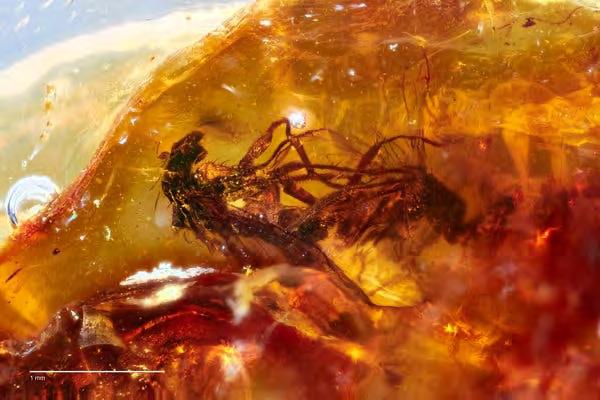
numerous projects including the digital reconstruction of various animals trapped in Burmese amber. He also continues his ongoing honorary role at the Australian Age of Dinosaurs, assisting with the identification and digital reconstruction of newly scanned specimens. Ongoing research in the central Queensland region includes new trackway descriptions and the description of a new 95 Ma crocodyliform.
Matt Herne is a Postdoctoral Fellow at the University of New England investigating Australian Cretaceous ornithopods and primarily Muttaburrasaurus langdoni from western Queensland. During fieldwork in early 2020, he re-discovered the original holotype locality of Muttaburrasaurus. After subsequent excavation at the locality, several hundred additional fragments of the Muttaburrasaurus langdoni were recovered, including several important new bones. These newly discovered bones will greatly assist our understanding of Muttaburrasaurus’ anatomy and its phylogenetic affinities among the ornithischians. Additionally, he has been working on the description of new avialan material he also discovered, which has provided a welcome diversion to my primary work on ornithopods. He curatorial work on the Muttaburrasaurus Interpretation Centre at Muttaburra was completed during the year and the displays will soon be installed and open to the public at the start of the 2021 tourist season.
Tom Brougham (tbrougha@paravian.net, Postdoctoral Fellow, UNE) commenced his postdoctoral research in 2020 that will examine the potential of estimating missing data from discrete character cladistic matrices and evaluate its consequences for phylogenetic and macroevolutionary hypothesis generation.
Dino Lab Postgraduate students
Olivia Devereaux (odeverea@myune.edu.au, MSc Student, UNE) commenced her postgraduate studies at UNE during late October 2020 under the supervision of Dr Phil Bell, Dr Nicolás Campione, and Dr Matthew Herne. Olivia plans to investigate the endocranial anatomy of the mid-Cretaceous basal iguanodontid Fostoria dhimbangunmal and its implications for brain evolution within Ornithopoda. This study will utilise the Dino Lab’s previously published CT scans of the holotype partial skull (Griman Creek Formation, Lightning Ridge, NSW) to create a digital three-dimensional cranial endocast.
Timothy Frauenfelder (tfrauenf@myune.edu.au, PhD Candidate, UNE) commenced his PhD in October 2019. His research focuses on understanding Australian dinosaur ecological diversity and includes all Australian dinosaur teeth found thus far. Tim is supervised by Dr Nicolás Campione, Prof. Steven Wroe, and Dr Phil Bell. Tim has travelled to Melbourne, Eromanga, Lightning Ridge, and Winton to obtain 3D data for his biomechanical studies. He also organised fieldwork to Surat, in southeastern Queensland to continue looking for fossils from the area to give insights into the Cretaceous fauna of the Griman Creek Formation. The 2020 expedition was a resounding success, and many specimens were found, including those from plesiosaurs, theropods, ornithopods, and sauropods. Tim also published his first, firstauthored paper on his honours working focusing on describing sauropod teeth from the Griman Creek Formation at Lightning Ridge.
Justin Kitchener (jkitche3@myune.edu.au; PhD Candidate, UNE) continues his PhD research into burrowing and digging-related traits in small ornithopod dinosaurs. As the pandemic prevented a planned program of data collection from institutions in Australia and abroad, work has continued with the collection of measurements from the literature and
analyses of existing datasets. Early hind-limb morphometric results show some interesting patterns and potential differentiation of digging and non-digging dinosaurs. Biomechanical models and mechanical advantage indices are being explored to ground possible behavioural interpretations. With access to collections in the new year, an avian hind-limb dataset will be collected for a comparative study of birds.
Nathan Enriquez (nenrique@myune.edu.au, PhD Student, UNE), under the supervision of Dr Phil Bell and Dr Nicolás Campione, finalised his Master’s thesis work describing a large in-situ dinosaur tracksite from the Upper Cretaceous Wapiti Formation near the city of Grande Prairie, Alberta, Canada He currently has two papers awaiting publication, including a description of the first probable deinonychosaur tracks from Canada (Geological Magazine) and the results of a geometric morphometric analysis of tyrannosaurid tracks with implications for understanding ontogenetic changes in tyrannosaurid body morphology and gait (Journal of Vertebrate Paleontology). A third manuscript, describing the focal track locality, is soon to be submitted for publication. In November 2020, Nathan commenced his PhD, supervised again by Dr Phil Bell and Dr Nicolás Campione, as well as Dr Christophe Hendrickx of the National Scientific and Technical Research Council in Argentina. The project aims to understand the morphology and preservation of dinosaur skin by applying histological approaches to a wider range of dinosaurs.
Publications from the Dino Lab
Bell, P.R. & Hendrickx, C. In press. Epidermal complexity in the theropod dinosaur Juravenator from the Upper Jurassic of Germany. Palaeontology. Bell, P.R. & Hendrickx, C. 2020. Crocodile-like sensory scales in a Late Jurassic theropod dinosaur. Current Biology 30: R1068-R1070
Borinder, N.H., Poropat, S.F., Campione, N.E., Wigren, T., & Kear, B.P. (accepted)
Postcranial osteology of the basally branching hadrosauroid dinosaur Tanius sinensis from the Upper Cretaceous Wangshi Group of Shandong, China Journal of Vertebrate Paleontology.
Brougham, T. & Campione, N.E. 2020. Body size correlates with discrete character morphological proxies. Paleobiology. 46(3): 304-319.
Brougham, T., Smith, E. T., & Bell, P.R. 2020. Noasaurids are a component of the Australian ‘mid’-Cretaceous theropod fauna. Scientific Reports 10:1428
Campione, N.E., Barrett, P.R., & Evans, D.C. 2020. On the ancestry of feathers in Mesozoic dinosaurs. In C. Foth and O. Rauhut (eds.), The Evolution of Feathers. Fascinating Life Sciences. Springer, pp. 213-243.
Campione, N.E. & Evans, D.C. 2020. The Accuracy and Precision of Body Mass Estimation in Dinosaurs. Biological Reviews 95(6): 1759-1797.
Enriquez, N.J., Campione, N.E., Sullivan, C., Vavrek, M., Sissons, R.L., White, M.A. & Bell, P.R. In press Probable deinonychosaur tracks from the Late Cretaceous Wapiti Formation (upper Campanian) of Alberta, Canada. Geological Magazine.
Enriquez, N.J., Campione, N.E., Brougham, T., Fanti, F., White, M.A., Sissons, R.L., Sullivan, C., Vavrek, M.J. & Bell, P.R. In press. Exploring possible ontogenetic trajectories in tyrannosaurids using tracks from the Wapiti Formation (upper Campanian) of Alberta, Canada. Journal of Vertebrate Paleontology.
Hart, L. J., Bell, P.R., Smith, E.T., Mitchell, D.R., Brougham, T., & Salisbury, S. W. In press. New specimens of Isisfordia molnari and additional crocodyliform remains from the Griman Creek Formation (Cenomanian, New South Wales, Australia). Journal of Paleontology.
Farman, R. & Bell, P.R. 2020. Australia’s earliest tetrapod swimming traces from the Hawkesbury Sandstone (Middle Triassic) of the Sydney Basin. Journal of Paleontology 94:966–978.
Frauenfelder, T. Bell, P.R., Campione, N.E. & Smith E.T. 2020. Diversity and palaeoecology of Australia’s southern-most sauropods, Griman Creek Formation (Cenomanian), New South Wales. Lethaia doi.org/10.1111/let.12407.
White, M.A., Bell, P.R., Poropat, S.P., Pentland, A.H., Rigby, S.L., Elliot, R.A., Sloan, T., Elliot, D.A. 2020. New theropod remains and implications for megaraptorid diversity in the Winton Formation (lower Upper Cretaceous), Queensland, Australia. Royal Society Open Science 7:191462.
University of Wollongong
Prof Guang Shi has continued to work on Late Palaeozoic brachiopod faunas, biostratigraphy, biogeography and extinction patterns. He is also interested in finding out (i) how body size of marine species and communities evolved in response to mass extinctions and global warming, and (ii) how marine ecosystems behaved and evolved across the Permian-Triassic boundary extinction and, in particular, whether or not there were any critical early warning signals detectable from the fossil and biogeochemical records.
Dr Facheng Ye (Associate Research Fellow) is mainly working on the global biogeography of living brachiopods, building a large database. In addition, he is looking at shell microstructures of modern and fossil brachiopod shells, trying to understand how the shell structures response to the environmental/climate change, and their evolutional change during the geological time.
Dr Sangmin (Sam) Lee (Associate Research Fellow) is continuing his research on the taxonomy, palaeobiogeography, and phylogeny of brachiopods, mainly from the mid to high latitudinal regions during the late Palaeozoic (including Svalbard and Australia). In particular, he is currently focusing on the brachiopod migration patterns along the northern marginal shelf of Pangea throughout the Permian. He is also working on the detailed taxonomy of the Permian brachiopods from the southern Sydney Basin, figuring out their evolutionary trends under the high-latitudinal cold environments. In addition, he is involved with studies on the evolution and palaeobiogegraphy of early brachiopods and cnidarians in the Cambrian
Dr Tony Wright (Honorary Principal Fellow) is focusing on studies of corals and brachiopods as follows:
1. Revision of the Devonian tetracoral genus Trapezophyllum.
2. Taxonomy, evolutionary relationships and biogeographic affinities of calceolide corals from north Viet Nam: co-authored with Tong-Dzuy Thanh, Ta Hoa Phuong and Nguyen Huu Hung.
3. Occurrences of the Devonian pentameride brachiopod Zdimir in eastern Australia: coauthored with J.A. Talent.
4. A giant new strophodontide brachiopod genus from the Devonian (upper Emsian to lower Eifelian) Mount Frome Limestone, New South Wales, Australia.
5. Further studies of operculate corals from eastern Australia and other regions.
Publications.
The main publication to report is a joint monograph with Dr Ross McLean (Honorary Principal Fellow also at UOW) on eastern Australian Early-Middle Devonian corals (plus one late Silurian species) that have been described as Phillipsastrea and should be still assigned to Phillipsastrea or other genera. This MS, listed below, is in press; we are also working on a new Silurian coral fauna from Ulah, south of Orange, NSW.
Budnikov, I.V., Kutygin, R.V., Shi, G.R., Sivtchikov, V.E. and Krivenko, O.V. 2020. Permian stratigraphy and paleogeography of Central Siberia (Angaraland) – A review. Journal of Asian Earth Sciences 196:104365, https://doi.org/10.1016/j.jseaes.2020.104365
Luo, M. Buatois, L.A., Shi, G.R. and Chen, Z.Q. 2020. Infaunal response during the endPermian mass extinction. Geological Society of America Bulletin, https://doi.org/10.1130/B35524.1.
Luo, M., Shi, G.R. and Lee, S. 2020. Stacked Parahaentzschelinia ichnofabrics from the Lower Permian of the southern Sydney Basin, southeastern Australia: Palaeoecologic and palaeoenvironmental significance. Palaeogeography, Palaeoclimatology, Palaeoecology 541:109538, https://doi.org/10.1016/j.palaeo.2019.109538
Luo, M., Shi, G.R., Buatois, L.A. and Chen, Z.Q. 2020. Trace fossil as proxy for biotic recovery after the end-Permian mass extinction: A critical review. Earth-Science Reviews 203:103059, https://doi.org/10.1016/j.earscirev.2019.103059
McLean, R.A. and Wright, A.J. 2021. The rugose coral Phillipsastrea D’Orbigny and other plocoid genera in the late Silurian to Early Devonian of eastern Australia: revision of previously assigned species and new records. Australasian Palaeontological Memoir 54. Niu, Y., Shi, G.R., Wang, J., Liu, C., Zhou, J., Lu, J., Song, B. and Xu, W. 2020. The closing of the southern branch of the Paleo-Asian Ocean: Constraints from sedimentary records in the southern Beishan Region of the Central Asian Orogenic Belt, NW China. Marine and Petroleum Geology, 104791, https://doi.org/10.1016/j.marpetgeo.2020.104791
Shi, G.R., Waterhouse, J.B. and Lee, S. 2020. Early Permian brachiopods from the Pebbley Beach Formation, Southern Sydney Basin, southeastern Australia. Alcheringa: An Australasian Journal of Palaeontology 44, 411–429.
Wan, M., Shi, G.R., Luo, M., Lee, S. and Wang, J. 2020. First record of a petrified gymnospermous wood from the Kungurian (late Early Permian) of the southern Sydney Basin, southeastern Australia, and its paleoclimatic implications. Review of Palaeobotany and Palynology 276:104202, https://doi.org/10.1016/j.revpalbo.2020.104202
Wu, H., Shi, G.R. and Sun, Y. 2020 The latitudinal gradient of shell ornament–A case study from Changhsingian (Late Permian) brachiopods. Earth-Science Reviews 197:102904, https://doi.org/10.1016/j.earscirev.2019.102904
Ye, F., Garbelli, C., Shen, S. and Angiolini, L. 2020. The shell fabric of Palaeozoic brachiopods: patterns and trends. Lethaia, https://doi.org/10.1111/let.12412
Zhang, L.J., Zhang, X., Buatois, L.A., Mángano, M.G., Shi, G.R., Gong, Y.M. and Qi, Y.A. 2020. Periodic fluctuations of marine oxygen content during the latest Permian. Global and Planetary Change 195:103326, https://doi.org/10.1016/j.gloplacha.2020.103326
QUEENSLAND
Griffith University, Brisbane Australian Research Centre for Human Evolution
Julien Louys is mostly working on the Pleistocene vertebrate record of Sumatra, with a view of reconstructing changes in environments and its effects on mammals. Most of this work is centred on the caves of the Padang Highland in western Sumatra, and the fluvial deposits of Bangka Island, southeast Sumatra. Closer to home, he has recently led new excavations at the Pliocene deposits of the Chinchilla Rifle Range and has been working with the Cave Divers Association of Australia on studying and protecting the fossil deposits of Mt Gambier.
Louys, J., Roberts, P. Environmental drivers of megafauna and hominin extinction in Southeast Asia. Nature 586, 402–406 (2020). https://doi.org/10.1038/s41586-020-2810-y Beck, R.M.D., Louys, J., Brewer, P. et al. A new family of diprotodontian marsupials from the latest Oligocene of Australia and the evolution of wombats, koalas, and their relatives (Vombatiformes). Sci Rep 10, 9741 (2020). https://doi.org/10.1038/s41598-020-66425-8
Stewart, M., Louys, J., Breeze, P., Clark-Wilson, R., Drake, N., Scerri, E., Petraglia, M. (2020). A taxonomic and taphonomic study of Pleistocene fossil deposits from the western Nefud Desert, Saudi Arabia. Quaternary Research, 95, 1-22. doi:10.1017/qua.2020.6
Louys, J., Herrera, M.B., Thomson, V.A., Wiewel, A. S., Donnellan, S. C., O’Connor, S., Aplin, K. 2020. Expanding population edge craniometrics and genetics provide insights into dispersal of commensal rats through Nusa Tenggara, Indonesia. Records of the Australian Museum, 72(5): 287–302. 10.3853/j.2201-4349.72.2020.1730.
Hocknull, S.A., Lewis, R., Arnold, L.J. et al. Extinction of eastern Sahul megafauna coincides with sustained environmental deterioration. Nat Commun 11, 2250 (2020). https://doi.org/10.1038/s41467-020-15785-w
Kealy, S., O’Connor, S., Mahirta., Sari, D.M., Shipton, C., Langley, M.C., Boulanger, C., Kaharudin, H. A.F., Patridina, E P.B.G.G., Algifary, M.A., Irfan, A., Beaumont, P., Jankowski, N., Hawkins, S., Louys, J. 2020. Forty-thousand years of maritime subsistence near a changing shoreline on Alor Island (Indonesia). Quaternary Science Reviews 249
Walker Meg M., Louys Julien, Herries Andy I. R., Price Gilbert J., Miszkiewicz Justyna J. (2020) Humerus midshaft histology in a modern and fossil wombat. Australian Mammalogy https://doi.org/10.1071/AM20005
Justyna J Miszkiewicz, Julien Louys, Robin M D Beck, Patrick Mahoney, Ken Aplin, Sue O’Connor, Island rule and bone metabolism in fossil murines from Timor, Biological Journal of the Linnean Society, 129 (3), March 2020, Pages 570–586, https://doi.org/10.1093/biolinnean/blz197
Roberts, P., Louys, J., Zech, J. et al. Isotopic evidence for initial coastal colonization and subsequent diversification in the human occupation of Wallacea. Nat Commun 11, 2068 (2020). https://doi.org/10.1038/s41467-020-15969-4
Gilbert J. Price; Jonathan Cramb; Julien Louys; Kenny J. Travouillon; Eleanor M. A. Pease; Yue-xing Feng; Jian-xin Zhao; Douglas Irvin. 2020. Late Quaternary fossil vertebrates of the Broken River karst area, northern Queensland, Australia. Records of the Australian Museum, 72(5): 193–206.
Julien Louys, Yahdi Zaim, Yan Rizal, Aswan, Mika Puspaningrum, Agus Trihascaryo, Gilbert J. Price, Ansley Petherick, Elinor Scholtz, Larisa R.G. DeSantis. 2020. Sumatran
orangutan diets in the Late Pleistocene as inferred from dental microwear texture analysis. Quaternary International. Kristofer M. Helgen; Julien Louys; Sue O'Connor. 2020. The lives of creatures obscure, misunderstood, and wonderful: a volume in honour of Ken Aplin 1958–2019. Records of the Australian Museum, 72(5): 149–160
Queensland Museum, Hendra Geosciences
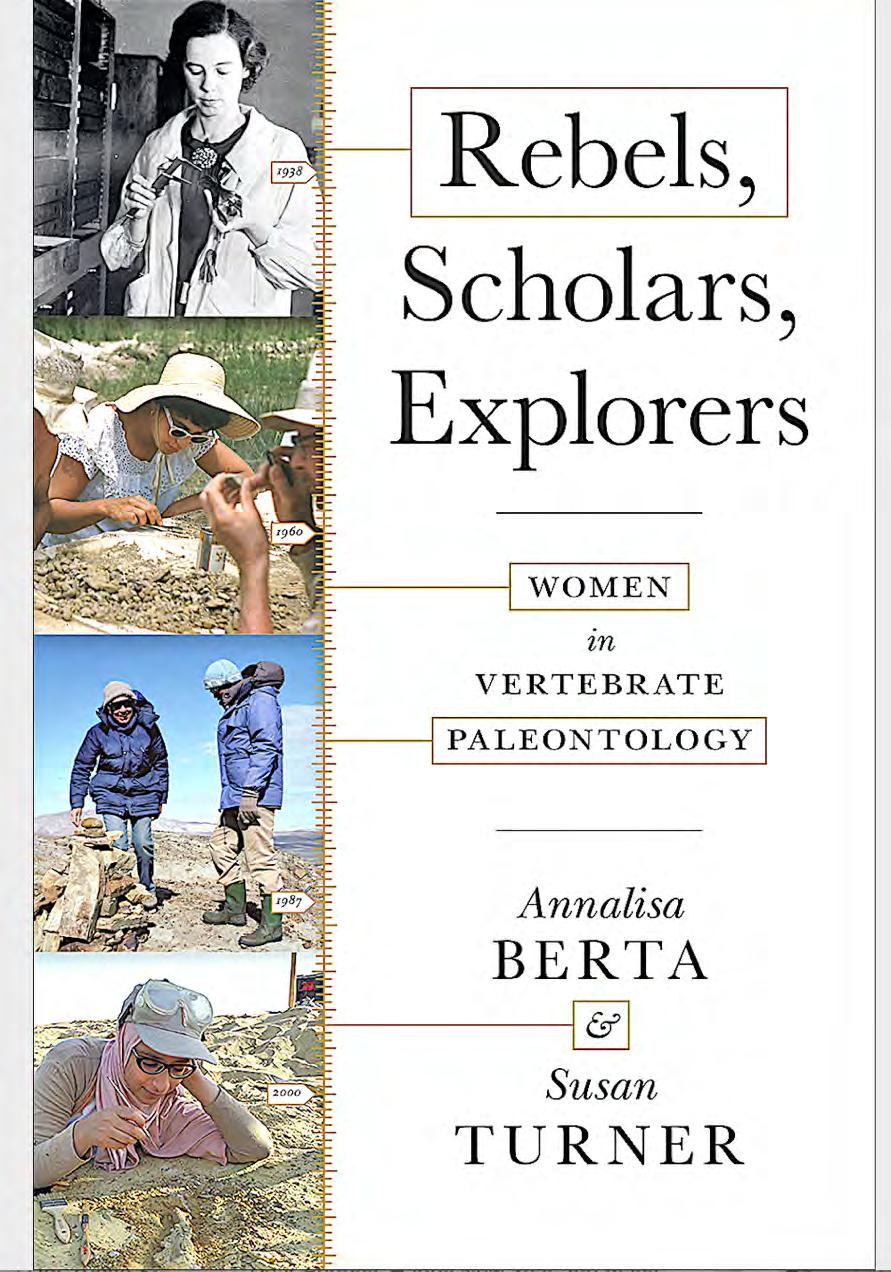
Susan Turner, (also Research Adjunct Monash University & Acta Geologica Sinica scientific editing team) is working on or various Palaeozoic and Mesozoic vertebrates, mainly agnathan thelodonts (from Australia, Canada, Turkey, UK, USA), gyracanths (with Carole Burrow and Daniel Snyder), and various sharks including Lazarus xenacanths (with Carole, John Long, Rodrigo-Soler-Gijon and Steve Avery). She has just finished a three-year travail on a book about women’s contributions to vertebrate palaeontology. In May 2019 she was able to travel to London with the aid of a Facebook fundraiser to participate in the Celebration symposium of 100 years since women could become Fellows of the Geological Society and this year finished a paper based on that; this year (2020) she has achieved 50 years as an FGS.
Berta, A. and Turner, S. 2020. Rebels, Scholars and Explorers: Women in Vertebrate Paleontology. Johns Hopkins University Press, Baltimore, 350 pp and online appendices. https://jhupbooks.press.jhu.edu/title/rebels-scholars-explorers.
Long, J., Thomson, V., Burrow, C. & Turner, S. 2020 in press. Fossil chondrichthyan and placoderm remains from the Middle Devonian South Blue Range, Victoria, Australia: biostratigraphic implications. In: Alan Pradel, John S.S. Denton, and Philippe Janvier (eds) Ancient Fishes and their living relatives: a tribute to John G Maisey. F. Pfeil Verlag, Munich.
Turner, S. 2020. Far-flung Female (and fossil bone hunting) Fellows: an autoethnographic approach. In: Burek, C & Higgs, B. eds. Uncovering the historical contribution of women in the Geosciences: Celebrations of First Female Fellows of the Geological Society, London. Geological Society, London Special Publication 506, 10.1144/SP5062019-225.
Turner, S., Berta, A. 2020 in press. Illustrating the unknowable: women paleoartists through time who determined the look of ancient vertebrates. In: Renee M. Clary, Gary D. Rosenberg, and Dallas Evans (eds) The Evolution of Paleontological Art. Geological Society of America (GSA) Special volume.
Sue has an ongoing project looking at women in the geosciences and she maintains a Facebook page Women in Geoscience.
With colleagues Professor Dr Hans-Peter Schultze and Michael Newman she prepared an obituary for the late Elga Mark-Kurik (see Anon 2018 in references).
University of Queensland, Brisbane School of Biological Sciences
Peter Jell (and Queensland Museum) is working on a number of echinoderm projects including the following:--
1) Silurian and Devonian stelleroids, cystoids etc from central Victoria ( same faunas from which the crinoids were described in 1999 –Mem. Qld Museum 43, 1-114)
2) Silurian and Devonian echinoderms from NSW – mainly Yass Basin and a few other sites on the Canberra, Yass Shelf.
3) Australian Cretaceous echinoderms, from the Lower Cretaceous section of Queensland.
A joint paper with Jim Sprinkle, U of Texas, entitled “Revision of Whitehouse’s eocrinoids Peridionites and Cymbionites, with description of the associated fauna including two new echinoderm genera, early middle Cambrian Thorntonia Limestone, northwestern Queensland” has been submitted for publication
Jorgo Ristevski is a PhD student supervised by Dr. Steven Salisbury and Dr. Gilbert Price. For his PhD project, Jorgo studies extinct crocodylians from the Cenozoic Era of Australia, focusing on their morphology, taxonomic diversity, and evolution. Some of the methods he utilizes include descriptive and comparative anatomy, segmenting data obtained from computed tomographic (CT) scans, and phylogenetic analyses.
Prior to commencing his doctoral studies at The University of Queensland, Jorgo obtained an undergraduate degree (BA) in archaeology at the Saints Cyril and Methodius University in Skopje, North Macedonia, and a postgraduate degree (MRes) in vertebrate palaeontology at The University of Southampton in Southampton, England.
Jell, P.A. & Cook, A.G. 2020. New Carboniferous ophiuroid from central coastal New South Wales. Alcheringa: An Australasian Journal of Palaeontology, DOI: 10.1080/03115518.2020.1837240
Price, G.J., Louys, J., Ristevski, J. & Molnar, R.E. 2019. Ecological fallout and turnover in the diversity of Late Quaternary terrestrial predators of Australia. Journal of Vertebrate Paleontology, Program and Abstracts, 2019, 173.
Ristevski, J. 2019. Crocodilia Morphology. In: J. Vonk J. and T. Shackelford (Editors) Encyclopedia of Animal Cognition and Behavior. Springer, Cham. DOI: 10.1007/978-3319-47829-6_955-2
Ristevski, J., Price, G.J., Sobbe, I.H., Molnar, R.E., Louys, J., Cramb, J., Nguyen, A.D., Zhao, J.-x., Feng, Y.-x. & Beirne, L. 2019. A new ziphodont eusuchian from the Pleistocene of Queensland, and implications for Australasia’s ziphodont crocodylian diversity. Journal of Vertebrate Paleontology, Program and Abstracts, 2019, 180.
Ristevski, J., Yates, A.M., Price, G.J., Molnar, R.E., Weisbecker, V. & Salisbury, S.W. In Press. Australia's prehistoric 'swamp king': revision of the Plio-Pleistocene crocodylian genus Pallimnarchus de Vis, 1886. PeerJ.
Ristevski, J., Young, M.T., de Andrade, M.B. & Hastings, A.K. 2018. A new species of Anteophthalmosuchus (Crocodylomorpha, Goniopholididae) from the Lower Cretaceous of the Isle of Wight, United Kingdom, and a review of the genus. Cretaceous Research 84, 340–383.
School of Earth and Environmental Sciences
Prof. Jonathan Aitchison (School of Earth and Environmental Sciences, The University of Queensland) continues as Head of School and is continuing work on early Paleozoic radiolarian faunas, where his PhD students are revolutionising systematics using micro-CT
technologies. He is also continuing work on the Tethyan mid-Cretaceous radiolarians of southern Tibet and China as well as Cainozoic and Quaternary history of the region.
Jennifer Cooling has completed her PhD on the ‘Palynology of the Jurassic–Cretaceous transition of the Surat Basin’. This palynostratigraphic study of the Surat Basin succession links those of McKellar (1998/in press) on the upper Evergreen Formation – Westbourne Formation and Burger (1973) on the Mooga Sandstone – Bungil Formation. Two geochronological dates from the Orallo Formation are discussed in Cooling et al. (2020), and papers on the systematic palynology, biostratigraphy and paleoenvironmental interpretation are in preparation. Currently, as part of the Vale-UQ Coal Geosciences team, Jennifer is working on the palynology of a Tertiary channel overlaying the Bowen Basin.
Nicole Leonard (Radiogenic Isotope Facility, the University of Queensland) is a Postdoctoral Research Fellow currently working on high precision U-Th dating of corals from reef matrix cores to reconstruct past coral growth and reef morphology across 10 degrees of latitude on the Great Barrier Reef, Australia. Her latest work is concentrated on high resolution dating of coral growth over the past 500 years to assess reef accretion trends in response to climatic, environmental and increased anthropogenic influences on the Queensland coast.
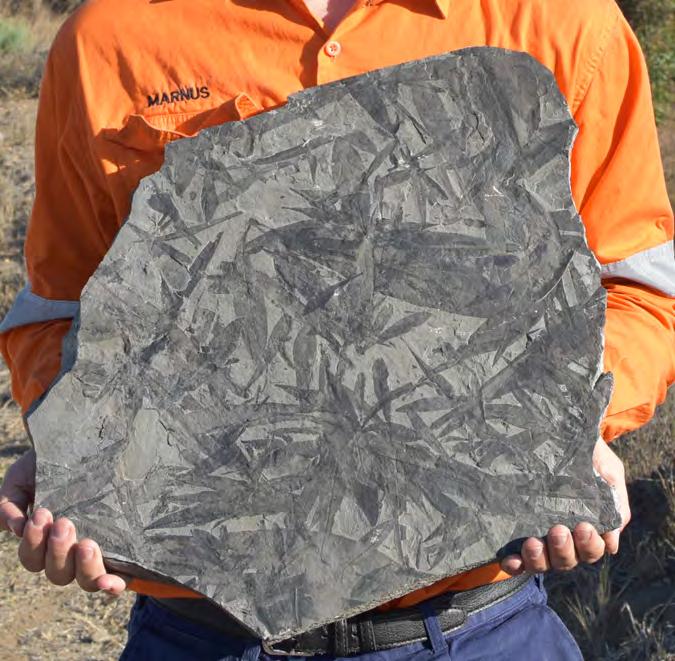
Marthinus van Lille is working on an Honours project cataloguing Permian fossil floras and correlating sedimentary depositional environment/facies of the Moranbah Coal Measures near Collinsville, QLD, Australia. This represents the first systematic collection of plant fossils from this unit, and preliminary findings include first or earliest records of several herbaceous taxa for Australia or the Bowen Basin including Raniganjia, Bengalia & Schizoneura. The assemblage will help to refine understanding of the depositional setting of the Moranbah Coal Measures and demonstrate the potential for palaeobotanical discoveries in coal mining regions. He is supervised by Joan Esterle (UQ) and Stephen McLoughlin (Swedish Museum of Natural History).
Marthinus van Lille holding a large slab of assorted Glossopteris leaves, potentially including Glossopteris xiphophylla, Glossopteris sp. cf. G. schopfii, Glossopteris linearis
Patrick Moss is a Quaternary palynologist who is focussing on the relative impacts of people and natural climate alterations for the last 65,000 years and focussing on sites in Australia and South East Asia, with a particular emphasis on archaeological deposits and nearby wetlands. He is also focussing on the impact of orbital and millennial climatic variability on Australian landscapes with a focus on the last million years and primarily using marine and coastal sediments. In addition, he is studying the past, present and future dynamics of Australian and South East Asian peatlands, with a particular emphasis on the carbon cycle and responses to changes in fire regimes and other human impacts on these highly significant wetland ecosystems.
Siyumini Perera (School of Earth and Environmental Sciences, The University of Queensland) is continuing here PhD work on early Palaeozoic radiolarians with Prof. Jonathan Aitchison.
Geoffrey Playford (Emeritus Prof., School of Earth and Environmental Sciences, The University of Queensland) continues researching Eastern Gondwanan Upper Palaeozoic palynology, including contribution to a multifaceted project – with Prof. David Haig (Oceans Inst., Univ. WA) and colleagues – on the Holmwood Shale (including its Woolaga Limestone Member), northern Perth Basin. In collaboration with longstanding colleague Reed Wicander (Adjunct Prof., UQ; Emeritus Prof., Central Michigan Univ.), studies continue on the Devonian palynology (mainly microphytoplankton) of eastern U.S.A. Reed’s annual 3–4 months’ visit to UQ is unlikely in 2021 due to international travel restrictions.
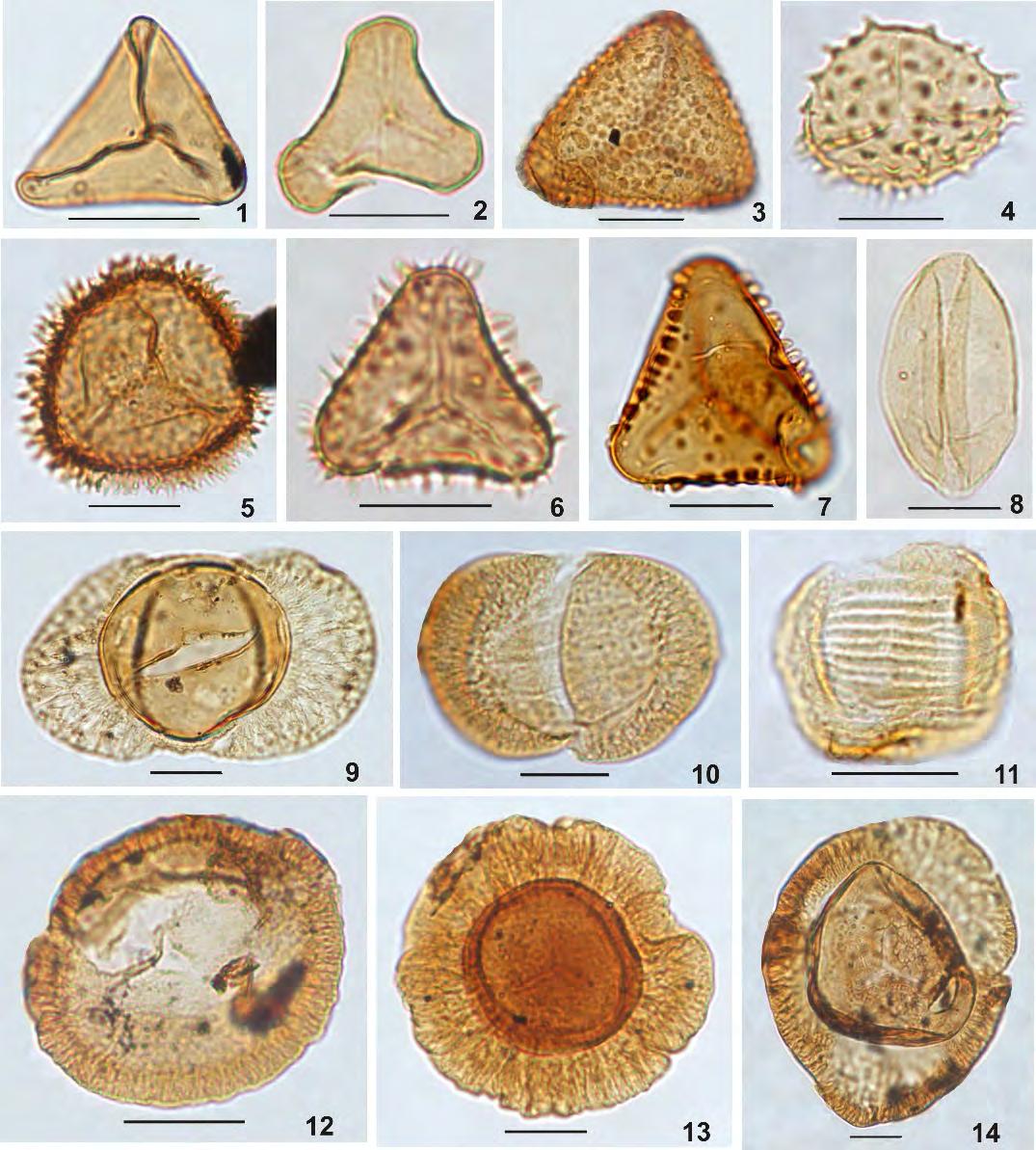
Spores and pollen grains of the Woolaga Limestone Member, upper Holmwood Shale, Perth Basin, Western Australia 1, Leiotriletes directus; 2, Waltzispora sp.; 3, Converrucosisporites micronodosus; 4, Apiculatisporis cornutus; 5, Gondisporites cf. ewingtonensis; 6, Horriditriletes sp.; 7, Diatomozonotriletes townrowii; 8, Cycadopites cymbatus; 9, Sahnites sp.; 10, Protohaploxypinus amplus; 11, Striatoabieites multistriatus; 12, Cannanoropollis janakii; 13, Plicatipollenites gondwanensis; 14, Barakarites sp. Scale bars = 20 µm.
Gilbert Price (School of Earth and Environmental Sciences, The University of Queensland) is a Senior Lecturer in Palaeontology and vertebrate palaeoecologist and geochronologist, particularly interested in the evolution and emergence of Australia’s unique ecosystems and fauna, and their response to prehistoric climatic changes. His major research focus has been on the development of palaeoecological models for Australia’s Pleistocene megafauna. Critically, this also involves the production of reliably-dated records for the extinct species. Gilbert is the coordinator of UQ’s Palaeo-Research Group, Associate Editor of Alcheringa, and was Co-Chair of the Host Committee of the Society of Vertebrate Paleontology meeting held in Brisbane in October 2019, and a past secretary of the Australasian Association of Palaeontologists
For pre-2020 publications see www.diprotodon.com.
Jiani Sheng continues her PhD work on early Palaeozoic radiolarians using advanced microCT applications under the supervision of Prof. Jonathan Aitchison.
Gordon Southam is a Professor in Geomicrobiology who specialises in bacterial transformations of geological materials with implications for a variety of industrial and environmental applications as well as Earth history. He is currently engaged in work in mineral carbonation for CO2 sequestration; bioremediation using ferruginous duricrusts; bioleaching of low grade ores; biological gold formation; and microbialite formation in modern environments.
Vikram Vakil (School of Earth and Environmental Sciences, The University of Queensland) continues to work on Cretaceous marine reptiles with Gregory Webb (UQ) and Alex Cook (UQ). Work on Cretaceous ichthyosaur vertebrae is expected to be in the last edition of Alcheringa for 2020 and work on plesiosaur vertebrae will hopefully be out in 2021. He is currently seeking PhD opportunities in Australia.
Gregory E. Webb is still working on geochemical investigations on Holocene and Pleistocene cores from Heron and One Tree reefs in the southern GBR. He has continued working with former student Narottam Saha to publish geochemical records from reef corals that aid understanding of palaeoclimate and catchment processes. PhD student Tania Kenyon has submitted her thesis on physical and biological dynamics of rubble on coral reefs (with Peter Mumby, Sophie Dove and Daniel Harris). PhD student Atefeh Sansoleimani is continuing work on the subsurface geology of the Great Barrier Reef and PhD student Caroline Brownhall (with Patrick Moss) is working on the Miocene palynology of cores in the Coral Sea as well as the palynology of palaeosols recovered from reef cores in the GBR. Former student Vikram Vakil has a new paper out on Australian Cretaceous ichthyosaurs and a paper on plesiosaurs should be out before long. Deep echinoid studies continue with former Robert Day Postdoctoral Fellow Morana Mihaljević (University of Zurich) and Tobias B. Grun (University of Tübingen). Robert Day Postdoctoral Fellow Goran Andjic has completed his New England Origin radiolarian work and left for Europe. Additional work is taking place on trace element geochemistry in modern and ancient corals and microbialites and Webb will present a keynote address at the 2021 Australian Earth Science Convention entitled: ‘Trace element distributions in carbonate rocks: a sedimentologist’s perspective on sample targeting versus technique’
Alexander Wheeler (School of Earth and Environmental Sciences, The University of Queensland) is completing his PhD examining spatiotemporal variation in the latest Permian and earliest Triassic floras in the Bowen and Galilee basins. This project has involved the examination of environmental controls of the latest Permian floras, an investigation of a ‘marker mudstone’ at the Permian-Triassic Boundary, and an analysis of the post-extinction floras and palaeoenvironment in the earliest Triassic. As part of this project, he has explored the use of acid-free palynological processing techniques on Permian-aged material with some success.
UQ School of Earth and Environmental Sciences Publications
Ali, J.R. & Aitchison, J.C. 2020. Time of re-emergence of Christmas Island and its biogeographical significance. Palaeogeography, Palaeoclimatology, Palaeoecology 537, 109396.
Ali, J.R., Aitchison, J.C. & Meiri, S. 2020. Redrawing Wallace’s Line based on the fauna of Christmas Island, eastern Indian Ocean. Biological Journal of the Linnean Society 130 225-237.
Butler, K., Travouillon, K.J., Evans, A.R., Murphy, L., Price, G.J., Archer, M., Hand, S.J. and Weisbecker, V., 2020. 3D Morphometric Analysis Reveals Similar Ecomorphs for Early Kangaroos (Macropodidae) and Fanged Kangaroos (Balbaridae) from the Riversleigh World Heritage Area, Australia. Journal of Mammalian Evolution, 1–21.
Cooling, Jennifer. 2020. Palynology of the Jurassic–Cretaceous transition, northern Surat Basin, Queensland, Australia PhD thesis, The University of Queensland, School of Earth and Environmental Sciences
Cramb, J., Hocknull, S.A., and Price, G.J. 2020. Fossil Uromys (Rodentia: Murinae) from central Queensland, with a description of a new Middle Pleistocene species. In Papers in Honour of Ken Aplin, ed. Louys, J., O’Connor, S., and Helgen, K.M. Records of the Australian Museum 72(5): 175–191.
Duce, S., Dechnik, B., Webster, J.M., Hua, Q., Sadler, J., Webb, G.E., Northdurft, L., SalasSaavedra, M. & Vila-Concejo, A. 2020. Mechanisms of spur and groove development and implications for reef platform evolution. Quaternary Science Reviews 231, 106155.
Grun, T.B., Mihaljević, M. & Webb, G.E. 2020. Comparative taphonomy of deep-sea and shallow-marine echinoids of the genus Echinocyamus Palaios 35, 403-420
Hocknull, S.A., Lewis, R., Arnold, L.J., Pietsch, T., Joannes-Boyau, R., Price, G.J., Moss, P., Wood, R., Dosseto, A., Louys, J. & Olley, J. (2020) Extinction of eastern Sahul megafauna coincides with sustained environmental deterioration. Nature Communications 11, 1-14.
Hua, Q., Ulm, S., Yu, K., Clark, T.R., Nothdurft, L.D., Leonard, N.D., Pandolfi, J.M., Jacobsen, G.E. & Zhao, J.-x., 2020. Temporal variability in the Holocene marine radiocarbon reservoir effect for the Tropical and South Pacific. Quaternary Science Reviews 249, 106613.
J. J. Cooling, J. L. Crowley, J. L. McKellar, J. S. Esterle, R. S. Nicoll & V. Bianchi (2020) Stratigraphic constraints on the Lower Cretaceous Orallo Formation, southeastern Queensland: U–Pb dating of bentonite and palynostratigraphy of associated strata, Australian Journal of Earth Sciences, DOI: 10.1080/08120099.2020.1781690
Jonell, T.N., Aitchison, J.C., Li, G., Schulmeister, J., Zhou, R. & Zhang, H. 2020. Revisiting growth and decline of late Quaternary mega-lakes across the south-central Tibetan Plateau Quaternary Science Reviews 248, 106475.
Kachovich, S. & Aitchison, J.C. 2020. Micro-CT study of Middle Ordovician Spumellaria (radiolarians) from western Newfoundland, Canada. Journal of Paleontology 94, 417435.
Kenyon, T., Doropoulos, C., Dove, S., Webb, G.E., Newman, S., Hung, C.S.W. & Mumby, P. 2020. The effects of rubble mobilisation on coral fragment survival, partial mortality and growth. Journal of Experimental Marine Biology and Ecology 533, 151467. Leonard, N.D., Lepore, M.L., Zhao, J.-x., Rodriguez-Ramirez, A., Butler, I., Clark, T.R., Roff, G., McCook, L., Nguyen, A.D., Feng, Y. & Pandolfi, J.M., 2020a. A U-Th Dating Approach to Understanding Past Coral Reef Dynamics and Geomorphological Constraints on Future Reef Growth Potential; Mazie Bay, Southern Great Barrier Reef. Paleoceanography and Paleoclimatology 35, e2019PA003768.
Leonard, N.D., Lepore, M.L., Zhao, J.-x., Rodriguez-Ramirez, A., Butler, I.R., Clark, T.R., Roff, G., McCook, L., Nguyen, A.D., Feng, Y. & Pandolfi, J.M., 2020b. Re-evaluating mid-Holocene reef “turn-off” on the inshore Southern Great Barrier Reef. Quaternary Science Reviews 244, 106518.
Levett, A., P.M. Vasconcelos, M.M. Jones; L. Rintoul, A. Paz, E.J. Gagen and G. Southam. 2020. Microbially influenced titanium mobility and iron oxide transformations preserved in ferruginous duricrusts. Chemical Geology DOI:10.1016/j.chemgeo.2020.119955.
Lokho, K., Aitchison, J.C., Whiso, K., Lhoupenyi, D., Zhou, R. & Raju, D.S.N. 2020. Eocene foraminifers of the Naga Hills of Manipur, Indo-Myanmar Range (IMR): Implications on age and basin evolution Journal of Asian Earth Sciences 191, 104259.
Louys, J., Zaim, Y., Rizal, Y., Puspaningrum, M., Trihascaryo, A., Price, G.J., Petherick, A., Scholtz, E. and DeSantis, L.R., 2020. Sumatran orangutan diets in the Late Pleistocene as inferred from dental microwear texture analysis. Quaternary International. Mackenzie, L., Moss, P. & Ulm, S. (2020) A late-Holocene record of coastal wetland development and fire regimes in tropical northern Australia. The Holocene 30, 13791390.
Mariani, M., Tibby, J., Barr, C., Moss, P., Marshall, J.C. & MacGregor, G.B. (2019) Reduced rainfall drives biomass limitations of long-term fire activity in Australia’s subtropical sclerophyll forests. Journal of Biogeography 46, 1974-1987.
Moss, P.T., Ulm, S., Mackenzie, L., Wallis, L.A., Rosendahl, D. & Steinberger, L. (2019) Robust local vegetation records from dense archaeological shell matrixes: a palynological analysis of the Thundiy shell deposit, Bentinck Island, Gulf of Carpentaria, Australia. Archaeological and Anthropological Sciences 11, 511-520.
Nightingale S., Schilt F., Thompson J.C., Wright D.K., Forman S., Mercader J., Moss P., Clarke S., Itambu M., Gomani-Chindebvu E. & Welling M. 2019. Late Middle Stone Age Behavior and Environments at Chaminade I (Karonga, Malawi). Journal of Paleolithic Archaeology 2, 258-297.
Perera, S., Aitchison, J.C. & Nothdurft, L. 2020. Middle Ordovician (Darriwilian) radiolarians from the Crawford Group, Scotland. Geological Magazine 157, 2033–2043. Playford, G. 2020. Palynology of the Mount Johnstone Formation (Mississippian), southern New England Orogen, New South Wales, Australia. Palynology, 44/4: 621–658. DOI:10.1080/01916122.2019.16582236. London.
Price, Gilbert J., Jonathan Cramb, Julien Louys, Kenny J. Travouillon, Eleanor M. A. Pease, Yue-xing Feng, Jian-xin Zhao, and Douglas Irvin. 2020. Late Quaternary fossil vertebrates of the Broken River karst area, northern Queensland, Australia. In Papers in Honour of Ken Aplin, ed. Louys, J., O’Connor, S., and Helgen, K.M. Records of the Australian Museum 72(5): 193–206.
Sanborn, K.L., Webster, J.M., Webb, G.E., Braga, J.-C., Humblet, M., Nothdurft, L., Patterson, M.A., Dechnik, B., Warner, S., Graham, T., Murphy, R.J., Yokoyama, Y., Obrachta, S.P. & Zhao, J.-X. 2020. A new model of Holocene reef initiation and growth in response to sea-level rise on the Southern Great Barrier Reef. Sedimentary Geology 397, 105556.
Sheng, J., Kachovich, S. & Aitchison, J.C. 2020. Skeletal architecture of middle Cambrian spicular radiolarians revealed using micro-CT. Journal of Micropalaeontology 39, 61–76.
Stewart, M., Clark-Wilson, R., Breeze, P.S., Janulis, K., Candy, I., Armitage, S.J., Ryves, D.B., Louys, J., Duval, M., Price, G.J. and Cuthbertson, P., 2020. Human footprints provide snapshot of last interglacial ecology in the Arabian interior. Science Advances 6(38), p.eaba8940.
Stewart, P.L.C., Moss, P.T. & Farrell, R. (2020) Land Change Analysis of Moon Point Vegetation on Fraser Island, East Coast, Queensland, Australia. International Journal of Ecology and Environmental Sciences 46, 25-39.
Vakil, V., Webb, G.E. and Cook, A.G. In Press. Can vertebral remains differentiate more than one species of Australian Cretaceous ichthyosaur? Alcheringa. (Accepted 17/11/2020).
Walker, M.M., Louys, J., Herries, A.I., Price, G.J. and Miszkiewicz, J.J., 2020. Humerus midshaft histology in a modern and fossil wombat. Australian Mammalogy, A–J. Wang, T., Li, G., Aitchison, J.C. & Sheng, J. 2020 Eocene ostracods from southern Tibet: Implications for the disappearance of Neo-Tethys. Palaeogeography, Palaeoclimatology, Palaeoecology 539, 109488.
Wheeler, A., Moss, P. T., Götz, A. E., Esterle, J. S., & Mantle, D. 2020. Acid-free palynological processing: A Permian case study. Review of Palaeobotany and Palynology 284, 104343.
Wheeler, A., Van de Wetering, N., Esterle, J. S. & Götz, A. E. 2020. Palaeoenvironmental changes recorded in the palynology and palynofacies of a Late Permian Marker Mudstone (Galilee Basin, Australia). Palaeoworld 29(2), 439-452.
School of Chemistry and Biomolecular Sciences
Anthony Romilio researches dinosaur tracksites, and this year published on track-bearing horizons from Australia, Korea, USA, and China. These have included evidence for the largest Australian theropod, bipedalism in ancient crocodiles (Korea), invertebrate burrows surrounding Oviraptor nests (China), and the findings of several community-based discoveries (Australia). In 2020, he published his first solo-author papers, his first book (3D visualisation step-by-step guidebook), and launched four media that attained advertising space equivalence of over $40 million (highlights included appearing on Channel 7’s ‘Sunrise’ program with hosts Koshi and Sam wanting to name the dinosaur discovery ‘Romilio-saurus’).
Kim, K.S., Lockley, M.G., Lim, J.D., Bae, S.M., & Romilio, A., 2020. Trackway evidence for large bipedal crocodylomorphs from the Cretaceous of Korea. Scientific Reports 10, 8680.
Lallensack, J.N., Buchwitz, M., & Romilio, A. In Press. Photogrammetry in ichnology: 3D model generation, visualisation, and data extraction, Journal of Paleontological Techniques. https://doi.org/10.31223/X5J30D.
Lockley, M., Kim, K.S., Lim, J.D. & Romilio, A. 2020. Bird tracks from the Green River Formation (Eocene) of Utah: ichnotaxonomy, diversity, community structure and convergence. Historical Biology, 1-18. doi:10.1080/08912963.2020.1771559.
Lockley, M., Klein, H., McHugh, J.B & Romilio, A. 2020. Fruita’s first fossil footprint exhibit: The discovery of forgotten specimens in an historic former museum building. New Mexico Museum of Natural History and Science Bulletin, 84 77-84.
Lockley, M.G., Lim, J.D., Park, H.D., Romilio, A., Yoo, J.S., Choi, J.W., Kim, K.S., Choi, Y., Kang, S.-H., Kim, D.H. & Kim, T.H. 2020. First reports of Crocodylopodus from Asia: implications for the paleoecology of the Lower Cretaceous. Cretaceous Research, 111 104441.
Milner, A.R.C, Irmis, R.B., Lockley, M.G., Klein, H., Slauf, D. & Romillio, A. In press. First report of Chirotherium lulli from the Upper Triassic Chinle formation of San Juan county, Utah. New Mexico Museum of Natural History and Science Bulletin. Romilio, A. 2020. An Instructional Guide to Visualising Dinosaur Tracks Amazon. Columbia, South Carolina, USA. p. 36. https://www.amazon.com/dp/B08KHNDRY4?ref_=pe_3052080_397514860
Romilio, A., 2020a. Additional notes on the Mount Morgan dinosaur tracks from the Lower Jurassic (Sinemurian) Razorback beds, Queensland, Australia. Historical Biology, 1-3. doi:10.1080/08912963.2020.1755853
Romilio, A., 2020b. Evidence of ornithischian activity from the Lower Jurassic (Hettangian–Sinemurian) Precipice Sandstone, Callide Basin, Queensland, Australia preliminary findings. Historical Biology, 1-3. doi:10.1080/08912963.2020.1846033
Romilio, A., Dick, R., Skinner, H. & Millar, J. 2020. Archival data provides insights into the ambiguous track-maker gait from the Lower Jurassic (Sinemurian) Razorback beds, Queensland, Australia: evidence of theropod quadrupedalism? Historical Biology, 1-7. doi:10.1080/08912963.2020.1720014
Romilio, A., Salisbury, S.W. & Jannel, A. 2020. Footprints of large theropod dinosaurs in the Middle–Upper Jurassic (lower Callovian–lower Tithonian) Walloon Coal Measures of southern Queensland, Australia. Historical Biology, 1-12. doi:10.1080/08912963.2020.1772252.
Xing, L., Klein, H., Lockley, M.G., Wu, X., Benton, M.J., Zeng, R. & Romilio, A., 2020. Footprints of marine reptiles from the Middle Triassic (Anisian-Ladinian) Guanling Formation of Guizhou Province, southwestern China: The earliest evidence of synchronous style of swimming. Palaeogeography, Palaeoclimatology, Palaeoecology, 558 109943, doi:10.1016/j.palaeo.2020.109943
Xing, L., Lockley, M.G., Du, T., Zhang, L., Klein, H., Romilio, A., Persons, W.S., Wang, K., Li, Z. & Wan, X. 2020. Dinosaur tracks from the Jurassic-Cretaceous boundary Tuchengzi Formation (Hebei Province, China) used as building stones in the Chengde imperial summer resort: age, ichnology, and history. Cretaceous Research, 107 104310.
Xing, L., Lockley, M.G., Romilio, A., Klein, H., Peng. G., Persons, W.S., Ye, Y., Jiang, S., & Wang, M. 2020. An historic theropod dominated track assemblage from the Upper Jurassic of Sichuan, China, Historical Biology, doi:10.1080/08912963.2020.1830278
Xing, L., Niu, K., Zhang, L., Yang, T.-R., Zhang, J., Persons, W.S., Romilio, A., Zhuang, Y., Ram, H. 2020. Dinosaur Eggs Associated with Crustacean Trace Fossils from the Upper Cretaceous of Jiangxi, China: Evidence for Foraging Behavior? Biosis: Biological Systems, 1(2) 54-59.
Xing, L.D., Lockley, M.G., Romilio, A., Persons, W.S.IV., Wang, M.Y., Tang, Y.G., & Wang, X.L. In Press. Multiple sauropod-dominated track sites from the Lower Cretaceous Dasheng Group of Eastern China: morphology, preservation and paleontology. New Mexico Museum of Natural History and Science Bulletin
Xing, L.D., Lockley, M.G., Zhang, L.J., Romilio, A., Namier, N., Wang, M.Y., & Persons, W.S.IV., In Press Tetrapod track assemblages from midwestern Inner Mongolia, China: Review and new observations. New Mexico Museum of Natural History and Science Bulletin
SOUTH AUSTRALIA
South Australian Museum, Adelaide
Pierre Kruse (Honorary Research Associate) continues his biostratigraphic project on archaeocyaths from Wirrealpa Mine, Flinders Ranges, while also grappling with Cambrian global correlations. His Ajax Mine biostratigraphic study, written jointly with Françoise Debrenne (ex Muséum National d’Histoire Naturelle (MNHN), Paris), has now been published as Australasian Palaeontological Memoirs 53 Also slated for a late 2020-early 2021 print release (currently available online) are contributions to two articles in the forthcoming Australian Journal of Earth Sciences special volume on the Flinders Ranges: one dealing with the Cambrian System in the Arrowie Basin, the other with the trilobite Pagetia from Yorke Peninsula.
Pierre’s work with Yang Aihua (Nanjing University, China) on calcimicrobialarchaeocyathan reef palaeoecology in the Tianheban Formation of South China; and with Elena Moreno-Eiris and Antonio Perejón (Universidad Complutense, Madrid, Spain) on cryptic archaeocyaths at Las Ermitas, Spain are still in the pipeline.
Kruse, P.D. & Debrenne, F., 2020. Ajax Mine archaeocyaths: a provisional biozonation for the upper Hawker Group (Cambrian stages 3–4), Flinders Ranges, South Australia. Australasian Palaeontological Memoirs 53, 1–238.
University of Adelaide School of Biological Sciences
Assoc. Prof. Diego C. García-Bellido (& Senior Researcher South Australian Museum). Diego’s main interest is the taxonomical diversity and functional morphology of the early metazoans generated during the Cambrian ‘explosion’, and the phylogenetic relationships between the animal groups that appeared with this unique evolutionary event. His present projects aim at comparing the Ediacara biota with the Emu Bay Shale and other Cambrian Lagerstätten from a palaeoecological perspective. These are in collaboration with Prof. Mary Droser (University of California – Riverside) and Prof. Jim Gehling (SAM, retired) on the Ediacaran and Prof. John Paterson (UNE), Dr. Greg Edgecombe (NHMLondon) and Prof. Jim Jago (UniSA, retired) on the Emu Bay Shale. He is now on ongoing positions at the University of Adelaide and South Australian Museum (50/50). In the last twelve months he has carried out a field trip to Nilpena Station (Flinders Ranges). Diego is also involved in the development of the nomination for the Flinders Ranges UNESCO World Heritage Site and the study of Ordovician assemblages in Western Gondwana (Spain & Morocco). This is the third year of University of Adelaide’s intensive course on Field Palaeontology, and due to circumstances beyond our control we have temporarily moved the whole course to Naracoorte. But we dedicate one week to invertebrate marine fauna on the Miocene Naracoorte Mb of the Gambier Limestone and one week on the PleistoceneHolocene micro- and megafauna of Naracoorte Caves National Park. This year we have also included ancient DNA, taught by Assoc. Prof. Jeremy Austin and palaeobotany with Dr. Kathryn Hill (both from UofA). We counted this time with the help of PhD candidates Mr Evan Parker and Ms. Tiah Hampton. The Ediacaran-Cambrian Research Group in Adelaide has the following members:
40, 2020
Ms Lily Reid received her UniSA PhD for her Thesis entitled “The Ediacara biota of South Australia: assemblage relationships and their palaeoenvironments” from UniSA, in March 2020.
Mr James Holmes received his UofA PhD for his thesis entitled “Ontogeny and palaeoecology of the trilobites Redlichia takooensis and Estaingia bilobata from the Emu Bay Shale (Cambrian, South Australia)” in July 2020 for which he received a Dean’s Commendation for Doctoral Thesis Excellence [see his separate entry in Nomen Nudum].
Ms Tory Botha, finished her Honours with First Class, entitled “The morphology of Eoandromeda octobrachiata from the Ediacara biota of Nilpena Fossil Heritage site, South Australia” co-supervised with our colleague Prof. Mary Droser and UofA’s Dr. Emma Sherratt. She has now started her PhD on geometric morphometric analyses of the Ediacaran organisms Eoandromeda, Tribrachidium and Rugoconites and its biological implications, also co-supervised with Droser and Sherratt.
Diego has started a research collaboration with Dr. Liz Reed (UofA), and Ms Mahala Fergusen is beginning her Honours Project on the invertebrate fauna of the Miocene Gambier Limestone of the Naracoorte region, co-supervised by Dr. Liz Reed.
Besides the most recent papers and conference abstracts below, Diego has several manuscripts in preparation on Australian, Spanish and Moroccan material of Ediacaran, Cambrian and Ordovician age. A list of most of his publications can be accessed here.
Botha, T.L., Sherratt, E., Droser, M.L., Gehling, J.G. & García-Bellido, D.C. 2020. Rotational Geometric Morphometrics sheds light on 555 million-year-old fossil. Geological Society of America Annual Meeting. 26–30 October.
Botha, T.L., Sherratt, E., Droser, M.L., Gehling, J.G. & García-Bellido, D.C. 2020. Spiralling out of control: Morphology and ecology of Eoandromeda octobrachiata from Nilpena, South Australia. Palaeontological Association Annual Meeting, December.
Holmes, J.D., Paterson, J.R., Jago, J.B., García-Bellido, C.D. Published online Nov 2020 Ontogeny of the trilobite Redlichia from the lower Cambrian (Series 2, Stage 4) Ramsay Limestone of South Australia. Geological Magazine, (doi: 10.1017/S0016756820001259)
Holmes, J.D.; Paterson, J.R. & García-Bellido, D.C. Published online June 2020. The postembryonic ontogeny of the early Cambrian trilobite Estaingia bilobata from South Australia: trunk development and phylogenetic implications. Papers in Palaeontology (doi: 10.1002/spp2.1323).
Holmes, J.D.; García-Bellido, D.C. & Paterson, J.R. 2020 The trilobite Redlichia from the lower Cambrian Emu Bay Shale Konservat-Lagerstätte of South Australia: systematics, ontogeny and soft-part anatomy. Journal of Systematic Palaeontology, 18 (4): 295–334 (doi: 10.1080/14772019.2019.1605411).
Jago, J.B.; Gehling, J.G.; Betts, M.J.; Brock, G.A.; Dalgarno, C.R.; García-Bellido, D.C.; Haslett, P.G.; Jacquet, S.M.; Kruse, P.D.; Langsford, N.R.; Mount T.J. & Paterson, J.R. 2020. The Cambrian System in the Arrowie Basin, Flinders Ranges, South Australia. Australian Journal of Earth Sciences, 67 (7), 923-948 (doi: 10.1080/08120099.2018.1525431).
Paterson, J.R.; Edgecombe, G.D. & García-Bellido, D.C. 2020. Disparate compound eyes of Cambrian radiodonts reveal their developmental growth mode and diverse visual ecology. Science Advances, 6: eabc6721.
Reid, L.M.; Holmes, J.D.; Payne, J.L.; García-Bellido, D.C. & Jago, J.B. Published Online: 25 Sep 2018. Taxa, turnover and taphofacies: a preliminary analysis of facies-assemblage relationships in the Ediacara Member (Flinders Ranges, South Australia). Australian Journal of Earth Sciences, 67 (6), 905-914. (doi: 10.1080/08120099.2018.1488767)
Reid, L.M.; Payne, J.L.; García-Bellido, D.C. & Jago J.B. 2020 The Ediacara Member, South Australia: lithofacies and palaeoenvironments of the Ediacara biota. Gondwana Research, 80: 321–334. (doi: 10.1016/j.gr.2019.09.017).
University of South Australia
Jim Jago (University of South Australia-STEM) is continuing to work on the Cambrian trilobites of Tasmania, South Australia and Antarctica. Current projects include a late Cambrian fauna from the south coast of Tasmania (with John Laurie and Kim Bischoff) as well as trilobites from the Warburton Basin (with Sun Xiaowen and Chris Bentley). Jim is involved in the study of the Big Gully biota, a Burgess Shale type fauna from Kangaroo Island. Workers on this project include Mike Lee, Jim Gehling, John Paterson, Greg Edgecombe, Diego Garcia-Bellido, Glenn Brock and Jim Jago. In recent years considerable time has gone into preparing papers for a special issue of the Australian Journal of Earth Sciences on the Flinders Ranges. Other projects include the stratigraphy and sedimentology of the Kanmantoo Group (with Justin Gum, Andy Burtt and Peter Haines) and the history of geology (with Barry Cooper).
Bentkey, C.J., Jago, J.B. & Corbett, K.D. 2020. Late Cambrian (Iverian, Jiangshanian) fossils from the Professor Range area, Western Tasmania. Alcheringa 44, 203-216. doi: 10.1080/03115518.2020.1725833
Holmes, J.D., Paterson, J.R., Jago, J.B. & García-Bellido, D.C. (accepted for publication). Ontogeny of the trilobite Redlichia from the lower Cambrian (Series 2, Stage 4) Ramsay Limestone of South Australia. Geological Magazine.
Jago, J.B., Bentley, C.J., Paterson, J.R., Holmes, J., Lin, T.R. & Sun, X.W. (accepted for publication). The stratigraphic significance of early Cambrian (Series 2, Stage 4) trilobites from the Smith Bay Shale near Freestone Creek, Kangaroo Island. Australian Journal of Earth Sciences. doi.10.1080/08120099.2020.1749882
Jago, J.B., Gehling, J.G., Betts, M.J., Brock, G.A., Dalgarno, C.R., García-Bellido, D.C., Haslett, P.G., Jacquet, S.M., Kruse, P.D., Langsford, N.R., Mount, T.J. & Paterson, J.R. 2020. The Cambrian System in the Arrowie Basin, Finders Ranges, South Australia. Australian Journal of Earth Sciences 67, 923-948. doi: 10.1080/08120099.2018.1525431.
Jago, J.B. & Kruse, P.D. 2020. Significance of the middle Cambrian (Wuliuan) trilobite Pagetia from Yorke Peninsula, South Australia. Australian Journal of Earth Sciences 67, 1003-1008 doi: 10.1080/08120099.2019.1643405
Langsford, N., Raimondo, T. & Jago, J., 2020. Red crust: evidence for an early Paleozoic oceanic anoxic event. Australian Journal of Earth Sciences 67, 995-1001. doi:10.1080/08120099.2018.1563827
Mount, T.J., Jago, J.B., Langsford, N.R. & Dalgarno, C.R. 2020. Geological setting of the Moorowie Formation, lower Cambrian Hawker Group, Mt Chambers Gorge, eastern Flinders Ranges, South Australia. Australian Journal of Earth Sciences 67, 949-980 doi: 10.1080/08120099.2019.1586771
Reid, L., Holmes, J., Payne, J., García-Bellido, D., & Jago, J. 2020. Taxa, turnover and taphofacies: a preliminary analysis of facies-assemblage relationships in the Ediacara
Nomen Nudum Number 40, 2020
Member (Flinders Ranges, South Australia). Australian Journal of Earth Sciences 67, 905-914. doi: 10.1080/08120099.2018.1488767.
VICTORIA
Deakin University (Burwood Campus, Melbourne) School of Life and Environmental Sciences
Tara Lewis has been working on identification of plant macrofossils from an early Polynesian site in the Marquesas Islands, French Polynesia. This year had a heavy focus on teaching. Since the onset of the pandemic restrictions, significant time has been spent transitioning laboratory- and field-based learning to online learning activities. It has also included the virtual delivery of a unit as part of the MoE 2+2 International Partnership Program at Hubei University, China.
Elizabeth (Liz) Weldon (Deakin University) has been working with colleagues from China University of Geosciences (Wuhan) on Late Permian and Lower Triassic deep water brachiopods from South China. Liz has also been an Associate PhD Supervisor, with Mark Warne, for Yang Bo working on Permian brachiopods from the Sydney Basin, Tamara Camilleri working on the systematics of Palaeozoic ostracods and Abbey McDonald working on the latest Miocene to early Pliocene ostracod faunas of southeastern Australia. Liz is also co-supervising an Honours student with Sanja van Huet on determining kangaroo age, based on mandibles. Liz also has a student doing a third year research project on the Miocene Fossil Beach macrofauna.
Mark Warne is continuing research on Cretaceous and Cenozoic ostracod proxy records of surface ocean current evolution adjacent to the southern Australian margin. I have recently completed a project with Stephen Gallagher (Uni of Melb) on the late Cretaceous Ostracoda of the Belfast Mudstone, Otway Basin. I am also continuing to investigate the systematics and biogeography of various Cenozoic Australian marine ostracod taxa. Three students are currently working on ostracod micropalaeontology projects at Deakin University. Tamara Camilleri (postgrad) is currently working on Siluro-Devonian ostracods of southeast Australia. Tamara’s current focus is on the ostracod taxonomy and palaoenvironmental interpretations of the Norton Gully Sandstone. Abbey McDonald has recently begun a postgrad project on the latest Miocene to early Pliocene ostracod faunas of southeastern Australia. She is currently working on the taxonomy of fossil Ostracoda from the Bookpurnong Formation (Murray Basin). Tom Cacopardo (Honours) is undertaking a project on the Miocene ostracod fauna of the Wuk Wuk Marl and Bairnsdale Limestone (Gippsland Basin).
He, W-H., Weldon, E.A., Yang, T-L., Wang, H., Xiao, Y-F., Wu, H-T., Zhang, K-X., Wang, Y-B. & Wu, S.B. 2020. The palaeoenvironmental and palaeobiogeographical significance of the Late Permian deep-water brachiopod fauna from Dongpan, South China, including descriptions of Micromartinia He & Weldon gen. nov. (Micromartiniidae He & Weldon fam. nov.) and Minutomarginifera nom. nov., Journal of Systematic Palaeontology, 18, 885-909.
Warne, M.T. and Gallagher, S.J., 2020. Palaeobiogeographical affinities and palaeoceanographical significance of late Cretaceous Ostracoda (Crustacea) from Voluta-1, Otway Basin, southeastern Australia. Alcheringa. doi:10.1080/03115518.2020.1832574
Warne, M.T., 2020. The marine ostracod genus Tasmanocypris McKenzie, 1979 from the Neogene of southeastern Australia: Systematic and palaeoceanographical relationships, palaeoecology and palaeobiogeography. Marine Micropaleontology 157. Article 101855. doi:10.1016/j.marmicro.2020.101855.
Federation University Australia, Ballarat
Stephen Carey retired from Federation University earlier this year – just prior to chaos struck – and now has an adjunct position at the university. Writing up of data concerning the vertebrate ichnology of Pleistocene coastal dune limestones from southern and western Australia continues. Meanwhile, colleagues and I continue to explore evidence that would strengthen the postulate of 120ka human occupation at Warrnambool, Australia.
Museum Victoria
Thomas H. Rich. On the penultimate day of the 2017 excavation at the Eric the Red West site near the Cape Otway Lighthouse, the greatest concentration of tetrapod fossils encountered in the Victorian coastal Cretaceous in four decades was found. Subsequent attempts to follow up this discovery have been frustrated by a number of factors including the raging bush fires of 2019 and early 2020 followed by covid-19. An attempt will be made in February 2022 to determine whether this cornucopia of fossils continues at this site.
Enforced working at home has enabled the start of a long-term project to search the Australian geological literature of pre-Neogene fossil mammal localities. The Explanatory Notes of the approximately 600 1:250,000 geological maps have been downloaded and a beginning made of going through the ~30,000 pages of text.
Awarded by the Committee for Research and Exploration of the National Geographic Society a whimsically entitled grant “Dating the Dinosaurs”, Barbara Wagstaff has carried out a detailed spore-palynological dating of the numerous Early Cretaceous fossil tetrapod sites known along the Otway and Strzelecki coasts, resulting in a detailed chronological framework for those localities. This work has now been published.
Wagstaff, B.E., Gallagher, S.J. Hall, W.M., Korasidis, V.A., Rich, T.H., Seegets-Villiers, D.E. & Vickers-Rich, P., 2020. Palynological- age determination of Early Cretaceous vertebrate-bearing beds along the south Victorian coast of Australia and implications for the spore-pollen biostratigraphy. Alcheringa 44(33).
Rich, Thomas H., Peter Trusler, Lesley Kool, David Pickering, Alistair Evans, Karen Siu, Anton Maksimenko et al. "A Third, Remarkably Small, Tribosphenic Mammal from the Mesozoic of Australia." In Biological Consequences of Plate Tectonics, pp. 67-75. Springer, Cham, 2020.
Rich, Thomas H., Timothy F. Flannery, and Patricia Vickers-Rich. "Evidence for a Remarkably Large Toothed-Monotreme from the Early Cretaceous of Lightning Ridge, NSW, Australia." In Biological Consequences of Plate Tectonics, pp. 77-81. Springer, Cham, 2020.
Rich, Thomas H., and Patricia Vickers-Rich. Dinosaurs of Darkness: In Search of the Lost Polar World. Indiana University Press, 2020.
Monash University
Palaeontology and Basin Studies Group (School of Earth, Atmosphere and Environment)
The team’s 2020 palaeontology research led by Jeff Stilwell focuses on major new discoveries of animals, plants, fungi, and microorganisms in amber from a diversity of sites and ages in Australia, Chatham Islands (New Zealand), Italy, and Myanmar. Despite the slow research progress related to the COVID-19 crisis, a major highlight of 2020 was the April publication of the first major fossiliferous amber from Australia in Scientific Reports by Stilwell et al. (2020) and an associated major feature in The New York Times, the publicity of which and news spreading around the planet. As such, the news of the huge diversity of Late Triassic to midPaleogene animals, plants and microorganisms and also the extremely rare ‘frozen behaviour’ of mating dolichopodid flies in middle Eocene Anglesea amber took the world by storm! Monash estimates that the equivalent publicity alone was >$2 million. See the link below. This major outcome relates to his ARC-DP140102515 grant (2014-17) with Dr Dan Bickel of the Australian Museum and Prof. David Cantrill from the Royal Botanic Gardens (Victoria). https://www.nytimes.com/2020/04/02/science/amber-mating-flies-australia.html
Scientists Find 2 Mating Flies Trapped in Prehistoric Amber The discovery was part of a haul of unusual fossils recovered from sites across Australia and New Zealand.
Two 41-million-year-old mating, long-legged flies in amber from Anglesea, Victoria, Australia. This “frozen behavior” is extremely rare in the fossil record. Credit. J Stilwell
Other projects include palaeoclimate studies from the Cretaceous ‘hothouse’ in the Chatham Islands geologic record and also large-scale palaeontology projects with Museums Victoria. Recently, a revision of a paper detailing the high resolution 3-D microtomography of a fossil Antarctic barnacles group was published this year in the Journal of Paleontology by Jeff with
Prof. John Buckeridge (RMIT) and Drs Joseph Bevitt and David Zahra of ANSTO. Dr Chris Mays, Dr Chris Consoli, and Dr Sarah Martin, remain active affiliates at Monash, and we have had one Honours completion by Timothy Hain on an extraordinary inclusion in ~ 99 Ma burmite from Myanmar of a mummified dinosaur foot. Chris Mays and Jeff’s new book on the palaeontology of the Chatham Islands was published on 01/11 with Cambridge Scholars Publishing please see https://www.cambridgescholars.com/lost-world-of-r%C4%93kohu.
The group’s research remains concentrated on polar Cretaceous and Paleogene biotas and associated palaeoenvironments during the last major greenhouse phase of the Phanerozoic. And, we are expanding now into the Triassic in Australia and Italy with discoveries and study of new ambers. The team has been productive again this year with more peer-reviewed papers and book submitted, accepted and published in 2019 and 2020 in Journal of Systematic Palaeontology, Palaeontologia Electronica, Organic Geochemistry, Cretaceous Research, Journal of Palaeontology, Palaeogeography Palaeoclimatology Palaeoecology, and Cambridge Scholars Publishing, along with several secured grants; many are listed below. Our current industry and institution portfolio includes a now completed Museums Victoria Robert Blackwood Seed and a current Monash University Faculty of Science Strategic Uplift grant (with a view to submit a future ARC-LP), Peretti Museum Foundation, Esso Australia, ANSTO-Australian Synchrotron, University of Plymouth (UK), University of Goettingen (Germany), University of Padova (Italy), Instituto Geológico y Minero (Spain), University of Hong Kong, among others. Research funding in palaeontology continues to be a challenge, but there has been some success in 2019 and 2020 and also applications for graduate students in the field (two new PhD students starting on amber projects), with completed studies across a spectrum of specialties and sites. The expansion of the amber research into the Cretaceous burmite of Myanmar has been quite rewarding with the major discovery of the world’s oldest snail with soft parts preserved (including tentacle and foot), the oldest lizard skin patterns as studied by 2018 Honours (H1 award) student Kalinda Korkman, a spectacular superprecocial fledgling dinosaur in burmite studied by Jordan Nicholson for his 2019 Honours project, and Timothy Hain’s 2020 Honours research on an extraordinary mummified dinosaur foot, all supervised by Jeff Stilwell, and many colleagues, with view to publish short papers on the burmite specimens in 2021. And, there are many other burmite-related papers currently in preparation. Associate Professor Alistair Evans
(Monash Biological Sciences) and Jeff are still putting the final touches on a major paper on an extraordinary fossil (paper delayed in 2020 due to the virus crisis), which is set to take the world by storm in the near future. Continue to watch this space!
Associate Professor Jeff Stilwell has had another busy, mostly on-line Zoom, teaching and research year in 2020 with a major focus on the amber discoveries. Teaching and administration duties have increased exponentially over the last decade, but this is set to change, as Jeff has accepted a Voluntary Separation Package (VSP) with Monash for 2021 and beyond in order to focus more on research and other related activities. Jeff has renewed his affiliate status with the Australian Museum (2020-23) and ties with the AM remain active. Many of the organisms trapped in the Australian amber have no prior fossil record, so there is a vast amount of research to be done to work out affinities and reconstruct the terrestrial ecosystems with colleagues in Australia and around the globe, as much as these new data allow. The first ever talk on in situ Triassic to Paleogene amber of Australia was given by Jeff at the 8th International Conference on Fossil Insects, Arthropods and Amber, Santo Domingo, Zona Colonial, Dominican Republic, 7th-13th April, 2019, which took the amber palaeontology world by storm, as I presented with many colleagues (see full citation below) the oldest inclusions in amber from Australia, including the first S Gondwanan animals and plants in amber, many of which have never been recorded as fossils before (e.g. ants and many other groups). Several quality papers are in preparation on the amber with many more submitted over time. Further research continues on the fossil avian remains of the Takatika Grit on the Chatham Islands in collaboration with colleagues from the University of TexasAustin and others. A separate paper based on the discoveries of the first Paleocene fossil bird skeletons made in 2006 in the Chathams by Jeff and team has finally come to light by Jacob Blokland (Flinders University) and colleagues in Paleontologia Electronica (2019), describing a new genus and species, Kupoupou stilwelli. I feel quite honoured! A major book on the palaeontology of the Chatham Islands has now been published as of November 2020. A project on fossil Antarctic barnacles has also been completed by Jeff and Prof. John Buckeridge (RMIT, and also now a Monash affiliate), and Drs Joseph Bevitt and David Zahra of ANSTO and published (2020) in the Journal of Paleontology. A major documentary on mass extinction featuring Jeff was finished in late 2018 with Astro Media (Melbourne) (see below) and is currently available on Amazon Prime. Another documentary on amber was also completed in mid-2019, and this should be available for view soon. Jeff also participated in the December 2019 Peretti Burmese Amber Inclusions Symposium in Bangkok, thanks to an invitation by Drs Adolf Peretti and Michael Pittman. A Science Show interview with Robyn Williams AO (ABC) in November 2019 showcased Jeff’s mass extinction research. Many other news stories are in the pipeline.
Dr Andy Langendam (Monash University, Melbourne) commenced in mid-2016 as the technical officer currently working on the ARC project "The first Mesozoic fossiliferous amber from Southern Gondwana". Andy is managing the labour intensive amber preparation for study and advanced imaging, developing and refining new techniques for high definition and 3D imaging of amber inclusions, implementing new standards for the preparation and conservation of amber, advising, and guiding students and researchers, as well as learning the ropes of the BK Advanced Imaging System to image the smallest of bioinclusions. Andy, along with 2017 Honours student and now Monash affiliate Lachlan Sutherland, assists with our student volunteer program to sort through a huge volume of bulk sediment to search for amber, especially in the deposits from Tasmania and Victoria. In Jeff Stilwell’s and Chris Mays’ eyes, Andy has made huge advances in amber palaeontology with many new significant discoveries, which relate to the extraction of relatively large pieces of amber. Our
BK imaging has expanded to include external funding for Monash medicine and also Old Master art, which exemplifies the power of the BK.
Mr Lachlan (Lachie) Sutherland (Monash University), a 2018 Honours H1 graduate, is currently the lab manager for the amber project, where he oversees our large cohort of student volunteers. Lachie has been successfully trialling various amber polishing methods and refined ways of extracting the amber from the Eocene coal, which keeps giving!
High profile PhD projects have already had successful outcomes, including the collaborative project by Toban Wild (awarded his doctorate in November 2019) with sponsorship from the University of Tasmania and the University of Sydney on both Cretaceous macro- and microfossils discovered in deep water in the Perth Abyssal Plain, particularly Batavia Knoll; significantly, these are the first palaeontologic data being gathered from Batavia Knoll, with surprising results. Toban and Jeff have just published a major paper to Palaeogeography Palaeoclimatology Palaeoecology assessing the tectonic and palaeobiogeographic significance of the Batavia Knoll Cretaceous invertebrate assesmblage. Andrew (‘Drew’) Giles continues his PhD on fossiliferous deposits of the Wairarapa, New Zealand. New PhD students, Alexandra (Alex) Wilson and Maria Paulsen, are set to get cracking on their respective projects in 2021, as there have been many unavoidable delays in 2020. Alex will work on the Macquarie Harbour Formation of western Tasmania, which is significant for many reasons and has never been studied in any detail. This formation seems to include the Paleocene-Eocene thermal maximum and also has the oldest recorded animals and plants preserved in amber from southern Gondwana. There is a lot of exploration to do in this remote and stunning corner of Tasmania. With some luck, drone surveys should also help immensely. Maria will research the huge diversity of bioinclusions of animals, plants and microorganisms in amber coming to light from the Anglesea Coal Measures of Victoria. Importantly, new data indicate that this ancient resin dating back to the middle Eocene has many oldest fossil records with taxa inferring a Gondwanan origin when Antarctica, Australia and southern South America were still attached in the last gasp of the supercontinent before final break-up >10 million years later.
Staff Roles and Expertise for 2020-21:
Assoc. Prof. Jeffrey Stilwell (Chief Investigator and Leader) - Mesozoic-Cenozoic biostratigraphy, macro- and micropalaeontology, and palaeoenvironments
Dr Chris Mays (Monash Affiliate) – Palaeobotany, palynology, biostratigraphy
Dr Andy Langendam Imaging specialist and technical officer for amber project and also BK Imaging System
Prof. Emer. Pat Vickers-Rich – Palaeontology, Precambrian biotas and palaeoenvironments
Dr James Driscoll – Sedimentology, stratigraphy and basin studies
Dr Chris Consoli (Global CCS Institute) Carbon capture/storage in basin systems
Prof. David Cantrill (Research collaborator and advisor, Royal Botanic Gardens, Melbourne) – palaeobotany
Dr Dan Bickel (Research collaborator and advisor, Australian Museum, Sydney) –palaeoentomology
Dr Sarah Martin (Research collaborator and advisor, Geological Survey of Western Australia, Perth) – palaeoentomology
Prof. John Buckeridge (Research collaborator and Monash Honourary Affiliate) invertebrate palaeontology
Dr Joseph Bevitt (Research collaborator and advisor, ANSTO) scientific imaging specialist
Nudum Number 40, 2020
Mr Lachie Sutherland (Amber project laboratory manager) amber preparation and imaging
Current PhD, MSc and Honours Students and Projects at Monash since 2019
Mr Toban Wild (PhD) – ‘Keystones in East Gondwana breakup: palaeontology and provenance of sedimentary strata from Batavia and Gulden Draak knolls, Perth Abyssal Plain, eastern Indian Ocean’ [graduated late 2019].
Mr Mitchell O’Mara (PhD) – ‘Stratigraphy and sedimentology of Paleozoic rocks, Tasmania’ [graduated 2019].
Mr Andrew (Drew) Giles (PhD) ‘Understanding the inception, episodic growth, and depocentre migration within an accretionary wedge: A structural and sedimentary synthesis, northern Wairarapa, North Island, New Zealand’.
Mr Jordan Nicholson (Honours H1, completed November 2019) 'A Superprecocial Enantiornithine (Dinosauria: Theropoda: Avialae) hatchling represents inferred remains of a mid-Cretaceous meal. A reconstruction of a 99 Ma ecosystem based on an exceptionally inclusion-rich piece of Burmese amber’ [note: Jordan received the 2019 Esso Australia prize].
Mr Timothy Hain (Honours, completed November 2020) ‘An Extraordinary Mummified Theropod Dinosaur Foot Preserved in Mid-Cretaceous amber from Myanmar: An exploration into the lives and morphologies of past organisms within a reconstructed 99 million year old tropical forest’.
Ms Alexandra (Alex) Wilson (PhD) ‘Resolving the Late Paleocene-early Eocene Thermal Maximum (PETM) and Enhanced Resin Production from the subpolar Macquarie Harbour Formation of Western Tasmania’
Ms Maria Paulsen (PhD) ’Middle Eocene Fossiliferous amber from the Anglesea Coal Measures of Victoria reveals the Gondwanan origin and antiquity of Australian terrestrial biotas’.
Grants 2019-2021
2019 (CI1) Peretti Burmese Amber Inclusions Symposium Travel Award (Airfare plus Hotel and all expenses paid by symposium organisers), 14th-18th December 2019, Bangkok, Thailand ($1700 plus hotel, etc.)
2019-20 (CI1) Faculty of Science Strategic Uplift Scheme Award, with Alistair Evans (Biology), ‘Amber as The ‘Holy Grail’ in Palaeontology: Major New Fossil Discoveries Reveal the Origins of Modern Biotas’ ($19,869)
2019 (CI1) Australian Synchrotron Beamtime Application, ANSTO, Reference #: AS193/IMBL/15055, Co-Proposers Andrew Langendam, Joseph Bevitt, Jordan Nicholson, ‘3-D Imaging of an Extraordinary Feathered Dinosaur Wing and Associated Bioinclusions Preserved in Cretaceous Amber (Burmite)’ ($65,568)
2020-21 (experiment delayed due to COVID-19) (CI1) Australian Synchrotron Beamtime Application, ANSTO, Reference #: AS2/IMBL/16189, Co-Proposers Andrew Langendam,
Joseph Bevitt, Timothy Hain, ‘3-D Imaging and Reconstruction of a Rare Mummified Dinosaur Foot and Associated Bioinclusions Preserved in Cretaceous-aged Amber from Myanmar ($32,784) + funds of ~$10,000 from the Peretti Museum Foundation
Selected Publications 2019-2020:
Fielding, C.R., Frank, T.D., Tevyaw, A.P., Savatic, K., Vajda, V., McLoughlin, S.,Mays, C., Nicoll, R.S., Bocking, M., Crowley, J.L. (accepted 19th July, 2020). Sedimentology of the continental end-Permian extinction event in the Sydney Basin, eastern Australia. Sedimentology. https://doi.org/10.1111/sed.12782.
Fielding, C.R., Frank, T.D., Vajda, V., McLoughlin, S., Mays, C., Tevyaw, A.P., Winguth, A., Winguth, C., Nicoll, R.S., Bocking, M., Crowley, J.L., 2019. Age and pattern of the southern high-latitude continental end-Permian extinction constrained by multiproxy analysis. Nature Communications, 10 doi: 10.1038/s41467-018-07934-z.
Haug, J.T., Azar, D., Ross, A. (….) Jeffrey Stilwell, et al. 2020. Comment on the letter of the Society of Vertebrate Paleontology (SVP) dated April 21, 2020 regarding “Fossils from conflict zones and reproducibility of fossil-based scientific data”: Myanmar amber. PalZ (2020). https://doi.org/10.1007/s12542-020-00524-9. https://doi.org/10.1007/s12542-020-00524-9
Herrera, F., Shi, G., Mays, C., Ichinnorov, N., Takahashi, M., Bevitt, J.J., Herendeen, P.S., Crane, P.R., 2020. Reconstructing Krassilovia mongolica supports recognition of a new and unusual group of Mesozoic conifers. PLoS One, 15. https://doi.org/10.1371/journal.pone.0226779.
Mays, C., Cantrill, D.J., 2019. Protodammara reimatamoriori, a new species of conifer (Cupressaceae) from the Upper Cretaceous Tupuangi Formation, Chatham Islands, Zealandia. Alcheringa 43, 114–126.
Mays, C., Coward, A.J., O'Dell, L., Tappert, R., 2019. The botanical provenance and taphonomy of Late Cretaceous Chatham amber, Chatham Islands, New Zealand. Review of Palaeobotany and Palynology 260, 16–26.
Mays, C., Vajda, V., Frank, T., Fielding, C., Nicoll, R.S., Tevyaw, A., McLoughlin, S., 2020. Refined Permian-Triassic floristic timeline reveals early collapse and delayed recovery of south polar terrestrial ecosystems. GSA Bulletin 132, 1489–1513. https://doi.org/10.1130/B35355.1.
Mays, C., Vajda, V., McLoughlin, S., (accepted 22nd September, 2020). Permian–Triassic non-marine algae of Gondwana distributions, natural affinities and ecological implications. Earth-Science Reviews. https://doi.org/10.1016/j.earscirev.2020.103382.
McLoughlin, S., Maksimenko, A., Mays, C., 2019. A new high-paleolatitude late Permian permineralized peat flora from the Sydney Basin, Australia. International Journal of Plant Sciences 180, 513–539.
McLoughlin, S., Mays, C., Vajda, V., Bocking, M., Frank, T.D., Fielding, C.R., 2020. Dwelling in the dead zone vertebrate burrows immediately succeeding the end-Permian extinction event in Australia. Palaios 35, 342–357. https://doi.org/10.2110/palo.2020.007.
McLoughlin, S., Nicoll, R.S, Crowley, J.L., Vajda, V., Mays, C., Fielding, C.R., Frank, T.D., Wheeler, A., Bocking, M., (accepted 11th November, 2020). Age and paleoenvironmental significance of the Frazer Beach Member a new lithostratigraphic unit overlying the end-Permian extinction horizon in the Sydney Basin, Australia. Frontiers in Earth Sciences https://doi.org/10.3389/feart.2020.600976
Stilwell, J. D., and Mays, C. 2020. Lost World of Rēkohu: Ancient ‘Zealandian’ Animals and Plants of the Chatham Islands. Cambridge Scholars Publishing, 311 pages. [book] https://www.cambridgescholars.com/lost-world-of-r%C4%93kohu.
Stilwell, J. D., Buckeridge, J. St J., Bevitt, J., and Zahra, D. 2020. Fossil barnacles from the Antarctic Peninsula: refining ways of exploring the nature of rare and/or delicate specimens employing X-ray Computer Tomography (CT). Journal of Paleontology 94(6), 1076-1081. https://doi.org/10.1017/jpa.2020.33.
Stilwell, J.D., Langendam, A., Mays, C., Sutherland, L.J.M., Arillo, A., Bickel, D.J., de Silva, W.T., (...), Quinney, A., Peñalver, E. 2020. Amber from the Triassic to Paleogene of Australia and New Zealand as exceptional preservation of poorly known terrestrial ecosystems Scientific reports, 10(1), p. 5703. https://www.nature.com/articles/s41598020-62252-z.
Vajda, V., McLoughlin, S., Mays, C., Frank, T., Fielding, C.R., Tevyaw, A., Lehsten, V., Bocking, M., Nicoll, R.S., 2020. End-Permian (252 Mya) deforestation, wildfires and flooding An ancient biotic crisis with lessons for the present. Earth and Planetary Science Letters 529, 115875. https://doi.org/10.1016/j.epsl.2019.115875
Wild, Toban J., and Stilwell, J. D. 2019. Palaeobiogeographic and tectonic significance of mid-Cretaceous invertebrate taxa from Batavia Knoll, eastern Indian Ocean. Palaeogeography, Palaeoclimatology, Palaeoecology 522, 89-97
Xing, L., Ross, A.J., Stilwell, J.D., Fang, J., and McKellar, R.C. 2019. Juvenile snail with preserved soft tissue in mid-Cretaceous amber from Myanmar suggests a cyclophoroidean (Gastropoda) ancestry. Cretaceous Research 93, 114-119. https://doi.org/10.1016/j.cretres.2018.09.013.
Other Works, including reports and documentaries
Martin, S.K., and Stilwell, J.D. 2019. F53427-53433: macrofossils from the Maxi beds, southern Perth Basin. Palaeontology Report 2019/02. Geological Survey of Western Australia, 11 pages.
Thomson, A., Stilwell, J. et al. Completed expected out 2021. Amber 100 Million Year Old Treasures Unearthed, 42 minutes. Intended for Amazon Prime Video [Stilwell as Narrator and key interviewee and contributed to the documentary content]
Thomson, A., Stilwell, J et al. 2018. The Next Great Extinction Event. Astro Media Pty Ltd, 48 minutes. Amazon Prime Video [Stilwell was a key interviewee and contributed to the documentary content.]
Mays, C., McLoughlin, S., 2019. Caught between mass extinctions the rise and fall of Dicroidium. Deposits 59, 43–47.
Conference Abstracts
Stilwell, J., Peñalver, E., Mays, C., Sutherland, L., Arillo, A., Bickel, D., Cantrill, D., Schmidt, A., Price, G., Walker, K., and Langendam, A. 2019. Late Triassic to early Paleogene Fossiliferous Ambers of Australia reveal ancient windows into Southern Pangea and Gondwana terrestrial worlds. Abstracts Volume, p. 85-86 (Nascimbene, P. C., Ed.), 8th International Conference on Fossil Insects, Arthropods and Amber, Santo Domingo, Zona Colonial, Dominican Republic, 7th-13th April, publisher Amber World Museum and International Palaeoentomological Society [Invited talk]
Significant, mummified, fledgling dinosaur foot preserved in 99 Ma burmite from Myanmar currently under study by Timothy Hain, Jeff Stilwell, Joseph Bevitt, Alistair Evans, and Michael Pittman.
RMIT University Earth & Oceanic Systems Research Group
John Buckeridge continues with work on the palaeontology, palaeoecology and distribution of cirripedes. He has also been involved, as the International Union of Biological Science representative, in the development of a unified global taxonomy system for all species (Garnett et al., 2020). The need for a robust taxonomy that reflects published work is important not only for biologists, but for palaeontologists too… a perspective that is sometimes lost in the larger scheme of things. The World Register of Marine Species (WoRMS) has always been seen as a good platform to emulate for a catalogue of all life, but even WoRMS can sometimes come to grief, as happened when a major revision of the barnacles was uploaded without any publication to back up the changes. This resulted in Collareta et al., 2020. Hopefully this indiscretion will not happen again.
The use of non-destructive techniques to identify fossils was explored in Stilwell et al., 2020, where a unique specimen, considered to be potentially invaluable in establishing whale barnacle (coronuloid) phylogeny was examined. Unfortunately the specimen was shown not to be a coronuloid, but the technique is likely to be of great use in the future.
A ring of Archaeobalanid barnacles that simulate a Coronula-like structure. X-Ray Computer Tomography (CT-scanning) showed the true nature of this rare Antarctic fossil without destroying it. Image from: Stilwell et al., 2020: 1078. Scale bar 10 mm.
Fearghus McSweeney is now very well advanced in his doctoral studies in palaeobotany and is demonstrating a remarkable ability to find and excavate even more exquisite plant remains from the Palaeozoic of Victoria. Even though the restrictions of COVID-19, have all but destroyed any hope of field work, Fearghus has two manuscripts currently under review. These works, along with McSweeney et al., 2020 are establishing Victoria as a “hot-spot” of early tracheophyte evolution.
Buckeridge, J., Kočí T., Gašparič R. and M. Kočová Veselská, 2020. ?Actinobalanus sloveniensis (Thoracica: Balanoidea), a new cirripede from the Oligocene and Miocene
Nomen Nudum
Number 40, 2020
of Slovenia that grew attached to wood substrates. Neues Jahrbuch für Geologie und Paläontologie Abhandlungen 296 (1–2): 51–65. doi.org/10.1127/njgpa/2020/0902.
Collareta, A., Perreault, R. T., Buckeridge, J. S., Coletti, G., Kočí T., D. S. Jones, D. S., Bosselaers, M. and W. A. Newman, 2020. Taxonomic databases should reflect, and not substitute, published scientific literature: some observations on WoRMS and barnacles Integrative Zoology 15 doi:10.1111/1749-4877.12472 [available online July 9th 2020]
Garnett, S. T., Christidis, L., Conix, S., Costello, M. J., Zachos, F. E., Bánki, O. S., Bao, Y., Barik, S., Buckeridge, J. S., Hobern, D., Lien, A., Montgomery N., Nikolaeva S., Pyle R. L., Thomson, S. A., van Dyck P. P., Whalen, A., Zhang, Z-Q. and K. Thiele, 2020. Principles for creating a single authoritative list of the world’s species. PLoS Biology July 6th. pp. 1-10. doi.org/10.1371/journal.pbio.3000736.
Hoffmann, R., Bitner, M.A., Pisera, A., Jaeger, M., Auer, G., Giraldo-Gomez, V., Kočí, T., Schneider, S., Berning, B., Buckeridge, J.S., Müller, M. and K. Stevens, 2020. Late Miocene biota from the Abad Member of the Carboneras-Nijar Basin (Spain, Andalusia): a bathyal fossil assemblage pre-dating the Messinian salinity crisis. Geobios 59: 1–28. [on-line May 6th] doi.org/10.1016/j.geobios.2020.03.002
Kočová V. M., Kočí, T. and J. S. Buckeridge, 2020. Cirripedia from hemipelagic deposits from Bohemian Cretaceous basin with remarks to first bona fide almost complete preserved capitulum of Diotascalpellum angustatum (Geinitz, 1843). Neues Jahrbuch für Geologie und Paläontologie Abhandlungen 296 (1–2): 129–145. doi.org/10.1127/njgpa/2020/0891
McSweeney, F. R., Shimeta, J. and J. S. Buckeridge, 2020. Two new genera of early Tracheophyta (Zosterophyllaceae) from the upper Silurian–Lower Devonian of Victoria, Australia. Alcheringa. [on-line April 23rd 2020. 18 pp.] doi.org/10.1080/03115518.2020.1744725.
Stilwell, J. D., Buckeridge, J. St. J. S., Bevitt, J. J. and D. Zahra, 2020. Fossil barnacles from the Antarctic Peninsula – refining ways of exploring the nature of rare and/or delicate specimens employing X-ray Computer tomography (CT). Journal of Paleontology. 94(6): 1076–1081. doi: 10.1017/jpa.2020.33
Swinburne University of Technology, Hawthorn, Victoria
Adele H. Pentland (PhD Candidate; also Research Associate at the Australian Age of Dinosaurs Museum, Winton) continued her work on the ornithocheirid pterosaur, Ferrodraco lentoni, the most complete pterosaur reported from Australia. The article naming and describing Ferrodraco was ranked in the Top 100 papers published in Scientific Reports in 2019. A full, osteological description of that specimen is currently in preparation, as well as an updated phylogenetic analysis. A feature length article on Ferrodraco was also published in the Australian Age of Dinosaurs journal volume 17 (2020). This year also saw the publication of several technical papers. This includes new megaraptorid material from the Winton Formation with Dr Matt White and colleagues; the first autochthonous amber from Australia with Associate Professor Jeffrey Stilwell and colleagues; and the first elaphrosaurine theropod from Australia published with Dr Stephen Poropat and colleagues. Adele received a Commendation Award from Swinburne University of Technology for Outstanding Article from a Higher Degree by Research Student in the Faculty of Science, Engineering and Technology; and was the 2020 Swinburne University of Technology Three Minute Thesis (3MT) Runner Up.
Stephen F. Poropat (Swinburne University of Technology, Melbourne; Research Associate at the Australian Age of Dinosaurs Museum [AAOD], Winton; Research Associate at
Melbourne Museum) is working largely on Australian Cretaceous sauropod dinosaur systematics, osteology, phylogenetic relationships, and palaeobiogeography. Poropat has been supervising a PhD student working on Australian pterosaurs (Adele Pentland), and a Master’s student digitising the AAOD sauropod collection (Samantha Rigby). Former Honours students Elaine Anderson (Victorian Cretaceous odonatans) and Cassia Paragnani (Victorian Cretaceous crocodylomorphs) are readying their respective theses for publication and are now undertaking PhDs at the University of Adelaide and Flinders University respectively, whereas Ruairidh Duncan (Victorian Cretaceous ornithopods) has now converted his Honours thesis into a submitted manuscript and is looking to start a PhD. Poropat is aiming to complete two lead-authored manuscripts on Australian dinosaurs one on sauropod teeth from the Winton Formation, the other on the Snake Creek tracksite by the end of 2020.
Pentland, A. 2020. Feature: Iron Dragon, Ferrodraco lentoni. Australian Age of Dinosaurs Journal, 17, pp. 68–86.
Poropat, S.F., Pentland, A.H., Duncan, R.J., Bevitt, J.J., Vickers-Rich, P. and Rich, T.H., 2020. First elaphrosaurine theropod dinosaur (Ceratosauria: Noasauridae) from Australia A cervical vertebra from the Early Cretaceous of Victoria. Gondwana Research
Stilwell, J.D., Langendam, A., Mays, C., Sutherland, L.J., Arillo, A., Bickel, D.J., De Silva, W.T., Pentland, A.H., Roghi, G., Price, G.D. and Cantrill, D.J., 2020. Amber from the Triassic to Paleogene of Australia and New Zealand as exceptional preservation of poorly known terrestrial ecosystems. Scientific reports, 10(1), pp.1-11.
White, M.A., Bell, P.R., Poropat, S.F., Pentland, A.H., Rigby, S.L., Cook, A.G., Sloan, T. and Elliott, D.A., 2020. New theropod remains and implications for megaraptorid diversity in the Winton Formation (lower Upper Cretaceous), Queensland, Australia. Royal Society Open Science, 7(1), p.191462.
Duncan, R.J., Evans, A.R., Vickers-Rich, P., Rich, T.H. & Poropat, S.F. in review. Ornithopod jaws from the Lower Cretaceous Eumeralla Formation, Victoria, Australia, and their implications for polar neornithischian dinosaur diversity. Journal of Vertebrate Paleontology
Borinder, N.H., Poropat, S.F., Campione, N.E. & Kear, B.P. in press. Postcranial osteology of the basally branching hadrosauroid dinosaur Tanius sinensis from the Upper Cretaceous Wangshi Group of Shandong, China. Journal of Vertebrate Paleontology
Poropat, S.F., Kundrát, M., Mannion, P.D., Upchurch, P., Tischler, T.R. & Elliott, D.A. in press. Second specimen of the Late Cretaceous sauropod dinosaur Diamantinasaurus matildae provides new anatomical information on skull and neck evolution in early titanosaurs and the biogeographic origins of Australian dinosaur faunas. Zoological Journal of the Linnean Society
Rich, T.H., Flannery, T.F., Evans, A.R., White, M.A., Ziegler, T., Maguire, A., Poropat, S.F., Trusler, P. & Vickers-Rich, P. in press Multiple hypotheses about two mammalian upper dentitions from the Early Cretaceous of Australia. Alcheringa.
Poropat, S.F., Mannion, P.D., Upchurch, P., Tischler, T.R., Sloan, T., Sinapius, G.H.K., Elliott, J.A. & Elliott, D.A. (2020) Osteology of the wide-hipped titanosaurian sauropod dinosaur Savannasaurus elliottorum from the Upper Cretaceous Winton Formation of Queensland, Australia. Journal of Vertebrate Paleontology, 40
Tschopp, E., Barta, D.E., Brinkmann, W., Foster, J.R., Holwerda, F., Maidment, S.C.R., Poropat, S.F., Scheyer, T.M., Sellés, A.G., Vila, B. & Zahner, M. 2020. How to live with dinosaurs: ecosystems across the Mesozoic. In Martinetto, E., Tschopp, E. & Gastaldo, R.A. (eds) Nature Through Time. Springer Nature Switzerland. pp. 209–229.
Poropat, S.F., Pentland, A.H., Duncan, R.J., Bevitt, J.J., Vickers-Rich, P., Rich, T.H. (2020) First elaphrosaurine theropod dinosaur (Ceratosauria: Noasauridae) from Australia a cervical vertebra from the Early Cretaceous of Victoria. Gondwana Research 84, 284–295.
Ibiricu, L.M., Casal, G.A., Martínez, R.D., Álvarez, B.N. & Poropat, S.F. 2020 An overview of Cretaceous vertebrates from the Chubut Group of the Golfo San Jorge Basin, central Patagonia, Argentina. Journal of South American Earth Sciences 98, 102460.
White, M.A., Bell, P.R., Poropat, S.F., Pentland, A.H., Rigby, S.L., Cook, A.G., Sloan, T.A. & Elliott, D.A. 2020. New theropod remains and implications for megaraptorid diversity in the Winton Formation (lower Upper Cretaceous), Queensland, Australia. Royal Society Open Science 7, 191462.
Patricia Vickers-Rich, 2020
Cooperative work with Thomas H. Rich on the Mesozoic will be covered under his summary.
28 Feb 2020 - 4 March 2020. Singapore – meetings with Senior Exhibition Staff at the Singapore Science Centre covering the long-term travel plans for DinoQuest – which launched at the SSC in mid-2019. The exhibition showcases the Australian polar dinosaur material and the work carried out along the Victorian cost since the 1970’s and a share of the income from the rental of this exhibition has provided research funds for both the Dinosaur Dreaming project and the work on the Ediacaran of Namibia. This will continue once the Covid-19 pandemic is sorted.
5 March 2020 -20 March 2020. Planning for field work in southern Namibia in the Nama Group, of late Neoproterozoic age. This is part of a UNESCO International Geosciences Project IGCP673: The End of a Super Eon, the Precambrian to Cambrian Transition of Life in Namibia. This project involves co-researchers from Namibia, Canada, the USA, Australia as well as the local communities in several regions of southern Namibia. This field research is the final stage of preparation of a proposal to UNESCO to set this area aside as a UNESCO World Heritage site – our project, and its predecessors IGCP493 and 587 over the years, has been successful in getting this region recognized by the Government of Namibia as a National Heritage Site. Time was spent in Swakopmund working with the Scientific Society in setting up a permanent exhibition on the fossil history of life in Namibia – from the Precambrian to Present – as well as adding to the collections in the National Earth Science Museum at the Geological Survey of Namibia in Windhoek. Unfortunately, due to the Covid-19 outbreak, in late March we had to evacuate and postpone the field conference that was to begin in early April and plan for another try in 2021 or 2022.
A Selection of Research Publications (those jointly with T. H. Rich covering research in the Mesozoic will be listed under their Nomen Nudum contribution).
Antlej, K., Horan, B., Mortimer, M., Leen, R., Allaman, M., Vickers-Rich, P. & Rich, T., 2020. Mixed reality for museum experiences: A co-creative tactile-immersive virtual colouring game. Digital Heritage
Antlej, K., Allaman, M., Vickers-Rich, P., Rich, T., & Horan, B., 2020, Inclusive experiences for audiences with a different level of tech-savviness: The design and evaluation of an interactive dinosaur exhibition. In: R Marquis, J Majewski, N Proctor & Z Beth (eds), Inclusive Digital Interactives: Best Practices + Research, Access Smithsonian, Smithsonian Institution, Institute for Human Centered Design, MuseWeb, pp. 349-377. ISBN: 978-0-9708358-8-8.
Cui, H., Kaufman, A. J., Vickers-Rich, P., Kattan, F., Zuo, H., Trusler, P., Smith, J., Ivantsov, A., Rich, T., Kubsani, A. & Yazidi, A., Liu, X.-M., Johnson, P., Goderis, S., Claeys, P. & Vickers-Rich, P., 2020. Primary or secondary? A dichotomy of the strontium isotope anomalies in the Ediacaran carbonates of Saudi Arabia. Precambrian Research, 343 (2020): 1-24.
Vickers-Rich, P., Mhopjeni, K. & Schneider, G., with et al., 2020. Crossing the Line. The Ediacaran-Cambrian transition in Southern Namibia. How the world began to change @ 538 million years ago. Scientific Society Swakopmund, Reports, 52 (1): 2-25.
Popular Books for Children
Ramos-Horta, J. & Vickers-Rich, P., 2018-2020. O Mundo Perdido de Timor Leste. Five more books – those in Bahasa Indonesian, Bahasa Malay, Bengali,Tamil, Italian, Japanese (simple and complex editions), Polish and Nepalese published – now in more than 24 languages on the paleontological history of Timor-Leste. These were funded by Swinburne University of Technology, Melbourne, as well as private donations and volunteer translators, published through NewArtWorx and PrimeSCI!, Melbourne. More than 100 copies of all these versions have been downloaded on data have been sent to libraries around the world. Updates and Translations Published in 2020:
Ramos-Horta, J. & Vickers-Rich, P., 2020. O Mundo Perdido Timor Leste. A Boy and a Crocodile Travel Through Time PrimeSCI. and New Artworx, Melbourne: 31 pp. ISBN 978-0-6487707-2-5.
Ramos-Horta, J. & Vickers-Rich, P., 2020. Un mondo scomparso. Un ragazzo e un coccodrillo viaggiano nel tempo. Translator, S. Grippi. New Artworx, Melbourne: 31 pp. ISBN 978-0-6482680-8-6.
Ramos-Horta, J. & Vickers-Rich, P., 2020. 東ティモールの「失われた世界」少年とワニ の時間旅⾏ . Translator, Dr Shin-ichi Sano, University of Toyama, Japan. Monash University and New Artworx, Melbourne: 31 pp. ISBN 978-0-6487707-1-8
Ramos-Horta, J. & Vickers-Rich, P., 2020. 東ティモールの「失われた世界」少年とワ ニの時間旅⾏ Translator, Dr Mari Kamitani, University of Kyoto, Japan. PrimeSCI! Swinburne University, Melbourne and New Artworx: 31 pp. ISBN 978-0-6487797-3-2.
Exhibitions
O Mundo Perdido Timor-Leste. The Long History of Timor-Leste – Permian to Present, 2020 and ongoing. Launched at the Xanana Gusmao Cultural Centre, Dili, Timor-Leste in January 2018 and has become a permanent exhibition, curated by locals. Two more Regional Exhibitions in the highland village of Aileu (in cooperation with the Friends of Aileu [Moreland City Council, Melbourne], the Public Library of Aileu and the Maryknoll Catholic Sisters) and another at the Catholic Selesian Brothers Compound in Baucau were upgraded, and ongoing in 2020. Webinars were developed in 2020 that centered on the reading of the Tetun version of O Mundo Perdido Timor-Leste by Past Prime Minister and President of TL, Jose Ramos Horta during the on-line school presentations (P. Vickers-Rich). Funding for these has come from P. Vickers-Rich, the Friends of Aileu and UNESCO National Commission for Timor-Leste.
The Nama Group in southern Namibia, centrepiece of IGCP673 – a Late PrecambrianCambrian succession.
WESTERN AUSTRALIA
Curtin University, Perth
PACE: Palaeontology, Ancient Climates and Environment
Milo Barham has been distracted by sediment tracking, provenance and basin evolution and has unfortunately little time to pursue his interests in palaeoenvironments, O-isotopes in chordate biogenic apatite and microvertebrates in the mid to late Palaeozoic.
Rodney Berrell is continuing to work on their PhD project entitled “early vertebrates from the Mesozoic of Eastern Australia”. This project is focusing on the Mesozoic Fish record (diversity, systematics and taxonmny) from the eastern half of the continent. 2020 research has focus on a redescription of Promecosomina formosa from the Early Triassic of the Sydney Basin, among others. The anticipated finish date for the PhD is late 2021. Rodney has been editor of Nomen Nudum since 2016.
Catherine Boisvert continues to study the development of the elephant shark as a way to understand the evolution of the first gnathostomes. She returned from maternity leave in May and continues to work with her student Jacob Pears on skeletal development in chondrichtyes. Their co-authored papers in Frontiers in genetics was published in December demonstrating that holocephalans have a simplified mineralisation pattern of their cartilage. Jacob won the poster design prize at the Combine biological sciences meeting in Perth. Rodney Berrell published his big review of Mesozoic fishes with Catherine and Kate this year. Catherine collaborates with ecology researchers at Curtin and has co-authored a paper with James Barr published in Scientific reports. James won the Graeme Robertson prize for best student paper. Catherine is co-editing a research topic for Frontiers in ecology and evolution about soft tissue reconstruction. https://www.frontiersin.org/research-topics/14838/tetrapod-water-landtransition-reconstructing-soft-tissue-anatomy-and-function
Kate Trinajstic is working on the evolution of novel structures, particularly the musculoskeletal system in placoderms, soft-tissue preservation, palaeoenvironments and biostratigraphy of early-vertebrates from Western Australia in collaboration with John Long and Alice Clements (Flinders University) This collaborative research is utilising synchrotron and neutron microtopography to better understand the internal anatomy of early vertebrates. Kate is currently supervising six PhD students including looking at the evolution of niche separation, evolution of bone, regeneration of cartilage and ecology of snakes in urban environments. Kate continues to collaborate with researchers from GSWA and the WA Museum on the geology and fossils of Western Australia.
Berrell, R. W., Boisvert, C., Trinajstic, K., Siversson, M., Alvardo-Ortega, J., Cavin, L., Salisbury, S., and Kemp, A. 2020. Mesozoic Fishes of Australia. Alcheringa. 44(2) 286311.
Barr, J.I., Boisvert, C.A., Somaweera, R. et al. Re-regeneration to reduce negative effects associated with tail loss in lizards. Sci Rep 9, 18717 (2019). https://doi.org/10.1038/s41598-019-55231-6
Bradshaw, C.J.A., Chalker, J.M., Crabtree, S.A., Eijelkamp, B.A., Long, J., Smith, J.R., Trinajstic, K., Weisbecker, V. A fairer way to compare researchers at any career stage and in any discipline using open-access citation data. Authorea. October 26, 2020. DOI: 10.22541/au.160373218.83526843/v1
Kemp, A., Berrell, R. W. 2020. A new species of fossil lungfish (Osteichthyes: Dipnoi) from the Cretaceous of Australia. Journal of Vertebrate Paleontology. Pears Jacob B., Johanson Zerina, Trinajstic Kate, Dean Mason N., Boisvert Catherine A. 2020. Mineralization of the Callorhinchus Vertebral Column (Holocephali; Chondrichthyes). Frontiers in Genetics 11, 1477.
Sandstrom, M., O’Leary, M., Barham, M , Cai, Y., Rasbury, T., Wooton, K., & Raymo, M. Age constraints on surface deformation recorded by fossil shorelines at Cape Range, Western Australia. GSA Bulletin, in press.
MGPalaeo, Perth
Daniel Mantle is a consultant palynologist working on Australasian Carboniferous–Cretaceous projects, co-supervising several PhD studies on NWS palynology, and treasurer of the Australasian Palaeontologists (AAP). He has a particular interest in the early evolution of cyst-forming dinoflagellates in the Late Triassic, biostratigraphy of the North West Shelf, and the correlation of the Australian palynological zones to the geological timescale.
Wheeler, A., Moss, P. T., Götz, A. E., Esterle, J. S., & Mantle, D. 2021. Acid-free palynological processing: a Permian case study. Review of Palaeobotany and Palynology, 284, 104343.
Mantle, D.J., Riding, J.B., Hannaford, C., 2020. Late Triassic dinoflagellate cysts from the Northern Carnarvon Basin, Western Australia. Review of Palaeobotany and Palynology, 281. 104254.
Peyrot, D., Playford, G., Mantle, D. J., Backhouse, J., Milne, L. A., Carpenter, R. J., Foster, C., Mory, A.J., McLoughlin, S., Vitacca, J., Scibiorski, J., Mack, C.L., Bevan, J., 2019 The greening of Western Australian landscapes: the Phanerozoic plant record. Journal of the Royal Society of Western Australia, 102, 52–82.
Wainman, C.C., Borissova, I., Harry, D.L., Hobbs, R.W., Mantle, D.J., Maritati, A., Lee, E.Y. and the Expedition 369 Scientists. 2019. Evidence for non-marine Jurassic to earliest Cretaceous sediments in the pre-breakup section of the Mentelle Basin, southwestern Australia. Australian Journal of Earth Sciences, 67 (1), 89–105.
The University of Western Australia
Edward de Courcy Clarke Earth Science Museum
The museum reopened in February this year with a new curator, Dr Kailah Thorn. Since taking on the role, she has brought about a few welcome changes: migration of the old database into EMu software, increased active student participation via volunteering and internships, and engagement of younger audiences with Children’s University and UWA’s equity outreach team.
If you are a recent graduate of UWA and have not yet registered your study samples with the museum, the new curator will find you (wherever you may be).
John Backhouse (Univ. of Western Australia and Backhouse Biostrat Pty Ltd) and Arthur Mory of the Geological Survey (Dept of Mines, Industry Regulation and Safety) have recently finalised a large work on the Late Carboniferous and earliest Permian of the Canning Basin. Most of the palynological aspects will be available in digital format. Other current
work involves reassessment of the Cretaceous biostratigraphy of the Perth Basin, initially the Warnbro Group.
Eckart Håkansson has continued work as an Honorary Research fellow at UWA, School of Earth Sciences with focus on bryozoans. The last few years have been focussed on the hitherto undescribed bryozoan faunas from the Upper Cretaceous [Campanian & Maastrichtian] and Paleogene [Thanetian & Ypresian] faunas of north-western WA collected from the northern half of the Giralia Anticline. The rich Maastrichtian and Thanetian faunas are of particular significance considering the very limited number of known Southern Hemisphere bryozoan faunas of that age. These faunas are currently under description. A global-wide investigation of the free-living bryozoans in particular [Upper Cretaceous to Recent] is nearing completion.
David Haig, accompanied by Diplotremina, Endotebanella, Hoyenella, Prorakusia, Siphovalvulina and Nautiloculina, is lost among ooid shoals, peloidal sands, and algal/calcimicrobial nodules somewhere between the Carnian and Bajocian. Sylvain Rigaud (Singapore) and Rossana Martini (Geneva) zoom in occasionally to try to get David back on the right track. If he survives, he will list adventures in forthcoming Nomen Nuda, and also report on excursions into the Mississippian, Permian, Cretaceous, Cenozoic and the organicrich muds of Western Australian estuaries. His home base remains in the Oceans Graduate School at UWA where he resides in honorary circumstances. He is mentoring geologists from the Institute of Petroleum and Geology in Dili, Timor-Leste, and regularly goes on WhatsApp trips to field sites there. Forty-three years after giving his first lecture at the University of Papua New Guinea, he has been back there, via virtual space, giving lectures on "Limestones: the fourth dimension" to third-year students who immediately recognized that he was the same vintage as their great great grandfathers. In February of this year, David co-ordinated a two-day symposium on "Wallacea - connecting Asian to the Australian Continent" that was hosted by the Royal Society of Western Australia and the UWA Oceans Institute.
Daniel Peyrot is still offering postgraduate unit dedicated to palynology at UWA. His research group includes now four PhD candidates, working on the Early Cretaceous of Saudi Arabia (Hani Boukhamsin), Late Jurassic of the Bonaparte Basin (Jesse Vitacca), Late Triassic of the Northern Carnarvon Basin (Joe Scibiorski) and the Meso-Neoproterozoic transition of the Torridon Group, Scotland (Eva Sirantoine). He is continuing collaborations with international teams with the aim to reconstruct Mesozoic forested environments from W Europe and has started several lines of research on the Triassic and Cretaceous microfloras of Australasia
Eva Sirantoine is finalising her PhD on the preservation modes of early Neoproterozoic microfossils. The ~1 Ga old deposits of NW Scottland hosts beautifully preserved Eukaryotes and prokaryotes, within shales and phosphatic nodules. She combines light and electron microscopy, on extracted and in situ specimens, in order to understand the timing of the mineralisation processes. Her work also aims at comparing the different preparation and observation techniques used when dealing with old and fragile organic microfossils. She attended the Australasian Astrobiology Meeting in October 2020 and presented her work at the AASP-TPS Student Showcase and Awards session in September 2020, where she obtained an Honorable Mention for her talk.
Kailah Thorn graduated with a PhD in Vertebrate Palaeontology at Flinders University and moved to Perth to take up the role of Curator at the Edward de Courcy Clarke Earth Science
Museum at the University of Western Australia in February. Post-COVID in her own ‘free time’ she continues to work fossil skink taxonomy and systematics manuscripts and collaborates with other researchers to fill in the palaeoherpetological side of Quaternary ecology investigations. Most of her time in 2020 has been taken up with learning the intricacies of museum database software and shaking her fist at the aging Mac containing 40,000 specimen entries in >300 individual excel spreadsheets.
Instituto do Petróleo e Geologia-Instituto Público (IPG), Timor-Leste
Isaias Santos Barros has recently taken up the position of Chief of the Timor-Leste Stratigraphy Unit in IPG, with the main objective to improve knowledge of the stratigraphy of mainland Timor-Leste, Oecusse (an enclave in western Timor), and the island of Atauro as well as offshore territories. He is working closely with David Haig on foraminiferal studies in strata from the Permian to Cenozoic, as well as with Eujay McCartain who is compiling with the help of numerous colleagues an enormous biostratigraphic database on the Triassic of Timor Leste. Isaias's unit supports and takes part in the geological mapping efforts of IPG.
Backhouse, J. & Mory, A.J. 2020. Mid-Carboniferous – Lower Permian palynology and stratigraphy, Canning Basin, Western Australia. Geological Survey of Western Australia, Report 207 (in press).
Baynes, A., Piper, C., and Thorn, K. M. 2019. An experimental investigation of differential recovery of native rodent remains from Australian palaeontological and archaeological deposits. Records of the Western Australian Museum 34, 1-30.
Bischoff, K., Sirantoine, E., Wilson, M.E.J., George, A.D., Mendes Monteiro, J., Saunders, M., 2020. Spherulitic microbialites from modern hypersaline lakes, Rottnest Island, Western Australia. Geobiology, 18, 725–741. https://doi.org/10.1111/gbi.12400.
Consorti, L., Kavazos, C., Ford, C., Smith, M., Haig, D.W. 2020. High productivity of Peneroplis (Foraminifera) including aberrant morphotypes, in an inland thalassic salt pond at Lake Macleod, Western Australia. Marine Micropaleontology 160, article 101919.
Girard V, Saint Martin S, Buffetaut E, Saint Martin J-P, Néraudeau D, Peyrot D, Roghi G, Ragazzi E, Suteethorn V, 2020. Thai amber: insights into early diatom history? Bulletin de la Société Géologique de France 191, 1-23.
Haig, D.W., 2020. Ammobaculites (Foraminifera): living fossils in southern Western Australia estuaries. Journal of the Royal Society of Western Australia 103, 57–77.
Haig, D.W., Smith, M.G., Riera, R., Parker, J.H., 2020. Widespread seagrass meadows during the Early Miocene (Burdigalian) in southwestern Australia paralleled modern seagrass distributions. Palaeogeography, Palaeoclimatology, Palaeoecology 555, article 109846.
Håkansson, E. & Zágoršek, K., 2020 (First View). A radical, novel design for a free-living bryozoan colony: Biselenaria placentula (Reuss, 1867). Journal of Paleontology 17 pp. DOI: https://doi.org/10.1017/jpa.2020.34
Peyrot D, Barron E, Pereda-Suberbiola X, Company J, 2020. Vegetational composition of the Upper Cretaceous vertebrate site of Chera (Valencia, Spain) and its significance in mosaic vegetation from southwestern Europe. Cretaceous Research 106, 104254.
Peyrot D, Barron E, Polette F, Batten D, Néraudeau D, 2019. Early Cenomanian palynofloras and inferred resiniferous forests and vegetation types in Charentes (southwestern France). Cretaceous Research 94, 168-189.
Peyrot D, Playford G, Mantle DJ, Backhouse J, Milne LA, Carpenter RJ, Foster C, Mory AJ, McLoughlin S, Vitacca J, Scibiorski J, Mack C, Bevan J 2019 The greening of Western Australian landscapes: the Phanerozoic plant record. Journal of the Royal Society of Western
Nomen Nudum Number 40, 2020
Australia 102, 52–82.
Rodríguez-López JP, Barrón E, Peyrot D, Hughes GB, 2021. Deadly oasis: Recurrent annihilation of Cretaceous desert bryophyte colonies; the role of solar, climate and lithospheric forcing. Geoscience Frontiers 12, 1-12.
Rodríguez-López JP, Peyrot D, Barrón E, 2020. Complex sedimentology and palaeohabitats of Holocene coastal deserts, their topographic controls and analogues for the mid-Cretaceous of Northern Iberia. Earth-Science Reviews doi.org/10.1016/j.earscirev.2019.103075 (Citations: Scopus 2, Google Scholar 4)
Scibiorski J, Peyrot D, Lang S, Payenberg T, Charles A, 2020. Depositional settings and palynofacies assemblages of the Upper Triassic fluvio-deltaic Mungaroo Formation, Northern Carnarvon Basin, Western Australia. Journal of Sedimentary Research 90, 403-428.
Sirantoine, E., Wacey, D., Bischoff, K., Saunders, M., 2020. Authigenic anatase within 1 billion-year-old cells. Geobiology 1–15. https://doi.org/10.1111/gbi.12417
Thorn, K. M., Hutchinson, M. H., Lee, M. S. Y., Brown, N., Camens, A. B. and Worthy, T. H. 2021. A new species of Proegernia from the Namba Formation in South Australia and the early evolution of Australian egerniine skinks. In review
Thorn, K. M., Hutchinson, M. N., Archer, M., and Lee, M. S. Y. 2019. A new scincid lizard from the Miocene of northern Australia, and the evolutionary history of social skinks (Scincidae: Egerniinae). Journal of Vertebrate Paleontology 39 e1577873. -shortlisted for 2019 best student paper in JVP
Western Australian Museum, Perth
Kenny J. Travouillon (Curator of Mammalogy) is continuing to work at the Western Australian Museum, focusing on getting the galleries ready for the big opening in November 2020. He continued working on his ABRS grant work and visited MAGNT in February. His students Meg Martin (PhD student) at Murdoch University and Jake Newman-Martin (Honours) at Curtin University, both submitted their theses this year. He is continuing his role as Chair of Australasian Palaeontologists. He has also gathered a council of experts to manage the Fossil Mammal Species List of Australia and New Guinea, now published on the Australasian Palaeontologists website.
Butler, K., Travouillon, K.J., Evans, A.R., Murphy, L., Price, G.J., Archer, M., Hand, S.J., & Weisbecker, V. 2020. 3D Morphometric Analysis Reveals Similar Ecomorphs for Early Kangaroos (Macropodidae) and Fanged Kangaroos (Balbaridae) from the Riversleigh World Heritage Area, Australia. Journal of Mammalian Evolution https://doi.org/10.1007/s10914-020-09507-8.
Martin, M.L., Travouillon, K.J., Fleming, P.A. & Warburton, N.M. 2020. Review of the methods used for calculating physiological cross-sectional area (PCSA) for ecological questions. Journal of Morphology https://doi.org/10.1002/jmor.21139
Price, G.J., Cramb, J., Louys, J., Travouillon, K.J., Pease, E.M.A., Feng, Y.-X., Zhao, J.-X., & Irvin, D. 2020. Late Quaternary Fossil Vertebrates of the Broken River Karst Area, Northern Queensland, Australia. Records of the Australian Museum 72,193–206. Travouillon, K.J., Parnaby, H. E. & Ingleby S. 2020. Neotype designation for the Australian Pig-footed Bandicoot Chaeropus ecaudatus Ogilby, 1838. Records of the Australian Museum, 72(3), 77–80.
I have been deeply saddened by the loss of two great Palaeontologists this year. Dr Bernard Cooke passed away on the 21st July 2020. He has made an enormous contribution to the
Nudum Number 40, 2020
understanding of kangaroo evolution, through his research of the Riversleigh kangaroos. He was a true gentleman and a great mentor. I count myself lucky to have been able to work with him and later name a genus (Cookeroo) of Riversleigh kangaroos after him with my student Kaylene Butler.
Our second loss has been my PhD supervisor Dr Serge Legendre, who passed on the 24th October 2020. He was a great mentor and very supportive supervisor. His expertise on the cenogram methodology has been instrumental to apply it to Riversleigh and resolve the contentious issue of the paleoenvironments through time.
Both will be remembered for their contribution to Australasian Palaeontology.
Geological Survey, Department of Mines, Industry Regulation and Safety (DMIRS)
In 2017, the Geological Survey underwent reorganisation as part of a State Government wide initiative, with the previous Department of Mines and Petroleum becoming the Department of Mines, Industry Regulation and Safety (note changes to email and postal addresses). Known formally as the Geological Survey and Resource Strategy Division, the GSWA name and logo is retained for publications and branding purposes.
In September 2019, the Geological Survey established a Paleontology Section (under the State Geoscience Branch), consisting of two staff palaeontologists. The Paleontology Section maintains the Survey’s Paleontology collection (excluding those samples registered as part of Petroleum relinquishment collection); obtains and publishes a range of paleontological data; and manages the State’s geoheritage sites, including the Geoheritage Reserves. Please ensure primary contact with GSWA regarding all paleontology and geoheritage related enquiries, requests and projects is via the Paleontology Section staff
General email: Paleontology@dmirs.wa.gov.au
Geoheritage enquiries: Geoheritage@dmirs.wa.gov.au
Heidi Allen = Precambrian and Paleozoic paleontology, stromatolites, ichnology Heidi.Allen@dmirs.wa.gov.au
Sarah Martin = collections access, geoheritage, Mesozoic and Cenozoic paleontology, palynology Sarah.Martin@dmirs.wa.gov.au
Collections
The GSWA Paleontology Collection remains open to all researchers, both within Australia and internationally. Work continues on an ongoing project to digitize the collection’s catalogue, and attempts to recover past (and often very overdue!) loans made by GSWA to various Australian institutions. Any information regarding the location of potential Survey samples (generally numbered with an F- prefix) is most welcome. GSWA is also currently investigating improved methods of collection imaging and data delivery, including 3D scanners for macrofossils and slide scanners for microfossil collections.
Publications
GSWA’s historic informal paleontology reports are available online to search and download via eBookshop (http://www.dmirs.wa.gov.au/ebookshop; click ‘Paleontology Reports’ under ‘Book series’ or use the ‘Advanced search’ function). These reports include a set of period
summaries (akin to GSWA Bulletin 136 ‘Palaeontology of the Permian of Western Australia’, but covering the individual periods from the Precambrian to Quaternary) collated in the late 1980s and early 1990s. A new series of GSWA Paleontology Reports was established in 2016, providing an avenue for the rapid communication of basic data or oneoff discoveries. This new series of reports will also publish paleontological consultancy reports commissioned by GSWA as part of routine project work. The Paleontology reports are currently obtainable via text and keyword searches, with future plains for spatial searching via the GeoVIEW.WA platform (http://www.dmirs.wa.gov.au/GeoView).
All other GSWA publications (>100 years’ worth) are similarly available for free download through eBookshop just type in appropriate search criteria Use the DOWNLOAD button to obtain a pdf file (to download, print, or both).
Heidi-Jane Allen (Paleontology Group, State Geoscience Branch) is predominantly working on new age constraints for the Tumblagooda Sandstone that will result in a stratigraphic revision of the Southern Carnarvon Basin and a book in the GSWA Unearthed Series (Kalbarri Unearthed) to be published in 2021. Other current projects include Neoproterozoic paleontology of the Centralian Superbasin and regional mapping of stromatolitic units within the Turee Creek and Wyloo Groups. Heidi has contributed to a compilation of Australian microbialite taxa, to be published by Australasian Palaeontologists.
Heidi is currently the secretary for GSA special interest group Australasian Palaeontologists.
Kath Grey (Consultant paleontologist) is still undergoing cancer treatment. Results so far have been promising. Between chemotherapy sessions, she continues to document specimens in the collection and is also working on some unfinished projects.This year saw the release of the landmark Handbook for the study and description of microbialites, written by Kath and Stan Awramik (University of California Santa Barbara) and published as a GSWA Bulletin. This book is now available for purchase as a hard cover, or as a free download, from the GSWA eBookshop. Kath has contributed to a compilation of Australian microbialite taxa, to be published by Australasian Palaeontologists. Please direct future enquiries about GSWA collection access to Sarah Martin, and contact Heidi Allen for Precambrian paleontology.
In 2019, Kath was awarded the Robert Etheridge Jr Medal by the AAP’s Executive Committee, in recognition of her outstanding contribution to Western Australian paleontology, particularly microbialite and Precambrian studies.
Sarah Martin (Paleontology Group, State Geoscience Branch) is the primary contact for matters relating to GSWA’s paleontology collection, including loans. Outside of curation work, Sarah continues her project reviewing the biostratigraphy of the southern Perth Basin. The first part of this work, collating all historic biostratigraphic data for the Harvey area of the southern Perth Basin, was published in 2018. Sarah is also providing paleontological support to other GSWA projects.
Sarah also continues to work on Mesozoic insects, including: finalizing publication of her PhD research on Early Jurassic insects from Western Australia; continuing work on the Early Cretaceous Koonwarra insect assemblage of Victoria; and continuing research on insects from the Lower Triassic Kockatea Formation (in association with UWA). Sarah has
contributed to a compilation of Australian fossil insect taxa, to be published by Australasian Palaeontologists.
Sarah is production editor of the Australasian Paleontologists’ Memoirs, one of many Associate Editors for Alcheringa: An Australasian Journal of Palaeontology, and is the Australasian representative on the International Palaeoentomological Society’s Scientific Committee.
Allen, H.J. & Haines, P.W., 2020. Lower Devonian thelodont Turinia australiensis Gross, 1971 from petroleum well Wilson Cliffs 1 (Core 5, 1353–1355 m, Tandalgoo Formation). Geological Survey of Western Australia, Paleontology Report 2020/46, 4p.
Allen, H.J. & Haines, P.W., 2020. World’s oldest regional salt seal in the Amadeus and Officer Basins: implications for subsalt helium and hydrocarbons, in GSWA 2020 extended abstracts: advancing the prospectivity of Western Australia: Geological Survey of Western Australia, Record 2020/2, p. 10–13.
Grey, K. & Awramik, S. 2020. Handbook for the study and description of microbialites
Geological Survey of Western Australia, Bulletin 147, 290p.
Martin, S.K. & Stilwell, J.D. 2020. F53427–F53433: macrofossils from the Maxicar beds, southern Perth Basin. Geological Survey of Western Australia, Paleontology Report 2020/01, 7p.
Normington, V.J., Allen, H.J., Edgoose, C.J., Haines, P.W., and Grey, K., 2020. Revised stratigraphy for NTGS stratigraphic drillholes LA05DD01 and BR05DD01, western Amadeus Basin, Northern Territory. Northern Territory Geological Survey, Record 2020-007.
John D Gorter PL
John Gorter has recently been involved in consultancy work on the petroleum potential of the onshore Canning Basin of Western Australia. An extended abstract has been submitted to the Australasian Exploration Geoscience Conference (AEGC2021) meeting in Brisbane next September on salt tectonics and potential petroleum targets in the basin (McNee et al., submitted).
Published work on impact features in Australia with a paper presented last September at the AEGC2019 in Perth (Jablonski et al., 2019).
Continued fascination with the Early Triassic palaeoclimates and conodont age dating with an extended abstract published at the AEGC2019 and the longer and more detailed PowerPoint presentation available on ResearchGate (Gorter et al., 2019).
Collaborating with Arthur Mory, James Crowley, John Backhouse and Robert Nicoll on zircon dating of ash fall tuffs from the Early Permian of the Bonaparte Basin.
Jablonski, D., Gorter, J.D. & D’Adamo, M., 2019. New observations on possible paired end Permian impacts in the Bedout Sub-basin, offshore Western Australia: relevance to local prospectivity and global plate tectonics, in Keep, M. & Moss, S.J. (Eds), The Sedimentary Basins of Western Australia V: Proceedings of the Petroleum Exploration Society of Australia Symposium, Perth, WA, 2019, 23 pp.
Gorter, J.D., Orchard, M.J., Nicoll, R.S. & Ferdinando, D., 2019, Significance of Early Triassic Conodont Zones from Western Australia, AEGC Extended Abstracts, 2019:1, 14, DOI: 10.1080/22020586.2019.12073117. [The presentation PowerPoints are available via ResearchGate as V7. These are much more extensive than the Extended Abstract].
Nomen Nudum Number 40, 2020
McNee, F., Devereux, M., Glass, F.G., Gorter, J.D., Long, D., Millar, A. & Oldham, S., submitted Extended Abstract to AEGC2021, Brisbane, Middle Devonian aged evaporites as source of the Frome Rocks-1 salt diapir in the Fitzroy Trough, Canning Basin, Western Australia Smith, T.E., Bernecker, T., Bodorkos, S., Gorter, J., Hall, L.S., Tony Hill, Holmes, E., Kelman, A., Khider, K., Laurie, J., Lech, M., McKellar, J., Mory, A., Nicoll, R., Owens, R., Palu, T.J., Phillips, L., Stephenson, M. & Wood, G., 2017, The Impact of Recalibrating Palynological Zones to the Chronometric Timescale: Revised Stratigraphic Relationships in Australian Permian and Triassic Hydrocarbon-Bearing Basins, Search and Discovery Article #51443 (2017), Posted December 11, 2017.
NEW ZEALAND
GNS Science, Lower Hutt
PO Box 30368 Lower Hutt, New Zealand 5040; +64 4 570 1444
Staff news, retirements, visitors
Paleontology and paleoenvironmental researchers and technicians are spread across several teams at GNS Science. The Paleontology team includes Giuseppe Cortese, Erica Crouch, Chris Hollis, Liz Kennedy, Xun Li, Dan Lowry, Joe Prebble, Claire Shepherd and Marcus Vandergoes. Chris Clowes, Martin Crundwell and Georgia Grant reside within the Geological Mapping and Stratigraphy team. Both of these teams sit within the Surface Geosciences Department, managed by Lucia Roncaglia. Paleontology technicians Sonja Bermudez, Henry Gard, Mus Hertoghs, Lizette Reyes, Marianna Terezow and Roger Tremain, are within the Laboratories and Collections Team. Retired emeritus paleontology staff Alan Beu, Hamish Campbell, Dallas Mildenhall, Hugh Morgans, George Scott, John Simes, Percy Strong, and contractor Ian Raine are associated with various teams. Richard Levy is the Environment and Climate Theme Leader for GNS. Chris Hollis and Dan Lowry will be moving to the new Environmental Processes and Modelling Team in mid-December 2020.
Dr Roger Cooper FRSNZ passed away on 2nd March 2020, following a battle with cancer. Roger had a long and distinguished career at GNS Science and its predecessor organisation, the NZ Geological Survey. Links to a selection of obituaries for Roger follow: Royal Society of NZ pages (https://www.royalsociety.org.nz/who-we-are/our-people/our-fellows/obituaries/fellowsobituaries/roger-cooper/).
Geoscience Society of NZ newsletter https://www.gsnz.org.nz/assets/Uploads/Shop/Products/Newsletters/31-2020-06GSNZissue31-online-version-single-pages.pdf
Palaeontological Association newsletter https://www.palass.org/publications/newsletter/archive/104/newsletter-no-104.
Hugh Morgans retired this year from GNS Science after 42 years working as a micropaleontologist. A tribute to his impressive career was published in the latest Geoscience Society of New Zealand Newsletter (Issue 32, November 2020).
Chris Hollis is taking up a new role as Environmental Processes and Modelling Team Leader in mid-December 2020.
Georgia Grant moved from the Paleontology Team to a permanent role as a Sedimentologist –Coastal Processes with the Geological Mapping and Stratigraphy Team.
Research news
IODP Expedition 378. Chris Hollis participated in this expedition on the JOIDES Resolution in January 2020. They successfully re-drilled Site DSDP Site 277 on the western edge of the Campbell Plateau, which was first drilled during DSDP Expedition 29 in 1972. Studies of the site established the major phases of the climate evolution of the Southern Ocean through the
Nomen Nudum Number 40, 2020
Paleogene. But these studies were based on a single hole that was discontinuously drilled to the late Paleocene. The new drilling resulted in five holes, two of which extend down to the early Paleocene.
The Lakes 380 Research programme (https://lakes380.com/), is a five-year research project to understand the environmental, social and cultural histories of 10% of New Zealand’s 3,800 lakes (>1 ha). This involves collecting and analysing lake sediments and water samples, as well as interviews and field visits. Capturing 1000 years of lake history will contribute new knowledge to ensure our lakes are valued and protected – now and for generations to come. The project is jointly lead by Marcus Vandergoes at GNS and Suzie Wood at Cawthron Research.
Marine Biota 2020 is a national project aiming to update the biodiversity lists compiled in the Dennis Gordon ‘New Zealand Inventory of Biodiversity’ volumes. The project is led by NIWA and covers both modern and fossil multicellular marine taxa. Marianna Terezow has been working through an extensive literature review in order to capture data on newlydescribed or revised fossil taxa, or taxa that are new records to New Zealand. She is working with Alan Beu, James Crampton (VUW), Werner Schwarzhans (emeritus University of Copenhagen) Henry Gard and others to collate information relevant to material in the National Paleontological Collections. The aims of the project, and its progress, were recently presented virtually by Dr Wendy Nelson (NIWA) at WCMB 2020: 5th World Conference on Marine Biodiversity.
The future of paleontology. Chris Hollis is coordinating a project to investigate perceptions of the value of paleontology and paleontological research in order to identify future research directions for the GNS paleontology team and applications for the NZ Paleontology Collection.
Giuseppe Cortese is continuing to work on the development and application of radiolarians as proxies, including exploring the utilisation of Artificial intelligence and automatic classification methods, palaeoceanographic, biostratigraphy and Southern Ocean paleoclimate.
New Paleogene radiolarian zonation for the Austral realm. Together with international radiolarian experts (Annika Sanfilippo, Akiko Nishimura and Shin-ichi Kamikurin), Chris Hollis, Kristina Pascher, and Claire Shepherd have published a new radiolarian zonation that integrates southern hemisphere (Austral) radiolarian biostratigraphic zones for the early Cenozoic (66 to 25 million years ago) with the well-established low-latitude zones using age constraints on the timing of radiolarian evolutionary events based on SW Pacific outcrop sections and deep sea cores and SE Indian ocean sediment cores. This is the first time a single zonation has been established for this geographic area and time interval. These new zones will be applied to ongoing studies of radiolarian-bearing sediment cores collected during recent IODP expeditions in the region. See reference below: Hollis et al., 2020
Henry Gard’s work on a new fossil species of the shallow marine mollusc Scutus from several late Oligocene to early Miocene localities in the South Island has culminated in the publication of a paper in Molluscan Research (see reference below: Gard 2020). The occurrence of this genus indicates the presence of very shallow coastal marine environments in southern Zealandia during this time.
Nomen Nudum Number 40, 2020
Ian Raine completed a multi-author GNS Science Report on the Jurassic to Early Cretaceous non-marine stratigraphy, flora, climate and coal occurrence of New Zealand (Raine et al. 2020). This was a major deliverable of the completed Petroleum Source Rocks and Fluids programme. It is a thorough and accessible summary of coal-bearing sections and depositional interpretations from this time interval. The final instalment in this series of 3 reports on non-marine stratigraphy, flora, climate and coal occurrence is focussed on the Paleogene and is currently going through the GNS review process. Erica Crouch leads the Paleogene instalment with co-authors Liz Kennedy, Angela Griffin, Ian Raine, Chris Clowes, Tammo Reichgelt (Connecticut University), and Richard Sykes.
Ian Raine continued to advise about pollen identification in a New Zealand Ministry for Primary Industries/apiculture industry-supported project promoting planting for bee nutrition (https://treesforbeesnz.org/)
Paleontologists from GNS contributed to the updated Geologic Time Scale which was published this year. The time scale includes contributions from more than 80 leading scientists. Chris Hollis co-authored the Paleogene chapter and Alan Beu and Martin Crundwell contributed to the Neogene chapter. Gradstein F.M, Ogg J.G., Schmitz M.D., and Ogg G.M. (eds), 2020. Geologic Timescale Scale 2020, 2 volumes, 1357 p. ISBN: 978-0-12-824360-2
Outreach
The Lakes380 (https://lakes380.com/) project team produced a new science communication resource for South Wairarapa. It is called Wairarapa Moana Pūrākau Kete (visit www.lakestoriesnz.org) and documents Māori and Pākehā histories and personal memories from Wairarapa lakes, along with emerging scientific analyses from across 1000 years of landscape change.
Henry Gard assisted with fossil identification of Pliocene Shells recovered from an Auckland WaterCare managed excavation project. Sedimentologist Kyle Bland appeared on a TVNZ news piece about the fossils, highlighting the interesting paleontology and geological context of Auckland to a wide public audience. https://www.tvnz.co.nz/one-news/newzealand/rare-find-workers-aucklands-1-2b-wastewater-project-dig-up-ancientshells?auto=6154573353001
The paleontology team and others at GNS have been adapting their GeoCamp earth sciences outreach activities to work with Maori communities in the Far North. Three 4-night marae based Tūhura Papatūānuku Geo Noho events have been held across Northland. Each event was attended by 30 students from years 6-8, from 6 schools, accompanied by a teacher from each school. The primary objective was to enthuse Māori students from rural areas about the possibilities of science prior to them starting high school. Two important elements to achieve this outcome are place: holding the events in a familiar and immersive noho marae setting, and content: focussed co-design and co-delivery with Maori knowledge-holders and educators to ensure integration of the western science content with te ao Māori.
Dallas Mildenhall has been retired for several years now but continues as an emeritus scientist to work a day or two a week at GNS Science. His current focus is primarily on the preparation of a database on New Zealand macrofossil plants and associated synonymies. He also contributes to papers on systematic palynology, biostratigraphy, forensic palynology and
Nudum Number 40, 2020
palaeoenvironmental analyses of New Zealand Neogene sediments associated with maar craters. He also undertakes administrative work on emails, databases, paper reviews, editing, writing publicity articles, etc.
Several conference abstracts are also in press at the time of writing.
Adams, C.J.; Campbell, H.J. 2020 Detrital zircon age constraints on depositional history and provenance of the Murihiku Supergroup, Murihiku Terrane, North Island, New Zealand. Gondwana Research, 87: 107-117; doi: 10.1016/j.gr.2020.06.011
Adams, C.J.; Campbell, H.J.; Griffin, W.L. 2020 Detrital zircon age studies of Haast Schist in western Otago and Marlborough, New Zealand: constraints on their protolith age, terrane ancestry and Au–W mineralisation. Australian Journal of Earth Sciences, Online first: doi: 10.1080/08120099.2020.1776389
Barnes, P.M.; Wallace, L.M.; Saffer, D.M.; Bell, R.E.; Underwood, M.B.; Fagereng, A.; Meneghini, F.; Savage, H.M.; Rabinowitz, H.S.; Morgan, J.K.; Kitajima, H.; Kutterolf, S.; Hashimoto, Y.; Engelmann De Oliveira, C.H.; Noda, A.; Crundwell, M.P.; Shepherd, C.L.; Woodhouse, A.D.; Harris, R.N.; Wang, M.; Henrys, S.A.; Barker, D.H.N.; Petronotis, K.E.; Bourlange, S.M.; Clennell, M.B.; Cook, A.E.; Dugan, B.E.; Elger, J.; Fulton, P.M.; Gamboa, D.; Greve, A.; Han, S.; Hüpers, A.; Ikari, M.J.; Ito, Y.; Kim, G.Y.; Koge, H.; Lee, H.; Li, X.; Luo, M.; Malie, P.R.; Moore, G.F.; Mountjoy, J.J.; McNamara, D.D.; Paganoni, M.; Screaton, E.J.; Shankar, U.; Shreedharan, S.; Solomon, E.A.; Wang, X.; Wu, H.-Y.; Pecher, I.A.; LeVay, L.J.; IODP Expedition 372 Scientists 2020 Slow slip source characterized by lithological and geometric heterogeneity. Science Advances, 6(13): eaay3314; doi: 10.1126/sciadv.aay3314
Browne, G.H., Adams, C.J., Campbell, H.J., Kennedy, E.M., Raine, J.I., Strogen, D.P., Sahoo, T.R. 2020. Fluvial and lacustrine successions in the youngest part of the Murihiku Supergroup, New Zealand. Gondwana Research 78: 58-76. doi:10.1016/j.gr.2019.08.001
Bull, S.; Arnot, M.J.; Browne, G.H.; Crundwell, M.P.; Nicol, A.; Strachan, L. 2020 Neogene and Quaternary mass-transport deposits from the northern Taranaki Basin (North Island, New Zealand): morphologies, transportation processes, and depositional controls. p. 171-182 In: Festa, K.; Pini, A.A.; Ogata, G. (eds) Submarine landslides: subaqueous mass transport deposits from outcrops to seismic profiles. Washington, D.C.: American Geophysical Union. Geophysical monograph.
Civel-Mazens, M.; Crosta, X.; Cortese, G.; Michel, E.; Mazaud, A.; Ther, O.; Ikehara, M.; Itaki, T. 2021 Impact of the Agulhas Return Current on the oceanography of the Kerguelen Plateau region, Southern Ocean, over the last 40 kyrs. Quaternary Science Reviews, 251: article 106711; doi: 10.1016/j.quascirev.2020.106711
Clark, K.J.; King, D.N.; Li, X.; Scheele, F.R.; Morgenstern, R. 2020 Subduction zone hazard: constraining the extent of downdip megathrust rupture from paleoearthquake and paleotsunami investigations at Rangitoto ki te Tonga/D'Urville Island. Lower Hutt, N.Z.: GNS Science. GNS Science report 2020/28. 23 p.; doi: 10.21420/ANA8-QF69
Clowes, C.D., Crampton, J.S., Bland, K., Collins, K.S., Prebble, J.G., Raine, J.I., Strogen, D.P., Terezow, M.G., Womack, T. 2020. The New Zealand Fossil Record File: a unique archive of southwest Pacific biological history. New Zealand journal of geology & geophysics. doi:10.1080/00288306.2020.1799827
Crampton, J.S.; Beu, A.G.; Simes, J.E.; Fortey, R. 2020 Roger Cooper. Geoscience Society of New Zealand newsletter, 31: 46-55
Nudum Number 40, 2020
Crampton, J.S.; Cooper, R.A.; Foote, M.; Sadler, P.M. 2020 Ephemeral species in the fossil record? Synchronous coupling of macroevolutionary dynamics in mid-Paleozoic zooplankton. Paleobiology, 46(1): 123-135; doi: 10.1017/pab.2020.3
Crampton, J.S.; Hollis, C.J.; Field, B.D.; Strong, C.P. 2020 Measured section through latest Cretaceous to middle Eocene strata in Mead Stream, north-eastern South Island, New Zealand. Lower Hutt, N.Z.: GNS Science. GNS Science report 2020/17. 10 p. + appendices; doi: 10.21420/X6W0-1Z32
Crouch, E.M.; Shepherd, C.L.; Morgans, H.E.G.; Naafs, B.D.A.; Dallanave, E.; Phillips, A.; Hollis, C.J.; Pancost, R.D. 2020 Climatic and environmental changes across the Early Eocene Climatic Optimum at mid-Waipara River, Canterbury Basin, New Zealand. Earth-Science Reviews, 200: article 102961; doi: 10.1016/j.earscirev.2019.102961
Dallanave, E.; Maurizot, P.; Agnini, C.; Sutherland, R.; Hollis, C.J.; Collot, J.; Dickens, G.R.; Bachtadse, V.; Strogen, D.P.; Morgans, H.E.G. 2020 Eocene (46–44 Ma) onset of Australia-Pacific plate motion in the southwest Pacific inferred from stratigraphy in New Caledonia and New Zealand. Geochemistry Geophysics Geosystems, 21(7): article e2019GC008699; doi: 10.1029/2019GC008699
Gard, H.J.L. 2020 A new species of fossil Scutus Montfort, 1810 from New Zealand (Mollusca: Gastropoda: Fissurellidae). Molluscan research, 40(3): 223-230; doi: 10.1080/13235818.2020.1741069
Hernández-Almeida, I., Boltovskoy, D., Cortese, G., Kruglikova, S.B., Stoll, H.M. 2020. “A new radiolarian transfer function for the Pacific Ocean and application to fossil records: Assessing potential and limitations for the last glacial-interglacial cycle”. Global and Planetary Change, Vol. 190 (https://doi.org/10.1016/j.gloplacha.2020.103186).
Higgs, K.E.; Munday, S.; Forbes, A.; Crouch, E.M.; Sagar, M.W. 2020 A geochemical and biostratigraphic approach to investigating regional changes in sandstone composition through time: an example from Paleocene-Eocene strata, Taranaki Basin, New Zealand. Geological Magazine, 157(9): 1473-1498; doi: 10.1017/S0016756819001596
Inglis, G. N., Bragg, F., Burls, N., Evans, D., Foster, G. L., Huber, M., Lunt, D. J., Siler, N., Steinig, S., Wilkinson, R., Anagnostou, E., Cramwinckel, M., Hollis, C. J., Pancost, R. D., and Tierney, J. E., 2020, Global mean surface temperature and climate sensitivity of the EECO, PETM and latest Paleocene: Climate of the Past Discussions, v. 2020, p. 143.
Inglis, G.N., Rohrssen, M., Kennedy, E.M., Crouch, E.M., Raine, J.I., Strogen, D.P., Naafs, B.D.A., Collinson, M.E., Pancost, R.D. (in press) Terrestrial methane cycle perturbations during the onset of the Paleocene–Eocene Thermal Maximum. Geology. Jovane, L., Florindo, F., Wilson, G., Leone, S., Bin Hassan, M., Rodelli, D., Cortese, G. 2020 Magnetostratigraphic chronology of a Cenozoic sequence from DSDP Site 274, Ross Sea, Antarctica. Front. Earth Sci. 8:563453. doi: 10.3389/feart.2020.563453
Kaulfuss, U.; Mildenhall, D.C.; Kennedy, E.M.; Bannister, J.M.; Lee, D.E. (in press). Pollenbearing cones of Podocarpus and Podocarpaceae foliage from the Miocene of New Zealand. Australian systematic botany
Kellett, R.L.; Terezow, M.G.; Hollis, C.J.; Funnell, R.H.; Ellison, R. 2020 The role of natural gas resources on the path to a low carbon economy: Workshop discussion (7 Aug 2019, Dunedin). Lower Hutt, N.Z.: GNS Science. GNS Science report 2019/72. 30 p.; doi: 10.21420/YAHB-M903
Lawrence, M.J.F.; Morgans, H.E.G.; Crundwell, M.P. 2020 Carbonate rocks of offshore northern Zealandia. New Zealand Journal of Geology and Geophysics, 63(1): 66-89; doi: 10.1080/00288306.2019.1626745
Lee, D.E.; Reichgelt, T.; Fox, B.R.S.; D’Andrea, W.L.; Conran, J.G.; Kennedy, E.M.; Mildenhall, D.C. (in press). Climate signals from Foulden Maar: Temperature, rainfall,
Nudum Number 40, 2020
elevated atmospheric CO2 and global greening in earliest Miocene Zealandia. Geoscience Society of New Zealand miscellaneous publication no. 117A.
Lunt, D. J., Bragg, F., Chan, W. L., Hutchinson, D. K., Ladant, J. B., Niezgodzki, I., Steinig, S., Zhang, Z., Zhu, J., Abe-Ouchi, A., de Boer, A. M., Coxall, H. K., Donnadieu, Y., Knorr, G., Langebroek, P. M., Lohmann, G., Poulsen, C. J., Sepulchre, P., Tierney, J., Valdes, P. J., Dunkley Jones, T., Hollis, C. J., Huber, M., and Otto-Bliesner, B. L., 2020, DeepMIP: Model intercomparison of early Eocene climatic optimum (EECO) large-scale climate features and comparison with proxy data: Climate of the Past Discussions, v. 2020, p. 1-27.
Mateo, P.; Keller, G.; Adatte, T.; Bitchong, A.M.; Spangenberg, J.E.; Vennemann, T.; Hollis, C.J. 2020 Deposition and age of Chicxulub impact spherules on Gorgonilla Island, Colombia. Geological Society of America Bulletin, 132(1/2): 215-232; doi: 10.1130/B35287.1
Maurizot, P.; Campbell, H.J. 2020 Palaeobiogeography of New Caledonia. p. 189-213; doi: 10.1144/M51-2019-31 In: Maurizot, P.; Mortimer, N. (eds) New Caledonia: geology, geodynamic evolution and mineral resources. London: Geological Society. Memoir (Geological Society of London) 51.
Maurizot, P.; Cluzel, D.; Meffre, S.; Campbell, H.J.; Collot, J.; Sevin, B. 2020 Pre-Late Cretaceous basement terranes of the Gondwana active margin of New Caledonia. p. 2752; doi: 10.1144/M51-2016-11 In: Maurizot, P.; Mortimer, N. (eds) New Caledonia: geology, geodynamic evolution and mineral resources. London: Geological Society. Memoir (Geological Society of London) 51.
Mildenhall, D.C. (in prep.). Synonymy list of macrofossil plants described or identified from New Zealand, in systematic order. GNS monograph series. Mortimer, N.; Campbell, H.J.; Moerhuis, N. 2020 Chatham Schist. New Zealand Journal of Geology and Geophysics, 63(2): 237-249; doi: 10.1080/00288306.2019.1662817
Mortimer, N.; Patriat, M.; Gans, P.B.; Agranier, A.; Chazot, G.; Collot, J.; Crundwell, M.P.; Durance, P.M.J.; Campbell, H.J.; Etienne, S. 2020 The Norfolk Ridge seamounts: Eocene-Miocene volcanoes near Zealandia’s rifted continental margin. Australian journal of earth sciences, Online first: doi: 10.1080/08120099.2020.1805007
Norris, M. W., J. C. Turnbull, J. D. Howarth, and M. J. Vandergoes 2020 Pretreatment of Terrestrial Macrofossils, Radiocarbon, 1-12, doi:10.1017/rdc.2020.8.
Ohneiser, C.; Wilson, G.S.; Beltran, C.; Dolan, A.M.; Hill, D.J.; Prebble, J.G. 2020 Warm fjords and vegetated landscapes in early Pliocene East Antarctica. Earth and Planetary Science Letters, 534: article 116045; doi: 10.1016/j.epsl.2019.116045
Pearman, J.K.; Blessy, L.; Thomson-Laing, G.; Waters, S.; Vandergoes, M.J.; Howarth, J.D.; Rees, A.; Moy, C.; Pochon, X.; Wood, S.A. 2020 Local factors drive bacterial and microeukaryotic community composition in lake surface sediment collected across an altitudinal gradient. FEMS Microbiology Ecology, 96(6): fiaa070; doi: 10.1093/femsec/fiaa070
Phuphumirat, W.; Iadprapan, N.; Mildenhall D.C (in press). Methods for collecting spore and pollen samples from city pavements and the palynomorph distribution in urban areas. Grana, doi:10.1080/00173134.2020.1791246.
Prebble, J.G.; Kennedy, E.M.; Reichgelt, T.; Clowes, C.; Mildenhall, D.C.; Raine, J.I.; Crouch, E.C. (in press). 100 million year pollen record shows maximum angiosperm frequency delayed until Oligocene. Palaeogeography, Palaeoclimatology, Palaeoecology.
Raine, J.I., Griffin, A.G., Kennedy, E.M., Clowes, C.D., Sykes, R. 2020. Materials for improved assessment of New Zealand petroleum source potential. 2: Jurassic to Early
Nomen Nudum Number 40, 2020
Cretaceous stratigraphy, coal abundance, flora, and climate. GNS Science report 2020/32. 113 p. doi:10.21420/T2ND-E424.
Rotich, E.K.; Handler, M.R.; Naeher, S.; Selby, D.; Hollis, C.J.; Sykes, R. 2020 Re-Os geochronology and isotope systematics, and organic and sulfur geochemistry of the middle–late Paleocene Waipawa Formation, New Zealand: insights into early Paleogene seawater Os isotope composition. Chemical Geology, 536: article 119473; doi: 10.1016/j.chemgeo.2020.119473
Scott, G.H. 2020 Zooplankters in an oligotrophic ocean: contrasts in the niches of Globigerinoides ruber and Trilobatus sacculifer (Foraminifera: Globigerinida) in the South Pacific. Écoscience, 27(4): 269-278; doi: 10.1080/11956860.2020.1793561
Songtham, W.; Kruainok, P.; Punwong, P.; Mildenhall, D.C. 2020. Depositional environments of the meandering Pran Buri River, southwest Thailand during the last 1000 years. Songklanakarin journal of science and technology 42: 430-438.
Tetard, M., Marchant, R., Cortese, G., Gally, Y., de Garidel-Thoron, T., and Beaufort, L. 2020 Technical note: A new automated radiolarian image acquisition, stacking, processing, segmentation, and identification workflow. Clim. Past, 16, 2415–2429. https://doi.org/10.5194/cp-16-2415-2020
Vaux, F.; Gemmell, M.R.; Hills, S.F.K.; Marshall, B.A.; Beu, A.G.; Crampton, J.S.; Trewick, S.A.; Morgan-Richards, M. 2020 Lineage identification affects estimates of evolutionary mode in marine snails. Systematic biology, 69(6): 1106-1121; doi: 10.1093/sysbio/syaa018
Venugopal, A. U., Bertler, N. A. N., Pyne, R. L., Kjær, H. A., Winton, V. H. L., Mayewski, P. A., and Cortese, G. Mineral Dust Influence on the Glacial Nitrate Record from the RICE Ice Core, West Antarctica and Environmental Implications, Clim. Past Discuss. [preprint], https://doi.org/10.5194/cp-2020-151, in review, 2020.
University of Otago, Dunedin, NZ
Department of Geology
Report of activity in paleobotany, paleontology and paleoecology for 2018-2020 Daphne Lee and members of her research group continue their investigations on many aspects of New Zealand Cenozoic paleobotany, paleoecology, paleoclimatology, sedimentology and stratigraphy.
Uwe Kaulfuss, now at the University of Göttingen, has a DFG grant to continue his research on New Zealand fossil insects. Uwe came back to Dunedin in February 2020 for six weeks of field work and was unable to return home as a result of the sudden travel lockdown. However, during this time, we completed an invited review on fossil Galaxiidae from the Southern Hemisphere. All Galaxias fossils known to date come from lake deposits in southern New Zealand, including the Foulden and Hindon Maar Lagerstätten. They include more than 100 articulated fishes, some with remarkable preservation of soft parts such as eyes and skin, coprolites and gut contents. There are at least six Galaxias species based on macrofossils and six separate otolith-based species, highlighting southern New Zealand as a centre of biodiversity and speciation in Galaxiidae in the Miocene. Other papers on Foulden Maar invertebrates include a description of the first fossil spiders and the first fossil rove beetle. In addition, Uwe recently discovered new insect localities including one at Bannockburn which has yielded the first records Australasian records of Tropiduchidae planthoppers, brentine weevils and polycentropodid caddisflies
The future of the small diatomite-infilled volcanic crater of Foulden Maar, inland from Dunedin has been the focus of considerable local and international media interest since April 2019 when a mining company proposal to mine and export the fossiliferous diatomite as a pig and poultry food additive was released to the public. Over 27 years, from 2020 until 2047, 500,000 tonnes were to be mined annually, leaving a small polluted lake for community use at the end of the period. A community-led Save Foulden Maar petition opposing the mine gathered over 10,000 signatures in a few weeks. Dozens of submissions to government agencies, letters to the editor and public talks about the scientific importance of the site followed over the next few weeks. The mining company went into receivership in June 2019, when it became evident that the Overseas Investment Office was unlikely to grant them permission to purchase the surrounding farm. In November 2019, the Dunedin City Council took over responsibility for negotiating with the receivers and we are hopeful that scientific and educational access to the site will be restored in due course.
Tammo Reichgelt, now at the University of Connecticut, continues to work with colleagues on the remarkable climate record preserved in the Foulden core. Their most recent paper showed much higher levels of atmospheric CO2 recorded in the Foulden leaves (450–550 ppm) in contrast to earlier mostly marine-based estimates of only 300 ppm in the earliest Miocene. These higher levels correspond with higher temperatures previously reported for the Foulden flora with an early Miocene MAT of ~18oC, more than 8 °C higher than the current MAT at the site. This early Miocene greening may give a picture of what a warming world will be like in 20–30 years, if CO2 levels keep rising at the current rate.
An overview paper on fungal and arthropod inclusions which have been the subject of study by Alexander Schmidt's amber research group at the University of Göttingen in conjunction with Daphne Lee, Uwe Kaulfuss, Dallas Mildenhall, Liz Kennedy and John Conran and coauthors from research institutions in eight countries was published in 2018.
Jeffrey Robinson is working on a series of papers reviewing brachiopod genera from the Cenozoic of NZ and on brachiopods repairing drill-holes and predatory shell damage. He also intends to finish the NIWA memoir on living brachiopods in New Zealand over the next year or two.
Henry Gard, now working for GNS Science in Lower Hutt, published a paper on fossil Scutus from New Zealand, including specimens from the highly diverse molluscan fauna of the Late Oligocene Chatton Formation.
Ian Geary continues work on his PhD thesis on the systematics and paleoecology of a remarkable array of well-preserved fossil leaves, fruits and seeds from new fossil localities of Pliocene age near Auckland. He is currently working on the diverse fossil mosses. Ian presented a poster on the mosses and gave a talk on the Pliocene floras at the Botanical Society of America conference at Rochester, Minnesota in 2018.
Mathew Vanner is part way through his PhD thesis on a diverse range of fossil wood from in situ fossil forests, silcrete and lignite deposits from throughout New Zealand. He has published two papers from his MSc thesis: one on Cenozoic conifer wood from the Gore Lignite Measures, and the other on Miocene Casuarinaceae wood from Landslip Hill.
John Conran, University of Adelaide, is continuing his collaboration in studying Cenozoic and some Late Cretaceous fossil floras and climates in southern New Zealand. Papers on the
first record globally of an Akania (Akaniaceae) inflorescence with associated pollen from the Foulden Lagerstätte and a new cycad from the Hindon Maar Lagerstätte were published.
Jennifer Bannister continues her research on leaf fossils and flowers from Foulden and Hindon maars
Werner Schwarzhans, who was a co-author on the Galaxias review paper, recently completed a major monograph of the New Zealand Cenozoic otoliths. The abstract states: “The otolith assemblage of the Cenozoic of New Zealand ranks as one of the largest known on a worldwide scale to date and is the richest from the southern hemisphere. A total of 426 otolith-based species have been identified from the Cenozoic marine strata of New Zealand based on about 25,000 individual specimens studied. The collections span a time interval from the Early Eocene to the Pleistocene, and a single otolith from the Paleocene. Of those, 150 species are new to science, 53 represent extant species also known from the fossil record and 74 species remain in open nomenclature. One of the main purposes of this monograph is to present a fully updated and comprehensive handbook for the fossil marine Cenozoic otoliths of New Zealand documented in instructive and clear photographs of all species recognized ”
Schwarzhans, W. 2019. Reconstruction of the fossil marine bony fish fauna (Teleostei) from the Eocene to Pleistocene of New Zealand by means of otoliths Memorie della Società Italiana di Scienze Naturali e del Museo Civico di Storia Naturale di Milano 46: 3-326
Publications since 2018 include:
Bannister, J. M., & Conran, J. G. (2019). Comparative leaf morphology and cuticular anatomy of Akania bidwillii (Akaniaceae). Swainsona, 33, 1–8.
Conran, J. G., Kaulfuss, U., Bannister, J. M., Mildenhall, D. C., & Lee, D. E. (2019). An Akania (Akaniaceae) inflorescence with associated pollen from the early Miocene of New Zealand. American Journal of Botany, 106(2), 1–11. doi:10.1002/ajb2.1236
Conran, J. G., Bannister, J. M., Kaulfuss, U., Lee, D. E. 2020. Pterostoma neehoffii (cf. Zamiaceae): A new species of extinct cycad from the middle Miocene of New Zealand and an overview of fossil New Zealand cycads. New Zealand Journal of Botany 58: 30-–47. doi: 10.1080/0028825X.2019.1653939.
Harper, E. M., Lamare, M. D., Lee, D. E. 2019. Patterns of unrepaired shell damage in recent brachiopods from Fiordland (New Zealand). Rivista Italiana di Paleontologia e Stratigrafia, 125(3), 669-–677. Doi:10.13130/2039-4942/1217.
Harper, M. A., Van de Vijver, B., Kaulfuss, U., & Lee, D. E. (2019). Resolving the confusion between two fossil freshwater diatoms from Otago, New Zealand: Encyonema jordanii and Encyonema jordaniforme (Cymbellaceae, Bacillariophyta). Phytotaxa, 394(4), 231–243. doi:10.11646/phytotaxa.394.4.1
Jenkins Shaw, J., Solodovnikov, A., Bai, M., & Kaulfuss, U. (2020). An amblyopinine rove beetle (Coleoptera, Staphylinidae, Staphylininae, Amblyopinini) from the earliest Miocene Foulden Maar fossil-Lagerstätte, New Zealand. Journal of Paleontology, 94(6), 1082–1088. doi:10.1017/jpa.2020.35
Kaulfuss, U., Brown, S. D. J., Henderson, I. M., Szwedo, J., & Lee, D. E. (2018). First insects from the Manuherikia Group, early Miocene, New Zealand. Journal of the Royal Society of New Zealand, 49(4), 494–507. doi:10.1080/03036758.2018.1477054.
Kaulfuss, U., Conran, J. G., Bannister, J. M., Mildenhall, D. C., & Lee, D. E. (2019). A new Miocene fern (Palaeosorum: Polypodiaceae) from New Zealand bearing in situ spores of
Polypodiisporites. New Zealand Journal of Botany, 57(1), 2–17. doi:10.1080/0028825x.2018.1560336.
Kaulfuss, U., Lee, D. E., Robinson, J. H., Wallis, G. P., & Schwarzhans, W. W. (2020). A review of Galaxias (Galaxiidae) fossils from the Southern Hemisphere. Diversity, 12(5), 208. doi:10.3390/d12050208
Kaulfuss, U., Lee, D. E., Wartho, J.-A., Bowie, E., Lindqvist, J. K., Conran, J. G., Bannister, J. M., Mildenhall, D. C., Kennedy, E. M., & Gorman, A. R. (2018). Geology and palaeontology of the Hindon Maar Complex: a Miocene terrestrial fossil Lagerstätte in southern New Zealand. Palaeogeography, Palaeoclimatology, Palaeoecology, 500, 52–68. doi:10.1016/j.palaeo.2018.03.022
Mildenhall, D. C., Conran, J. G., Kennedy, E. M., Lee, D. E., Bannister, J. M., Lindqvist, J. K., & Ferguson, D. K. (2018). Palynology of the late Oligocene–early Miocene Newvale Mine, Gore Lignite Measures, Southland, New Zealand. Palaeontographica, Abteilung B: Paläophytologie, 298(1–3), 23–91. doi:10.1127/palb/2018/0060.
Reichgelt, T., D'Andrea, W. J., Valdivia-McCarthy, A. C., Fox, B. R. S., Bannister, J. M., Conran, J. G., Lee, W. G., & Lee, D. E. (2020). Elevated CO2, increased leaf-level productivity, and water-use efficiency during the early Miocene. Climate of the Past, 16(4), 1509–1521. doi:10.5194/cp-16-1509-2020.
Reichgelt, T., Kennedy, E. M., Conran, J. G., Lee, W. G., & Lee, D. E. (2018). The presence of moisture deficits in Miocene New Zealand. Global and Planetary Change, 172, 268–277. doi: 10.1016/j.gloplacha.2018.10.013
Schmidt, A. R., Kaulfuss, U., Bannister, J. M., Baranov, V., Beimforde, C., Bleile, N., Borkent, A., Busch, A., Conran, J. G., Engel, M. S., Harvey, M., Kennedy, E. M., Kerr, P. H., Kettunen, E., Kiecksee, A. P., Lengeling, F., Lindqvist, J. K., Maraun, M., Mildenhall, D. C., Perrichot, V., Rikkinen, J., Sadowski, E.-M., Seyfullah, L. J., Stebner, F., Szwedo, J., Ulbrich, P., & Lee, D. E. (2018). Amber inclusions from New Zealand. Gondwana Research, 56, 135–146. doi:10.1016/j.gr.2017.12.003.
Selden, P. A., & Kaulfuss, U. (2019). Fossil arachnids from the earliest Miocene Foulden Maar Fossil-Lagerstätte, New Zealand. Alcheringa, 43(1), 165–169. doi:10.1080/03115518.2018.1450446.
Vanner, M. R., Conran, J. G., Bannister, J. M., & Lee, D. E. (2018). Cenozoic conifer wood from the Gore Lignite Measures, Southland, New Zealand. New Zealand Journal of Botany, 56(3), 291–310. doi:10.1080/0028825X.2018.1480049.
Conference abstracts
Conran, J. G., Lee, D. E., & Bannister, J. M. (2019). Just how unique was the Australian flora? Paper presented at the Australasian Palaeontologists South Australia Symposium 2019, Program and Abstract Volume, Adelaide.
Conran, J. G., Lee, D. E., Bannister, J. M., Fordyce, R. E., Geary, I. J., Kaulfuss, U., Kennedy, E. M., & Mildenhall, D. C. (2019). ‘Zealandia fructus’: angiosperm diaspores in the New Zealand fossil record and their implications for paleoecology. Paper presented at the 2019 ASBS–NZPCN Joint Conference: Taxonomy for Plant Conservation – Ruia mai i Rangiātea, 24–28 Nov 2019, Wellington, NZ
Gard, H. J. L., Beu, A., Lee, D. E., & Marshall, B. (2018). Molluscan fauna of the Oligocene Pomahaka Formation: tropical estuarine and brackish-water taxa in Otago. Paper presented at the Geoscience Society of New Zealand annual conference: our land, our ocean, our responsibility, Napier, 27–30 Nov 2018, abstract volume (GSNZ Miscellaneous Publication 151A), Napier, NZ.
Geary, I. J., Beever, J. E., Hayward, B. W., Lee, D. E., Conran, J. G., & Lord, J. M. (2018). Late Pliocene macro- and microfossil plants and fungi from the Auckland region. Paper presented at the Geoscience Society of New Zealand annual conference: our land, our ocean, our responsibility, Napier, 27–30 Nov 2018, abstract volume (GSNZ Miscellaneous Publication 151A), Napier, NZ
Geary, I. J., Beever, J. E., Hayward, B. W., Lee, D. E., Conran, J. G., & Lord, J. M. (2018). New Late Pliocene floras from northern New Zealand: the last remnants of warmindicative taxa? Paper presented at the Botany 2018: thriving with diversity. Rochester Minnesota, Jul 21–25, 2018.
Geary, I. J., Beever, J. E., Lee, D. E., Conran, J. G., & Lord, J. M. (2018). A diverse assemblage of exquisite Pliocene mosses from northern New Zealand. Paper presented at the Botany 2018: thriving with diversity. Rochester Minnesota, Jul 21–25, 2018.
Geary, I. J., Beever, J. E., Lee, D. E., Conran, J. G., & Lord, J. M. (2018). A diverse assemblage of Pliocene moss macrofossils from the Auckland region. Paper presented at the Geoscience Society of New Zealand annual conference: our land, our ocean, our responsibility, Napier, 27–30 Nov 2018, abstract volume (GSNZ Miscellaneous Publication 151A), Napier, NZ.
Kennedy, E. M., Lee, D. E., Kaulfuss, U., Mildenhall, D. C., Prebble, J., Schmidt, A. R., Conran, J. G., & Vanner, M. R. (2018). Captured in amber: ecological complexity in Zealandia’s ancient araucarian forests. Paper presented at the Geoscience Society of New Zealand annual conference: our land, our ocean, our responsibility, Napier, 27–30 Nov 2018, abstract volume (GSNZ Miscellaneous Publication 151A), Napier, NZ.
Lee, D. E., Reichgelt, T., Fox, B.R.S., D,Andrea, W.J., Conran, J. G., Vanner, M. R., Reichgelt, T., Kennedy, E. M., & Mildenhall, D. C. (2020). Climate signals from Foulden Maar: Temperature, rainfall, elevated atmospheric CO2 and global greening in earliest Miocene Zealandia. Paper presented at the Geoscience Society of New Zealand annual conference: Christchurch 22-25 November 2020.
Lee, D. E., Bannister, J. M., Kaulfuss, U., Conran, J. G., Kennedy, E. M., & Mildenhall, D. C. (2019). Fossil flowers from the Foulden and Hindon Konservat-Lagerstätte deposits: insights into Miocene biodiversity, ecology and pollination in Zealandia. Paper presented at the 2019 ASBS–NZPCN Joint Conference: Taxonomy for Plant Conservation – Ruia mai i Rangiātea, 24–28 Nov 2019, Wellington, NZ.
Lee, D. E., Kaulfuss, U., Bannister, J. M., Lindqvist, J. K., Conran, J. G., Kennedy, E. M., & Mildenhall, D. C. (2019). Saving the terrestrial biodiversity of the distant past: Foulden and Hindon Maar ecosystems highlight life in Miocene Zealandia. Paper presented at the New Zealand Ecological Society 2019 Conference, Lincoln University, 1–5 Dec 2019, Lincoln, New Zealandhttps://confer.eventsair.com/nzes2019/programme
Lee, D. E., Kaulfuss, U., Conran, J. G., Bannister, J. M., Lindqvist, J. K., Vanner, M. R., Reichgelt, T., Kennedy, E. M., & Mildenhall, D. C. (2018). Diverse Oligocene–Miocene paleoenvironments and complex forest ecosystems in southern Zealandia. Paper presented at the Geoscience Society of New Zealand annual conference: our land, our ocean, our responsibility, Napier, 27–30 Nov 2018, abstract volume (GSNZ Miscellaneous Publication 151A), Napier, NZ.
Lee, D. E., Kaulfuss, U., Schmidt, A. R., Conran, J. G., Bannister, J. M., Lindqvist, J. K., Vanner, M. R., Kennedy, E. M., & Mildenhall, D. C. (2018). A 70 million year record of araucarian forests in Zealandia: new discoveries of wood, leaves and biotic inclusions in amber. Paper presented at the Public research lecture,14 Mar 2018, Dunedin, New Zealand.
Seyfullah, L. J., Lee, D. E., Kaulfuss, U., Schmidt, A. R., Mildenhall, D. C., Kennedy, E. M., Conran, J. G., Bannister, J. M., & Lindqvist, J. K. (2018). New Zealand’s amber forests.
Nomen Nudum Number 40, 2020
Paper presented at the EPPC 2018: 10th European Palaeobotany and Palynology Conference, Dublin, 12–17 Aug 2018, Dublin.
Vanner, M. R., Larcombe, M., Conran, J. G., & Lee, D. E. (2019). Cenozoic fossil wood: new evidence for diversification and extinction of forest trees in the New Zealand region. Paper presented at the 2019 ASBS–NZPCN Joint Conference: Taxonomy for Plant Conservation – Ruia mai i Rangiātea, 24–28 Nov 2019, Wellington, NZ
Geomarine Research, Auckland
Bruce Hayward is semi-retired but continues with research on foraminiferal evidence for the various source canyons, flow and sedimentation processes involved with the Dec 2016 turbidite that flowed more than 600 km down the Hikurangi Trough. The first half of the year during lockdown was fully occupied with completing a monograph on the molecular and morphological discrimination and biogeography of over 65 living species of Ammonia globally, almost all of which have been wrongly identified under the names Ammonia beccarii, A. tepida or A. parkinsoniana at various times in the past 50 years. We now estimate that there are about 100 living species of Ammonia, many of them morphologically pseudocryptic. The second half of the year has mostly been devoted to working on a new book on Spectacular Natural Features of New Zealand explained. He was also diverted by a unique opportunity to collect and document a warm-water late Pliocene macrofossil fauna from shelly sand excavated from 30-40 m depth in two shafts (16 and 30 m in diameter) at Auckland´s Mangere Wastewater Treatment Plant. This has turned up many species only previously known from the similar-aged shell bed excavated from a water well dug at the nearby Otahuhu Brewery in 1945, as well as finds of a number of new species and records for New Zealand. These have included the world´s oldest flax snail (Placostylidae) previously unknown older than Late Pleistocene, New Zealand´s first Pliocene record of a cone shell, and large, new, warm-water species of the gastropod genera close to Thais, Turbo and Tectus. Ashwaq Sabaa worked periodically on contract foraminiferal studies on planktic foraminiferal faunas as proxies for Quaternary SSTs and the turbidite foraminiferal studies.
Bland, K., Hayward, B.W., Hollis, C., Clowes, C., Strong, C.P. & Wilson, G. 2020. Retirement of Hugh Morgans. Geoscience Society of New Zealand Newsletter 32, 60-71. Hayward, B W. 2020. Oligocene shrimp burrow network at Puponga Pt (Abel Head), Northwest Nelson. Geocene 22, 12-13.
Hayward, B.W. 2020. Young age for drowned fossil forest at Rangihaeata (Takaka) suggests ongoing regional subsidence. Geocene 22, 14-16.
Hayward, B.W. & Burke, M. 2020. Ihumatao road end fossil forest. Geocene 23, 19- 21.
Hayward, B.W., Le Coze, F., Vanderpitte, L. & Vanhoorne, B. 2020. Foraminifera in the World Register of Foraminifera (WoRMS) taxonomic database. Journal of Foraminiferal Research 50, 291-300.
Lee, D.E., Hayward, B.W. & Eccles, J. 2020. Saving Foulden Maar – GSNZ involvement. Geoscience Society of New Zealand Newsletter 30: 16-22.
Independent researchers
Donald MacFarlan continues to work on a taxonomic survey of New Zealand and New Caledonian Jurassic brachiopods. A manuscript on the last major group to be described, the
Nomen Nudum Number 40, 2020
spiriferinides is with colleagues for review, and I am starting to assemble material and data on disciniscids, and on Latest Triassic (Rhaetian/Otapirian) terebraulides.
Jeffrey Robinson and I are working on a revision of the living and fossil Brachiopoda for a NIWA project to update the marine parts of the faunal lists in Gordon (ed). 2009. I am handling the Paleozoic and Mesozoic faunas, with help from Ian Percival, Tony Wright, and Bruce Waterhouse. I would like to hear of recent work in on the Australian Palaeozoic which is relevant to New Zealand faunas.
Gordon, D.P. (ed.) 2009 - New Zealand inventory of biodiversity. Volume 1, Kingdom Animalia: Radiata, Lophotrochozoa, Deuterostomia. 566p. Canterbury University Press, Christchurch, New Zealand.
SWEDEN
Swedish Museum of Natural History Department of Palaeobiology
Vivi Vajda continues work on high-resolution palynology, sedimentology, and geochemistry of major extinction and biotic radiation events in Earth’s history especially key boundary sections for the Permian–Triassic, Triassic–Jurassic and Cretaceous–Paleogene transitions in eastern Australia (Sydney Basin), New Zealand, China, western North America, Mexico and Colombia. She is also working on cuticular features and in situ pollen of various seed ferns and Ginkoales. Vivi is Head of the Department of Palaeobiology at the Swedish Museum of Natural History in Stockholm.
Stephen McLoughlin continues work on palaeobotanical aspects of the Permian-Triassic transition in eastern Australia and Antarctica. He is also working on the systematics, anatomy, and palaeoecology of various Mesozoic plant assemblages from eastern Australia, China and Sweden that are funded by the Swedish Research Council and the National Science Foundation. He is particularly investigating plant-insect-fungal interactions in the Permian-Mesozoic fossil record. He has also been dabbling in marine and continental trace fossils of Cambrian to Mesozoic age in eastern Australia and Sweden. Steve is an Honorary Editor for Alcheringa.
Chris Mays is continuing a postdoctoral fellowship at the Swedish Museum of Natural History working on the palynology and macroflora of the Permian–Triassic transition in eastern Australia (Sydney Basin). Chris also continues work on various projects relating to the Cretaceous floras of southeastern Australia, Sweden and Mongolia, amber of Australia, and the fossil flora of the Chatham Islands. He has been developing and applying high energy tomographic techniques (neutron, X-ray synchrotron) to reconstruct fossil plants. Chris is an Associate Editor of Alcheringa. In November 2020, Chris was the recipient of the AAP Dorothy Hill Award for his GSA Bulletin publication on the end-Permian extinction event.
Bralower, T.J., Cosmidis, J., Heaney, P.J., Kump, L.R., Morgan, J.V., Harper, D.T., Lyons, S.L., Freeman, K.H., Grice, K., Wendler, J.E., Zachos, J.C., Artemieva, N., Chen, S.A., Gulicki, S.P.S., House, C.H., Jones, H.L., Lowery, C.M., Nims, C., Schaefer, B., Thomas, E., Vajda, V., 2020. Origin of a global carbonate layer deposited in the aftermath of the Cretaceous-Paleogene boundary impact. Earth and Planetary Science Letters 548: 116476. https://doi.org/10.1016/j.epsl.2020.116476
de Anca Prado, V. & McLoughlin, S., 2020. Discovering the world of fossil fungi. Deposits Magazine 2020, 1–7. https://depositsmag.com/2020/07/25/discovering-the-world-offossil-fungi/
Fielding, C.R., Frank, T.D., Tevyaw, A.P., Savatic, K., Vajda, V., McLoughlin, S., Mays, C., Nicoll, R.S., Bocking, M., Crowley, J.L. (accepted 19th July, 2020). Sedimentology of the continental end-Permian extinction event in the Sydney Basin, eastern Australia. Sedimentology. https://doi.org/10.1111/sed.12782
Gastaldo, R.A., Bamford, M., Calder, J., DiMichele, W.A., Ianuzzi, R., Jasper, A., Kerp, H., McLoughlin, S., Opluštil, S., Pfefferkorn, H.W., Roessler, R., and Wang, J., 2020. UNIT 12: The icehouse–hothouse of the late Paleozoic ice age, coal-forming environments, and
Nomen Nudum Number 40, 2020
their non-analog vegetation: in Martinetto, E. Tschopp, E. & Gastaldo, R.A., eds., Nature Through Time: Springer Verlag, Berlin, 291–316. ISBN 978-3-030-35057-4.
Gastaldo, R.A., Bamford, M., Calder, J., DiMichele, W.A., Ianuzzi, R., Jasper, A., Kerp, H., McLoughlin, S., Opluštil, S., Pfefferkorn, H.W., Roessler, R., and Wang, J., 2020. UNIT 13: The coal farms of the late Paleozoic: in Martinetto, E. Tschopp, E., and Gastaldo, R.A., eds., Nature Through Time: Springer Verlag, Berlin, 317–343. ISBN 978-3-03035057-4.
Gee, C.T., Anderson, H.M., Anderson, J.M., Ash, S.R., Cantrill, D.J., van Konijnenburg-van Cittert, J.H.A., Vajda, V., 2020. Postcards from the Mesozoic: Forest landscapes with giant flowering trees, enigmatic seed ferns, and other naked-seed plants: in Martinetto, E. Tschopp, E., and Gastaldo, R.A., eds., Nature Through Time: Springer Verlag, Berlin, 159–185. ISBN 978-3-030-35057-4.
Herrera, F., Shi, G., Mays, C., Ichinnorov, N., Takahashi, M., Bevitt, J.J., Herendeen, P.S., Crane, P.R., 2020. Reconstructing Krassilovia mongolica supports recognition of a new and unusual group of Mesozoic conifers. PLoS One, 15. https://doi.org/10.1371/journal.pone.0226779
Li, L.-Q., Wang, Y.-D., Kürschner, W.M., Ruhl, M., Vajda, V. (accepted 29th June, 2020). Palaeovegetation and palaeoclimate changes across the Triassic–Jurassic transition in the Sichuan Basin, China. Palaeogeography, Palaeoclimatology, Palaeoecology, 556 https://doi.org/10.1016/j.palaeo.2020.109891
Li, L.-Q., Wang, Y.-D., Vajda, V. (accepted 20th April, 2020). Palynofacies analysis for interpreting paleoenvironment and hydrocarbon potential of Triassic–Jurassic strata in the Sichuan Basin, China. Palaeoworld. https://doi.org/10.1016/j.palwor.2020.04.007
Mays, C., Vajda, V., Frank, T., Fielding, C., Nicoll, R.S., Tevyaw, A. & McLoughlin, S., 2020. Refined Permian-Triassic floristic timeline reveals early collapse and delayed recovery of south polar terrestrial ecosystems. GSA Bulletin 132, 1489–1513 https://doi.org/10.1130/B35355.1.
Mays, C., Vajda, V., McLoughlin, S., (accepted 22nd September, 2020). Permian–Triassic non-marine algae of Gondwana distributions, natural affinities and ecological implications. Earth-Science Reviews. https://doi.org/10.1016/j.earscirev.2020.103382
McLoughlin, S. 2020. History of Life: Plants: Gymnosperms. In, Elias, S. & Alderton, D. (eds), Encyclopedia of Geology, 2nd Edition. Reference Module in Earth Systems and Environmental Sciences. Elsevier, Amsterdam, 25 pp.
McLoughlin, S., 2020. Marine and terrestrial invertebrate borings and fungal damage in Paleogene fossil woods from Seymour Island, Antarctica. GFF 142, 223–236. https://doi.org/10.1080/11035897.2020.1781245
McLoughlin, S., Mays, C., Vajda, V., Bocking, M., Frank, T.D., Fielding, C.R., 2020.
Dwelling in the dead zone vertebrate burrows immediately succeeding the end-Permian extinction event in Australia. Palaios 35, 342–357. https://doi.org/10.2110/palo.2020.007
McLoughlin, S., Nicoll, R.S, Crowley, J.L., Vajda, V., Mays, C., Fielding, C.R., Frank, T.D., Wheeler, A., Bocking, M., (accepted 11th November, 2020). Age and paleoenvironmental significance of the Frazer Beach Member a new lithostratigraphic unit overlying the end-Permian extinction horizon in the Sydney Basin, Australia. Frontiers in Earth Sciences. https://doi.org/10.3389/feart.2020.600976
Oh, C., Philippe, M., McLoughlin, S., Woo, J., Leppe, M., Torres, T., Park, T.-Y.S., Choi, H.-G., 2020. New fossil woods from the early Cenozoic volcano-sedimentary rocks in the Fildes Peninsula, King George Island, and implications for the trans-Antarctic Peninsula Eocene climatic gradient. Papers in Palaeontology 6, 1–29. https://doi.org/10.1002/spp2.1256
Schaefer, B., Grice, K., Coolen, M.J.L., Summons, R.E., Cui, X., Bauersachs, T., Schwark, L., Böttcher, M.E., Bralower, T.J., Lyons, S.L., Freeman, K.H., Cockell, C.S., Gulick, S.P.S., Morgan, J.V., Whalen, M.T., Lowery, C.M., Vajda, V., 2020. Microbial life in the nascent Chicxulub crater. Geology 48, 328–332.
Shevchuk, O.A., Mcloughlin, S. & Vajda, V., 2020. The first Cretaceous megaspores from Ukraine. Cretaceous Research 118, 104649 https://doi.org/10.1016/j.cretres.2020.104649
Smith, V., Warny, S., Jarzen, D.M., Demchuk, T., Vajda, V., Gulick, S.P.S., 2020. Palaeocene–Eocene miospores from the Chicxulub impact crater, Mexico. Part 2: angiosperm pollen. Palynology 44, 489–519. https://doi.org/10.1080/01916122.2019.1705417
Smith, V., Warny, S., Vellekoop, J., Vajda, V., Escarguel, G., Jarzen, D.M. (accepted 21st September, 2020). Palynology from ground zero of the Chicxulub impact, southern Gulf of Mexico, Palynology. Palynology. https://doi.org/10.1080/01916122.2020.1813826
Stilwell, J.D., Langendam, A., Mays, C., Sutherland, L.J.M., Arillo, A., Bickel, D.J., De Silva, W.T., Pentland, A.H., Roghi, G., Price, G.D., Cantrill, D.J., Quinney, A., Peñalver, E., 2020. Amber from the Triassic to Paleogene of Australia and New Zealand as exceptional preservation of poorly known terrestrial ecosystems. Scientific Reports, 10: 11 pp. https://doi.org/10.1038/s41598-020-62252-z
Stilwell, J.D., Mays, C., 2020. Lost World of Rēkohu: Ancient ‘Zealandian’ Animals and Plants of the Remote Chatham Islands. Cambridge Scholars Publishing, Newcastle upon Tyne, 311 pp. ISBN 978-1-5275-5777-2
Svenska Geologiska Namnkommittén (Wickström, L., Andersson, U.B., Bergman, S., Calner, M., Jansson, N., Johnson, M., Kumpulainen, R., McLoughlin, S. & Olvmo, M.), 2020. Geologisk namngivning i Sverige. Geologiskt Forum 106, 10–11.
Vajda, V., McLoughlin, S., Mays, C., Frank, T., Fielding, C.R., Tevyaw, A., Lehsten, V., Bocking, M., Nicoll, R.S., 2020. End-Permian (252 Mya) deforestation, wildfires and flooding An ancient biotic crisis with lessons for the present. Earth and Planetary Science Letters 529, 115875. https://doi.org/10.1016/j.epsl.2019.115875
Yuan, Q., Barbolini, N., Rydin, C., Gao, D.-L., Wei, H.-C., Fan, Q.-S., Qin, Z.-J., Du, Y.-S., Shan, J.-J., Shan, F.-S., Vajda, V., in review Aridification signatures from 1 middle–late Eocene pollen indicate widespread drying across the Tibetan Plateau after 40 Ma. Climate of the Past. https://doi.org/10.5194/cp-2019-138
Zhao, J., Xiao, L., Gulick, S.P.S., Morgan, J.V., Kring, D., Urrutia Fucugauchi, J., Schmieder, M., de Graaff, S.J., Wittmann, A., Ross, C.H., Claeys, P., Pickersgill, A., Kaskes, P., Goderis, S., Rasmussen, C., Vajda, V., Ferrière, L., Feignon, J.G., Chenot, E., Perez-Cruz, L., Sato, H., Yamaguchi, K., IODP–ICDP Expedition 364 scientists, 2020. Geochemistry, geochronology and petrogenesis of Maya Block granitoids and dykes from the Chicxulub Impact Crater, Gulf of México: Implications for the assembly of Pangea. Gondwana Research 82, 128–150. https://doi.org/10.1016/j.gr.2019.12.003
UNITED STATES
University of Oregon, Eugene Department of Earth Sciences
Gregory Retallack has enjoyed a year of splendid sequestration to be able to finish a variety of old projects, including three of Australian interest. One of these confirms Fred Loughnan’s conclusion of 1990 that zebra rock ornamental stone of Western Australia was formed by open-system acid sulfate weathering, in other words, were Ediacaran paleosols. The distinctive redox striping is known also in modern gleyed soils. The Ediacaran Ranford Formation also has Gypsid paleosols with desert roses that have been commercially marketed as Ediacaran medusae, but are pseudofossils. The Ranford Formation and upper Moonlight Valley Tillite contains genuine Ediacaran fossils Palaeopascichnus and Yangtziramulus.
Two other papers with graduate student Adrian Broz offer the first formal suprageneric classification of vendobionts and descriptions of associated paleosols from the Arumbera Formation of the MacDonnell Ranges and the Grant Bluff Formation of Central Mount Stuart and Mt Skinner in Central Australia. There is an extinction at the Ediacaran-Cambrian boundary, but the most common vendobionts, Arumberia, Hallidaya and Noffkarkys, continue well into the Cambrian.
Another paper performed boron assay of Dickinsonia and of a variety of other Ediacaran vendobionts, and compared them with known non-marine plant fossils and marine trilobites. Boron as an indication of palaeosalinity is compromised by burial alteration, but those effects can be mitigated from illite crystallinity indices in the same specimen. By this new metric Dickinsonia and other Ediacaran mattressland fossils were non marine, but wormworld Ediacaran fossils such as Cloudina, Conotubus and Namacalathus were marine.
Retallack, G.J. 2020. Boron paleosalinity proxy for deeply buried Paleozoic and Ediacaran fossils. Palaeogeography Palaeoclimatology Palaeoecology 540, 109536.
Retallack, G.J. 2020. Zebra rock and other Ediacaran paleosols in Western Australia. Australian Journal of Earth Sciences https://doi.org/10.1080/08120099.2020.1820574
Retallack, G.J. & Broz, A. 2020a. Arumberia and other Ediacaran fossils from central Australia. Historical Biology 32, 1755281.
Retallack G.J. & Broz, A. 2020b. Ediacaran and Cambrian paleosols in central Australia. Palaeogeography Palaeoclimatology Palaeoecology 560, 110047
Retallack, G.J. & Conde, G.D. 2020a. Deep time perspective on rising atmospheric CO2 Global and Planetary Change 189, 103177.
Retallack, G.J. & Conde, G.D. 2020b. Flooding induced by rising atmospheric carbon dioxide. GSA Today 30(10), 1-5. https://doi.org/10.1130/GSATG427.1
Retallack, G.J. & Samuels, J.X. 2020. Paleosol-based inference of niches for Oligocene fossils from the John Day Formation of Oregon. Journal of Vertebrate Paleontology 39, 1761823.
Nomen Nudum Number 40, 2020
CONTACT DETAILS (ALPHABETICAL) FOR CONTRIBUTORS TO THIS ISSUE OF NOMEN NUDUM
A
Jonathan Aitchison
School of Earth and Environmental Sciences,
The University of Queensland, Brisbane, Queensland, 4072
Tel: 07 3346 7010
Email: sees.hos@uq.edu.au
Heidi-Jane Allen (nee Caldon)
Geological Survey and Resource Strategy Division, Department of Mines, Industry Regulation and Safety, 100 Plain St, East Perth WA 6004
Australia
Tel: (08) 9222 3671/ 0404 840 546
Email: heidi.allen@dmirs.wa.gov.au
B
Dr. Milo Barham
Timescales of Mineral Systems,
The Institute for Geoscience Research (TIGeR), School of Earth and Planetary Sciences, Curtin University, GPO Box U1987, Perth, WA 6845, Australia.
Tel:+61 8 92663005
Email: milo.barham@curtin.edu.au
Robert Beattie
Australian Museum 1 William Street, Sydney, NSW, 2010 Tel: 02 9320 6122
Email: rgbeattie@bigpond.com
Phil R. Bell
Palaeoscience Research Centre
Earth Science building (C02)
School of Environmental and Rural Science University of New England, Armidale, NSW 2351
AUSTRALIA
Email: pbell23@une.edu.au
Nomen Nudum Number 40, 2020
Rodney Berrell
Department of Earth and Planetary Sciences, Curtin University, Perth, WA 6845, Australia
Tel. 0407081025
Email: rodneyberrell@yahoo.com
Marissa J. Betts
Palaeoscience Research Centre, Earth Sciences, Building C02, University of New England, Armidale, NSW, 2351
Phone: +61 450 249 662
Email: marissa.betts@une.edu.au
Website: https://marissajbetts.wordpress.com/
Russell Bicknell
Palaeoscience Research Centre
Earth Studies building (C02)
School of Environmental and Rural Science
University of New England, Armidale, NSW 2351
AUSTRALIA
Email: rbickne2@une.edu.au
Catherine Boisvert
School of Molecular and Life Sciences (MLS) Curtin University, GPO Box U1987
Perth, WA 6845, Australia
Email: Catherine.Boisvert@curtin.edu.au
Tom Brougham
Palaeoscience Research Centre
Earth Studies building (C02)
School of Environmental and Rural Science University of New England, Armidale, NSW 2351 Australia
Email: tbrougha@myune.edu.au
John Buckeridge
Professor Emeritus
RMIT
PO Box 2476, Melbourne, VIC 3001.
Email: johnsbuckeridge@rmit.edu.au
C
Nomen Nudum Number 40, 2020
Tamara Camilleri
School of Life and Environmental Sciences, Deakin University, Burwood Campus, 221 Burwood Highway, Burwood, VIC 3125
Email: tamara.camilleri@deakin.edu.au
Dr Nicolás Campione
Palaeoscience Research Centre
Earth Science building (C02)
School of Environmental and Rural Science
University of New England, Armidale, NSW 2351 AUSTRALIA
Email: ncampion@une.edu.au
Stephen Carey
School of Science, Engineering and Information Technology, Federation University Australia, PO Box 663, Ballarat, Vic 3353
Australia
Tel: +61 3 5327 9268
Email: s.carey@federation.edu.au
Jennifer Cooling
20 Flinders Street, Upper Kedron, QLD, 4055
Tel: 0419 716 367
Email: j.cooling@uq.edu.au
D
Elizabeth Dowding
Australian Museum
1 William Street, Sydney, NSW, 2010 Tel: 02 9320 6122
Email: elizabeth.dowding@austmus.gov.au and dowding.e.m@gmail.com
Tara Djokic
Australian Museum
1 William Street, Sydney, NSW, 2010
Tel: 02 9320 6122
Email: tara.djokic@austmus.gov.au
E
Malte Ebach
Tel: +61 2 9385 2008
Email: m.ebach@unsw.edu.au
F
Timothy Frauenfelder
Palaeoscience Research Centre
Earth Studies building (C02)
School of Environmental and Rural Science
University of New England, Armidale, NSW 2351 Australia
Email: timothy.frauenfelder@gmail.com
Michael Frese
Faculty of Science and Technology University of Canberra
Email: michael.frese@canberra.edu.au
G
Diego C. García-Bellido
School of Biological Sciences, Benham Bldg., Office G04B, North Terrace Campus, University of Adelaide, Adelaide, SA 5005.
Tel: +61 (0) 8 8313 4870
Email: Diego.Garcia-Bellido@adelaide.edu.au
Kath Grey
4 Wallis Lane, Lesmurdie WA 6076, Australia
Tel: (08) 9291 3524
Email: kath.grey@gmail.com
John D. Gorter
PO Box 711, Claremont, Western Australia 6010. Tel: 0423 947 463
Email: johngorter1@gmail.com
Nomen Nudum Number 40, 2020
Eckart Håkansson
Centre for Energy Geoscience, School of Earth Sciences, The University of Western Australia, 35 Stirling Highway Crawley, WA 6009
Tel: 0488055419
Email: eckart.hakansson@uwa.edu.au
Lachlan J Hart
Australian Museum
1 William Street, Sydney, NSW, 2010
Tel: 02 9320 6334
Email: l.hart@unsw.edu.au
Bruce W. Hayward
Geomarine Research
19 Debron Ave Remuera, Auckland
New Zealand
Tel: 64 9 523 1667
Email: b.hayward@geomarine.org.nz
Web: www.geomarine.org.nz
Matthew C. Herne
Palaeoscience Research Centre
Earth Studies building (C02)
School of Environmental and Rural Science
University of New England, Armidale, NSW 2351
Australia
Tel: 0438 099285
Email: mherne2@une.edu.au
Han Hu
Palaeoscience Research Centre
Earth Studies building (C02)
School of Environmental and Rural Science
University of New England, Armidale, NSW 2351
Australia
Tel: +61 437188767
Email: hhu6@une.edu.au
JNomen Nudum Number 40, 2020
Adjunct Professor Jim Jago
University of South Australia STEM, Mawson Lakes, South Australia 5095
Tel: (08) 83023113
Email: jim.jago@unisa.edu.au
Peter Jell
Email: amjell@bigpond.com
K Anne Kemp
Email: annerkemp@gmail.com
Justin Kitchener
Palaeoscience Research Centre
Earth Studies building (C02)
School of Environmental and Rural Science University of New England, Armidale, NSW 2351
Australia
Email: jkitche3@myune.edu.au
Dr Peter Kruse
PO Box 825, Normanville SA 5204
Tel: (08) 8598 3136
Email: archaeo.kruse@gmail.com
L Andy Langendam
School of Geosciences
Monash University
Daphne E Lee
Department of Geology, University of Otago, PO Box 56, Dunedin 9054, NZ
Tel: +64 3-4797525
Email:daphne.lee@otago.ac.nz
John Laurie
Emeritus Palaeontologist Geoscience Australia
101 Jerrabomberra Ave, Symonston ACT 2609
Ph: +61 2 6249 9111
Email: John.Laurie@ga.gov.au
Nomen Nudum Number 40, 2020
Sangmin Lee
School of Earth, Atmospheric and Life Sciences, University of Wollongong, Northfields Avenue, Wollongong, NSW 2522
Tel: +61 2 4221 5317
Email: lsam@uow.edu.au
Nicole D Leonard
Radiogenic Isotope Facility
School of Earth and Environmental Sciences
The University of Queensland, Level 2, Room 210, Steele Building, St Lucia, QLD, Australia, 4072
Tel: +61 7 3365 6455
Email: n.leonard@uq.edu.au
Marthinus van Lille
48 Salandra St, Mansfield QLD 4122
Tel: 403 778 225
Email: marnusvanlille@gmail.com
Julien Louys
Australian Research Center for Human Evolution, Environmental Futures Research Institute, Griffith University, Nathan 4111 QLD
Email: j.louys@griffith.edu.au
M
Donald MacFarlan
13 Fairfax Terrace Frankleigh Park New Plymouth 4310 New Zealand
Email: donald.macfarlan@xtra.co.nz
Daniel Mantle
10 Quarry Ramble, Edgewater, Western Australia, 6027
Tel: +61 (0)413 554 500
Email: dan.mantle@mgpalaeo.com.au
Briony Mamo
Nomen Nudum Number 40, 2020
Department of Cognitive Science
Faculty of Medicine, Health & Human Sciences
Rm. 3.728 Australian Hearing Hub
16 University Avenue Macquarie University, NSW, 2109
Tel: +61 2 9850 4067
Email: briony.mamo@mq.edu.au
Sarah Martin
Geological Survey and Resource Strategy Division, Department of Mines, Industry Regulation and Safety, 100 Plain St, East Perth WA 6004
Telephone: (08) 9222 3324 / (08) 9470 0302
Email: Sarah.Martin@dmirs.wa.gov.au
Chris Mays
Department of Paleobiology, Swedish Museum of Natural History, Box 50007, S-104 05 Stockholm
Sweden
Tel: +46 (0)8 519 551 61
Fax: +46 (0)8 5195 4221
Email: chris.mays@nrm.se
Matthew McCurry
Australian Museum
1 William Street, Sydney, NSW, 2010
Tel: 02 9320 6334
Email: Matthew.Mccurry@austmus.gov.au
Brian McGowran
School of Physical Sciences
The University of Adelaide, SA 5005, Australia 42 Sun Valley Drive, Glenalta SA 5052
Australia
Tel: +61 8 8278 2222
Email: brian.mcgowran@adelaide.edu.au
Graham McLean
Australian Museum
1 William Street, Sydney, NSW, 2010
Tel: 02 9320 6334
Email: mcleangg@bigpond.com
Nomen Nudum Number 40, 2020
Stephen McLoughlin
Department of Paleobiology, Swedish Museum of Natural History, Box 50007, S-104 05 Stockholm
Sweden
Ph: +46 (0)7 3340 23 62
Email: steve.mcloughlin@nrm.se
Ian Metcalfe
Earth Studies Building C02
School of Environmental and Rural Science
University of New England Armidale NSW 2351
Australia
Tel. 02 6772 6297
Email: imetcal2@une.edu.au
Dallas Mildenhall
GNS Science
1 Fairway Drive, Avalon 5010
P.O. Box 30368, Lower Hutt 5040
New Zealand
Tel. 64 4 570 4696 (direct); Fax. 64 4 570 4600; Mobile 64 4 022 321 5649
Email: d.mildenhall@gns.cri.nz
Web: http://www.gns.cri.nz
Patrick Moss
School of Earth and Environmental Sciences, The University of Queensland, Brisbane, Queensland, 4072
Tel: 07 3365 6418
Email: patrick.moss@uq.edu.au
N Jacqueline Nguyen
Australian Museum
1 William Street, Sydney, NSW, 2010
Tel: +61 2 9320 6495
Email: jacqueline.nguyen@australian.museum
John Paterson
Nomen Nudum Number 40, 2020
Palaeoscience Research Centre
Earth Studies building (C02)
School of Environmental and Rural Science
University of New England, Armidale, NSW 2351
Australia
Tel: (02) 6773 2101
Email: jpater20@une.edu.au
Thomas Peachey
Australian Museum
1 William Street
Sydney NSW 2010
Tel: (02) 9320 6122
Email: thomas.peachey@austmus.gov.au
Adele Pentland
Eskdale Station, 10268 Winton Eskdale Road, Corfield, Queensland, Australia 4733.
Tel: +61 7 4741 7326 OR +61 433 700 818
Email: pentlandadele@gmail.com
Ian Percival
Geological Survey of New South Wales
WB Clarke Geoscience Centre
947-953 Londonderry Rd, Londonderry NSW 2753
Email: ian.percival@planning.nsw.gov.au
Siyumini Perera
School of Earth and Environmental Sciences, The University of Queensland, Brisbane, Queensland, 4072
Tel: 07 3365 3538
Email: palihawadanaarachchige.perera@uqconnect.edu.au
Steven Petkovski
Curator
Geoscience Australia
101 Jerrabomberra Ave, Symonston ACT 2609
Tel: +61 2 6249 9303
Email: Steven.Petkovski@ga.gov.au
Nomen Nudum Number 40, 2020
Geoffrey Playford
School of Earth and Environmental Sciences
The University of Queensland Brisbane, Qld, 4072
Australia
Tel: 07 3365 2366; 07 3371 4578
Email: g.playford@uq.edu.au
Stephen Poropat 70 Cartons Rd, Gordon, Victoria, Australia 3345
Tel: +61 422 299 771.
Email: stephenfporopat@gmail.com
Dr Gilbert Price
School of Earth and Environmental Sciences, The University of Queensland, St Lucia 4072, Queensland, Australia
Tel: 07 3365 7980
Email: g.price1@uq.edu.au
R
Gregory J. Retallack
Department of Earth Sciences University of Oregon Eugene, Oregon 97403 USA
Tel: 54513464558
Email: gregr@uoregon.edu
Thomas H. Rich Museum Victoria P.O. Box 666 Melbourne, Victoria 3001
Australia
Email: trich@museum.vic.gov.au
Dr Patricia Vickers Rich Faculty of Science, Engineering and Technology Swinbourne University, Victoria, Australia
Email: prich@swin.edu.au
Nomen Nudum Number 40, 2020
Jorgo Ristevski
School of Biological Sciences, Goddard Building (Building 8), The University of Queensland, Brisbane 4072, Queensland, Australia
Email: j.ristevski@uq.net.au
S Gabriele Sansalone FEARlab
Palaeoscience Research Centre
Earth Science building (C02)
School of Environmental and Rural Science
University of New England, Armidale, NSW 2351 Australia
Email: gsansalo@une.edu.au; gsansalone@uniroma3.it
Natalie Schroeder
Collection Manager
Geoscience Australia
101 Jerrabomberra Ave, Symonston ACT 2609
Tel: +61 2 6249 9051
Email: Natalie.Schroeder@ga.gov.au
Jiani Sheng
School of Earth and Environmental Sciences, The University of Queensland, St Lucia 4072, Queensland, Australia
Tel: 07 3365 3538
Email: j.sheng@uq.edu.au
Guang R. Shi
School of Earth, Atmospheric and Life Sciences, University of Wollongong, Northfields Avenue, Wollongong, NSW 2522
Tel: +61 2 4221 3013
Email: guang@uow.edu.au
Andrew Simpson
Professional casual staff University Library (Archives and Collections} Macquarie University NSW 2109 Australia
Email: andrew.simpson@mq.edu.au
Nomen Nudum Number 40, 2020
Patrick M. Smith
Australian Museum
1 William Street
Sydney NSW 2010
Tel: (02) 9320 6122
Email: Patrick.Smith@austmus.gov.au
Associate Professor Jeffrey D. Stilwell
Leader, Applied Palaeontology and Basin Studies Group
School of Earth, Atmosphere and Environment
9 Rainforest Walk (ex Bldg 28)
Monash University
Clayton VIC 3800
Australia
Ph. +61 3 9905 1642
Email: Jeffrey.Stilwell@monash.edu
Desmond Strusz
Email: desmond-strusz@homemail.com.au
Prof. Gordon Southam
School of Earth and Environmental Sciences, The University of Queensland, St Lucia 4072, Queensland, Australia
Tel: 07 3365 8505
Email: g.southam@uq.edu.au
T Kenny J. Travouillon
Western Australian Museum
Locked Bag 49, Welshpool DC, WA 6986, Australia
Tel: +61 8 9212 3788
Fax: +61 8 9212 3882
Email: Kenny.Travouillon@museum.wa.gov.au
Kate Trinajstic
School of Molecular and Life Sciences (MLS)
Curtin University
Kent Street, Bentley, Perth Western Australia, 6102
Email: K.Trinajstic@curtin.edu.au
Nomen Nudum Number 40, 2020
Dr Susan Turner
69 Kilkivan Ave
Kenmore
Queensland 4069
Australia
Tel:+61 (0)7 3701 7286
Email: paleodeadfish@yahoo.com
V Vikram Vakil
School of Earth and Environmental Sciences, The University of Queensland, St Lucia 4072, Queensland, Australia
Email: vikram.vakil@uq.net.au
Vivi Vajda
Department of Paleobiology, Swedish Museum of Natural History, Box 50007, S-104 05 Stockholm
Sweden
Ph: +46 (0)8-519 542 66
Fax: +46 (0)8 5195 4221
Email: vivi.vajda@nrm.se
Sanja Van Huet
School of Life and Environmental Sciences, Deakin University, Burwood Campus, 221 Burwood Highway, Burwood, VIC 3125
Australia
Email: s.vanhuet@deakin.edu.au
W Mark Warne
School of Life and Environmental Sciences, Deakin University, Burwood Campus, 221 Burwood Highway, Burwood, VIC 3125
Australia
Tel: +61 3 9251 7622
Email: mwarne@deakin.edu.au
Gregory E. Webb
School of Earth and Environmental Sciences
The University of Queensland
St. Lucia, QLD 4072
Tel: 07 3365 2181
Email: g.webb@uq.edu.au
Nomen Nudum Number 40, 2020
Elizabeth (Liz) Weldon
School of Life and Environmental Sciences, Deakin University, Burwiid Campus, 221 Burwood Highway, Burwood, VIC, 3125
Tel: + 61 3 9251 7191
Email: l.weldon@dekin.edu.au
Matt A White
Palaeoscience Research Centre
Earth Studies building (C02)
School of Environmental and Rural Science
University of New England, Armidale, NSW 2351
Australia
Email: fossilised@hotmail.com
Email: mwhite62@une.edu.au
Alexander Wheeler
20 Pegasus Street, Helicon Height, Bloemfontein 9301, South Africa
Tel: 467610351
E-mail: a.wheeler@uq.edu.au
Joshua White
Collections Assistant Geoscience Australia
101 Jerrabomberra Ave, Symonston ACT 2609
Tel: +61 2 6249 9111
Email: Joshua.White@ga.gov.au
Anthony Wright
School of Earth, Atmospheric and Life Sciences, University of Wollongong, Northfields Avenue, Wollongong, NSW 2522
Email: tony.wright@optusnet.com.au / awright@uow.edu.au
Stephen Wroe
FEAR (Function, Evolution and Anatomy Research) lab, Palaeoscience Research Centre
Earth Studies building (C02)
School of Environmental and Rural Science
University of New England, Armidale, NSW 2351
Australia
Tel: 0432349049
Email: swroe@une.edu.au
Zoë Wyllie
Nomen Nudum Number 40, 2020
Geological Survey of New South Wales
WB Clarke Geoscience Centre
947-953 Londonderry Rd, Londonderry NSW 2753 and 19 Marmion Rd, Leura, NSW, 2780
Tel: 0422465355
Email: zoewyllie@hotmail.com or zoe.wyllie@planning.nsw.gov.au
Y
Facheng Ye
School of Earth, Atmospheric and Life Sciences, University of Wollongong, Northfields Avenue, Wollongong, NSW 2522
Tel: +61 2 4221 5317
Email: facheng@uow.edu.au
Dr Gavin Young Dept. Applied Mathematics Research School of Physics & Engineering, ANU
Canberra ACT 2601
Australia
Tel: +61 (0) 414 891 413
Email: Gavinyoung51@gmail.com
Z
Dr Yong Yi Zhen
Geological Survey of New South Wales
WB Clarke Geoscience Centre
947-953 Londonderry Rd, Londonderry NSW 2753
Tel: (02) 4777 7810
Email: yong-yi.zhen@planning.nsw.gov.au