RESEARCH REPORTS
AUSTRALIAN CAPITAL TERRITORY
Australian National University Research School of Earth Sciences, ANU, Canberra
Lynne Bean (RSES, ANU) has continued to work towards her PhD. This year she has been working on a paper with her External Advisor, Prof Dr Gloria Arratia of Kansas University. She attended IPC5 in Paris in July, and AGCC in Adelaide in October. She has continued in her role as Volunteer Curator of the RSES Collection.
Stephen F. Poropat, Sarah K. Martin, Anne-Marie P. Tosolini, Barbara E. Wagstaff, Lynne B. Bean, Benjamin P. Kear, Patricia Vickers-Rich & Thomas H. Rich. 2018. Early Cretaceous polar biotas of Victoria, southeastern Australia an overview of research to date, Alcheringa: An Australasian Journal of Palaeontology, DOI: 10.1080/03115518.2018.1453085.
Bean et al (2018). Bookending Indochina: A comparison of terrestrial lacustrine Late Mesozoic deposits in Australia and China. Abstract for IPC5 Paris July 2018.
Department of Applied Mathematics, ANU, Canberra
Gavin Young continues his research in the Department of Applied Mathematics (RSPE), using high resolution XCT data and 3D printing to investigate Devonian vertebrates in collaboration with colleagues in Adelaide, Brisbane, Institute of Vertebrate Paleontology & Paleoanthropology (IVPP), Beijing and elsewhere. In June 2018 he visited China and presented lectures on Australian Palaeozoic fishes at IVPP, Beijing, and a conference presentation on Devonian plants in Shanghai. At the IPC meeting in Paris in July he gave presentations including on the skull and braincase of the enigmatic placoderms Weejasperaspis and Brindabellaspis from the Burrinjuck Early Devonian limestones (with You-An Zhou Jing Lu, Yuzhi Hu). With Bob Dunstone he has prepared a paper on Devonian plant occurrences on the NSW south coast. Bob has continued field collecting in the south coast Upper Devonian with colleague Peter Ollerenshaw, and investigated Devonian fossil localities at Yalwal and Ettrema gorge. Further excavation and preparation of new Edenopteron skull material from the type locality near Boyds Tower south of Eden is ongoing. Other specimens found at this locality include spectacular large articulated examples of the placoderm fish Remigolepis. Excavation in the coastal cliffs of Ben Boyd National Park is covered by a Scientific Licence from NSW National Parks.
Ms Yuzhi Hu continues her PhD research using CT scanning and 3D printing to investigate braincase preservation in the Early Devonian fossil vertebrates from Burrinjuck. Current focus concerns denticle structure of the gnathal bones inside the jaw, in relation to recent ideas about the evolution of teeth.
Dr Jing Lu (Institute of Vertebrate Paleontology & Paleoanthropology, Beijing) returned here in early 2018 to progress projects started during her ANU Postdoctoral Fellowship in the Dept. Applied Maths, working on XCT data on a range of fossil skulls and braincases from Burrinjuck, Victoria, Antarctica etc.
Alex Watt continues with acid extraction of Burrinjuck Devonian arthrodire bones for an undergraduate student project (Research School of Earth Sciences).
Clement AM, King B, Giles S, Choo B, Ahlberg PE, Young GC, Long JA. 2018. Neurocranial anatomy of an enigmatic Early Devonian fish sheds light on early osteichthyan evolution. eLife 2018;7:e34349. DOI: https://doi.org/10.7554/eLife.34349
King, B., Hu, YZ. & Long, J. 2018. Electroreception in early vertebrates: survey, evidence and new information. Palaeontology. doi: 10.1111/pala.12346
King B, Young GC, Long JA. 2018 New information on Brindabellaspis stensioi Young, 1980, highlights morphological disparity in Early Devonian placoderms. R. Soc. open sci. 5: 180094. http://dx.doi.org/10.1098/rsos.180094
Geoscience Australia, Canberra
John Laurie still mostly divides his time between working on the Cambrian biostratigraphy of the Georgina Basin and Tasmania, and the Chemical Abrasion-Isotope Dilution Thermal Ionisation Mass Spectrometry (CA-IDTIMS) project. The large paper on the recalibration of the Guadalupian and Lopingian (middle and late Permian) spore pollen zonation published late in 2016 in the Australian Journal of Earth Sciences won the Stillwell Medal for the best paper in the journal for that year. A presentation on the ramifications of the new CA-IDTIMS technique in its use in calibrating biostratigraphy was given at the AEGC in Sydney early in 2018. A paper on the remaining part of the Permian (the Cisuralian) is under way; and a paper on the Triassic is in the early stages. A paper on Cambrian trilobite and brachiopod faunas from the Adamsfield Trough in Tasmania has been published online (with Jim Jago, Chris Bentley and Keith Corbett). One other paper on the use of geochemistry of pelagic trilobite eyes as proxies for sea temperature was published in Gondwana Research
A couple of other, seemingly perennial projects have moved little in the last year and include one on Late Cambrian trilobite faunas from southernmost Tasmania (with Jim Jago and Kim Bischoff) and another on the middle Cambrian biostratigraphy in Hunt 1 well in the Georgina Basin. These are under way again.
Laurie, J.R., Bodorkos, S., Nicoll, R.S., Crowley, J.L., Mantle, D.J., Mory, A.J., Wood, G.R., Backhouse, J., Holmes, E.K., Smith, T.E. & Champion, D.C., 2016. Calibrating the middle and late Permian palynostratigraphy of Australia to the geological time-scale via U-Pb zircon CA-IDTIMS dating. Australian Journal or Earth Sciences 63, 701-730. Jago, J.B., Bentley, C.J., Laurie, J.R. & Corbett, K.D., 2018. Some middle and late Cambrian trilobites and brachiopods from the Adamsfield Trough, Tasmania. Alcheringa. DOI: 10.1080/03115518.2018.1480801
Bennett, C., Williams, M., Leng, M.J., Lee, M.R., Bonifacie, M., Calmels, D., Fortey, R.A., Laurie, J.R., Owen, A.W., Page, A., Munnecke, A. & Vandenbrouke, T.R.A., 2018.
Oxygen isotope analysis of the eyes of pelagic trilobites: Testing the application of sea temperature proxies for the Ordovician. Gondwana Research 57, 157-169.
Laurie, J.R., Smith, T.E., Bodorkos, S., Nicoll, R.S., Crowley, J., Mantle, D.J. & Wood, G., 2018. CA-IDTIMS and biostratigraphy: Their impact on exploration. Australian Exploration Geoscience Conference, Sydney, February 18-21, Presentation
NEW SOUTH WALES
Australian Museum
Desmond Strusz (Canberra; Research Associate of the Australian Museum, Sydney) saw his study with Ian Percival of the brachiopod fauna of the Delegate River Mudstone in the Quidong Basin of southern NSW finally brought to completion, with the paper published towards the end of the year, after several episodes of attention to detailed editorial requests. Commitments during the year meant only minor progress with remaining projects (summarised in Nomen Nudum for 2017), but it is hoped to carry those well forward in 2018. It is also hoped to attend the 3rd International Congress on Stratigraphy “STRATI 2019” to be held in Milano, Italy in July 2019, where it is likely that important revisions will be made to Silurian boundary stratotypes
Strusz, D.L. & Percival, I.G., 2018. Silurian (Wenlock) brachiopods from the Quidong district, southeastern New South Wales, Australia. Australasian Palaeontological Memoirs 51, 81-129.
Palaeontology Department
Matthew McCurry (Curator of Palaeontology at the Australian Museum and jointly appointed with UNSW, Sydney) is working on research projects concerning the sensory evolution and feeding mechanics of secondarily aquatic tetrapods. Current projects include examining the function of enamel ridges (striations) on aquatic predator teeth and identifying the feeding behaviour of early whales. Collections work is focused on databasing the Australian Museum Palaeontology Collection as well improving specimen conservation. Type specimens are also being 3D scanned to create an electronic archive. Outreach activities at The Science Festival, The Dinosaur Festival and other events have been well received by visitors to the museum.
Hocking, D.P., Marx, F.G., Sattler, R., Harris, R.N., Pollock, T.I., Sorrell, K.J., Fitzgerald, E.M., McCurry, M.R. & Evans, A.R., 2018. Clawed forelimbs allow northern seals to eat like their ancient ancestors. Royal Society Open Science 5(4), p.172393. McCurry, M.R. and Pyenson, N.D., 2018. Hyper-longirostry and kinematic disparity in extinct toothed whales. Paleobiology, 1–9.
Patrick Smith (Technical Officer at the Australian Museum and Honorary Associate at Macquarie University, Sydney) is currently working to database the Australian Museum’s entire Palaeontology Type Collection. He also continues to research Cambrian stratigraphy, with two publications this year; one on the trilobite biostratigraphy and another on the carbon isotope stratigraphy of the Shannon and Goyder formations of the Amadeus Basin, Australia. Presently he is working on three more manuscripts: the first focuses on the phosphatic brachiopods and molluscs of the Shannon Formation, Northern Territory, Australia (with Glenn Brock and John Paterson); the second is on the trilobites of the Tasman Formation, New Zealand (with Roger Cooper, Russell Bicknell, Jim Jago and John Laurie); and the third on the trilobites of the Nootumbella Sandstone (with Yong-Yi Zhen and Ian Percival). Patrick also is finishing work on the stratigraphy of the Rolling Downs Group in the Eromanga Basin after his time employed as curator at Kronosaurus Korner (Richmond, Queensland). This
includes a manuscript (in review) with Don McKenzie re-examining the biostratigraphically useful ammonite Naramoceras breadeni McNamara, 1985 which is recognised as a mixture of two taxa.
Smith, P.M., Paterson, J.R. & Brock, G.A. 2018. Trilobites and agnostids from the Goyder Formation (Cambrian Series 3, Guzhangian; Mindyallan), Amadeus Basin, central Australia Zootaxa 4396.1, 1–67.
Susanne, S., Smith, P.M. & Woltering, M. 2018. A basin-wide record of the Late Cambrian Steptoean positive carbon isotope excursion (SPICE) in the Amadeus Basin, Australia Palaeogeography, palaeoclimatology, palaeoecology 508, 116–128.
Graham McLean (Collection assistant at the Australian Museum, Sydney) is presently involved in the creation of a report summarising the taxonomic history of every taxon described in the Triassic of the Sydney Basin. The report will comprise four volumes addressing the geology and geography, the taxa of the Narrabeen Group, the Hawkesbury Sandstone, and the Wianamatta Group. He also currently working with Robert and Michael investigating the insect fauna of the Jurassic and Tertiary Talbragar Sites, which includes periodic field trips. A number of papers have been published by the group including one in 2017 in which he was a junior author. Along with his other work Graham has investigated an unidentified mystery fossil held in the Palaeontological Collection for many years using digital techniques, and published a paper in 2017 in which he concluded the fossil was an impression of a large Devonian lycopsid.
Jacqueline Nguyen (Research Associate at the Australian Museum and Honorary Associate at UNSW, Sydney) continues her research on fossil birds, mainly passerines. She is part of the Birds 10,000 (B10K) Genomes Consortium, who are sequencing the genomes from all extant bird species to complete a genomic level tree of life for all living birds
Nguyen J.M.T, Archer M., & Hand S.J. 2018. Quail-thrush birds from the Miocene of northern Australia. Acta Palaeontologica Polonica 63, 493–502.
Kwok E. & Nguyen J.M.T. 2018. The skeleton in the closet. Science Education News 67, 38.
Michael Frese (Research associate at the Australian Museum, Sydney and Assistant Professor at University of Canberra in the Molecular Virology Group, Canberra) continues his research on the Jurassic Talbragar Fish Bed with current projects on fishes (otoliths), bivalves, gastropods and insects. Other projects include the description of the newly discovered Talbragar site (T2) potentially Tertiary in age, near the ‘classic’ Jurassic Talbragar Lagerstätte.
W.W. Schwarzhans, T.D. Murphy & Frese, M. 2018. Otoliths in situ in the stem teleost Cavenderichthys talbragarensis (Woodward, 1895), otoliths in coprolites and isolated otoliths from the Upper Jurassic of Talbragar, New South Wales, Australia. Journal of Vertebrate Paleontology (in press; doi 10.1080/02724634.2018.1539740).
Robert Beattie (Research Associate at the Australian Museum, Sydney) is currently working on collecting at a second Talbragar site (T2), separate from the Jurassic Fish Beds, which is potentially Tertiary in age. Taxa found so far include a vast quantities of fossil leaves, mainly Nothofagus, along with insects and fish. Roberts’s collection focuses on the insects, with abundant culicomorph larvae, dragonfly nymphs, mayfly nymphs, a possible emerging butterfly, a complete beetle, and three beetle elytra. Additional specimens include an
excellent specimen of a sawfly and two isolated insect wings, one of which could potentially belong to an ant. More study is need at the site and is current being undertaken with assistance from others at the museum.
Macquarie University, Sydney
Department of Biological Sciences
Matthew Kosnik works with molluscan material preserved in Holocene sediments to address questions of conservation palaeobiology and taphonomy. I am in the process of publishing work from One Tree Reef (GBR, QLD), Port Jackson and Pittwater (NSW).
O.B.A. Agbaje, D.E. Thomas, J.G. Dominguez, B.V. Mclnerney, M.A. Kosnik, D.E. Jacob1. 2018. Biomacromolecules in bivalve shells with crossed lamellar architecture. Journal of Material Sciences https://doi.org/10.1007/s10853-01
Kowalewski, M., S. Casebolt, Q. Hua, K.E. Whitacre, D.S. Kaufman, M.A. Kosnik. 2018. One fossil record, multiple time resolutions: Disparate time-averaging of echinoids and mollusks on a Holocene carbonate platform. Geology 46(1):51-54.
Department of Ancient History
Andrew Simpson 2018 brought the opportunity for some field work on mid Palaeozoic sequences in NSW and Queensland thanks to the geochemical interests of some international colleagues. A number of collaborative palaeontological and museum studies projects continue. Works on Ordovician, Silurian and Devonian conodont faunas and university museum collections are anticipated for publication in following years. Other collaborative opportunities are welcomed.
Simpson, A., & Abdul Rahim, H. 2018. A significance study of the University of Canberra's geological collection. University museums and collections journal, 10, 35-45.
University of New South Wales
Palaeontology, Geobiology and Earth Archives (PANGEA) Research Centre, School of Biological, Earth and Environmental Sciences (BEES), University New South Wales, Sydney, NSW 2052, Australia (http://www.pangea.unsw.edu.au/)
UNSW PANGEA is a multi-disciplinary research group comprising one of the largest university research facilities of its kind in Australia. The Centre houses research expertise in many key areas of the 'palaeosciences' and related Earth and Environmental sciences.
Dr Malte C Ebach (PANGEA Deputy Director) has been working on bioregionalisation of Australasia and on the history of biogeography (m.ebach@unsw.edu.au). His student Elizabeth M Dowding is working on Devonian biogeography and systematics of the homalonotids (trilobites) (dowding.e.m@gmail.com).
Assoc. Professor Darren Curnoe is a Chief Investigator, ARC Centre of Excellence for Australian Biodiversity and Heritage at UNSW (d.curnoe@unsw.edu.au). His student Raynold Mendoza has been working on the Palaeoarchaeological standpoint of the Niah
Caves, Sarawak: An isotopic and morphological investigation (r.mendoza@student.unsw.edu.au).
Dr Patrick Smith, formerly the Palaeontologist at Kronosaurus Corner in Queensland, and subsequently the technical officer in the Biological, Earth and Environmental Sciences, was appointed this year as an assistant to Dr Matt McCurry in the Australian Museum and still maintains links with UNSW. His focal area has been on Cambrian trilobites. (See Australian Museum Section for more detail).
Prof. James Goff (j.goff@unsw.edu.au), affiliated with UNSW, is very actively researching tsunami deposits that have accumulated all around the world. His publications listed below are an indication of the breadth of this very active research area which does have a very interesting relevance to palaeontological events.
Dr Matt McCurry (Matthew.McCurry@austmus.gov.au), formerly of Monash University where he was focused on fossil whales, holds a joint appointment between the Australian Museum (80%) and UNSW (20%) as the Curator of Palaeontology. He was a participant on the Riversleigh Expedition in 2018 and is involved in other palaeo activities at UNSW. (See Australian Museum Section for more detail).
Australian Centre for Astrobiology
Prof. Martin Van Kranendonk (ACA Director & former [2017-2018] Head of School of BEES) works all aspects of early Earth, biosignatures and habitats of earliest life, and the evolution of the planetary system through time including recent research on what appear to be oldest fossils on Earth (3.7 Ba) in Greenland. (martin.vankranendonk@unsw.edu.au). Postgraduate research students include Erica Barlow (e.barlow@unsw.edu.au). Georgia Soares (georgia.soares1@gmail.com) also see note below about Georgia’s palaeo past. Richard Blake (r.blake@student.unsw.edu.au). Tara Djokic (t.djokic@student.unsw.edu.au). Brendan Nomchong (b.nomchong@unsw.edu.au).
Prof. Malcolm Walter (former Director of the ACA) continues to investigate aspects of early life on Earth and other planets (malcolm.walter@unsw.edu.au). His publications listed below give an indication of the breadth of his research.
Vertebrate Palaeontology Lab
The Vertebrate Palaeontology Lab led by Professor Mike Archer is now up and functional with acid and other preparation work in full swing, and new office and collection facilities associated with the lab completed. Research here focuses in the main on Cenozoic fossils from Riversleigh, Murgon & New Zealand, and Cretaceous fossils from Hazel Creek. Many other colleagues in and beyond Australia are working with UNSW palaeos on a wide range of current projects (e.g. Prof. Larissa DeSantis, Vanderbilt Univ., USA, Prof. Christine Janis, Univ. of Bristol, Dr Pip Brewer, Nat. Hist. Museum, London, Dr Rick Arena, Dr Paul Scofield, Dr Vanessa de Pietri and Dr Alan Tennyson New Zealand, many in Australia e.g. Dr Jackie Nguyen, Aust Museum, Dr Kenny Travouillon, WAM, Dr Gilbert Price, UQ, Dr Vera Weisbecker, UQ, Dr Steve Salisbury, UQ, Assoc. Prof. Trevor Worthy, Flinders, Professor John Long, Flinders, Assoc. Prof. Alistair Evans, Monash, etcetera).
Professor Mike Archer is focused on research into a range of palaeo issues as well as the Lazarus deExtinction Project, biofuel initiatives, innovative conservation programs based on palaeontological discoveries (the Burramys Project), a strange proboscidean tusk from the
coast of WA, dietary ontogeny in marsupial lions, evidence from Mammoth Cave that Aborigines were Australia’s first vertebrate palaeontologists etcetera (m.archer@unsw.edu.au).
Professor Sue Hand, Director of UNSW’s PANGEA Research Centre (s.hand@unsw.edu.au), is focused on a wide range of palaeo research projects about bats from France, Australia and New Zealand, marsupials, monotremes and other vertebrates. Mike and Sue hold ARC DP Grants to carry out research in Riversleigh and the Early Eocene deposits at Murgon, Queensland. The 2019 Riversleigh Expedition will mark the 25th Anniversary of its listing, with Naracoorte Caves, as a World Heritage resource.
Dr Robin Beck (currently at the University of Salford, UK; previously BEES PhD & Post Doc) is part of the Murgon research team and continues to work with Mike and Sue on a range of other palaeo projects as well. Robin is focused on global questions about marsupial evolution including palaeobiogeography as well as phylogeny (R.M.D.Beck@salford.ac.uk).
Assoc. Prof. David Cohen, Prof. Clara Magalhães (from Portugal) and BEES research student Justin De Costa (j.dacosta@student.unsw.edu.au), working with Mike & Sue & Prof. Brynn Hibbert (Chemistry), have been focused on experiments to find ways to break down the Fe-rich compounds that bind some of Riversleigh’s fossil-bearing sediments. Justin submitted his highly successful Honours thesis on the topic and together they are now preparing a paper for publication.
Dr Karen Black (k.black@unsw.edu.au) is continuing to explore the postcranial anatomy of many of Riversleigh’s mammals with a focus on Middle Miocene beasts from AL90 Site.
Dr Anna Gillespie (a.gillespie@unsw.edu.au) and Dr Troy Myers (t.myers@unsw.edu.au) are kept very busy coordinating the labs and field trips. Anna is churning out papers on Riversleigh marsupial lions including ones named after David Attenborough and Peter Schouten. Troy is publishing on Riversleigh possums, bats and palaeoecology in general.
Dr Laura A. B. Wilson (ARC DECRA Fellow) is working on the evolution of growth and developmental patterns in mammals using 3D modelling and morphometric approaches (laura.wilson@unsw.edu.au).
Dr Hayley Bates has been focused on the past, present and future of Burramys pygmypossums. Hayley has a continuing position in UNSW as an Associate Lecturer (h.bates@unsw.edu.au).
Dr Arthur White, President of the Riversleigh Society, continues to churn out papers on fossil turtles, toad problems, ghost bats, and the modern biota of Riversleigh (1arthur@tpg.com.au).
Dr Yamila Gurovich is continuing her research with publications on marsupial brain development and also the ecology of the australodelphian possum Dromiciops in Patagonia, Argentina (yamilag@gmail.com)
Postgraduate research students include Michael Stein who has submitted his revised PhD after examiners gave it a big thumbs up (michael.stein@student.unsw.edu.au).
James Strong is discovering as part of his PhD extraordinary diversity among Riversleigh’s fossil gastropods (j.strong@student.unsw.edu.au).
Chris Palmer is well into his PhD on Riversleigh palaeoecology with already some very surprising results in terms of the evolution of the structure of Riversleigh’s pre-Holocene palaeocommunities (chrispalmer06@gmail.com).
Daniel Traub is finishing his MSc on the Early Cretaceous Hazel Creek fauna from Queensland with lots of interesting taxa to report (d.traub@student.unsw.edu.au).
Camilo López-Aguirre successfully finished his MSc on South American mammal evolution and is now working for his PhD on the evolution and development of the forelimbs in chiropterans (c.lopez-aguirre@unsw.edu.au).
Mathew Stewart has submitted his PhD on Pleistocene mammals from Saudi Arabia and is again back doing more field work on new sites in the same area (ms231@uowmail.edu.au).
Bok Khoo continues his MSc research on the strange diprotodontid from Floraville (bok.khoo@student.unsw.edu.au), albeit with a little time off before writing up his thesis.
Naomi Machin has begun an MPhil focused on the diversity and dental evolution of burramyids in the possum genus Burramys from the Late Oligocene to Holocene (n.machin@student.unsw.edu.au). The primary focus of her research will be the hundreds of specimens now known from Riversleigh.
Georgia Soares who cut her teeth on the new late Miocene Whollydooley Local Fauna of Riversleigh has been deep into her PhD program with Prof. Martin Van Kranendonk on enigmatic PreCambrian ‘things’ from sediments in the Pilbara District of WA (georgia.soares1@gmail.com).
Nina Castilho WerneckdeCastro (ncc2132@barnard.edu) began a special research project, based in Columbia Univ. and UNSW, focused on Cenozoic stromatolites that have been collected from Early Miocene sediments in New Zealand and others found in similar aged deposits at Riversleigh. Hopefully she will soon be continuing this research as a PhD student at UNSW.
Recent & current honours students include: Manisha Hari Rajan (bizarre middle ear structure in acrobatids) who received a First Class Honours degree; Corey Bennetts (the Trevor’s Pit Local Fauna) who also received a 1st Class Hons; Pippa Binfield (possums and dasyurids from Riversleigh and central Australia) another 1st Class Hons; Hamish Craig (marsupial lion dental function) another 1st Class Hons; Justin Da Costa (chemically breaking down Fe-bonded sediments from Riversleigh) another 1st Class Hons; Tim Churchill (just starting Hons on a bizarre new marsupicarnivore from Riversleigh); Antonia Parker (just starting her Hons on LD94, a very rich Middle Miocene local fauna from Riversleigh); Maddie Phillips & Andrew Guess, along with Tim, Antonia and Andrew, did Special Research Projects at Riversleigh in 2018 focused on Turtle Free Zone Site and Rick’s Sausage Site, both Middle Miocene sites with unique biotas.
Other news
Field trips in 2018 have taken place to Riversleigh and Hazel Creek (July). A field trip planned for Murgon had to be postponed when the whole region was turned into a quagmire by a violent storm. But barring WWIII, we will be there sloshing around in the Early Eocene muds in 2019 and in the meantime are processing tonnes of Murgon sediments in the lab at UNSW.
Conferences attended and/or presented at include Mike Archer’s Keynote presentation on Riversleigh to the Australian Geoscience Council Convention in Adelaide in October 2018 (David Cohen gave a Plenary address at the same Convention), a public lecture on Australian palaeo highlights in Mount Isa in July 2018 and a public lecture to the New South Wales Fossil Club in November 2018. Camilo Lopez-Aguirre gave a paper on development in bats at the 64th Australian Mammal Society in Brisbane in July, 2018, and one on prenatal development in bats at the 18th Australasian Bat Society in April, 2018.
Planning ahead, the up and coming SVP meeting that will be held in Brisbane in 2019 will be attended by most of UNSW’s palaeos.
Select Publications for 2018
Archer, M., 2018. Transformational moment of discovery in the World Heritage fossil deposits of Riversleigh. Pp. 87-88 in ‘Secret Lives of Carnivorous Marsupials’ by A. Baker & C. Dickman. CSIRO Publishing, Canberra.
Archer, M., Binfield, P, Hand, S.J., Black, K.H., Creaser, P., Myers, T.J., Gillespie, A.K., Arena, D.A., Scanlon, J., Pledge, N., Thurmer, J., 2018. Miminipossum notioplanetes, a Miocene forest-dwelling phalangeridan (Marsupialia; Diprotodontia) from northern and central Australia. Palaeontologia Electronica. https://doi.org/10.26879/757.
Archer, M., Poore, A.G.B., Horn, A.M., Bates, H., Bonser, S., Hunt, M., Russell, J., Archer, N.P., Bye, D.J., Kehoe, E.J., 2018. Thirty two years of continuous assessment reveal first year university biology students in Australia are rapidly abandoning beliefs in theistic involvement in human origins. Evolution: Education and Outreach https://doi.org/10.1186/s12052-018-0083-9
Barlow, E.V., Van Kranendonk, M.J. (2018): Snapshot of a c. 2.4 Ga ecosystem: Two diverse microfossil communities from the Turee Creek Group, Western Australia. Geobiology 16(5), 449-475. doi.org/10.1111/gbi.12304.
Brewer, P., Archer, M., Hand, S., Price, G.J., 2018. A new species of Miocene wombat (Marsupialia, Vombatiformes) from Riversleigh, Queensland, Australia, and implications for the evolutionary history of the Vombatidae. Palaeontologia Electronica http://dx.doi.org/10.26879/870
Butler, K, Travouillon, K.J., Price, G.J., Archer, M., Hand, S.J., 2018. Revision of OligoMiocene kangaroos, Ganawamaya and Nambaroo (Marsupialia: Macropodiformes, Balbaridae). Palaeontologia Electronica 21. http://dx.doi.org/10.26879/747
Cammack, J.N., Picuza, M.J., Cavosie, A.J., Van Kranendonk, M.J., Hickman, A.H., Kozdon, R., Orland, I.J., Kitajima, K., Valley, J.W. (2018): SIMS microanalysis of the Strelley Pool Formation cherts and the implications for the secular-temporal oxygen-isotope trend of cherts. Precambrian Research 304, 125-139
Czaja, A.D., Van Kranendonk, M.J., Beard, B.L., Johnson, C.M. (2018): A multistage origin for Neoarchean layered hematite-magnetite iron formation from the Weld Range, Yilgarn Craton, Western Australia. Chemical Geology 488, 125-137.
Djokic, T., Van Kranendonk, M.J. (2018). Textural biosignatures from the Pilbara: An important benchmark for early life on Earth. PalZ. Paläontologische Zeitschrift, doi.org/10.1007/s12542-018-0406-8.
Dowding, E. M. and Ebach, M. C. 2018. An interim global bioregionalisation of Devonian areas. Palaeodiversity and Palaeoenvironments, https://doi.org/10.1007/s12549-0180319-2.
Dowding, E. M., Ebach, M. C., and Mavrodiev, E.V. 2018. Temporal area approach for distributional data in biogeography. Cladistics, https://doi.org/ 10.1111/cla.12360.
Duda, J-P., Thiel, V., Bauersachs, T., Missbach, H., Reinhard, M., Schäfer, N., Van Kranendonk, M.J., Reitner, J. (2018): Ideas and perspectives: Hydrothermally driven redistribution and sequestration of early Archaean biomass the ‘hydrothermal pump hypothesis’. Biogeosciences 15, 1535-1548.
Flannery, D.T., Allwood, A., Hodyss, R., Summons, R., Tuite, M., Walter, M.R., Williford, K.H., 2018. Microbially-influenced formation of Neoarchean ooids. Geobiology 2018, 110.
Flannery, D.T., Summons, R., Walter, M.R., 2018. Archean lakes as analogues for habitable Martian paleoenvironments. Pp. 127-152 in: From Habitability to Life on Mars. Ed: N. A. Cabrol & E. A. Grin. Elsevier 371p.
Gillespie, A.K., Archer, M., Hand, S.J., 2018. A new Oligo-Miocene marsupial lion from Australia and revision of the family Thylacoleonidae. Journal of Systematic Palaeontology. https://doi.org/10.1080/14772019.2017.1391885.
Gurovich, Y., Bongers, A., Ashwell, K.W.S., 2018. Magnetic resonance imaging of the brains of three peramelemorphian marsupials. Journal of Mammalian Evolution https://doi.org/10.1007/s10914-018-9429-x.
Hand, S.J., Beck, R.M.D., Archer, M., Simmons, N.B., Gunnell, G.F., Scofield, R.P., Tennyson, A.J.D., De Pietri, V.L. Salisbury, S.W., Worthy, T.H., 2018. A new, largebodied omnivorous bat (Noctilionoidea: Mystacinidae) reveals lost morphological and ecological diversity since the Miocene in New Zealand. Scientific Reports DOI:10.1038/s41598-017-18403-w.
Hand, S.J., Sigé, B., 2018. A new archaic bat (Chiroptera: Archaeonycteridae) from an Early Eocene forest in the Paris Basin, Historical Biology 30: 227236. http://dx.doi.org/10.1080/08912963.2017.1297435
Homann, M., Sansjofre, P., Van Zuilen, M., Heubeck, C., Gong, J., Killingsworth, B., Foster, I.S., Airo, A., Van Kranendonk, M.J., Ader, M., Lalonde, S.V., (2018): Microbial life and biogeochemical cycling on land 3,220 million years ago. Nature Geoscience 11, 665-671. doi.org/10.1038/s41561-018-0190-9.
Hwong, Yi-Ling, Oliver, C., Van Kranendonk, M.J. (2018): To trust or not to trust? An analysis of Twitter engagement with climate scientists and trust in climate science. Science Communications.
Johnson, C.M., Van Kranendonk, M.J. (2018). Chapter 4.4 - Ancient Life and Plate Tectonics. Handbook of Astrobiology. Springer. Lopez-Aguirre, C., Hand, S.J., Laffan, S.W., Archer, M., 2018. Phylogenetic diversity, types of endemism and the evolutionary history of New World bats. Ecography 41: 1-12.
Mather, E.K., Tennyson, A.J.D., Scofield, R.P., De Pietri, V.L., Hand, S.J., Archer, M., Handley, W.D., Worthy, T.H., 2018. Flightless rails (Aves: Rallidae) from the early Miocene St Bathans Fauna, Otago, New Zealand. Journal of Systematic Palaeontology, pp. 1 – 27. http://dx.doi.org/10.1080/14772019.2018.1432710.
Michaux, B., Ebach, M C. and Dowding, E M. 2018. Cladistic methods as a tool for terrane analysis: a New Zealand Example. New Zealand Journal of Geology and Geophysics, 61, 2, 127-135.
Molares, S., Gurovich, Y., 2018. Owls in urban narratives: implications for conservation in NW Patagonia (Argentina). Neotropical Biodiversity 4: 163-171, DOI: 10.1080/23766808.2018.1545379.
Nguyen, J.M.T., Archer, M., Hand, S.J., 2018. Quail-thrush birds from the Miocene of northern Australia. Acta Palaeontogica Polonica 63: 493502. http://dx.doi.org/10.4202/app.00485.2018.
Otálora, F., Mazurier, A., García-Ruiz, J.M., Van Kranendonk, M.J., Kotopoulou, E., El Albani, A. and Garrido, C.J. 2018. A crystallographic study of crystalline casts and pseudomorphs from the 3.5 Ga Dresser Formation, Pilbara Craton (Australia). Journal of Applied Crystallography 51. doi.org/10.1107/S1600576718007343
Philippot, P., Ávila, J., Killingsworth, B., Baton, F., Tessalina, S., Caquineau, T., Muller, E., Pecoits, E., Cartigny, P., Lalonde, S., Ireland, T., Thomazo, C., Van Kranendonk, M., Busigny, V. (2018). Globally asynchronous sulphur isotope signals require re-definition of the Great Oxidation Event. Nature Communications 9, 2245; doi:10.1038/s41467-01804621-x.
Sanchez, J.P., Gurovich, Y., 2018. Fleas (Insecta: Siphonaptera) associated to the endangered Neotropical marsupial Monito Del Monte (Dromiciops gliroides Microbiotheria: Microbiotheriidae) in its southernmost population of Argentina. Mastozoologia Neotropical 25: 257-262.
Smithies, R.H., Champion, D.C., Van Kranendonk, M.J. (2018): The oldest well-preserved felsic volcanic rocks on Earth: Geochemical clues to the early evolution of the Pilbara Supergroup and implications for the growth of a Paleoarchean protocontinent. In: Van Kranendonk, M.J., Bennett, V., Hoffmann, E. (eds.), Earth’s Oldest Rocks, 2nd Edition. Elsevier, USA.; p. 463-486.
Soares, G., Van Kranendonk, M.J., Belousova, E., Thomson, S. (2018): Phosphogenesis in the immediate aftermath of the Great Oxygenation Event: Evidence from the Turee Creek Group, Western Australia. Precambrian Research 320, 193-212 doi.org/10.1016/j.precamres.2018.10.017
Van Kranendonk, M.J. (2018). The setting for the Origin of Life: A geological-geochemical perspective. The Biochemist Magazine “Science in Space” issue, Portland Press Ltd.
Van Kranendonk, M.J., Bennett, V., Hoffmann, J.E. (2018): Earth’s Oldest Rocks, 2nd edition Elsevier Inc., Cambridge, MA 02139, United States. 1078 p. ISBN: 978-0-44463901-1.
Van Kranendonk, M.J., Deamer, D.W., Djokic, T., 2018. Life springs. In: Revolutions in Science, Special edition, Scientific American, July 2018.
Van Kranendonk, M.J., Djokic, T., Poole, G., Tadbiri, S., Steller, L., Baumgartner, R. (2018): Depositional setting of the fossiliferous, c. 3480 Ma Dresser Formation, Pilbara Craton: A review. In: Van Kranendonk, M.J., Bennett, V., Hoffmann, E. (eds.), Earth’s Oldest Rocks, 2nd Edition. Elsevier, USA; p. 985-1006.
Van Kranendonk, M.J., Smithies, R.H., Champion, D.C. (2018): Paleoarchean development of a continental nucleus: the East Pilbara Terrane of the Pilbara Craton, Western Australia. In: Van Kranendonk, M.J., Bennett, V., Hoffmann, E. (eds.), Earth’s Oldest Rocks, 2nd Edition. Elsevier, USA p. 437-462.
Stange, M., Núñez-León, D., Sánchez-Villagra, M.R., Jensen, P., Wilson, L.A.B., 2018. Morphological variation under domestication: How variable are chickens? Royal Society Open Science, 5 http://dx.doi.org/10.1098/rsos.180993
Veitschegger, K., Wilson, L.A.B., Nussberger, B., Camenisch, G., Keller, L.F.,Wroe, S.,Sánchez-Villagra, M.R., 2018. Resurrecting Darwin's Niata - Anatomical, biomechanical, genetic, and morphometric studies of morphological novelty in cattle. Scientific Reports 8. http://dx.doi.org/10.1038/s41598-018-27384-3.
Heck, L., Wilson, L.A.B., Evin, A., Stange, M., Sánchez-Villagra, M.R., 2018. Shape variation and modularity of skull and teeth in domesticated horses and wild equids', Frontiers in Zoology 15. http://dx.doi.org/10.1186/s12983-018-0258-9.
Wilson, L.A., 2018. The evolution of ontogenetic allometric trajectories in mammalian domestication. Evolution 72: 867 - 877. http://dx.doi.org/10.1111/evo.13464.
University of New England, Armidale
Palaeoscience Research Centre
The Palaeoscience Research Centre (PRC) at the University of New England is the biggest research group of its kind in Australia, covering many facets of palaeontology and palaeoanthropology. Key research areas include: early animal evolution and modes of exceptional preservation during the Cambrian ‘explosion’; dinosaur palaeobiology; morphometrics and macroevolutionary modelling; biomechanics of ancient animals (especially vertebrates); microfossils and palaeobiogeographic reconstructions; extinction dynamics; and hominid anatomy and evolution. Further details about the Centre’s members, research programs, facilities, news and events can be found on the website: www.palaeoscience.com
The Palaeoscience Research Centre has had another excellent year with the commencement of several new postgraduate students and postdoctoral fellows, adding to the already large and diverse palaeo group at UNE. Teams in the PRC have had fruitful field seasons at Lightning Ridge (NSW), Winton and Griman Creek (QLD), Kangaroo Island and the Flinders Ranges (SA) and internationally: Canada, Mongolia, and China. The PRC also had strong representation of staff and students at several national and international conferences this year including the Society of Vertebrate Palaeontology (SVP) in Alberquerque, United States, the International Conference on Ediacaran and Cambrian Sciences (ICECS) in Xi’an, China, the Australian Mammal Society (AMS) conference in Brisbane and the GSA Earth Sciences Student Symposium (GESSS) in Sydney. This year the PRC has acquired an Olympus SZX7 stereomicroscope with an SC50 camera and a new Canon EOS 5Ds digital SLR camera with a Cognisys StackShot z-stacker system for macrophotography, in addition to an Artec Space Spider portable surface 3D scanner, adding to the PRC’s arsenal of lab and field-based equipment.
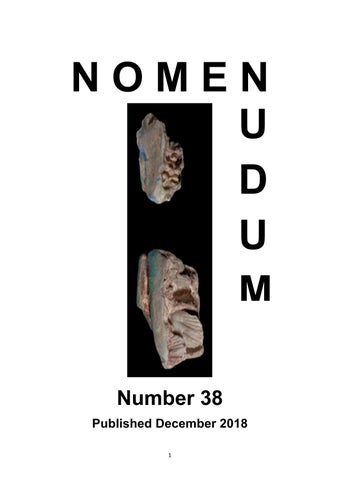
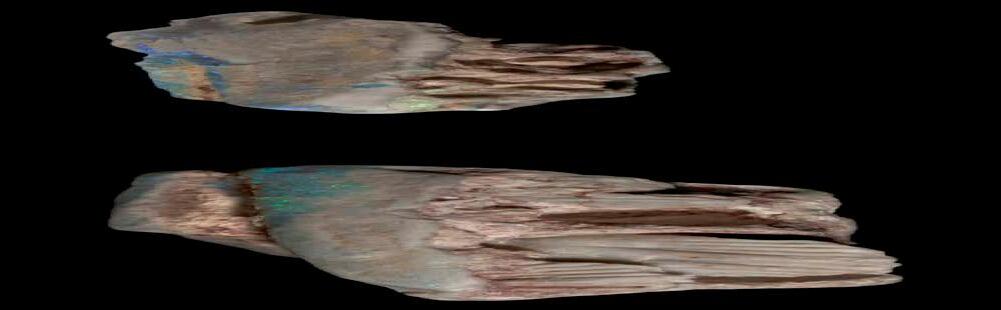
Highlights from this year include discovery of the new ornithopod Weewarrasaurus from the Cretaceous deposits at Lightning Ridge, described by Dr. Phil Bell and colleagues (see cover image of this issue of Nomen Nudum). And the recent ARC DECRA success of Dr. Nic Campione, who will begin his project on dinosaur teeth and diet in 2019. Congratulations to finishing PhD students Ada Klinkhamer, Theo Luk and D. Rex Mitchell from the FEAR labs. This year the PRC farewells Dr. Rudy Lerosy-Aubril and wishes him all the best in his new position at Harvard. The PRC also welcomes Dr Matt Herne who will begin his postodoctoral fellowship studying Australian ornithopod biomechanics in January 2019.
Phil Bell is currently enjoying an ARC DECRA that focuses on dinosaurian fauna from the Griman Creek Formation at Lightning Ridge (NSW). The first publications as a result of this work are beginning to emerge, including descriptions of new ornithopod dinosaurs from this interval. Other related work, including revised geology and geochronology of the Griman Creek Formation are also in the pipeline. Side projects are also continuing in western Canada
(as part of the Boreal Alberta Dinosaur Project) and Mongolia on various aspects of their respective Late Cretaceous dinosaur faunas. Phil has been pleased to see his lab continue to grow, welcoming three new students (two Honours, one Masters) and a Postdoctoral Fellow (Dr Matt White) this year with another Postdocotoral Fellow (Dr Matt Herne) due to begin next year.
Bell, P.R., Fanti, F., Hart, L.J., Milan, L. A., Craven, S.J., Brougham, T., Smith E. (2019). Revised geology, age, and vertebrate diversity of the dinosaur-bearing Griman Creek Formation (Cenomanian), Lightning Ridge, New South Wales, Australia. Palaeogeography, Palaeoclimatology, Palaeoecology 514:655–671.
Bell, P.R., Herne, M.C., Brougham, T., Smith, E.T. (2018) Ornithopod diversity in the Griman Creek Formation (Cenomanian), New South Wales, Australia. PeerJ 6:e6008
Fanti, F., Bell, P.R., Currie, P.J., Tsogtbaatar, K. (2018) The Nemegt Formation one of the best field laboratories for interpreting Cretaceous ecosystems. Palaeogeography, Palaeoclimatology, Palaeoecology 494:1–4.
Fanti, F., Bell, P.R., Tighe, M., Milan, L.A., Dinelli, E. (2018) Geochemical fingerprinting as a tool for repatriating poached dinosaur fossils in Mongolia: a case study for the Nemegt Locality, Gobi Desert, Mongolia. Palaeogeography, Palaeoclimatology, Palaeoecology. 494:41–64.
Bell, P.R., Ryan, M.J., Evans, D.C., Eberth, D.A., Fanti, F., Tsogtbaatar, Kh. (2018) Sedimentological and taphonomic observations on the "Dragon's Tomb" Saurolophus (Hadrosauridae) bonebed, Nemegt Formation (Upper Cretaceous), Mongolia. Palaeogeography, Palaeoclimatology, Palaeoecology. 494:75–90.
Bell, P.R., Brougham, T., Herne, M.C., Frauenfelder, T., Smith, E.T. (in press) Fostoria dhimbangunmal gen. et sp. nov , a new iguanodontian (Dinosauria, Ornithopoda) from the mid-Cretaceous of Lightning Ridge, NSW, Australia. Journal of Vertebrate Paleontology.
Marissa Betts continues her postdoctoral research into the early Cambrian of South Australia, China and Mongolia. Early parts of this year were spent at Northwest University in Xi’an in China collaborating with colleagues and conducting fieldwork in Yunnan Province, South China and Inner Mongolia Autonomous Region, North China. In June she conducted field work in the southern Flinders Ranges with colleagues from UNE, the University of Adelaide and the South Australian Museum. This material is currently being processed and is already producing an exceptional fauna. In August she attended the International Conference on Ediacaran and Cambrian Sciences (ICECS) at Northwest University, Xi’an, China, presenting current work on early Cambrian shelly fauna from the White Point Conglomerate, Kangaroo Island (poster). In August-September she participated in another field campaign to the Goby-Altai region of western Mongolia to measure and sample critical lower Cambrian successions. Major published work this year consists of the new early Cambrian chronostratigraphy for South Australia (Earth-Science Reviews).
Betts, M.J., Paterson, J.R., Andrew, A.S., Hall, P.A., Jago, J.B., Jagodzinski, E.A., Preiss, W.V., Crowley, J.L., Brougham, T., Mathewson, C.P., García-Bellido, D., Topper, T.P., Jacquet, S.M., Skovsted, C.B. & Brock, G.A. 2018. Early Cambrian chronostratigraphy and geochronology of South Australia. Earth-Science Reviews 185, 498-543 Chen, F-Y., Zhang, Z-F., Betts, M.J., Zhang, Z-L. & Liu, F. 2018. First report on Guanshan biota (Cambrian Stage 4) at the stratotype area of Wulongqing Formation in Malong County, Eastern Yunnan of China. Geoscience Frontiers. DOI:10.1016/j.gsf.2018.09.010.
Jago, J.B., Gehling, J.G., Betts, M.J., Brock, G.A., Dalgarno, C.R., García-Bellido, D. C., Haslett, P.W., Jacquet, S.M., Kruse, P.D., Langsford, N., Mount, T.J. & Paterson, J.R. 2018. The Cambrian System in the Arrowie Basin, Flinders Ranges, South Australia. Australian Journal of Earth Sciences. DOI.org/10.1080/08120099.2018.1525431.
Pan, B., Brock, G.A., Skovsted, C.B., Betts, M.J., Topper, T.P. & Li, G-X. 2018. Paterimitra pyramidalis Laurie, 1986, the first tommotiid discovered from the early Cambrian of North China. Gondwana Research 63, 179-185.
Russell Bicknell continues his PhD research under the supervision of Prof. John Paterson and Prof. Stephen Wroe, and has begun to specialise in horseshoe crab research. He uses microCT scans of Limulus polyphemus to present the first 3D anatomical atlas of the iconic species. He uses similar data to inform Finite Element Analyses that model the shell crushing ability of Limulus polyphemus and the Cambrian artiopodan Sidneyia inexpectans. He explores abnormal examples of extant and extinct horseshoe crab taxa and uses these specimens to suggest how trilobites may have recovered from injuries. He collaborates with colleagues from the University of Ljubljana and Slovenian Museum of Natural History to document the first horseshoe crab species from the Triassic of Slovenia. He examines the soft-bodied preservation of horseshoe crab taxa from the Cretaceous of Morocco and Lebanon. Finally, he begins his magnum opus of horseshoe crabs: a work that will present all known horseshoe crab species in one publication.
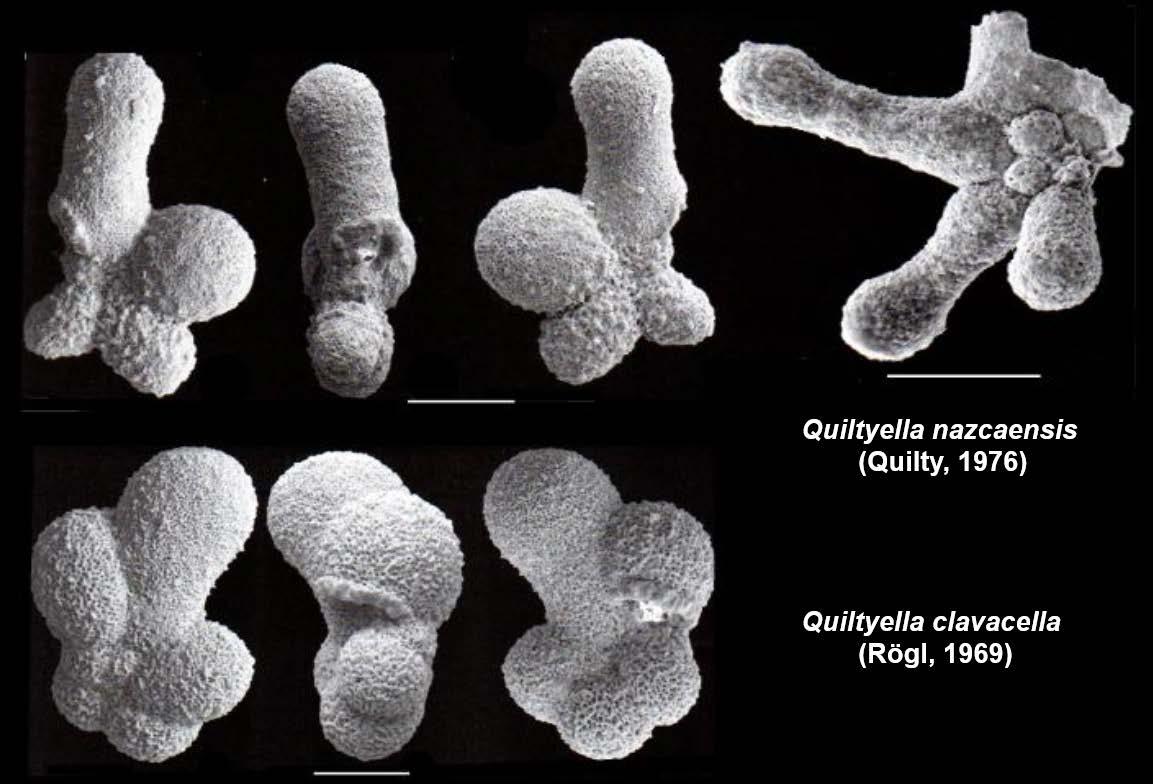
Separate research involves collaboration with Nicolás Campione (UNE) that explores the evolution of Neogene planktonic foraminifera and illustrates a potential example of specieslevel quantum evolution. Further research topics include collaboration with Stephen Pates (Oxford University) to document injured Cambrian trilobites from the Ruin Wash Lagerstätte, Utah and the Emu Bay Shale, South Australia. Finally, Russell collaborates with Zhao Wenyu (Northwest University, China) to explore morphometrics of trilobite taxa from the Cambrian Guanshan Biota
Pates, S. & Bicknell, R.D.C., in press. Elongated thoracic spines as predatory deterrents in olenelline trilobites from the lower Cambrian of Nevada. Palaeogeography, Palaeoclimatology and Palaeoecology.
Bicknell, R.D.C. & Pates, S., in press. Abnormal extant xiphosurids in the Yale Peabody Museum Invertebrate Zoology collection. Bulletin of the Peabody Museum of Natural History.
Bicknell, R.D.C., Ledogar, J.A., Wroe, S., Gutzler, B.C., Watson, III, W.H. & Paterson, J.R., 2018. Computational biomechanical analyses demonstrate the shell-crushing abilities of modern and ancient arthropods, Proceedings of the Royal Society B, 285, 20181935.
Bicknell, R.D.C., Collins, K.S., Crundwell, M., Hannah, M., Crampton, J.S. & Campione, N.E., 2018. Evolutionary transition in the late Neogene planktonic foraminiferal genus Truncorotalia iScience, 8, 295–303.
Bicknell, R.D.C., Pates, S. & Botton, M.L., 2018. Abnormal xiphosurids, with possible application to Cambrian trilobites. Palaeontologia Electronica; 21(2), 1-17
Bicknell, R.D.C., Klinkhamer, A.J., Flavel, R.J., Wroe, S. & Paterson, J.R., 2018. A 3D anatomical atlas of appendage musculature in the chelicerate arthropod Limulus polyphemus PLoS ONE, 13, e0191400
Tom Brougham is in the final year of his PhD research on the terrestrial vertebrate fauna from the mid-Cretaceous Griman Creek Formation of Lightning Ridge, NSW, with a specific focus on theropod dinosaurs. He is currently preparing the remaining chapters of his thesis, which includes a description of possible ceratosaurian material from Lightning Ridge and an
updated appraisal of Australian theropod diversity. He has also been collaborating with Steven Salisbury on a description and statistical identification of theropod teeth in Australia, the results of which were presented at the 2018 Society of Vertebrate Paleontology Annual Meeting in Albuquerque.
Bell, P. R., Fanti, F., Hart, L. J., Milan, L. A., Craven, S. J., Brougham, T. & Smith, E. 2019. Revised geology, age, and vertebrate diversity of the dinosaur-bearing Griman Creek Formation (Cenomanian), Lightning Ridge, New South Wales, Australia. Palaeogeography, Palaeoclimatology, Palaeoecology, 514, 655–671, doi: 10.1016/j.palaeo.2018.11.020
Bell, P. R., Herne, M. C., Brougham, T. & Smith, E. T. 2018. Ornithopod diversity in the Griman Creek Formation (Cenomanian), New South Wales, Australia. PeerJ, 6, e6008, doi: 10.7717/peerj.6008.
Betts, M. J., Paterson, J. R., Jacquet, S. M., Andrew, A. S., Hall, P. A., Jago, J. B., Jagodzinski, E. A., Preiss, W. V., Crowley, J. L., Brougham, T., Mathewson, C. P., García-Bellido, D. C., Topper, T. P., Skovsted, C. B. & Brock, G. A. 2018. Early Cambrian chronostratigraphy and geochronology of South Australia. Earth-Science Reviews, 185, 498–543, doi: 10.1016/j.earscirev.2018.06.005
Brougham T., Salisbury, S. W. & Bell, P. R., 2018. Non-avian theropod diversity in Cretaceous Australia: evidence from the fossil tooth record Journal of Vertebrate Paleontology, Programs and Abstracts, 2018, 97-98.
Nicolás Campione had a great first year at UNE. Despite a heavy teaching load, Dr Campione submitted four manuscripts and published three, including one in Current Biology on the extinction dynamics of sharks across the end-Cretaceous extinction event, led by his Swedish PhD student, Mohamad Bazzi. Dr Campione and Dr Bell had another successful field season as part of the Boreal Alberta Dinosaur Project, in Canada. UNE Students, Nathan Enriquez, Timothy Frauenfelder, and Brayden Holland also conducted field work in Canada, gaining new experiences and collecting valuable data for their respective theses. This year BADP rediscovered a bonebed, lost for over 25 years, and pulled out over 200 bones from a juvenile duck-billed dinosaur. Systematics and taphonomy of this bonebed will be carried out as part of Brayden’s RTP-funded MSc thesis, to start in early 2019. He will be joined by returning student Justin Kitchener, who will start an RTP-funded PhD project on the phylogeny of ornithopod dinosaurs and the origin of burrowing behaviours and morphology. Finally, Dr Campione was successful in securing an ARC DECRA project to start in 2019, entitled “Revealing the diets of dinosaurs through the complexity and shape of teeth”. The project will apply novel 3D surface mapping techniques to dinosaur teeth from Australia and key formations/regions around the world in order to understand the role of diet in instigating and maintaining the dominance of dinosaurs through the Mesozoic. This project includes collaborations with Dr Alistair Evans (Monash University), Dr Jordan Mallon (Canadian Museum of Nature), and Dr Roger Benson (University of Oxford).
Den Boer, W., N. E. Campione, B. P. Kear. In Review. Climbing adaptations, ecological convergence and locomotory disparity in ancient stem ‘kangaroos’. Royal Society Open Science. Campione, N. E., P. M. Barrett, and D. C. Evans. Accepted, Minor Revisions. On the ancestry of feathers in Mesozoic dinosaurs. In C. Foth and O. Rauhut (eds.), Evolution of Birds. Springer.
Bicknell, R.D.C., K.S. Collins, M. Crundwell, M. Hannah, J.S. Crampton, and N. E. Campione. 2018. Evolutionary Transition in the Late Neogene Planktonic Foraminiferal Genus Truncorotalia. iScience 8, 295–303.
Bazzi, M., B. P. Kear, H. Blom, P. E. Alberg, and N. E. Campione. Accepted, Minor Revisions. Static dental disparity and morphological turnover in sharks across the endCretaceous mass extinction. Current Biology 28(16), 2607–2615.e3.
Benson, R.B.J., Hunt, G., Carrano, M.T. & Campione, N. 2018. Cope’s rule and the adaptive landscape of dinosaur body size evolution. Palaeontology 61(1), 13–48.
Nathan Enriquez began his Masters degree in February 2018, under the supervision of Dr. Phil Bell and Dr. Nicolás Campione. He is working on describing a large dinosaur footprint site from central-west Alberta, Canada. The site is within the Upper Cretaceous Wapiti Formation and preserves dozens of footprints from at least four different types of dinosaurs, including hadrosaurids, tyrannosaurids and smaller theropods. Fieldwork was carried out in August 2018 and the entire 100+ metre long site has been mapped. Current work focuses on a number of tyrannosaurid tracks at the site and their implications for foot ontogeny in these dinosaurs. Additional work has included evaluating evidence for gregarious behaviour in hadrosaurids and small theropods using one of the world’s only known tyrannosaurid trackways and possibly Canada's first two-toed dromaeosaurid tracks. He has presented the preliminary findings of his work at the 2018 GSA Earth Science Student Symposium (GESSS), which was held at the University of Sydney across December 3rd and 4th.
Timothy Frauenfelder commenced his Honours in March 2018, finishing early 2019, supervised by Dr. Phil Bell and Dr. Stephen Poropat (Swinbourne University). His research focuses on describing sauropod teeth from Lightning Ridge, including specimens from the Australian Opal Centre and the Australian Museum. He is also looking into the taxonomic implications of sauropod teeth measurement indices. In July he also attended the annual Boreal Alberta Dinosaur Project in Grand Prairie, Canada. Tim also lead fieldwork to the Griman Creek Formation near the town of Surat, southeastern Queensland with fellow Honours student, Justin Kitchener. Results from this fieldwork indicate that the site is worth exploring further in the future. Tim presented a poster outlining this fieldwork at the GSA Earth Science Student Symposium (GESSS), in Sydney.
Lachlan Hart continues his Masters research on Cretaceous crocodyliforms from Lightning Ridge. This has included describing new material and reappraising historical specimens, determining their phylogenetic affinities and making comparisons with other taxa.
Bell, P.R., Fanti, F., Hart, L.J., Milan, L.A., Craven, S.J., Brougham, T., Smith, E. (2018)
Revised geology, age, and vertebrate diversity of the dinosaur-bearing Griman Creek Formation (Cenomanian), Lightning Ridge, New South Wales, Australia. Palaeogeography, Palaeoclimatology, Palaeoecology 514, 655-671 doi: 10.1016/j.palaeo.2018.11.020.
Hart, L.J., Bell, P.R., Salisbury, S.W. (2018) Lower Cretaceous Crocodyliforms from Lighting Ridge, New South Wales, Australia: New evidence of the basal eusuchian Isisfordia [abstract]. Journal of Vertebrate Palaeontology, Program and Abstracts, 2018, 142.
Han Hu is a postdoctoral fellow in the Palaeoscience Research Centre at UNE. She has mainly explored the evolution of palate and cranial kinesis from dinosaurs to modern birds this year, based on 3D geometric morphometric shape analyses that have included early birds,
non-avian dinosaurs and a large dataset of modern birds. She has visited the Institute of Vertebrate Paleontology and Paleoanthropology and Yunnan University in China to check more specimens of Mesozoic and modern birds. During that trip, she also attended the 16th Annual meeting of Chinese Society of Vertebrate Paleontology, and gave a talk named “A comprehensive study of the evolution of palate and cranial kinesis of birds”. She also participated in another project about the medullary bone discovered in a new Mesozoic bird and collaborated with the research group in the Institute of Vertebrate Paleontology and Paleoanthropology, China.
O’Connor, J. K., Erickson G. M., Norell M, Bailleul A. M., Hu, H., Zhou, Z., H. Medullary bone in an Early Cretaceous enantiornithine bird and discussion regarding its identification in fossils. Nature Communications, 9, 5169 (2018), DOI: 10.1038/s41467018-07621-z.
O'Connor, J. K., Wang, X. L., Sullivan, C., Wang, Y., Zheng, X. T., Hu, H., Zhang, X. M., Zhou, Z. H. First report of gastroliths in the Early Cretaceous basal bird Jeholornis
Cretaceous Research. https://doi.org/10.1016/j.cretres.2017.10.031 (2018).
Justin L. Kitchener has been studying tiny, probable perinate stage, ornithopod femora from the Griman Creek Formation (Cenomanian; New South Wales) for his Honours project under the supervision of Dr. Phil Bell and Dr. Nicolás Campione. These specimens represent the first hatchling dinosaurs to be described from Australia, and a rare southern hemisphere example of high palaeolatitude dinosaur breeding. In late September, Justin joined fellow Honours student, Tim Frauenfelder, on a week-long research trip to the Queensland town of Surat. Future expeditions to Surat to study the geology and search for further vertebrate material are planned.
Ada Klinkhamer has completed her PhD at the University of New England under the primary supervision of Prof. Stephen Wroe. Her thesis investigated the limb biomechanics of sauropod dinosaurs. She used 3D musculoskeletal modelling and Finite Element Analysis techniques to answer questions related to postural change, locomotor capabilities and weight bearing in this group.
Bicknell, R.D.C., Klinkhamer, A.J., Flavel, R.J., Wroe, S. & Patterson, J.R. 2018. A 3D anatomical atlas of appendage musculature in the chelicerate arthropod Limulus polyphemus PLoS One 13(2): e0191400.
Klinkhamer, A.J., Mallison, H., Poropat, S.F., Sinapius, G.H.K. & Wroe, S. 2018. Threedimensional musculoskeletal modelling of the sauropodomorph hind limb: the effect of postural change on muscle leverage. Anatomical Record 301(12): 2145-2163.
Klinkhamer, A.J., Mallison, H., Poropat, S.F., Sloan, T. & Wroe, S. 2018. Comparative threedimensional moment arm analysis of the sauropod forelimb: implications for the transition to a wide-gauge stance in titanosaurs. Anatomical Record Online release.
Rex Mitchell finished his PhD this year under the supervision of Prof. Steve Wroe in the FEAR lab. He used a combination of shape analyses and biomechanical analyses to investigate the relationship between dietary preference and the shape and structure of the cranium in herbivorous diprotodonts, with emphasis on the Macropodiformes (kangaroos and relatives). The findings from this project will allow future research to predict potential feeding ecologies from morphological attributes of the crania, for both extant and extinct species. This information will be useful in the conservation and management of threatened or endangered species and for better understanding prehistoric environments. Further
investigations are currently underway to determine the influences of integration and modularity within the crania of kangaroos and relatives; and also to apply these findings to other extinct marsupials. He has been successful in securing a postdoctoral position at the University of Arkansas, USA, examining normal and pathological covariation in the masticatory apparatus of anthropoid primates, commencing in April 2019.
Mitchell, D.R., Sherratt, E., Ledogar, J.A. &Wroe, S. 2018. The biomechanics of foraging determines face length among kangaroos and their relatives. Proc. R. Soc. B 285: 20180845. http://dx.doi.org/10.1098/rspb.2018.0845
Mitchell, D.R., Sherratt, E., Sansalone, G., Ledogar, J.A., Flavel, R.J. & Wroe, S. 2018. Feeding biomechanics influences craniofacial morphology at the subspecies scale among Australian pademelons (Macropodidae: Thylogale). J. Mammal. Evol. https://doi.org/10.1007/s10914-018-9455-8
Mitchell, D.R. & Wroe, S. 2019. Biting mechanics determines craniofacial morphology among extant diprotodont herbivores: dietary predictions for the giant extinct short-faced kangaroo, Simosthenurus occidentalis. Accepted to Paleobiology.
John Paterson continues to explore various aspects of the Cambrian. Research on the Emu Bay Shale Konservat-Lagerstätte (Kangaroo Island) currently includes: the sedimentology and depositional setting (involving Bob Gaines, Pomona College, USA); geochemical analyses of the Lagerstätte interval using samples taken from the core (‘Big Gully 1’) that was drilled in January 2017; and other manuscripts on various Emu Bay Shale animals, including aspects of trilobite palaeobiology (with PhD student, James Holmes). A long-term study with Mike Lee and Greg Edgecombe on trilobite evolutionary rates and the duration of the Cambrian explosion has almost concluded – it is hoped that the revised manuscript will soon be accepted for publication. Other projects include: aspects of Cambrian predation (with PhD student, Russell Bicknell); Cambrian shelly faunas of South Australia (with postdoc, Marissa Betts) and central Australia (Amadeus Basin, with Patrick Smith & Glenn Brock); early Cambrian arthropods from the Chengjiang and Guanshan biotas in China (with Jianni Liu, Northwest University & Rudy Lerosey-Aubril, Harvard University); and a BurgessShale-type assemblage from the early Cambrian of British Columbia, Canada (with Rudy Lerosey-Aubril).
Betts, M.J., Paterson, J.R., Jacquet, S.M., Andrew, A.S., Hall, P.A., Jago, J.B., Jagodzinski, E.A., Preiss, W.V., Crowley, J.L., Brougham, T., Mathewson, C.P., García-Bellido, D.C., Topper, T.P., Skovsted, C.B. & Brock, G.A., 2018. Early Cambrian chronostratigraphy and geochronology of South Australia. Earth-Science Reviews 185, 498-543.
Bicknell, R.D.C. & Paterson, J.R., 2018. Reappraising the early evidence of durophagy and drilling predation in the fossil record: implications for escalation and the Cambrian Explosion. Biological Reviews 93, 754-784.
Bicknell, R.D.C., Paterson, J.R., Caron, J.-B. & Skovsted, C.B., 2018. The gnathobasic spine microstructure of recent and Silurian chelicerates and the Cambrian artiopodan Sidneyia: Functional and evolutionary implications. Arthropod Structure & Development 47, 1224.
Bicknell, R.D.C., Klinkhamer, A.J., Flavel, R.J., Wroe, S. & Paterson, J.R., 2018. A 3D anatomical atlas of appendage musculature in the chelicerate arthropod Limulus polyphemus. PLoS ONE 13(2), e0191400.
Bicknell, R.D.C, Ledogar, J.A., Wroe, S., Gutzler, B.C., Watson III, W.H. & Paterson, J.R., 2018. Computational biomechanical analyses demonstrate similar shell-crushing abilities in modern and ancient arthropods. Proceedings of the Royal Society B 285, 20181935.
Jago, J.B., Gehling, J.G., Betts, M.J., Brock, G.A., Dalgarno, C.R., García-Bellido, D.C., Haslett, P.W., Jacquet, S.M., Kruse, P.D., Langsford, N., Mount, T.J. & Paterson, J.R., 2018. The Cambrian System in the Arrowie Basin, Flinders Ranges, South Australia. Australian Journal of Earth Sciences, doi: 10.1080/08120099.2018.1525431.
Liu, J., Lerosey-Aubril, R., Steiner, M., Dunlop, J.A., Shu, D. & Paterson, J.R., 2018. Origin of raptorial feeding in juvenile euarthropods revealed by a Cambrian radiodontan. National Science Review, doi: 10.1093/nsr/nwy057.
Schroeder, N.I., Paterson, J.R. & Brock, G.A., 2018. Eldonioids with associated trace fossils from the lower Cambrian Emu Bay Shale Konservat-Lagerstätte of South Australia. Journal of Paleontology 92, 80-86.
Smith, P.M., Paterson, J.R. & Brock, G.A., 2018. Trilobites and agnostids from the Goyder Formation (Cambrian Series 3, Guzhangian; Mindyallan), Amadeus Basin, central Australia. Zootaxa 4396, 1-67.
Yun, H., Brock, G.A., Zhang, X.L., Li, L.Y., García-Bellido, D.C. & Paterson, J.R. 2018. A new chancelloriid from the Emu Bay Shale (Cambrian Stage 4) of South Australia. Journal of Systematic Palaeontology, doi: 10.1080/14772019.2018.1496952.
Gabriele Sansalone recently commenced his postdoctoral research at UNE under the supervision of Prof. Stephen Wroe and Prof. John Gibson, joining the Palaeoscience Research Centre. Dr. G. Sansalone is an Italian vertebrate paleontologist specializing in the use of quantitative shape analysis, phylogenetic comparative methods and finite elements analysis. His work is focused on understanding the adaptation and evolution of subterranean mammals, but also spans to the feeding biomechanics of birds of prey, brain shape evolution and skull integration in primates as well as the feeding biomechanics in marsupial and placental carnivores. Currently one of his main projects is focused on understanding the feralisation process of pigs in Australia.
Sansalone, G., Kotsakis, T., Schwermann, A. H., Van den Hoek Ostende, L. W., & Piras, P. 2018. When moles became diggers: Tegulariscaptor gen. nov., from the early Oligocene of south Germany, and the evolution of talpid fossoriality. Journal of Systematic Palaeontology, 16(8), 645-657.
Sansalone, G., Colangelo, P., Kotsakis, T., Loy, A., Castiglia, R., Bannikova, A. A., Zemlemerova, E.D. & Piras, P. 2018. Influence of evolutionary allometry on rates of morphological evolution and disparity in strictly subterranean moles (Talpinae, Talpidae, Lipotyphla, Mammalia). Journal of Mammalian Evolution, 25(1), 1-14.
Mitchell, D. R., Sherratt, E., Sansalone, G., Ledogar, J. A., Flavel, R. J., & Wroe, S. 2018. Feeding Biomechanics Influences Craniofacial Morphology at the Subspecies Scale among Australian Pademelons (Macropodidae: Thylogale). Journal of Mammalian Evolution, 1-11.
Neaux, D., Sansalone, G., Ledogar, J. A., Ledogar, S. H., Luk, T. H., & Wroe, S. 2018. Basicranium and face: Assessing the impact of morphological integration on primate evolution. Journal of human evolution, 118, 43-55.
Piras, P., Silvestro, D., Carotenuto, F., Castiglione, S., Kotsakis, A., Maiorino, L., Melchionna, M. Mondanaro, A., Sansalone G., Serio, C., Vero, V. A. & Raia, P. 2018. Evolution of the sabertooth mandible: A deadly ecomorphological specialization. Palaeogeography, Palaeoclimatology, Palaeoecology, 496, 166-174.
Matt White is working on few projects as part of his Postdoctoral Fellowship at UNE. Field work this year has spanned from Winton (as part of annual Australian Age of Dinosaur digs), Lightning Ridge (assisting with Dr Bell’s work on the Griman Creek Formation), and Canada
(as part of the Boreal Alberta Dinosaur Project with Drs Bell and Campione). Work in the Winton area constitutes the main focus of his postdoctoral research, specifically crocodyliform material discovered in 2011. This material, along with several specimens from Lightning Ridge were scanned at the Australian Synchrotron in Melbourne. As digital segmentation and reconstruction of fossils becomes increasingly important for scientific study, Matt has been involved with numerous reconstructive projects this year which have included: a feathered bird (China); megaraptorid material (Victoria, Australia); a mammal tooth (Victoria, Australia); opalized dinosaurs (Lightning Ridge, NSW, Australia); Anomalocaris eyes (Kangaroo Island, Australia); and hominid hyoids.
Stephen Wroe is a Professor in the Zoology Department within the School of Environmental and Rural Science at UNE. Wroe’s background is in zoology, palaeontology, phylogenetics, ecology and biogeography. He currently applies sophisticated 3D computer imaging and engineering softwares, as well as shape analyses, to address the relationships between form and function in living and extinct species within evolutionary contexts. Taxa investigated range from Cambrian invertebrates to Neanderthals and modern humans.
He is Director of the Function, Evolution and Anatomy Research lab (FEARlab) - a multidisciplinary team operating across the School of Environmental and Rural Sciences (UNE) and the School of Engineering at the University of Newcastle. Wroe’s current research focuses on a wide range questions from understanding the evolution of the human face and primate brains to killing behaviour in the giant Haast’s eagle of New Zealand.
Wroe supervises or co-supervises four postdoctoral researchers. Students and postdocs in the FEARlab are engaged in projects addressing wide-ranging subjects including: the biomechanics of locomotion in extinct taxa such as sauropod dinosaurs and giant extinct kangaroos, feeding biomechanics of kangaroos, fish, and Cretaceous birds, hominid craniofacial biomechanics and evolution, and mechanical behavior of the human hyoid bone and antlers of the giant deer (Megaloceros) among others.
Wroe, S., Parr, W., Ledogar, J.A., Bourke, J., Evans, S.P., Fiorenza, L., Benazzi, S., Hublin, J., Stringer, C., Kullmer, O., Curry, M., Rae, T. & Yokley, T.R. 2018. Computer simulations show that Neanderthal facial morphology represents adaptation to cold and high energy demands, but not heavy biting. Proceedings of the Royal Society Series B.
Bicknell, R.D.C., Ledogar, J., Wroe, S., Watson, W., & Paterson, J. 2018. Computational biomechanical analyses demonstrate similar shell-crushing abilities in modern and ancient arthropods. Proceedings of the Royal Society Series B.
Klinkhamer, A.J., Mallison, H., Poropat, S., Sloan, T.& Wroe S. 2018. Comparative three‐dimensional moment arm analysis of the sauropod forelimb: Implications for the transition to a wide‐gauge stance in titanosaurs. The Anatomical Record
Klinkhamer, A.J., Mallison, H., Poropat, S., Sinapius, G. & Wroe, S. 2018. Three‐dimensional musculoskeletal modelling of the sauropodomorph hind limb: the effect of postural change on muscle leverage. The Anatomical Record
Mitchell, D.R., Sherratt, E., Ledogar, J.A. & Wroe, S. 2018. The biomechanics of foraging determines face length among kangaroos and their relatives. Proceedings of the Royal Society Series B (1881), 20180845.
Mitchell, D.R., Sherratt, E., Sansalone, G., Ledogar, J.A., Flavel, R.J. & Wroe, S. 2018. Feeding biomechanics influences craniofacial morphology at the subspecies scale among Australian pademelons (Macropodidae: Thylogale). J Mammal Evol. In press.
Mitchell, D.R. & Wroe, S. 2018. Biting mechanics influences facial morphology in diprotodont herbivores. Paleobiology. In Press.
Wroe, S., & Parr, W. 2018. Understanding killing behavior in Smilodon fatalis: the role of computational biomechanics. In: McDonald, G. (Ed.) Sabertooth. Johns Hopkins University Press.
Attard, M., Sherratt, E., McDonald, P., Young, I., Vidal-García, M. &Wroe, S. 2018. A new, three-dimensional geometric morphometric approach to assess egg shape. PeerJ 6, e5052.
Veitschegger, K., Wilson, L., Nussberger, B.G, Camenisch, L.F., Keller, Wroe, S. & Sánchez-Villagra, M.R. 2018. Resurrecting Darwin’s Niata-anatomical, biomechanical, genetic, and morphometric studies of morphological novelty in cattle. Scientific Reports 8, 9129.
Neaux, D., Sansalone, G., Ledogar, J., Ledogar, S.H., Luk, T.H.Y. & Wroe, S. 2018. Assessing the impact of morphological integration on primate evolution. Journal of Human Evolution.
Goatley, C.H.R., Wroe, S., Tebbett, S.B. & Bellwood, D.R. 2018. An evaluation of a doubletailed deformity in a coral reef surgeonfish (Acanthuridae) using micro-CT. Journal of Fish Biology.
Bicknell, R.D.C., Klinkhamer, A.J., Flavel, R.J., Wroe, S. & Paterson, J.R., 2018. A 3D anatomical atlas of appendage musculature in the chelicerate arthropod Limulus polyphemus. PLoS ONE, 13(2), e0191400.
Ledogar, J.A., Luk, T.H.Y., Perry, J., Neaux, M.G.D. & Wroe, S. 2018. Biting mechanics andniche separation in a specialized clade of primate seed predators. PLOS ONE 13(1): e0190668.
School of Environmental and Rural Science
Ian Metcalfe (University of New England) continues to work on Palaeozoic and Triassic conodonts (taxonomy, biostratigraphy and biogeography) from SE Asia (especially Malaysia and Myanmar), China and Australia aimed at elucidating tectonic evolution, Permian mass extinctions and timescale calibration.
Quanshu Yan, Xuefa Shi, Metcalfe, I., Shengfa Liu, Taoyu Xu, Narumol Kornkanitnan, Thanyapat Sirichaiseth, Long Yuan, Ying Zhang & Hui Zhang. 2018. Hainan mantle plume produced late Cenozoic basaltic rocks in Thailand, Southeast Asia. Scientific Reports 8:2640, 1-14. DOI: http://dx.doi.org/10.1038/s41598-018-20712-7
Quanshu Yan, Metcalfe, I., Xuefa Shi, Pingyang Zhang & Fengchun Li. 2018. Early Cretaceous granitic rocks from the southern Jiaodong Peninsula, eastern China: Implications for lithospheric extension. International Geology Review. DOI: https://doi.org/10.1080/00206814.2018.1474388
Metcalfe, I. 2018. Naihehe Cave, Viti Levu Island, Fiji. Craven Pothole Club Record 132, 510.
Geological Survey of New South Wales
WB Clarke Geoscience Centre, Londonderry
Ian Percival officially retired in mid-2018, and is now an Honorary Research Associate of the Geological Survey of NSW. Prior to retiring he participated in the Annual Field Meeting of IGCP 653 (The Onset of the Great Ordovician Diversification Event) held at Ohio University (Athens, Ohio, USA) with associated field trips to the Great Basin in Utah & Nevada, and the Cincinnati Arch region of Kentucky & Ohio. During the second half of
2018, Ian accompanied Yong Yi Zhen on a field trip to far western NSW to sample latest Cambrian and Early Ordovician limestones for conodonts; he also organised a symposium in Coonabarabran on the natural history of the Warrumbungle Range and other Miocene volcanoes of NSW for the Linnean Society of NSW. A paper co-authored with Barry Webby and Harrison Birkett on the palaeontological significance of the Cliefden Caves area has been accepted for a special geoheritage issue of Australian Journal of Earth Sciences scheduled for early 2019 (the proposed dam on the Belubula River downstream from the Caves and Fossil Hill has now been shelved by the State Government after considerable public opposition over the past five years). With the able assistance of Pierre Kruse and Sarah Martin, editing of Australasian Palaeontological Memoir 51, containing papers from the PDU2 Symposium held in Adelaide in mid-2016, was completed and the volume was published in December. Several other AP Memoirs are currently at varying stages in the editorial process.
My research continues to focus on Early Palaeozoic conodonts and brachiopods, working mainly with Yong Yi Zhen on faunas from New South Wales and Western Australia (in collaboration with the Geological Survey of WA). Plans for 2019 potentially include attending the 13th International Symposium on the Ordovician System in Novosibirsk, Russia in July, and visiting Nanjing in October to work with colleagues there on several projects.
Yong Yi Zhen is Senior Research Scientist and Palaeontologist with the Geological Survey. During 2018, he supervised a project to complete the data entry of all type specimens in the GSNSW Palaeontology collection (primary types and figured material) into the GeoBank database. Concurrently he commenced photography of 6000+ specimens of Ordovician conodonts in cherts from NSW, using the recently-purchased stereo binocular microscope with conofocal stacking capability. Over the next year or two this database will be enhanced with a substantial library of SEM images of discrete conodont elements from Cambrian to Carboniferous limestones throughout the State to build a digital Microfossil Atlas for NSW. This year my research has concentrated on (1) documentation of Late Ordovician conodonts and late Silurian corals, stromatoporoids and conodonts from allochthonous limestone clasts within the Cuga Burga Volcanics in central western NSW, and (2) revision of the Middle Ordovician conodonts from the subsurface Canning Basin first described by Watson in 1988. Several papers resulting from active collaboration with Chinese palaeontologists from the Nanjing Institute of Geology & Palaeontology, which I visit each year on annual leave (more like a working holiday), have been published online in recent months.
Normore, L.S., Zhen, Y.Y., Dent, L.M., Crowley, J.L., Percival, I.G. & Wingate, M.T.D. 2018. Early Ordovician CA-IDTIMS U-Pb zircon dating and conodont biostratigraphy, Canning Basin, Western Australia. Australian Journal of Earth Sciences 65, 61-73.
Percival, I.G. & Zhen, Y.Y. 2018. Ordovician conodont biostratigraphy of deep water cherts from New South Wales, Australia and regional correlations. p.52 in Program & Abstracts volume: Trekking across the GOBE. IGCP Project 653 Annual Meeting, Athens, Ohio USA, June 3-7, 2018.
Strusz, D.L. & Percival, I.G. 2018. Silurian (Wenlock) brachiopods from the Quidong district, southeastern New South Wales, Australia. Australasian Palaeontological Memoirs 51, 81129.
Wang, G.X., He, X.Y., Tang, L. & Percival, I.G. 2018. Silurian amplexoid rugose coral genera Pilophyllia Ge and Yu, 1974 and Neopilophyllia new genus from South China. Journal of Paleontology 92, 982-1004.
Wang, G.X., Zhan, R.B., Rong, J.Y., Huang, B., Percival, I.G., Luan, X.C. & Wei, X. 2018. Exploring the-end Ordovician extinctions in Hirnantian near-shore carbonate rocks of northern Guizhou, SW China. Geological Journal 53, 3019-3029.
Wang, Z.H., Zhen, Y.Y., Bergström, S.M., Wu, R.C., Zhang, Y.D. & Ma, X. 2018. A new conodont biozone classification of the Ordovician System in South China. Palaeoworld (in press) doi.org/10.1016/j.palwor.2018.09.002
Wang, Z.H., Zhen, Y.Y., Bergström, S.M., Zhang, Y.D. & Wu, R.C. 2018. Ordovician conodont biozonation and biostratigraphy of North China. Australasian Palaeontological Memoirs 51, 65-79.
Zhang Y.D., Zhan R.B., Zhen Y.Y., Wang Z.H., Yuan W.W., Fang X., Ma X., Zhang J.P. 2018. Ordovician integrative stratigraphy and timescale of China. Science China Earth Sciences (in press) doi.org/10.1007/s11430-017-9279-0
Zhen, Y.Y. 2018. Conodonts, corals and stromatoporoids from Late Ordovician and latest Silurian allochthonous limestones in the Cuga Burga Volcanics of central western New South Wales. Proceedings of the Linnean Society of New South Wales 140, 265-294.
Zhen, Y.Y., Percival, I.G., Normore, L.S. & Dent, L.M. 2018. Floian (Early Ordovician) conodonts of the Canning Basin, Western Australia biostratigraphy and palaeobiogeographic affinities with Chinese faunas. 235–241 in Zhang, Y.D., Zhan, R.B., Fan, J.X. & Muir, L.A. (eds.), Filling the gap between the Cambrian Explosion and the GOBE Proceedings of the International Geoscience Programme (IGCP) Project 653 Annual Meeting, October 8th–12th, 2017. Yichang, China. Zhejiang University Press, Hangzhou.
Zhen, Y.Y., Percival, I.G., Woo, J.S. & Park, T.-Y. 2018. Latest Cambrian–earliest Ordovician conodonts and microbrachiopods from northern Victoria Land, Antarctica: Handler Ridge revisited. Palaeoworld 27 (in press) DOI:10.1016/j.palwor.2018.03.004
NORTHERN TERRITORY
No Contributions
QUEENSLAND
Griffith University, Brisbane
Julien Louys is continuing working on the Pleistocene fossils from caves in Sumatra as part of his ARC Future Fellowship.
Louys, J., O’Connor, S., Mahirta, Higgins, P., Hawkins, S., Maloney, T. 2018. New genus and species of giant rat from Alor Island, Indonesia. Journal of Asia-Pacific Biodiversity 11, 503-510.
Hashemi, N., Wood, R., Louys, J., 2018. Faunal remains and environments from the Bronze age of Kalehkoob, Lut Desert, eastern Iran. Archaeological Research in Asia 16, 139147.
Roberts, P., Stewart, M., Alagaili, A., Breeze, P., Candy, I., Drake, N., Groucutt, H., Scerri, E., Lee-Thorp, J., Louys, J., Zalmout, I., Al-Mufarreh, Y., Zech, J., Alsharekh, A., Al-
Omari, A., Boivin, N., and Petraglia, M. 2018. Fossil herbivore stable isotopes reveal Middle Pleistocene hominin palaeoenvironment in ‘Green Arabia’. Nature Ecology and Evolution 2, 1871–1878
Kealy, S., Louys, J., O’Connor, S. 2018. Least-cost pathway models indicate northern human dispersal from Sunda to Sahul. Journal of Human Evolution 125, 59-70.
Scerri, E.M.L., Guagnin, M., Groucutt, H.S., Armitage, A.J., Parker, L.E., Drake, N.A., Louys, J., Breeze, P., Zahir, M., Alsharekh, A., Petraglia, M.D. 2018. Neolithic pastoralism in extreme marginal environments during the mid-Holocene wet phase, northern Saudi Arabia. Antiquity 92, 1180-1194.
Samper Carro, S.C., Louys, J., O’Connor, S., 2018. Shape does matter: A geometric morphometric approach to shape variation in Indo-Pacific fish vertebrae for habitat identification. Journal of Archaeological Science 99, 124-134.
O’Connor, S., Mahirta, Louys, J., Kealy, S., Brockwell, S., 2018. New engraving finds in Alor Island, Indonesia extend known distribution of engravings in Oceania. Archaeological Research in Asia 15:116-128
Price, G.J., Louys, J., Faith, J.T., Lorenzen, E., Westaway, M.C., 2018. Big data little help in megafauna mysteries. Nature 558, 23-25.
Hawkins, S., Samper Carro, S.C., Louys, J., Aplin, K., O’Connor, S., Mahirta, 2018. Human palaeoecological interactions and owl roosting at Tron Bon Lei, Alor Island, eastern Indonesia. Journal of Coastal and Island Archaeology 13, 371-387.
Spehar, S.N., Sheil, D., Harrison, T., Louys, J., Ancrenaz, M., Marshall, A.J., Wich, S.A., Bruford, M.W., Meijaard, E., 2018. Orangutans venture out of the rainforest and into the Anthropocene. Science Advances 4, e1701422.
Louys, J., 2018. Practice and prospects in underwater palaeontology. Palaeontologia Electronica 21.2.22A: 1-14.
O’Connor, S., Mahirta, Kealy, S., Louys, J., Kaharudin, H.A.F., Lebaun, A., Hawkins, S. 2018. Unusual painted anthropomorph in Lembata Island extends our understanding of rock art diversity in Indonesia. Rock Art Research 35, 79-84
Groucutt H., Grun, R. Zalmout, I., Drake, N., Armitage, S., Candy, I., Clark-Wilson, R., Louys, J., Breeze, P., Duval, M., Buck, L., Kivell, T., Pomeroy, E., Stephens, N., Stock, J., Stewart, M., Price, G., Kinsley, L. Sung, W.W., Alsharekh, A., Al-Omari, A., Zahir, M., Memesh, A., Abdulshakoor, A., Almassari, A., Bahameem, A. Al Murayyi, K., Zahrani, B., Scerri, E., Petraglia, M. 2018. Homo sapiens in Arabia by 85 thousand years ago. Nature Ecology and Evolution2, 800-809.
On the 25-27th June 2019 Griffith University will be hosting the 1st Asia Pacific Conference on Human Evolution (APCHE), with the aim of bringing together experts working on all aspects of biological evolution of humans in the broader Asian and Pacific regions.
Participants will include active researchers in palaeoanthropology, biological anthropology, genomics and palaeogenomics, primatology, as well as all disciplines engaged in understanding the environmental and site-specific context of human evolution across Asia and Australasia, including taphonomy, geochronology, palaeoecology, and geoarchaeology.
This conference will foster international collaborations between researchers actively engaged in scientific analyses and exploration in Asia and the Pacific, and will highlight the exciting developments and discoveries that are rewriting our understanding of how and when humans left Africa and expanded into new lands to the east.
Participants will include active researchers in palaeoanthropology, biological anthropology,
genomics and palaeogenomics, primatology, as well as all disciplines engaged in understanding the environmental and site-specific context of human evolution across Asia and Australasia, including taphonomy, geochronology, palaeoecology, and geoarchaeology.
For further information email apche@griffith.edu.au
Queensland Museum, Hendra
Carole J. Burrow remains an Honorary Research Fellow with the QM, working on midPalaeozoic jawed fishes. Since her last report in 2016-7, collaborative work continues with UK and Dutch colleagues on updating descriptions of the LORS acanthodians of Scotland and comparing the fauna with that of other regions. New investigations have been undertaken on North American gyracanthids in collaboration with Sue Turner (QM) and Daniel Snyder (Georgia), and other projects with Sue on Welsh Borderland and Maine microvertebrates have been completed. Two projects on European Machaeracanthus spp. have also been published, as has a revision of a long-known mid-Palaeozoic fauna from Portugal. Carole has also been working with Gavin Young and Yuzhi Hu (ANU) and several other Chinese colleagues on the gnathal plates of Early Devonian placoderms, and with Kate Trinajstic (Curtin Uni) and colleagues on the dentition of Late Devonian placoderms. A project that has been in progress for more than 20 years, on the microvertebrate assemblage from the Late Silurian Pendock 1A borehole in Western Australia, has finally been submitted for publication, with co-authors Sue Turner, Gavin Young and Kate Trinajstic. Carole would still appreciate help in contacting Ross Parkes (formerly of CSIRO), about locating material from Nevada that Ross worked on for his Honours thesis at MUCEP.
Burrow, C.J. 2017. Reassessment of a mid-Palaeozoic vertebrate assemblage from Laúndos, Portugal. Journal of Iberian Geology 43, 97–110.
Burrow, C. & Gendry, D. 2017. Lost and found Machaeracanthus spines from the Lower Devonian of western France. Annales de la Société Geologique du Nord 24 (2nd series), 71–78.
Burrow, C.J., Turner, S., Maisey, J.G., Desbiens, S. & Miller, R.F. 2017. Spines of the stem chondrichthyan Doliodus latispinosus (Whiteaves) comb. nov. from the Lower Devonian of eastern Canada. Canadian Journal of Earth Sciences 54 (12), 1248–1262.
Burrow, C.J., Ivanov, A.O. & Ershova, V.B. 2018. Acanthodians from the Silurian–Devonian boundary beds of Novaya Zemlya Archipelago, Russia. GFF 140 (3), 1–8.
Burrow, C.J., Newman, M., Blaauwen, J.D., Jones, R. & Davidson, R. 2018. The Early Devonian ischnacanthiform acanthodian Ischnacanthus gracilis (Egerton, 1861) from the Midland Valley of Scotland. Acta Geologica Polonica 68 (3), 335–362.
Burrow, C.J. & Szrek, P. 2018. Acanthodians from the Lower Devonian (Emsian) ‘Placoderm Sandstone’, Holy Cross Mountains, Poland. Acta Geologica Polonica 68 (3), 307–320.
Burrow, C.J. & Turner, S. 2018. Stem chondrichthyan microfossils from the Lower Old Red Sandstone of the Welsh Borderland. Acta Geologica Polonica 68 (3), 321–334.
Hu, Y., Young, G. C., Burrow, C., Lu, J. & Zhu, Y.-A. (in press). Complex morphology of gnathal elements in an Early Devonian arthrodire revealed by high resolution XCT scanning. Palaeoworld.
Newman, M.J., Burrow, C.J., Davidson, R.G., den Blaauwen, J.L. & Jones, R. 2017. Comparison of the vertebrate faunas of the Lower Old Red Sandstone of the Anglo-
Welsh Basin with contemporary faunas in Scotland. Proceedings of the Geologists' Association 128 (3), 447–459.
Newman, M.J. & Burrow, C.J. 2018. Allocation of Devonian acanthodian lectotypes. Scottish Journal of Geology: 1 p.
Snyder, D., Turner, S., Burrow, C.J. & Daeschler, E.B. 2017. “Gyracanthus” sherwoodi (Gnathostomata, Gyracanthidae) from the Late Devonian of North America. Proceedings of the Academy of Natural Sciences of Philadelphia 165, 195–219.
Turner, S., Burrow, C.J., Williams, R.B. & Tarrant, P. 2017. Welsh Borderland bouillabaisse: Lower Old Red Sandstone fish microfossils and their significance. Proceedings of the Geologists' Association 128 (3), 460–479.
Turner, S. & Burrow, C.J. 2018. Microvertebrates from the Silurian–Devonian boundary beds of the Eastport Formation, Maine, eastern USA. Atlantic Geology 54, 171–187.
Sue Turner (Honorary Research Fellow) Recent years have been full of the increasing ‘joys’ of old age. Currently I am trying to clear up descriptive work on specimens collected and borrowed, mostly thelodont but also a few ‘sharks’ and shark-like beasties, as well as a few bony fish remains collected from Queensland. This work is supported particularly by my colleague Carole Burrow – see papers produced.
My main task this last year has been working on a history of women in VP with a Prof. Annalisa Berta (San Diego). "Bone Hunters: The History of Women in Vertebrate Paleontology" is to be published in 2020 by Johns Hopkins University Press. As part of this effort we conducted a GoFundMe campaign that enabled us to hire a local videographer at the Albuquerque SVP Annual Meeting to record interviews and produce a video, a version of which we plan to post on the SVP website. We also intend to include some of the information from the interviews as an Appendix in our book. Sue now has amassed a database of over 1600 names and data and is making chronologies of past women.
Do get in touch if you’d like to be involved.
Sue is also working on a summary of the history of Australian VP for next year’s SVP meeting in Brisbane.
2018 TOM VALLANCE MEDAL awarded to Dr Susan Turner, for her work in documenting the careers of Australian women geologists. Dr Turner was unable to be present at the AGCC in Adelaide in October, but will be awarded the medal at a meeting of the Queensland Division later in 2018 or early 2019. Sue is a member of the International Union of Geological Science (IUGS) History of Geological Sciences Commission - INHIGEO
Sue’s response:
To be chosen to receive the Tom Vallance medal, which has already been awarded to the brightest names in world of Australian history of geoscience, is an honour for which I feel both humility and a sense of responsibility that goes with it. I can only say that in the years left for active work, this high honour will be a constant incentive to do all that lies in my power to further the objects for which the medal was instituted and hopefully do Tom and the Society proud.
On emigrating to Australia in 1980 I met Tom himself and his colleague, David Branagan, another source of inspiration and my predecessor for this medal, both of whom helped set me on the path of understanding Australian geoscience history and the role of women in it.
Tom’s paper on the founders in Australian palaeontology was a springboard because there were no women in it!! David helped especially when he invited me to talk about women at the 1994 INHIGEO conference in Sydney and I met for the first time many of the world’s geoscience historians.
The 1982 Australian Bicenentennial planning meeting in Canberra was the beginning of the idea for a database of Australian (and later other) women geoscientists that I have maintained ever since and, like Tom before me, I am happy to share with anyone who is interested in the role of women in Australian geology.
Currently Sue is working with colleague Professor Annalisa Berta of San Diego on a history of women in vertebrate paleontology worldwide.
References
Vallance, T.G. 1978. Pioneers and leaders - a record of Australian palaeontology in the nineteenth century. Alcheringa 2, 243-250.
Source: GSA Earth Sciences History Group Report October https://www.gsa.org.au/Public/Specialist/Earth_Sciences_History_ESHG/Tom_Vallance_Me dal/Public/Specialist_Groups/ESHG_Sub_Pages/ESHG_Recognition.aspx?hkey=0cc09a0ab483-459c-9a1a-e1088650b325
Publications 2016
Hairapetian, V., Blom, H. and Turner, S. 2016. Early Frasnian thelodont scales from central Iran and their implications for turiniid taxonomy, systematics and distribution. Journal of Vertebrate Paleontology, e1100632 (17 pp). Published on Taylor & Francis Online. Feb 25th available at: http://www.tandfonline.com/doi/full/10.1080/02724634.2016.1100632
Hairapetian, V., Roelofs, B. P. A., Trinajstic, K. M. & Turner, S. 2016. Famennian survivor turiniid thelodonts of North and East Gondwana. In: Becker, R. T., Königshof, P. & Brett, C. E. (eds) Devonian Climate, Sea Level and Evolutionary Events. Geological Society, London, Special Publications, 423, http://doi.org/10.1144/SP423.3 (17 pp). May 21st 2016 IGCP 596.
Turner, S. & Long, J.A. 2016 The Woodward factor: Arthur Smith Woodward’s legacy to geology in Australia and Antarctica. In: Johanson, Z., Barrett, P. M., Richter, M. & Smith, M. (eds) Arthur Smith Woodward: His Life and Influence on Modern Vertebrate Palaeontology. Geological Society, London, Special Publications, 430, 261288. http://doi.org/10.1144/SP430.15 tot 362 pp March
Turner, S. 2016. Book Review. Review of Robert Young, 2015. This Wonderfully Strange Country: Rev. W. B. Clarke, Colonial Scientist. Self-published Thirroul, NSW, 177pp . TAG December
Abstracts
Ferrón, Humberto G., Susan Turner, Carlos Martínez-Pérez, Esther Mazanares and Héctor Botella 2016. Matching data from functional morfology(sic) and taphonomy for supporting palaeoecological inferences in thelodonts (Thelodonti, Agnatha). In: 1st IMERP-XIVEJIP New perspectives on the Evolution of Phanerozoic Biotas and Ecosystems, Contributions, April 13-16, Alpuente, Spain, Proceedings, p. 29. Poster
Turner, S. 2016.Tracking ‘Gondwanan’ (micro) fish. In: 1st IMERP-XIVEJIP New perspectives on the Evolution of Phanerozoic Biotas and Ecosystems, Contributions, April 13-16, Alpuente, Spain, Proceedings, p. 41.
Online
Facebook 2016 - L. Beverly Halstead Page
Talks
2016 July China. Kenmore Village Library Friday Club.
2017
Burrow, Carole J., Susan Turner, John G. Maisey, Sylvain Desbiens, Randall Miller .2017. Spines of the stem chondrichthyan Doliodus latispinosus (Whiteaves) comb. nov. from the Early Devonian of eastern Canada. Canadian Journal of Earth Sciences. dx.doi.org/10.1139/cjes-2017-0059.
Koelbl-Ebert, M. & Turner, S. 2017. Towards a history of female geologists. In: Mayer, W., Clary, R. M., Azuela, L. F., Mota, T. S. &Wołkowicz, S. (eds) 2017. History of Geoscience:Celebrating 50 Years of INHIGEO. Geological Society, London, Special Publications, 442, 205–216 http://doi.org/10.1144/SP442.16
Snyder, D., Turner, S., Daeschler, T & Burrow, C.J. 2017. “Gyracanthus” sherwoodi (Gnathostomata, Gyracanthidae) from the Late Devonian of North America. Proc. Academy of Nat. Sci. Philadelphia, 165: 195-219.
Turner S & Avery S. 2017. Jurassic non-marine chondrichthyans in Australia and their palaeogeographic significance. In: Pan Y-H. ed. IGCP 632 2nd Symposium Volume Shenyang. Palaeoworld 26 (2017) 268–278. http://dx.doi.org/10.1016/j.palwor.2017.01.001
Turner, S., Burrow, C. J., Williams, R. B., & Tarrant, P. 2017. Welsh Borderland bouillabaisse: Lower Old Red Sandstone fish microfossils and their significance. In: ORS Symposium Special. IGCP 591. Proceedings of the Geologists’ Association 128 (2017) 460–479 . http://dx.doi.org/10.1016/j.pgeola.2017.04.006.
Abstracts
Ferrón, H., Turner, S., Cascales-Miñana, B., Martínez-Pérez, C. & Botella, H. 2017. Ecological diversification patterns and diversity changes of thelodonts. In: Ginter, M. ed. 14th E/LVS Abstracts. Ichthyolith Issues SP 13, p. poster July
Turner, S. (with help from many others*) 2017. Tracking Palaeozoic (mostly micro) fish Pt 2. In: Ginter, M. ed. 14th E/LVS Abstracts. Ichthyolith Issues SP 13, p. Turner, S. & Ginter, M. 2017. Middle Devonian thelodont (Thelodonti) and associated fish from the Skaly Formation, Holy Cross Mountains, Poland. In: Ginter, M. ed. 14th International Symposium on Early and Lower Vertebrates in the Holy Cross Mountains, Poland, July 3-8 2017. Ichthyolith Issues 13, 78-79. Poster.
Turner, S., Burrow, C. J., Tarrant, P. & Williams, R. B. 2017. New LORS microvertebrates (ichthyoliths) from the Welsh Borderland. In: Ginter, M. ed. 14th International Symposium on Early and Lower Vertebrates in the Holy Cross Mountains, Poland, July 3-8 2017. Ichthyolith Issues 13, p. poster
Talks
2017 U3A Women Bone Hunters – March
May Palaeontological illustration. To The Royal Queensland Art Society, Brisbane branch.
2018
Burrow, C & Turner S 2018. Stem chondrichthyan microfossils from the Lower Old Red Sandstone of the Welsh Borderland. Acta Geologica Polonica 68, No. 3, 321–334 DOI: 10.1515/agp-2018-0010
Ferron, H, Martínez-Pérez, Turner, S, Manzanares, E. and Botella, H. 2018. Patterns of ecological diversification of thelodonts. Palaeontology 61: 303–315.
Turner, S. & Burrow, C.J. 2018. Microvertebrates from the Silurian–Devonian boundary beds of the Eastport Formation, Maine, eastern USA. Atlantic Geology 54, 173–187 doi:10.4138/atlgeol.2018.006
Turner, S. & Michał Ginter 2018. Middle Devonian thelodont Australolepis sp. from the Skały Formation, Holy Cross Mts, Poland. Acta Geologica Polonica 68, No. 3, 467-473. DOI: 10.1515/agp-2018-0022.
Turner, Susan, & Berta, Annalisa 2018. “Bone Hunters” The History of Women in Vertebrate Paleontology Book Project. Poster for Education and Outreach, SVP Albuquerque Oct 17-21, 2018, abstract - submitted May: JVP Supp. P. xx
Poster
Turner, Susan, & Berta, Annalisa 2018. “Bone Hunters” The History of Women in Vertebrate Paleontology Book Project. Education and Outreach, SVP Albuquerque Oct 18-, 2018.
Turner, S. et al. 2018. Elga Mark-Kurik 1928-2016. IUGS: SDS Newsletter.
Peter Jell (Queensland Museum and School of Earth and Environmental Sciences, University of Queensland) is working on several papers on Australian Echinoderms with a view to grouping them for publication
1) Silurian and Devonian Asterozoa of central Victoria
2) Echinoderms of the Yass- Canberra Shelf
3) Permian Asterozoa of Australia
4) A Carboniferous ophiuroid from NSW
5) A Permian starfish from Timor
6) Echinoderms of the Great Australian Superbasin
7) Comatulid crinoids of Australia
8) Cymbionites and Peridionites in the middle Cambrian of Queensland.
Cambrian projects continuing are the fauna of the Coonigan Fm in western NSW and fauna of the Currant Bush Limestone in NW Qld.
University of Queensland, Brisbane School of Earth and Environmental Sciences
Prof. Jonathan Aitchison together with graduate students Sarah Kachovich, Jiani Sheng and Siyumini Perera (SEES, University of Queensland) are working on unlocking the biostratigraphic potential of Early Palaeozoic radiolarians using 3D micro-CT technology to elucidate skeletal architecture evolution. Although radiolarians form an important part of the early Palaeozoic planktic realm, their origins and evolutionary development still elude us and is due to the absence of organic remains; understanding evolutionary patterns; phylogenetic relationships amongst, and the taxonomy relies solely on our ability to observe complete structural details. Research areas include Devonian-Carboniferous from the New England Orogen; Silurian from the Jenolan Caves Region; Ordovician from Cleifden Caves, NSW, Picadilly Quarry, Newfoundland, Canada and the Himalaya in the Zanskar region of NW India as well as Cambrian from the Georgina Basin.
We have been joined in this work by several students from Prof Qinglai Feng's lab at CUGS Wuhan (Qiangfen Ma, Yihao Yu and Zhang Yan). We have also been joined by CSC funded PhD student Yan Zhang from CUGS Beijing, who is working on Tethyan radiolarians from Tibet. Dr. Yichao Chen, Postdoctoral Research Fellow visiting from the College of Earth Sciences University of Chinese Academy of Sciences is busy upskilling himself on Paleozoic radiolarians and will work on material from the Central Asian Orogenic
Belt in Xinjiang, China. Dr Goran Andjic is a Swiss funded visiting post doc and is collaborating on our projects in the Himalaya.
The team is also working on Mesozoic and Early Cenozoic radiolarians and associated microfossils from the Tethyan realm including Ladakh, Nagaland and Manipur in India, Tibet, China and the Indian Plate near the Sumatran subduction zone, where Sarah Kachovich has been working as a radiolarian specialist on IODP Expedition 362. Radiolarians and their water released during their diagenesis play an integral role in development of the zone along which major tsunamigenic thrust earthquakes occur. Sarah has very recently (Dec 2018) graduated with her PhD and will soon join IODP as a shipboard technician.
Highlights of 2017, were the publication of an exciting paper describing the first evidence of live birth in an Early Triassic archosauromorph reptile together with Prof Jun Liu of Hefei University of Technology and others as well as the completion of an open access volume of Geodiversitas that focused on Paleozoic radiolarian systematics, taxonomy and biostratigraphy.
This year, 2018, has seen several conference presentations of microCT results (at IPC in Paris and AGCC in Adelaide) with the first manuscripts resulting from this work now being submitted.
Publications since our previous report in 2015:
Aitchison, J.C., O’Dogherty, L., Suzuki, N., 2017. Inventory of Paleozoic radiolarian species (1880-2016). Geodiversitas, 39: 533-637.
Aitchison, J.C., Suzuki, N., Caridroit, M., Danelian, T., Noble, P., 2017. Paleozoic radiolarian biostratigraphy. Geodiversitas, 39: 503-531.
Buckman, S., Aitchison, J.C., Nutman, A., Bennett, V., Saktura, W.M., Walsh, J., Kachovich, S. and Hidaka, H., 2018. The Spongtang Massif in Ladakh, NW Himalaya: An Early Cretaceous record of spontaneous, intra-oceanic subduction initiation in the Neotethys. Gondwana Research, 63: 226-249.
Caridroit, M., Danelian, T., O'Dogherty, L., Cuvelier, J.C., Aitchison, J.C., Pouille, L., Noble, P.J., Dumitrica, P., Suzuki, N., Kuwahara, K., Maletz, J., Feng, Q.L., 2017. An illustrated catalogue and revised classification of Paleozoic radiolarian genera. Geodiversitas, 3: 363-417.
Danelian, T., Aitchison, J.C., Noble, P.J., Caridroit, M., Suzuki, N., 2017. Historical insights on nearly 130 years of research on Paleozoic radiolaria. Geodiversitas, 3: 351- 361.
Hüpers, A., Torres, M.E., Owari, S., McNeill, L.C., Dugan, B., Henstock, T.J., Milliken, K.L., Petronotis, K.E., Backman, J., Bourlange, S., Chemale, F., Chen, W., Colson, T.A., Frederik, M.C.G., Guèrin, G., Hamahashi, M., House, B.M., Jeppson, T.N., Kachovich, S., Kenigsberg, A.R., Kuranaga, M., Kutterolf, S., Mitchison, F.L., Mukoyoshi, H., Nair, N., Pickering, K.T., Pouderoux, H.F.A., Shan, Y., Song, I., Vannucchi, P., Vrolijk, P.J., Yang, T., Zhao, X., 2017. Release of mineral-bound water prior to subduction tied to shallow seismogenic slip off Sumatra. Science 356, 841-844.
Jiang, T., Wan, X.Q., Aitchison, J.C., Xi, D.P. and W.X., C., 2018. Foraminiferal response to the PETM recorded in the SW Tarim Basin, central Asia. Palaeogeography, Palaeoclimatology, Palaeoecology, 506: 217-225.
Kachovich, S., Sheng, J. and Aitchison, J.C., 2016. Silurian radiolarians from the Jenolan Caves region, New South Wales, Australia. Revue de Micropaleontologie 59: 339-346. doi:10.1016/j.revmic.2016.08.001
Liu, J., Organ, C.L., Benton, M.J., Brandley, M.C. and Aitchison, J.C., 2017. Live birth in an archosauromorph reptile. Nature Communications, 8: doi: 10.1038/ncomms14445.
McNeill, L.C., Dugan, B., Backman, J., Pickering, K.T., Pouderoux, H.F.A., Henstock, T.J., Petronotis, K.E., Carter, A., Chemale, F., Milliken, K.L., Kutterolf, S., Mukoyoshi, H., Chen, W., Kachovich, S., Mitchison, F.L., Bourlange, S., Colson, T.A., Frederik, M.C.G., Guèrin, G., Hamahashi, M., House, B.M., Hüpers, A., Jeppson, T.N., Kenigsberg, A.R., Kuranaga, M., Nair, N., Owari, S., Shan, Y., Song, I., Torres, M.E., Vannucchi, P., Vrolijk, P.J., Yang, T., Zhao, X., Thomas, E., 2017. Understanding Himalayan erosion and the significance of the Nicobar Fan. Earth and Planetary Science Letters 475, 134-142.
Noble, P.J., Aitchison, J.C., Danelian, T., Dumitrica, P., Maletz, J., Suzuki, N., Cuvelier, J.C., Caridroit, M., O’Dogherty, L., 2017. Taxonomy of Paleozoic radiolarian genera. Geodiversitas, 3: 419-502.
Queano, K.L., Marquez, E.J., Dilamanta, C.B., Aitchison, J.C., Ali, J.R., Yumul Jr, G.P., 2017. Mesozoic radiolarian faunas from the northwest Ilocos Region, Luzon, Philippines and their tectonic significance. The Island Arc: doi: 10.1111/iar.12195.
Yi, Y., Yuan, A., Aitchison, J.С. and Feng, Q., 2018. Upper Darriwilian (Middle Ordovician) Radiolarians and Ostracods from the Hulo Formation, Zhejiang Provicnce, South China. Journal of Earth Science, 29: 886-899.
Prof. Gregory E. Webb is working on a variety of projects. Core investigations of Holocene and Pleistocene reef formation in the southern Great Barrier Reef are being done with Assoc. Prof. Jody Webster (USyd), Dr. Luke Nothdurft (QUT), Prof. Juan Carlos Braga (Granada), Prof. Yusuke Yokoyama (Univ Tokyo) and Prof. Trevor Graham, recently retired from Geocoastal Group, Brisbane. Graduate student Narottam Saha graduated in 2018 with work on the environmental geochemistry of corals. Additional work in that area is being carried out using new laser ablation mapping with Drs. Teresa Ubide and John Caulfield at UQ. PhD student Marcos Salas-Saavedra has developed a Holocene history of water quality in the southern offshore GBR using geochemistry of corals and microbialites and should be submitting soon. Deep sea coral and echinoid studies continue with Dr. Asuka Sentoku and former Robert Day Postdoctoral Fellow Morana Mihaljević. PhD student Anderson Chagas completed his thesis on lacustrine stromatolites from South Australia, graduating in 2018. Additional papers with collaborators Profs Gordon Southam and Robert Burne are in preparation. PhD student Dr. Kyle Ferguson graduated in 2018 and is preparing additional manuscripts on trace element geochemistry of vertebrate bones as environmental indicators with Dr. Gilbert Price. MSc student Vikram Vakil completed his thesis on postcranial remains of ichthyosaurs and plesiosaurs with Dr. Alex Cook and is preparing manuscript for publication. PhD student Tania Kenyon continues work on physical and biological dynamics of rubble on coral reefs with Prof. Peter Mumby and Drs. Sophie Dove and Daniel Harris. Honours student Zac Turschwell completed a 1st class Honours on early diagenesis in corals of different ages on the reef flat at Heron Reef. Current Honours student Aditi Sondkar is investigating diagenesis in beachrock.
Gregg Webb is on the Host Committee for the upcoming SVP 79th Annual Meeting, October 9-12, 2019, at the Brisbane Convention and Exhibition Centre, Brisbane, Queensland, Australia. This will be the first time the event has been run in the southern hemisphere, so please plan to attend! He is also on the Host Committee for the upcoming Dorothy Hill Women in Earth Sciences Symposium to be held at UQ November 14-15 in
2019. This international symposium highlights the notable achievements of women in the Earth Sciences while providing a forum for ways to address gender equality and issues of special concern to women Earth scientists. UQ will shortly be advertising for a new Robert Day Postdoctoral Fellow in Palaeontology, so keep an eye out for the notification.
Saha, N., Webb, G.E., Zhao, J.X., Leonard, N.D. & Nguyen, A.D. 2018. Biological control on seasonal variation of Ba/Ca in a near-shore coral, Rat Island, southern Great Barrier Reef. Chemical Geology 499, 71-83.
Saha, N., Rodriguez-Ramirez, A., Nguyen, A.D., Clark, T.R., Zhao, J.X. & Webb, G.E. 2018. Seasonal to decadal scale influence of environmental drivers on Ba/Ca and Y/Ca in coral aragonite from the southern Great Barrier Reef. Science of the Total Environment 639, 1099-1109.
Salas-Saavedra, M., Dechnik, B., Webb, G.E., Webster, J.M., Zhao, J.X., Nothdurft, L.N., Clark, T.R., Graham, T. & Duce, S. 2018. Holocene reef growth over irregular Pleistocene karst confirms major influence of hydrodynamic factors on Holocene reef development. Quaternary Science Reviews 180, 157-176.
Sentoku, A., Tokuda, Y., Ezaki, Y. & Webb, Gregory E. 2018. Modes of regeneration and adaptation to soft-bottom substrates of the free-living solitary scleractinian Deltocyathoides orientalis. Lethaia 51, 102-111
Geoffrey Playford (Emeritus Prof., School of Earth and Environmental Sciences, Univ. Queensland) continues researching Gondwanan Upper Palaeozoic spore-pollen palynology, with stratigraphic and palaeogeographic emphasis; currently focusing on Australian Mississippian–Pennsylvanian assemblages of Eastern Gondwana. With Reed Wicander (Adjunct Prof. UQ; Emeritus Prof., Central Michigan Univ.), studies continue on the Devonian palynology (principally microphytoplankton) of eastern U.S.A.
Miospores from the Mississippian Mount Johnstone Formation, Balickera excavation, Southern New England Orogen, N.S.W. 1, Anapiculatisporites concinnus 2, Knoxisporites sp. 3, Verrucosisporites sp. 4, Rattiganispora apiculata. 5, Reticulatisporites magnidictyus. 6, Vallatisporites sp. 7, Velamisporites australiensis. Scale bars = 20 µm.
Playford, G. 2018. Intraspecific variation and palaeogeographic dispersal of the Mississippian miospore Reticulatisporites magnidictyus Playford & Helby, 1968. Palynology, 42(2), 210-219. London.
Wicander, R. & Playford, G. 2017. Organic-walled microphytoplankton from the Middle Devonian (Givetian) Gravel Point Formation, Michigan, U.S.A. Palynology, 41(sup1), 158-177. London.
Gilbert Price is a Senior Lecturer in Palaeontology at The University of Queensland. He is a vertebrate palaeoecologist and geochronologist, particularly interested in the evolution and emergence of Australia’s unique ecosystems and fauna, and their response to prehistoric climatic changes. His major research focus has been on the development of palaeoecological models for Australia’s Pleistocene megafauna. Critically, this also involves the production of reliably-dated records for the extinct species. Gilbert is the coordinator of UQ’s PalaeoResearch Group (palaeo-research.group.uq.edu.au), Associate Editor of Alcheringa, and CoChair of the Host Committee of the Society of Vertebrate Paleontology meeting to be held in Brisbane in October 2019, and a past secretary of the Australasian Association of Palaeontologists.
Publications: (pre-2018 see www.diprotodon.com)
Brewer, P., Archer, M., Hand, S. & Price, G.J. 2018. A new species of Miocene wombat (Marsupialia, Vombatiformes) from Riversleigh, Queensland, Australia, and implications for the evolutionary history of the Vombatidae. Palaeontologia Electronica 21(2), 1-49. Butler, K., Travouillon, K.J., Price, G.J., Archer, M. & Hand, S.J. 2018. Revision of OligoMiocene kangaroos, Ganawamaya and Nambaroo (Marsupialia: Macropodiformes, Balbaridae). Palaeontologia Electronica. 21.1.8A.
Cramb, J., Price, G.J. & Hocknull, S.A. 2018. Short-tailed mice with a long fossil record: the genus Leggadina (Rodentia: Muridae) from the Quaternary of Queensland, Australia. PeerJ 6, e5639.
Groucutt, H.S., Grün, R., Zalmout, I.S.A., Drake, N.A., Armitage, S.J., Candy, I., ClarkWilson, R., Louys, J., Breeze P.S., Duval, M., Buck, L.T., Kivell, T.L., Pomeroy, E., Stephens, N.B., Stock, J.T., Stewart, M., Price, G.J., Kinsley, L., Sung, W.W., Alsharekh, A., Al-Omari, A., Zahir, M., Memesh, A.M., Abdulshakoor, A.J., Al-Masari, A.M., Bahameem, A.A., Al Murayyi, K.S.M., Zahrani, B., Scerri, E.M.L. & Petraglia, M.D. 2018. Homo sapiens in Arabia by 85,000 years ago. Nature Ecology and Evolution 2: 800-809.
Nicholas, W.A., Lachlan, T., Murray-Wallace, C.V. & Price, G.J. 2018. Amino acid racemisation and uranium-series dating of a last interglacial raised beach, Kingscote, Kangaroo Island, southern Australia. Transactions of the Royal Society of South Australia, 1-26.
Price, G.J., Louys, J., Faith, J.T., Lorenzen, E. & Westaway, M.C. 2018. Big data little help in megafauna extinction mysteries. Nature 558: 23-25.
Stewart, M., Louys, J., Price, G.J., Drake, N., Groucutt, H.S. & Petraglia, M. accepted 30/11/2017. Middle and Late Pleistocene mammal fossil records of Arabia and surrounding regions: Implications for biogeography and hominin dispersals. Quaternary International.
SOUTH AUSTRALIA
Flinders University
Trevor Worthy (Vice-Chancellor’s Postdoctoral Research Fellow) reports that palaeontology continued to flourish at Flinders University in 2018. With a small team of students and collaborators I continue to investigate the fossil birds of the Australian region, particularly the dromornithids and other Tertiary birds of Australia and New Zealand. The St Bathan’s Fauna from New Zealand continues to reveal its taxa, with several papers published in collaboration with Alan Tennyson (Te Papa), Vanesa De Pietri and Paul Scofield (Canterbury Museum) and UNSW folk Mike Archer and Suzanne Hand. Lately human impacts on Pacific avifaunas are getting more attention.
Mather, E.K., Tennyson, A.J.D., Scofield, R.P., De Pietri, V.L., Hand, S.J., Archer, M., Handley, W.D., & Worthy, T.H., 2018. Flightless rails (Aves; Rallidae) from the early Miocene St Bathans Fauna, Otago, New Zealand. Journal of Systematic Palaeontology. DOI: 10.1080/14772019.2018.1432710
De Pietri, V.L., Worthy, T.H., Prideaux, G.J., & Scofield, R.P., 2018. A new species of lapwing (Charadriidae: Vanellus) from the late Pliocene of central Australia. Emu 118(4), 334-343. https://doi.org/10.1080/01584197.2018.1464373
Lentini, P.E., Stojanovic, D., Stirnemann, I.A., Worthy, T.H., & Stein J.A., 2018. Using fossil records to inform reintroduction of the kakapo as a refugee species. Biological Conservation 217, 157-165.
Mayr, G., De Pietri, V.L., Scofield, R.P., & Worthy, T.H., 2018. On the taxonomic composition and phylogenetic affinities of the recently proposed clade Vegaviidae Agnolín et al., 2017 ‒ neornithine birds from the Upper Cretaceous of the Southern Hemisphere. Cretaceous Research 86, 178-185. doi: 10.1016/j.cretres.2018.02.013.
Hand, S.J., Beck, R.M.D., Archer, M., Simmons, N.B., Gunnell, G.F., Scofield, R.P., Tennyson, A.J.D., De Pietri, V.L., Salisbury, S.W., & Worthy T.H., 2018. A new, largebodied omnivorous bat (Noctilionoidea: Mystacinidae) reveals lost morphological and ecological diversity since the Miocene in New Zealand. Scientific Reports 8, 235 | DOI:10.1038/s41598-017-18403-w.
Easton, L.J., Rawlence, N.J., Worthy, T.H., Tennyson, A.J.D., Scofield, R.P., Easton, C.J., Bell, B.D., Whigham, P.A., Dickinson, K.J.M., & Bishop, P.J., 2018. Testing species limits of New Zealand’s leiopelmatid frogs through morphometric analyses. Zoological Journal of the Linnean Society 183(2), 431-444.
https://doi.org/10.1093/zoolinnean/zlx080
Worthy, T.H., Degrange, F.J., Handley, W.D., & Lee, M.S.Y., 2017. The evolution of giant flightless birds and novel phylogenetic relationships for extinct fowl (Aves, Galloanseres). Royal Society Open Science 4, 170975. DOI: 10.1098/rsos.170975.
Correction: Worthy, T.H., Degrange, F.J., Handley, W.D., & Lee, M.S.Y., 2017.
Correction to ‘The evolution of giant flightless birds and novel phylogenetic relationships for extinct fowl (Aves, Galloanseres)’, Royal Society open science 4, 171621; DOI: 10.1098/rsos.171621.
Shute, E., Prideaux, G.J., & Worthy, T.H., 2017. Taxonomic review of the Late Cenozoic megapodes (Galliformes: Megapodiidae) of Australia. Royal Society Open Science 4, 170233 [72 pp] http://rsos.royalsocietypublishing.org/content/4/6/170233.
Worthy, T.H., De Pietri, V.L., & Scofield, R.P., 2017. Recent advances in avian palaeobiology in New Zealand with implications for understanding New Zealand’s
geological, climatic and evolutionary histories. New Zealand Journal of Zoology 43(3), 177-211. http://dx.doi.org/10.1080/03014223.2017.1307235
Worthy, T.H. & Yates, A., 2017. A review of the smaller birds from the late Miocene Alcoota local faunas of Australia with a description of a new anatid species. Pp 221-252 In: Paleontología Y Evolutión de Las Aves. Proceedings of the 9th International Meeting of the Society of Avian Paleontology and Evolution, Diamante (Argentina), 1-6 August 2016; Acosta Hospitaleche, C., Agnolin, F.L., Haidr, N., Noriega, J.I., Tambussi, C.P. (eds), Contribuciones del MACN 7. ISSN 1666-5503.
De Pietri, V.L., Scofield, R.P., Tennyson, A.J.D., Hand, S.J., & Worthy, T.H., 2017. The diversity of early Miocene pigeons (Columbidae) in New Zealand. Pp 49-68 In: Paleontología Y Evolutión de Las Aves. Proceedings of the 9th International Meeting of the Society of Avian Paleontology and Evolution, Diamante (Argentina), 1-6 August 2016; Acosta Hospitaleche, C., Agnolin, F.L., Haidr, N., Noriega, J.I., Tambussi, C.P. (eds), Contribuciones del MACN 7. ISSN 1666-5503.
Marshall, B.A., & Worthy, T.H., 2017. Miocene terrestrial land snails (Mollusca: Gastropoda: Pulmonata) from palaeo-lake Manuherikia, southern New Zealand. Journal of the Royal Society of New Zealand 47(4), 302-326. doi/full/10.1080/03036758.2017.1287101.
Grellet-Tinner, G., Spooner, N., Handley, W.D., & Worthy, T.H., 2017. The Genyornis Egg: Response to Miller et al.’s commentary on Grellet-Tinner et al., 2016. Quaternary Science Reviews 61, 128-133.http://dx.doi.org/10.1016/j.quascirev.2016.12.025.
Hawkins, S., Worthy, T.H., Bedford, S., Spriggs, M., Clark, G., Irwin, G., Best, S., & Kirch, P., 2016. Ancient tortoise hunting in the southwest Pacific. Scientific Reports 6, 38317, [6 pp & SI ], DOI: 10.1038/srep38317.
Hamm, G., Mitchell, P., Arnold, L.J., Prideaux, G.J., Questiaux, D., Spooner, N.A., Levchenko, V.A., Foley, E.C., Worthy, T.H., Stephenson, B., Coulthard, V., Coulthard, C., Wilton, S., & Johnston, D., 2016. Cultural innovation and megafauna interaction in the early settlement of arid Australia. Nature 539, 280-283, doi:10.1038/nature20125.
Weisler, M.I., Lambrides, A.B.J., Quintus, S., Clark, J. & Worthy, T.H., 2016. Colonisation and late period faunal assemblages from Ofu Island, American Samoa. Journal of Pacific Archaeology 7(2), 1-19. ISSN (print) 1179 4704; ISSN (online) 1179 4712.
Shute, E., Prideaux, G., & Worthy T.H., 2016. Three terrestrial Pleistocene coucals (Centropus: Cuculidae) from southern Australia: biogeographical and ecological significance. Zoological Journal of the Linnean Society 177, 964–1002.
De Pietri, V.L., Scofield R.P., Hand, S.J., Tennyson, A.J.D., & Worthy T.H., 2016. Sheathbill-like birds (Charadriiformes: Chionoidea) from the Oligocene and Miocene of Australasia. Journal of the Royal Society of New Zealand 46 (3-4), 181-199. http://dx.doi.org/10.1080/03036758.2016.1194297
Handley, W.D., Chinsamy, A., Yates, A.M., & Worthy T.H., 2016. Sexual dimorphism in the late Miocene mihirung Dromornis stirtoni (Aves: Dromornithidae) from the Alcoota Local Fauna of central Australia. Journal of Vertebrate Paleontology 36(5), e1180298 (21 pages). DOI: 10.1080/02724634.2016.1180298.
Worthy T.H., Handley, W.D., Archer, M., & Hand S.J., 2016. The extinct flightless mihirungs (Aves: Dromornithidae): cranial anatomy, a new species and assessment of Oligo-Miocene lineage diversity. Journal of Vertebrate Paleontology 36(3), e1031345 (21 pages). DOI: 10.1080/02724634.2015.1031345
Mitchell, K.J., Wood, J.R., Llamas, B., McLenachan, P.A., Kardailsky, O., Scofield, R.P., Worthy, T.H., & Cooper, A., 2016. Ancient mitochondrial genomes clarify the evolutionary history of New Zealand’s enigmatic acanthisittid wrens. Molecular
Phylogenetics and Evolution 102, 295-304. http://www.sciencedirect.com/science/article/pii/S1055790316301270
Worthy, T.H., Mitri, M., Handley, W.D., Lee, M.S.Y., Anderson, A., & Sand, C., 2016. Osteology supports a stem-Galliform affinity for the giant extinct flightless bird Sylviornis neocaledoniae (Sylviornithidae, Galloanseres). PLoS ONE 11(3), e0150871 (62 pp). doi:10.1371/journal.pone.0150871.
De Pietri, V.L., Scofield, R.P., Zelenkov, N., Boles, W.E., & Worthy, T.H., 2016. The unexpected survival of an ancient lineage of anseriform birds into the Neogene of Australia: the youngest record of Presbyornithidae. Royal Society Open Science 3, 150635 [16 pp]. http://dx.doi.org/10.1098/rsos.150635
Attard, M.R.G, Wilson, L.A.B., Worthy, T.H., Scofield, R.P., Johnston, P., Parr, W.C.H., & Wroe, S., 2016. Moa diet fits the bill: virtual reconstruction incorporating mummified remains and prediction of biomechanical performance in avian giants. Proceedings of the Royal Society Series B 283, 20152043, 9 pages plus a Supplementary Dataset. http://dx.doi.org/10.1098/rspb.2015.2043
Grellet-Tinner, G., Spooner, N.A., & Worthy, T.H., 2016. Is the “Genyornis" egg of a mihirung or another extinct bird from the Australian dreamtime? Quaternary Science Reviews 133, 147-164. doi.org/10.1016/j.quascirev.2015.12.011
Worthy, T.H., 2016. Fossil record of New Zealand lizards. Pp 65-86, Chapter 3, In: David G. Chapple (ed), New Zealand Lizards, Springer International Publishing, Switzerland. xvi + 375 pp. ISBN 978-3-319-41672-4 ISBN 978-3-319-41674-8 (eBook)
South Australian Museum, Adelaide
Pierre Kruse (Honorary Research Associate, South Australian Museum) is putting the finishing touches on his substantial Ajax Mine biostratigraphic study, written jointly with Françoise Debrenne (ex Muséum National d’Histoire Naturelle (MNHN), Paris), following submission and review.
Much of the year has been absorbed in assisting with editing of submissions to Australasian Palaeontological Memoirs.
A proposed collaboration with Yang Aihua (Nanjing University, China) and Andrey Zhuravlev (Moscow State University, Russia) on Botoman and correlative archaeocyaths may come to fruition. If so, it will encompass Pierre’s 2017 work on calcimicrobialarchaeocyathan reef palaeoecology in the Tianheban Formation of South China, as well as his biostratigraphic project on archaeocyaths from Wirrealpa Mine, Flinders Ranges. Research on cryptic archaeocyaths at Las Ermitas, Spain with Elena Moreno-Eiris and Antonio Perejón (Universidad Complutense, Madrid) is still in the pipeline.
University of Adelaide
School of Biological Sciences
Diego C. García-Bellido (University of Adelaide and South Australian Museum). Diego’s main interest is the taxonomical diversity and functional morphology of the early metazoans generated during the Cambrian ‘explosion’, and the phylogenetic relationships between the animal groups that appeared with this unique evolutionary event. His present projects aim at comparing the Ediacara biota with the Emu Bay Shale and other Cambrian Lagerstätten from a palaeoecological perspective. He is now on ongoing positions at the University of Adelaide and South Australian Museum (50/50). In the last twelve months he has carried out two
excavations at the Emu Bay Shale and two field trips to the Flinders Ranges, with one dedicated to the Cambrian of the Elder Range and Ediacaran of Mulga View, and one to Nilpena Station. Diego is also involved in the study of Ordovician assemblages in Western Gondwana (Spain & Morocco) and the development of the nomination for the Flinders Ranges UNESCO World Heritage Site. This year he flew to Spain in May to open the Juan March Foundation Lecture Series on “The Evolution of Life”, led a South Australian Museum Waterhouse Club to visit the Ediacaran of Mistaken Point (Newfoundland) and Cambrian of the Burgess Shale (British Columbia), a short excursion to search for Cretaceous dinosaurs in Hughenden and Richmond (Queensland), plus his first university course (July): Field Palaeontology III, where we spend 6 days excavating the Cambrian of EBS (Kangaroo Island) and 6 days working on the Pleistocene-Holocene micro- and megafauna of Naracoorte Caves National Park. The Ediacaran-Cambrian Research Group in Adelaide is getting stronger, and Diego is presently supervising Ms Felicity Coutts (UoA, finishing her PhD on Ediacaran fossils in January 2019), Mr James Holmes (UoA, on his second year of a PhD on EBS trilobite systematics, morphometrics and growth patterns) and Ms Lily Reid (UniSA, on her third year of a PhD on Ediacaran facies and assemblages). Besides the papers and conference abstracts below, he has several manuscripts in preparation on Australian, Spanish and Moroccan material of Ediacaran, Cambrian and Ordovician age.
Betts, M.J.; Paterson, J.R.; Jacquet, S.M.; Andrew, A.S.; Hall, P.A.; Jago, J.B.; Jagodzinski, E.A.; Preiss, W.V.; Crowley, J.L.; Brougham, T.; Mathewson, C.P.; García-Bellido, D.C.; Topper, T.P.; Skovsted, K.B. & Brock, G.A. 2018. Early Cambrian chronostratigraphy and geochronology of South Australia. Earth-Science Reviews, 185: 498-543.
Brock, G.A.; Paterson, J.R.; Skovsted, C.B.; Betts, M.; Bicknell, R.; Topper, T.P. & GarcíaBellido, D.C. 2018. Scleritome animals from the early Cambrian of Australia: Disparity, affinities and evolution. In: 5th International Paleontological Congress, Abstract Volume, p. 284. ICP-5, 9–13 July, Paris, France.
Coutts, F.J.; Bradshaw, C.J.A.; García-Bellido, D.C. & Gehling, J.G. 2018. Evidence of sensory-driven behavior in the Ediacaran organism Parvancorina: implications and autecological interpretations. Gondwana Research, 55: 21–29.
Drage, H.B.; Holmes, J.D.; García-Bellido, D.C. & Daley, A.C. 2018. An exceptional record of Cambrian trilobite moulting behaviour preserved in the Emu Bay Shale, South Australia. Lethaia, 51: 473–492.
Gutiérrez-Marco J.C. & García-Bellido D.C., 2018. The international fossil trade from the Paleozoic of the Anti-Atlas, Morocco, pp. 1–28. In: Hunter, A.W.; Álvaro, J.J.; Lefebvre, B.; Van Roy, P. & Zamora, S. (eds), The Great Ordovician Biodiversification Event: Insights from the Tafilalt Biota, Morocco. Geological Society, London, Special Publications, 485. DOI: 10.1144/SP485.1.
Gutiérrez-Marco, J.C.; Rábano, I. & García-Bellido, D.C. In press. The nileid trilobite Symphysurus from upper Tremadocian strata of the Moroccan Anti-Atlas: taxonomic reappraisal and palaeoenvironmental implications. Fossils & Strata.
Gutiérrez-Marco, J.C.; Sá, A.A.; García-Bellido, D.C. & Chacaltana, C.A. 2018. Recent geoethic issues in Moroccan and Peruvian paleontology. Annals of Geophysics, Fast Track 7: 1–12.
Holmes, J.D.; García-Bellido, D.C. & Lee, M.S.Y. 2018. Relationships between Cambrian Lagerstätten assemblages using multivariate, parsimony and Bayesian methods. Gondwana Research, 55: 30–41.
Holmes, J.D.; Paterson J.R. & García-Bellido, D.C. 2018. Exceptional preservation of Redlichia from the Emu Bay Shale, South Australia, including a giant new species. In:
International Conference on Ediacaran and Cambrian Sciences, Programme and Abstracts, p. 60. ICECS2018, 196 pp. 12–16 August, Xi’an, Shaanxi, China.
Jago, J.B.; Gehling, J.G.; Betts, M.J.; Brock, G.A.; Dalgarno, C.R.; García-Bellido, D.C.; Haslett, P.W.; Jacquet, S.M.; Kruse, P.D.; Langsford, N.; Mount, T. J. & Paterson, J.R. In press. The Cambrian System in the Arrowie Basin, Flinders Ranges, South Australia. Australian Journal of Earth Sciences. DOI: 10.1080/08120099.2018.1525431.
Paterson J.R.; Gaines, R.R.; García-Bellido, D.C. & Jago, J.B. 2018. The Emu Bay Shale fan delta complex: palaeoenvironmental conditions affecting the comunity structure of a unique Cambrian Lagerstätte In: International Conference on Ediacaran and Cambrian Sciences, Programme and Abstracts, p. 59. ICECS2018, 196 pp. 12–16 August, Xi’an, Shaanxi, China.
Reid, L.M.; García-Bellido, D.C. & Gehling, J.G. 2018. An Ediacaran opportunist: characteristics of a juvenile Dickinsonia costata population from Crisp Gorge, South Australia. Journal of Paleontology, 92 (3), 313–322.
Reid, L.M.; Holmes, J.D.; J. Payne, García-Bellido, D.C. & Jago, J.B. In press. Taxa, turnover and taphofacies: a preliminary analysis of facies-assemblage relationships in the Ediacara Member (Flinders Ranges, South Australia). Australian Journal of Earth Sciences. DOI: 10.1080/08120099.2018.1488767.
Reid, L.M.; Holmes, J.D.; Payne, J.L.; García-Bellido D.C. & Jago J.B. 2018. Spatial turnover along a gradient in Ediacaran seafloor environments from the Flinders Ranges, South Australia. In: International Conference on Ediacaran and Cambrian Sciences, Programme and Abstracts, p. 37. ICECS2018, 196 pp. 12–16 August, Xi’an, Shaanxi, China.
Yun, H., Brock, G.A., Zhang. X-L., Luoyang Li, L-Y., García-Bellido, D.C. & Paterson J.R. In press. A new chancelloriid from the Emu Bay Shale (Cambrian Stage 4) of South Australia. Journal of Systematic Palaeontology. DOI: 10.1080/14772019.2018.1496952.
University of Adelaide School of Physical Sciences
Brian McGowran now has a nine-chapter first draft of Southern Limestones under Western Eyes, a longform consideration of how we got to where we are in geohistory and biohistory, via seven surges in historicity.
Frieling, J., Huurdeman, E.P., Rem, C.C.M., Donders, T.H., Pross, J., Bohaty, S.M., Holdgate, G.R., Gallagher, S.J., McGowran, B., Bijl, P.K., 2018. Identification of the Paleocene-Eocene boundary in coastal strata in the Otway Basin, Victoria, Australia. Journal of Micropalaeontology, 37, 317-339.
University of South Australia
Jim Jago (School of Natural and Built Environments) is continuing to work on the Cambrian trilobites of Tasmania, South Australia and Antarctica. A review paper on the Cambrian trilobites of Northern Victoria Land, Antarctica is currently being prepared with Roger Cooper and Chris Bentley. Current projects include a late Cambrian fauna from the south coast of Tasmania with John Laurie and a paper on some trilobites from the Professor Range area of western Tasmania Tasmania (with Chris Bentley and Keith Corbett). In the last ten years a lot of time has gone into the Big Gully biota, a Burgess Shale type fauna from
Kangaroo Island. Workers on this project include Mike Lee, Jim Gehling, John Paterson, Greg Edgecombe, Diego Garcia-Bellido, Glenn Brock and Jim Jago. In both 2017 and 2018 considerable time has gone into preparing papers for a special issue of the Australian Journal of Earth Sciences on the Flinders Ranges. Other projects include the stratigraphy and sedimentology of the Kanmantoo Group (with J. Gum, A. Burtt and P. Haines) and the history of geology (with B. Cooper).
Betts, M. J., Paterson, J. R., Jacquet, S. M., Andrew, A. S., Hall, P. H., Jago, J. B., Jagodzinski, E. A., Preiss, W. V., Crowley, J. L., Brougham, T., Mathewson, C. P., García-Bellido, D. C., Topper, T. P., Skovsted, C. B., Brock, G. A., 2018. Early Cambrian chronostratigraphy and geochronology of South Australia, Earth-Science Reviews 185.
Cann, J.H. & Jago, J.B., 2018. Rapidly spreading mangroves at Port Gawler, South Australia: An update. Australian Journal of Earth Sciences, 65, 243-247. Cooper, B.J. & Jago, J.B., 2018. Robert Bedford (1874-1951), the Kyancutta Museum, and a unique contribution to international geology. Earth Sciences History, 37, 416-443. doi: 10.17704/1944-6178-37.2.416
Jago, J.B., Bentley, C.J., Laurie, J.R. & Corbett, K.D. Some middle and late Cambrian trilobites and brachiopods from the Adamsfield Trough, Tasmania. Alcheringa (accepted).
Jago, J.B. & Cooper, B.J., 2018. Armin Ӧpik’s first links with Australia? The Australian Geologist 188, 41.
Jago, J.B., Gehling, J.G., Betts, M.J., Brock, G.A., Dalgarno, C.R., García-Bellido, D.C., Haslett, P.G., Jacquet, S.M., Kfruse, P.D., Langsford, N.R., Mount, T,J., & Paterson, J.R. The Cambrian System in the Arrowie Basin, Finders Ranges, South Australia. Australian Journal of Earth Sciences (accepted).
Reid, L., Holmes, J., Payne, J., García-Bellido, D., & Jago, J. Taxa, turnover and taphofacies: a preliminary analysis of facies-assemblage relationships in the Ediacara Member (Flinders Ranges, South Australia). Australian Journal of Earth Sciences (accepted).
TASMANIA
University of Tasmania
Dr Matt McDowell works as a Postdoctoral Research Fellowship at the University of Tasmania within the Dynamics of Eco-Evolutionary Patterns (D.E.E.P.) group and the University of Tasmania Node of the ARC Centre of Excellence for Australian Biodiversity and Heritage (CABAH). He is researching the impacts that Aborigines, megafaunal extinction and Europeans had on Australia’s biodiversity, studying animal remains from zooarchaeological and palaeontological assemblages from across Australia, but with a focus on the fauna of Tasmania. He continues to co-supervise Diana Fusco and Ariel Marcy and also co-supervises Matthew Fielding at UTas.
Liddle, N.R., McDowell, M.C. & Prideaux, G.J. 2018. Insights into the pre-European mammalian fauna of the southern Flinders Ranges, South Australia. Australian Mammalogy 40, 262–268.
McDowell, M. C. (2018). Faunal Analysis of Jundaru (HN-A9) and PAD 3 Rockshelters, Pilbara, Western Australia. Pp 401–408 in Cropper, D. & Law, W. B. (Eds.) Rockshelter Excavations in the East Hamersley Range, Pilbara Region, Western Australia. Archaeopress, Oxford.
Peacock, D. E., Fancourt, B. A., McDowell, M. C., & Abbott, I. (2018). Survival histories of marsupial carnivores on Australian continental shelf islands highlight climate change and Europeans as likely extirpation factors: implications for island predator restoration. Biodiversity and Conservation 27, 2477-2494.
Arnold, L. J., Demuro, M., Spooner, N. A., Prideaux, G. J., McDowell, M. C., Camens, A. B., Reed, E. H., Parés, J. M., Arsuaga, J. L., Bermúdez de Castro, J. M. & Carbonell, E. (in press). Single-grain TT-OSL bleaching characteristics: Insights from modern analogues and OSL dating comparisons. Quaternary Geochronology
VICTORIA
Deakin University (Burwood Campus, Melbourne)
Prof Guang Shi has continued to work on Late Palaeozoic brachiopod faunas, biostratigraphy, biogeography and extinction patterns. As part of an ARC-funded research project, he is also interested in finding out (i) how body size of marine species and communities evolved in response to mass extinctions and global warming, and (ii) how marine ecosystems behaved and evolved across the Permian-Triassic boundary extinction and, in particular, whether or not there were any critical early warning signals detectable from the fossil and biogeochemical records.
Wu, H.T., He, W.H., Shi, G.R., Zhang, K.X., Yang, T.L., Zhang, Y., Xiao, Y.F., Chen, B. & Wu, S.B., 2018. A new Permian–Triassic boundary brachiopod fauna from the Xinmin section, southwestern Guizhou, south China and its extinction patterns. Alcheringa 42(3), 339–372.
Luo, M., Gong, Y.M., Shi, G.R., Chen, Z.Q., Huang, J.Y., Hu, S.X., Feng, X.Q., Zhang, Q.Y., Zhou, C.Y. & Wen, W., 2018. Palaeoecological analysis of trace fossil Sinusichnus sinuosus from the Middle Triassic Guanling Formation in southwestern China. Journal of Earth Science 29, 854–863.
Yang, B., Shi, G.R., Lee, S. & Luo, M. 2018. Co-occurrence patterns of ice-rafted dropstones and brachiopods in the Middle Permian Wandrawandian Siltstone of the southern Sydney Basin (southeastern Australia) and palaeoecological implications. Journal of the Geological Society (London) 175, 850–864.
Luo, M., Shi, G.R., Chen, Z.Q., Hu, S.X., Huang, J.Y., Zhang, Q.Y., Zhou, C.Y. & Fang, Y.H. 2018. Youngest ambient inclusion trails from Middle Triassic phosphatized coprolites, southwestern China: new insights into an old intriguing phenomenon. Gondwana Research 55, 60–73.
Luo, M., Chen, Z.Q., Shi, G.R., Feng X.Q., Yang, H., Fang, Y.H. & Li, Y. 2018. Microbially induced sedimentary structures (MISSs) from the Lower Triassic Kockatea Formation, northern Perth Basin, Western Australia: palaeoenvironmental implications. Palaeogeography, Palaeoclimatology, Palaeoecology, doi: https://doi.org/10.1016/j.palaeo.2018.06.040
Luo, M., Shi. G.R., Hu, S.X., Benton, M.J., Chen, Z.Q., Huang, J.Y., Zhang, Q.Y., Zhou, C.Y. & Wen, W., 2018. Early Middle Triassic trace fossils from the Luoping Biota, southwest China: evidence of recovery from mass extinction. Palaeogeography, Palaeoclimatology, Palaeoecology, doi: https://doi.org/10.1016/j.palwor.2018.08.003 Lee, S., Jung, J. & Shi, G.R. 2018. A three-dimensional geometric morphometric study of the development of sulcus versus shell outline in Permian neospiriferine brachiopods. Lethaia 51, 1–14.
Dr Mark Warne is presently researching late Cenozoic ostracod proxy records relating to the palaeooceanographical evolution of seas surrounding Australia. In particular I am looking at the development and strength of surface ocean currents as well as the history of different types of upwelling systems. As an integral part of this research, I am also investigating the systematics and Cenozoic biogeography / palaeobiogeography of relevant marine ostracod taxa. I am also working on the systematics of Palaeozoic Ostracoda with Tamara Camilleri. In 2017, I gave a talk on Cenozoic ostracod biogeography and Indo-Pacific palaeoceanography at the 18th International Symposium on Ostracoda at the University of California, Santa Barbara (USA).
Camilleri, T.T.A., Warne, M.T. & Holloway, D.J. 2017. Review and clarification of Bungonibeyrichia Copeland, 1981 (Ostracoda) from the upper Silurian–Lower Devonian of New South Wales, Australia. Alcheringa 41(3), 397–402. Warne, M.T. 2018. Comments on the ostracod species Neohornibrookella transoceanica (Teeter, 1975), and its broader generic significance. Zootaxa 4407(2), 298–300.
Dr Nicholas Porch is continuing his research into human impact on Indo-Pacific ecosystems using late Holocene insect subfossils; 2018 saw the sorting of material collected from key sites on Tubuai and Raivavae (French Polynesia) and sorting and identification of material from Grotte Fougere on the Mascarene island of Rodrigues (Indian Ocean). Nick is continuing to delve in to taxonomy by continuing the process of describing new subfossil species of zopherid beetles from the Austral Archipelago of French Polynesia. Honours student Kelly Greig (2018) worked on the subfossil Pycnomerus (Zopheridae) from Tubuia (French Polynesia) describing 11 new species. A paper based on this thesis work will be submitted in early 2019. Nick, Kelly and former honours student Tessa Smith similarly have worked on the Pycnomerus species of nearby Raivavae finding a further 5 single island endemic species. Summer undergraduate scholar Maddie Barker worked on subfossil specimens of the beetle family Ptinidae from Rodrigues discovering 7 new species, and specimens of the 3 remaining living species in the Grotte Fougere record. Together this evidence is implying that many hundreds, likely thousands, of species became extinct on ocean islands after human arrival.
Maddison, D.R., Kanda, K., Boyd, O.F., Faille, A., Porch, N., Erwin, T.L. & Roig-Juñent, S. 2018. Phylogeny of the beetle supertribe Trechitae (Coleoptera: Carabidae): Unexpected clades, isolated lineages, and morphological convergence. Molecular Phylogenetics and Evolution. https://doi.org/10.1016/j.ympev.2018.11.006
Greig, K. 2018. Revision of extinct and extant Pycnomerus Erichson (Coleoptera: Zopheridae: Pycnomerini) from Tubuai, French Polynesia. Unpublished Hons. Thesis. School of Life and Environmental Sciences, Deakin University.
Dr Elizabeth (Liz) Weldon collaborates on research with colleagues from China University of Geosciences, and Nanjing Institute of Geology and Palaeontology. Liz is also the
International Partnership Coordinator for the Deakin University/Hubei University 2+2 Sino Teaching Program. Liz’s primary research area is the taxonomy, palaeobiogeography and palaeoecology of Permian brachiopods, bivalves and conulariids. Liz is also co-supervisor of Tamara Camilleri (PhD candidate) (see separate entry).
Wu, H., He, W. & Weldon, E.A. 2018. Prelude of benthic community collapse during the end-Permian mass extinction in a siliciclastic offshore sub-basin: brachiopod evidence from South China. Global and Planetary Change 163, 158–170.
Shen, S.Z., Jin, Y.G., Zhang, Y. & Weldon, E.A. 2017. Permian brachiopod genera with type species from China, pp.651–882. In Rong, J.Y. Shen, S.Z., Jin, Y.G. & Zhan, R.B., Phanerozoic Brachiopod Genera of China, Science Press, Beijing.
Dr Sanja Van Huet contributed to a scoping study and public enquiry regarding the future of the Lancefield Megafauna Site in Victoria. She continues to work on the vast amount of material collected during the excavation in 2017. Sanja was also invited on a ‘site visit’ by Lisa Nink (PhD candidate. Flinders University), to the Childers Cove Quaternary megafauna fossil site. Sanja is undertaking a sediment analysis for this site and attempting to assess the sediment provenance. Results will contribute to Lisa's PhD. Sanja took 'time out' this year to take an extended 'holiday' where she visited sites of geological and palaeontological significance. In particular; the Lakes District Peaks (UK), High Atlas Mountains and Sahara (Morocco) and the southern glaciers and volcanic coast of Iceland.
Anja Thomsen (mentored by Sanja Van Huet and Elizabeth Weldon) is continuing her work on the diseased mandibles and maxillae of fossil Macropus titan. Anja is collaborating with Ian Beveridge and Graham Coulson (University of Melbourne, School of Veterinary Science) in quantifying the extent of damage caused by necrobacillus in fossil material in comparison with that in modern macropod populations.
Tori Brewster (mentored by Elizabeth Weldon and Sanja Van Huet) is preparing to publish her work on the King and Kangaroo Island Emus. Tori’s findings support subtle differences between the morphology of the lower limbs of the two, now extinct, populations. The likely driver being isolation caused by rising sea levels during the Holocene period.
Dr Mao Luo (Honorary Research Fellow at Deakin University) is a palaeontologist and geobiologist, who is mainly working on trace fossils, and applies them as proxies to understand the process and timing of biotic recovery after the biggest mass extinction of the earth’s past, which happened 251.9 Million years ago. He has published nine papers in 2018, with three as first-authored ones.
Luo, M., Chen, Z.Q., Shi, G.R., Feng, X.Q., Yang, H., Fang, Y.H. & Li, Y. 2018. Microbially induced sedimentary structures (MISSs) from the Lower Triassic Kockatea Formation, northern Perth Basin, Western Australia: palaeoenvironmental implications. Palaeogeography, Palaeoclimatology, Palaeoecology, doi: https://doi.org/10.1016/j.palaeo.2018.06.040
Luo, M., Gong, Y.M., Shi, G.R., Chen, Z.Q., Huang, J.Y., Hu, S.X., Feng, X.Q., Zhang, Q.Y., Zhou, C.Y. & Wen, W. 2018. Palaeoecological analysis of trace fossil Sinusichnus sinuosus from the Middle Triassic Guanling Formation in southwestern China. Journal of Earth Science 29, 854–863.
Luo, M., Shi. G.R; Chen, Z.Q., Hu, S.X., Huang, J.Y., Zhang, Q.Y. & Fang, Y.H. 2018. Youngest ambient inclusion trails from Middle Triassic phosphatized coprolites,
southwestern China: new insights into an old intriguing phenomenon. Gondwana Research 55, 60–73.
Chen, Z.Q., Zhao, L.S., Wang, X.D., Luo, M. & Guo, Z. 2018. Great Paleozoic-Mesozoic biotic turnings and paleontological education in China: a tribute to the achievements of Professor Zunyi Yang. Journal of Earth Science 29, 721‒732.
Zhang, L.J., Buatois, L.A., Mangano, M.G., Gong, Y.M., Feng, Q.L., Qi, Y.A., Luo, M. & Zhang, X. 2018. End-Permian trace fossils along a shelf to slope transect in South China and their implications for oceanic redox evolution and extinction pattern. Global and Planetary Change 167, 74‒86.
Yang, B., Shi, G.R., Lee, S. & Luo, M. 2018. Co-occurrence patterns of ice-rafted dropstones and brachiopods in the Middle Permian Wandrawandian Siltstone of the southern Sydney Basin (southeastern Australia) and palaeoecological implications. Journal of the Geological Society (London) 175, 850–864.
Feng, X.Q., Chen, Z.Q., Bottjer, D.J., Fraiser, M.L., Xu, Y. & Luo, M. 2018. Additional records of ichnogenus Rhizocorallium from the Lower and Middle Triassic, South China: Implications for biotic recovery after the end-Permian mass extinction. GSA Bulletin 130, 1197‒1215.
Huang, J.Y., Hu, S.X., Zhang, Q.Y., Donoghue, P.C.J., Benton, M.J., Zhou, C.Y., MartinezPerez, C., Wen, W., Xie, T., Chen, Z.Q. & Luo, M. 2018. Gondolelloid multielement conodont apparatus (Nicoraella) from the Middle Triassic of Yunnan Province, southwestern China. Palaeogeography, Palaeoclimatology, Palaeoecology, doi: https://doi.org/10.1016/j.palaeo.2018.07.015
Huang, J.Y., Martínez-Pérez, C., Hu, S.X., Donoghue, P.C.J., Zhang, Q.Y., Zhou, C.Y., Wen W., Benton, M.J., Luo, M., Yao, H.Z. & Zhang, K.X. 2018. Middle Triassic conodont apparatus architecture revealed by synchrotron X-ray microtomography. Palaeoworld, doi: https://doi.org/10.1016/j.palwor.2018.08.003
Dr Sangmin (Sam) Lee is continuing his research on the taxonomy, palaeobiogeography, and phylogeny of brachiopods, mainly from the mid-high latitudinal regions during the late Palaeozoic (including Spitsbergen and Australia). In particular, he is currently working on the detailed taxonomy and distribution of the Permian spiriferellid brachiopods, figuring out their morphological adaptations to the environmental changes. Sam also has an interest in 3-D geometric morphometric applications to fossil specimens.
Lee, S., Jung, J. & Shi, G.R. 2018. A three-dimensional geometric morphometric study of the development of sulcus versus shell outline in Permian neospiriferine brachiopods. Lethaia 51(1), 1–14.
Zhang, Y., Lee, S., Wu, H.-T. & He, W.-H. 2017. Palaeobiogeographical distribution of Orbiculoidea (Brachiopoda, Discinoidea) responding to global climatic and geographical changes during the Palaeozoic. Palaeontology 61(2), 221–234.
Yang, B., Shi, G.R., Lee, S. & Luo, M. 2018. Co-occurrence patterns of ice-rafted dropstones and brachiopods in the Middle Permian Wandrawandian Siltstone of the southern Sydney Basin (southeastern Australia) and palaeoecological implications. Journal of the Geological Society (London) 175(5), 850–864.
Tamara Camilleri is completing her PhD under the supervision of Dr Mark Warne, Dr Elizabeth Weldon at Deakin University and Dr David J. Holloway at Museums Victoria. Tamara is currently working on the reclassification of mid-Palaeozoic Ostracoda of Victoria, particularly the Fairy Bed Formation, the Norton Gully Sandstone and the ‘Illeanus’ band in Eastern Victoria as well as some North American species. Her research also involves
palaeoenvironmental geology and the development of understanding depositional environments.
Bo Yang is working on a PhD project mainly about Brachiopod faunas of the Wandrawandian Formation, southern Sydney Basin, Australia. His recent work involved the classification of brachiopods from the Wandrawandian Formation. Bo currently examines the shell microstructures of the brachiopods, in order to detect the evolutionary trends as well as the responses to environmental changes on the shell fabrics.
Yang, B., Shi, G.R., Lee, S. & Luo, M. 2018. Co-occurrence patterns of ice-rafted dropstones and brachiopods in the Middle Permian Wandrawandian Siltstone of the southern Sydney Basin (southeastern Australia) and palaeoecological implications. Journal of the Geological Society (London) 175(5), 850–864.
Roger Pierson maintains an interest in Gondwanan Permian palynology, and relict Permian landforms in Victoria, Australia.
Federation University Australia
Stephen Carey has contributed to several of a group of six papers that have been accepted for publication on the archaeology and geological context of shells and other features at a site at Warrnambool, Victoria. Early study of the site was by Edmund Gill and John Sherwood and others. The new work, with John Sherwood (Deakin University), Jim Bowler (Melbourne University) and Ian McNiven (Monash University) and collaborators at a range of institutions, is scheduled to appear in the Proceedings of the Royal Society of Victoria early in 2019.
Camens, A.B., Carey, S.P. & Arnold, L.J. 2018. Vertebrate trace fossils from the Late Pleistocene of Kangaroo Island, South Australia. Ichnos 25(2-3), 232-251; doi 10.1080/10420940.2017.1337633.
Museum Victoria
Thomas H. Rich devoted much effort to analyzing a single Victorian Cretaceous mammalian specimen collected in 2015. The nature of the fossil is so enigmatic that a question as fundamental as whether it consists of one tooth or four has still not been resolved. Unable to attend the function where the Robert Etheridge Jr Medal of the AAP was to have been presented to him, Tom had the immense pleasure of asking Paul Lawson to accept it on his behalf. This was just a few months after Paul had celebrated his 100th birthday.
Monash University
Palaeontology and Basin Studies Group (School of Earth, Atmosphere and Environment)
The team’s 2018 research led by Jeff Stilwell is full steam ahead on systematic and applied palaeontology of major new discoveries of animals, plants, fungi, and microorganisms in amber from a diversity of sites and ages in Australia, Chatham Islands, Italy, and Myanmar.
Other projects include palaeoclimate studies from the Cretaceous ‘hothouse’ in the Chatham Islands geologic record and also large-scale palaeontology projects with Museums Victoria. And, a surprise discovery describing a special fossil Antarctic barnacle with Prof. John Buckeridge (RMIT). Dr Chris Mays, Dr Daniel Thompson, Dr David Briguglio, Dr Chris Consoli, and Dr Sarah Martin, remain affiliates at Monash, and we have had one 2018 Honours H1 completion. Chris Mays and I have now completed our new book on the palaeontology of the Chatham Islands.
The group’s research remains concentrated on polar Cretaceous and Paleogene biotas and associated palaeoenvironments during the last major greenhouse phase of the Phanerozoic. We are expanding now into the Triassic in Australia and Italy with discoveries and study of new ambers. The group has been productive again this year with more peerreviewed papers submitted, accepted and published in 2018 in Journal of Systematic Palaeontology, Palaeontologia Electronica, Organic Geochemistry, and Cretaceous Research, along with several secured grants; many are listed below. Our current industry and institution portfolio includes UTP (Malaysia secured grant in Nov. 2016 for three years in collaboration with Monash Engineering), Museums Victoria Robert Blackwood Seed grant with a view to submit an ARC-LP in early 2019, Esso Australia, University of Texas-Austin (USA), Canterbury Museum (NZ), Australian Research Council, ANSTO, Australian Synchrotron, University of Plymouth (UK), University of Goettingen (Germany), University of Padova (Italy), Instituto Geológico y Minero (Spain), among others. The last five years have seen a dramatic increase in research funding for the group of >$2 million and number of keen graduate students in the field (more currently applying), with completed projects across a spectrum of specialties and sites. The expansion of the amber research into the Cretaceous burmite of Myanmar has been quite rewarding with the major discovery of the world’s oldest snail with soft parts preserved (including tentacle and foot; see details of paper below in Cretaceous Research and figured here (Figure 1), along with National Geographic news link, https://www.nationalgeographic.com/science/2018/10/news-snail-found-amber-dinosaurscretaceous-paleontology/), the oldest lizard skin patterns as studied by 2018 Honours (H1 award) student Kalinda Korkman (see Figure 2) and also a rather ‘hush hush’ project, which should see the light of day in the new year. Moreover, Jordan Nicholson is set to work on an exciting Cretaceous burmite Honours project for 2019.
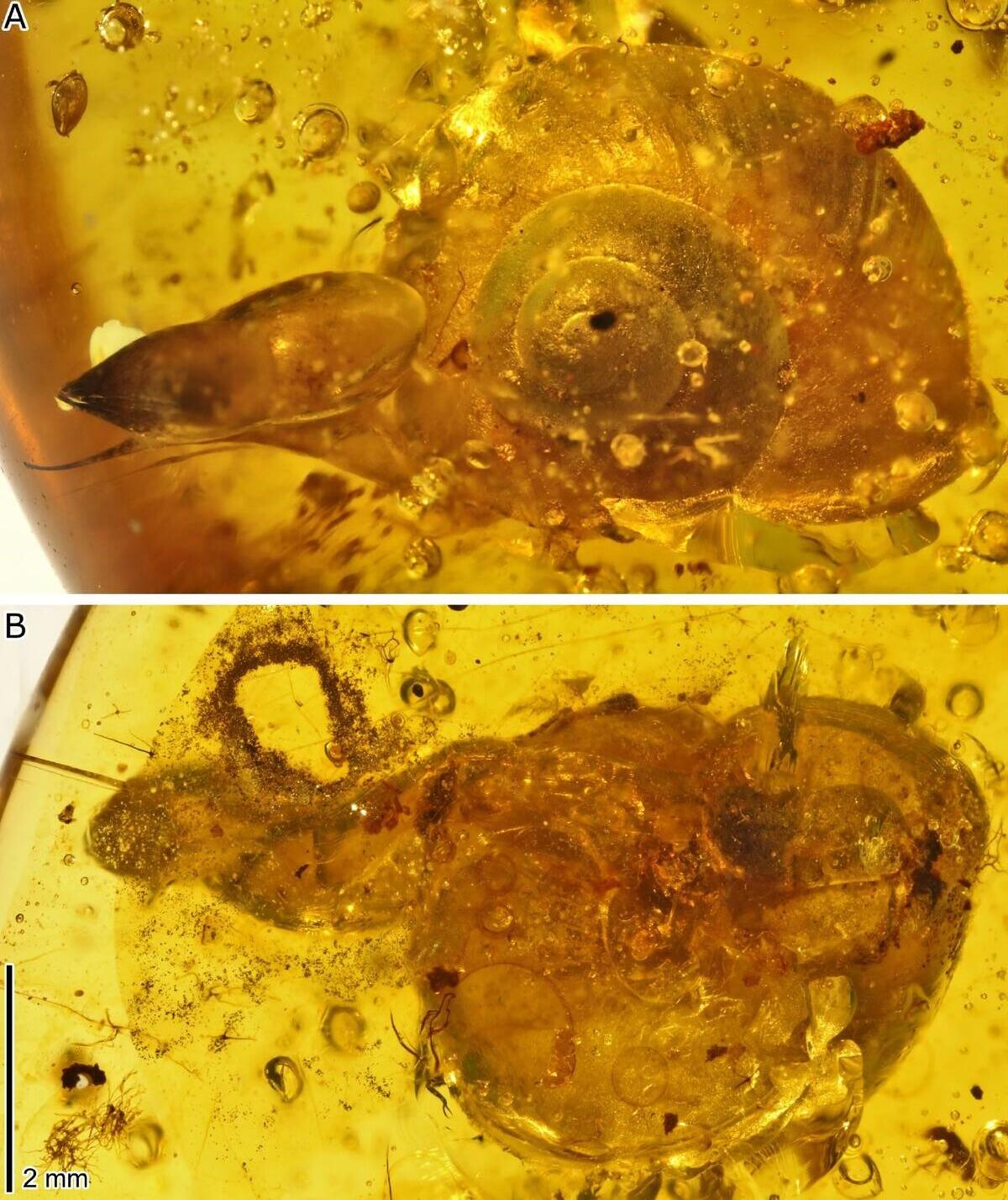
oldest recorded terrestrial gastropod with soft parts preserved in the fossil foot and inferred operculum, as studied by Jeff Stilwell and colleagues from China, Canada and Scotland. This extraordinary cyclophoroidean snail was discovered in early Late Cretaceous (early Cenomanian) amber (burmite) from Myanmar. See details of paper in Xing et al. (2018) in reference list. This amazing fossil was featured recently in National Geographic News. https://www.nationalgeographic.com/science/2018/10/news-snail-found-amber-dinosaurscretaceous-paleontology
Figure 2 Synchrotron microtomographic images of a well preserved lizard in early Late Cretaceous amber (burmite) of Myanmar, as studied by Monash University 2018 H1 Honours student, Kalinda Korkman. Scanning completed at the Australian Synchrotron by Dr Joseph Bevitt (ANSTO). Detail of granular dorsal scales exhibiting five evenly spaced rows of tuberculate scales. Hopefully, a paper will be submitted in the near future detailing the discovery.
Associate Professor Jeff Stilwell has had another busy teaching and research year in 2018 with a major focus on the amber discoveries. This research relates to his ARCDP140102515 grant (2014-17) with Dan Bickel of the Australian Museum (AM), David Cantrill, Ken Walker of Museums Victoria, of the Royal Botanic Gardens Victoria and colleagues in Spain, Germany and the UK. Jeff has renewed his affiliate status with the Australian Museum (Dec. 2017-Dec. 2020), ties with the AM remain active. Many of the organisms trapped in the Australian amber have no prior fossil record, so there is a vast amount of research to be done to work out affinities and reconstruct the terrestrial ecosystems with colleagues in Australia and around the globe, as much as these new data allow. Several quality papers are in preparation on the amber with many more submitted over time. Further research continues on the fossil avian remains of the Takatika Grit on the Chatham Islands in collaboration with colleagues from the University of Texas-Austin and also the Canterbury
Museum. One paper has been submitted recently. A major book on the palaeontology of the Chatham Islands has been completed with co-author Chris Mays. We have one contract offer, but we wait and see if any other publishers come to the table. A project on fossil Antarctic barnacles has also been completed by Jeff and Prof. John Buckeridge (RMIT, and also now a Monash affiliate). A major documentary on mass extinction featuring Jeff was finished this year with AstroMedia (Melbourne).
Dr Andy Langendam commenced in mid-2016 as the technical officer currently working on the ARC project "The first Mesozoic fossiliferous amber from Southern Gondwana". Andy is managing the labour intensive amber preparation for study and advanced imaging, developing and refining new techniques for high definition and 3D imaging of amber inclusions, implementing new standards for the preparation and conservation of amber, advising, and guiding students and researchers, as well as learning the ropes of the BK Advanced Imaging System to image the smallest of bioinclusions. Andy, along with 2017 Honours student and now Monash affiliate Lachlan Sutherland, assists with our student volunteer program to sort through a huge volume of bulk sediment to search for amber, especially in the deposits from Tasmania and Victoria. In Jeff Stilwell’s and Chris Mays’ eyes, Andy has made huge advances in amber palaeontology with many new significant discoveries, which relate to the extraction of relatively large pieces of amber. Our BK imaging has expanded to include external funding for Monash medicine and also Old Master art, which exemplifies the power of the BK.
High profile PhD projects have already had successful outcomes, including the collaborative project by Toban Wild with sponsorship from the University of Tasmania and the University of Sydney on both Cretaceous macro- and microfossils discovered in deep water in the Perth Abyssal Plain, particularly Batavia Knoll; significantly, these are the first palaeontologic data being gathered from Batavia Knoll, with surprising results. Toban and Jeff have just submitted a major paper to Palaeogeography Palaeoclimatology Palaeoecology assessing the tectonic and palaeobiogeographic significance of the Batavia Knoll Cretaceous invertebrate assesmblage. Andrew (‘Drew’) Giles has commenced his PhD on fossiliferous deposits of the Wairarapa, New Zealand. Ex-Honours (H1) Andrew Coward completed his Honours project on the geochemistry of the Paleogene amber deposits of Australia with flying colours, securing an H1 for his stellar efforts and also a lead author paper in 2018 in Organic Geochemistry on the amber (see papers below).
Staff Roles and Expertise for 2017-18:
Assoc. Prof. Jeffrey Stilwell (Chief Investigator and Leader) - Mesozoic-Cenozoic biostratigraphy, macro- and micropalaeontology, and palaeoenvironments
Dr Chris Mays (Monash Affiliate) – Palaeobotany, palynology, biostratigraphy
Dr Andy Langendam Imaging specialist and technical officer for amber project and also BK Imaging System
Prof. Emer. Pat Vickers-Rich – Palaeontology, Precambrian biotas and palaeoenvironments
Dr James Driscoll – Sedimentology, stratigraphy and basin studies
Dr Daniel Thompson (3D Oil Ltd) – Petroleum geoscience – external consultant and advisor
Dr David Briguglio (3D Oil Ltd) Petroleum geoscience external consultant and advisor
Dr Chris Consoli (Global CCS Institute) Carbon capture/storage in basin systems
Prof. David Cantrill (Research collaborator and advisor, Royal Botanic Gardens, Melbourne) – palaeobotany
Dr Dan Bickel (Research collaborator and advisor, Australian Museum, Sydney) –palaeoentomology
Dr Sarah Martin (Research collaborator and advisor, Geological Survey of Western Australia, Perth) – palaeoentomology
Prof. John Buckeridge (Research collaborator and Monash Honourary Affiliate in invertebrate palaeontology
Dr Joseph Bevitt (Research collaborator and advisor, ANSTO) scientific imaging specialist
Current PhD, MSc and Honours Students and Projects at Monash since 2017
Mr Toban Wild (PhD) – ‘Keystones in East Gondwana breakup: palaeontology and provenance of sedimentary strata from Batavia and Gulden Draak knolls, Perth Abyssal Plain, eastern Indian Ocean’
Mr Mitchell O’Mara (PhD) – ‘Stratigraphy and sedimentology of Paleozoic rocks, Tasmania’
Mr Andrew (Drew) Giles (PhD) ‘Understanding the inception, episodic growth, and depocentre migration within an accretionary wedge: A structural and sedimentary synthesis, northern Wairarapa, North Island, New Zealand’
Ms Kalinda Korkman (Honours H1, completed November 2018) ‘Mid-Cretaceous Bioinclusions in Burmese Amber: Investigating the palaeoecology and palaeoenvironments of an equatorial supergreenhouse ecosystem’[note: Kalinda received the 2018 Esso Australia prize]
Mr Lachlan Sutherland (Honours H1, completed November 2017) ‘Late Triassic Amber Bioinclusions: Contrasting resin-bearing localities of Italy and Australia in a Pangean palaeontologic and palaeoclimatic context’ [note: Lachie received the 2017 Esso Australia prize]
Mr Stephen Piva (Honours H1, completed November 2017) ‘The Cenomanian-Turonian δ13C record of the Chatham Islands, New Zealand: Implications for terrestrial stable carbon chemostratigraphy’ [note: Stephen received the 2017 Esso Australia prize and the 2017 Geological Society of New Zealand Annual Conference award for the Best Honours Student Presentation]
Grants 2017-18
2018 (CI1) Australian Synchrotron Beamtime Application, ANSTO, Reference # AS182/IMBL/13315, M13315, 2018/2, Co-proposer Andrew Langendam, ‘3D Imaging of the Oldest Recorded Animals and Plants in Amber from Southern Gondwana’ ($32,784)
2018 Monash University Faculty of Science, School of Earth, Atmosphere and Environment, 2nd year teaching enhancement fund ($40,000)
2018 (CI1) ESSO student scholarship award for Honours students in 2019 ($2,000)
2014-17 (Stilwell, CI1) Australian Research Council Discovery Projects (ARCDP140102515; JDS CI1 and administered through Monash with PIs Dan Bickel of Australian Museum and David Cantrill of Royal Botanic Gardens Melbourne), The first Mesozoic fossiliferous amber from Southern Gondwana: an ancient portal into an Australian polar greenhouse ($281,124.45 plus on-costs)
2017-18 (Stilwell, CI1, with Chris Mays) Robert Blackwood Research Seed Scheme (administered through Monash), ‘Amber as a Portal into Ancient Greenhouse Ecosystems of Southern Australia’ ($22,500)
2017 Australian Synchrotron beamline proposal, 2017/2, ‘Identifying the source of the oldest known amber of southern Gondwana’, N11959, J. Stilwell (Co-proposer) along with S. McLoughlin, J. Bevitt, D. Cantrill with C. Mays as CI1 (~$57,600)
2016-19 Padmanabhan, E. A. R. (and team), including Stilwell and Gamage, R. P. (CIs, Monash University), UTP/PETRONAS, ‘Impact of Rock Heterogeneities on Fracking and De/sorption Potentials in Some Selected Shales’ (RM 271,730.00 ~<A$84,000)
Selected Publications 2017-18:
Stilwell, J. D., and Mays, C. Completed (Contract received for Cambridge Scholars Publishing; seeking other expressions of interest). Lost World of Rēkohu: Ancient ‘Zealandian’ Animals and Plants of the Chatham Islands [book]
Xing, L., Ross, A.J., Stilwell, J.D., Fang, J., and McKellar, R.C. 2018. Juvenile snail with preserved soft tissue in mid-Cretaceous amber from Myanmar suggests a cyclophoroidean (Gastropoda) ancestry. Cretaceous Research 93, 114-119. https://doi.org/10.1016/j.cretres.2018.09.013
Coward, A.J., Mays, C., Patti, A.F., Stilwell, J.D., Viegas, P., and O’Dell. 2018. Taphonomy and chemotaxonomy of Eocene amber from southeastern Australia. Organic Geochemistry 118, 103-115.
Mays, C., Cantrill, D. J., Stilwell, J. D., and Bevitt, J. 2018. Neutron tomography of Austrosequoia novae-zeelandiae comb. nov. (Late Cretaceous, Chatham Islands, New Zealand): implications for Sequoioideae phylogeny and biogeography. Journal of Systematic Palaeontology 16:7, 551-570 DOI: 10.1080/14772019.2017.1314898.
Mays, C., Bevitt, J. J., and Stilwell, J. 2017. Pushing the limits of neutron tomography in palaeontology: Three-dimensional modelling of in situ resin within fossil plants. Palaeontologia Electronica 20.3.57ª, 1-12. https://doi.org/10.26879/808, palaeoelectronica.org/content/2017/2066-neutron-scan-plant-resin.
Conference Abstracts
Khan, M., Anderson, B., Allmon, W. and Stilwell, J. 2017. Paleoenvironmental interpretation of turritelline gastropod-dominated assemblages from the La Meseta Formation (Upper Eocene), Seymour Island, Antarctica. Geological Society of America Annual Meeting, Seattle, WA, USA, 24th Oct. 2017. Volume: Vol. 49, No. 6. 10.1130/abs/2017AM304464.
Piva, S. B., Mays, C. and Stilwell, J. D. 2017. The Cenomanian-Turonian δ13C record of the Chatham Islands: implications for terrestrial stable carbon chemostratigraphy. In: Baker, J. and Rowe, M. (eds). Abstracts, Geosciences 2017, Auckland, Geoscience Society of New Zealand Miscellaneous Publication 147A. p. 87.
RMIT University, Earth & Oceanic Systems Research Group
John Buckeridge continues his work on the palaeontology, palaeoecology, biology and distribution of marine invertebrates, especially barnacles. With Tom Koci (National Musem, Prague), he has described the earliest known Hexaminius – from the Eocene of Seymour Island. Paul Ter (on ichnology) and Fearghus McSweeney (on palaeobotany) continue their
good work with their respective doctoral studies. John retires at the end of 2018, but will continue supervision of his three doctoral candidates until their submission.
John, Alan Beu (GNS) and Dennis Gordon (NIWA) have published a re-assessment of the depositional environment of the Castlepoint Formation (East Coast, New Zealand) as having accumulated in, and around a canyon-head setting. We argue that this model is the best to explain the very diverse shallow and deep, cold and warm water faunas that occur within the Castlepoint Formation. John has also published a paper on a remarkable accumulation of the whale barnacles Coronula bifida (from the Pliocene of Taiwan) with Shih-Wei Lee (National Museum of Marine Science & Technology, Taiwan) and Benny Chan (Academia Sinica). Initially this accumulation was thought to be of Miocene age, which would have made this a very early Coronula record. Sadly, reassessment of the biostratigraphy showed it to be Pliocene.
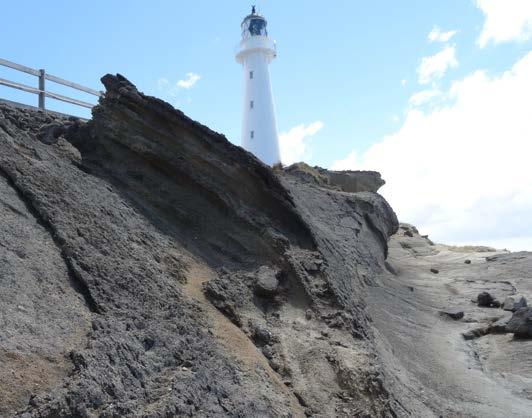
Figure 3: A canyon-head site in the Castlepoint Formation at Castlepoint, New Zealand, showing beds that locally appear to be folded. Strata behind the curved surface, in the distance and in the foreground, are subhorizontal. This apparent “fold” is thus sedimentary, rather than structural.
John continues his work with Jeff Stillwell (Monash University) on Eocene barnacles from recovered from the Antarctic Peninsula. We are exploring the use of positron emission tomography to investigate the internal relationships of barnacle plates in this unique specimen.
A chapter on the diverse geology and palaeontology of the Beaumaris Sandstone, Rickett’s Point, Victoria has been written by John. This is a contribution to an activity leader’s guide designed for “Park Interpretation” and is part of an initiative to support citizen science in Victoria.
Kočí, T., Vodrážka, R., Kočová M. and J. Buckeridge, 2018. An intertidal barnacle Hexaminius venerai sp. nov. (Austrobalanidae) colonizing logs of Podocarpoxylon from the La Meseta Formation (Eocene), Seymour Island, Antarctica: A glimpse of Antarctic antiquity. Historical Biology 31(5): doi.org/10.1080/08912963.2018.1452206
Buckeridge, J. S., 2018. Geology of Rickett’s Point, Beaumaris: An overview and learning guide. In: Activity Leader’s Guide for Marine Volunteers Chapter 13: 174–203. (Ed. R. V. Lewis). Greypath Publications, Melbourne. ISBN 978-1-760-56702-6.
Buckeridge, J. S., Beu A. and D. Gordon, 2018. Depositional environment of the early Pleistocene Castlepoint Formation, New Zealand: a canyon fill in situ. New Zealand Journal of Geology and Geophysics 61(4): 524–542. doi.org/10.1080/00288306.2018.1516227
In press: Buckeridge, J. S. Cirripedia: Thoracica. In New Zealand Coastal Invertebrates. Steven de C. Cooke (Ed.). University of Canterbury Press, Christchurch.
In press: Buckeridge J.S., Chang, B.K.K. and S-W Lee. Accumulations of the fossils of the whale barnacle Coronula bifida Bronn, 1831 (Thoracica: Coronulidae) provides evidence of a late Pliocene cetacean migration route through the Straits of Taiwan. Zoological Studies
In press: McSweeney F. and J.S. Buckeridge. The Baragwanathia Flora. Australian Age of Dinosaurs journal v.16.
In press: Coletti G., Bosio G., Collareta A., Buckeridge J., Consani S. and A. El Kateb. Miocene barnacle facies: an analysis with examples from the Old World (Northern Italy and Southern France) and the New World (Southwestern Peru). Geologica Carpathica
Swinburne University of Technology, Hawthorn, Victoria
Elaine Anderson (also Volunteer with Melbourne Museum) has just finished honours, with supervisors Dr Stephen F. Poropat and Dr Sarah Martin. My project was to re-describe all odonatan specimens from Koonwarra, held at Melbourne Museum, and to describe a new specimen found in May this year. I also suggested changes to the taxonomic families given to these specimens. I am currently working on a paper on the partial wing of Peraphlebia tetrastichia with André Nel and hope to write another, solely on the naiads, in the near future. I hope to attend the Fossil Insects and Amber conference in the Dominican Republic in April.
Adele H. Pentland (also Research Associate at the Australian Age of Dinosaurs Museum, Winton) has continued work on Australian Cretaceous pterosaurs in fulfilment of her PhD. This year saw the publication of a reappraisal of Mythunga camara, the most complete pterosaur described from Australia originally reported by Molnar & Thulborn (2007). Fieldwork in 2018 conducted with the Australian Age of Dinosaurs Museum, Winton, Queensland resulted in the excavation of sauropod cranial elements.
Pentland, A. H. and S. F. Poropat. 2019. Reappraisal of Mythunga camara Molnar & Thulborn, 2007 (Pterosauria, Pterodactyloidea, Anhangueria) from the upper Albian Toolebuc Formation of Queensland, Australia. Cretaceous Research 93, 151–169.
Pentland, A. 2018. Science Behind the Scenes. Australian Age of Dinosaurs Museum of Natural History Annual 15, 8.
Stephen F. Poropat (Swinburne University of Technology, Melbourne; also Research Associate at the Australian Age of Dinosaurs Museum, Winton and Melbourne Museum) is working on Australian Cretaceous sauropod dinosaur systematics, osteology, phylogenetic relationships, and palaeobiogeography. Fieldwork in Victoria (at Koonwarra with Melbourne Museum) and Queensland (in Winton with the Australian Age of Dinosaurs Museum) produced numerous intriguing fossils. One highlight was the excavation of a partial sauropod skull from the Winton Formation. He is also working on Victorian Cretaceous fossils with Pat Vickers-Rich and Tom Rich, and has been supervising a PhD student working on Australian pterosaurs and Honours students working on Victorian Cretaceous Crocodylomorpha and Odonata.
Klinkhamer, A.J., Mallison, H., Poropat, S.F., Sloan, T. & Wroe, S. In press. Comparative three-dimensional moment arm analysis of the sauropod forelimb: implications for the
transition to a wide-gauge stance in titanosaurs. Anatomical Record. Available online 12/10/2018.
Klinkhamer, A.J., Mallison, H., Poropat, S.F., Sinapius, G.H.K. & Wroe, S. In press. Threedimensional musculoskeletal modelling of the sauropodomorph hind limb: the effect of postural change on muscle leverage. Anatomical Record. Available online 09/10/2018.
Pentland, A.H. & Poropat, S.F., 2019. Reappraisal of Mythunga camara Molnar & Thulborn, 2007 (Pterosauria, Pterodactyloidea, Anhangueria) from the upper Albian Toolebuc Formation of Queensland, Australia. Cretaceous Research 93, 151–169.
González Riga, B.J., Mannion, P.D., Poropat, S.F., Ortiz David, L.D. & Coria, J.P. 2018 Osteology of the Late Cretaceous Argentinean sauropod dinosaur Mendozasaurus neguyelap: implications for basal titanosaur relationships. Zoological Journal of the Linnean Society 184(1), 136–181.
Poropat, S.F., Martin, S.K., Tosolini, A.-M.P., Wagstaff, B.E., Bean, L.B., Kear, B.P., Vickers-Rich, P. & Rich, T.H. 2018. Early Cretaceous polar biotas of Victoria, southeastern Australia an overview of research to date. Alcheringa 42(2), 157–229.
Poropat, S. 2018. The Koonwarra Fossil Bed. Ferns, flowers, fleas and fish... and feathers for good measure! Australian Age of Dinosaurs Museum of Natural History Annual 15, 64–82
Patricia Vickers-Rich Together with Tom Rich (Museum Victoria) and Kaja Antlej of Deakin University, the Little L Exhibition, an experiment at the National Wool Museum, Geelong, was put on to test conveying information about Leaellynasaura using both virtual and augmented reality techniques. Leaellynasaura is also the focus of an exhibition that will open at the Singapore Science Centre in May 2019. A realignment of 2 km of the South Gippsland Highway adjacent to the Koonwarra Fossil Fish Beds locality is to take place during the next few years. Detailed discussions have been held with Deborah McLees of Major Projects, Victoria, regarding what steps are to be taken in the possible eventuality of encountering a similar significant fossiliferous deposit in the path of the proposed realignment. As part of this, she authorized the drilling in January of a core through the known fossiliferous unit. Studies of samples from that core are being undertaken by Vivi Vajda on the palynology, Michael Tuite and David Flannery on the biomarkers, and Jay Kaufmann and Lauren Shepherd on the stable isotopes. By using these various approaches, it is intended to synthesize a history of what was a polar lake for several thousand years during the Early Cretaceous. The rest of the year was devoted to giving a series of lectures in Australia and Sarawak and crafting a program for a Palaeontology course that could be taught across several universities due to the shortness of funds to support such a venture at any one university. Pat is the supervisor of several PhD students working on the Precambrian of Africa, Iran and Siberia (Les Kriesfeld at Monash University, Julia Shuvalova and Farnoosh Farjandi at Swinburne University).
Books
Rich, T. H. & Vickers-Rich, P., 2018, in press and due out in early 2019. The Dinosaurs of Darkness. Indiana University Press, Bloomington. Vickers-Rich, P. with Rozanov, A. Yu., 2018. The Great Russian Dinosaurs Exhibition. A Joint Australian-Russian Venture 1993-1997 at a Time of the USSR-Russian Republic Transition. A Time of Stress on Science. PrimeSCI!, Swinburne University of Technology, NewArtWorx, Melboune: 302pp.
Popular Books
Ramos-Horta, J. & Vickers-Rich, P., 2018. O Mundo Perdido de Timor-Leste. Un Menino e um Crocodilo Viajam atraves dos Tempos. Lidel Press, Lisbone (launched in the Azores, Oct. 2017, and relaunched in Dili, Timor-Leste, 11 Jan. 2018).
In 2018 four more translations of the children’s reader O Mundo Perdido Timor Leste. A Boy and a Crocodile Travel Through Time authored by Nobel-Laureate Dr Jose Ramos-Horta and Dr Patricia Vickers-Rich were published. These were in Bahasa Malay, Bahasa Indonesia, Bengalli and Nepalese. These were funded by Swinburne University of Technology, Melbourne, and published through NewArtWorx and PrimeSCI!, Melbourne.
Technical publications
Antlej, K., Bykersma, M., Mortimer, M. Vickers-Rich, P., Rich, T. & Horan, B., 2017. Realworld data for virtual reality experiences: Interpreting excavations. Australian Cinema, 11 (3): 161-171.
Antlej, K., Horan, B., Mortimer, M., Leen, R., Allaman, M., Vickers-Rich, P. & Rich, T., 2018, in press. Mixed reality for museum experiences: A co-creative tactile-immersive virtual coloring game. Digital Heritage
Cui, H., Kaufman, A. J., Vickers-Rich, P., Kattan, F., Zuo, H., Trusler, P., Smith, J., Ivantsov, A., Rich, T., Kubsani, A. & Yazidi, A. & Liu, A.-M., 2018, submitted. A diagenetic origin for non-radiogenic 87Sr/86Sr abundances in Ediacaran carbonates of Saudi Arabia. Terra Nova.
Linnemann, U., Ovtcharova, M., Schaltegger, U., Gartner, A., Hautmann, M., Geyer, G., Vickers-Rich P., Rich, T., Plesseen, B., Hofmann, M., Zieger, J., Krause, R., Kriesfeld, L. & Smith, J. 2018. New high-resolution age data from the Ediacaran-Cambrian boundary indicate rapid, ecologically-driven onset of the Cambrian explosion. Terra Nova. doi:10.1111/ter.12368.
Linnemann, U., Pidal, A. P., Hofmann, M., Drost, K., Quesada, C., Gerdes, A., Marko, L., A.,Zieger, J., Ulrich, J., Kraus, R., Vickers-Rich, P. & Horak, J., 2017. A ~565 Ma old glaciation in the Ediacaran of peri-Gondwanan West Africa (Saxo-Thuringian zone, Germany). International Journal of Earth Sciences, Springer, DOI 10.1007/s00531-0171520-7: 27 pp. With supplementary material available electronically. Poropat, S.F., Martin, S.K., Tosolini, A.-M.P., Wagstaff, B.E, Bean, L.B., Kear, B.P., Vickers-Rich, P. & Rich, T.H. 2018. Early Cretaceous polar biotas of Victoria, southeastern Australia an overview of research to date. Alcheringa 42:157–229.
Rich, T. H., Flannery, T. F. & Vickers-Rich, P., 2018, in press. Evidence for a remarkably large-toothed monotreme from the Early Cretaceous of Lightning Ridge, NSW, Australia. In: Ashok Sahni Festschrift, Vertebrate Paleobiology and Paleoanthropology Book Series, Springer (Eds. Prasad & Patnaik).
Rich, T.H., Trusler, P, Kool, L., Pickering, D., Evans, A., Siu, K., Maksimenko, A., Kundrat, M., Gostling, N.J., Morton, S., Vickers-Rich, P., 2018, in press A third, remarkably small, tribosphenic mammal from the Mesozoic of Australia. In: Ashok Sahni Festschrift, Vertebrate Paleobiology and Paleoanthropology Book Series, Springer (Eds. Prasad & Patnaik).
Vickers-Rich, P., 2018. Beyond Combat: History of the Australian Military’s Other Tasks –written for the Australian War Memorial Museum, Canberra.
Vickers-Rich, Patricia, Sara Soleimani, Farnoosh Farjandi, Mehdi Zand, Ulf Linnemann, Mandy Hofmann, Siobhan A. Wilson, Raymond Cas, and Thomas H. Rich. "A preliminary report on new Ediacaran fossils from Iran." Alcheringa: An Australasian Journal of Palaeontology 42, no. 2 (2018): 230-243.
Woodward, H.N., Rich, T.H. & Vickers-Rich, P 2018. The bone microstructure of polar “hypsilophodontid” dinosaurs from Victoria, Australia. Scientific Reports 8:1162
Abstracts
Rich, T.H., Kear, B., Halawani, M. & Vickers-Rich, P. Vertebrate palaeontologicalpotential of the Marine Middle Triassic Jilh Formation, Kingdom of Saudi Arabia. Abstract Conference on the Geology of Saudi Arabia, Geologic Survey of Saudi Arabia, Feb. 2018, Jeddah, Saudi Arabia.
Vickers-Rich, P., Kattan, F., Johnson, P., Ivantsov, A., Qubsani, A. Al, Yazidi, A., Garni, S. M. Al., Linnemann, U., Hofmann, M., Rich, T.H., Trusler, P., Smith, J.. Rich, B. & Rich, T. 2018. Neoproterozoic complex life on the Arabian Shield: The Ediacarans – Life before the arrival of true animal diversity. Conference on the Geology of Saudi Arabia, Geologic Survey of Saudi Arabia, Feb. 2018, Jeddah, Saudi Arabia.
Vickers-Rich, P., Kattan, F., Johnson, P., Ivantsov, A., Qubsani, A. Al, Yazidi, A., Garni, S. M. Al., Linnemann, U., Hofmann, M., Rich, T., Trusler, P., Smith, J. & Rich, B. Neoproterozoic complex life on the Arabian Shield: The Ediacarans – Life before the arrival of true animal diversity. Abstract International Conference on the Ediacaran and Cambrian Sciences 2018 (ICECS2018), Northwest University, Xian, China, August 2018.
Vickers-Rich, P., Soleimani, S., Farjandi, F., Zahd, M., Linnemann, U., Hofmann, M., Wilson, S. A., Cas, R. & Rich, T.H. New Ediacaran-aged fossils from Central and Northwestern Iran Abstract International Conference on the Ediacaran and Cambrian Sciences 2018 (ICECS2018), Northwest University, Xian, China.
Vickers-Rich, P., Trusler, P. W., Narbonne, G. M., Sharp, A., Ivantsov, A. Yu., Linnemann, U., Hofmann, M., Kriesfeld, L., Kaufman, A. J., Cui, H., Smith, J., Hoffmann, K. H., Schneider, G., Elliott, D., Fedonkin, M. A., Hall, M. & Rich, T.H. New discoveries in the late Neoproterozoic of Namibia. Abstract International Conference on the Ediacaran and Cambrian Sciences August 2018 (ICECS2018), Northwest University, Xian, China.
Exhibitions
O Mundo Perdido Timor-Leste. The Long History of Timor-Leste – Permian to Present, 2018. Launched at the Xanana Gusmao Cultural Centre, Dili, Timor-Leste in January 2018 and has become a permanent exhibition. Two more regional Exhibitions in the highland village of Aileu (in cooperation with the Friends of Aileu [Moreland City Council, Melbourne], the Public Library of Aileu and the Maryknoll Catholic Sisters) and another at the Catholic Selesian Brothers Compound in Baucau were upgraded, 2018. (P. Vickers-Rich)
DinoQuest, the Dinosaurs of Darkness. Detailed planning underway with the Singapore Science Center, Singapore and DigiMagic for the launch of this exhibition in Singapore planned for April 2019. Funds raised for participation in this planning project and provision of our research material concerning the polar dinosaurs of Victoria, $70,000, 2018. (P. Vickers-Rich, T. H. Rich, S. Pritchard and P. Trusler). Working as a cooperative venture with the Singapore Science Centre, this exhibition is to tour after mid-2019 and continue to generate funding for research both at Swinburne University and Monash University, Melbourne.
Little L. A Virtual Reality Experience regarding the ongoing Field Research into the Cretaceous of Polar Victoria and the polar dinosaurs that have been discovered by Palaeontologists from Monash University, Swinburne University of Technology and Museum Victoria, working in concert on the VR and exhibition with a team from Deakin University,
Geelong. On show at the National Wool Museum, Geelong from late 2017 through March 2018. Negotiations are now underway between Deakin and the Singapore Science Centre to enhance and use this exhibition in an international program. (T. H. Rich and P. VickersRich). https://www.geelongaustralia.com.au/nwm/calendar/item/8d56891cf2b6d61.aspx
What Happened to Australia’s Megafauna? A joint project in planning with Ecolink in Bacchus Marsh, Victoria to install an exhibition with the large dromornithid bird, Bullockornis, a member of the now deceased megafauna that characterized the late Cenozoic of Australia. Along with the installation of this skeleton, PrimeSCI! (Swinburne and Monash) will provide educational materials crafted over the last two decades for use in both Primary and Secondary schools and will offer an opportunity for the training of Tertiary students in science communication.
The University of Melbourne www.earthsci.unimelb.edu.au
The School of Earth Sciences at the University of Melbourne has several staff working on a variety of palaeontological research themes. Our research interests range from the origin of animal life in the Cryogenian 650 million years ago (Wallace, Hood) to Mesozoic to Cenozoic foraminifera, environments and palynomorphs from northwest and southeast Australia (Gallagher, Wallace, Holdgate, Tosolini, Wagstaff, McLaren, Cupper). Other research includes dating mega-marsupial and early human fossils (Cupper). Several students have successfully completed palaeontology MSc projects in 2018. A full list of our staff, students and publications follows: Staff: Assoc Prof. Malcolm Wallace Reader: Neoproterozoic Cryogenian Life and reefs Assoc. Prof. Stephen Gallagher Reader: Mesozoic to Cenozoic micropalaeontology and palaeoceanography using foraminifera especially on IODP Expedition 356; Dr. Sandra McLaren Lecturer/Research Fellow: dating the onset of aridity in Australia Dr. Anne-Marie Tosolini Lecturer: Cretaceous to Paleogene palaeobotany of Antarctica and southeast Australia; Dr Matt Cupper Research Fellow: dating megafauna sites and human fossils; Dr Guy Holdgate - Research Fellow: the palaeoenvironmental evolution of Cenozoic brown coal; Dr. Barbara Wagstaff Research Fellow: Mesozoic to Cenozoic palynology; Dr Ashleigh Hood DECRA Research Fellow: Cryogenian geochemistry; Dr Julia Dickinson Research Fellow: Gippsland stratigraphy
Post graduate students (current):
PhD: Vera Korasidis Palynology of Latrobe Valley coals.
PhD: Maxwell Lechte Precambrian Ironstones
PhD: Brennan O’Connell phanerozoic oxygenation
PhD Liz Mahon Gippsland Basin coals
PhD: Jackson McCaffrey reefs of the Northwest Shelf.
PhD: Tony Sandler Echinoid taxonomy in the Miocene Mannum Limestone.
PhD: Alice Schuster Phanerozoic oxygenation
Bellefroid, E.J., Hood, A.V.S., Hoffman, P.F., Thomas, M.D., Reinhard, C.T., Planavsky, N.J., 2018. - Constraints on paleoproterozoic atmospheric oxygen levels. PNAS 115,8109.
De Vleeschouwer, D., Auer, G., Smith, R., Bogus, K.A., Christensen, B.A., Groeneveld, J., Patrick, B., Henderiks, J., Castañeda, I., O’Brien, E., Ellinghausen, M., Renema, W.,
Reuning, L., Ishiwa, McHugh, C.M., Gallagher, S.J. and Palike, H., 2018. The amplifying effect of Indonesian Throughflow heat transfer on Late Pliocene southern Hemisphere climate cooling. Earth and Planetary Science Letters 500, 15-27 doi. 10.1016/j.epsl.2018.07.0350012-821X
Frieling, J., Huurdeman, E. P., Rem, C.C.M., Donders, T. H., Pross, J., Bohaty, S. M., Holdgate, G. R., Gallagher, S. J., McGowran, B. and Bijl, P. K. 2018. Identification of the Paleocene-Eocene boundary in coastal strata in the Otway Basin, Victoria, Australia, Journal of Micropalaeontology 37, 317-339. doi.org/10.5194/jm-37-1-2018
Gallagher, S.J., Reuning, L., Himmler, T., Henderiks, J., De Vleeschouwer, D., Groeneveld, J., Rastigar, A., Fulthorpe, C.S., Bogus, and Expedition 356 Shipboard Scientists, 2018. The enigma of rare Quaternary oolites in the Indian and Pacific Oceans: a result of global oceanographic physicochemical conditions or a sampling bias Quaternary Science Reviews 200, 114-122, doi.10.1016/j.quascirev.2018.09.028
Gallagher, S.J., Sagawa, T., Henderson, A.C.G., Saavedra-Pellitero, M., De Vleeschouwer, D., Black, H., Itaki, T., Toucanne, S., Bassetti, M.A., Clemens, S., Anderson, W., Alvarez-Zarikian, C., Tada, R., 2018. - East Asian Monsoon History and Paleoceanography of the Japan Sea Over the Last 460,000 Years Paleoceanography and Paleoclimatology 33, 683-702. doi: 10.1029/2018PA003331
Hood, A.V.S., Planavsky, N.J., Wallace, M.W., Wang, X., 2018. - The effects of diagenesis on geochemical paleoredox proxies in sedimentary carbonates. Geochimica et Cosmochina Acta 232, - 287.
Hood, A.V.S., Wallace, M.W., 2018. - Neoproterozoic marine carbonates and their paleoceanographic significance. Global and planetary Change 160, - 45.
Keep, M., Holbourn, A., Kunht, W. and Gallagher, S.J., 2018. Progressive Western Australian collision with Asia: implications for regional orogography, oceanography, climate and marine biota., Journal of the Royal Society of Western Australia 101, 1-17.
Korasidis, V.A., Wagstaff, B.E., McCaffrey, J., Wallace, M.W., Fletcher. M-S., Rastogi, S., Gallagher, S.J. and Allan, T., 2018. New age controls on Oligocene and Miocene sediments in southeast Australia. Review of Palaeobotany and Palynology 256, 2031. doi: https://doi.org/10.1016/j.revpalbo.2018.05.003
Korasidis, V.A., Wallace, M.W., Wagstaff, B.E., Hill, R.S., 2019. - Terrestrial cooling record through the Eocene-Oligocene transition of Australia. Global and planetary Change 173, - 72.
Korasidis, V.A., Wallace, M.W., Wagstaff, B.E., Hill, R.S., 2019. - Evidence of fire in Australian Cenozoic rainforests. Palaeogeography, Palaeoclimatology, Palaeoecology 516, - 43.
Lechte, M.A., Wallace, M.W., Hood, A.V.S., Planavsky, N., 2018. - Cryogenian iron formations in the glaciogenic Kingston Peak Formation, California. Precambrian Research 310, - 462.
Poropat, S.F., Martin, S.K., Tosolini, A.M.P., Wagstaff, B.E., Bean, L.B., Kear, B.P., Vickers-Rich, P., Rich, T.H., 2018. - Early Cretaceous polar biotas of Victoria, southeastern Australia an overview of research to date. Alcheringa 42, 229.
Saavedra-Pellitero, M., Baumann, K-H, Gallagher, S.J., Sagawa, T. and Tada, R., accepted in press 3 January 2019 Paleoceanographic evolution of the Japan Sea over the last 460 kyr - a coccolithophore perspective. Marine Micropalaeontology
Sadler, T., Holmes, F.C. and Gallagher, S.J., 2019. Two new species of the echinoid genus Monostychia from the Miocene of Victoria and a redescription of M. etheridgei Tenison-Woods, 1877., Alcheringa doi.org/10.1080/03115518.2018.1528508
Sagawa, T., Nagahashi, Y. Satoguchi, Y., Holbourn, A., Itaki, T., Gallagher, S.J., SaavedraPellitero, M., Ikehara, K., T. Irino, T. and Tada, R. 2018, Integrated tephrostratigraphy and isotope stratigraphy in the Japan Sea and East China Sea using IODP Sites U1427, U1426 and U1429, Expedition 346 Asian Monsoon, Progress in Earth and Planetary Science 5, 18, doi. 10.1186/s40645-018-0168-7
Shuster, A.M., Wallace, M.W., van Smeerdijk Hood, A., Jiang, G., 2018. - The Tonian Beck Spring Dolomite: Marine dolomitization in a shallow, anoxic sea. Sedimentary Geology 368, - 104.
Tada, R., Irino, T., Ikehara, K., Karasuda, A., Sugisaki, S., Xuan, C., Sagawa, T., Itaki, T., Kubota, Y., Lu, S., Seki, A., Murray, R.W., Alvarez-Zarikian, C., Anderson, W.T., Bassetti, M.A., Brace, B.J., Clemens, S.C., da Costa Gurgel, M.H., Dickens, G.R., Dunlea, A.G., Gallagher, S.J., Giosan, L., et al, 2018. - High-resolution and -precision correlation of dark and light layers in the Quaternary hemipelagic sediments of the Japan Sea recovered during IODP Expedition 346, Progress in Earth and Planetary Science 5, 19doi. 10.1186/s40645-018-0167-8
Tagliaro, G., Fulthorpe, C.S., Gallagher, S.J., McHugh, C.M., Kominz, M., Lavier, L.L., 2018. Neogene siliciclastic deposition and climate variability on a carbonate margin: Australian Northwest Shelf, Marine Geology 403, 285300. doi.org/10.1016/j.margeo.2018.06.007
Tosolini, A-M., Korasidis, V., Wagstaff, B.E., Cantrill, D. J., Gallagher, S.J. and Norvick, M., 2018. Palaeoenvironments and palaeocommunities from Lower Cretaceous highlatitude sites, Otway Basin, southeastern Australia, Palaeogeography, Palaeoclimatology, Palaeoecology 496. 62-84.
Wallace, M.W., Hood, A.V.S., 2018. - Zebra textures in carbonate rocks: Fractures produced by the force of crystallization during mineral replacement. Sedimentary Geology 368,67.
Curtin University, Perth
WESTERN AUSTRALIA
PACE: Palaeontology, Ancient Climates and Environment
Milo Barham has been distracted by sediment tracking, provenance and basin evolution but continues to pursue interests in palaeontology. Primarily, oxygen isotopes in chordate biogenic apatite remain the focus of study, with investigations of the controls and applications of the palaeoenvironmental proxy to both terrestrial (Cenozoic micromammal) and marine (Palaeozoic) realms. Furthermore, research continues on conodont and microvertebrate biostratigraphy in the mid to late Palaeozoic.
Rodney Berrell is continuing to work on their PhD project entitled “early vertebrates from the Mesozoic of Eastern Australia”. This project is focusing on the Mesozoic Fish record (diversity, systematics and taxonmny) from the eastern half of the contient, including the Eromanga Basin of Queensland. Research continutes with Lionel Cavin, particularly around faunas from the Toolebuc Formation. 2018 has seen the focus on a rediscription of Dugaldia emmilta from the early Cretaceous Toolebuc Formation as an ichthyodectiform fish and submission of a literature review. 2019 research will focus on a redescription of Promecosomina formosa from the Early Triassic of the Sydney Basin, among others. The anticipated finish date for the PhD is late 2020.
Rodney has been editor of Nomen Nudum since 2016.
Catherine Boisvert is continuing to focus on elephant shark developmental biology as a way to understand early gnathostome innovations and continues to collaborate with Kate Trinajstic on Gogo fossils scanned at the Synchrotron. She has been selected for Homeward Bound, a global leadership programme for women culminating in a trip to Antarctica (November 2019), raising awareness about climate change and conservation. She is working with her student Jacob Pears on mineralisation in elephant shark and chondrichthyan breeding and conservation with her student Melissa Cristina Marquez. In addition to her paper published in Cell this year about the evolution of bipedal locomotion, she contributed chapters to two books. Two of those book chapters are coming out in November in a book called "Heads, Jaws, and Muscles: Anatomical, Functional, and Developmental Diversity in Chordate Evolution" published by Springer.
Kate Trinajstic is working on the evolution of novel structures, particularly the musculoskeletal system in placoderms, soft-tissue preservation, palaeoenvironments and biostratigraphy of early-vertebrates from Western Australia. Research continues with John Long and HDR candidate Sarah Hearne on the Gogo Reefs looking at the evolution of niche separation. I continue to work with Milo Barham to evaluate the suitability and accuracy of different vertebrate mineralised tissues as proxies for recording ontogenetic, phylogenetic and environmental signals. Work continues with Heidi Allen on Upper Devonian biostratigraphy using both conodonts and microvertebrates in the Canning, Carnarvon and Perth Basins. In August (2018) field work was undertaken with Dr. A. Mory (GSWA) looking at the Late Devonian and Carboniferous strata in the Bonaparte Gulf Basin of north-western Australia.
Berrell, R. W., Boisvert, C., Trinajstic, K., Siversson, M., Alvardo-Ortega, J., Cavin, L., Salisbury, S., and Kemp, A. In Review. Mesozoic Fishes of Australia: localities, taxonomy, taphonomy and biogeography. Alcheringa.
Boisvert, C; Johnston, P; Trinajstic, K.; Johanson, Z. In press. Chondrichthyans evolution, diversity and senses. In Heads, Jaws, and Muscles: Anatomical, Functional, and Developmental Diversity in Chordate Evolution. Ziermann, J; Diaz, R.E., Diogo, R (eds). Fascinating Life Sciences, Springer
Cavin, L., and Berrell, R. W. In Press. Revision of Dugaldia emmilta (Teleostei, Ichthyodectiformes) from the Toolebuc Formation, Albian of Australia, with comments on the jaw mechanics. Journal of Vertebrate Paleontology
Chevrinais, M., Johanson, Z., Trinajstic, K., Long, J. , Morel, C. , Renaud, C. B., Cloutier, R. and Cavin, L. 2018. Evolution of vertebrate postcranial complexity: axial skeleton regionalization and paired appendages in a Devonian jawless fish. Palaeontology, 61: 949-961. doi:10.1111/pala.12379.
Choo, B., Lu, J., Giles, S., Trinajstic, K., & Long, J. 2018. A new actinopterygian from the late Devonian Gogo formation, Western Australia. Papers in Palaeontology. Johanson, Z; Boisvert, C; Trinajstic, K. In Press. Early vertebrates and the emergence of jaws. In Heads, Jaws, and Muscles: Anatomical, Functional, and Developmental Diversity in Chordate Evolution. Ziermann, J; Diaz, R.E., Diogo, R (eds). Fascinating Life Sciences, Springer
Johanson, Z., Smith, M., Sanchez, S., Senden, T., Trinajstic, K., Pfaff, C., 2017 Questioning hagfish affinities of the enigmatic Devonian vertebrate Palaeospondylus R. Soc. open sci. 4: 170214. http://dx.doi.org/10.1098/rsos.170214
Jung, H., Baek, M., D’elia, K. P., Boisvert, C., Currie, P. D., Tay, B., Venkatesh, B., Brown, S. M., Heguy, A., Schoppik, D., Dasen, J. S. 2018. The Ancient Origins of Neural Substrates for Land Walking. Cell 172, 4., 667-682.
Long, J., & Trinajstic, K. 2018. A review of recent discoveries of exceptionally preserved fossil fishes from the Gogo sites (Late Devonian, Western Australia). Earth and Environmental Science Transactions of the Royal Society of Edinburgh, 108(1), 111-117. doi:10.1017/S1755691018000178.
Trinajstic, K., Boisvert, C., Long, J. A., Johanson, Z., 2018. Evolution of Vertebrate reproduction. In: Johanson, Z., Richter, M., Underwood, C. (eds). Evolution and development of fishes. Cambridge University Press.
The University of Western Australia Biostratigraphy Group
David Haig continues his retirement studies on the Carboniferous to Holocene of Western Australian and Timor basins, with brief excursions elsewhere. His 2018 publications are:
Haig, D.W., 2018. Permian (Kungurian) Foraminifera from Western Australia described by Walter Parr in 1942: reassessment and additions. Alcheringa: An Australasian Journal of Palaeontology 42, 37–66.
McLoughlin, S., Haig, D.W., Siversson, M., Einarsson, E., 2018. Did mangrove communities exist in the Late Cretaceous of the Kristianstad Basin, Sweden? Palaeogeography, Palaeoclimatology, Palaeoecology 498, 99–114.
Haig, D.W., 2018. Key stratigraphic horizons for assembling a revised tectonostratigraphic framework for Timor-Leste. Proceeding of 4th International Geoscience Conference on Timor-Leste Geological Resources Data and Information for Economic Diversification
and Development, Dili, 23–26 October 2018., pp. 19–27. http://ipg.tl/4th-ipginternational-conference/
Haig, D.W., Mossadegh, Z.K., Parker, J.H., Keep, M., in press. Middle Eocene neritic limestone in the type locality of the volcanic Barique Formation, Timor-Leste: microfacies, age and tectonostratigraphic affinities. Journal of Asian Earth Sciences: X; Manuscript number JAES-S-18_00646 (open access: available online under the journal name in Science Direct).
Haig, D.W., Foster, C.B., Mantle, D., Backhouse, J., Peyrot, D., 2018. Fossil protists (algae and testate protozoans) in the marine Phanerozoic of Western Austalia: a review through latitudinal change, climate extremes, and breakup of a supercontinent. Journal of the Royal Society of Western Australia 101, 44-67, Smith, M.G., Haig, D.W., Riera, R., Parker, J.H., under review. Evidence for widespread metahaline seagrass meadows in the Miocene (Burdigalian–Langhian) of Western Australia. Palaios manuscript 18-103.
Centre for Energy Geoscience, School of Earth Sciences,
Eckart Håkansson retired from School of Geology, University of Copenhagen, Denmark in 2008 and accepted as Honorary Research Fellow at UWA in 2009. My long term research has focussed on Arctic geology, the Cretaceous-Tertiary boundary, and cheilostome bryozoans at a global scale. In Western Australia I have been focussing on Permian, Cretaceous & Paleocene bryozoan faunas.
Steinthorsdottir, M. & Håkansson, E. 2017. Endo- and epilithic faunal succession in a Pliocene-Pleistocene cave on Rhodes, Greece: Record of a transgression. Palaeontology, 60, 663-681.
Haig, D.W., Mory, A.J., McCartain, E., Backhouse, J., Håkansson, E., Ernst, A., Nicoll, R.S., Shi, G.R, Bevan, J.C., Davydov, V.I., Hunter, A.W., Keep, M., Martin, S.K., Peyrot, D., Kossavaya, O. & Dos Santos, Z. 2017. Late Artinskian–Early Kungurian (Early Permian) warming and maximum marine flooding in the East Gondwana interior rift, Timor and Western Australia, and comparisons across East Gondwana. Palaeogeography, Palaeoclimatology, Palaeoecology, 468, 88-121.
Håkansson, E. & Pedersen, S.A.S. 2015. A healed strike-slip plate boundary in North Greenland indicated through associated pull-apart basins. In: Gibson, G. M., Roure, F. & Manatschal, G. (eds): Sedimentary Basins and Crustal Processes at Continental Margins: From Modern Hyper-extended Margins to Deformed Ancient Analogues. Geological Society, London, Special Publications, 413, 143-169.
Haig, D.W., McCartain, E., Mory, A.J., Borges, G., Davydov, V., Dixon, M., Ernst, A., Groflin, S., Håkansson, E., Keep, M., Dos Santos, Z., Guang, S., & Soares, J. 2014. Postglacial Early Permian (Sakmarian–Artinskian) shallow-marine carbonate deposition along a 2000 km transect from Timor-Leste to northern Perth Basin, Western Australia. Palaeogeography, Palaeoclimatology, Palaeoecology, 409, 180-204.
Azzarello, J.J., Smale, D.A., Langlois, T.J. & Håkansson, E. 2014. Linking habitat characteristics to abundance patterns of canopy-forming macroalgae and sea urchins in southwest Australia. Marine Biology Research, 10:7, 682-693.
Stilwell, J.D. & Håkansson, E. 2012. Survival, but......! New tales of ‘Dead clades walking’ from Austral and Boreal Post-K-T Assemblages. In: Talent, J.D. (Ed.): Earth and Life, International Year of Planet Earth. DOI 10.1007/978-90-481-3428-1_26, © Springer Science + Business Media B.V. 2012, 795-810.
O’Dea, A., Håkansson, E., Taylor, P. & Okamura, B. 2011. Environmental change prior to the K-T boundary inferred from temporal variation in the morphology of cheilostome bryozoans. Palaeogeography, Palaeoclimatology, Palaeoecology, 308, 502-512.
Western Australian Museum, Perth
Kenny J. Travouillon (Curator of Mammalogy, Western Australian Museum, Perth) is continuing to work at the Western Australian Museum. This year, he contributed to two books, the next issue of Mammals of Australia, coming out in 2019, and a book about skulls and teeth or Australian Mammals. He finished the revision of the Pig-footed Bandicoot, Chaeropus ecaudatus, and collaborated on an atlas for the Tasmanian Tiger, Thylacinus cynocephalus. He is now the new Chair of Australasian Palaeontologists and is keen unite the Palaeontology community further.
Travouillon, K.J. & Phillips, M.J. 2018. Total evidence analysis of the phylogenetic relationships of bandicoots and bilbies (Marsupialia: Peramelemorphia): reassessment of two species and description of a new species. Zootaxa 4378, 224-256. Butler, K., Travouillon, K. J., Price, G. J., Archer, M., & Hand, S. J. 2018. Revision of OligoMiocene kangaroos, Ganawamaya and Nambaroo (Marsupialia: Macropodiformes, Balbaridae). Palaeontologia Electronica 21.1.8A, 1-58. https://doi.org/10.26879/747
Geological Survey, Department of Mines, Industry Regulation and Safety (DMIRS)
The Geological Survey has recently (as of November 2017) undergone reorganisation as part of a State Government wide initiative. As part of this change, the previous Department of Mines and Petroleum is now the new Department of Mines, Industry Regulation and Safety (note changes to email and postal addresses). The Survey is now formally known as the Geological Survey and Resource Strategy Division, although the GSWA name and logo will be retained on publications.
Established in 1888, the Geological Survey celebrated its 130-year anniversary in late 2018.
Primary contacts
Heidi Allen = Precambrian and Paleozoic paleontology, stromatolites, ichnology
Sarah Martin = collections access, Mesozoic and Cenozoic paleontology, palynology
Collections
The GSWA Paleontology Collection remains open to all researchers, both within Australia and internationally. Work continues on an ongoing project to digitize the collection’s catalogue, and attempts to recover past (and often very overdue!) loans made by GSWA to various Australian institutions. Any information or queries regarding the location of potential Survey samples (generally numbered with a F- prefix) is most welcome contact Sarah Martin. GSWA is also currently investigating improved methods of collection imaging and data delivery, including 3D scanners for macrofossils and slide scanners for microfossil collections.
Publications
GSWA’s historic informal paleontology reports are available online to search and download (click ‘Paleontology Reports’ under ‘Using online catalogue’ at http://www.dmp.wa.gov.au/Geological-Survey/GSWA-publications-and-maps-1399.aspx. The reports will also be available through the Department’s eBookshop in early 2019). This collection includes a set of period summaries (akin to GSWA Bulletin 136 ‘Palaeontology of the Permian of Western Australia’, but covering the individual periods from the Precambrian to Quaternary) collated in the late 1980s and early 1990s. A new series of GSWA Paleontology Reports was established in 2016, providing an avenue for the rapid communication of basic data or one-off discoveries. Presently, these reports are only obtainable via text and keyword searches, although there are future plains for spatial searching via the GeoVIEW.WA platform (http://www.dmp.wa.gov.au/GeoView-WAInteractive-1467.aspx).
All GSWA publications (>100 years’ worth) are available for free download through eBookshop (http://www.dmp.wa.gov.au/ebookshop-1508.aspx) just type in appropriate search criteria. Use the DOWNLOAD button to obtain a pdf file (to download, print, or both).
Heidi-Jane Allen (Energy Geoscience and Carbon Strategy Group) is predominantly working on Proterozoic paleontology in her role with GSWA. Projects include Neoproterozoic paleontology of the Centralian Superbasin and regional mapping of stromatolitic units within the Turee Creek and Wyloo Groups. Heidi is also working on the trace fossil assemblages and new age constraints for the Tumblagooda Sandstone that will result in a stratigraphic revision of the Southern Carnarvon Basin.
As of 2018, Heidi is the secretary for GSA special interest group Australasian Palaeontologists (AAP).
Allen, H.J. & Haines, P.W., 2018. A stromatolite assemblage, including Eleonora boondawarica Grey and Walter, 1994 and Acaciella savoryensis Grey and Walter, 1994, from mineral drillhole AusQuest Table Hill 07THD003. Geological Survey of Western Australia, Paleontology Report 2018/1.
Allen, H.J., Grey, K., Haines, P.W., Edgoose, C.J., Normington, V.J., 2018. The Cryogenian Aralka Formation, Amadeus Basin: A basinwide biostratigraphic correlation. Geological Survey of Western Australia, Record 2018/11, 32p.
Allen, H.J. & Haines, P.W., 2018. Arumberia banksi: how well can MISS tell time? AGCC Adelaide 2018, abstract volume. 830p.
Allen, H.J. & Martin, D., 2018. Chicken or Egg? A diverse microbialite assemblage coeval with the Great Oxidation Event. AGCC Adelaide 2018, abstract volume. 830p.
Allen, H.J., Grey, K., Haines, P.W., Edgoose, C.J., Normington, V.J., 2018. A Cryogenian biostratigraphic update: hold the ice. AGCC Adelaide 2018, abstract volume. 830p.
Kath Grey (Consultant paleontologist) is presently in ill health. Please direct future enquiries about Kath’s health or collections access to Sarah Martin, and contact Heidi Allen for Precambrian paleontology. This will likely be Kath’s last contribution to Nomen Nudum. The ‘Handbook for the study and description of microbialites’ (co-written with Stan Awramik of UCSB) has been submitted to GSWA and is currently being edited. It is to be published as a Bulletin, with a proposed 2019 release date.
Suosaari, E.P., Awramik, S.M., Reid, R.P., Stolz, J.F. and Grey, K., 2018. Living dendrolitic microbial mats in Hamelin Pool, Shark Bay, Western Australia. Geosciences 8, doi: 10.3390/geosciences8060212.
Allen, H.J., Grey, K., Haines, P.W., Edgoose, C.J., Normington, V.J., 2018. A Cryogenian biostratigraphic update: hold the ice. AGCC Adelaide 2018, abstract volume. 830p.
Allen, H.J., Grey, K., Haines, P.W., Edgoose, C.J., Normington, V.J., 2018. The Cryogenian Aralka Formation, Amadeus Basin: A basinwide biostratigraphic correlation. Geological Survey of Western Australia, Record 2018/11, 32p.
Sarah Martin (Energy Geoscience and Carbon Strategy Group) is the primary contact for matters relating to GSWA’s paleontology collection. Sarah is part of a Survey team reassessing the stratigraphy of the southern Perth Basin, and is currently reviewing the biostratigraphy of this region. The first part of this work, collating all historic biostratigraphic data for the Harvey area of the southern Perth Basin, was published in 2018. Sarah is also providing paleontological support to other GSWA projects, including ongoing studies on the Ordovician of the Canning Basin and macrofossils of the Perth Basin.
Sarah also continues to work on Mesozoic insects, including: finalizing publication of her PhD research on Early Jurassic insects from Western Australia; continuing work on the Early Cretaceous Koonwarra insect assemblage of Victoria; and continuing research on insects from the Lower Triassic Kockatea Formation (in association with UWA). She recently contributed to a large summary paper summarizing all Early Cretaceous fossils from the state of Victoria.
Sarah is production editor of the Australasian Paleontological Memoirs, and one of many Associate Editors for Alcheringa: An Australasian Journal of Palaeontology.
Martin, S.K., 2018. A review of palynology from the Harvey region, southern Perth Basin, Western Australia. Geological Survey of Western Australia Report 174, 223p. Poropat, S.F., Martin, S.K., Tosolini, A.-M.P., Wagstaff, B.E, Bean, L.B., Kear, B.P., Vickers-Rich, P. & Rich, T.H., 2018. Early Cretaceous polar biotas of Victoria, southeastern Australia an overview of research to date. Alcheringa 42, 157–229.
MGPalaeo, Perth
Daniel Mantle is a consultant palynologist working on Australasian Carboniferous–Cretaceous projects. He has a particular interest in the Late Triassic of the North West Shelf and the correlation of the Australian palynological zonation to the geological timescale.
Wainman, C.C., Hannaford, C., Mantle, D. & McCabe, P.J. (2018). Utilizing U–Pb CATIMS dating to calibrate the Middle to Late Jurassic spore-pollen zonation of the Surat Basin, Australia to the geological time-scale. Alcheringa: An Australasian Journal of Palaeontology, 42(3), 402-414.
Wainman, C.C., Mantle, D.J., Hannaford, C., & McCabe, P.J. (2018). Possible freshwater dinoflagellate cysts and colonial algae from the Upper Jurassic strata of the Surat Basin, Australia. Palynology DOI: 10.1080/01916122.2018.1451785
Phillips, L.J., Crowley, J.L., Mantle, D.J., Esterle, J.S., Nicoll, R.S., McKellar, J.L. & Wheeler, A. (2018): U–Pb geochronology and palynology from Lopingian (upper Permian) coal measure strata of the Galilee Basin, Queensland, Australia. Australian Journal of Earth Sciences, 65(2), 153-173. DOI: 10.1080/08120099.2018.1418431
Mory, A.J., Crowley, J.L., Backhouse, J., Nicoll, R.S., Bryan, S.E., López Martínez, M. & Mantle, D. (2017): Apparent conflicting Roadian–Wordian (middle Permian) CAIDTIMS and palynology ages from the Canning Basin, Western Australia. Australian Journal of Earth Sciences. 64(7), 889-901. DOI: 10.1080/08120099.2017.1365586
Laurie, J.R., Bodorkos, S., Nicoll, R.S., Crowley, J.L., Mantle, D.J., Mory, A.J., Wood, G.R., Backhouse, J., Holmes, E.K., Smith, T.E. & Champion, D.C. (2016): Calibrating the middle and late Permian palynostratigraphy of Australia to the geologic time-scale via U–Pb zircon CA-IDTIMS dating.Australian Journal of Earth Sciences, 63, 701-730.
NEW ZEALAND
GNS Science, Lower Hutt
Roger Cooper with his research team - James Crampton, Peter Sadler, Michael Foote and Steve Meyers - has reported (Crampton et al., 2018) Milankovitch Grand cycles in the evolutionary rates of Ordovician and Silurian graptolites, indicating a significant influence of climatic cycles on evolution in the ancient marine plankton, accounting for 10 – 16% of the signal. The team has also (Foote et al. 2018) reported that the dependency of species diversification on diversity in graptolites accounts for 12% of the evolutionary signal and implies that biotic interactions also drive evolution. The result supports the ecological limits hypothesis of species diversity. With Jim Jago (Jago et al. in press) the Cambrian trilobite succession in Northern Victoria Land, Antarctica, is reviewed. Other projects under way are the tectonostratigraphic history of Antarctica, SE Australia and New Zealand (with Dick Glen) and New Zealand Cambrian trilobites (with Patrick Smith, Jim Jago and John Laurie).
Crampton, J.S., Meyers, S.R., Cooper, R.A., Sadler, P.M., Foote, M., and Harte, D., 2018. Pacing of Paleozoic macroevolutionary rates by Milankovitch grand cycles. Proc. Acad. Sci. America. Crossref DOI link: https://doi.org/10.1073/pnas.1714342115
Foote, M., Cooper, R.A., Crampton, J.S., Sadler, P., 2018. Diversity-dependent evolutionary rates in early Palaeozoic zooplankton. Proc. R. Soc. B 285: 20180122. http://dx.doi.org/10.1098/rspb.2018.0122
R. A. Cooper, J. S. Crampton, S. R. Meyers, P. M. Sadler & M. Foote (2018). "Graptolite evolution and paleoclimate: How the Court Jester manipulates the Red Queen. Geosciences Society of NZ Conference 'Geosciences 2018' 27-30 November 2018, Napier, NZ. Abstracts: 50.
Dallas Mildenhall has now officially retired but continues as an emeritus scientist to work a day or two a week at GNS Science. His current focus is primarily on the preparation of a database on New Zealand macrofossil plants and associated synonymies. He is also writing up or contributing to papers on forensic palynology and systematic palynology, biostratigraphy and palaeoenvironmental analyses of New Zealand Neogene sediments associated with maar craters. He is also continuing work on the palynology of sinter samples from the Pink & White Terraces, destroyed in the 1886 eruption of Mt Tarawera, trying to find a pollen signature so that falsified sinters, purportedly from the terraces, some selling for thousands of dollars, can be identified. He also undertakes administrative work on emails, databases, paper reviews, writing publicity articles, preparing talks for service groups, etc. He continues to lecture in forensic palynology at the New University of Lisbon, EGAS MONIZ,
Almada Campus, Portugal. Prebble, J.G., Reichgelt, T., Mildenhall, D.C., Greenwood, D.R., Raine, J.I.; Kennedy, E.M. & Seebeck, H.C. 2017. Terrestrial climate evolution in the Southwest Pacific over the past 30 million years. Earth and Planetary Science Letters 459, 136-144.
Lee, D.E., Kaulfuss, U., Schmidt, A., Conran, J.G., Bannister, J.M., Lindqvist, J.K., Vanner, M.R., Kennedy, E.M. & Mildenhall, D.C. 2017. A 70 m.y. long record of Araucarian forests in Zealandia: wood, leaves, pollen, and inclusions. Pp. 59-60 in: Baker, J.; Rowe, M. (Eds). Abstracts, Geosciences 2017. Auckland, Geoscience Society of New Zealand miscellaneous publication, 147A Geary, I.J., Beever, J.E., Hayward, B.W., Lee, D.E., Conran, J.G., Lord, J.M., Beu, A.G. & Mildenhall, D.C. 2017. Pliocene macro- and microfossil plants and fungi of Auckland. Pp. 38-39 in: Baker, J.; Rowe, M. (Eds). Abstracts, Geoscience 2017. Auckland, Geoscience Society of New Zealand miscellaneous publication 147A.
Schmidt, A.R., Kaulfuss, U., Bannister, J.M., Baranov, V., Beimforde, C., Bleile, N., Borkent, A., Busch, A., Conran, J.G.; Engel, M.S., Harvey, M.; Kennedy, E.M., Kerr, P.H., Kettunen, E., Kiecksee, A.P., Lengeling, F., Lindqvist, J.K., Maraun, M., Mildenhall, D.C., Perrichot, V., Rikkinen, J.; Sadowski, E.-M., Seyfullah, L.J., Stebner, F., Szwedo, J., Ulbrich, P. & Lee, D.E. 2017. Amber inclusions from New Zealand. Gondwana research 56, 135-146.
Kaulfuss, U., Lee, D.E., Wartho, J.-A., Bowie, E., Lindqvist, J.K., Conran, J.G., Bannister, J.M., Mildenhall, D.C., Kennedy, E.M. & Gorman, A.R. 2018. Geology and palaeontology of the Hindon Maar Complex: a Miocene terrestrial fossil Lagerstätte in southern New Zealand. Palaeogeography, palaeoclimatology, palaeoecology 500, 52-68.
Mildenhall, D.C., Conran, J.G., Kennedy, E.M., Lee, D.E., Bannister, J.M., Lindqvist, J.K. & Ferguson, D.K. 2018. Palynology of the late Oligocene-early Miocene Newvale Mine, Gore Lignite Measures, Southland, New Zealand. Palaeontographica B, 298, 23-91.
Seyfullah, L.J., Lee, D.E., Kaulfuss, U., Schmidt, A.R., Mildenhall, D.C., Kennedy, E.M., Conran, J.G., Bannister, J.M. & Lindqvist, J.K. 2018. Amber and the Araucarian forest of New Zealand. P. 124 in: Program and abstracts, 10th European Palaeobotany and Palynology Conference, University College, Dublin, Ireland, 12-17 August 2018.
Kaulfuss, U., Bannister, J.M., Conran, J.G., Mildenhall, D.C. & Lee, D.E. (in press). A new fern macrofossil Microsorum n.sp. (Polypodiaceae) with in situ spores of Polypodiisporites n.sp. from the early Miocene Foulden Maar, New Zealand. Review of palynology and palaeobotany
Kaulfuss, U., Mildenhall, D.C., Kennedy, E.M., Bannister, J.M. & Lee, D.E. (in press).
Pollen-bearing cones of Podocarpus and Podocarpaceae foliage from the Miocene of New Zealand. Australian systematic botany
Conran, J.G., Kaulfuss, U., Bannister, J.M., Mildenhall, D.C. & Lee, D.E. (in press). An Akania (Akaniaceae) inflorescence and associated pollen from the Early Miocene of New Zealand. Australian Journal of botany.
Songtham, W., Kruainok, P., Punwong, P. & Mildenhall, D.C. (in press). Recent changes in depositional environments by a meandering river and a marine incursion, Pak Nam Pram area, Pran Buri, Prachuap Khiri Khan, south western Thailand. Proceedings of International Geological Correlation Programme 589.
Mildenhall, D.C. (in prep.). Synonymy list of macrofossil plants described or identified from New Zealand, in systematic order. GNS report series.
GNS Science, Lower
Hutt
Paleontology Department
The paleontology department is led by Lucia Roncaglia, and currently employs 16 researchers (some part-employed by Victoria University of Wellington) and five technicians, with six emeritus research staff. As noted in previous Nomen Nudum issues, several research staff specialise as palynologists (Chris Clowes, Erica Crouch, Xun Li, Joe Prebble). Other areas of expertise include foraminifera (Martin Crundwell, Hugh Morgans), radiolaria (Giuseppe Cortese, Chris Hollis), plant macrofossils (Liz Kennedy), marine shells (James Crampton), Quaternary paleoecology (Marcus Vandergoes), and Antarctic paleoclimate (Nick Golledge, Richard Levy). Claire Shepherd is employed on contract researching Paleogene and Neogene nannofossils. Kristina Pascher returned to Germany after short-term employment following her PhD on paleobiogeography of Eocene radiolarians in the SW Pacific, while Georgia Grant commenced a 6-month contract to write up her PhD research on Friis Hills (Miocene, Antarctica) geochemistry and create a database for a CONOP project with data from the South Pacific. Ian Raine (palynologist) continues part-time contract work at GNS, working on Jurassic to Paleogene paleoclimates and on an apiculture project for the Ministry for Primary Industries.
Our collections manager is Marianna Terezow, while Henry Gard is employed as a Laboratory and Collection Technician. Sonja Bermudez, Lizette Reyes, and Roger Tremain are laboratory technicians.
Emeritus research staff now include Alan Beu, Roger Cooper, Dallas Mildenhall, John Simes, Percy Strong, and George Scott. For Roger and Dallas, see their separate entries. During the year, emeriti Graeme Stevens and Dave Skinner were farewelled to full retirement after many years writing up research
A comprehensive reorganisation of the structure and research activities of the institute gained momentum during 2018. In early 2019 this will result in the disappearance of the Paleontology Department, most paleontologists being allocated to a Paleontology Team within a new (and much larger) Department of Crustal Geology and Surface Processes led by Roncaglia. The Paleontology Team will continue the emphasis on paleoenvironmental research. A few biostratigraphers (Clowes, Crundwell and Morgans), will join the Geological Mapping and Stratigraphy Team within the same department, but laboratory and curatorial staff will transfer to a separate Department of Geological Research Laboratories and Collections.
Three other paleontologists are currently working in other units:
Hamish Campbell has for many years acted as resident geologist at Te Papa, as part of GNS Science's liaison with the national museum. He is also the New Zealand representative for IGCP. At GNS he has carried out research into Mesozoic terranes, assisted many overseas scientific visitors, and been very active in public promotion of geology and paleontology, including in TV programmes such as the New Zealand version of "Coast".
Ursula Cochran and Kate Clark are in the current Active Landscapes department. With backgrounds in Quaternary diatom and foraminiferal paleoecology respectively, a major part of their work relates to interpretation of Late Quaternary sediments for records of uplift, subsidence, as well as earthquake and tsunami frequency/magnitude.
Publications (conference abstracts excluded; for Cooper and Mildenhall see also their separate contributions):
Adams, C.J.; Campbell, H.J.; Griffin, W.L. 2018. Provenance of Jurassic sandstones in the Rakaia Terrane, Canterbury, New Zealand. New Zealand Journal of Geology and Geophysics, 61(2): 136-144; doi: 10.1080/00288306.2018.1447975
Adams, C.J.; Campbell, H.J.; Jongens, R. 2017. Triassic age for a conglomerate clast in the Waipapa Terrane, North Island, New Zealand. New Zealand Journal of Geology and Geophysics, 60(4): 519-523; doi: 10.1080/00288306.2017.1369131
Anderson, H.J.; Moy, C.M.; Vandergoes, M.J.; Nichols, J.E.; Riesselman, C.R.; Van Hale, R. 2018. Southern Hemisphere westerly wind influence on southern New Zealand hydrology during the Lateglacial and Holocene. Journal of Quaternary Science, 33(6): 689-701; doi: 10.1002/jqs.3045
Becker, J.S.; Baker, V.; Hollis, C.J.; Roncaglia, L.; Coyle, F.J. 2017. Community engagement on future petroleum exploration in New Zealand: a proposed methodology. Lower Hutt, N.Z.: GNS Science. GNS Science report 2017/03. 47 p.; doi: 10.21420/G21S3G
Becker, J.S.; Baker, V.; Hollis, C.J.; Waitaki, H.; Try, D. 2018. Developing a dialogue to understand public perceptions of petroleum exploration and inform future community engagement in New Zealand. Lower Hutt, N.Z.: GNS Science. GNS Science report 2018/01. 73 p.; doi: 10.21420/G21H0K
Berryman, K.R.; Clark, K.J.; Cochran, U.A.; Beu, A.G.; Irwin, S. 2018. A geomorphic and tectonic model for the formation of the flight of Holocene marine terraces at Mahia Peninsula, New Zealand. Geomorphology, 307: 77-92; doi: 10.1016/j.geomorph.2017.10.014
Bicknell, R.D.C.; Collins, K.S.; Crundwell, M.P.; Hannah, M.; Crampton, J.S.; Campione, N.E. 2018. Evolutionary transition in the late Neogene planktonic foraminiferal genus Truncorotalia. iScience, 8: 295-303; doi: 10.1016/j.isci.2018.09.013
Buckeridge, J.S.; Beu, A.G.; Gordon, D.P. 2018. Depositional environment of the early Pleistocene Castlepoint Formation, New Zealand: a canyon fill in situ. New Zealand Journal of Geology and Geophysics, 61(4): 524-542; doi: 10.1080/00288306.2018.1516227
Conran, J.G.; Kennedy, E.M.; Bannister, J.M. 2018. Early Eocene Ripogonaceae leaf macrofossils from New Zealand. Australian systematic botany, 31(1): 8-15; doi: 10.1071/SB17016
Crampton, J.S.; Meyers, S.R.; Cooper, R.A.; Sadler, P.M.; Foote, M.; Harte, D.S. 2018. Pacing of Paleozoic macroevolutionary rates by Milankovitch grand cycles. Proceedings of the National Academy of Sciences of the United States of America, 115(22): 56865691; doi: 10.1073/pnas.1714342115
Crundwell, M.P. 2018. Globoconella pseudospinosa, n.sp.: a new early Pliocene planktonic foraminifera from the Southwest Pacific. Journal of Foraminiferal Research, 48: 288300; doi: 10.2113/gsjfr.48.4.288
Dallanave, E.; Agnini, C.; Pascher, K.M.; Maurizot, P.; Bachtadse, V.; Hollis, C.J.; Dickens, G.R.; Collot, J.; Monesi, E. 2018. Magneto-biostratigraphic constraints of the Eocene micrite-calciturbidite transition in New Caledonia: tectonic implications. New Zealand
Journal of Geology and Geophysics, 61(2): 145-163; doi: 10.1080/00288306.2018.1443946
Dowling, L.H.; Clark, K.J.; Howarth, J.D.; Litchfield, N.J.; Cochran, U.A. 2018. The Hikurangi Margin Coastal Radiocarbon Age Database. Lower Hutt, N.Z.: GNS Science. GNS Science report 2018/03. 14 p.; doi: 10.21420/G2Q35J
Field, B.D.; Sykes, R.; Naeher, S.; Ventura, G.T.; Clowes, C.D.; Pascher, K.M.; Shepherd, C.L.; Griffin, A.G.; Hollis, C.J. 2018. Depositional influences on the petroleum potential of the Waipawa Formation in the Orui-1A drillhole, Wairarapa. Lower Hutt, N.Z.: GNS Science. GNS Science report 2017/49. 76 p.; doi: 10.21420/G2MM18
Fischer, H.; Meissner, K.J.; Mix, A.C.; Abram, N.J.; Austermann, J.; Brovkin, V.; Capron, E.; Colombaroli, D.; Daniau, A.-L.; Dyez, K.A.; Felis, T.; Finkelstein, S.A.; Jaccard, S.L.; McClymont, E.L.; Rovere, A.; Sutter, J.; Wolff, E.W.; Affolter, S.; Bakker, P.; Ballesteros Canovas, J.A.; Barbante, C.; Caley, T.; Carlson, A.E.; Churakova, O.; Cortese, G.; Cumming, B.F.; Davis, B.A.S.; de Vernal, A.; Emile-Geay, J.; Fritz, S.C.; Gierz, P.; Gottschalk, J.; Holloway, M.D.; Joos, F.; Kucera, M.; Loutre, M.-F.; Lunt, D.J.; Marcisz, K.; Marlon, J.R.; Martinez, P.; Masson-Delmotte, V.; Nehrbass-Ahles, C.; Otto-Bliesner, B.L.; Raible, C.C.; Risebrobakken, B.; Sanchez Goni, M.F.; Arrigo, J.S.; Sarnthein, M.; Sjolte, J.; Stocker, T.F.; Velasquez Alvarez, P.A.; Tinner, W.; Valdes, P.J.; Vogel, H.; Wanner, H.; Yan, Q.; Yu, Z.; Ziegler, M.; Zhou, L. 2018. Palaeoclimate constraints on the impact of 2 °C anthropogenic warming and beyond. Nature geoscience, 11: 474-485; doi: 10.1038/s41561-018-0146-0
Foote, M.; Cooper, R.A.; Crampton, J.S.; Sadler, P.M. 2018. Diversity-dependent evolutionary rates in early Palaeozoic zooplankton. Proceedings of the Royal Society. Biological Sciences, 285(1873):2018122; doi: 10.1098/rspb.2018.0122
Fu, H.; Hu, X.; Crouch, E.M.; An, W.; Wang, J.; Garzanti, E. 2018. Upper Cretaceous trench deposits of the Neo-Tethyan subduction zone: Jiachala Formation from Yarlung Zangbo suture zone in Tibet, China. Science China. Earth Sciences, 62(9): 1204-1220; doi: 10.1007/s11430-017-9223-5
Gemmell, M.R.; Trewick, S.A.; Crampton, J.S.; Vaux, F.; Hills, S.F.K.; Daly, E.E.; Marshall, B.A.; Beu, A.G.; Morgan-Richards, M. 2018. Genetic structure and shell shape variation within a rocky shore whelk suggest both diverging and constraining selection with gene flow. Biological Journal of the Linnean Society, Online first: doi: 10.1093/biolinnean/bly142
Grant, G.R.; Sefton, J.P.; Patterson, M.O.; Naish, T.R.; Dunbar, G.B.; Hayward, B.W.; Morgans, H.E.G.; Alloway, B.V.; Seward, D.; Tapia, C.A.; Prebble, J.G.; Kamp, P.J.J.; McKay, R.; Ohneiser, C.; Turner, G.M. 2018. Mid- to late Pliocene (3.3–2.6 Ma) global sea-level fluctuations recorded on a continental shelf transect, Whanganui Basin, New Zealand. Quaternary Science Reviews, 201: 241-260; doi: 10.1016/j.quascirev.2018.09.044
Hines, B.R.; Gazley, M.F.; Collins, K.S.; Bland, K.J.; Crampton, J.S.; Ventura, G.T. 2018. Chemostratigraphic resolution of widespread reducing conditions in the southwest Pacific Ocean during the Late Paleocene. Chemical Geology, Online first: doi: 10.1016/j.chemgeo.2018.11.020
Howarth, J.D.; Cochran, U.A.; Langridge, R.M.; Clark, K.J.; Fitzsimons, S.J.; Berryman, K.R.; Villamor, P.; Strong, D.T. 2018. Past large earthquakes on the Alpine Fault: paleoseismological progress and future directions. New Zealand Journal of Geology and Geophysics, 61(3): 309-328; doi: 10.1080/00288306.2018.1464658
Kaulfuss, U.; Lee, D.E.; Wartho, J.-A.; Bowie, E.; Lindqvist, J.K.; Conran, J.G.; Bannister, J.M.; Mildenhall, D.C.; Kennedy, E.M.; Gorman, A.R. 2018. Geology and palaeontology
of the Hindon Maar Complex: a Miocene terrestrial fossil Lagerstätte in southern New Zealand. Palaeogeography, Palaeoclimatology, Palaeoecology, 500: 52-68; doi: 10.1016/j.palaeo.2018.03.022
Kearse, J.; Little, T.A.; Van Dissen, R.J.; Barnes, P.M.; Langridge, R.M.; Mountjoy, J.; Ries, W.F.; Villamor, P.; Clark, K.J.; Benson, A.; Lamarche, G.; Hill, M.P.; Hemphill-Haley, M. 2018. Onshore to offshore ground-surface and seabed rupture of the Jordan–Kekerengu–Needles fault network during the 2016 M w 7.8 Kaikoura earthquake, New Zealand. Bulletin of the Seismological Society of America, 108(3B): 1573-1595; doi: 10.1785/0120170304
Levy, R.H.; Dunbar, G.B.; Vandergoes, M.J.; Howarth, J.D.; Kingan, T.; Pyne, A.R.; Brotherston, G.; Clarke, M.; Dagg, B.; Hill, M.; Kenton, E.; Little, S.; Mandeno, D.; Moy, C.; Muldoon, P.; Doyle, P.; Raines, C.; Rutland, P.; Strong, D.T.; Terezow, M.; Cochrane, L.; Cossu, R.; Fitzsimons, S.; Florindo, F.; Forrest, A.L.; Gorman, A.R.; Kaufman, D.S.; Lee, M.K.; Li, X.; Lurcock, P.; McKay, N.; Nelson, F.; Purdie, J.; Roop, H.A.; Schladow, S.G.; Sood, A.; Upton, P.; Walker, S.L.; Wilson, G.S. 2018. A highresolution climate record spanning the past 17 000 years recovered from Lake Ohau, South Island, New Zealand. Scientific Drilling, 24: 41-50; doi: 10.5194/sd-24-41-2018
Levy, R.H.; Meyers, S.R.; Naish, T.R.; Golledge, N.R.; McKay, R.M.; Crampton, J.S.; DeConto, R.M; De Santis, L.; Florindo, F.; Gasson, E.G.W.; Harwood, D.M.; Luyendyk, B.P.; Powell, R.D.; Clowes, C.; Kulhanek, D.K. 2019. Antarctic ice-sheet sensitivity to obliquity forcing enhanced through ocean connections. Nature Geoscience, 12: 132–137; doi: 10.1038/s41561-018-0284-4
Litchfield, N.J.; Villamor, P.; Van Dissen, R.J.; Nicol, A.; Barnes, P.M.; Barrell, D.J.A.; Pettinga, J.R.; Langridge, R.M.; Little, T.A.; Mountjoy, J.J.; Ries, W.F.; Rowland, J.; Fenton, C.; Stirling, M.W.; Kearse, J.; Berryman, K.R.; Cochran, U.A.; Clark, K.J.; Hemphill-Haley, M.; Khajavi, N.; Jones, K.E.; Archibald, G.C.; Upton, P.; Asher, C.; Benson, A.; Cox, S.C.; Gasston, C.; Hale, D.; Hall, B.; Hatem, A.E.; Heron, D.W.; Howarth, J.D.; Kane, T.J.; Lamarche, G.; Lawson, S.; Lukovic, B.; McColl, S.; Madugo, C.; Manousakis, J.; Noble, D.; Pedley, K.; Sauer, K.; Stahl, T.; Strong, D.T.; Townsend, D.B.; Toy, V.G.; Williams, J.; Woelz, S.; Zinke, R. 2018. Surface rupture of multiple crustal faults in the 2016 M W 7.8 Kaikoura, New Zealand, earthquake. Bulletin of the Seismological Society of America, 108(3B): 1496-1520; doi: 10.1785/0120170300
Mildenhall, D.C.; Conran, J.G.; Kennedy, E.M.; Lee, D.E.; Bannister, J.M.; Lindqvist, J.K.; Ferguson, D.K. 2018. Palynology of the late Oligocene–early Miocene Newvale Mine, Gore Lignite Measures, Southland, New Zealand. Palaeontographica. Abteilung B, Palaeophytologie, 298(1-3): 23-91; doi: 10.1127/palb/2018/0060
Morgans, H.E.G.; Clowes, C.D. 2018. Proposed new reference section for the base of the Bortonian stage (middle Eocene), New Zealand. New Zealand Journal of Geology and Geophysics, Online first: doi: 10.1080/00288306.2018.1531035
Naafs, B.D.A.; Rohrssen, M.; Inglis, G.N.; Lähteenoja, O.; Feakins, S.J.; Collinson, M.E.; Kennedy, E.M.; Singh, P.K.; Singh, M.P.; Lunt, D.J.; Pancost, R.D. 2018. High temperatures in the terrestrial mid-latitudes during the early Palaeogene. Nature Geoscience, 11: 766-771; doi: 10.1038/s41561-018-0199-0
Newstrom-Lloyd, L.; Raine, I.; Li, X. 2017: Pondering over and under pollen representation in nectar. New Zealand Beekeeper, November 2017, pp.29-31.
Otero, R.A.; O'Gorman, J.P.; Moisley, W.L.; Terezow, M.; McKee, J. 2018. A juvenile Tuarangisaurus keyesi Wiffen and Moisley 1986 (Plesiosauria, Elasmosauridae) from the Upper Cretaceous of New Zealand, with remarks on its skull ontogeny. Cretaceous research, 85: 214-231; doi: 10.1016/j.cretres.2017.09.007
Pattyn, F.; Ritz, C.; Hanna, E.; Asay-Davis, X.; DeConto, R.; Durand, G.; Favier, L.; Fettweis, X.; Goelzer, H.; Golledge, N.R.; Kuipers Munneke, P.; Lenaerts, J.T.M.; Nowicki, S.; Payne, A.J.; Robinson, A.; Seroussi, H.; Trusel, L.D.; van den Broeke, M. 2018. The Greenland and Antarctic ice sheets under 1.5 °C global warming. Nature Climate Change, 8: 1053-1061; doi: 10.1038/s41558-018-0305-8
Potter, S.H.; Grace, E.S.; Payne, B.; Levy, R.H. 2018. Uses of sea level rise information by local government: Hawke's Bay case study. Lower Hutt, N.Z.: GNS Science. GNS Science report 2018/32. 19 p.; doi: 10.21420/GE9F-1K76
Prebble, J.G.; Hinojosa, J.L.; Moy, C.M. 2018. Palynofacies assemblages reflect sources of organic matter in New Zealand fjords. Continental shelf research, 154: 19-25; doi: 10.1016/j.csr.2017.12.009
Raine, J.I.; Kennedy, E.M.; Griffin, A.G.; Sykes, R.; Clowes, C.D. 2018. Materials for improved assessment of the petroleum source potential of New Zealand coaly rocks, 1: mid-Cretaceous stratigraphy, coal abundance, flora, and climate. Lower Hutt, N.Z.: GNS Science. GNS Science report 2018/07. 99 p.; doi: 10.21420/G20D20
Reichgelt, T.; Kennedy, E.M.; Conran, J.G.; Lee, W.G.; Lee, D.E. 2019. The presence of moisture deficits in Miocene New Zealand. Global and Planetary Change, 172: 268-277; doi: 10.1016/j.gloplacha.2018.10.013
Sangiorgi, F.; Bijl, P.K.; Passchier, S.; Salzmann, U.; Schouten, S.; McKay, R.; Cody, R.D.; Pross, J.; van de Flierdt, T.; Bohaty, S.M.; Levy, R.H.; Williams, T.; Escutia, C.; Brinkhuis, H. 2018. Southern Ocean warming and Wilkes Land ice sheet retreat during the mid-Miocene. Nature Communications, 9(1): article no. 317; doi: 10.1038/s41467017-02609-7
Schmidt, A.R.; Kaulfuss, U.; Bannister, J.M.; Baranov, V.; Beimforde, C.; Bleile, N.; Borkent, A.; Busch, A.; Conran, J.G.; Engel, M.S.; Harvey, M.; Kennedy, E.M.; Kerr, P.H.; Keltunen, E.; Kiecksee, A.P.; Lengeling, F.; Lindqvist, J.K.; Maraun, M.; Mildenhall, D.C.; Perrichot, V.; Rikkinen, J.; Sadowski, E.-M.; Seyfullah, L.J.; Stebner, F.; Szwedo, J.; Ulbrich, P.; Lee, D.E. 2018. Amber inclusions from New Zealand. Gondwana Research, 56: 135-146; doi: 10.1016/j.gr.2017.12.003
Scott, G.H. 2018. Clinal variation in aperture shape in Southwest Pacific Globorotalia partimlabiata and its ancestor about the time of the Middle Miocene Climatic Transition. Marine Micropaleontology 141: 1-9; doi: 10.1016/j.marmicro.2018.02.001
Scott, G.H. 2019. Recognition of Truncorotalia crassaformis as a modern planktonicforaminiferal morphospecies in the Caribbean and equatorial Atlantic Ocean and proposal of a neotype. Journal of Foraminiferal Research, 49: 94–102; doi: 10.2113/gsjfr.49.1.94
Sutherland, R.; Dickens, G.R.; Blum, P.; Expedition 371 Scientists. 2018. Expedition 371 Preliminary Report: Tasman Frontier Subduction Initiation and Paleogene Climate. International Ocean Discovery Program. doi: 10.14379/iodp.pr.371.2018
Strong, C.P.; Raine, J.I.; Terezow, M. 2018. Key species of New Zealand fossil foraminifera: descriptions from "Manual of New Zealand Permian to Pleistocene Foraminiferal Biostratigraphy" by Hornibrook, Brazier and Strong, 1989. GNS Science miscellaneous publication 123; doi: 10.21420/G2M63W.
Strong, E.E.; Puillandre, N.; Beu, A.G.; Castelin, M.; Bouchet, P. 2019. Frogs and tuns and tritons - A molecular phylogeny and revised family classification of the predatory gastropod superfamily Tonnoidea (Caenogastropoda). Molecular Phylogenetics and Evolution, 130: 18-34; doi: 10.1016/j.ympev.2018.09.016
Taylor, K.W.R.; Willumsen, P.S.; Hollis, C.J.; Pancost, R.D. 2018. South Pacific evidence for the long-term climate impact of the Cretaceous/Paleogene boundary event. EarthScience Reviews, 179: 287-302; doi: 10.1016/j.earscirev.2018.02.012
Upton, P.; Cochran, U.A.; Orchiston, C.; Howarth, J.D.; Pettinga, J.; Townend, J. 2018. Tercentenary of the 1717 AD Alpine Fault earthquake: advances in science and understanding hazards. New Zealand Journal of Geology and Geophysics, 61(3): 247250; doi: 10.1080/00288306.2018.1512389
van den Bos, V.; Rees, A.; Newnham, R.; Vandergoes, M.J.; Wilmshurst, J.; Augustinus, P. 2018. Holocene temperature, humidity and seasonality in northern New Zealand linked to Southern Hemisphere summer insolation. Quaternary Science Reviews, 201: 77-88; doi: 10.1016/j.quascirev.2018.10.008
Vandergoes, M.J.; Howarth, J.D.; Dunbar, G.B.; Turnbull, J.C.; Roop, H.A.; Levy, R.H.; Li, X.; Prior, C.A.; Norris, M.W.; Keller, E.D.; Baisden, W.T.; Ditchburn, R.G.; Fitzsimons, S.J.; Bronk Ramsey, C. 2018. Integrating chronological uncertainties for laminated lake sediments. Quaternary Science Reviews, 188: 104-120; doi: 10.1016/j.quascirev.2018.03.015
Vaux, F.; Trewick, S.A.; Crampton, J.S.; Marshall, B.A.; Beu, A.G.; Hills, S.F.K.; MorganRichards, M. 2018. Evolutionary lineages of marine snails identified using molecular phylogenetics and geometric morphometric analysis of shells. Molecular Phylogenetics and Evolution, 127: 626-637; doi: 10.1016/j.ympev.2018.06.009
Geomarine Research, Auckland
Bruce Hayward is semi-retired but continues some foraminiferal research on salt marsh records of subduction earthquakes and tsunamis off the NZ East Coast, foraminiferal proxy evidence for the source and sedimentation of Holocene earthquake-generated turbidites in the Hikurangi Trough, the molecular and morphological identity of Recent species of Ammonia world-wide, and compilation of the World Register of Marine Species (Foraminifera fossil and Recent). 2018 was mostly devoted to preparation of my latest book on a field guide to the volcanoes of Auckland. I was fortunate to be awarded the Joseph Cushman Medal for life-time foraminiferal research and the RSNZ Hutton Medal for contributions to knowledge of NZ's marine ecology and geology.
Eagle, M.K., Hoskins, L., Hayward, B.W., 2018. The first macrofossil (Crinoidea:Cladida) from the Caples Terrane, Northland, New Zealand. New Zealand Journal of Geology & Geophysics 61, 498-507.
Grant, G.R., Sefton, J.P., Patterson, M.O., Naish, T.R., Dunbar, G.R., Hayward, B.W., Morgans, H.E.G., Alloway, B.V., Seward, D., Taipa, C.A., Prebble, J.G., Kamp, P.J.J., McKay, R., Ohneiser, C., Turner, G.M., 2018. Mid- to late Pliocene (3.3e2.6 Ma) global sea-level fluctuations recorded on a continental shelf transect, Whanganui Basin, New Zealand. Quaternary Science Reviews 201, 241-260.
Hayward, B.W. 2018. Fossil pharyngeal tooth plate from an Early Miocene fish (?Labridae), Waiheke Island. Geocene 16, 19-20.
Hayward, B.W., Hoskins, L., Eagle, M.K., 2018. First macrofossil found in the Caples Terrane of the North Island - a Permian sea lily. Geocene 16, 2-4
Independent researchers
Donald MacFarlan is working on New Zealand and New Caledonian Early Jurassic terebratulide and spiriferinide brachiopods. This is part of a full taxonomic survey of New Zealand and New Caledonian Jurassic brachiopods. The terebratulide study was presented at the 8th International Brachiopod Congress in Milan in September 2018, and the written paper is about to be submitted to the Congress proceedings. Work on the last of the spiriferinides continues. I also presented a paper on “Jurassic Crises in Zealandia at the IGCP 632 symposium “Jurassic Crises in Southern-most Gondwana” held as part of the 2018 GSBZ conference in Napier.
RUSSIA
Saratov State University
Evgeny Popov is associate professor at the Saratov State University and external researcher at the Kazan Federal University, Russia and has a research interest in fossil chondrichthyan fishes. The core of research activity is systematics and evolution of late Paleozoic, Mesozoic and Cenozoic holocephalian fishes (order Chimaeriformes mainly) in global context. Both MSc and PhD dissertation fulfilled in the SSU were based on Russian holocephalian (suborder Chimaeroidei) records. Because of this activity Saratov University have now largest in the World collection of isolated MZ-CZ chimaeroid remains (ca. 10 000 dental plates, fine spines, head claspers etc.) from territory of the northern Eurasia (former USSR).
In 2007 Evgeny has started a global revision of Chimaeroidei based on study of all available materials in Europe and North America.
Morphological study of chimaeroid specimens from New Zealand (GNS Science) was conducted in 2017-2018 and preliminary results were reported at the All-Russian scientific Meeting, dedicated to the memory of Professor Vitaly G. Ochev (Moscow, May 29-30, 2017) (see reference below, the abstract is available via Evgeny’s RG profile). Several other publications that deal with Australian and New Zealand chimaeroid material are in preparation.
Popov, E.V., Terezow, M.G. 2018. Revision of chimaeroid fishes (Holocephali, Chimaeroidei) from the Upper Cretaceous and Paleocene of New Zealand // Novikov I.V. & Ivanov A.V. (eds.). ‘Problems of paleoecology and historical geology’: Abstracts of the All-Russian scientific meeting, dedicated to the memory of Professor Vitaly G. Ochev. Moscow-Saratov: PIN RAS-SSTU. P. 61-62. [In Russian]
Translated abstract: Late Cretaceous and Paleocene chimaeroid fishes from the South Pacific region consist of three previously reported taxa: Ischyodus brevirostris Egerton, 1843 (= I. thurmanni Pictet & Campiche, 1858) and Callorhinchus hectori Newton, 1876 (both are from the Piripauan (= Santonian) of Amuri Bluff, South Island); additionally the recently described Edaphodon kawai Consoli, 2006 (mid-Campanian to mid-Danian Takatika Grit of the Chatham Islands). A revision of the chimaeroid remains (mostly isolated dental plates plus a fin spine fragment) from the National Paleontological Collection, GNS Science, Lower Hutt (ca.100 specimens) shows a more diverse chimaeroid assemblage from the Late Cretaceous of the region. Based on new determ inations, the chimaeroid assemblage from the regional Piripauan stage (=Santonian) consists of just “ I. thurmanni”. The Piripauan-Haumurian interval (=Santonain-Maastrichtian) has yielded Callorhinchus hectori, ‘Elasmodectes’ sp. (a new genus of chimaeroid with sectorial dentition), “Stoilodon” sp., Elasmodus sp. as well as ‘Lebediodon’ sp. The Haumurian stage (=Campanian-Maastrichtian) assemblage consists of Callorhinchus hectori, ‘Elasmodectes’ sp., Elasmodus sp. and Ischyodus sp. Specimens from the Teurian stage (=Paleocene) were determined as Ischyodus dolloi Leriche, 1902 and Callorhinchus sp. Thus, the Late Cretaceous assemblage of NZ shows a presence of common elephant fish (Callorhinchus), relatively rare Ischyodus and more diverse ‘edaphodontids’ with sectorial (cutting and fine grinding) dentitions, in contrast to the dominance of ‘edaphodontids’ with crushing dentitions in the Northern Hemisphere (Popov, 2008; Popov, Machalski, 2014). Edaphodon kawai can be re-determined as Elasmodus kawai, which additionally confirms an absence of Edaphodon spp. in the Austral-Pacific region during the Cretaceous (Popov, 2011). ‘I. thurmanni’ represents a different species from the Early Cretaceous I. thurmanni known from the Northern Hemisphere. Specialized ‘edaphodontids’ (‘Stoilodon’, ‘Elasmodectes’, and ‘Lebediodon’) are recorded from the region for the first time.
SWEDEN
Department of Palaeobiology, Swedish Museum of Natural History
Vivi Vajda is working on high-resolution palynology, sedimentology, and geochemistry of major extinction and biotic radiation events in Earth’s history—particularly key boundary sections for the Permian–Triassic, Triassic–Jurassic and Cretaceous–Paleogene transitions in New Zealand, eastern Australia (Sydney Basin), China, western North America and Colombia. Vivi is Head of the Department of Palaeobiology at the Swedish Museum of Natural History in Stockholm.
Field, D. J., Bercovici, A., Berv, J. S., Dunn, R., Fastovsky, D. E., Lyson, T. R., Vajda, V., & Gauthier, J. A., 2018. Early Evolution of Modern Birds Structured by Global Forest Collapse at the End-Cretaceous Mass Extinction. Current Biology DOI: 10.1016/j.cub.2018.04.062
Kustatscher, E., Ash, S.R., Karasev, E., Pott, C., Vajda, V., Yu, J. & McLoughlin, S., 2018. Flora of the Late Triassic. In: Tanner, L.H., ed., Late Triassic of the World. Earth in a Time of Transition. Topics in Geobiology 46, Springer, Cham, Switzerland, 545–622. 10.1007/978-3-319-68009-5_13
Peng, J., Li, J., Li, W., Slater, S.M., Zhu, H.& Vajda, V. 2018. The Triassic to Early Jurassic palynological record of the Tarim Basin, China. In S. M. Slater, E. Kustatscher & V. Vajda, (Eds.), Jurassic biodiversity and terrestrial environments. Palaeobiodiversity and Palaeoenvironments, 98(1) doi:10.1007/s12549-017-0279-y
Peng, J., Li, J., Slater, S. M., Li, W., Zhu, H. & Vajda, V. 2018. Triassic palynostratigraphy and palynofloral provinces: evidence from southern Xizang (Tibet), China. Alcheringa: An Australasian Journal of Palaeontology doi:10.1080/03115518.2017.1370726
Renne, P. R., Arenillas, I., Arz, J. A., Vajda, V., Gilabert, V. & Bermúdez, H. D., 2018. Multi-proxy record of the Chicxulub impact at the Cretaceous-Paleogene boundary from Gorgonilla Island, Colombia. Geology doi: https://doi.org/10.1130/G40224.1
Shevchuk, O., Slater, S. M., & Vajda, V. 2018. Palynology of Jurassic (Bathonian) sediments from Donbas, northeast Ukraine. In S. M. Slater, E. Kustatscher & V. Vajda, (Eds.), Jurassic biodiversity and terrestrial environments. Palaeobiodiversity and Palaeoenvironments, 98(1) https://doi.org/10.1007/s12549-017-0310-3
Slater, S. M., Kustatscher, E. & Vajda, V. (Eds). 2018. An introduction to Jurassic biodiversity and terrestrial environments. Palaeobiodiversity and Palaeoenvironments, 98(1)
Slater, S. M., Wellman, C. H., Romano, M. & Vajda, V. 2018. Dinosaur-plant interactions within a Middle Jurassic ecosystem palynology of the Burniston Bay dinosaur footprint locality, Yorkshire, UK. In S. M. Slater, E. Kustatscher & V. Vajda, (Eds.), Jurassic biodiversity and terrestrial environments. Palaeobiodiversity and Palaeoenvironments, 98(1) https://doi.org/10.1007/s12549-017-0309-9
Stephen McLoughlin is working on Permian and Mesozoic seed-plants from eastern Australia, east Antarctica, and China that are funded by the Swedish Research Council and National Science Foundation. He is investigating the floristic turnover at the Permian–Triassic transition in eastern Australia. Steve is an Honorary Editor for Alcheringa.
Bomfleur, B., Blomenkemper, P., Kerp, H. & McLoughlin, S. 2018. Polar regions of the Mesozoic–Paleogene greenhouse world as refugia for relict plant groups. Transformative Paleobotany: Papers to Commemorate the Life and Legacy of Thomas N. Taylor. Krings, M., Harper, C.J., Cúneo, N.R., Rothwell, G.W. (eds), Elsevier, Amsterdam, 593–611. ISBN: 9780128130124
Edirisooriya, G., Dharmagunawardhane, H.A. & McLoughlin, S., 2018. The first record of the Permian Glossopteris flora from Sri Lanka: implications for hydrocarbon source rocks in the Mannar Basin. Geological Magazine 155: 907–920. DOI: https://doi.org/10.1017/S0016756816001114
Kustatscher, E., Ash, S.R., Karasev, E., Pott, C., Vajda, V., Yu, J. & McLoughlin, S., 2018. Flora of the Late Triassic. In: Tanner, L.H., ed., Late Triassic of the World. Earth in a Time of Transition. Topics in Geobiology 46, Springer, Cham, Switzerland, 545–622. 10.1007/978-3-319-68009-5_13
McLoughlin, S. & Pott, C., 2018. Plant mobility in the Mesozoic: disseminule dispersal strategies of Chinese and Australian Middle Jurassic to Early Cretaceous plants. Palaeogeography, Palaeoecology, Palaeogeography. https://doi.org/10.1016/j.palaeo.2017.12.036
McLoughlin, S., Bomfleur, B. & Drinnan, A.N., 2018. Pachytestopsis tayloriorum gen. et sp. nov., an anatomically preserved glossopterid seed from the Lopingian of Queensland, Australia. Transformative Paleobotany: Papers to Commemorate the Life and Legacy of Thomas N. Taylor. Krings, M., Harper, C.J., Cúneo, N.R., Rothwell, G.W. (eds), Elsevier, Amsterdam, 155–178. ISBN: 9780128130124
McLoughlin, S., Haig, D.W., Siversson, M. & Einarsson, E., 2018. Did mangrove communities exist in the Late Cretaceous of the Kristianstad Basin, Sweden? Palaeogeography, Palaeoecology, Palaeogeography 498: 99–114.
McLoughlin, S., Pott, C. & Sobbe, I., 2018. The diversity of Australian Mesozoic bennettitopsid reproductive organs. Palaeobiodiversity and Palaeoenvironments 98: 71–95 DOI: https://doi.org/10.1007/s12549-017-0286-z
Chris Mays is continuing a postdoctoral fellowship at the Swedish Museum of Natural History working on the palynology and macroflora of the Permian–Triassic transition in eastern Australia (Sydney Basin). He also continues work on various projects relating to the Cretaceous floras of southeastern Australia, amber of Australia, and the fossil flora of the Chatham Islands.
Mays, C. and Cantrill, D., 2018. Protodammara reimatamoriori, a new species of conifer (Cupressaceae) from the Upper Cretaceous Tupuangi Formation, Chatham Islands, Zealandia. Alcheringa. https://doi.org/10.1080/03115518.2017.1417478
UNITED STATES
University of Montana, Missoula
Tamara Fletcher has (since volume 33 of Nomen Nudum) completed publication of her Ph.D study on the palaeoenvironment of the upper portion of the Winton Formation, Queensland. This has progressed amidst recent postdoctoral work on the palaeoclimate of the Pliocene Arctic and recent climate reconstructions in continental USA.
Fletcher, T., Lepley, K., Rouini, N., Bloye, R., Tremarelli, C., Peña, K., Meko, D., Touchan, R. 2019. Two reconstructions of August–July precipitation for central northern Arizona from tree-rings. Tree-Ring Research In Press.
Fletcher, T., Csank, A., Ballantyne, A.P. 2019. Identifying bias in cold season temperature reconstructions by beetle mutual climatic range methods in the Pliocene Canadian High Arctic. Palaeogeography, Palaeoclimatology, Palaeoecology 514, 672-676 10.1016/j.palaeo.2018.11.025
Fletcher, T., Moss, P., Salisbury, S. W. 2018. Palaeoenvironmental reconstruction of the Upper Cretaceous (Cenomanian-Turonian) portion of the Winton Formation, centralwestern Queensland, Australia. PeerJ 6:e5513. 10.7717/peerj.5513
Fletcher, T., Feng, R., Telka, A. M., Matthews, J.V., Ballantyne A. B. 2017. Floral dissimilarity and the influence of climate in the Pliocene High Arctic: Biotic and abiotic
influences on five sites on the Canadian Arctic Archipelago. Frontiers in Ecology and Evolution: Paleoecology 5, 19, 1¬13. 10.3389/fevo.2017.00019
Gosse, J.C., Ballantyne, A.P., Barker, J.D., Csank, A.Z., Fletcher, T.L., Grant, G.W., Greenwood, D.R., MacPhee, R.D., Rybczynski, N. 2017. PoLAR-FIT: Pliocene Landscapes and Arctic Remains—Frozen in Time. Geoscience Canada 44, 47–54.
Feng, R., Otto-Bliesner, B, Fletcher, T., Tabor, C., Ballantyne, A. Brady, E. 2017. Amplified Late Pliocene terrestrial warmth in northern high latitudes from greater radiative forcing and closed Arctic Ocean gateways. Earth and Planetary Science Letters 466, 129–138. 10.1016/j.epsl.2017.03.006.
Fletcher, T.L., Moss, P.T., Salisbury, S.W. 2015. Wood growth indices as climate indicators from the Upper Cretaceous (Cenomanian–Turonian) portion of the Winton Formation, Australia. Palaeogeography Palaeoclimatology Palaeoecology 417, 35–43.
Fletcher, T.L., Greenwood, D.R., Moss, P.T., Salisbury, S.W. 2014. Palaeoclimate of the Late Cretaceous (Cenomanian–Turonian) portion of the Winton Formation, central-western Queensland, Australia: new observations based on CLAMP and Bioclimatic Analysis. Palaios 29, 121–128.
Fletcher, T.L., Cantrill, D.J., Moss, P.T., Salisbury, S.W. 2014. A new species of Protophyllocladoxylon from the Upper Cretaceous (Cenomanian-Turonian) portion of the Winton Formation, central-western Queensland, Australia. Review of Palaeobotany and Palynology 208, 43–49.
Fletcher, T.L., Salisbury, S.W. 2014. Probable oribatid mite (Acari: Oribatida) tunnels and faecal pellets in silicified conifer wood from the Late Cretaceous (Cenomanian–Turonian) portion of the Winton Formation, central-western Queensland, Australia. Alcheringa 38, 541–545.
University of Oregon, Eugene Department of Earth Sciences
Greg Retallack continues with Precambrian paleosols, and now has found the oldest known paleosol at 3.7 Ga from the Isua Greenstone Belt of Greenland. Coauthor Nora Noffke collected the whole profile as a slab, and laboratory analyses did not falsify the paleosol hypothesis. The carbon isotope composition of organic matter in the profile appears biotic, and is consistent within the profile. Ultrastructural studies of the organic matter are now in progress. This 3.7 Ga profile, like many other Archean paleosols on Earth and Mars, has abundant sulfate sand crystals as evidence for acid sulfate, rather than hydrolytic, weathering on the early Earth.
The Ediacaran debate goes on with a stunning discovery of sterols in Dickinsonia, but my eletter to Science points out that this does not necessarily mean Dickinsonia was an animal. Cholesterol is also found in glomeromycotan lichens, which have long been proposed for the Ediacaran from spores, vesicles and a permineralized lichen from China. Interestingly, the green algal stigmasterol declines in abundance relative to cholesterol in larger Dickinsonia, unlike an animal increasingly fouled with algae or patchy algal feeding. This observation is compatible with building of fungal biomass by symbiotic algae.
Another paper in press on interflag sandstone laminae shows that Dickinsonia and other fossils grew on and were covered by windblown layers within alluvial facies. These distinctive thin eolian beds were not limited to the Ediacaran Period, but are documented from Pennsylvanian and Eocene alluvial facies, as well as from the Ediacaran of Namibia.
Our Museum of Natural and Cultural History of the University of Oregon, has garnered welcome publicity from discovery of Oregon’s first dinosaur, an ornithopod toe bone from the Cretaceous (Albian) of central Oregon. More recognition came from excavation in eastern Oregon of a 43 ka trackway of Columbian mammoths revealing a touching tale of limping mother and concerned infants.
Bindeman, I.N., Zakharov, D.O., J. Palandri, J., Greber, N.D., Dauphas, N., Retallack, G.J., Hofmann, A., Lackey, J.S. & Bekker, A., 2018, Rapid growth of subaerial continental crust and formation of modern hydrologic cycle at ~2.5 Ga, a triple oxygen isotope perspective. Nature 557, 546-550.
Broz, A., and Retallack, G.J. 2018. Landscape ecology of the Pleistocene (47 ka) fauna of Fossil Lake, Oregon. Oregon Academy of Science Proceedings (Newberg), 77, 26-27.
Broz, A.P., Retallack, G.J., Maxwell, T.M., & Silva, L.C.R., 2018, Paleoproxy for vapor pressure deficit from fossil cellulose and pedogenic carbonate. Annual Meeting of the Geological Society of America Abstracts with Programs (Indianapolis), 50(6), doi: 10.1130/abs/2018AM-317539
Emerson, L.F., Retallack, G.J., and Hughes, B.G. 2019. Early Miocene Cape Blanco flora of Oregon. University of Oregon Museum of Natural History Bulletin (in press).
Guo, X.-L., Retallack, G.J., Lü, B., He, L.-S., & Song, H., 2019, Paleosols in Devonian redbeds from Northwest China and their paleoclimatic characteristics. Sedimentary Geology (in press).
Mao, X., and Retallack, G.J. 2018, Sequence stratigraphy of Early Cretaceous paleosols in Zhanye Danxia Geopark, China. Oregon Academy of Science Proceedings (Newberg), 77, 27.
Mao, X.-G., & Retallack, G.J., 2019, Late Miocene drying of central Australia. Palaeogeography, Palaeoclimatology, Palaeoecology 514, 292-304.
Retallack, G.J., 2018a, The Devonian Problematicum Protonympha as another post Ediacaran vendobiont. Lethaia DOI: 10.1111/let.12253
Retallack, G.J., 2018b, Oldest recognized paleosols on Earth, Panorama Formation (3.46 Ga), Western Australia. Palaeogeography, Palaeoclimatology, Palaeoecology 489, 230-248
Retallack, G.J. 2018c, Ecological niches from Oligocene paleosols in central Oregon. Oregon Academy of Science Proceedings (Newberg), 77. 27.
Retallack, G.J. 2018d, Dickinsonia steroids not only in animals. Science 361, 1246 eletter: http://science.sciencemag.org/content/361/6408/1246/tab-e-letters
Retallack, G.J., & Noffke, N. 2018, Paleosol from the 3.7 Ga Isua Greenstone Belt, southwest Greenland. Annual Meeting of the Geological Society of America Abstracts with Programs (Indianapolis), 50(6), doi: 10.1130/abs/2018AM-315250
Retallack, G.J. & Noffke, N., 2019, Are there ancient soils in the 3.7 Ga Isua Greenstone Belt, Greenland? Palaeogeography, Palaeoclimatology, Palaeoecology 514, 18-30
Retallack, G.J., Broz, A., Breithaupt, B., Matthews N., and Martin, J.E., 2018a, Pleistocene mammoth trackway from Fossil Lake, Oregon. Palaeogeography Palaeoclimatology Paleoecology 496, 192-204.
Retallack, G.J., Bajpai, S., Liu, X., Kapur, V.V., and Pandey. S.K., 2018b, Advent of strong Indian monsoon by 20 million years ago. Journal of Geology 126, 1-24.
Retallack, G.J., Theodor, J.M., Davis, E.B., Hopkins, S.S. and Barrett, P.Z., 2018c, First dinosaur (Ornithopoda) from Oregon, USA. First dinosaur (Ornithopoda) from Early Cretaceous (Albian) of Oregon, U.S.A. Journal of Vertebrate Paleontolog. doi: 10.1080/02724634.2018.1486847.
Retallack, G.J., Theodor, J.M., Davis, E.B., Hopkins, S.S.M, & Parrett, P.Z., 2018d, First dinosaur (Ornithopoda) from the Cretaceous of Oregon, U.S.A. Annual Meeting of the Society of Vertebrate Paleontology Program and Abstracts (Albuquerque), 78, 202.
Retallack, G.J., 2019a. Interflag sandstone laminae, a novel fluvial sedimentary structure with implication for Ediacaran paleoenvironments. Sedimentary Geology (in press).
Retallack, G.J., 2019b, Leaf litter taphonomy from a Eucalyptus woodland near Sydney, Australia. Alcheringa (in press).
Retallack, G.J. 2019c. Soils of the Past: an Introduction to Paleopedology. Third Edition, Wiley, Chichester, Oxford, in press.
CONTACT DETAILS (ALPHABETICAL) FOR CONTRIBUTORS TO THIS ISSUE OF NOMEN NUDUM
A
Jonathan Aitchison
School of Earth and Environmental Sciences, The University of Queensland, St. Lucia, QLD 4072
Tel: 07 3346 7010
Email: jona@uq.edu.au
Heidi-Jane Allen (nee Caldon)
Geological Survey and Resource Strategy Division, Department of Mines, Industry Regulation and Safety, 100 Plain St, East Perth WA 6004
Australia
Tel: 0404 840 546
Email: heidi.allen@dmirs.wa.gov.au
Elaine Anderson
4/29 Bourke st, Mentone, Victoria, Australia, 3194.
Tel: +61 434 296 637
Email: elaineanderson@y7mail.com
Michael Archer
Tel: +61 2 9385 3446
Email: m.archer@unsw.edu.au
B
Dr. Milo Barham
Centre for Exploration and Targeting – Curtin Node, The Institute of Geoscience Research, and Palaeontology, Ancient Climates and Ecosystems, Applied Geology, Curtin University, GPO Box U1987, Perth, WA 6845, Australia.
Tel. +61 8 92663005
Fax. +61 8 92663153
Email: milo.barham@curtin.edu.au
Lynne Bean
Research School of Earth Sciences 142, Mills Road
Australian National University Acton ACT 2601
Tel: 0401 968 253
Email: Lynne.bean@anu.edu.au
Robert Beattie
Australian Museum
1 William Street, Sydney, NSW, 2010
Tel: 02 9320 6122
Email: rgbeattie@bigpond.com
Phil R. Bell
Palaeoscience Research Centre
Earth Studies building (C02)
School of Environmental and Rural Science
University of New England, Armidale, NSW 2351
Australia
Tel: (02) 6773 2329
Email: pbell23@une.edu.au
Rodney Berrell
Applied Geology, Curtin University, Perth, WA 6845, Australia
Tel. 0407081025
Email: rodneyberrell@yahoo.com
Marissa J. Betts
Palaeoscience Research Centre
Earth Studies building (C02)
School of Environmental and Rural Science
University of New England, Armidale, NSW 2351
Australia
Tel: +61 450 249 662
Email: marissa.betts@une.edu.au
Russell Bicknell
Palaeoscience Research Centre
Earth Studies building (C02)
School of Environmental and Rural Science
University of New England, Armidale, NSW 2351
AUSTRALIA
Email: rdcbicknell@gmail.com
Catherine Boisvert
School of Molecular and Life Sciences (MLS)
Curtin University, GPO Box U1987
Perth, WA 6845, Australia
Email: Catherine.Boisvert@curtin.edu.au
Tori Brewster
School of Life and Environmental Sciences, Deakin University, Burwood Campus,
221 Burwood Highway, Burwood, VIC 3125
Email address: tbrewste@deakin.edu.au
Tom Brougham
Palaeoscience Research Centre
Earth Studies building (C02)
School of Environmental and Rural Science
University of New England, Armidale, NSW 2351
Australia
Email: tbrougha@myune.edu.au
John Buckeridge
Earth & Oceanic Systems Group
RMIT University
P.O. Box 2476 Melbourne 3001, VIC Australia
Email: john.buckeridge@rmit.edu.au
C
Tamara Camilleri
School of Life and Environmental Sciences, Deakin University, Burwood Campus, 221 Burwood Highway, Burwood, VIC 3125
Email: tamara.camilleri@deakin.edu.au
Dr Nicolás Campione
Palaeoscience Research Centre
Earth Studies building (C02)
School of Environmental and Rural Science
University of New England, Armidale, NSW 2351
Australia
Tel: +61267731906
Email: ncampion@une.edu.au
Stephen Carey
School of Science, Engineering and Information Technology, Federation University Australia, PO Box 663, Ballarat, Vic 3353
Australia
Tel: +61 3 5327 9268
Email: s.carey@federation.edu.au
Roger Cooper
GNS Science, PO Box 30368, Lower Hutt, NZ
Tel: +4 5704853
Email: r.cooper@gns.cri.nz
D
Elizabeth M. Dowding
Email: dowding.e.m@gmail.com
E
Malte Ebach
Tel: +61 2 9385 2008
Email: m.ebach@unsw.edu.au
Nathan Enriquez
Palaeoscience Research Centre
Earth Studies building (C02)
School of Environmental and Rural Science
University of New England, Armidale, NSW 2351
Australia
Email: paleoworld101@gmail.com
F
Tamara Fletcher
32 Campus Drive, Missoula Montana 59812, USA
Email: tamara.fletcher@umontana.edu
Timothy Frauenfelder
Palaeoscience Research Centre
Earth Studies building (C02)
School of Environmental and Rural Science
University of New England, Armidale, NSW 2351
Australia
Email: timothy.frauenfelder@gmail.com
Michael Frese
Faculty of Science and Technology
University of Canberra
Email: michael.frese@canberra.edu.au
G
Diego C. García-Bellido
South Australian Museum – Science Centre
Morgan Thomas Lane (off Kintore Ave.)
Adelaide, SA 5000
Tel: +61 (0) 8 8207 7416
Email: Diego.Garcia-Bellido@adelaide.edu.au
Kath Grey
4 Wallis Lane, Lesmurdie
WA 6076, Australia
Tel: (08) 9291 3524
Email: kath.grey@gmail.com
HEckart Håkansson
Centre for Energy Geoscience, School of Earth Sciences, The University of Western Australia, 35 Stirling Highway
Crawley, WA 6009
Tel: 0488055419
E-mail: eckart.hakansson@uwa.edu.au
Lachlan J Hart
Palaeoscience Research Centre
Earth Studies building (C02)
School of Environmental and Rural Science
University of New England, Armidale, NSW 2351
AUSTRALIA
Email: lhart5@myune.edu.au
Bruce W. Hayward
Geomarine Research 19 Debron Ave Remuera, Auckland
New Zealand
Tel: 64 9 523 1667
Email: b.hayward@geomarine.org.nz
Web: www.geomarine.org.nz
Han Hu
Palaeoscience Research Centre
Earth Studies building (C02)
School of Environmental and Rural Science
University of New England, Armidale, NSW 2351
Australia
Tel: +61 437188767
Email: hhu6@une.edu.au
J
Adjunct Professor Jim Jago
School of Natural and Built Environments
University of South Australia, Mawson Lakes, South Australia 5095
Australia
Tel: (08) 83023113
Email: jim.jago@unisa.edu.au
Peter Jell
Email: amjell@bigpond.com
K
Anne Kemp
Queensland Museum, Hendra Annexe, 122 Gerler Road, Hendra, Queensland 4011
Justin Kitchener
Palaeoscience Research Centre
Earth Studies building (C02) School of Environmental and Rural Science
University of New England, Armidale, NSW 2351
Australia
Email: jkitche3@myune.edu.au
Ada J. Klinkhamer
FEAR (Function, Evolution and Anatomy Research) lab, Palaeoscience Research Centre
Earth Studies building (C02)
School of Environmental and Rural Science
University of New England, Armidale, NSW 2351
Australia
Email: ada.klinkhamer@gmail.com
Matthew Kosnik
Department of Biological Sciences 14 Eastern Road
Macquarie University, NSW 2109 p: 02 9850 7248
email address: mkosnik.mq@gmail.com
Dr Peter (‘Pierre’) Kruse PO Box 825, Normanville SA 5204 (08) 8598 3136
Email: archaeo.kruse@gmail.com
L Andy Langendam
School of Geosciences Monash University
John R. Laurie
Geoscience Australia PO Box 378
Canberra ACT 2601
Australia
Tel: (02) 6249 9412
Email: john.r.laurie@gmail.com
Sangmin Lee
School of Life and Environmental Sciences, Deakin University, Burwood Campus, 221 Burwood Highway, Burwood, VIC 3125
Email: sangminlee76@gmail.com
Julien Louys
Australian Research Center for Human Evolution, Environmental Futures Research Institute, Griffith University, Nathan 4111 QLD
Email: j.louys@griffith.edu.au
Mao Luo
39 Beijing East Road, Nanjing City, Jiangsu Province, China
Email: maoluo@nigpas.ac.cn
M
Donald MacFarlan
Email: donald.macfarlan@xtra.co.nz
Daniel Mantle
10 Quarry Ramble, Edgewater, Western Australia, 6027
Tel: +61 (0)413 554 500
Email: dan.mantle@mgpalaeo.com.au
Sarah Martin
Geological Survey and Resource Strategy Division, Department of Mines, Industry Regulation and Safety, 100 Plain St, East Perth WA 6004
Telephone: (08) 9222 3324 / (08) 9470 0302
Email: Sarah.Martin@dmirs.wa.gov.au
Chris Mays
Department of Paleobiology, Swedish Museum of Natural History, Box 50007, S-104 05 Stockholm
Sweden
Tel: +46 (0)8 519 551 61
Fax: +46 (0)8 5195 4221
Email: chris.mays@nrm.se
Matthew McCurry
Australian Museum
1 William Street, Sydney, NSW, 2010
Tel: 02 9320 6334
Email: Matthew.Mccurry@austmus.gov.au
Dr Matthew McDowell
College of Science and Engineering
University of Tasmania
Private Bag 55, Hobart, TAS, 7001 AUSTRALIA
Tel.: +61 3 6226 2695
Email: matthew.mcdowell@utas.edu.au
Brian McGowran
School of Physical Sciences
The University of Adelaide, SA 5005, Australia
42 Sun Valley Drive, Glenalta SA 5052
Australia
Tel: +61 8 8278 2222
Email: brian.mcgowran@adelaide.edu.au
Graham McLean
Australian Museum
1 William Street, Sydney, NSW, 2010
Tel: 02 9320 6334
Email: mcleangg@bigpond.com
Stephen McLoughlin
Department of Paleobiology, Swedish Museum of Natural History, Box 50007, S-104 05 Stockholm
Sweden
Ph: +46 (0)8 5195 4142
Fax: +46 (0)8 5195 4221
Email: steve.mcloughlin@nrm.se
Ian Metcalfe
Earth Studies Building C02
School of Environmental and Rural Science
University of New England
Armidale NSW 2351
Australia
Tel. 02 6772 6297
Email: imetcal2@une.edu.au
Dallas Mildenhall
GNS Science
1 Fairway Drive, Avalon 5010
P.O. Box 30368, Lower Hutt 5040
New Zealand
Tel. 64 4 570 4696 (direct); Fax. 64 4 570 4600; Mobile 64 4 022 321 5649
Email: d.mildenhall@gns.cri.nz
Web: http://www.gns.cri.nz
David Rex Mitchell
FEAR (Function, Evolution and Anatomy Research) lab, Palaeoscience Research Centre
Earth Studies building (C02)
School of Environmental and Rural Science
University of New England, Armidale, NSW 2351
Australia
Email: drexmitch311@gmail.com
N
Jacqueline Nguyen
Australian Museum
1 William Street, Sydney, NSW, 2010
Tel: 02 9320 6122
Email: Jacqueline.Nguyen@austmus.gov.au
PJohn Paterson
Palaeoscience Research Centre
Earth Studies building (C02)
School of Environmental and Rural Science
University of New England, Armidale, NSW 2351
Australia
Tel: (02) 6773 2101
Email: jpater20@une.edu.au
Adele Pentland
Eskdale Station, 10268 Winton Eskdale Road, Corfield, Queensland, Australia 4733.
Tel: +61 7 4741 7326 OR +61 433 700 818
Email: pentlandadele@gmail.com
Dr Ian Percival
Geological Survey of New South Wales
WB Clarke Geoscience Centre 947-953 Londonderry Rd, Londonderry NSW 2753
Tel: (02) 4777 7802
Email: ian.percival@planning.nsw.gov.au
Please note my new email address – earlier ones with @dpi and @industry no longer work.
Roger Pierson
Email: r_dpierson@yahoo.com
Geoffrey Playford
School of Earth and Environmental Sciences
The University of Queensland Brisbane, Qld, 4072
Australia
Tel: 07 3365 2366
Email: g.playford@uq.edu.au
Dr. Evgeny V. Popov
Department of Historical Geology and Paleontology, Geological Faculty, Saratov State University, 83 Astrakhanskaya Str., Saratov 410012 Russia
Tel: +7 903 381 5589 (cell)
Fax: +7 8452 516 952
Email: elasmodus74@gmail.com
tp://www.elasmodus.com [Rus/Eng]
http://cretaceous.ru/people/popov/ [Rus] https://www.researchgate.net/profile/Evgeny_Popov/
Nick Porch
School of Life and Environmental Sciences, Deakin University, Burwood Campus, 221 Burwood Highway, Burwood, VIC 3125
Tel: +61 3 9251 7620
Emai: nporch@deakin.edu.au
Stephen Poropat
Mailbox H44, PO Box 218, Hawthorn, Victoria, Australia 3122.
Tel: +61 (3) 9214 5152 OR +61 422 299 771.
Email: sporopat@swin.edu.au OR stephenfporopat@gmail.com.
Dr Gilbert Price
School of Earth and Environmental Sciences, The University of Queensland, St Lucia 4072, Queensland, Australia
Tel: 07 3365 7980
Email: g.price1@uq.edu.au
R
Gregory J. Retallack
Department of Earth Sciences University of Oregon
Eugene, Oregon 97403 USA
Tel: 54513464558
Email: gregr@uoregon.edu
Thomas H. Rich
Curator of Vertebrate Palaeontology Museum Victoria P.O. Box 666 Melbourne, Victoria 3001
Australia
Email: trich@museum.vic.gov.au
Dr Patricia Vickers Rich
Faculty of Science, Engineering and Technology Swinbourne University, Victoria, Australia
Email: prich@swin.edu.au
S
Gabriele Sansalone
FEAR (Function, Evolution and Anatomy Research) lab, Palaeoscience Research Centre
Earth Studies building (C02) School of Environmental and Rural Science University of New England, Armidale, NSW 2351
Australia
Email: gabriele.sansalone@uniroma3.it
Guang R. Shi
School of Life and Environmental Sciences, Deakin University, Burwood Campus, 221 Burwood Highway, Burwood, VIC 3125
Australia
Tel: +61 3 9251 7619
Email: grshi@deakin.edu.au
Andrew Simpson
Honorary Fellow
Department of Ancient History Macquarie University NSW 2109. Ph. 612 98509261
Email: andrew.simpson@mq.edu.au
Patrick M. Smith
Australian Museum
1 William Street
Sydney NSW 2010
Tel: (02) 9320 6334
Email: Patrick.Smith@austmus.gov.au
Associate Professor Jeffrey D. Stilwell
Leader, Applied Palaeontology and Basin Studies Group
School of Earth, Atmosphere and Environment
9 Rainforest Walk (ex Bldg 28)
Monash University
Clayton VIC 3800
Australia
Ph. +61 3 9905 1642
Email: Jeffrey.Stilwell@monash.edu
Desmond Strusz
97 Burnie Street Lyons, ACT Australia 2606
Tel:+61 2 62814569 or (+61) 0406 004 545
Email address: desmond-strusz@homemail.com.au
T
Anja Thomsen
School of Life and Environmental Sciences, Deakin University, Burwood Campus, 221 Burwood Highway, Burwood, VIC 3125
Email: fanjathomsen@gmail.com
Kenny J. Travouillon
Western Australian Museum
Locked Bag 49, Welshpool DC, WA 6986, Australia
Tel: +61 8 9212 3788
Fax: +61 8 9212 3882
Email: Kenny.Travouillon@museum.wa.gov.au
Kate Trinajstic
School of Molecular and Life Sciences (MLS)
Curtin University
Kent Street, Bentley, Perth
Western Australia, 6102
Email: K.Trinajstic@curtin.edu.au
V
Vivi Vajda
Department of Paleobiology, Swedish Museum of Natural History, Box 50007, S-104 05 Stockholm
Sweden
Ph: +46 (0)8-519 542 66
Fax: +46 (0)8 5195 4221
Email: vivi.vajda@nrm.se
Sanja Van Huet
School of Life and Environmental Sciences, Deakin University, Burwood Campus, 221 Burwood Highway, Burwood, VIC 3125
Australia
Email: s.vanhuet@deakin.edu.au
W
Mark Warne
School of Life and Environmental Sciences, Deakin University, Burwood Campus, 221 Burwood Highway, Burwood, VIC 3125
Australia
Tel: +61 3 9251 7622
Email: mwarne@deakin.edu.au
Gregory E. Webb
School of Earth and Environmental Sciences
The University of Queensland
St. Lucia, QLD 4072
Tel: 07 3365 2181
Email: g.webb@uq.edu.au
Elizabeth A. Weldon
School of Life and Environmental Sciences, Deakin University, Burwood Campus, 221 Burwood Highway, Burwood, VIC 3125
Tel: +61 3 9251 7191
Email: l.weldon@deakin.edu.au
Matt A White
Palaeoscience Research Centre
Earth Studies building (C02)
School of Environmental and Rural Science
University of New England, Armidale, NSW 2351
Australia
Email: fossilised@hotmail.com
Email: mwhite62@une.edu.au
Trevor H. Worthy
Vice-Chancellor’s Postdoctoral Research Fellow, College of Science and Engineering, Flinders University, GPO 2100, Adelaide 5001, SA, Australia.
Tel: +61 8 82013461
Email: trevor.worthy@flinders.edu.au
Stephen Wroe
FEAR (Function, Evolution and Anatomy Research) lab, Palaeoscience Research Centre Earth Studies building (C02) School of Environmental and Rural Science University of New England, Armidale, NSW 2351 Australia
Email: stephenwroe931@gmail.com
Y Bo Yang
School of Life and Environmental Sciences, Deakin University, Burwood Campus, 221 Burwood Highway, Burwood, VIC 3125
Email: yabo@deakin.edu.au
Dr Gavin Young
Dept. Applied Mathematics Research School of Physics & Engineering, ANU Canberra ACT 2601
Australia
Tel: +61 (0) 414 891 413
Email: Gavinyoung51@gmail.com
Z
Dr Yong Yi Zhen
Geological Survey of New South Wales
WB Clarke Geoscience Centre 947-953 Londonderry Rd, Londonderry NSW 2753
Tel: (02) 4777 7810
Email: yong-yi.zhen@planning.nsw.gov.au
Please note my new email address – the old one with @industry has been disconnected.