Clive Loftus-Hills: an uncompromising geologist Carol Bacon gclota@trump.net.au The text of this article is largely taken from Bacon, C. A., 2013. ‘A brief history of the Department of Mines – 1882 to 2013.’ Tasmania Geological Survey Record 2013/07. It was reproduced in Earth Science History Group Newsletter 45 with the permission of Mineral Resources Tasmania. Clive Loftus-Hills (1885-1967) was born in Deloraine, Tasmania, on 31 March 1885 as Loftus Hills, the fourth and youngest child of James Hills, a builder and his wife Mary (née Smith).1 He was educated at the Charles Street State School in Launceston, then at the Launceston Church of England Grammar School and subsequently at the University of Tasmania, where he graduated with a Bachelor of Science degree in 1907, a Master of Science (in metallurgy) in 1913, and in 1923 received the first science doctorate awarded by the University.2 On 12 February 1908 he married Jessie Adelaide Dean,3 daughter of Henry Jennings Dean, a Launceston stockbroker and former mayor.4 Before being appointed Assistant Government Geologist in 1912, Hills worked as a chemist, assayer and metallurgist, was a part-time lecturer in geology and for a brief time was head of the mining branch of the government technical school.5 Hills was an excellent geologist and produced numerous papers and reports dealing with the West Coast mining districts including the rich Mt Read-Rosebery field, where his work on the stratigraphy structure and mineralogy of the Read-Rosebery zinc-lead ores formed the basis for their mining and treatment.6
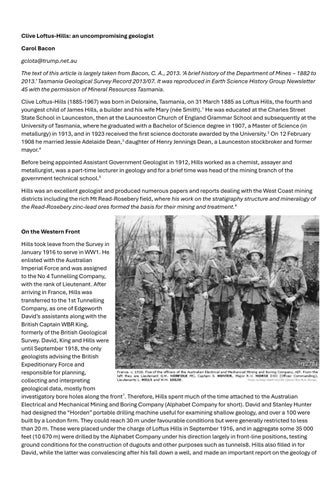
On the Western Front Hills took leave from the Survey in January 1916 to serve in WW1. He enlisted with the Australian Imperial Force and was assigned to the No 4 Tunnelling Company, with the rank of Lieutenant. After arriving in France, Hills was transferred to the 1st Tunnelling Company, as one of Edgeworth David’s assistants along with the British Captain WBR King, formerly of the British Geological Survey. David, King and Hills were until September 1918, the only geologists advising the British Expeditionary Force and responsible for planning, collecting and interpreting geological data, mostly from investigatory bore holes along the front7. Therefore, Hills spent much of the time attached to the Australian Electrical and Mechanical Mining and Boring Company (Alphabet Company for short). David and Stanley Hunter had designed the “Horden” portable drilling machine useful for examining shallow geology, and over a 100 were built by a London firm. They could reach 30 m under favourable conditions but were generally restricted to less than 20 m. These were placed under the charge of Loftus Hills in September 1916, and in aggregate some 35 000 feet (10 670 m) were drilled by the Alphabet Company under his direction largely in front-line positions, testing ground conditions for the construction of dugouts and other purposes such as tunnels8. Hills also filled in for David, while the latter was convalescing after his fall down a well, and made an important report on the geology of
Vimy Ridge8. In the last months of the war, to cope with the number of new geological maps required by the rapidly advancing allies, Hills joined David at General Headquarters (GHQ) along with two other Australian Tunnelling Company officers, including Lieutenant C.S. Honman, formerly of the Western Australian Geological Survey 8. In October 1919, Hills was appointed to the Military Division of the Most Excellent Order of the British Empire (MBE) for his valuable services rendered in connexion (sic) with military operations in France.9 Back to the Geological Survey After WW1, he returned from active service and resumed duties in May 1919 as Assistant Government Geologist. On the death of WH Twelvetrees (in November 1919), Hills was appointed Government Geologist,10 and in short order, began lobbying for a technical man be appointed as Permanent Head of the Department - suggesting that this new position be styled "Director of Mines" and could most satisfactorily be combined with the position of Government Geologist. Hills wanted11 to place the development and control of the mining industry in the hands of an officer possessing an intimate knowledge of technology and economics and all of its phases. Hills wrote prolifically on the direction the Department of Mines and the Geological Survey should take, on the investigations which should be undertaken, and on the difficulties faced by having a " non - technical" man as head of the department. This, he said, lead to a "damping of enthusiasm of those professional officers" in having a purely clerical officer as head of the department. In Hills' opinion in a department concerned with the control and development of the mining industry, the initiative and creative capacity essential to the inauguration of progressive and developmental departures can only be expected in a professional head. Director of the Geological Survey Early in 1921 a formal review was made into the re-organisation of the Department, which was then in three branches - Administration, Geological and Inspection, all under the auspices of the Secretary for Mines. Despite Hills' impassioned plea he was not made head of department. The Minister for Mines, Sir Elliot Lewis, thought a technical man would be wasted on administrative affairs, and of course the Acting Secretary, Pretyman, was not keen to relinquish any powers.12 The result was that Pretyman became Secretary for Mines, head of department, and Hills was made Director of the Geological Survey, housed in Launceston. The other geologists, AM Reid, PB Nye and HGW Keid, were re-named "Government Geologists" instead of "Assistant Government Geologist" as before. This set the scene for a clash of two iron wills - Pretyman in Hobart and Hills in Launceston. As Director of the Geological Survey, Hills made sweeping changes to office rules and the running of the laboratory. He had letterhead paper printed with the title "Geological Survey of Tasmania" for the use of the Launceston Office; before this, letterhead paper was headed "Geological Survey Office." After Hills' term, and when the office was moved to Hobart, ordinary Department of Mines letterheads were used by the Survey staff.13 During the first year in his new position, Hills' autocratic manner went either unnoticed or was accepted without complaint by the staff. Hills introduced new rules, decided what enquiries were to be answered and by whom, directed what staff were to work on which projects, and generally kept a pretty close eye on the day-to-day running of the office. The exception to this was with the Secretary in Hobart - with whom Hills waged a constant and unabating paper war. Pretyman tried making decisions (such as whom to send on enquiries) which Hills regarded as his to make and took to issuing instructions direct to Nye and Reid, much to Hills chagrin. Pretyman insisted on the return of innumerable forms and letters - returning time sheets for miserable amounts of information to be added, causing Hills to complain bitterly14 about these "petty annoyances" and "pernickety requirements (which) break the heart of a conscientious officer." Added to this was the old Secretary's habit of not forwarding a geological enquiry to the Survey but asking Hills to provide information which the Secretary would then pass on to the enquirer. Hills implored to be allowed to answer enquiries properly - protesting that the practice of Pretyman15 "...dealing direct with the correspondent concerned and your withholding the name and particulars from me is not conducive to efficiency." This outburst followed Pretyman's request16 for "any information ... in regard to oil shales" for an enquirer - a fairly vague and loose topic; Hills was justified in wanting to know exactly what the enquirer wished to find out. However, Pretyman insisted17 that, as Head of Department, all enquiries should be made through him. This unsatisfactory working relationship continued for some years. Things were so bad at one stage that Pretyman asked the Minister to tell Hills to return some time sheets18 - surely a trivial issue with which to trouble a Minister.
Following his appointment as Government Geologist and then, as Director of the Geological Survey, Hills was involved in several major studies of the mineral fields of Tasmania - following the tradition set down by his predecessor, WH Twelvetrees. One of Hills' largest works was a comprehensive survey of the coal resources of Tasmania, in which he was assisted by his colleagues PB Nye, HGW Keid, and AM Reid. Whilst Hills was a brilliant scholar, a very able geologist and a man of integrity and principles, he evidently lacked the same tactful and persuasive nature of his predecessor Twelvetrees. Hills' straightforward way of thinking and speaking his mind was not always appreciated by the recipients of his advice. Battling the oil companies In the early 1920s something of an "oil boom" began in Tasmania. Several companies were set up and took up ground in the Latrobe and Pelion areas to search for oil. The largest of these companies was the Adelaide Oil Exploration Company Ltd, which was formed in March 1920. Throughout 1921 and 1922 Hills waged a war of words with the directors of the Adelaide Oil Exploration Company, writing vociferously to both local and interstate papers19 and to the Minister. Hills took exception to the wildly optimistic claims made by the "oil boomsters" and considered that his duty lay in warning the public against their activities. 20 The Adelaide Oil Exploration Company claimed, in January 1921, to hold land which "contains the greatest potential amount of wealth hitherto controlled by any one concern in the British Empire and probably the whole world, outside the States of America", and promised returns of up to five thousand pounds ($10,000) per ten pound ($20) share from oil, which was "...there in millions of tons... in the form of carbonised asphaltum - that is, inspissated or dried up petroleum", noting that "such fabulous returns are not an uncommon thing in new oilfields."21 Hills' outbursts to the press, under banners such as Foredoomed to Failure20 and Oil Indications – A Serious MisStatement21 were countered by the company releasing vitriolic press statements and sending circulars to the shareholders. One such circular devotes almost two of the four pages to an attack on Hills - starting off with a referral to Hills' statements as "miserable whimperings"24. By October 1921, the company no longer referred to "inspissated petroleum" but was planning to extract oil from the "rich-in-oil material" (i.e. pelionite) under their control. In December 1921 they asked the Government for exclusive rights to search for oil and oil-producing substances in Tasmania for five years.25 The company proposed spending £10,000 ($20,000) during each of the five years, after which they would be allowed to hold permanently an area "not less than one hundred square miles" for oil producing purposes. Not surprisingly, this offer was rejected. In 1922 the Mersey Valley Oil Co. Ltd and the Tasman Oil Products Co. NL entered the arena. Hills described the Mersey Valley Oil Co. Ltd prospectus as "very entertaining and would regard it as on a parallel with Punch as a source of humour if it were not for the fact that money badly needed for other purposes is going to be expended with no hope of getting the results expected". A new Minister for Mines was appointed late in 1922. The outgoing Minister, Sir Elliot Lewis, wrote to the Secretary of Mines in June 1922: “I had hoped that I had had the foundation for the harmonious working of the several branches of the Mines Department. I have apparently failed lamentably in my endeavours and can only hope that my successor will be able to obtain more satisfactory results”. End of his Survey career His successor, Ernest F. Blythe, was made Minister in August 192226 and in September 27 was made Director of one of the companies (Standard Oil Company of Australia Ltd) involved in the search for oil. Blythe did not see eye to eye with Hills on his opinions relating to the oil search and Hills' remonstrances continued, although in late 1922 Hills had matters closer to home to worry about. Working relationships with most of the staff became so strained that an inquiry was held in January 1923 by the Public Service Commissioner "In Connection with Alleged Friction in the Mines Department." Correspondence was produced28 to show that Hills had managed to have disagreements with almost everyone in the Department - the former Secretary Wallace, the current Secretary Pretyman, the inspectors, the Minister and most of the Survey staff. The Commissioner heard the staff reel off lists of grievances, and Pretyman had an enormous store of petty and trivial incidents involving Hills about which he
complained at length. The main problem seems to have been that (in Pretyman' s words) "He (Hills) does not seem to have the tact, and he seems to have a domineering spirit."29 Hills was relieved of his duties as Director while the Commissioner considered the case and would have been reinstated had the Survey staff (Reid, Bath, Edwards the Draftsman, Nye and Manson) not written to the Minister 30 stating that "his reinstatement would lead to constant friction in the Geological Survey and other branches of the Mines Department." So, although Hills was not found to have done any wrong, the Commissioner resolved the issue by abolishing the position of Director, Geological Survey and recommending that the Launceston office be moved to Hobart. Hills, who had been on extended leave to attend the Imperial Conference of Returned Soldiers, Sailors and Nurses in England, resigned.31 Life after the Geological Survey He received the first science doctorate awarded by the University of Tasmania in November 192332 for his thesis on Metallogenic Epochs in Tasmania. In May 1924, he won the David Syme prize33 for original scientific work from the University of Melbourne with his thesis. After leaving the Survey, Hills worked as a geological consultant, visiting many mineral fields within Australia and the goldfields in Fiji. This was followed by a stint as Chief Chemist with the Commonwealth Department of Supply (1938-1946) where he was engaged in munitions manufacture. During this period, he changed his name to Clive Loftus-Hills.34 He returned to Tasmania after WW2 and again worked as a geological consultant and mining entrepreneur, successfully standing as a candidate for the 1950 Hobart City Council elections. He died in Melbourne on 13 December 1967 and was buried in the Roman Catholic section of the Springvale Botanical Cemetery. He was survived by his wife and two sons.35 Clive Loftus-Hills was a foundation member of the Geological Society of Australia. He was a thorough, accurate, imaginative geologist who suffered at times for his integrity. He suffered also for seeming over-ambitious and would have made a greater contribution had he been more tolerant. Nevertheless, he greatly advanced knowledge of the ore deposits of Tasmania.
L to R Dr. Loftus-Hills, Prof. Skeats, E.C. Andrews, W. Baragwanaty, J.P. Hindmarsh (AusIMM Journal 30 September 1928 )
References 1.RGD33/1/64 no 1095. 2. Mercury 16 December 1967. 3. Examiner 13 February 1908. 4. Maxwell R. Banks, 'Loftus-Hills, Clive (1885–1967)', Australian Dictionary of Biography, National Centre of Biography, Australian National University, http://adb. anu.edu.au/biography/loftus-hills-clive-7221/text12499, published first in hardcopy 1986, accessed online 24 March 2018. 5. Ibid and Mercury 16 December 1967. 6. Ibid. 7.Finlayson, D., 2010. Crumps and Camouflets: Australian tunnelling companies on the Western Front. Big Sky Publishing, Newport, Australia. 8.Branagan, D.F., 2005. T.W. Edgeworth David: a life: geologist, adventurer, soldier. National Library of Australia, Canberra. 9. Record NAA: B2455, HILLS L LIEUTENANT, National Archives of Australia. 10. Mercury 19 December 1919. 11. Letter: Loftus Hills to Public Service Commissioner, 11 January 1921. TA Min 24 319/508 12. Notes on conference held at the office of the Minister for Mines (Sir Elliot Lewis) in regard to the Mines Department, 29 June 1921. TA Min 24 319/508. 13. Correspondence 1920-1922 tendered as exhibits to 1923 Inquiry. TA Min 24 319/508. 14. Letter: Hills to Acting Secretary of Mines, 10 November 1921. 15. Letter: Hills to Acting Secretary of Mines, 16 August 1921. 16. Letter: Acting Secretary of Mines to Hills, 8 July 1921. 17. Letter: Acting Secretary of Mines to Hills, 9 August 1921. 18. Letter: Acting Secretary of Mines to Minister for Mines,11 November 1921, reply from Minister 19 November 1921. 19. Hobart Mercury 8 September 1921; Adelaide Register 9 September 1921; 27 June 1921; Launceston Examiner 9 September 1921, 10 October 1921, 11 October 1921; Daily Telegraph 28 September 1921, 10 October 1921; Perth Daily News 12 October 1921 Adelaide Advertiser 27 June 1921; 28 June 1921, 2 July 1921. 20. Letter: Hills to Sir Douglas Mawson 24 March 1922 “certainly the oil boomsters have taken up a lot of our time. They are an awful nuisance but I am trying to protect the good name of Tasmania [...]” 21. London Times Trade Supplement, January 1921.
22. The Age 11 October 1921. 23. Adelaide Register 9 September 1921. 24. 1922 New Years Greeting Circular, Adelaide Oil Co. Ltd. 25. Letter: JH Moate, managing Director Adelaide Oil Exploration Co. Ltd to Minster for Mines, 7 December 1921. 26. Evidence of EF Blyth to the 1921 Inquiry. 27. Adelaide Oil Exploration Co. Ltd. Report to Third half-yearly meeting 11 September 1922. 28. Evidence tendered to Inquiry in form of bundles of letters and correspondence files TA Min 24 319/508. 29. Evidence of Pretyman to 1923 Inquiry. 30. Letter from staff to Minister for Mines, 16 April 1923. 31. Mercury 17 September 1923 32. World 21 November 1923. 33. World 6 May 1924. 34. as for 4. 35. Ibid, Advocate 18 May 1950, Springvale Cemetery