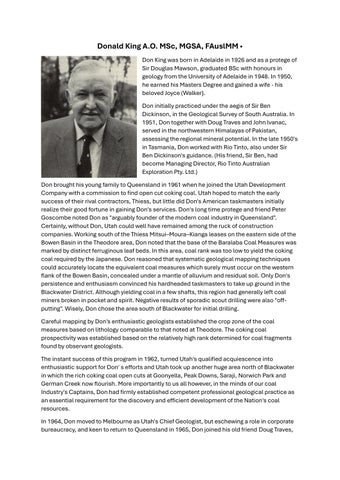
Donald King A.O. MSc, MGSA, FAuslMM • Don King was born in Adelaide in 1926 and as a protege of Sir Douglas Mawson, graduated BSc with honours in geology from the University of Adelaide in 1948. In 1950, he earned his Masters Degree and gained a wife - his beloved Joyce (Walker}. Don initially practiced under the aegis of Sir Ben Dickinson, in the Geological Survey of South Australia. In 1951, Don together with Doug Traves and John lvanac, served in the northwestern Himalayas of Pakistan, assessing the regional mineral potential. In the late 1950's in Tasmania, Don worked with Rio Tinto, also under Sir Ben Dickinson's guidance. (His friend, Sir Ben, had become Managing Director, Rio Tinto Australian Exploration Pty. Ltd.) Don brought his young family to Queensland in 1961 when he joined the Utah Development Company with a commission to find open cut coking coal. Utah hoped to match the early success of their rival contractors, Thiess, but little did Don's American taskmasters initially realize their good fortune in gaining Don's services. Don's long time protege and friend Peter Goscombe noted Don as "arguably founder of the modern coal industry in Queensland". Certainly, without Don, Utah could well have remained among the ruck of construction companies. Working south of the Thiess Mitsui–Moura–Kianga leases on the eastern side of the Bowen Basin in the Theodore area, Don noted that the base of the Baralaba Coal Measures was marked by distinct ferruginous leaf beds. In this area, coal rank was too low to yield the coking coal required by the Japanese. Don reasoned that systematic geological mapping techniques could accurately locate the equivalent coal measures which surely must occur on the western flank of the Bowen Basin, concealed under a mantle of alluvium and residual soil. Only Don's persistence and enthusiasm convinced his hardheaded taskmasters to take up ground in the Blackwater District. Although yielding coal in a few shafts, this region had generally left coal miners broken in pocket and spirit. Negative results of sporadic scout drilling were also "offputting". Wisely, Don chose the area south of Blackwater for initial drilling. Careful mapping by Don's enthusiastic geologists established the crop zone of the coal measures based on lithology comparable to that noted at Theodore. The coking coal prospectivity was established based on the relatively high rank determined for coal fragments found by observant geologists. The instant success of this program in 1962, turned Utah's qualified acquiescence into enthusiastic support for Don' s efforts and Utah took up another huge area north of Blackwater in which the rich coking coal open cuts at Goonyella, Peak Downs, Saraji, Norwich Park and German Creek now flourish. More importantly to us all however, in the minds of our coal Industry's Captains, Don had firmly established competent professional geological practice as an essential requirement for the discovery and efficient development of the Nation's coal resources. In 1964, Don moved to Melbourne as Utah's Chief Geologist, but eschewing a role in corporate bureaucracy, and keen to return to Queensland in 1965, Don joined his old friend Doug Traves,
Managing Director of Mines Administration Pty Ltd (MINAD), operators for the Associated Group (of Oil Explorers}. As General Manager, Associated Mining, Don directed vigorous exploration programs for a wide range of minerals including coal. MINAD’s most notable success during these years was the proving of large reserves of low ash coking coal at Hail Creek in an area discarded by an American company having little regard for geologists. MINAD’s success led to the acquisition of the Associated Group by CSR in 1977. Again, appalled at the thought of becoming a corporate bureaucrat, Don set up his own geological consultancy - Energy Minerals Pty Ltd, which flourished until his death. Dan's clients, including several major international mining groups were too numerous to mention. Don was the author of some 47 scientific published papers, covering a wide range of geological knowledge. He was very proud of his discovery of the phosphate mineral Kingite in South Australia (1956) and of his joint editorship with Doug Traves of the AuslMM's "Economic Geology of Australia and Papua New Guinea, Volume 2, Coal (1975). In 1987, his service to the Nation was recognized in his appointment as an Officer of the Order of Australia. Don was a foundation member of GSA and Chairman of the Queensland Branch in 1964-5. He died suddenly on 3 August 1989. Don was one of the best known and most loved geologists in Queensland. His renown and esteem throughout the mining industry and geological fraternity was based not only on his distinguished professional career and outstanding contribution to our National wealth, but perhaps more so on his personality and his ability to welcome visitors, make friends, promote excellence and exert an influence for good especially among young geologists.
David Svenson and Peter Goscombe