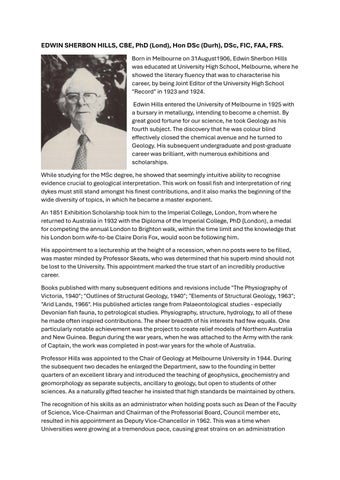
EDWIN SHERBON HILLS, CBE, PhD (Lond), Hon DSc (Durh), DSc, FIC, FAA, FRS. Born in Melbourne on 31August1906, Edwin Sherbon Hills was educated at University High School, Melbourne, where he showed the literary fluency that was to characterise his career, by being Joint Editor of the University High School "Record" in 1923 and 1924. Edwin Hills entered the University of Melbourne in 1925 with a bursary in metallurgy, intending to become a chemist. By great good fortune for our science, he took Geology as his fourth subject. The discovery that he was colour blind effectively closed the chemical avenue and he turned to Geology. His subsequent undergraduate and post-graduate career was brilliant, with numerous exhibitions and scholarships. While studying for the MSc degree, he showed that seemingly intuitive ability to recognise evidence crucial to geological interpretation. This work on fossil fish and interpretation of ring dykes must still stand amongst his finest contributions, and it also marks the beginning of the wide diversity of topics, in which he became a master exponent. An 1851 Exhibition Scholarship took him to the Imperial College, London, from where he returned to Australia in 1932 with the Diploma of the Imperial College, PhD {London), a medal for competing the annual London to Brighton walk, within the time limit and the knowledge that his London born wife-to-be Claire Doris Fox, would soon be following him. His appointment to a lectureship at the height of a recession, when no posts were to be filled, was master minded by Professor Skeats, who was determined that his superb mind should not be lost to the University. This appointment marked the true start of an incredibly productive career. Books published with many subsequent editions and revisions include "The Physiography of Victoria, 1940"; "Outlines of Structural Geology, 1940"; "Elements of Structural Geology, 1963"; "Arid Lands, 1966". His published articles range from Palaeontological studies - especially Devonian fish fauna, to petrological studies. Physiography, structure, hydrology, to all of these he made often inspired contributions. The sheer breadth of his interests had few equals. One particularly notable achievement was the project to create relief models of Northern Australia and New Guinea. Begun during the war years, when he was attached to the Army with the rank of Captain, the work was completed in post-war years for the whole of Australia. Professor Hills was appointed to the Chair of Geology at Melbourne University in 1944. During the subsequent two decades he enlarged the Department, saw to the founding in better quarters of an excellent library and introduced the teaching of geophysics, geochemistry and geomorphology as separate subjects, ancillary to geology, but open to students of other sciences. As a naturally gifted teacher he insisted that high standards be maintained by others. The recognition of his skills as an administrator when holding posts such as Dean of the Faculty of Science, Vice-Chairman and Chairman of the Professorial Board, Council member etc, resulted in his appointment as Deputy Vice-Chancellor in 1962. This was a time when Universities were growing at a tremendous pace, causing great strains on an administration
developed under less rigorous conditions. To this post of administration, he brought his usual flair of making the right decisions. As a Research Professor of Geology, he still made the time to continue his research and publications — no mean achievement. Throughout this busy time, he seemed to always have time to talk to colleagues about geology, or to give advice on personal problems. Edwin Hills retired at the end of 1971 and was elected Honorary Research Professor and Professor Emeritus by the Council of Melbourne University. Retirement saw no diminution of the output of published work. The day before his death on 2 May 1986, he was engaged in petrological examination of sheared quartz crystals. A very human person, his lighter side was always ready to show expression. On field camps this would show itself in his masterly renditions by piano and song of many popular tunes. The students who were fortunate enough to be on such excursions will never forget the lively renditions of "The Professor". Edwin served on so many Committees and Commissions that it is difficult to name them all, but some notable ones were the UNESCO Advisory Committee on arid zones, The Australian Academy of Science of which he was a founding Fellow, The Royal Society of Victoria where he was President in 1955-56. Hills was the founding chair of the Geological Society of Australia in 1951 and in the same year received the Bigsby Medal from The Geological Society of London. In 1954 he was elected to the Royal Society and was a founding fellow of Australia's learned science organisation, the Australian Academy of Science. He served as a member of the UNESCO International Advisory Committee on Arid Zone Research and on numerous other advisory boards. For his contributions he was made a Commander of the Order of the British Empire in 1971. As a doyen of the geological world he spanned almost six decades, a notable achievement. R. J. McLaughlin