PUBLISHED FOR THE GEOLOGICAL SOCIETY OF AUSTRALIA INC BY BLACKWELL SCIENTIFIC PUBLICATIONS
K
A
Special P u B L m i i O N
N o .
1 4
ADDENDUM
Kimberlites and Related Rocks. Volume 2: Their Mantle/Crust Setting Diamonds and Diamond Exploration. The following paper in Section IV has been officially withdrawn from this publication at the request of the authors: T.N. TINGLE, H . W . GREEN AND A.A. FINNERTY. Experiments and obser-
vations bearing on the solubility and diffusivity of carbon in olivine, pp. 922-931.
All readers are therefore requested to not make general or specific reference to this paper and its contents.
Kimberlites and Related Rocks Volume 1 Their Composition, Occurrence, Origin and Emplacement
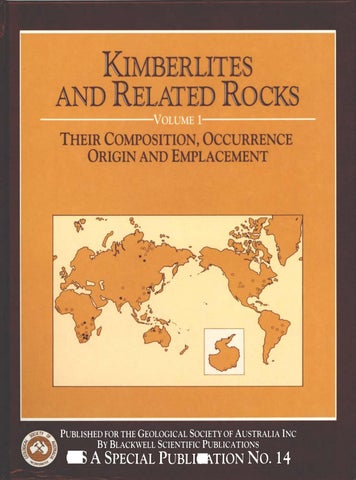
Cover The world map (Mercator projection) shows locations of kimberlites (circles) and lamproites (triangles). Most symbols represent a number of bodies in close proximity. Locations are based on Janse (1985) for kimberlites, and Bergmann (1987) for lamproites, with additions. 'Solid' symbols indicate bodies mined for diamonds.
Proceedings of the FOURTH INTERNATIONAL KIMBERLITE CONFERENCE Perth 1986
Kimberlites And Related Rocks Volume 1 THEIR COMPOSITION, OCCURRENCE, ORIGIN AND EMPLACEMENT EDITORIAL PANEL J Ross Managing editor A L Jaques Section I J Ferguson Section II D H Green Section III S Y O'Reilly Section IV R V Danchin Section V A J A Janse Section VI
PUBLISHED FOR T H E G E O L O G I C A L SOCIETY OF AUSTRALIA I N C BY B L A C K W E L L S C I E N T I F I C P U B L I C A T I O N S
GSA SPECIAL PUBLICATION NO. 14
© 1989 by Geological Society of Australia Inc Published by Blackwell Scientific Publications Editorial offices: 107 Barry Street, Carlton Victoria 3053, Australia Osney Mead, Oxford OX2 OEL 0Orders: Tel: 0865 240201) 8 John Street, London WC1N 2ES 23 Ainslie Place. Edinburgh EH3 6AJ 3 Cambridge Center, Suite 208 Cambridge, Massachusetts 02142, USA
DISTRIBUTORS
USA Blackwell Scientific Publications Inc 3 Cambridge Center, Suite 208 Cambridge Massachusetts 02142 Canada Oxford University Press 70 Wynford Drive Don Mills Ontario M3C 1J9 0Orders: Tel: (416) 441-2941)
All rights reserved. No part of this publication may be reproduced, stored in a retrieval system, or transmitted, in any form or by any means, electronic, mechanical, photocopying, recording or otherwise without the prior permission of the copyright owner.
Australia Blackwell Scientific Publications (Australia) Pty Ltd 107 Barry Street Carlton, Victoria 3053 (<Orders: Tel: (03) 347-0300)
First published 1989
Cataloguing in Publication Data
Set by Times Graphics, Singapore Printed in Singapore
International Kimberlite Conference, (4th: 1986: Perth W.A.): Kimberlites and related rocks. Includes bibliographies and index. ISBN 0 86793 384 4. ISBN 0 86793 033 0 (v. 1). ISBN 0 86793 041 1 (v. 2). 1. Kimberlite - Congresses. 2. Diamonds Congresses. I. Ross. J. (Jim). II. Geological Society of Australia III. Title. (Series: Special publication (Geological Society of Australia); no. 14). 552'.3
Frontispiece
Argyle looking north during exploration in early 1980.
T h e Argyle lamproite pipe at centre forms a broad valley in ranges of lower to middle Proterozoic quartzite and siltstone. Gridded low lying country (right foreground) marks the Limestone Creek alluvials which overlie early Proterozoic granites and metamorphics of the Lamboo Complex. North of the pipe Smoke Creek drains towards Lake Argyle in the distant background. This photograph may be compared with the geological plan of Boxer et al (this volume, p. 141, Fig. 1) and with the frontispiece in Volume 2 showing the same view six years later. Photography: Brian Stevenson & Co.
Contents Organization of the Conference and Associated Publications
ix
Acknowledgements
x
Preface
xii
INTRODUCTION Introduction to the Fourth International Kimberlite Conference Emeritus Professor R T PRIDER
SECTION I 1
2
3
4
Kimberlites and Related Rocks: Their Mineralogy, Petrology and Geochemistry
REVIEW PAPER: Aspects of the petrology of kimberlites and lamproites: some definitions and distinctions R H MITCHELL
7
Kimberlites as varieties of lamprophyres: implications for geological mapping, petrological research and mineral exploration N M S ROCK
46
The petrology of kimberlites, related rocks and associated mantle xenoliths from the Kuruman province, South Africa S R SHEE, J W BRISTOW, D R BELL, C B SMITH, H L ALLSOPP and P B SHEE
60
Mineralogy of micaceous kimberlites from the New Elands and Star mines, Orange Free State, South Africa R H M I T C H E L L and H O A MEYER
83
5
The Cross diatreme, British Columbia, Canada: a kimberlite in a young orogenic belt D C HALL, H HELMLSTAEDT and D J SCHULZE
6
Alkalic ultramafic magmas in north-central Montana, USA: genetic connections of alnoite, kimberlite and carbonatite B C HEARN Jnr
109
Mineralogy and petrology of picritic monchiquites from Wandagee, Carnarvon Basin, Western Australia A L JAQUES, I D KERR, H LUCAS, S-S SUN and B W CHAPPELL
120
The geology and volcanology of the Argyle (AK1) lamproite diatreme, Western Australia G L BOXER, V LORENZ and C B SMITH
140
7
8
97
9
Mineralogy and petrology of the Argyle (AK1) lamproite pipe, Western Australia A L JAQUES, S E HAGGERTY, H LUCAS and G L BOXER
153
10
Geochemistry of the Argyle (AK1) lamproite pipe, Western Australia A L JAQUES, S-S SUN and B W CHAPPELL
170
11
The Kapamba lamproites of the Luangwa Valley, Eastern Zambia B H SCOTT SMITH, E M W SKINNER and P E LONEY
189
12
Geology, petrology and geochemistry of the Bow Hill lamprophyre dykes, Western Australia D C F I E L D I N G and A L JAQUES
206
vi 13
Contents Fluid and melt compositions in lamproites and kimberlites based on the study of inclusions in olivine A V SOBOLEV, N V SOBOLEV, C B SMITH and J DUBESSY
220
14
Oxide minerals in Chicken Park kimberlite, northern Colorado M E McCALLUM
242
15
Kimberlite carbonates — a carbon and oxygen stable isotope study M B KIRKLEY, H S SMITH and J J GURNEY
264
16
The significance of brucite in South African kimberlites G W BERG
282
17
A new garnet classification technique: divisive cluster analysis applied to garnet populations from Somerset Island kimberlites B C JAGO and R H MITCHELL
18
Iron in kimberlitic ilmenites and chromian spinels: a survey of analytical techniques H LUCAS, M T MUGGERIDGE and D M McCONCHIE
SECTION II 1
298 311
Kimberlites and Related Rocks: Their Distribution and age
REVIEW PAPER: Geographic and time distribution of kimberlites and lamproites: relationships to tectonic processes J B DAWSON
2
A summary of radiometric dating methods applicable to kimberlites and related rocks H L ALLSOPP, J W BRISTOW, C B SMITH, R BROWN, A J W GLEADOW, J D KRAMERS and O G GARVIE
3
Southern African kimberlites and their mantle sample — implication for Archean tectonics and lithosphere evolution H HELMSTAEDT and D J SCHULZE
323 343
358
4
Kimberlite and lamproite emplacement ages in Western Australia R T PIDGEON, C B SMITH and C M F A N N I N G
369
5
Alkaline ultrabasic dykes near Norseman, Western Australia J V A ROBEY, J W BRISTOW, M R MARX, J JOYCE, R V DANCHIN and F ARNOTT
382
6
A review of the geology of some kimberlites in China ZHANG P, HU S and WAN G
392
7
The distribution pattern of kimberlites and associated rocks in Shandong, China WANG
401
8
Tanzania kimberlites: a preliminary heavy mineral study P H NIXON and E CONDLIFFE
407
9
Geological setting, petrography and petrogenesis of olivine melilitites of the Natal Coast, South Africa E A COLGAN, T C CLARK, J W BRISTOW and H L ALLSOPP
10
417
A catalogue of kimberlitic occurrences: blueprint for a computer database M T MUGGERIDGE
436
REVIEW PAPER Constitution and evolution of the mantle A E RINGWOOD
457
Contents SECTION III
vii
Origin and Emplacement of Kimberlites and Related Rocks
1
REVIEW PAPER: Kimberlites: how do they form? D H EGGLER
489
2
Volcanology of the Ellendale lamproite pipes, Western Australia C B SMITH and V LORENZ
505
3
Iron-oxides as palaeotemperature indicators in Ellendale lamproite intrusions D M McCONCHIE and C B SMITH
520
4
Contrasting Group I and Group II kimberlite petrology: towards a genetic model for kimberlites E M W SKINNER
528
Nodule associations from ouachitite and camptonite lamprophyres, western Otago and south Westland, New Zealand C G BRODIE and A F COOPER
545
5
6
Enriched mantle components and mantle recycling of sediments D R NELSON and M T McCULLOCH
7
Stability of amphibole and phlogopite in metasomatized peridotite under water-saturated and water-undersaturated conditions K MENGEL and D H GREEN
571
Heteromorphism and crystallization paths of katungites, Navajo volcanic field, Arizona, USA A W LAUGHLIN, R W CHARLES and M J ALDRICH Jr.
582
8
560
9
The role of reduced C-O-H fluids in mantle partial melting W R TAYLOR and D H GREEN
592
10
The genesis of kimberlites and some low-Si0 2 , high-alkali magmas P J WYLLIE
603
11
The genesis of lamproitic magmas in a reduced fluorine-rich mantle S F FOLEY
616
12
The origin of kimberlite pipes: an interpretation based on a synthesis of geological features displayed by southern African occurrences C R CLEMENT and A M REID
632
Fourth International Kimberlite Conference, Perth, Australia 11-15 August 1986 Organization of the Conference and Associated Publications CONVENORS Dr A F Trendall and Professor P G Harris INTERNATIONAL ADVISORY COMMITTEE Dr F R Boyd (USA) Prof J B Dawson (UK) Dr J Ferguson (Australia) Dr J J Gurney (South Africa) Mr J B Hawthorne (South Africa) Dr J Kornprobst (France) Prof H O A Meyer (USA) Dr R H Mitchell (Canada) Dr P H Nixon (UK) Prof N V Sobolev (USSR)
Dr G P Gregory(Treasurer) Mr J D Lewis(Secretary) Dr W J Atkinson(alternate Mr CB Smith) Dr R V Danchin(alternate Mr J Stracke) Dr L R Davidson Dr J Ferguson Mr M Gunn Dr A J A Janse Mr W D Jones Dr R T Pidgeon Dr J R Ross EDITORIAL PANEL
PROGRAMME AND PUBLICATIONS SUB-COMMITEE Dr J R Ross (Chairman) Dr L R Davidson Prof P G Harris Mr C B Smith CONFERENCE ORGANISING COMMITTEE
Dr J R Ross(Managing Editor) Dr A L Jaques(Section I) Dr J Ferguson(Section II) Prof D H Green(Section III) Dr S Y 0'Reilly(Section IV) Dr R V Danchin(Section V) Dr A J A Janse(Section VI)
Dr A F Trendall(Chairman) Prof P G Harris(Vice Chairman) Abstract volume* Fourth International Kimberlite Conference, Perth 1986, Extented Abstracts, Geological Society of Australia Abstracts, No. 16 (511 pages). Compiled by C B Smith. Conference proceedings Kimberlites and Related Rocks, Volume 1, Their Composition, Occurrence, Origin and Emplacement (664 pages). This volume. Kimberlites and Related Rocks, Volume 2, Their Mantle/Crust Setting, Diamonds and Diamond Exploration (640 pages). Excursion guides* Fourth International Kimberlite Conference Pre-Conference Excursion Guide to Southeastern Australia (109 pages) Compiled by J Ferguson Fourth International Kimberlite Post-Conference Excursion Guide to the lamproites of the Kimberley Region, Western Australia (65 pages). Compiled by M Gunn * These publications can be obtained from the Geological Society of Australia, 10 Martin Place, Sydney, NSW 2000, Australia
Acknowledgements This publication is the enduring record of the Fourth International Kimberlite Conference and it is appropriate to first acknowledge those organizations that helped make the Conference possible. Principal Sponsor
Geological Society of Australia Incorporated
Co-Sponsors
*Bureau of Mineral Resources, Geology and Geophysics Commission of Experimental Petrology Geological Society of Australia (WA Division) International Association of Geochemistry and Cosmochemistry International Association of Volcanology and Chemistry of the Earth's Interior University of Western Australia ^Western Australian Department of Mines
Supporting Organizations
ANZ Bank Argyle Diamond Mines Pty Ltd Ashton Exploration Joint Venture Australian Airlines BP Minerals Australia BP Minerals International T h e Broken Hill Proprietary Company Ltd *CRA Exploration Pty Ltd ^Greater Pacific Investments Ltd *Macquarie University ^Murdoch University *QANTAS Airways Ltd *Stockdale Prospecting Ltd UNESCO ^University of Tasmania Curtin University of Technology ^Western Mining Corporation Ltd
Those identified by an asterisk (*) supported much of the voluntary work associated with the preparation of this publication. Their help over periods that range from two to almost five years has been invaluable. Numerous individuals have contributed to the organisation of these volumes and to the preparation of ancillary material. First mention is due to Sheila Mead for her helpful, effective and good humoured support throughout, whilst the contributions of Maureen Muggeridge, the Drafting Section of CRA Exploration (especially Jenny Beake and Jenny Hall), Julia Thorn, Don Smart, and Suzzane O'Reilly are gratefully acknowledged. T h e co-operation and goodwill of these people, and others, has added to the final product and to the experience of working towards it. The commitment of Mark Robertson (Blackwell) and George Fleming (Editor, Special Publications, GSA) has been appreciated and special mention is due to the six section editors: Bobby Danchin, John Ferguson, David Green, Lynton Jaques, Bram Janse and Suzanne O'Reilly. Their enthusiasm, commitment, skill and fairness have exerted a very positive influence on the contents of these volumes.
Acknowledgements
xi
Finally, the quality of this publication has been improved by the work of the 127 referees listed below; their contribution is gladly acknowledged. J Akella K Aoki M Arima T J Armbrustmacher R Baxter-Brown W Berg S Bergman N Z Boctor F R Boyd G Brey T W Bristow J A Carlson D A Carswell C R Clement E A Colgan W Compston A F Cooper L R Cullers R V Danchin L R Davidson ] B Dawson A Day P Deines A D Edgar D H Eggler D J Ellis A F Erlank J Ferguson C Fieremans A A Finnerty I Fletcher S F Foley
B J Franklin F A Frey F Friedmann M Garcia D C Gellatly D H Green T H Green G P Gregory W L Griffin J J Gurney S E Haggerty S Harley J W Harris P G Harris W D Hausel C J Hawkesworth B C Hearn, Jr H Helmstaedt A J Irving A J A Janse A L Jaques W D Jones G Kurat S Kay M B Kirkley J Knutson J Kornprobst P Kresten L G Krol A W Laughlin J D Lewis W G Libby
Program and Publication Sub-Committee 1988
F Lloyd V Lorenz M E McCallum M T McCulloch H W McDonough E McGee N McNaughton M R Marx E A Mathez D Mattey K Mengel M Menzies H O A Meyer E Middlemost R H Mitchell A C Moore S A Morse M T Muggeridge D R Nelson I A Nicholls J Nielson P H Nixon H St C O'Neill S Y O'Reilly N Pearson M Perfet E Podovani R Powell R Ramsay J M Rhodes S H Richardson J V A Robey
B Robinson D N Robinson N M S Rock M Roden J R Ross D J Schulze B H Scott-Smith S R Shee J W Sheraton J W Shervais E M W Skinner Chris B Smith Craig B Smith D Smith N V Sobolev K J Stracke H B Stosch S S Sun E Takahashi L A Taylor W R Taylor E W J Tyler R Varne D Velde G Venturelli K H Wedepohl H G Wilshire K H Wohletz B A Wyatt P J Wyllie H E Zeissink
Preface This Special Publication records the proceedings of the Fourth International Kimberlite Conference held in Perth from 11-15 August 1986. Its two volumes contain 89 papers. Extended abstracts for another 68 papers presented at the Conference, but not included in this publication, can be found in the Extended Abstract Volume published by the Geological Society of Australia. Full details are given on p. vii. The Conference was flanked by a pre-Conference excursion to diatremes in southeastern Australia (about 40 participants) and a post-Conference excursion to the lamproites of the Kimberley region(128 participants). T h e resulting guidebooks are significant publications in their own right and their details are given on p. vii. When combined with another 15 papers in this Special Publication, they provide comprehensive coverage of the exciting and intriguing Australian occurrences. It is widely recognized that kimberlites and closely related rocks are rare components of the geologic record. Although thousands of individual bodies are known they represent only a minute fraction of the earth's crust. It is also widely recognized that relatively few of these occurrences contain diamonds in economic quantities. Less than 20 support substantial diamond mines. These factors indicate why economic kimberlites and lamproites are the most difficult targets to locate in mineral exploration and they have two important consequences: 1 there is a strong incentive to apply the best available geoscientific knowledge in exploration to shorten the very long odds of discovery; 2 most scientists wishing to study physical and chemical conditions in the upper mantle by direct observation and measurement on the various components of these rocks will converge on the small number of operating mines for sample material, including diamonds. The end result is an unusually high level of interaction between geoscientists conducting basic research and those in industry documenting and exploring for diamondiferous host rocks. This interaction has led to symbiotic relationships built on applied research and to an accelerated application of new knowledge in exploration. These relationships impart a unique flavour to international kimberlite conferences and a contribution from Industry geoscientists that is not fully reflected in previous conferences and their proceedings. To encourage more papers relating to exploration technology and area selection and to lessen the traditional emphasis on papers relating to xenoliths, the program for the Fourth Conference was structured to guide contributions towards six basic topics: Section I Section II Section III Section IV Section V Section VI
What is a kimberlite? When and where do they occur? How do they form? What is the nature of the Upper crust and lower mantle? Diamonds Diamond Exploration
These topics are represented by the six sections in these two volumes. T h e distribution of papers (both at the Conference and in this publication) across the range of subjects they embrace is more equal than at previous conferences. Each section at the Conference commenced with a comprehensive, invited review and the resulting papers are important components of this publication. T h e structured program was complemented by a special lecture by Professor A E Ringwood ('Constitution and Evolution of the Mantle') and completed with a panel session and open forum that addressed the question 'What don't we know and what should we do?' and the two resulting papers are also important components. Sections I, II and III, together with the review paper by Professor Ringwood, form Volume I which contains 41 papers, including four reviews. Sections IV, V and VI, together with a written account of the final panel session (by F R Boyd), form Volume 2 which contains 48 papers, including three reviews. It also includes an extensive subject index covering both volumes.
Preface
xiii
International kimberlite conferences have formalized an almost unique level of interaction and integration of basic and applied geoscience research that has become more exciting and diverse with time. They have stimulated more effective research and more effective exploration. Each conference represents a checkpoint on progress and these two volumes can be regarded as a record of the most recent one where kimberlitic buses and their passengers (to echo the often quoted analogy used by Joe Boyd in the preface of Volume 2 of the proceedings of the Second Conference) were closely scrutinized. T h e buses were examined for features such as: make and model; year and method of manufacture; place of origin; subsequent alterations; and form of propulsion. Their passengers were assessed for place of origin; age, size and abundance; degree of adulteration; ability to pay etc. T h e fact that construction of this checkpoint and production of its permanent record represent a commitment by several people over almost five years brings to mind the words of Democrites in about 400 BC 'A life without fun is a long road without an inne'. Kimberlite Conferences are both the checkpoints and the innes along the interesting road devoted to kimberlites and closely related rocks. Fortunately, numerous innes have also been present along the shorter road devoted to the Fourth Conference and to this publication. I trust that these volumes do adequate justice to the atmosphere of these innes and to the quality of the numerous and varied personal contributions that have made them possible. Finally, I wish to acknowledge the contribution of the other three members of the programme and Publications Sub-Committee: Lawrie Davidson, Peter Harris and Chris Smith. Their enthusiasm and commitment, coupled with their professionalism, good humour and good friendship has enriched the journey and multiplied the innes. JIM ROSS Managing Editor Formerly with Western Mining Corporation Ltd. Perth; now c/- World Geoscience Corporation Limited, 43 Ventnor Avenue West Perth 6005 Western Australia
INTRODUCTION TO THE FOURTH INTERNATIONAL KIMBERLITE CONFERENCE
The opening of the Fourth International Kimberlite Conference was enhanced by a brief address by Rex T. Prider, Emeritus Professor of Geology of the University of Western Australia. Professor Prider shared with the Conference his memories of early work on the Kimberley leucite lamproites in which he postulated a mantle origin and kimberlitic affinities for these unusual rocks. Geologists who graduated from the University of Western Australia in the 1940's, 50's and 60's took with them petrographic experience of leucite lamproites and an awareness of the prospective potential of these rocks and, in retrospect, it is surprising that the discovery of diamonds in the Kimberley lamproites did not occur earlier.
Emeritus Professor Rex Prider (third from left) photographed during the Fourth International Kimberlite Conference with (from left): Professor N. V. Sobolev, Professor J. B. Dawson, Professor O. A. Meyer and Mr J. B. Hawthorne. Photograph was supplied by the University of Western Australia Public Relations Unit.
Introduction to the Fourth International Kimberlite Conference R . T . PRIDER University of Western Australia, Nedlands,
Who would have thought, but a decade ago, that we would ever hold an International Kimberlite Conference in Perth? There were a few of us who had ideas about the occurrence of kimberliterelated rocks in the Kimberley. One of my former students, Ewen Tyler, remembered something of my preaching about the leucite lamproites of the Kimberley and, some 20 years after graduating, bulldozed one of his companies into searching for diamonds in this most improbable environment — the results of which are now apparent to all. Diamonds in the Kimberley area are associated with leucite lamproites — a rare group of K-Mgrich silica-saturated igneous rocks characterized by the occurrence of the undersaturated minerals leucite and olivine. Such ultrapotassic rocks occur in four places only in the World: the Leucite Hills of Wyoming, Jumilla in Spain, Gaussberg in Antarctica and here in Western Australia. The leucitic rocks of the West Kimberleys were first recorded in the Geological Survey of Western Australia Annual Report for 1921 as 'peculiar mica leucitite lavas, agglomerates and tuffs, which appear to be counterparts of those found in Borneo, Java and elsewhere in the East Indies'. Indeed, I seem to remember the story that Farquharson, petrologist at the Geological Survey of Western Australia at that time, thought that these specimens were actually picked up off the beach at Broome, being the discarded ballast of boats from the East Indies. In 1935, the late Dr Arthur Wade, in the course of oil exploration in the West Kimberley, collected samples from all of the 19 volcanic hills known to him. He presented this collection of about 90 specimens to the Geology Department of the University of Western Australia on the understanding that some work would be done on them. I was, at that time, responsible for teaching petrology, so it was my task to work on these rocks.
Australia
And what an unimpressive lot they were — mostly weathered, difficult to section (in those days I had to make all my own thin-sections) and study. However, I took this collection to Britain in August, 1936 — just 50 years ago — where they constituted part of my PhD research. Strangely enough, they proved to be most interesting, amongst other things containing several new minerals (wadeite and magnophorite). My supervisor at Cambridge was the late Professor C. E. Tilley, whose only help amounted to the comment, T h e s e are a very unusual lot of rocks, Prider', and I was left to it. No! He did say that I should give them new names. What was good for Tilley was good for me, so I named the different rock types for their essential mineral assemblages. I chose names from geographical localities; for example, fitzroyite after the Fitzroy River for the phlogopite-leucite lamproites. I did not know at the time, that some of these geographical features had been named by Wade after members of his family; my rock type, mamilite, was named after Mamilu Hill, and Wade had named it after his wife, Mami Lou. Nowadays it is considered by some that these rocks names should be abandoned and, instead, the rocks should be known simply as lamproites with appropriate mineral qualifiers. For my part, I still think that my name, wolgidite, is easier to handle than phlogopite-diopside-magnophoriteolivine-leucite lamproite. This name, under the proposed new nomenclature, becomes still longer if we replace magnophorite by K-richterite, as suggested nowadays. (I still believe that magnophorite is preferable to K-richterite as, if nothing else, its occurrence is restricted to the leucite lamproite provinces.) It was during this study at Cambridge that the lamproitic nature of the West Kimberley rocks was recognized and a mantle origin and possible relation to kimberlite were postulated. The results
4
R. T. Prider
of this work were published in the Quarterly Journal of the Geological Society of London in 1940. There were many, I believe, who thought my ideas on the origin of these rocks were crazy, but I always said: 'If they find a diamond in these rocks it will prove I was right, and if they don't find a diamond in them it won't prove I was wrong.' Diamonds have now been discovered in the Kimberley lamproites, and I believe I was on the right track regarding their origin. I am looking forward to hearing more about them during the next few days. I have, without doubt, made many errors in the course of my petrological studies of the leucite lamproites. For example, in my paper of 1940 I referred to an abundant accessory as rutile; it had all the characteristics of rutile — habit, colour, pleochroism and occurrence in rocks containing up to 8% T i 0 2 — so I thought I was safe in calling it rutile. However, some years later, I separated some for X-ray study by Dr Keith Norrish, who informed me that it was not rutile. In fact, it was not a recorded mineral and turned out to be K-Ba titanate which Norrish named priderite, thus perpetuating my error in calling it rutile. I had a few difficulties along the way. Usually we did not have the facilities that are available for petrological research today. Research funds for travel — especially to such distant places as the Kimberleys were in those days — were difficult to obtain. I was fortunate to work in the University Department which had the first Research Fellow ever appointed in this University. He was a displaced German scholar, Curt Teichert, a palaeontologist known to many of you. He was interested in the Palaeozoic palaeontology of the Canning Basin and together in 1939 we visited the West Kimberley, assisted by Surveyor Waterford of the Freney-Kimberley Oil Company, who provided guidance and transport in the field. This was my first sight of the leucite lamproites in the field (my earlier work was on specimens only). Teichert was interested in palaeontology and had no interest whatsoever in volcanic rocks. At each of the lamproite occurrences visited, he spent his time in the vehicle chewing his fingernails and fretting at the waste of time. Meanwhile I, being pretty thin-skinned at the time, worked feverishly and, no doubt, missed much of the structures in the pipes. However, some amends were made for this on subsequent visits.
I also had some difficulty in publishing the results of my fieldwork and later laboratory studies. I submitted a manuscript on the work to the Geological Society of Australia that was returned to me with the kind comment that it was of local interest only. T h e local interest aspect has changed a bit now and the decision to hold this conference in Perth reflects the international interest focused on the Kimberley lamproites. I did, however, eventually manage to publish my paper in the Journal of the Geological Society of Australia when, a few years later (1960) as President of the Society, I chose the leucite lamproites as the topic for my presidential address. I dug out my previously rejected manuscript and re-submitted it without amendment! This way I beat the referees and my paper saw the light of day. Much has been learned since, and I look forward to hearing about these rocks during this Conference, which I now have the honour of declaring open.
BIBLIOGRAPHY Work on West Kimberley leucite lamproites published by Professor Prider and his collaborators (listed in chronological order). PRIDER R.T. 1939. Some minerals from the leucite-rich rocks of the West Kimberley Area, Western Australia. Mineralog. Mag. 25, 3 7 3 - 8 3 .
WADE A. & PRIDER R.T. 1940. T h e leucite-bearing rocks of the
West Kimberley Area, Western Australia. Quart. J. Geolog. Soc. (London) 96 39-98. PRIDER R.T. & COLE W.F. 1942. T h e alteration products of
olivine and leucite in the leucite lamproites from the West Kimberley Area, Western Australia. Am. Mineralogist 27, 373-84.
NORRISH K. 1951. Priderite, a new mineral from the leucite lamproites of the West Kimberley Area, Western Australia. Mineralog. Mag. 29, 496-501.
PRIDER R.T. 1960. The leucite lamproites of the Fitzroy Basin, Western Australia. J. Geolog. Soc. Aust. 6, 71-118. PRIDER R.T. 1965. Noonkanbahite, a potassic batisite from the lamproites of Western Australia. Mineralog. Mag. 34, 403-5. PRIDER R.T. 1982. A glassy lamproite from the West Kimberley Area, Western Australia. Mineralog. Mag. 45, 279-82.
SECTION I KIMBERLITES AND RELATED ROCKS: THEIR MINERALOGY, PETROLOGY AND GEOCHEMISTRY Edited by A L JAQUES
Illustration overleaf Photomicrograph of kimberlite from the Kimberley Mine (Big Hole), South Africa. Width of field is 10 mm. Photography: Geological Survey of Western Australia.
1
Aspects of the petrology of kimberlites and lamproites: some definitions and distinctions ROGER H . MITCHELL Department of Geology, Lakehead University, Thunder Bay, Ontario> Canada
ABSTRACT Definitions of kimberlite and lamproite are reviewed with emphasis upon the mineralogical, petrographic and geochemical characteristics of each clan. Textural genetic classifications of kimberlites which recognize crater, diatreme and hypabyssal facies rocks are summarized. The morphology of kimberlite bodies is described with emphasis upon the relationships between diatremes, root zones and feeder dikes. Lamproites are classified into crater and hypabyssal facies rocks. Diamond-bearing lamproite volcanic vents are compared and contrasted with kimberlite diatremes. The principal compositional features of the kimberlite megacryst suite are summarized. With respect to kimberlites, the paragenesis and compositional variation exhibited by olivine, phlogopite, spinel, diopside, ilmenite, monticellite, perovskite, serpentine, carbonates and apatite are reviewed. Lamproites and kimberlites are shown to exhibit different phlogopite and spinel compositional trends and to contain olivine of differing morphology. The major, trace element and isotopic geochemistry of kimberlites and lamproites is compared and averaged compositions are tabulated. Keywords: diatreme, geochemistry, kimberlite, lamproite, mineralogy, petrography.
1.1
INTRODUCTION
Kimberlites and lamproites are products of continental intraplate alkaline magmatism. Although of small volume relative to other alkaline rocks they are important in that they are a primary source of diamond, carry a wide variety of upper mantle-derived xenoliths and are apparently generated at deeper levels in the mantle than most other magmas. The object of this review is to provide a brief survey of the main characteristics of the geochemistry, mineralogy and petrology of kimberlites and lamproites. A detailed and extended discussion of the petrology of kimberlite is given by Mitchell (1986). Recent summaries of the mineralogy and geochemistry of lamproites have been given by Mitchell (1985) and Bergman (1987).
1.2
GENERAL CHARACTERISTICS OF KIMBERLITES
Kimberlites are petrographically complex rocks. They may contain crystals derived from three different sources: (i) Mantle-derived xenoliths which have been disaggregated during transportation by kimberlite magma. This process contributes to the magma, xenocrysts derived from garnet lherzolites, harzburgites, eclogites, dunites and the MARID-suite paragenesis. Most of these 'xenocrysts' can be identified on the basis of their compositional equivalence with the minerals of the xenoliths. Some phases, e.g. olivine and phlogopite, however, have compositions identical to those of minerals considered to have crystallized from the kimberlite magma. Detailed discussion of the
8
Roger H. Mitchell
mineralogy of mantle-derived xenoliths can be found in Sobolev (1977), Dawson (1980) and Nixon (1987). (ii) Megacrysts (Dawson 1980) or the 'discrete nodule suite' (Boyd & Nixon 1973). Megacrysts are large (1-20 cm) single crystals of low-Cr titanian pyrope, magnesian ilmenite, subcalcic to calcic diopside, enstatite, phlogopite and zircon. Lamellar intergrowths between pyroxenes and magnesian ilmenites are common. The regular compositional variation exhibited by coexisting members of the suite suggests that they represent a series of crystals precipitated from a single differentiating magma type. The megacrysts are considered to be either xenocrysts unrelated to kimberlite (Boyd & Nixon 1975) or cognate crystals (phenocrysts) formed in the upper mantle from kimberlite magma (Harte & Gurney 1981; Mitchell 1977, 1986). Whether the megacrysts should be considered cognate or xenocrystal is one of the major unresolved problems of kimberlite petrology. Regardless of their origin they have distinctive compositions and the discovery of these minerals is commonly regarded as a definitive indicator of kimberlite magmatism. (iii) Primary phases are phenocrysts and microphenocrysts of subhedral-to-euhedral habit and minerals which have crystallized in situ to form the kimberlite groundmass. The principal phases are olivine, phlogopite, spinels, ilmenite, perovskite, diopside, monticellite, apatite, calcite and serpentine. In any given kimberlite the relative contributions to the overall mineralogy of the rock from each of these three sources varies widely. In many examples it is not possible to identify unequivocally the provenance of some of the phases (e.g. olivine). Further, mineralogical modal variations can arise from magmatic differentiation processes and are especially important in both diatreme facies rocks and carbonate-rich hypabyssal intrusions.
1.2.1
The olivine macrocryst problem
Kimberlites exhibit a distinctive inequigranular texture (Fig. 1.1) due to the presence of relatively large (0.5-10 mm) rounded-to-anhedral crystals of olivine set in a finer-grained matrix. These olivines can be considered either to be xenocrysts derived from lherzolites and harzburgites or to be cognate phases and, hence, phenocrysts. In the
Fig. 1.1
Macrocrystal hypabyssal kimberlite, Wesselton, South Africa, showing the characteristic inequigranular texture formed by the association of large rounded and resorbed olivine macrocrysts and smaller subhedral groundmass olivines. Some of the large macrocrysts (r) are subhedral demonstrating that the macrocrystal population is probably composed of xenocrysts and phenocrysts. Field of view 25 mm. (Reproduced by permission of Plenum Publications Inc.)
latter case, the rounded crystals must have been derived from euhedral-to-subhedral precursors. Compositional and morphological studies indicate that the macrocrystal population in most kimberlites is made up of several components and that both xenocrystal and phenocrystal olivines are present. Macrocrysts of magnesian ilmenite, Cr-poor titanian pyrope and phlogopite are compositionally equivalent to members of the megacryst suite, and undoubtedly represent fragments of such minerals. Depending upon the presence or absence of cryptogenic macrocrysts and megacrysts it is possible to recognize: (i) Megacrystal kimberlite, i.e. those containing (^5%) rounded crystals greater than 1.0 cm in maximum dimensions. (ii) Macrocrystal kimberlite (Clement et al 1984) i.e. those containing (^5%) rounded-toanhedral crystals 5-10 mm in diameter. (iii) Aphanitic kimberlite (Apter et al 1984), in which macrocrysts (and megacrysts) are absent or present in small quantities (^5%). Mineralogically aphanitic kimberlites are equivalent to the matrix or macrocryst-free portions of macrocrystal kimberlites.
Aspects of the petrology of kimberlites and lamproites 1.3
DEFINITIONS OF KIMBERLITE
T h e approach taken in defining kimberlite depends upon the definer's views regarding the relationship of ultramafic xenoliths to kimberlite, the origins of the megacryst/macrocryst suite and whether or not it is believed that recognition of kimberlite can be made on a purely petrographic basis. T h e initial definitions proposed by Lewis (1887, 1888) and Wagner (1914) included minerals which are now considered to be derived from mantle xenoliths, e.g. chrome pyrope, chrome diopside, bronzite/enstatite and diamond. T h e elimination of diamond as an essential phase in kimberlite recognition (Dawson 1971) and the discovery that other mantle-derived magmas can contain diamond were important advances. However, despite these conclusions, there still exists a residue of opinion that holds that diamonds and kimberlites are inexorably linked, the presence of the former being sufficient to define the latter. Most recent studies of kimberlite (Dawson 1980; Skinner & Clement 1979; Clement et al 1984; Mitchell 1979, 1986) are in agreement that such xenocrysts and xenoliths should not be included in kimberlite definitions. However, Soviet petrologists (Kovalskii 1963; Milashev 1963; Artsybasheva et al 1964; Frantsesson 1970; Marakushev 1982) have consistently maintained that the presence of upper mantle-derived ultrabasic rocks is required in order for a rock to be termed kimberlite. A further proposition based upon the works of Shand (1934), Taljaard (1936) and Holmes (1936) states that the groundmass of kimberlite originally contained melilite and is equivalent to olivine melilitite (synonymous with picrite porphyry). Frantsesson (1970) considers, therefore, that kimberlites are mixtures of pyrope hyperbasites (garnet lherzolite) and ore pyroxenites (megacryst suite minerals) within a picrite porphyry host. This approach has coloured most Russian work on kimberlites. It has important petrological consequences in that it suggests that kimberlite magmas do not exist in their own right and are merely contaminated picrite porphyries (melilitites/alnoites). Care must be taken in reading Russian literature in that bona fide kimberlites and melilitites may both be termed 'kimberlites'. Many definitions of kimberlite (Kovalskii 1963; Milashev 1963; Dawson 1971; Mitchell 1970, 1979, 1986) have included the megacryst and
9
macrocrystal minerals in the belief that these phases are cognate. Thus, Mitchell (1986, p. 16) defines kimberlite as: Kimberlites are a clan of volatile-rich (dominantly C 0 2 ) potassic ultrabasic rocks. Commonly, they exhibit a distinctive inequigranular texture resulting from the presence of macrocrysts (and in some instances megacrysts) set in a fine-grained matrix. T h e megacryst/macrocryst assemblage consists of rounded anhedral crystals of magnesian ilmenite, Cr-poor titanian pyrope, olivine, Cr-poor clinopyroxene, phlogopite, enstatite and Ti-poor chromite. Olivine is the dominant member of the macrocryst assemblage. T h e matrix minerals include: second generation euhedral primary olivine and/or phlogopite, together with perovskite, spinel (titaniferous magnesian aluminous chromite, titanian chromite, members of the magnesian ulvospinel-ulvospinelmagnetite series), diopside (Al- and Ti-poor), monticellite, apatite, calcite and primary late-stage serpentine (commonly Fe-rich). Some kimberlites contain late-stage poikilitic eastonitic phlogopites. Nickeliferous sulphides and rutile are common accessory minerals. T h e replacement of earlyformed olivine, phlogopite, monticellite and apatite by deuteric serpentine and calcite is common. Evolved members of the clan may be devoid of, or poor in, macrocrysts, and composed essentially of calcite, serpentine and magnetite, together with minor phlogopite, apatite and perovskite.
However, if the megacrysts are unrelated to kimberlite then it follows that definitions (and classifications) must be made solely upon the minerals that can be shown to have crystallized from the magma, i.e. groundmass and microphenocrystal phases. This approach has been taken by Skinner and Clement (1979) and Clement et al (1984, pp. 223-224) who define kimberlite as: . . . a volatile rich potassic ultrabasic rock which occurs as small volcanic pipes, dykes and sills. It has a distinctive inequigranular texture resulting from the presence of macrocrysts set in a finer-grained matrix. This matrix contains as prominent primary phenocrystal and/or groundmass constituents, olivine and several of the following minerals: phlogopite, carbonate (commonly calcite), serpentine, clinopyroxene (commonly diopside), monticellite, apatite, spinels, perovskite and ilmenite. T h e macrocrysts are anhedral mantle-derived, ferromagnesian minerals which include olivine, phlogopite, picroilmenite, chromian spinel, magnesian garnet, clino-
10
Roger H. Mitchell pyroxene (commonly chromian diopside) and orthopyroxene (commonly enstatite). Olivine is extremely abundant relative to the other macrocrysts, all of which are not necessarily present. The macrocrysts and relatively early-formed matrix minerals are commonly altered by deuteric processes, mainly serpentinization and carbonatization. Kimberlite commonly contains inclusions of upper mantle-derived ultramafic rocks. Variable quantities of crustal xenoliths and xenocrysts may also be present. Kimberlite may contain diamond, but only as a very rare constituent.
Mitchell (1979) introduced the concept of a 'kimberlite clan' in recognition of the wide spectrum of rocks produced by the differentiation of kimberlite. Three main members of this clan are: (i) Kimberlites which contain abundant macrocrysts and megacryst minerals (e.g. macrocrystal kimberlites as found at Monastery, Thaba Putsoa, Wesselton, etc). (ii) Kimberlites poor-in or lacking megacrysts and macrocrysts these minerals having been removed during differentiation (e.g. Peuyuk, Jos, Benfontein and many aphanitic kimberlite dikes). (iii) Carbonate-rich residua poor in silicates and generally lacking megacrysts and macrocrysts (e.g. the Premier carbonate dikes, the Wesselton Water Tunnels sills and carbonate-rich ocellular dikes). These rocks would be termed 'carbonatites' using simple petrographic criteria alone. They have, however, very different mineralogies, antecedants and comagmatic rocks to the carbonatites of alkaline rock complexes, and are better termed calcite kimberlites to reflect this petrogenetic difference (Mitchell 1979, 1986).
1.4
MINERALOGICAL CLASSIFICATIONS OF KIMBERLITE
Wagner (1914) divided kimberlites into basaltic kimberlite, i.e. olivine-rich rocks with less than 5% phenocrystal mica, and lamprophyric kimberlites, i.e. mica phenocrysts in a groundmass containing more than 50% mica. The terminology is descriptive of the macroscopic appearance of the rocks and has no genetic significance. Lamprophyric kimberlites were further subdivided according to the presence or absence of clinopyroxene. Russian petrologists modified and extended Wagner's (1914) classification with
subdivisions based upon the presence or absence of olivine, pyroxene, monticellite and melilite. The inclusion of the latter mineral reflecting ideas that melilitites and kimberlites are related. Wagner's (1914) classification has been widely accepted and is still utilized by many geologists (e.g. Boctor & Yoder 1986). This is unfortunate in that the terms 'basaltic' and 'lamprophyric' have genetic implications. The former is particularly inappropriate in that feldspar is absent from kimberlite, and the latter suggests a relationship to lamprophyres (sensu lato). Mitchell (1970) proposed that Wagner's (1914) scheme be abandoned and that three mineralogical varieties be recognized, based upon the amounts of olivine, phlogopite and calcite present: kimberlite (equivalent to basaltic kimberlite), micaceous kimberlite (equivalent to lamprophyric kimberlite), and calcite kimberlite. The latter category was introduced in recognition of the occurrence of primary magmatic calcite in differentiated kimberlite sills and dikes. Skinner and Clement (1979) and Clement et al (1984) have adopted the approach of classifying kimberlites solely on the basis of their groundmass modal mineralogy. The method assumes that all of the macrocrysts and megacrysts are xenocrysts. Primary microphenocrystal or euhedral groundmass olivine is considered to be common to all kimberlites and subdivisions are not made upon the basis of olivine content. Five varieties of kimberlite based upon the predominance of diopside, monticellite, phlogopite, calcite and serpentine are proposed by Skinner and Clement (1979). Further subdivisions are made by use of prefixes to the basic name if sufficient quantities of one or more of these minerals are present, e.g. monticellite serpentine kimberlite, diopside phlogopite kimberlite. All five categories usually contain perovskite and spinel. In some differentiated kimberlites these minerals are present in more than accessory amounts and in such cases can be included in the descriptive name. Skinner and Clement's (1979) classification has proven useful in providing a rational terminology which allows comparison of kimberlites on a worldwide basis. Drawbacks to the system are that the modal variations of olivine and phlogopite textural relationships are ignored. The scheme has, therefore, to be extended to incorporate kimberlites rich in macrocrystal phlogopite. Kimberlites which are altered by metasomatic and
Aspects of the petrology of kimberlites and lamproites weathering processes cannot be described by the Skinner and Clement (1979) classification. They can, however, be described as carbonatized, dolomitized or serpentinized varieties of kimberlites. Recently, Southern African kimberlites have been divided by Smith et al (1985) and Skinner (1987) into two distinct varieties termed Group I and Group II kimberlites. These groups, initially proposed by Smith (1983) on the basis of their isotopic composition (see below), correspond to Wagner's (1914) 'basaltic' and 'lamprophyric' types of kimberlites respectively. Petrographically Group I kimberlites are characterized by the presence of olivine, phlogopite, monticellite, calcite and serpentine and in containing the typical megacryst suite. Diopside is not a characteristic mineral of the hypabyssal variants of this group and when present can be related to the assimilation of country rock xenoliths by the magma. In contrast, Group II kimberlites are dominated by the occurrence of phlogopite as a phenocrystal and groundmass phase. Primary diopside is common and groundmass monticellite is typically absent. Group II kimberlites are typically poor in megacrysts as compared with Group I kimberlites and magnesian ilmenite is characteristically absent (Skinner 1988). Micaceous Group II kimberlites have not been recognized other than in Southern Africa.
1.5
GENERAL CHARACTERISTICS OF LAMPROITES
The term lamproite was introduced by Niggli (1923) to refer to potassium-rich mafic to ultramafic alkaline rocks having very high (^0.8) Niggli mg and k numbers. Subsequent usage of the name by Troger (1935) and Wade and Prider (1940) broadened the term to encompass a wide variety of ultrapotassic leucite-bearing rocks, commonly of lamprophyric aspect. Many of these rocks do not possess the desired Niggli parameters but nevertheless as a group exhibit a characteristic exotic mineralogy and distinctive geochemical signature. Prior to the 1970S lamproites were considered to be petrological curiosities of limited extent and of little importance. However, the discovery of diamond-bearing lamproites in north-western Australia (Jaques et al 1984) and the reclassi-
11
fication of some mineralogically anomalous kimberlites as lamproites, e.g. Prairie Creek (Murfreesboro kimberlite), Arkansas (Scott Smith & Skinner 1984) has now given the group a status that is second only to kimberlite as a primary source of diamond. Contemporaneous with these events, petrological interest in lamproites was revived with the discovery that they possess unusual Nd-isotopic compositions which indicate derivation of their parental magmas from ancient ( ^ l G a ) enriched mantle sources (McCulloch et al 1983; Fraser et al 1985). As a group lamproites are characterized by the presence of one or more of the following Ti-rich minerals as major, minor or accessory phases; titanian phlogopite, titanian tetraferriphlogopite, potassian titanian richterite and priderite together with the potassian zirconian silicate, wadeite (Scott Smith & Skinner 1984a; Mitchell 1983, 1985; Bergman 1987). Minerals which are characteristically absent from lamproites are nepheline, sodalite, haiiyn, nosean, kalsilite, melilite, plagioclase, monticellite and melanite (Mitchell 1983, 1985; Bergman 1987). The absence of these minerals serves to set members of the lamproites clan apart from potassic rocks sensuo lato; i.e. leucitites, tephrites, katungites, mafurites etc. and other undersaturated alkaline rocks such as nephelinites, melilitites and alnoites. The unusual mineralogy of lamproites, epitomized by the occurrence of Ti-rich silicates and K-Ba-titanates is a reflection of their unusual composition. Chemically lamproites exhibit a wide range in Si0 2 content (40-55%) whilst being simultaneously. ultrapotassic (K 2 0/Na 2 0 ^ 3), perpotassic (K 2 0/A1 2 0 3 ^ 1) and peralkaline (K 2 0 + Na 2 0/Al 2 03 ^ 1). They are characteristically enriched in incompatible elements (Ti, REE, Sr, Ba, Zr) coupled with high compatible element (Co, Ni, Cr, Sc) contents.
1.6
DEFINITIONS OF LAMPROITES
In common with kimberlites and alnoites it is not possible to devise a simple definition of lamproites based upon their modal mineralogy. The problem of their definition is exacerbated by their common occurrence as fine grained or glassy rocks of indeterminate mineralogy and by the modal mineralogical diversity resulting from differentiation of the lamproite magma. Consequently, the term lamproite as currently
12
Roger H. Mitchell
used refers to a clan of rocks and not to a specific rock variety. Individual rocks belonging to this clan might not possess all of the diagnostic features of the clan but are named lamproites on the basis of their containing one or more typomorphic minerals, having the requisite geochemical character and/or coexistence with other bona fide members of the suite. Particular varieties of lamproites are named on a mineralogical basis (see below). Scott Smith and Skinner (1982, 1984a) were the progenitors of modern definitions of lamproites. Subsequent works by Mitchell (1983, 1985), Jaques et al (1984) and Bergman (1987) have elaborated upon this original study. Currently the lamproite clan is defined on the basis of geochemical and mineralogical criteria. The following characteristics are a compilation of definitions presented by Scott Smith and Skinner (1982, 1984a), Mitchell (1983, 1985) and Bergman (1987).
1.6.1
Geochemical constraints
Due to the extreme chemical variation in well characterized lamproite suites it is considered that a suite be included in the lamproite clan when at least one member of a cogenetic suite possesses the following compositional features: K 2 0/A1 2 0 3 > 0.7, K 2 0 / N a 2 0 > 4 and Mg-number > 65. The preponderance of lamproites fall in the compositional ranges: 40-55% Si0 2 , 4-10% A1 2 0 3 , 1-5% T i 0 2 2-10% CaO, 5-10% K 2 0 , 0.2-1.5% Na 2 0, 0.5-2.0% P 2 0 5 and 1-3% BaO (Bergman 1987).
1.6.2
Mineralogical constraints
Lamproites are a clan of ultrapotassic mafic rocks characterized by the presence of widely varying modal amounts of titanian (2-10% Ti0 2 ), A1 2 0 3 poor (5-12%) phlogopite, titanian (5-10% Ti0 2 ) tetraferriphlogopite, potassian (ca. 5% K 2 0) titanian (3-5% Ti0 2 ) richterite, forsteritic olivine, diopside, sanidine and leucite, typically as the major phases. Minor and common accessory phases include priderite [(K, Ba) (Ti, Fe 3 + ) 8 0 1 6 ], wadeite (K 4 Zr 2 Si 6 0 18 ), apatite, perovskite, magnesiochromite, titanian magnesiochromite, magnesian titaniferous magnetite, jeppeite [(K, Ba)2 (Ti, Fe 3+ ) 6 0 13 ], armalcolite [(Mg, Fe) Ti 2 0 5 ],
shcherbakovite [(Na, K) (Ba, K) Ti 2 Si 4 0 14 ], anatase, ilmenite and enstatite. Analcite is common as a secondary mineral replacing leucite and/or sanidine. Alteration or other secondary phases include chlorite, silica, carbonate, zeolite, serpentine, barite, and clay minerals (Mitchell 1983, 1985; Bergman 1987). It is particularly important to note that the presence of leucite is not essential in order that the rock be considered as a member of the lamproite clan.
1.7
MINERALOGICAL CLASSIFICATIONS OF LAMPROITE
Historically, lamproite terminology has been one of the most complex of any group of igneous rocks. Petrological relationships between lamproites were obscured by the confusing type locality nomenclature applied indiscriminately to individual lamproite suites without consideration of lamproites elsewhere in the world. Consequently different names have been applied to petro-graphically similar rocks (e.g. madupite and jumillite) or to modal variants of a single petrographic type (e.g. wyomingite-cedricite-fitzroyite). A revised lamproite terminology, akin to that utilized for the kimberlite clan, was introduced by Scott Smith and Skinner (1982, 1984a) which, with subsequent revisions by Mitchell (1983, 1985) and Jaques et al (1984), has eliminated the existing archaic nomenclature. A summary of the history of lamproite nomenclature and classification can be found in Bergman (1987). Currently, lamproites are classified into groups that are named on the basis of the modally dominant minerals. The major divisions are based upon the predominance of phlogopite, richterite, olivine, diopside, sanidine and leucite, e.g. olivine lamproite or leucite lamproite. Further subdivisions are made by the use of an appropriate modifier(s) to the basic name to reflect the relative abundance of other phases, e.g. diopside phlogopite lamproite (synonymous with wyomingite). An important textural feature of petrogenetic significance is the occurrence of phlogopite as either phenocrysts or poikilitic groundmass plates. Mitchell (1983, 1985) has suggested that rocks with phenocrystal phlogopite be termed phlogopite lamproites and that those with poikilitic groundmass phlogopite be termed madupitic lamproites.
Aspects of the petrology of kimberlites and lamproites TABLE 1.1
N o m e n c l a t u r e of l a m p r o i t e s .
Historical name wyomingite orendite madupite jumillite verite fortunite cancarixite fitzroyite cedricite wolgidite mamillite gaussbergite
EPICLASTICS
Revised name diopside leucite phlogopite lamproite diopside sanidine phlogopite lamproite diopside madupitic lamproite olivine diopside richterite madupitic lamproite hyalo-olivine diopside phlogopite lamproite enstatite phlogopite lamproite diopside sanidine phlogopite lamproite leucite phlogopite lamproite leucite diopside lamproite diopside-leucite richterite madupitic lamproite leucite richterite lamproite hyalo-olivine leucite lamproite
TUFF RING
PYROCLASTICS
CRATER FACIES
In contrast to kimberlites, glassy varieties of lamproites are common. The presence of glass can be recognized by a prefix to the basic rock name, e.g. glassy or hyalo-armalcolite diopside olivine lamproite (synonymous with 'Smokybuttetite'!). The existing lamproite nomenclature recast into the revised terminology is listed in Table 1.1.
1.8
TEXTURAL GENETIC CLASSIFICATIONS OF KIMBERLITE
Modern concepts of kimberlite magmatism are based upon the evidence for the existence of hot mobile kimberlite magmas, the occurrence of epiclastic, pyroclastic and differentiated kimberlites, the recognition of kimberlite sills and the observation that diatremes are gradational with depth into root zones consisting of non-brecciated hypabyssal kimberlite (Dawson & Hawthorne 1973; Dawson 1971; Hawthorne 1975; Clement 1979, 1982). Kimberlites are thus now recognized as volatile-rich ultrabasic magmas whose evolution and emplacement can be described in terms of standard intrusive, extrusive and differentiation processes. Diatremes are now seen as only a particular manifestation of a more general magmatic style. They are not unique to, or characteristic of, kimberlites. Figure 1.2 illustrates an idealized kimberlite magmatic system showing the relationships between effusive rocks, diatremes and hypabyssal rocks. The model is based upon the structure of kimberlite pipe systems as revealed by the deep mining of kimberlites in South Africa and the recognition of pyroclastic and epiclastic kimber-
Fig. 1.2
Idealized model of a kimberlite magmatic system (not to scale) based upon kimberlites occurring in the Kimberley area and the observations of Williams (1932), Mannard (1962), Hawthorne (1975) and Clement (1982). Hypabyssal facies kimberlites include the diatreme root zone, dikes and sills. (Reproduced by permission of Plenum Publications Inc.).
lites as the near surface and subaerial expression of kimberlitic volcanism. Currently three textural genetic groups of rocks (Fig. 1.3), each associated with a particular style of magmatic activity, are recognized; crater facies, diatreme facies, and hypabyssal facies (Dawson 1971; Hawthorne 1975; Clement & Skinner 1979, 1985; Scott Smith & Skinner 1984b). Hypabyssal rocks occur in the root zone of diatremes and as sill complexes and dike swarms.
1.8.1
Crater facies kimberlites
A record of subaerial effusive activity has only been preserved in a few areas where erosion has
14
Roger H. Mitchell TEXTURAL
GENETIC CRATER
KIMBERLITE LAVA
CLASSIFICATION OF
EPICLASTIC KIMBERLITE
PYROCLASTIC KIMBERLITE
STANDARD PARTICLE SIZE TERMINOLOGY
STANDARD TEXTURAL DESCRIPTIONS
DIATREME
TUFFISITIC KIMBERLITE < 1 5 % > 4 mm CLASTS
FACIES
TUFFISITIC KIMBERLITE BRECCIA > 1 5 % > 4 mm CLASTS
GROUNDMASS TEXTURE UNIFORM SEGREGATION ARY PELLETAL
Fig. 1.3
KIMBERLITE
FACIES
LIMITED G R 0 U N D M A S S \ CRYSTALLINOCLASTIC KIMBERLITE )
(
AUTOLITHIC 1 OR I HETEROLITHIC J
Textural-genetic classification of kimberlites, modified from Clement and Skinner (1979, 1985) and Clement (1982). (Reproduced by permission of Plenum Publications Inc.).
been limited. T h e deposits have not been adequately investigated by modern volcanological techniques. T h e eruption of a kimberlitic volcano has not yet been witnessed. Crater facies rocks are divided into: lavas, pyroclastic rocks, and epiclastic rocks (Fig. 1.3). Note that Clement and Skinner (1979, 1985) do not recognize lavas in their textural genetic classification scheme, as bona fide uncontaminated glassy or aphyric kimberlite lavas have not yet been recognized. A subdivision of this facies, however, should be available to accommodate the eventual discovery of or extrusion of kimberlite lava.
T h e only known examples of tuff rings and cones formed possibly by kimberlite volcanism are found at Kasami, Mali (Hawthorne 1975) and the Igwisi Hills, Tanzania (Reid el al 1975). Both occurrences have the characteristics of maar volcanoes, i.e. low volcanic cones with bowlshaped craters that are wide relative to rim height; the petrography of the tuffs has not yet been studied. T h e only lava which might be considered to be effusive kimberlite occurs as a small flow emitted from one of the Igwisi Hills, Tanzania, tuff cones (Reid et al 1975). T h e vesicular lava contains rounded olivine macrocrysts, commonly mantled
Aspects of the petrology of kimberlites and lamproites by chromite, set in a fine grained matrix of calcite, serpentine, zoned titanian magnesian spinels, perovskite and apatite. The lava is petrographically similar to some macrocrystal kimberlites and to the Benfontein sill kimberlite. Reid et al (1975) believe all of the olivine macrocrysts to be xenocrysts. The evolved nature of the spinels and the lack of other megacrysts in a rock rich in calcite suggests that the lavas cannot be regarded as being representative of primary unevolved kimberlitic liquids. Tuffs are commonly preserved only within craters. Mannard (1962) has described from the Singida province well-stratified tuffs consisting of alternate layers of coarse lapilli-sized tuffs and laminae of finer ash-sized tuff. The coarse and fine beds are identical in mineralogy and consist of serpentine pseudomorphs after olivine together with phlogopite, garnet and ilmenite macrocrysts set in matrix of serpentine, clays, calcite and chlorite. Mannard (1962) believed that the tuffs are primarily airfall deposits. Glass shards, cauliflower bombs, scoriaceous materials and pelletal lapilli were not observed by Mannard (1962). Epiclastic kimberlites are produced by the fluviatile reworking and deposition of pyroclastic kimberlites in crater lakes (maars) formed above diatremes. The deposits are described according to standard sedimentological particle size terminology, e.g. kimberlitic shale. Epiclastic kimberlites are preserved in areas which have undergone little erosion since the emplacement of the diatreme (e.g. Tanzania (Mannard 1962), Orapa, Botswana (Hawthorne 1975), or as down faulted or slumped blocks in diatreme facies kimberlites (e.g. Kao, Lesotho (Rolfe 1973), the Kimberley area diatremes, South Africa (Clement 1982)). Epiclastic rocks are typically found in oval basin-like structures 50-1500 m in diam. The margins of the basins dip inwards at angles of 25-70°. The depths of the basins range from 150 m to 300 m. The epiclastic succession is complex and consists of a series of overlapping alluvial fans interbedded with lake-bottom deposits. Detailed modern sedimentological-volcanological studies of epiclastic kimberlites have not yet been published, and brief geological descriptions are available only for deposits occurring at Mwadui, and the Singida field, Tanzania (Edwards & Hawkins 1966; Mannard 1962). Studies of crater facies kimberlites indicate that kimberlitic magmas rarely form lavas but typically produce small volumes of pyroclastics. These are
15
confined to craters and thinly bedded tuff rings or small cones. Large steep-sided tuff cones and complex stratovolcanoes are not formed. Pyroclastic volcanism is not followed by the upwelling of magma to form crater lava lakes and the establishment of a conduit filled with magmatic kimberlite does not occur. The style of activity is thus significantly different from that exhibited by lamproitic or melilititic volcanism (see below). Figure 1.4 illustrates a hypothetical crosssection of a kimberlite volcano based upon Mannard's (1962) studies with the addition of a Kasami-type tuff ring and maar-crater lake. Eruption of the volcano initially results in the formation of breccia, followed by the deposition of bedded pyroclastics. These overlie the breccia, fill the shallow crater and form tuff rings with low bedding angles. Upon cessation of activity, the tuff rings are eroded, the detritus being deposited upon the crater-filling pyroclastic kimberlite as epiclastic sediments. This model of kimberlitic subaerial volcanism is directly comparable with Wohletz and Sheridan's (1983) model of a tuff ring formed by hydrovolcanism. The similar stratigraphy and morphology may indicate that crater facies kimberlites are the result of hydrovolcanic eruptions caused by the interaction of groundwater with the magma.
1.8.2
Diatremes facies kimberlites
Diatreme facies kimberlites are currently classified as tuffisitic kimberlites and tuffisitic kimberlite breccias (Clement 1982; Clement & Skinner 1979, 1985). These differ only in the abundance of clasts. An arbitrary limit of ^ 15 vol.% of clasts larger than 4 mm marks the transition to the breccia variety. Further subdivisions are based upon the nature of the clasts and the inter-clast matrix (Fig. 1.3). The breccias may be described as autolithic or heterolithic types. Autolithic is used here in the original sense of referring to fragments of an earlier generation of kimberlite found within a younger kimberlite (Rabhkin et al 1962). Heterolithic breccias consist of fragments of country rock and autholithic clasts. Crystallinoclastic (Mitchell 1986; Clement & Skinner 1979) or lithic (Clement & Skinner 1985) varieties are rocks with minor amounts of groundmass or interclast matrix; they grade into types with abundant groundmass, these being divided
Roger H. Mitchell
16
Tuff ring
( KASAMI/IGWISI )
— MWADUI /ORAPA KOLONGO MAGWA MPURA I KITURA - MUTAMBA
Fig. 1.4
alluvial fans / m oar epiclastics -^$277777777^ well bedded pyroclastics ' poorly bedded pyroclastics and breccias
lacustrine deposits /
Kao col lapsed • block
Schematic cross section of a kimberlite volcanic vent after Mannard (1962) and Hawthorne (1975). (Reproduced by permission of Plenum Publications Inc.).
into uniform or segregationary-textured types depending upon whether or not the interclast matrix minerals form a uniform aggregate or have crystallized in discrete patches of differing mineralogy. Spherical-to-elliptical lapilli-sized clasts of kimberlite termed pelletal lapilli (Clement & Skinner 1979, 1985) are a characteristic component of many diatreme facies kimberlites. Pelletal lapilli (Fig. 1.5) vary considerably in size (1-10 mm) and commonly contain at their centres a single relatively large euhedral crystal or crystal fragment. These kernels are predominately pseudomorphed olivines and less commonly phlogopite. Only rarely do country rock fragments form the kernel: associated country rock clasts are typically devoid of kimberlite mantles. The kimberlite forming the lapilli is a very fine grained microphenocrystal variety containing euhedral olivine and phlogopite phenocrysts. Prismatic minerals are commonly concentrically oriented about the nucleus of the lapilli (Fig. 1.5) and a poorly defined concentric structure is discernible in many of the mantles as a whole. Pelletal lapilli are interpreted to be formed by the fragmentation of magma caused by the rapid expulsion of volatiles (Clement 1979, 1982; Dawson 1980) or by fluidcoolant interactions involving groundwater and magma (Lorenz 1979; Mitchell 1986).
Fig. 1.5
Pelletal lapillus, tuffisitic kimberlite breccia, Koffiefontein Mine, South Africa. Field of view 3 mm. (Reproduced by permission of Plenum Publications Inc.).
Tuffisitic kimberlite breccias are the commonest rocks of the diatreme facies. They contain abundant angular to rounded country rock clasts, the bulk of which are small, ranging from a few centimetres down to microscopic particles. Present also are autolithic clasts and pelletal lapilli. Discrete and fractured grains of olivine, garnet and ilmenite megacrysts and macrocrysts are common. These clasts and mineral fragments
Aspects of the petrology of kimberlites and lamproites
17
WESSELTON
130 m
Q
DIATREME ZONE
565 m
285rn
X y
625 m
380 m
^
660 m
455 m
°
785 m
L)
4 3 5 m Level
EXTENSION ROOT ZONE
9 3 0 m Level
Fig. 1.6
930 m
Diatreme-root zone relationships, Wesselton Mine, South Africa, after Clement (1982) and Shee (1984).
are set in a fine grained matrix which, when fresh, consists of microcrystalline diopside and serpentine. Importantly calcite is very rare as a primary interclast cement. This groundmass is extremely susceptible to alteration and in the near-surface weathering environment is typically replaced by clay minerals and secondary calcite. Although tuffisitic kimberlite breccias contain a heterogeneous assemblage of clasts they present an overall well-mixed homogeneous appearance. Tuffisitic kimberlites differ from the breccias only in their clast content. They are not as common as tuffisitic breccia and occur as lens-like bodies intruding these rocks or as screens at the margins of the pipe (Clement & Skinner 1985).
1.8.3
520 m
c?7
Kimberlite diatremes
Kimberlite diatremes (Williams 1932; Hawthorne 1975; Novikov & Slobodskoy 1979; Clement 1982; Frantsesson & Boris 1983) are vertical or steeply inclined cone-shaped bodies (Fig. 1.6) consisting primarily of tuffisitic kimberlite breccia. Their marginal dips are steep ranging from 75 to 85° (av. 82°) and are largely independent of the mechanical properties of the host rocks. T h e typically constant dip and downward-tapering of the diatreme results in the cross-sectional area decreas-
ing regularly with depth. Approximately circular or elliptical outcrop plans are characteristic of the diatreme proper. Irregular outcrop plans are characteristic of hypabyssal root zones. 'Dumbbell'-shaped diatremes such as Udachnaya (U.S.S.R.) and Frank Smith-Weltrevreden (S. Africa) appear to have been formed by the coalescence of two diatremes. Many closely related diatremes may have formed similar composite intrusions at higher structural levels. T h e outcrop areas depend upon the axial length and the extent of erosion of the diatreme. T h e axial lengths of diatremes are estimated to range from 300 m to 2000 m (Hawthorne 1975; Frantsesson & Boris 1983). Short and long axis diatremes can occur in close proximity, e.g. the St Augustine and Kimberley diatremes (Williams 1932). Hawthorne (1975) has stressed that there is no direct relationship between the area of a diatreme at the present day surface and the depth to which it has been eroded. Depending upon the axial length, hypabyssal (root zone) and diatreme facies kimberlites can outcrop at the same erosional level of geographically closely-related kimberlites. T h e maximum dimensions of kimberlite diatremes are difficult to determine. In the Kimberley area it has been estimated that the upper 1400 m of the pipe, including the crater zone,
18
Roger H. Mitchell
has been removed by erosion (Hawthorne 1975). Upward projection of the diatreme contacts indicates that a diatreme 2000 m in axial length could measure about 700 m in diameter just below the crater zone. As this is probably close to the maximum axial length, it is unlikely that diatremes with diameters greater than 1000 m will exist. The larger diameters (ca. 1500 m) given for kimberlite pipes at Mwadui and Orapa refer to the diameter of the crater zone and not to the diatreme. Structural and contact metasomatic/metamorphic effects associated with diatreme emplacement are remarkably few. Kimberlite diatremes do not form positive topographic features as the host rocks are rarely deformed or upwarped. Concentric and radial fracturing is absent from rocks adjacent to, or overlying the diatreme. Wall rocks may be grooved, striated and slickensided, with in some instances marginal upturning of strata due to expansion of kimberlite consequent upon post-intrusional serpentinization. Contacts are typically sharply defined and cross-cutting, although intrusion breccias can rarely be found. Shattered masses of country rock lacking any apparent igneous matrix form thin screens of limited extent between the wall rock and the kimberlite in some diatremes. The diatremes are filled by several petrographically distinct varieties of tuffisitic kimberlite breccias. These differ with respect to the size, shape and types of xenoliths and cognate clasts present. Relationships between the intrusions are complex and no consistent pattern with respect to the diatreme geometry is recognizable (Clement 1982). It is important to note that central intrusions are absent. The diatreme xenolith suite contains angular clasts derived from the local sedimentary and volcanic rocks together with lesser quantities of rounded lower crustal and mantle-derived xenoliths. One of the most important aspects of the xenolith suite is that fragments of formations which existed at the time of diatreme emplacement but since removed by erosion are preserved in the diatreme. In many cases it can be estimated that such clasts have descended distances as much as 1000 m within the diatreme. In some diatremes (e.g. Wesselton, Kao) sunken blocks of epiclastic kimberlite derived from the crater-zone can be found (Williams 1932; Rolfe 1973; Hawthorne 1975; Novikov & Slobodskoy 1979; Clement 1982).
The lack of metamorphic effects on the clasts and the presence of bituminous shale and carbonized wood indicate that high temperatures did not occur during diatreme emplacement (Williams 1932; Novikov & Slobodskoy 1979). Extremely large (50-300 m) blocks of country rocks, termed 'floating reefs' in South Africa, are common in many kimberlites. The largest of these detached and sunken mega-xenoliths are located mainly in the upper levels of the diatremes (Williams 1932; Hawthorne 1975). The margins of the mega-xenoliths may show all gradations from massive unbrecciated rocks to extensively brecciated types with no kimberlite matrix, to intrusion breccias. Tuffisitization features are absent. Clement (1982) has suggested that the original stratigraphy of the country rock is preserved in the distribution of the mega-xenoliths in the Kimberley area diatremes. In summary, diatremes appear to represent low temperature non-violent emplacement events. Especially important is the extensive mixing of autolithic clasts and pelletal lapilli of undoubted magmatic origin with angular unmetamorphosed country rock fragments and mantle-derived xenoliths. Diatremes taper downwards until they are about 100-200 m in diameter. With increasing depth they are gradational into the irregularlyshaped bodies of hypabyssal facies kimberlites which comprise the diatreme root zone, the characteristics of which are described below. Kimberlite diatremes are contrasted with 1amproite diatremes below.
1.8.4
Hypabyssal facies kimberlites
T h e relationships of hypabyssal facies kimberlites to diatreme facies kimberlites are illustrated in Fig. 1.2. These hypabyssal rocks have formed by the crystallization of volatile-rich magma. They exhibit igneous textures and show the effects of magmatic differentiation. Pyroclastic fragments and textures are absent. Hypabyssal facies kimberlites form the root zones of diatremes, and occur as dikes and sills. Root zone kimberlites form the majority of occurrences in many kimberlite provinces as a result of the removal of the upper portions of diatremes by erosion. Petrographically they are similar to the kimberlites forming dikes and sills. Root zone kimberlites intrude tuffisitic kimberlite breccias in the lower portions of
Aspects of the petrology of kimberlites and lamproites diatremes and are gradational with depth into dikes. Hypabyssal kimberlites are divisible into kimberlites and kimberlite breccias (Fig. 1.3) which differ only in their clast content. Rocks with greater than 15% (vol.) of autolithic and/or heterolithic clasts larger than 4 mm are termed breccias. The definitions of the kimberlite clan given above are based essentially upon studies of hypabyssal kimberlites. Consequently they are described in terms of Skinner and Clement's (1979) and Clement et aFs (1984) mineralogical classification, e.g. macrocrystal monticellite serpentine kimberlite breccia, apatite-phlogophite kimberlite, aphanitic serpentine calcite kimberlite etc. The groundmass of hypabyssal rocks can be described as uniform or segregationary. Standard descriptive petrographic terms are applicable to the former. The separation of early- or latecrystallizing constituents of the groundmass into globular or patchy amoeboid-like features results in segregation-textured rocks. The segregations scattered throughout the groundmass typically consist of discontinuous irregular veins and amoeboid patches of calcite and/or serpentine. These have in some cases coalesced into larger irregular pod-like segregations with well-defined margins. The calcite is commonly euhedral and more coarsely crystalline than that of the adjacent groundmass and is typically replaced by serpentine. The latter is usually an isotropic fine grained cryptocrystalline aggregate of lizardite and chrysotile, termed serpophite. Calcite-serpentine segregations result from the separation of the late-crystallizing components of the magma into discrete masses. In some intrusions these have been mobilized and have migrated under the influence of density contrasts (Dawson & Hawthorne 1973) or thermal gradients (Mitchell 1984). Some hypabysssal kimberlites contain globular masses of kimberlite up to several centimetres in diameter giving the rock a pseudoconglomeratic appearance. These segregations consist of the earlier crystallizing minerals of kimberlite and are thus quite different in character to the calciteserpentine segregations. Globular segregations have some petrographic similarities to pelletallapilli in commonly containing a central nucleus, but have much coarser matrices, contain calcite and are essentially relatively fine grained, hypabyssal uniform-textured kimberlites. Clement (1982) and Kharkiv (1967) consider that globular
19
segregations develop in environments which are transitional between diatreme and hypabyssal facies and that 'nucleated autoliths' (sensu Danchin et al 1975) represent globular segregations that have been carried from their site of formation into diatreme facies environments.
1.8.5
Root zones
At the root zone the regular contraction of the diatreme walls ceases and the pipe may rapidly or gradually expand or contract. These changes are accompanied by a change in attitude and root zones are commonly found to be inclined structures (Fig. 1.6). Unlike diatremes, the shape of root zones is strongly influenced by the joint and fracture systems present in the country rocks. Sections of the root zone may be linear and accompanied by abrupt changes in orientation at fracture intersections. Elongation of root zones may parallel the strike of precursor or feeder dikes. In cross-section root zones are highly irregular bodies which in some instances may split up with increasing depth into distinct segments, e.g. De Beers (Clement 1982). Deep mining of kimberlites in the Kimberley area has demonstrated that root zones appearently originate as enlargements of, and were fed from, dikes (Williams 1932; Clement 1982). A characteristic feature of root zones is the occurrence of contact breccias (Clement 1979). These are breccias which contain locally-derived clasts only. They have not been greatly displaced from their adjacent unbrecciated parent country rocks. The clasts are angular and densely packed giving the impression that the breccia was produced by intense shattering. Most breccias are either devoid of kimberlite or have been permeated by kimberlite subsequent to their formation. Contact breccias may be up to 50 m in width and are vertically continuous for many tens of metres. They are typically located under overhanging areas of wall rock or at the tops of dome-like offshoots of the main pipes, termed 'blind' extensions (Fig. 1.6). These 'blind' pipes are considered by McCallum (1979) and Clement (1979, 1982) to represent incipient diatremes which have become isolated from the main pipe due to surface breakthrough of other portions of the system. The root zones are occupied by hypabyssal kimberlite and kimberlite breccia. Country rock
Roger H. Mitchell xenoliths in the latter, in contrasts to diatreme- quent or internal dikes; and subsequent or crossfacies breccias, may be strongly serpentinized, cutting dikes. Precursor dikes (Fig. 1.2) were emplaced prior diopsidized, carbonatized or thermally metamorphosed. Detailed studies of root zones have to diatremes and their root zones. They form established that they are complex multiple intru- swarms which have similar characteristics to the sions with up to a dozen petrographically distinct regional dike swarms. The dikes are apparently units being recognized in some examples (Cle- concentrated in the vicinity of the pipes (Clement ment 1982; Pasteris 1983; Shee 1984). Some 1982). They are observed to extend to levels well intrusions occur only as selvedges upon the pipe above the points at which diatremes expand walls or as blocks incorporated in later intrusions. upwards from the root zones, but not to their The youngest intrusions are irregular pipe-like uppermost levels or the original land surface. bodies which intrude and replace earlier intru- These precursor dikes represent an early pre-pipe sions. The deepest parts of the root zone appear episode of dike formation that penetrated to to be occupied by these youngest intrusions. The higher levels than the dikes which are postulated root zones demonstrate that repeated injections to have participated in diatreme and root zone of different batches of kimberlite magma have formation. These latter utilized the same fracture occurred and that sufficient time was available system but for some reason did not rise to the same for each batch to crystallize completely prior to levels as the precursor dikes. The emplacement of emplacement of younger magmas. Autolithic the earlier dikes may.play an important role in clasts in diatreme-facies breccias are essentially diatreme localization and formation by providing fine grained hypabyssal kimberlites similar to zones of weakness and access points for groundwater into suceeding magmas. Note that dike those of the root zones. swarms in deeply eroded terrains will contain both precursor and pipe feeder dikes. Contemporaneous dikes are offshoots from the 1.8.6 Dikes main pipe into the country rock and are very rare (Clement 1982). Kimberlite dikes are vertically dipping tabular Internal dikes are common in diatremes and bodies typically between 1 and 3 m in width. Many can be traced for several kilometres along strike root zones but these do not extend into the as continuous bodies or isolated dike segments. country rocks. Commonly these are rootless, Commonly they occur as swarms of subparallel or sinuous or arcuate in shape and pinch-out en enchelon dikes. Typically, the dikes occupy laterally and vertically. The dikes may be localized vertical to subvertical parallel fractures or joints, at the diatreme-wall rock contact or at contacts their emplacement being controlled by the re- between discrete intrusions within the pipe. gional fracture system. Most of the dikes are single Several periods of internal dike formation coinciintrusions, although some composite dikes do dent with waxing and waning episodes of diaoccur. Many have a heterogeneous aspect treme and root zone formation occurred in most due to the effects of flow differentiation. Glassy pipes. Petrographically the dikes may be macroselvedges are absent, and contact metamorphic crystal or aphanitic kimberlites, phlogopite-rich effects are slight being limited to minor baking kimberlites or calcite kimberlites. and/or bleaching of the host rocks. Some dikes Subsequent dikes are exceedingly rare (Cleexpand along strike into lenticular enlargments ment 1982). Their absence demonstrates that the termed 'blows'. These may be from 10 to 20 times diatreme forming event marks the closing stages the average dike width and up to 100 m long. of kimberlite magmatism. They may be composed of kimberlite identical to those in the contiguous dikes or consist of several petrographically distinct varieties of kimberlite. 1.8.7 Sills Blows may represent the lowermost portions of root zones. Kimberlite sills are relatively rare compared with Several types of dikes have been recognized on the occurrences of dikes, but are known from several kimberlite provinces. The sills emplaced the basis of their relationship to diatremes (Wagner 1914; Clement 1982). These are: antecedent within shales or lavas vary in thickness from or precursor dikes; contemporaneous dikes; conse- fractions of a centimetre to doubly convex lensoid
20
Aspects of the petrology of kimberlites and lamproites bodies up to 45 m in thickness. Most sills are from 1 to 2 m in thickness. They commonly pinch and swell along strike and taper out along bedding or joint planes. In more competent granitic rocks, sills form uniform tabular bodies only along horizontal joint planes. Sills range in composition from megacrystbearing and macrocrystal types (e.g. Mayeng, Kisiriri, Pyramidefjeld) to highly evolved carbonate-rich kimberlites (e.g. Benfontein, Wesselton Water Tunnels). Many of the sills are composite, and flow differentiated. Carbonate-rich sills commonly exhibit magmatic sedimentation features, cumulate textures, and spectacular calcite segregations. Acicular apatites and dendritic calcites, indicating rapid quenching, are common. Sill emplacement is controlled by impermeable horizons acting as barriers to magma rising in feeder dikes. The emplacement of sills is governed thus by local structural controls and is in no way different from the emplacement of sills of other magma types. The relationships between sills, dikes and diatremes are particularly well exemplified by the Wesselton Water Tunnels sills. These sills are directly related to the fed by precursor dikes and are cross-cut by the Wesselton diatreme (Hill 1977). Hawthorne (1968) has noted that sills in the Kimberley area were intruded at much higher levels than the bases of the diatremes. Sill emplacement thus apparently precedes diatreme formation and is a part of the precursor dike magmatism.
1.9
TEXURAL GENETIC CLASSIFICATIONS OF LAMPROITES
Lamproites occur in nearly every igneous form possible (Bergman 1987) although the style of magmatism is predominately volcanic to subvolcanic. In contrast to kimberlites, lavas and bona fide pyroclastic ejecta are characteristic and abundant manifestations of lamproitic volcanism. Detailed textural genetic classifications of lamproites analogous to those developed for kimberlites have not yet been developed. This is a consequence of the fact that detailed studies of the geology and petrography of most lamproite provinces have not been undertaken. The kimberlite textural genetic classification cannot be directly transposed and applied to lamproites as equivalents of the chaotic structureless tuffisitic
21
kimberlite breccias are not found in lamproite vents and 'pipes'. Although commonly referred to as diatremes, these bodies contain bedded pyroclastic rocks and magmatic rocks and are not analogous in their structure to kimberlite diatremes (see below). The pyroclastic components have been considered to belong to a lamproite crater facies and the magmatic rocks to a hypabyssal facies (Scott Smith & Skinner 1984; Atkinson et al 1984). At our current level of knowledge it would appear that recognition of a lamproite diatreme facies is not required. Accordingly, lamproites may be placed into either a crater facies or a hypabyssal facies. Neither of these categories are equivalent in texture or petrography to rocks of the kimberlite facies of the same name. Any similarities are purely in the style of magmatism and in the products.
1.9.1
Crater facies
Crater facies lamproites may be divided into: lavas, pyroclastic and epiclastic rocks. Lavas occur as small thin flows of glassy to porphyritic lamproite, that originate from small cinder cones. Scoria and pumice are common. The lavas are not unusual in their morphology and lamproite volcanic fields as exemplified by the Leucite Hills, Wyoming and the MurciaAlmeria province, Spain are in many respects identical to many recent basaltic volcanic fields (Bergman 1987). Pyroclastic rocks formed by lamproite volcanism are found interbedded with lavas and as the infillings of craters. The structures and textures of these rocks are identical to those observed in other basic pyroclastic rocks and standard pyroclastic terminology is applicable to the deposits. Vent-filling pyroclastics are of particular importance as these have been shown to be diamondiferous (Atkinson et al 1984). These vents or diatremes are believed to be of hydrovolcanic origin and are strikingly different in character and structure to kimberlite diatremes (Scott Smith & Skinner 1984b; Atkinson et al 1984). Lamproite vents have been studied in detail only in the Ellendale field of the West Kimberley Province (Atkinson et al 1984; Jaques et al 1986; Smith & Lorenz 1988), the Argyle Pipe AK-1 of the East Kimberley Province (Jaques et al 1986) and at Prairie Creek, Arkansas (Scott Smith & Skinner 1984a,b). Similar vents have not yet been
22
Roger H. Mitchell
COARSE - GRAINED
PHLOGOPITE -
! LEUCITE LAMPROITE
[ V C l RICHTERITE - PHLOGOPITE J LEUCITE LAMPROITE PHLOGOPITE - 1 LAMPROITE
LEUCITE
B E D D E D FINE T O MEDIUM G R A I N E D L A M P R O I T I C T U F F AND L A P I L L I - T U F F COARSE-GRAINED
PHLOGOPITE - OLIVINE OLIVINE
I
Fig. 1.7
BRECCIA
LAMPROITE
LAMPROITE
AUTOBRECCIATED 200 m
TUFF
OLIVINE
OLIVINE
LAMPROITE
'SANDY'
LAPILLI -
LAMPROITE
LAPILLI - TUFF TUFF
Cross-sections of lamproite volcanic vents, Western Australia after Jaques et al 1986. A. 81 Mile Vent, B. Ellendale 9. Note in particular the occurrence of magmatic lamproites (Hypabyssal facies) as intrusions into crater facies pyroclastic deposits.
reported from the Leucite Hills or the Spanish province but can be expected to be present. The Ellendale field vents as described by Jaques et al (1986) and Smith and Lorenz (1988) illustrate the typical morphology of lamproite hydrovolcanic vents. In this field the vents range from 100 m to 1 km in diam. Many are elongate in plan and irregular in outline due to the coalescence of two or more craters. Drilling has demonstrated that the vents are shallow structures that flare out rapidly from a depth of about 300 m below the present land surface. The crater walls typically slope inwards at an angle of about 30° towards a central conduit or feeder pipe. Commonly this conduit is less than 100 m in diameter and rapidly diminishes in size with increasing depth (Fig. 1.7). This champagne glass-like structure is clearly completely different from the carrot-shaped diatremes formed by kimberlite magmas (Fig. 1.6). The vents contain pyroclastic and magmatic rocks. The bulk of the vent-filling material consists of well-bedded tuffs and lapilli tuffs
containing fragments of lamproite and country rock. Structures within the tuffs indicate that base surge deposits are present. The tuffs are intruded by and in some cases overlain by magmatic olivine lamproite. The central conduits are also occupied by this material (Fig. 1.7). Smith and Lorenz (1988) have proposed that crater formation began when rising lamproite magmas interacted with water-bearing unconsolidated sands and sandstones. The resulting hydrovolcanism producing a maar and associated tuffring. Slumping of rim deposits and the formation of epiclastic deposits was followed by and alternated with base surge and other pyroclastic activity as the vent extended downwards until dry regions of country rock were reached. At this time lamproite magma intruded the crater deposits and in some instances formed lava lakes. This magma crystallized under hypabyssal conditions to form massive olivine lamproite. Although crater-facies rocks lying above kimberlite diatremes are considered to be formed by
Aspects of the petrology of kimberlites and lamproites hydrovolcanic processes, the structure and contents of the resulting vents are clearly unlike those associated with lamproite volcanism. T h e absence of a central conduit of magmatic kimberlite and the shape of the crater zone being the most important differences between the two types of magmatism. Epiclastic deposits found in lamproite vents are similar to those occurring in other maar-type volcanoes (including kimberlites). Standard terminology is applicable to the rocks. Detailed studies are not yet available.
1.9.2
Hypabyssal facies
Hypabyssal lamproite occur as sills, dikes, volcanic rocks and as consolidated lava lakes within the craters of lamproite vents. T h e intrusions are similar in morphology and character to those formed by other basic magmas and standard terminology is applicable. In contrast to kimberlites, segregation textures are not characteristic of these rocks, and glass-bearing varieties are common.
1.10
MEGACRYSTS
Although the origins of the megacryst suite remain enigmatic, it is indisputable that the presence of all or some members of this suite is a characteristic feature of kimberlites. T h e megacryst suite consists of large single crystals or intergrowths of pyrope, magnesian ilmenite, pyroxene, phlogopite and, possibly, olivine and zircon. T h e compositions of these minerals are distinct from those of similar megacrysts occurring in other mantle-derived alkaline undersaturated rocks. Only the principal features of the composition of kimberlite megacrysts are summarized below. Detailed discussion and description of the megacryst assemblages and intergrowths can be found in Dawson (1980) and Mitchell (1986). T h e megacryst suite as found in kimberlites is absent from lamproites.
1.10.1
Garnet
Megacrystal garnets are typically large fractured single crystals (1-15 cm) of low Cr titanian pyrope (0-1.5% T i 0 2 ) of variable C r 2 0 3 (0-3%) content
23
and Mg/(Mg + Fe) ratio (0.86-0.68). Increasing Fe contents, at constant Ca contents, are correlated with decreasing Cr 2 0 3 . Megacrysts richest in Fe commonly contain inclusions of magnesian ilmenite (Gurney et al 1979; Robey & Gurney 1979). On a worldwide basis the megacrysts have very similar compositions and differ only slightly in their Ca contents and in the range of Mg/(Mg + Fe) ratios present. Mitchell (1986) and Jago and Mitchell (1988) using multivariate statistical methods have shown that despite this overall similarity subtle differences exist between megacryst garnet populations from different kimberlites within and between provinces. Kimberlite pyrope megacrysts are distingished from megacrystal garnets occurring in alkali basalts, nephelinites and alnoites on the basis of the lower T i 0 2 (<0.5%) and C r 2 0 3 (<0.5%) contents of the latter. Eggler et al (1979) and Hunter and Taylor (1984) have suggested that the Sloan-Nix and Fayette County kimberlites contain, in addition to the low Cr pyrope megacrysts, a rare group of Crrich pyrope megacrysts (6-13% Cr 2 0 3 ). Increasing Cr contents are correlated with increasing Ca/ (Ca + Mg) ratios at essentially constant Fe contents. Despite the compositional equivalence of these garnets with pyropes occurring in garnet lherzolite xenoliths, Eggler et al (1979) and Hunter and Taylor (1984) consider that the large size of the megacrysts relative to the lherzolite garnets argues against a xenocrystal provenance.
1.10.2
Ilmenite
Magnesian ilmenites occur as rounded-to-ellipsoidal nodules up to 10 cm in diameter. They display a variety of textures ranging from deformationfree single crystals to fine grained granulobastic polygonal aggregates. These textures have been interpreted to represent the effects of high temperature deformation, recrystallization and annealing of ilmenite cumulates in the upper mantle (Mitchell 1973). T h e ilmenites are essentially members of solid solutions between F e T i 0 3 , M g T i 0 3 and Fe 2 0 3 . Their principal characteristic is their generally high MgO content (4-19%). Significant amounts of C r 2 0 3 (0.1-11.0%) are commonly present, together with distinctive enrichments in Ni (2000-2320 ppm), N b (477-2608 ppm), T a (65-440 ppm), Hf (15-32 ppm), Zr (385-1269
24
Roger H. Mitchell
ppm) and V (1000-2000 ppm) relative to Mg- and Cr-poor ilmenites found in basic igneous rocks (Mitchell 1977, 1986; Parfenoff 1982). Studies of magnesian ilmenite compositions from many localities have revealed that ilmenites from different kimberlite provinces are all of similar composition. No inter- or intra-provincial differences exist and any given province can contain high and low MgO ilmenites (summarized by Mitchell (1986) and Garanin el al (1984)). Within a given province each kimberlite contains a characteristic suite of ilmenites as defined by their major element compositional range and mean (Mitchell 1977; Garanin et al 1984). However, compositional variations within a single kimberlite can be as great as found for all occurrences within a province. This observation applies also to macrocrystal fragments of megacrysts within a single hand specimen. Kimberlites that are geographically in close proximity commonly differ markedly in the MgO content of their ilmenites (Scott Smith et al 1984). The ilmenite population in any kimberlite appears to be derived by the mixing of several different suites of ilmenite formed in different batches of magma (Mitchell 1986). Most megacrystal ilmenites are homogeneous, however several studies have demonstrated the existence of two distinctive zoning trends. One is a trend of increasing MgO and Cr 2 0 3 content coupled with decreasing or constant Fe 2 0 3 and termed the 'magmatic trend' (Haggerty et al 1979) or 'magnesium enrichment trend' (Mitchell 1986). The other is a trend of increasing FeO and MnO (1-5%) and decreasing MgO and Cr 2 0 3 , and termed the 'kimberlite reaction trend' (Haggerty et al 1979) or 'manganese enrichment trend' (Mitchell 1986). Both trends occur at the margins of typical megacryst ilmenites and their origins are related to the instability of the core composition with respect to the host magma. The magnesium enrichment trend is essentially an overgrowth formed by reaction of the ilmenite megacryst with a magma that is crystallizing ilmenite that is more magnesian than the cores (Shee 1984). The manganese enrichment trend represents a reaction with a late-stage, Mn-rich, carbonate-rich magma. Coarse-grained magnesian ilmenite-clinopyroxene lamellar intergrowths are found in most kimberlite provinces. The texture of the intergrowth is best described as a graphic intergrowth of single crystals which is identical in appearance and crystallography to graphic quartz-feldspar
intergrowths. Lamellar intergrowth ilmenites in individual kimberlites appear to have distinct compositions (Mitchell 1977, 1986), which overlap the compositional field of associated megacryst ilmenite. Megacrystal magnesian ilmenites of similar composition (3-7% MgO 5-25 mol.% Hm) to kimberlite ilmenites are common in alkaline basalts and basanites. These ilmenites overlap the MgO-poor members of the kimberlite megacryst but are easily distinguished from these by lower Cr (<500 ppm) Ni (<100 ppm) and Nb (<100 ppm) contents (Parfenoff 1982). Ilmenites containing greater than 10% MgO appear to be confined to kimberlites.
1.10.3
Clinopyroxene
Clinopyroxene megacrysts occur principally as monomineralic crystals and lamellar intergrowths with ilmenite. Less common are granular and exsolution intergrowths with garnet, ilmenite and orthopyroxene. From studies of megacryst pyroxenes in the Southern African and ColoradoWyoming provinces the following generalizations can be drawn: (i) megacrysts are richer in iron than clinopyroxenes in lherzolite xenoliths in the same intrusion; (ii) they are characterized by low Cr 2 0 3 (<1%), T i 0 2 (<1%), A1 2 0 3 (<3%), and N a 2 0 (<2%) contents. They are thus easily distinguished from eclogitic or lherzolitic pyroxenes; (iii) megacrysts range in composition from subcalcic diopside to diopside. Each kimberlite contains megacrysts with a slightly different range of Ca/(Ca + Mg) ratios. (iv) Ca/(Ca + Mg) ratios increase in pyroxenes in the sequence, monomineralic megacrysts, lamellar intergrowths with ilmenite, small granular inclusions in ilmenite megacrysts (Fig. 1.8). The most Mg-rich ilmenites in a kimberlite are associated with pyroxenes having the highest Ca/(Ca + Mg) ratios. Changes in the Ca/(Ca + Mg) ratio are interpreted to reflect changes in the temperature of crystallization of the pyroxenes. For example, pyroxenes in the Koidu kimberlite are believed to have crystallized from 1450°C to 1000°C (Tompkins & Haggerty 1984). Trends in the Ca/(Ca + Mg) ratios thus suggest that the initial crystallization of pyroxene megacrysts was followed by pyroxene-ilmenite intergrowths as the magma differentiated.
Aspects of the petrology of kimberlites and lamproites
Fig. 1.8
Representative compositional trends of megacryst clinopyroxenes from Lekkerfontein, South Africa (Robey & Gurney 1979), Koidu, Sierre Leone (Tompkins & Haggerty 1984) and the Hamilton Branch, Kentucky (Schulze 1984) kimberlites.
High-Cr megacryst pyroxenes have been reported from the Colorado-Wyoming (Eggler & McCallum 1979), Orapa (Shee & Gurney 1979) and Fayette County (Hunter & Taylor 1984) kimberlites. These differ from their low-Cr counterparts (Cr 2 0 3 = 0.08-1.0%, Mg/(Mg + Fe) = 0.83-0.92) in being richer in C r 2 0 3 (0.7-2.9%) and magnesium (Mg/(Mg + Fe)) = 0.86-0.92). These Cr-rich pyroxenes are compositionally similar to chrome diopsides in lherzolite xenoliths and are considered to be a part of the megacryst suite primarily on the basis of their size. Garnet-pyroxene intergrowths from Monastery and Thaba Putsoa are compositionally identical to single megacrysts of pyroxene and garnet (Gurney et al 1979; Nixon & Boyd 1973). Figure 1.9 shows that the coexisting pairs define trends of increasing Ca/(Ca + Mg) and decreasing Mg/(Mg + Fe) consistent with fractional crystallization of a parent magma with decreasing temperature. Megacrystal pyroxenes are found in many alkaline rocks, e.g. minettes, alnoites, nephelinites, basanites, alkali basalts. They are similar in occurrence to megacrysts in kimberlite in that they form large single crystals or lamellar intergrowths. These megacrysts differ in being aluminous (>4% A1 2 0 3 ) and richer in FeO than kimberlite megacrysts and are thus aluminous subcalcic diopside, aluminous augites and salites.
1.10.4
25
Orthopyroxene
Orthopyroxene megacrysts are generally less abundant than other megacrysts and subordinate
Co
Fig. 1.9
Coexisting garnet and clinopyroxene compositions in griquaites from Thaba Putsoa, Lesotho (Nixon & Boyd 1973) and megacrysts from Monastery, South Africa (Gurney et al 1979). Fields of discrete garnet and clinopyroxene megacrysts for Monastery after Gurney et al (1979). (Reproduced by permission of Plenum Publications Inc.).
to clinopyroxene. They occur as single crystals, lamellar intergrowths with ilmenite and as granular inclusions in garnet and ilmenite. Megacryst orthopyroxenes are Ti-bronzites characterized by
26
Roger H. Mitchell
low CaO (<1.5%), A1 2 0 3 (<1.5%) and Cr 2 0 3 (<1.5%) contents with Mg/(Mg + Fe) ratios ranging from 0.92 to 0.83. They are thus richer in Fe than orthopyroxenes occurring in lherzolites. The most Fe-rich orthopyroxenes are associated with ilmenite. Ranges in Ca/(Ca + Mg) imply formation over a wide range of temperatures and parallel those estimated for clinopyroxene. Cr-rich (0.60-0.39% Cr 2 0 3 ) orthopyroxenes are postulated to occur as megacrysts in the Colorado-Wyoming (Eggler el al 1979) and Fayette County (Hunter & Taylor 1984) kimberlites. As in the case of the Cr-rich clinopyroxenes from these intrusions, identification is based upon crystal size.
coupled with evidence that the most Fe-rich garnets and the lowest temperature pyroxenes crystallized contemporaneously with ilmenite suggest that the megacrysts represent a differentiated sequence. The nature of the magma undergoing this high pressure high temperature crystallization may or may not be kimberlite. Current genetic models favour either a xenocrystal relationship to kimberlite (Boyd & Nixon 1975; Pasteris 1980) or a phenocrystal relationship. Proponents of the latter suggest either isobaric (Harte & Gurney 1981; Schulze 1984) or polybaric (Eggler et al 1979; Hunter & Taylor 1984; Mitchell 1986) crystallization. Discussion of these hypotheses is beyond the scope of this paper.
1.10.5
1.11
Zircon
Zircon has been suggested to be a member of the megacryst suite on the basis of the occurrence of intergrowths with magnesian ilmenite, pyroxene and diamond coupled with the common large size of the crystals (Kresten et al 1975).
1.10.6
Olivine
Olivine megacrysts which appear to be a part of the megacryst suite are rare. They form single crystals and polygranular aggregates from 2 to 5 cm in diameter. Rare inclusions of Cr-poor pyrope and magnesian ilmenite indicate their megacryst affinities. The olivines are richer in iron ( F O 7 8 -FO 8 8 ) than olivines found in porphyroclastic (FO90) and coarse granular (Fo93) lherzolites (Nixon & Boyd 1973; Dawson et al 1981).
1.10.7
Mica
Although large mica megacrysts are found in some kimberlites these have commonly been fragmented into smaller macrocrysts. Essentially, they are phlogopites and titanian phlogopites containing up to several percent T i 0 2 . Further discussion of macrocrystal mica composition is given below. Megacrystal micas rarely form intergrowths with other megacrysts and do not appear to be a part of garnet-ilmenite-pyroxene assemblage. In summary, wide compositional ranges exhibited by garnet, ilmenite and the pyroxenes
1.11.1
PRIMARY MINERALOGY
Olivine
Olivine is abundant in most kimberlites as rounded macrocrysts and euhedral-to-subhedral microphenocrysts. The combination of these olivines gives rise to the characteristic inequigranular texture of kimberlite. As noted above macrocrysts are of uncertain provenance and may represent xenocrysts or phenocrysts. Many of the crystals are strained and exhibit undulose extinction or contain marginal and/or internal zones of mosaic-textured recrystallized olivines. Inclusions of enstatite, Cr-pyrope, Cr-diopside, ilmenite, chromite, rutile and Cu-Ni sulphides are common. Macrocrysts typically range in composition from FO76 to Fo 94 (summarized by Mitchell 1986). Boyd and Clement (1977) and Apter et al (1984) have shown that the crystals are homogeneous and that zoning is present only as narrow rims (<200 Jim) at the margins. These margins are identical in composition to those of contemporaneous groundmass olivines (Fo88). The range in composition of the macrocrysts includes compositions equivalent to those of the Fe-rich megacrysts and olivines in lherzolite and harzburgite xenoliths. It is not possible on the basis of chemical composition to distinguish between genuine phenocrystal olivines and lherzolite/harzburgitederived olivines. Mitchell (1986) has concluded that the macrocryst population is composed of olivines derived from at least three sources: fragmented mega-
Aspects of the petrology of kimberlites and lamproites crysts and porphyroclastic dunites; disaggregated lherzolite/harzburgite xenoliths; and true phenocrysts. Several populations of the latter derived from different batches of kimberlite may have been mixed with the other macrocrysts to give a hybrid assemblage. All of the macrocrystal olivines have been mantled by olivines crystallizing from the magma which formed the groundmass. Groundmass olivines are small (<0.5 mm) euhedral-to-subhedral single crystals: multiple growth aggregates, acicular, skeletal or hopper crystals are absent. There is no morphological evidence to suggest that the crystals were grossly out of equilibrium with their host magma, although they are commonly altered and serpentinized during the later stages of the crystallization of the groundmass. Alteration typically involves serpentinization along fractures and at the margins of the crystals. Serpentinization may proceed in several discrete stages under relatively oxidizing or reducing conditions (see below). Complete pseudomorphing by serpentine is typical of many of the smaller crystals. These pseudomorphs in turn may be replaced by calcite. Magnesian ilmenite, chrome spinel and rutile are common inclusions in groundmass olivines (Shee 1984; Apter et al 1984; Dawson 1980). The cores of euhedral groundmass olivines in individual kimberlites show a wide range in composition, e.g. Jos (Fo 93 -Fo 86 ; Mitchell & Meyer 1980), Mayeng (Fo 90 -Fo 88 ; Apter et al 1984), Udachnaya (Fo 91 -Fo 87 ; Kostrovitksy & Fiveyskaya 1983). Individual crystals are homogeneous or exhibit weak normal or reverse zoning to narrow rims which converge upon Fo 90 -Fo 87 (Mitchell 1986). These thin mantles are not always observable because of their destruction during marginal serpentization. The contents of CaO, MnO, A1203, and T i 0 2 are all low (<0.5%). Increases in FeO are correlated with increases in CaO and decreases in NiO. CaO contents do not rise to the levels (0.5-1.5% CaO) found in groundmass olivines in alnoites (Mitchell, unpublished, data). Mitchell (1986) concluded that groundmass primary liquidus olivines, richer in Fe than Fo85 are not characteristic of kimberlites. Olivines show only a limited range of composition, suggesting crystallization over a small temperature range or buffering of the magma at constant Fe/Mg ratios. The paucity of inclusions of perovskite and titaniferous spinel in groundmass olivines demonstrates that crystallization ceases prior to the
27
development of the bulk of the groundmass assemblage. Olivine in lamproites occurs in two petrographic habits. One is as relatively large anhedral single crystals or aggregates of crystals that commonly exhibit strained extinction. The other is as smaller euhedral strain-free crystals that commonly occur as parallel growth aggregates or skeletal crystals. Many of these olivines exhibit resorption features and contain abundant melt inclusions. Mantles of parallel growth aggregates upon anhedral crystals are common. The anhedra range in composition from FO94 to Fo77 and overlap the compositional range (Fo 94 -Fo 87 ) of the euhedral varieties. NiO contents are typically in the range 0.1 to 0.6% and CaO contents are usually less than 0.5%. Anhedral olivines are currently considered to be xenocrystal mantle-derived material, whilst the euhedral olivines are undoubtedly primary liquidus phases (Mitchell 1985; Jaques et al 1986). The occurrence of olivine in two generations is analogous to the paragenesis of olivine in kimberlites. Further, the lamproite olivines possess Mgnumbers, CaO and NiO contents that overlap those of kimberlite. Textural differences between the two olivine assemblages, however, allow petrographic distinction between macrocrystal kimberlites and superficially similar olivine lamproites. Thus, parallel growth aggregates, resorbed skeletal and hopper-type olivine are not observed in kimberlites. Detailed petrographic studies of olivine lamproites also inevitably reveal the presence of accessory potassian titanian richterite, priderite or altered leucite, thus demonstrating the true affinities of the rock. Serpentine and/or calcite segregations of the type typically found in serpentine-calcite-monticellite kimberlites are not found in olivine lamproites.
1.11.2
Phlogopite
Kimberlite phlogopites are divisible into two broad groups; megacrystal/macrocrystal micas and microphenocrystal-groundmass micas. Megacrystal/macrocrystal micas are commonly rounded broken, distorted or kink-banded and show undulose extinction. Replacement by calcite, chlorite and serpentine, especially along cleavage planes is common. In many monticelliteserpentine-calcite kimberlites they form the bulk of the mica population and groundmass micas may be absent or present only as a minor late stage
28
Roger H. Mitchell
phase. Many macrocrysts are mantled by micas optically and compositionally identical to groundmass micas. The cores of such crystals may exhibit normal or reversed pleochroism, while the mantles commonly show normal pleochroism. Cores may be irregular or rounded with euhedral overgrowths of identical habit to the mantle. Micas of diverse habit and mantling occur in juxtaposition in many kimberlites. Micas in phlogopite (or micaceous) kimberlites form closely packed mosaics of tabular-to-square cross-section microphenocrysts. Many of the crystals are typically rounded corroded and distorted and altered at their margins to chlorite and/or serpentine. Groundmass micas typically contain abundant inclusions of spinel and perovskite. Many are colourless and unevenly zoned, apparently as a result of reactions with deuteric fluids. Others are complexly mantled by overgrowths of eastonitic phlogopite and/or tetraferriphlogopite. Megacrystal/macrocrystal and microphenocrystal micas are essentially phlogopites and tetraferriphlogopites. The Mg/(Mg + Fe) ratio typically ranges from 0.80 to 0.93 but macrocrysts substantially richer in Fe[Mg/(Mg + Fe) = 0.45-0.65] are common in South African phlogopite kimberlites (Smith et al 1978). All the micas contain substantial amounts of T i 0 2 (0.5-6.0%) and Cr 2 0 3 (0-2.0%). Mica compositional variation is extraordinarily complex and individual kimberlites appear to be characterized by distinct populations and assemblages of mica. Subtle differences exist with respect to Ti0 2 , Cr 2 0 3 and FeO contents in each kimberlite. Significant inter-grain compositional variations between macrocrysts and/or groundmass micas can be attributed to batch-mixing processes or to heterogeneities in the magma composition (Smith et al 1978; Mitchell 1986). In some kimberlites there is a trend of decreasing T i 0 2 and Cr 2 0 3 with increasing FeO as macrocryst mica is followed by groundmass mica crystallization. These latter micas can occur as titanian phlogopites, eastonitic phlogopites or Ti0 2 -poor tetraferriphlogopites (Fig. 1.10). Mica in lamproites occurs either as resorbed phenocrysts or poikilitic groundmass plates. The composition of the phenocrysts overlaps that of macrocrystal and microphenocrystal phlogopite in kimberlites with respect to Mg-number (95-65) and their content of A1203 (15-10%), T i 0 2 (2-11%) and Cr 2 0 3 (0-1.5%). Phenocrysts are
J ffi %
M,NETTES
4
6
T i 0 2 wt Fig. 1.10
8
10
12
%
Compositional trends of phlogopites from kimberlites (Mitchell 1986), minettes (Bachinski & Simpson 1984) and lamproites (Mitchell 1985). All trends originate from phlogopites of similar composition (P) but subsequently evolve to either increasing or decreasing T i 0 2 and A 1 2 0 3 contents. The three trends exhibited by kimberlites are trends towards Ti-poor phlogopite, tetraferriphlogopite and eastonitic phlogopite. (Reproduced by permission of Plenum Publications Inc.).
typically zoned toward margins that are depleted in A1203 and enriched in T i 0 2 relative to the core. The trend of Al-depletion, coupled with Feenrichment at essentially constant Mg-content, leads ultimately to the formation of groundmass titanian (>3% Ti0 2 ) tetraferriphlogopite. Figure 1.10 illustrates the contrasting and divergent evolutionary trends of lamproite and kimberlite mica compositions. Titanium-enrichment is the hallmark of the lamproite trend whilst Tidepletion is the characteristic of the kimberlite trend. Alumina-deficient tetraferriphlogopites do occur in some micaceous kimberlites (Group II), however they can easily be delineated from lamproite tetraferriphlogopites on the basis of their lower T i 0 2 (<2.0%) and Na 2 0 (<0.5%) contents (Mitchell 1981, 1985). Jaques etal (1986) have demonstrated that lamproite micas characteristically have higher F contents (>1%) than kimberlite micas (F<1%). The least evolved micas in minettes overlap the composition of unevolved kimberlite and lamproite micas. The distinctly different composi-
Aspects of the petrology of kimberlites and lamproites tional evolutionary trends of enrichment in T i 0 2 and FeO T at essentially constant A1203 (Fig. 1.10), however, enables them to be distinguished from the latter micas (Bachinski & Simpson 1984).
1.11.3
Spinels
Spinels are ubiquitous in kimberlites. They occur predominately as macrocrysts (0.1-0.5 mm) and primary groundmass minerals (0.001-0.1 mm). Macrocrystal spinels are typically rounded orange-to-red transparent crystals. Identical euhedral crystals are found as inclusions in olivine. The macrocrysts were not in equilibrium with their host groundmass and they are typically mantled by opaque rims of primary groundmass spinel. The small euhedral-to-subhedral spinels can comprise a significant proportion (1-30%; Skinner & Clement 1979) of the groundmass. Spinels occur as discrete homogeneous or continuously zoned crystals or as relatively large crystals mantling euhedral earlier generation spinels. Complexly zoned and epitaxially mantled crystals are common. Most spinels formed as euhedral crystals but have been subsequently subjected to resorption. This may range from minor corrosion to almost complete dissolution. Resorption of complex mantled spinels produces atoll-textured spinels, in which a euhedral core of chromite is surrounded by atoll-like rims of magnetite. Spinel compositional variation is conventionally represented by projections into six component
Fig. 1.11
29
spinel prisms (Haggerty 1976). In the 'reduced' spinel prism (Fig. 1.11) total iron is calculated as FeO. This type of projection is useful in that all of the major elements present are included in the prism. The projection, however, fails to illustrate the variations in Fe 3 0 4 and MgFe 2 0 4 present. For projections in the 'oxidized' prism (Fig. 1.12) total Fe is distributed between Fe24" and Fe 3 + on a stoichiometric basis. This prism fails to illustrate the significant Mg 2 Ti0 4 and Fe 2 Ti0 4 contents of kimberlite spinels. Macrocrystal spinels are Ti-poor (^1% Ti0 2 ) magnesian aluminous chromites and aluminous magnesian chromites exhibiting a wide range in their Cr/(Cr + Al) ratios (0.3-0.95) and Fe/ (Fe + Mg) ratios (0.3-0.6). They plot on the base of reduced spinel prism (Fig. 1.11), with their compositional evolution being towards Cr and Feenrichment. Spinels richest in Cr overlap the compositions of the least evolved, i.e. Ti-poor Crrich primary groundmass spinels. Two compositional trends are evident in the groundmass spinel assemblage (Figs 1.11 and 1.12), termed the 'magnesian ulvospinel' or 'magmatic trend 1' and the 'Ti-magnetite' or 'magmatic trend 2' by Mitchell (1986). Magmatic trend 1 appears to be the characteristic trend occurring in phlogopite-poor monticellite-serpentine-calcite kimberlites. The compositional trend is across the spinel prisms (Figs 1.11 and 1.12) from the base near the MgCr 2 0 4 FeCr 2 0 4 join [Cr/(Cr + Al) = 0.80-0.95, Fe/ (Fe + Mg) = 0.4-0.6] towards the rear rectangu-
Representation of Trend 1 and 2 spinels in the 'reduced' spinel prism. Stippled field represents the trend of lamprophyre spinels.
Roger H. Mitchell
30
^ Fe304
MgFe204
FeCr204 MgAI204
MgCr204
Fig. 1.12 Representation of Trend 1 and 2 spinels in the 'oxidized' spinel prism. Stippled field represents the trend of lamprophyre spinels.
lar face and upwards towards the M g T i 0 F e T i 0 (or MgFe 04-Fe 04) apex. Spinels evolve from titanian magnesian aluminous chromites or titanian magnesian chromites containing 1-12% T i 0 towards members of the magnesianulvospinel-ulvospinel-magnetite series (2*15% T i 0 ) and is a trend of increasing Ti, F e / F e and total Fe and decreasing Cr at approximately constant F e / ( F e + Mg) ratios. The Fe-enrichment culminates with the development of Ti- and Mg-free magnetite. The presence of Ti-rich spinels containing substantial proportions of the M g T i 0 molecule (magnesian ulvospinel = qandilite) is a characteristic of spinels belonging to this trend. The complete trend may not be present in any given kimberlite. Some kimberlites, e.g. Elwin Bay (Canada), Hatzium (Namibia), Chang Ma Chuan (China), contain spinels belonging to the initial Cr-rich portion of the trend. Others, e.g. Jos (Canada), Green Mountain (U.S.A.), Benfontein (S. Africa), contain predominantly Ti- rich Crpoor spinels belonging to the most evolved portion of the trend. Many kimberlites, e.g. Pipe 200 (Lesotho), Peuyuk C (Canada), Holsteinsborg (Greenland), contain early crystallizing Cr-rich Ti-poor spinels mantled by Ti-rich Cr-poor spinels. These mantling relationships and partial trends may be a reflection of solvii in these spinel compositional systems, peritectic reactions involving spinel and fractional crystallization effects. Magmatic trend 2 appears to be characteristic of phlogopite-rich kimberlites. Trend 2 spinels 2
4
2
2
4
3 +
2 +
3
2
2
2+
2
4
2+
range in composition from aluminous magnesian chromites to titanian magnesian chromites to titanian chromites to ulvospinel-magnetites. The compositional trend is initially along the axis of the spinel prism (Figs 1.11 and 1.12) towards increasing Fe/(Fe + Mg) ratios at relatively constant but low Ti contents and high Cr/(Cr + Al) ratios (^0.7%) followed by a rapid increase in Ti at high Fe/(Fe + Mg) ratios (^0.8%) towards the F e T i 0 (or F e 0 ) apex. Manganese enrichment (^1.0% MnO) may occur in the most evolved spinels. The trend is characterized by rapid Mgdepletion and spinels rich in M g T i 0 are not formed. Spinels belonging to trend 2 are poor in A1 relative to trend 1 spinels. Trend 2 may have been initiated as a consequence of depletion of the magma in Mg and A1 by extensive phlogopite crystallization, prior to spinel precipitation. Macrocrystal spinels are similar in their composition to spinels in a wide variety of basic and ultrabasic rocks (including lamproites), upper mantle xenoliths and alpine peridotities. Determining their provenance is difficult and is analogous to the olivine macrocryst problem. The common occurrence of aluminous magnesian chromites as primary liquidus phases in basalts and layered basic intrusions is, however, evidence in support of some of the macrocrysts being true phenocrysts. Macrocrystal spinels are best regarded as being composed of mixed population of xenocrysts and phenocrysts. Magmatic trend 1 appears to be unique to kimberlites and provides a simple means of 2
4
3
4
2
4
Aspects of the petrology of kimberlites and lamproites distinguishing between kimberlites and petrographically similar mica peridotites, alnoites and lamprophyres. Spinels in these latter rocks are poorer in Mg for a given Ti content and, hence, exhibit solid solution towards ulvospinel rather than Mg 2 Ti0 4 . Lamprophyre-alnoitic spinels describe an evolutionary trend in spinel prisms that is from low to high Ti with increasing Fe 2 + / (Fe 2+ + Mg) and Fe 3 + /(Fe 3 + + Cr + Al) ratios. This trend is diagonally upward from the base of the spinel prism along the axis towards the Fe 3 0 4 (or Fe 2 Ti0 4 ) apex (Figs 1.11 and 1.12). Cores of chromite [Cr/(Cr + Al)^0.8] are commonly mantled bv ulvospinel-magnetite solid solutions. Spinels in lamproites occur as isolated crystals of aluminous (^10% A1203) magnesiochromite and titanian (1-5% Ti0 2 ) aluminous (1-10% A1203) magnesiochromite or as cores of these compositions mantled by zoned titanian-rich spinels. The latter range from titanian (^5% Ti0 2 ) magnesio (^5 MgO) chromites to magnesio (^5% MgO) titaniferous (5-13% Ti0 2 ) magnetites (Mitchell 1983, 1985; Jaques et al 1984). The Ti-poor spinels do not have unusual compositions and, as noted above with respect to kimberlite, spinels of similar composition are found in a wide variety of parageneses. Accordingly, these spinels may comprise a mixed population of xenocrystal and primary spinels whose compositions are not diagnostic of lamproitic rocks. Mantling and zonation trends indicate that the trend of lamproite spinels compositional evolution is one of decreasing A1-, Cr- and Mg-content coupled with increasing Ti, total iron and Fe 3 + content. Figure 1.13 demonstrates that this trend is identical to that found in micaceous (isotopic Group II) kimberlites. The kimberlite magmatic trend 2 and the lamproite spinel trend appear to be Cr-rich variants of the lamprophyre-alnoite spinel trend described above. The trends are not diagnostic of Group II kimberlites or lamproites but are clearly different from spinels in serpentine-calcite-monticellite kimberlites (trend TI, Fig. 1.13).
1.11.4
31
Fe j + / (Fej + + Mg) Fig. 1.13
Compositional trends of kimberlite (TI and T2) and lamproite (L) spinels. Data for lamproites from Mitchell (1985). (Reproduced by permission of Plenum Publications Inc.).
associated megacrysts. Mg-rich rims upon megacrysts converge upon groundmass ilmenite compositions. Most ilmenites identified as groundmass varieties contain greater than 12% MgO, and commonly have very high MgTi0 3 (50-90 mol.%) contents and low (=^10 mol.%) Fe 2 0 3 contents. Ilmenite included in olivine tends to be less magnesian than discrete crystals (Shee 1984). Ilmenite is a primary liquidus phase only during the early stages of the groundmass crystallization. The trend of differentiation is towards Mg-enrichment. Groundmass ilmenites are rare in lamproites. Their irregular anhedral-to-granular habit suggests that they have commonly undergone resorption during deuteric alteration. They differ in composition to late stage kimberlite ilmenite in that they are poor in MgO (2-7.5%) and Cr 2 0 3 (^0.5%). Minor amounts of MnO (0.5-2.0%) are present (Jaques et al 1984; Bergman 1987).
Ilmenite
Groundmass ilmenite occurs as euhedral prisms, intergrowths with spinel and perovskite and as inclusions in olivines (Boctor & Boyd 1980; Haggerty 1973; Shee 1984; Apter et al 1984). The few studies of their composition all show a constant trend of Mg-enrichment relative to
1.11.5
Pyroxene
Clinopyroxene occurs as euhedral, commonly resorbed, crystals in phlogopite (or micaceous) kimberlites, as microcrystalline aggregates in serpentine-calcite kimberlites, and as cryptocrys-
32
Roger H. Mitchell
talline masses in the interclast matrix of diatreme facies kimberlites. In most hypabyssal serpentinekimberlites diopside is a rare late crystallizing phase and is apparently absent in all monticellitebearing varieties. In many kimberlites, diopside forms radial aggregates of acicular crystals in ocelli-like structures which Clement (1982) has interpreted as replaced microxenoliths since similar diopsides can be found partially replacing microxenoliths of country-rock. Mitchell (1986) suggested, therefore, that the presence of diopside in serpentine-calcite kimberlites is an indicator of crustal contamination: the addition of Si0 2 to the magma raising the silica activity to levels where monticellite is no longer stable. A similar origin is proposed by Mitchell (1986) for diatreme facies matrix diopsides. Only the clinopyroxenes in the phlogopite kimberlites appear to represent primary liquidus pyroxenes. These pyroxenes are essentially pure diopsides and Fe-poor salites, which typically contain less than 1 wt% Ti0 2 , A1 2 0 3 and N a 2 0 , and are notably Cr 2 0 3 -poor (^0.5%). Characteristic compositional trends have not been identified as pyroxenes in individual kimberlites have similar and very limited ranges of composition. Pyroxenes in lamprophyres and alnoites differ from kimberlite pyroxenes in that they are rich in T i 0 2 (1-6%) and A1 2 0 3 (1-13%), form strongly zoned crystals and evolve from Ti-Al salites and augites to acmitic varieties (Mitchell 1979; Rock 1984). Pyroxenes in lamproites are identical in composition to kimberlite primary liquidus pyroxenes. Their paragenesis is, however, different and late stage microcrystalline aggregates are absent. Clinopyroxenes are ubiquitous in lamproites as euhedral single crystals, glomeroporphyritic aggregates and acicular quenched crystals. Resorption features are typically absent. The pyroxenes are essentially pure diopsides containing 1.5-3.5% FeO T , 0.05-0.40% N a 2 0 and 0.5-2.5% T i 0 2 . Zonation to Fe- and Na-enriched margins is only very weakly developed, and complexly zoned and mantled crystals are absent. The principal characteristic of the pyroxenes is their exceptionally low content of A1 2 0 3 (0.05-0.35%) relative to that of pyroxenes in other potassic rocks (Mitchell 1985). Microphenocrystal pyroxenes in micaceous kimberlites are of similar composition to 1amproite pyroxenes, but differ in having lower T i 0 2 (^1%) contents.
1.11.6
Perovskite
Perovskite is a 'ubiquitous accessory' ranging in abundance from trace amounts up to 10% (Skinner & Clement 1979), and forming discrete euhedral-to-subhedral or rounded brown to reddish-brown crystals. Perovskite also forms reaction mantles upon ilmenite megacrysts and intergrowths with spinels. Perovskite crystallizes after olivine and spinels but prior to monticellite, groundmass phlogopite, calcite and serpentine. The mineral is not stable during the final stages of groundmass formation and perovskite is commonly resorbed and/or mantled by rims of rutile. Kimberlite perovskites are predominately CaT i 0 3 with only minor solid solution toward other perovskite group compounds. The principal minor elements are the rare earth elements (2-16%) and Nb (0.5-2.0% Nb 2 0 5 ). Small quantities of N a 2 0 (0.3-0.9%) are present in some perovskites. Perovskites are the principal carriers of REE in kimberlites and, consequently, control the whole rock REE distribution patterns (Jones & Wyllie 1984). Melilitites, alnoites, and ugandites contain perovskite of similar composition to kimberlite perovskite. Carbonatites, in contrast, contain perovskites that are enriched in Fe, Na, Nb, Sr, Ba, and REE relative to perovskite in kimberlite. Perovskites in lamproites are common in olivinerich varieties and similar in composition to those of kimberlites except in being relatively rich in SrO (Carmichael 1967; Jaques et al 1986). 1.11.7
Monticellite
Monticellite occurs as small euhedral-to-subhedral, colourless-to-pale yellow crystals in the groundmass of monticellite-calcite-serpentine kimberlites. It is apparently absent in phlogopite (or micaceous) kimberlites. Commonly, monticellites are completely pseudomorphed by calcite. The monticellite crystallizes after spinel and perovskite but prior to eastonitic phlogopite, calcite and serpentine. Diopside and monticellite do not crystallize contemporaneously. Kimberlite rnonticellites are relatively pure CaMgSi0 4 with minor solid solution towards CaFeSi0 4 (5-20 mol.%) and Mg 2 Si0 4 (3-12 mol.%). Monticellites in alnoites do not appear to be significantly different in composition to kimberlite monticellite (Mitchell 1986). Monticellites are not found in lamproites.
Aspects of the petrology of kimberlites and lamproites 1.11.8
Apatite
Apatite is late-crystallizing groundmass phase. Commonly occurring in trace quantities, it may be particularly abundant in carbonate-rich portions of the groundmass and in calcite-rich segregations. Acicular radial aggregates of prisms are common, suggesting growth under rapid quenching conditions. Apatite is commonly replaced by calcite. Very little is known of the composition of kimberlite apatites except that they are essentially very pure fluor-hydroxy apatites with small amounts of Si0 2 (ca. 2.0%) replacing phosphorus. The only other elements present in appreciable quantities are the REE (0-1.5%) and Sr. Apatites are impoverished in REE relative to perovskite as a consequence of their formation from a liquid which has been depleted in REE by the prior crystallization of perovskite. Apatite occurs at late crystallizing phase in most lamproites as euhedral stubby prisms. Little is known of the compositional variation, but samples from the Walgidee Hills are fluorapatites containing up to 4% F and 3.5% SrO (Jaques et al 1986).
1.11.9
Carbonates
Calcite is the dominant carbonate present in kimberlite and its modal abundance ranges from trace quantities to over 50% (vol) in calcite kimberlites and calcite-rich segregations. The mineral exhibits a wide variety of habits, ranging from anhedral grains in the silicate-oxide groundmass to anhedral, euhedral, tabular and acicular crystals in carbonate-rich segregations. Flow alignment of tabular crystals is common. Most calcite is of undoubted primary origin, although some secondary carbonatization related to groundwater circulation can be found in altered kimberlites. The calcites are all essentially pure CaC0 3 with very low MgO (0-1.0%) and FeO and MnO (^0.5%) contents. The principal minor element present is Sr (0-1.0% SrO). Dolomite is present as an accessory phase in some kimberlites (e.g. Sloan, Nigerdlikasik) and more rarely occurs in major quantities in others (e.g. Peuyuk C, Orroroo). Whilst some dolomite may be primary, it is possible that the bulk forms as a secondary phase. Scott Smith et al (1984), for example, have shown that weathering of dolo-
33
mite-free primary kimberlite results in the replacement of primary calcite by dolomite. Other carbonates reported from kimberlites include aragonite, strontianite, calciostrontianite, shortite and benstonite. Many of these appear to be secondary or to be formed as a result of contamination. Carbonates are not a characteristic phase of lamproites and when present are typically formed during secondary alteration.
1.11.10
Serpentine
Serpentines are the dominant groundmass minerals of many kimberlites. Despite this ubiquity there have been few investigations of the compositional variation or of the polymorphs and polytypes present. Serpentine group minerals occur as: (i) pseudomorphic replacements of earlier minerals, including olivine, monticellite, calcite and other serpentines; (ii) as a primary groundmass mineral forming veins and segregations; and (iii) a non-pseudomorphic prograde replacements of pre-existing pseudomorphic serpentines. No two kimberlites exhibit exactly the same pattern of olivine pseudomorphing and, in most examples, several stages of serpentinization are evident. The earliest is typically a network (mesh texture) of anastomozing veins, isolating cores of relict olivine. These veins are terminated at the crystal margins by serpentines of a different optical and compositional character. These latter marginal serpentines may consist of several distinct zones and grade into the primary groundmass serpentine. Pseudomorphic serpentinization may occur under either relatively oxidizing or reducing conditions. In the former case iron in the olivine is liberated as minute particles of magnetite in a magnesian serpentine host. In the latter, the iron is incorporated into the serpentine or expelled as native iron or Ni-Fe sulphides. Segregation and groundmass serpentines occur as extremely fine grained homogeneous palegreen-to-pale brown amorphous-appearing masses. Typically, they are isotropic or very weakly birefringent. Such serpophitic serpentines are commonly Fe-rich, crystallized after calcite, and are typically the last important phase to form in the kimberlite groundmass. Non-pseudomorphic prograde serpentinization results in the
34
Roger H. Mitchell
replacement and recrystallization of pseudomorphic and segregation serpentines. In the Ham kimberlite the development is due to the alteration of an earlier facies of the intrusion by residual fluids emanating from a later intrusion (Jago & Mitchell 1985). Few studies have attempted to identify the serpentine species present. Podvysotskiy et al (1981) have noted that it is not possible to identify unequivocably lizardite, chrysotile or any of their polytypes by conventional XRD techniques. X-ray microdiffraction techniques have demonstrated that pseudomorphic and serpophitic segregations consist of I T lizardite, and that non-pseudomorphic prograde serpentine in the Ham kimberlites is 6H lizardite (Jago & Mitchell 1985). Detailed studies of serpentine compositional variation have not been undertaken. Compositions are widely variable within a single intrusion. The serpentines appear to be predominately lizardites showing solid solutions towards iron (2-14% FeO T ) or aluminum (0-7.5% A1203) bearing varieties. Segregation serpentines are commonly richer in Fe and Al than pseudomorphic segregations. Serpentine is not a rock-forming phase in lamproites and occurs as a secondary phase replacing earlier-formed silicates.
1.12
1.12.1
MAJOR ELEMENT GEOCHEMISTRY
Kimberlites
Studies of the geochemistry of kimberlite are restricted by factors associated with the emplacement styles characteristic of this volatile-rich magma, by the hybrid nature of the rocks and by the significant probability of contamination of some facies by crustal materials and/or groundwater. A particular problem is that aphyric or glassy extrusive rocks are not found. We, therefore, do not know the composition of primitive magmas which could serve as a reference point for understanding the differentiation, hybridization and contamination processes which may have acted upon kimberlite magmas. Major element abundances have been determined principally upon diatreme and hypabyssal facies kimberlites. Severe problems are associated with the analysis of diatreme facies rocks as they commonly contain a variety of crustal xenolithic
clasts. Complete removal of these clasts prior to analysis is not possible and the presence of finely comminuted submicroscopic particles can produce unacceptable levels of contamination. Hypabyssal kimberlites contain, in general, few crustal xenoliths but their compositions are biased because of the increased importance of macrocrysts, megacrysts and mantle-derived xenocrysts. Unlike diatreme facies rocks, they have retained their volatiles. Differentiation together with the formation of segregation-textured kimberlites and highly evolved calcite-rich residua or spinelperovskite cumulates leads to rocks whose compositions are vastly different from probable parental magmas. In recognition of the problems of contamination various attempts have been made at estimating the degree of contamination or alteration of analysed kimberlites. Ilupin and Lutts (1971) suggest that contaminated rocks have Si/Mg 0.88 and Mg/(Mg + Fe) ^ 0.85 whereas Fesq et al (1975) suggested that Si/Mg ratios in excess of 1.2 indicate significant contamination. Clement (1982) devised a contamination index (C.I.) to evaluate the effects of crustal contamination and weathering: C.I. = (Si0 2 + A1 2 0 3 + N a 2 0 ) / ( M g 0 + 2K 2 0) Contamination indices close to unity are believed to indicate uncontaminated or fresh kimberlites, although Clement (1982) notes that apparently contamination-free fresh phlogopite and/or diopside-rich kimberlites may have C.I.s of 1.0 - 1.5. Clement's (1982) index makes no attempt to address the problem of xenocrystal (macrocrystal) olivine contamination. Application of Clement's (1982) C.I. to published kimberlite compositions indicates that many rocks considered to be fresh (e.g. Gurney & Ebrahim 1973; Muramatsu 1983) are, in fact, contaminated or altered. Contamination by crustal rocks results in the addition of Si0 2 , A1 2 0 3 and N a 2 0 to kimberlites. Weathering to mixtures of chlorite, montmorillonite and serpentine leads to increased Si0 2 and A1203 as soluble cations are removed. Either process will result in increased Si0 2 and A1 2 0 3 (and hence increased C.I.s) relative to those of uncontaminated material. Figure 1.14 demonstrates the effects of contamination in terms of Si0 2 and A1 2 0 3 upon kimberlites which in terms of their Si/Mg ratios and C.I.s, are considered to be contamination-free. Uncontaminated rocks define a band of compositions of low A1 2 0 3 (0-5%) and widely varying Si0 2 (25-35%) con-
Aspects of the petrology of kimberlites and lamproites
Fig. 1.14
35
Relationship between A1 2 0 3 and Si0 2 in contaminated and contamination-free (?) kimberlites. Solid lines are simple mixing lines between Malibamatso dike 202 (Gurney & Ebrahim 1973) and various crustal contaminants and weathering products. T h e effects of contamination are well illustrated by the Premier kimberlite which contains microxenoliths of quartzite and shale (Fesq et al 1975). Compositions define an array reflecting variable degrees of contamination that plots between the mixing lines for shale and quartzite contaminants. All contamination-free kimberlites have contamination indices (Clement 1982) of less than unity. Note that such indices do not reflect low levels (0-10 wt%) of contamination. Data sources for kimberlites given in Mitchell (1986).
tents. Contaminated rocks plot as a diffuse array within the envelope of mixing lines defined by plausible contaminants or weathering products with an uncontaminated relatively Si0 2 -rich kimberlite. Overlap between the groups occurs at low levels of contamination (^10 wt%) and for such rocks the Si/Mg ratios and C.I. appear not to reflect the effect of contamination. Contamination by or flow differentiation enrichment of macrocrystal olivines leads to increased Si0 2 and MgO contents. Whole rock compositions consequently define mixing lines between the composition of olivine and an unknown, i.e. primitive olivine-phyric kimberlite, end member magma composition. Kimberlite whole rock compositions do not represent the compositions of the magmas from which they formed. The use of standard variation diagrams to represent the compositional variation found in kimberlites is, in many cases, inappropriate as the data cannot define liquid lines of descent. Systematic studies of the compositional variation within a single intrusion or between individual members of a composite intrusion have not been undertaken. Most of the published data
are limited to a few samples taken at random or to material considered to be representative of the whole intrusion. The approach is clearly inadequate for diatremes or complex root zones. Aphanitic dikes may, however, provide reasonable estimates of magma composition subsequent to olivine fractionation. Relationships between randomly selected kimberlites are difficult to assess as there are no common reference points with regard to their phenocryst/macrocryst content, or extent of differentiation that will allow comparison of their composition at the same stage of evolution. Studies of compositional variation will only be valid for hypabyssal kimberlites within the same kimberlites field e.g., the W. Greenland and Lesotho kimberlite dikes (Scott 1979; Gurney & Ebrahim 1973). Kimberlites may be considered to be undersaturated ultrabasic rocks (Si0 2 = 25-35%) of unusually low A1 2 0 3 content (generally less than 5%). Their N a 2 0 / K 2 0 ratios are very low (^0.5) illustrating their potassic nature. Molar (Na 2 0 + K 2 0)/Al 2 0 3 ratios of less than unity demonstrate their miascitic affinities. In view of the wide ranges in composition that exist within
Roger H. Mitchell
36 TABLE 1.2
Average compositions of kimberlites. 1
2
3
4
5
6
7
8
9
10
11
12
Si02 Ti02 A1 2 0 3 Cr 2 0 3 Fe203 FeO MnO MgO CaO Na20 K20 P205 C02 H 2 Of H20-
35.2 2.32 4.4
31.1 2.03 4.9
33.21 1.97 4.45 0.17 6.78 3.43 0.17 22.78 9.36 0.19 0.79 0.65 4.58 8.04 2.66
36.36 0.98 5.13 0.22
30.18 3.39 2.48 0.22 3.92 8.68 0.19 27.53 9.65 0.25 1.82 0.51 7.39 3.70
27.64 1.65 3.17 0.14 5.40 2.75 0.13 24.31 14.13 0.23 0.79 0.55 10.84 7.89 0.24
27.03 1.47 2.46 0.15 5.53 1.71 0.10 25.53 13.56 0.12 0.34 0.46 11.12 10.15
32.1 2.0 2.6
36.3 1.0 3.2
—
30.00 1.52 2.45 0.25 5.98 2.99 0.16 28.57 10.12 0.18 0.46 0.65 n.d. n.d. n.d.
25.7 3.0 3.1
7.71 -J0.16 17.43 11.16 0.42 1.52 0.55 n.d. n.d. n.d.
34.03 1.52 3.37 0.20 4.58 3.78 0.16 25.39 9.45 0.48 1.60 1.12 5.08 7.26 0.99
99.23 (25)
81.64 (80)
99.01 (11)
99.91 (41)
83.33 (14)
99.86 (63)
—
9.8f 0.11 27.9 7.6 0.32 0.98 0.7 3.3 7.4
—
10.5f 0.10 23.9 10.6 0.31 2.1 0.7 7.1 5.9
—
—
100.30
99.24
—
—
—
—
12.7*
9.2*
8.4*
—
—
—
—
0.2 23.8 14.1 0.2 0.6 1.1 8.6 7.2 0.5
0.2 28.5 8.2 0.2 1.1 1.1 4.3 8.6 1.1
0.2 29.7 6.0 0.1 3.2 1.1 3.6 5.3 0.7
99.73 (229)
100.8 (10)
99.20 (7)
98.80 (16)
* Total Fe calculated as F e 2 0 3 . f Total Fe calculated as FeO. Notes: n.d. not determined; number of samples in parentheses. 1 Kimberlite (Dawson 1967); 2 micaceous kimberlite (Dawson 1967); 3 Lesotho (Gurney & Ebrahim 1973); 4 South Africa (Gurney & Ebrahim 1973); 5 South Africa (Muramatsu 1983); 6 Holsteinsborg, Greenland (Scott 1979); 7 Shandong and Liaoning, China (Zhang & Liu 1983); 8 Siberia (Ilupin & Lutz 1971); 9 Alakit region, Siberia (Ilupin et al 1974); 10 Group IA, South Africa (Smith et al 1985); 11 Group IB, South Africa (Smith et al 1985); 12 Group II or micaceous kimberlites, South Africa (Smith et al 1985).
and between kimberlites and bearing in mind contamination-related problems it is unlikely that some of the average major element compositions (Table 1.2) have any real geochemical significance. T h e averages are only useful in that they illustrate the overall character of kimberlites and allow broad comparisons to be made with other alkaline undersaturated rock compositions. Further, average compositions that include both Group I and Group II kimberlites may be misleading, as isotopic and age relationships clearly indicate that the magmas are not consanguineous and are derived from different mantle sources (Smith 1983; Smith et al 1985). Average compositions for a carefully selected suite of samples of Group I and Group II kimberlites presented by Smith et al (1985) provide the best data available to date. Table 1.2 shows that Group I kimberlites are distinctly richer in CaO, H 2 0 and C 0 2 and poorer in K 2 0 and S i 0 2 than Group II kimberlites. Smith et al (1985) also have suggested that Group I may be divisible into Group IA (i.e. on-craton) and Group IB (i.e. ofF-craton) subgroups. Group I B rocks are considered to have lower S i 0 2 and higher total Fe, CaO, T i 0 2 H 2 0 and CO z compared with Group IA (Table 1.2).
1.12.2
Lamproites
T h e major element geochemistry of lamproites in general has been discussed in detail by Bergman (1987). Comprehensive summaries for the West Kimberley province are provided by Jaques et al (1984, 1986). Their most important characteristic is the extreme range in composition within any lamproite province. This is a reflection of the widely varying modal mineralogy coupled with the extensive differentiation of the parental magmas. Lamproites are ultrapotassic peralkaline rocks. T h e basic characteristics of their geochemistry have been described above with regard to the definition of lamproite. T h e averages and ranges in composition of some lamproite suites (Bergman 1987) are given in Table 1.2. As noted above with respect to kimberlites, the average composition of a differentiated suite may have little geochemical significance and must be regarded with caution. Average compositions, however, highlight the major chemical differences between kimberlites and lamproites. In particular, lamproites are distinctly and characteristically richer in S i 0 2 , A1 2 0 3 and K 2 0 and poorer in MgO, CaO, H 2 0 and C 0 2 than kimberlites (Table 1.3).
Aspects of the petrology of kimberlites and lamproites TABLE 1.3 Representative ranges in and average compositions of lamproites (after Bergman 1987). Volatile free wt% 1
2
3
4
Si0 2 52.7 ± 3 . 8 51.3 ± 6 . 6 57.4 ± 5 . 2 52.5 ± 6.6 Ti02 2.4 ± 0 . 3 5.1 ± 1 . 5 1.5 ± 0 . 2 3.0 ± 1.7 A1203 10.8 ± 1.4 7.4 ± 2.4 10.5 ± 1.8 9.0 ± 2 . 5 FeO* 5.1 ± 1.4 7.1 ± 1.1 5.3 ± 1.1 6.8 ± 2.2 MnO 0.9 ± 0.03 0.09 ± 0.03 0.08 ± 0.05 0.10 ± 0.05 MgO 8.4 ± 2 . 3 11.7 ± 7 . 5 10.5 ± 4 . 7 12.3 ± 6.6 CaO 6.7 ± 3.8 6.0 ± 8.0 4.9 ± 2 . 4 6.1 ± 4.4 N a 2 0 1.3 ± 0 . 5 0.5 ± 0 . 3 2.0 ± 1.0 1.4 ± 1.0 K 2 0 10.4 ± 2.4 8.3 ± 2.9 6.6 ± 2.2 6.9 ± 2.8 P2O5 1.5 ± 0.6 1.1 ± 0.6 1.1 ± 0 . 5 1.3 ± 0 . 7 BaO 0.67 ± 0.3 1.2 ± 0.8 0.3 ± 0.2 0.7 ± 0.6 Zr0 2 0.22 ± 0.7 0.15 ± 0.4 0.08 ± 0.04 0.13 ± 0.07 Volatile content wt% H 2 0 + 2.6 ± 1.2 3.0 ± 1.8 2.8 ± 1.7 2.6 ± 1.8 C02 1.0 ± 1.0 1.9 ± 5.5 1.7 ± 2 . 3 2.7 ± 3.9 (24) (51) (98) (309) * Total Fe calculated as FeO. Notes: 1 Leucite Hills, U.S.A.; 2 Murcia-Almeira, Spain; 2 West Kimberley, Australia; average lamproite (worldwide). Number of samples in parentheses.
1.13
1.13.1
TRACE ELEMENT GEOCHEMISTRY
Kimberlites
Studies of kimberlite trace element geochemistry are subject to the same sampling and contamination problems that affect major element abundances. The bulk of the published data have been obtained on randomly selected samples and upon material which may have been contaminated to varying degrees. The overall characteristics of the trace element geochemistry initially recognized by Dawson (1962) and subsequently restated by Dawson (1980), Wedepohl and Muramatsu (1979) and Muramatsu (1983), are that two groups of trace elements are present in significant amounts. These are a group with abundances similar to those found in ultramafic rocks (e.g. Cr, Ni, Co) and a group with abundances similar to those found in a wide variety of alkaline rocks such as melilitites, alnoites, carbonatites and potassic lavas (e.g. Nb, Zr, Sr, rare earth elements). These groups are best referred to as the 'compatible' and 'incompatible' element groups, respectively. The average trace element contents of kimberlites have been summarized by Muramatsu (1983)
37
and Mitchell (1986). The averages presented in Table 1.4 are based upon data obtained upon a variety of kimberlites and must be regarded with caution bearing in mind the difficulties of obtaining geochemically significant averages for such heterogeneous rocks. Moreover averages for some elements are based upon data obtained by unreliable analytical techniques or an inadequate data base.
1.13.2
Compatible elements
The abundances of compatible elements (Table 1.4) are directly related to the modal proportions of olivine and spinel and are inversely related to the amount of crustal contamination (Fesq et al 1975). Highly evolved calcite-kimberlites are relatively poor in compatible elements. These elements are hosted primarily by olivine (Ni, Co, Sc), spinels (Cr, Ni, Cu, Co, Sc, V, Zn), perovskite (Sc), sulphides (Cu, Ni), diopside (Cr, Sc, V, Ni) and phlogopite (Cr, Sc). Few systematic studies of interelement relationships have been undertaken within and between kimberlites, and no coherent or characteristic associations or trends have been recognized. Compatible elements such as Cr and Ni show no correlation with incompatible elements in closely related groups of kimberlites (Scott 1979; Mitchell 1986). This lack of correlation suggests that the enhancement of incompatible elements is unlikely to be the result of fractional crystallization of a magma initially poor in these elements; a conclusion supported by the presence in the groundmass of Ni-rich olivines and Cr-rich spinels which have crystallized in situ. Compatible element abundances are not representative of the liquids from which kimberlites form and their variability is due to widely varying macrocrystphenocryst to matrix ratios. Estimates of their abundance in primitive kimberlites are as yet impossible to attain.
1.13.3
Incompatible elements
Incompatible trace elements have solid/liquid distribution coefficients in common rock forming silicates of approximately zero. Their abundances may be reduced by the presence of olivine macrocrysts and groundmass spinels but their interelement relationships remain unaffected.
38
Roger H. Mitchell
These elements are not removed from the liquid until the later stages of groundmass crystallization and, therefore, whole-rock analyses may provide useful estimates of their abundances and ratios, which may be used to deduce information regarding the source regions of kimberlite magmas. Average abundances of incompatible elements are given in Table 1.4. The principal elements (and their hosts) are: Ba (phlogopite), Sr (apatite, perovskite, diopside, carbonates), Zr and Hf (perovskite, macrocrystal ilmenite), Nb and Ta (perovskite, macrocrystal ilmenite), U and Th (perovskite, apatite), Rb (phlogopite), rare earth elements (perovskite, apatite, carbonates). Much attention has been given to rare earth element (REE) abundances and distribution patterns as a means of placing constraints upon the nature of the source regions of kimberlite on the assumption that the REE distribution patterns have not been substantially modified by fractional crystallization. Data presented by Burkov and Podporina (1966), Fesq et al (1975), Mitchell and Brunfelt (1975), Kaminskii et al (1978), Cullers et al (1982) and Muramatsu and Wedepohl (1985) show that although absolute REE abundances are variable most kimberlites are characterized by simple linear REE distribution patterns showing extreme light REE enrichment. La and Yb are enriched 100-1000 and 2-10 times chondritic abundances, respectively. La/Yb ratios range from 50 to 500 with the majority ranging from 80 to 200. The La/Yb ratios of micaceous kimberlites are, in general, higher than those of other varieties. All kimberlites have La/Yb ratios significantly greater than most other mantle-derived undersaturated potassic lavas (Mitchell 1986). The REE distribution patterns have been interpreted to suggest that kimberlites are derived either by small (<2%) degrees of melting of a phlogopite-garnet lherzolite source (Mitchell & Brunfelt 1975; Cullers et al 1982; Muramatsu & Wedepohl 1985) or by relatively large (ca. 10%) degrees of melting of a metasomatized source, e.g. carbonated apatite-titanate-richterite-garnet lherzolite (Mitchell 1986). Other incompatible elements pairs (Zr-Hf, NbTa, Th-U, Nb-P, Sm-Th, La-P etc.) are highly correlated on logarithmic abundance plots (Kable et al 1975; Mitchell 1986) suggesting that their ratios may reflect those of the sources of the magmas. Kable et al (1975) thus propose that two distinct hosts for incompatible elements must
exist in the upper mantle. One being a phosphate capable of hosting REE, Sr, Th, U (e.g. apatite) and the other being a titanate incorporating Nb, Ta, Zr, and Hf (e.g. ilmenite, armalcolite, lindsleyite-mathiasite). Most data on the abundances of incompatible elements have been obtained on random samples. It is desirable that studies be carried out upon carefully selected suites of hypabyssal macrocrystpoor kimberlites from within a single intrusion or between consanguineous dikes. Abundance data for many elements (i.e. Cs, Ga, Hg) are unreliable due to inadequacies of the analytical methods employed (Mitchell 1986). Smith et al (1985) have shown that although Groups I and II kimberlites exhibit broadly similar levels of incompatible element enrichment they are geochemically distinct. Group II kimberlites have higher contents of P, Rb, Ba and lower Ti and Nb compared with Group I kimberlites (Table 1.4) 1.13.4
Lamproites
The trace element geochemistry of lamproites has been summarized by Jaques et al (1984, 1986) and Bergman (1987). Lamproites are enriched in both compatible and incompatible elements, especially Rb, Ba, Ti, Zr and LREE. The average contents (Bergman 1987) are given in Table 1.4. Individual suites are characterized by very wide ranges in trace element abundances (Bergman 1987). The overall geochemical characteristics are very similar to those of kimberlite and considerable overlap of element abundances occurs. Kimberlites, however, are typically relatively richer in Ni, Co and Cr and poorer in Rb, Ba, Sr, Zr, and LREE than lamproites (Jaques et al 1984, 1986; Bergman 1987).
1.14
1.14.1
RADIOGENIC ISOTOPE GEOCHEMISTRY
Kimberlites
The most significant advances in studies of the geochemistry of kimberlites have been due to the recognition of systematic Sr, Nd and Pb isotopic variations (Figs 1.15 and 1.16) that allow the division of kimberlites into two isotopically de-
Aspects of the petrology of kimberlites and lamproites
39
TABLE 1.4 Average trace element abundances in kimberlites and lamproite (ppm). A Li 29 Be 1.6* B (36)* F 2774 P (3880) S 1687 CI 202 14 Sc Ti (11800) V 100 Cr 893 Mn (1160) Co 65 Ni 965 Cu 93 Zn 69 Ga 5.7* Ge 0.5* As Se 0.15* Br Rb 73 Sr 851 Y 22 Zr 184 Nb 141 1.7* Mo Ru 0.065* Rh 0.0071* Pd 0.0081* 0.134* Ag Cd (0.073) In Sn 5.4*
B
C
D
E
_
_
31 8
-
-
_ _
-
-
-
-
-
-
-
_
-
-
-
-
-
-
-
-
-
-
20
-
13
-
20
17
-
-
-
170 1000
75 1400
85 1800
-
-
-
83 1360 54 56 4
85 1400 30 60 6
-
-
-
-
-
-
-
-
-
-
-
79 800 79 75 8
-
30 1020 30 385 210
-
50 825 13 200 165
-
123 580 -
37 420 52 84 15
-
135 1140 16 290 120
272 1530 27 922 95
-
-
-
-
-
-
-
-
-
-
-
-
-
-
-
_
-
-
-
-
-
-
-
-
-
-
-
-
-
-
-
-
A
_ Sb Te I Cs 2.2* Ba 1100 La (150) Ce (200) Pr (22) Nd (85) Sm (13) Eu (3.0) Gd (8.0) Tb (1.0) Dy Ho (0.55) Er (1.45) Tm (0.23) Yb (1.2) Lu (0.16) Hf 5.6 Ta 11 W Re 0.069* Os 1.34* Ir 0.003* Pt (0.19)* Au (0.012)* (0.008)* Hg Tl (0.219)* Pb 15.3 Bi (0.024)* Th 17 U 3.1
B
C
D
_
_
-
-
_ _
_ _
-
-
-
-
1.7 5120 240 400
-
-
-
850 125 220
1000 90 140
3000 200 350
-
-
100
-
90 -
-
-
-
-
-
-
-
-
-
-
-
-
-
-
-
-
-
-
-
-
145
-
E
-
207 24 4.8 13 1.4 6.3 1.1 2.4
-
-
-
-
-
-
-
-
-
-
-
-
-
-
-
-
-
-
-
-
-
-
-
_ _ -
-
-
1.7 0.23 39 47
-
-
_ _ _
-
-
-
-
-
-
-
-
-
-
7
10 -
27 6
-
-
30
44 -
-
18 4
-
30 5
46 4.9
Notes: A, worldwide kimberlites (Mitchell 1986), values in parentheses after Muramatsu (1983); B, Group IA, South Africa (Smith et al 1985); C, Group IB, South Africa (Smith et al 1985); D, Group II or micaceous kimberlites, South Africa (Smith et al 1985); E, worldwide lamproites from Bergman (1987). * unreliable data or inadequate data base (column A only).
fined groups (Smith 1983; Fraser et al 1985; Weis & Demaiffe 1985). One group, termed Group I (Smith 1983), has £Nd values ranging from —0.5 to +6.0, low 87 Sr/86Sr (0.703-0.705) ratios and Pb isotopic compositions which give negative (future) ages relative to the known ages of the intrusions. This isotopic group consists of serpentine, monticellite and calcite kimberlites ranging in age from 70 to 114 Ma and includes kimberlites from Southern Africa, India, Siberia and the U.S.A. Isotopic Group II (Smith 1983) kimberlites have negative eNd ( — 7 to —12) values, high 87 Sr/86Sr (0.707-0.712) ratios, and are poor in radiogenic Pb. Group II kimberlites Pbs are thus anomalously old relative to their known age of
intrusion. This isotopic group comprises a suite of 114-150 Ma micaceous kimberlites and has so far been recognized only from South Africa. Kimberlites belonging to isotopic Group I can be considered to be derived from mantle sources which were undifferentiated or slightly depleted (i.e. relatively higher Sm/Nd ratios) with respect to the bulk earth composition. In contrast kimberlites belonging to isotopic group II are derived from an enriched (i.e. relatively low Sm/Nd ratio) source with respect to the bulk earth Sm/Nd ratio. Smith (1983) suggests that the enrichment must have occurred at least 1.0 Ga ago. The isotopic characteristics of Group II kimberlites are in accord with derivation from a source that was enriched in Rb and Nd but poor in U and T h and
Roger H. Mitchell
40
- +12
0 513 -
-
/
^KIMBERLITES GROUP n
KIMBERLITES GROUP
+8
- +4 0 - -4 - 8
0-512 ~
T3
z
-12
LEUCITE HILLS
h -16
W. AUSTRALIAN ^ LAMPROITES
^
-20
-24
SMOKY BUTTE
0-511 •704
—i 1 1 706 -708 -710
-28
1 -712
1 -714
1 716
1 1— -718 -720
87,
Sr/86Sr
Fig. 1.15
Nd versus Sr isotopic composition of kimberlites (Smith 1983; Fraser et al 1985; Weis & Demaiffe 1985) and lamproites (McCulloch et al 1983; Fraser et al 1985). MORB-mid oceanic ridge basalts. OIB-oceanic island basalts.
15 8
Q- 15-6 <0 o
W. AUSTRALIAN LAMPROITES
KIMBERLITES GROUP
KIMBERLITES GROUP H /0
CVJ
°° M
\-Q CL
1
N 15-4 O CVJ
SMOKY BUTTE
15 2 160
170
LAMPROITE
180
*Pb / Fig. 1.16
190
200
210
^Pb
Isotopic composition of Pb in kimberlites and lamproites (Smith 1983; Fraser et al 1985). Dotted line is the StaceyKramers two stage growth curve for U-Pb systems.
which possessed a non-chondritic REE distribution pattern for a significant time prior to the generation of the kimberlites.
1.14.2
OCEANIC ISLANDS
Lamproites
'Figures 1.15 and 1.16 show that lamproites are characterized by low e Nd , variable 87 Sr/ 86 Sr ratios
and anomalously unradiogenic Pb (McCulloch et al 1983; Vollmer et al 1984; Fraser et al 1985; Nelson et al 1986). Two £ N d -Sr trends have been recognized. One observed in North American lamproites has both low £Nd and low 87 Sr/ 86 Sr ratios, the other found in Western Australian lamproites has low e Nd but variable and high 87 Sr/ 86 Sr ratios. T h e low e Nd values are attributed in both trends to derivation of
Aspects of the petrology of kimberlites and lamproites the magmas from mantle sources enriched in LREE and having low Sm/Nd ratios. The differences in 87Sr/86Sr ratios are due to variable Rb/Sr ratios, sources under the North American craton being poor in Rb relative to those underlying Western Australia. The differences in the Pb isotopic composition of lamproites in the two regions (Fig. 1.16) imply derivation from sources have distinctly different U/Pb (and Th/Pb) ratios. Figures 1.15 and 1.16 show that the isotopic Group I kimberlites have Nd, Sr and Pb isotopic compositions similar to oceanic island alkali basalts and that isotopic Group II kimberlites are similar to potassic volcanic rocks of the Roman region and the least 87 Sr-enriched Western Australian lamproites. Other lamproites, e.g. Leucite Hills, Smoky Butte (Fig. 1.15) have distinctly different isotopic compositions. Following their interpretation of lamproite isotopic compositions as resulting from subduction and mixing processes, McCulloch el al (1983) believe that Group I kimberlite isotopic compositions result from the addition of about 2% of a highly enriched component (high Nd, Rb) to a depleted MORBtype mantle. Addition of about 5% of this component is required to produce the Group II isotopic characteristics. The radiogenic isotopic data thus demonstrate either that kimberlites and lamproites are derived from different sources in a heterogeneous mantle or by the mixing of two components of vastly differing isotopic composition. The choice of either model is at present purely subjective.
1.15
STABLE ISOTOPE GEOCHEMISTRY
Few detailed investigations of the stable isotope geochemistry of kimberlites have been undertaken. The principal conclusions to be drawn from the studies available suggest that kimberlite magmas have interacted with groundwaters, and that only carbon isotopic compositions reflect the composition of the primary magmas. Sheppard and Dawson (1975) and Ukhanov and Devirts (1983) interpret the wide range in 5180 (0 to 12%o) and D ( - 8 5 to -147%o) of groundmass micas and serpentines to be a consequence of mixing of magma with hot meteoric waters depleted in D and enriched in 160 with respect to magmatic water. Detailed studies by Kobelski el al (1979) and Kirkley et al (1988) of Southern African kimber-
41
lites have delineated a wide range in carbonate Sl3C ( + 0 . 2 to — 1 1 . 8 % o ) . Individual kimberlites exhibit a wide range in <513C and, although overlap in the 8 n C values of carbonates from individual intrusions occurs, it appears that each intrusion is characterized by a distinct mean S13C. Kimberlite calcites are similar in their isotopic composition to carbon in carbonatite calcite and to diamond. Wide ranges in the oxygen isotopic composition (<S180 = 7 to 2 7 % o ) of kimberlite carbonate are believed to reflect loss of isotopically light water during emplacement or an influx of meteoric water at relatively low temperatures (Kobelski et al 1979).
Detailed stable isotope studies of lamproites have not yet been undertaken. Bergman ( 1 9 8 7 ) summarizes data for ultrapotassic rocks in general and notes that lamproites may have oxygen isotopic signatures similar to those of primary mantle ( J 1 8 0 - + 6 . 5 % o ) . 1.16
CONCLUSIONS
Since the 1st International Kimberlite Conference held in 1973 considerable advances have been made in the study of kimberlite. In particular, the development of textural-genetic classifications and the characterization of the megacrystal, macrocrystal and groundmass mineral assemblages have resulted in a greater understanding of the processes operating during the emplacement and differentiation of kimberlite magmas. Mineralogical criteria have been established which permit the recognition of kimberlite and distinction between it and other undersaturated lamprophyric rocks to be made. Major and trace element geochemical studies have been less successful but have served to establish the basic features of the geochemistry of the clan. The current data base is inadequate in that many contaminated rocks have been analysed and consanguineous suites of rocks have not been studied. As the composition of the primary or primitive kimberlite is unknown it is difficult to evaluate the relative roles of fractional crystallization, assimilation, hybridization and partial melting in controlling the observed geochemistry. In particular, it should not be assumed that the abundances and ratios of incompatible elements reflect only partial melting events. Studies of radiogenic isotopes have established the existence of two isotopic groups of kimberlites.
42
Roger H. Mitchell
These correspond to the two broad mineralogical types of kimberlite recognized by Wagner (1914). The mineralogy of isotopic Group I kimberlites is well known and corresponds to the archetypal serpentine-monticellite-calcite kimberlites of the Kimberley area, South Africa. The mineralogy of the isotopic Group II micaceous kimberlites is less well characterized. They have mineralogical affinities with both Group I kimberlites and some lamproites. Further work may demonstrate that this group is unique to South Africa and represents a third variety of mantle-derived diamondbearing rocks that is neither a classic kimberlite nor a lamproite. Studies of stable isotopes have demonstrated that the carbon present is undoubtedly mantlederived and that meteoric waters have interacted significantly with the kimberlite magma during emplacement. Prior to the 1970s lamproites were considered to be exotica of no economic significance or petrological importance. However, the discovery of diamond-bearing varieties coupled with the recognition of their geochemical importance has heralded an upsurge of interest in their petrology. Especially important aspects of the renaissance of lamproite studies include: (i) the first detailed descriptions of diamondbearing crater facies rocks; (ii) the elimination of the archaic nomenclature by revisions which allow comparison of lamproites on a world wide basis; (iii) inferences from isotopic studies that suggest derivation of lamproite magmas from ancient enriched upper mantle sources; (iv) the recognition that lamproites and kimberlites are not genetically related.
ACKNOWLEDGMENTS This work is supported by the Natural Sciences and Engineering Research Council of Canada. Many of the conclusions and comments advanced in this review have resulted from discussions and cooperation with Steve Bergman, Roger Clement, Howard Coopersmith, Barry Dawson, John Gittins, Steve Haggerty, Barry Hawthorne, Bram Janse, Mai McCallum, Henry Meyer, Barbara Scott Smith and Mike Skinner. All are thanked for their contributions to kimberlite and lamproite petrology.
REFERENCES APTER D . B . , HARPER F . J . , WYATT B . A . & SCOTT SMITH B . H .
1984. The geology of the Mayeng kimberlite sill complex. In Kornprobst J., ed., Kimberlites I: Kimberlites and Related Rocks, pp. 43-57. Elsevier Press, New York. ARTSYBACHEVA T . F . ,
BLAGULKINA V . A . ,
ROVSHA V . S .
&
SARSADKIKH N.N. 1964. T h e problem of the classification of the Yakutian kimberlites based upon those of the AlakitDaldynsk diamantiferous region. Int. Geol. Rev. 6, 1773-1781. ATKINSON W . J . , HUGHES F . E . & SMITH C . B . 1 9 8 4 . A r e v i e w of
the kimberlitic rocks of western Australia. In Kornprobst J., ed., Kimberlites I: Kimberlites and Related Rocks, pp. 195-224. Elsevier Press, New York. BACHINSKI S . W . & SIMPSON E . L . 1 9 8 4 . T i - p h l o g o p i t e s of t h e
Shaw's Cove minette: A comparison with micas of other lamprophyres, potassic rocks, kimberlites and mantle xenoliths. Am. Mineralogist 69, 41-56. BERGMAN S.C. 1987. Lamproites and other potassium-rich igneous rocks: A review of their occurrence, mineralogy and geochemistry. In Fitton J.G. & Upton B.G.J., eds, Alkaline Igneous Rocks, pp. 103-190. Geol. Soc. London Sp. Pub. No. 30. BOCTOR N.Z. & BOYD F.R. 1980. Oxide minerals in the Liqhobong kimberlite, Lesotho. Am. Mineralogist 65, 631-638. BOCTOR N.Z. & YODER H.S. 1986. Petrology of some melilitebearing rocks from Cape Province, Republic of South Africa: Relationship to Kimberlites. Am. J. Sci. 286, 513-539.
BOYD F.R. & CLEMENT C.R. 1977. Compositional zoning of olivine in kimberlites from the De Beers Mine, Kimberley, South Africa. Carnegie Inst. Washington Year Book 71, 373-378. BOYD F.R. & NIXON P.H. 1973. Origin of the ilmenite-silicate nodules in kimberlites from Lesotho and South Africa. In Nixon P.H., ed., Lesotho Kimberlites, pp. 254-268. Lesotho National Development Corporation, Maseru, Lesotho. BOYD F.R. & NIXON P.H. 1975. Origins of the ultramafic nodules from some kimberlites of Northern Lesotho and Monastery Mine, South Africa. Phys. Chem. of the Earth 9, 431-454.
BURKOV V.V. & PODPORINA J.K. 1966. First data on rare earths in kimberlite. Doklady Akademi Nauk SSSR 171, 215-219. CARMICHAEL I.S.E. 1967. T h e mineralogy and petrology of the volcanic rocks from the Leucite Hills, Wyoming. Contrib. Mineral. Petrol. 15, 24-66. CLEMENT C.R. 1979. T h e origin and infilling of kimberlite pipes. Kimberlite Symposium II, Cambridge (unpublished extended abstract). CLEMENT C.R. 1982. A comparative geological study of some major kimberlite pipes in the Northern Cape and Orange Free States. P h D Thesis (2 vols) University of Cape Town, (unpublished). CLEMENT C . R . & SKINNER E . M . W . 1 9 7 9 . A t e x t u r a l - g e n e t i c
classification of kimberlite rocks. Kimberlite Symposium II, Cambridge (unpublished extended abstract). CLEMENT C . R . & SKINNER E . M . W . 1 9 8 5 . A t e x t u r a l - g e n e t i c
classification of kimberlites. Trans. Geol. Soc. S. Afr. 88, 403-409. CLEMENT C . R . , SKINNER E . M . W . & SCOTT SMITH B . H . 1 9 8 4 .
Kimberlite redefined. J. Geol. 32, 223-228. CULLERS L . R . , MULLENAX J., DIMARCO M . J . & NORDENG S .
Aspects of the petrology of kimberlites and lamproites 1982. T h e trace element content and petrogenesis of kimberlites in Riley County, Kansas, U.S.A. Am. Mineralogist 67, 223-233. D A N C H I N R . V . , F E R G U S O N J . , MCIVER J . R . & N I X O N P . H . 1 9 7 5 .
T h e composition of late-stage kimberlite liquids as revealed by nucleated autoliths. Phys. Chem. of the Earth 9, 235-245. DAWSON J.B. 1962. Basutoland kimberlites. Geol. Soc. Am. Bull 73 545-560. DAWSON J.B. 1967. Geochemistry and origin of kimberlite. In Wyllie P.J., ed., Ultramafic and Related Rocks. pp. 269-278. John Wiley & Sons, New York. DAWSON J.B. 1971. Advances in kimberlite geology. Earth Sci. Rev.
7, 1 8 7 - 2 1 4 .
43
ated with ilmenite reactions in the Liqhobong kimberlite pipe, Lesotho. In Nixon P.H., ed., Lesotho Kimberlites, pp. 149-158. Lesotho National Development Corporation, Maseru, Lesotho. HAGGERTY S.E. 1976. Opaque mineral oxides in terrestrial rocks. In Rumble D., ed., Oxide Minerals, pp. HglOlHg300. Mineralogical Society of America, Reviews in Mineralogy, 3. HAGGERTY S.E. 1983. T h e mineral chemistry of new titanates from the Jagersfontein kimberlite South Africa: Implications for metasomatism in the upper mantle. Geochim. Cosmochim. Acta 47, 1833-1854. HAGGERTY S . E . , HARDIE R . B . & MCMAHON R . H . 1 9 7 9 .
DAWSON J.B. 1972. Kimberlites and their relationship to the upper mantle. Phil. Trans. Roy. Soc. Lond. Ser. A 271, 297-311. DAWSON J.B. 1980. Kimberlites and Their Xenoliths. Springer Verlag, New York. DAWSON J.B. & HAWTHORNE J.B. 1973. M a g m a t i c s e d i m e n t a -
tion and carbonatitic differentiation in kimberlite sills. J. Geol. Soc. Lond. 129, 61-85. DAWSON J . B . , H E R V I G R . L . & SMITH J . V . 1 9 8 1 . F e r t i l e i r o n -
rich dunite xenoliths from the Bultfontein kimberlite, South Africa. Fortschrifte fur Mineralogie 59, 303-324. EDWARDS C.B. & HAWKINS J.B. 1966. K i m b e r l i t e s in T a n g a n -
yika with special reference to the Mwadui occurrence. Econ. Geol. 61, 5 3 7 - 5 5 4 . EGGLER D . H . & MCCALLUM M . E . 1976. A g e o t h e r m f r o m
megacrysts in the Sloan kimberlite pipes, Colorado. Carnegie Inst. of Washington Year Book 75, 538-541. E G G L E R D . H . , MCCALLUM M . E . & S M I T H C . B . 1 9 7 9 . M e g a c r y s t
assemblages in kimberlite from Northern Colorado and Southern Wyoming: Petrology, geothermometry-barometry and areal distribution. In Boyd F.R. & Meyer H.O.A., eds, The Mantle Sample: Inclusions in Kimberlites and Other Volcanics. pp. 213-226. American Geophysical Union, Washington, D.C. F E S Q H . W . , KABLE E . J . D . & G U R N E Y J . J . 1 9 7 5 . A s p e c t s o f t h e
geochemistry of kimberlites from the Premier Mine and other South African occurrences with particular reference to the rare earth elements. Phys. Chem. of the Earth 9, 696-707.
FRANTSESSON V.V. 1970. The Petrology of Kimberlites (Translated from the Russian by D.A. Brown). Australian National University Publication. No. 150. FRANTSESSON V.V. & BORIS E.I. 1983. Criteria for estimating the depth of erosion of kimberlite pipes. Int. Geol. Rev. 25, 565-568. FRASER K . J . , HAWKESWORTH C . J . , E R L A N K A . J . ,
MITCHELL
The
mineral chemistry of ilmenite nodule associations from the Monastery diatreme. In Boyd F.R. & Meyer H.O.A., eds, The Mantle Sample: Inclusions in Kimberlites and Other Volcanics, pp. 249-256. American Geophysical Union, Washington, D.C. HARTE B. & GURNEY J.J. 1981. T h e mode of formation of chromium-poor megacryst suites from kimberlites. J. Geol. 89, 749-753. HAWTHORNE J.B. 1968. Kimberlite sills. Trans. Geol Soc. S. Afr. 71, 291-311. HAWTHORNE J.B. 1975. Model of a kimberlite pipe. Phys. Chem. of the Earth 9, 1-15. HILL D.R.H. 1977. Field relationships and petrography of kimberlite sills and associated dikes at the 40 m level of the Wesselton Mines, Kimberley, South Africa. BSc Honours thesis, University of Cape Town (unpublished). HOLMES A. 1936. Contributions to the petrology of kimberlites and its inclusions. Trans. Geol Soc. S. Afr. 39, 379-428. HUNTER R.H. & TAYLOR L.A. 1984. Magma mixing in the low velocity zone: kimberlite megacrysts from Fayette County, Pennsylvania. Am. Mineralogist 69, 16-29. ILUPIN I.P. & LUTZ B.G. 1971. T h e chemical composition of kimberlite and questions on the origin of kimberlite magmas. Soviet Geol 6, 61-73 (in Russian). ILUPIN I . P . ,
SOBOLEV S . F . ,
ZOLOTAREV B . P .
&
LEBEDEV-
ZINOVYEV A. A. 1974. Geochemical specialization of kimberlites from various parts of Yakutia. Geochem. Int. 11, 357-370. JAGO B.C. & MITCHELL R.H. 1985. Mineralogy and petrology of the Ham kimberlite, Somerset Island, N.W.T., Canada. Can. Mineralogist 23, 629-634. JAGO B.C. & MITCHELL R.H. 1988. A new garnet classification technique: Divisive cluster analysis and multiple discriminant analysis applied to eight garnet populations from Somerset Island kimberlites (this volume). JAQUES A . L . , LEWIS J . D . , S M I T H C . B . , GREGORY G . P . , FERGU-
R . H . , & S C O T T SMITH B . H . 1 9 8 5 . S r , N d a n d P b i s o t o p e a n d
SON J . , C H A P P E L L B . W .
minor element geochemistry of lamproites and kimberlites. Earth Planet. Sci. Lett. 76, 57-70.
diamond-bearing ultrapotassic (lamproitic) rocks of the West Kimberley region, Western Australia. In Kornprobst J., ed, Kimberlites I: Kimberlites and Related Rocks, pp. 225-254. Elsevier Press, New York.
G A R A N I N V . K . , KUDRYAVTSEVA G . P . & SOSHKINA L . T .
Ilmenite in kimberlites, Russian).
1984.
Izdatelstvo Nedra Moscow (in
GURNEY J.J. & EBRAHIM S. 1973. C h e m i c a l composition of
Lesotho kimberlites. In Nixon P.H., ed., Lesotho Kimberlites, pp. 280-294. Lesotho National Development Corporation, Maseru, Lesotho. G U R N E Y J .J., JAKOV W . R . O . & DAWSON J . B . 1 9 7 9 . M e g a c r y s t s
from the Monastery kimberlite pipe, South Africa. In Boyd F.R. & Meyer H.O.A., eds, The Mantle Sample: Inclusions in Kimberlites and Other Volcanics, pp. 227-243. American Geophysical Union, Washington, D.C. HAGGERTY S.E. 1973. Spinels of unique composition associ-
& MCCULLOCH M . T .
1984.
The
JAQUES A . L . , LEWIS J . D . & SMITH C . B . 1 9 8 6 . T h e k i m b e r l i t e s
and lamproites of Western Australia. Geol Surv. W. Aust. Bull 132. JONES A.P. & WYLLIE P.J. 1984. Minor elements in perovskite from kimberlites and the distribution of rare earth elements: An electron probe study. Earth Planet. Sci. Lett. 69, 128-140. KABLE E . J . D . , F E S Q H . W . & G U R N E Y J . J . 1 9 7 5 . T h e
signifi-
cance of the inter-element relationships of some minor and trace elements in South African kimberlites. Phys. Chem. of the Earth 9, 709-734.
44
Roger H. Mitchell
KAMINSKII F . V . , SAZONOVA O . F . & FRANTSESSON Y . V . 1 9 7 8 .
Rare earth levels in kimberlites and ultrabasic xenoliths. Geochem. Int. 15, 6 8 - 7 4 . KHARKIV A . D . 1 9 6 7 . Early-generated ball-shaped inclusions in kimberlite breccias. Izv. Akad. Nauk SSSR 1, 87-91 (Russian). KIRKLEY M.D., SMITH H.S. & GURNEY J.J. 1988. Kimberlite carbonates: a carbon-oxygen stable isotope study (this volume). KOBELSKI B.J., G O L D D . P . & DEINES P . 1 9 7 9 . Variations in stable isotope compositions for carbon and oxygen in some South African and Lesothan kimberlites. In Boyd F.R. & Meyer H.O.A., eds, Kimberlites, Diatremes and Diamonds: Their Geology, Petrology and Geochemistry, pp. 2 5 2 - 2 7 1 . American Geophysical Union, Washington, D.C. KOSTROVITSKY S.I. & FIVEYSKAYA L.V. 1983. Geochemical features of olivines from kimberlites. Geochem Int. 20, 46-57. KOVALSKII V.V. 1 9 6 3 . The Kimberlitic Rocks of Yakutia. Izdatelstvo Akademi Nauk SSSR, Moscow (in Russian). KRESTEN P . , FELS P . & BERGGREN G . 1 9 7 5 . Kimberlite zircons - A possible aid in prospecting for kimberlites. Mineralium Deposita 10, 4 7 - 5 6 . LEWIS H.C. 1887. On diamantiferous peridotite and the genesis of diamond. Geol. Mag. 4, 22-24. LEWIS H.C. 1888. The matrix of diamond. Geol. Mag. 5, 129-131. LORENZ V. 1 9 7 9 . Phreatomagmatic origin of olivine melilitite diatremes in the Swabian Alb, Germany. In Boyd F.R. & Meyer H.O.A., eds, Kimberlites, Diatremes and Diamonds: Their Geology, Petrology and Geochemistry, pp. 354-363. American Geophysical Union, Washington, D.C. MANNARD G.W. 1962. The Singida kimberlite pipes, Tanganyika. PhD Thesis McGill Univ., Montreal (unpublished). MARAKUSHEV A . A . 1982. The fluid regime in the formation of diamond-containing rock. Int. Geol. Rev. 24, 1241-1252. MCCALLUM M . E . 1 9 7 6 . An emplacement model to explain contrasting mineral assemblages in adjacent kimberlite pipes. J. Geol. 84, 6 7 3 - 6 8 4 . MCCULLOCH M . T . , JAQUES L . A . , NELSON D . R . & LEWIS J . D .
1983. Nd and Sr isotopes in kimberlites and lamproites from Western Australia: an enriched mantle origin. Nature 302, 400-403. MILASHEV V.A. 1963. The term "kimberlite" and the classification of kimberlitic rocks. Geol. Geophy. 4, 42-52 (in Russian). MITCHELL R . H . 1 9 7 0 . Kimberlite and related rocks — a critical re-appraisal. J. Geol. 78, 6 8 6 - 7 0 4 . MITCHELL R.H. 1973. Magnesian ilmenite and its role in kimberlite petrogenesis. J. Geol. 81, 301-311. MITCHELL R . H . 1 9 7 7 . Geochemistry of magnesian ilmenites from kimberlites from South Africa and Lesotho. Lithos 10, 29-37. MITCHELL R . H .
1979. The alleged kimberlite-carbonatite relationship: additional contrary mineralogical evidence. Am. J. Sci. 279, 570-589. MITCHELL R . H . 1 9 8 1 . Titaniferous phlogopites from the leucite lamproites of the West Kimberley area, W. Australia. Contrib. Mineral. Petrol. 7 6 , 2 4 3 - 2 5 1 . MITCHELL R . H . 1 9 8 3 . Lamproites: petrography and mineralogy. Symp. mantle metasomatism and the origin of ultrapotassic and related rocks, University of Western Ontario (extended abstr.). MITCHELL R.H. 1984. Mineralogy and origin of carbonate-rich
segregations in a composite kimberlite sill. Neus Jahrbuch fiir Mineralogie Abhandlungen 150, 185-197. R.H. 1985. A review of the mineralogy of lamproites. Trans. Geol. Soc. S. Afr. 88, 411-437. MITCHELL R.H. 1986. Kimberlites: Mineralogy, Geochemistry and Petrology. Plenum Publ. Corp., New York. MITCHELL R.H. & BRUNFELT A.O. 1975. Rare earth element geochemistry of kimberlite. Phys. Chem. of the Earth 9, 671-686. MITCHELL R.H. & MEYER H.O.A. 1980. Mineralogy of micaceous kimberlite from the Jos dike, Somerset Island, N.W.T., Canada. Can. Mineralogist 18, 241-250. MURAMATSU Y. 1983. Geochemical investigations of kimberlites from the Kimberley area, South Africa. Geochem. J. 17, 71-86. MURAMATSU Y. & WEDEPOHL K.H. 1985. REE and selected trace elements in kimberlites from the Kimberley area, (South Africa). Chem. Geol. 51, 289-301. MITCHELL
NELSON D . G . , MCCULLOCH M . T . & SUN S . S . 1 9 8 6 . T h e
origins of ultrapotassic rocks as inferred from Sr, Nd and Pb isotopes. Geochim. Cosmochim. Acta 50, 231-246. Mineral provinzen I. Gebriider Borntraeger, Berlin. NIXON P.H. 1987 Ed. Mantle Xenoliths. John Wiley & Sons, New York. NIXON P.H. & BOYD F.R. 1973. The discrete nodule association in kimberlites from northern Lesotho. In. Nixon P.H., ed., Lesotho Kimberlites, pp. 67-75. Lesotho National Development Corporation, Maseru, Lesotho. NOVIKOV L.A. & SLOBODSKOY R.M. 1979. Mechanism of formation of diatremes. Int. Geol. Rev. 21, 1131-1139. PARFENOFF A . 1982. Une mineral traceur pour la prospection alluvionaire: L'ilmenite. Relations entre ilmenites, magnesieanes, basaltes alcalins, kimberlites et diamant. Bureau de Recherches Geologiques et Minieres Documents, No. 37. PASTERIS J.D. 1980. The significance of groundmass ilmenite and megacryst ilmenite in kimberlite. Contrib. Mineral. Petrol. 75, 315-325. PASTERIS J.D. 1983. Spinel zonation in the De Beers kimberlite, South Africa: Possible role of phlogopite. Can. Mineralogist 21, 41-58.
NLGGLL P. 1923. Gesteins-und
PODVYSOTSKIY V . T . , VLADIMOROV B . M . , IVANOV S . I . & KOTELNIKOV V . P . 1981. Serpentinization of kimberlite. Doklady
Akademi Nauk SSSR 256, 87-91.
RABKHIN M . I . , KRUTOYARSKII M . A . & MILASHEV V . A . 1 9 6 2 .
Classification and nomenclature of Yakutian kimberlites. Publ. Inst. Arctic Geol. 121, 154-164 (in Russian).
REID A . M . , DONALDSON C . H . , DAWSON J . B . , BROWN R . W . & RIDLEY W.I. 1975. The Igwisi Hills extrusive "kimberlite".
Phys. Chem. of the Earth 9, 199-218. 1979. Megacrysts from the Lekkerfontein kimberlite, North Central Cape, R.S.A. Kimberlite Symp. II, Cambridge (unpublished extended abstract). ROCK N.M.S. 1984. Nature and origin of calc-alkaline lamprophyres: minettes, vogesites, kersantites and spessartites. Trans. Roy. Soc. Edinburgh 74, 193-227. ROCK N.M.S. 1986. The nature and origin of ultramafic lamprophyres: alnoites and allied rocks. J. Petrol. 27, 155-196. ROLFE D.G. 1973. The geology of the Kao kimberlite pipes. In Nixon P.H., ed., Lesotho Kimberlites, pp. 101-106. Lesotho National Development Corporation, Maseru, Lesotho. SCHULZE D.J. 1984. Cr-poor megacrysts from the Hamilton ROBEY J.V.A. & GURNEY J.J.
Aspects of the petrology of kimberlites and lamproites Branch, kimberlite, Elliot County, Kentucky. In Kornprobst J., ed., Kimberlites II: The Mantle and Crust-Mantle Relationships, pp. 97-108. Elsevier Press, New York. SCOTT B.H. 1979. Petrogenesis of kimberlites and associated potassic lamprophyres from Central West Greenland. In Boyd F.R. & Meyer H.O.A., eds., Kimberlites, Diatremes and Diamonds: Their Geology, Petrology and Geochemistry, pp. 190-205. American Geophysical Union, Washington, D.C. SCOTT SMITH B . H . & SKINNER E . M . W . 1 9 8 2 . A n e w l o o k a t
Prairie Creek, Arkansas. Terra Cognita 2, 210 (abstract). SCOTT SMITH B.H. & SKINNER E.M.W. 1984(a). A new look at Prairie Creek Arkansas. In Kornprobst J., ed., Kimberlites I: Kimberlites and Related Rocks, pp. 255-283. Elsevier Press, New York. SCOTT SMITH B.H. & SKINNER E.M.W. 1984(b). Diamondiferous lamproites. J. Geol. 92, 433-438. SCOTT SMITH B . H . , DANCHIN R . V . , HARRIS J . W . & STRACKE
K.J. 1984. Kimberlites near Orroroo, South Australia. In Kornprobst J., ed., Kimberlites I: Kimberlites and Related Rocks, pp. 121-142. Elsevier Press, New York. SHAND S.J. 1934. T h e heavy minerals of kimberlite. Trans. Geol Soc. S. Afr. 7, 57-68. SHEE S.R. 1984. T h e oxide minerals of the Wesselton mine Kimberlite, Kimberley, South Africa. In Kornprobst J., ed., Kimberlites I: Kimberlites and Related Rocks, pp. 59-73. Elsevier Press, New York. SHEE S.R. & GURNEY J.J. 1979. T h e mineralogy of xenoliths from Orapa, Botswana. In Kornprobst J., ed., Kimberlites II: The Mantle and Crust-Mantle Relationships, pp. 37-49. Elsevier Press, New York. SHEPPARD S.M.F. & DAWSON J.B. 1975. Hydrogen, carbon and oxygen isotope studies of megacryst and matrix minerals from Lesothan and South African kimberlites. Phys. Chem. of the Earth 9, 7 4 7 - 7 6 3 .
SKINNER E.M.W.
& CLEMENT C . R .
SMITH C . B . , GURNEY J . J . , SKINNER E . M . W . , CLEMENT C . R . &
EBRAHIM N. 1985. Geochemical character of southern African kimberlites: a new approach based upon isotopic constaints. Trans. Geol. Soc. S. Afr. 88, 267-280. SMITH C.B. & LORENZ V. 1988. Volcanology of t h e E l l e n d a l e
lamproite pipes, Wetern Australia. (Vol. 1, this publ.). SOBOLEV N.B. 1977. Deep-seated Inclusions in Kimberlites and the Problem of the Composition of the Upper Mantle. American Geophysical Union, Washington D.C. TALJAARD M.S. 1936. South African melilite basalts and their relations. Trans. Geol. Soc. S. Afr. 39, 281-316. TOMPKINS L.A. & HAGGERTY S.E. 1984. T h e Koidu kimberlite complex. Sierre Leone: Geological setting, petrology and mineral chemistry. In Kornprobst J., ed., Kimberlites I: Kimberlites and Related Rocks, pp. 81-105. Elsevier Press, New York. TROGER W.E. 1935. Spezialle Petrographie der Eruptivgesteine, Ein Nomenklatur Kompendium. Verlag de Deutschen Mineralogischan Gesellschaft, Berlin. UKHANOV A.V. & DEVIRTS A.L. 1983. Meteoric origin of water serpentinizing Yakutian kimberlites. Doklady Akademi Nauk SSSR 268, 706-709 (in Russian). VOLLMER R . , O G D E N P . , SCHILLING J . G . , KINGSLEY R . H . &
WAGGONER D.G. 1984. Nd and Sr isotopes in ultrapotassic volcanic rocks from the Leucite Hills, Wyoming. Contrib. Mineral. Petrol. 87, 359-368. WADE A. & PRIDER R.T. 1940. The leucite-bearing rocks of the West Kimberley area, Western Australia. Quart. J. Geol. Soc. Lond. 96, 39-98. WAGNER P. A. The Diamond Fields of South Africa, Transvaal Leader, Johannesburg. WEDEPOHL K . H .
SKINNER E.M.W. 1988. Contrasting group 2 and group 1 kimberlite petrology: Towards a genetic model for kimberlites (Vol. 1, this publ.). 1979.
Mineralogical
classification of Southern African kimberlites. In Boyd F.R. & Meyer H.O.A., eds, Kimberlites, Diatremes and Diamonds: Their Geology, Petrology and Geochemistry, pp. 129-139. American Geophysical Union, Washington, D.C. SKINNER E.M.W. & SCOTT B.H. 1979. Petrography, mineralogy and geochemistry of kimberlites and associated lamprophyre dykes near Swartruggens, Western Transvaal, R.S.A. Kimberlite Symp. II, Cambridge (unpublished extended abstract). SMITH C.B. 1983. Pb, Sr and Nd isotopic evidence for sources of African Cretaceous Kimberlite. Nature 304, 51-54. SMITH J . V . , BRENNESHOLTZ R . & DAWSON J . B . 1 9 7 8 . C h e m i s -
45
try of micas from kimberlites and xenoliths I: Micaceous kimberlites. Geochim. Cosmochim. Acta 42, 959-971.
&
MURAMATSU Y .
1979.
The
chemical
composition of kimberlites compared with the average compositions of three basaltic magma types. In Boyd F.R. & Meyer H.O.A., eds, Kimberlites, Diatremes and Diamonds: Their Geology, Petrology and Geochemistry, pp. 300-312. American Geophysical Union, Washington D.C. WEIS D. & DEMAIFFE D. 1985. A depleted mantle source for kimberlites from Zaire: Nd, Sr and Pb isotopic evidence. Earth Planet. Sci. Lett. 73, 269-277. WILLIAMS A.F. 1932. The Genesis of Diamond. Ernest Benn Ltd, London (2 volumes). WOHLETZ
K.H.
&
SHERIDAN
M.F.
1983.
Hydrovolcanic
explosions II. Evolution of basaltic tuff rings and tuff cones. Am. J. Sci. 283, 385-413. ZHANG R. & Liu B. 1983. Kimberlites from North China. Geochem.J. 17, 209-221.
2 Kimberlites as varieties of lamprophyres: implications for geological mapping, petrological research and mineral exploration NICHOLAS M . S . ROCK Department of Geology, University of Western Australia, Nedlands, Perth, Western Australia
ABSTRACT All the diagnostic features of kimberlites (e.g. texture, mode of occurrence and emplacement, general mineralogy and geochemistry, xenolith suites) are shared by rock-types traditionally classified as lamprophyres. Consequently, the most recent definitions of kimberlite can be readily expanded into a workable definition of 'lamprophyre', with most phrases quoted verbatim and none omitted. Together, kimberlites and other lamprophyres form a coherent 'clan', distinguished far less from each other than from 'common' igneous rocks. If kimberlites are reassessed as well-defined varieties of lamprophyres, in contradistinction to the now equally well-defined calc-alkaline, alkaline, ultramafic and lamproite lamprophyres, then 'lamprophyre', 'kimberlite' and finer subdivisions such as 'Group II kimberlite' form a hierarchy of terms (respectively field, petrographical and petrological), equivalent in intention to 'granitoid', 'granite' and 'S-type granite'. They allow rocks to be described as precisely or imprecisely as available knowledge permits, at every stage of their examination. The reassessment of kimberlites as lamprophyres has great practical advantages in simplifying terminology and field practice, in clarifying past usage, and in obviating future confusion between these rocks. It may also have economic implications: the old maxim 'where there's diamond there's kimberlite' should be replaced with 'where there's diamond there's lamprophyre'. Keywords: geochemistry, igneous rock classification, kimberlite, lamproite, lamprophyre, mineralogy, petrology.
2.1
INTRODUCTION
Kimberlites have often been compared, classified or confused with lamprophyres. Wagner's (1914) longstanding term 'lamprophyric kimberlites' already implies their close affinity; most recent reviewers (e.g. Carmichael et al 1974, p. 525) at least concede that kimberlites 'have something in common with potassic lamprophyres', while some (e.g. Hughes 1982, p. 121) actually continue to classify kimberlites as lamprophyres. Meanwhile, Mitchell (1970, 1979, 1986), Rock (1986) and Dawson (1980, p. 4) have shown that many rocks described as 'kimberlites' are probably lamprophyres, and vice versa. Now that definitions of kimberlite and all types of lamprophyre have at last been agreed (Streckeisen 1979; Clement et al 1984; Mitchell 1985, 1986, 1987; Rock 1977, 1984, 1986, 1987), comparisons relatively free of
semantic problems can at last be made. It is suggested here that differences between kimberlites and 'classical' lamprophyres are no greater than those among lamprophyres themselves. Therefore, Fig. 2.1 reappraises kimberlite as a 'family' of rock-types within the lamprophyre 'clan', and is suggested as a more practical framework for future studies. Vladimirov and Solovjeva (1986) and Middlemost (1986) have presented effectively identical frameworks, based on complementary arguments. Kimberlites must be varieties of lamprophyres, and not vice versa, because: (i) micaceous kimberlites have long been described as 'lamprophyric' (from Wagner 1914 to Skinner and Clement 1979), but few lamprophyres have been described as 'kimberlitic'; (ii) kimberlite is theoretically a restrictive, locality-based term with a type-rock, whereas lamprophyre is merely a descriptive term (Greek
Kimberlites as varieties of lamprophyres
47
L.AMPROPHYRE CLAN
Alkaline Calc-alkaline lamprophyre lamprophyre branch branch
Kimberlite branch
Lamproite branch
Phlogopite Madupite lamproite lamproite family family
Olivinelamproite family
Mica Mica -rich -poor family: family: Group 2 Group 1
CAMPTONITE MINETTE ORENDITE MADUPITE OLIVINEMONCHIQUITE VOGESITE FITZROYITE JUMILLITE LAMPROITE SANNAITE SPESSARTITE VERITE WOLGIDITE KERSANTITE CEDRICITE
Fig. 2.1
I I 'KIMBERLITES'
ALNOITE AILLIKITE POLZENITE OUACHITITE
The lamprophyre clan, with kimberlite considered as one of the branches. Order reflects closeness of affinities as in Fig. 2.5. Definitions of other branches and families after Streckeisen (1979), Mitchell (1986, 1988) and Rock (1977, 1984, 1986, 1987). Kimberlite is viewed as a family of rock-types and not a single type following Mitchell (1986, 1988) and Dawson (1987). Hierarchical terms 'clan', 'branch' and family' based on Rock (1981). 'Lamprophyre clan' thus defined corresponds to 'lamprophyric (diatremic) association' as defined by Harris et al (1970) and Middlemost (1986). The five branches also correspond largely to the five 'groups' of kimberlite-like rocks defined by Vladimirov and Solovjeva (1986).
lampros porphyros = glistening porphyry), and is thus not restricted to a particular type-rock; (iii) 'lamprophyre' covers a much wider compositional range than 'kimberlite'; (iv) lamprophyre has historical precedence (Von Gumbel 1874 versus Lewis 1888).
2.2
Ultramafic lamprophyre branch
CHARACTERISTICS SHARED BY KIMBERLITES AND OTHER LAMPROPHYRES
The hierarchy in Fig. 2.1 is believed to achieve a meaningful balance between (i) the overall coherence of these distinctive rocks; (ii) the genuine differences between the five branches and individual rock-types; (iii) the occurrence of global petrological gradations (though not necessarily within comagmatic suites or individual intrusions). Lamproites, for example, which have always been defined as 'lamprophyric rocks' (e.g. Jaques et al 1984), grade globally on the one hand into minettes (Rock 1984, 1987) and on the other into kimberlites, via olivine-lamproites (Scott Smith & Skinner 1984; Dawson 1987). Mitchell and Meyer (1988) recognize further rocks gradational between kimberlites and ultramafic lampro-
phyres. Therefore, kimberlites undoubtedly grade into 'classical' lamprophyres, and there is no objective basis for separating them. In systematic terms, if we represent the differences between diorite and granite ordinally as 'degree 3' (both are merely 'calc-alkaline rocks'), between granodiorite and granite as lesser 'degree 2' (both are 'granitoids'), and between S- and I-type granite as 'degree 1' (both are 'granites'), the premise of this paper is that the differences between the five branches of Fig. 2.1 are of degree 1-2 only, whereas differences between the whole lamprophyre clan and common igneous rocks are of degree 3 (or greater). The following specific features simultaneously ally kimberlites and other lamprophyres together, in apposition to 'common' igneous rocks:
(a) Mode of occurrence Kimberlites and other lamprophyres are practically unique among igneous rocks in occurring predominately as minor intrusions (diatremes, dikes, some sills), with few or no lavas. Crater, diatreme and hypabyssal facies are recognizable in both.
48
Nicholas M. S. Rock
(b) Mode of emplacement They represent volatile-rich magmatic fluids emplaced rapidly from great depths, and are commonly associated with fluidized explosionbreccias, intrusion breccias, tuffs or pyroclastics. Contact metamorphism, notwithstanding, is characteristically slight or negligible.
1000. BOO.
(c) Whole-rock minor and trace element geochemistry Comparisons here are complicated by the coexistence of primary, secondary and foreign materials in many kimberlites and lamprophyres. However, as conceded by Mitchell (1986, p. 285 etc.), general comparisons of average minor and trace element contents on normalized multi-element diagrams (Figs 2.2-2.4) are probably meaningful, not least since dilution effects are thereby minimized. On this basis, kimberlites and other lamprophyres share high contents of K, P, Ba, Sr, Rb, Zr, T h , N b and LREE (Fig. 2.2), with steep, enriched REE profiles (Fig. 2.3) typical of highly evolved alkaline rocks. They have V, Cr and Ni contents ranging between levels typical of basic and ultrabasic rocks, but their Ti, Y and H R E E levels lie near or below those of MORB (Fig. 2.4).
-x- - CAL — a — al — + — UML — L L — H - - KIMB
I II
Ba Rb Th
(d) Texture Abundant phenocrysts and/or macrocrysts comprise dark-coloured (mafic) minerals only; lightcoloured minerals are confined to the matrix. Anhedral and euhedral (or fresh and highly altered) grains commonly coexist. Globular segregations rich in carbonates are strikingly analogous, ranging in both kimberlites and other lamprophyres from ill-defined 'emulsions' to welldefined 'bounded' segregations (cf. Rock 1986, 1987; Mitchell 1986). None of these textural features is typical of common igneous rocks.
Fig. 2.2
I Nb1 LaI CeI SrI NdI IP S«I ZrI Hf| Ti| Tb| Y| Tn[ Yb|
K
Chondrite-normalized multi-element diagrams (Thompson et al 1984) comparing mean compositions of different lamprophyres. CAL = 754 calcalkaline lamprophyres; AL = 563 alkaline lamprophyres; UML = 245 ultramafic lamprophyres; LL = 293 lamproites (data from Rock 1987; numbers are maximum numbers of individual datavalues). KIMB = 670 kimberlites (data from Wedepohl & Muramatsu 1979).
(f) Mineral compositions
(e) C 0 2 / H 2 0 - r i c h cafemic minerals
These are discussed more fully below. Broadly, mineral compositions in kimberlites and other lamprophyres overlap substantially, but differ in their finer detail — a balance wholly consistent with the clustering scheme of Fig. 2.1.
One or more of these (phlogopite, calcite, serpentine, amphiboles and/or carbonate minerals) is usually abundant and, at least in part, primary, reflecting high whole-rock volatile contents.
Neither primary (e.g. groundmass) orthopyroxenes, nor definitely cognate macrocrysts are
(g) Cognate orthopyroxenes
Kimberlites as varieties of lamprophyres
49
tr 10. -
Sr
La
Fig. 2.3
Ce
Pr
Nd
I
Eu
I
Gd
I
Tb
I
Dy
I
Ho
1
Er
I
Tm
I 1
Yb
Lu
Chondrite-normalized conventional rare-earth plot comparing mean compositions of different lamprophyres. Normalizing values mainly from Nakamura (1974). Symbols and data-sources as Fig. 2.2.
known from either kimberlites or lamprophyres (Rock 1987; Mitchell 1986) separating these rocks from common orthopyroxene-bearing igneous rocks with comparable major element compositions (cf. kimberlites with peridotites, minettes with andesites).
(h) Xenoliths/xenocrysts The overall range of xenolith types in kimberlites and other lamprophyres is similar, from shallow
Fig. 2.4
K
Fib
Ba
Th
Nb
Ce
P
Zr
Ti
Y
Cr
Ni
MORB-normalized multi-element diagrams (Pearce 1982) comparing mean compositions of 245 ultramafic lamprophyres (UML) with 670 global (KIMB) and 11 South African (KIMBSAFR) kimberlites. Lamprophyre data from Rock (1987), kimberlite data from Wedepohl and Muramatsu (1979). T h e similarity of the global kimberlite mean to that of 'true' South African kimberlites shows that it is not significantly adulterated with apochryphal 'kimberlite' data, and is thus a valid comparator on Figs 2.2-2.3.
crustal (country-rock) xenoliths, through deep crustal granulites, to upper mantle peridotites (including garnetiferous varieties). Diamond (assumed by Mitchell 1986 to be xenocrystic) occurs in at least two other lamprophyre branches (see below), as well as in kimberlites. The abundance of xenoliths and xenocrysts in kimberlites and other lamprophyres is on average higher than in 'common' igneous rocks such as basalts.
50
Nicholas M. S. Rock
(i) Disequilibrium mineral assemblages and textures Kimberlites and lamprophyres alike are 4hybrid' rocks, comprising mixtures of phases formed by wide range of primary and secondary processes (magmatic crystallization, arrested resorption of early-formed phases into later liquids, autometasomatism, segregation of late-stage liquids into vesicles, liquid immiscibility, and incorporation of foreign materials). Varied origins are commonly reflected in complex, irregular zoning (e.g. Mitchell & Meyer 1988). Minerals typical of primitive rocks such as peridotites (e.g. forsterite, diopside), also commonly coexist with minerals normally characteristic of highly evolved rocks (e.g. alkali pyriboles and carbonates; sulphate minerals).
(j) Lack of aphyric and glassy varieties Even chilled margins of lamprophyre and kimberlite intrusions tend to be porphyritic or macrocrystic. Glass does occur (mainly in lamproites) but rarely reaches high modal proportions.
(k) Association Though many cited kimberlite-lamprophyre associations are misleading (e.g. one or other is incorrectly named; Mitchell 1979, 1986), unequivocal kimberlites do coexist with other contemporaneous lamprophyres for example in the Eastern Rift (Le Bas 1977; Mitchell & Garson 1981; Ito 1987) and Kuruman provinces, Africa (Bristow et al 1986; Shee et al 1988), and in the Montana province, U.S.A. (Hearn 1988). Older cratons, moreover, are prone to repeated lamprophyric injection (Dawson 1980), producing spatial associations of non-coeval kimberlites and lamprophyres, most strikingly in areas where there are few or no other igneous rocks, such as western Greenland (Scott 1981), and north-west Australia (Jaques et al 1986).
(1) Genesis Evidence summarized by, for example, Mitchell (1986), Rock (1986), and numerous papers in this volume, suggests that all the rock-types in Fig. 2.1
contain a major to dominant component derived by partial melting of old, metasomatized mantle, and originate at depths in the mantle lithosphere (or even asthenosphere) greater than any other igneous rocks (as illustrated by their content of diamond, Cr-pyrope etc.). Differences between the various rock types arise by secondary variations in depth of generation, H 2 0 / C 0 2 ratio, mantle composition etc., rather than via fundamentally different sources or processes.
2.3
AFFINITIES BETWEEN KIMBERLITES AND SPECIFIC LAMPROPHYRES
As well as the above similarities between kimberlites and all other lamprophyres, kimberlites show specific similarities and gradations with each individual branch in Fig. 2.1. Broadly, Group I kimberlites appear to grade (globally) into ultramafic lamprophyres, and Group II kimberlites into lamproites. Kimberlite affinities are successively less with calc-alkaline and alkaline lamprophyres, although the compositions of phlogopites in minettes, for example, still match secondary phenocryst or macrocryst rims, 'Type II' groundmass phlogopites, and some unzoned early phenocrysts in kimberlites (Bachinski & Simpson 1984; Mitchell 1986). Many lamproites and kimberlites are sufficiently similar to have been confused: e.g. Prairie Creek and Chelima (Scott Smith & Skinner 1984; Bergman & Baker 1986). Lamproites show the following additional links with kimberlites: they are the only terrestrial igneous rocks known to carry armalcolite, and lamproites resemble, and may even be extrusive equivalents of, MARID xenoliths in kimberlites (Wagner & Velde 1986; Waters 1988). Figures 2.2-2.4 show how 'ultramafic lamprophyres' and kimberlites are closest in composition (among the rocks noted on Fig. 2.1), and hence the most often confused in the literature. Most 'central complex kimberlites', numerous 'micaperidotites' (cf. Mitchell 1986, fig. 2.4, table 7.4), and many north American 'kimberlites' are really ultramafic lamprophyres. Indeed, these rocks may be expressions of 'kimberlite magmatism' in tectonic regimes which preclude 'true' kimberlites (e.g. oceanic islands, rift valleys). The two rock-types show the following strong additional links: (i) their Si0 2 and A1203 contents reach the
Kimberlites as varieties of lamprophyres lowest values of all silicate igneous rocks, but are uniquely combined with high [MgO + CaO] and K 2 0; (b) they are almost the only igneous rocks carrying Mg-rich ilmenite [MgO >10%], monticellite and certain rare minerals such as alkali sulphides (e.g. djerfisherite — Rock 1986; Mitchell 1986); (iii) they are feldspar-free; (iv) their olivine, pyroxene and phlogopite compositions overlap particularly strongly; (v) they may both be intimately associated with carbonate-rich magmatic rocks (i.e. carbonatites sensu stricto and calcite-kimberlites of Mitchell 1986).
2.4
THE POSITION OF NONMICACEOUS KIMBERLITES
Previous definitions of 'lamprophyre' (e.g. Streckeisen 1979) require the presence of essential primary amphibole or phlogopite-biotite. Although completely phlogopite-free kimberlites might, therefore, seem to violate the scheme in Fig. 2.1, such rocks are extremely rare, and might thus be regarded merely as the exception proving the rule. More importantly, such rocks violate all recent definitions of kimberlite itself, which universally include the descriptor 'potassic' (Clement et al 1984; Mitchell 1986, 1988). Kimberlites composed wholly of olivine, serpentine and calcite are in no sense 'potassic'. This minor problem can be overcome by merely requiring the presence in lamprophyres of at least one prominent, primary, H20 or C02-rich cafemic phase: (amphibole, carbonate, phlogopite-biotite or serpentine). In common mafic igneous rocks, such phases are only secondary, if present at all.
2.5
MINERALOGICAL AFFINITIES BETWEEN KIMBERLITES AND OTHER LAMPROPHYRES
Variable and relatively indeterminate whole-rock compositions preclude chemical definitions of either 'kimberlite' or 'lamprophyre' (cf. Le Maitre 1984). Therefore, mineralogical affinities provide the most reliable basis for assessing kimberlites as varieties of lamprophyres. The most significant comparisons clearly involve kimberlite minerals with unusual rather than commonplace compositions (e.g. picroilmenite, not olivine). Consideration of compositionally invariant minerals (zircon, rutile etc.), and of minerals for which few data are
51
available (carbonates, chlorites, serpentines, perovskite, apatite, moticellite, sulphides, sulphates, titanates) is deferred in this paper. Mitchell (1986) showed that the diversity of kimberlite mineral compositions precludes all but gross generalizations, and that the status (primary, xenocryst?) of many phases — particularly macrocryst olivine, spinel and garnet — or, in some cases, even their textural characterization (e.g. macrocryst versus groundmass ilmenite) all remain uncertain or contentious. Fortunately, Fig. 2.1 only implies that the mineralogy of kimberlites and other lamprophyres is similar: simple demonstration (Table 2.1) that mean and individual compositions overlap is, therefore, adequate at this stage. More rigorous statistical studies on a large database using, for example, principal components analysis, multidimensional scaling and discriminant analysis, are in progress. 'Lamprophyre (ss)' refers below to calc-alkaline, alkaline, ultramafic lamprophyres and lamproites collectively. This is simply a device for comparing kimberlites with 'classical' lamprophyres. The quite distinct mineral compositions of each branch (Rock 1987) and the variations due to zoning and paragenesis (e.g. Mitchell 1986) should always be borne in mind.
2.5.1
Olivines
The status of kimberlite olivines remains too contentious for quantitative comparisons (Moore 1986) but ranges of mg numbers and NiO contents in kimberlite and lamprophyre (ss) olivines do overlap completely (cf. fig. 6.26 of Mitchell 1986 with fig. 3 of Rock 1987).
2.5.2
Clinopyroxenes
Although more abundant (and more variable) than in kimberlites, many lamprophyre (ss) pyroxenes (e.g. lamproite phenocrysts) are identical to microphenocryst and groundmass diopsides in some kimberlites (Table 2.1).
2.5.3
Phlogopites
Bachinski and Simpson (1984) have compared phlogopites in detail. Micas indistinguishable from those in lamprophyres (ss) were found in
N>
TABLE 2.1
Overlapping cognate mineral compositions in kimberlites and other lamprophyres illustrated by averages and selected individual analyses.
Rock Mode 1 Source 2
Olivines Lamprophyres 3 Kimberlites 206 150 b a
Si0 2 Ti0 2 AI 2 O 3 Fe0 t MnO MgO CaO Na 2 0 K20 mg,%
Rock Mode 1 Source 2 Si0 2 Ti0 2 Cr 2 0 3 A1 2 0 3 FeOt MnO MgO Na 2 0 K20
Kimberlites 188 a
Clinopyroxenes Kimberlite Lamprophyres^ $ Groundmass 391 b g
50 + 2 0.07 + 0.08
40+1 0.06 0.08 + 0.16 12 + 3 0.19 47 + 3 0.2 + 0.17
54 + 2 0.42 + 0.5 3.5 + 3.2 4.2 + 2 0.11+0.1 16 + 3 19 + 4 2.2+1.7
49 + 4 2.0 + 1 . 5 4.0 + 3 . 2 7.0 + 4 . 4 0.15 + 0.11 14 + 3 22 + 3 0.8+1.4
91 + 3
87 + 4
87 + 8
79+15
41 + 1 0.02 0.03 9+ 2 0.11
_ _
_ _
Phlogopites Kimberlites Lamprophyres 3 147 530 a b 39 + 2 2.3 + 2
38 + 3 4.9 + 2.4
13 + 3 7+ 4 0.06 23 + 4 0.20
13 + 3 10 + 6 0.12 + 0.16 19 + 4 0.4 + 0.3 9+1
10+1
_
Kimberlites 331 a 50 + 5 1.2 + 1.2 0.3 + 0.4 37 + 9 0.9 + 2 9.2 + 5
_
Lamproite Groundmass h
Minette Phenocryst i
52.7 1.1 1.1 3.5 0.06 16.4 24.6 0.28
53.2 1.4 1.5 4.7 0.15 16.4 20.9 0.31
52.6 1.1 1.4 5.5 0.12 15.8 22.0 0.70
-
-
-
Ilmenites Lamprophyres 3 21 b 50 + 2 2.6 + 8.7 43 + 4 3.1 + 2.4 2.6 + 2.3
Kimberlite Groundmass
Aillikite f
18.0 0.06 7.8 58.6 0.73 13.4
Alkali Amphiboles Lamproite Kimberlite Phenocryst Marid d c 54.2 0.64 1.05 4.18 0.05 21.5 6.22 3.91 5.28
Spinels Kimberlites 253 a
18.9 0.0 7.83 59.3 0.75 10.3
Notes: 1 Where a number is given, the oxide figures are mean + standard deviations for that number of analyses. For single analyses, mode of occurrence is given. Only phenocryst/groundmass minerals are compiled. 2 a, Bergman (1987); b, calculated from Rock (unpubl. computer files.); c, Dawson (1980); d, Scott Smith & Skinner (1984); e, Dawson & Hawthorne (1973); f, Piatt & Mitchell (1979); g, Dawson et al (1977); h, Velde (1975); i, Aoki (1981); 3 Calc-alkaline, alkaline, ultramafic lamprophyres and lamproites.
0.2 10 + 8 20 + 23 9+12 48 + 23 0.6 + 0.4 11+6
53.16 3.23 0.81 3.05 0.07 21.98 6.62 3.95 5.00
c> o
Lamprophyres 3
112 b 0.6 + 0.5 10 + 6 16 + 20 6+ 9 61 + 20 1.1 + 1.5 6+ 4
>CJ
Kimberlites as varieties of lamprophyres kimberlites from S. Africa, Canada, the U.S.A. and Greenland. Ba- and/or Fe 3+ -rich (tetraferriphlogopite) micas occur in lamproites, ultramafic lamprophyres, kimberlites and practically no other igneous rocks. Overall, kimberlite and other lamprophyre micas show essentially identical phenocryst core compositions, but evolve differently (Mitchell 1986, 1988): an excellent argument for a scheme like Fig. 2.1, which balances their similarities with their differences.
2.5.4
Spinels
Comparisons are premature here, given extreme compositional variations, the continuing lack of reliable criteria to distinguish primary from secondary spinels (Dawson 1980) and the absence of an agreed descriptive nomenclature. Mitchell (1986, p. 236) assessed his spinel 'trend 1' as 'unique to kimberlites', but only 60 published analyses of lamprophyre (ss) spinels are available (Rock 1987) — insufficient even to begin to reveal the kinds of complexities Mitchell found in kimberlite spinels based on hundreds of analyses. In fact, individual lamprophyre (ss) spinels resemble varieties sometimes considered most diagnostic of kimberlites (Dawson 1980, p. 74), see Table 1, and 'trend 2' kimberlite and lamprophyre spinels are very similar (Mitchell 1986). Overall, relationships between kimberlite and other lamprophyre spinels are poorly defined, but appear to be of 'degree 1' or less — differences not in absolute composition or even field of composition, but in 'trend of field' of composition.
2.5.5
53
have counterparts in kimberlites (e.g. Mitchell 1986, fig. 6.15), and are significantly more magnesian than ilmenites in 'common' igneous rocks (Deer et al 1962). Mn-rich (pyrophanitic) ilmenites in calc-alkaline, alkaline and ultramafic lamprophyres (up to 9.2, 11.6 and 12% MnO respectively) also have analogues in kimberlites alone (e.g. Tompkins & Haggerty 1984; Mitchell 1986). Overall, mean lamprophyre (ss) ilmenites are more similar to kimberlite ilmenites than to common igneous ilmenites: kimberlites are once again shown to be varieties of lamprophyres.
Ilmenite
Although only 21 lamprophyre (ss) ilmenite analyses are available, picroilmenites are already known from all branches in Fig. 2.1. MgO contents in ultramafic lamprophyre groundmass/ phenocryst ilmenites (up to 13% MgO recorded by Robey et al 1988) overlap even the most magnesian (groundmass) kimberlite ilmenites (down to 10.6%: Mitchell 1986). They even approach mean ilmenites in some individual kimberlites (e.g. Scott Smith et al 1984, sample K6), and in kimberlites as a whole (Table 2.1). A mere 10 analyses of ilmenites from lamproites (up to 4.7 MgO%), calc-alkaline lamprophyres (up to 2.6%) and alkaline lamprophyres (up to 2.8%) still
2.6
COHERENCE, UNIQUENESS AND IMPORTANCE OF THE LAMPROPHYRE CLAN
Figure 2.5 illustrates how significant the clan concept could be in petrology. Far from being the 'obscure curiosities' of many textbooks, lamprophyres reveal links between a unique range of other igneous rocks. For example, kimberlites relate via lamproites and calc-alkaine lamprophyres to calc-alkaline granitoids! Far from being of restricted interest, the range of tectonic settings in which lamprophyres occur is also larger than other igneous rock groupings: including oceanic islands, island-arcs, continental margins, orogenic belts, post-collisional orogenic settings, riftvalleys, cratons and craton margins. Far from being a 'petrological garbage can', lamprophyres represent a coherent and highly distinctive group, distinguished from other igneous rocks by their texture, mode of occurrence, disequilibrium mineralogy and by the peculiar (crystal-laden, volatile-rich) properties of their precursor magmas.
2.7
A TENTATIVE NEW DEFINITION OF 'LAMPROPHYRE' (TO INCLUDE KIMBERLITE)
The case for regarding kimberlites as varieties of lamprophyres can be summed up by showing how readily the kimberlite definition of Clement et al (1984) can be expanded into a workable definition of lamprophyre' (Mitchell's 1986, 1988 kimberlite definition can be equally easily adapted). Phrases in italics are quoted verbatim, or with merely incidental changes consequent on replacing 'kimberlite' with 'lamprophyres'. Only one
Nicholas
54
M. S.
Rock
Melilitites
Carbonatites
Kimberlitecarbonatites
Kimberlites Leucite-bearing rocks
Ijolites Nephelinites,
\
\
Lamproltes LAMPROPHYRE CLAN
Boninites
Calc-alkatine lamprophyres"
Calc-alk aline granitoids, Porphyrites, porphyries
Fig. 2.5
Shonkinites, Shoshonites, etc.
Alkali basalts basanitesi
Alkaline A lamprophyres
Syenites, Foid syenites, trachytes, phonolites
Diagrammatic summary of petrological relationships among and between lamprophyres (inner pentagon) and other igneous rocks (outer pentagon). Relationships within outer pentagon and metasomatic relationships not shown, to avoid clutter. Nature of relationships indicated as follows: <« significant petrological affinities in global terms; < petrological gradation globally, but coexistence in particular magmatic cycles rare; <= = = local coexistence in magmatic cycles; some evidence of petrological gradation; petrological gradation both globally and locally; common coexistence in particular magmatic cycles; «= = = comprehensive petrological gradation, sometimes within individual intrusions; whole-rock and mineral compositions overlap substantially; < differentiation relationship not involving external agency (e.g. crystal fractionation, liquid immiscibility but not crustal contamination); • - x - x - genetic relationship involving external agency (e.g. crustal melting, assimilation etc.). Sources of further details on each relationship indicated by numbers as follows; 1 Rock (1977). 2 Rock (1984). 3 Rock (1986). 4 Rock (1987). 5 Mitchell (1970, 1979, 1985, 1986, 1988). 6 Scott Smith and Skinner (1984); Dawson (1987). 7 Mitchell (1986, 1988). 8 Bergman (1987). 9 Suzuki and Shiraki (1980); Macdonald et al (1986). 10 Ferguson and Currie (1971); Cooper (1986).
phrase (in bold type) requires generalizing; otherwise, all phrases in the Clement et al (1984) definition are included: Lamprophyres are volatile-rich, alkalic, ultrabasic to mesocratic igneous rocks which occur as small hypabyssal/subvolcanic pipes, dykes, and sills. T h e y are often emplaced explosively, generating associated breccias, tuffs and/or pyroclastics. T h e y have a distinctively inequigranular texture resulting from the presence of macrocrysts set in a finer-grained matrix. T h e y carry at least one H 2 0 or C0 2 -rich cafemic mineral as a prominent primary, phenocrystal and/or groundmass constituent — amphibole, carbonate (commonly calcite, also ankerite, breunnerite, dolo-
mite), phlogopite-biotite or serpentine. Phenocrysts and matrix may also include several of the following minerals: apatite, clinopyroxene (commonly diopside, titanaugite), ilmenite (Mg and/or Mn-rich), melaniteandradite-kimseyite garnet, melilite, monticellite, olivine (Fo80_95), perovskite, spinels, sulphate minerals and rare silicates or titanates of alkalis or Ba with Fe, V, Zr etc. Feldspars, feldspathoids or minor quartz may occur in the matrix only. Most macrocrysts are anhedral, mantle-derived ferromagnesian minerals which include olivine, phlogopite, picroilmenite, chromian spinel, magnesian garnet, clinopyroxene (commonly chromian diopside), orthopyroxene (commonly enstatite) and amphibole (commonly kaersutite).
Kimberlites as varieties of lamprophyres Macrocrysts of possibly mantle-derived anorthoclase, sanidine, apatite and corundum may also occur. The relative abundance of different macrocrysts varies. The macrocrysts and relatively early-formed matrix minerals are commonly altered by deuteric processes (mainly serpentinization and carbonatization). Phenocrysts and other matrix phases, however, may be fresh and strikingly euhedral (panidiomorphic), and can impart a characteristic field appearance. Lamprophyres commonly contain inclusions of upper mantle-derived ultramafic rocks. Variable quantities of crustal xenoliths and xenocrysts may also be present. Some lamprophyres may contain diamond but only as a very rare constituent.
2.8
PRACTICAL ADVANTAGES OF CLASSIFYING KIMBERLITES WITH LAMPROPHYRES
The scheme in Fig. 2.1 is believed to have implications far beyond the merely academic.
2.8.1
Accuracy in mapping, field and laboratory description of rocks
In describing hitherto unmapped or poorly known rock bodies, long-established (and wholly sound) practice with common igneous rocks has been to use broad field terms which do not imply more features than the geologist is in fact able to observe at outcrop: terms such as 'granitoid', 'felsite', 'greenstone' and 'trap'. The field geologist's 'granitoid' then becomes the petrographer's 'granite sensu stricto' and the petrologist's 'S-type granite', as its characteristics become known in greater detail — just as the palaeontologist's 'graptolite' field specimen successively might become first'Didymograptus' and then iD.murchisoni\ For some extraordinary reason, the reverse practice has long applied with kimberlites and related rocks. 'Kimberlite' itself has often been applied as a field term, or applied to poorly known occurrences, when all recent definitions (Clement et al 1984; Mitchell 1986, 1988) imply attributes which cannot be observed in the field (e.g. 'potassic' character, detailed mineralogy). This has led to frequent controversy in the literature after the rocks concerned have been more closely studied in the laboratory (e.g. the lie Bizard 'bizardite', 'lamprophyre', or 'kimberlite' — Rock 1986). The hierarchy in Table 2.1 is believed to
55
provide a framework, hitherto lacking, in which a rock can always be accurately described according to the information available. Only thus can the 'splitter' and 'lumper', the detailed mineralogist and primary field surveyor, be catered for simultaneously. 'Lamprophyre' becomes the broadest field term, and covers a macroscopically distinctive class of minor intrusions, all of whose characteristics (intrusive form, macrocrystic character, abundant mica or amphibole, carbonate alteration, etc.) can be observed at outcrop. (Many lamprophyres can in fact be identified almost at a glance in the field). On the other hand, members of the different branches in Fig. 2.1 often look very similar in the field (cf. weathered specimens of West Kimberley lamproites with typical Caledonian minettes). Accordingly, the petrologist only moves one level down the hierarchy when sufficient petrological/mineralogical information becomes available to determine the lamprophyre branch. For example, discovery of abundant matrix plagioclase narrows the rock to either a calc-alkaline or an alkaline lamprophyre, whilst determination of any amphibole as kaersutite specifies it as alkaline lamprophyre alone (Rock 1987). Individual rock-names (minette, micaceous kimberlite, etc.) should only be applied when the rock has been characterized chemically and mineralogically at the highest level of detail possible. Appropriate descriptive adjectives can also, of course, be applied at any stage to specify, say, 'carbonate-rich lamprophyre' or 'mafic lamproite'. In this sense, 'lamprophyre' becomes the field equivalent (for a distinctive group of hypabyssal and subvolcanic rocks) of 'felsite' and 'granitoid' (for common volcanic and plutonic felsic rocks). It provides a non-committal field alternative to 'kimberlite' for rocks which may not, on closer examination, turn out to be such. It can also consequently protect the geologist against the embarrassment of implying to exploration managers that commercial diamonds may be found, when in fact they may not! The scheme in Fig. 2.1 also simplifies and regularizes many names in the literature at a stroke. For example, hundreds of 'lamprophyres' in the Indian coalfields (which might still be kimberlites, minettes or lamproites), are immediately signified via this term as having certain field and textural characteristics, while the absence of precise descriptions is also implied. This is a true and accurate reflection of the actual position, and 'lamprophyre' used in this way becomes not a
56
Nicholas M. S. Rock
bone of contention, but an exhortation to further study. The history of the Holsteinborg (west Greenland) dikes shows how the present scheme is supposed to work. First described as 'potassic lamprophyres' (a term partly specific and partly non-committal, commensurate with the then state of knowledge), they were eventually detailed as lamproites (Scott 1981). In contrast, the terminological morass surrounding many north American and south-east Australian 'kimberlites', 'nephelinites', 'monchiquites' and 'lamprophyres' (Rock 1987) shows the dire consequences of applying specific rock-names from the outset (i.e. of following the scheme of Fig. 2.1 bottom upwards).
2.8.2
Simplification of overall igneous rock classification
The IUGS igneous rock Subcommission has so far produced three comprehensive classification schemes for plutonic rocks, volcanic rocks, and calc-alkaline, alkaline and ultramafic lamprophyres (e.g. Streckeisen 1979). The most recent Subcommission circulars (R.W. Le Maitre, pers. comm. 1986) recognize that kimberlites and lamproites fail to fit such classifications, and remain to be characterized. However, it is unsatisfactory to erect two classifications for common plutonic and volcanic rocks, and three further schemes for the relatively rare lamprophyres, kimberlites and lamproites. Harris et al (1970) and Middlemost (1986) have already proposed that kimberlites and lamprophyres be grouped into a 'hypabyssal/diatremic association', to complement the common plutonic and volcanic associations. The scheme in Fig. 2.1 does precisely this, and rationalizes the existing IUGS recommendations into three consistent and mutually complementary schemes (volcanic, plutonic and 'hypabyssal'), with no untidy leftovers.
2.9
FURTHER IMPLICATIONS OF THE 'LAMPROPHYRE CLAN' FOR EXPLORATION
Kimberlites have received attention disproportionate to their volumetric abundance, because of their diamond content. Lamproites are heirs to this inheritance, having already yielded diamonds in north-west Australia (Atkinson et al 1984),
Arkansas (Scott Smith & Skinner 1984), Zambia (Scott Smith et al 1988), the Ivory Coast (Bergman 1987) and possibly India (Bergman & Baker 1986; Gupta et al 1986). Diamonds almost certainly occur in other lamprophyres too. There are several published and proprietary reports from ultramafic lamprophyres (e.g. Rock 1986) and, after examination of data and thin sections kindly provided by Dr L. Jaques, the author agrees that the diamondiferous Wandagee rocks (Jaques et al 1988) are 'alkaline lamprophyres' (monchiquites) which thus constitute a third terrestrial source. Mantle xenolith assemblages and experimental data by no means preclude depths of origin for such rocks within the diamond stability field. Most calc-alkaline lamprophyres are unlikely to be diamondiferous (especially those associated with granitic plutonism, which have probably undergone crustal interactions; Rock 1984), but garnet peridotitebearing minettes such as those of the Navajo, U.S.A. appear to have originated at depths greater than 130 km (Ehrenberg 1979) — although their tectonic setting does not bode well for high diamond content. Apart from diamond, lamprophyres have long been recognized — notably in Soviet bloc countries — as hosts to important minerals (Rubinowski 1962; Kudryavtseva etal 1967; Kumar 1968; Rosseykin & Razhmanov 1971; Makeyev & Yefimov 1972; Skuridin et al 1972; Sarkisyan 1973; Shchukin 1974; Daniyelyants & Yakhov 1975). In the West, they are known to associate with Au ± Sb ± As (e.g. Drysdale 1915; Frohberg 1937; Hills 1952), Zn ± Pb ± Ag (e.g. Schrader 1909; Tolman and Landes 1939; Nemec 1971; Witkind 1973), Cu-Mo (e.g. Rice & Davies 1979), and U deposits (e.g. Houston et al 1958; Shoemaker et al 1962). Although a few ore-lamprophyre associations are accidental, and some are equivocal (cf. Singewald & Milton 1930; Tolman & Landes 1939), many others are temporal (e.g. McNeil & Kerrich 1985). Genetic relationships have also been locally proven (e.g. Rice & Davies 1979), proven in part (e.g. Shoemaker et al 1962), or remain probable (e.g. Hills 1952; Nemec 1971). The lamprophyre clan concept therefore has at least one important economic spin-off, as it can fill the vacuum left by the now discredited maxim 'only kimberlites ultimately yield diamonds'. Given that diamonds definitely occur in at least three branches of Fig. 2.1, and given that reports of diamond in common igneous rocks such as
Kimberlites as varieties of lamprophyres basalts remain far more doubtful (A.J.A. Janse, pers. comm.), the empirical exploration maxim for the time being might now be 'all lamprophyres are potentially diamondiferous'. But even if this proves exaggerated, the known yield of other metals and precious stones from lamprophyres means that companies who follow such a maxim may still enjoy economic reward in one form or another! The reigning verisimilitude after four kimberlite conferences is surely that 'lamprophyres are highly significant rocks, both petrologically and economically'.
57
I.M.E., ed., Late Cenozoic Volcanism in New Zealand, pp. 313-336. Bull. Roy. Soc. N. Z. 23. DANIYELYANTS S.Y. & YAKHOV Y.V. 1975. [ N e w data o n t h e
relative age of lamprophyres and ores in the Darasun deposit, E. Transbaikal.] Vysshoye Uchebnoye Zavedeniye Isvestiya Geologiya i Razvedka 5, 94-103. DAWSON J.B. 1980. Kimberlites and Their Xenoliths. Springer, Berlin. DAWSON J.B. 1987. The kimberlite clan: relationship to olivine- and leucite-lamproites, and inferences for uppermantle metasomatism. In Fitton J.G. & Upton B.G.J., eds, Alkaline Igneous Rocks. Special Publication of the Geological Society of London 30, 95-101. DAWSON J.B. & HAWTHORNE J.B. 1973. Magmatic sedimenta-
tion and carbonatitic differentiation in kimberlite sills at Benfontein, South Africa. J. Geol. Soc. Lond. 129, 61-85. DAWSON J.B., SMITH J.V. & HERVIG R . L . 1977. Late-stage
diopside in kimberlite matrix. Neues Jahrbuch Mineralogie
ACKNOWLEDGMENTS
Mitteilungen
Comments and information from S.C. Bergman, A.J.A. Janse, A.L. Jaques, H.A.O. Meyer, E.A.K. Middlemost, R.H. Mitchell, B.H. Scott Smith, the referees, and many other conference delegates were greatly appreciated.
1977, 529-33.
DEER W.A., HOWIE R.A. & ZUSSMAN J. 1962.
FERGUSON J. & CURRIE K.L.
REFERENCES
Rock-forming
Minerals. Longman, London. DRYSDALE C.W. 1915. Geology and ore deposits of Rossland, B.C. Geol. Sur. Canada Memoir 77. EHRENBERG S.N. 1979. Garnetifeous ultramafic inclusions in minette from the Navajo volcanic fields. In Boyd F.R. and Meyer H.A.O., eds, The Mantle Sample, pp. 330-44. American Geophysical Union, Washington. 1971. Evidence of liquid
immiscibility in alkalic ultrabasic dikes, Ontario. J. Petrol. 12, 5 6 1 - 8 5 .
Note: Titles within square brackets are translations of original titles in Russian, except where otherwise stated.
FROHBERG M.H. 1937. Gold deposits of the Michipicoten area. Ontario Dept of Mines Ann. Rep. 45, part 8 (for 1935). GUPTA A.K., JAQUES A . L . a n d YAGI K . 1986. G e o c h e m i c a l a n d
AOKI K. 1981. Chemical composiiton of potassic basaltic rocks from the Colorado Plateau. Sci. Rep. Tohoku Univ. xv, 135-139.
microprobe studies of diamond-bearing ultramafic rocks from central and south India. 4th Int. Kimberlite Conf., Perth, 1986, Extended Abstracts. Abstr. Geol. Soc. Aust. 16,
ATKINSON W.J., HUGHES F . E . & SMITH C.B. 1984. A review of
27-29. HARRIS P . G . , KENNEDY W . Q . & SCARFE C . M . 1970. V o l c a n i s m
the kimberlitic rocks of Western Australia. In Kornprobst, J., ed., Kimberlites and related rocks, pp. 195-224. Elsevier, Amsterdam. BACHINSKI S.W. & SIMPSON E . L . 1984. T i - p h l o g o p i t e s of t h e
Shaw's Cove minette: a comparison with micas of other lamprophyres, potassic rocks, kimberlites and mantle xenoliths. Am. Mineralogist 69, 41-56. BERGMAN S.C. 1987. Lamproites and other potassium-rich igneous rocks: a review of their occurrence, mineralogy and geochemistry. In Fitton J.G. & Upton B.G.J., eds, Alkaline Igneous Rocks. Special Publication of the Geological Society of London 30, 103-190. BERGMAN S.C. & BAKER N.R. 1986. T h e Chelima dikes,
Andhra Pradesh, India: diamondiferous lamproites? Nature (in press). BRISTOW J.W., SMITH C . B . , ALLSOPP H . L . , SHEE S.R., &
SKINNER E.M.W. 1986. Setting, geochromology and geochemical characteristics of 1600 M.Y. Kimberlites and related rocks from the Kuruman Province, South Africa. 4th Int. Kimberlite Conf., Perth, 1986, Extended Abstracts. Abstr. Geol. Soc. Aust. 16, 112-114. CARMICHAEL I.S.E., TURNER F.J. & VERHOOGEN J.
1974.
Igneous Petrology. McGraw-Hill, New York, 739pp. CLEMENT C . R . , SKINNER E . M . W . & SCOTT SMITH B . H . 1984.
Kimberlite redefined. J. Geol. 92, 223-8. COOPER A.F. 1986. A carbonatitic lamprophyre dike swarm from the Southern Alps, Otago and Westland. In Smith
versus plutonism — the effect of chemical composition. In Newall G. and Rast N., eds, Mechanisms of igneous intrusion, pp. 187-200. Geol. J. Special Issue no. 2. HEARN B.C. 1988. Alkalic ultramafic magmas in north-central Montana, U.S.A.: genetic connections of alnoite, kimberlite and carbonatite. (This vol.) HILLS E.S. 1952. The Wood's Point dyke swarm, Victoria. Sir Douglas Maw son Volume, University of Adelaide, pp. 87-100. HOUSTON J.R., BATES R . G . , VELIKANJE R.S. & WEDOW H .
1958. Reconnaissance for radioactive deposits in southeastern Alaska, 1952. Bull. U.S. Geol. Surv. 1058-A, 30pp. HUGHES C.J. 1982. Igneous Petrology. Elsevier Developments in Petrology 7. ITO M. 1987. Kimberlites and their ultramafic xenoliths from western Kenya. Tschermaks Mineralogisches Petrographisches Mitteilungen
35, 193-216.
JAQUES A . L . , LEWIS J . D . , SMITH C.B., GREGORY G . P . , FERGUSON J., CHAPPELL B.W. & MCCULLOCH M . T . 1984. T h e
diamond-bearing ultrapotassic (lamproitic) rocks of the West Kimberley region, Western Australia. In Kornprobst J., ed., Kimberlites I: Kimberlites and Related Rocks, pp. 225-254. Elsevier, Amsterdam. JAQUES A . L . , LEWIS J . D . & SMITH C.B. 1986. T h e k i m b e r l i t e s
and lamproites of Western Australia. Geol. Surv. W.A. Bull. 132.
58
Nicholas M. S. Rock
JAQUES A . L . , KERR I . D . , LUCAS S . H . , SUN S - S . & CHAPPELL
B.W. 1988. Mineralogy and petrology of picritic monchiquites from Wandagee, Carnarvon Basin, Western Australia. (This vol.) KUDRYAVTSEVA N . G . , FILATOV Y . I . & ANTIFYEV G . A . 1 9 6 7 .
[Post-ore lamprophyres of the Kadaya deposit.] Vysshoye Uchebnoye Zavedeniye Isvestiya Geologiya i Razvedka 5, 24-7.
KUMAR J.C.N. 1968. [Spessartite and diorite-prophyry dikes in the Elbrus polymetallic deposit.] Vysshoye Uchebnoye Zavedeniye Isvestiya Geologiya i Razvedka 3, 161-5. LEAKE B.E. 1978. Nomenclature of amphiboles. Mineral Mag. 42, 533-63.
LE BAS M.J. 1977. Carbonatite-nephelinite volcanism. Wiley, New York. LE MAITRE R.W. 1984. A proposal by the IUGS Subcommission on the systematics of igneous rocks for a chemical classification of volcanic rocks based on the total alkali silica (TAS) diagram. Aust. J. Earth Sci. 31, 243-55. LEWIS H.C. 1888. T h e matrix of the diamond. Geol. Mag. 5, 129-31. MACDONALD R . , ROCK N . M . S . , RUNDLE C . C . & RUSSELL O . J .
Kimberlite Conf., Perth, Extended Abstracts, Abstr. Geol. S o c . A u s t . , N o 16, 1 9 9 - 2 0 1 .
PEARCE J.A. 1982. Trace element characteristics of lavas from destructive plate boundaries. In T h o r p e R.S., ed., Andesites, pp. 525-48. Wiley, New York. PLATT R.G. & MITCHELL R.H. T h e Marathon dikes; I: Zr-rich titanian garnets and manganoan magnesian ulvospinelmagnetite spinels. Am. Mineralogist 64, 546-50. RICE C.M. & DAVIESB. 1979. Copper mineralisation associated with an appinite pipe in Argyll, Scotland. Tran. Inst. Mining Metallurgy B 88, 154-60. ROBEY J . V . A . , BRISTOW J . W . , MARX M . R . , JOYCE J., DANCHIN
R.V. & ARNOT F. 1988. Alkalic ultrabasic dykes of the southeast Yilgarn margin, West Australia, (this vol.) ROCK N.M.S. 1977. T h e nature and origin of lamprophyres: some definitions, distinctions and derivations. Earth-Sci. Rev.
13, 1 2 3 - 6 9 .
ROCK N.M.S. 1981. How should igneous rocks be grouped? Geol. Mag.
118, 4 4 9 - 6 1 .
ROCK N.M.S. 1984. T h e nature and origin of calc-alkaline lamprophyres: minettes, vogesites, kersantites and spessartites. Trans. Roy. Soc. Edin. Earth Sci. 74, 193-227. ROCK N.M.S. 1986. T h e nature and origin of ultramafic lamprophyres: alnoites and allied rocks. J. Petrol. 27,
1986. Relationships between late Caledonian lamprophyric and acidic magmas in a differentiated dyke, SW Scotland. Mineral. Mag. 50, 547-57. MAKEYEV B.V. & YEFIMOV V.F. 1972. [Some petrologic characteristics of lamprophyres in one of the tin ore areas in the central Chukchi peninsula]. Sov. Geol. 12, 105-12.
ROCK N.M.S. 1987. T h e nature and origin of lamprophyres: an overview. In Fitton J.G. & Upton B.G.J., eds, Alkaline Igneous Rocks. Special Publ. Geol. Soc. Lond. 30, 191-226.
M C N E I L A . M . & KERRICH R . 1 9 8 5 . A r c h a e a n
ROSSEYKIN L . V .
lamprophyre
dykes and gold mineralisation, Matheson, Ontario: the conjunction of LILE-enriched magmas, deep crustal fractures and Au concentration. Can. J. Earth Sci. 23, 324-43. MIDDLEMOST E.A.K. 1986. T h e nomenclature and origin of the noncumulate ultramafic rocks and the systematic position of kimberlites. 4th Int. Kimberlite Conf., Perth, 1986, Extended Abstracts. Abstr. Geol. Soc. Aust. 16, 72-74. MITCHELL A . H . G . & GARSON M . S . 1 9 8 1 . Mineral
deposits
and
global tectonic settings. Academic Press, London. MITCHELL R.H. 1970. Kimberlites and related rocks — a critical reappraisal. J. Geol. 78, 686-704. MITCHELL R.H. 1979. T h e alleged kimberlite-carbonatite relationship: additional contrary mineralogical evidence. Am. J. Sci. 279, 570-89. MITCHELL R.H. 1985. A review of the mineralogy of lamproites. Trans. Geol. Soc. S.A. 88, 411-37. MITCHELL R.H. 1986. Kimberlites: Mineralogy, Petrology and Geochemistry. Plenum, New York, 455 pp. MITCHELL R.H. 1988. Aspects of the petrology of kimberlites and lamproites: some definitions and distinctions. (This vol.) MITCHELL R.H. & MEYER H.A.O. 1988. Mineralogy of micaceous kimberlites from the New Elands and Star Mines, Orange Free State. (This vol.) MOORE A.E. 1986. Kimberlite olivines. 4th Int. Kimberlite Conf., Perth, 1986, Extended Abstracts. Abstr. Geol. Soc. Aust. 16, 7 8 - 8 0 . NAKAMURA N . 1 9 7 4 . D e t e r m i n a t i o n of R E E , B a , M g , N a a n d
K in carbonaceous and ordinary chondrites. Geochim. Cosmochim. Acta 38, 757-75. NEMEC D. 1971. On the relationship of lamprophyres to hydrothermal ore veins in the Bohemian-Moravian Heights. Geologische Rundschau 60, 718-24. O'BRIEN H . E . , IRVING A . J . & MCCALLUM I . S . 1 9 8 6 . E v o l u t i o n
of minette, lamproite and mafic phonolite magmas in the Highwood Mountains, Montana, U.S.A. In Fourth Int.
155-96.
& RAZHMANOV A . M .
1971.
[Relation
of
lamprophyre dikes to the ore mineralisation in the Maykurian deposit.] Doklady Akademiy Nauka Tadzhikoy 14, 44-7. RUBINOWSKI Z. 1962. [The lamprophyres of the Daleszyce region and mineralisation symptoms connected with them.] (In Polish, English summary.) Kwartalnik Geologiczny 6, 245-70.
SARKISYAN G.A. 1973. [Lamprophyre dikes of the Azatek goldantimony deposit.] Doklady Akademiy Nauka Armenskoy SI, 84-8.
SCHRADER F.C. 1909. Mineral deposits of the Cerbat Range, Black Mountains and Grand Washington Cliffs. Bull. US Geol. Sur. 397. SCOTT B.H. 1981. Kimberlite and lamproite dykes from Holsteinsborg, West Greenland. Greenland Geosci. 4, 3-24. SCOTT SMITH B . H . , DANCHIN R . V . , HARRIS J . W . & STRACKE
K.J. 1984. Kimberlites near Orroroo, South Australia. In Kornprobst J., ed., Kimberlites and Related Rocks pp. 121-142. Elsevier, Amsterdam. SCOTT SMITH B . H . & SKINNER E . M . W . 1 9 8 4 . A n e w l o o k at
Prairie Creek, Arkansas. In Kornprobst J., ed., Kimberlites and Related Rocks, pp. 255-84. Elsevier, Amsterdam. SCOTT SMITH B . H . , SKINNER E . M . W . & LONEY P . E . 1 9 8 8 . T h e
Kapamba lamproites of the Luangwa valley. Eastern Zambia. (This vol.) SHCHUKIN S.I. 1974. [Lamprophyres and ores]. Geologiya Rudnikh Mestorozhdemiy 16:6, 97-101. SHEE S . R . , BRISTOW J . W . , BELL D . R . , SMITH C . B . , ALLSOPP
H.L. & SHEEP P.B. 1988. T h e petrology of kimberlites, related rocks and associated mantle xenoliths from the K u r u m a n Province, South Africa. (This vol.) SHOEMAKER E . M . , ROACH C . H . & BYERS F . M . 1 9 6 2 . D i a t r e m e s
and uranium deposits in the Hope Buttes, Arizona. In Petrologic Studies, pp. 327-355. Geol. Soc. of America Buddington volume. SINGEWALD J . T . & MILTON C .
1930. A n alnoite pipe,
its
Kimberlites as varieties of lamprophyres contact phenomena and ore deposition near Avon, Missouri. J. Geol. 38, 54-66. SKINNER E . M . W . 1 9 8 8 . Contrasting Group 1 and Group 2 kimberlite petrology: towards a genetic model for kimberlites. (Vol. 1, this publ.) SKINNER E.M.W. & CLEMENT C . R . 1979. Mineralogical classification of Southern African kimberlites. In Boyd F.R. and Meyer H.A.O., eds, Kimberlites, Diatremes and Diamonds, pp. 129-39. American Geophysical Union, Washington. SKURIDIN V . A . SOTNIKOV V . I . & NIKITINA Y . I . 1 9 7 2 . [ P e t r o l o -
gy and mineralogy of complex dikes in the Shakhtaminskiy deposit of the copper-molybdenum ore formation]. In Geology and Genesis of Siberian Formation, pp. 1 6 8 - 8 3 . Izd. Nauka Moscow. STRECKEISEN A. 1979. Classification and nomenclature of
volcanic rocks, lamprophyres, carbonatites and melilitic rocks. Geology 7, 331-5. spessartites from Kasuga-mura, Japan and their bearing on possible mantle origin andesite. Contrib. Mineral Petrol 71, 313-22.
SUZUKI K. & SHIRAKI K. 1980. Chromite-bearing
THOMPSON R . N . , MORRISON M . A . , HENDRY G . L . & PARRY S . J .
1984. An assessment of the relative roles of crust and mantle in magma genesis, an elemental approach. Phil Trans. Roy. Soc. Lond. A310, 549-90. TOLMAN C . & LANDES K . L . 1 9 3 9 . Igneous rocks of the Mississippi valley lead-zinc districts. Geol Soc. America Special Paper 2 4 , 7 1 - 1 0 3 . TOMPKINS L.A. & HAGGERTY S.E. 1984. The Koidu kimberlite
59
complex, Sierra Leone: geological setting, petrology and mineral chemistry. In Kornprobst J. ed. Kimberlites and Related Rocks, pp. 83-106. Elsevier, Amsterdam. VELDE D. 1975. Armalcolite-Ti phlogopite-diopside-analcite-
bearing lamproites from Smoky Butte, Montana. Am. Mineralogist 60, 566-73. B.M. & SOLOVJEVA L . V . 1986. Kimberlite and kimberlite-like rocks: their compositions, time-space relations, genesis and tectonic control. 4th Int. Kimberlite Conf., Perth, 1986, Extended Abstracts. Abstr. Geol Soc. Aust. 16, 95-96. V O N GUMBEL C.W. 1874. Die Palaeolithischen Eruptivgesteine des Fichtelgebirges. Franz, Munich. WAGNER C. & VELDE D. 1986. The mineralogy of K-richteritebearing lamproites. Am. Mineralogist 71, 17-37. WAGNER P.A. 1914. The Diamond Fields of South Africa. Transvaal Leader, Johannesburg. WATERS F. 1987. A suggested origin of MARID nodules in kimberlites by high pressure crystallisation of lamproitic magma. Also Contributions to Mineralogy and Petrology 95, 523-3. WEDEPOHL K.H. & MURAMATSU K. 1979. The chemical composition of kimberlites compared with the average composition of three basaltic magma types. In Boyd F.R. and Meyer H.A.O., eds, Kimberlites, Diatremes and Diamonds, pp. 300-312. American Geophysical Union. W I T K I N D I.J. 1973. Igneous rocks and related mineral deposits of the Barker quadrangle, Little Belt Mountains, Montana. U.S. Geol Surv. Professional Paper 752, 1-58.
VLADIMIROV
3
The petrology of kimberlites, related rocks and associated mantle xenoliths from the Kuruman Province, South Africa S. R . SHEE,1 J. W . BRISTOW,2 D . R . BELL, 1 ' 3 C . B. SMITH,4 H . L . ALLSOPP 5 a n d P . B. SHEE 2
Geology Department, Anglo American Research Laboratories, Crown Mines, South Africa. 2Geology Department, De Beers Consolidated Mines Limited, Kimberley, South Africa. 3Present Address: Geological and Planetary Sciences, California Institute of Technology, Pasadena, California 91125, USA. 4Max Planck Instit. Fur Chemie, Abteiling Kosmochemie, Mainz, West Germany. sBernard Price Institute for Geophysical Research, University of the Witwatersrand, Johannesburg, South Africa.
ABSTRACT The Kuruman province comprises some 12 occurrences of kimberlite and related rocks, emplaced as pipes and dikes in the vicinity of the town of Kuruman in the northern Cape Province, R.S.A. These bodies intrude early Proterozoic Ghaap Plateau dolomites and overlying Asbestos Hills Banded Ironstones of the Griqualand West Sequence, towards the north-western margins of the Kaapvaal craton (™2500 Ma). All are apparently devoid of diamonds. Four intrusions have been dated (Elston, Zero, Bathlaros and Riries) and yield emplacement ages of slightly greater than 1600 Ma establishing this as the oldest kimberlite province yet documented. The Kuruman intrusions change in petrographic character from east to west, i.e. from kimberlite through atypical kimberlite to lamprophyre; these variations being systematic in relation to the craton boundary. The matrix mineral chemistry of the intrusions changes in accordance with the petrographic variations. The matrix mineral chemistry is atypical of kimberlite and suggests that the Kuruman intrusives are relatively evolved magma types compared with kimberlites from the type area (i.e. Kimberley). Geochemically the kimberlites show affinities with Group I kimberlites and limited Sr isotopic data from the Bathlaros kimberlite suggests derivation from a relatively depleted asthenospheric-type source. Peridotite xenoliths from the Zero kimberlite include garnet lherzolites and garnet harzburgites with some of the latter containing subcalcic G10 garnets. The xenoliths define a geotherm which is similar to that recorded in Cretaceous off-craton kimberlites. Most of the peridotites have calculated pressures and temperatures of equilibration which suggest derivation within the graphite stability field. This is consistent with the absence of diamond in the Zero kimberlite. It is concluded that the Zero kimberlite (and probably the Kuruman province as a whole) was emplaced in a craton margin setting characterized by high heat flow at 1600 Ma. Keywords: geobarometry, geochemistry, geothermometry, isotope, kimberlite, lamprophyre, petrology, proterozoic, Rb-Sr, xenolith. 3.1
INTRODUCTION
Recent radiometric dating of four kimberlites and related alkaline intrusions (in particular Elston, Zero, Bathlaros and Riries) from the Kuruman district of the northern Cape, South Africa (Fig. 3.1), has shown that these intrusions are approxi-
mately 1600 Ma old and, thus, represent the oldest known kimberlites yet documented (Bristow et al 1986). The Proterozoic age of these alkalic rocks was previously predicted by E.M.W. Skinner. Recent drilling, trenching and/or sampling of the above, and several other localities including Dundrum, Toxteth, Exit, and Helpmekaar (Fig.
Kimberlites and related rocks, Kuruman Province, South Africa
61
Liideritz'
Oronjemund urban
Cape Town
Fig. 3.1
Regional map of southern Africa showing the locality of the Kuruman kimberlite and related rock field.
3.2) has provided exposed material for a range of petrographic, mineralogical, geochemical and isotopic studies. In addition, the Zero kimberlite was found to contain an excellent suite of mantle xenoliths including peridotites, eclogites and metasomatized rocks. The geological setting, geochronology, and major and trace element and isotope chemistry of some of the Kuruman intrusives are reported in this paper.
3.2
Port Elizabeth
Kaapvaal craton (>2500 Ma) adjacent to the younger Kheis Belt (™1800 Ma) of the northern Cape Province. The pipes and dikes intrude early Proterozoic Ghaap Plateau dolomites and the overlying Asbestos Hills Banded Ironstone of the Griqualand West Sequence. Outcrops of these intrusives are typically weathered and the rocks extensively carbonated. Xenoliths of dolomite are common along with other crustal inclusions. The Zero pipe contains abundant mantle inclusions.
GEOLOGICAL SETTING 3.3
The Kuruman intrusives (Fig. 3.2) are present in the form of small eroded pipes and dikes, and are located near the inferred western edge of the
GEOCHRONOLOGY
The majority of the Kuruman kimberlites contain phlogopite mica, which may be present as both a
62
R. Shee, J. W. Bristow, D. R. Bell, C. B. Smith, H. L. Allsopp and P. B. Shee f o • o • p • o • a
KEY n KALAHARI L_I SANDS R CALCRETE
ELSTOISR^p. i^HLARSs \
o ° I \ 11°;
f f %
ZERO^°° = °°= == i
::: JKURUMAMK '
VSG '"
BIF DOLOMITE
20 Km
HELPMEKAARS I : : : : ^TOXTETH
/dundrum
Fig. 3.2
Simplified map of the Kuruman kimberlites and related rocks.
macrocryst and groundmass phase. Ages have been obtained on phlogopite separates for four intrusions represented by three kimberlites (Bathlaros, Zero and Elston) and a phlogopite-rich lamprophyre (Riries). An isochron age was obtained for Bathlaros (Table 3.2 and Fig. 3.3); the errorchron ages obtained on the other three intrusives probably reflects the small number of micas analysed. The results are presented in Table 3.1 and indicate an overall age slightly greater than 1600 Ma. To date, radiometric ages have only been obtained by Rb-Sr analysis of micas but U-Pb analysis of perovskites (e.g. Kramers & Smith 1983) is currently in progress. Fig. 3.3
3.4
At surface the Kuruman kimberlites are heavily altered but relatively fresh material from some of the bodies has been obtained from diamond drill core. Detailed petrographic descriptions are given below and are summarized in Table 3.1.
3.4.1
Rb-Sr isochron diagram for the Bathlaros kimberlite.
PETROGRAPHY
Zero, Exit, Elston and Toxteth
The Zero, Elston and Toxteth 01 and 02 kimberlites outcrop as pipes whereas the Exit kimberlite
occurs as dikes within the Vandrag Asbestos Mine near Kuruman. All of these kimberlites have similar petrographic characteristics and are described together. Texturally the kimberlites are usually macrocrystic hypabyssal-facies varieties with variable amounts of crustal xenoliths but aphanitic zones are present. Following the scheme proposed by Skinner & Clement (1979), the Elston, Exit, Toxteth 01 and Zero occurrences are all mineralogically classified as opaque mineral-rich phlogo-
Kimberlites and related rocks, Kuruman Province, South Africa TABLE 3.1
63
Petrographical summary. Mode of emplacement
Textural1 classification
Zero
Pipe
M-MB-A
Exit
Dikes
M
Opaque mineral-rich carbonatized phlogopite kimberlite
Elston
Pipe
M
Opaque mineral-rich phlogopite calcite kimberlite
Toxteth 01
Pipe
M
Opaque mineral-rich phlogopite serpentine calcite kimberlite
Toxteth 02
Pipe
M
Opaque mineral-rich monticellite serpentine kimberlite
Helpmekaar
Dikes
M
Phlogopite, monticellite kimberlite
Bathlaros
Pipe
A-M
Opaque mineral-rich, phlogopite calcite kimberlite (evolved)
1649 + 42 4
Petrography atypical of kimberlite
Riries
Dike
M
Ilmenite, phlogopite-bearing lamprophyre
- 16063
Secondary quartz and dolomite
Dundrum
Dike
M
Ilmenite, phlogopite-bearing lamprophyre
Occurence Name
Mineralogical classification
Age (Ma)
TABLE 3.2
Abundant mantle xenoliths of peridotite and eclogite Extremely carbonatized
- 16743
Notes: 1 Clement et al 1984; 2 Skinner & Clement (1979); 3 Rb-Sr mica errorchron; M, macrocrystic; MB, macrocrystic breccia; A, aphanitic.
pite calcite kimberlites. Despite the abundance of matrix phlogopite in these intrusives all the Kuruman province kimberlites are regarded as being Group I varieties (Smith 1983). The Toxteth 02 pipe has a lower modal abundance of phlogopite than the other intrusions and is classified as an opaque mineral-rich monticellite serpentine kimberlite. Heavy mineral abundance concentrates from these bodies are dominated by chromium spinels and garnet with minor clinopyroxene and rare ilmenite. Subcalcic (G10) garnets are abundant (Dawson & Stevens 1975). The kimberlites have two generations of olivine comprising abundant (21-35 wt%) anhedral macrocrysts (usually >2.0 mm) and smaller (generally <1.0 mm) euhedral phenocrysts. Olivines are typically altered to serpentine and secondary carbonate. Some macrocrysts contain inclusions of garnet and/or chromite indicating a xenocrystic origin. Phenocrysts in the Elston and Zero intrusions partially or wholly enclose euhedral groundmass spinels in their outer margins indicating contemporaneous crystallization of these minerals.
Comments
- 16353
Opaque mineral-rich, phlogopite calcite kimberlite
4
Rb-Sr mica isochron.
Rb-Sr isotope data for whole-rock (BATH 13, 17) and mica (17A-17F) samples from Bathlaros kimberlite.
Sample number
87
Rb/86Sr
87
BATH 13 (WR) BATH 17 (WR) 17A 17B 17C 17D 17E 17F
0.3140 0.4730 5.20 8.15 9.51 13.73 14.10 17.01
0.70960 + 0.71374 ± 0.8355 ± 0.9030 ± 0.9351 ± 1.0290 ± 1.0382 ± 1.1070 ±
Sr/86Sr ± 2a 8 10 9 7 9 10 12 10
Note: Isochron — 1694 ± 42 (2a) Ma; Ro = 0.7022 ± 8
The matrix is composed of phlogopite, calcite, serpentine, monticellite, apatite, spinel, perovskite and rare ilmenite. Phlogopite phenocrysts (up to 1.0 mm) are scattered throughout the matrix but grade downwards in size to less than 0.1 mm. Groundmass phlogopites occur as stubby laths or hexagonal plates depending upon the grain orientation. Phlogopites in the Zero kimberlite are pleochroic from colourless to pinkish-orange and commonly mantled by very thin (0.01 mm)
64
S. R. Shee, J. W. Bristow, £>.
Bell, C. B. Smith, H. L. Allsopp and P. B. Shee
overgrowths of colourless phlogopite. Micas in the Toxteth 02 kimberlite are colourless, slender laths (usually 0.1 mm long) mantled by pleochroic palegreen to brown mica. All of these kimberlites with the exception of the Toxteth 02 intrusion contain abundant groundmass calcite comprising up to 30%. It is a late crystallizing phase and has commonly deuterically altered monticellite and apatite grains. The Exit kimberlite is extremely carbonatized and contains abundant secondary dolomite. Pools of pale brown primary serpentine are common in the Toxteth kimberlites and impart a segregationary texture to the groundmass. Interstitial serpentine is present in trace amounts in the Zero kimberlite but was not observed in the Elston and Exit intrusions. Monticellite is identified only with difficulty due to carbonatization effects but its original presence is suggested by carbonate pseudomorphs of grains of similar size and habit to that commonly adopted by monticellite in kimberlite. The distribution of such pseudomorphs indicates that monticellite was not originally present in large proportions (probably <5 vol.%) in all of these kimberlites with the exception of Toxteth 02 where monticellite is one of the dominant groundmass minerals. Apatite (commonly partly replaced by carbonate) occurs as stubby to elongate laths (up to 0.2 mm long) which, in some cases, form clusters of radiating aggregates. Modal abundances may be up to 1% in apatite-rich areas of the kimberlites. A variety of spinel types are present in the kimberlites. Relatively large (up to 5 mm), anhedral, translucent red to orange (in transmitted light) xenocrystic chromites mantled by latecrystallizing titanomagnetites occur in all of the kimberlites. Translucent orange 'fingerprint' spinels are also present. Euhedral to subhedral groundmass spinels (0.01-0.2 mm are abundant). These are either chromites mantled by overgrowths of titanomagnetite or discrete chromites when they are included in olivine phenocrysts. Atoll-textured spinels were not seen indicating that spinel crystallization ceased with precipitation of titanomagnetites. Subhedral to euhedral, cubic, dark brown perovskite crystals (0.02-0.2 mm) make up 2-4% of the groundmass. Also present in the Elston, Zero and Toxteth kimberlites are euhedral to subhedral ilmenite laths (<0.1 mm long).
3.4.2
Helpmekaar
The Helpmekaar kimberlites occur as a set of en-echelon dikes. Texturally they are hypabyssalfacies macrocrystic kimberlites and consist of anhedral olivine macrocrysts and euhedral olivine phenocrysts set in a matrix of phlogopite, monticellite, calcite, perovskite and spinel. Mineralogically Helpmekaar is classified as a phlogopite monticellite kimberlite. The Helpmekaar kimberlites differ from the other kimberlites in the Kuruman province in that the olivines are unaltered; coarse-grained, unaltered monticellite is present, and secondary andradite garnet is also present in some specimens.
3.4.3
Bathlaros
Borehole core from Bathlaros is predominantly hypabyssal-facies aphanitic kimberlite but macrocrystic kimberlite and macrocrystic kimberlite breccia (with up to 30% angular dolomite country rock xenoliths) are locally present. Mineralogically Bathlaros is classified as a somewhat atypical evolved, opaque mineral-rich phlogopite calcite kimberlite. Bathlaros exhibits petrographic features which differ from those commonly seen in kimberlites. These include parallel growth aggregates of olivine phenocrysts, unusually coarsegrained groundmass spinel and perovskite, and the presence of groundmass amphibole (?) For those reasons Bathlaros is regarded as being an evolved kimberlite. Heavy mineral concentrates from Bathlaros consist mainly of chromite. The kimberlite consists of sparse anhedral olivine macrocrysts and abundant olivine phenocrysts set in a groundmass of phlogopite, calcite, serpentine, apatite, perovskite, spinel, pyrite, ilmenite, clinopyroxene and possible amphibole. Olivine macrocrysts (up to 10 mm) are not abundant and have a limited distribution. Euhedral phenocrysts (<1.0 mm) occur as single grains or as parallel growth aggregates. All olivines are totally altered to serpentine and calcite. Phlogopite phenocrysts and microphenocrysts (10-40%) occur as laths (0.2-1.0 mm) which typically have an inner subhedral core with normal pleochroism (greenish-brown to colourless) mantled by phlogopite with reverse pleochroism (colourless to red brown) and resorbed grain boundaries. Rare larger
Kimberlites and related rocks, Kuruman Province, South Africa (up to 3.5 mm) turbid phlogopite grains with resorbed outer margins are also present. These grains, which show signs of strain deformation such as undulose extinction and kink banding, could possibly be xenocrysts or early crystallizing (pre-intrusion) phenocrysts. Calcite (up to 30%) and colourless to greenishyellow serpentine (5-30%) occur as irregular interstitial patches in the groundmass. Opaque minerals are abundant (8-18%) with a variety of spinels present. These include orange 'fingerprint' chromite (up to 2.0 mm) intergrown with phlogopite and serpentine and euhedral groundmass spinels (0.01-0.2 mm) which occur singly or as chromite mantled by titanomagnetite or unzoned titanomagnetite. Small (0.01-0.03 mm) chromite euhedra occur as inclusions within phlogopite laths. Atoll-textured spinels with chromite cores, serpentine in the interstices and outer magnetite mantles occur in the groundmass. Perovskite (1-4%) occurs as subhedral to euhedral yellowish-brown crystals (generally 0.2-0.4 mm but up to 5 mm in size). This is coarser grained than is usual for kimberlitic perovskite. Rare anhedral ilmenite macrocrysts (up to 3 mm) are partially altered to leucoxene. Stubby laths (up to 2.5 mm long) of apatite make up 0.4-8% of the matrix. Diopside occurs as subhedral laths (0.2-0.8 mm) within the groundmass and is most abundant in the vicinity of country rock xenoliths. The diopside is thought to have resulted from assimilation of country rock xenoliths by the kimberlite and is not regarded as a primary groundmass mineral. Subhedral laths (up to 0.1 mm long) of pleochroic (dark brown to light brown) amphibole (?) occur as inclusions within phlogopite phenocrysts in some specimens. Pyrite occurs as acicular inclusions within altered olivines and as anhedral intergrowths with groundmass spinels. 3.4.4
Riries
Texturally the Riries dike is a hypabyssal-facies macrocrystic rock. Mineralogically it is classified as an ilmenite and phlogopite-bearing lamprophyre. The alteration of the matrix precludes a more accurate classification. Heavy mineral concentrates consist of ilmenite and chromite. The dike consists of ilmenite and phlogopite macrocrysts/phenocrysts and altered olivine phenocrysts set in a groundmass of phlogopite,
65
ilmenite, pyrite, spinel and secondary quartz and dolomite. Polycrystalline, anhedral ilmenite macrocrysts (10-20%) up to 2 mm in size are mantled by euhedral ilmenite laths (<0.1 mm). Relatively large phlogopite grains (up to 3 mm) occur as single crystals and polygranular aggregates and exhibit signs of strain, i.e. undulose extinction and kink banding. They could be xenocrysts or early crystallizing (pre-intrusion) phenocrysts. Phlogopite also occurs as a finer grained (0.2-0.3 mm) groundmass constituent. Both generations of phlogopite contain ilmenite inclusions and have strong pleochroism (pale yellow-brown to redbrown). Subhedral to euhedral olivine phenocrysts (0.6-2 mm) are pseudomorphed by dolomite, quartz and turbid green clay. The matrix contains euhedral ilmenite laths (0.01-0.06 mm), euhedral (0.04-0.1 mm) chromite mantled by titanomagnetite and euhedral titanomagnetite grains. Subhedral to euhedral pyrite grains (0.01-0.05 mm) are abundant. All of the above minerals are set in a base of secondary quartz and dolomite which precludes accurate identification of other groundmass phases. 3.4.5
Dundrum
The Dundrum dike occurs to the south-west of the Kuruman pipes and dikes discussed above (Fig. 3.2). Although no radiometric age has yet been obtained the dike is considered, on the basis of general petrographic similarities and setting, to be part of the Kuruman cluster. Dundrum is a macrocrystic hypabyssal-facies rock which is mineralogically classified as an ilmenite, phlogopite-bearing lamprophyre. It consists of ilmenite and phlogopite macrocrysts/ phenocrysts and altered olivine phenocrysts set in a matrix of phlogopite, ilmenite, carbonate, spinel and pseudomorphs after possible monticellite. Dundrum is generally less altered than the Riries lamprophyre.
3.5 3.5.1
MATRIX MINERAL CHEMISTRY Analytical techniques
Minerals were analysed using an Applied Research Laboratories Scanning Electron Micro-
66
S. R. Shee, J. W. Bristow, Z).
TABLE 3.3
Si02 Ti02
AI 2 O 3 Cr203 FeO MnO NiO MgO CaO Na20 K20 BaO SrO ZrO
P2O F Total 1 2 3 4 5 6 7 8 9 10 11 12 13
BellC.
ShiiYA, //. L. Allsopp and P.
SA**
Representative analyses of phlogopites from the Kuruman Province intrusions.
1
2
3
4
5
6
7
8
9
10
11
12
13
34.49 1.82 18.14 0.10 4.69 0.09 0.05 23.33 0.04 0.09 9.00 4.56 <0.05 0.32 <0.05 0.64
40.86 2.19 11.79 0.95 3.60 0.03 0.10 25.01 0.05 0.06 10.61 0.14 <0.05 <0.05 <0.05 1.22
35.84 5.71 15.90 0.07 5.86 0.05 <0.03 20.78 0.04 0.11 9.79 1.69 <0.05 <0.05 <0.05 0.41
38.60 1.20 14.15 0.19 5.14 0.07 0.05 24.27 0.08 <0.03 9.97 1.19 <0.05 <0.05 <0.05 0.79
35.78 0.72 17.51 <0.00 4.04 0.03 0.09 28.60 <0.03 0.11 8.47 0.21 <0.05 0.06 <0.05 3.56
34.14 0.40 2.38 <0.02 11.86 0.05 0.07 33.09 <0.03 <0.03 8.26 0.27 <0.05 <0.05 <0.05 <0.20
36.92 0.78 18.33 <0.02 3.87 0.04 0.07 27.25 <0.03 0.13 9.61 0.30 <0.05 0.11 <0.05 <0.20
38.80 5.88 13.96 <0.02 6.48 0.04 0.08 19.78 <0.03 0.21 10.14 0.15 <0.05 <0.05 <0.05 0.53
40.11 4.15 12.35 <0.02 7.52 0.03 <0.03 20.72 <0.03 0.12 10.28 0.07 <0.05 <0.05 <0.05 0.82
37.54 8.75 14.81 0.77 6.03 0.04 0.14 17.61 <0.03 0.14 9.91 0.44 <0.05 <0.05 <0.05 0.23
39.59 4.34 13.40 0.21 6.10 <0.02 0.12 21.30 <0.03 0.16 9.94 0.19 <0.05 <0.05 <0.05 0.35
36.80 1.75 16.75 0.09 4.55 0.08 0.12 22.88 <0.03 <0.03 9.68 2.04 <0.05 <0.05 <0.05 0.67
39.73 <0.05 0.43 <0.02 16.27 0.07 <0.03 16.13 0.05 <0.03 9.91 0.76 <0.05 <0.05 <0.05 0.25
93.37
96.63
96.34
95.85
99.20
90.61
97.51
96.07
96.23
96.48
95.75
95.49
93.65
Euhedral core, 0.37 X 0.07 mm. Zero kimberlite. Euhedral core, 0.08 X 0.05 mm. Zero kimberlite. Euhedral core, 0.5 X 0.18 mm. Bathlaros kimberlite. Euhedral core, 0.29 X 0.11 mm, with spinel inclusions. Bathlaros kimberlite. Euhedral core, 0.5 X 0.17 mm, with spinel inclusions. Toxteth 02 kimberlite. Tetraferriphlogopite mantle on 5. Toxteth 02 kimberlite. Euhedral core, 0.37 X 0.11 mm. Toxteth 02 kimberlite. Anhedral core, 1.83 X 0.55 mm. Riries lamprophyre. Anhedral core, 1.36 X 0.42 mm. Riries lamprophyre. Euhedral core, 0.15 X 0.15 mm. Basal section. Riries lamprophyre. Euhedral core, 0.09 X 0.08 mm. Riries lamprophyre. Subhedral core, 0.48 long. Helpmekaar kimberlite. Tetraferriphlogopite mantle on 12. Helpmekaar kimberlite.
probe Quantometer (ARL-SEMQ) at the Anglo American Research Laboratories, Johannesburg. The raw data was corrected by the method of Bence and Albee (1968) and Albee and Ray (1970). Details regarding standardization procedures, analytical errors and detection limits can be found in Lawless (1978).
3.5.2
Phlogopite
Matrix phlogopites have been analysed from the Riries, Bathlaros, Zero, Toxteth 02 and Helpmekaar intrusions. Representative microprobe analyses are given in Table 3.3. The compositional variation of the micas is illustrated in a plot of wt% T i 0 2 versus 100 Mg/(Mg + Fe) atomic ratio (Fig. 3.4). The compositional field for matrix phlogopites from the Wesselton kimberlite, Kimberley (Shee 1986) is shown for comparison because it occurs within the type area of kimberlite vulcanism in southern Africa. In general, phlogopites from the Kuruman
intrusions show a trend of increasing T i 0 2 contents with decreasing 100 Mg/(Mg + Fe) atomic ratios in the order Toxteth 02, Helmekaar, Zero, Bathlaros and then Riries. Phlogopite cores from Toxteth 02 have low T i 0 2 contents (<1 wt%) and high 100 Mg/(Mg + Fe) atomic ratios and plot within the field for micas from Wesselton. Phlogopites from Helpmekaar, Zero and Bathlaros have higher T i 0 2 contents (>1 wt%) and show little compositional overlap with the Wesselton micas. Phlogopites from the Riries lamprophyre have extremely high T i 0 2 contents (4-8 wt%) and low 100 Mg/(Mg + Fe) atomic ratios (75-85) compared with micas from other kimberlites. Phlogopites from Toxteth 02 and Bathlaros are mantled by late crystallizing pleochroic (colourless to red-brown) tetraferriphlogopite with low 100 Mg/(Mg + Fe) atomic ratios and very low T i 0 2 and A1 2 0 3 contents (Table 3.3, analyses 6 and 13). The sharp change in composition and colour from core to rim of these phlogopites suggests a break in the crystallization of phlogo-
Kimberlites and related rocks, Kuruman Province, South Africa
75
80
85
90
67
95
100 Mg /(Mg+ Fe) Fig. 3.4
Wt% T i 0 2 versus 100 Mg/(Mg + Fe) atomic ratios for matrix phlogopites from the Kuruman intrusions. Symbols as follows: • Riries; • Bathlaros; • Zero; A Toxteth 02; • Helpmekaar. T h e solid line encloses the compositional field for matrix phlogopites from the Wesselton kimberlites pipe (38 analyses) (Shee 1986). T h e mantles surrounding matrix phlogopites from Bathlaros and Toxteth 02 are tetra-ferriphlogopites.
pite during which the composition of the magma changed (evolved) before the final crystallization of the Al 2 0 3 -deficient tetraferriphlogopite overgrowths. The mantles probably formed under conditions of relatively high oxygen fugacity compared with the phlogopite cores. Phlogopites from Toxteth 02 have low BaO contents (<0.5 wt%) and plot within the field for matrix phlogopites from Wesselton (Fig. 3.5). Phlogopites from Helpmekaar, Zero and Bathlaros, in contrast have very high BaO contents (up to 5 wt%) and show little compositional overlap with Wesselton phlogopites. Matrix micas from the Riries lamprophyre have low BaO contents (0.5 wt%). In conclusion, matrix phlogopites from the Kuruman intrusions, with the exception of those from Toxteth 02, have compositions which are atypical of phlogopites from Wesselton. The compositions of the phlogopites from the Kuruman occurrences change in the order Toxteth 02, Helpmekaar and Zero, Bathlaros and then Riries which is consistent with the petrographic differences between the intrusions.
3.5.3
Spinel
Spinels have been analysed from Riries, Bathlaros, Helpmekaar, Toxteth 02 and Elston. Representative microprobe analyses are given in Table 3.4. Figures 3.6 and 3.7 are plots of wt% Cr 2 0 3 versus wt% MgO and wt% T i 0 2 respectively for matrix spinels from these localities. The compositional field for matrix spinels from the Wesselton kimberlite (Shee 1984, 1986) is shown on these diagrams for comparative purposes. Translucent, orange-red xenocrystic aluminous chromites from Bathlaros, Elston, Toxteth 02 and Helpmekaar are characterized by high MgO (11-17 wt%) and Cr 2 0 3 (47-60 wt%) and very low T i 0 2 contents (<0.5 wt%). Matrix spinels from Toxteth 02, Helpmekaar and Elston fall into distinct populations which are interpreted as reflecting two distinct periods of crystallization. The early-crystallizing chromites are similar in composition to those from Wesselton but the laterformed titanomagnetite mantles and discrete euhedra in the Kuruman intrusions have lower MgO and T i 0 2 and higher total FeO contents
S. R. Shee, J. W. Bristow, D. R. Bell, C. B. Smith, H. L. Allsopp and P. B. Shee
68
5
i
4 -
Wt
%
3 J
BaO 2-1
MANTLES
85
75
9 0
100 Mg/(Mg+ Fig. 3.5
Fe)
Wt% BaO versus 100 Mg/(Mg + Fe) atomic ratios for matrix phlogopites from the Kuruman province intrusions. Symbols as in Fig. 3.4. T h e compositional fields for micas from Riries are restricted in that barium was not determined in every mica from these localities.
TABLE 3.4
Representative analyses of spinels from the Kuruman Province intrusions. 1
2
3
4
5
6
7
8
9
10
11
12
13
Si0 2 Ti02 A1 2 0 3 Cr203 Fe203 FeO MnO MgO CaO
<0.18 2.29 0.15 0.41 64.00 31.60 0.30 0.76 <0.03
<0.18 1.67 10.34 46.87 11.41 16.06 1.40 11.28 <0.03
<0.18 0.43 9.87 57.71 5.63 12.61 0.18 13.81 0.05
<0.18 5.12 6.87 47.20 11.88 14.11 0.33 15.25 0.05
<0.18 4.56 7.38 40.29 18.30 15.03 0.36 14.05 0.07
<0.18 0.05 13.25 55.73 3.50 12.36 0.16 13.94 <0.03
<0.18 3.24 4.74 56.77 6.92 15.46 0.27 12.97 0.10
<0.18 3.03 2.02 58.87 7.13 17.13 0.63 11.16 0.15
<0.18 10.21 0.21 1.55 49.08 29.56 4.37 3.82 0.41
<0.18 5.40 0.84 35.16 23.12 31.65 0.31 2.79 0.33
<0.18 13.48 0.88 0.39 41.20 42.50 0.16 0.27 0.36
<0.18 2.22 7.41 37.79 23.72 18.07 0.81 10.60 0.22
<0.18 3.65 0.63 10.63 52.65 24.87 0.92 5.41 0.22
Total
99.52
99.02
100.30
100.80
100.00
99.02
100.50
100.10
99.20
99.62
99.24
100.97
98.98
* F e 2 0 3 calculated by the method of Finger (1972). 1 2 3 4 5 6 7 8 9 10 11 12 13
Euhedral magnetite, 0.02 mm, core. Bathlaros kimberlite. Euhedral chromite, 0.03 mm, core. Bathlaros kimberlite. Anhedral red xenocrystic chromite, 0.8 mm, core. Toxteth 02 kimberlite. Black euhedral chromite mantle around 3. Toxteth 02 kimberlite. Euhedral chromite, 0.08 mm, core. Toxteth 02 kimberlite. Anhedral red xenocrystic chromite, core. Elston kimberlite. Black euhedral chromite mantle on 6. Elston kimberlite. Euhedral chromite 0.04 mm, core. Elston kimberlite. Euhedral titanomagnetite, 0.04 mm, core. Elston kimberlite. Euhedral chromite 0.08 mm, core. Riries lamprophyre. Euhedral titanomagnetite, 0.05 mm, core. Riries lamprophyre. Euhedral chromite, 0.04 mm, core. Helpmekaar kimberlite. Euhedral titanomagnetite, 0.05 mm, core. Helpmekaar kimberlite.
Kimberlites and related rocks> Kuruman Province, South Africa
0 Fig. 3.6
5
10 Wt % MgO
15
69
20
Wt% C r 2 0 3 versus wt% MgO for spinels from the Kuruman province intrusions. Symbols as follows: • transluscent orange to red xenocrystic chromites from Bathlaros, Elston, Toxteth 02 and Helpmekaar; • matrix spinels Riries; • matrix spinels Bathlaros; • matrix spinels Helpmekaar; • matrix spinels Toxteth 02; 0 matrix spinels Elston. T h e solid line enclosed the compositional field for matrix spinels from the Wesselton kimberlite pipe (363 analyses) (Shee 1986).
than late crystallizing spinels in the Wesselton kimberlite. Matrix spinels from the Bathlaros kimberlite have low MgO (<3 wt%) and C r 2 0 3 (<24 wt%) contents and high calculated Fe 2 0 3 and T i 0 2 (27-32 wt%) indicating crystallization from a relatively evolved (iron-rich) magma. Spinels from the Riries lamprophyre mimic the chromium-titanium trend of the Wesselton spinels (Fig. 3.7) but are distinguished from kimberlitic spinels by their extremely low magnesium contents (Fig. 3.6). In conclusion, the early-formed matrix spinels from Toxteth 02, Elston and Helpmekaar are similar to those from Wesselton and follow the kimberlite trends of Mitchell (1986). However, the later-formed titanomagnetites from these bodies have compositions consistent with crystallization from relatively iron-rich, magnesium and titanium-poor magma types probably under conditions of increased oxygen fugacity. Spinels from Bathlaros and Riries have lower chromium and
magnesium contents substantiating the more evolved nature of these occurrences. 3.5.4
Ilmenite
Euhedral ilmenite laths (<0.1 mm long) from Toxteth 02, Elston and Riries and anhedral ilmenite macrocrysts from Riries have been analysed by electron microprobe (Table 3.5). Figure 3.8 is a plot of wt% MnO versus wt% MgO for ilmenite. Ilmenite laths in the Elston kimberlite have low C r 2 0 3 (0.1-0.2 wt%) and high MnO (13-18 wt%). The magnesium levels are not much lower than normal (12-15 wt% MgO) but FeO contents are noticeably low (13-16 wt%). Euhedral ilmenite laths from Toxteth 02 are also manganoan (6-8 wt% MnO) but have much lower MgO (1.0-2.4 wt%) than the laths from Elston. Matrix ilmenites from these two localities have very different compositions to anhedral groundmass ilmenites from Wesselton (0.33-0.96 wt% MnO, 13.9-27 wt% MgO) (Shee 1986).
70
,S'. R. Shee, J. W. Bristow, D. R. Bell, C. B. Smith, H. L. Allsopp and P. B. Shee
0 Fig. 3.7
5
10
15 Wt % T i 0 2
20
25
30
Wt% C r 2 0 3 versus wt% T i 0 2 for spinels from the Kuruman province intrusions. Symbols as for Fig. 3.6.
TABLE 3.5
Representative analyses of ilmenite (1 -6), perovskite (7-9), monticellite (10) and apatite (11), from the Kuruman Province intrusions. 1
2
3
4
5
6
7
8
9
10
11
Si0 2 Ti02 AI 2 0 3 Cr 2 0 3 Fe 2 0 3 * FeO MnO MgO CaO
0.22 51.66 <0.02 0.58 1.00 36.87 7.36 1.10 0.22
<0.18 54.02 <0.02 0.23
<0.18 53.11 0.65 0.10 5.00 31.82 0.29 8.77 0.06
<0.10 50.02 0.08 0.11 5.00 42.62 0.59 0.82 0.24
<0.1 49.24 0.51 0.10 5.00 42.94 0.66 0.33 0.06
ND 54.27 0.67 0.03
ND 54.34 0.07 0.10
ND 53.82 0.54 0.09
36.70 ND ND ND
0.42 <0.05 <0.03 <0.02
16.30* 13.16 14.85 0.17
<0.18 45.00 0.12 0.55 13.00 39.17 0.52 0.41 0.05
1.91* 0.00 0.08 36.89
1.86* 0.65 0.08 34.83
2.14* 0.02 0.27 36.59
7.44* 0.44 21.45 33.42
0.08* <0.02 0.23 53.25
Total
99.13
98.74
99.61
100.10
100.40
99.40
93.85
91.93
93.47
99.43
96.17
* F e 2 0 3 calculated by the method of Finger (1972). f total iron as FeO. N D Not detected. 1 Euhedral ilmenite lath, 0.11 mm long, core. Toxteth 02 kimberlite. 2 Euhedral ilmenite lath, 0.08 mm long, core. Elston kimberlite. 3 Anhedral ilmenite macrocryst, 2.1 mm, core. Riries lamprophyre. 4 Anhedral ilmenite macrocryst with phlogopite inclusion, 1.47 mm, core. Riries lamprophyre. 5 Rim of 4. Riries lamprophyre. 6 Euhedral ilmenite lath, 0.10 mm long, core. Riries lamprophyre. 7 Euhedral perovskite, 0.08 mm, core. Helpmekaar kimberlite. 8 Euhedral perovskite, 0.12 mm, core. Bathlaros kimberlite. 9 Euhedral perovskite, 0.04 mm, core. Helpmekaar kimberlite. 10 Subhedral monticellite, 0.10 mm, core. Helpmekaar kimberlite. 11 Euhedral apatite, 0.75 mm X 0.19 mm, core. Bathlaros kimberlite. Analysis includes 0.16 wt% N a 2 0 , 0.05 wt% BaO, 0.72 wt% SrO, 38.66 wt% P 2 0 5 , 2.62 wt% F.
Kimberlites and related rocks, Kuruman Province, South Africa
71
20 16-
12-
8 4 -I K \ \ \ \ \ \ \ \ \ \ \ \ \ \ \ \ W \ \ \ \ \ \ I
0 0
8
12 Wt
Fig. 3.8
20
24
28
Plot of wt% MnO versus wt% MgO for matrix ilmenites from the Kuruman province intrusions. Symbols as follows: f Elston; • Toxteth 02; • Riries (groundmass and macrocrysts). T h e diagonally hatched area is the compositional field for anhedral matrix ilmenites from Wesselton (Shee 1984, 1986).
Euhedral ilmenites from the Riries mica lamprophyre are iron-rich (>46 wt% total iron as FeO) with low MgO, Cr 2 0 3 and MnO contents (all <0.5 wt% oxide). Anhedral ilmenite macrocrysts from Riries tend to have higher MgO contents (up to 8.8 wt%) than the euhedral ilmenite laths but their Cr 2 0 3 contents are similar. The MgO and Cr 2 0 3 contents of the macrocrysts at Riries are much lower than those typically found in kimberlites: for example, ilmenite macrocrysts from Wesselton range in composition from 8.91 to 15.97 (mean 12) wt% MgO and 0.9 to 2.7 (mean 1.78) wt% Cr 2 0 3 . 3.5.5
% MgO
Other minerals
Perovskite euhedra from Bathlaros and Elston have been analysed (Table 3.5, analyses 7-9). Totals are low (<93 wt%) indicating the likely presence of appreciable quantities of niobium and rare earth elements. FeO contents are relatively high (1.99-2.2 wt%). Monticellite from Helpmekaar (Table 3.5, analysis 10) is FeO-rich (7.44 wt%) compared with groundmass monticellite from the Kimberley area pipes (3.16-5.38 wt%) (Clement el al 1975) suggesting crystallization from a relatively evolved, iron-rich magma.
3.6
WHOLE ROCK CHEMISTRY
Eight of the freshest kimberlite samples obtained from a borehole drilled into the Bathlaros kimberlite have been analysed for major and trace elements using methods described by Low and Bristow (1983) and Shee (1986). Data have also been obtained from Elston, Riries and Dundrum. These analyses are presented in Table 3.6. Average analyses of the Kuruman rocks, including average analyses of Group I and II kimberlites and related rock types, are presented in Table 3.7 (Moore 1979; Rock 1986; Shee 1986). All the Kuruman rocks analysed are altered, in some cases severely so (e.g. the Riries lamprophyre). In spite of this the Elston kimberlite shows an essentially Group I kimberlitic signature although it is enriched in MgO relative to the average Group I kimberlite of Shee (1986) (see Table 3.7). T i 0 2 is lower in Elston relative to the average Group I as are contents of A1 2 0 3 , CaO, K 2 0, Cr, Zn, Rb, Sr and Ba. In contrast, P 2 0 5 , Ni and Nb contents are slightly higher. Considering the chemistry as a whole, and taking note of the alteration, Elston shows broad similarities to the average Group I kimberlites, thereby supporting the petrographic classification presented in an earlier part of this paper.
72
R. Shee, J. W. Bristow, D. R. Bell, C. B. Smith, / / . L. Allsopp and P. B. Shee TABLE 3.6 Name
Major and trace element whole rock chemistry (*) volatiles summed in total
Bathlaros 7 Bathlaros 10 Bathlaros 12 Bathlaros 15 Bathlaros 16 Bathlaros 17 Bathlaros 30 Bathlaros 31
28.90 8.59 0.30 1.58 1.43 12.80*
30.90 6.71 0.30 1.00 0.93 12.70*
31.80 5.23 0.30 0.96 0.96 11.60*
28.30 8.16 0.20 1.87 0.34 13.40*
27.00 9.04 0.30 1.81 0.05 13.90*
29.50 6.59 0.30 1.56 0.14 12.40*
30.20 7.09 0.30 1.38 0.10 12.60*
Total
99.97
99.20
99.13
99.73
99.36
99.08
99.54
99.59
C02 H2O+ H2O-
2.27 9.10 0.75 ppm:
4.13 8.14 0.70 ppm:
3.24 9.00 0.81 ppm:
2.30 8.62 0.86 ppm:
5.36 7.19 0.89 ppm:
6.11 7.11 0.91 ppm:
3.47 8.24 0.96 ppm:
3.66 8.36 0.90 ppm:
1218 140 1060 12 55 50 330 23 289 458 1537
1083 140 1300 20 42 74 956 15 320 355 2178
1205 140 1160 20 42 57 722 16 426 423 1723
1066 160 1180 24 55 49 530 16 441 448 1681
1100 120 970 43 53 90 1090 5 197 503
815 140 940 16 63 103 949 8 125 466
1003 140 960 29 76 86 819 15 175 512
988 130 980 8 58 71 769 16 612 457
-
-
33.50 2.03 2.00 11.20 0.15
31.40 3.18 2.70 10.40 0.24
33.40 3.85 0.30 0.98 0.50 11.80*
Y Cr CO Ni Cu Zn Rb Sr Y Zr Nb Ba
32.60 1.86 1.90 10.10 0.13
31.90 4.33 2.40 10.10 0.32
33.70 2.88 1.70 10.60 0.26 -
31.30 1.77 2.80 9.59 0.14
29.50 2.92 3.40 10.60 0.56
Si0 2 Ti02 AI2O3 Fe203Tt MnO NiO MgO CaO Na20 K20 P205 LOI$
-
31.60 2.04 3.10 10.10 0.25 -
-
-
-
-
-
-
3521
4190
2888
5690
f
Notes: * Volatiles summed in total. F e 2 0 3 T - total iron as Fe 2 0 3 . $ LOI is not adjusted for oxidation of FeO to Fe 2 0 3 .
Inspection of Table 3.7 shows that the average Bathlaros kimberlite is less similar to the average Group I kimberlite notably in respect of T i 0 2 , F e 2 0 3 , CaO, Sr, Nb and Ba abundances. Nb and Ba are particularly enriched in Bathlaros, relative to both Group I and II kimberlites. Differences in T i 0 2 , F e 2 0 3 and CaO may be due to the effects of crystal fractionation. Reasons for the extreme enrichment in Nb and Ba are presently not clear. Overall, whole rock data obtained from Bathlaros, along with petrographic and mineralogical results discussed previously suggest that Bathlaros is a somewhat atypical kimberlite. This may be due to the fact that it is more evolved than Elston and the other average Group I kimberlites or due to the fact that it was derived from a source enriched in some trace elements (e.g. Nb and Ba). However, the possibility of contamination with dolomite xenoliths and carbonatization of the intrusives affecting some major and trace element abundances cannot be excluded. Also a point that
should be noted is that average Ba data presented for Group I kimberlites is probably not a true reflection of the actual value. The reported value is probably too high due to bias introduced by the presence of altered samples in the data set. On the basis of chemical comparisons (Table 3.7) the Riries and Dundrum intrusives are clearly not kimberlites. Riries presents a problem in that it has been extensively altered, a feature reflected in the very high Loss on Ignition values (Tables 3.6 and 3.7). In spite of this however, it is interesting to note that normalized data for Riries (Table 3.7) show reasonable similarity to the average olivine melilitite (Table 3.7, no. 13) and alkaline lamprophyre of Rock (1986) (Table 3.7, no. 14). CaO is an exception and Nb and Ba values are again higher in the Kuruman rocks. Dundrum is a much fresher rock than Riries and this is reflected in low Loss on Ignition values in the whole rock analysis. With some exceptions (e.g. T i 0 2 , F e 2 0 3 , N a 2 0 , Sr and Zr), it shows a
Kimberlites and related rocks, Kuruman Province, South Africa TABLE 3.6
Name
Elston 01 5 Elston 01 6
Riries 3
Riries 4
Riries 6
Dundrum 1
Dundrum 2
24.30 3.69 3.40 14.00 0.58
26.10 3.68 3.30 14.60 0.56
16.80 1.95 2.00 15.90 0.40
37.80 2.43 6.70 12.50 0.15
37.10 2.46 7.30 11.70 0.23
31.00 Si0 2 0.76 Ti0 2 A1203 r 1.20 t Fe 2 0 3 T V 16.79 0.15 MnO NiO 35.70 MgO 7.28 CaO 0.20 Na 2 0 0.51 K20 1.65 P205 14.60* LOIi
30.30 0.64
36.10 6.86 0.09 0.42 2.23 14.60*
11.20 15.20 0.08 2.16 0.71 21.80*
10.80 14.50 0.08 2.11 0.87 20.60*
14.00 18.40 0.22 1.30 1.17 25.60*
18.30 12.10 0.62 1.49 1.32 5.05*
16.40 13.50 0.78 1.41 1.17 6.09*
99.84
99.21
97.12
97.20
97.74
98.46
98.14
24.05 1.35
1.28 3.84
3.13 2.76
Total C0 2 H2O+ H2OV Cr CO Ni Cu Zn Rb Sr Y Zr Nb Ba
1.00 6.82 0.15 -
-
-
-
-
-
21.00 0.56
19.77 0.73
-
-
-
-
-
-
-
ppm: 19 1191 114 1600 3 40 10 1221 12 325 212 790
ppm: 9 1170 121 1800 3 33 10 1058 16 310 195 760
ppm: 115 555 66 640 93 48 172 721 10 323 196 1100
ppm: 111 576 75 660 128 51 170 666 10 315 207 880
ppm: 87 569 82 530 62 74 125 245 26 297 536 1500
ppm: 121 671 98 670 233 121 63 497 10 122 62 590
ppm: 151 570 87 640 207 138 69 372 10 141 104 430
4.83 9.36
4.52 9.13
close similarity to the average Namaqualand olivine melilitite and ultramafic lamprophyre of Moore (1979) and Rock (1986). Considering the geochemistry of the Kuruman kimberlites and related rocks as a whole, it is apparent that there is a relatively well defined progression from east to west. Elston to the east is essentially kimberlitic and Bathlaros slightly further west also shows overall kimberlitic characteristics. In contrast, Riries and Dundrum to the west are clearly not kimberlites and show broad similarities to olivine melilitite rocks of the type found in the Namaqualand Mobile Belt of western South Africa (Moore 1979). 3.7
73
(cont'd)
ISOTOPE CHEMISTRY
Presently available isotopic data for these rocks is scarce, with only whole rock Sr analyses available from Bathlaros. These data show a range of initialSr ratios from 0.70287 to 0.70960 and suggest that the Bathlaros kimberlite (and perhaps, by infer-
ence, the Kuruman cluster) were derived from a source rock which was isotopically depleted. As such, and in spite of significant age differences, the Kuruman kimberlites appear to show similarities to the Jurassic-Cretaceous Group I kimberlites of southern Africa which have been equated (isotopically) with derivation from a depleted asthenospheric source (Smith 1983). On this basis, southern African kimberlites emplaced at both 1600 Ma and the Jurassic-Cretaceous appear to represent magmas tapped from a source characterized by depletion in Rb/Sr (and possibly also Sm/Nd). Data, though scarce, for the Premier 1200 Ma) and Zimbabwe (~500 Ma) kimberlites show broadly similar characteristics to the Kuruman and Triassic-Cretaceous Group I kimberlites of southern Africa suggesting repeated tapping from an asthenospheric-type source. Additional isotopic analyses are needed (and are presently in progress) for the Kuruman rocks; in particular, it will be important to assess the effects of the alteration noted in the Kuruman rocks on their isotopic systematics.
TABLE 3.7
Average analyses.
Name
1
2
3
4
5
6
7
8
9
10
11
12
13
14
Si0 2 Ti02 AI2O3 Fe 2 0 3 Fe 2 0 3 T* MnO NiO MgO CaO Na20 K2O P2O5 LOIJ
31.93 2.63 2.50
36.79 3.03 2.88
30.65 0.70 1.10
36.09 0.82 1.30
30.26 1.91 2.87
34.87 2.20 3.31
36.11 0.97 3.23
41.62 1.12 3.72
22.40 3.11 2.90
30.00 4.16 3.88
37.45 2.45 7.00
40.30 2.69 7.54
33.66 3.14 8.53 15.22 15.22 0.29
30.00 6.91 0.29 1.39 0.55 12.65
34.55 7.96 0.33 1.60 0.63
15.71 17.84 1.68 2.36 1.57
Total
V Cr CO Ni Cu Zn Rb Sr Y Zr Nb Ba
-
10.36 0.26 -
-
11.93 0.30 -
-
6.80 0.15 -
-
8.01 0.81 -
42.27 8.32 0.18 0.55 2.28
-
35.90 7.07 0.15 0.47 1.94 14.60
99.47
100.00
ppm
ppm
-
1060 139 1069 22 56 73 771 14 323 453 2926
-
1221 160 1231 25 65 84 888 16 372 522 3370
-
8.63 0.16 -
-
9.95 0.18 -
-
8.20 0.19 -
9.45 0.22
14.83 0.51
19.84 0.68
12.10 0.19
13.04 0.20
35.07 6.12 5.95 18.12 18.12 0.23
31.43 7.58 0.24 3.59 1.03
16.06 21.45 0.17 2.53 1.23
16.58 13.33 1.60 1.65 1.35
-
17.35 12.80 0.78 1.45 1.25 5.57
18.69 13.79 0.84 1.56 1.35
-
12.00 16.03 0.13 1.89 0.92 22.67
-
-
-
-
_
-
_
_
-
_
-
_
_
34.14 11.68 0.45 1.51 1.71
-
-
27.28 6.58 0.21 3.12 0.89 10.55
99.53
100.00
99.64
100.00
97.33
100.00
97.39
100.00
98.39
100.00
100.00
100.00
ppm
ppm
ppm
ppm
ppm
ppm
ppm 104 567 74 610 94 58 156 877 10 312 313 1160
ppm 139 759 99 816 126 78 209 1173 10 418 419 1552
ppm 136 621 93 655 220 130 66 435 10 132 83 510
ppm 147 669 100 706 237 140 71 469 10 142 89 549
ppm 305 555 99 547 91 123 64 1196 28 574 158 836
ppm 180 541 57 435 85 107 69 1341 62 328
-
1181 118 1700 -
37 10 1140 14 318 203 775
-
1390 139 2002 -
44 12 1342 17 374 239 913
-
1517 94 1061 66 86 77 1186 16 318 171 1399
-
1749 108 1223 76 99 89 1367 18 366 197 1612
-
1516 84 1120 35 68 141 1023 16 286 98 1392
-
1747 97 1291 40 78 182 1179 18 330 113 1604
Notes: * Fe 2 0 3 T - Total iron as Fe 2 0 3 t L O I is not adjusted for oxidation of FeO to Fe 2 0 3 .
Average Bathlaros kimberlite. Average Bathlaros kimberlite normalized to 100% volatile-free. Average Elston kimberlite. Average Elston kimberlite normalized to 100% volatile-free. Average Group I kimberlite. Average Group I kimberlite normalized to 100% volatile-free. Average Group II kimberlite. Average Group II kimberlite normalized to 100% volatile-free. Average Riries mica lamprophyre. Average Riries mica lamprophyre normalized to 100% volatile-free. Average Dundrum mica lamprophyre. Average Dundrum mica lamprophyre normalized to 100% volatile-free. Average Namaqualand olivine melilitite normalized to 100% volatile-free (Moore 1979). Average ultramafic mica lamprophyre (Rock 1986).
C/D
_
29.62 10.13 0.39 1.31 1.48 12.88
Key: 1 2 3 4 5 6 7 8 9 10 11 12 13 14
-
to
b to 0 Ca Co |
£
_
1387
£
1& 3 ^
po Co Sr$
Kimberlites and related rocks, Kuruman Province, South Africa 3.8
3.8.1
MANTLE XENOLITHS
Introduction
Borehole core from the Zero kimberlite pipe contains an abundant and lithologically diverse suite of mantle derived xenoliths. Eclogites and peridotites are present in approximately equal proportions. The following peridotitic types are present in decreasing order of abundance: chromium spinel harzburgite, garnet harzburgite, garnet lherzolite and aluminous spinel harzburgite. Some of the peridotites contain the metasomatic assemblages phlogopite + Ti0 2 -rich chromite + clinopyroxene or phlogopite + ilmenite. Other xenolith types present include garnet websterites, orthopyroxenites, phlogopite clinopyroxenites and rare ilmenite macrocrysts (>1 cm) and relatively large (1-6 cm) olivine-rich xenoliths (megacrysts or dunites ?) with occasional inclusions of enstatite, chromite, clinopyroxene and emerald-green garnet. The petrography, mineral chemistry and P T estimates for all these various xenolith types are being assembled in detail by Shee et al (in preparation). However, the mineral chemistry and P T equilibration estimates for 23 garnet harzburgites and 6 garnet lherzolites from the borehole core at Zero are reported here. All the garnet lherzolites and 14 of the garnet harzburgites exhibit coarse textures (terminology of Harte 1977) with the olivines exhibiting slight undulose extinction. The remaining 9 garnet harzburgites exhibit signs of deformation such as undulose extinction in olivine and orthopyroxene grains, and the development of strain-free olivine neoblasts. These xenoliths are classified as having porphyroclastic textures (Harte 1977) but it should be emphasized that none of the xenoliths are extensively deformed (i.e. mosaic porphyroclastic and granuloblastic textured peridotites were not observed).
3.8.3
Garnet
The C r 2 0 3 and CaO variation of garnets from the peridotite xenoliths are shown in Fig. 3.9. Garnets from the lherzolites plot within the compositional field for lherzolitic garnets (Sobolev et al 1973). Garnets in the garnet harzburgites fall into two compositional groups. The first group have low CaO and T i 0 2 contents and approach the compositions of subcalcic peridotitic garnet inclusions in diamonds from localities such as Finsch mine (Gurney et al 1979): these are classified as G10 garnets according to the statistical scheme of Dawson and Stephens (1975). The other group of garnet harzburgites does not contain modal clinopyroxene but the garnets and orthopyroxenes are saturated with CaO. These garnets plot within the lherzolitic field of Sobolev et al (1973) but tend to have higher C r 2 0 3 contents than the garnet lherzolites from the Zero kimberlite. These calcic harzburgitic garnets have higher T i 0 2 contents (>0.6 wt%) than the subcalcic harzburgitic garnets (<0.44 wt%). The degree of deformation and the T i 0 2 contents of garnets in the garnet harzburgites do not correlate. The minerals in only one ilmenite-bearing peridotite xenoliths have been analysed; the T i 0 2 content of the garnet in this specimen is very low (below detection limit, i.e. <0.04 wt%). Garnets from undeformed garnet lherzolites have low T i 0 2 contents (<0.13 wt%) whereas garnets from moderately strained garnet lherzolites (i.e. olivines have undulose extinction) have higher T i 0 2 contents (0.2-1.07 wt%). A similar pattern was observed by Danchin (1979) in peridotite xenoliths from Premier.
3.8.4 3.8.2
75
analyses from the different types are given in Table 3.8. Relevant geochemical parameters and calculated temperatures and pressures of equilibration for each xenolith are listed in Table 3.9.
Orthopyroxene
Mineral chemistry
From 4 to 6 analyses were made of each mineral type in the individual peridotite xenoliths to assess the degree of chemical heterogeneity of the minerals. The minerals are compositionally homogeneous so average compositions were computed for each mineral. Representative mineral
The variations in A1 2 0 3 and CaO contents and 100 Mg/(Mg + Fe) ratios for orthopyroxenes in the peridotite xenoliths are illustrated in Fig. 3.10. The orthopyroxenes in all of the garnet-bearing peridotite xenoliths have high A1 2 0 3 contents (0.85-2.0 wt%) compared with orthopyroxenes in garnet peridotites from other kimberlite pipes: for
76
S. R. Shee, J. W. Bristow, D. R. Bell, C. B. Smith, / / . L. Allsopp and P. B. Shee
TABLE 3.8 Representative analyses of minerals in peridotite xenoliths from the Zero kimberlite pipe. Garnet harzburgite K5/233
Garnet harzburgite K5/229
Garnet lherzolite K5/275
gar
ol
opx
gar
ol
opx
gar
ol
opx
cpx
Si0 2 Ti0 2 AI 2 0 3 Cr 2 0 3 FeO MnO NiO MgO CaO Na 2 0 K20
41.97 0.09 20.03 5.38 5.23 0.24
40.74
57.51
40.84
ND
57.32 0.17 1.22 0.56 4.65 0.12
41.82 0.13 23.28 1.58 8.44 0.41
40.72
ND ND
41.08 0.64 18.38 6.65 5.94 0.27
57.07 0.08 0.96 0.18 5.27
54.46 0.28 3.67 1.15 2.12 0.07 0.05 16.35 19.91 2.42
23.13 3.10
0.03 6.24 0.09 0.43 52.26 0.04
1.35 0.56 3.91 0.13 0.08 36.59 0.48
ND ND
ND ND
Total
99.61
Mg/(Mg + Fe) Ca/(Ca + Mg)
0.887 0.088
ND ND
20.12 6.29
0.04 7.37 0.10 0.37 5.15 0.08
ND ND
ND ND
99.87
100.65
0.937 0.009
0.943 0.009
0.11
ND ND ND
8.47 0.12 0.42 50.71
0.11 0.11
35.37 1.15
20.16 4.67
ND ND
ND ND
ND ND
ND ND ND
ND
ND
99.37
99.99
100.67
100.50
100.46
99.69
100.49
0.858 0.184
0.925 0.023
0.931 0.023
0.810 0.143
0.913 0.007
0.923 0.007
0.932 0.467
35.48 0.33 0.10
Notes: ND, not detected. Detection limits as follows: T i 0 2 0.05 wt%; A1203 0.03 wt%; Cr 2 0 3 0.02 wt%; CaO 0.03 wt%; Na 2 0 0.03 wt%; K 2 0 0.03 wt%.
PERIDOTITIC INCLUSIONS FROM
GARNET IN
FINSCH
DIAMONDS #
Wt % Cr 2 0 3
FIELD LHERZOLITE
4 6 Wt % CaO Fig. 3.9
FOR GARNETS
8
10
Wt% Cr 2 0 3 versus wt% CaO for garnets from peridotite xenoliths, Zero kimberlite. Symbols as follows: • subcalcic garnet harzburgites; • calcium-saturated garnet harzburgites; • garnet lherzolites. The cross-hatched field is for peridotitic garnet inclusions in diamonds, Finsch kimberlite (Gurney et al 1979). The field for garnets from lherzolites is from Sobolev et al (1973).
TABLE 3.9
Compositions and calculated equilibration conditions for peridotite xenoliths from the Zero kimberlite.
Specimen number
Rock type
Texture
181 208 229 233 236 238 240 272
Gt Hz Gt Hz Gt Hz Gt Hz Gt Sp Hz Gt Hz Gt Hz Gt Hz?
Coarse Coarse Coarse Coarse Coarse Coarse Porphyroclastic Coarse
275 277 283 312 316 317 318 322 327 345 348 350 358 363 373 384 399 415 426 438
Gt Lz Gt Sp Hz Gt Sp Hz Gt Lz Gt Lz Gt Hz Gt Hz Gt Hz Gt Hz Gt Hz Gt Lz Gt Hz Gt Hz Gt Lz Gt Hz Gt Hz Gt Lz Gt Hz Gt Hz Gt Hz
Coarse Coarse Porphyroclastic Coarse Coarse Coarse Coarse Porphyroclastic Porphyroclastic Coarse Coarse Coarse Coarse Coarse Porphyroclastic Coarse Coarse Porphyroclastic Porphyroclastic Porphyroclastic
Olivine OPX (wt%) CPX T°C P kbars CaO Ca/Ca + Mg Mg/Mg + Fe
Garnet (wt%) Cr 2 0 3 CaO T i 0 2
AI2O3
6.87 4.19 6.65 5.82 5.78 6.47 5.78 6.50
1.54 0.18 2.64 <0.04 6.29 0.64 3.10 0.09 1.87 <0.04 6.39 0.67 3.10 0.08 5.74 <0.04
1.90 1.13 1.22 1.35 1.19 1.19 1.35 0.90
0.31 0.38 1.15 0.48 0.19 1.16 0.48 0.46
-
1.58 9.61 6.06 3.76 3.71 3.73 4.14 7.08 6.53 5.62 5.33 6.70 6.73 4.67 6.95 7.01 3.00 6.09 8.22 5.65
4.67 0.13 0.96 4.70 0.44 1.32 2.76 <0.04 1.27 5.26 <0.04 0.87 5.23 <0.04 0.87 5.22 <0.04 0.89 6.09 <0.04 1.30 2.34 0.08 1.33 2.91 <0.04 1.87 3.94 <0.04 1.28 1.07 1.75 5.52 4.42 0.10 1.67 6.33 0.62 1.33 5.51 <0.04 0.91 6.34 0.11 1.24 3.22 0.05 1.22 4.92 0.20 1.40 3.14 0.09 1.41 6.53 0.11 1.21 4.25 0.14 1.50
0.33 0.74 0.36 0.54 0.50 0.50 0.59 0.29 0.75 0.57 1.48 1.02 1.23 0.52 1.25 0.34 1.07 0.49 1.21 0.92
0.467
-
-
0.456 0.459 -
0.349 -
0.460 -
0.402 -
0.934 0.943 0.924 0.937 0.943 0.923 0.937 0.933
1186 1018 1198 1196 1086 1196 1218 995
43 40.5 50.4 48.7 44 50.7 50 42.1
0.914 0.929 0.936 0.919 0.926 0.928 0.933 0.936 0.926 0.933 0.925 0.927 0.923 0.923 0.925 0.938 0.927 0.937 0.925 0.930
937 1006 1153 1014 995 939 818 1122 1381 1216 1397 1330 1234 984 1178 1060 1250 1210 1199 1255
39.0 37.7 47.1 44.6 43.5 38.7 26.7 44.5 54.2 50.7 54.1 53.1 51.2 42.3 48.9 42 50.4 48.9 50.6 50.6
Method
Comments
OW79/M74 CaO-poor garnet OW79/M74 CaO-poor garnet OW79/M74 CaO-rich opx, Ti0 2 and CaO-rich garnet OW79/M74 CaO-poor garnet OW79/M74 CaO-poor garnet OW79/M74 CaO-rich opx, Ti0 2 and CaO-rich garnet OW79/M74 CaO-poor garnet OW79/M74 CaO-rich garnet. Possible lherzolite Metasomatic ilmenite phlogopite FB86/M74 CaO-rich garnet OW79/M74 CaO-poor garnet OW79/M74 CaO-poor garnet FB86/M74 Some mica. CaO-rich garnet. FB86/M74 CaO-rich garnet OW79/M74 Possible lherzolite? CaO-rich garnet OW79/M74 Possible lherzolite? CaO-rich garnet OW79/M74 CaO-poor garnet OW79/M74 CaO-poor garnet OW79/M74 CaO-poor garnet FB86/M74 CaO-rich opx, T i 0 2 and CaO-rich garnet OW79/M74 CaO-rich opx, CaO-rich garnet OW79/M74 CaO-rich opx, T i 0 2 and CaO-rich garnet FB86/M74 CaO-rich garnet OW79/M74 CaO-rich opx, CaO-rich garnet OW79/M74 CaO-poor garnet FB86/M74 CaO-rich opx, CaO-rich garnet OW79/M74 CaO-poor garnet OW79/M74 CaO-rich opx, CaO-poor garnet OW79/M74 CaO-rich opx, CaO-poor garnet
s SR
s
A.
2
a ^ 3
S
3' J5 £ s
OW79: O'Neill & Wood 1979; M74: MacGregor 1974; FB86: Finnerty & Boyd (1987) pressure corrected. Lindsley & Dixon 1976 (20 kilobar formulation). Detection limit on titanium = 0.04 wt% T i 0 2 .
-J
78
R. Shee, J. W. Bristow, D. R. Bell, C. B. Smith, H. L. Allsopp and P. B. Shee 2 —,
2 -i
AAA
%
AAA
£ rn O
1-
C\l <
• A "1—
"T"
~~I
• % r
92
93
94
95
"T"
I
—f—
92
93
r
94
95
100 Mg/(Mg+Fe)
Compositional variations in orthopyroxenes from Zero peridotites. Symbols as follows: • Subcalcic garnet harzburgites; A calcium-saturated garnet harzburgite; • garnet lherzolites. Note high aluminium contents in all of the orthopyroxenes.
example, orthopyroxenes in garnet peridotites from both Premier (Danchin 1979) and Pipe 200 (Carswell et al 1979) typically contain less than 1 wt% A1 2 0 3 . The high A1 2 0 3 contents of the orthopyroxenes in peridotites from the Zero kimberlite have important implications for calculated pressures of equilibration (see below). Orthopyroxenes in the garnet harzburgites show a bimodal distribution of CaO and 100 Mg/(Mg + Fe) atomic ratios. Orthopyroxenes in harzburgites with subcalcic garnets tend to have lower CaO contents (<1 wt%) and higher 100 + atomic ratios than orthopyroxenes associated with calcium-saturated garnet harzburgites (Fig. 3.10). Orthopyroxenes in the garnet lherzolites tend to have lower 100 Mg/(Mg + Fe) ratios than those in the subcalcic garnet harzburgites.
n= 32
n
5-
100 Mg/(Mg+Fe)
Fig. 3.11
3.8.5
1-
91
100 Mg/(Mg+Fe)
Fig. 3.10
f •
lu
«
91
V \
A
Clinopyroxenes
Clinopyroxenes in the coarse garnet lherzolites have a limited range in T i 0 2 (<0.04 - 0.28 wt%), Cr 2 0 3 (1.15 - 1.5 wt%) and N a 2 0 (1.03 - 2.42 wt%) contents and Ca/Ca + Mg) ratios (0.456 0.467). Only two of the garnet lherzolites show signs of deformation (i.e. undulose extinction in olivines). The clinopyroxenes in these two xeno-
Histogram of forsterite content of olivines from Zero peridotites. Subcalcic garnet harzburgites • ; calcium-saturated garnet harzburgites 0 garnet lherzolites
liths have similar Cr 2 0 3 and N a 2 0 contents to clinopyroxenes in the undeformed garnet lherzolites but have lower Ca/(Ca + Mg) ratios; one of these also has the highest T i 0 2 content (0.48 wt%).
Kimberlites and related rocks, Kuruman Province, South Africa
79
T°C 800
1000
1200
MOO
harzburgites; • calcium-saturated garnet harzburgites; • garnet lherzolites. Closed symbols: coarse-textured xenoliths; half-filled symbols: coarse-textured with olivines exhibiting undulose extinction; open symbols: porphyroclastic textured xenoliths. T h e diamond-graphite (G-D) inversion coarse is from Kennedy and Kennedy (1976). T h e dashed line is the 40 mW/m 2 continental geotherm from Pollack and Chapman (1977) and the dashed-dotted line encloses the fields for coarse and deformed xenoliths from Lesotho (Finnerty & Boyd 1987).
3.8.6
Olivine
Olivines in the subcalcic garnet harzburgites are more forsteritic (Mg/(Mg + Fe) = 0.925 - 0.943) than those in both the calcic garnet harzburgites (0.923 - 0.929) and garnet lherzolites (0.914 0.933) as shown in Fig. 3.11.
3.9
GEOTHERMOBAROMETRY
Temperatures and pressures of equilibration of the peridotite xenoliths were calculated using the computer program TEMPEST (Finnerty & Boyd pers. comm.). Temperatures for the garnet harzburgites were calculated using the Fe-Mg exchange between garnet and olivine (O'Neill & Wood 1979). Temperatures for the garnet lherzolites were estimated using the empirical fit of the
diopside-enstatite miscibility gap, corrected for the pressure effect calibrated by Nickel and Brey (1984) (Finnerty & Boyd 1987). Pressures were calculated using the isopleths of the solubility of A1 2 0 3 in enstatite coexisting with garnet (MacGregor 1974). Although superseded by the Nickel and Green (1985) geobarometer, the MacGregor (1974) method has been used for ease of comparison with previously published data from various localities. The results of the pressure-temperature calculations are listed in Table 3.9 and shown in a plot of T°C versus Kbars (Fig. 3.12). Also shown on this diagram is the graphite-diamond inversion curve (Kennedy & Kennedy 1976), the 40 mW/m 2 mantle geotherm from Pollack and Chapman (1977) and the northern Lesotho peridotite geotherm (Finnerty & Boyd 1987). The Zero peridotite xenoliths do not show a
80
S. R. Shee, J. W. Bristow, D. R. Bell, C.
well defined perturbed geotherm although xenoliths containing olivines exhibiting undulose extinction and those with porphyroclastic textures do have higher temperatures and pressures of equilibration than the coarse textured peridotites. Harzburgites with CaO- and Ti0 2 -rich garnets have higher temperatures and pressures of equilibration than harzburgites with CaO- and T i 0 2 poor garnets. T h e majority of the xenoliths plot within the graphite stability field. T h e remainder of the xenoliths lie just within the diamond stability field. It appears as if the major sampling episode by the Zero kimberlite magma occurred within the graphite stability field which could account for the lack of diamonds at this locality. T h e Zero peridotite geotherm is hotter than that recorded in peridotite xenoliths from the oncraton northern Lesotho (Finnerty & Boyd 1987) and the Premier Mine kimberlites (Danchin 1979) but is similar to the geotherm defined by the off-craton kimberlites in the Gibeon (Mitchell 1984) and East Griqualand provinces (Boyd & Gurney 1986). It is postulated that in the Proterozoic, the Zero kimberlite was emplaced in a thinned craton margin or an off-craton setting with relatively high heat flow.
Smith, H. L. Allsopp and P. B. Shee 3.10
CONCLUSIONS
Rb-Sr mica analyses of four alkalic intrusives from the Kuruman province indicate that these rocks were emplaced at about 1600 Ma (early Proterozoic); the Kuruman kimberlites are the oldest documented to date. There is a transition in petrographic character of the intrusions from east to west i.e., from kimberlite through atypical evolved kimberlite to lamprophyre. T h e mineral chemistry of matrix phlogopite and spinel of these intrusions changes in accordance with the above-mentioned petrographic variations. Overall, the matrix mineral chemistry is atypical of kimberlite and suggests that the Kuruman intrusives are relatively evolved magma types compared with kimberlites from the type area (i.e. Kimberley). In terms of geochemistry Elston shows broad similarities to Group I kimberlites whereas Bathlaros, although essentially kimberlitic in character, shows some notable differences from type area Group I kimberlites. Alteration and contamination may be a problem which is yet to be fully resolved . Limited isotopic data (Sr-isotopes) from Bath-
SOUTHERN AFRICAN KIMBERLITES AND RELATED ROCKS
GRP I
KIMBERLITES
SOUTHERN AFRICAN P3
GRP H KIMBERLITES RELATED ROCKS
PREMIER
KURUMAN /
1800
£
ZIMBABWE
£ 1600
1400
1200
1000
AGE - million
Fig. 3.13
800
600
J t ^ 400
m 200
years
Bar diagram showing the main age groupings of southern African kimberlites and related rocks (data from Bristow 1985).
Kimberlites and related rocks, Kuruman Province, South Africa laros suggests that this rock was derived from a somewhat depleted asthenospheric-type source. On the basis of the presently limited geochemical data it is suggested that the Kuruman kimberlites and related rocks straddle a continental-lithospheric boundary that existed prior to 1600 Ma or were intruded across a cratonic margin environment not unlike that presently seen in the west part of South Africa where the Kaapvaal craton (<2500 Ma) gives way to the much younger Natal-Namaqua (™1000 Ma) belt in the west. Peridotite xenoliths from the Zero kimberlite define a geotherm that is similar to that recorded in xenoliths from Cretaceous off-craton kimberlites. Zero xenoliths (including garnet harzburgites with subcalcic G10 garnets) have temperatures and pressures of equilibration which fall into the graphite stability field, consistent with the absence of diamond in this locality. On the basis of the peridotite geotherm from Zero and other data presented above it is suggested that the Zero kimberlite (and the Kuruman -province as a whole) was emplaced in an offcraton setting or a craton margin setting characterized by high heat flow at 1600 Ma. The recognition of approximately 1600 My old kimberlites in southern Africa means that four major periods (Fig. 3.13), viz. 1600 Ma (Kuruman), 1200 Ma (Premier), 500 Ma (Zimbabwe) and 240-80 Ma (Southern Africa), of kimberlitic and related alkalic magmatism have been recognized on the subcontinent (see Allsopp et al 1985; Smith et al 1985). ACKNOWLEDGMENTS Colleagues in the De Beers Geology Department, in particular Mike Skinner, Roger Clement, Barbara Scott Smith, Jock Robey and Libby Colgan are thanked for advice and support. J.B. Hawthorne and Mike Skinner are to be congratulated on predicting the probable Proterozoic age of these kimberlites and they are thanked for retaining JWB as a geochronologist in spite of their truly amazing age-divining abilities. Anglo American Corporation are acknowledged for allowing the publication of this paper. K. Fraser is thanked for providing some isotopic data for Bathlaros. Pam Allen is thanked for providing expert typing skills and Magda Smith for providing computer tables. Critical reviews of the referees, in particular Lynton Jaques, are greatly appreciated.
81
REFERENCES ALBEE A.L. & RAY L. 1970. Correction factors for the electron microanalysis of silicates oxides, carbonates, phosphates and sulphates. Anal Chem. 42 (12), 1408-1414. ALLSOPP H . L . , BRISTOW J . W . & SKINNER E . M . W . 1 9 8 5 . T h e
Rb-Sr geochronology of the Colossus kimberlite, Zimbabwe. Trans. Geol. Soc. S. Afr. 88 (2), 245-248. BENCE A.L. & ALBEE A.L. 1968. Empirical correction factors for the electron microanalysis of silicates and oxides. J. Geol 76, 382-403. BOYD F.R. & FINNERTY A.A. 1980. Conditions of origin of natural diamonds of peridotite affinity. J. Geophys. Res. 85 6911-6918.
BOYD F.R. & GURNEY J.J. 1986. Diamonds and the African lithosphere. Science 232, 472-477. BOYD F.R. & NIXON P.H. 1978. Ultramafic nodules from the Kimberley pipes, South Africa. Geochim. Cosmochim. Acta 42,1367-1382. BRISTOW J.W. 1985. 'Preface' to Special Issue on 'Alkaline and Alkaline-Ultrabasic Rocks and their Xenoliths'. Trans. Geol Soc. S. Afr. 88 (2), 3pp. BRISTOW J . W . , SMITH C . B . , ALLSOPP H . , SHEE S . R . & SKINNER
E.M.W. 1986. Setting, geochronology and geochemical characteristics of 1600 My kimberlites and related rocks from the Kuruman Province, South Africa. Extended abstracts. 4IKC Perth 1986. Geol Soc. Aust. Abstracts 16, 112. CARSWELL D . A . , CLARKE D . B . & MITCHELL R . H . 1 9 7 9 . T h e
Petrology and Geochemistry of Ultramafic Nodules from Pipe 200, Northern Lesotho. In Boyd F.R. & Meyer H.O.A., eds, The Mantle Sample: Inclusions in Kimberlites and Other Volcanics, pp. 127-144. American Geophysical Union, Washington, D.C. CLEMENT C . R . GURNEY J . J . & SKINNER E . M . W . 1 9 7 5 . M o n t i -
cellite — an abundant groundmass mineral in some kimberlites. De Beers Kimberlite Symposium, Cambridge, England, 10-11 July 1975. Extended Abstract (unpublished). CLEMENT C . R . , SKINNER E . M . W . & SCOTT SMITH B . H . 1 9 8 4 .
Kimberlite Redefined. J. Geol 92, 223-228. DANCHIN R.V. 1979. Mineral and bulk chemistry of garnet lherzolite and garnet harzburgite xenoliths from the Premier Mine, South Africa. In Boyd F.R. & Meyer H.O.A., eds, The Mantle Sample: Inclusions in Kimberlites and Other Volcanics, pp. 127-144. American Geophysical Union, Washington, D.C. DAWSON J.B. & STEPHENS W.E. 1975. Statistical classification
of garnets from kimberlites and associated xenoliths. J. Geol 83, 5 8 9 - 6 0 7 .
FINGER L.W. 1972. T h e uncertainty in the calculated ferric iron content of a microprobe analysis. Carnegie Inst, of Washington Yearbook 71, 600-603. FINNERTY A.A. & BOYD F.R. 1984. Evaluation of thermobarometers for garnet peridotites. Geochim. Cosmochim. Acta 48 (1), 1 5 - 2 8 . FINNERTY A . A . & BOYD F . R .
1987. T h e r m o b a r o m e t r y
for
garnet peridotites: basis for the determination of thermal and compositional structure of the upper mantle. In Nixon P.H., ed, Mantle Xenoliths, pp. 381-402. John Wiley and Sons New York. GURNEY J . J . , HARRIS J . W . & RICKARD R . S . 1 9 7 9 . S i l i c a t e a n d
oxide inclusions in diamonds from the Finsch Kimberlite Pipe. In F.R. Boyd and H.O.A. Meyer, eds, Kimberlites, Diatremes and Diamonds: Their Geology, Petrology and
82
R. Shee, J. W. Bristow, D. R. Bell, C.
Geochemistry, pp. 1-15. American Geophysical Union, Washington, D.C. HARTE B. 1977. Rock nomenclature with particular relation to deformation and recrystallisation textures in olivine-bearing xenoliths. J. Geol. 85, 279-288. KENNEDY C . S . & KENNEDY G . C .
1976. T h e
equilibrium
boundary between graphite and diamond. J. Geophys. Res. 81, 2 4 6 7 - 2 4 7 0 . KRAMERS J. & SMITH C . B .
1983.
U-Pb
and
Pb-Pb
age
determinations on kimberlites: a feasability study on the use of groundmass mineral fractions and whole rock samples. Isotope Geosciences 1, 23-38. LAWLESS P.J. 1978. Some aspects of the mineral chemistry of peridolite xenoliths from the Bultfoutein Mine. Ph.D Thesis (unpublished). Univ. Cape Town, South Africa. Low A.B. & BRISTOW J.W. 1983. X-ray fluorescence spectrometry. A useful tool in the characterisation of soils. S. Afr. J. Sci. 79, 52-55. MACGREGOR I.D. 1974. The system Mg0-Al 2 0 3 -Si0 2 : Solubility of A1 2 0 3 in enstatite for spinel and garnet peridotite composition. Am. Mineralogist 59, 110-119. MITCHELL R.H. 1984. Garnet lherzolites from the Hanaus-1 and Louwrensia kimberlites of Namibia. Contrib. Mineral. Petrol. 86, 178-188.
MITCHELL R.H. 1986. Kimberlites: Mineralogy, Geochemistry and Petrology. Plenum Publication Corp. Inc., New York. MOORE A.E. 1979. The geochemistry of the olivine melilitites and related rocks of Namaqualand-Bushmanland, South Africa. Ph.D Thesis (unpublished), Univ. Cape Town, South Africa.
S w i r A , H. L. Allsopp and P. B. Shee of Fe-Mg partitioning between garnet and olivine and its calibration as a geothermometer. Contrib. Mineral. Petrol. 70, 59-70. POLLACK H . N .
& CHAPMAN D . S .
1977. O n
the
regional
variation of heat flow geotherm and lithospheric thickness. Tectonophysics 38, 279-296. ROCK N.M.S. 1986. The nature and origin of ultramafic lamprophyres: Alnoites and allied rocks. J. Petrol. 27 (1), 155-196. SHEE S.R. 1984. The oxide minerals of the Wesselton Mine kimberlites, Kimberley, South Africa. In Kornprobst J., ed., Kimberlites. 1: Kimberlites and Related Rocks, pp. 59-73. Elsevier, Amsterdam. SHEE S.R. 1986. The pedogenesis of the Wesselton Mine kimberlites, Kimberley, South Africa. PhD thesis (unpublished), Univ. Cape Town, South Africa. SHEE S . R . , BRISTOW J . W . , SHEE P . B . S . & BELL D . R . 1986. T h e
petrology of kimberlites, related rocks and associated mantle xenoliths from the Kuruman Province, South Africa. Extended Abstracts. 4IKC. Perth 1986. Geol. Soc. Aust. Abstracts 16, 90-92. SKINNER E.M.W. & CLEMENT C.R.
1979.
Mineralogical
classification of southern African kimberlites. In Boyd F.R. & Meyer H.O.A., eds, Kimberlites, Diatremes and Diamonds: Their Geology, Petrology and Geochemistry, pp. 129-139. American Geophysical Union, Washington, D.C. SMITH C.B. 1983. Pb, Sr and Nd isotopic evidence for sources of southern African Cretaceous kimberlites. Nature 304, 51-54. SMITH C . B . , ALLSOPP H . L . , KRAMERS J . D . , HUTCHINSON G . &
orthopyroxene systematics in the system C a 0 - M g 0 - S i 0 2 to 60 kb: A re-evaluation of the regular solution model. Contrib. Mineral. Petrol. 87, 35-42.
RODDICK J.C. 1985. Emplacement ages of southern African Jurassic — Cretaceous kimberlites by the Rb-Sr method on phlogopite and whole rock samples. Trans. Geol. Soc. S. Afr. 88 (2), 249-266.
NICKEL K.G. & GREEN D.H. 1985. Empirical geothermobaro-
SOBOLEV N . V . , LAVRENTL'EV YU G . , POKHILENKO N . P . &
metry for garnet peridotites and implications for the nature of the lithosphere, kimberlites and diamonds. Earth Planet. Sci. Lett. 73, 158-170.
USOVA L.V. 1973. Chrome-rich garnets from the kimberlites of Yakutia and their paragenesis. Contrib. Mineral. Petrol. 400, 39-52.
NICKEL K.G. & BREY G.P. 1984. Subsolidus clinopyroxene-
O'NEILL H.ST. C. & WOOD B.J. 1979. An experimental study
4
Mineralogy of micaceous kimberlites from the new Elands and Star Mines, Orange Free State, South Africa R O G E R H . M I T C H E L L 1 a n d H E N R Y O . A . MEYER 2
department of Geology, Lakehead University, Thunder Bay, Ontario, Canada and2Department of Earth and Atmospheric Sciences, Purdue University, West Lafayette, Indiana, USA ABSTRACT Dikes occurring at the New Elands and Star Mines, South Africa are fine-grained hypabyssal phlogopite kimberlites containing macrocrystal olivine. They consist predominantly of microphenocrysts (0.21.5 mm) of titanian phlogopite (=^2.4% T i 0 2 , 2.4-6.5% FeO T ) and rare titanian magnesian biotites (1.7-4.3% T i 0 2 , 15.4-17.6% FeO T ) set in a closely packed 'groundmass' mosaic of smaller (0.010.15 mm) tabular crystals of titanian phlogopite (1.0-2.6% T i 0 2 , 3.5-12.0% FeO T ) with rims of tetraferriphlogopite. Zoning and mantling relationships are very complex and epitaxial reversely zoned mantles are common. The zoning and mantling trends are interpreted to indicate that the bulk of the micas crystallized from diverse, but broadly similar batches of kimberlite magma and were subsequently collected, mixed and emplaced as a heterogeneous assemblage. Only the tetraferriphlogopites probably crystallized in situ. The Star dikes contain fresh rounded macrocrystal olivines that are zoned from Fo94 to FO90. The New Elands dikes lack fresh olivine. Second generation euhedral groundmass olivines are absent. Resorbed clinopyroxene microphenocrysts occur in the New Elands dikes. The groundmass of the dikes contains spinels, perovskite, pyrite, apatite, chlorite and calcite. Spinels in the New Elands dikes are magnesian aluminous chromite, whereas in the Star dikes spinels define a compositional trend from titanian magnesian chromite to titaniferous magnesian magnetite. Also present as accessory phases are Zr-Ti-rich garnets, hollandite group minerals (K-V-Ba-titanates) and rutile. Heavy mineral concentrates from New Elands, and microxenoliths in the dikes, contain almandine-pyrope, subcalcic Cr-pyrope and Cr-pyrope garnets, which are derived from eclogitic, harzburgitic and lherzolitic sources, respectively. Magnesian ilmenite and Ti-pyrope megacrysts appear to be absent. The mineralogy of these micaceous kimberlites is different from that of the common serpentine-calcite-monticellite kimberlites of South Africa. It is suggested that these mineralogically and isotopically distinctive rocks comprise a third group of diamond-bearing rocks unrelated to kimberlite (sensu stricto) and lamproites. Keywords: dikes, garnet, hollandite, micaceous kimberlite, New Elands, olivine, phlogopite, spinel, Star, titanates.
4.1
INTRODUCTION
The mineralogy of micaceous kimberlites occurring in the Barkly West, Boshof and Winburg areas of South Africa has not been studied in as great a detail as that of the relatively more abundant serpentine-calcite-monticellite kimberlites such as are present in the Kimberley area. In an attempt to redress this imbalance we present in this paper new mineralogical data for micaceous
kimberlites from the New Elands and Star kimberlites. Characterization of the mineralogy of micaceous kimberlites is important as recent isotopic studies (Smith 1983) have indicated that the two principal petrological varieties of kimberlite are derived from isotopically, and hence presumably geochemically and mineralogically different upper mantle sources. These differences should be reflected in the mineralogy of the rocks forming
84
Roger H. Mitchell and Henry O. A. Meyer
Fig. 4.
from magmas derived from these contrasting sources. It is thus important to determine if there are significant mineralogical differences between the two groups of kimberlites and whether or not a mineralogical continuum exists between them. Note that in this paper the mica-rich kimberlites of the Orange Free State, South Africa are referred to as micaceous kimberlite (Wagner 1914) to distinguish clearly between these rocks and mica-rich variants of serpentine-calcite-monticellite kimberlites. Both groups of rocks would be termed phlogopite kimberlites using the mineralogical classification of Skinner and Clement (1979). Previous mineralogical studies of South African micaceous kimberlites have been primarily of a reconnaissance nature (Smith el al 1978; Skinner & Scott 1979; Boctor & Boyd 1982), the only detailed investigation being that of Apter el al (1984) on the kimberlites of the Mayeng sills in
the Barkly West area. In other kimberlite provinces, detailed studies of the Koidu, Orroroo and Holsteinsborg kimberlites have been presented by Tompkins and Haggerty (1984), Scott Smith et al (1984) and Scott (1981). These studies have demonstrated that the compositional variations exhibited by phlogopite are complex and that individual localities exhibit significant differences in the nature of the mica and spinel assemblages present. Although the Mayeng, Orroroo and Koidu kimberlites are mica-rich it is unlikely that they are isotopic Group II phlogopite kimberlites as they contain abundant magnesian ilmenite and garnet megacrysts (Skinner 1988). Enrichment of mica in these rocks is due primarily to the concentration of phlogopite macrocrysts. Mitchell (1986) has drawn attention to the fact that variants of serpentine-calcite-monticellite kimberlites that are modally enriched in mica are not synonymous
Mineralogy of micaceous kimberlites with isotopic Group II phlogopite kimberlites. Hence, conclusions drawn from direct comparisons between the compositions of micas derived from these contrasting parageneses must be regarded with caution. Data presented in this work thus represents the first detailed study of the compositional variation exhibited by mica in isotopic Group II phlogopite kimberlites. 4.2
LOCATIONS
The New Elands kimberlites are located in the Boshof District, Orange Free State (Fig. 4.1) and are a part of an extensive dike system which includes the Roberts Victor and Blaaubosch kimberlites. The New Elands Mine is situated on a complex of three dikes striking east-west and a cross-cutting north-south striking dike system. The root zones of diatremes are preserved in the Main and South Pipes, the latter being located at the intersection of the Main east-west dike and the north-south dike system. The Star Mine kimberlite, near Theron's Siding, Winburg District, O.F.S. is about 15 km north-east of Theunissen (Fig. 4.1). The kimberlite consists of a discontinous series of at least four
Fig. 4.2
85
near-vertical dikes which occur in a zone about 100 m wide and have been traced for over 15 km along an east-west strike. A small pipe, or blow, the Phoenix (or Lion Hill) pipe, occurs at the west end of the Star Mine property. The dikes are usually m in width and have intruded shales of the Beaufort Series (Lower Karoo), and a shallow dipping dolerite sill. It has been reported that three varieties of kimberlite occur at the Star Mine; a 'basaltic' type — presumably hypabyssal, a micaceous variety and an intermediate type. In this study only data from the latter two varieties are reported (Burns dike — intermediate type; Wynandsfontein and New Star dikes — micaceous). Kimberlites examined from both localities are essentially macrocrystal phlogopite kimberlites in terms of Skinner and Clement's (1979) petrographic classification. Macrocrysts of rounded olivine (commonly serpentinized) and distorted laths of phlogopite are set in a closely packed mosaic of tabular phlogopite microphenocrysts (Fig. 4.2). Primary groundmass minerals include spinels, pyrite, perovskite, apatite and calcite. Rarer accessory phases include hollandite-group minerals, Zr-Ti-rich garnets and rutile.
Micaceous kimberlite from Star Mine. Olivine macrocysts partly serpentinized plus distorted laths of phlogopite with rims of tetraferriphlogopite in a groundmass of spinels, perovskite, calcite and apatite. (Horizontal field of view is 1 mm).
86 4.2.1
Roger H. Mitchell and Henry O. A. Meyer Methods
Minerals were analysed at Purdue University using an automated MAC 500 wavelength dispersive microprobe. Data obtained were corrected by the Bence-Albee method. Major elements are believed correct to ±2% of the element weight present. Errors are greater for minor elements (i.e. those wt%) but the values presented are all reproducible. Detection limits are of the order of 0.02 wt% for most minor elements. 4.3
PHLOGOPITES
4.3.1
New Elands
Microphenocrystal (0.2-1.5 mm) micas occur as three petrographically distinct types; colourlessto-pale brown, fluid inclusion-rich brown and olive-green varieties. The latter is the rarest type. All of the microphenocrysts are typically distorted and altered along cleavage planes to a pale green chlorite. Complex mantling and zoning are characteristic. Continuous zoning is commonly from a colourless or pale brown core to relatively darker brown margins. The pattern of discontinuous mantling is varied and the following core/ mantle relationships can be observed in any single thin section; colourless/brown, brown/colourless, green/brown, colourless/fluid inclusion-rich/ brown, fluid inclusion-rich/brown. The boundaries between the cores and mantles are welldefined and in the case of three phase mantles are subparallel. These relationships suggest that they represent epitaxial overgrowths and are not passive reaction mantles formed by late-stage reaction with groundmass fluids. Commonly, the microphenocrysts at their outermost margins have irregular rims of red-brown tetraferriphlogopite that has formed by reaction processes. Groundmass micas (0.01-0.15 mm) form a dense interlocking mass of euhedral-to-subhedral tabular crystals of square to hexagonal crosssection. Commonly they are continuously zoned either from colourless cores to brown margins or from brown cores to colourless margins. Crystals exhibiting these diverse zoning patterns occur adjacent to each other. The outer margins of most crystals have ragged red-brown tetraferriphlogopite rims which grade into the brown optically unresolvable groundmass mesostasis. Some of the brown micas contain fluid inclusions and are identical in appearance to similar micas occurring
as microphenocrysts. Green micas are not present in the groundmass. The groundmass micas typically contain few inclusions of oxides or sulphides and do not form large late-stage poikilitic plates. Colourless-to-brown microphenocrysts are titanian phlogopites (mg = 0.87-0.96, FeO T = 2.4-6.5%, T i 0 2 = 0.15-2.5%, Cr 2 0 3 = 0.101.0%) (Table 4.1, analyses 1-3). Increasing intensity of pleochroism is correlated with a normal continuous zoning trend of increasing T i 0 2 and FeO T and decreasing Cr 2 0 3 contents. The mantles of the microphenocrysts are either normally or reversely zoned relative to the cores (Fig. 4.3). Microphenocrysts rich in fluid inclusions are compositionally similar to the more T i 0 2 and FeO T -rich varieties of the fluid inclusion-free brown microphenocrysts. They are titanian phlogopites (mg = 0.85-0.91, FeO T = 4.07.0%, T i 0 2 = 1.0-3.5%, Cr 2 0 3 = 0.2-0.8%) slightly richer in T i 0 2 and FeO T (Table 4.1, analyses 4-5) than the inclusion-free microphenocrysts. The olive-green microphenocrysts are relatively Ti0 2 -rich magnesian biotites (mg = 0.560.61, FeO T = 15.4-17.6%, T i 0 2 = 1.7-4.3%, Cr 2 0 3 ^ 0.05%) (Table 4.1, analyses 6-7). They contain normal levels of A1 2 0 3 (11-14%) indicating that Fe is present primarily in the ferrous state occupying octahedral sites. Mantling trends are illustrated in Figs 4.3 and 4.5. Colourless-to-brown groundmass micas are titanian phlogopites (mg = 0.85-0.92, T i 0 2 = 1.0-2.5%, Cr 2 0 3 ^ 1.3%). The majority of the crystals contain from 3.5 to 7.5% FeO T , although rarely at their margins FeO T contents of up to 12% can be found. The compositions (Table 4.1, analyses 8-12) are identical to those of the titanian phlogopite microphenocrysts. Individual crystals exhibit complex normal and reverse zoning with respect to their T i 0 2 , Cr 2 0 3 and FeO contents (Figs 4.3 and 4.4). Red-brown groundmass micas are tetraferriphlogopites (mg = 0.70-0.76, FeO T = 13.7-18.2, T i 0 2 = 0.3-1.0%, Cr 2 0 3 ^ 0.05%) (Table 4.1, analyses 13-14). The low A1 2 0 3 contents (=^1% A1203) indicate the presence of tetrahedrally coordinated ferric iron.
4.3.2
Star dikes
Microphenocrystal micas in the Star dikes are pale light brown and relatively darker brown varieties. Alteration to pale green chlorite along cleavages
Mineralogy of micaceous kimberlites
Fig. 4.3
87
Compositional variation, C r 2 0 3 versus T i 0 2 , of microphenocrystal and groundmass phlogopites in the New Elands kimberlites.
and at crystal margins is common. Complex mantling and zoning similar to that described above for the New Elands micas is characteristic. Groundmass micas form interlocking masses of euhedral-to-subhedral tabular crystals that are commonly zoned to browner margins. Outermost rims of red-brown tetraferriphlogopites are found only in the Wynandsfontein dike. The microphenocrysts vary widely in their composition (Table 4.2, analyses 1-6) and are principally low-Cr 2 0 3 (=^0.6%), low T i 0 2 (^0.8%), low FeO T (2.5-4.2%) pale brown phlogopites, or relatively higher Cr 2 0 3 (1-1.4%), T i 0 2 (1.6-2.1%) and FeO T (4.3-5.4%) darker brown phlogopites. One iron-rich (FeO T = 8.5%), low Cr 2 0 3 (^0.1%), Ti0 2 -rich (2%) microphenocryst similar to the groundmass micas was found. The normal continuous zoning trend is one of increas-
ing T i 0 2 and FeO T at the expense of Cr 2 0 3 . Mantled crystals consist of cores of low Cr 2 0 3 pale phlogopite with brown relatively Cr 2 0 3 and T i O r rich rims (Figs 4.6 and 4.7). Where two optically distinct rims are evident it is found that the outermost rims are low Cr 2 0 3 , FeO T -rich phlogopites similar in composition to the groundmass micas. Groundmass micas are Cr 2 0 3 -poor (0.1-0.8%), Ti0 2 -rich (1.8-2.6%) relatively FeO T -rich (4.57.8%) phlogopites (Table 4.2, analyses 7-10). In the Wynandsfontein dike their margins consist of tetraferriphlogopite (mg = 0.72-0.74, FeO T = 15.1-17.4%, A1 2 0 3 = 0.1-0.3%, TiO, = 0.3-0.5%, C r 2 0 3 ^ 0 . 1 % (Table 4.2, analyses, 11-12, Figs 4.6 and 4.7). The paragenesis and composition of micas in the New Elands and Star dikes are similar, the
88
Roger H. Mitchell and Henry O. A. Meyer
TABLE 4.1
Representative compositions of micas from the New Elands dikes. 1
2
3
4
5
6
7
8
9
10
11
12
13
14
Si0 2 Ti02 AI2O3 Cr 2 0 3 FeO T MnO MgO CaO Na20 K20 BaO NiO
41.16 0.47 12.16 0.84 2.54 0.00 26.05 0.00 0.13 10.30 0.00 0.13
42.45 1.13 11.16 0.71 3.49 0.06 23.58 0.00 0.32 10.53 nd 0.17
40.80 1.63 11.57 0.08 5.72 0.06 22.99 0.00 0.08 10.31 nd 0.07
41.75 1.78 11.72 0.46 4.35 0.03 23.93 0.00 0.18 10.70 nd 0.21
39.95 3.25 12.81 0.30 6.32 0.07 22.11 0.00 0.34 10.41 0.0 0.29
37.56 1.71 15.32 0.02 15.40 0.32 13.55 0.06 0.33 9.71 nd 0.04
38.06 3.96 11.64 0.13 17.05 0.19 14.69 0.00 0.29 9.68 nd 0.00
41.27 1.69 11.48 0.50 4.27 0.07 24.50 0.07 0.18 10.31 0.70 0.11
42.92 1.14 10.02 0.18 5.82 0.06 24.05 0.00 0.02 9.92 nd 0.03
39.82 2.37 11.08 0.07 6.96 0.07 23.01 0.03 0.30 10.31 nd 0.00
37.30 1.86 14.27 0.18 9.06 0.05 20.59 0.05 0.15 9.89 1.34 0.01
40.20 2.21 9.12 0.12 10.39 0.14 22.61 0.00 0.21 10.54 0.28 0.05
40.36 0.61 0.82 0.00 15.70 0.21 23.98 0.15 0.32 9.66 nd 0.00
39.69 0.49 0.26 0.13 17.61 0.15 24.99 0.00 0.25 9.67 0.59 0.04
Total
93.78
93.60
93.22
95.11
95.85
94.02
95.69
95.15
94.16
93.72
94.75
95.87
91.81
93.87
Notes: *FeO x , total iron expressed as FeO; nd, not determined. 1-3 colourless to brown microphenocrysts, 4-5 fluid inclusion-rich microphenocrysts, 6-7 olive-green magnesian biotites, 8-12 groundmass phlogopite, 13-14 tetraferriphlogopite.
only significant difference being the presence of olive-green biotite microphenocrysts in the New Elands rocks. Mantling and zoning trends in both occurrences are very complex (Figs 4.3-4.7). The presence of reverse and normal zoned and mantled crystals of different composition in close proximity, together with the wide compositional range exhibited by the microphenocrysts is strong evidence in support of the hypothesis that most of the micas have not crystallized in situ. The simplest interpretation of the compositional variation and mantling is that they represent the products of crystallization of several batches of kimberlite magma of broadly similar but slightly different compositions. Incorporation of crystals
derived from one batch of magma into another will result in the development of epitaxial mantles, these mantles representing the composition of the current liquidus phlogopite. Concentration of crystals from different batches of magma at different stages of crystallization together with batch mixing and hybridization of the magmas results in the observed heterogeneous mica population. Evidence in support of the batch mixing hypothesis is provided at Star by the presence of a composite dike (West Star fissure) in which micaceous kimberlite occurs at the margins with more olivine-rich, mica-poor kimberlite at the centre. These mica-rich dikes were probably emplaced as a crystal-rich slurry produced by the
TABLE 4.2
Representative compositions of micas from the Star dikes. 1
2
3
4
5
6
7
8
9
10
11
12
Si0 2 Ti02 AI 2 0 3 Cr 2 0 3 FeO T MnO MgO CaO Na20 K20 NiO
42.53 0.18 12.54 0.68 2.91 0.04 25.43 0.00 0.28 10.26 0.18
42.59 0.49 11.45 0.72 3.63 0.04 24.11 0.00 0.25 10.19 0.11
43.31 1.02 11.02 0.89 3.39 0.06 24.12 0.00 0.20 11.84 0.14
41.26 2.20 12.25 0.46 5.05 0.00 24.12 0.00 0.10 10.51 0.00
40.65 3.22 11.61 0.05 8.72 0.06 20.71 0.00 0.00 9.92 0.04
39.55 0.07 10.63 0.07 10.50 0.11 20.23 0.00 0.32 9.60 0.02
40.01 1.93 11.57 1.28 4.76 0.00 24.51 0.00 0.00 10.10 0.00
39.60 1.56 13.18 0.53 5.62 0.11 23.84 0.00 0.00 11.21 0.00
39.54 2.01 12.04 0.18 6.65 0.03 23.67 0.00 0.10 10.57 0.04
40.97 1.94 10.95 0.15 7.82 0.11 24.02 0.00 0.09 11.13 0.00
40.34 0.54 0.13 0.10 15.14 0.08 25.09 0.52 0.00 8.88 0.07
40.63 0.53 0.30 0.09 17.39 0.07 24.89 0.05 0.00 9.95 0.13
Total
95.03
93.58
95.99
95.59
94.98
91.10
94.56
96.05
94.83
97.18
90.89
94.03
Notes: *FeO T , total iron expressed as FeO. 1-6 microphenocrysts; 7-10 rims and groundmass phlogopites; 11-12 tetraferriphlogopite.
89 Mineralogy of micaceous kimberlites The provenance of the olive-green biotite flushing-out of a differentiated continuously replenished magma chamber. Only the outermost microphenocrysts, initially recognized by Smith FeO -rich margins of the crystals and the tetrafer- et al (1978) and designated type I mica, is riphlogopites probably crystallized in situ. This unknown. Although mantled by titanian phlogointerpretation of the mica population implies that pites, they do not form a compositional continuthe bulk of the groundmass micas are, in reality, a um with these micas, are not intergrown with transported assemblage, and are thus strictly not other phases and do not occur as a groundmass groundmass phases but microphenocrysts. The phase. It is possible that they are xenocrysts lack of poikilitic groundmass micas in micaceous unrelated to kimberlitic magmatism; however, kimberlites of this type is a striking difference their constant association with micaceous kimberbetween them and serpentine-calcite-monticellite lites (Smith et al 1978) and the lack of other kimberlites. Smith et al (1978) have attributed the associated xenocrysts makes this simple interprecompositional variation of phlogopite in mica- tation of their origin suspect. The problem is ceous kimberlites to changes in the bulk composi- analogous to that of determining the provenance tion of the parent magma on a millimetre scale, of green Fe-rich pyroxenes in other alkaline rather than any batch mixing process. Such magmas (see review by Duda & Schmincke 1985). processes are, however, unlikely to result in the Despite intensive investigation, their origin recomplex mantling and zonation illustrated in Figs mains ambiguous, although they are commonly 4.3 to 4.7 although, as noted above, they may play interpreted, largely on subjective criteria, to be a role in the formation of the very last micas high pressure phenocrysts derived from differentiated batches of their host magma. forming in situ in their current hosts. T
3.0 —
NEW ELANDS
CORE TO MANTLE ZONATION TREND
2.5 —
t CN
O
2.0—
1.5 —
1-0 ' I I I I | I I I I | I I I I | I I I I | I I 1 I | I I I I | 3.0
4.0
5.0
6.0
7.0
8.0
9.0
— FeOT wt % —> Fig. 4.4 Compositional variation, T i 0 versus FeO , of microphenocrystal and groundmass phlogopites in the New Elands kimberlites. 2
T
:
90
Roger H. Mitchell and Henry O. A. Meyer
NEW ELANDS 4.0-
t
Olive Green Microphenocrysts 3.0-
<i c\i 2.0-
o
Tetraferriphlogopite 1.0-
0.0-
I I I I I 5
I 1 I I I I 10
FeO wt %—> Fig. 4.5
Compositional variation, Ti02 versus FeO T , tetraferriphlogopite in the New Elands kimberlites.
T h e bulk of the microphenocrystal and groundmass phlogopites are similar in their composition to Smith et aVs (1978) type II mica (mg = 0.82-0.93, 0.7-4.0% T i 0 2 , ^ 2 . 0 % Cr 2 0 3 ) and to micas occurring in the Swartruggens (Skinner & Scott 1979; mg = 0.82-0.91, approx. 1.5% T i 0 2 ) , Bellsbank (Boctor & Boyd 1982; mg = 0.88-0.93, 0.5-1.5% T i 0 2 ) and Orroroo (Scott Smith et al 1984; mg = 0.90-0.94, 0.9-2.2% T i 0 2 , ^ 0 . 1 % Cr 2 0 3 ) micaceous kimberlite. These initial studies outlined the complexity of the compositional variation of phlogopite in micaceous kimberlites, but were insufficiently detailed to document any patterns or trends comparable with those delineated in this work. T h e most detailed study of phlogopite composition in micaceous kimberlite is that of Apter et al (1984) who investigated the Mayeng sills, South Africa. In these kimberlites there occur rare pale-coloured macrocrysts (mg = 0.89-0.91, 1.2-1.4% T i 0 2 , 0.02% Cr 2 0 3 ), darkcoloured groundmass titanian phlogopite (4.56.5% FeO T , 4-6% T i 0 2 , ^ 1.0% Cr 2 0 3 ) and palecoloured relatively low T i 0 2 groundmass phlogopites (5.8% FeO T , 2.5-2.9% T i 0 2 , C r 2 0 3 ^ 0.2%). T h e dark-coloured micas are on textural evidence
of
I I 1 I I 1 l> 15 20
microphenocrystal
phlogopite
and
groundmass
believed to have formed before the pale-coloured varieties. Tetraferriphlogopites mantle the dark micas, but not the pale types. T h e pale-coloured groundmass phlogopites are similar in composition to the New Elands and Star micas, however complex mantling and zoning were not recorded. T h e composition of micas in serpentine-calcitemonticellite kimberlites is not directly comparable with phlogopite in micaceous kimberlite as the bulk of the mica in the former occurs as megacrysts and macrocrysts. Typically, these are much richer in T i 0 2 (1-6%) than the microphenocrysts of micaceous kimberlites. Overlap of compositions does, however, occur at relatively low T i 0 2 (approx. 1-2%) contents. Evolutionary trends of decreasing T i 0 2 and C r 2 0 3 and FeO T are similar, but these terminate in eastonitic phlogopite rather than tetraferriphlogopite.
4.4
SPINELS
In the New Elands dike the majority of the spinels occur as anhedral highly corroded relicts that are too small to permit reliable analysis. Qualitative
Mineralogy of micaceous kimberlites
Fig. 4.6
91
Compositional variation, C r 2 0 3 versus T i 0 2 , of microphenocrystal and groundmass phlogopite in the Star kimberlites.
studies indicate that they are Ti-poor chromites. Spinels concentrated in the heavy mineral fraction of the rock proved to be Ti-poor (^0.5% Ti0 2 ) magnesian aluminous chromites that exhibit a considerable range in their Cr/(Cr + Al) (0.560.86) and Mg/(Mg + Fe) (0.55-0.72) ratios (Table 4.3, Figs 4.8 and 4.9). Spinels in the Star dikes occur as small (0.005 0.05 mm) anhedral to subhedral crystals included in micas and scattered throughout the groundmass. All of the dikes contain titanian magnesian chromite (TMC) that is poor in A1 2 0 3 (^1%) and exhibits only a limited range in their Cr/(Cr + Al) (0.90-0.95) and Mg/(Mg + Fe) (0.39-0.50) ratios (Table 4.3, Figs 4.8 and 4.9). Spinels enriched in TiO z occur only in the Burns dike and are titaniferous magnesian magnetites
exhibiting a wide range in their Ti/(Ti + Cr + Al) (0.93-0.95) ratios (Table 4.3, Fig. 4.9). The absence of these Ti-rich spinels in the other Star dikes is attributable to their resorption during the later stages of crystallization of the groundmass. Titanium released during this process was reprecipitated as atoll-like rims of rutile around chromite in the New Star dike. The chromites present in the New Elands dikes do not have unusual compositions and are identical to a wide variety of Ti0 2 -poor chromian spinels found as primary phases in basalts and ultrabasic magmas, and as constituents of spinel lherzolites. They have no characteristic features (compositional or textural) which permit their classification as either xenocrysts or phenocrysts. Given the common primary occurrence of such
92
Roger H. Mitchell and Henry O. A. Meyer
— F e O T wt%—> Fig. 4.7
Compositional variation, T i 0 2 versus FeO T for microphenocrystal and groundmass phlogopite and tetraferriphlogopites in the Star kimberlites.
spinels in ultrabasic magmas and the absence of spinel xenoliths a phenocrystal origin seems highly probable. The titanian magnesian chromites occurring in the Star dikes are similar in composition to the least evolved groundmass spinels in other kimberlites (Mitchell 1986). Titaniferous magnesian magnetites in the Burns dike outline the evolutionary trend of spinel compositions from these Ti-poor precursors. This trend is similar to trends documented in other micaceous kimberlites e.g. Bellsbank (S. Africa), Zagadochnaya (U.S.S.R.), Koidu (Sierre Leone), and termed 'kimberlite spinel trend T2' (Fig. 4.9) by Mitchell (1986). This trend is not unique to kimberlites and appears to be a Cr-rich variant of a common compositional trend described from a wide variety of 'basaltic' rocks and lamprophyres. Spinels belonging to kimberlite trend Tl, characteristic of serpentine-calcite-monticellite kimberlites (Mitchell 1986), are absent.
1.0
0.90.80.7-
fiO
0.6-
o
0.5-
t<
•
t
•New Elands •Burns
0.4-
n |Wynandsfontein
0.30.2
0.0
(New Star
—i
0.1
1
0.2
1
0.3
1
0.4
1
0.5
1
0.6
1
0.7
r~
0.8
0.9
—Mg/(Mg + Fe)Fig. 4.8
Compositional variation, Cr/(Cr + Al) versus Mg/(Mg + Fe) of spinels from the N e w Elands (concentrate) and Star (groundmass) kimberlites.
Mineralogy of micaceous kimberlites
93
TABLE 4.3
Representative compositions of spinels in the New Elands and Star dikes. 1
2
3
4
5
6
7
8
9
10
11
12
13
Ti02 AI2O3 Cr 2 0 3 FeO* MnO MgO
0.43 6.90 64.17 14.87 0.21 13.77
0.27 15.42 62.79 15.42 0.23 13.89
0.40 22.66 43.67 19.63 0.59 13.51
2.47 2.69 58.17 22.48 0.56 13.20
3.40 3.12 57.47 22.54 0.42 13.14
2.06 2.96 58.82 22.11 0.46 12.37
3.79 3.25 57.42 23.57 0.46 12.90
2.55 3.35 59.87 20.83 0.39 13.89
3.19 3.47 58.04 22.94 0.39 12.94
7.74 1.18 9.71 69.40 0.71 6.38
7.61 0.48 3.59 75.48 0.65 5.80
8.11 0.25 1.68 77.98 0.93 5.71
8.19 0.07 0.61 78.33 0.73 5.52
100.41
99.89
98.48
101.92
95.12 46.13 27.88
93.65 52.93 27.84
94.65 54.70 28.75
93.46 54.95 28.87
99.83
99.49
100.27
99.16
Fe 2 0 3 * FeO f
101.00
99.57
100.09
101.39
100.88
—
—
—
—
—
—
—
—
—
—
—
—
—
—
—
—
—
—
Notes: * FeO T , total iron expressed as FeO. * Fe 2 0 3 and FeO calculated from stoichiometry. 1-9 chromites; 1-3 New Elands, 4-5 New Star, 6-7 Wynandsfontein, 8-9 Burns; 10-13 titaniferous magnesian magnetites, Burns. (1-3 are spinels from concentrates, 4-13 from the groundmass.)
4.5
Fig. 4.9
Compositional variation, Mg/(Mg + Fe) versus Ti/ (Ti + Cr + Al) for spinels from the New Elands (concentrate) and Star (groundmass) kimberlites. Kimberlite (Tl, T2) and lamproite (arrowed line) spinel compositional trends from Mitchell (1986, 1985 respectively).
Importantly, kimberlite trend T2 spinels and lamproite spinels have identical compositions (Mitchell 1985; 1986) and, therefore, their composition cannot be used to discriminate between micaceous kimberlite and lamproites (Fig. 4.9).
GARNETS
In the New Elands dikes garnets are found as macrocrysts and as a groundmass phase. Sixty-five garnets concentrated in a heavy mineral separate from the dikes fall into three composition groups according to the garnet classification scheme of Dawson and Stephens (1975): calcium pyrope-almandine (Group 3; 29%), chrome pyrope (Group 9; 29%), and low calcium chrome pyrope (Group 10; 42%). Figure 4.10 depicts C r 2 0 3 - C a 0 variations in the garnets and demonstrates that the majority of the Cr-rich Group 9 and 10 garnets are probably derived from a harzburgitic source (Gurney 1985). The association of such garnets with diamond in the New Elands kimberlite is consistent with the correlation observed by Gurney (1985). The Cr-poor Group 3 garnets have compositions consistent with an eclogitic parentage (Gurney 1985; Dawson & Stevens 1975). All of the macrocryst garnets are thus believed to be xenocrysts. Particularly striking is the absence of Tibearing Groups 1 and 2 pyropes. Such garnets are a characteristic megacrystal/macrocrystal phase in serpentine-calcite-monticellite kimberlite, but appear to be rare or absent in micaceous kimberlites. Garnets which are apparently primary phases occur as small (ca. 100-500 Jim) euhedral (hexagonal to octagonal cross-section) brown isotropic crystals in the groundmass of the New Elands kimberlites. They are not associated with or included in other phases. The absence of reaction rims or resorption features indicates that they are
94
Roger H. Mitchell and Henry O. A. Meyer in equilbrium with the predominantly calcite-rich groundmass. Table 4.4 (analysis 1) demonstrates that the garnets are Zr-rich. Such kimzeyitic garnets have not previously been described from any variety of kimberlite, although they are common in some alnoites and carbonatites. A systematic study of garnets in the Star dikes has not been undertaken. Initial studies have demonstrated the presence of macrocrysts derived from lherzolitic (Group 9 garnets) and eclogitic (Group 3 garnets plus omphacitic pyroxenes) sources. The groundmass of the Burns dike contains a reddish Ti-rich garnet (Table 4.4, analysis 2).
10.0-
4.6 OLIVINE The Star dikes contain fresh rounded, strain-free macrocrystal olivines that are partially altered to a relatively Fe-rich serpentine (FeO = 3.25.8%). The largest crystals have magnesian cores (mg = 0.94-0.92) that are zoned towards relatively iron-rich margins (mg = 0.93-0.91). Smaller crystals have compositions that are similar (mg = 0.91-0.90) to these rims. The overall compositional range (Table 4.4) is limited (mg = 0.90-0.94) and similar to that of olivine macrocrysts from other kimberlites (Mitchell 1986). T
— C a O wt %-*> Fig. 4.10 Compositional variation, Cr 0 versus CaO, of garnets from the New Elands kimberlites. Garnets plotting to the CaO-poor side of the inclined 85% confidence limit and above the 4.0% Cr 0 85% confidence limit are considered to be group 10 garnets formed in a clinopyroxene-free environment by Gurney (1985). 2
3
2
Representative compositions of garnets, olivines, pyroxenes and hollandites.
TABLE 4.4
Si0 Ti0 Zr0
2 2 2
AI 2 O 3
Cr 0 (Fe 0 ) * V O Ce 0 FeO * MnO NiO MgO CaO Na 0 K0 BaO 2
3
2
2
3
3
2
3
T
2
2
3
T
1
2
3
4
5
6
7
8
23.44 13.52 14.40 0.00 0.12 14.14
28.42 25.46
41.57
40.85
53.50 0.82
53.66 0.83
0.37 75.73 0.08
0.65 70.01
—
nd
nd
—
0.37 0.14 5.98
nd —
—
nd
nd
0.12
0.27 0.16
0.39 0.10
—
—
—
—
0.04
—
—
—
—
—
—
—
—
—
—
—
—
—
0.10
0.83
—
2.35 30.08 1.06
5.84 0.11 0.36 53.07
—
3.79 34.43 0.95
nd nd
9.29 0.18 0.22 50.74 0.06 —
2.96 0.11 0.05 16.86 24.89 0.43
3.57 0.11 0.03 17.06 24.14 0.32
—
—
—
—
—
—
—
—
—
—
—
—
99.21
99.86
100.00
101.64
100.05
100.23
nd
0.50 3.52 4.51 1.52 0.17
1.30 1.66 5.50
nd nd nd
0.94
nd
8.69 3.92
3.27 14.41
99.95
98.40
nd nd
1.56
nd
Notes: * Total iron expressed as FeO or Fe 0 . nd, not detected. 1 Zirconium garnet, New Elands; 2 schorlomitic garnet, Burns; 3-4 olivine Burns; 5-6 clinopyroxene, New Elands; 7 K-VBa titanate, New Elands; 8 Ba-Cr-K-titanate, Burns. 2
3
Mineralogy of micaceous kimberlites All of the olivines in the New Elands material examined are completely serpentinized, however, M. Skinner (pers. comm.) has observed fresh euhedral microphenocrystal olivine in other samples obtained from deeper sections of the mine. Both the New Elands and Star dikes lack second generation groundmass microphenocrystal olivine.
4.7
PYROXENE
Pyroxene is present only in the New Elands dikes where it occurs as resorbed euhedral microphenocrysts. The pyroxene exhibits very limited compositional variation and is Al-poor (0.2-0.4% A1203), Cr-poor (^0.2% Cr 2 0 3 ) diopside. The composition (Table 4.4) is identical to those of the least Feenriched diopside microphenocrysts in other micaceous kimberlites (Mitchell 1986).
4.8
OTHER MINERALS
Present as a minor late-stage primary groundmass phase in both the New Elands and Star dikes are K-Ba-titanates belonging to the hollandite group of minerals. In the New Elands dike the titanates (Table 4.4, analysis 5) occur as stellate clusters of reddishbrown prisms. They are of variable composition (BaO = 1.2-4.5%, K 2 0 = 8.3-9.6%, V 2 0 3 1.7-4.5%, Ce 2 0 3 0.70-1.7, Fe 2 0 3 = 3.5-7.1%) and are a previously unrecognized K-V-Batitanate related to priderite (Mitchell & Haggerty 1986). In the Star dikes, the titanates also form stellate clusters of prismatic crystals. Their composition (Table 4.4, analysis 6) is, however, strikingly different from the New Elands hollandites in that they are essentially V 2 0 3 -free, Cr-bearing barian hollandites (Cr 2 0 3 = 0.2-2.5%, Fe 2 0 3 = 4.07.3%, K 2 0 = 1.4-4.7%, BaO = 10.8-17.4%). Perovskite is a relatively common groundmass phase, and is a Fe-poor (2-4% FeO T ) rare earthbearing variety identical to perovskite described from other kimberlites (Mitchell 1986).
4.9
DISCUSSION
The extremely complex mantling and zonation patterns exhibited by the phlogopites are the most
95
striking features of the mineralogy of the kimberlites examined. This complexity can be best explained by assuming that the bulk of the micas crystallized from several slightly compositionally different batches of parent magma. The phenocrysts were subsequently collected, mixed and emplaced as a heterogeneous hybrid assemblage. An important conclusion resulting from this hypothesis is that the bulk of the micas did not crystallize in situ and that their present high modal concentrations are the result of differentiation processes. It follows, therefore, that the whole rock major element compositions of such mica-rich rocks are removed from those of their parental magmas and that direct comparison of the compositions of these rocks (Dawson 1985) with those derived from other magmas (e.g. lamproites) is inappropriate. Our study confirms and extends previous works (Smith et al 1978; Mitchell 1986) which have suggested that each micaceous kimberlite contains a characteristic assemblage of mica, and that the general trend of their compositional evolution is toward T i 0 2 and FeO T -enrichment coupled with Cr 2 0 3 depletion. Ultimately this trend leads to the development of tetraferriphlogopite. The New Elands and Star kimberlites belong to a province of micaceous kimberlites which are isotopically different from the common serpentine-calcite-monticellite kimberlites (Smith 1983). These micaceous or isotopic Group II kimberlites differ in their mineralogy from the isotopic Group I kimberlites in containing primary microphenocrystal diopside, hollandite group minerals and Zr-Ti-rich garnets, in addition to their complex suite of phlogopites. Group II kimberlites also lack Ti-pyrope and magnesian ilmenite megacrysts, second generation groundmass microphenocrystal olivines, monticellite and eastonitic phlogopites. Spinel compositional tends are different in each group. Geochemical and mineralogical evidence thus both support the hypothesis that the two groups of kimberlite are derived from different sources in the mantle. There is no mineralogical evidence to support any relationship to each other by simple differentiation processes at either high or low pressure. The presence of hollandite-group minerals and spinels similar in composition to those found in lamproites does not demonstrate any genetic relationships between lamproites and micaceous kimberlite. The hollandites are unlike priderite, and the spinels are found in a wide range of other
96
Roger H. Mitchell and Henry O. A. Meyer
rock types. Importantly none of the characteristic lamproite minerals, e.g. potassian titanian richterite, leucite, sanidine, sodic titanian tetraferriphlogopite, and wadeite (Mitchell 1985) are found in isotopic Group II micaceous kimberlites. The rocks, however, may have been generated from magmas which were derived from upper mantle sources which had isotopic characters intermediate between those of isotope Group I kimberlites and lamproites from Western Australia. Recent Sr-Nd isotopic studies of lamproites (Fraser et al 1985; Nelson et al 1986) indicate that each lamproite locality is perhaps unique with respect to the isotopic character of the source regions of the parent magma. This may be a consequence of the vagaries of the upper mantle metasomatic events which have been proposed to account for these variations (Fraser et al 1985). It is thus possible that the source regions of the South African micaceous kimberlite province had a unique composition. This is reflected in the distinct isotopic and mineralogical characteristics of the province as compared with those of either isotopic Group I kimberlites or lamproites. The rocks may represent a third distinct class of mantle-derived diamond-bearing magmas. If true, it would seem unreasonable to continue referring to them as kimberlites (sensu stricto). Perhaps Wagner's (1914) original name of 'orangite' for the micaceous rocks of the Orange Free State might be usefully revived!
ACKNOWLEDGMENTS Roger H. Mitchell acknowledges the support of the Natural Sciences and Engineering Research Council of Canada and Lakehead University during the course of this study. Barry Hawthorne and Mike Skinner, of De Beers Consolidated Mines are thanked for logistical support in South Africa. Henry O.A. Meyer thanks Mr H.J. van der Merwe of Star Diamonds for kindly allowing access to the mine. Simon Shee is thanked for useful comments on the manuscript.
REFERENCES APTER D . B . , HARPER F . J . , WYATT B . A . & SCOTT SMITH B . H .
1984. T h e geology of the Mayeng kimberlite sill complex. In Kornprobst J., ed., Kimberlites I: Kimberlite and Related Rocks, pp. 43-57. Elsevier Press, New York.
BOCTOR N.Z. & BOYD F.R. 1982. Petrology of kimberlite from the DeBruyn and Martin Mine, Bellsbank, South Africa. Am. Mineral 67, 917-925. DAWSON J.B. 1985. Relationship between olivine lamproites and type II kimberlites relevance for diamond genesis. AllUnion Conference, Native Elements formation in the Endogenic Processes. Yakutsk 1985 (abstract). DAWSON J.B. & STEPHENS W . E 1975. Statistical analysis of
garnets from kimberlites and associated xenoliths. J. Geol. 83, 5 8 9 - 6 0 7 .
DUDA A. & SCHMINCKE H.J. 1985. Polybaric differentiation of
alkali basaltic magma: evidence from green-core clinopyroxenes, Eifel, FRG. Contrib. Mineral Petrol 91, 340-353. FRASER N . J . , HAWKESWORTH C . J . , ERLANK A . J . , M I T C H E L L R . H . & SCOTT SMITH B . H . 1 9 8 5 . S r , N d a n d P b i s o t o p e a n d
minor element geochemistry of lamproites and kimberlites. Earth Planet. Sci. Lett. 76, 57-70. GURNEY J.J. 1985. A correlation between garnets and diamonds in kimberlites. In Glover, J.E. and Harris, P.G., eds. Kimberlite Occurrence and Origin. University Western Australia Publication No. 8, pp. 143-166. Perth, W. Australia. MITCHELL R.H. 1985. A review of the mineralogy of lamproites. Geol Soc. S. Afr. Trans. 88, 411-437. MITCHELL R.H. 1986. Kimberlites: Mineralogy, Geochemistry and Petrology. Plenum Publ. Corp., New York. MITCHELL R . H . & HAGGERTY S . E .
1986. A n e w
K-Ba-V-
titanate related to priderite from the New Elands kimberlite, South Africa. Neues Jahrbuch fur Mineralogie Monatshafte, NELSON D . G . ,
376-384. MCCULLOCH M . T .
& SUN S . S .
1986.
The
origins of ultrapotassic rocks as inferred from Sr, Nd and Pb isotopes. Geochim. Cosmochim. Acta 50, 231-246. SCOTT B.H. 1981. Kimberlite and lamproite dikes from Holsteinsborg, West Greenland. Meddeleser on Gronland Geoscience Section 4, 3-24. SCOTT SMITH B . H . , DANCHIN R . J . , HARRIS J . W . & STRACKE
K.J. 1984. Kimberlites near Orroroo, South Australia. In Kornprobst J., ed., Kimberlites I: Kimberlites and Related Rocks, pp. 121—142. Elsevier Press, New York. SKINNER E.M.W. 1988. Contrasting group 2 and group 1 kimberlite petrology: Towards a genetic model for kimberlites. (Vol. 1, this publ.) SKINNER E . M . W & CLEMENT C . R . 1979. Mineralogical classifi-
cation of Southern African kimberlites. In Boyd F.R. & Meyer H.O.A., ed., Kimberlites, Diatremes and Diamonds: Their Geology, Petrology and Geochemistry, pp. 129-139. American Geophysical Union, Washington, D.C. SKINNER E.M.W. & SCOTT B.H. 1979. Petrography, mineralogy and geochemistry of kimberlites and associated lamprophyre dikes near Swartruggens, Western Transvaal, R.S.A. Kimberlite Symposium II. Cambridge, England (extended abstract). SMITH C.B. 1983. Pb, Sr and Nd isotopic evidence for sources of African Cretaceous Kimberlite. Nature 304, 51-54. SMITH J . V . , BRENNESHOLTZ R . & DAWSON J . B . 1 9 7 8 . C h e m i s -
try of micas from kimberlites and xenoliths I. Micaceous kimberlites. Geochim. Cosmochim. Acta 42, 959-971. TOMPKINS L.A. & HAGGERTY S.E. 1984. T h e Koidu kimberlite complex, Sierre Leone: Geological setting, petrology and mineral chemistry. In Kornprobst J., ed., Kimberlites I: Kimberlites and Related Rocks, pp. 81-105. Elsevier Press, New York. WAGNER P.A. 1914. The Diamond Fields of South Africa. Transvaal Leader, Johannesburg.
5
The Cross diatreme, British Columbia, Canada: A kimberlite in a young orogenic belt D . C . H A L L , H . HELMSTAEDT a n d D . J . SCHULZE Department of Geological Sciences> Queen's University, Kingston, Ontario, Canada
ABSTRACT The Permian Cross kimberlite diatreme, located approximately 80 km north-east of Cranbrook, British Columbia, Canada, intruded the Permian carbonate platform on the former western margin of North America. During the late Mesozoic Columbian Orogeny, the kimberlite was transported to the north-east relative to the mantle and basement which it penetrated. The kimberlite is a multiphase intrusion that contains both brecciated and massive kimberlites, ranging from mica-rich to mica-poor. Each phase is distinguishable by its petrographic appearance and mineral chemistry. Macrocrysts of phlogopite and serpentinized olivine, and xenocrysts of garnet and spinel, are set in a groundmass of serpentine, calcite, and spinel, ± ilmenite, rutile, phlogopite, apatite and iron sulphides. Sedimentary and serpentinized ultrabasic xenoliths are abundant, whereas glimmerites and relatively unaltered garnet lherzolites are rare. Phlogopite macrocrysts commonly contain biotite cores. Reversely pleochroic micas occur both as rims on macrocrysts and as groundmass grains. Ilmenites are manganese-rich, magnesium-poor, and niobium-bearing. Groundmass spinels are commonly compositionally zoned, and define a trend from titaniferous magnesian chromite to magnesian ulvospinel-magnetite to magnesian titaniferous magnetite. The variation in spinel compositions between each phase of the kimberlite defines a trend of decreasing magnesium and aluminium. This trend probably represents a series of magmas derived from a single fractionating source. Keywords: British Columbia, diatreme, kimberlite, manganoan ilmenite, phlogopite, Rocky Mountains, spinel.
5.1
INTRODUCTION AND GEOLOGICAL SETTING
The Cross kimberlite occurs in a group of more than 40 diatremes located at the boundary between the Front and Main Ranges of the Rocky Mountains in south-eastern British Columbia, Canada (Fig. 5.1). The presence of alkalic diatremes in the area was originally noted by Leech (1964, 1965). The Cross pipe was first mentioned by Hovdebo (1957), but it was not identified as a kimberlite until 1976. The subsequent rush of diamond exploration resulted in the discovery of numerous other diatremes (Grieve 1981). At present, two clusters of intrusions are known (Pell 1987). The Cross pipe occurs in the southern cluster, near Cranbrook, British Columbia (Fig. 5.2). Most of the intrusions
of this cluster occur in pre-Middle Devonian rocks, in a north-south trending zone parallel to the western edge of the Palaeozoic carbonate platform on the former margin of North America. The Cross pipe is unique among these diatremes, as it is the only intrusion that has been identified as a kimberlite (Roberts et al 1980). Most of the others are considered to be limburgites (Grieve 1981), but relatively fresh olivine basalt also occurs in some of the pipes (Pell 1987). Furthermore, the Cross diatreme is the only one exposed in post-Devonian strata, and occurs 20 km east of the zone that contains the other diatremes (Fig. 5.2). It outcrops on a steep southfacing slope overlooking Crossing Creek, a tributary of the Elk River, at an elevation of 2200 m. The pipe has an exposed diameter of 70 m, and crops out over a vertical interval of approximately
98
Fig. 5.1
D. C. Hall, H. Helmstaedt and D. J. Schulze
Map showing the location of diatreme clusters in south-eastern British Columbia, Canada. T h e dotted line north of Golden encloses the Golden cluster. T h e shaded rectangle encloses the area of Fig. 5.2. Inset shows the map area relative to North America.
15 m. It has intruded carbonates of the Permian Ishbel Group (Grieve 1982) that, in the vicinity of the intrusion, are* nearly flat-lying. T h e intrusion contacts are steeply dipping, and the wall rocks show no obvious evidence of thermal alteration. The carbonate beds are distorted in a narrow zone immediately adjacent to the eastern margin, but along the western and northern margins of the diatreme, the wall rocks are relatively undisturbed. The diatremes are located within the Rocky Mountain Fold and Thrust Belt, where southwest-dipping, upwardly-concave thrust faults and associated folds developed during the late Mesozoic Columbian Orogeny. The Palaeozoic platformal sequence of shallow marine carbonate and mature clastic rocks, and a younger wedge of
terrigenous clastic rocks, were thrust to the northeast up the flank of the craton (Price & Mountjoy 1970). The Cross diatreme thus appears to be situated in a tectonic setting unusual for kimberlites. However, it was emplaced prior to the Columbian orogeny. Phlogopite separates from the kimberlite, dated by the Rb/Sr method, have yielded Permian ages (Grieve 1982; Smith 1983), and the kimberlite appears to have been deformed together with the country rock. Consequently, it has been transported north-eastwards relative to the mantle and basement which it penetrated. Palinspastic reconstructions of south-eastern British Columbia (Norris 1965; Price 1981) suggest that the horizontal displacement of the country rocks may exceed 100 km. Although the Cross kimberlite is not known to
A kimberlite in a young orogenic belt
99
phases (Fig. 5.3), of which preliminary descriptions are given in this paper. Individual phases are distinguishable by their petrographic appearance and groundmass mineral chemistry. Groundmass spinel compositions suggest that all phases of the diatreme may have been derived from a common, fractionating parent magma.
5.2
ANALYTICAL METHODS
Minerals were analysed with an ARL SEMQ electron microprobe in the Department of Geological Sciences, Queen's University using an energy dispersive detector. The analyses were corrected for matrix effects by the method of Bence and Albee (1968) using the data of Albee and Ray (1970), as modified by Dr P. L. Roeder (Queen's University). Operating conditions were: accelerating voltage 15 kV, beam current 75 nA, beam diameter 2 jum, spectra collection time 200 s.
5.3
Fig. 5.2
Map showing the distribution of diatremes (filled circles) in the Cranbrook cluster. T h e dashed line represents the approximate eastern limit of exposed pre-Middle Devonian strata. T h e Cross kimberlite, represented by a star, is the only diatreme exposed in post-Devonian rocks.
be related to any regional fault system, the eastern flank of the Cordillera has been the locus of repeated alkaline igneous activity since Devonian time (Currie 1976). The alkalic diatremes west of the Cross pipe are aligned parallel to the western edge of the Alberta arch (Ziegler 1969) and probably mark the location of a normal fault system in the Precambrian basement, active during Devonian rifting. It is probable that this normal fault system affected the Alberta arch during the Permian, and provided a channelway for the Cross kimberlite. The first description of the Cross kimberlite (Grieve 1981) suggested that it is a multiphase intrusion. Remapping during the course of the present work confirmed the presence of different
PETROGRAPHY
The central portion of the exposure is occupied by a friable, tuffisitic breccia, which has been intruded by a phlogopite-rich, subvertical dike, approximately 20 cm wide (Fig. 5.3). This breccia is bordered by massive kimberlite to the east and west, but it is also exposed along the western margin of the diatreme. In the upper portion of the outcrop, along the northern margin, haematite-staining of the weathered massive kimberlite has created a distinctly red-spotted appearance. The talus slope contains boulders of a friable, tuffisitic breccia and a massive kimberlite phase, both containing spherical accretionary pellets. The preponderance of tuffisitic kimberlite breccia is indicative of diatreme facies kimberlite (Clement & Skinner 1979; Mitchell 1986). The massive kimberlite phases, however, are more representative of hypabyssal facies kimberlite. The level of exposure may therefore be deep within the diatreme, near the transition into the root-zone. The kimberlite generally consists of macrocrysts (generally >0.4 mm) of phlogopite and serpentinized olivine in a fine-grained (<0.2 mm) matrix of calcite, serpentine, phlogopite, oxides (rutile, ilmenite, and spinel), sulphides, and apatite. Fresh olivine has not been observed. The serpentinized olivine pseudomorphs commonly
100
D. C. Hall, H. Helmstaedt and D. J. Schulze 1
/ / // 7 / / / /
,/
/
/
77 7 7 7 7'/ 7 7'/ /'/'/
Fig. 5.3
Eastern massive phase (EMP)
The eastern massive phase is a serpentine-calcite macrocrystic kimberlite (Skinner & Clement 1979). Olivine pseudomorphs are anhedral and dusted by very fine-grained opaques. Phlogopite macrocrysts are elongate and have ragged margins, rimmed by very fine-grained opaque oxides. Reversely pleochroic rims are absent. Groundmass oxides are predominantly rutile. These are irregular and skeletal, occurring as discrete grains, and as haloes around spinel. Spinels, which are much less abundant than rutile, are equant and anhedral, commonly with thin, more highly reflective rims. Some spinels are rimmed by pyrite or ilmenite. Pyrite and ilmenite also occur as discrete grains.
5.3.2
7 7 7 7 7 77 7 7 7 7 7 7
/ ^
Outcrop sketch of the Cross kimberlite, looking north, as traced from a photograph. Horizontal scale is approximate. T h e outcrop is vertically compressed in this sketch by the angle of projection. T h e exposed face is a steep, south-facing slope. Numbers indicate the individual phases of the diatreme: 1 = Central Breccia, 2 = Eastern Massive Phase, 3 = Western Massive Phase, 4 = Micaceous Dike, 5 = Red-spotted Phase. Stippled pattern represents talus slope material. Rhombic pattern represents the host Ishbel Group.
possess carbonated cores. Phlogopite macrocrysts are pale-brown, and many contain dark-brown, strongly pleochroic cores, which are abruptly transitional to paler outer zones. Narrow rims exhibiting orange to bluish-green reverse pleochroism occur on some macrocrysts and are also commonly developed on groundmass phlogopites.
5.3.1
7
/ / / / / / / / / / / / / / / / / / / / / / / / / / / / / / / / / / / / / / / / / / / 7 7 7 7 7 7 / / / / / / / / / / / / / / / / / / / / / / / / / / / / / / / / / / / / / / / A 7/ 7/ 77 77 7/ // // // // // // // // // // // // // // // // // // // // // // // /7 7/ /7 // // // // // /V // // // // // // // / / / / / / / / / / / / / / / / / / / / / / / / / / / / / / / / / / / / / / / / / / / y 7 / / 7 /. / /. /. / / / / 7 7 /7 /7 /7 /7 /7 /7 /7 /7 /7 /7 /7 /7 /7 /7 /7 /7 /7 /7 /7 /7 /7 /7 /7 /7 /7 /7 /7 /7 /7 77 /7 /7 /7 7 7 /
Western massive phase (WMP)
The western massive phase is also a serpentinecalcite macrocrystic kimberlite, although phlogopite macrocrysts are more abundant. The
phlogopites are commonly euhedral, and oxiderich rims are absent. Olivine pseudomorphs are anhedral and commonly dusted with very finegrained opaques. Groundmass oxides are predominantly rutile and ilmenite. Rutile occurs as irregular, skeletal grains rimmed by ilmenite, which also occurs as discrete grains, and less commonly as rims on spinel. Spinel is not abundant, and occurs as anhedral, equant grains. Thin, more highly reflective spinel rims are developed sporadically, and in turn may be rimmed by ilmenite. Pyrrhotite is abundant, and occurs as discrete anhedral grains, and as finegrained inclusions in serpentinized olivine.
5.3.3
Central breccia (CB)
The central breccia is a calcite tuffisitic kimberlite breccia. Fragments of shale, limestone, and both massive and brecciated kimberlite locally comprise up to 50% of the rock volume. Near the western margin of the diatreme, haematitestaining of the clasts has imparted a red-spotted appearance. Olivine pseudomorphs are rounded and generally free of opaque inclusions, but thin talc rims are ubiquitous. Phlogopite macrocrysts are very rare, and mica is absent from the groundmass. Groundmass oxides and opaque grains are less abundant and finer-grained than in the EMP and WMP. Rutile and pyrrhotite predominate. Rutile forms skeletal grains and discontinuous atoll-like haloes around spinel.
A kimberlite in a young orogenic belt 101 Pyrrhotite is typically anhedral. Spinels occur as peridotite xenoliths. Unlike the CB, this breccia uncommon anhedral grains, that only rarely have contains abundant spherical accretionary pellets, more highly reflective rims. Some are rimmed by which average 2 cm in diameter. Most of the pyrrhotite or by discontinuous rutile haloes. pellets accreted on nuclei of sedimentary rock Ilmenite is absent. fragments, but accretionary kimberlite is also present on olivine pseudomorphs. In further contrast to the CB, stubby phlogopite macrocrysts 5.3.4 Micaceous dike (Dl) with rounded terminations, and groundmass phlogopite are abundant in the host kimberlite. Oxides The dike is a phlogopite-serpentine macrocrystic are not abundant in the groundmass, and consist kimberlite. Macrocrysts are more abundant than primarily of skeletal rutile, rimmed by ilmenite, in the EMP or WMP. Olivine pseudomorphs discrete ilmenite grains. Spinel is rare, and commonly contain opaque cores, mantled by and are absent. carbonate, with a clear, serpentine rim. Phlogo- sulphides The accretionary phase of the BB is more pite macrocrysts are short and stubby. Ground- phlogopiteoxide-rich than its host. Groundmass oxides are predominantly skeletal, equant mass oxides and are predominantly very fine-grained, rutiles. Abundant spinels, commonly with more ragged ilmenites. Ilmenite also occurs as rims on highly reflective mantles, may be rimmed by rutile. Spinel is more common than in the host ilmenite or more rarely by pyrrhotite. Ilmenite phase, and is generally unzoned. also occurs as discrete, anhedral grains and may be rimmed by pyrrhotite. Pyrrhotite also occurs as 5.3.7 Accretionary pellet-rich phase (ARP) discrete groundmass grains, and as irregular inclusions in serpentinized olivine. Large accretionary pellets up to 6 cm in diameter occur in boulders of a massive kimberlite phase that is similar in appearance to the EMP, but is not 5.3.5 Red-spotted phase (RSP) found in outcrop. The pellets accreted on nuclei The haematite-stained, red-spotted phase is an of peridotite xenoliths. The host phase of the ARP opaque-mineral-rich, serpentine macrocrystic somewhat resembles the EMP. It is also a kimberlite. Weathering has produced many small serpentine-calcite macrocrystic kimberlite. Phlopatches of haematite, generally less than 2 cm in gopite macrocyrsts have ragged margins, and are diameter. These are mainly developed in perido- rimmed by very fine-grained opaque oxides. tite xenoliths and serpentinized olivine macro- Unlike in the EMP, however, groundmass phlocrysts, but locally also replace the groundmass. gopite has reverse pleochroism throughout, and Otherwise, olivine pseudomorphs are free of lacks normally pleochroic cores. Groundmass opaque inclusions. Phlogopite macrocrysts are ilmenite and pyrite are more abundant in this generally euhedral and tabular. Groundmass phase than in the EMP, and spinel is unzoned. oxides, predominantly rutile and spinel, are Ilmenite occurs as discrete, commonly skeletal generally coarser than in other phases. Ilmenite grains, and as thin rims on spinel. The pelletal phase of the ARP is a phlogopiteand pyrite are rare. Rutile occurs as equant, skeletal grains, and as rims on spinel. Spinels are calcite macrocrystic kimberlite. Macrocrysts are complexly zoned, from dark, euhedral cores to concentrated in concentric bands about the nuhighly reflective rims, and may be surrounded by clei, and their long axes are oriented tangential to atolls of magnetite and/or ilmenite, or less these bands. The groundmass is composed precommonly of rutile, which are separated from the dominantly of phlogopite with reverse pleochroism, and calcite. Oxides are more abundant than cores by serpentine. in the host kimberlite, and consist predominantly of skeletal rutile. Ilmenite, rimmed by rutile, and 5.3.6 Boulder breccia (BB) zoned spinel are moderately abundant. Boulders of a friable, phlogopite-serpentine tuffisitic kimberlite breccia are found in the talus below the outcrop. Clasts are predominantly sedimentary rock fragments and serpentinized
5.3.8 Xenoliths and xenocrysts With the exception of the dike, which is virtually xenolith-free, all phases of the diatreme contain
102
D. C. Hall, H. Helmstaedt and D. J. Schulze
abundant sedimentary xenoliths, consisting predominate of limestones, dolostones, and shales typical of the country rocks. Serpentinized ultrabasic xenoliths, averaging 5 cm in diameter, are also common, but are particularly abundant in the EMP and ARP. Spinel peridotites greatly predominate over garnet peridotites, although the xenoliths commonly are serpentinized, such that only the aluminium-rich phase, either spinel or garnet, remains unaltered. Relatively fresh garnet lherzolites are rare, as are glimmerite xenoliths. Translucent spinel xenocrysts are observed in all phases of the diatreme, but garnet xenocrysts, mantled by kelyphitic reaction rims, are not as abundant.
5.4
5.4.1
MINERAL CHEMISTRY
Micas
Micas are subdivided into four distinct chemical groups, that can be correlated with their petrographic occurrence (Table 5.1). Type MI micas are the dark brown, strongly pleochroic cores in
gles in subsequent figures — CB.
TABLE 5.1
Representative mica compositions.
Mica Type
MI
MIL
MILL
Si0 2 Ti02 AI 2 O 3 Cr203 FeO MnO MgO CaO Na20 K20 Total
32.96 4.32 13.83 0.00 26.29 0.74 6.22 0.03 0.00 8.03 92.42
35.50 3.73 15.56 0.00 5.95 0.06 21.29 0.00 0.00 8.92 91.01
39.56 2.83 13.29 1.54 4.48 0.00 22.26 0.00 0.00 9.52 93.78
some mica macrocrysts. They are mainly biotites (Mg/(Mg + Fe) = 0.30-0.88), with low chromium contents (<0.3 wt% Cr 2 0 3 ) and a wide range of titanium contents (1.8-5.2 wt% Ti0 2 ). Type Mil micas occur as pale phlogopite rims on MI cores. They have a restricted range of titanium contents (3.6-3.9 wt% T i 0 2 , one value of 2.8 wt%) and Mg/(Mg + Fe) values (0.83-0.88), and are virtually chrome-free. Type Mill comprises the pale phlogopite macrocrysts which lack MI cores, and normally pleochroic groundmass
103 A kimberlite in a young orogenic belt grains. Mill micas are somewhat more mag- WMP, and D1 (<3.2 wt% MnO). Niobium is nesium-rich than Mil micas (Mg/(Mg + Fe) = present, but has not yet been determined quantita0.88-0.90) and contain >0.6 wt% C r 0 . Titani- tively. There are no significant differences in um contents are generally lower than in Mil ilmenite compositions between the host and (<3.65 wt% Ti0 ). Type MIV are the reversely accretionary phases of the BB and ARP. pleochroic micas which occur as rims on macrocrysts, in the groundmass of the ARP, and as rims on groundmass phlogopite in other phases. They 5.4.3 Spinels are characterized by low silica contents, lack of detectable chromium, and partial substitution of Groundmass spinel compositions exhibit a titanium enrichment trend extending from titaniferous barium for potassium. magnesian chromite (TM-chromite) towards magnesian ulvospinel-magnetite (MU-magnetite) (Fig. 5.5). Titanium-rich spinels occur both 5.4.2 Ilmenites as discrete grains, and as rims on relatively Ilmenites are unzoned, magnesium-poor (<1.2 titanium-poor spinels. In zoned grains, rims are wt% MgO), and manganese-rich (2.1-10.4 wt% always enriched in titanium relative to their cores MnO) (Fig. 5.4). Ferric iron, aluminium and (Table 5.2). Such increases in titanium are chromium contents are low. Ilmenite in the BB, accompanied by systematic increases in ferric and ARP, and RSP is relatively rich in manganese ferrous iron, and corresponding decreases in (>7.0 wt% MnO) compared with that in the EMP, chromium, whereas magnesium and aluminium 2
3
2
Cr
2xTi
Fig. 5.5 Cr-2 - Ti-Fe plot of groundmass spinel compositions. Symbols as in Fig. 5.4. Tie-lines between cores and coexisting rims are omitted for clarity. The 'bend' in the trend that accompanies the compositional gap would not be evident in a conventional spinel prism. 3+
104 TABLE 5.2
D. C. Hall, H. Helmstaedt and D. J. Schulze Representative spinel compositions. 1
2
3
4
5
6
7
8
9
Ti02 AI 2 O 3 Cr 2 0 3 FeO MnO MgO CaO Total
2.81 8.78 49.31 21.99 0.18 12.84 0.43 96.34
6.86 9.29 25.86 28.63 0.50 13.58 0.49 95.21
6.70 6.92 38.71 31.91 0.55 12.40 0.55 97.74
10.41 6.80 16.88 55.18 1.55 4.01 0.98 95.82
3.46 1.95 0.37 81.50 0.83 5.44 0.79 94.34
0.75 0.20 0.72 90.23 0.79 0.34 0.33 93.35
0.03 48.53 20.28 13.66 0.19 16.39 0.02 99.10
0.09 46.58 24.66 13.92 0.21 15.62 0.00 101.08
Ti A1 Cr Fe3 + Fe2 + Mn Mg Ca
0.071 0.347 1.305 0.206 0.410 0.005 0.641 0.015
0.172 0.365 0.680 0.610 0.467 0.014 0.674 0.017
0.171 0.272 1.018 0.368 0.521 0.016 0.616 0.020
0.281 0.288 0.478 0.672 0.983 0.047 0.214 0.038
3.35 7.79 52.17 23.56 0.78 12.13 0.35 100.13 — 4A UN — 0.082 0.300 1.348 0.186 0.458 0.022 0.591 0.012
0.094 0.083 0.011 1.718 0.746 0.025 0.293 0.031
0.022 0.009 0.022 1.925 0.964 0.026 0.019 0.014
0.001 1.568 0.439 0.000 0.313 0.004 0.670 0.001
0.002 1.469 0.531 0.000 0.317 0.005 0.634 0.000
Anal. no.
Notes: 1 TM-chromite core, central breccia, 2 Rim on 1, 3 TM-chromite core, western massive phase, 4 Magnesium depleted rim on 3, 5 TM-chromite, accretionary pellet-rich phase, 6 MT-magnetite, accretionary pellet-rich phase, 7 Magnetite halo on 6, 8 Spinel xenocryst, red-spotted phase, 9 Spinel from serpentinized peridotite xenolith HCR-68. Ferric iron calculated assuming three cations per four oxygens.
contents between core and rim remain relatively constant. Magnesian titaniferous magnetite (MTmagnetite) occurs as discrete grains and as rims on previously crystallized spinels in some phases of the diatreme. These late MT-magnetites, however, do not lie on the titanium enrichment trend as there is a compositional gap between the most titanium-rich MU-magnetites and the MTmagnetites. The latter are much richer in ferric iron and poorer in chromium than the former, and the correlation between iron and titanium is negative. The most iron-rich MT-magnetites are also the most titanium-poor. The groundmass spinel titanium enrichment trends of each phase of the kimberlite are generally similar, but there are notable differences. Most significantly, the aluminium contents of these groundmass spinels within each phase are distinctive. The spinels of the central breccia are the most aluminium-rich, and those of the EMP and ARP contain less aluminium. Spinels of the WMP, RSP, and D1 contain sequentially even less aluminium (Fig. 5.6). Furthermore, spinels of the CB are predominantly TM-chromites, with only limited titanium enrichment (2.3-6.9 wt% Ti0 2 ), and MT-magnetite is absent. In the EMP, titanium enrichment is more extensive (3.8-9.9 wt% Ti0 2 ), and the most titanium-rich compositions are depleted in magnesium. MT-magnetite is
absent in this phase also. Despite the petrographic similarities between the EMP and the host phase of the ARP, and the virtually identical compositions of the earliest formed spinels, the spinels of the ARP do not follow the titanium enrichment trend. Maximum titanium contents are only 5.0 wt% T i 0 2 , and unlike in the EMP, discrete grains of MT-magnetite occur in the ARP groundmass. Thus, the EMP and the ARP constitute two distinct kimberlite phases, and are not merely examples of a single phase exhibiting local variations in pelletal content. There are no apparent differences between the spinels of the host and accretionary phases of the ARP. Titanium enrichment is extensive in the WMP (4.110.2 wt% Ti0 2 ). As in the EMP, the most titanium-rich compositions are depleted in magnesium, but unlike the EMP, MT-magnetite occurs in the WMP, albeit rarely. The bestdeveloped titanium enrichment trend is observed in the RSP (3.5-14.6 wt% Ti0 2 ). MT-magnetite rims are rare, but almost pure magnetite occurs as atolls around spinel. The titanium enrichment trend is also well-developed in the D1 kimberlite (3.6-12.0 wt% Ti0 2 ). The most titanium-rich spinels are severly depleted in magnesium, and the titaniferous magnetites are magnesium-poor and titanium-rich relative to the MT-magnetites of the ARP, WMP, and RSP.
105
A kimberlite in a young orogenic belt 2xTi
Al
A l ^ Fig. 5.6
5.5
AZ.
Cr
Al-Cr-2xTi plot of groundmass spinel compositions. Symbols as in Fig. 5.4. Representative tie-lines between cores and coexisting rims illustrate the variations in aluminium content between phases.
DISCUSSION
The dark, strongly pleochroic biotite cores (Type MI) which occur in some mica macrocrysts are compositionally similar to dark-brown micas found in several South African kimberlites and in the Upper Canada Mine in Ontario, Canada (Type I micas of Smith et al 1978). Dark brown mica cores also occur in kimberlitic-carbonatitic dikes in Quebec, Canada (Gittins et al 1975), but
these micas are somewhat more magnesian than the biotites which occur at Cross. Although such biotites could be xenocrysts derived from the continental basement, Smith et al (1978) postulated that they might be derived from related precursor intrusions, perhaps carbonatitic in nature. Some of the other diatremes in southeastern British Columbia contain biotite macrocrysts. Reversely pleochroic phlogopites such as the
106
D. C. Hall\ H. Helmstaedt and D. J. Schulze
Type MIV micas of the Cross diatreme have previously been noted in several kimberlites, as constitutents of peridotite xenoliths, as macrocryst cores, as rims on normally pleochroic phlogopites, and as groundmass grains (Farmer & Boettcher 1981; Apter et al 1984; Scott Smith et al 1984; Tompkins & Haggerty 1984). The inverse pleochroism has been attributed to tetrahedrally coordinated ferric iron (Farmer & Boettcher 1981), which is generally, but not exclusively, a consequence of extraordinarily low aluminium contents (e.g. Scott Smith et al 1984). In contrast, reversely pleochroic phlogopites from the Cross kimberlite are generally more aluminium-rich than their normally pleochroic counterparts, but have lower silica contents. The moderate to high manganese contents of the Cross ilmenites are atypical of kimberlite ilmenites as defined by Mitchell (1979a). This definition, however, is based on the magnesiumrich compositions of ilmenite megacrysts and intergrowths with pyroxene, which crystallized in the mantle, and therefore cannot be applied to groundmass ilmenites that crystallized from the kimberlite melt (Tompkins & Haggerty 1985). Kimberlite groundmass ilmenites are also generally magnesium-rich and manganese-poor (Pasteris 1980; Boctor & Boyd 1980), but manganoan ilmenite compositionally similar to ilmenite found in carbonatites, occurs in carbonate-rich derivatives of kimberlite (Gaspar & Wyllie 1984). Such ilmenties may be related to the development of carbonate-rich segregations (Haggerty et al 1979), which apparently are not present in the Cross kimberlite. In the De Beers pipe of Kimberley, South Africa, early groundmass ilmenite is magnesium-rich and manganese-poor, but later crystallizing ilmenite, which rims perovskite and spinel, is manganese-rich and magnesium-poor (Pasteris 1980). Late-stage groundmass ilmenite in the Chicken Park kimberlite, northern Colorado, is also manganese-rich (McCallum 1988). In the Koidu kimberlite dikes of Sierra Leone, groundmass ilmenite forms mantles on most oxide phases, and is niobiumand manganese-rich (Tompkins & Haggerty 1985). In the Cross kimberlite, ilmenite is also late in the paragenesis, forming rims on spinel and rutile. Thus it appears that late-stage ilmenite may be enriched in silicate-incompatible elements such as Mn and Nb, resulting in typical 'carbonatitic' ilmenites in a groundmass containing 'kimberlitic' spinels.
The titanium enrichment trend exhibited by the groundmass spinels of the Cross kimberlite roughly corresponds to the evolutionary trend towards magnesian ulvospinel noted in the spinels of the Tunraq kimberlite, Somerset Island, Canada (Mitchell 1979b). The Cross spinel trend from TM-chromite towards MU-magnetite represents a groundmass crystallization sequence during which spinels became progressively more titanium- and iron-rich, and chromium-poor. After crystallization along this trend terminated, spinels which subsequently precipitated were richer in ferric iron, near magnetite in composition. Early aluminous magnesian chromites, such as found in the Peuyuk kimberlite (Mitchell & Clarke 1976), are absent at Cross. This absence is apparently a common feature of micaceous kimberlites (Mitchell 1978). Coarse-grained, translucent aluminous magnesian chromites are ubiquitous in all phases of the Cross kimberlite, but are considered to be xenocrysts because of their compositional and morphological similarities to the spinels that occur in the serpentinized peridotite xenoliths (Table 5.2). Mitchell (1979b) documented a second magmatic spinel trend, one of magnesium depletion, in spinels from the Tunraq micaceous kimberlite. This trend, which also occurs in spinels from Bellsbank (Boctor & Boyd 1982) and in several other micaceous kimberlites (Mitchell 1986), has been attributed to the depletion of the magma in magnesium and aluminium by the early crystallization of abundant phlogopite (Mitchell 1986). This magnesium depletion trend occurs in chromium-rich, titanium-poor spinels and is therefore not analogous to that observed in the Cross spinels, which occurs only in the most titaniumrich spinels of the EMP, WMP, and the D1 kimberlite. The late-stage magnesium depletion in the Cross spinels may be due to the delayed precipitation of groundmass phlogopite. The magnesium depletion trend is absent in the CB, which lacks groundmass phlogopite. Despite the wide range of spinel compositions along the titanium enrichment trend, the magnesium and aluminium contents of the groundmass spinels within each kimberlite phase tend to be relatively constant (except for late-stage magnesium depletion). Thus, the spinels on the titanium enrichment trend occupy a restricted field in a Mg vs. Al cation-cation plot (Fig. 5.7). As the spinels of each phase have somewhat distinctive aluminium contents, they plot in several
107
A kimberlite in a young orogenic belt , MT, • "magnetites^
T i - e n r i c h m e n t trend spinels
0.6
0.4
Mg
Ol
Magnesium depletion trend
0.2
j 0.1
0.2
0.3
0.4
Al Fig. 5.7
Mg vs. Al cation-cation plot of groundmass spinel compositions, based on four oxygens per formula unit. Dashed lines outline the fields of groundmass spinels on the titanium enrichment trend. Other symbols as in Fig. 5.4, but symbols for the ARP, WMP and D1 spinels are filled for clarity.
slightly overlapping fields. These fields define an overall trend of gradually decreasing magnesium as aluminium decreases. This linear trend suggests that the several phases of the diatreme may represent separate magmas derived from a single, fractionating source. Based on the groundmass spinel compositions, the sequence of emplacement is inferred as follows: central breccia, eastern massive phase, accretionary pellet-rich phase, western massive phase, red-spotted phase, and the micaceous dike. Field relations confirm that all the massive phases exposed in outcrop postdate the central breccia. However, as contacts between the massive phases are not exposed, their mutual age relationships cannot be established in the field.
ACKNOWLEDGMENTS
by NSERC grants A8375 and U0356 to H.H. and D J.S. respectively, and a grant from the Department of Energy, Mines and Resources. The Organizing Committee of the 4th IKC is gratefully acknowledged for a travel grant to D.C.H. which facilitated presentation of this paper at the Conference. The comments of B. Carter Hearn and an anonymous reviewer helped us to improve the manuscript.
REFERENCES ALBEE A.L. and RAY L. 1970. Correction factors for electron probe microanalysis of silicates, oxides, carbonates, phosphates, and sulphates. Analytical Chemistry 42, 1408-1414. APTER D . B . , HARPER F . J . , WYATT B . A . & SCOTT SMITH B . H .
1984. The geology of the Mayeng Kimberlite Sill Complex, South Africa. In Kornprobst, J., ed., Kimberlites 1: Kimberlites and Related Rocks, Developments in Petrology 11 A, pp. 43-57. Elsevier, New York. BENCE A . F . & ALBEE A . L . 1 9 6 8 . E m p i r i c a l c o r r e c t i o n f a c t o r s
We thank Cominco Exploration for permission to visit the property. Financial support was provided
for the electron microanalysis of silicates and oxides. J. Geol. 76, 3 8 2 - 4 0 3 .
108
D. C. Hall, H. Helmstaedt and D. J. Schulze
BOCTOR N.Z. & BOYD F.R. 1980. Oxide Minerals in the Liqhobong kimberlite, Lesotho. Am. Mineralogist 65, 631-638. BOCTOR N.Z. & BOYD F.R. 1982. Petrology of kimberlite from the DeBruyn and Martin Mine, Bellsbank, South Africa. Am. Mineralogist 67, 917-925. CLEMENT C.R. & SKINNER E.M.W. 1979. A textural genetic classification of kimberlite rocks. Cambridge Kimberlite Symposium II, Chairman's Summary and Poster Session abstracts, pp. 18-21. CURRIE K.L. 1976. T h e alkaline rocks of Canada. Geol. Surv. Can. Bull. 239. DAWSON J.B. 1980. Kimberlites and Their Xenoliths. SpringerVerlag, Berlin. FARMER G . L . & BOETTCHER A . L . 1981. Petrologic a n d crystal-
chemical significance of some deep-seated phlogopites. Am. Mineralogist 66, 1154-1163. GASPAR J.C. & WYLLIE P.J. 1984. The alleged kimberlitecarbonatite relationship: Evidence from ilmenite and spinel from Premier and Wesselton Mines and the Benfontein Sill, South Africa. Contrib. Mineral. Petrol. 85, 133-140. GITTINS J., HEWINS R . H . & LAURIN A . F . 1 9 7 5 .
Kimberlitic-
carbonatitic dikes of the Saguenay River valley, Quebec, Canada. Phys. Chem. Earth 9, 137-148. GRIEVE D.A. 1981. Diatreme breccias in the southern Rocky Mountains. British Columbia Ministry of Energy, Mines and Petroleum Resources, Geological Fieldwork 1980, Paper 1981-1, 96-103.
Geochemistry,
MITCHELL R . H . & CLARKE D . B . 1976. Oxide and s u l p h i d e
mineralogy of the Peuyuk kimberlite, Somerset Island, N.W.T., Canada. Contrib. Mineral. Petrol. 56, 157-172. NORRIS D.K. 1965. Stratigraphy of the Rocky Mountain Group in the southeastern cordillera of Canada. Geol. Surv. Can. Bull. 125. PASTERIS J.D. 1980. T h e significance of groundmass ilmenite and megacryst ilmenite in kimberlites. Contrib. Mineral. Petrol. 75, 315-325. PELL J. 1987. Alkalic ultrabasic diatremes in British Columbia: petrology, geochronology and tectonic significance (82G, J, N; 83C; 94B). British Columbia Ministry of Energy, Mines and Petroleum Resources, Geological Fieldwork, 1986, Paper 1987-1 (in press). PRICE R.A. 1981. T h e Cordilleran foreland thrust and fold belt in the southern Canadian Rocky Mountains, In McClay K.R. and Price N.J., eds, Thrust and Nappe Tectonics, Geol. Soc. Lond. Sp. Publ. 9, 427-448. PRICE R.A. & MOUNTJOY E.W. 1970. G e o l o g i c s t r u c t u r e of t h e
Canadian Rocky Mountains between Bow and Athabaska Rivers — a progress report. Geol. Assoc. Can. Sp. Paper 6, 7-26. ROBERTS M . A . , SKALL M . & P I G H I N D . L . 1 9 8 0 . D i a t r e m e s i n
the Rocky Mountains of southeastern B.C., (abstract). Can. Inst. Mining Bull. 73, 74-75. S C O T T S M I T H B . H . , D A N C H I N R . V . , HARRIS J . W . & STRACKE
GRIEVE D.A. 1982. 1980-Petrology and chemistry of the Cross Kimberlite (82J/2). British Columbia Ministry of Energy, Mines and Petroleum Resources, Geology in British Columbia, 1977-1981, 34-41. HAGGERTY S . E . , H A R D I E R . B . & M C M A H O N B . M . 1 9 7 9 .
MITCHELL R.H. 1986. Kimberlites: Mineralogy, and Petrology. Plenum Press, New York.
The
mineral chemistry of ilmenite nodule associations from the Monastery diatreme. In Boyd F.R. and Meyer H.O.A., eds. The Mantle Sample: Inclusions in Kimberlites and Other Volcanics, pp. 249-256. American Geophysical Union, Washington. HOVDEBO M.R. 1957. Structure of the Brule-Crossing Creek area, British Columbia. Unpublished M.Sc. thesis, University of Saskatchewan. LEECH G.B. 1964. Kananaskis Lakes (west half) (82J W 1/2) map area, Geol. Surv. Can. Paper 64-1, 30. LEECH G.B. 1965. Kananaskis Lakes (west half) (82J W 1/2) map area. Geol. Surv. Can. Paper 65-1, 77. MCCALLUM M.E. 1988. Oxide minerals in Chicken Park kimberlite, northern Colorado. (This vol.). MITCHELL R.H. 1978. Composition of spinels in micaceous kimberlites from the Upper Canada Mine, Kirkland Lake, Ontario. Can. Mineralogist 16, 591-595. MITCHELL R.H. 1979a. Mineralogy of the Tunraq kimberlite, Somerset Island, N.W.T., Canada. In Boyd F.R. and Meyer H.O.A., eds, Kimberlites, Diatremes and Diamonds: Their Geology, Petrology and Geochemistry, pp. 161-171. American Geophysical Union, Washington. MITCHELL R.H. 1979b. T h e alleged kimberlite-carbonatite relationship: additional contrary mineralogical evidence. Am. J. Sci. 279, 570-589.
K.J. 1984. Kimberlites near Orroroo, South Australia, In: Kornprobst J., ed., Kimberlites 1: Kimberlites and Related Rocks, Developments in Petrology 11A, pp. 121-142. Elsevier, New York. SKINNER E . M . W .
& CLEMENT C.R.
1979.
Mineralogical
classification of southern African kimberlites. In: Boyd F.R. and Meyer H.O.A., eds, Kimberlites, Diatremes and Diamonds: Their Geology, Petrology and Geochemistry, pp. 129-139. American Geophysical Union, Washington. SMITH C.B. 1983. Rubidium - strontium, uranium - lead and samarium - neodymium isotopic studies of kimberlites and selected mantle-derived xenoliths. Unpublished P h D thesis, University of the Witwatersrand, Johannesburg. S M I T H J . V . , B R E N N E S H O L T Z R . & DAWSON J . B . 1 9 7 8 . C h e m i s -
try of micas from kimberlites and xenoliths — I. Micaceous kimberlites. Geoch. Cosmochim. Acta 42, 959-971. TOMPKINS L.A. & HAGGERTY S.E. 1984. T h e Koidu kimberlite complex, Sierra Leone: Geological setting, petrology and mineral chemistry. In Kornprobst J., ed., Kimberlites 1: Kimberlites and Related Rocks, Developments in Petrology 11A, pp. 83-105. Elsevier, New York. TOMPKINS L.A. & HAGGERTY S.E. 1985. Groundmass oxide minerals in the Koidu kimberlite dikes, Sierra Leone, West Africa. Contrib. Mineral. Petrol. 91, 245-263. ZLEGLER P. A. 1969. The Development of Sedimentary Basins in Western and Arctic Canada. Alberta Society of Petroleum Geologists.
6 Alkalic ultramafic magmas in north-central Montana, USA: Genetic connections of alnoite, kimberlite, and carbonatite B . CARTER H E A R N JR
ABSTRACT Alnoites, monticellite peridotites, carbonate-rich mica peridotites, and kimberlites in the Missouri River Breaks area of Montana demonstrate a continuum of major- and trace-element compositions. The chemical variation suggests that they are related by fractionation dominantly of olivine and secondary fractionation of phlogopite, nepheline, perovskite, Ti-magnetite, spinel and apatite. The MgO-rich members of the series are closely similar to kimberlites elsewhere in the world. The rocks termed kimberlites in Montana contain groundmass spinels that range from magnesian aluminous chromite to magnesian ulvospinel-magnetite. These compositions lie along a trend that is between the two main trends established for kimberlite spinels from elsewhere, and is similar to the trend for spinels from some carbonate-rich, phlogopite-rich kimberlites such as Koidu, Sierra Leone. A Montana carbonatite dike has high rare-earth content and demonstrates that carbonate-rich magmas can be derived at shallow levels from alnoitic parent magmas. The mineralogical variability in rocks classified as true kimberlites elsewhere suggests that their groundmass mineralogical characteristics may overlap with other alkalic ultramafic rocks showing compositional trends toward alnoite, carbonatite, minette, or lamproite. Variations in late-stage conditions of temperature, f 0 2 , f ^ o , fco2> and liquid immiscibility may be more important than initial magma composition in determining the final groundmass mineralogy. In the wide spectrum of magmas that have ascended rapidly from deep mantle sources, rock types other than kimberlite and lamproite could have economic diamond potential. Keywords: alnoite, carbonatite, diatreme, kimberlite, mica peridotite, Montana, monticellite.
6.1
INTRODUCTION
The extent of genetic relationships among kimberlites, carbonatites, alnoites and other rare alkalic ultramafic or alkalic igneous rocks continues to be an important field of research and speculation. Compositions of groundmass spinels have been cited as definitive indicators for separating true kimberlites from alnoite and other non-kimberlitic or pseudokimberlitic rocks (Mitchell 1986). Igneous rocks and related breccia-facies occurrences in and exterior to diatremes in a stable cratonic setting in the Missouri River Breaks area of north-central Montana (Fig. 6.1) (Hearn 1968) provide geochemical evidence for a continuum of compositions between alnoitic rocks (here referring to alnoites, monticellite peridotites, and mica peridotites) and kimberlitic rocks (here referred to as
kimberlites) that are closely similar to true kimberlites in contents of major and trace elements, including the rare earth elements (REE), and contain groundmass spinels that are transitional between alnoitic and true kimberlitic spinels. In addition, some Missouri Breaks rocks are rich in carbonate, and provide evidence for late-stage carbonatitic derivatives from alnoitic rOcks. The carbonate-rich rocks have similarities to isolated carbonate-rich mica peridotite intrusions in east-central Montana. All of the Montana occurrences are known or inferred to have been emplaced during the middle Eocene, 46 to 51 Ma. They follow a longer span of mafic alkalic and felsic alkalic igneous activity from late Cretaceous to middle Eocene time in several nearby igneous centres, and precede the 27 Ma old lamproite at Smoky Butte 120 km to the south-east (Marvin et al 1980) (Fig. 6.1).
B. Carter Hearn Jr
110 110°
106* 49°
CANADA MONTANA
S W E E T G R A S S HILLS 50-54Ma HAVRE
BEARPAW MTN: 50-54Ma . ^YtAGLE R-BUTTES, 50-52Ma GREAT FALLS
HLEHWOOD 7MTNS Ma
\
L I T T L E B E L T MTNS 4 1 7 - 5 6 Ma
LITTLE ROCKY MTNS 60-67Ma
MISSOURI BREAKS ^DIATREMES \47-52Ma
HAYSTACK BUTTE
/
MOCCASIN^ MTNS ^ 53-66Ma^ • LEWISTOWN
• JORDAN
SMOKY BUTTE L A M P R O I T E 27Ma JUDITH MTNS 47-69Ma
WINNETT SILL O 50Ma
VOLCANO BUTTE ^29Ma
GOLD BUTTE Eocene?
LCASTLE/ \MTNS S \ 47?Ma
n
' C R A Z Y MTNS 48Ma
FROZE-TO-DEATH B U T T E Eocene?
100 KM
EXPLANATION Intrusive and extrusive alkalic igneous centers Diatremes, dikes, and small plugs of alkalic ultramafic rocks, and lamproite at Smoky Butte; shaded area—Missouri River Breaks igneous rocks
F i g . 6.1
L o c a t i o n m a p of i g n e o u s r o c k s i n c e n t r a l M o n t a n a , w i t h s i n g l e a g e s or a g e r a n g e s f r o m M a r v i n et al ( 1 9 7 3 ) , M a r v i n et al ( 1 9 8 0 ) , C h a d w i c k ( 1 9 7 2 ) , a n d D u d a s et al ( 1 9 8 7 ) .
Diatremes and intrusions in the Missouri River Breaks area consist of alnoite (melilite-bearing), monticellite peridotite (melilite-free), carbonaterich mica peridotite, kimberlite and rare carbonatite.
6.2
DISTRIBUTION OF ROCK TYPES
Monticellite peridotites and alnoites occur as separate dikes and plugs throughout the broad zone of diatremes and intrusions, with no pro-
nounced geographic concentration of either rock type. In two intrusions (Haystack Butte and a 3 km dike), both rock types are present, with alnoite being later than monticellite peridotite in both. Fresh carbonate-rich mica peridotite has been found only at Macdougal Springs diatreme in the Missouri River Breaks, and in east-central Montana at Gold Butte and Froze-to-death Butte. Carbonatite in the Missouri River Breaks occurs in a short zone of isolated thin dikes (0.3 m wide) 0.8 km from, and aligned with the Big Slide diatreme, in which all igneous rocks are altered.
Alkalic ultramafic magmas in north-central Montana, T h e kimberlites are found at Williams Ranch (Hearn & McGee 1984) in the eastern part of the Missouri Breaks zone where they form one large and two small diatremes, and an irregular dike which is partly massive and partly fragmental. Alnoitic rocks also occur as dikes, sills and small diatremes in central Montana.
6.3
PETROGRAPHY
Monticellite peridotites contain large euhedral to anhedral forsteritic olivine, which in some rocks is accompanied by large phlogopite phenocrysts, and, rarely, with monticellite phenocrysts containing kalsilite inclusions, as at Haystack Butte (Wendlandt 1977). T h e matrix contains microphenocrysts of forsteritic olivine, monticellite, nepheline, rare sodalite, and smaller grains of perovskite, Ti-magnetite, and apatite, with interstitial, tabular, or poikilitic phlogopite, serpentine, and late-crystallizing primary or secondary calcite. Secondary minerals are analcime, natrolite, pectolite, apophyllite and, rarely, hydrated Casilicates. T h e rocks referred to as alnoite include both alnoites and turjaites. Alnoites have similar mineralogy, except that irregular to lath-shaped melilite is present in the groundmass, monticellite is generally lacking, and clinopyroxene is present in a few cases where reaction with silicic wall rocks or inclusions has occurred. Contents of C 0 2 are less than 0.5 wt% in most alnoites and monticellite peridotites. Carbonate-rich mica peridotites contain large forsteritic olivines, with or without large rounded phlogopites, in a groundmass of calcite, Ti-magnetite, spinel, perovskite, serpentine, and rare dolomite. Carbonates are mainly primary, based on lack of textures of replacement of other minerals, in most of these fresh samples. Carbonate-rich mica peridotites lack fresh monticellite, melilite, or nepheline, but some contain vague pseudomorphs that are possibly derived from one or more of those minerals. T h e freshest samples of kimberlite from the Williams 1 and 4 diatremes can be termed serpentine-calcite-phlogopite kimberlite or calcite-serpentine-phlogopite kimberlite using the classification of Skinner and Clement (1979). These contain large rounded olivines and small euhedral-to-rounded olivines of Fo80_92 (in part xenocrystic), in a groundmass of phlogopite, serpentine, calcite, spinel, apatite, and perovskite.
USA
111
In some samples, local, late-stage, irregular to euhedral andraditic-schorlomitic garnet mantles some spinels, or is isolated in the groundmass, or is in pools of calcite. Monticellite, which had been suspected on the basis of textures of small pseudomorphed olivines (Hearn 1968), is not known to be present, and the unaltered cores in the pseudomorphs are forsteritic olivine. Furthermore, distinctive pseudomorphs of melilite are absent. T h e carbonatite consists of dominant calcite and dolomite, with minor phlogopite, ulvospinelmagnetite (Usp-Mt), and apatite. It has similarities to carbonate-rich dikes associated with kimberlites elsewhere (Gaspar & Wyllie 1984).
6.3.1
Spinel variation
T h e groundmass of Williams 1 kimberlite contains Mg-Al chromites (Table 6.1) that are zoned toward and rimmed by magnesian Usp-Mt, and also contains separate Usp-Mt grains (Fig. 6.2), and Nb-, REE-bearing perovskite (average 1.0% N b 2 0 5 , 0.24% L a 2 0 3 , 0.47% Ce 2 0 3 ). Williams 4 kimberlite contains Usp-Mt and Nb-, REEbearing perovskite. In the reduced spinel prism (Fig. 6.2), the MgCr-rich early spinels plot near the origins of Magmatic Trends 1 and 2 for kimberlite spinels, and the subsequent trend for Williams spinels is between Trend 1 and Trend 2 for kimberlite spinels (Mitchell 1986, fig. 6.36).
Fig. 6.2
Groundmass spinel compositions in the reduced spinel prism. A, Williams 1 kimberlite; B, Williams 4 kimberlite; C, Macdougal Springs carbonate-rich mica peridotite; 1 and 2, Magmatic Trends 1 and 2 for kimberlite spinels (Mitchell 1986).
112
B. Carter Hearn Jr TABLE 6.1
Ranges of cation ratios of groundmass spinels in Williams 1 and 4 kimberlites and Macdougal Springs carbonate-rich mica peridotite. Mg/(Mg + Fe')
Cr/(Cr + Al)
Ti/(Ti + Cr + Al)
Williams 1 FeCr spinel Mg Usp magnetite
0.20 - 0.47 0.10 - 0.14
0.65 - 0.75 0.09 - 0.32
0.07 - 0.20 0.52 - 0 . 8 2
Williams 4 FeCr spinel Mg Usp magnetite
0.47 0.11 - 0 . 1 9
0.56 - 0 . 5 9 0.11 - 0.79
0 0.78 - 0 . 9 3
Macdougal Springs FeCr spinel MgCr Usp magnetite
0.45 - 0.56 0.18 - 0 . 2 9
0.70 - 0.84 0.17 - 0.59
0.00 - 0.07 0.39 - 0 . 5 7
T h e Williams 1 trend is different from the somewhat variable trends of spinels in alnoites and mica peridotites (Mitchell 1986, fig. 6.46), which generally have lower initial Cr contents and commonly lack intermediate compositions between Cr-Al spinels and Fe-Ti spinels. T h e UspMt spinels in the Williams 1 sample are in the less definitive region of overlapping compositions of some kimberlite spinels of Trend 2 (Bellsbank, Koidu) and some alnoite and mica peridotite spinels (Fen, west Kentucky) (Boctor & Boyd 1982; Tompkins & Haggerty 1985; Mitchell 1986, Figs. 6.36, 6.46). Such Usp-Mt spinels in kimberlites appear to be the result of Mg-Al depletion in the magma during crystallization of abundant phlogopite (Mitchell 1986), a depletion that may also apply for the Williams samples that have abundant groundmass phlogopite. In the Macdougal Springs carbonate-rich mica peridotite, spinels trend from Mg-Al chromites, near the origin of Trends 1 and 2 for kimberlite spinels, to magnesian Usp-Mt spinels of lower Ti content than those in Williams kimberlites (Fig. 6.2).
show adjacent but offset alnoite and peridotite fields (Fig. 6.3). Five samples from Williams (Table 6.2) plot close to or within the peridotite fields, but have slightly higher K 2 0 and P 2 0 5 . Compositional trends for the alnoite group, the peridotite group, and within single intrusions (Fig. 6.3) suggest that the major control is the addition or subtraction of Fo80_90 olivine, which may consist of both phenocrystic and xenocrystic components. Primary magmas are monticellite peridotite, carbonate-rich mica peridotite, and kimberlite containing MgO in the range 20-30 many alnoites probably are derived by removal of olivine. Subsidiary control may be attributable to variable degrees of shallow-level fractionation of other minerals such as phlogopite, nepheline, monticellite, Ti magnetite, spinel, perovskite, and apatite, or attributable to filter-pressing, as indicated by separate trends or groups for K 2 0 , T i 0 2 , and P 2 0 5 for some samples (Fig. 6.3). Significantly higher N a 2 0 in three alnoites may be a source effect, and is probably not a result of nepheline or melilite fractionation, because A1 2 0 3 remains at values typical of other alnoites.
6.4
CHEMISTRY
6.4.1
Major elements
Figure 6.3 shows general compositional fields for kimberlites based on data given by Dawson (1980), Fesq et al (1975), and Danchin et al (1975) for individual kimberlites, and for average compositions of: 'basaltic' kimberlites, micaceous kimberlites, single kimberlite pipes, all kimberlites in a region or country, and three compositional cluster groups. Because compositional fields based, in part, on averages are more restricted than the total range, it is not surprising that some kimberlites, such as the Elliott County, Kentucky kimberlite, are outside the field. T h e Montana kimberlites and MgO-rich monticellite peridotites and carbonate-rich mica peridotites generally
T h e analysed samples are mainly of solid igneous rocks that are the hardest and freshest obtainable. Alnoites, monticellite peridotites, carbonate-rich mica peridotites, and kimberlites tend to show a continuum of major- and trace-element compositions, and have overlapping ranges of MgO contents (10-25, 19-30, 24-31, 23-32% respectively). T h e fields of major-element oxides versus MgO also overlap except for CaO and S i 0 2 which
113
Alkalic ultramafic magmas in north-central Montana, USA 60 O <6* o 50
Qs
ARK Na20
2 40
1
Si02
I
K^es/
£
30
r 20 15 FeO 10
Ti0o
O
* A;
p2°5
20 30 MgO wt%
Fig. 6.3
20 30 MgO wt%
Major-element variation versus MgO for Montana rocks, in comparison with African alnoitic rocks (AA fields, long-dash line), average basaltic (1) and micaceous (2) kimberlites, New Elands mica-rich kimberlite (N), and African and Russian kimberlites (ARK fields, solid line) (Dawson 1980; Danchin et al 1975; Fesq et al 1975); U.S. kimberlites from Sloan pipe, Colorado (C), Lake Ellen, Michigan (M), and Elliott County, Kentucky (K); average of eight Navajo minettes (X) (Smith 1984); and lamproites from Prairie Creek, Arkansas (A) and Smoky Butte, Montana (diamonds) (Velde 1975; unpubl. data, U.S. Geol. Survey). Missouri Breaks, Montana rocks: triangles and fields in medium-dash line, alnoites; circles and fields in short-dash line, monticellite peridotites; inverted triangle, carbonate-rich mica peridotite; squares, kimberlite; hexagon, carbonatite. East-central Montana: half-filled inverted triangles, carbonate-rich mica peridotite. Olivine compositions Fo63_89 are shown on MgO axis. Lines connect samples from the same or nearby intrusions. Oxides recalculated to 100% without H 2 0 , C 0 2 , F, CI, and S; Fe as FeO.
have the same range of major-element compositions as the worldwide kimberlite field (Fig. 6.3), except for higher K 2 0 in Montana kimberlites and peridotites, and higher N a 2 0 in Montana peridotites. However, the K 2 0 values for Montana kimberlites are less than those for some phlogo-
pite-rich African kimberlites such as New Elands (Dawson 1980) and Swartruggens (Skinner & Scott 1979). Montana alnoites are compositionally similar to other non-kimberlitic rocks (based on cluster groups 1 through 4 of Danchin et al (1975) for al-
114
B. Carter Hearn Jr
TABLE 6.2 Analyses of kimberlite, alkalic ultramafic, and carbonate-rich igneous rocks, from north-central, central, and eastcentral Montana.
Si0 2 Ti0 2 A1203 Fe 2 0 3 FeO MnO MgO CaO Na 2 0 K20 P205 H20+ H 2 CT C02 CI F
S Total Ni Cr Co Zn Sb Sc Cs Ba Rb Sr Zr Hf Nb Ta Th U La Ce Nd Sm Eu Gd Tb Ho Yb Lu
1
2
3
4
5
6
7
8
9
10
11
12
31.56 2.10 4.92 7.96 3.69 0.21 21.36 11.79 0.11 3.16 1.16 5.63 1.04 4.44 0.01 0.19 nd
33.8 1.8 4.4 7.1 4.0 0.21 23.4 10.2 0.14 2.8 1.00 5.4 1.0 3.90 0.0035 nd nd
36.4 3.31 4.5 4.2 5.2 0.20 20.7 8.09 0.0 3.70 0.70 5.6 2.2 4.90 0.012 0.17 0.37
32.22 1.63 3.42 5.55 4.23 0.17 27.98 8.52 0.10 2.33 2.15 6.34 0.83 3.70 0.02 0.28 nd
32.7 1.6 3.4 5.6 4.4 0.17 24.3 9.0 0.09 3.1 0.96 6.5 0.87 6.40 0.0042 nd nd
35.4 2.0 6.1 4.3 6.2 0.22 23.0 15.8 1.3 1.9 0.66 2.4 0.24 0.11 0.04 0.07 nd
34.1 2.6 11.6 3.2 4.2 0.13 9.7 19.6 2.1 3.1 2.60 3.4 0.70 0.36 0.02 0.25 0.03
38.0 1.8 7.0 3.7 6.5 0.21 21.9 13.0 1.8 2.9 0.65 1.6 0.65 0.09 0.03 0.16 0.11
34.8 1.72 3.5 4.0 4.3 0.18 26.8 8.68 0.10 1.6 0.69 7.4 1.6 5.8 0.01 0.17 0.05
4.1 0.33 3.5 0.72 1.60 0.25 8.2 38.5 1.30 0.06 1.88 0.04 0.25 39.9 nd 0.16 0.25
40.8 0.5 8.5 4.0 4.7 0.18 21.3 9.3 4.1 2.0 0.40 3.1 0.64 0.11 0.06 0.22 0.36
21.9 2.4 4.2 6.6 4.4 0.19 19.6 16.4 0.22 1.10 1.20 3.7 1.6 15.0 nd nd nd
99.32
99.2
100.3
99.47
99.1
99.7
97.7
100.1
101.4
101.0
100.3
98.5
nd s 960 947 1000 73.4 85.2 106 99 <0.8 <0.9 21.3 19.6 3.5 3.5 3160 3220 131 126 a 1170 a 1200 240 160 4.1 3.8 (150) s 170 11.9 11.6 20.5 19.7 4.3 4.4 136 124 226 208 89 86 14.7 13.4 3.48 3.19 9.3 8.5 1.18 1.19 <2.0 <2.0 1.3 1.3 0.24 0.20
s 840 1190 86.1 74 2.3 15.6 4.7 1580 170 x 1375 x 147 3.5 s 160 13.9 12.6 2.6 80 145 61 8.1 2.22 7.1 0.76 0.5 0.9 0.13
nd 1090 78.7 106 <0.8 16.8 2.3 2000 126 a 1110 250 4.1 (200) 12.2 25.9 4.9 177 302 123 18.5 4.52 nd 1.55 <2.0 1.2 0.17
s 1100 988 84.6 101 <0.9 16.5 3.4 4020 110 a 1200 180 3.8 s 241 11.6 26.6 6.1 157 246 93 15.3 3.68 9.1 1.49 0.9 1.5 0.16
nd x 100 x 800 s 1100 s 400 1140 130 1140 1780 76.8 78.2 35.0 72.9 96.6 23.3 110 133 105 85 82 nd nd 2.7 1.4 2.1 22.0 21.5 20.4 16.8 17.6 2.1 2.8 1.7 2.3 nd 2650 10800 2920 1820 1970 84 144 106 111 25 a 1000 a 4300 a 1520 x 2170 x 1210 90 220 nd 140 261 3.0 6.4 2.6 2.3 5.4 s 187 s 238 s 163 s 110 s 360 14.7 8.5 9.4 11.3 16.7 30.1 12.4 17.3 20.0 56.2 3.8 4.8 2.6 2.4 12.7 222 188 122 123 330 396 271 209 211 508 153 107 73 90 191 22.9 17.9 10.9 11.2 23.1 5.01 4.28 2.59 2.90 6.20 nd 9.1 7.3 9.6 20.2 1.67 1.18 0.69 1.00 1.66 nd nd nd 1.1 0.9 1.0 0.6 1.2 1.3 1.6 0.19 0.07 0.16 0.17 0.21
nd s 420 1140 528 70.0 68.3 105 116 1.0 0.7 15.7 17.7 1.5 2.1 1090 5250 53 76 a 510 <i 1700 nd 210 1.5 5.2 s 32 s 221 1.26 15.0 5.6 27.9 1.0 4.9 41 196 72 332 30 130 4.4 18.4 1.04 3.81 nd 10.8 0.25» 1.39 nd nd 1.1 1.0 0.16 0.13
Notes: Analyses 1 and 2, massive macrocrystal serpentine-calcite-phlogopite kimberlite, Williams 1 diatreme; 3, inclusion of kimberlite in autolithic kimberlite breccia, Williams 1; 4, massive macrocrystal serpentine-calcite-phlogopite kimberlite, Williams 4 diatreme; 5, fragmental calcite-serpentine-phlogopite kimberlite, Williams 4; 6, monticellite peridotite, Haystack Butte; 7, alnoite, Haystack Butte; 8, monticellite peridotite, L o n e T r e e Ridge diatreme; 9, carbonate-rich mica peridotite, Macdougal Springs diatreme; 10, carbonatite dike northeast of Big Slide diatreme; 11, alnoite, Winnett sill, central Montana; 2, carbonate-rich mica peridotite, Gold Butte, east-central Montana. Major-element analyses: 1 and 4 by conventional wet chemical methods, by E.L. Brandt, U S G S , Denver, Colorado; 2, 5, 6, 7, 8, 11 and 12, by rapid rock methods (spectrophotometry and atomic absorption spectrometry), by P. Elmore and others, U S G S , Reston, Virginia; 3, 9 and 10 by X-ray fluorescence methods, by P.P. Hearn and R.G. Johnson, U S G S , Reston, Virginia. Trace-element analyses (ppm) by instrumental neutron activation methods, by L.J. Schwartz, U S G S , Reston, Virginia, except for analyses designated by: x, X-ray fluorescence; a, atomic absorption; s, spectrophotometric; (), semi-quantitative spectrographic; nd, not determined.
Alkalic ultramafic magmas in north-central Montana, USA
115
noites, nephelinites, olivine melilitites, and other rocks that are dominantly melilite- and monticellite-bearing), but most Montana alnoites are lower in FeO, T i 0 2 , and P 2 0 5 , and higher in Si0 2 and K 2 0 (Fig. 6.3). Montana alnoites have only slight overlap of MgO content with the general kimberlite field. The Montana carbonatite dike is compositionally distinct from the other samples except for A1 2 0 3 , N a 2 0 , T i 0 2 , and P 2 0 5 which are similar to some alnoites.
6.4.2
Trace elements
The ranges of trace element compositions of Montana alnoites, monticellite peridotites, and carbonate-rich mica peridotites overlap. The ranges for Montana peridotites and kimberlites also overlap, although kimberlites tend to have higher abundances of Cs, Hf, and U than peridotites of equivalent MgO content. Abundances of compatible elements Cr (Fig. 6.4a), Co, and Ni are positively correlated with MgO content, whereas many incompatible elements show poorly defined negative correlation, or no correlation with increasing MgO (Fig. 6.4b,c), and appear to be decoupled from major element variation. Three alnoites that have lower T i 0 2 and higher N a 2 0 contents show low Hf, Ta, and Nb abundances, suggesting that Nb-bearing FeTi oxides have been removed from the melt, or that ilmenite or other titanates were less abundant in the source. One of these alnoites, the Winnett sill, has markedly lower abundances of REE, sugges^ng either removal of perovskite, the major REE-bearing phase, or a source effect. A different source is likely in view of the location of the Winnett sill, distant from the other intrusions. The ranges of trace-element abundances of the Montana samples are similar to ranges defined by African, Russian, and United States kimberlites (Mitchell & Brunfelt 1975; Fesq el al 1975; Mitchell 1986). Chondrite-normalized REE patterns for Montana alnoites, monticellite peridotites, and kimberlites are all light REE-enriched, steep and nearly linear (La 120-660x, Lu 2-1 Ox chondrite), with kimberlites overlapping with the higher abundance part of the alnoite and monticellite peridotite ranges (Fig. 6.5). Carbonate-rich mica peridotite patterns are also linear, and within the monticellite peridotite abundance range. The carbonatite has the highest REE content (La
Fig. 6.4
Trace elements variation versus MgO. Symbols as in Fig. 6.3; lines connect samples from the same or nearby intrusions. Average kimberlite abundances of trace elements (Mitchell 1986) shown by solid triangle on left axis. Fig. 6.4a Cr (ppm) versus MgO (wt%). Fields of alnoites and combined monticellite and carbonate-rich mica peridotites in Missouri Breaks are indicated by short- and long-dash lines respectively. Overall trend suggests control by olivine and Cr spinel; trend for Williams kimberlites shows less spinel effect. Fig. 6.4b Hf (ppm) versus MgO (wt%). No coherent trend is apparent. Fig. 6.4c La (ppm) versus MgO (wt%). Williams kimberlites show increasing La with increasing MgO content.
lOOOx chrondite), and also has a steep, linear pattern. Peridotites and the carbonatite all have slight negative Eu anomalies (Fig. 6.5a) which are either much smaller or lacking in alnoites and kimberlites (Fig. 6.5b, c). Montana rocks which
116
Fig. 6.5
B. Carter
Hearn
Jr
Chondrite-normalized rare-earth element abundances of Montana alkalic ultramafic and other rocks. Symbols as in Fig. 6.3. (a) Monticellite peridotites, carbonate-rich mica peridotites, and carbonatite. H, Haystack Butte; G, Gold Butte, eastcentral Montana; M, Macdougal Springs diatreme; S, Squaw Creek diatreme; LT, Lone Tree Ridge diatreme; CAR, dike near Big Slide diatreme. (b) Alnoites. B, Bullwhacker Coulee dike; R, Ricker Butte intrusion; H, Haystack Butte; L, Lieurance diatreme; W, Winnett sill, (c) Kimberlites. Square, Williams 4 massive; square with diagonal line, Williams 4 fragmental; horizontal rectangles, Williams 1 massive; vertical rectangle, Williams 1 inclusion, (d) Ranges of chondritenormalized rare-earth element patterns for Montana alnoites, monticellite peridotites, carbonate-rich mica peridotites, kimberlites, and carbonatite, in comparison with the range of African kimberlites and the enriched DeBruyn kimberlite, South Africa (Fesq et al 1975; Mitchell & Brunfelt 1975).
Alkalic ultramafic magmas in north-central have the lowest REE contents have major and trace element contents that may indicate fractionation of perovskite and/or apatite. Thus, the alnoite from the Winnett sill has lower T i 0 2 and REE contents, and a less steep REE pattern (Fig. 6.5b). T h e REE abundances of Montana samples are all within the range of worldwide kimberlites (Mitchell & Brunfelt 1975; Fesq et al 1975; Muramatsu & Wedepohl 1985; Mitchell 1986), and are lower than some carbonate-rich, evolved kimberlites such as DeBruyn, South Africa (Fesq et al 1975) (Fig. 6.5d). Such steep, linear, strongly light REE-enriched patterns are commonly attributed to small amounts of partial melting in the upper mantle, with incomplete melting of garnet to explain the depletion of heavy REE relative to more common basaltic magmas. For at least four of the Montana diatremes, the presence of garnet peridotite xenoliths or Cr-rich pyrope xenocrysts indicates origin from sources at least as deep as the garnet peridotite facies, and thus garnet is likely to have been involved in magma genesis. In addition to garnet, and probable phlogopite, in the source, small amounts of one or more minerals containing moderate to high amounts of incompatible elements, including light REE, probably were involved in magma genesis. Likely minerals are REE-bearing apatite and titanates (Haggerty 1983). For several African kimberlites, a coherent relation of La and P has been attributed to control by apatite in the mantle source (Fesq et al 1975). For the Montana rocks, a simple coherent relation of La and P is not apparent (Fig. 6.6a), particularly at high concentrations. Moderate- to shallow-level fractionation of olivine, REE-bearing perovskite, apatite, and other phases may have masked any deep-source effects. Moreover, the Williams kimberlites have a coherent La versus P trend, but abundances of both elements increase with increasing MgO content, suggesting that perhaps late-stage liquids were lost after crystallization of olivine and apatite, at shallow level. T h versus U (Fig. 6.6b) shows a coherent trend of most samples, with an average T h / U of approximately 6, which may reflect the source ratio. One carbonate-rich mica peridotite from east-central Montana and the carbonatite dike have elevated U contents relative to T h . In contrast, the Smoky Butte lamproites (Fraser et al 1986) have generally lower T h and U values, in the range of the Winnett sill alnoite and another alnoite, and have average T h / U of about 4.
MontanaUSA
117
300 La
100 50
100 50 Th 20 10
5 1 Fig. 6.6
6.5
2y
5
10
20 30
Symbols as in Fig. 6.3 and 6.5; lines connect samples f r o m the same or nearby intrusions, (a) La versus P (ppm). G e n e r a l lack of coherent trend indicates that apatite is not the sole carrier of R E E in the source, (b) T h versus U (ppm). D i a m o n d s and dotted-line field, Smoky Butte, Montana lamproites (Fraser et al 1986). General coherent trend indicates average T h / U of about 6 for Missouri Breaks samples.
DISCUSSION
T h e continuity of ranges of major- and traceelement compositions of Montana rocks is evidence that these various compositions are genetically related by a combination of deepand shallow-level processes. T h e compositional similarity of MgO-rich Montana rocks to wellcharacterized kimberlites elsewhere in the world argues that the Montana rocks are closely related to kimberlites. T h e Williams kimberlites, which show the closest similarities to kimberlites from elsewhere, have major- and trace-element compositions that are characteristic of kimberlites, and contain megacrysts of garnet, olivine (generally serpentinized), and sparse clinopyroxene, and xenoliths of spinel peridotite and garnet peridotite from the upper mantle. T h e groundmass spinels of Williams kimberlites show compositional
118
B. Carter Hearn Jr
trends that are intermediate between the two established trends of kimberlitic spinels, and reach magnesian Usp-Mt compositions that are known for both alnoitic spinels and Magmatic Trend 2 kimberlitic spinels. The group of spinel trends which are collectively referred to as Magmatic Trend 2 (Mitchell 1986), are found in kimberlites that are phlogopite-rich and also tend to be carbonate-rich. These spinel trends are rather variable, for example, as shown by Koidu spinels (Tompkins & Haggerty 1985). Spinel trends other than Trend 1 or Trend 2 are known for carbonaterich derivatives of kimberlite (Gaspar & Wyllie 1984). Spinel compositions in the Williams kimberlites, and in the Macdougal Springs carbonate-rich mica peridotite, may also reflect environments of late-stage crystallization of phlogopite and carbonate. Although secondary andradite-schorlomite garnet has been cited as definitive evidence of the former presence of melilite and as a criterion of non-kimberlitic character of the host rock (Mitchell 1986, p. 20, 25), andradite-schorlomite garnet (in part Zr-rich, kimseyitic) occurs in the New Elands and Star kimberlites (Mitchell & Meyer 1988) and in the Kao kimberlite (Haggerty 1975, fig. 6f; Raeside & Helmstaedt 1983), and, given the wide range of late-stage conditions in crystallizing kimberlites, could be present in other kimberlites. The distinction between kimberlites and non-kimberlitic rocks seems to be especially diffuse for carbonaterich and phlogopite-rich varieties of each group. The wide variations in late-stage conditions of temperature, f 0 2 , f ^ o , fco2 5 and other aspects of fluid composition, and degree of disequilibrium, coupled with the possible effects of liquid immiscibility, and recycling of earlier erupted fragments and pelletal lapilli, may be more important than initial differences in composition in determining the extent of development of mineralogic characteristics of true kimberlite. The wide variability among rocks classified as true kimberlites suggests that their groundmass mineralogic characteristics may overlap with other alkalic ultramafic rocks that are compositionally closer to alnoite, to carbonatite, to minette, or to lamproite. In addition, experimental studies by Wendlandt & Eggler (1980), Wyllie and Huang (1975) and Brey et al (1983), summarized by Mitchell (1986), suggest that liquids derived by partial melting of a C0 2 -, H 2 0-bearing upper mantle can vary from carbonatitic through carbonate-rich kimberlitic or
carbonate-rich melilititic, to kimberlitic liquids, with increasing depth of partial melting, increasing amount of partial melting, or increasing ratio of phlogopite to carbonate in the mantle source. Thus any or all of those variables in the upper mantle could influence the generation of the spectrum of magma compositions that were emplaced in the Missouri Breaks area within a relatively short time span. In contrast, in eastcentral Montana, the few occurrences of only carbonate-rich mica peridotite could have resulted from a lesser degree of partial melting that was restricted to a narrower depth interval in the upper mantle. The existence of a spectrum of magmas that have ascended rapidly from deep upper mantle sources, reinforced by the occurrences of diamond in lamproitic rocks, indicates that, in addition to kimberlite and lamproite, other rock types could have economic potential. One recently-discovered example is the group of diamond-bearing intrusions and diatremes near Wandagee, Western Australia, of porphyritic picritic monchiquite (Jaques et al 1988). In Montana commercial testing of two of the Williams kimberlites recovered no diamonds; limited testing of other diatremes may not be adequate to establish the presence or absence of diamond. ACKNOWLEDGMENTS I thank R. T. Helz, K. J. Schulz, and J. A. Philpotts for helpful reviews and discussion.
REFERENCES BOCTOR N.Z. & BOYD F.R. 1982. Petrology of kimberlite from the DeBruyn and Martin Mine, Bellsbank, South Africa. Am. Mineralogist
67, 9 1 7 - 9 2 5 .
BREY G . , BRICE W . R . , ELLIS D .J., G R E E N D . H . , HARRIS K . L . &
RYABCHIKOV I.D. 1983. Pyroxene-carbonate reaction in the upper mantle. Earth Planet. Sci. Lett. 62, 63-74. CHADWICK R.A. 1972. Volcanism in Montana. Northwest Geology 1, 1-20. DANCHIN R . V . , FERGUSON J . , MACIVER J . R . & N I X O N
P.H.
1975. The composition of late stage kimberlite liquids as revealed by nucleated autoliths. Phys. Chem. Earth 9, 235-245.
DAWSON J.B. 1980. Kimberlites and their Xenoliths. 252 pp. Springer-Verlag, Berlin. DUDAS F . O . , CARLSON R . W . & EGGLER D . H . 1 9 8 7 . R e g i o n a l
Middle Proterozoic enrichment of the subcontinental mantle source of igneous rocks from central Montana. Geology 15, 2 2 - 2 5 .
Alkalic ultramafic magmas in north-central Montana, USA FESQ H . W . , KABLE E . J . D . & GURNEY J . J . 1 9 7 5 . A s p e c t s of t h e
geochemistry of kimberlites from the Premier Mine, and other selected South African occurrences with particular reference to the rare earth elements. Phys. Chem. Earth 9, 687-707. FRASER K . J . , HAWKESWORTH C . J . , ERLANK A . J . ,
MITCHELL
R.H. & SCOTT-SMITH B.H. 1986. Sr, Nd and Pb isotope and minor element geochemistry of lamproites and kimberlites. Earth Planet. Sci. Lett. 76, 57-70. GASPAR ].C. & WYLLIE P.J. 1984. T h e alleged kimberlitecarbonatite relationship: Evidence from ilmenite and spinel from Premier and Wesselton Mines and the Benfontein Sill, South Africa. Contrib. Mineral. Petrol. 85, 133-140. HAGGERTY S.E. 1975. T h e chemistry and genesis of opaque minerals in kimberlites. Phys. Chem. Earth 9, 295-307. HAGGERTY S.E. 1983. The mineral chemistry of new titanates from the Jagersfontein kimberlite, South Africa: Implications for metasomatism in the upper mantle. Geochim. Cosmochim. Acta 47, 1833-1854. HEARN B.C.JR 1968. Diatremes with kimberlitic affinities in north-central Montana. Science 159, 622-625. HEARN B.C.JR & MCGEE E.S. 1984. Garnet peridotites from Williams kimberlites, north-central Montana, U.S.A. In Kornprobst J., ed., Kimberlites II: The Mantle and CrustMantle Relationships, pp. 57-70. Elsevier, Amsterdam. JAQUES A . L . , KERR I . D . , LUCAS H . , SUN S - S . & CHAPPELL
B.W. 1988. Mineralogy and petrology of picritic monchiquites from Wandagee, Carnarvon Basin, Western Australia. (This vol.) MARVIN R . F . , HEARN B . C . J R , MEHNERT H . H . , NAESER C . W . ,
ZARTMAN R.E. & LINDSEY D.A. 1980. Late CretaceousPaleocene-Eocene igneous activity in north-central Montana. Isochron/West 29, 5-25. MARVIN R . F . , WITKIND I . J . , KEEFER W . R . & MEHNERT H . H .
1973. Radiometric ages of intrusive rocks in the Little Belt Mountains, Montana. Geol. Soc. Amer. Bull. 84, 1977-1986. MITCHELL R.H. 1986. Kimberlites: Mineralogy, Geochemistry, and Petrology. 442 pp. Plenum Press, New York. MITCHELL R.H. & BRUNFELT A.O. 1975. Rare earth element geochemistry of kimberlite. Phys. Chem. Earth 9, 671-686.
119
MITCHELL R.H. & MEYER H.O.A. 1988. Mineralogy of micaceous kimberlites from the New Elands and Star mines Orange Free State, South Africa. (This vol.) MURAMATSU Y . & WEDEPOHL K . H . 1 9 8 5 . R E E a n d s e l e c t e d
trace elements in kimberlites from the Kimberley area (South Africa). Chem. Geol. 51, 289-301. RAESIDE R . P .
&
HELMSTAEDT H .
1983.
The
lie
Bizard
intrusion, Montreal, Quebec — kimberlite or lamprophyre?: Reply, Can. J. Earth Sci. 20, 1493-1496. SKINNER E.M.W.
& CLEMENT C . R .
1979.
Mineralogical
classification of Southern African kimberlites. In Boyd F.R. & Meyer H.O.A., eds, Kimberlites, Diatremes, and Diamonds: Their Geology, Petrology, and Geochemistry, pp. 129-139. American Geophysical Union, Washington. SKINNER E.M.W. & SCOTT B.H. 1979. Petrology, mineralogy and geochemistry of kimberlites and associated lamprophyre dykes near Swartruggens, Western Transvaal, R.S.A. Kimberlite Symposium II, Cambridge, Ext. Abstr. (unpublished). SMITH C.B. 1984. What is a kimberlite? In Glover J.R. & Harris P.G., eds, Kimberlite Occurrence and Origin: A Basis for Conceptual Models in Exploration, pp. 1-18. The University of Western Australia, Geology Department Publication 8. TOMPKINS L.A. & HAGGERTY S.E. 1985. Groundmass oxide minerals in the Koidu kimberlite dikes, Sierra Leone, West Africa. Contrib. Mineral. Petrol. 91, 245-263. VELDE D. 1975. Armalcolite-Ti-phlogopite-diopside-analcitebearing lamproites from Smoky Butte, Garfield County, Montana. Am. Mineralogist 60, 566-573. WENDLANDT R.F. 1977. Barium phlogopite from Haystack Butte, Highwood Mountains, Montana. Carnegie Inst, of Washington Yearbook 76, 534-539. WENDLANDT R . F .
& EGGLER D . H .
1980. T h e
origins
of
potassic magmas: Stability of phlogopite in natural spinel lherzolite and in the system KAlSi0 4 -Mg0-Si0 2 -H 2 0-C0 2 at high pressures and high temperatures. Am. J. Sci. 280, 421-458. WYLLIE P.J. & HUANG W.L. 1975. Peridotite, kimberlite and carbonatite explained in the system C a 0 - M g 0 - S i 0 2 - C 0 2 . Geology 3, 621-624.
7 Mineralogy and petrology of picritic monchiquites from Wandagee, Carnarvon Basin, Western Australia A . L . JAQUES, 1 I . D . KERR, 2 3 H . LUCAS, 2 S - S . SUN, 1 a n d B . W . CHAPPELL4 1
Bureau of Mineral Resources, Canberra, Australian Capital Territory. 2CRA Exploration, Belmont, Western Australia. 3182 Mica St, Broken Hill, New South Wales. 4Geology Department, Australian National University, Canberra, Australian Capital Territory
ABSTRACT A suite of 22 intrusions of Jurassic age (164 Ma) occur as pipes, sills and dikes in an elongate belt intruding Permian sediments of the Phanerozoic Carnarvon Basin. The sills and dikes are of picritic monchiquite with abundant olivine (Mg#87_92) in a groundmass of Ti-Al diopside-salite, spinel, apatite, and interstitial Al-serpentine and alkali feldspar. Ocelli containing carbonate, analcime, titan salite, biotite, and kaersutite are common. The highly altered tuffs occurring in the pipes contain numerous accidental lithic fragments and juvenile lapilli composed of altered olivine and/or phlogopite phenocrysts set in a very fine-grained matrix of apatite, spinel, phlogopite or, rarely, altered pyroxene. Micas in the tuffs have high Mg and A1 and low Ti contents and resemble kimberlitic micas. Groundmass spinels in the dikes and sills show Mg-Fe variation from titaniferous magnesian aluminous chromite (TMAC) to titaniferous chromite cores with titanomagnetite rims. Spinels in the tuffs lack FeMg variation and have cores of TMAC rimmed by magnesian ulvospinel-ulvospinel magnetite similar to kimberlite groundmass spinels. Phases recovered from heavy mineral concentrate include magnesiochromite, chrome diopside, garnet, picroilmenite, olivine, mica, zircon, amphibole and trace diamond. The Wandagee picritic monchiquites, like kimberlites, have high MgO (21-28%), Ni (920-1270 ppm) and Cr (1500-2200 ppm) contents and strongly fractionated REE patterns with 90-120X chondrites LREE and 3-4X HREE. However, they are not undersaturated (perovskite is absent), have high N a 2 0 contents 1%) and high N a 2 0 / K 2 0 (— 1%), and are less enriched in incompatible elements (average 650 ppm Ba, 27 ppm Rb, 465 ppm Sr, 6 ppm Th, 1 ppm U, 34 ppm La, 10 ppm Y, 97 ppm Zr, 38 ppm Nb) than kimberlites. Normalized patterns of incompatible elements resemble those of basaltic rocks but absolute abundances are lower due to accumulation of —15-35% olivine. The Wandagee intrusions are inferred to have been derived by larger degrees of melting than kimberlite but at similar to slightly shallower depths and emplaced as a result of mantle diapirism associated with early phases of rifting and breakup of Gondwanaland. Keywords: geochemistry, kimberlitic, lamprophyre, mineralogy, monchiquite, picrite, Wandagee.
7.1
INTRODUCTION
The first reported occurrence of diamond in Western Australia was from gravels of probable Tertiary age in the Nullagine area (north-east Pilbara) where alluvial diamonds were found in 1895 by gold prospectors (Carter 1974). Reconnaissance stream-gravel sampling by CRA Exploration Pty Ltd in 1978 of the Carnarvon Basin, a
Phanerozoic trough which formed along the western margin of the Yilgarn and Pilbara cratons in response to separation of Australia from the Indian Plate during the Cretaceous (Fig. 7.1), recovered high concentrations of chromite, pyrope, and chrome diopside in the vicinity of the fault-bounded Wandagee Ridge. A detailed aeromagnetic survey located a number of strong, dipolar magnetic anomalies near Wandagee Hill
Mineralogy and petrology of picritic monchiquites KIMBERLEY BLOCK
A
Nullagine
I Smmm
Wandageej p S PILBARA C K :: B L 0
YILGARN BLOCK;: Perth'
5 0 0 km
1 6 0
M.Y. Continent-Ocean Boundary & Age
z m z — f
Rift
Valley Complex
E x t r a - A r c h Basin Fracture Zone (Rift Structures & Fractures after Veevers, 1981.)
G
Wandagee Intrusives
Fig. 7.1 Tectonic setting of Wandagee intrusions (modified after Atkinson et al 1984).
(Fig. 7.2). Drilling showed four of these anomalies to be kimberlite-like diatremes covered by 70160 m of Cretaceous cover. A further 14 bodies, some covered by only 1-3 m of Recent alluvium and colluvium, including an outcropping dike and sill at the northern end of the province were located (Atkinson et al 1984). Subsequent exploration by Stockdale Prospecting Ltd located an additional diatreme and several sills and dikes. Atkinson et al (1984) reported rare diamonds in bulk testing of the Wandagee bodies and their preliminary data showed that the Wandagee intrusions were characterized by unusual soda-
Fig. 7.2 Magnetic intensity maps showing anomalies associated with (a) all Wandagee intrusions (A-P; CRAE anomalies, 1-5 Stockdale anomalies), and (b) pipes M89 (F) and M94A (G). (Enlargement of anomalies in a.)
rich (Na 0 > K 0 ) compositions, atypical of kimberlite. The drill testing (auger, rotary, and rotary aircore) produced little fresh material suitable for detailed mineralogical and petrological studies. In order to obtain fresh material the Bureau of Mineral Resources carried out a deep (maximum depth 81.3 m) rotary/diamond drilling programme in 1983 of sill M100B, and pipes M97, M89 and M94A (BMR Winning Pool Numbers 1-4, respectively). This paper reviews the geology of the Wandagee intrusions and reports the results of mineralogical, petrological and geochemical studies. The new data confirm that the Wandagee intrusions which were emplaced in the Jurassic during early stages of rifting of the West Australian margin differ from kimberlite and are classified as picritic monchiquites. 2
2
122
A. L. Jaques et al.
INDIAN
OCEAN
- 24°00'
CARNARVON
Cainozoic
sediments
Cretaceous sediments Permian sediments Proterozoic
granite and
metamorphics
Depth to magnetic basement < 2500m
Fig. 7.3
7.2
Simplified geological map of the Wandagee area showing Wandagee intrusions in relation to major structures (modified after Jaques et al 1984).
STRUCTURAL SETTING
The Wandagee intrusions form an elongate N-S belt some 50 km long and 15 km wide at the eastern margin of the Wandagee Ridge, a northerly-trending basement horst which separates the
Merlinleigh sub-basin to the east from the onlapping Gasgoyne sub-basin to the west (Fig. 7.3). The Merlinleigh sub-basin, a half graben filled with up to 6 km of mainly Permian sediments, forms part of the Carnarvon Basin which is a Phanerozoic trough infilled with
Mineralogy and petrology of picritic monchiquites terrestrial and marine clastic sediments (Thomas & Smith 1976) and developed at the western margin of the continent prior to breakup of Gondwanaland (Veevers 1981; Fig. 7.1). The Wandagee Ridge is marked by a prominent, semicontinuous gravity high (Fig. 7.3). North of latitude 24°N the ridge is marked by a discontinuous series of disjointed magnetic highs (300-600 nT) whereas south of 24°N the ridge has no obvious magnetic expression (Fig. 7.2). Seismic and drill hole data show the Wandagee Fault Zone to comprise two major faults some 3 km apart with a combined throw of about 3000 m, downthrown to the east (J. Ashley, writt. comm. 1982). Most of the faulting is post-Triassic and pre-mid-Cretaceous in age with some minor reverse movement in the late Tertiary (Thomas & Smith 1976). Veevers (1981) presented evidence that embryonic separation of the Australian and Indian plates resulted in continued tension and rifting along the west coast of Western Australia for some 100 My or more before final separation occurred at 123 Ma. The Wandagee bodies intrude Permian (Artinskian) black shales and siltstones. U-Pb dating of zircon indicates a Jurassic (160 ± 10 Ma) age of emplacement (Atkinson et al 1984; Pidgeon et al 1988) which is consistent with both stratigraphic relations and a Rb/Sr age obtained on mica (see later). The Jurassic age coincides with the early rift phase of the breakup. Emplacement of the Wandagee bodies was clearly located along a major suture, the Wandagee Fault Zone.
7.3
GEOLOGY
A total of 22 bodies — 13 diatremes and 9 sills and dikes — are now known from Wandagee. Detailed locations are given by Jaques et al (1986). The diatremes range in size from 1 to 14 ha and all but four of the diatremes are covered by 1 - 3 m of Tertiary to Recent colluvium and alluvium. The bodies intrude Permian (Artinskian) shales and siltstones of the Wooramel and Byro Groups and four of the diatremes are covered by 70-160 m of late Cretaceous (Aptian) sediments. The diatremes are steep-sided, pipe-shaped bodies filled with decomposed tuffs and tuff-breccias. These were originally assigned to the diatreme facies by Atkinson et <3/(1984) but examination of core from the recent drilling and re-examination of earlier core from M94B and M98 shows subhorizontal
123
imbrication of clasts and local weak bedding in the tuffs. The Wandagee tuffs are therefore now assigned to the lower part of the crater zone in the kimberlite pipe model of Hawthorne (1975). No magmatic phases have been recognized in the pipes except as juvenile clasts in the pyroclastics. All the pyroclastics are highly altered and decomposed. The sills and dikes are concentrated at the northern end of the Wandagee intrusions where seven of the dikes and sills occur in three clusters. The sills and dikes range in thickness from 1 to 15 m, and are massive, uniformly dense, dark, porphyritic rocks with sparse macrocrysts of olivine up to 1 cm across. The dikes are generally not directly associated with the diatremes but magnetic data suggest that in at least one case a dike and a diatreme are directly associated (Jaques et al 1986). Thermal effects on the country rocks are limited: the upper and lower contacts of two of the sills (M88, M100B) have a calcite-veined, baked margin approximately 1 m thick of Permian sediments. Most of the diatremes have been tested for diamond by costeaning and processing a bulk sample through a rotary diamond pan, and large bulk samples have been taken from creeks draining the area. The bodies are virtually barren of diamonds with only four small (<0.5 mm) diamonds recovered. These were recovered from a pit sample on pipe M92B (1978), a loam sample from Ml42 (in 1978), rotary aircore samples from pipe M154 (1981) and in drill cuttings from M89 (1986). Additional small- and large-scale sampling of M92B and Ml42 did not produce any further diamonds. The results appear to indicate that the Wandagee intrusions represent another source of primary (trace only) diamond in Western Australia (Atkinson et al 1984) but as the possibility of laboratory contamination cannot be definitely excluded further confirmation is required.
7.4
PETROLOGY
Petrographic descriptions of the Wandagee rocks have been given previously by Atkinson et al (1984), Danchin et al (1985) and Jaques et al (1984), and in more detail by Jaques et al (1986) who also provide photographic documentation. The highly porphyritic sills and dikes contain abundant (30-60 vol.%) sub- to euhedral olivine
124
A. L. Jaques et al.
phenocrysts and microphenocrysts, and subordinate olivine macrocrysts and microdunite fragments up to 1 cm across. The groundmass comprises sparse pale green diopside microphenocrysts up to 0.5 mm seriate to prismatic Ti-Al diopside-salite forming a felt-like mass with accessory granular chrome spinel and magnetite. The largely cryptocrystalline, interstitial base is composed mainly of Al-rich serpentine but alkali feldspar is discernible in places and apatite is present in coarser grained rocks. Also present are abundant ocelli (segregation vesicles?) of calcite, analcime, mauve titansalite, biotite, kaersutite, and skeletal Ti-magnetite. The presence of felspar and analcime clearly indicates a closer affinity with basaltic rocks than kimberlites. Petrographically these rocks resemble alkaline lamprophyres and are classified as monchiquites (Danchin et al 1985; Rock 1988) or, more correctly, picritic monchiquites. The pyroclastics are extensively altered, clastsupported tuffs and lapilli tuffs composed of juvenile lapilli and coarse ash together with accidental lithic fragments, particularly pyritic shale up to 5 cm across, siltstone and sandstone. The juvenile clasts, typically 0.5-5 mm across, are commonly cored by former olivine (now serpentine ± carbonate) or, less commonly, pale phlogopite. The juvenile clasts are composed of phenocrysts and microphenocrysts of altered olivine and phlogopite up to 0.5 mm seriate to groundmass flakes set in an altered groundmass of serpentine and carbonate containing sub-to-euhedral spinels, typically 20-50 jum across. Other, less common, juvenile clasts contain former pyroxene prisms now largely replaced by amphibole. These clasts, some of which have a weakly fluidal texture, more closely resemble the picritic monchiquites of the sills and dikes. In addition to the lithic fragments, most of the tuffs contain a high proportion of crystal fragments, typically serpentinized olivine but also macrocrystal phlogopite up to 6 mm across which is commonly partly altered to green chlorite ± pyrite, and quartz grains. Many of the macrocrystal phlogopites have undulose extinction indicating solid-state deformation. The tuffs are cut by veins of calcite and serpentine, and many juvenile clasts have been almost totally replaced by fine-grained, granular to sparry calcite. Overall, the tuffs resemble kimberlite (Atkinson et al 1984) but lack groundmass perovskite indicating that they are not as silica-undersaturated.
7.5
ANALYTICAL METHODS
Mineral analyses were performed using a fully automated Camebax (CAMECA) Microbeam electron probe microanalyser. Operating conditions employed an accelerating voltage of 15 kV and a beam current of 30-50 nA. A range of synthetic and natural standards were employed and full ZAF corrections were applied. The bulk of the analyses of heavy mineral concentrate plotted in Figs 7.10 and 7.11 (excluding those presented in Table 7.5) were performed at CRAE by energy dispersive (EDS) technique using an ISI SEM following the method of Reed and Ware (1975) and Ware (1981). Major and trace element analyses were carried out by a combination of X-ray fluorescence and wet chemical methods. Additional trace elements and REE were determined by instrumental neutron activation. Details of the analytical method are given by Jaques et al (1988b). Methods used in the isotopic determinations are those of McCulloch and Chappell (1982).
10
|Dunite[
Phenocryst cores
5
in
<u
c>> /> o <c
J
36
L_
88
•n
, n
90
92
o
Phenocryst rims and groundmass
r 1 i ' —i—l—i * '
1 1 1
86
1
88
90
'i
i
'i 1 i
92
100 M g / ( M g + Fe) Fig. 7.4
Histogram of 100 Mg/(Mg + Fe) in olivine from the Wandagee sills and dikes.
Mineralogy and petrology of picritic monchiquites 7.6 7.6.1
7.6.2
MINERALOGY
Groundmass clinopyroxenes show a wide range of compositions as shown in the Ca-Mg-Fe variation (Fig. 7.5). Diopside (Mg#85_90) with low T i 0 2 (0.4-0.7%), A1 2 0 3 (1-2%) and N a 2 0 (0.2-0.3%) and moderate C r 2 0 3 (up to 1%) contents occurs in microphenocrysts and cores in groundmass grains. These are rimmed by Ti- and Al-rich salite (up to 3% T i 0 2 , 8% A1203) with higher N a 2 0 (up to 0.7%), and negligible Cr (Table 7.1). The mauve-brown variolitic pyroxenes in the segregation vesicles extend to much more Ti- and Al-rich compositions (up to 5% T i 0 2 , 1 1 % A1203) with Ti and A1 contents varying directly (Fig. 7.6). The Wandagee groundmass pyroxenes are distinctly unlike groundmass pyroxenes found in kimberlites which have very low Al, low to moderate Ti and Na contents, and show very little variation in Mg and Fe (Dawson et al 1977). Pyroxenes similar to those in the Wandagee dikes and sills are more typical of alkali basalts and alkaline lamprophyres (e.g. Rock 1987).
Olivine
Olivines in the picritic monchiquites lie in the range Mg#85.6_92.5 (Mg # = 100 Mg/(Mg + Fe 2+ )). Phenocryst cores are uniformly magnesian with distinct maximum at Mg#90_915 similar to the olivines in the microdunite fragments (Fig. 7.4). This compositional similarity, together with their high NiO (0.36-0.45%, average 0.398 ± 0.036%) and low CaO (<0.1 %), suggests that many of the olivine cores may be xenocrysts derived from disaggregated dunite xenoliths which have been overgrown by olivine which crystallized from the melt. Both normal (to Mg # 86 8) and reverse (to Mg # 914 ) zoning occur. The rims have higher CaO contents (0.32%) and the more Fe-rich rims have lower NiO contents (0.16%) whereas the more Mg-rich have higher NiO (up to 0.47%). Representative analyses are given in Table 7.1. Phenocryst rims and microphenocrysts in a sample taken 25 cm from a chilled upper margin of sill M100B (sample 84212011) are consistently more Mg-rich (average Mg # 91 A ± 0 46) than the phenocryst/ xenocryst cores (average Mg # 90 5 + 0 28) and are interpreted to represent microphenocryst compositions at or close to time of emplacement. TABLE 7.1
125
Clinopyroxene
7.6.3
Spinels
Spinels in the dikes and sills show extensive MgFe and Cr-Al-Ti-Fe 3+ variation and a marked compositional discontinuity between core and
Representative analyses of olivine and pyroxene. 1
Olivine 2
3
4
Pyroxene 5
Si0 2 Ti02 AI2O3 Cr 2 0 3 FeO NiO MnO MgO CaO Na20
40.87
41.07
40.00
53.44 0.38 1.11 0.73 3.58 nd 0.08 16.91 23.74 0.24
49.11 1.63 4.36 0.01 7.09 nd 0.23 13.70 23.33 0.46
44.82
6 2.26
8.23
0.00
0.08
0.10
8.89 0.37 0.15 50.10 0.09
8.28
50.52 0.16
0.04 12.25 0.17 0.21 47.28 0.30
Total
100.53
100.53
100.25
100.25
99.91
98.94
Mg# Ca Mg Fe
90.9
91.6
87.3
89.4 0.474 0.470 0.056
77.5 0.487 0.398 0.115
70.6 0.494 0.357 0.149
0.35
0.11
8.65 nd 0.24 11.67 22.47 0.59
Notes: Mg#, 100 Mg/(Mg + Fe 2 + ); Ca, Mg, Fe = Ca/(Ca + Mg + Fe) etc. nd, not detected (<0.03 wt%). 1, Macrocryst core; 2, microphenocryst core; 3, microphenocryst rim, BMR 83212002B; 4, diopside microphenocryst core; 5, diopside-salite rim; 6, titaniferous salite needle in segregation vesicle, BMR 84212012, Sill M100B.
126
Fig. 7.5
A. L. Jaques et al.
Variation in terms of Ca-Mg-Fe of matrix pyroxenes from the Wandagee sills and dikes. Squares indicate microphenocrysts and circles indicate groundmass pyroxenes. Arrows show core to rim zoning of individual microphenocrysts.
0-50
0-40 -
0-30 -
0-20
-
010
0-05
0-10
015
Ti Fig. 7.6
Ti versus Al variation in groundmass (circles) and microphenocryst (squares) pyroxenes from the Wandagee sills and dikes.
rim. The earliest formed spinels occur as sub-to euhedral inclusions (typically 15-40 jum across) in olivine and as cores in larger (up to 250 jum) groundmass grains. These range in composition from titaniferous (>1% T i 0 2 ) magnesian aluminous chromite (TMAC) to titaniferous magnesian chromite (TMC) composition containing 50% C r 2 0 3 or more (up to 60%) and up to 10% A1 2 0 3 (Table 7.2) to Mg-poor titaniferous chromite (TC). The early Cr-rich spinels are rimmed by Crpoor, Ti- and Fe 3 + -rich spinels of titaniferous chromian magnetite (TCM) and titaniferous mag-
netite (TM) composition which contain up to 19% T i 0 2 (Table 7.2; Fig. 7.7). Individual grains are typically zoned from TMAC and TMC cores to TCM and TM rims but discrete grains of TCM and TM occur in the groundmass also. The spinels in the tuffs also exhibit a wide range of compositions from Cr and Al-rich types (TMAC with up to 50% T i 0 2 and 16% A1 2 0 3 ) towards more Fe 3 + - and Ti-rich compositions at near constant Mg # , i.e. aluminous magnesian ulvospinel-ulvospinel magnetite with up to 15% T i 0 2 . Compared with the spinels in the picrite dikes and sills the TMAC cores in the spinels in the tuffs are richer in Al and Mg and the rim compositions contrast markedly in their lack of Fe 2 + -Mg variation (Fig. 7.8). The enrichment in Fe 3 + /(Cr + Al + Fe 3 + ) at constant Fe 2 + /(Mg + Fe 2 + ) leading to magnesian ulvospinel-ulvospinel magnetite compositions is typical of kimberlite spinels (Haggerty 1976; Mitchell 1986), i.e. Mitchell's magmatic trend 1. Some of the tuff spinels show a trend of late enrichment in Al similar to the trend to Mg-pleonaste rims on chromite described by Pasteris (1983) from some facies of the De Beers kimberlite. This late-stage trend to Mg-Al enrichment [the pleonaste reaction trend of Mitchell (1986)] has been suggested to result from cessation of phlogopite crystallization (Pasteris 1983). The difference in the evolutionary trends of the groundmass spinels in the tuffs compared with those in the dikes and sills may be due to differing bulk rock chemistry (cf. Mitchell 1986). An alternative explanation is that the contrasting compositions reflect differing oxygen fugacity
Mineralogy TABLE 7.2
and petrology of picritic
127
monchiquites
Representative analyses of Wandagee groundmass spinels. Pipes
Sills
1
2
3
4
5
6
7
8
Si02 Ti02 AI2O3 V203 Cr203 FeO MnO NiO MgO CaO
0.11 1.72 15.49 0.16 46.63 22.44 0.21 0.18 13.07 0.07
0.04 5.27 11.17 nd 0.81 65.87 0.68 0.07 11.30 0.31
0.05 2.06 15.25 0.21 46.11 22.64 0.16 0.16 12.87 0.06
0.04 10.26 6.96 0.10 0.16 66.69 0.54 0.10 10.14 0.09
0.07 1.85 8.43 0.14 47.98 31.46 0.35 0.17 9.02 0.06
0.08 11.36 5.60 0.41 0.21 75.37 0.92 0.05 2.66 0.08
0.10 1.05 6.19 0.09 59.28 21.17 0.24 0.13 11.69 0.07
0.12 0.98 6.34 0.10 59.84 21.80 0.32 0.16 10.93 0.04
Total
100.08
95.52
99.57
95.08
99.53
96.74
100.01
100.22
Fe203 FeO
7.30 15.87
51.41 19.61
7.02 16.32
45.88 25.40
11.85 20.80
41.78 37.78
5.89 15.87
5.28 17.05
Total
100.81
100.67
100.27
99.68
100.72
100.92
100.60
100.75
Mg# Cr Al Fe 3 +
59.5 0.608 0.301 0.091
50.7 0.012 0.251 0.737
58.4 0.610 0.301 0.089
41.6 0.003 0.191 0.806
43.6 0.668 0.175 0.157
11.2 0.004 0.173 0.823
56.7 0.800 0.125 0.075
53.3 0.804 0.128 0.068
Notes: M g # = 100 Mg/(Mg + Fe 2 + ); Cr, Al, F e 3 + = Cr/(A1 + Cr + Fe 3 + ) etc. nd = not detected (<0.02 wt%). F e 2 0 3 and FeO calculated from stoichiometry (Finger 1972). 1, Titaniferous magnesian aluminous chromite (TMAC) core; 2, titaniferous aluminous magnesian magnetite rim; 3, T M A C core; 4, magnesian ulvospinel-ulvospinel-magnetite rim, Tuff from Pipe M94A, BMR 84212038. 5, T M A C core; 6, titaniferous magnetite rim, Sill M100B, BMR 84212018; 7, magnesian chromite (MC) core; 8, M C inclusion in olivine phenocryst, Sill M100B, BMR 84212001A.
Fig. 7.7
Compositional variation of groundmass spinels in the projection 2Ti-Al-Cr of the reduced spinel prism, (a) spinels in the tuffs, (b) spinels in the sills and dikes. Arrows indicate zoning from core to rim. Note the trend to late Al-enrichment in some of the spinels from the tuffs (a; see text for discussion).
128
A. L. Jaques et al.
o+ 0-5
early high
+N
0
0-5
1
F e 2 + / ( M g + Fe2+) Fig. 7.8
Compositional variation of Wandagee groundmass spinels in the tuffs (triangles) and sills and dikes (circles) in terms of F e 2 + / ( M g + F e 2 + ) versus F e 3 + / ( F e 3 + + Al + Cr). Arrows indicate core to rim zoning. Note lack of F e 2 + - M g variation of spinels in the tuffs. Ferric iron calculated from stoichiometry (Finger 1972).
(fo2) during their crystallization history, an interpretation supported by overlap in compositions of the more primitive spinels in both the tuffs and the magmatic rocks. High prevailing f 0 2 early in the crystallization history of the tuffs would result in an increase in Fe 3 + and prevent substantial variation in Fe 2 + -Mg. The large Fe 2 + -Mg variation in the spinels in the magmatic rocks, on the other hand, suggests that high f 0 2 values were attained much later in the crystallization sequence resulting in retention of significant Fe as Fe 2 + and enabling the Fe 2 + -Mg variation. Small differences in Mg and Al in the most primitive spinels from the tuffs and the magmatic rocks could reflect small differences in degree of differentiation and/or crystallization of the tuff spinels under slightly differing P-T conditions.
(b)
7.6.5 7.6.4
Phlogopite
Phlogopite occurring as macrocrysts/phenocrysts or microphenocrysts, and in the groundmass of juvenile clasts in the tuffs is of similar composition and distinct from the late-forming biotites in the sills and dikes (Fig. 7.9). The phlogopites are Mgrich (Mg#84_87) and have high A1 2 0 3 (13-16%) and moderate T i 0 2 contents (1-3%). The macrocrysts are more Mg-rich and have higher Cr and lower Na contents than the microphenocrysts and groundmass phlogopites (Table 7.3). Some of the macrocrysts are slightly zoned to more Fe-rich rims. The phlogopites in the tuffs are therefore comparable in composition to phenocryst micas in kimberlites and other lamprophyric rocks (e.g. Bachinski & Simpson 1984; Mitchell 1986). Other phases
Mica
(a) Biotite Biotite (Mg#58_68) is a late-forming phase in the sills and dikes, occurring as thin plates and flakes in and near segregation vesicles. The biotites are rich in T i 0 2 (4-7%) and A1 2 0 3 (13-16%; Fig. 7.9), have significant N a 2 0 (0.4-0.7%), and negligible Cr (Table 7.3).
Other groundmass phases in the dikes and sills include brown, pleochroic kaersutite (Mg # 65 , 12-14% T i 0 2 ; Table 7.3), apatite (Cl-poor), alkali feldspar (Ab4o_5o Or60_50), and analcime (Table 7.4). Calcite, dolomite and, in some cases, secondary calcic-ferrian magnesite is present in the ocelli. Mn-bearing ilmenite (1-1.5% MnO, <1% MgO) is present in the groundmass of some of the lapilli in the tuffs.
Mineralogy and petrology of picritic monchiquites
129
18
80
6-0
-
,40
-
o
20 -
90
Fig. 7.9
7.7
80
70
60
100 Mg/(Mg + Fe)
50
80
70
60
100 Mg/(Mg + Fe)
50
Compositional variation of Wandagee micas in terms of 100 Mg/(Mg + Fe) and wt% A1 2 0 3 and T i 0 2 . Note the early formed phlogopite in the tuffs and the late-stage biotite in the magmatic rocks of the sills and dikes.
MACROCRYSTS
Heavy mineral concentrates from the Wandagee bodies have yielded magnesiochromite, chrome diopside, enstatite, garnet, picroilmenite, olivine, mica, amphibole and zircon, and extremely rare diamond. The range of phases found in the sills/dikes and the diatremes is similar except that picroilmenite was found only in the diatremes (Jaques el al 1986, table 71). Representative analyses are given in Table 7.5. 7.7.1
90
Chromite
The concentrate chromites are mostly Ti-rich (1-5% T i 0 2 ) and show a range in Mg # and Cr/(Cr + Al) (Fig. 7.10) and include Cr-rich compositions (up to 58% Cr 2 0 3 ; Table 7.5). Many have rims of magnesian ulvospinel-magnesian magnetite composition similar to the rims on the groundmass spinels in the tuffs. The Ti-rich (>1% T i 0 2 ) chromites probably represent high pressure phenocrysts rather than xenocrysts from mantle peridotites since the latter are typically poor in T i 0 2 (e.g. Smith & Dawson 1975; Haggerty 1979). The most Ti-poor magnesiochromites (Table 7.5) are interpreted as mantle xenocrysts: these include the most Cr-rich of the
Wandagee spinels (Cr/(Cr + Al > 0.8) which, although overlapping in terms of Cr/(Cr +Al), are distinctly less Mg-rich than those found in peridotite xenoliths from both Argyle and Ellendale (Fig. 7.10). 7.7.2
Pyroxenes
The chrome diopsides are rich in CaO (18-23%), and poor in A1 2 0 3 (<2.5%), N a 2 0 (<1.6%) and T i 0 2 (<0.5%) and contain up to 2% C r 2 0 3 (Table 7.5). They belong to cluster groups 2 and 5 of the Stephens and Dawson (1977) classification whereas the enstatite is poor in A1 2 0 3 and belongs to cluster group 1 of these authors. The pyroxenes appear to been derived from disaggregated garnet lherzolite: subcalcic and aluminous megacryst pyroxenes (i.e. high pressure cognate phenocrysts) appear to be absent. 7.7.3
Garnet
The garnets belong mainly to Dawson and Stephens (1975) cluster groups 1, 9, and 11 and appear to be dominantly of peridotitic origin; rare, calcic pyrope-almandines belonging to cluster group 3, some Na 2 0-bearing (>0.07%), are
130
A. L. Jaques et al. TABLE 7.3 Representative analyses of mica (1-6) and amphibole (7). Si0 Ti0
2 2
AI2O3
Cr 0 FeO MnO NiO MgO CaO Na 0 K0 2
3
2
2
Total
1
2
3
4
5
6
7
40.33 1.61 13.73 0.20 6.59 0.05 0.12 23.31 0.00 0.25 10.52
37.28 2.79 16.23 0.43 6.62 0.05 0.06 22.13 0.06 0.25 9.89
37.59 3.29 15.60 1.68 5.73
38.00 1.71 13.48
33.06 5.22 15.41
39.00 5.03 13.88
7.44 0.02
16.44 0.27
11.91 0.20
0.12 21.70 0.00 0.24 10.22
38.82 1.55 13.15 0.24 5.80 0.04 0.12 22.63 0.00 0.18 10.03
22.51 0.00 0.27 9.46
12.78 0.04 1.14 7.98
12.30 11.92 2.05 1.21
96.81
95.79
96.17
92.56
92.89
92.34
97.52
nd
nd
nd
nd
nd
nd
nd
Mg# 86.3 87.1 85.6 87.4 84.4 58.1 64.8 Notes: Mg#, 100 Mg/(Mg + Fe ); nd, not detected (detection limits = 0.02 wt% for C r 0 , 0.03 wt% for MnO and NiO). 2+
2
3
1, Phenocryst core; 2, rim; 3, groundmass in clast; BMR 84212028, Pipe M97; 4, phenocryst; 5, groundmass, BMR 84212032, Pipe M89; 6, biotite in segregation vesicle, BMR 84212012, Sill M100B; 7, kaersutite in segregation vesicle, BMR 84212016, Sill M100B.
probably derived from eclogite (Lucas et al 1988). The pyropes are dominantly Cr-rich (up to 13.3% Cr 0 ) and show an increase in CaO with C r 0 . With rare exception, they fall well within the Carich field on Ca0-Cr 0 diagrams (Gurney 1984) discriminating garnets from lherzolite and garnets from diamond inclusions implying that the mantle beneath the Wandagee region is distinctly lherzolitic or wehrlitic in composition (Lucas et al 1988). The Ti-pyropes, which typically contain up to 0.8% TiO and have comparatively high C r 0 (0.8-5%) contents and Mg (>80), appear to differ from the common low-Cr Ti-pyrope kimberlite megacryst suite (Lucas et al 1988). They are also distinctly unlike pyrope megacrysts in undersaturated basaltic rocks which are invariably poor in C r 0 (<0.5%; e.g. Mason & Allen 1973; Chapman 1976; Jones 1984).
1 OrInclusions in ^ Diamond
,
IV
^
2
0-8
O
V-
\ i-
o
2
2
s ^jArgyle ^-xenoliths
<+ 0 - 6 -
3
\
z
Ellendale xenoliths
o < 1% T i 0 2 • > 1% T i O z
#
3
2
0-4
2
0-2
0-4
_L
0-6
_L
Mg/(Mg+Fe 2 +)
I 0-8
1-0
Fig. 7.10 Compositional variation of spinels from heavy mineral concentrate from the Wandagee intrusions in terms of Mg/(Mg + Fe ) and Cr/(Cr + Al) compared with chromites in diamond (data from the literature), and chromites from Argyle and Ellendale peridotite xenoliths (Jaques et al 1988a; see text). 2+
3
3
3
7.7.4 Picroilmenite Picroilmenite is rare and was found in concentrate only from pipes M89 and M97. The Wandagee ilmenites have moderate to high MgO contents (8-20%) and contain significant Cr (up to 1.25% Cr 0 ). The compositions are similar to Mgilmenites from kimberlites (e.g. Mitchell 1977, 1986) but extend to slightly more FeTi0 -rich, 2
3
3
Mineralogy and petrology of picritic monchiquites
131
MgTi0 3
Fig. 7.11 Compositions in terms of geikilite-haematite-ilmenite of Mg-ilmenites from Wandagee heavy mineral concentrate compared to field for picroilmenites from southern African kimberlites (Mitchell 1977). Representative analyses of feldspar (1-2) and analcime (3), BMR 83212001A, Sill M100B. 2 1 3 63.48 50.78 Si0 64.01 0.24 0.12 nd Ti0 19.94 20.24 26.56 AI 0 FeO 0.38 0.87 0.05 nd nd nd MnO 0.17 0.04 MgO 0.36 0.84 0.06 CaO 0.48 5.14 12.96 Na 0 4.26 9.82 8.87 K0 0.03 99.37 90.21 Total 99.95
TABLE 7.4
2
2
2
3
2
2
7.7.5 Amphibole Amphibole was found in concentrate from a sill and pipes M89 and M97. These are pargasites poor in T i 0 (Table 7.5) and distinctly different in composition from the kaersutitic hornblendes and titaniferous ferroan pargasites found as megacrysts in alkali basalts (e.g. Irving 1974). Although different in composition from the amphiboles found to date in crustal xenoliths from Wandagee (Table 7.6) the Ti-poor pargasites are believed to have been derived from crustal granulites or amphibolites. 2
0.024 0.041 Ca 0.449 Na 0.388 K 0.588 0.510 Ca, Na, K = Ca/(Ca + Na + K) etc; nd, not detected
7.8 XENOLITHS
Cr 0 -poor compositions in the case of M97 (Fig. 7.11). The Wandagee ilmenites therefore differ from ilmenites of basaltic paragenesis which invariably are very low in C r 0 (e.g. Binns 1969; Jones 1984; Mitchell 1986).
Microxenoliths (up to 2 cm) of dunite with coarse or granular texture are common. Many have mosaic texture indicating extensive recrystallization. Olivines in these are very similar to the macrocryst and phenocryst cores in the dikes and sills. Crustal xenoliths are also present and frag-
(<0.04 wt%).
2
3
2
3
132
A. L. Jaques et al.
TABLE 7.5
P0 Si0 Ti0 AI 0 Cr 0 Fe 0 * FeO MnO NiO MgO CaO Na 0 K0
Representative analyses of phases from heavy mineral concentrate from the Wandagee intrusions. Ga Ga Ga Ga En Di Di Hbl Cr Cr Ilmf 0.05 nd nd 0.04 nd nd 0.09 nd 0.25** 0.29** 0.39** 41.87 41.68 41.62 39.61 56.86 53.90 54.41 41.35 0.15 0.10 nd 0.24 0.20 0.09 0.43 0.06 0.18 0.37 0.11 0.29 49.34 3.51 22.28 17.86 18.99 12.57 1.37 1.77 2.02 15.20 7.00 13.14 0.41 1.88 6.92 5.40 13.31 0.42 0.85 1.28 0.10 53.73 43.12 0.32 11.74 9.78 12.55 6.95 6.68 7.54 7.46 5.19 3.19 12.28 13.74 2.90 15.98 29.29 0.27 0.26 0.29 0.33 0.13 0.09 0.27 0.10 0.19 0.15 0.18 nd nd nd nd 0.07 0.13 0.05 nd 0.20 0.25 21.81 20.74 20.67 17.12 34.68 18.67 18.97 12.51 12.63 13.63 8.37 5.01 6.11 5.50 9.29 1.26 20.17 18.39 10.00 0.02 0.02 nd 0.03 nd 0.04 0.03 0.18 1.03 1.39 4.02 0.01 0.03 0.01 1.30
Total
100.38
100.45
100.40
99.94 100.31
99.66
100.01
97.41
99.89
100.02
100.85 100.13
Mg#
84.8
84.7
83.2
80.2
92.0
91.4
64.5
62.1
60.3
33.8
2
5
2
2
2
3
2
3
2
3
2
2
92.3
Ca 0.024 0.416 0.389 Cr# 0.837 Mg 0.900 0.537 0.558 Fe 0.076 0.047 0.053 Notes: Mg# = 100 Mg/(Mg + Fe ); Ca, Mg, Fe = Ca/(Ca + Mg + Fe) etc; Cr# = Cr/(Cr + Al).
Ru nd 99.41 nd 0.52 0.18 nd nd nd 0.02
0.688
2+
* F e 0 and FeO calculated from spinel stoichiometry (Finger 1972). ** wt% V 0 . nd, not detected (<0.02 wt% oxide for Si, Al, Mg, Na; 0.03 wt% oxide for P, Mn, Ni). f Energy dispersive analysis (detection limits = 0.1 wt%). 2
3
2
3
Ga, garnet; En, enstatite; Di, diopside; Hbl, hornblende; Cr, chrome spinel; Ilm, ilmenite; Ru, rutile.
ments of the immediate country rock shales and siltstones are common in the tuffs. Small (2-3 cm) crustal xenoliths derived from the Precambrian metamorphic basement also occur. Rock types include biotite-feldspar-quartz ± garnet ± sillimanite granulite and gneiss and hornblende-plagioclase-quartz + garnet granulite. Representative analyses of the phases are given in Table 7.6. The temperature and pressure of equilibration has been estimated for xenolith 83212004F at -700°C and 5.5 kb from coexisting garnet-biotite (Ferry & Spear 1978) and the assemblage plagioclase-garnet-quartz-sillimanite (Ghent 1976). A small xenolith of possible cognate origin was also recovered. This rock consists of coarsegrained, equigranular- to poikilitic-textured brown biotite, green sodic-calcic amphibole and pale green aegirine-augite with accessory magnetite. The biotite is highly degraded but apparently poor in Ti. The aegirine-augite (Mg ) is generally uniform in respect to Ca-Mg-Fe but shows a range of Al and Na contents (2.2-4.0% A1 0 , 4.9-5.3% Na 0). Pleochroic (yellow to bluish-green to olive #
55
2
2
3
green) amphibole occurs as rounded subhedral inclusions in the pyroxene. The amphiboles are zoned from cores of ferri-magnesio-katophorite to ferri-magnesio-taramite with high A1 0 (9.3-14.3%) and moderate N a 0 (4.9-5.6%) and K 0 (0.97-1.2%) contents to rims of ferrimagnesio-katophorite with similar Ca-Mg-Fe but much lower in A1 0 (5.4-5.7%) and slightly richer in alkalis (5.4-5.8% N a 0 , 1.2-1.3% K 0). The poikilitic texture of the xenolith suggests an igneous origin. The assemblage sodic amphibole + aegirine-augite, the compositional range of the amphiboles and their evolutionary trend towards lower A1 and increased Si + Na + K is typical of that exhibited during late-stage crystallization of oversaturated alkaline magmas (e.g. Giret et al 1980). The later crystallization of aegirine-augite relative to sodic amphibole is not uncommon in such rocks and may be due to increasing P o or f with crystallization. This xenolith may be genetically related to the picritic monchiquites or, alternatively, indicate the existence of additional sodic alkaline igneous rocks in the Wandagee region. 2
2
2
2
3
2
1V
H2
02
2
3
Mineralogy and petrology of picritic monchiquites TABLE 7.6
133
Representative analyses of phases in crustal xenoliths from Wandagee. 1 Ga
2 Bi
3 PI
4 Ga
5 Amph
6 PI
7 Ilm
8 Aeg*
9 Amph*
10 Amph*
Si0 2 Ti02 AI 2 0 3 Cr 2 0 3 FeO MnO MgO CaO Na20 K20
37.50 nd 21.83 nd 29.95 1.89 7.00 1.64 0.02 0.00
35.62 5.04 17.82 0.03 13.16 0.03 12.82 0.00 0.14 9.07
59.42 nd 25.24 nd nd nd nd 6.62 7.77 0.26
36.68 nd 20.78 nd 27.61 2.89 3.06 7.99 nd 0.00
40.78 2.03 12.01 nd 19.56 0.21 8.39 11.35 1.57 1.81
58.77 nd 25.43 nd 0.08 nd nd 6.93 7.51 0.41
0.07 51.57 nd nd 44.96 2.91 0.34 0.06
53.1 nd 2.82 nd 13.6 0.28 9.22 15.4 5.09 nd
46.2 nd 11.6 nd 12.5 0.22 14.3 6.20 5.20 1.12
50.2 nd 5.51 nd 13.5 0.26 15.9 6.67 5.69 1.24
Total
99.83
93.75
99.31
99.01
97.71
99.12
99.90
99.6
97.4
98.9
Mg# Ca Na K
29.4
63.5
16.5
43.3
1.3
54.7
67.0
67.7
0.315 0.670 0.015
0.330 0.647 0.023
Notes: Mg# = 100 Mg/(Mg + Fe 2 + ); Ca, Na, K = Ca/(Ca + Na + K) etc. 1 - 3: garnet - sillimanite - plagioclase - biotite - quartz granulite, BMR 83212004F. 4 - 7 : ilmenite - garnet - hornblende - plagioclase - quartz granulite, BMR 83212004E. 8 - 1 0 : mica - aegirine-augite - sodic amphibole cumulate, CRAE 829214, pipe M142. Ga, garnet; Bi, biotite; PI, plagioclase; Ilm, ilmenite; Amph, amphibole; Aeg, aegirine-augite. nd, not detected (<0.02 wt%), *EDS analyses, detection limit = 0.06-0.1 wt%.
7.9
GEOCHEMISTRY OF THE WANDAGEE INTRUSIONS
Analyses of the Wandagee dikes and sills (Table 7.7 and additional unpublished analyses) show that they have uniformly high MgO (21-28%) and low T i 0 2 (0.88-1.4%), A1 2 0 3 (5.3-6.5%), CaO (<10%), N a 2 0 and K 2 0 (-1%) contents with N a 2 0 / K 2 0 — 1. The very high MgO (average 25%), Cr (1500-2200 ppm, average 1830 ppm) and Ni (860-1270 ppm, average 1000 ppm) contents and very high Mg # (83-87) are consistent with their picritic character and suggest accumulation of olivine and chrome spinel. The Wandagee rocks are very rich in normative olivine (30-50%) and mostly saturated in Si0 2 (up to 35% normative hypersthene) but range to slightly nepheline-normative (—2%) compositions (FeO set to 0.8 total Fe as FeO). The most altered of the samples — 83212014 — has the highest H 2 0 content and has anomalously low CaO, Na 2 0, K 2 0, Rb and Sr contents suggesting loss of these elements by leaching. This sample is also the most hy-normative of the samples analysed. Samples from near the upper and lower chilled margins of
sill M100B (84212011 and 84212017) have similar composition (Table 7.7) suggesting that these may be closest to the original magma composition whereas more MgO-rich types (e.g. 84212014) located within the interior of the sill may have a higher cumulate component. The fine clast size and extensive alteration of the tuffs precludes any detailed study. However, available whole rock analyses and microprobe analyses (using a defocused beam or raster) of the groundmass in the juvenile lapilli show compositions similar to the dikes and sills in terms of low A1 2 0 3 (<10%), low N a 2 0 (-1%) and K 2 0 (—1-2%) and moderate to high CaO contents although MgO contents are lower (mostly <20%). Significantly, the least altered groundmass (on petrographic criteria) commonly has N a 2 0 / K 2 0 —1 (1-2) suggesting a genetic link between the tuffs and the magmatic rocks, consistent with the close association inferred from field relations and variation in mineral chemistry. An important observation is that neither the tuffs nor the magmatic rocks contain perovskite indicating that they are not strongly silica-undersaturated. The Wandagee picritic monchiquites are en-
134 TABLE 7.7
A. L. Jaques et al. Chemical analyses of Wandagee intrusions.
Sample no.
2008
2011
2012
2014
2017
Si0 2 Ti0 2 AI 2 O 3 Fe 2 0 3 FeO MnO MgO CaO Na 2 0 K20 P205 H20+ H 2 0" C0 2 Rest
42.39 0.91 5.43 3.63 6.80 0.17 27.25 7.59 1.17 0.79 0.27 2.75 0.32 0.44 0.73
40.22 1.03 5.65 4.73 5.63 0.17 23.49 8.44 0.97 0.80 0.24 3.70 0.90 4.02 0.74
40.52 1.09 6.54 4.78 5.43 0.18 21.38 8.80 1.28 1.10 0.26 3.18 0.70 4.44 0.75
38.52 0.84 5.49 5.25 4.52 0.13 27.57 2.80 0.60 0.10 0.19 8.32 2.94 1.92 0.61
40.98 1.05 5.97 4.58 5.58 0.18 22.68 8.79 1.09 0.94 0.28 3.35 0.69 3.26 0.81
Total
100.64
100.73
100.43
99.80
100.23
Mg#
85.8
84.1
83.0
86.9
83.9
ppm Cs Ba Rb Sr Pb Th U Zr Hf Ta Nb Y La Ce Nd Sm Eu Gd Tb Ho Yb Lu Sc V Cr Ni Co Cu Zn Ga S F
2.1 <0.1 2.1 5 595 755 485 570 27 25 34.5 5 355 438 125 535 7 4 9 9 6.5 5.8 6.6 5.3 1.1 0.8 0.9 0.6 104 103 95 76 2.1 2.2 2.6 1.5 2.2 2.0 2.3 1.7 39 38.5 32.5 29.5 10 10 10 8 37 33.0 36.0 27.0 69 67 54 65 28 27.0 27.5 23.5 5.2 4.8 4.8 4.0 1.32 1.34 1.37 1.14 3.4 2.7 3.0 3.5 0.47 0.37 0.47 0.46 0.5 0.40 0.40 0.30 0.91 0.94 0.96 0.73 0.14 0.11 0.13 0.095 21 21 19 20 197 202 157 166 1580 1870 1650 1490 1270 1020 930 950 81 73 75 71 70 61 49 71 69 59 78 8 10.0 8.0 9.5 500 400 400 400 1900 1800 2200 1800
1.5 1120 28 575 8 6.6 1.0 102 2.4 2.3 38 10 36.5 72 29.5 5.0 1.39 3.6 0.50 0.40 0.98 0.13 20 185 1720 1060 80 65 70 9.5 400 2000
Notes: All samples have prefix BMR 8421. Samples 2011-2017 from Sill M100B. Rest = sum of trace elements as oxides after adjustment for O = S and F. Mg# = 100 Mg/(Mg + Fe 2+ ) with FeO = 0.8 total Fe as FeO.
riched in incompatible elements but the level of enrichment is not as great as typically found in undersaturated ultramafic rocks. The least altered rocks have 485-1220 (average 650) ppm Ba, 17-36 (27) ppm Rb, 290-620 (465) ppm Sr, 4-7 (6) ppm Th, - 1 ppm U, 76-112 (97) ppm Zr, 30-44 (38) ppm Nb, 8-12 (10) ppm Y and - 2 ppm Hf, Ta. Other features are moderate K/Rb (200-300, av. 250) and low Rb/Sr (av. 0.05-0.06), Th/U (5-6), and Zr/Nb (2-3). They also have fractionated REE patterns with LREE enrichments of 90-120x chondrites and low abundances of HREE (3-4x; Fig. 7.12). Similar, although generally higher, abundances of LREE are found in both kimberlite and highly undersaturated basalts whereas the very low abundances of HREE are more typical of kimberlite (e.g. Nixon et al 1981; Cullers & Graf 1984; Smith et al 1985; Mitchell 1986). However, the REE patterns in the Wandagee rocks (La/Yb ^37) are not as fractionated as kimberlites which typically have La/Yb > 80, and are more typical of alkali basalts, basanites and olivine nephelinites (e.g. Kay & Gast 1973; Sun & Hanson 1975; Frey et al 1978; Clague & Frey 1982). However, absolute abundances of the HREE, Ti, Zr, Nb and Y are lower in the Wandagee picritic monchiquites than typically found in undersaturated basaltic rocks. Sr and Nd isotope data obtained on whole rock samples and clinopyroxene separates from sill M100B are given in Table 7.8. These data indicate that the picritic monchiquites have been derived from mantle with Nd and Sr isotopic ratios close to 'bulk earth' (Fig. 7.13), similar to many oceanic basalts (e.g. Zindler et al 1982) and Group I kimberlites (Smith 1983). The tuffs proved too altered for isotopic analysis. However, phlogopite separates from a tuff were analysed for Rb and Sr (Table 7.8). Using an initial 87Sr/86Sr defined by clinopyroxene separates (0.70516) from a sill the phlogopite gives an age of 160.5 Ma which corresponds well with the approximate 160 Ma age defined by U-Pb zircon dating (Pidgeon et al 1988). While these limited data do not prove the suggested genetic relationship between the diatreme rocks and those of the dikes and sills they are at least consistent with such an interpretation.
7.10
DISCUSSION
The mineralogy and chemistry of the Wandagee picritic monchiquites suggest affinities with un-
Mineralogy and petrology of picritic monchiquites
135
200
100
50 30 oc o 2 o X o o o cr
20
-
10
3 H 2
La Ce
Fig. 7.12
Nd
"1 Eu Sm
I Gd
Tb"
Lu
Ho Yb
Chondrite-normalized REE abundances of Wandagee picritic monchiquites. Note low abundances of HREE.
dersaturated basaltic rocks, particularly alkaline lamprophyres. However, the Wandagee rocks are much richer in MgO due to accumulation of olivine which results in commensurate dilution and lower absolute abundances of incompatible elements. The partitioning of Fe-Mg between olivine and melt is now known to be dependent on pressure and liquid composition (e.g. Ford et al 1983). For K D = 0.3 (Roeder & Emslie 1970) the bulk of the phenocryst/micropheno# cryst olivines (Mg 90_91) would be in equilibrium with melt of Mg#72_75, much poorer in MgO than the Wandagee rocks which have Mg # = 83-87 (assuming FeO = 0.8 total Fe as FeO; Table 7.7) and would be in equilibrium with olivine Mg#94-96- The more Fe-rich groundmass olivines Mg # 86 5_90 would be in equilibrium with even more Mg-poor magma. Calculations employing incremental subtraction of olivine of equilibrium composition (Nicholls & Whitford 1976) from the whole rock compositions in Table 7.7 show that sample 83212008 (27.25% MgO) requires - 5 0 %
and sample 83212012 (21.38% MgO) - 2 9 % excess olivine to be in equilibrium with olivine phenocrysts Mg # 91 assuming K D = 0.30. These values are clearly excessive as mass balance calculations for Ni using an average Ni content in the phenocryst olivine of—3000 ppm indicate that the calculated liquids would have negative or unrealistically low (—120 ppm) Ni contents. For higher K D (say 0.35), as would be expected if many of the olivines crystallized at higher pressure since K D increases with pressure, the excess of olivine is less, —44% and —21% respectively. Mass balance of Ni for 83212008 is not possible whereas the melt for sample 83212012 prior to accumulation of 20% olivine would have contained - 3 8 0 ppm Ni. The Ni/MgO (23.8) for 83212012 lies at the low end of the range considered to characterized primary magmas (e.g. Basaltic Volcanism Study Project 1981, pp. 423-424). More realistic estimates of the amounts of accumulated olivine are obtained assuming a
136
A. L. Jaques et al.
TABLE 7.8
Sr and Nd isotopic data for Wandagee intrusions.
Sample
Rb
Sr
Sm
Nd
Sm/ 143 Nd
87
Sr/ 86 Sr (I)
eNd(I)
2011 2014
26.89 6.71
446.4 127.3
4.53 3.89
26.46 22.35
0.17398 0.1522
0.10352 0.10523
0.70701+4 0.71015 + 2
0.511762+16 0.511834+16
0.7066 0.7098
+0.5 +1.9
2018 (cpx)
1.385
27.64
0.569
2.33
0.1446
0.1479
0.70549 + 6
0.511812 + 34
0.70516
+0.6
177.8
-
-
(phlog)
6442 -
'
T
87
Rb/ 86 Rb
147
104.50
160 Ma ago
> Wandagee
Gough •
VV\ 0-702
0705 87
Fig. 7.13
143
Nd/ 144 Nd
87
0.94348 + 5
i
\ V\ \ \
Sr/ 86 Sr
0-708
Sr /86Sr
Initial Sr and Nd isotopic compositions of the Wandagee picritic monchiquites compared with those of Gough island. All data calculated at 160 Ma.
lower Fe 3 + /(Fe 2 + + Fe 3 + ) in the rocks. For FeO = 0.9 Fe total as FeO sample 83212008 requires accumulation of 35% and sample 83212012 —14% olivine for equilibration with their host phenocrysts of Mg # 91 . Mass balance calculations using these values and a slightly lower average olivine Ni content (2800 ppm) for 83212008 give more realistic Ni contents and Ni/MgO ratios in the calculated melt (450-600 ppm and 23-33 respectively). This suggests that the initial Fe 3 + /(Fe 3 + + Fe 2 + ) ratios in the Wandagee magmas were low (0.1-0.15) and that the peridotitic compositions result from accumulation of —15-35% xenocrystal and phenocrystal olivine. The 'equilibrium' composition calculated for the Wandagee picritic monchiquites (41-43% Si0 2 , 1.2-1.4% T i 0 2 , 7.3-8.2% A1 2 0 3 , 10-12% FeO T , 15-19% MgO, 9-11% CaO, 1.5-1.7% N a 2 0 , 1.1-1.4% K 2 0 , 0.3-0.4% P 2 0 5 ) is closer in composition to alkaline lamprophyres (e.g. compi-
lation by Rock 1987) and olivine-rich basanites and alkali basalts elsewhere but is richer in MgO and poorer in T i 0 2 , A1 2 0 3 , N a 2 0 , and K 2 0 . This composition is also closer to that of the groundmass of lapilli in the tuffs. Abundances of trace elements in the Wandagee picritic monchiquites (Table 7.7) have been normalized to the mantle values of McDonough et al (1985) in Fig. 7.14. The Wandagee picrites show marked enrichment of the more incompatible elements relative to Y, HREE and Sc, and have a pattern similar to that of undersaturated basalts except that the absolute abundances are lower, even with adjustment for accumulated olivine. Other specific features are the enrichment of Ba relative to Nb, Ta, and La, relative depletion in K-U, depletion in Rb relative to Ba, and the lack of fractionation among Nb-Ta-La. These trace element characteristics are shared by basaltic rocks from oceanic islands such as Gough and Tristan da Cunha which also show enrichment of Ba relative to Nb, Ta, and La, negative K-U anomalies, and La/Nb ratios —1 (Weaver et al 1986). However, the absolute abundances of the elements K-Y (HREE) in the Wandagee rocks are much lower than in these comparatively MgOpoor basalts even after allowance is made for the accumulated olivine. Lower abundances of Y and HREE may be explained in terms of retention of a larger proportion of garnet in the residue on partial melting whereas the lower abundances of the more incompatible LREE imply a larger degree of partial melting or, more likely, a source with lower abundances of these elements for the Wandagee intrusions. The Wandagee intrusions therefore have trace element characteristics intermediate between basalt and kimberlite but in terms of incompatible elements are closer to undersaturated basalts. T h e lower La/Yb and lower absolute abundances of incompatible elements in the Wandagee intrusions compared to kimberlites is interpreted as resulting from larger degrees of partial melting of
Mineralogy and petrology of picritic monchiquites
137
500-,
100
*
10 -
////
Wandagee
—•—
Gough
Island
Cs I Rb I Th I K I Nb I Ce I P I Hf I Sm I Y I Lu I V Pb Ba U Ta La Sr Nd Zr Ti Yb Sc Fig. 7.14
Normalized abundances of incompatible elements in the Wandagee picritic monchiquites compared with those of G o u g h Island (Weaver et al 1986). N o t e similar pattern with relative negative anomalies in Pb-Rb, T h - K , Sr-P, and HfZr, and the positive relative Ba anomaly. N o t e also the lack of fractionation of La f r o m T a and N b in both suites. Large negative anomalies in Rb, K and Sr in sample BMR 83212014 are believed to be due to alteration (see text).
mantle peridotite. Experimental data suggest that olivine-rich undersaturated basaltic rocks such as olivine-rich basanite, olivine-nephelinite and alkali picrite may be derived by small to moderate (—5—15%) degrees of partial melting of mantle peridotite of pyrolite composition with a small amount of water at —80-120 km depth (e.g. Green 1972). Although direct estimates of equilibration temperature and pressure are not possible the compositions of the xenocryst garnets and pyroxenes are compatible with derivation of the Wandagee intrusions from this depth (or deeper). In particular, the Al-poor nature of the enstatite and the chrome spinels, if coexisting with garnet, imply pressures of this order or higher. With the possible exception of harzburgite xenoliths described from a monchiquite dike by Mitchell and Janse (1982), these estimates are higher than typically suggested for xenoliths in hydrous basanitic and nephelinitic magmas. The compositions of the xenocrysts are, therefore, consistent with derivation from near, although mostly above, the diamond stability field. On this basis alone the possibility of diamonds occurring in the Wandagee intrusions cannot be excluded and further confirmation of diamond is required. The Nd and Sr isotopic ratios in the Wandagee rocks are similar to those in Group I kimberlite
and undersaturated basaltic rocks whose generation is believed to include involvement of the convecting mantle (e.g. Smith 1983; McDonough et al 1985). We interpret the Wandagee intrusions as having been derived by small to moderate degrees of partial melting of mantle peridotite as a consequence of interaction of diapiric mantle derived from the convecting asthenosphere with lherzolitic mantle of the subcontinental lithosphere which had not been substantially enriched in incompatible elements. This model is similar to the models of Nixon et al (1981) for kimberlites and McDonough et al (1985) for alkali basalts. The upwelling of the asthenosphere is inferred to have been generated in response to rifting processes associated with the break up of Gondwanaland (Veevers 1981). 7.11
CONCLUSIONS
Mineralogical and petrological data presented in this study have confirmed that the Jurassic lamprophyre diatremes, dikes and sills in the Wandagee region of the Carnarvon Basin differ from kimberlite even though the compositions of the macrocrysts and the groundmass spinels and phlogopites in the tuff's filling the diatremes are comparable to those in kimberlite. The Wandagee intrusions, classified as picritic monchiquites, also
138
A. L. Jaques et al.
have chemical characteristics atypical of kimberlite such as high N a 2 0 contents and N a 2 0 / K 2 0 and comparatively low La/Yb. They have chemical affinities with picritic basaltic rocks and owe their peridotitic compositions to accumulation of substantial amount (15-35%) of xenocrystal and phenocrystal olivine. They are inferred to result from small to moderate degrees of partial melting of mantle peridotite during rifting processes at the western margin of the continent associated with the breakup of Gondwanaland. Primary terrestrial sources of diamonds are generally regarded as being restricted to kimberlite and lamproite. Diamond has not been reported previously from monchiquites but there are unconfirmed reports of diamond in the Alno and lie Bizard lamprophyres (Kresten & Nairis 1982; Raeside & Helmstaedt 1982) and in a nepheline mugearite from Walcha, New South Wales (Sutherland et al 1985). None of these suites have a macrocryst or xenolith assemblage indicative of derivation from the diamond stability field and these reports require confirmation by further testing. The discovery of diamond in the Wandagee intrusions, if substantiated by further sampling, adds to the spectrum of volcanic rocks now known to host diamond. However, the rarity of diamond in the Wandagee intrusives suggest that they are largely derived from depths above the diamond stability field and/or a diamond-poor part of the mantle or that the diamond has been largely resorbed during transport. Each of these possibilities carries the implication that economic diamond deposits are unlikely to be found associated with monchiquites and similar undersaturated basaltic rocks.
REFERENCES ATKINSON W.J., HUGHES F . E . & SMITH C . B . 1984. A r e v i e w of
the kimberlitic rocks of Western Australia. In Kornprobst J., ed., Kimberlites 1: Kimberlites and Related Rocks, pp. 195-224. Elsevier, Amsterdam. BACHINSKI S.W. & SIMPSON E . L . 1984. T i - p h l o g o p i t e s of t h e
Shaw's cove minette: a comparison with micas of other lamprophyres, potassic rocks, kimberlites and mantle xenoliths. Am. Mineralogist 69, 41-56. BASALTIC VOLCANISM STUDY PROJECT 1981. Basaltic
Volca-
nism on the Terrestrial Planets. Pergamon Press, New York. BINNS R.A. 1969. High-pressure megacrysts in basanitic lavas near Armidale, New South Wales. Am. Mineralogist 267-A, 33-49.
CARTER J.D. 1974. Diamond exploration in Western Australia. Geol. Surv. W. A. Ann. Rep. 1973, 73-79. CHAPMAN N.A. 1976. Inclusions and megacrysts from undersaturated tuffs and basanites, East Fife, Scotland. J. Petrol. 17, 472-498. CLAGUE D.A. & FREY F.A. 1982. Petrology and trace element geochemistry of the Honolulu Volcanics, Oahu: implications for the oceanic mantle below Hawaii. J. Petrol. 23, 447-504. CULLERS R.L. & GRAF J.L. 1984. Rare earth elements in igneous rocks of the continental crust: predominantly basic and ultramafic rocks. In Henderson P., ed., Rare Earth Element Geochemistry, pp. 237-274. Developments in Geochemistry 2, Elsevier, Amsterdam. DANCHIN R.V., BRISTOW J . W . , ROBEY J . V . A . & SCOTT-SMITH
B.H. 1985. The petrology of three suites of Australian kimberlitic intrusions. Abstr., All Union Conference, Native Elements in Meteorites and Continental Lithosphere, 8-13. DAWSON J.B., SMITH J.V. & HERVIG R . L . 1977. L a t e - s t a g e
diopside in kimberlitic groundmass. Neues Jahrbuch fur Mineralogie Monatschefte 12, 529-553. DAWSON J.B. & STEPHENS W.E. 1975. Statistical analysis of
garnets from kimberlites and associated xenoliths. J. Geol. 83, 5 8 9 - 6 0 7 .
FERRY J.M. & SPEAR F.S. 1978. Experimental calibration of the
partitioning of Fe and Mg between biotite and garnet. Contrib. Mineral. Petrol. 66, 113-117. FINGER L.W. 1972. The uncertainty in the calculated ferric iron content of microprobe analysis. Carnegie Inst, of Washington Yearbook 71, 600-603. FORD C . E . , RUSSELL D . G . , CRAVEN J.A. & FISK M . R . 1983.
ACKNOWLEDGMENTS We thank CRA Exploration Pty Ltd for permission to publish, and Chris Smith (CRAE) for his interest and assistance in this study. We also acknowledge Malcolm McCulloch for access to the isotope laboratory at the Research School of Earth Sciences, Australian National University. The crustal xenoliths were kindly provided by John Ferguson (formerly BMR). Helpful comments on the draft manuscript by Arthur Day, Jock Robey and Nick Rock are gratefully acknowledged. ALJ and S-S.S publish with the permission of the Director, Bureau of Mineral Resources.
Olivine-liquid equilibria: temperature, pressure and composition dependence of the crystal-liquid cation partition coefficients for Mg, Fe 2+ , Ca and Mn. J. Petrol. 24, 256-265. FREY F.A., GREEN D.H. & ROY S.D. 1978. Integrated models
of basalt pedogenesis: A study of quartz tholeiites to olivine melilitites from southeastern Australia utilizing geochemical and experimental petrological data. J. Petrol. 19, 463-513.
GREEN D.H. 1972. Magmatic activity as the major process in the chemical evolution of the Earth's crust and mantle. Tectonophysics 13, 47-71. GHENT E.D. 1976. Plagioclase-garnet-Al 2 Si0 5 -quartz:
a
potential geobarometer-geothermometer. Am. Mineralogist 61, 7 1 0 - 7 1 4 . GIRET A., BONIN B. & LEGER J - M . 1980. A m p h i b o l e c o m p o s i -
tional trends in oversaturated and undersaturated alkaline plutonic ring-complexes. Can. Mineralogist 18, 481-495. GURNEY J.J. 1984. A correlation between garnets and diamonds in kimberlites. In Glover J.E. and Harris P.G., eds,
Mineralogy and petrology of picritic monchiquites Kimberlite Occurrence and Origin: A Basis for Conceptual Models in Exploration, pp. 143-166. Geology Department and Extension, University of Western Australia. Pub. No 8. HAGGERTY S.E. 1976. Opaque mineral oxides in terrestrial igneous rocks. In Rumble D., ed., Reviews in Mineralogy 3 Oxide Minerals, pp. 101-300. Mineralogical Society of America. HAGGERTY S.E. 1979. Spinels in high pressure regimes. In Boyd F.R. and Meyer H.O.A., eds, The Mantle Sample: Inclusions in Kimberlite and Other Volcanics, pp. 183-196. American Geophysical Union, Washington, D.C. HAWTHORNE J.B. 1975. Model of a kimberlite pipe. Phys. Chem. Earth 9, 1-15. IRVING A.J. 1974. Megacrysts from the Newer Basalts and other basaltic rocks of southeastern Australia. Geol. Soc. America Bull 85, 1503-1514. JAQUES A . L . , FERGUSON J. & SMITH C . B . 1984. K i m b e r l i t e s in
Australia. In Glover J.E. and Harris P.G., eds. Kimberlite Occurrence and Origin: A Basis for Conceptual Models in Exploration, pp. 227-274. Geology Department and University Extension, University of Western Australia Publ. No. 8. JAQUES A . L . , LEWIS J . D . & SMITH C . B . 1986. T h e k i m b e r l i t i c
and lamproitic rocks of Western Australia. Geol. Surv. W. A. Bull. 132.
139
NIXON P . H . , ROGERS N . W . , GIBSON I . L . & GREY A. 1981.
Depleted and fertile mantle xenoliths from southern African kimberlites. Ann. Rev. Earth Planet. Sci. 9, 285-309. PASTERIS J.D. 1983. Spinel zonation in the De Beers kimberlite, South Africa: possible role of phlogopite. Can. Mineralogist 21,41-58. PIDGEON R . T . , SMITH C . B . & FANNING C . M . 1988. K i m b e r l i t e
and lamproite emplacement ages in Western Australia. (This vol.) RAESIDE R . P .
& HELMSTAEDT H .
1982. T h e
lie
Bizard
intrusion, Montreal, Quebec — kimberlite or lamprophyre? Can. J. Earth Sc. 19, 1996-2011. REED S.J.B. & WARE N.G. 1975. Quantitative electron microprobe analysis of silicates using energy-dispersive Xray spectrometry. J. Petrol. 16, 499-519. ROCKN.M.S. 1987. The nature and origin of lamprophyres: an overview. In Fitton J.G. & Upton B.G., eds., Alkaline Igneous Rocks, pp. 191-226. Geological Society of London Special Publication. ROCK N.M.S. 1988. Kimberlites as varieties of lamprophyres: implications for geological mapping, petrologic research and mineral exploration. (This vol.) ROEDER P.L. & EMSLIE R.F. 1970. Olivine-liquid equilibrium.
Mineralogy and petrology of the Argyle (AK1) lamproite pipe. Western Australia. (This vol.)
Contrib. Mineral Petrol 29, 275-289. SMITH C.B. 1983. Pb, Sr and Nd isotope evidence for sources of southern African Cretaceous kimberlite. Nature 304, 51-54.
JAQUES A.L., SUN S-S. & CHAPPELL B.W. 1988b. Geochemistry
SMITH C . B . , GURNEY J.J., SKINNER E . M . W . , CLEMENT C . R . &
of the Argyle (AK1) lamproite pipe. Western Australia. (This vol.) JONES D.R. 1984. Difficulties associated with using indicator minerals for diamond exploration in North Queensland. Aus. Inst. Mining Metallurgy, Darwin Conference 1984,
EBRAHIM N. 1985. Geochemical character of southern African kimberlites: A new approach based on isotopic constraints. Trans. Geol Soc. S. Africa 88, 267-280. SMITH J.V. & DAWSON J.B. 1975. Chemistry of Ti-poor spinels, ilmenites and rutiles from peridotite and eclogite xenoliths. Phys. Chem. Earth 9, 309-322.
JAQUES A . L . , HAGGERTY S . F . , LUCAS H . & BOXER G . L . 1988a.
127-139.
KAY R.W. & GAST P.W. 1973. The rare-earth content and origin of alkali-rich basalts. J. Geol. 81, 653-682. KRESTEN P. & NAIRIS H.J. 1982. Alno diamonds. Geologiska Foreningens i Stockholm Forhandlingar 98, 210. LUCAS H . , RAMSAY R., HALL A . E . , SMITH C . B . & SOBOLEV
N.V. 1988. Garnets from Western Australian kimberlites and related rocks. (Vol. 2, this pub.) MASON B. & ALLEN R.O. 1973. Minor and trace elements in augite, hornblende, and pyrope megacrysts from Kakanui, New Zealand. N. Z. J. Geol. Geophys. 16, 935-947. MCCULLOCH M . T .
& CHAPPELL B.W.
1982. N d
isotopic
characteristics of S-and I-type granites. Earth Planet. Sci. Lett. 58, 51-64.
STEPHENS W.E. & DAWSON J.B. 1977. Statistical comparisons
between pyroxenes from kimberlites and their associated xenoliths. J. Geol 85, 433-449. SUN S.-S. & HANSON G.N. 1975. Origin of Ross Island basanitoids and limitations upon the heterogeneity of mantle sources for alkali basalts and nephelinites. Contrib. Mineral Petrol 52, 77-106. SUTHERLAND F . L . , HOLLIS J . D . & RAYNOR L . R . 1985. D i a -
monds from nepheline mugearite? A discussion of 'Garnet websterites and associated ultramafic inclusions from a nepheline mugearite in the Walcha area, New South Wales. Mineral Mag. 49, 748-751. THOMAS B.M. & SMITH D . N . 1976. Carnarvon Basin. In
MITCHELL R.H. 1986. Kimberlites: Mineralogy, Geochemistry and Petrology. Plenum Publishing Corp., New York.
Knight C.L., ed., Economic Geology of Australia and Papua New Guinea, pp. 126-154. Australasian Institute of Mining and Metallurgy Monograph 7. VEEVERS J.J. 1981. Morphotectonics of rifted continental margins in embryo (East Africa), youth (Africa-Arabia) and maturity (Australia). J. Geol 89, 57-82. WARE N.G. 1981. Computer programs and calibration with the PIBS technique for quantitative electron probe analysis using a lithium-drifted silicon detector. Computers & Geoscience 7, 167-184.
MITCHELL R.H. & JANSE A.J.A. 1982. A harzburgite-bearing
WEAVER B . L . , WOOD D . A . , TARNEY J., & JORON J . L . 1986.
monchiquite from Wawa, Ontario. Can. Mineralogist 20,
Role of subducted sediment in the genesis of oceanic-island basalts: Geochemical evidence from South Atlantic Ocean islands. Geology 14, 275-278.
MCDONOUGH W . F . , MCCULLOCH M . T . & SUN S-S.
1985.
Isotopic and geochemical systematics in Tertiary-Recent basalts from southeastern Australia and implications for the evolution of the sub-continental lithosphere. Geochim. Cosmochim. Acta 49, 2051-2067. MITCHELL R.H. 1977. Geochemistry of magnesian ilmenite from kimberlites in South Africa and Lesotho. Lithos 10, 29-37.
211-216.
NICHOLLS I.A. & WHITFORD D.J. 1976. Primary magmas
associated with Quaternary volcanism in western Sunda arc, Indonesia. In Johnson R.W., ed., Volcanism in Australasia, pp. 77-90. Elsevier, Amsterdam.
ZINDLER A., JAGOUTZ E . & GOLDSTEIN S. 1982. N d , Sr a n d P b
isotopic systematics in a three-component mantle: A new perspective. Nature 298, 519-523.
8
The geology and volcanology of the Argyle (AK1) lamproite diatreme, Western Australia G . L . BOXER 1 , V . L O R E N Z 2 a n d C . B . S M I T H 3
1
Argyle Diamond Mines Kununurra, Western Australia, institute for Geowissenschaften, University of Mainz, Mainz, West Germany. 3C.R.A. Exploration Belmont, Western Australia.
ABSTRACT The diamondiferous Argyle olivine lamproite diatreme is located in the East Kimberley region of Western Australia. The diatreme has been emplaced into Early and Middle Proterozoic sedimentary rocks near the eastern margin of the Halls Creek Mobile Zone. The diatreme is elongate in plan (2 km long by 150-500 m wide) and steep-sided, the shape being the result post-intrusion faulting, regional tilting and the coalescence of two or more vents along a fault line. The diatreme has been dated at 1178 ± 47 Ma (Pidgeon et al 1988) and this date is supported by geological evidence. The diatreme lithologies are mainly quartz-rich lapilli ash tuffs of pyroclastic and reworked pyroclastic origin. Tuffs devoid of quartz occur to a lesser extent in the northern area of the diatreme. Minor epiclastic rocks (fine-grained quartzitic sediments) and intrusive olivine lamproite dikes are also present. The margins of the diatreme are marked by a discontinuous contact breccia. The juvenile clasts comprising the tuffs are altered, glassy to microcrystalline, nonvesicular, blocky, equant types, with lesser quantities of vesicular and/or irregularly shaped clasts. Accretionary lapilli, armoured lapilli and armoured ash grains are present locally in the tuffs. Accidental clasts of the surrounding country rocks and underlying crystalline basement rocks are present in the diatreme. Bedding in the tuffs is poorly developed and, where present, is plane parallel and may display low-angle crossbedding indicative of deposition from base-surge activity. The presence of abundant quartz grains in the majority of the tuffs is due to disaggregation of poorly cemented sediments into which the diatreme was emplaced. The diatreme formed through the action of multiple phreatomagmatic eruptions when olivine lamproite magma encountered groundwater. The ejection of large amounts of wall rock clasts and the downward migration of the explosive activity was accompanied by the subsidence of overlying pyroclastic deposits and large faulted blocks of the adjacent country rocks. This has led to steep dips within the diatreme, and disruption of the continuity of individual beds. Keywords: Argyle, diamonds, diatreme, lamproite, phreatomagmatism, pyroclastic, tuffs, volcanology. 8.1
INTRODUCTION
The diamondiferous Argyle olivine lamproite diatreme is located in the East Kimberley region of Western Australia at latitude 16°14'S and longitude 128°23'E. Argyle Diamond Mines Pty Limited (ADM) is currently mining diamonds from the higher-grade southern half of the diatreme. Adjacent alluvial diamond deposits were mined by ADM during the period 1983-1985. Commercial production of diamonds from the Argyle diatreme commenced on 1 December, 1985, and an annual production of 25 million carats is planned.
8.2
REGIONAL GEOLOGY
The Argyle diatreme is located near the eastern margin of the Halls Creek Mobile Zone, which is a north-north-east trending belt of deformed metamorphic, sedimentary and igneous rocks ranging in age from Early Proterozoic (and possibly Archaean) to Late Palaeozoic (Hancock & Rutland 1984). The Archaean and Early Proterozoic sediments were strongly deformed and metamorphosed about 1920 Ma, with intrusion of mafic plutons and late-stage granites about 1800 Ma (Bofinger 1967; Hancock & Rutland 1984). Deformation since the Early Proterozoic was con-
The geology and volcanology of the Argyle (AK1) lamproite diatreme
Fig. 8.1
Geological map of the Argyle diatreme.
141
142
G. L. Boxer et al.
fined mainly to broad folding and faulting, with locally intense deformation associated with drag along these faults. Fault movements were mainly strike-slip, and have continued from the Early Proterozoic to at least post-Late Devonian and, by analogy with tectonism in the Fitzroy Trough, West Kimberley (Craig et al 1984), may have involved strong sinistral movements in the Late Triassic-Early Jurassic. The country rocks adjacent to the Argyle diatreme comprise Early Proterozoic metamorphic, igneous and sedimentary rocks, Middle Proterozoic sedimentary rocks, Cambrian basic volcanics and Late Devonian conglomerates (Fig. 8.1). The metamorphic and igneous rocks form part of the Early Proterozoic Lamboo Complex and comprise regionally metamorphosed Halls Creek Group sedimentary and volcanic rocks (the Tickalara Metamorphics), Early Proterozoic metamorphic and igneous rocks and acid intrusives of the Bow River Granite (Gemuts 1971). The Early Proterozoic Revolver Creek Formation unconformably overlies the earlier Lamboo complex and consists of a basal unit of basic volcanics conformably overlain by an alternating sequence of fine to medium-grained quartzites, sandstones, shales and mudstones. The Revolver Creek Formation is at least 850 m thick in the mine area and is stated by Plumb et al (1981) to be up to 1200 m in thickness. The Carr Boyd Group unconformably overlies the older rock units and, in the Argyle area, is composed of the Hensman Sandstone, the Golden Gate Siltstone and the Lissadell Formation (Dow & Gemuts 1969). The Hensman Sandstone (130 m thick) is a massive, white, fineto coarse-grained quartzite, and forms prominent scarps to the east and west of the mine area. The Golden Gate Siltstone unconformably overlies the Hensman Sandstone, and comprises finely interbedded shale, siltstone and sandstone, with a unit of sandy haematite (the Pompeys Pillar Iron Formation) at its base. In the Argyle open pit, the Golden Gate Siltstone has lensed out and the contact between the Hensman Sandstone and the Lissadell Formation is marked by ferruginous staining. A shale of the Golden Gate Siltstone has been isotopically dated by whole-rock Rb-Sr isochron method at 1158 ± 123 Ma (Bofinger 1967, recalculated by Plumb et al 1981). Unconformably overlying the Golden Gate Siltstone is the Lissadell Formation (400 m thick), which in the mine area has been divided into the four subunits (Pcl l 5 Pcl 2 , Pcl 3 and Pcl 4 ). Subunits
Pel! and Pel 3 comprise finely interbedded shale, siltstone and lesser quartzite and sandstone. Subunits Pcl 2 and Pcl 4 are composed of quartzite and massive, quartz sandstone with minor shale. Overlying the Lissadell Formation, 7 km to the north-west of the mine area, is the Glenhill Formation which is composed of a lower unit of massive white quartz sandstone and an upper unit of micaceous siltstone, shale and sandstone (Plumb 1968). Dating of the shale from the Glenhill formation using the whole-rock Rb-Sr isochron method indicates an age of 1057 ± 80 Ma (Bofinger 1967, recalculated by Plumb et al 1981). The depositional environment for the Middle Proterozoic Carr Boyd Group, according to Plumb et al (1981), was one of repeated marine transgression and regression, oscillating between sandy fluvial and marine tidal and subtidal conditions. These oscillations are thought to be due to repeated subsidence and uplift caused by movements on the faults bounding the Halls Creek Mobile Zone. Palaeozoic rocks consist of the Antrim Plateau Volcanics and the Ragged Range Conglomerate. The Antrim Plateau Volcanics unconformably overlie the Proterozoic rocks and comprise a basal unit of sedimentary breccia, followed by extensive altered tholeiitic basaltic lavas and tuffs, with lesser andesites, agglomerates and minor intercalated sediments (Plumb 1968). The Antrim Plateau Volcanics have an inferred stratigraphic age of late Adelaidean (Late Proterozoic) to early Middle Cambrian, with a probable age of Early Cambrian (Bultitude 1976). The Ragged Range Conglomerate Member of the Cockatoo Group is composed of quartzite boulder to pebble conglomerate, pebbly sandstone and lithic quartz sandstone, and is interpreted to have been deposited along a basin margin (Veevers & Roberts 1968) in response to uplift on faults within the Halls Creek Mobile Zone. The Ragged Range Conglomerate unconformably overlies older rock units and is considered to be Frasnian (Late Devonian) in age (Playford et al 1975; Beere & Mory 1986).
8.3
8.3.1
GEOLOGY OF THE ARGYLE DIATREME Structure
The Argyle diatreme has an elongate shape at the surface (Fig. 8.1), and has a length of almost 2 km and a width varying from 150 to 500 m (Atkinson
143
The geology and volcanology of the Argyle (AK1) lamproite diatreme
Section A — A '
Section D—D'
200 m
REVOLVER _ . CREEK |= Pv~ Sandstone,siltstone and shale FORMATION
"Non-Sandy" tuff: polygenetic volcaniclastic ana auioclastic olivine lamproite "Sandy" tuff: polygenetic lamproite lapilli-ash-tuff, coarse ash-tuff and epiclastics
Pcl3
Finely bedded sandstone, siltstone and shale
Dykes of olivine-phlogopite lamproite and "sandy" tuff
Pcl2
Quartz sandstone
Contact and fault breccias CAMBRIAN ANTRIM PLATEAU VOLCANICS JEIa< Basalt, with minor sandstone, conglomerate and shale
LAMBOO COMPLEX
Granite,granodiorite, gabbro and metamorphic rocks Dip of bedding Spot height
Finely bedded sandstone, siltstone and shale
Geological boundary
GOLDEN GATE SILTSTONE
Fault, with dip of fault plane
|!H!prr|8!| Hematitic sandstone, ferruginous shale ana shale
Fault, with direction of movement
HENSMAN SANDSTONE Massive quartz sandstone
Geology and sections simplified from 1982 mapping by G. L. Boxer (C.R.A. Exploration Pty. Ltd.)
Fig. 8.2
Cross-sections of the Argyle diatreme, based on drill hole data and surface mapping.
et al 1984a). The surface area of the diatreme is about 50 ha and the present shape is the result of elongation by post-intrusion faulting and regional tilting of 30° to the north-north-east. Part of the elongate shape is also original, being the result of
two or more vents coalescing along a fault line. As a consequence of the tilting, the northern end represents a shallower erosion level than the southern end. For discussion the diatreme has been divided
G. L. Boxer et al.
144
into four areas; the north, central, south and the southern extension. These areas differ in their contact zone, internal geology, and diamond grade. The northern area is bowl-shaped at depth (Fig. 8.2, Section A-A') and has similarities to a volcanic crater structure. It is the widest part of the diatreme, 500 m, and drilling indicates a maximum depth to country rock of 230 m in this northern area. The contact zone in this area is mainly of primary, volcanotectonic origin except for the north-western side which is fault bounded. The central area is narrow, about 150 m wide, and dips to the west at 50° (Fig. 8.2, Section B-B'). In the central area, a contact breccia is present on both the western and eastern contact but appears to have been disrupted by faulting on the western contact. The northern and central areas of the diatreme have a relatively low diamond grade of <5 carats per tonne. The southern area has a grade typically > 5 carats per tonne and is the current ADM mining area. The width of the diatreme in this southern area is approximately 200 m. The eastern contact dips westward at about 75°, and the western contact has a variable dip from vertical to 60° W (Fig. 8.2, Section C-C' and D-D'), and is a complex of down-faulted and down-folded country rock blocks (Atkinson et al 1984b). Drilling to date (to 300 m below surface) has not delineated the limits of the diatreme at depth in this area. The southern extension is a narrow offshoot from the main body of the diatreme and is about 400 m long and averages 30 m wide.
8.3.2
Dating of the Argyle diatreme
The relationship of the diatreme to its country rocks indicates the intrusion post-dates P c l 3 (Lissadell Formation) and is probably pre-Cambrian in age. Clasts of Cambrian Antrim Plateau Volcanics, which at one time must have overlain the diatreme area, have not been recorded in the diatreme. From textures observed in thin section, the doleritic rocks which are present as rare exotic clasts are derived from the Lamboo Complex and/or the Revolver Creek Formation. Attempts to date the diatreme by palynology have been unsuccessful. Palaeomagnetic dating was also attempted but was inconclusive due to the low magnetic susceptibility of the Argyle rocks and the postintrusion disruption and disorientation by faulting.
Radiometric dating was undertaken using RbSr whole-rock (on both tuffs and intrusive dikes), Rb-Sr on mica, and K-Ar on mica, and gives an intrusion age for the Argyle diatreme of 1178 ± 47 Ma (Pidgeon et al 1988). Geological evidence supports this age. Intercalated sediments in the diatreme tuffs are lithified and cemented by silica, as are the country rocks. Discrete quartz grains in the tuffs derived in large amounts from the wall rocks rarely show silica overgrowths, indicating that the silica cementation had not taken place in the source rocks of the quartz grains prior to their incorporation into the unconsolidated tuffs. Proterozoic sedimentary rock clasts are not abundant implying limited induration and ease of disaggregation of these rocks into discrete grains. The overlying Devonian conglomerate contains quartzite clasts from the Lissadell formation indicating that silica cementation was pre-Devonian. Thus, the geological evidence supports the radiometric Proterozoic age of formation of the Argyle diatreme. Rounded quartzite clasts of uncertain origin are present in the diatreme and may have been derived from an unknown conglomerate source bed.
8.4
LITHOLOGY
The IUGS system for the classification of pyroclastic rocks (Schmid 1981) has been applied to the rocks of the Argyle diatreme because of the clear pyroclastic nature of the rocks and the similarity to pyroclastic rocks described in the literature from diatremes elsewhere. Intrusive and pyroclastic rocks and also possibly effusive rocks are present in the diatreme and a contact breccia is present around the diatreme margins. Pyroclastic rocks and reworked pyroclastic rocks comprise about 99% of the diatreme with intrusive dikes and other epiclastic rocks making up the remainder.
8.4.1
Pyroclastic rocks
Pyroclastic rocks of the Argyle diatreme are divided into two main groups depending on the presence, or absence, of accidental grains of detrital quartz. These quartzose tuffs have been given the mine term of 'sandy tuff' and tuffs devoid of detrital quartz grains have the mine term 'non-sandy tuff'. However, the mine term 'non-sandy tuff' also incorporates intrusive olivine lamproites and associated autobrecciated rocks.
The geology and volcanology of the Argyle (AK1) lamproite diatreme (a)
These tuffs comprise the majority of the diatreme rocks and are of primary and reworked pyroclastic origin (see below). They are mainly lapilli ash tuffs (Fig. 8.3). The size of lapilli vary from 2 to 64 mm. Accidental quartz grains may comprise up to 60% or more of the volume. Lesser amounts of coarse ash and fine ash tuff are also present. The juvenile clasts are olivine lamproite and vary in crystallinity from glassy to microcrystalline. The juvenile clasts typically contain talc pseudomorphs after olivine phenocrysts set in an altered glassy to fine-grained groundmass (Jaques et al 1988). Vesicularity is generally low, although highly vesicular clasts do occur. The morphology of the juvenile clasts is variable but is predominantly blocky and equant (Fig. 8.4), but with shapes also ranging to irregular and fiamme-like (Fig. 8.5), as well as rarely to spherical. (b)
145
Quartzose tuff
Fig. 8.3
Thin section of quartzose tuff from the southern area of diatreme (LDC 36, 114.0 m), showing blocky lamproite lapilli (grey), pseudomorphs after olivine and abundant detrital quartz grains (white) lacking silica overgrowths. Note also the lamproite lapilli with enclosed quartz xenocrysts, which are locally broken by the clast boundary.
Fig. 8.4
Blocky, non-vesicular, lamproite lapilli in finely bedded ash and lapilli ash tuff from quartzose tuff of the central part of the diatreme (DH 10, 183.5 m). Scale in cm.
Fig. 8.5
Quartzose tuff with irregular, fiamme-like, juvenile lamproite lapilli from the central area of the diatreme (DH57, 155.6 m). Scale in cm.
Non-quartzose tuff
These tuffs, present in the northern area (Figs 8.1, 8.2) and less frequent in the central area, are lapilli ash tuffs with juvenile lapilli similar to those in the quartzose tuffs, except that highly irregular, fiamme-like clasts are absent. The nonquartzose tuffs appear massive and no bedding features have been recognized to date. Both abrupt and gradational contact are present between these two main tuff types.
8.4.2
Olivine lamproite dikes
Sparse dikes of olivine lamproite are present throughout the diatreme. The dikes are typically less than 1 m in width and locally form anastomosing veins or dikes zones in the tuffs. Cross-cutting relationships indicate that the dikes are later than the tuffs. However, some clasts in the tuffs have a coarser grain size than most of the juvenile pyroclasts and are petrographically similar to those of the dikes, suggesting that dikes activity may have been episodic. The dike contacts with the surrounding tuffs can be divided into three types: chilled margins; sharp contacts with little or no contact effects; and autobrecciated contacts which may grade to completely disrupted dikes. Dikes of olivine lamproite are absent from the closely adjacent country rocks, but are present
146
G. L. Boxer et al.
6 km to the south-west near the Lissadell Road at a deeper erosional level (see Atkinson et al 1984). The dikes comprise both mica-rich and mica-poor varieties and both contain talc pseudomorphs after olivine phenocrysts (Jaques et al 1988).
8.4.3
Effusive rocks
Evidence for the presence of olivine lamproite flows is not conclusive. However, features such as a chilled lower contact coupled with an autobrecciated top contact, apparently conformable relationship to surrounding tuffs, and 'aligned' amygdales of carbonate (1-5 mm in size) suggest that thin flows (0.5-1.0 mm thick) (or sills) present locally, particularly in the northern area of the diatreme.
8.4.4
Contact zone
This zone along the diatreme margins (Figs 8.1, 8.2) contains a variety of rock types and is the product of the processes involved in diatreme formation and post-diatreme faulting. Red brown ferruginous staining is common in the contact zone. Four rock associations have been recognized. (a)
Contact breccia
The contact breccia is typically located at or near the country rock contacts. The contact breccia has been produced during the growth of the diatreme and comprises various combinations of brecciated and/or plastically deformed country rock fragments (up to 1 m in size) and juvenile clasts set in a quartzose tuff matrix.
(c)
(d)
8.4.5
Epiclastic rocks (quartzites, siltstones and mudstones)
In addition to reworked pyroclastic rocks (lahars), to be discussed below, quartzites, siltstones and mudstones are present in minor amounts (locally to a maximum thickness of about 10 m). They are interbedded with the pyroclastic and reworked pyroclastic rocks and, where contemporaneously lithified, may also be brecciated and intermixed with pyroclastics. These epiclastic rocks show syndepositional (soft sediment) deformation features and locally display well-developed water-escape features (Fig. 8.6).
Tuffisite dikes
Small dikes of pyroclastic rocks resembling contact breccia have been injected into the surrounding country rocks and are termed tuffisite dikes. They typically occur within 300 to 400 m from the diatreme contact as narrow (up to 1 m wide) dikes. Flow alignment of elongate juvenile and accidental clasts parallel to the dikes contacts is common. In addition one dike, 'Seagull's dike', oriented north-north-east, lies 1 km west of the diatreme, and is about 370 m long and up to 25 m wide.
Post-intrusion fault breccia
The contacts of the diatreme have been lines of weakness along which post-intrusion faulting has been concentrated. This faulting has sheared and/or brecciated the lithological units along preexisting fault lines or contact and has locally juxtaposed internal diatreme rocks and country rocks.
8.5 (b)
Deformed country rock zone
The third rock association comprises down-folded and down-faulted country rocks (Figs 8.1, 8.2) with or without intruded tuffisite dikes. The western contact of the southern area shows the largest and best example of this zone, and is a complex of subparallel fault blocks. The deformed country rock zone has been formed during the formation of the diatreme and is related to subsidence processes within the diatreme.
8.5.1
VOLCANOLOGY OF THE ARGYLE DIATREME
Juvenile clasts
The most common juvenile clast in both the quartzose and non-quartzose tuffs is an altered glassy to microcrystalline type with a blocky and equant morphology, and is essentially nonvesicular (Fig. 8.3). Comparison with clast morphologies described in the literature (e.g. Sheridan & Wohletz 1983; Fisher & Schmincke 1984; Lorenz
The geology and volcanology of the Argyle (AK1) lamproite diatreme
• • • • • • • Fig. 8.6
8.5.2
Fig. 8.7
Accretionary lapilli in bedded quartzose tuff from the north-eastern part of the northern area of the diatreme (bulk sample pit BS121). Scale in cm.
Fig. 8.8
Bedded ash tuff from the quartzose tuff of the central area of the diatreme (AC 6, 88.6 m), with accretionary lapilli up to 1 cm diam. in the finer grained tuff bed. Note only slight flattening of accretionary lapilli, and the graded lapilli ash tuff on the left. Scale in cm.
Water escape features (syn-depositional deformation) in intradiatreme quartz-rich beds, with shaley partings, originating from the subsidence processes within the diatreme. Disruption of the shaley partings and formation of dish structures imply migration of water across the bedding. Sample from the central area of the diatreme (DH 82, 190.1 m). Scale in cm.
& Zimanowski 1984), indicate that these clasts have been formed by fragmentation and simultaneous rapid chilling due to the explosive interaction of olivine lamproite magma with water. Contact and explosive interaction of magma with groundwater with consequent fragmentation and chilling would have occurred below the earth's surface just below the level where, otherwise, intensive near-surface vesiculation of the lamproite magma would have taken place. The juvenile clasts in the quartzose tuff contain quartz xenocrysts (Fig. 8.3) identical to those found between the juvenile clasts. The lack of reaction rims suggests the quartz xenocrysts were mixed into the lamproite magma during its interaction with water just prior to chilling (Lorenz & Zimanowski 1984). The highly irregular and/or highly vesicular juvenile clasts, which are less abundant than the nonvesicular type, are indicative of physical changes in the uprising and erupting magma.
Accretionary clasts
Accretionary lapilli, armoured lapilli and armoured ash grains (including armoured detrital quartz grains) occur locally in the tuffs (Figs 8.7, 8.8) and indicate the presence of water in the
147
eruption column. The accretionary lapilli are ovoid to spherical in shape and show only minor flattening due to compaction. 8.5.3
Accidental rock clasts
Clasts of quartzite, siltstone and shale as well as granitic and doleritic rocks occur as accidental inclusions. They are typically small (1-5 cm, with a few ranging up to 40 cm) and are usually well rounded, except for some of the quartzite clasts. Shale and siltstone clasts may also be irregular in shape, suggesting soft-sediment deformation, and these clasts have probably been derived from nonlithified Carr Boyd Group or intracrater
148
G. L. Boxer et al.
sediments. T h e brittle-fractured sedimentary rock clasts have been derived probably from the older, and more lithified, Revolver Creek Formation. T h e granitic rocks have been derived from the Lamboo Complex and may be relatively unaltered or strongly carbonated. T h e doleritic rocks are typically altered and may have been derived from the Revolver Creek Formation and/or the Lamboo Complex.
8.5.4
Bedding
T h e majority of the tuffs at first glance appears massive and show no, or only very poorly developed, internal bedding, although they do show alignment of elongate clasts. In some areas, however, particularly in the northern and central areas, there are tuffs which show both welldeveloped, plane parallel bedding and associated low angle cross-bedding with individual beds, in general, being only a few m m to a few cm thick (Figs 8.4, 8.7, 8.8, 8.9). Imbrication of clasts and normal or reverse grading (Fig. 8.9) may be associated with the bedded tuffs. Plane-parallel bedding and low-angle cross bedding is similar to that described from base-surge deposits of maar volcanoes (e.g. Fisher & Schmincke 1984; Lorenz 1979; Lorenz & Buchel 1980). T h e presence of
Fig. 8.10
bedded tuffs is explained by their deposition on a maar crater floor followed by subsidence within the diatreme during continued volcanic activity (Lorenz 1986). Plane-parallel bedding can also be produced by deposition from hyperconcentrated flood flow (Smith 1986) and, therefore, some could be formed in the crater by slumping of oversteepened walls. T h e massive tuffs in the diatreme indicate that mass flow, mostly of lahar type, with each lahar represented by one thick bed, was a major depositional mechanism at Argyle. Mass flow was probably caused by slumping of unconsolidated ejecta back into the crater both during and after eruptive events, and was related to subsidence processes in the diatreme. T h e rare intercalated fine-grained bedded deposits probably represent settling of suspended ash and lapilli in a small pond on the crater floor. Cross-bedding in the epiclastic sandstones (now quartzite) indicate reworking on, at least, a local scale (Fig. 8.10).
8.5.5
Fig. 8.9
Finely bedded pyroclastic deposits of base surge origin exhibiting low angle cross-bedding in top left corner (arrow) and syn-depositional displacement (line), from the north-eastern part of the north area of the diatreme (bulk sample pit BS121). Scale in
Sandstone, deposited on crater floor between eruptions, was derived from collapsing country rocks in the crater walls, and shows well developed cross-bedding indicating a transport direction into the diatreme. Scale is shown by coin 19 mm diam.
Syn-depositional deformation
All well bedded to poorly bedded deposits within the diatreme show evidence of syn-depositional deformation by either microfaulting or softsediment flowage (Figs 8.6, 8.11). T h e abundance of water in the deposits is indicated by waterescape structures (Lowe 1975), which include clastic dikes. Thixotropic behaviour of these, at times, water-saturated deposits would be initiated by shock waves from detonations in the vent, or
The geology and volcanology of the Argyle (AK1) lamproite diatreme
Fig. 8.11
Syn-depositional deformation in bedded ash and lapilli ash tuffs from the quartzose tuffs of the north-eastern part of the north area of the diatreme (bulk sample pit BS132). Note the blocky lamproite lapilli. Scale in cm.
from subsidence of the diatreme fill, and would tend to destroy previously formed bedding features. 8.6
DISCUSSION AND CONCLUSIONS
8.6.1
Origin of the accidental quartz grains
The detrital quartz grains in the tuffs (Fig. 8.3) have in part been derived from the surrounding country rocks (and from rocks at a stratigraphically higher position) during explosive activity, and in part have been washed or slumped onto the crater floor from sands exposed in the upper maar crater walls during the formation of the diatreme (Figs 8.6, 8.10). The grain size of the detrital quartz is similar to that of the country rocks. The fine quartz fragments (<0.1 mm) are typically angular and represent the shattered remains of larger grains. The lack of silica overgrowths on the detrital quartz grains in the tuffs indicates the source rocks were not strongly lithified, if at all, at the time of diatreme formation. 8.6.2
149
weakness — perhaps the same shear zone into which the Lissadell Road dikes were emplaced 6 km to the south-west of the Argyle diatreme — through the crystalline basement of the Lamboo Complex and into lithified Revolver Creek Formation. The Carr Boyd Group is envisaged to have been in part unconsolidated (the upper part) and in part only poorly consolidated and weakly cemented (the lower part). The sands and sandstones, therefore, were permeable and an aquifer. Interaction of the magma with groundwater from this aquifer caused phreatomagmatic explosions. Associated disruption of the sands and sandstones produced loose quartz grains and only a few rock clasts. Mixing of the sand with the magma at the level of and during explosive interaction was responsible for the many quartz xenocrysts within the juvenile clasts. Continued supply of magma into this waterrich environment caused continued phreatomagmatic activity and the formation of a maar crater and associated underlying diatreme. As the volcanicity continued, the explosions occurred at progressively deeper levels (Lorenz 1985, 1986) and were accompanied by enlargement of the maar and diatreme structure. The diatreme enlargement within the unconsolidated and poorly consolidated sediments caused repeated collapse of the crater walls and overlying ejecta beds with consequent formation of lahars which became interbedded with pyroclastic beds deposited from base surges on the subsiding crater floor.
Geological development of the Argyle diatreme
From our study we present the following model for the formation of the Argyle diatreme. Olivine lamproite magma rose within a zone of crustal
Fig. 8.12
Shale (see arrow) interbedded with and overlying reworked pyroclastic debris (lahars, Pturbidites) in the far northern area of the diatreme. Hammer for scale.
150
G. L. Boxer et al. Drimnrti
Fig. 8.13
Secondary erosional surface
Schematic posteruptive cross-section of the Argyle diatreme showing the diatreme, maar, feeder dike, ejecta beds on the crater rim and posteruptive epiclastic sediments deposited in the maar crater lake.
Unconsolidated sands exposed within the country rock sequence of the upper crater walls slumped into the crater. Syn-depositional deformation and water escape features formed continuously as the deposits within the diatreme subsided and were compacted under the load of overlying deposits. Short periods of quiescence allowed settling out of finer grained deposits. The zone of explosive activity penetrated downwards (according to the model of Lorenz 1985, 1986) until it began excavating into the progressively drier Early Proterozoic rocks. Exclusion of groundwater at this stage would have allowed intrusion of magma and the formation of
high-level dikes. On the other hand, the nonquartzose tuffs were probably fed by some of these high-level dikes and imply phreatomagmatic eruptions (see below). Because of their lack of country-rock clasts, and thus in contrast to the quartzose tuffs, the nonquartzose tuffs probably formed by high level explosions within a body of water, i.e. a maar lake (Lorenz 1985, 1986). After the end of the phreatomagmatic activity which produced the quartzose tuffs there is inferred to have been a period of quiescence and restoration of the groundwater table. Accumulation of groundwater in the maar crater(s) caused formation of a maar lake(s) and the nonquartzose
151
The geology and volcanology of the Argyle (AK1) lamproite diatreme tuff was formed by eruptions within the crater lake(s). In addition, there appears to be evidence of a posteruptive crater lake, at the far northern end of the diatreme, where shales and sandstones are apparently interbedded with pyroclastic rocks (Fig. 8.12) of probable reworked origin (lahars, Pturbidites). This relationship still has to be studied in detail, but shows similarities to features at the kimberlite pipes of Orapa and Mwadui (Dawson 1980). After the end of volcanic activity, compaction and lithification/diagenesis of the diatreme deposits and surrounding country rocks continued. Even later, faulting in the Halls Creek Mobile Zone caused deformation of the Argyle diatreme, and thus the present shape and orientation. In summary, the Middle Proterozoic Argyle olivine lamproite diatreme has been formed by phreatomagmatic eruptions caused by magma encountering groundwater. After initial eruptions at relatively shallow levels, the site of eruptions gradually moved downward as fracturing around the diatreme allowed deeper levels of explosive interaction of magma and groundwater, and resulted in the downward migration of the diatreme. This downward migration of the explosive activity was accompanied by the subsidence of overlying pyroclastic deposits and adjacent country rocks, giving rise to steep dips within the diatreme and disruption to the continuity of individual beds. Near the end of eruptive activity the nonquartzose tuffs formed by phreatomagmatic explosions in a crater lake environment. In posteruptive time, the maar crater lake was filled with epiclastic sediments (Fig. 8.13).
ACKNOWLEDGMENTS The authors thank C.R.A. Exploration Pty Limited and Argyle Diamond Mines Pty Limited for support and permission to publish this paper.
Australia. Society of Mining Engineers of AIME, Fall Meeting, Denver, Colorado, preprint no. 84-384. ATKINSON W . J . ,
SMITH C . B .
&
BOXER G . L .
1984b.
The
discovery and geology of the Argyle diamond deposits, Kimberley, Western Australia. Australasian Institute of Mining and Metallurgy, 1984 Annual Conference, Darwin, pp. 141-149. BEERE G.M. & MORY A.J. 1986. Revised stratigraphic nomenclature for the onshore Bonaparte and Ord Basins, Western Australia. Geol. Surv. W. A. Record 1986/85, pp. 1-14. BOFINGER V.M. 1967. Geochronology in the East Kimberley area of Western Australia. Unpublished PhD thesis, Australian National University, Canberra. BULTITUDE R.J. 1976. Flood basalts of probable early Cambrian age in northern Australia. In Johnson R.W., ed., Volcanism in Australasia, pp. 1-20. Elsevier, Amsterdam. CRAIG J . , DOWNEY J . W . , GIBBS A . D . & RUSSELL J . R .
1984.
Application of Landsat imagery in structural interpretation of the Canning Basin, W.A. In Purcell P.G., ed., The Canning Basin, pp. 57-72. Proc. Geol. Soc. Aust./ Petroleum Exploration Soc. Aust. Symp., Perth, W.A. DAWSON J.B. 1980. Kimberlites and Their Xenoliths. Springer, Berlin. Dow D.B. & GEMUTS I. 1969. Geology of the Kimberley region of Western Australia — the East Kimberley. Geol. Surv. W. A., Bull. 120. FISHER R.V. & SCHMINCKE H . - U . 1984. Pyroclastic
Rocks.
Springer, Berlin. GEMUTS I. 1971. Metamorphic and igneous rocks of the Lamboo Complex, East Kimberley region, Western Australia. Aust. Bur. Min. Res., Geol. Geophys., Bull. 107, Canberra. HANCOCK S . L . & RUTLAND R . W . R . 1 9 8 4 . T e c t o n i c s of a n e a r l y
Proterozoic geosuture: the Halls Creeks orogenic subprovince, northern Australia. J. Geodynamics 1, 387-432. JAQUES A . L . , HAGGERTY S . E . , LUCAS H . & BOXER G . L . 1 9 8 8 .
Mineralogy and petrology of the Argyle (AKI) lamproite pipe, Western Australia. (This vol.) LORENZ V. 1979. Phreatomagmatic origin of the olivine melilitite diatremes of the Swabian Alb, Germany. In Boyd F.R. and Meyer H.O.A., eds., Kimberlites, Diatremes and Diamonds: Their Geology, Petrology, and Geochemistry, pp. 354-363. American Geophysical Union, Washington. LORENZ V. 1985. Maars and diatremes of phreatomagmatic origin, a review. Trans. Geol. Soc. S. Africa 88, 459-470. LORENZ V. 1986. On the growth of maars and diatremes and its relevance to the formation of tuff-rings. Bull. Volcanology 48, 265-274. LORENZ V. & BUCHEL G. 1980. Zur Vulkanologie der Maare und Schlackenkegel der Westeifel. Mitteilungen der Pollichia 68, 29-100. LORENZ V. & ZIMANOWSKI B. 1984. Fragmentation of alkalibasaltic magmas and wall-rocks by explosive volcanism. Annales des Sciences de TUniversite de Clermont-Ferrand II 74, 1 5 - 2 5 .
REFERENCES
LOWE D.R. 1975. Water escape structures in coarse grained sediments. Sedimentology 22, 157-204.
ATKINSON W . J . , H U G H E S F . E . & SMITH C . B . 1 9 8 4 . A r e v i e w o f
PIDGEON R . T . , SMITH C . B . & F A N N I N G G . 1 9 8 8 . K i m b e r l i t e
the kimberlitic rocks of Western Australia. In Kornprobst J., ed., Kimberlites 1: Kimberlites and Related Rocks, pp. 195-224. Elsevier, Amsterdam. ATKINSON W . J . ,
SMITH C . B .
&
BOXER G . L .
1984a.
The
discovery and evaluation of the Ellendale and Argyle lamproite diamond deposits, Kimberley region, Western
and lamproite emplacement ages in Western Australia. (This vol.) PLAYFORD P . E . , COPE R . N . , COCKBAIN A . E . , L o w G . H .
&
LOWRY D.C. 1975 Phanerozoic. In Geology of Western Australia: Geological Survey of Western Australia mem. 2, pp. 223-432.
152
G. L. Boxer et al.
PLUMB K.A. 1968. Lissadell, W.A. - 1:250000 Geological Series. Aust. Bur. Min. Res., Geol. Geophys., Explanatory Notes, SE 52-2. PLUMB K . A . , DERRICK G . M . , NEEDHAM R . S . & SHAW R . D .
1981. T h e Proterozoic of northern Australia. In Hunter D.R., ed., Precambrian of the Southern Hemisphere, pp. 205-306. Elsevier, Amsterdam. SCHMID R. 1981. Descriptive nomenclature and classification of pyroclastic deposits and fragments: recommendations of the IUGS subcommission on the Systematics of Igneous Rocks. Geology 9, 41-43.
SHERIDAN M . F .
& WOHLETZ K . H .
1983.
Hydrovolcanism:
basic considerations and review. J. Volcanology Geothem. Res. 17, 1 - 2 9 . SMITH G.A. 1986. Coarse-grained nonmarine volcaniclastic sediment: terminology and depositional process. Geol. Soc. America Bull. 97, 1-10. VEEVERS J.J. & ROBERTS J. 1968. Upper Palaeozoic rocks, Bonaparte Gulf basin of northwestern Australia. Aust. Bur. Min. Res., Geol. Geophys., Bull. 97.
9
Mineralogy and Petrology of the Argyle (AK1) lamproite pipe. Western Australia
A . L . JAQUES, 1 S . E . H A G G E R T Y , 2 H . L U C A S , 3 a n d G . L . B O X E R 4 1 Bureau of Mineral Resources, Canberra, Australian Capital Territory. 2Department of Geology, University of Massachusetts, Amhurst, USA. 3CRA Exploration Pty Ltd, Belmont, Western Australia. 4 Argyle Diamond Mines, Kununurra, Western Australia.
ABSTRACT The richly diamondiferous Precambrian Argyle lamproite pipe comprises a sequence of lamproitic volcaniclastic rocks intruded by olivine ± phlogopite lamproite dikes. The volcaniclastic rocks consist of two main types: polygenetic, quartzose lapilli ash tuffs and ash tuffs composed of juvenile pyroclasts of olivine lamproite with abundant accidental quartz grains and lithic fragments, and non-quartzose, essentially monogenetic lamproite lapilli tuff and autoclastic lamproite breccia. The juvenile clasts and the magmatic lamproites contain two generations of olivine (now talc, septechlorite, or serpentine ± carbonate, NiFe sulphide) and euhedral chrome spinel set in a formerly glassy groundmass. The lamproite dikes and crystalline lapilli in the pyroclastics contain groundmass tetraferriphlogopite (2-9% T i 0 2 , A1 2 0 3 , 100 Mg/(Mg + Fe) < 80), altered leucite, apatite, and carbonate. The groundmass spinels are mostly titaniferous magnesiochromites and titaniferous chromites which, unlike groundmass spinels in lamproites elsewhere, show little late-stage enrichment in titanomagnetite and crystallized under reduced conditions (fo2 MW buffer). Other groundmass phases are Mn-ilmenite (typically associated with calcite), sphene, anatase, rutile, priderite and an opaque Ba-titanate with a composition similar to the mannardite-redledgite series which is associated with dolomite. The priderite occurs in several associations and includes both end-member K-priderite and V-Ce-bearing priderite. Heavy mineral concentrates are dominated by chrome spinel and diamond with rare chrome diopside and enstatite and very rare garnet of almandine-pyrope, titanian pyrope and chrome pyrope composition. Many of the chrome diopsides are enriched in K 2 0 (up to 1%). The concentrate chrome spinels and pyroxenes have similar compositions to those in diamond-bearing peridotite xenoliths from Argyle, and indicate the existence of reduced, refractory (olivine-rich, garnet and diopside-poor) peridotite beneath the province. Cr-armalcolite rimmed by K-Cr priderite was also found in mineral concentrate. These phases are similar to titanates described from metasomatized peridotites from southern Africa (Kaapvaal craton) and, together with the K-rich chrome diopsides, provide the first direct evidence for large-ion-lithophile (LIL) element enrichment of the Kimberley region of WA previously inferred from lamproite geochemistry. Keywords: Argyle, diamond geology, hollandite, lamproite, mantle metasomatism, mineralogy, priderite, titanate.
9.1
INTRODUCTION
The richly diamondiferous Precambrian Argyle lamproite pipe in the East Kimberley region of Western Australia has been described by Atkinson et al (1984a,b), Boxer et al (1988) and Jaques et al (1986). K-Ar and Rb-Sr dating of phlogopite and phlogopite-whole rock pairs indicates an emplace-
ment age of 1178 ± 47 Ma (Pidgeon et al 1988; Sun et al 1986). Details of the geology and volcanology of the Argyle pipe, including a detailed geological map, are given in the paper by Boxer et al (1988) and the geochemistry of the lamproite is detailed in the following paper by Jaques et al (1988b). Diamonds from the Argyle pipe are described by Hall and Smith (1984) and
154
A. L. Jaques et al.
Jaques et al (1988a). This paper details the mineralogy and petrology of the Argyle pipe with the aim of better understanding its petrogenesis and evolution. Comparisons are made with the diamondiferous lamproites of the West Kimberley region (Atkinson et al 1984; Jaques et al 1984, 1986).
9.2
PETROGRAPHY
The Argyle pipe is composed of olivine lamproite volcaniclastic rocks intruded by olivine (± phlogopite) lamproite dikes. Two basic types of volcaniclastics are recognized at the mine: polygenetic, quartzose pyroclastics (termed 'sandy tuffs' by Atkinson et al 1984a, b) and largely monogenetic, non-quartzose olivine lamproite tuff and breccia ('non-sandy tuff' of Atkinson et al 1984a, b). Petrographic descriptions are given in Atkinson et al (1984b) and Jaques et al (1986) (which also contains photographic documentation). This study is based on samples taken from drill core within the pipe. Petrographic details and location data are given in the appendix to the accompanying geochemical paper (Jaques et al 1988b).
9.2.1
'Sandy tuffs' (ST)
The quartzose or 'sandy tuffs' are dominantly polymodal, polygenetic lapilli ash tuffs and ash tuffs. These are composed of variable amounts (generally < 35 vol.%) of juvenile lapilli and ash fragments of olivine lamproite set in a matrix of lamproite ash and abundant (up to 80 vol.%) accidental, rounded quartz grains and fine lithic fragments of disaggregated, comminuted country rock (Fig. 9.1a,b,c; Jaques et al 1986, fig. 30; Boxer et al 1988, fig. 3). Accidental fragments, present in variable amounts, include sandstone, siltstone, orthoquartzite, and shale from the local country rocks and spilitic basalt, quartz biotite schist and gneiss, medium-grained granitoid (tonalite-granite-adamellite), felsic gneiss, dolerite and gabbro derived from the Lamboo Complex. Crystal fragments present include altered olivine, biotite, zircon, magnetite, garnet, Ba-rich (up to 2.8% BaO) K-feldspar and diamond. The juvenile lapilli are composed of very finegrained to cryptocrystalline, formerly glassy, olivine lamproite and include several textural types:
(a)
Dense vitric lapilli
These are sparsely or non-vesicular and have blocky to equant shapes with subangular to subrounded margins. They are composed of anhedral macrocrysts of former olivine (now talc ± carbonate) up to 5 mm across and much smaller second generation olivine (also now talc ± carbonate) set in a formerly glassy groundmass with accessory chromite euhedra.
(b)
Dense porphyritic pyroclasts
These are similar to the vitric lapilli except that the groundmass is more crystalline and contains very fine flakes of phlogopite, sub- to euhedral pseudomorphs after leucite up to 40 jum across, and tiny apatite prisms.
(c)
Vesiculated pyroclasts
These are common, are either wholly vitric or contain sparse macrocrysts and microphenocrysts of altered olivine and accessory chromite in a formerly glassy base (Fig. 9.1c). Moderately vesiculated types generally have blocky to equant shape and subangular to scalloped margins whereas scoriaceous vitric clasts have highly irregular shape with angular to scalloped margins and elongated and flattened vesicles; some have eutaxitic texture resembling fiamme (Boxer et al 1988, fig. 5). Both cored and composite lapilli are common. These mostly have glassy selvedges with nuclei of cognate or accidental lithic fragments (e.g. fine ash tuff, sandstone, granitoid, gneiss), or mineral grains, particularly quartz and fragmented altered olivine macrocrysts (Fig. 9.1b; Jaques et al 1986, fig. 27a).
9.2.2
'Non-sandy tuff' (NST)
The non-quartzose or 'non-sandy tuff comprises polymodal, essentially monogenetic lapilli tuff and autoclastic breccia of olivine lamproite (Fig. 9.Id, e). The juvenile clasts contain two generations of altered olivine set in a very fine-grained or formerly glassy groundmass with tiny chrome spinel euhedra. Coarser grained rocks contain groundmass tetraferriphlogopite, former leucite,
Mineralogy and petrology of the Argyle (AK1) lamproite pipe
155
cms
1 2 3 4 5 8 7 8 9 10 cms
Fig. 9.1
Textures in Argyle lamproites: a) Polished drill core showing interbedded quartzose lapilli ash tuff and coarse and fine ash tuff ('sandy tuff' unit), b) Polished drill core of lapilli ash tuff showing juvenile lamproite lapilli with cores (C) of granitoid (left) and talcose olivine macrocryst (right), c) Lapilli ash tuff showing vesicular juvenile lamproite lapilli (1) with talcose olivine phenocryst showing multiple growth forms in a formerly glassy groundmass. Note quartz (q) inclusion in glassy lamproite lapilli (lower). Width of field is 3.88 mm. BMR 83211008. d) Lamproite lapilli tuff showing juvenile lamproite lapilli with two generations of olivine (now talc) and a formerly glassy groundmass in an oxide-rich lamproite ash matrix (dark). Width of field is 3 mm. BMR 83211010. e) Vesicular lamproite lapilli tuff. Note former vesicles now filled with calcite with dark oxide-rich rims and former olivine (o). Width of field is 3.66 mm. BMR 83211016.
apatite, and calcite and/or dolomite. A variety of titanate phases including Mn-ilmenite, sphene, rutile, anatase, and priderite are also present in varying modal proportions. Traces of pentlandite, pyrite, and millerite also occur. The lapilli tuffs include several textural types: vesiculated vitric types with angular to subangular lapilli in a lamproite ash matrix (Fig. 9. le); weakly vesiculated types with dense, pyramidal to highly angular shapes, and blocky, vitric types ('hyaloclastite') which grade into and are in places underlain by autobrecciated or intrusive lam-
proite. Palagonitic types are characterized by brown, dense to sparsely vesicular pyroclasts set in a pale yellow-brown serpentinous matrix inferred to be former palagonitic glass. The edges of the pyroclasts and the sparse vesicles commonly have dark, oxidized rims composed mainly of very fine granular sphene (Fig. 9.1e). The autoclastic breccias and tuffs are composed of up to 50 vol.% angular, blocky clasts of dense, mostly glassy to microcrystalline, porphyritic olivine lamproite set in a similar magmatic matrix which differs only in degree of crystallinity.
156 9.2.3
A. L. Jaques et al. Olivine-(phlogopite) lamproite dikes (OPLD)
The dikes are either massive or autobrecciated and typically holocrystalline. They are composed of macrocrysts (typically showing marginal resorption) and microphenocrysts of olivine (now altered to talc ± carbonate) in a crystalline groundmass rich in reversely pleochroic tetraferriphlogopite flakes, apatite prisms, granular titaniferous magnesiochromite, calcite, and a complex assemblage of Ti-bearing phases including Mn-ilmenite, sphene, rutile, anatase and priderite. Traces of pentlandite, chalcopyrite, pyrite, sphalerite and monazite are also present. In coarser-grained types K-feldspar forms an interstitial base.
9.3
ANALYTICAL METHODS
Groundmass mineral phases and representative phases from heavy mineral concentrates were analysed by a fully automated Camebax (Cameca) EPMA using a range of natural and synthetic mineral standards and full ZAF corrections. Operating conditions employed an accelerating voltage of 15 kV and a beam current of 30 nA except for carbonates where the beam current was 6 nA. Limits of detection are typically 0.02-0.03 wt% oxide. Additional analyses of titanates were made using an ETEC automated EPMA using the matrix correction factors of Bence and Albee (1968) and Albee and Ray (1970). Secondary silicates were analysed by T P D EPMA at 15 kV and 3 nA following the energy dispersive method (EDS) of Reed and Ware (1975) and Ware (1981). The bulk of the phases from heavy mineral concentrate plotted in Figs 9.11, 9.12 and 9.13 were analysed by ISI SEM also following the energy-dispersive method of Ware (1981).
9.4
9.4.1
MINERALOGY
Olivine
Olivine is totally altered in all the Argyle rocks but two generations can be distinguished by the form retained by the pseudomorphs. The first generation macrocrysts are anhedral, typically 2-3 mm across but range up to 5 mm, and have rounded or
resorbed margins. Inclusions of chrome spinel are typically absent. Second generation olivines are typically sub- to euhedral and skeletal and quench forms, including hopper types and multiple growth forms (Fig. 9.1c, d), are common in the more glassy lamproites. Inclusions of spinel ranging up to 20 jum but typically < 1 0 jum across are common. The dominant alteration product of olivine in the Argyle rocks is talc which occurs in several forms and assemblages. Colourless talc forms well preserved pseudomorphs and has high Mg/(Mg + Fe) with only little Fe-Mg and Al-Si substitution (Table 9.1). In many samples olivine is replaced by greenish-yellow, weakly pleochroic plates of chlorite intergrown with flakes of talc. The chlorites have low A1 2 0 3 (6-13%), high Si0 2 (33-41%), and high MgO (23-29%) and FeO (up to 15% FeO T ) contents (Table 9.1) and are essentially Fe-Mg clinochlores. Serpentine replaces olivine in many of the vitric, formerly palagonitic, lapilli tuffs as pale yellow plates commonly rimmed by talc or mica. Microprobe analyses of the serpentine shows it is comparatively Fe-rich — Mg#80_85 (where Mg # = 1 0 0 Mg/(Mg + Fe 2 + ; Table 9.1) — similar to that TABLE 9.1
Si02 Ti02
AI 2 O 3 Cr203 FeO MnO NiO MgO CaO Na20 K20
Representative analyses of secondary silicates. 1
2
3
4
60.9
59.4
41.8
35.2
nd
nd
nd
nd
1.23
12.2 0.18 14.9
0.43
0.50
nd
nd
nd
4.97
6.87
nd nd
nd
10.3 0.22 0.18 29.0 0.32
28.0 nd nd nd
0.16 26.3 0.08
5
6
7
58.9 44.3 58.0 0.44 0.34 nd 7.71 0.25 16.6 nd
nd
nd
2.82
9.94
11.3
nd nd
nd nd
nd nd
26.0 0.14
5.19 23.4 0.47 nd
nd nd
nd
nd
nd
nd
nd
0.06
0.18
0.08
12.5
7.94
21.0 1.56 1.84 0.43
96.5
94.3
94.4
80.6
76.8
Total
94.3
93.4
83.2
88.7
Mg #
91.0
87.2
83.4
75.7
Notes: 1, talc after olivine macrocryst, olivine-phlogopite lamproite, 83211030; 2, talc after olivine phenocryst, clast in lapilli ash tuff, 83211026; 3, serpentine after olivine macrocryst, vitric lapilli tuff, 83211016; 4, septechlorite after olivine, olivinephlogopite lamproite, 83211033; 5, zeolite after leucite, 83211033; 6, pale 'palagonite' glass, vitric lapilli tuff, 83211016; 7, sodic amphibole ( + talc) after olivine, lapilli ash tuff, 83211026. Mg # = 100 Mg/(Mg + Fe 2 + ); nd = not detected (<0.06 wt% except for MnO, N i O <0.15 wt%). All analyses by EDS.
Mineralogy and petrology of the A rgyle (AK1) lamproite pipe
90
80
70
60
2
100 Mg/( Mg + Fe)
Fig. 9.2
4
6
157
8
Ti02(Wt%)
10 16/WA/58
Compositional variation of Argyle groundmass micas in terms of T i 0 2 versus A1 2 0 3 (wt%) and 100 Mg/(Mg + Fe) versus wt% A1 2 0 3 compared with microphenocryst (MP) and groundmass (GMS) phlogopite compositions in diamond-bearing olivine lamproites from Ellendale 4 and 9, West Kimberley region (Jaques et al 1986). Arrows indicate zoning from cores to rims (coarse arrow = West Kimberley trend, small arrow = Argyle individual micas).
commonly observed in kimberlite (e.g., Mitchell 1978, 1986). Traces of Ni- and Ni-Fe sulphides, dominantly pentlandite but including millerite, are associated with the talc and serpentine replacement of olivine.
9.4.2
Mica
Mica, typically with reverse pleochroism (X = orange red, > Y = Z pale orange/yellow), is widespread in the olivine-phlogopite lamproite dikes where it forms discrete flakes and poikilitic plates which range up to 0.8 mm long but typically measure 0.5 mm or less. All are characterized by low A1 2 0 3 and high T i 0 2 contents (2-9%) and moderate enrichment in Fe (9-14% FeO, Mg # < 80) as shown in Fig. 9.2. The Argyle micas show a general decrease in A1 2 0 3 content with Mg # which is characteristic of lamproite micas (e.g. Mitchell 1985) but individual micas show both normal and reverse zoning in terms of Mg # and complex Al-Ti variation (Fig. 9.2). All analyses have insufficient Si + Al to fill the tetrahedral site (Fig. 9.3) indicating Fe 3 + in
Si + Al
Fig. 9.3
Ti variation with Si + Al (atomic) in Argyle groundmass micas. Arrows indicate direction of zoning. Note that Si + Al < 8 cations for 22 0 atoms.
158
A. L. Jaques et al. TABLE 9.2
W e s t Kimberley
s
_L_ 60
50
100 Mg/(Mg + Fe) 16/WA/63
Fig. 9.4
+
Variation of Mg with F (wt%) in Argyle groundmass micas compared with microphenocryst (MP) and groundmass (GMS) micas in olivine lamproites from Ellendale 4 and 9 in the West Kimberley region (Jaques unpubl. data). Coarse arrow indicates evolutionary trend of West Kimberley groundmass micas and fine arrows indicate direction of zoning of individual micas from Argyle.
tetrahedral coordination (i.e. tetraferriphlogopite). Most have low Cr, Na and Ba, and moderate F contents (<0.2% C r 2 0 3 , up to 0.6% BaO and 2% F). The F contents of the Argyle micas are much lower than found in both groundmass or microphenocryst micas in olivine lamproites from the West Kimberley (Fig. 9.4) which contain 3-7% F (Jaques et al 1986). Representative analyses are given in Table 9.2. The Argyle micas are typical of lamproite micas in terms of their high T i 0 2 and low A1 2 0 3 contents (e.g. Mitchell 1985, 1988). Compared with the majority of the West Kimberley micas, however, they are more Fe-rich and show less compositional variation (Fig. 9.2). Notably absent from the Argyle lamproites are the high Mg, Aland Cr-rich microphenocrysts found in some of the Ellendale olivine lamproites. An additional difference is that the Argyle micas do not extend to the extremely Ti-rich and Al-poor groundmass tetraferriphlogopites found in the West Kimberley lamproites (Mitchell 1981; Jaques et al 1984, 1986).
Representative analyses of mica. 1
2
3
4
5
Si0 2 Ti02 A1 2 0 3 Cr203 FeO MnO NiO MgO CaO BaO Na20 K20 F CI
40.50 5.80 5.34 0.02 9.64 0.07 0.09 21.50 0.00 0.33 0.05 10.41 1.60 0.02
40.64 6.67 5.32 0.01 10.09 0.04 0.11 21.04 0.03 0.33 nd 10.45 1.43 0.02
38.38 6.51 5.95 0.03 11.61 0.07 0.08 20.41 0.10 0.56 nd 9.81 1.15 0.00
39.78 6.34 5.68 0.02 9.56 0.03 0.07 21.38 0.04 0.44 0.03 9.85 0.56 0.02
39.63 7.71 4.40 0.00 11.76 0.07 0.08 20.22 0.05 0.62 0.05 9.12 0.38 0.03
Total — 0 = F , CI Total
95.34 0.67 94.67
96.16 0.61 95.55
94.66 0.48 94.18
93.80 0.24 93.56
94.12 0.16 93.96
Mg #
80.0
78.8
75.8
79.9
75.4
Notes: 1, pale microphenocryst core; 2, dark red rim on microphenocryst; 3, groundmass; 1 - 3 olivine-phlogopite lamproite, BMR 83211040; 4, brown core; 5, red groundmass flake, 4-5 olivine phlogopite lamproite, BMR 83211033. Mg # = 100 Mg/(Mg + Fe 2 + ), wt%).
9.4.3
nd = not
detected
(<0.02
Leucite and K-feldspar
Fine-grained (<100 jum) pseudomorphs after leucite are relatively common in some of the dense microporphyritic pyroclasts. Typically, the alteration products are fine K-feldspar or intergrowths of K-feldspar, talc, smectite and/or carbonate or, in some cases, zeolite (Table 9.1). K-feldspar (sanidine) is present in the groundmass of the most coarsely crystalline lamproite where it forms poikilitic plates. Compositions are generally poor in N a 2 0 and FeO (0.1-0.3%) and contain variable amounts of BaO (up to 1%).
9.4.4
Spinel
The groundmass spinels are mostly titaniferous magnesiochromites (TMC) and titaniferous chromites (TC) containing 3-4% T i 0 2 , 50-60% Cr 2 0 3 , and 5-15% MgO. Rare grains of titaniferous aluminous magnesiochromite (TMAC, 14% A1 2 0 3 , 16% MgO) also occur, typically as discrete
Mineralogy and petrology of the Argyle (AK1) lamproite pipe
159
TABLE 9.3 Representative analyses of groundmass spinels. 'Non-sandy tuff'
'Olivine-phlogopite lamproite dikes'
1
2
3
4
5
6
7
8
0.10 2.93 10.68 0.06 54.15 4.59 12.48 0.20
0.11
0.08 3.47 4.51 0.05 59.95 3.36 16.74 0.25 0.12 12.58
0.00
0.09 3.63 3.64 0.03 55.04 4.09 26.95 1.39 0.15 4.85 0.03
3.68 4.02 0.03 59.87 3.62 16.37 0.23 0.12 12.71 0.02
0.05 4.91 2.04
15.62 0.07
0.15 2.80 8.23 0.07 57.23 3.71 13.30 0.22 0.10 14.73 0.03
nd
3.24 7.11 0.08 57.02 4.44 13.12 0.22 0.13 14.84 0.19
0.12 2.84 12.57 0.10 52.93 3.32 12.28 0.20 0.13 15.86 0.03
Total
100.99
100.50
100.38
100.57
101.12
99.89
100.67
Mg#
69.0
66.8
69.7
66.4
57.2
24.3
58.1
2.5
Cr
0.727 0.214 0.059
0.793 0.148 0.059
0.708 0.250 0.042
0.783 0.168 0.049
0.858 0.096 0.046
0.855 0.084 0.061
0.864 0.086 0.050
0.857 0.052 0.091
Si0 2 Ti0 2
ai 2 o 3 v203 Cr 2 0 3 Fe 2 0 3 FeO MnO NiO MgO CaO
Al
Fe 3+
0.11
nd 50.26 5.63 33.81 1.73 0.12 0.47
0.11 99.13
Notes: 1, titaniferous magnesian aluminous chromite (TMAC); 2, titaniferous magnesian chromite (TMC), 1-2 BMR 83211016; 3, TMAC core; 4, TMC rim, 3-4 BMR 83211017; 5, TMC core; 6, titaniferous chromite (TC) rim, 5-6 BMR 83211040; 7, TM core; 8, T C r i m , 7 - 8 B M R 8 3 2 1 1 0 0 7 .
Mg# = 100 Mg/(Mg + Fe 2+ ), Cr etc. = Cr/(Cr + Al + Fe 3+ ) etc. nd = not detected (<0.02 wt%). Fe 2 0 3 and FeO calculated from spinel stoichiometry (Finger 1972).
groundmass grains and as inclusions in olivine (Table 9.3). Individual grains are zoned from cores of TMC through more Al-poor, Fe-rich TMC or T C to rims slightly enriched in titanomagnetite. The more primitive spinels [higher Mg # , higher Al/(A1 + Cr), lower Ti] occur in the 'non-sandy tuffs' whereas the spinels in the lamproite dikes are generally slightly richer in Fe and Ti and poorer in Mg and A1 (Figs 9.5, 9.6). Spinels in juvenile lamproite clasts in the 'sandy tuff unit are identical to those shown in Figs 9.5 and 9.6. The evolutionary trend of the Argyle groundmass spinels is, therefore, one of decreasing A1 and Mg and increasing Cr and Fe 2 + followed by limited increase in Fe 3 + and Ti (Figs 9.5,9.6). ' The evolutionary trend of the Argyle spinels differs considerably from that displayed by the West Kimberley lamproites and lamproites elsewhere which, in addition to the decrease in A1 and Mg and increase in Cr and Fe 2 + , show a marked increase in Ti and Fe 3 + through titanium chromian magnetite and titanomagnetite late in the crystallization sequence (Fig. 9.6; Mitchell 1985, 1988). The lack of an enrichment trend toward titaniferous magnetite in the Argyle lamproites
(i.e. constant Fe 3 + over a wide Fe-Mg range) suggests crystallization under essentially constant (i.e. buffered) oxygen fugacity (f 02 ) conditions as discussed below.
9.4.5
Carbonate
Carbonate is widespread in the Argyle lamproites unlike the West Kimberley lamproites which, apart from the Walgidee Hills intrusion, lack primary groundmass carbonate (Jaques et al 1984, 1986). Calcite rich in Sr and Ba (up to 1.3% SrO, 3.9% BaO) occurs as ovoid to globule-like structures (Fig. 9.9a) and as sparry anhedral patches (Fig. 9.9b) in the groundmass of a number of the lamproite lapilli tuffs and autobrecciated lamproites. The sparry anhedral groundmass patches are generally poorer in Sr and Ba than the globular calcite (Table 9.4) which might represent globules of immiscible liquids. In some samples they are more likely to be former vesicles since they have dark oxidized rims similar to the broken vesicles at the margins of the pyroclast (Figs 9.1e, 9.9c). In many samples ovoid calcite even more enriched in SrO (up to 1.6%) but poorer in BaO
160
A. L. Jaques et al. 2Ti
Fe 2 + /(Fe 2 + + Mg)
Fig. 9.5
Argyle groundmass spinels plotted in the 2Ti-Al-Cr projection of the reduced spinel prism. N S T = spinels from the 'non-sandy tuff' unit, O P L D = spinels from the olivine phlogopite lamproite dikes. Arrows indicate zoning from core to rim. Also shown for comparison is the field and evolutionary trend of the groundmass spinels in the diamondiferous Ellendale 4 and 9 pipes (Jaques in prep).
(0.2-1.0%) is associated with Ba-K titanates; some of these might represent segregation vesicles (see later). Granular ferroan dolomite (1.8-2.3% FeO, 0.4-0.5% MnO) with lower SrO and BaO contents (up to 0.9%) occurs with talc in former olivines (Fig. 9.9d). Manganoan calcite (1.3-1.5% MnO) poor in Sr and Ba occurs as granular sparry to turbid anhedral grains in the groundmass of some of the lamproite dikes. These, and possibly the dolomite, result from late-stage (deuteric ?) alteration of the pipe. A secondary origin is supported by the 1 8 0-enriched composition (<J13CPDB = —4.4, ^ 1 8 O S M O W = 19.2) of some vein calcites.
Fig. 9.6
Variation of the Argyle groundmass spinel compositions plotted in terms of Fe 3 + /(A1 + Cr + F e 3 + ) versus F e 2 + / ( M g + F e 2 + ) compared with groundmass spinels in olivine lamproites from Ellendale 4 and 9. Coarse arrow indicates evolutionary trend of the West Kimberley groundmass spinels whereas dashed lines indicate zoning from core to rim. F e 3 + estimated from stoichiometry (Finger 1972).
9.4.6
Mn-ilmenite
Mn-rich ilmenite occurs as ragged, irregular anhedra up to 200 jum across in the groundmass of many of the Argyle lamproites where it ranges in modal abundance from 1 to 10 vol.% (Fig. 9.9c). MnO contents are high (3-8%) and MgO and C r 2 0 3 contents low (<1% and <0.5% respectively); some contain appreciable N b 2 0 5 (up to 1.2%; Table 9.5). T h e Argyle groundmass ilmenites are closely associated with carbonate and appear to be a late-forming phase, of either magmatic or deuteric origin. Although not common in lamproites (e.g. Mitchell 1985) ilmenite is present in some of the West Kimberley lamproites as well as at Argyle. T h e Argyle Mn-ilmenites are distinctly different from the Mg-ilmenite in the groundmass of some of the West Kimberley lamproites (Jaques et al 1984, 1986; Fig. 9.7) but similar to the late-stage, Mn-rich ilmenite found in association with carbonate in the Walgidee Hills lamproite. Mn-rich groundmass ilmenites also occur in association with carbonate in the Skerring (North Kimberley) kimberlite (Jaques et al 1986). Mn-rich groundmass ilmenites have now been described from the Koidu (Tomkins & Haggerty 1985), Green Moun-
Mineralogy and petrology of the Argyle (AK1) lamproite pipe TABLE 9.4 Representative analyses of carbonates. 2 1 4 3 5 FeO nd 1.89 nd 0.21 0.13 MnO nd 0.29 nd 0.42 0.28 MgO nd 20.67 nd 0.12 nd CaO 50.50 29.00 53.56 53.58 53.22 BaO 3.93 0.06 1.36 0.47 0.48 SrO 1.29 0.68 1.54 1.51 1.30
161
6 0.09 0.18 0.10 53.25 0.37 1.21
Total 55.72 52.59 56.43 56.38 55.41 55.21 Notes: 1, calcite in globule, vitric lapilli tuff, BMR 83211016; 2, granular dolomite with LIL titanate in talcose former olivine; 3, anhedral sparry calcite in groundmass, 2-3 autobrecciated olivine lamproite, BMR 83211049; 4, sparry calcite in globule rimmed by priderite, vitric lapilli tuff, BMR 83211017; 5, calcite globule with priderite; 6, granular calcite in former olivine (now talc); 5-6 vitric lapilli tuff or autobreccia, BMR 83211060. nd = not detected.
tain (Boctor & Meyer 1979), Premier (Gaspar & Wyllie 1984) and Chicken Park kimberlites (McCallum 1988). The association of (Nb-bearing) Mn-ilmenites and carbonate in both carbonate kimberlites and carbonatites has been pointed out previously (Haggerty et al 1979; Gaspar & Wyllie 1984; Tomkins & Haggerty 1985). This association is clearly demonstrated at Argyle (see also Haggerty 1988). Haggerty et al (1979) suggested that the formation of Mn-rich ilmenite may be associated with the onset of carbonate immiscibility late in the crystallization sequence of kimberlite magmas. In terms of their Nb and Mn contents, the Argyle groundmass ilmenites overlap ilmenites from both the calcite kimberlites (e.g. Koidu) and a number of carbonatites (Fig. 9.8). 9.4.7 Sphene, anatase, rutile (a) Sphene Sphene is widespread in the groundmass where it occurs as granular subhedra, granular aggregates, and rims on ilmenite. The irregular form of the Argyle sphene suggests a secondary origin. Compositions are close to stoichiometric with low Al, Fe and Na but variable amounts of Sr, REE, and Nb (Table 9.5). (b) Anatase and rutile These occur as discrete granules up to 60 jum across and larger granular aggregates, commonly
Fig. 9.7 Compositional variation of Argyle groundmass ilmenites in the system MnTi0 -FeTi0 MgTi0 . Also shown are groundmass ilmenites in the Walgidee Hills and other West Kimberley lamproites (Jaques unpubl. data). Also shown are fields of ilmenites in carbonatites and lamprophyres (Mitchell 1979), and Mn-ilmenites in the Skerring, north Kimberley region (Jaques unpubl. data) and Koidu kimberlites (Tomkins & Haggerty 1985), and other kimberlites from Gaspar and Wyllie (1984). 3
3
3
in association with Mn-ilmenite. Anatase is distinguished by a brownish-blue pleochroism. Compositions show variable amounts of Nb (up to 2.5% Nb 0 ) and subordinate Fe (Table 9.5). Anatase occurs in highly altered lamproites from Bobi, Seguela where it is also of secondary origin (Mitchell 1985). 2
5
9.4.8 LIL titanates A range of large-ion-lithophile element (LIL) enriched titanates belonging to the hollandite (BaMn 0 ) structural group are present in the groundmass of the Argyle lamproite (Fig. 9.10). Priderite and priderite-like Ba- and K-titanates occur as small euhedral groundmass crystals in four main associations. In the first of these associations priderite occurs with Mn-ilmenite and rutile in ovoid calcite globules (Fig. 9.9a). These priderites have several unusual compositional features, notably high V 0 (1.3-1.7%) and C e 0 contents (Table 9.6 analyses 1-4). K/Ba ratios vary widely between grains and some are strongly zoned (Table 9.6, analyses 2-3). Endmember K-priderite, in which the A-site in the general formula A B 0 is occupied almost exclu8
16
2
2
3
8
16
3
162
A. L. Jaques et al.
TABLE 9.5
Representative analyses of groundmass titanate phases. 1
2
3
4
0.86 nd 0.63 51.44 nd 0.09 nd
0.90 0.23 nd — 0.49 0.16 0.52 0.23 51.20 51.79 51.30 — nd 0.15 0.04 0.13 nd — — nd 1.95 10.15 0.77 41.46 33.75 40.72 3.67 3.33 4.80 1.11 0.43 0.76 0.02 nd nd
5
6
Nb 2 0 5 Zr0 2 Si0 2 Ti0 2 AI 2 O 3 Cr 2 0 3 V203 Fe 2 0 3 FeO MnO MgO CaO
0.96 0.61 nd 0.36 0.12 30.55 97.64 34.29 nd nd 0.02 nd 0.56 0.21
Total
99.97 96.24 100.07 100.52 99.67 99.45 100.23
—
—
0.30 2.36 nd 0.02 nd 1.45 0.37 26.39
—
43.61 2.95 0.46 0.02
Russian SCarbonatites
7 —
0.23 51.78 nd nd nd 1.93 39.42 6.27 0.60 nd 10
MnO (Wt >
Notes: 1, anatase; 2, sphene, 1-2 Lapilli Tuff, BMR 83211017; 3, 4, 5, Mn-ilmenite, autobrecciated vitric olivine lamproite, BMR 83211049; 6, Mn-ilmenite, olivine - phlogopite lamproite, BMR 83211033; 7, Mn-ilmenite, olivine - phlogopite lamproite, BMR 83211040. nd = not detected (<0.02 wt%). All Na 2 <0.02 wt%, all NiO <0.04 wt%. Fe 2 0 3 and FeO calculated from stoichiometry (Finger 1972) except for analysis 5 where O was determined directly by microprobe.
• *
(G- W)
Carbonatite, Hmenite in Carbonatite, discrete
Fig. 9.8
sively by K, is present in some rocks (Table 9.6, analysis 4; Fig. 9.10). The V-Ce-priderite is comparable with a similar phase described by Mitchell and Haggerty (1986) from a Type II kimberlite at New Elands, South Africa (Table 9.6, analysis 9). Priderite in the second association occurs as small needles with talc at the margins of irregular, amoeboidal cavity-like structures (segregation vesicles?) which may be filled by calcite (Fig. 9.9b). Typically, the priderite projects inwards from the rim which is surrounded by a zone in which the lamproite groundmass is depleted in oxides. The third association of priderite is in ovoid to spherical calcites in vesiculated, formerly vitric lamproites. The calcite spheres are commonly rimmed by a dark (in transmitted light), oxiderich zone (Fig. 9.9c). The fourth priderite-like mineral is an as yet unidentified BaCr-titanate which occurs in association with subhedral dolomite granules and talc replacing former olivine (Fig. 9.9d). This titanate has a composition similar to the mannarditeredledgite series ((Ba.H 2 0) (Ti6(V, Cr 2 ))0 16 ) recently described by Scott and Peatfield (1986). It is also similar in terms of A-site occupancy (i.e. dominantly Ba) to a minor phase reported from the Benfontein kimberlite-carbonatite sills by
Argy/e | Calcite - Kimberlite
magnetite
ilmenite
Nb 2 0 5 and MnO (wt%) contents in Argyle groundmass ilmenites compared with groundmass ilmenites from the Koidu calcite kimberlite (Tomkins & Haggerty 1985) and ilmenites from various other kimberlites (Gaspar & Wyllie 1984) and carbonatites (Gaspar & Wyllie 1984).
Scatena-Wachel and Jones (1984) with the exception that the small cation M site is dominated by Fe 3 + rather than Cr and V (Table 9.6, analysis 8).
9.4.9
Other phases
A number of other phases are present; most occur as groundmass grains of probable secondary origin. These include an as yet unidentified ZrTiFe-silicate, zircon and monazite. Sulphide phases include pentlandite, pyrrhotite, chalcopyrite, pyrite, millerite, sphalerite, and galena. NiFe sulphides with a range of Ni contents occur with talc or serpentine replacing olivine. Sodic amphibole is also present in some of the Argyle lamproites, particularly breccias at the margins of the pipe. The amphibole (sodian magnesiocummingtonite using Leake's (1978) classification; Table 9.1) typically occurs with talc as a replacement of former olivine and, to a lesser extent, the formerly glassy groundmass.
Mineralogy and petrology of the Argyle (AK1) lamproite pipe
163
TABLE 9.6 Electron microbeam analyses of LIL-titanates. 2
3
0.47 70.08 0.01 0.00 0.00 1.55
76.67 0.10 0.00 0.00 1.66
0.08 69.78 0.01 0.06 0.12 1.50
8.64 0.60 0.14 0.00
7.37 0.01 0.00 0.50
8.78 0.54 0.14 0.86
6.48 0.00 0.00 0.33
15.23 0.04 2.25
5.66
15.96 0.02 2.32
0.94
6.24
0.00 0.22
0.00 1.14
0.00 0.17
0.00 0.39
99.35
100.34
98.25
1
Si0 Ti0 Zr0
2 2 2
AI 2 O 3
Cr 0 V0 Fe 0 *FeO MnO MgO CaO SrO BaO Na 0 K0 Nb 0 2
3
2
3
2
3
2
2
2
4
5
81.29 0.10 0.00 1.32
7.40
5
Y2O3
La 0 Ce 0 Other 2
3
2
3
99.23 Total Notes: *Fe as FeO, | T a 0 . 2
6
0.00 72.66 0.19 1.02 9.06 0.00
76.77 0.51 0.88 9.12
3.32 0.00 0.96 0.00 0.00 0.93 0.03 9.33 0.17 0.00 0.00 0.29 0.22F
6.16 0.06 5.59
98.18
99.30
7
8
9
10
0.50 60.77
1.9-3.6 51-54 0.4-0.5 1.0-1.7
0.37 71.90 0.01 0.04 8.38
15.6-16.1
0.19 78.47 0.06 0.00 0.00 1.65 7.10
2.1-3.4 1.3
0.00 0.53 0.34
4.38 0.00 1.23 0.54
1.19 0.00 9.63
0.83 0.48 9.39
6.02 4.78 5.79 0.06 0.34 0.03 20.86 0.02 0.00
16.1-16.7
0.21
1.6 0.00 3.97
0.5
0.70
99.17
94-96
99.86
97.55
5
1, priderite in gobular calcite, vitric lapilli tuff BMR 83211017; 2, priderite core in sparry calcite aggregate; 3, priderite rim in sparry calcite aggregate; 4, priderite in sparry calcite aggregate, vitric lapilli tuff or autobreccia; 5, priderite discrete grain from concentrate AK-1:BS 311-300 (c.f. analysis 10); 6, armalcolite enclosed in priderite, concentrate AK-1:BS 311-300 (c.f. analysis 5); 7, unidentified phase associated with dolomite in olivine (talcose) clast 83211049 (c.f. analysis 8); 8, unidentified phase in Benfontein Sills, RSA (Scatena-Wachel & Jones 1984); 9, V-K priderite, New Elands, RSA (Mitchell & Haggerty 1986); 10, unidentified phase (Ppriderite) in Bultfontein metasomite forming reaction rim around Mg-ilmenite (Jones et al 1982).
9.5 MACROCRYST MINERALOGY
#
9.5.1 Chromite Chrome spinel is the most common phase recovered in heavy mineral concentrates from the Argyle pipe. Compositions range from magnesian aluminous chromite (^10-12% A1 0 ) through to magnesiochromite with up to 71% C r 0 . Representative analyses are given in Table 9.7. The macrocryst spinels observed in thin section and found in the concentrate include two populations: Ti-poor (<1% Ti0 ) and Ti-rich (>1%, typically 1.5-2.5% Ti0 ). Both the Ti-rich (>1% Ti0 ) and Ti-poor (<1% Ti0 ) macrocryst chromites from Argyle have similar or, in many cases even higher, Cr/(Cr + Al) ratios to chromite inclusions in diamond but are generally not as Mg-rich (Fig. 9.11). The Ti-poor chromites, which are also distin2
3
2
3
2
2
2
2
guished by their larger size, irregular shape, and uniformly magnesian (Mg > 60) nature, are similar in composition to the magnesiochromites found in some peridotite xenoliths from Argyle (O'Neill et al 1986). They have very low F e contents (Fe /(Cr + Al + Fe ) < 0.01) and show trends of decreasing Ti and Al with increasing Mg . They also overlap the compositions of the more Cr-rich chromites found in chromitediopside-bearing harzburgites from the Ellendale lamproites (Fig. 9.11). The Ti-poor chromites from Argyle are, therefore, interpreted as mantle xenocrysts. The Ti-rich macrocryst spinels have higher F e contents (Fe /(Cr + Al + Fe ) > 0.01) and compositions which overlap those of the most primitive TMAC groundmass spinels. Both of these suites show slight increases in Ti and F e with decreasing Mg . The Ti-rich macrocryst spinels are interpreted as early phenocryst phases from the lamproite magma. 3+
3+
3+
#
3+
3+
3+
3+
#
164
A. L. Jaques et al.
Fig. 9.9
Photomicrographs of priderite and BaCr-titanates in the Argyle lamproite: a) Calcite(c)-filled spherule with priderite needles. Note globular calcite (arrow). Width of field = 2.15 mm. BMR 83211017. b) Priderite needles in sparry calcite (c) in segregation vesicle (?). Note former olivine phenocryst (o) and depletion in oxide phases in former glass adjacent to calcite. BMR 83211060. c) priderite needles in calcite-filled globule (former vesicle ?) with dark oxide-rich (sphene, anatase) rim. Note ragged grains of Mn-ilmenite (i) and former olivine (o). Scale as for 9.9 (b). BMR 83111017. d) Needles of BaCr-titanate (mannardite-redlegite?) with dolomite (d) rhombs in talc after olivine phenocryst. Scale as for 9.9 (b). BMR 83211049.
9.5.2
Pyroxene
Rare chrome diopside and enstatite have been recovered from heavy mineral concentrates. The chrome diopsides are Mg-rich (Mg # 9 0 _ 9 4 ), have high Ca/(Ca + Mg) (>40), are poor in A1 2 0 3 (0.79-2.2, mostly <1.5%) and N a 2 0 (0.491.64%, commonly <1%), and belong to Stephens and Dawson's (1977) group 5 clinopyroxenes. These compositions are very similar (Fig. 9.11) to those of chrome diopsides in diamondiferous peridotites from Argyle (O'Neill et al 1986). A feature of the Argyle chrome diopsides is their unusually high K 2 0 contents which range up to 1% (Table 9.7). Such high K contents indicate crystallization at high pressure since the experimental data of Kushiro and Erlank (1970) show that K substitution in pyroxene is insignificant below 40 kb. High K contents are found in omphacitic pyroxene inclusions in Argyle dia-
monds (Jaques et al 1988a) and also in peridotitic pyroxene inclusions in diamonds from the Koffiefontein mine (Rickard et al 1988). Most of the enstatites also have very low A1 2 0 3 contents (Table 9.7, analysis 1) and are compositionally very similar (Fig. 9.12) to the enstatites in peridotitic xenoliths from Argyle (O'Neill et al 1986). Such low Al contents in enstatite, if equilibrated with garnet, indicate very high pressures (50-60 kb), consistent with diamond formation. More Al 2 0 3 -rich enstatites also occur (Table 9.7, analysis 2) but appear to be less common.
9.5.3
Garnet
The rare garnets recovered in concentrate from the Argyle pipe are mostly crustal almandines but almandine-pyrope, titanian and chrome pyrope
Mineralogy and petrology of the Argyle (AK1) lamproite pipe
165
Man-Red Argyle + Dol -»•< Ba-Cr Priderite Ba-Priderite«y
Priderite K-V Priderite K - C r Priderite
Ti07 + V 9 0 , + Fe0T
Fig. 9.10
Compositional variation (wt%) amongst LIL titanates in the Argyle lamproite in terms of BaOK 2 0 - F e 0 T + T i 0 2 + V 2 0 3 . Note the wide range of 'priderite-like' compositions and the similarity of the Argyle LIL-titanate occurring with dolomite (Dol) to the mannardite-redledgite (ManRed) series (Scott & Peatfield 1986). Ben = LIL titanate from Benfontein (Scatena-Wachel & Jones 1984).
\
+ > 1 % T i 02 • < 1 % T i 02
Inclusions in diamond
Fig. 9.12
Compositions of pyroxenes from Argyle heavy mineral concentrate compared in terms of Ca-MgFe (atomic) with pyroxenes from Argyle peridotite xenoliths (O'Neill et al 1986).
recovered from the West Kimberley lamproites (Jaques et al 1986; Lucas et al 1988). No sub-calcic garnets have yet been recovered from concentrate (Lucas et al 1988) but rare Cr-rich pyrope (up to 14.6% Cr 2 0 3 ) occurs as inclusions in diamond from Argyle (Jaques et al 1988a).
chromites Argyle peridot it es
9.5.4
Titanates
toe
(a) El lend ale peridotites 0.4 -
0.2 0.2
1.0
Mg/( Mg + Fe
Fig. 9.11
1 6/WA/62
Compositions of Argyle macrocryst chromites and chromites from Argyle concentrates compared with chromite inclusions in diamond, chromite in Argyle peridotite xenoliths (O'Neill et al 1986), and chromite in Ellendale peridotite xenoliths (Jaques et al 1986).
belonging to Dawson and Stephens (1975) cluster groups 3, 1 and 9 also occur. The chrome pyropes are calcium-saturated (Fig. 9.13), contain up to 6% CaO and C r 2 0 3 , and are similar to those
Priderite
Priderite (confirmed by X-ray analysis) was also found as a 0.5 mm grain in heavy mineral concentrate from the pipe. It is also end-member K-priderite but, unlike the groundmass grains, contains some 9% C r 2 0 3 and substantially lower contents of Ce 2 0 3 and Fe with V below detection limits (Table 9.6, analysis 5).
(b)
Chromian-armalcolite
This is also present (Table 9.6, analysis 6), enclosed within the K-Cr-priderite grain. Armalcolite has previously been reported from the Smoky Butte lamproite where it occurs as a groundmass phase (Velde 1975). Compared with the Argyle Cr-armalcolite those from Smoky Butte are much richer in Fe and poorer in Cr and Mg.
166
A. L. Jaques et al.
Fig. 9.13
9.6
Chrome pyropes from Argyle heavy mineral concentrate compared in terms of wt% CaO and C r 2 0 3 with chrome pyrope in lherzolite and as inclusions in diamond. Hatched lherzolitic field is from Sobolev et al (1973) and the field labelled 'garnets in lherzolite' refers to the Ca-saturated garnets from Finsch peridotites (Shee et al 1982). T h e diagonal line designated 85% line discriminates Ca-poor (G10) garnets (left of line) from Casaturated (G9) garnets (right of line; Gurney 1984).
fo2 near the magnetite-wiistite buffer reaction (i.e. 10~ 9 atmos.) at temperatures of 12501300°C. Under these reduced conditions solid solution towards magnetite is very limited. T h e association of carbonate and Mn-(Nb) ilmenite indicates a high pCo2 during the later stages of crystallization of the Argyle lamproites. T h e origin of the groundmass LIL-titanates is uncertain as several interpretations are possible. These include: late-stage vesicle infillings; crystallization from immiscible carbonate liquid in the lamproite (Haggerty 1988); late-stage crystallization of segregation vesicles, and deuteric and/or hydrothermal alteration of the lamproite with redistribution of L I L elements and formation of new minerals. T h e presence of immiscible carbonate liquid is suggested by associations 1 and 3 whereas association 2 is texturally consistent with vesicle infilling. T h e BaCr-titanate (with talc and dolomite) replacing olivine seems likely to be the result of redistribution of L I L elements by infiltrating fluids. T h e textural form of the sphene and anatase also suggest formation as a result of alteration. Microprobe analyses of altered former glass have very low Ti contents and it seems likely that Ti has been remobilized during alteration and recrystallized as granular sphene and anatase.
DISCUSSION 9.6.2
9.6.1
Low pressure crystallization
T h e (formerly) glassy nature of many of the lamproite pyroclasts and the autobrecciated lamproites, together with the skeletal forms of both olivine and chrome spinel in strongly vitric samples, indicate rapid crystallization from a melt containing macrocrystal (xenocrystal) olivine and minor spinel. Crystallization temperatures can not be reliably estimated because of the lack of preserved olivine but, by comparison with the experimentally-determined liquidus relationships of lamproites at low pressure (Carmichael 1967; Barton & Hamilton 1979, 1982; Arima & Edgar 1983; Foley 1985, 1988), are inferred to be high — 1200-1300°C. T h e lack of enrichment in Fe 3 + over a very wide range of Fe/(Fe + Mg) in the Argyle groundmass spinels suggest that f 0 2 was buffered during crystallization. Comparison with the experimental data of Ulmer (1969) and Foley (1985) suggests an
Implications for mantle sources
T h e Argyle concentrate assemblage, like that of the West Kimberley lamproites, is dominated chrome spinel and diamond. T h e compositions of the spinels, pyroxenes and garnets in the two provinces are similar. T h e compositions of the Argyle macrocrystal and concentrate chrome spinels and pyroxenes are similar to those phases in rare peridotite xenoliths from the Argyle pipe (O'Neill et al 1986). A feature of the xenoliths and xenocrysts is their refractory chemistry, i.e. high Mg/(Mg + Fe) and high Cr and low Al and Ca contents of the silicate phases and high Mg/(Mg-bFe) and Cr/(Cr + Al) in the spinels. This suggests that both provinces are underlain, at least in part, by reduced, refractory (olivine-rich, garnet and pyroxene-poor) peridotite. T h e K-Cr-priderite discovered in the Argyle concentrate is very similar to the phase (Tables 9.6, 9.10) reported by Jones et al (1982) in their study of metasomites from the Bultfontein kimberlite. T h e association and composition of the
Mineralogy and petrology of the Argyle (AK1) lamproite pipe TABLE 9.7
167
Representative analyses of enstatite (1-2), diopside (3-5), garnet (6-7) and chromite (8-10) from Argyle heavy mineral concentrates. 1
2
3
4
5
6
7
P205 Si0 2 Ti02 AI 2 0 3 Cr203 V2O3 Fe 2 0 3 * FeO MnO NiO MgO CaO Na20 K20
nd 58.50 nd 0.52 0.33
nd 56.54 nd 2.22 0.55
0.05 54.68 0.14 2.12 1.07
nd 54.74 0.13 1.81 1.12
0.04 55.15 0.03 1.29 1.14
0.04 42.06 0.70 21.59 1.81
nd 41.49 0.13 20.48 4.88
—
—
—
—
—
—
4.51 0.09 0.12 35.85 0.99 0.09 nd
4.73 0.09 0.14 35.04 0.56 0.05 0.01
2.49 0.09 0.08 18.22 19.05 1.56 0.03
2.78 0.13 0.06 18.41 18.78 0.88 0.96
2.46 0.09 0.08 20.06 18.68 0.92 0.26
7.40 0.24 nd 21.93 4.28 0.06
7.24 0.37 0.03 20.11 5.51 0.04
—
—
—
—
—
—
—
Total
100.98
99.93
99.57
99.79
100.20
100.11
100.30
99.84
100.39
100.13
Mg #
93.4
93.0
93.3
92.2
93.5
84.1
83.2
63.3
60.4
59.0
—
8
9
10
0.06 nd 3.62 69.76 0.12 0.30 13.07 0.19 0.07 12.64 0.00
0.03 0.72 11.06 57.66 0.33 2.73 14.84 0.19 0.10 12.71 0.02
nd 2.25 9.84 56.29 0.36 2.51 15.80 0.19 0.13 12.77 0.00
—
—
* F e 2 0 3 and FeO calculated from stoichiometry (Finger 1972). nd, not detected: detection limits = 0.03 wt% for P 2 0 3 and NiO, 0.02 wt% for S i 0 2 and T i 0 2 , 0.01 wt% for K 2 0 . Mg # = 100 Mg/(Mg + Fe 2 + ).
armalcolite is also very similar to the LIMA settings at Bultfontein and Jagersfontein (Haggerty et al 1983; Haggerty 1983, 1988) which, together with the high C r 2 0 3 content (9%), suggests that the priderite + Cr-armalcolite from Argyle might be xenocrystal and formed by metasomatic enrichment of depleted mantle. The maximum stability of armalcolite at depth is constrained by its breakdown above 20 kb to Mg-ilmenite + rutile (Kesson & Lindsley 1975). Priderite may have a wider stability range since the experimental data of Dubeau and Edgar (1985) indicate that Fe-free priderite is stable to 30 kb at 1200-1400°C. However, an alternative interpretation of the priderite + Cr-armalcolite assemblage is that they are high pressure phenocrysts from a Cr-rich magma. In an experimental study of a lamproite from Walgidee Hills (West Kimberley) Arima and Edgar (1983) found that armalcolite crystallized with olivine at —30-40°C below the liquidus at 10 kb pressure, whereas priderite crystallized at lower temperature. The Argyle armalcolite, however, appears to be much more Cr-rich than those in the experimental study which have compositions similar to the armalcolite in the Smoky Butte lamproite. The K-rich chrome diopsides recovered from the Argyle concentrates provide evidence for storage of K in the mantle in phases other than
phlogopite. The combination of high Mg/ (Mg + Fe) and high Cr and low Na with high K contents are interpreted as reflecting LIL enrichment of previously refractory mantle peridatite. The discovery of LIL-titanate of similar composition to phases found in metasomites from the Kaapvaal craton provides further evidence of LIL enrichment of the lithosphere beneath the Kimberley craton. Such enrichments have previously been proposed on the basis of the lamproite geochemistry and isotopic constraints (McCulloch et al 1983; Jaques et al 1984, 1988b; Nelson et al 1986; Sun et al 1986). The high Cr contents in LIL-titanates from Argyle and several localities in South Africa are interpreted to indicate similar histories for the Kaapvaal and Kimberley cratons, viz. LIL enrichment of a previously depleted (refractory) subcontinental lithosphere. However, the compositions of the olivine, pyroxenes, and garnets in Argyle concentrates and in the peridotite xenoliths from the Argyle pipe are not as refractory as those from southern Africa; subcalcic garnets are rare and the mantle beneath the Kimberley appears to be lherzolite rather than harzburgite (Lucas et al 1988). This suggests that the extent of the early chemical depletion of the mantle beneath the Kimberley region of Western Australia is not as extreme as that documented for the Kaapvaal craton.
168
A. L. Jaques et al.
ACKNOWLEDGMENTS We gratefully acknowledge CRAE Pty Ltd and Argyle Diamond Mines Pty Ltd for access to material and permission to publish information, and Chris Smith for his interest and support of the project. We also thank M. Arima, M. Duggan, J. Knutson and G. Venturelli for constructive reviews of the draft manuscript. ALJ thanks N.G. Ware for advice with the microprobe analyses and acknowledges the permission of the Director, Bureau of Mineral Resources to publish. SEH was supported by CSIRO and NSF (EAR83-08297).
REFERENCES ALBEE A.L. & RAY L. 1970. Correction factors for electron probe microanalysis of silicates, oxides, carbonates, phosphates and sulfates. Analyt. Chem. 42, 1408-1414. ARIMA M. & EDGAR A.D. 1983. A high pressure experimental study on a magnesian-rich leucite-lamproite from the West Kimberley area, Australia: petrogenetic implications. Contrib. Mineral. Petrol 84, 228-234. ATKINSON W . J . , H U G H E S F . E . & SMITH C . B . 1 9 8 4 a . A r e v i e w o f
the kimberlitic rocks of Western Australia. In Kornprobst J., ed., Kimberlites I: Kimberlites and Related Rocks, pp. 195-224. Elsevier, Amsterdam. ATKINSON W . J . ,
SMITH J . B .
&
1979.
T h e mineral chemistry of ilmenite nodule associations from the Monastery diatreme. In Boyd F.R. and Meyer H.O.A., eds, The Mantle Sample: Inclusions in Kimberlites and Other Volcanics, pp. 249-256. American Geophysical Union, Washington, D.C.
The
HAGGERTY S . E . , SMYTH J . R . , ERLANK A . J . , RICKARD R . S . &
DANCHIN R.V. 1983. Lindsleyite (Ba) and mathiasite (K): two new chromium-titanates in the crichtonite series from the upper mantle. Am. Mineralogist 68, 494-505.
BARTON M. & HAMILTON D . L . 1979. T h e m e l t i n g relation-
HALL A.E. & SMITH C.B. 1985. L a m p r o i t e d i a m o n d s — are
ships of a madupite from the Leucite Hills, Wyoming, to 30 kb. Contrib. Mineral. Petrol. 69, 133-142.
they different? In Glover J.E. and Harris P.G. eds, Kimberlite Occurrence and Origin: A Basis for Conceptual Models in Exploration, pp. 167-212. Geology Department and University Extension, University of Western Australia, Publication No. 8.
1982.
1984b.
HAGGERTY S . E . , HARDIE R . B . I I I . & M C M A H O N B . M .
discovery and geology of the Argyle diamond deposits, Kimberley, Western Australia. Aust. Inst. Mining Metallurgy, Darwin Conference, 1984, pp. 141-149.
BARTON M . & HAMILTON D . L .
BOXER G . L .
iron content of microprobe analysis. Carnegie Inst. Washington Yearbook 71, 600-603. FOLEY S.F. 1985. T h e oxidation state of lamproitic magmas. Tschermaks Mineralogische und Petrographische Mitteilungen 34, 217-238. FOLEY S.F. 1988. T h e genesis of lamproitic magmas in a reduced, fluorine-rich mantle. (Vol. 2, this publ.) GASPAR J.C. & WYLLIE P.J. 1984. T h e alleged kimberlite carbonatite relationship: Evidence from ilmenite and spinel from Premier and Wesselton mines and the Benfontein Sill, South Africa. Contrib. Mineral. Petrol 85, 133-140. GURNEY J.J. 1984. A correlation between garnets and diamonds in kimberlites. In Glover J.E. and Harris P.G., eds, Kimberlite Occurrence and Origin: A Basis for Conceptual Models in Exploration, pp. 143-166. Geology Department and University Extension, University of Western Australia Publication No. 8. HAGGERTY S.E. 1983. T h e mineral chemistry of new titanates from the Jagersfontein kimberlite, South Africa: Implications for metasomatism in the upper mantle. Geochim. Cosmochim. Acta 47, 1833-1854. HAGGERTY S.E. 1988. Source regions for oxides, sulphides and metals in the upper mantle: clues to the stability of diamonds, and the genesis of kimberlites, lamproites and carbonatites. 4th Int. Kimberlite Cont., Perth, 1986, Extended Abstracts. Abstr. Geol Soc. Aust. 16, 250-252.
Water-undersaturated
melting experiments bearing upon the origin of potassiumrich magmas. Mineral. Mag. 45, 267-278. BENCE A.E. & ALBEE A.L. 1968. Empirical correction factors for the electron microanalysis of silicates and oxides. J. Geol. 76, 3 8 2 - 4 0 3 .
BOCTOR N.Z. & MEYER H.O.A. 1979. Oxide and sulphide minerals in kimberlite from Green Mountain, Colorado. In Boyd F.R. and Meyer H.O.A., eds, Kimberlites, Diatrernes, and Diamonds: Their Geology, Petrology, and Geochemistry, pp. 217-228. American Geophysical Union, Washington, D.C. BOXER G . L . , LORENZ V . & SMITH C . B . 1 9 8 8 . T h e g e o l o g y a n d
volcanology of the Argyle (AK1) lamproite diatreme, Western Australia. (This vol.) CARMICHAEL I.S.E. 1967. T h e mineralogy and petrology of the volcanic rocks from the Leucite Hills, Wyoming. Contrib. Mineral. Petrol. 15, 24-66. DAWSON J.B. & STEPHENS W.E. 1975. Statistical classification
of garnets from kimberlites and associated xenoliths. J. Geol. 83, 5 8 9 - 6 0 7 .
JAQUES A . L . , H A L L A . E . , SHERATON J . D . , SMITH C . B . , SUN S S., DREW R . M . , FOUDOULIS C . & ELLINGSEN K . 1 9 8 8 a .
Composition of crystalline inclusions and C-isotopic composition of Argyle and Elendale diamonds. (Vol. 2, this publ.) JAQUES A . L . , LEWIS J . D . & SMITH C . B . 1 9 8 6 . T h e k i m b e r l i t i c
and lamproitic rocks of Western Australia. Geol Surv. W. A. Bull 132. JAQUES A . L . , LEWIS J . D . , SMITH C . B . , GREGORY G . P . , F E R G U SON J., CHAPPELL B . W . & M C C U L L O C H M . T . 1 9 8 4 . T h e
diamond-bearing ultrapotassic (lamproitic) rocks of the West Kimberley region, Western Australia. In Kornprobst J., ed., Kimberlites I: Kimberlites and Related Rocks, pp. 225-254. Elsevier, Amsterdam. JAQUES A . L . , S U N S - S . & CHAPPELL B . W . 1 9 8 8 b . G e o c h e m i s t r y
of the Argyle (AK1) lamproite pipe. (This vol.) JONES A . P . , SMITH J . V . & DAWSON J . B . 1 9 8 2 . M a n t l e m e t a s o -
matism in 14 veined peridotites from the Bultfontein mine, South Africa. J. Geol 90, 435-453.
DUBEAU M . L . & EDGAR A . D . 1985. Priderite stability in t h e
KESSON S.E. & LINDSLEY D . H . 1975. T h e effects of A l 3 + ,
Mag. 49, system K 2 M g T i 7 0 1 6 - B a M g T i 7 0 1 6 . Mineral. 603-606. FINGER L.W. 1972. T h e uncertainty in the calculated ferric
C r 3 + , and T i 3 + on the stability of armalcolite. Proc. 6th Lunar Science Conf. Suppl. 6, Geochim. Cosmochim Acta 1, 911-920.
169
Mineralogy and petrology of the Argyle (AK1) lamproite pipe KUSHIRO I. & ERLANK A.J. 1970. Stability of potassic richterite. Carnegie Inst. Washington Yearbook 68, 231-233. LEAKE B.E. 1978. Nomenclature of amphiboles. Am. Mineral-
REED S.J.B. & WARE N.G. 1975. Quantitative electron microprobe analysis of silicates using energy-dispersive Xray spectrometry. J. Petrol. 16, 499-519. RICKARD R . S . , HARRIS J . W . , GURNEY J . J . & CARDOSO P . 1 9 8 8 .
ogist 6 3 , 1 0 2 3 - 1 0 5 2 .
N.V. 1988. Garnets from Western Australian kimberlites and related rocks. (Vol. 2, this publ.) MCCALLUM M.E. 1988. Oxide minerals in the Chicken Park kimberlite, northern Colorado. (This vol.)
Mineral inclusions in diamonds from Koffiefontein mine. (Vol. 2, this publ.) SCATENA-WACHEL D.E. & JONES A.P. 1984. Primary baddeleyite (Zr0 2 ) in kimberlite from Benfontein, South Africa. Mineral Mag. 48, 257-261.
M C C U L L O C H M . T . , JAQUES A . L . , N E L S O N D . R . & LEWIS J . D .
SCOTT J . D . & PEATFIELD G . R . 1 9 8 6 . M a n n a r d i t e
LUCAS H . , RAMSAY R . , H A L L A . E . , SMITH C . B . & SOBOLEV
1983. N d and Sr isotopes in kimberlites and lamproites from Western Australia: an enriched mantle origin. Nature 302, 400-403. MITCHELL R.H. 1978. Mineralogy of the Elwin Bay kimberlite, Somerset Island, N.W.T., Canada. Am. Mineralogist 63, 47-57. MITCHELL R.H. 1979. T h e alleged kimberlite carbonatite relationship: Additional contrary mineralogical evidence. Am. J. Science 279, 570-589. MITCHELL R.H. 1981. Titaniferous phlogopites from the leucite lamproites of the West Kimberley area, Western Australia. Contrib. Mineral. Petrol. 76, 243-251. MITCHELL R.H. 1985. A review of the mineralogy of lamproites. Trans. Geol. Soc. S. Africa 88, 411-437. MITCHELL R.H. 1986. Kimberlites: Mineralogy, Geochemistry and Petrology. Plenum Publishing Corporation, New York. MITCHELL R.H. 1988. Aspects of the petrology of kimberlites and lamproites: some definitions and distinctions. (This vol.) MITCHELL R . H .
& HAGGERTY S . E .
1986. A
new
K-V-Ba
titanate related to priderite from the New Elands kimberlite, South Africa. Neues Jahrbuch fiir Mineralogie Abhandlungen 1986 H . 8 , 3 7 6 - 3 8 4 . NELSON D . R . , M C C U L L O C H M . T .
& SUN S - S .
1986.
The
origins of ultrapotassic rocks as inferred from Sr, N d and Pb isotopes. Geochim. Cosmochim. Acta 50, 231-245. O ' N E I L L H . S - C . , JAQUES A . L . , SMITH C . B . & M O O N J . 1 9 8 6 .
Diamond-bearing peridotite xenoliths from the Argyle (AK1) pipe. 4th Int. Kimberlite Conf., Perth, 1986, Extended Abstracts. Abstr. Geol. Soc. Aust. 16, 300-302. PIDGEON R . T . , SMITH C . B . & FANNING C . M . 1 9 8 8 . K i m b e r l i t e
and lamproite emplacement ages in Western Australia. (This vol.)
(Ba.H20)
( T i 6 V 2 3 + ) 0 1 6 , a new mineral species, and new data on redledgite. Can. Mineralogist 24, 55-66. SHEE
S.R.,
GURNEY
J.J.
&
ROBINSON
D.N.
1982.
Two
diamond-bearing peridotite xenoliths from the Finsch kimberlite, South Africa. Contrib. Mineral. Petrol. 81, 79-87. SOBOLEV N . V . ,
LAURENT'EV, Y U . G . ,
POKHILENKO N . P .
&
USOVA L.V. 1973. Chrome-rich garnets from the kimberlites of Yakutia and their parageneses. Contrib. Mineral. Petrol. 40, 3 9 - 5 2 .
STEPHENS W.E. & DAWSON J.B. 1977. Statistical comparison between pyroxenes from kimberlites and their associated xenoliths. J. Geol. 85, 433-449. SUN S - S . , JAQUES A . L . & M C C U L L O C H M . T .
1986.
Isotopic
evolution of the Kimberley Block, Western Australia. Fourth International Kimberlite Conference, Perth, 1986, Extended Abstracts. Abstracts Geol Soc. Aust. 16, 346-348. TOMKINS L.A. & HAGGERTY S.E. 1985. Groundmass oxide minerals in the Koidu kimberlite dikes, Sierra Leone, West Africa. Contrib. Mineral Petrol 91, 245-263. ULMER G.C. 1969. Experimental investigations of chromite spinels. In Wilson H.D.B., ed., Magmatic Ore Deposits, Economic Geology Monograph 4, 114-131. VELDE D. 1975. Armalcolite-Ti-phlogopite-diopside - analcite-bearing lamproites from Smoky Butte, Garfield County, Montana. Am. Mineralogist 60, 566-573. WARE N . G . 1981. Computer programs and calibration with the PIBS technique for quantitative electron probe analysis using a lithium-drifted silicon detector. Computers & Geoscience
7, 1 6 7 - 1 8 4 .
10
Geochemistry of the Argyle (AK1) lamproite pipe, Western Australia A. L . JAQUES1, S.-S. SUN1 and B. W. CHAPPELL2
1
Bureau of Mineral Resources, Canberra, Australian Capital Territory. 2Geology Department, Australian National University, Canberra, Australian Capital Territory.
ABSTRACT Major and trace element (including REE) abundances have been determined for the three major rock units of the Precambrian Argyle lamproite pipe, which are the 'sandy tuffs' (quartzose polygenetic volcaniclastics), 'non-sandy tuffs' (non-quartzose monogenetic olivine lamproite lapilli tuffs and autobrecciated olivine lamproite), and olivine ± phlogopite lamproite dikes. The lamproite dikes and monogenetic lamproite lapilli tuffs have high MgO (15.7-22.9%), Ni (560-1080 ppm), Cr (880-1340 ppm), and K 2 0 (av. 3.6%) contents and high K 2 0 / N a 2 0 (>10), typical of lamproites elsewhere. The compositions of the 'sandy tuffs' reflect the mixing of magmatic lamproite (lapilli and ash) with disaggregated Precambrian quartz sandstones. The Argyle lamproite is strongly enriched in incompatible elements (average 1100 ppm Ba, 250 ppm Rb, 835 ppm Sr, 18 ppm Th, 2 ppm U, 120 ppm La, 200 ppm Nb, 12 ppm Ta, 20 ppm Hf, 750 ppm Zr, 1% P 2 0 5 and 3% Ti0 2 ), and has high 87Sr/86Sr and low 143 Nd/ 144 Nd. The Sr and Nd isotopic data are consistent with the formation of the lamproite from enriched lithosphere sources formed >2000 Ma. This enrichment is inferred to have been superimposed on a formerly depleted, refractory peridotite evidenced by the very low Al, Ca, Na, Y, Sc and V abundances in the lamproite and by the refractory nature of peridotitic xenoliths and xenocrysts from Argyle. The Argyle lamproite is inferred to result from small degrees of partial melting under reducing, H 2 0- and HF-rich conditions of a metasomatized phlogopite (± titanate) garnet-poor peridotite near the base of the subcontinental lithosphere. Keywords: enriched lithosphere, geochemistry, lamproite, mantle metasomatism, Sr and Nd isotopes.
10.1
INTRODUCTION
The richly diamondiferous Precambrian lamproite pipe in the East Kimberley region of Western Australia has been described by Atkinson et al (1984a, b) and Jaques et al (1986b). Atkinson et al (1984a, b) showed that the Argyle pipe was of lamproitic character based on: the presence of pseudomorphs after leucite in a highly potassic fine-grained groundmass, and limited whole rock geochemistry which indicated high K 2 0 contents and high K/Na ratios, features characteristic of lamproites. Atkinson et al (1984a) pointed out the similarity in chemistry of the Argyle rocks to olivine lamproites from Ellendale in the West Kimberley and suggested that the Argyle rocks were intermediate in composition between leucite lamproite and kimberlite. In this paper we present
new analyses of representative samples from drill core from the Argyle pipe and integrate the trace element data with Sr and Nd isotopic data (Sun et al 1986) in order to better characterize the pipe and to examine the chemical relationships between the various units of the pipe. The data are used to compare the Argyle rocks with the lamproites of the West Kimberley region, and a petrogenetic model is proposed.
10.2
SUMMARY OF PETROGRAPHY
The Argyle pipe has been described by Atkinson et al (1984a, b) and updated accounts of the geology and volcanology (including a detailed geological map) and mineralogy and petrology are given in the preceding papers by Boxer et al (1988) and
Geochemistry of the A rgyle (AK1) lamproite pipe TABLE 10.1
171
Chemical analyses of Argyle lamproites.
Analysis
1
2
3
4
5
6
7
8
9
10
11
12
13
14
15
16
17
Sample
1016
1049
1055
1030
1010
1034
1033
1037
1018
1009D
1014A
1009C
1032
1014
1054
1006
1009A
25.30 3.63 7.35 7.79
51.30 2.90 7.72 7.67
0.28 17.83 11.99 0.07 3.36 1.56
0.04 14.90 2.99 0.15 5.09 1.24
Si0 2 Ti02 A1203 Fe 2 0 3 FeO MnO MgO CaO Na 2 0 K20 P205 H20 + H2OC0 2 # Rest*
40.98 2.65 4.38 3.40 4.27 0.10 22.93 5.71 0.09 4.26 0.88 5.69 0.86 2.40 0.96
41.70 2.66 4.06 2.65 4.90 0.16 22.39 5.41 0.25 4.76 0.92 3.59 0.24 5.23 1.03
49.28 3.02 4.48 4.24 3.90 0.09 22.09 1.52 0.21 3.75 0.86 4.34 0.64 0.35 1.11
50.53 2.16 4.17 1.86 4.45 0.07 21.93 3.84 0.11 1.94 0.79 4.92 0.62 1.28 0.81
38.38 3.08 4.83 2.38 5.97 0.20 21.00 7.52 0.09 1.35 0.96 4.35 0.91 7.81 1.11
42.01 3.44 4.83 3.09 5.02 0.20 22.12 4.91 0.15 3.40 1.40 4.99 1.32 2.13 0.96
43.17 3.65 4.89 3.30 5.06 0.19 21.51 4.26 0.16 4.22 1.44 4.60 0.87 1.17 0.99
40.56 3.55 4.55 2.26 6.93 0.09 19.36 7.68 0.17 2.20 1.17 4.78 0.54 4.76 1.18
49.73 2.90 6.80 1.72 5.60 0.07 15.67 4.14 0.14 5.80 0.99 4.85
0.99
0.92
0.70
Total
99.56
99.95
99.88
99.48
99.94
99.97
99.48
99.78
99.40
80.08
94.70
F ppm S Sc V Cr Co Ni Cu Zn Ga Sb Cs Ba Rb Sr Pb Th U Zr Nb Hf Ta Y La Cc Nd Sm Eu Gd Tb Ho Yb Lu
64.73 1.80 6.95 1.37 2.87 0.04 8.53 2.80 0.08 4.62 0.62 2.53 0.55 1.98 0.68
76.28 0.99 7.72 0.85 1.72 0.02 4.08 0.35 0.06 4.17 0.26 2.06 0.30 0.62 0.39
78.04 0.84 4.32 0.74 1.85 0.07 4.05 2.66 0.03 1.87 0.26 1.71 0.58 2.45 0.31
76.89 0.72 7.69 2.66
0.63
61.84 1.92 5.64 1.49 3.36 0.05 12.23 3.46 0.09 4.85 0.67 2.47 0.18 1.39 0.70
99.95
100.34
100.15
99.87
99.78
100.06
51.02 1.41 12.41 1.26 4.55 0.06 13.27 2.01 0.12 7.06 0.59 5.47 0.09
0.02 3.93 0.48 0.05 4.52 0.19 2.61
0.30
2200 2400 1400 1600 800 2600 4100 2900 5400 3200 3200 3200 4600 2800 3500 200 500 700 300 400 500 500 300 500 700 1300 300 1400 400 900 9.9 12 8.8 6.3 6.5 4.5 13 17 16 20 14 18 18 17 12 18 15 39 53 68 66 53 52 107 91 123 30 80 89 86 63 113 106 391 189 97 148 890 580 750 1450 880 1070 1330 1190 1060 1340 1050 1180 1120 — — — — 24 38 62 55 59 66 50 59 98 66 76 69 68 171 287 560 585 368 135 560 850 1020 1040 1080 1030 1070 935 980 1000 23 13 12 16 6 26 32 22 38 26 31 48 23 47 29 68 34 35 99 60 56 31 197 112 134 72 68 150 94 69 66 70 10 9.5 6 8.5 12 8 14 7 7 13 6 8 8.5 9.5 5.5 6.5 — 0.30 0.50 1.0 0.15 0.25 0.25 0.20 1.1 0.80 0.35 0.30 0.15 0.20 0.80 0.25 0.30 1.3 1.7 3.9 3.7 4.6 5.1 7.8 8.9 2.9 17.4 8.1 4.4 7.2 21 9.9 5.3 6.0 975 390 650 1570 1530 1030 1110 2500 980 2230 2140 960 255 560 425 1500 835 134 88 36 88 121 169 160 134 297 221 200 133 345 317 270 368 78 139 525 123 105 276 515 840 1310 257 1110 1170 1200 740 1010 458 640 930 14 9 10 21 16 18 4 12 4 219 23 17 23 383 55 5 8.8 13.5 14.0 13.1 3.6 12.0 27 16.1 22 16.8 15.1 16.4 28 11.1 19.3 15.1 17.8 3.2 2.1 3.0 3.0 2.6 2.3 0.8 3.8 2.2 2.0 2.8 2.3 2.4 1.7 1.8 2.2 2.5 329 391 330 600 367 585 700 845 1010 755 860 680 635 675 935 585 575 119 52 33 122 50 81 227 224 193 275 174 211 210 230 150 182 17 10.6 10.6 13 18 22 11.5 25 29 31 22 26 17 17 19 20 20 3.2 2 6 3.2 7.3 12 4.3 11 16 11 8.6 12 13 13 15 10 11 13 15 17 21 20 6 24 17 20 14 16 21 21 17 20 16 67 41.0 35.0 35.5 78 177 162 51 84 148 98 117 123 133 135 118 138 74 76 144 162 85 354 108 315 283 295 218 262 251 281 312 230 175 30.0 30.0 59 63 35.0 43.0 89 125 106 92 112 111 102 92 66 82 81 5.4 9.4 5.2 10.0 6.5 5.9 17.1 14.0 16.7 14.0 13.8 11.2 13.2 9.6 13.6 16.5 11.2 1.07 2.2 1.05 0.93 2.1 1.26 3.1 3.7 2.9 3.1 4.3 2.7 3.7 2.7 2.3 3.8 2.6 3.4 4.4 3.6 6.1 2.9 5.8 7.8 9.7 7.7 9.5 5.4 9.4 7.8 7.1 8.1 6.2 6.3 0.76 0.55 0.61 0.39 0.86 0.98 1.15 0.99 1.05 1.35 0.80 1.25 1.25 0.86 1.05 1.20 0.81 0.55 0.75 0.90 0.80 0.75 1.00 0.25 1.00 0.75 0.85 0.90 0.95 1.00 0.60 0.70 0.65 0.65 1.37 1.99 1.90 2.1 1.52 1.71 1.69 0.45 1.20 1.50 1.09 1.22 1.45 1.45 1.09 1.06 1.25 0.29 0.29 0.19 0.19 0.26 0.22 0.035 0.17 0.20 0.17 0.18 0.16 0.15 0.13 0.12 0.15 0.13
Analyses 1-5, 'non-sandy tuff; 6 - 9 , olivine phlogopite lamproite dikes; 10-12, lapilli in 'sandy tuffs'; 13-17, 'sandy tuffs'. Sample descriptions in Appendix. All sample numbers have the prefix BMR 8321. Rest*, sum of trace elements as oxides with adjustment for O = F, S.
Jaques et al (1988a), respectively. Recent K-Ar and Rb-Sr dating of phlogopite separates and phlogopite-whole rock pairs has shown the Argyle pipe to be middle Proterozoic with an emplacement age of 1178 ± 47 Ma (Pidgeon et al 1988; Sun et al 1986). The Argyle pipe is composed of olivine lamproite volcaniclastic rocks intruded by olivine (± phlogopite) lamproite dikes (OPLD). The dikes are composed of two generations of altered olivine set in a fine-grained crystalline groundmass of tetraferriphlogopite, apatite, spinel, calcite, Mn-ilmenite, anatase, sphene, priderite and,
commonly, K-feldspar. Two basic types of volcaniclastics are recognized at the mine: quartzose polygenetic pyroclastics ('sandy tuffs' - ST) which are dominantly lapilli ash tuffs and ash tuffs, composed of juvenile fragments of olivine lamproite with abundant (30-80 vol.%) accidental, rounded quartz grains and fragments of disaggregated country rock sandstone; and non-quartzose, largely monogenetic olivine lamproite tuff and breccia ('non-sandy tuff' - NST). The juvenile clasts within the volcaniclastics contain two generations of altered olivine set in a very finegrained micaceous to formerly glassy groundmass
172
A. L. Jaques et al.
with tiny chrome spinel euhedra and secondary (?) carbonate, Mn-ilmenite, anatase, sphene and priderite. Coarser grained lapilli contain tetraferriphlogopite, altered leucite, and apatite. The lamproite lapilli within the quartzose 'sandy tuffs' are dominantly of altered glassy olivine lamproite similar to the lapilli in the 'non-sandy tuffs' but some are more coarsely microcrystalline and contain abundant tetraferriphlogopite, apatite, Kfeldspar and carbonate, and thus more closely resemble the lamproite dikes.
10.3
usually abundant groundmass K-feldspar (altered) whereas 83211009D is strongly carbonated. Seventeen of these samples, including the 3 OPLD-like lapilli but excluding the more altered (oxidized) surface samples, have been analysed in this study. Major elements have been determined in a lithium borate glass using a Siemens SRS300 X-ray spectrometer following the method of Norrish and Hutton (1969). F was determined using a pressed powder pellet. Ba, Rb, Sr, Pb, Zr, Nb, Y, V, Ni, Cu, Zn and Ga were analysed using a Philips PW1400 X-ray spectrometer using the methods and analytical conditions described by Norrish and Chappell (1977). Rare earth elements (REE) and additional trace elements (Cs, Sb, Ta, Hf, Sc, Cr, Th and U) were determined by instrumental neutron activation (INAA) using Ortec Ge detectors and electronics following irradiation in the Lucas Heights reactor. Data reduction employed software developed at ANU which includes a comprehensive peak-stripping routine. Analytical data are reported in Table 10.1 and sample descriptions and locality data are given in the Appendix. Sr and Nd isotopes have been determined for 8 of the INAA samples (4 OPLD, 3 NST, 1 clast) and are presented in Table 10.2. Details of the analytical method are given by McCulloch and Chappell (1982).
SAMPLE SELECTION AND ANALYTICAL METHOD
Geochemical study of the Argyle pipe is complicated by several factors. Firstly, most of the rocks are pyroclastic and the juvenile lapilli too small to extract for analysis. Secondly, all the rocks have undergone low temperature alteration; olivine is totally altered to talc/serpentine, and smectite and secondary titanates (sphene, anatase) are widespread. Thirdly, the ST are polygenetic and show the effects of addition of large amounts of quartz from the country rocks; whole rock compositions of ST lie along mixing lines between country rock quartzite and lamproite (see below). Chemical analyses of 28 rocks from the Argyle pipe and 7 country rocks from the Revolver Creek and Lissadell Formations, the Golden Gate Sandstone and the Hensman Quartzite, are presented in Jaques et al (1986b). Included in this group are three clasts (lapilli) from the ST unit which were sufficiently large to enable extraction for chemical analysis (only partial analysis was possible for two of the lapilli). Two of these (BMR 83211009C and D) contain abundant phlogopite and petrographically resemble the lamproite dikes, whereas the third is more like the NST. Sample 83211009C contains un-
10.4
GEOCHEMISTRY OF THE ARGYLE LAMPROITES
10.4.1
Major elements
Previous analyses of the Argyle lamproites (Jaques et al 1986b) showed that the effects of weathering and oxidation of outcrop material are severe with samples strongly leached of Mg and alkali and alkaline earth metals (Fig. 10.1), and all such
TABLE 10.2
Nd. and Sr isotopic data for lamproites from Argyle (AK1) pipe.
Sample (BMR 8321-)
Sample description
Rb
Sr ppm
Sm
Nd
1033 1034 1037 1040 1016 1049 1055 1009c
OPLD OPLD OPLD OPLD NST NST NST clast in ST
344.5 293.8 219.7 135.4 319.3 272.2 366.6 163.3
1195.0 1115.5 1214.1 938.9 934.0 1016.2 254.1 268.4
15.8 15.16 13.39 14.47 10.50 11.08 13.08 5.51
113.8 109.9 106.2 107.0 82.3 85.4 99.2 42.1
87
Rb/86Sr
0.8337 0.7609 0.5229 0.4170 0.9866 0.7730 4.190 1.762
147
Sm/ 144 Nd
0.08402 0.08343 0.07621 0.08178 0.07715 0.07848 0.07971 0.07901
87
Sr/86Sr
0.71910±4 0.71822 + 6 0.71472±5 0.71316+5 0.71791+6 0.71961+6 0.76517 + 3 0.73732 + 4
U3
Nd/ 144 Nd + 2(7
eNd(I) at 1180 Ma
0.510706 + 22 0.510689+12 0.510658+12 0.510665 + 18 0.510715 + 20 0.510704+14 0.510725+16 0.510684+16
-5.1 -5.3 -4.9 -5.6 -3.9 -4.3 -4.1 -4.8
173
Geochemistry of the Argyle (AK1) lamproite pipe 100 KJ
~
Sandstones
•
75
m
Shale
• 60
• W
n
<\A\ \ °
50 _
CO
25
^ Shale
ANST • NST-like clast • OPLD O OPLD-like clast
•
cb
Vi^Oxidized
•• .
1
10
i
i
20
O
V
C\J
i
40
/
/
/ •
Jr-NST
/C*
30
MgO (wt %) Fig. 10.1
Variation (wt%) of S i 0 2 with MgO for Argyle lamproites and country rocks (after Jaques et al 1986b). Open squares — 'sandy tuffs' (ST); filled triangles — 'non-sandy tuffs' (NST); filled circles — olivine i phlogopite lamproite dikes (OPLD); + — sandstones of Hensman Quartzite, Golden Gate Formation, Lissadell Formation, and Revolver Creek Formation; diamonds — shales of Revolver Creek Formation. Note effect of surface weathering on samples marked 'oxidized'.
samples have been excluded from this study. The effect of inclusion of accidental material, particularly quartz from the country rock quartz sandstones, is clearly apparent in Fig. 10.1: the ST lie on a mixing line between the country rock quartz sandstones and the NST. Inclusion of quartz results in an increase in Si0 2 and commensurate decrease in all other elemental abundances. However, with the exception of those samples containing abundant country rock shale most elemental ratios (exclusive of those relative to Si0 2 ) are not significantly affected. Therefore, all ST data quoted for comparison with the other units refer to the least contaminated rocks of this unit, i.e. those with the lowest Si0 2 (60-62%) and highest MgO (12-15%) contents. The least altered samples from the three units have high K 2 0 (4-6%) and T i 0 2 (2-4%) and very low N a 2 0 contents (<0.2%) and high K 2 0 / N a 2 0 (>25), typical of lamproites in general. K 2 0/A1 2 0 3 ratios are also high (0.75-1) but, unlike the West Kimberley lamproites (Jaques et al 1984), few of the Argyle rocks are perpotassic (Fig. 10.2). The greatest range in composition is shown by the two OPLD-like lapilli (e.g. 1.4-3.6% T i 0 2 , 13-18% MgO, 3.4-7.1% K 2 0; Table 10.1). The very low Si0 2 and high CaO content of sample 83211009D reflects its high carbonate content. The abundant groundmass K-feldspar in clast 83211009C is reflected in the very high A1203 and K 2 0 contents (Table 10.1).
20
Ay
0.5
1.0
K20/AI203 Fig. 10.2
K 2 0 / A 1 2 0 3 versus K 2 0 / N a 2 0 for magmatic samples from Argyle pipe.
Significantly, all the samples in this study and all of those reported by Jaques et al (1986b), except for the oxidized surface samples, are magnesian and have high Mg/(Mg + Fe T ) (0.76-0.86), consistent with mantle derivation. The N S T are the most magnesian containing up to 25% MgO and show the least variation in Mg/(Mg + Fe). CaO contents of the Argyle lamproites show a wide range from low values (4-5%), typical of the West Kimberley olivine lamproites (Jaques et al 1984), to comparatively high values (up to 12%) in samples with abundant modal carbonate and high C 0 2 contents. Contents of P 2 0 5 and F are high (1-1.5% and up to 0.6% respectively).
10.4.2
Trace elements
The Argyle rocks show a wide range in Ni and Cr contents from high values in the magmatic rocks, particularly in the N S T which average 1000 ppm Ni and 1400 ppm Cr, to much lower values in the more olivine-poor OPLD and OPLD-like lapilli. Ni abundances correlate with MgO content (Fig. 10.3) and Mg/(Mg + Fe T ) ratio but Cr abundances show only a weak correlation in that the most Ni- and MgO-poor rocks have the lowest Cr
174
A. L. Jaques et al. 1200
•
NST
•
OPLD
O OPLD-like clast
X
E
>
/
i
/ °
U // /
• / / n s t
/
a 800
/ /
I I
400
_L 15
/
/
/OPLD
20
25
MgO (wt %) Fig. 10.3
Ni (ppm) versus MgO (wt%) in the magmatic rocks.
Argyle
contents. The ST have much lower abundances as a result of the included quartz. The Argyle lamproites are strongly enriched in the incompatible elements K, Rb, Sr, Ba, Pb, Th, U, LREE, Nb, Ta, Hf, Zr, Ti and P; such enrichments are characteristic (although not diagnostic) of lamproites. Abundances in the N S T samples, which are the most primitive in terms of having the highest MgO, Ni and Cr contents, normalized to the primitive mantle values given by McDonough et al (1985) are shown in Fig. 10.4. The patterns are very similar and show marked enrichment of the more incompatible elements relative to the more compatible heavy REE (HREE), Y, Sc and V which are depleted. The patterns show significant variations in the abundances of the alkali and alkaline earths (especially Cs, K, and Ba) and, particularly, Pb (Fig. 10.4) which varies by more than an order of magnitude in some samples. Abundances of these elements show little correlation with differentiation parameters such as Mg/(Mg + Fe) or Ni and Cr content, or with abundances of other highly incompatible elements (see below). The large and nonsystematic variations in Cs, K, Rb, Pb and Ba abundances are attributed to the effects of low temperature alteration because these elements are known to be readily mobilized under these conditions. The high Pb abundances reflect the presence of irregularly distributed secondary
sulphides, especially galena. Significantly, T h and U abundances do not appear to have been greatly affected. An exception is N S T sample 83211055 which has a much higher T h abundance and much higher T h / U than the other N S T samples. This sample also has anomalously low Ca and Sr contents and high Rb/Sr (>1), and disturbed Sr isotopic systematics (Table 10.2; Sun et al 1986). The variation in Sr abundances in the N S T and, to a lesser extent, the ST is inferred to result from leaching of Sr from the glassy groundmass in the pyroclastics under low temperature alteration. In spite of the effects of low temperature alteration it is apparent that negative relative anomalies occur for U-K, and Sr-P: these are considered to be primary features, particularly since such relative anomalies also characterize other lamproites (see below). Other striking features of the normalized plots (Fig. 10.4) are the positive Ta-Nb and F anomalies. To enable geochemical comparison of the various rock units and lapilli, particularly the ST which show a greater range of abundances than the magmatic samples due to the dilution effect of included quartz, the trace element data have been normalized to the average abundances in the N S T in Fig. 10.5. Abundances of all trace elements in the ST are a factor of some 10 to 60% lower than in the N S T but ST samples with the lowest Si0 2 and highest MgO contents (i.e. lowest modal proportion of accidental quartz) have patterns which most closely resemble the magmatic rocks, apart from having higher abundances of K 2 0, A1 2 0 3 and HREE. The higher abundances of these elements may reflect included accidental lithic and crystal fragments derived from the country rocks, particularly shales from the Revolver Creek Formation. Enrichment in HREE and, to a lesser extent Zr and Hf, is most likely due to inclusion of accidental metabasite fragments and/or zircon grains as observed in thin section in many ST samples (Appendix). Patterns in the OPLD are similar to the N S T but abundances are approximately 10-40% higher, notably for Zr and Hf. The possibility that the higher abundance of incompatible elements may be due to the more differentiated nature of the OPLD which contain some 10% (relative) more FeO (Fe as FeO) and about 10% less MgO than the N S T is examined further below. A more fractionated character would also explain the lack of diamonds in the OPLD (Atkinson et al 1984a) compared to the pyroclastic units. Two of the three lapilli analysed have norma-
175
Geochemistry of the Argyle (AK1) lamproite pipe 3000
2000 1000
100
HI z<
00
10
•
1010
A 1049 •
1055
O 1016 •
0.1
C M 0 CO r- C M 0> O) CN O) i) r- hin o m o O (O Tt o CO O eg (£> CO o o o o N. N- C O 00 CM CO C M CM Mo 0 0 CM O) T- C o d d d d d C M o ^ 0 00 0 0 I l 1 1 T 1 1 | I i i 1 T 1 1 1 T Sc Ti Yb Zr Ce F p K Nb Th Cs Rb Pb
Fig. 10.4
1030
Ba
U
Ta
La
Sr
Nd
Hf
Sm
Lu
Incompatible elements in the NST from the Argyle pipe normalized to primitive mantle abundances (McDonough et al 1985; Sun, unpubl. data). Note the large variation in abundances of Cs, Pb, Rb, Ba, K and Sr suggesting redistribution by low temperature alteration.
lized abundances of incompatible elements very similar to the N S T (Fig. 10.5), apart from variations in Cs, Pb, Rb, and Ba. The third sample (83211009C) has much lower (approximately half) abundances compared with the other OPLD-like clasts and OPLD and N S T samples, except for a marked positive K anomaly and higher Ba, Rb and Pb contents which reflect the high modal proportion of K-feldspar. The marked similarity in the normalized abundances between the N S T and OPLD is further shown by their very similar incompatible element ratios. Features are low Zr/Nb (3-4.5), Ti/Zr
(20-28), La/Nb (0.51-0.67), La/Th (5-9), La/Ta (8-12), and T h / T a (1.2-1.8), and near-chondritic Zr/Hf (32-34). The higher Hf content of the OPLD results in slightly higher Hf/Ta and slightly lower La/Hf in the OPLD but ratios overlap those of the NST. The ST show a wider range of elemental ratios but in all cases the pyroclastics with the highest content of juvenile material have ratios which overlap or closely approach those of the magmatic rocks, as shown by the variation in Ti/Zr versus Zr/Nb (Fig. 10.6). All three units are strongly enriched in LREE and have highly fractionated REE patterns with
176
A. L. Jaques et al. f-
C0
z
3 2
> CO
1
-J
0.5
CL
<
-J
0.2 20 10
hco 2
1037 • 1018
A
o 1032 • 1006
• 1014 • 1054
O
• 1034 1033
5
> CS Q i —j Q_
1
O 0.5 0.2 3 2 1 1z
0.5
C0 > CS i— CO
0.1
o N N ^ <0 N CO CM « C w §o S TO gO) rM CD O)» CM in Y- N CO r r r C M n O CO t-: o TI t i l l J I I I I I I _J L Cs Rb Th K Nb Ce P F Zr Ti Y Lu V Pb Ba U Ta La Sr Nd Hf Sm Eu Yb Sc Fig. 10.5
Abundances of incompatible elements in Argyle rocks normalized to the average NST. Note marked similarity of O P L D and lapilli 1009C and 1014A to NST.
low abundances of HREE (Fig. 10.7). Such strongly fractionated, LREE-enriched patterns are characteristic of lamproites. La abundances in the NST lie in the range 267-438x chondrites (average. 116 ppm), are slightly higher in the OPLD (310-470x chondrites, average 129 ppm),
and much lower in the ST (Table 10.1). Abundances of HREE in the N S T and OPLD lie in the range 5-7x chondrites whereas the ST, with higher proportions of country rock fragments including metabasite and detrital zircon, extend to higher values (lOx). The NST, OPLD and the
Geochemistry of the Argyle (AK1) lamproite pipe • NST • OPLD O OPLD-like clast • ST
• •
30
ir^NST 1
f> \ \ \ N
20
/ 1\
k
\ ^
10
0
/ST
V J j
-
I
1
4
1
1
8
i
12
Zr/Nb Fig. 10.6
Ti/Zr versus Zr/Nb for Argyle samples. Note overlap of more quartz-poor ST with magmatic rocks.
lapilli have similar high La/Yb (NST = 77-110, average 98; OPLD = 65-123, average 93; lapilli 96-113, average 104) whereas the ST have much lower La/Yb (< 50) which decrease with increasing Si0 2 content. The lapilli also show a large range in REE abundances but have similar patterns (Fig. 10.7). Virtually all the samples have negative Eu anomalies. Eu/Eu* decreases from ~ 0.8-0.9 in the NST, OPLD and lapilli with increasing Si0 2 content in the ST to 0.61 in the most quartzose tuffs. The two samples with Eu/Eu* ~ 1 (83211010, 83211009D) show the effects of alteration in terms high carbonate and sulphide (83211009D) and severe leaching of K (83211010): the extent of mobility of Eu in these samples in uncertain. The similarity of their normalized incompatible trace element patterns, REE patterns, and abundance ratios provide good evidence that the various rock units — ST, NST and OPLD — and the analysed magmatic lapilli have a close genetic relationship. In particular, the ST represent juvenile lapilli of largely NST composition which have been mixed with country rocks, mostly Precambrian quartz sandstones. OPLD-type clasts are present in the ST indicating magmatism of OPLD character both predates and postdates the pyroclastic volcanism.
10.4.3
177
Isotopes
In contrast to the trace element data which strongly suggest that the pyroclastic and magmatic rocks are comagmatic, small differences are apparent in initial Nd isotopic compositions between the NST and the OPLD and clasts in the ST (Table 10.2). The NST have initial s Nd values at the time of emplacement (1180 Ma, Pidgeon el al 1988; Sun et al 1986) in the range -3.9 to -4.3 whereas the OPLD have slightly less radiogenic values (-4.9 to -5.6). Sr isotopic systematics in at least some of the NST appear to have been disturbed whereas whole rock 87Sr/86Sr ratios in the OPLD and magmatic clasts of OPLD-type in the ST are consistent with an initial 87Sr/86Sr ratio of 0.70626 ± 5 defined by apatite concentrates (Sun et al 1986). These small differences in Nd isotopic composition might be due to contamination of the OPLD by Archaean crustal materials but the high REE contents of the lamproites should render them relatively immune to the effects of contamination by crustal rocks. For example, the Nd contents of the Proterozoic rocks enclosing the Argyle pipe (Jaques et al 1986b) and other Proterozoic rocks (both felsic and mafic) exposed in the Halls Creek Mobile Zone (unpubl. BMR data) are all much less than those of the NST and OPLD. Moreover, it is difficult to imagine crustal contamination resulting in systematic differences. A more likely explanation is that these differences reflect small heterogeneities in their source regions, such as are observed within individual fields in the West Kimberley (Jaques et al 1986a), and/or small differences in magma generation processes such as slightly differing degrees of partial melting or reaction with wall-rocks.
10.5
COMPARISONS WITH OTHER LAMPROITES
Olivine lamproites, some diamondiferous, have now been described from several provinces: the West Kimberley region (Atkinson et al 1984a; Jaques et al 1984, 1986a, b); Prairie Creek, Arkansas, U.S.A. (Scott-Smith & Skinner 1984); Silver City (Hills Pond) and Rose Dome in Woodson County, Kansas, USA (Cullers et al 1985); and the Luangwa Valley, eastern Zambia (Scott-Smith et al 1988). Apart from the Luangwa Valley olivine lamproites which are comparatively
A. L. Jaques et al.
1000]
1000T
La I Ce
I Nd
I E u I T b I Ho I Sm Gd
I Lu Yb
La I C©
I Nd
I E u I Tb I Ho I Sm Gd
I Lu Yb
La I Ce
I Nd
I Eu I Tb I Ho I Sm Gd
I Lu Yb
La I C©
I Nd
I E u I T b I Ho I Sm Gd
I Lu Yb
1000]
10.7
Chondrite-normalized REE abundances in Argyle lamproites. Note marked similarity of patterns for NST, O P L D and lapilli. Note also increasing negative Eu anomaly in more quartz-rich ST.
Geochemistry of the Argyle (AK1) lamproite pipe
Pb
Ba
U
Ta
La
Sr
Nd
Hf
Sm
Y
179
Lu
V
Fig. 10.8 Comparison of mantle-normalized trace element abundances in Argyle olivine lamproites compared to average of 87 olivine lamproites from diamondiferous Ellendale pipes 4 and 9 (data from Jaques et al 1986b). Note the higher abundances of Ba, Th and LREE in the Ellendale lamproites but overall similarity of pattern.
MgO-poor (>15%) and have unusually high N a 0 contents (0.6-4.5%; Scott-Smith et al 1988), all are characterized by high MgO (up to 29% in the olivine lamproites from Ellendale in the West Kimberley), T i 0 and K 0 , and very low N a 0 contents with high K 0 / N a 0 and K 0/A1 0 . All are enriched in incompatible elements such Ba, Rb, Sr, Th, U, Zr, Nb, Ta, and LREE. The limited data available on the Prairie Creek olivine lamproites (Scott-Smith & Skinner 1984) indicate close similarities with the Argyle lamproites apart from having higher Ba and Sr and lower Nb. The Silver City and, particularly, the Rose Dome lamproites (Cullers et al 1985) are generally poorer in MgO (lower olivine content) and richer in Ba, K and LREE than the Argyle lamproites; they also have much lower Ta contents. The 2
2
2
2
2
2
2
2
3
Kapamba lamproites of the Luangwa Valley have much lower Ni, Cr, Rb, Zr and Nb than their Argyle counterparts. The Argyle lamproites have a similar normalized pattern to the olivine lamproites from the diamondiferous pipes Ellendale 4 and 9 in the West Kimberley (Fig. 10.8) with marked enrichment of the highly incompatible elements compared to the less incompatible elements. Mean compositions for these pipes are given in Table 10.3. Small differences are apparent between the large data set presented by Jaques et al (1986b) and a smaller suite analysed for REE and other trace elements. The most significant difference is in U content (Table 10.3). The low mean U content in the compilation by Jaques et al (1986b) reflects inclusion of samples for which U was analysed by
180 TABLE 10.3
A. L. Jagues et al.
Mean and range of compositions of Argyle olivine lamproites compared to olivine lamproites for diamondiferous pipes Ellendale 4 and 9, West Kimberley. All data presented on Fe 2 0 3 ~ and H 2 0 ~ — free basis. 1 x= 9
Si02 Ti02 AI2O3 FeO MnO MgO CaO NaO K20 P205 H20+ C02 Rest
44.4 3.04 4.82 7.68 0.13 21.2 5.04 0.15 3.55 1.06 4.72 3.17 1.02
38.4 — 50.5 2.16 3.65 4.06 — 6.80 6.12 — 8.96 0.07 0.20 15.7 — 22.9 1.52 — 7.68 0.09 — 0.25 1.35 5.80 0.79 — 1.44 3.59 — 5.69 — 0.35 7.81
F ppm S Sc V Cr Co Ni Cu Zn Ga Sb Cs Ba Rb Sr Pb Th U Zr Nb Hf Ta Y La Ce Nd Sm Eu Gd Tb Ho Yb Lu
3660 740 16 85 1136 68 968 37 102 8 0.47 10 1098 248 835 19* 18 2 746 202 20 12 18 121 246 92 13.2 3.1 7.5 0.97 0.77 1.28 0.15
2800 — 5400 300 — 1500 12 — 15 30 — 113 880 — 1340 50 — 98 560 — 1080 22 — 68 66 — 197 6 — 13 0.15 — 1.1 22 4.5 — 255 — 2230 78 — 368 257 — 1220 4 — 383 11 — 28 2 — 3 575 — 1010 150 — 244 17 31 8.5 — 15 14 — 21 84 — 148 175 — 295 66 — 112 9.6 — 16.6 2.3 — 3.8 5.4 — 9.7 0.70 — 1.2 0.60 — 1.0 1.1 — 1.5 0.12 — 0.18
2 x=89 40.5 3.54 3.56 7.91 0.13 24.4 4.87 0.45 4.02 1.64 6.21 0.44 2.27 4756 425 21 85 1006 70 1004 56 71 4
3 x= 5
38.8 45.3 2.09 4.22 1.80 — 4.62 5.87 — 8.84 0.08 0.22 20.6 — 27.8 2.47 — 7.50 0.06 — 1.05 1.56 6.65 0.67 — 3.97 2.37 — 10.00 — 0.08 2.46 —
1890 — 40 — 14 — 19 — 672 — 50 — 720 — 27 — 56 — <2 —
6450 3510 31 805 1341 87 1464 109 92 7
-
10334 479 1312 50 60 2 1133 184
16 421 734
40.1 3.55 4.06 8.25 0.15 23.3 5.11 0.88 4.30 1.54 5.58 0.44 2.70 4440 500 17 52 1134
37.3 3.10 3.35 7.72 0.14 22.0 4.35 0.58 3.89 0.97 3.90 0.34
- 40.8 - 3.79 - 4.41 - 8.34 - 0.16 - 23.5 - 5.68 - 1.20 - 4.38 - 1.90 - 7.03 - 0.51
3200 400 16 29 990
-
950 47 78 5
- 1160 52 86 7 -
2.6 7800 470 1230 41 64 6 995 220 21 10.9 16 295 555 181 19.2 4.1 9.2 1.24 0.80 1.08 0.13
7 - 16900 - 735 - 1580 53 79 8 - 1450 - 258 30 - 14.1 20 345 - 660 225 - 24.5 - 5.1 - 12.7 - 1.59 - 1.05 - 1.33 - 0.14
5200 600 18 67 1270
—
1036 49 83 5 -
3649 — 29486 237 — 764 943 — 1852 <10 — 75 97 30 — <2 — 9 608 — 1743 99 — 252
10 — 194 — 362 —
27 589 1056
4.6 12940 566 1434 47 71 7 1219 240 25 12 17 319 622 207 22 4.7 10.9 1.47 0.85 1.22 0.14
Notes: 1 Olivine (phlogopite) lamproite dikes (OPLD) and monogenetic olivine lamproite tuffs and autobreccia ('non-sandy t u f f ) from Argyle. 2 Olivine lamproite from Ellendale 4 and 9 (Jaques et al 1986b). 3 Selected olivine lamproites, Ellendale 4 and 9 (Jaques et al unpubl. data). Rest, sum of trace elements as oxides with adjustment for 0 = F , S. 'Anomalously high values omitted from mean.
Geochemistry of the Argyle (AK1) lamproite pipe inferior method and the values in column 3 are preferred. It is evident from Fig. 10.8 and Table 10.3 that the degree of enrichment in incompatible elements of the Argyle lamproite is less than that of the West Kimberley olivine lamproites. Moreover, the level at which the West Kimberley lamproites are enriched relative to the Argyle rocks is not uniform. Ti and K abundances in the Argyle rocks are approximately 0.8x those in the Ellendale olivine lamproites whereas Rb and Zr abundances are approximately 0.6x and La and Th abundances approximately 0.3x those in the Ellendale olivine lamproites. Significantly, both show marked negative relative anomalies in U-K and Sr-P relative to neighbouring elements (Fig. 10.8). An important difference between the Argyle and Ellendale lamproites, however, is relative enrichment of Rb-Ba-Th and La-Ce (i.e. marked positive anomalies) shown by the Ellendale lamproites which is reflected in the much lower Ba/La, La/Nb, and La/Ta, and higher K/Rb and K/Ba in the Argyle rocks. Both suites have low abundances of A1203, CaO, Na 2 0, Sc, V, Y, and HREE.
10.6
PETROGENESIS
10.6.1
Crystal fractionation
With the exception of K, Rb, Ba and to a lesser extent Sr, strong correlations are evident amongst the incompatible elements, particularly the highly incompatible elements Th, Ta, La, Ce, and P. Of these Th is probably the most incompatible since it shows the widest range of abundances (cf. Minster & Allegre 1978; Clague & Frey 1982). Strong correlations are evident between T h and the highly incompatible elements La, Ce and P, and between moderately incompatible elements such as Ti, Nb, Hf, (Sc) and Zr (Fig. 10.9). In each of these plots the OPLD-like lapilli show the widest range, the N S T the least and the OPLD samples overlap the higher abundances of the NST group. Such variation could be explained in terms of either fractional crystallization involving phases which do not incorporate these elements or partial melting. For crystal fractionation involving only the observed phenocryst phases — olivine and chrome spinel — T h can be assumed to be totally incompatible and partitioned into the melt (i.e. the bulk solid/liquid partition coefficient, D,
181
= 0). The total range of T h abundances in the NST (excluding sample 83211055) require 42% and the OPLD require 32% fractionation of olivine and spinel. Derivation of the most Mgpoor, Th-rich OPLD from the most Mg-rich, Thpoor NST requires 50% crystallization. Such large amounts of fractional crystallization or accumulation of olivine appear unreasonable on petrographic grounds and several lines of evidence argue against crystal fractionation as the sole cause of the variation in incompatible element abundances. These include the small systematic differences in Nd isotopic compositions which exist between the OPLD and NST, and the fact that MgO, Ni and Cr contents are not strongly correlated with Th, as shown by the similarity in Ni and Cr abundances in the N S T in spite of a range in incompatible element abundances. Abundance data for the OPLD and NST plotted on log compatible versus log incompatible (e.g. log Ni versus log Th) diagrams are not colinear as expected for simple crystal fractionation involving olivine and spinel (e.g., Allegre et al 1977). Unless such correlations have been obscured by alteration this suggests that the range of compositions between the OPLD and NST is not explicable solely in terms of crystal fractionation. However, petrographic evidence shows that accumulation of xenocrystal olivine has occurred and variations in the proportion of olivine phenocrysts suggest that some olivine fractionation has occurred. For these reasons some of the chemical variation within the OPLD and, to a lesser extent, the NST units could be due to small variations in the amount of accumulation of xenocrystal olivine and olivine fractionation.
10.6.2
Batch partial melting
In order to identify further any other processes that may be involved in the petrogenesis of the Argyle lamproites we have followed the trace element inversion method of Minster and Allegre (1978) and plotted the ratio of the highly incompatible element Th to the less incompatible elements La, Ce, Nd, Ti, Nb and P, and the more compatible elements Y, Yb, and Sc against T h abundances (Fig. 10.9). Because of the uncertainties introduced by low temperature alteration and the comparatively limited compositional range of the Argyle rocks a rigorous quantitative treatment of the data is not warranted at this stage.
182
A. L. Jaques et al.
10
Fig. 10.9
Th
20
30
10
Th
20
30
10
Th
20
30
C T h / C versus C T h variation for Argyle magmatic rocks, where C = concentration, i = range of moderately compatible to highly incompatible elements. Data forming linear arrays are best explained by batch partial melting at constant partition coefficient (Minster & Allegre 1978).
Nevertheless, several observations can be made. Firstly, in spite of the high degree of correlation of many of these elements, intercepts of Ti, Nb, La, Ce, Hf and Ta with Th are greater than zero indicating that each of these elements is less incompatible than Th. Secondly, the well defined linear trends suggest that the dominant process was batch partial melting during which the bulk partition coefficients for these elements were essentially constant or much less than unity (Minster & Allegre 1978). Thirdly, the intercepts for La and Nd are very similar (i.e. La/Nd ratios in the melt and source = 1) and, since chondrites have La/Nd = 0.52, we can infer that the source was originally LREE-enriched. Significantly, both La/Nd and La/Ce (~0.5) in the Argyle lamproite and inferred source are very similar to alkaline mafic rocks elsewhere (Sun & Hanson 1975). Fourthly, the low values of the intercepts for key elements such as the LREE, Ti, P, and Sc
suggest that significant quantities of these elements were not held in residual phases hosting these elements (e.g. apatite, titanate, garnet or clinopyroxene) during partial melting, We infer from the very low intercepts that the restite consists mostly of olivine, orthopyroxene, and spinel.
10.6.3
Mantle sources
The overall pattern of enrichment in K and other incompatible elements of the Argyle lamproites is similar to the West Kimberley lamproites. Although the degree of enrichment of the Argyle lamproites is not as extreme, particularly for Ba and La, as in the West Kimberley rocks, both lamproite suites appear to have a common petrogenesis. Both share the very low abundances of Al, Ca, Na, Y, HREE and Sc and high Mg/Fe
Geochemistry of the Argyle (AK1) lamproite pipe ratios (low Fe) which, as inferred by Jaques et al (1984), reflect a refractory peridotite component depleted in lithophile elements. Evidence for the existence of depleted peridotite beneath the Kimberley region is provided by the diamondbearing peridotite xenoliths from Argyle (O'Neill et al 1986). These are poor in garnet and clinopyroxene, and have highly refractory bulk rock chemistry with high Mg/(Mg + Fe) ratios (Mg 91.9-92.2) and low Al, Ca and Na contents (< 1% A1203, CaO, <0.1% Na 2 0). HREE abundances in these rocks are very low (0.05-0.07 ppm Yb or less; Jaques & Chappell, unpubl. data), as found previously for mantle peridotites depleted in Al, Ca, and Na (e.g. Nixon et al 1981; compilation by Frey 1983, fig. 5.21). An estimate of the amount of garnet present (and thereby the degree of depletion) in the source of the Argyle lamproite can be obtained from the slope of the line fitted to the plot of Th versus Th/Yb (Fig. 10.9). Because T h is highly incompatible (D = 0) the equation relating the concentration of a highly and a moderately incompatible element during batch partial melting where the melting mineral assemblage remains unchanged (Minster & Allegre 1978, equation 6 and p. 42; Clague & Frey 1982, equations 3-5) may be approximated by Ay ~ where A = slope of line on plot of concentration of element x/concentration of element y versus concentration of element x, D* = bulk partition coefficient for the initial solid for element y, and C = concentration in initial solid of element y. Assuming a partition coefficient for Yb in garnet of 4 (Frey et al 1978) and inserting the slope for Th/Yb versus Yb (Fig. 10.9) the maximum amount of garnet in the source of the Argyle lamproites, if derived from mantle with Yb = lx chondritic abundance, would be ~ 4%. For more refractory peridotite with Yb ~ 0.05 ppm like the Argyle peridotites the proportion of garnet would be much less (~ 1%). Further constraints on the nature of the mantle beneath the Kimberley region may be obtained from the compositions of heavy mineral concentrates. Chrome pyropes from the Argyle pipe are calcium-saturated implying that garnet-lherzolite rather than garnet-harzburgite underlies the Argyle pipe (Lucas et al 1988). These data provide evidence for the existence that mantle peridotite beneath the Kimberley region has been depleted in basaltic components, perhaps as a result of early Precambrian tholeiitic basalt magmatism. The trace element data of both the Argyle and
183
Ellendale lamproites require a mantle source(s) strongly enriched in incompatible elements. This enrichment in incompatible elements, which is superimposed on the refractory peridotite component recognized above, is interpreted to be the result of mantle metasomatism. The discovery of large-ion-lithophile element enriched titanates and K-rich chrome diopside in heavy mineral concentrates from Argyle (Jaques et al 1988a; Haggerty 1986) provides direct evidence for metasomatic enrichment of the lithosphere beneath the pipe. Jaques et al (1984, 1986a, b) suggested that the high abundances of incompatible elements in the West Kimberley lamproites resulted from small degrees of partial melting of previously depleted peridotite which had been modified (i.e. metasomatized) by the introduction of incompatible elements via a melt or fluid phase to produce a phlogopite-rich garnet harzburgite or lherzolite and that the silica-saturated (olivinehypersthene normative) olivine lamproites of the West Kimberley formed by melting under H 2 0 and F-rich (C0 2 -poor) conditions. Experimental studies by (Foley et al 1986; Foley 1988) have confirmed the importance of H 2 0 and F (HF) under reduced conditions (CH 4 present) in lamproite petrogenesis and shown that olivine lamproites like those of the West Kimberley could be formed by partial melting of phlogopite harzburgite at 45-55 kb. A similar origin seems likely for the Argyle lamproites. Model calculations (e.g. Cullers et al 1985) have shown that small degrees (—2%) partial melting of phlogopite-bearing garnet lherzolite with trace element chemistry similar to that of metasomatized phlogopite-bearing peridotite such as those from southern Africa (Nixon et al 1981) can, in general, generate the range and style of enrichment in incompatible elements exhibited by lamproites. However, in the absence of more specific data on the nature of the mantle beneath the volcanic suite in question such modelling cannot be regarded as fully quantitative or rigorous since it is highly model dependent and largely ignores the potentially important role of minor phases (e.g. titanates, apatite etc.) in hosting incompatible elements. Strontium, Nd and Pb isotopic data indicate that not only has the source region(s) of the West Kimberley lamproites been enriched in incompatible elements but that the enrichment is ancient or, at least, involved addition of an ancient component (McCulloch et al 1983; Fraser et al 1985; Nelson et al 1986). The isotopic data for
184
A. L. Jaques et al. al 1986) requiring a long period of time before —1800 Ma ago during which the U/Pb ratio of the source rock was very high. Metasomatic enrichment of the subcontinental lithosphere is now well documented from a number of cratons (e.g. Erlank et al 1982, 1987; Haggerty 1983, 1988; Hawkesworth et al 1983; Richardson etal 1984, 1985). However, the nature and origin of the enrichment remains uncertain. The enrichment may involve addition to the subcontinental lithosphere of small volume melts. Recycled crustal material, particularly sediments, has commonly been suggested as the source of the very high Ba, low K/Ba and Sr/Nd, high Ba/La and Pb/La, and strongly fractionated REE patFig. 10.10 Calculated Sm-Nd evolutionary trajectories for terns with negative Eu anomalies in ultrapotassic West Kimberley lamproites (McCulloch et al rocks (e.g. Thompson et al 1984; Varne 1985; 1983) at 1180 Ma compared to Argyle (this paper), Nelson et al 1986; Alibert et al 1986; Nelson & inclusions from Argyle diamonds (Richardson 1986), and -2000 Ma rocks of the Lamboo McCulloch 1988). Evaluation of the source of the Complex south of Argyle (Sun et al 1986). Note enriched component(s) will be addressed elseoverlap of leucite lamproites from West Kimberwhere (Sun et al in preparation) but we note that ley and Argyle olivine lamproites, and overlap of many of the geochemical parameters commonly Argyle lamproites with the diamond inclusion and the Lamboo Complex rocks. Note also interseccited as evidence for involvement of recycled tion of the Argyle data with the depleted mantle crustal materials are exhibited by the Argyle evolution trend which implies the existence of lamproite. Moreover, eclogitic xenocrysts have Archaean mantle (and crust) beneath the Kimberbeen recovered from heavy mineral concentrates ley region. from the Argyle pipe and recycled crustal materials have been invoked to explain the dominantly Argyle (Table 10.2) also indicate involvement of eclogitic paragenesis inclusions in the Argyle an ancient enriched (high Nd/Sm, Rb/Sr) compo- diamonds which are unusually depleted in C nent (Sun et al 1986). Calculation of the Sm-Nd (Jaques et al 1988b). evolutionary trajectories for the source regions for In general terms, therefore, the chemistry of the Miocene West Kimberley lamproites at 1180 both the Argyle and Ellendale lamproites of Ma, assuming a 45% reduction in Sm/Nd during Western Australia (and many lamproites and partial melting (e.g. Zindler et al 1984), gives e micaceous kimberlites elsewhere) seem best exvalues which overlap the initial ratios of the plained by reactivation and partial melting of Argyle lamproites (Sun et al 1986; Fig. 10.10). variably enriched zones of formerly refractory This trajectory also encompasses the garnet- subcontinental lithosphere formed during the clinopyroxene inclusions from Argyle diamonds early Precambrian (McCulloch et al 1983; Smith (Richardson 1986) and the range of the mafic 1983; Jaques et al 1984, 1986a; Fraser et al 1985; rocks of the —2000 Ma old Lamboo Complex Nelson et al 1986). The role and extent (if any) which occur in the Halls Creek area south-east of of interaction of a proto-lamproite or protothe Argyle mine (Fig. 10.10). The Nd isotopic kimberlite melt(s) derived from the asthenosphere data, therefore, suggest that the Argyle and West (Nixon etal 1981) with the enriched lithosphere is Kimberley lamproites could be derived from uncertain at this stage. enriched mantle sources formed at the same time and by similar processes. Pb isotopic data, however, indicate a more complex relationship. Initial 10.7 CONCLUSIONS Pb isotopic compositions for the Argyle lamproites (at 1180 Ma) fall on the average crustal Geochemical study has confirmed the lamproite growth curve (Sun et al in preparation). In character of the rocks of the Argyle pipe. The contrast, the West Kimberley lamproites have very chemistry of the predominant rock type, quartzose high Pb/ Pb initial ratios which fall above the polygenetic pyroclastic rocks ('sandy tuffs'), is crustal growth curve (Fraser et al 1985; Nelson et controlled by mixing of juvenile olivine lamproite Ma
16/WA/46
13
Nd
207
204
Geochemistry of the Argyle (AK1) lamproite pipe pyroclasts with Precambrian quartz sandstone. Monogenetic lamproite tuff and autobrecciated olivine lamproite have a similar composition to olivine (± phlogopite) lamproite dikes but show small differences in isotopic composition. The compositional variation shown by the magmatic rocks is attributed to a combination of batch melting and subordinate accumulation and crystal fractionation of olivine. The source region was strongly enriched in Pb, Rb, Sr, Th, U, K, LREE, P, Ta, Nb, Zr, Hf, F, and Ti but depleted in Fe, Al, Ca, Na, HREE, Y, and Sc. The Argyle lamproite is similar to olivine lamproites from Ellendale in the West Kimberley region but not as enriched in incompatible elements, particularly Ba and LREE. The Argyle lamproites have high 87Sr/86Sr and low 143 Nd/ 144 Nd which indicate derivation from ancient — early Precambrian — mantle sources. The chemical and isotopic characteristics of the Argyle lamproites are best explained by reactivation of formerly refractory garnet-poor lherzolite or harzburgite which had been metasomatized and enriched in incompatible elements. The Argyle lamproites are inferred to have formed by small degrees of batch melting of phlogopite ± titanatebearing peridotite under reducing but H 2 0 and Frich conditions.
185
ATKINSON W . ] . , HUGHES F . E . & SMITH C . B . 1 9 8 4 a . A r e v i e w o f
the kimberlitic rocks of Western Australia. In Kornprobst J., ed., Kimberlites 1: Kimberlites and Related Rocks, pp. 195-224. Elsevier, Amsterdam. ATKINSON W . J . ,
SMITH J . B .
&
BOXER G . L .
1984b.
BOXER G . L . , LORENZ V . &. SMITH C . B . 1 9 8 8 . T h e g e o l o g y a n d
volcanology of the Argyle (AK1) lamproite diatreme, Western Australia. (This vol.) CLAGUE D.A. &. FREY F.A. 1982. Petrology and trace element geochemistry of the Honolulu Volcanic Series, Oahu: implications for the geochemistry of the oceanic mantle beneath Hawaii. J. Petrol. 23, 447-504. CULLERS R . L . , RAMAKRISHNAN S . , BERENDSEN P . & G R I F F I N
T. 1985. Geochemistry and petrogenesis of lamproites, late Cretaceous age, Woodson County, Kansas, U.S.A. Geochim. Cosmochim. Acta 49, 1383-1402. ERLANK A . J . , WATERS F . G . , HAWKESWORTH C . J . , HAGGERTY S . E . , ALLSOPP H . L . , RICKARD R . S . & MENZIES M .
We gratefully acknowledge CRAE Pty Ltd and Argyle Diamond Mines Pty Ltd for drill core material, Grant Boxer (ADM) for assistance and advice in sample selection, Chris Smith (CRAE) for enabling this study, and Malcolm McCulloch for access to the isotope laboratory at the Research School of Earth Sciences, Australian National University. We also thank R. Cullers, M. Duggan, J. Knutson and R. Varne for constructive reviews of the draft manuscript. The figures were drawn by L. Wittig. ALJ and S-SS publish with the permission of the Director, Bureau of Mineral Resources. REFERENCES
ERLANK A . J . , ALLSOPP H . L . , HAWKESWORTH C . J . & MENZIES
M.A. 1982. Chemical and isotopic characterisation of upper mantle metasomatism in peridotite nodules from the Bultfontein kimberlite. Terra Cognita 2, 261-263. FOLEY S.F. 1988. T h e genesis of lamproite magmas in a reduced, fluorine-rich mantle. (Vol. 1, this publ.) FOLEY S . F . , TAYLOR W . R . & G R E E N D . H . 1 9 8 6 . T h e r o l e o f
fluorine and oxygen fugacity in the genesis of the ultrapotassic rocks. Contrib. Mineral. Petrol. 94, 183-192. MITCHELL
R.H. & SCOTT-SMITH B.H. 1985. Sr, Nd and Pb isotope and minor element geochemistry of lamproites and kimberlites. Earth Planet. Sci. Lett. 76, 57-70. FREY F.A. 1983. Rare earth element abundances in upper mantle rocks. In Henderson P., ed., Rare Earth Geochemistry, Developments in Geochemistry 2, pp. 153-203. Elsevier, Amsterdam. FREY F.A., GREEN D.H. & ROY S.D. 1978. Integrated models of basalt petrogenesis: a study of quartz tholeiites to olivine melilitites from southeastern Australia utilizing geochemical and experimental petrological data. J. Petrol. 19, 463-513.
HAGGERTY S.E. 1983. T h e mineral chemistry of new titanates from the Jagersfontein kimberlite, South Africa: Implications for metasomatism in the upper mantle. Geochim. Cosmochim. Acta 47, 1833-1854. HAGGERTY S.E. 1986. Source regions for oxides, sulphides and metals in the upper mantle: clues to the stability of diamonds, and the genesis of kimberlites, lamproites and carbonatites. In Fourth Int. Kimberlite Conf., Perth, Extended Abstracts, Abstr. Geol. Soc. Aust., No 16, 250-252. HAWKESWORTH C . J . , ERLANK A . J . , MARSH J . S . , MENZIES M . A .
ALIBERT C . , MICHARD A . & ALBAREDE F . 1 9 8 6 . I s o t o p e a n d
trace element geochemistry of Colorado Plateau volcanics. Geochim. Cosmochim. Acta 50, 2735-2750. ALLEGRE C . J . , T R E U I L M . , MINSTER J . F . , MINSTER J . B .
1987.
Evidence for mantle metasomatism in peridotite nodules from the Kimberley pipes, South Africa. In Menzies M. and Hawkesworth C.J., eds, Mantle Metasomatism, pp. 221-311. Academic Press, U.K.
FRASER K . J . , HAWKESWORTH C . J . , ERLANK A . J . ,
ACKNOWLEDGMENTS
The
discovery and geology of the Argyle diamond deposits, Kimberley, Western Australia. Aust. Inst. Mining Metallurgy, Darwin Conf. 1984, pp. 141-149.
&
ALBAREDE F. 1977. Systematic use of trace elements in igneous processess: Part I: Fractional crystallization processes in volcanic rocks. Contrib. Mineral. Petrol. 60, 57-75.
& VAN CALSTEREN P. 1983. Evolution of the continental lithosphere: evidence from volcanics and xenoliths in southern Africa. In Hawkesworth C.J. and Norry M.J., eds, Continental Basalts and Mantle Xenoliths, pp. 111-138. Shiva Publishing Ltd, Nantwich, U.K. JAQUES A . L . , HAGGERTY S . E . , LUCAS H . & BOXER G . L . 1 9 8 8 a .
Mineralogy and petrology of the Argyle (AK1) lamproite pipe, Western Australia. (This vol.)
186
A. L. Jaques et al.
JAQUES A . L . , HALL A.E., SHERATON J . D . , SMITH C.B., SUN SS., DREW R . M . , FOUDOULIS C. & ELLINGSEN K., 1988b.
Composition of crystalline inclusions and C-isotopic composition of Argyle and Ellendale diamonds. (Vol. 2, this publ.)
RICHARDSON S . H . , GURNEY J.J., ERLANK A.J. & HARRIS J.W.
1984. Origin of diamonds in old enriched mantle. Nature 310, 198-202. SCOTT-SMITH B.H. & SKINNER E.M.W. 1984. A new look at
Prairie Creek, Arkansas. In Kornprobst J., ed., Kimberlites 1: Kimberlites and Related Rocks, pp. 255-283. Elsevier, Amsterdam.
JAQUES A . L . , CHAPPELL B.W., SUN S.-S., LEWIS J . D . & SMITH
C.B. 1986a. The West Kimberley lamproites: intraplate volcanism of extreme character. Abstr. Int. Volcanological Congr. N. Z., 171. JAQUES A . L . , LEWIS J . D . & SMITH C.B. 1986b. T h e k i m b e r l i t i c
and lamproitic rocks of Western Australia. Geol. Surv. W. A. Bull. 132. JAQUES A . L . , LEWIS J . D . , SMITH C.B., GREGORY G . P . , FERGUSON J., CHAPPELL B.W. & MCCULLOCH M . T . 1984. T h e
diamond-bearing ultrapotassic (lamproite) rocks of the West Kimberley region, Western Australia. In Kornprobst J., ed., Kimberlites 1: Kimberlites and Related Rocks, pp. 225-254. Elsevier, Amsterdam.
SCOTT-SMITH B . H . , SKINNER E . M . W . & LONEY P . E . 1988. T h e
Kapamba lamproites of the Luangwa valley, eastern Zambia. (This vol.) SMITH C.B. 1983. Pb, Sr and Nd isotopic evidence for sources of southern African kimberlites. Nature 304, 51-54. SUN S.-S. & HANSON G.N. 1975. Origin of Ross Island basanitoids and limitations upon the heterogeneity of mantle sources for alkali basalts and nephelinites. Contrib. Mineral. Petrol. 52, 77-106. SUN S.-S., JAQUES A . L . & MCCULLOCH M . T . 1986. Isotopic
evolution of the Kimberley Block, Western Australia. 4th Int. Kimberlite Conf., Perth, 1986, Extended Abstracts. Abstr. Geol. Soc. Aust. 16, 346-348.
LUCAS H . , RAMSAY R., HALL A.E., SMITH C.B. & SOBOLEV
N.V. 1988. Garnets from Western Australian kimberlites and related rocks. (Vol 2, this publ.) MCCULLOCH M . T . , & CHAPPELL B.W.
1982. N d
isotopic
characteristics of S- and I-type granites. Earth Planet. Sci. Lett. 58, 51-64. MCCULLOCH M . T . , & JAQUES A . L . , NELSON D . R . & LEWIS J . D .
1983. Nd and Sr isotopes in kimberlites and lamproites from Western Australia: an enriched mantle origin. Nature 302, 400-403. MCDONOUGH W . F . , MCCULLOCH M . T . & SUN S.-S.
THOMPSON R . N . , MORRISON M . A . , HENDRY G . L . & PARRY S.J.
1984. An assessment of the relative roles of crust and mantle in magma genesis: an elemental approach. Phil. Trans. Roy. Soc. Lond. A310, 549-590. VARNE R. 1985 Ancient subcontinental mantle: a source for Krich orogenic volcanics. Geology 13, 405-408. ZINDLER A., STAUDIGEL H . & BATIZA R. 1984. Isotope a n d
trace element geochemistry of young Pacific seamounts: implications for scale of upper mantle heterogeneity. Earth Planet. Sci. Lett. 70, 175-195.
1985.
Isotopic and geochemical systematics in Tertiary-Recent basalts from southeastern Australia and implications for the evolution of the sub-continental lithosphere. Geochim. Cosmochim. Acta 49, 2051-2067. MINSTER J.F. & ALLEGRE C.J. 1978. Systematic use of trace
elements in igneous processes. Part III: Inverse problem of batch partial melting in volcanic suites. Contrib. Mineral. Petrol. 68, 37-52. NELSON D.R. & MCCULLOCH M.T. 1988. Enriched mantle
components and mantle recycling of sediments. (This vol.) NELSON D . R . , MCCULLOCH M . T . & SUN S.-S. 1986.
APPENDIX All samples have prefix BMR 8321. DDH etc refers to diamond drill hole number/meterage. All drill core provided by Argyle Diamond Mines Ltd.
The
origins of ultrapotassic rocks as inferred from Sr, Nd and Pb isotopes. Geochim. Cosmochim. Acta 50, 231-245.
NST
NIXON P . H . , ROGERS N . W . , GIBSON I . L . & GREY A. 1981.
Depleted and fertile mantle xenoliths from southern African kimberlites. Ann. Rev. Earth Planet. Sci. 9,
(a)
1016
285-309.
NORRISH K. & CHAPPELL B.W. 1977. X-ray fluorescence
spectrometry. In Zusman J., ed., Physical Methods in Determinative Mineralogy, pp. 254-272. Academic Press, London, 2nd Edn. NORRISH K. & HUTTON J.T.
1969. An accurate
X-ray
spectrographic method for the analysis of a wide range of geologica samples. Geochim. Cosmochim. Acta 33,431-453. O'NEILL H . S T - C . , JAQUES A . L . , SMITH C.B. & MOON J. 1986.
Diamond-bearing peridotite xenoliths from the Argyle (AK1) pipe. In 4th Int. Kimberlite Conf., Perth, Extended Abstracts. Abstr. Geol. Soc. Aust. 16, 300-302.
Brown massive vitric (palagonitic) lapilli tuff. Brown vitric (formerly palagonitic) vesiculated angular lapilli 1-2 mm across of olivine lamproite (40% vol.) in a matrix of altered lamproite glass and fragments of altered olivine. DDH 31/ 140.3 m. (b)
1049
PIDGEON R . T . , SMITH C.B. & FANNING C . M . 1988. K i m b e r l i t e
and lamproite emplacement ages in Western Australia. (This vol.) RICHARDSON S.H. 1986. Latter-day origin of diamonds of eclogitic paragenesis. Nature 322, 623-626. RICHARDSON S . H . , ERLANK A.J. & HART S.R. 1985. K i m b e r -
lite-borne garnet peridotite xenoliths from old enriched subcontinental lithosphere. Earth Planet. Sci. Lett. 75, 116-128.
Massive olivine lamproite tuff (fine autobreccia). Sparse clasts/ lapilli of olivine lamproite up to 2 cm across composed of macrocrystal and microphenocrystal former olivine with abundant groundmass phlogopite in a similar matrix. D D H 153/85.5 m.
Geochemistry of the Argyle (AK1) lamproite pipe (c)
1055
Fine massive olivine lamproite breccia. As for 1049 but groundmass much finer grained and oxide phases more abundant. DDH 160/80 m.
(d)
187
1018
Olivine lamproite. Two generations of altered olivine (15% vol.) in a very fine-grained micaceous to formerly glassy groundmass with chrome spinel, sphene, apatite and carbonate. DDH 31/188 m.
1030
Massive lithic-crystal lapilli tuff. Vesiculated juvenile lapilli up to 6 mm across (av. 3 mm) with very fine-grained to glassy groundmass and talcose olivine fragments in matrix of lamproite ash and former olivine fragments. Rare cored lapilli with nucleii of fine micaceous tuff and talcose sandstone. Abundant granular sphene. DDH 59/ 240.3 m.
(e)
(d)
1010
Crystal-rich massive lapilli tuff. Vesiculated and non-vesiculated olivine lamproite lapilli (35-40% vol.) in a matrix of altered glassy lamproite ash and ash-sized fragments of altered olivine with abundant granular anatase and carbonate. DDH 17/300.0 m.
Lapilli
(a)
1009D
Carbonated olivine-phlogopite lamproite lapilli. As for 1033 but less olivine (15-20% vol.) and abundant secondary carbonate. Clast in coarse lapilli ash tuff. DDH 17/250.2 m.
(b)
1009C
Olivine-phlogopite lamproite lapilli. Two generations of altered olivine (10% vol.) in micaceous groundmass with abundant coarse patches of turbid altered K-feldspar.
ST OPLD (a) (a)
1034
1032
Olivine-phlogopite lamproite with two generations of altered olivine (20-25% vol.) in crystalline groundmass composed mostly of tetraferriphlogopite flakes with inclusions of chrome spinel and apatite, K-feldspar and calcite with Mn-ilmenite and sphene. DDH 82/159.80 m.
Massive lapilli ash tuff. Polymodal, polymict lapilli ash tuff with juvenile lapilli of nonvesiculated olivine lamproite (some containing pseudomorphs after groundmass leucite) and fragments of mica schist, quartz sandstone, spilitic metabasalt, altered granitoid set in a matrix of comminuted lamproite and quartz grains (30%). DDH 108/154.4 m.
(b)
(b)
1033
Olivine-phlogopite lamproite. As for 1034. DDH 108/171.0 m.
(c)
1037
Olivine-phlogopite lamproite. As for 1033 but fewer olivine macrocrysts. DDH 106/160.8 m.
1014
Massive lapilli ash tuff. Polymodal to poorly sorted, polymict (15% vol. clasts) with juvenile vesicular olivine lamproite lapilli and cognate micaceous olivine lamproite lapilli with fragments of tuffaceous siltstone, granitoid, ash tuff, quartz sandstone, and granofels in a matrix of comminuted quartz (40%), lamproite and altered olivine. DDH 22/96.0 m.
188 (c)
A. L. J agues et al. 1054
Massive ash tuff with sparse lapilli. Sparse (5%) lapilli of olivine lamproite and fragments of siltstone and sandstone in a matrix of quartz (60%), lamproite ash and fragments of altered olivine. D D H 110/57.8 m.
(d)
1006
Ash tuff. As for 1054 but with higher modal quartz (70%) and 3-5% irregular to fiamme-like
lapilli of olivine lamproite and accidental fragments of ash tuff, quartz sandstone, metabasalt and rare peridotite xenoliths. D D H 17/135.15 m.
(e)
1009A
Lapilli ash tuff. Massive, polymodal with 5-7% juvenile olivine lamproite lapilli and accidental fragments of granitoid, metabasite, quartz sandstone and siltstone in matrix with abundant quartz (60-70%). D D H 17/250.20 m.
11
The Kapamba lamproites of the Luangwa Valley, eastern Zambia
B . H . SCOTT SMITH, 1 E . M . W . SKINNER 2 a n d P . E . LONEY 3 1
Scott-Smith Petrology, North Vancouver, Canada. 2Geology Department, De Beers Consolidated Mines, Kimberley, South Africa. 3De Beers Prospecting Botswana, Lobatse, Botswana.
ABSTRACT The Kapamba lamproites, of the Luangwa Valley in eastern Zambia, comprise 14 pipe-like bodies and an associated suite of dikes. They form a NW-SE trending group approximately 25 km long. The Kapamba bodies cut upper Karoo sediments and may have an age of 220 Ma. The pipes range in area up to 45 ha. They are craters predominantly infilled with pyroclastic, often well bedded, lapilli tuffs composed of variable proportions of juvenile lapilli and xenocrysts. Some of the tuffs are intruded by younger magmatic material that appears to have formed extrusive, ponded lava lakes. The magmatic rocks and juvenile lapilli contain diopside, leucite (or its pseudomorphs), olivine, titaniferous phlogopite, titanian potassic richterite, sanidine, spinel (titanomagnetite and chromite), perovskite and glass. Some of the bodies contain mantle-derived minerals including diamond. The Kapamba bodies, therefore, represent another province of diamond-bearing lamproite. There is a suggestion that the pipes become relatively more evolved from the north-west to the south-east of the province. The olivine lamproites to the north-west produced most of the diamonds, while the leucite lamproites to the south-east produced rare diamonds. The diamonds include abundant yellow and brown stones and the tetrahexahedroid crystal form predominates. The Kapamba diamonds are similar to other lamproitic (and kimberlitic) populations. The Kapamba province occurs off-craton in the Irumide (ca. 1300 Ma) tectonic belt and, together with three kimberlite provinces, is associated with the Luangwa graben. Keywords: lamproite, leucite, Luangwa Valley, Zambia.
11.1
INTRODUCTION
A group of pipes and dikes are located along the Kapamba River, a tributary of the Luangwa River, approximately 150 km west-north-west of Chipata in eastern Zambia (Fig. 11.1). The four largest pipes (PI to P4) in the Kapamba group were discovered in 1961 and 1962 by Chartered Exploration Limited during prospecting of the southern Luangwa Valley. Intrusions P5 to P14 and four dike systems were found later by De Beers Prospecting (Zambia, formerly Rhodesian Areas) Limited. Prospecting continued intermittently until 1972. The occurrences were initially referred to as kimberlites (Dawson 1970, 1980). Bulk sampling of the bodies revealed very low diamond grades. The more northerly bodies (PI, P2, P7, P8) contained a few diamonds with the
majority of stones being found at P2. Rare diamonds were also recovered from P3, P4, P9 and P10.
11.2 11.2.1
GEOLOGY General geology
The Kapamba bodies occur in the Irumide tectonic belt or Kibaran province. The Irumide metamorphism and tectonism is dated at 1355 Ma but subsequent metamorphic overprinting has occurred in some areas (Cahen et al 1984). The intrusions lie just within (Fig. 11.1) the downfaulted, NE-trending Luangwa graben. The major faulting is post-Karoo or early Jurassic to Lower
190
Fig. 11.1
B. H. Scott Smithst al.
Location of the Kapamba lamproites. T h e dotted line in the north-west part of the main map is a major graben fault and boundary between the Irumide basement rocks (I) and the Karoo (K).
Cretaceous with some rejuvenation in Tertiary to recent times (Bailey 1961, 1974; Vail 1968; Scholz et al 1976). Previous authors (e.g. Holmes 1965; Scholz et al 1976; Chapman & Pollack 1977) have related the Luangwa graben to the East African rifting although unequivocal evidence for such a relationship is difficult to establish. The Kapamba lamproites show a NW-SE alignment, a trend which differs notably from that of the main NNE-SSW-trending fault of the Luangwa graben (Fig. 11.1).
11.2.2
Other igneous rocks
It is interesting to note the occurrence of three other provinces of post-Karoo intrusions spatially associated with the Luangwa graben. Two of the provinces (Panela and North Luangwa) occur within 150 km of Kapamba (E and NE respectively) while the Isoka group were found some 300 km away in the northern part of the Luangwa Valley (Hawkes 1974; Thieme & Johnson 1975; Hawthorne 1975). It is important to note, how-
191
The Kapamba lamproites of the Luangwa Valley ever, that all the North Luangwa bodies occur within the graben but far (50 km to NE and SW) from the main faults, the Isoka province straddles the graben boundary, while the Panela province falls just outside the graben. None of these bodies have been studied in detail but they are all considered to be true kimberlites by the authors. Early Proterozoic to Late Palaeozoic alkaline and carbonatitic intrusions also occur in the Luangwa Valley (Bailey 1961; Snelling el al 1964). 11.2.3
Kapamba province
The Kapamba occurrences comprise eleven single pipes and three groups of small, pipe-like bodies (referred to as PI to PI4) which together with a suite of dikes (Fig. 11.1) occupy a NW-SE trending zone approximately 25 km long. This direction is common amongst post-Karoo faults in the mid-Luangwa Valley. Most of the pipes, particularly PI, P2, P3, and the P4 and P5 groups, form distinct, positive, topographic features; in contrast, P7 is marked by an oval shaped depression. Most of the pipes are approximately circular in shape and range in size up to approximately 45 hectares (PI). The country rock sediments are often silicified along the contacts and sometimes form a prominent rim to the pipe. The geology of the pipe is variable and often complex in detail. 11.2.4
11.2.5
Volcanoclastic rocks
All the pipes are composed predominantly of volcanoclastic material. The clasts include dark coloured, juvenile lapilli as well as abundant grains and some rounded pebbles of quartz. Bombs are not common. Xenoliths include angular metamorphic basement rocks. The rocks are mostly lapilli tuffs which are broadly similar, but differ with respect to (i) fragment or grain size, (ii) variation in proportion of the dark coloured juvenile lapilli (from approximately 70 to <1 modal %) to the leucocratic xenolithic material, (iii) the absence or nature of the bedding, (iv) variation in olivine content, (v) the degree of alteration, primarily of the juvenile lapilli, and (vi) megascopic and macroscopic colour (mainly red, blue, green). Other finer-grained rocks, which are thought to be volcanoclastic in origin, are classified as crystal tuffs or coarse (ash) tuffs. Some fine (ash) tuffs may also be present. It is difficult to distinguish tuffs which contain no discernible igneous material (xenocrystic tuffs) from the country rocks because the main constituents of the former are derived from the latter and both may be bedded. Structures within the tuffs include graded bedding, suggestive of pyroclastic flow and/or fallout deposits, as well as cross-bedding, which
Age
The Kapamba intrusions cut through subhorizontal, Upper Karoo sediments (mudstones, siltstones, sandstones and grits) which lie immediately to the east of, and overlie, the Precambrian metasedimentary basement rocks. On the basis of stratigraphic relationships, the intrusions are younger than about 250 Ma in age. Radiometric age dating of samples from the intrusions has been attempted, but the lack of suitable samples has resulted in poorly constrained data. Model age calculations based on Rb-Sr mica analyses by Craig B. Smith (unpubl. data) suggest an emplacement age of 220 Ma (sample 195/53/PK12/1). 40 Ar/39Ar age determinations have also been attempted on mica by D. Phillips (unpubl. data). Stepheating results suggest a maximum plateau age of about 255 Ma and a minimum age of about 160 Ma with excess argon being present. Considering this information as a whole, an age of about 220 Ma is plausible but further information is required for verification.
f/^l
Lapilli tuffs
> 5 0 %
juvenile
lapilli
l i i i
Lapilli tuffs
< 5 0 %
juvenile
lapilli
Fig. 11.2
Simplified geological map of Kapamba lamproite.
P10
192
B. H. Scott Smithzl al.
is typical of pyroclastic surge deposits. Such features, however, could also result from the reworking of pyroclastic material. It is not possible to distinguish between these without further, detailed volcanological studies. Inward dipping bedded tuffs are well displayed at P10. If the bedding is of pyroclastic origin, those deposits may have formed by numerous pulses of pyroclastic activity. Some rocks in which the lapilli show signs of coalescing and contain only minor xenocrystic material are interpreted as being slightly welded tuffs. These tuffs may occur close to a vent and be lava spatter type deposits.
11.2.6
Magmatic rocks
Magmatic rocks (with some autolithic breccias) occur in some of the pipes (P4, P6, P10, P l l and PI2). Outcrops of a significant size (up to 200 m, Fig. 11.2) occur and some variation in the nature of the rocks may suggest multiple intrusion. 11.2.7
Pipe geology
The different rock types may display a concentric distribution, albeit sometimes imperfect (Fig. 11.2). The marginal tuffs commonly contain abundant accidental or xenocrystic material (quartz) whereas the more central, later tuffs contain much less or only rare accidental material (e.g. P3, P7). At P10 (and possibly some of the other pipes) the magmatic rocks occur towards the centre of the pipe (Fig. 11.2). Concentric structures are also displayed by variations in colour which often appear unrelated to any primary feature. The marginal rocks are generally red in colour while the more central rocks are typically blue/green. Steeply dipping tuffs and near vertical bedding in the country rock along the margin of some of the pipes may be indicative of crater collapse. The geology of these pipes, particularly P10 (Fig. 11.2), is similar to that of many of the lamproites from the West Kimberley, Western Australia (e.g. Ellendale 4 and 9, Atkinson et al 1984 and Seltrust 2, unpublished work by the authors). Similar geological features also occur in the lamproitic intrusions at Prairie Creek, Arkansas (Scott Smith & Skinner 1984a), Smoky Butte, Montana (Bergman, 1987) and south-east Spain (unpubl. data) but are also typical of many small, alkaline volcanic intrusions.
11.2.8
Dikes
The Kapamba dikes are generally highly altered but can be followed using changes in the vegetation as well as the occasional exposure. The country rocks adjacent to the dikes may be indurated up to 1-2 m from the contact. This effect is most strongly developed in the shales. The relationship between the dikes and the pipes could not be determined.
11.3
11.3.1
PETROGRAPHY
Volcanoclastic rocks
The clasts (typically less than 2 cm) comprise juvenile lapilli, single grains of quartz and feldspar and a few country rock xenoliths. The juvenile lapilli are often altered. They have porphyritic textures with olivines set in a fine-grained or glassy groundmass. The olivines comprise abundant microphenocrysts (with many less than 0.25 mm but ranging up to 0.5 mm in size) which are euhedral but typically form complex, multiple growth aggregates. A few larger euhedral grains also occur and are referred to as phenocrysts. Larger grains (up to 8 mm) which may be anhedral and rounded are termed macrocrysts (Clement et al 1984). They may show some euhedralism resulting in serrate crystal margins. A few olivine macrocrysts are usually present but their abundance varies. Olivine macrocrysts may range from abundant to rare in different pipes (e.g. P2 and P10 respectively) or within some intrusions (e.g. PI). The nature of the groundmass of the lapilli varies between pipes and even within a single thin section. Lapilli in some pipes (e.g. PI, P5) contain numerous altered laths of phlogopite (typically 0.1 mm) while in other pipes (e.g. P10) they contain phenocrysts of leucite and clinopyroxene. The groundmass of some lapilli may contain only fine-grained clinopyroxene and leucite (e.g. P7, P8). Fine-grained phlogopite and some opaque grains may also be present. The base to most lapilli is generally glassy and in some cases vesicular. Most of the lapilli are best termed glassy, olivine lamproite although some contain abundant phlogopite, leucite or clinopyroxene (Table 11.1). The angular grains of quartz and lesser amounts of feldspar (up to 10 mm) are xenocrysts
The Kapamba lamproites of the Luangwa Valley TABLE 11.1
193
Modal analyses of magmatic and pyroclastic rocks from the Kapamba lamproites.
Sample type Sample no. Olivine Phlogopite Clinopyroxene Leucite Sanidine Amphibole Glass/base Oxides Perovskite Carbonate Xenocrysts
Magmatic seg. unif. unif. unif. unif. unif. seg. unif. unif. P4/11 P6/1 P6/2 P6/3 P10/2 P10/3 PI OA/6 P10B/1 P12/1 25 27 19 11 11 3 1 <1
14 12 26 36 2 2 6 1
1 1
12 8 31 37 4 <1 2 4 <1
17 7 24 39 4 <1 8 1
18 1 26 31 3 <1 16 4 <1
18 13 43 17 6 <1 3 <1
Lapilli tuffs single lapilli P l / 1 3 P2/18 P5/1 P7/2 PI 0/6
14 16 36 12 13 5
7 32 35 19 6
14 28 30 10 11
2
1
6
30 4
<1 <1
1
26 14 2
58
<1 2
61
41 14
<1 3
45
Notes: unif., uniform; seg., segregationary texture in groundmass. Results may not be accurate for magmatic rocks with and/or segregationary textures and for lapilli in the tuffs.
derived by the fragmentation or disaggregation of the country rock sediments. The occasional xenocryst also occurs within the juvenile lapilli. The fine inter-lapilli matrix is generally composed of indiscernible, clay-like material which probably comprises finely comminuted volcanic constituents. Other less common types of crater-facies rocks are also present. Some (e.g. P10) are composed predominantly of fine-grained quartz and feldspar with some isotropic material which appears to be volcanic glass. They are often well bedded and are classified as crystal or coarse (ash) tuffs. Other rocks (e.g. P10, Fig. 11.2), composed almost exclusively of juvenile lapilli, are slightly welded tuffs. The glassy and vesicular nature of the juvenile lapilli suggests that most of the volcanoclastic rocks are pyroclastic lapilli tuffs. Fisher and Schmincke (1984, p. 89) suggest that glassy constituents would not survive epiclastic processes.
11.3.2
Magmatic rocks
The magmatic rocks (Table 11.1) which occur within the pipe-like intrusions have macrocrystic or porphyritic textures, with olivine set in a finer grained groundmass. T h e olivine is similar to that described from the juvenile lapilli but is usually less altered. Most of the olivines, termed macrocrysts, are considered to be xenocrysts because of the occurrence of polycrystalline grains (i.e. microxenoliths), common anhedral shapes and strong undulose extinction. Some subhedral
34
18
2 9
24 40
54
18
1 fine-grained
shapes and serrate margins are thought to be imposed morphology resulting from corrosion or reaction. The small (<1 mm) euhedral grains, which often form complex multiple growth aggregates, are considered to be microphenocrysts. Larger (>1 mm) subhedral to euhedral grains (termed 'phenocrysts') are difficult to interpret as they may represent either true phenocrysts, or xenocrysts with imposed morphology. Undulose extinction cannot easily be used to discriminate between them as weak undulose extinction is noted in some of the microphenocrysts. Two main varieties of groundmass occur. The first type (e.g. P4/11, Table 11.1) is fine-grained (typically < 0.2 mm) and usually displays a distinct segregationary texture with phlogopite-rich and clinopyroxene-rich areas. The phlogopite occurs as tiny plates often concentrated about olivine crystals. These areas have an orangebrown colour. The clinopyroxene occurs as a felt of small needles imparting an overall grey colour. These rocks, which are commonly glassy, also contain leucite and amphibole (both usually most abundant in the clinopyroxene-rich areas), spinel and apatite. The second type of groundmass is mediumgrained with uniform textures and is composed of leucite, clinopyroxene, phlogopite, amphibole, sanidine, opaque minerals, perovskite, apatite and glass. Leucite occurs as euhedral, equant grains which are commonly near isotropic or, in other instances, have been replaced by a polycrystalline mosaic of sanidine. Secondary alteration is evident in some partly turbid, brown coloured grains.
B. H. Scott Smiths
194
Leucite typically occurs as groundmass grains (<0.2 mm) but may also occur as phenocrysts up to 0.5 mm in size (e.g. P10/6). Phlogopite occurs as small laths (0.3 mm) or, more commonly, as small (<0.2 mm), interstitial grains often poikilitically enclosing other groundmass minerals. It is pleochroic from a pale to darker distinctive orange-brown colour. Clinopyroxene is present as slender or stubby laths which may be optically zoned. It occurs as phenocrysts (0.5-0.7 mm), microphenocrysts and groundmass (<0.15 mm) grains. The amphibole forms small (<0.15 mm) interstitial grains which display the distinctive pink to yellow pleochroism typical of titanian potassic richterite. Sanidine is a late-stage interstitial mineral. Spinel occurs as small (<0.1 mm) euhedral to anhedral grains. Euhedral to anhedral pinkish grains of perovskite are similar in size to the spinel. Rare autolithic breccias (P10B) have cognate inclusions of earlier crystallized magmatic material in a magmatic host. A few xenocrysts of quartz and/or feldspar are present. These magmatic rocks are classified as 1amproites (Scott Smith & Skinner 1984a, b; Mitchell 1985). It can be seen from Table 11.1 that there is considerable modal variation. The sample from P4 should be termed a clinopyroxene-olivinephlogopite lamproite. The rocks from P6 are clinopyroxene-leucite lamproites. Those from TABLE 11.2
al.
P10 are clinopyroxene-leucite or clinopyroxene lamproites. The samples examined from PI0B and PI2 can be classed as phlogopite-leucite lamproites. It is important to note that all the phlogopite in the magmatic rocks occurs as goundmass and that no true phenocrysts were observed. Mitchell (1985) suggests that such rocks should be termed madupitic (as opposed to phlogopite) lamproite. The magmatic rocks which occur within the pipes have relatively finegrained or glassy groundmasses. This suggests that they cooled relatively quickly and are probably extrusive. The dike rocks are altered but primary constituents include olivine, clinopyroxene, leucite, phlogopite and sanidine. Olivine macrocrysts are rare. The leucite often displays a glomeroporphyritic texture while the sanidine, although interstitial, may form subhedral rectangular plates. 11.4
MINERAL CHEMISTRY
This part of the investigation was confined to the magmatic rocks. No samples from the lapilli tuffs could be included because of alteration and/or fine grain size which, for some magmatic samples, also precluded the analysis of a full suite of minerals. Representative mineral analyses are given in Tables 11.2 and 11.3.
Selected mineral analyses from the Kapamba lamproites.
Mineral Sample no. Anal no.
P12/1 84-366
D3/2 84-347
Phlogopite P6/2 P6/4 85-108 84-376
P6/4 84-377
P10/3 84-393
Amphibole P4/10 P10A/6 81-750 85-096
Feldspar P12/1 84-358
Pseud P10/2 85-075
Perovskite P6/4 P10/2 84-386 85-079
Si0 2 TiO z A1 2 0 3 Cr 2 0 3 FeO MnO NiO MgO CaO Na20 K20 BaO SrO ZrO p205 F
38.47 9.09 10.71 nd 11.30 0.10 0.07 16.05 0.09 0.56 8.88 1.25 nd nd nd 1.25
38.57 8.35 9.59 nd 12.12 0.07 0.03 16.48 0.02 0.45 9.26 1.04 nd nd nd 1.78
38.15 7.83 9.09 nd 9.46 0.07 0.04 18.85 0.09 0.83 8.73 2.80 nd nd nd 3.89
41.47 7.44 7.39 nd 10.73 0.06 0.06 17.74 0.03 0.74 9.34 1.56 nd nd nd 2.51
42.11 7.01 6.35 nd 11.40 0.05 0.04 17.48 0.03 1.06 9.52 1.20 nd nd nd 2.73
36.51 6.46 4.88 nd 33.12 0.28 0.02 4.98 0.09 0.52 9.18 0.39 nd nd nd 0.38
52.44 4.08 1.06 nd 4.78 0.09 0.06 20.32 6.78 5.33 2.91 0.03 nd 0.03 0.09 1.57
50.81 4.70 1.62 nd 8.02 0.13 0.02 17.19 5.77 5.74 3.02 0.06 0.06 nd 0.10 0.87
64.62
17.17 nd 1.50 0.01 0.01 nd 0.17 2.68 12.69 0.33 nd nd 0.12 nd
64.02 nd 18.14 nd 0.31 nd nd nd nd 0.07 16.44 0.16 nd nd nd nd
nd 57.10 nd 0.02 0.42 nd 0.02 nd 32.67 2.01 0.05 0.22 3.88 0.05 0.04 0.51
nd 56.97 0.07 nd 0.74 nd nd 0.02 38.28 0.77 0.09 0.13 0.97 0.02 0.06 0.10
Total
97.29
97.01
98.19
98.04
97.83
96.65
98.91
97.74
99.41
99.14
96.78
98.18
Mg/(Mg + Fe)
0.717
0.708
0.780
0.747
0.732
0.211
0.883
0.793
0.11
Notes: Pseud — leucite pseudomorphs. nd, not detected. Totals have been adjusted for 0 = F. 84-366 — centre of 0.4 mm equant grain, defocused beam; 84-347 — 0.31 mm centre of subhedral lath; 85-108 — centre of 0.39 mm poikilitic grain; 84-376 — centre of 0.07 mm equant, euhedral plate; 84-377 — 15 jum from edge of 84-376; 84-393 — 10 /mi from edge of groundmass grain with darker rim of tetraferriphlogopite; 81-750 — small interstitial grain; 85-096 — centre of 0.14 mm subhedral grain, defgcussed beam; 84-358 — subhedral, interstitial groundmass grain; 85-075 — 0.1 mm clear grain; 84-386 — 20 jum grain; 85-079 — edge of subhedral grain in groundmass pool.
The Kapamba lamproites of the Luangwa Valley
195
Fig. 11.3
T i 0 2 versus A1 2 0 3 (wt%) for phlogopites from some of the Kapamba intrusions. (Arrows indicate zoning; T = tetraferriphlogopite.)
11.4.1
Phlogopite
The groundmass or madupitic micas at Kapamba (Table 11.2, Figs 11.3 and 11.4) are similar in composition to phlogopites from other lamproites (e.g. Jaques el al 1984; Scott Smith & Skinner 1984a; Mitchell 1985; Wagner & Velde 1986), being titaniferous (5-9 wt% T i 0 2 ) and relatively poor in alumina (4-11.5 wt% A1203). The N a 2 0 contents (0.3-1.3 wt%) are also similar to those from other lamproites. Significant amounts of fluorine (1-5 wt%) were detected but high values have been reported elsewhere (Carmichael 1967; Scott Smith & Skinner 1984a). The Kapamba phlogopites have no detectable C r 2 0 3 which is consistent with their late-stage crystallization. FeO contents (7-14 wt%), particularly for PI2 and D3, fall at the higher end of the lamproite range. BaO (0.9-3.2 wt%) contents of the Kapamba phlogopites are higher than many lamproites but those in groundmass or madupitic micas from some other lamproites range from 1.6 to 2 wt% (Leucite Hills, south-east Spain) and from phenocrystal mica (up to 3 wt%) at Smoky Butte, Montana (Mitchell 1985; Wagner and Velde 1986).
Micas in the magmatic pipe rocks are small and poikilitic making analysis of zoning difficult but the data obtained for the pipe rocks suggest zoning to lower T i 0 2 and A1 2 0 3 (e.g. analyses 84-376 and 84-377, Table 11.2, Fig. 11.3). Zoning data obtained for coarser grained mica from D3 is not consistent and is not plotted in Figs 11.3 and 11.4. The phlogopite differs in composition in each of the intrusions analysed (Figs 11.3 and 11.4). This variation may indicate the relative degree of evolution of each intrusion. Using the characteristic lamproitic trends of depletion of A1 2 0 3 , which is also reflected in the zoning at Kapamba, the data (Fig. 11.3) suggests that PI2 is the least evolved while P10 is the most evolved of the pipes examined (P12 < P6 < P10). The micas from D3 are different in mode of occurrence but are most similar in composition to PI2.
11.4.2
Olivine
The Mg/(Mg + Fe) atomic ratios of all the olivines analysed (Table 11.3) fall in the range 0.8220.934 and are similar to those from other lamproites, although these compositions are not
196
B. H. Scott Smithet al.
TABLE 11.3
Selected mineral analyses from the Kapamba lamproites.
Mineral Sample no. Anal no.
P4/10 P4/10 P4/10 81-576 81-578 81-589
Olivine P4/10 P6/2 P6/2 P6/2 P6/2 81-590 81-617 81-618 85-285 85-286
Clinopyroxene P4/10 P6/1 P6/1 PI 0/2 PI 0/2 P12/1 81-753 84-441 84-442 85-149 85-150 84-424
P2/C 106-A
Si0 2 TiO2 A1203 Cr 2 0 3 FeO MnO NiO MgO CaO Na 2 0 K20
40.61 nd 0.02 nd 7.76 0.12 0.39 51.71 0.04
40.32 0.01 0.03 nd 8.88 0.16 0.31 50.27 0.30
40.67 nd 0.02 0.03 8.70 0.14 0.38 50.39 0.16
40.26 0.02 0.02 nd 9.00 0.15 0.34 50.02 0.31
40.45 nd 0.04 nd 7.62 0.10 0.37 51.13 0.02
40.08 0.01 0.03 0.01 10.31 0.15 0.26 48.68 0.26
40.29 nd 0.02 0.01 10.36 0.11 0.37 48.94 0.15
39.97 0.02 0.02 nd 11.31 0.19 0.26 47.81 0.36
52.45 0.68 1.12 0.93 2.43 0.05 0.04 17.33 24.10 0.48 nd
51.85 1.17 1.27 0.92 3.51 0.06 0.03 16.52 23.40 0.44 0.01
52.16 1.48 0.59 nd 4.58 0.08 nd 16.06 23.61 0.61 0.01
53.04 1.08 0.85 0.42 3.50 0.07 0.02 16.77 24.10 0.30 nd
51.88 1.81 0.78 nd 5.05 0.09 nd 15.56 24.17 0.37 0.02
53.10 0.90 1.00 0.65 3.36 0.08 0.04 17.08 23.53 0.33 nd
54.21 0.19 2.42 1.60 2.60 0.11
Total
100.65
100.28
100.49
100.12
99.73
99.79
100.25
99.94
99.61
99.18
99.18
100.15
99.73
100.07
99.16
0.922
0.910
0.912
0.908
0.923
0.894
0.894
0.883
0.927
0.893
0.862
0.895
0.846
0.901
0.923
Mg/(Mg + Fe)
17.38 19.21 1.45
Notes: 81-576 — centre of 3.5 mm polycrystalline xenocryst or microxenolith; 81-578 — edge of 81-576; 81-589 — 0.47 mm centre of euhedral phenocryst; 81-590 — edge of 81-589; 81-617 — centre of 2 mm macrocryst; 81-618 — edge of 81-617; 85-285 — centre of 0.31 mm subhedral microphenocryst; 85-286 — edge of 85-285; 81-753 — centre of 0.7 mm phenocryst; 84-441 — centre of 0.22 mm euhedral microphenocryst; 84-442 — edge of 84-441; 85-149 — centre of 0.3 mm euhedral microphenocryst; 85-150 — edge of 85-149; 84-424 — 0.7 mm subhedral groundmass grain; 106-A — 0.3 mm concentrate grain; 84-485 — 0.05 mm subhedral grain, FeO = 36.44, F e 2 0 3 = 28.53, Total = 100.08; 84-249 — 0.05 mm subhedral grain, FeO = 26.60, F e 2 0 3 = 13.74, Total = 98.99; 85-250 — edge of 85-249, FeO = 38.09, F e 2 0 3 = 38.09, total = 98.05; 85-208 - 0.08 mm subhedral grain, FeO = 47.69, F e 2 0 3 = 21.10, Total = 97.56; 84-487 - 0.1 mm euhedral grain, FeO = 40.84, F e 2 0 3 = 20.67, Total = 94.89; 106-B - 0.3 mm concentrate grain, FeO = 14.76, F e 2 0 3 = 10.69, Total = 100.56; 85-261 - centre subhedral grain; 106-C — 0.15 mm concentrated grain, nd = not detected.
0.60
0.70
0.80 M g / ( M g + Fe)
Fig. 11.4
T i 0 2 wt% versus Mg/(Mg + Fe) atomic ratios for phlogopites from some of the Kapamba intrusions. (Arrows indicate zoning.)
The Kapamba lamproites of the Luangwa Valley
Spinel P6/1 P6/3 P6/3 P6/4 PI 0/2 P2/16 84-485 85-249 85-250 85-208 84-487 106-B
Ilmenite P6/2 85-261
Garnet P2/20 106-C
nd 16.08 0.64 11.47 62.11 0.69
42.24 0.08 20.97 3.61 7.87 0.34
100.42
5.78 0.15 0.30
97.22
nd 3.90 5.13 43.29 38.97 0.58 0.06 5.60 0.08
nd 16.30 0.27 10.90 62.45 0.70 0.16 4.39 0.17
nd 23.96 0.85 0.11 66.68 1.40 0.11 2.26 0.08
0.17 22.32 1.01 0.10 59.43 9.08
nd 2.18 12.88 46.06 24.37 0.17
0.25 0.10 0.36
13.82 nd
nd 49.74 0.02 0.15 43.34 1.02 0.05 2.37 0.17
97.61
95.34
95.45
92.82
99.48
96.86
20.01 5.30
distinctive. The compositions of the microphenocryst cores are different from each of the intrusions analysed. Those from P4 have Mg/(Mg + Fe) ratios from 0.900 to 0.915, and those from P6 are 0.885 to 0.905; the few data from P10 fall in the range 0.880-0.890 (Fig. 11.5). This would suggest that, of the three intrusions examined, P4 is the least evolved and P10 the most evolved (P4 < P6 < P10). The cores of most of the xenocrysts (macrocrysts) fall in the range 0.905 to 0.925, although some lower values were encountered. The compositions of the cores of the olivines termed 'phenocrysts' (see Petrography) overlap the data from both the xenocrysts and microphenocrysts, indicating that both true phenocrysts and xenocrysts are represented in this population. The rims (generally <100 jum) of all the olivines from P4 (0.905-0.915) and P10 (0.880-0.890) show very restricted compositions and may represent late-stage overgrowths or equilibration. Two of the four samples analysed from P6 contain olivines which also have rims with restricted compositions (0.885-0.895) while, in the other two samples, the rims display a wider range in composition. The compositions of the rims suggest that P4 may be the least evolved of these intrusions (P4 < P10 and P6). The olivines are zoned with respect to minor elements with decreasing NiO (0.56-0.16 wt%) and increasing CaO (0.09-0.46 wt%) from core to rim.
11.4.3
Clinopyroxene
Many of the groundmass clinopyroxene laths are too small or too narrow to analyse. The larger
197
(typically > 0.05 mm) grains are usually optically zoned. Those analysed are diopsides (Table 11.3, Fig. 11.6) with variable T i 0 2 (0.4-2.7 wt%), A1203 (0.4-2.2 wt%), Cr 2 0 3 (0-1.1 wt%), FeO (2.4-6 wt%), MgO (17.7-14.9 wt%) and N a 2 0 (0.2-0.9 wt%) contents. The zoning is not consistent, even within one'sample, but generally the rims have higher T i 0 2 , FeO and, to a lesser extent, N a 2 0 contents. The high T i 0 2 contents of these diopsides are similar to those from other lamproites. The higher Fe values, mostly representing small groundmass grains or rims, from P6 and P10, fall outside the main lamproite field (Fig. 11.6). Jaques el al (1984) note that some clinopyroxenes from the Western Australia lamproites are zoned to high FeO and Venturelli el al (1984) note clinopyroxenes from south-east Spain show slight Fe-enrichment and give some Fe-rich compositions. In these instances, however, the CaO contents are much lower than those at Kapamba. Many of the Kapamba clinopyroxenes also have higher A1203 contents (up to 2.2 wt%) than other lamproites (typically <1 wt%, Barton 1979; Kuehner el al 1981; Venturelli et al 1984; Mitchell 1985) but they are not as high as those found in other potassic rocks (e.g. up to 7 wt% A1 2 0 3 from Vico, Italy and Toro-Ankole, Uganda, Barton 1979). This feature is illustrated in terms of atomic Al in Fig. 11.7 (after Mitchell 1985). Clinopyroxenes from many other potassic rocks plot off Fig. 11.7 with higher Al values. The compositions of the clinopyroxenes from each of the intrusions are somewhat different (Fig. 11.6). Those from P4 show a range in Ca values compared with the other intrusions while those from P6 and P10 have variable Fe values relating to late-stage Fe-enrichment in rims or in small groundmass grains. These data may suggest that P4 may be the least evolved of these intrusions (P4 < PI2 < P10 + P6). Rare chrome diopsides occur in heavy mineral concentrates from some pipes. A representative analysis is given in Table 11.3.
11.4.4
Amphibole
The amphiboles are titanian, potassic richterites (Table 11.2; 4-6.3 wt% TiO ? , 4.8-9.5 wt% FeO, 2.7-3.2 wt% K 2 0) and are similar to those from other lamproites (Scott Smith & Skinner 1984a; Jaques et al 1984; Venturelli et al 1984; Mitchell
B. H. Scott Smithst al.
198
5i
Xenocryst
Fig. 11.5 Frequency distribution diagrams of Mg/(Mg + Fe) atomic ratios for olivines from some of the Kapamba lamproites.
1985; Wagner & Velde 1986) while amphiboles similar in composition from other rocks are rare. With relatively high N a 0 contents (5.2-6 wt%) and high Na/(Na + K) ratios (0.73-0.75) the Kapamba amphiboles are most similar to those from south-east Spain. Ba contents are low or below detection. Fluorine contents are moderate (0.9-1.6 wt%). The Kapamba amphiboles, however, have higher A1 0 contents (0.5-2, average 1.5 wt%) than those typical of lamproites (mostly < 1 wt%) and in this respect compare with the rare occurrences of similar amphiboles in other 2
2
3
ultrapotassic rocks (e.g. Shiprock minette, New Mexico, Wagner & Velde 1986; New South Wales, Cundari 1973).
11.4.5 Spinel Most of the groundmass spinels are titanomagnetites, but some grains have chromite cores (Table 11.3, Fig. 11.8). Evolutionary trends are increasing T i 0 , FeO, MnO and decreasing C r 0 , A1 0 and MgO. The Kapamba spinels are 2
2
3
2
3
The Kapamba lamproites of the Luangwa Valley
Fe
199
—> 6
7 V
8 V
9 Y_
#5* Other Lamproites
•
Legend
Fig. 11.6
• •
P4 P6
•
PIO
X O
PIOA P12
generally similar to spinels in other lamproites, when present (Jaques et al 1984; Scott Smith & Skinner 1984a; Mitchell 1985). All the spinels analysed from PI0/2 are rich in MnO (up to 10 wt%) but the totals are low (94-95) and the reason for this is not understood. Magnesian chromites (Table 11.3) occur in the heavy mineral concentrates of some pipes. 11.4.6
C linopyroxene
Ca-Mg-Fe atomic proportions plot of clinopyroxenes from some of the Kapamba lamproites. (Main lamproite field after Mitchell 1985; dotted line includes few additional data from Jaques et al 1984 and Venturelli et al 1984.)
Leucite
No fresh leucite was encountered and all the grains analysed are composed of sanidine (analysis 85-075, Table 11.2) and/or sodium aluminosilicates. The latter are often browny, turbid and probably altered, and are difficult to analyse because they decompose under the electron beam. The analyses obtained suggest that this material is mostly analcite (e.g. 52.04 Si0 2 , 23.58 A1 2 0 3 , 11.89 N a 2 0 , all wt%) but a few analyses (e.g. 46.75 Si0 2 , 25.77 A1 2 0 3 , 15.53 N a 2 0 , ail wt%) are similar to nepheline. These minerals may occur within one grain showing a similarity to pseudoleucite and it is considered that all these minerals pseudomorph primary leucite. Analcite occurs at Moon Canyon, Utah and Smoky Butte which have also been interpreted as replacing leucite (Mitchell 1985).
11.4.7
Feldspar
Primary sanidine occurs both as interstitial groundmass and as coarser grains in pool-like segregations. It typically has significant FeO (up to 2.1 wt%), N a 2 0 (up to 2.7 wt%) and BaO (0.3-1.4 wt%) contents (Table 11.2). The sanidine pseudomorphing leucite contains negligible N a 2 0 and BaO, while potassium feldspar xenocrysts contain no FeO. Although the N a 2 0 contents of the Kapamba sanidines may be slightly higher than found in many other lamproites, they are otherwise similar (e.g. Mitchell 1985; Wagner & Velde 1986), particularly to those from southeast Spain (Venturelli et al 1984).
11.4.8
Perovskite
Data for perovskites from lamproites are limited (Carmichael 1967), but the Kapamba perovskites are similar in terms of their relatively high N a 2 0 and SrO contents and their relatively low FeO contents (Table 11.2) compared with the perovskites from Prairie Creek (Scott Smith & Skinner 1984a). The perovskites from P6 and P10 are compositionally different, particularly with respect to N a 2 0 and SrO.
200
B. H. Scott Smiths* al.
Fig. 11.7
Al Compositions (Ti versus Al) of clinopyroxenes from some of the Kapamba intrusions compared with other lamproite data (after Mitchell 1985).
Fig. 11.8
Compositions of spinels from the Kapamba lamproites. (Arrow indicates general direction of zoning.)
Ti / ( Ti + C r +
Al)
The Kapamba lamproites of the Luangwa Valley 11.4.9
Ilmenite
Ilmenite (Table 11.3) rarely occurs as anhedral to cubic grains (<0.1 mm) and it is not clear whether it is primary or xenocrystal. Ilmenite is not common in lamproites, but some with similar compositions to the Kapamba grains have been noted from south-east Spain (Mitchell 1985).
11.4.10
Glass
Fresh glass is not common at Kapamba but where analysed (sample PI0/2) its composition resembles that of the phlogopite, except for lower MgO (10 wt%) and higher FeO (20-22 wt%) contents.
11.4.11
Garnet
Garnets were recovered from heavy mineral concentrates of some pipes (e.g. PI). The majority of the garnets (Table 11.3) have peridotitic compositions with over 75% being chrome pyropes (cluster Group 9 of Dawson & Stephens 1975, 1976). Smaller numbers of garnets falling into groups 1 and 3 (titanian pyropes, calcic pyrope-almandines respectively of Dawson and Stephens 1975, 1976) are also present. Almandine-rich garnets can be abundant.
11.5
WHOLE-ROCK GEOCHEMISTRY
The most notable feature of these whole-rock data (Table 11.4) are the variable alkali contents. Some samples have high K 2 0 contents (>5 wt%) and high K 2 0 / N a 2 0 ratios (3-5) while other samples have high N a 2 0 contents (>4 wt%) and low K 2 0 / N a 2 0 ratios (0.3-0.4). Primary mineralogy, in particular the lack of sodic minerals, cannot account for this variation. Microscopically (Table 11.1) and macroscopically visible, although minor, contamination by xenolithic material was noted for most of the samples analysed. The xenocrysts observed in thin section include quartz and feldspar. The few feldspar xenocrysts analysed are potassium feldspar with up to 2.2 wt% Na 2 0. Assimilation of this material cannot account for the variation in alkali content, although other xenolithic material may have been completely digested into the magma. Also, of the samples analysed, those with significant modal
201
amounts of xenocrystic material (samples P4/11 and PI OA/6, Table 11.1) do not have the highest N a 2 0 contents. A feature which might explain this variation is the secondary replacement of leucite by analcite (and/or nepheline) but a systematic study of leucite or its pseudomorphs was not undertaken. Sodium aluminosilicates only replace leucite in some samples and their distribution may be patchy even within one thin section. The replacement does not appear to be related to primary, late-stage, magmatic enrichment. It seems more likely, therefore, that the leucite alteration, and hence high N a 2 0 values, have resulted from some other postconsolidation process, such as the interaction with groundwater, which Gupta and Fyfe (1975) have shown can readily occur in leucite. The observed xenolithic contamination and possibility of secondary alteration shows that the whole-rock analyses may not be particularly representative of the magma. The relatively high Si0 2 and K 2 0 contents of samples P4/11 and PI0/6 may reflect the visible contamination but it is not obviously reflected in the A1 2 0 3 contents. Except for the high N a 2 0 values, most aspects of the Kapamba whole-rock compositions (Table 11.4), however, are similar to those from other lamproites (see review by Bergman, 1987) although the Ba and Zr contents are comparatively low. The data are most similar to the nondiamondiferous lamproites of Bergman (1987) or the (leucite) lamproites (as opposed to olivine lamproites) of Jaques et al (1984) although the T i 0 2 contents are lower.
11.6
DIAMONDS
Approximately 150 diamonds from P2 and a small number of stones from PI, P3, P4, P8, P9 and P10 were examined briefly by D.N. Robinson (pers. comm.) and his unpublished results are given here. Most of the diamonds are smaller than 0.1 carat but larger examples, up to 0.5 carat (P2), were found. Yellow and brown stones occur in approximately equal proportions at P2, while brown stones are more common at the other pipes. The yellow colour is particularly deep in some cases and may verge on orange. The tetrahexahedroid (i.e. 'rounded dodecahedron') crystal form predominates but rare octahedra also occur. Tetrahexahedroid surfaces are often unusually smooth. Lamination lines, however, are de-
202
B. H. Scott Smithst al.
veloped on most of the larger, brown diamonds. Only black inclusions, probably of sulphide in most instances, were observed. The Kapamba diamonds resemble other lamproitic diamond populations (Hall & Smith 1984) in the strong predominance of the tetrahexahedroid form and the lack of microrelief on tetrahexahedroid surfaces. These characteristics are not in any way different from those of kimberlitic diamond populations. The depth of the yellow colour in some of the Kapamba diamonds suggests the possible presence of single, substitutional nitrogen. If this is the case, it would imply (cf. Evans & Qi 1982) either that some of the diamonds are not much older than the lamproite or that they are formed from particularly cool mantle. A xenocrystic origin, for at least some of the diamonds, is favoured by the presence of lamination lines which have been shown to reflect plastic deformation (Urusovskaya & Orlov 1964).
11.7
DISCUSSION
The geology and petrography of the Kapamba pipes are typical of lamproites. Many features of the mineral chemistry and whole-rock geochemistry are characteristic, or even diagnostic, of lamproites. A few features, however, are different but are not extreme enough to preclude their classification as lamproites. Such features include, for example, the high A1 2 0 3 contents of the clinopyroxenes and amphiboles. Minerals from Kapamba, that have compositions which can be distinguished from other lamproites, begin to approach but seldom attain, the compositions of those found in other potassic rocks (e.g. southwest Uganda and leucitites of western Italy and New South Wales, e.g. Barton 1979; Mitchell 1985). The similarity with south-west Uganda is interesting because the Kapamba province occurs within, what is considered by some to be, a SWextension of the East African Rift. The potassic rocks of south-west Uganda, however, differ from Kapamba and other lamproites, notably in the presence of nepheline, kalsilite and melilite, absence of amphibole and relative abundance of titanomagnetite. Most of the compositional differences from other lamproites occur in late-stage minerals (phlogopite, amphibole and later crystallizing clinopyroxene). Xenocrysts, including quartz and
TABLE 11.4
Whole-rock compositions of some magmatic samples from the Kapamba lamproites. See Table 11.1 for modal analyses.
Sample no.
P4/11
P6/1
P6/3
P10/2
P10/3
PI OA/6
Si0 2 Ti02 AI2O3 Fe203 MnO MgO CaO Na20 K20 P2O5 H2O+ C02
51.12 1.71 7.69 7.34 0.08 12.09 5.27 1.71 5.69 0.62 1.9 2.4
46.06 2.58 9.51 10.14 0.13 11.62 8.25 4.23 1.76 0.72 3.8 0.4
47.07 2.59 9.18 10.01 0.12 10.54 7.95 4.49 1.90 0.41 3.9 0.7
45.51 2.83 9.31 9.94 0.26 10.40 9.19 0.63 4.98 1.26 4.3 0.4
42.63 2.44 7.72 10.94 0.15 13.59 9.47 4.25 1.39 0.83 3.7 0.3
50.70 2.20 8.70 8.43 0.13 8.62 7.49 2.33 5.60 0.85 3.5 0.3
Total
97.62
99.20
98.86
99.01
97.41
98.85
Sc V Cr Co Ni Cu Zn Rb Sr Y Zr Nb Ba
12 84 672 55 739 51 74 103 873 15 348 93 2173
14 144 417 59 389 84 103 35 1473 20 424 116 3152
13 144 405 59 366 75 97 42 1420 18 424 115 2734
15 151 521 64 427 91 119 220 1398 20 448 123 2740
16 150 574 72 609 111 120 122 1577 23 339 93 2658
13 124 350 49 409 89 96 70 1520 17 433 107 4897
potassium feldspar, were observed to be in reaction with the host magma. Late-stage contamination from the partial or total digestion of xenolithic material (processes similar to those discussed by Scott Smith et al 1983) could explain features such as the inconsistent zoning and high (relative to other lamproites) alumina contents of the clinopyroxenes. Some rocks may also have been affected by secondary processes, such as later interaction with groundwater, as suggested from whole-rock and mineral chemistry data. The differences in mineral compositions from other lamproites, however, may equally reflect a Kapamba 'signature', because each lamproite province is characterized by certain minerals having different compositions (Mitchell 1985). Modal analyses (Table 11.1) show that there is considerable variation in the proportions of minerals present in rocks from Kapamba. Bearing in mind the problems of comparing glassy juvenile lapilli from the pyroclastic rocks with the more crystalline magmatic rocks, an overview of the mineralogy suggests that, in general, the pipe rocks become more evolved from the north-west
The Kapamba lamproites of the Luangwa to the south-east of the province. T h e abundance of olivine is not affected by the degree of crystallization of the groundmass and, therefore, olivine is the best petrographic indicator. Pipes with abundant olivine (>30 modal %; P2, P3, P5 and P7) occur in the north-west of the province while those with less olivine (<20 modal %; P6, P10 and PI2) occur in the south-east of the province (Table 11.1, Fig. 11.1). P4 in the centre of the province and P I to the west are intermediate. T h e abundance of leucite is affected by the degree of crystallinity, but it is most abundant in the rocks from the south-east of the province (up to 40 modal %; P12, P6 and P10). It should be noted that there are significant modal variations within some intrusions. T h e mineral compositions also vary between each of the intrusions examined. Using the mineral chemistry, where possible, to assess the relative degree of evolution of the intrusions (phlogopite — P 1 2 < P 6 < P 1 0 ; olivine cores — P 4 < P 6 < P 1 0 ; olivine rims — P 4 < P 6 + P10; clinopyroxene — P 4 < P 1 2 < P 1 0 + P6), the data also suggests that the pipes become more evolved to the south-east of the province (P4 < P12 < P6 < P10). T h e relationship of the dikes to the pipes is not understood. In general, therefore, the intrusions from the north-west of the province are olivine lamproites which are similar to olivine lamproites elsewhere (Prairie Creek, Ellendale 4 and 9, West Kimberley, Argyle; Scott Smith & Skinner 1984a,b; Atkinson el al 1984; Jaques et al 1984). T h e bodies from the south-east of the province are leucite lamproites (±clinopyroxene and phlogopite). Samples suitable for detailed geochemical investigations were only found from the centre and south-east of the province. Compared with other known lamproites, the data obtained for these rocks are, in some instances, most similar to southeast Spain and the Leucite Hills. Both of the latter provinces also comprise relatively olivine-poor and leucite-rich lamproites. T h e vast majority of the diamonds were recovered from olivine lamproites while the other bodies produced rare or no diamonds. T h e Kapamba province is, therefore, comparable to the West Kimberley, Australia occurrences, particularly the Ellendale field, which also include olivine lamproites which may be diamondiferous, together with leucite lamproites which yielded rare or no diamonds (Atkinson et al 1984; Jaques et al 1984).
Valley
203
Having established the Kapamba bodies as a province of diamond-bearing lamproites, it is interesting to consider their tectonic setting. T h e so-called classical model, as summarized by Dawson (1980), is that most (diamondiferous) kimberlites occur in old cratonic areas. T h e Kapamba bodies which occur in the 1355 Ma Irumide tectonic belt obviously do not follow this model. They, therefore, show similarities to other off-craton lamproites including those of the West and East Kimberley (Western Australia) and Arkansas (Atkinson et al 1984; Scott Smith & Skinner 1984a; Skinner et al 1985; Bergman, 1987). T h e occurrence of the Kapamba intrusions, as well as the three provinces of kimberlites, close to or within the Luangwa graben is noteworthy. Given the possible ages of the Kapamba lamproites and the main graben faulting, it is possible, but far from proven, that processes associated with the faulting and the magmatism may be related. If so, this association would be unusual for both lamproites and kimberlites, particularly if related to the East African rifting. Other varieties of alkaline magmatism, however, are commonly associated with continental rifting (Bailey 1974). T h e near surface emplacement of the Luangwa Valley lamproites and kimberlites, however, is not controlled by the major faults.
11.8
CONCLUSIONS
T h e Kapamba province comprises a suite of pipes and dikes. T h e geology and petrography of the Kapamba pipes suggests that they are craters predominantly infilled with pyroclastic lapilli tuffs. Some are intruded by younger, magmatic lamproite which may have formed extrusive, ponded lava lakes. T h e Kapamba bodies are composed of leucite, clinopyroxene, olivine, titaniferous phlogopite, titanian potassic richterite, spinel, perovskite, apatite, sanidine and glass. They are classified as lamproites according to their geology, petrography, mineral chemistry and whole-rock geochemistry. Some of the intrusions yielded mantle-derived garnets, spinels and diamonds. T h e Kapamba bodies, therefore, represent another province of diamond-bearing lamproite. Petrography and mineral chemistry within the Kapamba province suggests that, in general, the pipes become relatively more evolved from north-
204
B. H. Scott Smiths
west to south-east. The olivine lamproites from the north-west produced most of the diamonds. These bodies are similar to other (diamondiferous) olivine lamproites (Prairie Creek, Ellendale and Argyle). Certain aspects of samples from the south-east of the Kapamba province (leucite lamproites) are comparable with barren, (leucite) lamproites such as those from south-east Spain or Leucite Hills, Wyoming. The occurrence of diamondiferous olivine lamproites together with leucite lamproites yielding only rare diamonds is similar to the West Kimberley province. The Kapamba diamonds (D.N. Robinson, pers. comm.) are similar to other lamproitic (and kimberlitic) diamond populations. At least some of the diamonds are thought to be xenocrystic. The Kapamba intrusions are younger than about 250 Ma. Only poorly constrained radiometric age data could be obtained (C.B. Smith & D. Phillips, pers comm.) but an age of about 220 Ma may be plausible. The Kapamba province occurs off-craton in the Irumide (1355 Ma) tectonic belt, a setting similar to that of some other lamproites but different from that typical of kimberlites. The Kapamba lamproites, as well as some kimberlites, occur within or very close to the Luangwa graben. These intrusions could be associated with rifting, but such a relationship would be unusual. The near surface emplacement of the lamproites and kimberlites is not controlled by the major graben faults.
ACKNOWLEDGMENTS The authors are extremely grateful to D.N. Robinson (Anglo American Research Laboratories) as well as to C. (Craig) B. Smith and D. Phillips (both of BPI Geophysics, University of Witwatersrand) for providing unpublished data. Coworkers in the De Beers Geology Department, Kimberley, the Anglo American Research Laboratories, Johannesburg and former staff of De Beers Prospecting Zambia Ltd, in particular G.W. Hutchinson, B. Lowry, P. Shee, J.B. Hawthorne, C.B. Edwards, C.R. Clement, J.V. Robey, J.W. Bristow and P. Gray, are thanked for their assistance in this project. John Gurney of UCT is thanked for whole-rock geochemistry data. Many geologists contributed to the prospecting of the Kapamba bodies, particularly E. Wolstencroft, C. (Chris) B. Smith, A.J. Carrington, J.R.V. Duff, A.C. Kirk, D. du Toit, L.G. Murray, C.B.
al.
Edwards and W.M. McKeown. EMWS and PEL thank Anglo American Corporation of South Africa Ltd for permission to publish this paper. Comments from two anonymous reviewers and the editor, A.L. Jaques, are gratefully acknowledged.
REFERENCES ATKINSON W . J . , HUGHES F . E . & SMITH C . B . 1 9 8 4 . A r e v i e w o f
the kimberlitic rocks of Western Australia. In Kornprobst J., ed., Kimberlites 1: Kimberlites and Related Rocks, pp. 195-224. Elsevier, Amsterdam. BAILEY D.K. 1961. T h e mid-Zambezi-Luangwa rift and related carbonatite activity. Geol. Mag. 98, 277-284. BAILEY D.K. 1974. Continental rifting and alkaline magmatism. In Sorensen H., ed., The Alkaline Rocks, pp. 148-159. John Wiley & Sons. BARTON M. 1979. A comparative study of some minerals occurring in the potassium-rich rocks of the Leucite Hills, Wyoming, the Vico Volcano, western Italy, and the ToroAnkole Region, Uganda. Neues Jahrbuch fiir Mineralogie Abhandlungen
137, 1 1 3 - 1 3 4 .
BERGMAN S.C. 1987. Lamproites and other potassium igneous rocks: a review of their occurrence, mineralogy and geochemistry. In Fitton J.G. & Upton B.G.J., eds., Alkaline Igneous Rocks, pp. 103-190. Geol Soc. Spec. Publ. No. 30. CAHEN L . , SNELLING N . J . , DELHAL J. & VAIL J . R . 1 9 8 4 .
The
Geochronology and Evolution of Africa. Oxford Science Publications, Clarendon Press, Oxford. CARMICHAEL I.S.E. 1967. T h e mineralogy and petrology of the volcanic rocks of the Leucite Hills, Wyoming. Contrib. Mineral. Petrol. 15, 24-66. CHAPMAN D.S. & POLLACK H.N. 1977. Heat flow and heat production in Zambia: evidence for lithospheric thinning in central Africa. Tectonophysics 41, 79-100. CLEMENT C . R . , SKINNER E . M . W . & SCOTT SMITH B . H . 1 9 8 4 .
Kimberlite redefined. J. Geol. 92, 223-228. CUNDARI A. 1973. T h e petrology of the leucite-bearing lavas of New South Wales. J. Geol. Soc. Aust. 20, 465-492. DAWSON J.B. 1970. T h e structural setting of African kimberlite magmatism. In Clifford T.N. and Gass I.G., eds, African Magmatism and Tectonics, pp. 321-335. Oliver and Boyd, Edinburgh. DAWSON J.B. 1980. Kimberlites and Their Xenoliths. Springer Verlag, Berlin. DAWSON J.B. & STEPHENS W.E. 1975. Statistical classification
of garnets from kimberlites and associated xenoliths. J. Geol. 83, 5 8 9 - 6 0 7 .
DAWSON J.B. & STEPHENS W.E. 1976. Statistical classification
of garnets from kimberlites and associated xenoliths — Addendum. J. Geol 84, 495-496. EVANS T. & Qi Z. 1982. T h e kinetics of the aggregation of nitrogen atoms in diamond. Proc. Roy. Soc. Lond. A381, 159-178. FISHER R.V. & SCHMINCKE H . - U . 1984. Pyroclastic
Rocks.
Springer Verlag, Berlin. GUPTA A.K. & FYFE W.S. 1975. Leucite survival: the alteration to analcime. Can. Mineralogist 13, 361-363. HALL A.E. & SMITH C.B. 1984. L a m p r o i t e d i a m o n d s — are
they different? In Glover J.E. and Harris P.G., eds,
The Kapamba lamproites of the Luangwa Valley
205
Kimberlite Occurrence and Origin: a Basis for Conceptual Models in Exploration, pp. 167-212. Geology Department and University Extension, T h e University of Western Australia, Publ. no. 8. HAWKES A.L. 1974. Ilmenites from Zambia Kimberlites. M. Sc. Thesis (unpubl.), University of Leeds. HAWTHORNE J.B. 1975. Model of a kimberlite pipe. Phys. Chem. Earth 9, 1-6. HOLMES A. 1965. Principles of Physical Geology. Thomas Nelson & Sons, London.
SCOTT SMITH B.H. & SKINNER E.M.W. 1984b. Diamondiferous lamproites. J. Geol. 92, 433-438.
JAQUES A . L . , LEWIS J . D . , SMITH C . B . , GREGORY FERGUSON J . , CHAPPELL B . W . & M C C U L L O C H M . T .
SNELLING N . J . , HAMILTON E . I . , DRYSDALL A . R . & STILLMAN
G.P., 1984.
The diamond-bearing ultrapotassic (lamproitic) rocks of the west Kimberley region, Western Australia. In Kornprobst J., ed., Kimberlites 1: Kimberlites and Related Rocks, pp. 223-254. Elsevier, Amsterdam.
SCOTT SMITH B . H . , SKINNER E . M . W . & CLEMENT C . R . 1 9 8 3 .
Further data on the occurrence of pectolite in kimberlite. Min.
Mag.
47, 7 5 - 7 8 .
SKINNER E . M . W . , SMITH C . B . , BRISTOW J . W . , SCOTT SMITH
B.H. & DAWSON J.B. 1985. Proterozoic kimberlites and lamproites and a preliminary age for the Argyle lamproite pipe, Western Australia. Trans. Geol. Soc. S. Africa 88, 335-340. C.J. 1964. A review of age determinations from Northern Rhodesia. Econ. Geol. 59 (6), 961-981. THIEME J . G .
& JOHNSON
R.L.
1975.
Geological
map
of
MITCHELL R.H. 1985. A review of the mineralogy of lamproites. Trans. Geol. Soc. S. Africa 88 (2), 411-437.
Zambia. Geological Survey Department, Lusaka, Zambia. URUSOVSKAYA A.A. & ORLOV YU L. 1964. Nature of plastic deformation of diamond crystals. Doklady Akadeni Nauk SSSR 154, 112-115. VAIL J.R. 1968. The southern extension of the East African Rift System and related igneous activity. Geologische Rundschau 57 (2), 601-614.
SCHOLZ C . H . ,
VENTURELLI G . , CAPEDRI S . , DI BATTISTINI G . , CRAWFORD A . ,
KUEHNER S . M . , EDGAR A . D . & ARIMA M . 1 9 8 1 . P e t r o g e n e s i s o f
the ultrapotassic rocks from the Leucite Hills, Wyoming. Am. Mineralogist
66, 6 6 3 - 6 7 7 .
KOCZYNSKI T . A .
&
HUTCHINS D . G .
1976.
Evidence for incipient rifting in southern Africa. Geophys. J. Roy. Astronom. Soc. 44, 135-144. SCOTT SMITH B.H. & SKINNER E.M.W. 1984a. A new look at Prairie Creek, Arkansas. In Kornprobst J., ed., Kimberlites 1: Kimberlites and Related Rocks, pp. 255-283. Elsevier, Amsterdam.
KOGARKO L . N . & CELESTINI S .
1984. T h e
ultrapotassic
rocks from southeastern Spain. Lithos 17, 37-54. WAGNER C. & VELDE D. 1986. T h e mineralogy of K-richteritebearing lamproites. Am. Mineralogist 71, 17-37.
12
Geology, petrology and geochemistry of the Bow Hill lamprophyre dikes, Western Australia D . C . FIELDING 1 3 a n d A . L . JAQUES
! CRA Exploration, Kununurra, Western Australia. 2Bureau of Mineral Resources, Canberra, Australian Capital Territory. 3Present address: CRA Exploration Pty Ltd, 308 Montague St, West End, Queensland 4101, Australia.
ABSTRACT The Bow Hill dikes form an en-echelon swarm —19 km long of micaceous ultramafic-mafic lamprophyres of late Proterozoic age which intrude early Proterozoic rocks of the Halls Creek Mobile Zone —22 km west of the Argyle diamond mine, in the East Kimberley region of Western Australia. The dikes are surrounded by a fenite zone with chlorite, alkali amphibole, alkali feldspar and aegirine-augite. The ultramafic olivine-phlogopite lamprophyre (40-44% Si0 2 , 20-22% MgO) resembles micaceous kimberlite and consists of serpentinized olivine (Mg#90.0_92.8) and large plates of phlogopite (Mg#76_89, 13-15% A1203) with rare Ti-biotite cores and tetraferriphlogopite rims set in a groundmass of diopside, calcite, apatite, perovskite, titaniferous chromite (up to 9% MgO, 55% Cr 2 0 3 ) rimmed by titaniferous magnetite, traces of rutile and Mn-ilmenite, and richterite (after pyroxene). Associated mafic garnetphlogopite pegmatitic lamprophyre, distinctly poorer in MgO (5-15%) but rich in CaO and C 0 2 , occurs near the margins and in the inner portions of the dikes. It is composed of abundant coarse Al-phlogopite (Mg#76_87) and poikilitic garnet which is spectacularly zoned from dark melanite (up to 14.5% Ti0 2 , —1% Zr0 2 , Nb 2 0 5 ) cores through to colourless andradite rims (<1% Ti0 2 ). Other phases include diopside, calcite, apatite, clinozoisite, sphene, and richterite. A similarity of REE patterns and Sr and Nd isotopic compositions suggests that the olivine-phlogopite and garnet-phlogopite lamprophyres are genetically related. The olivine-phlogopite lamprophyre has many features of micaceous kimberlite (e.g. high K 2 0, Ba, Rb, Nb, and LREE contents, high K 2 0 / N a 2 0 , and highly fractionated REE patterns with low abundances of HREE) but most closely resemble ultramafic lamprophyre although it is richer in MgO and K 2 0, poorer in N a 2 0 and CaO, lacks melilite and is not as silica-undersaturated. The Bow Hill dikes are clearly distinguished from nearby Precambrian kimberlites and lamproites by the presence of Ti-rich garnet, differing groundmass phases and compositional trends, different Sr and Nd isotopic compositions, and the association of fenite containing soda pyriboles. Keywords: andradite, dike, fenite, lamprophyre, melanite, phlogopite, soda pyribole.
12.1
INTRODUCTION
The Bow Hill dikes comprise a swarm of micaceous ultramafic and mafic lamprophyres located at longitude 128°13' E, latitude 16°43' S, —125 km south-west of Kununurra and 22 km west of the Argyle diamond mine in the East Kimberley region of Western Australia (Fig. 12.1). The dike swarm was discovered in 1980 after chromite and andradite garnet were recovered in routine stream sediment sampling carried
out by CRA Exploration Pty Ltd as managers of the Ashton Joint Venture (Atkinson et al 1984). Subsequent stream sediment sampling, examination of lineaments on airphotos, and trenching outlined an en-echelon swarm of micaceous dikes. These dikes include ultramafic lamprophyres broadly resembling micaceous kimberlite and associated mafic pegmatitic lamprophyres containing conspicuous coarse mica and Ti-rich andraditic garnet. This paper presents results of mineralogical, petrological and geochemical in-
The Bow Hill lamprophyre dikes
Fig. 12.1
Geological sketch map of the Bow Hill lamprophyre dikes showing (a) location and tectonic setting, (b) local geology, and (c) cored section of drill hole BHD-3.
vestigations of the Bow Hill dikes based largely on fresh material obtained from drill core (to 70 m depth) with the aim of characterizing these unusual lamprophyres.
12.2
207
ANALYTICAL METHODS
The bulk of the mineral analyses presented in this paper were obtained on a Camebax (Cameca) Microbeam fully automated EPMA. Operating conditions employed an accelerating voltage of 15 kV and a beam current of 30 nA except for calcite where the beam current was 6 nA. A range of synthetic and natural standards were used and full ZAF corrections were applied. Analyses of many of the macrocrysts shown in the plots were obtained by energy-dispersive analysis (EDS) using the CRAE SEM in Perth (A. Benn, analyst) following the method of Ware (1981). Ferric iron contents were calculated assuming stoichiometry (Finger 1972). The geochemical analyses presented in this paper were carried out by B.W. Chappell using
X-ray fluorescence spectrometry and instrumental neutron activation analysis techniques. Details of analytical methods are given in Jaques et al (1988b).
12.3
GEOLOGY
The Bow Hill dikes intrude the early Proterozoic Bow River Granite of the Lamboo Complex. Eight individual dikes ranging in width from a few centimetres to 13 m and up to 2 km long are emplaced en-echelon over a strike length of 19 km. The strike direction is N N E and subparallel to the major structures within the Halls Creek Mobile Zone such as the Dunham Fault (Fig. 12.1). Exposures are poor and the dikes are deeply weathered. The dikes are of late Proterozoic age. Pidgeon et al (1988) obtained K-Ar ages on phlogopite of 804 ± 10 and 826 ± 8 Ma (mean 815 Ma) which agree with an Rb-Sr age of approximately 803 Ma obtained on phlogopite assuming an initial 87 Sr/86Sr ratio of 0.705. This age correlates well
z m
D. C. Fielding and A. L. Jaques
TABLE 12.1
Representative analyses of olivine, groundmass pyroxene and amphibole in Bow Hill dike (1-4) and fenite at margin of dike (5-8). 1
2
3
4
5
6
7
8
nd 41.22 nd nd 0.03
0.03 53.06 0.53 0.68 0.40
0.05 51.36 1.61 1.45 0.02
nd 57.09 0.54 0.22 0.04
nd 57.56 0.17 0.14 nd
7.20 0.12 0.43 50.94 0.06 nd nd
5.46 0.13 0.09 14.50 24.50 0.73 0.00
5.48 0.18 nd 14.78 24.64 0.54 0.00
nd 51.91 1.22 0.83 0.03 15.57 2.78 0.38 nd 7.07 15.41 5.80 0.00
2.47 0.07 nd 22.62 6.99 6.72 1.53
9.23 0.34 nd 18.01 3.99 6.89 1.87
nd 49.61 1.67 2.81 nd 3.92 4.06 0.13 nd 12.99 24.67 0.36 nd
nd 51.39 0.30 0.59 nd 13.95 11.88 0.69 nd 3.12 13.08 5.78 nd
Total
99.97
100.12
100.12
101.01
98.29
98.20
100.22
100.80
Mg #
92.6
82.6
82.8
81.9
56.1
77.7
32.2
31.9
0.501 0.412 0.087
0.498 0.416 0.086
0.402 0.256 0.342
0.173 0.779 0.048
0.110 0.691 0.199
0.507 0.371 0.122
0.358 0.119 0.523
P2O5 Si0 2 Ti02 A1 2 0 3 Cr 2 0 3 Fe 2 0 3 * FeO MnO NiO MgO CaO Na20 K20
Ca Mg Fe
Notes: 1-4, olivine-phlogopite lamprophyre, 83211078. 1, Olivine macrocryst. 2, Diopside microphenocryst. 3, Diopside core. 4 Aegirme-augite rim in segregation veinlet. 5-8, Fenite 86211089. 5, Richterite replacing diopside. 6, Magnesio-arfvedsonite. 7 Diopside core. 8, Aeginne-augite rim. nd, not detected: detection limits, 0.02 wt% except for NiO (0.04 wt%); *Fe 2 0 3 and FeO calculated from stoichiometry following Finger (1972V Mg # = 100 Mg/(Mg + Fe 2 + ).
with the intrusion ages of kimberlites in the North Kimberley (Pidgeon el al 1988) but is approximately 100 My younger than that suggested by Sun et al (1986) on the basis of a Rb-Sr whole rockclinopyroxene isochron. 12.4
FENITIC ALTERATION
The dikes are surrounded by a fenitized (in situ alkali metasomatism) zone in which country rock of the Bow River Granite is recrystallized and hematite, chlorite, alkali feldspar, alkali amphibole, and aegirine-augite are developed. Samples taken from a costean extending from one of the dikes into the granite show that the fenite alteration extends for more than 10 m. Four zones characterized by increasing extent of fenitization are recognized from the costean. Samples from an additional costean and drill core samples (hole BHD-3) confirm that the two higher grade zones occur elsewhere at the margins of the dikes but material is insufficient to define the full extent of the fenitization.
In the first zone, farthest (>15 m) from the lamprophyre, alteration of the granite consists of sericitization and turbid dusting of K-feldspar, and partial alteration of mica to chlorite. Hematitic veinlets are also present. The second zone, closer (8-15 m) to the lamprophyre, is characterized by partial recrystallization and granulation of the granite, particularly the quartz which is commonly myrmekitic. Alteration is more intense with pervasive sericitization of feldspar and replacement of mica by chlorite. Pleochroic (pale mauve blue to pale green) magnesio-arfvedsonite (Table 12.1; terminology of Leake 1978) occurs in veinlets where it forms radial aggregates of feathery to acicular crystals; in some cases granular epidote is also present. In these rocks the granite is extensively recrystallized, feldspar is highly sericitized and only vestiges of former mica remain. The third zone, extending from 2 to 8 m from the lamprophyre contact, is characterized by extensive replacement of quartz, an abundance of alkali amphibole and alkali pyroxene, and the
The Bow Hill lamprophyre dikes formation of clear alkali feldspar. Here the granite is cut by numerous microbreccia veins and veinlets composed of granular clinopyroxene (pale diopside-salite cores with strongly pleochroic rims of aegirine-augite), alkali amphibole (mostly magnesio-arfvedsonite, some richterite) and albite. In extremely fenitized rocks there is pervasive replacement by the vein assemblage. Original K-feldspar is turbid and heavily sericitized and no relic mica remains. Clear orthoclase occurs as rims on the turbid K-feldspar and albite (An0_2) occurs as a replacement of the mosaic quartz, commonly forming twinned laths 100-300 jim long. One albite-rich sample contained twinned albite laths up to 600 jam long in radial aggregates. The alkali amphibole occurs as coarser aggregates than in zone 2 with individual prisms up to 500 jim but most are 300 jim or less. The pyroxene occurs as euhedral prisms up to 1 mm long (typically <300 Jim) forming radial or sheaf-like aggregates. Cores are of diopside whereas the green pleochroic aegirine-augite occurs as rims and terminations to the prisms. Calcite, epidote, sphene and apatite are also commonly present throughout this zone. The fourth zone occurs at the contact with the lamprophyre (<2 m) and forms a dark green-black rock composed largely of pyroxene (diopside cores and green aegirine-augite rims) and apatite with minor interstitial alkali feldspar. The pyroxene is comparatively coarse grained 0.4-1 mm long and typically occurs in radial aggregates. Sphene, epidote and calcite are also present. In addition to the fenitization of the country rock the margins of many of the dikes are characterized by fine-grained ultramafic rocks which form narrow, dark green selvedges. Similar assemblages comprise the smallest (—1-2 cm wide) dikes. In these rocks the primary silicates are totally replaced by pale blue-green pleochroic alkali amphibole (chiefly magnesio-arfvedsonite), chlorite, calcite, epidote and sphene. Some contain clinopyroxene, strongly zoned from pale coloured diopside cores to pleochroic green aegirine-augite rims, and alkali feldspar (mostly albite). Relict chrome spinel rimmed by magnetite and/or hematite, and/or diopside are present in some samples. The mineral assemblage and compositions are similar to those formed in the zone 3 and 4 fenitized granite. However, the textures and presence of relict spinels indicate that the primary rock type was probably ultramafic olivine-phlogopite lamprophyre.
12.5
209
PETROGRAPHY OF THE LAMPROPHYRES
Two main rock types are present in the dikes: ultramafic olivine-phlogopite lamprophyre and garnet-phlogopite pegmatite or pegmatitic lamprophyre. 12.5.1
Olivine-phlogopite lamprophyre
The ultramafic olivine-phlogopite lamprophyre contains —15-25% olivine (extensively altered to serpentine + magnetite) which occurs mostly as rounded to anhedral macrocrysts up to 4 mm across. These are set in a variable but richly micaceous matrix composed of abundant (typically 50% or more) plates of pleochroic (pale tan to greenish tan cores with some thin orange-red rims) phlogopite up to 1.5 mm long and granular to prismatic diopside (5-15%) with lesser amounts of interstitial calcite. Accessory phases include apatite, dark reddish-brown perovskite, spinel, Mn-ilmenite and traces of sulphide (mostly pyrite) and rutile. In most samples the diopside is partially replaced by radial aggregates and sheaves of pale coloured to colourless richterite and the mica commonly shows incipient alteration along cleavage traces. Most of the former olivines are anhedral which, together with the compositions of rare relict grains, suggests they may be xenocrysts. Although the secondary serpentinization largely obscures textures a few have sub- to euhedral faces and are probably phenocrysts/microphenocrysts. In places, the ultramafic olivine-phlogopite lamprophyre grades into and is cut by veinlets ranging in size from microscopic up to several millimetres across. These comprise abundant prisms up to 2 mm long of diopside rimmed by pleochroic green aegirine-augite together with abundant sparry calcite, apatite, pale green to colourless alkali amphibole, clinozoisite and sphene. The veins are petrologically similar to the pyroxene-rich fenites found as veins and selvedges at the margins of the dikes and are interpreted as late-stage segregations of volatile- and carbonaterich fluids (see below). 12.5.2
Garnet-phlogopite pegmatite or pegmatitic lamprophyre
The garnet-phlogopite pegmatitic lamprophyre, which in places is banded, occurs both near the
210 D. C. Fielding and A. L. Jaques margins and in the central portions of the dikes. clinozoisite. Some of the garnets are also partially The relative proportions of the garnet-phlogopite altered, the andradite rims being replaced by pegmatitic lamprophyre and olivine-phlogopite turbid granular epidote (commonly clinozoisite) lamprophyre are uncertain: drilling showed that and calcite, and the melanite by granular sphene, in one dike the pegmatitic phase occupied the calcite and anatase. entire central portion and comprised nearly half the dike (Fig. 12.1). The pegmatitic lamprophyres are heterogeneous and composed of abundant but 12.6 MINERAL CHEMISTRY variable proportions of discrete phlogopite plates, up to 4 mm across, and mica aggregates up to 7.5 12.6.1 Olivine mm across, together with large (up to 1 cm) anhedral, poikilitic garnet with irregular margins. Olivine in the olivine-phlogopite lamprophyre is The garnets, which commonly contain inclusions typically replaced by serpentine and magnetite or, of euhedral phlogopite and apatite, are spectacu- in some cases, very fine talc. Microprobe analyses larly zoned in concentric fashion from dark red- of relict macrocryst olivines in one sample (BMR brown melanite cores through pale tan to 83211078) show them to be highly magnesian colourless andradite rims. The mica and garnet - M g . o - 9 2 . 8 — with high NiO (0.39-0.44%) and are set in a matrix comprising diopsidic clinopyr- low CaO (0.05-0.08) contents, typical of mantleoxene and apatite prisms up to 1 mm long, derived olivine (Table 12.1). Individual grains intergrowths of sparry calcite with apatite and show normal zoning of up to 2 mol.% to slightly clinozoisite, sphene, interstitial K-feldspar and lower NiO and slightly higher MnO contents. traces of sphalerite. The mica and clinopyroxene are, in some cases, partially replaced by finegrained intergrowths of secondary alkali amphi- 12.6.2 Mica bole (mostly magnesio-arfvedsonite, some richterite) and/or chlorite (penninite). The carbonate- The micas in the olivine-phlogopite lamprophyre rich matrix is often extensively overgrown by a felt show a wide range of compositions (Table 12.2) of alkali amphibole and a turbid mass of granular and two zoning patterns are apparent (Fig. 12.2). #
90
Mg + Fe
Fig. 12.2 Compositional variation of micas from the Bow Hill lamprophyre dikes in terms of A1 0 and T i 0 contents and 100 Mg/(Mg + Fe) ratio. Arrows indicate direction of zoning from core to rim. Note the Ti-rich biotite cores to some of the phlogopites in the olivine-phlogopite lamprophyres (see text). 2
3
2
The Bow Hill lamprophyre dikes TABLE 12.2
Representative analyses of mica from the olivine-phlogopite lamprophyre (1-4) and garnet-phlogopite pegmatitic lamprophyre (5-6). 1
2
3
4
5
6
Si0 2 Ti02 AI 2 O 3 Cr 2 0 3 FeO MnO NiO MgO CaO BaO Na20 K20 F CI
34.78 6.13 13.78 0.33 14.97 0.14 nd 13.78 0.07 0.70 0.40 9.70 0.50 0.05
37.03 2.10 12.82 0.01 7.06 0.07 nd 22.76 0.17 0.85 0.45 10.13 1.32 0.00
37.92 1.62 12.02 0.04 7.20 0.07 0.11 23.35 0.12 0.47 0.46 9.70 1.29 0.03
39.13 0.45 5.73 0.00 12.18 0.14 0.10 24.44 0.11 0.15 0.30 9.83 1.20 0.02
38.56 2.40 14.85 0.19 7.01 nd 0.07 22.50 0.11 1.26 0.41 9.88 0.73 0.00
39.56 0.20 12.75 0.00 12.15 0.29 nd 21.73 0.03 0.94 0.18 8.44 1.42 0.01
Total — 0=F,C1
95.33 0.22
94.76 0.56
94.40 0.55
93.78 0.51
97.56 0.31
97.70 0.60
Total
95.11
94.20
93.85
93.27
97.25
97.10
Mg #
62.1
85.2
85.3
78.2
85.1
76.1
Notes: 1, Biotite core; 2, phlogopite rim; 3, phlogopite core; 4, phlogopite rim BMR 8321178; 5, tan coloured phlogopite core; 6, greenish rim on 5, BMR 83211077. Mg # = 100 Mg/(Mg + Fe 2 + ); nd, not detected (<0.04%).
Rare Ti-rich biotite cores (Mg#62_66, 6% Ti0 2 ) containing significant Cr (up to 0.4% Cr 2 0 3 ) are rimmed by more abundant pale tan coloured, Alrich phlogopite (Mg#76_89) with variable T i 0 2 contents (Fig. 12.2). These micas are poorer in Cr and distinctly richer in F (up to 1.3% F) than the biotite. Many of the pale tan phlogopites have narrow rims of tetraferriphlogopite with reverse pleochroism and low Ti and A1 (Fig. 12.2; Table 12.2). The pale tan coloured phlcgopites in the garnet-phlogopite pegmatites are similar in composition to those in the olivine-phlogopite lamprophyres (Table 12.2). However, the zoning trends are different (Fig. 12.2). The micas in the garnetphlogopite pegmatite are zoned to lower Ti and A1 contents with increasing Fe but rims of tetraferriphlogopite are lacking. Instead, many of the phlogopites in the garnet-bearing rocks have green chloritic rims. The micas in the Bow Hill dikes, therefore, overlap the compositions of micas in kimberlites, minettes and lamproites in terms of Mg/(Mg + Fe), and T i 0 2 and A1203 contents (Bachinski &
211
Simpson 1984; Mitchell 1985, 1986, 1988). The evolutionary trend of the Bow Hill dike micas is more like that exhibited by kimberlites than either lamproites, which evolve to Ti-rich, Al-poor micas with low Mg # (e.g. Mitchell 1985, 1988), or minettes, in which T i 0 2 contents increase with decrease in Mg # (Bachinski & Simpson 1984).
12.6.3
Pyroxenes
Diopside poor in Na and A1 but rich in Ca and containing significant Cr (up to 0.4% Cr 2 0 3 ) occurs as sub- to euhedral microphenocrysts and groundmass grains in the olivine-phlogopite lamprophyre (Table 12.1). These have rims slightly richer in Ti, Al, Fe, and Na, and poorer in Mg and Cr. Primary diopside in the garnet-phlogopite pegmatite is of similar composition. These rim clinopyroxenes overlap the core compositions of diopsides occurring in the ultramafic contact rocks, segregation veins within the lamprophyres, and the pyroxene-rich fenite zone. In these rocks the diopside is typically rimmed by strongly pleochroic green aegirine-augite containing up to 6% N a 2 0 and 1.6% T i 0 2 . These have similar Al contents but significantly more Fe and Mn than the diopside, contain no Cr (Table 12.1) and are compositionally distinct (Fig. 12.3).
12.6.4
Oxide phases
Groundmass chromian spinel is present in the olivine-phlogopite lamprophyres mostly as small (10-60 |xm) sub- to euhedral cores of titaniferous chromite (TC) (up to 55% Cr 2 0 3 ) and less common titaniferous magnesian chromite (TMC) with up to 9% MgO (Table 12.3). Also present are sparse, larger subhedral to euhedral grains of titaniferous magnesian aluminous chromite (TMAC) (Table 12.3). Rare rounded macrocrysts of Ti-poor magnesian aluminous chromite (MAC) are interpreted as mantle xenocrysts (see below). The chromites invariably are rimmed by ragged titaniferous chromian magnetite (TCM) and titaniferous magnetite (TM) (Table 12.3) which also occur as discrete, typically ragged, tiny (<20 Jim, commonly <10 |im) subhedra in the groundmass. The evolutionary trend of the groundmass spinels is one of decreasing Al and Mg with increasing Fe (TMC-TC) followed by increasing Fe 3 + and Ti (TCM-TM) with decreasing Cr as shown in Figs
D. C. Fielding
A. L. Jaques
Na 2Ti
Fig. 12.3 Compositional variation of groundmass pyroxenes from the Bow Hill dikes in terms of Mg-Fe + Mn-Na. Tie lines join diopside cores and aegirineaugite rims in the segregation veinlet cutting olivine-phlogopite lamprophyre 83211078. Note clear distinction of cores and rims. 2+
12.4 and 12.5. This trend is similar to that found for spinels in micaceous kimberlites and lamproites (e.g. Mitchell 1986, 1988). Groundmass spinels in many ultramafic lamprophyres elsewhere, in contrast, are commonly richer in Al and poorer in Cr, and evolve directly toward Fe Ti0 (Mitchell 1979; Piatt & Mitchell 1982). Exceptions to this are the groundmass chromian spinels in the McKellar Harbour CIO dike which are more like those in the Bow Hill dikes. Mn-rich (up to 12% MnO) ilmenite and rutile are found as rare, late-stage, interstitial grains in the groundmass of the olivine-phlogopite lamprophyres. Secondary magnetite and hematite are also present in more altered samples. 2
Fig. 12.4 Compositional variation of groundmass spinels from the Bow Hill lamprophyre dikes in the Al-Cr2Ti projection of the reduced spinel prism. Arrows indicate direction of zoning from core to rim.
4
12.6.5 Garnet The andradite-rich garnets in the garnet-phlogopite pegmatite are spectacularly zoned in concentric fashion (Jaques et al 1986, fig. 4IB). Cores of dark reddish-brown melanite-schorlomite with up to 14.5% T i 0 and appreciable Zr and Nb (up to 1.2% Zr0 , 1% Nb 0 ) are enclosed by pale tan Ti-andradite (4-6% Ti0 ) and rimmed by colourless andradite with less than 1% T i 0 and negligible Zr and Nb (Table 12.4). The zoning is dominantly in Ti with lesser zonation in Si, Al (1-5% A1 0 ), Fe (15-18% Fe), and Ca. Covariation of Si and Ti suggests that Si-Ti exchange was dominant with subordinate Fe -Al exchange (e.g. Huggins et al 1977; Dingwell & Brearley 1985). 2
2
2
5
2
2
2
3
3+
Fe2++Mg
Fig. 12.5 Compositions of the Bow Hill lamprophyre groundmass spinels in the F e / ( F e + Mg) versus F e / ( F e + Cr + Al) projection of the oxidized spinel prism. Arrows indicate core-rim zonation. 2+
3+
3+
2+
The Bow Hill lamprophyre dikes TABLE 12.3
12.6.7
Representative analyses of groundmass spinels. 1
2
3
4
5
6
Si0 2 Ti02 A1203 V2O3 Cr 2 0 3 Fe 2 0 3 FeO MnO NiO MgO CaO
0.16 2.24 7.09 0.10 53.07 7.45 20.90 0.60 0.17 9.05 0.04
0.13 2.62 3.32 0.07 54.56 7.64 25.81 0.92 0.06 5.46 0.07
0.10 10.39 0.02 0.28 15.01 32.75 36.13 3.86 0.17 0.37 0.03
0.19 11.25 0.20 0.15 5.58 40.64 38.00 2.74 0.27 0.36 0.07
0.04 2.45 2.81 0.09 55.92 7.78 24.27 1.15 0.05 # 6.15 nd
nd 8.33 0.94 0.18 1.14 50.38 37.00 1.52 0.24 0.09 0.02
Total
100.87
100.65
99.11
99.45
100.71
99.84
Mg #
43.5
27.4
1.8
1.7
31.1
0.4
Cr AL Fe 3+
0.750 0.150 0.100
0.817 0.074 0.089
0.325 0.001 0.674
0.125 0.006 0.868
0.828 0.062 0.110
0.022 0.028 0.950
Notes: 1, Titaniferous magnesian aluminous chromite; 2, titaniferous chromite (TC); 3, titaniferous chromian magnetite; 4, titaniferous magnetite (TM): BMR 83211078; 5, TC core; 6, TM rim: BMR 84211074. Mg # = 100 Mg/(Mg + Fe 2+ ); Cr, Al, Fe 3 + = Cr/(Cr + A1 + Fe 3+ ) etc. nd, not detected (<0.02%). FeO and Fe 2 0 3 calculated from stoichiometry (Finger 1972).
Melanitic garnets are typically associated with undersaturated alkaline rocks (e.g. Deer et al 1982), especially ultramafic lamprophyres (Rock 1986) and carbonatite-related magmatism. Such garnets are rare in kimberlite and have not been reported from lamproite. Mitchell and Meyer (1988) describe Ti-Zr rich garnets in the groundmass of the New Elands kimberlite in South Africa where they are associated with carbonate. 12.6.6
Amphibole
Sheaves of pale of colourless richterite occur as a replacement of diopside in both the olivinephlogopite lamprophyre and the garnet-mica pegmatite. The richterite has a range of Ti, Ca and K contents (0.3-1.4% Ti0 2 , 4-7.5% CaO, 1.5-2.5% K 2 0) but displays only limited variation in Na content (5.3-7.7% Na 2 0; Table 12.1). Similar pale amphibole is present in the fenitized rocks where it is associated with, and gives way to, the more widespread pleochroic blue-green magnesio-arfvedsonite with much higher Mg and lower Ca contents (Table 12.1).
(a)
213
Other phases
Perovskite
Perovskite occurs as sparse dark reddish-brown subhedral grains up to 150 \im across, commonly interstitial to phlogopite, apatite or diopside in the olivine-phlogopite lamprophyres. Microprobe analyses (Table 12.4) show appreciable Nb, Sr, Na and REE (up to 4.5% Nb 2 0 5 , 0.5% SrO and 1.8% Na 2 0).
(b)
Epidote
Epidote (clinozoisite-epidote) is a primary phase in the garnet-mica pegmatites where it occurs as granular aggregates commonly associated with andradite garnet rims. The epidotes show a range in Fe (up to 13% Fe 2 0 3 ) but contain little Ti or Mn (Table 12.4).
(c)
Sphene
Sphene is common in the garnet-phlogopite pegmatites where it forms sub- to euhedral grains. Compositions show appreciable Nb (up to 3.5% Nb 2 0 5 ) and Na (up to 0.6% Na 2 0) but only minor Al (Table 12.4).
(d)
Calcite
Calcite is a late-forming interstitial phase. The calcite in the olivine-phlogopite lamprophyre is characterized by high Sr (typically 0.5-0.75% SrO) and significant Ba (0.1-0.3% BaO). Sparry calcite in the garnet-phlogopite pegmatite, in contrast, has a wide range of Sr contents (up to 1.2% SrO) but contains little Ba (<500 ppm).
12.6.8
Macrocry sts
Macrocryst minerals recovered from heavy mineral concentrate include chrome spinel, garnet, chrome diopside, and rare enstatite. No diamonds were recovered. The macrocryst chrome spinels are mostly Tipoor (<1% Ti0 2 ) and range in composition from magnesian aluminous chromite (up to 40% A1203)
214 TABLE 12.4
D. C. Fielding and A. L. Jaques Representative analyses of other groundmass phases. 2
3
4
5
6
7
4.19 0.07 nd nd 53.52 0.08 0.04
nd
2.45
1.00
0.28
nd
nd 35.48 0.16 19.43 nd 5.30
0.15 29.56 38.91 0.11 nd 1.26
0.07 33.01 5.11 1.42 nd 26.37
nd 35.49 0.64 3.39 nd 26.16
0.21 0.08 37.53 nd nd
0.04 nd 26.64
0.33 0.51 33.45
0.07 0.23 34.42
0.16
2.34 0.06 nd 32.96 0.49 1.81
0.83 28.89 13.82 0.90 nd 18.48 2.66 0.42 0.79 32.36
0.62
0.27
0.10
nd
92.38
93.22
98.18
99.74
100.42
100.65
100.40
6.81
9.59
1.71
1 Nb 2 0 5 P2O5 Zr0 2 Si0 2 Ti0 2 AI 2 O 3 Cr 2 0 3 Fe 2 0 3 FeO MnO MgO CaO SrO Na 2 0 Total
39.45 0.99 nd nd nd 0.16 nd nd 51.62
Mg#
Notes: 1-2, Olivine-phlogopite lamprophyre; 83211073. 1, apatite; 2, perovskite; 3-7, garnet-phlogopite pegmatitic lamprophyre, 3, clinozoisite; 4, sphene, garnet-phlogopite pegmatite, 83211075. 5, dark reddish-brown melanite core; 6, pale tan Ti-andradite rim; 7, colourless andradite outer rim, garnet-phlogopite pegmatite, 83211075. Mg# = 100 Mg/(Mg + Fe 2+ ); nd = not detected (<0.02-0.03 wt%).
through to aluminous magnesiochromite with up to 60% Cr 2 0 3 (Table 12.5). Although similar in terms of Cr/(Cr + Al) ratio, the Bow Hill chromites are more Fe-rich than the magnesiochromites found in peridotite xenoliths from the Argyle diamond pipe (O'Neill et al 1986) and chromite inclusions in diamond (Fig. 12.6). The Bow Hill dike macrocryst spinels are inferred to be derived from disaggregated peridotites characterized by higher Al/(Cr + Al) ratios which equilibrated at different P-T conditions to the Argyle peridotites. Ti-rich andradite from the garnet-phlogopite pegmatite is the predominant garnet recovered (Lucas et al 1988). Other macrocryst garnets include chrome-pyrope with up to 5% Cr 2 0 3 (Table 12.5) and calcic-pyrope almandine belonging to Dawson and Stephen's (1975) cluster groups 9 and 3. All the pyropes have appreciable CaO contents and are of lherzolite paragenesis (Lucas et al 1988). Enstatite and chrome diopside are moderately aluminous (typically 2-3% A1203) and contain appreciable Cr (0.5-0.6% Cr 2 0 3 in enstatite, up to 1.8% Cr 2 0 3 in chrome diopside; Table 12.5). The chrome diopsides are highly calcic with low to moderate Na contents (Table 12.5). The enstatites and chrome diopsides are compositionally distinct
from those in diamondiferous peridotite xenoliths and from heavy mineral concentrate from the nearby Argyle lamproite (Fig. 12.7), suggesting derivation from shallower mantle sources.
12.7
GEOCHEMISTRY OF THE DIKES
The dikes show a wide range in composition (Table 12.6). The olivine-phlogopite lamprophyres are ultrabasic (40-44% Si0 2 ), mildly peralkaline and rich in MgO (20-22%) with high Ni and Cr contents (900-1300 ppm). They bear chemical similarities to micaceous kimberlites but are slightly poorer in MgO, Ni and Cr, and richer in Si0 2 , A1 2 0 3 and K 2 0. In terms of their A1 2 0 3 contents they are more like ultramafic lamprophyres (compilation by Rock 1986) but differ from most in having distinctly higher Si0 2 , MgO and K 2 0, and much lower CaO and N a 2 0 contents (Table 12.6), and in lacking larnite in the CIPW norm. The garnet-phlogopite pegmatites are much poorer in MgO (5-15%), Ni and Cr but richer in CaO (13-25%) and A1 2 0 3 (7-10%). Like the olivine-phlogopite lamprophyres the garnet-mica rocks have very low N a 2 0 contents and high K 2 0 / N a 2 0 ratios (~5-20).
215
The Bow Hill lamprophyre dikes 1
0-2
1
1
1
1000
CONCENTRATE CHROME SPINELS
0-4 _
| BOW
HILL
DYKES
500 300 200
_
|
Mg
100
Mg + Fe2+
•
0-6 -
| ARGYLE
0-8 -
PERIDOTITES | DIAMOND
1-0
Fig. 12.6
1
0-2
1
t
^
j 11 1 ^
R
OCK
CHONDRITE
0-6
1
0-8
50 30 20
-
10
INCLUSIONS
1
0-4
. . js>?
5
1 0
Cr
3
Cr + AI
2
Compositions of macrocryst chromian spinels from the Bow Hill dikes in terms of Cr/(Cr + Al) versus Mg/(Mg + Fe 2 + ). Also shown for comparison are the fields of chrome spinels occurring as inclusions in diamond (data from the literature) and primary chrome spinels found in peridotite xenoliths from the Argyle pipe (O'Neill et al 1986).
Fig. 12.8
Chondrite-normalized REE patterns of the Bow Hill lamprophyre dikes [data from Table 12.6, normalizing values (Leedy chondrite divided by 1.2) are given by Taylor & Gorton 1977].
— • CaFe
Fig. 12.7
Compositions of macrocryst pyroxenes from the Bow Hill dikes contrasted with pyroxenes from the Argyle diamondiferous peridotites (O'Neill et al 1986).
The dikes, especially the garnet-phlogopite pegmatitic lamprophyres, are enriched in incompatible elements, notably Ba, Rb, Ti, Nb, F and LREE (Table 12.6). In general, elemental abundances of the olivine-phlogopite lamprophyres lie within the broad range exhibited by both ultramafic lamprophyres (e.g. see compilation by Rock 1986) and kimberlite (e.g. Muramatsu 1983; Smith et al 1985; Mitchell 1986, 1988) except that
Ni, Cr, Ti, P and Sr contents are unusually low, and Rb (and K) contents unusually high, for kimberlite. The Bow Hill dikes differ from the Argyle lamproites and other lamproites elsewhere in being much less enriched in Ti, P, Sr, Zr, Nb, Hf and Ta (cf. Jaques et al 1988b). Other unusual features are the low Zr contents and the very low Zr/Nb ratios and exceptionally high Rb/Sr ratios in the olivine-phlogopite lamprophyres (both ~1). REE patterns are highly fractionated (Fig. 12.8) with very low abundances of HREE and high La/Yb ratios (77-273). Such strongly fractionated REE patterns with very low abundances of HREE are characteristic of kimberlites (e.g. Nixon et al 1981; Cullers & Graf 1984; Muramatsu & Wedepohl 1985; Mitchell 1986, 1988) and lamproites (Jaques et al 1984, 1988b; Nixon et al 1984). Lamprophyres, including ultramafic and potashrich lamprophyres, have similar, strongly fractionated REE patterns enriched in LREE but typically have higher abundances of HREE and, therefore, lower La/Yb (Bachinski & Scott 1979; Rogers et al 1982; Rock 1986). The olivine-phlogopite lamprophyres therefore share many of the features of ultramafic lamprophyres but have REE patterns more characteristic of kimberlite. The REE pattern of one of the garnet-phlogopite pegmatitic lamprophyres (84211077) is very similar to those of the olivine-phlogopite lamprophyres (similar
216
D. C. Fielding and A. L. Jaques
TABLE 12.5
Nb 2 0 5 P205 Zr02 Si0 2 Ti02 A1 2 0 3 Cr 2 0 3 Fe 2 0 3 FeO MnO NiO MgO CaO Na20
Mg #
Representative analyses of phases from heavy mineral concentrate from the Bow Hill dikes. 3
4
5
6
7
8
9
nd
nd
nd
0.04
0.04
0.05
nd
nd
nd
56.4 0.01 2.55 0.53
55.33 0.10 3.50 0.54
53.64 0.09 4.14 1.08
53.73 0.21 2.45 0.77
54.28 0.14 1.45 0.67
41.37 0.05 20.10 4.86
41.26 nd 21.16 3.89
40.90 0.21 22.57 0.57
39.08 0.09 22.29 0.07
4.76 0.12 0.09 35.33 0.36 0.03
5.46 0.09 0.09 34.17 0.34 nd
1.74 0.07 0.04 15.96 21.55 1.70
1.75 0.07 0.09 17.11 23.46 0.77
1.82 0.07 0.05 17.81 23.73 0.65
7.21 0.52 0.04 19.46 6.43 0.03
7.53 0.44 nd 20.18 5.68 0.05
13.45 0.59 nd 17.19 4.73 0.03
19.44 0.50 nd 10.30 8.44 nd
10
11
12
13
0.13*
0.21*
0.20*
0.10*
0.02 0.45 7.87 60.95 1.29 20.22 0.57 nd 8.44 0.03
nd 0.50 16.32 54.96 0.21 14.04 0.23 0.08 13.59 nd
0.04 0.33 23.97 44.80 2.62 14.52 0.19 0.19 14.10 nd
0.13 0.04 38.69 32.32 0.30 10.38 0.13 0.18 18.22 nd
100.0 100.44 100.72 100.12 100.19 100.25 100.21 100.42
99.97
100.14
100.96
100.49
94.2
42.6
63.3
63.4
75.8
14
1.00
94.5
94.6
82.8
82.7
69.5
48.6
0.83 28.89 13.82 0.90 nd 18.48 2.66 0.42 nd 0.79 32.36 0.27
34.6
Notes: 1-2, Enstatite; 3-5, chrome diopside; 6-7, chrome pyrope; 8, pyrope; 9, calcic pyrope almandine; 10, schorlomite; 11-12 magnesiochromite; 13-14, aluminous magnesiochromite. * = wt% V 2 0 3 in spinel; Mg # = 100 Mg/(Mg + Fe 2 + ); nd = not detected (<0.02%); FeO and F e 2 0 3 calculated from stoichiometry (Finger 1972).
La/Yb) but absolute abundances are higher. The other garnet-phlogopite pegmatitic lamprophyre analysed (83211076) has a similar pattern for LaTb but lower abundances of HREE. Abundances of moderately incompatible elements (Sr, Nb, Y, Hf, Ta, Ti, Zn) and most highly incompatible elements (Ba, Th, La, Ce) increase from the olivine-phlogopite lamprophyre to the garnet-phlogopite pegmatitic lamprophyre. An exception is sample 83211076 which has lower abundances of Zr and Hf than the olivinephlogopite lamprophyres. This may be due to removal of these elements by crystallization of Zrbearing melanite garnet but similar decreases are not exhibited by Ti or Nb. A more likely explanation, in view of the lower modal proportion of melanite and unusually low HREE abundances in this sample, is that of sample heterogeneity. The similarity of REE patterns in the other samples suggests that the olivinephlogopite and garnet-phlogopite lamprophyres are genetically related, possibly by crystal fractionation, as implied by their field relationships. However, in view of the heterogeneous nature of the rocks no detailed modelling was attempted. A genetic relationship between the olivinephlogopite lamprophyre and the garnet-phlogopite pegmatitic lamprophyre is also implied by
their similar Sr and Nd isotopic ratios. Preliminary data for the Bow Hill dikes indicate an initial Sr/86 ratio (at 900 Ma) of 0.7057 and eNd initial ratios of ~ + 2 (Sun et al 1986). These isotopic values differ from those of the nearby Argyle pipe indicating derivation from different mantle sources. The isotopic data suggest that the Bow Hill dikes have a closer relationship to Group 1 kimberlites (Smith 1983) or ultramafic lamprophyres (see compilation by Rock 1986) rather than Group 2 kimberlites and lamproites both of which have very high 87Sr/86Sr and low 143 Nd/ 144 Nd ratios (McCulloch et al 1983; Smith 1983; Fraser et al 1985; Nelson et al 1986; Jaques et al 1988b). 87
12.8 12.8.1
DISCUSSION AND CONCLUSIONS Relationship to other intrusions
Both kimberlites (Maude Creek, Devil's Elbow 1 and 3, Duck Creek dike, Blackfellow Creek dike) and lamproites (Argyle (AK1), Lissadell Road dikes) are known from the East Kimberley region (Atkinson et al 1984; Jaques et al 1986). The Bow Hill dikes are younger than the Argyle lamproite which has been dated at 1178 ± 47 Ma (Pidgeon et al 1988); no age is available for the kimberlites
The Bow Hill lamprophyre dikes TABLE 12.6
Representative analyses of the Bow Hill dikes. 1078
1073
1074
1076
1077
Si0 2 Ti0 2 AI 2 O 3 Fe 2 0 3 FeO MnO MgO CaO Na 2 0 K20 P205 H20+ H2CT C02 Rest
41.69 0.97 6.50 4.15 4.19 0.13 22.74 4.71 0.83 5.11 0.14 5.03 0.47 2.05 1.16
40.96 1.16 7.30 3.41 4.08 0.11 20.98 7.82 0.57 5.46 0.21 3.38 0.10 2.21 0.72
40.55 1.08 6.87 4.86 3.99 0.11 20.76 8.34 0.25 4.45 0.13 3.85 0.13 3.84 1.06
36.54 1.63 10.25 7.35 3.84 0.20 14.72 13.26 0.30 5.42 1.06 2.49 0.12 1.30 1.37
35.56 1.82 6.50 8.43 3.34 0.43 10.21 23.92 0.27 2.11 0.62 2.36 0.20 3.81 0.68
Total
99.87
98.65
100.27
99.85
100.33
5100 500 22 52 1110 960 27 86 9.5 6 82 73 2.2 4.2
5400 200 26 93 715 196 <1 293 9.0 18 20 144 0.6 6.5
41 13.2 250 269 2760 3 3.5 0.6 66 103 29 4.1 1.06 2.3 0.33 0.30 0.52 0.07
50 9.2 323 480 5330 445 21 1.7 229 374 101 13.2 3.2 7.9 1.0 0.70 0.84 0.08
ppm F S Sc V Cr Ni Cu Zn Ga Y Zr Nb Hf Ta Sb Li Cs Rb Sr Ba Pb Th U La Ce Nd Sm Eu Gd Tb Ho Yb Lu
6400 900 13 49 885 1270 33 72 8.0 15 125 120 3.5 6.5 91 21 332 384 2320 6 14 2.3 87 146 45 6.8 1.6 4.2 0.59 0.60 1.1 0.14
1200 27 41 1320 900 39 60 8.5 12 123 107 5.4 5.8 1.0 13.2 349 458 2570 32 9.2 1.4 82 132 42 6.6 1.61 4.0 0.61 0.54 1.02 0.15
700 20 161 61 79 1 1330 8.0 26 265 360 6.9 18.4 2.2 7.5 109 640 1640 287 28.0 4.9 246 418 149 24.2 6.3 13.1 1.60 1.44 2.21 0.29
Notes: All samples have prefix BMR 8321 and come from drill hole BHD3. Samples 1078 (69.55 m), 1073 (54.53 m) and 1074 (58.7 m) of olivine-phlogopite lamprophyre. Samples 1076 (61.7 m) and 1077 (63.9 m) of garnet-phlogopite pegmatitic lamprophyre. Rest = sum of trace elements as oxides adjusted for 0 = S , F.
217
which are thought to be the same age as the ~ 800 Ma kimberlites in the North Kimberley (Jaques et al 1986; Pidgeon et al 1988). The lamprophyres display petrologic differences to both the kimberlites and the lamproites, notably in the association of fenite-style alteration with sodic amphibole and sodic pyroxene, and in the presence of Tiandradite, and primary sphene and clinozoisite. Minerals characteristic of lamproites (e.g. leucite, priderite) are absent from the lamprophyres as is macrocrystal picroilmenite which is present in the kimberlites from the north and east Kimberley region (Atkinson et al 1984; Jaques et al 1986). Tirich andraditic garnets have been found only in the Bow Hill dikes and the Devil's Elbow No. 2 dike, both of which lack picroilmenite. The Devil's Elbow No. 2 dike is heavily weathered and no material suitable for petrologic study is available. In addition to the petrographic differences, the geochemical and isotopic compositions of the lamprophyres differ from those of the lamproites (cf. Jaques et al 1988a, b). Furthermore, the absence of diamonds and differences in the compositions of xenocryst garnets and pyroxenes indicates that the Bow Hill dikes were most likely derived from shallower mantle depths than the nearby diamondiferous lamproites (Argyle, Lissadell Road). Derivation from different mantle sources is also indicated by the isotopic data, with the Bow Hill dikes having an asthenospheric rather than lithospheric isotopic signature (Sun et al 1986). The distribution and form of the Bow Hill dikes, i.e. en-echelon dikes parallel to major structures, indicate a strong structural control by earlier (early Proterozoic) left-lateral faults and suggests emplacement in a tensional environment. Such an environment may have been generated locally during reactivation of the older fundamental fractures or, alternatively, the reactivation might be associated with limited crustal extension at the eastern and northern margins of the Kimberley craton in the late Proterozoic. The isotopic data are consistent with a model whereby the lamprophyres were emplaced during deep crustal rifting and mantle upwelling.
12.8.2
Fenites
The fenites developed at the margins of the Bow Hill dikes bear many similarities to those associated with carbonatitic and similar alkaline intru-
218
D. C. Fielding and A. L. Jaques
sions elsewhere although on a much diminished scale. In particular, the progession from alkali pyribole + relict quartz in zone 2 to the quartzdeficient, alkali feldspar-rich rocks in the zone 3 through to the aegirine-augite-rich rocks of zone 4 is comparable to, respectively, the quartz syenite, syenitic (alkali syenite), and melasyenitic or pyroxenitic fenites described elsewhere (e.g. von Eckermann 1948; Heinrich 1966; Currie & Ferguson 1971). However, fenitization associated with the Bow Hill dikes has not been extreme enough to eliminate quartz and produce nepheline. The restriction of the fenite zones to the margins of the lamprophyres, the replacement textures, and the increasing grade of fenitization toward the dike strongly suggests that the fenitization resulted from alkali metasomatism of the granitoid country rock associated with the emplacement and cooling of the lamprophyre dikes. The overprinting of the primary assemblages in both the olivine-phlogopite and garnet-phlogopite lamprophyres by the fenite assemblages indicates that the alteration occurred late in the crystallization history of the lamprophyres. We infer that the fenitic alteration involved late-stage volatile-(H 2 0- and C0 2 -rich) and carbonate-rich fluids residual after crystallization of the garnet-mica pegmatitic lamprophyres, which in turn were derived by crystallization of the olivine-phlogopite lamprophyres. This interpretation is supported by the transitional contacts of segregation veinlets containing fenite-type assemblages within the lamprophyres; these could perhaps be interpreted as rheomorphic fenites. In addition to being C0 2 - and H 2 0-rich the alteration involved both sodic and potassic metasomatism as shown by the formation of albite and orthoclase as well as soda pyriboles. Fluids involved are also inferred to have been oxidizing in view of the presence of hematite and the high Fe 3 + /(Fe 2 + + Fe 3 + ) of the sodic amphiboles and pyroxenes. The extensive sericitization of Kfeldspar suggest that the fluids were probably acidic (e.g. Currie & Ferguson 1971).
12.8.3
Affinities of the lamprophyre dikes
The Bow Hill dikes have many of the petrologic features of ultramafic lamprophyres (Rock 1986), particularly aillikites rather than alnoites since melilite is lacking, but are not as silica-undersaturated. They are also richer in MgO and K 2 0 and
have higher K/Na than most ultramafic lamprophyres, and therefore lie between micaceous kimberlite and ultramafic lamprophyre. Despite their apparent differences the Bow Hill dikes, nevertheless, possess many of the features of ultramafic lamprophyres and, like them, are considered to have affinities with carbonatites and carbonate-rich rocks. This interpretation is supported by the very high carbonate and C 0 2 contents of many of the garnet-phlogopite pegmatitic lamprophyres. We speculate, based on similarities in age and Nd isotopic composition, that the Bow Hill dikes might be related to the Cummins Range carbonatite (Andrew el al 1986) which lies some 350 km to the south at the intersection of the Halls Creek and King Leopold Mobile Zones.
ACKNOWLEDGMENTS We acknowledge CRAE Pty Ltd for permission to publish and thank Chris Smith for his interest and support. We also thank Bruce Chappell for the INAA analyses, Nick Ware for advice with the microprobe analyses, John Lewis for additional pit samples, and Bill Griffin for advice on fenites. Stan Rabjohns drafted the figures. Constructive reviews by Alan Cooper, Nick Rock and Barbara Scott-Smith are gratefully acknowledged. ALJ publishes with the permission of the Director, Bureau of Mineral Resources.
REFERENCES ANDREW R . L . , RICHARDS M . N . , JAQUES A . L . , KNUTSON J . &
TOWNEND R. 1986. T h e Cummins Range carbonatite, Western Australia. 4th Int. Kimberlite Conf., Perth, 1986, Extended Abstracts. Abstr. Geol. Soc. Austr. 16, 12-14. ATKINSON W . J . , H U G H E S F . E . & SMITH C . B . 1 9 8 4 . A r e v i e w o f
the kimberlitic rocks of Western Australia. In Kornprobst J., ed., Kimberlites 1: Kimberlites and Related Rocks, pp. 195-224. Elsevier, Amsterdam. BACHINSKI S.W. & SCOTT R.B. 1979. Rare earth and other trace element contents of minettes (mica lamprophyres). Geochim. Cosmochim. Acta 43, 93-100. BACHINSKI S . W . & SIMPSON E . L . 1 9 8 4 . T i - p h l o g o p i t e s o f t h e
Shaw's Cove minette: a comparison with micas of other lamprophyres, potassic rocks, kimberlites, and mantle xenoliths. Am. Mineralogist 69, 41-56. CULLERS R.L. & GRAF J.L. 1984. Rare earth elements in igneous rocks of the continental crust: predominantly basic and ultrabasic rocks. In Henderson P., ed., Rare Earth Element Geochemistry, pp. 237-274. Developments in Geochemistry 2, Elsevier, Amsterdam.
The Bow Hill lamprophyre dikes CURRIE K.L. & FERGUSON J. 1971. A study of fenitization around the alkaline carbonatite complex at Callender Bay, Ontario, Canada. Can. J. Earth Sci. 8, 498-517. DAWSON J.B. & STEPHENS W.R. 1975. Statistical analysis of
garnets from kimberlites and associated xenoliths. J. Geol. 83, 5 8 9 - 6 0 7 . DEER W . A . , HOWIE R . A . & ZUSSMAN J . 1 9 8 2 .
Rock-forming
Minerals, Vol. 1A, Orthosilicates (2nd edn), Longman, London, 919 pp. DINGWELL D . B . & BREARLEY M. 1985. M i n e r a l chemistry of
igneous melanite garnets from analcite-bearing volcanic rocks, Alberta, Canada. Contrib. Mineral. Petrol. 90, 29-35. FINGER L.W. 1972. T h e uncertainty in the calculated ferric iron content of a microprobe analysis. Carnegie Inst. Washington Yearbook 71, 600-603. FRASER K . J . , HAWKESWORTH C . J . , ERLANK A . J . , MITCHELL
MITCHELL
R.H.
219 &
MEYER
H.OA.
1988.
Mineralogy
of
micaceous kimberlites from the New Elands and Star Mines, Orange Free State, South Africa. (This vol.) MURAMATSU Y. 1983. Geochemical investigations of kimberlites from the Kimberley area, South Africa. Geochem. J. 17, 71-86. MURAMATSU Y . & WEDEPOHL K . H . 1 9 8 5 . R E E a n d s e l e c t e d
trace elements in kimberlites from the Kimberley area (South Africa). Chem. Geol. 51, 289-301. NELSON D . R . , MCCULLOCH M . T .
& SUN S . - S .
1986.
The
origins of ultrapotassic rocks as inferred from Sr, Nd and Pb isotopes. Geochim. Cosmochim. Acta 50, 231-245. NIXON P . H . , ROGERS N . W . , GIBSON I . L . & GREY A .
1981.
Depleted and fertile mantle xenoliths from southern African kimberlites. Ann. Rev. Earth Planet. Sci. 9, 285-309.
R.H. & SCOTT-SMITH B.H. 1985. Sr, Nd and Pb isotope and minor element geochemistry of lamproites and kimberlites. Earth Planet. Sci. Lett. 76, 57-70. HEINRICH E.WM. 1966. The Geology of Carbonatites. Rand McNally & Co, Chicago.
NIXON P . H . , THIRLWALL M . F . , BUCKLEY F . & DAVIES C . J .
HUGGINS F . E . , VIRGO D . & HUCKENHOLZ H . G . 1 9 7 7 . T i t a n i -
O ' N E I L L H.ST.C., JAQUES A . L . , SMITH C . B . & M O O N J. 1 9 8 6 .
um-containing silicate garnets. 11. T h e crystal chemistry of melanites and schorlomites. Am. Mineralogist 62, 646-665.
Diamond-bearing peridotite xenoliths from the Argyle (AK1) pipe. 4th Int. Kimberlite Conf., Perth, 1986, Extended Abstracts. Abstr. Geol. Soc. Aust. 16, 300-302.
JAQUES A . L . , HAGGERTY S . E . , LUCAS H . & BOXER G . L . 1 9 8 8 a .
PIDGEON R . T . , SMITH C . B . & FANNING C . M . 1 9 8 8 . K i m b e r l i t e
1984. Spanish and West Australian lamproites: Aspects of whole rock geochemistry. In Kornprobst J., ed., Kimberlites 1. Kimberlites and Related Rocks, pp. 285-309. Elsevier, Amsterdam.
Mineralogy and petrology of the Argyle (AK1) lamproite pipe, Western Australia. (This vol.)
and lamproite emplacement ages in Western Australia. (This vol.)
JAQUES A . L . , LEWIS J . D . & SMITH C . B . 1 9 8 6 . T h e k i m b e r l i t i c
PLATT R . G . & MITCHELL R . H . 1982. T h e M a r a t h o n Dikes:
and lamproitic rocks of Western Australia. Geol. Sur. W. A. Bull. 132.
ultrabasic lamprophyres from the vicinity of McKellor Harbour, N.W. Ontario. Am. Mineralogist 67, 907-916. ROCK N.M.S. 1986. T h e nature and origin of ultramafic lamprophyres: alnoites and allied rocks. J. Petrol. 27, 155-196.
JAQUES A . L . , LEWIS J . D . , SMITH C . B . , GREGORY G . P . , FERGUSON J., CHAPPELL B . W . & MCCULLOCH M . T . 1 9 8 4 . T h e
diamond-bearing ultrapotassic (lamproitic) rocks of the West Kimberley region, Western Australia. In Kornprobst J., ed., Kimberlites 1. Kimberlites and Related Rocks, pp. 225-254. Elsevier, Amsterdam. JAQUES A.L., SUN S.-S. & CHAPPELL B.W. 1988b. Geochemistry of the Argyle (AK1) lamproite pipe, Western Australia. (This vol.) LEAKE B.E. 1978. Nomenclature of amphiboles. Am. Mineralogist 63, 1 0 2 3 - 1 0 5 2 .
ROGERS N . W . , BACHINSKI S . W . , HENDERSON P . & PARRY S . J .
1982. Origin of potash-rich basic lamprophyres: Trace element data from Arizona minettes. Earth Planet. Sci. Lett. 57, 305-312. SMITH C.B. 1983. Pb, Sr and Nd isotopic evidence for sources of southern African Cretaceous kimberlites. Nature 304, 51-54. SMITH C . B . , GURNEY J .J., SKINNER E . M . W . , CLEMENT C . R . &
N.V. 1988. Garnets from Western Australian kimberlites and related rocks. (Vol. 2, this publ.)
EBRAHIM N. 1985. Geochemical character of southern African kimberlites: a new approach based on isotopic constraints. Trans. Geol. Soc. S. Africa 88, 267-280.
MCCULLOCH M . T . , JAQUES A . L . , NELSON D . R . & LEWIS J . D .
SUN S . - S . , JAQUES A . L . & MCCULLOCH M . T . 1 9 8 6 . I s o t o p i c
1983. Nd and Sr isotopes in kimberlites and lamproites from Western Australia: an enriched mantle origin. Nature 302, 400-403. MITCHELL R.H. 1979. The alleged kimberlite-carbonatite relationship: Additional contrary mineralogical evidence. Am. J. Sci. 279, 570-589. MITCHELL R.H. 1985. A review of the mineralogy of lamproites. Trans. Geol. Soc. S. Africa 88, 411-437. MITCHELL R.H. 1986. Kimberlites: Mineralogy, Geochemistry and Petrology. Plenum Publishing Corporation, New York. MITCHELL R.H. 1988. Aspects of the petrology of kimberlites and lamproites: some definitions and distinctions. (This vol.)
evolution of the Kimberley block, Western Australia. 4th Int. Kimberlite Conf., Perth, 1986, Extended Abstracts. Abstr. Geol. Soc. Aust. 16, 346-348. TAYLOR S.R. & GORTON M.P. 1977. Geochemical application of spark source mass spectrography -111. Elemental sensitivity, precision and accuracy. Geochim. Cosmochim. Acta 41, 1375-1380. VON ECKERMAN H. 1948. T h e alkaline district of Alno Island. Sveriges Geologiska Undersokning Ca 36. WAREN.G. 1981. Computer programs and calibration with the PIBS technique for quantitative electron probe analysis using a lithium-drifted silicon detector. Computers & Geoscience 7, 167-184.
LUCAS H . , RAMSAY R . , HALL A . E . , SMITH C . B . & SOBOLEV
1 3 Fluid and melt compositions in lamproites and kimberlites based on the study of inclusions in olivine A L E X A N D E R V . SOBOLEV, 1 N I K O L A I V . S O B O L E V , 2 C H R I S B . S M I T H 3
and
J E A N DUBESSY 4 l Vernadsky Institute of Geochemistry, Academy of Sciences USSR, Moscow, USSR.2Institute of Geology and Geophysics, Siberian Branch of Academy of Sciences USSR Novosibirsk, USSR. 3CRA Exploration, Belmont, Western Australia. 4Centre de Recherches sur la Geologie Uranium, Vandouevreles-Nancy, Cedex, France.
ABSTRACT Crystalline, fluid and melt inclusions have been investigated in second generation olivine (olivine-2) from lamproites and kimberlite. Kimberlite and lamproite commonly contain two generations of olivine, the first generation formed of large rounded megacrysts, the second of small euhedral phenocrysts. The lamproites investigated comprise three olivine lamproites from the Ellendale field (pipes 11, 9 and 7), and the diopside-olivine-leucite lamproite (olivine cedricite) from Mt Cedric, all in Western Australia. The kimberlite is from Udachnaya pipe, Yakutia, U.S.S.R. Using microthermometry and laser Raman and electron microprobe analysis it was found that olivine-2 from the lamproites (Fo91_92 mol. %) crystallized at 950-1100°C, at a pressure of 5-6 kb and fOo2 close to the FMQ buffer as part of an assemblage including orthopyroxene, chromite and, probably, clinopyroxene. The fluid phase was rich in C 0 2 with traces of N 2 (up to 3.5 mol. %) and less than 10 mol. % of H 2 0 . The melt inclusions were close to leucite lamproite in composition but with significantly higher F and Na contents in the case of inclusions from olivine lamproite (pipes 11 and 9). The temperature and viscosity of the melts are closely related to their F (HF) content. The olivine-2 inclusion assemblage of the kimberlite was found to consist of: olivine, orthopyroxene, phlogopite, chromite, ilmenite, rutile, perovskite, apatite and probable clinopyroxene. The conditions of olivine (Fo88_89) crystallization were 1100 + 30°C, at a pressure of over 4-5 kb, with f 02 close to the FMQ buffer. The fluid composition was almost pure C 0 2 with less than 10 mol.% of H 2 0 . The estimated temperatures of origin of magmas within the mantle are 1050-1200°C for the Western Australian lamproites and 1200-1300°C for the Udachnaya kimberlite. The lamproites and kimberlite studied show strong similarities in their late stage crystallization paths with fluids dominantly C0 2 -rich and differ mostly in the Ca, A1 and HF contents of their mantle source. Keywords: fluid inclusions, inclusions, kimberlite, lamproite, melt, microthermometry, olivine, orthopyroxene, Raman microprobe. 13.1
INTRODUCTION
The ultrapotassic magnesian magmatic rocks have long attracted the attention of petrologists in relation to problems of mantle magmatic activity (Sobolev 1976). The discovery of diamonds in some of these rocks (lamproites) in Western Australia (Atkinson et al 1984) has renewed
interest in them as products of the most deepseated magmatic activity within the Upper Mantle. The geological setting and geochemistry of the Australian lamproites have been described in detail by Atkinson et al (1984) and Jaques et al (1984). Here we concentrate on the principal problems of their petrology: (i) the relationship between the two main lamproite types: olivine and
Fluid and melt compositions in lamproites and kimberlites leucite lamproite; (ii) the conditions of magma generation and composition of the source of lamproitic magmas; (iii) the relationship between lamproite and the traditional source for diamonds, kimberlite. These problems have been discussed in detail in the contributions of Jaques et al (1984) and Jaques et al (1986). These authors conclude that there are genetic affinities between olivine and leucite lamproite and suggest that the formation of these rocks is due to melting of harzburgite sources rich in phlogopite and poor in garnet and clinopyroxene under conditions of high H 2 0 and F and low C 0 2 activity. Despite the general similarity in chemistry between olivine lamproite and kimberlite, certain essential differences have been pointed out: the lower C 0 2 , Al, Ca and higher K, F, Si and incompatible element contents in lamproite, as well as the presence of magmatic amphibole and the lack of magmatic calcite (Jaques et al 1984). However, a number of conclusions, especially those dealing with the concentrations of volatile components, have been drawn from data on bulk rock compositions which have undergone postmagmatic alteration and which, in some cases, contain abundant xenocrysts and xenoliths. This is especially the case with kimberlites for which the relationship between rock and melt compositions is the subject of m u c h debate. T h e Australian lamproites are affected by groundmass alteration and they also contain xenocryst assemblages (Jaques et al 1984). Both lamproites and kimberlites may also be affected by enrichment in phenocrysts, as well as by deep-seated magma degassing which may lower the original magmatic C 0 2 content. For detailed comparison of lamproites and kimberlites it is necessary to obtain information on the composition of their melt and fluid components, especially volatile contents, and to estimate their crystallization conditions (T, P, fo2). Data of this type are available for xenoliths in lamproites and kimberlites, but are very rare for the magmatic components. In this paper we report data on the compositions of melt, fluid and near liquidus mineral assemblages and an evaluation of T , P, f 0 2 conditions during the later stages of crystallization of representative lamproites and a kimberlite. These results stem from work on magmatic inclusions in second generation olivine (olivine2), which has been chosen for study because most authors (Dawson 1980; Jaques et al 1984, etc.)
221
agree that it belongs to kimberlite or lamproite magmatic assemblages and is not xenocrystic. Olivine lamproites from the Ellendale field, Western Australia (pipes 11 and 9), a leucitediopside-olivine lamproite (cedricite) from Mt Cedric, Western Australia (Wade & Prider 1940), and a diamondiferous kimberlite from the Udachnaya Pipe, Yakutia, U.S.S.R., have been carefully studied. Preliminary data have been obtained also for olivine-2 from Ellendale olivine lamproite pipes 4 and 7. Detailed geological descriptions of these West Australian lamproite pipes have been given by Jaques et al (1986). T h e lamproite samples investigated were all from fresh deep borehole core, except for Ellendale pipe 11 and Mt Cedric where suitably fresh outcrop material was available. T h e Yakutian kimberlite was collected from depths > 3 5 0 m from a borehole in the eastern part of the Udachnaya Pipe of mid-Palaeozoic age, located in the Daldyn-Alakit region, Yakutia (Marshintsev et al 1976). This pipe contains abundant fresh mantle xenoliths ranging from diamondiferous eclogite and garnet peridotite to spinel peridotite and pyroxenite (Sobolev 1977). T h e results of a previous study of both melt and fluid inclusions in olivine-2 from lamproites have been reported by Sobolev et al (1985) and Ryabchikov et al (1986). T h e former authors' results for olivine lamproite from the Ellendale-11 pipe are included in the present contribution. T h e latter authors discuss the N 2 present in the residual glasses of magmatic inclusions for the same samples, as detected by electron probe techniques. Popivnyak and Laz'ko (1979) and Pokhilenko and Usova (1978) gave details of inclusions in olivine-2 from the Udachnaya kimberlite, including data on thermometry of the primary and secondary inclusions.
13.2
METHODS
A review of the theory and practice of the techniques used in studying melt and fluid inclusions in minerals has been given by Roedder (1984). We describe here the methods used to determine the crystallization temperatures (homogenization temperatures of melt inclusions), and pressures (P-V-T data on syngenetic fluid inclusions), and the compositions of crystallizing melts (based on the compositions of homogenized melt inclusions).
Alexander V. Sobolev et al.
222 13.2.1
High temperature microthermometry
Melt inclusions in minerals were studied with a high temperature optical apparatus in high purity He (Sobolev et al 1980). Sample temperatures were measured by Pt/Pt —10% Rh thermocouples with an accuracy of around + 5°C. Temperature control was checked against the melting points of Ag and Au, fixed directly onto the examined section. The rate of heating of the sample was varied as a function of the rate of phase transformations in inclusions, and ranged from 5 to 50° m i n - 1 . To fix melting and homogenization temperatures of inclusions temperatures were held constant for periods of 6-60 minutes. When complete homogenization of inclusions was achieved, they were quenched and analysed by electron microprobe.
13.2.2
Low temperature microthermometry
Fluid inclusions in olivine were studied in a cryometric optic apparatus constructed by V. Simonov (Institute of Geology and Geophysics, Novosibirsk) at a temperature ranging between —190 and +40°C. Temperatures were calibrated in each run against the triple point of C 0 2 ( —56.6°C) in a reference natural inclusion in olivine, whose composition had been determined by Raman microanalysis (the sum of CO, N 2 , CH 4 , H 2 S and S 0 2 below 0.5 mol.%). Thus the absolute error for temperature determinations near the triple point of C 0 2 was reduced to ±0.1-0.2°C.
13.2.3
Raman spectroscopy
Laser Raman spectroscopy (Dhamelincourt et al 1979; Touray et al 1985) is an effective method of determining the molecular composition of fluid inclusions. In this study we used the following Raman microprobes: MICRODIL-28, DILOR, FRANCE (Dilor Application Laboratory, Lille) and MOLE (CREGU, Nancy). Visually homogenous fluid inclusions were analysed at 30-40°C with objectives of 160 and 100 X magnification for the following components : C 0 2 (1388 : 1.2), CO (2143 : 0.9), CH 4 (2917 : 8.7), N 2 (2331 : 1.0), NO (1877:0.4), N H 3 (3334:6.3), H 2 S (2611: 6.4), S 0 2 (1151:5.4) H F (3962:1.3), H 2 (4156 : 3.4). In the brackets are the frequencies of
the specific Raman lines in c m - 1 and the relative Raman scattering cross-sections of the molecules after Schrotter and Klockner (1979). To determine the H 2 0 contents of fluid inclusions we used Raman spectral analysis of samples heated to 300-350°C (Sobolev et al 1983) aiming at entire conversion of liquid H 2 0 to fluid. The H 2 0 line was studied at wave number 3652 c m - 1 and relative molecular cross-section 3.4 (Schrotter & Klockner 1979). Long working distance objectives with magnifications of 50 and 40 X were used for this work.
13.2.4
Electron microprobe analysis
The compositions of solid phase inclusions, glass and host minerals were studied by electron microprobe with wavelength dispersive spectrometers (CAMEBAX CAMECA, FRANCE) at an accelerating voltage of 15 kV and current of about 50 nA. To avoid losses of easily volatilized components from glass the analyses were carried out in scanning mode at a sample temperature of — 170°C.
13.3
OBSERVATIONS AND RESULTS
13.3.1
Petrography and petrochemistry of the studied samples
(a)
Lamproites
All the studied rocks are porphyritic and contain first generation olivine phenocrysts (xenocrysts) (size 0.5-5 mm). T h e second generation of phenocrysts (size 0.1-0.5 mm) consist of olivine in the olivine lamproites and olivine, clinopyroxene and leucite in sample CED-1 from Mt Cedric. The groundmass of the olivine lamproites consists of phlogopite, diopside, perovskite, apatite and altered glass. The major phase of the groundmass of CED-1 is leucite, associated with clinopyroxene, perovskite and altered glass. The samples studied have fresh mineralogy, including olivine. The chemical compositions of the studied rocks (Table 13.1, analyses 1-3) are comparable with those given by Jaques et al (1986) for these composite occurrences and rock types. The low totals of the analyses are probably caused by high contents of non-analysed components (BaO, SrO).
Fluid and melt compositions in lamproites and kimberlites TABLE 13.1
1
2
3
4
5
C02 F
42.85 2.76 3.92 0.14 8.20 0.18 26.19 5.12 0.40 1.59 1.48 3.50 na 0.20 0.60
40.43 3.31 4.48 0.13 8.22 0.14 21.60 5.67 0.60 4.95 1.60 3.98 1.11 0.27 0.54
48.95 4.33 6.89 .09 5.85 0.10 15.12 4.50 0.75 6.41 0.67 3.38 na 0.25 0.23
41.52 2.68 3.54 na 8.01 0.13 26.90 4.38 0.36 4.10 0.62 4.13 1.60 0.19 0.20
27.08 1.39 1.84 na 8.15 0.17 31.11 14.23 0.52 1.23 0.44 1.95 na 10.94 na
Total
97.13
97.03
97.42
98.36
99.05
Si02 Ti02 AI2O3
Cr203 FeO MnO MgO CaO Na20 K20 P2O5 H2O+ H2CT
Notes: 1, Olivine lamproite, Ellendale 11 pipe, E-11/1. 2, phlogopiteolivine lamproite, Ellendale 9 pipe, 9AC 52.91 m; 3, diopsideolivine-leucite lamproite, Mt Cedric, CED-1; 4, olivine lamproite, Ellendale 7 pipe, 7 AC 17.128 m; 5, nonserpentinized kimberlite, Udachnaya-East pipe, Yakutia, U.S.S.R., borehole, depth more than 350 m, average of 7 samples after Marshintsev et al (1976). na, not analysed.
(b)
•
Chemical compositions of studied lamproites and kimberlite.
Kimberlite
The specimen UNV-4 is an almost fresh, nonserpentinized variety of kimberlite from Udachnaya Pipe (Yakutia). The rock texture is porphyritic with two generations of pheno- and xenocrysts distinctly exposed. The first generation xenocrysts (1-5 mm) are represented by olivine grains (often fragmentary), irregular pyrope, enstatite, ilmenite, and amphibole grains. Xenoliths of sedimentary and ultramafic rocks are also common. The second generation phenocrysts (0.05-0.5 mm) include euhedral olivine crystals, spinel, ilmenite and rare phlogopite flakes. The groundmass consists of spinel and perovskite grains (0.1-0.01 mm), mica and a fine-grained carbonate-serpentine mesostasis. Carbonate also occurs as veinlets in olivine and as rounded segregations. As shown by its chemical composition (Table 13.1, N4) the studied sample is a typical kimberlite (Dawson 1980), although it has an anomalously low H 2 0 content reflecting the lack of serpentine. The chief differences in chemistry between the studied lamproites and kimberlite are in the Si0 2 ,
1
223
+
2 NiO +
• + •
v-
•f'x V
•••
V
# + ++ + +
01
o
1
1
1
0 5
+
0-4 -
•
••
•V \\
/
•
CaO
•
0-3 0 2-
+ \\ + + •
• +
94 Fig. 13.1
92
90
88
86
Fo %
T h e compositions of olivine-2 from olivine lamproite (1), Ellendale 11, W. Australia, ( E - l l / 1 ) and kimberlite (2), Udachnaya, Yakutia U.S.S.R., (UNV-4). Arrows show compositional zoning from core to rim.
A1 2 0 3 , CaO and C 0 2 contents (Table 13.1) but differences in T i 0 2 , K 2 0 and P 2 0 5 are also apparent.
13.3.2
Olivines
We have studied here only small euhedral olivine grains. Apart from these olivines which represent the majority of the second generation phenocrysts there are also grains of irregular rounded shape and distinct fragments of larger crystals. Figure 13.1 and the earlier contributions of Jaques et al (1986), Jaques et al (1984) and Ukhanov et al (1982), show that second generation olivines from lamproites and kimberlites are magnesian varieties, within the ranges Fo 93 5_87o for olivine lamproites, and F O . O - 6 . O f ° r kimberlites from the Udachnaya Pipe. Despite these similar ranges, average olivine-2 from the kimberlite is less magnesian (Fo88_89) than that in the olivine lamproites (Fo91_92). The Ni and Ca contents are closely similar. Ni correlates with Fo, in contrast to Ca, for which large variations in concentrations even within one grain are typical. The maximum CaO contents (and minimum Ni) were found in 94
Alexander V. Sobolev et al. 224 the fine (10 jum) rim of the crystals. Mg contents Crystalline inclusions (5-100 jum) consisting of may be constant or decrease towards the grain rim chromite and orthopyroxene, or combinations of or its core (Fig. 13.1). The main difference these with some melt or fluid, are very common. between olivine-2 and olivine-1, both for the Secondary inclusions are concentrated on the kimberlite and olivine lamproites, is the higher fracture surfaces of olivine and consist of glass and CaO content of the former (>0.05 wt%) (Jaques low density fluid. et al 1984; Marshintsev et al 1976). 13.3.3 Inclusions in olivine
(a) General characteristics
Olivine lamproites
The primary magmatic inclusions (trapped during crystal growth) have been identified within olivine-2 and in a thin (about 100 jum) marginal zone of olivine-1. Inclusions of irregular shape forming a solid framework within the olivine grains are the most common variety and are linked generally with the groundmass. Isolated melt and fluid inclusions of equant or elongated shape are less common. Many of these have decrepitated.
Diopside-olivine-leucite lamproite Olivine phenocrysts contain mainly isolated primary inclusions of partially recrystallized melt, fluid inclusions, orthopyroxene and chromite. Inclusions of leucite and recrystallized melt occur in clinopyroxene microphenocrysts.
Kimberlite The dominant inclusion types are secondary fluid and melt inclusions concentric to the complex fracture surfaces of first and second generation olivine fragments. The primary inclusions in olivine-2 contain fluid, chromite, ilmenite, rutile,
Cr+AI Fe
+3
Fig. 13.2 The compositions of spinel inclusions in olivine-2 from West Australian olivine lamproites: (1) Ellendale 11, (E-l 1/1), (2) Ellendale 9, (9AC 52,91 m) and (3) Yakutian kimberlite, Udachnaya, (UNV-4). (4) Compositional field of West Australian lamproitic chrome spinels from Jaques et al (1986).
Fluid and melt compositions in lamproites and kimberlites TABLE 13.2
I
II
225
Representative analyses of chromespinel inclusions (I) in olivine-2 (II) from olivine lamproites and kimberlite. 1
2
3
4
5
6
7
8
9
10
Si0 2 Ti02 AI 2 O 3 Cr 2 0 3 Fe 2 0 3 * FeO MnO NiO MgO V205
0.26 2.40 4.36 58.53 6.29 14.19 0.16 0.19 13.52 0.06
0.25 2.82 3.05 58.10 6.45 15.71 0.22 0.16 12.51 0.09
0.18 2.93 3.60 57.42 5.88 15.82 0.27 0.15 12.39 0.13
0.24 3.00 2.92 56.00 7.11 18.35 0.37 0.12 10.72 0.11
0.23 2.48 5.99 54.90 5.39 17.65 0.45 0.16 11.01 0.12
0.47 4.30 1.46 49.02 11.61 23.65 0.57 0.14 7.87 0.05
0.08 5.00 7.17 44.14 10.28 18.18 na na 12.39 na
nd 4.68 7.76 45.32 10.63 18.97 na na 12.10 na
0.32 4.25 9.11 43.93 9.36 17.46 0.26 0.20 12.79 0.37
0.22 4.43 10.57 42.84 8.75 17.76 0.20 0.25 12.79 0.37
Total
99.96
99.36
98.77
98.94
98.38
99.14
97.24
99.46
98.05
98.18
Mg #
0.629
0.587
0.583
0.510
0.527
0.372
0.549
0.532
0.566
0.562
Si0 2 FeO NiO MgO CaO
41.15 8.14 0.31 49.96 0.11
40.89 8.30 0.28 50.43 0.15
41.29 8.27 0.35 49.37 0.12
40.94 8.34 0.34 50.20 0.13
41.27 8.36 0.35 49.38 0.14
41.48 8.50 0.31 48.61 0.14
41.39 10.78 na 46.81 0.06
40.56 11.05 0.29 47.77 0.08
41.05 11.02 0.31 46.56 0.07
Total
99.67
100.03
99.40
99.83
99.41
99.05
99.04
99.75
99.01
Mg #
0.916
0.915
0.914
0.915
0.913
0.911
0.886
0.885
0.883
1079 858 1113 941 918 1018 1032 T°C(F) 1073 0.0174 0.0321 0.0158 0.0046 0.0044 0.0039 0.0076 0.0035 AFE304 9.9 11.9 12.4 9.5 11.4 10.8 10.5 10.0 -lgfo2
1077 1105 0.0132 0.0125 9.9 10.3
Notes: 1-6, olivine lamproite, E-l 1/1; 7-10, kimberlite, UNV-4 (7, 8 in same olivine grain); T°C (F), calculated temperature using the olivine-spinel thermometer of Fabries (1979); F e 3 0 4 , activity of magnetite component of spinel (Sack 1982); f 0 2 after reaction 2Fe 3 0 4 + 6FeSi0 3 = 6Fe 2 Si0 4 + 0 2 , see text for details; *Fe, divided after spinel stoichometry; na, not analysed; nd, not detected (<0.02 wt%); Mg # , Mg/(Mg + Fe) (At).
orthopyroxene, phlogopite, apatite and perovskite. All these phases often occur in a single olivine grain. Normal primary melt inclusions have not so far been found. The fluid phase, however, is present in composite inclusions.
(b)
Crystalline inclusions
Chrome spinels Inclusions of Cr-rich (5-20 jum) spinel are typical of olivine-2 in both the kimberlite and lamproites. The main difference in lamproitic and kimberlitic spinel lies in A1 contents (Table 13.2 and Fig. 13.2), which are appreciably higher in kimberlite spinels (cf. Foley 1985). T h e latter also show a wider range of solid solution from Mg A1 to Fe Cr. For lamproite spinel, as stressed by Jaques et al
(1986), a similar solid solution trend is typical of the early stage, followed by a trend from MgCr to FeFe 3 + and from Cr 2 to FeTi. Orthopyroxene Orthopyroxenes as equant to prismatic 5-30 fim crystals are also very common inclusions in olivine-2 of the studied lamproites and kimberlite (Fig. 13.3). The fact that similar inclusions have not been described previously from olivine-2 of both lamproites and kimberlites may be related to their near invisibility in non-polarized transmitted light (Fig. 13.3A, B). This is because the refractive indices for orthopyroxene and olivine are very similar. Therefore, such inclusions may only be seen in polarized light or where some melt or fluid is present along the orthopyroxene-olivine bound-
226
Alexander V. Sobolev et al.
Fig. 13.4 The composition of orthopyroxene inclusions in olivine-2 from olivine lamproite, E-11/1 (1) and kimberlite UNV-4 (2). Projection scheme and isotherms from Lindsley (1983). Fig. 13.3 Typical solid inclusions in minerals from Yakutian kimberlite and West Australian lamproites. A — Inclusions of orthopyroxene (1), phlogopite (2) and chrome spinel in the same grain of euhedral olivine-2 from Yakutian kimberlite UNV-4 (polarized light); B — the same as A but in non-polarized light; C, D — orthopyroxene inclusions (1) in euhedral olivine-2 from olivine lamproite, E-11/1; E — partly crystallized melt inclusion in olivine-2 from olivine lamproite, CED-1, consists of phlogopite (2), glass (4) and fluid (5); F — finely crystallized melt inclusion in olivine-2 from olivine lamproite 9AC 52, 91; G — finely crystallized melt inclusion in clinopyroxene phenocryst from leucite lamproite, Mt Cedric, CED-1; H — secondary melt inclusions in olivine-1 from kimberlite, Yakutia, UNV-4. Scale bar = 20 jum.
ary (Fig. 13.3C, D). This latter case is very common for lamproites, which often contain multiphase inclusions (orthopyroxene-melt-fluid) (Fig. 13.6). The orthopyroxene boundaries are sometimes corroded which may indicate reaction with the melt. Orthopyroxenes both from lamproites and kimberlite (Table 13.3 and Fig. 13.4) are low-Al
enstatites similar to groups 3-4 of Dawson (1980). Ranges of T i 0 (0.06-0.27 wt%), N a 0 (0.180.25 wt%) and C r 0 (0.15-0.5 wt%) are narrow. The only significant difference between enstatites in the kimberlite and the lamproites are in the CaO and A1 0 content ranges both of which are higher in orthopyroxene from the kimberlite. 2
2
2
2
3
3
Olivine Olivine occurs as rare inclusions in olivine-2 of both the lamproites and the kimberlite. Optically, it appears similar to orthopyroxene inclusions. Compositionally it is generally 1-2% higher in Mg/(Mg + Fe) than the host olivine. Phlogopite Phlogopite is the most common type of inclusion in olivine-2 from the kimberlite. It forms tabular grains up to 50 jum in diameter. Compositionally (Table 13.3; NN 4, 7) it is an Mg-rich variety with high Ti and Cr contents and relatively low F.
Fluid and melt compositions in lamproites and kimberlites Ilmenite Ilmenite has been found in olivine-2 from the kimberlite in association with chrome spinels, phlogopite and orthopyroxene. The typical grain size is 30 jum. Compositionally it is a Crpicroilmenite (Table 13.3, N8). Rutile Rutile forms needle-like crystals coexisting with phlogopite, chome spinels and orthopyroxene in olivine-2 from the kimberlite. It contains minor Cr 2 0 3 and FeO (Table 13.3, N9). The low totals may indicate the presence of some other unanalysed components, perhaps N b 2 0 5 . (c)
Fluid inclusions
Fluid inclusions are common in olivine-2 from the lamproites and dominant in olivine-2 of the TABLE 13.3
227
kimberlite. Most are low-density varieties, often showing evidence of decrepitation. Dense fluid inclusions with distinct vapour and liquid phases are uncommon and small (<15 jum) (Figs 13.5, 13.6). Such fluid inclusions are generally confined to the boundaries of orthopyroxene or chromite crystalline inclusions or are part of composite inclusions containing these phases and glass (Fig. 13.6). No indications of H 2 0 were found either as a second liquid phase in the fluid inclusions or in the reaction products around them. The temperature of the triple point liquidsolid-vapour for various inclusions ranges from — 56.5 to — 58.3°C for lamproite and from —56.5 to — 58.0°C for kimberlite (Fig. 13.7). These data suggest that the fluid is dominantly C 0 2 (triple point — 56.6°C with small amounts (<10-15 mol.%)) of low-boiling admixtures (N 2 , CH 4 , CO) (Roedder 1984; Guilhaumou et al 1981). Raman spectroscopy has confirmed this result. In Fig. 13.8, the C 0 2 lines of the Raman spectrum of
Compositions of crystalline inclusions (I) in olivine-2 (II) of olivine lamproite and kimberlite. 1 Opx
2 Opx
3 Opx
4 Phi
5 01
6 Opx
7 Phi
8 II
9 Ru
56.61
F
58.06 0.06 0.52 na 5.39 34.97 0.74 0.18 nd nd
0.62 0.15 6.23 34.60 0.90 0.21 0.02 nd
56.34 0.23 1.30 0.54 6.54 32.84 1.20 0.24 nd nd
38.81 2.81 12.46 1.35 5.68 25.42 0.09 0.22 8.95 0.29
40.70 nd 0.04 0.08 9.32 49.58 0.10 nd nd nd
56.83 0.10 0.75 0.16 5.91 33.27 1.37 0.22 nd 0.02
41.36 2.66 13.65 1.62 4.59 22.38 0.08 0.26 10.34 0.26
0.02 52.70 0.19 3.56 29.06 14.43 0.07 nd nd nd
0.09 92.50 nd 2.51 0.68 0.03 0.05 nd nd nd
Total
99.92
99.45
99.23
96.08
99.82
98.63
97.20
100.03
95.86
Mg#
0.920
0.908
0.900
0.905
0.909
0.897
0.897
Si0 2 Ti0 2 Cr 2 0 3 FeO MnO NiO MgO CaO
41.37 0.06 na 8.92 na na 50.08 0.09
41.67 0.03 0.07 8.61 0.04 0.52 49.67
Total
100.52
Mg#
0.909
Si0 2 Ti0 2 A1203 Cr 2 0 3 FeO MgO CaO Na 2 0 K2O
0.11
0.544*
0.00
0.11
41.24 0.02 0.05 11.21 0.12 0.28 47.87 0.07
41.39** na na 10.78 na na 46.81 0.06
41.41 0.05 0.08 11.07 na na 46.65 0.08
100.72
100.86
99.04
99.34
0.911
0.884
0.886
0.883
Notes: 1-2, olivine lamproite E-ll/1; 3-9, kimberlite (UNV-4); Opx, orthopyroxene; Phi, phlogopite; 01, olivine; II, ilmenite; Ru, rutile; * calculated from stoichometric relations (FeO = 21.57%, Fe 2 0 3 = 8.33%) ** in the same olivine grain as chrome spinel inclusions (see Table 13.2, N7, 8) nd, not detected (<0.02 wt%); na, not analysed; Mg#, Mg/(Mg + Fe) (At).
228
Alexander V. Sobolev et al.
B
Fig. 13.5
Fluid inclusions of different density in olivine-2 from Yakutian kimberlite, UNV-4. 1, 3, 5 — inclusions at T = 20°C, consist of liquid and gas C 0 2 ; 2, 4, 6 — same inclusions but homogenized at 25°C in liquid, p = 0.70 g c m - 3 (2), 31°C in critical phase, p = 0.50 g c m - 3 (4) and at 26°C in gas, p = 0.25 g c m - 3 (6). Scale bar = 10 jum.
the fluid inclusions in olivine-2 of olivine lamproite and kimberlite are shown. The minor components of the fluid were analysed for the olivine lamproite (E-ll/1) only. Significant amounts of only N 2 (to 3.5 mol.%), and CO (to 2.5 mol.% close to the detection limit) were found (Fig. 13.9). For the remaining components, we were only able to determine maximum contents as a ratio of noise intensity in the particular spectral region to the intensity of integral line 1388 c m - 1 C 0 2 for the relative Raman cross-section of gas mentioned above. T h e results obtained in mol.% are: CH 4 < 0.2, H 2 < 0.4, H 2 S < 0.3, N H 3 < 0.4, NO < 2 . 0 , H F < 1.0. The composition of the fluid inclusions is thus nearly pure C 0 2 , permitting the determinations of density by the homogenization method (Roedder 1984) based on experimental data on the C 0 2 liquid-vapour equilibrium. The maximum density of the fluid inclusions so determined is 0.88 g / c m - 3 (homogenization into liquid at +4°C) for olivine lamproite (E-ll/1) and 0.75 g/cm~ 3 (homogenization into liquid at +18°C) for kimberlite (UNV-4). Special attention has been paid to H 2 0 contents of the fluid. At room temperature and at the
Fig. 13.6
Multiphase fluid — orthopyroxene — potassic richterite — glass inclusion (A) and fluid inclusion (B) in olivine-2 from olivine lamproite E - l l / 1 at T = — 20°C. A — fluid (FL) cavity filled by liquid and vapour C 0 2 , bulk C 0 2 density is 0.88 g c m - 3 , numbers on the scheme correspond to those in Table 4. B — Low density (0.20 g c m - 3 ) fluid inclusion, consisting of liquid and gas C 0 2 . Scale bar = 10 fim.
pressure of several tens of bars created in the dense C 0 2 inclusions, H 2 0 would occur as an independent liquid phase as a film on the inclusion walls. The recognition of H 2 0 in this form is very complicated using either optical or Raman spectral techniques due to the effect of optical abberation and low intensity of the Raman line of liquid H 2 0 . The intensity of the Raman line for H 2 0 in fluid (at an elevated temperature of 300-350°C) is enhanced, permitting the determination of H 2 0 in amounts below 1 mol.% in large inclusions (40 //m, see Fig. 13.10). In inclusions of smaller size the limit of detection of H 2 0 increases appreciably. The results of our H 2 0 determinations in the fluid inclusions are shown in Fig. 13.10. No H 2 0 was, in fact, detected in fluid inclusions in olivine2 of kimberlites and lamproites. This result limits the possible concentration of H 2 0 in the fluid to less than 10 mol.% for kimberlite and for lamproite.
229
Fluid and melt compositions in lamproites and kimberlites CPS C02
-1000
-500
-56
-58
1390
-59
1380
T-C
Fig. 13.7
340
Triple point (gas - liquid - solid) temperatures of fluid inclusions in olivine-2 from olivine lamproite, E - l l / 1 (A) and kimberlite UNV-4 (B). N — number of inclusions, * — Triple point of pure CO z ( —56.6°C).
320
-300
cm-1 Fig. 13.9
(d)
2340
2330
2320
Raman spectra of C 0 2 and N 2 in single fluid inclusion in olivine-2 from olivine lamproite E - l l / 1 . CPS — Raman intensity in counts per second. Laser Raman microprobe MOLE.
Melt inclusions
Preheated
Fig. 13.8
Raman spectra of C 0 2 in fluid inclusions in olivine-2 from Australian olivine lamproite E - l l / 1 (A) and kimberlite UNV-4 (B). Laser Raman microprobe MICRODIL-28.
Melt inclusions have been found in olivine from all the lamproites and in clinopyroxene from olivine cedricite (CED-1). The most common inclusion type forms an irregular spongy structure within the rims of olivine crystals. These inclusions are often connected to the groundmass, having the same phase composition as the latter. Less common isolated inclusions are randomly scattered throughout olivine grains, or (more rarely) outline the zones of crystal growth. Such inclusions have generally faceted, negative-crystal shapes (Fig. 13.3A-G) and are interpreted as of primary origin in contrast to the secondary ones filling the fissures in the earlier formed crystals (Fig. 13.3H). Assemblages within melt inclusions are variable. Most common in inclusions in olivine-2 of
230
Alexander V. Sobolev et al. H2O
Fig. 13.6 consists of orthopyroxene, K-richterite, residual glass and dense C0 2 -rich fluid, together with a phase rich in CaO, possibly clinopyroxene (Table 13.4). This inclusion itself is in a group of syngenetic single-phase inclusions of orthopyroxene and dense C0 2 -rich fluid, which proves the trapped nature of these phases in the melt inclusion. Glass is highly unstable during microprobe analysis and, in spite of specially designed analytical conditions (see 'Methods'), this is likely to be expressed in low values for alkalies and a low total for the analysis (Table 13.4). Melt inclusions in olivine and clinopyroxene of the leucite lamproite were less carefully studied. They generally have distinct negative faces imposed by the host-mineral and are often finely recrystallized (Fig. 13.3G). Primary melt inclusions in olivine-2 of the kimberlite have not so far been found. In a number of cases, we have seen only multiphase inclusions consisting mainly of high density fluid with minor melt. Secondary melt inclusions are more common, outlining healed fracture planes in olivine crystals of various generations (Fig. 13.3H). The shape of such inclusions (up to 20 jum) is generally irregular and they consist of vapour, and anisotropic and isotropic crystalline phases with low refractive indices.
T = 300°C. A — fluid inclusion (size 45 //m) in topaz from pegmatites from Volin, U.S.S.R., X H 2 0 / ( X H 2 0 + X C 0 2 ) = 25 mol.%; B — fluid inclusion (size 40 /zm) in clinopyroxene from Hawaite, Etna, Sicily, X H 2 0 / ( X H 2 0 + X C 0 2 ) = 12 mol.%; C — fluid inclusion (50 //m) in olivine from alkalipicrite, Iceland, H 2 0 / ( H 2 0 + C 0 2 ) = 0.7 mol.%; D — fluid inclusion (12 jum) in olivine-2 from olivine lamproite E1 1 / 1 , H 2 0 / ( H 2 0 + C 0 2 ) < 10 mol.%: E — fluid inclusion (10 jum) in olivine-2, from kimberlite, UNV-4, H 2 0 ( H 2 0 + C 0 2 ) <10 mol.%.
olivine lamproites is F-bearing Ti-phlogopite (Fig. 13.3E, Table 13.4). In addition, we have identified by microprobe (Table 13.4): kalsilite, picroilmenite, fluor-apatite, F-bearing K-richterite, perovskite and residual glasses. One can also distinguish optically a low-density fluid phase (Fig. 13.3E), and probable fluorite (negative relief, isotropic, isometric shape). Also observed in olivine-2 of olivine lamproites were multiphase melt inclusions containing trapped crystals of orthopyroxene together with dense fluid. The inclusion of this type shown in
High - temperat u re Microthermometry Of 70 thermometric experiments with primary melt inclusions in olivine-2 and clinopyroxene of lamproites only 10 achieved total homogenization of the inclusions in the temperature range 950-1100°C. In all other cases inclusions had already decrepitated under natural conditions or did so during heating at 650-800°C. The beginning of melting was fixed by a lightening of the contents of the inclusions and by movement of vapour bubbles. For sealed inclusions in olivine-2 of olivine lamproites from Ellendale 11 and 9 pipes this process begins at 600-650°C. At 800-900°C inclusions consist of melt, vapour, and crystalline phases, mainly phlogopite. The melt at these temperatures has very low viscosity, as shown by the rapid movements of the vapour phase inside inclusions. Complete melting of the crystalline phase inside inclusions (presumably phlogopite) occurred at temperatures up to 20°C lower than the final homogenization temperature (sample E-
Fluid and melt compositions in lamproites and kimberlites TABLE 13.4
I
II
231
Compositions of the phases (I) of partially crystallized melt inclusions in olivine-2 (II) of the olivine lamproite (sample E-ll/1). 1 Opx
2 K-Rh
3 GL
4 X
5 GL
6 Ks
7 Ilm
8 Ap
9 Pr
10 Phi
Si0 2 Ti02 A1 2 0 3 Cr 2 0 3 FeO MgO CaO Na20 K20 P2O5 BaO SrO Zr0 2 F
56.49 0.27 0.60 na 5.98 34.38 0.85 0.19 0.18 0.07 0.06 0.09 nd nd
52.03 5.54 1.01 na 2.83 19.17 7.00 3.65 5.29 0.03 0.05 0.39 0.03 2.08
62.06 1.57 10.11 na 3.61 4.12 0.24 0.18 2.61* 1.45 0.50 0.18 0.18 0.02
47.62 1.58 1.73 na 4.33 15.37 11.99 0.99 2.25 0.70 0.62 0.32 0.17 nd
46.13 6.09 4.04 na 10.19 6.16 1.94 3.20 10.97 2.58 4.41 0.45 0.51 0.90
47.65 0.72 21.80 0.02 3.30 2.47 0.07 0.07 28.52 0.10 0.02 0.40 nd na
0.27 56.50 0.06 1.10 28.10 12.80 na na na na nd nd na na
0.62 nd 0.02 na 0.52 0.34 50.80 0.02 nd 41.90 0.41 1.76 nd 3.08
0.28 54.70 nd na 1.27 1.25 33.90 0.98 0.13 0.02 0.02 1.50 nd 0.24
43.15 5.81 5.50 0.16 7.45 25.10 0.15 0.16 9.91 0.03 0.49 0.14 0.12 0.85
Total
99.16
99.10
86.83*
87.67
97.57
99.14
98.83
99.48
94.25
99.02
Si0 2 Ti02 AI 2 0 3 Cr 2 0 3 FeO MnO NiO MgO CaO
40.88 0.02 0.02 0.04 9.56 0.11 0.45 48.40 0.12
40.63 0.02 0.03 0.03 9.74 0.10 0.49 48.31 0.10
41.55 0.04 0.02 0.05 11.11 0.24 0.36 46.21 0.20
42.07 0.02 nd 0.02 8.38 na na 49.69 na
Total
99.60
99.45
99.78
100.18
Mg #
0.900
0.898
0.881
0.914
Notes: 1-4, Composition of the phases of the multiphase inclusion (see Fig. 13.6). The numbers correspond to the symbols of Fig. 13.6. Opx, orthopyroxene; K-Rh, richterite; Gl, glasses; Ks, kalsilite; Ilm, ilmenite (0.1% F e 2 0 3 on stoichiometry); Ap, apatite; Pr, perovskite; Phi, phlogopite; X, unknown phase; nd, not detected; na, not analysed, Mg # , Mg/(Mg + Fe) (At); * Low K and total due to the strong vaporization of glass under electron beam.
11/1) or simultaneously with it (sample 9AC52, 91 m). Complete homogenization of inclusions (with dissolution of the vapour phase) occurred at 950°C and 970°C, sample E - l l / 1 and 995, 1025, 1035 and 1045°C, sample 9AC52, 91 m (Table 13.5). Fusion of the melt inclusions in the leucite lamproite began at 650-700°C for inclusions in clinopyroxene and 750-850°C for inclusions in olivine-2. Complete homogenization occurs at 1025, 1045°C (clinopyroxene) and 1100 and 1095°C (olivine) with simultaneous solution of the barely distinguishable needle-like phase and vapour bubble. According to preliminary data the commencement of melting of the melt inclusions in olivine-2 from olivine lamproite from Ellendale 7 (sample 7AC17, 128 m) occurs at 650°C and
total homogenization takes place at 1060-1100°C. Judging by the slowing of the motion of the vapour phase inside inclusions the viscosity of melt trapped in olivine and clinopyroxene from the leucite lamproite and in olivine from olivine lamproite from Ellendale 7 is appreciably higher than in olivine from the Ellendale 11 and 9 lamproites. From data obtained in 5 runs, the secondary melt inclusions in olivine from the kimberlite begin melting at 450-480°C and homogenize totally between 600 and 650°C. This data is consistent with the results obtained by Pokhilenko and Usova (1978). Moreover, judging by the very rapid motion of the vapour bubbles inside inclusions the melt viscosity is very low, approach-
232
Alexander V. Sobolev et al.
ing that of concentrated brines. In spite of the very high quenching rate used in the experimental apparatus (about 1 second to cool from 700° to
TABLE 13.5
Compositions of homogenized melt inclusions (I) and host minerals (II).
1 . 0 0
4(1) E-ll/1 44.70 6.20 4.50 0.02 8.90 8.00 4.21 2.41 10.50 2.13 3.25 0.43 0.41 1.43
5(1)
43.75 5.53 5.40 0.05 7.36 8.01 5.14 3.25 12.93 1.74 3.30 0.27 0.32 1.17
54.37 7.01 9.08 0.07 5.44 6.58 2.65 0.64 8.80 1.48 1.08 0.23 0.24 0.22
52.11 9.54 3.55 0.07 7.81 7.03 4.65 0.53 10.06 2.17 2.01 0.32 0.28 0.33
97.94
98.22
97.09
97.89
100.46
Ol 41.08 0.04 na 0.08 8.69 0.12 0.38 49.88 0.10 na
Ol 41.17 0.02 na 0.05 7.54 0.12 0.29 50.27 0.19 na
Ol 41.32 nd na nd 8.90 0.09 0.35 50.16 0.12 na
Ol 41.64 0.04 0.02 0.10 8.48
na
Ol 41.11 0.02 na 0.05 7.40 0.14 0.45 49.73 0.08 na
Cpx 53.31 1.26 0.05 0.51 2.10 na na 17.55 24.45 0.32
Total
100.37
99.65
100.95
100.63
98.98
99.55
Mg#
0.911 1045 1245 0.214 5.72 1.98 0.281 5 15
0.922 1035 1236 0.198 5.04 1.94 0.267 5 14
0.909 995 1213 0.193 5.30 2.28 0.268 6 15
0.913 950 1221 0.153 6.87 2.25 0.198 60 10
0.923 1100 1166 0.180 4.23 1.34 0.232 6 22
0.937 1045 1185 0.108 6.05 1.95 0.139 30 20
K3)
I
II
300°C) the melt does not quench to glass, but crystallized as fine crystals with low refractive index.
Si0 2 Ti02 AI2O3 Cr 2 0 3 FeO MgO CaO Na 2 0 K20 P205 BaO SrO Zr0 2 F
44.64 5.54 5.71 0.09 7.50 9.21 5.24 2.16 10.67 1.88 3.27 0.24 0.33 1.08
Total
97.56
Si0 2 Ti02 AI 2 0 3 Cr 2 0 3 FeO MnO NiO MgO CaO Na 2 0
T°hom°C T°R_E°C Fe-Mg K D1
FeO* Fe 2 0 3 * 1/
t S
Fe-Mg
2(1) 9AC52 91m 44.59 5.89 5.54 0.04 6.81 9.00 5.77 2.64 10.64 1.97 3.46 0.18 0.41
3(3)
0 . 1 1
0.37 49.76 0 . 1 1
6(1) CED-1
Notes: Host minerals: 01 -olivine; Cpx -clinopyroxene; Mg# = Mg/Mg + Fe of the host mineral. Thorn? homogenization temperature of the inclusion. T r _ e , theoretical equilibrium temperature of olivine-melt after Roeder and Emslie (1970); KDiFe_Mg, partition coefficient of Fe and Mg between crystal and melt, with total Fe expressed as Fe 2+ . FeO, Fe 2 0 3 , iron in melt divided for f 0 2 of FMQ buffer at T hom based on the model of Sack et al (1980). KD2Fc-Mg, partition coefficient of Fe 2+ and Mg between crystal and melt. t, time of duration at Th in minutes; s — the biggest size of inclusion in micrometres. (), numbers in brackets correspond to numbers of analysed inclusions. nd, not detected na, not analysed.
Fluid and melt compositions in lamproites and kimberlites
233
Composition of homogenized melt inclusions The compositions of homogenized melt inclusions in lamproite minerals quenched at the homogenization temperatures listed in Table 13.5 and Fig. 13.11 correspond broadly to those of typical West Kimberley leucite lamproites. Exceptions are the contents of Na and F in inclusions from the olivine lamproites, which are several times higher than in leucite lamproites, with F values reaching 1.4 wt% in melt inclusions from E - l l / 1 . The concentrations of F and Si, Ti, Fe, and P in the melt inclusions are consistent with the bulk rock compositions, allowing for enrichment of the rocks in olivine phenocrysts or xenocrysts, (i.e. glass and bulk rock compositions plot on an olivine [Fo91_92] control line [Fig. 13.11]). The bulk rocks are, however, richer in A1 and especially Ca, than predicted on this basis, possibly due to early crystallization of a Ca-rich phase, such as diopside as suggested by Jaques et al (1984) and a phase containing Al, for instance, phlogopite. On the other hand, the bulk rocks are poor in alkalies and, particularly, Na. The explanation of this may be postmagmatic extraction of Na, and to some extent K, during alteration of the interstitial glass of the olivine lamproites. For the cedricite, the trends for Si, Al, Fe, F, Na, and K when plotted against MgO are again consistent for the bulk rock and melt inclusions (Fig. 13.11). The anomalously high CaO values, as for olivine lamproite, may be explained by early precipitation of a Ca-rich phase (diopside).
13.4
DISCUSSION
The above results allow conclusions to be drawn on the postulated problems of lamproite and kimberlite petrology, namely conditions of crystallization (T, P, f 02 ), liquidus assemblage, melt and fluid compositions, relationships between olivine lamproite and leucite lamproite, and between the lamproites and kimberlite. 13.4.1 (a)
Conditions of crystallization
Temperature of crystallization
The data obtained for the homogenization temperatures of the primary melt inclusions in
i • • 2 o O 3 AA Fig. 13.11
T h e compositions of studied bulk rocks (large symbols) and homogenized melt inclusions (small symbols) from West Australian lamproites. 1 — olivine lamproite 9 AC 52, 91 m, Ellendale 9; 2 — olivine lamproite E - l l / 1 , Ellendale 11; 3 — leucite lamproite CED-1, Mt Cedric. Field represents the compositions of West Australian lamproitic rocks (Jaques et al 1986), arrows — olivine (Mg 91-92) control lines.
lamproites are not yet sufficiently representative to yield reliable information or the total temperature range of crystallization of lamproite melts. No primary melt inclusions were observed in olivine-2 of the kimberlite of the present study, and homogenization data are not available for other kimberlites except for the contribution by Popivnyak and Laz'ko (1979). Therefore, using the compositions of the coexisting minerals, we have estimated temperature using the olivinespinel geothermometer of Fabries (1979), as well as the graphical version of the two-pyroxene thermometer (Lindsley 1983). The latter applied to single orthopyroxene (without equilibrium clinopyroxene) gives only minimum temperature estimation. The results obtained are shown in Fig. 13.12 together with the data dealing with crystallization temperature of various types of mantle melts obtained by homogenization of melt inclusions (Sobolev et al 1986; Sobolev & Slutsky 1984). The most significant observations from these data are (Fig. 13.12): (i) results obtained for the various geothermometers are consistent, including
Alexander V. Sobolev et al.
234
\
\
•S.
were determined for olivine-2 from the olivine lamproite from Ellendale 11 Pipe (900-1000°C). Crystallization temperature estimates for olivine-2 from the kimberlite define a small field near 1100 ± 30°C. These data are within the range reported by Popivnyak and Laz'ko (1979), from homogenization of the melt inclusions; (iii) the crystallization temperature of olivine-2 for both lamproites and kimberlite is significantly lower than that of olivine crystallization for similar Mg number for all the mantle melts studied. Secondary inclusions in olivine from kimberlite seem to characterize the late cooling stage (600-650°C).
.
\ .\„ '
•n.
\
X
T\
A •K*> .
ffa\ \
94
Fig. 13.12
92
•
12
•;
90
+ o • • O
A D
3 4 5 6 7
9 10
O
•
O
•
I
11
12
13
14
15
(b) Mg%M0L.
Relationships between crystallization temperature and olivine composition. 1-5, the results of homogenization of primary melt inclusions in olivine (Sobolev & Slutsky 1984; Sobolev et al 1986 and unpublished data) from: 1, Siberian meimechites; 2, upper ultramafic lavas from Troodos, Cyprus; 3, Hawaiian tholeiites; 4, MORB, FAMOUS area, Atlantic ocean; 5, MORB, Vema fracture zone, Atlantic ocean; 6, 9 10, temperatures of homogenization of primary melt inclusions in olivine-2 from olivine 1amproites 9 AC 52, 91 m — (6), E - l l / l - ( 1 0 ) and leucite lamproite — (9); 7, equilibrium temperatures between olivine-2 and included Cr-spinel (Fabries 1979) from Yakutian kimberlite UNV-4; 11, 13, fields of equilibrium temperatures between olivine-2 and included Cr-Spinel (Fabries 1979) from olivine lamproites E - l l / l - ( l l ) and 9AC52, 91 m — (13); 12, 14, two pyroxene equilibrium temperatures (Lindsley 1983) from the compositions of orthopyroxene inclusions in olivine-2 (Fig. 13.4) from olivine lamproite, E-l 1/1-(12) and kimberlite UNV 4 — (14); 15, estimated range of temperature of commencement of crystallization of olivine-2.
those from the two-pyroxene thermometer. The latter implies that in association with olivine-2 from kimberlite and lamproite, undetected clinopyroxene in addition to orthopyroxene may be present; (ii) there are significant differences in the temperatures of olivine-2 crystallization for lamproitic rocks, for a narrow range of olivine compositions. The highest temperature result is that for the leucite lamproite (1100°C), followed by that for olivine lamproite from Ellendale 9 Pipe (1000-1050°C). The lowest temperatures
Crystallization pressure
Estimates of crystallization temperatures of olivine-2 from kimberlites and lamproites, and data on the density of primary C0 2 -rich fluid inclusions in olivine, allow estimation of the crystallization pressure of the assemblage. The estimates were derived from P-V-T data for pure C 0 2 (Melnik 1978) by assuming constant volume for fluid inclusions (Roedder 1984). The results obtained for maximum density (0.88 g c m - 3 for olivine lamproite and 0.75 g c m - 3 for kimberlite) correspond to filling pressures of 5-6 kb for olivine lamproite and 4-5 kb for kimberlite. These figures may represent the lower limit of pressure, corresponding to the commencement of olivine-2 crystallization, since the possibility that studied fluid inclusions were already decrepitated cannot be excluded.
(c)
Oxygen fugacity
The presence of the assemblage olivine-2 + orthopyroxene + Cr-spinel plus estimates of crystallization temperatures permit evaluation of the oxygen fugacity in the system, using equilibrium of the type: 6Fe 2 Si0 4 + 0 2 = 2Fe 3 0 4 + 6Fe Si0 3 At equilibrium,
logS (a m a g V . f a o p x y V Fe 3 0 4 / \ FeSiO J
(
01
V
VFe2Si04/
Fluid and melt compositions in lamproites and kimberlites in which thermodynamic constants, aFe 3 0 4 (magnetite), aFeSi0 3 (orthopyroxene), and aFe 2 Si0 4 (olivine) have been determined after Williams (1971), Sack (1982), Ghiroso and Carmichael (1980), and Wood and Kleppa (1981) respectively. Temperatures were calculated from the olivine-spinel thermometer of Fabries (1979) and are consistent with microthermometry data (Fig. 13.12). Since the composition of orthopyroxene inclusions varies only slightly, our calculations use the average composition. The f o 2 - T data obtained for each olivine-spinel pair of the sample E - l l / 1 and UNV-4 are shown in Fig. 13.13 and Table 13.2. Independent estimate of fo2 can be obtained from the Fe 3 + /(Fe 2 + + Fe 3 + ) of the Cr-spinel inclusions using the experimental data of Foley (1985). The Cr-spinel inclusions have Fe 3 + / (Fe 2+ + Fe 3 + ) in the range of 0.35-0.22 which implies an f 0 2 between fayalite-magnetite-quartz (FMQ) and magnetite-wiistite (MW). Foley (1985) estimated an f 0 2 approximating MW for the West Kimberley lamproites. Judging from these results crystallization of kimberlite and lamproite melt has taken place under conditions close to the FMQ equilibrium, which agrees well with the data of Haggerty and Tompkins (1983) for ilmenite-spinel assemblages of kimberlite rocks. On cooling the lamproite melt seems to undergo oxidation (Foley 1985 and Fig. 13.13). Useful estimates of f 0 2 are also provided by C 0 / C 0 2 ratios of the fluid. W. Taylor (pers. comm.) has calculated from our data that for 5 kb, 1100°C, and for f 0 2 = MW C 0 / C 0 2 should be
Fig. 13.13
Oxygen fugacity versus temperature for olivine-2 from olivine lamproite E - l l / 1 -(1) and kimberlite UNV-4 (2). fo 2 estimated from olivine + orthopyroxene + spinel — assemblage (see text), temperature from olivine — spinel equilibrium (Fabries 1979).
235
approximately 0.09 and for f 0 2 = FMQ C 0 / C 0 2 should be approximately 0.02. The observed 2.5 mol. % CO in the fluid is consistent with an fo2 near or slightly below FMQ. 13.4.2
Melt composition
The compositions of homogenized melt inclusions indicate that olivine lamproite and leucite lamproite melt have a composition similar to leucite lamproite of the West Kimberley province. The values of distribution coefficients of Fe 2 + and Mg between melts and host olivines corrected for the Fe 2 + /Fe 3 + ratios of the melts (FMQ buffer and method of Sack et al 1980) are 0.26 ± 0.02. They are consistent with the equilibrium values of Foley (1985) for similar compositions. The only exception (Table 5, N4) is believed to be a result of self-oxidation of the melt due to H 2 loss from the inclusion during the longest experiment. The essential differences in the temperatures at commencement of melting and complete homogenization, and also in the viscosity of the melt inclusions in olivine of olivine lamproites and olivine and clinopyroxene of leucite lamproite, are explained as follows. In Fig. 13.14 we have correlated the experimental homogenization temperatures (Th) of the melt inclusions with temperatures (Tc) calculated from crystal-liquid (host-melt inclusion) Fe-Mg partitioning relationships, obtained from the composition of the quenched inclusions. Also shown are similar temperature results obtained for various volcanic rock groups by thermometers of Roeder and Emslie (1970), Ford et al (1983), Drake (1976), and Nielsen and Drake (1979). Since Tc values were calculated assuming dry conditions and P = 1 atm, equality of Tc and Th should indicate that melt was dry and crystallized at low pressure. Fig. 13.14A shows that such a relationship applies to oceanic tholeiites which have <0.5% H 2 0 and form phenocrysts at shallow depths. In boninites, in which more H 2 0 is present, Th is usually less than Tc. However, the maximum depression of Th relative to Tc has been noted for olivine lamproites. (Tc — Th) correlates with F content of the melt (Fig. 13.14B), according to the relationship (Tc — Th) = 60 + 1 4 0 F (wt%), with a correlation coefficient of 0.95. This correlation may, perhaps, indicate the presence of F as the HF component, whose pronounced lowering effect on the crystal-
236
Fig. 13.14
Alexander V. Sobolev et al.
A, homogenization temperature (Th) of melt inclusions in minerals versus equilibrium temperature (Tc) between host mineral and homogenous melt inclusion. 1 — MORB from Atlantic Ocean and Lesser Caucasus ophiolites, 2 — boninitic suites of Troodos upper pillow lavas (Sobolev et al 1986), Lesser Caucasus ophiolites (Sobolev et al 1983) and Lesser Caucasus andesitic belt (Magak'an et al 1985); 3 — melt inclusions in olivine-2 from olivine lamproite 9AC 52, 91 m; 4 — melt inclusions in olivine-2 and clinopyroxene from leucite lamproite, CED-1. 5 — melt inclusions in olivine-2 from olivine lamproite E - l l / 1 . Tc — calculated temperature of equilibrium between homogenized melt inclusion and host mineral: olivine (Ford et al 1983, Roeder & Emslie 1970), clinopyroxene and orthopyroxene (Nielsen & Drake 1979), plagioclase (Drake 1976). B — Difference between Tc and Th versus fluorine content of homogenized melt inclusions.
lization temperatures of acid silicate systems is well known from experiments (Foley et al 1986; Wyllie & Tuttle 1961). High contents of the HF component as well as alkalies may also, perhaps, explain the low viscosity of the olivine lamproite melt and the low temperatures of the commencement of melting of inclusions (600-650°C). The melt viscosities of leucite lamproite and olivine lamproites from Ellendale which contain lower F (and lower alkalies) are appreciably higher, as are their initial melting temperatures (around 850°C).
13.4.3
Fluid composition
Based on the data from Raman-spectroscopy and microthermometry, fluid inclusions in olivine-2 from lamproites and kimberlite consist mainly of C 0 2 with traces of CO and N 2 in the lamproites. Spatial high temperature Raman-spectroscopy shows also that the content of H 2 0 in inclusions is less than 10 mol.% for lamproite and kimberlite. However we must decide whether the composi-
tions of the inclusions correspond to the fluid composition of the system at the moment of trapping; or have they been changed drastically by reactions inside the inclusions. Assuming congruency between magmatic fluid and that in inclusions and applicability of the model to melts of this composition, one can estimate the maximum H 2 0 content of the melts coexisting with these fluids using the Burnham (1975) H 2 0 solubility model and estimations of T (950-1000°C), PH2O < 5 kb, P total = 5-6 kb and compositions of melts (Table 13.5). The result of less than 2.5 wt % of H 2 0 is close to the H 2 0 + content of most fresh lamproites (Jaques et al 1986) and kimberlites (Marshintsev et al 1976). The estimated low content of magmatic H 2 0 in kimberlites is also in agreement with isotopic data for H in serpentine (Ukhanov & Devirts 1982) which demonstrates a meteoric origin for most of the H 2 0 . Using the relationship between the H 2 0 / C 0 2 ratios for fluid and coexisting melt from the model of Shilobreeva et al (1983), the minimum C 0 2 content of the melt can be
Fluid and melt compositions in lamproites and kimberlites calculated as 0.7-0.8 wt%. This estimate considerably exceeds typical C 0 2 contents of lamproitic rock analysis (< 0.5 wt%, Jaques et al 1986), thus suggesting that late degassing of the magma occurred. If melts were saturated with fluid at high pressures the original content of C 0 2 would have been much greater, up to 12 wt% at 40 kb for kimberlite (Brey & Kogarko 1986). To test the possibility of post-emplacement modification of fluid, we can propose four main processes inside fluid inclusions which may change their compositions: reactions between the fluid and the walls of the cavity; reactions within the fluid due to loss of H 2 from the inclusion by volume diffusion; the precipitation of carbon; and partial decrepitation of fluid inclusions. Reaction between C 0 2 - H 2 0 fluid and host mineral was described for fluid inclusions in clinopyroxene in ultramafic xenoliths from Victoria, Australia (Andersen et al 1984). T h e reaction products were amphiboles and carbonates. However, in our case the main reactants are olivine, H 2 0 and C 0 2 and their possible hydrous products are brucite, talc and serpentine (Kitahara et al 1966). Because it is unlikely that any of these H 2 0-rich phases can be in equilibrium with such H 2 0-poor fluid (>90 mol.% C 0 2 ) magnesite is the probable reaction product. If so, the density of C 0 2 inclusions as well as the pressure and the C 0 2 / H 2 0 ratio of the fluid will be underestimated. Possible reactions which could lead to loss of H 2 from fluid inclusions are:
CO + H2O = c o 2 + H2 or, if initial fluids were H 2 0 — CH 4 mixtures (e.g. Foley 1988), CH 4 + 2 H 2 0 = C 0 2 + 4H 2 . If H 2 is removed from the inclusion these reactions can lower the H 2 0 content of fluid. T h e decrease in H 2 0 content cannot exceed the initial mole fraction of CO (or CH 4 ) in the fluid. However, for the estimated oxygen fugacity (close to FMQ buffer), temperatures (1100°C-900°C) and pressures (5 kb) of crystallization, the predicted CO content of the fluid is less than 5 mol.% and CH 4 is almost negligible (Bergman & Dubessy 1984). Thus, the possible change in the H 2 0 content of the fluid by these reactions is small or negligible. Mathez and Delaney (1981) have presented evidence for the presence of graphite in C 0 2 fluid inclusions and proposed the following reaction to
237
produce it: 2CO = C + C 0 2 However, Bergman and Dubessy (1984) have noted that there are serious kinetic difficulties for such a reaction, which can in any case have only a minor effect on the CO content of the fluid. Thermodynamic calculations at chemical equilibrium show that the mole fraction of each component in the C-O-H system is not significantly modified by partial decrepitation if it occurs at temperatures above bulk homogenization of the fluid inclusion. Thus, we suggest that the composition of fluid inclusions may be representative of the composition of the magmatic fluid during olivine-2 crystallization (near 5 kb) in the case of lamproites and kimberlites. Our estimations of maximum H 2 0 and minimum C 0 2 contents of melts at this pressure are therefore believed to be realistic. However, these conclusions are at variance with those of other workers who have reported the presence of C0 2 -rich fluids trapped in lherzolite nodules and megacrysts hosted by basalt (e.g. Andersen et al 1984). Their general conclusion is that the lack of H 2 0 in the fluid inclusions is due to selective partitioning of H 2 0 into any available melt since H 2 0 is more soluble than C 0 2 in silicate melts, especially at low pressure. This last conclusion is correct and has been taken into account in our calculations. T h e estimated H 2 0 content in the melt is enough to cause the common presence of phlogopite and occasionally of potassic richterite as daughter minerals in the melt inclusions of the olivine lamproites.
13.4.4
(a)
The relationship between leucite lamproite, and olivine lamproite and kimberlite
Lamproites
Fig. 13.11 shows that while the melts parental to the leucite and olivine lamproites are broadly similar, they have quite different Na and F contents. This is consistent with the data of Jaques et al (1986) who show significant differences in fluorine contents of phlogopites from olivine and leucite lamproites (lower in the latter). Even the group of olivine lamproites itself is not homogeneous in composition. Our preliminary data on the composition of homogenized melt inclusion in olivine-2 (Mg89.8) from olivine lamproite
Alexander V. Sobolev et al.
238
from Ellendale 7 (7 AC 17, 128 m) shows values for N a 2 0 = (0.8 wt%) and F = (0.3 wt%) which are markedly lower than those for olivine lamproites from Ellendale 11 and 9 (Table 13.5). Thus, mantle sources for lamproites appear to be variable in composition at least with respect to F and Na.
(b)
Lamproites and kimberlites
T h e data from this study show the following important similarities between Western Australian lamproites and Yakutian kimberlite. These include: a similar range of olivine-2 compositions (Mg, Ni, Ca); similar apparent magmatic fluid compositions (more than 90 mol.% C 0 2 ) and fluid pressure (>5 kb) during crystallization of olivine2; model-based calculations suggest a relatively low content of H 2 0 (<2.5 wt%) in the melt; the presence of magnesium orthopyroxene and, probably, clinopyroxene in the assemblage with olivine-2; the same range of oxygen fugacity (near FMQ buffer); significantly lower temperatures of crystallization compared with magnesian olivines from other mantle-derived magmas; Ti-, K- and Cr-rich melts in both cases. T h e most important differences are: much greater content of F and lower contents of Ca and Al in lamproites; perceptibly higher temperature of crystallization of kimberlites, possibly related to lower (Na + K) and HF; significantly higher ratio of fluid to melt inclusions in olivine-2 from kimberlite. Overall, the similarities between kimberlites and lamproites are greater than the differences. 13.4.5
Origin of lamproites and kimberlites
Our estimations of P, T, fo2, and fluid and melt compositions correspond to the crystallization of the most common composition of olivine-2 (Fig. 13.1) (FO9I_92 mol.% for lamproites and Fo88_89 mol.% for kimberlite). Thus, they are likely to represent the conditions of the main stage of crystallization of the phenocryst assemblage. T h e temperature for the commencement of olivine-2 crystallization can be roughly estimated using the compositions of the most Mg-rich olivines (Fo 94 for kimberlites and Fo93.5 for lamproites) and the average slope of T h - Fo (Mg % mol) from Fig. 13.12. T h e temperatures obtained (1200-1350°C
for kimberlite and 1000-1170°C for lamproites, Fig. 13.12) are close to the highest known temperatures from geothermometry of xenoliths and xenocrysts — 1290°C for kimberlite of Udachnaya pipe (Sobolev et al 1988) and between 1100-1200°C for West Kimberley lamproites (Jaques et al 1984). Thus, we consider these temperatures to be reasonable estimates of the temperatures of origin of kimberlites and lamproites. T h e pressure of generation of the magmas is expected to be greater than 40-50 kb for diamondbearing varieties (all studied samples except diopside- olivine-leucite lamproite) and probably is greater for kimberlites than for lamproites. According to the model of Jaques et al (1984) West Kimberley lamproites originated by partial melting of a formerly depleted phlogopite-bearing metasomatized peridotite. In contrast to the situation for kimberlites, the melting was believed to take place in the presence of high contents of H 2 0 and F but low in C 0 2 . However, our results show that a major component of late-stage lamproitic fluid, as for kimberlite, was C 0 2 . Although other workers have interpreted high C O , contents of fluid inclusions in mantle xenoliths and megacrysts as due to re-equilibration processes including selective partitioning of H 2 0 into melt and precipitation of hydrous daughter phases, our calculations imply that the observed fluid inclusion compositions reflect a high C 0 2 / H 2 0 ratio in the source magma for both lamproite and kimberlite. Variations in C 0 2 concentrations in kimberlitic and lamproitic rocks can be explained by differences in Ca concentration in the magmas, which determine whether C 0 2 enters magmatic or early postmagmatic calcite. If the C 0 2 is not fixed in carbonate it may escape from the system during degassing in the crustal or volcanic environment. T h e C 0 2 / ( C 0 2 + H 2 0 ) ratios of the sources of studied lamproites and kimberlites may be calculated using the highest estimates of H 2 0 content in melts (2.5 wt%) and assuming that there was no significant H 2 0 disproportionation and degassing at pressures of more than 5 kb. T h e result is that C 0 2 / ( C 0 2 + H 2 0 ) mol. of the source is more than 0.7 if melts are saturated with fluid at pressures of more than 40 kb (approximately 12 wt% of C 0 2 in the kimberlite melt from data of Brey and Kogarko 1986). In this case, the differences in the compositions of lamproitic and kimberlite melts are due mostly to the difference in the Ca, Al and H F content of their sources.
239
Fluid and melt compositions in lamproites and kimberlites A possible alternative is significant loss of methane and hydrogen by the magma before olivine-2 crystallization. The reality of this process might be proved if it can be shown that there is a significant decrease of H 2 0 content and increase of oxygen fugacity in the magma. In conclusion, one must stress the exceptional activity of F in lamproite melt in upper mantle conditions that has to be taken into account when postulating any hypothesis of lamproite formation.
FOLEY S.F. 1985. T h e oxidation state of lamproitic magmas. Tschermaks Mineralogische und Petrographische Mitleilungen 34, 217-238. FOLEY S.F. 1988. T h e genesis of lamproitic magmas in a reduced, fluorinel rich mantle. (Vol 2, This publ.) FOLEY S . F . , TAYLOR W . R . & GREEN D . H . 1 9 8 6 . T h e r o l e of
fluorine and oxygen fugacity in the genesis of the ultrapotassic rocks. Contrib. Mineral Petrol 94, 183-192. FORD C . E . , RUSSEL D . G . , CRAVEN J . A . & FISK M . R .
1983.
Olivine — liquid equilibria: temperature, pressure, and composition dependence of the crystal — liquid partition coefficients for Mg, Fe2 + , Ca and Mn. J. Petrol 24, 256-265. GHIORSO M . S . & CARMICHAEL I . S . E . 1 9 8 0 . A r e g u l a r s o l u t i o n
model for met-aluminous silicate liquids: applications to geothermometry, immiscibility and the source regions of basic magmas. Contrib. Mineral Petrol 71, 323-342.
ACKNOWLEDGMENTS
GUILHAUMOU
We are thankful to Dr E. DaSilva, director of DILOR company, who gave us the opportunity to use the Raman microprobe MICRODIL — 28 in the DILOR Applications Lab, Lille, and to N.N. Kononkova and L. Usova who performed most of the electron microprobe analyses. We would like to thank Drs A.L. Jaques, I.A. Nicholls and W.R. Taylor for their constructive reviews of the manuscript. This research was supported by the Academy of Sciences U.S.S.R. C.B. Smith thanks CRA Exploration and the Ashton Exploration Joint Venture for permission for the work to be carried out and the results published. REFERENCES
N.,
DHAMELINCOURT
P.,
TOURAY
J.C.
&
TOURET J. 1981. Etude des inclusions fluides du systeme N 2 - C 0 2 de dolomites et de quartz de Tunisie septentrionale. Donnees de la microcryscopie et de l'analyse a la microsonde a effet Raman. Geochim. Cosmochim. Acta 45, 657-673. HAGGERTY S.E. & TOMPKINS L.A. 1983. Redox state of Earth's upper mantle from kimberlitic ilmenites. Nature 303, 295-300.
JAQUES A.L. 1986. F-rich micas in the West Kimberley lamproites: contrasts with kimberlites and other micaceous alkaline ultramafic intrusions. Fourth International Kimberlite Conference, Perth, 1986, Extended Abstracts. Geological Society of Australia Abstracts 16, 300-302. JAQUES A . L . , LEWIS J . D . , SMITH C . B . , GREGORY G . P . , FERGUSON J . CHAPPELL B . W . & MCCULLOCH M . T . 1 9 8 4 . T h e
diamond-bearing ultrapotassic (lamproitic) rocks of the west Kimberley region, Western Australia. In Kornprobst J., ed., Kimberlites 1: Kimberlites and Related Rocks pp. 225-254. Elsevier, Amsterdam. JAQUES A . L . , LEWIS J . D . & SMITH C . B . 1 9 8 6 . T h e k i m b e r l i t i c
ANDERSEN T . , O'REILLY S . Y . & GRIFFIN W . L .
1984.
The
trapped fluid phase in upper mantle xenoliths from Victoria, Australia: implications for mantle metasomatism. Contrib. Mineral Petrol 88, 72-85. ATKINSON W . J . , HUGHES F . E . & SMITH C . B . , 1 9 8 4 . A r e v i e w of
the kimberlitic rocks of Western Australia. In Kornprobst J., ed., Kimberlites 1: Kimberlites and Related Rocks, pp. 195-224. Elsevier, Amsterdam. BERGMAN S.C. & DUBESSY J. 1984 C 0 2 — CO fluid inclusions in a composite peridotite xenolith: implications for upper mantle oxygen fugacity. Contrib. Mineral Petrol 85, 1-13. BREY G . P . & KOGARKO L . N .
1 9 8 6 . S o l u b i l i t y of C 0 2
in
kimberlitic and carbonatitic melts. In Fourth Int. Kimberlite Conf., Perth, Extended Abstracts, Abstr. Geol Soc. Aust., No. 16, 163. BURHNAM C.W. 1975. Water and magmas; a mixing model. Geochim. Cosmochim. Acta 39, 1077-1084. DAWSON J.B. 1980. Kimberlites and Their Xenoliths. Springer Verlag, Berlin. DHAMELINCOURT P . , BENY J . M . , DUBESSY J., & POTY B., 1 9 7 9 .
Analyse d'inclusions fluides a la microsonde M O L E a effet Raman. Bull Mineral 102, 600-610. DRAKE M.J. 1976. Plagioclase — melt equilibria. Geochim. Cosmochim. Acta 40, 457-465. FABRIES J. 1979. Spinel-olivine geothermometry in peridotites from ultramafic complexes. Contrib. Mineral Petrol 69, 329-336.
and lamproitic rocks of Western Australia. Geol Surv. W. A. Bull 132. KITAHARA S., TAKENOUCHI S., & KENNEDY G . C . 1 9 6 6 . P h a s e
relations in the system MgO — S i 0 2 — H 2 0 at high temperature and pressure, Am. J. Sci. 264, 223-233. LAZ'KO E.E. 1977. Crystalline inclusions in minerals of kimberlitic rocks and their petrogenic significance. Doklady Academy of Science USSR 234, 918-921 (in Russian). LINDSLEY D.H. 1983. Pyroxene thermometry. Am. Mineralogist 68, 477-493. MAGAK'AN R . , SOBOLEV A . V . , ZAKARIADZE G . S . & KONONKOVA
N . N . 1985. Petrology of boninites from 'Andesitic' belt of Lesser Caucasus. Abstr., VII USSR Meeting of fluid inclusions, Lvov 1, 131 (in Russian). MARSHINTSEV V . K . ,
MIGALKIN
K.N.,
NIKOLAEV
H.C.
&
BARASHKOV Yu. P. 1976. Unaltered kimberlite from Udachnaya — Vostochnaya pipe. Dokladi Akademia Nauk USSR 2 3 1 , 9 6 1 - 9 6 4 (in Russian). MATHEZ E . A .
&
DELANEY
J.R.
1981.
The
nature
and
distribution of carbon in submarine basalts and peridotite nodules. Earth Planet. Sci. Lett. 56, 217-232. MELNIK U.P. 1978. Thermodynamic properties of gases in the conditions of petrogenesis. Naukova dumka, Kiev USSR (in Russian). NIELSEN R.L. & DRAKE M.J. 1979. Pyroxene — melt equilibria. Geochim. Cosmochim. Acta 43, 1259-1272. POKHILENKO N.P. & USOVA L.V. 1978. Secondary melt
240
Alexander V. Sobolev et al.
inclusions in olivines from kimberlite pipe 'Udachnaya' (Yakutia), (abstr.) COFFI11, 165. POPIVNYAK I.V. & LAZ'KO E.E. 1979 Inclusions of solidified melt in minerals of kimberlitic rocks of Western Yakutia. Dokladi Akademia Nauk USSR 244, 194-197 (in Russian). ROEDER P.L. & EMSLIE R.F. 1970. Olivine — liquid equilibria. Contrib. Mineral Petrol 29, 275-289. ROEDDER E. 1984. Fluid inclusions. In P.H. Ribbe, ed., Reviews in Mineralogy V. 12, Mineralogical Society of America, 644 pp. RYABCHIKOV I . D . , SOLOVOVA I . P . , SOBOLEV N . V . ,
SOBOLEV
A . V . , BOGATIKOV O . A . , A L E S H I N V . G . & VASCHENKO A . N .
1986. Nitrogen in lamproitic magmas. Dokladi Akademia Nauk USSR 288, 976-979 (in Russian). SACK R.O. 1982 Spinels as petrogenetic indicators: activity, composition, relations at low pressures. Contrib. Mineral Petrol 79, 169-186. SACK R . O . , CARMICHAEL I . S . E . , RIVERS M . & G H I O R S O M . S .
1980. Ferricferrous equilibria in natural silicate liquids at 1 bar. Contrib. Mineral Petrol 75, 369-376. SCHROTTER H.W.L. & KLOCKNER H.W. 1979 Raman scattering cross sections in gases and liquids. In Weber A., ed. Topics in Current Physics, pp. 123-166. Springer Verlag, N.Y. SHILOBREEVA
S.N.,
KADIK
A.A.
&
LUKANIN
O.A.
1983.
Degassing of the ocean floor magmas as reflection of regime of volatile components in the magma-formation place. Geochimia 9, 1257-1274 (in Russian). SOBOLEV A . V . , DMITRIEV L . V . , BARSUKOV V . L . ,
NEVSOROV
V.N. & SLUTSKY A.B. 1980. T h e formation conditions of high-magnesium olivines from the monomineralic fraction of Luna 24 regolith. Proc. 11th Lunar Planetary Sci. Conf. 105-116. SOBOLEV A . V . , C L O C C H I A T T I R . , D H A M E L I N C O U R T P .
1983.
Les variations de la temperature de la pression partielle d'eau pendant la cristallisation de Tolivine dans les oceanites du Piton de la Fournaise (Reunion eruption de 1966) C. R. Acad. Sci. Paris 296, Ser. ii, 275-280. SOBOLEV A . V . , TSAMERIAN O . P . , ZAKARIADZE G . S . & SCHER-
BOVSKY E. YA. 1983 Compositions and conditions of crystallization of melts from volcanic complex of Lesser Caucasus ophiolites based on the data melt inclusions studies. Dokladi Academia Nauk USSR 272 (in Russian). SOBOLEV A . V . & SLUTSKY A . B . 1 9 8 4 . T h e c o m p o s i t i o n
and
crystallization conditions of Siberian meimechites primary melt in connection with the general problem of ultramafic magmas. Geologiya i Geofizika 12, 97-109 (in Russian).
SOBOLEV A . V . , SOBOLEV N . V . , S M I T H C . B . &
KONONKOVA
N . N . 1985. A new data on the petrology of olivine lamproites, Western Australia based on the study of magmatic inclusions in olivine. Dokladi Academia Nauk USSR 284, 196-201 (in Russian). SOBOLEV A . V . , TSAMERIAN O . P . , DMITRIEV L . V . & K O N O N -
KOVA N.N. 1986. Water-bearing komatiites as a new type of komatiitic melts and the origin of Troodos ultramafic lavas, Cyprus. Dokladi Academia Nauk USSR 286, 422-425 (in Russian). SOBOLEV N.V. 1977 Deep-seated Inclusions in Kimberlite and the Problem of the Composition of the Upper Mantle, Boyd F.R., ed., American Geophysical Union, Washington D.C. Translated by D.A. Brown, 279 pp. (Russian version, Nauka Press, 1974). SOBOLEV N . V . ,
POKHILENKO N . P . ,
CARSWELL D . A .
&
Ro-
DIONOV A.S. 1986 Sheared lherzolites from kimberlites of Yakutia. In Fourth Int. Kimberlite Conf., Perth, Extended Abstracts, Abstr. Geol. Soc. Aust., No. 16, 338-339. SOBOLEV V.S. 1976 T h e origin of igneous rocks. In Sobolev V.S., ed., The Problems of Petrology of the Earth's Crust and Upper Mantle, pp. 112-147. Novosibirsk. T O U R A Y J . C . , BENY-BASSEZ C . , DUBESSY J . & GUILHAUMOU N .
1985 Microcharacterisation of fluid inclusions in minerals by Raman microprobe. Scanning Electron Microscopy 1, 103-118. UKHANOV A.V. & DEVIRTS A.L. 1982 Meteoric origin of water of serpentinised Yakutian kimberlites. Dokladi Academia Nauk USSR 268 706-709 (in Russian). UKHANOV A . V . & B O R O D A E V T . YU. S. 1 9 8 2 . C o m p o s i t i o n a n d
zonality of olivines from Udachnaya pipe as a reflection of the kimberlite magma evolution. Geochimia 5, 664-675 (in Russian). WADE A. & PRIDER R.T. 1940. T h e leucite-bearing rocks of the West Kimberley area, Western Australia. Q. J. Geol Soc. Lond. 96, 39-98. WILLIAMS R.J. 1971. Reaction constants in the system FeM g 0 - S i 0 2 at 1 atm between 900° and 1300°C: experimental results. Am. J. Sci. 270, 334-360. WOOD B.J. & KLEPPA O.J. 1981. T h e r m o c h e m i s t r y of forster-
ite-fayalite olivine solutions. Geochim. Cosmochim. Acta 45, 529-534.
WYLLIE P.J. & TUTTLE O.F., 1961 Experimental investigation of silicate systems containing two volatile components. Part II. T h e effects of N H 3 and HF, in addition to H 2 0 on the melting temperatures of albite and granite. Am. J. Sci. 259, 128-143.
14
Oxide minerals in Chicken Park kimberlite. Northern Colorado M . E . MCCALLUM
Department of Earth Resources, Colorado State University, Fort Collins, Colorado USA and Department of Geochemistry, University of Cape Town, Rondebosch, South Africa.
ABSTRACT The chemistry of oxide minerals from hypabyssal kimberlite from Chicken Park in the State Line District of northern Colorado reflects a somewhat atypical Mn-rich assemblage. Ilmenite, spinel and perovskite are abundant and rutile occurs as minor tiny inclusions in altered macrocrysts. Early spinels show normal zoning trends of Al-Mg chromite cores to Ti-Mg-Al chromite intermediate zones to Mg-CrA1 titanomagnetite rims. Later titanomagnetites are progressively enriched in Ti, Mn and Fe 2 0 3 , and occur as reduction exsolution lamellae in, and complex perovskite-spinel reaction mantles on ilmenite macrocysts and microcrysts, as outer rims on atoll spinels, nucleation rims on other oxides and small crystals in the groundmass. Chromite xenocrysts are compositionally similar to spinels in peridotite nodules. Picroilmenite, some Mn-rich, dominates the macrocryst (>1 mm)-microcryst (<1 mm) suite, and grains commonly have Mg-enriched edges. Euhedral groundmass ilmenite is abundant and is exclusively manganoan. Perovskite occurs as ubiquitous, commonly zoned, LREE- and Nb 2 0 5 -enriched crystals in the groundmass; the reaction mantle perovskite after ilmenite shows no such enrichment. Two intervals of crystallization with markedly different trends can be separated by the spinelperovskite reaction mantle event, which may reflect magma ascent. Early assemblages crystallized at deep levels; spinels exhibit normal trends of Ti-Fe-Mn enrichment and Cr-Al depletion, with some intermediate enrichment in A1 and/or Mg. Later assemblages are groundmass phases that formed in a near surface environment. Spinels show rapid enrichment in Fe 2 + , Fe 3 + , Mn and Ti with progressive increases to extremely high Ti/(Ti + Al + Cr) and F e 2 + / ( F e 2 + + Mg) ratios. High Mn melt was favoured by elevated C 0 - C 0 2 activity, which also promoted the formation of N b - and REE-rich perovskite. Dramatic increases in Mn are reflected by the formation of Mn-rich titanomagnetite and manganoan ilmenite. Keywords: Colorado, geochemistry, kimberlite, Mg-ilmenite, Mn-ilmenite oxide minerals, perovskite, reduction exsolution lamellae, spinel, titanomagnetite.
14.1
INTRODUCTION
Although abundant chemical data are available for oxide minerals occurring in xenoliths and as megacrysts in kimberlites in Colorado and Wyoming (e.g. Eggler & McCallum 1973, 1974; Eggler et al 1979; Kirkley et al 1984; Eggler et al 1987), little information is available for groundmass oxide phases. A moderately detailed study of the oxide minerals in the Green Mountain kimberlite near Boulder, Colorado was conducted by Boctor and Meyer (1979) but evaluations in the State Line and Iron Mountain districts of northern
Colorado and southern Wyoming (Fig. 14.1) have been of a cursory nature (e.g. Smith 1977; Rogers 1985). It has been well established that the variable chemistry of oxide minerals in kimberlite reflects the physicochemical changes that accompany the evolution of kimberlite melts (e.g. Haggerty 1975, 1976; Mitchell & Clarke 1976; Shee 1984; Tompkins & Haggerty 1985). In an effort to evaluate variations in kimberlites throughout the Colorado-Wyoming province, especially as related to diamondiferous versus non-diamondiferous occurrences, a systematic chemical study of the oxide phases has been
242
M. E. McCallum
initiated. The Chicken Park kimberlite complex was selected as the initial study site in this regional investigation because it is characterized by some of the freshest kimberlite in the area. Furthermore, oxide minerals are very abundant and the Chicken Park kimberlite has a moderately high diamond content as compared to most occurrences in the district.
14.2
OCCURRENCE AND PETROGRAPHY
The Chicken Park kimberlite complex is one of the most southerly occurrences of kimberlite in the Colorado-Wyoming State Line district (Fig. 14.1). It was discovered in 1980 and was trenched in 1981 by Cominco American Inc. for bulk sampling for diamond. The complex has a northeasterly trend and appears to be a joint- or faultcontrolled fissure system in Precambrian granite along which several small diatremes or 'blows' were intruded (Fig. 14.2). The largest 'blow' (CP1) is approximately 49 X 76 metres. Abundant fresh hypabyssal facies kimberlite was exposed in the Cominco trench where it occurs as large autoliths (as much as 50 cm in diam.) in a phlogopite-rich, diatreme facies tuffisitic kimberlite breccia matrix (H. Coopersmith, pers. comm. 1984). The autoliths are composed predominantly of macrocrystic, phlogopite, and/or opaque mineral-rich varieties of serpentine, phlogopite-serpentine, or serpentine phlogopite kimberlite (Rogers 1985). Some aphanitic calcite kimberlite with abundant euhedral olivine microphenocrysts is also present. None of the other 'blows' were trenched, but small fragments of similar composition kimberlite have been recovered from weathered surface material and from auger drill holes. Xenoliths are relatively rare and consist primarily of highly altered peridotite, granulite and granite. Granite xenoliths are moderately abundant near the contacts of the CP-1 'blow' where they were exposed in the Cominco trench (Fig. 14.2) (H. Coopersmith, pers. comm. 1984). Megacrysts (>1 cm) of ilmenite and olivine are relatively abundant, but large grains of garnet and pyroxene are extremely rare. No age dates are available for the Chicken Park kimberlite, but it is assumed that the complex is comparable in age to several other occurrences in the Colorado-Wyoming province that have been dated as Early Devonian (approximately 377395 Ma) (Naeser & McCallum 1977; Smith 1979, 1983).
Fig. 14.1
14.3
Location map of Colorado-Wyoming kimberlite occurrences. T h e Front Range and Laramie Range areas are underlain predominantly by Precambrian crystalline rocks.
ANALYTICAL METHODS
Oxide minerals in Chicken Park kimberlite were studied in thin section using both reflected and transmitted light. Ilmenite macrocrysts (>1 mm) and microcrysts (<1 mm) recovered from heavy mineral concentrates were mounted on araldite discs and were examined in reflected light. Most analyses were performed on a Cameca Camebax microanalyser at the Department of Geochemistry, University of Cape Town, South Africa. Natural mineral standards were utilized and these were analysed by several techniques other than microprobe. Synthetic standards were used for analyses of perovskites that include niobium and rare earth elements, and these were done on an ARL-SEMQ electron microprobe at the U.S. Geological Survey in Denver, Colorado. All analyses were made using an acceleration potential of 15 kV and a specimen current of approximately
Oxide minerals in Chicken Park kimberlite
CP-I I
V
243
\y l 9 8 l , Trench
CP-2 CP-3 CP-5
\
\
\
CP-4
)
j */' 35 36 T I I N J T ION
/
CP-6
Section Corner #
Kimberlite Auger Drill Hole Inferred Contact
Fig. 14.2
Generalized plan view of the Chicken Park kimberlite complex (after Rogers 1985; from data provided by Cominco American, Inc.).
0.025 microamps. Analyses of samples run at both facilities show a variance of less than ± 1%. The ZAF on-line data correction procedure was used for all analyses from Cape Town, whereas the Magic IV data reduction program (Colby 1971) was used for perovskites analysed in Denver. Ferric iron corrections were performed on-line utilizing the assumed stoichiometry method of Finger (1972).
14.4
OXIDE MINERALS
Hypabyssal phases of Chicken Park kimberlite are characterized by high concentrations of ilmenite, spinel, and perovskite, and minor rutile. Total oxide content commonly exceeds 20 vol.%, and some calcite-rich phases locally contain more than 30 vol.% oxides. Spinel and ilmenite occur primarily as macrocrysts (>1 mm) and microcrysts (<1 mm) of probable xenocrystic and/or very early phenocrystic origin, and as euhedral or corroded anhedral grains in the kimberlite groundmass. Titanomagnetite commonly rims ilmenite, chromian spinel and perovskite, and occurs as atoll rims surrounding many groundmass spinels, and reduction exsolution lamellae along {0001} planes in some macrocrystic and microcrystic ilmenite. Perovskite occurs predom-
inantly as euhedral to subhedral crystals in the groundmass where it may exceed 10 vol.%. It is also present as fine aggregates with groundmass spinels, and as an important component (intergrown with titanomagnetite) of reaction mantles rimming many ilmenite grains. Tiny acicular to rod-like inclusions of rutile are common in the outer zones of many serpentinized olivine macrocrysts. Rutile also occurs locally as small irregular 'intergrowths' with perovskite in ilmenite reaction mantles, and as small isolated irregular rounded to elliptical blebs along grain boundaries within some decussate-textured, polycrystalline ilmenite macrocrysts.
14.4.1
Groundmass spinels
Small euhedral to subhedral grains dominate the groundmass spinel population in the Chicken Park kimberlite (Fig. 14.3a,b). Most grains are less than 0.05 mm in diam., are locally skeletal, and consist of titanomagnetite and magnesian titanomagnetite (as much as 12.5 wt% MgO) with minor aluminous and chromian varieties (e.g. Table 14.1, analyses 5-9). A few homogenous crystals exceed 10 wt% Cr 2 0 3 and/or A1203, but most are characterized by low Cr 2 0 3 and A1203 values (<5 and 8 wt% respectively) and high Fe 2 0 3
244
Fig. 14.3
M. E. McCallum
Spinels, (a) Euhedral to subhedral groundmass titanomagnetites (white); some grains have rounded cores of chromian spinel (grey) and are locally skeletal. Reflected light, bar = 0.1 mm. (b) Euhedral single crystals and aggregates of interlocking crystals of groundmass titanomagnetite. Many grains in aggregates have rounded cores of chromian spinel and are locally skeletal. Reflected light, bar = 0.1 mm. (c) Subhedral zoned spinels (centre and right) with magnesian chromite cores (light grey), aluminous magnesian chromite intermediate zones (dark grey) and titanomagnetite mantles (white). Small euhedral to subhedral white grains are titanomagnetite; anhedral white grains (top centre, left centre) and large pseudocubic white crystal at lower right are perovskite. Reflected light, bar = 0.1 mm. (d) Corroded, subhedral zoned spinel with magnesian chromite core (light grey), titanian aluminous magnesian chromite intermediate zone (dark grey) and titanomagnetite mantle (white). Small euhedral to subhedral grains are titanomagnetite; anhedral white grain (lower left centre) is perovskite. Reflected light, bar = 0.1 mm. (e) Corroded euhedral atoll-textured spinel
Oxide minerals in Chicken Park kimberlite (>40 wt%), T i 0 2 (7-11 wt%) and MnO (0.5-1.5 wt%) (Fig. 14.4, F and G). Most grains that are enriched in Mg, Cr and/or A1 exceed 0.03 mm in diam. Corroded, anhedral grains occur locally and exhibit compositional ranges similar to their euhedral and subhedral counterparts. Many crystals have small rounded cores of more chromian spinel (comparable to analysis 5 in Table 14.1) and these crystals commonly form aggregates of interlocking grains (Fig. 14.3b). Zoned spinel crystals tend to be somewhat larger than other groundmass spinels (most 0.03-0.13 mm) and crystals greater than 0.1 mm generally are zoned (Fig. 14.3c, d). Zoning trends are consistent from Cr-Al-rich and Fe-Ti-Mn-poor cores (28-60 wt% Cr 2 0 3 , 5-20 wt% A1203, 25-35 wt% total Fe oxides, 0.3-7.0 wt% T i 0 2 and 0.2-0.5 wt% MnO) to mantles and rims that generally are progressively enriched in Fe-oxides (especially Fe 2 0 3 ), T i 0 2 and MnO (as much as 85, 12 and 1.5 wt% respectively) and depleted in Cr 2 0 3 and A1203 (as little as 0.23 and 0.61 wt% respectively) (e.g. Table 14.1, analyses 2-4; Fig. 14.4, b-e). Zoned crystals with highly chromian cores (>45 wt% Cr 2 0 3 ) typically have intermediate zones that are more aluminous than adjacent core and rim (e.g. Table 14.1, analyses 2 and 3; Fig. 14.4, b). These zones are comparable in composition to cores of the generally smaller, less chromian, zoned spinel crystals (Fig. 14.4, c-e) which apparently nucleated during the same period of crystallization. Boundaries between zones are moderately sharp and exhibit curved surfaces (Fig. 14.3c,d) that are relics of partial resorption. Titanomagnetite rims are comparable in composition to many of the small euhedral titanomagnetite crystals in adjacent groundmass (e.g. Fig. 14.4, g). Difference in reflectivity are pronounced between zones; magnesian chromite cores typically are light grey, magnesian aluminous chromite intermediate zones are dark grey, and the highly reflective titanomagnetite outermost zones are white.
245
Atoll spinels are abundant locally and range from essentially euhedral grains with euhedral cores and limited 'open space' (Fig. 14.3e), to euhedral-subhedral grains with small to large irregular cores and considerable 'open space' (Fig. 14.3f,g). All cores are titanian magnesian aluminous chromite, but the more corroded and rounded types are more aluminous (as much as 20 wt% A1203) and less titanian (<5 wt% Ti0 2 ) than the euhedral cores (as little as 10 wt% A1203 and generally >7 wt% Ti0 2 ). Outer rims are Cr-poor titanomagnetite (generally <0.5 wt% Cr 2 0 3 ) with variable A1 and Mg contents (generally <4 and 7 wt% oxide respectively) and Mn enrichment (>0.7 wt% MnO) (e.g. Table 14.1, analyses 10-12; Fig. 14.4E). Intermediate spinel 'rings' tend to be compositionally intermediate between cores and outer rims, and the intervening 'open space' is predominantly serpentine which is compositionally similar to that in the kimberlite groundmass. The atoll spinels depicted in Fig. 14.3e,f,g appear to reflect different degrees (or stages) of resorption, the process possibly responsible for the formation of these forms, or more likely, variations in the compositions of alternating layers, some of which were more subject to resorption processes. Physical and chemical evidence tend to support the proposal of Mitchell and Clarke (1976) that the interspersed silicate layers or 'open spaces' are products of resorption of an intermediate zone of magnesian titanomagnetite that provided the substrate for the growth of the more titanian titanomagnetite that comprises the surviving outermost rim. This resorption probably was accomplished by the carbonated silicate liquid that eventually produced the kimberlite groundmass (Mitchell & Clarke 1976). The spongy mixture of serpentine and sphene replacing intermediate zone spinel in the atoll crystals shown in Fig. 14.3e may be the product of partial resorption of magnesian titanomagnetite by a locally silica saturated carbonate-silicate liquid.
grains with fresh titanian magnesian aluminous chromite cores, variably altered (serpentine-sphene mixtures) chromian magnesian titanomagnetite intermediate zones, and locally fresh, irregular mantles of titanomagnetite. Anhedral white grains are perovskite. Reflected light, bar = 0.1 mm. (f ) Multilayered atoll-textured spinels with titanian magnesian aluminous chromite cores, titanomagnetite outer rims, and inner 'rings' of variable intermediate composition. Large 'rounded' grain at lower left is an aggregate of subhedral to anhedral chromian spinels with titanomagnetite mantles; euhedral laths are manganoan ilmenite. Reflected light, bar = 0.1 mm. (g) Subhedral titanian magnesian aluminous chromite (grey) with a magnesian chromian titanomagnetite mantle and titanomagnetite outer rim. Grain to left is a slightly less chromian more aluminous spinel with a partial mantle of titanomagnetite. Lath at bottom right is manganoan ilmenite. Reflected light, bar = 0.05 mm. (h) Angular reddish-brown aluminous magnesian chromite xenocryst (from peridotite) with a titanomagnetite mantle (white). Reflected light, bar = 0.2 mm.
246
M. E. McCallum
Cr203
Fig. 14.4
FeO
Fe 2 0 3
Al203
TiOg
MnO
Major element variations in spinels. A, red-brown aluminous chromite macrocryst (core [C] and intermediate point near margin) (derived from spinel peridotite xenolith) with titanomagnetite rim (R). B-D, zoned spinels with chromian cores (C) and titanomagnetite rims (R). E, zoned chromian spinel with titanomagnetite atoll rim (A). F and G, small (<0.04 mm), euhedral, groundmass titanomagnetites. H, general compositional range of titanomagnetite reaction mantles on ilmenite. I, general compositional range of titanomagnetite 'exsolution' lamellae in ilmenite.
The presence of such a liquid might also be reflected by the local presence of euhedral titanian garnet in the groundmass. Rims of titanomagnetite locally mantle other oxide phases, and are compositionally similar to the outer rims of atoll spinels. However, they tend to be more enriched in Ti, Fe and Mn (as much as 13 wt% T i 0 2 , 88 wt% Fe-oxides, and 1.6 wt% MnO) and appear to have crystallized, at least in part, later than most of the atoll rims. Thicker rims (>0.02 mm) reflect the progressive enrichment of residual melt in T i 0 2 , MnO, and especially Fe 2 0 3 . Major compositional variations commonly occur at rim-host grain interfaces, and apparently reflect chemical exchange between rim and substrate. Inner margins of titanomagnetite rims mantling macrocrysts of ilmenite tend to be enriched in Ti and Mg whereas titanomagnetite mantling angular xenocrysts of red-brown spinel (Fig. 14.3h) commonly is more chromian inward (e.g. Table 14.1, analysis 1; Fig. 14.4, A). 14.4.2
MgO
Spinel reaction mantles on ilmenite
Essentially all xenocrystic ilmenite grains in thin sections of Chicken Park kimberlite are rimmed by reaction mantles of intergrown titano-
magnetite and perovskite (Fig. 14.5a,b). Ilmenite grains from concentrates generally lack reaction mantles (Fig. 14.5c). These mantles are granular in appearance and marginal areas may be characterized by discrete grains of titanomagnetite and perovskite (Fig. 14.5b). Irregular patches of ilmenite (apparently residual from the host grain) (Fig. 14.5b) may be intimately intergrown with the reaction spinel and perovskite, and small irregular grains of rutile and minor chalcopyrite have been identified in some mantles. Many grains, especially those with spinel exsolution lamellae, contain an intervening zone of Ti-rich titanomagnetite (Fig. 14.5d,e). These zones range from 0.01-0.05 mm wide and are surrounded by reaction mantles that may exceed 0.2 mm in width. Boctor and Meyer (1979) report the presence of similar reaction mantles and intervening rims on ilmenite nodules from the Green Mountain kimberlite near Boulder, Colorado and comparable forms have been described by Agee et al (1982) from Elliott County Kentucky kimberlite, and by several workers from southern African kimberlites (e.g. Haggerty 1973, 1975; Elthon & Ridley 1979; Pasteris 1980a; Haggerty et al 1985). Compositions of the reaction mantle titanomagnetites show a considerable range (Fig. 14.4,H)
247
Oxide minerals in Chicken Park kimberlite TABLE 14.1
Representative analyses of spinels from Chicken Park kimberlite. Rimmed xenocryst 1
Zoned spinels 3
wt% gin
rim
core
int
rim
core
int
rim
core
int
rim
Si0 2 Ti02 AI 2 O 3 Cr 2 0 3 FeO Fe 2 0 3 MnO MgO CaO
0.00 0.08 37.19 30.20 11.57 1.77 0.19 16.66 0.00
0.05 5.37 17.58 32.91 13.90 12.52 0.30 16.35 0.03
0.07 10.87 2.77 3.12 31.51 43.24 1.02 5.57 0.12
0.00 0.29 8.81 56.45 14.77 6.55 0.47 11.87 0.00
0.12 5.05 16.94 34.57 16.77 11.41 0.39 14.37 0.02
0.03 8.26 1.88 3.27 26.03 50.75 0.61 7.81 0.06
0.00 3.12 4.39 46.05 19.81 16.18 0.28 9.91 0.00
0.06 6.71 16.71 32.26 16.25 12.28 0.43 15.70 0.09
0.20 10.61 6.92 1.49 25.96 44.93 0.68 10.48 0.04
0.11 5.23 19.85 32.91 17.44 8.86 0.55 14.15 0.00
0.09 8.46 4.90 11.20 26.94 38.53 0.55 7.88 0.02
0.08 6.20 0.16 0.40 35.14 55.23 0.88 0.26 0.00
Total
97.66
99.01
98.29
99.22
99.64
98.70
99.74
100.49
101.31
99.10
98.57
98.35
wt%
5
6
8
9
10
Si0 2 Ti02 A1203 Cr 2 0 3 FeO Fe 2 0 3 MnO MgO CaO
0.17 6.24 8.36 13.04 23.38 38.66 0.73 0.54 0.07
0.14 7.41 10.88 8.32 20.89 39.93 0.67 11.99 0.23
0.01 8.14 1.66 5.01 25.14 50.41 0.72 8.38 0.07
0.05 9.20 6.41 0.40 25.70 47.97 0.68 9.22 0.12
0.02 10.77 7.19 0.49 24.45 45.41 0.69 11.13 0.16
0.08 6.20 0.16 0.40 35.13 55.20 0.88 0.26 0.00
0.08 7.90 3.41 0.84 28.58 51.60 0.90 6.09 0.18
0.17 9.70 6.10 0.42 27.90 46.09 0.66 8.10 0.08
0.02 11.43 4.46 4.55 30.79 40.34 0.95 6.83 0.11
0.03 12.00 1.36 0.36 35.06 45.33 1.13 3.67 0.35
0.03 21.45 1.16 0.50 46.04 26.39 2.02 1.96 0.01
0.01 21.72 0.78 0.08 35.95 30.45 1.58 8.84 0.09
Total
100.08
100.46
99.54
99.75
100.31
98.31
99.58
99.22
99.47
99.29
99.55
99.51
Unzoned spinels 7
Atoll spinel rims 12 11
13
Ilmenite reaction mantle spinels 14 15
16
Notes: 1, Red-brown aluminous magnesian chromite macrocryst (from spinel peridotite xenolith) with titanomagnetite rim. 2-4, zoned spinels with chromian cores and titanomagnetite rims (int = intermediate to marginal zone). 5-9, Unzoned groundmass spinels (Ti-Al-Mg chromite to Mg-titanomagnetite); more chromian grains generally have very thin rims of titanomagnetite (5 = 0.03 mm, 6 = 0.06 mm, 7 = 0.03 mm, 8 = 0.15 mm, 9 = 0.045 mm). 10-12, Titanomagnetite atoll spinel rims engulfing groundmass spinels (10 is shown in Fig. 14.3g). 13-14, Irregular titanomagnetite grains intergrown with perovskite and minor rutile in reaction mantles on ilmenite. 15-16, Inner rim or intervening zone titanomagnetite of reaction mantles on ilmenite.
but, in general, are comparable to the outer rims on spinel atolls, simple rims on other oxide minerals, and Fe-rich euhedral grains (Fig. 14.4,A-G). However, they tend to be more enriched in T i 0 2 (generally 11-14 wt%), MnO (>1 wt%), and FeO (31-35 wt%) and deficient in Fe 2 0 3 (most <45 wt%) (e.g. Table 14.1, analyses 13 and 14). The intervening zone titanomagnetites are markedly different from the outer reaction mantle spinels. They are very enriched in Ti0 2 , MnO and FeO (as much as 22.7, 3.6 and 47 wt% respectively) and most are deficient in Fe 2 0 3 (<27 wt%) and MgO (<2.5 wt%) (e.g. Table 14.1, analysis 15). They also tend to contain less A1203 (<3 wt%) and Cr 2 0 3 (<1.5 wt%). However, inner rim titanomagnetites with the highest titanium concentra-
tions (21.7-22.7 wt% Ti0 2 ) also are enriched in MgO (8.8-9.3 wt%) and Fe 2 0 3 (25.2-30.5 wt%) (e.g. Table 14.1, analysis 16). Compared to other inner rim titanomagnetites, these are deficient in FeO (35.5-39.0 wt%), A1203 (0.47-0.78 wt%), Cr 2 0 3 (0.08-0.15 wt%) and MnO (0.97-1.58 wt%). The inner rims clearly formed early and their high Fe 2 + and Ti contents indicate reduced conditions involving the host ilmenite and surrounding melt. Significantly increased levels of Fe 2 + associated with the development of the outer reaction mantle spinel-perovskite intergrowths and subsequent crystallization of rims on atoll spinels and other oxide minerals reflect at least slightly more oxidizing conditions accompanying increase in f 02 .
Fig. 14.5
Ilmenites with spinel reaction mantles and exsolution lamellae, (a) Anhedral ilmenite microcryst with reaction mantle of granular titanomagnetite and perovskite. Plane light, bar = 0.5 mm. (b) Subhedral to anhedral ilmenite microcryst mantled by granular reaction aggregate of titanomagnetite and perovskite. Grey areas in reaction mantle are variably altered ilmenite with perovskite. Reflected light, bar = 0.2 mm. (c) Rounded macrocryst of polycrystalline ilmenite from concentrate. Reflected light, bar = 0.5 mm. (d) Anhedral ilmenite macrocryst with exsolution lamellae of titanomagnetite (light grey), titanomagnetite rim, and granular reaction mantle of titanomagnetite and perovskite with minor rutile. Some altered ilmenite is also present in the reaction mantle. Back-scattered electron photograph, bar = 0.1 mm. (e) Enlargement of upper part of (d) showing well developed exsolution lamellae of titanomagnetite in ilmenite, and titanomagnetite rim between the ilmenite core and the titanomagnetite-perovskite reaction mantle. Back-scattered electron photograph, bar = 0.1 mm. (f) Divergent orientation of titanomagnetite exsolution lamellae (light grey) in ad-
Oxide minerals in Chicken Park kimberlite 14.4.3
Titanomagnetite exsolution lamellae in ilmenite
Many ilmenite xenocrysts in the Chicken Park kimberlite are characterized by well-defined lamellae of titanomagnetite. Lamella-bearing grains are relatively easy to recover from kimberlite concentrate because they are moderately magnetic. These lamellae, referred to as exsolution or reduction exsolution lamellae (Buddington & Lindsley 1964; Haggerty 1973, 1976) since subsolidus reduction is the only known mechanism whereby a titanium-bearing spinel (magnetite) can be produced from ilmenite, parallel {0001} rhombohedral ilmenite planes, and range from less than 0.001 mm to more than 0.05 mm wide. Two types of lamellae have been recognized: regular planar with sharp boundaries (Fig. 14.5,d,e,f) and irregular curviplanar to contorted with irregular boundaries (Fig. 14.5g,h). The thickest lamellae generally are irregular curviplanar, and these are most abundant in macrocrysts recovered from concentrate. The curved habit of spinel lamellae has been attributed by Pasteris (1980a) to deformation of the host ilmenite. Reduction exsolution spinel lamellae in ilmenite macrocrysts have been described from several African kimberlites (e.g. Haggerty 1975; Haggerty et al 1979; Pasteris el al 1979; Pasteris 1980a,b; Haggerty & Tompkins 1983, 1984; Tompkins & Haggerty 1985), and from the Colorado Green Mountain kimberlite (Boctor & Meyer 1979). The chemistry of the spinel exsolution lamellae in Chicken Park ilmenites is highly variable. However, direct correlations can be made between compositions of spinel and host ilmenite: Ti-Mg-rich ilmenites generate Ti-Mg-rich exsolution spinels, whereas Ti-Mg-poor ilmenites generate equivalent spinel counterparts. Haggerty and Tompkins (1984) noted similar relationships from a number of African kimberlite occurrences. Although the compositional ranges are broad, three chemical groups of spinel exsolution lamellae-ilmenite host pairs have been recognized at Chicken Park. The planar lamellae are expressed by two groups, one magnesian (e.g. Table 14.2,
249
analyses 13 and 14) and the other manganoan (e.g. Table 14.2, analyses 15 and 16). All analysed irregular curviplanar lamellae are intermediate magnesian-manganese poor (e.g. Table 14.2, analyses 17 and 18). The planar magnesian titanomagnetite lamellae typically contain from 2-8 wt% MgO and 21-25 wt% Ti0 2 , although some samples are remarkably titanian (as much as 30 wt% Ti0 2 ). Iron contents range from 38-50 wt% FeO and 12-30 wt% Fe 2 0 3 , and manganese is consistently low (<1.4 wt% MnO). A1203 and Cr 2 0 3 contents range from approximately 0.5 to 2.0 and 0.25 to 3.50 wt% respectively. The manganoan spinel lamellae contain from 2.8 to 3.3 wt% MnO, 22.0 to 23.5 wt% T i 0 2 , 47 to 49 wt% FeO and 19 to 21 wt% Fe 2 0 3 . They are markedly deficient in MgO and A1203 (0.3-0.9 and 0.6-0.8 wt% respectively), but contain appreciable chrome (2.9-3.2 wt% Cr 2 0 3 ). The irregular curviplanar titanomagnetite lamellae have intermediate MgO contents (5-6 wt%), consistently low MnO (0.24-0.36 wt%), and titanium and iron levels that range from 21 to 27 wt% T i 0 2 , 4 0 to 46 wt% FeO and 20 to 25 wt% Fe 2 0 3 . A1203 levels (1.5-2.2 wt%) are comparable to those in the more aluminous magnesian planar lamellae, but Cr 2 0 3 levels of 2.1-4.9 wt% are the highest for the three lamellae groups.
14.4.4
Xenocrystic spinels
Angular to rounded xenocrysts of red-brown and red-black spinel occur locally in the Chicken Park kimberlite, and are relatively common in heavy mineral concentrate. The grains range from about 0.02 mm to in excess of 1 mm, and generally are rimmed by titanomagnetite (Fig. 14.3h). the redblack xenocrysts are characterized by high Cr 2 0 3 (55-61 wt%), moderate to low A1203 and Feoxides (<14 and 16 wt% respectively), very low T i 0 2 (<0.2 wt%), and are Al-Mg chromites. Redbrown xenocrysts are Mg-Al chromites with lower Cr 2 0 3 (<46 wt%), higher A1203 and Fe-oxides (as much as 37 and 35 wt% respectively) and generally higher T i 0 2 (as much as 4 wt%), although some samples are Ti-deficient (e.g.
jacent grains of polycrystalline ilmenite. Titanomagnetite also occurs locally along grain boundaries. Back-scattered electron photograph, bar = 0.1 mm. (g) Irregular curviplanar exsolution lamellae of titanomagnetite (light grey) in an ilmenite macrocryst. Back-scattered electron photograph, bar = 0.1 mm. (h) Irregular contorted, curviplanar, exsolution lamellae of titanomagnetite (light grey) in an ilmenite macrocryst. Back-scattered electron photograph, bar = 0.1 mm.
250
M. E. McCallum
TABLE 14.2
Representative analyses of ilmenites and spinel exsolution lamellae in ilmenite from Chicken Park kimberlite.
wt%
1
2
Si0 2 Ti02 AI2O3 Cr 2 0 3 FeO Fe 2 0 3 MnO MgO CaO
0.03 54.92 0.01 0.22 35.25 1.11 1.49 7.03 0.12
0.03 54.56 0.00 0.08 37.24 0.00 3.32 4.52 0.14
0.07 52.52 0.02 0.26 40.15 0.72 4.31 1.40 0.25
Total
100.18
99.90
99.69
Euhedral ilmenites 3 4
Mantled ilmenite microcrysts 8 9
5
6
7
0.09 52.45 0.02 0.07 40.44 0.76 5.25 0.84 0.03
0.04 53.80 0.00 0.09 39.67 0.16 6.61 0.64 0.04
0.04 53.37 0.00 0.27 37.88 0.00 7.49 0.34 0.02
0.01 42.42 0.20 0.14 14.48 30.46 0.60 12.92 0.04
0.00 56.43 0.07 0.22 21.94 4.91 0.63 15.81 0.00
99.95
100.04
99.39
101.27
100.01
10
Ilmenite macrocrysts 11
12
0.03 57.45 0.00 0.14 21.62 2.99 0.97 16.29 0.06
0.00 52.23 0.38 0.29 26.64 8.70 0.20 11.28 0.04
0.00 55.02 0.25 0.15 24.67 5.24 0.31 13.74 0.02
0.00 59.89 0.09 0.09 15.48 3.22 0.66 21.13 0.07
99.55
99.76
99.40
100.63
Ilmenite with spinel exsolution lamellae Irregular curviplanar lamellae
Planar lamellae 13
14
15
16
17
18
wt%
ilm
sp
ilm
sp
ilm
sp
ilm
sp
ilm
sp
ilm
sp
Si0 2 Ti02 Cr 2 0 3 FeO Fe 2 0 3 MnO MgO CaO
0.02 55.34 0.06 0.09 26.36 4.90 0.42 12.90 0.02
0.05 29.92 1.59 1.38 46.73 11.95 0.55 7.67 0.12
0.02 57.09 0.04 0.04 25.46 2.82 0.58 14.20 0.01
0.00 22.19 0.51 0.29 38.80 28.95 0.80 7.78 0.00
0.03 50.09 0.01 0.28 38.10 4.63 4.77 1.19 0.31
0.15 22.12 0.57 2.92 46.85 21.00 2.82 0.88 0.08
0.05 51.06 0.03 0.29 37.20 4.80 4.36 2.45 0.01
0.05 23.47 0.84 2.99 48.56 18.11 3.29 0.28 0.10
0.01 53.48 0.06 0.41 29.97 5.46 0.28 10.01 0.02
0.02 22.23 1.66 4.69 42.92 22.06 0.29 5.67 0.04
0.02 53.02 0.09 0.20 30.29 6.19 0.23 9.63 0.02
0.04 22.75 1.89 2.15 42.63 23.59 0.34 6.17 0.00
Total
100.12
99.95
100.26
99.31
99.12
97.39
100.24
97.67
99.68
99.57
99.70
99.55
Ai2o3
1-6, Euhedral manganoan ilmenite in groundmass. 7-9, Irregular picroilmenite microcrysts mantled by intergrowths of titanomagnetite and perovskite with minor rutile. 10-12, Homogeneous picroilmenites macrocrysts from concentrate. 13-14, Mg-rich ilmenite-spinel exsolution pairs with planar titanomagnetite lamellae. 15-16, Mn-rich, ilmenite-spinel exsolution pairs with planar titanomagnetite lamellae. 17-18, Ilmenite-spinel exsolution pairs with irregular curviplanar (deformed ?) titanomagnetite lamellae.
Table 14.1, analysis 1). These two xenocryst groups are chemically similar to spinels in peridotite xenoliths recovered from various kimberlites in the State Line district (Eggler & McCallum 1973, 1974; Kirkley 1980; Eggler et al 1987). The red-brown spinels are chemically similar with those from spinel peridotite, whereas red-black spinels correlate with those from garnet peridotite xenoliths.
14.4.5
Chemical trends of spinels
Compositions of the different groups of spinels from the Chicken Park kimberlite are plotted in reduced spinel prisms (Haggerty 1976) to illustrate their chemical variations (Figs. 14.6-9). Fe 2 0 3 variations are not reflected in these plots,
and to avoid greater congestion toward the Fe 2 Ti0 4 corner in plotting large numbers of titanomagnetite compositions, Fe 3 + values were not included. Small discrete euhedral to anhedral groundmass spinels are plotted separately in Fig. 14.6. They show a wide scatter, but the highest concentration is of Mg-Al titanomagnetites which trend progressively toward more Fe and Ti enrichment (titanomagnetite). This trend is, in general, accompanied by progressive enrichment in Mn, and reflects a decrease in grain size. Most spinel crystals of less than 0.03 mm diameter have F e 2 + / ( F e 2 + + M g ) values of greater than 0.85 and are relatively manganoan (>1.0 wt% MnO). Some of the Mg-Al titanomagnetites are also chromian, and a weak trend is present toward a few grains of Ti-Mg-Al chromite that plot near the centre of the
Oxide minerals in Chicken Park prism base. These chromite grains are comparable in composition to some of the more aluminous intermediate zones of larger (>0.05 mm) zoned crystals and rounded cores of small (<0.05 mm) zoned crystals (solid circles and open squares respectively near centre of prism base, Fig. 14.7). Rims and some intermediate zones of zoned crystals are chemically comparable to the smaller groundmass titanomagnetite (Figs 14.6 and 14.7). Larger zoned crystals have cores of Al-Mg chromite with extremely low Ti/(Ti + Cr + Al) ratios that plot near the right side of the prism base (5 open squares, Fig. 14.7). These are comparable in composition to red-black Al-Mg chromite xenocrysts probably derived from garnet peridotite (Fig. 14.7). One zoned spinel grain has a core of chromite with a very low F e 2 + / ( F e 2 + + Mg) ratio (0.30) that plots on the prism base in a field occupied by red-brown Mg-Al chromite xenocrysts probably derived from spinel peridotite. Chemical trends of selected zoned spinels are shown in Fig. 14.8. It is clear that the Al-rich intermediate zones of crystals cored by the most Cr-rich spinels are chemically comparable to chromite cores in many crystals. Titanomagnetites occurring as outer rims on atoll spinels, discrete rims on other oxide grains, reaction mantles on ilmenite and exsolution lamellae in ilmenite are all characterized by moderately to very high values of Ti/(Ti +
kimberlite
251
Cr + Al) and F e 2 + / ( F e 2 + + M g ) , and plot in a trend towards the ulvospinel corner of the reduced prism (Fig. 14.9). They exhibit strong compositional similarities and many are chemically comparable to small groundmass titanomagnetites. Although each type shows a considerable compositional overlap, atoll spinel rims tend towards the lowest Ti/(Ti + Cr + Al) and F e 2 + / ( F e 2 + + Mg) ratios whereas exsolution spinel lamellae have the highest ratios, especially manganoan lamellae which have ratios of 0.87-0.89 and 0.97-0.99 respectively. Manganoan spinels in reaction mantles on ilmenite also plot closest to the F e 2 T i 0 4 apex. T h e general trend from the high Cr cores of zoned spinels to the low Cr, high Ti and Mn titanomagnetite of euhedral grains and rims reflects a progressive decrease in Cr and increase 2 + as in Mg, Ti, Mn, total Fe, and Fe /Fe crystallization proceeds. However, at an intermediate point of crystallization, where Ti-Mg-Al chromite gives way to Mg-Cr-Al titanomagnetite, the chemical trend shifts sharply towards higher Ti, Fe, and Mn, and lower Mg and Cr. T h e initial crystallization trend is quite similar to that reported from other kimberlite localities (e.g. Peuyuk — Mitchell & Clarke 1976; Ham — Jago & Mitchell 1985; DeBeers mine — Pasteris 1979, 1983; Wesselton mine — Shee 1984) although the number of Cr-rich groundmass spinels in the a
Fe2Ti04
• Euhedral groundmass grains o Anhedral groundmass grains
Mg 2 Ti0 4
FeCr 2 0 4
MgAI 2 0 4
Q/ MgCr 2 0 4 Fig. 14.6
Compositions of small groundmass spinels from the Chicken Park kimberlite plotted in a reduced spinel prism.
252
M. E.
McCallum
MgCr 2 0 4 Fig. 14.7
Compositions of zoned spinels (cores, intermediate zones and rims) and spinel xenocrysts (from peridotite xenoliths?) from the Chicken Park kimberlite plotted in a reduced spinel prism.
MgCr 2 0 4 Fig. 14.8
Compositions of selected zoned spinels from the Chicken Park kimberlite plotted in a reduced spinel prism to show zoning trends.
Oxide minerals in Chicken Park kimberlite FeoTiO*
• Atoll outer rims Titanomagnetite rims * Reaction mantles on ilmenite + 'Exsolution' lamellae in ilmenite
OA MgAI204
FeCr 2 0 4
MgCr 2 0 4 Fig. 14.9
Compositions of titanomagnetite atoll spinel outer rims, rims on earlier formed oxide mineral grains, reaction mantles on ilmenite, and exsolution lamellae in ilmenite from Chicken Park kimberlite plotted in a reduced spinel prism.
Chicken Park kimberlite is small by comparison. However, late stage kimberlite melt at Chicken Park was more enriched in Fe, Ti, and Mn and crystallized abundant manganoan titanomagnetite as small groundmass euhedra and rims on other oxide minerals. All groundmass spinels analysed from kimberlite at Green Mountain, Colorado by Boctor and Meyer (1979) are chemically similar to late stage titanomagnetites in the Chicken Park kimberlite and, apparently, also reflect crystallization from a highly fractionated melt.
14.4.6
Ilmenites
Ilmenites are abundant in the Chicken Park kimberlite and comprise two important suites: macrocryst-microcryst and euhedral groundmass. Ilmenites of the macrocryst-microcryst suite range in size from less than 0.1 mm to greater than 2.0 cm. They are typically rounded to elliptical and are characterized by extensively developed reaction mantles and/or rims (Fig. 14.5a,b,d,e). Both single crystal (Fig. 14.5a,b,d) and polycrystalline forms (Fig. 14.5c) are abundant, and spinel exsolution lamellae are relatively common in both types, especially grains observed in thin section (Fig. 14.5d,f). Groundmass ilmenite occurs as
hexagonal platelets (Fig. 14.10a,b) and as euhedral laths (Fig. 14.3f,g; Fig. 14.10c,d) that generally exhibit little or no corrosion or mantling. Laths range from about 0.002 to 0.04 mm wide and 0.02 to 0.15 mm long and are much more abundant than the platelets which average about 0.1-0.2 mm in diameter. The lath form probably represents a cross- or oblique-section cut through a hexagonal platelet. Ilmenites of the macrocryst-microcryst suite exhibit a broad range of composition, but most are Mg-Ti rich (10-21 wt% MgO, 50-60 wt% Ti0 2 ) and Mn-poor (<1.0 wt% MnO) (e.g. Table 14.2, analyses 7-12). Grains poorer in MgO (<12.0 wt%) are depleted in T i 0 2 (<52 wt%) and enriched in iron (as much as 45 wt% total Fe oxides). Some high Fe 2 0 3 (17-21 wt%) varieties are enriched in Cr 2 0 3 (1.0-3.6 wt%) and A1203 (as much as 3.3 wt%); however, most of the macrocrystic-microcrystic ilmenites contain less than 1.0 wt% Cr 2 0 3 and A1203. A few grains exhibit enrichment in MnO (as much as 4.5 wt%) which is accompanied by moderate decreases in T i 0 2 and MgO. General chemical trends are expressed on the ternary diagrams for Fe 2 0 3 (hematite) — FeTi0 3 (ilmenite) — MgTi0 3 (geikielite) and MnTi0 3 (pyrophanite) — FeTi0 3 (ilmenite) — MgTi0 3 (geikielite) (Figs 14.11 and 14.12 respec-
254
Fig. 14.10
M. E. McCallum
Ilmenites and perovskites. (a) Irregular contorted, curviplanar exsolution lamellae of titanomagnetite in ilmenite macrocryst with corroded mantle of intergrown titanomagnetite and perovskite (bottom of photo). Irregular 'cavity' in macrocryst (top of photo) is filled with groundmass serpentine; euhedral hexagonal platelets at margins of cavity are manganoan ilmenite. Reflected light, bar = 0.5 mm. (b) Enlargement of right edge of serpentine filled 'cavity' in (a) showing euhedral hexagonal platelets of groundmass manganoan ilmenite and contorted titanomagnetite exsolution lamellae (light grey) in ilmenite macrocryst. Back-scattered electron photograph, bar = 0.1 mm. (c) Euhedral 'laths' of manganoan ilmenite in serpentine groundmass. Irregular anhedral grains in centre of photo and irregular rounded grain at upper right are perovskites with thin titanomagnetite mantles. Reflected light, bar = 0.1 mm. (d) Euhedral 'laths' of manganoan ilmenite with euhedral to subhedral, locally skeletal and atoll titanomagnetite. Rounded, subhedral grain at upper right is perovskite. Reflected light, bar = 0.1 mm. (e) Subhedral, zoned perovskites in serpentine-calcite 'pool'. Euhedral black grains are titanomagnetite. Plane light, bar = 0.1 mm. (f) Subhedral, weakly zoned perovskites mantled by titanomagnetite in a serpentine-calcite 'pool' with phlogopite. Euhedral to subhedral grains are titanomagnetites (some have chromian spinel cores). Plane light, bar = 0.1 mm.
tively). Some grains have rims enriched in MgO, MnO, T i 0 2 and Fe 2 0 3 and depleted in FeO, A1203 and Cr 2 0 3 . Chemical variations in ilmenites hosting spinel exsolution lamellae closely follow the trends
expressed for the spinels. Ilmenites with planar lamellae of magnesian spinel are also magnesian (7-15 wt% MgO) (e.g. Table 14.2, analyses 13 and 14) and those hosting planar lamellae of manganoan spinel are enriched in MnO (3.5-4.8 wt%)
255
Oxide minerals in Chicken Park kimberlite O Macrocrysts and microcrysts •
Magnesian with planar spinel lamellae
a
Manganoan with planar spinel lamellae
•
Intermediate magnesian, Mn-poor with irregular curviplanar spinel lamellae
a Euhedral groundmass MgTiO,
FeTiO,
o OD
CP O^O O t A c ?
10 Fig. 14.11
20
D^^-
^ p
30
°n
o
r&oV- ° n^r 0 CD 0 40
50
60
70
Ilmenites plotted as mole % in the ternary system F e 2 0 3 (hematite) — F e T i 0 3 (ilmenite) — M g T i 0 3 (geikielite).
(e.g. Table 14.2, analyses 15 and 16). Furthermore, ilmenites hosting irregular curviplanar lamellae of intermediate Mg and Mn-poor spinel have MgO compositions (8.5-10.6 wt%) that are essentially intermediate to the other two host ilmenite types (e.g. Table 14.2, analyses 17 and 18). All three types are characterized by low Cr 2 0 3 (<0.8 wt%) and A1203 (<0.14 wt%). These trends are well expressed on the end member ternary diagrams (Figs 14.11 and 14.12). Euhedral groundmass ilmenites are exclusively manganoan, with contents of MnO ranging from 1.4 to 8.2 wt% (e.g. Table 14.2, analyses 1-6). Typically, they are enriched in FeO (as much as 41 wt%), low in MgO (most <5 wt%) and remarkably deficient in Fe 2 0 3 (<1.5 wt%). The extraordinary deficiency in Fe 3 + is probably a function of its being partitioned into the more favoured tetrahedral sites of coeval titanomagnetites, while Mn 2 + and Mn 3 + have octahedral site preference energies, thus greater percentages of these ions enter the rhombohedral ilmenite structure (Haggerty 1976). A slight exception to these trends is exhibited by the euhedral crystals
on the walls of serpentine-filled cavities in ilmenite macrocrysts (e.g. Fig. 14.10a,b). These are less manganoan (1.4-2.9 wt% MnO) and have more Fe 2 0 3 and MgO (as much as 2.4 and 7.0 wt% respectively) (e.g. Table 14.2, analysis 1). The cavity wall growth site of these crystals would favour a chemical interaction with their substrate and might account for the local Fe 2 0 3 -Mg0 enrichment. All euhedral groundmass ilmenites are virtually devoid of A1203 (<0.03 wt%), and Cr 2 0 3 levels do not exceed 0.33 wt%. The general chemical trends of the euhedral ilmenite population are well expressed in the ternary plots Figs. 14.11 and 14.12. A manganoan ilmenite of similar composition was reported by Boctor and Meyer (1979, Table 14.1, analysis 12) from the groundmass of the Green Mountain Colorado kimberlite. Similar manganese-rich ilmenites have been described from the Norris kimberlite in Tennessee (Hsu & Taylor 1978), kimberlite at the Premier mine, South Africa (Wyatt 1979), and more recently, from the Koidu kimberlite dikes, Sierra Leone (Tompkins & Haggerty 1984, 1985). Although once generally accepted that these
M. E. McCallum
256 MnTiO
O Macrocrysts and microcrysts •
Magnesian with planar spinel lamellae
a
Manganoan with planar spinel lamellae
•
Intermediate magnesian, Mn-poor with irregular curviplanar spinel lamellae
A Euhedral groundmass FeTi0 3
Fig. 14.12
MgTiO,
Ilmenites plotted as mole % in the ternary system M n T i 0 3 (pyrophanite) — F e T i 0 3 (ilmenite) — MgTiQ 3 (geikielite).
ilmenites characterize more felsic or carbonatitic rock types, and thus would be of no value in kimberlite exploration (Haggerty 1976; Wyatt 1979), their relative abundance at several widely separated kimberlite localities, most of which are diamondiferous, clearly indicates that this is not the case.
14.4.7
Perovskite
Perovskite is an important phase in the groundmass of the Chicken Park kimberlites and locally comprises as much as 13 vol.%. It occurs predominantly as euhedral to subhedral crystals that commonly have a 'rounded' (Fig. 14.10e,f) or pseudocubic (Fig. 14.3c) appearance, and is present in reaction mantles on ilmenite (Fig. 14.5a,b,d) and in local aggregates with spinel grains. The euhedral to subhedral crystals are about 0.05 to 0.13 mm in diameter, and most are zoned with dark brown to brownish-black cores grading outward to progressively lighter brown to pale golden brown margins (Fig. 14.10e). Grains commonly have thin opaque rims of titanomagnetite (Fig. 14.1 Of). Representative analyses of perovskites are given in Table 14.3. Zoned crystals
are enriched in rare earth elements (REE), especially the cores which may contain in excess of 2.5 wt%. Energy dispersive X-ray scans of selected grains indicated a significant light REE content (Ce as much as 1.49 wt% oxide and La and Nd < 0 . 5 wt% oxide) and very little heavy REE, which were not analysed. All of the analysed zoned perovskites show a general trend of REE depletion outward from the core and grain edges rarely exceed 0.5 wt% total REE. N a 2 0 also shows core to rim depletion, ranging from as much as 0.4 wt% in cores to 0.17 wt% in rims. Both FeO and Nb 2 0 5 express enrichment outward, FeO from as little as 1 wt% to as much as 2 wt%, and N b 2 0 5 from about 0.35 to 0.70 wt%, although the Nb trend is less consistent. Reaction mantle perovskite appears to be deficient in REE based on high preliminary analytical totals that do not include any REE analyses. In this regard they seem to be similar to zoned grain edges, although reaction mantle perovskite typically have higher T i 0 2 , higher FeO, lower CaO, and are more variable in overall composition. Boctor and Meyer (1979) report that groundmass and reaction mantle perovskites from the Green Mountain kimberlite are roughly comparable in composition although mantle grains show generally lower levels of REE
Oxide minerals in Chicken Park kimberlite TABLE 14.3
257
Representative analyses of perovskites from Chicken Park kimberlite.
wt%
core
1 int
rim
Zoned perovskites 2 core int
rim
Si0 2 Ti02 AI 2 O 3 Cr 2 0 3 FeO MnO MgO CaO Na20 Nb 2 0 5 Ta 2 0 5 La 2 0 3 Ce 2 0 3 Pr 2 0 3 Nd 2 0 3 Sm 2 0 3
0.03 55.53 0.28 0.00 1.06 0.02 0.18 39.38 0.38 0.38 0.08 0.49 1.49 0.33 0.65 0.13
0.00 55.85 0.31 0.00 1.31 0.01 0.10 41.21 0.12 0.50 0.00 0.16 0.28 0.00 0.10 0.01
0.00 55.20 0.20 0.03 1.31 0.02 0.15 41.04 0.16 0.49 0.00 0.07 0.15 0.30 0.16 0.00
0.00 55.65 0.27 0.00 1.06 0.05 0.13 39.38 0.40 0.42 0.00 0.59 1.38 0.04 0.57 0.06
0.00 56.24 0.23 0.00 1.09 0.05 0.08 40.55 0.29 0.44 0.00 0.42 0.95 0.00 0.32 0.12
0.00 56.00 0.24 0.03 1.34 0.00 0.08 40.87 0.23 0.45 0.00 0.00 0.02 0.14 0.03 0.00
Total
100.41
99.96
99.28
100.00
100.78
99.73
Ilmenite reaction mantle perovskites 4 5 6
core
3 int
rim
0.00 55.39 0.00 0.00 1.40 0.04 0.14 38.42 0.39 0.41 0.00 0.56 1.27 0.09 0.60 0.10
0.00 55.18 0.00 0.03 1.51 0.05 0.06 40.38 0.27 0.66 0.00 0.02 0.16 0.00 0.12 0.08
0.00 54.86 0.00 0.03 1.74 0.09 0.08 40.57 0.17 0.52 0.00 0.17 0.14 0.07 0.12 0.01
0.71 56.62 0.37 0.00 1.59 0.05 0.94 39.01 na na na na na na na na
0.00 57.88 0.07 0.00 1.39 0.06 0.06 39.77 na na na na na na na na
0.00 56.87 0.04 0.12 3.20 0.10 0.13 39.05 na na na na na na na na
98.81
98.52
98.57
99.28
99.23
99.52
Notes: *A11 Fe as FeO,. na - not analysed.
and Nb. However, total REE and Nb 2 0 5 content of Green Mountain perovskites generally exceeds 15 wt%, which suggests that the parent magma was more enriched in the incompatible elements in comparison to the parent magma of the Chicken Park kimberlite.
ever, partial analyses indicate that the rutiles are chromian, and low totals may in part indicate the presence of Nb which is an important component in rutiles from some kimberlites (e.g. Mitchell 1979a).
14.5 14.4.8
DISCUSSION
Rutile
Rutile is a rare phase that occurs primarily as tiny acicular to rod-like, reddish-brown to orange inclusions in the outer parts of serpentinized olivine macrocrysts and microcrysts. Most of these inclusions are less than 0.002 mm wide although acicular crystals may exceed 0.02 mm in length. They are generally aligned parallel to the margins of their olivine hosts and, as suggested by Pasteris (1980b) for similar rutile crystals in the DeBeers kimberlite, they probably nucleated epitaxially at the margins of olivines and were encapsulated by subsequent olivine growth. Rutile is also present as tiny (<0.005 mm) irregular 'intergrowths' with perovskite in ilmenite reaction mantles, and as small (<0.04 mm) irregular to elliptical blebs along grain boundaries in some polycrystalline ilmenite macrocrysts. No accurate analyses were obtained from any of the rutile grains owing to their small sizes and/or irregular nature. How-
The Chicken Park kimberlite oxide mineral assemblage reflects crystallization from a Ti-rich and relatively Mn-rich liquid that became progressively more enriched in Fe and Mn as AlMg-Cr spinels, olivine, phlogopite and, possibly, picro-ilmenite formed. Much, if not all of the macrocrystic and microcrystic ilmenite, however, probably is xenocrystic in origin as evidenced by early resorption and subsequent mantling by titanomagnetite which reflects early reducing conditions in the kimberlite melt. The kimberlite is unusual in that it is characterized by an abundance of moderately Mn-rich (as much as 1.5 wt% MnO) titanomagnetite and euhedral manganoan ilmenite (1.4-8.2 wt% MnO) in the groundmass. These chemistries are comparable to many reported values for carbonatites (e.g. Mitchell 1979b; Gaspar & Wyllie 1984) and might infer a carbonatitic affinity. However, manganoan ilmenite has been reported as a euhedral ground-
258
M. E. McCallum
mass phase from many kimberlite localities, and there apparently is considerable overlap in the compositional fields of kimberlite and carbonatite ilmenites (Tompkins & Haggerty 1985). The crystallization of carbonate-rich kimberlite probably reflects fractionation trends in the kimberlite melt that are similar to those in carbonatite melts, but this does not necessarily infer a carbonatitic affinity.
14.5.1
Early crystallization and reduction exsolution
In general, the early crystallization sequence for the oxide minerals in Chicken Park kimberlite is similar to the parageneses established for many kimberlite systems, although the late stage groundmass phase reactions appear to be less common. Picroilmenite (?) and Al-Mg chromite formed early; the spinels underwent partial resorption and became zoned to more Al-rich TiMg-Al chromite as the melt fractionated in response to crystallization of the oxides and magnesian silicates (mainly olivine). Ti-Mg-Al chromite nucleated as discrete crystals as well as overgrowths at this time. Decreasing silica activity eventually led to the cessation of olivine (and locally phlogopite) growth, thus more Mg was available to oxide phases. Some Mg-enrichment was observed in intermediate zones of zoned spinels, but most of the excess Mg apparently was partitioned to ilmenite, and a number of macrocrysts and microcrysts have edges that are enriched in Mg. The formation of reduction exsolution lamellae of titanomagnetite in many of the ilmenite grains clearly occurred after the Mgenrichment event as this zonation is reflected in the chemistry of both spinel lamellae and host ilmenite. It is problematical as to when and where the reduction event occurred but Haggerty and Tompkins (1983) suggest that it occurred in the source region by a process of 'deuteric modification with prolonged cooling'. It has been stressed by Haggerty and Tompkins (1984) that only mildly reducing conditions can effect reduction and no large perturbation such as the intrusive process would be necessary. However, the presence of'contorted' irregular curviplanar lamellae in some of the Chicken Park ilmenites infers some event of deformation (Pasteris 1980a). Thickening in the curviplanar lamellae may suggest lamellae formation on cooling after a deforma-
tional event involving heat; deformation may have created zones of weakness for preferential exsolution in the ilmenite. Such an event may have been related to the initial stage of kimberlite melt ascent or immediately preceded intrusion. Experimental work by Haggerty and Tompkins (1984) on spinel-ilmenite reduction exsolution pairs from the Monastery Mine in South Africa indicate approximate minimum conditions for reduction at f02 = 10" 9 atm at 1200°C, or slightly higher values if S0 2 is present. Analyses of Chicken Park reduction exsolution pair ilmenites plotted on a ternary of Fe 2 03-FeTi0 3 -MgTi03 with oxygen fugacity isobars at 1300°C (isobars from Woermann et al 1969) essentially all fall below f<>2 = 10~6,5 atm, with most concentrated between 10~7 and 10~8 atm (Fig. 14.13). The exsolution pair ilmenites appear to be more reduced than most other ilmenites except for the manganoan groundmass grains. However, since M n T i 0 3 is not a component of the Tertiary system being utilized, inferred f02 values may not apply for the Mn-rich ilmenites.
14.5.2
Intermediate resorption and mantling processes
Pronounced melt-crystal disequilibrium conditions developed after (or possibly during the late stages of) the formation of the titanomagnetite exsolution lamellae, and many ilmenite grains (along with spinel crystals) appear to have been strongly resorbed. Rims of titanomagnetite formed on some of these surfaces and now appear as intervening zones between host ilmenite grains and complex titanomagnetite-perovskite reaction mantles. This 'inner' rim titanomagnetite is compositionally similar to exsolution lamellae titanomagnetite in host ilmenite, and it may be a product of the reduction exsolution process. Less resorbed grains lack discrete titanomagnetite rims but are characterized by extensive reaction mantles of titanomagnetite-perovskite mixtures with highly irregular and interpenetrating boundaries with the host ilmenite. The presence of minor rutile in some mantles containing small irregular patches of ilmenite may reflect a breakdown of armalcolite to rutile and ilmenite (Haggerty 1975). Experimental work by Lindsley et al (1974) and Friel et al (1977) suggest that this breakdown reaction (at 1200°C) probably would occur at pressures of greater than 14 kb. If the rutile is a
Oxide minerals in Chicken Park kimberlite
Fig. 14.13
259
Ternary plot of F e 2 0 3 (hematite) — F e T i 0 3 (ilmenite) — M g T i 0 3 (geikielite) for selected Chicken Park ilmenite showing approximate position of oxygen fugacity isobars (from Woermann et al 1969); the wustite-magnetite (WM) buffer is from Eugster and Wones (1962), the EMOG buffer is from Eggler and Baker (1981). Diagram is modified from Haggerty and Tompkins (1983).
product generated from the breakdown of armalcolite, the reaction probably preceded the development of the ubiquitous spinel-perovskite mantles. It is apparent that spinel + perovskite reaction mantles on most ilmenite grains reflect direct interaction between ilmenite and melt. Where titanomagnetite rims are present, it could be argued that spinel and perovskite in the outer complex mantle must be products of secondary nucleation. Inner rim titanomagnetite differs markedly from that in the irregular to granular reaction mantle intergrowths in having significantly higher T i 0 2 , MnO and FeO and lower Fe 2 0 3 and MgO contents. The inner or intervening rims clearly formed earlier than the reaction mantle aggregates and reflect more reduced conditions involving host ilmenite and surrounding melt. It is suggested that the inner titanomagnetite rim might be a reduction exsolution zone
that developed at the interface between an early, partially resorbed ilmenite grain and a later overgrowth. Reaction of the overgrowth ilmenite with melt produced a complex spinel-perovskite mantle that is compositionally similar to the reaction mantles on other ilmenites. However, overall relationships of the inner titanomagnetite rims are unclear and the problem must be addressed further. The presence of perovskite in the reaction mantles necessitates a low silica (aSio2) activity and is indicative of high C 0 - C 0 2 activity and decreased f 02 (Haggerty 1973; Elthon & Ridley 1979). The local presence of tiny chalcopyrite grains in reaction mantles suggest that S may have been an important component along with C 0 2 and H 2 in promoting reduction (Haggerty & Tompkins 1984). These conditions could be achieved by upward migration of the melt to shallower levels where it would be in disequilib-
M. E. McCallum rium with minerals formed at greater depths. Melt groundmass crystals in serpentine and/or calcite a o may continue to fall with decreasing pressure is indicative of late stage, high C0-C0 activity. (Elthon & Ridley 1979). Mineral assemblages Enrichment of the groundmass perovskites in rare crystallizing during and after the formation of earth elements and Nb also supports the existence the reaction mantles apparently reflect more near of a late carbonate-rich melt phase. Numerous surface conditions and comprise a late ground- workers (e.g. Loubet et al 1972; Fesq et al 1975; mass suite as suggested by Elthon and Ridley Boctor & Meyer 1979; Wendlandt & Harrison 1979; Boctor & Boyd 1982) have stressed the (1979). relationship between REE elements and C0 -rich fluids. Wendlandt and Harrison (1979) indicate 14.5.3 Late stage crystallization of groundmass that REE, especially light REE, are remarkably enriched in C 0 vapour, although Mysen (1979) phases points out that similar enrichment also could accompany a water-rich vapour. REE enrichment Concurrent with the formation of spinel-perovskite reaction mantles on ilmenite macrocrysts and in kimberlite magma probably reflects the partial melting of garnet lherzolite that was metasomamicrocrysts, titanomagnetite of similar composition to that in reaction mantle (although some- tized by CO and/or H 0-rich vapour (Wendlandt what higher in Fe 0 and lower in T i 0 , FeO and & Harrison 1979; Mysen 1979; Boctor & Boyd MnO) was being nucleated as discrete groundmass 1982). These REE were concentrated along with crystals and as rims on earlier zoned Al-Mg Nb, Mn and carbonate in the more highly chromites and anhedral to euhedral cores of fractionated portions of the kimberlite melt. Greater enrichment in Nb and REE of perovskites Ti-Mg-Al. A relatively high Fe 0 /Fe0 ratio for the from the Green Mountain kimberlite (south of the late stage groundmass and rim titanomagnetites State Line District) than from the Chicken Park suggests crystallization from an increasingly kimberlite probably indicates a more metasomamore oxidized melt. However, late stage euhedral tized garnet lherzolite source for the Green groundmass ilmenites are exclusively manganoan Mountain kimberlite parent magma. which may infer low oxygen fugacity and reducing conditions (Haggerty et al 1979). It has been 14.6 CONCLUSIONS pointed out by Lipman (1971) and Neumann (1974) that Mn increases with Mn/Fe i and is Two intervals of crystallization with markedly more pronounced at low temperature crystalliza- different trends can be separated by the melt-solid tion, and that M n rich melts with low f values disequilibrium event that produced reaction result in Mn > Mn . M n has a preferred mantles of titanomagnetite + perovskite on octahedral cation site preference energy whereas picroilmenites. The potential importance of this F e favours tetrahedral sites (Navrotsky & disequilibrium reaction to kimberlite mineral asKleppa 1967). Since ilmenite has only octahedral semblage paragenesis was emphasized by Elthon cation sites, M n will preferentially enter that and Ridley (1979) in their study of Premier mine structure while F e is strongly partitioned to kimberlite. Crystallization at deep level (high spinel (Neumann 1974). Therefore, melts en- pressure) predating development of reaction mantles is reflected by normal trends, from the riched in M n will partition most available F e into spinels enriching them in magnetite compo- formation of Al-Mg chromite (and possibly nent. Under these conditions the higher Fe 0 / picroilmenites) to Ti-Mg-Al chromite to progressFeO ratio in spinels will not necessarily reflect a ively more Ti-Fe-Mn enriched spinels (Mitchell's [1986] magmatic trend 1 for spinels). Edge more oxidizing environment. According to Haggerty et al (1979) and enrichment of picroilmenite grains and intermeMcMahon and Haggerty (1984) maximum con- diate zones of atoll spinels in Mg probably centration of MnO in kimberlite melts accompa- accompanied the cessation of early olivine crystalnies the development of an immiscible carbona- lization caused by decreasing melt a o and titic liquid that is closely associated with the subsequent phlogopite crystallization. Fluctuafluidization event. The presence of perovskite tions in the f (and possibly f ) levels generated with titanomagnetite in reaction mantles on slightly more reducing conditions promoting ilmenite macrocrysts and microcrysts and as formation of titanomagnetite lamellae in ilmenite
260
Si
2
2
2
2
r
2
3
2
2
2
3
ilm
me t
2+
02
ilm
sp
2+
3+
2+
3+
2+
3+
2
3
Si
02
S2
2
Oxide minerals in Chicken Park kimberlite by a reduction exsolution process. A major disruption in the crystallization sequence is reflected by extensive resorption of some spinel and ilmenite, followed by the crystallization of overgrowths, and later development of spinel + perovskite reaction mantles on ilmenite. The reaction mantle event also must have been accompanied by low a Si02 to permit crystallization of perovskite, and probably was related to ascent of the kimberlite magma. All subsequent crystallization occurred in a near surface environment and produced groundmass mineral phases. Mg-Cr-Al titanomagnetite dominated early, but continued enrichment of Fe 2 + , Fe 3 + , Mn and Ti in the fractionating melt produced an atypical trend of rapidly increasing Ti/(Ti + Al + Cr) and Fe 2 + / (Fe 2+ + Mg) ratios and the formation of Mn-rich titanomagnetites. This trend is somewhat similar to Mitchell's (1986) magmatic trend 2 except that Chicken Park groundmass spinels are initially more enriched in Mg and A1 rather than Cr. A dramatic increase in Mn in the melt is reflected by the late stage crystallization of euhedral manganoan ilmenite. Mn enrichment in the melt was enhanced by high C 0 - C 0 2 activity which promoted the formation of Nb- and REE-rich perovskites. ACKNOWLEDGMENTS This study was made possible through the generosity of the South African CSIR in the form of a visiting Fellowship to the University of Cape Town where most of the analytical work was done. Electron microprobe support was provided by J J . Gurney from research funds granted by the South African CSIR FRD (Foundation for Research Development). I am indebted to friends and colleagues in the Department of Geochemistry UCT for their expertise, guidance, and camaraderie during the course of the research. I especially wish to thank J. J. Gurney and R. S. Rickard in this regard. Appreciation is extended to R. Christian of the U.S. Geological Survey for his help in obtaining REE analyses, and to H. Coopersmith of Cominco American, who provided much of the sample material and useful information regarding field relationships. Considerable data processing work was done by K. Friehauf and T. Chisholm to whom I am most grateful, as I am to G. Craig who drafted all the figures, and to T. Bostedt, B. Johnson, and B. Slavik for their keyboard virtuosity.
261
REFERENCES AGEE J .J., GARRISON J . R . & TAYLOR L . A . 1982. P e d o g e n e s i s of
oxide minerals in kimberlite, Elliott County, Kentucky. Am. Mineralogist 67, 28-42.
BOCTOR N.Z. & BOYD F.R. 1982. Petrology of kimberlite from the DeBruyn and Martin Mine, Bellsbank, South Africa. Am. Mineralogist 67, 917-925. BOCTOR N.Z. & MEYER H.O.A 1979. Oxide and sulfide
minerals in kimberlite from Green Mountain Colorado. In Boyd F.R. and Meyer H.O.A., eds, Kimberlites, Diatremes, and Diamonds: Their Geology, Petrology, and Geochemistry, pp. 217-228. American Geophysical Union, Washington. BUDDINGTON A . F . & LINDSLEY D . H .
1964.
Iron-titanium
oxide minerals and synthetic equivalents. J. Petrol. 5, 310-357.
COLBY J.W. 1971. Magic IV — a computer program for quantitative electron microprobe analysis. Bell Telephone Laboratories, Inc., Allentown, Pennsylvania. EGGLER D.H. & BAKER D.R. 1981. Reduced volatiles in the
system C-O-H: Implication to mantle melting, fluid formation, and diamond genesis. In Akimoto, S. and Manghnani, M.H., eds, High Pressure Research in Geophysics, pp. 237-250. Centre Academy Publication, Tokyo. EGGLER D . H . & MCCALLUM M . E . 1973. Ultramafic n o d u l e s
from Colorado-Wyoming kimberlite pipes. Carnegie Inst, of Washington Yearbook 72, 446-449. EGGLER D.H. & MCCALLUM M.E. 1974. Preliminary upper
mantle-lower crust model of the Colorado-Wyoming Front Range. Carnegie Inst, of Washington Yearbook 73, 295-300. EGGLER D . H . ,
MCCALLUM M . E .
& KIRKLEY M . B .
1987.
Kimberlite-transported nodules from Colorado-Wyoming: A record of enrichment of shallow portions of an infertile lithosphere. Geo. Soc. America Sp. Paper, 215, 77-90. EGGLER D . H . , MCCALLUM M . E . & SMITH C . B . 1979. M e g a -
cryst assemblages in kimberlite from northern Colorado and southern Wyoming: Petrology, geothermometry-barometry and aereal distribution. In Boyd F.R. and Meyer H.O.A., eds, The Mantle Sample: Inclusions in Kimberlite and Other Volcanics, pp. 213-226. American Geophysical Union, Washington. ELTHON D. & RIDLEY W.I. 1979. T h e oxide and silicate
mineral chemistry of a kimberlite from the Premier Mine: Implications for the evolution of kimberlitic magmas. In Boyd F.R. and Meyer H.O.A., eds, Kimberlites, Diatremes and Diamonds: Their Geology, Petrology and Geochemistry, pp. 206-216. American Geophysical Union, Washington. EUGSTER H.P. & WONES D.R. 1962. Stability relations of the
ferruginous biotite, annite. J. Petrol. 3, 82-125. FESQ H . W . , KABLE E J . D . & GURNEY J.J. 1975. A s p e c t s of t h e
geochemistry of kimberlites from the Premier Mine and other selected South African occurrences with particular reference to the rare earth elements. Phys. Chem. Earth 9, 687-705.
FINGER L.W. 1972. The uncertainty in the calculated ferric iron content of a microprobe analysis. Carnegie Inst, of Washington Year Book 71, 600-603. FRIEL J.J., HARKER I. & ULMER G . C .
1977.
Armalcolite
stability as a function of pressure and oxygen fugacity. Geochim. Cosmochim. Acta 41, 403-410. GASPAR J.C. & WYLLIE P.J. 1984. T h e alleged kimberlite
carbonatite relationship: Evidence from ilmenite and spinel from Premier and Wesselton mines and the Benfontein Sill, South Africa. Contrib. Mineral. Petrol. 85, 133-140.
262
M. E. McCallum
HAGGERTY S.E. 1973. Spinels of unique composition associated with ilmenite reactions in the Liqhobong kimberlite pipe, Lesotho. In Nixon P.H., ed., Lesotho Kimberlites, pp. 149-158. Lesotho National Development Corporation, Maseru. HAGGERTY S.E. 1975. The chemistry and genesis of opaque minerals in kimberlites. Phys. Chem. Earth 9, 295-307. HAGGERTY S.E. 1976. Opaque mineral oxides in terrestrial igneous rocks. In Rumble D., ed., Oxide Minerals Short Course Notes. Mineralogical Society of America 3, 101-300.
HAGGERTY S.E. & TOMPKINS L.A. 1983. Redox state of Earth's upper mantle from kimberlitic ilmenites. Nature 303, 295-300.
HAGGERTY S.E. & TOMPKINS L.A. 1984. Subsolidus reactions
in kimberlitic ilmenites: Exsolution, reduction and the redox state of the mantle. In Kornprobst J., ed., Kimberlites I: Kimberlites and Related Rocks, pp. 335-357. Elsevier, Amsterdam.
HAGGERTY S.E., HARDIE R.B. & MCMAHON B.M. 1979. T h e
mineral chemistry of ilmenite nodule associations from the Monastery diatreme. In Boyd F.R. & Meyer H.O.A., eds, The Mantle Sample: Inclusions in Kimberlites and Other Volcanics, pp. 249-256. American Geophysical Union, Washington.
HAGGERTY S.E., MOORE A.E. & ERLANK A.J. 1985. Macrocryst
Fe-Ti oxides in olivine melilitites from NamaqualandBushmanland, South Africa. Contrib. Mineral. Petrol. 91, 163-170.
Hsu J.A. & TAYLOR L.A. 1978. An unusual mineralogy in the Norris kimberlite of Tennessee. Geol. Soc. of America Abstracts with Programs, p. 172.
JAGO B.C. & MITCHELL R.H. 1985. Mineralogy and petrology
of the Ham kimberlite, Somerset Island, Northwest Territories. Can. Mineralogist 23, 619-634. KIRKLEY M.B. 1980. Peridotite xenoliths in Colorado-Wyoming kimberlites. Unpublished MS Thesis, Colorado State University, Fort Collins, 290 pp.
KIRKLEY M.B., MCCALLUM M . E . & EGGLER D . H . 1984.
Coexisting garnet and spinel in upper mantle xenoliths from Colorado-Wyoming kimberlites. In Kornprobst J., ed., Kimberlites II: The Mantle and Crust-mantle Relationships, pp. 85-96. Elsevier, Amsterdam.
LINDSLEY D . H . , KESSON S.E., HARTZMAN M.J. & CUSHMAN
M.K. 1974. The stability of armalcolite: Experimental studies in the system MgO-Fe-Ti-O. Proc. 5th Lunar Sci. Conf., 521-534.
LOUBET M., BERNAT M., JAVOY M. & ALLEGRE C.J. 1972. R a r e
earth contents in carbonatites. Earth Planet. Sci. Lett. 14, 226-232.
LIPMAN P.W. 1971. Iron-titanium oxide phenocrysts in compositionally zoned ash-flow sheets from southern Nevada. J. Geol. 79, 438-456.
MCMAHON B.M. & HAGGERTY S.E. 1984. T h e B e n f o n t e i n
kimberlite sills: Magmatic reactions and high intrusion
temperatures. Am. J. Sci. 284, 893-941.
MITCHELL R.H. 1979a. Mineralogy of the Tunraq kimberlite Somerset Island, N.W.T., Canada. In Boyd F.R. and Meyer H.O.A., eds, Kimberlites, Diatremes, and Diamonds: Their Geology, Petrology, and Geochemistry, pp. 161-171. American Geophysical Union, Washington. MITCHELL R.H. 1979b. The alleged kimberlite carbonatite relationship: Additional contrary mineralogical evidence. Am. J. Sci. 279, 570-589.
MITCHELL R.H. 1986. Kimberlites: Mineralogy, Geochemistry and Petrology. Plenum Publishing Corporation, New York, 442 pp. MITCHELL R.H. & CLARKE A.B. 1976. Oxide and sulphide
mineralogy of the Peuyuk Kimberlite, Somerset Island, Northwest Territories, Canada. Contrib. Mineral. Petrol. 56,157-172.
MYSEN B.O. 1979. Trace-element partitioning between garnet peridotite minerals and water-rich vapor: experimental data from 5 to 30 kbar. Am. Mineralogist 64, 274-287. NAESER C.W. & MCCALLUM M.E. 1977. Fission track determinations of kimberlitic zircons (abs.). 2nd Int. Kimberlite Conf., Ext. Abstr., Santa Fe, New Mexico. NAVROTSKY A. & KLEPPA O.J. 1967. T h e t h e r m o d y n a m i c s of
cation distribution in simple spinels. J. Inorg. Nucl. Chem. 29, 2701. NEUMANN E.-R. 1974. The distribution of M n and F e between ilmenites and magnetite in igneous rocks. Am. J. Sci. 274, 1074. PASTERIS J.D. 1979. Aluminous spinels and spinel silicate interactions in the DeBeers kimberlite, Republic of South Africa. Kimberlite Symposium II Abstr., Cambridge, England. PASTERIS J.D. 1980a. The significance of groundmass ilmenite and megacryst ilmenite in kimberlite. Contrib. Mineral. Petrol. 75, 315-325. PASTERIS J.D. 1980b. Opaque oxide phases of the DeBeers Pipe kimberlite (Kimberley, South Africa) and their petrologic significance. Unpublished PhD Thesis, Yale University. PASTERIS J.D. 1983. Spinel zonation in the DeBeers Kimberlite, South Africa: Possible role of phlogopite. Can. Mineralogist 21, 41-58. 2 +
2 +
PASTERIS J.D., BOYD F.R. & NIXON P . H . 1979. T h e ilmenite
association at the Frank Smith Mine, R.S.A. In Boyd F.R. and Meyer H.O.A., eds, The Mantle Sample: Inclusions in Kimberlites and Other Volcanics, pp. 265-278. American Geophysical Union, Washington. ROGERS J.A. 1985. Kimberlite exploration, Red Feather area, and petrology of the Chicken Park diatreme, northern Colorado. Unpublished MS Thesis, Colorado State University, Fort Collins, 228 pp. SHEE S.R. 1984. The oxide minerals of the Wesselton mine kimberlite, Kimberley, South Africa. In Kornprobst J., ed., Kimberlites I: Kimberlites and Related Rocks, pp. 59-73. Elsevier, Amsterdam. SMITH C.B. 1977. Kimberlite and mantle-derived xenoliths at Iron Mountain, Wyoming: Unpublished MS Thesis, Colorado State University, Fort Collins, 218 pp. SMITH C.B. 1979. Rb-Sr, mica ages of various kimberlites. Kimberlite Symp. II Abstr., pp. 61-66. Cambridge, England. SMITH C.B. 1983. Two types of sources for southern African Cretaceous kimberlites: Pb, Sr and Nd isotopic evidence. Nature 304, 51-54.
TOMPKINS L.A. & HAGGERTY S.E. 1984. T h e Koidu kimberlite
complex Sierra Leone: Geological setting, petrology and mineral chemistry. In Kornprobst J. ed., Kimberlites I: Kimberlites and Related Rocks, pp. 83-105. Elsevier, Amsterdam.
TOMPKINS L.A. & HAGGERTY S.E. 1985. Groundmass oxide
minerals in the Koidu kimberlite dikes, Sierra Leone, West Africa. Contrib. Mineral. Petrol. 91, 245-263. WENDLANDT R.F. & HARRISON W.J. 1979. Rare earth parti-
Oxide minerals in Chicken Park kimberlite tioning between immiscible carbonate and silicate liquids and C 0 2 vapor: results and implications for the formation of light rare earth enriched rocks. Contrib. Mineral. Petrol. 69, 409-419. WOERMANN E . , BREZAY B. & MAUN A . 1 9 6 9 . P h a s e e q u i l i b r i u m
263
in the system MgO-iron oxide-Ti0 2 in air. Am. J. Sci. 267A, 463-479. WYATT B. 1979. Manganoan ilmenite from the Premier kimberlite. Kimberlite Symp. II Abstr., Cambridge, England.
15
Kimberlite carbonates — A carbon and oxygen stable isotope study M E L I S S A B . K I R K L E Y , H . S T U A R T S M I T H AND J O H N J . G U R N E Y
Department of Geochemistry, University of Cape Town, Rondebosch, Republic of South Africa
ABSTRACT In this study, derivation of the carbon and oxygen isotope compositions of carbonates from (1) the Monastery kimberlite, (2) the Benfontein sills, and (3) eight Group II kimberlites are modelled. Carbonate from fresh, hypabyssal kimberlite from Wesselton, a representative Group I kimberlite, serves as a reference with which to compare carbonates of other kimberlite occurrences. The 1 8 0 enrichment commonly observed in kimberlite carbonates, relative to carbonatite carbonates, has been modelled on the basis of Wesselton carbonate isotope compositions. Carbonates from Monastery are commonly enriched in 13C by 3%o over the average for kimberlite carbonates. Calcite inclusions in ilmenite megacrysts, which appear to represent primary fluids trapped during megacryst crystallization, are among the 13C enriched carbonate varieties. 13C enriched source carbon may best explain the observed enrichment in the Monastery carbonates. Groundmass carbonates from the Benfontein Lower Sill are depleted in 13C and enriched in ls O relative to Middle Sill carbonates. The trend defined by the Middle Sill-Lower Sill isotope compositions is similar to that associated with increasing differentiation of the Laacher See carbonatites. Major element compositions of groundmass titanomagnetites and olivine phenocrysts in the Benfontein sills are compatible with the Lower Sill being a more differentiated magma fraction than the Middle Sill. Carbonates of (four) kimberlites which intrude dolomite have been found to be enriched in 13C and 1 8 0 relative to carbonates from kimberlites which do not intrude dolomite. Addition of carbon and oxygen from the dolomite appears to have resulted in kimberlite groundmass carbonates with anomalously 13Cand 18 0-rich isotope signatures. Assimilation of country rock may also have affected other aspects of kimberlite geochemistry such as 87Sr/86Sr ratios. Keywords: Assimilation, carbonate, carbonatite, contamination, differentiation, kimberlite, stable isotopes, 13C, 18 0.
15.1
INTRODUCTION
Carbonates are important minerals in kimberlites because they represent indirect samples of mantle derived C 0 2 . The stable isotope ratios, 13C/12C and 1 8 0/ 1 6 0, in kimberlite carbonates are useful tracers of the C 0 2 that is intimately involved with the kimberlite, from the time of its derivation in the mantle, through to its emplacement in the crust. Previous investigations into carbon and oxygen isotopes in kimberlite carbonates (Deines & Gold 1973; Sheppard & Dawson 1975; Kobelski et al 1979) are, in general, compilations of a wide variety of sample types from a number of different kimberlite occurrences. Variations in carbonate
stable isotope compositions that are observed between kimberlite occurrences have often been ascribed to source area heterogeneity (e.g. Deines & Gold 1973; Kobelski et al 1979; Deines 1980; Deines et al 1986). Although this is one possible reason for the variations observed, this study was designed to investigate other possible causes of the stable isotope variations within and between individual kimberlite sample suites. In this study data were obtained from three suites, namely the Monastery kimberlite, the Benfontein sills, and Group II kimberlites (Table 15.1). In addition, carbonates from the Wesselton kimberlite, a representative (Group I) occurrence in the Kimberley District of South Africa, have
265
Kimberlite carbonates TABLE 15.1
<S18OSMow
Sample no
<513CPDB
K4/57 K4/80 K4/160 K4/164 K4/273 K4/316 K4/332 K4/562 K4/563 K4/615 K4/616 K4/617 K4/1122a K4/1122b K5/2 K5/33
Wesselton carbonates -6.1 -5.1 -5.5 -6.2 -8.1 -8.2 -7.0 -6.4 -6.2 -6.1 -6.3 -5.8 -6.7 -5.9 -6.0 -6.5 Benfontein carbonates
8.1 14.2 9.5 10.5 15.3 15.5 11.3 8.6 11.4 14.8 10.1 7.9 12.8 12.2 11.7 14.3
-5.2 -5.3 -5.1 -5.1 -5.1 -5.0 -5.0 -5.3
9.1 13.5 9.2 8.0 8.9 8.5 8.7 10.0
-5.9 -5.5 -6.2 -5.9 -6.1
14.0 12.6 11.5 13.0 12.9
-5.6 Monastery carbonates
10.4
Lower sill K18/19 K18/22 K18/45 K18/46 K18/56 K18/95a K18/95b K18/96 Middle sill K18/128 K18/150 K18/154 K18/2239 K18/2253 Upper sill K18/348
Groundmass carbonate -8.0 ROM-05 ROM-07 -8.3 -3.5 ROM-31 -4.1 ROM-37 -4.3 ROM-49 Inclusions in ilmenite megacrysts -2.4 MON-A1 -2.4 MON-A3 -3.0 MON-B -3.5 MON-C Carbonate 'nodules' -1.4 MON-1 -2.1 MON-2 -2.0 MON-3 -1.4 MON-5 -3.0 MON-6
Sample no
<513CPDB
^18OSMow
Group II kimberlite carbonates
12.1 11.9 14.1 13.4 11.4 12.3 12.3 14.1 13.1 13.9 12.9 13.0 12.4 12.8
been analysed. The Wesselton kimberlite is wellpreserved and well-characterized, hence it is valuable as a basis for comparison with the other kimberlite occurrences.
15.2
Finsch F-652 F-653 F-656 F-659 F-660 F-664 F-788 F-B
-5.5 -5.4 -5.0 -6.3 -6.5 -7.7 -1.3 -4.1
17.4 15.9 11.6 15.6 13.4 14.8 21.5 17.1
Bellsbank JJG 191 JJG 551 B-MF K64/55
-6.3 -5.9 -6.5 -5.7
17.3 16.3 15.5 18.8
Swartruggens SWT-1 14/3 14/6 15/1
-9.6 -5.5 -5.9 -4.7
16.4 17.9 16.8 17.8
Blaauwbosch BL-K2 BL-K4 K105/24
-11.9 -7.5 -6.7
9.2 7.9 12.0
Roberts Victor JJG 503 JJG 2600
-7.7 -7.4
13.9 12.0
Loxtondal K40/4
-7.3
10.7
Star Kl/9a Kl/9m
-7.3 -7.0
10.6 12.2
Newlands KN-2 KN-4 K56/15
-6.5 -6.4 -5.6
13.5 13.3 19.1
Toxteth K12/12
-3.3
15.6
RP-1 RP-2
Chuniespoort dolomites -1.1 0.0
24.0 23.2
METHODS
Carbonates from the freshest available hypabyssal kimberlite samples have been analysed to ensure
266
Melissa B. Kirkley et al
that secondary alteration effects are insignificant. Freshness criteria of Berg and Allsopp (1972) and Barrett and Berg (1975) were used as a basis for sample selection. The Wesselton kimberlite samples, the freshest available from the Wesselton mine, were collected by Shee who has investigated this pipe in detail (Shee 1985). The Group II kimberlite samples are particularly fresh. Many are portions of samples that were originally chosen for radiogenic isotope determinations (i.e. Smith 1983). Benfontein Middle Sill samples are exceptionally fresh, obtained from drill core and outcrop. Only float samples of the Lower Sill were available, but careful sorting enabled collection of fresh material. As the Monastery kimberlite has not been mined to substantial depths, fresh material is less readily available from this occurrence. Xenolithic inclusions and evidence of carbonatization and serpentinization are relatively common in the Monastery samples. Isotope analyses were obtained by standard techniques (McCrea 1950) in which carbonate mineral separates or whole rock powders were reacted with 100% phosphoric acid for 12 h at 25°C. Carbon and oxygen isotope analyses were carried out using the Micromass 602E spectrometer at the University of Cape Town and are reported in the standard '6' notation in parts per mil (%0) relative to Pee Dee Belemnite (PDB) and Standard Mean Ocean Water (V-SMOW), respectively. g = /R 5 am £ ! L _ x 10()0> ' \ -^-standard where R = 13 C/ 12 C or 1 8 0/ 1 6 0. Repeated analyses of in-house and NBS standards over a 1 year period have yielded standard deviations (lcr) of 0 . 0 5 % o for carbon and 0 . 2 % o for oxygen. Major element compositions of minerals were obtained using the Cameca Camebax microanalyser at the University of Cape Town using ZAF data reduction procedures. Analyses were performed on minerals in polished thin sections using an accelerating voltage of 15 kV, a beam current of 40 nA, and a beam diameter of 1 jum.
15.3
OBSERVATIONS AND RESULTS
15.3.1
Wesselton kimberlite carbonates
Wesselton is one of four active diamond mines in the Kimberley District of South Africa, the type area of kimberlite volcanism, and, because rela-
tively fresh hypabyssal kimberlite is available from the Wesselton mine, it was considered a good reference kimberlite for comparison with other occurrences. Carbonate in the Wesselton kimberlite is essentially pure calcite that occurs as irregularly shaped (ameboid) segregations averaging 0.2 mm in size. Very fine-grained calcite is also intimately mixed with serpentine and phlogopite in the kimberlite groundmass. Microxenoliths, and more rarely, olivine and phlogopite macrocrysts, may be partially replaced by calcite. These calcite habits commonly occur in the other kimberlites of this study. The isotope compositions of fresh, primary Wesselton kimberlite carbonates are indicated in Fig. 15.1. The mean and standard deviation of SUC and <5180 values obtained from the Wesselton samples are - 6 . 4 ± 0 . 8 % o and 1 1 . 7 ± 2 . 6 % o , respectively. These data are within one standard deviation of the mean <513C and SlsO values obtained by Kobelski et al (1979) i.e. 8UC = — 5.9 + 2 . 4 % o , S l s O
=
12.9 ± 3 . 2 % o , f o r
142
samples of kimberlite carbonate from 12 southern African localities. The similar mean values indicate that the Wesselton carbonates have isotope compositions which are typical of the majority of kimberlite carbonates that have been analysed to date. Shee ( 1 9 8 5 ) has concluded that the major and trace element geochemistry of the Wesselton kimberlite is similar to Group I kimberlites as a whole. Thus the Wesselton carbonates are considered to give the typical range of duC and <5180 values that one would expect to find in unaltered, relatively undifferentiated and uncontaminated Group I kimberlites. The mean Sl3C value of Wesselton carbonates is near — 6%o which is typical of many kimberlite carbonates, carbonatites and diamonds (Taylor et al 1967; Conway & Taylor 1969; Deines & Gold l3 1 9 7 3 ; Kobelski et al 1 9 7 9 ; Deines 1 9 8 0 ) . As S C values between —5 and — 7%o are commonly observed in mantle derived carbon-bearing materials, this range of values is considered to represent the isotope composition of carbon in a large portion of the mantle. T h e mean S u C value of Wesselton carbonates ( — 6%o) within this range implies that the Wesselton carbonate carbon is typical of mantle-derived carbon. Relative to the wide range of S l s O values, the range of Sl3C values exhibited by the Wesselton carbonates is small, with a deviation from the mean of less than ± 1%0. The two Wesselton samples with d n C values near — 8%o, depleted in 13 C relative to the other Wesselton samples,
Kimberlite carbonates - 1
-
Wesselton Carbonates
-3(513Cpdb
/ \
5
\
7
•
•/ » 0
9
11
13
15
17
^18Osmow Fig. 15.1
Carbon and oxygen isotope compositions of primary groundmass carbonates from the Wesselton kimberlite (filled circles). Cross bars indicate the mean and standard deviation (1 a) of the isotope compositions. Fields labelled 1, 2, and 3 represent compilations of carbonatite isotope data by (1) Deines and Gold (1973), (2) Conway and Taylor (1969), and (3) Taylor et al (1967).
appear to have isotope compositions that may have been modified by isotope fractionation processes occurring subsequent to mantle derivation. Petrographically these samples are not significantly different from others of the Wesselton suite, nor are there significant similarities observed among the two samples themselves. They are from different intrusions at Wesselton. One sample has an aphanitic texture whereas the other is macrocrystic (terminology of Clement & Skinner 1985). T h e range of 5 1 8 0 values exhibited by the Wesselton carbonates is wide, of the order of 7%o. T h e mean S l s O value of 11.7%o, although typical of kimberlite carbonates (Kobelski et al 1979), is enriched by approximately 5%o over the average 5 1 8 0 values obtained from carbonatites (Deines & Gold 1973; Sheppard & Dawson 1975; Kobelski et al 1979) (Fig. 15.1). Sheppard and Dawson (1975) have suggested that 1 8 0 enrichment in kimberlite carbonates, relative to carbonatites, is due to exchange with meteoric-hydrothermal water at relatively low temperatures (100° to 300°C), e.g. during the serpentinization process.
15.3.2
267
calcite in the kimberlite, and kimberlite groundmass calcite. Calcite inclusions have been found in several ilmenite megacrysts from Monastery. Similar inclusions have not been observed in other types of Monastery megacrysts, but they have been reported in ilmenite megacrysts from other kimberlites (e.g. Haggerty & Tomkins 1983). T h e inclusions are nearly perfectly spherical to elliptical in shape, and range from 0.5 to 2 cm in their longest dimension. Calcite occurs as subspherical segregations comprising up to 75% of the inclusion volume. Euhedral ilmenite(?) crystals and fine-grained, pale green to greenish black material that may represent megacrystic magma, occur toward the margins of the inclusions (Fig. 15.2). These features suggest a primary origin for the calcite, i.e. the inclusions are believed to have crystallized from fluids that were trapped during ilmenite megacryst crystallization. For the purpose of the present discussion, a primary origin for the calcite in the inclusions is assumed. Coarse nodular masses of calcite that are found in the Monastery kimberlite are subspherical and generally between 5 to 30 cm in diameter. They commonly consist of euhedral calcite crystals, 1 cm across, which project inward from a sharp boundary with the kimberlite matrix. These nodules resemble amygdales, i.e. gas cavities into which carbonate fluid migrated and crystallized. On the other hand, the nodules have the approximate size and shape to suggest that they may be replaced xenoliths. If so, replacement must have been exceptionally thorough, such that xenolithic material was removed and an environment creat-
Monastery kimberlite
Three carbonate occurrences from the Monastery kimberlite have been analysed in this study. These occurrences include calcite inclusions in ilmenite megacrysts, nodular masses of coarsely crystalline
Fig. 15.2
Calcite inclusions in an ilmenite megacryst from Monastery. Actual diameter of largest inclusion, 4 mm.
268
Melissa B. Kirkley et al
ed in which calcite could crystallize as coarse euhedral crystals. While more work needs to be done on these calcite nodules to elucidate their origin, from the available data and observations, an amygdaloidal rather than a xenolithic origin is preferred. Monastery groundmass calcite occurs in the same habits as in the Wesselton kimberlites, i.e. as discrete segregations, as fine-grained mixtures with serpentine and phlogopite, and as a replacement product of microxenolithic inclusions. Carbonates from Monastery exhibit a small range of SlsO values, with a mean value slightly enriched in 1 8 0 relative to that of the Wesselton carbonates (Fig. 15.3). The <J13C values of calcite inclusions from ilmenite megacrysts, coarse calcite nodules, and several groundmass calcite samples are enriched in 13C by an average of 3%o relative to Wesselton carbonates. Two groundmass carbonate samples have depleted Sl3C values near — 8%o, similar to the two 13 C-depleted Wesselton samples, but with lower <5180 values. Kobelski et al (1979) also, analysed groundmass calcite and calcite nodules from Monastery. Of the 14 analyses reported by Kobelski et al (1979), five nodules and four groundmass samples have 13C enriched compositions, similar to those of this study. Three nodules and one groundmass sample have d n C values between —5 and — 7%o, whereas one groundmass sample has a low dl3C value near - 9 % o (Kobelski 1977). The combined data of this study and of Kobelski et al (1979) suggest that, on average, Monastery carbonates are enriched in 13C by 3%o relative to the Wesselton carbonates.
Monastery Carbonates
Mean and Standard Deviation of W e s s l e t o n C a r b o n a t e s - 1 0 -
10
Fig. 15.3
Benfontein Sill carbonates
Groundmass carbonates from the Middle Sill at Benfontein (see Dawson & Hawthorne 1973 for description of the Benfontein kimberlite) have carbon and oxygen isotope compositions that are slightly enriched in 13C relative to those from Wesselton (Fig. 15.4). Groundmass carbonate from the Lower Sill is, on average, depleted in 1 8 0 and enriched in 13C relative to the Middle Sill and Wesselton carbonates, and several of the Lower Sill samples have isotope compositions similar to those of carbonatites (compare Fig. 15.1). Only one sample from the Upper Sill was analysed and its carbonate has an isotope composition that is intermediate between the Lower and Middle Sill carbonates (Table 15.1). A trend of increasing
14
16
Carbon and oxygen isotope compositions of carbonates from the Monastery kimberlite. Crosses represent calcite inclusions in ilmenite megacrysts. Stars represent coarse calcite nodules. Circles represent groundmass calcite from the Monastery kimberlite.
Benfontein Carbonates •
o
— •
(513Cpdb
+
\
V
Mean and Standard Deviation of W e s s e l t o n C a r b o n a t e s
5
7
9
11
13
15
17
^18Osmow
Fig. 15.4
15.3.3
12
^18Osmow
Carbon and oxygen isotope compositions of groundmass carbonates from the Benfontein Lower Sill (open circles), Middle Sill (filled circles), Upper Sill (filled square), and the Laacher See carbonatites (crosses; Taylor et al 1967). Linear regression curves through the data (Benfontein R2 = 0.28; Laacher See R2 = 0.58) approximate the trends of 13C enrichment and 1 8 0 depletion that are interpreted to be a function of increasing differentiation.
SuC and decreasing J 1 8 0 values, similar to the Lower Sill-Middle Sill relationship, is exhibited by the Laacher See carbonatites (Taylor et al 1967) and is shown in Fig. 15.4 for comparison. In order to gain further insight into possible reasons for the different average isotope compositions of Lower and Middle Sill carbonates, the compositions of groundmass titanomagnetite grains and olivine phenocrysts from both sills
269
Kimberlite carbonates BENFONTEIN TITANOMAGNETITES
MgO
15-
fw -iiy
10
MIDDLE SILL LOWER SILL
FeO
wt% TiOo
lipi 20
Fig. 15.5 Comparison of (a) A1 0 , (b) MgO, (c) FeO and (d) T i 0 contents (wt%) in groundmass titanomagnetites from the Middle and Lower Sills at Benfontein. 2
3
2
Benfontein Olivines • • • O
CORES - NORMAL ^ 2 RIMS - NORMAL CORES - REVERSED RIMS - REVERSED
CaO (wt %)
Fig. 15.6 Comparison of forsterite (Fo) vs CaO contents (wt%) in olivine phenocrysts from the Middle and Lower Sills at Benfontein.
were determined. Titanomagnetite grains that were analysed are small euhedral groundmass cubes which appear to be homogeneous and lacking exsolution features as far as could be discerned under 100 X magnification. These titanomagnetite grains have compositions similar to
titanomagnetite rims which mantle coarse grained ilmenite and chromite grains in the sills. The rims were identified by McMahon and Haggerty (1984) and interpreted by them to be the result of postintrusion reaction of pre-existing oxide phases with the sill magma. Euhedral olivine grains were
270
Melissa B. Kirkley et al
chosen for analyses such that phenocryst rather than xenocryst compositions were obtained. Results are presented in Figs 15.5 and 15.6. (A data appendix of Benfontein oxide and olivine compositions is available from M. B. Kirkley on request). A1 2 0 3 (and Cr 2 0 3 ) contents are generally similar between titanomagnetites of the Lower and Middle Sills although Lower Sill titanomagnetites characteristically exhibit a more restricted compositional range (Fig. 15.5). On average, total Fe and T i 0 2 contents appear to be greater in the Lower Sill titanomagnetites, whereas MgO is greater in those of the Middle Sill. MnO contents are variable in titanomagnetites of both sills (0.44 to 0.85 wt% MnO), however, on average, MnO is greater in titanomagnetite of the Lower Sill. As illustrated in Fig. 15.6, Fo contents of cores and rims of most olivine phenocrysts are similar in the Lower and Middle Sills with cores generally of Fo 8 8 -90 and rims of Fo 8 8 . In the Lower Sill, however, a number of olivine grains exhibit reverse zoning, with rims having Fo values as high as 92.5. CaO contents are high in these forsterite rims. Although not illustrated, MnO is also enriched in the forsteritic rims (0.19 - 0.43 wt%) while NiO contents are below the detection limit of 0.09 wt%. Reverse zoning has been observed in three Middle Sill olivine phenocrysts, but Ca enrichment is not as pronounced in the Middle Sill forsteritic rims.
15.3.4
Group II kimberlite carbonates
Isotopic compositions of carbonate in a suite of (27) samples from several Group II kimberlites were compiled in order to compare with those of Wesselton, a typical Group I kimberlite (Table 15.1). As is apparent in Fig. 15.7, carbonates from the Group II kimberlites generally exhibit either lower 5 13 C values and similar <5180 values, or higher Sl3C and higher <5180 values, than the Wesselton carbonates. Carbonates with lower Sl3C values are predominantly those from Newlands, Loxtondal, Star, Blaauwbosch and Roberts Victor kimberlites (open circles in Fig. 15.7). One exceptional sample from Newlands is strongly enriched in 1 8 0 relative to the other Newlands samples, and may have been subjected to postemplacement alteration, as 1 8 0 enrichment is characteristic of low temperature hydrous isotope exchange (O'Neill et al 1969). Carbonates from
Dolomite
Group II Kimberlites
-2 -4 - 6 -
Wesselton Mean & S t d . Dev. - 1 0 -
10
15
20
25
<518Osmow Fig. 15.7
Carbon and oxygen isotope compositions of carbonates from the Group I I kimberlites Finsch, Bellsbank and Swartruggens (filled circles), and Newlands, Loxtondal, Star, Blaauwbosch, and Roberts Victor (open circles). Also shown are the isotope compositions of one sample from the Group I Toxteth kimberlite (cross), and of the Chuniespoort dolomites (diamonds).
Finsch, Bellsbank and Swartruggens kimberlites (filled circles in Fig. 15.7) have higher J 1 3 C and/or higher J 1 8 0 values on average relative to Wesselton carbonates. Finsch, Bellsbank and Swartruggens kimberlites intrude the thick sequence of Precambrian Chuniespoort dolomite, whereas the other Group II kimberlites of this study occur outside the limits of the dolomite (Fig. 15.8). T h e Chuniespoort dolomites have <J13C and <5180 values typical of sedimentary carbonates (Fig. 15.7). One Finsch sample is nearly as enriched in 1 8 0 and 13C as are the dolomites. T h e Group I kimberlites of the Kuruman District also intrude the Chuniespoort dolomite. One sample of the Toxteth kimberlite of the Kuruman group was obtained for analysis. As is indicated in Fig. 15.7, carbonate of the Toxteth kimberlite is enriched in 13C and 1 8 0 relative to the Wesselton carbonates, and its isotope composition plots with those of Group II kimberlites that intrude dolomite. Smith (1983) has distinguished between Group I and Group II kimberlites on the basis of radiogenic isotope compositions of whole rock samples. Some of the same samples analysed by Smith (1983) have been analysed in this study. As carbonates in kimberlites that intrude dolomite appear to have distinctive stable isotope compositions, the data of Smith (1983) have been reviewed
Kimberlite carbonates
Fig. 15.8
Group II kimberlite localities in relation to the distribution of Precambrian Chuniespoort dolomite.
in order to determine if similar distinctions are apparent among initial 87 Sr/ 86 Sr ratios. In Fig. 15.9 the Sr isotope data of Smith (1983) are compiled, with initial 87Sr/86Sr ratios of kimberlites which intrude dolomite (Finsch, Bellsbank, Swartruggens) being distinguished from the ratios of other kimberlites analysed by Smith (1983). It can be seen that the Finsch, Bellsbank and Swartruggens kimberlites have higher 87Sr/86Sr ratios on average relative to the other kimberlites. 87 Sr/86Sr ratios of the Chuniespoort dolomite have been determined by Barton et al (1986) to range from 0.7058 to 0.7236.
15.4
15.4.1
271
DISCUSSION
Wesselton carbonates
The variation in dl3C values of the Wesselton carbonates is small, even though the Wesselton samples represent 6 of the 11 different intrusive phases identified in the pipe (Clement 1982). Restricting samples to fresh, hypabyssal kimberlite is considered to be responsible for the limited SuC variation. The carbonates analysed by Kobelski et al (1979) include carbonate inclusions and groundmass or 'matrix' carbonates. When only the groundmass carbonate samples are considered, the mean Sl3C value of Kobelski et al (1979) changes by only 0.1%o to - 6 % o , but the
standard deviation reduces by nearly l%o to + 1.47%o. These groundmass samples of Kobelski et al (1979) still include a number of tuffaceous kimberlite breccias (Kobelski 1977). An evaluation of the data of Sheppard and Dawson (1975) yields similar results. When tuffaceous kimberlite breccias and secondary carbonate samples, such as veinlets, are excluded from their data (Sheppard & Dawson 1975), the mean and standard deviation adjust from —5.7 ± 1 . 3 9 t o - 5 . 6 ± 0.9%o.
The small variation among <$13C values in the Wesselton data of this study suggests that the wide spread in Sl3C values for kimberlite carbonates previously reported in the literature may largely be a function of fractionations that occur during near-surface processes and crustal interactions affecting diatreme facies kimberlites. When sampling is restricted to primary, fresh, hypabyssal kimberlite carbonates, such as those obtainable from the deeper levels of the Wesselton mine, it appears that a much more restricted range of carbon isotope compositions is obtained. Two Wesselton samples with <513C values near — 8%o are depleted in 13C relative to other Wesselton carbonates. It is considered unlikely, in view of the fresh, hypabyssal nature of the Wesselton samples, that these carbonates have been altered by secondary processes subsequent to kimberlite emplacement. It is possible, however, that isotope exchange reactions may modify primary isotope compositions between the time of
272
Melissa B. Kirkley et al granitic gneisses and schists which would presum8ably be less permeable to groundwaters than are GROUP II the overlying sediments and metasediments. There is no evidence in thin section, such as the presence of clay minerals or zeolites, of meteoric water alteration of the Wesselton samples. In fresh, hypabyssal kimberlites analysed by Berg and Allsopp (1972), Sr/ Sr ratios do not indicate that meteoric water interaction has occurred. As there is no evidence from the petrography or geochemistry of the rocks to indicate that extensive interaction with meteoric fluids has occurred, two purely magmatic processes that may account 87 for 0 enrichment in carbonates from fresh, Sr/86Sr0 hypabyssal kimberlites such as Wesselton are Fig. 15.9 Distribution of the initial Sr/ Sr ratios deterconsidered. Firstly, oxygen isotope exchange with mined by Smith (1983) for Group I kimberlites, magmatic water, rather than meteoric water, may Group II kimberlites (Newlands, New Elands, be the source of 0 enrichment in the carbonates. Klipfontein) which do not intrude dolomite, and Group II kimberlites (Finsch, Bellsbank, SwartrugThis is compatible with the conclusions of Berg gens) which intrude dolomite. Also shown is the and Allsopp (1972) who considered primary range of ratios determined for the Chuniespoort magmatic water associated with kimberlite mag(Transvaal System) dolomites by Barton mas to be the source of serpentine in fresh, et al (1986). hypabyssal kimberlites in which there was no indication on the basis of Sr/ Sr for interaction kimberlite derivation at its mantle source, and the with meteoric water. The wide range of <S 0 time of its emplacement in the crust. C 0 values exhibited by the Wesselton carbonates (8 to degassing is a process that is characteristic of 15%o) could develop during the process of isotope kimberlite emplacement, and it is a process that exchange as a function of variations in parameters will fractionate isotopes. The possibility that C 0 such as the 5 0 value of the water, which would degassing is responsible for the C depletion change as crystallization proceeded, and the observed in some Wesselton groundmass carbon- calcite-water fractionation factor, which increases ates is discussed in more detail in the following with decreasing temperature (O'Neil et al 1969). section, along with several other fractionation The equations of Sheppard et al (1969) and processes that might have modified Monastery Taylor (1978) can be used to estimate the ratio of carbonate isotope compositions. magmatic water to calcite that would be required Sheppard and Dawson (1975) considered low in order to produce the average Wesselton temperature oxygen isotope exchange between carbonate ^ 0 value of 12%o. The assumptions meteoric-hydrothermal water and kimberlite made are (1) the carbonate component of the carbonates to be a likely source of the (5%o) 0 kimberlite magma has an initial SlsO value similar enrichment that is typical of kimberlite carbonates to that of carbonatites (i.e. 7%o); (2) the magmatic relative to carbonatites. This is a plausible process water <5 0 value is initially 8%o (in equilibrium to explain 0 enrichment in carbonates exposed with phlogopite; Sheppard & Dawson 1975); (3) to meteoric-hydrothermal water interaction. the final <J 0 value of the carbonate is 12%o, and However, as the Wesselton kimberlite samples (4) the J 0 value of the water after exchange with analysed in this study are from the root zones of calcite is — l%o, a value determined by Sheppard the pipe, the potential for meteoric water inter- and Dawson (1975) for water in equilibrium with action with kimberlite magma is presumably kimberlite serpentine at approximately 200°C. much less than it would be at shallower crustal Using these values, the resulting water/calcite levels. The Wesselton samples are from the 805 to ratio (expressed as atomic % oxygen) is 2/3, or, in 930 m levels of the mine which are estimated to terms of wt% oxygen, 0.3. This value is approxihave been approximately 2300 m below the land mately one half the water/rock ratio determined surface at the time of kimberlite eruption (Haw- by Sheppard and Dawson (1975) in their model of thorne 1975). Wall rocks at these levels are secondary isotope exchange between calcite and 87
86
1 8
87
86
1 8
87
86
18
2
18
2
13
18
1 8
18
1 8
18
1 8
Kimberlite carbonates meteoric-hydrothermal water. Thus, the model calling upon calcite-magmatic water oxygen isotope exchange as the source of 1 8 0 enrichment in kimberlite carbonates, relative to carbonatite carbonates, seems to be plausible. A second model can also account for 1 8 0 enrichment in kimberlite carbonates. A significant difference between kimberlites and carbonatites is the intimate coexistence in the kimberlite groundmass of calcite and other mineral phases such as serpentine and opaque oxides, whereas carbonatites (sensu stricto) are essentially pure carbonate rocks. In the kimberlite paragenetic sequence, olivine and phlogopite typically crystallize first, followed by the groundmass opaque oxides, calcite and serpentine. As olivine and phlogopite have SlsO values near 6%o, i.e. approximately equal to the whole rock kimberlite SlsO value (Kyser et al 1982; Sheppard & Dawson 1975; Boettcher & O'Neill 1 9 8 0 ) , crystallization of olivine and phlogopite will not significantly change the magma <S180 value. However, kimberlite serpentine and Fe-Ti oxides typically have low <5180 values of 2 and 3%o, respectively (Sheppard & Dawson 1 9 7 5 ; Taylor 1968). Crystallization of significant amounts of these minerals would substantially alter the <5180 value of the remaining liquid. For an average Wesselton kimberlite groundmass composition consisting of 4 0 % serpentine and 2 5 % opaque oxides by volume, mass balance requires the calcite (35 vol.%) to have an 18 0 enriched isotope composition with a J 1 8 0 value of the order of 12%o, the average for Wesselton carbonates. The exact SlsO value will depend on the precise kimberlite mineralogy and mineral <5180 values. Both of the above models may actually be involved in the derivation of 1 8 0 enrichment in kimberlite carbonates relative to carbonatite carbonates. Oxygen isotope exchange between calcite, oxides and serpentine during groundmass crystallization is probably facilitated by magmatic water which serves as the exchange medium.
15.4.2
Monastery carbonates: mantle fractionation processes
The 13C enrichment of the order of 3%o that is commonly exhibited by Monastery carbonates, relative to Wesselton carbonates (Fig. 15.3), may be attributed to the isotopic composition of carbon in the source area of the Monastery kimberlite.
273
Deines and Gold ( 1 9 7 3 ) concluded that variable mantle carbon isotope compositions are a likely source of the variations in average <513C values observed among unaltered subvolcanic carbonatites. Deines et al ( 1 9 8 6 ) have re-emphasized this point on the basis of carbon isotope compositions of diamonds. However, before source area 13C enrichment is assumed to be the reason for Monastery carbonate 13 C enrichment, possible fractionation processes from which 13C enriched carbonates could be derived should be considered. For example, 13C may have been concentrated as a result of magmatic processes that are unique to the Monastery kimberlite. At Monastery, megacrysts are more abundant than at any other known kimberlite locality (Gurney et al 1979). In addition, the Monastery kimberlite has higher K 2 0 , T i 0 2 , and Fe/Mg relative to an average kimberlite composition (Gurney & Ebrahim 1973). The extensive differentiation indicated by the Monastery megacryst chemical trends may be responsible for producing this more evolved kimberlite composition (e.g. Gurney & Harte 1980). Models are explored below that consider 13C enrichment to be a function of the unique characteristics of the Monastery kimberlite occurrence. Ilmenite megacrysts are one of the last minerals of the megacryst suite to crystallize and conditions of ilmenite megacryst crystallization (1150 to 1200°C, 45 kb; Gurney et al 1 9 7 9 ) coincide with the stability field of mantle carbonates (e.g. Eggler & Wendlandt 1979). Hence, liquid associated with the final stages of ilmenite megacryst crystallization might have become enriched in 13C as a result of prior crystallization of carbonate that is depleted in 13C relative to the liquid. Assuming an initial magma carbon S13C value of — 6%o and a fractionation between liquid and crystals of 0.3%o (Deines 1 9 7 0 ) , a Rayleigh fractionation model can be used to estimate the quantity of carbonate crystallization required to derive a 13C enriched residual liquid. The result of this model is that the liquid would have a dl3C value of — 3.9%o when 99.9% of the liquid had crystallized. Although variations in the choice of an initial liquid ^ 13 C value (e.g. between —5 and — 7%o) could change the results slightly (Deines 1 9 7 0 ) , crystallization of an unreasonably large proportion of liquid (i.e. greater than 9 9 % ) would be required to attain the average 8 U C value of — 3%o exhibited by the Monastery carbonates, unless the fractionation factor between liquid and crystals were larger, i.e.
274
Melissa B. Kirkley et al
on the order of l%o. Thus, it appears that the average Sl3C value of Monastery carbonates cannot be obtained solely as a function of the crystallization of realistic proportions of carbonate. The geochemically evolved nature of the Monastery kimberlite suggests that C 0 2 and H 2 0 could have been concentrated to a high degree in the late stage kimberlite magma fractions. As C 0 2 vapour is typically enriched in 13C relative to other carbon species at temperatures greater than 200°C (Bottinga 1968), derivation of 13C enriched carbonates at Monastery may involve C 0 2 vapour concentrations. Infra-red spectra studies indicate that C0 3 2 ~ is the dominant carbon species in C0 2 -saturated melts (Mysen 1976; Mysen & Virgo 1980). As this is the same ionic species in calcite, C0 2 -calcite isotope fractionations may be used to approximate C0 2 -liquid fractionations. Extrapolation of C0 2 -calcite fractionation factors (Bottinga 1968) indicate that C 0 2 would be enriched in 13C by approximately l % o relative to C 0 3 2 - at the temperatures of ilmenite megacryst crystallization. This implies that C 0 2 (vapour) coexisting with C 0 3 2 - (liquid; S13C = - 6 % o ) would have a maximum ^ 13 C value of — 5%o. This vapour Sl3C value is too low to produce the observed average <J13C value of — 3%o, even if carbon of the Monastery carbonates were derived purely from C 0 2 vapour. Pineau et al (1976) and Javoy et al (1978) have determined that C 0 2 vapour coexisting with basalt liquids is enriched in 13C relative to the liquid by approximately 4%o. If the magma that coexisted with the Monastery ilmenite megacrysts were analogous to a basalt liquid, then the 13C enrichment in the calcite inclusions might be derived from C 0 2 vapour that coexisted with the magma. However, this 4%o fractionation is most compatible with carbon in the liquid existing in a reduced form. As mentioned above, C 0 3 2 - anion is believed to be the predominant carbon species in carbonate-rich melts. It appears that carbon isotope fractionations between phases that are commonly considered to exist under mantle conditions are too small to account for the average 13C enrichment that is observed in most Monastery carbonates, relative to carbonates from Wesselton. Mantle source area 13 C enrichment, therefore, appears at present to be the most acceptable model to account for 13C enrichment in Monastery carbonates. The source carbon Sl3C value may be inferred to be approximately — 3%o on the basis of the average Monas-
tery carbonate ^ 13 C value. Calcite inclusions in ilmenite megacrysts may, therefore, represent trapped carbonate-rich liquid that was present during ilmenite megacryst crystallization. An average inclusion composition in the ilmenite megacrysts can be estimated to be 6 0 % calcite, 3 5 % serpentine and 5 % ilmenite by volume. This composition is compatible with derivation of the oxygen isotope compositions of calcite in the inclusions in the same manner as has been postulated for the Wesselton carbonates. The (water oxygen)/(calcite oxygen) ratio calculated from the inclusion composition is 0.4 (wt%), slightly higher than the ratio of 0.3 (wt%) which was determined for the oxygen isotope exchange between magmatic water and Wesselton carbonates. In view of the possible variations in mineral <5180 values that have been used to calculate these ratios, this is considered to be good agreement and is taken as evidence that oxygen isotope exchange between magmatic water and calcite is a reasonable source of the oxygen isotope composition of the inclusion calcite. Furthermore, assuming a <5180 value of serpentine of 2%o (Sheppard & Dawson 1 9 7 5 ) , a <5180 value of ilmenite in the inclusion of 3 % o (Taylor 1 9 6 8 ) , and an initial bulk inclusion <5180 value of 7%o, typical of volatilerich ultramafic melts, the calculated <5180 value of the inclusion calcite would be 10%o, 3%o lower than the observed SlsO value. The observed inclusion calcite SnO value of 13%o could be derived if the quantity of ilmenite involved in the exchange process were increased from 5 to 35 vol. %. This corresponds to a 0.2 mm thickness of ilmenite from the megacryst surrounding an inclusion of 4 mm in diameter. It seems reasonable that a small volume of the ilmenite megacryst, immediately surrounding the inclusion, could have been involved in the derivation of the oxygen isotope composition of the inclusion calcite. Thus, these data also appear to be compatible with the serpentine-oxide-calcite exchange model that has been considered above for the derivation of kimberlite carbonate <J180 values. Moving now to the coarse calcite nodules in kimberlite, it was noted that these nodules resemble amygdales, i.e. gas cavities in which calcite has crystallized. Interpretation of the calcite nodules as amygdales requires that vesicles formed in the kimberlite, such that late stage liquid and volatiles could migrate into the vesicles, and crystallize there as calcite. The extensive crystallization of megacrysts at Monastery may
Kimberlite carbonates 275 have served to concentrate C 0 and H 0 volatiles kimberlites in general, and, at Monastery, C 0 which could be incorporated into the erupting may have escaped into vesicles as well as into the kimberlite along with the megacrysts. The rela- atmosphere or country rocks. Progressive outgasstively evolved Monastery kimberlite composition, ing of C 0 by a Rayleigh fractionation process indicated by higher Fe/Mg, T i 0 and K 0 would decrease the liquid <5 C value by 2%o when contents, also suggests that volatile contents may approximately 50% of the carbon in the liquid had have been higher in the Monastery kimberlite. been converted to C 0 . This degree of carbon loss This anomalous volatile content may have caused from the liquid through degassing could account vesicles to form in the Monastery kimberlite for the Wesselton carbonates with S C values near during emplacement. — 8%o. Approximately 80% carbon degassing The coarse calcite nodules analysed in this would be necessary to lower the Monastery liquid study have an average S C values of — 2%o, <J C value to — 8%o, assuming a higher initial approximately l%o higher than the overall aver- S C value of -3%o. Low ^ C values of -8%o age Monastery carbonate S C value. One or more should be attainable by means of C 0 degassing, of the processes considered above for the concen- at least in localized zones of kimberlites. tration of C into late stage liquids and C 0 vapour may have been involved in producing the slightly higher S C values in the calcite nodules. 15.4.3 Benfontein Sill carbonates: magmatic differentiation If the calcite nodules crystallized from late stage carbonate-rich liquid, then prior crystallization of kimberlite groundmass calcite could have en- The trend toward C enrichment and 0 riched the liquid in C by a small amount. Also, depletion observed among the carbonates of the late stage liquid concentrations would presumably Middle and Lower Sills at Benfontein (Fig. 15.4) be accompanied by increased concentrations of is similar to that which is interpreted to be a C 0 vapour, which would be enriched in C function of differentiation among the Laacher relative to the liquid. Incorporation of C en- See carbonatites (Taylor et al 1967). At Laacher riched carbon from such liquid and/or vapour See, carbonate S C values increase and S O sources would be indicated by C enriched calcite values decrease with the postulated increasing S C values. Thus, C enrichment in the calcite differentiation. The similar trend exhibited by the nodules seems most compatible with a late stage Benfontein Sill carbonates suggests that the Lower Sill may represent a later differentiate of fluid origin for this calcite. Late stage C enrichment in the fluid source of the Benfontein magma relative to the Middle Sill. the calcite nodules seems most compatible with Whereas carbonate S C values are higher in the the amygdaloidal, rather than a xenolithic origin Lower Sill than in the Middle Sill by approxifor the nodules. Clement (1982) notes that mately 1%0, similar to the Laacher See S C xenolithic inclusions in hypabyssal kimberlites are increase, Lower Sill d O values are commonly more altered than are xenoliths from diatreme depleted in 0 by 4%o relative to Middle Sill facies kimberlites. The implication is that a carbonates. This J 0 decrease is approximately relatively long time span and high temperatures twice that observed among the Laacher See are needed for extensive carbonatization to occur. carbonates. When whole rock <5 0 values are This suggests that the carbonatization process estimated using average sill mineralogies and involves relatively early, non-differentiated typical mineral S O values, the Middle Sill S O liquids. As C enrichment seems most likely to value is 7.6%o, whereas the Lower Sill S O value develop in late stage kimberlite fluids, the amyg- is 5.8%o. The difference between Middle and daloidal origin for the coarse calcite nodules is Lower Sill bulk S O values of 1.8%o is of the same currently favoured. order as the change in S O values observed Some Monastery groundmass calcite samples among the Laacher See carbonatites. exhibit quite low <5 C values near — 8%o. Two The major element chemistry of groundmass samples from Wesselton have similarly low £ C titanomagnetite and olivine phenocrysts from the values. As C 0 is enriched in C relative to calcite Benfontein Sills are compatible with differentia(Bottinga 1968), and presumably, relative to tion being the source of the stable isotope C 0 liquid, outgassing of C 0 would deplete variations. Middle and Lower Sill mineral compothe liquid in C. C 0 degassing is characteristic of sitions are broadly similar but differ in detail. 2
2
2
2
2
13
2
2
l3
13
l3
13
13
13
2
13
2
13
13
18
13
13
2
13
13
ls
13
l3
13
13
13
l3
ls
18
18
18
ls
ls
13
ls
ls
ls
13
13
13
2
3
2 -
2
13
2
276
Melissa B. Kirkley et al
Primarily, these differences seem to have developed during the final stages of sill crystallization. During these late stages, the Lower Sill liquid appears to have changed composition rapidly and evolved to more calcic and more oxidizing bulk compositions than has the Middle Sill melt. Slightly greater FeO, T i 0 2 and MnO, and lower MgO concentrations in Lower Sill titanomagnetites, suggest that the Lower Sill magma evolved to a greater extent than the Middle Sill magma. These compositional trends are observed in the groundmass titanomagnetite grains which are among the last phases to crystallize in the sills (McMahon & Haggerty 1984). Ca (and Mn) enrichment in Lower Sill olivine rims, relative to Middle Sill olivine cores and rims, also appears to be compatible with late stage differentiation of the Lower Sill magma. Calcium is incorporated into olivine most readily at lower pressures (Warner & Luth 1973), hence, formation of the Ca-rich rims was undoubtedly a late stage magmatic process. Fe 2 + contents in the Lower Sill magma appear to have decreased during olivine crystallization, resulting in forsterite rims on more iron-rich olivine cores. This suggests that f 0 2 increased in the late stages of Lower Sill crystallization such that iron was oxidized to Fe 3 + and, perhaps, incorporated into magnetite which is found in some Lower Sill diapiric carbonate structures. Similar chemical trends observed in olivines from the Wesselton sills are considered by Shee (1985) to be compatible with the generally more evolved mineral and whole rock compositions from the sills, relative to the Wesselton pipe kimberlites. In conclusion, mineral and estimated whole rock geochemistry of the Benfontein Middle and Lower Sills appears to be compatible with magmatic differentiation being the source of 13C enrichment and 1 8 0 depletion in Lower Sill, relative to Middle Sill magmas. SUC and <5180 changes in the sills that are postulated to be a function of this differentiation, are similar in direction and magnitude to those observed among the Laacher See carbonatites (Taylor et al 1967). In view of the carbonatitic SlsO values exhibited by several of the Benfontein Lower Sill carbonates, it is tempting to once again consider the possibility of a genetic link between carbonatites and kimberlites (see Mitchell 1979; Boctor & Boyd 1981; Gaspar & Wyllie 1984). However, as discussed above, oxygen isotope compositions of
kimberlite carbonates are believed to be a function of exchange between carbonates, magmatic water and/or low <5180 minerals that occur in significant amounts in kimberlites. The corollary is that carbonatite SlsO values have not been altered since mantle derivation by such exchange. Carbonatite liquids apparently separate from their associated silicate magma fractions before oxygen isotope exchange occurs. Non-carbonate minerals that do occur in carbonatites are apparently insufficient in volume to significantly alter carbonate SlsO values during crystallization. It appears that similar SlsO values in kimberlite and carbonatite carbonates can be produced by different processes and do not necessarily indicate a close genetic relationship between the rock types. Kimberlites and carbonatites may only be related insofar as they are both mantle derived magmas (e.g. Gaspar & Wyllie 1984) which originated with similar initial SlsO values.
15.4.4
Group II kimberlites: host rock contamination
T h e tendency of carbonates from Group II kimberlites which intrude dolomite (Finsch, Bellsbank and Swartruggens) to exhibit 13C and 18 0 enrichment relative to carbonates from kimberlites which do not intrude dolomite (Fig. 15.7), suggests that 13C- and 18 0-rich sedimentary carbonate host rocks could be the source of the isotope enrichment. The observation that carbonate from the Group I Toxteth kimberlite, which also intrudes dolomite, is similarly I3 C and 1 8 0 enriched, supports this suggestion. One Finsch carbonate sample has an isotope composition very similar to that of sedimentary limestones. Like the other Finsch samples, this sample is fresh and there is no indication that secondary alteration may be the source of the 13C and/or 1 8 0 enrichment. The observations outlined above suggest that assimilation of dolomite host rocks may have resulted in 13C- and 18 0-enriched sedimentary carbonate being incorporated into the kimberlite magma. C 0 2 from this sedimentary source may have mixed with mantle-derived C 0 2 in the kimberlite, resulting in crystallization of 13 C- and 18 0-enriched carbonates in the groundmasses of kimberlites which intrude dolomite. Two assimilation mechanisms that are likely to occur in kimberlites are considered below. Both processes may be involved at different times and
Kimberlite carbonates locations within the pipe. The physical fragmentation of dolomite, and the abrasion and attrition of inclusions which is characteristic of kimberlite emplacement, would facilitate either process. Firstly, in the C a 0 - M g 0 - C 0 2 - H 2 0 system at temperatures of 650°C and above, calcite and dolomite are in equilibrium with a hydrous carbonate melt (Wyllie 1966). Assuming kimberlite magmas intrude at temperatures of the order of 1000°C to 1250°C (e.g. Eggler & Wendlandt 1979; Wyllie & Huang 1975), dolomite host rocks and inclusions in contact with kimberlite magma could presumably melt. Secondly, dolomite dissociates at low pressures (1 kb) to calcite + periclase + C 0 2 at 825°C (Wyllie 1966). At pressures below 1 kb the temperature of the reaction decreases rapidly to approximately 600°C. 13C and 18 0enriched liquid or C 0 2 could be derived from the dolomites by these two mechanisms and mix with the kimberlite volatiles. The mixture would have higher dl3C and SlsO values than would kimberlite alone and could thus serve as the source of 13C and 1 8 0 enriched kimberlite groundmass carbonates. Assuming that, before assimilation, the SUC and 6 l *0 values of carbonates in the Group II kimberlites which intrude dolomite were similar to those in Group II kimberlites which do not intrude dolomite (i.e. —7.2 and 11.1 %o respectively), then a model involving mixing of carbon and oxygen derived from the dolomite requires that 22% of the carbon and 40% of the oxygen in the kimberlite groundmass carbonate be derived from the dolomite. This mixture would produce the average Sl3C and <5180 values of the contaminated (Finsch, Bellsbank and Swartruggens) carbonates of — 5 . 7 and 1 6 . 3 % o , respectively. Twice the amount of oxygen relative to carbon is required because the observed %o increase in the kimberlite carbonate d l s O values is twice the %o increase in J 13 C values. Derivation of carbon and oxygen from the dolomite indicates that Ca and Mg would also be contributed to the kimberlite composition by the dolomite host rocks. Smith el al (1985) have determined that an average Group II kimberlite contains approximately 1 wt% carbon (as C0 2 ). Derivation of 22% of this carbon from dolomite (0.22 wt% carbon) corresponds to 0.36 wt% MgO and 0.51 wt% CaO also derived from dolomite. The MgO and CaO contents in kimberlites are determined largely by the respective proportions of olivine and carbonate which are highly vari-
277
able. The (five) Swartruggens samples analysed by Smith el al (1985) contain 15.51 to 20.93 wt% MgO and 5.23 to 15.26 wt% CaO. It appears that the variability in MgO and CaO contents in kimberlite samples from the same occurrence could quite easily mask any compositional correlations that might occur as a result of dolomite host rock assimilation. As discussed previously, the suggestion that assimilation of country rock can contaminate the stable isotope compositions of kimberlite carbonates, raises the possibility that radiogenic isotope ratios may have been similarly affected. As is illustrated in Fig. 15.9, the initial 87Sr/86Sr ratios of the Chuniespoort dolomite are high enough to be a source of the higher 87Sr/86Sr ratios in the kimberlites that intrude the dolomite. The higher 87 Sr/86Sr ratios exhibited by Group II, relative to Group I kimberlites, cannot be attributed solely to sedimentary carbonate host rock assimilation, as Group II kimberlites that do not intrude dolomite also have higher ratios relative to Group I kimberlites. However, the comparison of the initial 87Sr/86Sr ratios (Smith 1983) of (Finsch, Bellsbank and Swartruggens) kimberlites which intrude dolomite, with the ratios from (Newlands, New Elands and Klipfontein) kimberlites which do not intrude dolomite, suggests that dolomite assimilation could have increased the ratios in kimberlites that intrude dolomite (Fig. 15.9). The widespread <513C and J 1 8 0 values of the Finsch carbonates (Table 15.1) imply that, if the contamination model is correct, mixing has been heterogeneous. This makes it difficult to constrain the proportions of dolomite assimilation that may have been involved. In addition, as the stable isotope compositions of carbonates are being considered here, the initial 87Sr/86Sr ratios and Sr contents of the carbonates should also be considered, rather than the whole rock Sr isotope compositions. However, Sr isotope data are, at present, only available for the whole rocks. Nevertheless, preliminary mixing models using the currently available data have been developed on the basis of two assumptions, namely, that the carbonates have the same initial 87Sr/86Sr ratios as the whole rocks, and, that the 'average' Sr content of the carbonates is 3890 ppm, i.e. an average Sr content for kimberlitic carbonates (Kirkley, unpubl.). The first assumption may be valid for only a limited number of samples, in view of the apparent heterogeneity of mixing. The resulting mixing models for variations in <5180 and <J13C
278
Melissa
B. Kirkley
26
22 <518Osmow 18
14
.706
.708
.71 87
.712
.714
.716
Sr/ 86 Sr 0
o
(5 1 3 Cpdb
-6
--8
—i—•—i—»—i—.—i—.—i .706
.708
.71
87
Fig. 15.10
.712
.714
.
i
.716
Sr/ 86 Sr 0
Preliminary mixing models depicting the changes in (a) <S180 and (b) ^ 13 C values versus initial Sr/ 86 Sr ratios, corresponding to mixtures of varying proportions of dolomite and (Group II) kimberlite carbonate. End member compositions have been determined as described in the text. Points on the calculated mixing curves (filled circles) indicate increasing ^ 1 8 0 and <513C values and increasing initial 87 Sr/ 86 Sr ratios for kimberlite carbonate: dolomite ratios of 90 : 10, 80 : 20 . . . 10 : 90. T h e mixing equations of Langmuir et al (1978) were used in the computations. Data points are for G r o u p II kimberlites that intrude dolomite. Carbonate initial 87 Sr/ 86 Sr ratios have been assumed to be equal to the whole rock ratios determined by Smith (1983). Dolomite Sr data are from Barton et al (1986). Carbon and oxygen isotope data are from this study. 87
versus initial 87 Sr/ 86 Sr ratios are illustrated in Fig. 15.10. T h e uncontaminated kimberlite end member is represented by average initial 87 Sr/ 86 Sr ratios and average carbonate SlsO and 8UC values which have been determined for Group II kimberlites that do not intrude dolomite (Smith 1983 and this
et al
study). An average initial 87 Sr/ 86 Sr ratio for the dolomite of 0.7141 is from Barton et al (1986), and dolomite SlsO and dl3C data are from this study. Equal oxygen contents for dolomite and kimberlite are assumed. It is apparent from the calculated mixing curves in Fig. 15.10 that SlsO and Sl3C values change considerably more rapidly in these assimilation models than do the initial 87 Sr/ 86 Sr ratios. For example, for a ratio of dolomitic carbonate to carbonate from uncontaminated kimberlite of 90 : 10, the carbonate S l s O value has increased by more than 10%o (Fig. 15.10a) and the Sl3C value by approximately 6%o (Fig. 15.10b), whereas initial 87 Sr/ 86 Sr ratios have only slightly increased from 0.7075 to 0.7079. The Bellsbank sample lies directly on the calculated mixing curve indicating dolomite fractions of 0.6 (Fig. 15.10a) to 0.2 (Fig. 15.10b). For the other samples, greater initial 87 Sr/ 86 Sr ratio increases, relative to the calculated mixing curve are indicated, whereas SlsO and Sl3C values correspond to dolomite fractions of 0.5 or less. When initial 87 Sr/ 86 Sr ratios of the carbonates become available, it will be possible to better constrain the model. Meanwhile, the possibility that dolomite assimilation has increased initial 87 Sr/ 86 Sr ratios in kimberlites that intrude dolomite cannot be discounted. It is apparent from the above discussion that it is the unusually high SUC and SlsO values of the Chuniespoort dolomite that has indicated the possibility of host rock contamination in the kimberlites that intrude dolomite. Other lithologies intersected by kimberlites during intrusion through the crust undoubtedly also contaminate kimberlite magmas to varying degrees. Unless these lithologies have distinctive isotope or trace element compositions, such that contamination would be revealed by anomalous concentrations of elements or isotopes in the kimberlite, such contamination could easily go unrecognized. This is a problem that must be considered seriously in future geochemical studies. Considering that carbonates from Finsch, Bellsbank and Swartruggens kimberlites have stable (and radiogenic) isotope compositions that appear to reflect contamination by mixing with sedimentary host rocks, carbonates of the Group II kimberlites which do not intrude dolomite may have isotope compositions that more accurately represent primary, mantle derived stable isotope compositions. Thus, the slight average 13C depletion observed in carbonate from these ('uncon-
Kimberlite carbonates taminated') kimberlites relative to carbonates from Wesselton (Fig. 15.7) may be a distinctive difference between carbonates from Group II relative to Group I kimberlites. Such 13C depletion may be characteristic of an anomalous composition of the mantle source area of the Group II kimberlites (Smith 1983; Smith et al 1 9 8 5 ; le Roex 1 9 8 6 ) . If recycled lithospheric material were present in the Group II source area, 13 C depletion might reflect a contribution of organically derived carbon (<$13C = — 28%o; Craig 1953).
Alternatively, the 13C depletion may be a function of fractionation processes that are unique to Group II kimberlite magmas. For example, crystallization of phlogopite, which is characteristically abundant in Group II kimberlites, would remove K 2 0 and H 2 0 from the melt. Such oxides of monovalent cations depolymerize melts (Kushiro 1975) and, as C 0 2 is more soluble in depolymerized melts (Mysen 1976; Eggler & Rosenhauer 1 9 7 8 ) , C 0 2 solubility should decrease as a result of removal of K 2 0 and H 2 0 . C 0 2 , therefore, might exsolve from the liquid as C 0 2 vapour. As discussed in the section above dealing with carbonates from Monastery, separation of C 0 2 would deplete the liquid in 13C. The result could be 13C-depleted calcite in the groundmass of Group II kimberlites. 15.5
CONCLUSIONS
The isotopes of carbon and oxygen are fractionated by a number of geochemical processes that are active during kimberlite genesis and emplacement, with the result being relatively wide variations in 513C and SlsO values of kimberlite carbonates. When fresh hypabyssal kimberlites from individual occurrences are considered however, variations among carbonate isotope compositions are considerably reduced and the causes of observed variations can be more readily assessed. Kimberlite groundmass carbonates typically exhibit <5I80 values that are enriched by approximately 5%o relative to carbonatite carbonates. It is proposed that this enrichment is a function of oxygen isotope exchange between calcite, serpentine, and opaque oxides, with magmatic water probably serving as the exchange medium. This seems to be a more applicable model than the meteoric-hydrothermal exchange model of Sheppard and Dawson ( 1 9 7 5 ) , as calcite 1 8 0 enrich-
279
ment is observed in fresh, hypabyssal kimberlites that have had little or no opportunity for interaction with meteoric water. Carbonates in the Monastery kimberlite are enriched in 13C by an average of 3%o relative to Wesselton carbonates. Carbon isotope fractionation processes between carbon species that are commonly considered to coexist in mantle magmatic systems do not appear to be responsible for the 13C enrichment. The 13C enrichment may instead be a function of the isotope composition of carbori in the Monastery source area. The occurrence of calcite inclusions of apparent primary origin in Monastery ilmenite megacrysts suggests that carbonate-rich liquid was trapped during ilmenite megacryst crystallization. Expansion of C 0 2 - H 2 0 volatiles that may have been anomalously abundant in the Monastery kimberlite might have caused vesicles to form in the kimberlite during emplacement. Late stage carbonate-rich fluids that migrated into these vesicles could have crystallized there to form the unusual nodules of coarsely crystalline calcite that are found in the Monastery kimberlite. 13C enrichment in these nodules relative to the average <513C value of Monastery carbonates seems most compatible with a late stage fluid origin. However, a xenolithic origin for the nodules cannot at present be discounted. Relative 13C depletion observed in some Monastery groundmass carbonate samples, as well as two Wesselton samples, is postulated to be due to C 0 2 degassing during kimberlite emplacement, which would leave the remaining kimberlite liquid depleted in 13C. Variations in the average carbon and oxygen isotope compositions that are observed between the Middle and Lower Benfontein Sills are similar to those that have been interpreted to be the result of magmatic differentiation in the Laacher See carbonatites (Taylor et al 1 9 6 7 ) . That greater differentiation of the Lower Sill magma is responsible for the 13C enrichment and 18 0 depletion observed in the Lower Sill, relative to Middle Sill carbonates, is substantiated by the major element chemical trends in groundmass titanomagnetites and phenocrystic olivines. The carbonatitic SlsO values observed in Lower Sill carbonates cannot be used as evidence to support a genetic association between kimberlites and carbonates, beyond that involving an initial mantle derived <J180 value near 7%o. It appears that assimilation of sedimentary
280
Melissa B. Kirkley
carbonate host rocks may significantly alter the carbon and oxygen isotope compositions of groundmass carbonates in kimberlites. Isotopically heavy carbon and oxygen, derived from these host rocks as a result of melting and/or decarbonation, appear to have mixed with the kimberlite magma and volatiles to raise kimberlite groundmass carbonate 8 U C and <5180 values. Initial 87 Sr/ 86 Sr ratios also appear to have been increased by mixing with dolomite. Additional data are needed to quantify the proportions of dolomite involved. Major element geochemical changes as a result of dolomite assimilation appear to be insignificant relative to the variability in kimberlite whole rock compositions. It is due primarily to the vastly different stable isotope compositions of the kimberlite and dolomite that the apparent mixing has been detected. This suggests that assimilation by kimberlites of country rocks with less distinctive compositions could easily be overlooked. Group II kimberlite carbonates that are assumed to be uncontaminated by dolomite host rocks appear to be depleted in 13C, on average, relative to Group I kimberlite carbonates represented by Wesselton. This 13C depletion might be a function of the composition of the mantle source area from which Group II kimberlites are derived. Alternatively, 13C depletion may be a result of lower C 0 2 solubility in Group II kimberlite liquids as a function of the increased polymerization of the melt that would result from phlogopite crystallization. ACKNOWLEDGMENTS Financial support for this study was provided by the Foundation for Research and Development (Council for Scientific and Industrial Research, South Africa), by the DeBeers Geology Department of Kimberley, and by the University of Cape Town Scholarship Fund. Their assistance is gratefully acknowledged. De Beers geologists in Kimberley, M. Skinner, J. Bristow, S. Shee, R. Clement and J. Robey, have generously contributed sample materials and expertise. C. Smith, presently of the Max Planck Institute, West Germany, has also kindly supplied sample materials and professional comment. Appreciation is also extended to D. Hill and A. Duncan for assistance with computer graphics, and to draftswoman A. Westoby.
et al
REFERENCES BARRETT D . R . & BERG G . W . 1975. C o m p l e m e n t a r y petro-
graphic and strontium-isotope ratio studies of South African kimberlite. Phys. Chem. Earth 9, 619-635. BARTON J . M . , CAWTHORN R . G . & WHITE J . 1 9 8 6 . T h e r o l e of
contamination in the evolution of the Platreef of the Bushveld Complex. Econ. Geol. 81, 1096-1104. BERG G.W. & ALLSOPP H.L. 1972. Low 87Sr/86Sr ratios in fresh South African kimberlites. Earth Planet. Sci. Lett. 16, 27-30. BOCTOR N.Z. & BOYD F.R. 1981. Oxide minerals in a layered kimberlite-carbonate sill from Benfontein, South Africa. Contrib. Mineral. Petrol 76, 253-259. BOETTCHER A . L .
& O'NEILL J . R .
1980.
Stable
isotope,
chemical, and petrographic studies of the high pressure amphiboles and micas: evidence for metasomatism in the mantle source regions of alkali basalts and kimberlites. Am. J. Sci. 2 8 0 A , 5 9 4 - 6 2 1 .
BOTTINGA Y. 1968. Calculation of fractionation factors for carbon and oxygen isotopic exchange in the system calcitecarbon dioxide-water. J. Phys. Chem. 72, 800-808. CLEMENT C.R. 1982. A comparative geological study of some major kimberlite pipes in the northern Cape and Orange Free State. PhD thesis, University of Cape Town, unpublished. CLEMENT C . R . & SKINNER E . M . W . 1 9 8 5 . A t e x t u r a l - g e n e t i c
classification of kimberlites. Trans. Geol. Soc. S. Africa 88, 403-409 CONWAY C . M . & TAYLOR H . P . J R 1 9 6 9 . 1 8 0 / 1 6 0 a n d
13C/12C
ratios of coexisting minerals in the Oka and Magnet Cove carbonatite bodies. J. Geol. 77, 618-626. CRAIG H. 1953. The geochemistry of the stable carbon isotopes. Geochim. Cosmochim. Acta 3, 53-92. DAWSON J.B. & HAWTHORNE J . B . 1973. M a g m a t i c s e d i m e n -
taion and carbonatitic differentiation in kimberlite sills at Benfontein, South Africa. J. Geol. Soc. Lond. 129, 61-85. DEINES P. 1970. The carbon and oxygen isotopic composition of carbonates from the Oka carbonatite complex, Quebec, Canada. Geochim. Cosmochim. Acta 34, 1199-1225. DEINES P. 1980. The carbon isotopic composition of diamonds: relationship to diamond shape, color, occurrence and vapor composition. Geochim. Cosmochim. Acta 44, 943-961.
DEINES P. & GOLD D . P . 1973. T h e isotopic composition of
carbonatite and kimberlite carbonates and their bearing on the isotopic composition of deep-seated carbon. Geochim. Cosmochim.
Acta 37, 1 7 0 9 - 1 7 3 3 .
DEINES P . , HARRIS J . W . & GURNEY J . J . 1 9 8 6 . O n t h e e x i s t e n c e
of C-13 depleted carbon in the mantle, evidence from diamond studies. 4th Int. Kimberlite Conf., Perth, 1986, Extended Abstracts. Abstr. Geol. Soc. Aust. 16, 383-385. EGGLER D . H . & ROSENHAUER M . 1978. C a r b o n d i o x i d e in
silicate melts: II. Solubilities of C 0 2 and H 2 0 in C a M g S i 2 0 6 (diopside) liquids and vapors at pressures to 40 kbars. Am. J. Sci. 2 7 8 , 6 4 - 9 4 .
EGGLER D . H . & WENDLANDT R . F . 1979. E x p e r i m e n t a l studies
on the relationship between kimberlite magmas and partial melting of peridotite. In Boyd F.R. and Meyer H.O.A., eds, Kimberlites, Diatremes and Diamonds: Their Geology, Petrology, and Geochemistry, pp 330-338. American Geophysical Union, Washington D.C. GASPAR J . C . & WYLLIE P . J . 1984. T h e a l l e g e d k i m b e r l i t e -
carbonatite relationship: evidence from ilmenite and spinel from premier and Wesselton mines and the Benfontein sill, South Africa. Contrib. Mineral. Petrol. 85, 133-140.
Kimberlite carbonates GURNEY J.J. & EBRAHIM S. 1973. Chemical composition of
Lesotho kimberlites. In Nixon P.H., ed., Lesotho Kimberlites, pp. 280-284. Lesotho National Development Corporation, Maseru. GURNEY J.J. & HARTE B. 1980. Chemical variations in upper mantle nodules from southern African kimberlites. Phil. Trans. Roy. Soc. Lond. A297, 273-293. GURNEY J.J., JAKOB W . R . O . & DAWSON J . B . 1979. M e g a c r y s t s
from the Monastery kimberlite pipe, South Africa. In Boyd F.R. and Meyer H.O.A., eds, The Mantle Sample: Inclusions in Kimberlites and other Volcanics, pp 227-243, American Geophysical Union, Washington D.C. HAGGERTY S.E. & TOMPKINS L.A. 1983. Redox state of earth's upper mantle from kimberlitic ilmenites. Nature 303, 295-300.
HAWTHORNE J.B. 1975. Model of a kimberlite pipe. Phys. Chem. Earth 9, 1-15. JAVOY M . ,
PINEAU F .
&
IIYAMA I.
1978.
Experimental
determination of the isotopic fractionation between gaseous C0 2 and carbon dissolved in tholeiitic magma: a preliminary study. Contrib. Mineral. Petrol. 67, 35-39. KOBELSKI B.J. 1977. South African and Lesothan kimberlites: with emphasis on the variation of the stable carbon and oxygen isotopic composition of kimberlite carbonates. Pennsylvania State University, Department of Geosciences Paper, unpublished. KOBELSKI B.J., GOLD D . P . & DEINES P . 1979. V a r i a t i o n s i n
stable isotope compositions for carbon and oxygen in some South African and Lesothan kimberlites. In Boyd F.R. and Meyer H.O.A., eds, Kimberlites, Diatremes and Diamonds: Their Geology, Petrology, and Geochemistry, pp. 252-271, American Geophysical Union, Washington D.C. KUSHIRO I. 1975. On the nature of silicate melt and its significance in magma genesis: Regularities in the shift of the liquidus boundaries involving olivine, pyroxene, and silica minerals. Am. J. Sci. 275, 411-431. K Y S E R T . K . , O ' N E I L L J . R . & CARMICHAELI.S.E. 1982. G e n e t i c
relations among basic lavas and ultramafic nodules: evidence from oxygen isotope compositions. Contrib. Mineral. Petrol. 81, 88-102.
281
relationship: additional contrary mineralogical evidence. Am. J. Sci. 279, 570-589. MYSEN B.O. 1976. The role of volatiles in silicate melts: Solubility of carbon dioxide and water in feldspar, pyroxene, and feldspathoid melts to 30kb 1625°C. Am. J. Sci. 276, 969-996. MYSEN B.O. & VIRGO D. 1980. Solubility mechanisms of
carbon dioxide in silicate melts: a Raman spectroscopic study. Am. Mineralogist 65, 885-899. O ' N E I L L J . R . , CLAYTON R . N . & MAYEDA T . K . 1969. O x y g e n
isotope fractionation in divalent metal carbonates. J. Chem. Phys. 51, 5547-5558. PINEAU F . , JAVOY M . & BOTTINGA Y. 1976. 1 3 C / 1 2 C ratios of
rocks and inclusions in popping rocks of the mid-Atlantic ridge and their bearing on the problem of isotopic composition of deep-seated carbon. Earth Planet. Sci. Lett. 29,413-421. SHEE S.R. 1985. The petrogenesis of the Wesselton mine kimberlite, Kimberley, Cape Province, R.S.A. PhD thesis, University of Cape Town, unpublished. SHEPPARD S.M.F. & DAWSON J.B. 1975. Hydrogen, carbon and oxygen isotope studies of megacrysts and matrix minerals from Lesothan and South African kimberlites. Phys. Chem. Earth 9, 747-763. SHEPPARD S . M . F . , NIELSON R . L . & TAYLOR H . P . J R
1969.
Oxygen and hydrogen isotope ratios of clay minerals from porphyry copper deposits. Econ. Geol. 64, 755-777. SMITH C.B. 1983. Pb, Sr and Nd isotopic evidence for two sources of Southern African kimberlites. Nature 304, 51-54. SMITH C . B . , GURNEY J.J., SKINNER E . M . W . , CLEMENT C . R . &
EBRAHIM N. 1985. Geochemical character of southern African kimberlites: a new approach based on isotopic constraints. Trans. Geol. Soc. S. Africa 88, 267-280. TAYLOR H.P.JR 1968. The oxygen isotope geochemistry of igneous rocks. Contrib. Mineral. Petrol. 19, 1-71. TAYLOR H.P.JR 1978. Oxygen and hydrogen isotope studies of plutonic granitic rocks. Earth Planet. Sci. Lett. 38, 177-210. TAYLOR H . P . , FRECHEN J. & DEGENS E . T . 1967. O x y g e n a n d
Benfontein
carbon isotope studies of carbonatites from the Laacher See District, West Germany and the Alno District Sweden. Geochim. Cosmochim. Acta 31, 407-430. WARNER R.D. & LUTH W.C. 1973. Two-phase data for the join monticellite (CaMgSi04)-forserite (MgSi04): Experimental results and numerical analysis. Am. Mineralogist 58, 998-1008. WYLLIE P.J. 1966. Experimental studies of carbonatite problems: the origin and differentiation of carbonatite magmas. In Tuttle O.F. and Gittins J. eds. Carbonatites, pp. 311-352. Interscience Publishers, New York.
kimberlite sills: magmatic reactions and high intrusion
WYLLIE P.J. & HUANG W.L. 1975. Peridotite, kimberlite, and
LANGMUIR C . H . , VOCKE R . D . Jr, HANSON G . N . & HART S . R .
1978. A general mixing equation with applications to Icelandic basalts. Earth Planet. Sci. Lett. 37, 380-392. LE ROEX A.P. 1986. Geochemical correlation between southern African kimberlites and South Atlantic hotspots. Nature 324, 243-245. MCCREA J.M. 1950. On the isotopic chemistry of carbonates and a paleotemperature scale. J. Chem. Phys. 18, 849-857. MCMAHON B. & HAGGERTY S . E .
1984. T h e
temperatures. Am. J. Sci. 284, 893-941.
MITCHELL R.H. 1979. The alleged kimberlite-carbonatite
carbonatite explained in the system Ca0-Mg0-Si0 2 -C0 2 . Geology 3, 621-624.
16
The significance of brucite in South African kimberlites G . W. BERG Geology Department, University of Port Elizabeth, Port Elizabeth, South Africa
ABSTRACT Thermal analysis was used to establish the presence of from 0.23 to 4.01 wt% of brucite in 13 out of 81 kimberlites from the type area and vicinity of Kimberley, South Africa. Possible traces of brucite were found in a further 12 samples but have no diagnostic significance. Formation and preservation of brucite in a kimberlite requires relatively low availability of H 2 0 , Si 4+ and CO3= because excesses of these respectively dissolve out brucite, cause serpentine to form at the expense of brucite and cause Mg carbonates to form instead of or by replacement of brucite. The presence of brucite reflects predominantly isochemical serpentinization in kimberlites. The absence of brucite in a kimberlite may result from a bulk chemistry with Mg0/Si0 2 lower than in serpentine, but in the type area more commonly results from nonlsochemical alteration by circulating groundwater. Such circulation also redistributes calcite, disturbs isotopic relationships and lowers bulk rock Mg0/Si0 2 ratios by post-emplacement removal of Mg 2+ in solution. Kimberlites previously selected as fresh on the basis of careful petrographic examination are shown to have a propensity to carry brucite, while brucite is either absent or only present in insignificant amounts in kimberlites which were classified as altered. Except in those cases in which abundant primary magmatic minerals such as diopside and phlogopite result in bulk M g 0 / S i 0 2 ratios which are incompatible with brucite, it is suggested that the presence of brucite may be used as a criterion indicative of freshness in selecting kimberlites for detailed geochemical study. Keywords: Brucite, kimberlite alteration, serpentinization.
16.1
INTRODUCTION
Until quite recently brucite in kimberlite had been reported only in the East Udachnaya, Novinka and Mir pipes of Yakutia (Khar'kiv 1961; Ilupin 1962; Malkov 1974), in a single analysis identified as a mixture of goethite and brucite from Elwin Bay, Canada (Mitchell 1978), and from pipes in the Kimberley area of South Africa in a preliminary report by Berg (1982). However, Dawson (1980) suggested that brucite could prove to be more common in kimberlite than might be deduced from the paucity of reports, considering an appropriate bulk chemistry (high MgO and H 2 0 levels) and the difficulty in distinguishing optically between brucite and serpentine. This suggestion is confirmed by the report of more
widespread brucite in Yakutian kimberlites by Zinchuk et al (1983) and the present study of brucite in some South African kimberlites. Most occurrences of brucite reported here from the Kimberley area were found in somewhat atypical kimberlites which had been selected previously for isotope studies on the basis of general petrographic criteria designed to identify exceptionally fresh specimens (Berg & Allsopp 1972; Barrett & Berg 1975). The association of brucite with freshness is consistent with earlier suggestions (Berg & Allsopp 1972; Barrett & Berg 1975) that fresh kimberlite underwent a mode of serpentinization different from that undergone by altered kimberlite, in which there is generally no brucite. Thus the present study of the occurrence of brucite was undertaken to evaluate its significance in alteration reactions in kimberlite.
The significance of brucite in kimberlites 16.2
SAMPLE SELECTION AND METHODS
16.2.1
Sample selection
Samples were selected to cover as wide a range as possible of fresh and altered kimberlites for which supporting petrographic and analytical data were available in order to contribute to a significant data base. A total of 81 samples were examined by thermogravimetry (TG) and derivative thermogravimetry (DTG) after a preliminary study by Xray diffraction (XRD). Four samples were studied under the electron microprobe. Supporting data include Sr isotopic analyses published for 21 of the samples (Berg & Allsopp 1972; Barrett & Berg 1975; Smith 1983). Smith also gives Nd and Pb isotopic data for seven samples. Major and trace element determinations for these specimens are reported by Smith et al (1985). Gurney and Berg (1969) have published K, Rb and Cs data for 69 of the specimens, and major and trace element analyses for these samples are available (Berg, in prep.). Stable isotope determinations have also been carried out on 24 of these samples (Berg et al, in prep.).
(a)
283
three petrographic criteria based on olivine morphology, type of serpentinization and groundmass texture to classify most of the kimberlites studied in this project as 'fresh' or 'altered'. The samples studied range from fresh, apparently impermeable, magmatically emplaced kimberlites (e.g. KDT 24, KDB 13) to severely altered permeable kimberlites which probably owe their initial permeability to explosive emplacement (e.g. KDB 17, KWes 26). Samples include opaque-rich calcite kimberlite (e.g. KDB 13), monticellite kimberlite (e.g. KDT 24), phlogopite-calcite/dolomite kimberlite (e.g. KN 3), phlogopite kimberlite (e.g. KRV 14) and perovskite-phlogopite kimberlite (Jag-K9), following the classification of Skinner and Clement (1979).
16.2.2 (a)
Analytical methods
X-ray diffraction
X-ray diffraction of bulk kimberlite powders was investigated as a means of detecting brucite but was abandoned because of line interference by olivine on the 101 (2.365A) brucite reflection at low levels, and chlorite on the 001 (4.77A) brucite reflection.
Petrography
Relatively high permeability to groundwater is thought to be a characteristic of typical altered kimberlites, which probably represent the bulk of most pipes, while fresh kimberlites, which are rare, are thought to have suffered relatively little interaction with groundwater (Berg & Allsopp 1972; Barrett & Berg 1975). These authors used TABLE 16.1
(b)
Thermal analysis
Thermogravimetry (TG) and derivative thermogravimetry (DTG) were employed as means of detecting brucite and estimating its abundance when present. Operating parameters are summarized in Table 16.1.
Operating parameters for quantitative analyses for ^0.23 wt% brucite.*
Apparatus Sample loading Sample mass Sample holder Atmosphere Sample grain size Heating rate Temperature calibration Mass calibration tests (TG)
Perkin Elmer thermal analyser Model TGS-2 equipped with a System 4 Microprocessor Controller, AR-2 Auto Balance, FDC 1 First Derivative Computer and Recorder 56. Loosely tipped from micro-spatula. 4-7 mg, chosen to achieve 50-100% scale deflection simultaneously for TG and DTG curves at 1 mg full scale deflection. 6.5 mm diameter X 2 mm deep gold pan heated open. 56 ml min - 1 nitrogen. 1-200 p.m, grain size distribution not determined. 20°C min - 1 from 50 to 900°C. Ferro-magnetic standards to 600°C. (a) For nominal 2 mg wt: TG balance = 2.06 mg, lab microbalance = 2.06 ± 0.01 mg. (b) For 6 samples: LOI to 950°C (determined for XRF using muffle furnace and laboratory balance) agrees within 3.5% to equivalent measurement by TG (i.e. TG = 13.73%; LOI = 13.26%)
* See text for modifications used for lower concentrations.
284
G. W. Berg
TABLE 16.2
(a) Brucite concentration 0.23 to 4.01 wt%.
Collection
No./Name
F/A
Berg
146/KDB 10 147/KDB 12 149/KDB 13 139/KDT 24 140/KDT 25 141/KDT 26 142/KDT 27 143/KDT 28 DiB 3 K7/10 K7/11 Jag-K9 K61/35 Nevada A Nevada B
F F F F F F F F A F F F F
Barrett Smith
Standards
D T G peak 1 (max °C)
T G brucite 2 (wt%)
D T G brucite 3 (wt%)
410, 422 407, 422 407 417 417, 424, 422 417 417 420 424/454 D 382, 400, 392 404 B 412 424 385, 399 405
3.14 + 1.75 2.70 1.32 0.47 1.81 0.70 1.54 3.88 4.44
3.35 2.12 2.73 1.25 0.57 1.50 0.77 1.64 3.51 4.01 *0.28 **0.43 **0.23 1.66 4.91
••• ••• •••
1.70 4.58
Serpentine 4 equivalent of H 2 0 + (wt%) 31 33 28 36 38 34 37 31 n.a.
'Serpentine': brucite ratio
Mg0/Si02
10 16 11 31 71 25 52 22 n.a. 21 248 98 156
1.21 1.20 1.23 1.12 1.12 1.11 1.08 1.08 n.a. 1.19 1.00 0.92 0.66
(b) Brucite concentration ^0.21 wt%
Collection
No./Name
F/A
Berg
183/KJag 2 184/KJag 3 187/KJag 6 188/KJag 7 191/KJag 10 200/KK 2 202/KK 4 203/KK 5 BF 13 BF 21 JF 52 Jag-K7 PCC1
A A A A A A A A A A F F
Barrett
Smith Standard
D T G peak 1 (max °C)
T G brucite 2 (wt%)
D T G brucite 3 (wt%)
444 B 439 B 389 B 424 384 394
n.m. n.m. n.m. n.m. n.m. n.m. n.m. n.m. n.m. n.m. n.m. n.m.
tr. 0.15 tr. tr. tr. tr. 0.13 0.17 0.11 0.21 0.04 0.04 0.15
Mg0/Si02 1.06 0.88 0.86 n.a. 0.98 1.03
384/424 D
Serpentine 4 equivalent of H 2 0 + (wt%)
MgO/SiO;
50 39 32 43 40 70 66 71 n.a. n.a. n.a.
0.90 0.95 0.98 0.78 0.81 0.90 0.93 0.88 n.a. n.a. n.a. 0.98
(c) Fresh: brucite absent
Collection
No./Name
F/A
Serpentine 4 equivalent of H 2 0 + (wt%)
Berg
195/KN 3 269/XSF 2 266/XSF 7 BF 10B FS-K1 K7/12
F F F F F F
22 32 18 n.a. 84.7 63.6
Barrett Smith
(d) Altered: brucite absent, high M g 0 / S i 0 2 ratio.
Collection
No./Name
F/A
Serpentine 4 equivalent of H 2 0 + (wt%)
Berg
273/KBen 1 270/KBen 2 271/KBen 3
A A A
43 26 46
Mg0/Si02 1.21 1.20 1.17
The significance of brucite in kimberlites TABLE 16.2 Continue
(e) Altered: brucite absent (<0.04 wt% brucite). Berg collection
Berg collection
Berg collection
145/KDB 9 147/KDB 11 150/KDB 14 151/KDB 15 152/KDB 16 153/KDB 17 154/KDB 18 223/KDB 8
166/KBult 31 169/KBult 34 170/KBult 35 171/KBult 36 172/KBult 37 173/KBult 38 174/KBult 39
193/KN 1 194/KN 2 196/KN 4 197/KN 5 198/KN 6
155/KWes 23 156/KWes 24 158/KWes 25 159/KWes 26 160/KBult 25 161/KBult 26 162/KBult 27 163/KBult 28 164/KBult 29 165/KBult 30
175/KRV 11 176/KRV 12 177/KRV 13 178/KRV 14 179/KRV 15 182/KJag 1 185/KJag 4 186/KJag 5 190/KJag 9 192/KJag 11
199/KK 1 201/KK 3 267/Mon 262/KBel 1 268/KBel 2
Smith collection Jag-K4 Jag-KlO
Berg collection: KDB De Beers Mine; K D T D u Toitspan Mine; KJag Jagersfontein Mine; KK Koffyfontein Mine; K N Newlands Mine; XSF Southern Fissures; KBen Benfontein Sill; KWes Wesselton Mine; KBult Bultfontein Mine; KRV Roberts Victor Mine; Mon Monastery Mine; KBel Bellsbank Fissures. Barrett collection: DiB 3 Bultfontein Mine; BF Benfontein Sill; JF Blue Hills, Gross Brukkaros. Smith collection: K7/10, K7/11, K7/12 Jwaneng satellite pipe; Jag-K7, Jag-K9 Jagersfontein Mine; FS-K1, K61/35 Frank Smith Mine. F/A fresh/altered; 1 Accuracy estimated to be better than ± 15°C; 2 D T G considered more accurate than T G ; 3 Estimated accuracy: 15% or better of the amount present at concentrations above 0.5% brucite, deteriorating to 50% at the 0.1% brucite level; 4 H 2 0 + for Smith collection determined directly (Smith et al 1985); H 2 0 + for Berg collection calculated as: loss on ignition to 950°C — ( C 0 2 + H 2 0 ~ ) , with adjustment for oxidation of Fe. The 'serpentine equivalent' is calculated from H 2 0 + - ( H 2 0 in brucite + H 2 0 in phlogopite), and serves as a general indication of the extent to which the olivines in a kimberlite are serpentinized. Variable volumes of primary hydrous groundmass minerals are obstacles to detailed comparisons. Assumptions were: 13.5 wt% H 2 0 in serpentine and H 2 0 in phlogopite = 0.38 X K 2 0 in bulk rock. + mean of two determinations, 1.49(?) and 2.00, separates temperatures of separate determinations; D double peak, / separates peak temperatures, unidentified mineral present?; B broad peak, possibly representing overlapping double peaks; n.a. = not available; * mean of 0.27 absolute D T G and 0.29 rapid scan; ** rapid scan; *** too low for meaningful determination; Nevada A KBult 35 + 1.6814 wt% Nevada brucite; Nevada B KBult 35 + 5.1050 wt% Nevada brucite; tr. trace; n.m. not measurable at these levels.
285
The thermal maximum D T G peaks attributed to brucite cover a range of 380-430°C. Attribution to brucite is based on four facts. First, D T G curves for two pure natural brucites run as references yielded peaks at 400°C and 403°C. Second, observation by microbeam analysis revealed chemistries consistent with brucite in serpentinized areas of four samples (e.g. Table 16.4) showing strong thermal peaks between 407°C and 454°C (Table 16.2). Third, variations of up to 50°C in the thermal peak temperatures reported in the literature for the same mineral are not unusual, e.g. DTA peaks for brucite reported by Weber and Roy (1965). Fourth, no minerals known or likely to occur in kimberlites (except Mg or Mg-Fe hydroxycarbonates and possibly goethite) with endothermal reactions the peaks of which could be mistaken for brucite, were found listed on the identification diagrams of SmykatzKloss (1974) or observed by Kresten (1973) in a DTA study of Lesotho kimberlites in which no brucite was detected. When D T G peaks of Mg-Fe hydroxycarbonates or goethite are included in the peak taken to represent brucite, the attribution to brucite remains acceptable provided these minerals are correctly assumed to be alteration products of brucite. The above observations on brucite identification apply primarily to samples containing ^0.25 wt% brucite. The identification of brucite at <0.25 wt% must be considered tentative, because the possibility that minor Mg-Fe carbonates or very low concentrations of exotic minerals contribute to the low level peaks observed cannot be excluded. However, because the presence of brucite in the altered samples in which it is found in low concentrations is contrary to the general conclusions of the present study, it is prudent initially to classify kimberlites with tentatively identified minor brucite as 'brucite present' to ensure that the statistics considered later are not biased in favour of the conclusions which are drawn (see Table 16.3). An example of the combined T G and D T G curves obtained during quantitative analysis is illustrated in Fig. 16.1. Areas under the D T G curves were measured with a planimeter. The mass of brucite per aliquot of powder analysed was calculated as: total mass loss area of brucite cusp X X total area under D T G curve 100 30.88 27 28
286 TABLE 16.3
G. W. Berg 2 X 2 contingency tables. The probability that x 2 will exceed 10.83 if the sample groupings represent the same population is 0.001. x 2 for the 0.01 and 0.05 levels are 6.64 and 3.84 respectively (Siegel 1956). (a) Berg and Barrett collections, (b) Berg, Barrett and Smith collections, (c) Berg, Barrett and Smith collections; samples ^0.21% brucite classified 'brucite absent'. Brucite Present Absent
(a) Fresh Altered Total
9 11 20
4 48 52
Brucite Present Absent (b) Fresh Altered Total
14 11 25
6 50 56
Brucite Present Absent (c) Fresh Altered Total
14 1 15
6 60 66
CD E
K D B 10
I
T
1 fofT
W
200
i
i
400
i
ii
600
i
800
i
T e m p e r a t u r e °C
11.18 Fig. 16.1
16.70
The factor 100/27 converts to mass brucite from the loss of mass recorded over the main brucite dehydration interval, 27 wt% having been determined on pure brucite when heated at 20°C m i n - 1 (the full amount of 30.88 wt% H 2 0 is lost by heating to 900°C at this rate). The factor of 30.88/28 adjusts for the lower water content of a ferro-brucite compared to pure Mg-brucite, 21.6 wt% FeO and 28 wt% H 2 0 being assumed for brucites of unknown chemistry. This factor is adjusted to reflect more accurately the water content of brucites when analyses are available, becoming 30.88/26.7 in the case of the Du Toitspan kimberlites, for example. To test the above procedures a natural brucite (supplied by Wards from Nevada) was added to a brucite-free sample, KBult 35, by weighing directly into the thermal balance pan to yield mixtures containing 1.681 and 5.105 wt% brucite which were quantitatively analysed using the same procedures applied to the kimberlites. Since the components were not intimately mixed, the results obtained for these mixtures (Table 16.2) cannot be used to make a quantitative estimate of accuracy, but they are taken to indicate that the
I
TG
j
* 2 = 42.2
I
o V) in o 0.8O f—
Total 20 61 81
I
E
Total 20 61 81
I
-
U) - Y i/) o 0.4-
Total 13 59 72
I
0-
T G and D T G traces for kimberlite containing 3.35 wt% brucite. Arrows indicate D T G base-line. Loss of mass over main brucite dehydration interval measured from off-set of T G curve at 400°C yielding T G brucite wt%' (Table 16.2). Total area under D T G curve is proportional to total mass loss recorded by T G (—0.7 mg). Mass loss due to brucite is proportional to area under brucite cusp of D T G curve from ~350 to 480°C, yielding ' D T G brucite wt%' (Table 16.2). See text for formula used.
overall procedures and calibration of the D T G method are sound. Samples containing ^0.21 wt% brucite and sample Jag-K9 were analysed quantitatively as follows. About 20 mg of powder was heated directly from room temperature to 100°C at about 100°C m i n - 1 and thereafter to 550°C at 20°C min" 1 , to generate the largest possible D T G curves. A calibration curve was prepared by relating area under brucite D T G cusp/mass of sample to loss of mass due to brucite previously determined for a range of kimberlites by the direct method outlined above. The rapid scans from 100°C to 550°C were also used for qualitative analyses, 'brucite absent' indicating the absence of a detectable D T G peak (Table 16.2). T G results are based on the off-set of the T G curve extrapolated back to 400°C from above and below the brucite dehydration interval, as illustrated on Fig. 16.1.
c)
Electron microprobe analysis
Samples K D T 24, KDB 13, KDB 10 and DiB 3 were examined by electron microprobe in order to locate the brucite that was interpreted to be present on the basis of the thermal analyses. Instruments used were a Cambridge Microscan V, with an accelerating voltage of 15 kV, a 150 nA
The significance of brucite in kimberlites TABLE 16.4
287
Microprobe analyses of brucites and serpentines.
Analysis
1
2
3
4
5
6
7
8
9
10
11
12
13
Si0 2 Ti0 2 AI 2 O 3 FeO MnO MgO CaO K20 Total
5.15 0.19 0.07 31.40 1.06 50.24 0.85
34.02 0.57 1.71 6.71 0.14 45.34 0.25
1.55 0.16 0.24 34.14 1.16 47.65 0.77
20.96 2.06 3.39 13.81 0.35 48.50 0.40
7.75 0.16 1.50 13.10 0.26 62.94 0.14
0.95 0.85 0.55 37.19 2.22 44.97 0.59
2.37 0.03 1.95 21.84 0.71 54.64 1.21
31.62 0.36 1.41 7.83 0.22 48.60 0.24
39.52 0.04 0.31 7.25 0.11 38.55 0.13
1.87
43.99 0.28 0.03 7.02 0.00 36.02 0.01
2.08 0.01 0.01 0.28
88.96
88.74
85.67
89.47
85.85
13.98 0.48 1.79 10.11 0.24 64.92 0.16 0.77 93.15
87.32
82.75
90.28
85.91
0.02 0.29 2.72
2.54
87.35
1 analysis of area shown in Fig. 16.2 (KDT 24) — typical brucite analysis; 2 analysis of area in KDT 24 petrographically similar to region of analysis 1 (Fig. 16.2); 3 purest brucite (lowest Si0 2 ) found in KDT 24; 4 brucite/serpentine mixture in location illustrated in Fig. 16.3 (KDB 13); 5 brucite/serpentine mixture in location illustrated in Fig. 16.3 (KDB 13); 6 highest MgO/FeO analysis obtained during search for brucite — near calcite selvedge around large olivine (KDB 13); 7 KDB 10 brucite with highest concentration of MnO; 8 DiB 3 brucite; 9 Petrographically clear 'serpentine' with excess MgO thought to reflect finely intergrown brucite (KDT 24); 10 KDT 24 optical serpentine (average of eight analyses); 11 Cations per 9 oxygens for analysis 10; 12 KN 3 optical serpentine; 13 Cations per 9 oxygens for analysis 12.
beam current and a beam diameter of 1-4 jum, and a Cameca Camebax, with an accelerating voltage of 15 kV, a beam current of 20 nA and a beam diameter of 1-4 jum. Bence-Albee corrections were made on the Cambridge instrument and ZAF corrections on the Cameca. Brucite was located by moving the sample manually across the beam focus point to search for areas of simultaneously high Mg and low Si levels. Measured concentrations of elements in brucite increased rapidly with time, presumably accompanying water loss due to the relatively high beam currents. This is thought to explain analytical totals that are too high for brucite, and the extent of the discrepancy depends partly on the delay between the location of a suitable analytical point and commencement of a quantitative routine. No systematic differences in the results obtained with the two instruments were observed after recalculating to 100%. The analyses recorded in Table 16.4 are considered to reflect the presence of brucite because they have appropriate chemistries, the bulk rocks have been shown by thermal analysis to carry brucite, petrographic characteristics (reddening) in the case of KDT 24, KDB 10 and DiB 3 are consistent with published reports of brucite (e.g. Wicks & Plant 1979), and the increase in fluorescent X-ray intensities with time noted above is characteristic of brucite (Hostetler et al 1966). It should be noted, however, that the data may reflect minor contributions of Mg-Fe carbonates goethite, and/or submicroscopic oxides in addition to the dominant brucite phase.
16.3 16.3.1
RESULTS Thermal analysis
The results of thermal analysis of 81 samples are presented in Table 16.2 and summarized on 2 X 2 contingency tables in Table 16.3. Brucite was detected in a total of 25 samples (Table 16.2 a, b). In 12 of these the concentration ranges from <0.05 to 0.21 wt% brucite, and 10 out of these 12 samples are from the altered category, whereas two (JF 52 and Jag-K7) were classified as fresh (Table 16.2). A further 13 samples carry from 0.23 to 4.01 wt% brucite. Twelve of this set are from the group classified as fresh, whereas one (DiB 3 with 3.51 wt% brucite) was classified as altered. Six samples classified as fresh carry no brucite; 50 samples of the altered category carry no brucite. The above summary suggests that altered kimberlites are, in general, characterized by a lack, or very low levels, of brucite, while higher levels of brucite are associated with fresh samples. The grouping in Table 16.3a is least indicative of an association between freshness and brucite because it includes as carrying brucite the altered samples with ^0.21 wt% brucite, and excludes the samples of Smith (1983), which strengthen the overall degree of the association of brucite with freshness but might be considered biased because the Smith collection was not designed to include contaminated and altered specimens as was the Berg collection. The value of %2 (chi
G. W. Berg squared) = 11.18 obtained for Table 16.3a sug- kimberlite samples cannot be attributed solely to gests that the samples which contain brucite are their micaceous character. Third, KN 3 and BF not drawn from the same population as the 10b have undergone only minimal serpentinizabrucite-free samples at the 0.1% confidence level. tion, which implies an exceptionally low potential Despite possible problems concerning random- for brucite formation if it is assumed that brucite ness of sampling imposed by having arbitrary forms during the serpentinization reaction. numbers of samples from specific localities, the high confidence level for % is interpreted as supporting the association of brucite with fresh- 16.3.2 Microprobe analysis ness. The effect of including the samples of the Smith collection and classifying samples contain- (a) Brucites ing ^0.21 wt% brucite as 'brucite absent,' is illustrated in Tables 16.3b and c. Typical analyses of brucite-rich areas in kimberThe following observations may be pertinent lites are presented in Table 16.4. In KDT 24 with regard to specimens which do not follow the chemistries such as analysis 1 were found mainly general association of brucite with freshness. in reddish areas, which could be described as First, since 10 out of 11 brucite-carrying altered 'iddingsite', within serpentinized areas of olivines samples carry ^0.21 wt% brucite, these low (Fig. 16.2), but not all such red areas contained concentration levels appear to have little diagnos- significant amounts of brucite (analysis 2). Similar tic significance in the identification of fresh observations have been made by Wicks and samples. Second, of the six fresh samples which Whittaker (1977) and Wicks and Plant (1979). carry no brucite, KN 3, XSF 2 and XSF 7 are Some Si0 is detected by all the analyses carried micaceous. Malkov (1974) has suggested that the out during the search for brucite. This is thought relatively high Si/Mg ratio of phlogopite when mainly to reflect serpentine surrounding brucite present in the groundmass inhibits the formation grains of generally ^15 jum in cross-section, but of brucite. However, since Jag-K9 is also rich in could also reflect finer scale brucite-serpentine phlogopite and carries 0.43 wt% brucite, the intergrowths. Further details of analyses in KDT absence of brucite in the Southern Fissures 24 are given in the caption to Table 16.4.
288
2
2
Fig. 16.2 Sample KDT 24. Top half is olivine with fluid inclusions; lower half is groundmass of monticellite (M), calcite (C), phlogopite (P) and opaques. Brucite (e.g. analysis 1) is found within the darkened arc of serpentinization in the middle of the illustration. Plane light. Long side = 0.45 mm.
The significance of brucite in kimberlites
Fig. 16.3
289
Sample KDB 13. A 40 //m wide zone of serpentine stretches from the lower left to the upper right of the illustration, bordered by olivine above (see fluid inclusions) and a narrow zone of calcite below, which grades into opaque-rich calcite groundmass. Apparent 10-30 /im inclusions with high relief, mainly between calcite zone and calcite-opaques groundmass, are partly calcite crystals in different orientations. Brucite is found finely divided in the darker areas of the serpentine (e.g. analyses 4 and 5). Plane light. Long side = 0.275 mm.
The probe section of sample KDB 13 does not contain red iddingsite-like material in areas of serpentinization, but brucite was located in serpentine selvedges around large olivines (analyses 4 and 5, Table 16.4). Figure 16.3 illustrates that the areas in which analyses 4 and 5 were obtained were either somewhat cloudy (analysis 4) or contained dark spots which apparently corresponded with high MgO and FeO concentrations (analysis 5). The relatively high T i 0 2 and A1 2 0 3 levels in analysis 4 might be due partly to the presence of unresolved opaque oxides, while analysis 6 appears to include a minor contribution by phlogopite. No high concentrations of brucite could be detected around the smaller olivines in the groundmass of KDB 13, in contrast to KDT 24, in which heavily serpentinized groundmass olivines frequently carry brucite segregations. A limited number of exploratory probe analyses on KDB 10 and DiB 3 revealed reddish brown iddingsite-like areas which yielded analyses consistent with brucite (analyses 7 and 8). The main significance of these analyses lies in their FeO and MnO concentrations, which are discussed later.
(b)
Serpentines
Analyses obtained for 'serpentine' (in the petrographic sense) in zones of olivine alteration are reported in Table 16.4 and/or plotted on the M g 0 - F e 0 - S i 0 2 diagram (Fig. 16.4). Detailed studies of the serpentines have not been completed but the data serve to illustrate serpentinebrucite mixing lines. Serpentines in the olivines of KN 3 (which carries no brucite) are rich in silica with respect to the chrysotile-greenalite join (Fig. 16.4). Serpentines accompanying brucite have only been found on the silica-poor side of the chrysotile-greenalite join. At least some of these analyses could include minor amounts of intergrown brucite.
(c)
M g 0 - F e 0 - S i 0 2 relations
The data points for KDB 13 in Fig. 16.4 suggest a mixing line between brucite containing about 10-20 wt% FeO (recalculated anhydrous), and an iron-rich serpentine or a serpentine containing
290
G. W. Berg SERPENTINES & BRUCITES v KDT 24 • KDB 13 • KDB 10 • DiB 3 a KN 3
2.5-i
2.0-
OLIVINES o KDT 7U © KDB 13 Ch = Chrysotile Gr =Greenalite
o c
1.5-
BRUCITES v KDT 24 • KDB 13 • KDB 10 • DiB 3
©
OLIVINES o KDT 24 o KDB 13 SERPENTINES # KDT 24 & KDB 13
Iv • V
A—
-
f
—i
r-
1.0
/
/ Fig. 16.4
Brucite and serpentine analyses plotted in terms of FeO, MgO and S i 0 2 . Note narrower range of F e O : MgO in more finely divided K D B 13 brucites indicated by narrower mixing line compared with K D T 24. Explanation may be redistribution into larger aggregates with possible loss of some Mg(OH) 2 in the case of K D T 24 (see text). Data points for olivines are generally in the range of the cluster illustrated around 51 wt% MgO, but a single Fe-rich olivine (10.74 wt% FeO) is illustrated to show the possible range in groundmass olivine compositions.
submicroscopic Fe oxides. The disposition of data points in an elongated group about halfway between serpentine and brucite reflects intergrowths which are fine on the scale of the microbeam analytical volume (—15 jum). It was not possible to resolve areas richer in brucite in KBD 13. In the case of K D T 24, on the other hand, brucite analyses with less evidence of admixed serpentine were readily obtained, and these are reflected by 11 data points for less than 9% Si0 2 in Fig. 16.4, a range in which none occurs in the case of KDB 13. Attempts to find fine intergrowths in K D T 24 met with little success, which is reflected in only three data points in the 9-30 wt% Si0 2 range, over which 15 data points appear for KDB 13. This clearly reflects a coarser segregation of brucite from serpentine in K D T 24 compared with KDB 13. The K D T 24 brucites contain about 35-45% FeO (recalculated anhydrous), which is significantly higher than is observed in KDB 13. Brucites with concentrations of FeO in the general range observed in K D T 24 have been reported previously, for example by Page (1967) and Wicks and Plant (1979). T h e position of the
0.5-
/
/
•
//
•* •
©
10
20
Wt% Fig. 16.5
30
40
FeO
Relation of M n O to F e O in brucites, serpentines and olivines. Broken lines are loci of 100 M n O / FeO ratios of 2, 3 and 6.
broad serpentine-brucite mixing zone of K D T 24 in Fig. 16.4 suggests that coexisting serpentinebrucite pairs may be enriched with Fe relative to Mg compared to the olivines around which brucites are located. T h e exploratory analyses of brucite in KDB 10 indicate FeO concentrations in the same range as are found in the brucite in K D T 24 (Table 16.4; Fig. 16.4). The difference between the FeO contents of brucites in KDB 10 and KDB 13 is noteworthy because these two rocks are very similar in mineralogy and bulk chemistry (Berg, in prep.). DiB 3 contains brucites with lower FeO contents than K D T 24 and KDB 10 (Fig. 16.4), but the full range of FeO in brucite in this sample has not yet been established.
(d)
MnO in brucite
Iron-rich brucites were found to contain up to about 2.2 wt% MnO, whereas olivines and apparently brucite-free serpentines carry only between 0.05 and 0.25 wt% MnO (Berg, in prep.); (Table 16.4; Fig. 16.5). Wicks and Plant (1979)
The significance of brucite in kimberlites also drew attention to the relatively high MnO contents of brucites in serpentinites, ranging up to 0.64 wt% MnO. MnO in brucites is correlated positively with FeO, and MnO/FeO ratios may increase with higher levels of iron in brucite (Fig. 16.5).
16.4
DISCUSSION
16.4.1
Introductory statement
An attempt will be made to interpret the presence or absence of brucite in terms of a kimberlite's bulk chemistry, crystallization history, and postconsolidation permeability to water. Where brucite is present, its association with other minerals such as serpentine or monticellite may indicate the temperature, pressure and/or fluid chemistry that affected the host kimberlite during or after consolidation.
16.4.2
Equilibrium crystallization of brucite during consolidation
Franz and Wyllie (1967) report four equilibrium assemblages, each of five phases, in the temperature range of 550-625°C in part of the system C a 0 - M g 0 - S i 0 2 - C 0 2 - H 2 0 which contains 30% forsterite and is analogous to kimberlite: brucite, monticellite, vapour, portlandite, calcite brucite, monticellite, vapour, portlandite, liquid brucite, monticellite, vapour, calcite, liquid brucite, monticellite, vapour, periclase, liquid These experimentally determined equilibria suggest that brucite might have crystallized in the groundmass of the Du Toitspan and De Beers dike kimberlite together with monticellite (which was identified optically) and calcite. However, petrographic and microprobe study has only revealed brucite which appears to be associated with serpentine that replaces olivine, so that brucite is interpreted here as a product of serpentinization rather than of late magmatic crystallization. Considering the difficulty of identifying brucite optically as well as the limited number of rocks studied to date, it nevertheless seems premature to preclude the possibility of direct crystallization of brucite in the groundmass of some kimberlites.
16.4.3 (a)
291
Brucite as a product of serpentinization
Theoretical background
Experimental data and interpretations of Hemley el al (1977a, b) for the system M g 0 - S i 0 2 - H 2 0 and field observations of Hostetler et al (1966), can be drawn upon when considering the serpentinization of kimberlite as outlined below. The formation of brucite as a product of serpentinization is favoured by relatively low availability of H 2 0 , Si0 2 and C0 2 , because an abundance of these components leads respectively to the dissolution of brucite, the formation of serpentine and possibly talc at the expense of brucite, and the formation of magnesite. In the case of ideal isochemical serpentinization (Hemley et al 1977b, Fig. 9) the aqueous dissolution products of olivine (Si:Mg = 2:4) precipitate molar proportions of serpentine (Si:Mg = 2:3) and brucite (Si:Mg = 0:1) at constant solution H 4 Si0 4 and Mg 2 + /(H + ) 2 according to the wellknown reaction 2Mg 2 Si0 4 + 3H 2 0 — Mg 3 Si 2 0 5 (0H) 4 + Mg(OH) 2v . . (I) for which P - T data are given by Johannes (1968). Continued movement of water through a serpentinizing system selectively removes brucite, rendering the serpentinization nonisochemical. The Mg 2 + /(H + ) 2 ratio (and implicitly the H 4 Si0 4 concentration) of the solution will remain constant at the buffered values of the olivine-chrysotile-brucite invariant point as long as brucite is present. After the loss of all brucite by dissolution the H 4 Si0 4 concentration in further water moving through the serpentinizing system can rise, until talc (with Si:Mg = 4:3 and incompatible with brucite) is stable. The ideal dissolution products of enstatite (Si:Mg = 1:1) have a higher Si:Mg than chrysotile, resulting in the equilibrium coprecipitation of talc instead of brucite with chrysotile (Hemley et al 1977b, Fig. 9).
(b)
Application to kimberlites containing brucite
A reaction analogous to (I) above, but modified by the presence of Fe in olivine, is thought to have produced the brucite found in the present work to be associated with serpentinized olivine in kimberlites.
292
G. W. Berg
Under conditions of isochemical equilibrium serpentinization, the Fe in olivine is redistributed between serpentine, brucite and possibly magnetite. Increasing oxygen fugacity leads to the partitioning of Fe out of brucite into magnetite, and increasing temperature at a given oxygen buffer promotes this effect (Moody 1976). Thus the higher FeO contents of brucites in K D T 24 and KDB 10 compared with KDB 13 could reflect lower oxygen fugacities or lower temperatures or a combination of these factors. Bulk chemistry does not appear to be a controlling factor of the brucite's iron contents because KDB 10 (brucite high in Fe) and KDB 13 (brucite lower in Fe) have essentially the same bulk chemistries, whereas K D T 24 has higher MgO and Si0 2 levels but lower C 0 2 and M g 0 / S i 0 2 ratios (Berg, unpubl.). The combined data of Johannes (1968), Moody (1976) and Hemley et al (1977a) suggest that the brucite-bearing kimberlites could have been serpentinized at a temperature of about 340°C. The mechanism suggested above for the formation of brucite is generally consistent with earlier petrographic deductions, in which all but one of the kimberlites found in this work to contain significant amounts of brucite were assessed to have been serpentinized predominantly isochemically (Berg & Allsopp 1972; Barrett & Berg 1975). The association of brucite with isochemical serpentinization is also supported by Malkov (1974), although higher degrees of serpentinization may be involved in the brucite-containing kimberlites studied by Malkov compared with those observed here (with the exception of DiB 3).
(c)
Application to brucite-free kimberlites
(i)
Dissolution of brucites
The experimentally based deductions of Hemley et al (1977b), together with the widespread porosity of altered kimberlites, suggest that where brucite is absent from serpentinized kimberlites this is due mainly to dissolution of Mg(OH) 2 by circulating water, and that the bulk M g 0 / S i 0 2 ratios of the altered brucite-free kimberlites have thereby been lowered to varying degrees compared with those of their original unaltered precursors. Stabilization of alteration products with successively higher Si/Mg ratios by removal of Mg(OH) 2 in solution was suggested by Kresten (1973), who did not, however, have access to the
most Mg-rich assemblages carrying Mg(OH) 2 as the mineral brucite. It is not clear whether brucite never formed in the brucite-free kimberlites owing to excessive water circulation, or whether it formed initially and was subsequently dissolved out by excess water. T h e dissolution mechanism is consistent with earlier petrographic assessments (Berg & Allsopp 1972; Barrett & Berg 1975), which conclude that the altered kimberlites have been affected by the movement of large volumes of groundwater. It is also generally consistent with the observed bulk M g 0 / S i 0 2 ratios (Table 16.2). For example, samples KK 2, KK 4 and KK 5 are heavily serpentinized with only occasional remnants of olivine remaining. Their relatively low M g 0 / S i 0 2 ratios and negligible brucite contents are interpreted as reflecting advanced nonisochemical serpentinization. There is no evidence of significant shale contamination to explain their low M g 0 / S i 0 2 ratios, but this is a complicatory factor in many of the samples (Berg 1982). Samples KBen 1, KBen 2 and KBen 3 are serpentinized to a much lesser degree than the Koffyfontein samples. They were classified as altered on the basis of yellow-green serpentinization, which is petrographically typical of altered kimberlites, cross-cutting rather than forming round the borders of olivine. The absence of brucite in the Benfontein samples is consistent with the inferred non-isochemical serpentinization of altered kimberlites. It also serves to illustrate that kimberlites with MgO/ Si0 2 ratios of about 1.2 do not necessarily realize the 'potential brucite' considered by Malkov (1974) to be a natural constituent of kimberlites having higher M g 0 / S i 0 2 ratios than serpentine. No specific serpentinization temperatures are suggested by the existing data for the brucite-free kimberlites. Even surface temperatures should be considered on the basis of the work reported by Barnes and O'Neill (1969) and Barnes et al (1972).
(ii)
Suppression of brucite by excess Si
An alternative mechanism which might lead to the absence of brucite in kimberlites is reaction with excess silica, as outlined by Hemley et al (1977b) with reference to the serpentinization of enstatite. Enstatite is not an important crystalline phase . in kimberlite, but monticellite, diopside and
The significance of brucite in kimberlites phlogopite may constitute important primary groundmass phases (Skinner & Clement 1979) which have higher Si/Mg ratios than serpentine, and hence could contribute Si 4+ to suppress the formation of brucite during serpentinization reactions. The importance of this mechanism is emphasized by Malkov (1974). The extent to which groundmass phases affect serpentinization reactions depends presumably on the solubilities of the pertinent minerals compared with that of olivine, as well as the accessibility of the groundmass minerals to water. The reactivity of a groundmass silicate mineral encased in calcite may thus be determined by the solubility of calcite rather than the silicate's own solubility. If readily accessible to serpentinizing fluids, groundmass minerals with high Si/Mg ratios might initially inhibit the formation of brucite at low degrees of serpentinization, but their effect be overridden by the further low Si/Mg dissolution products introduced by olivine upon more extensive serpentinization. Thus the effect of groundmass mineralogy on the production of brucite is difficult to predict precisely. The Du Toitspan kimberlites contain more monticellite (observed petrographically) and less brucite (Table 16.2) than those of the De Beers dike. The M g 0 / S i 0 2 ratios decrease in the order De Beers, Du Toitspan and Jag-K9 (Table 16.2). This is consistent with the relation of increasing volumes of high Si/Mg groundmass phases paralleling lower brucite contents when making comparisons between localities, but the trend is not consistent within the Du Toitspan group.
(iii)
The significance of FeO and MnO
The range in variation of nearly 300% from the lowest (0.57 wt%) to the highest (1.64 wt%) concentrations of brucite, against only 4% variation in M g 0 / S i 0 2 ratios, suggests that some local disequilibrium in the Du Toitspan kimberlites modified the control exercised by the Si/Mg ratios of groundmass phases on the production of brucite. Similarly, the occurrence of brucites of differing chemistry in KDB 10 and KDB 13, which appear to have had identical pre-serpentinization mineralogies and chemistries, also indicates variations in some parameter of serpentinization imposed from outside the rock. Only closed system equilibrium serpentinization causing the production of brucite, and open
293
system brucite-free serpentinization involving large volumes of circulating water which dissolved out Mg(OH) 2 have been considered so far. An intermediate process involving the passage of limited volumes of water and partial dissolution of brucite may also take place. Further work is required to assess the effect of partial dissolution on the chemistry of brucites and to consider whether preferential dissolution of the Mg component is responsible for the Fe-rich character of the coarser (partially redistributed?) brucites in K D T 24 and KDB 10 compared with KDB 13. It seems plausible that increased Mn/Fe ratios in Ferich brucites reflect the passage of sufficient water to redistribute and reconstitute brucite but insufficient to dissolve it out entirely. In this case the role of oxygen fugacity in determining the iron content of brucites as outlined by Moody (1976) is modified by the differing solubilities of Mg, Fe and Mn in the varying volumes of water passing through a given rock.
(iv)
The role of carbonate
Hostetler et al (1966) noted the near surface reaction of brucite with C0 2 -bearing surface waters to form magnesite. The Du Toitspan kimberlites carry 3.5 wt% C 0 2 and the De Beers dike kimberlites 7 wt% C0 2 , but this carbonate, locked in calcite, does not seem to have interfered with brucite formation. If the olivines in a kimberlite were serpentinized while groundmass carbonate was still crystallizing, it is plausible that Mg dissolved from olivine but not incorporated in serpentine would have entered carbonate instead of forming brucite. It is tempting to speculate that this mechanism accounts for the absence of brucite in some fresh samples, such as KN 3, particularly because out of all the 69 kimberlites of the Berg collection, only KN 1, KN 3, KN 6 and XSF 7 contain too little CaO to combine with CO, to form calcite, implying the presence of a Mg-carbonate component (Berg, in prep.). This would constitute a third serpentinization mechanism in kimberlite, possibly occasioned by a lowering of groundmass crystallization temperatures due to the presence of alkalis and water in micaceous kimberlites. However, these kimberlites are also characterized by a low MgO/SiO z groundmass mineralogy, and further study is required before the above mechanism can be seriously invoked. The reaction forming serpen-
294
G. W. Berg
tine + magnesite can occur only if P C02 is moderate; high PCo2 brings about the formation of talc + magnesite at the expense of serpentine (Johannes 1969). The relevance of the latter reaction to the steatization of olivine in some kimberlites warrants further investigation, although the open system loss of Mg(OH) 2 in solution discussed earlier is thought to be more widely responsible for the formation of talc in kimberlites.
(d)
Brucite in heavily serpentinized kimberlite
Sample DiB 3 was classified as altered because its extensive serpentinization was thought to reflect open-system alteration, according to the criteria of freshness established by Barrett and Berg (1975). This led to the discrepancy of a supposedly altered non-micaceous kimberlite having a low Sr isotope ratio of 0.7043 when it was argued that altered kimberlites had high Sr isotope ratios in consequence of groundwater interaction. The presence of brucite, combined with uniform albeit extensive serpentinization, now redefines DiB 3 as fresh according to the conclusions of the present work, and the earlier discrepancy is resolved.
16.5
SUMMARY AND CONCLUSIONS
The brucites found associated with sparsely serpentinized kimberlites such as KDB 13 may have their counterparts in the 'microscopic and submicroscopic,' brucite mixed with serpentine referred to by Zinchuk et al (1983), but in the absence of detailed petrographic descriptions and probe analyses of Yakutian brucites comparison must remain tentative. The brucites the analyses of which are presented by Zinchuk et al (1983) appear to be of the replacement type and are almost devoid of iron. Probe analyses may yet reveal iron-bearing brucites intergrown with serpentine in Yakutian kimberlites. Brucite associated with serpentine in more severely serpentinized kimberlite such as DiB 3 could be equivalent to the brucite described by Malkov (1974), who reports that brucite was found only in kimberlites which were extensively serpentinized. Except for the low-iron replacement types, all these brucites reflect isochemical serpentinization. Serpentinized but brucite-free kimberlites the
pre-serpentinization mineralogy of which is not incompatible with the formation of brucite generally reflect serpentinization and/or other relatively low temperature alteration in an open system. Evidence supporting such open system alteration includes the experimental background provided by Hemley et al (1977a, b) and Lin and Clemency (1981), and the observation in respect of Lesotho kimberlites of progressively more Si-rich/Mg-poor alteration minerals the formation of which requires the loss of Mg(OH)2 in solution (Kresten 1973). Less directly, the occurrence of reprecipitated brucite in the form of brucitized minerals and possibly stringers in Yakutian kimberlites (Zinchuk et al 1983) attests to the mobility of brucite in solution. It is not yet clear whether such reprecipitated brucite remains to be discovered in Kimberley or whether the Mg(OH) 2 of open system serpentinization was dissipated. Mg-carbonate instead of brucite might form in cases of isochemical serpentinization in which serpentinization commences during groundmass carbonate crystallization. The significance of this mechanism in kimberlites has not yet been established. Investigation of this aspect will involve mineralogical study which includes the chemistry of the carbonate phase. Petrographic criteria have been applied with reasonable, but not complete, success in attempts to distinguish fresh isochemically altered kimberlites from kimberlites the alteration of which is thought to have involved the passage of sufficient volumes of water to disturb isotopic relationships (Berg & Allsopp 1972; Barrett & Berg 1975; this work, cf. DiB 3). Stable isotope studies have not yet revealed distinctions between the fresh and altered kimberlites; values of bulk powder 8 D, 8 18 0 and 8 13C in carbonates all overlap (Berg et al, in prep.) The presence or absence of brucite associated with serpentine appears to offer a more reliable indicator of the extent of water circulation which has affected many kimberlites, though not the source of the water. It is suggested, therefore, that the presence of brucite be added to the petrographic criteria referred to when the degree of freshness of a kimberlite is assessed. Concomitant petrographic study remains essential both for recognizing kimberlite mineralogies inappropriate to brucite formation, and for distinguishing in situ brucite directly associated with serpentinization from non-isochemically formed (transported) vein and replacement brucites of the types
295
The significance of brucite in kimberlites described or discussed by Zinchuk et al (1983) in kimberlites, and by Luce (1971) and Barnes et al (1972) in Alpine peridotites. Except where the presence of abundant low Mg0/Si0 2 minerals such as phlogopite, monticellite and diopside still introduce uncertainty, kimberlites which carry serpentine not supported by brucite are likely to have been open systems either during or after serpentinization. The value of using such examples for the study of the primary geochemistry of kimberlite is open to question, depending as it does on the geochemical behaviour of the elements of interest.
ACKNOWLEDGEMENTS The following people contributed to this work by allowing the use of and/or assisting with analytical equipment: Dr B.J.A.M. van Brecht, Prof. J. du Preez, Prof. H.V. Eales, Mr R. Skae, Prof. A.J. Erlank, Prof. J.J. Gurney and Mr. R. Rickard. The collection of samples at Kimberley was made possible by permission of De Beers Consolidated Mines and the assistance of Mr C.D. Hallam, Mr J.B. Hawthorne and Mr D. du Toit. Additional samples were donated by Dr C.B. Smith and Dr D.R. Barrett. Typing was done by Mrs A. Bouwer, Mrs M. Botha and Mrs S. Steyn and draughting by Mrs M.A. Berg. Prof. M. McCallum kindly reviewed the manuscript. Financial assistance was provided by the University of Port Elizabeth Research Committee. To all these people and organisations I record my sincere thanks.
REFERENCES BARNES I. & O'NEIL J.R. 1969. T h e relationship between fluids in some fresh Alpine-type ultramafics and possible modern serpentinization, Western United States. Geol. Soc. Am. Bull 80, 1 9 4 7 - 1 9 6 0 . BARNES I., RAPP J . B . , O ' N E I L J . R . , SHEPPARD R . A . & G U D E A . J .
1972. Metamorphic assemblages and the direction of flow of metamorphic fluids in four instances of serpentinisation. Contrib. Mineral. Petrol. 35, 263-276. BARRETT D.R. & BERG G.W. 1975. Complementary petrographic and strontium isotope ratio studies of South African kimberlites. Phys. Chem. Earth 9, 619-635. BERG G.W. 1982. T h e geochemistry of some kimberlites from the type area in Kimberley, South Africa, in relation to models of kimberlite petrogenesis. Public comm. and unpag. abstr. 3rd Int. Kimberlite Conf., Clermont Ferrand, France. BERG G.W. & ALLSOPP H.L. 1972. Low 87 Sr/ 86 Sr ratios in
fresh South African kimberlites. Earth Plan. Sci. Lett. 16, 27-30. DAWSON J.B. 1980. Kimberlites and their Xenoliths. Springer Verlag, Berlin, 252 pp. FRANZ G.W. & WYLLIE P.J. 1967. Experimental studies in the system C a 0 - M g 0 - S i 0 2 - H 2 0 . In Wyllie P.J., ed. Ultramafic and Related Rocks, pp. 323-326. John Wiley, New York. GURNEY J.J. & BERG G.W. 1969. Potassium, rubidium and cesium in South African kimberlites and their peridotite xenoliths. Upper Mantle Project, Geol. Soc. S. Afr., Spec. Publ. No. 2. HEMLEY J . J . , MONTOYA J . W . , CHRIST C . L . & HOSTETLER P . B .
1977a. Mineral equilibria in the M g 0 - S i 0 2 - H 2 0 system: I. Talc-chrysotile-forsterite-brucite stability relations. Am. J. Sci. 277, 322-351. HEMLEY J . J . , MONTOYA J . W . , SHAW D . R . & LUCE R . W . 1 9 7 7 b .
Mineral equilibria in the M g 0 - S i 0 2 - H 2 0 system: II. Talc-antigorite-forsterite-anthophyllite-enstatite stability relations and some geologic implications in the system. Am. J. Sci. Ill, 353-383. HOSTETLER P . B . , COLEMAN R . G . , MUMPTON F . A . & EVANS
B.W. 1966. Brucite in Alpine serpentinites.Aw. Mineral. 51, 75-98. ILUPIN I.P. 1962. Sovetsk. Geolog. 3. (Reference from Zinchuk.) JOHANNES W. 1968. Experimental investigation of the reaction forsterite + H 2 0 = serpentine + brucite. Contrib. Mineral. Petrol. 19, 309-315. JOHANNES W. 1969. An experimental investigation of the system M g 0 - S i 0 2 - H 2 0 - C 0 2 . Am. J. Sci. 267, 1083-1104. KHAR 'KIV A.D. 1961. Geolog. Geofiz. 6. (Reference from Zinchuk.) KRESTEN P. 1973. Differential thermal analysis of kimberlites. In Nixon P.H., ed, Lesotho Kimberlites, pp. 269-279. Nat. Dev. Corp., Maseru. LIN F-C. & CLEMENCY C.V. 1981. T h e dissolution kinetics of brucite, antigorite, talc and phlogopite at room temperature and pressure. Am. Mineral. 66, 801-806. LUCE R.W. 1971. Brucite identified as crystallizing from a natural cold alkaline spring gel. Clays and Clay Minerals 19, 335-336. MALKOV B.A. 1974. Brucite in kimberlite. Dokl. Akad. Nauk S.S.S.R., Earth Sci. Sect. 215, 157-160. MITCHELL R.H. 1978. Mineralogy of the Elwin Bay kimberlite, Somerset Island, N.W.T., Canada. Am. Mineral. 63, 47-57. MOODY J.B. 1976. An experimental study on the serpentinization of iron-bearing olivines. Can. Mineral. 14, 462-478. PAGE N.J. 1967. Serpentinisation at Burro Mountain. Contrib. Mineral, and Petrol. 14, 321-342. SIEGEL S. 1956. Non Parametric Statistics. McGraw-Hill, New York, 312 pp. SKINNER
E.M.W.
&
CLEMENT
C.R.
1979.
Mineralogical
classification of Southern African kimberlites. In Boyd F.R. & Meyer H.O.A., eds, Kimberlites, Diatremes and Diamonds: Their Geology, Petrology and Geochemistry, 129-139. American Geophysical Union, Washington. SMITH C.B. 1983. Pb, Sr and Nd isotopic evidence for sources of Southern African Cretaceous kimberlites. Nature 304, 51-54. SMITH C . B . , GURNEY J . J . , SKINNER E . M . W . , CLEMENT C . R . &
EBRAHIM N. 1985. Geochemical character of southern African kimberlites. A new approach based on isotopic constraints. Trans. Geol. Soc. S. Afr. 88, 267-280. SMYKATZ-KLOSS W. 1974. Differential Thermal Analysis. Springer Verlag, New York, 185 pp.
296
G. W. Berg
WEBER J.N. & ROY R. 1965. Complex stable metastable solid reactions illustrated with the Mg(OH) 2 MgO
WICKS F.J. & WHITTAKER E . J . W . 1 9 7 7 . S e r p e n t i n e t e x t u r e s
r e a c t i o n . Am. J. Sci. 2 6 3 , 6 6 8 - 6 7 7 . WICKS F.J. & PLANT A . G . 1 9 7 9 . E l e c t r o n - m i c r o p r o b e
ZINCHUK I.I., M E L ' N I K and
X-ray microbeam studies of serpentine textures. Can. Mineral.
17, 7 8 5 - 8 3 0 .
and serpentinization. Can. Mineral. 15, 459-488. YU. M .
& KHAR'KIV A . D .
1983.
Peculiarities of the content and genesis of brucite in the Yakutian kimberlite. Doklady 269, 449-454.
17 A new garnet classification technique: divisive cluster analysis applied to garnet populations from Somerset Island kimberlites BRUCE C . JAGO AND ROGER H . MITCHELL Department of Geology, Lakehead University, Thunder Bay, Ontario, Canada
ABSTRACT Garnets concentrated from eight Somerset Island kimberlites have been classified on the basis of their composition into statistically significant coherent groups using TWINSPAN, a divisive cluster analysis technique coupled with multiple discriminant analysis. This method of clustering is considered to be superior to any existing means of classification based upon agglomerative cluster analysis and subjective interpretation of cluster significance because the clusters formed are generated and interpreted by objective statistical means. Three statistically significant clusters (I, II and III) are identified in all populations examined. Comparison of these clusters with existing classifications of garnets is made in order to test their petrological validity. Cluster I appears to be composed predominantly of macrocrystal garnets, whilst cluster III garnets are xenocrysts derived from a lherzolitic source. The provenance of cluster II garnets cannot be unambiguously identified and they may be derived from several sources. The garnet population present includes titanian pyrope, chrome pyrope and titanian uvarovite pyrope. Cr-pyrope low in Ca and eclogite-derived garnets are absent. The relative proportions of garnets belonging to each cluster vary according to kimberlites of origin, although the compositional trends exhibited by each cluster are broadly similar at each locality. Subtle compositional differences within clusters can be identified by multiple discriminant analysis, and each cluster may be subdivided into two statistically significant subclusters. It is considered that divisive cluster analysis is able to define groups of garnets which have petrological significance from a random population of data. The generation of these groups does not require comparison of their compositions with a previously established subjective classification of garnets. Keywords: cluster analysis, garnet, kimberlite, multiple discriminant analysis.
17.1
INTRODUCTION
Garnets are a common accessory mineral in kimberlites. They may be present as megacrysts or xenocrysts derived from the disaggregation of a wide variety of upper mantle xenoliths. Characterization and classification of garnet compositions is important for both petrological studies and diamond exploration. For the petrologist recognition of garnets belonging to the megacryst suite is vital as these garnets have the highest probability of being phenocrysts formed at high pressures. Knowledge of their compositional variation within and between kimberlites will ultimately aid in our understanding of the crystallization history of kimberlite in the upper mantle. In many kimber-
lites megacrysts are absent and members of the suite are found only as fragments in heavy mineral concentrates. A means of readily distinguishing these from xenocrystal garnet is thus required. Exploration programmes for diamond are commonly based upon studies of heavy mineral concentrates from soils and drainage systems. Because a wide variety of garnet compositions is encountered in these environments some simple means of identifying upper mantle-derived material is required. The above problems are readily attacked by means of multivariate statistical techniques, and classifications of garnet compositions using cluster analysis have been undertaken by Dawson and Stephens (1975) and Danchin and Wyatt (1979).
298
Bruce C. Jago and Roger H. Mitchell
The purpose of applying techniques of this kind is to establish the compositional range of garnets from known parageneses, e.g., megacrysts, eclogites, lherzolites, inclusions in diamonds etc., by cluster analysis. Comparison of the composition of these clusters enables classification algorithms to be devised. Such algorithms may then be used to classify garnets of unknown paragenesis, e.g. in heavy mineral concentrates, in terms of the defined groups. Dawson and Stephens' (1975) classification of garnets into 12 cluster groups has received considerable recognition because of the ease with which it can be used and the ability its application apparently confers to classify correctly the provenance of garnets in the kimberlitic and upper mantle environments. In particular, the relative proportions of garnets derived from diverse provenances in any kimberlite may be assessed. For example, Scott Smith et al (1984) and Mitchell (1986) using this method have demonstrated that individual kimberlites contain distinctly different garnet populations. Similarly, Gurney (1985) has noted that southern African kimberlites containing a high proportion of Dawson and Stephens' Group 10 garnets typically are diamondiferous. Danchin and Wyatt's (1979) classification scheme, although mathematically more sophisticated and based upon a larger data base than employed by Dawson and Stephens, has not been widely used. This is a consequence of the lack of a published classification algorithm and the large number of cluster groups proposed (52). The existing classifications are useful initial steps in the investigation of garnet compositional variation in kimberlites as they permit the identification of possible megacrystal (phenocrystal) and xenocrystal garnets. Garnets belonging to any one group may then be investigated further by conventional ternary diagrams or multivariate methods. It is at this level of investigation that the unsuitability of the existing schemes becomes evident. For example, Dawson and Stephens' Group 1 and 2 garnets have been found to form a continuum of compositions rather than discrete groups (Mitchell 1979). In addition, considerable overlap exists between Groups 1 and 9, and Group 9 garnets low in Cr cannot be classified unambiguously (Mitchell 1979; Jago & Mitchell 1985). These complications arise from the fact that 'unknown' garnets belonging to a particular provenance may not have compositions falling within the range of compositions of the garnets
used to define the group, and hence are misclassified. Consequently studies of compositional variation within a particular Dawson and Stephens group may be based upon an incomplete data set, as some members of the garnet population may have been classified incorrectly as belonging to other groups, e.g. Group 1 garnets classed as Group 2. The problem stems, in part, from the limited data base used to establish the classification (352 cases). Further problems are related to the selection of clusters on subjective petrological criteria and to the fact that some groups contain garnets derived from heavy mineral concentrates which are of unknown provenance. To avoid the limitations of the existing methods it is necessary to investigate garnet compositional variations on an objective statistical basis, making no a priori assumptions regarding either paragenesis or possible relationships to previously defined garnet groups. This approach is followed here, and garnet concentrates from eight Somerset Island (Canada) kimberlites (Mitchell 1979) have been classified into statistically significant, compositionally coherent groups using TWINSPAN, a divisive cluster analysis technique, in conjunction with multiple discriminant analysis. Only after establishing these groups statistically are inferences regarding provenance attempted. 17.2
ANALYTICAL METHODS
All garnets analysed were obtained from heavy mineral concentrates. Three samples each weighing approximately 1 kg from each intrusion were crushed to 80 mesh, combined and subjected to heavy liquid separation techniques. Subsequent purification by magnetic means and hand picking resulted in concentrates that were better than 99% pure garnet. Concentrates were mounted in epoxy resin, polished and analysed using a Cambridge Instruments Mk V microprobe at Dalhousie University. Using the energy dispersive mode, approximately 250 garnets per intrusion were analysed for Si0 2 , Ti0 2 , A1 2 0 3 , Cr 2 0 3 , FeO T (total iron expressed as ferrous iron), MgO, MnO and CaO contents. Grains were analysed randomly in reflected light in order to avoid any bias introduced by analysis on the basis of their colour. It is considered that this sampling and analytical procedure is not biased towards any particular garnet compositions and that a representative
A new garnet classification technique random sample of the garnet population in any one kimberlite is obtained. Obviously inherent intra-kimberlite variations in the garnet populations may exist; however, the majority of the kimberlites studied here are single phase intrusions and the samples studied were taken only from distinct units in those that are more complex, e.g. Peuyuk, Tunraq and Ham. None of the samples investigated contained megacrysts and/or microxenoliths of lherzolite. 17.3 17.3.1
299
EXAMPLE
ORDERED TWO -WAY TABLE
2 MgO J FeO < Al203 S Cr203 > Ti02
13 5 7 9 5 5 5 5 5 4 4 4 4 4 3 3 3 3 3 2 2 2 2 2 1 1 1 1 1
SAMPLE NUMBERS GROUP 1 GROUP 2 2 5 2 1 1 1
4 6 8 5 5 5 2 2 2 1 1 1 1 1 1 1 1 1
STATISTICAL PROCEDURES Cluster analysis Fig. 17.1
Compositional data for garnets from each kimberlite were subjected to cluster analysis using TWINSPAN, a multivariate polythetic divisive clustering technique (Hill 1979). This program was originally designed for solving ecological problems but has proved to be useful in developing any classification scheme when data are available as a matrix of variables characterizing the members of a sample population. The essential function of TWINSPAN is to group together similar cases and similar variables. The program constructs classifications of the cases through successive divisions (dichotomization) of the total population and uses these classifications to obtain a classification of variables, i.e. wt% oxides, according to their sample or mineralogical preference. Results are presented not as the dendrograms characteristic of agglomerative clustering methods but as an ordered two way table of cases and variables (see below and Figs 17.1 and 17.2). The program operates by dividing the cases in a sample population first into 2, then 4, 8,. . . n subsets. The first dichotomy is constructed by identifying a direction of variation in the data by ordering (ordinating) the cases and then dividing the primary ordination at its median to obtain a crude dichotomy. The procedure used to compute the primary ordination is termed reciprocal averaging (Hill 1973). This method assigns to each variable for every case a gradient (0 to 100) which is proportional to the range of that variable in the whole garnet population. This produces a variable score. The gradient of each variable for each case is then averaged producing a case score. The new variable scores are then rescaled with the whole process being repeated until each variable score stabilizes. This repeated cross-correlation gives a unique one dimensional ordination to both
Example of an ordered two-way table.
variables and cases. The procedure is named reciprocal averaging because the variable scores are averages of the case scores and vice versa. Using this method both cases and constituent variables are ordered, the latter depending strongly on the results of the case ordination. Differential variables are then identified that characterize or are preferential to one side of the crude dichotomy. A refined ordination, i.e. better case classification, is then constructed for each side of the crude dichotomy using only the differential variables. Through continued dichotomization the refined ordination is divided to derive the desired dichotomy or final level of clustering. This is chosen when n subsets of ordered cases are defined by n homogeneous sets of ordered variables. This point is recognized when each variable score stabilizes. The efficiency of TWINSPAN in clustering mineralogical data is demonstrated in Fig. 17.1, which is an ordered two-way table illustrating the cluster analysis by successive division of a small population of olivine and garnet compositions. Samples 1, 3, 5, 7 and 9 have been ordered (clustered) to form Group 1, a garnet subpopulation, and samples 2,4,6 and 8 to form Group 2, an olivine subpopulation. The garnets are characterized in descending order (5 to 1) of importance to the analysis by the oxide abundances MgO(5), FeO(3), Al 2 0 3 (4), Cr 2 0 3 (2), Ti0 2 (l), and the olivines by MgO(5), FeO(2), A1203(1), Cr 2 0 3 (l) and Ti02(l). The program has grouped, i.e. classified, the mineral species into clusters as well as identifying variables of equal importance. Thus, for the olivines A1 2 0 3 , Cr 2 0 3 and T i 0 2 are all of equally low importance in the clustering
300
Bruce C. Jago and Roger H. Mitchell (A)
EXAMPLE ORDERED T W O WAY TABLE OF AN INCOMPLETE STATISTICAL ANALYSIS BY TWINSPAN
(B)
EXAMPLE ORDERED T W O WAY TABLE OF A COMPLETE STATISTICAL ANALYSIS BY TWINSPAN
SAMPLES
13 MgO J FeO < Al203 * Cr203 > Ti02
Fig. 17.2
SAMPLES
(SINGLE
GROUP)
I 5 4 4 3 I
4 5 4 5 2 4 1 4 2 3 I I
2 5 4 4 3 I
3 4 2 1 2 I
M u l t i p l e discriminant analysis
Multiple discriminant analysis (MDA) is used here to test whether or not clusters generated by T W I N S P A N are statistically significant. Discrimination between clusters is effected by the 60
5 5 4 4 3
GROUP
6 5 4 4 3
3 4 4 4 2 2 I I 2 2
I I I I
II
2
calculation of a single axis linear canonical discriminant function (LCDF); (Pearce 1976) for each group, which may then be used to calculate linear canonical discriminant scores (LCDS) for individual cases. T h e L C D S is effectively an expression of the compositional variation in ndimensional space (Klecka 1975). T h e mean of all L C D F for cases belonging to a cluster group is located at the group centroid, which is the typical location in ^-dimensional space of a case from that group. T h e distance from the group centroid of any case L C D S is thus a function of the dissimilarity of that case within the group as a whole. When L C D S are recalculated for each case they may be plotted as histograms (Fig. 17.3) which illustrate the relative distribution of the compositions of all cases relative to the group centroid. Similar group centroids indicate compositionally similar groups, and markedly different group centroids (e.g. positive and negative) indiGROUP
CANONICAL DISCRIMINANT FUNCTION
A
0 747 I I 1 -43202 I 05374 I -63759 0-601 10 0-465 I 0 0-84504 -I -49643
o 2 40 tii 3 O LJ 20
88
GROUP -6 Fig. 17.3
12 5 5 4 4 4 4 3 3
Examples of ordered two-way tables for the statistical analysis of a population of garnet compositions, (a) Incomplete analysis, (b) Complete analysis.
procedure, whilst MgO is significantly important relative to FeO. Figure 17.2a is an example of an incomplete cluster analysis of garnet compositions, which illustrates the inhomogeneous nature of the variable ordination and the failure of the analysis at this level of dichotomy to separate the initial population into two subgroups. Figure 17.2b illustrates the refined ordination of the data in Fig. 17.2a and is a complete analysis, as each group is characterized by a consistent variable ordination.
17.3.2
GROUP I
6 5 4 4 3 I
78 7 876 5 886667567 876666335 7 88 888765355333735 8888888888655255222334 8 8 8 8 8 8 8 8 8 8 8 8 8 8 8 6 I 33 I I I 2 I I I 2 I 23 I -4-+8 6573 24
H-
CENTROIDS -4
- 2
+2
+ 4
+6
Stacked histogram of linear canonical discriminant scores (LCDS) for all clusters, obtained by the multiple discriminant analysis of a population (Group A) consisting of eight compositionally similar clusters of garnets. T h e skewed distribution results from one of these clusters (#8) exhibiting a broader compositional range than the others. T h e L C D S centroid is given for each cluster.
301
A new garnet classification technique 80
>-
I • 14574 - 0 00323 I 00 I 73 092305 -II2844 - 0-29473 009038 - 0-28338
60
o z LU "D 4 0 O LU cr Ll
GROUP B
CANONICAL DISCRIMINANT FUNCTION
20
8 8 88888 888888
8888788 8877777 8 877767788 877757787 88766556677 8 8866555454568 7 8 675555434444786874 555554223343774444 57 5565442232222324434337348 5554222222222212323314223 827
GROUP CENTROIDS - 6
Fig. 17.4
-4
+2
- 2
3
43 I + 4
+6
Stacked histogram of linear canonical discriminant scores (LCDS) for all clusters, obtained by the multiple discriminant analysis of a population (Group B) consisting of eight compositionally similar clusters of garnets. All clusters exhibit similar ranges in composition but are different in their overall composition from garnets forming group A ( 17.3). T h e L C D S centroid is given for each cluster.
cate dissimilar groups. Analysis of such histograms and the distribution of group centroids are the initial steps in determining the compositional similarity or otherwise of two or more T W I N SPAN generated clusters. Thus, MDA can be used to fuse unclassified or similar groups into existing groups or to indicate the dissimilarity of clusters. Statistical tests such as F ratios or Wilk's lambda are then used to test for equivalence at any desired level of significance. Figures 17.3 to 17.5 depict histograms of L C D S to illustrate the use of MDA. Figures 17.3 and 17.4 are histograms of L C D S for two clusters of garnets of dissimilar composition. Each cluster is composed of eight subclusters of compositionally similar garnets, hence the group centroids are similar and the L C D S histograms for all cases are unimodal. Note that in Fig. 17.3 one subcluster (#8) exhibits a broader compositional range, representing T i 0 2 enrichment, than the other members of the cluster. This leads to the histogram being skewed to some degree. However, T W I N S P A N does not separate this subcluster as a compositionally dissimilar group on the basis of all the variables considered. In Fig. 17.5 the L C D S of both clusters are combined. Note that cluster groups A and B have markedly different group centroids and that the combined histogram is bimodal. MDA in this example has demonstrated clearly the non-equivalence of these two clusters and the similarity of the subclusters (1-8 and 9, 0, A-F) within each cluster. In this work the L C D S of cases in clusters generated by T W I N S P A N are calculated and
compared statistically as above using the MDA programs included in the Statistical Package for Social Scientists (SPSS) (Nie el al 1975).
17.4
CLASSIFICATION METHOD
Figure 17.6 is a flow chart of the combined T W I N S P A N - M D A procedure used upon an n X 6 matrix of unsealed oxide data to generate initially X clusters of garnets from a random population of n cases. T h e statistical significance of all the clusters generated is tested by MDA to determine whether all the clusters are significantly different at the 95% confidence level. T h e clusters which fail this test are combined at the primary aggregation level (PAL) with other clusters that are compositionally similar. These new cluster groupings are retested with respect to other single clusters or to clusters that have been formed by fusion. This procedure is repeated, and ultimately generates Y groups of clusters. Each of the Y groups is thus composed of compositionally similar garnets (i.e. is analogous to the clusters and subclusters illustrated in Fig. 17.5) which are significantly different statistically at a minimum 5% significance level, with greater than 90% correct classification of each group of garnets, i.e. with little compositional overlap between the groups. T o determine if Z subgroups of statistically compositionally similar garnets occur in each of the Y groups, each Y cluster is disaggregated at the primary disaggregation level (PDL) and tested by MDA at the minimum 5% significance level.
302
Bruce C. Jago and Roger H. Mitchell 120
O z LU 3 O S
GROUP F FFF FFFF FFEF FFFED FFECDE FDEDBCD 888 DCDCBBBE E 8 8868 88 8BBBAABADEE C 7888887638857F FA680A0000BBDEEECC 55557266222353 12366 I 3644 100000ACBA0BC0B
80
40
LL
HGROUP
CENTROIDS -4
- 6
GROUP
1 2 3 4 5 6 7 8 Fig. 17.5
5 728 63
A
DISCRIMINANT
52284 1241 I 54297 03750 95456 6223 I 55 I 92 06835
B
-f-
4 FD BOFC 9A
+2
+ 4
FUNCTIONS
GROUP
- 2
CANONICAL
I • 1672 I I 62047 I -39279 I -44268 053483 0-72303 I -51 9 2 5 I -5 I 2 3 I
4*6
B C
0 E F D A 9
B 4 5 2 7 8 6 3
I
Stacked histogram of linear canonical discriminant scores (LCDS) for all clusters, obtained by the multiple discriminant analysis of G r o u p A and G r o u p B garnets (Figs 17.3, 17.4). In this example the histogram is bimodal, demonstrating the compositional dissimilarity of G r o u p A and G r o u p B garnets. Similar L C D S centroids for each cluster within each group demonstrate that each group is compositionally similar internally. Designations of subclusters in G r o u p A are equivalent to those given in 17.3. Subclusters in G r o u p B designated by alphanumerics are synonymous with numeric designations for this group given in 17.4.
This procedure separates groups of garnets which are compositionally similar and which have hence been combined at the PAL, but which may exhibit distinct compositional differences within the PAL-defined groups. By this process the fine scale compositional variation trends within the Y clusters may be examined and/or plotted. In summary, at the PAL, divisions reflect strongly contrasting garnet compositions, e.g. ferromagnesian-grossular with titanian pyrope, or chrome pyrope with titanian pyrope and chrome pyrope low in Ca, whilst at the PDL, T i 0 2 and Cr 2 0 3 variations in titanian pyropes may be examined. In this work Si0 2 and MnO were omitted from the analysis following the recommendation of Dawson and Stephens (1975). However, A1203 was included as initial work showed that it did not always have a predictable negative correlation with Cr 2 0 3 . 17.5
H-
A vs
CLASSIFICATION OF SOMERSET ISLAND GARNETS
The results of the garnet classification by divisive cluster analysis and MDA are illustrated in Figs.
17.7a-17.7h. For example, for Elwin Bay (Fig. 17.7a) TWINSPAN generated 13 clusters from 265 cases. These were consolidated at the PAL into Y = 3 significantly different clusters (I, II and III). Each of these clusters was then found by MDA at the PDL (Z = 6) to consist of two statistically significant subclusters (e.g. IA and IB, etc). Cases defining these clusters and subclusters are plotted as fields in Figs 17.7, 17.8 and 17.9. Areas outlined by solid lines are defined by a large number of cases compared with areas outlined by dashed lines, which are defined by relatively few cases. In some diagrams overlap or separation of clusters and/or subcluster fields occurs because the diagrams represent projections of the distribution of clusters established in 6-dimensional space into two or three coordinate systems. The diagrams are intended only to demonstrate the significance of the clusters in terms of the actual chemistry of the garnets. Figure 17.7 shows that three clusters of garnets are typically found at the PAL in each intrusion. Inugpasugsuk (two clusters) and Ham Dike (four clusters) are exceptions. At the PDL a maximum of six subclusters is generated.
303
A new garnet classification technique FLOW
CHART
OF
GARNET
CLASSIFICATION
SCHEME
Random Population of Garnets
IOOO Garnets
TWINSPAN ( Divisive Cluster Analysis by Reciprocal Averaging )
X = 11 Clusters
Multiple Discriminant Analysis
I
HI
W.
(1,5,6) (2,9,10,11) ( 3 , 4 , 7 ) (8)
Subgroups
IA
Clusters
(1,5) ( 6 ) ( 2 , 9 ) (10,11) ( 3 , 4 , 7 ) ( 8 )
IB
EA
KB
IE
E
PAL Primary Aggregation of Clusters at 5% Signifigance Level forming Y = 4 Groups Containing 11 Clusters
PDL Primary Disaggregation of Each of Y = 4 Groups Using Multiple Discriminant Analysis to Form Z = 6 Subgroups/ Groups at 5 % Significance Level
Correlation A n a l y s i s / G r o u p Trend Analysis
Fig. 17.6
Flow chart of the garnet classification scheme using TWINSPAN and MDA.
17.5.1
Cluster trend I
Cluster I garnets form a small proportion (18.6%) of the total population studied (1772) cases. Peuyuk C does not contain any garnets belonging to this group, whilst large proportions occur in the Tunraq and Elwin Bay kimberlites (47% and 40% respectively of the garnet population of each intrusion). Cluster I garnets are rich in Ti and poor in Ca and Cr compared with the other clusters (Figs 17.7, 17.8 and 17.9). In the Mg-Fe-Ca ternary they define a trend of variable Fe/(Fe + Mg) ratios at approximately constant Ca/(Ca + Mg) ratios. The cluster is divided at the P D L into a relatively Mg-rich, Ti-poor subgroup and a relatively Mgpoor, Ti-rich subgroups (subclusters IA and IB respectively). In general, each demonstrates a moderate to strong negative correlation between (Fe + Ti) and Mg at relatively constant Ca content. (r = 0.75-0.95; r = correlation coefficient).
Garnets in both subclusters have a moderate negative correlation (r = 0.75) between A1 and Cr, and Cr and Fe, together with a positive correlation between Ti and Ca. At Tunraq a very small population (three cases) of garnets rich in Ti and relatively rich in Ca and Cr plots well outside of the IA and IB subcluster fields in Figs 17.7 and 17.9. Compositionally, this is closest to subcluster IB, but the small sample size precludes determination of its relatedness to this group.
17.5.2
Cluster trend II
Cluster II garnets comprise the bulk of the garnet population (av. 67.1%) at each locality. In the Mg-Fe-Ca ternary (Fig. 17.7) they define a compositional trend parallel to that of cluster I but which in comparison is richer in Ca and Cr, although Ti contents are similar (Figs 17.8 and 17.9). Cluster II is divisible at the PDL into
A new garnet classification technique
305
(e)
AMAYERSUK
80
79
Mg
78
77
76
75
74
73
72
71
70
Fe
(f)
TUNRAQ
70
Cases
2 Clusters 3 6 Cases
(
1 Cluster 3 Cases 2 Clusters . 7 Clusters
I
n — H|
8 7 Cases
2 Clusters ( 2 8 Cases
80
Mg
79
78
77
76
75
74
73
72
71
70
69
68
67
66
65
64
Fe
ELWIN BAY 4 Clusters 106 Cases
r /
/
13 Clusters / 265 Cases \
„
CO
^ ^ 26 Cases , . ' B - I ^ . a . e . r ,
/ ^
, ,
^ \ n A \
ca
/I
Y
7 Clusters 136 Cases
\
\nT 2 Clusters ^ 23 Coses
HAM DIATREME
(O)
TTTA
\
/
13
10 Clusters / 167 Coses \ \
^
\
16
;>
i
/
/ 79
V
\
\\
1
1
1
1
1
1
77
76
75
74
73
72
^—A 71
2 Clusters
20
70
M g
f
Fe
j
/
/
\
,5
/
\ A, 6 TTHAA
J
/
J
\
0-
\
Y
Z
I
I
I
1
1
\
1
1
1
79
78
77
76
75
74
73
72
71
A
20
70
Fe
HAM DIKE
9 Clusters 108 Cases
r
\
\
•
/ /
II
13 Clusters 277 Cases
/
§ ^ 0 3 , 1 4 ,
Y
* I B ' and I B " correspond to Trends H A and H B delineated for other sample populations I C and H generally correspond to Trends M A and M B delineated for other sample populations. ^
/
IC
""
/ /
_
/
y
-rc l l D
16 J
3 Clusters 34 Cases
^
/ Y S
..
^ \
\ ^ ^
/
,
V i ^ \
1,9,10)
6 Clusters 182 Coses
TA'
v r i v ^ ^ — /
V
Z
I
I
1
I
1
I
I
I
1
A
79
78
77
76
75
74
73
72
71
70 Fe
20
HI B ^
,4
\
niA\i5
* Equivalent to Trend EA delineated at PDL for other sample populations * * Equivalent to Trend HB delineated at PDL for other sample populations. * • * Equivalent to Trend EI delineated at PDL for other sample populations.
—
\
^ ^^ \
ni B
\
80 M g
,
/ Yn \
^ i c
^118
/
/
80
Mg
Ca
\
-rrr a
(C)
/
/
1 78
INUGPASUGSUK
17 Clusters * 15 Clusters 193 Cases \ J 6 2 Cases
f - S
I
yK/ \A 4 Clusters ( 3 ^ ^ . S ) 6 0 Cases
.'II
Z — I
10
N
j j 6 Clusters 79 Coses
I Cluster 15 Cases
80
A
\
J T A ^ ^ ^
^ "
))
^ ^ I E A X ^ ^ ^ ^ ^ V f J ) ^ ^ " " V 18 H A \ \
^
L/
I
1
I
\
1
1
1
1
1
80
79
78
77
76
75
74
73
72
71
Mg
^ TTA
A\ 70
Fe
20
306
Bruce C. Jago and Roger H. Mitchell PEUYUK (0)
*,** I and IT are equivalent to D A and H B delineated at PDL respectively for other sample populations.
NORD (h)
Fig. 17.7(a-h)
Compositional fields of TWINSPAN-MDA clusters generated by in the Mg-Ca-Fe ternary system.
subclusters IIA (av. 25.8%) and IIB (av. 41.3%) at each locality. Subcluster IIB is richer in Ca than subcluster IIA and exhibits a relatively restricted range of composition. Considerable overlap exists between clusters IIA, IIB and I in Fig. 17.7. Subcluster IIA garnets have low to moderate C r 2 0 3 contents and low T i 0 2 contents (Figs 17.8, 17.9). They exhibit a moderate to strong negative correlation (r = 0.75-0.95) between Al-Cr, C r - F e and Fe-Mg, and a moderate to strong positive correlation with the exception of between Al-Fe and Cr-Ca. Subcluster IIB overlaps IIA and the relatively Cr-poor subcluster IIIB on Fig. 17.7. T h e IIB garnets are characterized by a
moderate to strong negative correlation (r = 0.75-0.95) between Al-Cr and C r - F e and, with the exception of Ham dike, by a weak negative correlation (r < 0.5) between Mg and Ca.
Cluster trend III Cluster III contains those garnets most rich in Ca and Cr, which on average make up the smallest fraction of the total population (14.3%). Considerable compositional overlap is evident with subcluster IIB in Fig. 17.7. At four localities (Ham diatreme, Ham dike, Elwin Bay and Amayersuk)
A new garnet classification technique (a)ELWIN BAY
307
(b) INUGPASUGSUK
IA"
"T? i?I
ot^i." fflB 20
40 60 80 Wt % C r 2 0 3 (c) HAM
20
100
40 60 80 Wt % C r 2 0 3
DIATREME
(d) HAM
100
DIKE
0
mB
IB
(IDA nBW HB/
01
IHA
EA\
20
iA \Jlw NIB
4 0 6 0 8-0 Wt % C r 2 0 3
100
(e) AMAYERSUK
1-6-
niB
!
"T—n—r—i—i—i—i—r~ 20 4 0 6 0 8 0 10-0 Wt % C r 2 0 3 (f) TUNRAQ
-
O
i-
1 2
-
0-8-
£
0-4-
J
\ \ \ M \^ niA 20
20
100
-
IB
-
o 7 f\
0-4 -
—r^—r—i—i—i—i—i—i— 20
Fig. 17.8
4 0 60 80 Wt % C r 2 0 3 (h) NORD
1-2 0-8-
£
100
(g) PEUYUK
1-6CM
o
i-
4 0 6-0 8 0 Wt % C r 2 0 3
40 60 80 Wt % C r 2 0 3
100
20
kUB
4 0 6 0 80 Wt % C r 2 0 3
100
Compositional fields of clusters generated by TWINSPAN-MDA expressed as T i 0 2 versus Cr 2 0 3 .
the cluster is divisible at the PDL into a subcluster relatively rich in Mg and Ti and poor in Cr (IIIA) and a subcluster relatively poor in Mg and Ti and rich in Cr (IIIB). Compositional trends are, however, similar at all localities and involve variable Mg/(Mg + Ca) ratios at relatively constant Fe/(Fe + Mg) ratios. Compositional trends of cluster III garnets are, in general, oblique to the trends of cluster I garnets (-45°) (Fig. 17.7). Elwin Bay provides an exception in that the cluster III trend is subparallel to that of cluster I. Cluster III garnets exhibit a moderate to strong negative correlation (r = 0.75-0.95) between AlCr, Al-Ca and Mg-Ca and a weak to moderate
negative correlation between Al-Fe and Al-Mg. Strong positive correlations exist between Cr and Ca. Only when subcluster IIIA contains garnets relatively rich in Ti is it strongly differentiated from subcluster IIIB.
17.6
DISCUSSION
Our method of data analysis has demonstrated that random populations of garnets are divisible into small numbers of statistically significant cluster groups. Its principal advantage over existing methods is that the optimum number of
308
Bruce C. Jago and Roger H. Mitchell (b) INUGPASUGSUK
(a)ELWIN BAY
£ so o
I; n/
O
EB
60 ^
n
OOJ 8 0 60 ^
40
40
—i—\—i—r
-i—I—i—i—i—i—i—r~ 2-0
ro
% O
40
60
20
80
Wt % CaO (c) HAM DIATREME
100
40
60
80
Wt % CaO (d) HAM D I K E
8-0
60 ^
40 20
i—i—i—i—i—i—i—r~ 20
40
60
20
80
40
60
80
Wt % CaO ( f ) TUNRAQ
Wt % CaO (e) AMAYERSUK CM O'U
o
a* 60 ^
4 0
no
6 0
^
4 0
—i—i—i—i—i—i—r~
T^OIB y —i—i—r—i—i—i iIBio
Wt % CaO (g) PEUYUK
Wt % CaO (h) N0RD
20
20
20
ro O
80-
v?
6 0
^
4 0 -
40
60
I
80
! /7 m t> !
-
20 -
^
85 % CONFIDENCE
4 0 2 0
u/
-
—\—i—i—i—i—i—i—r 20
40
60
40
60
80
60
w^ — 1
V(
A
20
80
20
,
^ /_
_ LIMIT
~i—i—i—i—r
40
60
80
Wt % CaO
Fig. 17.9 Compositional fields of clusters generated by TWINSPAN-MDA expressed as Cr 0 versus CaO. Dashed lines indicate the 85% confidence limits of Gurney (1985). Garnets plotting to the left of the inclined line and containing more than 4% Cr 0 are considered by Gurney to be indicators of diamondiferous kimberlite. 2
2
3
3
clusters generated is determined unambiguously by multivariate means. In contrast, hierarchical agglomerative clustering methods employed by Dawson and Stephens (1975) and Danchin and Wyatt (1979) require a subjective choice of the number of significant clusters. Dawson and Stephens thus chose 12
clusters on the basis of petrological criteria (i.e. the similar provenance of garnets) and the rate of change in the number of clusters generated with respect to cluster fusion coefficients. Danchin and Wyatt unfortunately selected a very low level of cluster dissimilarity, resulting in an excessive number of clusters (52) which could only be re-
A new garnet classification technique TABLE 17.1
309
Subclusters established by TWINSPAN-MDA expressed in terms (%) of the Dawson and Stephens (1975) garnet classification.
T-MDA
DS
Hdk
Hdi
Am
Pe
No
Tu
EB
In
IA
1 2 L9 H9 1 2 L9 H9 1 2 L9 H9 1 2 L9 H9 1 2 L9 H9 1 2 L9 H9 11
96.5
100.0
62.5 25.0 12.5
—
100.0
—
—
26.1 34.8 39.1
96.2 3.8
40.0 60.0
61.5 10.3 28.2
21.3 78.7
40.0 60.0
IB
IIA
IIB
IIIA
IIIB
—
3.5
— —
—
—
100.0
100.0
—
—
100.0
—
—
—
—
—
—
—
—
—
—
—
—
—
19.0
1.8
—
—
—
14.8 81.3
3.3 96.7
8.9 4.5 71.6 15.0 28.0 1.1 5.4 65.6
—
—
—
—
100.0
100.0
—
—
—
98.2
71.4 9.6
—
3.8
—
3.2
—
—
—
93.7 3.2
74.4 25.6 10.4
—
6.8
7.1
63.6 29.6 2.3
92.9 30.8
5.6 4.2 53.5 36.7 16.2
26.4 42.8
2.7 81.1
—
—
—
20.8 68.8
37.2 60.5
—
—
100.0
—
— — —
—
—
—
—
—
—
—
—
—
—
12.5 50.0 37.5
100.0 —
—
_
71.4 100.0 100.0 83.3 92.1 100.0 38.7 28.6 — — 16.7 7.9 61.3 T - M D A T W I N S P A N - M D A classification; DS Dawson and Stephens (1975) classification; 1 titanian pyrope; 2 high titanium pyrope; 9 chrome pyrope (L9 and H9 are the low and high chrome subgroups respectively (after Mitchell 1979)- 11 titanian uvarovite pyrope; Hdk Ham dike; Hdi Ham diatreme; Am Amayersuk; Pe Peuyuk; No Nord; T u Tunraq; EB Elwin Bay In Inugpasugsuk
duced by applying subjective petrological criteria. Despite Le Maitre's (1982) contention that divisive cluster analysis is too slow and hence unsuitable for mineralogical/geochemical problems, we have found the technique to be advantageous over agglomerative methods when these are applied to our data. Divisive cluster analysis, as performed by TWINSPAN, is in fact very efficient as there is a linear relationship between CPU time used and the amount of data processed. In contrast, with most other methods of cluster analysis CPU time requirements rise to the second or higher order functions of the number of samples. The efficiency of TWINSPAN is related to the non-storage of zero values in the data matrix. In addition, a second matrix of sample similarities is neither generated nor stored (Hill 1979). Ultimately the validity of the clusters generated by the TWINSPAN-MDA procedure must be assessed in terms of their geological significance. Ideally each cluster should be compared statistically with an extensive data base of garnet
compositions of known provenance established on a worldwide basis. Lacking such a data base we present in Table 17.1 a summary of our cluster groups expressed in terms of those of Dawson and Stephens (1975), as this analysis provides a guide to the paragenesis of the garnets and the effectiveness of our classification. Table 17.1 thus indicates that cluster I garnets are predominantly Dawson and Stephens' Group I and 2 garnets and suggests that the trends in Fig. 17.7 represent compositional variation in megacryst garnets. Cluster III in contrast consists only of Groups 9 and 11 garnets. Such garnets are undoubtedly xenocrysts derived from the fragmentation of lherzolite xenoliths. Cluster II garnets are a mixture of Groups 1, 2 and 9 garnets, with subcluster IIA being dominated by Group 9 garnets low in Cr 2 0 3 2.5%) and subcluster IIB by Group 9 garnets high in Cr 2 0 3 (> 2.5%). Paragenetic inferences based on Dawson and Stephens' groups suggest a mixed population of megacrysts and xenocrysts. Cluster II garnets, however, define a statistically coherent
310
Bruce C. Jago and Roger H. Mitchell
group and, if derived from multiple sources, it follows that these must contain garnets of similar composition. Similar conclusions can be drawn from simple Ca-Mg-Fe ternary diagrams (Fig. 17.7). T h e trend of compositions of cluster III parallel to the Ca-Mg axis is identical to that established for garnets in lherzolites found in Somerset Island kimberlites (Jago & Mitchell 1985). T h e compositional trend of cluster I garnets parallels the F e - M g axis and corresponds to that exhibited by megacrysts on a worldwide scale (Mitchell 1986). Cluster II garnets fall at the intersection of these trends and cannot yet be unambiguously classified with regard to their parentage. Clearly, the methods of cluster analysis employed here allow groups of garnets to be defined which have petrological validity from a random population of data. Importantly, it must be stressed that the generation of these groups does not require comparison of their compositions with a previously established subjective classification of garnets. T h e garnets studied here do not exhibit strong compositional contrasts, yet T W I N S P A N was able to separate titanian pyropes from chrome pyropes. Interestingly, pyropes high in Cr and low in Ca belonging to Dawson and Stephens' Group 10 (Fig. 17.9) and eclogite-derived garnets are absent from the Somerset Island population. If present such garnets would have been efficiently separated from other garnets at the PAL. T h e application of clusters analysis has demonstrated that similar groups of garnets occur in all of the Somerset Island kimberlites examined, and the application of MDA has shown that subtle compositional differences exist between similar clusters. Analysis of these inter-kimberlite garnet compositional variations is beyond the scope of this paper and will be fully documented in a subsequent work.
ACKNOWLEDGMENTS T h e authors wish to thank the Natural Sciences and Engineering Research Council of Canada, Lakehead University and the Polar Continental Shelf Project of Energy, Mines and Resources, Canada for financial and logistical support during the course of this work. Prof. D.B. Clarke is thanked for providing access to the Dalhousie University electron microprobe.
REFERENCES DANCHIN R.V. & WYATT B.A. 1979. Statistical cluster analysis of garnets from kimberlites and their xenoliths. Proc. 2nd Kimberlite Symp., Cambridge, Ext. Abstr. DAWSON J.B. & STEPHENS W.E. 1975. Statistical analysis of
garnets from kimberlites and associated xenoliths. J. Geol. 83, 5 8 9 - 6 0 7 .
GURNEY J.J. 1985. A correlation between garnets and diamonds in kimberlites. In Glover J.E. & Harris P.G., eds, Kimberlites, Occurrence and Origin: A Basis for Conceptual Models. Geol. Dep, Univ. W. A., Publ. 8, 143-165. HILL M.O. 1973. Reciprocal averaging: an eigen vector method of ordination. J. Ecol. 61, 237-249. H I L L M . O . 1 9 7 9 . TWINSPAN, a FORTRAN p r o g r a m f o r a r r a n g i n g
multivariate data in an ordered two way table by classification of the individuals and attributes. Prog. CEP-41, Cornell Ecol. Prog. Ser., Cornell Univ., New York. JAGO B.C. & MITCHELL R.H. 1985. Mineralogy and petrology of the Ham kimberlite, Somerset Island, N.W.T., Canada. Can. Mineral.
23; 6 1 9 - 6 3 4 .
KLECKA W.R. 1975. Discriminant analysis. In Nie N.H., Hull C.H., Jenkins J.G., Steinbrenner K. & Brent D.H., eds, Statistical Package for the Social Science, 2nd ed. pp. 434-462. McGraw-Hill, New York. LeMAiTRE R.W.E. 1982. Numerical Petrology. Statistical interpretation of geochemical data. Elsevier, New York. MITCHELL R.H. 1979. Mineralogy of the Tunraq kimberlite, Somerset Island, N.W.T., Canada. In Boyd F.R. & Meyer H.O.A., eds, Kimberlites, Diatremes and Diamonds: Their Geology, Petrology and Geochemistry, pp. 161-171. American Geophysical Union, Washington. MITCHELL R.H. 1986. Kimberlite: Mineralogy, Geochemistry and Petrology. Plenum, New York. N I E N . H . , H U L L C . H . , JENKINS J . G . , STEINBRENNER K . &
BRENT D.H. 1975. Statistical Package for the Social Sciences, 2nd edn. McGraw-Hill, New York. PEARCE J.A. 1976. Statistical analysis of major element patterns in basalts. J. Petrol. 17, 15-43. SCOTT SMITH B . H . , DANCHIN R . V . , HARRIS J . W . & STRACKE
K.J. 1984. Kimberlites near Orroroo, South Australia. In Boyd F.R. & Meyer H.O.A., eds, Kimberlite, Diatremes and Diamonds: Their Geology, Petrology and Geochemistry pp. 121-142. American Geophysical Union, Washington.
18
Iron in kimberlitic ilmenites and chromian spinels: a survey of analytical techniques
H . LUCAS, 1 M . T . MUGGERIDGE 2 a n d D . M . M C C O N C H I E 3 1 CRA Exploration, Belmont, Western Australia. 2Department of Geology, University of Western Australia, Nedlands, Western Australia, department of Marine Research, Northern Rivers College of Advanced Education, Lismore, New South Wales.
ABSTRACT For kimberlites and petrogenetically similar rocks, data on the total concentration of iron in ilmenites and chromian spinels, its crystallographic site distribution, and the ferrous/ferric ratio may be useful in distinguishing potentially diamondiferous lithologies from other igneous suites. Mossbauer spectroscopy, electron microprobe and wet chemistry data are presented for a suite of ilmenites and chromian spinels from Australian, South African and North American kimberlite or lamproite sources. Results show that ferrous/ferric ratios calculated by conventional methods from total iron obtained by electron microprobe analysis compare well with the equivalent ratios determined directly by Mossbauer spectroscopy. This implies that conditions of stoichiometry exist in the samples analysed and indicates that these methods are reliable. By comparison, wet chemistry gives inflated Fe 3 + values, probably due to the severe conditions required to dissolve the minerals. Thus, for iron-bearing minerals, non-stoichiometry or presence of an element other than iron in more than one oxidation state would be implied by a significant discrepancy between calculated and observed ferrous/ferric ratios determined by electron microprobe and Mossbauer techniques. Keywords: chromian spinel, electron microbeam techniques, ferric iron determination, ilmenite, ironbearing minerals, kimberlitic minerals, Mossbauer spectroscopy, wet chemistry. 18.1
INTRODUCTION
The scope of this paper is limited to the oxidation state of iron in ilmenites and chromian spinels because of the importance of these minerals as pathfinders for kimberlites and related rocks (embraced by the term 'kimberlitic' in this text). This study is of a reconnaissance nature, seeking to investigate and compare ferrous/ferric iron ratios determined by calculation from electron probe microanalyser (EPMA) data, Mossbauer spectroscopy and wet chemical methods, and to comment on the importance of accurate determination of Fe 3 + content in iron-bearing minerals. Naturally occurring chromian spinel is a complex solid solution usually containing MgO, FeO, Fe 2 0 3 , A1 2 0 3 , Cr 2 0 3 and T i 0 2 as major constituents. Because iron occurs in two different oxidation states (Fe 2+ and Fe 3+ ), oxygen fugacity at the time of formation is an important variable. The
spinel structure readily permits occupancy of octahedral and tetrahedral sites by both divalent and trivalent cations; the site distribution is temperature dependent (Irvine 1975), and determines whether a spinel structure is normal, inverse or intermediate (Lindsley 1976). The oxidation state of the cations and the composition of chromian spinel is sensitive to the nature of the parent magma, and because chromian spinel is resistant to the deuteric and weathering processes that could alter its mineralogy, its composition represents a fossil record of the conditions under which it crystallized. Chromian spinels formed in the lower part of the upper mantle (e.g. kimberlite xenolithic types and inclusions in diamonds), an environment of low oxygen fugacity and high pressure, have been shown by Haggerty (1979) to contain little or no Fe 3 + and most commonly to have normal spinel structures. By contrast, spinels (e.g. from layered intrusives) formed at lower pressures are characterized by relatively high Fe 3 +
312 H. Lucas et al. levels (and relatively high Ti levels) (Haggerty microscope, on the basis of their apparent free1979). dom from inclusions and lack of alteration. Pasteris (1983) proposed that the F e content Selected grains were boiled for an hour or more in of primary kimberlitic chromian spinels may be 40% hydrofluoric acid and subsequently in acid significant in assessing the diamond grade of oxalate to remove surface contaminants. Each kimberlites, thus inferring a genetic link between grain was then sectioned. One portion was diamonds and their transporting medium. Based mounted and polished for EPMA using waveon the results from a limited number of South length dispersion procedures. The remainder was African intrusions, she demonstrated that for crushed and analysed by Mossbauer spectroscopy, barren kimberlites most spinels (including all the for grains which were large enough to provide rims of zoned ones) have F e > 0.5 cations, sufficient material, wet chemical analyses were whereas for diamondiferous kimberlites spinels also performed. tend to have F e < 0.5 (Zcations = 3). In order to test this hypothesis and, if substantiated, to apply it successfully, accurate ferrous iron deter- 18.2.2 Instrument specifications and procedures mination is essential. Magnesian ilmenite is considered to be one of (a) Electron probe microanalysis the more characteristic minerals of kimberlite. In South Africa it has been used extensively as EPMA analyses employed an ARL electron an indicator mineral in diamond exploration. microprobe fitted with 3 spectrometers (PET, Although its origin and relationship to kimberlite RAP and LiF 200 crystals) with standard operatis as yet unresolved, Gurney and Switzer (1973) ing conditions of 15 kV and a beam current suggest it is associated with the formation of adjusted to give a specimen current of 0.01 jua. kimberlitic magma. The standards used were natural and synthetic The main components of macrocryst ilmenites minerals and the take-off angle was 52.5°. The in kimberlite are FeTi0 (ilmenite), MgTi0 reduction program used was based on the Bence(geikielite) and F e 0 (haematite) (Frantsesson Albee method (Bence & Albee 1968) with alpha 1970; Frick 1973), and Mitchell (1978) has factors calculated from the MAGIC IV program defined a kimberlitic ilmenite field within this (Colby 1968). F e / F e ratios, FeO and F e 0 ternary system. C r 0 and MnO are sometimes were calculated using the methods described by present in significant amounts; up to 11% C r 0 Finger (1972) (chromites in Table 18.1a) and and 21% MnO have been reported (Mitchell Boyd (1971) (ilmenites in Table 18.1b). EPMA 1986). As with chromian spinels, the F e 0 data for each grain are averages of several analyses content of ilmenite is a sensitive indicator of from different locations on the polished surface, oxygen fugacity conditions during crystallization thus approximating whole grain composition (Green & Sobolev 1975). (Tables 18.1a, b). All of the grains analysed were Because the amount of F e present within geochemically unzoned. Core to rim comparisons both chromian spinel and ilmenite has important are given for one chromite (from West Australian implications for studies of kimberlitic lithologies, Big Spring lamproite (Table 18.1a)) and for one we have evaluated common recalculation meth- ilmenite (South African kimberlite diatreme ods used to determine F e (Finger 1972; Boyd (Table 18.1b)). 1971; Carmichael 1966). The ferrous/ferric ratios obtained by these methods (using total Fe derived by EPMA) were checked for reliability against (b) Mossbauer spectroscopy data obtained from Mossbauer spectroscopy and conventional wet chemical methods. Specimens for Mossbauer spectroscopy were crushed in a ceramic mortar and any inclusions liberated were carefully removed by hand under a 18.2 METHODS binocular microscope. The F e / F e ratio for a 18.2.1 Selection and preparation of grains crushed sample was determined using Mossbauer spectroscopy in transmission mode at room temIlmenites and chromian spinels were carefully perature. Mossbauer spectra for the powdered chosen for analysis, with the aid of a binocular samples were recorded using a 1024 channel 2+
2+
2+
3
2
3
3
2+
2
3+
2
3
2
3
2
3
3+
3+
2+
3+
3
313
Iron in kimberlitic ilmenites and chromian spinels (a)
a
haematite shoulder
148 000-
144 000 J
r -1
0
1
0
2
1
2
Velocity (mm s _ 1 )
Velocity (mm s" 1 ) (c)
3 40 200 o O
0
1
Velocity(mm s - 1 )
Velocity (mm
_ 103 ooo-
0
1
2
Velocity (mm s~ 1 ) Fig. 18.1
Mossbauer spectra for representative samples, (a) Mossbauer spectrum for chromian spinel from West Australian Ellendale lamproite. (b) Mossbauer spectrum for ilmenite from South African kimberlite, grain A. (c) Mossbauer spectrum for chromite from South African kimberlite diatreme. (d) Mossbauer spectrum for ilmenite from South African kimberlite diatreme, grain B. (e) Mossbauer spectrum for ilmenite from North American kimberlite diatreme, grain A.
314 TABLE 18.1a
H. Lucas et al. Chromian spinels. EP electron probe microanalysis; WC wet chemistry analysis, ±1.5% relative error for XRF determination of total iron; MS Mossbauer spectroscopy analysis.
core 1
West Australian Big Spring lamproite EP MS rim core + rims 2 3
Si0 2 Ti02 ai2o3 v203 Cr203 Fe203 FeO MnO MgO CaO NiO ZnO
0.14 1.04 10.91 0.32 50.20 8.89 16.43 0.35 11.65
0.18 1.04 10.55 0.30 50.17 8.54 16.47 0.31 11.45
0.00
0.00
0.00
0.00
0.16 0.09
0.21 0.05
0.19 0.06
0.05 0.16
Total
100.18
99.27
99.55
98.96
Total Fe t Fe2+/Fe3+
24.43 2.05
24.15 2.14
24.24 2.08
Method Average of
0.16 1.04 10.67 0.31 50.18 8.74 16.38 0.32 11.51
West Australian Ellendale lamproite EP WC MS
MS*
6
8.89 # 16.24 #
0.04 0.09 22.53 0.53 47.76
9.04 # 16.10 #
14.28 2.04
South African kimberlite diatreme EP MS 3
EP 3
Si0 2 Ti02 AI 2 0 3 v203 Cr203 Fe203 FeO MnO MgO CaO NiO ZnO
0.02 1.09 6.18 0.17 61.29 2.60 14.61 0.33 12.05 0.00 0.13 0.05
0.02 1.00 7.70 0.16 58.71 2.67 15.93 0.36 11.13 0.00 0.09 0.01
Total
98.51
97.87
Total Fe f Fe2+/Fe3+
16.94 6.25
18.33 6.63
4.26
13.00 ##
1.98
Method Average of
3.58 # 13.72 #
0.48 # 13.85 #
0.00
14.28 0.28 13.24
32.3
South African kimberlite fissure Grain A Grain B MS EP 3
2.85 # 15.76 #
0.01 0.49 7.60 0.13 59.62 2.59 16.01 0.36 10.74 0.00 0.09 0.08
MS
2.56 16.03
97.72
6.44
18.34 6.86
6.95
* Mossbauer analysis repeated to demonstrate reproducibility. f Total Fe is expressed as weight % FeO. # Calculated using EPMA total Fe. ## Insufficient material to obtain FeO and F e 2 0 3 .
analyser and Kankeleit-type constant acceleration drive. The source used was of Co57 in a Rh matrix. Calibration is against an N.B.S. standard natural iron absorber. All sample absorbers were prepared so as to have a density of Fe equal to 10 jug Fe c m - 2 . Calculated F e 2 + / F e 3 + ratios were deter-
mined using integrated peak areas, assuming the same recoil fraction for both tetrahedral and octahedral sites. The spectra for selected samples are shown in Fig. 18.1a-e, and the F e 2 + / F e 3 + ratios determined by Mossbauer spectroscopy are given in Tables 18.1a and b.
Iron in kimberlitic ilmenites and chromian spinels TABLE 18.1b
315
Ilmenites. EP electron probe microanalysis; WC wet chemistry analysis, ±1.5% relative error for XRF determination of total iron; MS Mossbauer spectroscopy analysis.
Average of
core 1
South African kimberlite diatreme Grain A Grain B EP MS EP rim core + rim 4 1 2
Si0 2 Ti0 2 AI2O3 V2O3 Cr 2 0 3 Fe 2 0 3 FeO MnO MgO CaO NiO ZnO
0.00 49.97 0.21 0.00 1.32 10.04 28.08 0.29 9.23 0.09 0.00 0.00
0.00 49.83 0.23 0.00 1.33 10.46 27.88 0.28 9.32 0.03 0.00 0.00
0.00 49.90 0.22 0.00 1.33 10.28 27.96 0.29 9.28 0.06 0.00 0.00
Method
11.16# 27.16#
0.00 46.27 0.09 0.00 1.95 13.88 29.54 0.35 6.57 0.00 0.00 0.00
MS
North American kimberlite diatreme Grain A EP WC MS 5
10.74# 32.36#
0.01 50.79 0.50 0.00 3.69 7.60 23.33 0.23 12.39 0.02 0.00 0.00
2.45 9.10 21.40 0.19 12.90 0.12 Tr Tr
—
50.60 0.70 —
Total
99.23
99.36
99.32
98.66
98.56
97.46
Total Fe* Fe 2 + /Fe 3 +
37.11 3.11
37.29 2.96
37.20 3.02
42.03 2.37
30.17 3.41
29.59 2.61
Method Average of
North American kimberlite diatreme Grain B EP WC 1
Si0 2 Ti0 2 AI 2 0 3 V203 Cr 2 0 3 Fe 2 0 3 FeO MnO MgO CaO NiO ZnO
0.06 54.08 0.51 0.00 0.90 6.53 22.39 0.31 14.53 0.02 0.00 0.00
Total Total Fe* Fe 2 + /Fe 3 +
2.64
EP 3
3.35
0.60 7.90 23.20 0.24 13.1 0.37 Tr Tr
99.34
98.31
100.03
99.54
28.27 3.81
30.31 3.26
33.64 4.05
34.07 2.35
—
3.76
West Australian Skerring kimberlite Grain A Grain B WC MS EP WC 1
0.00 53.00 0.79 0.00 0.15 7.40 26.98 0.24 11.45 0.02 0.00 0.00
52.30 0.60
7.04# 23.83#
52.40 0.85 —
0.11 11.30 23.90 0.53 10.40 0.05 Tr Tr
8.76# 25.76#
3.27
0.00 51.15 1.35 0.00 0.10 9.58 29.16 0.26 9.27 0.04 0.00 0.00
MS
48.50 0.85 —
0.07 11.20 27.20 0.36 9.10 0.09
10.08# 28.72#
— —
100.91
97.37
37.78 3.38
37.28 2.70
3.25
* Total Fe is expressed as weight % FeO. # Calculated using EPMA total Fe.
(c) Wet chemistry The FeO and F e 2 0 3 contents of larger grains were determined by standard wet chemical methods. Chemical analyses were performed to determine T i 0 2 , C r 2 0 3 , A1 2 0 3 , V 2 0 3 , F e 2 0 3 , FeO, MgO, MnO and CaO. Total Fe was determined by X-ray fluorescence. FeO determinations, where pos-
sible, were performed in triplicate and involved a sulphuric and hydrofluoric acid attack, in an inert atmosphere, followed by titration with potassium dichromate solution using an indicator sensitive to the conversion reaction for Fe 2 + to Fe 3 + . Wet chemistry analytical results are shown in Tables 18.1a and b.
H. Lucas et al.
316 18.3
DISCUSSION
18.3.1
Indirect methods for determining ferrous and ferric iron
(a)
Electron microbeam analysis for total Fe
T h e electron microprobe X-ray emission is for elemental Fe, assumed to be all F e 2 + in reduction programs, which express total iron as FeO. T h e amount of F e 2 + and F e 3 + present may be qualitatively determined using the relative intensities of the L a and hp emission lines (Albee & Chodos 1969), but unfortunately these radiations have long wavelengths making them difficult to measure and, hence, impractical for routine analysis. Consequently, the F e 2 + / F e 3 + ratio is usually estimated indirectly by calculation procedures, several of which have been described in the literature (see next section). T h e scanning electron microscope (SEM), primarily an imaging system, is also capable of quantitative analysis, when used with an energy dispersive spectrometer (EDS), but it is generally less accurate than EPMA. This is borne out by S E M analyses performed on our own samples, which were unsatisfactory when compared to our EPMA data and therefore have not been presented. Although agreement between Mossbauer and EPMA data is superior to that between Mossbauer and S E M data, for some purposes the relatively economical and rapid S E M / E D S system provides adequate quantitative information. Direct measurement of oxygen as well as of all other elements present in a compound, obviates the need to assume stoichiometry as required by calculation methods but, in order to estimate, F e 3 + , it is still assumed that all cations have been analysed and that there are no lattice defects which could affect charge balance. Ideally, ferrous and ferric iron estimates derived from analyses in which oxygen was determined directly, as opposed to Mossbauer data, would be able to provide valuable information on different oxidation states in cations other than iron. Direct oxygen measurements (for which a spectrometer fitted with O D P B crystal is necessary) were attempted on some of our samples, employing a CAMECA electron microprobe. However, results were adversely affected on account of a variety of problems including unsatisfactory light element matrix correction factors, the need to use standards very close in composition to the compound
being analysed, and the need to employ optimum accelerating voltage. Results from this work are not presented, because sufficient accuracy in oxygen determination was not achieved. If stoichiometry is not assumed, even errors as small as a 1% variability in measured oxygen can produce substantial errors in the calculated iron redox ratio. (b)
Methods for calculating F e 2 + and F e 3 + from total iron
There are several methods available for recasting total FeO into FeO and F e 2 0 3 based on structure, stoichiometry or charge balance. Each method has its own limitations and problems. However, the method described by Finger (1972) makes no assumptions about site occupancy and, because the errors associated with its use have been calculated, it is one that is commonly used. This method makes the following assumptions: first, that all cations have been determined; second, that iron is the only element which occurs in a variable oxidation state; third, that oxygen is the only anion present; and fourth, that there is no significant deviation from stoichiometry. Using the method of Finger (1972), the equivalent number of oxygens for the cations present is determined, and any deviation from the ideal of number of oxygens in the formula is assumed to be due to presence of F e 3 + . An alternative, but related, approach is to determine the equivalent number of cations for the number of oxygens present (Deer et al 1966). With the latter method, if F e 3 + is present, it appears as though the number of cations is in excess, whilst with the former it appears as though the number of oxygens is deficient; in either case the recalculation of iron ultimately proceeds in similar fashion. A good test of a method based on ideal stoichiometry is to use the weight percentages after recasting to see how close the new cation : anion ratio is to the ideal. Finger's method (Finger 1972) passes this test, but that of Fedji (1982) does not, because the latter fails to take account of the way T i enters the mineral structure: r2
+ +
Ti
4+
^
2R
b+
(Haggerty 1979)
For spinels, Fedji's method relies on the assumption that I R 2 + : I R 3 + = 1 : 2 , but where T i is present this ratio is altered, and an equivalent amount of Fe needs to be subtracted from the sum
Iron in kimberlitic ilmenites and chromian spinels of the divalent cations and added to the sum of the trivalent and tetravalent cations to maintain the 1 : 2 ratio, i.e. where Ti enters the spinel structure, the unit cell formula (Fe 2 + 8 R 3 + 1 6 0 3 2 ) can be rewritten: Fe 2 + 8 1
:
Fe2+1R3+14Ti4+1032 2
In the ilmenite structure, the introduction of trivalent cations does not alter the 1 : 1 ratio of the R 2 + : R 4 + cations, as is shown by considering the rhombohedral unit of ilmenite ( F e 2 + 6 T i 4 + 6 0 1 8 ): Fe 2 + 5 T i 4 + 5 R 3 + 2 0 1 8
(2R 3 +
Fe 2 + + T i 4 + )
In performing the cation calculation for ilmenite there is often an apparent deficiency in titanium because the presence of iron in the trivalent state has been ignored (Boyd 1971). Carmichael (1966) describes methods for calculation of F e 2 0 3 in iron-titanium oxides which account for T i 0 2 + S i 0 2 in the crystal structure as either all the bivalent cations in a 2 : 1 combination with the tetravalent component (ulvospinel basis), or all the bivalent cations in a 1:1 combination with the tetravalent (ilmenite basis), and in each case excess iron is calculated to form F e 0 . F e 2 0 3 . T h e ferric iron determination procedures adopted by Finger (1972), Boyd (1971) and Carmichael (1966) are essentially the same, but their application by other workers is sometimes incorrect due to serious misuse of the calculation procedures, though the cumulative effect of individually small rounding errors may cause minor apparent disagreement. Therefore, it is strongly recommended that when presenting this type of EPMA analysis in technical publications, total iron as FeO should always be shown, whether or not calculated ferric and ferrous iron are also given. A complete example of the calculation procedure, based on Finger (1972), is given in the appendix.
18.3.2
Direct methods for determining ferrous and ferric iron
Mossbauer spectroscopy provides one of the few methods for characterizing the oxidation state of iron in minerals, and it may be used to detect cation ordering and to estimate site populations in complex crystal structures (Bancroft et al 1973). T h e spectra obtained by Mossbauer analysis are a direct response to the number of iron atoms in each electronic configuration and, hence, deter-
317
minations of site occupancies and oxidation states do not depend on assumptions such as mineral stoichiometry and the absence of lattice defects. Because solid mineral grains are used, there is no possibility of altering the oxidation state of the iron during chemical dissolution and, as the method is non-destructive, there is the advantage of being able to reuse the material in other studies. Analysis can be performed on relatively small samples. Quantitative wet chemical analysis of iron, on the other hand, requires a comparatively large amount of material. Mysen et al (1985) achieved good agreement between iron redox ratios determined by Mossbauer and wet chemical methods for silicate glasses. However, with wet chemical analysis, there is the possibility of changing the oxidation state of some of the elements present (e.g. oxidation of Fe 2 + to Fe 3 + ) because of the harsh chemical conditions necessary to dissolve certain minerals (Bancroft et al 1977). Another method that can be used in the determination of the oxidation state of iron is Xray photoelectron spectroscopy (XPS), alternatively known as electron spectroscopy for chemical analysis (ESCA). With this technique, a fresh surface is irradiated with characteristic X-rays. T h e energy carried by the emitted electrons is the difference between the energy of the excited photon and the binding energy of the bound electron. However, the spectrum obtained is representative of the surface layers and may not truly reflect the bulk composition of the material investigated. It is difficult to obtain quantitative information from this technique and the order of accuracy is about ±10% with the use of appropriate standards. Because extremely high vacuum operating conditions are required, in the order of 10" 10 mbars, prolonged heating in the high vacuum environment is needed to de-gas the sample. This technique was considered but rejected on the grounds that it is applicable only to surface layers, it has limited accuracy and comparatively large samples are needed (10 X 5 X 5 mm). Furthermore, it is a time-consuming and expensive process.
18.4
RESULTS AND CONCLUSIONS
Mossbauer data for the ilmenites and chromian spinels show ferrous/ferric iron ratios to be in good agreement with those obtained using EPMA (Tables 18.1a, b). Whilst there is generally good
318
H. Lucas et al.
agreement between wet chemistry and EPMA for total iron, the Fe 3 + values determined by wet chemistry are inflated relative to the EPMA data, probably due to oxidation during dissolution of the samples. Wet chemical analyses of ilmenites and chromian spinels tend to give ferrous/ferric ratios which are often much lower than those obtained by either Mossbauer spectroscopy or EPMA studies. Five representative Mossbauer spectra are shown in Fig. 18.1a-e . Although this paper is not the place discuss the details of peak assignment (see Gibb et al (1969), Bashkirov et al (1978), Singh et al (1978) and da Silva et al (1980) for assignment and discussion) the most prominent peaks in each spectrum represent the cumulative effect of overlapping Fe 2 + and Fe 3 + peaks. The peaks seen are the sum of the Lorentzian curves for the constituent peaks produced by iron in each electronic configuration. Computation of the ferrous/ferric ratio requires resolution of these peaks into their constituent parts and calculation of the absorption area due to Fe 2 + relative to that due to Fe 3 + . In the samples examined here, all absorption can be ascribed to structural Fe 2 + or Fe 3 + in the crystals examined except for the Ellendale chromian spinel. In the case of this sample, the Mossbauer spectrum indicates the presence of traces of haematite. The origin and distribution of the haematite in this chromian spinel is uncertain but it is probably an alteration product of some precursor inclusion in the sample crystal; it is improbable that the haematite formation was contemporaneous with spinel crystal growth. However, irrespective of the origin of the haematite, its presence in the spinel crystal indicates that the true ferrous/ferric ratio in the spinel itself would be higher than a total crystal analysis would indicate. Mossbauer spectroscopy, a procedure for direct determination of ferrous and ferric iron proportions in minerals, has been used here to evaluate common ferric iron calculation methods which necessarily incorporate certain assumptions. EPMA analyses depend on recasting processes to determine the proportions of ferrous and ferric iron. In this study, because the recast data generally give good agreement with the Mossbauer results, the minerals analysed are likely to be stoichiometric. Disagreement between such results, however, would evoke a variety of alternative explanations, including non-stoichiometry, or presence of a species other than iron in more than
one oxidation state. For example, if the Mossbauer Fe 3 + result were greater than that obtained by recasting total Fe from EPMA this would imply that another cation was present in a more reduced state. Of relevance in this regard is the possibility that chromian spinels formed in the upper mantle in the high pressure diamond stability field may contain some chrome in the divalent state (Haggerty 1979). In summary, the ferrous and ferric iron ratio in certain minerals is an important variable for evaluating their petrogenetic histories. Accurate determination of ferrous and ferric iron content is especially relevant to diamond exploration as it may lead to better assessment of the kimberlitic affinities and potential diamond association of minerals such as chromian spinel and ilmenite.
ACKNOWLEDGMENTS Norm Poultier and John Hillyer of the Electron Microscopy Centre, University of Western Australia, are thanked for their work in cutting our specimens and performing the ARL electron probe analyses respectively. We also thank especially John Webb of Murdoch University, Western Australia, for running all the Mossbauer analyses. We are also grateful for assistance from Ian Harrowfield and Colin McRae of CSIRO, Port Melbourne, and John Pellegrini of CRA Exploration Pty Ltd., Perth. CRA Exploration Pty Ltd are thanked for providing the specimens for this work. Finally we acknowledge the significant benefit to our manuscript resulting from careful appraisals by the section editor, Lynton Jaques, and reviewers Steve Haggerty and Hugh O'Neill.
REFERENCES ALBEE A.L. & CHODOS A.A. 1969. Semiquantitative electron microprobe determination of F e + 2 / F e + 3 and Mn + 2 /Mn + 3 in oxides and silicates and its application to petrologic problems. Proc. 4th Nat. Conf. E. M. A., p. 32, Abstr. Electron Prob Soc. Am. BANCROFT G . M . , BURNS R . G . & HOWIE R . A . 1 9 7 3 .
Mossbauer
Spectroscopy: An Introduction for Inorganic Chemists and Geochemists, 252 p. John Wiley, New York. BANCROFT G . M . , SHAM T . K . , RIDDLE C . , SMITH T . E . & TUREK
A. 1977. Ferric/ferrous ratios in bulk rock samples by Mossbauer spectroscopy — the determination of standard rock samples G-2, GA, W - l , and Mica-Fe. Chem. Geol. 19, 277-284.
319
Iron in kimberlitic ilmenites and chromian spinels 1978.
GREEN D . H . & SOBOLEV N . V . 1975. Co-existing garnets and
Influence of the cation distribution on the parameters of Mossbauer spectra of chromian spinels. Fiz. Tverdogo Tela (U.S.S.R.), 20, 926-928, translated in Sov. Phys. — Solid State (U.S.A.) 20, 536-537. BENCE A.E. & ALBEE A.L. 1968. Empirical correction factors for the electron microanalysis of silicates and oxides. J. Geol.
ilmenites synthesized at high pressures from pyrolite and olivine basanite and their significance for kimberlitic assemblages. Contrib. Mineral. Petrol. 50, 217-229.
BASHKIROV S . H . , LIBERMAN A . B . & YAKOVLEV V . V .
76, 3 8 2 - 4 0 3 .
BOYD F.R. 1971. Enstatite-ilmenite and diopside-ilmenite intergrowths from the Monastery Mine. Carneg. Inst. Wash. Year Book 70, 134-138. CARMICHAEL I.S.E. 1966. T h e iron-titanium oxides of salic volcanic rocks and their associated ferromagnesian silicates. Contrib. Mineral. Petrol. 14, 36-64. COLBY J.W. 1968. MAGIC IV — a computer program for quantitative electron microprobe analysis. Adv. X-ray Anal. 11, 2 8 7 - 3 0 5 . D A SILVA E . G . , ABRAS A . & SPEZIALI N . L . 1 9 8 0 . M o s s b a u e r
effect study of natural chromites of Brazilian and Philippine origin. Appl. Phys. 22, 389-392. DEER W . A . , HOWIE R . A . & ZUSSMAN J. 1 9 6 6 . An Introduction
to
the Rock Forming Minerals, 528 p. Longmans, London. FEDJI P. 1982. Electron microprobe analyses of rock minerals: possible method of F e 2 + and F e 3 + content determination. Mineral. Slov. 14, 145-154. FINGER L.W. 1972. T h e uncertainty of the calculated ferric iron content of a microprobe analysis. Carneg. Inst. Wash. Year Book 71, 600-603. FRANTSESSON E.V. 1970. The Petrology of Kimberlites (Petologiya Kimberlitov). Translated by Brown D.A., Aust. Nat. Univ., Dep. Geol. Publ. 150, 195 p (Moscow, Nedra, 1968). FRICKC. 1973. Kimberlitic ilmenites. Trans. Geol. Soc. S. Afr. 76, 8 5 - 9 4 . GIBB T . C . GREENWOOD
1969.
The
Mossbauer spectra of natural ilmenites. J. Inorg.
Nucl.
Chem. 31, 9 4 7 - 9 5 4 .
N.N.
&
TWIST W .
GURNEY J.J. & SWITZER G . S . 1973. T h e discovery of garnets
closely related to diamonds in the Finsch Pipe, South Africa. Contrib. Mineral. Petrol. 39, 103-116. HAGGERTY S.E. 1979. Spinels in high pressure regimes. In Boyd F.R. & Meyer H.O.A., eds, The Mantle Sample: Inclusions in Kimberlites and Other Volcanics, pp. 183-196. American Geophysical Union, Washington. IRVINE T . N . 1975. Chromium: its physiochemical behavior and petrologic significance. Geochim. Cosmochim. Acta. 39, 779-780.
LINDSLEY D.H. 1976. T h e crystal chemistry and structure of oxide minerals as exemplified by the Fe-Ti oxides. In Rumble D. ILL, ed., Oxide Minerals, L1-L88. Mineral. Soc. Am. MITCHELL R.H. 1978. Geochemistry of magnesian ilmenties and titanian clinohumite from the Jacupiranga carbonatite, Sao Paulo, Brazil. Am. Mineral. 63, 544-547. MITCHELL R.H. 1986. Kimberlites: Mineralogy, Geochemistry and Petrology 442 pp. Plenum Press, New York. MYSEN B . O . ,
CARMICHAEL I . S . E .
&
VIRGO D .
1985.
A
comparison of iron redox ratios in silicate glasses determined by wet-chemical and 57 Fe Mossbauer resonant absorption methods. Contrib. Mineral. Petrol. 90, 101-106. PASTERIS J.D. 1983. Justification for possible use of indigenous kimberlite minerals in evaluation of diamond potential. Process Mineral. Spec. Iss., Am. Inst. Min. Metall. Eng. (Unpubl.) SINGH A . K . , JAIN B . K . , DATE S . K . & CHANDRA K .
1978.
Structural and compositional study of natural chromites of Indian origin. J. Phys. D: Appl. Phys. 11, 769-775.
320
H. Lucas et al.
APPENDIX: FERROUS AND FERRIC IRON CALCULATION USING FORMULA FROM FINGER (1972)
Worked example for West Australian chromite from Big Spring lamproite: 3 averaged electron microprobe analyses Calculation
A
B
A/B = C
C X no. of cations in molecule
C X no. of anions in molecule
'Anions xE
"Cations xE
Analysis
Wt% oxide
Atomic wt%
Molecular proportions
Cations
Anions
Anions
Cations to total
Wt% oxide
Si0 2 Ti02 AI 2 O 3 V203 Cr203 Fe203 FeO MnO MgO NiO ZnO
0.16 1.04 10.67 0.31 50.18
0.0027 0.0130 0.1046 0.0021 0.3302
0.0027 0.0130 0.2092 0.0042 0.6604
0.0054 0.0260 0.3138 0.0063 0.9906
0.011 0.051 0.619 0.012 1.955
0.005 0.026 0.413 0.008 1.303
24.24 0.32 11.51 0.19 0.06
60.0848 79.8988 101.9612 149.8822 151.9902 159.6922 71.8464 70.9374 40.3114 74.7094 81.3694
0.3374 0.0045 0.2855 0.0025 0.0007
0.3374 0.0045 0.2855 0.0025 0.0007
0.3374 0.0045 0.2855 0.0025 0.0007
0.666 0.009 0.563 0.005 0.001
0.666 = X 0.009 0.564 0.005 0.001
0.16 1.04 10.67 0.31 50.18 8.74 16.38 0.32 11.51 0.19 0.06
Total
98.68
3.892 = F
3.000
99.55
—
1.5201 = D
3/D = 1.9736 = E (see * above) Formula (Finger 1972): 2 X (4.0 — F) = 0.216 = Y = Fe 3 + X — Y = 0.666 - 0.216 = 0.45 = Z = Fe 2 + Recalculate weight % FeO: Z/(Z + Y) X A X B = 0.6757 X 24.24 X 71.8464 = 16.38% Calculate weight % Fe 2 0 3 : Y/(Z + Y) X A X B/2 = 0.3243 X 24.24 X 159.6922/2 = 8.74% Recalculate analysis total to include ferric and ferrous figures: New total = 99.55%
SECTION II KIMBERLITES AND RELATED ROCKS: THEIR DISTRIBUTION AND AGE Edited by J FERGUSON
Illustration overleaf (1980).
Global kimberlite and lamproite distribution; continental reassembly is a 180 Ma fit from Hurley amd Smith
1
Geographic and time distribution of kimberlites and lamproites: relationships to tectonic processes J. B . DAWSON Department of Geology, University of Sheffield, Sheffield, United Kingdom
ABSTRACT Kimberlites reviewed here are low volume, ultrabasic, ultrapotassic rocks that conform to the definition of Clement et al (1984). Stricter definitions using both petrographic and chemical criteria have enabled some occurrences of rocks previously referred to as 'kimberlitic' to be reclassified as 'ultramafic lamprophyres'. Occurrences of lamproite are included in the review for two reasons. First, olivine lamproite from the U.S.A. (the Prairie Creek 'kimberlite') and olivine and leucite lamproites in northwest Australia contain diamonds, and hence originated in the same depth zone in the upper mantle as kimberlites. Second, both kimberlites and lamproites belong to a geochemically unique group of rocks characterized by high alkali, high potassic and high LILE values combined with high Mg, Ni and Cr contents and a low Al content. The overlap is particularly marked between Group II kimberlites and olivine lamproites. Two new kimberlite provinces are now known in north-east China and new individual kimberlites have been reported in the U.S.A. (Lake Ellen), Brazil and southern Africa; these confirm previous observations that kimberlites are mainly confined to the old, stable cratons. The intrusion of diamond-bearing lamproites of Precambrian and late Tertiary age on the North Australian Craton again substantiates earlier observations that the older cratons are prone to repeated intrusion of material from the deeper parts of the upper mantle. Occurrences previously held to be kimberlite, but now discredited, include several in eastern Canada and the eastern U.S.A.; the only occurrence in Argentina; the occurrences in eastern Sweden at Kalix and Alno; and the occurrence on the Taimyr peninsula of the U.S.S.R. The distribution of lamproites is likewise confined mainly to cratonic areas, although in some instances (e.g. in south-east Spain) this is not the case. Significantly, coeval lamproites occur within a swarm of Group II kimberlite dikes at Swartruggens, South Africa, reinforcing an earlier observation of a similar relationship between kimberlites and fitzroyites in the Seguela area of the Ivory Coast. Kimberlite magmatism took place in the Precambrian (in southern Africa, north-west Australia and India); and the presence of diamonds in Precambrian sediments (of both Archaean and Proterozoic age) and in Phanerozoic basal conglomerates overlying Precambrian terrains is perhaps indicative of the presence of additional unrecognized Precambrian kimberlites. Cambrian kimberlites are known in west Greenland and Zimbabwe, and others had their origins in the Silurian (U.S.S.R.), the Devonian, (U.S.S.R., U.S.A.), the Upper Triassic (Swaziland), the Permian (eastern U.S.A.), the Upper Jurassic (U.S.S.R., South Africa, Australia), the Cretaceous (South Africa, Angola, West Africa, Brazil), and the Eocene (Tanzania). Even accounting for the possibility of enhanced recognition of relatively young activity compared with older magmatism (due to decreased chance of subsequent sediment burial), the Upper Jurassic/Cretaceous activity was the major epoch of kimberlite intrusion. Most phases of kimberlite activity were accompanied by coeval igneous activity of a very limited nature. Coeval rock types vary from locality to locality, but include lamprophyres, lamproites, nepheline syenites and carbonatites. Known lamproites range in age from Proterozoic to Palaeozoic, Mesozoic and Tertiary
324
J. B. Dawson
(Kansas, U.S.A.; South Africa); those in the Leucite Hills and at Gaussberg (Antarctica) are of Recent age. Various hypotheses have been proposed to place kimberlite activity in its contemporary tectonic framework. Much current work tends to associate kimberlite magmatism with crustal thinning linked with major plate movements, while the Mesozoic activity in Liberia, Angola, South Africa and Brazil was contemporaneous with the opening of the South Atlantic. Evidence for linking it with hot spot activity and shallow angle subduction is less obvious. Keywords: geographical distribution, kimberlites, lamproite, tectonic setting, time distribution.
1.1
INTRODUCTION
This review of the occurrence of kimberlites and associated igneous rocks assesses the geographic, tectonic and temporal patterns of kimberlite activity in order to establish a framework that reflects fundamental movements or processes within the upper mantle. One problem in putting together the review was what should be regarded as 'associated' rock types. One prime group to be included is the lamproites. Following the discovery of diamond in the late 1970s in the Argyle and Ellendale lamproites, north-west Australia (reviewed by Atkinson el al 1984), and the recognition that the diamondiferous 'kimberlite' at Prairie Creek, Arkansas, is actually an olivine lamproite (Scott Smith & Skinner 1984), considerable attention has been paid to lamproites. Although differing mineralogically from kimberlites, the olivine lamproites have strong chemical affinities with Group II kimberlites (Dawson 1984, 1987). An extensive review of the occurrence, mineralogy and geochemistry of lamproites has been made by Bergman (1987); this review is drawn upon extensively in the present paper. The chemical criteria for the recognition of lamproites are particularly distinctive (high K 2 0 / N a 2 0 , and high K 2 0/A1 2 0 3 combined with high MgO), and there is an overlap with Group II kimberlites. It was also decided to comment upon rocks that in earlier literature had been referred to as 'kimberlitic', a term often used to describe minor intrusions of high Mg, mica-bearing, calcite-rich rock that fitted uneasily into earlier classification schemes. In a recent review of lamprophyres, Rock (1986) suggests that many of those 'kimberlitic' rocks are alnoites and aillikites and, together with polzenites and damtjernites, should be classed as ultramafic lamprophyres (UML). Furthermore, Rock lists mineralogical and chemical criteria to distinguish between UML and
kimberlites, although recognizing that 'UML remain the closest allies to kimberlites among terrestrial rocks'. Such caution is fully justified by both the wide range of composition and mineralogy of kimberlites (Dawson 1980) and particularly the major distinctions between Group I and Group II kimberlites (Dawson 1984). Finally, this review is essentially an update of Dawson (1980, Chapter 2). For the sake of brevity I have referred to the latest work on particular occurrences assuming that, from the references therein, the interested reader will be able to gain an entree into the older literature.
1.2 1.2.1
GEOGRAPHICAL DISTRIBUTION North America
The North American continent is built up mainly by the North American Craton which includes the Canadian Shield (Area I, Fig. 1.1) where the Precambrian crystalline basement is exposed, and the North American Platform (Area II, Fig. 1.1) where the basement is overlain by Palaeozoic and Mesozoic sediments. The sediment cover contains large domes and basins which are responses to differential vertical movements of different segments of the block-faulted basement. The craton is surrounded by Palaeozoic and Mesozoic orogenic fold belts (Areas III, IV, V and VI, Fig. 1.1); some of these have affected marginal areas of the craton resulting in small scale block faulting which has exposed Archaean crystalline basement (Wyoming), caused rifting (Rio Grande rift) or incorporated rigid tectonic blocks (Colorado Plateau). Kimberlites and associated rocks occur in four regions in Canada, seven regions in the United States and one region in Greenland.
Geographic and time distribution of kimberlites and lamproites
Fig. 1.1
325
Distribution of N. American kimberlites, lamproites and ultramafic lamprophyres, relative to major tectonic elements. 1. Somerset Island; 2. Hudson Bay lowlands: 3. Coral Rapids; 4. Michaud Township; 5. Gauthier Township; 6. Keith Township; 7. Hearst; 8. Kirkland Lake (Nickila Lake and Upper Canada Mine); 9. lie Bizard; 10. Bachelor Lake; 11. Saguenay Valley; 12. Picton and Varty Lake; 13. Mountain diatreme, Makenzie Mountains; 14. Cross area; 15. Missouri River Breaks, Montana; 16. Smokey Butte; 17. Leucite Hills; 18. Colorado-Wyoming State Line; 19. Kames, Utah; 20. Green Mountain, Colorado; 21. Navajo Hopi Province; 22. Riley County, Arkansas; 23. Woodson County, Kansas (includes Hills Pond); 24. Lake Ellen; 25. Prairie Creek and Magnet Cove, Arkansas; 26. Lamprophyres and alnoites of E. Missouri (including Avon), S. Illinois and W. Kentucky; 27. Norris, Tennesee; 28. Elliot County, E. Kentucky; 29. Pennsylvania; 30. Ithica-Syracuse area, New York; 31. Castignon Lake; 32. Aillik Bay; 33. Holsteinborg area, W. Greenland; 34. Frederiskhaab. I. Canadian Shield; II. North American Platform; III. Appalachian Fold Belt; IV. Ouachita Fold Belt; V. Cordillera Fold Belt; VI. Innuitan Fold Belt; VII. Faulted Platform Margin.
(a) Canada (i) Ontario and Quebec Occurrences of rocks, previously described as kimberlite or 'kimberlitic', and recently reclassified as
ultrabasic lamprophyres, aillikites or alnoites (Mitchell 1983; Rock 1986), have been described in more than a dozen areas in this region of Canada. These rocks are mainly represented by dikes intersected in drill holes or mine shafts/drives, although some were found in outcrops along lake
326
J. B. Dawson
shores (at McKellar Harbour and Varty Lake) or in road cuts (at Picton and Wawa). Most previously known occurrences are described by Sutcliffe (in press), who attempts to explain their spatial distribution by relating this to the traces of the Great Meteor and the Verde hot spots. Barnett et al (1984) describe the recently found Picton and Varty Lake occurrences. Most of the occurrences represent UML dikes, although similar rocks are described in a cluster of diatremes in the James Bay Lowlands by Janse et al (1987). True kimberlite dikes were intersected in a drill hole in Michaud township (Satterley 1948) and in a drive at approximately 1000 m below the surface in the Upper Canada Mine in Gauthier township (Lee & Lawrence 1968; Shirley 1972). Wyman and Hartman (1971) described the methods and results of treating an 8 t sample from this dike which was found to be barren. Blocks of kimberlite have been found in an esker down-ice from the Upper Canada Mine (Baker 1983); these represent diatreme facies kimberlite so cannot have been derived from the known dike occurrences. A further new kimberlite is now known at Nickila Lake, near the Upper Canada Mine (Arima et al 1987). The exact classification of the lie Bizard intrusive (Pkimberlite or UML) has given rise to considerable debate (Raeside & Helmstaedt 1982; Mitchell 1983). iii) Labrador The occurrences at Castignon Lake in the Labrador Trough (Dressier 1975) and Aillik Bay on the Labrador coast (Foley 1983; Foley & Malpas in press) have been reclassified as ultramafic lamprophyres by Rock (1986).
areas along the easternmost ranges of the Rocky Mountains in British Columbia and in the Mackenzie District. The Cross Creek kimberlite is located in the south-eastern corner of British Columbia, a few kilometres north of Elkford (Grieve 1985; Hall et al 1987), while other diatremes not yet described in the published literature but said to be kimberlite are located on the British Columbia-Alberta border in the area between Banff and Jasper. At least three other diatremes, including the Mountain diatreme (McArthur et al 1980) are located in the Mackenzie Mountains close to the border of the Yukon district.
(b) United States (i) Appalachian region Kimberlites and associated rocks in this area have been described by Meyer (1976), except for occurrences in New York State (Syracuse, Ithica) as he had doubts as to whether they were kimberlites. More recently, both Mitchell (1979) and Rock (1986) express reservations as to the 'kimberlite' classification of other mica peridotites in the eastern U.S.A. Recent detailed petrographic and phase chemistry studies are helping to clarify the problem; some 'kimberlites' in the Ithica area (New York State) contain aluminous clinopyroxene (A1203 2.22-6.53 wt%) and high A1 2 0 3 phlogopite (mainly > 13 wt% (Kay et al 1983)), both of which suggest lamprophyric rather than kimberlite affinities.
{ii) Ouachita region
A new occurrence of highly micaceous kimberlite at Jos, within the well-known Somerset Island kimberlite province of Silurian age, has been described by Mitchell and Meyer (1980).
By far the most dramatic development in the field of North American kimberlites in recent years has been the recognition that the Cretaceous Prairie Creek 'kimberlite' is, in fact, a diamondiferous olivine lamproite (Scott Smith & Skinner 1984). Other similar rocks have been discovered recently in the vicinity of Prairie Creek (Waldman et al in press; Salpas et al 1986).
(iv) Western Canada
(iii) Great Lakes region
Diatremes containing kimberlite (Cross Creek) or 'rocks with kimberlitic affinities' occur in three
One kimberlite has been discovered at Lake Ellen in the Upper Peninsula of northern Michigan
(iii) Arctic Canada
Geographic and time distribution of kimberlites and lamproites (McGee & Hearn 1984) and it is possible that others exist in this area, which is a potential source region for the diamonds discovered in the terminal moraines in south-eastern Wisconsin.
(iv) Mid Continent Recent exploration has discovered several new kimberlites in the Riley County area of Kansas, a region already known for its kimberlite intrusions (Mansker et al in press). The enigmatic occurrences in Woodson County, Kansas, have now been classified as lamproites (Cullers et al 1985; Coopersmith & Mitchell 1988). The Riley County and Woodson County intrusives are all related to the Mid Continent Geophysical Anomaly, and their ages of 110 and 90 My respectively are not far apart. The dikes and diatremes of Missouri, western Kentucky and southern Illinois are ultramafic lamprophyres according to both petrographic and chemical criteria (euhedral olivines, high A1 2 0 3 in bulk rock analyses (Koenig 1956)), and are related to the fracture patterns and basement faults generated by the north closure of the Mississippi Embayment. Although contemporaneous (~260 My (Zartman et al 1967)), they are unrelated to the well-characterized kimberlites of Elliot County, east Kentucky (Garrison & Taylor 1980; Schulze 1984).
(v) Rocky Mountains More than 60 pipes and dikes are now known in the Devonian age province that stands astride the Colorado-Wyoming State Line (H.G. Coopersmith, pers. comm. 1985). The kimberlites are restricted to the Front Range, where Archaean rocks form the basement, but further to the west, towards the edge of the North America Craton, and further to the north, where the basement is younger, there are occurrences of lamproite (Kames and Moon Canyon, Utah (40 My); Leucite Hills, Wyoming (1-2 My); Smoky Butte, Montana (27 My) (Bergman 1987) and alnoite (Central Montana (Hearn 1988)).
(vi) Colorado Plateau Detailed work on the petrology and mineralogy of the 'kimberlitic' occurrences of the Colorado
327
Plateau has shown that the rocks should be classified as minettes, and K-Ar ages of 25 My on the minette micas (Roden et al 1979) are younger than the 32 My fission track ages published previously (Naeser 1971). In addition to minettes, katungite dikes have recently been discovered in the Navajo-Hopi province (Laughlin et al 1985/ 86, 1987).
(c) Greenland Kimberlites and lamproites occur in the Holsteinborg area of west Greenland (Scott 1981), where they are spatially related to lamprophyres and carbonatites. However, the lamproites were intruded at 1200 My, whereas the kimberlites are 580-600 My old (Larsen et al 1983). 1.2.2
South America
To the east of the Andes there are five major cratons (Fig. 1.2), the boundaries of which are still in the process of being delineated.
(a) Venezuela Although no details have yet been published, the diamonds and kimberlite indicator minerals of the Guaniamo River diggings have apparently been traced back to a kimberlite source area.
(b) Brazil Janse (1984) lists six areas in five states of Brazil where kimberlites occur. Additional information (Janse, pers. comm.) has increased the list to nine areas in seven states.
(i) Minas Gerais Janse (1984) claimed that, according to geophysical evidence, at least 100 kimberlites may exist in the Coromandel area of south-western Minas Gerais. Further investigation has reduced the number of promising airmag anomalies to 60 (Janse, pers. comm.), of which at least ten have proved to be kimberlite (Svisero et al 1979, 1984). The Coromandel area is located on the southwest-
328
Fig. 1.2
J. B. Dawson
Distribution of South American kimberlites and ultramafic lamprophyres. 1. Pimenta Bueno (Rondonia); 2. Aripuana (Mato Grosso); 3. Paranatinga-Batovi (Mato Grosso); 4. Ipora-Rio Verde; 5. Redondao & Urucini Preto; 6. Piros (Piaui); 7. Coromandel or Alto Paranaiba (Minas Geraes); 8. Rio de Janeiro hinterland; 9. Lajes (Janjaa); 10. Sierra Subindas.
ern margin of the Sao Francisco Craton, and six large carbonatite complexes, several ultramafic lamprophyres and two alkaline basaltic formations occur in the same general area (Barbosa et al 1970).
quently true kimberlite is less likely to occur. Recent exploration by private companies has discovered 'para-kimberlites', which can be classified as olivine melilitites in the area between Ipora and Rio Verde (Fig. 1.2, 4).
(ii) Goias
(in) Mato Grosso
The state of Goias is underlain for the most part by crystalline basement of Proterozoic age; conse-
Janse (1984) lists two places where kimberlites occur, i.e. at Paranatinga (also named Batovi) and
Geographic and time distribution of kimberlites and lamproites Juina (also named Aripuana). The kimberlites were found by follow-up stream sampling after kimberlite indicator minerals were found in the headwaters of the Xinga and Aripuana Rivers respectively. The kimberlites at the latter site are said to be diamondiferous but the grade and quality of the diamonds is not sufficient to make them economic in this remote area (Janse, per. comm.). (iv) Rondonia Several kimberlites occur in two areas, one of which is located near Ariguemes and contains at least four kimberlites, the other being located near Pimenta Bueno and also containing at least four kimberlites (Janse, per. comm.). Other kimberlites may occur near Vilheno (Janse, per. comm.).
329
kimberlite, has been described subsequently as an alnoite (Meyer & Villar 1984); however, the petrographic description of this rock shows it to have some affinities with olivine lamproite.
1.2.3
Antarctica
No kimberlites are yet known in Antarctica. Lamproites are known at the Gaussberg Quaternary volcano (leucite lamproite), Mount Bayliss (a Silurian dike) and Priestley Peak (an undated dike) (Bergman 1987). The Gaussberg volcano is situated on the east coast of Antarctica where an extension of the Kerguelen-Gaussberg aseismic ridge, the site of protracted hot spot activity, intersects the continent. 1.2.4
Europe
(v) Amazonas (a) Scandinavia, Lapland and the Kola Peninsula Several kimberlites are said to occur in the part of the state of Amazonas that is underlain by the Guapore craton. (vi)
Piaui
A large kimberlite occurs at Redondao in the south-western part of the state of Piaui (Svisero et al 1977). Other kimberlites occur in the headwaters of the Urucui Preto in southern Piaui and in the area of Piros in eastern Piaui. All these kimberlites are intruded through the Palaeozoic sediments along the rim of the Maranhao Basin and are probably of Mesozoic age. (vii) Santa Catarina
All the rocks in Scandinavia that have previously been described as kimberlites by various authors have now been reclassified as UML (Rock 1986). These include the occurrences at Fen and Ytteroy (Norway), Alno and Kalix (Sweden) and Sokli (Finland). It is possible that similar rocks in the vicinity of various alkalic ring complexes on the Kola Peninsula, e.g. Kontozero (Popov 1967), Yelovy Island (Gonshakova et al 1967), are also UML. (b) England There is a late Carboniferous lamproite dike at Pendennis Point in Cornwall (Bergman 1987).
The kimberlite marked on the geological map of Brazil near Lajes in Santa Catarina (Janse 1984) contains large zircon crystals and only minor amounts of ilmenite and no pyrope. The weathered state of the outcrop makes exact classification difficult but it is probably some kind of lamprophyre (Janse, per. comm.)
(c) Southern Europe
(c) Argentina
(d) Czechoslovakia
An intrusive in the Sierra Subindas of northern Argentina, previously reported to be a micaeous
Pipes in the Ceske Stredhori mountains that were at one time believed to be kimberlites are now
Lamproites occur at Sisco on the island of Corsica, and plugs and flows of lamproite, aged 6-8 My, occur in Mercia and Almeira, south-east Spain, on the south-east edge of the Betic Cordillera (Bergman 1987).
330
J. B. Dawson
known to be composed of alkai basalt breccias that have sampled garnet peridotite lenses in the nearby basement (Kopecky et al 1967).
1.2.5
Africa
The distribution of kimberlites in Africa was reviewed by Dawson (1980), particularly with regard to their location relative to the ancient cratonic nuclei. This part of the present review will be confined to reporting new occurrences and reassessment of older occurrences in terms of nomenclature.
(a) West Africa A new account of the kimberlites of Guinea is given by Meyer and Mahin (1987). Post-180 My dikes and pipes penetrate an Archaean basement; the dominant trend of the dikes is east-west, with other trends of 055° and 115°. The most comprehensive mineralogical account to date of the Koidu kimberlite complex has been given by Tompkins and Haggerty (1984). A modern description of the kimberlite dike trends in Liberia, and a tectonic interpretation of the emplacement of these dikes and those in Sierra Leone, Mali, Guinea and the Ivory Coast, are given by Haggerty (1982). In the context of the recent interest in the links between kimberlite and lamproites, it is pertinent to recollect that these were first recognized in the Seguela area of the Ivory Coast (Knopf 1970).
although peridotite blocks occur in the rocks, none contains Cr-pyrope (Ito et al 1981b). In Tanzania a photo interpretation of LANDSAT imagery of the main kimberlite area south of Lake Victoria suggests that the kimberlites in the Mwadui area lie at the intersection of north-south trending fractures and an east-west trending fault splaying off the Neogene rift valley system to the east (Woodzick & McCallum 1984). It is suggested that this Neogene fault is the most recent expression of a zone of weakness that existed at the time of kimberlite emplacement (50 My (Haggerty et al 1983)). Mineral data on the Tanzania kimberlites, previously hard to come by, are given by Nixon and Condliffe (1988) for concentrates collected mainly in the Shinyanga area (including Mwadui). Kimberlites were reported earlier in the Luangwa Graben, Zambia (Dawson 1970). More recent petrographic work on these rocks has shown them to be lamproites (Scott Smith et al 1987). (c) Southern Africa ( / ) Zimbabwe In Zimbabwe, kimberlites occur along a zone trending north-east-south-west that outlines a structural 'high' across the Rhodesia Craton (Pretorius 1987) (Fig. 1.3). A similarly trending kimberlite zone, including the Venetia pipe, parallels the Limpopo Belt across the ZimbabweSouth Africa border. The Zimbabwe kimberlites are dated at 600 My (Allsopp et al 1985).
(b) Central and East Africa (ii) Republic of South Africa Fieremans et al (1984) give new petrographic bulk rock and Sr isotope data for kimberlites in the Mbuji-Mayi (formerly Bakwanga) and Kundelungu areas of Zaire, and new data on the Camuanzanza kimberlites, Angola, are given by Reis and Aires-Barros (1981). 'Kimberlites' have been reported in the Yimbo area, Nyanza, western Kenya (Ito et al 1981a; Ito 1987; Rombouts 1985). Although the bulk rock analyses demonstrate a similarity to kimberlites (despite some samples containing more N a 2 0 than K 2 0), the presence of amphibole and Tiandradite in these rocks suggests they are possibly UML rather than kimberlites; furthermore,
New kimberlites have been discovered at Kuruman in northern Cape Province; this locality, situated on the margin of the Kaapvaal Craton, is particularly important as the kimberlites, dated at 1600-1670 My, are the oldest known, and as they are associated with phlogopite-rich lamprophyre (Bristow et al 1986). T h e intrusions vary from kimberlites in the east of the province to lamprophyre on the craton margins (Shee et al 1987). Other new kimberlites are now known at Palmietgat (22° 26' S. 28° 22' E.) and Dullstroom (Elandskloof) (25° 32' S. 30° 09' E.) in the eastern Transvaal (C.R. Clement, pers. comm. 1985). A
Geographic and time distribution of kimberlites and lamproites
•
331
Diamondiferous Group I kimberlites
• Group II kimberlites O Non-diamondiferous kimberlites • Carbonatites, melilitites, nephelinites
Fig. 1.3
Distribution and ages of southern African kimberlites. • major Group I kimberlites or kimberlite clusters; 0 non-diamondiferous kimberlites; - • - • areas of non-diamondiferous kimberlite intrusion; • Group II kimberlites; • carbonatites, olivine melilitites and nephelinites. Numbers following strokes are ages of kimberlites, sometimes averaged for a cluster of intrusions. 1. Orapa; 2. Jwaneng; 3. S.W. Botswana; 4. Colossus and Wessels; 5. Clare; 6. Charter; 7. River Ranch; 8. Shingwize; 9. Venetia; 10. Swartruggens; 11. Premier; 12. Dullstroom (Elandskloof); 13. Dokolwayo; 14. Finsch; 15. Kuruman; 16. Bellsbank; 17. Barkly West (Newlands, Mayeng, Frank Smith); 18. Boshof area (New Elands, Roberts Victor, Blaauwbosch); 19. Kimberley area (Bultfontein, Dutoitspan, De Beers, Wesselton); 20. Koffiefontein; 21. Jagersfontein; 22. Winburg area (Star, Lion Hill); 23. Monastery; 24. Marakabei, Lesotho; 25. Mothae, Lesotho; 26. Melkfontein carbonatite; 27. Mzongwea; 28. Eshowe melilitites; 29. Victoria West (Lushof, Uintjes Berg); 30. Namaqualand (Platbakkies, Brakfontein); 31. Gibeon-Keetmanshoop area, Namibia (Deutsche Erde, Mukorob); 32. Rietfontein; 33. Eendekuil; 34. Sutherland melilitites
new sill complex has been found at Mayeng north of the Bellsbank-Frank Smith area, about 70 km north of Kimberley; the kimberlites are ilmenite rich and tentatively dated at 117 My (Apter et al 1984). This age compares closely with a date of 116 My of mica from the nearby Frank Smith kimberlite (Smith et al 1985). Perhaps the most significant development for some years has been the recognition of fundamentally different types in the post-Jurassic South Africa kimberlites. The highly micaceous, ilmenite-poor kimberlites
(Group II) are distinct isotopically from 'normal', ilmenite-bearing kimberlites (Group I) by virtue of their Pb, Sr and Nd isotope values (Smith 1983), confirming the original petrographical subdivision of the South African kimberlites made by Wagner (1914). Although Group II kimberlites predominate amongst those dated at 115-200 My (Smith et al 1985), there are exceptions; e.g. the Group I Mayeng and Frank Smith kimberlites (see above) are virtually the same age as the Group II kimberlites of the Bellsbank and Boshof districts
332 TABLE 1.1
J> B. Dawson Ages of southern African Mesozoic kimberlites. Group I
Group II
8 0 - 9 5 My
Orapa, Kimberley Group, Monastery, Jagersfontein (86)*, Koffiefontein Mothae, Mackenzies Post, Uintjes Berg (99)*, Mzongawana (152)*
1 1 5 - 1 4 5 My
Mayeng Frank Smith (116)*
Finsch ( 1 2 4 ) f , Swartruggens (156)*, N e w Elands (127), Bellsbank (119)*, Klipfontein (159)t, Elandskloof (165)*, N e w Elands (114)*, Dokolwaye (200)
*Data from Smith et al (1985). f A whole rock Rb-Sr age of 124 My (Smith et al 1985) is preferred to a zircon U - P b age of 94 My (Davis 1977). Non-asterisked data summarized by Dawson (1980).
(Table 1.1). Dawson (1984, 1987) has drawn attention to the closeness between the Nd and Sr characteristics of Group II kimberlites and Australian olivine lamproites; significantly, amongst the Group II kimberlite dikes at Helam, Swartruggens, Transvaal, are two which, petrographically, are lamproites (Skinner & Scott 1979) and which have the Nd and Sr characteristics of the Western Australian lamproites (Smith 1983).
rocks in the southern Cape (Spiegel River, Saltpeterkop, Sutherland) (Duncan et al 1978) and 80 My for a newly described group of melilitites near Eshowe, Natal (Colgan & Allsopp 1987), indicate a temporal overlap with the offcraton kimberlites (Fig. 1.3).
1.2.6
Asia
{iii) Botswana
(a) U.S.S.R. (Yakutia)
In Botswana, more kimberlites have been found in the south-west of the country, though details are not yet released. T h e main pipe at Jwaneng (DK2) produced 5 852 998 c of diamond in 1983, its first year of operation (De Beers Annual Report 1983).
The Yakutia kimberlite province, reviewed previously by Bardet (1973) and Dawson (1980), is situated on the eastern Siberian platforms between the Yenesei and Lena Rivers, concentrated mainly in the headwaters of the Vilyui, Markha and Muna Rivers and in the Olenek River Basin (Fig. 1.4). Upper Proterozoic, Palaeozoic and Mesozoic strata overlie the crystalline basement that emerges on the Anabar Dome and the Aldan Shield. The whole area has broad anticlinal and synclinal structures that are responses to differential movements on different segments of the block faulted basement. Reactivation along these deepseated faults at different times (presumably in response to mantle events) was accompanied by associated kimberlite activity (Brakhfogel 1984). It was earlier believed that particular clusters of kimberlite intrusions (fields) were erupted at particular points in time, but recent U - P b dating of kimberlite zircons shows a more complex pattern (Davis et al 1980). For example, although the pipes of the Muna Field (Upper Ordovician), the Anabar Field (Upper Permian/Lower Triassic) and the Pri-Lena Field (Upper Jurassic) were apparently erupted at distinct periods, kimberlites
(iv) Namibia In Namibia, dates of 61 My and 66 My for the Mukorob and Deutsche Erde kimberlites respectively (J. B. Hawthorne, pers. comm.) confirm similar recent dates published previously for other intrusions in this province (Davis 1977). It has long been recognized that the off-craton kimberlites in Namibia, Namaqualand and central Cape Province are different from those on the craton, mostly in respects of the absence of diamonds and a generally younger age (although the Mzongwana intrusion, east Griqualand, dated at 152 My (Smith etal 1985) is an exception in this particular respect); furthermore, they are connected spatially with other ultrabasic, low volume igneous rocks such as olivine melilitites, nephelinites and carbonatites. Dates of 62-75 My for such
140°E
100°E
70°N Ages of kimberlite groups Lower Palaeozoic Upper Palaeozoic Lower and Upper Palaeozoic
70°N
Lower Mesozoic
Norilsk
£
Palaeozoic and Mesozoic
.Anabar \ (S\ S h i e l d / ^ (Precamb.K jO • \ x \
of ultrabasic ring complexes and carbonatites <s> Areas 3
I 4aa a
Kimberlite groups Boundary of East Siberian Platform
Yakutsk s S'
a
60°N Jy'/Aldan Shield -V'VCPrecamb.) \ a Si-
100°E Fig. 1.4
Distribution of kimberlites and alkalic complexes of the East Siberia Platform. Kimberlite groups: 1. Malo-Botuobinsk; 2. Daldyn-Alakit; 3. Muna; 4. Middle Olenek; 5. Lower Olenek; 6. Near Lena; 7. Near Sayan (Oka).
140°E uj UJ
334
Fig. 1.5
J. B. Dawson
Distribution of kimberlites and lamproites in India and China. 1. Majhgawan; 2. Jungel; 3. Jhania and Raniganj coalfields; 4. Wajrakurar; 5. Chelima; 6. Shandong Province; 7. Laoning Province; 8. Zhenyuan.
in the Malo-Botuobinsk Field were intruded during the Ordovician (450 My), the Upper Silurian (403 My) and the Upper Devonian (346 My); similarly, intrusions in the Upper Olenek Field are dated as Upper Silurian (410 My) and Upper Devonian (344 My). In addition, intrusions in the Kuoika Field (a subfield of the Lower Olenek Field) have Upper Devonian/Lower Carboniferous ages (355-340 My), Early Jurassic ages (255-210 My), Late Jurassic ages (150-140 My) and Late Cretaceous ages (100-85 My).
(b) India Kimberlites in India are known at three localities. These are at Majhgawan (Madhaya Pradesh) and
Jungel (Uttar Pradesh) on the Aravalli craton, and at Wajrakurar/Lattavaram in the centre of the Dharwar Craton (Fig. 1.5). Those at Majhgawan have an age of 1200 My (Paul et al 1975), whereas those at Lattavaram have been dated at 940 My (Basu et al 1984). New studies on xenoliths from the Wajrakurar pipe indicate a steady state geotherm under India in the Proterozoic (Nehru & Reddy 1987). Dikes to the east of Wajrakurar at Chelima in the Cuddapah Basin, formerly regarded as kimberlite, have been reinterpreted as lamproites (Bergman 1987; Gupta et al 1986). These dikes are Proterozoic (1200 My) and considerably older than leucite lamproites that occur with other dikes of Mesozoic lamprophyre in the Gondwana coalfields at Jhania (Bihar) and Raniganj (West Bengal) on the Singbhum craton.
Geographic and time distribution of kimberlites and lamproites
335
(c) China
(i) Western Australia
Kimberlites are known from several areas in north-eastern China (Fig. 1.5), but details of their field relationships, petrology, mineralogy and chemistry in languages other than Chinese are scarce. Some details are published about the occurrences of diamondiferous kimberlites in Mengying and Hebi in Shandong Province (Zhang & Liu 1983; He 1984) and in Liaoning Province (Zhang et al 1987). These occurrences are on the Sino-Korean (North China) Craton of Archaean age. Kimberlites are also reported to occur on the Proterozoic Yangzi Craton in southeastern China (Hu et al 1987). More recent data on the North China kimberlites are given by Zhang et al (1987). The kimberlite groups are located on major faults trending north-northeast-south-south-west, the Mengying and Liaonong ones lying on the Tunlu Fault, the Hebi group on the Taihang Fault. The Mengying kimberlites are associated spatially with intrusions of carbonatite, lamprophyre and olivine glimmerite (Wan 1987).
In Western Australia, kimberlites are found on the northern part of the Kimberley Block at Skerring, Jumpup, Wishy-Washy, Hadfields and Pteropus Creek, and at various localities along the eastern margin of the craton. The Skerring and Pteropus Creek intrusions are dated at 810 My (Pidgeon et al 1986). The Argyle diamondiferous lamproite lies in the Halls Creek Mobile Zone to the southeast of the Kimberley Block; it has been dated at 1147 + 20 My (Pidgeon et al 1987) and also at 1126 My (Skinner et al 1985). In the East Kimberley area there are intrusions of lamprophyre and possibly alnoite at Lissadell Road and Bow Hill (Jaques et al 1986). In the West Kimberley area are numerous intrusions and flows ranging in kind from olivine to leucite lamproite, some of which are diamondiferous. Most are in the Ellendale Field with others at Calwynyardah and Noonkanbah. They are Miocene in age, ranging from 20-24 My in the Ellendale Field to 18-20 My in the Noonkanbah Field. Eighteen diatremes and sills, some diamondiferous, of Jurassic age (160 My (Pidgeon et al 1988)) occur in the Wandagee area at the eastern margin of the Carnarvon Basin. Formerly regarded as kimberlites, their petrography, describing the rocks as containing glass with up to 45% diopside microphenocrysts, and bulk chemistry indicate that the rocks are alkali picrites (Jaques et al 1986; Jaques et al 1987); their age of emplacement coincides with the earliest stage of rifting and separation of India from Australia.
(d) Indonesia The Pamali River Breccia, often held to be a kimberlite, has been investigated in detail by the Anaconda Company and has been found to be a wedge of scree derived from ophiolites (Bergman et al in press); thus the occurrence of kimberlite in south-eastern Kalimantan has not been substantiated. 1.2.7
Australasia (ii) South Australia
(a) Australia The most recent overall review of Australian kimberlites (Fig. 1.6) is that of Jaques etal( 1984a), which amalgamates previous reviews of the 'kimberlitic' rocks of east and west Australia by Ferguson et al (1979) and Atkinson et al (1984) respectively; although the most detailed account of the Western Australia occurrences is given by Jaques et al (1986). In the context of kimberlite/ lamproite relationships, of paramount interest has been the discovery of diamonds in lamproites in the Argyle intrusion, north-west Australia, and in the Fitzroy River Basin (West Kimberley region) (Jaques et al 1984b).
Kimberlites occur in three clusters at Port Augusta, Orroroo and Terowie. Few data are available for the Port Augusta sills but the Orroroo and Terowie dike rocks are Jurassic 170 My); they are all highly micaceous and diamond is present, although rare, in the Orroroo dikes (Scott Smith et al 1984).
(Hi) Eastern Australia In eastern Australia, twelve occurrences previously described as 'kimberlitic' are now recognized as being mainly of olivine nephelinite
336
Fig. 1.6
J. B. Dawson
Distribution of kimberlites, lamproites and ultramafic lamprophyres in Australasia. 1. North Kimberley; 2. East Kimberley; 3. Argyle; 4. Ellendale-Noonkanbah area; 5. Wandagee; 6. Port Augusta; 7. Orroroo-Terowie area; 8. Kayrunnera; 9. Bingara (Ruby Hill); 10. Walcha; 11. Jugiong; 12. Meredith; 13. Mt. Shadwell and Bullenmerri; 14. Malaita, Solomon Islands. Main tectonic units from Plumb (1979). Distribution from Jaques et al. (1984) and Atkinson et al. (1984).
(Jaques et al 1985). Others, such as at Bullenmerri, are alkali basalt, and Ruby Hill (Bingara) contains pyrope garnet but also a kaersutitic amphibole. The intrusions, which range in age from Permian to Cainozoic, lie within the Tasman Fold Belt, which is an atypical tectonic regime for true kimberlite magmatism. One exception, the Kayrunnera intrusion, lies on the Curnamona Craton.
(b) Melanesia Alnoite, containing blocks of garnet peridotite, is found on the island of Malaita, Solomon Islands (Nixon & Boyd 1979).
1.3
TIME DISTRIBUTION OF KIMBERLITES AND ASSOCIATED ROCKS
Kimberlite magmatism has taken place at a number of points in geological time and has been reviewed inter alia by Milanovski and Malkov (1980) and Janse (1984). The times of intrusion are summarized in Table 1.2, which differs in certain ways from Janse (1984) in that lamproites are listed separately and some ultramafic lamprophyres included by Janse are omitted here. Certain features in the compilation are worthy of note. First, an assumption is made that, in order for there to have been a source for the alluvial dia-
Geographic and time distribution of kimberlites and lamproites
337
TABLE 1.2 Times of intrusion/eruption of main kimberlite and lamproite provinces. Time
Kimberlite intrusion
Lamproites
Recent
Gaussberg, Leucite Hills Ellendale, Utah, Montana, Spain
Miocene Eocene U. Cretaceous M. Cretaceous L. Cretaceous
(50-55) (65-80) (80-100) (115-135)
U. Jurassic
(145-160)
L. Jurassic L. Permian M.-U. Devonian U. Silurian
(175-190) (200-280) (340-360) (500-410)
U. Ordovician Eocambrian U. Proterozoic
(440-450) (600) (810) (1100-1250) (?1400) (1600)
M. Proterozoic L. Proterozoic Archaean ?
Namibia, Tanzania Southern Cape, Namibia Kimberley area, Lesotho, Botswana, Brazil Kansas, Sierra Leone, Liberia, Kuoika (Siberia), Angola, Finsch, Frank Smith New York, Kirkland Lake (Canada), Swartruggens, Pri-Lena, Lower Olenek (Yakutia) Pennsylvania Dokolwayo (Swaziland), Kentucky Colorado-Wyoming, Alakyt-Daldyn (Yakutia) Somerset Island (Canada), Muna, Malo Batuobinsk (Yakutia) Malo-Botuobinsk, Merchimdem (Yakutia) Zimbabwe, West Greenland North-West Australia, India, Mali, Premier Gabon, Liberia Kuruman (South Africa) Witwatersrand, Ghana, West Australia
monds in Archaen conglomerates, and also in Proterozoic and Phanerozoic basal conglomerates directly overlying Archaean terrains, an Archaean kimberlite source must have been present. The presence of diamonds in Archaean low grade meta greywackes in Ghana (Junner 1943) and Liberia (Force 1983) indicates an erosion/deposition cycle in West Africa, though in remarkably immature sediments. Intrusion of kimberlites took place at numerous points on a worldwide time scale, beginning with the 1600 My intrusion at Kuruman, South Africa. Particularly extensive activity appears to have taken place at certain points; for example, in the late Proterozoic (~1200 My) kimberlites erupted in South Africa (at Premier), India and Mali, which coincided with lamproite intrusion in India (at Chelima), north-west Australia (at Argyle) and west Greenland (Skinner et al 1985). Even allowing for their being closer geographically at that time (prior to the break-up of Gondwanaland), these kimberlites and lamproites were none the less intruded over a wide part of the earth's surface, representing an important alkali igneous event. Other periods of kimberlite intrusion on a global scale were in the Upper Jurassic and Lower Cretaceous when, during both periods, kimber-
Kansas, Prairie Creek
Swartruggens, Wandagee South-West England Mt Bayliss (Antarctica) west Greenland, India, Argyle, Ivory Coast
lites were intruded in North America, Siberia and Africa. Another major episode, even allowing for the greater chances of discovery of relatively young intrusions (owing to less sediment cover and less removal by erosion), occurred in the mid Cretaceous (80-100 My), when most of the major intrusions in southern Africa and Brazil were formed; at the same time the Arkansas and Kansas olivine lamproites were intruded. From this review, it is apparent that certain parts of the ancient cratons have been subjected to repeated kimberlite intrusion; the Siberian Platform has five distinct periods, the Kaapvaal craton five (six if the source of the Witwatersrand alluvial diamond is kimberlite), and the West African Craton five. The pattern for the lamproites is similar in that, for example, central and western U.S.A. experienced lamproite activity in the mid Cretaceous and then more extensively in the late TertiaryRecent. Lamproites in north-west Australia were intruded at ~1200 My and again in the Miocene. The penecontemporaneous intrusion of Group I kimberlites and Group II kimberlites and lamproites in the South African Cretaceous activity, together with the closely associated kimberlites and lamproites of Kansas and India,
338
J. B. Dawson
poses an intriguing problem. Smith (1983) has pointed out the difference in Nd and Sr isotopic characteristics between Group I and Group II kimberlites, and Dawson (1984, 1987) has emphasized the strong similarity between these parameters for Group II kimberlites and some olivine lamproites. If these parameters truly reflect mantle sources with bulk earth Nd and Sr characteristics for Group I kimberlites, and an ancient enriched mantle source for Group II kimberlites and lamproites, then rapid lateral or temporal composition gradients in the upper mantle must be acknowledged.
1.4
Tectonic setting
The location of new provinces (e.g. in China, Brazil, north-west Australia) and new occurrences in established areas (e.g. at Lake Ellen, U.S.A.; Kuruman and Venetia, South Africa) confirm earlier observations that kimberlites are mainly confined to the ancient cratonic nuclei. Conversely, some 'kimberlites' previously identified as being in anomalous tectonic settings (e.g. in the Luangwa graben, Zambia; in Arkansas, U.S.A.; on the Taimyr Peninsula, U.S.S.R.) have now been identified more correctly as lamproites or lamprophyres. In north-west Australia, kimberlites are confined to the Kimberley Block, whereas the diamondiferous lamproites are situated within the circum-cratonic mobile belt (Atkinson et al 1984). Over the years, many scientists have sought a connection between kimberlite activity and contemporaneous tectonic activity. Milanovski and Malkov (1980) show that kimberlite activity on a global scale coincides with periods of crustal spreading and is interspersed between global epochs of the compressions that form mountain belts; however, they ignore the fact that compression and extension are often synchronous on a continental or hemispherical scale. On a continental scale, England and Houseman (1984) propose that Phanerozoic kimberlite activity on the North American and African continents coincides with periods of relatively slow motion of the continental plates. They have modelled possible patterns of heat transfer and convection within a convecting layer with a moving upper boundary. When the upper boundary velocity is high, heat is transferred (dissipated) by the large scale convection, but when the upper boundary layer velocity is low, heat is transferred mainly
by narrow cells, equatable with thermal plumes, rising from the lower boundary layer. This slower regime could give rise to partial melting away from plate boundaries during periods of relatively slow plate movement. These two-dimensional models would most likely produce (in three dimensions) linear convection cells as opposed to the hot spots which have also been invoked to explain kimberlite distribution on the continents bordering the Atlantic Ocean (Crough et al 1980). Note that in its relatively fast plate motion, the hot spot model is diametrically opposed to the slow plate motion model of England and Houseman. In the hot spot model, the Brazilian kimberlites and associated alkaline complexes result from the passage of the Brazilian plate over a hot spot, the trace being outlined by an apparent increase in age westward onto the South American continent, in a mirror image of the north-east-south-west trending alkalic complexes of Namibia. The Brazilian hot spot model breaks down when older intrusions (120-145 My) of the Rio-Sao Paulo trend are considered (Svisero et al 1984). Even bearing in mind the differences in magma volume and rapid spreading speeds generated by oceanic hot spots compared with the limited magma volume and negligible spreading associated with kimberlite activity on the continents (Dawson 1980), the linear zones of kimberlites and associated alkalic intrusions (e.g. in Angola) could be explained equally by the action of linear thermal cells. Nonetheless, in South Africa the decrease in age of Group II kimberlites along a north-eastsouth-west zone from Dokolwayo (200 My) to Eendekuil (110 My) which could be correlated with north-easterly drift of the African Plate over the Shona ('Meteor') hot spot, has been suggested by Le Roex (1986) and by Skinner (1987). (No systematic age distribution exists for the Mesozoic Group I kimberlites.) In the case of the late Palaeozoic and Mesozoic kimberlites bordering the Atlantic, several authors have proposed links between the development of the Atlantic Ocean basins following the break-up of Gondwanaland/Pangea and kimberlite activity on the adjacent continents. Apparently the ages of the main kimberlite activity in eastern North America overlap with the opening of the Atlantic. Taylor (1984) correlates the kimberlite magmatism in the eastern U.S.A. with fractures resulting from the initiation of the Atlantic spreading axis; and the south-west Greenland kimberlites, dated at 220-190 My, are related to the continental
Geographic and time distribution of kimberlites and lamproites rifting in the Davis Strait prior to the opening of the Labrador Sea (Larsen et al 1983). In Brazil, the kimberlites in the Alta Paranaiba area follow the so called Goias-Minas Gerais trend, one of two failed rift arms of a triple junction centred approximately on Rio de Janeiro; the third arm is part of the rift system that ultimately opened up to form the South Atlantic (Herz 1977). For the kimberlites of Liberia, Haggerty (1982) postulates emplacement in reactivated Precambrian basement sutures caused by crustal flexuring following plate motion. Intrusion of kimberlites into continental extensions of transverse oceanic fracture zones has been proposed for the Sierra Leone and Ghana kimberlites (Williams & Williams 1977). In the context of a K-rich mantle from which kimberlite would be derived, generation of mantle, enriched with K and LILE, by subducted crustal material is often postulated (e.g. Venturelli et al 1984); certainly the occurrence of leucitebearing basic extrusions in southern Italy and Indonesia above active subduction zones is relevant to the genesis of lamproites, as argued by Bergman (1987). In the case of southern Africa, Helmstaedt and Gurney (1984) speculate that the necessary mantle enrichment process may be related to shallow angle subduction of the oceanic lithosphere beneath Gondwanaland prior to its break-up in the Mesozoic. An analogous model for subducted oceanic material beneath the Colorado Plateau (Helmstaedt & Doig 1975) is supported by blocks of glaucophane schist and hydrated mantle material in the K-rich minette intrusives (Broadhurst 1986). However, although the K-rich magmatism itself is not directly coeval with the subduction (e.g. the enrichment event for the Tertiary Australia lamproites probably took place more than 2000 My ago (McCulloch et al 1983)), the ensuing volatile-rich metasomites would have the requisite reduced solidus to respond by partial melting to a low heat flux at some future time. The subject is more fully covered by Eggler (1987).
ACKNOWLEDGMENTS I thank H.G. Coopersmith, S. O'Reilly, C.R. Clement, E.M.W. Skinner, A.J.A. Janse and J.B. Hawthorne for information on new kimberlite occurrences and ages, and S. Bergman for a preprint of his lamproite review. M. Cooper drew
339
the figures, and the text was typed by B.M. Wilson and P. Mellor. The Royal Society is acknowledged for providing travel funds. Reviews from two anonymous referees did much to improve the original manuscript.
REFERENCES ALLSOPP H . L . , BRISTOW J . W . & SKINNER E . M . W . 1 9 8 5 . T h e
Rb-Sr geochronology of the Colossus kimberlite pipe, Zimbabwe. Trans. Geol. Soc. S. Afr. 88, 245-248. APTER D . B . , HARPER F . J . , WYATT B . A . & SMITH B . H . S . 1 9 8 4 .
T h e geology of the Mayeng sill complex, South Africa. In Kornprobst J., ed., Kimberlites LKimberlites and Related Rocks, pp. 43-57. Elsevier, Amsterdam. ARIMA M , BARNETT R . L . & KERRICH R . 1 9 8 7 . C h e m i c a l a n d
textural variations of mica in the Nickila Lake and Upper Canada Mine kimberlites, Ontario, Canada. (This vol.) ATKINSON W . J . , HUGHES F . E . & SMITH C . J . 1 9 8 4 . A r e v i e w of
the kimberlitic rocks of Western Australia. In Kornprobst J., ed., Kimberlites I: Kimberlites and Related Rocks, pp. 195-224. Elsevier, Amsterdam. BARBOSA O . , BRAUN O . P . G . , DYER R . C . & RODRIGUES DE
CUNHA C.A.B. 1970. Geologia da regiao do Triangulo Mineiro. Boll Dept. Nac. Prod. Miner. 136, 140. BARDET M. 1973. Geologie du diamant. Mem. Bur. Rech. Geol. Min. 83, 235. BAKER C.L. 1983. Report on the sedimentology and provenance of sediments in eskers in the Kirkland Lake area, and on finding of kimberlite float in Gauthier Township. Ont. Geol. Surv. Misc. Pap. 106, 125-127. BARNETT R . L . , ARIMA M . , BLACKWELL J . D . , WINDER C . G . ,
PALMER H.C. & HAYATSU A. 1984. T h e Picton and Varty Lake ultramafic dikes: Jurassic magmatism in the St. Lawrence Platform near Belleville, Ontario. Can. J. Earth Sci. 21, 1460-1472. BASU A . , RUBURY E . , MEHNERT H . & TATSUMOTO M .
1984.
S m - N d , K-Ar and petrologic study of some kimberlites from eastern United States and their implication for mantle evolution. Contrib. Mineral Petrol 86, 35-44. BERGMAN, S.C. 1987. Lamproites and other potassium-rich igneous rocks: a review of their occurrence, geochemistry and mineralogy. In Fitton J.G. & Upton B.J.G., eds, The alkaline igneous rocks. Geol. Soc. Lond., Spec. Publ. pp. 103-109. BERGMAN S . C . , TURNER W . P . & KROL L . G . i n p r e s s . A r e -
assessment of the diamondiferous Pamali breccia, S.E. Kalimantan, Indonesia: intrusive kimberlite or sedimentary conglomerate? In Morris E.M. & Pasteris J.D., eds, Mantle metasomatism and alkaline magmatism. Geol. Soc. Am., Spec. Publ. 215 BRAKHFOGEL F.F. 1984. Geological aspects of kimberlite magmatism of the north-eastern Siberian Platform. Acad. Sci. U.S.S.R., Yakutsk. (In Russian.) BRISTOW J . W . ,
SMITH C . B . ,
ALLSOPP H . L . ,
SHEE S . R .
&
SKINNER E.M.W. 1986. Setting, geochronology and geochemistry of 1600 m.y. kimberlites and related rocks from the Kuruman province. South Africa. Extended Abstracts, Abstr. Geol Soc. Aust., No. 16, 112-114. BROADHURST. J.R. (1986). Mineral reactions in xenoliths from the Colorado Plateau; implications for lower crustal conditions and fluid compositions. In Dawson J.B., Carswell
340
J. B. Dawson
D.A., Hall J. & Wedepohl K.H., eds, The Nature of the Lower Continental Crust, pp. 331-349. Geol. Soc. Lond., Spec. Publ. 24. CLEMENT C . R . , SKINNER E . M . W . SCOTT SMITH B . W .
1984.
Kimberlite redefined. J. Geol. 92, 223-228.
FOLEY S.F. & MALPAS J. in press. Petrology of the alkalineultrabasic lamprophyres of Aillik Bay, Labrador. Can. J. Earth Sci. FORCE E.R. 1983. Geology of Nimba County, Liberia. Bull. U.S. Geol Surv. 1540.
COLGAN E . A . CLARK T . C . , BRISTOW J . W . & ALLSOPP H . L .
GARRISON J . R . & TAYLOR L . A . 1 9 8 0 . M e g a c r y s t s a n d x e n o l i t h s
1988. Geological setting, petrography and petrogenesis of olivine melilitites on the Natal coast, South Africa. (Volume 1, this publication).
in kimberlite, Elliott County, Kentucky: a mantle sample from beneath the Permian Appalachian Plateau. Contrib. Mineral. Petrol. 75, 27-42
COOPERSMITH H . G . & M I T C H E L L R . H .
and
GONSHAKOVA V . I . , RUZHITSKIY V . O . , BOYCHUK M . D . , ZARITS-
exploration of the Rose lamproite, southeast Kansas, U.S.A. (Vol. 2, this publ.).
KIY A.I. & STREKOZOV N . F . 1967. Volcanic pipes and dykes of kimberlite rock on the Russian Platform. Int. Geol. Rev. 11, 60-73. GRIEVE D.A. 1985. Petrology of the Cross kimberlite. Geology in British Columbia 1977-1981, pp. 34-41, Bull. Brit. Col. Dept. Mines.
CROUGH
S.T.,
R.B.
1980.
Kimberlites: their relation to mantle hot spots. Earth
Plan.
Sci. Lett.
MORGAN
W.J.
&
1988. G e o l o g y
HARGRAVES
50, 2 6 0 - 2 7 4 .
CULLERS R . L . , RAMAKRISHNAN S . , BERENDSEN P . & G R I F F I N
T . 1985. Geochemistry and petrogenesis of lamproites, Late Cretaceous age, Woodson County, Kansas, U.S.A. Geochim. Cosmochim. Acta. 49, 1383-1402. DAVIS G.L. 1977. T h e ages and uranium contents of zircons from kimberlites and associated rocks. Carneg. Inst. Wash.
G U P T A A . K . , YAGI K . , LOVERING J . & JAQUES A . L .
1986.
Geochemical and microprobe studies of diamond-bearing ultramafic rocks from central and southern India. Proc. 4th Int. Kimberlite Conf. Extended Abstracts. Abstr. Geol. Soc. Aust.
16, 2 7 - 2 9 .
DAVIS G . L . 1978. Zircons from the mantle. Carneg. Inst. Wash. Yearbook 77, 895-897.
HAGGERTY S.E. 1982. Kimberlites in western Liberia: an overview of the geological setting in a plate tectonic framework. J. Geophys. Res. 87 (B13), 10811-10826.
DAVIS G . L . , SOBOLEV N . V . & KHARKIV A . D . 1 9 8 0 . N e w d a t a
HAGGERTY S . E . , RABER E . & NAESER C . W . 1 9 8 3 . F i s s i o n t r a c k
Yearbook
76, 6 3 1 - 6 3 5 .
on the age of the kimberlites of Yakutia, based on the uranium-lead method on zircons. Dokl. Akad. Nauk S.S.S.R. 254, 175-179. (In Russian.) DAWSON J.B. 1970. T h e structural setting of African kimberlite magmatism. In Clifford T . N . & Gass I.G., eds, African magmatism and tectonics, pp. 321-335. Oliver & Boyd, Edinburgh. DAWSON J.B. 1980. Kimberlites and their xenoliths. Springer Verlag, Berlin. DAWSON J.B. 1984. Petrogenesis of kimberlite. In Glover J.E. & Harris P.G., eds, Kimberlite occurrence and origin, pp. 103-111. Univ. W. A. Geol. Dept., Publ. 8. DAWSON J.B. 1987. T h e kimberlite clan: relationships to olivine lamproites and implications for upper-mantle metasomatism. In Fitton J.G. & Upton B.J.G., eds, The alkaline igneous rocks. Geol. Soc. Lond. Spec. Publ. DRESSLER B. 1975. Lamprophyres of the north-central Labrador Trough, Quebec. Neues Jahrbuch fur Mineralogie Mitteilungen
1975, 2 6 8 - 2 8 0 .
DUNCAN R . A . , HARGRAVES R . B . & BREY G . P .
1978.
Age,
palaeomagnetism and chemistry of melilite basalts in the Southern Cape, South Africa. Geol. Mag. 115, 317-327. EGGLER D.M. 1988. Kimberlities: how do they form? (Volume 1, this publication). ENGLAND P . & HOUSEMAN G .
1984. O n
setting of kimberlite genesis. Earth 109-122.
the
geodynamic
Plan. Sci. Lett.
67,
FERGUSON J . , ARCULUS R . J . & JOYCE J . 1 9 7 9 . K i m b e r l i t e a n d
kimberlitic intrusives of southeastern Australia. J. Geol. Geophys. 4, 227-241. FIEREMANS M . HERTOGEN J . & DEMAIFFE D .
1984.
Aust. Petro-
graphy, geochemistry and strontium isotopic composition of the Mbuji-Mayi and Kundelungu kimberlites (Zaire). In Kornprobst J., ed., Kimberlites I: Kimberlites and Related Rocks, pp. 107-120. Elsevier, Amsterdam. FOLEY S.F. 1983. Mineralogy, geochemistry, petrogenesis and structural relationships of the Aillik Bay alkaline intrusive suite, Labrador, Canada. Unpubl. M.Sc. thesis, Mem. Univ., Newfoundland.
dating of kimberlite zircons. Earth Planet. Sci. Letts. 63, 41-50. H A L L D . C . , HELMSTAEDT H . & SCHULZE D . J . 1 9 8 6 . T h e C r o s s
diatreme: a kimberlite in a young orogenic belt. Proc. 4th Int. Kimberlite Conf., Perth, Ext. Abstr., Abstr. Geol. Soc. Aust. 16, 30-32. HE, G.-Z. 1984. Kimberlites in China and their mantle components: a discussion on the physico-chemical properties of the upper mantle. In Kornprobst J., ed., Kimberlites I: Kimberlites and Related Rocks, pp. 181-194. Elsevier, Amsterdam. HEARN B.C. 1988. Alkalic ultramafic magmas in north-central Montana, U.S.A.: genetic relations of alnoite, kimberlite and carbonatite. (Volume 1, this publication). HELMSTAEDT H. & DOIG R. 1975. Eclogite nodules from the kimberlite pipes of the Colorado Plateau — samples of subducted Franciscan-type oceanic lithosphere. Phys. Chem. Earth 9, 95-112. HELMSTAEDT H. & GURNEY J.J. 1984. Kimberlites of southern Africa — are they related to subduction processes? In Kornprobst J. ed., Kimberlites I: Kimberlites and Related Rocks, pp. 425-434. Elsevier, Amsterdam. HERZ N . 1977. T i m i n g of spreading in the South Atlantic: information from Brazilian alkalic rocks. Bull. Geol. Soc. Am. 88, 101-112 ITO M. 1986. Kimberlites and their ultramafic xenoliths from western Kenya. Proc. 4th Int. Kimberlite Conf. Extended Abstracts. Abstr. Geol. Soc. Aust. 16, 124-126. ITOM., SUWA K. & WINANI P. 1981a. Kimberlites fom Nyanza, western Kenya. 6th Prelim. Rep. Afr. Stud., Nagoya Univ., 83-99. ITO M., SUWA K. & WINANI P. 1981b. Peridotite xenoliths in kimberlite from Nyanza, western Kenya. 6th Prelim. Rep. Afr. Stud., Nagoya Univ., 101-110. JANSE A.J.A. 1984. Kimberlites — where and when. In Glover J.E. & Harris P.G., eds, Kimberlite occurrence and origin pp. 19-61. Univ. W. A., Dept. Geol., Publ. 8. JANSE A . J . A . , DOWNIE I . F . , R E E D L . E . & SINCLAIR I . G . L . 1 9 8 8 .
Alkaline intrusions in the Hudson Bay lowlands, Canada:
Geographic and time distribution of kimberlites and lamproites exploration methods, petrology and geochemistry. (Volume 2, this publication).
341
M C C U L L O C H M . T . , JAQUES A . L . , N E L S O N D . R . & L E W I S J . D .
A review of the alkaline rocks of Australia. Trans. Geol Soc.
1983. Nd and Sr isotopes in kimberlites and lamproites from Western Australia: an enriched mantle origin. Nature 302, 400-403. MCGEE E.M. & HEARN B.C. 1984. T h e Lake Ellen kimberlite, Michigan, U.S.A. In Kornprobst J., ed., Kimberlites I: Kimberlites and Related Rocks, pp. 143-144. Elsevier, Amsterdam. MEYER H.O.A. 1976. Kimberlites of the continental United States: a review. J. Geol 84, 377-403. MEYER H.O.A. & VILLAR L.M. 1984. An alnoite in the Sierra Subandinas, northern Argentina. J . Geol 92, 741-751. MEYER H.O.A. & MAHIN R.O. 1987. T h e kimberlites of Guinea, West Africa. (This vol.)
S . A f r . 88, 3 1 1 - 3 3 4 .
MILANOVSKI Y E . Y E . & M A L K O V B . A . 1 9 8 0 . E p o c h s o f k i m b e r -
JAQUES A . L . , F E R G U S O N J . & S M I T H C . J . 1 9 8 4 a . K i m b e r l i t e s i n
Australia. In Glover J.E. & Harris P.G., eds, Kimberlite occurrence and origin, pp. 227-274. Univ. W. A., Dept. Geol., Publ. 8. JAQUES A . L . , L E W I S J . D . , S M I T H C . B . , G R E G O R Y G . P . , F E R G U SON J . , C H A P P E L L B . W . & M C C U L L O C H M . T .
1984b.
The
diamond-bearing ultrapotassic (lamproitic) rocks of the West Kimberley region, Western Australia. In Kornprobst J., ed., Kimberlites I: Kimberlites and Related Rocks, pp. 225-254. Elsevier, Amsterdam. JAQUES A . L . , CREASER R . A . , F E R G U S O N J . & S M I T H C . B . 1 9 8 5 .
JAQUES A . L . , L E W I S J . D . & S M I T H C . B . 1 9 8 6 . T h e
kimberlites
and lamproites of Western Australia. Bull Geol Surv. W. A. 132, 2 6 7 . JAQUES A . L . , K E R R I . D . , L U C A S H . , S U N S . S . & C H A P P E L L B . W .
1988. Mineralogy and petrology of picritic monchiquites from Wandagee, Carnarvon, Western Australia. (Volume 1, this publication). JUNNER N.R. 1943. T h e diamond deposits of the Gold Coast. Bull. Geol. Surv. Gold Coast 12. KAPUSTIN YU.L. 1983. Explosion pipes in carbonatite complexes. Int. Geol Rev. 25, 1187-1198. KAY S . M . , S N E D D E N W . T . , F O S T E R B . P . & K A Y R . W .
1983.
Upper mantle and crustal fragments in the Ithaca kimberlites. J. Geol 91, 277-290. KNOPF D. 1970. Les kimberlites et les roches apparentees de Cote d'lvoire. S.O.D.E.M.I., Abidjan. KOENIG J.B. 1956. T h e petrography of certain igneous dykes of Kentucky. Bull Geol Surv. Kentucky, Ser. IX, 21. KOPECKY L . , PISOVA J . & P O K O R N Y L . 1 9 6 7 .
Pyrope-bearing
diatremes of the Ceske Stredhori mountains. Sbornik Ved. Geol 12, 81-130. LARSEN L . M . ,
REX D . C .
& SECHER K .
1983.
The
Geol age
of
carbonatites, kimberlites and lamprophyres from southern West Greenland: recurrent alkaline magmatism during 2500 million years. Lithos 16, 215-221. L A U G H L I N A . W . , A L D R I C H M . J . , SHAFIQULLAH M . & H U S L E R J .
1985/6. Tectonic implications of the age, composition and orientation of lamprophyre dikes, Navajo volcanic field, Arizona. Earth Plan. Sci. Lett. 76, 361-374. LAUGHLIN
A.W.,
CHARLES
R.W.
&
ALDRICH
M.J.
1986.
Metamorphism and crystallisation paths of katungites, Navajo volcanic field, Arizona. In Fourth Int. Kimberlite Conf., Perth, Extended Abstracts Geol. Soc. Aust. No. 16, 187-189.
LE ROEX A.P. 1986. Geochemical correlation between southern African kimberlite and South Atlantic hotspots. Nature 324, 243-245. LEE H.A. & LAWRENCE D.E. 1968. A new occurrence of kimberlite in Gauthier Township, Ontario. Geol Surv. Can. Paper, 68-22. MANSKER W . L . , R I C H A R D S B . D . & C O L E G . P . i n p r e s s . A n o t e
on newly-discovered kimberlites in Riley County, Kansas. In Morris E.M. & Pasteris J.D., eds, Mantle metasomatism and alkaline magmatism. Geol. Soc. Amer. Spec. Publ. 215. MCARTHUR M . L . , T I P N I S R . S . & G O D W I N C . I . 1 9 8 0 . E a r l y a n d
Middle Ordovician conodont fauna from the Mountain diatreme, northern Mackenzie Mountains, District of Mackenzie. Current Research, Part A; Geol Surv. of Can., Paper 80-1A,
363-368.
lite volcanism and the global compressive and expansionary cycles of the earth. Dokl. Akad. Nauk S.S.S.R., Earth Sci. Sect. 252, 62-65. MITCHELL R.H. 1979. T h e alleged kimberlite-carbonatite relationship: additional contrary mineralogical evidence. Am. J. Sci. 279, 570-589. MITCHELL R.H. 1983. T h e lie Bizard intrusion, Montreal, Quebec—kimberlite or lamprophyre?: Discussion. Can. J. Earth Sci. 20, 1493-1496. MITCHELL R.H. & MEYER H.O.A. 1980. Mineralogy of the Jos dyke, Somerset Island, N.W.T. Can. Mineral 18, 241-250. MOOR G. 1941. Micaceous kimberlites in the north of Central Siberia. Dokl Akad. Nauk. S.S.S.R. 31, 363-365 (In Russian.) NAESER C.W. 1971. Geochronology of the Navajo-Hopi diatremes, Four Corners area. J. Geophys. Res. 76, 4978-4985. NEHRU C.E. & REDDY A.K. 1988. Ultramafic xenoliths from Vajrakarur kimberlites, India. (Volume 2, this publication). NIXON P.H. & BOYD F.R. 1979. Garnet bearing lherzolites and discrete nodule suites from the Malaita alnoite, Solomon Islands, S.W. Pacific and their bearing on oceanic mantle composition and geotherm. In: Boyd F.R. & Meyer H.O.A., eds, The mantle sample, pp. 400-423. A.G.U., Washington. NIXON P . H . & CONDLIFFE E . 1988. T a n z a n i a k i m b e r l i t e s — a
preliminary heavy mineral study. (This vol.) PAUL
D.K.,
REX
D.C.
&
HARRIS
P.G.
1975.
Chemical
characteristics and the K - A r ages of Indian kimberlites. Bull Geol Soc. Am. 86, 364-366. PIDGEON R . T . , SMITH C . B . & FANNING C . M . 1 9 8 8 . K i m b e r l i t e
and lamproite emplacement ages in Western Australia. (Volume 1, this publication). POPOV A.S. 1967. Palaeozoic volcanism of the Kola peninsula. Dokl Akad. Nauk. S.S.S.R. Earth Sci. Sect. 174, 32-34. PRETORIUS D.A. 1986. T h e influence of the regional structure of the Rhodesia craton on the distribution of kimberlites in Botswana and Zimbabwe. Proc. 4th Int. Kimberlite Conf. Extended Abstracts. Abstr. Geol Soc. Aust. 16, 139-141. RAESIDE
R.P.
&
HELMSTAEDT
H.
1982.
The
lie
Bizard
intrusion, Montreal, Quebec — kimberlite or lamprophyre? Can. J. Earth Sci. 19, 1996-2011. REIS B. & ALRES-BARROS L. 1981. Sur quelques quimberlites de 1'Angola. Comm. Serv. Geol Portugal 67, 3-18. ROCK N.M.S. 1986. T h e nature and origin of ultramafic lamprophyres: alnoites and allied rocks. J. Petrol 27, 155-196. RODEN M . F . , SMITH D . & MCDOWELL F . W .
1979. Age
and
extent of potassic volcanism of the Colorado Plateau. Earth Plan. Sci. Lett. 43, 279-284. ROMBOUTS L. 1985. Kimberlites in western Kenya. Annal. Soc.
342
J. B. Dawson
Geol. Beige 108, 369-375. SALPAS P . A . , T A Y L O R L . A . & SHERVAIS J . W . 1 9 8 6 . T h e
Blue
Ball, Arkansas, kimberlite: mineralogy, petrology and geochemistry. J. Geol 94, 891-901. SATTERLEY J. 1948. Geology of Michaud Township. Ont. Dept. Mines 57th Ann. Rep., p. 13. SCHULZE D.J. 1984. Cr-poor megacrysts from the Hamilton Branch kimberlite, Elliott County, Kentucky. In Kornprobst J., ed., Kimberlites II: The mantle and crust-mantle relationships, pp. 97-108. Elsevier, Amsterdam. SCOTT B.H. 1981. Kimberlite and lamproite dykes from Holsteinborg, West Greenland. Meddel. Gron. Geosci. 4, 3-24. S C O T T S M I T H B . H . & SKINNER E . M . W . 1 9 8 4 . A n e w l o o k a t
Prairie Creek, Arkansas. In Kornprobst J., ed., Kimberlites I: Kimberlites and Related Rocks, pp. 255-283. Elsevier, Amsterdam. S C O T T S M I T H B . H . , D A N C H I N R . V . , HARRIS J . W . & STRACKE
K.J. 1984. Kimberlites near Orroroo, South Australia. In Kornprobst J., ed., Kimberlites I: Kimberlites and Related Rocks, pp. 121-143. Elsevier, Amsterdam. S C O T T S M I T H B . H . , SKINNER E . M . W .
& LONEY P . E .
1988.
(This vol.) S H E E S . R . , BRISTOW J . W . , B E L L D . R . SMITH C . B . , ALLSOPP
H.L. & SHEE P.B.S. 1988. T h e petrology of kimberlites, related rocks and associated mantle xenoliths from the K u r u m a n province, South Africa. (Volume 1, this publication). SHIRLEY J.S. 1972. The petrography of kimberlite dykes in the Upper Canada mine, Ontario. Unpubl. B.Sc. thesis, Carleton Univ. SKINNER E.M.W. 1988. Contrasting Group 1 and Group 2 kimberlite petrology: towards a genetic model for kimberlites. (Vol. 1, this publ.) SKINNER E.M.W. & SCOTT B.H. 1988. Petrography, mineralogy and geochemistry of kimberlite and associated lamprophyre dykes near Swartruggens, western Transvaal, R.S.A. De Beers Kimberlite Symp. II, Cambridge 1979, unpaged. SKINNER E . M . W . , S M I T H C . B . , BRISTOW J . W . , S C O T T SMITH
B.H. & DAWSON J.B. 1985. Proterozoic kimberlites and lamproites and a preliminary age for the Argyle lamproite pipe, Western Australia. Trans. Geol. Soc. S. Afr. 88, 335-340.
SMITH C.B. 1983. Pb, Sr and N d isotopic evidence for sources of southern African Cretaceous kimberlites. Nature 304, 51-54. S M I T H C . B . , A L L S O P P H . L . , KRAMERS J . D . , H U T C H I N S O N G .
& RODDICK J.C. 1985. Emplacement ages of JurassicCretaceous South African kimberlites by the Rb-Sr method on phlogopite and whole-rock samples. Trans Geol. Soc. S. Afr. 88, 249-266.
SUTCLIFFE R.H. in press. Kimberlites and ultrabasic lamprophyres in the Great Lakes region. Can. J. Earth Sci. SVISERO D . P . , M E Y E R H . O . A . & T S A I H . - M . 1 9 7 7 . K i m b e r l i t e
minerals from Vargem (Minas Gerais) and Redondao (Piaui) diatremes, Brazil; and garnet lherzolite from Redondao diatreme. Rev. Braz. Geoc. Rev. 7, 1-13. SVISERO D . P . , M E Y E R H . O . A . & T S A I H . 1 9 7 9 . K i m b e r l i t e s i n
Brazil: an initial report. In Boyd F.R. & Meyer H.O.A., eds, Kimberlites, Diamonds and Diatremes. pp. 92-100. A. G. U., Washingon. SVISERO D . P . , M E Y E R H . O . A . , HARALYI N . L . E . & HASUI Y .
1984. A note on the geology of some Brazilian kimberlites. J Geol. 92, 331-338. TAYLOR L.A. 1984. Kimberlitic magmatism in the eastern United States. In Kornprobst J., ed., Kimberlites and Related Rocks, pp. 417-424. Elsevier, Amsterdam. TOMPKINS L.A. & HAGGERTY S.E. 1984. T h e Koidu kimberlite complex, Sierra Leone: geological setting, petrology and mineral chemistry. In Kornprobst J., ed., Kimberlites I: Kimberlites and Related Rocks, pp. 83-105. Elsevier, Amsterdam. V E N T U R E L L I G . , T H O R P E R . S . , D A L PIAZ G . V . , D E L M O R O A . &
POTTS P.J. 1984. Petrogenesis of the calc-alkaline, shoshonitic and associated ultrapotassic Oligocene volcanic rocks from the Northwestern Alps, Italy. Contrib. Mineral. Petrol. 86, 209-220. WAGNER P. A. 1914. The diamond fields of southern Africa. T h e Transvaal Leader, Johannesburg. WALDMAN M . A . , MCCANDLESS T . E . & D U M M E T T H . T . i n p r e s s
Geology and petrography of the Twin Knobs lamproite, Pike County, Arkansas. In Morris E.M. & Pasteris J.D., eds, Mantle metasomatism and alkaline metasomatism. Geol. Soc. Am., Spec. Publ. 215. WAN G. 1988. T h e distribution pattern of kimberlites and associated rocks in Shandong, China. (This vol.) WHYMAN R.A. & HARTMAN F.H. 1971. Examination of a bulk sample of kimberlite for diamond content. Can. Dept. Energy, Mines and Resources, Mines Br., Investig. Rep. IR71-83, p. 16. WOODZICK T . L .
& MCCALLUM M . E .
1984.
A
teledetective
study of kimberlite regions in North America (ColoradoWyoming), East Africa (Mwadui) and Siberia (Mir). In Kornprobst J., ed., Kimberlites I: Kimberlites and Related Rocks, pp. 5-19. Elsevier, Amsterdam. ZARTMAN R . E . , BROCK M . R . ,
HEYL A . V . & THOMAS
H.H.
1967. K - A r and Rb-Sr ages of some alkalic intrusive igneous rocks from the central and eastern United States. Am. J. Sci. 265, 848-870. ZHANG R. & Liu B. 1983. Kimberlites from northern China. Geochem. J. 17, 209-221. ZHANG P., H u S. & WAN C. 1988. A review of the geology of some kimberlites in China (Volume 1, this publication).
2
A summary of radiometric dating methods applicable to kimberlites and related rocks 1
H . L . ALLSOPP (Deceased), J . W . BRISTOW, 2 C . B . SMITH, 3 R . BROWN, 4 5
A . J . W . GLEADOW, J . D . KRAMERS 6 a n d O . G . GARVIE 7 Bernard Price Institute for Geophysical Research, University of the Witwatersrand, Johannesburg, and 2Department of Geology, De Beers Consolidated Mines Limited, Kimberly, Republic of South Africa, 3Max Planck Institute fur Chemie, Abteiling Kosmochemie, Mainz, West Germany, 4 Bernard Price Institute for Geophysical Research, University of the Witwatersrand, Johannesburg, Republic of South Africa, 5Department of Geology, University of Melbourne, Victoria, Australia, 6 Department of Geology, University of Zimbabwe, Harare, Zimbabwe, and 7Department of Geology, Anglo American Research Laboratories, Crown Mines, Republic of South Africa.
ABSTRACT The compositional variability of kimberlites and related rocks precludes the application of a single dating technique to all occurrences. Furthermore, the altered nature of many of these rocks particularly in surface exposures diminishes the usefulness of some methods. Age determinations on diatreme facies (as opposed to hypabyssal facies) kimberlites may also be difficult or impossible due to the presence of isotopically distinctive contaminants. Despite these problems a variety of radiometric methods including Rb-Sr on micas, K-Ar and Ar-Ar step-heating on whole rocks and micas, U - P b on zircon and perovskites and fission track dating have proven useful. Other methods such as Rb-Sr, U - P b or Pb-Pb on whole rocks or Rb-Sr on clinopyroxenes are not as useful but can yield reasonable results in some carefully selected samples. U - P b dating of individual zircon, perovskites and possibly apatite grains by ion probe analysis promises to be extremely useful. Applying various radiometric techniques it has been shown that southern African kimberlites and related rocks were emplaced over a wide span of geologic time, with known events varying from 50 to about 1700 My in age. The majority of dated occurrences are Jurassic or Cretaceous in age, but pulses of kimberlite magmatism have also occurred at approximately 500, 1200 and 1600 My. Keywords: alkaline rocks, Ar-Ar, FT, geochronology, K-Ar, kimberlite, mica, perovskite, radiometric, Rb-Sr, U-Pb, zircon.
2.1
INTRODUCTION
Kimberlites and related rocks, e.g. lamproites, olivine melilitites and alnoites, have highly variable bulk chemical and mineralogical compositions and textures. Many of these rocks are exposed as hypabyssal dikes and as crater or diatreme facies variants, and the latter in particular may contain considerable amounts of country rock fragments. In addition, sediments, epiclastic
and tuffissitic rock types and breccias found in the craters and diatremes formed by intrusive alkaline rocks are highly susceptible to groundwater percolation, which leads to rapid alteration and precipitation of minerals such as calcite, dolomite, serpentine, clays, quartz, pyrites and barytes. Surface exposures of kimberlites and related rock types are thus commonly highly altered and decomposed and may also be heavily impregnated with veins and patches of secondary minerals.
344
H. L. Allsopp
In view of the above, and other factors such as the absence of zircon, perovskite or phlogopite from many kimberlites and related rocks, no single dating method can be applied to all occurrences of these rocks. Consequently a wide variety of dating methods have been tried and tested in attempts to obtain the most precise emplacement ages. The majority of these methods involve radiometric techniques though other less precise techniques such as palaeontology and stratigraphic bracketing have also been applied. This paper discusses radiometric techniques that have been used to establish the emplacement ages of kimberlites and related rocks. Examples of age data obtained by various radiometric methods are also presented, primarily for southern African localities though reference is also made to some emplacement ages for intrusives located in other parts of the world.
2.2
Source of data
Since this is essentially a summary or review paper, raw data from which radiometric ages discussed in the text were calculated have in most cases not been included. An exception to this is in respect of the Makganyene kimberlite, for which data are included to illustrate the effects of leaching tests on micas. Some ages are included from work in preparation but not yet in press (Bristow et al; Smith et al). Full details of experimental methods are given in cited work. Decay constants used in age calculations are those given by Jaffey et al (1971) and Steiger and Jager (1977).
2.3
Fig. 2.1
Rb-Sr isochron diagram for the Jagersfontein kimberlite. Samples 1 - 5 are leached; 6 is unleached. (From Smith et al 1985.)
common Sr and consequently more radiogenic Sr, e.g. Jagersfontein micas (Fig. 2.1). Commonly, a model age from one analysis of macrocrystic mica is sufficient to constrain the emplacement age. In contrast lower Rb/Sr and 87Sr/86Sr ratios of groundmass micas require isochron treatment of several samples. Despite the relative simplicity and reliability of the Rb-Sr mica technique, the presence of altered mica and/or contaminants in kimberlites can be a complicating factor. During the course of careful repetitive studies performed at the Bernard Price Institute for Geophysical Research it was found that results for some kimberlites were character-
Rb-Sr METHODS
2.3.1 Phlogopite methods Phlogopite mica is present in many kimberlites and notably in micaceous Group II types (Smith 1983a). In general, two distinct types of mica are present, viz fine grained groundmass phlogopite and coarser grained phenocrysts and/or xenocrysts. The latter two mica types (here considered together as macrocrysts) are easier to date by virtue of their larger size, lower common Sr content and higher Rb/Sr ratios. Mineral separation and cleaning of large micas is also considerably less difficult than of groundmass mica, and the macrocrysts tend to contain much lower
Fig. 2.2
Rb-Sr mica isochron diagram for Rietfontein phlogopite macrocrysts (unleached). Data represented by open circles are not included in the regression. Samples A, B, rc and F are carbonates. (From Smith et al 1985.)
A summary of radiometric dating methods ized by excessive scatter of data on isochron diagrams (e.g. Rietfontein; Fig. 2.2) and that model ages for individual samples commonly yielded spurious (generally high) ages. Some anomalously old ages are due to the presence of altered and/or chloritized mica which has lost Rb during recent weathering, resulting in spurious low Rb/Sr ratios and consequently spurious, older ages. T h e presence of older isotopically unequilibrated mica of crustal or mantle derivation has the same effect. These problems are particularly prevalent in diatreme facies samples. An additional problem is the common presence of calcite trapped along cleavage planes in otherwise unaltered mica. Such material has the effect of increasing the common Sr content and lowering Rb/Sr and 87 Sr/ 86 Sr ratios, and reducing the precision and reliability of the age determination. A leaching technique designed to clean micas of such calcite leads to markedly improved age estimates.
2.3.2
The leaching technique
T h e rationale behind the leaching technique is that traces of calcite, of kimberlitic or exotic TABLE 2.1
345
origin, are removed in the leachate solution leaving the Rb and radiogenic Sr content of the mica unchanged. As demonstrated in this paper removal of the calcite component has the effect of increasing the measured 87 Rb/ 86 Sr ratios of mica and possibly reducing the scatter of data points along the regression line of an isochron diagram. T h e reasons for the above effect are, first, that kimberlitic calcite commonly has very high Sr concentrations (2000-9000 parts/10 6 ) and relatively low 87 Sr/ 86 Sr ratios (< 0.7050) (Brookins 1967) and, second, that 'geological' error, introduced by the presence of exotic calcite, is minimized. Initial leaching experiments indicated that the optimum duration of leaching was approximately 10 min, in l - 2 m HC1. Sr contents of kimberlitic micas treated in this manner were significantly lowered while the Rb contents remained essentially unchanged. Subsequent tests carried out by Smith (1983b) produced similar results. He suggested, however, that reliable ages were unlikely to be obtained from seriously altered micas using the leaching technique, because of the enhanced mobility of Rb and radiogenic Sr in such micas. In order to make a detailed assessment of the
Rb and Sr concentrations and 87Rb/86Sr (atomic) and 87Sr/86Sr ratios of analysed phlogopite separates.
Sample
Rb parts/106
Sr parts/106
87
B66 - G1 A66 - G2 R66 - G3 F66 - B1 C66 - B2 D66 - B2 Q66 - B3 G64 - B1 M64 - B3 L63 - B2 063 - B3 H65 - B1 165 - B2 E65 - B2 N65 - B3 J67 - B2 P67 - B3 M66 - B2 Z64 - B2 W70-A1 X70 - A2
663 667 646 502 474 462 456 485 497 511 463 492 504 521 460 407 390 463 556 490 603
35.3 9.67 7.10 85.1 17.9 17.2 7.12 911.0 15.3 35.7 29.8 1421.0 188.0 146.0 30.9 12.6 14.9 48.2 43.9 23.2 8.31
55.0 206.0 278.0 17.1 75.5 78.9 191.0 1.54 96.0 41.8 45.4 1.00 7.76 10.4 43.2 95.0 78.0 27.9 37.0 61.6 218.0
Rb/86Sr
87
Sr/86Sr
0.80332 1.05896 1.1828 0.74111 0.8438 0.84710 1.03468 0.71265 0.89783 0.78125 0.78786 0.71170 0.72356 0.7278 0.78375 0.87268 -0.8425 0.75845 0.77266 0.8137 1.0950
± ± ± ±
2a
± ± ± ± ± ± ± ±
15 20 20 40 18 30 84 7 84 24 60 5 12 10 66 50
± ± ± ±
13 60 30 30
+
± ± ± +
A66 sample number; B 'brown' phlogopite: G 'green' phlogopite; A extensively altered (chloritized/serpentinized) phlogopite; 1 unleached; 2 leached for 10 min; 3 leached for 12 h. Errors for 87Sr/86Sr ratios are in-run 2o standard errors of the means, calculated from approximately 500 to 1000 individual measurements. A blanket error of 1.5% has been applied to 87Rb/86Sr ratios for isochron/errorchron calculations.
346
H. L. Allsopp
affects of the leaching technique on phlogopite micas, phlogopite samples obtained from the Makganyene kimberlite in the Northern Cape were subjected to rigorous leaching tests by Brown (1985). Each mica sample obtained from Makganyene was divided into three fractions, one fraction being leached for 10 min and a second fraction of each mica sample being leached for 12 hrs (Table 2.1). The third fraction of each mica sample was left unleached. T h e results of the isotopic analysis of each fraction have been presented in a compre0.900 87,
86„
Sr
0.850
MAKGANYENE
2.3.3
0.800
Whole rocks and other minerals
'121 My
0.750 87 0.700
hensive study by Brown (1985) and Brown et al (in preparation) and are summarized in Figs 2.3 and 2.4. Results of the Makganyene study indicate that leaching of a full range of fresh to altered mica from one locality does not remove significant amounts of Rb or radiogeneic Sr, even in the case of moderately altered micas (Figs 2.3, 2.4). However, an important point to note is that isochron representation of Rb-Sr mica data may represent mixing lines (between hypothetically pure mica and carbonate (Allsopp & Barrett 1975). The dating of 1 mg samples, with ages as young as 20 My, is feasible using the Rb-Sr mica leaching method.
20
40
60
80
86 R b / ( Sr
100
On the whole, the application of the Rb-Sr technique to materials other than micas is not useful because the spread in Rb/Sr ratios and consequent 87 Sr/ 86 Sr variation is not sufficient to yield precise ages. Nevertheless, in the case of whole rocks or clinopyroxenes it could be of use in some instances. For example, Smith (1983a) obtained an age of 1179 ± 36 My for the Premier kimberlite based on Rb-Sr analysis of fractions of a single clinopyroxene megacryst.
Fig. 2.3
Isochron diagram for Makganyene phlogopite samples. T h e regression line has an initial Sr ratio of about 0.7100. O unleached samples; • samples leached for 10 min; • samples leached for 12 h. (From Brown 1985.)
Fig. 2.4
Isochron diagram for all Makganyene phlogopite samples and a whole rock sample. Sample M64-B3 has been excluded in the regression analysis. Unlabelled samples are those shown in Fig. 2.3. (From Brown 1985.)
A summary of radiometric dating methods "
87Sr/86Sr
OLD LEOPOLD
HILL
2 2 ± 1 My R 0 - .7158
87
1
10
Fig. 2.5
1
20
i ,.
30
i
40
1 50
1 60
/ 86
Rb/ L. 70
Sr
1 80
Rb-Sr isochron diagram for Old Leopold Hill (West Australia). C phlogopite; L phlogopite leachate; cpx clinopyroxene. (From Allsopp et al 1985.)
The analysis of low Rb components such as fresh whole rock or primary minerals such as clinopyroxene (Fig. 2.5) in conjunction with phlogopite is particular advantageous (Smith et al 1985; Allsopp et al 1985). The reasons for this is that fresh whole rocks and/or minerals such as clinopyroxene allow relatively precise determination of the initial ratios of the whole rock and mineral assemblage being analysed.
2.3.4
Presence of contaminants
A potentially serious problem with mica dating concerns the presence of contaminant mica (old mica or crustal biotite) that is not completely isotopically reset during emplacement. Such contaminants could be derived from either the mantle (e.g. metasomatized peridotite xenoliths) or the crust (e.g. biotite granite xenolith). The problem of 'old mantle micas' has been studied in great detail by Allsopp et al (1979, in preparation) and is highlighted by recent work on the Sanddrift kimberlite of the Western Cape (Bristow unpublished data). This kimberlite yields a Rb-Sr mica age of approximately 120 My (R o ~0.7080) if light brown mica macrocrysts and phenocrysts are analysed. However, it also contains exceptionally radiogenic dark brown phlogopites which yield model ages in excess of 2 By assuming initial ratios of 0.7080. These data are clearly spurious and indicate the presence of an isotopically distinct mica population. Results from recently
347
recovered small mica bearing peridotites from Sanddrift have shown that they are probably the source of the highly radiogenic micas found in the Sanddrift kimberlite (Bristow unpublished data). Crustal biotite grains may be present in some kimberlites. At New Elands, rare biotite is present in the kimberlite and has not been isotopically reset (Figs 2.6a, 2.6b), resulting in anomalously old ages if not completely removed from samples to be analysed (Smith et al 1985). In Fig. 2.6, the anomolous isotopic compositions and age of the pure biotite contaminant is clearly indicated. The biotite is rather similar in appearance to rare dark brown kimberlitic micas which is probably in isotopic equilibrium with normal pale brown groundmass micas. Thus the biotite is not always easy to distinguish, and a single grain or two left in a mineral separate may increase the apparent age significantly. Careful cleaning, mineral picking, petrographic inspection of kimberlite samples and mica separates, preferably with electron microprobe back-up, are therefore essential prior to undertaking dating studies.
2.4
K-Ar AND Ar-Ar METHODS
K-Ar dating of kimberlite whole rocks and micas is feasible, though Ar loss may be a serious problem, especially with altered samples (Fitch & Miller 1983). Duncan et al (1978) have dated successfully a number of southern Cape Province melilite basalts by K-Ar on whole rocks and micas. 40Ar/39Ar stepheating (Allsopp & Roddick 1984; Smith et al 1985) provides a method of monitoring Ar loss and has been used to date kimberlite micas (Fig. 2.7). However, as in the case of Rb-Sr mica dating it is imperative that the mica grains are particularly fresh and free of inclusions or else the inclusions must be cogenetic with the mica. Allsopp and Roddick (1984) and Smith et al (1985) have suggested, on the basis on two different studies, that the most reliable results are obtained from groundmass micas. Xenocrysts (macrocrysts) commonly show excess argon patterns, though Phillips and Onstott (1986) have suggested that 40 Ar- 39 Ar studies of xenocrysts may be important insofar as studies of mantle argon ratios and kimberlite emplacement models are concerned. Laser heating Ar-Ar techniques may also have
H. L. Allsopp
348
200
important implications for mica dating, particularly in respect of small sample sizes (Sutter & Hartung 1984; Phillips & Onstott unpublished data). —i
1.5
1
1
1
1 a
. 8 ? S r / 8 6 Sr °2E 1.3
NEW ELANDS I.I
<D
CP < ^
^
7A .
100
o 2B 0.9
-^Age
-
= 122.9 + 1.6 M y
Ro -
OJZ^ F i g . 2 . 6 b
•
0.7
i
i 80
40
Fig. 2.6a
87
i
Age = 119.6 ± 3 . 9 My
.7075 + 1
-
Rb/ 1 120
1
L 160
Sr 1
1 200
Rb-Sr isochron diagram for all New Elands micas (unleached). Data shown as open circles are excluded from the regression. Sample 2E is xenocrystic biotite; 2B is probably a mixture of biotite and type 1 groundmass mica; 7 A is a slightly altered polycrystalline phlogopite xenolith. (From Smith et al 1985.)
, /860 Sr/ Sr
,
7
i
50
50 Cum. %
Fig. 2.7
100 39 Ar
40
Ar/ 39 Ar age spectrum for New Elands groundmass phlogopite from sample NE-KIO. (From Smith et al 1985.)
b
.760
NEW ELANDS
2.5.1
^
Kimberlitic zircons
\ 4 B ° ^ ^ ^ A g e 4 A MC
.720
^
= 125.7+ 2 . 2 M y
.
R o = .7073 + 2
^
IIA
.700
U - P B METHODS
1
140 M y
.740
2.5
2D r o\
(
Whole rocks i
Fig. 2.6b
K 4 and K I O i
10
i 15
87 / 86 Rb/ Sr i 20
25
Isochron diagram for New Elands unleached groundmass mica and selected whole rocks. Open symbols are not included in the regression. Samples 2A and 4B probably contain small amounts of old, unequilibrated biotite contaminant. Sample 2D is a very poor analysis of a small separate of type 1 groundmass mica. If samples 11A and 11C are included in the regression, the age is not changed but the regression line becomes an errochron. (From Smith et al 1985.)
Zircons are commonly recovered from kimberlites and related rocks and are considered to be of deepseated mantle origin (Kresten et al 1975; Meyer & Svisero 1973). Zircons are extremely rare, with an incidence even less than that of diamond, but because of their high density and other properties they are concentrated with diamonds so that suitable material for analysis is often obtainable. Consequently a relatively large number of southern African, Brazilian, Tanzanian and Russian kimberlites and related rocks have been dated by conventional U - P b zircon methods (Table 2.2). T h e majority of these analyses were performed by Davis (1976, 1977a & b, 1978, unpublished data; Davis et al 1982). More recently dating of kimberlitic zircon has also been carried out by Professor Pidgeon at the West Australian Institute of Technology (W.A.I.T.).
A summary of radiometric dating methods Difficulties are experienced in U - P b work on kimberlitic zircons due to their low U and Pb abundances. Furthermore, the U - P b method used for dating kimberlites used to be based on the principle that the zircons either crystallized from the kimberlitic magma shortly prior to, or during, emplacement, or else were much older zircons which, at temperatures achieved by hypabyssal magma, probably in the range of 400-1200 °C, effectively lost all their radiogenic lead. Lead would have begun of accumulate then only after the temperature of the kimberlite magma had cooled sufficiently, and subsequent measurement of the zircon U/Pb and Pb/Pb ratios would allow calculation of the kimberlite age.
2.5.2
349
grain size (< 50 |im) and commonly has alteration rims. In addition it is generally necessary to calculate model ages which are dependent on initial Pb-ratio corrections. At present the possibility of using another mineral (e.g. apatite) to give a two point isochron with perovskite is being investigated, and research is being carried out on the effects of weathering, grain size, grain shape and severity of chemical concentration processes on actual ages obtained. A potential advantage of using additional minerals, such as apatite, with the perovskite technique is that initial Sr and Nd isotopic ratios could be obtained, and it would be of interest to establish how perovskite isotopic compositions compare with whole rock isotopic compositions.
Ion probe dating of kimberlitic zircons
Kimberlitic zircons have been dated by means of the Australian National University Ion probe, SHRIMP (Bristow 1986; Kinny et al 1986). The low U contents present problems to automatic peak selection but, given careful monitoring and sufficient counting times, good results may be obtained. A detailed account of ion probe dating of kimberlitic zircons from the Jwaneng (Botswana) kimberlite has been presented by Kinny et al (1987), who have, on the basis of studies of Jwaneng zircons, demonstrated that the above premise of resetting is not necessarily true. Work done by Kinny et al (1986, 1987) suggests that mantle zircons recovered from kimberlites may be related to formation of protokimberlite magmas or precurs or metasomatic mineral suites. It is also noteworthy that data obtained by Kinny et al (1987) suggest that zircon age may be slightly older than actual emplacement ages. Consequently such data should be interpreted with caution.
2.5.4
Whole rocks and mineral separates
A study involving analysis of combined mineral fraction and whole rock analyses was undertaken by Kramers and Smith (1983). The Premier Mine was chosen as a test case (Fig. 2.8). The large pipe penetrates norites of the Bushveld Igneous Complex, contains xenoliths of Waterberg sediments and thus must be younger than about 1800 My. A minimum age is provided by a gabbro sill which cuts the pipe and has been dated by Rb-Sr methods at approximately 1100 My (Allsopp et al 1967). The nearby National Pipe has been reliably dated at approximately 1180 My by
19 18 2.5.3
Perovskites
Kramers and Smith (1983) and Smith et al (in preparation) have shown that kimberlites can be dated by U - P b analysis of perovskite, particularly in the case of Group I kimberlites which contain reasonable amounts of perovskite. The major obstacle to this method is separation, concentration and purification of mineral concentrates, bearing in mind that perovskite is typically a groundmass phase and hence of extremely small
17 16 15
Fig. 2.8
207
Pb/ 204 Pb versus 206 Pb/ 204 Pb diagram for whole rock samples and mineral separates from Premier Mine. O whole rocks; • mineral fractions consisting of perovskite and some sulphide. (From Kramers & Smith 1983.)
350 TABLE 2.2.
H. L. Allsopp Compilation of southern African kimberlite and related rock emplacement ages.
Locality
Age
Method
References
Bakwanga, Zaire Beit Bridge, Zimbabwe Bellsbank S.A. Biesiesfontein, S.A. Blaaubosch S.A. Bokseputs S.A.
—71.3 —430 118.8±2.8 56±3 133±27 -67.9 -64.1 -64.2 -54.1 84±0.9 84±3 78±4 -91.2 -83.3 -81.7 -193.9 502147 -650 84±3 78±3 87±2 -92 66.5±0.3 -38 203±7 -83.8 84±3 82±3 -109 -165-176 81± 118.4±2.2 118.8±2.8 113.7±1.8 -100 85.6+1.0 250±7
U - P b zircon U - P b perovskite Rb-Sr phlogopite K - A r whole rock Rb-Sr phlogopite U - P b zircon U - P b zircon U - P b zircon U - P b zircon Rb-Sr mica—opaque Rb-Sr mica F T zircon U - P b zircon U - P b zircon U - P b zircon U - P b zircon Rb-Sr phlogopite U - P b perovskite Rb-Sr phlogopite F T zircon Ar-Ar mica U - P b zircon U - P b zircon K - A r whole rock Rb-Sr phlogopite U - P b zircon Rb-Sr phlogopite F T zircon Rb-Sr phlogopite Rb-Sr phlogopite Rb-Sr phlogopite Rb-Sr phlogopite, wholerock Rb-Sr phlogopite Rb-Sr phlogopite Rb-Sr phlogopite, wholerock Rb-Sr phlogopite Rb-Sr Phlogopite
235±2 20618
U - P b zircon IP F T zircon
-116.4 -114.1 -86.9 89114* -95.4 -94.9 159140* -90.4 -111.6 -111.5 -108.9 -90.4
U - P b zircon U - P b zrcon U - P b Zircon U - P b whole rock U - P b zircon U - P b zircon Rb-Sr phlogopite U - P b zircon U - P b zicon U - P b zircon U - P b zircon U - P b zircon
Davis (1977b) Kramers & Smith (1983) Smith et al (1985) Moore & Verwoerd (1985) Smith et al (1985) Davis (1978) Davis (1978) Davis (1978) Davis (1977b) Kramers et al (1983) Allsopp & Barret (1975) Green (1985) Davis (1977b) Davis (1977b) Davis (1977b) Davis (1978) Allsopp et al (1985) Kramers & Smith (1983) Allsopp & Barrett (1975) Green (1985) Fitch & Miller (1983) Davis (1977b) Davis (unpubl.) Kroner (1973) Allsopp & Roddick (1984) Davis (1978) Allsopp & Barret (1975) Green (1985) Allsopp (unpubl.) Smith et al (1985) Allsopp (unpubl.) Smith et al (1985) Smith et al (1985) Smith et al (1985) Kramers & Smith (1983) Smith et al (1985) Bristow, Pidgeon & Gleadow (in prep.) Kinny et A/(1987) Bristow, Pidgeon & Gleadow (in prep.) Davis (1978) Davis (1978) Davis (1977) Kramers & Smith (1983) Davis (1977b) Davis (1978) Smith et al (1985) Davis (1978) Davis (1978) Davis (1978) Davis (1978) Davis (1978)
-92.4 -94.6 -78.3 -67.7 12112 -80.4 -79.7 -63.4 -165 8814 8313 -90 -90.4 -87.1
U - P b zircon U - P b zircon U - P b zircon U - P b zircon Rb-Sr phlogopite U - P b zircon U - P b zircon U - P b zircon Rb-Sr phlogopite Rb-Sr phlogopite U - P b perovskite K-Ar mica U - P b zircon U - P b zircon
Davis (1978) Davis (unpublished) Davis (1978) Davis (1977b) Brown (1985) Davis (1977b) Davis (1977b) Davis (1977b) Allsopp (unpubl.) Allsopp & Barrett (1975) Kramers & Smith (1983) Mclntyre & Dawson (1976) Davis (1977b) Davis (1977b)
Brakfontein, S.A. Bultfontein, S.A.
Clarkton, S.A. Colossus, Zimbabwe De Beers, S.A.
Deutsche Erde, Namibia. Dikdoring, S.A. Dokolwayo, Swaziland Dutoitspan, S.A.
Eende Kuil, S.A. Elandskloof, S.A. Emtilombo, S.A. Erasmus, S.A. Finsch, S.A. Frank Smith, S.A. Goedgevonden, S.A. Jagersfontein, S.A. Jwaneng, Botswana
Kalkput, S.A. Kamfersdam, S.A. Kao, Lesotho Kimberley Pool, S.A. Klipfontein, S.A. Koffiefontein, S.A. Last Hope, S.A.
Leicester, S.A. Letseng-la-Terai, Lesotho Lushof, S.A. Makganyene, S.A. McKenzies Post, S.A. Melkfontein, S.A. Middleputs, S.A. Monastery, S.A.
Mothae, Lesotho
(My)
Comments
olivine melilitite olivine melilitite duplicate of above olivine melilitite minerals from metasomatized xenoliths
peridotite nodule peridotite nodule
phlogopite from xenoliths
olivine melilitite zircon from xenolith
model ages olivine melilitite
DK7 satellite pipe DK2 DK 2 duplicate of above
duplicate of above
duplicate of above duplicate of above, supercedes (1977b) data
carbonated olivine melilitite model age
Davis
A summary of radiometric dating methods Mukorob, Namibia Mzongwana, S.A. National, S.A. New Elands, S.A. Newlands, S.A. Njoio, Angola Nzega, Tanzania Orapa, Botswana
Platbakkies, S.A. Poortjie, S.A. Premier, S.A. Ramatseliso, S.A. Riembreek, S.A. Rietfontein (Tvl) S.A. Rietfontein (Cape) S.A. Roberts Victor, S.A. Robertson, S.A. Saltpeterkop, S.A. Sandrift, S.A. Spiegel River, S.A. Spionkop, S.A. Star, S.A. Sutherland, S.A. Swartruggens, S.A.
Swartheuwel, S.A. Tchivira, Angola Uintjiesberg, S.A.
Val do Queve, Angola Wesselton, S.A.
Zout en Zuur, S.A.
61.0±1.0 152.0±3.4 1140± 16 1180±30 125.7±2.2 114± 1.6 129.9±2.2
U - P b zircon Rb-Sr phlogopite Rb-Sr phlogopite Rb-Sr mica Rb-Sr phlogopite, wholerock Rb-Sr phlogopite, wholerock Rb-Sr phlogopite
-53.2 -52.2 -93.1 92±6 8716 -66.7 -118-121 1179±36 1202172 -150.9 -148.6 -67.1 -71.6 9514* -71.7 -71.9 127±3 128115 63.711.3 72.511.2 -118 62.611.0 -59.3 -124 7,.811.2 156113* 14414 14214 7713 103.711.6
U - P b zircon U - P b zircon U - P b zircon F T zircon F T zircon U - P b zircon Rb-Sr phlogopite Rb-Sr clinopyroxene U - P b perovskite U - P b zircon U - P b zircon U - P b zircon U - P b zircon Rb-Sr phlogopite U - P b zircon U - P b zircon Rb-Sr phlogopite Rb-Sr phlogopite K-Ar whole rock K-Ar biotite Rb-Sr phlogopite K-Ar whole rock K-Ar whole rock K-Ar phlogopite K-Ar whole rock Rb-Sr phlogopite Rb-Sr phlogopite Ar-Ar whole rock K-Ar whole rock Rb-Sr phlogopite
100.711.4 10014 951 5 134* 8812 8114) 9013 8613 -90114 125
Rb-Sr phlogopite U - P b zircon F T zircon U - P b zircon U - P b perovskite Rb-Sr mica U - P b zircon F T zircon U - P b perovskite K-Ar phlogopite
Davis (unpubl.) Smith et al (1985) Allsopp et al (in prep.) Smith (unpubl.) Smith et al (1985) Smith et al (1985) Allsopp & Hargraves (1985) Davis (1977b) Davis (1977b) Davis (1977a) Raber (1978) Raber (1978) Davis (1977b) Smith et al (1985) Smith (1983) Kramers & Smith (1983) Davis (1977b) Davis (1977b) Davis (1978) Davis (1978) Smith et al (1985) Davis (1977b) Davis (1977b) Allsopp & Barrett (1975) Smith et al (1985) Duncan et al (1978) Duncan et al (1978) Bristow (unpubl.) Duncan et al (1978) Moore & Verwoerd (1985) Mclntyre & Dawson (1976) Duncan et al (1978) Smith et al (1985) Allsopp & Barrett (1975) Mclntyre & Dawson (1976) Moore & Verwoerd (1985) Allsopp & Hargraves (1985) Smith et al (1985) Davis (unpubl.) Gleadow (unpubl.) Davis (1977a) Smith et al (in prep.) Allsopp & Barrett (1975) Davis (1977b) Green (1985) Kramers & Smith (1983) Mclntyre & Dawson (1976)
nepheline syenite duplicate of above
olivine melilitite model age
olivine melilitite duplicate of above
duplicate of above mica from eclogite xenolith melilitite basalt melilitite basalt melilitite basalt olivine melilitite olivine melilitite
olivine melilitite nepheline syenite
* Reliability uncertain. IP ion probe.
Rb-Sr mica dating (Allsopp & Kramers 1977). Three kimberlite types are found at Premier, and a variety of hand specimens and drill core samples were treated by Kramers and Smith (1983). Drill core specimens were treated as whole rock samples and subjected to some mineral separation whereas other samples were analysed as whole rocks only. Perovskite and sulphide-rich fractions were obtained from the heavy minerals of the < 200 jim fraction by magnetic separation. Apparent ages obtained for Premier from the 206pb/204pb
v e r s u s
238U/204pb
s y s t e m a t i c s
Qf
m i n _
eral fraction - whole rock pairs range from 375 to
900 My, indicating Pb loss from the radiogenic fractions or gain of Pb in the fractions containing sulphide minerals. However, the overall slope of a 207 Pb/ 204 Pb versus 206 Pb/ 204 Pb diagram (Fig. 2.8) indicates ages similar to those obtained by alternate methods (Table 2.2; Smith 1983a; Allsopp unpublished Rb-Sr data). If Pb loss or gain in the various fractions occurred more recently than about 100 My, Kramers and Smith (1983) note that this slope would remain relatively undisturbed and the age of approximately 1202 My should be a close indication of the true age of Premier.
352
Fig. 2.9
2.5.5
H. L. Allsopp
206
Pb/ 204 Pb versus 238 U/ 204 Pb diagram for the Jagersfontein kimberlite. K4 hypabyssal kimberlite; K7 altered tuffisitc kimberlite; K9 hypabyssal phlogopite kimberlite; K10 serpentinized tuffisitic kimberlite breccia. (From Kramers & Smith 1983.)
Whole rock data
Kramers and Smith (1983) also demonstrated that whole rock U - P b analyses could in ideal circumstances be used to obtain ages for kimberlites. A precise age was obtained for Jagersfontein (Fig. 2.9) but ages for Kao (Lesotho), New Elands, Swartruggens and Finsch were relatively imprecise. One point that Kramers and Smith noted was that even though some unradiogenic samples from Jagersfontein were clearly altered, they appeared to have little effect on the apparent age.
2.5.6
Fission track dating of kimberlites
As with other methods, the application of fission track dating to kimberlites and related rocks has not always proved straightforward. In the case of kimberlites themselves, fission track dating has focused on the use of zircons, which typically occur as large (up to 1 cm or more in diameter), rounded, colourless crystals within the kimberlite matrix. As fission tracks are stable in zircon only below about 200 °C, the fission track age should approximate the rapid cooling of the zircon during its ascent in the kimberlite and emplacement near the surface (assuming that the zircon crystallization is related to kimberlite formation and emplacement). Zircon was one of the earliest minerals to have
been employed for fission track dating (Fleisher et al 1964) but it presents particular analytical difficulties which have only gradually been understood and overcome. Some of these relate to the resistance of zircons to chemical etching, the fundamental process by which fission tracks are revealed for observation and counting. Successive improvements in etching, sample handling techniques and counting procedures have made analysis of zircons more routine (Naeser 1969; Krishnaswami et al 1974; Gleadow et al 1976; Gleadow & Lovering 1977; Green 1985), although other properties, e.g. crystallographic anisotropy of the mineral, can have a significant bearing on the analytical procedures used (Gleadow et al 1976; Gleadow 1980). Analytical problems associated with fission track dating of zircons are found in their most extreme form in the case of kimberlitic zircons because of their generally very low uranium concentrations and, hence, low radiation damage levels for a given age. Uranium concentrations in kimberlitic zircons are typically an order of magnitude, or more, lower than in many crustal zircons. T h e earliest published attempts to apply fission track dating to such zircons (Naeser & McCallum 1977) produced ages that were generally too low relative to independent U - P b ages for the same materials. It was later recognized (Haggerty et al 1983) that this was due to inadequate etching of the zircons/That this was related to the low radiation damage levels is indicated by the fact that the fossil track densities were highly correlated with the apparent age discordance in the original study, the higher track densities (and hence radiation damage levels) being associated with lower discordance from the independent age. By relatively over-etching the zircon the discordance was essentially eliminated by Haggerty et al (1983) for a variety of African kimberlites. A fission track age for zircons from the Jwaneng kimberlite in Botswana is included in Table 2.2. T h e apparent age of 206 + 8 My is about 12% too low relative to the preferred age of about 240 My for this pipe based on the Rb-Sr phlogopite and U - P b zircon ages. T h e reason for this discrepancy is not clear but may involve a residual fission track analytical problem or perhaps a very slight thermal disturbance by later Karoo volcanism in the area. Fission track lengths in this zircon do show some shortening, with a mean length of 10.5 Jim relative to a mean length for fresh in-
A summary of radiometric dating methods duced tracks in zircon of about 11.4 jim. This could be explained by either of the reasons mentioned above and suggests that the apparent age be corrected upwards by about 8% to c. 225 ± 1 5 My, consistent with the ages obtained by other methods. In principle there are also other kimberlitic minerals which have potential for fission track dating. These include apatite, perovskite, wadeite and priderite. Apatites in kimberlites are usually unsuitable for fission track analysis, however, because of their fine acicular character, low uranium concentration and high densities of interfering dislocations. Perovskite, although often very fine grained, may have potential because of its relatively high uranium concentration. So far no fission track ages have been determined using perovskites, the major practical difficulty at present being the lack of a suitable etchant to reveal the fossil tracks. Another approach to using fission tracks for dating kimberlitic rocks is to study the thermal effects of the intrusion on crustal or mantle xenoliths caught up during emplacement. Brookings and Naeser (1971) measured the ages of apatites from granite xenoliths to infer the age of emplacement of kimberlites in Riley County, Kansas. This approach was also used by Naeser (1971) to study xenoliths in the Navajo-Hopi diatremes in the Four Corners area of the Colorado Plateau. Fission track ages from different minerals in these rocks were reset to varying degrees during emplacement of the diatremes. Only the youngest ages in the resulting scatter of data obtained from various minerals were found to approximate to the time of emplacement, some minerals retaining tracks from their previous history. In a similar way Gleadow and Edwards (1978) used fission track ages of sphenes from a deep-seated mafic xenolith to date the time of emplacement of the Kayrunnera kimberlitic breccia pipe in eastern Australia. Such an approach should work well in providing ages for samples that have been brought up from depths where temperatures are too high for fission tracks to be retained in a particular mineral. A related procedure is to use fission track dating of country rocks, the fission track ages of which have been reset at the contact of a kimberlitic intrusion. Gleadow (1974) measured the ages of apatities and sphenes from a granite at the contacts of small kimberlite dikes at Koidu in Sierra Leone. The apatites in this environment
353
had been completely reset by the dikes although the sphenes showed a gradient of partially reset ages in the contact zone, ranging between the apatite age and an original country rock sphene age. This approach has been used more recently (Green unpublished results) to date zircons from granite within about 20 m of the contact of the Old Leopold Hill lamproite plug in north-western Australia, giving a mean age of 23.6 ± 2.3 My (cf. Fig. 2.5). An advantage of the fission track method is that alteration of the host rock does not have particularly adverse effects, and samples from surface exposure may be used. Problems can arise, however, including difficulty in etching satisfactorily the tracks in zircon, and the possibility of track fading due to subsequent thermal events, particularly in apatites where tracks are stable over geological time only below about 100 degrees C. In such cases the apparent fission track ages may not necessarily represent true emplacement ages, although this will usually be revealed by studies of the fission track lengths. Another potential problem involves incorporation of upper crustal minerals and xenoliths into the diatreme which may not have been sufficiently heated to erase all preexisting tracks at the time of emplacement. 2.6
COMMENTS RELATING TO SAMPLE SOURCES
Kimberlites and related rocks are by nature complex intrusives (Clement 1982; Hawthorne 1975) and in general contain considerable amounts of xenolithic material which may be of mantle or crustal origin. The presence of this xenolithic material may lead to considerable contamination, introducing minerals such as micas, zircons and apatites with ages and isotopic signatures unrelated to the kimberlite. As a consequence, analysis of minerals or composite mineral fractions incorporating such material may yield spurious age data. However, primary kimberlitic magmas are intruded at temperatures probably approaching 1200 °C and it may thus be expected that isotopic systems ('isotopic clocks') of some xenolithic material may be reset at such temperatures and subsequently yield correct ages of emplacement. By noting the structures and characteristics of kimberlites and related rock intrusives, therefore, it is possible that more reliable ages may be obtained from certain parts
354
H. L. Allsopp
of the intrusives, in particular the high temperature root zones characterized by hypabyssal (magmatic) kimberlite (Skinner, pers. comm.) Studies of kimberlites have shown that xenoliths within the crater and diatreme facies show little or no evidence of thermal effects, e.g. coal in the Dokolwayo kimberlite (Hawthorne et al 1979). Emplacement of this part of the pipe is essentially a 'cold' process, whereas progressively higher temperatures are encountered downwards from the base of the diatreme zone into the hypabyssal root zone. Consequently resetting of isotopic systems would be most likely to occur in root zone hypabyssal material, and even foreign fragments of mica, zircon, etc. could potentially yield reliable emplacement ages. In this respect it has generally been found that the most consistent and reproducible Rb-Sr mica ages have been obtained from hypabyssal kimberlites. In contrast, considerable ranges and often anomolously high ages have been obtained from diatreme facies micas (this study; Skinner, pers. comm.) In summary, it is suggested that wherever possible material selected for dating, particularly micas (Rb-Sr) and zircons and apatites (FT), should be separated from hypabyssal kimberlite. A further reason for this is that the competent hypabyssal kimberlite (or similar rock types) is likely to be far less susceptible to groundwater percolation and alteration relative to the generally less competent, more friable diatreme and crater facies rocks.
2.7
COMPARATIVE RADIOMETRIC DATA
In any geochronological study it is advantageous to obtain age data for a single suite of rocks or intrusive body by more than one radiometric method. This is particularly important in the case of kimberlites and related rocks, though as the previous parts of this paper have shown, it may only be possible to obtain reliable data by one method since criteria such as freshness, level of exposure, mineralogy, etc. may dictate that only one suitable mineral species can be obtained from the intrusion being studied. For example, monticellite Group I kimberlites may only contain perovskite suitable for dating. Many of these kimberlites contain little, if any, mica suitable for separation, do not necessarily contain zircon and may not be fresh enough for K-Ar or Ar-Ar
dating. Perovskite offers the advantage of being highly refractory and hence strongly resistant to alteration, but is, however, a fine grained (typically < 1 0 0 jum) groundmass mineral and hence exceedingly difficult to separate. In spite of such problems it has been possible to conduct comparative studies on a number of southern African kimberlites. Results presented in Table 2.2 indicate that in general there is reasonable agreement between ages obtained by different isotopic methods on different minerals or rocks. However, it is also clear that there is an important need for additional studies of this type. Also included in Table 2.2. are data for kimberlite clusters such as those found around Kimberley (De Beers, Wesselton, Bultfontein and Du Toitspan), Jwaneng (DK2 and DK7) and Premier (Premier and National). Overall it is suggested that Rb-Sr mica ages are probably the most consistently reliable insofar as emplacement ages are concerned. Perovskite ages may not be that well constrained due to the problems associated with the measurement of the initial Pb isotopic composition. Conventional U-Pb zircon data present a problem in that the very low U and Pb contents of kimberlite zircons make it imperative that blank levels are kept as low as possible and measured accurately. Nevertheless, comparative studies (Table 2.2) have shown that overall the Davis 206Pb/238U ages are generally in good agreement with Rb-Sr phlogopite ages, and this has been taken to be a good indication of the reliability of the method. Fission track analysis of zircon may also provide reliable emplacement ages though care must again be taken in the interpretation of such data. Later thermal events may anneal fission tracks and hence provide ages that are too young. Minerals such as apatite are particularly susceptible to annealing. An additional problem with kimberlitic zircons is that they are particularly difficult to etch, and their low U contents result in far fewer tracks being found than in high U granitic zircons.
SUMMARY AND CONCLUSION Emplacement ages of kimberlites and related alkalic rock types may be determined by a wide variety of techniques, though in terms of routine procedures, Rb-Sr mica dating is probably the most reliable and commonly used technique. Mild acid leaching procedures have been shown to
A summary of radiometric dating methods SOUTHERN AFRICAN KIMBERLITES
AND RELATED ROCKS
GRP I KIMBERLITES
SOUTHERN AFRICAN
GRP E KIMBERLITES RELATED ROCKS KURUMAN
PREMIER
1800 1600 1400 1200
ZIMBABWE
1000 800 600
AGE - million
Fig. 2.10
years
Summary diagram showing the main periods of kimberlite emplacement in southern Africa.
greatly improve the success of Rb-Sr mica dating, even on altered samples. A variety of U-Pb methods have been shown to be suitable for dating kimberlites. Kimberlitic zircons may provide ages though blank levels present problems in view of the low U and Pb contents of these minerals. Zircons are, however, exceptionally rare in kimberlites and most related alkalic rocks. Perovskite offers another alternative, though separation of this mineral is an exceedingly difficult and time consuming process. Techniques using combinations of whole rocks and mineral separates may also be employed, though the resulting data are often imprecise and, as Kramers and Smith (1983) note, can at best be expected to yield only approximate age results unless great care is taken in their analysis and interpretation. Several unsuccessful attempts using U-Pb methods were also noted by Kramers and Smith, and in view of these, extreme care must be taken in the interpretation of emplacement ages obtained using the U-Pb methods discussed above. In conclusion it is suggested that insofar as possible sample material should be obtained from hypabyssal rocks; samples should be particularly fresh or as fresh as possible; whenever possible several dating methods should be applied to individual intrusions; particular care should be taken when interpreting or using K-Ar data; it should be borne in mind that fission track ages may be reset by younger thermal events; reliable and precise ages may be obtained from Rb-Sr dating of micas, particularly if these are mildly leached and whole rock and/or minerals such as
355
clinopyroxene are used accurately to constrain initial Sr ratios; and finally it should be emphasized that careful petrographic inspection and microprobe analysis of any rock or mineral is essential. Paying attention to the above points has facilitated the determination of a large number of radiometric ages for southern African kimberlites and related rocks and resulted in the recognition of four main periods of primarily kimberlitic emplacement (Fig. 2.10), namely mid Proterozoic (Kuruman Province:~1600 My), late Proterozoic (Premier Province:- 1200 My), Ordovician (Zimbabwean Province:—500 My) and Triassic to Cretaceous (southern African Province:~250-50 My).
ACKNOWLEDGMENTS Aside from the authors named in this paper many other people have provided samples, ideas, discussion, confusion and argument on this project. The authors are particularly indebted to J.B. Hawthorne, E.M.W. Skinner and C.R. Clement for their long and patient promotion of this work. Numerous other De Beers and Anglo-American colleagues, including geologists, mineralogists, drillers and mineral pickers (particularly Margaret Whitley and Abel Pos), are also thanked for their substantial contribution. Financial assistance from the University of Witwatersrand, the AngloAmerican Corporation of South Africa, De Beers and C.S.I.R. is much appreciated, and AngloAmerican is thanked for allowing J.W. Bristow and O.G. Garvie to participate in the publication of this paper. Debbie Niddrie is thanked for typing a manuscript that was seldom coherent, and Faried Joseph, Sarehn Vermaas and Sheryl Hastie are thanked for photographic and draughting assistance. Constructive reviews by W. Compston and R.T. Pidgeon are also much appreciated.
REFERENCES A L L S O P P H . L . , B U R G E R A . J. & VAN Z Y L C . 1 9 6 7 . A
minimum
age for the Premier kimberlite pipe yielded by biotite Rb-Sr measurements, with related galena isotopic data. Earth Plan. Sci. Lett. 2, 161-166. ALLSOPP H. L. & BARRETT D. R. 1975. Rb-Sr determinations on South African kimberlite pipes. Phys. Chem. 9, 615-617. A L L S O P P H . L . & KRAMERS J. D .
1977. Rb-Sr and U - P b
age
determinations of southern African kimberlite pipes. 2nd Int. Kimberlite Conf., Santa Fe, N e w Mexico, Abstr.
356
H. L. Alls opp
ALLSOPP H . L . , KRAMERS J . D . , MILLER J . A . & HUTCHINSON
G. 1979. A review of the application of the Rb-Sr, U - P b and K-Ar methods to the dating of kimberlite pipes, with special references to the occurrence of the anomalously old ages. Kimberlite Symp II, Cambridge, Abst. ALLSOPP H . L. & RODDICK J. C. 1984. R b - S r and 4 0 Ar- 3 9 Ar age
determinations on phlogopite micas from the pre-Lebombo Group Dokolwayo kimberlite pipe. Spec. Publ. Geol. Soc. S. Afr. 13, 267-271. ALLSOPP H. L. & HARGRAVES R. B. 1985. Rb-Sr ages and palaeomagnetic data for some Angolan alkaline intrusives. Trans. Geol. Soc. S. Afr. 88(2), 295-300. ALLSOPP H . L . , BRISTOW J . W . , SKINNER E . M . W . , SCOTT
SMITH B. H. & DANCHIN R. V. 1985. Rb-Sr geochronology of some Miocene West Australian lamproites. Trans. Geol. Soc. S. Afr.,
88(2), 3 4 1 - 3 4 5 .
ALLSOPP H . L . , KRAMERS J . D . , SMITH C . B . & BRISTOW J . W . i n
preparation. T h e problems and implications of anomalously old micas in kimberlites. BRISTOW J. W. 1986. Updating dating down under. Nucl. Act. 34, 1 2 - 1 5 . BRISTOW J . W . , PIDGEON R . T .
& GLEADOW A . J . W .
in
preparation. Geological history of the Jwaneng kimberlite, Botswana. BROOKINS D. G. 1967. T h e strontium geochemistry of carbonates in kimberlites and limestones from Riley County, Kansas. Earth Plan. Sci. Lett. 2, 235-240. BROOKINGS D . G . & NAESER C . W . 1 9 7 1 . A g e o f e m p l a c e m e n t
of Riley County, Kansas, kimberlites and possible minimum age for the Dakota Sandstone. Geol. Soc. Am. Bull. 82, 1723-1726. BROWN R. 1985. An application of the 'leaching technique' of Rb-Sr dating to phlogopite micas from the Makganyene kimberlite, northern Cape Province, South Africa. Unpubl. Geol. Hon. Proj., Rhodes Univ., 28 pp. BROWN R . , ALLSOPP H . L . , & BRISTOW J . W . i n p r e p a r a t i o n . A n
assessment of Rb-Sr age data obtained by leaching and analysis of Makganyene kimberlite micas. CLEMENT C. R. 1982. A comparative geological study of some major kimberlite pipes in the Northern Cape and Orange Free State. Unpubl. Ph.D. thesis, Univ. of Cape Town, 432 pp. DAVIS G. L. 1977a. T h e ages and uranium content of zircons from kimberlites and associated rocks. Carneg. Inst. Wash. Yearbook 76, 631-635. DAVIS G. L. 1977b. T h e ages and uranium content of zircons from kimberlites and associated rocks. Proc. 2nd Int. Kimberlite Conf., Sante Fe, New Mexico, Ext. Abstr. DAVIS G. L. 1978. Zircons from the mantle. Abstr. 4th Int. Conf. Geochron. Cosmochron., Isot. Geol., U.S. Geol. Surv. Open File Report 78-701, 86-88. DAVIS G . L . , SOBOLEV N . V . & KHARKIV A . D . 1 9 8 2 . N e w d a t a
on the age of Yakutian kimberlites obtained by the uranium-lead methos on zircons. Geol.-Dokl. Akad. Nauk S.S.S.R. 254, 53-57. DUNCAN A . R . , HARGRAVES R . B . & BREY G . P .
1978.
Age,
paleomagnetism and chemistry of melilite basalts in the southern Cape, South Africa. Geol. Mag. 115, 317-327. FITCH F . J . & MILLER J . A .
1983. K - A r
a g e of t h e
east
peripheral kimberlite at De Beers Mine, Kimberlite, R.S.A. Geol. Mag. 120, 505-512. FLEISCHER R . L . , PRICE P . B . & WALKER R . M . 1 9 6 4 . F i s s i o n
track dating of zircons. J. Geophys. Res. 69, 4885-4888.
GLEADOW A. J. W. 1974. Fission track dating and the interpretation of thermal and tectonic histories. Unpubl. Ph.D. thesis, Univ. Melbourne. GLEADOW A. J. W. 1980. Fission track age of the KBS Tuff and associated hominid remains in northern Kenya. Nature 284, 225-230. GLEADOW A. J. W. & EDWARDS A. C. 1978. Fission track age of
a basic inclusion from the Kayrunnera kimberlitic breccia pipe. J. Geol. Soc. Aust. 25, 359. GLEADOW A . J . W . , HURFORD A . K . & QUAIFE R . D .
1976.
Fission track dating of zircon: improved etching techniques. Earth Plan. Sci. Lett. 33, 273-276. GLEADOW A. J. W. & LOVERING J . F . I 977. G e o m e t r y factor for
external detectors in fission track dating. Nucl. Track Detec. 1, 9 9 - 1 0 6 .
GREEN P. F. 1985. Comparison of zeta calibration baselines for fission track dating of apatite, zircon and sphene. Isot. Geosci. 58, 1-22. HAGGERTY S . E . , RABER E . & NAESER C . W . 1 9 8 3 . F i s s i o n t r a c k
dating of kimberlitic zircons. Earth Plan. Sci. Lett. 63, 41-50. HAWTHORNE J. B. 1975. Model of a kimberlite pipe. Phys. Chem. Earth. 9, 1-15. HAWTHORNE J . B . , CARRINGTON A . J . , CLEMENT C . R .
&
SKINNER E. M. W. 1979. Geology of the Dokolwayo kimberlite and associated paleo-alluvial diamond deposits. Proc. 2nd Int. Kimberlite Conf 1, 59-70. A. G. U., Washington. JAFFEY A . H . , F L Y N N K . F . , G L E N D E N I N L . E . , BENTLEY W . C .
& ESSLING A. M. 1971. Precision measurement of half-lives and specific activities of 235U and 238 U. Phys. Rev. C4, 1889. K I N N Y P . D . , COMPSTON W . , BRISTOW J . W . & WILLIAMS I. S .
1986. Archaean zircon xenocrysts from the Jwaneng Kimberlite Pipe, Botswana. Proc. 4th Int. Kimberlite Conf., Perth, Ext. Abstr., Abstr. Geol. soc. Aust. 16, 731-733. KINNY P . D . , COMPSTON W . , BRISTOW J . W . & WILLIAMS I. S .
1988. Archaean mantle xenocrysts in a Permian kimberlite: two generations of kimberlitic zircon in Jwaneng DK2, southern Botswana. (Volume 2, this publication). KRAMERS J . D . , RODDICK J . C . & DAWSON J . B . 1 9 8 3 . T r a c e e l -
ement and isotope studies on veined, metasomatic and 'marid' xenoliths from Bultfontein, South Africa. Earth Plan. Sci. Lett. 65, 90-106. KRAMERS J. D. & SMITH C. B. 1983. A feasibility study of U - P b and Pb-Pb dating of kimberlites using groundmass mineral fractions and whole-rock samples. Isot. Geosci. 1, 23-38. KRESTEN P . ,
FELS P .
& BERGGREN G .
1975.
Kimberlitic
zircons—a possible aid in prospecting? Mineral. Depos. 10, 47-56. KRISHNASWAMI S . , L A L D . , PRABHU N . & MACDOUGALL D .
1974. Characteristics of fission tracks in zircons: applications to geochronology and cosmochronology. Earth Plan. Sci. Lett. 22, 51-59. KRONER A. 1973. Comments on 'Is the African Plate Stationary? Nature 243, 29-30. MACINTYRE R . M . & DAWSON J . B . 1 9 7 6 . A g e s i g n i f i c a n c e o f
some South African kimberlites. 4th Euro. Colloq. Geochron., Cosmochron. Isot. Geol., Amsterdam, Abstr, 66. MEYER H. O. A. & SVISERO D. P. 1975. Mineral inclusions in Brazilian diamonds. Phys. Chem. Earth 9, 785-795. MOORE A. E., & VERWOERD W. J. 1985. T h e olivine melilitite — 'kimberlite' — carbonatite suite of Namaqualand and Bushmanland, South Africa. Trans. Geol. Soc. S. Afr. 88 (2), 281-294.
A summary of radiometric dating methods
357
NAESER C. W. 1969. Etching tracks in zircons. Science 165, 388-389. NAESER C. W. 1971. Geochronology of the Navajo-Hopi diatremes, Four Corners Area. J. Geophys. Res. 76 4978-4985. NAESER C. W. & MCCALLUM M. E. 1977. Fission track dating of kimberlitic zircons. Proc. 2nd Int. Kimberlite Con/., Santa Fe, New Mexico, Abstr.
SMITH C. B. 1983b. Pb, Sr and Nd isotopic evidence for sources of southern African Cretaceous kimberlites. Nature 304(5921), 51-54.
PHILLIPS D . & ONSTOTT T . 1986. in p r e p a r a t i o n . Application
SMITH C . B . , ALLSOPP H . L . , GARVIE O . G . & KRAMERS J . D . i n
of 36/40Ar versus 39 Ar/ 40 Ar correlation diagrams to the Ar/ 39 Ar spectra of phlogopites from southern African kimberlites. RABER E. 1978. Zircons from diamond bearing kimberlites: oxide reactions, fission track dating and a mineral inclusion study. Unpubl. M.Sc. thesis, Univ. Massachusetts. SMITH C. B. 1983a. Rubidium-Strontium, Uranium-Lead and Samarium-Neodymiun Isotopic Studies of Kimberlite and Selected Mantle-Derived Xenoliths. Unpubl. Ph.D. thesis, Univ. Witwatersrand, 436 pp. 40
S M I T H C . B . , A L L S O P P H . L . , KRAMERS J . D . , H U T C H I N S O N G &
RODDICK J. C. 1985. Emplacement ages of JurassicCretaceous South African kimberlites by the Rb-Sr method on phlogopite and whole-rock samples. Trans. Geol. Soc. S. Afr. 88(2), 249-266. preparation. A note on the U - P b perovskite method for dating kimberlites: Examples from Wesselton, South Africa and Somerset Island, Canada. STEIGER R. H. & JAGER E. 1977. Subcommission on geochronology: convention on the use of decay constants in geo- and cosmochronology. Earth Plan. Sci. Lett. 36, 359-362. SUTTER J. F. & HARTUNG J. B. 1984. Laser microprobe 40 Ar/ 39 Ar dating of mineral grains in-situ. E. M. IV, 1525-1529.
3
Southern African kimberlites and their mantle sample: implications for Archaean tectonics and lithosphere evolution H . HELMSTAEDT a n d D . J . SCHULZE Department of Geological Sciences, Queen's University, Kingston, Ontario, Canada
ABSTRACT Archaean isotopic signatures, the subduction origin of upper mantle xenoliths, and Archaean plate tectonic models for the Limpopo Mobile Belt suggest that the mantle sample of South African kimberlites contains remnants of subducted oceanic lithosphere of the Archaean Limpopo Ocean. Consideration of Archaean subduction geometry based on known examples of Phanerozoic shallow subduction, suggests that the entire Kaapvaal Craton was underplated' by Archaean oceanic lithosphere and that the structure within the imbricated subducted slab may be as complex as that in deformed ophiolitic melanges of Phanerozoic orogenic belts. The presence of Archaean eclogites in the kimberlite-derived mantle sample shows that 'eclogite sinkers', so far not identified in Archaean granite-greenstone and granulite-gneiss terrains, did exist and could have driven the Archaean subduction process. Keywords: Archaean plate tectonics, eclogites, grospydites, kimberlite xenoliths, lithosphere evolution, southern African kimberlites.
3.1
INTRODUCTION
The relationship between a kimberlite and its mantle-derived inclusions has been likened to a 'bus full of people' (Boyd 1979), the bus (or kimberlite) originating somewhere in the upper mantle and picking up passengers (xenoliths) along its route of ascent through the lithosphere. Among the questions most frequently asked are: How and at what depth did the bus originate? Who are the passengers, what is their origin and at what depth were they picked up? For certain inclusions, such as megacrysts and diamonds, an important question has been — and still is — whether they are parts of the bus or belong on the passenger list. A survey of the literature gives the impression that the study of bus and people (i.e. upper mantle petrology) is essentially a problem of igneous petrology. Although it is acknowledged that most nodules show a metamorphic overprint, they are generally thought to have originated by igneous processes within the upper mantle. Only recently has it been appreciated that petrologic problems of kimberlite and xenolith genesis are intricately
interwoven with structural and geotectonic problems and that a number of xenoliths may actually be recycled subducted rocks. Present studies of kimberlites and their mantle-derived inclusions still convey contradictory geotectonic messages (the models of diamond genesis by Haggerty (1986) and Schulze (1986) are two examples), though the geotectonic information derived from such studies should ultimately fit into compatible upper mantle models that can be integrated with those from other Earth science disciplines. In the present paper we consider the implications of kimberlite and xenolith studies for current geotectonic models, especially those concerning the evolution of the continental lithosphere. We combine the fact that, under the southern African Craton, many mantle xenoliths as well as diamond inclusions have retained Archaean isotopic signatures, with recent findings that indicate a number of xenolith types are possibly remnants of subducted Archaean oceanic lithosphere, to strengthen the case for Archaean plate tectonics. The Archaean mantle sample is considered to be analogous to high pressure ophiolitic melanges
Implications for Archaean tectonics and lithosphere evolution that appear to be absent from the rock record of Archaean granite-greenstone and granulitegneiss terrains but that, in post-Archaean orogenic belts, are considered to represent tangible evidence for subduction.
3.2
TECTONIC ASPECTS OF SOUTHERN AFRICAN KIMBERLITES AND THEIR XENOLITHS
Tectonic aspects of kimberlites and related rocks involve their local and regional structural setting, their larger scale geotectonic controls, the physical processes controlling kimberlite formation in the upper mantle, and the ascent through the lithosphere. Inclusion studies (involving xenoliths, megacrysts and diamonds thought to have equilibrated under upper mantle conditions) yield information about composition, physical conditions of formation, textures and structures of small isolated samples that is combined to obtain a picture of the composition, physical conditions, structure and origin of the lithospheric column traversed by the kimberlite. Viewed in this context, geotectonic information obtained from kimberlite and inclusion studies can be divided into that contributing to the understanding of upper mantle formation and that monitoring later modifications of the mantle leading up to the actual kimberlite eruption. Although in a continually evolving mantle such categories represent end members of a spectrum of processes, such division makes sense for diamondiferous kimberlite provinces on Precambrian shields, where the subcontinental lithosphere, from which most of the mantle sample was derived, was assembled in early Precambrian times, whereas the kimberlite eruptions and other intraplate magmatism were triggered by distinctly later events. For the southern African Craton, the assembly of the continental lithosphere involved the (probably separate) formation of the Kaapvaal and Zimbabwe Cratons and their eventual collision ending at approximately 2.7 Giga (Light 1982). Although it was essentially stable, the combined craton underwent a complex late and postArchaean history which included several periods of kimberlite magmatism ranging in time from the Proterozoic to the late Mesozoic. An earlier diamond forming event is indicated by the occurrence of detrital diamonds in the Witwaters-
359
rand Basin (DeBeers Consolidated Mines 1976). If these diamonds reached the Earth's surface via kimberlites or kimberlite-like rocks, physical conditions for kimberlite magmatism must have existed in the Archaean. As possible plate tectonic relationships of the Mesozoic and late Precambrian kimberlites were discussed by Helmstaedt and Gurney (1984), we confine our considerations to the Archaean history of the southern African Craton as it concerns the interpretation of the kimberlite-derived mantle sample. The following points are considered: first, a number of mantle-derived xenoliths have yielded Archaean ages; second, some of the xenoliths may represent remnants of subducted oceanic lithosphere; third, a subduction origin of upper mantle xenoliths is in accordance with evidence derived from the study of Archaean greenstone belts that plate tectonic processes were active during the Archaean; fourth, Archaean plate convergence was characterized by low angle subduction involving complex tectonic imbrication; and fifth, collision models for the Zimbabwe and Kaapvaal Cratons have been proposed, suggesting subduction of a Limpopo ocean beneath the Kaapvaal Craton. Combining these points, a plausible argument can be made for a subduction origin of at least part of the mantle sample from kimberlites on the Kaapvaal Craton. Such interpretation has important implications for models of Archaean lithosphere evolution.
3.3
ARCHAEAN AGE OF KIMBERLITEDERIVED MANTLE SAMPLE
Archaean isotopic signatures in eclogites from the Robert Victor Pipe were recognized by Manton and Tatsumotu (1971) and Kramers (1979), and the existence, at Robert Victor and other pipes, of mantle eclogites with ages in excess of 3 Ga was confirmed by the Sm/Nd method (Jagoutz et al 1985; see also papers presented at the Fourth International Kimberlite Conference). Early Archaean ages were also determined on inclusion minerals in diamonds (Richardson et al 1984, 1985), confirming that at least some of the diamonds are of xenocrystal origin. The confirmation of Archaean ages for eclogite xenoliths goes far in removing some of the earlier arguments against Archaean plate tectonics. Many workers (e.g. Kroner 1981; McCall 1981) had used the apparent absence of eclogites of
360
H. Helmstaedt and D. J. Schulze
undisputed Archaean age from surface outcrops to conclude that without 'eclogite sinkers' subduction would have been impossible during the Archaean. Although theoretical arguments for the subduction of komatiite-rick ocean floor were advanced (e.g. Nisbet & Fowler 1983), it is now clear that Archaean subduction could also have been driven by the eclogitization of ocean floor rocks of basaltic composition. The fact that diamonds of Archaean age have been recognized indicates that, at least locally, a relatively thick Archaean lithosphere must have existed (Boyd et al 1985).
3.4
SUBDUCTION ORIGIN OF MANTLE INCLUSIONS?
Evidence has been accumulating that the nature of many xenolith and xenocryst types is compatible with derivation from subducted oceanic lithosphere (Table 3.1). Although subduction involving prograde metamorphism and possibly some partial melting is only one possible mode of origin (see also Schulze 1987), it appears to represent the simplest hypothesis for those nodule types for which plausible crustal or upper mantle protoliths can be identified. The diverse group of eclogites found in kimberlites may serve as an example to illustrate this point. Eclogite xenoliths from kimberlites are commonly characterized by coarse grained, high temperature assemblages without relics of an earlier protolith or a prograde metamorphic history. Garnet compositions range from highly magnesian garnets in 'griquaites' to highly calcic garnets in kyanite- or corundum-bearing, per-
TABLE 3.1
aluminous grospydites (Sobolev et al 1968) (Fig. 3.1). In spite of indications of prograde metamorphic reactions in some xenoliths (Lappin 1978; Helmstaedt & Schulze 1979) and suggestions that certain eclogites and grospydites may represent remnants of subducted oceanic crust or refractory residual rocks after melting of the latter (Ringwood 1975; Walker 1979; Helmstaedt 1978; Helmstaedt & Carmichael 1978; Ater el al 1984), the group as a whole is generally interpreted as products of partial melting from a garnet peridotite source (for references see Dawson 1980; Hatton 1978; Hatton & Gurney 1979; Smyth & Caporuscio 1984). Although garnet clinopyroxenites with highly magnesian garnets and low sodium clinopyroxenes may originate in this manner (see Type II eclogites, Fig. 3.a,e), evidence for the widely held viewed that the range of garnet compositions encountered in kimberlitic eclogites represents an igneous fractionation trend (O'Hara & Yoder 1967; Hatton 1978) cannot be found in the xenoliths. Ater el al (1984) have pointed out three facts: first, eclogite fractionation as proposed by Kushiro and Yoder (1974) would occur at much higher temperatures than those of the metamorphic conditions now recorded (generally between 850°C and 1000°C); second, high jadeite contents in eclogitic clinopyroxenes are unmatched by clinopyroxenes precipitated experimentally from high pressure melts (e.g. Bultitude & Green 1971; Takahashi & Kushiro 1983); and third, no obvious correlation can be recognized between Ca/Mg and Mg/(Mg + Fe) in eclogite garnets (Fig. 3.1a-e). If all eclogite xenoliths were products of igneous fractionation, minerals such as coesite and sanidine, first discovered by Smyth and
Kimberlite inclusions for which subduction origin has been proposed.
Inclusion type
Possible protolith
Eclogites
Subducted metabasites (possibly modified by melting) (Walker 1979; Ater et al 1984; MacGregor 1985). Subducted metabasites and metasomatized garnet clinopyroxenites (Helmstaedt & Schulze 1979, in press) Subducted metarodingites (Helmstaedt & Carmichael 1978). Subducted metaanorthosites (Jagoutz et al 1985) Metapelites (modified by melting) (Hall 1985; Helmstaedt & Hall 1985) Subducted Al-rich metasedimentary rocks (Exley et al 1983). Blackwall alteration around metaserpentinites Subducted graphite-bearing serpentinites (Schulze 1986)
Grospydites Peraluminous garnet-kyanite rocks Alkremites Low-Ca garnet harzburgites, dunites, peridotite suite diamond inclusion minerals, diamonds. Green garnets (related to wehrlites)
Subducted uvarovite-rich portions in serpentinites (Schulze 1988)
Implications
for Archaean
tectonics and lithosphere
H a t t o n ( 1 9 7 7 ) in a grospydite f r o m Roberts Victor, s h o u l d be c o n f i n e d to the 'most evolved' part of t h e c o m p o s i t i o n a l spectrum. A l t h o u g h this appears to be t h e case in s o m e kimberlites (e.g. M c G e e & H e a r n 1984), sanidine as well as coesite
evolution
361
have b e e n f o u n d by us in eclogites f r o m Roberts Victor and B l a a u w b o s c h s p a n n i n g nearly the entire c o m p o s i t i o n a l range of the populations at both localities (Fig. 3.1e). In a suite of x e n o l i t h s f r o m Colorado Plateau
Ca
Fig. 3.1
Composition of garnets in eclogites and grospydites from kimberlites. (a) Garnets in eclogites from Orapa. O Type I eclogites; • Type II eclogites; A corundum-bearing eclogites; • kyanite-bearing eclogites; • 'crustal eclogites'; — connect magnesium-rich remnants included in more calcic garnets. (After Shee 1978). (b) Garnets in eclogites and garnet-kyanite rocks from Orapa. • eclogite garnets (undifferentiated); A corundum-bearing eclogites; • peraluminous garnet-kyanite rocks with sanidine (see Table 3.1); • peraluminous garnet-kyanite rocks with plagioclase. (After Hall 1985 and Tollo 1982b.) (c) Garnets in carbonaceous eclogites from Orapa. + graphite-bearing Type II eclogites; © graphite-bearing Type I eclogites; 0 graphite- and diamond-bearing eclogites; • diamond-bearing eclogites. (After Robinson et al 1984.) (d) Garnets in grospydites from Zagadochnaya Pipe, Yakutia. A data from Sobolev et al (1968); X unpublished data of Helmstaedt (two samples below Gross 50 line contain primary zoisite);.... connects less calcic remnant in core with more calcic rim. (e) Garnets in eclogites from Roberts Victor and Blaauwbosch. O • A A (data from Roberts Victor by Hatton (1978) as in (a); X unpublished data from Blaauwbosch by Schulze; C sample contains coesite or pseudomorphs after coesite; k kyanite. The most calcic garnet coexisting with coesite is in a sanidine-coesite grospydite described by Smyth and Hatton (1977). The most magnesian garnet coexisting with coesite and sanidine (DO) occurs in sample R-71 from Roberts Victor. This sample was originally described by Manton and Tatsumoto (1971); the coesite pseudomorphs and sanidine were identified by us.
362
H. Helmstaedt and D. J. Schulze
diatreme breccias, containing relatively low temperature eclogites with mineral assemblages and compositions typical of all three major eclogite types distinguished by Coleman et al (1965) and Smulikowski (1968), two main garnet trends have been recognized on the basis of mineral zoning and relict textures (Fig. 3.2). These trends have important implications for our understanding of the evolution of 'mantle eclogites' from kimberlites, because they clearly suggest a genetic linkage between some of these mantle eclogites and eclogites from subduction melanges in high pressure metamorphic belts (Helmstaedt & Schulze 1982, in press). The 'ultramafic trend' (Fig. 3.2) is parallel to what is interpreted as the igneous fractionation trend by advocates of a partial melting origin of mantle eclogites. However, unequivocal textural evidence presented by Helmstaedt and Schulze (1979, in press) shows that eclogites with garnets along this trend can originate also by sub-solidus metasomatic alteration of clinopyroxenites with
Ca
Fig. 3.2
Diagram representing trends of garnet evolution recognized in eclogite xenoliths from diatreme breccias of the Colorado Plateau (after Helmstaedt and Schulze in press). The 'basic' trend, representing the evolution of garnets in prograde metabasites, originates in the field of Group C eclogites (Coleman et al 1965) (dashed field). In relatively calcium-rich eclogites, an initial calcium decrease in garnets is reversed when lawsonite reacts to form zoisite. Garnets in calcium-poor eclogites follow the dashed arrow. The 'ultrabasic' trend originates in the field of Group A eclogites (Coleman et al 1965) and is represented by metasomatically altered garnet clinopyroxenites (Helmstaedt & Schulze 1979 in press).
highly magnesian garnets and calcic clinopyroxenes. Under the Colorado Plateau, this alteration, which also involved the addition of sodium, is thought to have occurred in the subcontinental mantle under the influence of fluids derived from a subducted oceanic slab. Although zoned garnets with relatively magnesium-rich cores and more calcic and iron-rich rims have been found only in two eclogites from Orapa (Shee 1978) (Fig. 3.1a), the survival of such relics indicates that not all eclogite xenoliths in kimberlites are products of igneous fractionation processes. A metabasic trend (Fig. 3.2), originating with almandine-rich garnets in the field of Group C eclogites, is interpreted as a prograde metamorphic path of mafic flows and gabbros in the subducted oceanic slab. Garnets of lawsonitebearing eclogites become increasingly calcic as lawsonite reacts to zoisite + kyanite. Highly calcic and aluminous bulk compositions eventually yield grospyditic mineral assemblages, as zoisite breaks down with increasing temperature and pressure. Numerous garnets from mantle eclogites in kimberlites have compositions at the convergence of the ultrabasic and metabasic trends (Fig. 3.1), but as eclogites with assemblages characteristic of the lower temperature part of the metabasic trend are not common, it is not possible to ascertain whether mantle eclogites with basaltic bulk compositions are indeed subducted metabasites that evolved along this trend. On the other hand, the bulk compositions of most natural grospydites are sufficiently different from those of primary igneous rocks to consider an origin by igneous fractionation as less likely. Helmstaedt and Schulze (in press) showed that such grospydites could evolve by at least three non-igneous mechanisms, evidence for each of which can be found in geological settings involving metamorphosed ophiolitic rocks: first, eclogite facies metamorphism of rodingites previously derived from basic igneous or other rocks by metasomatism during serpentinization of adjacent ultrabasic rocks; second, eclogite facies metamorphism of rodingites previously formed by metasomatism of pyroxenites during serpentinization of surrounding ultrabasic rocks; and third, metasomatism of garnet pyroxenites at eclogite facies pressures. Evidence for evolution along the first path, and thus for an origin by subduction, comes from lawsonite-rich eclogites in the Colorado Plateau xenolith suite that represent an intermediate metamorphic stage between rodingites and grospydites along the metabasic trend in Fig. 3.2. Among
Implications for Archaean tectonics and lithosphere evolution
363
xenolithic eclogites, the highly sodic clinopyroxenes of the eclogites and metarodingites from the Colorado Plateau are matched only by the jadeiterich clinopyroxenes from Siberian grospydites (Stephens & Dawson 1977). The presence of primary zoisite in these latter xenoliths, with lower calcium garnets and relict zoning in garnets (Fig. 3.Id), suggests that the high calcium contents in garnets of the grospydite suite are indeed a consequence of zoisite breakdown. As xenoliths of grospydites in kimberlites are invariably associated with eclogites, it is likely that at least some of the latter evolved along the metabasic trend and are products of subduction zone metamorphism. Schulze (1986) suggested that low calcium garnet harzburgites, dunites and peridotite suite minerals included in diamonds represent negative calcium anomalies in the upper mantle (with respect to common garnet lherzolite xenoliths) that are complimentary to the positive calcium anomalies represented by grospydites. He proposed serpentinization as the most efficient mechanism for producing such anomalies. The hypothesis, that low calcium garnet harzburgites are subducted serpentinites, is thus compatible with an origin of grospydites by subduction of rodingites formed at the contacts of ultrabasic bodies as a result of serpentinization.
sinkers' considered necessary to drive the subduction process. Whereas many workers on Archaean rocks hesitated to view greenstone belts as Archaean analogues of Phanerozoic ophiolites (e.g. McCall 1981), others have accepted that the mafic volcanic sequences of greenstone belts must have originated in proto-oceanic (e.g. Windley 1976) or marginal basin settings (e.g. Tarney et al 1976). Evidence for the occurrence of complete or partial ophiolite assemblages, including sheeted dikes, in Archaean greenstone belts has been presented from South Africa (de Wit & Stern 1980; de Wit 1986), Wyoming (Harper in press) and northwestern Canada (Helmstaedt et al 1986). It has been found also that the oxygen isotope profile of Archaean oceanic crust in the Barberton greenstone belts, South Africa, is indistinguishable from that of Phanerozoic ophiolites (Hoffman et al 1986). We may conclude, therefore, that analogues of Phanerozoic ophiolites are present in the Archaean rock record. If ophiolites constitute evidence for sea-floor spreading in the Phanerozoic, the existence of ophiolite analogues in greenstone belt suggests that this process was active also during the Archaean.
3.5
Accepting the evidence for spreading and subduction in the Archaean rock record, it remains to be discussed whether or not the rates and geometry of Archaean plate movements differed from those considered normal for the Phanerozoic era. Although it appears to be generally accepted by those who favour some form of Archaean plate tectonics that Archaean plates were smaller and moved faster (e.g. the 'permobile regime' of Burke et al (1976)), it is possible that the higher heat loss from the Archaean Earth (e.g. Bickle 1978) may have been accomplished not by 'faster spreading' but by 'more ridge' (Hargraves 1986). Most models for Archaean plate tectonics, however, postulate very fast rates of spreading (up to 400-800 mm yr" 1 were assumed by Arndt (1983) and Nisbet and Fowler (1983)), and we concur with Abbott and Hoffman (1984) and Abbott (1984) that the Archaean was characterized by relatively fast spreading rates and the subduction of relatively young oceanic lithosphere. As even slightly increased convergence rates would favour
EVIDENCE FOR PLATE TECTONICS IN THE ARCHAEAN ROCK RECORD
Opinion amongst students of Archaean rocks has long been divided as to whether the evolution of the Archaean lithosphere can be explained in terms of plate tectonic processes (e.g. Kroner 1981). Two of the major arguments against Archaean plate interactions have been the apparent absence from the Archaean rock record of ophiolites and eclogites (e.g. McCall 1981), the presence of which in Phanerozoic orogenic belts is commonly accepted as evidence of sea-floor spreading and subduction, respectively. As pointed out in the previous paragraphs, eclogites from southern African kimberlites have yielded Archaean ages and include remnants of recycled oceanic crust. The presence of such rocks thus removes one of the arguments against Archaean plate tectonics, that of the absence of 'eclogite
3.6
GEOMETRY OF ARCHAEAN SUBDUCTION
364
H. Helmstaedt and D. J. Schulze
Convergence
Fig. 3.3
relatively shallow or low angle subduction (Fig. 3.3), we propose that this subduction geometry was the rule during the formation of the Archaean lithosphere. Similar low angle subduction did occur in post-Archaean time (e.g. Helmstaedt & Gurney 1984) but appears to have been an exception rather than the rule, restricted to episodes of rapid plate convergence and/or subduction of young, relatively low density crust. Long-lived Phanerozoic subduction zones are characterized by steeper dips and extend to much greater depth. The descending oceanic crust and harzburgite may pile up as 'megalith' in the lower
tectonically imbricated upper part of oceanic slab
Fig. 3.4
rate
(cm/year)
Plot of convergence rate versus dip of subduction zone for sinking rates of 4 and 6 cm yr _1 . Subduction zones would be essentially flat at convergence rates above 15 cm yr - 1 . (Modified after Luyendyk 1970.)
Model of progressive imbrication of subducted slab during low angle subduction. Initial subduction zone with island arc (upper right) is overridden by continental lithosphere after increase in convergence rate due to westwards movement of the continent. (After Helmstaedt & Schulze in press.)
mantle, beneath the 670 km discontinuity (Ringwood 1986). Although partial melts derived from such 'megaliths' may rise as diapirs into the lithosphere and cause intra-plate magmatism, it is unlikely that eclogitic fragments of subducted crust retaining Archaean isotopic signatures could have returned to the surface via such a route. T h e implication of Phanerozoic low angle subduction for the interpretation of mantle xenoliths under the Colorado Plateau was discussed by Helmstaedt and Schulze (1982, in press). It was proposed that the lateral underplating of the continent by oceanic lithosphere is accomplished by tectonic imbrication within the upper part of the oceanic slab while successive trench positions are overridden by the continental lithosphere (Fig. 3.4). T h e resultant geometry resembles that of duplexes recognized at the base of major thrust sheets (e.g. Boyer & Elliott 1983). Imbrication of a subducting slab, on an even finer scale than that proposed in Fig. 3.4, has been detected by deep reflection seismic profiling along the convergent plate margin of the Western Cordillera of North America (Monger el al 1985; Page et al 1986). In the example illustrated in Fig. 3.5, a collage of terrains making up the Alaskan cordillera has been underplated by thin slivers of successively younger rocks, each consisting of mafic ocean-floor rocks including some sedimentary rocks overlying high velocity ultramafic rocks of oceanic upper mantle. It is evident that, if plate tectonic processes were active in the Archaean, the early continental lithosphere must have been accreted and thickened in a manner analogous to that depicted in Fig. 3.5.
Implications for Archaean tectonics and lithosphere evolution
2'
.niizQ
71 r7~i'
Fig. 3.5
3.7
365
7T7T
^TTT
'
y 0 u n 9 e s t
s u b d u c t i o n
assemblage
Interpretive geological and seismic cross-section through Chugach and Peninsular/Wrangellia Terrains, Alaska. PWT Prince William Terrain; CGT Chugach Terrane; PET/WRT Peninsular/Wrangellia Terrain; BRFS Border Range Fault System (marked by ultramafic silver (in black); CFS Contact Fault System; 1 - 4 successive subduction assemblages; §§ relatively low velocity subducted sediments and mafic rocks; • high velocity ultramafic rocks; • continental crust of Cretaceous and Tertiary age; • Tertiary granitoid rocks; • earthquake hypocentres located mainly within youngest and structurally lowest subduction assemblage. Horizontal and vertical scales equal. (Simplified after Page et al 1986.)
ARCHAEAN SUBDUCTION UNDER THE KAAPVAAL CRATON
In a regional plate tectonic synthesis, based on surface geology, Light (1982) showed that the Zimbabwe and Kaapvaal Cratons may have been separated by more than 1000 km of oceanic crust and that this crust was subducted beneath the Kaapvaal Craton prior to 2700 My. The Limpopo Mobile Belt formed as a result of the collision between the two cratons. Watkeys and Armstrong (1985) invoked subduction beneath the central zone of the Limpopo Belt to account for the presence of Late Archaean alkaline intrusions. Following earlier suggestions of van Biljon (1976) and Winter (1984), Burke et al (1986) extended this collision model to explain the formation of the Witwatersrand Basin as a foreland basin (Figs 3.6, 3.7). The model is compatible with the two previously discussed, independent lines of evidence, that some xenoliths from South African kimberlites are of early Archaean age and of subduction origin, and, if all three lines of evidence are correct, it may be concluded that the kimberlite-derived Archaean mantle sample represents remnants of the subducted floor of the Limpopo Ocean. Figure 3.8 represents a combination of the plate tectonics model in Fig. 3.7 with the subduction geometry inferred from Figs 3.4 and 3.5. Although simplified, this model is realistic in depicting the subducted slab under the Kaapvaal Craton as consisting of highly imbricated and boudinaged slivers of ocean-floor rocks and oceanic upper mantle containing all the protoliths for the xenolith and xenocryst types listed in Table 3.1. As diamonds of Archaean age have
survived under the craton, we have assumed that the continental lithosphere was at least 120 km thick and had attained a normal continental shield geotherm (Boyd et al 1985). However, this lithosphere may have been thinner originally and may have been made up wholly of subducted oceanic material. The inferred subduction geometry is compatible with the formation of Archaean kimberlites or kimberlite-like rocks (cf. Helmstaedt & Gurney 1984) that may have been the transport vehicles for the detrital diamonds of the Witwatersrand Basin.
Fig. 3.6
Sketch map of southern African craton. WRB Witwatersrand and Basin; GGC Gabarone Granite Complex; PFZ Palala Fault Zone; TFZ Thabazimbi Fault Zone; K Kimberley; JB Johannesburg; D Durban; M Maputo. A—B is line of section in Fig. 3.7. (Simplified after Burke et al 1986.)
366
H. Helmstaedt and D. J.
Fig. 3.7
3.8
Plate tectonic model of collision between Zimbabwe and Kaapvaal cratons. Abbreviations and symbols as in Fig. 3.6. • continental crust. (Simplified after Burke et al 1986.)
Schulze
comparable to field relationships in a collage of accreted oceanic terrains bounded by highly deformed melange zones. Although it is probable that this collage was homogenized somewhat during high grade metamorphism and partial melting, the variety of nodules recovered shows that the upper mantle under southern Africa has remained far too complex to be modelled in terms of traditional palaeogeotherm-based upper mantle stratigraphy. Returning to the bus-people analogy alluded to earlier, kimberlites should not be envisaged as intercontinental buses, picking up a number of distinct but relatively homogenous populations in a well-layered mantle en route. Their route through the upper mantle resembles more closely that of a bus in a large cosmopolitan city, where members of most of these populations can embark at virtually every station.
CONCLUDING REMARKS ACKNOWLEDGMENTS
T h e model presented shows that several independent lines of evidence are compatible with an Archaean subduction origin of part of the kimberlite-derived mantle sample in southern Africa. T h e complexity of the subduction geometry depicted in Fig. 3.8 reemphasizes a point made previously to explain the upper mantle evolution under the Colorado Plateau, an analogous but much younger tectonic environment (Helmstaedt & Schulze 1979): If subduction under the Kaapvaal Craton was shallow and the entire craton was underplated by oceanic lithosphere, the complexity within the upper mantle should be
Limpopo Collision
Zone
Financial support for this reseach in the form of N.S.E.R.C. grant A8375 and U 0 3 5 6 to H. Helmstaedt and D.J. Schulze respectively is gratefully acknowledged. Two Queen's University Travel Awards helped to defray travel costs to Perth and enabled us to present this paper. We thank R. mason and W. Fuchter of Queen's University for numberous discussions on southern Afrian geology. T h e constructive comments of the reviewers, F.R. Boyd and J. Knutson, were greatly appreciated and helped us to improve the manuscript.
Kaapvaal TFZ
Fig. 3.8
Craton WRB
Modified collision model (Fig. 3.7) to show imbrication of subducted slab (inferred from Figs 3.4, 3.5). Symbols are as in Fig. 3.5. • lenses of deformed and eclogitized oceanic crust within slivers of ultramafic rocks.
Implications
for Archaean
tectonics and lithosphere
REFERENCES ABBOTT D.H. & HOFFMAN S.E. 1984. Archaean plate tectonics revisited. 1. Heat flow, spreading rate and the age of subducting lithosphere and their effects on the origin and evolution of continents. Tectonics 3, 429-448. ABBOTT D.H. 1984. Archaean plate tectonics revisited. 2. Paleo-sea level changes, continental area, oceanic heat loss and the area-age distribution of the ocean basins. Tectonics 3, 709-722. ARNDT N . T . 1983. Role of thin, komatiite-rich oceanic crust in the Archaean plate-tectonic process. Geology 11, 372-375. ATER P . C . , EGGLER D . H . & MCCALLUM M . E . 1 9 8 4 . P e t r o l o g y
and geochemistry of mantle xenoliths from ColoradoWyoming kimberlites: Recycled ocean crust? In Kornprobst J., ed., Kimberlites II: The Mantle and Crust-Mantle Relationships, pp. 309-318. Elsevier, Amsterdam. BlCKLE M.J. 1978. Heat loss from the Earth: A constraint on Archaean tectonics from the relation between geothermal gradients and the rate of plate production. Earth Plan. Sci. Lett. 40, 301-315. BOYD F.R. 1979. Preface. In Boyd F.R. & Meyer H.O.A., eds, The Mantle Sample. A.G.U., Washington. BOYD F . R . , GURNEY J . J . & RICHARDSON S . H . 1 9 8 5 . E v i d e n c e
for a 150-200 km thick Archaean lithosphere from diamond inclusion thermobarometry. Nature 315, 387-389. BOYER S.E. & ELLIOTT D. 1983. T h r u s t systems. Am. Assoc. Petrol. Geol. Bull. 66, 1196-1230. BULTITUDE R.J. & GREEN D.H. 1971. Experimental study of crystal-liquid relationships at high pressures in olivine nephelinite and basanite compositions. J. Petrol. 12, 121-147. BURKE K . , DEWEY J . F . & K I D D W . S . F . 1 9 7 6 . D o m i n a n c e o f
horizontal movements, arc and microcontinental collisions during the later per-mobile regime. In Windley B.F., ed., The Early History of the Earth, pp. 113-129. John Wiley, London. BURKE K . ,
KIDD W . S . F .
&
KUSKY T . M .
1986.
Archaean
foreland basin tectonics in the Witwatersrand, South Africa. Tectonics
5, 4 3 9 - 4 5 6 .
COLEMAN R . G . , L E E D . W . , BEATTY L . B . & BRANNOCK W . W .
1965. Eclogites and eclogites: T h e i r differences and similarities. Geol. Soc. Am. Bull. 76, 483-508. DAWSON J.B. 1980. Kimberlites and their xenoliths. Springer Verlag, Berlin, 252 pp. DEBEERS CONSOLIDATED M I N E S 1 9 7 6 . In
C o e t z e e C.B., ed.,
Mineral Resources of the Republic of South Africa, 5th ed, p. 19. DE WIT M.J. 1986. Extensional tectonics during the igneous emplacement of the mafic-ultramafic rocks of the Barberton greenstone belt. In De Wit M.J. & Ashwal L.D., eds, Workshop on Tectonic Evolution of Greenstone Belts. L u n . Plan. Inst. T e c h . Rep. 86-10, 84-86, Houston, Texas. D E W I T M . J . & STERN C . R .
1980. A
3500
My
ophiolite
complex from the Barberton greenstone belt, S.A. Proc. 2nd Int. Archaean Symp., Perth, Ext. Abstr. Geol. Soc. Aust., pp. 85-86. EXLEY R . A . , SMITH J . V . & DAWSON J . B .
1983.
Alkremite,
garnetite and eclogite xenoliths from Bellsbank and Jagersfontein, South Africa. Am. Mineral. 68, 512-516. HAGGERTY S.E. 1986. Diamond genesis in a multiplyconstrained model. Nature 320, 34-38. HALL D.C. 1985. T h e petrology of xenoliths from the Orapa AK1 kimberlite pipe, Botswana. Unpubl. M.Sc. thesis, Queen's Univ.
367
evolution
HARGRAVES R.B. 1986. Faster spreading or greater ridge length in the Archaean? Geology 14, 750-752. HARPER G.D. in press. Dismembered Archaean ophiolite, Wind River Mountains, Wyoming (U.S.A.). Ofioliti. HATTON C.J. 1978. Geochemistry and origin of eclogite xenoliths from the Roberts Victor Mine. Unpl. Ph.D. thesis, Univ. Cape Town. HATTON C . J .
&
GURNEY J . J .
1979.
A
diamond-graphite
eclogite from the Roberts Victor Mine. In Boyd F.R. & Meyer H.O.A., eds, The Mantle Sample, pp. 29-36. A.G.U., Washington. HELMSTAEDT H. 1978. Ultramafic xenoliths from diamondiferous kimberlites — fragments of metamorphosed ophiolites. EOS, Trans. Am. Geophys. Union, 55, 448. HELMSTAEDT H . & CARMICHAEL D . M . 1 9 7 8 . A r e g r o s p y d i t e s
metarodingites? Implications for upper mantle models based on xenoliths from some diamondiferous kimberlites. XI Meeting Int. Mineral. Assoc., Novosibirsk, Abstr. and Prog. HELMSTAEDT H. & GURNEY J.J. 1984. Kimberlites of southern Africa — are they related to subduction processes? In Kornprobst J., ed., Kimberlites I: Kimberlites and Related Rocks, pp. 425-434. Elsevier, Amsterdam. HELMSTAEDT H. & HALL D.C. 1985. Subducted refractory carbon as source material for diamond formation in the upper mantle — evidence from peraluminous xenoliths in kimberlites. All-Union Conference 'Native elements formation in the endogenic processes', Yakutsk, U.S.S.R., Abstracts, Vol. IV, 19-20. HELMSTAEDT
H.,
PADGHAM W . A .
&
BROPHY J . A .
1986.
Multiple dikes in the Lower Kam Group, Yellowknife greenstone belt: Evidence for Archaean sea-floor spreading? Geology 14, 562-566. HELMSTAEDT H. & SCHULZE D.J. 1979. Garnet clinopyroxenite — chlorite eclogite transition in a xenolith from Moses Rock: Further evidence for metamorphosed ophiolites under the Colorado Plateau. In Boyd F.R. & Meyer H.O.A., eds, The Mantle Sample, pp. 357-365. A.G.U., Washington. HELMSTAEDT H . & SCHULZE D . J . 1 9 8 2 . E c l o g i t e - f a c i e s u l t r a -
mafic xenoliths from Colorado Plateau kimberlites: Comparison with eclogites in crustal environments, and evaluation of the subduction hypothesis. Lithos, 2, 302. HELMSTAEDT H .
& SCHULZE D . J . i n p r e s s .
Eclogite-facies
ultramafic xenoliths from Colorado Plateau diatreme breccias: Comparison with eclogites in crustal environments, evaluation of the subduction hypothesis, and implications for eclogite xenoliths from diamondiferous kimberlites. In Smith D.C., ed., Proc. 1st Int. Eclogite Conf Elsevier, Amsterdam. HOFFMAN S . E . , WILSON M . & STAKES D . S .
1986.
Inferred
oxygen isotope profile of Archean oceanic crust, Onverwacht Group, South Africa. Nature 321, 55-58. JAGOUTZ E . , DAWSON J . B . , HOERNES S . , SPETTEL B . & WANKE
H. 1985. Anorthositic oceanic crust in the Archaean Earth. In Burke K. & Ashwal L.D., eds, Workshop on The early Earth: The Interval from Accretion to the older Archaean. Lun. Plan. Inst. T e c h . Rep. 85-01, 40-41, Houston, Texas. KRAMERS J.D. 1979. Lead, uranium, strontium, potassium and rubidium in inclusion-bearing diamonds and mantlederived xenoliths from southern Africa. Earth Plan. Sci. Lett. 42, 58-70. KRONER A., ed., 1981. Precambrian Plate Tectonics. Elsevier, Amsterdam, 781 pp. KUSHIRO I. & YODER H.S. 1974. Formation of eclogite from garnet Iherzolite: liquidus relations in the portion of the
368
H. Helmstaedt and D. J. Schulze
system MgSi03-CaSi03-A1203 at high pressures. Yearbook Carneg. Inst., Wash. 73, 266-269. LAPPIN M.A. 1978. T h e evolution of a grospydite from the Roberts Victor Mine, South Africa. Contrib. Mineral. Petrol. 66, 2 2 9 - 2 4 1 .
LIGHT M.P.R. 1982. T h e Limpopo mobile belt: A result of continental collision. Tectonics 1, 325-342. LUYENDYK B.P. 1970. Dips of downgoing lithospheric plates beneath island arcs. Geol. Soc. Am. Bull. 82, 3411-3416. MACGREGOR I.D. 1985. T h e Roberts Victor eclogites: Ancient oceanic crust? Geol. Soc. Am., Abstr. with Prog. 17, 650. MANTON W . I . & TATSUMOTO M .
1971. S o m e
Rb and
Sr
isotopic measurements on eclogites from the Roberts Victor mine, South Africa. Earth Plan. Sci. Lett. 10, 217-226. MCCALL G.J.H. 1981. Progress in research into the early history of the Earth: A review, 1970-1980. Geol. Soc. Aust. Spec. Publ. 7, 3-18. MCGEE E.S. & HEARN B.C. 1984. T h e Lake Ellen kimberlite, Michigan, U.S.A. In Kornprobst J., ed., Kimberlites I: Kimberlites and Related Rocks, pp. 143-154. Elsevier, Amsterdam. MONGER J . W . H . ,
CLOWES R . M . , PRICE R . A . , SIMONY P . S . ,
RIDDIHOUGH R.P. & WOODWORTH G.J. with contributions b y CURRIE R . R . , HOY T . , SNAVELY P . D . & YORATH C . J .
1985. Continent-Ocean Transect B2, Juan de Fuca Plate to Alberta Plains. Geol. Soc. Am., Centennial Continent/ Ocean Transect 7. NISBET E.G. & FOWLER C.M.R. 1983. Model for Archaean plate tectonics. Geology 11, 376-379. O'HARAM.J. & YODER H . S . 1967. F o r m a t i o n and fractionation
of basic magmas at high pressures. Scott. J. Geol 3, 67-117. PAGE R . A . , PLAFKER G . , FUIS G . S . , NOKLEBERG W . J . , AMBOS E . L . , MOONEY W . D . & CAMPBELL D . L . 1 9 8 6 . A c c r e t i o n a n d
subduction tectonics in the Chugach Mountains and Copper River Basin, Alaska: Initial results of the Trans-Alaska Transect. Geology 14, 501-505. RICHARDSON S . H . , GURNEY J . J . , ERLANK A . J . & HARRIS J . W .
1984. Origin of diamonds in old enriched mantle. Nature 310, 198-202. RICHARDSON S . H . , ERLANK A.J. & HART S . R . 1985. K i m b e r l i t e -
borne garnet peridotite xenoliths from old enriched subcontinental lithosphere. Earth Plan. Sci. Lett. 75, 116-128. RlNGWOOD A.E. 1975. Composition and Petrology of the Earth's Mantle. McGraw-Hill, New York, 618 pp. RINGWOOD A.E. 1986. Constitution and evolution of the mantle. Proc. 4th Int. Kimberlite Conf, Perth, Ext. Abstr., Abstr. Geol. Soc. Aust., 16. 489-492. ROBINSON D . N . , GURNEY J . J . & SHEE S . R . 1 9 8 4 .
Diamond
eclogite and graphite eclogite xenoliths from Orapa, Botswana. In Kornprobst J., ed., Kimberlites II: The Mantle and Crust-Mantle Relationships, pp. 11-24. Elsevier, Amsterdam.
SCHULZE D.J. 1986. Calcium anomalies in the mantle and a subducted metaserpentinite origin for diamonds. Nature 319, 483-485. SCHULZE D.J. 1988. Green garnets from South African kimberlites and their relationship to wehrlites and crustal uvarovites. (Volume 1, this publication). SHEE S.R. 1978. T h e mineral chemistry of xenoliths from the Orapa Kimberlite pipe, Botswana. Unpubl. M. Sc. thesis, Univ. Cape Town. SOBOLEV N . V . , KUZNETSOVA I . K . & ZYUZIN, N . I . 1 9 6 8 . T h e
petrology of grospydite xenoliths from the Zagadochnaya kimberlite pipe in Yakutia. J. Petrol. 9, 253-280. SMULIKOWSKI K. 1968. Differentiation of eclogites and its possible causes. Lithos 1, 89-101. SMYTH J.R. & HATTON C.J. 1977. A coesite-sanidin grospydite from the Roberts Victor kimberlite. Earth Plan. Sci. Lett. 34, 284-290. SMYTH J.R. & CAPORUSCIO F.A. 1984. Petrology of a suite of eclogite inclusions from the Bobbejaan kimberlite: II. Primary phase compositions and origin. In Kornprobst J., ed., Kimberlites II. The Mantle and Crust-Mantle Relationships, pp. 121-131. Elsevier, Amsterdam. STEPHENS W.E. & DAWSON J.B. 1977. Statistical comparison between pyroxenes from kimberlites and their associated xenoliths. J. Geol. 85, 433-449. TAKAHASHI E & KUSHIRO I. 1983. M e l t i n g of a dry peridotite at
high pressure and basalt magma genesis. Am. Mineral. 68, 859-879. TARNEY J., DALZIEL I . W . D . & D E WIT, M . J . 1 9 7 6 . M a r g i n a l
basin 'Rocas Verdes' complex from S. Chile: A model for Archaean greenstone belt formation. In Windley B.F., ed., The Early History of the Earth, pp. 131-146. John Wiley, London. TOLLO R.P. 1982. Petrography and mineral chemistry of ultramafic and related inclusions from the Orapa A / K - l kimberlite pipe. Unpub. Ph.D. thesis, Univ. Massachusetts. VAN BILJON W.J. 1976. Gold is not where you find it. Trans. Geol. Soc. S. Afr. 79 (2), 155-167. WALKER D.A. 1979. Textural and compositional studies of eclogites from the Roberts Victor kimberlite, South Africa. Unpubl. M.Sc. thesis, Oxford Univ. WATKEYS M . K . & ARMSTRONG R . A . 1 9 8 5 . T h e i m p o r t a n c e of
being alkaline — deformed Late Archaean lamprophyric dykes, Central Zone, Limpopo Belt. Trans. Geol. Soc. S. Afr. 88, 195-206. WINDLEY B.F. 1976. New tectonic models for the evolution of Archean continents and oceans. In Windley B.F., ed., The Early History of the Earth, pp. 105-111. John Wiley, London. WINTER H. DE LA R. 1984. Structural style of the Rocky Mountains, Utah: Kaapvaal analogues. Quat. News. Bull. Geol. Soc. S. Afr. 24 (4), 44.
4
Kimberlite and lamproite emplacement ages in Western Australia R . T . PIDGEON 1 , C . B . SMITH 2 a n d C . M . FANNING 3
!
Curtin University of Technology, Bentley, Western Australia, 2CRA Exploration, Belmont, Western Australia, Australian Mineral Development Laboratories> Frewville, SWA Australia, Australia
ABSTRACT Kimberlite/lamproite intrusions occur around the margins of the Proterozoic Kimberley Block in the north of Western Australia and at Wandagee on the western margin of the Archaean Pilbara Block. Geochronological results, presented in this paper, show that these kimberlitic rocks were emplaced over a long period of time which began with the emplacement of the Argyle lamproite 1178 ± 47 My ago. A further emplacement of kimberlite (Skerring, Pteropus), lamprophyre (Bow Hill) and carbonatite (Cummins Range) took place approximately 800 My ago, and the Wandagee picritic intrusions were emplaced during the Jurassic 161 ± 5 My ago. The lamproite intrusions at Ellendale, Calwynyardah and Noonkanbah, immediately south of the Kimberley Block, are of Miocene age (Jaques et al 1984). The Argyle lamproite, at 1178 ± 47 My, falls within the global period of intrusion of kimberlitic rocks at about 1200 My shared by the Premier pipe (South Africa), the kimberlites in India and lamproite in Greenland. Approximately 800 My dates obtained for Skerring and Pteropus in the northern Kimberley, Bow Hill in the eastern Kimberley and the Cummins Range carbonatite in the south-eastern Kimberley parallel dates known for the Strangways carbonatite in the Northern Territory and the Norseman melilitite dikes on the southern margin of the Yilgarn, Western Australia. The 161 ± 5 My date of the Wandagee alkali diatremes is similar to the known Jurassic dates of intrusions of kimberlites in South Australia and of alkali basaltic diatremes in Victoria and New South Wales, and is a common age for intrusion of kimberlite in South Africa. Keywords: Argyle, kimberlite, lamproite, radiometric dating, Western Australia.
4.1
INTRODUCTION
Atkinson et al (1984) identified four diamondbearing kimberlitic provinces in Western Australia. Three of these, the North, West and East Kimberley Provinces, are marginal to the Kimberley Craton in the north of the state, and the Wandagee Province lies in the Carnarvon Basin adjacent to the Gascoyne orogenic belt 1600 km to the south (Fig. 4.1). These authors suggest that the distribution of kimberlitic rocks is controlled by major deep-seated fractures associated with the early Proterozoic Mobile Zones and with Phanerozoic rifting and continental break-up. Radiometric dating by Bofinger (1967) shows that the early Proterozoic mobile belts bordering the Kimberley Craton have been stable for approximately 1800 My. Miocene ages reported by Jaques et al (1984) for
the emplacement of lamproites in the West Kimberley area indicate no direct time relationship with early Proterozoic events, although it is possible that emplacement occurred along ancient lines of weakness. These results also suggest a decrease in age of emplacement from 20-22 My in the Ellendale area to 18-20 My in the Noonkanbah area to the south. The question remains as to whether lamproite emplacement occurred during Miocene times throughout the Kimberley as a single pulse or whether a number of emplacement events of different ages are represented in the region. The purpose of the present paper is to report further geochronological results on kimberlitic pipes from the North and East Kimberley Provinces and the Wandagee Province. These results demonstrate that emplacement events in Western Australia took place over a long time span.
370
R. T. Pidgeon et al. _500km
•
KIMBERLITE
o
LAMPROITE
O WANDAGEE A
K/MBERLEY cRATON.
£ INTRUSIVES
t>r
weathered, uncontaminated drill core samples became available, allowing a revised age of 1178 ± 47 My to be determined for the pipe. The constants used in this paper, including references to earlier work, are those recommended by Steiger and Jager (1977).
*3kerring
Pteropus
Ellendole,^
CalwynyardahoS)
CARBONATITE Cummins Range '
X LAMPROPHYRE
4.2.1 P/LBARA CRATON
Wandagee^D
Fig. 4.1
4.2
Locality map
ANALYTICAL METHODS
The results presented in this paper include those from a number of geochronological studies on Western Australian lamproites and kimberlites undertaken at the Australian National University (A.N.U.) and the Australian Minerals Development Laboratories (A.M.D.E.L.) over the period 1978-86. To a large extent these studies paralleled progress in exploration for diamonds associated with the pipes. For instance, it was important for exploration purposes to determine the age of the Argyle pipe; hence in 1978 an initial Rb-Sr geochronological study was made on surface whole rock samples of lamproite, although these were known to be contaminated with quartzite. These initial results suggested an age of about 1000 My for the pipe. It was over a year before unTABLE 4.1
Zircon U-Pb
Wherever possible single zircon grains were analysed but in some cases, when grains were less than about 20 jig two or more grains were combined for analysis. Zircons were crushed to less than 150 jim, and Pb and U chemical separation followed the method of Krogh (1973). Samples were isotopically analysed on the A.N.U. MSZ solid source mass spectrometer, using a single rhenium filament with silica gel-phosphoric acid activator for Pb and tantalum oxidephosphoric acid for U. Because of the relatively low radiogenic lead content in the kimberlitic zircons the uncertainty in the isotopic composition of the common lead is a major source of uncertainty in the age calculations, particularly for zircons from the Wandagee intrusion. Common lead could have entered the zircon in inclusions or along minute cracks at the time of emplacement or could have been incorporated into the zircon at some later time. For instance, the analysed zircons from Wandagee were from trench samples of oxidized picritic rock, and Pb of unknown composition could have been added to the zircons during chemical and mechanical weathering. The determination of the radiogenic 207Pb/ 206 Pb and 207Pb/235U ratios is very sensitive to the
U - P b isotopic analyses of zircons.
Sample
Pb(rad.) parts/10 6
U parts/10 6
Common 206%
Apparent Age (My) 206 Pb/ 238 U
Wandagee breccia pipe M142 A M142 B M142 C M142 D Skerring kimberlite deep hyacinth light hyacinth
1.5 1.4 9.1 1.1
47.7 48.3 261 33.3
28.7 17.4 2.7 24.6
156±2 163±1 146±2 160±2
0.71 0.71
5.2 5.2
5.6 3.3
798±8 802±6
Pteropus kimberlite pipe deep hyacinth light hyacinth
2.2 1.3
16.1 9.5
13.2 7.3
800±7 811±6
Kimberlite and lamproite emplacement ages in Western Australia uncertainty in the common lead correction. The 206 Pb/ 238 U ratios are less sensitive to this source of error and, for concordant zircon U - P b systems, provide the most reliable estimate of the age of zircon. 206 Pb/ 238 U ratios and apparent ages are reported in Table 4.1. Uncertainty limits were estimated from a combination of the measurement error reported by Pidgeon (1978) and the uncertainty as to the common lead isotopic composition determined from the analysis blank and the age of the zircon by Cumming and Richards (1975).
4.2.2
Zircon fission track
The zircon crystals were mounted in araldite and polished to expose interior surfaces for analysis. The spontaneous fission tracks were etched at 220°C in a mixture of 50 molar percent sodium hydroxide and potassium hydroxide. The etched zircons were radiated with thermal neutrons using freshly cleaved muscovite as an external induced track detector. The thermal neutron dose was determined by radiating simultaneously a previously calibrated glass standard with the sample. The spontaneous and induced track densities were determined by counting the number of fission tracks within a known area, and these densities were used to calculate a fission track age.
4.2.3
Rb-Sr
Rb-Sr isotopic analyses of whole rock samples were made at the A.N.U. Aliquots of the samples were dissolved in H F and HC10 4 , dried, redissolved in IN HC1 and 'spiked' with a mixed 85 Rb- 84 Sr solution. Rb and Sr were isolated using cation exchange techniques, loaded as chloride on triple rhenium filament assemblies and analysed isotopically on the A.N.U. MSZ mass spectrometer. Rb-Sr analyses of phlogopites were made at the A.M.D.E.L. The phlogopite concentrates were prepared using a combination of flotation, heavy liquid and magnetic separation techniques. Dissolution and cation exchange procedures were similar to those described for whole rocks, except that the samples were aliquoted when in solution and the aliquots spiked with 85Rb and 84Sr tracers respectively. Isotopic analyses were made on the A.M.D.E.L. MS-12 mass spectrometer.
4.2.4
371
K-Ar
K-Ar analyses of phlogopites were carried out at the A.M.D.E.L. The techniques for determination of K contents, and Ar extraction and isotopic analysis are based on Cooper (1963) and McDougall (1966) respectively as given by Webb et al (1986).
4.3
WANDAGEE
4.3.1
Introduction
Eight sills and 14 alkali breccia diatremes occur at Wandagee (Atkinson et al 1984; Jaques et al 1988), 150 km north-north-east of Carnarvon, within the rifted Merlinleigh sub-basin of the Phanerozoic Carnarvon Basin. The diatremes intrude Permian shales and are overlain by Cretaceous radiolarite. Their petrography has been described by Jaques et al (1986). The alkali (analcime) picrite sills consist of olivine macrocrysts and phenocrysts set in a fine grained matrix containing abundant clinopyroxene needles in a crypto-crystalline serpentinous groundmass in which alkali feldspar and/or analcime is discernible. The diatremes are extensively altered, carry abundant olivine pseudomorphs and occasional clinopyroxene phenocrysts, are often phlogopite rich, and contain a suite of kimberlite indicator minerals including extremely rare micro-diamonds. Fresh phlogopite was not available for dating purposes, but bulk sample concentrates from diatreme M142 yielded zircon.
4.3.2
Zircon U-Pb results
The zircons from this diatreme consisted of irregular to round homogeneous grains, generally with a fine surface coating and weighing from 0.05 to 0.25 g each. Four grains were selected for analysis on the basis of maximum colour variation. Grains were boiled in 1 : 1 analar H N 0 3 to remove any surface lead and analysed as described above. Results are given in Table 4.1. Uranium concentrations of three of the grains (A, B and D) are relatively uniform at 33, 48 and 48 parts/10 6 , whereas grain C has a uranium content of 261 parts/10 6 . As grains A, B and D have fewer than 1.5 parts/10 6 radiogenic Pb, relatively large samples (about 60 jig) were
372
R. T. Pidgeon et al.
analysed, resulting in relatively higher contents of common lead in these analyses. The 206 Pb/ 238 U apparent ages are least sensitive to the uncertainty as to the common lead isotopic composition and in the case of the three low uranium grains (A, B and D) fall in the narrow range (156-163 My) (Table 4.1). The consistency of these ages, determined from three independent zircon grains, suggests that the zircons became closed systems to Pb at the same time. However, the 206 Pb/ 238 U age of grain C, at 146 ± 2 My, is significantly lower than the 206 Pb/ 238 U age of the other three zircon grains. This could indicate that the apparent age of the three low uranium grains is incorrect. The high common lead in grains A, B and D (which reaches 52% in A) precludes an accurate determination of their 207 Pb/ 206 Pb and 207 Pb/ 235 U ages; however, a precise estimate of these apparent ages can be made for grain C, which has only 6% common lead in the analysis. The apparent ages calculated for grain C are: 207 Pb/ 206 Pb = 163 ± 4 My; 207 Pb/ 235 U = 147 ± 2 My; and 206 Pb/ 238 U = 146 + 2 My. The 207 Pb/ 206 Pb age of grain C is the same as the 206 Pb/ 238 U ages determined for grains A, B and D, but its 207 Pb/ 235 U and 206 Pb/ 238 U apparent ages are lower than those of the other three grains. This pattern of apparent ages suggests that in contrast to grains A, B and D, grain C has not remained closed to U and/or Pb since emplacement of the pipe. It is possible that the increased radiation damage experienced by grain C, due to its significantly higher U and T h contents, has made this zircon susceptible to leaching of radiogenic lead from the crystal structure (Silver & Deutsch 1963). Acid conditions associated with uplift, erosion and weathering could have resulted in a small recent loss of radiogenic Pb from this zircon, which had the effect of lowering the apparent 207 Pb/ 235 U and 206 Pb/ 238 U ages without disturbing the 207 Pb/ 206 Pb age. Whereas the relatively high U content distinguishes grain C from the other three grains there is no morphological evidence to suggest this grain is from a different host rock. Consequently the 207 Pb/ 206 Pb age of 163 ± 4 My for grain C is interpreted as supporting the 206 Pb/ 238 U ages of grains A, B and D, and it is concluded that the age of zircons from the Wandagee diatreme is 161 + 5 My. This is also interpreted as dating the emplacement of the pipe.
4.4 4.4.1
NORTH KIMBERLEY Introduction
Two pipes and three dikes are known in the North Kimberley region (Atkinson et al 1984), where they intrude Lower Proterozoic sediments of the Kimberley Basin. Four of the bodies, including the Skerring pipe, are micaceous kimberlites, seen to be extensively weathered where exposed in trenches. They contain abundant kimberlite indicator minerals, but are not diamondiferous. T h e fifth body, the Pteropus Creek pipe, is heavily silicified and lateritized, has an unusual heavy mineral assemblage dominated by chromite and zircon, and has produced one micro-diamond. Zircons from the Pteropus Creek pipe and from heavy mineral concentrates from the Skerring pipe have been used for U - P b dating.
4.4.2
Skerring pipe
(a) Geological setting This pipe intrudes a shale sequence at the top of the Carson Volcanics, which have been dated at c. 1769 My by the Rb-Sr whole rock isochron method (Bofinger 1967). Trenches have revealed only heavily altered oxidized kimberlite ('yellow ground'), unsuitable for dating, with large rounded phenocrysts of olivine replaced by talc set in a microporphyritic groundmass of subeuhedral to euhedral altered olivines and small phlogopites, serpentine, chlorite, carbonate, Mg-ilmenite, rutile and minor chrome spinel (Jaques et al 1986). Dating has been carried out on the occasional large zircon megacrysts recovered from the pipe heavy mineral concentrates.
(b) Zircon U-Pb results Zircons from the Skerring kimberlite are light hyacinth, rounded, irregularly shaped grains weighing about 5 jig each. Grains were sorted into a light and a slightly darker hyacinth fraction and aliquots of 10 or so grains from the two fractions were crushed and analysed as described above. Analytical results are included in Table 4.1. T h e uranium concentrations of the two fractions are identical at 5.2 parts/10 6 .
Kimberlite and lamproite emplacement ages in Western Australia Zircons from kimberlites from the Transvaal Craton show a range of uranium contents from 5.6 parts/10 6 to 40.9 parts/10 6 (Davis 1978). Only two of the diamond pipes in the Transvaal Craton, Dutoitspan and Monastery, have zircon with U contents nearly as low as those from the Skerring kimberlite. The 206 Pb/ 238 U apparent ages of the two fractions, 798 i 8 My and 802 ± 6 My, are identical within the error (Table 4.1). The mean age of 800 ± 10 My (the uncertainty is a combined 2 sigma error) is interpreted as the age of closure of the kimberlitic zircons to migration of Pb.
4.4.3
Pteropus Creek pipe
(a) Geological setting This kimberlite has been emplaced as a breccia pipe into Lower Proterozoic Warton Sandstone, which stratigraphically underlies the c. 1769 My old Carson Volcanics (Bofinger 1967). The pipe has been lateritized and silicified at the surface with replacement of primary mineralogy and destruction of petrographic textures (Jaques et al 1986), although olivine and pyroxene can be determined locally by relict fracture and cleavage patterns, and xenoliths of shale and sandstone and xenocrystal rounded quartz grains can be identified. Dating has been carried out on coarse round zircon in heavy mineral concentrates from the pipe; chrome pyrope, chromite and rare diamond also occur in the pipe.
(b) Fission track results Counting of fission tracks on a zircon grain from this pipe yielded a date of 510 ± 30 My. The grain counted has a moderate track density (F. Radke, pers. comm.), belonging to a suite of twelve grains which generally were deficient of tracks.
(c) Zircon U-Pb results Zircons from this pipe consist of round megacrysts each weighing approximately 0.1 g. The colour of individual zircons varied from light pink to deep hyacinth. A light pink and a deep hyacinth zircon were crushed separately to less than 80 jim and
373
aliquots of these two samples were then analysed isotopically. The uranium concentrations of 9.5 and 16.1 parts/10 6 from these zircon grains (Table 4.1) fall between those of the Skerring kimberlite zircons and zircons from the Wandagee kimberlite and are well within the range of uranium concentrations for kimberlitic zircons reported by Davis (1978) for kimberlite pipes in the Transvaal Craton. The 206 Pb/ 238 U ages of the two zircons from Pteropus of 800 ± 7 and 811 ± 6 My are identical within the error. The mean age is 805 ± 10 My (quoted errors are combined 2 sigma errors determined from the sum of the variances). The age of the Pteropus zircons is not significantly different from the age of 800 ± 10 My for the zircons from the Skerring pipe. Assuming that the two pipes are essentially contemporaneous, the pooled age of zircons from the Skerring and Pteropus kimberlites is 802 ± 1 4 My. 4.4.4
The significance of the zircon age
The characteristic morphlogy of the zircons, which fits criteria for kimberlite zircons (Kresten et al 1975), together with their extremely low uranium contents, indicates that these zircons were derived from the kimberlite and not from crustal rocks. Kresten et al (1975) characterize kimberlitic zircons as rounded to subrounded pebble-like grains with a frosted surface and free of internal zoning such as observed in many igneous zircon suites. These authors report a range in uranium content of 6.7-66 parts/10 6 for kimberlitic zircons and suggest that zircons with less than 30 parts/10 6 U represent primary levels in kimberlitic zircons, in equilibrium with magma containing about 0.2 parts/10 6 U. Kresten et al (1975) conclude that, on the basis of the relationships between zircon and other primary constituents of the kimberlites, zircon must be regarded as belonging to the deep-seated suite of discrete nodules — possibly originating in the upper part of the low velocity zone. Davis (1978) contends that kimberlitic zircons would remain open systems to loss of radiogenic lead at temperatures of 1100°C, estimated for the mantle source region of the zircons. The zircon U - P b system would be closed by cooling at the
374
R. T. Pidgeon et al.
time of eruption. This would be reflected in the U - P b age. Following this model the age of the zircons from Wandagee, Skerring and Pteropus are interpreted as the age of emplacement of the respective pipes. The consistency of zircon ages from the individual bodies indicates that the zircons have in the main remained as closed chemical systems to migration of Pb and U since emplacement. Zircons from the Skerring kimberlite are extremely low in U and a fission track age could not be determined due to paucity of spontaneous tracks. The Pteropus kimberlite zircons yield a fission track age of 510 ± 30 My, which is considered to represent time elapsed since the zircon last cooled through the temperature of track annealing. This could have taken place during a later heating event such as the extrusion of the extensive Antrim Plateau basalts during the Cambrian (Bultitude 1976).
4.5 4.5.1
EAST KIMBERLEY Introduction
Two lamproites (Argyle AK1, Lissadell Road dike), one lamprophyre with alnoitic or carbonatitic affinity (Bow Hill dike) and a number of small kimberlite dikes are known from the East Kimberley (Atkinson et al 1984) (Fig. 4.1). The Bow Hill and Argyle occurrences are both located within the Halls Creek Mobile zone, a belt of rocks strongly deformed and metamorphosed at c. 2200 My, intruded by mafic plutons and late stage granites at c. 1800 My (Bofinger 1967; Hancock & Rutland 1984) and subsequently affected by further faulting and folding which continued probably to Mesozoic times. The kimberlite dikes intrude Lower Proterozoic Speewah Group sediments and intercalated Hart dolerite sills on the eastern margin of the Kimberley Basin. None have been drilled and kimberlite exposed in shallow costeans is heavily weathered and unsuitable for dating purposes. In appearance and mineralogy these rocks resemble the kimberlites of the North Kimberley, which have been dated at c. 800 My (see above), although no kimberlitic zircon has yet been recovered from these dikes. The Bow Hill lamprophyre has been drilled to 70 m depth, yielding fresh drill core with mica suitable for dating, whereas, at a similar depth, the
Lissadell Road lamproite proved highly silicified, chloritized and unsuitable for dating. The Argyle lamproite has been extensively drilled to depths of 300 m and ample fresh rock is available for dating purposes.
4.5.2
Bow Hill lamprophyre
(a) Geological setting and samples The Bow Hill occurrence is an en echelon swarm of lamprophyre dikes composed of micaceous peridotite with associated late stage pegmatite-like segregations and veins of carbonate-andraditediopside-amphibole-apatite rock (Fielding & Jaques 1988). The dikes cut the Lower Proterozoic Bow River Granite, dated by Rb-Sr total rock isochron at 1815 ± 14 My (Bofinger 1967). Phlogopites were separated from three samples of the same drill core, at depths of 68, 60 and 54 m respectively. In sample 958111 the phlogopite occurs as flakes up to 1 cm in length. The coarser flakes show growth zonation and some are slightly kinked, a consequence of superimposed deformation. The phlogopites in 958109 and 958112 are finer grained, less than or equal to 0.3 mm in length. All three samples contain secondary calcite and there has been significant alteration of the primary igneous clinopyroxene and/or olivine giving rise to low temperature amphiboles, chlorite and sericite. Variable minor constituents include apatite, epidote and sphene.
(b) K-Ar and Rb-Sr results The Rb-Sr results are presented in Table 4.2. Sr contents range from c. 87 to 94 parts/10 6 and are higher than would be expected from a mica, although not abnormal for micas from lamprophyres and associated rocks in this region (Jaques et al 1984). In thin section it can be seen that abundant calcite is associated with phlogopite and this may have contributed Sr to the mica. Apatite has also been observed in thin section and it is possible that very fine inclusions of calcite and apatite occur in the phlogopites. Rb contents are normal for phlogopites, hence the Rb/Sr ratios are low and calculated ages given in Table 4.2 depend significantly on any assumed initial 87 Sr/ 86 Sr ratio (Ri). For an R{ of 0.705 the calculated ages range from 769 ±8 to 841 ±8 My with a mean of c. 803 My. For an R, of 0.710 ages are in the range 752 + 8 to 819+8 My with a mean of c. 780 My.
Kimberlite and lamproite emplacement ages in Western Australia TABLE 4.2
375
Rb-Sr results.
Sample
Rb/ 86 Sr
87
Sr/ 86 Sr
Calculated R—0.705
Rb-Sr ages Ri = 0.710
91.2 93.8 87.2
21.28 15.62 17.90
0.9385 0.8927 0.9094
769±8 841±8 799±9
752±8 819±8 780±9
1231±20 1179113 1233± 19
1048±18 1092±12 996±17
Rb parts/10 6
Sr parts/10 6
657 498 530
87
1
Bow Hill dike 958109 phlogopite 958111 phlogopite 958112 phlogopite Argyle Akl pipe (sandy tuff) 2 Al W.R. A2 W.R. A3 W.R. (lamproite samples)2 DH17 DH19 DH30/1 DH30/2 DH42 DH49/1 DH49/2 DH59/1 DH59/2
120 132 147
235 124 229
1.480 3.066 1.847
0.7297 0.7495 0.7303
113 332 195 218 115 154 158 307 302
625 919 411 463 582 839 882 1018 1011
0.523 1.043 1.368 1.361 0.568 0.529 0.517 0.871 0.861
0.7143 0.7217 0.7269 0.7272 0.7159 0.7135 0.7139 0.7199 0.7201
(phlogopites) 1 958102 DH81 DH143
379 509 256
577 373 508
1.9001 3.961 1.456
0.7385 0.7719 0.7308
1 2
A.M.D.E.L. analytical results. A.N.U. analytical results.
Previous studies (e.g., McCulloch et al 1983) would suggest an R, closer to 0.710 than 0.705 for rocks of this type. The K-Ar ages (Table 4.3), which range from 804-826 My, are slightly older than the Rb-Sr model age of c. 803 My (assuming an Rj of 0.705) or c. 784 My (assuming an R{ of 0.710). One interpretation of the K-Ar ages is that they date the cooling of the phlogopites through the Ar blocking temperature following emplacement of the lamprophyre. Another possibility is that the phlogopites incorporated excess radiogenic argon at the time of emplacement and are registering an age which is too old. The consistency of the K-Ar ages suggests that the partial pressure of any excess Ar would have been essentially uniform at the time of crystallization and cooling of the phlogopite. Without measurements on additional mineral phases it is not possible to discount this possibility; however, the present interpretation is that the K-Ar age provides a close estimate of the age of emplacement of the lamprophyres. The greater scatter of the Rb-Sr model ages suggests that either the Rb-Sr systems have been slightly disturbed or there is a significant inhomogeneity in the initial 87 Sr/ 86 Sr in the phlogopites.
The uniform potassium concentration of about 7.5%, together with the consistent K-Ar ages, argues against a disturbance of the phlogopites sufficient to upset the Rb-Sr systems. Consequently the second explanation, that the lamprophyre is inhomogeneous with respect to its initial 87 Sr/ 86 Sr, is favoured. This variation would be sufficient to cause the observed variation in the model Rb-Sr ages. In conclusion the K-Ar age of 815 ± 20 My (the error representing the limits of uncertainty) is interpreted as the best estimate of the age of emplacement of the Bow Hill dike.
4.5.3
Argyle AK1 lamproite
(a) Geological setting This olivine lamproite pipe (Atkinson et al 1984; Boxer et al 1987) is emplaced along a pre-existing fault which forms a splay off the Glenhill Fault, one of the major fault lines in the Halls Creek Mobile Zone. Further movement has occurred along the fault since emplacement of the lamproite. The country rocks are Lower and Middle
376
R. T. Pidgeon et al.
TABLE 4.3
K - A r results.
Sample Bow Hill dike 958109 phlogopite 958111 phlogopite 958112 phlogopite Argyle AK1 pipe 958102 phlogopite DH81 phlogopite DH143 phlogopite
K%
40
Ar*(xlO~10 mol g" 1 )
7.61 7.59 7.44 7.44 7.43 7.46 4.60 4.58 4.87 4.87 4.38 4.38
Age (My)
133.6
804±10
132.7
814±10
135.3
826±8
144.1
1253±26
148.0
1224±12
135.50
1237±10
Proterozoic quartzites and siltstones of the Revolver Creek formation and Car Boyd Group. Siltstone units of the latter have been dated at 1159 ± 120 My (Golden Gate siltstone) and 1057 ± 78 My (Glenhill formation) (both Rb-Sr total rock isochrons (Bofinger 1967)). Overlying the Carr Boyd Group just to the north of the pipe are the Cambrian Antrim Plateau volcanics (Bultitude 1976) and the Devonian Ragged Range Conglomerate. No clasts of these overlying Phanerozoic units have been found within the pipe, which therefore appears to be of Proterozoic age. The pipe itself contains a variety of lapilli tuffs, most of which have an abundance of exotic quartz grains derived from the adjacent country rocks, together with altered juvenile lamproite clasts. Late stage magmatic lamproite dikes cut the tuffs but are also extensively altered. The olivines have been replaced by talc, leucite by potash feldspar, chrome spinels have survived in the groundmass and the accessory manganiferous ilmenite, sphene and anatase are thought to be secondary. Groundmass mica has been preserved locally and shows the reverse pleochroism typical of tetraferriphlogopite. Zircons have not been recovered from the lamproite and it has been necessary to use the Rb-Sr and K-Ar systems in whole rock and phlogopite samples to date this rock.
Three samples of sandy tuff were analysed (Table 4.2). These contain a significant content of rounded quartz grains indicating crustal contamination — probably of quartzite or sandstone. Heavy minerals extracted from this rock characteristically have rounded forms suggesting a sedimentary history for these grains. It is suspected that they were derived from sedimentary material incorporated in the lamproite during emplacement. Pieces of drill core showing no evidence of weathering were investigated from holes DH17, 19, 30, 42, 49 and 59. DH30 and 42 were solid massive pieces. DH17 and 49 were also massive but had carbonate veining. DH59 and 19 contained a penetrative foliation. Whole rock powders were prepared for each sample and in crushing DH17 and 19 it was necessary to remove carefully carbonate vein material. In thin sections the samples were seen to be highly altered porphyritic rocks with serpentine, talc, sericite and some carbonate evident. Phlogopite is more or less altered and could be a primary igneous mineral in some cases though in others (e.g. DH49) the mineral occurs in distinct aggregates suggesting that it may be pseudomorphing a previous mineral. (c) The phlogopite samples Phlogopites were separated from three samples of drill core, each representing different drill hole locations within the AK1 pipe. The samples are all similar petrographically, consisting of highly altered phenocryst phases, now sericite-talc-serpentine mixtures, with relict primary igneous phlogopite as a prominent groundmass component. Opaques are also conspicuous in the groundmass, intergrown with and rimming the phlogopite. These inherent opaque inclusions appear to be a primary constituent associated with the phlogopite. The two phases could not be separated, thus were treated together for the age determinations.
(b) The whole rock samples (d) Rb-Sr results The Rb-Sr whole rock investigation was made on two sources of material from the lamproite: surface samples from a sandy tuff horizon, investigated before the drill core samples were available, and lamproite from samples of drill core.
( / ) The sandy tuff whole rock samples Preliminary Rb-Sr analytical results on surface samples of sandy tuff are recorded in Table 4.2
Kimberlite and lamproite emplacement ages in Western Australia
377
(Mclntyre et al 1966, Model 3, with a m.s.w.d. of 4.25). The closeness of fit of the six whole rock data points to a single straight line strongly suggests that the calculated age of these altered lamproite samples is significant. The correlation of points suggests the possibility that much of the rock alteration took place at the time of emplacement and that the Rb-Sr isotopic systems had remained essentially closed to Rb and Sr migration since that time. Fig. 4.2
Isochron diagram for Rb-Sr isotopic analyses of phlogopites and whole rock samples from the Argyle lamproite.
and are shown on an isochron plot in Fig. 4.2. It can be seen from Fig. 4.2 that two out of three sandy tuff points fall off the general alignment of the Argyle sample data points. This is not unexpected given the observed crustal contamination in these rocks. Initial model ages of these samples suggested an age for the pipe of c. 1000 My.
(ii) The lamproite drill core samples The results of the isotope dilution analyses on six drill core samples are reported in Table 4.2. Three of the six samples (DH30, DH49 and DH59) were analysed in duplicate. It can be seen from Table 4.2 that Rb and Sr concentrations vary widely between duplicate analyses of DH30 and DH49. However, the ratios of 87 Rb/ 86 Sr for all three duplicate analyses are within 2% and 87 Sr/86Sr ratios within ±0.0002. Rb/Sr ratios determined by isotope dilution are within approximately 5% of Rb/Sr ratios determined by X-ray fluorescence analyses on DH59 and DH49 (made by Dr B.W. Chappel of the A.N.U.), but the discrepancy between the two methods is wider for results of DH30. In view of the consistency of duplicate analysis, the results of isotope dilution analyses are used in the present calculations. Data points of the six samples are shown on an isochron plot in Fig. 4.2. From this it can be seen that the six data points lie close to a single straight line. Single points DH42 and DH19 fall slightly off this line, which could reflect experimental error or geological error due to open system behaviour. A regression through all whole rock points gives a model age of 1063 + 115 My
(Hi) The phlogopite results The results are presented in Table 4.2 together with calculated model Rb-Sr ages based on assumed initial 87 Sr/ 86 Sr ratios (Ri). Each of the phlogopites has an unusually high Sr content (370-580 parts/10 6 ) and a moderate to low Rb value (256-509 parts/10 6 ), resulting in very low Rb/Sr ratios for a mica. The Rb/Sr ratios are significantly lower than those of phlogopites from Bow Hill. Calculated model ages are therefore very dependent on the postulated Ri9 and range from 1179 ± 13 to 1233 ± 19 My with a mean of c. 1214 My for an ^ of 0.705 and from 996 ± 17 to 1092 ± 12 My with a mean of c. 1045 My for an R, of 0.710. When treated using a standard isochron regression, the phlogopites define on a line with a calculated age of c. 1145 My and an Rj of c. 0.7071. The error limits are high (± 167 My) as anticipated for regression treatment of only three samples; nevertheless, the calculated age of the well-fitted line suggests a meaningful geological event. (iv) The combined whole rock phlogopite isochron The data points of all whole rock, except A2-A3, and phlogopite points are shown on Fig. 4.2. It can be seen from the figure that all points, except for two sandy tuff points, show a general alignment, which is interpreted as indicating the age of the pipe. A regression (Model 3 of Mclntyre et al (1966)) through these points gives an age of 1177 ± 47 (2 sigma) My with an initial 87Sr/86Sr ratio of 0.7052 ± 0.0010 and a m.s.w.d. of 7.3. It is concluded that the extensive alteration of these rocks took place at the time of emplacement as only a minor disturbance of points about the Rb-Sr isochron has occurred.
378
R. T. Pidgeon et al.
(e) K-Ar results on phlogopites K-Ar results are given in Table 4.3. The ages range from 1224 ± 26 My to 1253 ± 26 My with a mean age of c. 1238 My. Potassium contents in all three phlogopites are anomalously low, ranging from 4.38 to 4.87%. The relatively low potassium in these phlogopites may be due to dilution by the opaque inclusions and/or to migration of alkalis at the time of alteration of the whole rock.
of the kimberlite. Whereas the significance of the age discrepancy between the K-Ar and Rb-Sr results has not been finally resolved our present interpretation is that the combined Rb-Sr age of 1177 ± 47 My provides the best current estimate of the age of the Argyle pipe.
4.6 4.6.1
(f) Discussion of the Argyle AK1 age determinations The present estimate of the age of the Argyle AK1 lamproite is based on a combined Rb-Sr whole rock and phlogopite isochron age on drill core samples of lamproite, and K-Ar age determinations on phlogopite from three of these samples. The combined whole rock phlogopite Rb-Sr regression age of 1177 ± 47 (26) My (Fig. 4.2) is essentially identical to the Rb-Sr age of c. 1145 My for a regression of the three phlogopites, and is within the wide error limits of the regression age of 1045 ± 1 6 0 My for the whole rock points alone. However, the combined Rb-Sr age of 1177 ± 47 My is distinctly lower than the K-Ar ages of the phlogopites which fall within the range 1238 + 26 My. A number of explanations have been considered to explain this difference. The low potassium contents of the phlogopites (Table 4.3) and the observed alteration of the core suggest that potassium has been leached from the phlogopites. However, rubidium would be expected to follow potassium and this alkali loss would have the effect of producing a random scatter of apparent ages if it took place well after emplacement of the kimberlite. If the relatively low observed Rb/Sr ratios of the phlogopites reflects the removal of Rb with K during leaching it is postulated that the alteration which has clearly affected the rocks, and is probably responsible for the low K and Rb in the phlogopites, took place essentially at the time of emplacement. As a consequence the emplacement age recorded by the K-Ar and Rb-Sr systems would not be significantly disturbed. A second possible explanation for the slightly higher K-Ar ages is the presence of excess argon in the phlogopites. Excess radiogenic argon could have entered the lamproite at the time of emplacement, as a result of assimilation of crustal material or in fluids responsible for the alteration
WEST KIMBERLEY Geological setting and results
Over 100 separate kimberlitic intrusions have been recognized in the West Kimberley region (Atkinson et al 1984; Jaques et al 1984), ranging from olivine-rich lamproite, resembling micaceous kimberlite, to lamproite containing olivine and leucite, to the leucite-rich lamproites described by Wade and Prider (1940). Within the region three main fields are located: in the north on the Lennard Shelf (Ellendale Field), on the shelf margin (Calwynyardah Field) and in the south in the Fitzroy Trough (Noonkanbah Field). Jaques et al (1984) reported K-Ar and Rb-Sr ages for 14 separate lamproite intrusions in the Fitzroy area of the West Kimberley region. These authors confirmed early Miocene ages for these lamproites previously reported by Wellman (1973) and recognized a small difference in age between the northernmost intrusions of the Ellendale area, dated at 20-22 My, and those further south in the Noonkanbah area, which were dated at 18-20 My. Additional Miocene dates on a further four West Kimberley lamproites have been reported recently by Allsopp et al (1985).
4.6.2
Significance of the West Kimberley dates
Smith (1984) and Jaques et al (1986) relate the distribution of the Miocene intrusions to westnorth-westerly trending faults at the margin of the Palaeozoic rifted Fitzroy Trough, northerly trending faults in the Kimberley Trough and Triassic east-west en echelon faults and folds also within the Fitzroy Trough. T h e intrusions of the Miocene lamproitic rocks do not appear to be related in time to a major rifting episode. Most important with respect to the present work is the restriction in distribution of the Miocene lamproites to the West Kimberley. No Miocene lamproites or kimberlites have been found in the area of kimberlitic intrusions in the eastern and
379
Kimberlite and lamproite emplacement ages in Western Australia northern margins of the Kimberley Block, which is characterized by 800 My old kimberlitic intrusives together with the c. 1180 My old Argyle pipe. The present results, and those of Jaques et al (1984), indicate the presence of source rocks in the upper mantle beneath this section of the Earth's crust able to generate magmas over a period of at least 20 to 1200 My.
4.7
DISCUSSION AND CONCLUSIONS
The age determinations presented in this paper indicate a long, possibly episodic, history of emplacement of kimberlitic rocks in the KimberGeological Time Age My
3Cainozoic 70Mesozoic
225-
Palaeozoic
600-
Intensity of Kimberlite A a Australia Lamproite Intrusion
\
Africa
ley region of Western Australia. The first recognized kimberlitic events were at c. 1180 My and c. 800 My, long after the intense metamorphism, granitic and basic to ultramafic magmatism of the King Leopold and Halls Creek Mobile Zones, which concluded at about 1800 My, and after the basic magmatism of the Carson volcanics (1769 My). Widespread eruption of tholeiitic basalt across northern Australia in Cambrian times (Antrim Plateau basalt) also cannot be related in time to any Australian kimberlitic activity. PostCambrian igneous activity in the Kimberley Block is restricted entirely to the west, where there is a possible date of 357 My (Bennett & Gellatly 1970) on some acid volcanics (Spielers volcanics, Oscar Range Inlier) and some dolerites were emplaced
South America
India
o West Kimb.
Gibeon * Kimberley • O.F.S. • Wandagee • Swartr.
USSR Europe
Wyoming Ag-Colorado • Montana o Prairie CK * I.Bizard # East U S A Canada
#
• Brazil
f Dokolw
\
North America
China
• Hebi
• Meng Ying
• Siberia > ?Siberia
• Kentucky
A? • State line > Colossus
• Siberia • Sea of Azov.
* Fuxian
^•Siberia • Siberia
• Greenland a Arvida
a Strangways • Beit Bridge [Pteropus • jSkerring (Bowhill * Cummins Ra.
P R E
900-
C A M B R
I
A
1200-
N
f
• AK1
i Premier ' Seguela?
Nthn
a
Sthn India
a Bachelor L. o Greenland
•
Kimberlite
o Lamproite ± Carbonatite
1500 1600
Fig. 4.3
1 Kuruman
Ages of kimberlite, lamproite and carbonatite emplacement. Sources of data: this paper; Bristow et al (1986); Davis et al (1980); Dawson (1980); Hu et al (1986); Jaques et al (1985); Maclntyre (1971); Mitchell (1986); Sobolev (1985); Wan (1988).
380
R. T. Pidgeon et al.
in the Triassic. Again, there is a considerable difference in age between the magmatism and the Miocene lamproite emplacement in the West Kimberley region. Whereas in South Africa and in Siberia kimberlites appear to have been emplaced just prior to and just after major periods of flood basalt activity, no such relationship exists in the Kimberley region of Western Australia. Comparison of the periods of emplacement of the kimberlitic rocks with the timing of major structural events in the Kimberley region also shows no apparent relationship. The Miocene lamproites of the West Kimberley region were emplaced some 150 My after the Triassic/Jurassic period of transcurrent faulting, and there is no known phase of tectonism within 100 My of the Precambrian lamproites and kimberlites. At Wandagee in the Carnarvon Basin, emplacement of the Jurassic kimberlitic diatremes and sills occurred towards the end of a period of rifting and tensional conditions, just prior to crustal separation of Australia from the Indian plate during the Cretaceous. Acid and alkaline volcanic activity also occurred offshore during the late Carboniferous or early Permian. On a global scale, kimberlite rocks appear to have been emplaced at certain specific ages (Fig. 4.3). A peak of such activity occurred during the Cretaceous and is well represented in Africa, South America and North America. Curiously it has not yet been recorded in Australia. However, the Cretaceous peak may be part of a broader cycle encompassing activity ranging from the Triassic (or even Carboniferous) upwards, and the Miocene lamproites of the West Kimberley region, the Jurassic bodies at Wandagee, the kimberlites in South Australia (Terowie and Eurelia), and the alkali basaltic diatremes of Victoria and New South Wales effectively belong to this cycle. Palaeozoic age kimberlites have not yet been recorded in Australia. The other major global peak was at c. 1200 My and is represented in Africa, India and North America (including Greenland). Argyle coincides with this cycle. The only recorded kimberlitic analogues for the c. 800 My bodies of Western Australia are the Beit Bridge kimberlite in Zimbabwe and the melilitites of Norseman on the southern edge of the Yilgarn, Western Australia (Robey et al 1987). Radiometric dates ranging from 854 ± 57 My (K-Ar method on pyroxene) to 905 + 2 My (Rb-Sr phlogopite/whole rock and phlogopite/apatite separates) to 1012 ± 3 My
(U-Pb on zircon) have been reported by Andrew et al (1986) and Sun et al (1986) for the Cummins Range carbonatite, which lies to the south-east of the Kimberley Block, Western Australia (Fig. 4.1).
ACKNOWLEDGMENTS C.R.A. Exploration Pty Ltd and the Ashton Exploration Joint Venture are thanked for permission to publish this paper. C. M. Fanning publishes with permission of the Managing Director, A.M.D.E.L.
REFERENCES ALLSOPP H . L . , BRISTOW J . W . , SKINNER E . M . W . , SCOTT SMITH
B.H. & DANCHIN R. 1985. Rb-Sr geochronology of some Miocene West Australian Lamproites. In Bristow J.W., ed., Alkaline and alkaline ultrabasic rocks and their xenoliths, Trans. Geol. Soc. S. Afr., 88, 341-346. ANDREW R . L . , RICHARDS M . N . , JAQUES A . L . , K N U T S O N J . &
TOWNEND R. 1986. T h e Cummins Range Carbonatite, Western Australia. Proc. 4th Int. Kimberlite Conf., Perth, Ext. Abstr., Abstr. Geol Soc. Aust., 16, 12-14. ATKINSON W . J . , H U G H E S F . E . & SMITH C . B . 1 9 8 4 . A r e v i e w
of the kimberlitic rocks of Western Australia. In Kornprobst J., ed., Kimberlites I: Kimberlites and Related Rocks, pp. 195-225. Elsevier, Amsterdam. BENNETT R. & GELLATLY D . C . 1970. R b - S r age d e t e r m i -
nations of some rocks from the West Kimberley Region, Western Australia. Rec. Aust. Bur. Min. Res. 1970/20 (unpubl.). BOFINGER V. M. 1967. Geochronology in the East Kimberley area of Western Australia. Unpubl. Ph.D. thesis, Aust. Nat. Univ. BOXER G . L . , LORENZ V . & SMITH C . B . 1 9 8 8 . T h e g e o l o g y a n d
volcanology of the Argyle (AK1) lamproite diatreme. (Vol. I, this publ.) BRISTOW J . W . , SMITH C . B . , ALLSOPP H . L . , SHEE S . R . &
SKINNER E. M. W. 1986. Setting, geochronology and geochemical characteristics of 1600 m.y. kimberlites and related rocks from the Kuruman Province, South Africa. Proc. 4th Int. Kimberlite Conf., Perth, Ext. Abst., Abstr. Geol. Soc. Aust., 16, 148-150. BULTITUDE R. J. 1976. Flood basalts of probable early Cambrian age in Northern Australia. In Johnson R. W., ed., Volcanism in Australasia, pp. 1-20. Elsevier, Amsterdam. COOPER J. A. 1963. T h e flame photometric determination of potassium in geological materials used for potassium-argon dating. Geochim. Cosmochim. Acta 27, 525-546. CUMMING G .
L.
& RICHARDS J .
R.
1975.
Ore
lead
in
a
continuously changing Earth. Earth Plan. Sci. Lett. 28, 155-171.
DAVIS G. L. 1978. Zircons from the mantle. U.S. Geol. Surv. Open-File Rep. 78.701, 86-88. DAVIS G . L . , SOBOLEV N . V . & KHARKIV A . D . 1 9 8 0 . N e w d a t a
on the age of Yakutian kimberlites obtained by the uranium-lead method on zircons. Dokl. Akad. Nauk S.S.S.R. 254, 53-57.
Kimberlite and lamproite emplacement ages in Western Australia DAWSON J. B. 1980. Kimberlites and their xenoliths. Springer Verlag, New York. FIELDING D.C. & JAQUES A. L. 1988. Geology, petrology and
geochemistry of the Bow Hill lamprophyre dikes, Western Australia. (Volume 1, this publication). HANCOCK S. L . & RUTLAND R . W . R . 1984. T e c t o n i c s of a n
early Proterozoic geosuture: the Halls Creek orogenic subprovince, northern Australia. J. Geodynam. 1, 387-432. Hu S., ZHANG P. & WAN G. 1986. A review of the geology of some kimberlites in China. Proc. 4th Int. Kimberlite Conf., Perth, Ext. Abstr., Geol. Soc. Aust., 16, 121-123. JAQUES A. L . , CREASER R . A., FERGUSON J. & SMITH C . B.,
1985. A review of the alkaline rocks of Australia. Trans. Geol. Soc. S. Afr. 88, 311-334. JAQUES A. L . , LEWIS J. D . , SMITH C . B., GREGORY G . P . , FERGUSON J., CHAPPELL B. W . & MCCULLOCH M . T . 1984.
The diamond-bearing ultrapotassic (lamproitic) rocks of the West Kimberley region, Western Australia. In Kornprobst J., ed., Kimberlites I: Kimberlites and Related Rocks, pp. 225-255. Elsevier, Amsterdam. JAQUES A. L . , LEWIS J. D . & SMITH C . B. 1986. T h e k i m b e r l i t e s
and lamproites of Western Australia. Bull. Geol. Surv. W. A. 132. JAQUES A. K . , WEBB A . W . , FANNING C . M . , BLACK L . P . , PIDGEON R . T . , FERGUSON T . , SMITH C . B. & GREGORY G .
P. 1984. The age of the diamond-bearing pipes and associated leucite lamproites of the West Kimberley region, Western Australia. B.M.R. J. Geol. Geophys. 9, 1-7. JAQUES A . L . , KERR I . D . , LUCAS H . , SUN S.S & CHAPPELL B.W.,
1988. Mineralogy and petrology of picritic monchiquites from Wandagee, Carnarvon Basin, Western Australia (Volume 1, this publication). KRESTEN P . , FELS P . & BERGGREN G .
1975.
Kimberlitic
zircons — a possible aid in prospecting. Mineral Dep. 10, 47-56.
KROGH T. E. 1973. A low contamination method for hydrothermal decomposition of zircon and extraction of U and Pb for isotopic age determinations. Geochim. Cosmochim. Acta 37, 485-494. MACINTYRE R. M. 1971. Apparent periodicity of carbonatite emplacement in Canada. Nature 230, 79-81. MCCULLOCH M . T . , JAQUES A. L . , NELSON D . R . & LEWIS J.
D., 1983. Nd and Sr isotopes in kimberlites and lamproites from Western Australia: an enriched mantle origin. Nature 302, 400-403.
381
MCDOUGALL I. 1966. Precision methods of potassium-argon isotopic age determinations on young rocks. In Runcorn, S. K., ed., Methods and Techniques in Geophysics, Vol. 2. Interscience. MCINTYRE G . A., BROOKS C . R., COMPSTON W . & TUREK A.
1966. The statistical assessment of Rb-Sr isochrons. J. Geophys. Res. 7, 5459-5468.
MITCHELL R. H. 1986. Kimberlites: Mineralogy, Geochemistry and Petrology. Plenum Publication Corp. Inc., New York. PIDGEON R. T. 1978. 3450 m.y.-old volcanics in the Archaean Layered Greenstone Succession of the Pilbara Block, Western Australia. Earth Plan. Sci. Lett. 37, 421-428. ROBEY J. V. A., BRISTOW J. W . , MARX M . R., JOYCE J., DANCHIN
R. V. & ARNOT F. 1988. Alkalic ultrabasic dykes near Norseman, West Australia (Volume 1, this publication). SILVER L. T . & DEUTSCH S. 1963. Uranium-lead isotopic
variations in zircons: a case study. J. Geol. 71, 721-758. SMITH C. B. 1984. The genesis of the diamond deposits of the West Kimberley, W.A. In Purcell P. G., ed., The Canning Basin, W.A. Proc. Symp. Geol. Soc. Aust. Petrol. Expl. Soc. Aust., Perth, 463-473. SOBOLEV N. V. 1985. Kimberlites of the Siberian Platform: Their geological and mineralogical features. In Glover J. E. & Harris P. G., eds, Kimberlite Occurrence and Origin: A basis for conceptual models in exploration. Geol. Dept. Univ. W. A. Publ. 8, 275-287. STEIGER R. H. & JAGER E. 1977. Subcommission on geochron-
ology: Convention in the use of decay constants in geo and cosmochronology. Earth Plan. Sci. Lett. 36, 359-362. SUN S - S . , MCCULLOCH M . T . & JAQUES A. L . 1986. I s o t o p i c
evolution of the Kimberley Block, Western Australia. Proc. 4th Int. Kimberlite Conf., Perth, Ext. Abstr., Abstr. Geol. Soc. Aust., 16, 346-348. WADE A. & PRIDER R. T . 1940. T h e leucite-bearing rocks of
the West Kimberley area, Western Australia. Quart. J. Geol. Soc. Lond. 98, 39-98.
WAN G. 1988. The distribution pattern of kimberlites and rocks in Shandong, China associated. (Volume 1, this publication). WEBB A. W . , THOMPSON B., BLISSETT A. H . , DALY S. J., FLINT
R. B. & PARKER A. J. 1986. Geochronology of the Gawler Craton. Aust. J. Earth Sci. 33, 119-144. WELLMAN P. 1973. Early Miocene potassium-argon age for the Fitzroy lamproites of Western Australia. J. Geol. Soc. Aust. 19, 471-474.
5
Alkaline ultrabasic dikes near Norseman, Western Australia
J . V . A . ROBEY 1 , J . W . BRISTOW 1 , M . R . M A R X 2 , J . JOYCE 2 , R . V . DANCHIN2 a n d F . ARNOTT2 !
De Beers Geology Dept, Kimberley, South Africa and 2Stockdale Prospecting, South Yarra, Australia
ABSTRACT In 1979 Stockdale Prospecting Ltd recovered picroilmenite from reconnaissance loam samples taken in an area to the east of Norseman, Western Australia. This area straddles the south-eastern margin between the Archaean Yilgarn Craton and the Proterozoic Fraser Range orogenic belt. Follow-up sampling outlined 10 anomalous areas yielding picroilmenite (AN1 to AN 10). Using a combination of detailed soil sampling and ground magnetics, source rocks for the picroilmenites were discovered in two of the four anomalous areas investigated in detail (AN1 and AN10). Both source rocks were found to be olivine- and phlogopite-rich ultrabasic dikes. T h e most westerly dike, AN 10, was drilled and intersected between the depths of 62 m and 65 m. Detailed petrography has shown that the AN 10 dike consists of abundant olivine and phlogopite phenocrysts, plus less abundant olivine and ilmenite macrocrysts, set in a fine grained matrix rich in phlogopite, clinopyroxene, perovskite and spinel. Subordinate apatite and ilmenite and an interstitial cement of serpentine, calcite and trace nepheline are also present. Schorlomite garnet occurs in the matrix of samples directly adjacent to wall rock contacts. Results of major element analyses show that the AN 10 dike is strongly undersaturated as well as being rich in titanium and magnesium. Geochemically it is similar to lamprophyres of the alnoitemelilitite suite of rock types. Rb-Sr isotopic data for phlogopite separates, plotted on a conventional isochron diagram, yield an age of 849 + 9 My with an initial 87 Sr/ 86 Sr ratio of 0.7036+10. The available data suggest that the alkaline ultrabasic dikes located near Norseman represent a previously unrecognized phase of late Proterozoic alkaline magmatism in this area. Keywords: geochronology, ilmenite anomaly, lamprophyre, proterozoic, Rb-Sr, ultrabasic.
5.1
INTRODUCTION
In 1979 Stockdale Prospecting Ltd, during routine exploration for kimberlites, recovered picroilmenites in loam samples taken in the Fraser Range area some 100 km east of Norseman, W.A. Follow-up sampling revealed a wide spread of picroilmenites in the area between the Fraser Range and Norseman, and 10 areas of ilmenite loam anomalies were isolated (AN 1-AN 10). Primary sources for the picroilmenites were found in two of these, AN1 and AN 10, by using a combination of detailed loam sampling, ground magnetic surveys, trenching and drilling. In both
cases the sources were shown to be olivine- and phlogopite-rich lamprophyric dikes and were named the AN1 and AN 10 dikes respectively. The AN1 and AN 10 dikes are located 70 km east and 10 km south-east of Norseman respectively (Fig. 5.1). This area straddles the southeastern edge of the Archaean Yilgarn Craton at its margin with the adjacent Proterozoic Fraser Range orogenic belt (Doepel 1973; Tyrwhitt & Orridge 1975). Dike AN 10 is intruded through an Archaean section of Yilgarn granites which have a radiometric age of approximately 2615 My. A greenstone belt of metabasalts, ultrabasics and banded
Alkaline ultrabasic dikes near Norseman, Western Australia ironstones occurs to the west and north. Early Proterozoic 2420 My) unmetamorphosed basic to ultrabasic dikes of the Widgiemooltha Dike Suite occur within the Archaean of this area, the most prominent of these being the Jimberlana Dike north of Norseman (Doepel 1973). In contrast, the Proterozoic section through which dike AN1 is intruded consists of garnet gneisses of the Mount Andrew Migmatite Complex of the Fraser Range orogenic belt. Further east, occupying the more central portions of the orogenic belt, are basic to acid granulites, garnet amphibolites and metaquartzites of the Fraser Complex. Rocks of both these complexes range in age from about 1210 My to 1680 My. Basic to ultrabasic intrusives of norite affinities are widespread within the gneisses and granulites of the Fraser belt. Their ages have not been accurately determined but are thought to be early Proterozoic (Tyrwhitt & Orridge 1975).
5.2
383
GENERAL GEOLOGY OF DIKES AN1 AND AN10
The AN1 dike at coordinates 32° 13' 38" S. and 122° 35' 06" E., strikes east-north-east. The results of ground magnetic surveys suggest the dike is vertical and 600 m in length. The dike was exposed in two trenches where widths were seen to vary from 1 m to 10 m. The AN 10 dike, further to the west at coordinates 32° 15' 16" S. and 121° 52' 20" E., is extremely weathered at surface and can barely be discerned from country rock in shallow trenches. Fresh core was recovered from between depths of 62 m and 65 m by drilling an angled hole. The dike is 1 m wide at this intersection. The distribution of surface picroilmenite grains suggests that the dike is at least 10 km in length, strikes west-north-west, and is possibly intruded in an en echelon fashion.
+ 3I°00'
+
N.T
Qld.
+
JL+
[J
S A
\
+
+
N +\ \+ \++++/ /
A
N.S.W.
+
+
+
+
+
+
+ +• +•+• +
+
+
+
+
+
-
y\+ ++ ++ -jr\ ++ ++ ++ ++ ++yA X \ + 4- + 4- 4- /
yic7~y
32°00'S,
' Y I L G A R N - *+-
/+
CRATON M v \
V /
+\\o + +,+ | ++ + + + + ++ ++ ++ ++ + + + + ++ ++ ++ + / o °d d°o ° + \ < * + | + + + + + + + + + + + + + A1 ° ° 0 ° *
+
+
+
'
+
+
33°00 S
0
Fig. 5.1
+
+
+ -
+
+
+ +
+
+
+ +
+
+
+ +
+
+
+ +
+
+
+ +
+
+
+ +
+
+
+ +
+
+
+ +
+
+
+
+
/ o O O O 0 yODOOOOO •ooooao — , •ooooooof\5
/»
+
Metabasics
+
+jGranite
/
|Major
Faults
Regional setting of the AN1 and AN10 alkaline ultrabasic dikes. Geology adapted from Tyrwhitt and Orridge (1975).
384
J. V. A. Robey et al.
The petrographic, geochemical and geochronological data presented in this paper were determined on the fresh core recovered from the AN 10 dike.
5.3
METHODS
Mineral chemistry analyses were obtained using the AARL-SEMQ electron microprobe of the Anglo American Research Laboratories, Johannesburg. Methods, standards and detection limits are as summarized by Lawless (1978) and Shee (1985). Whole rock analyses were determined by McLachlan and Lazar (Pty) Ltd, Johannesburg. Major elements were analysed by the XRF Norrish method. Trace elements excluding Zn, Cu, Ni, Co and V were analysed by XRF on pressed powder briquettes. Zn, Cu, Ni, Co and V were determined by atomic absorption. Standard sample preparation and isotope analytical techniques were used to analyse phlogopites for Rb-Sr age determination at the Bernard Price Institute, University of Witwatersrand, Johannesburg. These methods are detailed by Smith et al (1985).
5.4
PETROGRAPHY
In-hand specimen rock samples from dike AN 10 are grey in colour with a porphyritic texture. Abundant olivine and phlogopite phenocrysts approximately a millimetre in diameter are set in a fine grained matrix rich in phlogopite. Larger macrocrysts (> 3 mm in diameter) of olivine, phlogopite and ilmenite occur but are not common. Also present are angular microxenoliths of crustal rocks up to a centimetre in diameter, as well as smaller carbonate clots and veinlets. Samples from the contact zones of the dike are distinctly finer grained due to chilling. Alignment of phlogopite laths within the flow direction occurs particularly in near contact zones. In thin section, the fine grained matrix of samples from AN 10 is seen to consist predominantly of phlogopite and clinopyroxene with significant amounts of titano-magnetite and perovskite as well as rare ilmenite and apatite set in an interstitial groundmass of serpentine, calcite and probable nepheline (Figs 5.2, 5.3). Schorlomite garnet occurs in the matrix of the samples adjacent to the contacts. A modal analysis of a
TABLE 5.1
Representative modal analysis* AN 10 dike. %
Phenocrysts and Macrocrysts Olivine phenocrysts ( + macrocrysts) Phlogopite phenocrysts ( + macrocrysts) Ilmenite Rutile Matrix Phlogopite Clinopyroxene Titanomagnetite » ilmenite Serpentine Perovskite Calcite Apatite Schorlomite
Xenoliths Carbonatized crustal xenoliths
11.6 6.1 1.5 trace 28.3 22.0 9.6 8.3 5.5 2.3 trace (only in near contact samples) 4.8
*Based on counting 750 points in thin section.
representative specimen from the central portion of the dike is given in Table 5.1. 5.4.1.
Olivine
Anhedral, rounded olivine macrocrysts up to 4 mm in diameter occur but are not common. Smaller olivine phenocrysts with euhedral to subhedral (sometimes complex) shapes are more abundant and are often aggregated together. These phenocrysts constitute most of the total 11 modal percent of olivine in the sample. Many grains are resorbed and are set in platelets of matrix phlogopite, suggesting reaction relationships between olivine and residual liquid. All olivines are totally altered to serpentine, which in turn is in parts also replaced by calcite. 5.4.2
Phlogopite
Phlogopite is the most abundant mineral present and forms an estimated 34 modal percent of the rock. Phlogopite phenocrysts range in diameter from 0.2 mm to 3 mm, though their average diameter is 0.5 mm. Many phenocrysts consist of an inner, weakly pleochroic core surrounded by an overgrowth mantle of strongly pleochroic phlogopite. The cores are commonly bleached or chloritized. Matrix phlogopite occur either as small deeply pleochroic laths and irregular interstitial grains or as larger poikilitic plates intimately intergrown with acicular clinopyroxenes, opaques and perovskite.
Alkaline ultrabasic dikes near Norseman, Western Australia
385
Fig. 5.2
Photomicrograph of sample 8, AN 10 dike. T h e rock is composed of olivine (O), phlogopite (P), ilmenite (I) and rutile (R) set in a fine grained matrix rich in clinopyroxene (C), phlogopite, spinel (S), perovskite (PV) and interstitial serpentine and calcite. Bar scale = 1 mm.
Fig. 5.3
Photomicrograph of sample 8, AN 10 dike, showing detail in the matrix. PC phlogopite core; PM phlogopite mantle; PI poikilitic phlogopite, O olivine; PV perovskite; S atoll textured spinel; C clinopyroxene. Bar scale = 0.25mm.
5.4.3
Clinopyroxene
Clinopyroxene forms 22 modal percent of the rock and occurs predominantly as small acicular to euhedral grains generally less than 0.1 mm in length, though a few are larger (up to 0.4 mm). These larger grains have a distinct pinkish brown colour, and compositional zoning is marked under crossed nicols.
5.4.4.
Opaques
The opaque minerals are predominantly titanomagnetite spinels that are generally less than 0.05 mm in diameter. The spinels commonly have interiors now consisting of groundmass carbonate or sepentine. This texture resembles the atoll textures described for spinels in kimberlites (Pasteris 1980). Kimberlitic spinels often consist
386
J. V. A. Robey et al.
of an interior chromite core zoned to Cr-poor compositions and overgrown by pleonaste, which in turn can be overgrown by titano-magnetite. Pleonaste is commonly resorbed leaving an atoll textured spinel. It is suggested that the resorbed interiors of the AN 10 spinel were once an Mg-Al spinel, as evidenced by the chemical zonation trends in the phlogopites.
5.4.5
Perovskite
Perovskites are relatively coarse grained and reach a maximum diameter of 0.4 mm, though most are less than 0.1 mm. They occur mainly as discrete subhedra but are also intergrown with spinel, matrix ilmenite and phlogopite. They occur together with spinel as a series of small crystals concentrated around the edges of large ilmenite anhedra.
5.4.6
Ilmenite
Ilmenite occurs as large anhedral macrocrysts up to 6 mm in diameter, as smaller discrete laths, or as aggregates intergrown with spinel and perovskite subhedra in the matrix.
5.4.7
Apatite
Apatite occurs as tiny equant or tabular euhedra in trace amounts in the matrix.
of larger size throughout the rock. Most of this calcite is believed to reflect carbonatized crustal microxenoliths. 5.4.10
5.4.11
5.4.12
Petrographic summary
The AN 10 dike is classified as an olivineclinopyroxene-phlogopite lamprophyre, probably of the aillikite type, based on the petrographic criteria established by Rock (1986) for the nomenclature of ultramafic lamprophyres. MINERAL CHEMISTRY
Rutile
Rutile occurs in trace amounts as subhedral phenocrysts up to 0.4 mm in diameter. Some grains are completely overgrown with a very thin mantle of perovskite.
Microprobe analyses of constituent minerals were determined on samples 8 and 21 of the AN 10 drill core. These samples are from the depths 63 m and 65 m respectively. 5.5.1
5.4.9
Xenoliths
Scattered through the rock are angular to rounded fragments composed of calcite with subordinate amounts of phlogopite, amphibole and a sulfide mineral. A similar assemblage can be seen in partly replaced country rock fragments. In rare cases, barite is the sole replacement product. These associations are considered mostly to represent metasomatically replaced crustal microxenoliths.
5.5 5.4.8
Garnet
Deep red to brown schorlomite garnet occurs in the near contact specimens as euhedral to subhedral poikilitic clots up to 1 mm in diameter incorporating all other matrix minerals. The garnet is best developed in a specimen obtained from directly adjacent to the lower drilled contact.
Serpentine, calcite, nepheline
The interstitial areas in the matrix consist of serpentine with subordinate calcite. The presence of nepheline and/or glass is strongly suspected but is difficult to verify optically because of the interference imposed by the mass of tiny clinopyroxene crystals present. Apart from its presence as interstitial crystals, calcite also occurs, as clots
Olivines
These are totally serpentized and were not analysed. 5.5.2
Phlogopite
Representative phlogopite analyses are given in Table 5.2. Phlogopite phenocryst cores are enriched in FeO and F but depleted in T i 0 2 and
Alkaline ultrabasic dikes near Norseman, Western Australia TABLE 5.2
387
Mineral chemistry of phlogopite and garnet AN 10 Dike PHL4/4 C
PHL2/1 C
PHL4/1 M
PHL2/2 M
PHL8/1 P
PHL7/1 P
GT1/1 P
GT3/1 P
40.33 0.21 10.29 ND 11.41 0.19 ND 21.92 ND 0.27 9.68
F
37.13 4.46 14.25 0.53 6.22 0.05 0.09 21.51 0.07 0.50 9.12 0.23 ND ND 0.51
37.62 4.45 14.18 0.37 6.26 0.04 0.07 21.42 ND 0.54 9.43 0.22 0.03 ND 0.55
38.33 2.21 12.92 ND 6.95
0.04 ND 2.87
40.30 0.19 9.94 ND 10.97 0.18 0.04 22.40 ND 0.38 9.60 0.13 0.02 ND 2.58
0.06 23.58 0.26 0.87 8.48 0.20 0.03 ND 0.72
37.78 4.34 14.14 ND 6.87 0.05 0.02 21.65 0.04 0.60 8.64 0.74 0.02 ND 1.03
28.04 17.76 0.21 ND 16.45 0.32 ND 0.53 31.12 1.26 ND 0.08 1.46 ND 0.17
29.44 15.85 0.40 ND 17.12 0.23 ND 1.22 31.82 0.64 ND 0.10 0.33 ND 0.05
Total
96.11
95.64
94.47
94.95
94.42
94.49
97.39
97.19
Atomic Mg/(Mg + Fe)
0.774
0.784
0.860
0.858
0.849
Si0 2 Ti0 2 A1203 Cr 2 0 3 FeO MnO NiO MgO CaO Na 2 0 K20 BaO ZrO
p2o5
0.11
0.11
ND not detected; PHL phlogopite; GT garnet; C core; M mantle; P interior of poikilitic grain.
A1203 relative to their surrounding phlogopite mantles. There is, however, no significant zoning within the core or mantle. The compositions of the phlogopite mantles are similar to those of phlogopite microphenocrysts as well as interstitial and larger anhedral poikilitic phlogopites in the matrix. Phlogopite compositions allow the interpretation of the probable crystallization sequence of some coexisting minerals in AN 10. The relatively low T i 0 2 and A1203 contents of the phlogopite phenocryst cores suggest early cocrystallization with Ti- and Al-rich minerals. Ilmenite that occurs both as large discrete anhedral grains and cores to matrix titano-magnetite, as well as rutile and perovskite, all qualify as early crystallizing minerals that would deplete cocrystallizing phlogopite in Ti0 2 . The aluminous mineral was probably an Mg-Al spinel that now occurs as the resorbed interiors of atoll textured titano-magnetites (Pasteris 1980). The cessation of ilmenite, rutile, perovskite and Mg-Al spinel crystallization and onset of titano-magnetite crystallization would lead to a relative depletion in FeO and an increase in A1203 and T i 0 2 in residual liquids. This would explain the compositional characteristics of the mantle, interstitial and poikilitic groundmass phlogopites relative to those of the phlogopite cores.
5.5.3
Clinopyroxene
Representative clinopyroxene analyses are presented in Table 5.3 and plotted in Fig. 5.4. The clinopyroxenes are mostly titaniferous diopsides. One analysis is more Fe-rich and can be classified as a titaniferous salite. Clinopyroxenes are compositionally zoned with T i 0 2 contents ranging from 1.92 to 3.87 wt%, A1203 from 2.25 to 4.13 wt%, and Mg/(Mg + Fe) atomic ratios varying from 0.795 to 0.840. The clinopyroxenes are generally more Fe-rich than primary clinopyroxenes from kimberlites though they are similar to clinopyroxenes from the Swartruggens lamprophyre and Emtilombo olivine melilitite (Fig. 5.4) (Skinner & Scott Smith 1979; Colgan et al 1988). 5.5.4
Spinels
The matrix spinels are all essentially Cr-poor titano-magnetites (Table 5.3). T i 0 2 contents range from 7.6 to 18.3 wt% and A1203 and Cr 2 0 3 values reach a maximum of 2.4 and 0.9 wt% respectively. 5.5.5
Ilmenite
The relatively large > 1 mm diameter anhedral ilmenites are low Cr picroilmenites (Table 5.3).
388 TABLE 5.3
J. V. A. Robey et al. Mineral chemistry of clinopyroxene, spinel, ilmenite and serpentine AN 10 dike. CPX4/1
CPX3/1
SP11/1
SP1/1
IL8/1
IL7/1
IL10/1
SER1/1
Si0 2 Ti0 2 AI2O3 Cr 2 0 3 FeO Fe 2 0 3 MnO MgO CaO Na 2 0 3 K20
49.04 2.26 2.48 ND 5.18
47.47 3.87 2.59 ND 5.79
—
—
0.13 15.32 24.26 0.45 ND
0.18 14.36 23.70 0.57 0.01
ND 9.45 0.09 0.07 36.53c 51.55c 1.60 1.03 0.23
ND 10.45 0.98 0.11 33.38c 48.43c 1.10 3.64 0.27
ND 49.97 1.03 0.43 24.39c 13.11c 0.37 11.27 0.06
ND 48.16 1.02 0.25 26.64c 14.88c 0.23 9.09 0.03
ND 52.03 0.06 0.03 38.85c 0.31c 6.83 0.17 0.71
34.80 0.66 10.05 ND ND 16.08 0.13 24.69 1.88
Total
99.12
98.81
—
—
—
—
—
—
—
—
—
—
100.55
98.37
100.64
100.29
99.19
—
—
88.29
ND not dected; — not determined; c calculated FeO and Fe 2 0 3 contents; CPX clinopyroxene; SP spinel; IL ilmenite; SER serpentine. CO
the loam samples of the surface picroilmenite anomaly over the AN 10 dike. Also shown for comparison are picroilmenites from anomalies AN2 and AN1 further to the east as well as picroilmenite from the Sutherland olivine melilitite in South Africa (Robey, unpublished data).
5.5.6
Fig. 5.4
Matrix clinopyroxenes from the AN 10 dike (•) plotted in terms of Ca-Mg-Fe atomic proportions. Shown for comparison are the compositional fields for primary clinopyroxenes from kimberlites (Field 1, Mitchell 1986), the Swartruggens lamprophyre (Field 2, Skinner & Scott Smith 1979) and the Emtilombo olivine melilitite (Field 3, Colgan & Allsopp 1987).
MgO values range between 13.7 and 7.6 wt% while Cr 2 0 3 is mostly below 0.5 wt% but does reach a maximum of 1.10 wt%. The compositions of the smaller ilmenites, believed to be matrix constituents, are difficult to interpret. These ilmenites either have compositions similar to the larger picroilmenites or are Mn-rich ilmenites (analysis IL10/1, Table 5.3). These Mn-rich ilmenites may represent the true groundmass ilmenite while the former may be lath shaped fragments of larger picroilmenites. Figure 5 shows that the anhedral picroilmenites probed in thin section are similar to and extend the compositional field of the picroilmenites in
Garnet
The garnets that occur in the matrix of the near contact AN 10 samples are schorlomites. Deep red to brown colour changes are due to slight zoning in T i 0 2 (15.9-17.8 wt%), FeO (16.1-17.1 wt%) and MgO (0.5-1.2 wt%). Representative analyses are given in Table 5.2.
5.5.7
Serpentine
An analysis of interstitial serpentine is given in Table 5.3. This serpentine is more Al- and Fe-rich than similar matrix serpentine from typical kimberlites (Scott Smith et al 1984).
5.6
WHOLE ROCK GEOCHEMISTRY
The major and trace element abundances of four samples from across the AN 10 dike were determined and the average of these analyses is given in Table 5.4. Also given for comparison are averaged data for Namaqualand melilitites, alnoites and Group I and II kimberlites (Moore 1979; Rock 1986; Shee 1985). T h e results show that the AN 10 dike is a
Alkaline ultrabasic dikes near Norseman, Western Australia 5.7 AN 10 JROCK
TiO 2 46 wt%
A number of phlogopite separates were prepared from several specimens across the AN 10 dike. These were cleaned and inspected, and the freshest material was analysed for Rb, Sr and Sr isotope ratios. The data show a good colinearity of points when plotted on a conventional isochron diagram (Fig. 5.6). The data yield an isochron age of 849+9 My with an initial ratio of 0.7036+10.
5.8
8
10
12
Mg 0 wt % Fig. 5.5
A M g 0 - T i 0 2 wt% plot for the anhedral picroilmenites in thin section of the AN 10 dike (•). Also shown are the compositional fields for picroilmenites from the AN1, 2 and 10 surface anomalies as well as anhedral picroilmenites from the Sutherland olivine melilitite (Robey, unpublished data).
strongly undersaturated, titanium- and magnesium-rich rock. All four samples show reasonable chemical coherence, and small variations in MgO, CaO and K 2 0 contents probably reflect fractionation caused by processes such as flow differentiation and wall rock contamination as well as secondary alteration processes. Secondary processes are believed to be responsible for the large variation in Ba content (611 to 4300 parts/106). In the sample with the highest Ba value, some crustal xenoliths are totally replaced by barite. This replacement phenomenon has previously been noted in the near surface weathering zones of some kimberlites (Skinner, pers. comm.). The data in Table 5.4 show that the average whole rock analysis of the AN 10 dike is very similar to that of the average olivine melilitite from Namaqualand (Moore 1979) and to that of the broad spectrum of ultramafic lamprophyres in general (Rock 1986). The AN 10 average is, however, quite dissimilar to the average of Group I or Group II kimberlite (Shee 1985).
389
GEOCHRONOLOGY
DISCUSSION AND CONCLUSIONS
Known alkaline rocks are rare on the Yilgarn Craton and occurrences other than those described in this study are reviewed by Jaques et al (1985). These occurrences include late Archaean felsic alkaline suites of the Eastern Goldfields, an early Proterozoic carbonatite near Laverton and isolated amphibole and mica lamprophyres in the Murchison and Eastern Goldfields. The AN1 and AN 10 ultrabasic alkaline dikes were found in the Norseman area during routine prospecting for kimberlites. The presence of picroilmenite initially suggested a kimberlitic source rock. Fresh core was drilled from dike AN 10, on which the detailed petrographic, geochemical and geochronological studies presented in this paper were undertaken. On the basis of these studies, dike AN 10 is classified as an olivine-clinopyroxene-phlogopite lamprophyre, probably of the aillikite variety (Rock 1986). The rock is not a kimberlite nor is it similar to any alkaline or ultrabasic intrusion previously described from the Yilgarn Craton. Its distinctive character
NORSEMAN ANIO
2.6
DIKE
2.2
I .8
849 t 9 My (2 V ) Ro = .7036 ± 10
1.4 I .0 .60
Fig. 5.6
/ 86 Rb/ Sr 20
40
60
80
100
120
140
160
180
Conventional Rb-Sr isochron diagram for phlogopite separates from the ANIO dike.
390
J . V. A. Robey et al.
TABLE 5.4 Whole rock composition.
wt% Si0 2 Ti0 2
AI2O3 Fe 2 0 3 MnO MgO CaO Na 2 0 K20
P20 LOI
AN10
NAMA
ALN
GRP1
GRP2
36.90
35.07
33.66
34.87
6.24 6.24 15.10 0.18 17.30 14.70 0.50 1.34 1.50 6.05
6.12 5.95 18.12 0.23 16.58 13.33 1.60 1.65 1.35 1.94
3.14 8.53 15.22 0.29 15.71 17.84 1.68 2.36 1.57
2.20 3.31 9.95 0.18 34.14 11.68 0.45 1.51 1.71 5.24
41.61 1.12 3.72 9.45 0.22 31.43 7.58 0.24 3.59 1.03
38 1149 1935 782 192 36 189 108 401 100 402 109
64 1196 836 574 158 28 123 91 547 99 555 305
C02 7.4 H 2 0 4.2
2.85
parts/106 Rb Sr Ba Zr Nb
Y Zn Cu Ni Co Cr V
69 1341 1387 328 121 62 107 85 435 57 541 180
77 1186 1399 318 171 16 86 66 1061 94 1517 123
141 1023 1392 286 98 16 68 35 1120 84 1516 84
Major element data normalized volatile free. LOI or C0 2 and H 2 0 also given. AN 10 average of four samples across the AN 10 dike (this study); NAMA average Namaqualand olivine melilitite (Moore 1979); ALN average ultramafic lamprophyre (Tables 10, 11 in Rock (1986)); GRP1 average Group I kimberlite (Shee 1985); GRP2 average Group II kimberlite (Shee 1985).
is emphasized by mineral and whole rock chemistry data. Phlogopite cores from AN 10 have, with one exception, lower Mg/(Mg + Fe) ratios (0.720.79) and lower T i 0 2 contents (< 0.5 wt%) than, but similar A1 2 0 3 values to, phlogopite from kimberlite. Phlogopite mantles and groundmass phlogopite have higher Mg/(Mg + Fe) ratios and T i 0 2 contents and are similar to phlogopite from the Prairie Creek hypabyssal lamproite (Scott Smith & Skinner 1984). Clinopyroxenes from AN 10 tend to be more Fe rich than primary clinopyroxene in kimberlites (Mitchell 1986). Further distinguishing petrographic and mineral compositional criteria for AN 10 are the presence of schorlomite garnet, the presence of high MnO ilmenite and only titano-magnetite spinels in the matrix, and the very aluminous and Fe rich character of the groundmass serpentine. Whole rock compositions show that the AN 10 dike is enriched with T i 0 2 , A1 2 0 3 , CaO and F e 2 0 3 but depleted in MgO, Ni and Cr relative to typical
kimberlites (Shee 1985) and has a composition very similar to that of the average Namaqualand olivine melilitite of Moore (1979). It is also similar to the global average quoted by Rock (1986) for ultramafic lamprophyres. Rb-Sr age determination on phlogopite separates gives an age of 849 My for the AN 10 dike. There is little published data for alkaline and related rocks of this age in Australia, the most relevant being the 735 My old Mud Tank carbonatite in the Arunta Block of the Central Australian Mobile Belts (Jaques et al 1985). It is possible that the time in question represents an important period of alkaline magmatism that has not been generally recognized in Australia. T h e petrogenesis of ultramafic lamprophyres as a whole has been reviewed by Rock (1986), who concludes that ultramafic lamprophyres are primary rocks that result from direct mantle melting. Rock (1986) and many others have noted the association of ultramafic lamprophyres (alnoites,
Alkaline ultrabasic dikes near Norsemany Western Australia
391
paper from Stockdale Prospecting Ltd and the Anglo-American Corporation, Johannesburg. The typing expertise of Pam Allen is greatly appreciated, and Faried Joseph, Sarehn Vermaas and Sheryl Hastie are thanked for providing photographic and drafting services. REFERENCES COLGAN E . A . , CLARK. T . C . , BRISTOW J . W . & ALLSOPP H . L .
A G E - billion years Fig. 5.7
Initial Sr ratio (R 0 ) for the AN 10 dike plotted on a strontium evolution diagram. GI Group I kimberlites from southern Africa (Smith 1983); M olivine melilitites from Namaqualand (Marsh et al 1981).
1988. Geological setting, petrography and petrogenesis of olivine melilitites on the Natal Coast, South Africa. (Volume 1, this publication.) DOEPEL J.J.G. 1973. 1:250,000 Geological series-explanatory notes—Norseman, Western Australia. Geol. Surv. W. A. Aust. Govt. Publ. Serv., Canberra. JAQUES A . L . , CREASER R., FERGUSON J. & SMITH C . B . 1985. A
review of the alkaline rocks of Australia. Trans. Geol. Soc. S. Afr.
melilitites, etc.) with continental rifting, though they also occur in isolation in both continental and oceanic settings (e.g. Malaita). Geochemical and isotopic data obtained for the AN 10 dike strongly support a mantle origin. The undersaturated, high MgO characteristics of AN 10 suggest derivation by partial melting of a mantle peridotite of probable fertile composition. High levels of incompatible elements, e.g. Rb, Sr and Zr, suggest that the source may have been enriched with these and REE (particularly LREE) prior to melting. Isotopic data, in particular the low initial Sr ratio relative to bulk earth (Fig. 5.7), suggests that AN 10 was, however, derived from an isotopically depleted (asthenospheric-type) mantle source (see Smith 1983). In this respect the AN 10 dike shows close affinities to the isotopic characteristics of other rocks of similar lamprophyric nature located in southern Africa, Europe, Canada and elsewhere. The data presented in this study show that the ultrabasic olivine-clinopyroxene-phlogopite 1amprophyres found by Stockdale Prospecting east of Norseman represent a previously unrecognized phase of late Proterozoic alkaline magmatism on the Yilgarn Craton.
8 8 (2), 3 1 1 - 3 3 4 .
LAWLESS P.J. 1978. Some aspects of the mineral chemistry of peridotitic xenoliths from the Bultfontein mine. Unpubl. Ph.D. thesis, Univ. Cape Town. MARSH J.S., HAWKESWORTH C . J . & MOORE A . E . 1981. Sr- a n d
Nd-isotopes in tertiary volcanics in south-western Africa. Geocongr. 81, Geol. Soc. S. Afr, Abstr., 33-34. MOORE A.E. 1979. T h e geochemistry of the olivine melilitites and related rocks of Namaqualand-Bushmanland, South Africa. Unpubl. Ph.D. thesis, Univ. Cape Town. MITCHELL R.H. 1986. Kimberlites: Mineralogy, geochemistry and petrology. Plenum Press, New York, 422 pp. PASTERIS J.D. 1980. Opaque oxide phases of the De Beers pipe kimberlite (Kimberley, South Africa) and their petrological significance. Unpubl. Ph.D. thesis, Yale Univ. ROCK N.M.S. 1986. T h e nature and origin of ultramafic lamprophyres: Alnoites and allied rocks. J. Petrol. 27(1), 155-196. SCOTT SMITH B . H . , DANCHIN R . V . , HARRIS J . W . & STRACKE
K.J. 1984. Kimberlites near Orroroo, South Australia. In Kronprobst J., ed., Kimberlites 1: Kimberlites and Related Rocks, pp. 121-142. Elsevier, Amsterdam. SCOTT SMITH B . H . & SKINNER E . M . W . 1984. A n e w look at
Prairie Creek, Arkansas. In Kornsprobst J., ed., Kimberlites 1: Kimberlites and Related Rocks pp. 255-283. Elsevier, Amsterdam. SHEE S.R. 1985. The petrogenesis of the Wesselton Mine kimberlites, Kimberley, Cape Province, R.S.A. Unpubl. Ph.D. thesis, Univ. Cape Town. SKINNER E . M . W . & SCOTT SMITH B . H . 1979.
Petrography,
mineral chemistry and geochemistry of kimberlite and associated lamprophyre dykes near Swartruggens, Western Transvaal, R.S.A. Proc. 2nd Kimberlite Symp., Cambridge. SMITH C.B. 1983. Pb, Sr and Nd isotopic evidence for sources of southern African Cretaceous kimberlite. Nature 304, 51-54.
ACKNOWLEDGMENTS Colleagues in the De Beers Geology Department, Kimberley and Kimberlite Section, Anglo-American Research Laboratories, Johannesburg as well as in Stockdale Prospecting Ltd, Melbourne, are acknowledged for their help and support. The authors acknowledge permission to publish this
SMITH C . B . , ALLSOPP H . L . , KRAMERS J . D . , HUTCHINSON G . &
RODDICK J.C. 1985. Emplacement ages of south African Jurassic-Cretaceous kimberlites by the Rb-Sr method on phlogopite and whole rock samples. Trans. Geol. Soc. S. Afr. 8 8 (2), 2 4 9 - 2 6 6 . TYRWHITT D . S & ORRIDGE G . R . 1975. R e g i o n a l g e o l o g y a n d
mineralisation of the Fraser Range orogenic belt, Western Australia. In Knight C.L. ed. Economic Geology of Australia and Papua New Guinea, Aust. Inst. Min. Metall., Mono. 5, 405-408.
6
A review of the geology of some kimberlites in China P . ZHANG, 1 S . H U 2 a n d G . WAN 3
1
Ministry of Geology and Mineral Resources, Beijing, 2Sino-British Cooperation Brigade, Linyi Shandong Province, 3Shandong Bureau of Geology and Mineral Resources, Jinan, China
ABSTRACT Most of the known kimberlites in China occur on the Sino-Korean Craton and the Yangzi Craton. Two groups on the Sino-Korean Craton include pipes containing diamonds of economic grades. Structural control, both by major deep fractures and by smaller fault and joint zones at the surface, has played an important part in kimberlite emplacement. Erosion has removed the upper levels of most of the kimberlites, leaving only the root zones with occasional remnants of the diatreme zone. Ilmenite and chrome diopside occur too rarely in the kimberlites to be of use as indicator minerals for prospecting, but garnet and chromite are usually more abundant. Isotopic dating and kimberlite-country rock relationships show that the majority of the kimberlites were emplaced in the Ordovician-Devonian period. Keywords: Fuxian, Guizhou, Hebi, Henan, kimberlite, Liaoning, Mengyin, Shandong, Zhenyuan.
6.1
INTRODUCTION
Kimberlites were found in Zhenyuan County in Guizhou Province and Mengyin County in Shandong Province in the 1960s and in Hebi County in Henan Province and Fuxian County in Liaoning Province in the 1970s. Some probable kimberlites have been found in northern Shanzi Province (sometimes referred to as the Yanbei area) and in the Jingshan area of Hubei Province (sometimes referred to as Pengjiabang). In addition, diamonds and pyropes have been found in the Yuanshui River alluvials in Hunan Province (also known as the Changde diamond deposits) and in the Bachu area of the Xinjiang Uygur Autonomous Region. To date, no kimberlites or related rocks have been found in either of these areas. The petrology and mineralogy of the kimberlites have been studied, to aid in future prospecting for kimberlites, and the known kimberlites have been tested for their economic potential. It has been shown that the kimberlites in Hebi are diamond free and those in Zhenyuan contain very few diamonds which are of no economic value. Only some kimberlites in Mengyin and Fuxian contain diamonds of economic grades. The Shengli 1 pipe in Mengyin is mined as an open pit, and the largest diamond recovered to date has a value of 119.01. The
diamonds in the Fuxian kimberlites are of good quality. The kimberlites in Mengyin, Hebi and Fuxian and the probable kimberlites in Northern Shanxi occur on the Sino-Korean Craton, which is of Archaean age (Fig. 6.1). The kimberlites in Zhenyuan, the probable kimberlites in Jingshan and the Yuanshui River diamond alluvials occur on the Yangzi Craton, which is of Proterozoic age. The Bachu area, where diamondiferous alluvials occur, is on the Tarim Craton, which is also of Proterozoic age. The Mengyin and Fuxian kimberlites are located close to the Tanlu Fault Zone, while the probable kimberlites in Yanbei and Jingshan and the Hebi and Zhenyuan kimberlites are located close to the major Daxinganling-Taihangshan-Wulingshan Fault Zone, suggesting that they were controlled by these fault zones (Fig. 6.1).
6.2
MENGYIN KIMBERLITES
6.2.1
Location of the kimberlites
The Mengyin kimberlites are located in Mengyin County in Shandong Province (this area has also been called Huangjiachuan). They comprise 47
A review of the geology of some kimberlites in China
393
A.
Fig. 6.1
Related rocks
0
Alluvial diamonds
Distribution of some kimberlites in China.
groups of dikes and 11 pipes, the first of which were found in 1965 by an indicator mineral survey. The 58 bodies occur in a belt, 50 km in length and 17.5 km in width, trending in a northnorth-easterly direction (Fig. 6.2). They can be divided geographically into three fields which are called, from south-west to north-east, Changmazhuang, Xiyu and Poli. The Changmazhuang Field is composed of eight groups of dikes and two pipes, is 14 km in length and 2.5 km in width, and trends at 345°; the Xiyu Field is composed of 14 groups of dikes and nine pipes, is 12.5 km in length and 1 km in width, and trends at 15°; the Poli Field is composed of 25 groups of dikes, is 18 km in length and 0.5 km in width, and trends at 38°. The kimberlites are arranged in a sinistral en echelon pattern, with a 22 km spacing between the centres of the fields (Fig. 6.2). 6.2.2
Kimberlites
A
Geological background
The Mengyin kimberlites are located in the western Shandong Anticline of the Sino-Korean
Craton. The Mengyin kimberlite province is 70 km to the west of, and parallel to, the major Tanlu Fault Zone that separates the Archaean basement of western Shandong from the Proterozoic rocks in the eastern part of the province. The area is underlain by the Archaeozoic Taishan Formation (which isotopic dating gives an age of 2500 My), younger cover including Palaeozoic (Cambrian to Ordovician and Carboniferous to Permian), Mesozoic (Jurassic and Cretaceous) and Cenozoic (Neogene) formations. The most widespread country rock is the Archaeozoic gneiss of the Taishan Formation, and limestones of the Middle Ordovician and Lower and Middle Cambrian are seen adjacent to some kimberlites. There are many faults with trend directions of north-northeast, north-west and east-north-east in the area. In the Mesozoic era, magmatic activity occurred frequently; some subalkaline, basic and ultrabasic rocks were emplaced, these including olivine basalt, picrite, diabase, glimmerite and carbonatite. There are also many lamprophyres and some intermediate to acid intrusives.
394
P. Zhang
Fig. 6.3
Fig. 6.2
Distribution of the three kimberlite fields in Mengyin. 1 Changmazhuang Field; 2 Xiyu Field; 3 Poli Field.
6.2.3
Description of the occurrences
Generally speaking the kimberlites dikes in the Mengyin area trend in a north-north-easterly direction, but there are some differences between the three fields: in Changmazhuang they trend 25° to 30°, in Xiyu 10° to 15° and in Poli 30° to 45° (Fig. 6.2). The dikes are intruded into compressoshear structural faults and dense multiple joint zones which trend in a north-north-easterly direction. The boundaries of the dikes are sharp, smooth and straight. Individual dike zones comprise many small en echelon dikes, with strike lengths ranging from several tens of metres to several hundred metres, the maximum being 1.4 km , with an average thickness of 20 - 40 cm although the maximum width is 3 m. The pipes, which are located in the centres of the Changmazhuang and Xiyu Fields, are irregular in outline with strong structural control in the north-northeast and north-west joint directions of the Archaean gneiss country rock at the surface (Fig. 6.3), but with a main structural control direction of north-north-east at depth. These structural controls can be seen clearly from shape changes in the pipes with depth in the Xiyu Field (Fig. 6.4). The depth of the pipes has been verified by drilling to 600 m. They decrease in size with depth and it has been shown, by extensive drilling, that there are feeder dikes below the pipe roots
The surface outline of the kimberlite pipes in Mengyin.
which trend in a north-north-easterly direction. The dip angles of the pipe margins are very steep. The largest pipe, Hongqi 6 in the Xiyu Field, measures 220 m by 90 m and has a surface area of 1.98 ha (Fig. 6.3). It is estimated that there has been between 1 km and 1.5 km of erosion since kimberlite emplacement. 6.2.3
The age of the Mengyin kimberlites
A wide range of ages for the Mengyin kimberlites has been suggested, falling into two main age groups: Palaeozoic and Mesozoic. The authors support the former for the following reasons (a) Isotopic dating The Mengyin kimberlites have been dated radiometrically by many workers and the ages given range from Proterozoic to Mesozoic, as shown in Table 6.1. It can be seen that the phlogopite sample ages have a small range, namely 455-554 My. The ages from whole rock kimberlite samples are scattered between 77 and 1554 My. The authors consider the phlogopite ages to be more accurate than those determined from whole rock kimberlite samples. They suggest, therefore, that the Mengyin kimberlites were emplaced during the Ordovician. (b) Relationship between kimberlites and country rock The youngest rocks intruded by the kimberlites in this area are Middle Ordovician limestones, so the
395
A review of the geology of some kimberlites in China surface
-90 m
-250 m
-330 m
-170 m
-450 m
xiyu 200 m
Fig. 6.4
Horizontal cross sections of the Xiyu kimberlite pipes.
kimberlites must date from after that time. Diamonds have been found in conglomerates near the base of the Middle Carboniferous level, suggesting that, if the Mengyin kimberlites are the source of these, they must date from an earlier period. On the basis of this evidence it is suggested that the Mengyin kimberlites were intruded in the period between the Upper Ordovician and Middle Carboniferous.
nan Province (Fig. 6.5). They were found in 1971 through a combination of detailed geological mapping and indicator mineral prospecting. Seventynine bodies have been identified. Most of these are dikes, some are sills, but no pipes have been found to date. The kimberlites occur in a belt that trends between 5° and 25° and measures 20 km by 6.5 km.
6.3.2 6.3 6.3.1
Geological background
HEBI KIMBERLITES Location of the kimberlites
The Hebi kimberlites are situated in the Xiaohuaxiang, Jijiashan, Tumen and Hongyu areas (these areas are sometimes known collectively as Tumen), to the west of Hebi City in northern He-
The Hebi kimberlites occur on the Sino-Korean Craton at the eastern edge of the Taihangshan Upwarp, to the east of which is the North China Downwarp. The basement of the Sino-Korean Craton is of the Archaean Zanhuang Formation (older than 2500 My.) and is mostly covered by Middle Proterozoic Changcheng formation and
396
p. Zhang
TABLE 6.1
Summary of radiometric ages, Mengyin kimberlites.
Body
Petrology
Method
Age (My)
Determined by
Shengli 1 Shengli 1 Shengli 1 Hongqi 1 Hongqi 1 Hongqi 6 Hongqi 6 Hongqi 6 Poli body Poli body Hongqi 1 Hongqi 1 Hongqi 1 Hongqi 1 Shengli 1 Shengli 1
hypabyssal kimberlite hypabyssal pyrope kimberlite hypabyssal pyrope kimberlite fine grained phlogopite kimberlite fine grained phlogopite kimberlite phlogopite kimberlite phlogopite kimberlite phlogopite kimberlite macrocrystic mica kimberlite macrocrystic mica kimberlite macrocrystic pyrope kimberlite macrocrystic pyrope kimberlite macrocrystic pyrope kimberlite macrocrystic pyrope kimberlite macrocrystic pyrope kimberlite macrocrystic pyrope kimberlite
1500 635 716 1554 1015 81 88 77 372 237 554 530 476 455 482 494
Geomechanics Institute Chengdu College of Geology Tianjin IGOD Guiyang Institute of Geochemistry Guiyang Institute of Geochemistry Guiyang Institute of Geochemistry Guiyang Institute of Geochemistry Guiyang Institute of Geochemistry Guiyang Institute of Geochemistry Chengdu College of Geology Guiyang Institute of Geochemistry Guiyang Institute of Geochemistry Guiyang Institute of Geochemistry Guiyang Institute of Geochemistry Bernard Price Institute Bernard Price Institute
Shengli 1
macrocrystic pyrope kimberlite
Rb-Sr whole rock K-Ar whole rock K-Ar whole rock K-Ar whole rock K-Ar whole rock K-Ar whole rock K-Ar whole rock K-Ar whole rock K-Ar whole rock K-Ar whole rock K-Ar phlogopite K-Ar phlogopite K-Ar phlogopite K-Ar phlogopite Rb-Sr phlogopite Rb-Sr phlogopite (isochron age) Rb-Sr phlogopite
498
Bernard Price Institute
Palaeozoic, Cambrian, Ordovician, Carboniferous and Permian formations. These sediments are gently folded with dip angles of 5-15°. There is a major north-north-east striking fault zone, the Taihangshan Fracture (also known as the Taihang Mountain Fracture), between the Taihangshan Upwarp and the North China Downwarp. The Hebi kimberlites are 25 km to the west of and parallel to the fracture zone. The Taihangshan Fracture forms the middle of the major Daxinganling-Taihangshan-Wulingshan Fault Zone, where there is the most marked and abrupt change in the thickness of the earth's crust and gravity gradient found in the eastern part of China. This is also a belt of deep-seated magmatic activity and of seismic activity. In this area there are many faults and fractures which run parallel to the major fault zone. The kimberlites are intruded into these faults and fractures. Besides the kimberlites there are many bodies of syenite, picrite and alkali basalt.
6.3.3
10-15 cm in width. The longest individual dike has a strike length of 800 m. The kimberlite sills are intruded into a marl, at the boundary between Middle Ordovician shale and limestone, occurring within small folds and parallel fractures (Fig. 6.6). The sizes and shapes of the bodies vary. They are several tens of metres in length and 2-3 m in width. The largest individual sill, at Xiaohuaxiang, is 280 m in length and 100 m in width with a variable thickness.
6.3.4
The age of the Hebi kimberlites
The age of these bodies has not been established radiometrically since the kimberlites are extremely weathered, but they contain abundant xenoliths of diorite and syenite which are thought to be of late Mesozoic to early Cenozoic age, suggesting kimberlites emplacement to have taken place in the early Cenozoic.
Description of the occurrences 6.4
Most of the kimberlites in Hebi are dikes which were intruded into the north-north-easterly faults or fractures in the Ordovician dolomite. The dikes are arranged in an en echelon pattern. They dip steeply and the walls are regular and parallel, though there are occasional increases in width. They are several tens of metres in length and
6.4.1
FUXIAN KIMBERLITES Location of the kimberlites
The Fuxian kimberlites occur in the Toudaogou, Shihuiyao and Raotiangou areas (sometimes called collectively the Majuan area) in the west part of Fuxian County, Liaoning Province. This kimber-
397
A review of the geology of some kimberlites in China o 0
1
2
O I O zoon
3km
kb
aohua xiang
kb
.X \
J i jia shan
Fig. 6.6
The Hebi kimberlite sills intruding along the boundaries of the formations of the Middle Ordovician.
The kimberlites intruded mainly Proterozoic sandstone, siltstone and shale. Mesozoic sediments also occur in the area. He bi
6.4.3.
Description of the occurrences
kb' Hong Yu
Fig. 6.5
Distribution of the kimberlites in Hebi.
There are both pipes and dikes in all three of the kimberlite belts, and the direction of elongation of all the kimberlite bodies in the belts follows that of the belts, which is east-north-east. The Fuxian kimberlites were thus controlled by structures consisting mainly of east-north-east faults and N
lite province consists of eight pipes and several tens of dikes in three almost parallel kimberlite belts, with a spacing of 5 to 6 km between the belts and a general trend direction of 65°-75° (Fig. 6.7). They were found in the early 1970s through both ground magnetic surveys and heavy mineral sampling. 6.4.2
10 KM
/
_^ — -
o Fu xiar»
(
Geological background
The Fuxian kimberlites occur on the Sino-Korean Craton in a downwarp called the Fuzhou Downwarp, which is itself in the east Liaoning (or Liaodong) Upwarp. They are 30-40 km to the east of the Tanlu Fault Zone. The basement rocks of the area are of the Archaean Anshan Formation.
Fig. 6.7
Distribution of the three kimberlite fields in Fuxian.
P. Zhang
398
secondarily of north-east faults, as can be seen from the plans and sections. The Fuxian kimberlite dikes have a general trend direction of between 60° to 80°, and they are complex in shape. They frequently pinch out and reappear, sometimes displaced laterally (Fig. 6.7). They are 200 m to 500 m in length. The longest has a strike length of 1400 m. They are 0.5 m to 0.7 m in width and extend 50 m to 200 m in depth. The pipes have irregular outlines and are mainly elongated in an east-north-easterly direction. Pipe 50, which is located at Toudaogou, has a rhomboidal outline at the surface, is elongated in an east-west direction and has a length of 275 m, a width of 55 m and a surface area of 0.64 ha (Fig. 6.8). The body inclines in a south-easterly direction at an angle of 85°. The area of the pipe at surface is 0.64 ha. At a depth of 80 m the area of the pipe is nearly 1.00 ha, but from a depth of 240 m it decreases in size to that of a narrow dike trending in an east-west direction. Pipes 68, 74 and 51 infill a fracture zone trending at 70°. They have a 100 m spacing between them and are joined by a dike (Fig. 6.9). The largest pipe in Fuxian kimberlite province has a surface area of 4.0 ha. At depth pipe 74 has a simple outline, but pipe 51 is more complex. The pipes have maximum depths ranging from 300 m to 500 m.
(a) Isotopic dating It can be seen from Table 6.2 that the ages determined on phlogopite samples fall in a very small range, that is between 366 My and 398 My, but those determined using whole rock samples are scattered between 246 My and 455 My. We think that the phlogopite ages, are the most reliable and suggest that the Fuxian kimberlites are Devonian having been emplaced between 366 My and 398 My ago. (b) Relationship between kimberlites and country rock The youngest formation into which the Fuxian kimberlites are intruded is Middle Cambrian shale, and some Middle Cambrian oolitic limestone xenoliths have been found in the kimberlites, so kimberlite emplacement must post-date the Middle Cambrian. In addition, diamonds have been found nearby in conglomerates of the Lower Jurassic, so assuming that the kimberlites were the source of these diamonds, kimberlite emplacement must have taken place earlier than the Lower Jurassic. 6.5
6.4.4
The age of the Fuxian kimberlites
KIMBERLITES IN ZHENYUAN
6.5.1
Location of the kimberlites
It is concluded that the Fuxian kimberlites were emplaced in the Devonian for the following reasons:
The Zhenyuan kimberlites (which have previously been referred to as the Shenchong kimberlites) are located in Zhenyuan County and Shibing County
Fig. 6.8
Fig. 6.9
Geological map of kimberlite pipe 50 in Fuxian. 1 kimberlite; 2 fault; 3 compressed zone; 4 Proterozoic sandstone. (Scale: 1 cm = 50 m.)
Geological map of kimberlite pipes 68, 74, and 51 in Fuxian. 1 kimberlite; 2 fault; 3 compressed zone; 4 Proterozoic sandstone. (Scale: 1 cm = 50 m.)
399
A review of the geology of some kimberlites in China TABLE 6.2
Summary of radiometric ages, Fuxian kimberlites.
Type of rock
Type of sample
Method
Age (My)
Determined by
phlogopite rich kimberlite phlogopite rich kimberlite phlogopite rich kimberlite hypabyssal phlog. kimberlite hypabyssal phlog. kimberlite hypabyssal kimberlite hypabyssal kimberlite hypabyssal phlog. kimberlite hypabyssal phlog. kimberlite hypabyssal phlog. kimberlite hypabyssal kimberlite hypabyssal kimberlite
whole rock whole rock whole rock whole rock whole rock whole rock whole rock whole rock phlogopite phlogopite phlogopite phlogopite
K-Ar K-Ar K-Ar K-Ar K-Ar K-Ar K-Ar K-Ar K-Ar K-Ar K-Ar K-Ar
530 502 755 246 432 341 455 422 398 371 366 390
Geomechanics Institute Changchun College of Geology Changchun College of Geology Nanjing University Changchun College of Geology Geomechanics Institute Changchun College of Geology Nanjing University Beijing University Geomechanics Institute Institute of Geology, Academy of Science Institute of Geology, Academy of Science
in eastern Guizhou Province. They were found through heavy mineral sampling in 1965. More than 300 bodies have been found in this province; most of these are dikes but some are sills. They occur in six parallel belts, which are called, from north to south, Caomalong, Huangniqing, Shuihua, Shenchong, Chongniu and Zhulaotun (Fig. 6.10).
ranging in age from Sinian to Cretaceous. In this area three groups of faults occur, having trend directions of east-north-east, north-north-east and north-east. The kimberlites are intruded into the Cambrian dolomite and controlled by east-northeast trending faults. 6.5.3
6.5.2
Geological background
The Zhenyuan kimberlites occur on the downwarp side of the contact zone between the ancient Tianqianchuan Downwarp and the Jangnan Upwarp in the Yangzi Craton, where the basement consists of Middle and Upper Proterozoic formations—Fanjingshan Formation and Banxi Formation respectively; the former is older than 1400 My. The basement cover includes sediments
Zhenyuan
kb
Description of occurrences
Most of the Zhenyuan kimberlites are dikes, although some are sills; no pipes have been found to date. The dikes occur in clusters along the small east-north-east trending faults or joints and are arranged in an en echelon pattern. Individual dikes have a strike length of about 100 m, the maximum being 600 m, and the widths vary from several centimetres to several tens of centimetres, although the maximum width is 1 m. The contacts of the kimberlite bodies with the country rock are undulating and very sharp. The sills are several tens of metres to 100 m in length, and less than 1 m thick. The sills do not always intrude along bedding planes, but sometimes cut across the beds and are sometimes terminated by joints at right angles to them (Fig. 6.11).
3
I g g g l i ^ kb
6
kb F 220°—|
Fig. 6.10
Distribution of the six kimberlite fields in Zhenyuan. 1 Caomalong Field; 2 Huangniqing Field; 3 Shuihua Field; 4 Shenchong Field; 5 Chongniu Field; 6 Zhulaotun Field.
kb
Fig. 6.11
Kimberlite sill intruding along beds in Zhenyuan.
400
P. Zhang
6.5.4.
The age of Zhenyuan kimberlites
Age determinations using the K-Ar method on whole rock kimberlite samples give ages from 316 to 465 My, suggesting that the kimberlites were emplaced in the Devonian-Ordovician period.
pyrope nodules and peridotite. The Fuxian kimberlites contain xenoliths of peridotites, dunites, an olivine-augite rock and nodules of phlogopite-glimmerite. The Zhenyuan kimberlites contain xenoliths of peridotite and glimmerite.
6.6.3 6.6 6.6.1
Heavy minerals
PETROLOGY AND MINERALOGY Mineralogy
The kimberlites described are of two types. The first is a mica-poor kimberlite, containing less than 35% by volume of primary phlogopite. The main rock forming mineral is olivine, in both groundmass and phenocrysts and this variety contains more than 60% by volume of olivine. The groundmass typically displays a microphenocrystic texture. Kimberlites of this type often contain diamond and, up to now in China, kimberlites found to have economic potential have been of this type, e.g. those at the Mengyin and Fuxian localities. The second type of kimberlite is rich in mica. The main rock forming minerals are olivine and phlogopite. The content of phlogopite is more than 35%, sometimes as much as 70%. The crystallization habit of the phlogopite often gives rise to a felty texture in this type of kimberlite. As a rule these kimberlites contain very few diamonds. Zhenyuan kimberlites are of this kind.
Mineralogically, the kimberlites described are poor in ilmenite when compared with many kimberlites in other parts of the world. Ilmenite is rarely found at Mengyin and Fuxian and has never been recovered from the Hebi and Zhenyuan kimberlites. Chrome diopside is also very rare in Chinese kimberlites. Pyrope and chromite are the most common kimberlitic indicator minerals found. A further unusual feature is that the chromite content of some Chinese kimberlites can be very high, often exceeding the pyrope content.
ACKNOWLEDGMENTS We are grateful to Li Shoucai for his help with translation and typing.
BIBLIOGRAPHY (General references compiled by the editor.) D O N G ZHENXIN & ZHOU JIANXIONG 1 9 8 0 . T h e
6.6.2
Petrology
Most of the kimberlites found in China are magmatic (hypabyssal facies) varieties which, in other parts of the world, are typical of the root zones of kimberlite pipes and of dikes and sills. Macrocrystic kimberlite and kimberlite breccia are the most frequently found rock types, although a few examples of tuffisitic kimberlite have been found, e.g. in the Hongqi 23 body in Mengyin Province. Those intrusions which contain this type of kimberlite appear likely to have been eroded to the level of the diatreme root zone transition. Upper mantle and lower crustal xenoliths have been found in the kimberlites and differences between the nodule suites from various locations have been noted. In the Mengyin kimberlites there are nodules of peridotites, dunites, eclogites and pyrope, while in Hebi kimberlites there are
typomorphic
characteristics of chromites from kimberlites in China and their significance in exploration of diamond deposits. Acta Geol. Sinica 54(4), 284-299. HE GUAN ZHE 1984. Kimberlites in China and their major components: a discussion on the physic-chemical properties of the upper mantle. In Kornprobst J., ed., Kimberlites 1: Kimberlites and Related Rocks, 181-194. Elsevier, Amsterdam. KELLER P.C. & WAN GUODONG 1986. T h e Changma diamond
district, Mengyin, Shandong Province, China. Gems Gemol. 22(1), 14-23.
MA DAQUAN 1980. Comparative study of pyropes in kimberlites from eastern China and discussion on their genetic conditions. Chin. Acad. Geol. Sci., Bull Ser 8 1(1), 26-38. M A DAQUAN, ZHAD ZIJIE, X U TAO & L u DENGGRONG 1 9 8 3 .
On the petrological characteristics of micaceous kimberlite and accompanying meta-alkaline ultrabasic rocks at Maping, Quizhou Province. Chin. Acad. Geol. Sci. Bull. Trust. Geol. 7, 65-75. ZHANG PEIYUAN 1980. Geological conditions of the formation of the diamond bearing kimberlite of the southern Liaoning Province. Geol. Rev. 26(1), 3 0 - 3 4 . ZHANG RUIYUAN & L i u BINGGUANG 1 9 8 3 . K i m b e r l i t e s f r o m
North China. Geochem. J. 17(4), 209-213.
7
The distribution pattern of kimberlites and associated rocks in Shandong, China G . WAN Shandong Bureau of Geology and Mineral Resources, Shandong, China
ABSTRACT The Mengyin diamondiferous kimberlites and associated rocks in Shandong Province occur adjacent to the western Shandong Anticline and some 100 km to the west of the Tancheng-Lujiang Fault. There are three diamondiferous kimberlite zones in the central part of the anticline, consisting of 11 pipes and dozens of dikes. The associated rocks, which surround the kimberlites at a distance of about 80 km, comprise glimmerite, carbonatite and lamprophyres; these occur mainly as sills and, to a lesser extent, as dikes and pipes. Both the kimberlites and associated rocks were emplaced during the Mesozoic. Their similiar REE distribution patterns (Ce enriched and Y depleted) imply a genetic association with derivation from the same parental magma produced by partial melting of the mantle followed by liquid fractionation. As the related consanguineous rocks are markedly more voluminous than kimberlites, one can use their distribution pattern for predicting the presence of diamondiferous kimberlites.
7.1
INTRODUCTION
The spatial coexistence of kimberlites and associated rocks is a common phenomenon. The study of the regional distribution patterns of kimberlites and their associated rocks is thus an important means of predicting the location of, and prospecting for, diamond deposits. Research projects have been conducted in the Shandong Province in order to select target areas in which it is considered likely primary diamond deposits lie. Some diamondiferous kimberlites, distributed along an east-west alignment, have also been found in Liaoning and Guizhou Provinces in China; these are thought to have been emplaced during the Silurian and Carboniferous periods. Some associated rocks are found in the area surrounding the Liaoning kimberlite field; these will be studied at a future date. The kimberlites in Guizhou, which lie at the junction between an upwarp axis and a syncline, are associated with dikes or sills containing minor diamond. The western Shandong platform is used as an example to illustrate the regional distribution pattern of the kimberlites and their associated rocks.
7.2
SPATIAL DISTRIBUTION
The Mengyin diamondiferous kimberlites and associated rocks in Shandong Province are distributed adjacent to the western Shandong Anticline occurring to the west of the transcurrent Tancheng-Lujiang Fault and within a circular area with a radius of 80 km (Fig. 7.1). There are three diamondiferous kimberlite zones in the central part of the anticline, consisting of 11 pipes and dozens of dikes striking north-north-east; the latter dip to the west with dip angles of greater than 70° and parallel the Tancheng-Lujiang Fault Zone. The kimberlites occur on the upthrown block of the Tancheng-Lujiang Fault Zone at a distance of 80-100 km. The trend of the three kimberlite zones suggests that the kimberlite magmas might have been intruded along a spiral trajectory. The majority of kimberlites outcrop within the Archaean gneiss terrain. It is estimated that the kimberlite intrusives have been eroded to depths in excess of 1 km. Generally speaking, Shandong kimberlites in the central zone are characterized by containing minor picroilmenite and lesser picrochromite (Cr 2 0 3 > 54%) and perovskite. It is speculated that
402
G. Wan
TABLE 7.1
Chemical composition of Shandong kimberlites and their associated rocks. 1
2
3
4
5
6
7
8
9
10
11
12
Si0 2 MgO Cr 2 0 3 NiO FeO Fe 2 0 3 MnO CaO Na20 K20
34.06 32.41 0.20 0.18 1.66 9.44 0.16 4.51 0.08 0.24 2.44 1.35 0.64 2.55 11.60 0.004
33.97 28.97 0.24 0.10 1.40 7.87 0.16 7.85 0.06 1.25 3.44 2.28 0.68 1.19 9.74 0.076
23.01 13.03 0.19 0.07 3.06 3.99 0.17 22.14 0.25 1.76 3.75 0.78 1.16 23.79 1.87 0.129
32.70 19.27 0.15 0.09 3.16 5.39 0.18 15.83 0.25 2.55 6.30 1.43 2.63 4.72 4.50 0.15
26.53 12.48 0.10 0.04 4.54 1.82 0.18 18.08 0.38 2.91 5.61 1.10 2.13 23.00 1.13 0.10
30.68 5.80 0.16 0.14 0.15 7.33 0.23 22.33 0.08 1.21 8.52 0.85 1.08 14.20 7.36 —
23.49 11.27 0.06 0.04 0.89 6.28 0.10 26.75 0.08 0.75 5.37 1.36 1.84 13.04 6.06 0.17
—
—
—
—
—
—
37.87 5.75 0.02 0.02 2.79 4.47 0.10 14.49 2.27 4.84 9.51 0.83 1.65 13.76 0.93 0.12 0.20
20.57 8.84 0.03 0.02 3.83 6.40 0.17 26.50 0.17 2.65 6.71 0.97 3.34 16.14 2.65 0.29 0.40
19.17 8.25 0.08 0.01 4.81 4.62 0.21 28.16 0.18 2.99 5.35 0.83 3.67 18.58 1.42 0.34
—
23.06 6.82 0.04 0.04 0.37 9.19 0.10 29.75 0.09 0.55 5.39 1.04 3.30 14.48 4.12 0.21 1.12
3.89 2.63 0.01 0.00 2.27 4.47 0.51 43.90 0.10 0.24 0.52 0.11 4.30 34.17 0.19 0.78 1.79
AI2O3 Ti02
P2O5 C02
H20+ TR2O3 BaO
—
1 Shengli kimberlite pipe 1; 2 Hongqi phlogopite kimberlite 6; 3 Poli carbonatized kimberlite; 4 - 7 southern glimmerite and alkaline lamprophyre; 8-11 glimmerite and carbonatite; 12 REE-rich carbonatite.
the chromite crystallized earlier than the ilmenite. As a result of major chromite fractional crystallization iron was depleted in the magma; this resulted in the preferential precipitation of perovskite rather than ilmenite. This implies that these kimberlitic magmas were derived from a deeper source than kimberlitic magmas which contain higher amounts of picroilmenite. The
Fig. 7.1
associated rocks, which surround the kimberlites at a distance of some 80 km, comprise mainly glimmerite, but also some carbonatite, lamprophyre and olivine-mica breccias; they occur mainly as sills and dikes. In addition, a pipe of carbonatitic composition is present at Badou, in the Boshan area (Fig. 7.1). Petrochemically, these rocks are all alkaline ultrabasic (Table 7.1). The
The distribution of kimberlites and their associated rocks in Shandong Province.
The distribution pattern in Shandong, China major minerals in glimmerite are ferriphlogopite (amounting to 30-70% by volume in rocks), calcite (30-40%), aegirine-augite (10-70%), apatite (5-10%) and a small amount of titano-magnetite. Minor components include clinopyroxene, garnet, chrome-spinel, orthoclase, zeolite and barite. Carbonatite comprises mainly calcite and different proportions of minerals similar to those in the glimmerite. In contrast to the glimmerite, the lamprophyre contains olivine, plagioclase, minor chromite, anatase and ilmenite, and lacks aegirine-augite. Based on melt inclusions the minimum temperature for calcite formation is 700°C, and 650-710°C based on gas-fluid inclusions. It is suggested, therefore, that the calcite was formed during a magmatic stage.
7.3
TEMPORAL RELATIONSHIP
Radiometric K-Ar determination on mica from associated rocks provides an age ranging from 123 to 126 My. The large amount of Lower Cretaceous fragments present in carbonatite pipes at Badou, in the Boshan area, also suggests that the associated rocks were emplaced in Cretaceous times. Additionally, fragments of Lower Cretaceous volcanics are seen within kimberlite, which in turn cross-cut diabase intrusions dated at 113 My. This observation implies that kimberlites were formed later than these melanocratic rocks. Technically, kimberlites and their associated rocks were controlled by the western Shandong Anticline, which formed in the Triassic. Professor J.S. Lee has suggested that the occurrence of north-north-easterly striking Mengyin kimberlites are related to the Mesozoic Tancheng-Lujiang fracturing of the Neocathaysian System. Various radiometric dates have been obtained, as given in Table 7.2. Considering the possible dating complexity caused by the presence of xenocrysts, it is TABLE 7.2
403
obvious that radiometric dating deserves further detailed study. Nevertheless, at the present time it is reasonable tentatively to regard the ages of the Mengyin kimberlites as being Cretaceous on the basis of geological relationships and whole rock radiometric dates; that is, the kimberlites were formed at the same time as the surrounding associated rocks.
7.4
RELATIONSHIPS BETWEEN KIMBERLITES AND ASSOCIATED ROCKS
7.4.1
Distribution pattern of rare earth elements
Rare earth analyses are given in Table 7.3. The chondrite-normalized abundances of rare earth elements are shown in Fig. 7.2. It can be seen clearly from this figure that the distribution patterns of rare earth elements in Shandong kimberlites and their related rocks are quite similar, Ce enrichment and Y depletion being common features, implying that both the kimberlites and their related rocks are associated products derived from the same parental magma under high pressure. Moreover, they have REE patterns which show wide variation in light REE abundances but relatively constant heavy REE abundances; that is, the patterns tend to converge toward the heavy REE end of the spectrum. This suggests the magmas of kimberlitic affinity are derived from garnet lherzolite in the mantle, because the presence of garnet in the melting residue of the mantle tends to 'buffer' the concentration of heavy REE in the melt. This hypothesis is also supported by the presence of xenoliths of garnet periodotite and garnet-harzburgite in these rocks; textures indicate that garnet survived melting in these xenoliths. As for the Y depletion, it might be related to the influence of high pressure.
Isotope age data for the kimberlites and their associated rocks.
Sample
Rock type
Method
Age (My)
1,2 3,4 5 6,7 8,9 10 11
Kimberlite Kimberlite Kimberlite Lamprophyre Glimmerite Carbonatite Diabase
K-Ar on whole rock K-Ar on mica Sm-Nd on whole rock K-Ar on mica K-Ar on mica K-Ar on mica K-Ar on whole rock
77, 88 455, 554 400 125, 126 123, 135 123 113
404
1 2 3 4 5 6 7 8 9 •
G.
Wan
Analyses of rare earth elements (parts/106).
TABLE 7.3 La
Ce
Pr
Nd
Sm
Eu
Gd
Tb
Dy
Ho
Er
Tm
Yb
139.78 111.33 203.44 219.76 217.28 236.24 217.22 461.65 1206.56 0.32
228.80 231.82 375.55 423.56 499.60 591.17 487.52 943.40 2600.50 0.94
22.41 26.39 38.51 48.62 61.92 73.58 59.18 110.14 295.92 0.12
73.22 89.75 128.04 177.85 236.63 275.87 224.85 398.44 1027.94 0.60
10.86 13.96 20.03 31.14 44.35 48.06 40.30 68.58 164.50 0.20
2.03 3.62 4.65 7.35 10.63 10.79 9.34 15.31 36.01 0.073
5.47 7.60 11.03 17.19 26.32 26.88 23.99 37.70 84.56 0.31
0.64 0.84 1.15 1.64 2.34 2.47 2.19 3.47 8.31 0.05
2.54 3.28 5.27 7.52 11.59 12.44 11.37 17.29 41.49 0.31
0.68 0.83 1.27 1.76 2.59 2.91 2.68 3.86 8.98 0.073
2.41 3.21 3.60 5.68 7.43 8.31 7.74 12.28 28.03 0.21
0.53 0.41 0.48 0.62 0.76 0.79 0.77 0.90 1.75 0.03
0.45 0.45 0.89 1.45 1.92 2.50 2.29 2.95 6.17 0.19
Lu
— — — — — — — —
0.03
Y 7.24 10.74 15.68 25.55 39.57 46.73 41.32 60.60 137.21 1.96
1 kimberlite from Shengli pipe 1; 2 kimberlite from Hongqi pipe 1; 3 kimberlite from Hongqi pipe 6; 4 olivine-pyroxene glimmerite from southern part; 5 olivine-pyroxene-kaersutite from southern part; 6 glimmerite containing breccias of carbonatite from northern part; 7 brecciated carbonatite from northern part; 8 carbonatite-glimmerite from northern part; 9 rare earth mineralized carbonatite from northern part; ^average chondrite.
A p l o t of L a / S m v e r s u s L a f r o m k i m b e r l i t e s a n d related rocks constitutes an oblique trend (Fig. 7.3), a g a i n s u g g e s t i n g f o r m a t i o n as a r e s u l t of p a r t i a l m a n t l e m e l t i n g . P o i n t s 8 a n d 9, w h i c h represent glimmerite and carbonatite respectively, show a horizontal trend. T h e s e rocks m i g h t have crystallized fractionally f r o m m a g m a s w h i c h f o r m the northern complexes.
Fig. 7.2
7.4.2
Petrochemistry
It is e v i d e n t f r o m T a b l e 7 . 1 t h a t t h e c o n t e n t of H 2 0 + i n t h e k i m b e r l i t e s is g r e a t e r t h a n t h a t of C 0 2 , b u t t h i s is i n c o n t r a s t t o t h e r e l a t e d r o c k s , i n w h i c h C 0 2 levels are h i g h e r t h a n H 2 0 + levels. Moreover, kimberlites f r o m the diamond-rich S h e n g l i pipe 1 exhibit h i g h H 2 0 + / S i 0 2 ratios.
REE distribution patterns of kimberlites and associated rocks in Shandong Province
405
The distribution pattern in Shandong> China TABLE 7.4 Chemical composition of mica.
4 1 2 3 36.67 42.54 Si0 37.13 37.05 0.97 Ti0 2.60 3.90 2.18 15.60 15.60 14.81 10.50 AI O 0.34 0.32 0.09 0.63 Cr 0 0.71 2.37 2.65 3.65 Fe 0 2.52 4.27 5.84 FeO 5.96 NiO 0.68 0.05 0.06 0.05 20.84 18.42 19.04 MgO 23.01 0.34 CaO 2.78 0.00 0.00 10.44 10.40 K0 10.08 10.85 0.92 0.30 Na 0 0.61 0.25 3.24 H0 2.56 2.65 0.09 MnO 0.03 0.03 0.57 F 0.40 0.40 0.60 5.44 LOI 2.36 1.53 1.50 Total 99.88 101.18 99.40 98.96 0.847 Mg/(Mg + Fe) 0.928 0.805 0.785 1 mica from kimberlites of Shengli pipe 1; 2 mica from alkaline lamprophyre; 3 mica from brecciated carbonatite in Badou; 4 mica from carbonate-glimmerite. 2
2
2
3
2
3
2
3
2
2
0
2
-
0
+
2
1
200
1
400
La
1
600
1
800
ppm
1 j—
1000
1200
Fig. 7.3 A plot of La/Sm versus La for kimberlites and their associated rocks in Shandong Province (see Fig. 7.2 for numbering code).
This suggests that the H 0 / C 0 ratio controls the differentiation trend of the melt as generated from mantle peridotite. It is speculated that there is a positive correlation of pressure, and hence diamondiferous potential, with high H 0 / Si0 ratios, and a negative correlation of pressure and diamondiferous potential with high C0 /Si0 ratios. These statements are supported by the experimental results of Kushkov (1978) and Perchuk and Vaganov (1980). The mineralogy of kimberlites and related rocks lends support to their genetic relationship, e.g. the kimberlites are characterized by phlogopite, whilst the related rocks are characterized by ferruginous phlogopite (Table 7.4). Mica compositions shown in Table 7.4 all belong to phlogopite by having an Mg/(Mg + Fe) ratio greater than 0.66. Micas 2-4 (Table 7.4) have high Fe and Ti contents, classifying them as ferruginous phlogopite. This compositional variation is ascribed to differentiation from a common parental magma. 2
+
—
—
2
2
+
2
2
2
7.5 CONCLUSIONS In summary, the author suggests that magmas that formed kimberlites and their associated rocks resulted originally from partial melting of a mantle source, and under high pressure this melt
separated into two phases: one, of kimberlitic composition, is enriched with volatiles, has a greater H 0 than C 0 content, and also has a high H 0 / S i 0 ratio; the other contains less H 0 , with C 0 > H 0 , and a high C0 /Si0 ratio which formed the associated rocks at lower pressure and temperature. The kimberlitic magma intruded into the central part of the platform where the thickness of lithosphere was greater and the thermal gradient was lower, forming pipes and dikes. With intrusion of the kimberlitic magma the pressure dropped within the parental magma chamber, with an accompanying temperature drop which resulted in magma intrusion into the marginal part of the anticline, producing alkaline ultrabasics and carbonatite complexes as well as dikes and pipes. As the related consanguineous rocks are markedly more voluminous than the kimberlites, one can use their distribution pattern for predicting the presence of diamondiferous kimberlites. This central pattern of kimberlite distribution is quite similar to those in Africa and Siberia. Most of the Australian lamproites and their associated rocks are distributed along the flanking mobile belts of the Kimberley Block, although a number of kimberlites are distributed within the marginal areas of the Block. The author suggests that this marginal pattern of distribution may be 2
2
2
+
+
+
2
2
2
2
2
2
406
G. Wan
related to the lack of asthenosphere, even at a depth of 300-400 km, beneath the Australian shield. Presumably, because of the greater thickness of the lithosphere, magmas could not be intruded into the central part of the shield and thus were forced to ascend into marginal tectonic belts, producing lamproites. It is clear that a thorough understanding of tectonic settings is important in the prediction of
the distribution pattern of kimberlites, particularly those that are diamondiferous. REFERENCES KUSHKOV O.L. 1978. Stability of carbonates in the terrestrial mantle. Geochemistry 12, 1813-1920. PERCHUK L . L . & VAGANOV V . I .
1980. Petrochemical
and
thermodynamics evidence on the origin of kimberlites. Contrib. Mineral Petrol 72(2), 219-227.
8
Tanzania kimberlites: a preliminary heavy mineral study P . H . N I X O N a n d E . CONDLIFFE Department of Earth Sciences, The University> Leeds, United Kingdom
ABSTRACT Poor exposure and intensive weathering in a large province of kimberlites (these numbering about 400) has inhibited scientific examination of these pipes. The only available samples are heavy minerals recovered during prospecting operations at about 30 localities. Clinopyroxenes are divided into low temperature calcic types similar to the Cr diopside found in the granular depleted lherzolites and a few relatively Fe-rich MARID types; and high temperature subcalcic clinopyroxenes further subdivided on the basis of Ti content into fertile lherzolite and discrete nodule (megacryst) types. A subdivision of the orthopyroxenes is also attempted. Amphiboles are metasomatic related and show an unusually wide range from K-richterite to magnesio-katophorite which is relatively rich in Cr and Al. Garnet varieties include Ti-poor, Cr-rich types similar to those of depleted lherzolites, subcalcic types (notably in the diamondbearing pipes extending south from Mwadui), Ti pyropes (discrete nodules), garnets with pyrope > 80 (alkremite) and eclogitic types. Spinels include high Cr varieties. Ilmenites show random variation of Cr and Mg (except at Mabuki); oxidized varieties are especially abundant in a poorly diamondiferous kimberlite zone. Zircon, kyanite, corundum, rutile and mica also feature. The minerals can be matched with both lithospheric and asthenospheric mantle varieties from southern African kimberlites. It is considered that the subcalcic Cr garnet harzburgite (diamond inclusion) assemblage has the most relevance for prospecting but that shallower lithospheric assemblages give useful P - T information (for graphite/diamond stability) and that asthenospheric ilmenites within the intruding kimberlite provide an f 0 2 diamond preservation factor. Keywords: asthenosphere, diamond, garnet, kimberlite, lithosphere, mantle, prospecting, pyroxenes.
8.1
INTRODUCTION
Despite the large number of kimberlites in Tanzania (over 400 according to Wilson (1982)) there are few published data. This is due partly to poor outcrop, sediment filled craters and the unexcavated nature of the deposits. The largest economic diamond pipe in the world, measuring about 1500 m across at Mwadui (Fig. 8.1) is filled with epiclastic sediments down to 350-400 m (Edwards & Howkins 1966), with poor grade primary kimberlite occurring below these depths. In many pipes the only tangible expression of the kimberlite is the resistant heavy minerals remaining after natural decomposition or from prospecting operations. In this paper we examine a selection of these concentrates and attempt
to relate them to similar minerals of known provenance in kimberlites elsewhere, and in particular from the best-documented area, southern Africa. The data are concerned mainly with inferred disaggregated mantle xenoliths. All occurrences are within the Tanzania Craton although mantle xenoliths are also known from the flanking Usagaran Province where they occur in alkali basalts (Dawson et al 1970; Reid et al 1975a; Cohen et al 1984) (Fig. 8.1).
8.1.1
Previous work
The review by Williams (1939) lists 44 kimberlites, of which only that at Mabuki was a significant producer of diamonds (the Mwadui
408
Fig. 8.1
P. H. Nixon and E. Condliffe
Tectonic map of East Africa after Nixon (1987) showing the outline of the Tanzanian Craton and major faults together with the distribution of kimberlites. Data mainly from Geological Survey sources, Williams (1939) and Edwards and Howkins (1966).
Kimberlite was discovered a year later by Williamson). An abstract of available xenolith and xenocryst data is given in Table 8.1 (see Fig. 8.2 for locations). Williams and others have pointed out that in the main kimberlite area the western pipes could contain significant quantities of diamonds in contrast to those in the east, which may not, however, be true kimberlites (E.M.W. Skinner, pers. comm.). Zircons are conspicuous in the western pipes. At Nzega they give U - P b and fission track ages of 53 My (Davis 1977; Raber 1978). Available data for Mwadui are conflicting and range between 41 and 189 My. The probable Pliocene extrusive volcanic rocks of Igwisi Hills (Fig. 8.1) yield a kimberlitic heavy mineral suite (Reid et al 1975b). Their kimberlite affinity was originally conjectured on textural grounds by Dunham (in Sampson 1956).
Fig. 8.2
8.2
Location map for kimberlites in the Mabuki, Shinyanga, Kimali, Nzega and Singida areas, mainly from Williams (1939) and Edwards and Howkins (1966). Numbers refer to Tanzania Geological Survey Quarter degree sheets.
HEAVY MINERALS
T h e samples are mostly in the grain size range of 1-5 mm diameter, and are mainly from kimberlites in the Mwadui area and to the south (Fig. 8.2). Individual localities are not dealt with except where a significant mineralogical trend is observed. It is emphasized that the samples are small and cannot represent the total range of minerals surviving in any single deposit. About 280 mineral analyses were carried out by electron microprobe. The compositions of the silicates (Fig. 8.3) show broadly similar distribution fields to those observed in southern Africa kimberlites, an understanding of which enables an interpretation to be attempted. Clinopyroxenes and garnets are abundant, orthopyroxenes less so, and olivines are absent. The main oxides are ilmenites and spinels.
409
Tanzania kimberlites TABLE 8.1
Minerals in concentrates from Tanzanian kimberlites (localities in Fig. 8.2). Data are from Williams (1939) and the present study except where indicated. Diamond
Ilmenite
Garnet
X
X
X
X
X
Zircon
opx
cpx
Comments/Other
Minerals
Mabuki area (sheet 34) Mabuki pipe* Mwamanga*
x
X
X
olivine
X
Shinyanga area Mwadui (sheet 65) Ibologero pipes* Usagore pipes Ibadakule, Shilolele pipes* Negezi pipes 65/K2 65/K7 65/K22, Kolandoto 65/K21 (sheet 64) Sultan*
X
X X X
1,
"
X X
X X X X X
Singida area (sheets 82, 83, 101,121) Kisiriri sills* Kiomboi* Songeli* "
Mtawira* "
Itagata No. 15 Makibulei Usengi Kasima 82/K1 82/K3 83/K1 101/K2 101/K21 Maluga Kulamba (loc. uncert.) Other 99/K2
X X
mica olivine
X 2
2 2
X 2 X X X 1, 2
1,
X 2 X X X
X X
X X
mica MARID cpx olivine olivine, mica; eclogite eclogite ± kyanite (Williams 1932)
2
X
X
"
80/K6 80/K9
chromite, MARID cpx
2
1, 1,
Kimali area (sheet 67) 67/K2 Nzega area (sheet 80) Usongo pipes*
1,
2
X X X
X X X
X X X
"
Kisumbi, K2* Baobab, K3* Wilson, K4*, K5* 64/K1, K2
X
X
X X
X X 1, 2 1, 2
X X 1, X X X X X
1, 1,
X 2 X X 2 2 2
X X
X 1 X 1, 2
1 1,
Rungwe area (S. Tanzania) Pembe
2
X
rutile, spinel mica, apatite, Py 83
X
eclogite, garnet, MARID cpx. chromite, richterite, apatite MARID cpx Ti magnetite,Pzircon Ti magnetite Cr spinel, subcalcic pyrope Cr spinel, MARID cpx MARID cpx
2 chromite, richterite 1 aluminous cpx 1
X mineral present (species unspecified); 1 peridotite suite; 2 discrete nodule (megacryst) suite. * information from Williams (1939), not analysed.
X X
1 1 1, 2 X X 1, 2 1, 2
1, 1,
zircon age of c. 53 My (Davis 1977; Raber 1978) mica corundum, Py-Alm tremolite, chromite, P y - A l m . Py86
1
1,
X
X 1
410
P. H. Nixon and E. Condliffe KIMBERLITE MINERALS Ca
8.2.1
clinopyroxenes
garnets »
Fig. 8.3
TABLE 8.2
Si0 2 Ti02 AI2O3 Cr 2 0 3 Fe 2 0 3 * FeO MnO MgO CaO Na20 K20 NiO
Clinopyroxenes
ca
orthopyroxenes
Range of compositions of silicate minerals in Tanzania kimberlite heavy mineral concentrates. The clinopyroxenes are compared with those from East Griqualand (A) northern Lesotho (B) and Kimberley (C) in southern Africa (see Boyd and Nixon (1980) and references therein). O cpx compositions from garnet lherzolites. • cpx compositions from discrete nodules; • cpx compositions from intergrowths with ilmenite, mostly lamellar). The garnet field excludes almandine varieties from the basement rocks. Orthopyroxenes are shown at the bottom of the diagram. There are no data for olivines.
The almost complete absence of compound grains hinders classification but the clinopyroxenes fall into calcic and subcalcic groups equivalent to low and high temperature categories (lower and higher than 1100°C respectively) defined for lherzolite inclusions in southern Africa kimberlites (Fig. 8.3). This is further illustrated in Fig. 8.4; the calcic clinopyroxenes (Wo> 40, where Wo = Ca/(Ca + Mg + Fe) are closely comparable with the bright emerald green chromium diopsides typical of the coarse granular lherzolite xenoliths in southern Africa kimberlites. Titanium values are low (mean Ti0 2 wt% = 0.18) and mg (Mg/(Mg + Fe) is high (0.923). One variant from Usengi Kasima is especially depleted, with high mg (93.9) and a high Cr/Al ratio (Table 8.2, analysis 3). Most notable is the presence of Fe-rich varieties (Table 8.2), in which mg ranges between 0.846 and 0.898. Eight out of 54 calcic clinopyroxenes fall into this category. They commonly show Na > (Cr + Al) and are similar in composition to clinopyroxenes of the MARID suite (Dawson & Smith 1977) or possibly in one case to the Granny Smith clinopyroxenes of Boyd el al (1984).
Clinopyroxenes from Tanzania kimberlite concentrates.
1
2
calcic 3
4
5
6
7
subcalcic 8
9
54.97 0.18 1.82 2.53 0.64 1.59 0.11 16.20 19.71 2.17 n.d. n.d.
54.31 0.26 1.99 1.80 2.19 0.77 0.09 16.70 19.38 2.06 0.03 0.05
54.88 0.10 0.29 3.91 1.91 0.00 n.d. 15.47 20.85 2.64 n.d. n.d.
54.91 0.12 1.91 2.74 2.44 0.46 0.08 15.27 19.77 2.73 n.d. n.d.
54.93 0.28 2.09 0.73 0.60 3.33 n.d. 15.53 20.83 1.76 0.02 n.d.
54.60 0.20 0.54 0.26 3.44 1.92 0.07 15.72 21.90 1.57 n.d. 0.05
55.40 0.23 2.18 0.72 1.21 3.56 0.09 19.83 15.12 1.68 0.07 0.07
53.96 0.69 3.30 0.14 3.32 2.90 n.d. 17.06 16.05 2.41 0.03 n.d.
53.97 0.65 2.95 0.14 2.83 2.71 0.10 16.65 17.54 2.14 0.06 0.09
Total
99.92
99.63
100.05
100.43
100.10
100.27
100.16
99.86
99.83
%Ca %Mg %Fe %mg
44.8 51.2 4.0 92.7
43.2 51.8 4.9 91.3
47.7 49.2 3.2 93.9
45.8 49.2 5.0 90.9
45.8 47.5 6.6 87.7
45.9 45.8 8.3 84.6
32.6 59.4 8.0 88.2
36.2 53.5 10.4 83.8
39.1 51.6 9.3 84.7
1,2 Cr diopsides, Mwadui; 3 Cr diopside, Usengi Kasima, Singida area; 4 Cr diopside coexisting with Cr pyrope (Table 8.5), Makibulei, no. 15 Singida area; 5 'Fe-rich' diopside, Mwadui; 6 'Fe-rich' diopside, Songeli, Singida area; 7 Cr-poor diopside (TI0 2 < 0.5 wt%), Sultan, Shinyanga area; 8 Cr-poor diopside (Ti0 2 > 0.5 wt%), 82/K1, Kiomboi area; 9 Cr-poor diopside (TiO, > 0.5 wt%), 82/K2, Kiomboi area, n.d. Not detected. ^Calculated by charge balance.
Tanzania kimberlites The subcalcic clinopyroxenes are dark green, and where large and fractured they clearly belong to the discrete nodule (megacryst) suite. The high temperature implications of a highly subcalcic variety from Shinyanga was first recognized by Boyd and Nixon (1970). Small fragments are not easily distinguished from clinopyroxenes derived from high temperature, fertile, sheared lherzolite xenoliths (Nixon & Boyd 1973), since both are low in chromium (mean value 0.5 Cr 2 0 3 wt%) and rich in Ti and Fe relative to the calcic clinopyroxenes from the low temperature lherzolites. There is a bimodal distribution of the subcalcic clinopyroxenes when plotted against T i 0 2 wt% (Fig. 8.4). By analogy with examples from Lesotho and East Griqualand, the low and high titanium fields are likely to correspond to the lherzolite and discrete nodule fields respectively. Table 8.3 illustrates that the discrete nodule sample (mostly from the area of sheet 82) are also higher in Fe, Na and A1 compared with the high temperature lherzolite clinopyroxenes. 8.2.2
CLINOPYROXENES dwo>40 |
| Wo<40
average Cr 2 0 3 1.7 wt%
av. C r 2 0 3 0.5 wt%
I/ <0.1
0.2
0.3
0.4
0.5
" 0.6
0.7
0.8
T i 0 2 wt% Fig. 8.4
Compositions of clinopyroxenes in Tanzania kimberlite heavy mineral concentrates.
Singida no. 15 Makibulei. Most grains are greyish brown bronzites of the discrete nodule (megacryst) type. Twenty one orthopyroxene samples (Table 8.4) have been subdivided tentatively into (i) pale green, depleted, low temperature lherzolite types with high Mg, negligible Ti and un-
Orthopyroxenes
Orthopyroxenes have been recorded by Williams (1939) at several localities (Table 8.1). We have data only from 65/K2, Songeli and particularly
Table 8.3
411
KIMBERLITE
Provisional mean compositions of pyroxenes and garnets of the peridotitic and discrete nodule (megacryst) provenances, Tanzania kimberlites. Mg/(Mg + Fe) mole fraction
Ti02
Cr 2 0 3
wt % Na20
CaO
A1203
0.923 0.878
0.18 0.32
1.66 0.56
1.83 1.69
21.45 16.42
1.43 2.49
0.929 0.903
0.04 0.10
0.29 0.43
0.24 0.23
0.26 1.90
0.52 0.93
0.84
0.1
3.5
n.d.
5.0
21.0
Peridotitic provenance Clinopyroxenes (low T)(46) (high T)(16) Orthopyroxenes (low T) (5) (high T)(5) Garnets (115) Discrete nodules (megacrysts) Clinopyroxene (20) (mostly from pipes on sheet 82)
0.854
0.7
0.5
2.4
16.7
3.3
Orthopyroxenes (11) (Makibulei)
0.876
0.3
0.13
0.3
1.2
1.1
Garnets (60)
0.780
0.8
0.8
n.d.
4.7
—
n.d. Not detected.
412
P. H. Nixon and E. Condliffe
usually low average Ca (nos 1 and 2); (b) more fertile, greyish brown, high temperature Iherzolite types with increasing Fe, Ca and Ti (nos 3 and 4); and (iii) discrete nodule (megacryst) types of similar composition and appearance to (ii) but with a higher Ti/Cr ratio (no. 5). The 'averages' given in Table 8.3 are provisional, since they represent samples from only three pipes.
8.2.3
formed at depths of less than 100 km (Dawson 1980). The origin of the compositional range is uncertain but may be related to the type of minerals, e.g. diopside and Cr pyrope, which have been replaced. Another metasomatic mineral, apatite, is abundant in the Usengi Kasima concentrates, and is further evidence that enrichment phenomena may be widespread within the Tanzania cratonic mantle.
Amphiboles 8.2.4
Fourteen grains from Usengi Kasima and 99/K2 resembling pale green or pinkish pyroxene proved to be amphiboles. An unusually wide range of compositions is present, from K-richterite to magnesio-kataphorite. The high alkali varieties (Table 8.4, nos 6 and 7) are comparable to those of the metasomatized peridotites and MARID suite xenoliths of the Bultfontein kimberlites, South Africa (Erlank & Rickard 1977; Dawson 1980). The transition to magnesio-katophorite is marked by a decrease in K and an increase in Cr and A1 levels. The presence of metasomatic-related amphiboles ties in with the postulated MARID clinopyroxenes described above. The calcic nature of these, considered in the light of amphibole stability relations, suggests that they
TABLE 8.4
Orthopyroxenes and amphiboles from Tanzanian kimberlite concentrates.
1 Si0 2 Ti02 A1 2 0 3 Cr 2 0 3 Fe 2 0 3 * FeO MnO MgO CaO Na20 NiO
Garnets
Pyrope-rich garnets typify most of the concentrates examined. Purple and deep red varieties with low Ti and rich in Cr are similar to those from depleted Iherzolite xenoliths from kimberlites around the world. Compositionally, they fall mostly within the field originally defined by Sobolev et al (1973) (Fig. 8.5). About 15% fall within the subcalcic field which characterizes garnets occurring as diamond inclusions and in harzburgites containing diamonds, although none is markedly subcalcic and their significance is thus diminished. However, the most subcalcic specimens form part of the western belt in Fig. 8.2, viz Mwadui, Sultan and 99/K2. Several Cr garnets (Cr 2 0 3 > 6 wt%) are also
57.62 n.d. 0.75 0.30 1.88 2.72 0.11 35.96 0.17 0.40 0.08
enstatite (low Ca) 2
3
57.91 0.02 0.23 0.31 0.31 4.25 0.16 35.35 0.24 0.30 n.d.
5.26 0.20 33.86 1.07 0.22 0.13
57.89 0.16 0.96 0.68 —
bronzite (high Ca) 4
5
56.88 0.13 0.57 0.23 1.49 4.19 0.24 33.88 1.16 0.43 0.12
57.09 0.31 1.15 0.20 6.59 0.16 32.36 1.42 0.23 0.18
—
Total
99.99
99.08
100.43
99.32
99.69
%Ca %Mg %Fe %mg
0.3 93.1 6.6 93.4
0.5 92.6 6.9 93.1
2.0 89.8 8.1 91.7
2.2 89.3 8.5 91.3
2.8 87.0 10.2 89.5
6 Si0 2 Ti02
Ai2o3 Cr203 FeO MnO MgO CaO Na20 K2O NiO
amphiboles (high K) (high Na, plus Al, Cr) 7 8 9 10
11
54.67 0.39 1.52 0.62 2.12 n.d. 22.04 7.11 4.37 4.48 0.02
55.56 0.32 1.30 0.61 1.82 n.d. 21.86 7.26 3.72 4.55 0.09
55.26 0.34 2.87 1.35 2.10 0.15 21.44 7.88 5.61 2.16 0.13
49.82 0.22 7.44 2.03 3.20 0.03 19.70 8.44 6.15 0.51 n.d.
47.67 0.32 9.35 2.26 2.97 0.09 19.48 9.94 4.29 0.64 0.05
46.14 0.14 11.00 2.48 2.73 n.d. 19.52 10.74 4.36 0.49 0.20
97.34
97.09
97.29
97.54
97.06
97.80
1, 4 Songeli; 2, 3, 5 Singida no. 15 Makibulei; (1-4 high Cr relative to Ti; 5 high Ti); 6, 10, 11 Usengi Kasima, Singida area; 7 - 9 from 99/K2; (6, 7, K-richterites; 8 richterite; 9-11 magnesio-katophorite). n.d. Not detected. ^Calculated by charge balance.
Tanzania kimberlites
413
are similar to those from the spinel-garnet xenoliths, alkremites (Nixon et al 1978). Many orange garnets are rich in almandine and are probably derived from basement metamorphic rocks. Where grossularite and pyrope are significant components (Table 8.5, no. 11) they may have been derived from eclogites (see comparable analysis given by Reid et al (1976)).
8.2.5 2
4
6
8
10
Cr 2 0 3 wt% Fig. 8.5
Chromium-rich garnets from Tanzania kimberlite concentrates, subdivided according to calcium content and showing the lherzolite field of Sobolev et al (1973).
rich in T i 0 2 (> 0.4 wt%). These may be part of the high temperature lherzolite or discrete nodule (megacryst) suite. The latter are brown to red and usually range up to 1 + wt% T i 0 2 and 2wt% Cr 2 0 3 . Three Cr-poor pink garnets contain more than 80% pyrope (e.g. Table 8.5, nos. 9 and 10). They TABLE 8.5
Cr pyropes 2
subcalcic
Ti pyropes 7
pyrope rich 9 10
3
4
5
6
41.07 0.08 15.91 10.87
8.30 0.52 19.45 5.02
40.64 0.14 18.28 6.66 0.94 7.18 0.40 19.10 5.84
7.23 0.38 19.54 4.96
42.10 n.d. 22.20 2.52 0.36 8.02 0.53 21.78 2.65
41.50 0.80 21.79 0.15 2.63 9.29 0.39 19.58 4.29
42.04 0.81 21.16 0.65 2.71 7.62 0.32 20.35 4.56
41.08 0.80 22.05 0.54 1.68 9.68 0.29 18.89 4.78
42.84 0.05 24.10 0.61 0.46 4.45 0.24 24.77 2.47
43.00 0.03 23.77 0.52 0.64 3.79 0.28 24.23 3.50
39.60 0.09 21.70 0.17 1.09 18.04 0.36 10.50 8.17
100.01
100.05
99.19
100.04
100.16
100.42
100.22
99.79
99.99
99.76
99.72
13.2 0.0 75.1 0.8 0.0 8.1 2.8
8.9 0.0 69.4 1.1 4.0 16.6 0.0
15.6 0.0 66.8 0.8 0.0 12.8 4.1
13.0 0.0 52.8 0.8 0.0 14.8 18.6
6.8 0.0 76.8 1.1 0.0 15.1 0.3
0.4 6.7 70.0 0.8 3.5 18.2 0.0
1.9 7.4 73.5 0.7 2.6 14.0 0.0
1.6 3.5 67.8 0.6 6.2 19.3 0.0
1.7 1.1 86.1 0.5 3.3 7.3 0.0
1.4 1.6 83.9 0.5 5.6 6.8 0.0
0.5 2.9 39.4 0.8 18.4 37.8 0.0
Si0 2 Ti02 AI 2 O 3 Cr 2 0 3 Fe 2 0 3 * FeO MnO MgO CaO
41.81 0.35 19.10 5.43 1.19 5.78 0.37 21.02 4.96
42.03 n.d. 21.60 3.13
Total uv an sp gr al kn
Magnesio-chromites (Mg, Cr) with subordinate Fe and Al are common as inclusions in Cr pyrope and Cr diopside in pipes 99/K2 and 80/K6. They have compositions similar to those found in Fe and Al depleted garnet lherzolite xenoliths elsewhere (Smith & Dawson, 1975) and undoubtedly are derived from similar rocks (Table 8.6). In only a few occurrences did discrete black opaque grains turn out to be spinels, notably in the Mwadui concentrate. These showed the ultradepleted high cr (Cr/(Cr + Al) ) and mg (Mg/(Mg + Fe) ) values similar to those found in diamond inclusions and subcalcic garnet harzburgites of diamond facies (e.g. Sobolev et al 1973; Boyd &
Garnets from Tanzania kimberlite concentrates.
1
py
Spinels
12
—
—
8
11
1 Cr pyrope, Sultan group; 2 Cr pyrope with chromite inclusion (Table 8.6), 99/K2; 3 Cr pyrope coexisting with Cr diopside; 4 Knorringite-rich pyrope of the subcalcic variety, Mwadui; 5 subcalcic Cr pyrope, 99/K2; 6,7,8 Ti pyropes, Mwadui, Sultan and Mtawira respectively; 9, 10 very pyrope-rich garnets from 80/K9 and Songeli respectively; 10 grossularite-pyrope-almandine, Songeli. n.d. Not detected. ^Calculated by charge balance.
414
P. H. Nixon and E. Condliffe
Gurney 1982). Small but variable amounts of Ti, Ni, Zn and V were detected throughout the spinel range. Occasional Fe-rich and Al-poor spinels of uncertain provenance were also encountered.
8.2.6
the western pipes (Fig. 8.2). Secondary perovskites commonly pepper the ilmenite surface. Most ilmenite compositions (Table 8.7) are similar to those seen in kimberlites elsewhere: median values are 8.5 wt% MgO, 0.5 wt% Cr 2 0 3 and 10 wt% Fe 2 0 3 (calculated); MgO ranges from 3 to over 14 wt%. Ferric iron substitution (Fig. 8.6), representing a more oxidized state, is particularly evident in pipes in the following areas: Songeli, Usengi Kasima, 83/K3 and Mtawira, i.e. pipes of
Ilmenites
Black shiny single crystals and polycrystalline aggregates of ilmenite are especially abundant in
TABLE 8.6
Spinel from Tanzania kimberlite concentrates. 1
2
3
4
5
0.28 n.d. 14.20 53.51 2.69 16.94 0.21 11.74 0.03 n.d. n.d. 0.39
0.22 0.27 11.25 53.08 5.29 20.65 0.35 8.54 n.d. 0.04 0.52 0.14
0.25 0.67 5.67 62.02 3.59 15.57 0.08 11.92 n.d. n.d. n.d. 0.35
100.13
99.99
100.35
100.12
0.544 0.724
0.519 0.716
0.374 0.760
0.584 0.880
Si0 2 Ti02 AI 2 O 3 Cr 2 0 3 Fe 2 0 3 * FeO MnO MgO CaO NiO ZnO V203
0.32 n.d. 14.14 55.40 0.30 17.17 0.26 11.66 n.d. 0.03 0.32 0.53
Total mg cr
0.1-0.4 <0.1 12.0-14.6 55.4-58.5 <0.9 15.9-17.5 0.1-0.3 9.2-12.1 <0.1 <0.2 0.04-0.4 0.3-0.5
6 0.1-0.4 0.1-1.7 2.8-11.2 59.1-62.0 1.0-6.6 15.0-17.8 0.1-0.3 10.4-12.7 <0.03 <0.2 <0.2 0.2-0.4
1 inclusion in lilac garnet (Table 8.5), 99/K2 pipe; 2 range, inclusions in 9 garnets, 99/K2 pipe; 3 inclusion in garnet, 80/K6 pipe; 4 discrete grain, Usengi Kasima, Singida area; 5,6 discrete grain and range of six, Mwadui. n.d. Not detected. ^Calculated assuming stoichiometry.
TABLE 8.7
Ilmenites from Tanzania kimberlite concentrates. 1
2
3
4
5
6
7
8
0.12 42.33 0.14 0.31 19.41 30.10 0.36 4.69 n.d. 0.13 0.05 0.44
0.33 46.41 0.14 1.79 13.59 30.09 0.15 6.94 n.d. 0.11 n.d. 0.46
0.30 50.75 0.15 2.82 6.24 30.34 0.47 8.75 n.d. 0.15 n.d. 0.42
0.31 55.19 1.23 1.68 4.24 23.33 0.14 14.53 0.06 0.29 0.20 n.d.
0.24 44.87 0.21 6.08 14.22 26.20 0.35 7.96 n.d. 0.08 n.d. 0.07
0.34 51.27 0.54 1.35 8.31 26.71 0.23 10.81 0.05 0.13 0.12 0.11
0.13 34.25 0.07 0.38 34.38 26.87 n.d. 3.03 0.07 n.d. n.d. 0.85
0.24 36.59 n.d. 4.56 27.74 25.76 0.16 4.40 n.d. n.d. 0.23 0.43
Total
99.08
100.01
100.39
101.20
100.28
99.97
100.03
100.11
il gk hm
63.7 17.8 18.5
61.9 25.5 12.6
62.2 32.0 5.8
45.6 50.7 3.7
55.4 31.1 13.5
53.7 38.7 7.5
56.3 11.3 32.4
55.9 17.1 27.1
Si0 2 Ti02 AI 2 O 3 Cr 2 0 3 Fe 2 0 3 * FeO MnO MgO CaO NiO ZnO V203
1,2,3 low to high Mg, Cr ilmenites Mabuki; 4 high Mg ilmenite, 65/K7 pipe; 5 high Cr ilmenite, 80/K6 pipe; 6 typical ilmenite, Mwadui; 7 magnetite-ilmenite, Mtawira; 8 Cr, ferric ilmenite, Usengi Kasima. ^Calculated by assuming stoichiometry.
Tanzania kimberlites ILMENITES
/
L
Fe Fig. 8.6
2+
1
1
3+ Fe *
W-„
1— 1
11 i ftiH | Mg
F e 3 + - F e 2 + - M g composition field for ilmenites from Tanzania kimberlite concentrates.
the eastern group. This feature is not unique to the group, some ilmenites from the western group showing similar oxidation features, viz the Mabuki and Sultan pipes. Extremely high contents of Fe 3 + are observed in magnetic samples from Mtawira and in a ferriferous ilmenite from Usengi Kasima. The latter contains 4.56 wt% Cr 2 0 3 . Some coarse titaniferous magnetites with (MgO + Cr 2 0 3 ) < 0.5 wt% in pipe 82/K3 are probably not kimberlitic. There is no general relationship between Mg and Cr in Tanzania ilmenites, although a positive variation was noted at Mabuki (in respect of nine analyses). Samples at this locality were generally more chromiferous than elsewhere. Levels of V, although < 1%, are significant and reflect the content of calculated Fe 3 + (Table 8.7).
8.3
SIGNIFICANCE OF TANZANIA MINERAL COMPOSITIONS AND PROSPECTING APPLICATIONS
With the exclusion of a few crust-derived almandines, hornblendes and feldspars the minerals are similar to those of southern Africa kimberlite concentrates and particularly source rock xenoliths and discrete nodules (megacrysts). Recent models of continental mantle stratigraphy, particularly those incorporating the isotopic results of Menzies and Murthy (1980), Smith (1983), Hawkesworth et al (1984) and Richardson et al (1985), demonstrate a major element depleted lithosphere (poor in Al, Fe, Ca, Na), with overprints of LIL/incompatible elements and isotopic enrichment signatures (low Sm/Nd, high Rb/Sr imparted from Archaean times and periodically to the time of eruption). Beneath this chemically complex and inhomogeneous lithosphere is a relatively fertile (in terms of the major elements) convective asthenosphere, with depleted
415
(high Sm/Nd, low Rb/Sr) OIB-type signatures which were in isotopic equilibrium at the time of incorporation into the erupting kimberlite. The asthenospheric component is suppressed or absent in Group II kimberlites (Smith 1983). There are negligible isotopic data available for Tanzania xenoliths, but the major element mineral data given here allow correlation with existing models, e.g. that of Nixon et al (1981), on which Fig. 8.7 is based. The following subdivisions are inferred from the heavy mineral concentrates of the Tanzania kimberlites. 8.3.1
Lithosphere
(i) Depleted peridotites (lherzolites, harzburgites, etc.), represented by the calcic Cr diopside, enstatite, Cr pyrope and Cr spinel. (ii) Metasomatized suites and allied crystallates, notably the MARID suite (Dawson & Smith 1977), represented by K-richterite, apatite and calcic clinopyroxene with slightly more Fe than in (i) above. (iii) An eclogite-grospydite suite represented by some pyrope-almandine-grossularite garnets including a diamondiferous grossularite-rich specimen described by Reid et al (1976). Barrett (1975) records the following data for one eclogite, TAN 501, from Tanzania: garnet, 87Sr/86Sr, 0.7041; K/Rb, 257; Rb/Sr, 0.125; omphacite, 87Sr/86Sr, 0.7040; K/Rb, 206; Rb/Sr, 0.0149. (iv) Ultradepleted peridotites (harzburgites, dunites), represented by subcalcic Cr pyrope and high Cr chromite. Macro-crystalline diamond is sometimes associated with this suite (discussed below). 8.3.2
Asthenosphere
(i) Fertile ('sheared') peridotites (lherzolites), represented by subcalcic diopsides with < 0 . 5 wt% T i 0 2 and some bronzites and ferriferous pyropes indistinguishable here from those of (ii) below. (ii) A discrete nodule (megacryst) suite represented by subcalcic diopsides with > 0 . 5 wt% T i 0 2 and some bronzites and ferriferous pyropes, and most ilmenite (some ilmenites could be of shallower derivation, having crystallized as part of the MARID suite or from rapidly cooled magmas within the lithosphere (see Boyd et al 1984)). Most zircons are considered part of the discrete nodule suite.
416 8.3.3
P. H. Nixon and E. Condliffe Model in relation to prospecting applications
The Precambrian ages originally obtained by Kramers (1979) from a study of inclusions in diamonds from southern Africa Cretaceous kimberlites, proved that most, if not all, macrodiamonds are xenocrysts and not phenocrysts. The associated rock from which the diamonds were derived during kimberlite intrusion is mainly an ultradepleted garnet harzburgite/dunite, as deduced from diamond-bearing xenoliths from the U.S.S.R. (Sobolev et al 1973) and diamond
inclusion data mainly from South Africa (see summary by Boyd and Gurney (1982), and Richardson et al (1984)). Boyd and Gurney inferred the existence of an ancient (c. 3 By) subcalcic garnet harzburgite layer at the base of the lithosphere in cratonic regions intruded by diamond-bearing kimberlites. The recognition of Cr-rich low calcium garnets, albeit only slightly subcalcic, from the western belt kimberlites (the more diamondiferous of the two belts) is the most important direct indication of the presence of diamonds. A diamond-bearing eclogite xenolith from Tanzania (Reid et al 1976) may also be from STRATIGRAPHY
MANTi E MODEL
iranuiite, etc
PROSPECTING APPLICATIONS
(MINERALOGY)
minerals
sp, gt Iherzolite. h a r z b u r g i t e , dunite, minerals (moderately
Enrichment(melt) zones
Lithosphere
textured)
ultradepleted Cr-rich, Mg-rich harz.-dunite w i t h subcalcic gt. locally high P e c l o g i t e (Na qt, K c p x ) . ? R 3 r i c h k y . locally high C, S. -diamonds
Cl^ 200
depleted, mostly granular
m e t a s o m a t i c minerals. MARID suite etc., incl. K - r i c h t e r i t e
km
Asthenosphere high T f e r t i l e ( F e - T i ) gt p e r i d o t i t e s A s c e n d i n g Diapir
Fig. 8.7
D i s c r e t e N o d u l e s ( m e g a c r y s t s - low Cr s u i t e ) f 0 2 diamond p r e s e r v a t i o n f a c t o r carried by ilmenites, and prob. f S 2 by sulphides Z i r c o n s give diapir age
Indirect (Gp I k i m b )
Schematic section through cratonic upper mantle illustrating lherzolite-harzburgite lithosphere depleted in basaltic elements overlying fertile asthenosphere (modified from Nixon et al (1981)). Zones within the lithosphere are shown which have been enriched with LIL and incompatible elements from Archaean times onwards. Group I (proto) kimberlite magma results from partial melting associated with the rising asthenospheric diapir. Within the thermal aureole of the diapir Group II kimberlites (and lamproites) may be generated in the base of the lithosphere. Asthenospheric protokimberlite magma rises through the lithosphere and is variably 'contaminated' by it, notably by the diamond component and variable remnant Group II components (for a more complete discussion see Nixon and Davies (1987)).
Tanzania kimberlites the basal lithosphere—both eclogite and depleted harzburgite are compatible associated rock types, notably in the subduction model of Schulze (1986). It would thus appear that neither the xenoliths derived from above the basal lithosphere zone, where diamond is stable, nor those from the asthenosphere, in which the kimberlite (or its precursor) originates, can provide direct information about the occurrence of diamond. However, two aspects of indirect information can be illustrated. First, since diamonds are of lithospheric origin it can be established by geothermobarometry on depleted garnet lherzolite xenoliths whether the ambient palaeogeotherm extrapolates to within the diamond stability fields; for a discussion of the development of this concept and methods involved see Finnerty and Boyd (1984). P - T determinations on orthopyroxenes (from concentrates) which have been disaggregated from such xenoliths are possible, although uncertainties arise from the relative insensitivity to temperature of the enstatite limb of the En-Di solvus, the effect on it of minor elements, and whether the orthopyroxene equilibrated in the presence of clinopyroxene and garnet. Assuming the latter condition, the Tanzanian enstatitic orthopyroxenes have compositions, characterized by a particularly low A1 2 0 3 content (Table 8.4), which are compatible with a shallow geotherm that intersects the diamond stability field. There are insufficient data to prove the existence of any variation between the western and eastern kimberlite belts. Second, since asthenosphere-derived rocks appear to be more oxidized than those of the lithosphere (e.g. Haggerty 1986), protokimberlite magma from the asthenosphere (Fig. 8.7) is thought likely to cause decomposition of lithospheric diamond xenocrysts during their transportation to the surface. Ilmenite core compositions of Tanzania indicate a wide f 0 2 variation in the protokimberlite magma(s). It may be significant in this respect that the less diamondiferous eastern group kimberlites (Fig. 8.2) contain a higher proportion of ilmenites with high Fe 3 + content.
ACKNOWLEDGMENTS We thank the referees for constructive comments on an earlier draft; also Mr John Gobba of
417
Williamson Diamonds, Mwadui, for checking details of the manuscript. We thank Williamson Diamonds for the concentrate samples.
REFERENCES BARRETT D.R. 1975. T h e genesis of kimberlite and associated rocks, strontium isotopic evidence. Phys. Earth 9, 637-653. BOYD F.R. & GURNEY J.J. 1982. Low-calcium garnets: key to craton structure and diamond crystallisation. Carneg. Inst. Wash. Yearbook 81, 261-267. BOYD F . R . , DAWSON J . B . & SMITH J . V . 1 9 8 4 . G r a n n y
Smith
diopside megacrysts from the kimberlites of the Kimberley area and Jagersfontein, South Africa. Geochim. Cosmochim. Acta 48, 381-384. BOYD F.R. & NIXON P.H. 1970. Kimberlite diopsides. Carneg. Inst. Wash. Yearbook 68, 324-329. BOYD F.R. & NIXON P.H. 1980. Discrete nodules from the kimberlites of East Griqualand, southern Africa. Carneg. Inst. Wash. Yearbook 79, 296-302. COHEN R . S . , O ' N I O N S R . K . & DAWSON J . B .
1984.
Isotope
geochemistry of xenoliths from East Africa: implications for development of mantle reservoirs and their interaction. Earth Plan. Sci. Lett. 68, 209-220. DAVIS G.L. 1977. T h e ages and uranium contents of zircons from kimberlites and associated rocks. Carneg. Inst. Wash. Yearbook 76, 6 3 1 - 6 3 5 .
DAWSON J.B. 1980. Kimberlites and their xenoliths. Springer Verlag, Berlin, 252 pp. DAWSON J . B . & SMITH J . V . 1 9 7 7 . T h e M A R I D
(mica-amphi-
bole-rutile-ilmenite-diopside) suite of xenoliths in kimberlites. Geochim. Cosmochim. Acta 41, 309-323. DAWSON J.B., POWELL D.G. & Reid A.M. 1970. Ultrabasic lavas and xenoliths from the Lashaine volcano, Tanzania. J. Petrol. 11, 519-548. EDWARDS C.B. & HOWKINS J.B. 1966. Kimberlites in T a n g a n -
yika with special reference to the Mwadui occurrence. Econ. Geol. 61, 537-554. ERLANK A.J. & RICKARD R.S. 1977. Potassic richterite-bearing
peridotites from kimberlite and the evidence they provide for upper mantle metasomatism. Proc. 2nd Int. Kimberlite Conf., Santa Fe, Ext. Abstr. FINNERTY A.A. & BOYD F.R. 1984. Evaluation of thermometers for garnet peridotites. Geochim. Cosmochim. Acta 48, 15-27.
HAGGERTY S.E. 1986. Diamond genesis in a multiplyconstrained model. Nature 320, 34-38. HAWKESWORTH C . J . , ROGERS N . W . , VAN CALSTEREN P .
&
MENZIES M.A. 1984. Mantle enrichment processes. Nature 311, 331-335. KRAMERS J.D. 1979. Lead, uranium, strontium, potassium and rubidium in inclusion-bearing diamonds and mantle-derived xenoliths from southern Africa. Earth Plan. Sci. Lett. 42, 58-70. MENZIES M .
&
MURTHY V . R .
1980.
Nd
and
Sr
isotope
geochemistry of hydrous mantle nodules and their host alkali basalts: implications for local heterogeneities in metasomatically veined mantle. Earth Plan. Sci. Lett. 46, 323-334. NIXON P.H. 1987. African-Arabian Plate. Kimberlitic xenoliths and their cratonic setting. In Nixon P.H., ed., Mantle Xenoliths, pp. 215-239. John Wiley, Chichester.
418
P. H. Nixon and E. Condliffe the
RICHARDSON S . H . , ERLANK A . J . & H A R T S . R . 1 9 8 5 , K i m b e r -
granular and sheared ultrabasic nodule suite in kimberlites. In P.H. Nixon, ed., Lesotho Kimberlites, pp. 48-56. Lesotho Nat. Dev. Corp. NIXON P.H. & DAVIES G.R. 1987. Mantle xenolith perspectives. In Nixon P.H., ed., Mantle Xenoliths, pp. 741-756. John Wiley, Chichester.
lite-borne garnet peridotite xenoliths from old enriched subcontinental lithosphere. Earth Plan. Sci. Lett. 75, 116-128. SAMPSON D.N. 1956. T h e Volcanic Hills at Igwisi. Petrological notes by K.C. Dunham. Rec. Geol. Surv. Tanganyika, 1953,
N I X O N P . H . , CHAPMAN N . A . & GURNEY J . J . 1 9 7 8 .
SCHULZE D.J. 1986. Calcium anomalies in the mantle and a subducted metaserpentinite origin for diamonds. Nature
NIXON P . H .
& BOYD F . R .
1973. T h e
pedogenesis
of
Pyrope-
spinel (alkremite) xenoliths from kimberlite. Contrib. Mineral Petrol. 65, 341-346. N I X O N P . H . , ROGERS N . W . , GIBSON I . L . & GREY A .
1981.
Depleted and fertile mantle xenoliths from southern Africa kimberlites. Ann. Rev. Earth Plan. Sci. 9, 285-309. RABER E. 1978. Zircons from diamond-bearing kimberlites: oxide reactions, fission track dating and a mineral inclusion study. Unpubl. M.Sc thesis, Univ. Massachusetts. R E I D A . M . , BROWN R . W . , DAWSON J . B . , WHITFIELD G . G . &
SLEBERT J.C. 1976. Garnet and pyroxene compositions in some diamondiferous eclogites. Contrib. Mineral. Petrol. 58, 203-220. R E I D A . M . , DONALDSON C . , BROWN R . W . , RIDLEY W . I .
&
DAWSON J.B. 1975a. Mineral chemistry of peridotite inclusions from Lashaine Volcano, Tanzania. Phys. Chem. Earth 9, 525-543. R E I D A . M . , DONALDSON C . H . , DAWSON J . B . , BROWN R . W . &
RIDLEY W.I. 1975b. T h e Igwisi Hills extrusive 'kimberlites'. Phys. Chem. Earth 9, 199-218. RICHARDSON S . H . , G U R N E Y J . J . , ERLANK A . J . & HARRIS J . W .
1984. Origin of diamonds in old enriched mantle. Nature 310, 198-202.
48-53.
319, 4 8 3 - 4 8 5 .
SMITH C.B. 1983. Pb, Sr and Nd isotopic evidence for sources of southern African kimberlites. Nature 304, 51-54. SMITH J.V. & DAWSON J.B. 1975. Chemistry of Ti-poor spinels, ilmenites and rutiles from peridotite and eclogite xenoliths. Phys. Chem. Earth 9, 309-322. SOBOLEV N . V . , LAVRENT' YEV, Y U . G . , POKHILENKO N . P . &
USOVA L.V. 1973. Chrome rich garnets from the kimberlites of Yakutia and their parageneses. Contrib. Mineral. Petrol. 400, 39-52.
WILLIAMS A.F. 1932. The genesis of the diamond, 2 vols. Benn Ltd, London. WILLIAMS G.J. 1939. T h e kimberlite province and associated diamond deposits of Tanganyika Territory. Dept Lands & Mines, Geol. Div. Bull. 12, 41 pp. Dar es Salaam. WILSON A.N. 1982. Diamonds from birth to eternity. Gemmol. Inst. Am., 450 pp.
9 Geological setting, petrography and petrogenesis of olivine melilitites of the Natal coast, South Africa E . A . COLGAN, 1 T . C . CLARK,2 J . W . BRISTOW,1 a n d
H. ALLSOPP 2 (Deceased) 1 Geology Department, De Beers Consolidated Mines, Kimberley, South Africa and2Bernard Price Institute for Geophysical Research, University of the Witwatersrand, Johannesburg, South Africa
ABSTRACT Six olivine melilitites (the Eshowe melilitites) occur in northern Natal on the east coast of South Africa. They are situated at the junction of the Archaean Kaapvaal Craton and the Upper Proterozoic Natal Mobile Belt. The region has been affected by recurrent extensional tectonics active since the Palaeozoic and culminating in Gondwana fragmentation. Other alkaline intrusives are present along the southern African east coast and are represented by nephelinites, kimberlites and melilitites. Consideration of the timing and nature of magmatism in the region suggests a close relationship between Gondwana tectonism, mantle processes and volcanicity. Using geological and petrographic evidence a variety of emplacement models can be suggested for the Eshowe melilitites. These range from quiescent injection of magma into subsurface levels (dikes) to violent, explosive breakthrough to surface (pipes). T h e latter shows characteristics similar to diatreme facies, fluidized, tuffisitic kimberlite breccia. Whole rock geochemical and mineral chemistry of one of the Eshowe melilitites is broadly similar to that of olivine melilitites in Namaqualand, R. S. A . , and to the Norseman dikes, Australia. Subtle differences are, however, apparent but can probably be related to different regional settings and source area characteristics. The silica undersaturated nature of the rock types suggests partial melting in the presence of C 0 2 in the magma source area. Complex chemical zonation and the resorbed textures of many of the olivine grains suggest mixing of different batches of magma at depth giving rise to the magmas emplaced as the Eshowe melilitites. The Eshowe occurrences provide evidence of alkaline ultrabasic magmatism associated with crustal attenuation, rifting and finally continental fragmentation. Overall it is suggested that these rocks represent part of a magmatic cycle. This magmatism probably developed in response to metasomatic mantle enrichment, which may have been an important factor in the fragmentation of eastern Gondwanaland. Keywords: geochronology, melilitite, petrology, Rb-Sr, structural setting.
9.1
INTRODUCTION
Six olivine melilitite intrusions, the Eshowe melilitites, occur in northern Natal on the east coast of South Africa (Fig. 9.1). They were located as surface ilmenite anomalies during routine soil sampling by De Beers prospecting units. A further two anomalies, suggesting the presence of more melilitites, were located but were not followed up. This study describes the location and the geological and tectonic setting of the Eshowe melilitites as well as the geology and petrology of the
occurrences. Particular emphasis is placed on a single intrusion, Emtilombo dike, on which a detailed study, including whole rock geochemistry, Rb-Sr isotope analyses, geochronology and mineral chemistry, has been undertaken.
9.2
ANALYTICAL METHODS
Mineral chemistry analyses were undertaken at Anglo-American Research Laboratories, Johannesburg. The AARL-SEMQ electron microprobe
E. A. Colgan et al.
420
was used, and procedures, error and detection limits as outlined by Lawless (1978) and Shee (1985) were employed. Whole rock analyses were obtained at the University of Cape Town on the Phillips PW1400. Major elements were determined using the XRF Norrish method. Rb-Sr isotope analyses of micas and whole rocks were undertaken at Bernard Price Institute, University of Witwatersrand, Johannesburg. Standard sample preparation and isotope analytical techniques were applied and methods were employed as detailed by Smith et al (1985).
9.3
LOCATION AND SETTING
The melilitites are located north-east of Eshowe, which is 100 km north of Durban (Fig. 9.1). The intrusions consist of four dikes — Ndundulu, Tembani Ranch, Emtilombo and Umgoya — and two pipes — Cowards Bush and Nqoleni. Coordinates are listed in Table 9.1. The Eshowe melilitites straddle the junction of the Archaean Kaapvaal Craton with the Proterozoic Natal Mobile Belt (Mathews 1981; Charlesworth 1982); two melilitites intrude the craton and four the northern margin of the mobile belt (Fig. 9.1). Mathews (1981) believes that the mobile belt
TABLE 9.1
formed as a result of northward obduction over the craton and estimates at least 100 km of overthrust. This places the true craton edge some 100 km south of the mobile belt front, and despite extensive vertical erosion subsequent to tectonogenesis (Mathews 1981), the craton edge is still south of the melilitites. All the melilitites, therefore, intrude the craton, two definitely within the craton and four in a zone of mobile belt metamorphic rocks overthrust on the craton. Structurally the melilitites occur within a complex area characterized by tilted and stepfaulted horst and graben structures that developed in response to Gondwanaland fragmentation. The African east coast shows a long history recurrent tensional tectonism (Fig. 9.2) that has occurred along the same zone of weakness through time. This zone was probably initiated at approximately 500 My by development of the Pan African Mozambique Belt (Tankard et al 1982). Abortive rifting during the Devonian (Kent 1980) resulted in an elongate fault trough, the Natal Embayment, parallel to the Mozambique Belt (Tankard et al 1982, Mathews 1961). Faulting was reactivated in Karoo times, in the late Carboniferous-early Permian, and again in the middle Permian (Tankard et al 1982, Whateley 1980). Uplift along the present day coastline, within the trough, then occurred and was followed by the
L o c a t i o n a n d g e o l o g y of t h e E s h o w e melilitites.
Occurrence
Tembani Ranch
Ndundulu
Umgoya
Emtilombo
Cowards Bush
Nqoleni
Longitude Latitude Intrusion Area Length Width
31° 44' 43" E. 28° 38' 09" E. dike
31° 32' 18" E. 28° 38' 13" S. dike
31° 43' 23" E. 28° 48' 45" S. dike
31° 32' 32" E. 28° 50' 45" S. dike
—
—
—
—
—
—
—
375 m 0.6-2m
31° 38' 57" E. 28° 44' 28" S. pipe 1.2 ha 150 m 77 m
31° 40' 53" E. 28° 44' 43" S. pipe 0.25 ha 50 m -50 m
~ 80°
~ 110°-120°
127°
near vertical nil trench
near vertical nil trench
Strike Dip Outcrop
Rocky type
0.3 m near surface 0.15 m & 0.35 m at depth (intrusion branches) 120° 87° S.W. nil trench core phenocrystic flow orientation
weathered to clay
Xenoliths
Concentrate Country rock
ilmenite (no analyses) Karoo (Beaufort siltstone)
ilmenite garnet
87° S.W. in stream bed trenches core micaceous 1) macrocrystic 2) breccia clay 1) rare (< 2 cm) 2) Abundant < 1 cm to 23 cm (country rock) ilmenite garnet ilmenite (no analyses) (rare)
Basement Cape Supergroup (Arkosic (Natal Mobile sandstone) Belt granitic gneiss)
Cape Supergroup (Arkosic sandstone) and dolerite dike
-65° Dike ~ 80° —
—
—
in donga nil trenches trench core core Pelletal Micaceous breccia breccia abundant abundant (basement and Karoo) < 1 cm to 4m (Karoo country rock) ilmenite ilmenite (no analyses) clinopyroxene garnet Karoo (Beaufort siltstone)
Karoo (Beaufort siltstone)
Geological setting, petrography and pedogenesis of olivine melilitites
Fig. 9.1
421
Location and basement setting of the Eshowe olivine melilitites. Inset shows structural setting N Lebombo nephelinites; Dk Dokolwayo kimberlite; GE Griqualand east occurrences; D Durban; NV Natal Valley (graben); MR Mozambique Ridge (horst).
main phase of tensional tectonics, extending from approximately 200 My to 140 My (Maud 1961; Bristow 1980; Dingle et al 1983). This faulting was associated with voluminous basaltic magmatism (Lebombo and Lesotho flood basalts) and culminated in continental fragmentation.
Style of fragmentation influenced structural development and was, in turn, influenced by preexisting crustal structure (Fig. 9.1). Antarctica split from Africa through east-west tensional parting (Dingle et al 1983), resulting in development of a north-south oriented faulted rift
422
E. A. Colgan et al.
structure, north of Eshowe, and with which the Lebombo volcanics are associated (Bristow 1980). This rifting parallels the Mozambique Belt and is probably at a mobile belt/craton boundary. Following break-up of east and west Gondwanaland, South America parted from Africa (Eales et al 1984, Dingle et al 1983). On the African east coast this was achieved by north-east-south-west shearing of the Falkland Plateau, resulting in the long, straight continental edge south of Eshowe. Two zones of arcuate faulting (a northern and overlapping southern zone) occur near the coastline, at the junction of the northern rift and southern shear (Dingle et al 1983; Beater & Maud TECTONOTHERMAL
— •
UPPER CRETACEOUS
LOWER CRETACEOUS
[
GEOCHRONOLOGY AND RELATIONSHIP OF THE ESHOWE MELILITITES TO THEIR SETTING
According to geological evidence the Eshowe melilitites would appear to be, at maximum, mid FAULTING
melilitites
FALKLAND
PLATEAU
TIP
AFRICA
OF
UPLIFT
CLEARED
Southern a r c u a t e f a u l t zone
BREAK UP OF S O U T H AND AFRICA
Mzongwana
I
AMERICA
(GE)
Drakensberg
basalts
^Lebombo
Volcanics
ir
Northern arcuate
fault
zone
N - S tensional faulting
- • C l a r k t o n (GE) ^Nephelinites Carbonatites Dokolwayo
TRIASSIC
AND
M e l k f o n t e i n CGE)
Eshowe
—•
JURASSIC
9.4
EVENT
BREAK UP OF EAST AND WEST GONDWANA
I 50
1960). This faulting is probably related to complex interaction of tension, a compressional shear component and basement control by the Natal Mobile Belt, Kaapvaal Craton and probably the Mozambique Belt (Bristow 1976). The melilitites occur in the northern zone of faulting.
(Lebombo
Rift)
A i 250PERMIAN
| Natal
Trough
reactivated
| Natal
Trough
(reactivated
i
CARBONIFEROUS
360 -nU 400" ^ N a t a l '500-
Embayment
••Mozambique
Belt
S Abortive
Embayment)
rifting
formed
-900 IOOOHI |J"l
Fig. 9.2
NMB 200
formed
Thrusting
of NMB r ^ 1 0 0 km over K a a p v a a l c r a t o n
T i m i n g of t e c t o n i c e v e n t s , m a g m a t i s m a n d G o n d w a n a f r a g m e n t a t i o n . • p e r i o d s of u p l i f t a l o n g p r e s e n t d a y c o a s t l i n e ; G E G r i q u a l a n d East; N M B N a t a l M o b i l e Belt.
Geological setting, petrography and pedogenesis of olivine melilitites Jurassic in age, as some bodies intrude lower Beaufort sediments. Rb-Sr isotope analyses undertaken on phlogopite separates from Emtilombo and Tembani Ranch indicate an age of approximately 80 My. In all cases measured 87Sr/86Sr ratios, obtained from phlogopite, were low and variation in Rb/Sr ratios was small. A best fit line (York 1966) on data for Emtilombo gave an M sum of 0.5746, and is therefore inferred to represent an isochron with an age of 81 + 11 My. The initial ratio calculated from these data was 0.70467±0.0019. A model age of approximately 80 My was calculated for Tembani Ranch based on an initial ratio of 0.705 (close to the ratio for Emtilombo). Currently available age data, though somewhat sparse, are considered to be reliable and indicate a Cretaceous age of emplacement for the Eshowe melilitites. Comparison of these data with age data for southern African kimberlites and related rocks (Smith et al 1985) indicate a reduction in ages towards the eastern southern African continental margin, reflecting a similar pattern to that seen on the western margin (see Allsopp et al 1988). On the basis of age data it appears that melilitite intrusion post-dated rift tectonics and voluminous basaltic outpouring of the Lebombo volcanics (Fig. 9.2). The earlier recurrent tectonism along the east African coast resulted in progressive attenuation of the continental crust through time. Further evidence for this is provided by the progressive northward extension and westward widening of the Natal Embayment from Devonian to Permian times (Stratten 1970) and from resultant continental fragmentation along this zone of weakness. The nature of the rock types (i.e. melilitite as opposed to kimberlite) in an essentially marginal cratonic setting suggests a relatively shallower magma source area, while relatively low initial ratios, albeit inferred, suggest derivation from a depleted asthenospheric source.
9.6 9.5
GEOLOGY OF THE ESHOWE MELILITITES
The Eshowe occurrences are deeply weathered and surface exposures are rare. Most geological information has, therefore, been obtained from core drilling and/or surface trenching. The geology of the occurrences is summarized in Table 9.1. In most cases the melilitites intrude sedimentary cover rocks of the Cape Supergroup
423
or Karoo sequence, while Umgoya intrudes older basement rocks. Distribution of pipes and dikes probably reflects differential rates of erosion, as dikes generally occur in highlands associated with horsts while pipes occur in a graben (Fig. 9.1). Structural control of dikes by underlying basement is evident as two distinct strike directions: Ndundulu strikes approximately 80° while the remainder trend approximately 120°. Both pipes are small, xenolith-rich intrusions with fairly regular surface outlines. Coward's Bush is an elliptical body with a narrow dikes-like intrusion at its eastern margin. The latter trends in a similar direction to Ndundulu. Nqoleni appears to be a circular body. It does not outcrop but an area free of vegetation marks its aerial extent and a small 1 m high slope defines the north-western pipe margin. The dikes range from 30 cm to 2 m in width. From near surface exposure in trenches they appear to have almost vertical dips, and both Tembani Ranch and Emtilombo dip about 87° south-west. Emtilombo has been studied in detail. The dike intrudes a dolerite dike(?) and jointed sandstone, and its intrusion was joint controlled. It narrows from 2 m wide in the south-east to 1.5 m (at surface) and 0.6 m (at depth) in the north-west (Fig. 9.3). The dike consists essentially of uniform textured macrocrystic melilitite, although a zone with a distinct globular segregationary texture is present towards the north-east (Type 4) (Fig. 9.3). Towards and at the south-eastern end a xenolithrich 'globular segregationary' rock type irregularly lines the macrocrystic melilitite/country rock contact on both sides of the dike. Contact between macrocrystic melilitite and 'globular segregationary' breccia is sharp and the latter appears to cut through the former. Breccia is also present in the north-west but it occurs at depth and no macrocrystic melilitite is present.
PETROGRAPHY
Only the petrography of Emtilombo, Tembani Ranch and the two pipes is described. Samples from Ndundulu and Umgoya are too altered for interpretation and are therefore excluded. Many of the textures observed in the Eshowe melilitites are similar to those observed in kimberlites. Textural, genetic and descriptive terms used in kimberlite terminology are therefore used or adapted for the description and classification of the melilitites (Table 9.2).
424
E. A. Colgan et al. F L U I D I S E D MELILITITE
2
Fig. 9.3
GLOBULAR SEGREGATIONARY ( R E S T R I C T E D DISTRIBUTION)
3
SEGREGATIONARY ( L O C A L I S E D Z O N E S )
4
CLINOPYROXENE RICH SEGREGATIONARY
Geology of the Emtilombo dike.
Olivine falls into four distinct morphological categories macrocrysts, phenocrysts, 'complex phenocrysts' and microphenocrysts. For the purpose of petrographic description the latter three are grouped as 'phenocrysts'. However, they show distinct chemical characteristics and are treated as separate groups in the mineral chemistry discussion. The terminology is defined in Table 9.2. With the exception of Emtilombo, rock types within each occurrence represent single petrographic varieties. However, they differ mineralogically between intrusions and considerable textural variation is evident between pipes and dikes. Rock types in pipes are characterized by xenolith-rich, fragmental, disrupted textures while dikes are characterized by generally xenolith-free, non-disrupted, magmatic textures.
lites are discernible. Pelletal lapilli consist of olivine phenocrysts and some macrocrysts in a groundmass of melilitite pseudomorphs, opaque spinels, bleached phlogopite and secondary clay minerals. The pellets probably represent juvenile magmatic material. Nqoleni, although texturally similar, differs mineralogically. The most noticeable differences are the abundance of phlogopite phenocrysts and clinopyroxene macrocrysts and the scarcity of pelletal lapilli, compared with Cowards Bush. The Nqoleni magma appears to have been disrupted on emplacement to a greater extent than that of Cowards Bush. Both rock types are considered to be diatreme facies, tuffisitic melilitite breccias (TMB).
9.8 9.7
PIPES
Cowards Bush contains pelletal lapilli, altered olivine macrocrysts and phenocrysts (some fragmental), minor phlogopite phenocrysts and rare ilmenite macrocrysts, all set in an altered serpentine^) base in which some clinopyroxene micro-
DIKES
Emtilombo dike contains five textural and mineralogical varieties (Fig. 9.3). Mineral modal abundances of the various types are listed in Tables 9.3 and 9.4. They are all essentially macrocrystic olivine melilitite, and in most cases represent textural variants of a single intrusion: Type 1 — uniform groundmass distribution; Type 2— globular to irregular segregationary texture; Type
Geological setting, petrography and petrogenesis of olivine melilitites TABLE 9.2
Clement (1982). Anhedral grains commonly making up larger size fraction Uncertain paragenesis.
Macrocryst: 'Complex phenocryst':
3-10 mm) of matrix minerals.
This paper. Euhedral to subhedral olivine with unusual primary morphology. They consist of parallel growth aggregates, growth aggregates, sharp resorption features and hopper olivines. Generally make up the larger size fraction 0.5-2.5 mm in diameter) of the phenocrysts and are the most abundant olivine phenocryst phase.
Phenocrysts/ microphenocrysts: Pelletal lapilli:
This paper. Single olivine crystals with simple euhedral to subhedral morphology. Phenocrysts ~ 1.0-0.4 mm in diameter, microphenocrysts < 0.4 mm in diameter. Clement (1982), Clement and Skinner (1985). 'Spherical or subspherical bodies of juvenile parentage'. They form during and/or represent segregations developed prior to fluidized systems emplacement into open vents.
Tuffisitic kimberlite breccia (TKB):
TABLE 9.3
425
Terminology.
Clement (1982). Diatreme facies rock types explosively emplaced as complex, short-lived lean phase fluidized systems. Adapted to tuffisitic melilitite breccia (TMB) for the melilitites.
M o d a l a b u n d a n c e of t h e f l u i d i z e d m e l i l i t i t e breccia, E m t i l o m b o .
Constituents
Whole thin s e c t i o n (vol. % )
'Globular segregations'1 Xenoliths and xenocrysts Phlogopite Ilmenite Spinel Intersegrationary matrix — carbonate2 — clay 3
46 35 <1 <1 <1 11 8
T h i s m o d a l analysis is b a s e d o n c o u n t i n g 5 0 0 p o i n t s . 1. All c o n s t i t u e n t s p r e s e n t w i t h i n t h e r o u n d e d s e g r e g a t i o n s . 2. L a r g e l y s e c o n d a r y . 3. C l a y m i n e r a l i z e d s e r p e n t i n e .
Constituents
Olivine—macrocrysts —phenocrysts Xenoliths and xenocrysts Phlogopite phenocrysts G r o u n d m a s s — i t melilitite o p a q u e spinels perovskite phlogopite carbonate clay
'Globular segregations' vol.% w i t h r e s p e c t to whole thin section 6 13 4 1 41 10 <1 <1 4 21
3 6 2 <1 19 4 <1 <1 2 w 46 vol.%
T h i s m o d a l analysis is based o n c o u n t i n g 2 5 0 p o i n t s in t h e 'globular segregations'.
3—the groundmass texture ranges from vaguely segregationary to well-developed segregationary and is transitional between types 1 and 2; Type 4—clinopyroxene-rich, globular segregationary texture; Type 5—a 'globular segregationary' breccia.
Type 1 is the most common rock type present. This contains macrocrysts and phenocrysts of olivine and clinopyroxene, rare phlogopite phenocrysts, and orthopyroxene and ilmenite macrocrysts set in a fine grained groundmass (Fig. 9.5). The groundmass consists of abundant melilitite, accessory opaque spinels, interstitial phlogopite, minor perovskite, apatite and rare clinopyroxene in a serpentine(?) base. Small patches of possible nepheline, ubiquitous cryptocrystalline (largely secondary) and minor crystalline (primary?) carbonate occur within the base. Mineral modal abundances vary between specimens, but the most conspicuous variation is in groundmass phlogopite (Table 9.3) with relatively phlogopite-rich melilitite generally concentrated in a central 'zone' along the length of the dike. Types 2 and 3 occur as restricted millimetre to centimetre size pockets within Type 1. The Type 2 segregations consist of macrocrystic and phenocrystic phases and earlier crystallized groundmass minerals (melilitite, etc.) set in an intersegregationary base of later crystallized serpentine (altered) and calcite (Fig. 9.6). Type 3 consists of irregular 'pools' of serpentine and calcite within the earlier crystallized matrix, and textural variation, well-developed segregationary to vaguely segregationary, depends on size and abundance of these 'pools' Type 4 is confined to one portion of the dike (Fig. 9.3). It consists of globular segregations of earlier crystallized groundmass minerals in an intersegregationary matrix of clinopyroxene and interstitial serpentine (Fig. 9.7). Irregular pools of analcine, after probable nepheline, and rare crystalline carbonate occur within the clinopyroxene-rich matrix, as do rare fragments of corroded, felsic country rock. Abundance of clinopyroxene
426
E. A. Colgan et al.
Fig. 9.4
Photomicrograph of the fluidized melilitite breccia, Emtilombo dike. Note the rounded 'globular segregations' and abundance of country rock xenoliths and xenocrysts (X). OL olivine. (Scale bar = 1 mm.)
Fig. 9.5
Photomicrograph of the Type 1 macrocrystic melilitite, Emtilombo dike. T h e rock type consists of olivine (OL) set in a groundmass of abundant melilite (white laths) and opaque spinels (S). (Scale bar = 1 mm.)
Fig. 9.6
Photomicrograph of the Type 2 melilitite, Emtilombo dike. T h e rock type consists of globular segregations (G) of the earlier crystallized groundmass minerals set in an intersegregationary base of serpentine (SER) and calcite rafts (C). (Scale bar = 1mm.)
Fig. 9.7
Photomicrograph of the Type 4 melilitite, Emtilombo dike. Note the globular (G) and irregular (IG) shaped segregations of earlier crystallized minerals. T h e intersegregationary matrix consists of abundant clinopyroxene (CPX — turbid grey areas), some of which occurs rimming probable country rock fragments (X). (Scale bar = 1 mm.)
in this rock may be due to assimilation of country rock fragments by hot melilitite magma. 'Secondary' clinopyroxene would crystallize as a result of increased Si0 2 within the magma. The 'globular segregationary' breccia consists of abundant country rock fragments, disaggregated xenocrysts and rounded segregations of olivine and earlier crystallized groundmass minerals set in an altered serpentine base (Fig. 9.4). Rare clinopyroxene microlites are discernible within this base. Modal abundances of the constituents are listed in Table 9.4. Texturally the rock type
appears to be transitional between tuffisitic melilitite breccia and globular segregationary melilitite. The abundant xenoliths and globular segregations impose a fragmental, pelletal texture, similar to Cowards Bush, and suggest fairly violent intrusion. Country rock xenoliths do not show any thermal effects (such as shown by Type 4), which implies relatively cool intrusion. Both features are typical of fluidized TMB. However, the matrix of the rock does not appear to be very disrupted and in this respect resembles a xenolith-rich Type 2 texture.
Geological setting, petrography and pedogenesis of olivine melilitites TABLE 9.4
427
Modal abundance of the Emtilombo and Tembani ranch melilitites. Constituents
Type 1
Olivine—macrocrysts —phenocrysts Clinopyroxene macrocrysts/phenocrysts Phlogopite phenocrysts Groundmass—melilite opaque spinels perovskite phlogopite apatite clinopyroxene carbonate nepheline(?) serpentine 1 Segregations—serpentine carbonate Xenoliths
8 16 <1 trace 38 12 4 10 trace trace 10 1 1
Phlogopite-Rich Type 1
Type 2
Type 3
Type 4
Tembani Ranch
8 13 <1 1 20 7 2 7 trace 202 6 32 3 4 2 4
<1 8 4 1 183 13 2 10 8 5 21
9 13
8 17
8 16
—
—
—
trace 32 10 3 20 1 trace 10
trace 28 6 1 2 1
trace 31 10 3 10 trace trace 9
—
—
2
—
7
—
—
—
—
12 6 12
—
—
—
—
4 3 6 —
—
10 — — —
These modal analyses are based on counting 500 points in each thin section. 1. Interstitial serpentine. 2. In segregationary matrix. 3. Includes melilite phenocrysts.
The 'globular-segregationary' breccia is considered to be a transitional hypabyssal/diatreme facies rock and is classified as a fluidized melilitite breccia (FMB). The remainder of the Emtilombo varieties (Type 1-4) are clearly hypabyssal facies macrocrystic olivine melilitites, and Type 2-4 represent textural and mineralogical variants of Type 1. The groundmass mineralogy and uniform texture of Tembani Ranch dike are essentially similar to those of Emtilombo Type 1. However, relative to the latter (Table 9.3), no macrocrysts (> 2 mm) were observed, clinopyroxene phenocrysts are abundant and melilitite phenocrysts are present. The rock type is a hypabyssal facies, phenocrystic, clinopyroxene-bearing olivine melilitite.
9.9
MODE OF EMPLACEMENT
Geological and petrographic evidence from the Eshowe melilitites indicate a variety of emplacement modes. These range from violent, explosive breakthrough to surface to quiescent magma injection into subsurface levels. With the possible exception of Emtilombo, the occurrences were formed by single magmatic events. The nature of the pipe rocks indicates violent intrusion. The rock types are texturally similar to
TKB and a similar mode of emplacement is therefore suggested (see Table 9.2). Tembani Ranch is a narrow, anastomizing intrusion that probably did not reach surface but died out in the sediments through which it intrudes. Its fine grained, phenocrystic nature suggests that macrocrystic minerals dropped out probably at deeper crustal levels. These were perhaps removed by filterpressing as the intrusion ran out of energy and squeezed its way slowly upwards. Emtilombo is unusual in that a number of petrographic varieties are present and it shows features typical of hypabyssal facies (Types 1-4) and similar to diatreme facies (FMB) rock types. The latter are unusual as the occurrence is clearly a dike and yet diatreme facies is usually associated with pipes. The transitional nature of the FMB suggests the intrusion represents either subsurface fluidization or the deep root zone of an intrusion that opened into a pipe (or pipes) at higher level (or levels). An estimated 1000 m of erosion has occurred over Emtilombo so, either is plausible. Overburden pressure at 1 km would restrict intrusion expansion, particularly as it follows a weak zone (joints in sandstone). For relatively cool FMB to have formed, volatiles must have escaped from the magma, resulting in depressurization cooling and fluidization. They could have been
428
E. A. Colgan et al.
lost rapidly on breakthrough to surface, resulting in explosive pipe formation, or, alternatively, volatile, seepage along joints, could have resulted in subsurface fluidization at a critical overburden/ volatile partial pressure threshold. The nature of the country rock appears to have influenced dike intrusion. Country rock in the vicinity of the dolerite is a hard, baked quartzite but away from the dolerite is a more porous sandstone (Fig. 9.3). Emtilombo dike consists entirely of macrocrystic melilitite in the quartzite/dolerite zone, while away from the latter FMB is present. It is envisaged that a single magma pulse was associated with simultaneous, but short-lived fluidization. It is suggested that incorporation of volatiles, essentially water, from the country rock, in association with primary magmatic volatiles, led to fluidization along dike contacts. The baked country rock was probably relatively dry so no fluidization occurred. Continued upwelling of magma, of the same pulse, cut irregularly through the breccia zone. Alternatively two phases of magmatic activity occurred. FMB intruded first and was followed by a second intrusion of macrocrystic melilitite which cut irregularly through the first intrusion.
9.10
Overall olivine shows a fairly restricted mg range (mg = Mg/(Mg + Fe) atomic ratio) of 0.83 0.91, with most grains occurring between 0.83 and 0.86. This range is generally lower than that for kimberlites (Mitchell 1986) and slightly higher than that for the Namaqualand olivine melilitites (Moore 1979). The most conspicuous chemical variation is shown by MgO, FeO, and, in particular, NiO. The last ranges from 0.09 to 0.39 wt%. The overall chemical trend (normal trend) of the grains is one of the decreasing NiO and MgO and increasing FeO from macrocryst (xenocryst) to microphenocryst and from core to rim (Fig. 9.8). At low NiO compositions (microphenocryst core to rim) a small dogleg trend of slightly increasing MgO is associated with continued decrease of NiO and decreasing FeO. T h e Emtilombo trend is similar to that shown by Namqualand olivines (Moore 1979). This trend appears to represent a closed system crystallization sequence, with the dogleg a result of crystallization of iron oxides removing FeO from the magma. However, examination of individual morphological groups reveals a more complex picture. Macrocrysts are characterized by restricted mg, 0.83 - 0.85, and NiO, 0.20 - 0.28 wt%, although
GEOCHEMISTRY
The freshest material available is from Emtilombo macrocrystic melilitite. Specimens were therefore selected from the latter for geochemical analyses. These included microprobe analysis of matrix minerals (olivine, clinopyroxene, orthopyroxene and phlogopite) and whole rock major element and Rb-Sr determinations on 14 specimens, Types 1 and 4. Heavy mineral concentrate, > 0 . 5 mm < 2 mm, extracted from Emtilombo, Ndundulu and Nqoleni includes ilmenite, clinopyroxene and garnet. Characteristic analyses of these grains are reported.
0.4-1
0.3
?
NiO
Wt %
• •• 0
0.2
•o 0 0
0. I 79
9.11
85
100
9.11.1
9 I
MINERAL CHEMISTRY Olivine
Olivine occurs as macrocrysts, 'complex phenocrysts', phenocrysts and microphenocrysts (Table 9.2). Representative analyses are listed in Table 9.5.
Fig. 9.8
x
Mg/(Mg
Fe)
Plot of NiO versus Mg/(Mg + Fe) atomic ratio for olivines from the Emtilombo dike. X xenocryst; • macrocryst cores; # complex phenocryst cores; • phenocryst/microphenocryst cores; 0 phenocryst rims and small microphenocryst cores. Inset shows field of Namaqualand olivines (HILN high iron low NiO olivine).
429
Geological setting, petrography and pedogenesis of olivine melilitites TABLE 9.5
Representative olivine analyses, Emtilombo.
Macrocryst Analysis Position
Xenocryst
Complex phenocryst
Core
Core 1
Core 2
Core 3
Inter 3
Rim 3
Core 4
Inter 4
Rim 4
Analysis number
EAC48
86/9
86/79
86/49
86/56
86/52
EAC128
EAC125
EAC129
Si0 2 Ti02 A1 2 0 3 Cr 2 0 3 FeOt MnO NiO MgO CaO Na20 K20
39.50 0.03 0.03 n.d. 14.33 0.17 0.28 45.82 0.12 n.d. n.d.
39.55 0.03 0.03 0.02 13.84 0.15 0.29 45.84 0.14 0.01 n.d.
39.90 0.04 0.02 n.d. 11.1 0.16 0.36 48.41 0.09
39.57 0.03 0.04 0.02 12.93 0.15 0.31 46.75 0.16
39.91 0.03 0.02 0.02 11.93 0.15 0.34 47.82 0.17
39.12 0.10 0.02 n.d. 15.34 0.28 0.12 44.7 0.42
—
—
—
—
—
—
—
—
39.50 0.02 0.03 n.d 15.16 0.20 0.21 44.73 0.12 0.04 n.d.
39.43 0.03 0.03 n.d. 13.76 0.19 0.25 45.77 0.22 0.01 n.d.
40.43 0.04 0.07 n.d. 15.15 0.23 0.15 43.65 0.30 0.06 0.01
Total
100.28
99.90
100.08
99.96
100.39
100.10
100.01
99.69
100.09
0.851
0.855
0.866
0.866
0.877
0.839
0.840
0.856
0.837
Atomic Ratio Mg/(Mg + Fe)
Inter Intermediate between core and rim; FeOt total iron; n.d. not detected; — not determined. 1 Core of neoblast near core of xenocryst; 2 Olivine associated with clinopyroxene (analysis 86/102, Table 9.5); 3 Complex phenocryst 66D/OLI 2; 4 Complex phenocryst 59B/OLI 18. Ca
some grains with higher mg and NiO contents are present. Compositions are uniform within individual grains but vary between grains. Chemical zonation, where detected, is restricted to narrow, — 0.02 mm wide rims at grain boundaries and shows a normal trend (decreasing NiO and MgO). On the basis of morphology, megacrysts of relatively large grain size and chemical composition (Fig. 9.8) would appear to be xenocrystic in origin. Further evidence for this comes from mosaic recrystallization textures shown by some macrocrysts. Anhedral olivine also occurs as aggregates with clinopyroxene or clinopyroxene and orthopyroxene. The source area for the macrocrysts is uncertain; however, evidence from associated pyroxene suggests they represent disaggregated xenocrysts from upper mantle peridotite. Phenocryst populations represent grains that have crystallized from the Emtilombo magma but show a complicated crystallization history. Phenocrysts and microphenocrysts show a wide variation in composition. Levels of mg range from 0.83 to 0.91 and of NiO from 0.09 to 0.39 wt%. Cores of individual grains are again chemically uniform and normal zonation occurs along narrow rims at grain boundaries. The complex phenocrysts, however, are characterized by complex chemical zonation over a relatively broad grain margin (up
Fig. 9.9
Clinopyroxene plotted in terms of Ca-Mg-Fe atomic proportions. • phenocrysts; • inclusions in macrocrysts and phenocrysts; • groundmass; • Norseman matrix; N Norseman field; C concentrate field; • macrocrysts/microxenoliths.
to 0.2 mm wide). They show a pattern of reversed zonation (increasing mg and NiO) followed by normal zonation, from core to rim. Core compositions range from 0.83 to 0.87 mg and from 0.14 to 0.30 wt% NiO. The chemical composition of the phenocryst populations suggests early genesis of Emtilombo
430
E. A. Colgan et al.
magma was similar to that proposed by Boyd and Clement (1976) and Skinner (1988) for kimberlites, i.e. magma mixing. The wide spread of phenocryst core compositions associated with uniform core compositions of individual grains suggests crystallization and equilibration of olivine within chemically distinct magma pockets. The pattern of reversed and normal zonation and resorption features shown by the complex phenocrysts probably developed through temperature and chemical changes brought about by mixing of the magma pockets. Small microphenocrysts may represent the last olivines to crystallize from the final Emtilombo magma. The 'normal' rims of phenocrysts and microphenocrysts probably represent olivine re-equilibration with the magma.
9.11.2
and is considered to be a typical relatively low pressure mantle (peridotite?) derived orthopyroxene. Discrete orthopyroxene xenocrysts are chemically identical. Macrocrystic clinopyroxene (discrete and as aggregates with and inclusions in olivine macrocrysts) generally has higher FeO and T i 0 2 and lower Cr 2 0 3 levels than those in the microxenoliths, but plots within the same general
Pyroxene
Clinopyroxene is found in association with olivine and orthopyroxene (disaggregated microxenolith), as aggregates with and inclusions in olivine macrocrysts and phenocrysts, as discrete macrocrysts and phenocrysts, as inclusions in phlogopite phenocrysts and as groundmass. Representative analyses are shown in Table 9.6 and Fig. 9.9. Clinopyroxene in the two pyroxene microxenoliths is characterized by relatively high Cr 2 0 3 and low FeO and T i 0 2 levels. The associated orthopyroxene exhibits a high A1203 level (Table 9.6) TABLE 9.6
i
i
Ti02
Si02
Fig. 9.10
i
Al203
i
Fe 2 0 3
i
MnO
i
i
MgO
CaO
i
Na20
i
K20
i
P2
Whole rock major element composition of the Type 1 and Type 4 macrocrystic melilitites from Emtilombo dike. The plots represent the average recalculated 100% volatile-free composition of both rock types that have been normalized to the average Namaqualand olivine melilitite (Nama). They are compared to the average Norseman dikes and Group 1 kimberlites (normalized data). • Emtilombo type 1; • Emtilombo Type 4; • Norseman; 0 Group 1 kimberlites.
Representative analyses of clinopyroxene and orthopyroxene. Microxenolith1
Xenocryst2
Cognate phenocryst3
4
Inclusion 5
6
Groundmass 7
8
Orthopyroxene
Analysis number
86/144
86/102
86/148
86/137
86/151
86/124
86/99
86/115
86/145
Si0 2 Ti0 2 AI 2 O 3 Cr 2 0 3 FeOt MnO NiO MgO CaO Na 2 0 K20
53.21 0.13 3.72 1.02 2.61 0.09 0.05 17.38 20.67 1.40 n.d.
53.72 0.53 1.15 0.64 2.43 0.07 0.05 17.49 23.34 0.71 0.02
51.23 1.33 3.47 0.15 5/42 0.11 0.01 15.19 21.72 1.23 0.01
51.31 1.33 4.06 0.31 5.34 0.11 0.02 15.69 20.27 1.42 0.01
51.57 1.07 3.15 0.58 5.49 0.09 0.03 15.51 21.31 1.24 0.01
51.00 1.26 3.48 0.23 5.34 0.10 0.02 15.58 20.92 1.09 0.03
51.40 2.48 1.31 n.d. 7.17 0.18 0.01 13.78 22.76 1.44 0.03
51.67 1.83 0.62 n.d. 8.13 0.32 n.d. 13.38 20.9 2.11 0.04
55.74 0.01 2.77 0.56 5.34 0.14 0.11 34.38 0.92 0.14 0.02
Total
100.28
100.15
99.87
99.87
100.05
99.05
100.56
99.0
100.13
FeOt Total iron; n.d. Not detected. 1 Clinopyroxene in association with orthopyroxene (analysis 86/145) and altered olivine (lherzolite(?) microxenolith); 2 clinopyroxene associated with olivine (analysis 86/79, Table 9.5); 3 Discrete clinopyroxene; 4 Inclusion in olivine macrocryst; 5 Inclusion in olivine complex phenocryst; 6 Inclusion in phlogopite phenocryst; 7 Colourless groundmass clinopyroxene; 8 Green pleochroic groundmass clinopyroxene.
Geological setting> petrography and pedogenesis of olivine melilitites Ca-Mg-Fe field as the latter (Fig. 9.9). Macrocrysts therefore probably represent xenocrysts derived from disaggregated upper mantle peridotite(?). By implication, olivine macrocrysts have a similar origin. Clinopyroxene phenocrysts (discrete and as aggregates with and inclusions in olivine phenocrysts) show an FeO, Ti0 2 , Cr 2 0 3 enrichment trend towards titaniferous salite groundmass compositions. Chemical compositions and mineral associations suggest these grains crystallized from the Emtilombo magma. Groundmass clinopyroxene shows some compositional overlap with the Norseman matrix pyroxenes, but the former are generally more iron rich. 9.11.3
9.12
Heavy mineral concentrate extracted from three Eshowe melilitites is characterized by abundant ilmenite. Garnets were recovered from the three occurrences and clinopyroxene from one (Table 9.2). Representative analyses are presented in Table 9.7.
9.12.1
Ilmenites
These are all picroilmenites with low Cr levels. MgO values range from 5.51 to 8.81 wt% with occasional grains of up to 10.35 wt%. Cr 2 0 3 contents average about 0.11 wt% but rare grains have up to 0.39 wt%. These ilmenites are typical of those found in melilitites and have lower ilmenite MgO and Cr 2 0 3 contents than concentrate ilmenite from kimberlites. The paragenesis of the grains is uncertain; however, they show some compositional overlap with kimberlite megacrysts from Monastery and peridotite fields (compositional fields in Shee (1985)). The Monastry ilmenites are related to a garnet megacryst suite (Gurney et al 1979), and chemistry of the
Phlogopite
Phlogopite is found in the form of phenocrysts and an interstitial groundmass mineral. Phenocrysts are characterized by higher T i 0 2 and A1203 levels and lower FeO, Ba and F levels than those of groundmass mica (Table 9.7).The groundmass phlogopites show a similar FeO enrichment trend to that shown by the groundmass clinopyroxene. TABLE 9.7
431
CONCENTRATE MINERAL CHEMISTRY
Representative analyses of phlogopite and concentrate ilmenite, garnet and clinopyroxene.
Pheno Analysis number
86/119
Phlogopite GM 86/133
37.54 5.79 15.22 0.14 7.95
—
—
0.03 0.08 19.30 0.01 0.77 9.26 0.33 n.d. 0.01 n.d. 0.35
0.13 0.05 22.53 0.01 0.46 9.50 0.65 n.d. n.d. n.d. 2.32
0.23 0.01 21.8 0.03 0.40 9.47 0.40 n.d 0.04 n.d. 1.16
Total
96.78
97.56
95.77
Atomic ratio Mg/(Mg + Fe)
0.812
0.817
0.768
—
l
Garnet l
Clinopyroxene
86/177
Si0 2 Ti0 2 AI2O3 Cr 2 0 3 FeO Fe 2 0 3 MnO NiO MgO CaO Na 2 0 K20 Ba Sr Zr P205 F
40.87 3.29 8.74 n.d. 9.01
Ilmenite
GM
39.77 2.84 7.87 n.d. 11.75
n.d. 47.09 0.47 0.11 31.32 15.41 0.38
n.d. 50.71 0.57 0.39 28.99 10.76 0.33
—
—
5.94 0.04
9.06 0.05
—
—
—
—
—
—
—
—
41.39 1.07 21.22 0.38 12.25
41.31 0.68 19.38 4.13 7.26
36.67 0.02 21.16 n.d. 35.59
0.33 n.d. 20.51 4.92 n.d. n.d.
1.14 n.d. 1.14 4.94 n.d. n.d.
52.72 0.12 3.48 1.11 1.89
52.72 0.59 2.43 1.87 2.97
—
0.31 n.d. 18.02 4.38 n.d. n.d.
0.07
0.10
16.94 22.19 0.87
16.64 19.76 1.57
—
—
—
—
—
—
—
—
—
100.77
100.86
99.02
98.52
100.66
98.94
98.65
0.724
0.834
n.d. Not detected; — Not determined. 1 Garnets used in temperature/pressure calculation with clinopyroxene (analysis 86/144, Table 9.6) and orthopyroxene (analysis 86/145, Table 9.6).
432
E. A. Colgan et al.
peridotitic garnets from Ndundulu suggests a similar relationship. However, in view of the implied relatively low pressure mantle derivation of Emtilombo clinopyroxene and orthopyroxene xenocrysts the ilmenites and garnets are unlikely to have such a deep-seated source as the kimberlite megacrysts.
Two populations of garnets are present in the Eshowe melilitites. Ndundulu is characterized by low Cr, Ti and high Ti peridotitic pyropes (cluster groups 1 and 2 of Dawson and Stephens (1975)) and a few magnesian almandine garnets (cluster group 5). The latter represent crustal (eclogitic) xenocrysts while the former are mantle derived. Nqoleni is characterized by an abundance of cluster group 5 crustal garnets while pyrope has been reported from Emtilombo, although no analyses are available.
Type 4 melilitite has a more restricted compositional range and is characterized by a very high Si0 2 level (41.62 wt%), low FeO (14.97 wt%) and MgO (16.05 wt%) levels and high CaO level (13.39 wt%). High Si0 2 and CaO and the presence of corroded felsic rock fragments suggest that considerable magma contamination occurred. The Emtilombo Type 1 melilitite is considered to be closer to the parental magma of the Eshowe occurrences than the Type 4 rock types. The former is characterized by higher MgO and lower CaO contents than the Namaqualand melilitites, Norseman dikes and the average ultramafic lamprophyre of Rock (1986), but has lower T i 0 2 contents than the former two occurrences. Compared to Group 1 kimberlites, Type 1 has higher T i 0 2 , A1203, and FeO and N a 2 0 levels and lower MgO and CaO levels. These chemical differences perhaps reflect differences in the regional setting and source area characteristics of the various intrusives.
9.12.3
9.14
9.12.2
Garnets
Clinopyroxene
Concentrate clinopyroxene is characterized by diopside high in A1 2 0 3 (2.4-3.5 wt%) and T i 0 2 (0.12-0.59 wt%). The grains overlap the compositional field of Emtilombo xenocrysts (macrocrysts and microxenoliths (Fig. 9.9)) and therefore probably represent disaggregated xenocrysts from a similar upper mantle source.
9.13
WHOLE ROCK GEOCHEMISTRY
Representative analyses are listed in Table 9.8. A plot of the average Type 1 and Type 4 varieties normalized to average Namaqualand melilitite composition (Moore 1979) is shown in Fig. 9.10 and is compared to Norseman dike analyses (Robey et al 1987). Type 1 macrocrystic melilitite is characterized by variable Si0 2 levels (35-39 wt%). In general, however, it has relatively low Si0 2 and CaO contents. Some variability may be due to very minor contamination by small country rock fragments, to the presence of restricted pockets of primary, carbonate-rich, Type 3 segregationary material, or to secondary alteration and the effect of groundwater percolating from country rock into the dike.
WHOLE ROCK ISOTOPES: EMTILOMBO DIKE
Whole rock Sr initial ratios (calculated for 80 My) show a considerable range, from 0.706 to 0.722, and no apparent distinction between Type 1 and Type 4. These results are unusual as olivine melilitites typically show ratios of 0.703-0.704 (e.g. Marsh et al 1981; Robey et al 1987). The high and variable ratios may reflect secondary alternation, contamination of magma by crustal material (e.g. Type 4), reaction between percolating groundwater and the country rock and dike rocks, magma reaction with highly radiogenic granitic basement and/or derivation from a variably enriched source. On the basis of present data it is difficult to interpret the initial Sr ratios obtained for the Eshowe melilitites. Petrographic and geochemical relationships discussed previously suggest that in part these ratios reflect crustal contamination. However, these rocks occur in the same general region as Lebombo basalts, whose geochemical characteristics are unusual and may be largely ascribed to derivation from an enriched mantle. Derivation of the melilitites from enriched mantle is therefore a possibility that is currently being investigated in detail.
Geological setting, petrography and pedogenesis of olivine melilitites
433
TABLE 9.8 Whole rock compositions.
Si0 2 Ti0 2 AI2O3 Fe 2 0 3 MnO MgO CaO Na 2 0 K20 P2O5
Type 1
Emtilombo Type 4
Nama
Norse
ALN
37.17 4.56 6.81 17.06 0.27 21.62 7.69 1.00 1.79 2.03
41.08 3.88 6.38 14.78 0.23 15.84 13.22 1.30 1.576 1.71
35.07 6.12 5.95 18.12 0.23 16.58 13.33 1.60 1.65 1.35
36.90 6.24 6.24 15.10 0.18 17.30 14.70 0.50 1.34 1.50
33.66 3.14 8.53 15.22 0.29 15.71 17.84 1.68 2.36 1.57
Group 1 34.87 2.20 3.31 9.95 0.18 34.14 11.68 0.45 1.51 1.71
Kimberlite Group 2 41.61 1.12 3.72 9.45 0.22 31.43 7.58 0.24 3.59 1.03
All analyses recalculated 100% volatile free. Fe 2 0 3 Total iron. Type 1 Average of 11 analyses (this study); Type 4 Average of 3 analyses (this study); Nama Average Namaqualand olivine melilitite (Moore 1979); Norse Average of 4 analyses of Norseman dike (Robey et al 1987); ALN Average ultramafic lamprophyre (Tables 10, 11 in Rock (1986)); Group 1 Average Group 1 kimberlite (Shee 1985); Group 2 Average Group kimberlite (Shee 1985).
9.15
PETROGENESIS
By assuming that the clinopyroxene-orthopyroxene-olivine microxenolith recovered from the Emtilombo melilitite represented a fragment of garnet lherzolite and that it coexisted with peridotitic garnet similar to that obtained from Ndundulu concentrate, an equilibration temperature of 997°C and pressure of 27.5 kb were arrived at (using the geothermometer of Lindsley and Dickson (1976) and the geobarometer of McGregor (1974)). This date provides equivocal evidence of an eruption depth of about 80 km, some 50 km shallower than the Griqualand East occurrences (Boyd & Nixon 1978). In view of the chemical similarity of concentrate ilmenite from Ndundulu, Nqoleni and Emtilombo, its implied association with peridotitic garnet and the similarity of concentrate clinopyroxene from Nqoleni to Emtilombo matrix clinopyroxene macrocrysts, the Eshowe occurrences would appear to have samples similar mantle source areas. The source area for the Eshowe magmas is therefore likely to be at > 80 km depth and they probably formed through the melting of garnet peridotite mantle. The ultramafic and silica undersaturated nature of, and presence of primary carbonate in, the rocks suggests magma formed by low degree partial melting in the presence of C 0 2 (Bristow 1984). Olivine phenocryst populations provide evidence of magma mixing. Partial melting could have produced small batches of melt which then moved slowly upwards and coalesced
at various levels. This mixing probably occurred prior to eruption. Eruption of the melilitites commenced at relatively shallow depths (80 km?) and occurred as volatile-rich, relatively small melt volumes. It is probable that magmas of the various Eshowe intrusives differed slightly in composition, possibly due to fractionation during emplacement. Melilitite phenocrysts are abundant in Tembani Ranch and both melilitite phenocrysts and abundant phlogopite occur in Nqoleni pipe. These suggest variations in alkali contents of the magmas.
9.16
DISCUSSION AND CONCLUSION
The melilitites intrude an attenuated, marginal cratonic basement and their occurrence is believed to be related to mantle processes responsible for the fragmentation of Gondwanaland. These processes would have included a fluctuating mantle thermal regime due to lithospheric thinning and a rising asthenosphere. Evidence for this comes from continental rifting and the change in volcanicity that occurred, through time, in the region (Figs 9.1, 9.2). Rifting resulted in progressive attenuation of cratonic and marginal cratonic regions. The cycle of volcanism associated with this reflects: (i) early sodic and potassic magmatism at ~ 200 My, represented by the Lebombo nephelinites and Dokolwayo kimberlite (Bristow 1984; Allsopp & Roddick 1984); (ii) voluminous basalt and felsic
434
E. A. Colgan et al.
magmatism of the Lebombo; (iii) late transitional alkaline basalt magmatism of the upper Lebombo; and (iv) sodic magmatism at ~ 80 My, represented by the Eshowe melilitites. This cycle is considered to reflect a changing mantle thermal regime as rifting progressed, as previously suggested by Cox (1970).
ACKNOWLEDGMENTS
CHARLESWORTH E.G. 1982. Tectonics and Metamorphism of the Northern Margin of the N a m a q u a - N a t a l Mobile-belt, near Eshowe, Natal. Unpubl. Ph.D, thesis, Univ. Natal. CLEMENT C.R. 1982. A Comparative Geological Study of some Major Kimberlite Pipes in the Northern Cape and Orange Free State. Unpubl. Ph.D. thesis, Univ. Cape Town. Cox K.G. 1970. Tectonics and vulcanism of the Karoo period and their bearing on the postulated fragmentation of Gondwanaland. In T . N . Clifford & I.G. Gass, eds, African Magmatism and Tectonics, pp. 211-235. Oliver and Boyd, Edinburgh. DAWSON J.B. & STEPHENS W.E. 1975. Statistical classification
of garnets from kimberlite and associated xenoliths. J. Geol.
Colleagues in the De Beers Geology Department, Kimberley and Kimberlite Section, Anglo-American Research Laboratories, Johannesburg, are acknowledged for their assistance. The typing skills of Pam Allen and photographic expertise of Faried Joseph are greatly appreciated. The first author wishes to thank Tony Robertson for assistance in the field and for supplying maps and field information. Fanus Viljoen is acknowledged for his constructive criticism of the paper. The authors acknowledge permission to publish this paper from the Anglo-American Corporation, Johannesburg.
GURNEY J . J . , JACOB W . R . O . & DAWSON J . B . 1 9 7 9 . M e g a c r y s t s
REFERENCES
MARSH J . S . , HAWKESWORTH C . J . & MOORE A . E . 1 9 8 1 . S r - a n d
ALLSOPP H.L. & RODDICK J.C. 1984. Rb-Sr and 40 Ar- 39 Ar. Age determinations on phlogopite micas from the pre-Lebombo Group Dokolwayo Kimberlite pipe. In Erlank A.J., ed., Petrogenesis of the Volcanic Rocks of the Karoo Province, PP. 267-271. Geol. Soc. S. Afr., Spec. Publ. 13. ALLSOPP H . L . , BRISTOW J . W . , SMITH C . B . , BROWN R . , GLEADOW A . J . W . , KRAMERS J . D . & GARVIE O . G . 1 9 8 8 . A s u m m a r y
of radiometric dating methods applicable to kimberlites and related rocks. (Volume 1, this publication.) BEATER B . E . & M A U D R . R .
1960. T h e
occurrence
of
an
extensive fault system in S.E. Zululand and its possible relationship to evolution of a part of the coastline of Southern Africa. Trans. Geol. Soc. S. Afr. 63, 51-61. BOYD F.R. & CLEMENT C.R. 1976. Compositional zoning of olivines in kimberlite from the De Beers mine, Kimberley, South Africa. Carneg. Inst. Wash. Yearbook 76, 485-493. BOYD F.R. & NIXON P.H. 1978. Garnet lherzolite xenoliths from the kimberlites of East Griqualand, South Africa. Carneg. Inst. Wash. Yearbook 78, 488-492. BRISTOW J.W. 1976. T h e Geology and Geochemistry of the Southern Lebombo. Unpubl. M. Sc. thesis, Univ. Natal. BRISTOW J.W. 1980. T h e Geochronology and Geochemistry of Karoo Volcanics in the Lebombo and Adjacent Areas. Unpubl. Ph. D. thesis, Univ. Cape Town. BRISTOW J.W. 1984. Nephelinites of the north Lebombo and south-east Zimbabwe. In Erlank, A. J., ed., Petrogenesis of the Volcanic Rocks of the Karoo Province, pp. 87-104. Geol. Soc. S. Afr., Spec. Publ. 13.
83, 5 8 9 - 6 0 7 . D I N G L E R . V . , SIESSER W . G . & N E W T O N A . R . 1 9 8 3 .
Mesozoic
and Tertiary Geology of Southern Africa. A.A. Balkema, Rotterdam. EALES H.V., MARSH J.S. & Cox K.G. 1984. T h e Karoo Igneous Province: an introduction. In Erlank A.J., ed., Petrogenesis of the Volcanic Rocks of the Karoo Province, pp. 1-26. Geol. Soc. S. Afr., Spec. Publ. 13. from the Monastery kimberlite pipe, South Africa. In Boyd F.R. & Meyer H.O.A., eds, The Mantle Sample, pp. 227-243. A.G.U., Washington. LAWLESS P.J. 1978. Some Aspects of the Mineral Chemistry of Peridotitic Xenoliths from the Bultfontein Mine. Unpubl. Ph. D. thesis, Univ. Cape Town. LINDSLEY D . H . & DIXON S.A. 1976. Diopside-enstatite equili-
bria at 850°C to 1400°C, 5 to 35 kb. Am. J. Sci. 276A, 1285-1301. MACGREGOR A.D. 1974. T h e system M g 0 - A l 2 0 3 - S i 0 2 : Solubility of A1 2 0 3 in enstatite for spinel and garnet peridotite compositions. Am. Mineral. 59, 110-119. Nd-isotopes in Tertiary volcanics in south-western Africa. Geocongress 81, 33-34. Geol. Soc. S. Afr., Abstr. MATHEWS P.E. 1961. Slump structures in the Table Mountain series of Natal. Trans. Geol. Soc. S. Afr. 64, 55-69. MATHEWS P.E. 1981. Eastern or Natal Sector of the NamaquaNatal Mobile-belt in southern Africa. In Hunter D.R., ed., Precambrian of the Southern Hemisphere, pp. 705-715. Elsevier, Amsterdam. MAUD R.R. 1961. A preliminary review of the structure of coastal Natal. Trans. Geol. Soc. S. Afr. 64, 247-256. MITCHELL R.H. 1986. Kimberlites: Mineralogy, Geochemistry and Petrology. Plenum Press, New York, 442 pp. MOORE A.E. 1979. T h e Geochemistry of the Olivine Melilitites and Related Rocks of Namaqualand-Bushmanland, South Africa. Unpubl. Ph.D. thesis, Univ. Cape Town. ROBEY J . V . A . , BRISTOW J . W . , M A R X M . R . , JOYCE J . J . , DANCHIN
R.V. & ARNOTT F. 1988. Alkaline ultrabasic dikes near Norseman, Western Australia. (This vol.) ROCK N.M.S. 1986. T h e nature and origin of utlramafic lamprophyres: alnoites and allied rocks. J. Petrol. 27(1), 155-196. SHEE S.R. 1985. T h e Petrogenesis of the Wesselton Mine Kimberlites, Kimberley, Cape Province, R.S.A. Unpubl. Ph.D. thesis, Univ. Cape Town. SKINNER E.M.W. 1988. Contrasting Group 1 and Group 2 kimberlite petrology: Towards a genetic model for kimberlites (Volume 1, this publication). SMITH C . B . , ALLSOPP H . L . , KRAMERS J . D . , HUTCHINSON G . &
RODDICK J.C. 1985. Emplacement ages of South African
Geological setting, petrography and petrogenesis of olivine melilitites Jurassic-Cretaceous kimberlites by the Rb-Sr method on phlogopite and whole rock samples. Trans. Geol. Soc. S. Afr. 88(2), 2 4 9 - 2 6 6 .
STRATTEN T. 1970. Tectonic-framework of sedimentation during the Dwyka period in South Africa. Proc. 2nd Gondwana Symp., 483-490. TANKARD A . J . , JACKSON M . P . A . , D.K.,
HUNTER
D.R.
&
ERIKSSON K . A . ,
MINTER W . E . L .
1982.
HOBDAY Crustal
435
Evolution of Southern Africa: 3.8 Billion Years of Earth History. Springer Verlag, New York. WHATELEY M.K. 1980. Deltaic and fluvial deposits of the Ecca Group, Nongoma graben, northern Zululand. Trans. Geol. Soc. S. Afr.
83(3), 3 4 5 - 3 5 1 .
YORK D. 1966. Least-squares fitting of a straight line. Can. J. Phys. 44, 1 0 7 9 - 1 0 8 6 .
10
A catalogue of kimberlitic occurrences: blueprint for a computer database M . T . MUGGERIDGE
Department of Geology, University of Western Australia, Nedlands, Western Australia
ABSTRACT A systematic method of tabulating essential information on individual occurrences of kimberlites and related rocks is described. The catalogue is designed to provide a convenient reference system in the form of a computer database. Each record in the database represents an individual kimberlitic body, province, field or cluster. The information fields describing each record are either freeform text fields or structured to allow efficient sorting of data within them. The fields include both geographic information, such as country of origin and location details, and geological data, including names of kimberlitic province, field and cluster, grade (if diamondiferous), petrological and mineralogical information, and nature and age of associated craton, basement and country rock. The catalogue described has been developed on an Apple Macintosh personal computer system using Microsoft File, a program that allows interactive addition, reordering and resizing of information fields at any stage during data entry, comprehensive sorting of records on one or more of these fields, and selective data retrieval. This, or other similar micro-computer systems and software, constitutes an efficient and economical facility by which data on kimberlites and similar lithologies can be comprehensively studied and assessed. Keywords: catalogue, computer database, kimberlite clusters, kimberlite distribution, kimberlite fields, kimberlite mineralogy, kimberlite occurrence, kimberlite petrology, kimberlite provinces, lamproite, tectonic setting. 10.1
INTRODUCTION
Kimberlites and their close relatives are rare hypabyssal or extrusive rocks with a suite of uncommon petrological and mineralogical characteristics, many of which are unique to their host. Since the first affirmed discoveries of kimberlite in the 1870s, and especially over the last 25 years, a wealth of literature has been published describing various aspects of individual occurrences, groups of occurrences or worldwide distribution of this rock. At least 700 individual kimberlite bodies are on public record. The number of unconfirmed or, as yet, unreported discoveries is considerable, and could equal or exceed that of the published ones. Recently many features of closely related rocks, such as lamproite and alnoite, have received increased attention in published articles. Information derived from mantle nodules, which are often present as xenoliths within kimberlite and similar rocks, is important for research into upper
mantle conditions. With the ever-increasing volume of available data, many researchers face the problem of assimilating the new material and reviewing the total databank on kimberlites and related lithologies. It is likely that less obvious, but meaningful and diagnostic, data groupings are being overlooked. This paper discusses a systematic method of tabulating essential information on individual occurrences of these rocks in order to provide a convenient catalogue which can be readily adapted to a personalized computer database.
10.2
GENERAL OVERVIEW OF THE CATALOGUE AND ITS POTENTIAL USE
The catalogue has 26 fields of information, covering most of the essential aspects of geology and geographical setting of kimberlitic rocks. A sample of the reference catalogue, extracted from
A catalogue of kimberlitic occurrences its computer database, is given in Table 10.1, with relevant localities shown in Fig. 10.1. The term 'kimberlitic', in this paper, embraces all lithologies with affinity to kimberlite. In the sample (Table 10.1), kimberlites and related rocks are listed primarily according to country of origin. Tabulated information on district and precise location is shown. The lists also indicate a kimberlitic body's membership of clusters, fields and provinces, where clearly defined in the literature. Latest accepted penological classifications and radiometric and/or geological ages are an essential component. Where known, grade and economic status are given. Additional information, such as relation to craton and nature and age of craton, basement and country rock, is included. This classification also incorporates data on significant minerals and xenoliths beyond the scope of similar previously published tables (e.g. Dawson 1980; Janse 1984), and includes a summary of relevant published references on each occurrence. With the catalogue contents in a database, information on an individual kimberlite province, field, cluster or body constitutes a single record, and the data are partitioned into several fields each representing a different geological or geographical parameter. A variety of investigations can be performed on the database by data retrieval and sorting operations, powerful tools allowing information to be presented in numerous different groupings and sequences. These applications have great potential for kimberlitic rocks, where their use gives rise to the distinct possibility of disclosing interesting, perhaps subtle, data correlations that have hitherto gone unnoticed.
Fig. 10.1
Location of kimberlite provinces shown in Table 10.1.
10.3 10.3.1
437
DATABASE STRUCTURE Technology
The catalogue of kimberlitic rocks has been developed in database format on a 512K Apple Macintosh personal computer system using, for software, the program Microsoft File. With its increasing capabilities, the personal computer adequately covers most or all of the computing needs of many scientists, and provides a convenient and economical way of processing data. Furthermore, link-ups between mainframe and small computers, via modem connections, allow the added advantage of being able to transfer data, set up on the personal machine, into more complex programs. There are several programs, apart from Microsoft File, designed for data storage and retrieval, such as DBase3 and Multiplan, the software of which is available for certain personal computers, each having its own particular features and modus operandi. Many of these would be quite suitable for the compilation of this catalogue and its subsequent use, where the most important requirements are first, the ability to restructure the database to include more, or expand existing, information fields and list them in any desired sequence, and second, ease, speed and efficiency of data access. (Note: The computer term 'field', describing a particular item of information relating to records in a database, is often referred to in this paper as 'information field' to avoid confusion with 'kimberlitic field'). Microsoft File is a program that allows interactive addition, reordering and resizing of information fields at any stage during data entry or
438 TABLE 10.1
M. T. Muggeridge Sample of catalogue.
Country I District
Provinc«/Fi*!d/Clu9ter
NP
NF/C
Kimberlitic Body
Body Type S . A r e a / E x p .
Rock Typ<
Australasia: Australia
W. Australia: Kimberley
EAST KIMBERLEY
Australasia: Australia
W. Australia: Kimberley
EAST KIMBERLEY Argyle G
Australasia: Australia
W. Australia: Kimberley
EAST KIMBERLEY Argyle G
Argyle AK/1
Diatreme CL
50 h
Olivine lamproite
Australasia: Australia
W. Australia: Kimberley
EAST KIMBERLEY Argyle G
Bow Hill Dyke (Zone)
Dykes en echelon
Dyke zone 25 km Ing, trend «NNE.
Kimberlite
Australasia: Australia
W. Australia: Kimberley
EAST KIMBERLEY Argyle G
Lissadell Road Dykes
Dyke zone 1 Dykes en km Ing, trend echelon, short length «NE
Kimberlite
Australasia: Australia
W. Australia: Kimberley
EAST KIMBERLEY Maude Creek G
Australasia: Australia
W. Australia: Kimberley
EAST KIMBERLEY Maude Creek G
Devil's Elbow Dykes
Dykes
Dykes several (two or more)
Kimberlite
Australasia: Australia
W. Australia: Kimberley
EAST KIMBERLEY Maude Creek G
Duck Creek Dyke
Dyke
Dyke Ing
Kimberlite
Australasia: Australia
W. Australia: Kimberley
EAST KIMBERLEY Maude Creek G
Maude Creek
Dyke
Dyke
Kimberlite
West Africa: Sierra Leone
Kenema and Kono
EASTERN SIERRA LEONE
West Africa: Sierra Leone
Kenema and Kono
EASTERN S E R R A LEONE Koidu-Yengema Complex F
West Africa: Sierra Leone
Kenema and Kono
EASTERN SIERRA LEONE Koidu-Yengema Complex F
Koidu Dyke Zone A Dykes en
Dyke zone several km Ing, mt N55°E
Kimberlite
West Africa: Sierra Leone
Kenema and Kono
EASTERN SIERRA LEONE Koidu-Yengema Complex F
Koidu Dyke Zone B Dykes en
Dyke zone several km Ing, mt N55°E
Kimberlite
West Africa: Sierra Leone
Kenema and Kono
EASTERN SIERRA LEONE Koidu-Yengema Complex F
Koidu Dyke Zone C Dykes en
Dyke zone several km Ing, mt N55°E
Kimberlite
West Africa: Sierra Leone
Kenema and Kono
EASTERN SIERRA LEONE Koidu-Yengema Complex F
Koidu Dyke Zone D Dykes en
Dyke zone several km Ing, mt N55°E
Kimberlite
West Africa: Sierra Leone
Kenema and Kono
EASTERN SIERRA LEONE Koidu-Yengema Complex F
Koidu Pipe 1
Diatreme PL
.3+h, 70m d
Kimberlite
West Africa: Sierra Leone
Kenema and Kono
EASTERN SIERRA LEONE Koidu-Yengema Complex F
Koidu Pipe 2 Complex
Diatreme PL
.4h min, 85±m d
Kimberlite
West Africa: Sierra Leone
Kenema and Kono
EASTERN SIERRA LEONE Koidu-Yengema Complex F
Koidu Pipe 3
Blow in dyke?
Very small, 20±m d
Kimberlite
West Africa: Sierra Leone
Kenema and Kono
EASTERN SIERRA LEONE Koidu-Yengema Complex F
Dykes in Yengema Ring-dyke Complex Ring
Dykes several in ring complex 170m d
Kimberlite
6+
3
3+
1± km
15
8
echelon
echelon
echelon
echelon
Complex
A catalogue of kimberlitic occurrences 0e |Diamonds
i
Significant Minerals
Min. Assns.
Di+G3,G4,G6, PhlmMaOv Ov/Tc,Cb Im(Mn) Cp(±K),Fo,Gp, AgCcPeShPvAnApQzP fSn Ma(Ti) Le/Pf Cp.Ky [CdEnGoG9] Ov/Se At(±Ti,Zr) AtMiMaOv DpPgCd
|
Xenotiths
LS JC WR [PER+Di]
Geological Age
Proterozoic
439 Radiometric Age
Mthd,
1158±123 s h a l e below Lissadell Formation
Rb-Sr
92 Ph
Rb-Sr
Proterozoic
MiOv Dp
Ov/Se
GoG9KnAtPhPiOv D2CdOpPvCbTcSe
Ov/Tc At(±Ti,Zr)
Pg P i
Proterozoic
GoG9KnPhPiOv D2CdOpPvCbTcSe
Ov/Tc
Pg P i
Proterozoic
GoG9KnPhPiOv D2CdOpPvCbTcSe
Ov/Se,Cb
Pg P i
Proterozoic
Proterozoic
Di+Cr(Fe,Zn) P g P i C r common i n alluvs P g P i C r common i n alluvs Fo/Ca Fo/Se Se-Mt PhFo P gP i HeSpMt GhP e P t P vRu Ph/Ch Ch/He,Gh Sp/Sp(Mn) CaSeCh Pv,Sp,Pt/lm(Mn) PhFo P gP i SpMt P t PvCbApMx Sp/Sp[Cr,AIJ/Vlm Fo/S© Fo/Se PhFo PgP i SpMt P t PvCbApMx #
MN,WR (low)
Fo/Se PhFo P gP i SpMt P t PvCbApMx #
MNWR (low)
DllSu.Cr DitSu.Ky
PgPiFo PxPhSpCr
Di±So,Cr DiiSu.Ky
PgPiFo PxPhSpCr PgPiFo PxPhSpCr # PgPiFo PxPhSpCr #
GttSu.Cb.lm.Cp tm±Su,Cb,Gt,Cp Im-Px Ph/Ch lm{Mn) GttSu.CbJm.Cp lm±So,Cb,Gt,Cp Im-Px PhXJh Im(Mn) GttSu,Cb,lm,Cp lm±Su,Cb,Gt,Cp Im-Px Ph/Ch Im(Mn) # GttSu.Cb.lm.Cp lm±Su,Cb,Gt,Cp Im-Px Ph/Ch Im(Mn) #
MN,WR (low) MN,WR (low)
Cretaceous Cretaceous Cretaceous Cretaceous
r
ECT±Di Gt Im Cretaceous Im-Px Cp Op WR ECT Gt Im Cretaceous Im-Px Cp Ch ECT Gt Im Im-Px Cp $
Cretaceous
ECT Gt Im Im-Px Cp #
Cretaceous
M. T. Muggeridge
440 Ass. Craton KRC
Structural Setting
Countryjtocks
Kimberley
Crystalline A BS with P cover of Kimb groups have N-NE elongation parallel to major transcurrent faulting in Precambrian seds and voles; Halls Creek MZ Halls Creek MZ that borders craton; movement on faults probably occurred till early at border Jurassic.
Kimberley
Crystalline A BS with P cover of Kimb group has N-NE elongation parallel to major transcurrent faulting in Precambrian seds and voles; Halts Creek MZ Halls Creek MZ that borders craton; movement on faults probably occurred till early at border Jurassic.
Kimberley aP
Adelaidean Lissadell Formation (1158- 1157my) interbedded quartzites and siltsones
Halls Creek MZ.
128°23'1
Kimberley aP
P Lam boo Complex: Bow Hill Granite
Halls Creek MZ. Individual dykes (trend approx NE) up to 6 metres wide in en echelon swarm up to 25 km long with overall trend NNE.
Near Arg 128°m
Kimberley aP
P Lam boo Complex
Halls Creek MZ. Discontinuous set of short mainly NW trending en echelon dykes (few metres long) with several metres CR between in NE trending zone «1km long. May be AK/1 feeder dyke.
Near Arg 128°19'1
Kimberley
Crystalline A BS with P platform Craton margin near Precambrian Halls Creek MZ. Kimb group has NNE elongation parallel cover of flat-lying seds and to major transcurrent faulting in the MZ. voles
Kimberley mA
P Hart Dolerite and P Speewah succession
Craton margin near Precambrian Halls Creek MZ.
Wilson F picroilme At least
Kimberley mA
P Whitewater Votcanics, marginal to P Speewah succession
Craton margin near Precambrian Halls Creek MZ.
128°3'E
Kimberley mA
P Hart Dolerite
Craton margin near Precambrian Halls Creek MZ.
127°48'E
West African
Archaean Basement assemblage: Two sets of tectonic fabric: EW trend from -3,000 my Leonean thermotectonic event and migm, syntectonic gran, banded NS trend from -2,700 my liberian event. Trends prob control dol dyke emplacement and major drainage. Shear belts cut across earlier strucs. Kimbs in 2 fault-bounded basins. iron-stones, metm um
West African
Archaean Basement assemblage: Two sets of tectonic fabric: EW trend from -3,000 my Leonean thermotectonic event and migm, syntectonic gran, banded NS trend from -2,700 my Liberian event. Trends prob control d ^ dyke emplacement and major drainage. Shear belts cut across earlier strucs. iron-stones, metm um
West African
mA Mainly granodiorite-gneiss of 2700 Archaean basement
Two sets of tectonic fabric: EW trend and NS trend. Shear belts cut across earlier strucs. Lies S of Multiple dykes in rone are en echelon, vertical or nearly so, strike N55°E, intrn controlled by shear belts. Vary over short distance from min of 1 cm to max 5 m wide.
West African
mA Mainly granodiorite-gneiss of 2700 Archaean basement
Two sets of tectonic fabric: EW trend and NS trend. Shear belts cut across earlier strucs. Parallel t Dyke Zor Multiple dykes in zone are en echelon, vertical or nearly so, strike N55°E, intm controlled by shear belts. Vary over short distance from min of 1 cm to max 5 m wide.
West African
mA Mainly granodiorite-gneiss of 2700 Archaean basement
Two sets of tectonic fabric: EW trend and NS trend Shear belts cut across earlier strucs. Ues N of Multiple dykes in zone are en echelon, vertical or nearly so, strike N55°E, intrn controlled by shear belts. Vary over short distance from min of 1 cm to max 5 m wide.
West African
mA Mainly granodiorite-gneiss of 2700 Archaean basement
Two sets of tectonic fabric: EW trend and NS trend. Shear belts cut across earlier strucs. Lies N of Multiple dykes in zone are en echelon, vertical or nearly so, strike N55°E, intm controlled by shear belts. Vary over short cfistance from mm of 1 cm to max 5 m wide.
West African
mA Mainly granodiorite-gneiss of 2700 Archaean basement
Two sets of tectonic fabric: EW trend from -3,000 my Leonean thermotectonic event and On Dyke] NS trend from -2,700 my Liberian event. Shear belts cut across earlier strucs.
West African
mA Mainly granodiorite-gneiss of 2700 Archaean basement
Two sets of tectonic fabric: EW trend from -3,000 my Leonean thermotectonic event and On Dyke NS tend from -2,700 my Liberian event Shear belts cut across earlier strucs.
West African
mA Mainly granodiorite-gneiss of 2700 Archaean basement
Two sets of tectonic fabric: EW trend from -3,000 my Leonean thermotectonic event and On Dyke 2, 3 km NS trend from -2,700 my Liberian event. Shear belts cut across earlier strucs.
West African
mA Mainly granodiorite-gneiss of 2700 Archaean basement
Two sets of tectonic fabric: EW trend from -3,000 my Leonean thermotectonic event and SMO'N 1Yengema NS trend from -2,700 my Uberian event Shear belts cut across earlier strucs. Short wa;
A catalogue of kimberlitic occurrences Details
M
Additional Information
Sel.
P platform cover of flaMying seds and voles (1900-1600my) covers A crystalline BS. Bordering Halls Creek MZ consists of seds and voles metm at 1940my intr by bas, ub and gran (latest intrn at 1800my)
9
References
9
^o-s
roo-s
y
Di mainly industrial and boart; - 1 0 % gem quality; rare pink or green ones. Many Di have dtetinctive hexagonal 9 , 1 0 , 1 1 , 1 2 pits. Sandy lapitli tuffs with some cross-cutting late stage magmatic (1-2m wide) and tuffisite dykes, and ?younger non-sandy tuff with LS dasts up to 10 cm d. Rich assoc Smoke Creek alluv Di dpsts mined initially.
n Granite C R often shows metasomatism up to 1m from dyke. Dyke also has large skam-fike segregations
9,12
composed of andradite, apatite, chlorite, mica, dtapside and carbonate.
n Highly micaceous (up to 40% mica), with variation caused by local development of dopside (not seen at AK1); 9,12 4'40'S
up to 55% olivine (variable) Other than those listed, Dunham and Lightening Creek are localities in this area that host kimberlitic bodies. Lightening Creek location 128°2*E 17°3*S ( C R is P Speewah succession and Hart Dolerite). Dunham C R is P sandstone.
ent. Dyke with no "45'E 16°49'S. rke in area.
n One dyke, exposed in creek, has micaceous yellow ground with andradite (similar to Bow HHI Dyke) but no
9
9,12
classic indicators. Other known dyke is classic micaceous kimb. Several other dykes suspected due to cfistn of incficator minerals.
n Dyke delineated by loam, geochemical and magnetic results to be approx 1 km long. Excavation to kimb not
9,12
done.
n 6 small cfiamonds recovered from body
Archaean basement assemblage: migm, syntectonic gran, banded iron-stones, metm um. CR sch belts (NNW trend) are intr by 2 sets of dol dykes («180 my). Rich aHuv Di dpsts assoc with ktmbs. mined, mainly within 20 km of ktmbs, since 1933 by Selection Trust Kimbs eroded by -1,000 m.
9,12
1,2,3,4,5,6,11
2,3,4,11 Archaean basement assemblage: migm, syntectonic gran, banded iron-stones, metm um. CR sch belts (NNW trend) are intr by 2 sets of dol dykes (-180 my). AHuv Di are assoc with kimbs. E C T ab sim to ROV1C Mine, S. Africa. Selection Trust prospect B
m Few xencrs and crustal or other xenos. Carbonatitic-kimb (carbonate-kimb), white to pale grey colour fresh,
2,3,4,8,11
buff colour weathered. High C 0 2 (28%), high Ca0(50%), low Si02(20%). >00 m NW of
m Few xencrs and crustal or other xenos. Finer-gnd than pipes. Mafic colour, hypabyssal-type massive kimb.
2,3,4,11
Fresh rock is blue-green. Chilled margins present Alteration from Ov to Se gives 5 petrographic classes. Hosts Pipe 1, and small blow on S wall sim petrographically to Pipe 1 but with few crustal xenos. > A and B
n Few xencrs and crustal or other xenos. Finer-gnd than pipes. Mafic colour, hypabyssal-type massive kimb.
2,3,11
Fresh rock is blue-green. Chilled margins present Alteration from Ov to Se gives 5 petrographic classes.
; A,B and C
n Few xencrs and crustal or other xenos. Finer-gnd than pipes. Mafic colour, hypabyssal-type massive kimb.
2,3,11
Fresh rock is blue-green. Chilled margins present. Alteration from Ov to Se gives 5 petrographic classes. Hosts Pipe 3.
y
Pipe, 70 m diameter, has steep SW plunge. Brecciated (mainly 20-40% xenos) blue-green kimb with ab crustal 2 , 3 , 5 , 7 , 1 1 xenos of 2 facies: Ph-rich and Se-rich. Autoliths 3-12 cm.
) m E of Pipe 1
y
Dips NW. 3 facies: ab fine-gnd kimb tuff (50% crustal xenos), carbonitic kimb, and type sim to Pipe 1 but with 2 , 3 , 5 , 7 , 1 1 fewer crustal xenos.
W of Pipes 1 and
n
2,3,5,11
limini Hills and 1 SW of Koidu.
n Ring-dyke complex interpreted to be embryonic diatreme.
1,2,3,4,11
2
2
442
M. T. Muggeridge
subsequent use of the database. This versatility is a useful feature, as freeform text fields often require expansion to include further details relating to specific cases. With the Apple Macintosh, selections of instructions, text or graphic objects are made by means of the 'mouse', a hardware control device that rolls on a flat surface near the machine and controls a cursor on the screen. Using the 'Form', activated by the 'Show Form' command selected from the 'Form' menu (Fig. 10.2a), data fields can be expanded in both width and depth, and can be moved from one position to another, by simple manipulations (Fig. 10.2b). Creation of extra fields or deletion of any existing ones are also done by easy operations using the 'Form'.
10.3.2
Information fields
Certain fields in the catalogue contain numbers with or without text, coded information or a descriptive term. These fields are suited to 'sorting', which is described in the next section on manipulation of data within the database. They are termed here 'structured fields' to discriminate them from freeform text fields, in which data can be entered in any manner, the purpose of the latter being to provide supplementary information. The freeform text fields are generally larger than structured fields.
(a)
tions. Codes and abbreviations have been kept to the minimum and are usually simple, if not selfexplanatory. For instance, following numbers, a ' + ' or ' —' sign may appear meaning 'approximately equal to' and 'less than' respectively. (i)
Single item text fields
Kimb. Body (Kimberlitic Body) Information on an individual body of kimberlite or similar lithologic type constitutes an individual record. If fields are arranged in the sequence shown in Table 10.1, those to the left identify the body both geographically and by its place in groupings of kimberlitic rocks, whilst fields to the right describe the occurrence in more detail. If the 'kimberlitic body' field is blank, then data in fields to the right refer to a record of a kimberlitic province, field or cluster, the name of which appears in the appropriate field (Table 10.1). A dyke zone is generally considered as an individual body. Rock Type is used.
The latest accepted lithological term
Geological Age is shown.
Relevant geological period or era
Ass. Craton (Associated Craton) The name of the craton directly or closely associated with the kimberlitic occurrence is given.
Structured fields (ii)
The structured information fields are designed to hold limited, essential data. The way in which data are entered is important in enabling computer sorting operations to be carried out efficiently. This entails formatting data, i.e. adhering to a particular structure for, and using an unambiguous set of terms or codes within, each field. A computer recognizes a blank space as a character and will discriminate between one blank space or two. (In this classification, only one blank space follows a colon or semicolon in the structured fields.) Upper case letters are not distinct from lower case, however. Reference to Table 10.1 shows that common information, such as in 'Country', is repeated from one record to another. This is so that a record displaced from its initial position during sorting or retrieval operations still has all the data needed to characterize it, either for immediate clarity or subsequent computer opera-
Combination text fields
These fields contain more than one item of information in full text form, with or without some coded information. Country The geographical subdivision, e.g. West Africa, appears first, separated by a colon from the name of the country. District The name of the state, if relevant, is shown first, separated by a colon from the main locality. Province/Field/Cluster The name of the kimberlitic province is shown first, in upper case. Below this appears the name of the kimberlitic field (suffixed by 'F'), and then follows the cluster name (suffixed by 'C'). Where there is ambiguity regarding cluster or field membership, the group
443
A catalogue of kimberlitic occurrences (a)
*
File
Edit
| Organize
s| 1 1 V. Australia: \ Kimbertey E List Helper Uertical Form 2 V. Australia: \ Kimberley E Format Text Field... 3 V. Australia: "v *ei roni... Kimberley Ellendale F 4
Diatreme Olivii 6 CL
Ellendale No 2
Sills
Ellendale No 4
Diatreme Olivii CL
Ellendale No U
Diatreme Olivii CL
Olivii
m
V. Australia: WESTKIMBERLEY Kimberley Ellendale F
24/24IQI
Ellendale No 7
] !
1 0 a
(b)
Form i ^District J Prouince
NF/CIKimberlitic Body B.Type
to
Expanding depth of all fields
m
Expanding field width
•\-\-r\ Moving a field by dragging
View IK?| Fig. 10.2
|Rod§
a
Diagrams showing how fields can be moved and resized to restructure the database, using the program Microsoft File with an Apple Macintosh Computer, (a) 'Show Form' is selected from the pull-down 'Form' menu, (b) Movement or expansion of fields is achieved by keeping the mouse button depressed and 'dragging' an item, either to a new position or in a certain direction (see arrows).
of bodies has suffix ' G ' (group). It is important that this order of entry is followed, so that computer sorting and 'finding' operations can work reliably. A suffix ' # ' following the province name denotes an area where lithologies with similarities to kimberlites or lamproites have been found. B. Type (Body Type) Either 'Diatreme', 'Sill(s)', 'Dyke(s)', 'Dykes en echelon', 'Fissure' or 'Blow' appears first, followed by further description, e.g. 'Dykes en echelon, short length'. Where the body is a diatreme the level to which it has been eroded is also recorded if known (CL = crater level; P L = pipe level; RZ = root zone).
5. Area/Exp. (Surface Area and/or Expression) For diatremes or blows, the first number shown is the surface area in hectares ('h' suffix), followed by the diameter ('d'), if known. For individual dykes, the word 'dyke' appears first, followed by its length in kilometres ('km lng'), if known. 'Dykes several' heads the entry if there are more than one, with a possible supplementary statement on numbers of dykes. For dykes in a zone, the words 'Dyke zone' appear first followed by information on length of the zone. Trends of dykes are described by standard directional notation. For sills, the word 'Sill' is followed by thickness in metres, if known, or 'Sills' is used for several related cases.
M. T. Muggeridge
444
TABLE 10.2
Sequence
1.00 1.01 1.02 1.03 1.04 1.05 1.06 1.07 1.08 1.09 1.10 1.11 1.12 1.20 1.30 1.40 2.00 2.10 2.11 2.20 2.21 2.22 2.23 2.24 2.25 2.26 2.27 2.28 2.29 2.30 2.41 2.42 2.43 2.44 2.45 3.00 3.10 3.20 3.30 4.10 4.11 4.12 4.13 4.14 4.20 4.21 4.22 4.23 4.24 4.25 4.26 4.27 4.28
Catalogue mineral codes. DS = Dawson and Stephens, in reference to either a geochemical classification for garnets (Dawson & Stephens 1975) or for pyroxenes (Stephens & Dawson 1977). Preliminary list. Mineral code
Mineral
Di Di2a Di2b Dilb Dila Gt Go G2 G3 G4 G5 G6 Uv Gr G9 Gx Tp Kn Pg Ag At Px Cp Dp Ds D2 D3 D4 Cd Ud Uh Jd Om Dj Op En E2 E3 Te Bz Mi Bt Ph Tb Im Pi Ge He Pp Sp As Cr Mt Cs Ma Tm He Us
diamond (unspecified) diamond Type Ila diamond Type lib diamond Type lb diamond Type la garnet (unspecified) Ti-bearing pyrope: DS garnet Group 1 high Ti pyrope: DS garnet Group 2 Cr-bearing pyrope almandine: DS garnet Group 3 Ti pyrope-almandine: DS garnet Group 4 pyrope almandine: DS garnet Group 5 almandine pyrope: DS garnet Group 6 uvarovite: DS garnet Group 7 grossularite: DS garnet Group 8 chromepyrope: DS garnet Group 9 low Ca low Ti chromepyrope: DS garnet Group 10 high Ti chromepyrope: DS garnet Group 11 high Cr pyrope (knorringite): DS garnet Group 12 pyrope garnet (unspecified) almandine andradite pyroxene (unspecified) clinopyroxene (unspecified) diopside (unspecified) subcalcic diopside: DS clinopyroxene Group 1 apple-green diopside: DS clinopyroxene Group 2 Ti-Cr diopside: DS clinopyroxene Group 3 low Cr diopside: DS clinopyroxene Group 4 chrome diopside: DS clinopyroxene Group 5 ureyitic diopside: DS clinopyroxene Group 6 high ureyitic diopside: DS clinopyroxene Group 7 jadeitic diopside: DS clinopyroxene Group 8 omphacite: DS clinopyroxene Group 9 diopsidic jadeite: DS clinopyroxene Group 10 orthopyroxene (unspecified) enstatite: DS orthopyroxene Group 1 Cr-Al enstatite: DS orthopyroxene Group 2 Na-Ca enstatite: DS orthopyroxene Group 3 Ti enstatite: DS orthopyroxene Group 4 high Ti bronzite: DS orthopyroxene Group 5 mica (unspecified) biotite phlogopite titanium biotite ilmenite (unspecified) picroilmenite geikielite haematite pyrophanite spinel (unspecified) aluminium spinel chromite magnetite chrome-spinel (>1% Cr 2 0 3 ) magnesio-chromite titano-magnetite hercynite ulvospinel
A catalogue of kimberlitic occurrences 4.31 5.00 5.10 5.20 5.30 5.40 5.50 5.60 6.00 6.10 6.20 6.21 6.30 7.00 8.10 8.20 9.00 9.10 9.20 10.00 11.10 11.20 11.30 12.00 13.00 13.10 14.00 14.10 14.20 14.30 14.40 15.10 15.20 16.10 17.00 18.00 19.00 20.10 20.12 20.20 21.00 22.00 23.00 24.00 24.10 25.00 26.00 27.00 27.10 27.11 27.12 27.30 28.00 29.00 30.00 31.00 32.00 33.00 34.00 35.00 36.00
Gh Su Cc Hz Pe Pt Py Sh Am Ac Aa Kr Tr Pv Ru An Ov Fo Mc Zr Ky Ad Sm Bd Cb Ca St Ah Ba Ce Gy Ap Mz Me Tc Se Ch Ne Ks Le Mo Gp Be Si Qz Pr Wa Fs Pf Sa Or Pc Sn Ha Ae Sr Ar Co Sb Gs Mx
goethite sulphide (unspecified) chalcopyrite heazlewoodite pentlandite pyrhottite pyrite sphalerite amphibole (unspecified) actinolite alkali amphibole (unspecified) potassic richterite tremolite perovskite rutile anatase olivine (unspecified) forsteritic olivine monticellite zircon kyanite andalusite sillimanite baddeleyite carbonate (unspecified) calcite sulphate (unspecified) anhydrite barytes celestine gypsum apatite monazite melilite talc serpentine group minerals chlorite nepheline kalsilite leucite moissanite graphite brucite group minerals silica (unspecified) quartz priderite wadeite feldspar (unspecified) potash feldspar (unspecified) sanidine orthoclase plagioclase sphene halite analcime staurolite armalcolite corundum shcherbakovite glass metallic phases
445
446 (iii)
M. T. Muggeridge Numeric fields
Whilst containing essentially numeric information these fields are able, for computer purposes, also to contain characters considered as text, such as ' ± ' and signs. Numbers entered, therefore, have ASCII format, and to ensure that numeric sorting operations are effective numbers must be entered in right justified format, e.g. assuming that no cluster would ever contain bodies to a number of over three digits, four bodies in a cluster would be entered as two blanks followed by the figure 4 (or alternatively '004'). NP (Number of Bodies in Kimberlitic Province) NF/C (Number of Bodies in Kimberlitic Field, Cluster or Group) Grade Grade is given in carats per one hundred tonnes. A suffix V indicates the figure shown is the grade 'at surface'. Where grade is not known precisely, but some information is available, an indication is given by the codes 'ul', 'urn' and 'uh', denoting grades known to be low, moderate or high respectively.
(iv)
Significant Minerals Each mineral is represented by a two character code (see Table 10.2), the first character being upper case. Series of mineral codes can thus be strung together (with no intermediate blank space), yet individual mineral codes remain discernable (Table 10.1). Eliminating blanks between these codes saves a considerable amount of space in the database and hardcopy output but, if it is intended to carry out search operations involving this field, blanks are needed to eliminate ambiguity, e.g. a search for ilmenite (code 'Im') without blanks between codes would result in other records in w h i c h ' m ' immediately followed 'i', such as 'MiMa', also being selected. The set of most prominent species is listed first, followed by a second sequence of the more minor constituents. Minerals shown in square brackets denote species that are very rare. Each sequence follows the order shown in Table 10.2. This order is vital to the efficiency of computer sorting operations. [Note: Lower case T (as in 'Ulvospinel') is never used as the second character in a mineral code to avoid confusion with upper case T (as in 'Ilmenite')]. Garnets and pyroxenes have subgroup names based on geochemical classification schemes described by Dawson and Stephens (1975) and Stephens and Dawson (1977) respectively.
Coded fields
The symbol ' # ' occasionally appears at the end of data for a particular body, meaning that the information is assumed, on the basis of lithological correlations. E (Economic Status) This information is supplementary to the data under 'Grade'. Various factors, such as labour costs and proportion of gemstones, determine the economic viability of mining a diamondiferous prospect, and this is indicated by classifying the kimberlitic occurrence as highly payable Oh'), just payable Op'), subpayable (V), trace to small quantity of diamonds, not payable (Y), barren or assumed barren (where testing has not been extensive) Ob'), unknown, but probably barren or nearly so ('u') or diamondiferous but of unknown economic potential ('d'). Diamonds Mineralogical associations of diamonds, if known, are shown, using the same coding as for fields 'Significant Minerals' and 'Mineral Associations'. The most important association is the one entered first.
Min. Assns. (Mineral Associations) In order to show relationships between minerals, such as mantling of one mineral by another and the presence of inclusions, a symbolic scheme is used enabling these mineralogical associations to be depicted in a simple coded form (see Table 10.3). The most important relationship is entered first.
Xenoliths Two or three upper case letters represent individual xenolith types, as shown in Table 10.4. The most dominant type is listed first in the xenolith field, followed by others in TABLE 10.3
A+ B A + B,C A±B A-B A*B A/B A(Zn) A( + Z n, Fe) A[Zn]
Catalogue codes for field 'Min. Assns': codes are also used in fields 'Diamonds' and 'Xenoliths'. mineral B is an inclusion in mineral A mineral A has inclusions of minerals B and C mineral A sometimes has inclusions of mineral B minerals A and B are intergrown mineral A is rimmed by mineral B mineral A is altered by mineral B mineral A has a high Zn content mineral A sometimes has high Zn and Fe contents mineral A has a low Zn content another phase present, not specified
447
A catalogue of kimberlitic occurrences TABLE 10.4
Catalogue xenolith codes. Preliminary list.
Grouping
Xenolith code
1.00 1.10 1.20 1.30 1.31 1.32 1.33 1.40 1.41 2.00 2.10 2.11 2.12 2.13 2.14 3.00 3.11 3.12 3.20 3.30 3.41 3.42 3.50 3.60 3.71 3.72 4.00 5.00 6.00 7.00 7.10 8.00 9.00 10.00 11.00 12.10 12.12
PER DU WE LH LG LS LP HZ HG PXT OLP CP OP OLO OLC ECT CME KE GPE PE DE GE AE QE OE CE MP GL MS GRT GG AL OI WR MN JC cx
Xenolith peridotite (unspecified) dunite wehrlite lherzolite garnet lherzolite spinel lherzolite plagioclase lherzolite harzburgite garnet harzburgite pyroxenite (unspecified) olivine pyroxenite clinopyroxenite orthopyroxenite olivine orthopyroxenite olivine clinopyroxenite eclogite (unspecified) corundum eclogite kyanite eclogite grospydite eclogite plagioclase eclogite diamond-bearing eclogite graphite eclogite amphibole eclogite quartz eclogite orthopyroxene eclogite clinopyroxene eclogite metasomatized peridotites glimmerites MARID suite rocks granulite (unspecified) garnet granulite alkremite orthopyroxene-ilmenite rock wall rock (country rock) mantle nodules (unspecified) juvenile clast cognate xenolith (autolith)
body is located on the craton in its central region ('c'), on the craton near its margin Cm'), adjacent to the craton in a flanking mobile zone ('a') or proximate to the craton (V). An occurrence for which the precise location is not defined clearly in the literature is recorded as either on the craton, unspecified position ( V ) , not on the craton ('n') or uncertain ('u'). Following the lower case letter is an upper case one, showing the last period of craton stabilization at the place where the body is located, i.e. Archaean ('A'), Proterozoic ( T ' ) or a later period of tectonism ('T'). Age, in million years, of the last major tectonic event, if known, is shown after the letter codes. M (Mining Status) A single lower case letter designates whether the body is currently being mined or mining is proposed for the near future ('y'), has never been mined and is non-prospective ('n'), is a marginal prospect where pilot testing only has been done ('m'), was mined but is currently out of production (4w') or potential has not been developed due to location in a restricted area (V). Sel. References (Selected References) Numbers are shown, separated by commas. Each number relates to a reference from which data on the kimberlitic occurrence was taken. T h e references used in the sample of the catalogue (Table 10.1), listed in sequence according to their codes, are shown in Table 10.5.
(b) sequence of diminishing importance, each xenolith code separated by a blank space. Using the mineral codes from the field 'Significant Minerals', discrete nodules (megacrysts) are also shown. T h e same coding as for 'Mineral Associations' is applied in this field where appropriate.
Freeform text fields
Freeform text fields provide space for additional information that is not suitable for coding or formatting, or that is less important. T h e cataloque has four of these fields: Country Rocks
Radiometric Age Age is shown in million years (my). Also shown is the material used for analysis. More than one age may be shown, representative of different methods used or discrepancies between analyses using the same method. Method Method of determination of radiometric age is represented by standard elemental symbols. KRC (Kimberlitic Body's Relation to Craton) A lower case single letter code shows whether the
Structural
Setting
Location Details (latitude and given where known) Additional
longitude
are
Information
They are of relatively large dimension to allow them to absorb more data. A further increase in the amount of text that can fit into the available
448
M. T. Muggeridge
TABLE 10.5
References used in Table 10.1.
Code
Reference
1 2 3
DAWSON J.B. 1980. Kimberlites and their xenoliths. Springer Verlag, New York, 252 pp. BARDET M.G. 1973-77. Geologie du diamant, Vol. 2. Memoires du B.R.G.M. 83, 229 pp. TOMPKINS LINDA A. & HAGGERTY STEPHEN E. 1984. The Koidu Kimberlite Complex, Sierra Leone: geological setting, petrology and mineral chemistry. In Kornprobst J., ed., Kimberlites 1: Kimberlites and related rocks (.Proc. 3rd Int. Kimberlite Conf. 1), Developments in Petrology Series, No. 9, pp. 83-105. Elsevier, Amsterdam. TOMPKINS LINDA A. & HAGGERTY STEPHEN E. 1985. Groundmass oxide minerals in the Koidu kimberlite dikes, Sierra Leone, West Africa. Contrib. Mineral Petrol 91, 245-263. THOMAS M.F., THORP K.B. & TEEUW R.M. 1985. Palaeogeomorphology and the occurrence of diamondiferous placer deposits in Koidu, Sierra Leone. J. Geol. Soc., Lond. 142, 789-802. MEYER H.O.A. & BOYD F.R. 1972. Composition and origin of crystalline inclusions in natural diamonds. Geochim. Cosmochim. Acta 36, 1255-1273. HARRIS J.W. & GURNEY J.J. 1979. A study of the mineralogy and chemistry of sulfide inclusions in diamonds. Proc. 2nd Kimberlite Symp., Cambridge, Ext. Abstr. FAIRBARN P.E. & ROBERTSON R.H.S. 1966. Stages in the tropical weathering of kimberlite. Clay Minerals 6, 351-370. ATKINSON W.J., HUGHES F.E. & SMITH C.B. 1984. A review of the kimberlitic rocks of Western Australia. In Kornprobst J., ed., Kimberlites 1: Kimberlites and related Rocks {Proc. 3rd Int. Kimberlite Conf. 1), Developments in Petrology Series, No. 9, pp. 195-224. Elsevier, Amsterdam. HALL A.E. & SMITH C.B. 1985. Lamproite diamonds: are they different? In Glover J. & Harris P.G., eds., Kimberlite occurrence and origin, pp. 167-211. Univ. W. A. Publ. No. 8. JANSE A.J.A. 1985. Kimberlites — where and when. In Glover J. & Harris P.G., eds, Kimberlite occurrence and origin, pp. 19-62. Univ. W. A. Publ. No. 8. SMITH C.B. 1986. Pers. comm. JANSE A.J.A. 1986. Pers. comm.
4 5 6 7 8 9
10 11 12 13
space is achieved by reducing the size of the text characters. With Microsoft File, and certain other software, this is a simple procedure. Certain frequently used terms are abbreviated in the catalogue, which further assists in economic use of space available in the freeform text fields (Table 10.6).
10.4
MANIPULATION OF DATA WITHIN THE CATALOGUE DATABASE
Careful formatting of fields that are to be used in computer sorting (in this case the structured fields described earlier) and database search operations is essential because computers discriminate between the slightest variation in terms or code and number sequences. For instance, 'West Australia' would not be recognized as the same as 'W. Australia', and the sequence 'G9Im' is different from 'G9 Im' because the latter has a blank space between codes. The description of retrieval and sorting that follows is based on the Microsoft File program operations, but other software products available for database creation generally have similar capabilities.
10.4.1
Searching for records in a database
A database can be searched for any record or set of records required by the user. With Microsoft File this is done by selecting 'Find' from the 'Organize' menu (Fig. 10.3a). A display with all field names appears on the screen, and the user inserts the criteria to be searched for into relevant fields. All fields may have search specifications, if necessary. Furthermore, by using various operators (e.g. comma or asterisk) to compile a 'Find statement', several items within one field may be searched for simultaneously, e.g. specifying 'Tertiary, Jurassic,' in the Geological Age field would find all records of bodies of Tertiary or Jurassic age. To activate the search operation the cursor arrow is placed on the box entitled 'Find' and 'clicked' (see Fig. 10.3b). Depending on the size of the database and the complexity of the search, it may take from several seconds to a few minutes before the required records appear on the screen. The result of a search for a specific set of records from the catalogue database is shown in Fig. 10.3c, where all records of the Maude Creek Kimberlite Group have been successfully retrieved. The user could equally well search for all kimberlitic bodies above a certain specified grade, all bodies containing both ilmenite and knorringi-
A catalogue of kimberlitic occurrences TABLE 10.6
A ab alluv approx assoc bas BS CR dol dpst distn -gnd gran intr intrn kimb lng max metm migm min mini mt MZ P prob sch sed sim struc ub um vole xencr xeno
Abbreviations used in catalogue. Preliminary list. Archaean abundant alluvial approximately associated basalt(s) basement country rock dolerite deposit distribution -grained granite intruded intrusion kimberlite, kimberlitic long maximum metamorphosed, metamorphic migmatite minimum mineral main trend mobile zone Proterozoic probably schist sediment similar structure ultrabasic(s) ultramafic(s) volcanic xenocryst xenolith
tic garnet, or all cases where diamond has eclogite suite inclusions, for instance. A search is usually not limited to one parameter. A combination of criteria involving several fields of information can be used to specify records to be retrieved. For example, the user may wish to find all the kimberlites (as opposed to other lithologies) occurring in diatremes eroded to pipe level where the grade exceeds 20c/100t. Numerous such questions can be answered in a few seconds by simple specifications applying the 'Find' operation.
10.4.2.
Sorting information
Sorting is an operation permitting records to be arranged in a certain order. Where records have identical entries in certain categories (fields) they
449
can be grouped together by computer sorting of the database. An example of a simple sorting operation is the grouping of the entire catalogue database into sections representing country of origin. In the sample shown in Table 10.1 the records are sorted primarily by 'Country', but additionally have been sorted by 'Province/Field/ Cluster', 'NP', ' N F / C ' and 'Kimberlitic Body' in that sequence, which has resulted in the correct alphabetical listing of the individual occurrences within their appropriate kimberlitic field or group, headed by information relating to the kimberlite province, followed by that relating to the field or group. This demonstrates that sorting, like the 'Find' operation, can be carried out using a variety of parameters simultaneously to reorganize the data. The possibility of discovering subtle data correlations after sorting a complete kimberlitic database is alone sufficient reason for using a computer to store such a collection of data. For instance, sorting by 'Significant Minerals' would group together all cases with a similar mineral suite so that examination of other data pertaining to these bodies could be made by scanning their records; similarities and differences would thus be easily noticed, especially if sorting had been carried out according to some secondary parameters as well, e.g. grade and xenoliths. Table 10.7 shows sorting of a sample of the catalogue database, comprising a few selected records only. The data have been sorted by three fields, firstly by 'S.Area/Exp.', secondly by 'Grade' and, finally, by 'B. Type'. Note that the fields have been arranged in a different sequence from that shown in Table 10.1, and that only a few fields are represented. Also note that for 'S. Area/Exp.' and 'Grade' an inverse alphanumeric order has been opted for (as for ' N F / C ' in Fig. 10.3d) so that diatremes are listed in order of decreasing surface area and, where diatreme size is the same, grades are in descending sequence, those with the ' ± ' suffix placed ahead of those with no suffix, a ' —' sign or alphabetical codes. It is possible to sort only a portion of the database by first selecting a set of records using the 'Find' command, as described in the previous section, and subsequently operating only on this. Figure 10.3d shows the fields selected for sorting to rearrange the Maude Creek Group into alphabetical order of individual bodies, headed by the overall group record. The result of this sorting operation is shown in Fig. 10.3e. Furthermore,
450
M. T.
Muggeridge
(a)
*
Organizt • Find... Kimb. Body District Pro Hide R^COI Ellendale No 34 1 V Australia: WESTkl Shorn Hll Records Kimberley Ellendale sort... ass Ellendale No 7 2 V Australia: WESTKll Kimberley Ellendale Report. 9SR File
EdM
Form
n
4
V Australia: WEST KIMBERLEY Kimberley Ellendale F
Ellendale No 2
V Australia: WEST KIMBERLEY
Ellendale No 17
B.Type n < o Dialreme Leuc CL jjljl; Ijijij
Dialreme Oliv CL Sills
m
Oliv
jijijl ijijij
Dialreme
''!»!''' 1 1 '«'»'1' ,»*»t«l»"««••« »i»ij!j!jij!jij!jij!jjjii «» :»«^ i»J»i*i*«i * I * » » i » I * i 1 s * ® s ** rs«* i^i^i*i**£r *
| 24/24|Q 1
(b)
|| Find ]| ( Clear j District
Province East Kimberley Maude Creek G
NP
NF/C
Kimb. Body
m
ja
i n 1
(c) =•= District
Province
= CotFig3 = NP NF/C
Kimb. Bodq Devil's Elbow Dykes
B.Tqpe Rk> Dykes Kiml
V. Australia: EAST KIMBERLEY Kimberley Maude Creek G
Maude Creek
Dyke
3
V. Australia: EAST KIMBERLEY Kimberley Maude Creek G
Duck Creek Dyke Dyke
4
V. Australia: EAST KIMBERLEY Kimberley Maude Creek G
i
V. Australia: EAST KIMBERLEY Kimberley Maude Creek G
2
Kimlj
jij jij jij in Kiml; iij jij jjj ijij iji: ijji ijij
3+ |!i|!|i|!|!iji|i|i
4/24PLJII
1
11
11 11,111
•1 «»
(d) =
Sort
1 0
B Sorr j \ ( Clear ] District
Province
NP 1
4
NF/C Kimb. Bodq 11 Z->A 21 A->Z
iji jij
jjlp}
<>
>a
m
A catalogue of kimberlitic occurrences
451
(e)
=n=
TfitFinl
District
Province
NP
=
NF/C
Kimb. Bodq
B.Tqpe
Rc
Dykes
Kiml
Duck Creek Dyke Dyke
Kiml
Maude Creek
Kiml
1
V. Australia: EAST KIMBERLEY Kimberley Maude Creek G
2
V. Australia: E A S T KIMBERLEY Kimberley Maude Creek G
Devil's Elbow Dykes
3
V. Australia: EAST KIMBERLEY Kimberley Maude Creek G
Australia: EAST KIMBERLEY 4 V.Kimberley
Maude Creek G
3+
jjjjlj jiijii
jijjji Dyke
4/2' Fig. 10.3 Example demonstrating retrieval and subsequent sorting of specified records from a database, (a) The 'Find' operation is selected from the 'Organize' menu, (b) A search for specified data is activated, (c) Maude Creek Group records are retrieved from the database, (d) Fields are selected for sorting. Sort order is indicated by a number in the box by the appropriate field, (e) Maude Creek Group records are rearranged by the sort operation into alphabetical order of individual kimberlites, headed by the record of the group as a whole.
any part of the database retrieved using the 'Find' command, with or without subsequent sorting, can be stored as a separate database by issuing a simple command that saves this subset under a different name but retains all the structural characteristics of the parent database. 10.5 DISCUSSION The database structure described here for a catalogue of kimberlitic occurrences is designed to economize on computer storage space and hardcopy output. Much of the information entered into the database is coded for this reason, but excessive coding has been avoided so most data can be comprehended directly with the minimum of time-consuming reference to keys. The 26 information fields are each three lines deep, and the hardcopy output is of convenient size (two A4 size sheets of paper at 50% reduction). The basic format, however, can be modified with ease to suit individual users. For instance, researchers interested primarily in the mineralogy of kimberlites may wish to expand the size of the three relevant fields to incorporate more information, subdivide the fields into several others, or change the style of coding according to their own preference. More fields can be added to increase the amount of information on individual kimberlitic occurrences. For instance, 'Rock Type' could be
accompanied by a subsidiary field providing more insight into lithology, or there could be a field containing essential information on geochemistry that also referred by number codes to representative analyses in an accompanying table. Latitude and longitude, currently contained in 'Location Details', could be separated into an independent structured text field which would allow selection or identification of kimberlitic rocks within a given area specified by geographic coordinates. Freeform text fields can be structured to some extent by heading the data with a descriptive index or keywords. For instance, for the field 'Structural Setting', it would be possible to start the entry with a term or code indicating the general nature of the region, e.g. '2T, MjF' to mean two tectonic events and major faults, or 'MnX' to mean minor flexuring, and so on. This would enable this field to be sorted on limited parameters. A distinct advantage of using a computer database for kimberlitic information is being able to enter new data about a kimberlitic body and, by subsequently performing a few quick sorting operations, immediately see where it fits into the overall kimberlitic scheme. Over 300 individual kimberlitic records described by all 26 fields shown in Table 10.1 can be accommodated on one single-sided 86 mm disk, as used in a 512K Macintosh computer. To apply sort and find operations to a larger number of records, either some information fields, e.g.
452 TABLE 10.7
M. T. Muggeridge Sorting data: An example for West Australian kimberlites and lamproites from the Ellendale Field, Wandagee Province, North Kimberley Province, and East Kimberley Province, for selected information fields. Note that only a few of the several Ellendale and Wandagee bodies are listed.
Kimb. Body
S.Area/Exp.
Grade
B. Type
Rock Type
District
Ellendale No 2
Sills 5 ± m thick
0
Sills
Olivine lamproite
Wandagee M100B Wandagee M88
Sill 15 + m thick
0
Sill
Sill 2 . 4 + m thick Dykes several (at least two) Dyke zone 25 km lng, trend % N N E Dyke zone 1 km lng, trend » N E Dyke 2 . 5 ± k m lng Dyke 1 ± km lng
0
Sill
0
Dykes
Kimberlitic (? monchiquite*) Kimberlitic (? monchiquite*) Kimberlite
W. Australia: WEST KIMBERLEY Kimberley Ellendale F W. Australia: W A N D A G E E Carnarvon W. Australia: W A N D A G E E Carnarvon W.Australia: EAST KIMBERLEY Kimberley Maude Creek G W. Australia: EAST KIMBERLEY Kimberley Argyle G
Devil's Elbow Dykes Bow Hill Dyke (Zone) Lissadell Road Dykes Wishy Washy Creek Duck Creek Dyke Hadfield's Creek
Dyke
Maude Creek
Dyke
Ellendale N o 4
85h
0
Dykes en echelon ul 1-
Dykes en echelon Dyke
0
Dyke
1-?
Dyke
1-
Dyke
Geological Age KRC
Kimberley
Tertiary
r
b
Pilbara
Jurassic
r
b
Pilbara
Jurassic
r
b
Kimberley
Proterozoic
mA
b
Kimberley
Proterozoic
aP
Kimberlite
t
Kimberley
Proterozoic
aP
Kimberlitic
t
Kimberley
Proterozoic
mA
b
Kimberley
Proterozoic
mA
t
Kimberley
Proterozoic
mA
t
Kimberley
Proterozoic
mA
s
Kimberley
Tertiary
r
h
Kimberley
Proterozoic
aP
s
Kimberley
Tertiary
r
s
Kimberley
Tertiary
r
t
Kimberley
Tertiary
r
t
Kimberley
Tertiary
r
u
Kimberley
Tertiary
r
t
Pilbara
Jurassic
r
t
Kimberley
Tertiary
r
12-2 + Diatreme CL 440 ± s Diatreme CL
Olivine lamproite
50h
Ellendale N o 9
47h
5-2
Ellendale N o 7
42h
1±
Ellendale No 17
42h
1-
Ellendale No 39
5h
1-
Mount Percy
5h
ul
Wandagee M92B Ellendale No 34
3±h
1-
3h
1-
Wandagee M113BW Skerring
Craton
W.Australia: EAST KIMBERLEY Kimberley Argyle G W.Australia: N O R T H KIMBERLEY Kimberley Skerring G Kimberlite W. Australia: EAST KIMBERLEY Kimberley Maude Creek G Kimberlite W.Australia: N O R T H KIMBERLEY Kimberley Skerring G Kimberlite W.Australia: EAST KIMBERLEY Kimberley Maude Creek G Olivine lamproite W.Australia: WEST KIMBERLEY Kimberley Ellendale F Olivine lamproite W.Australia: EAST KIMBERLEY Kimberley Argyle G
Argyle AK/1
Wandagee M129 Pteropus Creek
E b
Kimberlite
Province
3-h
0
2-h
1-
2-h
0
2-h
0
Diatreme CL Diatreme CL Diatreme CL Diatreme CL Diatreme CL Diatreme PL Diatreme CL Diatreme PL Diatreme CL Diatreme PL Diatreme RZ
Olivine lamproite Leucite lamproite Leucite lamproite Leucite lamproite Kimberlitic tuff (Pmonchiquite*) Leucite lamproite Kimberlitic tuff (? monchiquite *) Kimberlite Kimberlitic tuff (? monchiquite *) Kimberlite
W.Australia: WEST KIMBERLEY Kimberley Ellendale F W. Australia: WEST KIMBERLEY Kimberley Ellendale F W.Australia: WEST KIMBERLEY Kimberley Ellendale F W.Australia: WEST KIMBERLEY Kimberley Ellendale F W.Australia: WEST KIMBERLEY Kimberley Ellendale F W.Australia: W A N D A G E E Carnarvon W.Australia: WEST KIMBERLEY Kimberley Ellendale F W.Australia: W A N D A G E E Carnarvon W.Australia: N O R T H KIMBERLEY Kimberley W.Australia: W A N D A G E E Carnarvon W.Australia: N O R T H KIMBERLEY Kimberley Skerring G
b
Pilbara
Jurassic
r
t
Kimberley
Proterozoic
mA
b
Pilbara
Jurassic
r
b
Kimberley
Proterozoic
mA
* Rock (1988).
freeform text fields, can be stored on a separate disk or the 512K Macintosh computer must be upgraded, e.g. converted to a Macintosh Plus (1 megabyte system). This paper has considered the potential of a personal computer system to store and examine information on kimberlites and related rocks. Whilst a database of limited size can be handled conveniently on a micro-computer, use of mainframe computers to increase the storage capacity and program facilities would allow a more comprehensive kimberlitic databank to be studied in far greater detail.
10.6
SUMMARY AND CONCLUSIONS
Apart from providing a condensed reference system on kimberlites and related lithologies, this catalogue, if used as a computer database, is designed to permit easy correlation between, and integration of, data belonging to any of the fields of information listed. Further expansion of the catalogue as a database, to include new fields of information or adapt the ones described here, is a comparatively easy task with suitable software and a computer with sufficient memory. The advantages of storing data in a computer
A catalogue of kimberlitic occurrences database are numerous, but chief amongst these are the ease of retrieval of specified subsets of information and the capacity to reorder parts of, or all of, the set of records. For these retrieval and sorting facilities to be employed, a suitable program must be used to handle the data, e.g. Microsoft File or Dbase3, and for them to work efficiently strict rules for formatting data must be adhered to. Computer technology applied to the geological sciences provides many new and useful tools for processing data. Apart from their speed and efficiency, the ability of computers to perform complex tasks means that, with their aid, databanks can be studied in a far more comprehensive fashion than has hitherto been attempted. Currently, personal computers that are equal to or beyond the capabilities of the mainframe computers of yesteryear are readily available to most scientists. Their vast potential has yet to be exploited to the full. This paper, in discussing the design of a catalogue database, has aimed to demostrate one aspect of this potential and to encourage use of computer facilities for processing data on kimberlites and related rocks.
453
ACKNOWLEDGMENTS Amongst many people who have offered encouragement and help for this project, I am particularly grateful to Bram Janse for valued comments and information. The idea to develop a catalogue for kimberlites was kindled in part from a comment in his 1984 paper (see references). Useful advice was gained from Peter Harris, and David Groves helped greatly by commenting on part of the manuscript. I also thank the section editor, John Ferguson, and the reviewers for their encouraging comments and, especially A.A. Van Zyl, for their advice on the manuscript.
REFERENCES DAWSON J.B. 1980. Kimberlites and their xenoliths. Springer Verlag, New York. 252 pp. DAWSON J.B. & STEPHENS W.E. 1975. Statistical analysis of
garnets from kimberlites and associated xenoliths. J. Geol. 83, 589-607. JANSE A.J.A. 1984. Kimberlites — where and when. In Glover J.E. & Harris P.G., eds, Kimberlite occurrence and origin: A basis for conceptual models in exploration, pp. 19-62. Univ. W. A. Publ. No. 8. ROCK N.M.S. 1988. Kimberlites as varieties of lamprophyres: implications for geological mapping, petrological research and mineral exploration. (Volume 1, this publication.) STEPHENS W.E. & DAWSON J.B. 1977. Statistical comparison between pyroxenes from kimberlites and their associated xenoliths. J. Geol 85, 433-449.
CONSTITUTION AND EVOLUTION OF THE MANTLE By A E RINGWOOD
This paper resulted from an invited review by Professor A E Ringwood presented on the evening of the first day of the Conference as a special open lecture organised by the Western Australian Division of the Geological Society of Australia. It was arranged to provide a petrological and geodynamic framework, at the broadest appropriate scale, to Sections III, IV and V of the Conference.
Constitution and evolution of the mantle A . E . RINGWOOD Research School of Earth Sciences, Australian National University, Canberra, Australia
ABSTRACT The bulk chemical composition of the upper mantle beneath the ocean basins (pyrolite) is characterized by near-chondritic ratios of many lithophile and volatile elements such as Mg, Ca, Al, Ti, Zr, Hf, Sc, Y and HREE. Highly incompatible elements such as LREE, U, Th and Ba are substantially depleted compared with chondritic abundances. These depletions are believed to have been caused by the extraction from pyrolite throughout geological time of small amounts of highly alkalic liquids, strongly enriched in incompatible elements. At an early stage of the Earth's history, these incompatible elements were also probably present in pyrolite in near-chondritic abundances. The copious volumes of MORBs which have been erupted during and since the Archaean imply that the pyrolite composition has predominated in basaltic source regions of the upper mantle throughout geological time. The near-chondritic ratios of many involatile lithophile elements in pyrolite provide an important boundary condition for geochemical Earth-models and place limitations upon hypotheses which invoke large-scale melting of the mantle early in the Earth's history. The upper mantle immediately underlying stable continental regions differs from suboceanic pyrolite in several important respects. Its composition is characterized by marked depletions of Ca, Al, Na and Fe caused by previous partial melting episodes. Moreover, the distribution of incompatible elements in this layer is extremely heterogeneous, testifying to a complex, multi-stage history of prior melt extractions, melt additions and 'metasomatism'. Localized regions enriched in incompatible elements are capable of yielding specialized varieties of basaltic magmas when subjected to small degrees of partial melting. The subcontinental mantle is significantly less dense than pyrolite under equivalent P,T conditions and hence is gravitationally stabilized, forming a long-lived chemical boundary layer, extending to depths of about 200 km in some regions. When continents are rifted to form ocean basins, MORB basalts are erupted along the new oceanic ridges, implying that upper mantle of pyrolite composition extends continuously beneath the 'depleted' subcontinental chemical boundary layer and oceanic regions. The phase transformations which are experienced by pyrolite, harzburgite and eclogite are reviewed in some detail, particularly with regard to their capacity to explain the seismic P and S velocity profiles between depths of 100 and 800 km. The transition of olivine and pyroxene to P(Mg,Fe) 2 Si0 4 plus garnet provides a satisfactory explanation of the velocity changes associated with the 400 km discontinuity within the limits of error of the seismic velocity determinations. Seismic velocities between 400 and 670 km are likewise consistent with this region being of pyrolite composition and crystallizing as an assemblage of (3, y(Mg,Fe) 2 Si0 4 plus garnet. The depth of the 670 km seismic discontinuity corresponds closely to the pressure at which spinel disproportionates to MgSi0 3 perovskite plus (Mg,Fe)0 magnesiowiistite. The elastic properties and density of the lower mantle are readily explained within their observational uncertainties by a pyrolite composition crystallizing as an assemblage of perovskites plus magnesiowiistite. A substantial change in chemical composition (e.g. an increase in Si0 2 and a decrease in FeO) at the 670 km discontinuity is neither required nor precluded by available geophysical and petrological data. However a change in chemical composition would represent a somewhat arbitrary assumption and is not favoured by other sources of evidence. The geochemical evolution and dynamic behaviour of the mantle are strongly influenced by the petrological differentiation of pyrolite at mid-ocean spreading centres to form new oceanic lithosphere. The MORB basaltic crust is underlain by harzburgite and further underlain by pyrolite which has experienced depletion only of highly incompatible elements. Gravitational body forces which drive subduction are concentrated mainly in the upper cool, dense and brittle layers of basalt and harzburgite.
458
A. E. Ringwood
During subduction, the lower layer of depleted pyrolite is resorbed into the convective system which circulates within the upper mantle. Mixing of this depleted pyrolite into the upper mantle generates future source regions for MORBs. The slab which sinks to the 670 km seismic discontinuity is comprised mainly of former basalt and harzburgite. These differentiated layers undergo a significantly different series of phase transformations to those experienced by mantle pyrolite. Both the former basaltic crust and harzburgite are about 0.2 g c m - 3 denser than surrounding pyrolite in the depth interval 650-680 km. However, between 680-750 km, these lithologies are about 0.08 g c m - 3 less dense on average than surrounding pyrolite. The slab is therefore buoyant relative to pyrolite in this depth interval. The resultant inhomogeneity in stress distribution within the slab causes its tip to buckle as it penetrates below the 670 km discontinuity. This process is magnified by the high viscosity in the slab arising from its relatively low temperature. In consequence, the descending slab piles up and forms a large melange or 'megalith' of mixed, former harzburgite and former oceanic crust. The megalith has a mean density similar to surrounding mantle below 750 km and accumulates as a large ovoid body with cross-sectional dimensions ~ 500 km in the lower mantle beneath the intersection of the slab with the 670 km discontinuity. Its presence may be responsible for positive gravity anomalies behind subduction zones and seismic velocity anomalies at depths of 700-1000 km beneath subduction zones. The integrity of the megalith after cessation of subduction is maintained initially by its high viscosity relative to surrounding mantle. The roof of the megalith above the 650 km level is slightly denser than surrounding mantle whilst in the region between 680 and 750 km it is less dense. Accordingly, as the megalith gradually warms up, its viscosity falls and these regions contract vertically and spread laterally to form a lens-shaped body above the 670 km discontinuity. Repeated episodic subduction and megalith formation causes these lenses to multiply and eventually to overlap, forming a global continuous, gravitationally stable layer of former oceanic lithosphere (mixed domains of former harzburgite and basaltic crust), in the neighbourhood of the 670 km discontinuity. With further heating, partial melting of domains of former oceanic crust ensues. The resultant liquids extract incompatible elements from the former oceanic crust and react locally with former harzburgite, causing the latter to become fertile in the sense of its future capacity to produce basaltic magmas. After an extended residence time in the gravitationally stable layer of former oceanic lithosphere near 670 km, diapirs of fertilized former harzburgite ascend into the upper mantle. Larger diapirs possess sufficient energy to penetrate the lithosphere and are responsible for intraplate hot-spots beneath oceans and continents, with their associated volcanism. Smaller diapirs of fertilized former harzburgite ascend much more slowly and do not experience partial melting. Where they ascend beneath continents, the smaller diapirs become incorporated into the subcontinental lithosphere which grows by accretion from this source. Ascending small diapirs beneath oceans become trapped in the suboceanic lithosphere. When recycled and subjected to later episodes of partial melting these geochemically enriched local source regions contribute to the chemical and isotopic diversity of oceanic basaltic magmas. The above model implies that a significant relationship exists between the petrogenesis of intraplate basaltic magmas (mainly alkalic) and that of calcalkaline magmas erupted above subduction zones. In both cases, the incompatible element characteristics and isotopic systematics of the respective source regions are believed to have been inherited from a liquid extracted at depth from subducted former oceanic crust and transferred to depleted peridotite. The essential differences are that in the case of calcalkaline magmas, the process occurred at shallow depths (80-150 km) shortly after subduction, whereas, in the case of intraplate basalts, the process occurred at depths in the vicinity of 600 km, and the fertile source regions were stored in the mantle for 0.5 to 2.0 Ga prior to eruption of magmas at the surface.
INTRODUCTION An important objective of the earth sciences is to explain the radial variation of physical properties throughout the mantle in terms of the chemical compositions and mineralogical assemblages of its various domains. Major progress
towards achieving this objective has been made during the last few decades. To a large extent, this has arisen from controlled laboratory experimentation on the chemical and physical properties of mantle minerals and rocks over a pressuretemperature regime encompassing a large proportion of the mantle, combined with improved
Constitution and evolution of the mantle estimates of the radial variation of some key physical properties of the mantle, obtained from advances in seismology. The dramatic development of the theory of plate tectonics during the last 20 years has focused attention on the nature of the 'engine' which drives plate motions and on the dynamical and geochemical evolution of the mantle throughout geological time. It is recognized that this engine represents a complex form of thermal convection which is poorly understood. Rising plumes beneath oceanic ridges cause extensive chemical differentiation and this in turn influences the density gradients controlling convection, so that the engine is ultimately driven by a combination of physical and chemical potentials. Important boundary conditions on convective processes have been provided by isotopic studies of mantlederived rocks which have shown that different kinds of basalt source regions have maintained their identities for more than a billion years, despite the mixing induced by mantle convection. It is essential to establish the physical locations of these diverse reservoirs and the processes by which they have been formed. The study of these topics has given rise to an interdisciplinary field appropriately named 'chemical geodynamics' (Allegre 1982). Before meaningful progress can be made towards addressing the basic problems of chemical geodynamics, it is essential that we should possess an adequate understanding of the present physical and chemical constitution of the mantle. The author is optimistic enough to believe that this stage has now been reached. It is tempting, therefore, to explore the application of our current knowledge of mantle constitution to some topical areas of chemical geodynamics. A preliminary attempt to consider some of these topics was made by Ringwood (1982). The present paper aims to develop some of these themes further in the light of more recent data on the physical and chemical properties of the mantle. A summary of part of the field covered by this paper is given in Ringwood (1986).
THE UPPER MANTLE The upper mantle embraces the region between the Mohorovicic Discontinuity marking the base of the crust, and a major seismic discontinuity occurring near a depth of 400 km which is discussed in the next section. The P-wave vel-
459
ocities of most regions of the mantle layer immediately underlying the Mohorovicic Discontinuity are in the range 8.1 ± 0.4 km sec. - 1 This property, coupled with certain broad petrological and chemical limitations, effectively restricts the mineralogical composition of this region to some combination of olivine, pyroxene(s) and garnet. The principal rock types containing these minerals are peridotite (olivine-pyroxene) and eclogite (garnet-pyroxene). Mineralogical intermediaries between these two rock types are rare. A wide range of evidence, reviewed by Ringwood(1975) shows that the uppermost mantle or lithosphere is dominantly composed of peridotite, with eclogite widely distributed as local segregations, but relatively small in total amount. Numerous samples of this layer have been transported to the surface as xenoliths in kimberlites and alkali basalts, or have been intruded into the crust during orogenic activity. Most of these upper mantle peridotites are strongly depleted in low melting-point components, so that they would be unable to produce the common types of basaltic magmas if partially melted. Nevertheless, we know that basaltic magmas have been erupted in copious volume throughout geological time at localities scattered all over the Earth's surface, in both continental and oceanic settings. It therefore appears that beneath the refractory peridotite layer, there must exist a more primitive source region which has retained a significant basaltic component. This primitive source material has been denoted by the term 'pyrolite', implying a non-specific olivine-pyroxene rock capable of yielding basaltic magmas on partial melting. Peridotite is believed to represent the refractory residue remaining after basaltic magma has been extracted from pyrolite. We thus arrive at a chemically zoned model for the upper mantle as indicated in Fig. 1. Beneath ocean basins the layer of depleted peridotite is believed to be quite thin (e.g. 20-50 km). The underlying pyrolite provides the source region for the most abundant class of magmas erupted at the Earth's surface — mid-oceanic ridge basalts (MORBs). The xenolith population in kimberlites which penetrate stable continental cratons implies that the depleted peridotite layer beneath cratons is much thicker, probably in the vicinity of 150-200 km. However, where continental plates are rifted and begin to move apart, MORB basalts are erupted along the newlyformed spreading centres (e.g. the Red Sea). This implies that the pyrolite layer is of global extent,
A. E. Ring wood
460 DEPTH
(km)
OCEAN
CONTINENT
continuous beneath ocean basins and continents, although deeper beneath the latter (Fig. 1). Methods for estimating the chemical composition of pyrolite were discussed extensively by Ringwood (1975). One method is based on the recognition that naturally occurring peridotitic rocks display a compositional continuum between dunite, harzburgite and lherzolite, corresponding to CaO and A1 2 0 3 contents of 0-4% and N a 2 0 contents of 0-0.3%. There is a sharp cut-off at the upper limits for these components. Lherzolites (of non-cumulate origin) containing more than 4% of A1 2 0 3 or CaO are rare. The continuum between lherzolite and dunite evidently arises from the operation of partial melting processes which have remove increasing amounts of basic (and ultrabasic) magmas from pyrolite (e.g. Frey et al 1985). Extensive geochemical studies of suites of peridotitic xenoliths (e.g. Jagoutz et al 1979) and high temperature peridotites (e.g. Frey et al 1985; Bonatti et al 1986) have shown that some lherzolites containing about 3-4% of CaO and A1 2 0 3 have experienced only very small degrees of melt extraction and closely approach a pyrolite composition capable of being parental to MORB basalts. The pyrolite composition for the primitive upper mantle derived in this manner by Jagoutz etal (1979) is given in Table 1. It is in close agreement with more recent estimates obtained by Frey et al (1985), Bonatti et al (1986) and Zindler and Hart (1986).
Alternatively, the pyrolite composition can be obtained from studies of chemical equilibria between various classes of basic and ultrabasic magmas and their corresponding peridotitic or dunitic residues. Green et al (1979) estimated the pyrolite composition from an investigation of petrogenetic relationships between a primitive MORB and residual harzburgite. A corresponding estimate was made by Sun (1982) on the basis of complementary relationships between komatiitic magmas and residual dunites, and is given in Table 1. Estimates of the pyrolite composition for MORB source regions in the upper mantle obtained by these complementary methods are in close agreement (Table 1). Of particular importance is the demonstration that the abundances of many involatile lithophile elements in pyrolite (e.g. Mg, Ca, Al, Ti, Y, Sc, heavy and intermediate REE, Zr and Hf) are present approximately in chondritic relative abundances (e.g. Nesbitt & Sun 1976; Sun & Nesbitt 1977; Sun 1982; Zindler & Hart 1986). Moreover, if the entire mantle is assumed to be of pyrolite composition, a simple relationship exists between the composition of the bulk Earth (mantle and core) and the composition of CI chondrites (Ringwood 1975; Zindler & Hart 1986). Essentially, a geochemically self-consistent Earth-model can be derived from the CI chondrite composition by processes involving partial reduction of oxides to form a metallic core together with loss of volatiles. It is important to note, however, that about 20% of the TABLE 1
Pyrolite model compositions.
1 Jagoutz et al (1979)
2 Sun (1982)
3 Green et al (1979)
Si0 2 Ti02 A1203 Cr 2 0 3 CaO MgO FeO NiO MnO Na20
45.13 0.22 3.96 0.46 3.50 38.30 7.82 0.27 0.13 0.33
44.49 0.22 4.30 0.44 3.50 37.97 8.36 0.25 0.14 0.39
45.0 0.17 4.4 0.45 3.4 38.8 7.6 0.26
100 Mg/(Mg + Fe)
89.7
89.0
90.1
Notes: 1 Least depleted ultramafic nodule. 2 Komatiite - dunite model. 3 MORB - harzburgite model.
0.11 0.4
Constitution and evolution of the mantle
1.5
•
Mg/Si (WEIGHT RATIO)
1.0
•— • ,
V
Terrestrial peridotites Pyrolite 0.5
# •
C h o n d r i t e s : C1
*
C2
•
C3V C30 H
0.05
0.10 A l / S i (WEIGHT RATIO)
Fig. 2
Mg/Si ratios vs Al/Si ratios of unfractionated meteorites and terrestrial peridotitic xenoliths. T h e geochemical and cosmochemical fractionation trends intersect at a point close to that corresponding to the pyrolite model upper mantle composition. After Jagoutz et al (1979).
total silicon must be lost by volatilization in order to preserve this relationship. This is not implausible since the Mg/Si ratios of various classes of chondrites vary substantially. Jagoutz et al (1979) plotted Mg/Si ratios of a set of peridotites and also of the principal classes of chondritic meteorites (Fig. 2). T h e former defines a differentiation trend caused by varying degrees of extraction of basaltic magma, whereas the latter define a cosmochemical trend caused by fractionation of Mg, Al and Si in the solar nebula. It is seen from Fig. 2 that the two trends intersect at a point closely corresponding to estimates of the pyrolite upper mantle composition. Jagoutz et al concluded from these relationships that the pyrolite Mg/Si ratio may be applicable to the entire mantle. Zindler and Hart (1986) have carried out more extensive studies along these lines and reached a similar conclusion.
Structure T h e seismic velocities of the uppermost 200 km of the mantle vary in a complex manner both laterally and vertically. These variations are
461
caused by several factors. Pyrolite is capable of crystallizing in four distinct mineral assemblages which have well defined fields in P, T and f H2 o space and these assemblages possess distinctly different physical properties. Additional complications are introduced by small degrees of partial melting and by anisotropy of olivine. These topics have been reviewed by Ringwood 1975; Green and Liebermann 1976 and Leven et al 1981. Below a depth of about 70 km, the stable mineral assemblage displayed by pyrolite is olivine, orthopyroxene, clinopyroxene and garnet. This assemblage remains stable throughout the upper mantle to a depth of 400 km. Because of its relative depletion in Fe, Ca and Al, the refractory peridotite layer (Fig. 1) is about 0.06 g c m - 3 less dense than underlying garnet pyrolite (Ringwood 1966). In consequence, this layer is gravitationally stabilized and has therefore been resistant to disruption by convection (O'Hara 1975; Jordan 1979, 1981). T h e development of the subcontinental lithosphere as a chemical boundary layer is probably an evolutionary feature (Clark & Ringwood 1964). This layer attains its greatest thickness, possibly in the vicinity of 200 km, beneath Precambrian shields and has experienced an extremely complex geological and geochemical history. Although depleted in its major element chemistry, it appears to have been subjected to repeated episodes of 'metasomatism' in which local domains enriched in incompatible elements were formed. These domains are probably the source regions for kimberlites and other exotic alkaline magma types. T h e processes responsible for the formation of these fertile domains are discussed in the section on the further evolution of megaliths. Several seismic studies of the lithosphere beneath stable continental regions have provided strong evidence of a seismic discontinuity at a depth of about 200 km. A high-resolution study by Hales et al (1980) indicated an increase in P wave velocity of about 0.3-0.5 km s e c - 1 at this depth, followed by a further small decrease about 30 km deeper. Whereas the P and S wave velocity distributions in the subcontinental lithosphere are well explained at most depths by peridotite and garnet pyrolite lithologies, this complex seismic feature at 200 km is not so readily interpreted in these terms (Leven et al 1981). Moreover, it does not appear to be of global extent. For example, it was not recognized in the data of the Early Rise seismic profile which traversed North America
462
A. E. Ring wood
with a comprehensive coverage of azimuth (Warren 1968). Leven et al (1981) suggested that the discontinuity might be caused by preferred orientation of olivine and pyroxene crystals near a depth of 200 km. These minerals are highly anisotropic in their elastic properties. Preferred orientation of olivines and pyroxenes may have been caused by shearing near the boundary of the subcontinental lithosphere with the underlying asthenosphere, as continental plates migrated across the Earth's surface. This interpretation is supported by penological studies of garnet lherzolite xenoliths from diamond pipes derived from depths of 100-200 km (e.g. Boyd 1973). Specimens derived from depths shallower than 200 km tend to be geochemically depleted and possess equigranular textures. However xenoliths from depths around 200 km are much less depleted and approach pyrolite in composition. Moreover, they have equilibrated at higher temperatures (12001400°C) and typically display highly sheared textures and strong P and S wave anisotropy. Boyd suggested that the former population was derived from within the subcontinental lithosphere whereas the latter had been subjected to shear stresses at the lithosphere/asthenosphere boundary.
Large-scale melting of the upper mantle Ringwood (1975, pp. 577-579) pointed out that the upper mantle would probably have been molten to a depth of 200-400 km immediately after accretion of the Earth. T h e fate of this primitive terrestrial magma ocean has since become the subject of considerable speculative discussion. Ringwood concluded that the magma ocean would have crystallized rapidly, and that the differentiated cumulates would have been subducted into the mantle and homogenized by convection. It now seems that the process may have been more complicated. Recent evidence implies that the densities of ultrabasic partial melts generated in the mantle at depths of 200-400 km may be higher than that of their olivine plus pyroxene residuum (Stolper et al 1981; Ohtani 1984; Rigden et al 1984). T h u s an ultrabasic magma ocean could have been gravitationally stable in the 200-400 km depth interval and bounded by an overlying layer of olivine and pyroxene crystals. Nisbet and Walker (1982)
proposed that such a subterranean magma ocean existed for as long as 2 By and was the source of much of the komatiitic volcanism which occurred during the Archaean. However Arndt (1986) has drawn attention to several geochemical and isotopic difficulties attached to this hypothesis. In particular, it is unable to provide an acceptable explanation of the 'depleted' geochemical signature of many Archaean komatiites. Moreover, a subterranean magma ocean of the type postulated by Nisbet and Walker would have attained temperatures in the vicinity of 1800°C, thereby causing acute convective instability in the overlying crystalline roof. This, in turn, would remove heat from the magma ocean very effectively, leading to its crystallization on a relatively short timescale. T h e mean density of the komatiitic cumulates would have been greater than the density of a pyrolite mantle at all depths (see the section on density relationships in subducted oceanic lithosphere). T h e komatiitic layer accordingly would have been subducted and either accumulated as a chemical boundary layer immediately above the core or became mixed into the lower mantle by convection. Recent studies (e.g. Herzberg & O'Hara 1985; Ohtani 1985; Takahashi 1986) have demonstrated that the temperature interval between the solidus and liquidus of peridotite decreases quite markedly with pressure, from 600°C at atmospheric pressure to perhaps less than 100°C at 16 GPa. This has led to the proposal that the upper mantle has itself been formed by partial melting of material from the transition zone and lower mantle (e.g. Herzberg & O'Hara 1985). According to this model, the region of melt extraction was located mainly in the transition zone between depths of 400 and 670 km where majorite garnet is the liquidus phase on a pyrolite composition (Takahashi 1986). Presumably the mechanism involved subsolidus convection throughout the lower mantle with upwelling plumes experiencing partial melting via adiabatic decompression as the plumes ascended into the transition zone. Although the existence of a narrow solidusliquidus temperature interval may be consistent with the above scenario, it is by no means sufficient to validate it. T h e small melting interval could equally reflect the simple facts that olivine happens to possess a high melting point at zero pressure combined with a low melting point gradient with pressure, whilst pyroxenes and garnets have much lower melting points at zero
Constitution and evolution of the mantle pressure but possess relatively high melting point gradients. Given this conjunction of properties, it is understandable that peridotite would possess a wide melting interval at low pressures and a small melting interval at high pressure. These characteristics alone do not justify the petrogenetic interpretation of the upper mantle as a product of partial melting. It was pointed out earlier that many involatile lithophile elements (Mg, Ca, Al, Ti, Zr, Hf, Sc, Y, heavy and intermediate REE) are present in pyrolite in near-chondritic ratios. Recent experimental results by Ohtani et al (1986) and Kato et al (1987) show that majorite garnet on the liquidi of chondritic and komatiitic melts at 16-20 GPa is enriched by factors of 1.5-2.0 over the liquid phase in Al, Sc and Yb and depleted in Ca, Ti, Sm and La by at least a factor of 2. These observations imply that a partial melting process in which majorite was the principal residual phase would have caused much larger fractionations of these elements than are observed in pyrolite. According to an alternative model (Kumazawa & Fukao 1978; Ohtani et al 1986) extensive melting and differentiation of the mantle occurred at depths greater than 700 km where MgSi0 3 perovskite was the principal phase crystallizing from the melt, and/or remaining in the refractory residuum. This model implies that the lower mantle is almost exclusively composed of MgSi0 3 perovskite. Kato et al (1987) have tested this model by determining the partitions of Sc and Ti between liquidus MgSi0 3 perovskite and ultrabasic liquids. They found that Sc and Ti are dramatically enriched in the perovskite phase. Fractionation of only a few percent of perovskite would cause Sc/Al and Al/Ti ratios of the coexisting liquid to depart significantly from the near-chondritic values of these ratios now observed the upper mantle. Accordingly this model must also be rejected. T h e Earth is believed to have accreted from material approximately of chondritic composition (e.g. Ringwood 1979). T h e close relationship between the pyrolite composition of the upper mantle and the composition of chondrites strongly suggests either that the Earth's mantle did not experience extensive melting and differentiation subsequent to its accretion, or if extensive melting and differentiation did occur, a very effective degree of mixing and rehomogenization was subsequently achieved via subsolidus mantle convection.
463
Palme and Nickel (1985) have recently drawn attention to the fact that the Ca/Al ratio of mantlederived geochemically fertile spinel lherzolite xenoliths is, on average about 15% smaller than the chondritic ratio. They note that this could be explained either by the addition of 4% of clinopyroxene to a chrondrite-derived upper mantle composition, or by the subtraction of 4% of garnet from this composition. Ringwood (1975, p. 108) noted that fertile spinel lherzolite xenoliths may be over-represented in collections of analyses, owing to the 'tendency of earlier investigators to choose interesting nodules for analyses, richer than average in deep green chrome diopside'. T h u s the high Ca/Al ratio could be a sampling artifact, an interpretation which has been advocated by Zindler and Hart (1986). This interpretation is supported by the observation that Ca/Al ratios of 'primitive' lherzolites from high temperature peridotites lie on both sides of the chondritic ratio. T h e average Ca/Al ratio of six compositions was 1.06 which is in good agreement with the chondritic ratio of 1.09 (Bonatti et al 1986; Frey et al 1985; Green 1963, 1964; Melson et al 1976; Moores 1970). Palme and Nickel prefer to explain the discrepancy in terms of the separation of about 4% of garnet from a chondrite-derived mantle, and point out that this would require the operation of a very extensive melting process. A possible scenario could involve melting of the upper mantle and crystallization of garnet followed by its subduction to form a layer overlying the core. After the upper mantle had solidified, extensive solid state convection would have mixed and homogenized the upper mantle with the lower, unfractionated layer of the mantle (except for the horizon of former garnet) thereby explaining the near-chondritic ratios of many involatile lithophile elements observed in pyrolite. See also Arndt (1986).
THE TRANSITION ZONE P and S wave seismic velocity distributions in the mantle increase rapidly between depths of about 350-750 km (Fig. 3). Numerous studies have confirmed the existence of major seismic discontinuities near 400 and 670 km. Birch (1952) inferred from his study of the elastic properties of the mantle that the anomalous properties of this region were caused mainly by phase transformations of olivine, pyroxene and garnet to denser,
464
A. E. Ring wood DEPTH
DENSITY
(km)
PYROLITE
BETA
(g/cm3)
i
(Mg,Fe)2Si04
<Mg,Fe)2Si04
SPINEL
I
Mg-PEROVSKITE
E-MAl204?4-
0.1
0.2
0.3
0.4
0.5
0.6
0.7
0.8
0.9
1.0
VOLUME FRACTION
Fig. 4 Mineral assemblages and densities displayed by pyrolite to a depth of 850 km. 200
300
400
500
600
700
Depth (km)
Fig. 3 Compressional and shear velocity profiles derived from seismic observations. PEM (Dziewonski et al 1975); SHR14 (Helmberger & Engen 1974); K8 (Given & Helmberger 1980); PREM (Dziewonski & Anderson 1981); GCA (Walek 1984); GH (Grand & Helmberger 1984). Stippled region defines the extremal bounds for seismic velocity profiles obtained by Lee and Johnson (1984).
more closely packed structures. Birch's hypothesis was soon verified in principle by direct experimentation at very high pressures, mainly by Ringwood and coworkers in Canberra and by Akimoto and coworkers in Tokyo. Comprehensive reviews of this work are given in Ringwood (1975), Akaogi and Akimoto (1979), Liu (1979a) and Takahashi and Ito (1987). This region of the mantle is now referred to as the Transition Zone. The phase transformations which occur with increasing depth in a mantle of pyrolite composition are summarized in Fig. 4, based mainly upon the experimental results referred to above. Phase relationships in the system Mg Si0 Fe Si0 play a key role. The transformation of olivine to the pMg Si0 structure may be discontinuous (Ringwood & Major 1970) or alternatively, it may occur over a very small depth interval, 2
2
4
2
4
4
probably less than 10 km (Bina & Wood 1986). This is accompanied by a density increase of about 8% and is primarily responsible for the major seismic discontinuity near 400 km. Pyroxenes and garnet with MSi0 -Al 0 stoichiometry constitute the second most abundant class of minerals in the upper mantle. At a depth of about 350 km, appreciable amounts of pyroxene begin to dissolve in the pre-existing garnet phase to form a complex solid solution possessing end-members of the types Mg3 (MgSi) Si Oi2 and Caf(CaSi) Si 0 (Ringwood 1967). It is seen that in these endmembers, there is a coupled replacement of 2A1 by M + Si , so that one quarter of the silicon cations are octahedrally coordinated. This transformation is largely completed in a relatively small pressure interval near 400 km and, for the pyrolite composition, complete conversion of the pyroxene component to garnet is achieved at a depth of 460 km, assuming a temperature of about 1500°C at this depth (Irifune 1986). The slope of this transition is relatively insensitive to temperature with dP/dT = 1.5 MPa/°C. The pyroxenegarnet transformation causes marked positive velocity gradients to occur on either side of the 400 km discontinuity in a zone between depths of 350 and 460 km. The transformation is accompanied by a density increase in the pyroxene component of the upper mantle amounting to 10%. 3
iii
vi
2
1 v 3
3
vi
iv
12
3+
2 +
4+
Constitution and evolution of the mantle At a somewhat greater depth, P(Mg,Fe) 2 Si0 4 transforms to the spinel (y) structure. Assuming a mantle temperature of about 1500°C, the phase transformation would occur over a depth interval between 470 and 520 km and would be accompanied by an increase in density of about 2% (Navrotsky & Akaogi 1984). The elastic properties of P and yMg 2 Si0 4 are similar, hence the transition does not cause a significant increase in seismic velocities (Weidner 1985; Weidner & Ito 1987). The next major phase transformation occurring at greater depths involves the formation of MgSi0 3 perovskite, as predicted by Ringwood (1966) and discovered by Liu (1974). The perovskite polymorph of MgSi0 3 possesses a density of 4.10 g c m - 3 which is about 4% greater than that of an isochemical mixture of periclase plus stishovite. Liu (1979a) and Ito et al (1984) showed that at temperatures in the vicinity of 1600°C, Mg 2 Si0 4 spinel disproportionates to MgSi0 3 perovskite plus MgO periclase at a pressure close to 24 GPa. This matches the depth of the 670 km discontinuity, placed between 650 and 690 km according to different seismic studies, within the limits of experimental and observational errors (Fig. 3). The corresponding transformation in the system Mg 2 Si0 4 -Fe 2 Si04 has been studied by Yagi et al (1979), Ito et al (1984) and Takahashi and Ito (1987). The former results have a significant uncertainty because of the possibility of large errors in temperature measurement. In the experiments by Ito and colleagues, temperature was measured directly and hence their results are preferred. They show that the transition pressure is only slightly changed by the presence of about 10 mol.% of Fe 2 Si0 4 in the bulk system. In consequence, the three phase field in which spinel, perovskite and magnesiowiistite coexist is very narrow and the transformation of (Mg0 88Fe0.i2)2Si0 4 spinel to perovskite + magnesiowiistite is completed within a pressure interval smaller than 1 GPa. Accordingly the transition which is accompanied by a (zero-pressure) density increase of about 11% would cause a seismic discontinuity at a depth close to 670 km. The complex garnet solid solution majorite is the second essential mineral occurring in the transition zone (assuming a pyrolite bulk composition). Its stability has been studied experimentally by Irifune and Ringwood (1987a) in a composition identical with the majorite component of pyrolite, and by Ito and Takahashi (1987) in a
465
simplified composition. The former investigation showed that majorite is stable from 16 to 20 GPa. Above 20 GPa, a CaSi0 3 perovskite phase is exsolved from majorite garnet and this is joined near 22 GPa by MgSi0 3 ilmenite. Exsolution of these phases causes the residual garnet to become richer in A1203 and MgO, approaching the pyrope composition (Table 2). Extensive transformation to MgSi0 3 perovskite occurs near 24 GPa. Compositions of coexisting two perovskites plus garnet at 24.5 GPa, 1400°C obtained by Irifune and Ringwood (1987a) are given in Table 2. Work by Ito and Takahashi (1987) showed that further transformation of garnet at still higher pressures proceeded over a significant pressure interval and that complete transformation into a mixture of two perovskites plus a new highly aluminous phase was achieved at a pressure of 27 GPa. These experiments show that the substantial amounts of alumina present in the compositions studied cause the garnet-perovskite(s) transformation to be smeared out over a pressure interval of about 3 GPa. The situation is somewhat different in the pyrolite composition because of its smaller total A1203 content. In Table 2, it is seen that the MgSi0 3 perovskite phase at 24.5 GPa contains 5.3% A1203. This is sufficient to accommodate all of the A1203 present in the pyrolite bulk composition, so that a separate garnet phase would not persist above this pressure. Thus the transformation of the spinel + garnet assemblage to perovskites + magnesiowiistite would occur over a smaller pressure interval, probably in the vicinity of 1 GPa (Irifune & Ringwood 1987b). Weidner (1985), Weidner and Ito (1987) and Irifune (1987) have calculated the seismic velocity and density distributions for the 200-670 km TABLE 2
Si0 2 Ti0 2 AI 2 O 3 Cr 2 0 3 FeO MgO CaO Na 2 0
Compositions of coexisting phases present in a 'pyrolite minus 60% olivine' composition (column 2) at 24.5 GPa and 1400°C (from Irifune & Ringwood 1987a). Bulk composition
Garnet
Mg Perovskite
Ca Perovskite
51.8 0.5 11.4 0.9 3.1 23.1 9.5 0.9
46.6 0.1 18.7 1.8 3.0 25.3 4.1 0.9
52.3 1.8 5.3 0.8 3.7 34.8 1.0 0.1
51.2 1.5 1.9 0.2 0.6 3.1 41.3 0.3
466
A. E. Ringwood
region of the mantle for a pyrolite bulk composition, using the above evidence on mineral stability fields combined with recent elasticity and density data for the individual mineral phases. This work as well as a detailed study by Bina and Wood (1986), shows that the magnitude and position of the 400 km seismic discontinuity can be matched by the pyrolite model. Moreover, the physical properties of the relevant phase assemblages for the pyrolite composition explain the seismic velocity and density distributions throughout the transition zone within the limits of error of the seismic (Fig. 3) and experimental data. Accordingly, it seems reasonable to conclude that the pyrolite composition derived for the upper mantle prevails throughout much of the transition zone. It should be recognized that uncertainties in seismic velocity distributions (Fig. 3) permit substantial trade-offs between the magnitude of the velocity jumps at the 400 and 670 km discontinuities and the seismic velocity gradients between 400 and 670 km. Bass and Anderson (1984) have argued that the seismic velocity jump across the 400 km discontinuity and the velocity gradients below 400 km are inconsistent with a pyrolite composition. They claim that the 400-670 km region is composed of 'piclogite' which is chemically equivalent to an olivine eclogite. However this interpretation rests heavily upon the use of values for the bulk modulus of majorite garnet which have since been found to be much too high (Yagi et al 1987). Moreover, the high pressure phase relationships between pyroxene and garnet which were assumed by Bass and Anderson are now known to be erroneous (Irifune et al 1986; Irifune 1987). The piclogite model lacks credibility in the light of this new evidence.
THE LOWER MANTLE AND THE NATURE OF THE 670 KM DISCONTINUITY Birch (1952) concluded that the variation of seismic velocities and density throughout the lower mantle between the depths of 900 and 2700 km could be explained by self-compression of chemically homogeneous material within the Earth's gravitational field, and that there was no evidence for the occurrence of major phase transformations or for substantial changes of chemical composition in this region. This interpretation has been supported by static high
pressure investigations on the stabilities of MgSi0 3 perovskite and MgO which show that these phases remain stable throughout the entire lower mantle (Knittle & Jeanloz 1987; Mao & Bell 1977). The partition of iron between perovskite and magnesiowiistite has been studied by Yagi et al (1979) and Ito et al (1984), who demonstrated the strong preferential partition of FeO in magnesiowiistite. In a pyrolite lower mantle composition, perovskite of composition (Mgo.96Feo.o4) Si0 3 would coexist with magnesiowiistite (Mg0 75 Feo.25)0- Wiistite is known to transform to a denser phase at a pressure of about 70 GPa (Jeanloz & Ahrens 1980). Thermodynamic studies by McCammon et al (1983) indicate that the high pressure form of FeO may be exsolved from magnesiowiistite at depths exceeding 2000 km and is likely to have had an important influence on the process of core formation within the Earth. Liu (1977) demonstrated that up to 25 mol.% of A1203 can be accommodated in solid solution in MgSi0 3 perovskite, whilst Weng et al (1981) showed that the partial molar volume of A1203 in solid solution in perovskite was similar to that of corundum. However, experiments by Ito and Takahashi (1987) in the system Mg0-Ca0-Al 2 0 3 Si0 2 showed that above 27 GPa, most alumina is contained in a separate Al 2 0 3 -rich phase coexisting with a perovskite containing only 1.3% A1203. This phase has not yet been characterized. It is noteworthy that a new polymorph of MgAl 2 0 4 synthesized at a pressure of 20-25 GPa (Liu 1978) possesses a density of 4.31 g cm" 3 , which is 10% greater than that of an isochemical mixture of MgO + A1203. It seems likely that in the lower mantle, alumina will be contained in this, or in a related phase in which the partial molar volume of A1203 is appreciably smaller than that of corundum. Calcium silicate (CaSi0 3 ) adopts the perovskite structure at high pressures (Ringwood & Major 1971; Liu & Ringwood 1975). Experimental investigations by Irifune and Ringwood (1987a) show that in the lower mantle, Ca would be contained in a CaSi0 3 perovskite and that solid solution between this phase and coexisting MgSi0 3 pervoskite is very limited (Table 2). These results also show that the modest Na content of the lower mantle would be accommodated in a perovskite solid solution of this type. In the light of the experimental evidence cited above, the mineral assemblage adopted by pyrolite in the lower mantle would probably comprise
Constitution and evolution of the mantle MgSi0 3 perovskite + CaSi0 3 perovskite + (Mg, Fe)0 magnesiowiistite + 8 (Mg, Fe) A1204 (or a related ultradense aluminous phase). The nature of the major seismic discontinuity near 670 km which marks the boundary between the transition zone and lower mantle has been the subject of considerable debate among Earth scientists. Some have argued that it is associated with a substantial change in chemical composition whereas others maintain that the changes in physical properties across the boundary are explicable solely in terms of a phase transformation and do not necessitate a change in chemical composition. The differing interpretations have important implications for current geodynamic models relating to the nature and scale of convective motions in the mantle. Ringwood (1975) reviewed pre-existing data and concluded that the elasticity and density of the lower mantle were consistent with the 670 km discontinuity being caused solely by an isochemical phase change in material possessing the bulk composition of pyrolite. However, the data did not preclude the possibility of a change in chemical composition occurring at this depth. More recent improvements in seismic and mineral elasticity data have focused this debate on the resolution of very small differences in the properties of model mineralogies for the lower mantle. Chemical models proposed for the lower mantle range between the pyrolite composition and an essentially pure perovskitite mineralogy, which would be consistent with a chondritic bulk M g 0 / S i 0 2 ratio for the entire mantle. Extensive shock wave data on olivines and pyroxenes at lower mantle pressures and temperatures show that for the same MgO/(MgO + FeO) ratio, the density difference between these compositions is smaller than 0.06 g cm" 3 (Watt & Ahrens 1986). Additional ambiguity is introduced by uncertainties over the temperature distribution in the lower mantle and by the effects of other components (CaO, A1203) and small changes in MgO/(MgO + FeO) ratios. It is evident that it would be extremely difficult to determine whether the lower mantle is of perovskititic or pyrolitic composition from density data alone. An analogous problem is encountered in comparisons of the bulk modulus distribution in the lower mantle with values estimated for pyrolite and perovskitite compositions. Most workers who have discussed the likely composition of the lower mantle in the light of elasticity and density data have concluded that
467
they are consistent with the lower mantle possessing a similar composition to the upper mantle (e.g. Jackson 1982; Ito et al 1984; Watt & Ahrens 1986; Brown et al 1986; Weidner & Ito 1987; Wolf & Bukowinski 1986, 1987). However, the experimental and observational uncertainties do not preclude the possibility of a change in chemical composition at the 670 km discontinuity. A detailed review of experimental and theoretical work on phase equilibria, densities (p) and bulk moduli (K) of mantle minerals was carried out by Jeanloz and Thompson (1983) who concluded: Contrary to recent conclusions based on a similar comparison (Anderson 1979; Liu 1979c), the densities and bulk moduli of the lower mantle are compatible with those of a 1:1 or 2:1 mixture of olivine and pyroxene high pressure phases with an upper mantle composition Mg* — 0.9. Note that the effect of temperature is not likely to alter this conclusion, given the uncertainties in the properties of the high pressure phases.
This conclusion is especially noteworthy since Jeanloz and coworkers have attempted to utilize additional sources of evidence (discussed below) to show that the composition of the lower mantle indeed differs from that of pyrolite. It seems that a broad consensus exists that the issue cannot be resolved simply by comparisons of K-p systematics and that other sources of evidence are required. Liu (1979c) claimed that the depth of the 670 km discontinuity was not readily explained by the transformation of (Mg, Fe) 2 Si0 4 spinel to perovskite plus magnesiowiistite. However, significant errors are now known to have occurred in Liu's pressure calibration (Jeanloz & Thompson 1983). Subsequently, more accurate phase equilibria studies have shown that the pressure of the transformation is consistent with the depth of the 670 km discontinuity (Yagi et al 1979; Ito et al 1984). Jeanloz and Thompson (1983) and Lees et al (1983) attempted to utilize seismic data relating to the 'sharpness' of the 670 km discontinuity (Richards 1972) in order to discriminate between the chemical and phase transition models. They concluded that a substantial proportion of the change in seismic velocity at the discontinuity occurred within a narrow depth interval of a few kilometres, which implied a change in chemical composition at this depth. However, their arguments have been weakened by a subsequent experimental investigation (Ito et al 1984) which showed that the disproportionation of (Mg, Fe)2Si0 4 spinel to perovskite + magnesiowiistite is completed within a smaller pressure interval (< 1 GPa) than that (— 2 GPa) which they had
468
A. E. Ring wood
assumed. It is also doubtful whether the sharpness of the 670 km seismic discontinuity is a global phenomenon. Muirhead (1985) concluded that the discontinuity may be sharp in some regions, but could be smeared out over a substantial depth interval elsewhere. This structure can be explained by the interaction of differentiated oceanic lithosphere with the 670 km discontinuity during subduction, which may cause bodies of former oceanic crust to become gravitationally trapped immediately above the discontinuity (see section on the dynamics of subduction and Fig. 10). This would produce localized sharpness owing to small-scale compositional changes at the discontinuity but does not require the mean chemical composition of the lower mantle to differ significantly from that of the upper mantle. Knittle et al (1986) have recently reopened the debate on the K-p systematics of the lower mantle, on the basis of new measurements of the thermal expansion coefficient of ( M g o . 9 F e o . i ) S i 0 3 perovskite up to 650°C. Extrapolation of these data to higher temperatures indicated an unexpectedly high thermal expansion coefficient for perovskite. Knittle et al employed this result in the context of earlier discussions of K-p systematics and concluded that the intrinsic zero-pressure density of the lower mantle was about 2% higher than that of the upper mantle under the same conditions. They interpreted this result to imply that the upper and lower mantles are chemically distinct, in accordance with layered models of the thermal and convective state of the mantle. Knittle et aVs interpretation has been questioned by Wolf and Bukowinski (1986, 1987) on the basis of a study of the lattice dynamics and thermoelastic properties of MgSi0 3 perovskite. They showed that Knittle et aVs neglect of the change of dK/dP with temperature which is associated with a large change of thermal expansion coefficient with pressure, led them to overestimate the proportion of perovskite in the lower mantle. Wolf and Bukowinski (1986, 1987) concluded that: the seismic properties (of the lower mantle) are consistent with an upper mantle composition, although an essentially pure perovskite composition cannot be excluded.
Discussion In the light of the evidence considered above, it is concluded that the physical properties of the lower mantle are consistent with this region
possessing a pyrolite bulk composition, when realistic allowances are made for experimental uncertainties in seismic velocities and in the relevant mineral physics and phase equilibria data. Without exception, those workers who unequivocally claim to have established that major differences in chemical composition exist between the upper and lower mantle, have either ignored, or have paid insufficient attention to the experimental and observational uncertainties in the data-sets on which their conclusions are based. Whilst the possibility of a major compositional change cannot be discounted, it would represent a somewhat ad hoc assumption in the absence of further supporting evidence. Similarity in major element compositions between the upper and lower mantles is favoured by other sources of evidence, which, whilst not compelling, are nevertheless strongly supportive. These include: (i) the close geochemical relationship of upper mantle pyrolite to a chondrite-derived composition as discussed in the section on the upper mantle, suggests that the pyrolite composition is essentially primitive and is unlikely to have been formed by differentiation of even more primitive parental material in the lower mantle. This conclusion is strongly supported by the recent experimental results of Kato et al (1987) (ii) recent seismic studies by Creager and Jordan (1984, 1986) strongly suggest that subducted slabs may penetrate deep below the 670 km discontinuity to an extent which implies continuing and extensive interchange of material between upper and lower mantle (iii) it would be highly coincidental for the depth of a major change in mantle chemical composition to be identical with the depth at which (Mg,Fe) 2 Si0 4 spinel happens to transform to perovskite plus magnesiowiistite.
BASALT PETROGENESIS AND MANTLE GEOCHEMICAL PROVINCES As discussed in the section on the upper mantle, the source region of mid-oceanic ridge basalts (MORBs) is believed to extend continuously beneath the oceanic and continental lithospheres and to occupy a large proportion of the volumes of the Upper Mantle and Transition Zone. This region possesses near-chondritic ratios of many involatile lithophile elements (e.g. Mg, Ca, Al, Ti, Nb, Zr, Hf, Sc, Y, HREE), suggesting that in one
Constitution and evolution of the mantle sense, it is geochemically primitive. However it is also well known that MORB source regions have experienced substantial to strong depletions in highly incompatible elements (e.g. Ba, La, Cs, Rb, U, Th). These depletions seem to have occurred more or less continuously over the past 3-4 Ga and the degree of depletion has apparently increased with time (Gast 1968; O'Nions et al 1979). These features are attributed to the episodic occurrence of small degrees of partial melting in the source region of MORBs followed by the extraction of these metis (Gast 1968). Highly incompatible elements were strongly partitioned into the melts, but moderately incompatible elements were only slightly affected. The incompatible elements thereby removed from MORB source regions have subsequently been transferred to the continental crust via complex magmatic fractionation processes. It has long been recognized that a number of geochemical characteristics of basaltic magmas generated at intraplate locations such as Hawaii differ substantially from those of MORBs, implying that they are derived from separate source regions. The linear configurations and age progressions of the major centres of intraplate volcanism, and their relationships to the directions and rates of plate motions have been widely interpreted in terms of a model whereby these basalts are derived from 'hot-spot' or plume sources situated at greater depths than the MORB source region (Morgan 1971). This is supported by the observation that some basalts from these provinces contain excess amounts of primordial 3 He as compared with MORBs (Kurz et al 1982; Allegre et al 1983). Plume sources occur beneath both oceanic and continental plates and seem to be relatively stationary in their locations over periods of 108 years, in comparison with the high velocities displayed by the spreading centres from which MORBS are erupted. Intraplate basalts are much more diverse in their petrology and geochemistry than MORBs. Whereas the latter are overwhelmingly tholeiitic, intraplate basalts are frequently dominated by alkaline magmas. Moreover, in contrast to MORBs, both the alkaline and tholeiitic members of the intraplate association display strong enrichments of highly incompatible elements. Nevertheless, Sm-Nd isotopic studies (e.g Wasserburg & De Paolo 1979) show that the source regions of most intraplate basalts have been depleted in these incompatible elements throughout much of their
469
history and resemble MORB source regions in this respect. The enrichment of incompatible elements which they now display has been caused by more recent events. Basalts and andesites of the calcalkaline association erupted above subduction zones display analogous features, suggestive of the operation of related geochemical enrichment processes on long-depleted source regions. In this case, the recent enrichment of incompatible elements is widely believed to arise from a component removed from subducted oceanic crust at depths of 80-150 km and introduced into the mantle source regions of calcalkaline rocks (e.g. Ringwood 1974). The Pb isotopic signatures of intraplate basalts associated with mantle plumes also suggest a relationship to oceanic crust (Hofmann & White 1980, 1982; Chase 1981). However, in this case, the Pb isotopic compositions seem to imply that the oceanic crust which was the ultimate source of the Pb had been subducted and stored in the mantle for periods of 1-2 Ga before participating in the petrogenesis of these basalts. A broad array of evidence based primarily upon isotopic systematics of lead and inert gases implies that MORBs and intraplate (plume) basalts have been derived from separate and extensive mantle source regions which have maintained their distinctive isotopic and chemical characteristics for periods exceeding a billion years (Hofmann & White 1982; Allegre et al 1983). The long-term survival of these separate reservoirs constitutes a fundamental boundary condition for all models of mantle convection. As noted above, the evidence also suggests that the differentiation of the mantle and formation of these distinct source regions is somehow connected with the processes involved in generation and subduction of oceanic plates.
Differentiation of the suboceanic lithosphere The formation of new lithospheric plates at midoceanic ridges is believed to proceed through the uprise of pyrolite from the low velocity zone, accompanied by partial melting and differentiation. This results in the formation of a basaltic oceanic crust overlying a complementary peridotitic lithosphere, which thickens with time as it migrates away from the ridge. It is likely, moreover, that the peridotitic lithosphere itself is chemically and pertrologically zoned (Gast 1968; Ringwood 1975). The highest degree of partial
470
A. E. Ringwood B a s a l t i c crust 111,
IllllllillllllllliilllllllillllllllllllHlllllllW
6-5
Residual h a r z b u r g i t e 82%
01
1 8 % Opx
30 Residual
Iherzolite
Ol + Opx + Cpx ' Depleted
pyrolite
(minus 0-1-1-0% alkalic liquid) 62%
Ol
38%
O p x , C p x , Gnt
I/ La
Fig. 5
Yb
Proposed structure of oceanic lithosphere showing chemical and petrological zoning developed during partial melting and differentiation at mid-oceanic spreading centres.
TABLE 3
Chemical Compositions.
Si02 AI 2 0 3 CaO MgO FeO* Na20 Ti02 100 MgO (MgO + FeO*)
Pyrolite 1
Harzburgite 2
MORB :
44.6 4.3 3.5 38.1 9.1 0.4
43.6 0.6 0.5 46.5 8.8
—
—
49.7 16.4 13.1 10.1 8.0 2.0 0.7
88.2
90.5
69.2
—
Notes: 1 Sun (1982). 2 Michael & Bonatti (1985) (corrected for N i O , M n O and CrO). 3 Green et al (1979) (primitive MORB). FeO* = FeO (total) + N i O + M n O + CrO.
melting occurs in the axial regions where pyrolite ascends closest to the surface before segregation of magma occurs (Oxburgh & Turcotte 1968). Thus, the uppermost layer of the mantle probably consists of harzburgite which is complementary to oceanic tholeiite (Green et al 1979). Pyrolite upwelling in regions adjacent to the axis does not rise so high before moving away laterally, and hence suffers a lesser degree of decompression and consequent partial melting. The liquid produced under these latter conditions has the chemical characteristics of alkali basalt, and is complementary to a layer of Iherzolite underlying the harzburgite (Oxburgh & Turcotte 1968; Gast 1968, Ringwood 1975). The Iherzolite is strongly depleted in incompatible elements and other lowmelting components and is incapable of yielding a normal basaltic magma if subjected to a further stage of partial melting. It is suggested, moreover, that pyrolite underlying the Iherzolite layer was subjected to a very small degree of partial melting (< 2%) resulting in the loss of a highly alkalic (e.g. nephelenitic) liquid, very strongly enriched in the most incompatible elements, e.g. Rb, Ba, La, U. This liquid migrated to the upper lithospherecrust system (Green 1971; Green and Liebermann 1976) leaving a residual layer of pyrolite, markedly depleted in these elements, but still containing normal abundances of less incompatible trace elements such as the intermediate and heavy rare earths. A recent study by McKenzie (1985) has elucidated the physical conditions under which very small amounts of melt can be extracted from this underlying pyrolite layer. A sketch of the proposed oceanic lithosphere structure is given in Fig. 5. The estimated chemical compositions of basaltic oceanic crust, complementary harzburgite and mantle pyrolite are given in Table 3. The composition of pyrolite can be expressed in terms of a mineralogy composed of 62% olivine (A2Si04) where A = (Mg,Fe), plus 38% pyroxene (BSi03A1203) where B = (Mg,Fe,Ca) (Ringwood 1975). The MORB component is more silicic than pyroxenite (or typical bimineralic eclogite). Thus the harzburgite formed as a result of production of MORBs has an increased olivine to pyroxene ratio compared with the parental pyrolite. For the composition given in Table 3, the harzburgite contains 82% olivine and 18% orthopyroxene. Moreover, the Mg-number* of parental pyrolite is * Mg-number as used herein is the molar ratio 100 M g O / (MgO + FeO* ), where F e O * = ( F e 0 + F e 2 0 3 + N i 0 + M n O + CrO).
471
Constitution and evolution of the mantle 88.2 compared with 90.4 for the harzburgite. Both of these chemical differences have implications for the density difference between harzburgite and pyrolite as a function of depth.
PHASE TRANSFORMATIONS AND DENSITY RELATIONSHIPS IN SUBDUCTED OCEANIC LITHOSPHERE As differentiated oceanic lithosphere plates descend into the mantle, they experience a complex series of successive phase transformations with increasing depth. The sequences and characteristics of these phase transformations are considerably influenced by the differing chemical compositions of the basalt, harzburgite and 'depleted' pyrolite layers (Fig. 5). The sequence of phase transformations displayed by pyrolite with increasing depth was discussed in the section on the transition zone and is shown in Fig. 4. The densities of these assemblages were calculated using the data given in Ringwood (1982) and are also shown in Fig. 4. The density of CaSi0 3 perovskite at zero pressure is now estimated as 4.34 g cm 3 on the basis of in situ lattice parameter measurements (pressure-corrected) by Liu and Ringwood (1975) combined with a bulk modulus of 26.5 GPa calculated by Bukowinski (pers. comm.). Mineral assemblages and densities for sub-
ducted basaltic oceanic crust are shown in Fig. 6, which is based on results by Irifune et al (1986) and Irifune and Ringwood (1987a). The densities of oceanic basaltic crust and pyrolite are compared as a function of depth in Fig. 7. It is seen that basaltic crust remains about 0.1-0.2 g cm3 denser than pyrolite down to 670 km, and below about 750 km. However, between 670 and 750 km, a large amount of garnet remains stable in the MORB composition, whereas pyrolite has transformed to the denser perovskite-magnesiowiistite assemblage. Because of the persistence of garnet in this depth interval, the MORB composition is actually about 0.1 g cm3 less dense than pyrolite. This reversal has important geodynamic implications (see the following section). Mineral assemblages and associated zero pressure densities displayed by harzburgite to a depth of 850 km are shown in Fig. 8. It is assumed that the harzburgite follows the same geotherm as pyrolite in Fig. 4, with temperatures of -~1400°C at 400 km and -1600°C at 670 km. Stability fields shown for mineral assemblages in Fig. 8 are mainly based on the references given in the section on the transition zone together with the results of Irifune and Ringwood (1987b). The principal uncertainty concerns the relative extents of the garnet, stishovite and ilmenite fields, which are sensitively influenced by temperature, and by
DEPTH (km) DEPTH
PYROLITE
DENSITY
(km)
( SUBDUCTED
OCEANIC CRUST
I
(g/cm 3)
BASALTIC OCEAN CRUST
CLINOPYROXENE
\ fi-M2Si04
t
Mg PEROVSKITE +
-I
0.1
1
0.2
1 I
0.3
0.4
Ca PEROVSKITE
1 I
0.5
0.6
Y M 2S1O4 \
M2S1O4
(spinel)—-
0.8
0.9
3.2 1.0
3.4
l
\
Garnet
i
Garnet
Perovskite
4.0
4.2
M g S i 0 3 perovskite -
-I
j
I! IJ •
0.7
V
>
JMg,Fe)0 +
Ca PEROVSKITE
Pyroxene
\
L_
3.6
3.8
DENSITY
4.4
(g/cm3)
VOLUME FRACTION
Fig. 7 Fig. 6
Mineral assemblages and densities displayed by subducted basaltic oceanic crust to a depth of 850 km.
Comparison of 'zero pressure' densities of mineral assemblages displayed by pyrolite and former basaltic oceanic crust to a depth of 850 km.
472
A. E. Ring wood DENSITY (g/cm3)
HARZBURGITE
OLIVINE
THERMALLY EQUILIBRATED H A R Z B U R G I T E
(Mg,Fe)2SI0 4 HARZBURGITE DENSER
BETA (Mg,Fe) 2 Si04
GARNET SPINEL (Mg,Fe) 2 Si0 4
MAGNESIOWUSTITE
STISHOVITE^
Mg-PEROVSKITE 400
600 DEPTH
0.1
0.2
0.3
0.4
0.5
0.6
0.7
0.8
0.9
1.0
( k m )
Fig. 8 Mineral assemblages and densities displayed by subducted harzburgite to a depth of 850 km.
Fig. 9 Density difference between pyrolite and harzburgite as a function of depth to 850 km. Pyrolite and harzburgite are assumed to possess similar temperatures.
the Al 0 /MgSi0 ratio (Kato & Kumazawa 1985; Kato 1986; Sawamoto 1986; Kanzaki 1986; Ito & Yamada 1982). The density of harzburgite is compared with that of pyrolite (along the same geotherm) in Fig. 9. Harzburgite is seen to be about 0.060.08 g c m less dense than pyrolite to a depth of about 500 km. This is due to the slightly higher Mg-number of harzburgite (90.4) as compared with pyrolite (88.2), combined with its smaller A1 0 content that is responsible, in turn, for a smaller amount of dense garnet. Harzburgite is also 0.08 g c m less dense than pyrolite below about 720 km. The deficit is caused by a combination of factors — the higher Mg-number of harzburgite, the larger quantities of CaO and A1 0 in pyrolite which lead to the formation of ultra-dense CaSi0 and aluminous phases, and the higher MSi0 /M Si0 ratio in pyrolite (as discussed by Ringwood 1982, p. 622). In contrast to the above regions, the density of harzburgite is slightly greater than that of pyrolite between depths of 520-650 km. This is caused by the broad stability field of garnet in pyrolite as compared with a much more restricted field in harzburgite, because of its low A1 0 content. Between 520 and 650 km, a substantial proportion of the 'MgSi0 ' component of harzburgite crystallizes as an assemblage of spinel + stishovite ± ilmenite, which is significantly denser than the garnet which oc-
curs in pyrolite over this depth interval (Figs 4, 8). Liu (1979a) showed that the pressure necessary to stabilize MgSi0 perovskite is increased by the presence of A1 0 . Accordingly, transformation to perovskite in pyrolite (4.3% A1 0 ) occurs at a significantly higher pressure than in harzburgite (0.6% A1 0 ). Results of Liu (1979a), and Irifune and Ringwood (1987a,b) indicated that the pressure difference is about 1 GPa, equivalent to a depth of 25 km. Moreover, the presence of A1 0 in pyrolite causes the transformation to perovskite to be smeared out over a significant depth interval. Because of these effects, harzburgite is, on the average, about 0.2 g c m denser than pyrolite between depths of 650 and 680 km (Fig. 9). It should be noted that the densities given in this paper are calculated at ambient pressure and temperature. To obtain higher accuracies, it will be necessary to correct these for thermal expansion (a) and compressibility (K) along an appropriate mantle geotherm. However, it seems premature to carry out this exercise until more precise values of a for perovskite at high T and P are available. Preliminary calculations using reasonable estimates of a and K show that density differentials between pyrolite, basalt and harzburgite estimated above at ambient P and T are unlikely to require serious modifications along the mantle geotherm (e.g. Irifune & Ringwood 1987a).
VOLUME FRACTION
2
3
3
- 3
2
3
- 3
2
3
3
3
2
2
4
3
3
3
2
3
2
2
3
3
2
- 3
3
Constitution and evolution of the mantle THE DYNAMICS OF SUBDUCTION Resorption of lower lithosphere At the point of subduction, the seismicallydefined lithosphere consists of an upper cold layer of basalt and harzburgite about 35 km thick underlain by warmer lherzolite and depleted pyrolite (Fig. 5). Bodine et al (1981) and Kirby (1980) demonstrated that this petrological zonation approximately coincides with a rheological zonation in the oceanic lithosphere. The longterm (> 1 Ma) mechanical strength of the lithosphere resides in the cold upper half, which
473
behaves as a brittle medium. The lower half of the lithosphere is warmer and displays ductile behaviour when subjected to long-term loads. The mechanically-strong and brittle region of the lithosphere represents only about half of the seismically-defined thickness of the lithosphere. The ductility of the lower layer would not be constant but would increase with depth as temperature increased. The gravitational body forces which drive subduction reside primarily in the cold, brittle, dense layer of the upper lithosphere, which consists mainly of basalt and harzburgite. The density difference between the underlying warmer, Island a r c
Fig. 10
Subduction of differentiated oceanic lithosphere. Lower ductile layer of depleted pyrolite becomes resorbed into upper mantle convective circulation above the 670 km discontinuity. At this depth, the former oceanic crust and harzburgite layers plastically thicken and buckle to form a large melange (megalith) situated mainly below the seismic discontinuity. T h e lower region of the megalith provides a heat-sink which initiates a descending convection current in the lower mantle. Ultimately, the convection current entrains the lower part of the megalith and mixes it into the lower mantle.
474
A. E. Ring wood
ductile, slightly depleted pyrolite layer of the lower lithosphere, and normal mantle pyrolite is very small and the driving forces for subduction of the lower lithosphere are correspondingly small. Ringwood (1982) suggested that because of this small density difference and its ductile behaviour, the lowermost zone of the descending lithosphere will not move coherently with the upper lithosphere but will gradually become entrained in the flowlines of surrounding pyrolite mantle, as shown in Fig. 10. The result is that the lower lithosphere is gradually resorbed into the upper mantle as the cold, brittle upper lithosphere descends. This behaviour is enhanced by the presence of a differentiated boundary layer of former oceanic lithosphere in the region between 650 and 680 km, as discussed in the next section. Depleted pyrolite is inherently less dense than former oceanic lithosphere in this depth interval (Fig. 8) and accordingly, the convection of depleted pyrolite is confined to the upper mantle.
Interaction of slab with 670 km discontinuity It is widely believed that plate subduction is largely driven by gravitational body forces acting on the excess density of the slab. The latter is caused primarily by the lower temperature of the slab as compared with surrounding mantle. This difference may amount to 1000°C near 400 km and 400°C near 670 km (e.g. Oxburgh & Turcotte 1970). The lower temperature increases the density of the slab by reducing the amount of thermal expansion and by elevating the levels at which certain key phase transformations occur within the slab (e.g. Ringwood 1982). Changes in chemical composition caused by petrological differentiation within the slab also influence the density contrast between the slab and surrounding mantle. This latter effect becomes particularly important when the slab reaches the seismic discontinuity near 670 km. At this stage, the temperature contrast between slab and surrounding mantle has been reduced considerably via thermal conduction and the chemical control on density becomes predominant. The stress distribution within the slab changes dramatically as it passes through the region near the 670 km seismic discontinuity. Immediately above this level, both the former harzburgitic and basaltic components of the slab are substantially denser (by 0.1-0.2 g c m - 3 ) than mantle pyrolite
(Figs 7 and 9). However, between 670 and 750 km, the former basaltic crust is on the average about 0.1 g c m - 3 less dense than pyrolite because of the persistence of garnet in this aluminous composition (Fig. 7). Moreover, former harzburgite is about 0.08 g c m - 3 less dense than pyrolite below 680 km for the reasons discussed in the last section. Thus the entire slab becomes appreciably buoyant relative to pyrolite below 680 km. Its buoyancy is further augmented by the negative gradient (dP/dT = - 2 M P a / ° C ) of the transformation of spinel to perovskite + magnesiowiistite (Ito & Yamada 1982; Takahashi & Ito 1987). 1 suggest that the buoyant resistance to penetration of the slab below 680 km is likely to cause its tip to experience buckling and/or plastic thickening at this depth. The mean temperature of the slab may be a few hundred degrees cooler than surrounding mantle when it reaches 670 km (e.g. Oxburgh & Turcotte 1970). For a temperature difference of, say 400°C, the mean viscosity of the slab would be about four orders of magnitude higher than surrounding mantle. The high viscosity of subducted lithosphere would also intensify the development of the buckling of the slab. After a limited amount of buckling (or thickening) occurred at the tip of a subsiding plate when it first penetrated the 670 km discontinuity, additional penetration of succeeding portions of the slab would be further impeded by the accumulation of high viscosity material at its base (Fig. 10). Piling up of the slab as it passes through the 670 km discontinuity is a response to the profoundly different stress regime encountered at this depth, which is caused by a combination of the density relationships discussed earlier together with the large viscosity contrast between slab and surrounding mantle. Some subduction zones in the Pacific may have been active for periods exceeding 108 years. The volume of material processed through the 670 km discontinuity in 108 years is truly immense. As noted above, the slab is likely to buckle below 670 km. Continuation of this process over 108 years would lead to the development of a large 'megalith' of relatively cool, but deformed former oceanic lithosphere, with a mean cross-sectional diameter in the vicinity of 500 km, as shown in Fig. 10. The mean density of the megalith is obtained by appropriate weighting of the densities of its former basaltic and harzburgitic components and correcting for its lower mean temperature. For a
Constitution and evolution of the mantle mean temperature difference of 400°C, its mean density below 750 km is almost identical to that of surrounding mantle pyrolite, so that it would be neutrally buoyant below this depth. On the other hand, the megalith is appreciably denser than pyrolite above 670 km. Accordingly it may tend to float like an iceberg with a portion extending above 670 km, but with most of its volume submerged below 670 km and extending to depths which may exceed 1000 km. This enormous structure would be resistant to disruption by lower mantle convection currents for an extended period because of its much higher viscosity, as compared with surrounding mantle. The cross-sectional shapes of megaliths are expected to be highly variable, and dependent upon the relative rates of subduction versus trench migration. High subduction velocities and low trench migration velocities would yield deep megaliths whereas slow subduction and high trench migration velocities would yield relatively shallow megaliths with large horizontal dimensions. Geophysical signatures from megaliths? Large positive gravity anomalies amounting to 50 mgl or more often extend for about 1000 km behind subduction zones in the direction of the arc or continent (e.g. Fig. 12 in Phillips & Lambeck 1980). Models for the thermal and density structure of the subduction zone such as those of Griggs (1972) and others can account for the magnitude of the gravity anomaly but not its wavelength, which implies the presence of a substantial excess of mass some 500-1000 km behind the trench. In the present model, the large mass of the megalith below 670 km is almost neutrally buoyant and does not contribute substantially to the surface gravity field. However, the smaller portion of the megalith which protrudes above 670 km (Fig. 10) is denser than surrounding mantle and may produce a corresponding positive gravity anomaly at the surface. Whereas the large volume of megalith extending from 670 km to below 1000 km might not contribute to the gravity field, it seems quite likely by virtue of its chemical heterogeneity, different mineralogical composition and lower temperatures, that seismic P and S wave velocities in the megalith would differ significantly from those in surrounding mantle pyrolite. Creager and Jordan
475
(1984, 1986) presented strong evidence for the presence of anomalously high seismic velocities in the deep mantle below Western Pacific subduction zones in a depth interval extending from 670 km to below 1000 km. Moreover Silver and Chan (1986) have presented independent evidence for the occurrence of seismic velocity anomalies at depths of 700-1000 km, immediately underlying the Sea of Okhotsk subduction zone. The configuration of the mantle region responsible for these high velocities is not well resolved. I suggest that these deep seismic anomalies may be caused by the presence of megaliths. Giardini and Woodhouse (1984) studied the intersection of the descending slab with the 670 km discontinuity in the Tonga region. They obtained evidence of a complex stress distribution, including shearing and lateral flow. Their results suggest that the slab is unable to penetrate the 670 km discontinuity at this location, and seem to be at variance with Creager and Jordan's (1986) conclusion that slabs do indeed penetrate the discontinuity. This contradiction is more apparent than real, however, when considered in the light of the present model. Giardini and Woodhouse's results can readily be interpreted in terms of the collision and buckling of the descending slab when it meets the megalith at 670 km, whereas Creager and Jordan's velocity anomalies arise from the megalith itself, which may extend to depths exceeding 1000 km (Fig. 10).
FURTHER EVOLUTION OF MEGALITHS After the cessation of subduction in a given region, the integrity of the resultant megalith is maintained, initially, by its high viscosity. The subsequent mechanical evolution of the megalith is controlled in a complex manner by the conduction of heat from the surrounding mantle, accompanied by reduction in viscosity and perturbations of density. In the absence of a detailed quantitative analysis of these factors, the following scenario is necessarily highly speculative. The region of the megalith extending above the 650 km level is slightly denser than surrounding pyrolite owing to its petrological constitution (see section on phase transformations and density relationships, Figs 6, 7, 8, 9), and its lower temperature. It is therefore likely to subside very slowly and spread outwards along the 670 km
476
A. E. Ringwood
discontinuity. The region of the megalith between depths of 680 and 750 km is substantially buoyant relative to pyrolite (Figs 6, 7, 8, 9). Accordingly it will rise and spread laterally. Both these regions will therefore evolve towards a lens-shaped configuration located on the 670 km discontinuity (Fig. 11). The enormous volumetric scale of subduction and its widespread temporal and areal distribution suggest that these lenses of former oceanic lithosphere will ultimately meet and overlap, thereby forming a globally continuous layer of former oceanic lithosphere (FOL) along the 670 km discontinuity. This layer is gravitationally stabilized by the higher density of former harzburgite as compared to pyrolite between 650 and 680 km (Fig. 9). Whereas the FOL layer extends on either side of the 670 km discontinuity, included bodies of former oceanic crust are unable to penetrate this discontinuity because of the density relationships shown in Fig. 7. Accordingly some of these bodies will be trapped immediately on top of the discontinuity and will spread out to form lenses. Seismic velocities will increase discontinuously at the interfaces between the bases of these lenses and the underlying lower mantle because of the change in chemical composition. The structure may well explain the evidence that the 670 km discontinuity is locally sharp enough to reflect seismic rays, as discussed earlier. The region of the megalith below 750 km provides a 'cold finger' or heat sink. This may initiate a sinking convection current in the lower mantle which will erode and entrain the outer shell of the megalith. Ultimately, the lower region of the megalith seems likely to be mixed into the lower mantle by convection. Obviously an equivalent volume of pyrolite from the lower mantle must enter the upper mantle. Perhaps this occurs periodically, as plumes from the lower mantle break through the layer of FOL near 670 km and become mixed into the MORB source region. White and Patchett (1984) have estimated the fluxes of incompatible elements extracted from subducted oceanic crust at depths of 100-150 km beneath volcanic island arcs. They concluded that a substantial proportion, probably exceeding one half of the incompatible elements in the oceanic crust, are not extracted, but would be carried down to great depths, presumably because the host rocks did not experience partial melting. According to the present model, the unmelted portion of the crust containing these elements
would also be incorporated into the megalith. A significant amount of water, trapped for example as hydrous minerals in the oceanic crust, sediments and serpentinized harzburgites would also be present in the megalith (Ringwood 1982). The upper regions (above 670 km) of the megalith are further warmed by conduction of heat from the surrounding mantle (Fig. 11). In the presence of stishovite and water, the solidus temperature of former oceanic crust is likely to be considerably depressed at high pressures (Ringwood 1982), leading to partial melting. The liquid produced is likely to be silica-oversaturated and in many ways analogous to liquids produced by partial melting of hydrous quartz eclogite at shallower depths beneath island arcs. These liquids will selectively extract incompatible elements from the former oceanic crust. However, as they migrate away from their immediate source regions, they encounter surrounding envelopes of former harzburgite with which they are not in chemical equilibrium. The escaping liquids would immediately be consumed by hybridization reactions with harzburgite thereby transferring their trace element and isotopic signatures into these lithologies. This process would also introduce significant amounts of Si0 2 , A1203, FeO and CaO into the surrounding harzburgite. The net effect would be to render specific regions of the harzburgite potentially fertile in the sense of their capacity to produce 'basaltic' magmas if subjected to further small degrees of partial melting. The contamination was probably localized in envelopes surrounding the bodies of former oceanic crust, so that the distribution of fertile regions was rather heterogeneous, resembling a 'raisin bread' structure.
PETROGENESIS OF THE INTRAPLATE BASALTIC ASSOCIATION Chemical and isotopic characteristics Basalts belonging to the intraplate basaltic association occur widely, both in oceanic and continental regions. This association is typically dominated by alkaline magmas, although in some provinces (e.g. Hawaii, south-eastern Australia), tholeiites also play a major role. The chemical and isotopic characteristics of these basalts have been established more rigorously for provinces within oceanic plates, where crustal contamination is
Constitution and evolution of the mantle rarely a serious problem. Members of this subgroup are frequently referred to as 'ocean island basalts' (OIBs) (Hofmann & White 1982). However petrologically similar rocks also occur widely within continental plates. Where careful studies have been able to demonstrate that significant contamination by continental crust has not occurred, the isotopic and chemical signatures of the continental members are found to be similar to those of OIBs (e.g. the Ahaggar volcanic suite of Africa — Allegre et al 1981; and the tertiary volcanics of south-eastern Australia — McDonough et al 1985). Volcanic rocks belonging to the intraplate association include tholeiites, alkali olivine basalts, basanites, nephelinites, melilitites and kimberlites. (Flood basalts may also be members of this group (Thompson et al 1984) but are not included in the present discussion because of complexities caused by crustal contamination.) The chemical and isotopic signatures of intraplate basaltic rocks imply that their source regions have experienced a much more complex geochemical evolution than the MORB source region (e.g. Chase 1981; Allegre 1982; Hofmann & White 1982; Allegre et al 1983; Thomson et al 1984). Most representatives of this class have been derived from mantle source regions which share the long-term time-integrated depletion of Nd as compared with Sm, and of Lu as compared with Hf, which is displayed by MORB source regions. Presumably this pattern of depletion extended originally to all highly incompatible elements. However, the degree of long-term depletion of highly incompatible elements has not, in general, been as intense as that experienced by MORB source regions (e.g. Wasserburg & De Paolo 1979; Allegre 1982; Hofmann & White 1982; Patchett et al 1984). The Sr isotopic compositions of intraplate basalts tend to be more radiogenic and the Nd and Hf less radiogenic than those of MORBs. Moreover, their U-Pb isotope systematics differ significantly from MORBs implying derivation from ancient (>1.5 Ga) source regions possessing higher U/Pb ratios than those of MORBs (e.g. Chase 1981). In addition to these ancient fractionations, the source regions of most intraplate basalts experienced strong enrichments of incompatible elements relatively recently (< 1 Ga). Although the details of enrichment patterns differ, the enrichments were at least qualitatively similar to those experienced by the source regions of calcalkaline
All
volcanics. It is suggested later in this paper that a single basic process was responsible for these enrichments, both in calcalkaline and intraplate basaltic source regions. The distributions of inert gases in MORBs and intraplate basalts also testify to the existence of important long-term differences between their respective source regions. The 3 He/ 4 He, 36Ar/40Ar and 130Xe/129Xe ratios of uncontaminated MORBs are relatively uniform and differ markedly from atmospheric ratios (Kurz et al 1982; Allegre et al 1983). The latter two ratios are smaller than the atmospheric ratios and imply that the MORB source was outgassed 4.4 Ga ago to form the atmosphere (Allegre et al 1983). On the other hand, intraplate basalts may possess either higher 3 He/ 4 He or lower ratios than MORBs, (Kurz et al 1982). The higher ratios imply exposure to a source of primordial 3 He which presumably originates deep within the mantle. The 36Ar/40Ar and 130Xe/129Xe ratios of intraplate basalts are close to atmospheric ratios. Allegre et al (1983) believe that these gases also are derived from a deep primordial source which was not degassed to form the atmosphere and hence retains gases of atmospheric isotopic composition. However the possibility that they have been introduced as atmospheric contamination via subducted sediments and altered oceanic crust should not be dismissed.
Source regions Although there is a certain unity among the chemical and isotopic characteristics of intraplate basalts, there is also increasing evidence that these basalts can be derived from very different source regions in the mantle. The classical occurrences are the OIBs associated with mantle plumes or hot-spots, e.g. Hawaii. Plume sources of intraplate basalts also occur beneath continents. Many workers believe that the plumes are derived from one or more deep sources underlying the MORB source region (e.g. Morgan 1971; Allegre et al 1983). On the other hand, Zindler et al (1984) showed that individual seamounts which seem much too small to be sustained by plumes from the deep mantle nevertheless display isotopic and chemical characteristics that are typical of the plumederived basalts. They suggest that these were derived from localized 'enriched' source domains
478
A. E. Ringwood
situated within the MORB source region. Small isolated eruptions of alkali basalts, nephelinites, lamproites and kimberlites are also widespread in continents and it seems unlikely that these are fed by plumes of deep mantle origin. Their existence suggests the widespread occurrence in the deep subcontinental lithosphere of small localized fertile regions, possessing the capacity to produce such magmas when subjected to small degrees of partial melting.
harzburgite, transferring its chemical and isotopic signature into this lithology. The net effect was to produce localized pockets of potentially fertile material in the sense of their capacity to produce basalts if subjected to further small degrees of partial melting (Fig. 11). The partial melts from former oceanic crust are likely to have had higher Rb/Sr, Nd/Sm and Hf/Lu ratios than their source (Patchett el al 1981; Hofmann & White 1982). If these ratios were higher than chondritic, then the fertile harzburgite would evolve isotopically by producing relatively more radiogenic Sr, and less radiogenic Nd and Hf as compared with chondritic evolution. These isotope ratios would accordingly be displaced along the mantle Sr-Nd-Hf arrays from the MORB source region towards chondritic or 'bulk-earth' values. Depending upon residence time in the stratified FOL reservoir near 670 km, the Sr, Nd and Hf isotopic compositions of these fertile regions may even have evolved into the 'enriched' portion of the mantle array, characterized by positive Sr and negative Nd and Hf. These
Petrogenesis The apparent paradox of a multiplicity of mantle sources for intraplate basalts possessing a common set of chemical and isotopic characteristics may perhaps be explained in terms of the model outlined in the last section. Partial melting is believed to have occurred in bodies of former oceanic crust entrained in the stratified layer of former oceanic lithosphere (FOL) near 670 km. The liquid reacted with surrounding former
Volcanism, doming, rifting
PjSmali degree of partial melting 'yields alkali basalt m a g m a s : * .
CONTINENTAL
LITHOSPHERE
G r o w t h by accretion of fertile d i a p l r s ^
f
? MORB SOURCE
REGION
Former oceanic crust Former Fertile
TRANSITION ZONE
Ancient former oceanic lithosphere provides chemical and thermal boundary layer between lower mantle and transition zone
_ of former oceanic crust trapped on 670 km discontinuity
PYROLITE LOWER M A N T L E
Fig. 11
After the cessation of subduction, the upper regions of the megalith slowly contract towards the 670 km discontinuity and spread horizontally to form a lens-shaped body comprised of mixed domains of former basaltic crust and former harzburgite. With further heating, melts from former oceanic crust hybridize neighbouring regions of harzburgite. Ultimately, buoyant plumes of former harzburgite containing fertile regions ascend into upper mantle where they may cause intraplate volcanism or become incorporated into the subcontinental lithosphere.
Constitution and evolution of the mantle characteristics have been reported by De Paolo (1981), McCulloch et al (1983), and Patchett et al (1984). The isotopically anomalous radiogenic Pb in alkali basalts can be explained in a similar manner (Chase 1981; Hofmann & White 1982). Uranium may become enriched in oceanic crust via seawater interaction. Alternatively, or in addition, the liquid produced by partial melting of former oceanic crust in the presence of CaSi0 3 perovskite may possess a higher U/Pb ratio than its source, owing to selective retention of Pb (replacing Ca) relative to U. Thus the Pb in the contaminated harzburgite would have evolved in an environment possessing a higher U/Pb ratio than that of primitive mantle pyrolite. During storage in the FOL layer for 0.5 to 2 Ga, this evolution may have led to the development of the secondary U-Pb isochrons observed in intraplate basaltic provinces (Chase 1981). Because of its gravitational stability, the FOL layer near 670 km is likely to function as a thermal boundary layer, separating the major convective circulations of the upper and lower mantle. T h e upper mantle is cooled much more effectively by convection than the lower mantle. Accordingly, a strong temperature gradient will be developed across the FOL layer over a long timescale (e.g. -~109 years), ultimately causing it to become convectively unstable. Diapirs will then separate from its surface, and rise into the upper mantle. This layer is believed to provide a source region which is common to all types of intraplate basaltic volcanism. T h e fertile regions of rising diapirs would recrystallize to a four phase mineral assemblage consisting of (ol + opx + cpx + ga) as they ascended above 400 km (Ringwood 1982). Very large diapirs would possess sufficient energy to penetrate both the continental and oceanic lithospheres, thereby producing major hot-spots. The diapirs would experience substantial adiabatic decompression during ascent, leading to partial melting. Small degrees of partial melting would yield alkaline basalts, basanites and nephelinites, in equilibrium with residual ol + opx + cpx + ga. With larger degrees of partial melting, cpx and ga would be consumed leading to the formation of tholeiites (Green & Ringwood 1967). Smaller diapirs ascending beneath ocean basins would rise much more slowly and may have remained in thermal equilibrium with surrounding mantle. Accordingly they would not experience substantial partial melting during ascent and
479
are likely to have been trapped near the base of the suboceanic lithosphere, forming localized domains of chemical and isotopic heterogeneity within the MORB source region (Fig. 11). These may retain their identity during subsequent convective recycling in the upper mantle and may ultimately provide localized source regions for the alkaline basalts found at isolated sea-mounts developed at the margins of ridges (Zindler et al 1984). Liquids formed by partial melting of these local enriched source regions may become mixed with MORB magmas during partial melting of the mantle beneath mid-oceanic ridges. Some of the isotopic and chemical heterogeneity observed in MORBs may arise from such processes (Schilling 1973; Zindler et at 1984).
Development of the subcontinental lithosphere As discussed in the section on the upper mantle, the continental crust is believed to be underlain by a thick, gravitationally-stabilized zone of peridotite depleted in elements such as Na, Ca, Al and Fe as compared with pyrolite (Fig. 1). Its lithologies display a continuum between dunite, harzburgite and lherzolite. Although this layer is more refractory than pyrolite in general terms, it apparently contains dispersed fertile regions which are capable of providing local source regions for alkaline magmas of the intraplate association (see previous discussion). These somewhat paradoxical properties might be explained if a substantial part of the subcontinental lithosphere had formed by a process of accretion from rising diapirs of fertilized former harzburgite, derived ultimately from megaliths, as shown in Fig. 11. Oxburgh and Parmentier (1978) have proposed a very similar process for the formation of the subcontinental lithosphere. Smaller diapirs would accrete at the base of the lithosphere (Fig. 11), which would thicken with time, in accordance with observation. If, at a later time, the subcontinental lithosphere were subjected to reheating episodes, partial melting of the dispersed fertile regions may occur, giving rise to kimberlites and related alkaline magmas. T h e extreme isotopic evolution of Nd and Sr observed in some K-rich intraplate volcanics may reflect long residence times of these enriched local source regions in the subcontinental lithosphere (McCulloch et al 1983).
480
A. E. Ring wood
RELATIONSHIP BETWEEN INTRAPLATE AND SUBDUCTION ZONE VOLCANISM Calcalkaline magmas of the basalt-andesitedacite association are commonly erupted at locations about 100-150 km above subduction zones. These magmas display some intriguing similarities with intraplate basalts, e.g.: (i) The ultimate source regions of both associations have usually been characterized by longterm depletion of incompatible elements, which is reflected in their Nd and Hf isotopic signatures. (ii) These source regions subsequently experienced substantial to strong enrichments of incompatible elements. (iii) The above enrichments of incompatible elements in the source regions of both associations are believed to have been caused by the interaction of melts derived from subducted oceanic crust with neighbouring regions of depleted peridotite. (iv) Marked similarities exist between the Pb, Nd, Hf and Sr isotopic systematics of both classes. The principal differences between the associations seem to be that : (i) Intraplate basalt source regions developed at considerable depths in the mantle, much greater than those involved in the petrogenesis of calcalkaline magmas. Significant differences in the distributions of certain elements within the associations (e.g. Ti, Nb, Ta, U, Th, Pb, REE, Zr, Hf) may have been caused by crystalliquid fractionation processes occurring in these very different pressure regimes. (ii) The ultimate sources of intraplate basalts were stored in deep reservoirs in the mantle for 0.5 to 2 By prior to eruption, whereas calcalkaline magmas erupted very soon after oceanic crust had been subducted. (iii) The source regions of calcalkaline magmas seem to contain a volumetrically small, but geochemically significant component derived from subducted sediments (e.g. Kay 1980; White & Patchett 1984). The role of subducted sediments in the petrogenesis of intraplate basalts seems to be much more limited (Patchett el al 1984), but may not be negligible (Thomson el al 1984). A very small amount of subducted sediment could exert a significant effect upon the Pb isotopic systematics of some
intraplate basalts, without having a similar influence upon the Sm-Nd and Lu-Hf systems. Some workers (e.g. Stern 1981; Morris & Hart 1983) believe that the isotopic and geochemical similarities between calcalkaline and intraplate magmas is indicative of derivation from an essentially common source region in the upper mantle. According to the present model, the similarities arise not from a shared spatial relationship, but from a common petrogenetic relationship involving the generation of fertile source regions by the interaction of melts derived from subducted oceanic crust with depleted peridotite.
PETROGENESIS OF MORBs Mid-ocean ridge basalts (MORBs) appear to have formed by partial melting from a mantle reservoir which had experienced prior depletions of highly incompatible elements, accompanied by fractionations within the U-Th-Pb, Rb-Sr, Sm-Nd and Lu-Hf systems. Gast (1968) suggested that these depletions had been caused by repeated episodes involving the extraction of small amounts of alkalic magmas, highly enriched in compatible elements, from the MORB source region. The degree of depletion of these incompatible elements appear to have increased with time over the last 4 Ga (e.g. O'Nions el al 1979; Jacobsen & Wasserburg 1979a,b; De Paolo 1981; McCulloch & Compston 1981; Allegre 1982). A possible explanation of this phenomenon was suggested by Ringwood (1975, 1976, 1982) and is illustrated in Figs 5 and 10. During formation and differentiation of oceanic lithosphere, the lowermost portion is believed to have experienced the loss of only a very small proportion of alkalic magma which caused selective depletion of highly incompatible elements such as U, Th, Pb, Rb and the light rare earths. This lower lithospheric layer of slightly-depleted pyrolite remained 'fertile' in its capacity to produce tholeiitic magmas when subjected to more extensive degrees of partial melting. During subduction, this depleted layer is believed to be resorbed into the upper mantle (Fig. 10) and mixed with normal pyrolite. This process, operating over a timescale of billions of years, has the capacity to produce the depletion patterns of incompatible elements displayed by MORB source regions.
Constitution and evolution of the mantle Because of its gravitational stability (Figs 7 and 9) the boundary layer of former oceanic lithosphere near 670 km would also provide a barrier to deeper subduction of the depleted pyrolite layer of the lower lithosphere (Fig. 5). The depleted pyrolite is therefore confined to the region between the lithosphere and the upper surface of the FOL which constitutes the source region of MORBs. This source region is continually depleted by differentiation of new oceanic lithosphere, followed by subduction to form megaliths. Part of the megalith returns to the upper mantle as harzburgite, but most is probably incorporated into the lower mantle by convective entrainment as discussed in the section on the further evolution of megaliths. The gravitationally stable layer of FOL near 670 km separates the convective systems of the upper and lower mantle. However, mass-balance requires that this layer should be penetrated periodically by plumes from the lower mantle which are required to replenish the MORB source region. Convection within this region must be highly efficient, so as to provide the effective mixing which seems necessary to explain the degree of chemical and isotopic homogeneity displayed by the MORB source region. The extraction of incompatible elements from the source regions of MORBs as discussed above is also likely to lead to internal fractionations within this group. The behaviour of U, Th and Pb is of special interest. MORB source regions are known to be depleted in Th relative to U as compared with the chondritic T h / U ratio, which is assumed to be representative of the bulk earth. Jochum et al (1983) concluded that this depletion occurred because Th was more incompatible than U during partial melting processes, owing to its larger ionic radius. It is well known that the isotopic compositions of Pb from MORBs are usually displaced from the 4.5 Ga U-Pb geochron in a direction which requires depletion of Pb relative to U in their source region during earlier partial melting episodes. As shown in Figs 5 and 10, the source regions of MORBs had previously experienced losses of small amounts of alkalic magmas, highly enriched in incompatible elements. These magmas are believed to have been generated at pressures where garnet is likely to remain as a residual phase in the depleted pyrolite. It is possible that this residual garnet was responsible for selectively retaining U relative to Th and Pb.
481
The garnet structure tolerates a wide range of coupled ionic substitutions and diverse charge balances among its 8-fold, 6-fold and 4-fold coordinate sites (Wyckoff 1965; Ringwood 1975). It may be possible for a small amount of U 4 + (1.00 A)* to replace (Ca,Mg,Fe) 2+ in the 8-fold sites with charge balance being maintained by replacements of Al 3+ by Mg 2+ at the 6-fold sites and of Si 4+ by Al 3+ at the 4-fold sites. However, the 8fold site does not readily accept cations larger than Ca 2+ (1.12 A)* and may therefore discriminate against the significantly larger Pb2+o cation (1.29 A).* The Th 4 + cation radius (1.06 A)* is actually slightly smaller than that of Ca 2+ but is significantly larger than that of U 4 + , so that both quadrivalent cations may be able to enter the 8fold site in garnet. However, because of its smaller size, U 4 + may be retained more effectively during partial melting. If garnet indeed behaves in the manner postulated above, the extraction of first generation melts as discussed earlier may yield a source region possessing the T h / U and U/Pb ratios needed to explain the observed abundance ratios of these elements in MORBs formed subsequently by larger degrees of partial melting.
CONCLUDING REMARKS The model presented in this paper is admittedly complex, but so also is the dynamic behaviour of the mantle which is required to explain its geochemical and isotopic systematics. A basic issue in mantle dynamics is the extent to which mantle convection homogenizes pre-existing chemical heterogeneities (e.g. Olson et al 1984; Kellogg & Turcotte 1986) or, alternatively, the extent to which chemical heterogeneities themselves modulate or control the convective circulation of the mantle. It has been shown in this and earlier papers (e.g. Ringwood 1982) that large-scale chemical heterogeneities caused by petrological differentiation and phase changes in the mantle can give rise to density contrasts as large as those which are caused by the thermal perturbations which are believed by many geophysicists to drive mantle convection. It does not seem possible to decide, a priori, whether thermally driven convection would overwhelm the effect of chemical * Ionic radii for 8-fold coordination (Shannon & Prewitt 1969).
482
A. E. Ringwood
differentiation or vice versa. In these circumstances the evidence provided by isotopic geochemistry is of singular importance. This evidence, documenting the existence of long-lived chemically distinct reservoirs in the mantle, is not readily satisfied by models based solely upon thermally-driven convection. The model developed in this paper seeks to provide a dynamical framework which is compatible with the geochemical-isotopic constraints. The extent to which this objective is achieved will become evident as the geochemical database expands during the next few years.
ACKNOWLEDGMENTS The author is grateful to Dr S. Kesson for critical comments on the manuscript.
BODINE J . H . , STECKLER M . S . & WATTS A . B . 1 9 8 1 . O b s e r v a -
tions of flexure and the rheology of the oceanic lithosphere. J. Geophys. Res. 86, 3695-3707. BONATTI E . , O T T O N E L L O G . & HAMLYN P . 1 9 8 6 . P e r i d o t i t e s
from the island of Zarbargad (St. John), Red Sea : Petrology and Geochemistry. J. Geophys. Res. 91, 599-631. BOYD F.R. 1973. A pyroxene geotherm. Geochim. Cosmochim. Acta 37, 2533-2546. BROWN J . M . ,
FURNISH M .
&
MCQUEEN
R.
1986.
Sound
velocities and melting for San Carlos peridot above 100 GPa. Abstr. p. 32, 3rd US-Japan Seminar on High Pressure Research, Honolulu. CHASE C.G. 1981. Oceanic island Pb : Two-stage histories and mantle evolution. Earth Planet. Sci. Lett. 52, 277-284. CLARK S . P . & RINGWOOD A . E . 1 9 6 4 . D e n s i t y d i s t r i b u t i o n a n d
constitution of the mantle. Rev. Geophys. 2, 35-88. CREAGER K.C. & JORDAN T . H . 1984. Slab penetration into the lower mantle. J. Geophys. Res. 89, 3031-3049. CREAGER K.C. & JORDAN T . H . 1986. Slab penetration into the lower mantle beneath the Mariana and other island arcs of the northwest Pacific. J. Geophys. Res. 91, 3573-3589. DE PAOLO D. 1981. N d isotopic studies : some new perspectives on earth structure and evolution. EOS 62, 137-140. DZIEWONSKI
A.M.
&
ANDERSON
D.L.
1981.
Preliminary
reference Earth model. Phys. Earth Planet. Interiors 25, 297-356.
NOTE ADDED IN PRESS
DZIEWONSKI
This manuscript was completed in August, 1986. Some relevant later developments are described by Ringwood and Irifune, 1988.
REFERENCES AKAOGI M. & AKIMOTO S. 1979. High pressure phase equilibria in a garnet lherzolite, with special reference to M g 2 + - F e 2 + partitioning among constituent minerals. Phys. Earth Planet. Interiors 19, 31-51. ALLEGRE C.J. 1982. Chemical geodynamics. Tectonophysics 81, 109-132. ALLEGRE C . J . , D U P R E B . , LAMBERT B . & RICHARDS P .
1981.
T h e sub-continental versus suboceanic debate, I. Leadneodymium-strontium isotopes in primary alkali basalts from a shield area : the Ahaggar volcanic suites. Earth Planet. Sci. Lett. 52, 85-92. ALLEGRE C . J . , STAUDACHER T . , SARDA P . & KURZ M .
1983.
Constraints on the evolution of Earth's mantle from rare gas systematics. Nature 303, 762-766. ANDERSON D.L. 1979. T h e upper mantle : Eclogite ? Geophys. Res. Lett.
6, 4 3 3 - 4 3 6 .
ARNDT N . T . 1986. Komatiites : A dirty window to the Archaean mantle. Terra Cognita 6, 59-66. BASS D. & ANDERSON D.L. 1984. Composition of the upper mantle : Geophysical tests of two petrological models. Geophys. Res. Lett. 11, 237-240. BINA C.R. & WOOD B.J. 1986. T h e olivine-spinel transitions : Experimental and thermodynamic constraints and implications for the nature of the 400 km seismic discontinuity. J. Geophys. Res. In press. BIRCH F. 1952. Elasticity and constitution of the Earth's Interior. J. Geophys. Res. 57, 227-286.
A.M.,
HALES A . L .
&
LAPWOOD E . R .
1975.
Parametrically simple Earth models consistent with geophysical data. Phys. Earth Planet. Interiors 10, 12-48. FREY F . A . , SVEN J. & STOCKMAN H . 1 9 8 5 . T h e R o n d a
high
temperature peridotite : Geochemistry and petrogenesis. Geochim. Cosmochim. Acta 49, 2469-2491. GAST P.W. 1968. Trace element fractionation and the origin of tholeiitic and alkaline magma types. Geochim. Cosmochim. Acta 32, 1057-1086. GIARDINI D. & WOODHOUSE J.W. 1984. Deep seismicity and modes of deformation in Tonga subduction zone. Nature 307, 505-509. GIVEN J.W. & HELMBERGER D.V. 1980. Upper mantle structure of northwestern Eurasia. J. Geophys. Res. 85, 7183-7194.
GRAND S. & HELMBERGER D.V. 1984. Upper mantle shear structure of North America. Geophys. J. Roy. Astronom. Soc. 76, 3 9 9 - 4 3 8 .
GREEN D.H. 1963. Alumina content of enstatite in a Venezuelan high temperature peridotite. Bull. Geol. Soc. Am. 74, 1397-1402. GREEN D.H. 1964. T h e petrogenesis of the high temperature peridotite intrusion in the Lizard area, Cornwall. J. Petrol. 5, 134-188. GREEN D.H. 1971. Composition of basaltic magmas as indicators of conditions of origin : application to oceanic volcanism. Phil. Trans. R. Soc. Lond. A268, 707-725. G R E E N D . H . , HIBBERSON W . O . & JAQUES A . L . 1 9 7 9 . P e t r o -
genesis of mid-ocean ridge basalts. In McElhinny M. W., ed., The Earth : Its Origin, Structure, and Evolution, pp. 265-299. Academic Press, London. GREEN D.H. & LIEBERMANN R.C. 1976. Phase equilibria and elastic properties of a pyrolite model for the oceanic upper mantle. Tectonophysics 32, 61-92. G R E E N D . H . & RINGWOOD A . E . 1 9 6 7 . T h e g e n e s i s o f b a s a l t i c
magmas. Contrib. Mineral. Petrol. 15, 103-190. GRIGGS D . T . 1972. T h e sinking lithosphere and the focal mechanism of deep earthquakes. In Robertson E.C., ed., The
Constitution and evolution of the mantle Nature of the Solid Earth, pp. 361-384. McGraw Hill, New York. HALES A . L . , MUIRHEAD K . & RYNN J . 1 9 8 0 . A c o m p r e s s i o n a l
velocity distribution for the upper mantle. Tectonophysics 63, 309-348.
HELMBERGER D.V. & ENGEN G.R. 1974. Upper mantle shear structure. J. Geophys. Res. 79, 4017-4028. HERZBERG C.J. & O'HARA M.J.
1985. O r i g i n of
mantle
peridotite by partial melting. Geophys. Res. Lett. 12, 541-544. HOFMANN A.W. & WHITE W.M. 1980. The role of subducted oceanic crust in mantle evolution. Carnegie Inst. Washington Yearbook. 79, 477-43. HOFMANN A.W. & WHITE W.M. 1982. Mantle plumes from ancient oceanic crust. Earth Planet. Sci. Lett. 57, 421-436. IRIFUNE T. 1987. An experimental investigation of the pyroxene-garnet transformation in a pyrolite composition and its bearing on the constitution of the mantle. Phys. Earth Planet. Interiors. 45, 324-336. IRIFUNE T. & RINGWOOD A.E. 1987a. Phase transformations in primitive MORB and pyrolite compositions to 25 GPa and some geophysical implications. In Manghnani M. and Syono Y. eds., High Pressure Research in Mineral Physics, pp. 231-242. TERRAPUB, Tokyo. IRIFUNE T. & RINGWOOD A.E. 1987b. Phase transformations in a harzburgite composition to 26 GPa: implication for dynamical behaviour of the subducting slab. Earth Planet Sci. Lett. 86, 365-388.
483
JOCHUM K . P . , HOFMANN A . W . , ITO E . , SEIFERT H . M . & W H I T E
W.M. 1983. K, U and T h in mid-ocean ridge basalt glasses and heat production, K/U and K/Rb in the mantle. Nature 306, 431-436. JORDAN T. 1979. Mineralogies, densities and seismic velocities of garnet lherzolites and their geophysical implications. In Boyd F.R. and Meyer H., eds, The Mantle Sample : Inclusions in Kimberlites and Other Volcanics, pp. 1-14. American Geophysical Union, Washington D.C. JORDAN T. 1981. Continents as a chemical boundary layer. Phil. Trans. Roy. Soc. Lond. A301, 359-373. KANZAKI M. 1987. High pressure investigations in the system MGSI03-MG3AL2SI30I2. Phys. Earth Planet. Interiors 49, 168-175.
KATO T. 1986. Stability relation of (Mg,Fe)Si0 3 garnets, major constituents in the Earths' interior. Earth Planet, Sci. Lett. 77, 3 9 9 - 4 0 5 . KATO T . , IRIFUNE T . & RINGWOOD A . E . 1 9 8 7 . E x p e r i m e n t a l
constraints on the early differentiation of the mantle. Lunar Planet Sci. 18, 4 8 3 - 4 8 4 .
KATO T. & KUMAZAWA M. 1985. Garnet phase of MgSi0 3 filling the pyroxene-ilmenite gap at very high temperature. Nature 316, 803-805.. KAY R.W. 1980. Volcanic arc magmas : Implications of a melting-mixing model for element recycling in the crust — upper mantle system. J. Geol. 88, 497-522. KELLOGG L . & TURCOTTE D . 1986. M a n t l e h o m o g e n i z a t i o n ,
The eclogite-garnetite transformation at high pressure and some geophysical implications. Earth Planet. Sci. Lett. 77,
Abstract, EOS 67, 367. KIRBY S.H. 1980. Tectonic stresses in the lithosphere : constraints provided by the experimental deformation of rocks. J. Geophys. Res. 85, 6353-6363.
245-256.
KNITTLE E. & JEANLOZ R. 1987. Synthesis and e q u a t i o n of
IRIFUNE T . , SERINE T . , RINGWOOD A . E . & HIBBERSON W . 1 9 8 6 .
ITO E . , TAKAHASHI E . & MATSUI Y . 1 9 8 4 . T h e m i n e r a l o g y a n d
state of (Mg, Fe)Si0 3 perovskite to over 1 megabar. Science
chemistry of the lower mantle : an implication of the ultra high-pressure relations in the system M g 0 - F e 0 - S i 0 2 . Earth Planet. Sci. Lett. 67, 238-248. ITO E. & TAKAHASHI E. 1987. Ultra high-pressure phase transformations and the constitution of the deep mantle. In Manghnani M. and Syono Y. eds., High Pressure Research in Mineral Physics. TERRAPUB, Tokyo. ITO E. & YAMADA H. 1982. Stability relations of silicate spinels, ilmenites and perovskites. In Akimoto S. and Manghnani M., eds, High Pressure Research in Geophysics, pp. 405-419. Center for Academic Publishing, Tokyo. JACKSON F. 1982. Some geophysical constraints on the chemical composition of the Earth's lower mantle. Earth Planet. Sci. Lett. 62, 91-103.
235, 6 6 8 - 6 6 9 . K N I T T L E E . , JEANLOZ R . & SMITH G . 1 9 8 6 . T h e r m a l e x p a n s i o n
JACOBSEN S.B. & WASSERBURG G . J . 1979a. N d and Sr isotopic
study of the Bay of Islands ophiolite complex and the evolution of the source of mid ocean ridge basalt. J. Geophys. Res. 84, 7429-7445. JACOBSEN S.B. & WASSERBURG G.J. 1979b. T h e mean age of mantle and crustal reservoirs. J. Geophys. Res. 84, 7411-7428. JAGOUTZ E . , PALME H . , BADENHAUSEN H . , BLUM K . , CENDALES M . , DREIBUS G . , SPETTEL G . , LORENZ V . &
WANKE H. 1979. The abundances of major, minor and trace elements in the Earth's mantle as derived from primitive ultramafic nodules. Proc. 10th Lunar Sci. Conf. 2, 2031-2050.
JEANLOZ R. & AHRENS T . 1980. E q u a t i o n s of state of F e O a n d
CaO. Geophys. J. Roy. Astron. Soc. 62, 505-528. JEANLOZ R. & THOMPSON A. 1983. Phase transitions and mantle discontinuities.^^. Geophys. Space Phys. 21, 51-74.
of silicate perovskite and stratification of the Earth's mantle. Nature
319, 2 1 4 - 2 1 6 .
KUMAZAWA Y. & FUKAO Y. 1978. Abstr. International dynamics Conference, Tokyo, pp. 276-277.
Geo-
KURZ M . D . , JENKINS W . J . & H A R T S . R . 1 9 8 2 . H e l i u m i s o t o p i c
systematics of oceanic islands and mantle heterogeneity. Nature
297, 4 3 - 4 7 .
LEE R.C. & JOHNSON L.R. 1984. Extremal bounds on the seismic velocities in the Earth's mantle. Geophys. J. Roy. Astron. Soc. 77, 667-681. LEES A . , BUKOWINSKI M .
& JEANLOZ R .
1983.
Reflection
properties of phase transition and compositional change models of the 670 km discontinuity. J Geophys. Res. 88, 8145-8159. LEVEN J . H . , J A C K S O N I. & RINGWOOD A . E . 1 9 8 1 . U p p e r m a n t l e
seismic anisotropy and lithospheric decoupling. Nature 253, 708-710. Liu L.G. 1974. Silicate perovskite from phase transformations of pyrope-garnet at high pressure and temperature. Geophys. Res. Lett. I, 277-280. Liu L.G. 1977. The system enstatite-pyrope at high pressures and temperatures and the mineralogy of the Earth's mantle. Earth Planet. Sci. Lett. 11, 289-298. Liu L.G. 1978. A new high-pressure phase of spinel. Earth Planet. Sci. Lett. 41, 398-404. Liu L.G. 1979a. Phase transformations and the constitution of the deep mantle. In McElhinny M.W., ed., The Earth : Its Origin, Structure and Evolution, pp. 177-202. Academic Press, London.
484
A. E. Ring wood
Liu L.G. 1979b. T h e system enstatite-wollastonite at high pressures and temperatures with emphasis on diopside. Phys. Earth Planet. Interiors 19, 15-18. Liu L.G. 1979c. On the 650 km seismic discontinuity. Earth Planet. Sci. Lett. 42, 202-208. Liu L. G. 1980b. T h e mineralogy of an eclogitic earth mantle. Phys. Earth Planet. Interiors 23, 262-267. Liu L.G. & RINGWOOD A.E. 1975. Synthesis of a perovskitetype polymorph of CaSi0 3 . Earth Planet. Sci. Lett. 28,
OHTANI E . , KATO T . & SAWAMOTO H . 1 9 8 6 . M e l t i n g of a m o d e l
mantle to 20 GPa. Nature 322, 352-353. OLSON P . , YUEN D . & BALSIGER D . 1 9 8 4 . M i x i n g of p a s s i v e
heterogeneities by mantle convection. J. Geophys. Res. 89,
209-211. MCCAMMON
OHTANI E. 1984. Generation of komatiite magma and gravitational differentiation in the deep upper mantle. Earth Planet. Sci. Lett. 67, 261-272. OHTANI E. 1985. T h e primordial terrestrial magma ocean and its implications for stratification of the mantle. Phys. Earth Planet. Interiors 38, 70-80.
C.A.,
RINGWOOD A . E .
&
JACKSON I.
1983.
Thermodynamics of the system Fe-FeO-MgO at high pressure and temperature and a model for formation of the Earth's core. Geophys. J. Roy. Astron. Soc. 72, 577-595. MCCULLOCH M . T . & COMPSTON W .
1981. S m - N d
age
of
Kambalda and Kanowna greenstones and heterogeneity in the Archaean mantle. Nature 294, 322-327.
425-436. O ' N I O N S R . K . , EVENSON J . N . & HAMILTON P . S . 1 9 7 9 . G e o -
chemical modeling of mantle differentiation and crustal growth. J . Geophys. Res. 84, 6091-6101. OXBURGH E.R. & PARMENTIER E.M. 1978. T h e r m a l processes
in the formation of continental lithosphere. Phil. Roy. Soc. Lond. A288, 415-429.
Trans.
MCCULLOCH M . T . , JAQUES A . L . , NELSON D . R . & LEWIS J . D .
OXBURGH E.R. & TURCOTTE D . L . 1968. Mid-ocean ridges
1983. Nd and Sr isotopes in kimberlites and lamproites from Western Australia : an enriched mantle origin. Nature 302, 400-403.
OXBURGH E.R. & TURCOTTE D . L . 1970. T h e r m a l s t r u c t u r e of
MCDONOUGH W . F . , MCCULLOCH M . T . & SUN S . - S .
1985.
Isotopic and geochemical systematics in Tertiary-Recent basalts from southeastern Australia and implications for evolution of the sub-continental lithosphere. Geochim. Cosmochim. Acta 49, 2051-2068. MCKENZIE D. 1985. T h e extraction of magma from the crust and mantle. Earth Planet. Sci. Lett. 74, 81-91. MAO H.K. & BELL P. 1977. Pressure-volume equations of state of MgO and Fe to 1 Mbar. Carnegie Inst. Washington Yearbook. 76, 519-522. MELSON W . G . ,
VALLIER T . L . ,
WRIGHT T . ,
BYERLY G .
&
NELSON J. 1976. Chemical diversity of abyssal volcanic glass erupted along Pacific, Atlantic and Indian Ocean sea-floor spreading centres. Am. Geophys. Union Monogr. 19, 351-367. MICHAEL P.J. & BONATTI E. 1985. Peridotite composition from the North Atlantic : regional and tectonic variations and implications for partial melting. Earth Planet. Sci Lett. 73, 91-104. MOORES E.M. 1970. Petrology and structure of the Vourinos ophiolitic complex of northern Greece. Geol. Soc. America; Sp. Paper 118, 1-74. MORGAN W.J. 1971. Convection plumes in the lower mantle. Nature 230, 42-43. MORRIS J.D. & HART S.R. 1983. Isotopic and incompatible element constraints on the genesis of island arc volcanics from Cold Bay and Amak Islands, Aleutians, and implications for mantle structure. Geochim. Cosmochim. Acta 47, 2015-2030.
MUIRHEAD K. 1985. Comments on "reflection properties of phase transition and compositional change models of the 670 km discontinuity" by A. Lees, M. Bukowinski and R. Jeanloz. J. Geophys. Res. 90, 2057-2059. NAVROTSKY A. & AKAOGI M. 1984. T h e a , P, y phase relations
in Fe 2 Si04-Mg 2 Si04 and Co 2 Si04-Mg 2 Si04 : Calculation from thermochemical data and geophysical applications. J. Geophys. Res. 89, 10 1 3 5 - 1 0 140.
NESBITT B. & SUN S.-S. 1976. Geochemistry of Archaean spinifex-textured peridotites and magnesian and low-magnesian tholeiites. Earth Planet. Sci. Lett. 31, 433-453. NISBET E . G . & WALKER D . 1982. Komatiites and t h e s t r u c t u r e
of the Archaean mantle. Earth Planet. Sci. Lett. 60, 105-113. O'HARAM.J. 1975. Is there an Icelandic mantle plume? Nature 253, 7 0 8 - 7 1 0 .
and geotherm distribution during J. Geophys. Res. 73, 2643-2661.
mantle
convection.
island arcs. Bull. Geol. Soc. Am. 81, 1665-1688. PALME H. & NICKEL K. 1985. Ca/Al ratio and the composition of the Earth's upper mantle. Geochim. Cosmochim. Acta 49, 2123-2132. PATCHETT P . J . , K o u v o O . , HEDGE C . E . & TATSUMOTO M .
1981. Evolution of continental crust and mantle heterogeneity : evidence from Hf isotopes. Contrib. Mineral. Petrol. 78, 279-297. PATCHETT P . J . , WHITE W . M . , FELDMANN H . , KIELINCZUK S. &
HOFMANN A.W. 1984. Hafnium/rare earth element fractionation in the sedimentary system and crustal recycling into the Earth's mantle. Earth Planet. Sci. Lett. 69, 365-378. PHILLIPS R.J. & LAMBECK K. 1980. Gravity fields of t h e
terrestrial planets : long wavelength anomalies and tectonics. Rev. Geophys. Space Phys. 18, 27-76. RICHARDS P.G. 1972. Seismic waves reflected from velocity gradient anomalies within the Earth's upper mantle. Zeitschrift fiir Geophysik 38, 517-527. RIGDEN S . M . , AHRENS T . J . & STOLPER E . M . 1 9 8 4 . D e n s i t i e s of
silicates liquid at high pressures. Science 226, 1071-1074. RINGWOOD A.E. 1966. Mineralogy of the mantle. In Hurley P.M., ed., Advances in Earth Science, pp. 357-399. M.I.T. Press Cambridge, Mass. RINGWOOD A.E. 1967. The pyroxene-garnet transformation in the Earth's mantle. Earth Planet. Sci. Lett. 2, 255-263. RINGWOOD A.E. 1974. Petrologic evolution of island arc systems. J. Geol. Soc. Lond. 130, 183-204. RINGWOOD A.E. 1975. Composition and Petrology of the Earth's Mantle 618 pp. McGraw Hill, New York. RINGWOOD A.E. 1976. Phase transformations in descending plates : implications for mantle dynamics and differentiation, in Sutton, G.; Manghnani, M.; and Moberly, R., eds., Am. Geophys. Union Monogr. 19, 391-398. RINGWOOD A.E. 1979. Origin of the Earth and Moon, 295 pp. Springer, New York. RINGWOOD A.E. 1982. Phase transformations and differentiation in subducted lithosphere : implications for mantle dynamics, basalt petrogenesis and crustal evolution. J. Geol. 90, 611-643. RINGWOOD A.E. 1986. Dynamics of subducted lithosphere and implications for basalt petrogenesis. Terra Cognita 6, 67-77. RINGWOOD A.E. & IRIFUNE T . 1988. N a t u r e of t h e 6 5 0 k m
discontinuity: implications for mantle dynamics and differentiation. Nature 331.
Constitution and evolution of the mantle RINGWOOD A.E. & MAJOR A. 1970. T h e system
Mg2Si04-
Fe 2 Si0 4 at high pressures and temperatures. Phys. Earth Planet. Interiors 3, 89-108. RINGWOOD A.E. & MAJOR A. 1971. Synthesis of majorite and
other high pressure garnets and perovskite. Earth
Planet.
Sci. Lett. 12, 4 1 1 - 4 1 8 .
SAWAMOTO H. 1986. Phase equilibrium of MgSi0 3 under high pressure and high temperature : Garnet-pervoskite transformation and constitution of the mantle. Abstract pp. 50-51, 3rd US-Japan Seminar on High Pressure Research, Honolulu. SCHILLING J.G. 1973. Iceland mantle plume : geochemical study of the Reykjanes Ridge. Nature 242, 565-571. SHANNON R.D. & PREWITT C.T. 1969. Effective ionic radii in oxides and fluorides. Acta Cryst. B25, 925-946. SILVER P.G. & CHAN W. 1986. Observations of body wave multipathing from broadband seismograms : Evidence for lower mantle slab penetration beneath the Sea of Okhotsk. J. Geophys. Res. 91, 13 707-13 802. STERN R.J. 1981. A common mantle source for western Pacific island arc and "hot-spot" magmas — Implications for layering in the upper mantle. Carnegie Inst. Washington Yearbook 81, 455-462. STOLPER E . M . , WALKER D . , HAGER B. & HAYS J. 1 9 8 1 . M e l t
segregation from partially molten source regions : importance of melt density and source region size. J. Geophys. Res. 86, 6 2 6 1 - 6 2 7 1 .
SUN S.S. 1982. Chemical composition of the Earth's primitive mantle. Geochim. Cosmochim. Acta 46, 179-192. SUN S.S. & NESBITT R.W. 1977. Chemical heterogeneity of the Archaean mantle, composition of the Earth and mantle evolution. Earth Planet. Sci. Lett. 44, 119-138. TAKAHASHI E. 1986. Melting of a dry peridotite KLBI up to 14 GPa. J. Geophys. Res., 91, 9367-9382. TAKAHASHI E. & ITO E. 1987. Mineralogy of mantle peridotite along a model geotherm up to 700 km depth. In Manghnani M. and Syono Y. eds., High Pressure Research in Mineral Physics, TERRAPUB, Tokyo. THOMSON R . N . , MORRISON M . A . , HENDRY G . L . & PARRY S . J .
1984. An assessment of the relative roles of crust and mantle in magma genesis : an elemental approach. Phil. Trans. Roy. Soc. Lond. A310, 549-590. WALEK M.C. 1984. T h e P wave upper mantle structure beneath an active spreading centre : the Gulf of California. Geophys. J. Roy. Astron. Soc. 76, 697-723.
485
WARREN D.H. 1968. Project Early Rise, Travel Times and Amplitudes. US Geological Survey Open File Report. Menlo Park. WASSERBURG G.J. & DE PAOLO D.J. 1979. Models of Earth structure inferred from neodymium and strontium isotopic abundances. Proc. U.S. Nat. Acad. Sci. 76, 3594-3598. WATT J.P. & AHRENS T.J. 1986. Shock wave equation of state of enstatite. J. Geophys. Res. (in press). WEIDNER D.J. 1985. A mineral physics test of a pyrolite mantle. Geophys. Res. Lett. 12, 417-420. WEIDNER D.J. & ITO E. 1987. Mineral physics constraints on a uniform mantle composition. In Manghnani M. and Syono Y. eds., High Pressure Research in Mineral Physics. TERRAPUB, Tokyo. WENG K., MAO H.K. & BELL P.M. 1981. Lattice parameters of the perovskite phase in the system MgSi0 3 -CaSi03-Al 3 03. Carnegie Inst. Washington Yearbook 81, 273-277. WHITE W.M. & PATCHETT J. 1984. H f - N d - S r isotopes and
incompatible element abundances in island arcs : implications for magma origins and crust-mantle evolution. Earth Planet. Sci. Lett. 67, 167-185. WOLF G.H. & BUKOWINSKI M. 1986. Physics of structural transformations and thermoelastic properties of perovskites. Abstract, pp. 74-75, 3rd US-Japan Seminar on High Pressure Research, Honolulu. WOLF G.H. & BUKOWINSKI M. 1987. Ab initio structural and thermoelastic properties of orthorhombic MgSi0 3 perovskite. In Manghnani M. and Syono Y. eds., High Pressure Research in Mineral Physics. TERRAPUB, Tokyo. WYCKOFF R.W. 1965. Crystal Structures. Vol 3, 981 pp. Wiley and Sons, New York. YAGI T . , AKAOGI M . , SHIMOMURA O . , TAMAI H . & AKIMOTO S.
1987. Equations of state of garnet solid solutions determined by high pressure X-ray diffraction using synchrotron radiation. In Manghnani M. and Syono Y. eds., High Pressure Research in Mineral Physics. TERRAPUB, Tokyo. YAGI T., BELL P.M. & MAO H.K. 1979. Phase relations in the system M g 0 - F e 0 - S i 0 2 between 150 and 700 kbar at 1000°C. Carnegie Inst. Washington Yearbook 78, 614-618. ZINDLER A. & HART S. 1986. Chemical geodynamics. Ann. Rev. Earth Planet. Sci., 14, 493-571. ZINDLER A . , STAUDIGEL H . & BATIZA R . 1 9 8 4 . I s o t o p e
and
trace element geochemistry of young Pacific seamounts : implications for scale of upper mantle heterogeneity. Earth Planet. Sci. Lett. 70, 175-195.
SECTION III ORIGIN AND EMPLACEMENT OF KIMBERLITES AND RELATED ROCKS Edited by D H
GREEN
Artist's impression of an erupting kimberlite, based on phreatomagmatic eruption of basaltic magma at the Ukinrek Maars, Alaska. Sketch: D Smart.
1
Kimberlites: how do they form? D . H . EGGLER
Department of Geosciences, The Pennsylvania State University, University Park, USA
ABSTRACT Phase equilibria experiments on synthetic and natural nephelinite, melilitite, kimberlite, and peridotite compositions, all with H 2 0 + C 0 2 , are consistent with the widely-held tenet that carbonated alkaline magmas are derived from carbonated peridotites. Such peridotites contain amphibole-dolomite, phlogopite-dolomite, or phlogopite-magnesite. At pressures increasing from 22 to 65 kb, melt compositions change from nephelinite to melilitite to alkaline carbonatite to kimberlite. Kimberlite melts, even of peridotite parentage, need not crystallize enstatite, however, because of reaction relationships. A compositional spectrum from nephelinite to kimberlite corresponds with off-craton to on-craton magmatic sequences in kimberlite provinces. A corresponding pressure increase corresponds to thicker lithospheric mantle beneath craton than off-craton. Magmatism therefore plausibly occurs either by melting at the base of the lithosphere or by separation of melts from diapirs or hot-spots at the base of the lithosphere. Melting temperatures of kimberlite are at least 1200°C but could be as high as 1500°C. High temperatures are consistent with experimental kimberlite liquidi and with temperatures of porphyroclastic peridotite xenoliths. Magmas at 1500°C would certainly be fluid-undersaturated. Kimberlite sources may reside in metasomatized lithosphere (only recently metasomatized, in the case of Group I kimberlites) or in asthenosphere. In particular, asthenospheric hot-spot sources could arise from depths in excess of 670 km, mix with old subducted lithosphere or delaminated subcontinental lithosphere in the mesosphere, and arrive at the lithosphere base at high temperature. Deep hot-spots obviate the need for streaming of fluids into kimberlite source regions, and indeed mass balance suggests that C 0 2 contents of Hawaii-type asthenosphere suffice for fluid-undersaturated kimberlite magmas. Ascent rates of kimberlite magmas (10-30 km hr _ 1 ) somewhat exceed those of alkali basalts. Rates are consistent with crack propagation by magmatic fracturing. Low-temperature (1200°C) kimberlites would exsolve fluid during mantle ascent, but high-temperature kimberlite magmas might ascend near or even into the crust without exsolution of fluid. Geologic features of kimberlite dikes and root-zones indicate nonviolent emplacement of magma at depths only 2 km from the surface. Mineral assemblages of kimberlites largely represent low-pressure magmatic or subsolidus crystallization. Keywords: carbonated peridotite, fluid saturation, kimberlite ascent, kimberlite formation, kimberlite phase relations.
1.1
INTRODUCTION
Kimberlites are regarded by at least a segment of the geologic and geochemical community within an aura of glamour and mystique. This aura in part explains the dedication of four international conferences to such a minor rock type. The aura derives from the presence of diamonds that have popular and scientific allure; from the belief that kimberlites have arrived from deeper in the Earth than other magmas; from extreme incompatible-
element enrichment, which has led to hypotheses that kimberlites represent an important mantle reservoir (Anderson 1985) or an important mantle mixing component (e.g. Feigenson 1986); and from the perception (at least in North America) that kimberlites ascend much more rapidly (90 km hr - 1 ) than other eruptive magmas, propelled by fluids (vapours) (e.g. McGetchin & Ullrich 1973). With the discovery of diamonds in Western Australia, lamproites now share the kimberlite aura. Readers may or may not share my conclusion,
490
D. H. Eggler
from reviewing the literature, that kimberlites should be freed from their aura of mystique. In many ways, they are more 'ordinary' than 'extraordinary'. Their source regions, whether lithospheric or asthenospheric, are no more unusual than sources of other alkaline magmas in mineralogy or chemistry. Kimberlites do not ascend markedly faster than alkaline basalts and need not travel as fluidized systems. This paper establishes a kimberlite phase diagram that is used to discuss, in turn, kimberlite source regions, generation of kimberlite melts, ascent of kimberlite through mantle and crust, and emplacement of kimberlite in the shallow crust.
be modelled entirely within C-FM-S (Fig. 1.1). Reactions are the following: (1) 3 monticellite + diopside = 2 akermanite + forsterite (2) diopside + forsterite + calcite = 3 monticellite + 2 C 0 2 (3) 3 dolomite + diopside = 4 calcite + 2 forsterite + 2 C 0 2
ascent th? 800
1.2
KIMBERLITE AND PERIDOTITE PHASE EQUILIBRIA
(a)
Subsolidus kimberlite mineralogy in projection
Kimberlite petrography (e.g. Mitchell 1986a) and experimental phase relations at high pressures (Eggler & Wendlandt 1979) and at moderate to low pressures (Edgar et al 1986) show that principal magmatic kimberlite minerals are garnet (or spinel), phlogopite, ilmenite, olivine, diopside, orthopyroxene, monticellite, and carbonates (calcite, dolomite, or magnesite). Talc and serpentine are unstable at kimberlite solidus temperatures. Amphibole is absent or present in minor amounts in kimberlite (Mitchell 1986b) and was not identified in experiments of Edgar et al (1986). A special normative algorithm has been used to calculate kimberlite and peridotite norms, the minerals being the list above (plus jadeite, included with diopside). In that way, compositions can be projected from one set of normative minerals (garnet or spinel, phlogopite, and ilmenite) onto a convenient plane (CaO-FeO + MgOSi0 2 or C-FM-S, Fig. 1.1). Principal uncertainties in the norm-projection procedure are use of garnet or spinel as a projection point and proper ferric/ferrous ratio. Multiple modelling indicates that in fact those uncertainties do not materially affect our conclusions.
(b)
Subsolidus reactions
A distinct advantage of the norm-projection procedure is that important subsolidus reaction can
1000 1200 Temp (°C)
ph-mag-en-di kimb (4.9-12.0 %
kimb (2.8-12.0 %)
(1.5-1.9 %)
1000
1200
1400
Temperature (°C) Fig. 1.1
A kimberlite phase diagram constrained by experiments and by calculated subsolidus decarbonation equilibria (see text). Parentheses enclose permissible C 0 2 contents of crystalline assemblages for the bulk composition denoted by hexagon; subsolidus fields also contain H 2 0-rich fluid. All assemblages include olivine + garnet (or spinel) + minor phases (ilmenite, perovskite). ph, phlogopite; mag, magnesite; en, enstatite; dol, dolomite; cc, calcite; mo, monticellite; ak, akermanite. The lower inset is a projection from garnet + ilmenite + phlogopite onto a portion of the plane S i 0 2 - C a 0 - F e 0 + MgO. The heavy lines, with arrows pointing to lower pressures, represent near-solidus partial melt compositions for kimberlite and peridotite bulk compositions. The kimberlite composition field contains nine analyses from Mitchell (1986a), including 1 = average Group I kimberlite and 2 = average Group II. Composition 3 was studied by Edgar et al (1986) and the hexagon composition by Eggler and Wendlandt (1979). The upper inset shows peridotite solidi, after Olafsson and Eggler (1983) and Green (in Brey et al 1983). The Kaapvaal geotherm is after Boyd and Gurney (1986). Possible ascent paths are discussed in text.
Kimberlites: how do they form? (4) 4 enstatite + dolomite = diopside + 2 forsterite + 2 C 0 2 (5) diopside + 2 magnesite = 2 enstatite + dolomite A sixth reaction was used in calculation: (6) diopside + calcite = akermanite + C 0 2 Reactions (1-4) have been calculated using an internally-consistent thermodynamic data set that includes single P-T brackets on four reactions in CMS (1: Walter 1963; 3: Eggert & Kerrick 1981; 4: Eggler 1978 and Wyllie et al 1983; and 6: Yoder 1975), thermodynamic mineral properties (Robie el al 1978), and fugacities of H 2 0 and C 0 2 from modified Redlich-Kwong equations of state (Holloway 1981). Reaction (5) is from the literature (Brey el al 1983; Olafsson & Eggler 1983). Solid solutions within the C-FM-S system or with nonC-FM-S components were not considered, inasmuch as P-T uncertainty due to those effects is subordinate to uncertainty in fluid composition.
(c)
Fluid compositions
The f 0 2 of kimberlite magma at low pressures has been calculated to be about 0.5 log unit below quartz-fayalite-magnetite (QFM) (Mitchell 1973). High pressure kimberlite mineralogy involving carbonates requires similar f 0 2 : the assemblage enstatite + olivine + magnesite + diamond (EMOD) or enstatite -f olivine + diopside + dolomite + diamond (or graphite) defines f 0 2 near the wustite-magnetite (WM) buffer at 10-40 kb pressure (Ryabchikov et al 1981; Eggler & Baker 1982). Even those regions of lithosphere (spinel lherzolites) previously thought to be extremely reduced (e.g. Arculus & Delano 1981) are re-interpreted as near QFM in f 0 2 (Mattioli & Wood 1986). Kimberlite f0 2 's are compatible with preservation of diamond, but presence of diamond is hardly diagnostic of f 0 2 . Diamond is stable, at high pressures, at f 0 2 slightly above EMOD to below iron-wustite. In this paper, 'fluid' designates a relatively lowdensity supercritical phase consisting largely of C-O-H with lesser amounts of S and dissolved silicate material (Schneider & Eggler 1986). At f0 2 's between QFM and WM and at pressures in excess of 10 kb, fluids consist of H 2 0 and C 0 2 with only minor CO or CH 4 (e.g. Ryabchikov et al 1981; Eggler & Baker 1982). It is difficult to delimit the C 0 2 / H 2 0 ratio in natural kimberlite systems, but C 0 2 / H 2 0 compo-
491
sitions consistent with experiments can be deduced. (Actual compositions of fluids in experiments are typically neither controlled nor known, due to unknown solubilities in melts and to unknown modes.) In experiments of Edgar et al (1986), monticellite was stable to 12 kb together with other products and reactants of (2). Stability to such a high pressure only occurs if fluid is extremely H 2 0-rich, with X H 2 0 ( H 2 0 / ( H 2 0 + C0 2 ), mol) > 0.9. Likewise, the assemblage magnesite + enstatite + olivine is stable to pressures of 55 kb only if fluid is H 2 0-rich (XH 2 0 » 0.9) on the basis of the equilibrium: (7) enstatite + magnesite = forsterite + C 0 2 Clearly, experiments imply that EMODbuffered high-pressure fluids are H 2 0-rich. To the extent that experiments mirror nature, natural kimberlite fluids possess similar chemistry. Reactions (2-4) were calculated for X H 2 0 = 0.9, and X H 2 0 at pressure above (4) is assumed to rise. At a pressure of 4 kb, thermodynamic calculations require fluid at the solidus of X H 2 0 = 0.35, and at lower pressures solidus fluids become more C0 2 -rich. This change in fluid composition may help to explain the observations by Sobolev et al (1986) that fluid inclusions in kimberlite minerals are invariably C0 2 -rich.
1.2.1
Peridotite-H 2 0-C0 2
Phase equilibria for peridotite in the presence of H 2 0 and C 0 2 have been delineated by experiments on synthetic systems (e.g. Wyllie & Huang 1976; Eggler 1974, 1978; Wendlandt & Eggler 1980), on natural magmatic compositions (e.g. Brey 1976,1978; Brey & Green 1975,1976,1977), and on natural peridotite compositions (e.g. Mysen & Boettcher 1975; Olafsson & Eggler 1983). Experiments show that partial melts of peridotite-C0 2 trend toward increasing alkalinity and silica-undersaturation with increasing pressure, especially at pressures at which dolomite or magnesite becomes a solidus mineral. In the presence of both H 2 0 and C 0 2 , subsolidus peridotite assemblages (Olafsson & Eggler 1983) are amphibole peridotite (with or without coexisting C0 2 -rich fluid), amphiboledolomite peridotite (no fluid), and phlogopitedolomite or magnesite-peridotite (with coexisting H 2 0-rich fluid). Although dolomite and magnesite are rarely-observed peridotite minerals, Berg (1986) has found possible protoliths of dolomite in brucite-bearing peridotites. The peridotite solidus
492
D. H. Eggler
inflects downward in temperature at each phase assemblage change (inset, Fig. 1.1; see also experiments of Green in Brey et al 1983 and comments by Wyllie 1987 and Eggler 1987). Partial melts of amphibole peridotite (15-22 kb) are alkali basaltic to nephelinitic, whereas partial melts of carbonated peridotite are, with increasing pressure, melilititic to carbonatitic (at about 30 kb) to kimberlitic (at 50-65 kb). These changes are shown, in C-FM-S projection, in Fig. 1.1. The melt path at pressures above 30 kb is approximate (Wendlandt 1984), but is consistent with the finding that kimberlite melt is in equilibrium with garnet peridotite at pressures above 50 kb (Eggler & Wendlandt 1979).
1.2.2
Subsolidus kimberlite phase assemblages
Using the scheme above, nine kimberlite compositions listed by Mitchell (1986a) were projected onto C-FM-S (Fig. 1.1). These form a surprisingly restricted field. For each composition, normative sets of minerals shown in subsolidus fields could be computed, but only for particular C 0 2 contents. Other C 0 2 contents produce mineralogies either unstable or unobserved. For instance, for the composition represented by the hexagon (Fig. 1.1) 2.3-2.8 % C 0 2 produces a dolomite-diopside kimberlite, but C 0 2 content less than 2.3% produces merwinite, an unobserved phase, and content greater than 2.8% produces enstatite, an unstable phase. Subsolidus monticellite kimberlites may or may not contain diopside (Fig. 1.1), depending on composition. Increasing C 0 2 contents produce increasing amounts of normative diopside, perhaps explaining the appearance of diopside rather than monticellite in experiments of Edgar et al (1986).
1.2.3
Peridotite parentage of kimberlite
High-pressure phase relations (Fig. 1.1) are predicated on the assumption that kimberlite is derived, at high pressures, by partial melting of carbonated peridotite. Both Group I and II kimberlite compositions in fact plot near the high-pressure peridotite trend (Fig. 1.1). Chemographic and Schreinemakers analysis of compositions (Fig. 1.1) indicates that the melting reaction could be one of the following, all with garnet and phlogopite on the left-hand side:
(8) enstatite + magnesite + diopside + forsterite + fluid = melt (9) forsterite + magnesite + diopside + fluid = enstatite + melt (10) forsterite + diopside + fluid = enstatite + magnesite + melt Reaction (9) implies that ( H 2 0 / C 0 2 ) in fluid exceeds ( H 2 0 / C 0 2 ) in melt, whereas (10) implies the opposite (Eggler 1987; Wyllie 1987). For (8), enstatite is not a reaction product, and kimberlite subsolidus mineralogy must itself contain enstatite. Indeed, any kimberlite composition (Fig. 1.1) can be made enstatite-normative by adding enough C 0 2 via (7). For (9) or (10), enstatite is a reaction product, and enstatite need not appear in subsolidus or near-solidus kimberlite mineralogy. Thus the failure of enstatite to appear in experiments of Edgar et al (1986) does not necessarily negate a peridotite source. Kimberlites that are candidates for derivation from non-peridotitic sources are those most compositionally-removed from enstatite-normative space (Fig. 1.1), i.e. melts that are silica- and C0 2 -poor. Note, however, that such kimberlites could also be candidates for primary lowerpressure melts (Fig. 1.1).
1.2.4
Melting and crystallization relations
The kimberlite solidus (Fig. 1.1) follows Eggler and Wendlandt (1979) and Edgar et al (1986). T h e low-pressure solidus is not well constrained experimentally. McCallister and Nord (1981) and McMahon et al (1979), however, present independent evidence, from diopside spinodal decomposition and oxide studies respectively, that kimberlite magma temperatures are at least 1000-1200°C at depths of 15 km or less. The solidus occupies a single line in P-T space because fluid compositions are buffered at intersections of fluid contours on a decarbonation reaction (2, 3, 4, 6, or 7) and a melting reaction like (8, 9, or 10). This situation is analogous to buffering of peridotiteH 2 0 - C 0 2 discussed by Wyllie (1978) and Eggler (1978). Compositions of near-solidus melts are assumed to reflect chemistry of subsolidus assemblages, as demonstrated for many peridotite systems (e.g. Wyllie 1979; Eggler 1978; Wendlandt & Eggler 1980). Melts from 10 to 30 kb range from calcic to magnesia-calcic carbonatite (inset, Fig. 1.1), entirely analogous to melting relations in CaC0 3 -
Kimberlites: how do they form? MgC0 3 (Byrnes & Wyllie 1981) and reflecting change from calcite to dolomite mineralogy. At about 30 kb kimberlite and peridotite mineralogy merge, and partial melts follow a trend toward increasing MgO and Si0 2 as magnesite replaces dolomite and melts become olivine-rich (Brey & Green 1977; Brey 1978; Wendlandt & Eggler 1980; Wendlandt 1984). No kimberlite liquidus (Fig. 1.1) is shown due to the wide possible temperature range depending on bulk composition and volatile contents. Probable liquidi are rather high in temperature, however — Eggler and Wendlandt (1979) record a 60 kb liquidus of 1600°C for a volatile content of 10% H 2 0 + C 0 2 , and Edgar el al (1986) a 30 kb liquidus of 1420°C for 11% H 2 0 + C 0 2 . 1.3
KIMBERLITE MINERALOGY: HIGH OR LOW PRESSURE?
None of the high-pressure kimberlite mineral assemblages (Fig. 1.1) mirrors observed mineralogy of kimberlites, presumably because observed groundmass assemblages largely reflect crystallization at low pressures. Thus calcite, rather than dolomite or magnesite, is the carbonate mineral, and enstatite is an uncommon macrocryst or xenocryst (< 1 vol. % typically: Skinner 1986). Olivine, on the other hand, is observed as an abundant phenocryst or macrocryst, largely because the calcic melts representing low-pressure and near-solidus crystallization can be related to kimberlite bulk compositions by olivine extraction (inset, Fig. 1.1). As noted above, presence of monticellite as a common groundmass mineral reflects crystallization of crustal pressures. Phase equilibria predict that monticellite + diopside should yield to akermanite + olivine at reaction 1 (Fig. 1.1), although monticellite can persist without diopside to lower pressures. Although melilite does not occur in kimberlites (cf. Yoder 1975), lowpressure kimberlite crystallization should in fact produce melilite. Melilite would disappear upon subsolidus re-equilibration at temperatures below 950°C (Fig. 1.1). Another possible low-pressure, high-temperature kimberlite mineral is merwinite, which could form by decarbonation of akermanite + calcite at pressures, at the solidus, less than about 1 kb. Like akermanite, its absence suggests that subsolidus re-equilibration has occurred.
493
The extent of subsolidus re-equilibration of kimberlite is evident from the ubiquitous presence of serpentine intergrown with calcite in kimberlite groundmasses. Many mineralogic and textural features in fact represent vapour-dominated (Clement & Reid 1986) subsolidus crystallization. These features may include the reaction rims on ilmenites and spinels that vary in Mg, Ti, Fe and Al and in apparent f 0 2 (e.g. Haggerty 1975; Boctor & Meyer 1979). The relatively large (typically 5 wt %) C 0 2 contents of kimberlites, as opposed to the 2 % predicted by norms (Fig. 1.1), reflect subsolidus carbonatization and serpentinization, e.g.: (11) forsterite + monticellite + C 0 2 + 2H 2 0 = calcite + serpentine The groundwater origin of H 2 0 in serpentines is indisputable (Sheppard & Dawson 1975). 1.4
PARTIAL MELTING IN THE SOURCE REGION
(a)
Archaean lithosphere: craton and mantle
Archaean cratons are underlain by roots of subcratonic lithospheric upper mantle (SCLUM) that themselves have Archaean ancestry. Kimberlite xenolith suites show that roots are largely infertile garnet harzburgite (e.g. Boyd & Gurney 1986). Southern Africa is the best-studied cratonic area, and there the association of low-Ca garnets, inferred to represent disaggregated garnet harzburgites, with diamonds is unmistakable (Boyd el al 1985; Boyd & Gurney 1986). These xenolithic diamonds are Archaean (3.2-3.3 By) in age (Richardson el al 1984). In southern Africa, SCLUM extends to depths of at least 170-190 km beneath craton and to about 140 km beneath mobile belts bordering cratons. These estimates derive from maximum palaeodepths of majorelement-depleted harzburgites and depths of 'kinks' in palaeogeotherms (Boyd & Gurney 1986). Uninflected SCLUM palaeotemperatures, whether from Archaean diamond-inclusion suites or from Cretaceous infertile peridotites, range from 900° to 1200°C (Boyd & Gurney 1986). Thus SCLUM is both old and relatively cool. Geophysical estimates of SCLUM thickness, from heat-flow modelling and seismology, range up to 300 or 400 km (Jordan 1978; Pollack 1986). These models are in agreement with petrologic models, however, that SCLUM is cool and stiff (Pollack 1986).
494
D. H. Eggler
In southern Africa diamondiferous kimberlites occur on the Archaean Kaapvaal craton. Kimberlites occur off-craton as well but are joined by other alkalic magmas, of somewhat younger age, such as carbonate-rich kimberlite, ultrabasic lamprophyre, nephelinite, alnoite, melililite, and carbonatite (Moore 1979; Mclver & Ferguson 1979). In Yakutia (U.S.S.R.) diamondiferous kimberlites occur in the central East Siberian platform, whereas on the outer portions of the platform kimberlites are nondiamondiferous and are accompanied by contemporaneous olivineleucitites, -nephelinites, and -melililites and carbonatites, sometimes with related ijolites and nepheline syenites (Milashev 1965; Frantsesson 1969). In the United States, diamondiferous kimberlites of the Colorado-Wyoming Front Range occur on the south-eastern edge of the Archaean Wyoming Province craton (Eggler et al 1987). SCLUM has experienced repeated metasomatism of its cool, old, depleted harzburgite. Isotopic systematics in diamond inclusions record an enrichment event perhaps 300 My older than Archaean diamond growth (Richardson et al 1984). Most peridotite xenoliths from southern Africa have lower 143 Nd/ 144 Nd and higher 87 Sr/86Sr than Bulk Earth, and incompatible element contents are unreasonably high for depleted harzburgite; model Nd ages of indicated metasomatism are in the range 1.0-1.4 By (Hawkesworth et al 1983). Karoo basalts have similar isotopic signatures (Hawkesworth et al 1983). Other cratons have seen similar long-term metasomatism that creates SCLUM reservoirs for subsequent magmatism (e.g. Superior Province of Canada, Bell et al 1982, and Wyoming Province, Dudas et al 1987).
lithosphere (Ringwood 1982; Fraser et al 1985) or delaminated SCLUM (McKenzie & O'Nions 1983). Group I kimberlites, with a depleted isotopic signature, would appear to have asthenospheric sources (Smith 1983) but have also been attributed to lithospheric sources (Skinner 1986). Trace element patterns of the two groups share some features (Fig. 1.2); Group I is as enriched or more enriched than Group II in REE, high fieldstrength elements, and Sr (Fig. 1.2), its lower contents of Rb, Ba, and K reflecting lower modal phlogopite. Thus Group I quite plausibly had sources as enriched as sources of Group II but with enrichment ages close to ages of kimberlite magmatism. No xenoliths have been recovered that represent plausible lithospheric sources of kimberlites. Most likely candidates are phlogopite or phlogopite + K-richterite peridotites from the Kimberley area (Erlank et al 1987). In detail, however, isotopic and trace element patterns prevent linkage of such peridotites and kimberlite (Erlank et al 1987), and palaeothermobarometry of Kimberley samples indicates derivation from depths much shallower than kimberlite source regions. Diamondiferous lamproites from Western Australia are similar to Group II kimberlites in 143 Nd/ 144 Nd (and in model ages: 0.9-1.3 By) but have even higher 87 Sr/ 86 Sr (McCulloch et al 1983; Fig. 1.2), suggesting source regions that are lithospheric and highly enriched. Diamonds in Australian lamproites contain the same mineral suites as kimberlitic diamonds (Hall & Smith 1985).
(c) (b)
Asthenosphere, diapirs and hot-spots
Group I and II kimberlites: sources
Group I and II kimberlites (Smith 1983) are isotopically slightly depleted and enriched relative to Bulk Earth, respectively (Fig. 1.2). The groups also differ in trace element geochemistry (Fig. 1.2), in mineralogy (Mitchell & Meyer 1986) and in lack of megacrysts and high-temperature peridotites in Group II. Model Nd ages for Group II samples (DM) cluster at 0.88 and 1.05 By, consistent with sources that are old and enriched (Smith 1983). Such sources could represent metasomatized SCLUM (Fig. 1.3) or a mesospheric boundary layer (Fig. 1.3) of recycled
Asthenosphere underlies the region of kimberlite generation, at estimated depths of 180-400 km. Hot-spots or diapirs (Green & Gueguen 1974) may perturb temperatures to create 'kinked' geotherms, provide heat for generation of kimberlite melts, and possibly contribute to the porphyroclastic textures observed in peridotite xenoliths (Dawson 1985) and in megacryst-suite xenoliths (Pasteris et al 1979). Asthenospheric melts may cause the 'precursory' Fe-Ti metasomatism that produces ilmenite-bearing peridotites (Ehrenberg 1982). They may also cause marginal zoning on grains in kimberlite-transported porphyroclastic
Kimberlites: how do they form?
495
8 7 S r / 8 6 S r
Fig. 1.2 Nd and Sr isotopic analyses of Group I and Group II South African kimberlites, Western Australian lamproites, and Leucite Hills (Wyoming) lamproites. Data, corrected for age of intrusions, from Smith (1983), McCulloch et al (1983), and Vollmer et al ( 1984). Cross represents Bulk Earth. Inset is a minispidergram of trace element contents of Group I and II South African kimberlites (Erlank et al 1987) and Western Australian lamproites (average of seven olivine lamproites: Jaques et al 1984). Data are normalized relative to primordial mantle (Wood el al 1979). alkali basalt
nephelinite melilitite
primitive
Proterozoic mobile belt
kimberlite erupted ad
asthenosphere
Fig. 1.3 A cartoon of possible source regions for kimberlite and related magmas, in part after Allegre and Turcotte (1985). Hot-spot magmatism is shown at three localities but in reality would represent passage of lithosphere over a single hot-spot. The two isotherms represent intersection of geotherm and peridotite-H 0-C0 solidus. I and II represent possible source regions for Group I and II kimberlites; the subcratonic source includes enriched dikes with metasomatic haloes. Diamonds represent source regions for diamonds. 2
peridotites (Smith & Boyd 1986), as well as the higher Ti, Na, and P contents of such peridotites (Smith & Boyd 1986). Hot-spots have been tracked beneath continents by linear magmatic chains of monotonically
2
decreasing age (e.g. Crough et al 1980; Morgan 1983). Such eruptions are typically alkaline but not kimberlitic and typically occur off-craton or in rifts. Such tectonic regimes, characterized by thin lithosphere, are likely sites of convection or
496
D. H. Eggler
diapirism and attendant magmatic diking and volcanism. By contrast, convection or diapirism is unlikely to occur within cool, rigid Archaean lithosphere of relatively low density (Pollack 1986; Turcotte 1987). Therefore correlations between surface trackings of hot-spot and of kimberlite (sensu stricto) activity (Crough et al 1980; Duncan 1981; le Roex 1986) suggest hotspot activity beneath the lithosphere. Southern Africa has been endowed with multiple kimberlites and hot-spots and with contemporaneous (Skinner 1986) openings of two oceans. Kimberlites have been connected to this tectonic framework both through low-angle subduction (Helmstaedt & Gurney 1984) and through hotspots. Le Roex (1986) has strengthened the hotspot case by correlating isotopic and geochemical signatures of Group I and II kimberlites with basaltic magmatism from DUPAL (Hart 1984) and non-DUPAL hot-spot sources, respectively. These correlations indicate asthenospheric sources for both Group I and II (le Roex 1986). Alibert et al (1983) have also pointed to similarity of sources for alkali basalts, melilitites, and kimberlites. The discovery of diamonds that include highpressure (50-180 kb) garnets (Moore & Gurney 1985) argues independently for deep kimberlite sources (Fig. 1.3). Gurney (1986) points out that diamonds in Group I and II kimberlites cannot be distinguished, possibly because they represent common sampling of asthenosphere and lithosphere by a hot-spot system. Time-position tracking of hot-spots and kimberlites is especially clearcut for Group II kimberlites (le Roex 1986), which stretch in a belt across the southern part of the Kaapvaal craton but extend as well to the south-west into the adjacent mobile belt (Skinner 1986). Ages decrease monotonically to the south-west (Skinner 1986).
1.5
GENERATION OF KIMBERLITE AND LAMPROITE MAGMAS
(a)
Partial melting
Lithospheric sources could be heterogeneous; metasomes might be enriched in pyroxene, carbonate, phlogopite, and such minor phases as perovskite and the LIL-titanates (Haggerty et al 1983; Haggerty 1983, 1986). The partial melting process, however, is effective in removal of heterogeneities. Degrees of melting could range from 0 to 2% of asthenosphere to 1 -10% of modallymetasomatized lithosphere (Mitchell 1986b). Potassic minerals (phlogopite, sanidine) are known to melt quantitatively at temperatures just above the peridotite solidus, whether volatileabsent (Takahashi & Kushiro 1983) or with H 2 0 + C 0 2 (Wendlandt & Eggler 1980). (Phlogopite melts similarly in kimberlite: Eggler & Wendlandt 1979; Edgar et al 1986). As a result, melts formed by very small degrees of melting have high K 2 0 / N a 2 0 (Takahashi & Kushiro 1983). Melts rich in K 2 0 may also form by melting of phlogopite-enriched regions. Melts with lower K 2 0 / N a 2 0 probably represent relatively larger degrees of melting or melting of amphibole peridotite rather than phlogopite peridotite. Magmas plausibly separate from diapirs at the base of the lithosphere (Wendlandt & Morgan 1982), and additional magma could be produced upon heating of the base of the lithosphere. Magma compositions can range from nephelinites, melilitites, or carbonatites off-craton to kimberlites on-craton (Fig. 1.3), depending on lithosphere thickness. Kimberlite melt compositions are certainly compatible with pressures of 50-65 kb (Fig. 1.1). Supersolidus temperatures of melt separation or generation, in the case of kimberlite, could be as high as the liquidi. Those kimberlite liquidi temperatures are at least 1500°C at 60 kb (above), temperatures that appear hot but that are actually at least 200°C lower than the volatile-absent peridotite solidus. Highest palaeotemperatures of porphyroclastic xenoliths also approach 1500°C (Boyd & Gurney 1986).
(b)
Although various hypotheses have been offered in the past for kimberlite generation (Dawson 1980), partial melting of carbonated peridotite is preferred. Possible source regions are summarized in Fig. 1.3. All sources could plausibly consist, at the point of magma separation, of partially-melted carbonated garnet peridotite.
Are melts fluid-undersaturated?
Kimberlite liquidi of 1500°C far exceed the solidus (Fig. 1.1) and demand that melts are fluidundersaturated. Because saturated C 0 2 contents of melts are in excess of 12 wt % at 50 kb pressure (Brey & Kogarko 1986), C 0 2 contents of 5-6 % are plausible. Those are somewhat above the minimum subsolidus value (Fig. 1.1), although the relation between the subsolidus value and a
Kimberlites: how do they form? liquidus content is not straightforward. For Group I kimberlites, we can calculate a C 0 2 content on the assumption (le Roex 1986) that kimberlites and oceanic alkalic basalt share a common source. Volatile contents of Hawaiian basalts represent a maximum for that source, based on their 3 He/ 4 He signatures (Allegre & Turcotte 1985). Although C 0 2 contents even of glassy pillows are low (0.02%: Muenow et al 1979), due to ubiquitous degassing, melt inclusions of primitive Hawaiian tholeiites contain 0.1-0.3% C 0 2 (Harris & Anderson 1983). Because tholeiites form by 15-25% melting, source regions should contain 0.0150.075% C 0 2 . In turn, if kimberlites form by 0.5-2% melting, magmas should contain 3-15% C 0 2 . The greater part of that range would represent fluid-undersaturation.
(e) (c)
Lamproites
Fluid streaming
Streaming of H 2 0 - C 0 2 fluids into lithosphere has been proposed as a cause of kimberlite partial melting (Bailey 1980). In fact, as first pointed out by Green (1973; Frey & Green 1974), asthenosphere beneath SCLUM is hot enough to melt whether H 2 0 , C 0 2 , or CH 4 is considered. Thus uppermost asthenosphere (Fig. 1.3) either acts as a barrier to fluid streaming or as a zone of melt percolation. At a depth of about 300 km, the asthenospheric geotherm recrosses the peridotite solidus (Wyllie 1986), so that fluid advection could still be linked to kimberlite magmatism (e.g. deep CH 4 -H 2 fluid in models of Wyllie 1980, 1986; Green etal\9%l). As noted above, however, 'ordinary' mantle is capable of producing kimberlite melts with plausible C 0 2 contents, obviating any need for volatile flux.
(d)
497
balance indicates that large komatiite/carbonatite ratios are needed. In turn, carbonatites must possess unreasonably high incompatible element abundances. Those models that place a carbonatite reservoir in the lithosphere (Haggerty 1986) ae even more problematic, because extremely LREE-enriched carbonatite reservoir should, over time, produce extremely low 143 Nd/ 144 Nd. The model of Fraser and Hawkesworth (1986), that kimberlites represent mixtures of peridotite and melt (ratio > 75:15), requires highly enriched melt and is also questionable petrologically. Kimberlites typically contain far fewer macrocrysts than the model requires. Moreover, lithic-rich, viscous kimberlite probably could not ascend by crack propagation.
Mixing models
Models have been proposed that use kimberlite composition as an endmember, either a mantle reservoir (Anderson 1985) or an enriching 'fluid' (Feigenson 1986), that mixes with a depleted mantle or MORB endmember. Such models are geochemically possible. Other models, however, propose kimberlite to represent a mixture between a depleted endmember such as komatiite and a highly enriched endmember such as carbonatite (Boyd & Nixon 1973; Haggerty 1986). Mass-
Geochemistry of lamproites (Jaques et al 1986) suggests that lamproite source regions are harzburgite that was enriched over 2 By ago. The source may be mica-rich (Jaques 1986) and characterized by high F, high H 2 0 , and low C 0 2 . Experiments indicate the feasibility of a mica harzburgite source with F-H 2 0-CH 4 volatiles (Foley et al 1986a,b; Foley 1986). Enrichment has been linked to subducted ancient sediments that constitute part of lithospheric upper mantle (Nelson et al 1986).
1.6
KIMBERLITE ASCENT FROM SOURCE REGION TO CRUST
(a)
Ascent rates: diamond preservation
Does preservation of diamonds require rapid ascent of kimberlite magmas (e.g. Anderson 1979)? Let us discuss the three most probable mechanisms for diamond disappearance: graphitization, combustion of C 0 2 , and dissolution in magma. Experiments on graphitization (Davies & Evans 1972) show that conversion is fastest by far on {110} surfaces, producing dodecahedra from original octahedral growth forms. A model calculated from their data (Fig. 1.4A) shows that in fact even microdiamonds could survive in 12001600°C kimberlite magma for tens to thousands of years, if graphitization alone were operative. Lack
498
D. H. Eggler
of graphitization is also demonstrated by the relatively unresorbed nature of diamonds held within xenoliths (Shee el al 1982). Evans and Phaal (1962) showed that diamonds combust (oxidize) fastest on {111} and {110} faces but by complex mechanisms involving surface carbon films. Data of Evans and Phaal (1962) and of Cull and Meyer (1986), all taken at various temperatures and f0 2 s, were used to construct Fig. 1.4B. The figure was calculated on the major assumption that combustion rates slow to zero as f0 2 s approach the diamond (or graphite)-C0-C0 2 equilibrium (DCO or CCO), which represents the maximum f 0 2 at which diamond (or graphite) is thermodynamically
T i m e (years)
A
stable. Taking low-pressure kimberlite temperatures to be less than 1400°C, and kimberlite f 0 2 to be QFM-WM (see above), the graph suggests that a 2.2 mg diamond (a large microdiamond) would survive in excess of 7 h at 1 atm. Survival times at higher pressures could be longer inasmuch as QFM and WM approach DCO-CCO. Thus oxidation does not appear to require exceptionally rapid kimberlite ascent rates; note also that rapid oxidation of {111} as well as {110] would not promote dodecahedral forms. The third mechanism, resorption or dissolution, is in reality the most operative. Dissolution on all faces of primary octahedra produces 'rounded dodecahedra , (Moore & Lang 1974) characteristic of kimberlite diamonds and indicative of 40% reduction of volume (Robinson 1979). Dissolution is thought to occur within transporting kimberlite magma (Robinson el al 1986). Unfortunately, due to lack of experimental data, quantitative evaluation of speed of dissolution is impossible. In sum, there is no hard evidence that diamond preservation requires exceptionally fast ascent rates. In fact, geologic evidence indicates that preservation always occurs, inasmuch as all kimberlites that contain diamond-indicator garnets also contain diamonds (Gurney 1985; Boyd & Gurney 1986).
Time (years)
0.1
I
10
100 (b)
o o CP _o
8
4 ol 0.01 0.1
I
10
100 I03
I04
I05
Time ( h ) Fig. 1.4
A: T i m e required to graphitize half the mass of an octahedral diamond by inversion on dodecahedral faces. A model was calculated at 20 kb pressure, from data of Davies and Evans (1972), but pressure has relatively little effect on conversion rate. B: T i m e required to combust half the mass of a large micro-diamond at a pressure of 1 atm and at oxidation states relative to f 0 2 of the diamond-C0 2 CO equilibrium. For data sources see text. Oxygen buffers are super-imposed at appropriate temperatures and f 0 2 s .
Ascent rates: other criteria
Many alkali basaltic magmas, like kimberlites, transport large xenoliths to the surface. Spera (1984) has calculated ascent rates of 0.1-36 km h r - 1 for alkali basalts, based on criteria including fracture annealing and xenolith sizes. Dissolution rates of peridotite minerals suggest rates up to 10 km hr" 1 (Kuo & Kirkpatrick 1985; Brearley & Scarfe 1985). Most estimates for kimberlite magmas are somewhat faster. Thus presence of 10 cmsized xenoliths suggests ascent in excess of 36 km h r - 1 (Harris 1985), and kinetics of coarsening of olivine neoblasts indicate 40-70 km h r - 1 (Mercier 1979). Smyth and Hatton (1977) suggest that a grospydite xenolith preserved coesite by cooling to a temperature below 700°C (certainly by nearsurface quenching) within 'a few' hours after crossing the quartz-coesite transition, suggesting ascent in excess of 20 km h r - 1 . Lack of high
Kimberlites: how do they form? temperature (magmatic) annealing of dislocations in xenolithic olivines (Green 1976) or homogenization of juxtaposed compositionally-different grains in high temperature peridotites (Smith & Boyd 1987) requires times no more than a few days. Corresponding ascent rates are faster than 1.5-4 km h r - 1 .
(c)
Fractures
Ascent velocities even as low as 1 km h r - 1 require ascent of kimberlites via fractures as opposed to diapirs (Spera 1984). Lithospheric fractures plausibly extend to within about 2 km of the surface, the typical vertical extent of diatremes (Dawson 1985). Because neighbouring kimberlite pipes can contain radically different deep-seated xenoliths, it appears that fractures on which the pipes sit must themselves extend, as separate conduits, to the depths (150-200 km) from which the xenoliths came. Examples are the overwhelming prevalence of eclogite xenoliths in the Roberts Victor kimberlite but not in the nearby New Elands and the occurrence of completely different megacryst assemblages in pipes only a few km apart in the Colorado-Wyoming Front Range (Eggler et al 1979). In southern Africa kimberlite dikes define megafractures that are independent of pre-existing crustal structures (Crockett & Mason 1968; Dawson 1980). Kimberlites can be concentrated at intersections of megafracture trends. In Yakutia, however, fractures coincide with long-term structural features of the craton and have been reactivated for several periods of kimberlite intrusions (Dawson 1980).
1.6.1
Fluid evolution and crystallization
Kimberlites have been regarded as 'subequal portions of solid, melt, and vapor' (e.g. Spera 1984). Massive hypabyssal-facies kimberlites in fact contain relatively small amounts of mantlederived macrocrysts or xenoliths (Clement et al 1984) and almost no country rock xenoliths (Dawson 1980). More importantly, kimberlites during mantle ascent may not evolve fluid. Fluid evolution involves several considerations — initial temperature, initial volatile con-
499
tent and ascent path. If kimberlite is generated at temperatures just above its solidus (e.g. Bailey 1984), melt is probably nearly fluid-saturated. Moreover, a low temperature ascent path (Fig. 1.1) would involve substantial change in intergranular melt composition (Fig. 1.1 inset) that would be accomplished by substantial crystallization and accompanied by vesiculation. Vesiculation would be enhanced by the substantially lower C 0 2 solubilities at lower pressures (Brey & Kogarko 1986). Fluid evolution would accelerate crack propagation and magma ascent (e.g. Wyllie 1980). On the other hand, suppose that melts are generated at 1500°C with about 5% C 0 2 in melt (see above). Along the approximate adiabat shown (Fig. 1.1), little if any crystallization would occur, and fluid would not evolve until the saturation pressure for 5% C 0 2 was reached. Data of Brey and Kogarko (1986) suggest that such a pressure would be less than 20 kb and possibly less than 10 kb. Anderson (1979) advocated ascent of kimberlites as melt-fluid mixtures to overcome the problem of relatively high melt viscosities. Spera (1984) points to importance of volatiles in overpressurization of magma at crack source and in mechanics of crack propagation. By other calculations, however, buoyancy-driven magma fracture is sufficient for crack propagation (e.g. Artyushkov & Sobolev 1984; Spence & Turcotte 1985; Turcotte 1987). Fluid could evolve from initially high temperature magmas, of course, if substantial crystallization occurred during ascent. Substantial crystallization of magma in narrow conduits leads, however, to freezing without eruption ('heat death' of Spera 1984). We do not observe 'dead kimberlites' (Fig. 1.3). On the contrary, many of the kimberlites that we do observe have not substantially crystallized during ascent. Aphanitic kimberlites typically contain fewer than 5% macrocrysts (Mitchell 1986b), and relatively small changes in the ratio of Mg/(Mg + Fe 2 + ) in olivines and spinels in many single kimberlites suggest that melts have not undergone extensive fractionation (Pasteris 1984). If many erupted kimberlites have undergone minimal crystallization and fractionation during mantle ascent, it follows that they have assimilated minimal amounts of mantle material, inasmuch as fractional crystallization invariably accompanies assimilation.
D. H. Eggler
500 1.6.2
Kimberlites in the upper crust
In the upper crust kimberlites are modified from high temperature magmas to the apparently low temperature rocks observed. Rapid cooling (Fig. 1.1) promotes crystallization of macrocrysts and groundmass minerals. Clement (1975) and Dawson and Hawthorne (1973, for the Benfontein Sill) also advocate the separation of immiscible carbonate-rich liquid in the shallow environment. Assimilation of crustal materials occurs, producing anomalously high Si0 2 , high A1 2 0 3 , and high N a 2 0 kimberlites (Clement et al 1984). Hypabyssal kimberlite dikes typically contain massive kimberlite with igneous textures (phenocrysts, chilled margins, trachytic textures: Dawson 1980) that point to crystallization of magmatic, nonvesiculated kimberlite. Kimberlite also occurs in sills, in particular the Benfontein Sill, that exhibit rather quiescent igneous sedimentation (cross-lamination, graded-bedding, wash-out structures) and diapiric structures (Dawson & Hawthorne 1973). Dikes are frequently transitional into pipe rootzones, complex regions that may be intruded by three or four separate hypabyssal kimberlites (Dawson 1980, 1985). Root-zone intrusions reflect 'non-violent emplacement of kimberlite magmas' (Clement & Reid 1986). Root-zone development has been ascribed to magmatic stoping, hydraulic fracturing, explosive or implosive brecciation, and rock bursting (Clement 1982; Mitchell 1986a; Clement & Reid 1986). Although not all dikes or root-zones vent, surface breaching culminates in diatremes that are 300-2000 m in height and that contain craterfacies epiclastic and tuffaceous kimberlite in upper portions. Diatremes typically occur at the surface in elongate zones, reflecting roots in subsurface dikes. Surface breaching occurs from shallow depths; diatremes represent downward extension of a H 2 0 - C 0 2 fluidized system (Clement 1982) or hydrovolcanic system (Mitchell 1986b) that incorporates early magmaticallybrecciated rocks. It is apparent, then, that observed features of kimberlite magmas at crustal levels rule out any possibility that kimberlites represent mantle fluidized systems that accelerate rapidly in the crust. Although solubility constraints indicate that magmas are likely to vesiculate in the shallow mantle or lower crust (previous section), such vesiculation apparently does not produce fluidized systems.
ACKNOWLEDGMENTS This research was supported by the National Science Foundation, Grant EAR8308292. Reviews by D.H. Green, G. Brey and F.O. Dudas are appreciated. REFERENCES ALIBERT C . , MICHARD A . & ALBAREDE F . 1 9 8 3 . T h e t r a n s i t i o n
from alkali basalts to kimberlites: isotope and trace element evidence from melilitites. Contrib. Mineral. Petrol. 82, 176-186. ALLEGRE C.J. & TURCOTTE D . L . 1985. G e o d y n a m i c m i x i n g in
the mesosphere boundary layer and the origin of oceanic islands. Geophys. Res. Lett. 12, 207-210. ANDERSON D.L. 1985. Hotspot magmas can form by fractionation and contamination of MORB. Nature 318, 145-149. ANDERSON O.L. 1979. T h e role of fracture dynamics in kimberlite pipe formation. In Boyd F.R. & Meyer H.O.A., eds, Kimberlites, Diatremes, and Diamonds: Their Geology, Petrology, and Geochemistry, pp. 344-353. American Geophysical Union, Washington, D.C. ARCULUS R.J. & DELANO J.W. 1981. Intrinsic oxygen fugacity measurements: techniques and results for spinels from upper mantle peridotites and megacryst assemblages. Geochim. Cosmochim. Acta 45, 899-913. ARTYUSHKOV E . V .
& SOBOLEV S . V .
1984.
Physics
of
the
kimberlite magmatism. In Kornprobst J., ed., Kimberlites I: Kimberlites and Related Rocks, pp. 309-322. Elsevier, Amsterdam. BAILEY D.K. 1980. Volatile flux, geotherms, and the generation of the kimberlite-carbonatite-alkaline magma spectrum. Min. Mag. 43, 695-699. BAILEY D.K. 1984. Kimberlite: 'The Mantle Sample' formed by ultrametasomatism. In Kornprobst J., ed., Kimberlites I: Kimberlites and Related Rocks, pp. 323-334. Elsevier, Amsterdam. BELL K . , BLENKINSOP J . , C O L E T . J . S . & MENAGH D . P . 1 9 8 2 .
Evidence from Sr isotopes for long-lived heterogeneities in the upper mantle. Nature 298, 251-253. BERG C.W. 1986. Evidence for carbonate in the mantle. Nature 324, 50-51.
BOCTOR N.Z. & MEYER H.O.A. 1979. Oxide and sulfide minerals in kimberlite from Green Mountain, Colorado. In Boyd F.R. & Meyer H.O.A., eds, Kimberlites, Diatremes, and Diamonds: Their Geology, Petrology and Geochemistry, pp. 217-228. American Geophysical Union, Washington, D.C. BOYD F.R. & GURNEY J.J. 1986. Diamonds and the African lithosphere. Science 232, 471-477. BOYD F . R . , GURNEY J . J . & RICHARDSON S . H . 1 9 8 5 . E v i d e n c e
for a 150-200-km thick Archaean lithosphere from diamond inclusion thermobarometry. Nature 315, 387-389. BOYD F.R. & NIXON P.H. 1973. Origin of the ilmenite-silicate nodules in kimberlites from Lesotho and South Africa. In Nixon P.H. ed., Lesotho Kimberlites, pp. 254-268. Lesotho National Development Corp., Maseru, Lesotho. BREARLEY M . & SCARFE C . M . 1985. Dissolution of olivine and
cation diffusion in an alkali basalt melt at 12 kb. EOS (Trans. Amer. Geophys. Union) 66, 404. BREY G. 1976. C 0 2 solubility and solubility mechanisms in silicate melts at high pressures. Contrib. Mineral. Petrol. 57, 215-221.
Kimberlites: how do they form? BREY G. 1978. Origin of olivine melilitites — chemical and experimental evidence. J. Volcanological Geotherm. Res. 3, 61-88. BREY G . , BRICE W . R . , ELLIS D . J . , GREEN D . H . , HARRIS K . L . &
RYABCHIKOV I.D. 1983. Pyroxene-carbonate relations in the upper mantle. Earth Planet. Sci. Lett. 62, 63-74. BREY G. & GREEN D.H. 1975. T h e role of C 0 2 in the genesis of
olivine melilitite. Contrib. Mineral Petrol. 49, 93-103. BREY G. & GREEN D.H. 1976. Solubility of C 0 2 in olivine
melilitite at high pressures and role of C 0 2 in the Earth's upper mantle. Contrib. Mineral Petrol 55, 217-230. BREY G. & GREEN D.H. 1977. Systematic study of liquidus phase relations in olivine melilitite-H 2 0 + C 0 2 at high pressures and petrogenesis of an olivine melilitite magma. Contrib. Mineral Petrol 61, 141-162. BREY G. & KOGARKO L. 1986. Solubility of C 0 2 in kimberlitic
and carbonatitic melts. In Fourth Int. Kimberlite Conf., Perth, Extended Abstracts, Geol. Soc. Aust. Abstr. Ser. 16, 163. BYRNES A.P & WYLLIE P.J. 1981. Subsolidus and melting
501
ments on an aphanitic kimberlite from the Wesselton Mine, Kimberley, South Africa. In Fourth Int. Kimberlite Conf., Perth, Extended Abstracts, Geol Soc. Aust. Abstr. Ser. 16, 170-172. EGGERT R.G. & KERRICK D.M. 1981. Metamorphic equilibria
in the siliceous dolomite system: 6 kb experimental data and geologic implications. Geochim. Cosmochim. Acta 45, 1039-1049. EGGLER D.H. 1974. Effect of C 0 2 on the melting of peridotite. Carnegie Inst. Washington Yearbook 73, 215-224. EGGLER D.H. 1978. The effect of C 0 2 upon partial melting of peridotite in the systems Na 2 0-Ca0-Al 2 0 3 -Mg0-Si0 2 -C0 2 to 35 kb, with an analysis of melting in a peridotite-H 2 0C 0 2 system. Am. J. Sci. 278, 305-343. EGGLER D.H. 1987. Discussion of recent papers on carbonated peridotite, bearing on mantle metasomatism and magmatism: an alternative. Earth Plan. Sci. Lett. 82, 398-400. EGGLER D.H. & BAKER D.R. 1982. Reduced volatiles in the
system C-O-H: implications to mantle melting, fluid formation, and diamond genesis. In Akimoto S. & Manghnani M.H., eds, Advances in Earth and Planetary Sciences: High-Pressure Research in Geophysics, 12, 237-250.
relations for the join CaC0 3 -MgC0 3 at 10 kb. Geochim. Cosmochim. Acta 45, 321-328. CLEMENT C.R. 1975. The emplacement of some diatremefacies kimberlites. Phys. Chem. Earth 9, 51-59. CLEMENT C.R. 1982. A comparative geological study of some major kimberlite pipes in the northern Cape and Orange Free State. PhD Thesis, Univ. of Cape Town.
EGGLER D . H . , DUDAS F . O . , HEARN B . C . , MCCALLUM M . E . , MCGEE E . S . & SCHULZE D . J . 1987. L i t h o s p h e r e of t h e
CLEMENT C.R. & REID A.M. 1986. T h e origin of kimberlite
EGGLER D . H . , MCCALLUM M . E . & SMITH C . B . 1979. M e g a -
pipes: an interpretation based on a synthesis of geological features displayed by southern African occurrences. In Fourth Int. Kimberlite Conf., Perth, Extended Abstracts, Geol Soc. Aust. Abstr. Ser. 16, 167-169.
cryst assemblages in kimberlite from northern Colorado and southern Wyoming: petrology, geothermometry-barometry, and areal distribution. In Boyd F.R. & Meyer H.O.A., eds, The Mantle Sample: Inclusions in Kimberlites and Other Volcanics, pp. 213-226. American Geophysical Union, Washington, D.C.
CLEMENT C . R . , SKINNER E . M . W . & SCOTT-SMITH B.A. 1984.
Kimberlite redefined. J. Geol 92, 223-228. CROCKETT R.N. & MASON R. 1968. Foci of mantle disturbance in southern Africa and their economic significance. Econ. Geol 63, 532-540. CROUCH S . T . ,
MORGAN W.J.
&
HARGRAVES R . B .
1980.
Kimberlites: their relation to mantle hotspots. Earth Planet. Sci. Lett. 50, 260-274.
CULL F.A. & MEYER H.O.A. 1986. Oxidation of diamond at high temperature and 1 atm total pressure with controlled oxygen fugacity. In Fourth Int. Kimberlite Conf., Perth, Extended Abstracts, Geol Soc. Aust. Abst. Ser. 16, 377-379. DA VIES G. & EVANS T . 1972. Graphitization of diamond at
zero pressure and at a high pressure. Proc. Roy. Soc. Lond. A328, 413-427.
DAWSON J.B. 1980. Kimberlites and Their Xenoliths,, 252 pp. Springer-Verlag, New York. DAWSON J.B. 1985. Ascent and emplacement of kimberlite magma. In Glover J.E. & Harris P.G., eds, Kimberlite Occurrence and Origin: A Basis for Conceptual Models in Exploration. Univ. W. A. Publ. 8, 113-124.
continental United States: xenoliths in kimberlite and related magmas. In Nixon P.J., ed., Mantle Xenoliths, pp. 41-57. John Wiley, New York.
EGGLER D.H. & WENDLANDT R.F. 1979. Experimental studies
on the relationship between kimberlite magmas and partial melting of peridotite. In Boyd F.R. & Meyer H.O.A., eds, Kimberlites, Diatremes, and Diamonds: Their Geology, Petrology, and Geochemistry, pp. 308-338. Amer. Geophysical Union, Washington, D.C. EHRENBERG S. 1982. Petrogenesis of garnet lherzolite and megacrystalline nodules from The Thumb, Navajo Volcanic Field. J. Petrol 23, 507-547. ERLANK A.J., WATERS F . G . , HAWKESWORTH C . J . , HAGGERTY S . E . , ALLSOPP H . L . , RICKARD R . S . & MENZIES M . 1987.
Evidence for mantle metasomatism in peridotite nodules from the Kimberley pipes South Africa. In Menzies M. & Hawkesworth C.J., eds, Mantle Metasomatism, pp. 221-312. Academic Press, London. EVANS T . & PHAAL C. 1962. T h e kinetics of the diamond-
tation and carbonatitic differentiation in kimberlite sills at Benfontein, South Africa. J. Geol Soc. Lond. 129, 61-85. DUNCAN R.A. 1981. Hotspots in the southern oceans — an absolute frame of reference for a motion of the Gondwanaland continents. Tectonophysics 74, 29-42.
oxygen reaction. Proc. 5th Biennial Conf. on Carbon, vol. 1, 147-153. Pergamon Press, New York. FEIGENSON M.D. 1986. Continental alkali basalts as mixtures of kimberlite and depleted mantle: evidence from Kilbourne Hole, New Mexico. Geophys. Res. Lett. 13, 965-968. FOLEY S.F. 1986. The genesis of lamproitic magmas in a reduced, fluorine-rich mantle. In Fourth Int. Kimberlite Conf., Perth, Extended Abstracts, Geol Soc. Aust. Abstr. Ser. 16, 173-175.
DUDAS F . O . , CARLSON R . W . & EGGLER D . H . 1987. R e g i o n a l
FOLEY S . F . , TAYLOR W . R . & GREEN D . H . 1986a. T h e e f f e c t of
Middle Proterozoic enrichment of the subcontinental mantle source of igneous rocks from central Montana. Geology 15, 22-25.
fluorine on phase relationships in the system KAlSi0 4 Mg 2 Si0 4 -Si0 2 and the solution mechanism of fluorine in silicate melts. Contrib. Mineral Petrol 93, 46-55.
EDGAR A . D . , ARIMA M . , BALDWIN D . K . , BELL D . R . , SHEE S . R .
FOLEY S . F . , TAYLOR W . R . & GREEN D . H . 1986b. T h e r o l e of
& SKINNER E.M.W. 1986. High pressure melting experi-
fluorine and oxygen fugacity in the genesis of the
DAWSON J.B. & HAWTHORNE J.B. 1973. Magmatic sedimen-
502
D. H. Eggler
ultrapotassic rocks. Contrib. Mineral Petrol 94, 183-192. FRANTSESSON E.V. 1969. Conjugation of carbonatite and kimberlite on the Siberian Platform. Dokl. Acad. Sci. USSR. Earth Sci. Sect. 183, 127-128. FRASER K.J. & HAWKESWORTH C . J . 1986.
Kimberlite/lam-
proite pedogenesis: geochemical and isotope evidence from North America, South Africa and Western Australia. In Fourth Int. Kimberlite Conf., Perth, Extended Abstracts, Geol. Soc. Aust. Abstr. Ser. 16, 176-177. FRASER K.J., HAWKESWORTH C . J . , ERLANK A.J., MITCHELL
R.H. & SCOTT-SMITH B.H. 1985. Sr, N d and Pb isotopes and
minor element geochemistry of lamproites and kimberlites. Earth Plan. Sci. Lett. 76, 57-70. FREY F.A. & GREEN D.H. 1974. T h e mineralogy, geochemis-
try, and origin of lherzolite inclusions in Victorian basanites. Geochim. Cosmochim. Acta 38, 1023-1059. GREEN D.H. 1973. Experimental melting studies on a model upper mantle composition at high pressures under watersaturated and water-undersaturated conditions. Earth Planet. Sci. Lett. 19, 37-53. GREEN D . H . , FALLOON T . J . & TAYLOR W . R . 1987. M a n t l e -
HART S.R. 1984. A large-scale isotope anomaly in the Southern Hemisphere mantle. Nature 309, 753-757. HAWKESWORTH C.J., ERLANK A.J., MARSH J.S., MENZIES M . A .
& VAN CALSTEREN P. 1983. Evolution of the continental lithosphere: evidence from volcanics and xenoliths in southern Africa. In Hawkesworth C.J. & Norry M.J., eds, Continental Basalts and Mantle Xenoliths, pp. 111-138. Shiva Press, Cheshire. HELMSTAEDT H. & GURNEY J.J. 1984. Kimberlites of southern
Africa — are they related to subduction processes? In Kornprobst J., ed., Kimberlites I: Kimberlites and Related Rocks, pp. 425-434. Elsevier, Amsterdam. HOLLOWAY J.R. 1981. Compositions and volumes of supercritical fluids in the Earth's crust. In Hollister L.S. & Crawford M.L., eds, Fluids Inclusions: Applications to Petrology, pp. 13-38. Mineral. Assoc. Canada, Calgary. JAQUES A.L. 1986. F-rich micas in the West Kimberley lamproite; contrasts with kimberlites and other micaceous alkaline ultramafic intrusions. In Fourth Int. Kimberlite Conf., Perth, Extended Abstracts, Geol Soc. Aust. Abstr. Ser. 16, 45-47.
derived magmas — roles variable source peridotite and variable C-H-0 fluid compositions. In Mysen B.O., ed., Magmatic Processes: Physicochemical Principles, pp. 139-154. Special Publication No. 1, The Geochemical Society. GREEN H.W. II 1976. Plasticity of olivine in peridotites. In Wenk H.R., ed., Electron Microscopy in Mineralogy, pp. 443-464. Springer-Verlag, New York.
JAQUES A . L . , LEWIS J . D . , SMITH C . B . , GREGORY G . P . , FERGUSON J., CHAPPELL B.W. & MCCULLOCH M . T . 1984. T h e
GREEN H.W. II & GUEGUEN Y. 1974. Origin of kimberlite
Conf., Perth, Extended Abstracts, Geol Soc. Aust. Abstr. Ser. 16, 51-53. JORDAN T.H. 1978. Composition and development of the continental lithosphere. Nature 274, 544-548. Kuo L.-C. & KIRKPATRICK R.J. 1985. Dissolution of mafic minerals and its implications for the ascent velocities of peridotite-bearing basaltic magmas. J. Geol 93, 691-700. LE ROEX A.P. 1986. A geochemical correlation between source region signatures of southern African kimberlites and South Atlantic hotspots. Nature 324, 243-246.
pipes by diapiric upwelling in the upper mantle. Nature 249, 617-620. GURNEY J.J. 1985. A correlation between garnets and diamonds in kimberlites. In Glover J.E. & Harris P.G., eds, Kimberlite Occurrence and Origin: A Basis for Conceptual Models in Exploration. Univ. W. A. Publ. 8, 143-166. GURNEY J.J. 1986. Diamonds. In Fourth Int. Kimberlite Conf., Perth, Extended Abstracts, Geol Soc. Aust. Abstr. Ser. 16, 363-367.
diamond-bearing ultrapotassic (lamproitic) rocks of the West Kimberley region, Western Australia. In Kornprobst J., ed., Kimberlites I: Kimberlites and Related Rocks, pp. 225-254. Elsevier, Amsterdam. JAQUES A . L . , SUN S.-S. & CHAPPELL B.W. 1986. G e o c h e m i s t r y of t h e A r g y l e l a m p r o i t e p i p e . In F o u r t h I n t . K i m b e r l i t e
HAGGERTY S.E. 1975. The chemistry and genesis of opaque minerals in kimberlite. Phys. Chem. Earth 9, 295-307. HAGGERTY S.E. 1983. The mineral chemistry of new titanates from the Jagersfontein kimberlite, South Africa: implications for metasomatism in the upper mantle. Geochim. Cosmochim. Acta 47, 1833-1854. HAGGERTY S.E. 1986. Source regions for oxides, sulfides and metals in the upper mantle: clues to the stability of diamonds, and the origin of kimberlites and lamproites. In Fourth Int. Kimberlite Conf., Perth, Extended Abstracts, Geol Soc. Aust. Abstr. Ser. 16, 250-252.
MCCALLISTER R.H. & NORD G.L. JR. 1981. Subcalcic diop-
HAGGERTY S.E., SMYTH J . R . , ERLANK A.J., RICKARD R.S. &
MCIVER J.R. & FERGUSON J. 1979. Kimberlitic, melilititic,
DANCHIN R.V. 1983. Lindsleyite (Ba) and mathiasite (K): Two new chromium titanates in the crichtonite series from the upper mantle. Amer. Mineral 68, 494-505.
trachytic and carbonatite eruptives at Saltpetre Kop, Sutherland, South Africa. In Boyd F.R. & Meyer H.O.A., eds, Kimberlite, Diatremes, and Diamonds: Their Geology, Petrology and Geochemistry, pp. 111-128. Amer. Geophysical Union, Washington, D.C.
HALL A.E. & SMITH C.B. 1985. Lamproite diamonds — are
sides from kimberlites: chemistry, exsolution microstructures, and thermal history. Contrib. Mineral Petrol 78, 118-125. MCCULLOCH M . T . , JAQUES A . L . , NELSON D . R . & LEWIS J . D .
1983. Nd and Sr isotopes in kimberlites and lamproites from Western Australia: an enriched mantle source. Nature 302, 400-403. MCGETCHIN T.R. & ULLRICH C.W. 1973. Xenoliths in maars
and diatremes with inferences for the Moon, Mars and Venus. J. Geophys. Res. 78, 1833-1853.
they different? In Glover J.E. & Harris P.G., eds, Kimberlite Occurrence and Origin: A Basis for Conceptual Models in Exploration. Univ. W. A. Publ. 8, 167-212.
MCKENZIE D.P. & O'NIONS R.K. 1983. Mantle reservoirs of
HARRIS D . M . & ANDERSON A . T . JR. 1983. C o n c e n t r a t i o n s ,
MCMAHON B . H . , HAGGERTY S . E . & BENCE R.J. 1979. O x i d e
sources, and losses of H 2 0 , C 0 2 , and S in Kilauean basalt. Geochim. Cosmochim. Acta 47, 1139-1150. HARRIS P.G. 1985. Kimberlite volcanism. In Glover J.E. & Harris P.G., eds, Kimberlite Occurrence and Origin: A Basis for Conceptual Models in Exploration. Univ. W. A. Publ. 8, 125-142.
mineral chemistry and oxygen fugacities of the Benfontein sills, South Africa. Kimberlite Symposium II, Cambridge (unpaged). MATTIOLI G.S. & WOOD B.J. 1986. Upper mantle oxygen fugacity recorded by spinel lherzolites. Nature 322, 626-629.
ocean island basalts. Nature 301, 229-231.
Kimberlites: how do they form? MERCIER J-C.C. 1979. Peridotite xenoliths and the dynamics of kimberlite intrusion. In Boyd F.R. & Meyer H.O.A., eds, The Mantle Sample: Inclusions in Kimberlites and Other Volcanics, pp. 197-212. Amer. Geophysical Union, Washington, D.C. MILASHEV V.A. 1965. Petrochemistry of the kimberlites of Yakutia and some factors in diamond formation. Nedra, Moscov (in Russian). MITCHELL R.H. 1973. Theoretical aspects of gaseous and isotopic equilibria in the system C-H-O-S with application to kimberlite. Phys. Chem. Earth 9, 903-915. MITCHELL R.H. 1986a. T h e nature of kimberlites. In Fourth Int. Kimberlite Conf., Perth, Extended Abstracts, Geol. Soc. Aust. Abstr. Ser. 16, 9-11. MITCHELL R.H. 1986b. Kimberlites: Mineralogy, Geochemistry and Petrology. Plenum Publishing, New York. MITCHELL R.H. & MEYER H.O.A. 1986. Mineralogy of micaceous kimberlite from the New Elands and Star Mines, Orange Free State, South Africa. In Fourth Int. Kimberlite Conf., Perth, Extended Abstracts, Geol. Soc. Aust. Abstr. Ser. 16, 75-77. MOORE A.E. 1979. T h e Geochemistry of the Olivine Melilitites and Related Rocks of Namaqualand-Bushmanland, South Africa. P h D Thesis, Univ. of Cape Town. MOORE M. & LANG A.R. 1974. On the origin of the rounded dodecahedral habit of natural diamond. J. Crystal Growth 26, 1 3 3 - 1 3 9 .
MOORE R.O. & GURNEY J.J. 1985. Pyroxene solid solution in garnets included in diamond. Nature 318, 553-555. MORGAN W.J. 1983. Hotspot tracks and the early rifting of the Atlantic. Tectonophysics 94, 123-139. MUENOW D . W . , GRAHAM D . G . , L i u N . W . K . & DELANEY J . R .
1979. T h e abundance of volatiles in Hawaiian tholeiitic submarine basalts. Earth Planet Sci. Lett. 42, 71-76. MYSEN B.O. & BOETTCHER A.L. 1975. M e l t i n g of a h y d r o u s
mantle: I. Phase relations of natural peridotite at high pressures and temperatures with controlled activities of water, carbon dioxide, and hydrogen. J. Petrology 16, 520-548. NELSON D . R . , M C C U L L O C H M . T . & RINGWOOD A . E .
503
ROBIE R . A . , HEMINGWAY B . S . & FISHER J . R . 1 9 7 8 . T h e r m o -
dynamic properties of minerals and related substances at 298.15K and 1 bar pressure and at higher temperatures. U.S. Geol. Surv. Bull. 1452, 456. ROBINSON D.N. 1979. Surface textures and other features of diamonds. P h D Thesis, University of Cape Town. ROBINSON D . N . , SCOTT J . A . , VAN NIEKERK A . & ANDERSON
V.G. 1986. Events reflected in the diamonds of some southern African kimberlites. In Fourth Int. Kimberlite Conf., Perth, Extended Abstracts, Geol. Soc. Aust. Abstr. 16, 421-423. RYABCHIKOV I . D . , G R E E N D . H . , WALL V . J . & BREY G .
1981.
T h e oxidation state of carbon in the environment of the low velocity zone. Geokhimia 2, 221-232. SCHNEIDER M . E . & EGGLER D . H . 1986. F l u i d s in e q u i l i b r i u m
with peridotite minerals: implications for mantle metasomatism. Geochim. Cosmochim. Acta 50, 711-724. SHEE S . R . ,
GURNEY
J.J.
&
ROBINSON
D.N.
1982.
Two
diamond-bearing peridotite xenoliths from the Finsch Kimberlite, South Africa. Contrib. Mineral. Petrol. 81, 79-87. SHEPPARD S.M.F. & DAWSON J.B. 1975. Hydrogen, carbon and oxygen isotope studies of megacryst and matrix minerals from Lesothan and South African kimberlites. Phys. Chem. Earth 9, 747-763. SKINNER E.M.W. 1986. Contrasting group 1 and group 2 kimberlite petrology: towards a genetic model for kimberlites. In Fourth Int. Kimberlite Conf., Perth, Extended Abstracts, Geol. Soc. Aust. Abstr. Ser. 16, 202-204. SMITH C.B. 1983. Pb, Sr, and Nd isotopic evidence for sources of southern African Cretaceous kimberlites. Nature 304, 51-54. SMITH D. & BOYD F.R. 1987. Compositional heterogeneities in a high-temperature lherzolite nodule and implications for mantle processes. In Nixon P.H., ed., Mantle Xenoliths, pp. 551-561, John Wiley & Sons, Chichester. SMYTH J.R. & HATTON C.J. 1977. A coesite-sanidine grospydite from the Roberts Victor kimberlite, Earth Planet. Sci. Lett. 34, 284-290.
1986.
SOBOLEV A . V . , SOBOLEV N . V . , SMITH C . B . & DUBESSY J . 1 9 8 6 .
Ultrapotassic magmas: end-products of subduction and mantle recycling of sediments? In Fourth Int. Kimberlite Conf., Perth, Extended Abstracts, Geol. Soc. Aust. Abstr. Ser.
Peculiarities in the fluid and melt compositions of the lamproites and kimberlites based on the study of inclusions in olivines. In Fourth Int. Kimberlite Conf., Perth, Extended Abstracts, Geol. Soc. Aust. Abstr. Ser. 16, 93-94.
16, 1 9 6 - 1 9 8 .
OLAFSSON M. & EGGLER D . H .
1983. P h a s e relations of
SPENCE D.A. & TURCOTTE D . L . 1985. M a g m a - d r i v e n propa-
amphibole, amphibole-carbonate, and phlogopite-carbonate peridotite: petrologic constraints on the asthenosphere. Earth Planet. Sci. Lett. 64, 305-315. PASTERIS J.D. 1984. Kimberlites: complex mantle melts. Ann. Rev. Earth Planet. Sci. 12, 133-153.
gation of cracks. J. Geophys. Res. 90, 575-580. SPERA F.J. 1984. Carbon dioxide in petrogenesis III: Role of volatiles in the ascent of alkaline magma with special reference to xenolith-bearing mafic lavas. Contrib. Mineral. Petrol. 88, 217-232.
PASTERIS J . D . , BOYD F . R . & N I X O N P . H . 1 9 7 9 . T h e
ilmenite
TAKAHASHI E. & KUSHIRO I. 1983. M e l t i n g of a dry peridotite
association at the Frank Smith Mine, R.S.A. In Boyd F.R. & Meyer H.O.A., eds, The Mantle Sample: Inclusions in Kimberlites and Other Volcanics, pp. 257-264. Amer. Geophysical Union, Washington, D.C. POLLACK H.N. 1986. Cratonization and thermal evolution of the mantle. Earth Planet. Sci. Lett. 80, 175-182.
at high pressures and basalt magma genesis. Amer. Mineral. 68, 859-879. TURCOTTE D.L. 1987. Physics of magma separation processes. In Mysen B.O., ed., Magmatic Processes: Physicochemical Principles, pp. 69-74. Special Publ. No. 1, T h e Geochemical Society.
RICHARDSON S . H . , GURNEY J . J . , ERLANK A . J . & HARRIS J . W .
VOLLMER R . , O G D E N P . , SCHILLING J . - G . , KLNGSLEY R . H . &
1984. Origin of diamonds in old enriched mantle. Nature 310, 198-202. RINGWOOD A.E. 1982. Phase transformations and differentiation in subducted lithosphere: implications for mantle dynamics, basalt petrogenesis, and crustal evolution. J. Geology 90, 611-643.
WAGGONER D.G. 1984. Nd and Sr isotopes in ultrapotassic rocks from the Leucite Hills, Wyoming. Contrib. Mineral. Petrol. 87, 359-368. WALTER L.S. 1963. Experimental studies on Bowen's decarbonation series: I: P - T univariant equilibria of the 'monticellite' and 'akermanite' reactions. Amer. J. Sci. 261, 488-500.
504
D. H. Eggler
WENDLANDT R.F. 1984. An experimental and theoretical analysis of partial melting in the system KAlSi0 4 -Ca0M g 0 - S i 0 2 - C 0 2 and applications to the genesis of potassic magmas, carbonatites and kimberlites. In Kornprobst J., ed., Kimberlites I: Kimberlites and Related Rocks, pp. 359-370. Elsevier, Amsterdam. WENDLANDT R . F .
& EGGLER D . H .
1980. T h e
origins
of
potassic magmas: 2. Stability of phlogopite in natural spinel lherzolite and in the system KAlSi0 4 -Mg0-Si02-H 2 0-C02 at high pressures and high temperatures. Amer. J. Sci. 280, 421-458.
WENDLANDT R . F . & MORGAN P. 1982. L i t h o s p h e r i c t h i n n i n g
associated with rifting in East Africa. Nature 298, 734-736.
WYLLIE P.J. 1980. T h e origin of kimberlite. J. Geophys. Res. 85, 6 9 0 2 - 6 9 1 0 .
WYLLIE P.J. 1986. Genesis and migration of kimberlites and other low-Si0 2 , high-alkali magmas. In Fourth Int. Kimberlite Conf., Perth, Extended Abstracts, Geol. Soc. Aust. Abstr. Ser.
16, 2 1 4 - 2 1 6 .
WYLLIE P.J. 1987. Discussion of recent papers on carbonated peridotite, bearing on mantle metasomatism and magmatism. Earth Planet. Sci. Lett., 82, 391-397. WYLLIE P.J. & HUANG W.-L. 1976. Carbonation and melting reactions in the system C a 0 - M g 0 - S i 0 2 - C 0 2 at mantle pressures with geophysical and petrological applications. Contrib. Mineral. Petrol. 54, 79-107.
WOOD D . A . , JORON J . L . , T R E I L M . , NORRY M . & TARNEY J.
WYLLIE P . J . , HUANG W . - L . , O T T O J. & BYRNES A . P .
1979. Elemental and Sr isotope variations in basic lavas from Iceland and the surrounding ocean floor: The nature of mantle source inhomogeneities. Contrib. Mineral. Petrol 70, 319-339. WYLLIE P.J. 1978. Mantle fluid compositions buffered in peridotite-C0 2 -H 2 0 by carbonates, amphibole, and phlogopite. J. Geol. 86, 687-713. WYLLIE P.J. 1979. Magmas and volatile components. Amer.
Carbonation and decarbonation of siliceous dolomites represented in the system C a 0 - M g 0 - S i 0 2 - C 0 2 to 30 kb. Tectonophysics 100, 359-388. YODER H.S. Jr. 1975. Relationship of melilite-bearing rocks to kimberlite: a preliminary report on the system akermaniteC 0 2 . Phys. Chem. Earth 9, 883-894.
Mineral.
64, 4 6 9 - 5 0 0 .
1983.
2
Volcanology of the Ellendale lamproite pipes, Western Australia C . B . SMITH 1 a n d V . LORENZ 2 !
CRA Exploration, Belmont, Western Australia, and 2Institut fur Geowissenschaften, University of Mainz, Mainz, West Germany.*
ABSTRACT Activity at most of the 48 known Miocene lamproites in the Ellendale Field commenced with phreatomagmatic eruption and formation of maar-diatreme volcanoes. Groundwater was readily available in the Palaeozoic country rocks, especially within the Permian Grant Group sandstone. Slumping of poorly consolidated country rock led to debris flows which form a major part of crater infill sequences, and are interbedded with base surge deposits. As the volcanic activity progressed, the water supply was depleted and magma was able to rise into the crater and form lava lakes or domes. The Ellendale pipes are comparable in their manner of formation to the basaltic maars of the West Eifel, the Hocheifel, and the Hegau volcanic fields in Germany. The characteristic champagne glass structure of the Ellendale pipes is due to the early depletion of the available groundwater, and resultant cessation of explosive activity. Where groundwater is freely available over a longer time a deeper diatreme is formed, such as at the Argyle lamproite or at the kimberlite pipes of the Kimberley region, South Africa. Keywords: Ellendale, lahars, lamproite, lava domes and lakes, pyroclastics, volcanology, West Kimberley.
2.1
northward movement of the Australian continent over a hot-spot. Secondary control came from the north-west to south-east trending fault systems such as the Oscar Range-Markham Fault which is associated with the Ellendale lamproite field (Fig. 2.1).
INTRODUCTION
In the West Kimberley more than 100 Miocene lamproites, dated radiometrically at 18-25 Ma (Jaques et al 1984b), are spread over a 7500 km 2 triangular area (Fig. 2.1; Jaques et al 1986). The majority intrude Phanerozoic sediments of the Lennard Shelf and Fitzroy Trough, at the northeastern margin of the Canning Basin. The Fitzroy Trough started forming in the Ordovician, with major graben development in the Devonian. Sedimentation continued until the Triassic, during which the early structures were reactivated with strong right lateral and vertical movements on the graben step faults (Rattigan 1967; Smith 1968; Forman & Wales 1981; Horstman 1984). Smith (1984) postulated that the north-south concentration of lamproites was caused by the
2.2
ELLENDALE REGIONAL GEOLOGY
Near surface, the Ellendale pipes intrude rocks of Devonian to Permian age (Fig. 2.1). Phanerozoic cover over the Precambrian crystalline basement is 500-1500 m (MacLean 1972). Occasional xenoliths of basement rocks occur in the Ellendale pipes, particularly in Ellendale 7. These consist principally of schist, metabasics and rare granite, suggesting that the Ellendale Field is underlain at depth by a southerly continuation of the granites
^Present address: Universitat Wiirrzburg, Wiirzburg, West Germany.
505
506
C. B. Smith and V. Lorenz
and metamorphics of the King Leopold Mobile Zone. Phanerozoic sedimentation within the Lennard Shelf, on which Ellendale lies, commenced with Middle Devonian marine carbonates. The limestones comprise massive reef, fore-reef and thinly bedded back-reef lagoonal facies. Overlying these carbonates is the predominantly shallow marine Devonian to Early Carboniferous Fairfield Group (Druce & Radke 1979), represented by dark grey shales, siltstones and thin fossiliferous limestones. These clastics form the country rocks at surface for many of the northerly Ellendale diatremes and occur at shallow depth at the others. Total thickness of the Fairfield Group and underlying Middle Devonian carbonates is about 1 km.
Fig. 2.1
Location of Ellendale pipes.
The Permian Grant Group (Towner & Gibson 1980; Yeates et al 1984) is unconformable on the earlier sediments and consists predominantly of glacio-marine white feldspathic sandstones and siltstones. Cementation by calcium carbonate and silica is variable and incomplete (Passmore & Hammond 1979). The Grant Group is thin (0-175 m) in the region of the Ellendale pipes, and dips south-westwards at about 1°. Yeates et al (1984) suggest that the onshore Canning Basin has been above sea level during the Cainozoic, and that prior erosion had already reduced it to a large plain. The humid conditions of the late Cretaceous to Miocene resulted in large drainage systems and promoted the formation of laterite.
Volcanology of the Ellendale lamproite pipes A programme of drilling for underground water at Ellendale (Passmore & Hammond 1979) showed that the Fairfield Group has very low yield, whereas the Grant Group is a high yielding aquifer with water levels at 40-50 m below ground surface; the Fairfield Group acts as basement to the sandstone aquifer of the Grant Group. T h e Devonian limestones present only local aquifer situations, along Karst solution channels or faults. As a result of the drilling, four bores were established, capable of supplying a total of 100 000 1 h _ 1 from the Grant Group aquifer. Post-Miocene erosion at Ellendale is estimated to have been approximately 100 m (Jaques et al 1986). T h e Grant Group would have been exposed at surface in Miocene times and it is likely that the water table during this relatively humid geological period would have been higher than today.
2.3
regional dextral shear regional extension
Fig. 2.2
Orientation of wall rock/pipe contacts at Ellendale 4, 9, 11, 81 Mile Vent and Mount North, in relation to the regional late Triassic/early Jurassic stress field. PF, Pinnacle Fault; OF, Oscar Fault and elongation direction of Ellendale Field; TL, Transfer lineament of Palaeozoic rift phase.
DESCRIPTION OF THE PIPES
Forty-eight lamproites occur in the Ellendale Field (Atkinson et al 1984), 43 of them aligned with the Oscar Fault (Fig. 2.1) in an elongate belt 40 km long by 10 km across and trending at 305°. T h e pipes range in size from under 100 m in diam. to more than 1 km across. Many of the pipes are elongate in plan view (Figs 2.7, 2.8), with long axes a little north of west. Contacts between the wall rocks and the pipes frequently proceed in straight line segments, each followed by a sharp change in direction (e.g. Fig. 2.7). In the larger pipes such as Ellendale 4 and 9 a 355° direction is prominent and corresponds to the main extension fracture direction during the late Triassic - early Jurassic movements (Fig. 2.2; Craig et al 1984) within the Fitzroy Trough. Directions of 260°-300° are also prominent and predominate at the smaller pipes, (e.g. Ellendale 11, 16 and 4 satellite). T h u s the shape and probable localization of the larger pipes seems to have been controlled by the intersection of the 260°-300° and the 355° fracture systems. T h e deep major north-west trending fractures within the basement, such as the Oscar and Markham Faults, may have provided an easy route through the crust for ascending lamproite magma and have localized the Ellendale Field and governed its elongate shape (Atkinson et al 1984; Smith 1984) but they have exerted little influence on the shape of the individual pipes themselves (Fig. 2.2).
507 TRIAS SIC - JURASSIC STRAIN ELLIPSOID
Summary geological and detailed petrological descriptions of the Ellendale pipes have been given by Atkinson et al (1984) and Jaques et al (1984a, 1986). T h e lamproites range from leucite lamproite (containing variable amounts of phlogopite, diopside, richterite and usually less than 5% modal olivine) to olivine lamproite (with no leucite, variable amounts of phlogopite, diopside and richterite and about 30% modal olivine). T h e leucite lamproites typically contain 50-55 wt% Si0 2 and would have been relatively viscous, in comparison with the olivine lamproites with usually 35-42 wt% Si0 2 . Water ( H 2 0 + ) contents are high, ranging from 2 to 7 wt% from leucite to olivine lamproite, but C 0 2 contents are low, usually less than 0.25 wt%. Of the 48 Ellendale occurrences 14 are olivine lamproites, 30 are leucite lamproites, and 4 are transitional rock types. T h e typical Ellendale pipe is champagne glassshaped, having a very narrow, short diatreme overlain by a broad, shallow maar crater structure (Figs 2.3, 2.7, 2.8, 2.9). In plan view individual bodies are essentially oval or circular but often assume a complex lobate shape through the coalescence of adjacent craters (Figs 2.3, 2.7). T h e Ellendale pipes typically are filled with an early sequence of bedded pyroclastic and epiclastic deposits, intruded and overlain by later magmatic lamproite which formed lava lakes or domes within the central part of the crater.
508
C. B. Smith and V. Lorenz
Those pipes which, at the present level of exposure, are in contact with the subhorizontal Grant Group are bordered by a discontinuous thin zone of indurated sandstone, locally brecciated and up to 400 m wide and 80 m high. The height of these hills indicates the minimum amount of postvolcanic erosion at Ellendale. The lowest volcanogenic beds within the crater sequence are often thinly bedded epiclastic white mudstones and sandstones showing soft-rock deformation structures such as slump folding and microfaulting. Interbedded thin horizons containing juvenile lamproite clasts testify to their volcanogenic nature. They are overlain by varying thicknesses of quartz-rich tuffaceous sandstones and lapilli ash tuffs. The amount of juvenile lamproite lapilli in general increases upwards, as the quartz sand content decreases. The upper (and younger) part of the bedded sequence is free of quartz sand and is generally massive in texture, with bedding evidence restricted to gross changes in grain size and local imbrication of clasts. Country rock clasts in the lapilli-ash tuffs are angular and predominantly composed of Fairfield Group shale, siltstones, occasional limestone, and minor Grant Group sandstone. Fragments of fossil wood in epiclastic sandstones at Ellendale 4, 5 and 9, probably represent Miocene trees growing at the site of the craters just prior to their eruptions. Crystalline basement fragments are rare, except at Ellendale 7. This implies that most diatremes are short, extending down into the Fairfield Group but not generally reaching down 500-1500 m to the underlying basement. Such a conclusion is supported by the small diameter of the diatremes, rapidly decreasing with depth (Figs 2.3, 2.7, 2.8, 2.9), as evidenced from core drilling. The juvenile clasts in the pipes are, in general, of angular, blocky shape and up to several mm in size. They are either devoid of vesicles or contain only microscopic ones. Thus they probably did not form by fragmentation associated with explosive exsolution of juvenile volatile phases. In contrast, they are assumed to be the result of magma/groundwater interaction, which led to phreatomagmatic explosions at levels below those where strong near-surface vesiculation would have caused formation of lamproite scoria. This is supported by the occurrence of base surge deposits within the pyroclastic and reworked rocks, by the many lahars, soft sediment deformation, accretionary lapilli, and the favourable palaeohydrogeological environment.
This evidence indicated that the rising lamproite magma contacted groundwater with the resultant phreatomagmatic explosions causing formation of maars and diatremes according to the mechanisms discussed by Lorenz (1986a,b). Erosion since the Miocene has already removed the maar tephra rings and distal tephra sheets thus exposing the pipes. The final stages in the lamproite volcanism show the nonexplosive rise of magma up the conduits and into the centre of the craters where it formed a lava lake or dome. The magmatic lamproites overlie the crater sediments and may even overlap onto country rock of the crater wall. The base of the magmatic lamproite is frequently highly vesicular and often brecciated (due to viscous flow and shear, e.g. at Ellendale 16 and Mount Percy). The more viscous leucite lamproite shows streaky flow banding, which passes near contacts with increasing brecciation into a lamproite breccia, as at Ellendale 14. The upper and central part of the magmatic lamproite is usually coarser than the lower, and marginal. In the olivine lamproites phlogopite phenocrysts only become large enough to be visible to the naked eye in the upper part. The junction between the two facies in the olivine lamproite at Ellendale 4 and 9 is gradational over a few metres, suggesting that the difference between the two parts might have been caused by cooling. In some of the leucite lamproites, however, as at 81 Mile Vent, there is a sharp contact between coarse and fine lamproite which implies the emplacement of different magma batches. 2.3.1
Ellendale 4
Ellendale 4 is 2.5 km long from west to east and irregular in shape (Fig. 2.3) because of the coalescence of three pipes. Its geometry and geological relationships have been determined from the drilling of 171 core holes (up to 300 m deep) for a total of 15304 m. The pipe is located at the boundary between Grant Group sandstones and Devonian limestone. This boundary is a N.W./S.E. trending fault in the south-east, whereas in the north-west the sandstones overlie the limestones with a disconformity. Subhorizontal Permian sandstones, indurated during and early after the emplacement of pipe 4, form a ridge up to 500 m wide and about 40 m high surrounding most of the pipe. Over the
Volcanology of the Ellendale lamproite pipes O
UJUJ UJ UJ UJ o O O | + + + + + | Coarsely Micaceous Magmatic Lamproite
Tuff
Fine Grained Magmatic Lamproite
Tuffaceous Sandstone Sandy Tuff
I Transitional Tuff
Devonian Nullara Limestone
FTvTvTl Permian Grant Group Sandstone
•
Ellendale No. 4 Cross Section L o c a t i o n Plan
45400N
I
I
45200N
I
I
I
45000N I
Undifferentiated1 C 0 « n t , I Rocks (on cross sections only) J45400N
44800N I
I
I
I
I
Boreholes
45200N I
I
45000N I
I
44800N I
-
m
- 300
m
SF
XvT-/
- 200
I
WOm
- 200
Cross S e c t i o n No. 4
Cross Section No. 3
100m
I
Cross S e c t i o n No. 2
Cross Section No. 1
N '' m
100 m
w
^ 'V
+ ++ +, «
* a' J* 200
m
-300m
Cross S e c t i o n No. 5
•/xS-^:;
a y -
m V
A
THTT
> + ++ + 1 v
' f
i
/
200m
- 300
y
'V
100 m
A aA A
200m
300m
Cross Section N o . 6
i- + V-^-r-
•• - V . - l O O r f tv^ * ^
1
v
\+
•
+
/ ^
7'V
•
W
m
Cross S e c t i o n No. 7 - /OOffl
2.3
-
m
-
300m
^
0
Geological plan and cross-sections of Ellendale 4 (after Onley & Smith 1980).
500 m
510
C. B. Smith and V. Lorenz
southern part of the pipe the Permian sandstones overlie Fairfield Group shale at a depth of about 50 m below surface. At the northern margin of the pipe the sandstones, prior to silicification, have been brecciated when the crater of pipe 4 was formed. (a) Sandstones in the pipe
Large volumes of sandstone exist within pipe 4 particularly along the contacts with the wall rocks. Because of their induration and presence of occasional lamproite clasts as well as partial interbedding with pyroclastic and other volcaniclastic mudflow deposits, these sandstones clearly form part of the pipe sequence. They contain occasional fragments of fossil wood. Their occurrence is interpreted as follows: when the craters had first formed, the sandstone wall rocks within the Grant Group readily collapsed because of lack of sufficient induration and their interstitial water content. Some overlying tephra were incorporated in these sandy debris flows, which now present a steep orientation due to postdepositional subsidence during later explosive activity of the pipe. (b) Sandy pyroclastic and mudflow deposits These deposits are generally found overlying the debris flow sandstones. The pyroclastics, possibly representing base surge deposits, are often wellbedded with individual beds varying from a few millimetres to up to 10-20 cm thick, with grain sizes varying from ash to small lapilli size. The large content of individual detrital quartz grains in these deposits is derived from the friable, weakly cemented sandstones of the Grant Group. In drill core the quartz-rich tuffs are seen to be homogeneous and badly sorted, frequently not showing bedding planes or distinct thin beds. These thick beds are interpreted as mudflows, derived from the tephra deposited on the crater rim and walls, and formed when the crater floor and underlying diatreme content subsided through explosive activity at the diatreme root zone level. Elongated juvenile or wall rock clasts are frequently preferentially oriented, which gives a rough idea of the attitude of these thick beds. The dip is mostly 0° to 30° towards the interior, frequently less steep than the crater and diatreme walls.
In drill core from the north of the western lobe, finely bedded, fine-grained quartz-rich rocks about 1 m thick occur, which resemble lake beds and imply that there was sufficient groundwater in the surrounding country rocks to form a brief maar lake. The quartz-rich tuffs are mostly overlain by pyroclastics and poorly sorted rocks of mudflow origin depleted in sand grains. Such tuffs also occur along the margins of pipe 4. Accretionary lapilli up to 15 mm in diameter are locally plentiful in the pyroclastics. The large number of such lapilli suggests an origin in phreatomagmatic eruption clouds (Fisher & Schmincke 1984). The pyroclastic and mudflow deposits are mostly overlain by former lava lakes of olivine lamproite. Just prior to emplacement of the lava lakes the surface of the clastic deposits represented a maar crater. Thus the contact relationship between magmatic lamproites and the pyroclastic and mudflow deposits can be used for the further interpretations below. Most significantly, the thickness of the clastic rocks of the maars and diatremes varies from 0 to about 120 m in vertical and horizontal cross-sections (Fig. 2.3). Dips much steeper than the angle of rest are found in the clastic rocks within parts of the diatremes and occasionally also in the immediately adjacent wall rocks. These facts suggest that the present orientation and distribution of the pyroclastic and mudflow deposits is partly due to subsidence processes. Considerable volumes of the clastic rocks subsided within the diatremes and, probably, in part were ejected again. By these means the crater and upper diatreme walls were locally stripped bare of pyroclastic and mudflow deposits so that the later lava lakes came into contact with the wall rocks.
(c) Lava lakes The margins of the magmatic lamproite bodies are frequently autobrecciated and vesicular. Within the bodies, preferred orientation of olivine crystals reflects flow banding. Close to the contacts with the surrounding rocks the flow banding parallels these contacts. This suggests that the olivine lamproites within the three maars of Ellendale 4 formed lava lakes. The central areas of the magmatic bodies are occupied by phlogopite olivine lamproites, carrying large mica phenocrysts up to 2 mm size, which
Volcanology of the Ellendale lamproite pipes either represent a more slowly cooled facies or separate magma batches rising late into the lava lakes. Many contacts appear gradational, hence the cooling hypothesis seems likely. However, the more coarsely micaceous lamproite does not always occupy a central position shielded from the cooler surrounding environment by fine-grained lamproite of uniform thickness. In places the coarse phase lies close to the contact with
Coarse g r a i n e d p h l o g o p i t e leucite lamproite
Fig. 2.4
2.3.2
81 Mile Vent
81 Mile Vent has a N.W./S.E. diameter of about 500 m, and a N.E./S.W. diameter of 300 m (Fig.
Bedded fine to medium groined l a m p r o i t e t u f f and I a pi 11 i - t u f f
Richterite phlogopite leucite lamproite
C o u r s e - g r a i n e d t u f f breccia
Phlogopite leucite lamproite
Permian (Grant Group) sandstone
Autobrecciated lamproite
Road
mogmatic
511
pyroclastic or country rocks. Hence, intrusion of separate magma batches also seems to have occurred.
35 • X A <
Dip of b e d d i n g and intrusive margins F l o w b a n d i n g in m o g m a t i c l a m p r o i t e Flow d i r e c t i o n s f r o m c r o s s b e d d i n g
70
VV
Columnar j o i n t s
Geological plan of 81 Mile Vent (from Jaques el al 1986 and mapping by C.B. Smith and V. Lorenz).
512
C. B. Smith and V. Lorenz
2.4). Country rock is Grant Group sandstone, overlying Fairfield Group shale at an estimated 100-200 m depth. Exposures in the pipe demonstrate inward dipping pyroclastic beds which surround a series of magmatic leucite lamproites.
structures (Z-shaped) indicating that the beds were still in an unconsolidated plastic state when faulting occurred.
(b) (a)
Pyroclastic rocks and mudflows
Pyroclastic rocks, best exposed in the southern section, consist of an alternation of pale green to greyish white ash tuffs and lapilli-ash tuffs. The lamproite clasts, up to several millimetres in size, contain phlogopite phenocrysts (0.1-0.5 mm) set in a fine-grained groundmass crowded with small leucite grains. In addition to abundant quartz grains, there are sandstone clasts up to 20 cm in diameter and quartz pebbles from the Grant Group as well as shale and siltstone clasts from the Fairfield Group. Most of the pyroclastic rocks are well bedded and dip at 15°-45° towards the interior of the pipe. Individual beds have a thickness between 1 mm and 20 cm and many are plane parallel beds. Frequent cross-bedding with low angle foresets (Fig. 2.5E) represents antidunes and indicates flow currents directed radially outward from the centre of the pipe (Fig. 2.4). Some lapilli ash tuffs, overlying antidunes or large clasts, vary in thickness and grain size according to this locus of deposition. Many large country rock clasts do not show impact craters in the beds underneath (Fig. 2.5F). All these bedding textures suggest deposition by base surges (Fisher & Schmincke 1984; Lorenz 1986a). Impact sags with plastic deformation of the beds below country rock clasts (Fig. 2.5F) point to some ballistic activity and also to wet unconsolidated beds into which the clasts impacted. In the north-east, the uppermost beds contain some large scoriaceous lamproite clasts which are suggestive of a transitional phase between the phreatomagmatic explosions and the subsequent emplacement of the magmatic lamproites. Mudflows up to 5 m thick are exposed in the southern sector, mostly at the top of the pyroclastic rocks. Two thick flows cut into the underlying base surge deposits for up to about 2 m. The western mudflow contains blocks of bedded tuffs. The bedded tuffs are cut by small faults, and locally deformed by small folds (Fig. 2.5D), which mostly trend N.N.E. and N.E. and have their north-west blocks uplifted for up to several dm. The tuff beds form complete or disrupted chevron
The lamproite lava dome
The pyroclastic and mudflow deposits are overlain concordantly by a fine-grained greenish-grey lamproite which is usually vesicular at its base and locally also autobrecciated. It shows distinct flow banding (Fig. 2.5C) due to oriented small (0.5 mm) phlogopite phenocrysts. Close to the basal contact flow banding is oriented parallel to the contact and to underlying bedding in the tuffs. Higher up, nearer to the centre of the pipe, flow banding steepens and may reach a vertical or even slightly overturned orientation as exposed in the cliffs forming a hill in the north-west of the pipe. The lamproite displays crude columnar jointing with the columns dipping steeply outward, at right-angles to the basal contact. The centre of the lamproite complex of 81 Mile Vent is occupied by a greenish lamproite rich in large (0.5 cm) phlogopite phenocrysts. Flow banding close to the contact with the fine-grained lamproite parallels both the flow banding within the fine-grained lamproite and the contact. The sharp contact indicates that the large phlogopitecarrying lamproite does not represent a central facies which cooled down slowly, but is a separate magma batch rich in large phlogopite phenocrysts. Support for this assumption comes from a late (?) sill, several metres thick, of large phlogopite-bearing lamproite intruded along the contact between the fine-grained lamproite and the mudflows in the south-west.
2.3.3
Mount North
Mount North forms a prominent steep-sided hill rising 105 m out of the surrounding plain which has an elevation of 95 m above sea level. It has an east-west diameter of 400 m and a north-south diameter of 300 m, and consists mainly of an exposed lava dome of leucite lamproite surrounded by a narrow and discontinuous low outcrop of lamproite volcaniclastics (Fig. 2.6). The wall rocks of Mount North are of sandstones of the Grant Group (exposed locally along the south-west contact) which overlie the Fairfield Group shales at a shallow but unknown depth.
Volcanology of the Ellendale lamproite pipes
Fig. 2.5
513
A Mount North: sill of fine-grained lamproite 10 cm thick (at centre, 6 cm above handle of hammer) intercalated within bedded sequence of pyroclastics of probable base surge origin. B Mount North: mass flow deposit overlying thinly bedded base surge pyroclastics. C 81 Mile Vent: flow banding in magmatic leucite lamproite. D 81 Mile Vent: penecontemporaneous chevron folding in bedded pyroclastics. E 81 Mile Vent: cross-bedded base surge pyroclastics. F 81 Mile Vent: small bomb with underlying impact sag in bedded pyroclastics.
514 (a) Collapsed wall rocks
C. B. Smith and V. Lorenz
Brecciated sandstone with a glassy highly indurated appearance, outcrops in the south-west of the pipe, in a zone of about 8 m width between the pipe and the wall rocks, and also in the north-east of the pipe. This breccia consists of blocks of bedded sandstone. In part the bedding shows soft sediment deformation or is lost completely, indicating that poorly cemented bedded sandstone collapsed along the margin of the pipe during pipe emplacement. (b) Pyroclastic and mudflow beds Near the southern contact of Mount North, the oldest pipe rocks exposed consist of finely bedded quartz-rich pyroclastic rocks containing well
rounded quartz pebbles up to 4 cm in size and angular sandstone clasts up to 1 m in diameter derived from the Permian Grant Group. In contrast to other Ellendale pipes there seems to be a lack of clasts derived from the Fairfield Group. This lack probably implies that the feeder dike of the Mount North pipe only expanded into the pipe above the Fairfield Formation. On the other hand the predominance of individual quartz grains within the pyroclastic beds, the occurrence of individual pebbles, the lack of conglomerate as clasts and the scarcity of sandstone clasts indicative of brittle behaviour, as well as the soft sediment deformation of the collapsed sandstones along the pipe walls, clearly demonstrate that the sandstones of the Permian Grant Group were poorly cemented when the pipe formed in Tertiary time. Most bedding in the pyroclastics is plane
I
100 m
10y Olivine d i o p s i d e - r i c h t e n t ephlogopite leucite lamproite
Phlogopiteleucite lamproite
(Olivine) d i o p s i d e p h l o g o p i t e leucite lamproite
L a m p r o i t e lapilli tuff
01 i v i n e - r i c h t e r i t e - l e u c i t e lamproite Olivine-leucite lamproite
Dip of b e d d i n g and intrusive margins
V
Talus
65 ^ ^
Columnar |omts
A
Trig s t a t i o n , height in metres
Brecciated sandstone
Fault e s c a r p m e n t jy^
Flow b a n d i n g in magmatic lamporite
Fig. 2.6 Geological plan of Mount North (from Jaques el al 1986 and mapping by C.B. Smith and V. Lorenz).
Volcanology of the Ellendale lamproite pipes parallel (Fig. 2.5B), and there is some evidence for cross-bedding due to outwardly directed radial base surges. Only a few of the country rock clasts produce bedding sags as an indication of ballistic origin and soft sediment deformation of the underlying tephra beds. In the uppermost 4-8 m of the pyroclastic beds interbedded mudflows are common (Fig. 2.5B). Most of the material for the mudflows must have originated from collapse of tephra deposited on the tephra wall and on the upper crater slopes. In the uppermost bedded rocks vesicular lapilli and flat lamproite bombs up to 10-20 cm long appear, indicating that eruptions became more magmatic with exsolution of volatile phases, and consequent ejection of scoriaceous clasts.
(c)
Intrusive lamproite
Lamproite dikes and sills intrude the pyroclastic and mudflow deposits in the south (Fig. 2.5A) and carry small (up to 1 mm) phlogopite phenocrysts. Most dikes and sills are 10-40 cm thick but range up to 2 m. The lamproite is slightly vesicular with most vesicles being elongate and a few millimetres in diameter. The dikes and sills have chilled margins about 1 cm thick which contain fewer vesicles than the centres.
(d)
515
pite phenocrysts to 2 mm size and displaying columns up to 2 m thick. Flow banding near the base of this upper lamproite is subvertical in the east and north but is variable in orientation near the centre of Mount North. Thus also at Mount North large phlogopite-bearing magma rose near the end of the activity into the centre of the lava dome and then spread sideways on top of the finegrained underlying lamproite.
2.3.4
Ellendale 9 and Ellendale 11
Ellendale 9 olivine lamproite pipe is 1.4 km long from east to west, and varies in width from 180 to 700 m. The plan view reflects the coalescence of 2-3 craters (Fig. 2.7). Ground magnetics traversing (Onley & Smith 1980) revealed strong dipolar anomalies centred over the narrow vents through which the magmatic lamproite was erupted onto the crater floor, and their positions have been confirmed by drilling. A string of aligned magnetic anomalies trending at 103° suggest that the vents arise at depth from a dike on this trend, and sporadic occurrences of lamproite and breccia
A
The lamproite lava dome
The tuffs and mudflows are overlain by finegrained lamproite which close to its base displays flow banding parallel to the bedding of the underlying deposits. In the south-west and south the basal lamproite is exposed in a cliff where it displays some crude columnar jointing with the columns dipping at 55° nearly at right-angles to the flow banding (dip of 35° N.E.). The rock is vesicular and vesicles are mostly elongated parallel to the flow banding. As the vesicularity is rather varied, the rock might have originated from spatter. Locally it grades into agglomerate. Higher up on the north-western slopes of Mount North a second cliff consists of olivinediopside-phlogopite-leucite lamproite ('fitzroyite' of Prider 1960) which shows strong jointing with 0.5-1 m thick columns. With a distinct boundary this zone is overlain by the central olivinediopside-richterite-phlogopite-leucite lamproite ('wolgidite' of Prider 1960) rich in large phlogo-
P h l o g o p i t e - o l i v i n e lamproite Olivine l a m p r o i t e Olivine lamproite l a p i l l i - t u f f PERMIAN Grant Group Sandstone F i g . 2.7
G e o l o g i c a l p l a n a n d cross-section of E l l e n d a l e 9 (after O n l e y & S m i t h 1980).
516
C. B. Smith and V. Lorenz
have been intersected for a few hundred metres to the west-north-west of this pipe, in the direction of the elongate Ellendale 11 olivine lamproite (Fig. 2.8) which lies just over 1 km away. The sequence of events at Ellendale 9 and 11 is similar to those at other Ellendale lamproites. Within the crater the basal units are quartz-rich tuffs, passing upwards into tuffs free of detrital quartz sand. The tuffs are essentially massive and free of distinct bedding, although there are coarser and finer horizons. They are interpreted as debris flows. Epiclastic sandstone with fragments of charred fossil wood occurs at depth at pipe 9. The tuffs are overlain by magmatic lamproite which formed a lava lake within the crater. The magmatic lamproite coarsens gradationally upwards. As at Ellendale 4 there is an apparent 'transitional' zone at the flow brecciated base of the magmatic lamproite, where clasts from the underlying lapilli ash tuff have been picked up and incorporated. Previous slumping along the crater and diatreme walls has locally removed the volcaniclastic sediments and therefore magmatic lamproite rests directly against wall rock in parts of both pipes. Drilling has shown the diatremes to rapidly contract in diameter with depth. For
V* ?
;/ { ^ - w AAA AS a TT A \
0
'
J
A
A
A
A
A
\ \ \ \ \ A A A A A \ A A A A A
100m
PTTI
Fig. 2.8
V
v, a —j^w
A*A
A
A
A
\WAaAa
\A
A
A
A
Magmatic diopside olivine lamproite Tuff
Geological plan and cross-section of Ellendale 11 (after Onley & Smith 1980)
instance, the conduit in the western lobe of pipe 9 is only some 20 m across at 250 m depth (Fig. 2.7).
2.3.5
Other West Kimberley lamproites
Lamproites from other parts of the West Kimberley occur chiefly as plugs, but dikes, sills, diatremes and craters, and one large apparent pluton have been described. At the Calwynyardah Field, 40 km south of Ellendale, drilling of two large phreatomagmatic olivine lamproite pipes, Calwynyardah (124 ha) and Laymans Bore East (103 ha) (Atkinson et al 1984; Jaques et al 1986) showed them to have a broad crater shape similar to the Ellendale pipes and to be over 250 m deep at the crater centres. The diatreme position was not established but appears to be a single vent at the centre of each crater. The craters are filled with an early sequence of lapilli ash tuffs, some quartz-rich, which are overlain by a maximum of 150 m thick finegrained lacustrine mudstones with minor carbonaceous horizons. This well-developed maar freshwater crater lake system is something not seen at Ellendale, but is a common feature of many maars in other parts of the world (e.g. Kienle et al 1980; Lorenz 1986a). Apart from a doubtful altered exposure in a trench in the south-east area within Calwynyardah, magmatic lamproite has not been described from these two large bodies, but does occur at the Metters Bore leucite lamproite occurrences nearby. The lamproites at Noonkanbah and Fitzroy Crossing (Wade & Prider 1940; Prider 1960; Jaques et al 1986) are predominantly small plugs, but marginal breccias are common and testify to early explosive activity. These breccias range from those consisting chiefly of disoriented blocks of country rock with a dilute lamproite matrix (e.g. Mount Gytha, Walgidee Hills) to lapilli tuffs and lamproite tuff breccias with predominantly juvenile clasts (e.g. Mount Cedric). Bedded tuffs of phreatomagmatic aspect are not common at Noonkanbah, but have been recorded from White Rocks, Hills Cone and Mount Gytha (Jaques et al 1986). Walgidee Hills is 3 km in diameter and has been described as a coarse-grained pluton (Jaques et al 1984a) which seems incompatible with the volcanic erosion level of the other lamproites. In contrast, it may represent a lava lake or dome
Volcanology of the Ellendale lamproite pipes 517 within a maar with only a few metres of sandstones enhanced the collapse and widening of volcaniclastic breccia exposed between the crater the crater walls and development of the chamwall rock and the lamproite. pagne glass structure of the pipes. The collapse caused the formation of sand and tephra mudflows onto the crater floor on which there was 2.4 CONCLUSIONS contemporaneous base surge activity. The crater floor then subsided within the diatreme. A characteristic sequence of events marked the Except for Mount North, the general upward volcanic evolution of the pipes at Ellendale. decrease in the quartz content of the tephra Lamproite magma rose along zones of structural suggests that the groundwater table within the weakness and intersected groundwater in the relatively thin Grant Group sandstone was drawn poorly cemented sandstones of the Permian Grant downward during the explosive activity until it Group at shallow depths below surface. Conse- reached the level of the rather impermeable quent phreatomagmatic explosions at each vol- Fairfield Group shales and siltstones. When this cano gave rise at the surface to deposition of state was reached, the very small amount of tephra beds, mostly of base surge origin. Ejection groundwater in the joints and faults within the of large amounts of sand in addition to the Fairfield Group and the limited amount percolatjuvenile clasts induced repeated collapse of wall ing downward from the Grant Group could not rocks and overlying tephra; thus a short diatreme sustain the explosive activities for any extended overlain by a small but growing maar was formed. period of time. At this stage lamproite magma rose The poorly cemented nature of the Permian nonexplosively into the diatremes and, depending P r e s e n t day e r o s i o n level
- Om
Level p f top
of
main
phase of
sediment
vent dur volcanogenic
deposition
L e v e l of vent
at t
emplacement
(VM
(VT)
( V M may be a b o v e , below or at th same l e v e l as
VT)
L o n g a x i s of symbol i n d i c a t e s
-150m
So r i e n t a t i o n o f f l o w b a n d i n g Bedding Coarse
<
o
grained m a g m a t i c
lamproite
Fine grained m a g m a t i c lamproite L a h a r s and bedded pyroclastics Epiclastic I't
sandstone
Grant G r o u p
sandstone
Fairfield Group sha les -
sc
Ui
Fig. 2.9 Model of an Ellendale pipe.
300m
518
C. B. Smith and V. Lorenz
on its viscosity, formed lava lakes or domes within the initial maar craters. Comparing development of the Argyle pipe (Boxer et al 1988) with Ellendale, poorly cemented sandstones formed part of the wall rocks in both areas and provided large amounts of groundwater for the consequent phreatomagmatic explosions. The aquifer at Argyle was much greater in thickness and hence the pipe erupted phreatomagmatically for most of its period of activity and became larger in depth than the diatremes of the Ellendale pipes. At Argyle magma only rose nonexplosively into the pipe near the end of the volcanicity and formed small dikes. The hyaloclastites in the northern crater at Argyle may represent an equivalent of the Ellendale lava lakes and domes but most probably formed by late eruptions into a crater lake. At the kimberlite maars and diatremes of southern Africa, which are also of apparent phreatomagmatic origin (Lorenz 1975, 1986a, 1986b), the palaeohydrogeological conditions were favourable for longer phreatomagmatic activities. The thick Karroo beds with their aquifers overlie a rather impermeable basement. In addition, many pipes are localized where kimberlite dikes intersect zones of structural weakness, where sufficient groundwater was most probably available to sustain the phreatomagmatic eruptions for an extended period of time. Thus, similar to Argyle but in contrast to the Ellendale pipes, only small late-stage dikes exist within most kimberlite diatremes which themselves are rather large. The volcanology of the Ellendale pipes is comparable with that of many other maar and diatreme fields (e.g. the scoria cones with an initial maar in the West Eifel, and the initial maars with a lava lake in the Tertiary Hocheifel and Hegau volcanic fields.) In each area initial maars and diatremes associated with later scoria cones or lava lakes are smaller and shallower than those without a later associated magmatic eruption. The former lacked sufficient groundwater causing a change from an initial phreatomagmatic phase to a later nonexplosive phase (Lorenz 1986b). The pyroclastic rocks at Ellendale, and the early phase of the lava domes and lakes, were formed by rise of lamproite magma carying only small-sized phlogopite phenocrysts. A second batch of magma, containing large phlogopite phenocrysts, then rose nonexplosively and came to rest in the centre of the vents and craters. Such a relationship
suggests that fractionation processes took place within the magma chamber (see also Jaques et al 1984a who, on petrological grounds, considered fractionation responsible for much of the variation in rock types from leucite to olivine lamproite). At the olivine lamproite pipes the observed decrease in diamond grade from the pyroclastic rocks to lava lakes might result from such fractionation processes. The low diamond grade in the lava lakes at least proves that diamonds can survive a slowly cooling, relatively large, near-surface environment.
ACKNOWLEDGMENTS CRA Exploration Pty Ltd and the Ashton Exploration Joint Venture are thanked for permission to publish this paper, and the helpful suggestions of two anonymous referees are acknowledged.
REFERENCES ATKINSON W . J . , H U G H E S F . E . & SMITH C . B . 1 9 8 4 . A r e v i e w
of the kimberlitic rocks of Western Australia. In Kornprobst J., ed., Kimberlites I: Kimberlites and Related Rocks, pp. 195-224. Elsevier, Amsterdam. BOXER G. L., LORENZ V. & Smith C. B. 1988. Geology and volcanology of the Argyle AK1 lamproite diatreme. (Volume 1, this publication). CRAIG J . , DOWNEY J . W . , GIBBS A . D . & RUSSELL J . R . 1 9 8 4 .
T h e application of landsat imagery in structural interpretation of the Canning Basin, W. A. In Purcell P. G., ed., The Canning Basin, W. A. Proc. Geol. Soc. Aust./Petrol Explor. Soc. Aust. Symp. Perth 1984, pp. 57-71. DRUCE E. C. & RADKE B. M. 1979. T h e geology of t h e Fairfield
Group, Canning Basin, Western Australia. Bur. Min. Res. Aust. Bull. 200. FISHER R. V. & SCHMINCKE H . U . 1984. Pyroclastic
rocks.
Springer, Berlin. FORMAN D. J. & WALES D. W. 1981. Geological Evolution of the Canning Basin, Western Australia. Bur. Min. Res. Aust. Bull. 210. HORSTMAN E. L. 1984. Source Rocks in the Canning Basin: A Review. In Purcell P. G., ed., T h e Canning Basin, W.A. Proc. Geol. Soc. Aust./Petrol. Explor. Soc. Aust. Symp. Perth 1984. pp. 345-351. JAQUES A . L . , LEWIS J . D . & SMITH C . B . 1 9 8 6 . T h e k i m b e r l i t i c
rocks of Western Australia. Geol. Surv. W. A., Bull. 132. JAQUES A . L . , LEWIS J . D . , SMITH C . B . , GREGORY G . P . , FERGUSON J . , CHAPPELL B . W . & M C C U L L O C H M . T . 1 9 8 4 a .
T h e diamond-bearing ultrapotassic (lamproitic) rocks of the West Kimberley region. Western Australia. In Kornprobst J. ed., Kimberlites 1: Kimberlites and Related Rocks, pp. 225-254. Elsevier, Amsterdam. JAQUES A . L . , WEBB A . W . , F A N N I N G C . M . , BLACK L .
P.,
PIDGEON R . T . , FERGUSON J . , SMITH C . B . & GREGORY G . P .
1984b. T h e age of the diamond-bearing pipes and associated
Volcanology of the Ellendale lamproite pipes leucite lamproites of the West Kimberley region, Western Australia. Bur. Min. Res. J. Aust. Geol. Geophys. 9, 1-7. KIENLE J., KYLE P . R., SELF S., MOTYKA R . J. & LORENZ V .
1980. Ukinrek Maars, Alaska. I. April 1977 eruption sequence, petrology and tectonic setting. J. Volcanol. Geotherm. Res. 7, 11-37. LORENZ V. 1975. Formation of phreatomagmatic maardiatreme volcanoes and its relevance to kimberlite diatremes. Phys. Chem. Earth 9, 17-27. LORENZ V. 1986a. Maars and diatremes of phreatomagmatic origin: A review. Trans. Geol. Soc. S. Africa 88, (2), 459-470. LORENZ V. 1986b. On the growth of maars and diatremes and its relevance to the formation of tuff-rings. Bull. Volcanology 48, 265-274. MACLEAN H. D. 1972. Final Report, Lennard Shelf aeromagnetic survey, Canning district of north-west Australia. West Australian Petroleum Pty Ltd (unpublished).
519
PRIDER R. T. 1960. The leucite lamproites of the Fitzroy Basin, Western Australia. J. Geol. Soc. Aust. 6, 71-118. RATTIGAN J. H. 1967. Fold and fracture patterns resulting from basement wrenching in the Fitzroy Depression, Western Australia. Proc. Aust. Inst. Mining Metallurgy 223, 17-22.
SMITH C. B. 1984. The genesis of the West Kimberley lamproites. In Purcell P. G., ed., The Canning Basin, W.A. Proc. Geol. Soc. Aust./Petrol. Explor. Soc. Aust. Symp. Perth 1984, p p . 4 6 3 - 4 7 4 .
SMITH J. G. 1968. Tectonics of the Fitzroy wrench trough, Western Australia. Amer. J. Sci. 266, 766-776. TOWNER R. R. & GIBSON D. L. 1980 Geology of late
Carboniferous and younger rocks of the onshore Western Canning Basin, Western Australia. Bur. Min. Res. Aust. Record 1980/30. WADE A. & PRIDER R. T . 1940. T h e leucite-bearing rocks of
ONLEY P. G. & SMITH C. B. 1980. Annual report for 1979 on
the West Kimberley area, Western Australia. Q. J. Geol. Soc.
exploration completed within temporary reserves and mineral claims at Ellendale, Lennard River, W.A. CRA Exploration Pty. Limited, Report 130209 (unpublished).
YEATES A. N . , GIBSON D . L . , TOWNER R . R . & CROWE R . W . A.
PASSMORE J. R . & HAMMOND R . D . 1979. C R A E x p l o r a t i o n
Pty. Limited Groundwater development Ashton Project, Western Australia. Unpublished report, Rockwater Pty Ltd.
Lond. 98, 39-98.
1984. Regional Geology of the Onshore Canning Basin, W. A. (Keynote Paper). In Purcell P. G., ed., The Canning Basin, W. A. Proc. Geol. Soc. Aust./Petrol. Explor. Soc. Aust. Symp. Perth 1984, pp. 23-55.
3
Iron-oxides as palaeotemperature indicators in Ellendale lamproite intrusions D . M . M C C O N C H I E 1 a n d C . B . SMITH 2
Centre for Coastal Management, Northern Rivers College of Advanced Education, Lismore, New South Wales, and2C.R.A. Exploration, Belmont, Western Australia, Australia
ABSTRACT The lamproite tuff in the crater sequence of the Ellendale 7 lamproite pipe, in the Kimberley region of Western Australia, contains numerous ferruginous pisolitic nodules. Mossbauer spectroscopy and X-ray diffraction studies reveal that these nodules contain hematite in both superparamagnetic and more crystalline ferrimagnetic forms. The superparamagnetic hematite in sampled nodules was found to alter to ferrimagnetic hematite with heating, or ageing, or both, but the reaction could not be reversed without a dissolution and reprecipitation stage. Because there is no evidence for a dissolution and reprecipitation stage, the nodules can be used to set palaeotemperature limits on parts of the tuff body. The data in this study suggest that if the tuff was emplaced under hydrous conditions, then temperatures during tuff emplacement and the later 'lava lake' phase of volcanism are unlikely to have exceeded 100°C for 116 h. in the sampled parts of the tuff sequence. If emplacement conditions were largely anhydrous, then it is unlikely that temperatures exceed 300°C for 10 days or 400°C for 21 h at the sampled points. Keywords: iron oxides, lamproite, lamproite volcanism models, Mossbauer spectroscopy, pisolitic nodules, temperatures in tuff.
3.1
INTRODUCTION
incorporated in the tuff during its explosive emplacement. Because these nodules can be shown to undergo subtle mineralogical changes in response to heating, under either hydrous or anhydrous conditions, they can be used to give some clues to temperatures reached by various parts of the tuff sequence during volcanism. The work of Hanstein et al (1983) implies that the nodules may also have potential as a guide to the geochronology of tuff emplacement, but in this study we are interested in their potential as geothermometers.
Lamproite and kimberlite volcanism brings a unique assemblage of minerals, many of which are thermodynamically unstable, to the Earth's surface, and during the explosive emplacement of the tuff, these volcanogenic minerals are commonly mixed with fragments of country rock and particles from surficial soil horizons. The extent to which the volcanogenic minerals in the resulting assemblage are altered during and after emplacement is largely determined by kinetic factors including time, the availability of reactants such as H + , C 0 2 and 0 2 , and the presence of water, which may be both a reactant and a reaction medium. However, some soil derived particles incorporated in the tuff during its emplacement, although stable under weathering conditions, may alter in response to elevated temperatures during the volcanic activity. Ferruginous pisolitic nodules, which probably formed in the soil horizon, have been found in the Ellendale lamproite tuff, and were presumably
3.2.
GEOLOGICAL SETTING
In this study we examine the Miocene lamproite sequence (Jaques et al 1984) of the Ellendale 7 lamproite pipe in the West Kimberley Province, Western Australia. The lamproite pipe, which intrudes Permian Grant Formation sandstone, has a champagne glass cross-section typical of the Ellendale pipes (see Atkinson et al 1984), with a 520
521
Iron-oxides as palaeotemperature indicators broad crater measuring 34.7 ha at the surface (Fig. 3.1). The crater contains a sequence of volcanogenic sediments (Jaques et al 1986) commencing with quartz-rich tuff and passing upwards into younger agglomerates which alternate with lapilli-ash tuffs. A central core of magmatic olivine lamproite has risen up the vent and formed a 'lava lake' within the crater, overlying the tuffs. The lamproite volcanic sequence and the surrounding country rock are overlain by pisolitic laterite and iron oxide stained quartz sands. The tuffs and agglomerates contain abundant lamproite clasts, lesser amounts of country rock sandstone and siltstone, occasional fragments of crystalline basement (metadolerite, schist), rare mantle peridotite nodules, and ferruginous fragments which are morphologically and mineralogically similar to particles in the overlying lateritic soil horizon.
3.3.
THE PISOLITIC NODULES
The lamproite tuff associated with the Ellendale 7 pipe contains numerous ferruginous nodules (e.g. Figs 3.2, 3.3) which can be divided into four categories. Nodules in category 1 have irregular (commonly angular) outlines and largely structureless
Lapilli-tuf f, tuff-breccia,
P E R M I A N , Grant Group
agglomerate and quartz rich tuff
sandstone
=
interiors. Nodules in category 2 are similar to those in category 1, but they show some development of concentric rings and are commonly cut by radial cracks. Nodules in category 3 are morphologically similar to modern soil derived pisolites. Nodules in category 4 are compound nodules which consist of aggregates of nodules, belonging to one or more of the other categories, bound together by a siliceous cement. Nodules in categories 1 and 2, range in size from 0.2 cm to 0.5 cm and may be a post intrusion alteration product of primary ferro-silicate minerals; they commonly contain relict ferro-silicate minerals, together with hematite and magnetite, and are compositionally similar to the adjacent groundmass. S. E. Haggerty (pers. comm.) suggests that many of these nodules are ferruginized olivine crystals with the radial cracks being fracture cracks typical of olivine, and the locally developed concentric rings being epidiagenetic overgrowths. In contrast, Jaques et al 1986 describe nodules similar to those in categories 1 and 2 as ferruginized accretionary lapilli or autoliths, also implying a post volcanic epidiagenetic origin. Nodules in these categories are easily distinguished from those in category 3 by the presence of ferrosilicate minerals and magnetite, and are excluded from further examination in this study.
Olivine lamproite
-OBorehole 7AC 18
Formed gravel road
-< Trench 7 / 26
0
1
150
300m
I
r 7AC 18
i
.-7AC 15
( 6 0 m south of section) I
958161
• Road metal icial I
F i g . 3.1.
7 AC 15
\\o
G e o l o g i c a l p l a n a n d cross-section of E l l e n d a l e 7, s h o w i n g s a m p l e locations.
B-|0 -\ 5 0 - 1 100m
522
Fig. 3.2
D. M. McConchie and C. B. Smith
Silicified pisolite-bearing xenolith from Ellendale 7 tuff, trench 7/26 (sample 958160). Adhering tuff (T) is visible at the top of the specimen. Note truncation of the pisolites against the tuff contact.
X-ray diffraction studies reveal that nodules in category 3 contain fine quartz and abundant hematite which Mossbauer spectroscopy indicates is present in both superparamagnetic and ferrimagnetic forms. These nodules range in size from 0.2 cm to 1.0 cm and are morphologically and compositionally very similar to pisolites in the modern lateritic soils which surround the Ellendale 7 lamproite pipe; they possess well developed concentric rings around an ovoid kernel and some are cut by radial cracks resembling syneresis cracks. In a few of these nodules, an inner ring sequence has been physically broken and further
accretionary rings have subsequently developed over the truncated surface, in a manner common in pisolites. We consider that the outer concentric rings are accretionary iron oxide deposits which grew around a central core during lateritization and that the nodules are pisolites which formed in lateritic soils adjacent to the lamproite pipe. All ferruginous nodules referred to in this study as pisolitic nodules belong to category 3. The probable origin of these pisolitic nodules in lateritic soils and their incorporation within the tuffaceous strata indicate that their genesis must predate tuff emplacement. The soil-derived pisolites were incorporated in the tuff during phreatomagmatic events associated with the explosive emplacement of the tuffaceous strata and were therefore present in these strata prior to the 'lava lake' stage of lamproite volcanism. Hence, they must have experienced, and may have been modified by, thermal events during late stage lamproite volcanism. The compound nodules of category 4 contain nodules, belonging to one or more of the other three categories, cemented together by a siliceous cement to form a discrete aggregate. The cement between the component nodules of these aggregates is usually texturally similar to the host tuff. The formation of the compound nodules in category 4 must have been contemporaneous with late stage volcanism. However, because they contain nodules which may have formed at various times, they are excluded from this study. This study is therefore concerned with handpicked nodules from category 3 which represent the only nodules that we can confidently assert were formed and incorporated within the lamproite tuff prior to the 'lava lake' phase of volcanism.
A Fig. 3.3.
o
|cm
B
C
Sketched details of pisolites from xenolith illustrated in Fig. 3.2. A. Concentric growth rings with radial syneresis cracks. B. Pisolites broken before incorporation in the tuff. C. Broken pisolites encased by later regrowth.
523
Iron-oxides as palaeotemperature indicators 3.4
pisolitic nodules, has the same crystal structure as corundum a-Al 2 0 3 with all Fe 3 + ions being equivalent and octahedrally bonded to oxygen. Hence, only one set of six magnetic hyperfine resonance lines is observed (see Fig. 3.4). Figure 3.4 shows the energy contributions to the splitting for each peak in the spectrum. Magnetically, hematite is complex, being antiferromagnetic
THE MOSSBAUER SPECTRUM OF HEMATITE
The principles of Mossbauer spectroscopy, and details of standard instrumentation, are given by Bancroft (1973). Hematite, which X-ray diffraction indicates is the only iron oxide present in the category 3
nrinnn ® ©
-Q <
(D
© ©
J
J
-5
-10
L_
0
+5
© +10
V e l o c i t y (mm s _ 1 )
Un split Energies
"3/o
Magnetic Hyperfine Splitting
Isomer Shift
AE/' /
~T
Quadrupole Splitting
a
v TrrQi_ \ 2
"T"
(p®®©®®
"7 go/ \-i/2
F i g . 3.4
T h e M o s s b a u e r s p e c t r u m of h e m a t i t e .
524
D. M. McConchie and C. B. Smith
above the Morin transition at about 260 K and finally becoming paramagnetic at temperatures above the Neel temperature. Generally, the isomer shift for hematite, at room temperature, relative to natural iron, will be between 0.34 and 0.44 mm s - 1 , and the quadrup l e splitting will range between —0.15 and 0.20 m m s - 1 , but this will depend on temperature, crystallinity, and mineral purity. The magnetic splitting will range from about 485 to 520 kG, depending on temperature, crystallinity and the extent of A1 substitution for Fe in the crystals. Very fine particles of hematite show a rather different spectrum. They can be paramagnetic well below the Neel temperature, showing only a two line spectrum with isomer shifts and quadrup l e splittings less than 0.8 mm s - 1 , and no magnetic splitting. These fine particles of hematite are said to be superparamagnetic. Superparamagnetism arises because, at any finite temperature, there is a finite probability that the magnetization vector will spontaneously flip from one easy direction to the other. The relaxation time (r0) for this transition is given by: r0 = (l/af)e 2Kv/kT where 2 K is the energy required for the transition, v is the particle volume, k is the Boltzmann constant, T is the temperature, f is the Larmor frequency, and a is a geometric factor ( = 2 for aFe 2 0 3 ). When r0 is greater than the Mossbauer observation time the full 6-line spectrum will be observed, but when it is less, only the 2-line superparamagnetic spectrum will be observed. From the equation for r0 it is clear that for any hematite spectrum taken at room temperature, whether 2 or 6 lines are observed will depend on particle size.
3.5
MOSSBAUER SPECTRA FOR THE PISOLITIC NODULES
X-ray diffraction studies show that the ferruginous pisolitic nodules (category 3 nodules) all contain hematite as their only iron-bearing mineral. The Mossbauer spectra of these nodules (e.g. Figs 3.5, 3.6, 3.7, 3.8) show either the full 6-line spectrum of well crystalline hematite or a combination of the 2-line spectrum of superparamagnetic hematite with the 6-line hyperfine spectrum (Table 3.1). For this study we did not have the facilities to undertake full computer fitting of
Lorentzian lines to the Mossbauer spectra, with the result that the isomer shift, quadrupole splitting, and magnetic splitting values reported in Table 3.1 should be viewed as semiquantitative, and useful for comparative purposes only. However, the lack of computer fitted curves does not present any difficulties because the only spectral parameter essential to this study is the proportion of the total absorption area (determined using a polar planimeter) which is due to the 2-line spectrum of superparamagnetic hematite; whether the 2-line spectrum is best fitted with one or two quadrupole doublets is also irrelevant to this study. The proportion of the total absorption area which is due to the superparamagnetic hematite in each sample is reported in Table 3.1 as the % superparamagnetic. The 2-line spectrum is observed at room temperature only where the iron oxide crystals are extremely fine (< 200 A ; Kiindig et al 1966). Particles of hematite fine enough to be superparamagnetic cannot be produced by any natural abrasional process; they must be formed by direct chemical precipitation. Hence, the production of superparamagnetic hematite from ferrimagnetic hematite must involve dissolution and reprecipitation. However, superparamagnetic hematite will very slowly (over a few million years in laterites) alter to ferrimagnetic hematite under normal lateritization conditions (Hanstein et al 1983). The rate of alteration can be increased by ageing at elevated temperatures (about 100°C) in water (cf. Johnston & Lewis 1983) or by heating the superparamagnetic hematite to about 300°C under anhydrous conditions. Neither heating nor ageing can reverse the process. In this study we found that pisolitic nodules near the centre of the lamproite tuff body had a low % superparamagnetic hematite, but similar nodules from nearer the margins of the tuff body frequently contained substantial quantities of superparamagnetic hematite (e.g. the sequence in core 7AC, see Table 3.1). The Mossbauer spectra of pisolitic nodules from the lamproite tuff with about 40% superparamagnetic hematite were almost identical to the Mossbauer spectra of pisolites from the lateritic soil horizon near the lamproite (e.g. compare sample 958160B from the tuff with 958161 and 958162 from the overlying laterite). If pisolitic nodules from the lamproite tuff, or pisolites from the adjacent laterite, are heated at 300°C the % superparamagnetic hematite evident
Iron-oxides as palaeotemperature indicators in their Mossbauer spectra decreases until after 10 days no superparamagnetic hematite remains. A similar total loss of superparamagnetic hematite can be achieved at 350°C after 3 days and at 400°C after 21 h (see heated samples in Table 3.1). The work of Johnston and Lewis (1983) suggests that under hydrous conditions the transformation would be complete at lower temperatures (92°C for 116 h), but the fact that the transformation is incomplete (see Table 3.1) in pisolitic nodules from the tuff and in pisolites from the surround-
643 0 0 0 639000 635 0 0 0 631000 627 000
-2
0 V e l o c i t y (mm s _ 1 )
Fig. 3.5
Mossbauer spectrum of pisolite 958160 B.
564 000 560000 556 000 552000 548 000
V e l o c i t y (mm s~ 1 )
Fig. 3.6
Mossbauer spectrum of pisolite from 7AC18 133 m.
525
ing laterite indicates that the reaction is extremely slow at ambient temperatures. Because the pisolitic nodules used in the heating experiments are those from the tuff and the surrounding laterite, we have data for both before and after heating and can thus be confident of the thermal limits described above. The temperatures recorded are, however, upper limits because we are unable to set time limits for exposure of the nodules to magmatic heating, and we do not know the state of hydration of the tuff at the time of heating.
2
526
D. M. McConchie and C. B. Smith
V e l o c i t y (mm s - 1 )
Fig. 3.7
Mossbauer spectrum of pisolite from 7AC15 47 m.
Fig. 3.8
Mossbauer spectrum of pisolite from 7AC18 133 m, fired at 400°C for 24 h.
V e l o c i t y (mm s _ 1 )
3.6
DISCUSSION
Because the pisolitic nodules in category 3 must have been incorporated in the lamproite tuff during its emplacement, and because the alteration of superparamagnetic hematite to ferrimagnetic hematite is not reversible without a dissolution stage, some upper limits on temperatures/heating times for the lamproite tuff body can be set. If the tuff was emplaced in a hydrous environment, temperatures in parts of the tuff body where superparamagnetic hematite remains in the pisolitic nodules are unlikely to have exceeded 100°C for 120 h. If emplacement occurred under largely anhydrous conditions then temperatures experienced by the nodules cannot have exceeded 300°C for 10 days or 400°C for 21 h. These conclusions are consistent with the model for lamproite pipe development proposed by Smith and Lorenz (1988) in which the
formation of a lamproite pipe such as the Ellendale 7 pipe involves one, or more usually several, phases of explosive phreatomagmatic activity followed by relatively quiet upwelling of magma to form a 'lava lake'. The phreatomagmatic phase of volcanism results in cratering, tuff emplacement, the incorporation of soils and other surface material in the tuff, and the reworking of tuffaceous deposits from earlier phreatomagmatic eruptions. The category 3 pisolitic nodules would be incorporated in the tuff during the phreatomagmatic phase of volcanism, but would experience little or no heating during the explosive events. Any heating which the nodules may have experienced would have been associated with the 'lava lake' phase of volcanism. However, the results of this study suggest that the heating of nearby strata by magma in the 'lava lake' was minimal, indicating that, magma volumes were low, cooling was rapid, the nearby strata had a low
Iron-oxides as palaeotemperature indicators
527
TABLE 3.1 Mossbauer spectral parameters for the pisolitic nodules. Magnetic hyperfine lines Quadrupole Magnetic splitting splitting mm s - 1 kG
Isomer shift mm s" 1
Superparamagnetic lines Quadrupole % splitting superparamagnetic mm s _ 1
Sample Site, depth
Isomer shift mm s" 1
7AC15,47 m
0.43
0.10
502
0.40
0.58
7AC15,52 m
0.43
0.10
502
0.40
0.58
10
7AC15,86 m
0.43
0.11
502
0.39
0.56
20
15
7AC18,133 m
0.42
0.11
500
0.38
0.50
25
7AC18,160 m
0.42
0.13
500
0.37
0.52
30
7AC18,133 m (Fired 400°C, 24 h)
0.37
-0.10
504
—
—
0
958160B
0.39
0.11
500
0.40
0.64
45
958161
0.42
0.12
502
0.41
0.68
45
958161 (Fired 350°C, 24 h)
0.42
0.12
502
0.41
0.68
35
958161 (Fired 400°C, 10 h)
0.40
0.11
502
0.41
0.61
15
958161
0.40
0.11
502
0.41
0.15
508
0.44
0.68
35
(Fired 400°C, 24 h) 958162
thermal conductivity, or that a combination of these possibilities applied.
BANCROFT G. M. 1973. Mossbauer spectroscopy; an introduction for inorganic chemists and geochemists. McGraw-Hill, 252pp. HANSTEIN T . , HAUSER U . , MBESHERUBUSA F . , NEUWIRTH W . &
SPATH H. 1983. Dating of Western Australia laterites by means of Mossbauer spectroscopy. Z Geomorph N.F. 27,
ACKNOWLEDGMENTS CRA Exploration is thanked for both the samples on which this study is based and for financial support for the work. We also thank Dr J. Webb of Murdoch University for access to his Mossbauer equipment and for his help in running many of the samples.
1984. The age of the diamond bearing pipes and associated leucite lamproites of the West Kimberley region, Western Australia: Bur. Min. Res. J. Aust. Geol. Geophys. 9, 1-7. JAQUES A . L . , LEWIS J. D . & SMITH C . B. 1986. T h e k i m b e r l i t e s
and lamproites of Western Australia. Geol. Surv. W.A. Bull 132, 268pp. JOHNSTON J. H. & LEWIS D. G. 1983. A detailed study of the
transformation of ferrihydrite to hematite in an aqueous medium at 92°C. Geochim. Cosmochim. Acta 47, 1823-1831.
REFERENCES ATKINSON W . J., HUGHES F .
171-190. JAQUES A . L . , WEBB A . W., FANNING C . M . , BLACK L . P . , PIDGEON R . T . , FERGUSON J., SMITH C . B. & GREGORY G . P .
KUNDIG W . , BOMMEL H . , CONSTABARIS G . & LINDQUIST R. H . E.
1984. A r e v i e w
of
the
kimberlitic rocks of Western Australia. In Kornprobst J., (ed), Kimberlites 1: Kimberlites and related rocks, pp. 195224. Elsevier, Amsterdam.
1966. Some properties of supported small a-Fe 2 0 3 particles determined with the Mossbauer effect. Phys. Rev. 142, 327-333. SMITH C. B. & LORENZ V. 1988. Volcanology of the Ellendale
lamproite pipes, Western Australia. (This volume).
4 Contrasting Group I and Group II kimberlite petrology: towards a genetic model for kimberlites E. M. W.
SKINNER
Geology Department, De Beers Consolidated Mines Ltd, Kimberley> Republic of South Africa
ABSTRACT Southern African kimberlites can be subdivided into two distinct groups on the basis of differences in distribution patterns, petrography, content of mantle-derived xenocrysts and xenoliths, isotopic character, age and whole-rock geochemistry. This contrasting petrology allows the projection of a model for kimberlite genesis and emplacement. Four stages are considered: (i) relatively slow initial upward development of small discrete magma pockets at depths, (ii) coalescence of these pockets into enlarged bodies which ascend slowly, (iii) rapid emplacement of magma pulses from between 150 and 80 km to near surface levels and (iv) subsequent degassing upon depressurization bringing intrusion to a virtual standstill prior to final slow emplacement in the form of dikes, sills and plugs and explosive eruption in diatremes. As Group II kimberlites are older, have restricted mantle-derived xenoliths and xenocrysts and are isotopically enriched relative to spatially related Group I occurrences, they are considered to have been generated earlier, from more restricted segments of the lithosphere that are enriched in LREE. In contrast Group I kimberlites are considered to have taken longer to develop and are derived from more extensive segments of the lithosphere that are relatively poorly enriched in LREE. The igneous processes responsible for the initiation of both Group I and Group II kimberlites may also be partly responsible for metasomatism of higher levels of the upper mantle which are, in some cases, sampled as xenoliths by Group I magmas but rarely by Group II magmas. Keywords: Cretaceous, genesis, geochemistry, geochronology, jurassic, kimberlite, mantle, metasomatism, olivine, petrography, petrology.
4.1
INTRODUCTION
implications regarding kimberlite geology. In this study an attempt is made to relate aspects of this contrasting petrology to processes of magma genesis and emplacement. Particular emphasis is placed on the significance of olivine, the character of mantle-derived constituents and the age and isotopic differences of the two groups of kimberlites.
Southern African kimberlites have been subdivided into two distinct varieties termed 'basaltic' and 'micaceous' by Wagner (1914) and Group I and Group II respectively by Smith (1983a,b). Wagner's basis of subdivision was petrographic whereas Smith's was essentially isotopic. Other distinguishing features such as differences in content of mantle-derived xenoliths and xenocrysts plus differences in whole-rock chemistry are also apparent. In this study classification of the two groups was based essentially on petrographic work, supported by heavy mineral studies and, where possible, backed up by isotopic work undertaken on behalf of the author. The recognition of the two groups of kimberlites and their contrasting petrology has important
4.2
4.2.1
CONTRASTING PETROLOGY
Distribution
Out of a total of approximately 840 southern African kimberlite occurrences ( ^ 460 in R.S.A.; 133 in Botswana; 136 in Lesotho; ^ 110 in 528
Towards a genetic model for kimberlites S.W.A. Namibia and 1 in Swaziland) 162 have been identified as Group II kimberlites. Figure 4.1 shows the distribution of these kimberlites in relation to Group I localities. The radiometric ages of some of the kimberlites also are shown. Group II kimberlites are distributed within a belt measuring approximately 400 by 1250 km extending from Eendekuil near Sutherland in the Western Cape to Dokolwayo in Swaziland. Group I kimberlites are much more widely distributed. Group II kimberlites (constrained by specific petrographic and isotopic criteria as defined in this paper) have so far been identified only in southern Africa. This observation is based on the study of hundreds of kimberlites worldwide including those in North and South America, Greenland, Asia, Australia and the rest of Africa. Both Group I and Group II kimberlites occur on
Fig. 4.1
529
and off the Archaean, Kaapvaal craton (Fig. 4.1). However, some kimberlites in off-craton settings exhibit intermediate characteristics with respect to petrography, the content and nature of mantlederived constituents and isotopic signatures.
4.2.2
Broad petrographic distinctions
As stated by Skinner and Clement (1979); "use of the term 'basaltic' is geologically incorrect as kimberlites are feldspar-free and do not typically display a basaltic texture". Furthermore some socalled 'basaltic' (or Group I) kimberlites, classified on the basis of isotopic criteria and other petrographic characteristics, contain substantial proportions of phlogopite (e.g. > 20 vol.%) and are clearly micaceous.
The distribution of kimberlites in southern Africa. Note: (1) Many of the circles represent clusters of several complexes. (2) Age data for only selected occurrences are included to represent a range of ages, typical of southern African kimberlites.
530
E. M. W. Skinner
Fig. 4.2 a
Specimen K4/161 Wesselton (Group I kimberlite). Bar scale = 0.05 mm. Ol, serpentinized olivine; Ph, phlogopite; M, monticellite; P, perovskite; Sp, spinel; Ap, apatite. Interstitial serpentine is not annotated.
Fig. 4.2 b
Specimen K105/6 Blaauwbosch (Group II kimberlite). Bar scale = 0.05 mm. Ol, fresh olivine; D, diopside; Ph, phlogopite. Fine opaques and semi-opaques are of spinel and perovskite. Much of the interstitial base is of calcite plus apatite.
Towards a genetic model for kimberlites (a)
Group I kimberlites
On-craton Group I kimberlites are characterized by having mixed primary mineral assemblages; with olivine, monticellite, phlogopite, calcite and serpentine commonly being volumetrically abundant. The latter four minerals may be present in more or less equal proportions or one or more may predominate. Groundmass spinels and perovskite are typically abundant and may be relatively coarse-grained (up to 0.1 mm but generally less than 0.05 mm). Primary groundmass ilmenite may be present. Primary apatite is a common accessory mineral. Diopside rarely occurs in the matrix of hypabyssal-facies (Clement & Skinner 1979, 1985) Group I kimberlites but when present it can, in most cases, be related to contamination and reaction processes associated with the inclusion of near-surface country-rock xenoliths. Figure 4.2a is a photomicrograph of a typical Group I kimberlite.
(b)
Group II kimberlites
On-craton Group II kimberlites are commonly dominated by primary phlogopite which occurs as phenocrysts or within the groundmass as microlites or as much larger interstitial, poikilitic grains. Diopside phenocrysts and/or groundmass crystals may also be present (these are the augite-bearing types described by Wagner 1914). Groundmass spinel and perovskite crystals, if present, are rare and very fine-grained (average grain size is about 0.01 mm). Groundmass ilmenite has not been seen. As is the case in Group I kimberlites, primary apatite is a common accessory mineral. Monticellite is rare and fresh examples are unknown. Amphibole has been identified (e.g. anthophyllite at Swartruggens; Skinner & Scott 1979). Several Group II kimberlites contain relatively abundant serpentine/clay-mineral pseudomorphs that exhibit the morphology and habit characteristic of melilite. Figure 4.2b is a photomicrograph of a typical Group II kimberlite.
(c)
Off-craton kimberlites
Both Group I and Group II kimberlites also occur in off-craton settings in South Africa. However, several diopside-bearing, phlogopite-rich occurrences (e.g. Silvery Home and Melton Wold in the Victoria West district) contain relatively coarse-
531
grained (up to 0.1 mm) groundmass spinels and perovskite and as such exhibit transitional features between Group I and II kimberlites. Other kimberlites (e.g. Kalkput) that petrographically appear to be typical Group II varieties (almost devoid of groundmass spinels and perovskite) have been found to carry ilmenite and zircon macrocrysts in addition to garnet and clinopyroxene megacrysts. The former are extremely rare in Group II kimberlites but are common in Group I varieties.
4.2.3
(a)
Olivine
Petrographic features
Olivine is by far the most abundant constituent in most macrocrystic, hypabyssal-facies kimberlites (terms introduced by Skinner & Clement 1979) of both groups and commonly accounts for about 50 vol.% (Fig. 4.3a). In some Group II occurrences, however, serpentinized, steatized or clay mineralized pseudomorphs after olivine may be extensively (and in some cases almost completely) replaced by mica (phlogopite plus vermiculite) so that traces of original olivine cannot be recognized. Consistently accurate distinction between olivine xenocrysts and phenocrysts is not possible in all kimberlites. Nevertheless, in many, distinction is simplified by the fact that most of the grains, thought to be xenocrystic, exhibit deformation textures (e.g. most anhedral olivines at Finsch) and some of these contain inclusions of other peridotitic minerals. In such kimberlites it is clear (Table 4.1) that most anhedral and/or irregular grains are xenocrysts whereas large subhedral grains and most small subhedral to euhedral olivines are phenocrysts. Deformed phenocrysts occur but are extremely rare. Only one kimberlite out of many hundreds that the author has examined contains such phenocrysts and in this case, namely the Benfontein Sill, the kimberlite is atypical and one can appeal to unusual emplacement conditions to produce this deformation. Irrespective of the doubts expressed by Mitchell (1986) the author is confident that most xenocrysts and phenocrysts can be distinguished in the majority of cases. Studies by Clement (1982) and Shee (1985) have also shown that xenocrysts and phenocrysts, in many cases, can be distinguished on the basis of features described here.
532
E. M. W. Skinner
Fig. 4.3a
Specimen K4/597 Wesselton (Group I kimberlite). Bar scale = 0.5 mm. Anhedral olivine xenocrysts (X) and euhedral to subhedral olivine phenocrysts (P) each account for about 25 vol. of the rock.
Fig. 4.3b
Specimen K105/6 Blaauwbosch (Group II kimberlite). Bar scale = 0.2 mm. Subhedral olivine core (Ol 1) mantled by euhedral overgrowth (Ol 2). Note core margin is demarcated by a 'reaction ring' consisting of serpentinized olivine and phlogopite. D, diopside.
Towards a genetic model for kimberlites TABLE 4.1
533
Criteria for the distinction of xenocrystic and phenocrystic olivine.
Feature
Xenocrysts
Phenocrysts
Morphology
Always anhedral
Commonly euhedral to subhedral.
Size
Commonly from 0.5 mm to 10 mm. Most exceed 0.5 mm.
Commonly from 0.1 mm to 2 mm. Most are less than 0.5 mm.
Deformation
Commonly deformed with kink-banding, wavy extinction and recrystallization textures.
Deformed (strained) phenocrysts are extremely rare. (Only encountered in olivine-rich kimberlite at Benfontein, R.S.A.)
Association with other minerals
May be intergrown with or enclose other peridotitic minerals such as diopside, enstatite, garnet, chromite or phlogopite and ilmenite. Most of these also have anhedral morphology.
May enclose euhedral chromite, rutile and rare perovskite as well as anhedral ilmenite. The latter three minerals do not occur as inclusions in olivine phenocrysts in Group II kimberlites.
Olivine phenocrysts in Group I kimberlites are commonly less than 0.5 mm in size. Some larger phenocrysts contain small inclusions of rutile in addition to chromite, ilmenite, and rare perovskite. The latter mineral occurs as inclusions in olivine only in 'evolved' (differentiated, volatilerich) kimberlites. These inclusions are useful in distinguishing phenocrysts from xenocrysts. Olivine xenocryst to phenocryst ratios, in terms of volume, commonly approximate 1:1. In Group II kimberlites, olivine phenocrysts vary considerably in size and abundance relative to olivine xenocrysts. For example, at some localities (e.g. Roberts Victor) phenocrysts greater than 0.5 mm in size represent the bulk of the primary olivine content but at others (e.g. Bellsbank) phenocrysts larger than 0.5 mm are rare. Olivine xenocryst to phenocryst ratios range between 1:1 and 5:1 or more. Although chromite occurs as inclusions in Group II olivine phenocrysts, rutile, perovskite and ilmenite do not. A large number of xenocrystal and all early crystallizing, larger phenocrystal olivines in Group II kimberlites, such as Blaauwbosch, Roberts Victor and Sanddrift, exhibit pronounced overgrowths that may measure up to 0.5 mm in width (Fig. 4.3b). Olivines in a few Group I kimberlites also exhibit similar overgrowths (e.g. some of the Somerset Island kimberlites in Arctic Canada) but such pronounced textures are rarely observed in southern African Group I occurrences. Thin rinds of different composition on olivines in Group I kimberlites have been attributed to diffusional exchange reaction with the residual melt (Boyd & Clement 1977; Shee 1985). These authors contend that overgrowth crystallization may also occur to a limited extent. Such reaction rinds are also evident in most Group II kimberlites, irrespective of whether overgrowths are present or not.
(b)
Olivine compositions
Both xenocrysts and phenocrysts in both Group I and Group II kimberlites have variable compositions that are uniform within the cores of individual crystals. The range of compositions in both generations of olivine, however, appears to be less in the case of Group II kimberlites than in Group I occurrences (Fig. 4.4). It is also apparent that compositions of phenocrysts and, to a lesser extent, xenocrysts, are in general more refractory (forsteritic) in the former. More refractory compositions are also evident for other mantle-derived minerals from Group II kimberlites (discussed later). In contrast to variable compositions amongst xenocryst and 'early' phenocryst cores, overgrowth compositions are invariably similar, regardless of whether the core is a xenocryst or phenocryst (e.g. compare results for Blaauwbosch, Fig. 4.5). As is the case with individual cores, individual overgrowth compositions are essentially uniform with respect to major elements. Individual core compositions are also more or less uniform in minor elements (e.g. Ni and Ca) but these elements fluctuate within overgrowths, especially with respect to Ni (see Fig. 4.5). Nickel typically increases from about 0.36 wt% within the cores to about 0.5 wt% at the core-overgrowth boundary; it then decreases rapidly towards the overgrowth margin. In kimberlites, where overgrowths are not evident, the nickel content is reduced but does not fluctuate widely. Calcium in most instances shows a slight increase towards grain margins (from 0 to about 0.1 wt%) irrespective of whether or not overgrowths are present. In some cases, where calcite occurs in the groundmass adjacent to one side of a particular grain the CaO content of the grain is higher on that side. Increases in CaO are considered to be essentially
E. M. W. Skinner
534 GROUP 2 XENOCRYST
30-
(This
study)
CORES
n
2010-
ru n
.r ^—i 1 87 91 -1
M
GROUP 2 (This
.1
GROUP I (Clement
XENOCRYSTS
1982)
30-
20-
20-
10-
10-
br — i 95
PHENOCRYST CORES
n
1 1 1 87 91 M
GROUP I
study)
r
(Clement
95
PHENOCRYSTS ( S h e e , 1986 and Clement
PERIDOTITE XENOLITHS
87 INCLUSIONS (Shee
rn
'
1982)
T
91
M
1
—I1 95
IN DIAMONDS
1986)
1982)
302010-
87
Fig. 4.4
M
91
Histograms of olivine compositions (F, frequency; M = (Mg/Mg + Fe) 100).
indicative of late-stage, near-surface secondary (or deuteric) reaction processes. NiO variations, on the other hand, are believed to represent primary crystallization features that reflect changes (such as variations in the T , P and f 0 2 ) that occur during ascent of the kimberlite magma at depth. Uniform Mg/Mg + Fe compositions suggest that equilibration conditions are attained within the magma with respect to major elements during this period.
4.2.4
(a)
Mantle-derived xenocrysts and xenoliths
xenocryst populations in 'on-craton' Group II kimberlites appear to be compositionally more homogeneous than these populations in Group I varieties. For example, high-titanium low-chrome garnets are rare in most Group II kimberlites (Dokolwayo being an exception). Very few lowchrome megacrysts (of all mineral types) occur in Group II kimberlites. Chrome spinel populations tend to have higher mean C r 2 0 3 values in Group II kimberlites as they contain fewer low-chrome grains (e.g. a mean C r 2 0 3 content of 60 wt% for chromites at Dokolwayo; Hawthorne et al 1979, compared with a mean C r 2 0 3 content of 56 wt% for chromites at the Group I Wesselton pipe; Shee 1985).
Xenocrysts
Many Group I kimberlites carry a full suite of mantle-derived xenocrysts including olivine, garnet, chromite, clinopyroxene, orthopyroxene, ilmenite and zircon, although the latter two may not be present at some occurrences. All on-craton Group II localities are essentially devoid of ilmenite and zircon. Garnet, chromite and olivine
Relative Abundances of Xenocrysts Olivine xenocrysts are by far the most abundant mantle-derived mineral in both groups of kimberlites and commonly account for about 25 vol.% of macrocrystic varieties. Apart from xenocrystal ilmenite and phlogopite (which may in rare cases reach up to 5 vol.% of the rock) other xenocrysts account for much less than 1 vol.% of kimberlites. Not only is
535
Towards a genetic model for kimberlites BLAAUWBOSCH
BLAAUWBOSCH
(Xenocryst)
(Phenocryst)
ROBERTS VICTOR
% Fo
0,48 wt% 0,36NiO a 0,24CaO 0,120,0-
300 200 100 Ojum
300 200 100 0 /um
FINSCH
FINSCH
(Xenocryst)
(Xenocryst)
300 260 100 0 u/m SANDDRIFT (Phenocryst)
9593-
0,48 0,360,240,12-
0,360,24 0,120,0-
Fig. 4.5
0,0-
150 100 50 0 u/m
Compositional trends in olivines (% Fo = (Mg/Mg + Fe) 100).
orthopyroxene very much less abundant than olivine, it is also less abundant than garnet and clinopyroxene. This is surprising in view of the typical composition of peridotite xenoliths (Harte 1983) found in both groups of kimberlites. Examples of preferential assimilation of orthopyroxene by the host kimberlite magma have been described (Clement 1982; Shee 1985). This is a likely explanation for the scarcity of this mineral. Removal by assimilation of some garnet and clinopyroxene is also likely. Early assimilation of these and other minerals into the proto-kimberlite magma will clearly influence bulk composition. Unlike orthopyroxene, the absence of ilmenite (and rutile) from Group II and some Group I kimberlites cannot simply be ascribed to preferential assimilation. Although titanium from resorbed ilmenite could be accommodated in phlogopite, Group II kimberlites as a whole are poor in titanium relative to Group I occurrences (generally < 1 . 5 wt% and > 1 . 5 wt% respectively; Smith et al 1985).
(b)
Xenoliths
Similar variations in the proportions of peridotite and eclogite xenolith populations are evident for both groups of kimberlite. Peridotites predominate at some localities (e.g. at the Group II Finsch and the Group I Kimberley kimberlites) whereas eclogites are more prolific at others (e.g. at the Group II Roberts Victor and the Group I Orapa kimberlites). However, mantle metasomatized peridotites and 'MARID'-type xenoliths appear to be rare at Group II localities. For example, no metasomatic phlogopite nor amphibole was detected by Haggerty (pers. comm.) in several hundred peridotites recovered from the F7 intrusion at Finsch. Of the specimens of 'MARID' rocks described by Dawson and Smith (1977) the only specimens devoid of ilmenite and/or rutile are from Group II kimberlites. BD1778 from Newlands contains mica, amphibole, diopside and accessory serpentine whereas BD1165 from Roberts Victor con-
536
E. M. W. Skinner
tains mica, diopside and accessory calcite. Other examples of what could be called 'MAD' (mica, amphibole, diopside) suite xenoliths have been observed in thin sections of Group II kimberlites during the course of this study. Besides the calcite and serpentine found by Dawson and Smith (1977) apatite may also occur as an accessory mineral in 'MARID' xenoliths. In some cases relicts of olivine and possibly orthopyroxene are also present. Textural and mineralogical evidence in some of the latter rocks clearly indicates a reaction relationship between xenolithic material (probably of mantle derivation) and the host kimberlite fluid. 'Kimberlitization' of xenoliths, whereby the latter are partly or completely replaced by essentially primary matrix minerals, is a common process evident in all hypabyssal-facies kimberlites (Skinner & Clement 1979). Whether these rocks should be grouped together with the MARID-suite rocks is questionable. In addition to the above, some Group II kimberlites (e.g. Voorspoed) contain numerous, relatively coarse-grained inclusions consisting mainly of mica and diopside. These are considered to represent autoliths or inclusions ('cumulates') of early-generation kimberlite. It is of interest to note that similar autoliths (consisting of mica and diopside) occur at the Group I Jagersfontein kimberlite, and at the Group I Letseng pipes in Lesotho autoliths containing mica, diopside and hornblende have been found by the author. Smith (1983a,b) maintains that deformed, 'hot' peridotites (containing high Ti garnets) are found only in Group I kimberlites. He suggests that such peridotites are asthenosphere-derived to support his hypothesis that Group I kimberlites are also asthenosphere-derived. The apparent absence of 'hot' peridotites at Group II localities is, to some extent, supported by the general scarcity of titanium-rich garnets in Group II kimberlites (the Dokolwayo kimberlite being a notable exception). The processes that produce 'hot' peridotites are, however, poorly understood. (Mercier 1979). Xenolith proportions and heavy mineral suites may correlate well in a particular kimberlite within a specific intrusion in a kimberlite complex. For example, at Roberts Victor, eclogites are exceptionally, common and 'more than 95% of garnet xenocrysts have compositions consistent with an eclogitic origin' (Gurney 1974). This situation is unusual, however, and in many kimberlites, xenolith and heavy mineral suites are
poorly correlated. In some cases xenoliths and xenocrysts are isotopically out of equilibrium with the host kimberlite. This is true of both groups of kimberlites. Such xenoliths and xenocrysts that do not have time to re-equilibrate isotopically are likely to have been incorporated relatively late into the kimberlite magma and, in fact, it may be true that most xenoliths and many xenocrysts merely represent higher level mantle constituents sampled by an already well developed (isotopically and geochemically distinct) kimberlite magma.
4.2.5
Metasomatized peridotites
A variety of metasomatized peridotites including those showing cryptic and modal metasomatism (Harte 1983) are found in kimberlites. A suite of metasomatized peridotites has been studied in detail by Erlank et al (1986). They maintain that at deeper levels in the mantle, upward migrating metasomatic fluids ('H 2 0-rich fluids charged with K and other silicate-incompatible elements') introduce phlogopite into peridotite hosts with the production of garnet phlogopite peridotites (GPP) and phlogopite peridotites (PP) consistent with relatively mild enrichment processes. At higher levels (upwards of about 100 km) these metasomatic fluids cause phlogopite, K-richterite peridotite (PKP) metasomatism consistent with more extensive enrichment. Erlank et al (1986) consider that the apparent correlation of metasomatic style and extent of enrichment with depth may reflect either an evolving metasomatic fluid or a fluid that is buffered by compositional differences in the host rocks. Radiogenic isotope studies of metasomatized peridotites (reviewed by Erlank et al 1986) reveal a complex picture of isotopic heterogeneity. The isotopic data show that mixing (in a chemical sense) has occurred in the lithospheric mantle, probably coupled with episodic metasomatism and enrichment (Erlank, pers. comm.).
4.2.6
Isotopic signatures and ages of kimberlites
Smith (1983a, b) showed that most Group I kimberlites are isotopically slightly depleted relative to Bulk Earth values with respect to Sr and Nd but Pb values are relatively radiogenic and variable. In contrast, Group II kimberlites are
537
Towards a genetic model for kimberlites isotopically-enriched relative to Bulk Earth with respect to Sr and Nd, but Pb isotopes are relatively less radiogenic (Fig. 4.6). Group I kimberlites are considered by Smith (1983a, b) to be derived from asthenospheric sources whereas Group II variants are thought to be derived from lithospheric sources with an isotopic character indicative of ancient (metasomatic) enrichment. Group I kimberlites range in age from about 1600 (Kuruman kimberlites; Bristow et al 1986) to about 50 Ma (Namibian kimberlites). In contrast Group II kimberlites range in age from about 200 to 110 Ma (a timespan of only 90 Ma) and ages increase progressively towards the north-east from Eendekuil to Dokolwayo (Fig. 4.1). One possible exception to this regular age pattern is the 'offcraton' Markt kimberlite where a Rb/Sr errorchron age of 155 + 19 Ma has been obtained (Clarke, pers. comm.). It is notable that the 200 Ma age of Dokolwayo (Allsopp & Roddick 1985) broadly correlates with the opening of the Indian Ocean whereas the younger Eendekuil age (110 Ma; Allsopp, unpublished data) broadly correlates with the opening of the Atlantic. This implies that Group II magma generation is associated in time with the break-up of Gondwanaland and Karoo magmatism. Jurassic to Cretaceous Group I kimberlites, however, do not exhibit the age patterns shown by Group II kimberlites. Most 'on-craton' Group I bodies range in age between 100 and 80 Ma and occur preferentially within the southern and eastern marginal parts of the Kaapvaal craton (Fig. 4.1). Where both groups of Cretaceous kimberlites occur in the same area, Group II varieties are in
all cases older than Group I equivalents. In the Hartz River area (N.W. of Kimberley) only slight age differences exist between the Group II, Bellsbank 120 Ma) and Newlands ( ^ 1 1 5 Ma) kimberlites and the Group I, Frank Smith 114 Ma) and Cyrus 110 Ma) occurrences (age data from Smith 1983 and Bristow, pers. comm.). However, age differences of up to 55 Ma have been obtained for kimberlites in the Swartruggens area where the ^ 1 4 4 Ma Group II Swartruggens dikes (Allsopp & Barrett 1975) occur close to the °° 92 Ma, Group I Palmietfontein pipe (Pidgeon, unpublished data). It may be relevant to note that where the age differences are not great (e.g. Bellsbank) the Group II kimberlites are less micaceous than Group II variants elsewhere and the associated Group I bodies are relatively older and exhibit transitional isotopic signatures (Smith 1983 and Bristow, pers. comm.). 'Off-craton' Group II kimberlites with transitional petrographic characteristics exhibit isotopic signatures that are close to those of other Group II localities. Typical isotope ratios for Group II kimberlites as presented by Smith et al (1985) are given in Table 4.2. Preliminary isotope ratios measured for the Melton Wold, Silvery Home and Skietkop occurrences are given in Table 4.3. TABLE 4.2
Initial isotope ratios 87
^MORB
12 10 8 6
Nd/ 144 Nd
KIMBERLITES
206pb/204pb
GROUP
2
KIMBERLITES
TABLE 4.3
60
80
100
Group I
Group II
0.703 to 0.705
0.7075 to at least 0.710
0.51268 to 0.51276 (outliers at 0.51251 & 0.51285)
0.51206 to 0.51227
18.3 to 20.0
17.2 to 17.7
\ OIB BULK fL i EARTH7"^ ;
O\ \ \; \X
-2
-4 -6
MANTLE DIOPSIDES
-8
-10
\ \
-40
-20
0
20
Preliminary isotope data for three off-craton Group II/I kimberlites (unpublished data from K. Fraser, pers. comm.).
•
-12
40
£Sr Fig. 4.6
Sr/ 86 Sr
143
GROUP I
4
£Nd 2 0
Comparison of isotopic data for southern African kimberlites (data from Smith et al 1985).
£Nd versus ^Sr for southern African kimberlites (data from Smith 1983 and Fraser et al 1985).
Present-day ratios
Melton Wold (K9/20)
Silvery Home (Kll/2)
Skietkop (K23/3)
87
0.70746 ± 2
0.70784 ± 4
0.70702 ± 4
0.51237 ± 1
0.51228 ± 2
0.51239 ± 1
17.626 ± 6
17.448 ± 6
18.480 ± 4
Sr/ 86 Sr
143
Nd/ 144 Nd
206pb/204pb
538
E. M. W. Skinner 60 H Opx
55-
•
Group 2
o
Group I
f
Finsch
50 •f
45-
•f
I
CN
O
o
f
u
CO
• 01
40
•• Gp
IA
°ooc:
35-
•• #
O OO
oo °
°
•
• <> •
o#
OO CP o o°
o -Gp IB
°°° O
30-1 20
25
30
35
40
45
50
55
MgO (wt %) Fig. 4.7
Normalized, volatile-free weight percentages for silica and magnesium. Orthopyroxenes (Opx), phlogopite (Ph) and olivine (Ol) values after Shee 1986.
4.2.7
Whole-rock geochemistry
T h e two groups of kimberlites have broad geochemical similarities but, in some respects, they are sufficiently different to indicate derivation from distinct sources (e.g. Dawson 1980; Clement 1982; Smith et al 1985). Group II kimberlites, in general, may show significant variations but they form a more coherent group than Group I kimberlites which can be further divided into two distinct subgroups (termed IA and IB by Smith et al 1985). These differences are well illustrated in Fig. 4.7 which shows normalized, volatile-free, weight percentages of the dominant major elements in some, relatively fresh kimberlites. Group II kimberlites are, in general, characterized by higher levels of Si0 2 , K 2 0 , Pb, Rb, Ba and LREE but lower C 0 2 , T i 0 2 and Nb compared with Group I kimberlites. Group IB kimberlites tend to have lower Si0 2 and L R E E / H R E E ratios but higher total Fe, CaO, Nb and Zr, Y, Ti and P compared with Group IA kimberlites (Smith et al 1985). Higher Si0 2 in Group II kimberlites correlates with higher proportions of phlogopite and diopside whereas lower T i 0 2 and N b correlate with lower proportions of groundmass spinel, perovskite and ilmenite. Inverse correlations between Si0 2 and C 0 2 in
fresh uncontaminated kimberlites may reflect different source rock conditions as well as differences in the degree of'evolution' (differentiation). With regard to the former situation, if the source peridotite is relatively enriched in C 0 2 , experimental evidence (Eggler 1974; Mysen & Boetcher 1975) indicates that melting in the presence of C0 2 -rich (low H 2 0 ) fluids may result in expansion of the orthopyroxene field so that the resultant melts are relatively silica-undersaturated. Consequently C0 2 -poor, H 2 0-rich systems would be relatively saturated with respect to silica, and the C0 2 -poorer Group II kimberlites could be expected to be enriched in Si0 2 relative to Group I kimberlites as seen in Fig. 4.7. With regard to differences in the degree of 'evolution' mineralogical evidence from early and late stage (Group I) dikes and sills associated with pipes indicates that these rocks have changed (evolved) during upward migration within the mantle. Primary matrix minerals are more ironrich (i.e. less refractory) and volatile contents are higher than in less 'evolved' (less differentiated) kimberlites. In addition, many of these kimberlites are aphanitic and appear to have lost macrocrystic olivines (including xenocrysts and larger, earlier generation phenocrysts). In Fig. 4.7 plots of these rocks fall within the Group IB cluster.
Towards a genetic model for kimberlites
Fig. 4.8
Incompatible element diagram for average Group I and Group II kimberlites (Smith et al 1985) compared with a 1% primitive mantle melt and a Bouvet Island basalt (Wood 1979 and Wood et al 1981 resp; in Smith et al 1985).
A spread of MgO values (Fig. 4.7) occurs in both groups of kimberlites and is even evident in one pipe complex (e.g. from different intrusions within the Finsch pipe). This variation is largely ascribed to differences in the abundance of olivine, and to a lesser extent phlogopite. In spite of proposals (Smith 1983a, b) that Group I kimberlites are derived from the asthenosphere and Group II kimberlites from the lithosphere, broad similarities in major elemental compositions and trace element abundance patterns (Fig. 4.8) indicate that both groups of kimberlites may have been generated from broadly similar sources. In the model proposed within this paper it is suggested that both Groups could have been essentially derived from different domains of the lithosphere with volatile input from the asthenosphere.
4.3
4.3.1
539
MODEL FOR GENESIS AND EMPLACEMENT
Discussion
The contrasting petrological differences and chemical similarities between Group I and II kimberlites are used to present a new model for
kimberlite genesis and emplacement. Many previous hypotheses have influenced this model but those proposed by Dawson (1972), Gurney (1974), Wyllie (1980), Clement (1982), Smith (1983a, b) and Erlank et al (1986) are particularly relevant. Four stages of emplacement are envisaged in this model.
(a)
Stage 1
It is assumed that kimberlite magmatism occurs as a result of the introduction of volatile elements (essentially C 0 2 and H 2 0) and presumably heat from the asthenosphere into the lithosphere (e.g. Wyllie 1980). It is also assumed that kimberlite magmas are initially generated by small degrees of partial melting (Dawson 1972) of a source that probably contained phlogopite in varying amounts. The presence of phlogopite is suggested by high K 2 0, Rb and H 2 0 . Data discussed above and elsewhere (e.g. Smith et al 1985) suggests that the source rocks for the two groups of kimberlites are isotopically and geochemically distinct. Both magma types could be essentially derived from heterogenous lithosphere. Whole-rock geochemistry indicates that the Group II source rocks were enriched in K, Pb, Rb, Ba, LREE, Si0 2 and H 2 0 relative to
540
E. M. W. Skinner
Group I source rocks which in turn were relatively enriched in T i 0 2 , Nb and C 0 2 (Smith et al 1985). Isotopic signatures of Group II kimberlites indicate that their source rocks were enriched at least more than 500 Ma ago (Smith 1983a, b) or 1.4 Ga (Fraser et al 1985). Ancient, episodic metasomatic enrichment events are manifested in diamond inclusions (Richardson 1984; Smith et al 1986) and in garnet and clinopyroxene minerals in peridotite xenoliths (Erlank et al 1986). Sectors of the lithosphere that were relatively more highly depleted with respect to basaltic elements (i.e. essentially harzburgitic) may have acted as preferential sites for later incompatible element enrichment. Melting, caused by the still later introduction of H 2 0 and C0 2 , would be accelerated in the more highly LREE enriched zones but would be relatively retarded within those zones less enriched in LREE. The fact that Group II kimberlites predate Group I occurrences, where both occur in the same area, indicates that, if the genesis of both magma types is initiated by the same or similar processes, then Group II magmas are generated earlier and hence are emplaced earlier than Group I kimberlites. The same principle can, in fact, be applied to other mantlederived rocks such as the southern African melilitites, which are generally younger, but still fall within the same cycle or epoch of magmatism (200 to 50 Ma). The almost linear age progression of Group II kimberlites in southern Africa suggests that hotspot activity may have been important in respect of the generation of Group II magmas. The transfer of heat and associated volatile elements from a more or less stationary hot-spot into the upper moving plate is likely to be more effective where parts of the plate have been preconditioned by the earlier addition of incompatible elements by metasomatic processes. In the case of Group I kimberlites the direct influence of hot-spots is not as apparent as suggested by the lack of a pattern between distribution and age. The compositional variations exhibited by olivine xenocrysts and phenocrysts may provide valuable clues to processes of genesis and emplacement. Following the model developed by Boyd and Clement (1977) and Clement (1982) it is proposed that early (larger and generally more forsteritic) olivine phenocrysts crystallize from small pockets of magma. These pockets move upwards and subsequently coalesce to form an enlarged magma body which may increase in rate of ascent relative to ascent rates of
the smaller pockets. Olivine xenocrysts and other mantle-derived constituents plucked from the conduit walls, are incorporated into this enlarged body of magma.
(b)
Stage 2
Compositional restrictions with respect to mantlederived xenocrysts and the absence of Ti-rich xenoliths and xenocrysts indicates that Group II kimberlites may be derived from more restricted (volumetrically smaller) upper mantle sources compared with Group I kimberlites. The latter are likely to be derived from a greater cross-section of upper mantle rocks but not from highly enriched sources. Preservation of restricted types of mantlederived xenoliths in any one intrusion (e.g. the F7 intrusion at the Finsch pipe) suggests that such xenoliths may represent the last mantle component sampled by a particular pulse of kimberlite prior to its accelerated emplacement to the surface. Work by Erlank and others (Erlank et al 1986; Haggerty 1986) on metasomatized peridotites in kimberlites indicates that the parts of the lithospheric mantle sampled by kimberlites may be 'layered'. Garnet peridotites (with higher P / T signatures) at depth, are replaced by garnet phlogopite peridotite (GPP), phlogopite peridotite (PP) and finally phlogopite, K-richterite peridotite (PKP; with lower P / T but higher f 0 2 signatures) at higher levels. Besides other changes this trend is one of increasing titanium. The absence of Ti-rich xenoliths and xenocrysts in Tipoor Group II kimberlites is thus considered to be due to 'take-off' of Group II magmas from greater depths within the lithosphere compared with Group I magmas. Consequently higher levels, containing Ti-rich components, are not sampled during rapid Group II magma emplacement. Many xenocrysts and early, large phenocrysts appear to be partly resorbed. This suggests that primary olivine crystallization becomes unstable in the developing magma and disequilibrium conditions set in after initial crystallization and incorporation of xenocrysts. The causes of this are uncertain but perhaps increases in temperature due to the heat of mixing or lowering of the olivine liquidus through changes in bulk composition are important in this respect. The incorporation of xenocrystal olivine and inferred assimilation of minerals such as orthopyroxene may also have a profound effect on the state of the magma at this
Towards a genetic model for kimberlites stage. Whatever the case, olivine crystallization is subsequently reactivated as shown by the presence of smaller, later-generation phenocrysts and overgrowths in some kimberlites. The latter occur both on early large phenocrysts and most xenocrysts (Fig. 4.3b). The fine grain size and constant Mg/Mg + Fe ratios (e.g. 0.91) of late-generation phenocrysts suggests that this period of crystallization is relatively short-lived. Fluctuating Ni contents in overgrowths probably reflect changing conditions of pressure, temperature and oxygen fugacity. Other primary matrix minerals, that have uniform compositions, appear (from intergrain textural relationships) to have crystallized at more or less the same time as late-generation olivine. Ilmenite and chromite inclusions in olivine phenocrysts are indicative of contemporaneous crystallization whereas diopside and phlogopite, which occur interstitially to olivine phenocrysts, postdate olivine crystallization. In many kimberlites uniform cores of all four of these minerals (ie ilmenite, chromite, diopside and phlogopite) may be mantled by overgrowths that are compositionally zoned with respect to major elements. This zoning is likely to occur during rapid movement of the magma but may also continue at near surface levels. Crystallization of late-generation olivine together with the consequent increase in proportions of volatiles within the residual fluid, may be the mechanism that triggers accelerated emplacement.
(c)
Stage 3
It is envisaged that at this stage magma parcels take off from the enlarged body as discrete intrusive pulses and move upwards rapidly through crack propagation (Anderson 1979). The parent magma body continues to ascend and additional xenolithic and xenocrystic material is incorporated and/or assimilated. Later pulses of slightly different bulk composition and xenolith content are emplaced. Multiple intrusion is a characteristic of kimberlite pipe, dike and sill complexes (e.g. at Finsch and Dutoitspan; Clement 1982). During rapid transportation overgrowths on primary minerals other than olivine are strongly zoned with respect to major elements. Cores as well as overgrowths on all populations of olivine and other primary minerals (e.g. diopside, phlogo-
541
pite and apatite) contain numerous, tiny 'fluid' inclusions. These are considered to be essentially secondary in origin (Roedder 1984) and are thought to form by fracture annealing during rapid emplacement within the volatile-rich magma. The hypothesis on which McGetchin el al (1973) based their extraordinarily high emplacement speeds of Mach 2 clearly does not apply to kimberlites. Kimberlites are highly contaminated by xenocrysts (olivine xenocrysts commonly exceed 25 vol.% of the rock) as well as at least another 30 vol.% for primary matrix minerals which crystallize out of the magma prior to 'takeoff'. Because of such high contents of solids the kimberlite magmas are fairly viscous and are therefore unlikely to reach very high speeds. Flow times of several hours or perhaps days are envisaged rather than minutes. Xenoliths present in kimberlite breccias include peridotites, eclogites, pyroxenites and so-called MARID-suite rocks, all derived from depths of between approximately 180 to 80 km as well as near-surface crustal rocks. Lower crustal and higher-level uppermantle rocks (above 80 km) on the basis of current knowledge, appear to be relatively rare within oncraton kimberlites. This suggests that very limited sampling of the conduit walls occurs during this period of relatively rapid emplacement.
(d)
Stage 4
Although kimberlite magma is emplaced relatively rapidly from depths of about 120 km to 60 km, there is ample evidence to indicate that it slows down dramatically as the surface is approached (Dawson 1980; Clement 1982). This evidence includes the fact that matrix minerals may be relatively coarse-grained and some may exhibit well developed segregationary textures. Both these features are indicative of prolonged, post-emplacement crystallization (Clement & Skinner 1979, 1985; Clement 1982). Other evidence for slowed rates of emplacement is the formation of intrusion breccias by intrusion of magmas along discontinuities in the country rocks as well as the formation of intrusive breccias by magmatic stoping within the root zones of pipes (Clement 1982; Clement & Reid 1986). This evidence is contrary to the views of some authors (Wyllie 1980; Bailey 1985) but there is no doubt that, even in the case of diatremes, the nature of
542 E. M. W. Skinner the kimberlite contained in the root zones of these (a) Stage 1 and the structures of the country rock contacts, indicates very slow intrusive emplacement prior to The intrusion path from a to b2 (Fig. 4.9a) repfinal explosive, short-lived fluidized eruption resents melt development from a zone highly (Clement 1982; Clement & Reid 1986). Degassing enriched in LREE, Rb and Ba and slow percoand separation of highly-enriched volatile frac- lation of small magma pockets which coalesce at tions from discrete magma pulses may be the b2. Group I magmas take longer to develop (a cause of the slowed emplacement rate. bl, Fig. 4.9a) from a larger vertical section of a lithosphere less enriched in LREE. 4.3.2 Summary
(b) Stage 2
Proposed mechanisms for the origin and emplacement of kimberlites are graphically illustrated in Fig. 4.9 which is adapted from Wyllie (1980). The influx of C 0 and H 0 into a heterogeneous, layered lithosphere (Fig. 4.9b) initiates the generation (at a) of both Group I and Group II magmas; the latter being derived from a previously enriched source. The above influx may also introduce volatiles into other parts of the upper mantle, thereby causing renewed metasomatism and the further development of GPP, PP and later PKP (e.g. Erlank et al 1986) rocks at higher levels. Calcite (Cal; Edgar et al 1986) and dolomite/ phlogopite (Dol-Ph; Wyllie 1980) stability plus the presence of ilmenite (II), rutile (Rt), and Krichterite (Rich) and zircon (Zr) in the host rocks will influence the stabilities and/or inclusion of these minerals in the magma.
Magmatic stoping of the host rocks, at different levels results in the incorporation, plus partial or complete assimilation, of peridotites, pyroxenites and eclogites into the enlarged magma body which continues to ascend at an increased rate from b to c for both Group I and Group II magmas (bl to cl and b2 to c2 respectively). Sampling at higher levels in the case of Group I magmas (at cl compared with c2 in the case of Group II magmas) allows the incorporation of more abundant and greater varieties of metasomatized peridotites, MARID-suite rocks and some megacrysts.
2
2
(c) Stage 3 Accelerated emplacement in the form of discrete pulses takes place possibly as a consequence of an
Temperature ( ° C )
1000
Fig. 4.9 A model for the origin, genesis and emplacement of Group I and Group II kimberlites from a heterogeneous lithosphere adapted mainly from Wyllie (1980). Refer to the text for details.
Towards a genetic model for kimberlites increase in the volatile content of the residuum by crystallization of later-generation olivine and other primary minerals. These magma pulses decelerate as they approach the surface (at d) possibly as a consequence of degassing into open fractures. As relatively few deep crustal rocks occur in kimberlites it is concluded that little sampling of country-rocks takes place between c and d during this period of accelerated emplacement.
(d)
Stage 4
Some kimberlite magmas may intrude and cool fairly slowly (between d and e) in the form of dikes, sills and plugs within the roots of pipes but others are chilled as a consequence of fluidized eruption. Sampling of country rock material may be extensive during this stage of emplacement, resulting in the generation of hypabyssal-facies, kimberlite breccias and diatreme-facies, tuffisitic breccias.
ACKNOWLEDGMENTS
543
eds, Kimberlites, Diatremes and Diamonds: 344-353 A.G.U. Washington. ALLSOPP H . L . & BARRETT D . R . 1975. Rb-SR age d e t e r m i -
nations on South African kimberlite pipes. In Ahrens L. H., Dawson J. W., Duncan A. R. and Erlank A. J., eds, Physics and Chemistry of the Earth, 9, 605-618. Pergamon Press Oxford. ALLSOPP H . L . & RODDICK J.C. 1984. Rb-Sr and 4 0 Ar- 3 9 Ar Age
determinations on phlogopite micas from the pre-Lebombo group Dokolwayo kimberlite pipe. Spec. Publ. Geol. Soc. S.Afr. 13, 267-271. BAILEY D.K, 1985. Fluids, melts, flowage and styles of eruption in alkaline ultramafic magmatism. Trans. Geol. Soc. S.Afr. 88(2), 449-457. BOYD F.R. & CLEMENT C.R. 1977. Compositional zoning of olivines in kimberlites from the De Beers mine, Kimberley, South Africa. Carnegie Inst. Washington Yearbook, 76, 485-493. BRISTOW J . W . ,
SMITH C . B . ,
ALLSOPP H . L . ,
SHEE S . R .
&
SKINNER E.M.W. 1986. Setting, geochronology and geochemical characteristics of 1600 m.y. kimberlites and related rocks from the Kuruman Province, South Africa. In Fourth Int. Kimberlite Conf., Perth, Extended Abstracts, Abstr. Geol. Soc. Aust. Ser. 16, 112-114. CLEMENT C.R. 1982. A comparative geological study of some major kimberlite pipes in the Northern Cape and Orange Free State. PhD thesis (unpublished) University of Cape Town, 432. CLEMENT C.R. & SKINNER E.M.W. 1979. A textural-genetic classification of kimberlite rocks. Extended abstracts, Kimberlite Symposium II, Cambridge. CLEMENT C . R . & SKINNER E . M . W . 1 9 8 5 . A t e x t u r a l - g e n e t i c
classification of kimberlites. Trans Geol. Soc. S. Afr. 88(2)
Coworkers in the De Beers Geology Department, Kimberley and the Anglo American Research Laboratories, Johannesburg, are thanked for their assistance. Special thanks go to Roger Clement, Barry Hawthorne, Barbara Scott Smith, Jock Robey, John Bristow, Craig Smith, Simon Shee and Pam Allen. John Bristow was particularly helpful regarding isotope and whole-rock geochemistry interpretation. Kirsten Fraser, Trevor Clarke and Bob Pidgeon are acknowledged for permission to include unpublished isotopic and age data. Constructive and very helpful comments made by the reviewers, which included Chris Hawkesworth, are gratefully acknowledged. This paper is the result of much research conducted over many years. The support received from my family of Carolyn, Sarah, Amy and now Thomas, is very much appreciated. The Anglo American Corporation of South Africa, Ltd. is thanked for permission to publish. REFERENCES ANDERSON O.L. 1979. The role of fracture dynamics in kimberlite pipe formation. In Boyd F.R. and Meyer H.O.A.,
403-409.
CLEMENT C.R. & REID A.M. 1986. The origin of kimberlites pipes: An interpretation based on a synthesis of geological features displayed by southern African occurences. In Fourth Int. Kimberlite Conf., Perth, Extended Abstracts, Abstr. Geol. Soc. Aust. Ser. 16, 167-169. DAWSON J.B. 1972. Kimberlites and their relation to the mantle. Phil Trans. Roy. Soc. Lond. 271, 297-311. DAWSON J.B. 1980. Kimberlites and their Xenoliths, 252. Springer-Verlag, Berlin, Heidelberg, New York. DAWSON J . B .
&
SMITH J . V .
1977.
The
MARID
(mica-
amphibole-rutile-ilmenite-diopside) suite of xenoliths in kimberlite. Geochim. Cosmochim. Acta, 41, 309-323. EDGAR A . D . , ARIMA M . , BALDWIN D . K . , BELL D . R . , SHEE
S. R., SKINNER E.M.W. & WALKER E.C. 1986. High pressure melting experiments on an aphanitic kimberlite from the Wesselton Mine, Kimberley, South Africa. In Fourth Int. Kimberlite Conf., Perth, Extended Abstracts, Abstr. Geol. Soc. Aust. Ser. 16, 170-172. EGGLER D.H. 1974. Effect of C 0 2 on the melting of peridotite. Carnegie Inst. Washington Yearbook 73, 215-223. ERLANK A . J . , WATERS F . G . , HAWKESWORTH C . J . , HAGGERTY S . E . , ALLSOPP H . L . , RICHARD R . S . & MENZIES M . 1 9 8 6 .
Evidence for mantle metasomatism in peridotite nodules from the kimberlite pipes, South Africa. In Menzies M. and Hawkesworth C.J., eds, Mantle Metasomatism Academic Press, U.K., 221-311 FRASER K . J . , HAWKESWORTH C . J . , ERLANK A . J . , MITCHELL
R.H. & SCOTT SMITH B.H. (1985). Sr, Nd and Pb isotope and minor element geochemistry of lamproites and kimberlites. Earth Planet. Sci. Lett. 76, 57-70.
544
E. M. W. Skinner
GURNEY J.J. 1974. T h e origin of kimberlite: Modern concepts. Trans. Geol. Soc. S. Afr. 77(3), 353-361. HAGGERTY S.E. 1986. Source regions for oxides, sulphides and metals in the upper mantle: Clues to the stability of diamonds, and the origin of kimberlites and lamproites. In Fourth Int. Kimberlite Conf., Perth, Extended Abstracts, Abstr. Geol. Soc. Aust. Ser. 16, 250-251. HARTE B. 1983. Mantle peridotites and processes - the kimberlite sample. In Hawkesworth C. J. and Narry M. J., eds, Continental Basalts and Mantle Xenoliths. Shiva Publishing Ltd, U.K. HAWTHORNE
J.B.,
CARRINGTON
A.J.,
CLEMENT
C.R.
&
SKINNER E.M.W. 1979. Geology of the Dokolwayo kimberlite and associated palaeo alluvial diamond deposits. In Boyd F.R. and Meyer H.O.A., eds, Kimberlite, Diatremes and Diamonds. 59-70. A.G.U., Washington. JONES R.A. 1984. Geochemical and isotopic studies of some kimberlites and included ultrabasic xenoliths from southern Africa. P h D thesis (unpublished), University of Leeds, 269. MCGETCHIN T . R . ,
NIKHONJ Y . S .
&
CHODOS A . A .
1973.
Carbonate-kimberlite relations in the Cane-Valley diatreme, San Juan County Utah. J. Geophys. Res. 78, 1854-1869. MERCIER J.C.C. 1979. Peridotite xenoliths and the dynamics of kimberlite intrusion. In Boyd F.R. and Meyer H.O.A., eds, The Mantle Sample. 172-212. A.G.U., Washington. MITCHELL R.H. 1986. Kimberlites: Mineralogy, geochemistry and petrology, 442pp. Plenum Press, New York and London. MYSEN B.O. & BOETCHER A.L. 1975. M e l t i n g of a h y d r o u s
mantle I & II. J. Petrol. 16(3), 520-593. RICHARDSON S.H. 1984. Evolution of enriched mantle from derivative basalt, peridotite and diamond-inclusion geochemistry. P h D thesis (unpublished) University of Cape Town, 191. ROEDDER E. 1984. Fluid inclusions. Rev. mineralogy 12. Mineralogical Soceity of America; Book Crafters Inc., Chelsea, Michigan. SHEE S.R. 1985. T h e petrogenesis of the Wesselton mine
kimberlites, Kimberley, Cape Province, R.S.A. P h D thesis (unpublished) University of Cape Town, 220. SKINNER E . M . W .
& CLEMENT C . R .
1979.
Mineralogical
classification of southern African kimberlites. In Boyd F.R. and Meyer H.O.A., eds, Kimberlites, Diatremes and Diamonds: Their geology, petrology and geochemistry, pp. 129-139. A.G.U., Washinghton. SKINNER E.M.W. & SCOTT B.H. 1979. Petrography, mineral chemistry and geochemistry of kimberlite and associated lamprophyre dykes near Swartruggens, W. Transvaal, R.S.A. Extended Abstracts, Kimberlite Symposium II, Cambridge. SMITH C.B. 1983a. Rubidium - strontium, uranium - lead and samarium - neodymium isotopic studies of kimberlite and selected mantle-derived xenoliths. P h D thesis (unpublished), Bernard Price Institute for Geophysical Research, Johannesburg, 436. SMITH C.B. 1983b. Pb, Sr and N d isotopic evidence for sources of southern African Cretaceous kimberlites. Nature 304 (5921), 51-54. SMITH C . B . , GURNEY J . J . , SKINNER E . M . W . , CLEMENT C . R . &
EBRAHIM N. 1985. Geochemical character of southern African kimberlites. A new approach based on isotopic constraints. Trans. Geol. Soc. S. Afr. 88(2), 267-280. SMITH C . B . , GURNEY J . J . , HARRIS J . W . , ROBINSON D . N . , SHEE
S.R. & JAGOUTZ E. 1986. Sr and Nd isotopic systematics of diamond-bearing eclogite xenoliths and eclogitic inclusions in diamond from southern Africa. In Fourth Int. Kimberlite Conf., Perth, Extended Abstracts, Abstr. Geol. Soc. Aust. Ser. 16, 332-334. WAGNER P.A. 1914. T h e diamond fields of southern Africa. The Transvaal Leader, Johannesburg, 390pp. WOOD D.A. 1979 A variable veined sub-oceanic mantlegenetic significance for mid-ocean ridge basalts from geochemical evidence. Geology, 7, 499-503. WYLLIE P.J. 1980. T h e origin of kimberlite. J. Geophys. Res. 85, 6902-6910.
5 Nodule associations from ouachitite and camptonite lamprophyres, western Otago and south Westland, New Zealand C . G . BRODIE a n d A . F .
COOPER
Geology Department, University of Otago, Dunedin, New Zealand ABSTRACT In western South Island, New Zealand, the Alpine dike swarm comprises an area of late Oligocene-early Miocene carbonatitic lamprophyre intrusions. Ouachitite and camptonite lamprophyres, chemically equivalent to hydrated and carbonated nephelinite and basanite respectively, locally contain nodules of gabbro and syenite, derived from a shallow crustal magma chamber. Elsewhere nodules are feldspar-free and can be classified as: (i) Cr-diopside series — dominantly coarse equant to porphyroclastic harzburgites with rare lherzolite and wehrlite containing olivine (Fo89_93), a low Al-Ca enstatite (En89_92), chrome spinel or chromite (Cr 0.55-0.80), and rare Cr-diopside. Occasional amphibole or phlogopitedolomite is of metasomatic origin resulting from trace element enrichment of depleted peridotite prior to nodule entrainment. (ii) Al-augite series — ranging between end member hornblendite, clinopyroxenite, and dunite often with layered igneous textures variously modified by recrystallization. Major trace element compositions simply reflect modal abundances of Fe-Al-Ti-rich cumulate phases, (iii) Amphibole-apatite series — characterized by undeformed igneous textures defined by the sequential crystallization of apatite, an acmitic sodian ferrosalite, titanomagnetite, biotite, pargasite-kaersutite, sphene and calcite. Based on absence of plagioclase and the Al v l /£ A1 ratios of coexisting clinopyroxene and amphibole both Al-augite and amphibole-apatite nodules are interpreted as upper mantle cumulates. Lamprophyre Sr-Nd isotope ratios suggest derivation from a mantle source showing long term depletion in LREE and Rb/Sr. In contrast lamprophyres are markedly enriched in LIL, HFS and LREE requiring a premelting episode of trace element enrichment of the source, correlated with the metasomatism of Cr-diopside series lithologies inferred from petrography and nodule geochemistry. It is suggested that partial melting of hydrated and carbonated garnet lherzolite produced carbonatitic or nephelinitic melts which rose through the mantle fractionating en route to produce cumulates of the Al-augite series nodules. Stagnation of evolved melts and interaction with depleted spinel lherzolite at higher levels gave rise to metasomatic alteration of the wall rock and vein/dike crystallization of amphibole-apatite assemblages. A subsequent melting of metasomatically enriched spinel peridotite, triggered by propagation of an extensional strike-slip plate boundary through the South Island resulted in generation of volatile-rich, Si0 2 undersaturated primary melts crystallizing ultimately in the upper crust as ouachitite and camptonite lamprophyres. Keywords: Al-augite series, amphibole-apatite series, camptonite, Cr-diopside, lamprophyre, mantle nodules, ouachitite.
5.1
INTRODUCTION
In north-west Otago and south Westland, New Zealand, an elongate (110 X 25 km) swarm of lamprophyres and related felsic and carbonatitic rocks intrude low to medium grade metamorphic basement of the Haast Schist terrane (Fig. 5.1). K-Ar, Rb-Sr and U-Pb dating suggests intrusion
from 16-28 Ma, with the majority of dates clustering in the range 23-25 Ma (Adams 1981; Cooper et al 1987). In the Haast River area the dike swarm is intense and lithologically diverse, ranging from lamprophyre through sodalite tinguaite and trachyte to carbonatite (Cooper 1986). Many dikes carry feldspar-bearing xenoliths of gabbro and
546
C. G. Brodie and A. F. Cooper
syenite, thought to be derived from a shallow crustal plutonic complex. Elsewhere (Wallace 1975; Cooper 1979; Brodie 1985) lamprophyres comprising ouachitite, camptonite and monchiquite (classification after Streckeisen 1978) carry a diverse suite of feldspar-free nodules which form the topic of this paper. 5.2
LAMPROPHYRES
(a)
Petrography and mineralogy
Camptonite and monchiquite lamprophyre varieties carry phenocrysts of olivine, titanaugite, titanomagnetite and kaersutite with a groundmass
comprising second generation crystals of the phenocryst species (except olivine) together with apatite, sodalite, calcite and plagioclase (camptonite) or analcime/glass (monchiquite). Ouachites have a similar mineralogy to other lamprophyres, differing principally in that plagioclase and/or sodalite are absent, or restricted to a minor interstitial component, phlogopite is often an essential phase, and perovskite occurs occasionally in the groundmass. Although mineral assemblages of all lamprophyre varieties are variable, the compositions of phases are very similar (Cooper 1979, 1986). In summary: olivine is typically in the range Fo75_84; clinopyroxene is titansalite concentrically zoned to aegirine augite or rarely titanian acmite; the amphibole is kaersutite concentrically and oscillatory zoned to ferrokaersutite or sodian titanian magnesian hastingsite; phlogopite is characteristically titanian (Ti 0.3 to 0.7 cations per formula unit) and the oxide phase is titanomagnetite (max. T i 0 2 15.5 wt%, max. A1 2 0 3 2.7 wt%), although ilmenite (MgO < 1 wt%) occurs in one ouachitite. Nodules of inferred high-pressure origin from lamprophyres of the Alpine dike swarm have been described by Wallace (1975) and Cooper (1979, 1986). In the area south of Haast River approximately 10% of lamprophyre dikes contain nodules which can be classified into five main groups: (1) Cr-diopside series; (2) Al-augite series; (3) Amphibole-apatite series; (4) Syenite; (5) Alkali gabbro. In addition lamprophyres carry megacrysts of kaersutite, clinopyroxene (endiopside, titanaugite, titansalite, sodian ferrosalite), olivine, biotite, titanomagnetite and rarely alkali feldspar. On the basis of their chemistry some megacrysts could be high pressure phenocrysts, cogenetic to the host lamprophyres, others are clearly xenocrysts related to disaggregation of nodule material.
(b)
Fig. 5.1
Locality map of the Alpine dike swarm, west Otago and south Westland, New Zealand. Stippled area indicates extent of tinguaite, trachyte and carbonatite differentiates. Nodule-bearing lamprophyres indicated by infilled circles.
Geochemistry
Chemical analyses of lamprophyres (Tables 5.1, 5.2) indicate alkaline, ultrabasic, Si0 2 -undersaturated compositions. T h e feldspar-free ouachitites contain both normative ne and /c, with a trace of cs in OU 50490. If the C 0 2 is ignored, despite its probable mantle derivation (Blattner & Cooper 1974), the volatile-free normative compositions are rich in cs, potential melilite. Camptonites and monchiquites show normative plagioclase and lower degrees of SiO r undersaturation (normative
Nodule associations from ouachitite and camptonite lamprophyres ne only). Equivalent volatile-poor magmas would be classified as melilite nephelinite to nephelinite (ouachitite) and basanite to nepheline basalt (camptonite-monchiquite). In view of the presence of Cr-diopside series nodules, some dikes are of potential primary melt composition. Mg values (100 Mg/Mg + Fe) of these
TABLE 5.1 Number
547
lamprophyres extend from 60 to 79 (Table 5.1), some values lying in the range Mg 6 8 - 7 5 , predicted for melt in equilibrium with mantle peridotite. Furthermore, some of these dikes also have high Ni contents ( > 2 3 0 parts/10 6 ) further suggesting primitive compositions. Other dikes (e.g. O U 5 0 3 8 2 ) despite the presence of C I -
Major element analyses of lamprophyres. 50382
50500 50413 50490
50363
28050 28051
50374
50414
50377 50356 Ouachitite1
Lithology
Ouachitites
Xenoliths5 CRD,ALA
aa
Si0 2
37.97 41.05
35.19
Olivine Melilite3
Camptonite1
Camptonites
Melilite Nephelinite 2
ala,aa ALA,AA CRD,ALA ALA ALA AA,ALA CRD,aa CRD
Nephelinite 4 Olivine Nephelinite 3
33.64
37.84
38.40 37.00
38.63
39.22
36.73
41.13
36.1
42.96
36.77
38.26
39.88
Ti0 2
3.66
2.49
3.23
3.61
2.37
3.65
3.66
3.15
3.34
3.58
2.91
2.6
2.75
2.39
2.72
3.42
2.66
A1203
8.99
9.32 11.36
8.83
5.79
9.67
9.45
9.30
11.70
8.86
10.07
12.8
14.82
11.12
9.58
9.60
14.33
FC 2 0 3
9.14
10.69
8.64
4.04
6.66
6.79
2.14
6.63
12.75*
2.75
8.4
4.64
6.49
2.11
2.64
5.48
FeO
6.35
2.14
8.31
7.88
10.03
7.39
7.28
10.40
6.56
—
8.60
7.7
7.44
7.66
10.95
13.08
6.17
MnO
0.24
0.23
0.19
0.22
4.54
40.60
0.20
0.21
0.21
0.18
0.22
0.18
0.19
—
—
0.25
MgO
10.50
12.74
9.76
11.33
24.17
12.79 12.63
14.26
11.24
15.20
10.90
10.4
6.68
12.87
16.40
14.11
6.39
CaO
12.93
11.26 12.17
13.03
7.78
12.99 13.59
10.16
11.18
10.33
10.48
13.0
10.18
12.22
13.19
11.37
11.89
Na 2 0
2.00
4.68
2.33
2.92
1.68
1.62
2.50
3.32
1.6
3.41
4.07
3.77
3.03
4.79
K20
3.43
2.38
2.62
2.60
1.28
2.06
1.67
1.60
1.09
2.22
1.76
2.8
2.02
1.09
1.43
1.55
3.46
P205
1.47
0.94
0.80
1.80
0.45
1.02
1.02
0.51
0.94
0.90
0.60
2.4
0.71
1.22
1.35
1.10
1.07
—
—
1.65
1.14
2.35
2.09
H20 +
2.30
1.81
1.78
1.13
2.75
1.81
1.97
3.67
3.40
1.86
1.54
-
-
1.51
C0 2
3.15
2.79
1.08
2.32
-
1.16
1.85
4.35
1.41
5.55
4.67
-
2.38
0.35
Total
99.35
99.44 99.22
97.95
98.38
99.55 99.74
99.49
99.28 100.25
98.92
Mg6
60
60
79
67
74
67
Or
13.58
3.187
10.04
69
62
66
71
65
0.24
0.20
0.26
-
-
0.60
100.00
99.98
99.35
CIPW norms 9.46
6.44
13.126 10.40
—
—
Ab
-
-
1.54
-
—
-
-
9.65
14.68
13.53 23.92
—
22.65
—
—
—
_
An
5.47
-
12.80
3.31
4.48
13.03
9.63
15.53
18.16
8.24
7.38
19.47
19.16
8.85
4.99
8.02
7.39
Lc
5.25
4.46
-
12.05
3.44
1.68
3.87
-
-
-
-
12.98
—
5.05
6.63
7.18
13.57
2.82
2.25
18.66
17.28
13.89
21.95
8.38 15.48
Ne
9.17
18.79
9.84
Ac
-
4.33
-
Di
22.73
Hy
-
01
10.94
Cs
-
Mt 11
24.97 28.33 -
-
-
13.38
7.70
-
-
26.47
19.71
-
-
12.43
44.45
-
-
0.35
-
10.64
0.43
6.58
12.53
5.86
6.95
4.73
6.13
6.86
4.50
14.12 12.41
4.93
7.43 11.46 -
-
29.36 30.91
-
3.24
2.26
-
7.33
11.94
3.36
—
3.16
—
—
—
—
—
—
_
_
_
17.42
1.63
8.95
21.36
9.33
25.64
15.17
29.39
32.36
15.64
-
—
-
—
—
—
—
_
_
22.14
15.02
34.21
22.94
13.29
12.54
17.89
34.45
27.14
2.32
-
-
-
-
-
0.68
—
2.84
10.12
1.50
_
9.66
9.84
3.10
9.61
2.81
3.99
12.18
6.73
9.41
3.05
3.83
7.95
6.93
6.95
5.98
6.34
6.80
5.53
4.94
5.22
4.54
5.17
6.50
5.50
-
-
14.51 13.48 -
-
-
-
-
-
—
—
—
_
Ap
3.41
2.18
1.85
4.17
1.04
2.36
2.36
1.18
2.18
2.09
1.39
5.56
1.65
2.83
3.13
2.55
2.51
Cc
7.16
6.35
2.46
5.28
2.27
2.64
4.21
9.89
3.21
12.62
10.62
—
5.41
0.80
—
—
1.37
DI
27.49
31.63 26.87
25.43
14.32
19.14 20.26
19.10
23.94
30.80
36.58
20.77
37.95
23.71
23.91
21.07
38.68
Hm
1.80
8.90
-
-
-
—
—
—
Analysts: K. Palmer, CGB,AFC, B.W. Chappell (28050, 28051). Notes: 1 Averages from Rock (1977); 2 Average of 13 analyses, Clague & Frey (1982); 3 Analyses 2927, 2854 from Frey el al (1978); 4 Average from Le Maitre (1976); 5 CRD-Cr diopside series, ALA-Al-augite series, AA amphibole apatite series. Nodules in capitals; xenocrysts/megacrysts only in lower case. 6 Calculated assuming F e 2 0 3 = 0.2 FeO. 7 Calculated assuming C 0 2 = 1.00%. *Total Fe as F e 2 0 3
548
C. G. Brodie and A. F. Cooper
diopside series nodules have lower Mg values and Ni contents suggesting fractionation prior to entrainment of the nodules. Conversely, although OU 50363 has all the prerequisites of a primary melt, the very high MgO and Ni contents suggest low pressure accumulation of olivine, perhaps by flow differentiation. REE analyses of ouachitite and camptonite lamprophyres are presented in Table 5.2, and a further two lamprophyre profiles are illustrated in Cooper (1986). T h e lamprophyres form a coherent group (Fig. 5.2) all showing large enrichment of total REE and L R E E relative to chondrite. As suggested by many workers (e.g. Kay & Gast 1973; Frey el al 1978) these characteristics are consistent with small degrees of partial melting of REE enriched garnet peridotite. Studies of basaltic rocks have shown remarkable worldwide correlation in REE abundance with major element chemistry (Frey el al 1978). T h e range of REE profiles for Hawaiian nephelinites and melilitites (Clague & Frey 1982) is indicated in Fig. 5.2, and REE data for Tasmanian nephelinites (Frey el al 1978) are listed in Table 5.2. T h e only significant
TABLE 5.2
difference between the lamprophyres and the two groups of nephelinites/melilitites is the slightly higher degree of L R E E enrichment of some Westland rocks. Sr-Nd-Pb isotope data on ouachitite and camptonite lamprophyres together with associated felsic and carbonatitic rocks have been reported by Barreiro (1983) and Barreiro & Cooper (1987). Isotope ratios for five samples referred to in this study are included in Table 5.2. Except for a single lamprophyre which shows evidence of interaction with country rock schist (OU 50374, Table 5.2) the others show a range in initial 87 Sr/ 86 Sr of 0.70279 to 0.70323 and 143 Nd/ 144 Nd of 0.51285 to 0.51291. On an ESr-ENd diagram, lamprophyres plot to the left of the mantle array, indicating derivation from a mantle source that has experienced long-term depletion in the LREE. This long-term depletion of the mantle contrasts markedly with the large ion lithophile (LIL), high field strength (HFS) and L R E E enriched character of the lamprophyre melts, requiring a metasomatic enrichment of the mantle source prior to partial melting.
Trace, rare earth element analyses and Sr-Nd isotopic ratios of lamprophyres. Trace elements 50382
Ga Rb Sr Y Zr Pb Th U V Cr Ba Nb Zn Cu Ni Sc
50500
22 23 75 95 1638 1505 36 38 355 442 12 3 19 18 4 5 284 220 227 287 1043 905 184 118 171 154 57 61 190 356 22 15
50413
50490
26 23 70 75 1502 1622 39 35 275 428 7 7 14 12 2 3 291 270 276 144 824 959 101 116 141 130 66 55 202 204 18 23
50363
28050 28051
16 30 664 18 160 5 9 <2 204 674 393 80 106 47 945 15
50374
16 30 92 1220 653 27 22 298 206 7 8 7 11 3 3 271 282 245 468 700 493 84 62 139 109 60 69 270 485 25 — —
35 933 27 348 8 15 3 272 278 680 142 158 65 308 —
50414 50377
50356
21 34 758 30 262 20 10 2 257 207 289 80 173 67 199 19
20 18 84 59 1010 1215 32 31 317 209 5 22 12 12 <2 3 302 250 588 408 482 446 70 98 83 120 83 56 516 281 23 23
_
_
„ephelinite 16 36 1689 31 191 6 10 —
234 438 969 53 140 58 256 23
mdllitc
nephelinite
—
—
29 1440 31 243
12 1250 28 320
—
—
11 3 229 510 530 99
7 2 194 410 250 97
—
—
—
—
458 24
366 19
62 140 57.2 11.9 3.9 1.5 1.16 1.42 0.175
Rare earth elements La Ce Nd Sm Eu Tb Ho Yb Lu
114 219 85.2 13.5 4.16 1.55
—
_
102 215 101 17.5 5.56 1.85
63.6 137 58.2 10.0 3.07 0.97 —
—
2.01 0.29
—
1.63 0.22
0.93
0.11
84 178 77.7 13.2 4.15 1.42 —
1.55 0.22
—
41.5 86.2 42.0 7.70 2.46 0.96
—
—
126 217 27.9 11.50 3.60 1.41
—
—
—
—
—
—
1.38 0.20
—
—
—
—
—
2.40 0.33
—
75 160 64 12.3 3.67 1.6 1.32 1.80 0.27
0.70461 0.51287
—
—
—
—
—
—
0.70304 0.51289
81 156 57 — —
_ —
—
—
—
—
—
—
—
—
— — — — — —
Isotope ratios 87
Sr/86Sr (i) 143 Nd/ 144 Nd (Meas)
—
0.70300 0.51286
—
0.70281 0.51290
0.70320 0.51286
— —
— —
—
—
Analysts: Trace elements: K. Palmer, B.W. Chappell (28050,28051). Rare earth elements: N. Rogers. Isotope ratios: B. A. Barreiro.
Nodule associations from ouachitite and camptonite lamprophyres 549 over a distance of 1.5 cm. Exsolution in enstatite consists of colourless lamellae of clinopyroxene, (a) Petrography and mineralogy and thin rods or plates of brown Cr-spinel often sufficiently concentrated to produce a pale fawn Pale green nodules up to 20 cm in diameter, colour in their host. Enstatite is often clear, typically with a thin (5 mm) serpentine-talc lacking visible exsolution lamellae along diffuse marginal zone, occur in both ouachitites and sinuous zones of random orientation marked by camptonites. In order of relative abundance Cr- trails of rounded spinel granules, and at grain diopside series lithologies comprise harzburgite, boundaries. Symplectitic intergrowths of spinel lherzolite and wehrlite. A single composite nodule and diopside at enstatite margins are most likely contains a dikelet of titanian pargasitic horn- produced, according to mass balance calculations, blende-diopside-phlogopite-calcite-apatite cross- by granule exsolution from neighbouring orthocutting lherzolite. pyroxene. In comparison with Cr-diopside series The dominant minerals are strained and kink- nodules worldwide (e.g. Carswell 1980) orthopyrbanded olivine (Fo _ ) and enstatite (En _ ) oxene is low in A1 0 and CaO with maximum (Table 5.3). Textures range from coarse equant to concentrations (OU 50365) of 2.22 wt% and 1.53 porphyroclastic (Harte 1977). In the composite wt% respectively. Even here, A1 contents are nodule lherzolitic olivine and enstatite exhibit a unexpectedly low at 0.02 to 0.04 cations per progressive depletion in Mg towards the dikelet formula unit. Considerable compositional variation within enstatite from some nodules (e.g. contact, with olivine changing from Fo to Fo
5.3 CR-DIOPSIDE SERIES NODULES
89
93
89
2
92
3
VI
91
~~T
1
La Ce
1
1
Nd
84
1
1
1
Sm Eu
1
1
1
Tb
1
1
|
1
1—
Yb Lu
RARE EARTH ELEMENTS
Fig. 5.2 REE abundances of representative lamprophyres, with data normalized to chondrite values of Evensen et al (1978). Stippled area is range of ten nephelinites and melilites from Hawaii (Frey et al 1978).
C. G. Brodie and A. F. Cooper
550
phlogopite (Table 5.3) occurs in several harzburgite and lherzolite nodules. In OU 50399 phlogopite and minor dolomite occur in veins and as intergranular patches surrounding skeletal relics of Cr-diopside and corroded and recrystallized Crspinel (analyses in Table 5.3, Fig. 5.3). Phlogopite-rich veins truncate fluid or carbonate inclusion trails in adjacent olivine and enstatite. Since amphibole and phlogopite in nodules (i) do not increase in abundance towards the lamprophyre host, (ii) have distinctly different compositions from equivalent lamprophyre phases, and (iii) are sharply overgrown by hydrous phases of the host lamprophyre at the nodule margin, we suggest that they formed an integral part of the nodule assemblage prior to entrainment.
OU 50355 CaO 0.43-0.86 wt%, A1 2 0 3 0.451.34 wt%) possibly reflects the degree and nature of exsolution. Both olivine and enstatite commonly show discordant planes of vermicular to spherical fluid and birefringent crystalline inclusions (carbonate) along annealed surfaces. Clinopyroxene, typically a Cr-diopside is present in only a few nodules where it is restricted to an accessory phase (< 5%). Diopside occurs in a variety of textural relationships (i) as lamellae in enstatite (ii) as discrete lamellae-free coarse grains (Table 5.3), (iii) as fine-grained patches and veinlets with olivine and (iv) as an essential component of symplectitic intergrowths. Spinel occurs in symplectite, and in porphyroclastic textured nodules as coarse (up to 2 mm) rounded or equant inclusions in olivine or along grain boundaries. There is no detectable difference in composition between the various morphological forms of spinel, which show a total range in Cr ( = Cr/Cr + Al) over many nodules from 0.529 (Cr spinel) to 0.828 (chromite). Spinels thus lie at the Cr-rich end of the spectrum of compositions for lherzolites reviewed in Haggerty (1979) and Carswell (1980). A pale green to pale brown titanian chromian pargasitic hornblende or colourless chromian TABLE 5.3
(b)
Geothermometry and geobarometry
A number of mineral geothermometers gave highly variable and often mutually conflicting temperature estimates when applied to Cr-diopside series nodules. As an example, OU 50355 gave temperatures of 1100-650 °C using clinopyroxeneorthopyroxene equilibria (Wood & Banno 1973; Mori 1977; Wells 1977; Kretz 1981; Lindsley 1983), 690-790°C using olivine-spinel equilibria (Fabries 1979; Roedder et al 1979) and 1000°C
Representative analyses of nodule phases. Amphibole-apatite seriies
Al-augite series
CR-diopside series
50483
50400
28051
28103
50403
50399
Spec. no. Olivine
Opx
Cpx.
Spinel
Phlog.
Dolomite
Hnbl.
Olivine
Cpx.
Hnbl.
Biot.
Spinel
Hnbl.
Cpx.
Biot.
Sphene
Cpx. mega
39.73 0.00 0.00 0.00 8.78 0.00 51.89 0.00 0.00 0.00 100.40
57.72 0.00 1.20 0.22 5.12 0.00 35.20 0.50 0.10 0.00 99.86
53.37 0.00 2.68 3.10 1.47 0.00 16.20 21.93 1.20 0.00 99.95
0.00 0.00 14.08 45.60 27.95 1.00 11.34 0.00 0.00 0.00 99.97
41.22 0.00 15.32 0.52 2.47 0.00 27.12 0.00 1.67 7.72 96.04
0.00 0.00 0.00 0.00 2.10 0.60 19.63 29.00 0.00 0.00 51.33
45.96 0.35 10.33 3.27 3.36 0.10 19.70 9.91 4.05 0.98 98.01
39.09 0.01 0.01 0.00 18.54 0.12 41.94 0.14 0.00 0.00 99.85
51.73 1.04 5.36 0.27 6.28 0.10 14.33 20.07 1.41 0.00 100.59
41.77 3.80 13.27 0.31 8.12 0.01 15.07 10.65 2.77 1.75 97.52
37.43 3.47 14.56 0.01 7.75 0.07 21.18 0.08 1.31 7.44 93.30
0.00 0.69 56.95 0.58 24.52 0.10 15.47 0.00 0.00 0.00 98.31
40.27 3.98 11.66 0.00 16.32 0.18 9.80 10.72 3.23 1.56 97.72
51.66 1.12 3.60 0.01 9.39 0.08 11.15 21.12 2.06 0.00 100.19
35.58 5.71 14.52 0.02 18.60 0.10 11.73 0.03 0.76 8.25 95.30
31.36 39.97 0.77 0.00 0.52 0.04 0.01 27.61 0.13 0.00 100.41
51.58 0.95 3.11 0.01 4.94 2 0.07 13.59 21.10 1.43 0.00 100.94
Oxygen/f.u. Si Al Al Ti Cr Fe Mn Mg Ca Na K
4 0.968
6 1.977 0.023 0.025
6 1.939 0.061 0.054
4
6
4
23 6.127 1.873 0.218 0.455
5 1.015
6 1.895 0.105 0.030 0.026
0.006 0.147
0.089 0.045
1.797 0.018 0.007
0.877 0.853 0.084
1.201 0.779 0.028 0.563
-
—
23 6.522 1.478 0.250 0.037 0.367 0.399 0.012 4.176 1.507 1.114 0.177
F e as F e O ;
2
Mineral Si02 Ti02 A1 2 0 3 Cr 2 0 3 FeO 1 MnO MgO CaO Na20 K20 Total
Cations
1
0.179 1.885
-
24 [4 (OH)] 6.215 1.785 0.937 0.553
Plus 4.16% F e 2 0 3 ;
0.062 0.312 6.095
—
_ _ 0.056 0.016 0.935 0.993
0.487 1.485
3
Plus 0.115 F e
_
— 3+
.
4 0.999
_ —
_ —
0.396
_
1.598 0.004 —
—
22 23 6 1.888 6.097 5.488 0.112 1.903 2.512 0.118 0.381 0.004 0.029 0.029 0.383 0.008 0.036 0.001 0.192 0.991 0.951 0.003 0.001 0.009 3.279 4.628 0.780 0.785 1.666 0.012 0.099 0.784 0.372 0.326 1.392 —
— —
1.838 0.014 0.013 0.562 0.002 0.631 — —
—
—
2.078 0.023 2.223 1.747 0.952 0.303
22 6 1.931 5.412 0.069 2.588 0.090 0.015 0.031 0.654 0.002 — 0.293 2.366 0.003 0.013 0.621 2.659 0.846 0.005 0.149 0.225 1.601 —
—
0.029 0.973 —
—
0.014 0.001 0.001 0.958 0.009
0.152 3 0.002 0.746 0.831 0.102
—
—
Nodule associations from ouachitite and camptonite lamprophyres
Fig. 5.3
Intergranular pool in Cr-diopside series nodule OU 50399. Skeletal embayed Cr-spinel (Sp), Cr-diopside (Crd) and marginal olivine (Ol) replaced by secondary phlogopite (Ph) and recrystallized fine-grained euhedra of Cr-spinel. Dolomite (Do) is a minor but ubiquitous phase. Scale bar = 0.5 mm.
using olivine-orthopyroxene equilibria (Sack 1980). These variable temperature estimates are due to the heterogeneity of mineral compositions produced by partial re-equilibration. Pressure estimates are equally spurious. Using two pyroxene thermobarometry (Gasparik 1984) only a single lherzolite yielded concordant isopleth intersections, suggesting a temperature of 800 °C, but at a pressure of 3 kb in the CMAS stability field of forsterite and anorthite! Experimentally determined phase equilibria in the CMAS system (O'Neill 1981) indicate maximum pressures for spinel lherzolite assemblages of 16.1 to 17.4 kb (800-1000°C). The effect of 10 mol. % of fayalite in olivine is calculated to reduce the upper pressure stability by approximately 2 kb. However, based on experimental calibration the major influence in natural peridotites is likely to be Cr, which raises the stability field of spinel to higher pressure. Using O'Neill's empirical relationship the most Cr-rich spinels of the Westland nodules suggest upper pressure limits for spinel lherzolite assemblages of close to 40 kb. (c)
Geochemistry
Seven Cr-diopside series nodules were analysed for major elements, and three of these for trace element concentrations (Table 5.4). Mg/Mg + XFe ratios vary from 0.900 to 0.922, with the more magnesian compositions generally depleted in potential clinopyroxene components A1 2 0 3 , CaO, Na 2 0, MnO, Sr, Cr, V, Zn, and Nb, and enriched
551
in Ni. The signature of chemical depletion is thus compatible with the overall harzburgitic nature of the nodule suite, the low Al, Ca, and Cr contents of the orthopyroxene and the Cr-rich nature of the spinel. The most refractory nodule OU 50416 would appear to contain little or no 'Component B' (equivalent to a fractionated basalt or nephelinitic partial melt) recognized as an integral portion of Cr-diopside series nodules from Victoria and Arizona (Frey & Green 1974; Frey & Prinz 1978). In contrast, the most fertile lherzolite, although still depleted, has higher concentrations of K 2 0, Nb, Zr, Rb, Zn, and Ba and would be a contender for a metasomatically enriched refractory residuum. (d)
Origin
The mineralogy and geochemistry of Cr-diopside series nodules are compatible with the widely held belief that these lithologies are accidental fragments of depleted or refractory mantle country rock. From petrographic, mineralogical, and geochemical evidence we suggest the following sequence of events in the mantle, as recorded in Cr-diopside nodules: (i) early melting event causing chemical depletion; (ii) regional cooling and exsolution of chromite and clinopyroxene from orthopyroxene; (iii) regional deformation resulting in kink folding of exsolution lamellae in enstatite, and straining of olivine. The ubiquitous trails of fluid and carbonate inclusions in olivine and pyroxenes may relate to this event; (iv) an episode of infiltration metasomation resulting in the crystallization of Ti-Cr pargasite or phlogopitedolomite preferentially replacing Cr-diopside and spinel; (v) intrusion of dikelets of a magma rather similar to the lamprophyres resulting in contact metasomatism of adjacent lherzolite phases; (vi) final entrainment of metasomatically altered, recrystallized, and sometimes composite nodules by rising ouachitite and camptonite magmas.
5.4
AL-AUGITE SERIES NODULES
(a)
Petrography and mineralogy
Al-augite series nodules occur in ouachitite (see also Cooper 1971) and a single camptonite dike as grey to black, subrounded xenoliths up to 40 cm in diameter. In several localities Al-augite nodules
552
C. G. Brodie and A. F. Cooper
occur in the same dike as Cr-diopside series nodules (Table 5.1). Mineralogy is highly variable with modes spanning all fields in the amphibole-olivine-clinopyroxene classification plot of Streckeisen (1976), with phlogopite, ilmenite, titanomagnetite, hercynite, pyrite and chalcopyrite as additional primary phases. Plagioclase is absent. A composite Al-augite nodule consists of a branching augite-hornblendite dikelet (of low Mg) intruding a hornblende clinopyroxene peridotite (Fig. 5.4), while a composite Al-augite-Cr-diopside series nodule has been described in the previous section. Al-augite nodules are occasionally layered with grain morphology suggesting adcumulus crystallization. The primary textures have been variously modified by deformation and recrystallization
TABLE 5.4
such that porphyroclastic olivine grains with sharp kink bands are occasionally surrounded by finer grained neoblasts, and 120° triple junctions are particularly common in monomineralic layers. While the evidence of deformation is sporadic, phases in most nodules contain trails of fluid or carbonate inclusions (similar to those in Cr-diopside series nodules), suggesting pervasive infiltration by fluids. Al-augite series minerals are compositionally variable. Representative analyses are listed in Table 5.3 and the ranges and significant aspects of mineral chemistry are discussed below. Olivine, Fo73_81, is more Fe-rich than in Crdiopside series nodules, but with slightly higher CaO contents (up to 0.18 wt%). Clinopyroxene is variously endiopside, augite or salite, often with
Major and trace element analyses of nodules.
OU. Number Nodule type:
50416
50414
50399
Cr-diopside series
50386
50387
50394
50488
50486
50396
Al-augite series
Si0 2 39.03 42.35 39.63 39.52 41.82 43.58 39.33 43.80 39.46 Ti02 0.01 2.29 0.01 0.01 1.08 2.01 2.69 4.35 4.38 0.34 1.04 0.16 3.39 6.72 8.97 12.75 7.35 AI 2 O 3 12.26 2 2 2.32 7.82 9.82 3.19 4.77 3.20 Fe 2 0 3 1.86 2.61 4.20 FeO 5.63 13.20 9.28 6.10 9.70 6.91 6.55 MnO 0.09 0.14 0.11 0.15 0.20 0.16 0.13 0.11 0.11 MgO 47.23 44.43 44.49 29.87 19.26 18.79 13.52 13.54 13.04 CaO 0.15 1.02 0.33 5.55 11.41 13.42 10.86 15.98 10.87 Na 2 0 0.01 0.04 1.44 0.46 0.89 1.69 2.58 2.18 2.78 K20 0.02 0.07 0.44 0.87 0.30 0.52 1.80 0.78 2.61 P205 0.00 0.02 0.04 0.00 0.01 0.02 0.01 0.00 0.10 LOI 4.60 3.54 2.32 1.54 2.04 1.99 1.93 1.00 1.30 Total 99.04 99.25 99.29 99.14 99.26 98.34 98.64 99.27 97.96 Mg/Mg + I F e 0.916 0.918 0.900 0.781 0.739 0.763 0.680 0.731 0.685 Ga <2 <2 <2 17 8 21 15 13 23 Rb <2 <2 7 7 11 12.5 12 23 51 Sr 17 44 91 133 609 552 281 236 413 Y <2 <2 3 6 11 11 15 15 15 Zr 5 4 7 49 91 92 111 188 133 Pb 2 <2 4 3 <2 <2 <2 3 3 Th <2 <2 <2 <2 <2 <2 <2 3 3 U <2 <2 <2 <2 <2 <2 <2 <2 <2 V 11 121 254 324 15 31 372 266 373 Cr 1977 3434 7967 359 694 1171 219 803 1025 Ba 13 15 66 66 82 342 115 170 301 Nb 2 2 6 10 22 10 16 56 35 Zn 54 53 86 140 92 91 75 63 78 Cu 24 19 74 12 34 18 46 70 28 Ni 2563 2274 767 392 1883 445 315 246 238 Sc 4 7 29 34 10 16 35 43 35
24341
50493
Kaersutite1 megacryst
Amphiboleapatite
39.44 5.16 13.84 4.16 6.67 0.08 12.99 11.57 2.18 2.04 0.05 1.20 99.38 0.690 17 14 532 13 67 4
29.32 4.65 2.59 22.75 15.34 0.27 7.21 12.48 1.47 0.11 0.74 0.00 96.93 0.264 33 2 371 13 359 2 3 <2 350 12 <5 27 320 39 53 19
—
1 289 107 289 18 69 28 199 —
Analysts: K. Palmer, C.G.B. Notes: 1 Kesson & Price (1972); 2 Total Fe as Fe 2 0 3 . Lithologies of Al-Augite series nodules: 50386, 50387 Px-hnb peridotites; 50394 Oliv-hnb clinopyroxenite; 50486, 50488 Px-hornblendite; 50396 Hornblendite.
Nodule associations from ouachitite and camptonite lamprophyres
Fig. 5.4
Detail of contact between hornblende-peridotite host (right) and augite-hornblendite dikelet (left) in composite Al-augite series nodule OU 50484. Scale bar = 0.25 mm.
included plates and rods of Fe-Ti oxides (titanomagnetite, ilmenite or rutile) and diffuse lamellae and blebs of amphibole. Clinopyroxene compositions are rich in T i 0 2 (0.7-2.0 wt%), A1 2 0 3 (4-7 wt%) and poor in C r 2 0 3 . Comparison of A1VI with experimental data of Thompson (1974) suggests a possible pressure range from 8 to 10 kb. Again when CaTs and Jd components are compared, analyses plot significantly below a line joining coordinates Jd 23 CaTs 0 and Jd 0 CaTs 20 (Thompson 1974) indicating probable equilibration at pressures lower than those of garnet stability, i.e. < 16 kb. Amphiboles range from Ti-pargasite to kaersutite occurring either as discrete cumulus grains or as a poikilitic phase enclosing pyroxene and olivine. Opaque phases, mainly titanomagnetite and/or ilmenite and rare hercynite with interstitial pyrite and chalcopyrite are most abundant and of coarsest grain size in amphibole-rich lithologies. A titanian phlogopite (Ti0 2 3.47-4.34 wt%, Mg 0.783-0.830) is common in many nodules; typically the mica is more magnesian and less titanian than the corresponding phase in the host ouachitite.
(b)
Geothermometry and geobarometry
Compositions of coexisting titanomagnetite and ilmenite in a hornblende peridotite nodule suggest a temperature of equilibration of 1100 ± 50 °C with log 10 fO 2 of —7.4 ± 0.7 using the geothermometer of Powell and Powell (1977). Pressure is
553
again difficult to constrain, the absence of plagioclase, the Mg-rich composition of ilmenite, and aluminous pyroxene compositions (Thompson 1974) suggest minimum pressures of 8 kb, with a maximum in the range 16-20 kb. Best (1970) suggested that K and A1VI contents of amphibole might be pressure dependent. A survey of the subsequent literature has confirmed that amphiboles coexisting with garnet have either high K, high A1VI or both, garnet-free assemblage amphiboles have variable contents, and low pressure groundmass and phenocryst amphiboles have both low K and low A1VI. All Al-augite series nodules amphiboles plot in the area of low A1VIlow K, at inferred lower pressure than garnetbearing assemblages. Pressure estimates are considered further in the section dealing with amphibole-apatite nodules.
(c)
Geochemistry
A total of 18 Al-augite series nodules have been analysed for major elements and six for trace elements (Table 5.4). Mg/Mg + XFe ratios are much lower than those of Cr-diopside series nodules ranging from 0.795 to 0.680 with the more 'evolved' compositions enriched in Ti, Al, Na, K, Sr, Rb, V, Ba, and Nb reflecting the dominance of kaersutite (compare hornblendite nodule OU 50396 with kaersutite megacryst from the same area reported by Kesson and Price (1972)). More 'primitive' compositions, rich in Ni are clearly dominated by olivine. Geochemical trends of the nodule suite do not parallel those of dike compositions (Fig. 5.5) but simply reflect varying modal proportions of clinopyroxene, amphibole and olivine, with minor contributions from phlogopite and oxides.
(d)
Origins
Nodule geochemistry suggests that rather than representing lamprophyre magmas solidifed at depth, Al-augite nodules are crystal cumulates. Magma compositions from which nodule phases crystallized are likely to be hydrated and alkaline, possibly lamprophyric. On the basis of textural evidence, the deformed and recrystallized nodules relate to an early episode of alkaline magmatism, while those nodules which are characterized by unmodified igneous textures could conceivably
554
C. G. Brodie and A. F. Cooper
•
AL-AUGITE
•
OUACHITITE
•
NODULES
CAMPTONITE-MONCHIQUITE
a
OCELLI-SEGREGATIONS
A
TINGUAITE-TRACHYTE
CaO nrvP
° D
• ga up • o
~~I 10
amphibole
I 20
I
30
MgO Fig. 5.5
CaO v MgO (wt%) plot illustrating contrasting geochemical trends for Al-augite series nodules and dike swarm lithologies. As discussed in the text, Al-augite nodule chemistry is consistent with a cumulate origin involving clinopyroxene, hornblende and olivine. Ranges of composition of these Al-augite nodule phases are represented by rectangular areas.
represent high pressure cumulates, cogenetic with the late Oligocene-early Miocene episode of lamprophyre magmatism.
5.5
quence of crystallization deduced from poikilitic textures as apatite, a greenish clinopyroxene, titanomagnetite, biotite, brown amphibole and sphene (Fig. 5.6). Calcite occurs as discrete late stage magmatic grains and as inclusions in apatite. Representative analyses of amphibole-apatite series minerals are presented in Table 5.3. Clinopyroxene is a 1OW-A1203 sodian ferrosalite which, when recalculated on a stoichiometric basis (4 cations, 6 oxygens) contains appreciable (up to 20 mole %) NaFeSi 2 0 6 . Although such acmitic pyroxenes have been reported as xenocrysts and nodules from similar parageneses (e.g. Duda & Schmincke 1985) the more common green pyroxenes, fassaitic augites, rich in CaFeAlSi0 6 (e.g. Huckenholz 1973) are seemingly not represented in the Alpine dike swarm. Green pyroxenes are generally homogeneous, except at the nodule margin where they are commonly strongly embayed, suggesting resorption, and overgrown by lamprophyre titanaugite. Amphibole is a titanian pargasite or kaersutite (Mg 0.52-0.40) and the mica a titaniferous biotite (Mg 0.52-0.642). On account of the loose texture of many nodules, the interstitial feldspar and sodalite are probably introduced from the host lamprophyre. In general the clinopyroxene, amphibole and biotite are more Fe-rich than equivalent phases in either Al-augite series nodules or the host lamprophyre. Additional Fe-rich phases that occur as xenocrysts in lamprophyres include olivine (Fo71) and orthopyroxene ( M g ^ F e s ^ a j to Mg58Fe4oCa2), the latter forming corroded prisms in the core of
AMPHIBOLE-APATITE SERIES NODULES
Nodules of this group, named by Wass (1979), occur rarely as small 2-3 cm xenoliths in ouachitite and camptonite. However, the distinctive appearance of constituent minerals has enabled their widespread recognition as disaggregated xenocrystic fragments in lamprophyres throughout the swarm. Xenocrysts occur in the cores of phenocrysts and, as a consequence of their Fe-rich composition, are reverse zoned with overgrowths of groundmass titansalite. Modal proportions of nodule phases are highly variable, resulting in heterogeneous textures defined by aggregates of often loosely packed undeformed euhedral mineral grains. Textures are therefore typically cumulate with the se-
Fig. 5.6
Amphibole-apatite series nodule OU 50491. Euhedra of apatite (Ap) poikilitically enclosed in sodian ferrosalite (NaFs) and titanomagnetite (TiMt) with interstitial carbonate (C) and sphene (S). Scale bar = 1.0 mm.
Nodule associations from ouachitite and camptonite lamprophyres
555
reverse zoned titanaugite phenocrysts (Cooper 1986). On the basis of their Fe-rich compositions the olivine and orthopyroxene may represent disaggregated phases from amphibole-apatite series nodules.
apatite series nodules has generally precluded chemical analysis. Only one nodule, atypically enriched in titanomagnetite, was sufficiently large and free of intergranular matrix to warrant analysis (Table 5.4).
(a)
(c)
Geothermometry and Geobarometry
P-T conditions of crystallization are poorly constrained. The absence of plagioclase suggests that amphibole-apatite assemblages may be mantlederived, while the presence of sphene indicates an upper pressure limit of 22 kb (Hellman & Green 1979). The A1VI content of pyroxene generally increases with pressure, although temperature and bulk rock composition are major contributing factors (Thompson 1974). A similar but more tenuous correlation of A1VI content of amphibole with pressure was suggested by Best (1970) and confirmed by subsequent experimental evidence (Gilbert et al 1982, p. 330). A detailed comparative analysis was made of coexisting clinopyroxene and amphibole from nodules and host lamprophyres of the Alpine dike swarm, nodule associations elsewhere, and mineral pairs synthesized experimentally. A1VI/A1VI + A1IV ratios of clinopyroxene-amphibole pairs increase in the sequence: lamprophyre groundmass-alkali gabbro nodules-amphibole apatite series nodules - Cr-diopside series nodules. Al-augite series pairs have ratios which totally overlap the amphibole-apatite range and extend to higher values to overlap the Cr-diopside range. Despite probable influences by temperature, and the quality of the analyses, the A1VI/A1VI + A1IV ratios of coexisting clinopyroxene-amphibole increase with increasing pressure. Pressure is either inferred from the stability fields of peridotite parageneses or is known directly from experimental synthesis of mineral pairs. Overlaps of ratios from various nodule types are generally consistent with occurrences of composite nodules and with the observed metasomatic replacement of Al-augite and Cr-diopside lithologies by amphibole-apatite assemblages (Wass & Rogers 1980).
(b)
Geochemistry
The small size, heterogeneity and often loose aggregation of mineral phases in amphibole-
Origin
The Fe-rich composition of amphibole-apatite series nodule minerals, the occurrence of cumulus sphene, and the early precipitation of abundant apatite are only possible from highly fractionated alkaline magma or fluids. Major and trace element concentrations of a green pyroxene megacryst, typical of the amphibole-apatite association, are presented in Table 5.3. Using trace element partition coefficients summarized in Bender et al (1984) the calculated host melt composition is clearly carbonatitic, with concentrations (in parts/10 6 ) of Ba 81000, Sr 4414, Zr 836, and Nb 450. The presence of a carbonatite or carbonatitic lamprophyre component in the upper mantle is compatible with the infiltration of all nodule lithologies by C0 2 -rich fluids and the metasomatic introduction of carbonate (with paragasite or phlogopite) into lherzolite assemblages. In the first conclusive documentation of mantle metasomatism, Lloyd and Bailey (1975) describe green clinopyroxene-amphibole- titanphlogopite assemblages often with important titanomagnetite, apatite and sphene occurring as discrete nodules and as metasomatic replacement of primary mantle phases in lherzolite nodules. Subsequently, similar green pyroxenes, often associated with hydrous or carbonate phases have been widely reported in alkali basaltoid rocks (e.g. Barton & Van Bergen 1981, and references therein). The most thorough documentation of these amphibole-apatite series nodules is from a dike of basanite to nepheline hawaiite composition at Kiama, New South Wales (Wass 1979; Wass et al 1980; Wass & Rogers 1980; Menzies & Wass 1983). The amphibole-apatite assemblages are inferred to have crystallized from an Si0 2 poor, C0 2 -rich fluid or magma of kimberlitic or carbonatitic affinity, rich in light rare earth and incompatible elements. The majority of nodules observed at Kiama are interpreted as xenoliths of a fragmented metasomatic vein system although modified wall rock, in which lherzolite minerals are replaced by carbonate, layer silicates, titaniferous pargasite and spineliferous titanomagnetite
556
C. G. Brodie and A. F. Cooper
are less abundant. Duda and Schmincke (1985) report green fassaitic and acmitic augites with inclusions of apatite, titanomagnetite and rare phlogopite, as cores to titanaugite phenocrysts in foidites and basanites of the West Eifel Province. Green pyroxenes are interpreted as crystallizing with apatite from differentiated batches of Si0 2 undersaturated basaltic magmas which stagnated close to the crust-mantle boundary in small magma chambers or networks of dikes. Crystal cumulates were periodically flushed out by energetic pulses of magma leading to entrainment, partial resorption, and later overgrowths of Mgrich titanaugite.
5.6
SYNTHESIS
Ouachitite and camptonite lamprophyres have compositions equivalent to hydrated and carbonated nephelinite and basanite respectively. When calculated on a volatile-free basis ouachitite compositions yield appreciable normative larnite, indicating affinities with melilite-bearing undersaturated rocks. Experimental evidence (Mysen & Boettcher 1975) indicates that liquid compositions resembling nephelinite can be generated by near solidus melting of hydrated peridotite with X H 2 0 < 0 . 5 . Larnite-normative liquids are generally acknowledged to form by partial melting of both hydrated and carbonated peridotite at higher pressures (>25 kb) (Wyllie 1979; Brey et al 1983) despite the generation of larnite-normative partial melts reported by Mysen and Boettcher (1975) at 10 kb. T h e correspondence between experimentally produced melts and natural nephelinite is not perfect, even for major elements such as K 2 0 and T i 0 2 , and many petrologists (e.g. Mysen & Boettcher) appeal to the presence of phlogopite in the source peridotite. Recent experimental evidence (Mengel & Green 1986) shows that under H 2 0-saturated conditions phlogopite persists as a residual phase to temperatures of up 150°C above the solidus of metasomatized peridotite at 28 kb. At pressures lower than the upper stability limit of amphibole, the melting interval characterized by residual phlogopite is much smaller, extending only 10-20°C above the solidus. High REE abundances and strong enrichment of LREE in magmas such as the Westland lamprophyres has, until recently, been traditionally interpreted as reflecting very small degrees of
melting of a garnet-bearing source (e.g. Kay & Gast 1973). Alternatively, with the documented alteration of Westland mantle by introduction of pargasite, phlogopite and dolomite, the Alpine lamprophyres could equally be derived by higher degrees of partial melting of a metasomatically enriched source. N d - S r isotope ratios indicate that the mantle source of the Alpine lamprophyres has experienced a long-term depletion in LREE. In contrast the high LIL, H F S and LREE contents of lamprophyres argue for an episode of metasomatic enrichment. Estimates of the timing for such an enrichment can be obtained from (i) Nd model ages and (ii) the Pb isotope data (Barreiro & Cooper, 1987). Calculation of Nd model ages assuming no fractionation of Sm from Nd during the subsequent melting event gives a mean age of 409 ± 42 Ma, but the small range of 207 Pb/ 204 Pb ratios preclude any U enrichment older than ca. 200 Ma. Collectively the Nd-Pb isotope system suggests a trace element enrichment of the mantle no earlier than mid- to late-Palaeozoic, and by implication a two- or multi-stage origin for the lamprophyres. Recent experimental studies of the phase relations of hydrated and carbonated peridotites are consistent with multistage origins of lamprophyric and other Si0 2 -poor alkaline undersaturated melts. Phase diagrams presented by Wyllie (1979); Olafsson & Eggler (1983) and Brey et al (1983) show a marked inflection in the peridotiteH 2 0 - C 0 2 solidus in the region of intersection with subsolidus carbonation reactions. Although there are marked inconsistencies in the pressure determined for this invariant point (18 kb Olafsson & Eggler; 25 kb Brey et al) the topologies have important consequences for the ascent of magmas derived from the deep lithosphere or asthenosphere, and the evolution of the mantle through which they pass. As described by Wyllie (1980) the P - T path of rising protomelts intersects the shelf in the peridotite solidus close to the inflection, resulting in crystallization of magmas and evolution of volatiles. T h e nature of the fluids released, whether C 0 2 or H 2 0 rich, will depend on the total volatile content of the protomelt and phase boundaries at the magma-solidus intersection point. Fluids evolved at this depth will penetrate the overlying mantle producing infiltration metasomatism. Injection of successive magma batches into previously metasomatized mantle
557
Nodule associations from ouachitite and camptonite lamprophyres could induce melting and generate volatile-rich nepheline- or larnite-normative alkaline melts. On the basis of geochemical, mineralogical and experimental data the Alpine lamprophyres and associated nodule suite can be explained by the following scenario. Several hundred million years ago highly alkaline magma generated by partial melting of deep lithosphere garnet peridotite rose through depleted mantle, fractionating en route by precipitation of olivine, clinopyroxene, and at higher levels hornblende. These cumulate phases could, after subsequent recrystallization, represent the metamorphic textured Al-augite series nodules observed in Alpine lamprophyres. On intersecting the inflection in the peridotite solidus these fractionated magmas would crystallize, releasing volatiles which on ascent through the overlying spinel lherzolite metasomatically introduce phlogopite, pargasite and dolomite. Amphibole-apatite assemblages could represent cumulates from highly fractionated carbonatitic differentiates of the crystallizing alkaline magma, or the vein-dike precipitates from the associated metasomatic volatile flux. Approximately 25 My ago a new plate boundary, characterized by extensional strike slip tectonics, propagated through the South Island, New Zealand. The associated lithospheric fracture system facilitated upward rise of nepheline-or larnite-normative partial melts formed below, or within, the zone of previously metasomatized mantle. Melts formed from metasomatized mantle would presumably inherit the LREE enriched character imposed during the metasomatism. As judged from Mg values of nodule-bearing lamprophyres some melt batches fractionated, presumably by generating further Al-augite series megacrysts and cumulates, prior to incorporating both depleted and metasomatically enriched mantle. Other magmas entrained mantle fragments close to their site of melt generation and are now represented by nodule-bearing lamprophyres of primitive composition. Slowly rising magmas fractionated on ascent through the upper mantle generating further Al-augite and amphiboleapatite cumulates. These young undeformed cumulates could, in turn, be incorporated by later, but broadly coeval batches of lamprophyre magma. In the Haast River area some lamprophyre magmas stagnated at mid- to upper-crustal levels, fractionating to phonolitic and carbonatitic differ-
entiates. More energetic batches of magma were emplaced directly from mantle depths to their present levels, preserving primitive compositions and suites of mantle and crustal xenoliths.
ACKNOWLEDGMENTS Field work was supported by the Otago University Research Grant Committee. Our grateful thanks to K. Palmer and N. Rogers for determining the chemical analyses used in this study, P.O. Koons for assistance with computer techniques, and Y. Kawachi for maintenance of microprobe facilities. The manuscript has been considerably improved by the thorough and constructive reviews of two anonymous referees.
REFERENCES ADAMS C.J.D. 1981. Migration of late Cenozoic Volcanism in the South Island of New Zealand and the Campbell Plateau. Nature
294, 1 5 3 - 1 5 5 .
BARREIRO B.A. 1983. An isotopic study of Westland dike swarm, South Island, New Zealand. Carnegie Inst. Washington Yearbook 82, 471-475. BARREIRO B . A . & COOPER A . F .
1987. A Sr-, N d - , a n d
Pb-
isotope study of alkaline lamprophyres and related rocks from Westland and Otago, South Island, New Zealand. Geol. Soc. Amer. Sp. Paper 215, 115-125. BARTON M. & VAN BERGEN M.J. 1981. G r e e n pyroxenes a n d
associated phases in a potassium-rich lava from the Leucite Hills, Wyoming. Contrib. Mineral Petrol 77, 101-114. BENDER J . F . , HANSON G . N . & BENCE A . E . 1 9 8 4 .
Cortlandt
Complex: differentiation and contamination in plutons of alkali basalt affinity. Amer. J. Sci. 284, 1-57. BESTM.G. 1970. Kaersutite-peridotite inclusions and kindred mega-crysts in basanitic lavas, Grand Canyon, Arizona. Contrib. Mineral Petrol 27, 25-44. BLATTNER P. & COOPER A.F.
1974. C a r b o n and
oxygen
isotopic composition of carbonatitic dikes and metamorphic country rock of the Haast Schist terrain, New Zealand. Contrib. Mineral Petrol 44, 17-27. BREY G . , BRICE W . R . , ELLIS D . J . , G R E E N D . H . , HARRIS K . L . &
RYABCHIKOV I.D. 1983. Pyroxene-carbonate reactions in the Upper Mantle. Earth Planet. Sci. Lett. 62, 63-74. BRODIE C.G. 1985. Geology of the Blue River-Burke River area and a study of nodule-bearing lamprophyres. MSc thesis (unpublished). University of Otago, New Zealand. CARSWELL D.A. 1980. Mantle derived lherzolite nodules associated with kimberlite, carbonatite and basalt magmatism: a review. Lithos 13, 121-138. CLAGUE D.A. & FREY F.A. 1982. Petrology and trace element geochemistry of the Honolulu Volcanics, Oahu: implications for the oceanic mantle below Hawaii. J. Petrol 23, 447-504.
558
C. G. Brodie and A. F. Cooper
COOPER A.F. 1971. Carbonatites and fenitization associated with a lamprophyre dike swarm intrusive into schists of the New Zealand Geosyncline. Geol Soc. Amer. Bull 82, 1327-1340. COOPER A.F. 1979. Petrology of ocellar lamprophyres from western Otago, New Zealand. J. Petrol 20, 139-163. COOPER A.F. 1986. A carbonatitic lamprophyre dyke swarm from the Southern Alps, Otago and Westland. In Smith I.E.M., ed., Late Cenozoic Volcanism in New Zealand. Roy. Soc. N.Z. Bull 23, 313-336.
KRETZ R. 1981. Site occupancy interpretation of the distribution of Mg and Fe between orthopyroxene and clinopyroxene in metamorphic rocks. Canad. Mineral 19, 493-500. LE MAITRE R.W. 1976. The chemical variability of some common igneous rocks. J. Petrol 17, 589-637. LINDSLEY D.H. 1983. Pyroxene thermometry. Amer. Mineral 68, 477-493. LLOYD F.E. & BAILEY D.K. 1975. Light element metasomatism of the continental mantle: the evidence and the consequences. Phys. Chem. Earth. 9, 389-416.
COOPER A . F . , BARREIRO B.A., KIMBROUGH D . L . & MATTINSON
MENGEL K. & GREEN D.H. 1986. Experimental study of
J.M. 1987. Lamprophyre dike intrusion and the age of the Alpine Fault, New Zealand. Geology 15, 941-944.
amphibole and phlogopite stability in metasomatized peridotite under water-saturated and water-undersaturated conditions. In Fourth Int. Kimberlite Conf., Perth, Extended Asbtracts, Abstr. Geol Soc. Aust. Ser. 16, 193-195.
DUDA A. & SCHMINCKE H-U. 1985. Polybaric differentiation of
alkali basalt magmas: evidence from green-core clinopyroxenes (Eifel, FRG). Contrib. Mineral Petrol 91, 340-353.
MENZIES M. & WASS S.Y. 1983. C 0 2 and LREE-rich mantle
earth abundances in chondritic meteorites. Geochim. Cosmochim. Acta 42, 1199-1212. FABRIES J. 1979. Spinel-olivine geothermometry in peridotites from ultramafic complexes. Contrib. Mineral Petrol 69, 329-336.
below eastern Australia: A REE and isotopic study of alkaline and apatitie-rich mantle xenoliths from the southern Highland Province, Australia. Earth Planet. Sci. Lett. 65, 287-302. MORI T. 1977. Geothermometry of spinel lherzolites. Contrib. Mineral Petrol 67, 341-347.
FREY F.A. & GREEN D.H. 1974. T h e mineralogy, geochemis-
MYSEN B.O. & BOETTCHER A.L. 1975. Melting of a hydrous
try and origin of lherzolite inclusions in Victorian basanites. Geochim. Cosmochim. Acta 38, 1023-1059. FREY F.A. & PRINZ M. 1978. Ultramafic inclusions from San Carlos, Arizona: petrologic and geochemical data bearing on their petrogenesis. Earth Planet. Sci. Lett. 38, 129-176.
mantle: II Geochemistry of crystals and liquids formed by anatexis of mantle peridotite at high pressures and high temperatures as a function of controlled activities of water, hydrogen, and carbon dioxide. J. Petrol 16, 549-593.
EVENSEN N . M . , HAMILTON P . J . & O ' N I O N S R . K . 1978. R a r e
FREY F.A., GREEN D.H. & ROY S.D. 1978. Integrated models
of basalt petrogenesis: a study of quartz tholeiites to olivine melilitites from south-eastern Australia utilizing geochemical and experimental petrological data. J. Petrol 19, 463-513.
GASPARIKT. 1984. Two-pyroxene thermobarometry with new experimental data in the system CaO-MgO-A^Oj-SiC^. Contrib. Mineral Petrol 87, 87-97. GILBERT M . C . , HELZ R . T . , POPP R . K . & SPEAR F . S .
1982.
Experimental studies of amphibole stability. In Veblen D.R. & Ribbe P.H., eds, Amphiboles: petrology and experimental phase relations. Rev. mineralogy 9B, 229-253. Mineralogical Society of America. GREEN D . H .
&
RINGWOOD A . E .
1967.
The
stability
of
aluminous pyroxene peridotite and garnet peridotite and their relevance in upper mantle structure. Earth Planet. Sci. Lett. 3, 151-160.
HAGGERTY S.E. 1979. Spinels in high pressure regimes. In Boyd F.R. & Meyer H.O.A., eds, The Mantle Sample: inclusions in kimberlites and other volcanics, pp. 183-196. American Geophysical Union, Washington. HARTE B. 1977. Rock nomenclature with particular relation to deformation and recrystallisation textures in olivine-bearing xenoliths. J. Geol 85, 279-288. HELLMAN P.L. & GREEN T . H . 1979. T h e role of sphene as an
accessory phase in the high pressure partial melting of hydrous mafic compositions. Earth Planet. Sci. Lett. 42, 191-201.
HUCKENHOLZ H.G. 1973. The origin of fassaitic augite in the alkali basalt suite of the Hocheifel area, western Germany. Contrib. Mineral Petrol 40, 315-326. KAY R.W. & GAST P.W. 1973. The rare earth content and origin of alkali-rich basalts. J. Geol 81, 653-682. KESSON S. & PRICE R.C. 1972. The major and trace element chemistry of kaersutite and its bearing on the petrogenesis of alkaline rocks. Contrib. Mineral Petrol 35, 119-124.
OLAFSSON M. & EGGLER D.H. 1983. Phase relations of
amphibole, amphibole-carbonate, and phlogopite-carbonate peridotite: petrologic constraints on the asthenosphere. Earth Planet. Sci. Lett. 64, 305-315. O'NEILL H. ST C. 1981. The transition between spinel lherzolite and garnet lherzolite, and its use as a geobarometer. Contrib. Mineral Petrol 77, 185-194. POWELL R. & POWELL M. 1977. Geothermometry and oxygen
barometry using coexisting iron-titanium oxides: a reappraisal. Min. Mag. 41, 257-263. ROCK N.M.S. 1977. The nature and origin of lamprophyres: some definitions, distinctions and derivations. Earth Sci. Revs 13, 123-169. ROEDDER P . L . , CAMPBELL I . H . & JAMIESON H . E . 1979. A r e -
evaluation of the olivine-spinel geothermometer. Contrib. Mineral Petrol 68, 325-334. SACK R.O. 1980. Some constraints on the thermodynamic mixing properties of Fe-Mg orthopyroxenes and olivines. Contrib. Mineral Petrol 71, 257-269. STRECKEISEN A.L. 1976. To each plutonic rock its proper name. Earth Sci. Revs 12, 1-33. STRECKEISEN A.L. 1978. Classification and nomenclature of volcanic rocks, lamprophyres, carbonatities, and melilitic rocks. Neues Jahrbuch fur Mineralogie Abhandlungen 134, 1-14. THOMPSON R.N. 1974. Some high pressure pyroxenes. Min. Mag. 39, 768-787. WALLACE R.C. 1975. Mineralogy and petrology of xenoliths in a diatreme from S. Westland, New Zealand. Contrib. Mineral Petrol 49, 191-199. WASS S.Y. 1979. Fractional crystallisation in the mantle of late stage kimberlitic liquids — evidence in xenoliths from the Kiama area, N.S.W., Australia. In Boyd F.R. & Meyer, H.O.A., eds, The Mantle Sample: inclusions in kimberlites and other volcanics, pp. 366-373. American Geophysical Union, Washington.
Nodule associations from ouachitite and camptonite WASS S.Y. & ROGERS N.W. 1980. Mantle metasomatism —
precursor to continental alkaline volcanism. Geochim. Cosmochim. Acta 44, 1811-1823. WASS S.Y., HENDERSON P . & ELLIOTT C . J . 1980. C h e m i c a l
heterogeneity and metasomatism in the upper mantle — evidence for rare earth and other elements in apatite-rich xenoliths in basaltic rocks from eastern Australia. Phil Trans. Roy. Soc. Lond. A297, 333-346. WELLS P. 1977. Pyroxene thermometry in simple and complex systems. Contrib. Mineral. Petrol 62, 129-139.
lamprophyres
WOOD B.J. & BANNO S. 1973. G a r n e t - o r t h o p y r o x e n e
559 and
orthopyroxene-clinopyroxene relationships in simple and complex systems. Contrib. Mineral Petrol 42, 109-124. WYLLIE P.J. 1979. Magmas and volatile components. Amer. Mineral
64, 469-500.
WYLLIE P.J. 1980. The origin of kimberlites. J. Geophys. Res. 85, 6 9 0 2 - 6 9 1 0 .
6
Enriched mantle components and mantle recycling of sediments D . R . NELSON a n d M . T .
MCCULLOCH
Research School of Earth Sciences, Australian National University, Canberra, ACT. Australia
ABSTRACT Many examples of highly potassic continental magmatism derived from enriched (radiogenic 87Sr/86Sr, unradiogenic 143 Nd/ 144 Nd) mantle sources also have unusual Pb isotopic compositions with unradiogenic Pb/204Pb. Here we propose that the geochemical and isotopic characteristics of these magmas are consistent with the involvement of a low U/Pb crustal component, and that their mantle sources have been contaminated by sediments which were subducted into the mantle and stored for long periods within the subcontinental lithosphere. The increase in U/Pb of MORB and ocean-island reservoirs with time, as indicated by their position to the right of the geochron on the 206 Pb/ 204 Pb- 207 Pb/ 204 Pb diagram, can be accounted for by the existence of substantial reservoirs of these low U/Pb components within the subcontinental lithosphere. Keywords: enriched mantle, potassic magmatism, sediment subduction, subcontinental lithosphere, Sr, Nd and Pb isotopes. 206
6.1
INTRODUCTION
Despite a long history of investigation (see Gupta & Yagi 1980, for a review), the petrogenesis of the ultrapotassic suite has remained enigmatic. A number of recent isotopic studies (for example, McCulloch el al 1983; Collerson & McCulloch 1983; Vollmer & Norry 1983; Vollmer et al 1984; Fraser et al 1985; Nelson et al 1986) have found that, in contrast to other mantle-derived magmas such as mid-ocean-ridge and ocean-island basalts, many examples of potassic magmatism possess highly radiogenic Sr and unradiogenic Nd isotopic compositions. Although these isotope characteristics may have been acquired by extensive assimilation of continental crust, these studies have generally argued against the operation of crustal contamination processes in favour of an 'enriched mantle' origin. The high Mg-numbers and Ni and Cr contents of these magmas and the presence of mantle xenoliths (and in one case, diamonds) are cited in support of this. Furthermore, the extremely high contents of most trace elements, including Sr and the REE, of these
magmas make them insensitive to bulk contamination processes, requiring the assimilation of substantial amounts of crustal material to modify their Sr and Nd isotopic characteristics. As geochemical and isotope correlations indicative of mixing are evident in many potassic suites (for example, in the Italian, Spanish and Western Australian examples), most recently advanced petrogenetic models (e.g. McCulloch et al 1983; Jacques et al 1984; Vollmer et al 1984) invoke partial melting of a lherzolitic or harzburgitic mantle source which has been variably contaminated by an incompatible-element-rich 'metasomatic' component. However, the question of the ultimate sources of these 'metasomatic' components, which presumably confer the enriched mantle isotopic character to the sources of potassic magmas, is rarely addressed and remains problematic. Based on geochemical similarities with modern arc lavas, many recent studies (e.g. Thompson 1977; Edgar 1980; Civetta et al 1981; Venturelli et al 1984; Peccerillo et al 1984; Peccerillo 1985; Roger et al 1985; Nelson et al 1986) have argued
Enriched mantle components and mantle recycling of sediments for the involvement of subduction processes in the genesis of potassic volcanics of Italy and southeastern Spain. Trace-element characteristics of the Spanish lavas, such as their high Ba concentrations, low K/Rb, high Ba/La and REE patterns with negative Eu-anomalies (Venturelli et al 1984; Nixon et al 1984) are consistent with contamination of their mantle source by a component resembling modern sediments. Isotopic analysis indicates that the Spanish lavas possess Sr, Nd and Pb isotope ratios similar to those of modern sediments and, although possibly complicated by extensive high-level crustal contamination in the more differentiated magmas (e.g. Turi & Taylor 1976), the involvement of a similar crustal component can also account for the isotopic and trace-element features of the Italian potassic suite (see discussion in Nelson et al 1986). However, many other occurrences of potassic magmatism are confined to old stable cratonic regions and are not obviously associated with modern subduction zones (for example, Gaussberg, Western Australian, Leucite Hills, Sierra Nevadan and Virungan high-K lavas). In this study, new isotopic data for potassic magmas from east Antarctica and the Leucite Hills, Wyoming, are presented and the geochemical and isotopic features of these and other examples of continental potassic magmatism compared. A model is proposed in which the mantle sources of at least some examples of continental potassic magmas have also been contaminated by crustal components. As these magmas originate from great depths (i.e. within the field of diamond stability in the case of the Western Australian lamproites), we will argue here that these crustal contaminants were derived from marine sediments which have been subducted into the mantle and stored for long time periods within the subcontinental lithosphere. This interpretation reconciles the mantle characteristics of continental potassic magmatism, such as their high Mg-numbers and transition element concentrations, with apparent crustal features such as their incompatible-element patterns and Sr, Nd and Pb isotope characteristics. Furthermore, the complex multistage U/Pb fractionation histories indicated by the unusual Pb isotopic compositions of these magmas are not readily explained by models advocating their generation entirely within the upper mantle or subcontinental lithosphere, but are consistent with our interpretation.
6.2
561
CHEMICAL AND ISOTOPIC CHARACTERISTICS OF CONTINENTAL POTASSIC MAGMATISM
Averaged element abundance patterns for potassic magmas from four separate localities, normalized to estimated primitive mantle abundances (from McDonough et al 1985 and Nelson et al 1986), are shown in Fig. 6.1. Diamond-bearing lamproites from Western Australia, leucitites from Gaussberg, high-K alkaline dikes from MacRobertson Land, Enderby Land and Queen Mary Land regions of east Antarctica and madupites, wyomingites and orendites from Leucite Hills, Wyoming, have remarkably similar geochemical characteristics. All are characterized by high Mgnumbers (each locality averaging Mg/(Mg +total Fe) > 0.65 with the exception of Manning Massif, Mt Bayliss and Bunger Hills samples, which have Mg-numbers of 0.58, 0.58 and 0.50 respectively) and high Ni and Cr contents, as well as high to extreme abundances of K 2 0, Ti 2 0, P 2 0 5 , S0 2 ,
2000 1000 500 0) 3 0 0 c to 2 0 0 0) >
1 a a> Q. E
100 50 30 20
TO1 0 I • W. A. lamproites
(/)
5
-
3 _ 2 -
Fig. 6.1
o Gaussberg leucitites o Priestley Peak melasyenlte a Leucite Hills orendlte/wyomlnglte '
"
madupite
Trace-element abundances (in order of increasing compatibility in garnet peridotite) normalized to the abundances estimated for primitive mantle (from McDonough et al 1985 and Nelson et al 1986) of potassic magmas from Western Australia (McCulloch et al 1983; Jaques et al 1984; Nixon et al 1984; Nelson et al 1986). Antarctica (Sheraton & England 1980; Sheraton & Cundari 1980; Sheraton 1983; Collerson & McCulloch 1983) and Leucite Hills (Kuehner et al 1981; Vollmer et al 1984). T h and U abundances for Leucite Hills examples not available. T h e field of normalized trace-elements (hatched) for 4 sediments (3 slates and 1 pelagic mud composite) from Thompson et al (1984) also shown for comparison.
562
D. R. Nelson and M. T. McCulloch
H 2 0 , F, CI, Ba, LREE, high K 2 0 / N a 2 0 and F e 3 + / F e 2 + , and relatively low abundances of A1 2 0 3 , CaO and N a 2 0 . T h e ratios of highly incompatible elements of these magmas more closely resemble those of subduction-related magmas and pelagic sediments than those of anorogenic mantle-derived rocks. T h e arc-like Ba/La and Ba/Nb ratios of some examples of high-K magmas have been previously noted by Thompson el al (1984) and Varne (1985). For example, the Western Australian lamproites possess high T h / U (averaging 5.8) and Ba/La ratios (36.6) and low K/Rb (146) and K/Ba ratios (6.07, average of 20 analyses by Jaques el al 1984). Although these ratios may be affected by extensive fractionation of some mineral phases, such as leucite and phlogopite, there is no correlation between Ba/La and K/Ba ratios and differentiation parameters such as wt% MgO. T h / U and K/Rb ratios are respectively positively and negatively correlated with wt% MgO (i.e. olivine lamproites have generally higher T h / U and lower K/Rb ratios than leucite lamproites) indicating that although these ratios may have been influenced by differentiation processes, the high T h / U and low K/Rb are not due to crystal fractionation. T h e Western Australian lamproite values compare with ranges for pelagic sediments of 4.7 to 7.5 for T h / U (Elderfield et al 1981; Thomson el al 1984; White el al 1985; considerably lower T h / U values < 0 . 1 , may be typical of metalliferous sediments such as those examined by Veeh 1981), 7.2 to 47 for Ba/La (White el al 1985, and average of 35 Walvis Ridge sediments analysed by Liu and Schmitt 1984), 240 for K/Rb (estimated by Kay 1980, and average value for 35 Walvis Ridge sediments from Liu and Schmitt 1984) and 8.6 to 9.9 for K/Ba (Kay 1980; Liu & Schmitt 1984). By contrast, ocean-island alkali basalts typically possess T h / U between 3.7 and 4.3 (compilation by Galer and O'Nions 1985), Ba/La of 5 to 13, K/Rb of 370 to 900 and K/Ba between 12 and 40 (from compilation by Morris and Hart 1983). T h e results of Sr, Nd and Pb isotopic analysis of alkaline dikes from east Antarctica and of potassic volcanics from Leucite Hills, Wyoming, are given in Table 6.1. Detailed descriptions of the Antarctic dikes, including their geology, ages, petrology and major- and trace-element geochemistry, were presented by Sheraton and England (1980) and Sheraton (1983). T h e Priestley Peak melasyenite dike has high Mg/(Mg +total Fe) of 0.71 and high Ni (298 parts/10 6 ) and Cr (348 parts/10 6 ) contents
and may represent a near-primary magma. T h e exact emplacement age of the trachybasalt from Bunger Hills, Queen Mary Land, is unknown but is probably younger than Cambrian. Agecorrected Nd isotopic compositions of the Antarctic samples are all highly unradiogenic, with initial e Nd values ranging from — 9 to < —16. T h e Antarctic samples have high concentrations of both U and Pb (Table 6.1) and, with the exception of the Mt Bayliss dike, have U / P b ratios close to those estimated for the MORB mantle source from Pb isotopic studies of MORB. Corrections to 206pb/204pb
for
r a d i o g e n i c
d e c a y
o f
238u
s i n c e
emplacement are small for the 50 Ma-old Manning Massif tristanite and (because of its low U/Pb) the Mt Bayliss dike but are considerably larger for the Priestley Peak melasyenite. Age corrections to the measured 207 Pb/ 204 Pb ratios are within analytical error for the Manning Massif and Mt Bayliss samples. T h e Manning Massif, Mt Bayliss and Priestley Peak samples have unusually high initial 207 Pb/ 204 Pb ratios combined with relatively low initial 206 Pb/ 204 Pb (see Fig. 6.2). Although its exact emplacement age is uncertain,
206pb/204pb
Fig. 6.2
Pb-Pb isotope diagram showing compositions of Western Australian lamproites and Gaussberg leucites (Nelson et al 1986), Leucite Hills and Antarctic dikes (A = measured, A = a g e corrected) compared with the field for mid-ocean-ridge basalts (Dupre & Allegre 1980; Cohen & O'Nions 1982).
Enriched mantle components and mantle recycling of sediments the Bunger Hills trachybasalt also has high measured 207 Pb/ 204 Pb and low 206 Pb/ 204 Pb, requiring a multistage history of U/Pb variation with a relatively recent 238 U/ 204 Pb considerably less than 8. T h e measured 238 U/ 204 Pb of 8.24 is too high to be the cause of the retarded evolution of the 206 pb/ 204 pb r a t i o F u r t h e r m o r e , as the high measured 207 Pb/ 204 Pb requires a long history (>1 Ga) of high U / P b prior to the low U / P b stage, the high 207pb/204pb o f t h e B u n g e r H i U s d i k e i s a f e a t u r e that predates the time of its emplacement. T h e unusual Pb and Nd isotopic characteristics of the Antarctic samples, the general features of which are independent of any uncertainty introduced by the age corrections, are similar to those of lamproites from Western Australia (McCulloch et al 1983; Fraser et al 1985; Nelson et al 1986) and leucitites from Gaussberg (Collerson & McCulloch 1983; Nelson et al 1986). In thin section, the Leucite Hills samples consist of phenocrysts of phlogopite in a fine glassy groundmass and are therefore classified, following Kuehner et al (1981), as wyomingites. Sr and Nd isotopic compositions (Table 6.1) plot within the fields previously determined for wyomingites by Vollmer et al (1984) (see Fig. 6.3) and
TABLE 6.1 Sample
563
interpreted by them to indicate derivation from enriched mantle sources. Compared with other examples of potassic continental magmatism considered to be derived from enriched mantle sources, Leucite Hills potassic lavas have similar unradiogenic 143 Nd/ 144 Ncf but have less radiogenic 87 Sr/ 86 Sr (Fig. 6.3). T h e Sr isotopic differences displayed by these potassic suites may be due to differences in the Sr isotopic compositions of the 'metasomatic' contaminants involved, to the existence of different long-term Rb/Sr ratios within the 'metasomatized' source regions of the magmas and/or to differences in the time elapsed between enrichment and emplacement events. Our Pb results for Leucite Hills wyomingites are slightly more radiogenic than those reported for wyomingites by Salters and Barton (1985) but are comparable to their results for madupites. T h e wyomingites have unradiogenic 206 Pb/ 204 Pb and relatively radiogenic 207 Pb/ 204 Pb ratios (Fig. 6.2) and plot to the left of the geochron. Their 208 Pb/ 204 Pb is particularly low compared with other examples of potassic magmatism, indicating a long time-integrated history of low T h / U . T h e isotopic characteristics of Leucite Hills potassic volcanics indicate a general similar long-term
Ages and Sr, Pb and Nd isotopic data for Antarctic dykes and Leucite Hills volcanics. Rb
Sr
U
Pb
Sm
Nd
87
Rb/ 86 Sr
87
Sr/ 86 Sr
238
U/ 2 0 4 Pb
206
Pb/ 2 0 4 Pb 2 0 7 Pb/ 2 0 4 Pb 2 0 8 Pb/ 2 0 4 Pb
147
Sm/ 1 4 4 Nd
143
Nd/ 1 4 4 Nd
eNd(O)
eNd 1
Prince Charles Mountains, MacRobertson Land Manning Massif leucite tristanite (K/Ar age 50 ± 2 myrs) 7328-1594 — — 4.14 36.45 9.35 64.28
—
—
8.20
—
4.87
17.749
15.729
38.296
(17.68) 1
(15.72)
(38.21)
17.904
15.799
39.016
(17.58)
(15.78)
(38.61)
0.0879
0.5113212
-10.0
-9.3
0.0847
0.51092±2
-18.0
-12.0
0.1036
0.5108113
-20.0
-14.3
Mt Bayliss alkali melasyenite (K/Ar age 4 1 4 ± 10 myrs) 7328-1545
—
—
1.89
28.46
2.93
20.94
Enderby Land Priestley Peak alkali melasyenite (Rb/Sr age 4 8 2 1 3 myrs) 7728-3439D 293.3 2514
7.90
61.56 32.45
189.4
—
0.7085217 2
9.34
17.646
15.742
38.909
(16.92)
(15.70)
(38.00)
17.904
15.689
39.276
0.0921
0.5106212
-23.7
<-16.3
0.7059314
17.596
15.535
37.441
0.0770
0.5110712
-14.9
-14.9
0.7056415
17.494 17.47 3
15.556 15.56
37.500
0.0796
0.5110312
-15.8
Queen Mary Land Bunger Hills trachybasalt (probably Cambrian or younger) 7728-4730 — 11.35 101.1 20.03 131.5
—
8.24
Leucite Hills, Wyoming (Pleistocene) Wyomingites LH-4
263
2137
—
—
15.79 124.0
0.3557
LH-7
296
3022
—
—
20.69
0.2833
157.1
0.7055815 3 1
-15.8
37.46 146
Analytical procedures described in Nelson et al. (1986). All concentrations obtained by isotope dilution. Nd isotope ratios normalised to Nd/ 1 4 2 Nd = 0.636151. eNd and Pb isotope ratios in brackets are age corrected using the cited ages (from Black & James 1983 and Sheraton 1983). Age corrected 208 Pb/ 204 Pb ratios calculated assuming T h / U = 4. Rb & Sr data, including 87 Sr/ 86 Sr(I) (obtained by internal isochron) (From Black & James 1983). Isotope analysis performed on acid-leached chips.
564 D. R. Nelson and M. T. McCulloch history of Sm/Nd and U/Pb but generally lower for this correlation, there is no evidence in the Rb/Sr compared with other examples of potassic trace-element patterns (i.e. large positive Th or magmatism from Antarctica, Western Australia P 0 spikes) of the assimilation of such phases, nor can they explain the Sr or Pb isotopic and Gaussberg. The incompatible-element characteristics, radio- characteristics of these magmas. Crustal contamination via specialized mechanisms, such as genic Sr/ Sr and Pb/ Pb and unradiogenic Nd/ Nd of these examples of potassic magma- volatile transfer or zone refining, is unable to tism may be attributed to the involvement of crustal account for the high Mg-numbers and Ni and Cr contaminants. However, as discussed briefly ear- contents or the presence of mantle xenoliths (and lier, these magmas are insensitive to crustal in one case, diamonds). An alternative interpretcontamination processes because of their ex- ation which may account for the unusual geotremely high concentrations of trace elements, chemical properties of these magmas (i.e. their including Sr, Pb and the LREE. Geochemical generally high MgO, Ni, Cr and low A1 0 , considerations exclude their contamination by CaO and N a 0 contents combined with their bulk assimilation processes because of the substan- apparently 'crustal' incompatible-element ratios tial amounts of crustal material required to modify and isotopic compositions) is that they were their isotopic compositions. For example, because derived from relatively depleted (lherzolitic or of the extreme degree of LREE-enrichment of harzburgitic) mantle sources which have been these magmas, bulk assimilation of felsic granulite contaminated by incompatible-element-rich 'mewithin the lower continental crust will effectively tasomatic' components derived from subducted dilute their incompatible-element contents and sediments. should therefore produce a positive correlation The Pb isotope compositions of these examples between Nd concentration and e . In the case of of potassic magmatism indicate a history of U/Pb the Western Australian lamproites, a correlation in the opposite sense was noted by McCulloch et al (1983). Although selective contamination processes (for example, by highly LREE-enriched phases such as monazite or allanite) could account 16 5
2
87
143
86
207
204
144
2
3
2
Nd
•
i
r-
-Q Q15
o
Q_
£ 14 13 W.A. ol lamproites ( J Gaussberg
\ \ \\
X
W.A. leucite lamproites _
Leucite Hills V Priestley Peak 0.7050
0.710
0.7150
0.720
Sr/ Sr Fig. 6.3 Initial Sr-Nd isotope diagram showing fields for Western Australian lamproites McCulloch et al 1983), Leucite Hills high-K volcanics (Vollmer et al 1984 and this study), Gaussberg leucitites (Collerson & McCulloch 1983) and the Priestley Peak melasyenite at its emplacement age of 482 Ma. Mid-ocean-ridge basalt field from Allegre et al (1979) and White & Hofmann (1982) 8 7
8 6
Fig. 6.4 Proposed mechanism to explain the Pb isotopic evolutionary history of this group of potassic magmas. As an example, a possible Pb evolution trajectory for Ellendale lamproite WAK-27L (analysis from Nelson et al 1986) is shown. At time t! (3.0 Ga), Pb is extracted from the mantle during a crust forming event and evolves for some period in the high U/Pb upper crust. For the example shown, ii ( U/ Pb) is 13.75 for 1.0 Ga. At t (2.0 Ga), this upper crustal Pb is eroded from the continent and deposited in the low |i marine environment. These sediments are then subducted into the mantle and stored in the subcontinental lithosphere. For the example shown, jj. is 4.25 during this ~2.0 Ga period. 238
204
2
Enriched mantle components and mantle recycling of sediments variation involving at least two stages; an earlier high U/Pb stage is required to generate the high 207pb/204pb w h U e t h e r e i s s t i u s u f f i c i e n t o f t h e parent 235U, followed by a low U/Pb stage to retard the increase in 206 Pb/ 204 Pb by the decay of the parent 238U (see Fig. 6.4). Long histories are required to generate these unusual Pb isotopic compositions. For example, modelling of the Pb isotopic compositions of the Western Australian lamproites (Nelson et al 1986) indicates that their Pb cannot have differentiated from the mantle later than ~2.1 Ga ago, and is probably much older. The Pb isotope ratios of these potassic magmas are unlike those of modern marine sediments, due to the histories of more recent low U/Pb. Because of the similar chemical behaviour of uranium and lead during igneous processes, the dramatic fractionation events lowering the U/Pb ratios in the sources of these potassic magmas are considered unlikely to have been the result of magmatic fractionation/differentiation processes. However, an effective means of fractionating uranium from lead is by either weathering, sedimentation or hydrothermal processes at the Earth's surface, due to the greater insolubility of U 4 + in aqueous systems under reducing conditions. To investigate the possible involvement of sediments in the generation of potassic magmatism in more detail, further discussion of some aspects of the geochemical and isotopic properties of marine sediments is warranted.
6.3
THE CHEMISTRY OF MARINE SEDIMENTS
The isotopic characteristics of modern marine sediments vary with provenance, with most of the observed variation attributable to mixing in varying proportions of material derived from the upper continental crust (a continental detrital component) with that derived from the mantle (consisting of a hydrothermal component principally derived from oceanic spreading centres and a terrigenous component derived from young arcs). The proportion of each component derived from these sources varies depending on the element, with a large proportion of the Sr and most of the Nd found in oceanic sediments and manganese nodules derived from continental sources (Dasch et al 1971; Addy 1979; Elderfield
565
et al 1981; Goldstein & O'Nions 1981). Most studies of oceanic sedimentary Pb have found relatively uniform Pb isotopic compositions with high 207 Pb/ 204 Pb and moderate 206 Pb/ 204 Pb (Chow & Patterson 1962; Dasch et al 1971; Reynolds and Dasch 1971; Church 1973; Meijer 1976; Unruh & Tatsumoto 1976; Sun 1980; White et al 1985) consistent with a predominantly upper continental derivation, although a study of metalliferous sediments from the Nazca plate (Dasch 1981) found Pb isotopic compositions resembling those of mid-ocean-ridge basalts, indicating that sediments located near oceanic spreading centres may contain a considerable proportion of mantlederived Pb. The similar 206 Pb/ 204 Pb ratio of the MORB and continent-derived components results in relatively limited variation in the observed 206 Pb/ 204 Pb ratio of modern sediments, whereas considerable variation is observed in 207 Pb/ 204 Pb due to the much higher 207 Pb/ 204 Pb of continental detritus relative to MORB. If time scales of mantle recycling of ~10 8 -10 9 years apply, possible differences in the geochemistry of Archaean and Proterozoic sediments compared with their modern counterparts and the effects of radiogenic decay during storage in the mantle must also be considered. As there are no modern equivalents to the extensive banded iron formations and chert sediments of the Archaean and early Proterozoic, sedimentation processes operating during the Archaean may have differed from those operating today. Geochemical (e.g. Taylor & McLennan 1981; McLennan 1982; McLennan & Taylor 1983; McLennan et al 1984) and Nd isotopic studies (e.g. McCulloch & Wasserburg 1978; Hamilton et al 1983; Miller & O'Nions 1985) suggest that Archaean clastic and chemical sediments were typically less LREEenriched and isotopically less evolved than modern sediments. These features are believed to reflect the more mafic character of the Archaean continental crust from which the sediments were derived. Sr isotopic studies of chemical sediments (e.g. Veizer & Compston 1976) have found that many Archaean carbonates have 87Sr/86Sr values similar to that of the contemporaneous mantle, with a significant increase in 87Sr/86Sr occurring toward the end of the Archaean. The low 87 Sr/ 86 Sr of many Archaean carbonates was attributed by Veizer et al (1982) to extensive interaction of Archaean seawater and ocean-floor basalts, possibly as a consequence of a higher Archaean geothermal gradient. It is likely that the Pb
566
D. R. Nelson and M. T. McCulloch
isotopic compositions of Archaean marine sediments were also influenced to some extent by this process. Continental crust was already well differentiated by the late Archaean, however, and provided a source of radiogenic Sr and Pb to the marine environment. Ocean sediments during the geologic past therefore probably possessed Pb isotopic compositions which varied with provenance from contemporaneous mantle to upper crustal values. The Sm/Nd ratio of modern oceanic pelagic sediments are generally similar to those estimated for the upper continental crust, implying that this ratio is not substantially fractionated by erosion and sedimentation processes. The Rb/Sr ratio is dependent on the clay/carbonate content and is more variable. However, the available data (Chow & Patterson 1962; Church 1973; Calvert 1976; Chester & Ashton 1976; Unruh & Tatsumoto 1976; White et al 1985) suggests that the U/Pb ratio of modern pelagic oceanic sediments is extremely variable and is commonly low, and may have been generally lower during the Archaean when the lower degree of oxidation of the Earth's atmosphere would favour the less soluble U 4 + ion over U 6 + . If sediment subduction has been an important process thoughout the Earth's evolution, this has important implications for the global U/Pb and T h / U budget, as will be discussed later. Since the late Archaean at least, the Nd isotopic compositions and Sm/Nd ratios of oceanic sediments were therefore probably similar to those of the contemporaneous upper crust, whereas Sr and Pb isotopic compositions were influenced by a combination of contemporaneous mantle and upper crustal inputs. For oceanic sediments containing a significant proportion of continentderived Pb, fractionation of the U/Pb ratio during sedimentation will retard further isotopic evolution of their already radiogenic upper crustal Pb (Fig. 6.4). Although processes acting during subduction (i.e. dehydration and partial melting) may modify the chemistry of subducted sediments, their effect on the Rb/Sr, Sm/Nd and U/Pb ratios of sediments is dependent on the element partitioning effects of the various mineral phases involved in the subduction zone and is largely unknown. If the extent of such modification is not too severe, the Nd isotopic characteristics of subducted oceanic sediments following their storage within the mantle will evolve roughly parallel to the upper continental crust (i.e. towards highly unradiogenic Nd), due to the
similarity of the Sm/Nd ratio of oceanic sediments and the upper continental crust. However, if extensive partial melting of the sediments occurs within the subduction zone, an increase in the Sm/Nd ratio of the residue is likely. The effect of this on the Nd isotopic evolution of the sediments is not quantifiable and depends on the extent of Sm/Nd fractionation. If the Sm/Nd ratio of the sediments following the extraction of a melt remains less than chondritic (i.e. they are still LREE-enriched) their Nd isotopic composition will remain unradiogenic, whereas if the sediments become LREE-depleted, they will evolve more radiogenic Nd during the period of their storage within the mantle or the subcontinental lithosphere. The subducted sediments, or possibly a melt derived from both subducted oceanic crust and sediments, may become incorporated into the subcontinental lithosphere during or after periods of active subduction along the cratonic margin. At some later stage this modified lithosphere is reactivated, generating potassic magmatism derived from so-called 'enriched mantle' sources.
6.4
SEDIMENT SUBDUCTION AND POTASSIC MAGMATISM
Although the effects of partial melting and mixing with the mantle must be considered, many aspects of the geochemistry of these examples of continental potassic magmatism are consistent with the involvement of a sedimentary component. High Ba contents and Ba/La and low K/Rb are features which have been attributed to the involvement of sediment components in studies of island arc lavas (e.g. Kay 1980; McCulloch & Perfit 1980). The generally high T h / U ratios may reflect the low U abundances in the sedimentary source or may have been compounded by preferential loss of U relative to Th from the subducted slab in exsolved fluids during dehydration (Newman et al 1984). The highly variable oxidation state of this group of potassic magmas (Foley 1985), their high abundances of P 2 0 5 (<3.3 wt%) and of volatiles such as F ( < 1.0 wt%), CI (<0.1 wt%) and H 2 0 (> 6 wt%) (Sheraton & Cundari 1980; Sheraton & England 1980; Kuehner et al 1981; Jaques et al 1984), their variable but generally radiogenic Sr and their unradiogenic Nd are all readily explained by the involvement of sedimentary components. As the isotopic evolution of Pb in sediments may be severely retarded following its
Enriched mantle components and mantle recycling of sediments erosion from the continents and deposition in the ocean basins, the unradiogenic 206 Pb/ 204 Pb of these magmas may be an indication of the time elapsed during sedimentation and storage within the convecting mantle or subcontinental lithosphere, whereas variation in the 207 Pb/ 204 Pb may reflect the nature and age of the continental provenance. The presence of diamonds in the Western Australian lamproites provides further support for the involvement of recycling processes, as an extremely wide range of 813C values (including values as low as — 34%o vs PDB) have been documented by carbon isotopic studies of diamonds from kimberlites and lamproites (Sobolev et al 1979; Milledge et al 1983; Swart et al 1983; Ozima et al 1985; Jaques et al 1986) consistent with an origin of some diamonds from sedimentary sources of carbon. A wide range of 3 He/ 4 He ratios were also recently reported by Ozima et al (1985) for diamonds. These authors interpreted the high 3 He/ 4 He ratios of some diamonds as indicating that they had remained closed systems for almost the age of the Earth. However, an alternative interpretation is offered by the recently confirmed high 3 He/ 4 He ratios of some ocean sediments (Ozima et al 1984) and manganese nodules (Sano et al 1985), believed to be carried by interplanetary dust particles (Amari & Ozima 1985). Furthermore, a common mineral assemblage of diamond inclusions, olivine -f knorringite-rich garnet + enstatite, has been attributed to recrystallization of olivine + chrome spinel + enstatite cumulates within oceanic crust following its hydrothermal alteration and partial melting during subduction into the mantle (Ringwood 1977). These data argue for the involvement of components derived from both subducted sediments and oceanic crust in the formation of diamonds. Although these examples of continental potassic magmatism are not obviously associated with any known modern or past subduction zones, their unusual multistage Pb isotopic compositions indicate that a significant time period has elapsed between the event lowering the U/Pb ratio (i.e. sediment formation) and subsequent potassic magmatism. It is therefore not surprising that they are commonly not associated with the operation of modern subduction processes. That most are found intruding Archaean or early Proterozoic cratons provides indirect evidence that the sources of these examples of continental potassic magma-
567
tism are stored within the subcontinental lithosphere. Evidence for the operation of subduction during the Proterozoic has been presented for Antarctica by Craddock (1975) and the western American continent by Lipman et al (1972). Based on geochemical and Sr and Nd isotopic similarities between the Kimberley lamproites and orogenic lavas of the Sunda and Banda arcs to the north of the Kimberley craton, Varne (1985) proposed that arc volcanoes which have erupted K-rich lavas were tapping subcontinental mantle similar to that from which the Kimberley lamproites were derived. Differences between the Pb isotopic compositions of the arc rocks (White et al 1983) and the lamproites (Fraser et al 1985; Nelson et al 1986) are not consistent with the direct involvement of the Kimberley lamproite source in the generation of the arc lavas. However, an alternative explanation for the isotopic characteristics of the Sunda arc lavas is that recently subducted sediments are involved in their genesis, as was suggested by White et al (1983). We favour this latter explanation and interpret the geochemical similarities of the Western Australian lamproites and high-K arc lavas noted by Varne (1985) as providing further supporting evidence of the involvement of a subducted sedimentary component in the genesis of the Western Australian lamproites. The Pb isotopic differences are due to the involvement of comparatively younger, recently subducted sediments in the case of the arc lavas and, in the case of the lamproites, to the involvement of ancient subducted sediment components which have been stored for long periods within the subcontinental lithosphere of the Kimberley craton.
6.5
SEDIMENT RECYCLING AND MANTLE EVOLUTION
Unless subducted sedimentary components are well mixed with the mantle, the overall effect of the incorporation of high Th/U, low U/Pb sediments within the subcontinental lithosphere is the redistribution of Th, U and Pb within the continental crust and subcontinental lithosphere and its direct effect on the isotopic evolution of the Earth's mantle may not even be detectable. However, the position of MORB, ocean-island and upper continental crust Pb to the right of the geochron indicates that their sources have undergone either progressive or episodic enrichment in
568
D. R. Nelson and M. T. McCulloch
U relative to Pb, requiring the existence of a compensating reservoir from which U has been donated. This compensating reservoir should possess relatively unradiogenic Pb and lie to the left of the geochron. Although the Earth's core (Allegre et al 1982) and the lower continental crust (O'Nions et al 1979) have been advanced as possible reservoirs in which this missing unradiogenic Pb is stored, due to the operation of sediment subduction processes, the subcontinental lithosphere may also have acquired these characteristics. The existence of substantial reservoirs of low U/Pb, enriched mantle components within the subcontinental lithosphere can therefore compensate for the generally radiogenic Pb of the MORB and ocean-island source reservoirs.
ACKNOWLEDGMENTS We are particularly indebted to Prof. A.E. Ringwood (RSES) for his encouragement, interest and contribution during many stimulating discussions. J.W. Sheraton (B.M.R., Canberra), S.C. Bergman (Arco Resources, Texas, U.S.A.) and A.L. Jaques (B.M.R., Canberra) generously provided samples. Critical reviews by C.J. Hawkesworth (Open Univ., U.K.), J.W. Bristow (De Beers Consolidated Mines Ltd., South Africa), S.M. McLennan (RSES), R. Hill (RSES), S.-S. Sun (B.M.R., Canberra), D.H. Green (Univ. of Tasmania) and the reviewers greatly improved the manuscript.
REFERENCES
CHESTER R. & ASHTON S.R. 1976. T h e geochemistry of deep
sea sediments. In Riley J.P. and Chester R., eds, Chemical Oceanography, Vol. 6, 2nd ed. pp.281-390. Academic Press, London. CHOW T . J . & PATTERSON C . C . 1962. T h e o c c u r r e n c e
and
significance of Pb isotopes in pelagic sediments. Geochim. Cosmochim. Acta 26, 263-308. CHURCH S.E. 1973. Limits of sediment involvement in the genesis of orogenic volcanic rocks. Contrib. Mineral. Petrol. 39, 17-32. CLVETTA L . , INNOCENTI F . , MANETTI P . , PECCERILLO A . &
POLI G. 1981. Geochemical characteristics of potassic volcanics from Mts. Ernici (southern Latium, Italy). Contrib. Mineral. Petrol. 78, 37-47. COHEN R.S. & O'NIONS R.K. 1982. T h e lead, neodymium and
strontium isotopic structure of ocean ridge basalts. J. Petrol. 23, 2 9 9 - 3 2 4 . COLLERSON K . D . & MCCULLOCH M . T .
1983. N d
and
Sr
isotope geochemistry of leucite-bearing lavas from Gaussberg, east Antarctica. In Oliver R.L., James P.R. and Jago J.B., eds, Proc. 4th Int. Symp. Antarctic Earth Sci., pp. 676-680. Australian Academy of Science, Canberra. CRADDOCK C. 1975. Tectonic evolution of the Pacific margin of Gondwanaland. In Campbell K.S.W., ed. Gondwana Geology, pp.609-618. Australian National University Press, Canberra. DASCH E.J. 1981. Lead isotopic composition of metalliferous sediments from the Nazca plate. Geol. Soc. Am. Mem. 154, 199-209. DASCH E . J . , DYMOND J. & HEATH G . R . 1971. I s o t o p i c analysis
of metalliferous sediments from the East Pacific Rise. Earth Planet. Sci. Lett. 13, 175-180. DUPRE B. & ALLEGRE C.J. 1980. Pb-Sr-Nd isotopic correlation and chemistry of North Atlantic mantle. Nature 286, 17-22. EDGAR A.D. 1980. Role of subduction in the genesis of leucitebearing rocks: Discussion. Contrib. Mineral. Petrol. 73, 429-431. ELDERFIELD H . , HAWKESWORTH C . J . , GREAVES M . J . & CAL-
VERT S.E. 1981. Rare earth element geochemistry of oceanic ferromanganese nodules and associated sediments. Geochim. Cosmochim. Acta 45, 513-528. FOLEY S.F. 1985. The oxidation state of lamproitic magmas. Tschermaks Mineralogische and Petrographische Mitteilungen 34, 217-238. FRASER K . J . , HAWKESWORTH C . J . , ERLANK A.J., MITCHELL
ADDY S.K. 1979. Rare earth element patterns in manganese nodules and micronodules from northwest Atlantic. Geochim. Cosmochim. Acta 43, 1105-1115. ALLERGE C . J . , BEN OTHMAN D . , POLVE M . & RICHARD P .
1979. The Nd-Sr isotopic correlation in mantle materials and geodynamic consequences. Phys. Earth Planet. Interiors 19, 293-306.
R.H. & SCOTT-SMITH B.H. 1985. Sr, N d and Pb isotope and
minor element geochemistry of lamproites and kimberlites. Earth Planet. Sci. Lett. 76, 57-70. GALER S . J . G . & O ' N I O N S R . K .
1985. R e s i d e n c e
time
of
thorium, uranium and lead in the mantle with implications for mantle convection. Nature 316, 778-782. GOLDSTEIN S . L . & O ' N I O N S R . K . 1981. N d a n d Sr i s o t o p i c
AMARI S. & OZIMA M. 1985. Search for the origin of exotic helium in deep-sea sediments. Nature 317, 520-522.
relationships in pelagic clays and ferromanganese deposits. Nature 292, 324-327. GUPTA A.K. & YAGI K. 1980. Petrology and genesis of leucitebearing rocks, 252 pp. Springer-Verlag, Berlin, Heidelberg, New York.
BLACK L.P. & JAMES P.R. 1983. Geological history of the
HAMILTON P . J . , O ' N I O N S R . K . , BRIDGWATER D . & NUTMAN A .
Archaean Napier Complex of Enderby Land. In Oliver R.L., James P.R. and Jago J.B., eds, Proc. 4th Int. Symp. Antarctic Earth Sci., pp.11-15. Australian Academy of Science, Canberra. CALVERT S.E. 1976. The mineralogy and geochemistry of near-shore sediments. In Riley J.P. and Chester R., eds. Chemical Oceanography, Vol. 6, 2nd ed. pp. 187-280. Academic Press, London.
1983. Sm-Nd studies of Archaean metasediments and metavolcanics from West Greenland and their implications for the Earth's early history. Earth Planet. Sci. Lett. 62, 263-272.
ALLEGRE C . J . , DUPRE B. & BREVART O .
1982.
Chemical
aspects of the formation of the core. Phil. Trans. Roy. Soc. Lond. A 306, 49-59.
JAQUES A . L . , LEWIS J . D . , SMITH C . B . , GREGORY G . P . , FERGUSON J., CHAPPELL B . W . & MCCULLOCH M . T . 1984. T h e
diamond-bearing ultrapotassic (lamproitic) rocks of the West Kimberley region, Western Australia. In Kornprobst J., ed.
569
Enriched mantle components and mantle recycling of sediments Kimberlites hKimberlites Elsevier, Amsterdam.
and related rocks, pp. 225-254.
JAQUES A . L . , SHERATON J.W., HALL A.E., SMITH C . B . , SUN S.-S., DREW R. & FOUDOULIS C . 1986. C o m p o s i t i o n of
crystalline inclusions and C-isotopic composition of Argyle and Ellendale diamonds. In Fourth Int. Kimberlite Conf., Perth, Extended Abstracts, Geol Soc. Aust. Abst. 16, 426-428.
230
Th-232U disequilibrium in island arcs: evidence from the Aleutians and the Marianas. Nature 308, 268-270.
NIXON P . H . , THIRWALL M . F . , BUCKLEY F . & DAVIES C.J. 1984.
Spanish and Western Australian lamproites: aspects of whole rock geochemistry. In Kornprobst J., ed. Kimberlites I: Kimberlite and related rocks, pp. 285-296. Elsevier, Amsterdam. O'NIONS R . K . ,
KAY R.W. 1980. Volcanic arc magmas: implication of a melting-mixing model for element recycling in the crustupper mantle system. J. Geol. 88, 497-522. KUEHNER S . M . , EDGAR A . D . & ARIMA M . 1 9 8 1 . P e t r o g e n e s i s of
the ultrapotassic rocks from the Leucite Hills, Wyoming. Am. Mineralogist 66, 663-677. LIPMAN P.W., PROTSKA H . J . & CHRISTIANSEN R . L .
1972.
Cenozoic volcanism and plate tectonic evolution of the western United States. Phil. Trans. Roy. Soc. Lond. A 271, 217-248.
Liu Y.-G. & SCHMITT R.A. 1984. Chemical profiles in sediment and basalt samples from Deep Sea Drilling Project leg 74, Hole 525A, Walvis Ridge. In Moore T.C. Jr., Rabinowitz P.D. et al, eds, Inital Reports of the Deep Sea Drilling Project, Vol. 74, pp. 713-730. U.S. Govt Printing Office, Washington. MCCULLOCH M . T . , JAQUES A . L . , NELSON D . R . & LEWIS J . D .
1983. Nd and Sr isotopes in kimberlites and lamproites from Western Australia: an enriched mantle origin. Nature 302,
EVENSEN N . M .
& HAMILTON P.J.
1979.
Geochemical modelling of mantle differentiation and crustal growth. J. Geophys. Res. 84, 6091-6101. OZIMA M., TAKAYANAGI M., ZASHU S. & AMARI S. 1984. H i g h 3
He/ 4 He ratio in ocean sediments. Nature 311, 448-450.
OZIMA M., ZASHU S., MATTEY D . P . & PILLINGER C . T . 1985.
Helium, argon and carbon isotopic compositions in diamonds and their implications in mantle evolution. Geochem. J. 19, 1 2 7 - 1 3 4 .
PECCERILLO A. 1985. Roman comagmatic province (central Italy): evidence for subduction-related magma genesis. Geology 13, 103-106. PECCERILLO A., POLI G . & TOLOMEO L .
1984.
Genesis,
evolution and tectonic significance of K-rich volcanics from the Alban Hills (Roman comagmatic region) as inferred from trace-element chemistry. Contrib. Mineral. Petrol. 86, 230-240.
REYNOLDS P.H. & DASCH E.J. 1971. Lead isotopes in marine manganese nodules and the ore-growth curve. J. Geophy. Res. 76, 5 1 2 4 - 5 1 2 9 .
400-403. MCCULLOCH M . T . & PERFIT M . R . 1 9 8 0 . 1 4 3 N d / 1 4 4 N d , 8 7 Sr/ 8 6 Sr
RINGWOOD A.E. 1977. Synthesis of pyrope-knorringite solid solution series. Earth Planet. Sci. Lett. 36, 443-448.
and trace-element constraints on the petrogenesis of Aleutian island arc magmas. Earth Planet. Sci. Lett. 56,
ROGERS N . W . , HAWKESWORTH C.J., PARKER R.J. & MARSH J.S.
167-179. MCCULLOCH M . T . & WASSERBURG G . J . 1978. S m - N d a n d R b -
Sr chronology of continental crust formation. Science 200, 1003-1011. MCDONOUGH W . F . , MCCULLOCH M . T . & SUN S.-S. 1985.
Isotopic and geochemical systematics in Tertiary-Recent basalts from southeastern Australia and implications for the evolution of the sub-continental lithosphere. Geochim. Cosmochim. Acta 49, 2051-2068. MCLENNAN S.M. 1982. On the geochemical evolution of sedimentary rocks. Chem. Geol. 37, 335-350. MCLENNAN S.M. & TAYLOR S.R. 1983. Geochemical evol-
ution of Archaean shales from South Africa. 1. The Swaziland and Pongola Supergroups. Precambrian Res. 22, 93-124. MCLENNAN S.M., TAYLOR S.R. & MCGREGOR V . R .
1984.
Geochemistry of Archaean rocks from West Greenland. Geochim. Cosmochim. Acta 48, 1-13. MEIJER A. 1976. Pb and Sr isotopic data bearing on the origin of volcanic rocks from the Marianas island arc system. Geol. Soc. Amer. Bull. 87, 1358-1369. MILLEDGE H . J . , MENDELSSOHN M.J., SEAL M., ROUSE J.E.,
SWART P.K. & PILLINGER C.T. 1983. Carbon isotopic
variations in spectral type 2 diamonds. Nature 303, 791-792. MILLER R.G. & O'NIONS R.K. 1985. Source of Precambrian
chemical and clastic sediments. Nature 314, 325-330. element constraints on the genesis of island arc volcanics from Cold Bay and Amak Island, Aleutians, and implications for mantle structure. Geochim. Cosmochim. Acta 47, 2015-2030. NELSON D . R . , MCCULLOCH M . T . & SUN S.-S. 1986. T h e
origins of ultrapotassic rocks as inferred from Sr, Nd and Pb isotopes. Geochim. Cosmochim. Acta 50, 231-245. MACDOUGALL J . D .
&
FINKEL R . C .
Petrol. 90, 244-257. SALTERS V . J . M . & BARTON M . 1985. T h e g e o c h e m i s t r y of
ultrapotassic lavas from the Leucite Hills, Wyoming. (Abstr.) EOS 66(46), 1109. SANO Y., TOYODA K . & WAKITA H . 1985. 3 H e / 4 H e ratios of
modern marine ferromanganese nodules. Nature
317,
518-520.
SHERATON J.W. 1983. Geochemistry of mafic igneous rocks of the northern Prince Charles Mountains, Antarctica. J. Geol. Soc. Aust. 30, 295-304.
SHERATON J.W. & CUNDARI A. 1980. Leucitites from Gaussberg, Antarctica. Contrib. Mineral. Petrol. 71, 417-427. SHERATON J.W. & ENGLAND R.N. 1980. Highly potassic mafic dykes from Antarctica. J. Geol. Soc. Aust. 27, 1-18. SOBOLEV N . V . , GALIMOV E . M . , IVANOVSKAYA N . N . & YEFI-
MOVA E.S. 1979. The carbon isotopic composition of diamonds containing crystalline inclusions. Doklady AkademiiNauk SSSR 249, 1217-1220. SUN S.-S. 1980. Lead isotopic study of young volcanics from mid-ocean ridges, ocean islands and island arcs. Phil. Trans. Roy. Soc. Lond. A 297, 409-445. SWART P . K . , PILLINGER C . T . , MILLEDGE H . J . & SEAL M . 1983.
Carbon isotopic variation within individual diamonds. Nature 303, 793-795.
MORRIS J.D. & HART S.R. 1983. Isotopic and incompatible
NEWMAN S.,
1985. The geochemistry of potassic lavas from Vulsini, central Italy and implications for mantle enrichment processes beneath the Roman region. Contrib. Mineral.
1984.
TAYLOR S . R . & MCLENNAN S.M. 1981. T h e c o m p o s i t i o n a n d
evolution of the continental crust: rare earth element evidence from sedimentary rocks. Phil. Trans. Roy. Soc. Lond. A 301, 381-399.
THOMPSON R.N. 1977. Primary basalts and magma genesis. III. Alban Hills, Roman comagmatic province, central Italy. Contrib. Mineral. Petrol. 60, 91-108. THOMPSON R . N . , MORRISON M.A., HENDRY G . L . & PARRY S.J.
1984. An assessment of the relative roles of crust and mantle
570
D. R. Nelson and M. T. McCulloch
in magma genesis: an elemental approach. Phil. Trans. Roy. Soc. Lond. A 310, 549-590.
buffering of the early oceans. Naturwissenschaften 69,
THOMSON J., CARPENTER M . S . N . , COLLEY S., WILSON T . R . S . ,
VENTURELLI G . , CAPEDRI S., D I BATTISTINI G . , CRAWFORD A., KOGARKO L . N . & CELESTINI S. 1984. T h e ultrapotassic
ELDERFIELD H. & KENNEDY H. 1984. Metal accumulation
rates in northwest Atlantic pelagic sediments. Geochim. Cosmochim. Acta 48, 1935-1948. TURI B. & TAYLOR H.P. 1976. Oxygen isotope studies of potassic volcanic rocks of the Roman province, central Italy. Contrib. Mineral. Petrol. 55, 1-31. UNRUH D.M. & TATSUMOTO M. 1976. Lead isotopic compositions and uranium, thorium and lead concentrations in sediments and basalts from the Nazca Plate. In Yeats R.S., Hart S.R., et al, eds, Initial Reports of the Deep Sea Drilling Project, Vol. 34, pp. 341-347. U.S. Govt Printing Office, Washington.
173-180.
rocks of southeastern Spain. Lithos 7, 37-54. VOLLMER R. & NORRY M.T. 1983. Possible origin of K-rich volcanic rocks from Virunga, East Africa, by metasomatism of continental crustal material: Pb, Nd and Sr isotopic evidence. Earth Planet. Sci. Lett. 64, 374-386. VOLLMER R., OGDEN P., SCHILLING J . - G . , KLNGSLEY R . H . &
WAGGONER D.G. 1984, Nd and Sr isotopes in ultrapotassic volcanic rocks from the Leucite Hills, Wyoming. Contrib. Mineral. Petrol. 87, 359-368. WHITE W . M . , DUPRE B. & VIDAL P . 1985. Isotope a n d trace-
element chemistry of sediments from the Barbados RidgeDemerara Plain region, Atlantic Ocean. Geochim. Cosmochim. Acta 49, 1875-1886.
VARNE R. 1985. Ancient subcontinental mantle: a source for K-rich orogenic volcanics. Geology 13, 405-408. VEEH H.H. 1981. Uranium and thorium isotopic investigations in metalliferous sediments of the northwestern Nazca plate. Geol. Soc. Amer. Mem. 154, 251-267.
WHITE W . M . & HOFMANN A . W . 1982. Sr a n d N d
VEIZER J. & COMPSTON W. 1976. 87 Sr/ 86 Sr in Precambrian
WHITE W . M . , JENNER G . , DUPRE B., FODEN J. & VARNE R.
carbonates as an index of crustal evolution. Geochim. Cosmochim. Acta 40, 905-914.
1983. Pb isotope geochemistry of the Lesser Antilles and Sunda (Indonesia) island arcs (Abstr.) EOS 64(18), 333-334.
VEIZER J., COMPSTON W., HOEFS J. & NIELSEN H . 1982. M a n t l e
isotope
geochemistry of oceanic basalts and mantle evolution. Nature 296, 821-825.
7 Stability of amphibole and phlogopite in metasomatized peridotite under water-saturated and water-undersaturated conditions K . MENGEL* a n d D . H . GREEN Department of Geology, University of Tasmania, Hobart, Tasmania, Australia *Present address: Geochemisches Institut, Universitat Gottingen, Goldschmidtstr. 1, D-3400 Gottingen, FRG. ABSTRACT High pressure experiments were carried out on a model metasomatized peridotite composition from the Northern Hessian Depression (NHD-peridotite) at water-saturated (plus 0.4% water) and waterundersaturated (plus 0.15% water) conditions. This peridotite represents a suitable source for the alkali-basalts from this region. It consists of a depleted (anhydrous peridotite xenoliths) and a metasomatic component (magnesian phlogopite from metasomatized xenoliths). At both water-saturated and water-undersaturated conditions, amphibole is stable up to 28 kb. Amphibole and phlogopite occur in a (small) temperature interval above the solidus at water-saturated conditions up to 25 kb. At lower water contents, the solidus of NHD-peridotite is determined by the stability of amphibole which breaks down above 1150°C at 25 kb and above 1050°C at 28 kb. Phlogopite is stable above the solidus to temperatures of 1175°C at 25 kb and to 1200°C at 30 kb. In the phlogopite-present as well as in the phlogopiteabsent melting range, liquids coexist with ol, opx, cpx, (sp), and gar at pressures above 25 kb. The composition of these liquids could not be determined directly. In an attempt to characterize the nature of these liquids, sandwich-experiments were carried out in which a basanite layer (glass plus 4% water) was embedded between two layers of NHD-peridotite presaturated with water. The compositions of the melts formed in the basanite layers at 28 kb 1250°C and at 28 kb, 1195°C were evaluated by mass balance from microprobe area scan analyses, the composition of the residual phases and the composition of the bulk charge. Liquids from both experiments are clearly basanitic to nephelinitic in composition. At 28 kb 1195°C, the Na/K ratio of the preferred liquid composition is close to that of subsolidus amphiboles at water-undersaturated conditions and to that of the input basanite. The melt formed at 28 kb, 1250°C has a Na/K ratio which is distinctly different from that of the input basanite. It is concluded that, for this model peridotite composition, the breakdown of amphibole is the key process which leads to the formation of basanitic melts like those from the Northern Hessian Depression and that the contribution of phlogopite plays a subordinate role. Keywords: phlogopite, pargasite, peridotite solidus, mantle metasomatism, olivine nephelinite and basanite.
7.1
INTRODUCTION
Numerous geochemical models published over the past two decades suggest a metasomatic enrichment of the source peridotites for alkali basalts highly enriched in incompatible elements. Evidence for metasomatic alteration of depleted peridotite also arises from peridotite xenoliths
brought to the surface by basaltic and kimberlitic magmas (e.g. Menzies & Murthy 1980; Mengel etal 1984; Dawson 1980). Amphibole and phlogopite are among the most important products of metasomatic reactions. Large proportions of the incompatible trace element content of the bulk peridotite are concentrated in these minerals. It is therefore necessary to study the stability of
572
K. Mengel and D. H. Green
these minerals in metasomatized peridotite compositions in order to examine their role in partial melting processes. A number of previous experimental studies on natural peridotites have dealt with either amphibole stability (Kushiro et al 1968; Green 1973, 1976; Millhollen et al 1974; Mysen & Boettcher 1975) or with phlogopite stability (Wendlandt & Eggler 1980). In this study, we have investigated the stability of amphibole and phlogopite in a natural metasomatized peridotite composition under watersaturated (peridotite plus 0.4% H 2 0) and under water-undersaturated conditions (peridotite plus 0.15% H 2 0). All phases in the run products, with the exception of glass, were analysed by electron microprobe as long as they were large enough (> 5ji).
7.2 7.2.1
EXPERIMENTAL METHODS Starting material
The peridotite investigated is a model composition derived from extensive chemical investigations on depleted and metasomatized peridotite xenoliths (Mengel 1981; Oehm et al 1983; Hartmann & Wedepohl 1984; Wedepohl 1985) occurring in alkali basalts from the Northern Hessian Depression volcanic area of north-west Germany (NHD-peridotite). This composition was favoured by Wedepohl (1985) as a source for alkali-olivine basalts, basanites and nephelinites from this region. NHD-peridotite consists of a depleted and a metasomatic component. The depleted component (Table 7.1, column A) equals the average composition of 28 lherzolite and harzburgite xenoliths from this area and is very close in its major element composition to average depleted peridotite from worldwide sampling (Oehm et al 1983); its normative mineralogy is 73% olivine (ol), 18% orthopyroxene (opx), 7% clinopyroxene (cpx) and 1% Cr-spinel (sp). To this peridotite, an equivalent of 1.5% phlogopite (Table 7.1, column B) was added which represents the metasomatic component. The material investigated in experiments represents a composition of NHD-peridotite minus 60% olivine (Table 7.1, column C). 01 has been subtracted in order to diminish the dominance of this mineral and to facilitate the identification and microprobe analysis of minor phases. Sufficient quantities of olivine
(> 25%) were still present in all experiments. The starting mix was prepared from analytical grade reagents. In a first step, all components except ferrous iron were carefully ground under acetone and sintered at 1000°C. To this material ferrous iron was added as FeSi0 4 and this final mix was fired at 1000°C in an Ar-atmosphere. For runs at water-saturated conditions, 1% water was added by a microsyringe to 14 mg of the starting mix. This equals 0.4% H 2 0 in the original NHD-peridotite (no ol subtracted). During sealing of the capsule, its base was kept at temperatures below 0°C. The capsule weight was checked before and after sealing, and after the experiments. For runs at water-undersaturated conditions, 90-100 mg of the starting mix was presaturated with 2% water in large-capacity runs at 15 kb, 925°C for 48 h in Ag75Pd25. This approach was used to overcome unavoidable errors in pipetting very small amounts of water ( ^ 0.05 mg). After the run, the capsule was pierced and dried out at 110°C. The run product was then ground under acetone and dried at 450°C. The amount of water remaining in the large-capacity-run products is 0.35-0.4 wt% H 2 0 which is equivalent to 0.15%
TABLE 7.1
Si0 2 Ti02 AI2O3 Cr 2 0 3 Fe 2 0 3 FeO MnO MgO CaO Na20 K20 NiO P2O5 Mg-#
Chemical composition of the starting material. A
B
C*
D
43.4 0.08 2.0 0.42
40.52 1.06 17.92 1.17
47.20 0.25 5.60 1.08
8.6 0.13 43.1 1.8 0.13 0.03 0.30
5.42 0.03 23.35 0.09 0.95 9.28 0.21
6.69 0.07 33.59 4.43 0.35 0.43 0.30
43.79 2.75 12.19 0.06 3.63 7.58 0.17 11.87 11.62 3.50 1.88 0.04 0.90
89.9
88.5
89.9
73.6
Notes: A Depleted peridotite : average of 28 spinel peridotite xenoliths (NHD, Oehm et al 1983). B Phlogopite from metasomatized lherzolite xenoliths from the same area (Mengel 1981). C NHD-peridotite: (0.985 A plus 0.015 B) minus 60% olivine Fo89 9 D NHD-basanite (Wedepohl 1985). * Calculated modal mineralogy of the starting mix for water-undersaturated experiments (NHD-peridotite minus 60% olivine plus 0.4% H 2 0 ) : 30% olivine; 35% orthopyroxene; 8% clinopyroxene; 19% amphibole; 5% phlogopite; 1.5% spinel.
Stability of amphibole and phlogopite H 2 0 in the original NHD-peridotite (no ol subtracted). This water is exclusively fixed in amphibole and phlogopite structures. The run product consists of a fine-grained assemblage of ol, opx, cpx, amph, phlog, and sp. Microprobe analyses of the constituent phases were used in a least-squares program to calculate their proportions. From this presaturated material, 1012 mg were used in experiments under various P,T conditions. For use in sandwich-type experiments, a mix with the composition of NHD-basanite (Table 7.1, column D) was prepared in the same way as described for NHD-peridotite. From this mix, a glass with 4% water was prepared in a large capacity run at 5 kb, 1200°C. The glass composition was checked by microprobe and was found to be identical to column D, Table 7.1 within the analytical uncertainties. 7.2.2
Experimental procedure
All runs were carried out in a piston-cylinder high-pressure apparatus. Nominal pressures were maintained at ± 0.2 kb. Temperatures were measured with Pt100/Pt90Rh10 thermocouples and automatically controlled to + 6°C. A 13 mm diameter furnace assembly was used with NaCl or NaCl-Pyrex glass sleeves and Boron nitride spacers. For temperatures below 1175°C, Ag75Pd25 capsules were used and Ag5oPd5o capsules for runs at higher temperatures. Iron loss which can be easily detected by zoned ol and pyroxenes and by unreasonably high lOOMg/Mg + Fe numbers (Mg#) was not observed in experiments at subsolidus conditions. In abovesolidus runs with larger amounts of melt present, e.g. at 28 kb, 1250°C, severe iron loss was observed at a run duration of 48 h. At run times of 28 and 14 h, this effect became much smaller relative to the 48 h run. At run times of less than 10 h, no detectable iron loss occurred. Thus, run times of all above-solidus runs were confined to 8 h or less. For experiments under water-saturated conditions including the large-capacity runs, there is evidence of small amounts of ferric iron in sp and cpx (and gar). The ferric iron content of the largecapacity run products is 0.5% Fe 2 0 3 (Table 7.2), estimated on the base of the proportions of phases and the ferric iron content in cpx, opx and sp as calculated from microprobe analyses. For sandwich-type experiments, a layer of NHD-basanite glass was packed between two
573
layers of NHD-peridotite presaturated with water. The proportions peridotite/basanite were equal to 86/14. All other experimental details were the same as those for water-undersaturated experiments. The run time was confined to lh to avoid iron loss. Homogeneity of phases throughout the charge (i.e. within the basanite layer and within the NHD-peridotite layers) suggests that equilibrium assemblages were obtained.
7.2.3
Phase identification, electron microprobe analysis
Experimental charges were recovered as sets of small discs. A small part of each charge was crushed and examined in refractive index oil. Above-solidus runs are detected by the presence of glass and quench outgrowths on grain surfaces. Runs at water-saturated conditions exhibit additional quenched vapour phase solutes which consists mainly of tiny amphibole and of phlogopite platelets. Most experiments were analysed at the University of Tasmania with a JEOL electron microprobe fitted with an energy dispersive system. A smaller number of experiments was analysed with a wavelength-dispersive ARL-SEMQ II microprobe at the Geochemisches Institut of the University of Gottingen (FRG). In order to allow comparison of analytical results one biotite and one clinopyroxene standard were analysed with both instruments. The differences in concentrations of the major elements were within the statistical uncertainties of both instruments which are ± 1 - 5 % (relative). Quench phases are distinguished from primary phases by their composition, e.g. quench amphibole and phlogopite have significantly lower Mg-#, higher Fe and Ti and lower Cr concentrations. Many subsolidus runs were very fine-grained and microprobe analysis of clinopyroxene, amphibole and spinel was often in error because of simultaneous excitation of nearby crystals. Structural formulae of analysed phases were calculated from microprobe analyses on the basis of a fixed number of cations per formula unit. The ferric iron content of cpx, opx, sp, and gar was calculated from charge balance assuming a fixed number of oxygen atoms per formula unit. Ferric iron contents of amphibole and phlogopite were not calculated. Analyses of these phases given in Table 7.2, 7.3 and 7.4 are recalculated water-free.
574
K. Mengel and D. H. Green
TABLE
7.2 Composition of phases in experiments on NHD-peridotite minus 6 0 % olivine. Mg-# : 100 Mg/Mg + Fe . 2+
Water-saturated conditions; 25 kb 975°C
Si0 Ti0
amph
K20
45.29 0.82 14.14 1.05 3.72 19.81 11.83 1.86 1.48
Mg-#
90.4
2 2
AI 2 O 3
Cr 0 FeO MgO CaO Na 0 2
3
2
phlog
1000°C
cpx
gar
amph
39.21 1.06 19.21 1.47 4.21 24.99 0.28 0.53 9.04
51.67 0.44 4.51 0.43 3.46 17.19 21.85 0.45 —
—
46.20 0.96 12.02 1.78 3.73 20.73 11.28 2.14 1.46
91.4
89.9
81.0
90.7
95.5
85.3
cpx 51.67 0.33 4.75 0.97 2.79 17.41 21.43 0.46
gar 42.25 0.54 20.87 2.53 6.51 19.88 7.32
91.3 95.5
84.5 84.9
Mg-# Water-undersaturated conditions : 25 kb
41.74 0.46 21.15 1.37 8.16 19.60 7.32 —
1150°C
Si0 TiO, 2
AI 2 O 3
Cr 0 FeO MgO CaO Na 0 K0 Mg-# Mg-# 2
2
2
3
amph 44.71 1.21 15.06 1.72 3.88 18.95 11.49 1.77 1.22 89.7
phlog 41.68 1.52 16.92 1.28 3.79 24.87 0.23 0.34 9.34 92.1
phlog
cpx
52.18 0.36 3.94 1.11 2.85 17.16 20.54 0.77
41.90 0.96 21.34 2.18 7.73 19.08 7.31
92.3
91.7
81.5
93.5
82.6
—
1175°C
—
—
—
7.3 EXPERIMENTAL RESULTS The phase assemblages of experimental runs on NHD-peridotite are summarized in Figs. 7.1 A and B for water-saturated and water-undersaturated conditions, respectively. 7.3.1 Water-saturated conditions The solidus was easily determined by the presence of quenched liquid and by textural changes in the run products, i.e. larger grain size of ol, opx, cpx (and gar). The solidus of NHD-peridotite minus 60% ol agrees closely with the water-saturated solidi of pyrolite minus 40% ol (Green 1973, 1976), St Paul's peridotite (Milhollen et al 1974) and a spinel lherzolite from Hawaii (Kushiro et al 1968). At 28 kb, amphibole becomes unstable
phlog 42.12 1.23 16.48 0.76 3.26 25.99
0.00
0.28 9.88 93.4
gar
42.13 1.28 16.20 1.35 3.76 25.37 0.08 0.62 9.22
1200°C
cpx 51.27 0.36 5.33 0.93 2.90 17.90 21.11 0.50
gar 43.64 0.57 19.93 1.47 6.81 21.19 6.39
cpx 51.46 0.28 6.28 1.28 3.19 18.47 18.36 0.68
91.6
84.7 97.3
91.2 84.9
between 900 and 950°C. The high pressure stability limit of amphibole in NHD-peridotite (Fig. 7.1 A) is similar to that suggested by Milhollen et al (1974) for St Paul's peridotite and intersects the solidus at 2-4 kb lower pressure than the amphibole-breakdown curve for pyrolite (Green 1973). The sharp back-bending of the stability limit of amphibole in water-saturated peridotite at pressures as low as 20-24 kb (Mysen & Boettcher 1975; Olafssen & Eggler 1983) is not supported by these results. Amphibole and phlogopite are stable above the solidus at 15-25 kb and phlogopite was observed above the solidus at 30 kb, 1035°C. These phases coexist with ol, opx, cpx, sp, (gar), and a liquid. Similar observations were made by Green (1973) and Millhollen et al (1974). Their studies suggest that amphibole coexists with a liquid in a small temperature interval of 30°C above the solidus at pressures ^ 25 kb.
Stability of amphibole and phlogopite TABLE 7.3
575
Composition of phases in experiments on NHD-peridotite minus 60% olivine, water-undersaturated conditions Mg-# : 100 Mg/Mg + Fe 2+ . 28 kb 1100°C
1050°C
T phlog 41.90 1.17 16.58 1.41 3.68 25.41 0.05 0.49 9.50
cpx 52.42 0.37 3.98 1.69 3.24 16.96 20.99 0.96
gar 41.67 0.64 20.31 2.61 7.57 19.81 7.40
phlog 41.97 1.31 16.10 1.75 3.73 25.09
—
K20
amph 45.93 0.96 12.73 1.24 3.95 19.98 11.07 2.47 1.67
—
—
0.58 9.48
Mg*
90.0
92.4
90.3
82.3
Si0 2 Ti0 2 AI 2 O 3
Cr 2 0 3 FeO MgO CaO Na 2 0
Mg*
95.4
0.00
92.3
86.3
gar 41.58 0.46 20.30 3.24 7.22 20.37 6.84
cpx 52.26 0.31 4.57 1.26 2.79 17.85 20.19 0.77
—
—
—
91.9
83.4
95.5
87.7
28 kb 1200°C
1175°C
T
1250°C
0.00
—
cpx 51.85 0.22 5.65 1.18 3.87 18.15 18.23 0.85
—
cpx 51.18 0.28 6.09 1.04 3.77 18.00 18.95 0.69
K20
9.09
—
—
—
—
—
—
Mg-#
91.1
90.3
83.0
89.3
84.7
89.5
85.8
95.9
89.5
92.7
89.0
94.4
89.0
Si0 2 Ti0 2 AI203
Cr 2 0 3 FeO MgO CaO Na 2 0
Mg-#
7.3.2
gar 41.17 0.53 21.74 1.51 7.32 20.07 7.64
Water-undersaturated conditions
The solidus for NHD-peridotite minus 60% ol plus 0.4 wt% water coincides with the curve marking the disappearance of amphibole (Fig. 7.IB). Within the experimental brackets, amphibole does not appear above the solidus. Phlogopite, however, persists about 30°C above the solidus at 20 kb and more than 150°C above the solidus at 30 kb. The back-bending of the amphibole stability boundary between 25 and 28 kb leads to a wide field at higher pressures and T > 1000°C where small amounts of liquid coexist with residual ol, opx, cpx, phlogopite, sp, and gar. The amount of liquid present increases above phlogopite breakdown and would increase more rapidly as the anhydrous solidus is exceeded. The shapes of the solidus and the amphibole breakdown curve
gar 41.68 0.28 20.74 3.18 6.63 20.60 6.89
gar 42.05 0.33 21.61 1.86 6.28 21.23 6.63
cpx 51.47 0.28 5.4 0.96 3.44 17.95 19.85 0.65
phlog 41.39 1.12 16.48 1.08 4.48 25.78 0.58
—
in NHD-peridotite at water-undersaturated conditions resemble those in pyrolite + 0.2% H 2 0 (Green 1973). The linear shape of the high temperature stability of phlogopite in NHD-peridotite is similar to that suggested by Wendlandt and Eggler (1980) for a natural peridotite containing 10% additional phlogopite. However, in the range of 15-30 kb, their 'phlogopite-out' reaction curve lies at 30-50°C lower temperatures relative to NHD-peridotite. Quench phlogopite occurs at 25 kb, 1200°C and at 28 kb, 1250°C as relatively large platelets which cannot be distinguished from primary phlogopite at lower temperatures by optical inspection. A clear distinction is possible only by means of microprobe analyses. Comparison of the composition of quench and primary phlogopites reveals much higher Si, Ti, and Fe
576
K. Mengel and D. H. Green
TABLE 7.4
Composition of phases in 28 kb, 1195°C and in 28 kb, 1250°C experiments. 28 kb; 1195°C cpx
gar
phlog
melt
A
B
A
B
A
B
B
Si0 2 Ti0 2 AI 2 O 3 Cr 2 0 3 FeO MgO CaO Na 2 0 K20
51.85 0.22 5.65 1.18 3.87 18.15 18.23 0.85
51.39 0.25 6.34 1.42 3.19 18.33 18.15 0.87
41.68 0.28 20.74 3.18 6.63 20.60 6.89
42.08 0.73 19.48 3.07 6.65 20.96 7.03
42.08 1.12 16.48 1.08 4.48 25.78 0.58
41.39 1.32 16.05 1.82 3.25 24.98
45.4 2.0 12.7
—
—
0.00
—
—
—
—
9.09
0.22 10.23
Mg-#
89.3
91.1
84.7
84.9
91.1
93.2
0.00
—
7.9 14.8 12.7 2.1 1.6
CIPW or 5.0 ab — an 20.5 lc 3.5 ne 9.7 di 33.7 ol 22.8 il 3.9
77.0 FeO (K D ) 7.6
28 kb; 1250°C C X
P
gar
sp
melt
A
B
A
B
A
Si0 2 Ti0 2 AI 2 O 3 Cr 2 0 3 FeO MgO CaO Na 2 0 K20
51.18 0.28 6.09 1.04 3.77 18.00 18.95 0.69
51.49 0.28 9.28 0.77 3.44 17.8 18.42 0.70
42.05 0.33 21.61 1.86 6.28 21.23 6.63
41.73 0.55 20.73 3.08 6.58 20.95 6.93
0.54 39.00 21.79 19.68 17.73
—
—
—
—
—
—
—
—
—
Mg-#
89.5
90.6
85.5
85.3
61.6
70.9
Notes: A, non-sandwich-experiment; Takahashi & Kushiro (1983).
—
1.00 40.05 25.80 14.03 19.16
—
46.2 2.2 11.3 7.7 15.4 11.5 2.3 2.3
CIPW or 8.9 ab — an 13.6 lc 3.7 ne 10.6 di 34.7 ol 23.1 il 4.2
78.0 FeO (K D ) 7.6
B, sandwich-experiment. FeO(K D ): calculated according to the Mg-Fe ol-liq Kn of
and much lower Mg and Cr contents in the quench phlogopites. In NHD-peridotite, garnet becomes a stable phase at pressures of 20 kb at 950°C, above 24 kb at 1150°C and above 25 kb at 1175°C. The amount of spinel present decreases greatly with the appearance of garnet.
7.4
B
COMPOSITION OF PHASES
Microprobe analyses of phases in some key experimental runs are given in Tables 7.2A and 7.2B. At water-saturated conditions, all phases including amphibole, phlogopite and clinopyroxene are quite similar in composition below and above the solidus at 25 kb and no systematic changes are observed in their Na/K ratios. Comparable experiments on pyrolite plus 6%
water (Green 1976) also gave a rather constant Na/K ratio of amphiboles below and above the solidus at 15 kb. At both water-saturated and water-undersaturated conditions, the Na/K ratio of amphibole ranges between 1.5 and 2.2. It is different from the Na/K ratio of the starting composition (1.2) and the presence of coexisting phlogopite demonstrates effective potassium saturation of the pargasitic amphibole, i.e. Na/K ratios may be regarded as minimum values for pargasite at these P,T conditions. Unlike in experiments on pyrolite (Green 1973), no marked increase in the lOOMg/ Mg + Fe 2 + (Mg*) of olivine, orthopyroxene and clinopyroxene are observed for NHD-peridotite when the solidus is crossed under water-saturated conditions. The increase in Mg-# of residual phases in water-saturated pyrolite experiments at 15 kb was explained by the presence of relatively
Stability of amphibole and phlogopite l-^O-saturated
rv
577
HoO-undersaturated
// cF/ + <0 I +
*
Lx
*
/r » // ii
1 /
^ I
^
*
900
Fig. 7.1
" "
*
950
°i —•
1
*
*
1000
A 1050°C
1050
1100
1150
1200
1250 ° C
Experimental determination of the solidus and the stability of amphibole and phlogopite in NHD-peridotite minus 60% ol at water-saturated (A) and water-understaturated (B) conditions. Phases coexisting with phlogopite (and amphibole) are ol, opx, cpx, sp, (and gar).
large melt fraction (Green 1976) and it is important that these experiments used 10% water in the charges. Because there is no such significant increase in Mg-# of the crystalline phases (Fig. 7.2A), the melt fractions present in NHDperidotite at 25 kb at water-saturated conditions must be very small. This is consistent with the much smaller amount of water (1%) added to the charge. Thus, we believe that the degree of partial melting in the 25 kb, 1000°C experiment is in the order of a few percent. In Fig. 7.2B, the Mg-# vs temperature relations in NHD-peridotite are summarized for waterundersaturated conditions at 25 and 28 kb. An increase in Mg-# for crystalline phases is observed at 25 and 28 kb when the solidus is crossed and further increase in Mg-# in olivine and orthopyroxene is observed at higher temperatures. Garnet and clinopyroxene show more complex changes which are not fully understood and may reflect in part the inclusion of Fe-rich quench outgrowths on clinopyroxene in the analyses. Coexisting garnet and clinopyroxene show the widest separation in Mg-# emphasizing their greater utility for
geothermometry. The composition of clinopyroxene changes across the phlogopite breakdown curve with decreases in Mg-# and Ca/Al and increases in Na and Cr contents. These changes may reflect changes in liquid compositions (Table 7.4) and/or the problem of quench rims noted above.
7.5
SANDWICH EXPERIMENTS
In order to characterize the nature of the liquids in the phlogopite-present melting interval and in the phlogopite-absent melting region, peridotitebasanite sandwich experiments were carried out at 28 kb, 1195°C and at 28 kb, 1250°C. During the experiments, the basanite layer stayed in its position between the two peridotite layers. It consists of glass and variable but large amounts of quench-clinopyroxene (plus rare quench-apatiteand -phlogopite). The liquid composition could not be analysed directly by microprobe. Even though there was no a priori information about the composition of the liquids, two import-
578
K. Mengel and D. H. Green
25 kb w a t e r - s a t u r a t e d 95
cn
2 cn 2
90
cn 2
cn
o o ^
85
Solidus
1
80 900
950
975
1000
Temperature Fig. 7.2
1050
(°C)
1050
1100
1150
Temperature
1200
1250
(°C)
Plot of temperature versus 100 Mg/Mg+Fe 2 + for phases analysed in NHD-peridotite at water-saturated conditions 25 kb (A) and at water-undersaturated conditions, 25 and 28 kb (B).
ant observations were made which indicate that these sandwich experiments were successful, i.e. that the compositions of the melts produced are close to the equilibrium partial melts of NHDperidotite at 28 kb in phlogopite-present and phlogopite-absent conditions: (i) in both sandwich experiments, the residual phase assemblages were the same as in non-sandwich experiments at the same pressure and practically the same temperatures. With the exception of spinel and of the Cr and Ti concentrations in some other phases, there are no significant differences in the composition of the residual phases between the sandwich and the non-sandwich experiments (Table 7.4); (ii) small amounts of quenched liquid also occur within the peridotite layers. Microprobe analyses with a defocused beam gave up to 0.3 wt% P 2 0 5 for such glass + quench patches. Because no P 2 0 5 had been added to the starting material of the peridotite layers, this is taken as evidence for a sufficient mixing between the embedded basanite melt and the melt formed within the peridotite layers. This observation along with the good conformity of residual phases in the sandwich and the non-sandwich experiments indicates that the
melts formed in both sandwich experiments are close to equilibrium melt compositions. In order to determine the composition of the basanite layer small areas ( 5 X 5 t o 5 0 X 50 Jim) were analysed with a scanning electron beam so that different amounts of glass and quenchproducts were included. These scan analyses were plotted in a Mg-# versus oxides diagram over a large range of Mg-# (72-85) (Fig. 7.3A and B). Na was excluded from these plots because of vaporization problems. Within the data sets from both sandwich experiments, all major element oxides are correlated with the Mg-#, with the exception of Cr 2 0 3 and of Ti0 2 in the 28 kb, 1195°C run. From Mg-# - oxide regression lines, a set of hypothetical liquid compositions were calculated for Mg-# 72-80. These data were then used together with the composition of the residual phases and that of the bulk charge in least-squares calculations to evaluate the proportions of residual phases and liquid. For both sandwich experiments, we used Si0 2 , T i 0 2 , A1203, FeO, MgO, CaO, and, in addition, K 2 0 for the 28 kb, 1195°C sandwich experiment. For each experiment, only one out of all hypothetical liquid compositions
Stability of amphibole and phlogopite 579 (Mg-#72-80) gave a satisfactory solution which they have higher normative olivine, lower normagave positive proportions for all residual phases. tive nepheline ( + albite) and ilmenite contents. All other hypothetical liquid compositions gave Some differences in normative mineralogy reflect negative results for at least one of the residual the unknown Fe 0 content of the analysed minerals. The liquid composition selected for the liquids but other differences (higher Si0 , higher 28 kb, 1195°C is that with a Mg-# of 77 and for the MgO, lower Na 0) are tentatively attributed to a 28 kb, 1250°C sandwich experiment, the equilib- failure to exactly match P,T conditions and source rium liquid composition is that at Mg-# 78. composition for the natural NHD nepheline basCalculated degrees of melting are 31% and 37% anites. It is possible that slightly higher pressures of the capsule contents, respectively. The compo- (30-35 kb) may have produced a better 'match' sitions of these melts are given in Table 7.4 along between experimental and natural magmas. The with their CIPW-norms. The N a 0 concen- problem of quench crystallization and resulting trations were calculated from the relative pro- analytical scatter (Fig. 7.3A, B) suggests that portions of melt and residual cpx and the N a 0 comparisons should not be pushed too closely, e.g. contents of the bulk charge and of cpx. the increase in concentration of all of the incomThe liquids formed in both sandwich exper- patible elements Na 0, K 0 and T i 0 from iments are clearly basanitic, transitional to nephe- 1195°C to 1250°C is unlikely, particularly as P O linitic in the absence or normative albite and in content decreases. the very high normative diopside contents. In However, we consider that our data demoncomparison with the spectrum of mantle-derived strate that liquids at 28 kb 1195°C to 1250°C in liquids for the Northern Hessian Depression equilibrium with olivine, orthopyroxene, clinogiven by Wedepohl (1985) the analysed liquids pyroxene and garnet (± spinel, ± phlogopite) are from the experiments are close to the nepheline- olivine- and nepheline-rich basanites transitional rich basanite composition (Table 7.1). However, to olivine nephelinites. These liquids require the 2
3
2
2
2
2
2
2
2
2
50.0 • 48.0 • 46.0 • 44.0
i
Si0 2 r= 0 916
*
/i» #
•
r = 0 946
9
*
§
a,2°3 r= 0 890
uo 12.0 10 0
8.0
•
4.0 • 3.0 • • 2.0 •
•
FeO r = 0.988
Ti0 2 r = 0 921
4.0
•
1.0 •
17.0 •
MgO r = 0.945
•
16.0 •
•
15.0 •
CaO r = 0 909
^ ^
#
6 0
3.0
4.0
2 0
Ti0 2 r = 0.439
16.0
HO
*
12 0
14.0 " •
110
10 0
o
P2°5
r= 0.776
\
^ x * • •
o o
.
ci
X•vv.' •
K20 r = 0.771
•
\
•
•
KO
4.0
2
r= 0 742
3 0
2.0
10
\«
100 Mg I Mg . Fe
4.0 3.0
100 Mg / Mg . Fe
Fig. 7.3 Plot of major element oxides versus Mg-# of microprobe area scan analyses of the basanite layer in sandwichexperiments at 28 kb, 1250°C (A) and at 28 kb 1195°C (B).
s
580
K. Mengel and D. H. Green
presence of small amounts of water but do not require C 0 2 (COr) in the source peridotite. Our data also demonstrate the surprising result that liquids of this highly undersaturated character developed in equilibrium with residual phlogopite have lower K 2 0 contents and higher Na/K ratios than the liquids formed immediately above phlogopite breakdown (Table 7.4). Basanitic liquids in which N a / K ^ l , appear likely to indicate temperatures of magma genesis marked by phlogopite instability. Referring to the analytical data set for the Northern Hessian Depression basalts (Wedepohl 1985), it is probable that all basanites to olivine melilite nephelinites with K 2 0 ^ 1.6% and MgO ^ 10% were formed leaving residual phlogopite.
7.6
CONCLUSION
The majority of peridotite xenoliths in continental alkali-basalts consist of depleted spinel lherzolites and harzburgites which are free of amphibole and phlogopite, indicating that the subcontinental lithospere is largely anhydrous. The solidus of depleted, anhydrous peridotite is not intersected by any reasonable steady-state geotherm (< 150 mW/m 2 ). The introduction of small amounts of a metasomatic fluid which is rich in water, K, Al, and Ti leads to a decrease of the solidus temperature and to the formation of subsolidus amphibole and phlogopite. The solidus ('amphibole dehydration solidus') of such metasomatized peridotite has a characteristic shape (Green 1973, fig. 2). Subsequent diapirism and melting of this enriched mantle at P ~ 25-30 kb leads to the formation of basanitic melts over a large temperature range. The K/Na ratio and the K content of a melt which is saturated with phlogopite (e.g. at 28 kb, 1195°C) are lower than expected and are similar to K/Na ratios of undifferentiated basanites to nephelinites from the Northern Hessian Depression. Extraction of such liquids leads to a phlogopite bearing residuum with increased K/Ca and probably increased Rb/Sr ratios. Small and slightly varying amounts of phlogopite in a depleted peridotite can produce significant small scale and large scale 87Sr/86Sr heterogeneities in a few tens of million years and might be responsible for the range of 87Sr/86Sr initial ratios observed in regions with multistage volcanic activity.
ACKNOWLEDGMENTS The authors are indebted to K.L. Harris for invaluable assistance in the experimental work. KM wishes to express his gratitude to the petrological group of the Geology Department of the University of Tasmania for many fruitful discussions. This study was sponsored by the Australian Research Grant Scheme and by the Deutsche Forschungsgemeinschaft (Bonn, FRG) which is also gratefully acknowledged. G. Mengel is thanked for help in the preparation of the draft manuscript.
REFERENCES DAWSON J.B. 1980. Kimberlites and their xenoliths, 252 pp. Springer, Berlin, Heidelberg, New York. GREEN D.H. 1973. Experimental melting studies on a model upper mantle composition at high pressure under watersaturated and water-undersaturated conditions. Earth Planet. Sci. Lett. 19, 3 7 - 5 5 .
GREEN D.H. 1976. Experimental testing of "equilibrium" partial melting of peridotite under water-saturated, highpressure conditions. Can. Mineralogist 14, 225-268. HARTMANN G. & WEDEPOHL K.H. 1984. Ausgewahlte Spuren-
elemente in Peridotit-Xenolithen mit unterschiedlicher metasomatischer iiberpragung. Fortschritte der Mineralogie 62 (1), 82-84. KUSHIRO I., SYONO Y . & AKIMOTO S.
1968. Melting of a
peridotite nodule at high pressures and high water pressures. J. Geophys. Res. 73, 6023. MENGEL K. 1981. Petrographische und geochemische Untersuchungen an Tuffen des Habichtswaldes und seiner Umgebung und an deren Einschliissen aus der tieferen Kruste und dem oberen Mantel. PhD Diss. Universitat Gottingen (FRG). MENGEL K . , KRAMM U . , WEDEPOHL K . H . & G O H N E . 1 9 8 4 . Sr
isotopes in peridotite xenoliths and their alkali host rocks from the northern Hessian Depression. Contrib. Mineral. Petrol. 87, 3 6 9 - 3 7 5 . MENZIES M .
& MURTHY V . R .
1980.
Nd
and
Sr
isotope
geochemistry of hydrous mantle nodules and their host alkali basalts: implications for local heterogeneities in metasomatically veined mantle. Earth Planet. Sci. Lett. 46, 323-334. MILLHOLLEN G . L . , IRVING A.J. & WYLLIE P.J. 1 9 7 4 . M e l t i n g
interval of peridotite with 5.6 per cent water to 30 kilobars. J. Geol. 82, 575-587. MYSEN B.O. & BOETTCHER A.L. 1975. Melting of a hydrous
mantle: I. Phase relations of natural peridotite at high pressures and temperatures with controlled activities of water, carbon dioxide, and hydrogen. J. Petrol. 16, 620-548. OEHM J., SCHNEIDER A . & WEDEPOHL K . H .
1983.
Upper
mantle rocks from the area of the northern Hessian Depression (NW-Germany). Tschermaks Mineralogisch Petrographische Mitteilungen 32, 25-48.
Stability of amphibole and phlogopite OLAFSSEN M. & EGGLER D.H. 1983. Phase relations in
amphibole, amphibole-carbonate, and phlogopite-carbonate peridotite: petrological constraints on the asthenosphere. Earth Planet. Sci. Lett. 64, 305-315. TAKAHASHI E. & KUSHIRO I. 1983. Melting of a dry peridotite at high pressure and basalt magma genesis. Am. Mineralogist 68, 859-879.
581
WEDEPOHL K. H. 1985. Origin of Tertiary basaltic volcanism
of the northern Hessian Depression. Contrib. Mineral. Petrol 89, 122-143.
WENDLANDT R.F. & EGGLER D . H . 1980. The origin of
potassic magma: 2. Stability of phlogopite in natural spinel lherzolite and in the system KAlSi04-Mg0-Si0 -H 0-C02 at high pressures and high temperatures. Am. J. Sci. 280, 2
421-458.
2
8 Heteromorphism and crystallization paths of katungites, Navajo volcanic field, Arizona, USA A . W . LAUGHLIN, R . W . CHARLES a n d M . J . ALDRICH JR Los Alamos National Laboratory, Los Alamos, New Mexico, USA ABSTRACT A swarm of thin, isochemical but heteromorphic dikes crops out in the valley of Hasbidito Creek in north-east Arizona. T h e swarm is part of the dominantly potassic, mid-Tertiary Navajo volcanic field of the Colorado Plateau. Whole-rock chemical analyses of five samples from four of the dikes indicate that they are chemically identical to the katungites of Uganda. These dikes show the characteristic seriate-porphyritic texture of lamprophyres. Samples of an olivine-melilitite dike from the same swarm lack this texture and the chemical analysis of one sample, while similar to those of the other dikes, shows effects from the incorporation of xenocrystic olivine. Over 20 mineral phases have been identified in the Arizona samples and as many as 18 phases may occur in a single sample. T h e major phases (not present in all samples) are phlogopite, olivine, perovskite, spinel, + melilite and + clinopyroxene. T h e r e is an antithetic relationship in the abundances of melilite and clinopyroxene with melilite ranging from 0 to 2 3 % and clinopyroxene from 30 to 0%. Phlogopite ranges from 6 to 39% and olivine from 2 to 22%. Two generations of clinopyroxene can be distinguished; one earlier and one later than the melilite. Minor and trace-phases, displaying aspects of local equilibrium, include wollastonite, nepheline, apatite, pectolite, thomsonite, natrolite, potassium feldspar, calcite, dolomite, tobermorite(P), and andradite. T h e complex and variable mineralogic compositions of these samples reflect both incomplete reactions and differing crystallization histories for individual dikes. On the basis of the modal mineralogies and textures of 10 dike samples, we recognize five general nonequilibrium assemblages. Comparison of these assemblages with recent experimental results shows that they represent various combinations of complete and incomplete reactions. By combining petrographic observations with mineral chemical data and the recently determined phase diagrams we are able to trace crystallization paths for the katungite magma. Keywords: heteromorphism, katungite, Navajo volcanic field, ultramafics.
8.1
INTRODUCTION
As was recently discussed by Yoder (1986), alkalirich igneous rocks are typically characterized by great variations in both chemical and mineralogical composition. This variability is particularly characteristic of lamprophyres. While the variations in whole-rock chemical compositions result from differences in parental material, depths of magma genesis and degrees of partial melting, the mineralogical variations reflect, in part at least, the failure of reactions to reach equilibrium as the magmas move toward the surface. Different
cooling rates, caused by variations in the rate of magma ascent, and different volatile contents lead to different crystallization histories, complex final products and to heteromorphism. T h i s complexity, in turn, leads to great confusion in nomenclature, and lack of recognition of the heteromorphism leads to the loss of valuable information on the crystallization histories of these rocks. Studies of a mid-Tertiary lamprophyre ('katungite') dike swarm in the Navajo volcanic field of north-eastern Arizona document heteromorphism in the products of the crystallization of a potash-
Heteromorphism and crystallization paths of katungites rich, silica-poor magma. Extreme variability in the abundances of'major' phases, observed incomplete reaction relations and recent publication of the results of several experimental studies of the similar chemical systems provide us with the opportunity to examine the crystallization paths of this magma and to contrast the final products.
8.2
GEOLOGIC SETTING
T h e Arizona katungites are part of the Navajo volcanic field (Fig. 8.1), which is located in approximately the centre of the Colorado Plateau in the south-western United States. This field has long been considered a classic example of continental potassic volcanism; minettes are the dominant rock-type, although Williams (1936) recognized monchiquites, olivine leucitites, vogesites and a single alnoite intrusive. Kimberlite (serpentinized ultramafic microbreccia of Roden 1981) diatremes also occur within the field (McGetchin & Silver 1972). Radiometric dating reported by Naeser (1971), Roden et al (1979), and Laughlin et al (1986) indicates a mid-Tertiary age for the volcanism. T h e presence of katungite dikes within the Navajo field was first reported by Laughlin et al (1986) who referred to them as katungites because of their close chemical similarity to the Ugandan katungites described by Holmes (1937). T h e dikes are well exposed over an area of about 200 km 2 in the valley of Hasbidito Creek, which drains the
583
western flank of the Chuska Mountains in northeastern Arizona (Fig. 8.2). T h e dikes are typically 1 - 2 m wide, nearly vertical, and intrusive into Triassic, red sandstone. Commonly the dikes are characterized by massive outer chilled zones about 0.3 m thick and an interior weathered zone 0.51 m thick. T h e weathered interior has numerous joints that parallel the contacts. Essentially all samples used in this study show evidence of deuteric alteration. Contacts with the country rock are extremely sharp and the red sandstone adjacent to them is commonly bleached. Within 3 - 5 m of the dikes, joints parallel or perpendicular to the dikes commonly are marked by a bleached zone a few centimetres wide.
Fig. 8.1
Index map showing location of the Navajo volcanic field. The Hasbidito Creek katungites occur within the area enclosed by the rectangle.
584 8.3
A. W. Laughlin et al. CHEMICAL COMPOSITION
Whole-rock chemical compositions were obtained on six samples from five dikes. These results are presented in Table 8.1 with an analysis of the Ugandan katungite (Holmes 1937) for comparison. All seven samples have low concentrations of Si0 2 and high concentrations of Ti0 2 , MgO, CaO, K 2 0, and P 2 0 5 . The Arizona samples are also enriched in U, Th, Ba, and in the light rareearth elements (LREE). Analyses of five of the six samples from Arizona are essentially identical and they agree closely with the analysis of the Ugandan katungite. The sixth sample (AWL-586) has much higher MgO and lower A1203, CaO, K 2 0, and P 2 0 5 than the other five Arizona samples, these differences result in part from an enrichment of xenocrystic olivine in this sample. TABLE 8.1
One katungite dike analysis was included among nine analyses of lamprophyre dikes of the Navajo field (Laughlin et al 1986). They found that very low Si0 2 rocks were relatively common in the field with four of the nine samples having Si0 2 contents of less than 42%. The katungite sample was lowest with a Si0 2 content of 33.58%. 8.4
PETROGRAPHY AND MINERAL CHEMISTRY
Thin-sections of samples from nine dikes were examined (Tables 8.2 and 8.3). The most striking characteristics of these samples are the large number of mineral phases present and the variability in the abundance of 'major' phases. As many as 18 phases have been identified in a single
Major and trace element analyses of katungite samples. Major elements (%) Holmes (1937)
Si0 2 Ti0 2 AI 2 O 3 Fe 2 0 3 FeO MnO MgO CaO Na 2 0 K20 H2O+ H2O~ P2O5 SrO S Total
35.51 4.88 6.83 9.68 2.70 0.22 11.67 16.00 1.56 3.30 3.11 1.31 1.18 0.24 —
100.41*
AWL-35-83
BOL-4-84
BOL-8-84
BOL-12-84
BOL-13-84
AWL-5-86
33.58 4.74 6.84 5.40 7.56 0.20 16.14 14.25 1.45 3.26 4.12 0.38 1.60 0.23 0.21 99.95
34.37 5.16 6.53 5.57 7.57 0.20 16.55 13.92 1.16 3.06 3.77 0.27 1.52 0.29 <0.01 99.94
34.10 4.52 6.31 6.33 6.02 0.18 17.80 11.85 1.30 2.69 6.74 0.59 1.06 0.16 0.16 99.80
32.77 4.74 6.27 7.30 5.07 0.18 15.92 12.37 1.45 1.98 9.26 0.75 1.38 0.18 <0.01 99.62
33.69 4.30 6.62 5.51 7.12 0.20 15.56 14.23 1.42 3.54 4.91 0.26 1.70 0.26 <0.01 99.31
36.66 3.48 5.19 5.64 6.84 0.18 23.12 9.41 1.56 1.28 3.94 0.70 1.01 0.14 0.01 100.01**
157 338 163 20.4 5.15 1.53 6.14 2.54 0.250 1904 4.88 658 22.4 97.7
178 352 170 21.6 5.29 2.30 6.80 2.55 0.257 1854 5.40 642 21.5 148
* Includes 1.47% C 0 2 ; ** Includes 0.86% C 0 2 Trace elements (parts/106) La Ce Nd Sm Eu Tb Dy Yb Lu Ba U Cr Th Rb
164 335 151 15.6 4.99 2.28 7.11 2.66 0.282 1970 5.56 614 20.2 86
182 356 139 23.7 5.16 1.53 7.36 2.56 0.279 2048 5.15 685 21.5 117
136 269 116 18.2 3.98 1.18 5.68 2.19 0.145 1291 4.09 716 16.5 90.1
Heteromorphism and crystallization paths of katungites sample and over 20 phases have been identified in all. Melilite abundances range from 0 to 23%, clinopyroxene from 0 to 30%, olivine from 8 to 22%, and phlogopite from 6 to 28%, heteromorphism is extreme. On the basis of the textures and modal mineralogy of the dikes, we recognize five different non-equilibrium mineral assmeblages (Fig. 8.3). Samples from one dike (AWL-5-86) lack the seriate porphyritic texture typical of lamprophyres and consist simply of euhedralsubhedral olivine phenocrysts and a small percentage of anhedral xenocrysts in a fine-grained, opaque-oxide rich groundmass. Small laths of melilite and blades and crystals of phlogopite, perovskite, and very rare clinopyroxene can be seen in the groundmass. This rock, Assemblage 1, is called an olivine melilitite in this paper to distinguish it from the seriate porphyritic lamprophyres. Although modal abundances of 'major' phases vary widely, eight of the dikes (four assemblages) exhibit seriate porphyritic textures. In these samples, phenocrysts of olivine and phlogopite are enclosed in a groundmass of TABLE 8.2
(ASSEMBLAGE) & SAMPLE NUMBER
585 MODAL ABUNDANCE (%) 10 20 30
PHASE
40
OLIVINE PHLOGOPITE PEROVSKITE EARLY CPX LATE CPX MELILITE OPAQUE OXIDES
(1) AWL - 5 - £
(2) B0L-1B-84
OLIVINE PHLOGOPITE PEROVSKITE EARLY CPX LATE CPX MELILITE OPAQUE OXIDES OLIVINE PHLOGOPITE PEROVSKITE EARLY CPX LATE CPX MELILITE OPAQUE OXIDES
(3) B0L-4-84
(4) BOL-12-84
(5 A W L - 35 - 83
OLIVINE PHLOGOPITE PEROVSKITE EARLY CPX LATE CPX MELILITE OPAQUE OXIDES OLIVINE PHLOGOPITE PEROVSKITE EARLY CPX LATE CPX MELILITE OPAQUE OXIDES WOLLASTONITE PECTOLITE THOMSONITE
Fig. 8.3
Modal compositions of Assemblage 1-5.
Modal compositions of Arizona katungites.
Assemblage no. Sample no.
5 AWL-* 35-83
3 BOL-* 4-84
4 BOL12-84
3 BOL13-84
4 BOL8-84
3 BOL3-84
3 BOL11-84
2 BOL2A-84
2 BOL1B-84
1 AWL5-86
Olivine Phlogopite Perovskite Early CPX Melilite Late CPX Opaque oxides Nepheline Wollastonite K-Feldspar Pectolite Thomsonite Natrolite Andradite Na-Amphibole Pyrite Serpentine Chlorite Haematite Tobermorite Calcite Aenigmatite Apatite Dolomite Groundmass (unidentified)
12 30 7 Tr 23
18 29 5 Tr 18
2 16 3
16 31 4
12 35 7
—
—
6 25 4 Tr
12 17 8 3
22 6 2 Tr 3
—
—
Tr 20 8
12 7 5 25 3
—
7 —
2 —
7
3
—
13
19 39 4 1 8
22 5 4
—
—
—
9 Tr
TV
—
?
—
Tr
—
3 1
—
—
—
—
—
1
—
—
—
11
13
—
—
10 1
—
—
—
—
—
—
—
—
—
—
—
—
2 1
—
—
7
14
—
—
—
Tr
Tr
—
—
Tr
—
—
—
Tr Tr
—
—
—
—
—
—
—
—
Tr Tr Tr Tr Tr 2 Tr? Tr
Tr
—
—
—
—
—
—
—
—
17
Tr
Tr 17
Tr
—
13
11
14
—
—
—
—
—
—
—
—
—
—
—
—
—
—
—
—
10
22
33
33
—
1
Tr
—
—
—
—
—
Tr
2
Tr
—
—
—
—
—
—
—
—
—
Tr
1 Tr 15
Tr
Tr
Tr
Tr
—
—
—
—
18
16
23
14
39
Tr
1
* AWL-35-83 and BOL-4-84 were collected from the same dike.
—
1
— —
586
A. W. Laughlin et al.
largely olivine, phlogopite, spinel, perovskite, ± melilite, and ± clinopyroxene. Minor and trace phases are shown in Table 8.2 along with the amounts of the more abundant phases. Descriptions of the observed mineral phases in the seriateporphyritic dikes are given in Table 8.3.
TABLE 8.3
In the seriate-porphyritic dikes there is an antithetic relationship between melilite and clinopyroxene, and there are two generations of clinopyroxene. One generation of clinopyroxene apparently preceded melilite crystallization and one followed it. Three nonequilibrium assem-
Descriptions of mineral phases in seriate-porphyritic katungites.
Mineral
Habit
Inclusions
Alteration
Olivine
Anhedral to subhedral
Opaque oxides
Phlogopite, serpentine
Phlogopite
Anhedral to subhedral
Opaque oxides, perovskite, apatite, melilite, early CPX
Oxidized rims' minor alteration to chlorite; rare to late-CPX Opaque oxide rims on some grains None Wollastonite, clinopyroxene
Perovskite
Subhedral to euhedral
Opaque oxides Melilite
Anhedral to euhedral Subhedral to euhedral
Opaque oxides, perovskite
Clinopyroxene (early)
Subhedral to euhedral
Clinopyroxene (late)
Anhedral to euhedral; sometimes radiating
Nepheline
Anhedral
Not observed
K-Feldspar Wollastonite Thomsonite
Anhedral Euhedral Anhedral
Not observed Not observed Not observed
Pectolite
Euhedral radiating
Not observed
Andradite Calcite
Anhedral Anhedral rare subhedral
Not observed
Very rare opaques and rarer perovskite Rare opaques and perovskite
Tobermorite
Aenigmatite
Serpentine Chlorite Hematite
Anhedral Anhedral
Pyrite Apatite
Anhedral to subhedral Euhedral
Na-Amphibole (?)
Subhedral
Not observed Overgrowths or rims of aegirine
Remarks Phenocrysts, commonly with resorbed rims Seriate texture
Seriate texture Degree of alteration varies highly between samples Non-pleochroic; pale green-brown Dark to light green replaces and rims phlog. Interstitial commonly associated with calcite and enclosing early CPX Interstitial very rare Clear laths Associated with pectolite and calcite Interstitial associated with calcite and thomsonite Interstitial Interstitial with serpentine as alteration of 01 Not observed; peak in X-ray diffraction pattern Not observed; peak in X-ray diffraction pattern Replaces Ol; rarely interstitial May be present with or without serpentine in fractures in 01 Rare
Unidentified colourless mineral in centre of X-sect. of prism. Anomalous blue interference colour
Heteromorphism and crystallization paths of katungites blages were defined on the basis of these petrographic observations: (Assemblage 2, two dikes) olivine, phlogopite, perovskite, early clinopyroxene, and opaque oxides; (Assemblage 3, four dikes) olivine, phlogopite, perovskite, melilite, and opaque oxides; and (Assemblage 4, four dikes) olivine, phlogopite, perovskite, late clinopyroxene, and opaque oxides. Assemblage 5, which consists of olivine, phlogopite, perovskite, melilite, opaque oxides, wollastonite, pectolite, and thomsonite, occurs in one of the same dikes that yields samples of Assemblage 3. Typical mineral compositions for the Arizona katungites and the olivine melilitite are given in Tables 8.4 and 8.5. With the exception of the clinopyroxene, phenocrystic vs xenocrystic olivine, and spinels there is little variability in composition of a given mineral within a single sample or between assemblages. Chemical zoning is also generally very minor except in the case of phlogopite, some late clinopyroxene, and some xenocrystic olivine. As would be expected, olivines in the katungites are forsteritic (Mg numbers range from 85 to 87 for phenocrysts); perhaps unexpectedly CaO contents are very low (< 0.50%). In the olivine melilitite (AWL-5-86) there are several populations of olivine. Approximately 95% of the olivine is phenocrystic with Mg numbers ranging from 85.6 to 88. We tentatively identify three populations among the remaining 5%. The most abundant of these is made up of aggregates of anhedral olivine crystals (xenocryst A of Table 8.5) with Mg numbers ranging from 89 to 91. Individual grains show no zoning. One slightly larger single anhedral olivine crystal was analysed. This grain showed strong zoning from a core with a Mg number of 84 to a rim with a Mg number of 87. Many replicate analyses confirmed these results. A large megacryst (xenocryst?) of olivine was observed in one sample of the olivine melilitite. This grain was analysed (xenocryst C of Fig. 8.5) and both core and rim had Mg numbers of 86. Although no zoning of magnesium or iron was observed, the core of this large olivine grain was enriched in NiO and depleted in CaO relative to the rim. Similar relationships were observed in xenocryst B (Table 8.5) and to a lesser degree in the phenocrysts (Table 8.5). Additional work is in progress on the origin of these olivine xenocrysts. Phlogopite grains are typically strongly zoned with the rims being enriched in FeO and K 2 0 and depleted in T i 0 2 . This unusual behaviour of T i 0 2 results from the simultaneous crystallization of
587
phlogopite and perovskite. The phlogopites from the Arizona katungites have lower MgO contents than those from the experimental work of Arima and Edgar (1983). Phlogopite in the olivine melilitite (AWL-5-86) occurs only as very small quench crystals that do not appear to be zoned. Melilite compositions are similar to those reported by Arima and Edgar (1983), containing large amounts of the akermanite molecule and lesser amounts of soda-melilite and gehlenite (Ak68 0 , Na-Mel19>1, Fe-Ak10.3, Fe-Gh2.7). Early clinopyroxene compositions exhibit less variability than do the compositions of the late clinopyroxene. A typical composition for early clinopyroxene is En0.4iWoo.47Fso.i2. Abundances of T i 0 2 and A1203 are high in the early clinopyroxenes, serving to distinguish them from the late clinopyroxenes that may have very similar proportions of En, Wo and Fs (Eno.35Woo.46Fso.1g) (Table 8.4). Very thin rims of aegirine have been identified on some late clinopyroxene grains with the electron microprobe. Opaque oxide (spinel) compositions from Assemblages 2-5 show a wide range with varying proportions of T i 0 2 , A1 2 0 3 , FeO, MgO and Cr 2 0 3 . In general, however, the majority of the spinels in these assemblages are low in Cr 2 0 3 . In contrast, all of the analysed spinels from the olivine melilitite are Cr 2 0 3 -rich. Contents of Cr 2 0 3 range from 10 to 30%. Compositions of other minor and trace phases are given in Tables 8.4 and 8.5. These minerals generally do not warrant detailed discussion except for the andradite which is T i 0 2 poor because of the early crystallization of perovskite. The alteration products of olivine are also unusual in their composition, containing large amounts of both A1203 and FeO. 8.5
CRYSTALLIZATION PATHS OF ASSEMBLAGES 1-5
To explain the large number of mineral phases present in these rocks and the variation in proportions of major phases, we have compared our petrographic observations with recent experimental studies (Arima & Edgar 1983; Lloyd et al 1985; Lloyd 1985). In examining reaction relations and crystallization paths of Assemblages 1-5, we have relied heavily on the 15% H 2 0 phase diagram of katungite (Fig. 8.4; Arima & Edgar 1983). The early appearance of olivine plus Ti-mt, without clinopyroxene, observed in the present study indicates XH2o > 5%.
588
A. W. Laughlin et al.
TABLE 8.4 Typical mineral compositions in Arizona katungites(%). Phlogopite (core)
Phlogopite (rim)
Olivine (core)
Olivine (rim)
Melilite
38.28 4.59 13.31 7.79 19.50 0.03 0.26 9.57 0.03 NA 93.36 82
38.77 3.10 9.99 10.94 19.54 0.09 0.24 10.43 0.04 NA 93.14 76
40.67 0.02 0.02 12.87 45.60 0.11 0.00 0.00 0.00 NA 99.29 86
40.06 0.03 0.00 13.83 44.52 0.07 0.02 0.00 0.06 NA 98.59 85
43.06 0.08 4.07 2.97 9.86 36.67 2.35 0.25 0.06 0.02 99.39
Early clinopyroxene
Late clinopyroxene
Spinel
Spinel
Perovskite
47.25 3.63 4.69 6.81 13.52 23.72 0.46 NA NA 0.00 100.08
50.64 2.55 1.88 10.83 11.72 21.34 1.71 0.03 0.02 0.00 100.72
0.16 10.14 1.02 80.70 3.07 0.25 0.17 0.07 0.00 0.50 96.08
3.51 7.41 5.98 50.11 11.43 0.14 0.20 0.07 0.00 18.29 97.13
0.04 57.50 0.26 1.56 0.07 39.23 0.38 0.05 0.05 NA 99.14
Nepheline
K-Feldspar
Wollastonite
Thomsonite
Pectolite
41.91 0.04 32.55 2.19 0.31 0.16 14.71 8.01 0.00 0.00 99.88
62.75 0.06 18.87 1.20 0.00 0.05 0.25 14.89 0.00 0.04 98.11
51.04 0.02 0.00 0.31 0.16 48.13 0.08 0.06 0.36 NA 100.16
38.05 0.02 31.97 0.26 0.53 12.21 3.49 0.03 0.09 0.02 86.67
53.79 0.10 0.17 0.32 0.04 33.06 9.03 0.03 0.10 NA 96.64
Andradite
Natrolite
Dolomite
Glass inclusion in olivine
Alteration of olivine
35.76 0.22 3.61 23.79 0.34 35.55 0.18 0.04 0.03 0.07 99.59
54.69 0.03 22.76 0.09 0.00 0.11 10.14 0.85 0.00 0.00 88.67
1.05 0.03 0.00 1.51 18.39 32.14 0.00 0.04 0.00 0.00 53.16
40.59 1.10 0.58 18.18 21.30 0.05 0.49 9.22 0.00 0.03 91.54
39.08 0.31 11.59 7.97 27.72 0.39 0.00 0.25 0.02 0.00 87.33
Si0 2 Ti0 2 AI 2 O 3 FeO MgO CaO Na 2 0 K20 P2O5 Cr 2 0 3 Total Mg#
Si0 2 Ti0 2 AI 2 O 3 FeO MgO CaO Na 2 0 K20 P2O5 Cr 2 0 3 Total
Si0 2 Ti0 2 A1203 FeO MgO CaO Na 2 0 K20 P205 Cr 2 0 3 Total
Si0 2 Ti0 2 AI 2 0 3 FeO MgO CaO Na 2 0 K20 P2O5 Cr 2 0 3 Total NA - Not analysed.
—
Heteromorphism and crystallization paths of katungites TABLE 8.5
589
Typical mineral compositions in Arizona olivine melilitite. Phlogopite
Clinopyroxene
Perovskite
Spinel
Si0 2 Ti0 2 A1203 FeO MgO CaO Na 2 0 K20 P205 Cr 2 0 3
35.94 4.21 12.88 12.58 18.68 0.22 0.25 7.85 0.01 0.00
47.36 3.72 4.09 9.72 11.54 22.38 1.26 NA NA 0.00
0.36 54.46 0.29 1.73 0.04 37.60 0.34 0.09 0.00 0.21
0.14 8.37 8.03 42.08 11.80 NA NA NA NA 21.80
Total Mg#
93.78* 73
100.07
95.41
92.22
Phenocryst Core Rim
Olivine Xenocryst A Core
Xenocryst B Core Rim
Xenocryst C Core Rim
Si0 2 Ti0 2 AI2O3 FeO MgO CaO NiO Cr 2 0 3
38.56 0.01 0.00 11.62 48.23 0.10 0.66 0.00
38.78 0.00 0.01 11.72 47.83 0.13 0.52 0.00
40.91 0.05 0.02 8.52 51.18 0.08 0.52 0.09
38.24 0.07 0.03 15.33 46.51 0.05 0.58 0.01
39.79 0.03 0.04 12.01 47.92 0.35 0.30 0.01
40.40 0.07 0.03 13.64 46.43 0.10 0.67 0.00
39.95 0.06 0.01 13.71 46.19 0.44 0.10 0.00
Total Mg#
99.18 88
99.00 88
101.38 91
100.82 84
100.44 87
101.24 86
100.45 87
NA, not analysed, * Contains 1.16% BaO. Notes: Xenocryst A - aggregate of small anhedral crystals. Xenocryst B - single, anhedral crystals. Xenocryst C - one single, anhedral 1-cm crystal.
8.5.1
Assemblage 1 (AWL-5-86)
This assemblage, which lacks a seriate-porphyritic texture, consists of 22% euhedral olivine phenocrysts and anhedral olivine xenocrysts in a very fine-grained, spinel-rich groundmass. Addition of 14% serpentine, pseudomorphous after olivine, raises the original olivine content to 36%. Other samples from the same dike have even higher abundances of olivine. Quench crystals of phlogopite, melilite, perovskite and very rare clinopyroxene are present in the groundmass. The presence of only olivine as a phenocryst phase indicates that initial crystallization began at a temperature of less than 1150°C and at a pressure less than 20 kb. To produce the quench phases, upward movement of the magma must have been exceedingly rapid with P-T conditions decreasing approximately along the boundary between the Cpx +
Ph + Pv + Ti-mt + Ap + L and the 01 + Mel + Ap + Ti-mt + Pv + L fields. Serpentine and trace amounts of pectolite resulted from deuteric alteration.
8.5.2
Assemblage 2 (BOL-1B-84)
This assemblage is characterized by seriate textures phlogopite, olivine, perovskite, spinel and abundant early clinopyroxene. Minor amounts of nepheline are present. The reaction 01 + L— Ph + L is clearly indicated by the rimming and penetration of olivine by phlogopite. After initial crystallization of olivine and spinel at or near the liquidus the magma moved into the Cpx + Ph + Pv + Ti-mt + Ap + L field. Slow upward movement of the magma or perhaps ponding of the
590
A. W. Laughlin et al. Phlogopite is apparently much more sluggish in reacting with the liquid than is the clinopyroxene. The incompletely reacted olivine that crystallized on the liquidus and its surrounding phlogopite are retained while the early clinopyroxene reacts rapidly with the liquid to form melilite. We see no petrographic or chemical evidence that olivine had begun to form anew; no small euhedral crystals are present and the large remnant olivines are unzoned. At this point, the magma gradually cooled as it moved to the surface freezing in the complex assemblage of complete and incomplete reaction products. Partial recrystallization should yield some wollastonite and nepheline at the expense of melilite. We did not find any nepheline in this natural Assemblage 3, although it should be present in small amounts. It may have recrystallized at lower temperatures to deuteric phases such as zeolite. Andradite appears according to the reaction wollastonite 4- magnetite—* andradite (Gustafson 1974). The trace phases indicate a less rapid quench of this assemblage than natural AWL-5-86.
8.5.4 Fig. 8.4
Phase diagram (15% of weight H 2 0 ) of katungite from Arima and Edgar (1983).
magma at a depth equivalent to approximately 16-10 kb is suggested by the mineralogic and textural evidence. A small amount of residual fluid would result in crystallization of nepheline in preference to soda-melilite because of the elevated pressure.
8.5.3
Assemblage 3 (BOL-4-84)
This assemblage is characterized by seriate textured phlogopite, olivine, perovskite, spinel and up to 18% melilite. Wollastonite, apatite, andradite and pyrite occur in trace amounts. The abundant phlogopite indicates that this magma passed through the Cpx + Ph + Pv + Ti-mt + Ap + L field after initial crystallization of olivine and spinel at the liquidus. The presence of melilite and absence of early clinopyroxene suggests that the magma again moved upward, lowering the pressure, and allowing the magma to move into the Ol + Mel + Pv + Ap + Ti-mt + L field.
Assemblage 4 (BOL-12-84)
Like Assemblages 2 and 3, Assemblage 4 has a seriate texture with phlogopite enclosing remnant olivine. Perovskite and spinel are abundant, melilite is absent, and clinopyroxene is again very abundant. Petrographic evidence indicates that much of this clinopyroxene crystallized relatively late. In contrast to Assemblage 2, the clinopyroxene is generally not present as inclusions in phlogopite; most occurs as radiating clusters in the groundmass. Chemically, the late clinopyroxene usually has slightly higher Si0 2 and FeO and lower T i 0 2 and A1203 contents than does the early clinopyroxene. The remnant olivine enclosed by phlogopite indicates that the magma yielding this assemblage passed through the 01 + Cr + L and the Cpx + Ph + Pv + Ti-mt + Ap + L fields; incomplete reaction resulted in preservation of olivine and phlogopite. Although the phase diagram of Arima and Edgar (1983) does not show a second clinopyroxene-bearing field, the boundary between the Cpx + Ph + Pv + Ti-mt + Ap + L and the 01 + Mel + Pv + Ap + Ti-mt + L fields is not well defined and terminates slightly about 900°C. Deer et al (1966) report that clinopyroxene is one of several alteration products of melilite. We suggest
Heteromorphism and crystallization paths of katungites that Assemblage 4 results either from rapid reaction between the melilite and residual liquid or from a more rapid pressure and temperature quench that resulted in the magma skirting the melilite-bearing field entirely.
8.5.5.
Assemblage 5 (AWL-35-83)
This assemblage is identical with Assemblage 3 with the addition of the phases wollastonite, pectolite, and thomsonite. Both Assemblages 3 and 5 have indeed been observed in samples from the same dike indicating that differences between them do not result from variations in P-T conditions caused by differing rates of upward movement. Because both pectolite and thomsonite are hydrous minerals it seems likely that they formed locally within the dike where PH2o was high. All elements necessary to form these hydrous minerals and the wollastonite are components of melilite. We suggest therefore, that this assemblage results from the reaction of Assemblage 3 minerals with H 2 0-rich residual fluids. CONCLUSIONS The heteromorphism exhibited by the katungite and olivine melilitite dikes of Hasbidito Creek is readily explained in light of predicted crystallization paths through the related experimentally determined phase diagram of Arima and Edgar (1983). The rate of magma ascent apparently varied somewhat between dikes, freezing in different combinations of incomplete and complete reactions. The phases present in Assemblage 1 (olivine melilitite, AWL-5-86) reflect the highest P - T tapping of the rising magma and the most rapid cooling. Assemblages 2-4 resulted from slower cooling of the magma, perhaps along differing P - T paths. Volatile contents, which apparently varied widely within the dikes, influenced the nature of subsolidus deuteric reactions and contributed to the complexity of the final products.
591
thank Marcia Jones for her repeated typing of the manuscript and Anthony Garcia and James Archuleta for drafting the figures for the paper and the poster session. We thank S. L. Bolivar and H. N. Planner for assistance in sampling. Jamie N. Gardner is particulary thanked for stimulating discussions throughout the work. We gratefully acknowledge helpful review by W. S. Baldridge, J. N. Gardner, S. E. Haggerty, S. A. Morse, J. M. Rhodes, and H. S. Yoder Jr.
REFERENCES ARIMA M. & EDGAR A.D. 1983. High pressure experimental studies on a katungite and their bearing on the genesis of some potassium-rich magmas of the west branch of the African rift. J. Petrol 24, 166-180. DEER W . A . , HOWIE R . A . & ZUSSMAN J. 1 9 6 6 . An Introduction
to
the Rock Forming Minerals. 538pp. John Wiley and Sons, New York. EDGAR A . B . , GREEN D . H . & HIBBERSON W . O . 1 9 7 6 . E x p e r -
imental petrology of a highly potassic magma. J. Petrol 17, 339-356.
GUSTAFSON W.I. 1974. The stability of andradite, hedenbergite, and related minerals in the system Ca-Fe-Si-O-H. J. Petrol 15, 455-496. HOLMES A. 1937. The petrology of a katungite. Geol. Mag. 74, 200-219. LAUGHLIN A . W . ,
ALDRICH M . J .
JR,
SHAFIQULLAH
M.
&
HUSLER J. 1986. Tectonic implications of the age, composition, and orientation of lamprophyre dikes, Navajo volcanic field, Arizona. Earth Planet. Sci. Lett. 76, 361-374. LLOYD F.E. 1985. Experimental melting and crystallization of glassy olivine melilitites. Contrib. Mineral Petrol 90, 236-243 LLOYD F . E . ARIMA M . & EDGAR A . D . 1 9 8 5 . P a r t i a l m e l t i n g
of a phlogopite-clinopyroxenite nodule from south-west Uganda: an experimental study bearing on the origin of highly potassic continental rift volcanics. Contrib. Mineral Petrol 91, 321-329. LE MAITRE R.W. 1979. A new generalized petrological mixing model. Contrib. Mineral petrol 71, 131-137. MCGETCHIN T.R. & SILVER L.T. 1972. A crustal-upper mantle
model for the Colorado Plateau based on observations of crystalline rock fragments in the Moses Rock dike. J. Geophys. Res. 7 7 , 7 0 2 2 - 7 0 3 7 .
NAESER C.W. 1971. Geochronology of the Navajo-Hopi diatremes. J. Geophys. Rev. 76, 1978-1985. RODEN M.F. 1981. Origin of coexisting minette and ultramafic breccia, Navajo volcanic field. Contrib. Mineral Petrol 77, 195-206. RODEN M . F . , SMITH D . & MCDOWELL F . W . 1 9 7 9 . A g e a n d
ACKNOWLEDGMENTS We are extremely grateful to the Minerals Department of the Navajo Nation for permission to collect samples and to publish our results. We
extent of potassic volcanism on the Colorado Plateau. Earth Planet. Sci. Lett. 43, 279-284. WILLIAMS H. 1936. Pliocece volcanoes of the Navajo-Hopi country. Geol Soc. Am. Bull 47, 111-172. YODER H.S. 1986. Potassium-rich rocks: phase analysis and heteromorphic relations. J. Petrol 27, 1215-1228.
9
The role of reduced C-O-H fluids in mantle partial melting W . R . TAYLOR a n d D . H .
GREEN
Geology Department, University of Tasmania, Hobart, Tasmania, Australia.
ABSTRACT The most realistic models for the petrogenesis of kimberlite and related subcontinental magmas are based on the concept of volatile-induced melting. Such models are compatible with carbonate-free magma source regions and the involvement of reduced, CH 4 -bearing fluids. We have modelled mantle melting under reduced conditions in the system 'peridotite'-C-O-H using an MRK-type equation of state to determine C-O-H species distribution. Melting will be a strong function of f H 2 0 and under vapour excess conditions will be initiated at minimum fH 2 Os corresponding to either a reduced condition (H 2 0-CH 4 fluids) or an oxidized condition (H 2 0-C0 2 fluids). To date only melting at the oxidized condition has been investigated in any detail. Since CH 4 does not interact with mantle silicates to produce solid compounds over a large f 0 2 range, an extensive 'anhydrous' peridotite + CH 4 -rich fluid stability field and smaller hydrated peridotite + (CH 4 + H 2 0) fluid stability field exist under reduced conditions. This contrasts with oxidized volatiles which, under subsolidus conditions, are contained in stable carbonate and hydrate minerals. We can therefore expect reduced volatiles to be important carriers of C and H from relatively undegassed regions of the mantle into regions depleted of their volatile constituents. We propose that redox interactions between reduced fluids, degassing from the Earth's deep interior, and variably oxidized subcontinental mantle will give rise to partial melting accompanying diamond or graphite precipitation. Operation of such 'redox-melting' processes offers a novel explanation for the depleted garnet harzburgite/diamond association found in the 'roots' of cratons. Keywords: C-O-H fluid, diamond, graphite, kimberlite, lamproite, mantle methane,mantle oxidation state, oxygen fugacity, subcontinental lithosphere.
9.1 INTRODUCTION As recognized by Wyllie (1978, 1980), Eggler (1978), Brey et al (1983) and many others, the development of successful models for the petrogenesis of kimberlite, and other subcontinental magmas hosting diamond, lies in a thorough understanding of phase relationships in the systems C-O-H and peridotite-C-O-H together with an accurate picture of the subcontinental mantle, particularly in terms of its compositional, thermal and redox structure. Although we are some way toward achieving these goals, a number of areas have received little attention. This is particularly so for the reduced portion of the system C-O-H where oxygen fugacities (f0 2 s) are below the stability of C 0 2 and carbonate. Since the subconti-
nental mantle is likely to contain areas of low oxidation state (Ryabchikov et al 1981), it is of some importance to establish the role that CH 4 bearing fluids might play in subcontinental magma genesis and diamond formation. Petrogenetic models for kimberlite and related subcontinental magmas can be loosely categorized as 'closed system' or 'open system'. In the former case, volatile components are bound in the source region and magmatism is initiated by thermal perturbation and/or tectonic disturbance (diapirism) carrying volatile-bearing peridotite through the solidus by P,T change. For kimberlite magmas the preferred source of volatile components (P >30 kb) are phlogopite and carbonate which may exist as crystalline phases or occur as dissolved components in an interstitial melt phase (Brey &
The role of reduced C-O-H Green 1976; Wyllie 1980; Eggler & Baker 1982). T h e ability of diamond to survive ascent in kimberlite liquids led Eggler & Baker (1982) to propose that source region f 0 2 s are such that carbonate and elemental carbon are compatible (f0 2 buffered by assemblages such as enstatitemagnesite-olivine-diamond or 'EMOD'). In the 'open system' case, volatile components are introduced into the source region by 'leakage' from relatively undegassed areas of the mantle. In the model of Wyllie (1980), the volatiles are assumed to be low f 0 2 C-O-H fluids and melting is initiated where the shield geotherm crosses the peridotite-C-O-H solidus (~ 250 km depth). 'Open system' models have also been proposed to explain the origin of diamond by fluid interaction with subcontinental lithosphere (Taylor 1985, 1988; Haggerty 1986; Green el al 1988). Similar closed and open system models can be proposed for lamproite genesis. T h e C0 2 -poor nature of olivine and leucite lamproites, however, indicates that carbonate was not important in their genesis. Foley et al (1986) and Foley (1988) have suggested that a reduced, carbonate-free phlogopite harzburgite is the most likely source for some olivine lamproites. Variables such as depth of origin and activities of water and fluorine, rather than C 0 2 activity, appear to control silica variation from olivine to leucite lamproite. On the other hand, high C 0 2 activity appears to be required for the genesis of high-Ca, high-K ugandites (biotite mafurite) as shown by Ryabchikov & Green (1978). In all these models oxygen fugacity is a key variable. This suggests that knowledge of the mantle redox state could provide important constraints on the origin of subcontinental magmas. Although the upper mantle was for a long time thought to be generally oxidized, with f 0 2 close to that of the fayalite-magnetite-quartz (FMQ) buffer (Haggerty 1978), recent f 0 2 determinations (Arculus & Delano 1981) have indicated that parts of the mantle may be much more reducing (f0 2 s near and below the iron-wustite, IW, buffer). Subsequent work has placed some doubt on these very reduced conditions (Mattioli & Wood 1986). However, in the resulting reappraisal of mantle oxidation state most petrologists would now agree that the mantle is heterogeneous in oxidation state. As discussed by Woermann and Rosenhauer (1985) it is likely that upper mantle f 0 2 s range from relatively oxidized values near F M Q to more reducing values down to a loosely defined lower
fluids
593
limit below MW (magnetite-wustite). New F e 3 + / Fe 2 + determinations on MORB glasses by Christie et al (1986) indicate this lower limit is at least 1 log unit below MW for the suboceanic mantle. At present, there is no consensus as to how f 0 2 variations are distributed as a function of depth or tectonic environment within the mantle (see review by Arculus 1985) although it is likely that some parts, such as the subcontinental lithosphere, are strongly f0 2 -zoned reflecting a complex evolutionary history (cf. Haggerty 1986). T h e existence of mantle f 0 2 s < MW means that we cannot automatically assume that carbonate will be a stable phase in the source region. In fact it is probable that diamond-bearing mantle is carbonate-free in view of the great rarity of primary carbonate amongst mantle-derived samples (Woermann & Rosenhauer 1985, p.313) and the reduced nature of included fluids in diamond of common octahedral/dodecahedral morphology (calculated f 0 2 s ~ IW + 1 log unit; Taylor 1988). As noted by Wyllie (1980), it is more likely that mantle carbonates, which tend to be found in unusual metasomatized peridotite, e.g. Wass and Pooley (1982), are a consequence of kimberlite and related magmatism rather than its precursor. We therefore believe that models of the 'open system' type offer the more realistic solution for kimberlite genesis rather than those requiring a carbonated source. In this paper, our aim is to look more closely at open system models in the light of recent studies that have provided a detailed picture of the subcontinental lithosphere (Boyd & Gurney 1986; Haggerty 1986). We make the assumption that a relatively undegassed region exists in the deeper mantle (perhaps the lower mantle as suggested by Allegre et al 1983) and that this region is capable of supplying volatile components for subcontinental magmatism. Our approach is to determine the P - T - f 0 2 stability relations of volatiles in the system C-O-H and then use the results to model phase relations in the system peridotite-C-O-H under vapour excess conditions. Experimental constraints are provided by the recent study of Taylor and Green (1987) in which the solubility mechanism and effect of methane dissolution on aluminosilicate melts has been investigated. In the final section of the paper we propose a model for fluid-induced melting and diamond precipitation in a subcontinental mantle of heterogeneous oxidation state.
594 9.2
W. R. Taylor and D. H. Green C-O-H FLUID SPECIES DISTRIBUTION IN P-T-f0 2 SPACE
Taylor (1985, in prep.) has developed a thermodynamic model that allows the distribution of C-O-H species in a fluid phase to be calculated as a function of P,T and compositional variables. A 5-parameter modified Redlich-Kwong equation of state (5PMRK) similar to the type devised by Kerrick and Jacobs (1981) was found to closely reproduce experimental molar volumes over a large P,T range. In the case of water where experimental measurements are available to 100 kb, the 5PMRK gives a fit to molar volumes of better accuracy over the range 10-100 kb and a fit of similar accuracy over the range 0.5-10 kb when compared with currently available equations of state. This gives confidence in the ability of the 5PMRK to provide realistic extrapolations into high P, T regions for other species where experimental results are unavailable (upper limit of applicability — 70 kb). The 5PMRK equation was calibrated for the important C-O-H species H 2 0 , C0 2 , CH 4 and C 2 H 6 by multiple non-linear regression of available volumetric data; regression coefficients exceeded 0.999 in all cases. Fugacity coefficients, calculated from the equations of Kerrick and Jacobs (1981), were then used to determine the composition of fluids along the graphite or diamond saturation surface at fixed P,T following the method of French (1966) but modified to incorporate non-ideality of fluid species (Holloway 1981).* Additional calculations after the method of Brown (1977) were performed in the C-O-H fluid-only region and in the region of elemental carbon stability by suppressing graphite or diamond crystallization. This requires specification of P,T,f0 2 and a further compositional variable. In this case a suitable variable, also convenient for graphical purposes, is the mole fraction of carbon relative to bulk hydrogen (expressed as H 2 ) in the fluid (symbol: X c ) which is defined as: X c = xCo2 + x c o + (1/3)XCH4 + (2/5)XC2H6
where Xj = mole fraction of species i. Results of the calculations may be conveniently presented on isothermal, isobaric logf0 2 -X c phase diagrams of the type devised by Frost(1979). A * A copy of the FORTRAN77 program 'GFLUID', designed to calculate C-O-H fluid species distribution in the presence of graphite, is available on request from the authors.
logf0 2 -X c diagram showing the compositional variation of C-O-H fluids in equilibrium with graphite is presented in Fig. 9.1 for P = 30 kb, T = 1600 K. Arrows indicate the off-scale positions where the pure volatile species lie in logf0 2 -X c space; the oxide buffers IW and MW plot as constant f 0 2 lines. The heavy curved line is an isobaric, isothermal slice of the graphite saturation surface that delineates the stability field of graphite and coexisting fluid. Oxidized and reduced fluid-only regions (shaded area) lie, respectively, above and to the left of the saturation curve. These regions are effectively separated by a large graphite + fluid field that extends to very waterrich fluid compositions on the 'nose' of the saturation curve (Fig. 9.1, point c). At selected points on the saturation curve and in the fluid-only region, calculated fluid compositions are listed in Table 9.1. Fluids lying on the upper horizontal portion of the saturation curve (f0 2 > point c) are dominantly H 2 0 - C 0 2 mixtures. At X c = l the curve intersects the logf0 2 axis at a point on the graphite-C0 2 -C0 (GCO) f 0 2 buffer (point a). With decreasing f 0 2 from point c, fluids progress from H 2 0 > CH 4 > H 2 mixtures to CH 4 > H 2 > C 2 H 6 mixtures at f0 2 s below IW. Below and to the right of the saturation curve a metastable region exists. Fluids here are carbon supersaturated and may only lie in this region if elemental carbon crystallization is suppressed, e.g. fails to nucleate. A complicating factor in low temperature C-OH fluids is the tendency for fluid-fluid immiscibility that arises from non-ideal mixing. In the subsystem C H 4 - H 2 0 (one of the least ideal subsystems), we calculate that unmixing into separate hydrocarbon and aqueous dominated fluids will take place at 1000 K at pressures ~50 kb. The shape of the graphite or diamond saturation surface will be affected in a complex way by this process. Immiscibility phenomena in C-O-H dominated fluids are probably unlikely to occur in the subcontinental mantle, even along the coolest of geotherms. Other components in the fluid could, however, expand the immiscibility field but speculations on this theme are beyond the scope of this paper. The GCO buffer and the locus of points of the type 'c' in P-T-f0 2 space that define the maximum water mole fraction (here designated by the abbreviation GW) are given by the following equations applicable over the range 5-50 kb, 800-1700 K for P(bar), T(K):
The role of reduced C-O-H fluids
595
log(f0 2 /bar) = a + blnT + c/T + d(P/T) + e(P/T) 2 R* GCO GW
2.5754 X 10 - 1 2 -6.5844 X 1(T
2.0815 5.0186
-21060 -22674
-7.4268 X 1(T4 4 -6.6384 X 10"
0.17112 0.12858
0.99971 0.99973
* multiple regression coefficient (fitted vs calculated points)
To determine the stability range of reduced C-O-H volatiles in diamond or graphite bearing mantle as a function of P,T and f0 2 , the thermodynamic model has been used to calculate species distribution to 70 kb (~225 km depth) along different geotherms at three f 0 2 conditions (FMQ, I W + 2 log units and IW). The results are presented in Fig. 9.2 for continental ('shield') and oceanic geotherms taken from fig. 9.5.7, Basaltic Volcanism Study Project (1981). At f 0 2 ~ IW, fluids coexisting with carbonbearing peridotite are CH4-dominant. At IW + 2 log units (close in f 0 2 to MW over most of the P,T range of interest) fluids are dominated by H 2 0 at high pressure and by CH 4 at < 15 kb and < 30 kb for oceanic and continental geothermal gradients
S y s t e m C - O - H Graphite S a t u r a t i o n Cur^e T = 1 6 0 0 K 1
H2O
\
\
\ \ \ \ FLUID ONLY,
\
\
/ \
10
30
40
50
60
70
/
10
i, graphite/diamond | stable at >19 kb
not
20
60
30
40
50
70
Pressure(kb)
Pressure(kb)
Continental Geotherm/lW+2 Buffer
Oceanic G e o t h e r m / I W + 2 Buffer
\
10
a
b
20
\
Oceanic G e o t h e r m / F M Q B u f f e r
| graphite/ 'diamond not stable at >50kb
P=30kb
\ \ - \ - \ - X - \ - v ; GCO
\w
Continental Geotherna/FMQ Buffer
20
30 40 50 Pressure(kb)
60
70
10
20 30 40 50 60 70 Pressure(kb) Oceanic G e o t h e r m / I W B u f f e r
Continental Geotherm/IW Buffer
TGW W-
\
1
\ GRAPHITE + FLUID
\ ° X \ \f< ch 4 c 2 h 6
0.0
0.1
0.2
A A 0.3 0:4
. 0.5
. 0.6
t0.7
^ 0.8
c.co 0.9 1.0 10
Fig. 9.1
log f 0 2 - X c diagram at 1600 K, 30 kb showing the graphite saturation curve, stable fluid-only region (hatched), metastable fluid-only region and X c independent traces of the MW and IW buffers. Arrows indicate<the off-scale positions of the six important C-O-H volatile species. Filled circles (on the saturation curve) and open circles (divariant region) correspond to the fluid compositions listed in Table 9.1. The maximum mole fraction of H 2 0 on the graphite saturation curve (GW) is reached at point 'c\ Point 'a' corresponds to GCO.
20 30 40 50 60 70 Pressure(kb) Temperature (°C) ^ too 600 >00 1000 1)00 1?0Q 1300 13 SO 600 800 1000 1200 U00 1500 1600 Temperature (K)
Fig. 9.2
10
20
30
40
50
60
70
Pressure(kb) Temperoture (8C) 600 >00 900 1000 1100 1200 1300 1000 1200 1400 1S00 1600
13S0
Temperature (K)
Fluid compositions along model 'oceanic* and 'shield' geotherms (Basaltic Volcanism Study Project, Fig. 9.5.7) assuming fluid coexists with graphite/diamond at f0 2 s corresponding to the IW, IW + 2 log units and FMQ buffers.
596
W. R. Taylor and D. H. Green
TABLE 9.1
a1 b c2 d3 e3 f g
Fluid compositions at selected points in Fig. 9.1; T = 1600 K, P = 30 kb.
-log f02
Xc
X0
H2O
mol% species* CO co2
H2
CH4
C2H6
6.15 6.40 7.40 9.30 9.30 13.60 13.60
1.000 0.510 0.032 0.220 0.100 0.306 0.100
1.000 0.671 0.339 0.091 0.192 0.001 0.004
0 48.5 94.1 26.9 57.4 0.2 0.2
97.1 49.3 2.3 0.1 0 0 0
2.9 1.6 0.2 0.1 0 0 0
0 0.4 1.5 7.8 12.7 8.7 68.8
0 0.1 1.9 63.3 29.7 87.7 29.9
0 0 0 1.8 0.2 3.4 0
Notes: 1 f 0 2 = GCO; 2 f 0 2 = GW (maximum water mole fraction); * round-off error = ±0.1 mol%.
respectively. In oxidized mantle at FMQ, diamond is not a stable phase above 50 kb on the continental geotherm and fluids are H 2 0 - C 0 2 mixtures. If the system is not saturated in elemental carbon, i.e. graphite or diamond absent, then at f 0 2 < GW the CH 4 /H 2 0 ratio of the fluid will depend on the bulk C content. 9.3
A MODEL FOR VAPOUR EXCESS MELTING IN THE SYSTEM PERIDOTITE'-C-O-H
Compared with other volatiles in the system C-O-H, water has the largest effect on melting relations of silicate compositions. Taylor and Green (1987) have shown that saturation with reduced C-H fluids dominated by CH 4 gives rise to liquidus depressions of ~ 100°C at 30 kb comparable in magnitude to the effect of saturation with pure C0 2 . Volatile solubilities in basic aluminosilicate melts are ~ 0.3 wt% H (equivalent to ~ 3 w t % H 2 0) and ~ 0.1 wt% C for saturation with reduced C-H volatiles and ~ 2 — 3 wt% C for saturation with C0 2 . Under conditions of high water activity liquidus depressions are substantially greater: ~350-450°C at 30 kb with liquids dissolving as much as 40 wt% H 2 0, e.g. olivine melilitite of Brey and Green (1976). The liquidi of olivine and pyroxene saturated liquids may be equated with solidi of parental peridotite to a first approximation. Thus it is an acceptable approximation in silicate + C-O-H volatile systems to consider initiation of melting to be largely a function of fH 2 0. We may contour the logf0 2 -X c diagram in terms of mole fraction or fugacity of a species for both the stable and metastable (C supersaturated) fluid-only regions. This allows projection of iso-
3
YMIX cm3 mol - 1 30.27 24.21 17.90 25.60 21.05 28.69 19.83
f 0 2 = IW.
thermal, isobaric vapour excess phase equilibria following the method of Frost (1979). Fig. 9.3 shows a logf0 2 -X c diagram contoured in mole% H 2 0 (the corresponding f H 2 0 contoured diagram is very similar in form). At constant logf0 2 in the oxidized region (f0 2 > GW), H 2 0 isopleths vary monotonously with X c since fluids are largely H 2 0 - C 0 2 mixtures so that X c - (l-x H2 o). The variation is more complex in the reduced region where fluids have up to four components. To construct a model for melting in the system 'peridotite'-C-O-H under vapour excess conditions (the most relevant for reduced volatile bearing systems since melt saturation with CH 4 dominated fluids takes place at low C and H levels: Taylor & Green 1987) it is useful to first consider a hypothetical simple system M-C-O-H. M is a divalent cation such that stable oxide (MO), carbonate (MC0 3 ), hydrate (M[OH]2) and carbide (M2C) phases exist, in addition to elemental
Fig. 9.3
log f 0 2 - X c diagram showing the graphite saturation curve at T = 1600 K, P = 30 kb contoured in mol% H 2 0.
The role of reduced C-O-H carbon (diamond or graphite) and the fluid phase, at upper mantle P and T. The stability of hydrate and hydrous melt will be constrained by contours in f H 2 0 while carbonate stability will be a function fC0 2 and carbide of fCH 4 and fH 2 . Using the phase rule, stability fields for each phase can be defined in qualitative fashion as a function of f 0 2 and X c . The system 'peridotite'-C-O-H may be modelled on this simple-system analogue so that we can similarly define fields for carbonated peridotite, hydrated (e.g. amphibole) peridotite, volatite-absent peridotite (olivine, two pyroxenes and garnet or spinel) and carbide peridotite (SiC or Fe 3 C bearing). The corresponding stability fields for graphite (or diamond) peridotites plot on or below the carbon saturation curve. These phase relations are illustrated schematically in Fig. 9.4 for P - 25 kb and T - 1 4 0 0 K, a condition within the graphite stability field. In Fig. 9.4 the isobaric, isothermal solidus of graphite peridotite has been approximated by the intersection of an f H 2 0 contour with the graphite saturation curve. It can be seen that vapour excess melting will then be initiated at minimum fH 2 Os corresponding to either a reduced condition (point A) or an oxidized condition (point B); the lines A-Y and B-X correspond to the solidus of graphite-free peridotite. The vapour-excess melting is bounded by two fields for hydrated peridotite with (H 2 0 + CH4)- and (H 2 0 + C0 2 )-rich fluids respectively. In each case the solidus involves the same hydrous phase but fluid compositions are quite different. Provided that f 0 2 remains above GW, vapourexcess melting of graphite peridotite in the presence of H 2 0 - C 0 2 fluids will not differ greatly from the graphite-free case because f H 2 0 and fC0 2 contours extend in more or less parallel fashion from oxidized conditions (e.g. f 0 2 - FMQ) towards the graphite saturation surface. The same, however, cannot be said for conditions more reduced than GW. While the reduced portion of the diagram mirrors the oxidized part in terms of phase fields, with carbide rather than carbonate as the C-bearing phase, the nature of melts formed at 'A', involving H 2 0-CH 4 fluids, will be different from melts formed at 'B' where H 2 0 - C 0 2 fluids predominate. Differences in melt composition will include the presence of dissolved carbonate ions and silicate network components of reduced stoichiometry (Si: O < 2, Taylor & Green 1987) which will in turn affect the activities of other melt components. In the oxidized portion of the diagram, the
fluids
597
limited extent of carbonated and hydrated graphite peridotite stability fields indicates that small variations in f0 2 , that exceed the buffer capacity of the system, can lead to dramatic changes in carbonate and hydrate stability. Such changes may be observable in experiments and in natural rocks. An important feature of the diagram is the existence of a large 'anhydrous' peridotite stability field under reduced conditions. This arises because H 2 0-poor CH 4 -H 2 -C 2 H 6 -H 2 0 fluids form no known solid-state phases by interaction with mantle silicates or oxides over a considerable f 0 2 range. Reduced fluids thus have a distinct transport advantage over oxidized volatiles since migration of free H 2 0-or C0 2 -rich fluid phases is strongly limited by carbonation (Brey et al 1983) or hydration (amphibole at P < 30 kb, phlogopite and hydrous Mg-silicates at higher pressure, Woermann & Rosenhauer 1985) of host peridotite. Only complete carbonation and hydration of peridotite along the pathway of fluid migration would permit oxidized fluid transport along oceanic or continental geotherms. This would seem a rather unlikely prospect in view of the significant capacity that peridotite has for reacting System C - O - H Graphite Saturation Cun/e T - 1 4 0 0 K
Liq L 1 + V' J + Xal + V
)
HPer ! 1
+ v
I
CPer
i i
1
V
B
V
P~25kb
j HCPer +
V
+
Liq + Xal + G + V HPer + G + V
HPer + V APer + G + V
APer +
V
CarPer + G + V i
i ••
i
—i
xc Fig. 9.4
Phase relations of graphite-bearing and graphitefree peridotite + excess C - O - H fluid projected onto a log f 0 2 - X c diagram at P - 2 5 kb, T - 1 4 0 0 K. CPer = carbonated peridotite; H P e r = hydrated peridotite; H C P e r = carbonated and hydrated peridotite; L i q ( L ) = liquid phase; Xal = anhydrous crystals (olv, opx, cpx, a n d / o r gnt); APer = 'anhydrous' peridotite (olv, opx, cpx, gnt); C a r P e r = carbide peridotite; V = volatile phase; Y-A reduced solidus trace; B-X oxidized solidus trace. G r a p h i t e (G) peridotites occupy phase fields to the right of the carbon saturation curve.
598
W. R. Taylor and D. H. Green
with H 2 0 , and particularly C 0 2 (Olafsson & Eggler 1983). C and H can, however, be transported in oxidized form under above-solidus conditions as dissolved components of a silicate melt phase. Under subsolidus conditions, reduced CH 4 -rich fluids offer the only practical way of supplying C and H to the upper mantle from undegassed regions at depth.
9.4
diffusive loss of H 2 , driven by gradients in fH 2 , into surrounding silicates where H 2 may have an appreciable solubility in lattice sites (see Freund et al 1983). Fluid migration will occur with little oxidation in reduced regions (f0 2 ^ IW). In more oxidized regions, if there is sufficient fluid throughput, reduced fluids may create their own 'path' by exceeding the F e 2 + / F e 3 + buffer capacity of host peridotife. In this case the mantle behaves as
REDOX MELTING'—VOLATILE INDUCED MELTING OF THE MANTLE
In this section we develop a model for volatileinduced melting and carbon precipitation in an f0 2 -heterogeneous subcontinental mantle. We term this process 'redox melting'. Because the model is sensitive to factors that are not fully known at present, i.e. the position and slope of the peridotite-C-O-H solidus as a function of f 0 2 and the redox, thermal and compositional structure of the subcontinental mantle, the model is necessarily somewhat general although we examine a number of likely scenarios. We accept as an underlying assumption that a source of volatiles exists within the deep mantle. We assume that this source is residual from incomplete degassing of the primitive Earth and may have been modified by interaction with volatiles carried deep into the Earth by subduction processes. Consider release of volatiles from a reduced (f0 2 < IW), undegassed reservoir in the deep mantle (Fig. 9.5). C-O-H fluids will be CH 4 -H 2 C 2 H 6 mixtures with a primordial 3 He/ 4 He signature. The redox structure beneath cratons may be similar to that proposed by Haggerty and Tompkins (1983) in which f 0 2 is zoned upward from f 0 2 ^ I W at depth to f 0 2 ~ MW-FMQ within the 'fertile' asthenosphere. Alternatively there may be domains of reduced and oxidized material (e.g. relict from subduction, see Green et al 1988) without regular depth variation. Reduced volatile migration will not be restricted by interaction with mantle silicates to precipitate solid phases (see previous discussion). Exchange of oxygen, however, may occur by interaction with more oxidized mantle leading to an increase in f H 2 0 via the equation: H 2 (fluid) + ( l / 2 ) 0 2 (upper mantle solids) — H 2 O (fluid)
It is also possible that oxidation could proceed by
Fig. 9.5
Diagram illustrating 'redox melting' of the sublithospheric mantle resulting from interaction of reduced CH 4 -H 2 fluids of deep mantle derivation and upper mantle material of higher oxidation state. Reduced fluid influx may cause initial extreme reduction with possible precipitation of carbides (D). Fluid oxidation then proceeds by redox interaction with largely unbuffered upper mantle periodotite (C) until the carbon saturation surface is intersected and diamond or graphite precipitate (B). Continued oxidation will eventually raise fH z O until the solidus is reached and partial melting (producing kimberlitic melts) begins (A). By this mechanism a 'redox front', generated by deep mantle volatile outgassing, ascends into the upper mantle. Diagrams A to D are schematic log f O r X c plots showing the evolution of the fluid phase as a function of depth (circles). Lower dotted line is the upper stability limit of carbide, upper dotted line is the reduced solidus.
The role of reduced C-O-H an open system with re-equilibration occurring between Fe-bearing phases and the fluid so that a new redox state is imposed (cf. Arculus 1985, p. 91). Interaction of this type could be an effective mechanism for redox change in the upper mantle. 9.4.1
Redox melting in the sublithospheric mantle
We envisage four stages in the migration and interaction of a locally directed fluid flux in a simply f0 2 -zoned sublithospheric mantle of the type suggested by Haggerty and Tompkins (1983) (labelled A to D in Fig. 9.5). Deep level interactions with fluids that have undergone little oxidation may lead to locally extreme reduction of the mantle perhaps with the precipitation of carbides (point D). We note in support of this possibility the recent discovery of moissanite (silicon carbide), a highly reduced mineral stable only at f0 2 s < IW (Woermann & Rosenhauer 1985, p. 316), which is found as inclusions in diamonds of 'asthenospheric' origin from both South Africa and north-west Australia (Moore et al, 1986; Jaques et al, 1988). During migration of the fluid to higher levels in the upper mantle, fluid oxidation will proceed by the above-mentioned processes (point C) until eventually the carbon saturation curve is intersected (point B). Here diamond or graphite will precipitate (cf. Taylor 1988). The depth in the mantle at which this occurs will be dependant on the rate of fluid flow and on local redox conditions. Carbon precipitation proceeds via the reaction: CH 4 (fluid) + 0 2 (u.mantle solids) = 2 H 2 0 (fluid) + C (diamond or graphite)
and the fluid path will remain on the carbon saturation curve during continued oxidation. The precipitation of reduced carbon is significant for two main reasons: firstly, it marks a rapid increase in f H 2 0 of the fluid and secondly, on a time scale less than dispersion by asthenospheric convection, the zone of carbon precipitation will mark an advancing 'redox front' where oxidized upper mantle is consumed (i.e. reduced), reduced carbon deposited and H 2 0 liberated. At some point, f H 2 0 (and fCH 4 ) will reach values such that partial melting of mantle perido-
fluids
599
tite must occur if temperatures exceed the peridotite-C-O-H solidus (point A, Fig. 9.5). This corresponds to intersection of the reduced melting point 'A' of Fig. 9.4 with the mantle geotherm. For cool, shield geotherms (Basaltic Volcanism Study Project 1981, Fig. 9.5.7; Nickel & Green 1985) this intersection is likely to be at ~ 150 km depth marking the lithosphere/asthenosphere boundary beneath such shields. The melts produced will be of kimberlitic character. If the topmost 'fertile' asthenosphere is relatively oxidized as considered by Haggerty and Tompkins (1983), then there will be rapid diamond precipitation accompanied by melting. Kimberlitic microdiamonds, which show little evidence of corrosion and hence have had only short residence times in the mantle prior to eruption (Haggerty 1986), could be the products of this type of interaction. In zones of high fluid flux, sufficient initial melting may occur to allow diapiric uprise of upper mantle material and eventual access to the surface in a model analogous to that proposed by Wyllie (1980). Spera (1981) has outlined some of the major properties of mantle fluids and has emphasized the importance of their heat transport capabilities particularly in localized zones of high fluid throughput. Thus local heating combined with raised f H 2 0 will both contribute to melting. In the near-surface environment volatile degassing and/or diffusive H 2 loss may contribute to pre-eruptive oxidation of kimberlitic and lamproitic magmas (Mathez 1984; Foley et al 1986).
9.4.2
Redox melting in the continental lithosphere
Redox melting may not necessarily be restricted to the asthenosphere and if reduced fluids penetrate the lithosphere then redox interactions will also occur. Plausible redox interactions between reduced fluids and continental lithosphere where the cool 'shield' geotherm closely approaches the high f H 2 0 peridotite-C-O-H solidus at depths ~ 150 km are summarized in Fig. 9.6. From mantle sampling by kimberlite magmas (e.g. Boyd & Gurney 1986) and the depleted nature of residues from Archaean komatiitic volcanism we may infer that the lithosphere beneath old shields is inhomogeneous from dunite and harzburgite to lherzolite. In Fig. 9.6 we have considered three possible
600
W. R. Taylor and D. H. Green
scenarios for redox interaction. In scenario (A) the lithosphere is assumed to be oxidized (f0 2 > MW) with a transition zone (f0 2 ~ MW to IW) through the asthenosphere at ~ 150 km depth. Magnesite will be stable in the lithosphere (Brey et al 1983) and C 0 2 fluids may exist at low pressures. Pervasive degassing of CH 4 -H 2 fluids from the deep mantle will cause incipient redox melting and production of a partially molten layer zoned upward in f0 2 . Melts may be of kimberlitic, olivine lamproitic or melilititic character depending on K and F contents and pressure (Foley 1988). If fluid oxidation proceeds beyond some value close to GW (or DW, the diamond equivalent) then methane will be eliminated and a separate fluid phase will no longer exist in equilibrium with peridotite + silicate melt. In this situation C-O-H components will be dissolved in the melt phase, the asthenosphere then becomes a partially molten, fluid-absent zone separSHIELD A. OXIDIZED (MW) AT DEPTH IW^MW THROUGH LVZ
UPPER
ating CH 4 -rich fluids of the deep mantle from a more oxidized lithosphere. In scenario (B) we consider the situation of more reduced lithosphere at deeper levels (f0 2 ~ IW to IW + 1 log units) so that there will be no general melt layer. However, we envisage that there will be f0 2 -inhomogeneous regions of the lithosphere reflecting a complex evolutionary history including relict subducted crust and lithosphere (eclogite, kyanite eclogite, grospydite etc). This inhomogeneity may include regions e.g. subducted carbonates, subducted harzburgite with chromite-magnetite solid solutions, of relatively oxidized character. Such regions may be the focus for local redox melting and accompanying diamond precipitation. The relationship between diamond and extremely refractory garnet harzburgites which contain pyropes of unusual lowCa, high-Cr character, of the type often found as inclusions in diamond (Boyd & Gurney 1982, MANTLE
B. REDUCED (IW) AT DEPTH C. DEEP LITHOSPHERIC IW^MW IN LITHOSPHERE FRACTURES Methane flushing CRUSTAL FLUID CONVECTION
CRUST 35km •
M
M
* *
LHERZOLITE, HARZBURGITE,
CO 2 -rich fluid > > ± Magnesite
CH4-H20)
AMPH IN
90km
CO2-H2O)
AMPH OUT
f 0 2 VARIABLE
- Magnesite
Ga Lherzolite + Kimberlitic Melt with dissolved C- O - H ^
f
H - V r -
^
RE DOX FRo^r
ll
MELT GARNET HARZBURGITE RESIDUE + DIAMOND
\\
))
^
CH4 + Hp
Fig. 9.6
increasing
± Diamond
150km-
LVZ
DUNITE
- Graphite
CH4*H2 FLUID
Schematic model illustrating redox interactions between reduced fluids and the subcontinental lithosphere beneath old shield regions. Different scenarios (A, B, C) illustrate alternative interactions between reduced fluids and oxidized lithosphere. (A) suggests a deep, thin asthenospheric layer (partial melt layer) in which the f 0 2 change from mantle to lithosphere is accommodated within the melt. (B) illustrates 'redox melting' in which diamond-bearing refractory garnet harzburgite is left as a residue from oxidation of CH 4 + H 2 to H 2 0 + C with extraction of a kimberlitic melt phase. (C) suggests a role for deep lithosphere fractures in localizing mantle fluid release and interaction of these fluids with oxidized crustal fluids at shallow depths.
The role of reduced C-O-H fluids
601
1986), can readily be explained by operation of redox melting processes. For example, if relatively oxidized lherzolite or harzburgite, perhaps arising from dehydration and subduction of serpentinized peridotite, is penetrated by a CH4-rich fluid then redox melting will take place as fH 2 0 rises and diamond will be precipitated. The melt may have the character of kimberlite or olivine lamproite. Repetition of this process will increase diamond concentration in direct relation to the increasingly refractory nature of residual garnet harzburgite. Thus oxidation of CH4 to diamond and cogeneration of melt implies a cause and effect relationship between diamond abundance and degree of depletion of residual harzburgite. The silica-poor character of the melt and the nature of the melting reactions mean that such residues will become increasingly enstatite, not-olivine, rich as they become more refractory (higher Mg/Mg + Fe ratio). In scenario (C) these ideas are applied to deep lithospheric fractures or mobile zones which may act as preferential channel-ways for mantle degassing beneath continental plates. We envisage lithospheric fracture zones as the loci of redox interactions between contrasting fluids of crustal and mantle origins or between reduced mantle fluids and oxidized wall rocks. At > 150 km depth, redox interaction will lead to diamond precipitation and towards shallower levels there will be progressive oxidation with graphite deposition terminating by interaction with oxidized convening crustal fluid systems. Evidence of these fluid/solid reactions will be preserved at depth as zones of high carbon content and might give rise to significant conductivity anomalies as proposed by Duba and Shankland (1982). With sufficient 'methane flushing' over time, the fracture zones will become sufficiently reduced to allow transport of methane, and primordial components such as 3He, directly towards the surface where they may ultimately contribute to the fluids in intracontinental or continental margin sedimentary basins (cf. Gold & Soter 1982 and Green et al 1988).
in the system C-O-H. Based on this treatment we have suggested that reduced CH4-H2 fluids, degassed from the deeper mantle, interact via redox reactions with upper mantle material giving rise to partial melting and carbon deposition; we term this process 'redox melting'. Kimberlitic and related magmas and diamond can be generated both near the lithosphere-asthenosphere boundary or within the lithosphere depending on the distribution of oxidized domains and the mantle's thermal structure. While the model is somewhat speculative, it offers a simple explanation for puzzling features of the subcratonic lithosphere including the low Ca garnet, enstatite-rich harzburgite association with diamond found in the 'roots' of cratons (Boyd & Gurney 1986). Two important conclusions are that (i) melting in the system 'peridotite'-C-O-H will take place under vapour excess conditions at either an oxidized (C0 2 -H 2 0 fluids) or a reduced (CH 4 -H 2 0 fluids) condition and (ii) reduced fluids containing CH4, H2 and C2H6, unlike oxidized fluids, can be major carriers of C and H (and heat) in the mantle. High priority for future work should be given to the experimental determination of the peridotiteC-O-H solidus as a function of P, T and f0 2 together with the development of better methods to sense the mantle redox state. These problems are under current investigation.
9.5
ALLEGRE C . J . , STAUDACHER T . , SARDA P . & KURZ M .
CONCLUSIONS
In this paper we have discussed theoretical constraints on melting in the reduced portion of the system peridotite-C-O-H following development of a thermodynamic model to describe species distribution as a function of P, T and f0 2
ACKNOWLEDGMENTS The authors thank June Pongratz for assistance in typing the manuscript and drafting the figures. Reviews by P. Wyllie and E. Mathez resulted in a much improved presentation. This research was supported by an Australian Commonwealth Postgraduate Scholarship and National Research Fellowship to WRT and an ARGS grant to DHG.
REFERENCES 1983.
Constraints on evolution of Earth's mantle from rare gas systematics. Nature 303, 7 6 2 - 7 6 6 ARCULUS R.J. 1985. Oxidation state of the mantle: past and present. Ann. Rev. Earth Planet. Sci. 13, 7 5 - 9 5 ARCULUS R.J. & DELANO J.W. 1981. Intrinsic oxygen fugacity measurements: techniques and results for spinels from upper mantle peridotites and megacryst assemblages. Geochim. Cosmochim. Acta 45, 899-913.
602
W. R. Taylor and D. H. Green
BASALTIC VOLCANISM STUDY PROJECT. 1981. Basaltic
Vol-
canism on the Terrestrial Planets, 1286 pp. Pergamon Press. BOYD F.R. & GURNEY J.J. 1982. Low-calcium garnets: keys to craton structure and diamond crystallization. Ann. Rep. Geophys. Lab., Carnegie Inst. Washington Yearbook 81, 261-267.
BOYD F.R. & GURNEY J.J. 1986. Diamonds and the African
Lithosphere. Science 232, 472-477. BREY G.P. & GREEN D . H . 1976. Solubility of C 0 2 in olivine
melilitite at high pressures and role of C 0 2 in the Earth's upper mantle. Contrib. Mineral. Petrol. 55, 217-230. BREY G . P . , BRICE W . R . , ELLIS D . J . , GREEN D . H . , HARRIS K . L .
& RYABCHIKOV I.D. 1983. Pyroxene-carbonate reactions in the upper mantle. Earth Planet. Sci. Lett. 62, 63-74. BROWN T.H. 1977. Introduction to non-ideal and complex solutions. Mineralogical Assoc. Canada Short Course Handbook 2, 126-135. CHRISTIE D . M . , CARMICHAEL I.S. & LANGMUIR C . H .
1986.
Oxidation states of mid-ocean ridge basalt glasses. Earth Planet. Sci. Lett. 79, 397-411. DUBA A.G. & SHANKLAND T.J.
1982. Free carbon
and
electrical conductivity in the Earth's mantle. Geophys. Res. Lett. 9, 1271-1274.
EGGLER D.H. 1978. The effect of C 0 2 upon melting in the system Na 2 0-Ca0-Al 2 0 3 -SiC>2-C02 to 35 kb, with an analysis of melting in a peridotite- H 2 0 - C 0 2 system. Am. J. Sci. 278, 305-343. EGGLER D.H. & BAKER D.R. 1982. Reduced volatiles in the
system C-O-H: Implications to mantle melting, fluid formation and diamond genesis. In Akimoto S. & Manghnani M.H., eds, High Pressure Research in Geophysics, pp. 237250. Center for Academic Publications, Tokyo. FOLEY S.F. 1988. The genesis of lamproitic magmas in a reduced, fluorine-rich mantle. (Volume I, this publication.) FOLEY S . F . , TAYLOR W . R . & GREEN D . H . 1986. T h e r o l e of
fluorine and oxygen fugacity in the genesis of the ultrapotassic rocks. Contrib. Mineral. Petrol. 94, 183-192. FRENCH B.M. 1966. Some geological implications of equilibrium between graphite and a C - H - 0 gas phase at high temperatures and pressures. Rev. Geophys. 4, 223-253. FREUND F . , WENGELER H . , KATHREIN H . , KNOBEL R., OBERHEUSER G . , MAITI G . C . , REIL D . , KNIPPING U . & KOTZ J.
1983. Hydrogen and carbon derived from dissolved H 2 0 and C 0 2 in minerals and melts. Bull. Mineralogie 106, 185-200. FROST B.R. 1979. Mineral equilibria involving mixed-volatiles in a C-O-H fluid phase: the stabilities of graphite and siderite. Am. J. Sci. 279, 1033-1059.
GOLD T. & SOTER S. 1982. Abiogenic methane and the origin of petroleum. Energy Exploration and Exploitation 1, 89-104. GREEN D . H . , TAYLOR W . R . & FOLEY S . F . 1988. T h e E a r t h ' s
upper mantle as a source of volatiles. Geol. Soc. Aust. Spec. Publ. 13 (in press). HAGGERT/ S.E. 1978. The redox state of planetary basalts. Geophys. Res. Lett. 5, 443-446. HAGGERTY S.E. 1986. Diamond genesis in a multiplyconstrained model. Nature 320, 34-37. HAGGERTY S.E. & TOMPKINS L.A. 1983. Redox state of
Earth's upper mantle from kimberlitic ilmenites. Nature 303, 2 9 5 - 3 0 0 .
HOLLOWAY J.R. 1981. Volatile interactions in magmas. Adv. Phys. Geochem. 1, 273-293.
JAQUES A . L . , HALL A . E . , SHERATON J.W., SMITH C . B . , SUN S - S . , DREW R . & FOUDOULIS C . 1988. C o m p o s i t i o n of
crystalline inclusions and C-isotope composition of Argyle and Ellendale diamonds. (Voume II, this publication.) KERRICK D.M. & JACOBS G.K. 1981. A modified Redlich-
Kwong equation for H 2 0 , C 0 2 and H 2 0 - C 0 2 mixtures at elevated pressures and temperatures. Am. J. Sci. 281, 735-767. MATHEZ E.A. 1984. Influence of degassing on oxidation states of basaltic magmas. Nature 310, 371-375. MATTIOLI G. & WOOD B.J. 1986. Upper mantle oxygen fugacity recorded by spinel lherzolites. Nature 322, 626-628. MOORE R . O . , OTTER M . L . , RICKARD R.S., HARRIS J . W . &
GURNEY J.J. 1986. The occurrence of moissanite and ferropericlase as inclusions in diamond. In Fourth Int. Kimberlite Conf., Perth, Extended Asbtracts, Abstr. Geol. Soc. Aust. Ser. 16, 409-411. NICKEL K.G. & GREEN D.H. 1985. Empirical geothermo-
barometry for garnet lherzolites and implications for the nature of the lithosphere, diamonds and kimberlite. Earth Planet. Sci. Lett. 73, 158-170. OLAFSSON M. & EGGLER D . H . 1983. Phase relations of
amphibole, amphibole-carbonate, and phlogopite-carbonate peridotite: petrologic constraints on the asthenosphere. Earth Planet. Sci. Lett. 64, 305-315. RYABCHIKOV I.D. & GREEN D.H. 1978. T h e role of carbon
dioxide in the petrogenesis of highly potassic magmas. Trudy Instituta Geologii i Geofiziki Nauka Novosibirsk 403, 49-64 (in Russian). RYABCHIKOV I . D . , GREEN D . H . , WALL V.J. & BREY G . P . 1981.
The oxidation state of carbon in the reduced-velocity zone. Geochem. Int. 18, 148-158. SPERA F.J. 1981. Carbon dioxide in igneous petrogenesis II. Fluid dynamics of mantle metasomatism. Contrib. Mineral. Petrol. 77, 56-65. TAYLOR W.R. 1985. The role of C-O-H fluids in upper mantle processes - a theoretical, experimental and spectroscopic study. 358 pp. Unpubl. PhD Thesis, University of Tasmania. TAYLOR W.R. 1988. A reappraisal of the nature of fluids included by diamond - a window to deep-seated mantle fluids and redox conditions. Geol. Soc. Aust. Spec. Publ 13, (in press). TAYLOR W.R. in prep. A 5-parameter modified RedlichKwong equation of state for C-O-H fluids at upper mantle pressures and temperatures. TAYLOR W.R. & GREEN D.H. 1987. T h e petrogenetic role of
methane: effect on liquidus phase relations and the solubility mechanism of reduced C-H volatiles. In Mysen B.O., ed., Magmatic Processes: Physicochemical Principles. The Geochemical Society, Spec. Publ. 1, 121-138. WASS S.Y. & POOLEY G.D. 1982. Fluid activity in the mantle evidence from large lherzolite xenoliths. Terra Cognita 2, 229. WOERMANN E. & ROSENHAUER M. 1985. Fluid phases and the
redox state of the Earth's mantle. Fortschritte der Mineralogie 63, 263-349. WYLLIE P.J. 1978. Mantle fluid compositions buffered in peridotite-C0 2 -H 2 0 by carbonates, amphibole and phlogopite.J. Geol. 86, 687-713. WYLLIE P.J. 1980. The origin of kimberlites. J. Geophys. Res. 85, 6902-6910.
10
The genesis of kimberlites and some low-Si0 2 , high-alkali magmas P. J. WYLLIE
Division of Geological and Planetary Sciences, California Institute of Technology, Pasadena\> 91125, USA
ABSTRACT There are four levels within the upper mantle where critical changes occur in the physical processes that control the chemistry and migration of these magmas. The first two (2) and (3), are the depths where the solidus for peridotite-C-H-0 is intersected by the geotherm, limiting the depth interval within which the magmas can be generated. The third critical level, (1), is the depth of the asthenosphere-lithosphere boundary, where the mantle flow regime changes from convective (ductile) to static (brittle). The fourth critical level, (4), is the narrow depth interval within which the solidus for peridotite-C0 2 -H 2 0 changes slope, and becomes subhorizontal, with low dP/dT. The depth of level (4) differs according to different experimental investigators. Levels (2), (3) and (4) are different for lherzolites and harzburgites. The depths of levels (2), (3) and (1) vary as a function of geotherm and local thermal history, and levels (2) and (3) vary as a function of oxygen fugacity. Consider a mantle plume diverging laterally at the base of the lithosphere. Sparse volatile components (C-H-O-S-K) entrained in the plume will generate melt at level (2), near 275 km. As the plume diverges laterally below depth (1), 200 km, the melt becomes concentrated in the lithosphere. This is followed by thinning of the lithosphere. The evolution of vapour from lateral magma chambers promotes the propagation of cracks through the lithosphere, and the eruption of kimberlite magmas. Magmas in the heated lithosphere above the plume may percolate upwards or promote the uprise of diapirs, and intersect the solidus at level (4) in the range of 100-75 km. Vapours will be evolved causing metasomatism in the overlying mantle, and causing intermittent crack propagation releasing magmas through the lithosphere. A variety of alkalic magma compositions may be generated at level (4), depending sensitively upon conditions. Keywords: carbonatite, craton, kimberlite, lithosphere thinning, metasomatism, nephelinite, oxygen fugacity, peridotite-C0 2 -H 2 0, rift valley.
10.1
INTRODUCTION
In a previous attempt to explain the origin of kimberlites in terms of release of deep mantle volatile components, a diapiric model, an extrapolation of the solidus for peridotite-C0 2 -H 2 0, and a somewhat arbitrary shield geotherm were used (Wyllie 1980). The mechanism invoked for escape of magmas from the diapirs involved crack propagation, following crystallization and release of vapours at a thermal barrier, or ledge, on the peridotite-C0 2 -H 2 0 solidus between 100 km and 80 km depth. Extensive metasomatism occurred at this level. This process is inadequate for the intrusion of kimberlites from deeper, diamond-
bearing mantle, and it was suggested that once a conduit had been established magma separation could possibly occur from progressively greater depths. It was cautioned that the consequences of reduced oxygen fugacity at depth had not been adequately determined, and that if the real mantle solidus curve did not intersect the selected geotherm, then the processes described could not occur, and kimberlite genesis then has to be associated with significant thermal perturbations of subcontinental mantle. In this attempt to explain the genesis of kimberlites, a similarly extrapolated peridotiteC 0 2 - H 2 0 solidus is used, with some revision near the solidus ledge and more detailed consideration
604
P. J. Wyllie
of the effects of oxygen fugacity, a more realistic geotherm based on mantle nodules, and a significant addition—the probable effect of the asthenosphere-lithosphere boundary layer as a rheological barrier capable of halting the upward flow of diapirs, or of percolating magmas. In particular, it is proposed that the lower subcontinental lithosphere has been intermittently invaded by small bodies of carbonated kimberlite throughout its history. Most of these aborted with evolution of vapour (forming heterogeneous metasomatic products in a deep lithosphere layer), some escaped through cracks as kimberlite intrusions and, above rare mantle plumes, some magmas migrated to shallower levels with progressive melting as a result of lithospheric thinning beneath a continental rift. This more complicated set of processes appears to provide a better framework for many aspects of kimberlite genesis, but there remain several options for processes below about 200 km, or beneath a thicker lithosphere, depending upon the oxygen fugacity and the undefined solidus for peridotite-C-H-0 (-S-K) at these depths. This is an oversimplified picture of a heterogeneous mantle, possibly with a thicker lithosphere at least locally. T h e thickness of the asthenosphere-lithosphere boundary layer remains uncertain.
10.2 10.2.1
T H E CRATON Materials: structure
T h e structure and petrology of the upper mantle beneath cratons has been determined from seismic studies and from the study of xenoliths brought to the surface in kimberlites and alkali basalts. Figure 10.1 represents the distribution of peridotites and eclogites according to recent reviews by Boyd and Gurney (1986) and Haggerty (1986). Note the keel of depleted harzburgite and the level (1) corresponding to the asthenosphere-lithosphere boundary layer. T h e lithosphere is thinner around the margins of cratons and in mobile belts.
10.2.2
Temperatures: fossil geotherms
From the geothermometry and geobarometry of mantle nodules we have a geotherm for cratons that is consistent with that calculated from heat
loss. Two fossil geotherms are depicted in Fig. 10.2 (Boyd & Gurney 1986). T h e geotherm for many kimberlites is inflected to higher temperatures at a depth of about 175 km, somewhat deeper than the graphite to diamond transition. Boyd and Gurney (1986) reported that the inflection has been interpreted in terms of uprise of mantle diapirs associated with the generation of kimberlites or in terms of local magma chambers, situations which produce the geotherms depicted in Figs 10.3(A) and 10.3(B), respectively. Nickel and Green (1985) refined empirical garnetorthopyroxene/geobarometry, and presented a distinctive pattern of South African xenoliths where the high-temperature xenoliths give nearisobaric estimates, corresponding to a depth of 150-160 km, at 900-1400°C. 10.2.3
Thermal structure
Combination of the structure of the craton from Fig. 10.1 with the uninflected continental geotherm given by the dashed line in Fig. 10.3(A) provides the distribution of isotherms for the craton depicted in Fig. 10.4. T h e 1200°C isotherm is commonly assumed to be near the asthenosphere-lithosphere boundary layer (where the rheology changes), and the isotherms therefore rise as the lithosphere thins away from the craton. 10.2.4
Materials: phase relationships
T h e phase relationships for the system peridotiteC 0 2 - H 2 0 , involving the minerals amphibole, phlogopite, dolomite and magnesite, provide the framework for upper mantle petrology, and for evaluation of the phase relations at reduced oxygen fugacity. There remains uncertainty about the position of the solidus, which also varies as a function of composition. Two experimental studies on amphibole-dolomite-peridotite indicate that the amphibole stability volume overlaps the solidus with dolomite, with results shown in Figs 10.5(A) and (B). T h e r e is a difference of several kilobars between the results of Brey el al (1983) in Fig. 10.5(A) and those from the detailed investigation of Olafsson and Eggler (1983) in Fig. 10.5(B). These two sets of experimental results have been interpreted in terms of the topology of overlapping phase volumes (Wyllie 1978, 1987), and I conclude that the
605
The genesis of kimberlites and some low-Si02 simplest interpretation indicates that there is a discrepancy related to the position of the invariant point I 6 in Fig. 10.5(C) for the system peridotiteC02. The point E76 is Eggler's (1978a) determination of the point in the model system CaOM g 0 - S i 0 2 - C 0 2 , where the low-pressure solidus curve for peridotite-C0 2 is succeeded by the highpressure solidus curve for dolomite-peridotiteC 0 2 . It is this fundamental change that is responsible for the solidus ledge on the peridotiteC 0 2 - H 2 0 solidus where the slope (dP/dT)
becomes subhorizontal (Figs 10.5 and 10.6). In an effort to resolve the discrepancy of 8 kb between G and OE in Fig. 10.5(C), Rutter is using an assemblage of natural minerals corresponding to a lherzolite (Wyllie & Rutter 1986). His preliminary experimental value for I 6 is at 21 kb, between the two values deduced from the experiments. This result, in conjunction with those in Figs 10.5(A) and 10.5(B), permits reconstruction of the phase relationships in the system amphibole-dolomiteperidotite for a variety of volatile contents and ratios of C 0 2 / H 2 0 .
1000 M0H0
Spinel - lherzolite
A
-
Garnet- lherzolite
100
100 Graphite -
- Diamond Harzburgite CD
O
_ Lherzolite
.^
Lithospher^^
1
Asthenosphere
L
P o d s of eclogite and lherzolite
s
1500
Crust Mantle ~
Lithosphere\^^
200 "Asthenosphere^
300
300 400
Fig. 10.1
Temperature(°C) IOOO 1500
Crust Mantle ~
B -
Lithosphere^^^ "Asthenosphere
\ 1 1 1 1 1 !•
Fig. 10.3
Two interpretations of the fossil geotherms of Fig. 10.2. (A) The inflected part of the geotherms is attributed to uprise of hot mantle material. (B) The inflected part of the geotherm is attributed to local magma chambers in the lithosphere-asthenosphere boundary layer.
Fig. 10.4
The lithosphere section of Fig. 10.1, with isotherms superimposed according to the uninflected geotherm (dashed line) in Fig. 10.3(A).
Simple petrological cross-section of a craton, with depleted keel of harzburgite containing macrodiamonds (Boyd & Gurney 1982, 1986; Haggerty 1986). Temperature(°C)
300 Fig. 10.2
Inflected geotherms determined from mantle nodules in kimberlites from mobile belts and the Kaapvaal craton, compared with the graphitediamond phase transition (after Boyd & Gurney 1986).
606
P. J. Wyllie Carb-Ph per id
+
V / h
MB
K / N
-
Hb-ouf \ with V
Hb-perid j + V
— i Olafsson and Eggler
Bl.
1200
800
V'W •
1000
1200
800
1000
1200
1400
1600
Temperature(°C) Fig. 10.5
(A) and (B) Experimentally determined solidus curves for defined compositions in peridotite-H 2 0-C0 2 , with some interpretation of subsolidus phase fields. Note the subsolidus assemblage between H! and H 2 with vapour, (A), and without vapour, (B). The dashed curve, MB, is the amphibole-out curve in the same rock with H 2 0 but no C 0 2 . (C) Locations for the invariant point I6 on the solidus for peridotite-C02 deduced or estimated from experimental data in other systems. E78-E76 (solid lines) was experimentally determined in the model system Ca0-Mg0-Si0 2 -C0 2 by Eggler (1978b), and he estimated the adjacent dashed curves for peridotite from these results (Eggler 1976). Point W was estimated by Wyllie (1978). G and OE are deduced from the experimental results given in Figs 10.5(A) and 10.5(B), respectively (Wyllie 1987). WM are two experimental points on the solidus for peridotite-C02 (Wendlandt & Eggler 1980). Abbreviations: Hb, amphibole; Do, dolomite; carb, carbonate; Ph, phlogopite; Di, diopside; En, enstatite; Fo, forsterite; V, vapour; L, liquid; perid, peridotite. MB = Mysen & Boettcher (1975).
An estimated (but constrained) and extrapolated solidus curve for amphibole-dolomite-peridotite with a high ratio of C0 2 -H 2 0 is compared with those for peridotite dry and with H 2 0 in Fig. 10.6. This is modified from a previous version (Wyllie 1980) incorporating new data from Fig. 10.5 and Wyllie and Rutter (1986). The points Hi and H 2 correspond to the same points in Fig. 10.5. Important levels in the mantle are those where volatile components would be released by activation of a dissociation reaction. One such reaction is represented in Fig. 10.6 by the line DHMS giving the boundary for the reaction of olivine to form dense hydrous magnesian silicate in the presence of H 2 0. The estimated position of the reaction for the conversion of forsterite to brucite and enstatite in Mg0-Si0 2 -H 2 0 is close to the DHMS curve at 300 km (Ellis & Wyllie 1979).
the lithosphere-asthenosphere boundary layer, through which the mantle flow regime changes from convective (ductile) to static (brittle). The two depths where the solidus is intersected by the local geotherm, (2) and (3), limit the depth interval within which magmas can be generated. The fourth level, (4), is the narrow depth interval near Q in Fig. 10.6 where the solidus changes slope and becomes subhorizontal, with low dP/dT. The depth of level (4) differs according to different investigators (Fig. 10.5). Levels (2), (3) and (4) are different for lherzolites and harzburgites (Wyllie et al 1983); compared with lherzolite the solidus for harzburgite is higher, and therefore the levels (2) and (3) are deeper, and level (4) is also deeper. The depths of levels (1), (2) and (3) vary from place to place and from time to time, as a function of the geotherm and local history.
10.2.6 10.2.5
Oxygen fugacity
Critical depth levels
In addition to the depths of dissociation reactions, there are four levels in the upper mantle, identified in Fig. 10.6, where critical changes occur in the physical processes that control the chemistry and mode of migration of the volatilerich magmas emplaced in cratonic environments. The first critical level, (1), is the depth of
There is abundant evidence in fluid inclusions for the passage of H 2 0 and C0 2 through the lithosphere (e.g. Andersen et al 1984). However, the redox state of the deeper mantle appears to be such that the components C-H-0 exist as carbon and H 2 0 with CH 4 , rather than as C0 2 and H 2 0 (Deines 1980; Ryabchikov et al 1981). Haggerty (1986) considered fluids in the asthenosphere to
The genesis of kimberlites and some low-Si02
Temperature(°C)
Fig. 10.6.
Solidus curves for peridotite-H 2 0 (dashed line) and for peridotite-C0 2 -H 2 0 with defined ratio of C 0 2 / H 2 0 (PMQR) extrapolated to high pressures, and compared with the cratonic geotherm, with and without inflection (Boyd & Gurney 1986). The positions of selected phase boundaries relevant to mantle processes and the origin of kimberlites and nephelinites are given, and discussed in the text. Level (1) corresponds to the depth of the lithosphere-asthenosphere boundary, points (2) and (3) are depth levels limiting the interval within which magma can be generated (in the presence of fluids) for the particular geotherm, and level (4) corresponds to the change in slope of the solidus curve near point Q (compare H! and H 2 in Fig. 10.5). The oxygen fugacities at various levels are indicated by the buffers listed (Haggerty 1987). The peridotite solidus is from Takahashi and Scarfe (1985). For DHMS (dense hydrated magnesian silicates) see Ringwood (1975, p. 295). Abbreviations: Hb, amphibole; Ph, phlogopite; Do, dolomite; Mc, magnesite; V, vapour.
be relatively oxidized (between FMQ and WM buffers), and the lithosphere to be more reduced, between the WM and IW buffers. Haggerty (1987) concluded that a layer of the lithosphere between 60 and 100 km depth has been metasomatized and oxidized up to the N N O buffer. Figure 10.6 summarizes the possible variations of oxygen fugacity in terms of standard buffers down to 250
607
km. The phase relationships in the reduced system peridotite-C-H-0 have been analysed in detail by Woermann and Rosenhauer (1985). Meyer (1985) also reviewed the distribution and redox state of C-H-0 in the mantle in connection with the origin of diamonds. With low oxygen fugacities at high pressures, C-H-0 exists as H 2 0 with CH 4 or graphite/ diamond. Under these conditions, it appears that the peridotite-C-H-0 solidus will be raised in temperature compared with the oxidized solidus, but may remain close to that for peridotite-H 2 0, with carbonate ions being generated in the melt when CH 4 or graphite/diamond dissolves (Eggler & Baker 1982; Ryabchikov et al 1981; Woermann & Rosenhauer 1985). In the following discussion, therefore, the extrapolated solidus for peridotiteH 2 0 , which is very close to that for peridotiteC 0 2 - H 2 0 at pressures greater than about 35 kb, is adopted as the solidus at depth for peridotite-C-HO. The extrapolated solidus curves given in Fig. 10.6 correspond closely to those adopted previously in consideration of the origin of kimberlite (Wyllie 1980). The peridotite-volatile solidus is for the ratio C 0 2 / ( C 0 2 + H 2 0 ) = 0.8. With variation in this ratio the solidus temperature changes at pressures shallower than point Q at about 75 km, but remains unchanged at higher pressures.
10.3
CONDITIONS FOR MELTING
Figure 10.7(A) compares the subcratonic geotherm with and without inflection, from Figs 10.3(A) and 6, with the solidus for peridotite-C-HO from Fig. 10.6. Figure 10.7(B) and (C) represent the Kaapvaal craton, as do Figs 10.1 and 10.4 (Boyd & Gurney 1986). There is no melting if no volatile components are present. If the geotherm intersects the solidus, and if vapours are introduced by some process between the depth levels (2) and (3), then partial melting occurs. The depth interval within which melting can occur is strongly dependent on the geotherm, as shown in Figs 10.7(B) and (C). Furthermore, if the solidus intersects the geotherm, then only liquid can exist between levels (2) and (3), because all volatile components are probably dissolved in the liquid. This limits the depth intervals within which vapour phases can cause metasomatism. The estimated solidus and the geotherm in Figs 10.6 and 10.7(A) only just intersect. If conditions were such that they did not intersect, then vapours
608
P. J. Wyllie
could migrate through the mantle section without generating melts. This condition might be achieved by elevation of the solidus in a reduced mantle. Under these circumstances, a condition for melting could be an increase in oxygen fugacity, lowering the solidus down to the level given in Fig. 10.6. There is good geological evidence that some kimberlite magmas rise from near the base of the lithosphere shown in Figs 10.1 and 10.4, indicating that in this region the geotherm does exceed the solidus. In the following discussion the range of conditions represented in Fig. 10.7(A) is assumed. However, an alternative interpretation locates the deep solidus at higher temperatures than in Fig. 10.7(A), with low oxygen fugacity. Then, reduced vapours would rise through the asthenosphere below the solidus, crossing the solidus only near the lithosphere-asthenosphere boundary either because the reduced solidus reaches the geotherm at this level, or because a more oxidizing environment transfers the solidus to lower temperatures. For both interpretations, the processes from about 200 km to surface could be similar.
10.3.1
Source of vapours
Consider the craton in Figs 10.1 and 10.4 with normal, undisturbed geotherm. No magma is generated unless volatile components are present or are introduced into the depth level between 270 Temperature(°C) 1000
Kaapvaal
Craton
1500
/Solidus
Peridotite -C-H-0 X = 0.8
km and 185 km (levels 2 and 3 in Figs 10.7(A) and (B)). For the geotherm and solidus given in Figs 10.7(A) and (B), no vapours or carbonate can exist between (2), 275 km, and (3), 180 km, because they would be dissolved in melt (Wyllie 1980, Fig. 10.4). Therefore, the generation of new melt is dependent on the uprise of volatile components from depths greater than (2). Note that the reactions of olivine with water to form DHMS or brucite probably intersect the geotherm somewhere between 300 and 400 km (Fig. 10.6), suggesting that perhaps no H 2 0 , but only reduced gases, CO, CH 4 and H 2 can exist at deeper levels. The depths (2) and (3) are variable, depending on conditions.
10.3.2
Assume that a thermal plume rises below the lithosphere. Sparse volatile components entrained in the rising mantle, enhanced by release of H 2 0 from DHMS and brucite, if present, will generate interstitial melt at level (2) in Fig. 10.7(B), where the lherzolite is transported across the solidus curve (Fig. 10. 7(A)). With continued convection, the geotherm will rise to a higher, inflected position as depicted in Fig. 10.7(A), and the depth at which melting begins is increased considerably, as shown in Fig. 10.7(C). Similarly, the depth of intersection of the geotherm with a dissociation reaction (e.g. DHMS, Fig. 10.6) will be displaced to greater depths, thus releasing more vapour (Woermann & Rosenhauer 1985). The intersection points of geotherm with solidus and dissociation could overlap, with the result that hydrated solid would melt directly without the opportunity for a vapour phase to exist through a discrete depth interval.
10.4
10.4.1 Fig. 10.7
Distribution of melt and vapour beneath the Kaapvaal craton, assuming the solidus curve in Fig. 10.6 and the two geotherms in Fig. 10.3(A). Note the change in the depth interval (2)-(3) between Figs 10.7(B) and 10.7(C), according to different geotherms represented in Fig. 10.7(A). If there are no vapour components present, then there is no melt.
Mantle convection or plume
MANTLE PLUME
Thermal structure
Figure 10.8 illustrates a mantle plume diverging laterally below level (1), the asthenosphere-lithosphere boundary. As it diverges, the melt becomes concentrated in layers or chambers in the boundary layer above the plume, as shown in Fig. 10.9. This is associated with local uprise of the geotherms, and thinning of the lithosphere, with
The genesis of kimberlites and some low-Si02
j! 1400° 10.8
10.9
The lithosphere section corresponding to Figs 10.1 and 10.4, with isotherms perturbed by a plume rising from the deep mantle, and diverging within the asthenosphere beneath the lithosphere-asthenosphere boundary layer.
An upper mantle section corresponding to Fig. 10.1, with flow and isotherms as indicated in Fig. 10.8, and with assumed solidus curve corresponding to that in Figs 10.6 and 10.7(A). The magmatic consequences of mantle plume carrying volatile components across the solidus at level (2) include concentration of magma chambers above the plume at the asthenosphere-lithosphere boundary, and entrainment of melt in flowing lherzolite of the asthenosphere. The latter melt enters the boundary layer of the lithosphere in small dikes or magma chambers. If the magma approaches the solidus, level (3), evolution of vapour enhances crack propagation, permitting some kimberlite magmas to reach the crust. The solidus (2) is displaced to progressively deeper levels in the rising plume, as indicated in Figs 10.7(B) and 10.7(C).
609
details depending on the rate of movement of the plate. Lateral divergence of the asthenosphere transports some of the entrained plume melt, and this penetrates the lithosphere, forming small dikes or magma chambers. Nickel and Green (1985) presented an interpretation for the origin of kimberlites and diamonds with upwelling convection streams as sources of heat, generating a near-isobaric inflected geotherm as the lithosphere is thinned by thermal erosion. They proposed that kimberlites or strongly undersaturated magmas were generated at the base of the lithosphere at depths of 150-160 km, corresponding to the geotherm inflection.
10.4.2
Trapped magmas in lithosphere keel
The magmas entering the depleted lithosphere, both above the plume and laterally beneath the undisturbed craton, remain sealed within the more rigid lithosphere, maintained at temperatures above the solidus for lherzolite-C-H-O. The position of the solidus in Fig. 10.9, level (3), was derived as in Fig. 10.7. The magmas have no tendency to crystallize nor to evolve vapours unless they reach level (3), 10-15 km above the asthenosphere-lithosphere boundary. However, contact of the lherzolite-derived magma with harzburgite should cause reaction and the precipitation of minerals through magma contamination. This slow process could lead to the more or less isothermal growth of large minerals resembling the discrete nodules in some kimberlites. Those magmas managing to insinuate their way near to level (3), the solidus, will evolve H 2 0-rich vapours. C0 2 -rich vapours cannot exist in this part of the mantle. They will either be reduced by thermal cracking (Haggerty 1986) yielding microdiamonds that join the old macrodiamonds resident in the depleted keel of the craton through thousands of millions of years, or cause partial melting in lithosphere lherzolite, or they will react with harzburgite to produce magnesite and consequent enrichment of the vapour in H 2 0 . The vapours may also promote crack propagation, permitting rapid uprise of the kimberlite magma. Many intrusions from this level will solidify through thermal death before rising far (Spera 1984), but others will enter the crust as kimberlite intrusions (Artyushkov & Sobolev 1984). Kimberlites may rise either from the early magma accumulating above the plume, or from the lateral
610
P. J. Wyllie
magma chambers in the lithosphere base. Magnesite-harzburgite nodules would be disrupted by explosive dissociation of the carbonate during uprise, which provides a satisfactory explanation for the correlation between low-calcium garnets and diamonds in the kimberlites of the Kaapvaal craton (Boyd & Gurney 1982; Wyllie et al 1983). The depleted, refractory base of the lithosphere, 150-200 km deep, has probably been invaded intermittently by small bodies and dikes of kimberlite, through billions of years. Most of these aborted and gave off vapours. The combination of failed kimberlite intrusions and their vapours have contributed to the generation of a heterogeneous layer in this depth interval, characterized by many local volumes metasomatized in diverse ways. 10.5
Fig. 10.10
THINNING OF LITHOSPHERE AND RIFTING
There is evidence that beneath major rifts the lithosphere is thinned. In Fig. 10.9, the continued heat flux from the rising plume, and the concentration of hotter magma at the asthenospherelithosphere boundary, will promote further thinning of the lithosphere. According to Gliko et al (1985), it takes only several million years for lithosphere thickness to be halved when additional heat flow of appropriate magnitude is applied to the base of the lithosphere. The igneous sequence associated with this process was discussed by Wendlandt and Morgan (1982). The magma near the boundary layer at levels (l)-(3) will rise with the boundary layer, either percolating through the newly deformable matrix, or as a series of diapirs, with the amount of liquid increasing in amount as the boundary layer rises, extending further above the solidus for peridotiteC-H-O.
10.5.1
Temperature(°C)
The solidus ledge: barrier to rising magmas
If melts rise through the lithosphere, they may rise along adiabats, as represented by path a-f in Fig. 10.10, or they may follow a path only slightly elevated above the geotherm, represented by a-e (Spera 1984). Figure 10.10(A) shows an earlier version of the solidus curve (Wyllie 1980), now modified in Figs 10.6 and 10.7, but the processes remain unchanged. As the magmas approach the solidus from below, remaining in equilibrium
Solidus controls on the upward migration of partly melted diapirs through lithosphere, following adiabatic or shallower paths of uprise. Compare Fig. 10.12. Crystallization and evolution of vapours occur at the solidus, M-Q-R, and the mantle above can become strongly metasomatized (modified after Wyllie 1980).
with host lherzolite, crystallization proceeds and vapour is evolved. The overlying mantle is subjected to extensive metasomatism. Magma chambers may develop at positions between e and /. The point Q is significant because at shallower levels the composition of vapour released is the same as the ratio of C 0 2 / H 2 0 in the system, whereas at greater depths the vapour is progressively enriched in H 2 0 (Wyllie 1978, 1979, 1980).
10.5.2
Thermal structure
Figure 10.11 depicts a representation of the thermal structure in a craton with rifting crust above a thinning lithosphere. The isotherms in the lithosphere above the mantle plume illustrate the uprise of hot material along paths such as a-e and a-f in Fig. 10.10, to the level of the phase equilibrium barrier at the solidus ledge, MQR in Fig. 10.10(A), and in the revised version of Figs 10.6 and 10.7(A).
10.5.3
Petrological structure
Thinning of the lithosphere above the plume, equivalent to upward extension of the deformable asthenosphere, permits the accumulated melt to rise with the isotherms, without crossing the solidus boundary. Intermittent, local excursions of
The genesis of kimberlites and some low-Si02 p
^^^CRUST^ WMM&SSM W///////////////////, It
611
RIFT,
-
100
n J»
100
1000°"" CL CL> Q
S~ 200 o
300
11
IN
200
300-
1i ii 1400° Fig. 10.11
Upper mantle section corresponding to Figs 10.1 and 10.8, with thinning of the lithosphere beneath a rift zone. As the isotherms rise, the rising lithosphere-asthenosphere boundary permits the magmas trapped above the plume in Fig. 10.9 to rise as indicated in Figs 10.10 and 10.12.
magma to the overlying solidus boundary may be accompanied by vapour release, crack propagation, and magma escape into the developing rift system. The magma intersects the solidus ledge for peridotite-C0 2 -H 2 0 at level (4), in the depth range 90-70 km, as illustrated in Figs 10.10 and 10.12. Magma chambers may be formed. Vapours will be evolved (following paths such as e-h and f-h in Fig. 10.10) causing metasomatism in the overlying mantle, and causing intermittent crack propagation which releases magmas through the lithosphere. The metasomatic vapours will be aqueous if released at depths greater than Q (Figs 10.6 and 10.7), and C0 2 -rich if released at depths shallower than Q. Haggerty (1987) concluded independently from study of mantle nodules that there are such metasomatized horizons between 100 km and 60 km depth. A variety of alkalic magmas (but not kimberlites) may be generated at level (4), depending sensitively upon conditions. There are large changes in the compositions of melts and vapours in the region of level (4) MQR in Figs 10.6 and 10.10(A), for small changes in pressure and temperature (Wyllie 1978; Wendlandt & Eggler 1980; Wendlandt 1984). Detailed knowledge of the phase relationships (see Fig. 10.5) in this region are therefore essential for understanding
Fig. 10.12
An upper mantle section corresponding to conditions in Figs 10.8 and 10.9, followed by lithospheric thinning in Fig. 10.11. Thinning of the lithosphere above the plume permits upward migration of the magma to level (4), where magma chambers develop, and vapour is evolved with strong metasomatic effects (compare Fig. 10.10). This level is the source of parent magmas of nephelinitic volcanism, and the associated carbonatites
the petrogenesis of alkaline rocks. Magmas rising from this level may include the parents of olivine nephelinites, melilite-bearing lavas, and other igneous associations differentiating at shallower depths to carbonatites.
10.6
METASOMATISM
The concept of metasomatism has been familiar for many years as a process associated with the metamorphism of crustal rocks. Extension of the term to mantle rocks is of more recent vintage, arising from attempts to explain geochemical anomalies discovered in the chemistry of basalts, and the recognition of chemical and mineralogical changes in mantle nodules transported to the surface in kimberlites and alkali basalts.
10.6.1
Metasomatism defined
The term metasomatism was coined originally to describe pseudomorphs and mineral replacement. Lindgren's (1928) definition is commonly cited: "The process of practically simultaneous capillary
612
P. J. Wyllie
solution and redeposition by which a new mineral of partly or wholly differing chemical composition may grow in the body of an old mineral or mineral aggregate." It has become customary to apply the term only to processes which add material to a rock. Goldschmidt's (1922) definition was: 'Metasomatism is a process of alteration which involves enrichment of the rock by new substances brought in from the outside. Such enrichment takes place by definite chemical reactions between the original minerals and the enriching substances." He added that the introduced substances could take the form of "either gases, aqueous solutions or melts." Korzhinskii (1936, 1959) developed the thermodynamic concept of perfectly mobile components (see Thompson 1959), and this involves the distinction between metasomatism by infiltration (mass movement due to fluid flow through a rock) and by diffusion (diffusion of chemical species through stagnant pore fluids). Fletcher and Hofmann (1974) discussed the combination of both processes associated with a fissure in rocks through which fluids were flowing. Turner and Verhoogen (1960, p. 570) noted that Eskola (1939) "conveniently draws an arbitrary line between igneous and metamorphic reactions, according to whether the agent of metasomatism is on the one hand a truly magmatic water-rich silicate melt, or on the other the much more dilute aqueous solution of silica and other oxides" which may be evolved from a residual magma. In their discussion of metasomatism, Turner and Verhoogen (1960, p. 562) referred to metasomatic fluids as "chemically active solutions or gases streaming through the rock pores under the influence of a pressure gradient", and these were distinguished from the granitic magmas that are commonly (but not invariably) their sources. Metasomatism in the crust is a process whereby the compositions of the rocks undergoing metamorphism are changed through the action of a mobile pore fluid, usually rich in supercritical H 2 0 , with C 0 2 and CH 4 becoming significant in calcareous rocks. Changes in metamorphic rock compositions caused by addition of magmas, or by expulsion of melt from a rock undergoing anatexis, have not been described as metasomatic. There is a large vocabulary, including the terms migmatite, magmatite or hybrid, to describe rocks formed by impregnation or veining by magmas.
10.6.2
Fluids, liquids (melts), and vapours (solutions)
Fluid is a descriptive term applicable in geological contexts to liquid (melt, magma, silicate melt with dissolved volatile components), vapour (dense gas, pneumatolytic gas, hydrothermal solution), supercritical solution, or to undefined fluid phase. Fluid also has a more restricted meaning in phase equilibria; it is the phase that is indeterminate between liquid and vapour, where critical phenomena occur. It is important in petrological discussions to retain the distinction between melt (liquid), vapour (or dense gas, solution) and the descriptive term 'fluid' that can refer to either phase. Liquid and vapour are two distinct phases with different compositions and different properties. At high pressures and temperatures, the compositions and properties of these two fluid phases approach each other, but all experimental data so far available indicate that for normal rock compositions with H 2 0 and C 0 2 in the upper mantle, liquid and vapour retain their separate identities. They can coexist with each other, as shown in Fig. 10.13, a generalized isobaric diagram for a rock containing volatile components. Figure 10.13 represents a phase diagram for peridotite or eclogite under upper mantle conditions, in the presence of volatile components of H 2 0 , C 0 2 , and others. The horizontal axis projects all components except the volatiles at the left end, and all volatile components at the right end. The vapour field at the right hand side contains a significant proportion of dissolved volatile components, the solubility increasing with increasing temperature. At subsolidus temperatures, through a limited range of volatile compositions, there is no vapour phase, because the volatile components react with the solid components to generate minerals such as phlogopite, amphibole, or dolomite. The narrow field of vapour-absent, volatile-bearing rock ends at the volatile content corresponding to the maximum formation of such minerals for the bulk composition. In the presence of reduced volatile components, this interval may be very narrow. There is a wide subsolidus interval where the rock coexists with vapour. Notice the narrow, high-temperature melting interval for the solid, volatile-absent rock components. The volatile-bearing vapour-absent rock
The genesis of kimberlites and some low-Si02
FIXED PRESSURE Liquid + Vapor I Xls + L
E.V=
1 ^ / C r y s t a l s + [_ + V Rock
+
f M / - absent Rock Solid / Weight % components Fig. 10.13
10.6.3
Vapor V Volatile components
Isobaric phase diagram illustrating the relationships between volatile components and solid mantle components at high pressures. Note in particular the two separate fields for fluids: L = liquid (melt or magma); and V = vapour (dense gas or solution). 'Rock Melts' shows the temperature interval between solidus and liquidus for the rock without volatile components.
begins to melt at a lower temperature, where the minerals react to release volatile components directly into a liquid phase, producing the vapourabsent assemblage crystals + liquid. The solidus for the rock in the presence of vapour is the horizontal line in Fig. 10.13, the lowest melting temperature. The fields for liquid and vapour remain distinct from each other, and the two phases can coexist with each other. Liquids can exist at temperatures only above the solidus (which may be at one of three temperatures depending upon the amount and compositions of volatile components), whereas a concentrated vapour can exist through a wide range of temperature below the solidus, as well. A liquid may crystallize and exsolve a separate vapour phase. Vapour passing through a rock may react with it, changing the compositions of minerals by reaction, or forming new minerals, possibly including hydrous or carbonated minerals. The vapour may also cross a solidus boundary, cause partial melting, and dissolve in the liquid. Much effort has been devoted to determination of the compositions of liquids coexisting with mantle rocks at various pressures and with various volatile components (Wyllie 1979, 1984 for reviews), but much less is known about the solubilities of the solid components in vapour
613
phases of various compositions under mantle conditions. Wyllie and Sekine (1982) reviewed briefly data applicable to conditions above subducted oceanic crust, and Schneider and Eggler (1984) reviewed existing data and presented new data on the compositions of solutes coexisting with peridotite at high pressures. Two levels of mantle metasomatism
Two depth intervals of metasomatism are indicated in Figs 10.9 and 10.12. Whenever the craton was rifted, lithospheric thinning was accompanied by the release of abundant vapours at depth near 75 km. Those released at somewhat greater depths were enriched in H 2 0 , and those at shallow depths were enriched in C 0 2 . A deeper level of metasomatism near the lithosphere base has developed through leakage of magma or vapours from the asthenosphere. Magmas passing from the deeper level (3) to level (4) may also have left metasomatic traces beneath former rift zones.
10.7
KIMBERLITES AND OTHER MAGMAS
Kimberlites, and rift valley magmas, are melts with histories involving more than one mantle source material. Both start as melts formed in fertile asthenosphere lherzolite, enriched by migration of volatile components from deeper levels. Both may spend time residing in contact with the depleted keel of the lithosphere, comprising harzburgite, lherzolite and eclogite. Many kimberlites are emplaced from this level (Fig. 10.9). Nephelinites and related magmas are developed by progressive evolution of an original kimberlitelike magma as it rises through the lithosphere, increasing in melt fraction until it reaches level (4), near 75 km. The magmas may here be enriched by solution of metasomatites formed during a previous occurrence of rifting and magmatic processes. Eruption occurs through cracks (Fig. 10.12). Kimberlites may be generated anywhere beneath a thick lithosphere, or within the deep base of the lithosphere, with emplacement into the crust dependent on some mechanism of crack propagation. Nephelinites and carbonatites require lithosphere thinning and asthenosphere uprise, associated with continental rifting.
614
P. J. Wyllie
The solidus ledge shown in Fig. 10.6 as level (4) is real, although there remains some uncertainty about its precise depth and shape. Two experimental determinations for fixed bulk compositions are shown in Fig. 10.5. Wyllie (1979) has shown how the shape of the ledge may change as a function of C 0 2 / H 2 0 , and a new topological analysis for the condition that the amphibole stability volume intersects the dolomite reaction surface (cf. Wyllie 1978) confirms that for high C 0 2 / H 2 0 there is a field for peridotite + vapour extending to higher temperature than the amphibole breakdown, QM in Fig. 10.6. This changes to the topology in Fig. 10.5B for lower C 0 2 / H 2 0 , with resultant expanded amphibole stability. Not all magmas are affected by the solidus barrier at level (4). For those that have already escaped from equilibrium with a peridotite host, the solidus has no significance. For those diapirs or melts of higher temperature, rising from greater depths, adiabatic paths would miss the solidus at M, and these might reach the solidus for volatile-free peridotite, with the generation of basaltic magmas (Figs 10.6 and 10.10). These magmas, having incorporated the volatilecharged melt from greater depths, will have enriched geochemical signatures. Similarly, for magmas with lower C 0 2 / H 2 0 , the temperature of point M would be lower, providing a better opportunity for some magmas with peridotite to rise past this level without intersecting the solidus. ACKNOWLEDGMENTS This research was supported by the Earth Sciences section of the U.S. National Science Foundation, grant EAR84-16583. REFERENCES ANDERSEN A . T . , O ' R E I L L Y S . Y . & G R I F F I N W . L . 1 9 8 4 . T h e
trapped fluid phase in upper-mantle xenoliths from Victoria, Australia: Implications for mantle metasomatism. Contrib. Mineral Petrol 8 8 , 7 2 - 8 5 . ARTYUSHKOV E. V. & SOBOLEV S. V. 1984. Physics of t h e
kimberlite magmatism. In Kornprobst J., ed., Kimberlites I: Kimberlites and Related Rocks, pp. 3 0 9 - 3 2 2 . Elsevier, Amsterdam. BOYD F . R . & GURNEY J. J. 1 9 8 2 . Low-calcium garnets: keys to craton structure and diamond crystallization. Carnegie Inst. Washington Yearbook 81, 2 6 1 - 2 6 7 . BOYD F. R. & GURNEY J. J. 1986. D i a m o n d s and the African
lithosphere. Science 2 3 2 , 4 7 2 - 4 7 7 .
BREY G . , BRICE W . R . , ELLIS D . J . , G R E E N D . H . , HARRIS K . L .
& RYABCHIKOV I. D. 1983. Pyroxene-carbonate reactions in the upper mantle. Earth Planet. Sci. Lett. 62, 63-74. P. 1980. The carbon isotopic composition of diamonds: relationship to diamond shape, color, occurrence and vapour compositions. Geochim. Cosmochim. Acta 44, 943-961. EGGLER D. H. 1978a. Stability of dolomite in a hydrous mantle, with implications for the mantle solidus. Geology 6, 397-400. EGGLER D. H. 1978b. The effect of C0 2 upon partial melting of peridotite in the system Na 2 0-Ca0-Al 2 0 3 -Mg0-Si0 2 C0 2 to 35 kb, with an analysis of melting in a peridotiteH 2 0-C0 2 system. Am. J. Sci. 278, 305-343.
DEINES
EGGLER D. H. & BAKER D.R. 1982. Reduced volatiles in the
system C-O-H: implications to mantle melting, fluid formation, and diamond genesis. In Akimoto S. and Manghnani M. H., eds, High Pressure Research in Geophysics, Advances in Earth and Planetary Sciences 12, pp. 237-250. Reidel Publishing Co., Dordrecht. ELLIS D. & WYLLIE P. J . 1979. Carbonation, hydration, and melting relations in the system Mg0-H 2 0-C0 2 at pressures up to 100 kilobars. Am. Mineralogist 64, 32-40. ESKOLA P. 1939. Die metamorphen Gesteine. In Barth T. F. W., Correns C. W. and Eskola P., eds, Die Enstehung der Gesteine, pp. 263-407. Springer, Berlin. FLETCHER R . C. & HOFMANN A. W. 1 9 7 4 . Simple models of diffusion and combined diffusion-infiltration metasomatism. In, Geochemical transport and kinetics. Carnegie Institution Washington Publication 634, Washington, D. C. GLIKO A. O.,
GRACHEV A .
F.
& MAGNITSKY V . A .
1985.
Thermal model for lithospheric thinning and associated uplift in the neotectonic phase of intraplate orogenic activity and continental rifts. J. Geodynam. Res. 3 , 1 3 7 - 1 5 3 . GOLDSCHMIDT V. M. 1922. On the metasomatic processes in silicate rocks. Econ. Geol. 17, 105-123. HAGGERTY S . E . 1 9 8 6 . Diamond genesis in a multiply constrained model. Nature 320, 3 4 - 3 8 . HAGGERTY S. E. 1 9 8 7 . Source regions of oxides, sulfides and metals in the upper mantle: clues to the stability of diamonds, and the genesis of kimberlites, lamproites and carbonatites. In Fourth Int. Kimberlite Conf., Perth, Extended Abstr. Goel. Soc. Aust. No. 16. 2 5 0 - 2 5 1 . HEINRICH E. W. 1 9 6 6 . The Geology of Carbonatites. Rand McNally, Chicago. KORZHINSKII D. S. 1936. Mobility and inertness of components in metasomatosis. Izvestia Akadamie Nauk. S.S.S.R., Series Geologie 1, 58-60. KORZHINSKII D. S. 1959. Physicochemical basis of the analysis of the paragenesis of minerals. Consultants Bureau, New York. LINDGREN W . 1 9 2 8 . Mineral Deposits, 4th ed. McGraw-Hill, New York. MEYER H . O . A . 1 9 8 5 . Genesis of diamond: a mantle saga. Am. Mineralogist 70, 3 4 4 - 3 5 5 . MYSEN B . O. & BOETTCHER A. L. 1975. Melting of a hydrous mantle. J. Petrol. 16, 520-593. N I C K E L K. G. & GREEN D. H. 1985. Empirical geothermobarometry for garnet peridotites and implications for the nature of the lithosphere, kimberlites and diamonds. Earth Planet. Sci. Lett. 73, 158-170. OLAFSSON M. &. EGGLER D. H. 1983. Phase relations of amphibole, amphibole-carbonate, and phlogopite-carbonate peridotite: petrologic constraints on the asthenosphere. Earth Planet. Sci. Lett. 64, 305-315.
The genesis of kimberlites and some low-Si02 RINGWOOD A. E. 1975. Composition and Petrology of the Earth's Mantle. McGraw-Hill, New York. RYABCHIKOV I . D . , G R E E N D . H . , WALL W . J . & BREY G . P .
1981. T h e oxidation state of carbon in the reduced-velocity zone. Geochemistry International, 148-158. SCHNEIDER M . E . & EGGLER D . H .
1984. Compositions
of
fluids in equilibrium with peridotite: implications for alkaline magmatism-metasomatism. In Kornprobst J., ed., Kimberlites I: Kimberlites and Related Rocks, pp. 383-394. Elsevier, Amsterdam. SPERA F. J. 1984. Carbon dioxide in petrogenesis III: role of volatiles in the ascent of alkaline magma with special reference to xenolith-bearing mafic lavas. Contrib. Mineral Petrol 88, 217-232. TAKAHASHI E. & SCARFE C. M . 1985. M e l t i n g of peridotite to
14 GPa and the genesis of komatiite. Nature 315, 566-568. THOMPSON J. B. 1955. Local equilibrium in metasomatic processes. In Abelson P. H., ed., Researches in Geochemistry pp. 427-457. Wiley and Sons, New York. TURNER F . J. & VERHOOGEN J. 1960. Igneous and
Metamorphic
Petrology. McGraw-Hill, New York. WENDLANDT R. F. 1984. An experimental and theoretical analysis of partial melting in the system K A l S i 0 4 - C a 0 M g 0 - S i 0 2 - C 0 2 and applications to the genesis of potassic magmas, carbonatites and kimberlites. In Kornprobst J., ed., Kimberlites I: Kimberlites and Related Rocks, pp.359-369. Elsevier, Amsterdam. W E N D L A N D T R . F . & EGGLER D . H .
1 9 8 0 . T h e o r i g i n s of
potassic magmas: II. Stability of phlogopite in natural spinel lherzolite and in the system KAlSi0 4 -Mg0-Si02-H 2 0-C02 at high pressures and high temperatures. Am. J. Sci. 280, 421-458.
615
WENDLANDT R. F . & MORGAN P. 1982. L i t h o s p h e r i c t h i n n i n g
associated with rifting in East Africa. Nature 298, 734-736. WOERMANN E. & ROSENHAUER M. 1985. Fluid phases and the redox state of the Earth's mantle: extrapolations based on experimental, phase-theoretical and petrological data. Fortschritte der Mineralogit 63, 263-349. WYLLIE P. J. 1978. Mantle fluid compositions buffered in peridotite-C0 2 -H 2 0 by carbonates, amphibole, and phlogopite. J. Geol. 86, 687-713. WYLLIE P. J. 1979. Magmas and volatile components. Am. Mineralogist 64, 469-500. WYLLIE P. J. 1980. T h e origin of kimberlites. J. Geophys. Res. 85, 6902-6910. WYLLIE P. J. 1984. Constraints imposed by experimental petrology on possible and impossible magma sources and products. Phil Trans. Roy. Soc. Lond. A310, 439-456. WYLLIE P. J. 1987. Metasomatism and fluid generation in mantle xenoliths: experimental. In Nixon P. H., ed., Mantle Xenoliths. Wiley, in press. WYLLIE P. J. & RUTTER M. 1986. Experimental data on the solidus for peridotite-C0 2 , with applications to alkaline magmatism and mantle metasomatism (abstr.), EOS 67, 390. Am. Geophys. Union. WYLLIE P. J. & SERINE T . 1982. T h e f o r m a t i o n of m a n t l e
phlogopite in subduction zone hybridization. Mineral Petrol 79, 375-380.
Contrib.
WYLLIE P . J . , H U A N G W . L . , O T T O J . & BYRNES A . P . 1 9 8 3 .
Carbonation of peridotites and decarbonation of siliceous dolomites represented in the system C a 0 - M g 0 - S i 0 2 - C 0 2 to 30 kbar. Tectonophysics 100, 359-388.
11
The genesis of lamproitic magmas in a reduced fluorine-rich mantle S. F . F O L E Y * Geology Department, University of Tasmania, Hobart, Tasmania,
Australia
ABSTRACT Liquidus experiments were performed on olivine lamproite and leucite lamproite compositions with reduced fluid compositions ( H 2 0 > CH 4 ), and results are interpreted to support a hypothesis that a range of primary lamproite magma compositions can be produced by melting of a mica-harzburgite in reduced conditions at various pressures. The olivine lamproite has olivine as the liquidus phase at all pressures studied (up to 40 kb), and orthopyroxene + mica as a subliquidus assemblage only at pressures of 3 kb and above. The experiments indicate that olivine lamproites may originate by melting of mica-harzburgite at pressures between 45 and 55 kb, which is consistent with the occurrence of diamonds in these rocks. The leucite lamproite composition does not have a point of multiple saturation in olivine, mica and orthopyroxene, but has liquidus phase fields for olivine (up to 5 kb) and orthopyroxene ( > 20 kb) separated by one for mica. These results can be reconciled with the mica-harzburgite melting model by melting at ~20 kb, followed by minor fractional crystallization of olivine, which forces the melt composition onto the mica liquidus surface. Several experiments with more oxidized ( C 0 2 + H 2 0 ) and more reduced ( C H 4 + H 2 0 ) C-O-H fluids show that the stability of clinopyroxene is favoured strongly by C 0 2 , and that phase relationships in reduced environments are largely a function of X H 2 o of the fluid. Melting in reduced areas with high C H 4 / H 2 0 may have residual mica due to the presence of abundant fluorine. The presence of abundant fluorine in the source will lead to production of perpotassic melt compositions due to its control on mica composition. The major difference between lamproites and kimberlites may be the oxidation state of the source region, with kimberlites produced in a more oxidized mantle. Keywords: depleted mantle, diamond, experimental petrology, fluorine, lamproite, mantle methane, mantle oxidation state, mica.
11.1
INTRODUCTION
Lamproites include a range of compositions which have high Mg-number, N i and Cr contents, and carry mantle-derived ultramafic nodules, and thus appear to represent little-modified mantlederived liquids. The term lamproite is used here in the sense qf Foley et al (1987) as a chemically characterized ultrapotassic rock group with low Ca, Al and N a contents. Primary lamproitic magmas range in silica content from about 40 wt% to at least 51 wt%, and experimental work on
a Leucite Hills orendite indicates that leucite lamproites as silica-rich as 55 wt% could be in equilibrium with an olivine-orthopyroxene-clinopyroxene-garnet assemblage at mantle pressures (Barton & Hamilton 1982). Petrogenetic models must account for this range of apparently primary magma compositions, which may be greater than 10 wt% S i 0 2 in a single volcanic field, such as the West Kimberley region of Western Australia (Jaques et al 1984). Previous experimental studies on a variety of alkaline rock compositions, including kimberlites
* Present address: Max-Planck-Institut fur Chemie, Abt. Kosmochemie, Saarstrasse 23, Postfach 3060, D-6500 M A I N Z , F R G .
The genesis of lamproitic magmas and lamproites, have emphasized the importance of volatile constituents in their genesis. These have shown that a range of Si0 2 contents may be attributed to variation in the H 2 0 / C 0 2 ratio. However, most lamproites, both silica-rich and silica-poor, have high H 2 0 , but very low C 0 2 contents so that the H 2 0 / C 0 2 ratio does not appear to be the controlling factor of the composition of most lamproite suites. A number of studies specifically considering the genesis of lamproitic magmas have emphasized the need for high H 2 0 / C 0 2 in the source (Barton & Hamilton 1978, 1982; Jaques el al 1984). This contrasts with studies of low-silica ultrapotassic rocks from Uganda (Group II of Foley et al 1987) which suggest low or intermediate H 2 0 / C 0 2 (Ryabchikov & Green 1978; Edgar et al 1980). Jaques et al (1984) and Venturelli et al (1984) noted the high levels of fluorine in lamproites, and suggested that this may be important in their genesis. The oxidation state of the mantle has recently been debated widely due to apparently conflicting evidence for either oxidized (~EMOD/EMOG or FMQ) or reduced (~IW to I W + 2 log units f0 2 ) conditions from a variety of sources including intrinsic oxygen fugacity measurements of mantlederived xenoliths and minerals, volcanic gas compositions in both continental and submarine environments, internal oxygen buffers of proposed mantle mineral assemblages, and studies of inclusions in diamonds (see reviews by Arculus 1985; Woermann & Rosenhauer 1985). This presents the possibility that some alkaline rocks many originate in a reduced source where C-O-H fluids will consist of CH 4 + H 2 0 mixtures rather than H 2 0 + C 0 2 (Holloway 1981; Taylor 1988). A reduced source has been proposed specifically for lamproites by Foley et al (1986a). The possibility of a reduced mantle source has not been treated in experimental work, which has generally had no direct control of f0 2 , or has buffered f 0 2 indirectly by fH 2 control through noble metal capsules (the 'double capsule' method), mostly using the hematite-magnetite buffer. This paper reports the results of liquidus experiments on two lamproite compositions, one silica-rich and one silica-poor. The starting compositions include fluorine, and the experiments were run in reduced conditions with a C-O-H fluid in order to assess the hypothesis of Foley et al (1986a) that lamproitic magmas originate by melting of mica-harzburgite in reduced conditions.
11.2
617
THE REDUCED MANTLE ORIGIN HYPOTHESIS FOR LAMPROITES
Olivine lamproites in Western Australia contain diamonds with a mineral inclusions suite indicating that the diamonds are unrelated to the host lamproite (Jaques et al 1988), and showing that diamonds are likely to be stable in the mantle source regions of the lamproites at pressures > 45 kb. For a water-bearing mantle, the maximum f 0 2 stability of diamonds can be modelled by CW (carbon-water), which lies midway between IW and EMOD/EMOG at temperatures and pressures likely to exist in the mantle (Taylor & Green 1988). Fluid compositions at CW are dominated by H 2 0 (85-95 mol%), and CH 4 /H 2 0 increases with decreasing f 0 2 towards IW, where theoretical and experimental studies show that C H 4 > H 2 0 (Taylor 1988; Foley & Taylor, in prep). Foley et al (1986a) developed the hypothesis that the range of lamproite primary magma compositions can be explained by pressure variation in melting of a reduced mica-harzburgite mantle source in the f 0 2 range IW to IW + 2 log units due to the effects of the major volatile components H 2 0 , CH 4 and HF. Methane and HF have similar effects to H 2 0 on melt structure due to depolymerization of the aluminosilicate network by OH groups involved in the solution mechanisms of CH 4 and HF (Taylor & Green 1987; Foley et al 1986b). In a system rich in H 2 0 , CH 4 and HF with no C 0 2 to cause competing polymerization reactions, the production of silicarich melts such as leucite lamproites is promoted. The range in silica contents of primary lamproite magmas down to those typical of olivine lamproites (40-43 wt%) may correspond to increasing pressure, which is known to cause generation of melts with lower silica contents even in H 2 0-rich conditions (Eggler & Wendlandt 1979; Kushiro 1980). A greater depth of origin for olivine lamproites relative to leucite lamproites is compatible with the commoner occurrence of diamonds in the olivine lamproites. In simple system experimental studies, fluorine has been shown to increase the stability of mica so that melt compositions saturated in phlogopite, olivine and orthopyroxene, and thus with high K 2 0, and MgO, may exist at higher temperatures and pressures than in water-rich, fluorine-free conditions (Foley et al 1986b). The oxygen fugacity of lamproitic magmas at
618
F. Foley
the time of phenocryst crystallization can be estimated from the compositions of chromespinels occurring as inclusions in olivine phenocrysts, thereby avoiding any weathering effect on measured whole-rock oxidation state. Estimates of f 0 2 by this method range from MW to above NNO for different lamproites (Foley 1986a). The proposition of a reduced source thus requires oxidation during magma ascent: some evidence for this is seen in the Gaussberg leucite lamproite which has leucites with relict cores lower in Fe 2 0 3 content than the main leucite phenocryst population (Foley 1985). Foley el al (1986a) estimated that dissociation of 0.1 wt% H 2 0 , driven by diffusive loss of H 2 from the magma, could account for oxidation from f 0 2 = CW in the magma source region to N N O at the surface. This amount of dissociation would be lower still if carbon species are involved in the oxidation.
11.3 11.3.1
bracketed within a narrow range. Fluid compositions lie at the H 2 0-rich end of the region where the carbon saturation surface turns towards more methane-rich compositions with a large range in XH2o of the fluid over a limited f 0 2 range (Fig. 11.1). The change in shape of the carbon saturation surface with pressure and temperature means that the uncertainty in f 0 2 of these 'CWI' experiments is less at low temperatures and high pressures where there is a more rapid change in C H 4 / H 2 0 with f 0 2 . The region of f 0 2 in 'CWI' experiments is represented by the shaded region in Fig. 11.2, where it is compared with the Fe-FeO and EMOD/EMOG buffers. Fluid compositions were measured by piercing capsules under vacuum and passing quenched fluids directly into a mass spectrometer. Spectra were collected and integrated over a 35-55
EXPERIMENTAL METHODS Techniques
Experiments were performed in a 0.5 inch (1.27 cm) piston-cylinder apparatus using standard techniques and talc or, more rarely, NaCl assemblies. Capsules consisted of a 3 mm i.d. Pt or Ag50Pd50 outer capsule with two graphite inner capsules (2-2.3 mm i.d.) containing sample and iron-wustite mixture respectively. Equilibrium C-O-H fluids (denoted 'CWF for carbon-wateriron, as they lie between CW and the intersection of the carbon saturation surface with the Fe-FeO buffer) were attained by interaction between (i) CH 4 —H 2 0 fluids produced from a solid source of AI4C3 + Al(OH) 3 , leaving residual A1203, (ii) distilled H 2 0 (~12% of sample weight) added by microsyringe to the sample capsule, and (iii) the graphite capsules, which also served to prevent loss of Fe to the noble metal outer capsules. Excess carbon is geologically reasonable in reduced conditions since the solubility of reduced carbon in silicate melts is limited to 1000-2000 ppm (Taylor & Green 1987). The added water ensured f 0 2 conditions close to CW, and the inclusion of the Fe-FeO mixture prevented oxidation beyond CW, but did not buffer oxygen fugacity at Fe-FeO (Foley & Taylor, in prep.). Thus the fluid composition, rather than the f 0 2 , was controlled with the result that f 0 2 was
Mole f r a c t i o n H 2 0
0
Fig. 11.1
10
2030405060708090100 Mole f r a c t i o n H 9 0
Plot showing the change in X H2 o of the fluid phase with oxygen fugacity from calculations in the system C-O-H (Taylor 1986). Other major fluid constituents are CH 4 at low f 0 2 and C 0 2 at high f 0 2 . 'CWI' experiments lie at H 2 0-rich fluid conditions at lower f 0 2 than the X H2 o-maximum (CW), and so are closely bracketed in f 0 2 . IW = Fe-FeO in text.
The genesis of lamproitic magmas minute period. Measured fluid compositions for 'CWI' experiments were dominated by H 2 0 (> 80 mol%) with minor CH 4 and a trace of C 0 2 . Details of the experimental and mass spectrometry techniques, plus a discussion of equilibration in experimental systems with C-O-H fluids, are given by Foley and Taylor (in prep.). Results of several experiments with a variety of fluid compositions are included for comparison of phase assemblages with those at 'CWI'. Runs with higher C H 4 / H 2 0 used the same experimental design except that H 2 0 was not added to the sample capsule. Runs with C 0 2 + H 2 0 fluids had oxidized beyond CW due to omission of the second graphite capsule containing the Fe-FeO mixture.
11.3.2
Rock compositions
Table 11.1 lists starting compositions of olivine lamproite and leucite lamproite used in the experiments. The olivine lamproite is a likely
TABLE 11.1
Starting compositions of lamproites used in the experiments (normalized to 100%). Olivine lamproite
Leucite lamproite
43.78 3.86 4.49 8.67 0.17 23.79 5.08 0.58 5.08 1.64 1.75 0.15 0.15 0.17 0.13 0.53
51.37 3.45 9.95 6.05 0.09 8.03 4.67 1.67 11.76 1.50 0.63 0.23 0.14 0.10 0.03 0.33
Normative compositions: — Qz Or 24.5 Ns 1.1 Ks 1.5 Cpx 11.5 Opx 7.2 01 40.2 Ilm 7.3 3.9 Ap
54.3 3.3 4.2 10.7 4.7 11.3 6.6 3.6
Si0 2 Ti02 AI 2 0 3 FeO MnO MgO CaO Na20 K20 P205 BaO SrO Zr02 Cr 2 0 3 NiO F
619
primary magma composition for the West Kimberley region estimated by A.L. Jaques after an extensive study of these rocks. The leucite lamproite is from Gaussberg, Antarctica, and is the same composition used in 1 atm. experiments under varying f 0 2 conditions apart from a higher Cr 2 0 3 content believed to be representative of the primary magma (Foley 1985). The Gaussberg composition is similar to many leucite lamproites of the West Kimberley region. The compositions used therefore come from the localities and composition range used by Foley el al 1987 as standard members of the lamproite group. The compositions were synthesized from oxides (Ti, Al, Mn, Zr, Cr, Ni and part Si and Mg), carbonates (Na, K, Ba, Sr and part Ca), and synthetic Ca 2 P 2 0 7 , Fe 2 Si0 4 and MgF 2 . Components were mixed thoroughly and sintered at 900°C prior to addition of fayalite to ensure all Fe remained as Fe 2 + for these reduced experiments. Fluorine was added to the rock composition (as MgF 2 substituted for MgO) rather than to the fluid source because it is known to be strongly partitioned into the melt phase (Wyllie & Tuttle 1964; Koster van Groos & Wyllie 1968; Ishikawa et al 1980). No relict MgF 2 was found in any run product, indicating that complete solution had occurred.
11.3.3
Mineral compositions
Minerals were analysed using a JEOL JXA 50A electron microprobe fitted with EDAX energy dispersive analyser with operating conditions of 15 kV and 7 X 10" 10 A, and calibrated on pure Cu. Fluorine in micas was analysed by crystal spectrometer in an integrated wavelength/energy dispersive system at 5 X 10~8 A sample current on the same machine using 100 s count time (detection limit 0.15-0.20 wt%) and synthetic sellaite standard.
11.4
EXPERIMENTAL RESULTS
—
Results described in the following two sections on olivine lamproite and leucite lamproite are from 'CWI' experiments with f 0 2 corresponding to the region shown in Fig. 11.2. For experiments in this series at pressures at and above 15 kb measured fluid compositions had H 2 0 > CH 4 > C 0 2 . Lower pressure runs on leucite lamproite are included
S. F. Foley
620
-logf02
Fig. 11.2
T h e shaded region indicates the f 0 2 region of 'CWI' experiments with respect to common reference buffers and CW. T h e divergence between the experiments and CW at high pressure is due to increased width of the H 2 0 - m a x i m u m and not due to changing fluid composition (cf. Fig. 11.1).
despite higher C H 4 / H 2 0 and C 0 / C 0 2 contents since XH2o is predicted to decline at lower pressures by the thermodynamic calculations (Taylor 1988). Figure 11.3 illustrates mass spectrometry results for Run 1934 at 5 kb and 1100°C. H 2 0 / C H 4 was 0.7 in this run, and was measured at 0.9 in Run 1951 at 5 kb and 1050°C. Higher pressure runs typically have H 2 0 / C H 4 of between 3 and 5. Figure 11.3b is a single mass spectrum at the peak of methane release with background N 2 and 0 2 stripped to reveal the CO peak at mass 28, which is about three times the intensity of C 0 2 (mass 44 plus part 28). In Run 1940 at 10 kb/1100°C, C 0 / C 0 2 - 0 . 3 , and at higher pressures CO decreases markedly, and C 0 2 is also frequently below threshold (Foley & Taylor in prep.), although C 0 2 level varies within the range of 'CWI' experiments, with higher values at f 0 2 closer to CW.
11.4.1
(a)
Run
V
H
2°
Time
(b)
16
15
Olivine lamproite 18
Experiments on the olivine lamproite composition were run in the pressure range 20-40 kb, and results are listed in Table 11.2 and illustrated on a pressure-temperature grid in Fig. 11.4. Olivine is the liquidus phase throughout the pressure range studied. It is joined below the liquidus by mica at low pressures, but reacts out to an orthopyroxene + mica assemblage —50°C below the liquidus at pressures above 30 kb. At 20 kb
1934
CH4
28
|
'I 10
20
30
44 40
50
Mass
Fig. 11.3
Mass spectra of collected fluid from run 1934 at 5kb/1100°C with leucite lamproite sample, [a] Integrated spectra for H z O and C H 4 giving H 2 0 / C H 4 = 0.7. [b] Single spectrum taken at the peak of C H 4 release: background N 2 and 0 2 are stripped to reveal C O > C 0 2 (peaks 28 and 44). Note that H 2 0 (peaks 17 and 18) release is minor at this early stage.
The genesis of lamproitic magmas TABLE 11.2
621
Experimental run data for Olivine Lamproite at 'CWI\ H 2 0 / C H 4 is measured ratio in the quenched fluid by mass spectrometry.
Run
Capsule
Pressure (kb)
Temp. (°C)
Duration (H)
H 2 O/CH 4
Run products
1891 1892 1885 1888 1679 1681 1645 1906 1677 1791 1695 1653 1655 1676 1659 1663 1670 1711 1835 1846
AgPd AgPd AgPd AgPd Pt Pt Pt AgPd Pt Pt Pt Pt Pt Pt Pt Pt Pt Pt AgPd AgPd
40 40 35 35 35 35 30 30 30 30 30 25 25 25 20 20 20 20 20 20
1200 1250 1100 1150 1200 1250 1150 1050 1250 1200 1100 1150 1200 1250 1200 1150 1250 1100 1050 1000
2 2 3.5 2.5 2 2 2 10 2 22 2 2 2 2 2 2 2 2 10 20
2.5
Opx + Mica + L 01 + L Opx + Mica + rut + L Opx + Mica + rut + L 01 + L L 01 + Mica + L 01 + Mica + L L 01 + L 01 + Mica + L 01 + Mica + L Ol + L L Ol + L 01 + Mica + L L Ol + Mica + L Ol + Mica + L Ol + Mica + Opx + Cpx + Ilm + L
•
3 3
• • •
2.5
•
4.5 • • • • •
• •
• 5 4
Notes: Experiments marked * have no quantitative measurement of H 2 0 / C H 4 as they were run during development of the fluid measuring technique. CH 4 was detected and the experiments were run with the same capsule assembly and starting materials, and so these are comparable to experiments with measured H 2 0 / C H 4 .
olivine and mica coexist with liquid for a temperature interval greater than 100°C, below which clinopyroxene, orthopyroxene and magnesian ilmenite appear within 50°C of each other: the order of appearance of these three minerals and their reaction relationships are not known. At higher pressures, chromian rutile replaces magOlivine
Lamproite 1000
Fig. 11.4
1050
1100
1150
1200
1250
Pressure-temperature grid of olivine lamproite experimental results. liquid only; x, olivine; + , orthopyroxene; O, mica; *, rutile; I, magnesian ilmenite; o, clinopyroxene.
nesian ilmenite as the titanate phase, and has a greater thermal stability. Representative analyses of orthopyroxene, magnesian ilmenite and chromian rutile are given in Table 11.3. With reference to melting of mica-harzburgite, there is no evidence for such an origin for the olivine lamproite under these experimental conditions at the pressures studied. However, the increasing stability of mica and orthopyroxene TABLE 11.3
Representative compositions of magnesian ilmenite, chromian rutile and orthopyroxene from olivine lamproite experiments.
Mineral Run Pressure (kb) Temp. (°C)
opx 1891 40 1200
opx 1891 40 1200
Si0 2 Ti02 A1203 Cr 2 0 3 Fe 2 0 3 FeO MgO CaO MnO Mg-number
57.52
rutile 1885 35 1100
rutile 1885 35 1100
ilm 1846 20 1000 55.13
ilm 1846 20 1000
57.50
—
—
—
1.61
1.27
—
—
91.31 1.31 2.80
91.29 1.46 2.29
—
—
—
—
5.83 34.42 0.53
6.36 34.19 0.68
1.54 0.41
1.46 0.40
—
—
—
—
—
—
0.27
0.29
—
—
91.3
90.6
—
55.58
—
—
0.84 3.72 26.74 12.52
0.91 3.28 27.49 12.45
622
S. F. Foley
with increasing pressure suggests that these minerals may occur at the liquidus at higher pressures, beyond the range of the apparatus used. Figure 11.5a shows a schematic theoretical liquidus diagram for a partial melt of a mica harzburgite constructed from experimental phase relationships in the system KAlSi0 4 - Mg 2 Si0 4 Si0 2 with H 2 0 or F (Foley et al 1986b; Gupta & Green 1988). Consider a partial melt produced at pressure b at the peritectic point X (FO + P H L + EN + L) in Fig. 11.5b. This point is a unique pressure-temperature point at which mica, olivine (a)
Temperature
«
and orthopyroxene occur together at the liquidus. The topologies for lower and higher pressures (a and c) are estimated from the known pressure effect in this system (Foley et al 1986a). For pressure a, composition X lies in the olivine liquidus phase field (Fig. 11.5b) and thus olivine will be the liquidus phase (Fig. 11.5a). Similarly, orthopyroxene will be the liquidus phase at pressure c. The occurrence of olivine as the liquidus phase of olivine lamproite is therefore consistent with an origin by melting of a mica-harzburgite at higher pressures: the 40 kb data of Fig. 11.4 can be represented by pressure a in Fig. 11.5a. The mica + olivine + orthopyroxene liquidus assemblage is interpreted to lie at between 45 and 55 kb, which is consistent with the occurrence of diamonds in olivine lamproites, as the graphite-diamond transition boundary lies at 51-52 kb at 1250-1300°C (Kennedy & Kennedy 1976).
a
11.4.2
Leucite lamproite
Experiments on the leucite lamproite composition were run between 5 and 35 kb, and results are given in Table 11.4 and illustrated in Fig. C (b)
Qz
1000 kb
1050
1100
1150
1200
1250 km
5 - 25
opx
10 phi
/
01 Ks
Fig. 11.5
*
20
„
Fo
Schematic theoretical liquidus diagram for melting of a mica-harzburgite in the system kalsilite (Ks), forsterite (Fo), quartz (Qz). [a] Liquidus diagram with a unique point (X) for multiple saturation in olivine (dotted), orthopyroxene (fine ruling) and mica (± ol, ± opx; coarse ruling) at the liquidus. [b] Movement of the peritectic point Fo + En + Phi + L with pressures corresponding to (a) in the Ks — Fo — Qz system. At pressure a, composition X lies in the Fo phase field and thus has an olivine liquidus phase field in [a]; similarly for orthopyroxene at pressure c.
• 75
25 30
Fig. 11.6
- 100
Pressure-temperature grid of experimental results on leucite lamproite. liquid only; x, olivine; O, mica; + , orthopyroxene; *, rutile; o, clinopyroxene.
The genesis oflamproitic magmas
623
TABLE 11.4 Experimental run data for Leucite Lamproite at 'CWI'. *, qualitative fluid determination only (see Table 11.2). Run
Capsule
Pressure (kb)
Temp. (°C)
Duration (h)
H 2 O/CH 4
1866 1870 1715 1716 1877 1879 1738 1863 1869 1898 1909 1913 1731 1918 1921 1940 1947 1950 1934 1936 1946 1951
AgPd AgPd Pt Pt AgPd AgPd Pt AgPd AgPd AgPd AgPd AgPd Pt AgPd AgPd AgPd AgPd AgPd AgPd AgPd AgPd AgPd
35 35 30 30 30 30 25 25 25 25 20 20 20 15 15 10 10 10 5 5 5 5
1150 1100 1150 1100 1200 1000 1100 1150 1050 1175 1150 1125 1100 1100 1125 1100 1125 1150 1100 1150 1175 1050
3.5 3.5 2 2 2.5 6.5 2 2.7 5 2 2 2.5 2 2 2 2 2 2 2 2 2 3.5
3.5
11.6. Three individual liquidus minerals appear in this range: olivine, mica and orthopyroxene with increasing pressure, but no point with the three together at the liquidus is seen. Clinopyroxene occurs in only one experiment at 5 kb/ 1050°C; the extrapolation towards latm is only approximate as it is based on the experiments of Foley (1985) which were anhydrous. The dotted line marks the approximate leucite-out curve with a similar extrapolation using the results of Foley (1985). Barton and Hamilton (1978) discovered that leucite stability is restricted to < 0.5 kb in a Leucite Hills orendite in water-saturated conditions. The high pressure stability limit may be slightly greater under 'CWF conditions as XH2o is slightly lower, and leucite pressure stability is strongly dependent on H 2 0 content (Gupta & Yagi 1980), although the low f 0 2 will not favour leucite (Foley 1985). Rutile is the only titanate phase occurring in the leucite lamproite experiments and is restricted to high pressures in the temperature range studied. A large increase in the thermal stability of rutile occurs between 30 and 35 kb, which is the same pressure interval as in the olivine lamproite. The appearance of rutile in the leucite lamproite is not correlated with the disappearance of olivine as in the olivine lamproite. However, magnesian ilmenite is the only titanate coexisting with
•
• • 3 5 2 4 3.5 2.5 4.5 3 3.5 2 3.5 4.5 4 3.5 0.7
•
1 0.9
Run products Mica + rut + L Mica + rut + L Mica + L Mica + L Opx + L Mica + rut + L Mica + L Mica + Opx + L Mica + rut + L L L L Mica + L Mica + L L Mica + L Mica + L L Ol + L Ol + L L Cpx + Mica + L
olivine in any of the lamproite experiments (cf. Green & Ringwood 1967, p. 800). Representative analyses of orthopyroxene and rutile are listed in Table 11.5: mineral compositions will be discussed in detail elsewhere. Although there is no point at the liquidus where olivine, orthopyroxene and mica coexist for the leucite lamproite composition, the phase relationships can be interpreted to indicate an origin by melting of mica-harzburgite if allowances are made for minor fractional crystallization or conditions of melting. Once again, there should theoretically be a unique pressure for a primary magma, at which the three mica-harzburgite phases coexist at the liquidus as in Fig. 11.5. It is not reasonable to propose that the olivine liquidus field remains narrower that 25°C f o r > 1 0 k b , which is required for it to fall between the points determined. The appearance of mica alone at the liquidus over this pressure range can be reconciled with the mica-harzburgite melting model by either of the following scenarios: (i) The composition is not primary, but has crystallized, and subsequently lost, a small amount of olivine at high pressures. This explanation is illustrated in Fig. 11.7, and requires removal of melt from the source and emplacement through some pressure interval (b—*a) without substantial cooling. This causes olivine to crystallize from the original
vS. F. Foley
624
TABLE 11.5
Representative analyses of orthopyroxene and rutile from leucite lamproite experiments.
Mineral Run Pressure (kb) Temp. (°C)
opx 1877 35 1100
opx 1877 35 1100
Si02 Ti02 AI2O3 Cr 2 0 3 FeO MgO CaO
56.96 1.45 0.52 7.95 31.86 1.26
56.81 0.31 1.41 0.38 8.01 31.48 1.59
Mg-number
87.7
87.5
—
rutile 1879 30 1000
rutile 1879 30 1000
91.61 1.60 2.59 1.17
91.50 1.57 2.85 1.36
—
—
0.15
—
composition, followed by mica crystallization and olivine resorption (Fig. 11.7b). The liquid composition will then leave the P H L + EN + L phase boundary and pass onto the mica liquidus surface either by fractional crystallization of olivine or by complete resorption of olivine. The latter is more likely the smaller the interval between pressures a and b, since a smaller amount of olivine will need to be resorbed. It is not possible to determine whether or not olivine fractionation must occur, since this depends on the precise direction of movement of the peritectic point with pressure. However, if this movement causes virtually no difference in silica saturation (i.e. it approximately parallels the SAN-FO join), then olivine fractionation becomes necessary, (ii) The experiments may contain more water than natural melting conditions. If the excess of H 2 0 has the effect of expanding the liquidus phase volume of phlogopite, then the leucite lamproite may represent a primary liquid but will fall in the phlogopite liquidus phase field due to inappropriate experimental conditions. In either of the above scenarios, the pressure at which multiple saturation in mica, orthopyroxene and olivine occurs cannot be much greater than 20 kb as .constrained by the kink in the liquidus in Fig. 11.6, and the difference between the true primary and experimental compositions is very small or none. A major difference between the leucite lamproite and olivine lamproite P, T diagrams is the presence of a subliquidus field of mica in the leucite lamproite with no coexisting crystalline phases at pressures where the liquidus field is olivine, mica or orthopyroxene. This can be explained with reference to the Ks-Fo-Qz system in
(a)
(b)
Fig. 11.7
Temperature
Q z
A possible explanation for the mica liquidus field for leucite lamproite in Fig. 11.6. Melting of micaharzburgite at X, followed by ascent through a pressure interval (b—•a) may cause crystallization of olivine at pressure a. Fractional crystallization, or possibly resorption, of olivine will cause the liquid composition to pass onto the mica liquidus surface (b).
Fig. 11.8, into which the experimentally determined positions for the P H L + F O + E N + L peritectic point in water saturated conditions at 3 kb (Luth 1967) and 28 kb (Gupta & Green 1988) are plotted. The approximate positions for recast normative compositions of the experimental leucite lamproite and olivine lamproite compositions are also plotted, and marked as ~20 kb, and - 5 0 kb 'water-rich' (i.e. 'CWI') positions. T h e positions of the natural rock and simple system compositions are not directly comparable since the entire analyses of the rock compositions have not been recast (e.g. 10-11% normative ilmenite + apatite), but are intended to show the effect of pressure on the movement of the peritectic point.
The genesis of lamproitic magmas
3 kb H90-saturated
- 2 0 kb water-rich y : 28 kb H20-saturated
11.4.3 Fig. 11.8
Schematic diagram illustrating the difference in subliquidus phase assemblages between the two lamproite compositions. Positions for the peritectic points Fo + En + Phl + L at 3 kb and 28 kb are from the experimental results of Luth (1967) and Gupta and Green (1988). Approximate positions for recast normative compositions of leucite lamproite and olivine lamproite are shown as ' ~ 2 0 kb' and ' ~ 5 0 kb' respectively. T h e tangent to the EnH-Phi phase boundary cuts the En-Phi join for olivine lamproite (a), indicating crystallization of both En and Phi below the liquidus at the pressure of melting. T h e tangent for the leucite lamproite composition cuts the extension of the En-Phi join, explaining the presence of a field of Phl + L at subliquidus temperatures in Fig. 11.6.
Both natural rock and simple system compositions show that increasing pressure strongly affects the Mg-content of melts at the peritectic point, but does not greatly modify the degree of silica saturation for pressures of 20 kb and above. Taking the positions plotted as a guide, and once again considering theoretical melting of mica-harzburgite, the occurrence of mica alone or mica + orthopyroxene at subliquidus temperatures in the liquidus phase diagram of the resulting melt depends on the orientation of the phlogopite + enstatite phase boundary with respect to the phlogopite-enstatite join. For olivine lamproite (~ 50 kb 'water-rich'), the tangent to the P H L + EN boundary cuts the PHL-EN join and thus mica and orthopyroxene will both crystallize. In the case of leucite lamproite (~20 kb 'water-rich'), the tangent cuts the extension of the P H L —EN join at point b, indicating peritectic crystallization of mica and dissolution of enstatite (Morse 1980), leading to the appearance of a mica + liquid field at subliquidus temperatures. The results of these experiments can be taken to support the hypothesis of Foley el al (1986a) that the two lamproite compositions, representing the
625
range of primary lamproite compositions, may be derived by melting of mica-harzburgite in reduced conditions with pressure as the major control on melt composition. The results suggest a range in pressure of 20 kb for leucite lamproites to 50 kb or more for olivine lamproites. Olivine lamproites with lower normative olivine contents than the experimental composition may therefore originate by melting at intermediate pressures.
Experiments with variable fluid compositions
Several experiments had fluid compositions which deviated from the H 2 0-rich 'CWI' conditions, and thus give some indications as to how the phase relationships of the lamproites vary with fluid composition. Results are listed in Table 11.6 together with 'CWI' results at the same pressuretemperature conditions for comparison. These experiments include both fluids with higher C H 4 / H 2 0 (f0 2 lower than 'CWI') and H 2 0 + C 0 2 mixtures in which CH 4 is absent or present in very low abundances (higher f0 2 ). In the latter case, the C 0 2 / H 2 0 ratio is listed in the fluid composition column of Table 11.6, and marked with an asterisk. The effect of variable C H 4 / H 2 0 on phase relationships follows the behaviour expected from variation in XH2o. In runs at 20kb/1050°C, an increase in C H 4 / H 2 0 causes an increase in thermal stability of the five-phase mineral assemblage seen at 1000°C in H 2 0-rich conditions. At higher pressures, the liquidus temperature is seen to be very sensitive to C H 4 / H 2 0 of the fluid: Run 1807, with C H 4 / H 2 0 = 0.6 compared with the more usual 0.2-0.3 of'CWI' runs, crystallized olivine at 30 kb/1300°C, an increase of >50°C in the liquidus temperature. The greatest range in C H 4 / H 2 0 of experiments at a single pressure and temperature has been obtained for 30kb/1200°C, for which phase assemblages are pictured as back-scattered electron images in Fig. 11.9. The large olivine plus quench mica assemblage pictured in Fig. 11.9a is typical of the olivine liquidus phase field in olivine lamproite. With an increase in C H 4 / H 2 0 the assemblage changes through olivine + mica + quench (Fig. 11.9b) to the five phase assemblage seen only at temperatures lower by 200°C in water-rich runs. The high degree of crystallinity and small grain size show the CH 4 -rich run to be
626
5. F. Foley
TABLE 11.6
Experimental results indicating variation in phase relationships with fluid composition. Run products
Run
Comp.
Pressure (kb)
Temp. (°C)
Duration (h)
Fluid CH4/H2O *, ( C 0 2 / H 2 0 )
1835 1832 1821
OL OL OL
20 20 20
1050 1050 1050
10 10 10
0.2 0.84 3.6
01 + Mica + L 01 + Mica + L 01 + Mica + Opx + Cpx + Ilm + L
1750 1645
OL OL
30 30
1150 1150
24 2
2.0 0.4
Opx + Mica -1- L 01 + Mica + L
1799 1795 1791 1876
OL OL OL OL
30 30 30 30
1200 1200 1200 1200
6 6 22 2
5.4 1.0 0.4 0.35
01 + Mica + Opx + Cpx + Ilm •+ L 01 + Mica + L 01 + L 01 + Opx + L
1807
OL
30
1300
3
0.6
1857 1860 1909
LL LL LL
20 20 20
1150 1150 1150
2 2 2
*
01 + L
6 * 0.32 (C0 2 >CH 4 ) 0.28 (CH 4 >C0 2 )
Mica + Opx -f Cpx + L Mica + Cpx + L L
Notes: OL, olivine lamproite; LL, leucite lamproite.
well below the liquidus. In this run, mica is still present despite the low H 2 0 content due to the presence of fluorine. T h e C H 4 / H 2 0 ratio of Run 1799 (Fig. 11.9c) indicated f 0 2 = IW (Foley & Taylor, in prep.). Partial analyses of micas from the CH 4 -rich (1799) and H 2 0-rich (1795) runs are compared in Table 11.7. Fluorine contents are higher in the methane-rich run but are still quite low due to the abundance of fluid relative to the fixed fluorine content of the starting composition. The correlation of decreasing A1 with increasing F is also seen in simple system experiments with fluorine and water (Foley et al 1986b), and is particularly important for melting of mica-bearing mantle to produce lamproites. The fluorine-rich micas are perpotassic (K > Al), unlike the fluorine-poor micas, suggesting that melting of a fluorine-rich source will give rise to perpotassic melts. The Al 2 0 3 -content of orthopyroxenes present in the source during melting, or possibly produced by incongruent melting of phlogopite, are very low (see Tables 11.3 and 11.5), but will nevertheless serve to enhance the peralkalinity of partial melts. The presence of fluorine may therefore be essential to the production of lamproites, many of which are perpotassic (Foley et al 1987). In the leucite lamproite runs with C 0 2 , comparison of runs 1860 and 1909 suggests that a small amount of C 0 2 may have an enormous
influence on the appearance of clinopyroxene. Both these runs are H 2 0-rich, but differ in having C 0 2 or CH 4 as the second most abundant fluid component. Whilst this effect must be viewed with caution since it is based on only one experiment, in the more C0 2 -rich run ( C 0 2 / H 2 0 = 6; run 1857) clinopyroxene is accompanied by TABLE 11.7
Partial analyses of micas from experiments at the same temperature and pressure but with differing fluid composition.
Run Pressure (kb) Temp. (°C) C H 4 / H 2 0 fluid
1799 30 1200 5.4
1799 30 1200 5.4
1795 30 1200 1.0
1795 30 1200 1.0
Si0 2 AI2O3 F Mg-number Si (c) AL (c)
40.17 10.46 1.12 86.4 5.85 1.80
40.29 10.11 1.22 87.3 5.81 1.72
42.18 13.10 0.73 89.0 5.90 2.16
42.04 12.96 0.73 89.4 5.90 2.14
Note: (c), cations per 22 oxygen.
orthopyroxene and mica. The coexistence of mica with a C0 2 -rich fluid in run 1857 is interpreted to indicate buffering of the fluid phase by mica in an analogous manner to C0 2 -rich fluids in equilibrium with amphibole-peridotite (Wyllie 1977; Eggler 1978; Olafsson & Eggler 1983). This run, and Run 1876 with an olivine lamproite sample,
The genesis of lamproitic magmas
627
had no iron-wustite mixture to prevent oxidation, which has proceeded beyond CW, supporting the assertion of Woermann and Rosenhauer (1985) that graphite + H 2 0 has little buffering capacity. However, in Run 1876 mica does not occur and the fluid has much lower C 0 2 / H 2 0 . This may be due to the lower K 2 0 content of the olivine lamproite causing mica to be exhausted before C0 2 -rich fluid compositions were attained.
Fig. 11.9
Back-scattered electron images of olivine lamproite run products at the same pressure (30 kb) and temperature (1200°C), but with different fluid compositions: (a) Run 1791 with C H 4 / H 2 0 = 0.4; large olivines and quench mica which are typical of the olivine liquidus phase field in Fig. 11.4; (b) Run 1795 with C H 4 / H 2 0 = 1.0; olivine and mica with smaller quench mica; (c) Run 1799 with C H 4 / H 2 0 = 5.4; olivine + mica + orthopyroxene + clinopyroxene + ilmenite. Note the high degree of crystallization and small grain size (5-15 Jim) compared with > 200 fim in [a].
11.5
DISCUSSION
11.5.1
Applicability of the experiments to lamproite petrogenesis
The model for the origin of lamproites by partial melting of mica-harzburgite in reduced conditions explains many of the features of standard lamproites, including the observed H 2 0-rich volatile compositions, those aspects of the geochemistry which indicate a chemically depleted and re-enriched source (Foley et al 1987), and the predominance of depleted nodule types (Atkinson et al 1984; Jaques et al 1984). When applied to nonstandard lamproites, particularly those bearing characteristics transitional towards the low-silica Group II ultrapotassic rocks (Foley et al 1987), the model is less suitable, and needs to take into account factors such as the presence of clinopyroxene, garnet or spinel in the source, and the presence of other volatile species such as C 0 2 . Examples of these rocks include the clinopyroxene-rich madupites which are related to more typical lamproites in the Leucite Hills (Kuehner et al 1981), and the West Greenland lamproites which contain considerable C 0 2 as carbonate (Scott 1979). Primary magmas giving rise to these compositions may be derived from melting of a clinopyroxene- and mica-rich source, possibly with a mixed C 0 2 - H 2 0 volatile phase (Barton & Hamilton 1979). The experiment described above with high C 0 2 shows that C 0 2 may be very important in stabilizing clinopyroxene in geochemically depleted compositions, but further studies are needed to investigate this link of C 0 2 with 'madupitic' lamproites. Barton and Hamilton (1982) performed melting experiments at high pressures on a Leucite Hills orendite with 55 wt% Si0 2 to which no volatiles were added, but including minor H 2 0 (1.23 wt%) and C 0 2 (0.2 wt%) which were present
628 S. F. Foley in the rock. They reported the occurrence of co- (a) Episodic fluid supply existing olivine, orthopyroxene, clinopyroxene and garnet at the liquidus at 27 kb, and concluded The redox behaviour of mantle interacting with that silica-rich orendites may originate by melting reduced fluids can be demonstrated with referof garnet lherzolite at about that pressure. Phlogo- ence to Fig. 11.10. An initially oxidized mantle pite appeared >100°C, below the liquidus in the with f 0 around MW or FMQ in fluid-saturated orendite experiments, which Barton and Hamil- conditions would lie in the field HPer + V or ton argued was due to a lower water content in the HCPer + V and would be forced towards the experiments than in the mantle source, believing carbon saturation surface (CSS) by interaction that the high K 0 content of the rock (11.8 wt%) with reduced fluids. Fluid compositions would requires buffering by residual phlogopite. This proceed along the CSS towards the left of the discrepancy in phlogopite stability is unlikely to be diagram until melting commenced at B. Fluids at due to fluorine as a natural rock starting compo- this point are H 0 + C 0 mixtures and so melts sition was used, although no fluorine analysis was are likely to be relatively silica-poor, possibly given. kimberlitic or 'madupitic'. Fluids introduced as a Barton and Hamilton (1982) noted uncertainty in their identification of olivine in high pressure runs due to the very small crystal size: these were |. > HPer j ;! Liq | CPer too small for confirmation by microprobe analysis + + i J + Xal in runs above 5 kb. In the current experiments on V j ! v i + V the Gaussberg composition, olivine did not occur /' B at pressures higher than 5 kb. Acceptance of the Liq + Xal + G +V high pressure crystals in the orendite experiments HPer + G + V as primary olivines would cause irreconcilable HPer+V discrepancies between the orendite and Gaussberg experiments: the higher H 0 in the GaussAPer + G + V berg runs should promote the stability of olivine, APer + as should the lower silica composition (11% V normative olivine versus 2% normative quartz for CarPer + G + V the orendite). Thus, it may be that the multiphase saturation seen in the orendite is in two pyroxenes 0.0 0.1 0.2 0.3 0.4 0.5 0.6 0.7 0.8 0.9 1.0 and garnet, but not olivine. Other differences X between the experimental results may be largely due to oxygen fugacity: f 0 was not controlled in Fig. 11.10 Schematic diagram illustrating possible phase relationships in Fe-free peridotite with excess the orendite experiments, but the high F e 0 / C-O-H fluid phase (after Taylor & Green 1986a). FeO indicates a high intrinsic oxygen fugacity of This assumes the stability limit of hydrous phases the sample which may have persisted throughout coincides with the solidus (Y-A and X-B) (Green 1973). the runs. 2
2
2
2
CD
System C - O - H Graphite Saturation Curve T-1400K P~25kb
2
c
2
2
3
Abbreviations: CPer, carbonated peridotite; HCPer, hydrated carbonated peridotite; HPer, hydrated peridotite; Liq (or L), liquid; V, volatile phase; Xal, anhydrous crystals; G, graphite; APer, anhydrous peridotite; CarPer, carbide-bearing peridotite.
11.5.2 Melting of mantle with input of reduced fluids Taylor arid Green (1988) and Green el al (1988) suggested that water released by the interaction of upwelling CH -rich volatiles derived from the deep mantle with relatively oxidized lithosphere would cause a zone of 'redox melting'. If this process is considered to operate in the source regions of ultrapotassic magmas, then the type of melt produced will depend on the manner of fluid input, i.e. episodic or continuous volatile addition, and on the initial oxidation state of the mantle into which the fluids are introduced. 4
single pulse will become completely assimilated by the oxidized environment so that melting will be restricted to C0 -bearing conditions. The fields in Fig. 11.10 refer to fluid-saturated conditions, in which melt must exist in the mantle with compositions towards the top left of the diagram. However, if the mantle is fluid-undersaturated, mantle compositions very close to the H 0-maximum on the CSS may exist in subsolidus conditions prior to addition of the reduced 2
2
The genesis of lamproitic magmas fluids. In this case melting will start with H 2 0 rich, C0 2 -poor fluids present and the initial melt compositions will resemble more typical lamproites. These mantle compositions lying close to the H 2 0 - m a x i m u m are more reduced than the compositions in the HPer + V or HCPer + V fields, and could be produced by successive episodes of melting of the more oxidized compositions.
(b)
Continuous fluid supply
Continuous supply of reduced fluids to an oxidized mantle would result initially in production of silica-poor melt compositions as described above, followed by silica-rich melts as fluid compositions pass around the H 2 0 - m a x i m u m , and finally production of melts in the presence of a fluid phase whose composition is buffered by the incoming fluid species. In this case relatively large volumes of lamproitic melt may be produced in the reduced, buffered environment. It is considered likely that f 0 2 in a reduced mantle below CW will be controlled by carbon reactions and thus the supply of C-O-H fluids, because the buffering capacity of Fe-bearing minerals will be extremely low due to their low Fe 3 + contents (Woermann & Rosenhauer 1985; Kadik & Lukanin 1985a). Continuous supply of fluids to an initially reduced mantle would produce much the same results, except that the initial stage of silicapoor melt production would not occur. Either of the above models for episodic or continuous supply of reduced fluids to a more oxidized mantle produces a dynamic explanation for the correlation of lamproitic magmas with geochemically depleted mantle. Progressive redox melting produces a geochemically depleted residue which could be the source for lamproitic magmas as deduced from lamproite chemistry and ultramafic nodule compositions. By this process reduction accompanies geochemical depletion, which is compatible with the H 2 0-rich volatile compositions of most lamproites. However, the time scale for this process must be very large in most cases, since an enrichment event introducing incompatible elements must occur between the depletion event and melting to produce lamproites, and isotopic studies indicate that these enrichment events are generally Proterozoic events in sources for Tertiary lamproites (Fraser et al 1985; Nelson et al 1986). If the mantle source remains reduced between the early redox melting
629
depletion event and melting to produce lamproites, this implies that the enrichment event may also occur in a reduced enviroment, involving reduced melt or fluids. It is suggested that the occurrence of low-silica madupites coexisting with higher silica orendites and wyomingites in the Leucite Hills region may be due to melting of a more oxidized pocket of mantle material in the presence of C0 2 -bearing fluids. It is interesting to note that madupites in the Leucite Hills contain rare ferridiopsides as inclusions in clinopyroxene phenocrysts (S. M. Kuehner, pers. comm.) indicating contact with, or derivation from, extremely oxidized material, although their relationship with the madupites is uncertain.
11.5.3
Survival of diamonds and lamproite-kimberlite comparisons
Inclusions in diamonds in the West Kimberley olivine lamproites show that the diamonds are not of magmatic origin, but are accidental inclusions in the lamproites. T h e abundance of diamonds must therefore be a function of their survival in the lamproite during ascent. If the model for the origin of lamproites in a reduced mantle is correct, diamonds will not be out of equilibrium in the source of the olivine lamproites prior to or during melting, and will only be removed from equilibrium after ascent through the diamondgraphite transition pressure. T h e kinetics of diamond breakdown during emplacement are not well understood, but their survival must depend on pressure-temperature paths and oxidation paths which prevent attainment of the activation energy for diamond-graphite transition. Simple models of the oxidation of reduced magmas during ascent suggest that the greater part of the oxidation occurs in the uppermost 15 kb, and carbon saturation may persist to 5 kb or less (Foley et al 1986a; Kadik & Lukanin 1985b). This oxidation path may lessen the potential for diamond breakdown, but this and other factors affecting diamond breakdown require further assessment. T h e occurrence of diamonds, although rare, in some leucite lamproites in the West Kimberley region indicates that although some leucite lamproites may be primary magmas, others must be the products of crystal fractionation from olivine lamproites; according to the experiments, only olivine lamproites have a deep enough origin to contain diamonds. This conclusion is supported
630
S. F. Foley
by geochemical modelling (Jaques el al 1984, 1986). If the reduced mantle origin model for 1amproites is correct, the major difference between lamproites and kimberlites may be in the oxidation state of the mantle source. The large amounts of carbonate present in many kimberlites, if primary (e.g. Dawson & Hawthorne 1973; Mitchell 1979), precludes a reduced source for kimberlites followed by oxidation during emplacement because of the low solubility of reduced carbon in silicate melts (Taylor & Green 1988). However, kimberlites may originate by interaction of oxidized mantle with reduced fluids at high pressures as discussed in the preceding section. Alternatively, oxidized fluids, possibly from recycled subducted material, may be involved in kimberlite genesis. The progressive redox melting model may be applicable to the East Kimberley region of Western Australia where olivine lamproites and kimberlites occur in close proximity. It is possible that the kimberlites are derived from melting of oxidized and more fertile pockets of mantle, and the olivine lamproites from more reduced and depleted areas. ACKNOWLEDGMENTS
BARTON M. & HAMILTON D. L. 1979. T h e melting relation-
ships of a madupite from the Leucite Hills, Wyoming, to 30 kb. Contrib. Mineral. Petrol 69, 133-142. BARTON M . & HAMILTON D . L . 1982. W a t e r - u n d e r s a t u r a t e d
melting experiments bearing upon the origin of potassiumrich magmas. Mineral. Mag. 45, 267-278. DAWSON J. B. & HAWTHORNE J. B. 1973. Magmatic sedimen-
tation and carbonatitic differentiation in kimberlite sills at Benfontein, South Africa. J. Geol. Soc. Lond. 129, 61-85. EDGAR A . D . , CONDLIFFE E . , BARNETT R . L . & SHIRRAN R . J.
1980. An experimental study of an olivine ugandite magma and mechanisms for the formation of its K-enriched derivatives. J. Petrol. 21, 475-497. EGGLER D. H. 1978. The effect of C0 2 upon melting in the system Na 2 0-Ca0-Al 2 03-Si02-C02 to 35 kb, with an analysis of melting in a peridotite-H 2 0-C0 2 system. Amer. J. Sci. 278, 305-343. EGGLER D . H . & WENDLANDT R . F . 1 9 7 9 E x p e r i m e n t a l s t u d i e s
on the relationship between kimberlite magmas and partial melting of peridotite. In F. R. Boyd & H.O. A. Meyer, eds, Kimberlites, diatremes and diamonds, pp. 330-338. American Geophysical Union, Washington. FOLEY S. F. 1985 The oxidation state of lamproitic magmas. Tschermaks Min. Petr. Mitt. 34, 217-238. FOLEY S. F & TAYLOR W. R. 1988 Experimental techniques for
melting studies on rock compositions in the presence of reduced C-O-H fluids. (Submitted). FOLEY S. F . , VENTURELLI G . , GREEN D . H . & TOSCANI L .
1987. The ultrapotassic rocks: characteristics, classification and constraints for petrogenetic models. Earth Sci. Rev. 24, 81-134. FOLEY S. F . , TAYLOR W . R . & GREEN D . H . 1986a. T h e r o l e of
fluorine and oxygen fugacity in the genesis of the ultrapotassic rocks. Contrib. Mineral. Petrol. 94, 183-192. FOLEY S. F . , TAYLOR W . R . & GREEN D . H . 1 9 8 6 b . T h e e f f e c t
This research was supported by a University of Tasmania postgraduate award and by ARGS funding to Professor D. H. Green for the experimental laboratory. I am grateful to D. H. Green, W. R. Taylor, J. D. Adam, S. M. Kuehner and N. W. A. Odling for many discussions which have led to clarifications of the material presented. A. L. Jaques generously provided the estimate of the West Kimberley primary magma. K. L. Harris and N. W. Davies provided essential assistance during experimental design and development of the fluid monitoring technique. REFERENCES ARCULUS R. J. 1985 Oxidation status of the mantle: past and present. Ann. Rev. Earth Planet. Sci. 13, 75-95. ATKINSON W . L . , HUGHES F . E . & SMITH C . B. 1984. A r e v i e w
of the kimberlitic rocks of Western Australia. In J. Kornprobst, ed., Kimberlites I: kimberlites and related rocks, p. 195-224. Elsevier, Amsterdam. BARION M. & HAMILTON D. L. 1978. Water-saturated melting
relations to 5kb of three leucite lavas. Contrib. Mineral. Petrol. 66, 41-49.
of fluorine on phase relationships in the system KAlSi0 4 Mg 2 Si0 4 -Si0 2 at 28 kbar and the solution mechanism of fluorine in silicate melts. Contrib. Mineral. Petrol. 93, 46-55. FRASER K . J., HAWKESWORTH C . J., ERLANK A. J., MITCHELL R .
H. & SCOTT-SMITH B. H. 1985. Sr, N d and Pb isotope and
minor element geochemistry of lamproites and kimberlites. Earth Planet. Sci. Lett. 76, 57-70. GREEN D. H. 1973. Experimental melting studies on a model upper mantle composition at high pressure under watersaturated and water-undersaturated conditions. Earth Planet. Sci. Lett. 19, 37-53. GREEN D . H . & RINGWOOD A. E . 1967. A n
experimental
investigation of the gabbro to eclogite transformation and its petrological applications. Geochim. Cosmochim. Acta 31, 767-833. GREEN D . H . , TAYLOR W . R . & FOLEY S. F . 1988. T h e E a r t h ' s
upper mantle as a source for volatiles. Geol. Soc. Aust. Spec. Publ. 12, (in press). GUPTA A. K. & GREEN D. H. 1988. Phase equilibria study of the system kalsilite-forsterite-Si02 under 28 kb with or without volatiles (H 2 0 or C0 2 ) and its implications (in preparation). GUPTA A. K. & YAGI K. 1980. Petrology and genesis of the
leucite-bearing rocks. Springer-Verlag, 252pp. HOLLOWAY J. R. 1981. Volatile interactions in magmas. In R. C. Newton, A. Navrotsky, B. J. Wood, eds, Thermodynamics of Minerals and Melts. Advances in Physics and Geochemistry, vol. 1, pp. 273-293, Springer-Verlag, Berlin.
The genesis of lamproitic Content and behaviour of fluorine in Japanese Quaternary volcanic rocks and petrogenetic application. J. Volcanol. Geotherm. Res. 8,
ISHIKAWA K . , KANISAWA S . & AOKI K .
1980.
161-175. P.,
FERGUSON J . , CHAPPELL B . W . & M C C U L L O C H M . T . 1 9 8 4 '
The diamond-bearing ultrapotassic (lamproitic) rocks of the West Kimberley region, Western Australia. In J. Kornprobst, ed., Kimberlites I: kimberlites and related rocks, pp. 225-254. Elsevier, Amsterdam. JAQUES A . L . , CHAPPELL B . W . , SUN S - S . , LEWIS J . D . & SMITH
C. B. 1986. The West Kimberley lamproites: intraplate volcanism of extreme character. Int. Assoc. Vocanology Chemistry Earth's Interior, abstracts, Auckland. JAQUES A . L . , H A L L A . E . , SHERATON J . W . , SMITH C . B . , SUN S . - S . , DREW R . , & FOUDOULIS C . , & ELLINGSEN K .
1988.
Composition of crystalline inclusions and C-isotopic composition of Argyle and Ellendale diamonds. (Volume II, this publication.) KADIK A. A. & LUKANIN O. A. 1985a. Paths of mantle outgassing during melting: the role of partial melting of upper mantle rocks in the evolution of fluid composition and redox regime. Int. Geol. Rev. 27, 563-572. KADIK A. A. & LUKANIN O. A. 1985b. Paths for mantle outgassing during melting: changes in fluid composition and conditions in basaltic magmas during migration to the surface. Int. Geol. Rev. 27, 573-586. KENNEDY C. S. & KENNEDY G. C. 1976. The equilibrium boundary between graphite and diamond. J. Geophys. Res. 81, 2467-2470. 1968.
Melting
relationships in the system NaAlSi 3 0 8 -NaF-H 2 0 to 4 kilobars pressure. J. Geol. 76, 50-70. KUEHNER S. M, EDGAR. A . D. & ARIMA M. 1981. Petrogenesis of the ultrapotassic rocks from the Leucite Hills, Wyoming. Amer. Mineralogist, 66, 663-677. KUSHIRO I. 1 9 8 0 . Changes with pressure of degree of partial melting and K 2 0 content of liquids in the system Mg 2 Si0 4 KAlSi0 4 -Si0 2 . Carnegie Inst, of Washington, Yearbook, 79, 267-271.
LUTH W. C. 1967. Studies in the system KAlSi0 4 -Mg 2 Si0 4 Si0 2 -H 2 0: I, inferred phase relations and petrological applications. J. Petrol. 8, 372-416. MITCHELL R. H. 1979. The alleged kimberlite-carbonatite relationship: additional contrary mineralogical evidence. Amer. J. Sci. 279, 570-589.
631
to the quantitative use of phase diagrams in igneous petrology. Springer-Verlag. New York. 493pp. N E L S O N D . R . , M C C U L L O C H M . T . & SUN S - S . 1 9 8 6 .
JAQUES A . L . , LEWIS J . D . , SMITH C . B . , GREGORY G .
KOSTER VAN GROOS A . F . & WYLLIE P . J .
magmas
MORSE S. A. 1980. Basalts and phase diagrams. An introduction
The
origins of ultrapotassic rocks as inferred from Sr, Nd and Pb isotopes. Geochim. Cosmochim. Acta 50, 231-245. OLAFSSON M . & EGGLER D . H . 1 9 8 3 . Phase relations of amphibole, amphibole-carbonate, and phlogopite-carbonate peridotite: petrologic constraints on the asthenosphere. Earth Planet. Sci. Lett. 64, 3 0 5 - 3 1 5 . RYABCHIKOV I. D. & G R E E N D. H 1978. The role of carbon dioxide in the petrogenesis of highly potassic magmas. In Problems of petrology of the Earth's crust and upper mantle. Trudi Inst. Geol. Geofiz., Nauka, Novosibirsk. 403, 49-64. SCOTT B. H. 1979. Petrogenesis of kimberlites and associated potassic lamprophyres from central west Greenland. In F. R. Boyd & H. O. A. Meyer, eds. Kimberlites, diatremes and diamonds, pp. 190-205. American Geophysical Union, Washington. TAYLOR W . R. 1988. A 5-parameter modified Redlich-Kwong equation of state for C-O-H fluids at upper mantle pressure and temperature. J. Geophys. Res. (submitted). TAYLOR W . R . & G R E E N D . H. 1 9 8 8 . The role of reduced C-O-H fluids in mantle partial melting. (Volume I, this publication). TAYLOR W. R. & G R E E N D. H. 1987. The petrogeneic role of methane: effect on liquidus phase relations and the solubility mechanism of reduced C-H volatiles. In B.O. Mysen, ed., Magmatic processes: physicochemical principles. The Geochemical Society Special Publication 1, 121-137. VENTURELLI G . , CAPEDRI S . , D I BATTISTINI G . , CRAWFORD A . J . , KOGARKO L . N . & CELESTINI S. 1 9 8 4 . The ultrapotassic rocks from southeastern Spain. Lithos 17, 3 7 - 5 4 . WOERMANN E. & ROSENHAUSER M. 1985. Fluid phases and the
redox state of the Earth's mantle: extrapolations based on experimental, phase-theoretical and petrological data. Fortschr. Mineral. 63, 263-349. WYLLIE P. J. 1977. Mantle fluid compositions buffered by carbonates in peridotite-C0 2 -H 2 0. J. Geol. 85, 187-207. WYLLIE P. J. 1980. The origin of kimberlite. J. Geophys. Res. 85, 6902-6910. WYLLIE P. J. & T U T T L E O. F. 1964. Experimental investigation of silicate systems containing two volatile components. Part III: The effects of S0 3 , P 2 0 5 , HC1 and Li 2 0 in addition to H 2 0 on the melting temperatures of albite and granite. Amer. J. Sci. 262, 930-939.
12 The origin of kimberlite pipes: An interpretation based on a synthesis of geological features displayed by southern African occurrences C . R . CLEMENT 1 a n d A . M . R E I D 2 Geology Department (Diamond Division), Anglo American Corporation of South Africa, Johannesburg, South Africa, and2 Department of Geology, University of Cape Town, University Private Bag, Rondebosch> South Africa
ABSTRACT The geological complexity of kimberlite pipes is described in terms of three distinctively different depth zones. Based on the geological features of each zone a theory of pipe formation is proposed which emphasizes the importance of a number of inter-related precursor subsurface processes in the development of kimberlite pipes. It is proposed that the precursor subsurface processes result in the initial formation of irregular embryonic pipes which develop upwards intermittently (from depths rarely exceeding 2-3 km) to within 0.5 km of the palaeosurface. The processes involved include hydraulic wedging and fracturing, explosive brecciation, spalling, slumping, rock bursting, magmatic stoping and intrusion brecciation. Explosive activity is ascribed to precursor gas caps formed by the release of juvenile volatiles as a consequence of differentiation and pressure release. The further development of kimberlite pipes is considerd to be due to explosive outburst which may be partly phreatomagmatic or phreatic in character and results in crater formation and authigenic brecciation. The latter is due to decompression of vapour in the upper parts of the extensively brecciated walls of embryonic pipes and it intensifies brecciation resulting from root zone (embryonic subsurface) processes. Breakthrough is thought to be accompanied by the development of short-lived lean-phase fluidization systems which wane rapidly. During this process embryonic pipes are extensively modified to form diatreme zones occupied by tuffisitic kimberlite breccias. The latter incorporate much previously brecciated wall rock. Remnants of embryonic pipes are preserved as root zones at the base of many kimberlite pipes. Waning of the fluidization is accompanied by deflation and the final stage of diatreme formation is represented by crystallization of material from interstitial vapour phase or vapour condensates. Infilling of residual craters by epiclastic kimberlite then follows. To account for the complexities of many kimberlite pipes the proposed genetic cycle must occur repetitively and individual cycles may be interrupted (incomplete or aborted) or may overlap. Furthermore the intensity, depth of operation and duration of specific pipe-generating processes probably varies substantially between individual cycles of formation. Keywords: brecciation, contact breccia, crater, diatreme, emplacement, eruption, fluidization, kimberlite, pipe formation, root zone. 12.1
INTRODUCTION
Detailed mapping of a number of southern African open pit and underground diamond mines has established that, prior to post-emplacement denudation, major kimberlite pipes are
characterized by distinctive root (hypabyssal), diatreme and crater zones (Hawthorne 1975; Clement 1979, 1982). These zones are differentiated by specific contact and internal geological features (Dawson 1971, 1980; Clement 1979, 1982; Clement & Skinner 1979).
The origin of kimberlite pipes In the first (descriptive) section of this paper the pronounced differences between root, diatreme and crater zones are stressed and the general geological complexity of major kimberlite pipes is highlighted. In the second part of the paper a model of pipe formation is proposed which takes this geological complexity into account.
12.2
THE NATURE OF KIMBERLITE PIPES
12.2.1
Morphology of root, diatreme and crater zones
(a)
633
This irregularity is reflected by : erratic increases and decreases in area with depth; by rapid changes in the dip and strike of pipe contacts and by blocky or serrated contacts; by splitting of root zones into discrete columns; by the occurrence of subsurface dome-like or less regular appendages; by local transitions to dike-like form; and by locally inclined axes (Figs 12.1-12.3). In places, root zone contacts dip outwards at low angles (~30°) and kimberlite (or contact breccias) is roofed by overhanging country rock. The width of the overhang may exceed 30 m and, importantly, from a genetic standpoint they commonly appear to be the remnants of breached subsurface domes or arches (Figs 12.1-12.3a). The morphological
Root zones
The root zones of kimberlite pipes are characterized by pronounced morphological irregularity. C
D
A
PS
NNw
435m
1I
B
9
SSE
\V
T
930m
<2Q
PS= PRESENT
H
SURFACE
& H
200m
Fig. 12.2 Fig, 12.1
Sections and plans of the De Beers (DB), Wesselton (W) and Dutoitspan (DTP) kimberlite pipes showing contrasting root (RZ) and diatreme zones (DZ) morphology. Figures within or adjacent to horizontal sections indicate depth below surface in metres. (After Clement 1982.)
NNW-SSE section through the basal part of the diatreme zone and the root zone of the Wesselton pipe between the 435 and 930 m levels of the Mine. A plan of the pipe at the 785 m level is also shown. Figures within the diagrams indicate discrete intrusions of kimberlite. Hatched areas indicate contact breccias (CB). (After Clement 1982.)
634 C. R. Clement and A. M. Reid irregularity of root zones is related to joints in the regular shapes (inverted truncated cones), steep country rocks. Root zone contacts are commonly (~80°) joint-bounded generally smooth or striated defined by joints which parallel major joint sets in contacts and vertical axes. In major pipes diatreme the country rocks and parts of the root zones are zones have considerable vertical extent (up to ~2 elongated in directions parallel to such joint sets km). There are many examples of pipes with wellexposed diatreme zones displaying all or most of (Figs 12.4, 12.6a). the foregoing features: for example, the upper parts of the Kimberley pipes and the Koffiefontein, Finsch, Lace, Voerspoed, Kamfersdam pipes (b) Diatreme zones in South Africa, the Letlhakane (DK1 and DK2) Classical views of kimberlite pipes reflect the well- pipes and other occurrences in Botswana and known morphological features of diatreme zones several localities in Lesotho (e.g. Letseng-la(e.g. Wagner 1914; Dawson 1962, 1967a, 1971, Terae and its satellite pipe). 1980; Hawthorne 1975). These features include (c) Crater zones
,50,
Kimberlite pipes with well-preserved crater zones occur in Tanzania, Zambia, Botswana, Angola, Zaire, Brazil, Mali and South Africa (Mannard 1962; Edwards & Howkins 1966; Hawthorne 1975; Dawson 1980; Clement 1982). These craters are
M
660m
785m 40
M 200
Fig. 12.3 (a) Two sections through the De Beers pipe showing the location of contact breccias (explosion breccias) under overhanging country rocks (Archaean granite-gneiss and Ventersdorp lava), (b) Location of a breccia zone (hatched) above an inferred subsurface kimberlite intrusion near the Wesselton pipe. The breccia is exposed on the 1060 m level of the Mine (after Clement, 1982)
Fig. 12.4 Rose diagram showing major joint trends in the country rock of the root zone of the Wesselton pipe. Note the parallelism between major joint trends and elongated parts of the root zone of the pipe. Horizontal sections of the root zones at depths of 660 and 785 m below surface are shown. (After Clement 1982.)
The origin of kimberlite pipes rudely circular or multiple-circular (adjacent or overlapping craters) in cross-section and have relatively flat-dipping (50°-70°) contacts (Hawthorne 1975).
(a) 12.2.2
Explosion breccias
Root zone contact breccias
A characteristic feature of root zones, exemplified by well-exposed examples at the Wesselton and De Beers pipes, is the presence of prominent contact breccias (Clement 1982; Clement et al 1986). Three broad varieties — here termed explosion, fluidization and intrusion breccias — are
Fig. 12.5
635
recognized, but breccias displaying intermediate (transitional) characteristics occur. The three basic types of contact breccia are described below.
These contact breccias are common in the root zones of the Kimberley pipes. In some instances they reach 50 m in width and have been traced vertically for equivalent or greater distances (Figs 12.2,12.3a). A characteristic feature of these breccias is the angularity of their component country rock fragments and most of these breccias
(a) Photograph of an angular, kimberlite-free close-packed contact breccia in a tunnel at the margin of the De Beers pipe (620 m level). All the breccia fragments consist of Ventersdorp lava. T h e tunnel was developed prior to 1908 and detail of the breccia is partly obscured by consolidated dust. Scale indicated by hammer, (b) Detail of breccia shown in Fig. 5a. Note the angular, generally closely packed nature of the breccia fragments. Euhedral secondary calcite crystals have formed on block surfaces in narrow spaces between some fragments. T h e lens hood is 55 mm in diameter, (c) Amoeboid to globular segregations composed mainly of carbonate (calcite) and serpentine in hypabyssal facies kimberlite. Scale bar = 1 . 0 cm. Core sample obtained from the 729 m level, De Beers mine, (d) Globular segregations of 'early-crystallized' material in a matrix of 'late-crystallized' serpentine and carbonate. Dutoitspan mine, 745 m level. Scale bar = 1 cm. All photographs after Clement (1982).
636
C. R. Clement and A. M. Reid
are 'clast-supported' and kimberlite-free (Fig. 12.5a, b). In situ brecciation is indicated by: their monolithological character (Fig. 12.5a, b); their common location under overhanging undisturbed country rock (Figs 12.2, 12.3a, b); the interlocking nature of the fragments in some occurrences (Fig. 12.5b); and by outward gradations from highly brecciated to undisturbed wall rocks. The character, distribution and location of the breccias indicate that, where any post-formation movement of breccia masses has occurred, it is been limited to slumping of a few metres at most (probably <10 m). The angular fragments in many of these breccias are densely packed and small (mainly <10 cm across). Such breccias have the appearance of country rock which has been intensely shattered with minimal dislocation of the resulting fragments (Fig. 12.5b). In other breccias the packing density is lower and the fragments are more variable in size (<1-50 cm). Cavities up to 10 cm across occur in some breccias. Locally these cavities are partly lined by secondary minerals, (e.g. quartz, calcite and pyrite; Fig. 12.5b). Individual breccias display varying intensities of brecciation. In some instances brecciation at the outer margins may be represented only by fracturing (intensified jointing) of the wall rocks. Inwards from these margins the extent of fragmentation may increase with concomitant decreases in fragment size and increasing degrees of dislocation of fragments. Other breccias display remarkable local variations in the degree of fragmentation. Areas of finely fragmented material (fragments commonly <5 cm in diameter) occur adjacent to areas composed of large (>25 cm) angular blocks and some very large blocks (1-3 m) may contain 'pockets' of fine breccia (Clement 1982). The outer contacts of explosion breccias may be gradational (as noted above) or sharp, the latter contacts in some cases reflect minor slumping of breccia masses. In a few instances partial impregnation of pre-existing breccias by kimberlite magma is evident. More commonly subsequent kimberlite intrusions have partially cored out previously formed breccias (Fig. 12.2). Sharp contacts between the kimberlite intrusions and the partly removed kimberlite-free breccias are generally evident. In addition to the location of explosion breccias under country rock overhangs it is important, from a genetic viewpoint, to note that a blind
breccia occurs at an estimated depth of 2.5 km below the palaeosurface near the Wesselton pipe (Fig. 12.3b). This breccia is similar in all respects to kimberlite-free contact breccias in the root zone of the nearby pipe and it is interpreted as a subsurface breccia cap above a kimberlite intrusion.
(b)
Fluidization breccias
In terms of location (under overhangs), local derivation of their components and their kimberlite-free character, these breccias are similar to the explosion breccias. However, unlike the latter, fluidization breccias consist predominantly of moderately to well-rounded 'pebbles' or 'cobbles' (implying differential movements between the clasts) and have the appearance of clast-supported volcanic conglomerates. These fluidization breccias are less common and are volumetrically less extensive than explosion breccias. A rare feature of fluidization breccias in the root zones of the Kimberley pipes is pronounced banding. This banding reflects the occurrence of alternating zones with markedly different average clast sizes. The bands range from 0.25 to 1.0 m in width. Generally the clasts within each zone are moderately well sorted and closely packed (clastsupported). The orientation of the bands ranges from nearly vertical to approximately 30° from the horizontal. The rounded clasts in fluidization breccias rarely exceed 20 cm in diameter and are commonly much smaller (1-10 cm).
(c)
Intrusion breccias
Intrusion of kimberlite veins and stringers along joints or fractures in the wall rocks occurs in places in the root zones of the Kimberley pipes (Fig. 12.6a, c). In some instances intrusion has proceeded to the extent that intrusion breccias have formed (terminology of Wright & Bowes 1963). Blocks of country rock have been detached from one another by the intrusion of kimberlite magma along discontinuities. The stockworks or breccias produced in this manner may reach 30 m in width (Fig. 12.6b) but, like fluidization breccias, they are rare relative to explosion breccias. Stoped contacts are genetically associated with intrusion breccias. Magmatic stoping is indicated by the occurrence at root zone contacts
The origin of kimberlite pipes of large country rock blocks that have been partially or entirely detached from their surroundings by the intrusion of kimberlite magma along joints (Fig. 12.6c).
12.2.3
Contact breccias in diatreme and crater zones
Although diatreme zones are generally characterized by regular relatively smooth contacts, this is
2m
12.3 2m 12.2.1
2m Fig. 12.6
(a) Irregular, joint-bounded contacts in the root zones of the D e Beers pipe (top) and Wesselton (bottom) pipes. K = kimberlite, L = Ventersdorp lava wall rock, (b) Continuous section (from topleft to bottom-right) of a coarse intrusion breccia or stockwork in the root zone of the Wesselton pipe (580 m mining level). K = kimberlite, hatched area = Ventersdorp lava, (c) Partly and completely detached Ventersdorp lava blocks (hatched) as a result of magmatic stoping, at the contact of the D e Beers pipe (560 m mining level). All diagrams after Clement (1982).
637
not always the case. Rare contact breccias are present, for example, in the lower parts of the diatreme zones of the Wesselton and Dutoitspan pipes. These diatreme zone contact breccias closely resemble the explosion breccias of the root zones. Lateral and vertical dimension of some known diatreme zone contact breccias exceed 100 m and widths in excess of 30 m have been recorded (Clement 1982). An important aspect of these breccias is that (as is the case in respect of root zone contact breccias) they were formed in situ and consist entirely of locally derived country rock fragments). The outer zones of the breccias commonly grade into normally jointed country rock; that is, there is no evidence of fault or intrusive boundaries. Extensive fragmentation (brecciation) is a common feature of crater zone margins. Partial or complete collars of brecciated wall rock rimming craters have been recorded at a number of localities, particularly in Tanzania (Mannard 1962; Hawthorne 1975; Clement 1982). These breccias may exceed 50 m in width; for example, at the Williamson (Mwadui) pipe in Tanzania (D. G. Fullerton pers. comm.). Detailed descriptions of crater rim breccias have not been published, but Tremblay (1956) and Mannard (1962) noted that some contain interstitial kimberlitic material together with comminuted wall rock.
THE INTERNAL GEOLOGY OF KIMBERLITE PIPES Root zones
Root zones are characterized by more complex internal geology than diatreme zones. In the root zones of the Kimberley pipes several (up to 20) discrete major intrusions plus numerous minor dikes are present (Fig. 12.2; Clement 1982). Furthermore, autoliths of kimberlite (which differ petrographically from intrusions mapped in the root zones) indicate the probable presence of additional kimberlites in unexposed areas of the pipes or they may be remnants of earlier kimberlites that have been reamed out by later intrusions. The intrusive complexity of root zones is further emphasized by the likelihood that some apparently discrete intrusions may represent rapidly repeated injections of similar magma. This view is supported by differences in, for example, diamond content or mantle xenolith content in different
638
C. R. Clement and A. M. Reid
parts of 'discrete' intrusions. However, the distribution patterns of such components in these intrusions could be ascribed to mechanical processes such as flowage differentiation, turbulence, convective overturn or elutriation during the intrusion of a single magma pulse. There is no doubt that the latter processes occurred during the emplacement of some kimberlite intrusions (Dawson & Hawthorne 1970; Clement 1982). Some adjacent intrusions are separated by sharp contacts. Such contacts often have a welded appearance, but a physical plane of separation is present in some instances. In the latter cases slickensiding may be evident or a narrow zone of fibrous secondary calcite (0.1-2 cm wide) and/or serpentinous material occupies the contact zone. Other contacts are gradational over distances of a few centimetres to several metres. The intrusions in root zones consist mainly of hypabyssal-facies kimberlites and kimberlite breccias (as defined by Clement & Skinner 1979, 1985).Although these intrusions exhibit extensive petrographic diversity, they all reflect the emplacement of 'normal' kimberlite magma; that is, they are intrusions that have not evolved to extreme essentially gas-solid systems in open volcanic vents. Relatively slow crystallization of root zone intrusions is indicated by the hypabyssal nature of the intrusions, commonly extensive and complex deuteric alteration of early formed phenocrysts, widespread similarly complex metasomatism of xenocrysts and xenoliths (particularly crustal xenoliths), and in some cases by the relatively coarse nature of the groundmass minerals (Skinner & Clement 1979; Clement 1982). Bulk composition determinations of uncontaminated fresh hypabyssal kimberlites indicate extremely high levels of volatile constituents relative to other ultrabasic rocks (e.g. Dawson 1967b; Clement 1982; Smith et al 1985). The volatile-rich nature of these intrusions is also commonly reflected by the development of a number of segregationary textures (Clement & Skinner 1979, 1985). These textures have been ascribed to a variety of processes (see for example Dawson & Hawthorne 1971; Donaldson & Reid 1982; Clement 1982; Mitchell 1984, 1986), but all require extensive separation of juvenile volatiles or volatile-rich phases from the magma during intrusion and crystallization. Commonly 'late' crystallizing segregations, composed mainly of varying combinations of carbonate,serpentine and
apatite, occur as well-defined irregular and amoeboid 'pools' or more regular globules within host material consisting of earlier-crystallized components. In some instances volatile phases are so abundant and segregration so extensive that 'late' material forms a continuum enclosing patches or globules or 'early' material (cf. Fig. 12.5c, d). In the latter situation xenocrysts, xenoliths and early crystallized phenocrysts have often acted as nuclei around which 'early' silicate groundmass components have crystallized, thereby enhancing the segregation process (Clement 1982). The extensive segregation of fugitive constituents, which is a characteristic feature of many kimberlites (Clement & Skinner 1985), is of particular importance with respect to the model of kimberlite pipe genesis that is presented later in this paper.
12.3.2
Diatreme zones
In contrast to root zones, the diatreme zones of kimberlite pipes contain relatively few (1-5) discrete intrusions. These intrusions (diatreme facies tuffisitic kimberlite breccias; Clement & Skinner 1979, 1985) contain: abundant, generally small (microscopic to ~ 10 cm), angular, commonly unaltered, country rock xenoliths; complex assemblages of juvenile lapilli and ash particles; mantlederived xenoliths; discrete and fragmented kimberlite minerals; and xenocrysts from lower and upper crustal and upper mantle sources. These components of tuffisitic kimberlite breccias (TKB) are set in microlitic matrices which consist of minerals formed by vapour-phase crystallization or minerals which are the products of vapour condensates (Clement 1979,1982) or minerals derived from hydrothermal fluids (Dawson 1971, 1980; Mitchell 1986). Clinopyroxene (diopside) and serpentine minerals are characteristic (Fig. 12.7a) but are commonly masked by extensive secondary alteration. The manner in which the matrix minerals, particularly diopside, often coat the surfaces of larger components and have grown into 'interstitial' areas is akin to that displayed by vapour-phase feldspars, amphiboles and pyroxenes in some ash flow tuffs and ignimbrites (Schmincke 1975; Hay et al 1979). In spite of the diverse sources of their megascopic components most TKB are characterized, in an overall sense, by a generally homogeneous appearance. This large scale homogeneity reflects
The origin of kimberlite pipes considerable mixing of inclusions and other components resulting in a crude degree of textural and lithological consistency; an 'ordering' effect (Cloos 1941) reflecting fairly even distribution and spacing of megascopic components. Locally, however, flowage differentiation (Bhattacharji & Smith 1964) interferes with the generally 'ordered' character of TKB. This flowage differentiation takes the form of parallel orientation of elongate components and segregation of 'coarse' and 'fine' components into distinct bands (up to a few metres wide but often only on a centimetre
Fig. 12.7
639
scale). Vertical or near-vertical orientation is common but irregular swirl and eddy structures (Fig. 12.7b) also occur (Clement 1982). Country rock fragments (basalt) in a TKB in the Letlhakane (DK1) pipe in Botswana display remarkably consistent vertical orientation across the full width of the roughly circular intrusion which is approximately 200 m in diameter (C. R. Clement, unpubl. data), 'Chain stratification' (Cloos 1941) is evident locally in the same TKB. A major feature of diatreme zones is the presence of downslumped 'floating reefs' (Wagner 1914) or 'mega-
(a) Microlitic diopside (high relief) and serpentine (low relief and spherulitic) in the matrix of a TKB from Premier mine. Much of the diopside is clustered around an olivine phenocryst (entirely serpentinized) which measures approximately 0.2 mm across. Commonly the microlitic diopside in T K B is finer-grained than that shown in the example, (b) A slab of T K B from the Dutoitspan pipe showing irregular flow structure. Scale bar = 1 cm. (c) A sample from the margin of a floating reef breccia from the Wesselton pipe displaying tuffisitic kimberlite veining. Note the parallel orientation of elongate fragments in the tuffisite and some disruption of breccia fragments (Karoo shales) by the latter. Scale bar = 1 cm. (d) A sample from the margin of a floating reef breccia in the Wesselton pipe. Note the angular, closely packed carbonaceous Karoo shale fragments of the kimberlite-free breccia (kimberlite has only penetrated the breccia to a minor extent — bottom right). Elsewhere minor secondary calcite often occurs between breccia fragments. Scale bar = 1 cm.
640
C. R. Clement and A. M. Reid
xenoliths' (Mitchell 1986). These large masses of country rock (some have major dimensions of 100 m or more) occur in two forms. Some occur as massive inclusions with little or no internal disruption, others are extensively brecciated (Fig. 12.7c). Brecciated floating reef bodies are often kimberlite-free, consist of closely-packed angular fragments and resemble many root zone contact breccias. Floating reef masses are generally peripherally located within diatreme zones (Hawthorne 1975) and some have subsided to more than 1000 m below their original stratigraphic levels. In spite of considerable slumping many floating reef breccias have retained considerable overall coherency and occur as well-defined, discrete bodies in their host TKB. However, tuffisitic veining of floating reef bodies is evident locally (Fig. 12.7d) and the marginal zones of many floating reef breccias have been impregnated or partially disrupted by tuffisitic host material. 12.3.3
Crater zones
The craters of kimberlite pipes contain craterfacies kimberlites that can be broadly split into two types, pyroclastic and epiclastic kimberlite (Clement & Skinner 1985). The latter kimberlites are derived by the erosion and subsequent redeposition of the former in sedimentary basins in the craters of kimberlite pipes and, possibly, in topographic depressions near pipes. Lorenz (pers. comm. 1984) believes that the pyroclastic deposits include base surge deposits resulting from phreatomagmatic explosions. However, detailed studies to confirm the nature of the latter deposits have not been undertaken.
12.4
THE FORMATION OF KIMBERLITE PIPES
It is axiomatic that the contrasting vertical zones and complicated nature of kimberlite pipes, as summarized above, reflect complex evolutionary histories. Different genetic processes must have operated at different times, and at different depths below the palaeosurface, during pipe formation and infilling. It is suggested in the discussion which follows that the processes involved were sequentially interdependent and that major kimberlite pipes result from several cycles of genetic activity.
12.4.1
Root zones: Indicators of initially extensive embryonic pipes.
The genetic theory proposed in this paper rests on the basic tenet that the occurrence of root zones has major implications with respect to interpreting the formation of kimberlite pipes. Root-zone features are interpreted as evidence that kimberlite pipes were initiated by intermittently active upward-migrating subsurface processes. It is proposed that these processes led eventually to the formation of irregular embryonic 'pipes' that developed upwards from depths of 2-3 km to within 500 m of surface. These structures are believed to have been bounded by extensively brecciated wall rocks and existing roots zones are interpreted as the unmodified basal remnants of embryonic pipes. It is contended that subsurface genetic processes that are consistent with root zone features and that were responsible for embryonic pipe development include the following: hydraulic fracturing and wedging, magmatic stoping and intrusion brecciation, vapour phase-related explosive brecciation, spalling, slumping and possibly rock bursting from temporarily free faces. Some of the foregoing processes presuppose the separation of juvenile volatiles from rising kimberlite magma. The segregation of volatiles from many intruding kimberlite magmas, due to cooling, crystallization and decompression, is indicated by the presence of segregationary textures in numerous hypabyssal facies kimberlites (Clement & Skinner 1979, 1985; Clement 1982; Mitchell 1986).Some types of globular segregations reflect such extreme degrees of separation of volatiles (e.g. Fig. 12.5c, d) that a logical further inference is that discrete gas 'caps' must have formed, in at least some instances, ahead of differentiated magma columns at relatively shallow depths (Clement 1982). This concept is consistent with the views of several authors who have proposed the existence of free vapour phases associated with intruding kimberlite magmas (e.g. Elthon & Ridley 1979; Wyllie 1980). The most convincing evidence for precursor gas phases is provided by the explosion breccias that occur at the contacts of the root zones of pipes. The distribution of these breccias clearly implies a direct link with some form of explosive kimberlite volcanism. Since many of the breccias are kimberlite-free it is reasonable to conclude
The origin of kimberlite pipes that the explosive activity is associated with a gas phase and, in fact, a free gas phase is essential for the formation of the fluidization breccias described previously. It could be argued that the explosions involve meteoric water and hence are phreatic or phreatomagmatic in character. For two main reasons we take the view, however, that juvenile gases derived from ascending kimberlite magma are involved in the formation of contact breccias. In the first instance kimberlites are amongst the most volatile-rich of all igneous rocks and there is, as noted previously, abundant petrographic evidence of and theoretical justification for extensive separation of volatiles during intrusion. Secondly there are no indications that the contact breccias in the root zones of well-exposed pipes (operating diamond mines) have formed where concentrations of meteoric water have been present; that is, there are no features in the wall rocks indicative of favourable lithological stratigraphic or structural environments for the local concentration of groundwater and hence the localization of individual contact breccias. It is proposed that explosive brecciation probably took place in the manner suggested by Burnham (1985). In essence Burnham's views are that (provided certain constraints are met, e.g. with respect to bulk composition, depth of magma, mass fraction of H 2 0 in the initial melt, mass fraction of melt in the magma at time of emplacement, tensile strength of the wallrocks) the second or retrograde boiling reaction will provide sufficient mechanical (P A V) energy to cause subvolcanic fracturing and brecciation. Burnham (1985) believes that the second boiling reaction will release sufficient mechanical energy to deform the wall rocks (particularly roof rocks) around an intrusion by brittle fracture at depths of 8-10 km. Consequently water-saturated (and, probably in the case of kimberlites, C0 2 saturated) residual melt and previously exsolved fluid will undergo decompression which locally may be very rapid. This decompression will produce (by rapid expansion of existing volatiles and further exsolution) additional P A V energy that may greatly exceed the energy responsible for initial fracture failure and will cause subvolcanic brecciation. In terms of Burnham's views, and earlier proposals by Wright and Bowes (1968), explosive subsurface brecciation related to vapour 'fronts' could occur intermittently over relatively long
641
vertical columns. In addition, each stage of explosive brecciation would probably be preceded or augmented by spalling, wedging and, possibly, rock bursting. After each stage of explosive brecciation the precursor vapour phase would largely be retained at the head of the rising intrusive column and would expand on further depressurization. In addition the precursor vapour phase would be supplemented by volatiles derived from additional exsolution of underlying, advancing magma. Pre-existing structures (mainly joints) would control advancing 'brecciation fronts'. The location of individual sites of brecciation may be controlled, to some degree, by the presence of structural or lithological 'traps' which provide temporary barriers to gas-magma penetration, in the sense of being relatively impervious zones (Wright & Bowes 1968). Varying intensities of brecciation, particularly on very small scales, may be directly related to varying vapour penetration of the country rocks. Thus areas which were originally highly jointed or fractured would contain vapour under pressure immediately before explosive activity and on pressure release would be relatively extensively brecciated. It is likely that parts of the explosively produced breccias would be incorporated and transported upwards by gas and/or magma (the latter would be expected to surge up behind precursor vapour as a consequence of explosive decompression). Kimberlite magma, in addition to incorporating breccia fragments, might penetrate some in situ contact breccia remnants. The decreasing amounts of interstitial kimberlite outwards in some Kimberley area contact breccias reflect partial penetration of this nature. The intrusion breccias or stockworks and stoped contacts referred to earlier probably reflect subsurface penetration of the country rocks (along discontinuities, e.g. joints) by magma during periods of pressure build-up (i.e. between explosive decompression events). Slumping, spalling and secondary implosive brecciation are the expected immediate consequences of explosive depressurization. The rounded components of the relatively rare fluidization breccias are ascribed partly to abrasion in turbulent, subsurface, gas-solid fluidization cells (McCallum 1985) and to concomitant hypogene exfoliation. It is proposed that fluidization and exfoliation followed explosive brecciation and that these processes occurred within vapour cap zones below temporary country rock
642
C. R. Clement and A. M. Reid
arches. Thus, like explosion breccias, fluidization breccias are mainly preserved under the remnant overhangs of breached arches (domes). As noted previously, transitions between kimberlite-free explosion breccias (with angular components) and fluidization breccias (with rounded clasts) occur. It is surmised that such transitions relate to the effectiveness and duration of localized fluidized systems. The relative paucity of fluidization breccias can be ascribed to the rarity with which the conditions necessary for the establishment and continuance of abrasive 'bubbling bed' or 'aggregative bed' (McCallum 1985) fluidized systems were established. It is concluded that the processes discussed above account for many root zone features, such as the general irregularity of the root zones, the association between country rock structures (joint sets) and root zone morphology, the occurrence of stoped contacts and the formation of various forms of contact breccias (Figs 12.1-12.5a, b, 12.6, 12.7 b-d). Also consistent with these genetic processes is the preservation of contact breccias under overhanging country rock (Figs 12.2, 12.3a) since, in terms of the proposed model, the central parts of successively formed breccia caps would be removed and incorporated in upward-migrating gas-magma columns or pulses. It is further suggested that the embryonic pipes formed by the foregoing processes must continue to develop upwards to very near surface (<500 m) if the next stages of pipe formation are to proceed. In fact, it is likely that the upward extension of embryonic pipes was facilitated by increasing degrees of marginal and overhead brecciation; a function of increasing amounts of vapour being available for explosive activity. Increased volumes of vapour would result from rapid vapour expansion during ascent (Elthon & Ridley 1979; Chivas et al 1987) and from increasing exsolution of volatiles from magma rising to low pressure regimes. It should be stressed that for explanatory purposes the foregoing interpretation of embryonic pipe formation has largely been given in terms of a single, albeit intermittent, episode of intrusion and advancing brecciation. To produce complex root zones such as those of the Kimberley pipes (Clement 1982), and to propagate embryonic pipes to near surface levels, several cycles of subsurface activity are required (Clement 1982). Consequently the irregular embryonic pipes will contain remnants of consolidated 'early'
intrusions in areas that have been preserved from subsequent activity.
12.4.2
Explosive outburst: the formation of craters
It is contended that the upward development of embryonic pipes (extended root zones) is terminated by explosive breakthrough to surface and the concurrent formation of explosion craters. Based on the profiles of known pipes (Edwards & Howkins 1966; Hawthorne 1975) it is likely that breakthrough took place from shallow depths (<0.5 km). The relatively flat slopes, brecciated contacts, vertical axes, tendency towards circular shapes and the presence of epiclastic kimberlite in sedimentary basins (which reflects the original presence of tuff rings or cones), are features that are consistent with an explosive origin for crater zones. Where substantial amounts of meteoric water were present at near-surface levels it is likely that explosive outburst would, at least in part, have been phreatic or phreatomagmatic in character (Lorenz 1975, 1979, 1985), but the intersection of groundwater by juvenile gases or magma is not regarded as a prerequisite for explosive outburst. A likely corollary of explosive outburst and crater formation is authigenic brecciation (due to explosive decompression; Rust 1937) of the margins of the upper parts of the embryonic pipes. Such brecciation (reflecting venturi-effect implosive breaking, shattering and fracturing of wall rocks) would be concentrated immediately below the foci of explosive eruptions and would augment and extend pre-breakthrough contact brecciation caused by root zone processes. The extent of additional (authigenic) brecciation would be expected to decrease downwards from the tops of embryonic pipes.
12.4.3
Diatreme zones: modified embryonic pipes
Prior to assessing the formation of diatreme zones it is worthwhile briefly reviewing the inferred nature of developing kimberlite pipes immediately before explosive breaching of the palaeosurface. In terms of the genetic model proposed here embryonic pipes would have: developed to within about 0.5 km of surface; extended in some
The origin of kimberlite pipes instances for maximum vertical distances of ~2 km; and been crudely vertical, complexly shaped columns (local inclinations and splitting into discrete roots may occur). They would have had highly irregular margins (dipping outwards in breached arch or dome areas) and would have been partly rimmed by extensive contact breccias of various types (mainly explosion breccias). The upper parts of embryonic pipes would have been occupied by gas caps overlying differentiated, partly crystallized (phenocryst-bearing) kimberlite magma in the process of exsolving additional volatiles: that is, abundant segregation of volatiles from the intruding magmatic systems would have been reflected by pronounced gas-liquid/solid immiscibility relationships over considerable (1-2 km or more) vertical distances. The development of diatreme zones is considered to result from post-breakthrough modification of the basal parts of the crater zones and a considerable part of the underlying embryonic pipes. In addition to, and associated with, the authigenic brecciation previously referred to, it is proposed that rapid depressurization (after explosive breaching of the surface) would result in an upsurge of precursor vapour phases and partly degassed (vapour-liquid/solid segregated) magma. Lean-phase fluidized systems (McCallum 1985) would develop and, due to quenching, would change rapidly from gas - liquid - solid to essentially gas - solid systems. Due primarily to rapid adiabatic expansion of volatiles (coupled with further vapour exsolution from underlying magma), these systems would extend rapidly backwards down the embryonic pipes. Such fluidized systems, which would initially be capable of pneumatic upward transport of small solid bodies would, it is suggested, wane rapidly to provide no more than buffering actions against downward-sinking solid material, before final deflation, concomitant quenching and interstitial crystallization. The distribution of xenoliths in the TKB that occupy the diatreme zones of kimberlite pipes indicates that the upward movement of solid bodies was restricted to those measuring less than ~50 cm across (Hawthorne 1975). Diatreme zones would be formed during the gas streaming/buffering process by the incorporation of previously fragmented ('pre-conditioned') material from the wall rocks of the embryonic pipes into the 'intrusive' systems. It is stressed that longlived systems are not postulated. Diatreme forma-
643
tion and/or enlargement, as a direct and fundamental result of any form of intrusive (fluidized) tuffisitization process (Dawson 1962,1967a, 1971, 1980; Lorenz 1975, 1979), is not envisaged. Extensive tuffisitization as a result of fluidization is precluded by the general angularity (lack of abrasion) of crustal xenoliths in diatreme zones (Clement 1982) and by the paucity of fluidization features such as those described by Coe (1966) and reviewed by Clement (1982) and Mitchell (1986). Extensive tuffisitization is also negated by the quenched aspect and mineralogical character of the interstitial matrix of diatreme-facies tuffisitic kimberlite breccias (Clement & Skinner 1979, 1985; Clement 1982 — see later discussion). In effect the postulated lean-phase fluidization stage amounts to little more than a decompressioninduced upsurge of volatiles, underlying magma and incorporated wall rock fragments. The foregoing concept of diatreme formation allows for crustal xenolithic material to be incorporated in diatremes in several ways. These include: implosion of embryonic pipe contact breccia fragments due to depressurization following explosive outburst; plucking or wedging of contact breccia fragments and joint-bounded blocks at embryonic pipe contacts during leanphase fluidization; slumping and spalling of breccia fragments, larger blocks and floating reef masses (particularly where outward dipping embryonic pipe contacts occur) during the waning or buffering stages of gas streaming; and, also during the waning stages of gas flow, by backfall of ejectamenta. Floating reef bodies represent two types of down-slumped embryonic pipe contact material; fragmented country rock (that has been previously brecciated by root zone processes or by authigenic brecciation) or competent, often huge (>100 m across) country rock masses (Wagner 1914). Complete or partial disruption of many floating reef breccias during downward slumping will have added substantially to the abundance of small xenoliths that characterize tuffisitic kimberlite breccias (TKB) in the diatreme zones of kimberlite pipes (Dawson 1967a, 1971, 1980; Clement & Skinner 1979; Clement 1982; Mitchell 1986). It is proposed that rapid mixing of TKB components (xenoliths, autoliths, juvenile lapilli, ash particles, phenocrysts and xenocrysts) takes place during lean-phase fluidization. Further mixing follows during general downward spalling
644
C. R. Clement and A. M. Reid
and collapse of material as gas velocities wane and the fluidized systems deflate. Mixing of wall rock fragments will be facilitated by their incorporation during the short-lived pneumatic transport (leanphase fluidization) stages of gas streaming and the subsequent, probably longer-lived, waning or buffering stages of vapour flow. Mixing of wall rock material will also have been facilitated by the derivation of many clasts during the descent and break-up (over considerable vertical distances) of brecciated floating reef masses (detached downrafted contact breccias). All this mixing produces the previously noted 'ordered' appearance of the heterogeneous TKB. The end result of wall rock incorporation in diatreme zones (as disrupted contact breccia, discrete blocks and floating reefs) is the development of relatively smooth-walled joint-bounded diatreme conduits, except where remnants of embryonic pipe contact breccias are preserved. The local preservation of such breccias within diatreme zones and the occurrence of root zones implies that diatreme-forming processes ceased before all traces of the embryonic pipes were removed. Only in rare instances was activity sufficiently prolonged to remove all traces of root zones; for example, the Bultfontein pipe which grades from a diatreme to a feeder dike without an intervening remnant root zone (Clement 1982). The final stage of diatreme formation is represented by crystallization of material derived from interstitial fluid phases. It is believed that the matrices of diatreme facies kimberlites (dominantly microlitic diopside and serpentine; Clement & Skinner 1979, 1985; Scott & Skinner 1979; Clement 1982) result directly from vapour phase crystallization or that they consist mainly of minerals which crystallized from vapour condensates. Both processes probably occurred. The vapours concerned are not considered to be entirely pristine derivatives of kimberlite magmas but, as noted elsewhere, they are likely to have been augmented by groundwater (Sheppard & Dawson 1975) and other 'contaminants'. Interstitial crystallization is considered to have taken place rapidly. This is indicated by the microlitic nature of much interstitial material and the fact that most TKB are matrix-supported (Fig. 12.7a) and do not display systematic size grading of country rock clasts or other components. It should be noted that the proposed downward development of diatreme zones implies a downward transition from diatreme facies to hypabyssal
facies kimberlites. Such transitions have been noted in the Kimberley pipes and elsewhere (Clement 1982; Clement & Skinner 1985). Mitchell (1986) agrees with the concept put forward by Clement (1982) that the development of precursor pipes to near surface levels is a prerequisite for the subsequent development of diatremes. However, following Lorenz (1973, 1975, 1979, 1985), Mitchell suggests that the transformation of embryonic pipes into diatremes is the result of repeated hydrovolcanic (phreatomagmatic) explosions at successively increasing depths below the surface. As noted previously the authors accept that phreatomagmatic (or phreatic) explosions may play a role in the formation of kimberlite craters and, possibly, during the later stages of embryonic pipe formation, but they do not believe that phreatomagmatism plays a significant role in the formation of kimberlite diatremes. A detailed discussion of phreatomagmatism in relation to diatreme formation is beyond the scope of this paper; however, Lorenz's views have been criticized by Clement (1982), and Mitchell's current (1986) model is considered untenable for a number of reasons, some of which are noted below. In the first instance it is difficult to visualize how intermittent hydrovolcanic explosions, with successively deeper foci, could result in the formation of steep-walled (~80°), regularly shaped (inverted cones) conduits with generally smooth, commonly joint-bounded walls. Such situations are even more difficult to visualize when the reliably inferred vertical extent of some kimberlite diatremes (~2 km; Hawthorne 1975) is taken into account. To produce such extensive regularly shaped diatremes and to disrupt, destroy and thoroughly mix early hydrovolcanic explosion breccias (without the production of any form of internal structure or contact features indicative of intermittent hydrovolcanic explosions at varying levels) recourse to exponential increases in the extent of successive explosive activity appears to be necessary. Such exponential increases would seem to be unlikely. In addition, the nature of the matrices of TKB in the diatreme zones of kimberlite pipes is at odds with the view that these rocks are formed by hydrovolcanic explosions. The matrices of TKB consist (when preserved from extensive secondary alteration) primarily of microlitic diopside and serpentine with, in some instances, considerable
The origin of kimberlite pipes very fine-grained phlogopite (Scott & Skinner 1979; Clement & Skinner 1979, 1985; Clement 1982). The nature of these matrices and their mineralogical consistency, irrespective of the widely varying nature of the country rocks which the diatremes pierce, is at odds with an interpretation (Mitchell 1986) which regards them as the products of a coolant (involved in fuel-coolant interactions) which is essentially groundwater. Additional features of TKB which are at odds with Mitchell's proposal are the overall 'ordered' nature of TKB over mapped vertical distances (in the Kimberley area) of approximately 1000 m, the local presence of flow differentiation, local and, in rare instances (e.g. the Letlhakane pipe, Botswana), large scale parallel orientation of elongate components in TKB and minor tuffisite veining of floating reef masses (Fig. 12.7c). 12.4.4
Infilling of kimberlite craters
Following the cessation of volcanic activity, the deposition of pyroclastic rocks and the deflation and consolidation of TKB in the diatreme zones, infilling of residual craters by epiclastic kimberlite takes place in at least some instances (Hawthorne 1975). This reflects the erosion and deposition of kimberlitic sediments (derived from surrounding tuff rings in the craters of kimberlite pipes). Long periods of time must have been necessary to build up sedimentary sequences that in some instances must have been several hundred metres thick (Hawthorne 1975; Dobbs 1978), but detailed discussion of the sedimentalogical processes involved is beyond the scope of this paper.
12.4.5
Repetitive cycles of pipe formation
The presence of numerous discrete intrusions and contact breccias of more than one age in individual kimberlite pipes (Clement 1982) indicates that repeated intrusive/eruptive cycles of pipe formation and kimberlite emplacement must have taken place. However, intrusion parameters are likely to have varied widely between cycles, in response to many factors; such as, bulk composition, degree of retention of volatile components, volume of magma, temperature, pressure, nature of the country rock, structures in the country rock, etc. Consequently it is unlikely that the processes involved in pipe formation (explosive brecciation,
645
magmatic stoping, vapour-solid fluidization, magma intrusion, etc.) were operative for similar lengths of time, with similar intensities during successive emplacement/pipe-forming episodes. Variations in activity could lead to diatreme and root zone characteristics being developed at the same level but in different parts of individual pipes and diatreme and hypabyssal facies kimberlites can therefore occur side by side in complex pipes (e.g. the Kimberley group of pipes). As a result of variations in intrusion parameters individual genetic cycles may not always have proceeded to completion; that is, some cycles may be aborted, and others may be interrupted (overtaken) by more active episodes of pipe formation. The presence of down-rafted, lithified blocks of epiclastic kimberlite in the TKB of some pipes (e.g. the Finsch and Wesselton pipes in Kimberley and the Beitbridge pipe in Zimbabwe) indicate that substantial, although quantitatively undetermined, intervals must have elapsed between some genetic cycles during the formation of kimberlite pipes. ACKNOWLEDGMENTS Much of the research reported here was carried out as part of the PhD project at the University of Cape Town by one of the authors (C.R.C.) who is grateful for financial and other support from the Anglo-American Corporation of South Africa Limited. The authors wish to thank Mrs B. Knox and Mrs M. McAusland for typing the manuscript and are grateful to members of the geological staff of De Beers Consolidated Mines, Kimberley, for useful comment and criticism. E. M. W. Skinner is thanked for reviewing the original manuscript. F. Joseph is thanked for photographic assistance. This paper has been considerably improved by constructive comment from the editor and Conference referees.
REFERENCES BHATTACHARJI S. & SMITH C.H. 1964. Flowage differentiation. Science 6, 150-153.
BURNHAM C.W. 1985. Energy release in subvolcanic environments: Implications for breccia formation. Econ. Geol. 80, 1515-1522.
CLEMENT C.R. 1979. The origin and infilling of kimberlite pipes. Extended Abstracts, Kimberlite Symposium II, Cambridge. Geology Department, De Beers Consolidated Mines Limited.
646
C. R. Clement and A. M. Reid
CLEMENT C.R. 1982. A comparative geological study of some major pipes in the Northern Cape and Orange Free State. Unpublished P h D . Thesis. University of Cape Town. 2 vols. 432 pp. CLEMENT C.R., Harris J.W., Robinson D . N . & Hawthorne J.B. 1986. T h e De Beers Kimberlite pipe — A historic South African diamond mine. Mineral deposits of southern Africa, Geolog. Soc. South Afr. 2, 2193-2214. CLEMENT C.R. & SKINNER E.M.W. 1979. A textural-genetic classification of kimberlitic rocks. Extended Abstracts, Kimberlite Symposium II, Cambridge. Geology Department, De Beers Consolidated Mines Limited. CLEMENT C.R. & SKINNER E.M.W. 1985. Textural genetic classification of kimberlites. Transac. Geolog. Soc. South Afr. 88, 403-410. CLOOS H. 1941. Bau and Tatigkeit von Tuffschloten. Geolog. Rundschau 32, 709-800. COE K. 1966. Intrusive tuffs of west Cork, Ireland. J. Geolog. Soc. London 122, 1-28. DAWSON J.B. 1962. Basutoland kimberlites. Bull. Geolog. Soc. Amer. 73, 545-560. DAWSON J.B. 1967a. A review of the geology of kimberlites. In Wyllie P.J., ed., Ultramafic and Related Rocks, pp. 241-251. Wiley, New York. DAWSON J.B. 1967b. Geochemistry and origin of kimberlite. In Wyllie P.J., ed., Ultramafic and Related Rocks, pp. 269-278. Wiley, New York. DAWSON J.B. 1971. Advances in kimberlite geology. Earth. Sci. Rev.l,
187-214.
SHEPPARD S . M . F . & DAWSON J . B . 1 9 7 5 . H y d r o g e n , c a r b o n a n d
DAWSON J.B. 1980. Kimberlites Springer-Verlag, Berlin.
and Their Xenoliths.
252 pp.
DAWSON J . B . & HAWTHORNE J . B . 1 9 7 0 . I n t r u s i o n f e a t u r e s o f
some hypabyssal South African kimberlites. Bull. Volcanolog. 34, 7 4 0 - 7 5 7 . sedimen-
tation and carbonatitic differentiation in kimberlite sills at Benfontein, South Africa. J. Geolog. Soc. London 129, 61-85. DOBBS P.N. 1978. T h e distribution of kimberlitic mass flowsediments in the Orapa crater. Unpublished Report, De Beers Consolidated Mines Limited. DONALDSON C . H . & R E I D A . M . 1 9 8 2 . M u l t i p l e i n t r u s i o n o f a
kimberlite dyke. Transac. Geolog. Soc. South Afr. 85, 1-12. EDWARDS C . B . & HOWKINS J . B . 1 9 6 6 . K i m b e r l i t e s i n T a n g a n -
yika with special reference to the Mwadui occurrence. Eco. Geol. 61, 537-554. & RIDLEY W . I .
1979. T h e
oxide
and
silicate
mineral chemistry of a kimberlite from Premier mine: Implications for the evolution of kimberlite magmas. In Boyd F.R., Meyer H.O.A., eds, Kimberlites, Diatremes and Diamonds, 206-216. A.G.U., Washington. HAWTHORNE J.B. 1975. Model of a kimberlite pipe. Physics and Chemistry of the Earth, Volume 9, pp. 1-15. Pergamon Press, Oxford. HAY R . L . ,
HILDRETH W .
&
LAMBE R . N .
1979.
Globule
ignimbrite of Mount Suswa, Kenya. Geolog. Soc. Amer. Spec, paper
180, 1 6 7 - 1 7 5 .
KENTS P. 1964. Special breccias associated with hydrothermal developments in the Andes. Econ. Geol. 59, 1551-1563. LORENZ V. 1973. On the formation of maars. Bull. Volcanolog. 37, 183--204.
oxygen isotope studies of megacrysts and matrix minerals from Lesothan and South African kimberlites. Physics and Chemistry of the Earth, Volume 9, pp. 747-763. Pergamon Press, Oxford. SKINNER
DAWSON J . B . & HAWTHORNE J . B . 1 9 7 1 . M a g m a t i c
ELTHON D .
LORENZ V. 1975. Formation of phreatomagmatic maardiatreme volcanoes and its relevance to kimberlite diatremes. Physics and Chemistry of the Earth, Volume 9, pp. 17-27. Pergamon Press, Oxford. LORENZ V. 1979. Phreatomagmatic origin of the olivine melilitite diatremes of the Schwabian Alb, Germany. In Boyd F.R., Meyer H.O.A., eds, Kimberlites, Diatremes and Diamonds: 354-363 A.G.U., Washington. LORENZ V. 1985. Maars and diatremes of phreatomagmatic origin. Transac. Geolog. Soc. South Afr. 88, 459-470. MANNARD G. 1962. T h e Singida kimberlite pipes. Unpublished Ph.D. thesis, McGill University. MCCALLUMM.E. 1985. Experimental evidence for fluidisation processes inbreccia pipe formation. Econ. Geol. 80 1523-1543. MITCHELL R.H. 1984. Mineralogy and origin of carbonate-rich segregations in a composite kimberlite still. N. Jahrb. Mineral Abh. 150, 185-197. MITCHELL R.H. 1986. Kimberlites, 442 pp. Plenum Press, N e w York. RUST G.W. 1937. Preliminary notes on explosive volcanism in south-eastern Missouri. J. Geol. 45, 48-75. SCHMINCKE H.U. 1975. Volcanological aspects of peralkaline silicic welded ash-flow tuffs. Bull. Volcanolog. 38, 594-636. SCOTT B.H. & SKINNER E.M.W. 1979. T h e Premier kimberlite pipe, Transvaal, South Africa. Extended Abstracts Kimberlite Symposium II, Cambridge. Geology Department, De Beers Consolidated Mines Limited.
E.M.W.
&
CLEMENT
C.R.
1979.
Mineralogical
classification of southern African kimberlites. In Boyd F.R., Meyer H.O.A., eds, Kimberlites, Diatremes and Diamonds, 129-139. A.G.U., Washington. SMITH C . B . , GURNEY J . J . , SKINNER E . M . S . , C L E M E N T C . R . &
EBRAHIM N. 1985. Geochemical character of southern African kimberlites: a new approach based on isotopic constraints. Transac. Geolog. Soc. South Afr. 88, 267-280. TREMBLAY M. 1956. Geology of the Williamson Diamond Mine, Mwadui. Unpublished P h D . thesis, McGill University. WAGNER P.A. 1914. The Diamond Fields of Southern Africa, 390 pp. T h e Transvaal Leader, Johannesburg. WHITELOCK T.K. 1973. T h e Monastery mine kimberlite pipe. In Nixon P.H., ed., Lesotho kimberlites, pp. 214-218. Lesotho National Development Corporation, Maseru. WILLIAMS A.F. 1932. The Genesis of the Diamond (2 vols), 636 pp. Ernest Benn, London. WRIGHT A . E . & BOWES D . R . 1 9 6 3 . C l a s s i f i c a t i o n o f v o l c a n i c
breccias: a discussion. Bull. Geolog. Soc. Amer. 74, 79-86. WRIGHT A . E . & BOWES D . R .
1968. F o r m a t i o n of e x p l o s i o n
breccias Bull. Volcanolog. 33, 15-32. WYLLIE P.J. 1980. T h e origin of kimberlite. J. Research 85, 6902-6910.
Geophys.
GSA SP No. 14
These Proceedings reflect the current status of the exciting and intriguing field of kimberlites and closely related rocks.
ISBN 0^867-93384-4
sairaaem;^ aaivia^ QMV
This special publication records the proceedings of the Fourth International Kimberlite Conference in two volumes. Contributions to the conference were structured into six sections, each with an invited view. Volume one contains 42 papers, including three reviews, and a special lecture by Professor A.E. Ringwood. The papers form three sections — I: What is a kimberlite? II: When and where do they occur? and III: How do they form? Volume 2 contains 47 papers, including three reviews and an account of the final session. The papers comprise three more sections -— IV: What is the nature of the upper crust and the lower mantle? V : Diamonds; VI: Diamond exploration, plus an extensive subject index covering both volumes..
VOLUME 1 lN3M3Vldm QNV NIOIHO ^33M3HHa330 ^NOIlISOdTOO HI3H1
Kimberlites and closely related rocks represent only a minute fraction of the Earth's crust yet less than 2 0 % support diamonds in economic quantities, making them the most difficult to target in mineral exploration. The end result is a unique collaboration between geoscientists conducting basic research and those in industry documenting and exploring for diamoniferous host rocks. This interaction has led to symbiotic relation^ ships built on applied research and to an accelerated application of new knowledge in exploration.
BLACKWELL