HARDNESS
IGNEOUS
SEDIMENTARY
METAMORPHIC
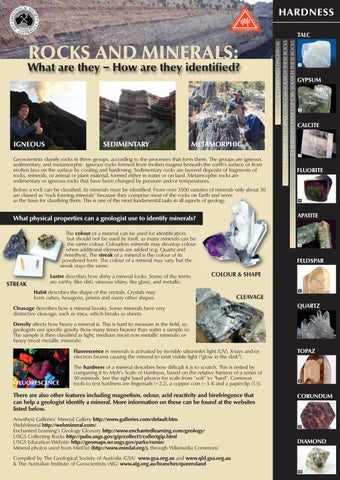
Geoscientists classify rocks in three groups, according to the processes that form them. The groups are igneous, sedimentary, and metamorphic. Igneous rocks formed from molten magma beneath the earth's surface or from molten lava on the surface by cooling and hardening. Sedimentary rocks are layered deposits of fragments of rocks, minerals, or animal or plant material, formed either in water or on land. Metamorphic rocks are sedimentary or igneous rocks that have been changed by pressure and/or temperatures. Before a rock can be classified, its minerals must be identified. From over 3500 varieties of minerals only about 30 are classed as “rock forming minerals” because they comprise most of the rocks on Earth and serve as the basis for classifying them. This is one of the most fundamental tasks in all aspects of geology.
The colour of a mineral can be used for identification, but should not be used by itself, as many minerals can be the same colour. Colourless minerals may develop colour when additional elements are added (e.g. Quartz and Amethyst). The streak of a mineral is the colour of its powdered form. The colour of a mineral may vary, but the streak stays the same.
STREAK
GYPSUM
2
CALCITE
3
FLUORITE
4
5
FELDSPAR
COLOUR & SHAPE
Habit describes the shape of the crystals. Crystals may form cubes, hexagons, prisms and many other shapes.
6
CLEAVAGE
Cleavage describes how a mineral breaks. Some minerals have very distinctive cleavage, such as mica, which breaks as sheets. Density affects how heavy a mineral is. This is hard to measure in the field, so geologists use specific gravity (how many times heavier than water a sample is). The sample is then classified as light, medium (most non metallic minerals) or heavy (most metallic minerals). Fluorescence in minerals is activated by invisible ultraviolet light (UV), X-rays and/or electron beams causing the mineral to emit visible light (“glow in the dark”).
FLUORESCENCE
1
APATITE
What physical properties can a geologist use to identify minerals?
Lustre describes how shiny a mineral looks. Some of the terms are earthy (like dirt), vitreous (shiny, like glass), and metallic.
5.5 HARDNESS PAPER CLIP CAN SCRATCH THESE ROCKS
What are they – How are they identified?
~ 2.2 HARDNESS FINGERNAIL
ROCKS AND MINERALS:
~3.4 HARDNESS COPPER COIN CAN SCRATCH THESE ROCKS
TALC
The hardness of a mineral describes how difficult it is to scratch. This is tested by comparing it to Moh’s Scale of Hardness, based on the relative harness of a series of 10 minerals. See the right hand photos for scale from “soft” to “hard”. Common tools to test hardness are fingernails (~2.2), a copper coin (~3.4) and a paperclip (5.5).
There are also other features including magnetism, odour, acid reactivity and birefringence that can help a geologist identify a mineral. More information on these can be found at the websites listed below. Amethyst Galleries’ Mineral Gallery http://www.galleries.com/default.htm WebMineral http://webmineral.com/ Enchanted Learning’s Geology Glossary http://www.enchantedlearning.com/geology/ USGS Collecting Rocks http://pubs.usgs.gov/gip/collect1/collectgip.html USGS Education Website http://geomaps.wr.usgs.gov/parks/rxmin/ Mineral photos used from MinDat (http://www.mindat.org/), through Wikimedia Commons
QUARTZ
7
TOPAZ
8
CORUNDUM
9
DIAMOND
Compiled by The Geological Society of Australia (GSA) www.gsa.org.au and www.qld.gsa.org.au & The Australian Institute of Geoscientists (AIG) www.aig.org.au/branches/queensland 10
MINERALS GYPSUM – CaSO4.2H2O
CALCITE – CaCO3
Gypsum has a glassy appearance, is light coloured and easily scratched with your fingernail. It has one good cleavage. Gypsum is the most common sulphate mineral and occurs in surface and vein deposits.
Calcite has a glassy appearance, is light coloured and easily scratched with a paperclip but not your fingernail. It breaks into cleavage rhombs. Calcite is the most common carbonate mineral and occurs as limestone, marble and in veins.
ROCKS GRANITE – felsic intrusive rock
BASALT – mafic volcanic rock
Granite is a light coloured, coarse grained intrusive rock that is made up of the minerals quartz, feldspar and biotite or hornblende. Igneous rocks like granite form by crystallization of magma beneath the Earth's surface.
Basalt is a dark coloured, fine grained volcanic rock that is made up of the minerals feldspar and pyroxene or olivine. Some basalt contains gas bubbles (vesicles). Volcanic rocks like basalt form by eruption of lava at the Earth's surface.
Quartz has a glassy appearance, is light coloured and very hard (paperclip will not scratch). It has a smooth fracture. Quartz is a very common mineral that occurs in many rocks, veins and sand and gravel deposits.
BRISBANE TUFF –
Tuff is a light coloured volcanic rock that contains ash, crystals of minerals like quartz, feldspar and hornblende and volcanic rock fragments. Tuff forms as a result of volcanic eruptions that eject material violently from the volcano.
MALACHITE (with azurite) – Cu2CO3(OH)2
Malachite has an earthy appearance, is green coloured and easily scratched with a paperclip but not your fingernail. Malachite and blue azurite are copper carbonates that form by the weathering of copper sulfides.
HELIDON SANDSTONE -
Sandstone is a light coloured, fine to medium grained sedimentary rock made up of mineral and rock fragments. The Helidon Sandstone is quartz-rich and well banded. Sandstones form by the consolidation of sands deposited by water or wind.
PYRITE (with chalcopyrite) – FeS2
Pyrite has a metallic appearance, is brassy coloured and very hard (paperclip will not scratch). It often has a cubic form. Pyrite is the most common sulfide that occurs with yellow chalcopyrite in mineral deposits.
BUNYA PHYLLITE -
Phyllite is a silvery grey, fine grained metamorphic rock that splits into thickish sheets. It is made up of mica and quartz. Metamorphic rocks form when sedimentary and igneous rocks are modified by heat and pressure deep in the Earth.
MAGNETITE – Fe3O4
Magnetite has a metallic appearance, is dark coloured and very hard (paperclip will not scratch). It is strongly magnetic. Magnetite is a common oxide mineral that occurs in many rocks, veins and mineral sand deposits.
QUARTZ – SiO2
felsic volcanic rock
clastic sedimentary rock
regional metamorphic rock
YOUR MINERAL IS?
YOUR ROCK IS?