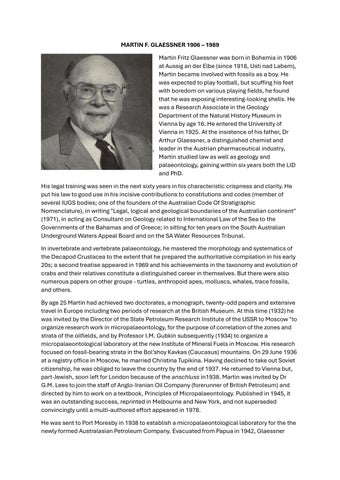
MARTIN F. GLAESSNER 1906 – 1989 Martin Fritz Glaessner was born in Bohemia in 1906 at Aussig an der Elbe (since 1918, Usti nad Labem), Martin became involved with fossils as a boy. He was expected to play football, but scuffing his feet with boredom on various playing fields, he found that he was exposing interesting-looking shells. He was a Research Associate in the Geology Department of the Natural History Museum in Vienna by age 16. He entered the University of Vienna in 1925. At the insistence of his father, Dr Arthur Glaessner, a distinguished chemist and leader in the Austrian pharmaceutical industry, Martin studied law as well as geology and palaeontology, gaining within six years both the LID and PhD. His legal training was seen in the next sixty years in his characteristic crispness and clarity. He put his law to good use in his incisive contributions to constitutions and codes (member of several IUGS bodies; one of the founders of the Australian Code Of Stratigraphic Nomenclature), in writing "Legal, logical and geological boundaries of the Australian continent" (1971), in acting as Consultant on Geology related to International Law of the Sea to the Governments of the Bahamas and of Greece; in sitting for ten years on the South Australian Underground Waters Appeal Board and on the SA Water Resources Tribunal. In invertebrate and vertebrate palaeontology, he mastered the morphology and systematics of the Decapod Crustacea to the extent that he prepared the authoritative compilation in his early 20s; a second treatise appeared in 1969 and his achievements in the taxonomy and evolution of crabs and their relatives constitute a distinguished career in themselves. But there were also numerous papers on other groups - turtles, anthropoid apes, molluscs, whales, trace fossils, and others. By age 25 Martin had achieved two doctorates, a monograph, twenty-odd papers and extensive travel in Europe including two periods of research at the British Museum. At this time (1932) he was invited by the Director of the State Petroleum Research Institute of the USSR to Moscow "to organize research work in micropalaeontology, for the purpose of correlation of the zones and strata of the oilfields, and by Professor I.M. Gubkin subsequently (1934) to organize a micropalaeontological laboratory at the new Institute of Mineral Fuels in Moscow. His research focused on fossil-bearing strata in the Bol’shoy Kavkas (Caucasus) mountains. On 29 June 1936 at a registry office in Moscow, he married Christina Tupikina. Having declined to take out Soviet citizenship, he was obliged to leave the country by the end of 1937. He returned to Vienna but, part-Jewish, soon left for London because of the anschluss in1938. Martin was invited by Dr G.M. Lees to join the staff of Anglo-Iranian Oil Company (forerunner of British Petroleum) and directed by him to work on a textbook, Principles of Micropalaeontology. Published in 1945, it was an outstanding success, reprinted in Melbourne and New York, and not superseded convincingly until a multi-authored effort appeared in 1978. He was sent to Port Moresby in 1938 to establish a micropalaeontological laboratory for the the newly formed Australasian Petroleum Company. Evacuated from Papua in 1942, Glaessner
worked in Melbourne. In the next three years he prepared a geological map of Papua and New Guinea for the Australian Military Forces and was a consultant to the Iraq Petroleum Co. Ltd. In 1945 he was naturalised. That year he published Principles of Micropalaeontology, which was an outstanding success, reprinted in Melbourne and New York, becoming a standard textbook for 33 years and not superseded convincingly until a multi-authored effort appeared in 1978. In 1948 he gained a D.Sc. from the University of Melbourne. Back in Port Moresby after the war, he resumed the research that was to culminate in a series of reviews on the stratigraphy and tectonics of Australia, New Zealand, New Guinea and the South Pacific. To the challenging problems of southwest Pacific geology, he brought his experience in biostratigraphic correlation, in the stratigraphy, structure and tectonics of Alpine mountain belts, and in petroleum geology. Micropalaeontology and later Phanerozoic stratigraphy continued as themes into the 1960s. In Adelaide, his foraminiferal-biostratigraphic consulting was used in various drilling projects on the western and southern continental margins as well as in Timor, Papua New Guinea and New Caledonia. In 1950 Martin was invited by Sir Douglas Mawson to join the Department of Geology at the University of Adelaide where he remained (Senior Lecturer, 1950, Reader, 1952, Professor, 1964, Emeritus Professor and Honorary Research Fellow, 1971) even though he was nominated "primo loco" for the Chair in Palaeontology at the University of Vienna in the early 1960s However, negotiations failed. His academic career focused first on micropalaeontology and associated stratigraphy and included consulting work on oil- and gas-drilling projects on Australia’s continental margins and in Timor, Papua and New Guinea, and New Caledonia. An outstanding lecturer, he provided an intellectually challenging overview ranging across stratigraphy, ancient climates, tectonics and palaeogeography, and attracted several highly talented postgraduate students. Continuing his work on fossil crabs, he established an international reputation in the field with his contribution to Treatise on Invertebrate Paleontology (1969), edited by R. C. Moore and published under the auspices of the Geological Society of America. That brings us to the last major strand of Martin's sustained efforts. The Ediacaran fauna has through his efforts and those of his students taken its place as the most important record of early animal evolution By the mid-1950s Glaessner had begun investigating the taxonomy, palaeobiology and stratigraphy of the well-preserved early fauna remains at Ediacara in South Australia’s Flinders Ranges, research that resulted in The Dawn of Animal Life (1984). Martin Glaessner published his first paper in 1924 and his last, after more than 150, in 1989 - a sixty-five-year span. He wrote four books or book-length treatises and edited or co-edited four more. He was highly regarded as the foundation editor (1953-58) of the Journal of the Geological Society of Australia. Retiring in 1971, he was appointed emeritus professor. He was an honorary research fellow at the University of Adelaide until 1989. He contributed more than his share of professional service in other ways too, such as Chairman, National Committee of Geological Sciences (Australian Academy of Science), Member, Australian Research Grants Committee, Member of several IUGS bodies, and others too numerous to mention here. Awards included: Member, Order of Australia (AM) in 1985 for services to geology particularly micropalaeontology; Fellow of the Australian Academy of Science (FAA) and chairman (1962-
77) of its national committee of geological sciences; Honorary Fellow of The Geological Society; Fellow of the German Academy of Scientists Leopoldina (1971); and an honorary member of the Geological Society of Australia (1976). Outstanding trophies included the Lyell Medal of The Geological Society, the Walcott Medal of the US National Academy of Science, the Suess Medal for the Geological Society of Austria and Joseph Verco medal from the Royal Society of South Australia (1970). He was the Royal Society of New South Wales’s (William Branwhite) Clarke memorial lecturer (1953) and Walter Burfitt prizeman (1962). After his official retirement, he overcame health problems so successfully as to publish more than 20 papers, write a book, edit and co-edit a couple of others, and live an active professional life in other ways. The non-event of those years was an atlas of Ediacaran fossils which obviously required extensive modern photography (Martin had an old fixation about his abilities as an illustrator) which, in the end, was not forthcoming. His final scholarly preoccupation was with the second edition of Dawn, as requested by Cambridge University Press. Possessing great powers of concentration and the capacity for sustained hard work (and aware that bright ideas and good intentions were not enough), Martin always admired those qualities in others. He admired good mapmakers and good monographers and could be impatient with those who were less inclined to put in the required effort. He was comfortable in four languages and could understand others. He was immensely erudite and cultivated. And was a somewhat shy man who, although kindly, could be abrupt. Former students remember him with affection. Martin Glaessner died in the Royal Adelaide Hospital on 22 November 1989, after a brief illness. Extracted from the obituary by Brian McGowran in TAG June 1990 and the biography by Bernard O'Neil (Biography - Martin Fritz Glaessner - Australian Dictionary of Biography — accessed 18 August 2026).