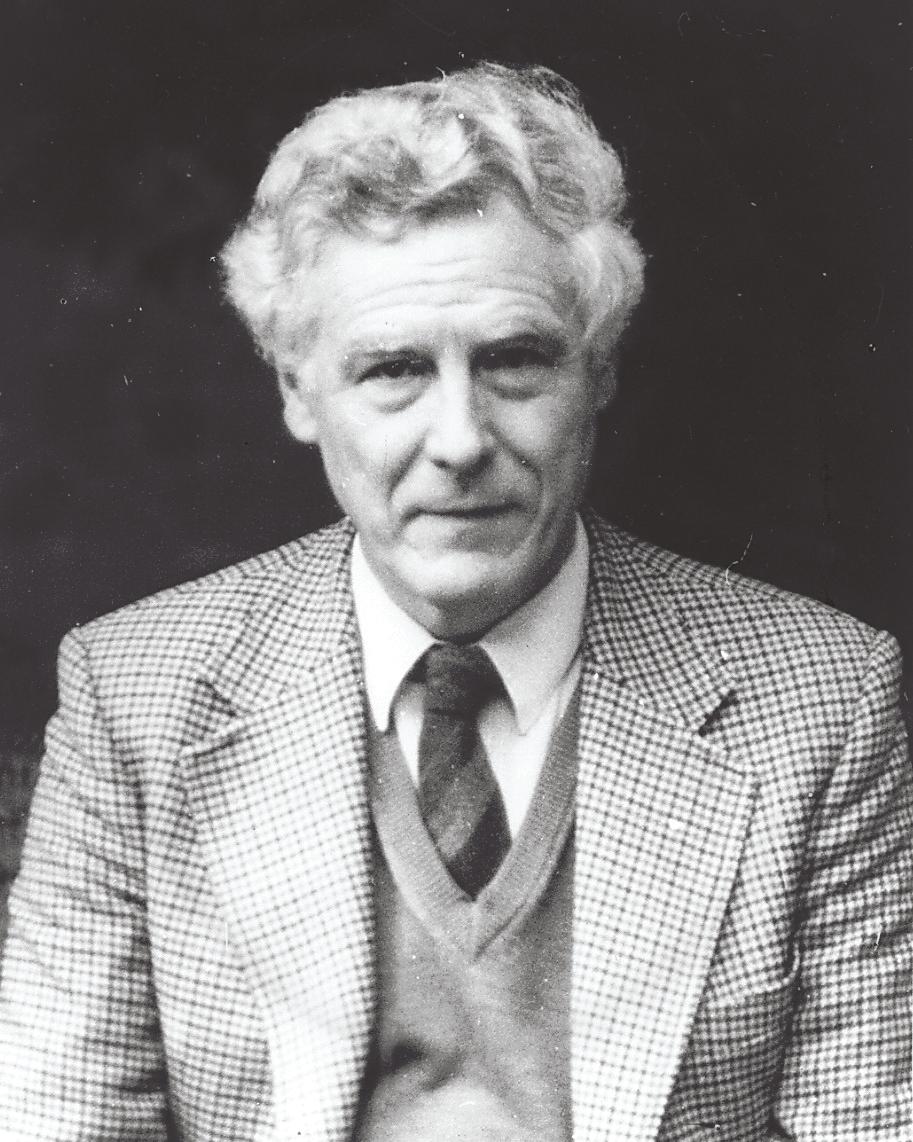
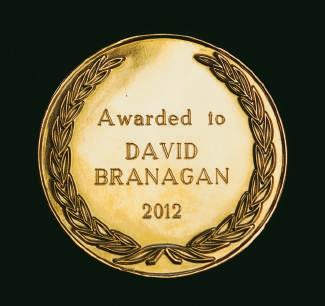
Welcome to your Newsletter, the fourth from your Western Australian committee. This edition highlights the INHIGEO symposium held as part of the 34th IGC last year. It attracted a record number of 19 contributions including a number from members of ESHG. The abstracts of papers by members that cover aspects related to Australia are reproduced here with kind permission from the Australian Geoscience Council. These abstracts cover diverse subjects from the links between diamonds of Brazil and those in NSW to biographies of geologists to the recognition of the Hunter Thrust in New South Wales as well as the growth of geological knowledge in Australia’s tropical region. We also include the presentation of the inaugural Tom Vallance Medal to David Branagan
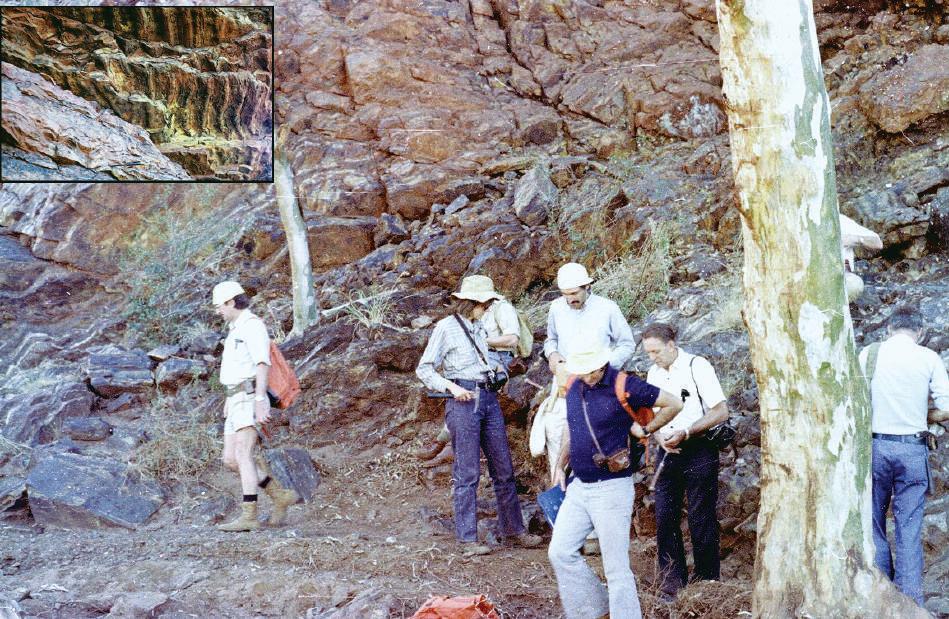
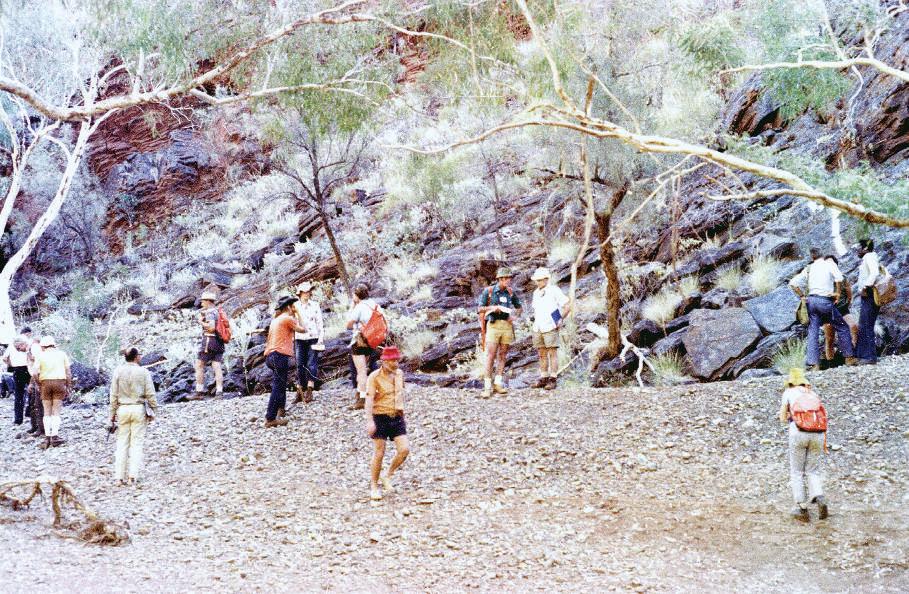
A link with the first IGC (25th) held in Australia in Sydney in 1976, is provided by John Blockley with recollections of the conference field trip to the Hamersley Basin.
David Branagan describes the contribution by eminent Dutch geologist Emile den Tex to Sydney University and the early days of the Geological Society of Australia. David also provides biographical snapshots of members of the Aerial Geological and Geophysical Survey of Northern Australia and invites us to name “The Missing Name”.
Thank you to Murray Jones (DMP) for assistance with the photos in this newsletter.
A note from the Chairman
2012 saw the very successful IGC34/INHIGEO meeting in Brisbane at which many of the members of ESHG participated. The highlight for the ESHG was the David Branagan Symposium - Biographical Studies of Eminent Geologists - chaired by Barry Cooper which commenced with the inaugural presentation of the Tom Vallance Medal to David Branagan (see p. 5). We were very pleased that Hilary Vallance, Tom’s widow, was able to attend and take part in the presentation.
The ESHG also helped sponsor David Branagan’s pre-conference excursion to sites of historical geological interest between Sydney and Brisbane. David has reported that the excursion was a great success and we hope to publish the excursion guide on our website in the near future.
The ESHG committee was taken over by Western Australia in July 2008 and by next AESC in 2014 will have been in office for six years and it is felt that in line with previous committees another state should take over the reins in 2014. The previous committees have been:-
1984-1986 - South Australia; 1986-1990 - ACT; 1990-1994 - New South Wales; 1995-2002 - Tasmania; 20022008 - Victoria; 2008- - Western Australia
Queensland is the obvious place for the next committee and has been approached to take over.
During 2012 our committee met on eight occasions and has published seven e-mail bulletins. I thank the committee for its work and most particularly our secretary, John Blockley who has been responsible for the bulletin and just about everything else, leading to the smooth operating of the Earth Sciences History Group.
Committee members
Peter Dunn, Chairman, email: peter.dunn@dmp.wa.gov.au, or petpat3@optusnet.com.au
Peter Downes, Vice Chairman, email: peter.downes@museum.wa.gov.au
John Blockley, Secretary, email: tiger-eye@iinet.net.au
Michael Freeman, Treasurer, email: mike.j.freeman@dmp.wa.gov.au
Peter Muhling, Newsletter editor, email: peter.muhling@westnet.com.au
Mail and telephone enquiries should be directed to the Secretary, John Blockley
76 Beach Street Bicton WA 6157, or (08) 9317 1775
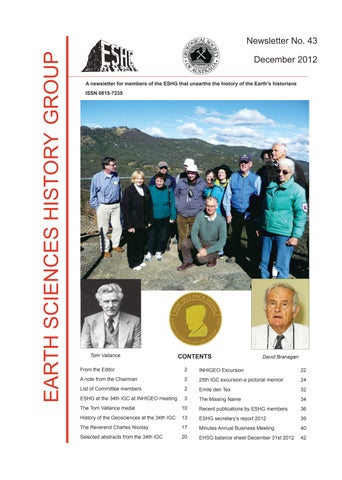
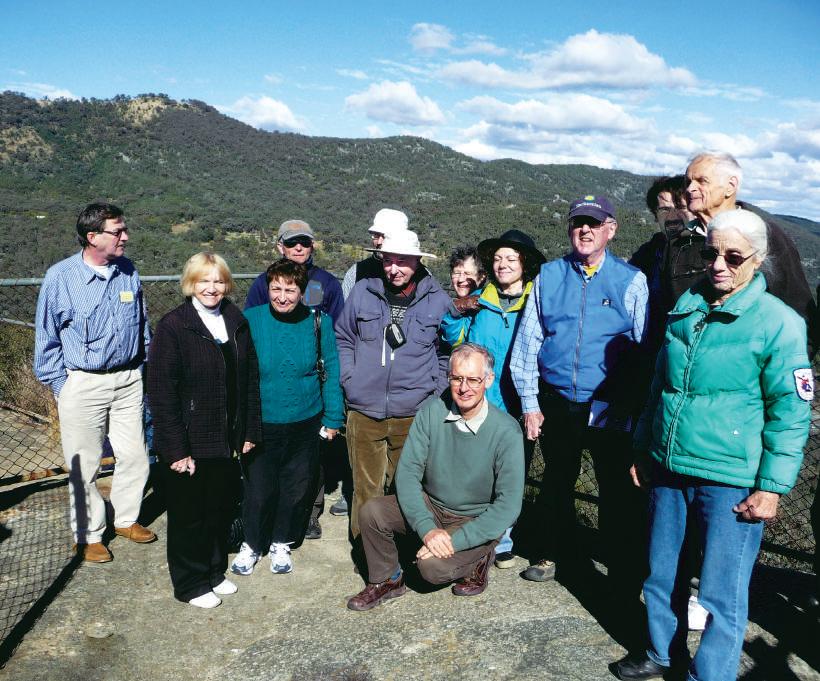
Cover Moonbi Lookout, INHIGEO excursion 2012 : north from Tamworth, the site of Bruce Chappell’s ‘revelation’ about S & I granites. The people are (from left): David Mitchell (driver, Australia), Tatiana Ivanova , Zoya Bessubnova (both from Russia); at back Randall Miller (Canada), next, at back, almost certainly Ezio Vaccari (Italy), with David Oldroyd (Australia) in front, Barry Cooper (Australia, kneeling), behind him is Maggie-Ananian-Cooper (Australia, hatless), next is Claudine Cohen (France), then Ken Bork (U.S.). In shadow: Johannes Mattes (Austria), plus David Branagan, & Sally Newcomb (U.S.). Photo courtesy B. Cooper.Names D. Branagan.
ESHG AT THE IGC 34 INHIGEO MEETING
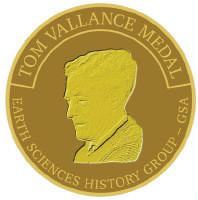
The Tom Vallance Medal
The highlight for the ESHG was the David Branagan Symposium - Biographical Studies of Eminent Geologistschaired by Barry Cooper which commenced with the inaugural presentation of the Tom Vallance Medal to David Branagan
Background to the creation of the Tom Vallance Medal
Mike Freeman
In February 2010 the hon treasurer of the GSA sent a message to all Specialist Groups and Divisional committees of the GSA reminding them about the need to think about presentations of medals at the forthcoming AGM. This prompted Bernie Joyce to ask the hon secretary of the Earth Sciences History Group why the ESHG was not included in the list of Specialist Group awards.
The committee discussed this at the monthly meeting on 17th February and agreed to proceed with further consideration of the concept and look at ways to define the requirements for such an award.
The Committee discussed at several meetings whether an award was appropriate, what should be the scope of an award and the cost. Key points for discussion were if the award should have limitations on whom and on what aspects of Earth Science History would be eligible. Should it be restricted to just members of the GSA or open to all geologists or even to anyone, even non-members of the GSA? Whether the award should be for publications on historical people’s activities or on any subject? The other questions were how often the award should be presented and when it should be presented.
Ultimately the committee decided that there should be minimal restrictions on the award. The committee also decided that the award be presented at the GSA’s biennial meeting to a person who has made a significant contribution to researching and documenting some
aspect of the Earth Sciences.
Rules were drawn up and presented to the Committee at its meeting on 30th June 2010 and were ratified with a view to presenting them to the Annual General Meeting in July. The concept and rules were then presented to the General Meeting held accompanying the AESC2010 held on 8th July, where the concepts and rules were formally adopted with a view to presenting the inaugural Award at the 2012 Annual Meeting. There was agreement that the award be named after Tom Vallance.
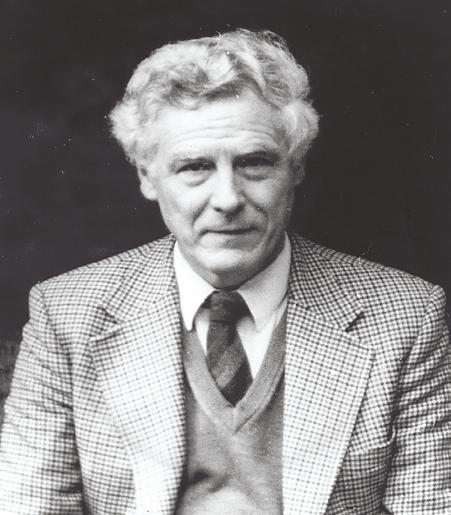
It had been decided to honour Thomas George Vallance, for his efforts in documenting the historical aspects of pioneering Australian explorers-geologists. He was born in Sydney on 23rd April 1928, and died there on 7th March 1993. The following brief summary
Tom Vallance-geologist and historian of science. Photo courtesy of Hilary Vallance
was adapted from ESHG Newsletter 41: Tom Vallance, geologist and historian of science was Associate Professor at Sydney University. Originally a petrologist, he became interested in the history of geology and early workers in the earth sciences and carried out research and published many articles on pioneers in the earth sciences. His contribution was recognised by INHIGEO (International Commission for the History of Geological Sciences). Their 1994 meeting was dedicated to Tom Vallance, a foundation member and one of its vice presidents for some years.
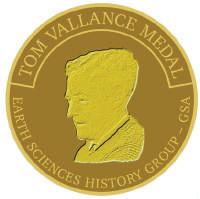
Following the general meeting, the design of the medal presented some interesting steps. The first to have Tom Vallance’s widow Hilary agree to the naming, which she did most readily and we are thankful for this, and then to obtain a good image of Tom to use for striking the medals.
The medals were then cast by Sheridans in Perth, which has been making a number of different medals for the GSA WA Division for many years.
Submissions for the first award were called for and considered by the committee. There was very strong support for the initial medal to be presented to David
The following short citation was compiled by the committee using the submissions from the members who nominated David for the award. It was felt that although his numerous achievements are known to many members of ESHG, there are also many who are only now starting to appreciate his enormous contributions to scholarship and his energy in documenting the history of geologists and their ideas,
especially in Australia, for more than half a century
Citation for Dr David Branagan
David Branagan was born in 1930 in Broken Hill where his father was a maths teacher. At that time most of the streets were unpaved and fierce sandstorms still swept the town as the famous greenbelt was only just being started. But the mines were booming. His family moved to Sydney when he was seven to provide David and his brother with better opportunities in education (he subsequently obtained a scholarship at the Jesuit school Riverview).
By the time of his enrolment at Sydney University David was already interested in geology and decided to add geology to the three standard science subjects of chemistry, physics and mathematics that formed part of a science degree. There he encountered memorable teachers and gave him contacts with such famous figures as Leo Cotton (through whom he was first introduced to the ideas of Edgeworth David), W. R. Browne, Germaine Joplin, Florence Quadling and George Osborne. Following the retirement of Leo Cotton, Charles Marshall, a ‘coal man’, introduced a broader range of subjects including geophysics, sedimentology and micropalaeontology by hiring new lecturers including some international figures such as the Dutchman Emile den Tex. (see page 32 ).
An honours project on the coal measures at Newcastle started what was to be David’s lifelong interest in coal and coal mining. This was followed by three years with the Geological Survey of New South Wales working on a wide variety of projects including coal, the geology of dam sites and radioactive minerals. A further year was spent in industry, exploring for copper near Cloncurry.
However, geology was not David’s only interest. His passion for music, and in particular singing, initially developed at secondary school, had blossomed at university and led to a decision to go to London in 1955 and try to make a career as a singer. Wonderful experiences in music, travel and architectural history followed. However there was little prospect of making a living in early music, which was his real interest. So to avoid “living in a garret” he and his wife Gillian returned to Australia. And after a stint as a school teacher, which involved little geology, he obtained a position at Sydney University in coal geology in 1958, which was, he has said, “the start of my career proper”1
1 Oldroyd, D. 2003 for 2002. Interview with David Branagan: INHIGEO Newsletter, No. 35, pp. 34–39.
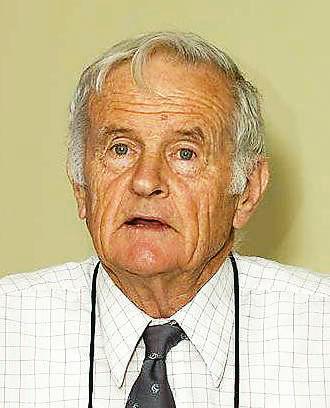
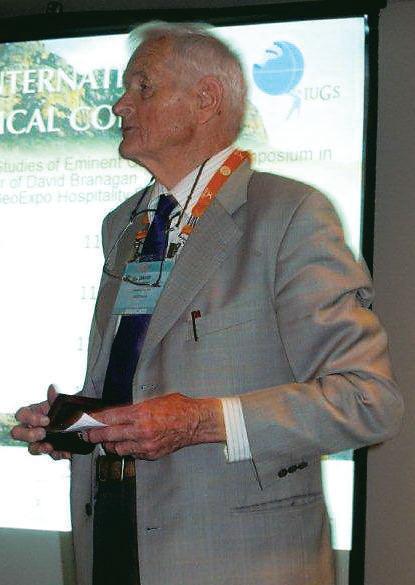
David Branagan speaking at the Geological Society of Australia’s Earth Science Showcase in 2009. Photographer unknown
He retired from the university in July 1989, but remained on as Honorary Research Associate.
Research for a doctorate on the coal seams in the Newcastle field led to the expansion of his nascent interest in the history of science and geology. As described by David: “ found a lot of old maps and papers in the local library-records from the 1840s–1850s, and I found myself unrolling maps that that hadn’t been looked at for a hundred years or more. It was a real treasure trove”. He also obtained a lectureship teaching first-year geology, which matched his desire to learn about many aspects of geology new to him, including engineering geology.
David’s interest in the history of geology and science was enhanced further through his contact and friendship with Tom Vallance, who taught petrology at Sydney University and had an encyclopaedic knowledge of the history of geology (particularly Australian geology). Tom introduced David to the International Commission on the History of Geological Sciences (INHIGEO) and he began to attend the Commission’s conferences and continues to be an active contributor. He was President of INHIGEO for four years and contributed not only conference papers but also his intellect and energy in arranging the INHIGEO conference in Sydney in 1994. Recently he arranged a field trip (that started in Sydney and ended in Brisbane) for INHIGEO as part of the Brisbane IGC in 2012.
Although having an international perspective, David, has for many years emphasised the achievements of Australian geological and scientific ideas through his extensive research, lectures and publications. He has written on the long-term development of people and their ideas by documenting the careers and achievements of numerous geologists and his appetite for learning led to contributions in a wide range of aspects of geology with a versatility that is uncommon today. At present, in his eighties, he is collaborating on a translation from the Latin of Agricola’s De ortu et causis mineralium (perhaps making use of the Latin he would have learnt at Riverview?). He is also well read in general literature, in music and history of architecture. In addition, he has been a keen amateur sportsman and still takes a daily swim.
David has nearly two hundred publications, of which about half are concerned with the history of geology, of mineral exploration, the history of ideas in science, as well as biographies of geologists, engineers, and metallurgists. His most important work is his definitive
biography of Edgeworth David, described as a masterful work on an Australian pioneering geological academic and explorer. In 2007 he was awarded an honorary DSc by the University of Sydney, chiefly in recognition of this biography2. Examples of his major works range across coal mining (Geology and coal mining in the Hunter Valley 1791–1861); history (Science in a sea of commerce: the journal of a South Seas trading venture (1825–1827) by Samuel Stutchbury) and Rock me hard...Rock me soft ...a history of the Geological Society of Australia, compiled and edited with Barry Cooper. He has contributed to the education and public interest in geology through many lectures and various field guides (notably his popular, in a positive sense, Field geology of New South Wales, with Gordon H. Packham), as well as an edited text book: Beneath the scenery: geology for senior students. His knowledge of the exposures of rocks in NSW and elsewhere in Australia is truly remarkable.
David’s knowledge of the early history of geology in Australia is without equal today and he has continued and built on the tradition established by Tom Vallance in a remarkable way.
Presentation to Dr David Branagan
Bernie Joyce first recalled that at the IGC in Sydney in 1976 Dr T. G. Vallance organised the INHIGEO session “117.2 The growth of geological knowledge in the age of geographical exploration”. He recalled that he was at the IGC and gave his first history of geology paper. David Branagan was there also, presenting a paper, and with Tom Vallance leading an excellent Intra-Congress Excursion from Sydney across the Blue Mountains on “Aspects of the History of Geology in Eastern Australia”.
As former President of the ESHG Committee in Melbourne, Victoria, Bernie Joyce spoke about the recent history of the ESHG, and the grants made after the 2007 ESHG Conference in Melbourne in an attempt to make better use of some of the funds which had accrued over recent years (in spite of the very reasonable annual membership charge!)
In July 2008 the organisation of the ESHG passed from Victoria to Western Australia and a new Committee was formed, and today at the IGC, Peter Downes is here, as Vice-Chair representing the ESHG WA Committee. In early 2010 Bernie Joyce suggested to the WA Committee that with the money the ESHG had in hand they might consider setting up a medal project, as the GSA, Divisions and other Groups have done.
2 http://sydney.edu.au/senate/HonBranagan.shtml
On 16/2/2010 he emailed to John Blockley, Secretary of the ESHG WA Committee: “So here is an obvious opportunity to use some of our funds to establish such an award, through the GSA, and make the first presentation at INHIGEO in Brisbane in 2012.”
By May 2010, the WA Committee had determined that such an award was feasible within the Group’s budget, but considered it a matter for approval at the Business Meeting to be held in July 2010. This meeting gave the go ahead for establishing a special ESHG medal, to be called the “Tom Vallance Medal”. At a very reasonable cost, augmented by a generous anonymous donation, WA did the work required, and in 2011 the Tom Vallance Medal was ready to go Bernie Joyce then made reference to Vallance’s Presidential Address “Origins of Australian Geology” to the Linnean Society of New South Wales in 1975, a seminal publication which was discussed by David
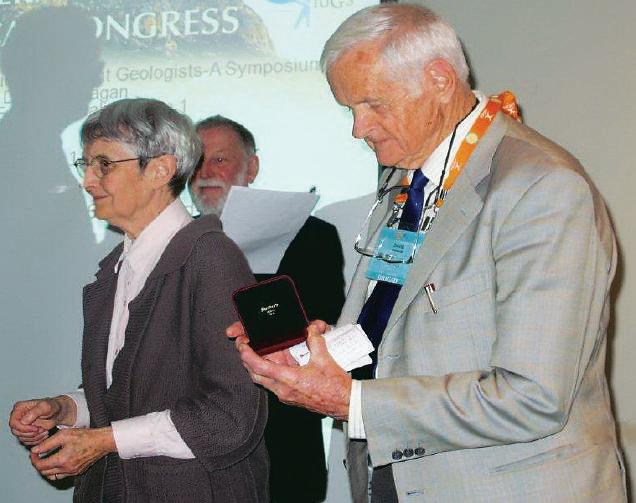
David Branagan and Hilary Vallance at the medal presentation. Bernie Joyce in the background.
Branagan on the pre-IGC field trip this year.
Finally Bernie concluded with a comment on the Vallance Collection in the Rare Books section of the University of Melbourne library, and its value for researchers into the history of geology. The Vallance collection of historical material on the earth sciences was purchased from the private library of the late Professor Tom Vallance. It contains between 10,000 and 15,000 monograph volumes as well as 3,000 offprints, 1000 maps, and some long runs of geological journals. The collection contains major works in mineralogy, petrology, palaeontology, natural philosophy, geology and geography from the 19th century and selected works from the early 20th century. (Thanks to Guido Tresoldi, Librarian Earth Sciences, for this summary.)
Bernie Joyce then asked Mrs Hillary Vallance to come forward and present the medal to Dr David Branagan.
Reply by David Branagan
Mr. Chairman, Hilary, Ladies and Gentlemen
It is an honour, indeed, to receive the inaugural Tom Vallance Medal, awarded by the Earth Sciences History Group of the Geological Society of Australia. I thank the present executive of ESHG, particularly Chairman, Peter Dunn and Secretary, John Blockley, for the work they have done behind the scenes to bring this award to fruition, and Hilary Vallance, for generously funding this award in memory of her late husband, Tom, and also for coming to Brisbane to make this presentation.
It is good that the specialist History Group of the Society, thirty years old next year, brought into being by Barry Cooper and South Australian colleagues, continues to produce research that bears comparison with the best in the broad fields of ‘real’ geology, reminding us that geological knowledge has come through the hard work of
individuals and organizations who went before us.
I feel more than a little guilty about receiving this award, as many might feel that it has almost essentially occurred ‘in house’. It is hard to realise that it is now
almost twenty years since Tom died. In our time together we published jointly, from 1967, ten papers. In preparing this reply I was surprised to find, in fact, that I had published my first history paper before Tom did, although his patient research, by that time, had already made considerable progress on his very large and detailed card index of nearly 4000 Australian geologists and miners. At the same time, he was, of course cementing his reputation as a geological researcher of note, his spilite studies giving him international status in the pantheon of geology, as acknowledged in his obituary notice in the London Times, a respect given to few Australian geologists.
I can note, too, that Tom would have been delighted that his great friend, Hugh Torrens, of Keele University, this evening is being awarded, at this same Congress, the inaugural IUGS History Medal.
As time is limited and there is a session full of interesting history papers waiting to get underway, I say my thanks again, with apologies for my voice which would place me well down in the basses of any respectable Russian choir. This is the result, I must say, of a week haranguing a mixed group of international and local fellow travellers from Sydney to Brisbane about the wonders of Australian geology and those geologists who have worked to explain it all.
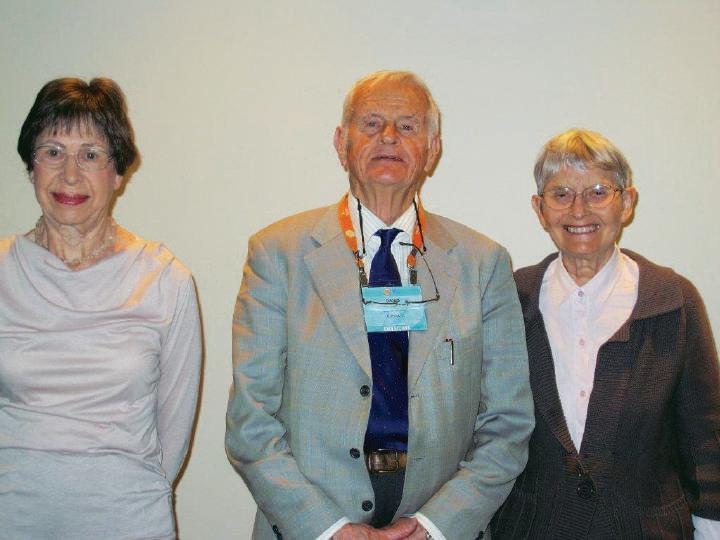
At the presentation (from left to right) Gillian Branagan, David and Hilary Vallance
David Branagan in reply.
The History of the Geosciences at the 34th IGC in Brisbane, August 2012
Peter Downes
This edition of the ESHG Newsletter highlights work presented by members at the 34th IGC in Brisbane last year. The ‘History of the Geosciences’ theme included sessions covering biographical studies of eminent geologists, the early history of continental drift, major achievements in 20th century geology, geology in tropical regions, and histories of resource exploration and development. The week commenced with an INHIGEO symposium in honour of David Branagan – ‘Biographical studies of eminent geologists’ – organised by David Oldroyd, who introduced the symposium with an interesting analysis of biographical and autobiographical works in the field of geology. He described changes in these genres over time and the cultural factors at play in this area of study. Fittingly for a Brisbane meeting, John Jell described the life and work of Dorothy Hill, a pioneering figure in the history of Queensland and Australian palaeontology. This was followed by a series of presentations on some workers important to Australasian 19th and 20th century geology: William Noel Benson (Wolf Mayer), known for his studies of serpentinite in NSW; Ralph Tate (Barry Cooper), the South Australian palaeontologist and stratigrapher; and Arthur Smith Woodward (Susan Turner), a vertebrate palaeontologist at the British Museum (Natural History) who described many new Australian fossils. Look out for an upcoming issue of the journal ‘Earth Sciences History’ containing papers from this symposium.
Linking in with the tropical Queensland climate was a short session on ‘Geology in tropical regions’ included contributions describing Brazilian, Mexican and Australian historical geoscientific work. The Reverend C.G. Nicolay, known for his geological work in Western Australia in the late 19th century, also spent time investigating diamonds in Bahia, Brazil, and this is described in the article by Peter Downes and Alex Bevan later in this issue. Bernie Joyce presented some of the highlights of 19th century exploration of northern Australia and the resultant growth in knowledge of the geology of this region.
In the session on major achievements in 20th century geology, David Branagan detailed the work by George Osborne, Edgeworth David and colleagues, leading up to the recognition, in the 1920s, of the nature of the
Branagan.
Hunter Thrust system at the southern and westerly boundary of the New England Fold Belt in NSW. Ian McDougall provided an interesting perspective on the plate tectonics revolution by describing early K-Ar dating of the Hawaiian island chain. This dating provided evidence for Wilson’s hotspot model for the origin of island chains, and helped to define the geomagnetic polarity time scale that anchored studies of the magnetisation of the sea floor across mid-ocean ridges – a vital piece in the plate tectonic puzzle.
The session on ‘Geologists, resource exploration and development’ focused on case studies and histories from the Australasian region with contributions from Tony Hope, Maggie Hayes, Paul Kay, Don Perkin, Don Poynton and Mike Johnston. These talks examined topics ranging from the interplay of resource discoveries with economic and social development in Australia and Papua New Guinea, to the role of innovative geoscientific thinking and technological advances in producing major discoveries. It is good to see that the lives and work of some of the Australian geologists involved in major resource discoveries since the late 1940s are being documented by Maggie Hayes, in collaboration with the State Library of NSW, via the medium of oral histories.
Finally, in the session on the early history of the understanding of continental drift, Chris Turney described the exploration of Antarctica in the pivotal year of 1912, and the scientific insights that resulted, when 5 separate teams from England, Germany, Norway, Australasia and Japan descended on the continent. Abstracts for member’s talks that cover aspects related to Australasia are reproduced in this issue of the ESHG Newsletter, providing a glimpse of the terrain covered over the course of the IGC and pointing you in the direction of further reading in any of these subject areas.
Notes
Among other contributions to the IGC by ESHG members, Angela Riganti presented a poster on the activities of the ESHG and Sue Turner presented a poster on Pioneer Women Geologists in Australia.
The Reverend Charles Grenfell Nicolay and the diamonds of Bahia, Brazil
Peter
J. Downes and Alex W. R. Bevan
Department of Earth and Planetary Sciences, Western Australian Museum Collections and Research Centre, 49 Kew St, Welshpool, Western Australia, 6106. (peter.downes@museum.wa.gov.au)
Introduction
The Reverend Charles Grenfell Nicolay (1815–1897) made an important contribution to early geological work in Western Australia (Figure 1). He was a selftaught natural historian from the English parson–naturalist tradition, and is best known for his ‘Handbook of Western Australia’, completed in 1877, that contained a summary of the geology and physical geography of the Colony (Playford and Pridmore, 1969, 1974; Armstrong, 2000). Nicolay established a public collection of rocks, minerals and fossils, called the ‘Geological Museum’, in Fremantle in 1881, which later became a foundational collection for the Western
Australian Museum (Bevan and Downes, 2000; Bevan, 2006; Downes et al., 2010).
During his early career Nicolay lectured in physical geography at King’s and Queen’s Colleges London (Playford and Pridmore, 1969, 1974). Nicolay left London in 1858 to take up the position of Chaplain
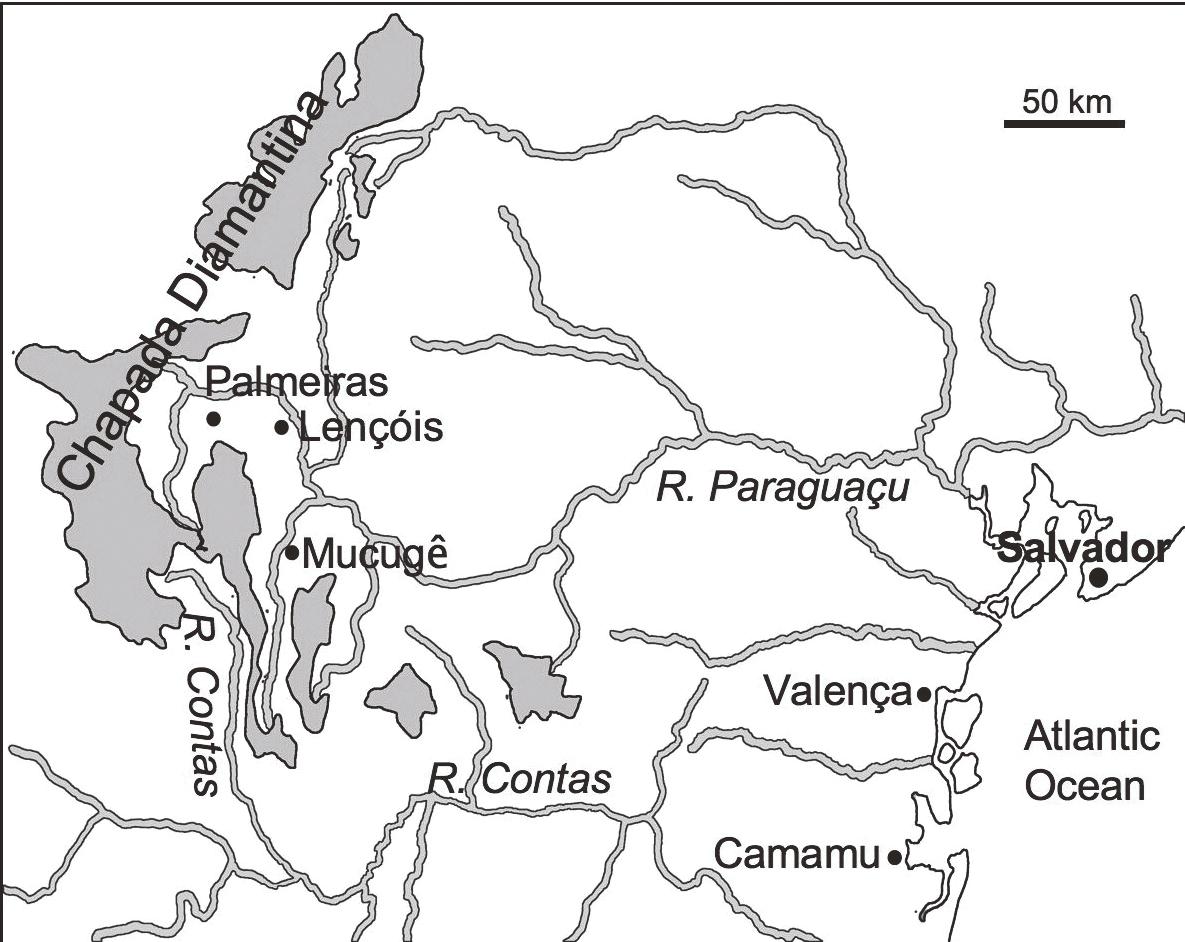
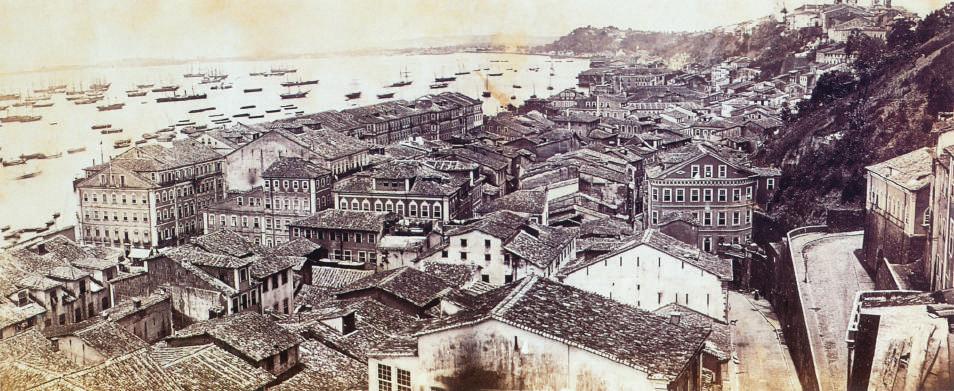
to the British residents of Bahia in Brazil, based in the capital Salvador (Figure 2).
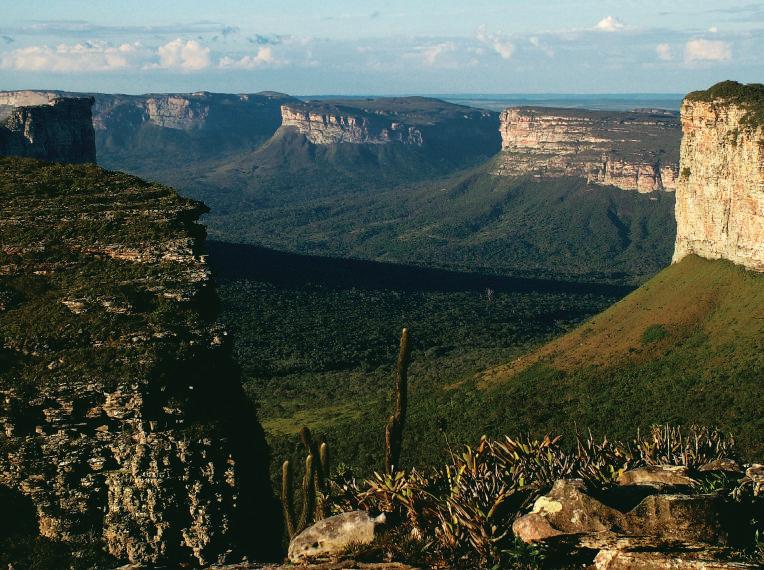
While in Brazil, Nicolay undertook a range of geological investigations, as time permitted in his duties as Chaplain. Although the documentation is sparse, Nicolay’s correspondence provides some details of his activities (Nicolay, 1843–1892), as do accounts of the 1865–66 Thayer Expedition by Charles Frederick Hartt (Hartt, 1870) and Louis and Elizabeth Agassiz (Agassiz, 1868), where Nicolay provided great assistance to their geological work in Bahia. Most notably, Nicolay undertook an expedition to visit the diamond deposits of the Chapada Diamantina in 1865, and later presented his findings to the British Association for the Advancement of Science (BAAS) meeting held in Norwich in August 1868. Nicolay later corresponded with the Reverend William B. Clarke in 1871–72 on the subject of diamonds, which had the result of linking his work in Brazil to Clarke’s efforts to understand the diamond deposits of eastern Australia (Clarke 1870, 1872, 2003).
Encounters with Charles F. Hartt and Louis Agassiz on the Thayer Expedition of 1865–66
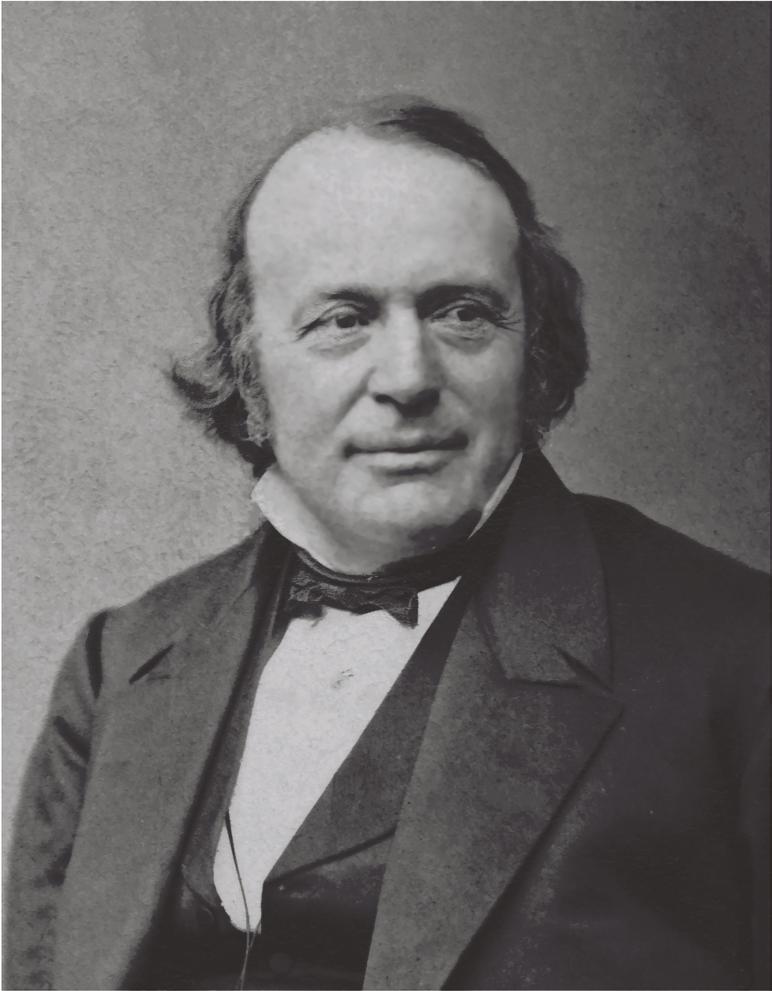
From his base at Harvard University, the famous Swissborn naturalist, Louis Agassiz (1807–1873; Figure 3), mounted a scientific expedition to Brazil in 1865, sponsored by Nathaniel Thayer, primarily to study and
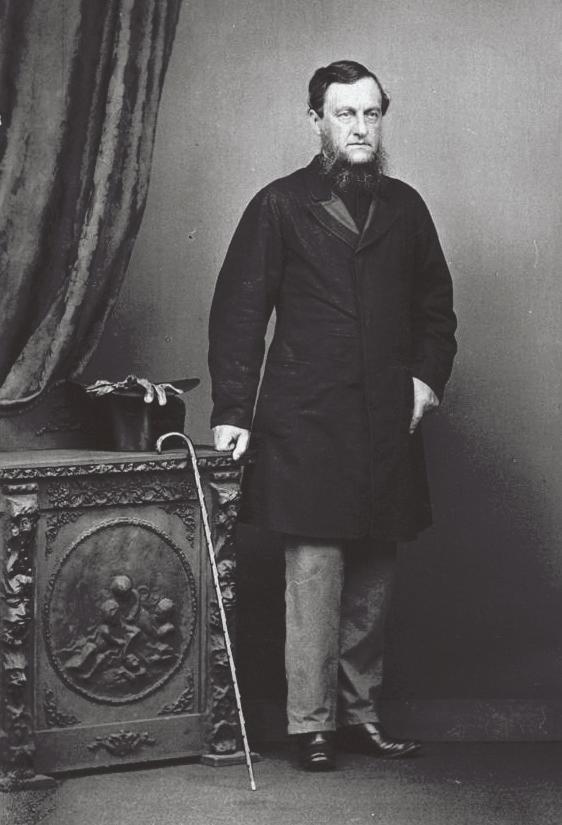
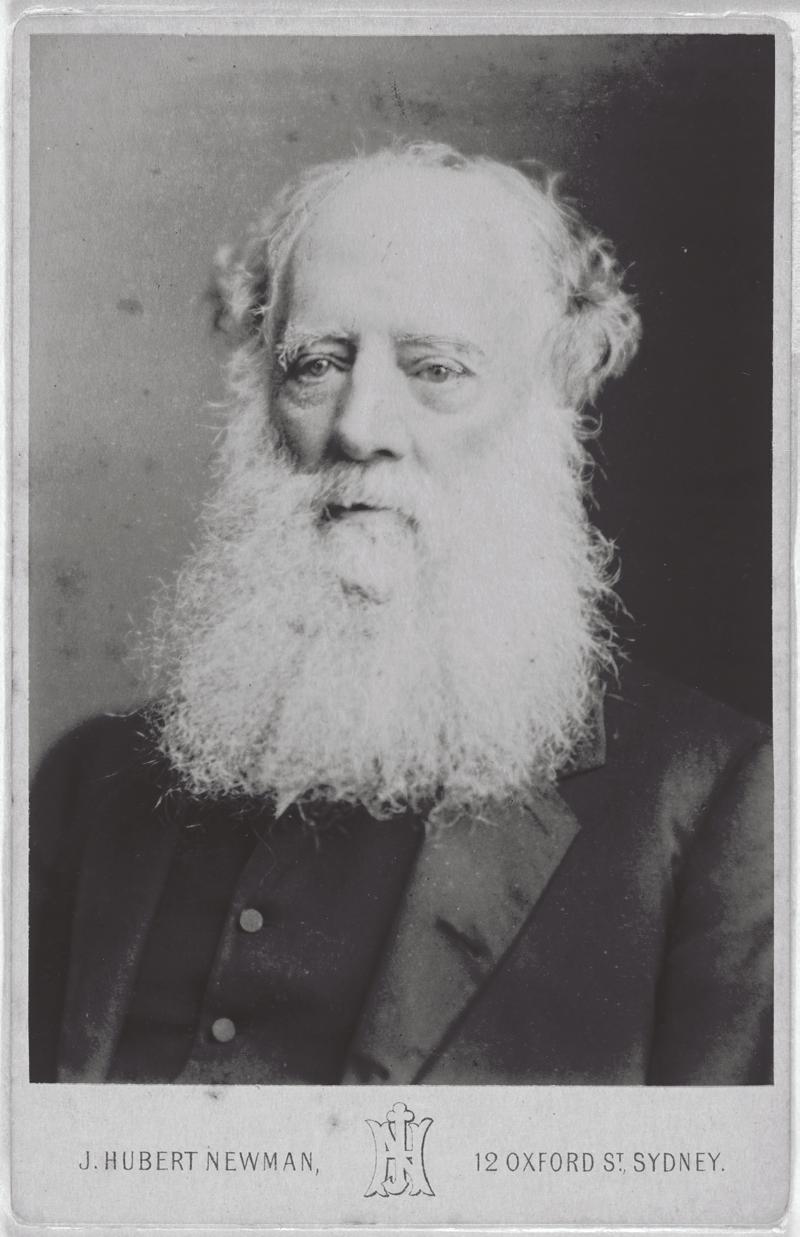
Figure 1. The Reverend Charles Grenfell Nicolay (1815–1897). This photo probably was taken in the 1870s, not long after Nicolay’s arrival in Western Australia. Courtesy of the State Library of Western Australia, Battye Library image 4976B/22.
Figure 2. Locality map of Bahia showing the topography in the Chapada Diamantina.
collect the Brazilian fresh water fish fauna (Agassiz, 1868). Agassiz was searching for evidence to support his idealist belief in the permanence of species, and thus help him to combat Darwin’s theory of natural selection (Lurie, 1959). With the same goal in mind, he also sought evidence of Pleistocene glaciation in the tropics to support his idea of multiple centres of creation, an idea that required a catastrophist geological history (Brice and Figueirôa, 2001). In addition to fish, collecting on the Thayer Expedition encompassed plants, a wide range of vertebrates and invertebrates, fossils and rocks, and the geological surveys of the country undertaken by the expedition scientists provided much information on the structure
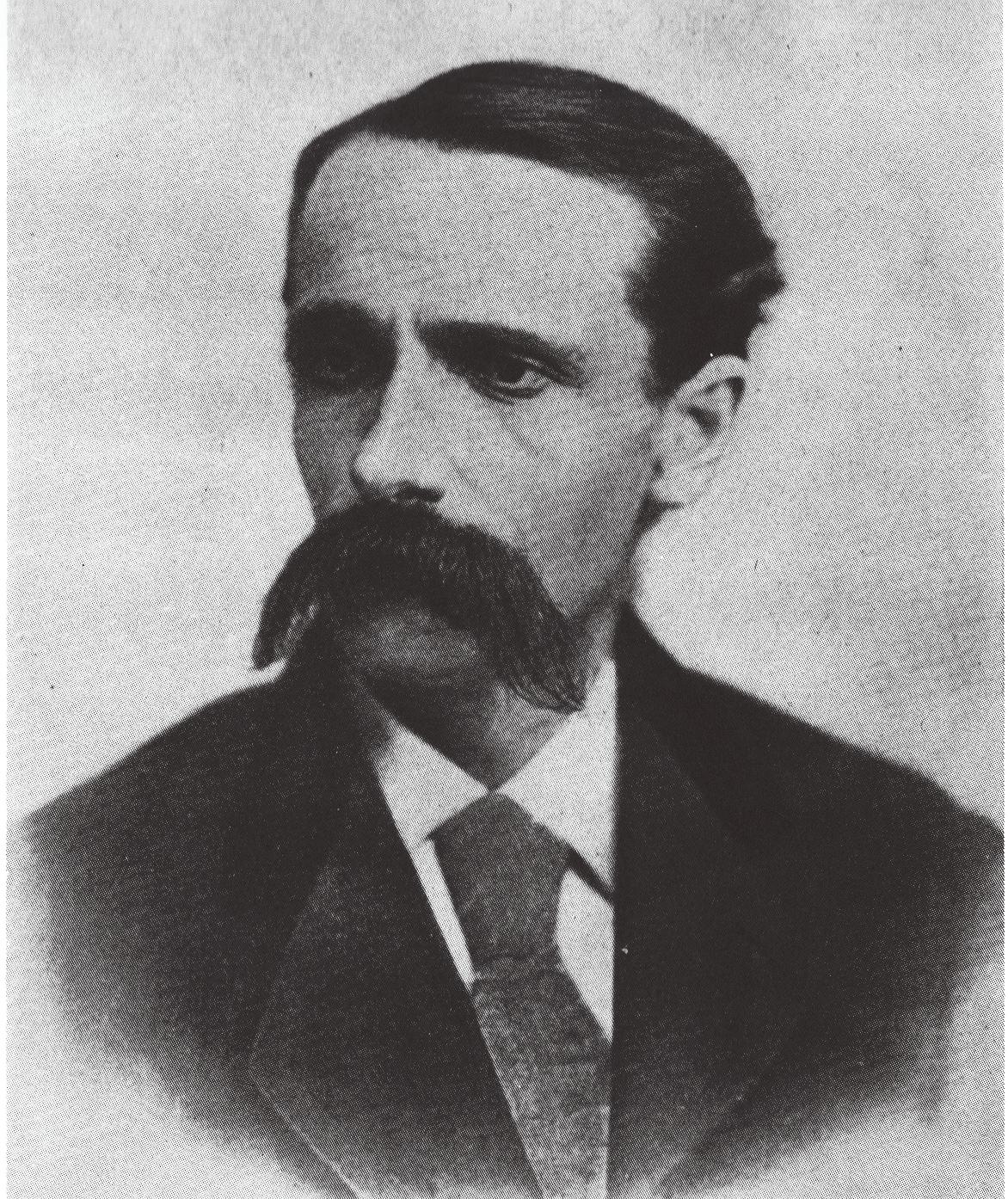
of Brazil (Dick, 1977). The expedition was a large scientific undertaking, with a staff of twelve, including the American geologist Charles Frederick Hartt (1840–1878; Figure 4; Agassiz, 1868). Supplementing their own observations and collecting, the expedition gathered information and natural history specimens from a wide range of contacts across Brazil. Nicolay was one of the local natural historians who aided the expedition and he received a passing mention in A Journey in Brazil by Louis Agassiz and his wife, Elizabeth Agassiz, a journal describing their travels in Brazil in the course of the Thayer Expedition (Agassiz, 1868). On 28th July 1865, they were staying in Bahia (in the capital Salvador; Figure 5), and Elizabeth Agassiz provided the
Figure 3 Louis Agassiz, 1807-1853
Figure 4 Charles Frederick Hartt (1840-1878)
Figure 5 Salvador, capital of the province of Bahia, c.1870. (Lago, Bia Corrêa do. Os fotógrafos do Império: a fotografia brasileira no Século XIX. Rio de Janeiro: Capivara, 2005. ISBN 858906316X, Guilherme Gaensly (1843-1928).)
following account:
“In the mean time, Mr Agassiz is engaged in examining the collections made by Mr Dexter and Mr Thayer during their visit here. They have been aided most cordially by our friend Mr Antonio de Lacerda, at whose hospitable house we are staying, and where we found our travelling companions quite domesticated. He received them on their arrival, and has given them every facility during their stay here for the objects they had in view, his own love of natural history, to which he devotes every spare hour from his active business life, rendering him an efficient ally. He has a large and very valuable collection of insects, admirably arranged and in excellent preservation. They are also greatly indebted to Mr Nicolai, the resident English clergyman here, who has accompanied them on some of their excursions, and put them in the way of seeing whatever was most interesting in the neighbourhood.”
Antonio de Lacerda (1834–1885) was a prominent businessman in Bahia, most famous for building the landmark Lacerda Elevator in Salvador in partnership with his brother Augusto, an engineer (see Oliveira, 1974, 2002, for biographical details). He was a noted entomologist (e.g. see Branner, 1885), a member of the entomological societies of France and Belgium, who had remarkably wide interests in natural history. He had a good understanding of geology, accompanying Nicolay on his expedition to visit the diamond deposits
of the Chapada Diamantina (Figure 2), and providing information, specimens and geological sections to Hartt (Hartt, 1870). Nicolay and Lacerda are listed in Hartt’s book as collectors of various fossil molluscs from Monserrat, Bahia. In fact Hartt named new species of mollusc from the locality after his two companions, Melania nicolayana, sp nov., after Nicolay, and Vivipara (Paludina) lacerdae, sp nov., after Lacerda (Hartt, 1870).
The Diamonds of the Chapada Diamantina, Bahia
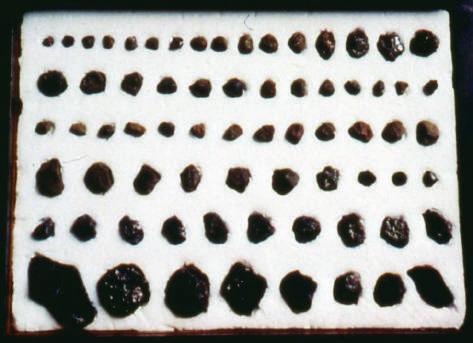
Nicolay and Lacerda visited the diamond deposits of the Chapada Diamantina in December 1865 (Hartt, 1870; Figure 6). Nicolay presented a paper on his findings titled ‘On the Geology of the Chapada Diamantina in the province of Bahia, Brazil’, at the BAAS meeting in Norwich in 1868 (Nicolay, 1869). This proved to be one of the first geological reports on these diamond deposits. A number of years earlier, in 1856, the French mineralogist Augustin A. Damour (1808–1902) had described the mineralogy of diamondiferous sands sent to him from the Chapada Diamantina, via Francois de la Porte Castelnau (1810–1880), who was the French consul in Bahia from 1848–1856. Damour also described the internal structure of the black polycrystalline diamonds from Bahia (called ‘carbonate’; the carbonado diamonds, named for the Portuguese word for ‘burned’; Figure 7); some showed granular to lamellar textures, some were riddled with cavities in the manner of pumice stone, and he noted
that the diamonds sometimes contained specks of gold in their cavities (Damour, 1856).
Diamonds were first discovered in the Chapada Diamantina around 1841, and the first intensive mining followed in 1845 in the Mucugê River (Svisero, 1995; Figure 2). Lençóis, the centre of the diamond field when Nicolay visited, was to produce two of the largest diamonds ever found in Brazil, the Sérgio carbonado diamond (weighing 3167 carats) found in 1905, and the Casco de Burro (also a carbonado) found in 1906 (Svisero, 1995). From 1850–1870, the area experienced something of a diamond rush, with the number of miners peaking at around 30,000 people and production reaching approximately 70,000 carats of diamonds per year (Svisero, 1995).
In his abstract, Nicolay described the topography and stratigraphy of the Chapada, where a sedimentary sequence capped by conglomerate overlay schist and ‘primitive rock’ (gneiss, granite, and dykes and veins of greenstone), and softer rocks beneath the conglomerate were eroded to produce caverns (‘grunais’) where diamonds were commonly found. He stated that the quartzite underlying the conglomerate “is the matrix of those crystals of iron pyrites the presence of which marks the diamond cascalho or gravel, but” he “saw no traces of diamonds in that rock” , and because the diamonds “abound in the Grunais, of which the conglomerate forms the roof,” he “concluded that diamonds are formed in the softer veins and strata which separate the harder rocks.” The diamonds were found associated with water-worn gravel called ‘cascalho’. He described the presence of “imperfect diamonds” (called ‘carbonate’) in the deposits, which were carbonado diamonds, and their use as cutting
diamonds. At the time the Chapada Diamantina was an important diamond field, and Nicolay suggested that in a good season the value of diamonds produced probably exceeded £500,000.
Based on Nicolay’s descriptions, Hartt (1870) suggested that the ‘diamantiferous’ rock from the Chapada Diamantina was Tertiary in age, whereas, the diamonds were in fact derived from the Mesoproterozoic conglomerates that Nicolay described capping the sedimentary sequence (Battilani et al., 2007). Hartt (1870) wrote of these diamond deposits in the following hopeful terms:
“It is much to be regretted that the diamond mines of the Chapada Diamantina have never been critically examined, for I feel convinced that from their study the mystery of the origin of the diamond is to be solved.”
This would not prove to be the case, with the newlydiscovered South African diamond fields soon to provide the best evidence of the primary host rock to diamond, however the origin of the polycrystalline carbonado diamonds common to the Chapada Diamantina deposits remains hotly debated to this day (see Heaney et al., 2005; Garai et al., 2006; Cartigny,
Figure 8 The Reverend William B. Clarke (1798–1878). Photo courtesy of the Mitchell Library, State Library of NSW – PXA 1023/56.
Figure 7 A display of carbonado diamonds from the Chapada Diamantina. Photo courtesy of Professor Stephen Haggerty.
2010; Sautter et al., 2011).
Nicolay left Brazil in 1867 to visit family in England, and during this time he decided to resign his position in Brazil. During 1869, Nicolay acted as a geological adviser to the Brazilian Turba Company Limited that had been formed with the aim of exploiting the bituminous sedimentary ‘turba’ deposits adjacent to Camamu Bay, south of Salvador, in the production of oil and gas (Nicolay, 1843–1892; Hartt, 1870; Figure 2). Nicolay returned to Brazil in May 1869 on behalf of the company to arrange a concession for the area covering the ‘turba’ deposits. He had discussions with various business associates and government officials in Salvador and Rio de Janeiro over the matter. Nicolay had returned to England by early August 1869 with all of these business details seemingly in hand (Nicolay, 1843–1892). In the end, a planned public float of the Brazilian Turba Company did not eventuate because
of difficulties in obtaining a final agreement to transfer the concession for the area to the company (Nicolay, 1843–1892).
Nicolay-Clarke correspondence, 1871–1872
Following this episode, Nicolay decided to take up an Anglican Church posting as chaplain to Geraldton (Champion Bay) in Western Australia in 1870. After
his arrival in Western Australia, Nicolay corresponded with the Reverend William B. Clarke in Sydney during
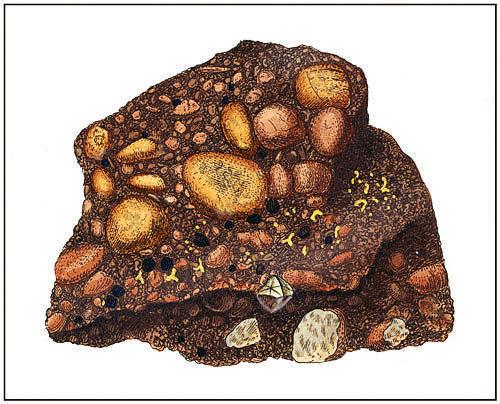
10 ‘Conglomerate mass containing gold and sometimes diamond’ by James Sowerby. Illustration from ‘Travels in the interior of Brazil’ by John Mawe.
1871–1872 on the subject of diamonds (Figure 8). He had received three of Clarke’s papers on gold and diamonds from the Colonial Secretary Frederick Palgrave Barlee, and wrote to Clarke in May 1871 that:
“...on reading your account of the Diamond I was struck by the omission of all notice of the largest Diamond district in Brazil if not in the world that of the Chapada in the Province of Bahia in which I think the diamond bearing strata are more clearly developed than in any other. Of this district I made a very careful examination & specimens when last in London my old friend Prof. Tennant showed me I concluded that as yet there has not been any diamonds found strictly in situ & that the real habitat of the diamond is unknown at the Chapada.”
In mid-1871, Nicolay sent Clarke the abstract of his BAAS paper on the diamond deposits of Chapada Diamantina and a map of the province of Bahia showing the geology of the region. Furnished with this new information from Nicolay, Clarke presented a summary of the geology of the Chapada Diamantina diamond deposits in his 1872 Anniversary address to the Royal Society of New South Wales, based upon Nicolay’s reports and map, and the descriptions of Hartt (1870). The Brazilian diamond fields were important to Clarke in trying to understand the origin of diamond occurrences in eastern Australia. In his 1870 Anniversary address to the Royal Society of New South Wales he had presented a detailed summary of what was known of diamond deposits in Brazil, India, Russia, Borneo and Africa, but could not provide a
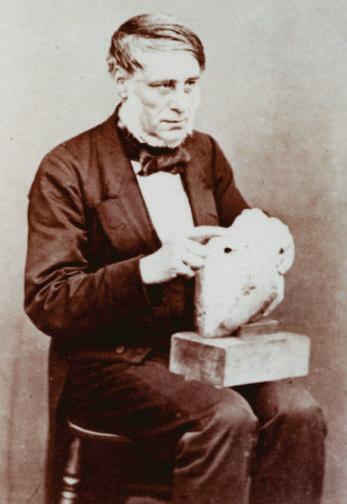
Figure 9 Professor James Tennant (1808–1881), King’s College London. Mineral dealer and mineralogist to Queen Victoria. Photo courtesy of Lawrence Conklin via Ken McNamara.
Figure
solution to the origin of eastern Australian diamonds (Clarke 1871).
Nicolay’s old friend in London was Professor James Tennant (1808–1881) of King’s College, mineral dealer and mineralogist to Queen Victoria (Figure 9). Tennant established and described collections of early diamond finds from the Cape Colony in southern Africa. He had another connection to Brazilian diamonds, in that, in 1824 he had been apprenticed, at age 16, to the London mineral dealer John Mawe (1766–1829), and worked with him until Mawe’s death in 1829 (Cooper, 2006).
Mawe was the first foreigner to visit the diamond mines in Minas Gerais while travelling in South America from 1804–1810 as mineralogist to the King of Portugal. He later published descriptions of the mines in his 1812 book ‘Travels in the interior of Brazil’ (Mawe, 1812; Cooper, 2006; Figure 10).
Nicolay, described by Clarke as “an eminent geological explorer in Brazil”, wrote to Clarke that he had travelled and made geological observations more widely in Brazil, although these observations were not documented in the same way as his visit to the diamond deposits.
“By the way I think your use of the expression that I travelled in Brazil for 10 years, tho’ in a sense true, would not be understood. My headquarters were at Bahia the city during the 10 years I moved about as much as possible studying the geology of the Province–ultimately extending my observation at Chapadas to Rio de Janeiro & Sao Paulo. When I arrived in this Colony as I think I told you I was much struck by the similarity of the Geological structures which it presented to that of Brazil.”
Conclusions
Although Nicolay’s descriptions of the diamond deposits of the Chapada Diamantina were of a reconnaissance nature, and were not the critical examination that Charles Hartt desired, they do represent one of the first reports of the geology of a significant diamond province. His assistance to the Thayer Expedition also was important in the development of early understanding of the geology of the Bahia region, even though Hartt’s work from this time was detrimentally influenced by the glacial views of Agassiz (Brice and Figueirôa, 2001). We can see that, in addition to their own observations and collecting, members of the Thayer Expedition relied on the support of experienced local natural historians, such as Nicolay and Antonio de Lacerda, to obtain geological information and natural history
specimens, and to guide them in an unfamiliar tropical environment. Through his correspondence with the Reverend William B. Clarke in 1871–1872, Nicolay’s observations on the geology of the diamond deposits of the Chapada Diamantina were used in trying to understand the occurrences of diamonds in eastern Australia. These accounts of his activities in Brazil add an extra dimension to our knowledge of his varied geological career.
Acknowledgements
Margaret Triffit, Wendy Crawford and Leonie Samuelsson of the Western Australian Museum Library provided us with great assistance in our historical research. Professor Stephen Haggerty kindly provided photos and information about carbonado diamonds and the geology of the Chapada Diamantina. Ken McNamara provided the photo of James Tennant.
References
Agassiz, L. and Agassiz, E., 1868: A Journey in Brazil. Ticknor and Fields, Boston, 540 pp.
Armstrong, P., 2000: The English parson-naturalist: a companionship between science and religion. Leominster: Gracewing, 198 pp.
Battilani, G. A., Gomes, N. S. and Guerra, W. J., 2007: The occurrence of microdiamonds in Mesoproterozoic Chapada Diamantina intrusive rocks – Bahia, Brazil. Annals of the Brazilian Academy of Sciences, 79(2), 321–332.
Bevan, A. W. R., 2006: The Western Australian Museum meteorite collection. In McCall, G. J. H., Bowden, A. J. and Howarth R. J. (eds) The history of meteoritics and key meteorite collections: fireballs, falls and finds. Geological Society, London, Special Publications, 256, 305–323.
Bevan, A. W. R. and Downes, P. J., 2000: Mineralogy at the Western Australian Museum. Australian Journal of Mineralogy, 6(2), 93–100.
Branner, J. C., 1885: The reputation of the lantern fly. The American Naturalist, 19(9), 835–838.
Brice, W. R. and Figueirôa, S. F. de M., 2001: Charles Hartt, Louis Agassiz, and the controversy over Pleistocene glaciation in Brazil. History of Science, 39(2), 161–184
Cartigny, P., 2010: Mantle-related carbonados? Geochemical insights from diamonds from the Dachine komatiite (French Guiana). Earth and Planetary Science Letters, 296, 329–339.
Clarke, W. B., 1871: Address delivered to the Royal Society of New South Wales, at the anniversary meeting, 25th May, 1870. Transaction for the Royal Socirty of New South Wales for the year 1870. Sydney,:Frederick White 48 pp.
Clarke, W. B., 1872: Address delivered to the Royal Society of New South Wales, at the anniversary meeting, 22nd May, 1872 : with an appendix. Sydney : Thomas Richards, Govt. Printer, 1872. 68 pp.
Clarke, W. B. (edited by Ann Moyal), 2003: The Web of Science: the Scientific Correspondence of the Rev. W. B. Clarke, Australia’s Pioneer Geologist. Australian Scholarly Publishing, Kew, 1340 (in 2 vols) pp.
Cooper, M. P., 2006: Robbing the Sparry Garniture: A 200 year history of British mineral dealers 1750–1950. Mineralogical Record Inc., Tucson, Arizona, 358 pp.
Damour, A. A., 1856: Nouvelles recherches sur les sables diamantiferes. Bulletin de la Societe Geologique de Paris, 2nd series, seance du 7 Avril, 1856, p. 542–554.
Dick, M. M., 1977: Stations of the Thayer Expedition to Brazil 1865–66. Brevoria, 444. Harvard University, Cambridge, Massachusetts, 37 pp.
Downes, P. J., Bevan A. W. R. and Deacon, G. L., 2010: The Fletcher Collection of minerals at the Western Australian Museum: A late 19th century gem. Australian Journal of Mineralogy, 16, 3–14.
Garai, J., Haggerty, S. E., Rekhi, S. and Chance, M., 2006: Infrared absorption investigations confirm the extraterrestrial origin of carbonado diamonds. The Astrophysical Journal, 653, L153–L156.
Hartt, C. F., 1870: Geology and Physical Geography of Brazil –Scientific results of A Journey in Brazil by Louis Agassiz and his travelling companions. Fields, Osgood and Company, Boston, 620 pp.
Heaney, P. J., Vicenzi, E. P. and De, S., 2005: Strange diamonds: The mysterious origins of carbonado and framesite. Elements, 1, 85–89.
Lurie, E., 1959: Louis Agassiz and the idea of evolution. Victorian Studies, 3(1), 87–108.
Mawe, J., 1812: Travels in the interior of Brazil, particularly in the gold and diamond districts of that country, by authority of the Prince regent of Portugal: Including a voyage to the Rio de la Plata, and an historical sketch of the revolution of Buenos Ares. Longman, Hurst, Rees, Orme and Brown, London, pp. vii, 366.
Nicolay, C. G., 1843–1892: Battye Library, MN 1765, Papers of the Reverend Charles Grenfell Nicolay. J. S. Battye Library of West Australian History Private Archives, State Library of Western Australia, Perth.
Nicolay, C. G., 1869: On the geology of the Chapada Diamantina in the province of Bahia, Brazil. Report of the thirty-eighth meeting of the British Association for the Advancement of Science, Norwich, August, 1868. John Murray, London, p. 74–76.
Oliveira, W. F., 1974: Antonio de Lacerda. Department of Culture, Ministry of Education and Culture, Municipality of the City of Salvador, 51 pp.
Oliveira, W. F., 2002: Antonio de Lacerda, 1834–1885: records and documents about his life and work. Foundation Gregorio de Mattos, 26 pp.
Playford, P. E. and Pridmore, I., 1969: The Reverend C. G. Nicolay: a pioneer geographer, geologist, and museum curator in Western Australia. Early Days: Journal and Proceedings of the Western Australian Historical Society, 7, 29–33.
Playford, P. E. and Pridmore, I., 1974: Nicolay, Charles Grenfell (1815–1897). Australian Dictionary of Biography, Volume 5, Melbourne University Press, Melbourne, pp. 340-341.
Sautter, V., Lorand, J-P., Cordier, P., Rondeau, B., Leroux, H., Ferraris, C. and Pont, S., 2011: Petrogenesis of mineral microinclusions in an uncommon carbonado. European Journal of Mineralogy, 23, 721–729.
Svisero, D. P., 1995: Distribution and origin of diamonds in Brazil: An overview. Journal of Geodynamics, 20(4), 493–514.
Abstracts from the 34th IGC
The following section contains selected abstracts from the conference on aspects related to the history of earth sciences in Australasia and reproduced with the kind permission of the Australian Geoscience Council. Some authors have added comments and diagrams to enhance their original contribution. Many of the abstracts are from the biography symposium that honoured David Branagan.
George Davenport Osborne and the Hunter Thrust
David Branagan
School of Geosciences, University of Sydney, Australia dbranaga@mail.usyd.edu.au
The Hunter Thrust System marks the southern and westerly boundary of the New England Fold Belt of New South Wales. It gained recognition, only in the 1920s mainly by the mapping of George Osborne. Earlier mapping by Edgeworth David indicated that the easily-recognised topographical boundary between the Permian rocks of the Hunter Valley and the New England Carboniferous rocks was complex, and that strong faulting was present, but the nature was obscure and not always along the stratigraphic boundary. In 1914, Joseph Carne of the State Geological Survey suggested that the North-South striking Carboniferous/ Permian boundary near Muswellbrook was a fault.
A field trip of the British Association (1914), led by David, revealed convincing evidence of Carboniferous glaciation rocks, and saw detailed mapping of this previously ignored succession begin, from 1919, initially by William R. Browne, mainly close to the Permian boundary. Then Osborne, a senior student of David and Browne, began his life’s work mapping the Carboniferous rocks. Osborne was particularly influenced by the methods of R.T. Chamberlin analysing North American fold belts.
At this time Geological Survey members mapping the Permian coal measures recognised faulting, but not its exact nature, while Osborne mapped the Late Carboniferous. He obtained clear evidence of thrusting, Carboniferous volcanic rocks overlying marine Permian rocks, the thrust plane being parallel to the bedding. This important site is little known today, despite its significance.
The northern continuation of the thrust was later mapped by W.N. Benson and S.W. Carey becoming known as the Hunter-Mooki Thrust System.
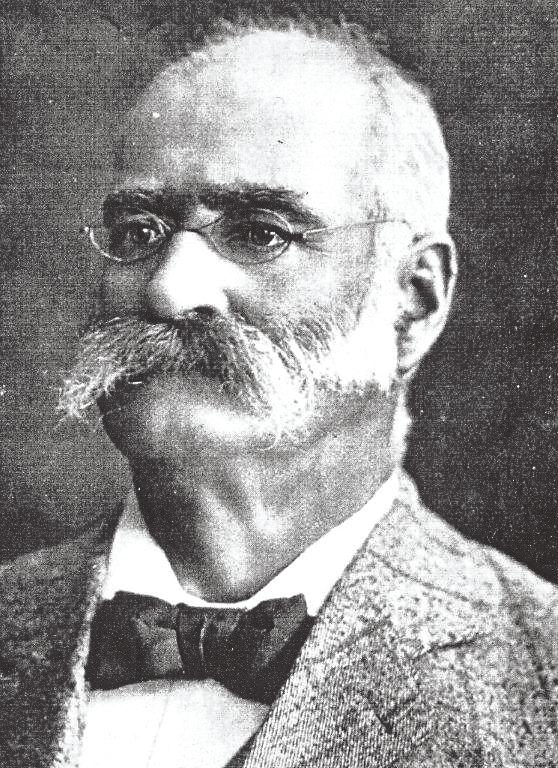
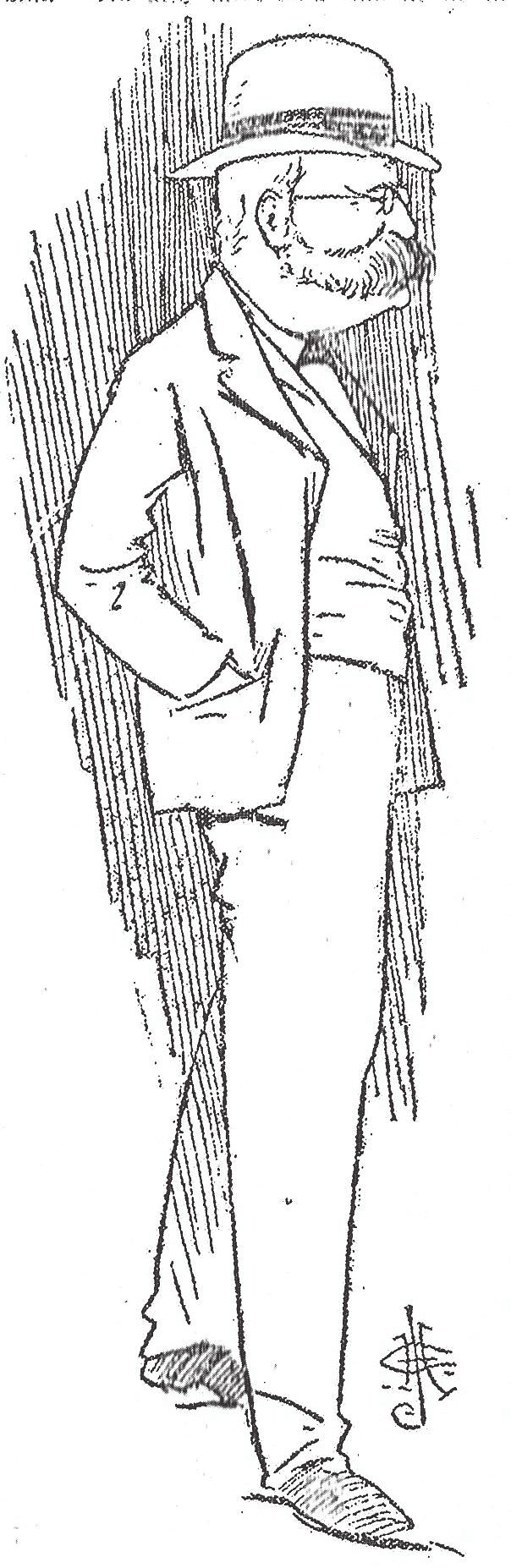
Ralph Tate (1840-1901): Pioneering Australian Geologist
Barry J. Cooper 1 and Barbara P. Kidman 2
1 Barbara Hardy Institute, School of Natural and Built Environments, University of South Australia, GPO Box 2471, Adelaide SA 5001 AUSTRALIA. Email: barry.cooper@unisa.edu.au;
2 Art and Heritage Collections, University Archives, Records and Collections, University of Adelaide, SA 5005 AUSTRALIA
Ralph Tate, Professor of Natural Science, University of Adelaide, 1875-1901, is one of Australia’s foremost nineteenth century geologists. His earlier years in Britain were also impressive. With more than 30 papers and three books published by 1875 he had established a reputation as an authority on Mollusca and Lower Jurassic stratigraphy. His application for the Adelaide post was supported by testimonials from influential British contemporaries.
Ralph Tate was one of Australia’s greatest 19th century geologists
In Adelaide, Tate made a major contribution to the establishment of Australian science, by teaching, by field work, by research and by public advocacy. Within a few years he mastered Australia’s unique
geology. Discoveries of note include his recognition of spectacular glacial pavements at Hallett Cove and of the geological history of the Lake Eyre region. His efforts in Cenozoic stratigraphy led to his description of over 600 new marine fossils. Tate, as a geologist, also maintained a practical orientation; he advised the government on numerous occasions, and served on exploratory expeditions. He anticipated that boring for artesian water would be successful and was likely the first Australian geologist to comment on petroleum potential.
Tate played a leadership role as a South Australian scientist. By 1880, he had revitalised the Philosophical Society and created the “Royal Society of South Australia” whilst also launching South Australia’s first ongoing scientific journal. He assumed an advocacy role on the importance of science for agriculture and mining, in the value of retaining local artefacts for museums and in establishing National Parks and a Geological Survey in South Australia.
In his presentation, Barry highlighted that Tate was very much ‘a larger than life’ individual. In his presentation he quoted a little known newspaper reference from the Brisbane Courier of 20 January 1898 reporting on the AAAS Congress in Sydney which describes Tate as follows. Tate was considered “one of the ‘boss pitchers’ of the Congress” and “one of its most conspicuous delegates”. “He is a typical field bushman” and his “yarns, often told in playful rivalry”…. “made laughter for the gods”. “A keen athletic sportsman, he is believed to have attended every football and cricket match of note played in Adelaide since he settled there. His pipe is always in his mouth even when he is looking for it. Moreover he is extremely good company as every visitor to the smoke tent can testify, but he is not particularly keen in his personal appearance. Perhaps it should be said that he has a soul above dress”.
Of course, Tate not only made a strong impression on those he met, he also made a major contribution to Australian geology. Arguably his two most significant papers are:
Tate, R. 1879. The anniversary address of the President: Transactions of the Philosophical Society of South Australia 2: xxxix-lxxv.
Tate, R. 1893. Inaugural address: Reports of the Australasian Association for the Advancement of Science 5:1-69.
Ralph Tate from a contemporary newspaper cartoon.
Dorothy
Hill, A.C., C.B.E., FRS, FAA — Brisbane’s eminent geologist
John S. Jell
Department of Earth Sciences, University of Queensland, Australia
j.jell@bigpond.com
Dorothy Hill was born in Brisbane on 10 September 1907, educated at Brisbane Girls Grammar School and University of Queensland. She completed her PhD at Cambridge University in 1932, researching there until 1937 as a Fellow of Newnham College. In that year, she returned to the University of Queensland where she was to spend the rest of her career except for war service with the WRANS (1942–1945). She retired in 1973 but continued her research until a few years before her death on 23 April 1997.
Dorothy Hill was the pre-eminent Palaeozoic coral researcher of her time, and on retirement, had published 98 papers on fossil corals and compiled three and a half volumes of the internationally acclaimed Treatise of invertebrate paleontology, more than any other contributor to that series. She published 50 other works, contributing significantly to research on Australia’s Great Barrier Reef and regional geology.
Her brilliant career was marked by inspiring lecturing and teaching, outstanding palaeontological, stratigraphical and geological research, very skilled academic administration and leadership, and generous collaboration with government geological surveys, and with the petroleum, coal and mineral industries. Her lifelong goal was the raising of the international standing of Australian science and universities.
Dorothy Hill was a great Australian, a proud Queenslander and an illustrious University of Queensland alumnus. Throughout her career she received numerous civil, scientific and academic awards. Above all she was a compassionate lady of great intellect and energy, of the highest integrity and loyalty, and an advocate of equality for women.
From 1800 to 1900: explorers by sea and land and growing knowledge of the geology of Australia’s tropical regions
E.B. Joyce and D.A. McCann
School of Earth Sciences, University of Melbourne, Australia ebj@unimelb.edu.au
Early in the 19th century Flinders circumnavigated Australia (1801–1803). Most tropical exploration at this time was by landings from ships traversing the northern coasts (Phillip Parker King 1817–1822, Freycinet 1818, Dumont d’Urville 1827, John Lort Stokes 1839–1841 and Joseph Beete Jukes1842–1846). The humid tropics were the site of the short-lived Port Essington settlement (1838–1849).
The extensive inland arid tropics were studied by early land explorers including Sturt (1833 & 1844–6), Grey (1837), the geologist Leichardt (1844–1845), Mitchell (1845), Kennedy (1847–1848), and A. C. Gregory (1855–1856) with his geologist Wilson and plant specialist Mueller. In the 1860s McDouall Stuart explored northwards from South Australia and at the same time the Burke and Wills expedition (1860–1861) included the scientists Wills, Becker and Beckler. Relief expeditions by the geologist Howitt and by Walker, McKinlay and Landsborough (1861–1862) opened up much of the arid and semi-arid tropics of inland eastern Australia. Prospectors soon followed, with Ernest Henry discovering copper at Cloncurry (1867) and mineral exploration geologists and State geological survey mappers began working in the tropics. Daintree discovered gold at the Gilbert River (1869), Hann discovered gold on the Palmer and Gilbert rivers (1872) and Hodgkinson explored far western Queensland (1875). Robert Logan Jack was Queensland Government Geologist from 1879 to 1899, exploring and mapping the geology of the north of Queensland, and finding many new mineral deposits. The story of the geological exploration of Australia has been discussed in Tate (1894), Skeats (1933), Vallance (1975), Vallance and Branagan (1988) and Turner (2011).
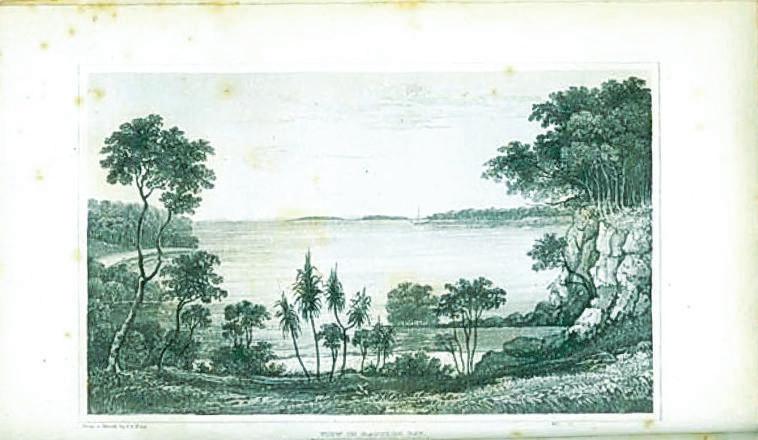
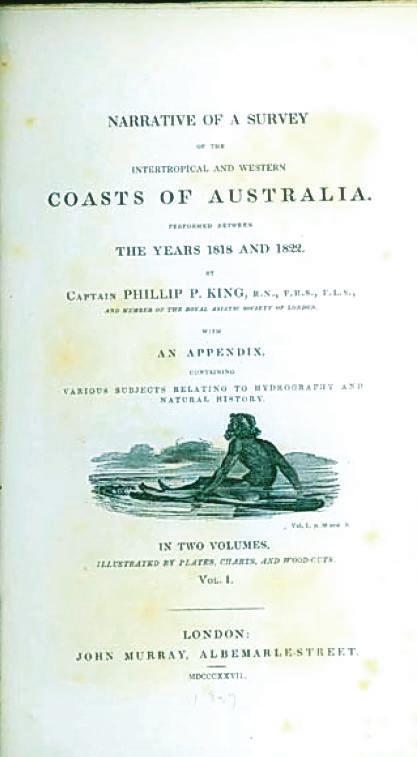
These two pictures are from the title page and frontispiece of the first edition of this book, which describes the Australian coastal voyages of the Mermaid and the Bathurst.
Admiral Phillip Parker King, Australian-born son of the third governor Philip Gidley King, became the British navy’s leading hydrographer. His Australian coastal voyages, together with Oxley’s expeditions inland, represented the great expansionary undertakings of the Macquarie era. ( From Davidson “A book collectors notes, p 127128, Wantrop, quoted in http://www.hordern.com/hh/pdf/ acquisitions/acq_072010_large.pdf )
William
Noel Benson
Wolf Mayer
Research School of Earth Sciences, Australian National University, Australia. wolf.mayer@bigpond.com
The ability of Benson to research and to master a wide range of geological subjects led to his designation as a ‘classical scholar’ in an age of increasing specialisation. The high quality and originality of much of his published work, which, among others, included articles in the fields of mineralogy and petrology, stratigraphy, structural geology and tectonics, palaeontology, engineering geology and medical geology, earned him a world-wide reputation among geologist and made him the recipient of many prestigious awards, including the Fellowship of the Royal Society. Born near London, in 1885, he grew up and attended school in Tasmania. His tertiary education at the universities of Hobart and Sydney was followed by further studies at Cambridge, where he worked under the tutelage of John Edward Marr, Alfred Harker and Thomas George Bonney. He lectured at Adelaide University and held the positions of demonstrator and lecturer at Sydney University, before his appointment to the professorship at Otago University in Dunedin, New Zealand. Benson became best known for his ground-breaking work on the geology of the Great Serpentine Belt of New South Wales, his views on the origin of serpentine, his petrological studies of spilites and keratophyres and of basic and ultrabasic igneous rocks of the Dunedin district and for his palaeogeographical reconstruction of the seas and landmasses of Australasia during Palaeozoic and Mesozoic times. He was also the first to describe Cambrian rocks from New Zealand. Many of the students he taught became well-known and successful practitioners in the geological sciences.
The Woodward factor: Arthur Smith Woodward and geology in Australia
Susan Turner
Department of Geosciences, Monash University, Vic 3800, Australia 2Queensland Museum Geosciences, 122 Gerler Road, Hendra, Queensland 4011, Australia . paleodeadfish@yahoo.com
In the pioneering century of Australian geology the British Museum (Natural History) in London played a major role in assessing the palaeontology and stratigraphical relations of rocks and samples sent by the men on the ground. Eighteen-year old Arthur Woodward (1864–1944) joined the museum in 1882 to work under Dr Henry Bolingbroke Woodward (1832–1921), no relation, the Keeper of Geology, and his career spanned six decades across the late 19th and first half of the 20th century. Other Woodwards were also in the museum or working on Australian material so Arthur was asked to take his mother’s maiden name to avoid confusion. During Smith Woodward’s time he described numerous Australian fossils in ca. 30 papers often deciding or confirming the age of rocks for the first time. His work was one of the foundations for vertebrate palaeontology in Australia and ‘ASW’ influenced the next generation when Edwin Sherborn Hills (1906–1986) visited him in England when a Ph.D. student. His legacy has been blighted by a misjudgement of his late middle age, which led to the still unsolved Piltdown ‘fraud’.
34th IGC and the INHIGEO Excursion
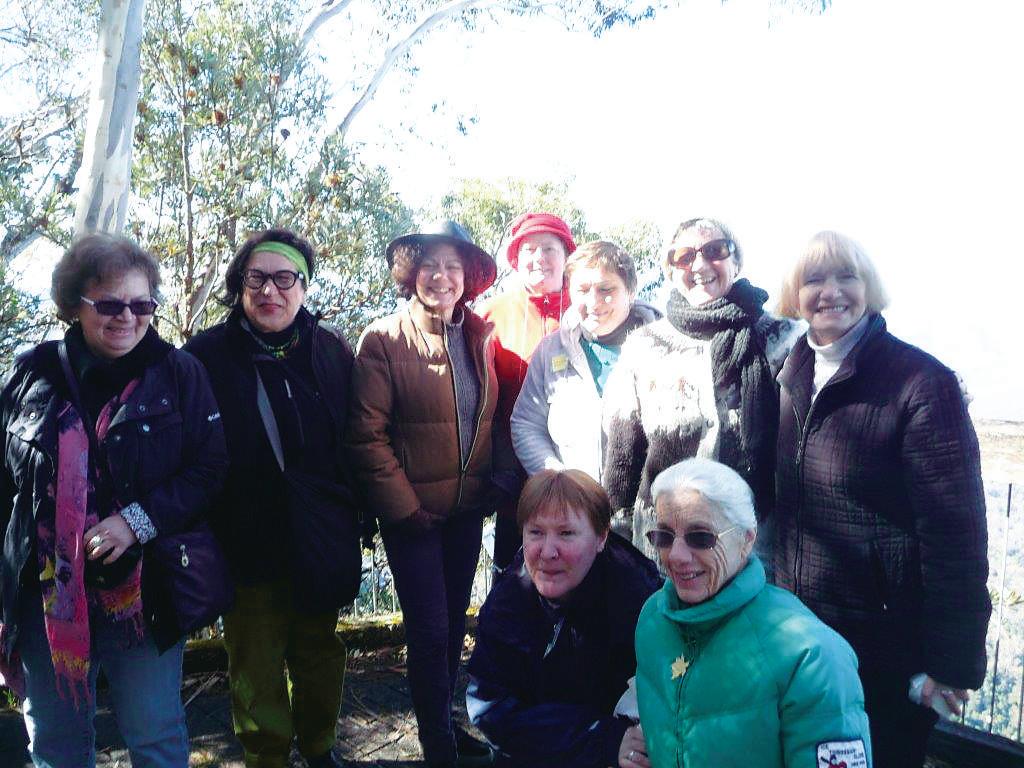
The ladies on the INHIGEO excursion at the viewing point that looks over the New England Tableland. Photo Barry Cooper.
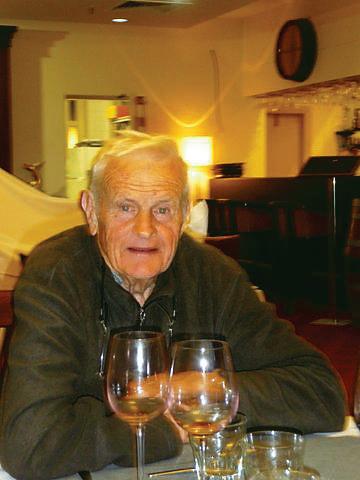
David Branagan at dinner on the first night of the excursion. Photo Barry Cooper.
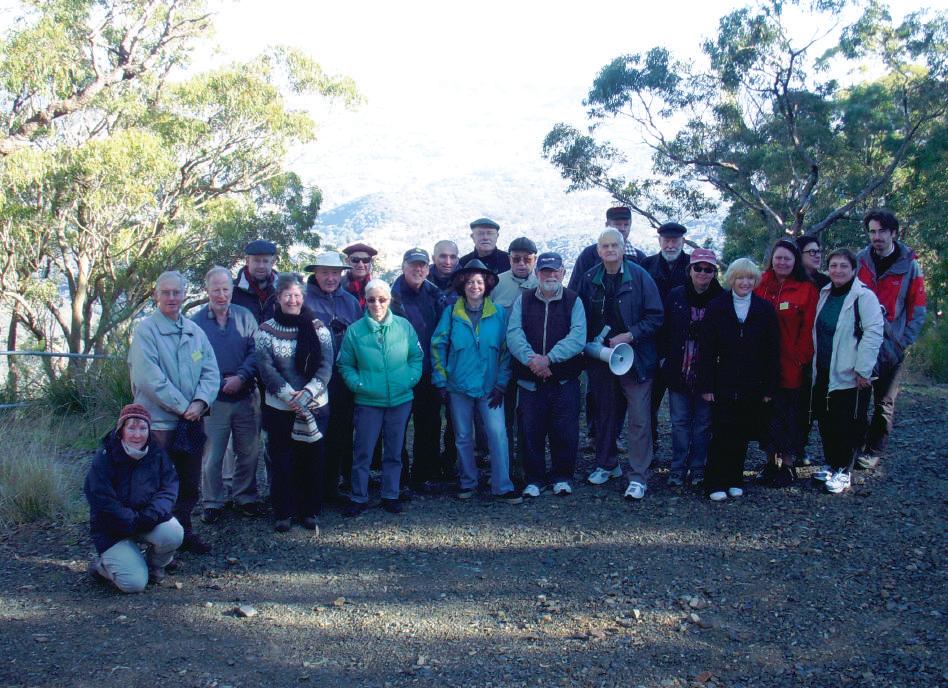
Members of the INHIGEO excursion at the Hanging Rock Lookout, near Nundle. Photo Barry Cooper
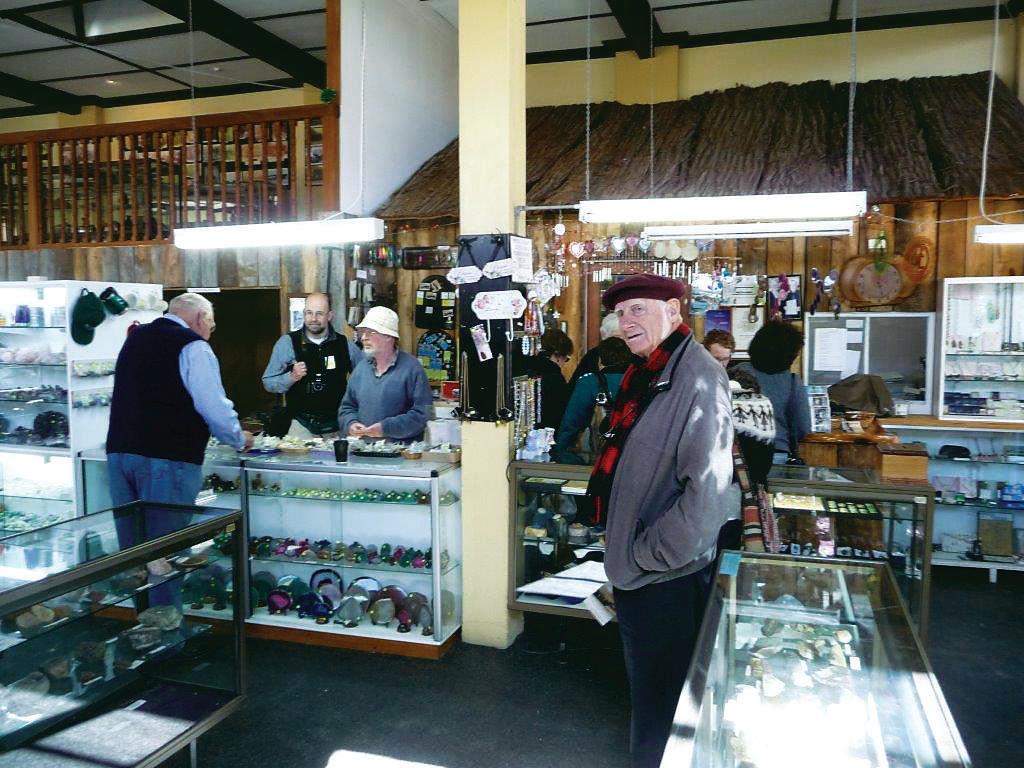
The Emmaville Mining Museum. Photo Barry Cooper.
25th IGC EXCURSION 43a – A PICTORIAL MEMOIR
John Blockley
The 34th International Geological Congress, only the second to be held in Australia, inevitably brought back memories of the first such gathering, the 25th IGC, held in Sydney in 1976. It was, for example, the first international conference that our Russian colleagues had been allowed to attend since the start of the ‘cold war’, and it was interesting to get a feeling for the state of the geosciences in their country.
My main involvement was in Excursion 43a which Alec Trendall, past President of the GSA, organized and led through the Hamersley Basin in north-western Western Australia with Arthur Hickman and me serving as ‘sheep dogs’ keeping the flock together. Alec, through numerous publications and some overseas trips, had spread the word that the banded iron-formations (BIFs) of the Precambrian Hamersley Group are the “best exposed, thickest, most extensive and least altered, of all such rocks on Earth”. Accordingly, the excursion attracted an eclectic group that included some of the world’s leading experts in that enigmatic
rock-type as well as those interested in the composition of the planet’s early oceans and atmosphere, along with the origin of life, and of course, iron ore.
Among those interested in BIF were Harold (Hal) James whose 1954 paper on the facies of ironformation had helped rekindle interest in that rock type (James, 1954) and Ernie Dimroth, who had carried out extensive studies of BIF in the Labrador Trough of Canada. Early Precambrian biologists were well represented by Bill Schopf and the Oehler husband and wife team of John and Dorothy. Mineralogist Edward Grew was also accompanied by his wife, Priscilla, whose wide interests include biodiversity through geological time. Expertise in iron ore was represented by Joe Harms, Alan Goode and Ian Reid. Other attendees included Bob Major, now active in geoheritage matters in South Australia, and economic geologist, Lou Gustafson ,whose father co-authored a classic paper on Kalgoorlie in the 1930s (Gustafson & Miller, 1937).
The excursion involved a complete traverse of the Hamersley Basin, starting from basement rocks of the granite-greenstone terrain of the Pilbara Craton north of the basin, and finishing in the overlying rocks of the Ashburton Basin to the south. However, the highlights of the trip were undoubtedly the exposures of BIF
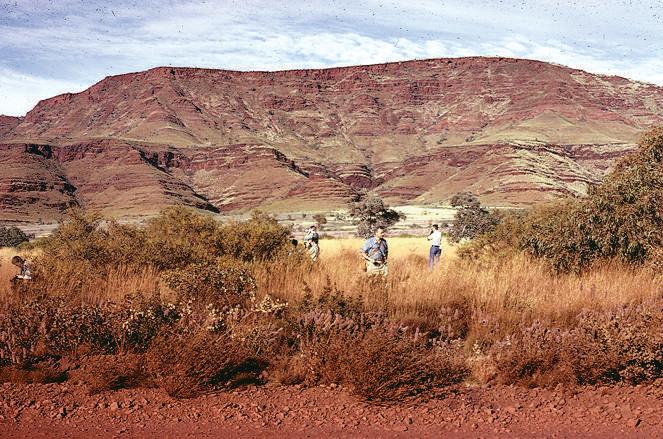
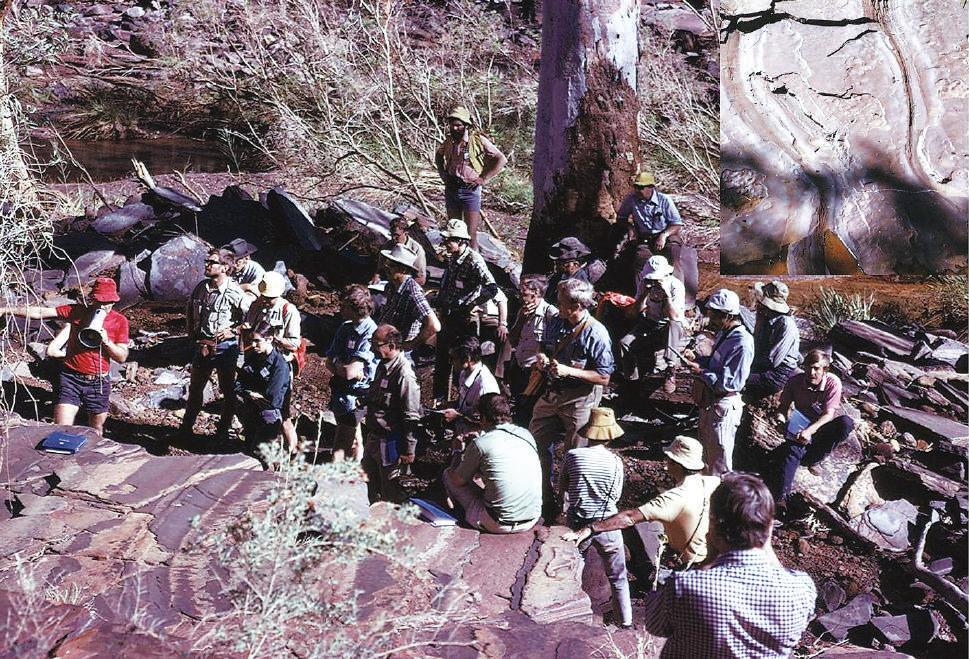
The excursionists get their first good look at the Hamersley Range from a vantage point near Wittenoom. Some seem more interested in the local flora, particularly the spinifex which no doubt had been touted as one of the hazards of the Australian outback.
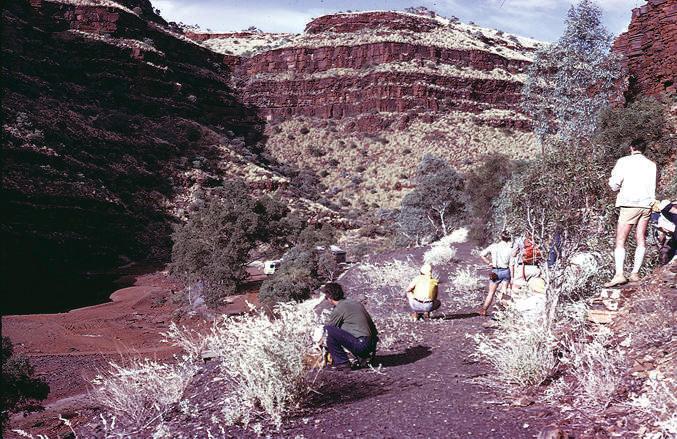
and associated strata in the gorges cutting back into the north face of the Hamersley Range in the vicinity of Wittenoom. Several stops involved examining fresh exposures of BIF at abandoned crocidolite mines in Wittenoom, Yampire and Dales gorges, but the excursionists seemed blithely unconcerned about any dangers posed by the blue fibre. Similarly they intrepidly clambered down the steep descent of Joffre Falls without the aid of ropes or other climbing gear in a manner that would almost certainly not be permitted in these more safety-conscious times, and later gathered on the delicately poised bluff that forms Oxer’s Lookout to take in the view of Red Gorge. Further stops before entering the Ashburton Basin were the Mount Tom Price iron ore mine, a gorge on the Hardey River to look at the impressively podded Marra Mamba Iron Formation, and Woongarra Gorge where a complete section of the Hamersley Group is exposed. The last of these stops also gave many of our overseas visitors their first sight of a monotreme in the form of an echidna that conveniently strayed across our path.
The following photographs show some of the more popular excursion stops. Although the guide book is still available in libraries, readers interested in finding out more about the geology of the Hamersley Basin are better directed to the more recent account in Geological Survey of WA Memoir 3 (Trendall, 1990).
References
Gustafson, J.K. & Miller, F.S., 1937, Kalgoorlie geology reinterpreted: Australasian Institute of Mining and Metallurgy Proceedings v.106 p.93-125.
James, H.L., 1954, Sedimentary facies of the Lake Superior ironformation: Economic Geology v. 49, p253-293.
Trendall, A.F., 1990, Hamersley Basin. In “Geology and Mineral Resources of Western Australia”: Western Australia Geological Survey, Memoir 3, pp.163-169.
It is with great regret that I report that Alec Trendall died of cancer on April 5th, 2013. He will be remembered for his extensive work on banded iron-formation, his many contributions to Western Australian geochronology, and as a dedicated scientist who inspired all who had the good fortune to work with him.
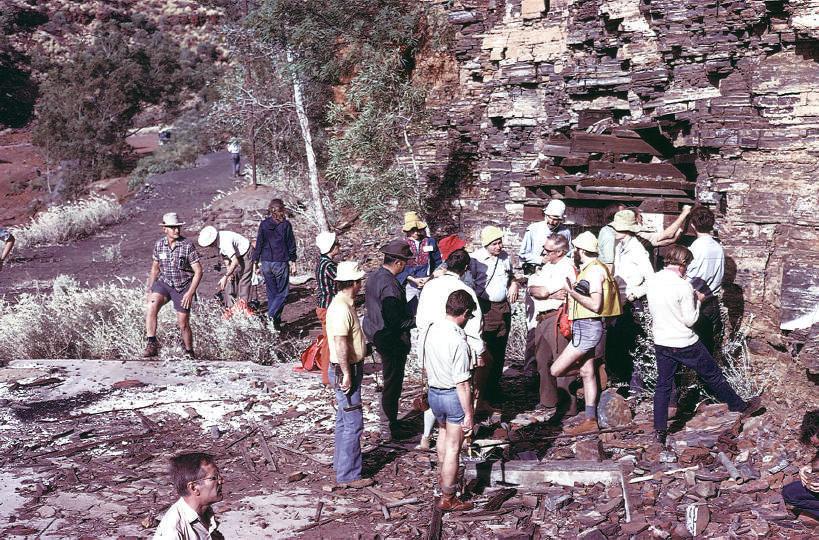
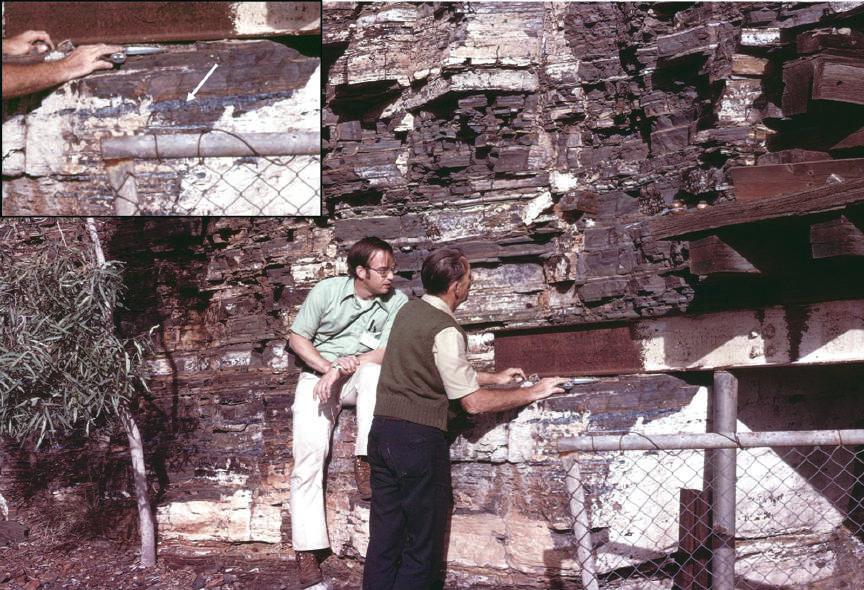
The bench of the abandoned Wittenoom crocidolite mine gave the party a view of almost the entire thickness of the Dales Gorge Member of the Brockman Iron Formation. This unit hosts the principal crocidolite occurrences of the Hamersley Basin as well as major iron ore deposits such Mount Tom Price, Paraburdoo and Mount Whaleback.
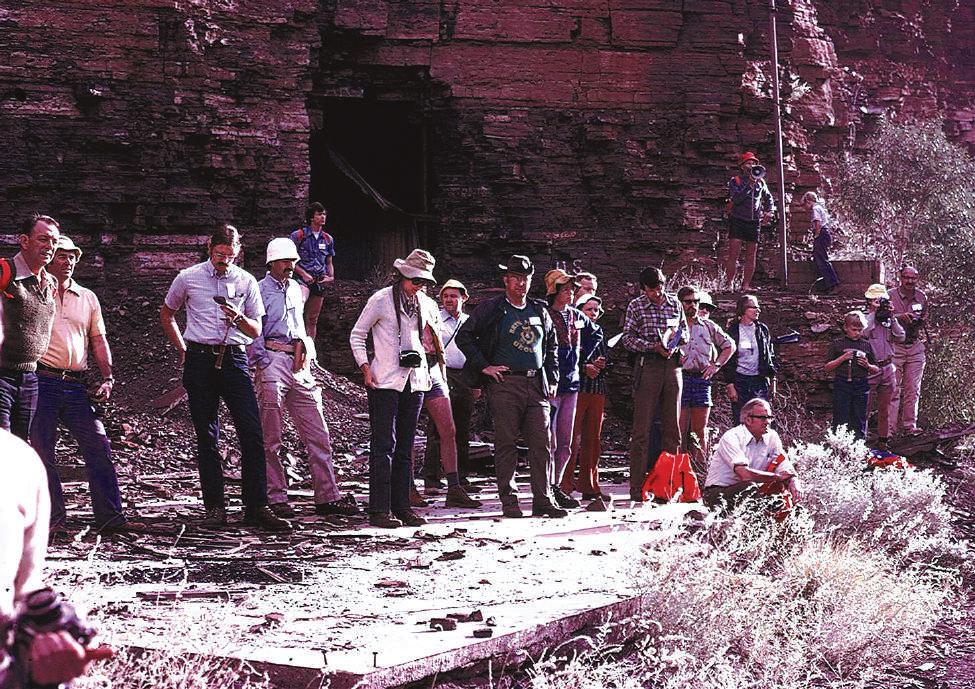
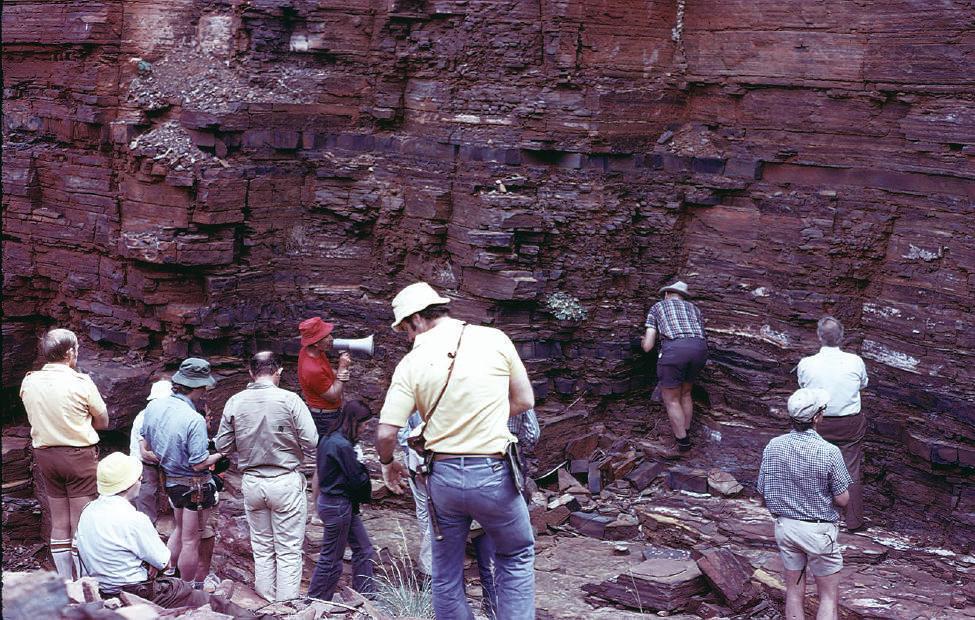
The group is gathered at the portal of the abandoned Wittenoom mine while Alec explains the geology exposed on the opposite side of the gorge. This mine was originally opened in about 1942 by colourful Pilbara pastoralist and prospector, Lang Hancock. It was later taken over by Australian Blue Asbestos Pty Ltd. The grey-tonsured gentleman squatting at the front is ESHG Member, Joe Harms. Joe, then with BHP, was involved in the very early stages of iron-ore exploration in the Hamersley Basin.
The bench face showed almost fresh BIF in situ, while the broken rock on the bench provided good samples.
This bench at the abandoned Yampire crocidolite mine allowed Alec to demonstrate the lateral persistence of individual bands within the BIF between this site and Wittenoom. During its later stages (ca. 1944-45), the mine was operated by a company formed by another colourful mining entrepreneur, Claude de Bernales.
Bill Schopf (left) and Hal James examine BIF at the entrance to the Wittenoom mine. Note the seam of crocidolite just below Hal’s right hand (inset).
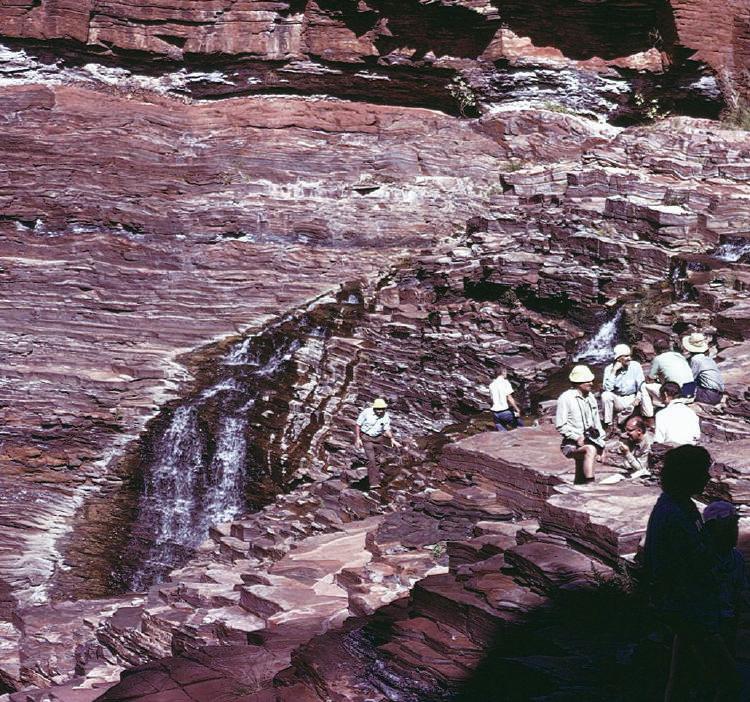
Fortescue Falls at the head of Dales Gorge allowed the party to mull over very fresh BIF of the Dales Gorge Member and also to examine some of the inter-banded shale horizons.
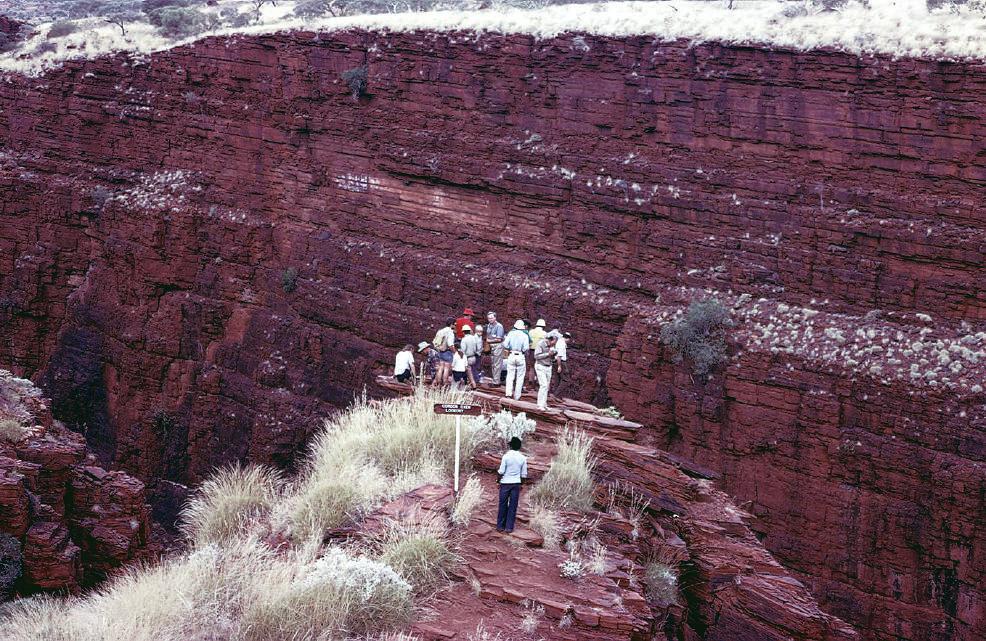
Oxer’s Lookout, opposite page lower right, named after a former Wittenoom medical doctor with a passion for exploring the ranges, gave the party a scenic view of the lower part of the Joffre Member in Red Gorge. The walls of the gorge contain probably the thickest continuous exposure of BIF in the world. An engineering geologist may have had concerns about the prominent joint to the right of the group!
The stop at Fortescue Falls also afforded a view of the “macrobanding” of the Dales Gorge Member.
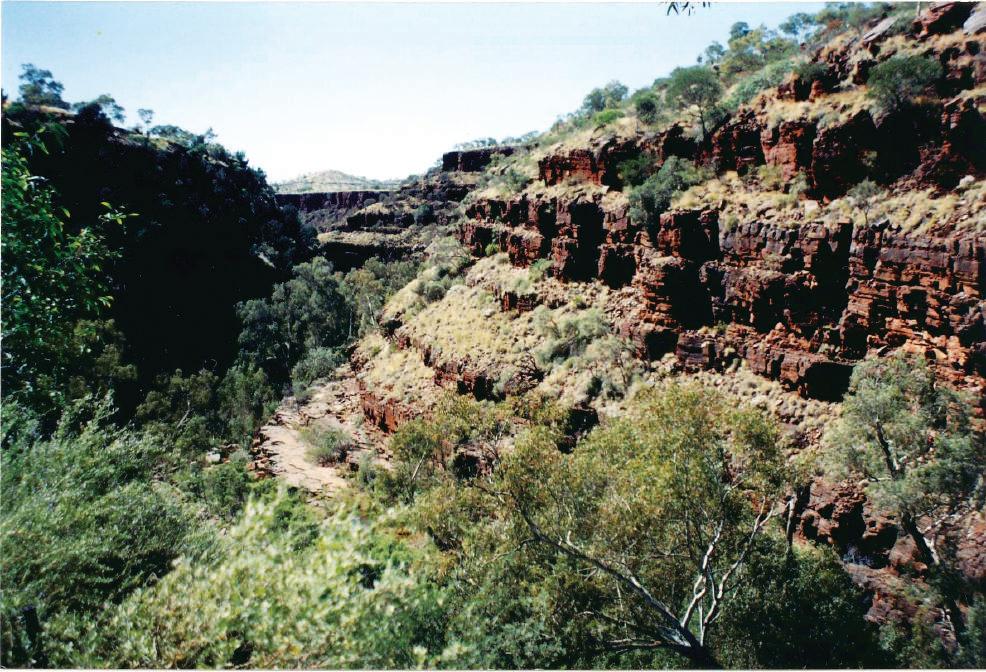
Further downstream in Dales Gorge the party was able to examine some of the minor irregularities that interrupt the regular banding of the BIF, such as the “north-east structures”due to cross-pods (shown in the inset).
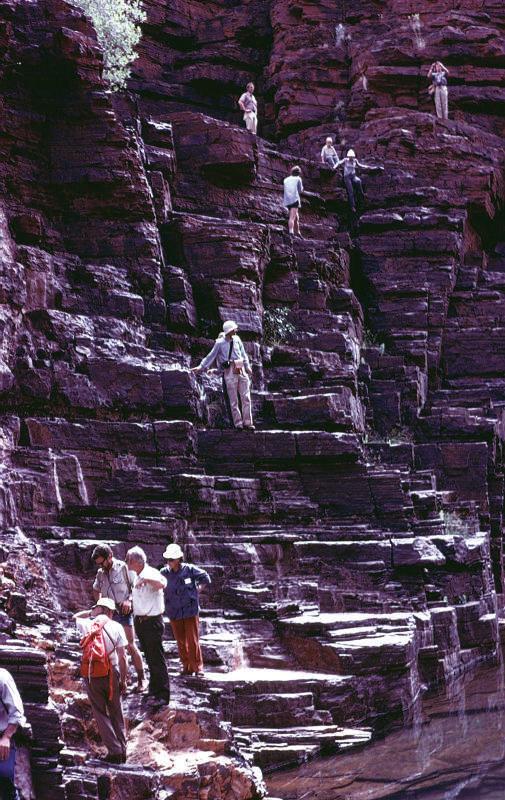
At the head of Wittenoom Gorge (here known as Red Gorge) the excursionists clambered down the acrophobia-inducing face of Joffre Falls, fortunately dry at the time. There were no accidents, although some like the writer took a slightly easier path to the bottom of the gorge. The falls expose the upper part of the 370m-thick Joffre Member of the Brockman Iron Formation. The cascade was originally named Bismarck Falls after the 19th Century German Chancellor, but this was changed to the present form during World War I.
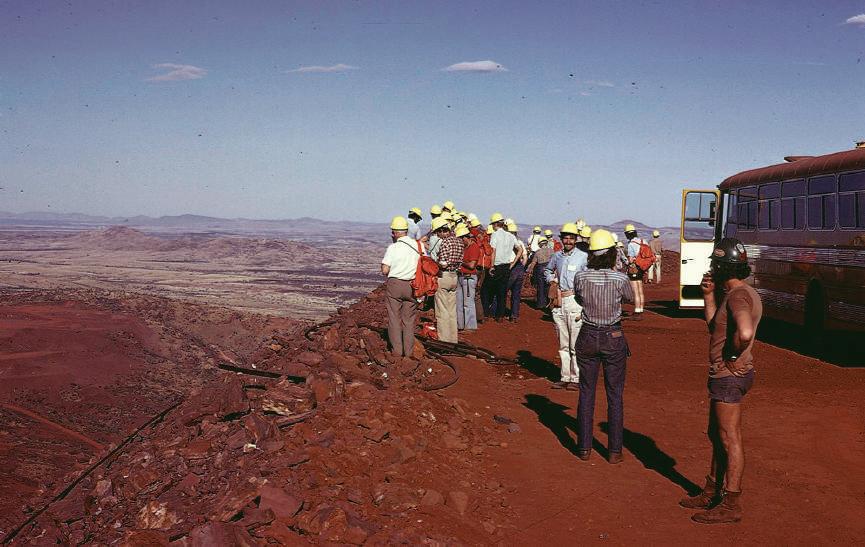
Mount Tom Price was the first iron ore mine to be developed in the Hamersley Basin, producing its first shipments in 1966. The difficulty of taking nice clear photos is indicated by the dust-covered miners in the foreground!
The Marra Mamba Iron Formation at the base of the Hamersley Group is notable for its strongly podded chert bands. The party was able to see these where the Hardey River cuts the south western limb of the Turner Syncline west of Tom Price. A closer view of the pods is shown in the inset.
In Woongarra Gorge on the Beasley River, the party was able to traverse a complete section of the Hamersley Group where it dips southerly on the south side of the Rocklea Dome. Here they inspect the uppermost BIF unit, the Boolgeeda Iron Formation which unlike the other BIFs of the sequence, contains almost no distinct bands of chert.
EMILE DEN TEX (1918 – 2012) AND THE GEOLOGICAL SOCIETY OF AUSTRALIA’S FIRST NEWSLETTER
David Branagan
The obituary of Emeritus Professor of Petrology at Leiden, Emile den Tex, by Jacques Touret, in the 2012 INHIGEO Newsletter No. 44, (pp. 43 – 45), gives a fine outline of den Tex’s many achievements: his early days as a student at Leiden (1937), which were interrupted by the war and saw him forced to Germany to work, but escaping back to Holland during an air raid. His poetry is still listed in the pantheon of modern Dutch verse. A later doctoral thesis on a French region, (the Belladone Massif, French western Alps) was written entirely in impeccable French, and still holds up today as a model for the region studied.
There is brief mention of Emile’s time in Australia, first at Sydney University in 1950, and then at Melbourne University as lecturer for nearly six years (Touret incorrectly says eight). It is about this Australian ‘den Tex time’ I will write. Emile was one of three young staff members Charles Marshall, newlyappointed Edgeworth David Professor at Sydney in
1949, managed to have appointed to the teaching staff in 1950, the others being the first geophysics appointments: Henry Thirlaway, fresh from completing a Cambridge doctorate and Frank Rickwood (a Sydney, via Armidale graduate), and at the time working in oil search in the wilds of New Guinea. Having battled to get lectureships for the latter two, Marshall was probably lucky to get a Teaching Fellowship for Emile. It proved to be only for eight months. However all three proved a revelation and revolution to the twelve of us who were undertaking the fourth-year Honours course in 1950. The course previous to 1950 was very much entrenched in the past, and Marshall was determined to push us into the twentieth century, so, whether we liked it or not, fourth year was going to be a year of lectures in geophysics, sedimentology and petrofabrics, among others, in addition to field and lab work for our theses.
It was Emile who taught us the mysteries of the Universal Stage, and most of us revelled in this work. He had learnt from Ernst Niggli, and was influenced by meeting F.C. Phillips, who was visiting Sydney from England, recovering, I think, from a breakdown several years earlier. They were both enthusiastic about stereographic projections, but despite Touret’s comment in his obituary that Phillips introduced Emile to this technique, and that he spread it in Australia, it had in fact been developed by the previous Sydney Professor, Leo Cotton, in association with M.D. (Duan) Garretty at Broken Hill in 1945. We were already using the technique in 1949, if not earlier, being taught by the delightful, but somewhat eccentric structural petrologist, George Osborne.
We were sorry indeed when Emile left, late in 1950, having been offered a permanent position at Melbourne University by Sherbon Hills. I maintained infrequent contact with him over the following years.
The early 1950s saw the beginnings of the Geological Society of Australia, particularly through the efforts from Melbourne of Sherbon Hills, who became the Society’s first President. Hills was also nominally initially Secretary of the embryonic Victorian Division, but, according to Jack G. Douglas, Emile Den Tex unofficially carried out most of the duties of Secretary because of Hills’s Departmental and Society national commitments.
Den Tex’s continuing interest in structural petrology can be seen from his paper, entitled ‘Stereographic distinction of linear and planar structures from apparent lineations in random exposure planes’, which
Emile Den Tex at Issarles in the volcanic region of the Massif Central. Photo probably taken in the seventies. Photo courtesy of Ilse Oxenburgh (nee den Tex).
appeared in Volume 1 of the Journal of the Geological Society of Australia, (June 1954), the forerunner of the Australian Journal of Earth Sciences.
While the Journal fairly rapidly became firmly established, thanks to the hard work of the first editor, Martin Glaessner, the early days of a Society Newsletter were rocky indeed. The Society’s constitution made no mention of a newsletter, and it was not until 1955 that a News Bulletin was accorded some status by an item in Standing Orders. However the first volume (three issues) had appeared in 1953, edited by Brian Glenister. Then in 1954 Emile Den Tex took over and edited the Newsletter through volumes 2 and 3 (each with three issues) and no. 1 of volume 4 (1956). He had changed the spacing through the year to fit in the ‘field and holiday season(s)’, introduced book reviews and approached publishers to provide books for review. Nevertheless, despite den Tex’s enthusiasm and hard work, there was carping criticism of the publication, and grumbles about its cost, at a time when the Society was battling to get on its feet financially.
The final blow for the Newsletter came when den Tex resigned his Melbourne lectureship to move back to Europe and ultimately Leiden. Later the Dutch Ministry of Education forced the merger of various colleges, resulting in a ‘hypermodern’ geological Faculty (at the Uithof campus of Utrecht University), of which den
Tex became Dean.
In characteristic self-depreciation he wrote in 1982: “my particular autometamorphism I can trace from the facies of a minor poet through a petrologist and microstructural geologist, only to find myself retrograded to a petrologist and finally degraded to a bureaucratic papyrologist”.
In retirement Den Tex wrote a fine book (1998) on the beginning of volcanology in the 17th & 18th centuries, based especially on little-known observations by Dutch mariners. This important volume still awaits translation into English, as does a Dutch biography of Gustaaf Molengraaff (2004) by Frederick van Vee.
(September 2012)
[Apart from the obituary mentioned at the beginning of this article, information in this article comes in part from Rock me Hard... Rock me Soft ...(A History of the Geological Society of Australia), compiled & edited by B.J. Cooper and D.F. Branagan (1994); and an unpublished article by D.F. Branagan (23 November 1993) entitled ‘The Society’s Newsletter’. As a footnote, I am inclined to think that the unidentified person in the front row of the frontispiece of Rock me hard …,, next to Sherbon Hills, is Emile den Tex.]
Emile and his wife Finette den Tex-Lipps. Photo taken in 2004 in Zeist, Netherlands. Photo courtesy of Ilse Oxenburgh (nee den Tex).
THE MISSING NAME
A 1930s story
David Branagan
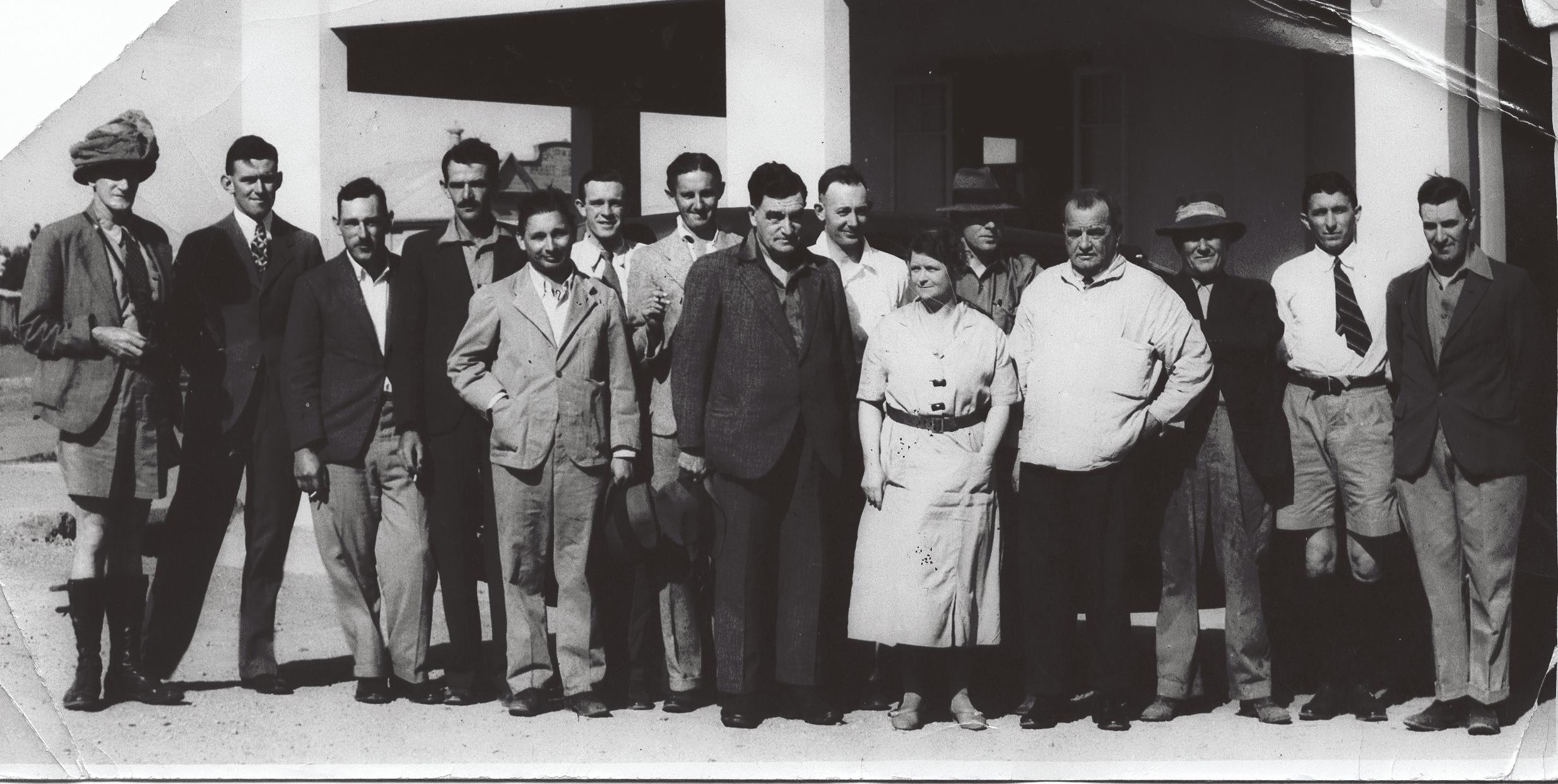
One name is missing from this historic photo of members of the ground-breaking co-operative CommonwealthState (QLD & WA) ‘Aerial Geological and Geophysical Survey of Northern Australia’ (AGGSNA) which was active between 1934 and 1942. Can anyone identify him?
The Group (from left to right), as written by E.O. Rayner: L.C. Ball, S.B. Dickinson, R.F. Thyer, L.A. Richardson, Dr. Sepp Horvath, E.O. Rayner, E.L. Blazey, Sir Herbert Gepp, THE UNIDENTIFIED ONE, Mrs Nye, J.M. Rayner, Jas. Stopford, Fletcher Young, George Jones, P.B. Nye.
The photo (undated), by an unknown photographer, was taken, I think, outside the Post Office Hotel, Cloncurry, Queensland, in late 1935 or early 1936.
The photo came to me from the late Ted Rayner (1914 – 2012), who appears in the group.
Ironically Ted is in the group with his older brother, the geophysicist, Jack, later a key member of the early Commonwealth Bureau of Mineral Resources (BMR). Ted owed his job in northern Australia to the fact that, at the time of his graduation from Sydney University, at the end of 1934, Jack was already employed by the Geological Survey of New South Wales, and while jobs were advertised there, Ted was barred from employment by the rules against nepotism. Lesser qualified graduates from Ted’s class got the jobs, and Ted had to look beyond the confines of New South Wales. The economics of the situation at the time were such that, although offered a chance to undertake an Honours degree, he could not afford the time to
be unemployed. It was only when Jack moved to the Commonwealth organization, formed in 1940, that Ted was able to join the NSW Geological Survey, where he had a long and successful career.
Jack Rayner, although still nominally with the NSW Geological Survey, was seconded to AGGSNA as Consultant Geophysicist, because of his expertise. He had gained some experience with the Imperial Geophysical Experimental Survey (IGES) , and later became Director (1958 – 1969) of BMR.
Lionel Clive Ball (1877 – 1955) joined the Qld Geological Survey in 1900, becoming just one of three on the staff. Every photo I have seen of Ball shows him in his field gear: shorts, boots, coat and tie and the very characteristic pith helmet with fly
screen, perched ready to protect his face. Ball became Queensland Government Geologist in 1932, after Benjamin Dunstan retired, setting up regional Survey and analytical services throughout Queensland during the difficult depression years, and was closely involved in the activities of AGGSNA.
S.B. Dickinson later became Sir Ben. He joined the Geological Survey of South Australia in 1940 as Assistant Government Geologist, becoming Director of Mines and Government Geologist in 1944 and continued until 1956. His field skills, combined with administrative ability, and the ability to get the ‘ear’ of his political masters, saw the South Australian survey take the lead in modern mapping developments in Australia.
Three geophysicists, Thyer, Richardson and Horvath, are together in the photo.
R.J. (Bob) Thyer and Lewis (‘Lew’) A. Richardson (1906 –? ) had gained experience in the Imperial Geophysical Experimental Survey (IGES), with Rayner and Eric Blazey under the experienced English geophysicist, Broughton Edge, in the late 1920s. The IGES examined the use of geophysics as a tool for mineral exploration, by testing various techniques at a number of known or potential mineral occurrences in the various states (Edge, 1931).
Geophysicist Dr. Sepp Horvath, next to Richardson, was specially brought in, I believe, from Sweden, where he was an employee of the Electrical Prospecting Co of Sweden. He carried out work in a number of Australian localities and published on some of them.
Ted Rayner behind the geophysicists is clearly the youngster of the group.
Eric Lloyd Blazey (1905 -.?) born in Melbourne, worked as both a Geophysicist and electrical engineer, employed mostly by electrical supply companies, His geophysical work probably began about 1928 as one of the small group of Australians ‘seconded’ to the Imperial Geophysical Experimental Survey under Broughton Edge. Blazey worked as geophysicist for the Mt. Lyell Mining Co (1934–35), then for three years with AGGSNA (1935 – 1938) carrying out most of his AGGSNA work in WA, his publications noting him as party leader.
The key man is Sir Herbert Gepp (1877 – 1954), in the centre of the photo. A metallurgist and industrialist, he was the real founder of AGGSNA. Gepp had been earlier involved in the setting up of the Imperial
Geophysical Experimental Survey, which began in 1928, although negotiations began in England several years earlier, in which Edgeworth David was involved. Gepp was a real pioneer in many ways and certainly deserves a decent biography, although I have an idea that some important records pertaining to his life were lost.
I don’t have details on Mrs Nye, at the moment, I’m afraid.
I suspect James Stopford is the Queensland politician (1878 – 1936), so the photo was taken not long before his death. The Australian Dictionary of Biography (ADB) entry on Stopford shows his close interest in Queensland mining, recommending open cut mining at Mt. Morgan, and being an efficient secretary for mines during the depression years. Carol Gistitin describes him as
“solidly built, with a facial resemblance to Napoleon Bonaparte, ‘Stoppy’ was a kind-hearted man, staunch in principles and friendships. He was a spontaneous and witty phrasemaker, a good teller of tales, imperturbable in the hottest debate and was never heard to say an unkind word in the House of any of his political opponents, even W.M. Hughes, whose conscription campaigns he resisted.”
P.B. Nye, (1893 –1985), a Melbourne graduate, from the Tasmanian Geological Survey (1920 – 1934), was the Executive Officer for AGGSNA and became Director of BMR in 1951, until 1958. Nye always seems to appear only as P.B., although his forenames, Percival Bartlett, aren’t particularly unusual. Whether it is particularly relevant to the mystery of the name, the papers of Ray Shepherd, held at the National Library, Canberra, contain reference to a rescue of Gepp and Nye, by pilot W.L. Hely (The Argus, May 24, 1937)
In addition to the unidentified person I have no real information about Young or Jones and they have escaped the eagle eye of Tom Vallance in his database, so information would be greatly appreciated. Was the latter a pilot? Perhaps Fletcher Young is an ancestor of a present employee of BHP Billiton, a metallurgist with degrees from both Murdoch and Sydney Universities.
REFERENCES
Australian Dictionary of Biography, Melbourne University Press (various volumes).
Branagan, David. 2005, T W Edgeworth David – A Life, edited Paul Cliff, , : National Library of Australia, Canberra, 648 p.
Branagan, David, 2012, Fleshing out the landscape, two centuries of Australia’s geological heroes: Episodes, March, 35 (1), p. 44 – 56.
eScholarship Research Centre, The University of Melbourne 2010, Bright Sparcs, viewed 28th September 2012, <http://www. eoas.info/bib/ASBS01939.htm>.
Home, R.W., (with the assistance of Paula J. Needham), 1995 Physics in Australia to 1945: bibliography and biographical register. Melbourne: Dept. of History and Philosophy of Science University of Melbourne and National Centre for Research and Development in Australian Studies Monash University.
Johns, R.K., (editor), 1976, History and role of Government Geological Surveys in Australia, Government Printer, Adelaide,
McCarthy, Gavin (compiler & editor), Guide to the Archives of Science in Australia: records of individuals: D.W. Thorpe, Melbourne, 1991,291 p.
The Argus, 1937 Rescue Pilot sees stranded plane: The Argus, May 24th, 1937 Melbourne, Victoria http://trove.nla.gov.au/ndp/ del/article/11066536
Wilkinson, Rick, 1996, Rocks to Riches: The Story of Australia’s national geological survey, Allen & Unwin, 446 p.
National Library of Australia, Trove < http://trove.nla.gov.au/>
Branagan, David, 2012. Review of “Burke & Wills: the scientific legacy of the Victorian Exploring Expedition” by EB Joyce & DA McCann. TAG No. 163, p. 43-44.
Branagan, David, 2012, George Davenport Osborne and the Hunter Thrust, Abstract in Proceedings of the 34th International Geological Congress, Symposium 33.3 convener C. Bacon: Australian Geosciences Council August 2012, p. 954
Cooper, Barry, 2011. Book Review: Pioneering geology in remote Western Australia “The Forgotten Explorers: pioneer geologists of Western Australia 1826-1926, by John Glover with Jenny Bevan INHIGEO Newsletter 43: p. 74-76
Cooper, Barry, 2011. Geologists and the Burra Copper Boom, South Australia, 1845-1851. In: Ortiz, J.E., Puche, O., Rábano, I. and Mazadiego, L.F. (editors) History of Research in Mineral Resources. Cuadernos del Museo Geominero, 13. Instituto Geológico y Mindero de Espaňa, Madrid p.193200. (Abstract published in INHIGEO Annual Conference Madrid Almadén–Iberian Pyritic Belt 1-14 July 2010 Book of Abstracts p. 45-46).
Cooper, Barry, 2011. Johannes Menge (1788-1852): Abstracts: The South Australian Company’s Mine and Quarry and Geologist: Australian Mining History Association, Annual Conference, Hahndorf, South Australia, 12-18 September 2011. p.23 (with B. O’Neil)
Cooper, Barry, 2011 Reg Sprigg and the 1947 discovery of submarine canyons in Australian waters: INHIGEO 2011 Japan conference, 2-10 August 2011, Aichi University, Toyohashi, Japan, Abstract. p. 38-41.
Cooper, Barry, and Barbara Kidman, 2012, Ralph Tate (1840-1901): Pioneering Australian Geologist, Abstract in Proceedings of the 34th International Geological Congress, Symposium 33.1 convener D. Oldroyd: Australian Geosciences Council August 2012, p. 335
Cooper, Barry, 2012 The 1947 Discovery of Submarine Canyons in Australian Waters. In: Kato, H., Inomata, M. and Suzuki, Y. (Editors) “Visual Images and Geological Concepts: Proceedings of the INHIGEO 2011 Japan” p 115-120.
Cooper, Barry, 2012 The historical use and trading of building stone in South Australia, and support for the associated industry. South Australian Geographical Journal 110: p. 5-29.
Downes, P. J. and Bevan, A.W.R., 2012 Encounters with Charles Hartt, Louis Agassiz, and the diamonds of Bahia: the geological activities of the Reverend Charles Grenfell Nicolay in Brazil, 1858-1869, Abstract in Proceedings of the 34th International Geological Congress, Symposia 33.4 convener B. Joyce: Australian Geosciences Council August 2012, p. 746
Geological Society of New Zealand, 2010, An interview with David Oldroyd. In: Journal of the Historical Studies Group, No. 38, pp. 24–29.
Jell, J. S., 2012, Dorothy Hill, A.C., C.B.E., F.R.S., F.A.A. – Brisbane’s eminent geologist, Abstract in Proceedings of the 34th International Geological Congress, Symposia 33.1 convener D. Oldroyd: Australian Geosciences Council August 2012, p. 333
Joyce, E.B. and McCann, D.A., 2012, From 1800 to 1900: explorers by sea and land and growing knowledge of the geology of Australia’s tropical regions: Abstract in Proceedings of the 34th International Geological Congress, Symposia 33.4 convener B. Joyce: Australian Geosciences Council August 2012, p. 748
Mayer, Wolfgang. 2009. Geological observations by the Reverend Charles P. N. Wilton (1795 – 1859) in New South Wales and his views on the relationship between religion and science. In: Kölbl-Ebert, M. (ed.) Geology and Religion: A History of Harmony and Hostility. The Geological Society, London, Special Publication, vol. 310, p. 197-209.
Mayer, Wolfgang. 2009. The geological work of the Baudin expedition in Australia (1801 – 1803): The mineralogists, the discoveries and the legacy. Earth Sciences History, vol. 28, no. 2, p 293-324.
Mayer, Wolfgang. 2009. The Reverend Charles Wilton and his Pre-Emigration Geological Investigations in West Sussex. Journal of West Sussex History, vol. 77, p. 21-32.
Mayer, Wolfgang. 2010. L’accueil en Europe des résultats géologiques de l’expédition Baudin en Australie. Portés par l’air du temps : Les voyages du capitaine Baudin. Etudes sur le XVIIIe siècle, p. 233-239.
Mayer, Wolfgang. 2011. The discovery and exploitation
of iron ores in colonial Australia with emphasis on the deposits of the Tamar Valley district of northern Tasmania. In: Ortiz, J. E., Puche, O., Rábano, I. and Mazdiego, L. F. (eds.) History of Research in Mineral Deposits. Instituto Geológico y Minero de España, Madrid.
Mayer, Wolfgang. 2012. Baudin’s naturalists in Australia: Early scientific surveys of the fauna, flora and geology of the country’s coastal regions, 1801-1803. In: Gerritson, R. King, R. and Eliason A., The Freycinet Map of 1811. Proceedings of the symposium commemorating the 200th anniversary of the publication of the first map of Australia, p. 33-57. http://www.australiaonthemap. org.au/the-freycinet-map-of-1811
Mayer, Wolfgang. 2012. Les travaux géologiques de François Péron en Australie. À la conquête des Terres Australes (1800-1804) : de la découverte à la collecte. Muséum d’histoire naturelle et l’Université du Havre (in press).
Mayer, Wolfgang, 2012 William Noel Benson, Abstract in Proceedings of the 34th International Geological Congress, Symposium 33.1 convener D. Oldroyd: Australian Geosciences Council August 2012, p.334
McNally, Greg, 2012. Engineering geology – a loss-ofidentity problem? TAG No. 163, p. 33-35.
Oldroyd, David & Murty, Kottapalli, 2011 The 22nd International Geological Congress at New Delhi, 1964, Episodes, 34,p. 263–267.
Oldroyd, David, 2010. Review of “Evolution in the Antipodes: Charles Darwin and Australia” by Tom Frame, University of New South Wales Press, Sydney, 2009, in The Quarterly Review of Biology, 85, 343.
Oldroyd, David, 2010 “Review of The Revolution in Geology: From the Renaissance to the Enlightenment”. G. D. Rosenberg (ed.), Geological Society of America, Boulder, 2009, in Metascience, 19, p. 323–327.
Oldroyd, David, 2010. Geohistory Repeated and Expanded’ (essay review of Martin Rudwick, Worlds Before Adam: The Reconstruction of Geohistory in the Age of Reform, Chicago University Press, Chicago and London, 2008), in Annals of Science, 67, p. 249–259.
Oldroyd, David, 2010. Lyell, Charles. In: Encyclopedia of Life Sciences, John Wiley & Sons Ltd, Chichester. DOI:10.1002/9780470015902. a0002524.pub2
Oldroyd, David, 2011. A brief history of the sapphire industry in Queensland’, in: J. E. Ortiz, O. Puche, I. Rábano and L. F. Mazadiego (eds), History of Mineral Resources, Cuadernos del Museo Geominero, 13, Publicaciones del Instituto Geológico y Minero de Espaňa, Madrid, p. 155–166.
Oldroyd, David, 2011 Arthur Holmes paper of 1929 on convection currents within the Earth as a cause of continental drift’. Episodes, 34, p. 41–50.
Oldroyd, David, 2011 Mineralogy, Chemistry, Botany, Medicine, Geology, Agriculture, Meteorology, Classification, . . . : The Life and Times of John Walker (1730–1803), Professor of Natural History at Edinburgh University’ (review of Matthew Eddy, The Language of Mineralogy: John Walker, Chemistry and the Edinburgh Medical School, 1750–1800. Ashgate Publishing Ltd, Farnham and Burlington, 2008), in Metascience, 20, p. 395–399.
Oldroyd, David, 2011. Review of “Travels of Hochstetter and Haast in New Zealand 1858–1860” by Mike Johnston and Sascha Nolden, Nikau Press, Nelson, 2011, in Episodes, 34, p. 282–284.
Oldroyd, David, 2011. Review of “Alexander von Humboldt and Aimé Bonpland, Essay on the Geography of Plants, edited with an introduction by Stephen T. Jackson and translated by Sylvie Romanowski. The University of Chicago Press, Chicago and London, 2009, in Metascience, 20, p. 581–584.
Oldroyd, David, 2011. Review of “Protogaea: Gottfried Wilhelm Leibniz”, translated and edited by Claudine Cohen and Andre Wakefield, The University of Chicago Press, Chicago and London, 2008, in Metascience, 20, p. 303–307.
Oldroyd, David, 2011. The Geological Society’s Birthday’ (essay review of Gordon L. Herries Davies, Whatever is Under the Earth: The Geological Society of London 1807 to 2007. The Geological Society, London, 2007; and Cherry L. E. Lewis and Simon J. Knell (eds), The Making of the Geological Society of London, The Geological Society, London, 2009), in Metascience, 20, p. 177–184.
Oldroyd, David, 2012. Maps as pictures or diagrams: the early development of geological maps, with a comparison between Chinese and Western aesthetic traditions, in: H. Kato, M. Inomata and Y. Suzuki (eds), Visual Images and Geological
Concepts: Proceedings of INHIGEO 2011 Japan, Japanese Association for the History of Geology, Tokyo, p. 21–49 and plates on CD.
Oldroyd, David, 2012. The genesis of historical research on the history of geology, with thoughts about Kirwan, de Luc, and Whiggery, in: Jed Z. Buchwald (ed.), A Master of Science History: Essays in Honor of Charles Coulston Gillispie (Archimedes: New Studies in the History and Philosophy of Science and Technology, Vol. 30), Springer, Dordrecht, Heidelberg, London and New York, p. 167–177.
Oldroyd, David, 2012, Biographical and autobiographical work in studies of the history of geology: Abstract in Proceedings of the 34th International Geological Congress, Symposia 33.1 convener D. Oldroyd: Australian Geosciences Council August 2012, p. 748
Perkin, Don, 2012, Post-war revolution in mineral exploration activity and the economic remaking of Australia: Abstract in Proceedings of the 34th International Geological Congress, Symposium 33.5 convener K. McQueen: Australian Geosciences Council August 2012, p. 1150.
Rickard, Mike, 2010, Geology at ANU (1959-2009): 50 years of history and reminiscences: ANU Epress, The Australian University of Canberra, ACT, 2000, Australia, Viewed 8/03/2013, <http://epress.anu.edu.au?p=55141>
Turner, S., 2012 The Woodward Factor: Arthur Smith Woodward and geology in Australia, Abstract in Proceedings of the 34th International Geological Congress, Symposia 33.1 convener D. Oldroyd: Australian Geosciences Council August 2012, p. 336
EDITORIAL CONTRIBUTIONS
Mayer, Wolfgang
Editor: International Commission on the History of Geological Sciences Newsletter.
Oldroyd, David
Editor: Earth Sciences History
Editor: Historical contributions to Episodes
Member: Editorial Board, Metascience
ADMINISTRATION
EARTH SCIENCES HISTORY SPECIALIST GROUP
Geological Society of Australia (Inc.)
Report on Activities in 2012
The committee for the Earth Sciences History Group (ESHG) has been based in Western Australia since the Australian Earth Sciences Convention of 2008 and currently comprises Peter Dunn (chairman), Peter Downes (vice-chairman), John Blockley (secretary), Mike Freeman (treasurer), Peter Muhling (editor) and members Angela Riganti, David Branagan (NSW) and Bernie Joyce (Victoria). The Western Australian members met eight times during the year. At the end of the year, the Group’s membership numbered 108.
NEWSLETTERS
ESHG Newsletter 42 was distributed in May 2012. During the year sufficient contributions were received to justify going ahead with No. 43 which was in production in December It will include articles on the 34th International Geological Congress, Reverend Nicolay, Professor Tate, Profesor Emile den Tex, the 25th IGC Hamersley Basin excursion, a list of recent publicatins by ESHG members, and the Minutes of the Group’s Business Meeting in August. A proposal to change the name of the publication to “Journal” was being investigated at the end of the year.
BULLETINS
Email Bulletins are sent to members to keep them aware of current activities and notify them of interesting publications and upcoming events. Seven bulletins were distributed during the year with some of the more important issues also being posted to members without an email address.
ESHG WEBSITE
The new ESHG website, which came online in November 2011, continued to be updated by the addition of Email Bulletins, Newsletter 42 and more biographies.
TOM VALLANCE MEDAL
At the Business Meeting in 2010, it was agreed that the ESHG should make a biennial award, to be named the Tom Vallance Medal, to a person who had made a significant contribution to the history of the earth sciences in Australia. The inaugural award was made to Professor David Branagan during the International Geological Congress in August.
34TH INTERNATIONAL GEOLOGICAL CONGRESS
The Group made a financial contribution towards preparing the guide book for an excursion conducted by David Branagan as part of the International History of Geology Group’s conference being held in conjunction with the 34th IGC. Several members presented papers at the Congress, and a poster giving information about the ESHG was displayed along with others showing historic maps and notable geoscientists of the past.
GOVERNANCE ISSUES
The Committee made a submission about the likely impact on Specialist Groups of the proposed changes to the Society’s governance rules.
John Blockley
Secretary, ESHG
EARTH SCIENCES HISTORY GROUP
Geological Society of Australia Inc.
Minutes of Business Meeting, 6th August 2012, held at the 34th IGC, Brisbane
Meeting started at 19.04.
ATTENDANCE AND APOLOGIES
Peter Downes (Acting Chairman), Angela Riganti (Acting Secretary), Bernie Joyce, Susan Turner (left at 19.15), Wolf Mayer.
Apology received from David Branagan.
PREVIOUS MINUTES AND BUSINESS ARISING
The minutes or the previous meeting in Canberra on 8th July 2010, and published in Newsletter 41 were accepted (M. Susan Turner; S. Wolf Mayer). No matter arising.
FINANCES
The Financial Statement provided by Treasurer Mike Freeman was tabled, and is attached as a separate document.
Bernie Joyce suggested the group should spend more money.
CHAIRMAN’S REPORT
The Chairman’s report by Peter Dunn was tabled and is attached as a separate document.
Bernie Joyce suggested that we should publish our current Newsletter as a refereed or partly refereed journal; discussion on ISBN number followed.
Susan Iwer proposed the name of the Newsletter be changed to ‘Journal’ or equivalent (Australian Earth Science History Group Journal was suggested). The proposition was seconded by Bernie Joyce.
It was also suggested that the e-Bulletin name should be changed to Newsletter.
Angela Riganti proposed a vote of thanks to Jean Johnston for her contributions to Producing Newsletters 40 and 41 before she stood down from the role of Editor.
It was noted that some publications are not listed in the Appendix to the Chairman’s report.
Action: A request was put forward to send out an email requesting members to list their publications so that the list can be amended. Wolf Mayer is to notify John Blockley of his publications. M. Bernie Joyce, S. Wolf Mayer.
NOMINATIONS FOR COMMITTEE: Nil
Election of Committee: the present committee was re-elected. It comprises:
Chairman: Peter Dunn
Vice-chairman: Peter Downes
Secretary: John Blockley
Treasure: Mike Freeman
Newsletter Editor: Peter Muhling
Committee members: Angela Riganti (Perth)
Dave Branagan (Sydney)
Bernie Joyce (Melbourne)
OTHER BUSINESS
It was agreed that there should be a push to find a committee based in Queensland.
Wolf Mayer asked the Committee to reconsider the conference that was originally proposed for 2012 and did not eventuate for lack of numbers. Bernie Joyce suggested that this could perhaps coincide with the AESC in 2014.
Bernie Joyce provided an update on grants that were awarded to:
Charles Lawrence in support of writing up “A history of groundwater in Australia” ($500 granted in 2008)
Doug McCann for the archiving of ESHG material ($750)
Both tasks are nearly complete (see tabled list of grants and part of original detail for the former project).
Bernie Joyce queried who the contact should be for prospective visitors to WA, who might be able to deliver talks relevant to the ESHG. It was agreed the ESHG committee should be the first point of contact.
Returning to the issue of publishing our current Newsletter as a partly refereed journal, Bernie Joyce suggested ANZ maps would be an example to look at for a mixed approach.
Angela Riganti agreed to approach the AGC (Australian Geosciences Council) to obtain permission to reproduce relevant abstracts from the 34th IGC in the ESHG Newsletter.