
THEMATIC ISSUE
Welcome to Newsletter 41, the second from your Western Australian committee. This edition focuses on the Earth Science History session of the Australian Earth Sciences Convention (AESC 2010) held in Canberra in July. Dr David Branagan delivered the keynote address: The past is the key to the present: Australian geological mapping from the 1830s to World War II. The following papers deal with aspects of the 1:250 000 geological mapping program that covered Australia from about 1950 to 1980. Three general abstracts (Harrington, Perkin and O’Donnell) give the raison d’être for this massive endeavour to geologically map the whole country at a standardised scale. In fact, it was Larry Harrington who instigated the symposium to acknowledge the scale and success of this vast program.
The regional stories come from each State and Territory (except Tasmania): commencing in the far west, crossing the continent, and and moving north to finish in Papua New Guinea. BMR, of course, looms large. Brown’s abstract, likewise Finlayson’s, documents developments accompanying the mapping program, such as orderly stratigraphic classification and definition in which Australia was a pioneer, and deep seismic profiling of the Australian continent. Doug Finlayson’s paper on the centenary of Edward Pittman’s geological map of the future national capital ends the collection in a celebratory way.
Frank Meany of OneVision recorded the ESH session at AESC 2010 and a CD of all the presentations is provided with this newsletter. This is an historical record of the practices, privations and privileges of working in the field in remote Australia in the 1950s, 1960s and 1970s, and into the increasingly technologically savvy last two decades of the twentieth century, presented by those who actually experienced those times.
Jean Johnston Editor
I am pleased to announce that we had a very successful full-day session devoted to the Earth Sciences History Group at AESC 2010 in Canberra. The success of this session was largely due to the efforts of Alastair Stewart in convening the meeting. He did a great job of chasing up speakers, particularly for the principal theme of the session — the 1:250 000-scale geological mapping of Australia — a theme suggested and promoted by Larry Harrington. I wish to thank Alastair and Larry in particular, and all the speakers for the time and effort put in to making this session a success. Cathy Brown represented the ESHG at the GSA Council meeting on Sunday 4 July and the business meeting of the ESHG was held immediately after the session mentioned above. The minutes of this meeting are presented later in the Newsletter and include the Chairman’s report, which summarises our Group’s activities over the last two years. The meeting re-elected the current committee unopposed and endorsed the creation of the Tom Vallance Medal to be presented for outstanding achievements in preserving earth science history.
I wish all members a healthy and prosperous 2011!
Peter Dunn Chairman
Peter Dunn, Chairman, email: peter.dunn@dmp.wa.gov.au, or petpat3@optusnet.com.au
Peter Downes, Vice Chairman, email: peter.downes@museum.wa.gov.au
John Blockley, Secretary, email: tiger-eye@iinet.net.au
Michael Freeman, Treasurer, email: michael.freeman@lizzy.com.au
Angela Riganti, Committee member; email: angela.riganti@dmp.wa.gov.au
Jean Johnston, Newsletter editor, email: jean.johnston@dmp.wa.gov.au
Mail and telephone enquiries should be directed to the Secretary, John Blockley
76 Beach Street Bicton WA 6157, or (08) 9317 1775
At the recent Australian Earth Sciences Convention held in Canberra in July 2010 the Topical session Earth Science History focused on ‘the greatest scientific program that has been attempted in Australia’ (Larry Harrington, herein) — the systematic geological mapping of the whole of the continent at 4 miles to the inch and 1:250 000 scale. The abstracts of the papers presented at the conference are gathered here. They make remarkable reading and many of you will enjoy the reminiscences of a departed era of geological endeavour. The keynote address by David Branagan opened the proceedings, and is presented in full.
David Branagan
by HJ Larry Harrington
1:250 000
The evolution of naming and defining rock units in Australia: a story of cooperation for good communication
by Catherine E Brown
Imaging the Australian continental crust and its margins — a chronicle of deep seismic profiling, 1946–2006
by Douglas Finlayson
by Douglas Finlayson
The past is the key to the present: Australian geological mapping from the 1830s to World War II
David Branagan, School of Geosciences, University of Sydney dbranagan@mail.usyd.edu.au
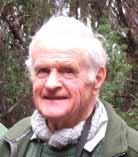
Dr David Branagan
These notes are to accompany and possibly explain the material presented very briefly in my presentation for the Earth Science History session at AESC, Canberra, 8 July 2010.
While attempting a broad coverage I am aware that many possibly more important topics have been completely ignored, or touched on all too briefly. I have omitted mention of early coastal explorers such as Vancouver, Flinders, PP King, the numerous French visitors and lesser Russians, Robert Brown, inland explorers such as Allan Cunningham, John Oxley (whose rock specimens were described by Professor William Buckland), Alexander Berry (who recognised the unconformity at the base of the Sydney Basin
succession, spoke (1822) and published about it, the first geological publication in Australia), the Revs TH Scott, CP Wilton and John Dunmore Lang, all of whom influenced European thinking about Australia’s geology.
I probably do not do justice to WB Clarke. Later omissions are Sturt, Tenison Woods, Mawson, Fisher (in New Guinea), and topics such as radioactivity for age determination by LA Cotton and ES Simpson. The contributions of the Bureau of Mineral Resources from Harold Raggatt’s appointment as Director in 1946 are well documented elsewhere and led directly into the 1:250 000-scale mapping of Australia, the main topic of this symposium.
Some of my choices are no doubt idiosyncratic. Perhaps this reflects not only my interests, but the nature of the geological profession.
The British Government early gave some thought to mineral possibilities and in 1803 Adolarius WH Humphrey (?1782–1829) [there are various versions of the name] was appointed His Majesty’s Mineralogist to the Colony of New South Wales [i.e. virtually the whole country]. He reported on iron occurrences, and had a geologist’s habit of being late with his reports, showing more enthusiasm for women than rocks. He lasted until 1812 before becoming a magistrate in Tasmania, where the Australian Dictionary of Biography tells us he collected ‘dolorite’ (all rather sad).
Faith in the use of such a person did not fade, but it was not until 1823 that John Busby (1765–1857), with considerable experience in Scotland, was appointed Civil Engineer and Mineral Surveyor. Busby thought the Newcastle coal had good prospects and offered to take them over. He reported on possible iron ore deposits but was ultimately diverted to the Sydney Water Supply (Tunnel from Centennial Park lakes to Hyde Park via Victoria Barracks) until his retirement in 1837. The official story picks up later.
[Sir] Thomas Mitchell (1792–1855)
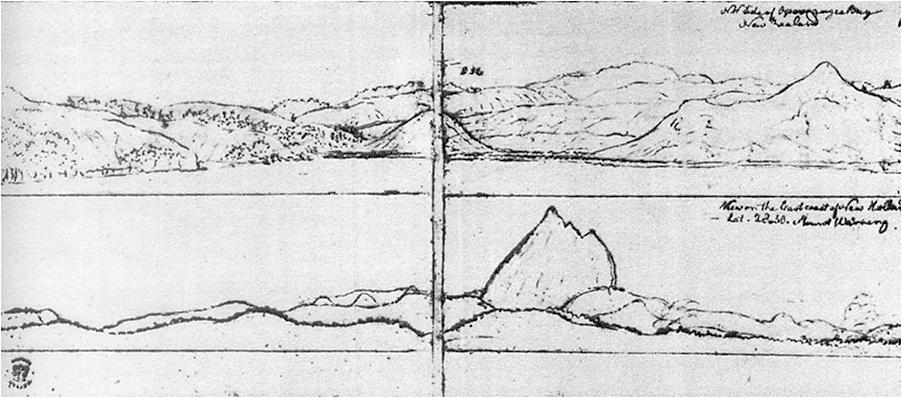
Mitchell arrived in Sydney in 1828 with two welldeveloped skills: surveying and an eye for landscape, learnt in army work in Spain and Portugal, as shown in his superb topographical sketches. In addition he had some enthusiasm for geology, getting a few lessons from WH Fitton before he left England. Both his published and unpublished maps are important in the history of Australian geology. He was (with CP Wilton) one of the early visitors to the ‘Burning mountain’ at Wingen, and prepared some interesting geological maps.
Leichhardt, Strzelecki, not forgetting Lhotsky; represent the explorers
Leichhardt (1813–?1848), perhaps correctly for his time, wrote [in German] that the study of Australian geology must start from Newcastle. He had learnt his geology from various French masters, and was by far the most knowledgeable geologist to reach Australia to that time (1842). Leichhardt was ahead of his time in many ways (e.g. the facies change concept) and his journals are full of geological sketches and observations [look out for the publication of his notebooks, (many translated from German), and interpreted, a research project being completed by Tom Darragh]. 1839 was a vintage year, marked by the coming of the Rev. WB Clarke (see later), the American visitor JD Dana, and the Polish Paul Strzelecki.
Lhotsky (1795–1866) arrived from Bavaria via Brazil in 1832. Lhotsky didn’t help himself with his rather impetuous manner, and his ‘foreignness’, but he did know his geology, as seen in his published journal. His Geological map of the Tasman Peninsula (1836), although rather patchy, encapsulated good observations of six quite different rock types (including variants of dolerite). He almost certainly was the first European to reach Mount Kosciuszko.
Strzelecki (1797–1873) arrived with geological experience in North America and the Hawaiian Islands, probably accompanied by relatively good spoken English, and a pleasant personality, which gained him friends in high places. His idea of preparing a geological map of his travels probably came to him in Australia,
and despite a limited topographical base he did a pretty good job — a huge map with many cross sections, with considerable detail in Tasmania (Van Diemen’s Land), where he had Vice-Regal patronage from Sir John and Lady Franklin. His published map (1845) showed nothing of the detailed lithological variations he placed on the original. The palaeontological work on Strzelecki’s specimens by William Lonsdale and John Morris did a lot to push him to a more modern stratigraphic approach than his original Primitive, Secondary, etc. that he started with.
Clarke and Dana
Clarke, by virtue of his nearly 40 years’ residence, marks a pivotal point in the history of Australian geology, and we know now that, by virtue of his voluminous correspondence, he did influence many younger geologists throughout Australia, even if he never became a ‘patron’ or had students. Clarke’s rather too patriotic attachment to British geological ideas held him back at times. This can be particularly seen in his opposition to the short-term visitor, Dana’s recognition of the Sydney Basin coal measures as being Permian. Clarke produced a number of fine maps.
Consultants appeared surprisingly early. The first of the genre was Johannes Menge, employed by the South Australian Company in 1836, and beginning his work on Kangaroo Island the following year, where the bosses didn’t appreciate his rather difficult manner, so his sensible observations on underground water and how to use it went to waste. His later observations on the mainland were also not appreciated, although he made numerous mineral discoveries. However, he does not seem to have prepared any geological maps.
Second was Dr Ferdinand von Sommer coming from the Dutch East Indies (he was also escaping from his wife!) and clearly talented, who was employed by the West Australian Mining Company in 1846. This job didn’t last too long, as the company’s funds were limited. However, von Sommer was then lucky enough to be contracted by the colonial government and he covered quite a bit of territory, writing some voluminous reports and preparing fine maps and topographical/geological sketches (including a general summary of the colony’s geology in 1849) in the next four years (before his wife caught up with his whereabouts!).
The third consultant was Dr F Odernheimer, employed initially by the Australian Agricultural Company to advise on the company’s coal mines at Newcastle, and the more complex geology of what later became known as the ‘Gloucester Trough’. His attention was shifted to the Nundle Goldfield, where a subsidiary company, The
Peel River Land and Mineral Company, began mining in 1854. Odernheimer prepared a very detailed map of the field, but it was later damaged by fire so that the legend is missing and the map can only be interpreted by detailed re-examination. He also made a collection of the rocks and minerals, displayed at the Exposition Universelle in Paris in 1855.
The official surveys (continued)
Mining discoveries in South Australia in the 1840s caused the British Government to look at promulgating laws to deal with mineral rights and ownership. There is no doubt that the possibility of mineral wealth in the Australian colonies finally got the British Government thinking again about official geology. First off the rank was the ‘mother colony’, New South Wales. By this time the British Geological Survey was well under way, and accepted as a ‘good thing’, with a number of young geologists showing their mettle. The Director, Henry De la Beche, was, in fact, already worrying about losing some of the best to the colonies, which were preparing to pay well for such services. In 1850, one of his staff, Henry Bristow, accepted appointment to New South Wales, but just before leaving changed his mind. Samuel Stutchbury, at short notice took the job. Although at the time Curator of the Bristol Museum, Stutchbury had worked with De la Beche on various jobs, and was also mining consultant to the Duchy of Cornwall. Clarke was very annoyed when he heard of the appointment of a ‘mere museum curator’, complaining publicly, and having questions asked in the colonial parliament about the appointment. However, Clarke was unaware of Stutchbury’s considerable field experience, and did not know that he had visited New South Wales briefly in 1825–26, including taking a quick look at the Newcastle mines. Clarke was more conciliatory later.
As it turned out Stutchbury got little thanks from the local bureaucracy for his work (in the end regional mapping some 88 000 km2). The bosses merely wanted a trained prospector to ‘sniff out’ mineral deposits. An unassuming man of considerable talents Stutchbury spent five lonely years in Australia. His legacy was appreciated in later years by many practitioners in New South Wales and Queensland.
A minor official overlapping Stutchbury’s time was William Keene (1778–1872), who was appointed Coal Examiner for New South Wales in 1852. Experienced in coal mining from some years in France he spent most of his time in the Hunter Valley, naturally enough. However, his first work was on iron deposits at Mittagong, and over the years he carried out mapping as far as Goulburn in the Southern Highlands, and had a foray north to the country behind Broad Sound, Qld, to examine gold deposits.
Victorian Survey: The jewel in the crown of Australia’s history of geology
Alfred C Selwyn (1824–1902) had the advantage of coming to Australia, not just with British Survey approval, but with nearly six years of experience in what had quickly become an elite service, acknowledged for its achievements. Selwyn had learnt well from his chief ‘mentor’, Andrew Ramsay, mainly in Wales, with the additional advantage of mapping Early Palaeozoic rocks similar to those he first encountered in Victoria. He was also influenced by Ramsay’s championing of glaciation as an important agent of erosion.
Selwyn had also learnt the importance of having an accurate topographic base for geological maps, and a set of such adjoining maps to allow accurate regional patterns to be determined. His early individual success led to the formation of a Government geological team not to be equalled for many years, if at all. The names of Daintree, Aplin, Ulrich, Taylor, Brown and Wilkinson in their subsequent careers show how Selwyn’s heritage was spread throughout Australasia. Only the machinations of a talented but scheming ‘self-made’ man, Robert Brough Smyth, Secretary of the Colonial Mining Commission, brought the survey to an end in 1869, and put Victorian geology into a sad decline for many years, only to be partly and briefly resurrected by the coming (and going) of JW Gregory in 1901–1904.
The Tasmanian Government, influenced perhaps by Selwyn’s invited official visit in 1855, saw Charles Gould appointed Government Geologist in 1859 and he did good work for nearly ten years.
Although Selwyn’s four-month rapid geological survey of South Australia did not immediately have the same effect there, it was one of Selwyn’s protégées, HYL Brown who took over the reigns in South Australia in 1882, after a brief sojourn in Western Australia. Wilkinson soon moved to NSW to start the survey there, and Daintree and Applin began such work in Qld in the 1870s. Ulrich and Taylor consulted before the former moved to New Zealand.
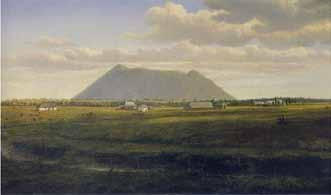
To some extent Western Australia might be able to claim precedence over both New South Wales and Victoria in this second phase of official surveys with the work of Dr Ferdinand von Sommer (see above) and the Gregory Brothers — there were four involved in mineral exploration and geology. AC Gregory, Assistant Surveyor-General gained fame for his later exploration in northern Australia and his work in Queensland, but his brothers, notably Joshua and Francis, also carried out work, the latter two sending off a map, sections and other information to the Geological Society of London in 1847. FT Gregory wrote a more expansive report for the Society in 1861.
Colonial geological maps
Such maps probably largely owed their preparation to the enthusiasm of colonial bureaucrats to advertise colonial prospects at the many national and international exhibitions which were a feature of the second half of the nineteenth century (beginning with the London Exhibition of 1851, with others in 1855, 1861, 1862, 1872, 1873, 1876, 1878 and so on).
Victoria had led the way, with Selwyn preparing a huge eight-sheet map in 1863, and a later version in 1866 (scale 32 miles to one inch, with an accompanying cross section 10 000 feet to one inch vertical; 10 miles to an inch horizontal scale), accompanied by a detailed explanatory booklet by Selwyn and Ulrich, and a rock and mineral collection, for the Intercolonial Exhibition of that year. Naturally the other colonies felt the need to follow the lead, and were not far behind. Queensland’s map, prepared by Daintree, appeared in 1872. The NSW map was next, in 1880. This was a compendium of Wilkinson’s work superimposed on the previously unpublished map left by WB Clarke at his death in 1878. Although Ralph Tate might have produced a simple map of South Australian geology earlier, credit is usually given to HYL Brown for his map of 1883.
He followed up with numerous revisions through his extraordinary fieldwork over the next twenty years or so. He was also responsible for the first Northern Territory geological map in 1898.
Although Selwyn’s bête noire, Brough Smyth, is often credited with preparing the first geological map of the Australian continent in 1875, he was beaten by more than thirty years by some French/Swizz attempts by Ami Boué, who put together several coloured worldwide maps (1841, 1843), based on what he found in published reports. There were other similar efforts prior to 1850, when JB Jukes’ coastal (with limited inland data) map was published (see below). However, having got rid of Selwyn’s Survey, largely on the basis of pushing for geological mapping of likely mineralised zones, ironically Smyth began to put together a map of the continent. He wrote to each of the colonies asking them for maps, setting out the requirements for the legend, noting of rock types, known or suspected ages, and indications of where there were gaps. Notice of this project reached Selwyn’s ears in his new position as Director of the Geological Survey of Canada and he wrote a critical letter to the International Mining Journal complaining about Smyth’s neglect of the Victorian Survey’s work and his self-aggrandisement. Nevertheless, a handsome map was produced, using in many localities the routes of various explorers to supplement what had been done by the various geologists.
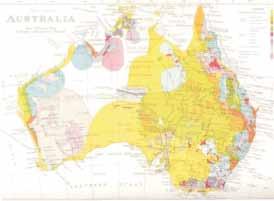
The next, in 1887, a much larger map than Smyth’s by Arthur Everett, also emanated from Victoria. Others followed, in smaller format by JW Gregory (1907), LA Cotton (1908), culminating in the superb large map by TW Edgeworth David in 1931 (accompanied by his hastily written Explanatory Notes. David, between 1900 and 1914, had toyed with aspects of continental structure and tectonics (see his tectonics map, next page).
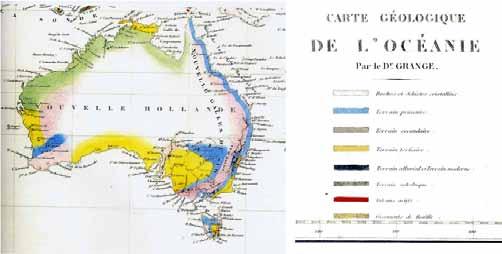
The large maps also inspired assessments of the extent of Precambrian activities by Everett, Gregory, Maitland, and Browne (from 1887 to 1950). The glaciation story, begun by Selwyn, Daintree and Clarke in the 1850s, concerning, it was thought, a Pleistocene event, moved, in the 1880s to thinking about a Late Palaeozoic
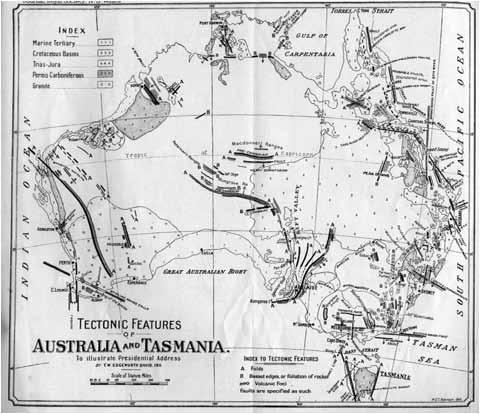
event. This became a life-long study for Edgeworth David and his associates, including Walter Howchin, who expanded the story back to Early Cambrian – Late Precambrian times.
The colonial and continental maps saw the widespread distribution of the ‘Desert Sandstone’, a puzzling, apparently Cretaceous-age unit, recognised from east to west. The disappearance of this unit, after some eighty years on Australian geological maps, was the result of a combination of detailed mapping (J Reid in Qld, HI Jensen in NT, inter alia), sorting out of fossils and a growing understanding of weathering processes, particularly the formation of duricrust surfaces, studied in particular by WG Woolnough.
In view of the dryness of the continent, it is not surprising that there was considerable interest in the possibility of obtaining water from underground sources, particularly artesian water. This interest is manifest in the considerable amount of information shown on many geological maps, and particularly cross sections (see e.g. HYL Brown, EF Pittman, David, Gregory), and in controversies which arose through the first part of the twentieth century. This seems to me a rather neglected area of study for historians of geology.
While landscapes had attracted attention from earliest times and had been recorded in detail by explorers and artists, interpretations of their development were often simplistic and often based on foreign models. Growing
topographic information enabled the construction of large block diagrams of the continent and regions from the early 1900s. A strong influence from the early 1900s was the writing of the American, WM Davis. EC Andrews brought Davis’s ideas to Australia, and not only the concept but the ‘reality’ of uplift and peneplanation became ‘accepted truth’ well into the 1950s.
In 1922 EC Andrews’ massive Memoir on Broken Hill marked the end of an astonishing series of Memoirs, still highly regarded today (notably the maps and sections), published by the Geological Survey of New South Wales. Begun with Edgeworth David’s qualitysetting New England tin volume in 1887,then Jaquet’s Broken Hill effort in the 1890s, the series continued with J Carne’s two western coalfields volumes, one on oil shale, the other on coal, David’s Hunter River Coal Measures (1907), and LF Harper’s Southern Coal Field (1917). These were supplemented by the now rare Archaeological and Palaeontological volumes (by Etheridge, Feistmantel, Campbell and others), not forgetting the Mineral Resources Series. These were well ahead of what appeared in the other colonies/states. However, the graptolite studies of TS Hall, Keble and later David Thomas did much to sort out Silurian–Ordovician stratigraphy, notably in Victoria.
The Willan map, 1923
One of the best-detailed geological maps of that era was that of the Sydney region, published in 1923 by the NSW Geological Survey. Apart from the superb observations and recording of dykes and faults the map was accompanied by structural contours of the base of the Wianamatta ‘Group’, and the top of the Permian Coal Measures. TL Willan apparently carried out much of the mapping in his own time. Sadly there is only a limited text to accompany the map. These notes were prepared for a field trip at the Pan-Pacific Congress, held in Sydney in 1923. Apparently Willan upped and left to work in Malaya in a bit of a huff the following year, and took his detailed notes with him.
Exploration geophysics, AGGSNA and later geochemistry, 1920s–30s–40s
Even in earlier times new technological developments (such as cheap colour printing) marked rapid improvements in obtaining, recording and producing new geological knowledge. It is thanks to the littleremembered mining metallurgist and public servant, HW Gepp (1877–1954), that exploration geophysics became well-established in Australia. Gepp was a key figure in getting the Imperial Experimental Geophysical Survey up and running, under Broughton Edge (1895–1953) in 1928. This work saw JM Rayner employed in the NSW Survey. It was followed up by the creation of the Aerial Geological and Geophysical Survey of Northern Australia (AGGSNA) in 1932, under Gepp’s charge. This survey saw many of those who were to be leaders in the post-WW2 era gain their experience. Rayner was appointed consultant geophysicist to the AGGSNA in 1934. A major feature of this widespread survey of large parts of Queensland, Northern Territory and Western Australia was the first widespread use of aerial photos (b & w) as a basis for geological mapping. WG Woolnough (1876–1958), appointed Geological Adviser to the Commonwealth in 1927, also spent much time in northern Australia seeking oil prospects. Commenting on the value of aerial reconnaissance he told Edgeworth David he learnt more in a flight of a few hours than months of land travel through the same region.
Exploration geochemistry was slower to come to Australia, owing its arrival to the interests of Maurie Mawby, of Zinc Corporation. Mawby arranged for Victor Sokoloff, associated with the USGS to visit Australia in 1948, explaining the various geochemical methods to company and government geologists and geophysicists, notably at Cobar, Broken Hill and Moonta–Wallaroo.
Apart from Etheridge and Jacks’ Catalogue of Geological Works on the Australian Continent, (1881) and Tate’s Presidential Address to the AAAS Convention in Adelaide (1893), there were few attempts to write any large-scale history of Australian geology in the nineteenth century. However, there were good summaries of early work in many regions, written as introductions to later publications (e.g. Carne’s Western coalfields memoirs in NSW). EJ Dunn’s biographical sketches of Selwyn and his pioneer crew (1910) is a useful basis for the Victorian Survey’s work, as is the small pamphlet by Gibb Maitland (of the same year) concerning the Geological Survey of Western Australia. It is not until 1942 that there was another review, that by Andrews on The heroic period of geological work in Australia. Somewhat flowery in expression the useful information it contains is lessened by the lack of supporting documentation of sources. Not until 1975 do we find another assessment, that by Tom Vallance, with an extraordinarily detailed bibliography. He supplemented that in 1978 with a review of palaeontological research in Australia.
Specific topics (First continental geological maps, the Selwyn Victorian Geological Survey, Ludwig Becker) by Tom Darragh; Tasmanian topics (including Darwin’s geology) by Max Banks and Carol Bacon, Keith John’s History and role of the Geological Surveys in Australia (a publication achieved in spite of poor support in some high places in 1976), Bernard O’Neil has focused on South Australia and notably Menge, John Glover, Phil Playford and others have given us many fresh insights on history in the west. Rick Wilkinson has dealt with the federal geological story and oil exploration. Biographies of Strzelecki, Mitchell, RL Jack, Archibald Liversidge, Mawson, Grif Taylor, Edgeworth David, and Reg Sprigg have appeared relatively recently, as has the two volume Letters of WB Clarke, with quite a long biography by Ann Moyal, Another important Clarke work is the Chronology by Michael Organ. Furthermore numerous geologists are noted in the Australian Dictionary of Biography and the New Oxford Dictionary of Biography. Wolf Mayer is now filling in the large gap of the important French visits and observations. John Glover and Jenny Bevan have just produced The Forgotten Explorers: pioneer geologists of Western Australia, 1826–1926. So the story goes on — and long may it continue — through the work of professional historians and numerous retired geologists! My apologies for those I have not mentioned: it is not intentional, but a factor of time and aging memory cells.
HJ Larry Harrington, CSIRO
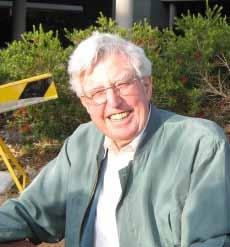
The geological mapping of the whole of the onshore continent was possibly the greatest scientific program that has been attempted in Australia. It occurred between 1948 and 1978 and was completely successful. The program is largely unknown to the public, or fellow scientists, or general historians (except Geoffrey Blainey and a few others). It was followed by a huge growth in prosperity, and that prosperity continues and perhaps increases.
So, what happened to start it?
Well, for over a hundred years there had been hard work, and then more hard work, to try to understand the geology of whole States. These efforts culminated in attempts at a national understanding by people like Griffith Taylor who prepared books for the public. For professionals there was a top-level synthesis by TW Edgeworth David in three volumes with the title Geology of the Commonwealth of Australia.
The public at large continued to think of Australia as a place too big to comprehend, peopled thinly by tough adventurous people who could ride horses, handle cattle, and get rich by opening small mines if they came across some mineralised rock.
A change happened because vertical aerial photographs were invented and were used in the study of known mining districts by AGGSNA (the Aerial Geological and Geophysical Survey of Northern Australia). That survey had found its feet by the time good information was needed for defence in World War II but adequate maps were often not available, and so in the Battle of the Coral Sea the plane crews were given pages torn from school atlases in Townsville, and carried geologists as guides.
After the war young and very energetic geologists, such as Reg Sprigg in South Australia, could see that their States could and should be mapped in manageable time. They started to do it, with permission and without it. That adventure started at the grassroots level.
Sir Harold Raggatt recognised what was happening and used his World War II experience to swing into action with high-level State colleagues. The maps became a national program and were made by hundreds of people in hundreds of four-wheel-drive vehicles. There were over 500 large maps to be done, starting usually by using air photos to make base maps showing topographic features. The air photos, base maps and geological maps were each really a national program. The combined results were drafted and published in colour by large groups of superbly capable people, along with Explanatory Notes, Reports and Bulletins. The intellectual result was the first really good picture of onshore Australia. The economic result followed because the picture was used by mining entrepreneurs. (The history of offshore Australia was different and is not discussed here.)
The forerunner of the Bureau of Mineral Resources was a group of geologists and geophysicists working in the office of the ‘Commonwealth Geological Adviser’ established in 1941, but within a year the office was renamed the ‘Mineral Resources Survey’ with Harold Raggatt the Director and Norm Fisher the Chief Geologist. Towards the end of the war, Raggatt proposed the use of the geological sciences as a platform for post-war planning and the development of Australia’s natural resources. Central to Raggatt’s 1944 proposal to establish a national geological survey was the production of a uniform series of geological maps as a basis for petroleum and mineral resources assessment (Wilkinson, 1996). In March 1946, Cabinet approved the Mining Industry Advisory Panel’s recommendation to set up a national geological survey body titled ‘Bureau of Mineral Resources, Geology and Geophysics’ and in June 1946 the first positions in the new BMR were established, starting at 55 personnel and blossoming to a peak of 680 in 1982.
Of the nine major responsibilities that the BMR was charged with, the third, which was ‘Undertaking,
Continued over leaf
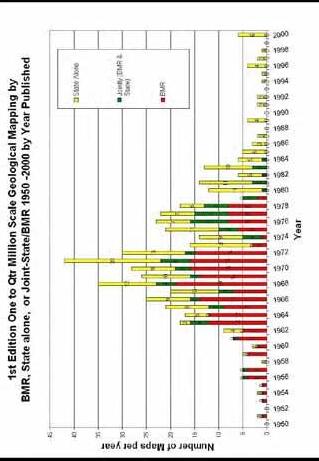
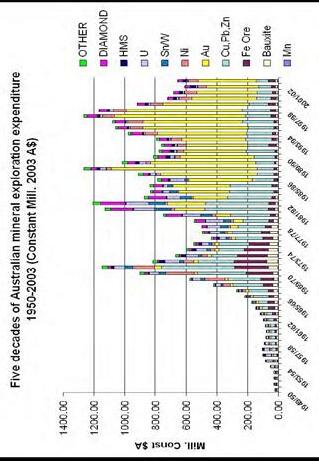
Graphs provided by Don Perkin illustrate the importance of the 1:250 000-scale geological mapping to Australia’s growth in mineral and petroleum commodity exports and to mineral exploration expenditure
in cooperation with the States and Territorial mining departments, geological and geophysical surveys and other work associated with exploration’ was undoubtedly the most significant. However, this function did not acquire any real momentum until 1949 when a request from the Queensland Government invited BMR to assist in a systematic eight-sheet geological mapping survey over a large tract of country centred on the Mount Isa mineral province, thus heralding a long period of continuous cooperation between Commonwealth and State surveys which began with Qld and continued on in Western Australia. Also, despite non-standard mineral province geological mapping of the Northern Territory being initiated by BMR in 1950, systematic sheet-based mapping did not begin until the mid to late 1950s.
Standard 1:250 000 geological mapping of South Australia, Victoria, and Tasmania was carried out solely by their respective State Geological Surveys. New South Wales was mapped almost entirely by the Geological Survey of NSW, except for a few early quarter-million sheet areas mapped and published by BMR.
Considering the entire 514 standard 1:250 000 geological map sheets covering the whole of Australia, nearly all have been finalised and published as first edition fully drafted hardcopy coloured maps with extensive legends with each map including a list of up to a dozen or so names of the highly skilled geologists responsible for the veracity of each map and the name of the drafting departmental head responsible for its production and the year of publication.
The combined BMR and State Geological Survey quarter million mapping program began with the production of two first edition map sheets in 1951, Urandangi in Qld and Penola in SA. Over the next 20 years with increases in manpower, mapping resources and technology, geological map sheet production peaked in 1971 with a publication rate of 41 first edition
coloured standard geological maps annually before tailing off over the ensuing period. By January 2001 after 50 years, the first edition mapping program was effectively completed with publication of eight quarter million coloured geological map sheets in SA centered around the far-flung Noorina and Callabonna sheets in the year 2000. Over the past nine years the remaining eight standard first edition geological map sheets, which occur over poorly outcropping areas in various parts of Australia, have now been completed.
In terms of the economic significance of the first-pass standard geological mapping program, it should be noted that post-war short-term price booms in titanium (heavy mineral sands), uranium, and to a lesser extent added demand for tin and tungsten, manganese and base metals led to more than 100 mineral deposit discoveries during the ten years to 1960, while keeneyed prospectors and geologists also discovered very large deposits of iron ore and bauxite during the decade. By the end of 1959, a total of 18 standard quarter million maps, or less than 4% of the continent had been published.
In 1949–50, minerals and energy exports represented just 5% of Australia’s merchandise exports, with manufacturing exports also accounting for 5%, whereas farm, forestry and fisheries and other agricultural exports made up the remaining 90%. The graphs on page 13 illustrate the importance of this mapping project. It took another 14 years for minerals and energy exports to increase a further 5% to reach 10% of total exports. However, in the year 1964–65 the value of mineral exports jumped 20% and for the next 14 years and even up to 1984–85, the average annual growth rate in the value of Australian minerals and energy exports was 26%, never dropping below 10%. By 1985, minerals and energy exports by value were responsible for more than 50% of Australia’s merchandise exports and the proportion stayed around the 47% level for the next 15 years till the end of the century. Following the boom in demand for Australian resources from China and elsewhere in the first nine years of the 21st century, the value of the contribution of minerals and energy to Australia’s merchandise exports for the 2008–09 fiscal year reached an unprecedented high of 69%.
It is argued that the economic importance of the firstedition mapping program should not be underestimated although the total degree and extent of its long-term significance has yet to be fully determined. However, there can be no doubt that this mammoth enterprise has laid down the basis for the further geological understanding of continental and offshore Australia and the result is indeed a template or guide to the potential mineral and energy resource treasures bound up in the
Continued on next page
Ian O’Donnell former Head of the National Topographic Mapping Program, Geoscience Australia
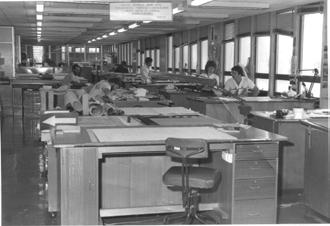
This talk begins with a brief insight to the history that shaped the 1:250 000 geological maps that the Bureau of Mineral Resources (now Geoscience Australia) was responsible for producing. It then goes on to discuss the various processes that underpinned the production from photo-scale compilation sheets through to the first edition full colour map. The talk concludes with a review of the rigorous standards that were applied to this benchmark series of maps.
Continued from previous page
rocks and formations now so consistently described and mapped. Nevertheless, the bigger question still remains: is there yet a role for the nation’s premium geoscience authority to prosecute a major remapping program in areas of strategic or national significance despite having vacated this area of expertise some 25 years ago?
Reference Wilkinson, R, 1996, Rocks to Riches: Allen & Unwin.
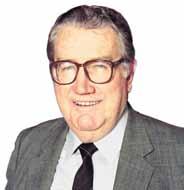
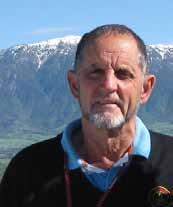
Dennis Gee, John Blockley and Peter Dunn (former GSWA gurus)
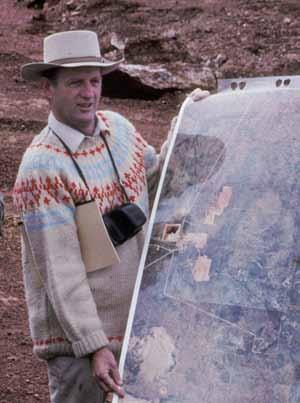
The mission to complete the 1:250 000-scale geological mapping of Western Australia as part of a national program was a contest of will and endurance. In 1911, well before the official starting gun, HWB Talbot began systematic mapping of the more remote regions of the State at a scale of 1 inch to 300 chains. The Talbot team produced all or parts of 26 rectangles before abandoning the program.
First impetus for systematic mapping came immediately after the creation of the Bureau of Mineral Resources (BMR) in 1946. Its mandate inter alia was to ‘undertake in cooperation with State ... mining departments, geological surveys and other work associated with exploration’. Major mapping campaigns, and indeed collaborative exploration with industry, began in the Canning and Carnarvon Basins in 1948. Such was the swiftness of this ‘invasion’ that Chief Government Geologist Matt Ellis sent a solitary graduate geologist to Exmouth to keep an eye on the BMR.
Over the ensuing decade, BMR published eight 1 inch to 4 mile sheets. Matt Ellis gave grudging acceptance to BMR mapping in the sedimentary basins, but mineral
provinces were deemed to be GSWA territory! Then in 1956 BMR commenced mapping the Marble Bar and Nullagine sheets in the Pilbara. Matt Ellis responded swiftly and despatched his geologists to instigate GSWA’s own mapping campaigns. Thus began the first 1 inch:4 mile regional mapping program by GSWA in its own right. The resulting 4-mile sheets were released in 1962. At the same time the first 1:250 000 mapping by GSWA got underway with Boorabbin in the Yilgarn Craton, when Jack Sofoulis was despatched there.
In 1961 incoming Director, Joe Lord, deployed most of his geologists on regional mapping duties. This was the springboard for independent modern-era standardseries geological mapping in the Geological Survey. The mission to accelerate mapping required staff to be recruited, and with the appointment of a Regional Mapping Supervisor dedicated to the mapping mission, GSWA finally established integrated multi-member parties, working concurrently on adjacent sheets, tackling individual tectonic units, with frequent field reviews by all involved geologists. A decade of staff stability, high productivity, team enthusiasm, and map consistency ensued.
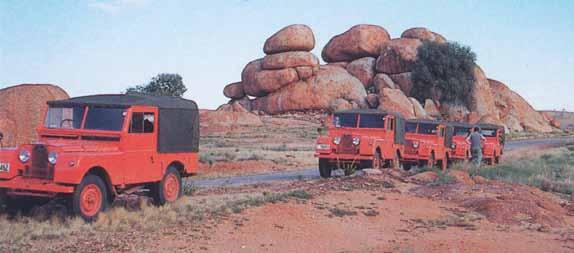
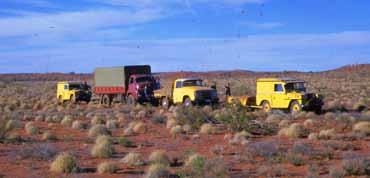
Our modus operandi was two geologists per map sheet, each with a Land Rover and a field assistant, on weekly fly camps, and generally sharing an office caravan in a central field location. Long-range fuel tanks, spare leaf springs and stub axles were prescribed. It was a protracted battle to have refrigerators and auxiliary batteries installed into field vehicles. Initially, field stints were of six months duration. By the grace of Joe Lord, this was softened to either three lots of 8 weeks or two lots of 12 weeks — depending on location. This was tough on geologists, especially those with young families.
GSWA was legendary for its field excursions, which were run after completion of map sheets. These were multi-vehicle escorted tours for industry geologists, and were very well patronised. Most memorable was the Edjudina excursion in 1971, which I attended as an industry geologist. The official tally was 99 vehicles, but on one leg I counted 103 — every one of them a Land Rover. Then there was the remote Nabberu Basin excursion in 1977 when some 37 vehicles attended. All of them — except the GSWA vehicles — were Toyotas.
Not only were there dramatic changes in field support systems, but equally dramatic changes in geological understanding. Unravelling the architecture of the shield (now Yilgarn Craton) demonstrated that regional mapping was indeed worthy research.
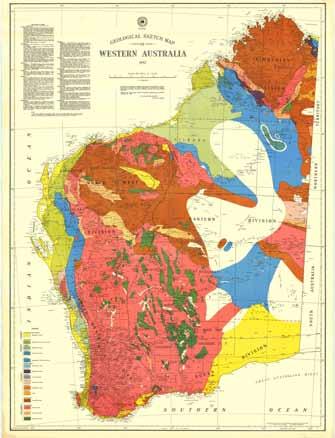
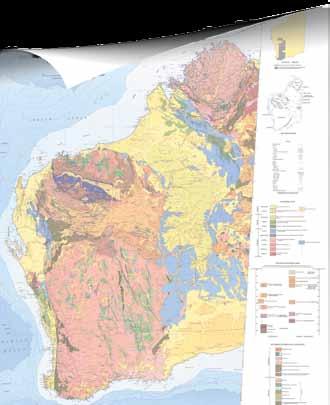
One memorable output of this campaign was the production in 1979 of a State 1:2 500 000 geological map. This map largely resolved the representational problems of legend structure and map-unit classifications in the Precambrian by integrating classical lithostratigraphy with radiometric dating into a chronostratigraphic framework. The map was published at about the time that Joe Lord retired — a fitting tribute to his leadership over a period of some 20 years.
The productivity of the 1970s and early 1980s occurred at a time when BMR and its successor The Australian Geological Survey Organisation (now Geoscience Australia), endured endless reviews, the core issue being its role in regional mapping. Specialists in basin analysis were engaged in the Officer Basin, but BMR participation was absent from Precambrian terrains except, ironically, for the Yilgarn Craton.
By 1979, the State was 90% mapped at 1:250 000 scale. Fieldwork on the last square holes in the Yilgarn was complete but the finish gun could not be fired till 1986 when Kellerberrin and Corrigin maps and Explanatory Notes were released under the authorship of Richard Chin.
The quarter-million mapping provided the essential framework for mineral exploration, which flourished through four decades. It made direct contributions to many discoveries. On reflection the quarter-million mapping standard was just right to build a regional framework. One cannot efficiently build up from 1:100 000 scale. Similarly one cannot effectively scale down from 1:1 000 000 to get the right picture. The Chief Government Geologists Conference of 1950 got it right.
South Australia has a proud history of post-World War II geological mapping by the Geological Survey or divisions of the various government departments, namely the Department of Mines, then Mines and Energy and Mines and Energy South Australia (MESA) and today’s PIRSA. The mapping focused on minerals and energy exploration, firstly for uranium, then for further coal basin discoveries after the commencement of mining at Leigh Creek, and finally as a stimulus to the industry search for minerals and petroleum from the late 1950s. This latter phase continues through to the present day with initiatives for second-round 1:250 000-scale mapping of geology and geophysics with the accent on increasing detail as digital packages.
The 1:250 000-scale mapping of South Australia started from 1960. Before this there was a series of 1 mile maps (1:63 360 scale) and 4 miles to the inch (1:253 440 scale) maps and for areas of interest around the State. The larger scale maps focused on the South
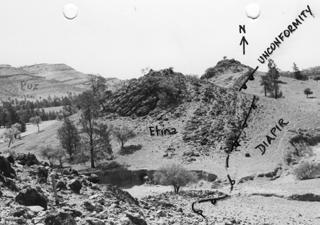
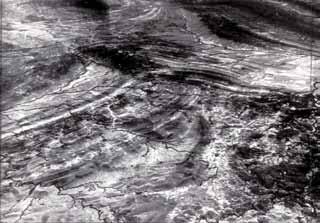
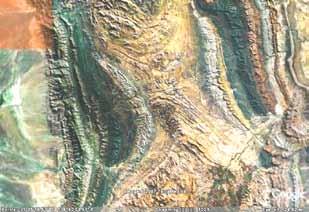
East and Kangaroo Island (1951 and 1954). Others like Lincoln, Maitland and Investigator followed up to 1961. The Olary Special was a notable contribution arising from mapping by the Mines Department to support uranium development at Radium Hill. Regional mapping was also carried out in the mid to late 1950s in the Mount Painter Inlier. The mapping parties were based in shearers’ quarters and supported by a cook and mechanic. Much of the work was done in pairs from a vehicle and fly camp, but some geologists traversed alone on foot for several days to a week without a vehicle in rough terrain. This early phase of mapping depended upon availability of aerial photographs and time availability by officers whose main task may have been related to examination of old mines, regional chemical sampling, assessment of regions for iron ore, coal or groundwater and engineering projects, etc. The work also depended on compilation of suitable base maps by National Mapping, the Army Survey Branch, the Department itself, and also the internal limitations of compilation, drafting and scribing of the geological maps for publication. Thus, although the need for State-wide geological mapping at 1:250 000 scale was recognised by 1960, a number of the maps were assigned to individuals of various Divisions of the Department as long-term projects, and were subject only to editing scrutiny by the Senior Geologist of Regional Mapping. One important step in systematising the mapping of the State was the introduction, in the early 1960s, of formal rock units consistent with the Code of Stratigraphic Nomenclature.
Relationships with the Bureau of Mineral Resources (BMR) were constrained somewhat by the politics of the time. South Australia was desperate to find energy resources and undertook 1 mile to the inch mapping in the region of Leigh Creek in the 1950s. Much of the subsequent mapping was carried out on Government approval to find similar coal basins in the Flinders
Ranges area as feed for the Port Augusta power station. Premier Playford was focused on South Australia’s independence from the Federal Government’s mapping program and wanted to manage his own priorities. In South Australia, the mapping projects were frequently long term and the responsibility of an individual working for managers with varying objectives. Many final map reports were not completed. In contrast, the BMR was more systematic and sent out annual field parties with a program of designated 1:250 000-scale map sheet areas to complete in a four to five-month field season. There was then a ‘write-up period’ for final compilation of map and detailed Record before the next mapping season. This did not apply in South Australia. Mapping in the first phase of the 1960s and early 70s was rarely carried out with available regional geophysics and the Department was largely reliant on an agreement with the BMR for airborne magnetic surveys. South Australia had its own seismic survey team for basin appraisal, which was run systematically in remote areas. Regional geochemical chip sampling and drilling formed part of the Departmental program as a result of the close affiliation with the Australian Mineral Development Laboratories, which was originally its own Analytical Branch. Isotopic dating, which played an important role in mapping by the late 1960s, was initially done in collaboration with Canberra.
Discussion of the second round 1:250 000-scale mapping program and the influence of the Chief Government Geologists’ Mapping Accord in the 1990s will require a more comprehensive approach. The advent of digital mapping techniques has introduced great changes to the procedures and presentation of geological maps. There is a debt owed to the pioneers in regional geological mapping of the State. This debt lies in the scope and scale of mineral and petroleum discovery of the late 20th century.
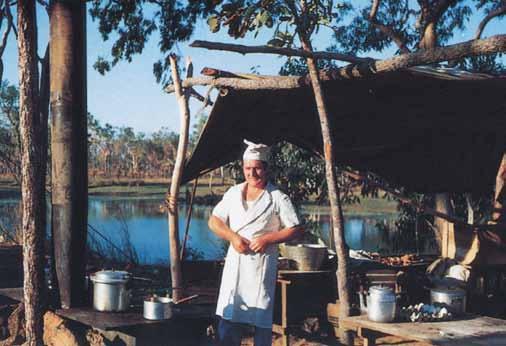
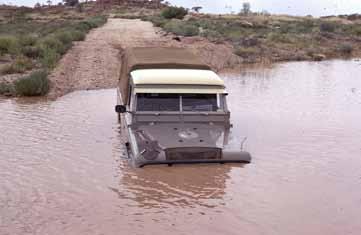
Photo essay 1
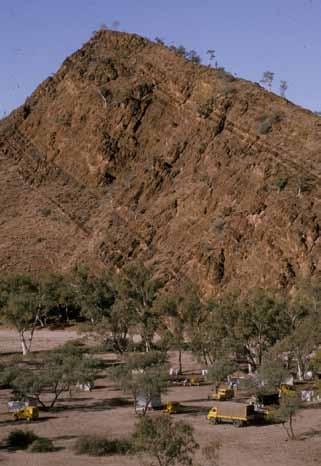
Substantial BMR kitchen set up with cook (who would nowadays be called a chef), waterside views, shade and a proper stove. Location: Sleisbeck, upper Katherine River, NT. Photo courtesy Geoscience Australia BMR camp in Northern Territory, at Hale River. Another picturesque location, with spectacular geology, well set-up camp and plenty of space — but no water!
courtesy Alastair Stewart
Peter R Dunn, GSWA (retired)
The first edition 1:250 000-scale geological maps for the whole of the Northern Territory were published by the Bureau of Mineral Resources (BMR) between 1961 and 1979.The field work was carried out between 1953 and 1975.
No systematic mapping of the Northern Territory had been carried out before 1953. Hossfeld’s 1951 geological map of the Territory more or less summarised the state of knowledge at that time.
It was the discovery of uranium at Rum Jungle and other localities in the Katherine–Darwin area which led to the first systematic mapping at 1 mile to the inch; starting in 1953, by 1955 three parties of four geologists each were operating in the area producing 1-mile sheets. By the end of 1958 the whole of the Katherine–Darwin area had been mapped, mostly at 1-mile scale. Following Harold Raggatt’s vision of the mapping of the whole continent at 1 inch to 4 miles, and later 1:250 000, the six sheets covering the Katherine–Darwin area were the ‘first cabs off the rank’ in the Northern Territory and were published in 1961–62. From then on mapping at 1: 250 000 scale of each geological province and basin was carried out with one or two field parties involved in each. The last major province to be mapped was the Granites–Tanami in 1972–73. Remnants of the Arunta Complex not included in previously mapped areas were ‘mopped up’ in 1974–75 and the last first edition sheet was published in 1979. Major Bulletins were published on the completion of mapping each province and basin.
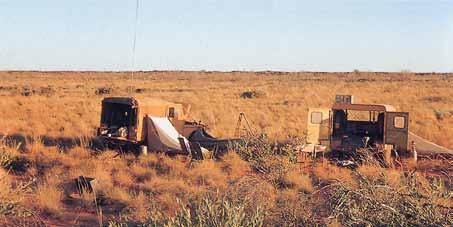
The BMR field parties generally consisted of three or four geologists, cook, mechanic and two or three field assistants. All parties were based out of Canberra and vehicles and stores were picked up in Brisbane or Adelaide and driven up to the field. Food catering was planned ahead and most non-perishables were purchased in bulk from Brisbane or Adelaide. Once in the field a base camp was set up with office tent, cookhouse, mechanic’s workshop and all modern conveniences (i.e. bucket showers and ‘flaming fury’!). Geological traverses away from base camp lasted anything from a day to two weeks and when back in camp a day or so was spent plotting results etc; latterly, a draftsman was included in some parties. After 1960 helicopters were used to access the more rugged terrain or scattered outcrops. An earlier attempt to use a helicopter had been frustrated by the helicopter’s lack of power, which meant that the geologist and pilot spent many hours clearing a take-off strip! One early problem was the availability of radio transmitters — each party was issued one transmitter for use in base camp and rarely was one available to take on traverse — this almost caused a fatal disaster when a vehicle broke down in an isolated area and the geologist spent a week in hospital suffering heat exhaustion after walking 30 miles over rough limestone country to get help. No OHS rules then!
Apart from the dedication of geologists and staff of the BMR, the success and relatively rapid production of this series of maps was due to the availability of aerial photography and base maps together with their photoscale compilations.
The outcome was maps showing relatively detailed lithostratigraphy with names approved under the Code of Stratigraphic Nomenclature. Chronostratigraphy was no problem in the Phanerozoic, but in the Precambrian the main determinant was superposition and tectonic style. During the course of the mapping, advances were being made in geochronology: samples of igneous rocks, mainly granites, and glauconitic sediments were dated by K/Ar and Rb/Sr techniques. These results combined with the known geology led the BMR to subdivide the
Proterozoic into Adelaidean, Carpentarian and Lower Proterozoic (or Nullaginian) Systems. More accurate dating by SHRIMP has now made these subdivisions obsolete.
Some significant results as a by-product of the mapping include the discovery of the Mount Bundey iron and Groote Eylandt manganese deposits, the discovery of both the Strangways meteorite crater and the presence of nappe structures on the margins of the Amadeus Basin. More indirectly the mapping led to the discovery of the Frances Creek iron and Alligator Rivers uranium deposits.
Geoscience Australia is acknowledged for permission to use many of the slides accompanying this talk on the attached CD.
Alfons VandenBerg
GeoScience Survey of Victoria
Prior to the 1960s, the most detailed regional maps of Victoria were at 8 miles to the inch. In the mid-1960s, pressure from mining and petroleum exploration companies for regional maps at a better scale resulted in an offer from the BMR to carry out mapping in Victoria. It was felt that this offer should be refused, and John Knight, then Acting Director decided that the Geological Survey of Victoria (GSV) should do this task. It became the major task of the mapping and drafting sections for the next decade. Initially the main effort was a cartographic one, with both the base needing to be drawn, after which the existing detailed mapping was fitted to it.
Preparing a fully coloured map for printing in those days was a complicated process that took up to 2 years. Production of the full suite of 20 maps would therefore have taken many years, so it was decided to produce a preliminary two-colour ‘bring your own Derwents’ edition. This greatly speeded up map production, and the full series was printed within two years, including a single fully coloured one covering Melbourne, in 1967. Preparation of this preliminary edition had an added benefit in that it pinpointed areas with very poor information. As soon as the preliminary edition was printed, attention was focused on producing a fully coloured edition. Many GSV geologists were marshalled into providing field information that was used to modify the preliminary maps. Four sheets with the poorest coverage were remapped by Mapping Section geologists. With each sheet covering an area of >14 500 km2, and with poorest coverage coinciding with the most difficult terrain and/or most complex geology, this was a major task, requiring an intensive and sustained field effort. Mapping of the most difficult maps took roughly one and a half years per sheet, and they were the last to be printed.
The first coloured editions were printed between 1971 and 1977. Several novelties were used: a single colour scheme, modified from the international scheme, plus a scheme of symbols that was intended to cover any unit that might crop up in the field. An ‘environmental’ legend was developed in which marine, subaerial, intrusive and extrusive units were in different columns. This is still used on larger scale maps. Each map had cross sections, some more than one.
The third-generation quarter-million maps were digital, done when all the surveys were shifting from analogue to digital maps. Mapping done since the analogue edition was incorporated in the digital edition. A severe deficiency of the digital maps is that they were drawn on a different base of streams and roads, and although some attempt was made to fit the geology to the new base, it was not successful. As a consequence, the digital maps are less accurate than the old analogue maps of the 1970s. An additional problem was that the digitisation was done using Genamap software, which was not on friendly terms with other, more widely used software.
This problem was addressed in 2002–04. Data were translated from Genamap to ArcMap by The Australian Geological Survey Organisation (AGSO), and the translated data verified by a GSV cartographer. This also provided the opportunity to update and further develop the legends and geological unit symbols. This fourth edition was used as regional cover on the GSV’s GeoVic website geological map. However, problems with the non-matching base persist in this edition.
The problem with geology not matching the base is finally being addressed through the GSV’s Seamless Geology Project. A workable base became available in the early 1990s and was used for all detailed mapping, using GIS software to capture linework and geological sites. A great deal of mapping is therefore available in a digital format that matches the detailed base (and is available on the ‘detailed geology’ layer in GeoVic). Much of the older mapping is being redrawn to match the modern base, although the strict time limit for the project means that, for most of Victoria, this can only be done at 1:250 000 scale. Western Victoria, west of the Mount William Fault, has been completed, and geological input for much of central Victoria has been prepared. The project aims to be completed by mid2012.
John Watkins1 and David Robson2
1Geological Survey of NSW, Industry and Investment NSW, 2Department of Industry and Investment — Primary Industries and Energy (Published with the permission of the Director, Geological Survey of New South Wales, Industry and Investment NSW)
Geological mapping has been an important element of activities of the Geological Survey of New South Wales (GSNSW) since its establishment in 1875. The Geological Survey’s investigations into the mineral resources and geology of the State have provided strong support and an effective framework for coal, mineral and petroleum exploration and development.
The 1950s saw the commencement of the standard series geological mapping program. The program arose from the realisation that a systematic approach to mapping was necessary in order to provide a sound scientific basis for discovery and development of the State’s mineral resources. A scale of 4 miles to the inch, subsequently changed to 1:250 000, was chosen as the most appropriate for the purpose.
Between 1952 and 1962 seven map sheets were published at a scale of 1:253 440 (later converted to metric), four by the Bureau of Mineral Resources Geology and Geophysics (BMR) and three by the Geological Survey. In 1962, four geological sheets were compiled at a scale of 1:250 000 for the first time. Field work was also completed on the eastern one-third of the
Canberra 1:250 000 sheet to allow publication of a second edition Canberra sheet by the BMR.
The period 1964 to 1975 was a time of significant achievement. More than 40 full-colour geological maps at a scale of 1:250 000 were published. Although largely reconnaissance in nature, they fulfilled the aim of providing almost a state-wide geological map coverage. The program included reconnaissance mapping of many areas that had not been previously mapped. This program was initially driven by Len Hall and subsequently by Toby Rose. A systematic metallogenic mapping program also at a scale of 1:250 000 commenced in 1969 and the first map in the series, Bathurst, was published in 1973. This program of metallogenic mapping was completed in 2001, with coverage of all areas of significant mineral potential in the better exposed parts of the Lachlan and New England fold belts. The metallogenic map series built on the available 1:250 000-scale geological maps by overlaying mineral deposit information.
In 1990, the National Geoscience Mapping Accord (NGMA) commenced with the aim of integrating aspects of the mapping programs of the Commonwealth’s Australian Geological Survey Organisation (AGSO) and the various State Geological Surveys in areas of high priority for minerals and petroleum exploration. Production of a second generation of 1:250 000-scale maps and geoscientific databases commenced with the Bathurst map sheet under the NGMA in 1991 and between 1991 and 2000, three 1:250 000 map sheets were completed in the central west of NSW.
Commencement of the Bathurst 1:250 000 mapping project also marked the start of a new multi-disciplinary approach to geoscience mapping. For the first time, mapping and interpretation were guided and assisted by detailed digital airborne magnetic and radiometric data, gravity data and other remotely sensed datasets (Landsat TM, Spot). GPS technology was used for the geophysical surveys to aid navigation, and by geologists to accurately locate field observations on high-quality base maps.
In 1994, New South Wales received a substantial funding increase through the Discovery 2000 (1994–2000) and Exploration NSW (2000–2006) government exploration initiatives. The second generation 1:250 000 mapping program benefited greatly from the availability of new high-resolution airborne geophysical coverages that were acquired through these initiatives.
In 2006, the New South Wales Government approved funding for the New Frontiers initiative to focus on the undercover areas of western NSW. New airborne
geophysical data were acquired and a series of 1:250 000scale geological/geophysical interpretation maps was commenced. Five of the interpretation maps have now been compiled, based on enhanced images of geophysical data and satellite data, controlled by outcrop geology and drillhole information. The final products are interpretation maps showing likely basement lithologies and structural elements.
Geoscience mapping at 1:250 000 scale has made a substantial contribution to improving knowledge of the geological framework of New South Wales. Large areas of the State are now covered by second-generation mapping in key areas that are prospective for a wide range of minerals. The 1:250 000 geoscience mapping has played an important economic role in attracting and maintaining exploration investment, aiding the discovery rate and informing land use planning decisions.
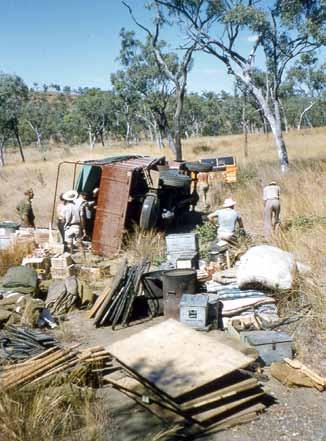
BMR’s
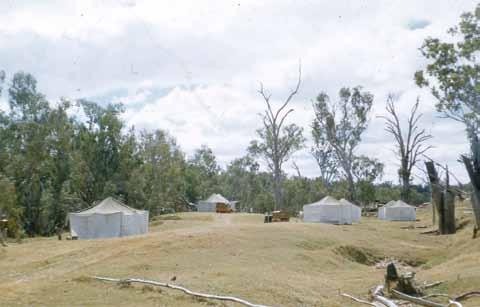
BMR base camp on the Burdekin, near Greenvale Station, north Queensland, June 1957. Photo courtesy Colin Branch
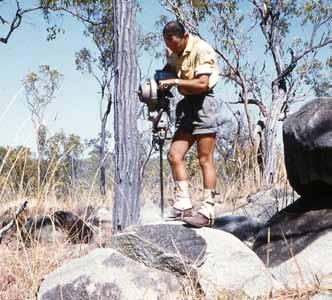
Sampling granite in north Queensland, 1960. Photo courtesy Colin Branch
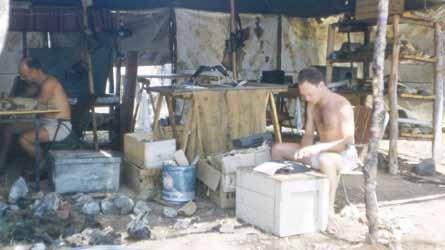
Ian Withnall Geological Survey of Queensland, Department of Employment, Economic Development and Innovation
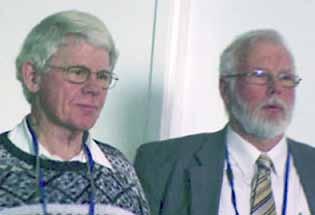
Systematic 1:250 000 geological mapping of Queensland commenced in 1950 as a joint initiative between the Geological Survey of Queensland (GSQ) and the Commonwealth Bureau of Mineral Resources (BMR). Mapping commenced in the Mount Isa Inlier and Georgina Basin. Over the next 25 years, the rest of Queensland, totalling 119 sheets, was mapped, mostly with the support of BMR, except in the southeast where seven sheets were mapped by GSQ alone. Generally, at least one GSQ geologist was included in each team, and in some cases GSQ geologists were the majority and even the project leader. The last area covered by BMR–GSQ first-pass mapping was in the Carpentaria and Karumba Basins between 1968 and 1973 when field work for Red River sheet was completed. At the same time, GSQ completed mapping of the Gympie Sheet near Brisbane.
Most coloured first edition maps were drawn at BMR, but a few were produced by the Department of Mines Drafting Branch. All were accompanied by Explanatory Notes. It was not until 1993 that the last coloured first edition map, Maryborough, in the southeast, was published by GSQ. Several other sheets in the southeast, Bundaberg, Gympie, Ipswich and Brisbane, have never been published in colour, although they are covered by coloured 1:100 000-scale and 1:500 000-scale maps.
As the first-pass mapping was being completed, a new initiative to revise the geology of the mineralised parts of Queensland in more detail commenced, again with the support of the BMR. Two projects through the 1970s
focused on Mount Isa and Georgetown. The output from these was mainly 1:100 000-scale maps, along with commentaries, but second edition 1:250 000 maps were subsequently produced for Mount Isa and two 1:250 000 special maps for Georgetown. GSQ continued to fund 1:100 000 mapping close to Brisbane and other cities as part of its Urban and Environmental Geology program.
With the withdrawal of BMR from systematic geological mapping in the early 1980s, GSQ secured funding to continue the work in more remote areas, and set up mapping teams in the Hodgkinson and Broken River Provinces and later the Townsville hinterland centred on Charters Towers, where a field base was set up, and in the Anakie Province in central Queensland. Resulting from this work was a combination of 1:100 000- and 1:250 000-scale maps. BMR geologists contributed to aspects that fitted with their more mission-oriented program.
In 1990, BMR underwent another review becoming the Australian Geological Survey Organisation, and, with the National Geoscience Mapping Accord, returned to regional mapping. The North Queensland Project was initiated to revise the geology of Cape York Peninsula, which at the time was the focus of the multigovernmental, multi-disciplinary Cape York Peninsula Land Use Study. Four 1:250 000 sheets, Ebagoola, Hann River, Walsh and Red River were mapped, and for the first time the data were compiled digitally. Regolith mapping also accompanied the more traditional mapping.
In the mid- to late-1990s, GSQ undertook a program of 1:100 000-scale mapping in the New England Fold Belt, supported by airborne geophysics. From 2001, third-pass mapping was started with reinterpretation of the geology of the Townsville and Cairns hinterland using newly acquired geophysics not previously available. This was extended to the Mount Isa area in 2005, where a program of integrating all of the various datasets with new fieldwork has recently been completed. Areas beyond the outcrop area of the Mount Isa Province have been reinterpreted, both surface geology using Landsat and radiometric data, and subsurface using magnetic and gravity data.
None of this recent work has resulted in publication of standard 1:250 000-scale maps. With digital compilation and print-on-demand techniques, GSQ has concentrated on producing seamless GIS, where scale is irrelevant, and publishing maps at 1:100 000 scale, accompanied by regional reports rather than individual map commentaries or Explanatory Notes.
Each stage has utilised new technology — black-andwhite aerial photographs and the Land Rover were the new technologies of the 1950s; it was coloured aerial photography in the second-pass stage. We now have a vast array of datasets and tools to assist us, but these cannot entirely replace boots on the ground.
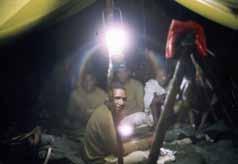
Field camp comprised two tent flies, one for the geologist and the other for Samberigi field
Hugh Davies1 and Chris Pigram2
1 University of PNG, Box 414, University NCD, Papua New Guinea; hdavies@upng.ac.pg
2 Geoscience Australia, chris.pigram@ga.gov.au
The Australian Bureau of Mineral Resources (BMR) was established in 1946 and provided geologists to the Papua and New Guinea Administration beginning in 1948. The resident geologists, based in Port Moresby and Wau, and volcanologists based in Rabaul, carried out local area investigations but for the most part had limited resources and manpower. Regional geological mapping by Canberra-based field parties began in 1956–57 in the eastern highlands (McMillan and Malone, published in 1960) followed by the mapping of the Musa Valley in 1958 (Smith and Green, published in 1961), Misima Island in 1959 (de Keyser, published 1961), Woodlark Island in 1960 (Trail, published 1967), the D’Entrecasteaux Islands in 1961 (Davies and Ives, published 1964), and Bougainville and Buka in 1965 (Blake and Miezitis, published 1967). Despite the limitations faced by the resident geologists there were significant focused contributions, notably by JE Thompson (including his benchmark papers on the Papuan ultrabasic belt, see BMR Record 1957/77, and on the Punkuna (later known as Panguna) copper–gold prospect on Bougainville Island, see BMR Record 1962/39), and the mapping of parts of the same ophiolite by Davies in 1957 and Dow and Davies in 1960 (see Dow and Davies, 1964).
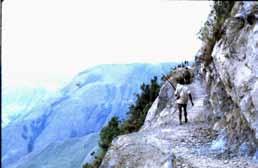
Four-mile and then 1:250 00-scale mapping had proceeded in Australia since the early 1950s but it was only in 1966 that the concept flowed on to PNG, when the first 1:250 000-scale ‘Preliminary Edition’
was produced by Duncan Dow’s South Sepik party. In 1973 the resident geologists were reconstituted as the Geological Survey of PNG. They contributed to all BMR mapping programs and independently completed the mapping of a number of sheet areas: Gazelle (Macnab), Huon and Bogia (Jaques and Robinson), Admiralty Islands (Jaques), Markham (Grainger and Tingey), Yule (Campbell Brown), Kavieng and Cape St George (Hohnen), and Port Moresby–Kalo–Aroa (Pieters). Key to the production of the maps was the fine drafting by three PNG draftsmen (Rau, Eno and Baloiloi), under the guidance of George Millist, seconded from BMR.
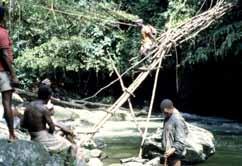
Major Canberra-based mapping campaigns included the mapping of the Kubor Anticline in 1968 (Bain, Mackenzie, Ryburn), New Britain in 1969 (Ryburn, Johnson and others), southeastern PNG in 1967–68 (Davies, Smith, Pieters, Cifali, Tingey, Manser), and the South, West and North Sepik expeditions in 1966–67, 1971–72 and 1972–73 (Dow, Bain, Macnab, Smit, Davies, Hutchison, Norvick, Maffi, Sweet). Oil
company exploration mapping and to a lesser extent mineral exploration were incorporated into the maps where appropriate.
All of the mapping programs in PNG were handicapped by incomplete aerial photograph coverage and inadequate and inaccurate base maps. These obstacles were reduced in 1969 when the Department of Defence made available side-looking radar imagery of much of the unmapped remote interior, and in 1973–74 when a concerted aerial photography campaign by the RAAF and a massive ground control effort by the Australian Army Survey Corps, resulted in the production of complete 1:100 000-scale topographic map coverage of PNG — a hazardous and little-recognized achievement. The pace of geological mapping accelerated in 1965–66 with the adoption of helicopter support and by the time of Independence in September 1975 there was almost complete coverage. Those who were involved owed a special debt to a select band of expert helicopter pilots, and to the expert and cordial support of BMR cartographers (notably Phil Boekenstein and Max Nancarrow) and editors. Essential support for resolving stratigraphy in both PNG and Papua was provided by palaeontologists, chiefly Belford and Skwarko.
The mapping of Indonesian Papua, the western half of the island of New Guinea, was undertaken as an aid project jointly between BMR and the Indonesian Geological Research and Development Centre (GRDC). The program included a training and development component for Indonesian geologists. It began officially in 1978, although some joint work had been done previously, and utilised aerial photography collected by the RAAF. Mapping began in the western Birds Head region and worked east. The western half of the province was completed before the program was curtailed in 1982 because of civil unrest. The program was led by Duncan Dow and Rab Sukamto and included BMR geologists Pieters, Pigram, Trail, Robinson, Ryburn, Williams and Bladon, and geophysicists Barlow and Johnson. Subsequently the GRDC produced maps of parts of the central range that incorporated data gathered by Freeport McMoRan Indonesia exploration geologists.
A geological map of PNG at 1:1 000 000 scale was released in 1974 and at 1:2 500 000 scale in 1978. A geological map of Indonesian Papua at 1:1 000 000 scale was produced in 1986, based on BMR–GRDC mapping and on earlier work and air photo interpretation.
Catherine E Brown
Australian Stratigraphy Commission and Geoscience Australia, Canberra
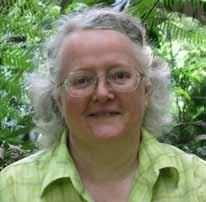
Codes, guidelines, and standard practices for naming and describing Australian stratigraphic units have been discussed for more than 60 years since the Australian and New Zealand Association for the Advancement of Science (ANZAAS) set up a Research Committee on Stratigraphic Nomenclature in 1946. Like today’s Australian Stratigraphy Commission, its aims were ‘to encourage the orderly use of names and definitions for stratigraphic units’.
Australia was a pioneer in stratigraphic classification. The first Australian Code of Stratigraphic Nomenclature, published in 1950, was only predated by those of USA and Canada. Four editions of the Australian Stratigraphic Code were published: in 1950, 1956, 1959 and 1964. The fourth edition was reprinted with minor alterations in 1973.
Geological investigations across the continent were expanding rapidly in this post-war period and rock, fossil and time terms were often used interchangeably. The Stratigraphic Code developed from a set of definitions and recommendations into a tried and proven guide that demanded adherence by geologists, and improved communication and understanding of Australian geology.
The development of an Australian Code of Stratigraphic Nomenclature went hand-in-hand with documenting the names already in use. The Central Register of Stratigraphic Names (or Stratigraphic Index) was started in 1949 and has continued ever since. The Register initially assisted with the publication of the Australian
volumes of the International Stratigraphic Lexicon, containing the names, definitions and key references to the existing Australian geological units at the time. These volumes were compiled and published between 1951 and 1966, through cooperation between the State Surveys, the Universities and the Commonwealth Bureau of Mineral Resources (BMR). An index volume was published in 1975 and an international Antarctic volume was finally published in 1983.
In the meantime, in 1966 the Stratigraphic Nomenclature Committee, now under the auspices of the Geological Society of Australia, was invited to become the Australian organisational member of the International Subcommission on Stratigraphic Classification. This gave us the opportunity to contribute to international standards and guidelines. In 1976 the International Stratigraphic Guide was published and Australia adopted it in 1978. The Stratigraphic Nomenclature Committee continued to review and offer advice on Australian geological units and in 1985 published the Field geologist’s guide to lithostratigraphic nomenclature in Australia (Staines, 1985), which discusses aspects of the International Stratigraphic Guide most relevant to Australia, explains special cases and describes Australian administrative procedures.
In conjunction with the work of the Stratigraphic Nomenclature Committee, cooperative efforts continued, especially between the State and Territory Surveys and BMR, and the Central Register was maintained as card files held in BMR, and updated as new publications were released. As early as 1974 the possibility of computerisation of the Register was discussed and in 1979 input to GEODX (the Geological Index database) commenced. Hardware and software has changed over the years, and in July 1995 the database was the first in the Australian Geological Survey Organisation (now Geoscience Australia) to become searchable from their website.
Since the 1980s the Stratigraphic Names Committee (now the Australian Stratigraphy Commission) has discussed and made recommendations on igneous rock nomenclature and sequence stratigraphy in particular. The committee has also eased restrictions on using similar names for different units, and allowed the re-use of some abandoned names.
Over the last decade, a regular column has been established in the GSA’s newsletter TAG (The Australian Geologist) for discussion of stratigraphic matters, including the description of subsurface units on the basis of geophysical character. Access to both the current stratigraphic guidelines and the Australian Stratigraphic Units Database is now through a Geoscience Australia website: <http://www.ga.gov.au/products-services/dataapplications/reference-databases/stratigraphic-units.html>
Australian Code of Stratigraphic Nomenclature, 1st edition, 1950: Australian Journal of Science 12, p. 170–173.
Australian Stratigraphic Units Database index page: <http://www.ga.gov.au/ products-services/data-applications/reference-databases/stratigraphic-units. html>
Gatehouse, CG, Cooper, BJ 1988, Evolving a guide to Australian stratigraphy: Geological Society of Australia, Abstracts 21, p. 150–151.
Glaessner, MF, Raggatt, HG, Teichert, C and Thomas DE 1948, Stratigraphic nomenclature in Australia: Australian Journal of Science 11, p. 7–9.
Hedberg, HD (editor, for International Subcommission on Stratigraphic Classification), 1976, International Stratigraphic Guide: John Wiley, New York, 200p.
Lenz, SL, Brown, CE, Bond, LD, and Ryburn, RJ 1996, Guide to the Australian Stratigraphic Names Database: Australian Geological Survey Organisation, Record 1996/16, 62p.
Modrak, K 1981, A history of the Central Registry of Stratigraphic Names and the development of GEODX within the Bureau of Mineral Resources (BMR) 7p (unpub).
Staines, HRE, 1985, Field geologist’s guide to lithostratigraphic nomenclature in Australia: Australian Journal of Earth Sciences 32, p. 83–106.
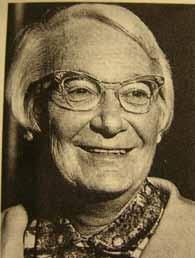
Dr Dorothy Hill, a long-standing member of the Stratigraphic Nomenclature Committee, from 1946 to at least 1964
Douglas Finlayson Geological Society of Australia
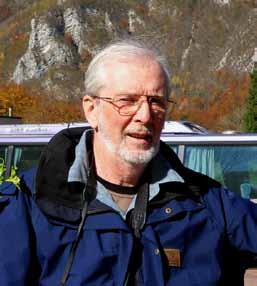
This paper chronicles the history of the upsurge in the application of controlled source seismology during the second half of the 20th century and early 21st century that has enabled spectacular 3-D imaging of geological structures across the Australian continent down to the crust–mantle boundary — and even deeper.
During the 1950s, Australian seismologists were very much aware of experimental deep seismic reflection work being done in North America and Europe. They made wide-angle seismic recordings from the Moho during atomic bomb tests in South Australia and the data provided the first published studies of Australian crustal structure based on wide-angle seismic methods. The 1950s also saw the start of wide-angle recording of quarry blasts, experimental deep reflection recording, and onshore–offshore–onshore recording of marine shots around southwestern Australia.
After the 1960 meeting of the International Union of Geodesy and Geophysics (IUGG) in Helsinki, the Australian Academy of Science became involved in the international Upper Mantle Project (UMP). This initiative coincided with a program by the Australian Government to conduct systematic geological and geophysical mapping across the whole of continental Australia and its margins as a strategic necessity. During the 1960s there were a number of wide-angle seismic projects undertaken as a contribution to the Upper Mantle Project — BUMP, CRUMP, WRAMP
and FRUMP. In PNG there were two large seismic investigations around New Britain and New Ireland to investigate volcanic activity centres. There were some spectacularly successful experiments in deep seismic reflection imaging of the Earth’s crust down to the Moho near Mildura, in the Ngalia Basin and in Western Australia.
The 1970s saw the introduction of long-endurance portable seismic tape-recording systems for wide-angle seismic profiling in the Australian region. As well, in 1976 BMR commissioned a 48 channel DFS-IV digital acquisition system for near-vertical seismic profiling. Technological improvements enabled more ambitious projects imaging the Earth’s crust. Huge Ord Dam construction blasts and the TASS project enabled wideangle recording across the whole continent. Detailed wide-angle profiling was conducted in the Lachlan Orogen, Bowen Basin, Pilbara region, MacArthur Basin, and in the Tennant Creek – Mount Isa region. In PNG a wide-angle seismic project was undertaken across the Papuan Peninsula. Near-vertical deep seismic experimentation continued in conjunction with sedimentary basin investigations across the country.
The 1980s decade saw the start of systematic deep seismic profiling along transects that were many 100s of kilometres in length. Onshore, more than 1000 km of deep seismic profiling was acquired across the basins of southern Queensland during the period 1980–86, and there were associated wide-angle seismic projects. There was deep seismic reflection profiling and wideangle profiling across the huge gravity features in central Australia. There was a profusion of seismic projects across Australia from the Yilgarn Craton to the New England Orogen. The mid-1980s saw the introduction into Australian waters of the research vessel ‘Rig Seismic’ capable of conducting deep seismic profiling of the Earth’s crust across the Australian continental margins. Marine seismic profiling was conducted from the Lord Howe Rise to the Great Australian Bight to the Exmouth Plateau.
During the 1990s a huge effort was put into examining the marine continental shelf areas to the north of Australia, including ocean bottom seismograph surveys. Onshore, deep seismic profiling focused on ‘hard rock’ areas including the Yilgarn Craton, Mt Isa region, western Victoria, Broken Hill Block, and Tasmania. In 1997 the Australian National Seismic Imaging Resource (ANSIR) was established and took delivery of an improved data acquisition system and vibrator seismic source vehicles. Between 1993 and 1998 passive seismic recording became significant with the SKIPPY and KIMBA imaging of large-scale crustal and upper mantle features.
From 2000 to 2004 Australia conducted marine surveys aimed at establishing claims under international Law of the Sea legislation. Seismic profiling was conducted in ten offshore areas, including the offshore areas of Antarctica. Onshore, many seismic reflection programs were conducted in areas such as the Yilgarn Craton, Curnamona Province, MacArthur Basin, Mount Isa Block, western Victoria, Lachlan–Thomson Orogen, Tanami Goldfields area and the Gawler Craton –Olympic Dam region.
Thus, in the sixty-year period from 1946 to 2006 our knowledge of the crustal architecture across the Australian continent and its margins has mushroomed from very crude ideas to very detailed knowledge in many regions. In future, equipment and computing advances will continue this trend — enhancing our detailed knowledge of Australia’s endowment of resource-rich provinces using seismic imaging techniques.
Canberra landscapes shaped by geology — the centenary of Pittman’s 1910 geological map that helped shape the design for Australia’s capital city
Douglas Finlayson, Canberra doug.finlayson@netspeed.com.au
Walter Burley-Griffin and his wife Marion fully recognised the potential for a truly beautiful city landscape when they submitted their design for the capital of Australia. Their urban design took full advantage of the local topography and drainage system when they developed their city axis and associated triangular urban development corridors. The architectural scheme for the capital of Australia, including a central parliament building and associated administrative departments, was designed to be enhanced by the landscape of the Molonglo River basin and the surrounding hills, at that time known as the Limestone Plains.
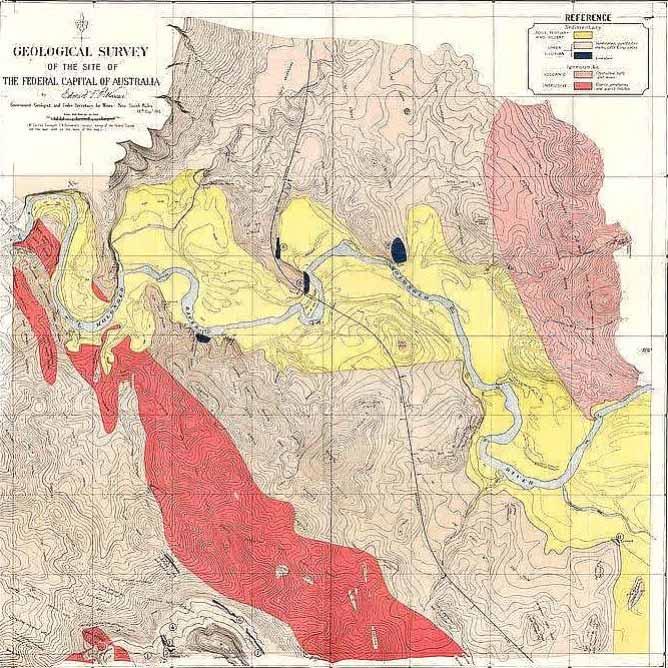
The landscapes of the Limestone Plains region are the product of a long geological evolutionary process that began about 490 million years ago during the Ordovician geological period.
Edward Fisher Pittman (1849–1932), Government Geologist and Under Secretary for Mines in the State of New South Wales, was commissioned to map the central area for the national capital and produced his 1910 geological map that formed an important component of the documents delivered to the urban planners around the world participating in
EF Pittman’s geological map of the central area for the National Capital in 1910. Courtesy National Library of Australia
the competition for the design of the city. Prior to this mapping assignment, Pittman had contributed to the 1883 Geological Map of New South Wales compiled by CS Wilkinson (Government Geologist) based on the earlier work of the Reverend WB Clarke (1798–1878), the ‘father’ of Australian geology.
The Australian Earth Science Convention 2010 in Canberra celebrated the contribution Edward Pittman made to Canberra regional geological mapping on the centenary of the publication of his map — Geological Survey of the site of the Federal Capital of Australia dated 14 December 1910; scale 800 feet to 1 inch (1:9600); based on Charles Robert Scrivener’s contour map of the area chosen for the federal capital.
Some geological features of the Canberra area were recognised from the very first days of European reconnaissance visits to the region in December 1820. Limestone outcrops on the banks of the Molonglo River were identified as being a possible source rock for manufacturing building mortar and the region became known as Limestone Plains. During the 1840s the Reverend William B Clarke visited the Limestone Plains and discovered the Silurian brachiopods within mudstones in the bed of the Woolshed Creek, now not far from Canberra Airport. The 1893 general geological map of New South Wales indicated widespread Silurian sequences throughout the Limestone Plains region with associated limestone and granite outcrops.
However, the 1910 Pittman geological map for the site of the national capital was the first to indicate some detail of the geology of the Limestone Plains region.
Significant comments in Pittman’s report Geology of the Federal Capital site issued in 1911 by the Commonwealth Government Minister of Home Affairs included:
• The suitability of Black Mountain Sandstone for building purposes
• The suitability of various shales for the manufacture of bricks
• The supply of Mugga Mugga Porphyry for engineering purposes and as an ornamental stone
• The profusion of Silurian corals, brachiopods, trilobites and crinoids within some sedimentary sequences
• The lack of suitable slate for roof tiles
• The availability of limestone for the manufacture of mortar and hydraulic cement
• The possible establishment of a Portland cement factory in the capital
• No insuperable difficulties with the construction of sewer tunnels and surface reservoirs
• Weir sites were available for the construction of an ornamental lake in the centre of the city
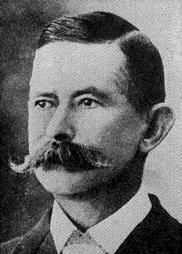
• Granite outcrops at Tharwa were identified as being of considerable value for architectural and engineering purposes
• The Cotter River system was identified as being ‘the most impressive feature of the whole territory’ and ‘it will form a magnificent water supply for a large population’.
Most of Pittman’s observations and comments on the geology and landscape of the Canberra Federal City site have stood 100 years of scrutiny and testing. He should be congratulated. His lasting reward is the naming of the Pittman Formation within the Adaminaby Group of Ordovician deep-marine interbedded sandstones, siltstones and shales across a wide area around Canberra. Motorists can see the formation readily in road cuttings along the freeway routes from Canberra to Sydney, Batemans Bay and into the city from Gungahlin as they cross the Lake George Fault, the Queanbeyan Fault and the Deakin Hill Fault respectively on their busy daily commutes to and from work.
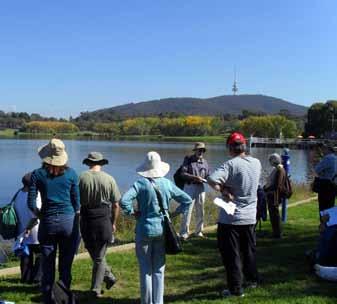
Pittman was prominently associated with the formation of the School of Mines at the University of Sydney and was a Lecturer in Mining from 1893 to 1902. He was the author of numerous reports on the mining fields of the State and took particular interest in artesian water problems, published several papers on the subject, and was chairman of the Inter-State Conferences on Artesian Water, held at Sydney, Brisbane, Adelaide and Perth. He was the author of The Mineral Resources of New South Wales (1901), and The Coal Resources of New South Wales (1912). Under his direction geological maps of New South Wales were produced in 1895 and 1914. His son, a medical graduate, subsequently bequeathed a large legacy from the family estate to the University of Sydney.
Further reading
Skeats, EW, 1933, David Lecture No. 1, University of Melbourne. Vallance, TG, 1988, Australian Dictionary of Biography.
by John Glover with Jenny Bevan
General comment
Below is the text that served as the basis of my (JJE Glover) talk at the launch of The Forgotten Explorers: pioneer geologists of Western Australia, 1826–1926. It does not pretend to be an effective summary of the contents of the book. Because of time constraints at the book launch, I left out some very important geologists, such as Talbot, Jutson, E de C Clarke and so on.
The Forgotten Explorers, 1826–1926
Before saying a little about this book I’ll begin with a rhetorical question: Who were the great Australian explorers? Most people immediately think of men like Burke and Wills (and I’ll continue in alphabetical order) Eyre, Giles, Grey, Kennedy, Leichhardt, Sturt, and others; and besides their achievements, all of these men suffered great hardships in dangerous areas, and some perished, making them more memorable historically.
There were other explorers in Western Australia, largely unpublicised, during the first century of European settlement, who crossed equally dangerous and desolate regions. These men were field geologists, resolute and
skilled bushmen who did not perish, become lost, or have to be rescued. They returned without fuss or acclaim, to write reports and get ready for their next journeys. It is their exploits that form the substance of this book. For 30 years toward the end of this period, former Yorkshireman Andrew Gibb Maitland ran the Geological Survey of Western Australia (GSWA) and was actively responsible for the deployment of many of these geologists. He also pioneered the drilling of artesian water in arid areas, transforming them. But his name is unknown to most of the present-day community, including some historians.
Another purpose of the book is to remind readers of a fortunate coincidence. Geology was developing as a science when Western Australia was being explored. By the end of the 19th century, and the beginning of the 20th, as geologists and prospectors were discovering more about our landforms and the distribution of the rocks, we were improving at interpreting their geological and economic significance.
What is the difference between a geologist and a prospector? The term geology was first used in its present sense only about ten years before Sydney was settled. A geologist is generally the graduate of a tertiary course that covers the composition, structure, and origin of the Earth, and traces the development of life on it. Geological science endeavours to predict and explain events such as eruptions, and earthquakes, and the origin and location of ore deposits. Almost all geological maps are produced by geologists.
The term prospector came into its modern meaning in about 1857, and implies an individual working for his
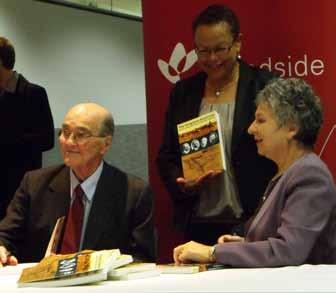
own gain rather than for a mining company, searching for gold, gemstones and valuable minerals available near the Earth’s surface. Historically, prospecting has represented one of the few ways in which an ordinary person might legally make his fortune.
Let’s shift briefly to England. In 1815 (the year of Waterloo), William Smith produced his precise geological map: ‘the map that changed the world’, to use author Simon Winchester’s phrase. There was another development: it became clear that the formations being mapped by geologists, originated in environments like those existing today. Thus, to take a very simple example, a mapped limestone unit containing numerous shells and corals was probably part of a former coral reef association, and formed in warm shallow seas. We could therefore not only infer their origin but also their general shape, that is, how they were likely to extend in three dimensions.
Thus, we learned to project the surface geology vertically downward from the map, and to construct diagrams known as cross sections showing the underground geology. In 1858 the Western Australian surveyor and amateur geologist Francis Gregory went to England, discussed his work with geologist Sir Roderick Murchison and others, and published two geological cross sections through parts of Western Australia (one of 40 miles or 64 km in length and one of 120 miles or 193 km). He published them in the Journal of the Geological Society of London. This is a good example of how our three-dimensional understanding of the geology of our State was progressing.
Other advances deserve mention. The British researcher Henry Clifton Sorby developed microscopic techniques enabling us to study and classify very fine grained rocks. There had of course been parallel advances in the science of chemistry. The use of blowpipe analysis, a simple chemical technique, to identify individual elements in ore samples reached its peak toward the end of the 19th century. In 1896 in Kalgoorlie, for example, the technique was used to identify, in a few minutes, the previously unsuspected element tellurium, and it turned out that about a fifth of the gold in the Golden Mile was in gold telluride. Toward the end of the nineteenth century, we had built up a fairly sound, if imperfect, picture of the geological composition and history of the State.
Our understanding of the geology of Western Australia was reached not only because of the efforts of the field geologists but also with the help of a particularly gifted assemblage of laboratory specialists, notably of petrologists. These men came to Western Australia mainly from the eastern states Universities, but included two Rhodes Scholars from New Zealand, Geological Survey petrologist Robert Farquarson, and consultant James Thomson, who published an important predictive paper jointly with Gibb Maitland. Charles Larcombe of the Kalgoorlie School of Mines who published a book on the ore deposits of the goldfields, was a Sydney graduate. The outstanding Geological Survey Mineralogist, Edward Sydney Simpson, was originally from Sydney University. The first UWA professor of Geology, Woolnough, was a Sydney graduate.
The first permanent Government Geologist of the Survey, Harry Page Woodward, who came from Norfolk, in his Annual General Report of 1888–89, wrote that Western Australia had enough iron ore to supply the world. It took 75 years to begin exploiting the Pilbara deposits, and we indicate in the book why it took so long to start. The early geologists also found signs of oil, but no commercial deposits.
Now, it would be wrong to suggest that a group of energetic geoscientists, however dedicated, could always work in harmony. One of the prime causes of friction in all science concerns priority: ‘who published when, and was it really their own work?’ Our pioneer geologists and assayers were not immune to this competitive instinct. As most people in this audience will know, Darwin and Wallace had a problem with priority about
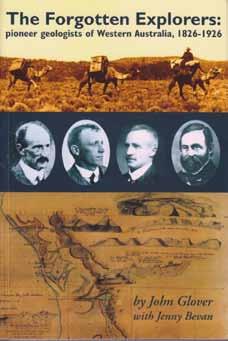
evolution, but they resolved it by publishing together in the same issue of a journal. Questions about priority in Western Australian geology were not settled in such a gentlemanly fashion, and a few of them are still not settled: the book looks at them in some detail.
Finally, let me revert to the contribution of the field geologists themselves. These geologists commonly mapped in vast, mainly desolate and uncharted expanses, using basic transportation (that is camels, horses and their own legs). They never got much enduring publicity because they avoided the tragic failures that generate it, and perhaps in a historical sense the field geologists were victims of their own efficiency. By the end of the episode under review in 1926, roughly half of the State had been mapped at least in reconnaissance by the Geological Survey — and that when the number of field geologists available annually rarely exceeded six or seven. The geological historian, Thomas Vallance observed that ‘behind the achievement lay extraordinary efforts and feats of endurance by men, horses and camels, hardly credible to a modern geologist’. As an aside, our volume contains the picture of a prospector’s camel recorded as having travelled an incredible 600 miles between drinks.
What I have termed the pioneering era in WA geology, after disruption first by the Great War, and the Depression, gave way to modernisation: to mechanised field transport, use of air photography, the acceptance of women in all branches of science, plate tectonics, geophysics, advances in metamorphism, numerical rather than comparative dating, and so on.
And now, after numerous setbacks, we have reached our present position, based partly on exports of the widespread iron ore that Woodward reported in 1889. We have the possibility before us of remarkable future wealth, leading to enhanced human fulfilment, if we act wisely. But we should not forget the men who began the saga, and this book is mainly about them.
Speech delivered by JJE Glover at the launch of the book in September 2010 sponsored by Woodside and GB Barnes and Associates
(A review of this book was published in The Australian Geologist, TAG No. 157, December 2010.)
The discovery, evaluation and development of the Olympic Dam ore body at Roxby Downs, South Australia, 1975–88
by R Keith Johns
This review of a case history is from a very broad perspective by a long-term participant.
Unlike many histories of ore body discoveries, this was written privately by Keith Johns OAM, who was on the professional staff of the South Australian Department of Mines and Energy from 1948 until his retirement in 1992, having held the position of Director-General from 1983. From that vantage point, he has revealed an interplay between technical, financial, bureaucratic and political people of all shades rarely seen in such histories.
This is a personal account, drawing on more than 30 years of association with the evolution of geological mapping of the area, the ore genesis conceptual ideas to testing, drilling and discovery, the relevant cultural, national, state and company politics through to the development of the largest copper, silver, gold and uranium ore body the world has seen. His chart of timeframes from 1975 to 1988 is particularly revealing.
This 64-page book has 31 well-presented illustrations covering a range from location maps through to apposite high-quality photographs of scenery, equipment and people, showing various aspects of the history of discovery and development. Political and cultural conflicts receive due attention as well as the mining and financial aspects. Specific dates of many actions, with participants named, provide a good base
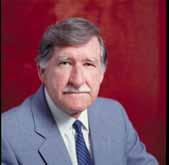
for deeper historical and/or technical research. Most relevant parameters on which decisions have been based as to whether to proceed to production or not are briefly put into context by this book.
Should current plans for expansion be implemented, this might well become the most productive mine, in terms of products, in Australia’s history. As such, its gestation in the 20th and 21st centuries is of major technical and historical importance. Two brief forewords, from the President of the Australian Mining History Association and the author, set the scene neatly on pages 6 and 7.
The irony, on page 42, of 200 protesters against uranium having lost the battle to stop Olympic Dam, then holding a ‘symbolic wake’ on the steps of Parliament House in Adelaide alongside the quite radioactive ornamental stone balustrades will not be lost on those aware of our radioactive environment.
Although cryptic in part and assuming a knowledge of the mining industry, this book should be in the library of each office of the major mineral explorers of the world as well as every school of mining and mineral economics. Anthropologists, journalists, lawyers and politicians might well read it out of interest and as an object lesson for their worlds.
Exploration philosophy, techniques, geology, geophysics, geochemistry, mining engineering and mineral economics have been alluded to but happily no attempt has been made to make this book an ‘all things to all people’ compendium of 1000 pages. Xenophobia promoting fear to cause inaction throughout the mine’s development is documented on many fronts as having been anticipated and usually forestalled at legal levels. That conflict continues.
At $30.00, it is a unique bargain. Copies are available from the publisher.
Reviewed by
Colin Brooks FAusIMM, FAIG, FAAG, MGSA, MSME, MCIM
former Director of Planning, Exploration Division, Uranium Branch, Australian Atomic Energy Commission
Book available from the publisher
O’Neil Historical and Editorial Services PO Box 2 Klemzig SA 5087
A$30.00 (incl. GST postage and handling)
Edgeworth David and the Sunny Corner mines, 1890 — an almost forgotten event in an adventurous life
David’s little-known report, with some comments on the field by David Branagan
Sunny Corner was the name allegedly given in the 1850s by the Scott brothers (Neary, 1940) to a locality about twenty miles* northerly of Rydal, NSW, and just a few km north of what is now the Great Western Highway, about 40 km west of Lithgow (Fig. 1).
Its original name was Mitchell Creek, presumably named for Surveyor-General, Thomas Mitchell. The name Sunny Corner was finally officially proclaimed in 1887, after a prolonged battle between the locals and various bureaucrats.
Like many once-flourishing mining sites it is remembered today largely by a signpost on the Great Western Highway. A solitary smelter chimney (Fig. 2) marks the site of a vanished township which once had a large public school, a convent school, six pubs and even, apparently, in 1886 a School of Mines (Parmenter, 1961).
However, The Sydney Morning Herald of Friday, 8 January 1886, in a feature on the Silver Mines of New South Wales, gives more, telling of a maximum population of 4500, but averaging between 1500 and 3000, and, somewhat cynically, as follows:
‘Sunny Corner is a splendid specimen of a new mining settlement. There is one long comparatively straight street. … The names for such buildings as are the general resort of the public are of the most select type. There are the Royal, the Criterion, and Star Hotels, and the
* Note: Imperial measures and pre-decimal currency have been left in original form. We are all old enough to know their meaning! (Ed.)
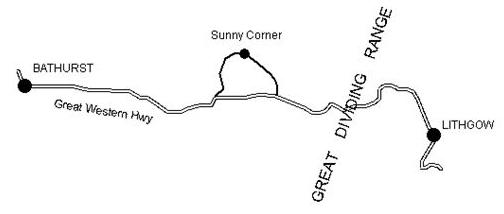
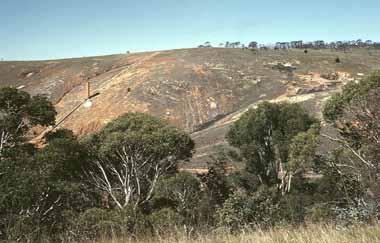
Carrington Billiard-Room, the Sunny Corner Boot Palace, Sunny Corner Coffee Palace and the Tattersall’s Saddler’s Store. … there is a combined skittle, bowling, rifle and oyster saloon. Indoor amusements appear to be represented by drinking, and outdoor recreation is composed largely of watching the arrival and departure of the five daily coaches. The vantage-point for this exhaustive occupation is the water-trough of one of the hotels, and the assemblage at that spot is known locally as the School of Arts.’
Parmenter (1961, pp. 15–16) describes the setting:
‘The Sunny Corner District is a small portion of silver-bearing country stretching from Parrs Range near the Turon River through to Peelwood. There are two main strata of silver-bearing ore, the upper consisting of gossan or peroxide of iron, and the lower of galena or sulphide of lead. The gossan is very rich in silver, yielding from 10 oz. to 60 oz. to the ton, and it is comparatively easy to smelter [sic]. The galena lode, which contained large amounts of sulphur at Sunny Corner, was much more difficult to treat. The gossan lode was soon depleted and the companies soon ran into trouble when the next lode was reached. Following is a report from The Sydney Mail, 16 January 1886.’
‘Sunny Corner mine decided to send for a Mr W Nichols, a well-known mining expert from Victoria, to come and make an inspection of the mine. He was not received very kindly by the mine manager who eventually resigned as a result of Mr Nichols’ presence. Whilst waiting on the arrival of Mr Eyres*, a man of considerable mining experience, Mr. Nichols made many improvements at the Sunny Corner mine. These resulted in a saving of over £17,000 per annum. Mr. Eyres proved himself a most capable manager and things improved for a time at the mine’.
* Dickers Mining Record of 1886 mentions a Thomas Eyre of Bendigo and a William Nichols (from database compiled by Tom Vallance)
‘This sums up what really happened to cause the sudden decline at the Sunny Corner mines: The turn of the tide came during the latter portion of the year (1885), when the yields began to decrease and it looked as though some of the smelters would have to be stopped. … there is no doubt that the troubles which arose were due, not exactly to negligence, but to a want of knowledge requisite for carrying on such an immense property as the Sunny Corner mine developed into. The lode proved to be of enormous size. So great, in fact, that in many places its thickness has not been proved. To deal with such a giant lode, the levels should have unquestionably been driven up to the boundary, and the ore taken first from the furthest portions of the mine, so that, as the ground came down, it would neither interfere with operations in the mine nor bury beneath it any of the ore. Unfortunately, however, the vein stuff was taken from where it was first available, the result being the mine was cut in two, huge masses of valuable ore were buried by falling earth’.
Sunny Corner was the site of episodic alluvial gold mining from 1852 to the 1870s.
At the end of the 1870s John Shepherd and the Hurley brothers, John and William, took up the Winterton Reef claim there. In 1881, a strange ore was assayed for them by HYL Brown (1844–1928), then of the NSW Geological Survey, and it proved to have a high silver content (Parmenter, 1961, p. 8). John Hurley then went to London to seek funding to set up a company, but had no success. However, while returning via the USA he learnt more about silver smelting. This enabled him to set up a company (Sunny Corner Silver Mining Co.), with capital £64,000 in Australia, funded largely by a Mr Newton (Parmenter, 1961, pp. 8–9) in 1884.
In 1886 the company was the first large-scale smelter of silver in NSW (The Sydney Mail, 16 January 1886), preceding the finds at Silverton, near Broken Hill. Adjacent to the Sunny Corner mine was the Silver King mine.
However, as in many fields, enthusiasm and optimism seems to have moved ahead of detailed prospecting, and particularly geological mapping, so that by the time smelting had begun there were already doubts about the quantity of ore being available for continued mining. CS Wilkinson (1843–1891), Government Geologist, reported on the field in 1886. Among the points made he warned that the future of Sunny Corner ‘depended on a successful method of smelting the sulphide ores and a judicious exploration of the lodes … the gossan lode would be soon exhausted’.
Mining seems to have been up and down over the next few years, but by 1890 the mines were flourishing (Figs 3 and 4), and it was the year of
highest production, the value of silver produced being £197,813. However, there were doubts about future prospects.
TW Edgeworth David visited the site with assistant Geologist, William Anderson, in August 1890 and made a written report on the locality (chiefly the Silver King mine) for the Department of Mines in 1890, which was published in the Department’s Annual Report, but thanks to incorrect indexing it is not where it is supposed to be, so has generally escaped notice (Annual Report Department of Mines for 1890, Appendix 2H, pp. 239–241). At the time David was Acting Government Geologist, standing in for Wilkinson, who was in London, representing the colony at the International Mining Congress.
What is interesting is that David seems to have prepared a re-written précis of his official report, and seems to have been happy for it to be published in The Australian Mining Standard in November 1890, (p. 14), well before the Annual Report was published.
The Mining Standard article is reproduced below.
Mr TWE David, BA, FGS, Acting Government Geologist, has furnished the following report upon the Sunny Corner and Silver King mines:
‘The deposits of ore worked at both these mines belong to the main one [?ore] and the same shoot or bunch.
This immense shoot is the most remarkable instance hitherto discovered in New South Wales of a contact deposit, as it persistently follows the line of contact between some intrusive dykes of felstone and the claystone, which is the dominant rock of the district. This ore shoot, as well as most of the others in the same district, occurs at a point where one of the felstone dykes takes a sharp turn. At the elbow so formed an irregular cavity has been produced, partly by a mechanical displacement of the claystone with regard to the underlying surface of the felstone dyke, and partly by the local subsidence of the surface of the upper side of the dyke from below the claystone, consequent on the shrinkage of the felstone while solidifying. Metallic solutions derived from the felstone dykes, which latter are highly metalliferous, have filtered out of the dykes into these cavities, and have so produced the shoots of ore, of which the one formerly worked at the Silver King, and still worked at the Sunny Corner mine, is so remarkable an example. The top of this shoot outcrops in the form of an immense mass of gossan in the south-west corner of the Silver King property. This dipped in a westerly direction, pitching southerly. At about 50 ft from the surface it made into solid sulphide ores, such as arsenical and iron and copper pyrites, zinc blende, and galena containing a small percentage of silver and gold. The shoot then extended horizontally in a westerly direction up to the west boundary of the Silver King, its undulations conforming to those of the surface of the underlying felstone. At this point the shoot passed completely out of the area of the last named mine into that of
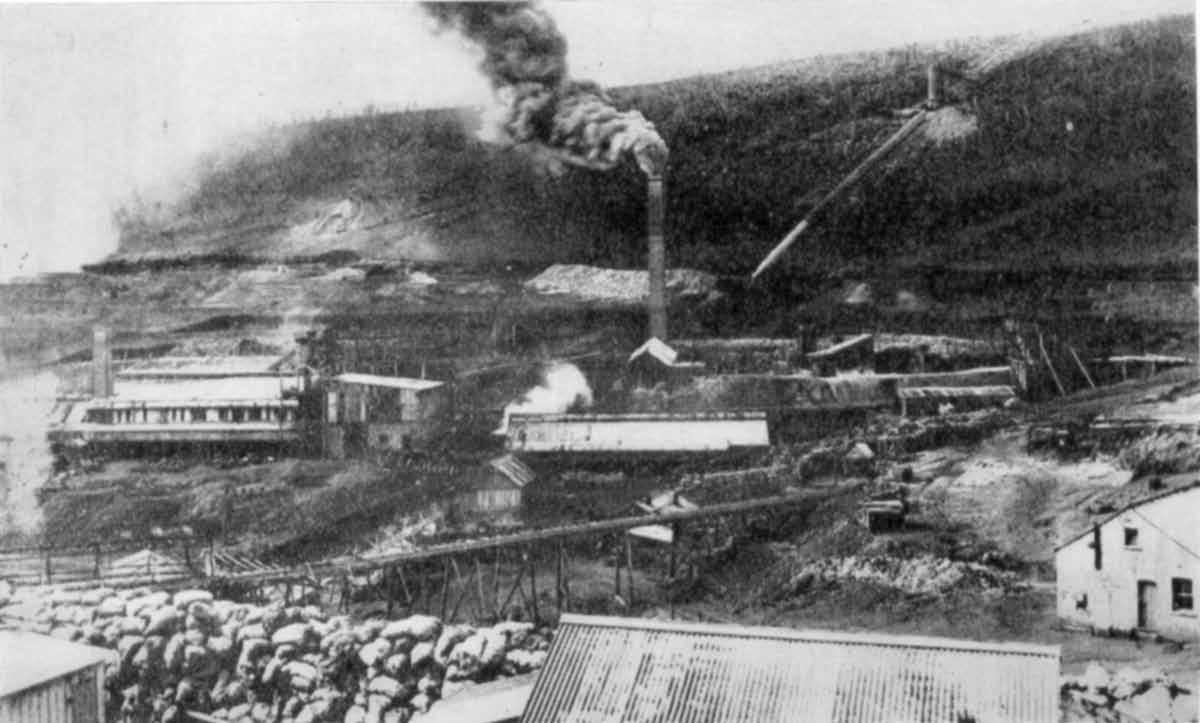
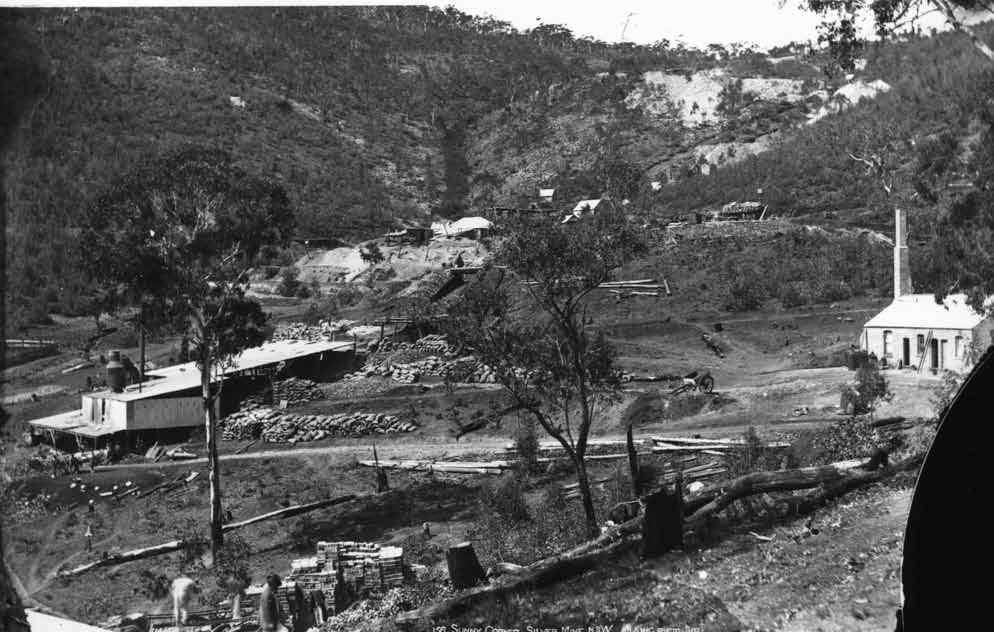
the Sunny Corner mine. At the mouth of the Sunny Corner No. 3 tunnel, the shoot outcrops again, partly owing to its rising slightly in this direction, and partly owing to the hanging wall of claystone having been removed by denudation. A short distance to the west of this tunnel the shoot, after having followed a nearly horizontal course for about 200 yards, rolls over and dips westerly at an angle of 60°, still in the Sunny Corner property. Mr Richards [not further identified], the late manager of the Silver King, estimates that there are still from 9,000 to 10,000 tons of gossan ore at this mine for treatment, but no sulphide ore can be found to smelt with it, all that contained in the great ore shoot in this property having been exhausted.’
‘Certain localities are then suggested as being desirable sites to be prospected for more sulphide ore, but little hope was entertained of any other extensive shoots being discovered in this property’.
‘At the Sunny Corner mine the great ore shoot after rolling down to the west near the mouths of the Nos 3 and 4 tunnels, has been followed to a further depth of 180 ft, and at the face of the No. 1 tunnel is in a length of 140 ft already at this level, and for a length of 300 ft at the No. 2 tunnel, 100 ft above No. 1, where the shoot has a maximum width of 15 ft. This shoot shows signs of being permanent to a considerable depth. Mr Trewenack [Tremenack in Parmenter, 1961] [not further identified], the manager, estimates the value of the argentiferous and auriferous ore to average about £2 5s per ton, whereas the total cost of mining, calcining, smelting and refining the ore amounts to a trifle over
£1 12s per ton. Five new water-jacket furnaces, each of 50-ton capacity, are being erected on this property, besides 32 new stalls for calcining the ore, and a new flue 7 ft high and 5 ft wide, which will conduct all fumes up the side of a hill a quarter of a mile distant, where they will be discharged in air from the top of a tall stack’.
David’s report gets no mention in Parmenter’s (1961) Centenary Souvenir (priced at 5/-), but a report by Rayner (1952) noted that ‘even with modern techniques the Sunny Corner ores are still very difficult to smelter because of their refractory nature’ (Parmenter, 1961, p. 18). There seems little doubt that mining might have been prolonged had the deposit been mined as a single project, rather than separate mines taking out rich ore, and, in the early period, the very rich gossans.
References
Neary, Henry H 1940, Ghosts of the goldfields: pioneer diggers and settlers on the Turon: Merrit, Sydney (reprinted in 1983 by the Mitchell College of Advanced Education in Bathurst, NSW).
Parmenter, TR (compiler) 1961, Sunny Corner Centenary Souvenir: Sunny Corner Centenary Committee, Sunny Corner.
Rayner, EO 1952, Mitchell Region mineral industry: New South Wales Department of Mines.
The science and mapping of the Victorian exploring expedition of Burke and Wills, and of the related relief expeditions of 1860–1862
DA McCann, EB Joyce School of Earth Sciences, University of Melbourne
The Burke and Wills Expedition, officially the Victorian Exploring Expedition (VEE), left Royal Park in Melbourne on the 20 August 1860, under the sponsorship of the recently established Royal Society of Victoria (RSV), with specific instructions to record scientific information along the route (‘Instructions furnished to scientific observers attached to the Victorian Exploring Expedition — Surveyor, Astronomer, Meteorologist, Geologist, Mineralogist, Zoologist and Botanist’ in Transactions of The Royal Society of Victoria, Vol. 5, 1860).
John Macadam, as Honorary Secretary of the Exploration Committee, in a communication to expedition members, advised them that ‘You will cause full reports to be furnished … on any subject of interest, and forward them to Melbourne as often as may be practicable without retarding the progress of the Expedition’. There was, however, an important caveat under the heading of ‘General instructions for scientific observers’ namely, ‘Scientific observations or work that would cause hindrance, or otherwise interfere with the progress or necessary work of the expedition, never to be undertaken if contrary to the instructions to the Leader’. From the point of view of the scientific success of the expedition this latter instruction proved to be a major impediment. Robert O’Hara Burke actively and unapologetically discouraged anything standing
in the way of his progress to the Gulf of Carpentaria, including collecting scientific artefacts.
William Wills was appointed as expedition surveyor and map maker, Ludwig Becker as artist and geologist, and Hermann Beckler as medical officer and botanist. For many years it has been commonly alleged that the VEE was an utter failure as a scientific expedition (for example in Sarah Murgatroyd’s The Dig Tree: the story of Burke and Wills, published in 2002). No scientific reports of the expedition were ever published. It could be said that the ‘political’ took precedence over the ‘scientific’ agenda. Yet upon examination of the records and artefacts it can be argued that some useful pioneering science was done. Major surveying and exploration data was recorded, as well as botany, geomorphology, meteorology and astronomy, hydrology and zoology, and records also made about anthropology and archaeology. Four major relief expeditions were soon to follow similar routes to that of the VEE, and they also recorded much information of value.
A review of the work of the VEE and the associated relief expeditions shows a wealth of scientific data and mapping, which has not yet been widely recognised.
For some years Frank Leahey, a surveyor in the Department of Geomatics at the University of Melbourne, has been working in the field and revising the expedition’s route, relocating campsites and recovering artefacts. He has reassessed favourably the surveying and scientific work of Wills during the expedition. Unpublished documents, scientific collections and a wealth of field sketches and paintings by Becker and others provide further scientific records, including observations of weather, astronomy, geology and geomorphology, rivers, lakes and soils. Some 2000 plant specimens, so far little studied, are in the collections of the Melbourne Herbarium. A search has begun in the Museum of Victoria for forgotten or overlooked geological and zoological specimens, with some recent success. A team of scientists has been assembled to examine and report on this material.
(This is an abstract of the talk given at AESC 2010. A more-detailed account was published in The Australian Geologist, TAG No. 156).
Minutes of business meeting held at 5.00 pm 8 July 2010 at AESC 2010, Canberra
Attendance: Cathy Brown, Larry Harrington, Mike Rickard, Sue White, Ian Withnall, Peter Dunn (Chair)
Apologies: Dave Branagan, Doug McCann, Virginia Passmore
Previous minutes:
Minutes of the previous business meeting held in Perth on 21 July 2008 and published in Newsletter 40 were accepted.
Business arising:
The recommendation in the minutes that the new committee in Perth should organise a conference in the west has been followed up, but the number of members showing interest was too small to make it viable at present.
Another suggestion for raising funds was the sale of CDs recording the ESHG session at AESC 2010.
Finances:
Financial Statement provided by the Treasurer is on page 41.
Chairman’s report:
See Peter Dunn’s separate report, which follows.
Nominations for committee: Nil
Election of committee:
The present committee was re-elected. The committee comprises:
Chairman Peter Dunn
Vice-chairman Peter Downes
Secretary John Blockley
Treasurer Mike Freeman
Newsletter editor Jean Johnson
Committee members Angela Riganti (WA)
Dave Branagan (Sydney)
Bernie Joyce (Melbourne)
An INHIGEO (International Commission for the History of Geology) conference will be held in Brisbane in 2012 to coincide with the International Geological Conference (IGC). A note from Dave Branagan proposed a 6-day pre-conference excursion from Sydney to Brisbane calling at historic sites on the way. The feeling of the present meeting was that excursions lasting more than two days involved considerable financial risk that ESHG could not afford and should therefore not sponsor. However, the meeting encouraged individual participation in INHIGEO.
Other matters:
Branagan’s note also congratulated the committee for its interest and enthusiasm, its online news, and its, and Alastair Stewart’s, organisation of the successful ESHG session at this Conference.
Sue White called for a vote of thanks to the committee, which was carried.
Next meeting: Brisbane 2012.
REPORT
At a business meeting held at the Perth Convention and Exhibition Centre on 21 July 2008, administration of the Earth Sciences History Group (ESHG) was formally passed over from the Victorian to the Western Australian Divisions of GSA. At the same time the former committee of Bernie Joyce (Chair), Guy Holdgate (Secretary), Roger Pierson (Treasurer) and Doug McCann (Newsletter editor) was replaced by one comprising Peter Dunn (Chair), Peter Downes (Vice-chair), John Blockley (Secretary), Mike Freeman (Treasurer), Jean Johnston (Newsletter editor) and Angela Riganti (Committee member).
Other business:
Proposed ESHG medal
A document was tabled detailing the proposal for the creation of an ESHG medal to be presented to individuals who have made significant contributions to earth sciences history. The proposal was accepted and the name Tom Vallance Medal approved.
AESC 2008
There was no separate section devoted to Earth Sciences History at AESC 2008, but three talks by ESHG members David Branagan, Barry Cooper and Doug McCann were slotted into other appropriate sessions. Also, at the request of the ESHG, the Geological Survey of Western Australia re-staged its Camels, Cars and Compasses exhibit of old maps and photographs.
The committee successfully negotiated for a special session at AESC 2010 to be devoted to papers of interest to ESHG members. These included contributions by ESHG members David Branagan, Doug McCann (with Bernie Joyce), Cathy Brown, Doug Finlayson, Larry Harrington and Peter Dunn, and featured a number of talks on the 1:250 000-scale mapping project that covered Australia from the 1950s to the 1980s and resulted in a much improved understanding of Australian geology, particularly in the more remote parts of the continent.
Newsletter 39, the last to be issued by the previous Melbourne-based committee, was mailed to members in December 2008 and Newsletter 40, the first from the WA committee, was distributed in September 2009.
The new committee continued the practice of sending members Email Bulletins with news of current activities. In particular, these were used to apprise members of the Group’s activities at AESC 2008 and 2010; give updates on progress with the ESHG session being arranged for AESC 2010; soliciting images for the new website; and to point out items of interest to members that have appeared in a number of publications. Nine of these Email Bulletins were distributed during 2008 and 2009, with some also being posted to members without email addresses.
We were pleased to note that immediate past Chairman of the ESHG, Professor Bernie Joyce, was awarded the Selwyn Medal for 2009. The award reflects Bernie’s substantial contributions to Victorian geology in the fields of volcanology, geomorphology and earth sciences history.
Another stalwart of the ESHG acknowledged for his services to geology is Keith Johns who was awarded the Bruce Webb medal for his major contributions to South Australian geology over a period of six decades, which included a term as Director General of Mines and Energy in that State (see a review of one of Keith’s books in this newsletter).
New ESHG website
The present committee is setting up a new website within the main GSA site. This will replace the present site which is hosted by Melbourne University, which will become an archival source of information. It was decided to incorporate images of distinguished geoscientists of the past within the new site, but the task proved to be more time-consuming than anticipated due to the need to obtain permission from the holders of many of the suitable photographs, and also to try to
avoid spending Group funds on reproduction rights. In the end we were able to put together a collection of 35 photographs and portraits from the private collections of ESHG members and a number of libraries, geological surveys and universities. Work on the site is currently being undertaken by GSA staff and consultants.
In November 2009, the committee canvassed members to try to assess likely attendance at a conference proposed for either Kalgoorlie or Perth in 2011, following on from the highly successful Victorian conference. When the number of members indicating interest was too few to justify running such an event at a reasonable cost we advertised it to the wider geological community. However, interest still proved to be low and the plans were put into abeyance until a more auspicious time.
During the period under review, ESHG members have contributed many articles to both TAG (The Australian Geologist) and a variety of other journals. As well, some other earlier papers have been brought to our attention. A selection of these is listed below, and we should not forget the regular TAG columns compiled by Cathy Brown on stratigraphic matters, and Susan White on geoheritage.
At the suggestion of past-Chairman Bernie Joyce, the committee looked into the possibility of inaugurating the regular award of a medal to recognize outstanding contributions to the history of the geosciences in Australia. Like most other GSA medals, it would probably be presented at the biennial conventions of the Society. A quote for a possible medal using the ESHG logo on the obverse side was obtained from a Perth-based engraver. It indicated that the Group’s budget could accommodate such an award, but it was considered to be a matter that should be decided at the ESHG business meeting as it will affect the future of the Group beyond the probable life of the present committee. If it is agreed that the award of such a medal should be instigated, then we will need to think of an appropriate name and criteria for the award.
At present the Earth Sciences History Group has 88 financial members and affiliates.
A financial statement by Treasurer Mike Freeman is provided, see page 41.
Our thanks are due to the past committee for passing on the ESHG in good order, with sufficient funds to carry on its activities.
We also thank the Executive Director, Geological Survey of Western Australia, for making facilities available for committee meetings.
We are very appreciative that former BMR geologist, Alastair Stewart, stepped in to arrange the talks on the 1:250 000 mapping project and to chair the ESHG session at AESC 2010.
PR Dunn
Chairman
Earth Sciences History Group July 2010
(Note: The Australian Geologist (TAG) is published by the Geological Society of Australia and provided free-of-charge to members)
Birch, Bill, 2008. Grave of Pioneer Geologist Restored (Sir Frederick McCoy). TAG No. 147, p. 15.
Birch, Bill, 2008. The Stillwell Legacy. TAG No. 147, p. 4.
Birch, Bill, 2010. Edward John Dunn; Geologist and Collector. Abstracts of the 33rd Annual Seminar of the Joint Mineralogical Societies of Australia, p. 11.
Branagan, David and Vallance, Tom, 2008. Some unpublished correspondence of the Rev. WB Clarke. Journal and Proceedings of the Royal Society of NSW, Vol.141, parts 3 and 4, pp. 1–31
Branagan, David, 2009. Australia’s first marble quarry. Journal of Australasian Mining History, v. 7, p. 1–16.
Branagan, David, 2009. Review of ‘Rock Star: the Story of Reg Sprigg — an Outback Legend’ by Kristin Weidenbach. TAG No. 151, p. 39–40.
Branagan, David, 2009. The Geological Society on the other side of the World. Geological Society, London, Special Publications 2009; v. 317, p. 341–371.
Commander, Philip, 2009. New water from old sources: case study of the South-West Yarragadee Aquifer. TAG No. 151, p. 20–22.
Cooper, Barry, 2009. Bragg, Mawson and Brown, and the early uranium discoveries in South Australia. Transactions of the Royal Society of South Australia (2009), v. 133(2), p. 199–218.
Cooper, Barry, 2009. Review of ‘Building stone decay from diagnosis to conservation’ by R Prykryl and BJ Smith. TAG No. 151, p. 36.
Cooper, Barry, Oldroyd, David, Turner, Sue and Vickers-Rich, Pat, 2009. Reg Sprigg and the Ediacara fauna: an extraordinary discovery. TAG No. 153, p. 18.
Downes, Peter and Bevan, Alex, 2010. The Fletcher mineral collection at the Western Australian Museum: A late 19th Century gem. Abstracts of the 33rd Annual Seminar of the Joint Mineralogical Societies of Australia, p. 12.
Finlayson, Doug, 2008. Imaging the Earth’s Crust. TAG No. 148, p. 19–20. Freeman, Mike, 2008. Excursion report: Wines and Mines of South-western Australia. TAG No. 148, p. 20–21.
Joyce, Bernie and McCann, Doug, 2010. 2010 Commemoration of the Burke and Wills Expedition. TAG No. 155, p. 17–18.
Joyce, Bernie, 2008. The Earth Sciences History Group. TAG No. 148, p. 13.
Joyce, Bernie, 2009. Review of ‘Statistics in Volcanology’ by HM Mader et al. TAG No. 150, p. 40–41.
Joyce, Bernie, 2009. Volcanic, coastal, karst, river and lake landscapes of western Victoria, including geomorphosites of the UNESCO Kanawinka Global Geopark (a report on a pre-conference field trip). TAG No. 152, p. 24–25.
Joyce, Bernie, 2010. Review of ‘Reading the Land’ by Geoff Lacy. TAG No. 154, p. 34.
McQueen, Ken, 2009. Review: Darwin Exhibition, National Museum of Australia. TAG No. 150, p. 17–18.
McQueen, Ken. 2009. Quindong Mineral Field, NSW: an intriguing discovery of WB Clarke. Journal of Australasian Mining History, v. 7, p. 74–99.
Pullin, Ruth. 2010. The Vulkaneifel and Victoria’s Western District: Eugène von Guérard and the geognostic landscape. In: Europe and Australia: Melbourne Art Journal 11–12, p. 6–33.
Turner, Sue, 2006. The Rocky Road to success. a new history of UNESCO–IUGS International Geological Correlation Programme. In Glaser, G et al., eds History of Natural Sciences at UNESCO, in the 60th Anniversary of science at UNESCO volume, UNESCO, Paris.
Turner, Sue, 2007. Invincible but mostly invisible: Australian women’s contribution to palaeontology. In Burek, C and Higgs, B eds. Role of women geologists contributions. Geological Society of London Special Publication No. 281.
Turner, Sue, 2010. INHIGEO 2009 in Calgary Canada and IUGS 50th. TAG No. 154, p. 13.
Turner, Sue, 2010. INHIGEO 09: Report on the Workshop for a 50th anniversary history of the International Union of Geological Sciences (UGS) 1961–2011. TAG No. 154, p. 13.
Turner, Sue and Malakhova, I 2010. IUGS-50: how the women faired. In INHIGEO-2010 Abstracts, July 5–10, Madrid and Almaden, (submitted April 30).
Turner, Sue, Riccardi, A, Gerel, O and Malakhova, I 2010. IUGS-50: 1961–2011 — what is the IUGS? The early years. INHIGEO-2010 Abstracts, July 5–10, Madrid and Almaden.
In addition to the above, the following papers are being delivered by ESHG members at the Australian Mining History Association conference in New Zealand during July 2010.
Barry McGowan. Diggers, dredges and dancing girls: the Araluen Goldfield of NSW.
David Branagan. Six personalities seeking for the pot of gold: Australasian connections: practical and academic.
Ken McQueen and Robert Barnes. The Maitland Bar nugget: a key link to the gold rush heritage of New South Wales.
BALANCE SHEET AT 31 DECEMBER 2009
STATEMENT OF INCOME AND EXPENDITURE
FOR THE TWO YEARS ENDED 31 DECEMBER 2009
Notes: commitments carried forward from
* To assist in publication of Archibald Liversidge
++ Subsidising Victorian executives to attend AGM in Perth
# D McCann study of ESHG history
D McCann Archiving ESHG records in Basser Library, Canberra
R Pullin Assistance in publishing thesis on von Guerard
C Lawrence assistance for 'History of Groundwater in Australia'
Hon Chairman Peter Dunn
Hon Treasurer Mike Freeman 27/05/2010
The Committee of the Earth Sciences History Group is pleased to announce a new medal to honour Tom Vallance.
The objective of the Tom Vallance Medal is to recognize people who have made a significant contribution to researching, recording, investigating, documenting and/or publishing about people or places or events of historical importance to the geological sciences in Australia or Australasia.
The Tom Vallance Medal will be awarded biennially, and be presented at the biennial Convention of the Geological Society of Australia (or similar event).
The Committee of the ESHG shall receive and consider nominations and make the final decision on the presentation of the Medal award in accordance with the rules governing the Medal. A call for nominations for the first award will be made towards the end of 2011.
It is planned that the inaugural Medal will be presented by the widow of Tom Vallance, Mrs Hilary Vallance, at the INHIGEO meeting, part of the International Geological Congress in Brisbane in August 2012.
Citation: Dr Thomas George Vallance (1928–1993), geologist and historian of science, was formerly Associate Professor at the University of Sydney. Originally a petrologist, his work tracing geological expertise in Sydney during the late 18th and early 19th centuries shed unexpected light on scientific activity in our young colony and ignited his interest in the history of geology and early workers in the earth sciences. He researched and published many articles and papers on famous, infamous and little-known early pioneers in this field. His legacy was in the form of 3000 index cards of information, memorabilia and jottings on miners, geologists, surveyors, prospectors and mining engineers, which was compiled over a number of years and gathered from a wide variety of sources — especially from 19th century mining journals. After his death this rich resource was compiled into a database, which should prove invaluable for researchers.
Dr Thomas George Vallance (1928–1993)
The 1994 meeting of INHIGEO (International Commission for the History of the Geological Sciences) was dedicated to the memory of Tom Vallance, a foundation member and for some years one of its VicePresidents. The ESHG is proud that their Medal award should bear the name the Tom Vallance Medal
For further information on this Medal please contact the Secretary, John Blockley (see page 2 for contact details).
Earth Sciences History session at AESC 2010
CD recording of all presentations (with acknowledgement to Frank Meany of OneVision)