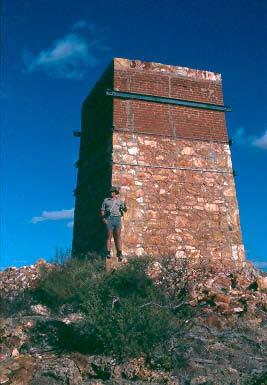
Warribanno chimney, Western Australia’s first smelter
Welcome to the first Newsletter to be published by the Western Australian committee of the Earth Sciences History Group. The torch was passed to the WA group at the last Australian Earth Sciences Convention, held in Perth in July 2008. Elsewhere in this issue you will find the minutes of the business meeting held during the Convention to formally pass the administration from Victoria to Western Australia and elect a new committee. The Geological Survey of Western Australia is strongly represented on the committee (with two current and three former members of staff).
Late last year the Victorian committee published Newsletter No. 39 with a fine lead article on William Blandowski (1822–1878), who was an active member of the Victorian scientific community during its early gold rush days. For Newsletter No. 40, John Blockley (also the Secretary of the new committee in WA) reviews lead and copper discoveries about 500 km north-northwest of Perth that changed the fortunes of the ailing Swan River colony and perhaps started the people of Western Australia to forever rely on the mining industry for their fortunate existence.
I hope you will find plenty to interest you in the Newsletter, and welcome your articles for the next Newsletter as well as your comments and suggestions.
Jean Johnston Editor
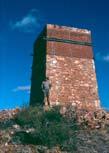
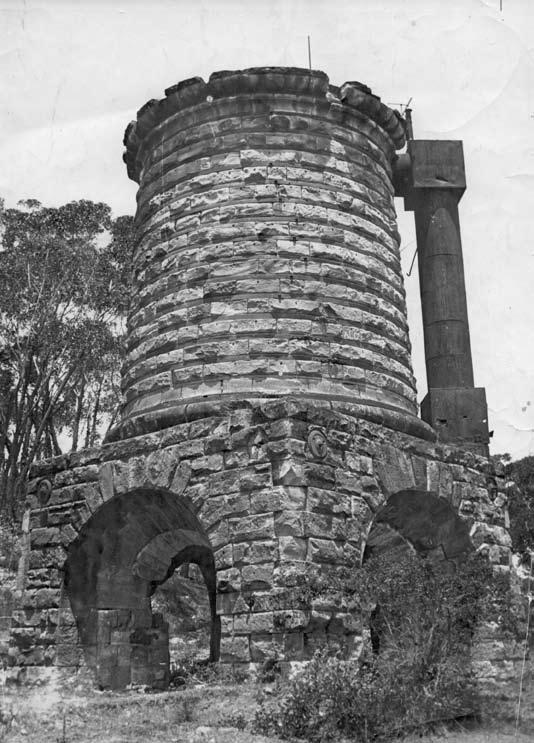
The Warribanno chimney in the Murchison region marks the site of Western Australia’s first metallurgical enterprise. It was built in 1853 to smelt lead ores from the Geraldine and other mines near the Murchison River. The chimney, which was originally several metres taller, sits over a vertical shaft that connects to a draft tunnel driven in from near the bottom of the hill. Ore and fuel were fed into the smelter through a window at the base of the chimney (see Figure 3 of leading article) and the molten lead tapped via the tunnel (photo by Roger Hocking, Geological Survey of Western Australia)
Committee Members:
Peter Dunn, Chairman, email: peter.dunn@dmp.wa.gov.au, or petpat3@optusnet.com.au
Peter Downes, Vice Chairman, email: peter.downes@museum.wa.gov.au
John Blockley, Secretary, email: tiger-eye@iinet.net.au
Michael Freeman, Treasurer, email: michael.freeman@lizzy.com.au
Angela Riganti, Committee member; email: angela.riganti@dmp.wa.gov.au
Jean Johnston, Newsletter editor, email: jean.johnston@dmp.wa.gov.au
Mail and telephone enquiries should be directed to the Secretary, John Blockley, 76 Beach Street Bicton WA 6157, or (08) 9317 1775
Welcome to Newsletter No 40 — the first to be collated by the new Committee based in Western Australia. Although not previously involved with the administration of the ESHG, Western Australian geoscientists have had a long-standing interest in the history of our science as is well attested by the popularity of John Glover’s contributions to the WA Division’s newsletter. Many of these contributions have been published in his book Geological Journeys — Artefacts to Zircon. In fact, John’s efforts were one reason why the immediate past Chairman, Bernie Joyce, suggested that we in the West may be interested in taking over the reins of the Group; unfortunately John has not been able to join our Committee.
The transition of business from Victoria to the West has been carried out smoothly except for some minor problems with the banks over the transfer of funds; this has now been sorted out. Our finances are very sound — as shown in the Treasurer’s report on page 23.
During the year the Committee has issued three E–Bulletins and reported the Group’s activities to INHIGEO and the local branch of the GSA. The Committee’s main activities have involved the collation of this Newsletter and the creation of a new website, which will be accessed through the main GSA website (the previous website was attached to the Victorian Division’s site). The new site will be illustrated with portraits of geologists of yesteryear who have made significant contributions to the understanding of Australian geology.
The provisional program for the next Australian Earth Sciences Convention in Canberra did not include a session that could conveniently have accepted papers from members of the ESHG. Through the efforts of our Secretary a session has now been created that will be wholly devoted to earth science history. Already the following papers have been offered for this session:
Cathy Brown — Historical aspects of stratigraphic nomenclature in Australia
Dave Branagan — Two little-known geologists who made significant contributions to society
Doug Findlayson — Seismic profiling investigations of the Australian continental crust
Ken McQueen — Reverend Milne Curran
Sue Turner — Aspects of Australian involvement in IUGS and IGCP
Finally I take this opportunity to briefly introduce the new Committee:
Chairman: Peter Dunn — retired from careers with BMR (now Geoscience Australia), GSWA and private enterprise. He is now honorary map curator for GSWA, delving into their vast collection of historical maps.
Vice-Chairman: Peter Downes, Edward Simpson Curator of Minerals and Meteorites, Western Australian Museum. Interests in mineralogy, collectors, history of natural history collections and museums, and science, exploration and empire.
Secretary: John Blockley spent most of his career with GSWA but also served stints in mineral exploration and consulting. His interest in historical matters began with his Honours project on Bayleys Reward, the discovery that sparked the Coolgardie gold rush, and continued while researching background information on WA’s crocidolite, iron ore, lead–zinc and tin mining industries
Treasurer: Mike Freeman formerly worked for the Geological Survey of Western Australia, and dealt with land use planning issues. He is now with the Mining Titles Division of the Department of Mines and Petroleum, using his geological expertise on special projects there. He is a member of the Australian Mining History Association.
Committee member: Angela Riganti’s career as a geologist has taken her from her native Italy to Southern Africa and finally Australia. In the last 12 years she has worked for the Geological Survey of Western Australia, initially as a field geologist, and currently as a Project Leader compiling geological GIS databases. Throughout her career, she has collaborated on various projects with different organisations to foster interest in the geosciences and to promote community awareness of the role of earth sciences in everyday life.
Newsletter Editor: Jean Johnston is a geologist in the Editing and Publishing group of GSWA. She was an enthusiastic committee member for the Inaugural Global Geotourism Conference held in Perth last year. She is keen to spread the word to teachers, travellers, and locals about the beauty and relevance of geology and landscape.
by R Keith Johns
At the outbreak of World War II in September 1939, the population of South Australia numbered 600 000. There was little secondary industry and its relevance to the war effort hinged on the existence of two vital mineral-oriented projects, viz.:
Port Pirie, which since 1893 provided a smelter for the recovery of base metals from Broken Hill and served as an out port for its products; and
Iron Knob, on which the Australian steel industry had been founded by BHP Co. Ltd in 1914 and whose quarries yielded high-grade iron ores to the blast furnaces in Newcastle (NSW).
Mineral production in South Australia in 1939 was valued at ₤3.3 million — of which ₤3 million was due to iron ore.
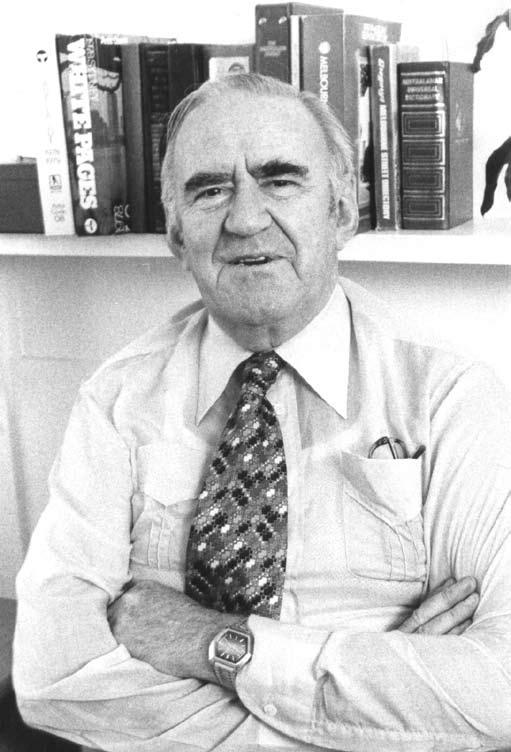
When Ben Dickinson was appointed to the Department of Mines in May 1940 he was one of two geologists employed in a staff of 20 and was initially directed to investigate water supplies on marginal lands. For the following four years he was engaged in the assessment of war-time strategic minerals, the mapping and supervision of drilling operations for the evaluation of coal at Leigh Creek and of potential water supplies in that region.
He had obviously made an impression on his Minister of Mines (Lyell McEwin) and on the Premier (Tom Playford) as he was appointed Director of Mines, Government Geologist, Supervisor of Boring Operations, Warden, and Secretary to the Minister of Mines in March 1944.
The State would now secure industrial growth through development of its mineral resources base. Dickinson, with full political support, was attuned to the requirements for the assessment of mineral resources and their exploitation to enhance growth of secondary industries, population and income, in the State and National interest. He was an extremely capable field geologist and administrator. He recognised the value of scientific research and the establishment of such facilities on a scale commensurate with the magnitude of development problems peculiar to Australia.
In that regard, South Australia secured integrated steel works — a blast furnace, coke ovens, rolling mills and ship building facilities at Whyalla. The State would at last become independent of uncertain supplies of coal from Newcastle — by taking over the Adelaide Electric Supply company and recovering coal from deposits at Leigh Creek. Mining operations began there in 1943, undertaken by the Engineering & Water Supply Department before the creation of the Electricity Trust of South Australia. The Department of Mines maintained drilling operations and evaluation there under the direction of a Resident Geologist until mid1955.
South Australian uranium deposits were identified as potential sources of supply for use in atomic weapons through the joint British/American Project Manhattan. Departmental investigations were initiated at Mount Painter before switching to Radium Hill and Port Pirie for the production of yellow cake to fuel a new source of electrical energy that might be generated in nuclear power stations overseas — and perhaps in South Australia.
(continued on page 11)
by John Blockley
The discovery of lead by explorer AC Gregory’s team in the bed of the Murchison River in 1848, followed by further finds of both lead and copper over the next few years, gave a much-needed fillip to the ailing fortunes of the Swan River Colony, and led to a thriving mining industry that accounted for much of the settlement’s early exports.
The pioneering efforts of the miners, together with Gregory’s favourable report on the prospects of the region, attracted others to the area, and effectively opened up the Geraldton hinterland for farming and grazing.
On16th October, 1848, a party led by Assistant
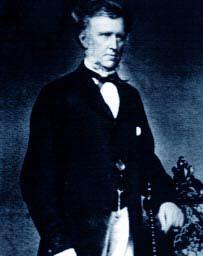
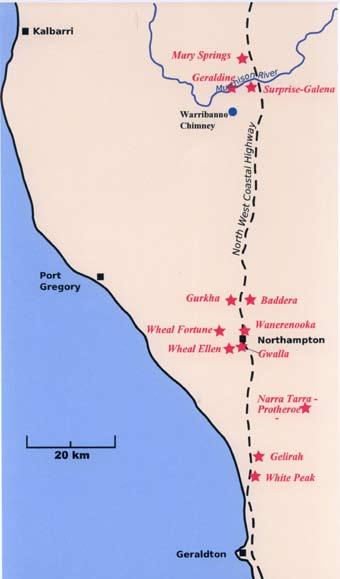
Surveyor Augustus Charles Gregory (Fig. 1) was camped by a pool on the Murchison River about 7 km downstream from the present crossing of the Great Northern Highway. Gregory had set up a base camp at the pool from which to explore the Murchison valley after his attempt to penetrate northwards to the Gascoyne River had been frustrated by thick scrub and a lack of water for his horses. While the party was making preparations to move on to the Hutt River, Gregory recorded: ‘Mr Walcott brought in some specimens of galena, which on farther examination, proved to be abundant’ (Gregory and Gregory, 1884, p. 24). Map 1 locates the places mentioned in the text.
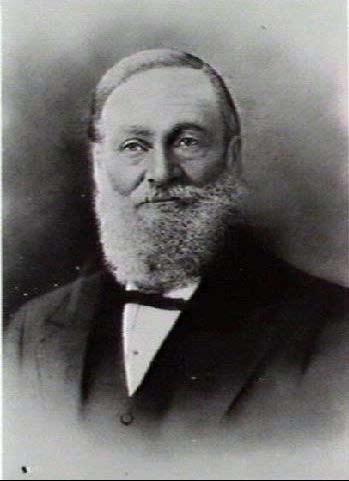
News of the lead discovery produced considerable excitement when the party returned to Perth, and the recently appointed Governor, Captain Charles Fitzgerald, who was concerned about the parlous economic state of the colony, decided to examine the deposit himself (Fig. 2). With Gregory, a servant, and an escort of soldiers, he reached the site on 7th December and made an examination the following day, tracing the vein along the bed of the river over a distance of 320 yards (290 m) and determining its average width as about 12 inches (30 cm). The vein was noted to consist of almost solid galena.
On the return journey to their ship moored at Champion Bay (present day Geraldton) the party was surrounded by Aborigines who first threatened them,
then flung stones, and finally threw a spear at Gregory. The Governor responded by shooting dead the closest member of the group. His action further incited the natives who followed the party and continued to attack it with spears, stones, kylies (boomerangs) and dowaks (throwing sticks). During the affray, the Governor was wounded by a spear that penetrated his thigh, but after Gregory had withdrawn the shaft by breaking off the barb, he continued to lead the party until it reached the safety of the ship (Gregory and Gregory, 1884, p. 38–39).
After some dispute about a suitable form of mineral title, a group of colonists formed the Geraldine Mining Company for the purpose of working the deposit, which was named after the Governor’s home in Ireland, and in 1850 about five tonnes of lead ore was exported from the colony. Early production from the Geraldine was hampered by lack of mining experience and problems in dealing with water as the first shafts were sunk in the bed of the river. Nevertheless, output and optimism were sufficiently high for the company to
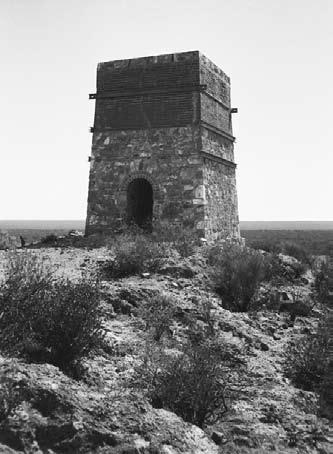
build a smelter at Warribanno Hill (Fig. 3), about 5 km south of the mine site and by 1853 pig lead was being exported (Battye, 1913, p. 308–311).
Other lead deposits, and one of copper, were soon found in the vicinity of the Geraldine, and Port Gregory was established at the mouth of the Hutt River to export the rising mineral production. However, the Geraldine mine itself continued to be beset by problems, with ‘Captain’ Samuel Mitchell, who was appointed manager in 1867, recording that he had to shut down operations for up to six months at a time when the Murchison River flowed (Mitchell, 1911).
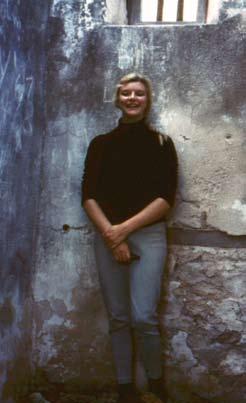
Labour shortages at the Geraldine and other nearby mines were alleviated in the 1850s by the introduction of convict labour, with a convict hiring depot being established at Lynton near Port Gregory (Fig. 4). The remains of the cells which housed these doubtlessly unwilling workers can still be seen, although the hiring depot only lasted a few years due to harsh conditions, shortage of water, and transport difficulties (Heritage Council of Western Australia, 1994).
In the meantime, Gregory’s favourable report on the country inland from Champion Bay had attracted pastoralists to the area. One, John Drummond, son of James Drummond the colony’s first Government Botanist, settled at White Peak, about 15 km north
Geelirah about 19 km north of Geraldton, and the Narra Tarra mine near Nabawa produced significant amounts of lead, with copper coming from the nearby Narra Tarra East lode.
Most of the 80 or so mines worked in the Northampton field were discovered before 1890. About a quarter of these were worked principally for copper and the remainder for lead, or in a couple of cases, for both metals. The mineralisation filled open fissures and fault breccias formed mainly on north-northeast striking faults cutting garnet granulite and gneiss. Many of the lodes followed the contacts of dolerite dykes intruded along the same NNE fracture system, but predating the mineralisation by at least 100 million years (Richards et al., 1985).
of Geraldton. In 1852, a shepherd working on the property discovered copper ore, which after some delay in raising capital, was developed in 1855. In the same year more copper was found at Wanerenooka Hill, about 32 km further north. Title to the deposit was obtained by James Drummond Jr, and production began in 1856 (Erickson, 1969). While the White Peak mine proved to be short-lived and unprofitable, the Wanerenooka deposit and others of copper and lead found nearby, gave rise to a flourishing mining industry. The more important of these copper mines, apart from Wanerenooka, were the Gwalla, Wheal Fortune, and Wheal Margaret, whereas the larger lead mines were Baddera, Wheal Ellen and Wheal Fortune Extended. Another important deposit of copper was located at
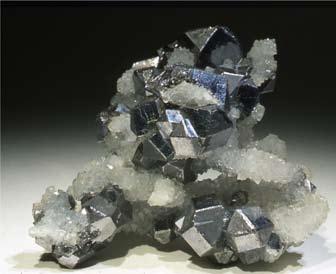
Sulphide minerals in the lead veins were galena, sphalerite, pyrite, marcasite and chalcopyrite, with galena being by far the most abundant (Blockley, 1971). Specimens of this mineral found in vugs commonly form large crystals with cubic, octahedral, or combinations of these forms, predominating (Fig. 5). The silver content of the field’s galena is notably low, a factor that must have impacted on the economics of mining the lead ores. Very little zinc ore was produced from the field, although sphalerite is a fairly common component of old mine dumps. This may reflect the low value of the metal at the time of mining, or the lack of adequate separation methods. Information on the primary copper minerals is meagre, but chalcopyrite is the most common sulphide reported (Marston, 1979). However, most output, at least in the early phase of mining, was probably of secondary carbonate and oxide minerals. Gangue minerals of both copper and lead lodes included quartz, calcite and barite.
The early colonists, recognising their lack of mining skills, brought in experienced miners from Cornwall and Wales. Soon the hamlets that had sprung up around the larger mines, most notably the Wanerenooka and Gwalla, merged into a single settlement, which in 1864 was named Northampton to commemorate a visit by Governor John Hampton in 1862 (Battye Library Research Note 490).
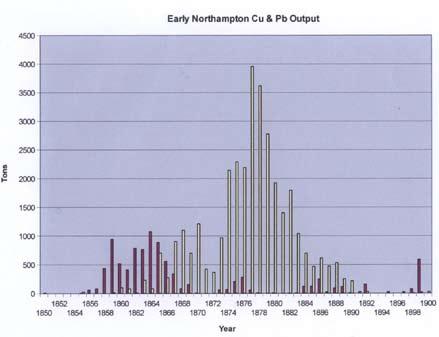
The early phase of mining in the Northampton Mineral Field took place before systematic records of mineral production were kept in Western Australia (these statistics only began to be collected when the Department of Mines was established in 1899). However, Customs records collated by Maitland (1903) indicate that from 1850 to 1899 about 9000 tons (tonnages have not been converted to metric tonnes) of copper ore and 33 500 tons of lead ore was shipped from the field. The contained metal in these shipments has been estimated as about 1800 tons of Cu (Marston, 1979) and 20 000 to 23 000 tons of Pb (Blockley, 1971). In addition, some 600 tons of pig lead was exported, mainly from the Warribanno smelter. Most copper production took place in the 1860s, declining rapidly after 1868 as prices fell and the richer oxidised ores were depleted. Lead ore output peaked at about 4000 tons in 1878, then fell rapidly over the next decade, to almost nothing in the 1890s (Fig. 6). Woodward (1895) attributes the fall in copper prices to the increasing preference for steel-hulled ships rather than copper-sheathed wooden vessels.
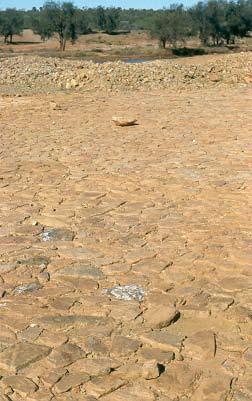
Processing methods during this period seem to have consisted mainly of hand sorting the richer material; hence the high grades reported for the ores that were shipped. At Geraldine there is a paved floor on which convicts reportedly broke up the lead ore with hammers prior to picking out the galena for shipment or smelting (Fig. 7).
As the focus of mining moved from the Murchison River to Northampton, Port Gregory proved to be increasingly unsatisfactory as a shipping point due to haulage difficulties and the unsatisfactory nature of the harbour itself. In 1874 the Government began building the colony’s first public railway to facilitate transport of ore from Northampton to what had become the preferred port of Geraldton. The line was finally completed in 1879, just as mining was beginning to decline.
There are few geological reports dating from the early days of the Northampton Mineral Field. The earliest is by Francis Gregory, who had been a member of the exploratory party led by his brother Augustus in 1848. In a paper read to the Geological Society of London in 1861 he noted the consistent orientation of the lodes and their association with dolerite dykes. HYL Brown, then Western Australian Government Geologist, visited the field in 1871. He described the basic features of the geology, including the garnet-bearing gneisses, quartzites, granites and schists that comprise the oldest exposed rocks; the intrusive dolerite dykes, which he correctly surmised as not being the source of the mineralization; and the widespread cover of younger sedimentary sequences that had been partly eroded to expose the older rocks and the lodes. He presented brief descriptions of ten of the field’s mines, but noted that only two were operating at the time.
The next geological inspections were made in 1888 and 1889 by HP Woodward. He found Northampton to be almost deserted, although he was able to report on the Geraldine, and some other mines owned by the same company that were operating in the northern part of the field (Woodward, 1890). Later he combined these observations with information from older reports and local identities for inclusion in his Mining Handbook of Western Australia (Woodward, 1895). This was the most comprehensive account of the field’s lead and copper mines up to that time, with much of it being reproduced as an appendix to GSWA Bulletin 9 (Maitland, 1903). It was accompanied by a geological sketch map of the area between the Murchison River and Geraldton on which Woodward distinguished the
metamorphic rocks and three ages of cover sequences, and indicated the positions of many of the mines.
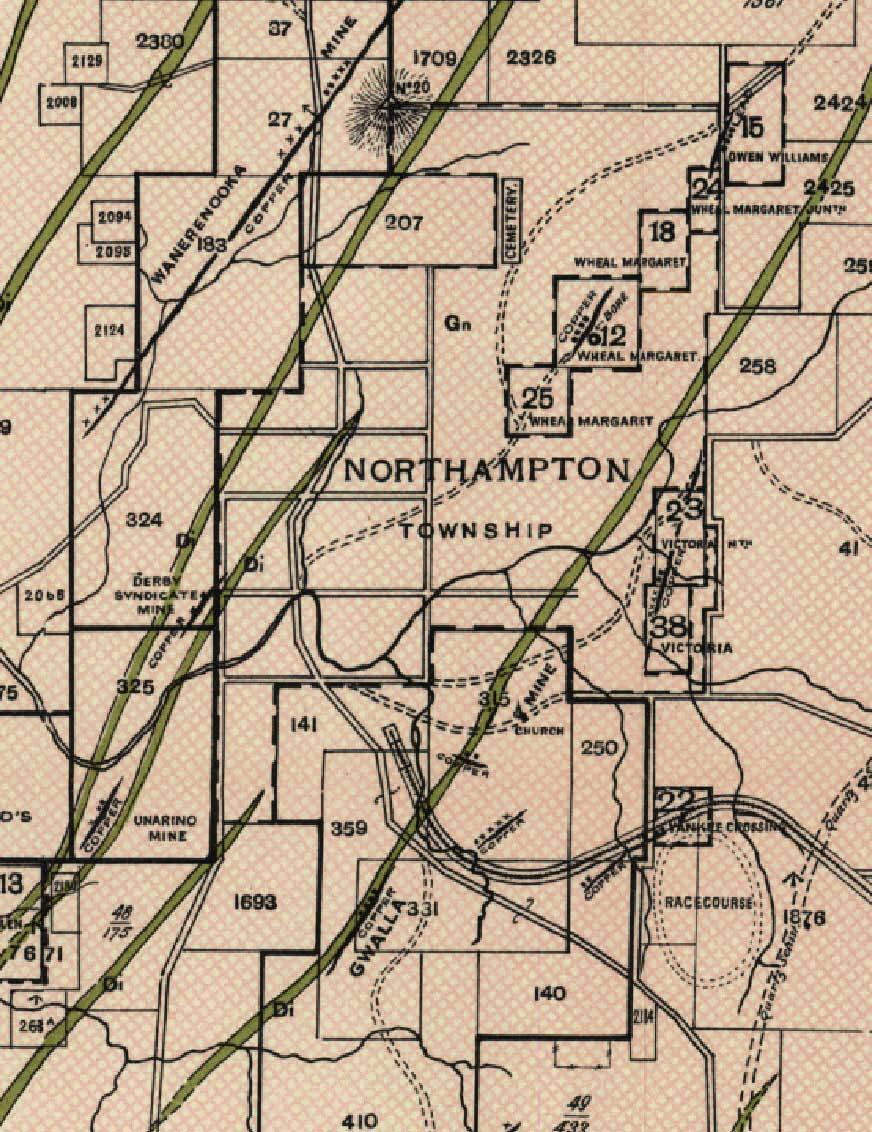
The first detailed geological map of part of the field was a plane table survey of about 250 km2 of country around Northampton carried out by A Gibb Maitland and SJ Becher in 1897. This was published by Maitland (1903), and part of it is shown in Figure 8.
As the field’s mineral output fell, many of the miners who had come from rural areas in Britain took up land holdings and became farmers, shifting the main produce of the Northampton area from copper and lead to wheat and wool. This is still the situation today, although in the interim there have been two periods
that saw the revival of mining. The first of these was from about 1910 to 1930 when there was a rise in metal prices related to World War 1. The main copper producer during this period was the Narra Tarra mine in which copper ore was located some 50 years after it was first mined for lead. Its output of some 1800 tons (1829 t) of contained copper was probably equivalent to all of the past production of the field. The principal lead producers were the Surprise mine at Galena on the Murchison River, the Baddera and Wheal Ellen mines at Northampton, and the Narra Tarra, which was one of the few in the field to yield both lead and copper.
The last, and rather more restrained revival of the Northampton Mineral Field, began in about 1948 and was sparked by a steep rise in metal prices due to demand of industries recovering from the stagnation of World War 2, together with tensions related to the Korean conflict. This rejuvenation had largely ended by the early 1960s, although sporadic production continued until 1973. The main lead producers during this resurgence were the Galena and Mary Springs mines near the Murchison River, the Baddera and Gurkha at Northampton, and the Protheroe discovered in 1946 on the same structure as the Narra Tarra near Nabawa.
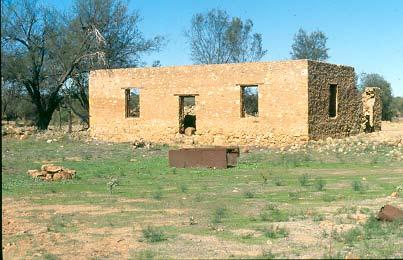
The Geraldine mine, despite its early importance, appears to have closed down for good in about 1878, with minor production recorded since that date coming either from dumps or other nearby deposits. A drilling programme carried out by the Western Australian Mines Department in 1966 found only a few inches of galena and sphalerite in the predicted position of the lode. The mine area is now a designated heritage site where remains of the old mine buildings, shaft dumps and manager’s house are preserved (Fig. 9)
The periodic booms in base metal exploration that have taken place in Western Australia since the discovery of nickel in 1966 have largely by-passed Northampton. Factors contributing to this neglect include problems with private ownership of mineral rights in much of the field, the focus on stratabound types of mineralisation rather than vein deposits, and difficulties in using geophysical methods to detect narrow lodes of galena.
The numerous reports on inspections made by geologists and mining engineers during the later phases of the field’s history are summarised in a number of GSWA Mineral Resources Bulletins (Low, 1963; Blockley, 1971; Marston, 1979; and Ferguson, 1999).
The area of the field is included in the Ajana and Geraldton 1:250 000 Geological Sheets, and is also covered by a set of 1:50 000 Geological Maps produced in the 1960s.
Although the Geraldine was the first mine to record production in Western Australia, it was not the first to be developed, being preceded by the Mundijong lead–zinc prospect located on the Darling Scarp 45 km south of Perth. This was first opened up in 1846 under the supervision of early WA geologist, Ferdinand von Sommer, and again worked in about 1870, 1907 and 1926. Descriptions indicate that appreciable amounts of sinking and driving were carried out on the deposit, but there is no record of it having yielded commercial ore (Blockley, 1971). When Simon Wilde and I visited the site in the 1970s with the idea of making it an excursion stop, we found that the property owner had filled in the shafts and spread the dumps about his paddocks, so apart from scattered fragments of ore minerals, there was little sign of the State’s first mining endeavour.
The gold discoveries of the 1890s completely changed the outlook for Western Australia, so that the two later revivals at the Northampton field had only minor impact on the State’s economy.
Battye, JS, 1913, The Cyclopaedia of Western Australia, v. 2: Western Australia Cyclopaedia Company, Perth.
Blockley, JG, 1971, The lead, zinc and silver deposits of Western Australia: Geological Survey of Western Australia, Mineral Resources Bulletin 9.
Brown, HYL, 1871, Geological and mining report on Champion Bay mining district: Perth Parliamentary Paper No. 3, 1871, p. 7–11.
Brown, HYL, 1873, General report on that portion of the colony of Western Australia lying southward of the Murchison River and westward of Esperance Bay: Perth Parliamentary Paper No. 1, 1873.
Erickson, Rica, 1969, The Drummonds of Hawthornden: Lamb Paterson, Osborne Park, WA.
Ferguson, KM, 1999, Lead, zinc and silver deposits of Western Australia: Geological Survey of Western Australia, Mineral Resources Bulletin 15.
Gregory, AC & Gregory, FT, 1884, Journals of Australian Exploration: Government Printer, Brisbane.
Gregory, FT, 1861, On the geology of part of Western Australia: London, Geological Society Quarterly Journal, v. 17, p. 478.
Heritage Council of Western Australia, 1994, Lynton Convict Hiring Depot: Register of Heritage Places, Interim Entry No. 1915.
Low, GH, 1963, Copper deposits of Western Australia: Geological Survey of Western Australia, Mineral Resources Bulletin 8.
Maitland, AG, 1903, Geological features and mineral resources of Northampton: Geological Survey of Western Australia, Bulletin 9.
Marston, RJ, 1979, Copper mineralization in Western Australia: Geological Survey of Western Australia, Mineral Resources Bulletin 13.
Mitchell, Samuel, 1911, Looking Backward: Reminiscences of 42 Years: Geraldton Newspapers, Geraldton, WA.
Richards, JR, Blockley JG and De Laeter, JR, 1985, Rb–Sr and Pb isotope data from the Northampton Block, Western Australia: Australasian Institute of Mining and Metallurgy, Proceedings 290, p. 43–55.
Woodward, HP, 1890, Report by the Government Geologist: Perth Parliamentary Paper, No. 13, 1890, p. 17, p. 24–25.
Woodward, HP, 1895, Mining handbook to the colony of Western Australia (2nd edition): Government Printer, Perth.
NOTE: John Blockley was Supervising Geologist, Mineral Resources, at the Geological Survey of Western Australia until his retirement in 1995. He is the author of (among other reports) GSWA’s Mineral Resources Bulletin 9 (1971) on the lead, zinc and silver deposits of the State.
(continued from page 4: Sir Samuel Benson Dickinson)
In Appendices to his Annual Reports, Dickinson focused attention on issues that demonstrated his foresight, resolve and energy to set a new path for mineral development in South Australia. At the War’s end the Departmental drilling capacity was greatly expanded; and he recruited geoscientists with a variety of specialities to undertake geological mapping and assessment of mineral resources.
When Dickinson resigned in 1956 the Geological Survey of South Australia numbered 45 officers. The unbroken succession of Directors/Government Geologists who succeeded him for the following four
mentioned in the text
decades had served with and had been trained by him. Imbued with his culture, vision and dedication, they continued to adapt to requirements and be instrumental in revealing deposits of natural gas and oil in the Cooper Basin; of one of the world’s greatest metal resources at Olympic Dam; and other minerals that continue to make rich returns to the State.
The City of Adelaide recently installed a plaque in the North Terrace footpath to commemorate Sir Samuel Benson Dickinson; Geologist and Director of Mines South Australia 1944 – 1956. Samuel Benson Dickinson died in 2000.
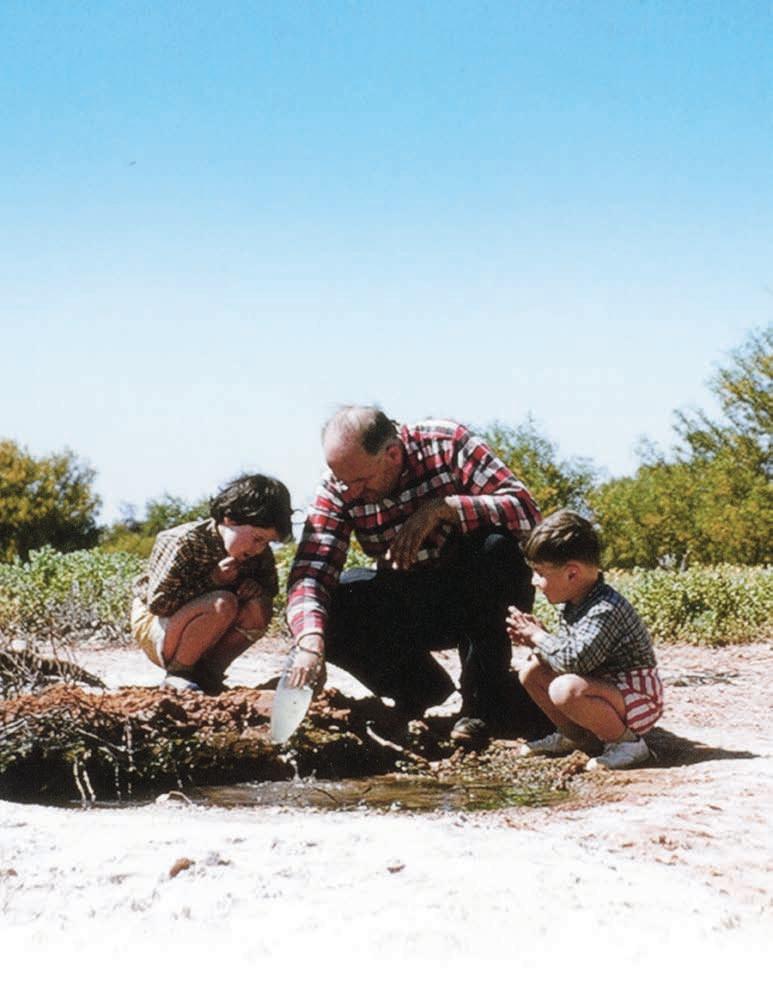


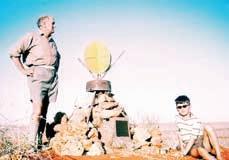
Geologist, explorer, environmentalist and a founder of South Australia’s oil and gas industry, Reg Sprigg is one of those great pioneers of the 20th century who has contributed hugely to the State and the nation.
Until now his name has only been known mainly within government, academia and industry circles, but a new book is spreading the word about this remarkable man to the general public.
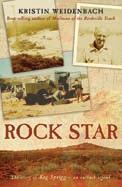
Rock Star: the story of Reg Sprigg – an outback legend vividly recalls the triumphs, heartaches and legacy of Reg Sprigg in a fitting tribute to his life. Written by best-selling author Kristin Weidenbach, the book tells a fascinating and inspiring story about this visionary South Australian.
Ms Weidenbach said the list of ‘firsts’ for Reg was extremely long.
Reg discovered the oldest fossils in the world, the 500-million-year-old Ediacara fossils in the Flinders Ranges.
He was among the first to theorise about climate change. In 1948 he formed a theory — rejected by the International Geological Congress in London — that the sand dunes at Beachport and Robe in South Australia’s south-east were the result of sea level changes and glacial melting.
He was the first person to propose a theory about the geological formation of Adelaide’s landscape due to movement under the earth’s crust (this was before plate tectonics was known).
He discovered some of the deepest undersea canyons, south of Kangaroo Island, about the size of the American Grand Canyon — and to confirm his discoveries he took up scuba diving when it was still fairly new, and built his own boat and his own diving chamber.
Reg helped to set up South Australian
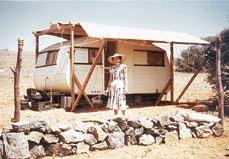
oil and gas company Santos; he discovered the Great Cooper Basin oil and gas fields; founded Beach Petroleum; and pioneered exploration in the Simpson Desert and the Gulf St Vincent. He was also the first person to drive across the Simpson Desert.
His interests in mining and oil and gas exploration were balanced by a great love for the environment. For many years Reg lived at Arkaroola in the Flinders Ranges, where he established one of Australia’s first eco-tourism resorts, Arkaroola Wildlife Sanctuary.
“There are so many areas where Reg was the first — he was always at the forefront making discoveries and was often waiting for the rest of the world to catch up,” Ms Weidenbach said.
Reg was born in 1919 at Stansbury on Yorke Peninsula, but his family moved to the Adelaide suburb of Goodwood in his early years. He used to collect shells and fossils on the beach from the age of five, and he became fascinated with geology by the age of 10, thanks to a chance meeting with a retired miner from Broken Hill, whose mineral samples were a source of amazement. Reg’s first experience of the University of Adelaide came when, as a child, he took mineral samples he had collected into the Geology Department for identification.
When Adelaide Technical High School dropped geology from its curriculum, Reg showed his dedication by studying geology independently in order to take the subject as part of his matriculation exam. As a result, he topped the State in geology.
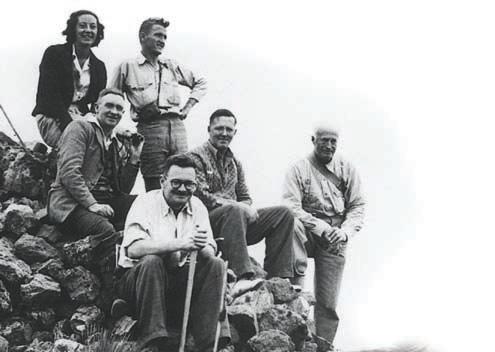
In 1937, Reg began studying at the University of Adelaide under the tutelage of renowned geologists and Antarctic explorers Sir Douglas Mawson and Cecil T Madigan.
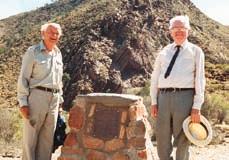
“Being at Adelaide University in the 1930s was a time when students were expected to be seen and not heard — a lot like children — and that’s where Reg was different,” Ms Weidenbach said. “He had a deeply inquiring mind, and he wouldn’t hesitate to question his professors and draw them into vigorous scientific debate if they had opposing views on something.
“Reg was not a brilliant academic scholar, but he was driven by an overwhelming intellectual curiosity about the world around him. He was a lateral thinker full of new ideas and new ways of looking at the old scientific truths,” she said.
Reg completed his Bachelor of Science degree in Zoology and an Honours degree in Geology in 1941. During World War Two, he tried to enlist in the Air Force but was prevented from doing so and was instead diverted to the Council for Scientific and Industrial Research (CSIR, later to become the CSIRO).
It was while working for the CSIR in 1944 that he was asked to take part in a top-secret geological survey for uranium. Not knowing it at the time, Reg had become part of a worldwide search by Allied Forces for uranium that could be used in atomic bombs. It was thanks to this work that Reg first visited South Australia’s two uranium deposits: Radium Hill, 100km south-west of Broken Hill, and Mount Painter at Arkaroola Station in the Flinders Ranges. Thus started Reg’s life-long love affair with Arkaroola. Reg’s work on uranium would eventually see him appointed Assistant Government Geologist with the Department of Mines, and it brought him into contact with another great South Australian, Sir Mark Oliphant. They met for the first time in 1947 at Mount Painter.
This article is reproduced courtesy of Lumen (alumni newsletter of University of Adelaide) and East Street Publications, the publishers of Rock star: the story of Reg Sprigg — an outback legend. The book is available for $32.95 (inc. GST, plus postage) from the publishers at: www.eaststreet.com.au. ISBN 9781921037290. A review of the book by Dave Branagan appeared in The Australian Geologist (TAG 151). Editor’s note: readers may take issue with paragraph 5 of this article!
“At the time, Oliphant was a professor at Birmingham University and was a member of the British Atomic Energy Commission,” Ms Weidenbach said. “Having been a key member of the Manhattan Project to develop the atomic bomb during World War Two, Oliphant was one of the few people in the world who knew anything about this new ‘wonder metal’ uranium.”
Many years later, Oliphant recalled the circumstances under which he and Reg Sprigg met: “I was both exhausted and dehydrated. Offered beer in the shed, I shook my head, unable to speak, and pointed to a large canvas water bag hanging on the branch of a tree. A young geologist in khaki working clothes took pity on me, found glasses in the shed and led me to the water bag, where I drank more than I’d ever drunk before or since. My saviour was Reg Sprigg.”
Oliphant and Sprigg would later become close friends for the rest of their lives.
“In a way, the book is the story of two remarkable men — Reg Sprigg and Sir Mark Oliphant,” Ms Weidenbach said. “They were both exceptional scientists and very similar people. They both had an innate love of the environment.”
In 1948, Reg was sent to the United States, Europe and the UK to learn, firsthand, more about uranium. “When he returned nine months later, he was the most knowledgeable uranium geologist in the country, and that’s when he came under the observation of ASIO,” Ms Weidenbach said.
By 1951, ASIO had made Reg’s work with the government intolerable. Because of some of his past associations, ASIO branded him a “suspected Communist” and a “scientist of counterespionage interest”. They acted to have information important to his work withheld from him. Reg was unaware of their interference, but he was increasingly unhappy about his work and handed over responsibility for uranium to others. He was kept under surveillance by ASIO for 10 years.
The oil boom in Western Australia in 1953 put geologists in demand like never before. Faced with a wide range of job offers, Reg decided to resign from the Department of Mines and establish his own company, Geosurveys, and this began his extensive involvement in oil and gas exploration that would span many decades.
Ms Weidenbach said her inspiration to write about Reg Sprigg came from being part of the family herself. “They say ‘write what you know’, and I’ve been lucky to have lived at Arkaroola with Reg’s son, Doug, and we have a daughter, Reg’s granddaughter, so I got to know the family and the place. It’s pretty hard not to come under the spell of Arkaroola, and Reg for having built it,” she said.
To help write her book, Ms Weidenbach accessed Reg’s extensive personal archives at Arkaroola, as well as some of the Oliphant papers which are part of the Special Collections at the University of Adelaide’s Barr Smith Library.
and oil and gas exploration. As scientists, he and Oliphant shared concerns for the future of the human race. “Reg was more optimistic that people’s inventiveness would prevail, and that benefits could be achieved through technology — ‘as long as we don’t destroy the Earth’s riches first’, he warned.”
In one of his many letters to Oliphant, Reg wrote: ‘I see by an article in the latest journal that the CO2 greenhouse effect is not appearing so rapid — not until 2030 do they expect serious melting of the ice caps. Surely now is the time to take more drastic action before it’s too late. We seem determined to mortgage the future, making it easier for us right now — enjoy now, pay later.’
“As a writer, I find that personal letters are one of the most important research tools,” she said. “People reveal their thoughts and emotions, but they also speak in their letters of the culture of the time, the weather, the politics, and all those other clues to the times that they lived in.”
Ms Weidenbach said Reg’s love for the environment was not out of step with his interests in mining
While working in Melbourne, Reg would stand on street corners while waiting for the tram and count the number of occupants in each passing car. ‘At around 9 o’clock in the morning, approximately one in every 13 cars carried a passenger,’ he wrote to Oliphant. By late morning, he estimated that only one in every 20–30 cars contained more than one occupant. ‘Such an incredible waste of fuel,’ he lamented. ‘God, we Westerners are wasteful of resources. Will we last to the end of the century? How can we do without atomic energy as our fossil fuels run out? Is nuclear fusion a real potential before it’s too late?’
Ms Weidenbach said Reg’s love for Arkaroola kept him grounded. “Whenever Reg felt too downcast about the problems of the world, he could step out under his slate verandah and inhale the clean, dry air of the place… ‘God, this wild country is magnificent,’ he wrote to friends. It made world politics and international conflicts shrink into oblivion, and it made Reg Sprigg one incredibly lucky human being.” Rock Star: the story of Reg Sprigg –an outback legend is published by East Street Publications.
STORY DAVID ELLIS
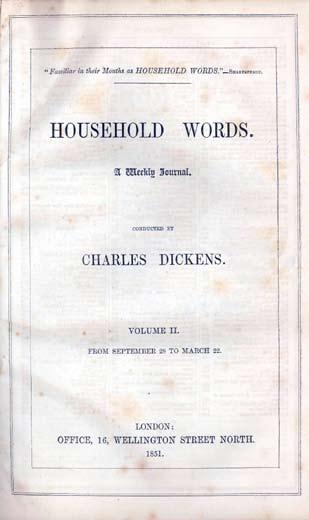
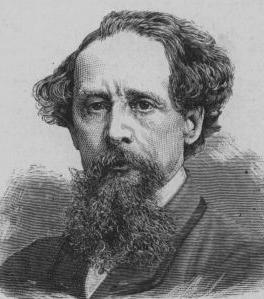
Household Words was a weekly journal published by Charles Dickens between 1850 and 1859. The journal covered a huge range of topics — from science to travel, social conditions to history. Among the three thousand published articles, more than one hundred were related to Australia and these coincided with the discovery of gold in New South Wales and Victoria.
The articles give a unique window into those times when there was intense interest in Australia. The stories in Household Words highlight the feverish excitement generated by the gold discoveries, helping to fire the imagination of ordinary people around the globe.
Australia’s development was stimulated by the discoveries of gold. The rapid expansion of population and economy changed the social, political and technological landscape of Australia in the course of this single decade. Gold served to invigorate the power and extent of the British economy and, moreover, transformed the way Australia was perceived by the rest of the world.
As well as gold, the articles devoted to Australia in Household Words cover subjects as diverse as convicts, transportation and Norfolk Island. There are stories from the frontier — about farming and fires; information for immigrants; and conditions at sea for sailors as well as settlers — and words of caution for would-be fortune seekers.
The articles have been compiled into a single volume and will be published by Sydney University Press. Here is a teaser to whet your appetite for more.
The Harvest of Gold is one of 19 stories about gold mining to be reprinted in the forthcoming book: Charles Dickens’ Australia: An anthology of selected essays from Household Words, 1850–1859, Book 4 Gold mining
Researched and presented by Margaret Mendelawitz
ISBN: 978 1 920899 25 7
Available late 2009 from Sydney University Press <www.sup.usyd.edu.au>
Title: The Harvest of Gold
Study: The huge and largely unintended consequences of gold discoveries in Australia
Volume: 5; Number: 113; Pages: 213–218
Date: Saturday 22 May 1852
Author: Ossian Macpherson, Mr Mulock and Henry Morley Fee: 2 pounds 2 shillings to Macpherson and 1 pound 11 shillings and 6 pence to Mulock for 11½ columns.
Three years ago, one Mr Smith, a gentleman engaged in iron-works in Australia, made his appearance at the Government House, Sydney, with a lump of gold. He offered, for a large sum of money, to point out where he had got it, and where more was to be found in abundance. The Government, however, thinking that this might be no more than a device, and that the lump produced might, in reality, have come from California, declined to buy a gold field in the dark, but advised Mr Smith to unfold his tale, and leave his payment to the liberality of Government. This Mr Smith refused to do, and there the matter ended.
On the third of April 1851, Mr Hargraves, who had recently returned from California, addressed the Government, stating that the result of his experience in that country had led him to expect gold in Australia; that the results of his exploring had been highly satisfactory; and that for the sum of five hundred pounds he would point out the precious districts. The same answer was returned that had disposed of Mr Smith, but with an opposite effect; for Mr Hargraves declaring himself ‘satisfied to leave the remuneration for his discovery to the liberal consideration of the Government,’ at once named the districts, which were Lewis Ponds, Summer-Hill Creek, and Macquarie River, in Bathurst and Wellington — the present Ophir*. Mr Hargraves was directed to place himself at once in communication with the Government Surveyor.
Meantime, the news began to be whispered about. A man who appeared in Bathurst with a lump of gold worth thirty pounds, which he had picked up, created a great sensation, and numbers hastened to see whether they could not do likewise. The Commissioner of Crown Lands became alarmed. He warned all those
* Ophir: in the Bible, a land rich in gold
who had commenced their search, of the illegality of their proceedings, and made earnest application for efficient assistance, imagining that the doings in California were to be repeated in Bathurst, and that pillage and murder were to be the order of the day. The Government immediately took active measures for the maintenance of order. Troops were despatched to the Gold fields, and the Inspector-General of Police received a discretionary power to employ what force he thought proper.
Great was the excitement in Sydney upon the confirmation of all this intelligence. Hasty partings, deserted desks, and closed shops, multiplied in number. Every imaginable mode of conveyance was resorted to, and hundreds set off on foot.
On the fourteenth of May, the Government Surveyor reported that in communication with Mr Hargraves, he had visited the before-mentioned districts, and after three hours’ examination, ‘had seen quite enough’ — gold was everywhere plentiful.
A Proclamation was at once issued, forbidding any person to dig without a license, setting forth divers pains and penalties for disobedience. Licenses were to be obtained upon the spot, at the rate of thirty shillings per month, liable to future alteration. No licenses were granted to any one who could not produce a certificate of discharge from his last service, or otherwise give a satisfactory account of himself; and the descriptions of such as were refused were registered. A small body of mounted police were at the same time organised, who were paid at the somewhat curious rate of three shillings and threepence per day, with rations, and lodgings when they could be procured. Fortunately, there was no attempt at disturbance, for the Governor in a despatch states: ‘that the rush of people (most of them armed) was so great, that had they been disposed to resist, the whole of the troops and police would have been unable to cope with them.’ The licenses, too, were all cheerfully paid for, either in coin or gold.
On the third of June, Mr Hargraves (who, in the meantime, had received a responsible appointment) underwent an examination before the Legislative Council, when he stated that he was led to search in the neighbourhood of Bathurst, by observing the similarity of the country to California. He found gold as soon as he dismounted. He found it everywhere; rode from the head of the Turon River to its confluence with the Macquarie, about one hundred miles; found gold over the whole extent; afterwards found it all along the Macquarie. ‘Bathurst,’ observed Mr Hargraves, [it] ‘is the most extraordinary place I ever saw. Gold is actually found lying on the ground, close to the surface.’
And Mr Commissioner Green, two days afterwards, reported, that ‘gold was found in every pan of earth taken up.’
But the most important event connected with these discoveries, and which is without parallel in the world’s history, remains to be told.
On the sixteenth of July, The Bathurst Free Press, commenced a leader with the following passage:
‘Bathurst is mad again! The delirium of golden fever has returned with increased intensity. Men meet together, stare stupidly at one another, and wonder what will happen next. Everybody has a hundred times seen a hundred-weight of flour. A hundred-weight of sugar is an every-day fact; but a hundred-weight of gold is a phrase scarcely known in the English language. It is beyond the range of our ordinary ideas; a sort of physical incomprehensibility; but that it is a material existence, our own eyes bore witness.’
Now for the facts.
On Sunday, eleventh July, it was whispered about in Sydney, that a Dr Kerr had found a hundred-weight of gold! Few believed it. It was thought a capital joke. Monday arrived, and all doubts were dispelled; for at mid-day a tandem, drawn by two greys, drew up in front of the The Bathurst Free Press office. Two immense lumps of virgin gold were displayed in the body of the vehicle; and being freely handed round to a quickly assembled crowd, created feelings of wonder, incredulity, and admiration, which were increased, when a large tin box was pointed to, as containing the remainder of the hundred-weight of gold. The whole was at once lodged at the Union Bank of Australia, where the process of weighing took place in the presence of a party of gentlemen, including the lucky owner and the manager of the bank. The entire mass weighed about three hundred pounds, which yielded one hundred and six pounds of pure gold, valued at four thousand pounds. This magnificent mass was accidentally discovered by an educated aboriginal in the service of Dr Kerr; who, while keeping his master’s sheep, had his attention attracted to something shining on a block of quartz, and breaking off a portion with his tomahawk, this hitherto hidden treasure stared him in the face. The lump was purchased by Messrs Thacker and Company, of Sydney, and consigned to an eminent firm in London.
Meanwhile, the Commissioner reported a gold field many miles in extent, north-east of Bathurst, adding that it would afford employment for five thousand persons, the average gain of each person being then one pound per day; while provisions, which at one time had been enormously high, owing to the cupidity of speculators, had fallen so low, that the sum of ten shillings a-week was quite sufficient for one individual’s subsistence. The Reports from the other Commissioners were equally favourable; and it is gratifying to find that they all spoke in the highest terms of the orderly and exemplary conduct of the diggers.
Since the discoveries in the neighbourhood of Sydney, there have been found, in South[ern] Australia, large tracts of country, abounding in gold, only sixteen miles from Melbourne. The most recent accounts (15th December, 1851) from these regions are of a most astounding character. In the first week in December nearly fifty thousand pounds value in gold was brought into Melbourne and Geelong. The amount would have been greater but for want of conveyance. ‘To find quartz,’ says the Australian and New Zealand Gazette, ‘is to find gold. It is found thirty-two feet from the surface
in plenty. Gold is actually oozing from the earth.’ Nuggets of gold, from fourteen ounces to twenty-seven pounds, are to be found in abundance. A single quartz ‘nugget,’ found in Louisa Creek, sold for one thousand one hundred and fifty-five pounds. ‘The Alert’ was on her way home with one hundred and thirty thousand pounds sterling in gold, and two other vessels with similar rich cargoes.
Every town and village was becoming gradually deserted. ‘Those who remain behind to mind the flocks demand such wages, that farming will not long pay. Labour is in such demand that anybody with a pair of hands can readily command thirty-five shillings per week, with board and lodging.’ The Government Commissioners had given in their unanimous report, that the gold fields were already so extensive as to afford remunerative employment for one hundred thousand persons. In conclusion, the last advices describe the excitement as so intense that fears were entertained that sufficient hands would not be left to get in the standing crops.
Every week the number multiplies, of gold-seekers’ colonies planted about streams in Australia; at all, the conduct of the diggers is exemplary. Most of them cease from labour on the Sunday, and spend that day as they would spend it if they were in town. The first keg of spirits taken into an Australian gold field had its head punched out by the miners; and Government
has since assisted them in the endeavour to repress the use of stronger stimulants than wine or beer. Where every member of the community possesses more or less of the great object of desire; where stolen gold could never be identified; where it would be far from easy to identify a thief who passes to-and-fro among communities composed entirely of chance-comers, having faces strange one to another, a little drunkenness might lead to a great deal of lawlessness and crime. There are men, however, who will drink; and what are called by the miners ‘sly grog-sellers’ exist, and elude discovery in every gold settlement. Yet we read of one man who, being drunk, had dropped the bottle which contained his gold, and are informed that he was afterwards sought out, and received due restoration of his treasure from its finder. Some settlements are much more lawless than the rest, and we have read, perhaps, more ill of Ballarat than any other; yet it is of Ballarat that we receive the following sketch from a private correspondent.
The writer, with a party of four young friends, quitted a farm near Geelong, in October last year, to experiment as a digger at Ballarat until the harvest. One man at a gold field can do little for himself; a party of about four is requisite to make a profitable division of the labour.
‘With this party,’ our correspondent says,
‘I started on Thursday 2nd October for the Gold City of Ballarat. We took with us all requisite tools; a large tarpaulin to make into a tent; and provisions to last us for two months. All this was stowed away in our own dray; and our man Tom accompanied it.
‘This mode of travelling — the universal mode in Australia — is very pleasant in fine weather. We used to be up at daybreak, and start as soon as we had breakfasted. We would go on leisurely—for bullocks won’t be hurried — and get through a stage of from fifteen to twenty miles, according to the state of the roads, allowing an interval of one hour for dinner. Then we would stop for the night at some convenient camping-ground, where there was a good supply of grass, wood, and water. There, our first proceedings were to make a big fire and a great kettle of tea — a kettle, mind; then we rigged out a temporary tent, spread our beds on the ground, and went to sleep as comfortably as if we were at a first-rate hotel.
‘On Monday night — having left the farm on the previous Thursday — we camped about two miles from the diggings; and making a very early start, we got in sight of them a little after sunrise.
‘It certainly was the most extraordinary sight I ever beheld. Imagine a valley, varying in width from one hundred to five hundred yards, enclosed on either side by high ranges of hills, thickly timbered. Through the middle of this valley there winds a rapid little stream, or ‘creek,’ as it is termed here. On the banks of the creek, and among the trees of the surrounding ranges, were clustered tents, bark-huts formed after the native fashion with boughs of trees*, and every kind of temporary habitation which could be put up in the course of an hour or two.
‘Some idea may be formed of the number of tents and other habitations, when I say that there were then at least five thousand men at work within a space of
about half-a-mile up the creek. All these had collected together in a few weeks; for it was only in the latter end of August that gold was first found in this out-of-theway forest valley — now the site of the ‘City of Ballarat,’ as it was nicknamed by the diggers.
‘We chose a place for our tent on a rather retired spot, not far from the creek; in a couple of hours our ‘house’ was put up, the stores stowed away inside it, and Tom and his team were off on the home journey to Geelong. Leaving the others to ‘set our house in order,’ get in a stock of firewood, bake a damper, and perform various other odd jobs attendant upon taking up one’s residence in the Bush — Fred and I set out to reconnoitre the scene of our future operations.
‘The place where there was the richest deposit of gold was on the face of a hill, which sloped gradually down from the edges on the right-hand (or east) side of the creek, going towards the source. I mention these particulars, because it is worthy of note that almost all the principal diggings have been discovered in places similarly situated. The whole of the hill was what geologists call an ‘alluvial deposit:’ consisting of various strata of sand, gravel, large quartz boulders, and white clay, in the order I have named them. It is in this white clay, immediately beneath the quartz, that the gold is found. In one part of the hill, where the discovery was first made, this layer of quartz was visible at the surface, or ‘cropped out:’ in other parts it is to be met with at various depths, of from five to thirty feet.
‘When first these diggings were discovered, there were, as might be expected, continual disputes as to how much ground each man should have for his operations. One party applied to the Government, which immediately appointed a Commissioner and a whole staff of subordinates, to maintain order and enforce certain regulations, made ostensibly for the benefit of the diggers. Of these regulations the two principal ones were, that each person must pay thirty shillings per month for a license to ‘dig, search for, and remove gold’ (I enclose you my license as a curiosity); and that no person could claim more than eight feet square of ground to work at, at one time. In consequence of this last regulation, the workings were concentrated in a small part of the hill, where the gold was chiefly to be found. This spot was perfectly riddled with holes, of from eight to sixteen feet square, separated by narrow pathways, which formed the means of communication between each hole and the creek. A walk about this honeycomb of holes was most amusing. The whole place swarmed with men; some at work in the pits; others carrying down the auriferous earth to be washed in the creek—in wheel-barrows, handbarrows, sacks, and tin dishes on their heads. In some of the holes I even saw men digging out bits of gold from between the stones with a table-knife.
‘Busy as this scene was, I think the scene at the creek was busier. Both banks, for half-a-mile, were lined with men, hard at work washing the earth in cradles. Each cradle employs three men; and all the cradles are placed close to one another, at intervals of not more than a yard. The noise produced by the incessant ‘rock-rock’ of these cradles was like that of an immense factory. This — together with continual hammering of a thousand picks, and the occasional crashing fall of immense trees, whose roots had been undermined by some mole of a gold-digger — made a confusion of sounds, of which you will find it difficult to form a just idea.’
Our correspondent’s party was not very fortunate in its researches at Ballarat. Having explained this to us, he continues to give his impressions of the place.
‘When we arrived there, the influx of people was still going on; tents springing up at the rate of fifty per diem. This continued until the third week in September, when the number of persons on the ground was estimated at seven thousand. Strange as was the appearance of the place by day, it was still stranger at night. Before every tent was a fire; and in addition to this general illumination, there was not infrequently a special one — the accidental burning down of some tent or other. These little conflagrations produced splendid effects; the bright glare suddenly lighting up the gloomy masses of trees, and the groups of wild-looking diggers.
* also known as bough sheds
‘Noise, too, was a prominent feature of ‘Ballarat by night.’ From dusk till eleven p.m., there was a continuous discharge of fire-arms; for almost every one brought some kind of weapon with him to the diggings. Then there was a band
which discoursed by no means eloquent music: nine-tenths of the score being monopolised by the drum. In the pauses of this — which occurred, I suppose, whenever the indefatigable drummer had made his arms ache — we would hear rising from some of the tents music of a more pleasing character. The party next to ours sang hymns very correctly in four parts; and from another tent the ‘Last Rose of Summer’ sometimes issued, played very pathetically on the flageolet*.
‘Sunday was always well observed at the diggings, so far as absence from work was concerned: and there was Service held twice a day by different ministers. Altogether, though there were occasional fights — particularly on Sundays — there was much less disorder than one would have expected, where a large body of such men were gathered together. While we stayed, there happened only one murder and two or three robberies. You must not take the quantity of gold we got as any criterion of the amount found by other parties. Numbers made fortunes in a few weeks. One party that I knew obtained thirty pounds weight — troy — in seven weeks; and a youth of seventeen, who came out with me in the ‘Anna Maria’, received five hundred pounds as his share of six weeks’ work. These are but ordinary cases. The greatest quantity known to have been taken out in one day was sixty-three pounds weight, nearly three thousand pounds worth.
‘On Wednesday, fifth November, we packed up, left Ballarat, and set off for Mount Alexander, where we arrived on the Saturday following. The Diggings there are not confined to one spot, but extend for twelve miles up a valley. The gold is found mostly among the surface-soil: some I have even seen lying among the grass. We tried first at a place where there was only one party at work; and the trial proving satisfactory, we stayed there three weeks, and obtained thirty-six ounces of gold. For a few days we did nothing; and then we went over to some other Diggings about five miles off. Here we went ‘prospecting’ for ourselves, and the first day found out a spot from which we took thirty-five ounces in one week — the last of our stay; eighteen ounces we found in a single day.
* Flageolet: a type of flute
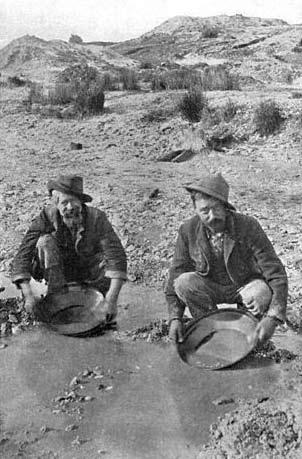
‘We then started off, back to Geelong; for I was anxious to be back for the harvest. We reached home on Saturday, twentieth December.’
Writing on the twenty-eighth of December, our informant adds:
‘This gold discovery has sent the whole country mad. There are now upwards of fifty thousand men at work at the various diggings; of which I have only mentioned the two principal ones, Ballarat and Mount Alexander. Everybody who can by any means get away, is off. It is almost impossible to obtain labourers at any wages. Half the wheat in the country will most likely rot on the ground for want of hands to reap it. Fortunately we shall be able to get in ours ourselves, for our man Tom is still with us, and Mr R.’s four brothers will lend us a hand. We have a very good crop of wheat, for the first year: the barley, of which we had an acre or two, we have already cut and threshed, and are going to send a load in to Geelong tomorrow. I can handle the sickle and flail pretty well for a beginner. We shall cut the wheat next Tuesday. As soon as the harvest is over, and the wheat threshed out and sold, Mr R. and I mean to make up another party and be off to the diggings. We cannot do all the work on the farm ourselves, and hiring servants now is out of the question. Men are asking seven shillings and sixpence a-day wages, and will only hire by the week at that rate. Things will soon be in the same state as they are in California. All ordinary employments will be put a stop to for a time: but there will no doubt come a reaction in the course of a year or two.’
The reaction anticipated by the writer will not consist in a disgust at gold, or a decrease in the number of gold-diggers. It will be less a reaction than a recovery of balance. Although the gold in Australia is, on the whole, peculiarly accessible, and so abundant that a persevering worker cannot fail to draw a livelihood out of the diggings; yet there are very many workers who are not disposed to persevere. Experience has shown, that a large number of men who rush upon the gold field to pick up a fortune, like all sanguine people, take up quickly with despair, and come away after a few weeks of bad success. Of the large number of people who will be induced by their gold to emigrate into the Australian colonies, many will try the gold fields and abandon them, many will find their health or their acquired habits unsuited to the rough work of the diggings, and the ‘Home of the Gold Miners’ — as one sees it advertised in Sydney papers, ‘weighing only twelve pounds — nine feet square by eight feet high, for thirty-five shillings.’ Such men and others will be more ready to spread about the towns and through the pastures. In a year or two there will be in Australia labour willing to employ itself as readily upon the fields as upon the gold, while the work will proceed at the gold fields steadily enough.
The contrast is very great between the orderly behaviour at the gold fields in Australia, and the disorders of California. There are few fields, we are told, at which a miner might not have his wife and family; if he could provide accommodation for them,
Fossickers
they would be as safe, and meet with just as much respect as if they lived in their own house in town. A clergyman, quitting the Turon settlement, publicly returns his ‘sincere thanks to the commissioners of the Turon, and to the mining population in general, for the many acts of kindness which he experienced during his short residence among them. He considers it his duty,’ he says, ‘thus publicly to state, not only his own personal obligations, but also the pleasure which he felt in witnessing the general desire of all classes to promote the object of his mission, and to profit by his humble labours; and if,’ he says, ‘he were to judge from their orderly conduct, and from the earnest attention and apparent devotion with which they all joined in the religious services of the Sabbath, he could not help forming a very favourable opinion of the miners. It cannot be denied that the great majority are sober, industrious, and well-disposed.’
The file of a Sydney daily paper since the commencement of gold discoveries is quite a study for philosophers. Wonderful tales of treasures brought to town, condensed into the weekly Gold Circular, are waited upon by an array of light, social absurdities, and supported by an admirable body of sound human feeling. In one week, for example, twenty-five thousand pounds’ worth of gold has come to town, against which uprises a wholesale and retail grocer, who advertises that ‘Economy is a sure road to a Gold Field’, and requests the public to look rather to his Teas and Coffees. Then our English eyes do, indeed, dwell a little on his list, when we remember our own taxes, and see that the gold diggers may buy gunpowder tea at two shillings a pound, and sugar at twopence. No wonder that they make their tea in kettles.
The next weekly Gold Circular tells of fifteen thousand pounds’ worth that has come in by Government escort — an unpopular, because a dear conveyance, the charge being one per cent; and, as for the gold privately transmitted, adds the Circular, ‘When we know of one man bringing down a thousand ounces in a horsecollar, it is impossible to state correctly what may come into town.’ On the same day, a draper declares that he is determined to sell ten thousand pounds’ worth of haberdashery at an alarming sacrifice, ‘it being perfectly evident that at the present time it is the only means by which a trade can be done,’ — and so on. In the same paper there is advertised Number One of a new periodical, to be called The Golden Age, and another bookseller announces as ‘The only readable book ever published in Australia, The Gold Calculator; or Diggers’
and Dealers’ Ready Reckoner’*. ‘That being the humour of Australian authors’, an Australian musician offers, in the same good cause, ‘The Ophir Schottische’†; ‘while the public is in various places strongly recommended to buy pumps and cradles.’
In another paper, we meet with an intelligent calculation of the advantages that will be derived by the Australian colonies, from the immigration caused by gold. Among these, it is remembered that more mouths will want more mutton, and pay to the now troubled agriculturists better price for carcases, that hitherto have only been available for tallow. In this calculation, we meet with an item that again falls curiously on our English ears: ‘The consumption of meat at Sydney is at the rate of about three hundred and thirty pounds per head per annum; that of the bush much more, as there is a small proportion of children, and the adults have, at least, five hundred and twenty pounds per annum, and a large proportion from six hundred to seven hundred and twenty pounds.’
Then we come upon a narrative of the attempts that have been made to put down sly-grog-men at the goldfields. ‘I went out,’ says the writer, ‘one or two nights with the Commissioners on the Turon, and after blundering about all night among deep pits and high banks, crossing a flooded river half-a-dozen times on slippery logs, I came to the conclusion that to be out of bed on any such errand, was all vanity and vexation of spirit. We knew that we were within a few yards of the grog-shop; saw drunken men lying about, but everything was perfectly quiet; not a move, nor a sound, except the monotonous declaration of a drunken fellow, that — he was a man.’ Perhaps he was sober enough to feel that he incurred some risk of being taken for a beast.
In another paper we are told of the first passage of ‘the gold coach’ through a quiet village, and of the consequent defection of the labourers. In the same paper we have news from Mount Alexander that might well turn the head of any villager. One person ‘left Melbourne on Saturday, and returned on the Monday week following, bringing fourteen pounds weight of gold with him; dug up by himself. Another man, after working ten days, brought back twenty-two pounds weight. A friend of mine, a gentleman who only went to see, was anxious to try his luck, and begged a dishful of earth, to have, as he thought, a few grains to take home with him; a few minutes washing gave him nearly
* Ready Reckoner: a book having tables for computing interest, prices, etc.
† Schottische: a form of round; a dance in 3/4 time, similar to a polka
two ounces of gold.’ The gold at Mount Alexander, the richest field discovered yet, lies near the surface. Two men there obtained four hundred ounces in three weeks. As for the weekly Gold Circular at Sydney, it gets poetical:
‘In our first shipment, we could count the value of the gold in pounds sterling by hundreds; in a few weeks it rose to thousands; in a few weeks more it became tens of thousands; and we are fast approaching a period when each ship will convey hundreds of thousands.’ At the time when that was written — on sixth December — in the very few months since the digging was commenced, there had been shipped from Australia, gold to the value of three hundred and twenty-nine thousand seven hundred and ninety-seven pounds; and since that time the yield of gold has been increasing. At the same time, California continues unexhausted, and the field of gold in Russia has enlarged.
It will be seen, therefore, that there is just reason for anticipating a change in the value of gold, which will begin to take place gradually at no distant time. The annual supply of gold promises now to be about eight times greater than it was at the commencement of the present century. The value of silver, with reference to corn, fell two-thirds in the sixteenth century, as that of gold is likely to fall in the nineteenth. The price of silver fell in consequence of the increased production from the great mines in America. A piece of gold is now assumed to be worth fifteen or sixteen like pieces of silver; during the Middle Ages it was worth only twelve such pieces. In Europe, under Charlemagne, ten pieces of silver were an equivalent; and at one period, in Rome, silver was but nine times less precious than gold: relative values, therefore, have varied, and they will vary again. Since they were last fixed by law, there have occurred no causes of disturbance. Now, however, a time of disturbance is again at hand.
In France the monetary unit is a franc, and silver is, by law, the standard coinage; but, a supplementary law having assigned the value of twenty silver francs to pieces of gold of a fixed weight, our neighbours will not be exempted from our difficulty, and the French State, like the English State, may profit, if it please, at the expense of public creditors. Governments have only to do nothing, and a large part of their debts will tumble from them; holders of Government securities have only to be passive, and in the course of years their incomes will diminish sensibly. Debtors will hold a jubilee, and creditors will be dismayed, if gold shall be allowed to fall in value, without due provision being made to avert, as far as possible, all inconvenience attending that event.
In 1848, the value of gold had been for many years a very little more than the amount of silver allowed by law, in France, as its equivalent. The little difference was quite enough to put gold out of circulation. Gold was more precious as a metal than as money; it was, therefore, used by preference as metal; when wanted as coin, it was only to be bought, at more than its legal current value, of the money-changers. There is a vast quantity of gold in circulation now, but it is newly coined.
The fall in the value of gold cannot begin to any appreciable extent, until the utmost available quantity has been employed upon the monetary system of the world. Coinage now goes on rapidly. A huge mass of sovereigns has lately been sent from England to the Australian colonies. When the depreciation once begins, it will be tolerably rapid. It is not absurd to calculate, that if the gold production should continue at its present rate, sovereigns will be as half-sovereigns now are in value, in the course of about twenty years.
At the same time, it will be the duty of all States to take such precautions as shall make it impossible for a change of this kind to introduce confusion into commerce, or to change the character and spirit of existing contracts.
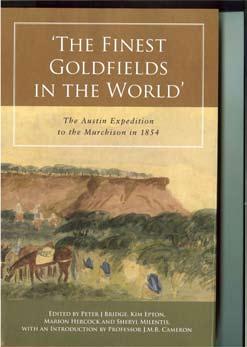
In 1854 Robert Austin led an expedition north to the Murchison River, after many tribulations finally reaching the Geraldine mine months later (see article on page 5). Their exploration inspired others to prospect the desert for both grass and gold. This volume is part of the Western Australian Explorers’ Diaries Project of Hesperian Press in Carlisle, Western Australia. Get more information and a full catalogue at: www.hesperianpress.com.
Minutes of the Business Meeting 21st July, 2008
Date: 21st July, 2008
Place: Convention and Exhibition Centre, Perth, WA (at the Australian Earth Sciences Convention)
Present: D. McCann (Chair), P. Dunn, M. Freeman, J. Johnston, J. Blockley, P. Baille, D. Branagan, K. McQueen, B. Cooper and C. Brown.
Apologies: B. Joyce, G. Holdgate, R. Pierson and A. Riganti
Start: 5:00 pm; Finish: 6:30 pm
preamble:
The main purpose of the meeting was to pass administration of the ESHG from Victoria to Western Australia and elect a new Committee.
previous minutes:
Minutes of the previous Business Meeting held on 30th November, 2007 were tabled and accepted.
Business arising and report of current committee:
1. Membership of the Group has now reached 81, following the successful conference held in Melbourne in November 2007.
2. Newsletter No. 38 was distributed to members in June 2008 and No. 39 is expected to be issued shortly. Drafts of three articles for Newsletter No. 40 were tabled by the Chairman for consideration by the new Committee.
3. Doug McCann is currently preparing an index of past newsletters — expected by end of the year.
4. A collection of Hall of Fame posters featuring pioneering Australian geologists is currently stored at GSA’s head office in Sydney and is available for future ESHG activities.
5. A complete collection of the Group’s newsletters is held in Melbourne and copies are being made for the new Committee. A full collection may also be held by the Battye Library in WA (new Secretary to check).
6. The Chairman also gave details of various grants made to further the Group’s activities:
Royal Society of NSW
• , via President John Hardie, to assist with the publication of Roy McLeod’s Archibald Liversidge volume (as proposed by David Branagan at the ESHG 2007 Business Meeting).
$500.00
items (Newsletters, Minutes, etc.), and to send to the Basser Library in Canberra all past copies of Newsletters, Minutes, etc.
$750.00
Doug McCann
• , to undertake an additional study of the history of the ESHG to update the Group’s history from its last write-up 14 years ago.
$750.00
Doug McCann
• , to undertake the archiving of all ESHG material, including creation of a PDF scanned version of most
Ruth Pullin • , for assistance in the publication in the Melbourne Art Journal of her thesis work on von Guérard (as presented at the recent ESHG conference), and also to help in the thesis production.
$500.00
Charles Lawrence • , for assistance in writing up a History of Groundwater in Australia (as presented at the recent ESHG conference). The costs will also assist in interviewing of key persons interstate.
$500.00
Other grants:
Doug McCann • : towards expenses in Perth to attend the GSA Council Meeting, and the ESHG Business Meeting, and the handing over of the ESHG committee to WA, in lieu of other ESHG Committee members unable to attend. $200.00
Dave Branagan • : towards expenses in Perth to attend the GSA Council meeting, and the ESHG Business meeting, and and the handing over of the ESHG committee to WA, in lieu of other ESHG Committee members unable to attend. $200.00
The Chairman reported that the Group’s finances were in good shape and tabled a current financial statement for the information of the incoming Committee.
The following nominations were received for the new Committee:
Chairman Peter Dunn
Treasurer Mike Freeman
Secretary John Blockley
Editor Jean Johnston
There being no further nominations, all were duly elected. Dave Branagan was appointed NSW representative, and Bernie Joyce the representative for Victoria.
other business:
Barry Cooper suggested that the Group organise further conferences like that recently held in Melbourne, and also that some activities be arranged in conjunction with the forthcoming International Geological Congress to be held in Brisbane in 2012 (BC to liaise). He also stressed the importance of issuing at least one newsletter per year, and contributing to major geological events, such as the AESC.
Doug McCann tabled copies of publications resulting from the recent conference in Melbourne and the cover for Newsletter No. 39. There followed discussion on the type of content for future newsletters (articles plus news of activities).
The incoming Chairman, Peter Dunn, moved a vote of thanks to the outgoing Committee (passed).
STATEMENT OF INCOME AND EXPENDITURE
David Branagan has passed on this splendid photograph of the blast furnace at the FitzRoy Iron Works near Mittagong in New South Wales. He received the picture, and permission for it to be published, from W. R. Palferey of Moss Vale. The date of the photograph is unknown. With the recent interest in iron ore by the geological fraternity, it is opportune to recall that the first attempt to smelt such ore in Australia took place at Mittagong in 1852 when a small blast furnace was erected to smelt locally occurring limonite. The plant was opened by Governor Sir Charles FitzRoy, and the works named in his honour (Harper, 1923).
This first attempt proved unprofitable, and work was suspended after only three years. The original plant was demolished in about 1862, and in 1865 replaced by a larger furnace, which is probably that shown in the photograph. Rolling mills were added later to produce sheet iron as well as bars, but in the main, the works were not a financial success and changed hands several times before finally closing in about 1887 (Jacquet, 1901).
The ore used in the furnace was obtained from irregular masses of superficial limonite deposited around springs emerging from the Hawkesbury Sandstone and Wianamatta Shale (Jacquet, 1901). Deposits formed low mounds with the springs at their centres. Early on, fuel for the smelter consisted of wood charcoal, presumably local, and coke brought from Sydney. Later the operators used anthracite obtained from seams in the nearby Nattai River valley. When this proved unsatisfactory, a switch was made to coke from Bulli and splint coal from Lithgow (Harper, 1923). The cost of transporting these fuels was one reason for the project’s demise. Limestone for flux was brought in from Marulan, some 42 km away, again at considerable expense.
Apart from occasional mentions in historical accounts such as that of Raggatt (1968), the FitzRoy Iron Works largely disappeared from memory until Woolworths Ltd lodged an application to build a supermarket on the site in 2004. Fortunately the significance of the ruins was recognized during initial excavations and a Heritage Order placed over them to allow archaeological investigations to be undertaken. This work, carried out during 2005 and early 2006, revealed the presence of substantial remnants of the
former iron works in parts of the development area. Further investigation and monitoring during excavation for the market ultimately identified the remains of the former rolling mills, puddling furnaces, boiler houses, chimney bases, cupola furnaces and other ancillary structures. In view of these findings, Woolworths, in conjunction with the NSW Heritage Office, various consultants, and local historians, redesigned its market so that substantial parts of the former iron works were conserved. The excavated and partly restored remains of the old plant are now open to the general public and available for educational purposes. Further details can be found on the internet at www.fitzroyironworks.com.au/
Harper, LF, 1923, Iron: New South Wales Geological Survey, Bulletin 4, NSW Government Printer, Sydney.
Jacquet, JB, 1901, The iron ore deposits of New South Wales: New South Wales Geological Survey, Memoir 2, NSW Government Printer, Sydney.
Raggatt, HG, 1968, Mountains of Ore: Lansdowne Press Pty Ltd, Melbourne.