Earth Sciences History Group (A Specialist Group of the Geological Society of Australia Inc.) Email Bulletin No. 62 30 October 2023
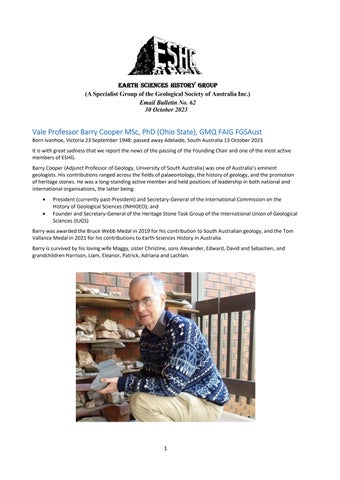
Vale Professor Barry Cooper MSc, PhD (Ohio State), GMQ FAIG FGSAust Born Ivanhoe, Victoria 23 September 1948: passed away Adelaide, South Australia 13 October 2023 It is with great sadness that we report the news of the passing of the Founding Chair and one of the most active members of ESHG. Barry Cooper (Adjunct Professor of Geology, University of South Australia) was one of Australia’s eminent geologists. His contributions ranged across the fields of palaeontology, the history of geology, and the promotion of heritage stones. He was a long-standing active member and held positions of leadership in both national and international organisations, the latter being: • •
President (currently past-President) and Secretary-General of the International Commission on the History of Geological Sciences (INHIGEO); and Founder and Secretary-General of the Heritage Stone Task Group of the International Union of Geological Sciences (IUGS)
Barry was awarded the Bruce Webb Medal in 2019 for his contribution to South Australian geology, and the Tom Vallance Medal in 2021 for his contributions to Earth Sciences History in Australia. Barry is survived by his loving wife Maggy, sister Christine, sons Alexander, Edward, David and Sebastien, and grandchildren Harrison, Liam, Eleanor, Patrick, Adriana and Lachlan.
1
An obituary for Barry Cooper is being prepared by Colin Conor and Bob Major for the March edition of TAG, but in the interim, we reproduce here the notes compiled by Jim Jago for the nomination of Barry for the Tom Vallance Medal. THE CONTRIBUTION OF BARRY COOPER TO STUDIES ON THE HISTORY OF GEOLOGY Introduction Barry was born in 1948 and raised in Melbourne and has been interested in history and geology since he was a child. He was introduced to both subjects at school and his parents supported this interest. By Grade 4, Barry was fascinated by the voyages of explorers. By Year 9 he was being called “Mr History” by fellow students after achieving 100% in a history exam. By Year 9, his best friend also encouraged him to join the “Hawthorn Junior Field Naturalist Club” based in Melbourne’s suburb of Hawthorn. Within a short time, he was founding and editing the Club’s Newsletter “The Junior Naturalist” and writing articles on rocks and fossils. When the Club celebrated its 25th birthday in 1968, Barry wrote an article on its history and had it published in “The Victorian Naturalist”. Around the same time, Barry was appointed “Club Recorder” or Archivist. His historical records from this period are still kept by the Field Naturalists Club of Victoria (FNCV). In Year 12 Barry took the opportunity of studying geology in his final year at school. He gained First Class Honours and entered the University of Melbourne in 1967 graduating BSc (Hons) with First Class Honours in 1970. On completing an MSc in palaeontology, he travelled to the United States where he graduated PhD at Ohio State University in 1974 with research dealing with fossil conodonts. On returning to Australia, he was appointed a palaeontologist with the Geological Survey of South Australia in 1975. He remained attached to the Geological Survey and in other various SA Government roles until retirement in 2009. Early years – South Australia In subsequent years, as well as geological investigations, Barry became active in professional Societies notably as Secretary of the Geological Society of Australia (SA Division), 1975-1978 as well as Secretary of the Royal Society of South Australia 1977-1978. His childhood experience in administration with the Hawthorn Junior Field Naturalists Club proved invaluable. In the early 1980s, he became aware that celebrations were being planned to remember the bicentenary of European settlement in Australia 1988 and the 150th anniversary (sesquicentenary) of South Australia in 1986. Consequently, Barry wrote a public letter in January 1983 to “The Australian Geologist”, the national newsletter of Geological Society of Australia soliciting interest in establishing a new special interest group dealing with the history of geology. The numerical response to this letter from around Australia was remarkable. With the production of the first newsletter in November 1983, more than 50 GSA members had positively responded. Quickly Barry was introduced to Tom Vallance and his links as Vice President Australasia to the “International Commission on the History of Geological Sciences” (INHIGEO). Also based at the University of Sydney was David Branagan. The “Earth Sciences History Group” (ESHG) was formally established during the 7 th Australian Geological Convention in August 1984. Barry became founding Chair of the new Group (1983-1986) Barry also developed a good relationship with Tom Vallance who was readily accessible by telephone an excellent postal correspondence on all historical subjects and willing to accommodate Barry on visits to Sydney. Barry had no hesitation in recommending Tom as a keynote speaker for the bicentenary Australian Geological Convention in 1988. Historical investigations and oral history with the Geological Survey Quite unexpectedly, the letter to “The Australian Geologist” also led to a special request that Barry undertake historical investigations for the Geological Survey to support a sesquicentenary project that would consider the historical development of geology in South Australia over 150 years since 1836.
2
This project, which had been initiated by the Royal Society of South Australia, dealt with all natural sciences and was eventually published for South Australia 150th anniversary under the title, “Ideas and Endeavours -The Natural Sciences in South Australia”. With David Corbett working on the 19th century history of geology, Barry was asked to focus on 20th century history of geology whilst also supporting David’s work. Most notably as part of the joint investigation Barry arranged oral interviews of several eminent South Australian geologists. Prominent interviewees included Sir Ben Dickinson, Reg Sprigg, Lee Parkin and Eric Rudd. Records of these interviews have since been stored in the oral history collection of the State Library of South Australia. Earth Sciences History Group / Australian volumes of “Earth Sciences History” Following its establishment ESHG, with Barry as Chair, actively promoted studies in the history of geology. Associated with ESHG Barry organized history sessions and posters at several geological conferences as follows: • • • •
Adelaide Geosyncline Conference 1983 7th Australian Geological Convention, Sydney, August 1984 8th Australian Geological Convention, Adelaide, February 1986 12th International Sedimentological Congress, Canberra, August 1986
Most notably the 12th International Sedimentological Congress was also sponsored by INHIGEO following the recommendation of Tom Vallance and the History of Earth Sciences Society who provided eminent geologist/historian G. Friedman as international convenor. The success of ESHG at conferences also attracted international interest and Barry was approached to organize a special Australia and New Zealand issue for the newly established international Journal “Earth Sciences History”. All ESHG members were invited to participate, and the success of the response was such that two Australian volumes of “Earth Sciences History were ultimately published. Barry was primary editor but following the successful response Secretary Colin Gatehouse became the second editor. “Rock Me Hard…. Rock Me Soft” When the GSA reached its 40th anniversary, GSA President Peter Legge was determined to have a volume published on the history of the Society. Not surprising, Barry and David Branagan were chosen to compile and write the volume, which was titled “Rock Me Hard…. Rock Me Soft…: A History of the Geological Society of Australia” and published in 1994. Barry organized that every active GSA section prepared its own contribution, but he still had several sections to research and write personally. Barry also spoke on GSA history when INHIGEO held its conference in Sydney in 1994. New GSA members received a free copy of the volume for several years after publication. A Special Historical Supplement was also prepared by Barry for the GSA 50th anniversary in 2002. HSITG During the mid to late 1990s, Barry became heavily committed to administrative responsibilities associated with mineral industry development. His research into history and geology declined but did not disappear. He became involved with the local “History of Science, Ideas and Technology Group” (HSITG) which was established in Adelaide becoming its Vice President and a regular historical speaker on geology. In 2000 he organised a conference in Adelaide involving ESHG and HSITG entitled “Geology over the past millennium”. The meeting concluded with a delightful historical field trip to Hallett Cove. Heritage Stone Mineral industry development also introduced Barry to the building stone industry and its historical development as a heritage stone. In 2002, INHIGEO organised a conference with a heritage stone theme in Portugal. Barry presented a paper with a South Australian stone focus at this meeting.
3
Barry’s heritage stone involvement expanded rapidly from 2007. Barry encouraged the International Union of Geological Sciences (IUGS) in establishing a “Heritage Stone Task Group” (HSTG) for the period 2012-2016, which formally recognised a “Global Heritage Stone Resource”. Barry was founder and Secretary General of HSTG. Portland Stone from the United Kingdom was the first to be recognised in 2015 as a “Global Heritage Stone Resource” whilst Sydney sandstone and Victorian Bluestone are likely to be the first Australian stones to be so designated following publication of citation papers. In promoting HSTG (2008-2016), Barry participated through attendance and formal presentations at many international conferences including: • • • • • • • • •
International Geological Congress, Oslo, Norway 2008 International Association for Engineering Geology & the Environment, Auckland New Zealand, 2009 Global Stone Congress, Alicante, Spain, 2010 International Geological Congress, Brisbane, Australia, 2012 Global Stone Congress, Alentejo, Portugal, 2012 European Geoscience Union conferences, Vienna, Austria 2013, 2015 International Association for Engineering Geology and the Environment, Turin, Italy 2014 Annual General Meeting, Geological Society of America, Baltimore, USA, 2015 International Geological Congress, Cape Town, South Africa 2016
In supporting these meetings Barry also facilitated definitive reports in the IUGS journal: Episodes with the production of model citation papers. An HSTG website was also established, and a volume of papers was organised for publication by the Geological Society of London in 2015. INHIGEO revitalised In Barry’s latter years at the Geological Survey, a revitalization of historical research took place with an initial focus on the history of Cambrian investigations in collaboration with Jim Jago as well as on the history of uranium investigations. The history of uranium in South Australia was encouraged at the Geological Survey and it also excited much interest from the local mineral explorers. The latter were delighted for Barry to speak at the International Uranium Conference in Adelaide in June 2008 as well as and at the International Geological Congress in Oslo, Norway in August 2008. His expanding historical research led to the suggestion from David Oldroyd, a previous Secretary General, that with retirement approaching, Barry may also be interested in the role. This led him to re-establish his interest in organising professional groups through holding the post of INHIGEO Sectary General 2008-2016 and INHIGEO President (2016-2020). Barry felt honoured to be considered and even obligated to become more involved. With Barry’s appointment as INHIGEO Secretary General there was much to work on even though the Commission was well organised by Barry’s predecessors. Achievements during his term of Secretary General and President included: • • •
Establishment of the first INHIGEO website in 2009 Creation of a quarterly Circular Appointment of a separate post of Editor in 2012 with associated transformation of the INHIGEO Newsletter into the INHIGEO Annual Record in 2013 • Organisation of successful Annual conferences, in particular the 50th Anniversary conference in 2017 in Armenia. • Following an ad hoc review by IUGS, revised Terms of Reference were prepared which were approved by IUGS. Changes included: o Removal of the 11 members per country rule o Introduction of Associate Membership and Affiliated Associations o Establishment of the “Vladimir V. Tikhomirov History of Geology Award” with an obsidian medallion. With his term ending in 2020, Barry was Past-President of INHIGEO at the time of his death.
4
BARRY’S REPLY In his reply, published in TAG, Barry expressed how greatly honoured he was to receive the award and his gratitude to those who supported him for it. He pointed out that the medal not only recognised (what he referred to modestly as) his humble contributions to the history of geology in Australia, but also acknowledged the pioneering historical research of Tom Vallance and many others in the ESHG. He related what had motivated him to first suggest in TAG that a Specialist Group dedicated to the history of geology should be established. He acknowledged how Tom Vallance and David Branagan had already cultivated an interest in the subject, and that without Tom’s initial commitment over many years, much of his involvement would not have taken place. Tom was a foundation member of INHIGEO and pressed Barry to join him as the second Australian member of INHIGEO, which led on to Barry’s deep involvement in the organisation in recent years as related above. Barry concluded by commenting that a knowledge of history is a natural study of interest in any well-defined subject or group of people, but that geology is a discipline whose focus is truly historical.
INHIGEO News The latest INHIGEO Circulars can be accessed on the INHIGEO webpage at https://inhigeo.com/circular.pdf
Other items of interest on the INHIGEO website include the Annual record No 55 for 2022 https://www.inhigeo.com/record/55.pdf INHIGEO Anniversary series: a web series at http://www.inhigeo.com/anniversaries.html. These are short articles that focus on a particular event, person, theory or pivotal publication in Earth Sciences and related to a certain year. A couple of recent ones are by Stephen M. Rowland, James Dwight Dana and the Concept of Geosynclines and Victor R. Baker, J Harlen Bretz and the Cataclysmic Late Pleistocene Mega-Flooding Origin of the Channeled Scabland INHIGEO Annual Conference for 2024 is scheduled as follows. 49th INHIGEO Symposium, South Korea (in association with 37th IGC) Deadlines: Abstract submission until February 16th, 2024 Early Bird registration is due until April 26th, 2024. INHIGEO is organizing five sessions and one workshop for the congress. You will find the detailed outlines below and in the scientific programme of the Congress website (http://www.igc2024korea.org/): Under T27: Geoheritage, Geopark, and Geotourism Session 3: Geosites and georoutes in the history of geological sciences Under T38: Anthropocene Session 1: Anthropocene: Historical and Philosophical Perspectives Under T40: History of Geological Sciences Session 1: History of women in geology: trailblazers, leaders and those in the shadows Session 2: History of geoscientific travels in Asia and beyond Session 3: General contributions to the history of geological sciences In the workshop programme Workshop 22 on Hidden histories in the geological sciences INHIGEO Annual Conference for 2025 is scheduled as follows. 50th INHIGEO Symposium, New Zealand, Dunedin (in association with 27th ICHST) https://www.ichst2025.org/
5
Contributions for the ESHG Newsletter Articles for future editions are welcome and can be submitted to the Newsletter Editor, Mr John Draper at jdraper@hn.ozemail.com.au.
Australian Geology Hall of Fame The ESHG webpages include short biographies of influential Australian geologists (see ESHG Biographies (gsa.org.au)) and has recently been expanded, but biographies of many other influential Australian geoscientists are yet to be included here, and a list of possible candidates is given below. Members are welcome to submit short biographies (500-600 words plus a photograph or image and links or main references to more detailed information) of these or any others to the Secretary of the Earth Science History Group c/- eshg.gsa@gmail.com. Of course, we would also welcome more detailed biographies for inclusion
in forthcoming editions of the newsletter. • • • • • • • •
• • • • • • • •
Edward de Courcy Clarke Richard Daintree Samuel Benson Dickinson Norman Henry (Doc) Fisher Charles Gould John Walter Gregory Edwin Sherbon Hills Terence D Hills
Joseph Beete Jukes Clive Loftus-Hills Lyndon Charles Noakes Reginald Claude Sprigg William Harper Twelvetrees George Henry Frederick Ulrich Leonard Keith Ward Samuel Warren Carey
ESHG Business Meeting at AESC2023 at Perth in July 2023 A brief Business Meeting was held at the AESC2023 at the Perth Convention and Exhibition Centre. Three ESHG members were in attendance and there were 4 apologies. A brief report was presented as given below summarising activities in the period since the last meeting held at the AESC in Adelaide in October 2018. Membership Membership has declined markedly to 62 compared with 92 in October 2018 when we last held a meeting—partly in line with overall decline in GSA membership but may also reflect an older demographic interested in history (older members may have allowed their membership to lapse or are deceased). Several members passed away in this interval. There may be others whose relatives have notified head office (and the information not supplied to us) or simply have allowed the membership to lapse. David Branagan John Blockley Ian Mcleod Virginia Passmore Activities in last 2019–2023 •
eNews Bulletins distributed: 7 March 2023 - Email Bulletin 61 10 May 2022 - Email Bulletin 60 14 January 2022 - Email Bulletin 59 3 April 2021- Email Bulletin 58 25 July 2020 - Email Bulletin 57 10 May 2020 - Email Bulletin 56 21 June 2019 - Email Bulletin 55
6
• • • •
Award of Tom Vallance Medal to Barry Cooper (presented at the Virtual AESC 2021); no nominations received for 2023; Preparation of biographies for candidates for naming of medal to be awarded to women geologists (prepared by Ian Withnall and Sue Turner) Maintenance of web pages with Tim Holland Ian Withnall wrote an article on last 20 years of GSA for 70th anniversary (published in September 2022 TAG)
ESHG Committee: Chair — Ian Withnall Secretary — John Jell Treasurer — Paul Blake Newsletter Editor — John Draper Assistant Editor — Cec Murray Victorian representative — Roger Pierson Tasmanian representative — Carol Bacon SA representative — Jim Jago
Email address eshg.gsa@gmail.com
7