Earth Sciences History Group (ASpecialist Group of the Geological Society of AustraliaInc.)
Email Bulletin No. 47 April 8 2015
ItemsofInterest
Geologist and war hero
The February-March issue of WAG has an article by Roger Bateman about Leslie Russell Blake who carried out geological work on Macquarie Island while stationed there as part of a team providing a wireless relay service to Mawson's 1911 Australian Antarctic Expedition. He was on leave from the Geological Survey of Queensland to which he returned after his Macquarie work, before joining the AIF as an artillery officer and eventually being killed in action only about 6 weeks before the armistice in 1918. The link to the WAG newsletter is http://wa.gsa.org.au/WAG/WAG_Feb_Mar_2015.pdf
For those interested in following up more about Leslie Blake, Roger’s article contains a useful bibliography, including references to the recently published book by HJG Dartnall, who has also published several journal articles on Blake and his Macquarie work.
Dartnall HJG, 2014. Lost in the mists: Leslie Russell Blake, Mawson’s Cartographer and Hero of Pozières. Australian Scholarly Publishing (Kew, Victoria). The book can be purchased online from the publishers (cost $49.95).
Mount Coolon (Koala) gold mine – one of Queensland’s forgotten mines
The latest edition of the Queensland Government Mining Journal contains a brief article by Brice Mutton on the largely forgotten historical significance of an isolated gold mine in central Queensland, the Mount Coolon mine.
It is not well known that Mount Coolon (Koala) Mine was the first mine of Gold Mines of Australia Ltd (GMA) which was incorporated in April 1930 and was a forerunner company to the formation of the once great Western Mining Corporation Ltd (WMC). Following examination of some 200 prospects, Mount Coolon (was chosen in 1931 as the company’s first project and mine. It was the rich profits from mining Mount Coolon from 1931 to 1939 that assisted its principals to develop the Kalgoorlie gold prospects and the formation of WMC in 1933.
The first superintendent at Mount Coolon was James Coldham and other mining industry notables to work at Mount Coolon included Ian W Morley (later Queensland State Mining Engineer), Lou Westcott (later General Manager at Mount Morgan Mine), William M Morgan (later Managing Director of WMC), Haughton Dunkin and W B (Bill) Brown. WMC eventually went on to takeover or consume GMA in 1949.
The link to the article is http://www.vision6.com.au/em/message/email/view?a=23788&id=1046341
AESC 2016
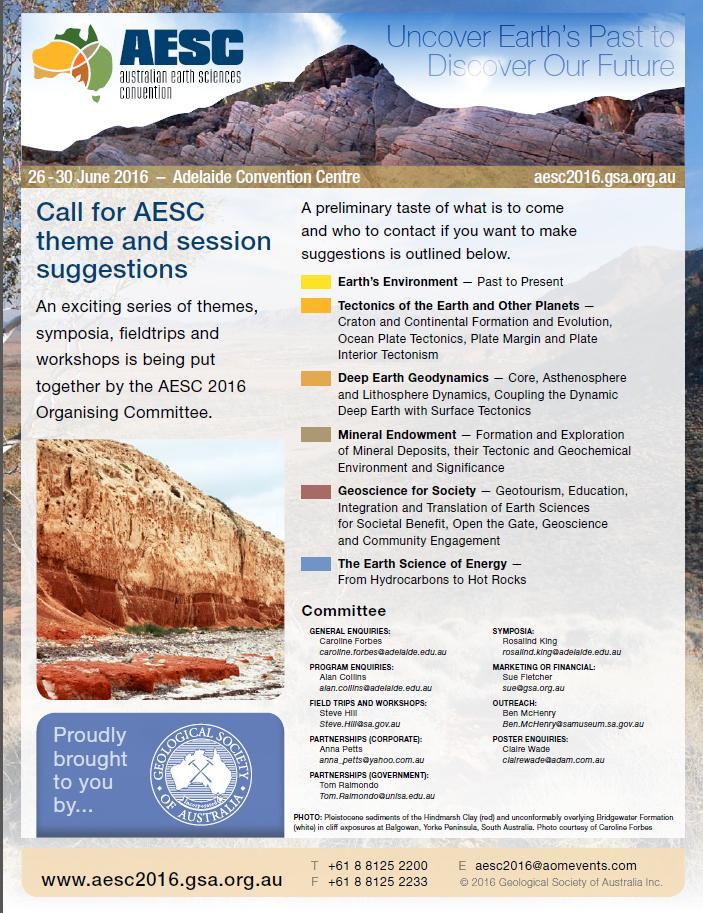
The website for AESC in Adelaide (26–30 June 2016) www.aesc2016.gsa.org.au is live and a flier is appended to the end of this newsletter. The email address in the flier: aesc2016@aomevents.com is the official convention email address managed by All Occasions Events and is also live
In the light of Roger Bateman’s interesting article on Leslie Blake in WAG (see above) and the ongoing remembrances over the next few years of World War 1, the Queensland Committee would like to propose that an
appropriate theme for an ESHG Session might be the war records of Australian geologists and their contributions to geology before, during or after the war. David Branagan has already documented in detail the exploits of Edgeworth David on the Western Front (which might be worth revisiting as a keynote for the theme). However there were certainly others. Two other geologists, both recipients of Military Crosses, come to mind. Roger’s article mentions Charles Morton, a mining engineer friend of Blake’s from his time in Queensland. Morton was in fact later to be Chief Government Geologist in Queensland A quick online search of the war records in the National Archives reveals that Morton was also in the artillery and was awarded the Military Cross, a few days before Blake’s death, probably in the same engagement on the Hindenburg Line. Walter Heywood Bryan, first geologist to graduate from the University of Queensland, and later Professor and head of the Department of Geology and Mineralogy there, was also in the artillery and received a Military Cross. He and Blake had also worked together in the Geological Survey of Queensland before the war.
Bernie Joyce on behalf of the original Victorian Committee members of the ESHG has also passed on some suggestions to Steve Hill. He has also had had discussions with Angus Robinson, Chair of the Geotourism Standing Committee of the GSA. He has suggested that there is scope for three separate but overlapping sessions in Adelaide for ESHG and the Heritage and Geotourism standing committees At Newcastle there was some overlap and integration in several sessions between these three groups.
Themes suggested by Bernie and his colleagues are:
Explorers,
Timelines (e.g. Doug McCann is working on a time line for the Geology Department/School of Earth Sciences at the University of Melbourne from Gregory to Skeats and on to today.
Archives of the ESHG
Some field trip suggestions for AESC 2016, raised by the former Victorian past-Committee, include Hallett Cove and Brachina Gorge and the Golden Spike (Reg Sprigg being an ESHG aspect for the latter)
Appropriate papers from these sessions and field trips could be published in the ESHG Newsletter as was done so successfully after the AESC Canberra meeting of 2010, and also for the 34th IGC Brisbane 2012.
The Committee would appreciate feedback on these ideas.
Call for contributions for the ESHG Newsletter
We are now calling on members to submit suitable articles. Please submit your articles to the Newsletter Editor, Mr John Draper at jdraper@hn.ozemail.com.au by 30 June
As mentioned in previous Email Bulletins, the committee is considering a change of name from Newsletter to a more suitable term. It has been pointed out that the name is confusing (considering that this emailed Bulletin could more appropriately be referred to as a ‘newsletter’, and that ‘Bulletin’ might have been a more appropriate term for the ESHG Newsletter. Therefore the committee continues to be open to suggestions for a suitable name.
David Roger Oldroyd (1936–2014)
David Oldroyd died of cancer in Sydney on 7 November 2014, after a long illness. His death brought memories of his life and works from all parts of the globe, as he had been a good friend to so many over the years. It was fitting that tribute was paid to his work in the History of the Earth Sciences at the June 2014 INHIGEO meeting at Asilomar, California, and that his last published paper on his favoured subject ‘geological maps’ (in Earth Sciences History) arrived in Australia just before his death.
Fortunately we have an interesting autobiographical record of much of David’s life, recorded through an interview in August 2007 at the International Geological Congress (held in Oslo) by his friend, Jiuchen Zhang, Institute for the History of Natural Science, Academica Sinica, Beijing. David was always a very well-organised person, and we can rely on his memories.
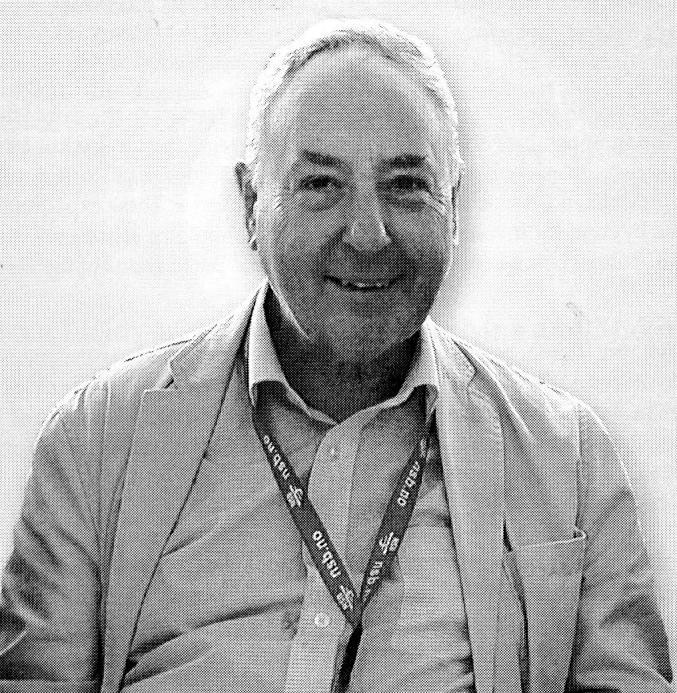
David was born at Luton, 30 miles (48 km) north of London, and lived in a nearby country village for his first ten years. In the war years he was sent, with many other children, to the Lake District in the north of England, to escape from bombing raids.
David’s father had hoped that he would become a medical doctor, so David took appropriate subjects in high school, but found some of the teachers uninspiring. In the event he spent an extra year at high school to improve his marks for entrance to Cambridge University. In 1955 he went to Emmanuel College, Cambridge, hoping to study medicine, but there were no available places, so he entered Science, thinking to study physics. However he found the physics teaching dull, so concentrated on Chemistry, with some study of Geology and Mathematics. His major study for graduation was Chemistry, but, as he said, he preferred Geology, and in particular the fieldwork.
One of the problems which affected his science studies was that he had learnt to play the cello, and he spent a considerable time on this ‘amusement’. Another was the death of his mother, Gladys, just before graduation exams, so his final results were not good enough to allow him to continue for a research degree. Thus he became a high school teacher at John Lyon School, Harrow, northwest of London. He also married [Elizabeth] Jane Dawes, whom he met when she was an oboist in the highly selective National Youth Orchestra in which David also played.
However, several years into teaching, David learnt of a Master’s degree in History and Philosophy of Science. He felt that a Master’s degree might help his advancement in the education field, and so attended the evening course at University College, London, three evenings a week. While he found the history lectures interesting he thought the philosophy lectures were poor.
It was the Cuban crisis which persuaded the family to migrate to New Zealand in 1962, to where the Government was prepared to pay the family’s fares, and the move would prove to be an adventure. One problem was that David had not taken the History and Philosophy of Science Master’s exam before they left England. However, the following year, London University sent the exam to him in New Zealand, and after he passed that he was asked to write a dissertation, choosing the subject himself. He decided on ‘Geology in New Zealand prior to 1900’. This gave the family the opportunity to travel to various parts of the country on camping ‘holidays’. The thesis was passed, and was one of the earliest summaries of early New Zealand geological work. It is still referred to today.
David taught at two New Zealand high schools, in Hastings and then Christchurch, enjoying the second more because of its ‘English’ approach, although he was not enthusiastic about its emphasis on rugby and religion!
Having obtained his Master’s degree David thought it might be possible to obtain a University teaching position, as there was some interest in Australia and New Zealand in setting up courses in the history and philosophy of science, such as had become well-established in the USA and elsewhere. No such courses existed in the antipodes, but some visiting academics in this field helped to create interest. When the University of New South Wales advertised such a position David was appointed, being the sole applicant! As he later said, getting such an appointment today would be impossible for such as he was, having no publications and only a Master’s degree.
When he arrived in Sydney his Head of School said, ‘You must get a doctorate, and if it has not been achieved in five years you will not be appointed permanently’.
Receiving advice from his earlier examiner, Victor Eyles, doyen of English historians of geology, David made contact with Dr. Tom Vallance, at the University of Sydney Geology School, who was already known for his historical work on Australian geology. The contact was the beginning of a life-long friendship. David found the study and writing of a doctoral thesis relatively easier than his previous studies under exam conditions. He decided on the topic: ‘The relationship between mineralogy and chemistry’. A period of study leave greatly helped the completion of his thesis, entitled ‘From Paracelsus to Haüy: the development of mineralogy in relation to chemistry’, and it was successfully submitted in 1974.
Based on his own lecture courses, David published his first book ‘Darwinian Impacts: An Introduction to the Darwinian Revolution’ (1980, reprinted 1983, 1988). This was followed (1986) by ‘The Arch of Knowledge: an Introductory Study of the History and Philosophy and Methodology of Science’ , reprinted 1989, and later translated into Italian, Spanish and Chinese (2008).
In 1990, ‘The Highlands Controversy: Constructing Geological Knowledge through Fieldwork in NineteenthCentury Britain’, perhaps his best-known work, was published. David suggests that this was the reason, that, shortly after, in 1994, he was awarded the Sue Tyler Friedman Medal of the Geological Society of London. Five years later his work was acknowledged by the American History of Science confraternity, with the History of Geology Award of the Geological Society of America in 1999, followed by a Centenary Medal from the Commonwealth of Australia Government. David was elected a Fellow of the Australian Academy of the Humanities in 1994, the first historian of science to be so elected, and in 2002 he was elected a Member of the International Academy for the History of Science.
Though these awards were certainly greatly appreciated by David, he probably achieved his greatest satisfaction in the help he gave to many colleagues, from innumerable countries, whose first language was other than English, in preparing their papers for publication. The amount of time he devoted to such tasks must have been enormous. He did this for papers given at innumerable conferences, and for issues of Earth Sciences History, which he edited between 2007 and 2013, and earlier for Annals of Science, Metascience (in the formation of which he played a seminal role) and numerous other journals.
His most recent award was the Vallance Medal, funded in memory of David’s good friend, the noted Australian historian of science (although Tom Vallance would probably have preferred to be remembered as a distinguished metamorphic petrologist). This was awarded in absentia at the 2014 Australian Earth Science Convention held at Newcastle, New South Wales, by the Earth Sciences History Group of the Geological Society of Australia, of which David was a member.
My wife and I were privileged to travel with David and Jane to many parts of eastern Australia and overseas. We were ‘on the spot’ to see the beginning of his fieldwork on the book ‘Earth Cycles’ (2006) which begins with an interesting discussion on the Yorkshire song ‘On Ilkla Moor bah’t ‘at’. A particularly special memory remains of our visit to the Lake District in northern England in 1987. Here, in addition to recalling his memories of the WW2 years we were able to visit localities and remember personalities which David had brought to life in his ‘Earth, Fire, Water and Ice: Two hundred Years of Geological Research in the English Lake District’. The study had taken him back to his war years as a young boy, when he was first in that beautiful locality. It was probably appropriate that David’s last field trip was to that same locality at the History of Science meeting in 2013.
David and Jane suffered a heavy loss in 2013, with the sudden death of their younger son, Nicholas.
David was given an affectionate farewell by many friends from a wide range of occupations. His fellow musicians from the Ku-ring-gai Orchestra paid tribute to his memory at his funeral, mixing music appropriately with spoken memories of a fulfilling life by his son Dr Ben Oldroyd, academic colleagues including David Miller, and many friends.
We will not see another ‘David’ in our time. David’s and Jane’s dogs will be inconsolable.
David Branagan,
Sydney, Australia.
ESHG Committee:
Chair Ian Withnall
Secretary John Jell
Treasurer Paul Blake
Newsletter Editor John Draper
Assistant Editor Cec Murray
WA representative John Blockley
NSW representative David Branagan
Victorian representative Roger Pierson
Tasmanian representative Carol Bacon
SA representative Jim Jago