Earth Sciences History Group (ASpecialist Group of the Geological Society of AustraliaInc.)
Email Bulletin No. 46 February 9 2015
ESHG Committee News
A belated Happy New Year to ESHG members.
The committee met last week and accepted an invitation from the Commission on the History of Geological Sciences (INHIGEO) for ESHG to apply formally to become an affiliate
The primary objective of INHIGEO is the promotion of studies into the history of the geological disciplines in an international context. INHIGEO also specifically aims to encourage national and regional groups as well as other international organisations having complementary objectives. In order to better encourage organisations having similar objectives, INHIGEO has recently established the category of “INHIGEO Affiliated Association” defined as an organisation, with similar objectives to INHIGEO National and regional history of geology groups are encouraged, in particular, to affiliate.
The Secretary of an INHIGEO Affiliated Association will receive all routine communications from INHIGEO with the expectation that similar information will be provided in exchange to either the INHIGEO Secretary General or INHIGEO Editor or both. Affiliates are encouraged to report on INHIGEO activities as well as to advertise and promote INHIGEO, its conferences and publications, via their communication channels. Affiliated Associations will be permitted to state formally in their publications and official correspondence that they are :“Affiliated with the International Commission on the History of Geological Sciences (INHIGEO)”.
The status of “INHIGEO Affiliation Association” is ongoing unless terminated by the INHIGEO Board on recommendation from the Secretary General or by the Affiliate itself.
Accepting the invitation was really a ‘no-brainer’ as we believe that such affiliation will promote greater linkage between organisations with similar objectives.
Consequently a formal application form has been submitted to INHIGEO and Barry Cooper, the Secretary General, advises that it will be considered in April/May.
Call for contributions for the ESHG Newsletter
The committee discussed various ideas for the next newsletter, and we are now calling on members to submit suitable articles. Please submit your articles to the Newsletter Editor, Mr John Draper at jdraper@hn.ozemail.com.au by 30 June.
As mentioned in the previous Email Bulletin, the committee is considering a change of name from Newsletter to a more suitable term. It has been pointed out that the name is confusing (considering that this emailed Bulletin could more appropriately be referred to as a ‘newsletter’, and that ‘Bulletin’ might have been a more appropriate term for the ESHG Newsletter. Therefore the committee continues to be open to suggestions for a suitable name.
Death of David Oldroyd (1936–2014)
Sadly we must report the death of the 2014 Tom Vallance medal recipient, David Oldroyd, who was Honorary Professor, University of New South Wales. David died on 7 November 2014 in Sydney The medal recognised his outstanding contributions over many years to the evolution of geological ideas. He was also active in INHIGEO and was past Secretary General and Vice President Oceania, David Oldroyd. David made an enormous contribution to INHIGEO and to the history of geology generally via papers, major editing contributions and his several books that included The Highlands Controversy: Constructing Geological Knowledge through Fieldwork in Nineteenth-Century Britain and Thinking About the Earth: A History of Ideas in Geology
David was well known and well liked so will be greatly missed.
An obituary will be published in the TAG in due course and in the next ESHG newsletter. However, several tributes have been published already, and you can access these using the following links:
http://www.episodes.co.in/contents/2014/december/pp333.pdf
http://historyofgeologygroup.co.uk/david-oldroyd-20-january-1936-7-november-2014/
Other itemsofInterest
Thanks to Angela Riganti and Peter Downes for passing on this link about the 1880s notebook by Henry M. Cadell, a work of science and art recording his observations and experiments on mountain-building.
Every Earth scientist keeps notebooks either field notebook, recording observations on the outcrop or maybe lab notebooks, marking a record of tests conducted. Cadell's notebook crosses the boundary from pure necessity into an artistic timecapsule into the history of science.
http://space.io9.com/this-geological-field-notebook-is-an-elegant-look-at-mo-1588374224
The latest edition of the Journal of Australasian Mining History (Volume 12) was published in October 2014 The table of contents is given below, but details of authors and abstracts of their articles can be accessed at http://www.mininghistory.asn.au/wp-content/uploads/2014/12/2-indexabstractdoc14.pdf
ROBERT ASHLEY The Life and Times of Edward Bovill Chandler: In Search of El Dorado LLOYD CARPENTER A Conspiracy to Silence: Reports of Otago gold prior to 1861
PETER DAVIES and SUSAN LAWRENCE Bitumen paper pipes and technology transfer on the Victorian goldfield GALIINA (KAL) ELLWOOD Aboriginal prospectors and miners of tropical Queensland, from pre-contact times to ca.1950
APURNA KUMAR GHOSH and SENTAI WANG Evolution of underground coal mine explosion law in Australia, 1887-2007
PHILIP HART Peter Ferguson and his New Era
BRIAN R. HILL Early History of Graphite Mining in South Australia
DAVID LEE The Development of Bauxite at Gove, 1955–1975
KEN McQUEEN Gold in the ‘Mundic’: The Saga of Dargue’s Reef, Majors Creek, NSW
DAVID. J. TURTON Codifying coexistence: Land access frameworks for Queensland mining and agriculture in 1982 and 2010
CLIVE BEAUCHAMP Disaster at the Australian Agricultural Company’s Mine, Hamilton NSW, 1889
VICTOR BIBBY William Bibby: Gold Miner, Engineer & Pioneer - His Life in Australia from 1859 to 1888
KEITH PRESTON Golconda Goldfield, Tasmania: a source of wealth or despair?
BOOK REVIEWS
Clement Earp, The Yea Goldfields, Reviewer: Robert W.P. Ashley
Ken Grubb, Silver Hill: The University of Queensland Silver Mine precinct, Reviewer: Peter Claughton
Denis A. Cumming, Richard G. Hartley, Westralian Founders of Twentieth Century Mining: Career Biographies of Mining Engineers, Mine Managers and Metallurgists who Worked in the Western Australian Mining Industry 18901920, Reviewer: Mel Davies
Scarborough and The Rotunda the William Smith Museum of Geology
In October last year, while I was visiting the UK, the announcement was made of the Top 100 Geosites in the United Kingdom as part of Earth Science Week The UK and Ireland feature some of the most diverse and beautiful geology in the world, spanning most of geological time, and the Geological Society and partner organisations celebrated this unique geo-heritage by compiling a list of 100 Great Geosites The society took public nominations for its list, which were described as "anything which highlights the importance of geology to our lives". More than 400 different suggestions were submitted, mostly via social media. The 100 sites were divided into 10 categories, and more than 1,200 people then voted in the poll.
The top sites can be accessed at https://www.geolsoc.org.uk/100geosites
These were the most popular geosites in each of the 10 categories:
1. Landscape: Assynt in the Scottish Highlands, where the remarkable Suilven and other peaks were shaped by glaciation.
2. Industrial and economic importance: Ironbridge Gorge in Shropshire, site of much early mining and industry, named after the pioneering bridge that spans the Severn River.
3. Historical and scientific importance: Siccar Point in Berwickshire, the site of Hutton's Unconformity.
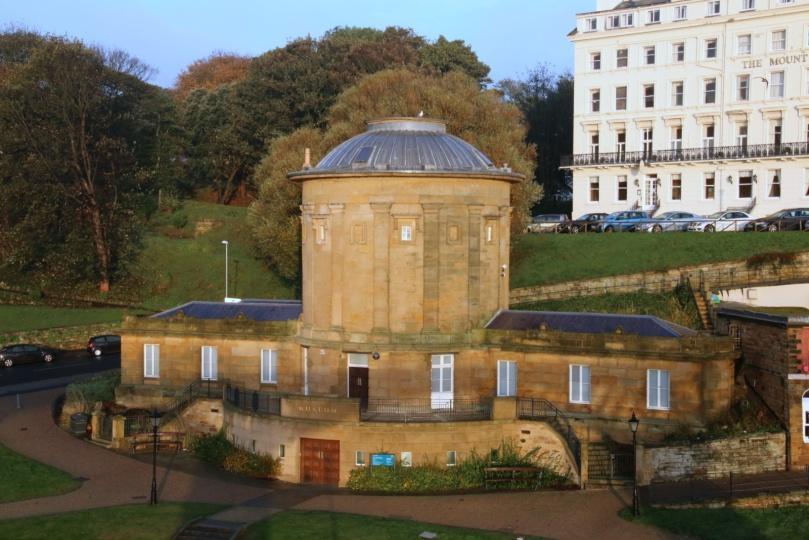
4. Educational: Rotunda Museum, Scarborough, built in 1829 in a design suggested by the "father of English geology", William Smith.
5. Adventurous: Staffa in the Inner Hebrides, a volcanic island famous for its hexagonal basalt columns.
6. Human habitation: Stonehenge, the iconic prehistoric monument in Wiltshire.
7. Coastal: Hunstanton Cliffs in Norfolk, noted for their contrasting, colourful layers and many fossils.
8. Outcrops: Craster, Northumberland, where the Great Whin Sill can be seen supporting Dunstanburgh Castle, alongside other formations like Greymare Rock.
9. Folding and faulting: Millook Haven, part of a section of Cornwall's north coast where spectacularly folded beds of sandstone and shale are exposed.
10. Fire and ice: Glencoe, one of Scotland's most famous valleys. Cut by a glacier during the last ice age, it runs between steep mountains that expose the remains of an ancient super volcano.
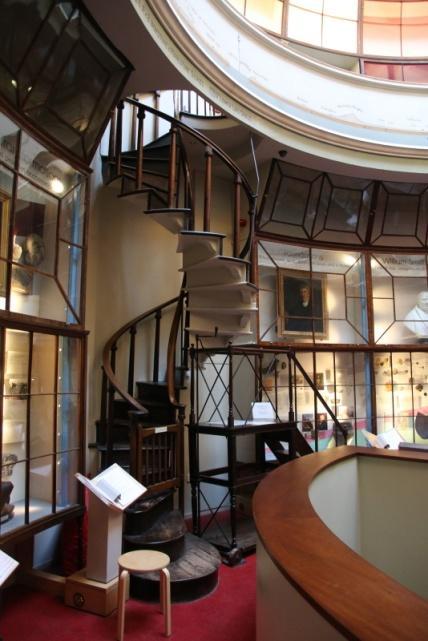
The Rotunda Museum in Scarborough, as Peoples’ Choice in the Educational Category, beat other notable contenders as the Natural History Museum in London, the Our Dynamic Earth Museum in Edinburgh and the Lyme Regis beaches. The Rotunda Museum, described as the finest surviving purpose-built museum of its age in the UK, was built in 1829 to a design suggested by William Smith, to illustrate his geological principles It was a private museum for scientific debate, although the public were allowed in at a charge.
William Smith spent the last 19 years of his life in Scarborough, having come to live there in 1820, after having published his famous map in 1815 and forced to sell his precious fossil collection to the government having been bankrupted in 1819. Smith made a great contribution to the intellectual life in Scarborough in its heyday as a spa town. For a time, his nephew and pupil John Phillips, also lived there, and together they gave many geological lectures. Phillips recorded his uncle’s life and work, and later became Reader and Professor of Geology at Oxford, publishing the first global geological timescale in 1841.
It so happened that we had planned to overnight in Scarborough on our way south to London from Edinburgh. All I knew of Scarborough was that it was the classic English seaside town Therefore, I convinced my wife that we had to check the museum out.
The museum is quite small, compared with the other contenders in the national poll, but has a unique charm. It was extensively refurbished in 2008, but the upper floor, retains its 19th century ambience. The exhibits there record the contributions made to the geology of Yorkshire by Smith and his contemporaries and protégées in the first half of the 19th century. A frieze around the balcony above the showcases reproduces an original cross section of the Yorkshire coast by Phillips. Some of Smith’s original fossils, on loan from the Natural History Museum, are on display, as is a three-quarter size replica of his famous map.
The floor below houses the more modern Shell Geology Now Gallery with interactive displays and presenting some of the practical applications of Smith’s work. It also houses the Speeton Plesiosaur, dinosaur footprints and the skeleton of Gristhorpe Man, a bronze-age warrior discovered near Scarborough in 1834.
In addition to the museum, visitors to Scarborough can also take the two to three-hour William Smith Trail that visits many sites associated with Smith during his time in the town, as well as the Middle to Late Jurassic
succession exposed on Castle Hill headland. Unfortunately, our schedule did not allow us to do this, so it will have to be for another time.
For anyone planning a tour of the UK and interested in the history of geology, I would recommend a visit to Scarborough, even if battered fish and chips and tacky amusement arcades are not your thing. Of course, the winner of Category 3, Siccar Point, is also a must.
Ian Withnall
ESHG Committee:
Chair Ian Withnall
Secretary John Jell
Treasurer Paul Blake
Newsletter Editor John Draper
Assistant Editor Cec Murray
WA representative John Blockley
NSW representative David Branagan
Victorian representative Roger Pierson
Tasmanian representative Carol Bacon
SA representative Jim Jago