Earth Sciences History Group (ASpecialist Group of the Geological Society of AustraliaInc.)
Email Bulletin No. 61 7 March 2023
Call for nominations for Tom Vallance Medal 2023
Nominations are now open for Tom Vallance Medal to be presented at AESC 2023 in Perth (27-30 June). The deadline for nominations for the award has been extended to Friday 7 April 2023.
A nomination form will accompany this Bulletin as an email attachment, but it can also be downloaded from the ESHG website. Please note that Nominees, Nominators and the Supporters should all be GSA members.
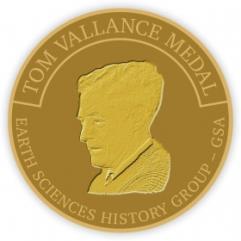
The Tom Vallance Medal was introduced in 2011 to recognise people who have made a significant contribution to researching, recording, investigating, documenting and/or publishing about people or places or events of historical importance to the geological sciences in Australia or Australasia. It is awarded biennially and presented at the biennial Convention of the Geological Society of Australia (or similar event).
Dr Thomas George Vallance (1928–1993), geologist and historian of science, was formerly Associate Professor at the University of Sydney. Originally a petrologist, his work tracing geological expertise in Sydney during the late 18th and early 19th centuries shed unexpected light on scientific activity in our young colony and ignited his interest in the history of geology and early workers in the earth sciences. He researched and published many articles and papers on famous, infamous and little-known early pioneers in this field. His legacy was in the form of 3000 index cards of information, memorabilia and jottings on miners, geologists, surveyors, prospectors and mining engineers, which was compiled over a number of years and gathered from a wide variety of sources - especially from 19th century mining journals. After his death this rich resource was compiled into a database, which should prove invaluable for researchers. The 1994 meeting of INHIGEO was dedicated to the memory of Tom Vallance, a foundation member and for some years one of its Vice-Presidents
Past Tom Vallance Medal Recipients
• 2021, Professor Barry Cooper, announced and presented virtually at the 2021 AESC in Hobart.
• 2018, Dr Susan Turner, announced at the AGC in Adelaide in October 2018, and presented privately to Susan in Brisbane
• 2016, Tom Darragh, announced at AESC2016 in Adelaide and presented at a meeting of the Victorian Division on 28 July 2016.
• 2014, David Oldroyd, presented at AESC2014 in Newcastle.
• 2012, David Branagan, presented at the 34th IGC 2012.
ESHG Business meeting
The Chair, Ian Withnall, is currently planning to attend the AESC in Perth and has approached the conference organisers about providing a time slot for a face-to-face ESHG Business meeting. Notice of the meeting will be given when a time and venue is confirmed, but it may also be possible to have a hybrid meeting with other ESHG members able to attend virtually. One item on the agenda will be the formation of a new committee as discussed below.
INHIGEO Circular and other publications
The latest INHIGEO Circular can be accessed on the INHIGEO webpage at https://inhigeo.com/circular.pdf
Other items of interest on the INHIGEO website include the Annual record No 54 for 2021 (https://inhigeo.com/record/54.pdf) which was released last year.
The articles on the Anniversaries page are also worth browsing through. One that caught my attention recently, marked the 70th anniversary of oceanographic cartographer Marie Tharp’s discovery of the mid ocean ridge rift valley in 1952, and her contribution to the revolution in the Earth Sciences Trained in geology and mathematics, she was employed by Maurice Ewing at Lamont–Doherty Observatory to do drafting and subsequently worked with Bruce Hazeen plotting echo soundings collected by ships, initially those traversing the Atlantic Ocean, and subsequently all of the world’s oceans.
https://www.inhigeo.com/anniversaries/S._Newcomb_Marie_Tharp_mapping_the_seafloor_70_years_ ago.pdf
An article of Australian interest is by ESHG member, Carol Bacon, on Tasmanian naturalist and mineralogist, William Frederick Petterd (1849–1910), author of the first catalogue of the minerals known to occur in Tasmania.
https://www.inhigeo.com/anniversaries/INHIGEO_Anniversary_Petterd.pdf
An article by ESHG member Wolf Mayer on William Keene (1798–1872 Geologist, Engineer and Collector, in France and New South Wales) was mentioned in the previous eNews.
Upcoming INHIGEO Conference
48th INHIGEO Annual Symposium, Kraków (Poland), 31 July – 4 August 2023. This year’s INHIGEO conference will be held at the headquarters of the Polish Academy of Arts and Science, Kraków. There will be a 1-day mid-conference fieldtrip and a 5 days preconference fieldtrip (26–30 July). Main topics of the conference will be the
• history of geological mapping,
• history of mining and old mines as objects of geological and mining heritage and their contemporary use (tourist, balneological objects, etc.)
• history of geodiversity conservation and the formation of geoparks
• origin and development of geological research
• general contributions and biographies of famous geologists
IGC 2024
INHIGEO has submitted two session proposal forms for the 37th International Geological Congress (IGC 2024), which will take place on August 25–31, 2024, at BEXCO, Busan, Republic of Korea.
Geosites and Georoutes in the History of Geological Sciences
The comparative study of geosites and georoutes of historical relevance is of great importance, because it contributes significantly to recognize and understand the foundation, the development, and the potential of the geological sciences, as well as their role in human society. The historical geosites and georoutes are not just places with a history, but places that have made history in the field of the geological sciences. In these sites and itineraries, the observations of some specific features determined new ideas, theories and interpretations which have changed human understanding of the geological phenomena.
It is evident that the historical geosites and georoutes are landmarks for the history of science, as well as milestones for modern geology. Most of the sites described in the geological literature between the
18th and the 19th century, can be considered the cradles of the modern geological fieldwork and the birthplaces of new ideas on the history of the Earth The importance of this "re-treading" of the early geological fieldwork and its potential for possible new forms of geotourism can be now regarded as highly significant, in particular for the benefit of the growing network of the Geoparks.
The aim of this session is to invite papers from different perspectives in sciences and humanities, to present and compare case studies regarding places and routes, particularly (but not exclusively) in the history of geological fieldwork, within an interdisciplinary framework including the history of geosciences and geoheritage
Anthropocene, History and the Geosciences: contributions to contemporary debates (
The concept of Anthropocene, as a possible new geological epoch to describe the most recent period in Earth’s history when anthropic activity has begun to exert a significant impact on Earth’s climate, geology, and ecosystems, has been widely discussed in recent years not only within the community of geologists, and in particular in the field of stratigraphy, but also among historians, philosophers, earth systems scientists, ecologists, sociologists, economists as well as politicians. Needless to say, the idea that there can be a unit of geological time where the anthropogenic footprint is clearly detectable, has encouraged lively debates among historians of science and technology, who have always been interested in the scope, meanings and effects, even from an environmental point of view, of technoscientific and industrial processes. It is now a matter of fact that this very interdisciplinary topic has gradually attracted a growing interest worldwide from the media, the public and even policymakers, as it is directly linked to the issue of the global emergency of climate change. The notion of Anthropocene aims at highlighting the potential role as a major geological agent acquired by humankind over the 20th century, at the time when the “fossil fuels economy” has become globally established.
Therefore, on the one hand, geosciences have been focusing on identifying the stratigraphic markers and the geological proxies of this new epoch. Indeed, a working group on the Anthropocene has been established within the Subcommission on Quaternary Stratigraphy.
On the other hand, historical disciplines, and more specifically the history and philosophy of science, have recently launched a variety of studies on the genesis, historical genealogies and development of the Anthropocene event and concept. The research in history of geological sciences can provide, in many ways, useful contributions to the current debate on the history, definition and possible establishment of the new epoch called Anthropocene. In fact, several classic studies in the history of the Earth sciences have been focused on the scientific, philosophical, and socio-political contexts of the definition of new geological epochs from the 19th century to date.
Moreover, the history of geosciences can help shed light on the interactions between geosphere and anthroposphere from a historical perspective. It can then help to reconstruct the history of those theories of the Earth, especially as a complex system, in relationship with the recent notion of Anthropocene. The aim of this session is to invite papers from different perspectives in sciences and humanities, to contribute to define the concept of Anthropocene and evaluate it within the history of geosciences.
Australian Mining History Association News
The 27th AMHA conference will be held at Reefton on the west coast of the South Island of New Zealand, 15-22 October 2023. A key theme of the conference will be Geoconservation and Mining Heritage – the Way Forward, but presentations related to other mining history topics will also be considered.
Offers of both oral and poster presentations can be made by submitting an extended Abstract. To ensure a consistent format and assist with editing, please use the abstract template, which can be downloaded as a Word file at the link below. Abstracts should be up to a one page in length including
text, images and references and will be printed on a single page. Send Abstracts to John Taylor at taylor.john.nz@gmail.com
See https://www.mininghistory.asn.au/next-conference/ for links to the preliminary program, abstract template, accommodation and registration.
Contributions for the ESHG Newsletter
Articles for future editions are welcome and can be submitted to the Newsletter Editor, Mr John Draper at jdraper@hn.ozemail.com.au We have had one rather long article at hand for some time but would like to include more.
Australian Geology Hall of Fame
The ESHG webpages include short biographies of influential Australian geologists (see ESHG Biographies (gsa.org.au)), but biographies of many other influential Australian geoscientists are yet to be included, and a list of possible candidates is given below.
Members are welcome to submit short biographies (500-600 words plus a photograph or image and links or main references to more detailed information) of these or any others to the Earth Science History Group c/eshg.gsa@gmail.com Of course, we would also welcome more detailed biographies for inclusion in forthcoming editions of the newsletter as requested above.
• Edward de Courcy Clarke
• Richard Daintree
• Samuel Benson Dickinson
• Norman Henry (Doc) Fisher
• Charles Gould
• John Walter Gregory
• Dorothy Hill
• Edwin Sherbon Hills
• Terence D Hills
ESHG Committee:
• Joseph Beete Jukes
• Clive Loftus-Hills
• Lyndon Charles Noakes
• Reginald Claude Sprigg
• William Harper Twelvetrees
• George Henry Frederick Ulrich
• Leonard Keith Ward
• Samuel Warren Carey
The current committee is listed below but has been in place now since 2014 and the committee feels it is time to hand the baton on. The committee has traditionally rotated around the State Divisions but approaches to some of the State’s that have not provided a committee in recent decades have not been successful. As the COVID Pandemic and the use of Zoom and Teams has shown us, living in different jurisdictions is no longer an impediment to forming a committee. Therefore, it is probably time for a committee to be spread across Australia This will be discussed at the business meeting in Perth, but feel free to provide expressions of interest in the interim, especially if you will not be attending
Chair Ian Withnall
Secretary John Jell
Treasurer Paul Blake
Newsletter Editor John Draper
Assistant Editor Cec Murray
Tasmanian representative Carol Bacon
SA representative Jim Jago
Email address eshg.gsa@gmail.com