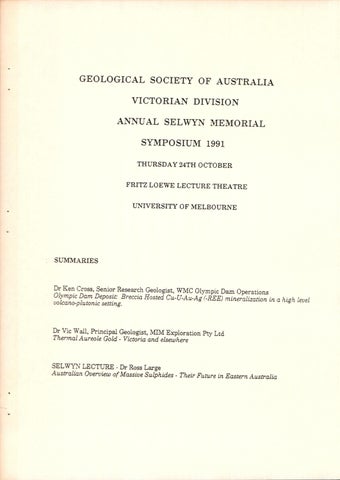
GEO LOG ICA L SOC IET Y OF AUS TRA LIA VIC TOR IAN DIV ISIO N .A.NNUAL SEL WY N ME MO RIA L SYM POS IUM 1991 THU RSDA Y 24TH OCTO BER FRIT Z LOEWE LECT URE THE ATR E UNIV ERSI TY OF MEL BOU RNE
SUMMARIES
Dr Ken Cross, Senior Research Geologist, WMC Olympic Dam Operations Olympic Dam Deposit: Breccia Hosted Cu-U-Au-Ag (-REE) miner alization in a high level uolcano-plutonic setting.
Dr Vic Wall, Principal Geologist, MIM Exploration Pty Ltd Thermal Aureole Gold - Victoria and elsewhere
SELWYN LECTURE - Dr Ross Large Aust:ralian Overview of Massive Sulph ides - Their Future in Easte rn
Aust:ralia
THE OLYMPIC DAM DEPOSIT : BRECCIA -HOSTED CU-U-AU-AG-(REE) MJNERALISATION IN A ffiGH LEVEL VOLCANO-PLUTONIC SETTING.
INTRODUCTION The Olympic Dam Cu-U-Au-Ag deposit is located 520km NNW of Adelaide, South Australia. It was discovered by Western Mining Corporation Ltd (WMC) in 1975 1 and has been brought into production as a joint venture between WMC and the BP Group. The deposit is currently being mined at a rate of 1.7 million tonnes per annum and the ore is processed on site. Metal production for 1990/91 was approximately 48 ,000 tonnes of refined copper, 1,500 tonnes ofU3O8, and 1000kg of Au. Ore reserve data as at 30/6/1991 are as follows: ·.·
.
• .• CLASSIFICATION
Ag git
PROVED RESERVE Copper-Uranium*
28
2.9
0.9
0.4
8.2
Gold (Copper)
2.1
1.7
0.3
3.4
3.3
MEASURED AND INDICATED RESOURCE
450
2.5
0.8
0.6
6
* Contained within the measured and indicated resource
GEOLOGICAL SETTING The deposit is situated within the Stuart Shelf geological province where a platform sequence of flat-lying Middle Proterozoic , Late Proterozoic (Adelaidean), and Cambrian sediments unconformably overlies the eastern margin of the Gawler Craton. The cratonic basement includes deformed Early Proterozoic granites and meta-sedim ents of the Hutchison Group, and undefonned Middle Proterozoic Hiltaba supersuite granitoids and related bimodal felsic and mafic (locally ultramafic) Gawler Range Volcanics (Figs 1 and 2). To the east, the NNW trending Torrens Hinge Zone forms a well-defined divide between the undefonned sediments of the Stuart Shelf and their thicker, folded and faulted equivalents in the Adelaide Geosyncline (Fig. 2). The deposit is hosted by the hematite-rich Olympic Dam Breccia Complex (ODBC). The ODBC lies at the intersection of a major NNW trending tectonic and gravity corridor (lineament G2 of O'Driscoll, 1985, 1990; Fig. 2) and two sub-parallel WNW trending lineaments (gravity lineament G9C and photolineament corridor PDl; O'Driscoll, 1985, 1990; Fig. 2), and is one of a number of sites of coincident gravity and magnetic highs in the Stuart Shelf region. Most of these geophysical anomalies may be linked to hydrothermal iron-rich systems in the basement rocks. The ODBC occurs within the Middle Proterozoic (1.59Ga) Roxby Downs Granite (RDG; a quartz-poo r syenogranite with transitional A-Type/I-Type characteristics) which lies beneath a minimum vertical thickness of 260m of Stuart Shelf sediments (Fig. 3). The RDG is an evolved part of the Burgoyne batholith, which is in tum 1 See Reeve et al. (1990) for a summary of the exploration history, and Watt and Smith, (1990), for a description of current mining practices.
a member of the widespread anorogenic Hiltaba supersuite/Gawler Range Volcanics association (HGRV). Anorogenic volcano-plutonic provinces of HGRV-type occur on several continents and commonly have iron-rich mineral deposits (the K.iruna-Type deposits of Meyer, 1988) associated with them. The Olympic Dam deposit stands out amongst such deposits in that it contains economic concentrations of several other metals. The ODBC as a whole is estimated to contain more than 3xl07 tonnes of copper, 106 tonnes of uranium, 104 tonnes of silver, and 103 tonnes of gold. It is the world's largest known uranium "resource" and hosts approxima tely one third of the world's Proterozoic gold "resource" . It also contains approximately 107 tonnes of rare earth elements in low grade zones (EREE < 0.5 %), containing very finely disseminated bastnaesite and florencite, but these metals cannot be recovered economically using current technology .
GENERAL CHARAC TERISTIC S The ODBC essentially consists of an irregular array of elongate, steeply dipping, locally interconnec ting, variably mineralised breccia zones. These predominantly trend NW and WNW, although E-W and NE-SW trends are common in parts of the complex. The breccias range in composition from granite-rich (sericitised , locally chloritised and/or silicified) to hematite-rich (locally silicified) types. Many individual hematite-rich breccia zones grade outwards through granite breccias with hematite-rich matrices, to hematite-altered granite/gra nite breccia and/or localised hematite-veined granite, to essentially intact sericitised granite. Clasts in most breccia units are typically angular with dimensions ranging from microscopic to metres, or tens of metres. Layering and discontinuous 'streaming' fabrics are locally developed. Subordinate (but locally dominant) clast types include ultramafic to felsic volcanics, hematite± quartz±ser icite sandstone, highly altered lithologies of ambiguous parentage, and vein fragments consisting of various combinations of copper sulphides, fluorite, barite, and siderite. Thin barite ± fluorite veins and vein segments criss-cross many breccia bodies. A prominent late-stage conjugate array of laminated barite±flu orite±carb onate±Cu( Fe) sulphide veins in the ODBC and a corresponding fracture set in the cover sequence are interpreted by Sugden and Cross (1991) to have formed in response to the stress regime which caused Delamerian (Cambrian) compression in the Adelaide Geosyncline (see Preiss, 1989). The central part of the ODBC is occupied by an irregular mass of barren, peripherally silicified, hematite-q uartz breccias (Figs 2 and 3). In total, the hematite-rich breccias extend for at least 5km in a WNW direction, with a maximum width approaching 3km (see inset, Fig. 3). They are surrounded by an elliptical halo (7 x 5km) of weakly to intensely altered and brecciated granite. The principal breccia-forming mechanisms appear to have been hydraulic fracturing, tectonic faulting, chemical corrosion, phreatomagmatism, and gravity collapse. Many of the hematite-rich breccias are believed to have been generated by repetitive alteration and fragmentation of pre-existing granitic breccias. Many hydrothermal breccias also incorporate clasts of lithologies which formed in surficial environments. These include subaerial pyroclastic s and laminated lacustrine hematite+ quartz±ser icite sandstones which locally contain altered and mineralised granite dropstones/bombs. A variety of intensely altered ultramafic, mafic and felsic dykes and their tuffisitic/peperitic (intrusive pyroclastics) equivalents intrude the breccias. Locally these form diatreme structures. A vertical section through one of these diatremes is shown on Figure 3. It has a root zone of ultramafic and mafic dykes which pass upward into a phreatomagmatic/tuffisitic zone, and this in tum passes abruptly or gradationally into a crater sequence of subaerial/subaqueous pyroclastics and epiclastics.
MINERALISATION Ore zones account for only a minor proportion of the total volume of the ODBC, but weak Cu, U, Au, Ag, Ba, F, and REE mineralisation is widespread. Most of the economic Cu-U mineralisation occurs within the more hematite-rich host rocks. The principal copper sulphide minerals are chalcopyrite, bornite and chalcocite (djurleite-digenite), and the principal uranium mineral is pitchblende, which may be accompanied by with minor amounts of coffinite and brannerite. Uraninite is rare. These copper and uranium minerals occur as disseminations, microveinlets and fragments. In fact, fragments of sulphide and sulphide-bearing rock fragments are a conspicuous component in many breccias. Minor silver (averaging 3.Sg/t) and gold (averaging 0.6 g/t) occurs with almost all copper mineralisat ion. The gold occurs as extremely fine-grained particles within and near copper sulphides, whereas the silver is largely in solid solution within the copper sulphides. Higher grade gold mineralisation (-5.0 g/t) occurs in narrow, complexly shaped zones around the margins of the central body of barren hematite-quartz breccias. The hosting
these gold zones rocks are typically strongly sericitised granitic breccias or sericite/chlorite veined hematitic breccias. The sulphide mineralisation displays a broadly vertical zonation from pyrite at depth, upwards to chalcopyrite, then bornite and chalcocite. Comparatively minor, essentially sulphide-free zones bearing native copper or gold occur locally above or adjacent to the chalcocite bearing zones. Because mineralogical boundarie s and, to a lesser extent, lithological boundaries within the ODBC are highly irregular and locally convolute d, the above zonation is also developed laterally on scales of metres to hundreds of metres. The interface between chalcopyrite- and bornite-bearing zones is typically sharp and readily mappable (Fig. 3). Copper, uranium and silver grades in the bornite-chalcocite zones are usually 2 to 3 times higher than those in adjacent chalcopyr ite (-pyrite) zones, and the former are the focus of current production.
DISCUSSION AND GENETIC HISTORY The ODBC (and its complex mineralogical zonation pattern) formed in a dynamic high level system displaying evidence of both magmatically and seismically driven hydrothermal activity. Faulting, brecciation, alteration, dyke injection, diatreme formation, and metal precipitation were interdependent and multi-stag e. Much of the brecciation occurred in a near-surface eruptive environment, creating a composite hydrother mal/phreatomagmatic maar complex. Crater lithologies are only partially preserved as discrete blocks in hydrother mal breccias, or in zones of more substantial gravitational collapse where hydrothermal eruption breccias and/or their reworked equivalents, subaerial pyroclastics, and volcanogenic epiclastics predominate.
•
The complex pattern of structures and related veins recognised within the deposit shows evidence of a long history of episodic fault activity. The overall array of generally NNW trending breccia bodies aligned along a WNW axis approximates to an en-echelon fault network. This pattern may be interprete d as a linked mesh structure (cJ. Sibson, 1987) within a dextral dilational jog zone, raising the possibility that the initial distribution and subsequent evolution of ODBC hydrothermal centres may have been strongly influence d by strike-slip movement on a regional WNW trending fault zone. Much of the original fault network was probably obliterated during on-going brecciation and alteration. The existence of major jog-bounding faults has not been proven due to the lack of basement exposure outside the mine area, but the WNW trending photo lineamen t corridor PD 1 (Fig. 2) may well be the surface expression of such structures. The present-day surficial expression of PDl and fracturing observed in the cover sequence overlying the ODBC (Fig. 2) are believed to be due to minor postAdelaidean reactivation of local and regional scale basement structures (Sugden and Cross, 1991). Although the ODBC displays dramatic evidence for widespread fluid-wallrock interaction and localised boiling of hydrothermal fluids, the principal mechanism of metal precipitation is believed to have been coupled redox reactions resulting from the mixing of ascending, hot, reduced, Fe-rich waters with cooler meteoric/lacustrine waters occupying the near-surface parts of the breccia complex. Mineral compositions, ore textures, and thermodynamic modelling all suggest that fluids of both types contributed ore metals to the system. Uranium isotopic dates on pitchblende, the occurrence of copper sulphides and/or pitchblen de in cross-cutting faults and veins, and the presence of 'paint' gold and/or chalcopyrite on fracture surfaces, all indicate that metals within the ODBC have been remobilised on at least a local scale. Oreskes and Einaudi (1990) argue that the broad scale sub-parallelism of the bornite-chalcocite interface with the unconformity surface (Fig. 3) attests to substantial post-brecciation enrichment of ore zones by supergene weathering processes . Reeve et al. (1990) present evidence to indicate that such broad-scale, post brecciation modification of protore is unlikely, and recent isotopic data (Johnson and Cross, 1991) support this point of view. U-Pb and Sm-Nd ages of fragmental dykes which are believed to cross-cut crater lithologie s and mineralised hematite-rich breccias are statistically indistinguishable from the age of the RDG and other HGR V lithologies. Tuffs in the diatreme craters also yield HGRV ages. All these dates are consistent with lithological, textural, geochemical, fluid inclusion, and stable isotope characteristics of the deposit which suggest that introduction of ore metals was penecontemporaneous with the principal breccia-forming events. The Nd isotopic signature of the ore demonstrates that the RDG itself cannot have been the dominant source of mineralis ing fluids, and that mantle-derived rocks/magmas such as the ultramafic-mafic dykes observed within the ODBC strongly influenced fluid compositions. It is concluded, therefore, that the Olympic Dam deposit is spatially and temporally related to active HGR V magmatism.
REFERENCES JOHNSON, J.P. and CROSS, K.C. 1991. Geochronological and Sm-Nd isotopic constraints on the genesis of the Olympic Dam Cu-U-Au-Ag deposit, South Australia. 6pp. In: Proceedings of the 25 Anniversary Meeting of the Society for Geology Applied to Mineral Deposits: Source, Transport, and Deposition of Ore Metals. Nancy, France, Aug. 30th - Sept 3rd, 1991. MEYER, C. 1988. Ore deposits as guides to geologic history of the earth. Ann. Rev. Earth Planet. Sci. , 16: 147-171. O'DRISCOLL, E.S.T. 1985. The application of lineament tectonics in the discovery of the Olympic Dam CuAu-U deposit at Roxby Downs, South Australia. Global Tectonics and Metallogeny. 3: 53-57. O'DRISCOLL, E.S.T. 1990. Lineament tectonics of Australian ore deposits. In Hughes F.E. (eel), Geology of the Mineral Deposits of Australia and Papua New Guinea. The Australasian Institute of Mining and Metallurgy , Monograph 14, 33-41 ORESKES , N. and EINAUDI , M.T. 1990. Origin of rare-earth element enriched hematite breccias at the Olympic Dam Cu-U-Au-Ag deposit, Roxby Downs, South Australia. Econ. Geol., 85: 1-28. PREISS , W.V., (Comp.), 1987. The Adelaide Geosyncline: Late Proterozoic stratigraphy, sedimentat ion, palaeontology and tectonics. Geol. Surv. South Aust. Bull. 53., 438pp. REEVE, J.S ., CROSS K.C. , SMITH R.N. & ORESKES N., 1990. Olympic Dam copper-uranium-goldsilver deposit. In Hughes F.E (eel) , Geology of the Mineral Deposits of Australia and Papua New Guinea. The Australasian Institute of Mining and Metallurgy, Monograph 14, 1009-1034. SIBSON, R.H., 1987. Earthquake faulting as a mineralising agent in hydrothermal systems. Geology 15, 701704 SUGDEN, T.J. and CROSS, K.C. , 1991. Significance of overprinting fault systems in the Olympic Dam Breccia Complex. In: Structural Geology in Mining and Exploration: extended abstracts to accompany conference held in Kalgoorlie, 10th to 13th October, 1991; p93-98. Publication No. 25, Geology Department (Key Centre) & University Extension, The University of Western Australia. WATT, R.D. and SMITH, R.N., 1990. Definition of higher grade ore and selective mining practices at Olympic Dam. Mine Geologist's Conference, Mount Isa, Queensland, p. 67-72. The Australasian Institute of Mining and Metallurgy.
30°s
Figure 1
Simplified ge.ological plan showing the pre-Mesozoic geology of central South Australia and the location of the Olympic Dam deposit, (modified from Reeve er al., 1990).
SCHE MATIC GEOL OGIC AL SETT ING OF THE OLYM PIC DAM BREC CIA COMP LEX
.1.r,1, hematite-quartz ·-\f breccias
• hematite-rich • heterolithic breccias A
6
granitic breccias
+ Roxby Downs Granite + Undifferentiated diorit e-granite
E
......,...-
·: (_ .:/ \/
A
·-y.-
} :\:..
A
A
•-o.~., A
., . ,·"'- 0. ·.:-' \
metres CAMBRIAN
CP... b n
s
~
Andamoo ka Llmeslon e
IT2J
Loc al pebble conglom erate
-- - - -
00
WILPENA GROUP
vU EE RN C E
- - - --
EJ Dolerite
B
A
MIDDLE PROTER OZOIC
s
E
M E
N T
I
iA
\ ol , +o "\
•0 .
t
cE LATE PROTER OZOIC
bn -t .6
\"
0
~~
h!~
.(Z>t··· ···cp
[~ <: D B C
L
O
o
Granile rich breccias Hematile ri ch mat rix Heterolit hic granitic bre cc ia s
Granite rich" and hematile rich breccias
Hematile rich breccias Hema lile breccias 1lematite - quart z bre cc ias Heterolilh ic hematitic breccias
GJ Granile and granile breccias ~
Roxby Downs Granlle
hn cp
s
s
Laminate d line grained lulls Volcani claslic conglome rate Peperile . tullisile Ultramal ic. malic and lelsic dykes
0ornite - chalcopy r ite (bn - cp) interla c e Silicilied zones
Figure 3
Schemat ic E-W cross section through the Olympic Dam Breccia Comple x, showing generali sed litholog ical relation ships and the location of the bn -cp interface . Faults, veins and surficial sand and clay are omitted (modifie d from Reeve e l al., 1990).
Selwyn Memorial Lecture Series, Melbourne, 1991
THER\1:AL AURE OLE GOLD - VICTORIA and ELSE WHE RE VJ. Wall* and J.R. Taylor** Dept. of Earth Sciences, Monash University, (now * MIM Exploration Pty.Ltd. md ** Pctrogenesis Pty. Ltd.)
Before Selwyn's time geologists had recognised the association of hydroth ermal tin and tungste n mineralization with granites and suggested links between granitoid plutonism and the formation of some gold deposits. However A.W. Howitt in the early 1890's and O.A.L. Whitelaw in the late 1890's • early 1900's, as part of their work with the Victorian Geological Survey, developed this concep t and provide d excelle nt descriptions of goldfields which are spatially related to granites. We follow this pioneering work in examining the nature and evolution of therma l aureole gold. a distinctive association of ore deposits which occurs in the thermal aureoles of granitoid batholiths and which can be related to processes operating during pluton emplacement and contact metamorphism. Before discussing the occurrence of and controls on the localisation of some thermal aureole gold deposits, we begin by examining some simple spatial. kinematic and mass balance relations to set the broader context. The heat released by the crystallisation and cooling of granitoid pluton creates a transient thermal anomaly in the pluton's country rocks. the volume of the resulting thermal aureole (Fig.1) depending primarily on the size of the intrusion and the ambient temperature of the country rocks (Jaeger, 1969). Devolatilization of these rocks and the crystal lization of the hydrous granitic magma liberates substantial quantities of hydrothermal fluids which must vent through the aureole. For exampl e, the emplac ement into sedime ntary country rocks of a model granitic pluton of typical silVlaccolithic form (20 kilometres in diameter. 5 kilometres thick and with an H 20 content of 2-3 wt.% - Burnham, 1979) produces between 170 and 240 cubic kilometres of fluid (Fig. 1). If this fluid contains lOppb gold. then between 1200 and 1700 tonnes of gold are mobilised. Even larger masses of fluid may be circula ted if hydroth ermal convection is possible in and around the pluton (Cathle s, 1981) (Fig. 2). The focussi ng of relatively small portions of the hydrothermal fluids through small volume s of rock in the thermal aureole in which the physicochemical conditions
are appropriate for gold precipitation could result in the format ion of signifi cant gold deposit s. Deformation of and displacements in the rock mass surroun ding the pluton, associa ted with it's emplac ement are required to accommodate the magma volume. may provide the structurallycontrolled fluid pathways (Fig. 2). Given this simple conceptual framework, it may be evident that thermal aureoles are potentially ore-forming systems. Although Victoria's gold production bas (so far) come mainly from the slate belt association, the temporally and paragenetically distinct thermal aureole gold mineralisation is more widespread and occurs in association with granites of several ages in several Palaeozoic terrains. In the Stawell area, for example, the Magdala and Wonga gold deposits occur in the therma l aureole of the Lower Devonian, I-type Stawell Granodiorite (Promnitz, 1986). The latter is a compo site, discordant batholi th which intrude s, multipl y deform ed Cambra- Ordovician volcanic and metasedimentary succes sions of regiona l greens cbist facies metamorphic grade. The Wonga deposit is hosted by massive, psammopelitic bomfelses of high metamorphic grade in the inner aureole of the granodiorite. Mineralization is associated with a quartz-filled fracture network localised by a shallow-dipping reverse fault system whicb postda tes the three major regiona l deformation events. Gold occurs in quartz veins and also disseminated in wall rocks which exhibit bigb temperature alteration comprising biotite + pyrite + pyrrhotite + arsenopyrite ± plagioclase, zoisite, amphib ole, consist ent with the metamorphi c grade of the surroun ding bornfels (Promnitz, 1986). Retrograde sericite-carbonatechlorite-sulphide assemblages and quartz overprint the higb temperature material. but it is unclear whether the retrograde episode is mineralizing. Watchorn and Wilson (1989) have shown that gold mineralisation in the Magda.la deposits is associated with vein systems which, like Wonga, postdate the regional deformation. These systems appear to
relate to the reactivation of pre-granite structures, in the Stawell fault zone at pluton emplacement stage in its outer therma l aureol e, the Magd a la mineralization forming at lower temperatures than the Wonga prograde mineralization. In central Victoria, gold mineralization occurs in zones of alterat ion and brittle deformation of metasediments of the Melbourne Trough in the aureoles of Late Devonian plucons such as the Strathbogie Batholith ( Fig. 3) . The latter is a large, discordant, S-type batholith intruding at comparatively high crustal levels (Phillips, Wall and Clemens. 1981). Broad zones of homfelsing are evident up co 30km to the north and west from outcropping granite, indicating that these regions represent batholith roof zones. In contrast the relativ ely narrow (1-2km wide) aureole that characterises much of the southern contact reflects the steeply dipping pluton sidewall in this area. The Golden Mountain prospe ct (Fig. 4), an historical gold producer, lies within 100 m of the southern contact of the Strathbogie Batholith. The workin gs lie in the hinge zone of a steep, northerly plunging (-60°) regional fold closure around a north- south fault. Mineralisation is developed as wall rock disseminations around a subtle network of fracture systems in high-grade semi-m assive to massiv e pelitic and psammopelitic homfelses. Distinct. broadly stratabound zones of largely undeformed, (micro) fracturecontro lled minera lisatio n appear to be steeply plunging to the north into a near vertical granite contact (Fig. 3). At Golde n Mountain two major generations of micro-vein/vein development are evident (i) An assem blage contai ning biotite + pyrite + pyrrhotite + arseno pyrite± quartz comprises the narrow (<1 and up to 2 mm) auriferous veinlets of the early, high-temperature phase. This assemblage is clearly in thermal equilibrium with the highgrade contac t metamorphic minerals since such veins crosscut but do not retrogress their cordierite + andalusite + biotite + k-spar bearing hosts. (ii) A second generation of veins comprising quartz + sericit e + pyrite + arseno pyrite ±. chlorite + carbonate form a crosscutting network of veins which result in extensive retrogression of phase (i) vein assem blages and the high-grade contac t metamorphic minerals. The retrograde veins are wider (av. 1-2 mm), significantly more quartz rich and contai n coarse r sulphi de aggregates. Gold appears to occur with both veining episodes, and has been observed as an essentially pure metal, as electrum, and also in the form of tellurides. The sulphides and gold-bearing phases are intimately
associated, extremely fine grained (<0.5 mm), and together generally comprise between 1-5% of the rock. Perseverance Corporation's Nagambie deposit is a broad zone of gold bearing, quartz stockwork forming a large low grade resource hosted by relatively massive Siluro-Devonian metasandstones and metasiltstones. -Although the nearest l!xposure of the Strath bogie Batholith is almost 10 km away, recrystallisation in the quartz-rich sediments and the presence of spotting in silt-rich lithologies indicates that the deposi t lies within the outer aureole and roof zone of the Strathbogie Batholith (Fig. 3). The gold mineralization occurs in the binge zone of a broad, open, upright anticlinorial fold, which has an E-W trending axial surface and a sub-horizontal plunge. The most extensive fracture system is developed along the crest and down the northern limb of the fold structu re (Fig. 4). S ilicification and minor disseminated sulphide mineralisation (trace to 3%, pyrite and arsenopyrite or their pseudomorphs, and subordinate stibnite) accompany the gold mineralisation. The higher Sb/As of Nagambie mineralization relative to that of Golden Mountain reflects the lower depositional temperatures at Nagambie and is consistent with a broad regional zoning exhibited by thermal aureole mineralization in central Victoria. Thermal aureole gold association is not restricted to the Palaeozoic of Victoria and N.S.W. Other major gold deposits (e.g. Telfer, W.A., Goellnicht et al. 1988; The Granites, N.T., Ireland and Bryce, 1990) of thermal aureol e association occur in several provinces of the Australian Proterozoic. Among these the Pine Creek (N.T.) region represents the most intensely explor ed which exhibits thermal aureole gold deposi ts (e.g. Enterp rise, Cosmo Howley, Goodall. Woolwonga, Moline , Mt. Todd, Mt. Bonnie , Tom's Gully, ere.) aggregating over 250 tonnes of gold. These deposits occur in a range of lithological and stratigraphic settings and exemp lify a variety of minera lisatio n styles. including stockworks and sheeted veins, disseminations and replacements. However, on the basis of their structural histories and alteration parageneses, the mineralization may be related to deformation and contac t metam orphis m accom panyin g the emplacement of the Cullen Batholith into the Early Proterozoic metasedimentary succession. The Cullen pluton s, of I-type affinities (StuartSmith and Needh am, 1984) exhibi t a range of emplacement styles and depths. and were apparently intruded near the end or during a protracted regional shorte ning. Empla cemen t of the Burnsi de, Shoebridge and Fenton granites was accompanied
by penetr ative deform ation of their aureoles, whereas the contacts of other plutons (e.g. in the southern and eastern parts of the batholith) are strongly discordant and their aureoles show only loc:ilised brittle deformation. The very broad thermal aureoles developed (e.g. Stuart-Smith and Needham, 1984), indicate that much of the Pine Creek region is underlain by granite at shallow depth and constitutes the roof zone of the Cullen Batholith. Most of the gold deposits are situated in these roof zones, but some occur in pluton sidewall environments, and are localised in a limited variety of structural settings. The Pine Creek region exhibits gold deposits fonned at high temperatures in inner aureoles (eg. Enterp rise and Cosmo Howley) and also lower temperature mineralisation in outer aureol es (eg. Goodall), the nature of associ ated alterat ion and minera l parage neses reflecting the host rock lithology and also the metamorphic grade. Mineralisation has occurred under near peak to retrog rade metam orphic conditions. From the above and other examples it is apparent that thermal aureole gold may occur around S-, I-, and(?) M-type granitoids and that its occurrence is not readily correlated with the state of differentiation of the associated plutons. However, the depth and mechanisms of pluton emplacement as well as the nature of their country rocks appear to have a greater bearing on the occurrence of gold deposits. The thermal aureole gold association is transitional to the regional metamorphic gold association and also to epithermal styles. A key factor in the localisation of thermal aureole gold deposits is the evolution of local and broader scale, structurally-controlled plumbing systems. The structu res that chann el fluids may be reactivated, pre-ex isting structu res (eg. thrustanticlines in Pine Creek) or those that fonned at the time of granitoid emplacement. In either of these cases. such structures are systematically related to the pluton empla cemen t mecha nism and the contemporaneous regional deformation field. In particular, pluton empla cemen t largely by roof lifting (Fig. 2 and Fig. 5) and, to a lesser extent, pluton lateral expan sion contri bute to the development of brittle and brittle-ductile structures with which the gold deposits are associated. The thermal aureole gold association includes a wide range of deposit types and it is unlikely that any single chemical mechanism was responsible for ore formation. However gold is generally spatially and parage netica lly relate d to sulphi des (arsen opyrit es. pyrite / pyrrho tite), the latter precipitated in veins or as replacements in reactive
litholo gies, imply ing either that sulphi de deposition effects gold deposition or that similar mechanisms are responsible for contemporaneous sulphide and gold deposition. Such mechanisms include sulphidation of iron rich and/or calcareous host rocks, and in the case of some vein/stockwork systems, fluid mixing and also simple cooling of the fluid. Although fluids at gold-forming stages may be inferred generally to have been on cooling paths, simple models involving forced venting of magmatic volatiles or convective fluid circulation about cooling intrusives do not adequately explain several aspects of thermal aureole gold deposits. Much remains to be learnt about the provenance, path history and chemical evolution of the oreforming fluids involved. The evolution of thermal aureole gold is a subset of more fundam ental proble ms involv ing the mechanics and kinematics of granitoid intrusion as well as deformation and fluid migration in the Earth's upper crust. These are fertile fields for research which require multi-faceted approaches integrating fteld observations, petrological and geochemical data with models for coupled thermal, mechanical and fluid transport systems. This work will also lead to a better understanding of thermal aureole gold, an ore association which, in Victoria and elsewh ere, is both prospe ctive and under prospected.
Acknowledgements The Australian Research Council partially funded this study. We are especially grateful to the companies which provided support and/or access to their deposits as well as to the geoscientists who have contributed.
References Supplied on request.
Flu.CS
50km ..anq
20km. .,,ce
SiU•ltke tarm ~
Vaeutne1 c::J.~ I
-·--
O.Wotaunsaoon
5Jun. tl'\tdt
.WX, tan""
1.:Qa180
,C0.1 XXl tOC'WWS
'-l"'"""
t-itmnq emOlKa mem
,~onv ecunq (,,.._,c l
Go'd tT'IOOIUaG
SG-60
lMQ0\ 71
Figure l : Schematic cross section showing the typical dimensions of a large. tabular batholith and it' s thermal aureole based on both geological and geop hysi cal data. Low er right box show s conservative estimates of the average volum es of hydr other mal tluid generated from within and around a 201cm diameter. 5km. thick pluton and the total mass of gold mobilised, assuming lOppb aqueous gold in the fluids.
Figure 4 : Cart oon of the struc tural settin g of some gold deposits in the Strathbogie Aureole and the disti butio n of aurif erou s vein ing in the meta sedim entar y host rock s . Vein /stoc kwor k systems shown in black.
::::)::::::::
i I1 I
Figu re 2 : Poss ible fl~id •• migr ation patte rns durin g gran itoid emp lacem ent and therm al metamorphism.
Q
-
v . . , >o-n IJOICi:tll< ~
-='OIG a1,• tr-,..a ,11
~
~
J ~,
Pat.oc.ac ~ roca__!- .. -,•-. -._
',\•·/,-;; -·~--:. :_· )'
. :: .
~
~
·,
·~~
..
•
-
- -~ . •
-:-.
• t•t
.
!
~
Figu re 3 : Location plan ~d regional geolo gical setting of the Strathbogie Granite and surro unding thermal aureole (approximately delimited by dashed lin_e). Mod ified from Phillips, Wall and Clem ens, 1981.
Figu re 5 : Sche mati c cross section showing the setting of some Proterozoic granitoid plutons and strain varia tions relat ive to regio nal pluto n geometry. Inset show s evidence for syn-p luton emplacement deformation. associated with pluton roof lifting. See also figure 2. From Wall & Valenta (in prep.)
CEN TRE FOR ORE DEP OSIT AND EXPLORATION STUDIES A Naciona l Ke y Cencre ;.ic the Univers it y of Tasmania
ROSS LARG E - BRIEF CURR ICULU M VITAE Ross Large was born in Hoban , Tasmania in 1948 and graduated with BSc (Hons
I) from the
University of Tasmania in 1969. He joined Geopeko as an Exploration Geolog
ist at Tennant Creek in 1970 and stayed with that company until 1984, rising to the positions of Senior Geologist (Queensland) in 197 5 and Supervising Geologist (Tasmania) in 1979. During his period with Geopeko he undenook a PhD degree at the University of New England on the genesis of the Tennant Creek ore bodies (graduating in 1974) and spent a year on leave at the University of Toronto , as a CSIRO Postdoctoral Fellow studying Archaean massive sulphide deposits. In 1983 he received the Lindgren Award for excellence in research from the international Society of Econom ic Geologists for his work on the Tennant Creek and Canadian ore deposits. In 1984 he joined the University of Tasmania as Senior lecturer in Economic Geolog promoted to Reader in 1987. During that time he led a team of researchers studyin
y and was
g gold and
basemetal deposits in western Tasmania and nonhern Australia. In 1989 he established the National Key Centre for Ore Deposit and Exploration
Studies (CODES ) at
the University of Tasmania and is currently Director of the Key Centre. In this
position he is ieading and coordinating a wide range of research projects in Tasmania and mainland Austral ia with suppon provided by the Federal and State Governments and over twenty five mining companies. In 1990 he received the Presidents Award from the Australasian Institute of Mining and Metallu rgy for his research and teaching in Economic Geology .
.,
Director: Dr Ross R. Large
Telephone (002) 202472
Geology Department, University of Tasmania. GPO Box 252C, Hobart, Tasmani a, Australia 7001 Telephone: (002) 202476 FAX: (002) 232547 Telex: AA58 I 50
1991 SELWYN MElYIORIAL LEC TUR E
Aust ralia n Over view of \.'fassive Sulfi des - their
Future in Eastern Aust ralia
ROSS . R. LARGE Cenr refor Ore Deposir and Explorarion Studies, Universiry
of Tasmania
Abst ract
•
The Cambra-Ordovician period has yielded the major developmenc of volcanic-hosted massive sulfide (VHl\1S) deposits in Ausrralia, resulting in about 12 million tonnes of contained metal (copper, lead and zinc), concenrraced in the Mt Read Volcanics (Tasmania) and the ;\-le Windsor Volcanics (Queensland). The Archean (4 millio n tonnes of metal) and the Silurian (3.5 million tonnes of metal) constitute the next important episodes while the Devonian and Pennian have produced isolated deposits (Figs 1 and 2). Tne deposits range from Cu-type co Zn-Cu type co Zn-P b-Cu type. The Zn-Cu type are restricted to the Archean and Silurian, whereas the Cu-type and Zn-Pb-Cu type occur sporadically throughout the time span from Early Archean to Permian. The Cu type and Zn-PbCu type exhibit variable gold grades from 0.5 to 4.7g/t Au while the Zn-Cu type consistently exhibit mean values of less than lg/t Au (Fig. 3). In gener al terms, the majo r '/HM S-bea ring disrricts are calc-al.kaline in character and display a thick basal pile of rhyolitic volcanics (1 co 3 km thick ) including lavas, epiclastics and subvolcanic inrrusives, which is overlain by a polymodal sequence containing various proportions of rhyolite, dacite, andesite, basalt and sediments. The major deposits commonly are located at the cop contact of the rhyolite pile or within the lower part of the overlying polymodal sequence. Continental margin back-arc basin rift settings are considered co be the most likely tectonic environment for all major massive sulfide districts, both Palaeozoic and Archean. The mineralisation may occur at one or several srratigraph ic levels within the volcanic sequence, and the ore position or favourable horizon is repre sented by one of the following: a) Fe-Si-bearing chemical sediments or exhalites such as hemarite-rich jaspers, pyrite cherts or magnetite cherts . b) Sulphide-bearing epiclastics orpyritic siltstones. c)
"
Pyritic black mudstone or carbonaceous shales. In some disrricts complex fades relationships are present between the favourable horizon and the massive sulphide ore. There is a wide range in variability or style of Ausrralian V".rlM S deposits including mounds, pipes, sheets, layered deposits, stacked deposits, stockwork and disseminated deposits, distal re-worked deposits-and cyclic layered deposits (Fig. 4). Although these various styles show a
I
cuO
Triassic /
Pb§
Permian [
Zn ■
Jurassic
Whim C;eek~ ~ c o m ■ a Mons Cupri • • Mt Windsor •
~ d
Whio o fTeutonic Bore
\
■ •
I
Carboniferous
District
Devonia n~
Mt Chalmers /i, - Mt Morgan
Siluria naJ Ordovician j
Go Grovel ~ d n District
Cambrian
Woodlawn Cactains Flat
0
1
Proterozoic
•;
•
Benambra J-1 District
L. Archean
0
E. Archean
Mt riead Distric t~
2
0
Fig . I Location of rhe major VHMS deposics in Australia
a
4
Cu Type
+
Zn-Cu Type
■
Zn-Pb-Cu Type
3
E
c. c. ::,
< 2
•
0 ~/ 0
4 6 8 10 Millions of tonnes
Fig. 2 Age distribution of Australian VHMS deposits expressed as ronnes of metal per epoch
s~--,--------------------.
.
_
A
> ,> 10
>
),
'>
> ( 20
(Cu + Pb + Zn) % Fig . 3 Variation in gold content with base metal content for some Australian VHMS
A I
30
12
A. Classic moun d
A
F.
..
A
--- ✓ .
" A
A
Layered
.t " _-;·::.
"'. ;·:·
A
4
.
"
:·. A
.•. . \}l tL~· : • . f:.( Jtf.
G. Stacked
B. Asymmetric mound ) }J}/ ( ·::·=-- · ··.·· • ·.• . :·. ·· :.
.
H. Cu stockwork/disseminated
c. Pipe
{;{://;;:-:-/\;/(ii//;,/(_:.!.
{?-:.LH.t/:\::;:;::.':":": : .·
..;..,-<,i..;--r__••
;:
?i)ii ii·@ •,
~~
• ·:-:
:::::~:ff{[=:{:--;:.\\)}
D. Sheet
I. Au-A g-Pb- Zn stockwork/dissemir:tated
E. Cyclic zone d
J.
Distal rewo rked
•
.
• • • • • A
■ massive Pb-Zn ::: Ba ::: Cu
Ill massive py-Cu ~ stringer py-Cu
f.¼ti stringer py-Pb-Zn F/~~~1 strong chl-ser-qtz-py alteration
• • A•
•
. • . • . .. • . .• • . • • . • •
• •
• • • A • • •
!:: :_::- j weak ser~tz -py alteration
i?=':$1 volcanogenic sediment ~ hangingwall volcanics
D
footwall volcanics
Fig. 4 Schematic representation of the ren major styles ofVHM S deposi ts presen
t in Australia
range of features, there is a consistent theme across the spect mineralogy, alteration chemistry, sulfur isotopes, macr volcanic relationships which strongly suggests chat they ore deposit.
rum of: metal zonacion, alteration o-tex tures , micro-textures and host-
all belong to the one genetic group of
The classic mound-style deposits such as Hellyer, have which are represented in the other deposit styles.
a series of key features, subse:s of
Tne mound deposits are considered co form from deposition immediately around the hydrothermal vent (Large, 1977;
of metal sulfides on the seo.t1oor
Eldridge et al .. 1983; Huston and Large, 1989). Growth of the mound occurs by upward replacement of sulfide assemblages scable at higher fluid cemperarures, leading co zone refining and lead-zinc-silver-gold enrichment in the outer and upper pans of the mound (Fig. 5). Depa nure from the classic moun d style of deposit is related principally co three key factors: the chem istry of the ore fluid (salinity, temperature, J02 and 0H2S), the nature (permeability and chemistry) of the volcanic pile, and the seat1oor environment (sea.floor topography and seaw ater depth). These factors concrol the aspect ratio of the deposit, the extent of stringer zone devel opment, the degree of sub-sea.floor replacement mineralisation, the nature and spacial deve lopm ent of foOQN'all alteration, and the development and style of related distal mineralisation. Sulfur isotopic studies of Australian v1-IMS deposits indic ate that reduced seawater sulfate is the major source of sulfur in the deposit, wher eas lead and strontium isotope results are compatible with the metals being derived by seawater conve ction and leaching from the volcanic pile and basement rocks. Tnis conclusion is supp orted by the application of various leaching models which demonstrate the availability of an adequ ate source of both base and precious metals in the foocwall volcanic sequences. The input of metals directly from volcanic magma chambers is not precl uded by the available data, and one likely scenario invol ves the contribution of gold and copper from a magmatic vapour plume, rising co mix with convective seawater fluids which conaibute lead, zinc, silver and gold leached from the foorwall volcanics and basement rocks. The relative importance of the magm atic input compared with the seawater convective input may explain the spectrum of depo sit styles and their spacial relationship to volcanic cencers or adjacent sedimentary basins. The exploration potential for VHi\1S deposits in Eastern Austr their high metal grades (over 20% combined Zn+Pb+Cu) they are a highly prized target. However the future depo 50 co 500m and their discovery will depend on the caref
...
alia remains high. Because of
and significant gold and silver credits, sits are likely co be buried at depths of
ul integration of improved geophysics with high quali ty geological interpretation coup led with ligho geoc hemi stry and isotope geochemistry. Advances in geological interpretation co assist target definition are likely co come from a better understanding of volcanic facies relationships comb ined with the definition of synvolcanic fluid-concrolling structures.
5
t.
Ackn owle dgem ents Financial support from AMIRA, ARC and many mining comp anies has made this research possible. Discussion and interaction with researchers from the CODES Key Centre has contributed. to the ideas presented here-in.
Refe rence s Eldrid2:e, C.S., Banon, P.B. Jr., and Ohmoto, H., 1983. Nline ral textur - on formation of the Kuroko orebodies, in Ohmoto, H. and es and their bearin2: Skinner, B.J. eds: Kuroko and Related Volcanogenetic Massive Sulphide Depos ics: ECON. GEOL., Mon. 5, P. 241-281. Huston, D.L. and Lar2:e, R.R., 1989. A chemical model for the conce volcanogenic massive sulfide deposits: Ore Geology Rev., v. 4, ntration of 2:old in No. 3, p. 171:200. Large, R.R., 1977. Chemical evolution and zonation of massive sulfide deposits in volcanic te:rains: ECON. GEOL., v. 72, p. 549-572.
STAGE 1
ffi
.. STAGE 2
STAGE 3
..
~ sulfate (anhydr ide and/or barlte) [Il bartte =Pb, Zn, AQ, Au
•
massive nI9n-graoe Zn-Pt>-A Q-Au-8a sumoe
~ massive I0w-9raoe Zn-Pl>-AQ sumo,
~ massive Cu : Au sullld• ~ massive pyrite
~ Cu : Au s1rIn;ers
~ Pt>-Zn s1rtngers
O 0IssemInattd sumo,
Fig . 5 Stages of evolution for a mound-sryle massi ve sulphide deposit (adap redfro m Eldridge er al. , 1983 and Husron and Large , 1989)