Restoring Your Energy: Why Tackling Sleep and Weight Together May Be the Best Medicine as You Age by Jennifer L. Pettis, MS, RN, CNE Director, Strategic Alliances, Gerontological Society of America (GSA) For many older adults, weight and sleep aren’t just separate health concerns—they are two sides of the same coin. Scientists have found a “two-way street” between obesity and obstructive sleep apnea (OSA): extra weight can crowd the airway and make breathing difficult at night, while the exhaustion and hormonal shifts caused by poor sleep make it even harder to shed those extra pounds. When these two conditions team up, they significantly raise the risk for serious issues like heart disease, diabetes, and even memory loss. Breaking this cycle requires more than a single prescription; it takes a team of experts working together to help aging adults reclaim their energy and protect their long-term health. While the sleep apnea numbers are high, the statistics for obesity in the U.S. are even more staggering. Today, over 100 million adults live with obesity, and one out of every five of them is dealing with a severe form of the condition. Carrying this extra weight often leads to a “domino effect” of other health problems. According to recent data from the Centers for Disease Control and Prevention, more than half of adults with obesity struggle with high blood pressure, nearly a quarter have developed diabetes, and almost half also suffer from obstructive sleep apnea. These aren’t just isolated issues; they are deeply connected challenges that affect millions of Americans every day. For this month’s column from the Gerontological Society of America, it is my pleasure to share an interview with colleague, Monica Mallampalli, PhD, president and CEO of the Alliance for Sleep Apnea Partners (ASAP). Dr. Mallampalli brings a unique perspective to the sleep apnea community as an OSA patient, a trained biomedical scientist, and a policy advocate. Jen Pettis: Dr. Mallampalli, to kick things off, could you help us understand the scope of the problem? We hear a lot about OSA, but just how common is it among adults today? I’d also appreciate knowing if this is something that naturally becomes more of a risk as we get older, and how much of a role our weight actually plays in causing—or worsening—the condition. Dr. Monica Mallampalli: OSA is one of the most common
34
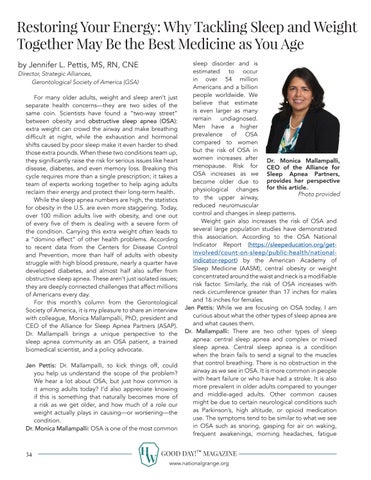
sleep disorder and is estimated to occur in over 54 million Americans and a billion people worldwide. We believe that estimate is even larger as many remain undiagnosed. Men have a higher prevalence of OSA compared to women but the risk of OSA in women increases after Dr. Monica Mallampalli, menopause. Risk for CEO of the Alliance for OSA increases as we Sleep Apnea Partners, become older due to provides her perspective physiological changes for this article. Photo provided to the upper airway, reduced neuromuscular control and changes in sleep patterns. Weight gain also increases the risk of OSA and several large population studies have demonstrated this association. According to the OSA National Indicator Report (https://sleepeducation.org/getinvolved/count-on-sleep/public-health/nationalindicator-report) by the American Academy of Sleep Medicine (AASM), central obesity or weight concentrated around the waist and neck is a modifiable risk factor. Similarly, the risk of OSA increases with neck circumference greater than 17 inches for males and 16 inches for females. Jen Pettis: While we are focusing on OSA today, I am curious about what the other types of sleep apnea are and what causes them. Dr. Mallampalli: There are two other types of sleep apnea: central sleep apnea and complex or mixed sleep apnea. Central sleep apnea is a condition when the brain fails to send a signal to the muscles that control breathing. There is no obstruction in the airway as we see in OSA. It is more common in people with heart failure or who have had a stroke. It is also more prevalent in older adults compared to younger and middle-aged adults. Other common causes might be due to certain neurological conditions such as Parkinson’s, high altitude, or opioid medication use. The symptoms tend to be similar to what we see in OSA such as snoring, gasping for air on waking, frequent awakenings, morning headaches, fatigue
H GOOD DAY!™ MAGAZINE W www.nationalgrange.org
or brain fog. You can learn more about central sleep apnea at American Thoracic Society (thoracic.org). Complex sleep apnea is when both OSA and central sleep apnea are present. Central sleep apnea can emerge in some individuals when their obstructive events have disappeared with treatment with Positive Airway Pressure (PAP) therapy. Jen Pettis: What risks do aging and older adults face due to sleep apnea, particularly if it remains untreated? Dr. Mallampalli: If untreated, aging and older adults are at high risk for cardiovascular disease such as heart failure, atrial fibrillation, stroke, myocardial infarction. In fact, the American Heart Association in 2023 put forth a scientific statement acknowledging the connection between OSA and cardiovascular disease such as heart failure, coronary artery disease, atrial fibrillation, pulmonary hypertension and stroke. The link between OSA and atrial fibrillation is particularly strong with the incidence of atrial fibrillation being 88% higher in OSA patients. This statement further recommended that cardiologists screen for OSA in their patients and encourage treatment. Untreated OSA can lead to cognitive decline and Alzheimer’s disease in older adults. Older adults with OSA who struggle with disturbed sleep and OSA related consequences are at increased risk of developing mild cognitive impairment or Alzheimer’s disease. Furthermore, continuous positive airway pressure (CPAP) therapy has shown promise in improving cognition in OSA patients with Alzheimer’s disease. Jen Pettis: Would you explain how weight and OSA are connected? It seems like a ‘chicken and egg’ situation for many people. How does this relationship evolve as we get older—does it become more dangerous or harder to manage as we age? Dr. Mallampalli: Weight gain or obesity and OSA are interconnected and have a bidirectional relationship, meaning OSA contributes to weight gain and excess weight can make OSA worse. We also know that the chance of developing OSA is six times higher with a 10% weight gain and an increase in body mass index can increase OSA. In the U.S. 69% of individuals with obesity have some form of OSA and about 32% of people with obesity have moderate to severe OSA. OSA drives the risk for obesity by driving hunger, reducing energy, and causing insulin resistance. ASAP has created a downloadable fast facts highlighting the link between OSA and obesity. Jen Pettis: What kinds of signs and symptoms might indicate that a person may have sleep apnea, and what should they do if they notice those symptoms?
Dr. Mallampalli: Typical signs and symptoms include snoring, choking or snorting or gasping for air during sleep, unrefreshed sleep leading to daytime sleepiness, and fatigue. Snoring occurs when the soft tissues in the back of the throat relax during sleep and block the airway, often causing you to snore loudly. Snoring or snorting is a more common symptom in men whereas fatigue is more common in women. Morning headaches can occur in some OSA patients. Anxiety and depression can also occur with OSA. Most people with undiagnosed OSA might be unaware of these symptoms since they only occur they are sleeping, and a person may not know they have a problem until a bed partner or roommate complains about their snoring or observes gasping. Therefore, bed partners play an important role in noticing sleep apnea symptoms. People who suspect sleep apnea symptoms should immediately seek help from their primary care providers. Jen Pettis: If a person’s health care provider suspects that they have sleep apnea, what might the provider do to confirm or rule out the condition? And how do they determine the kind of sleep apnea? Dr. Mallampalli: The provider can prescribe a home sleep test (HST) to someone who is suspected of having OSA. Sometimes a HST can be negative and in that a repeat test should be ordered by a provider. If a test is positive, the provider can send the patient to a sleep expert who can determine the best treatment for that patient. If the HST is negative and a person continues to complain of sleep problems, a provider should recommend an in lab polysomnography (a more comprehensive sleep study) to detect any underlying sleep problems. Jen Pettis: What are treatment options for OSA and OSA combined with obesity? Dr. Mallampalli: Several treatment options are currently available. Positional therapy is a behavioral therapy, using certain devices or techniques, to help a person to sleep on their side rather than sleeping on their back preventing the tongue from blocking the airway. Continuous positive airway pressure or CPAP therapy (considered gold standard) involves administering continuous air through the nose to keep the airway open. A patient will typically start with a CPAP therapy but may be prescribed APAP (automatic PAP that automatically adjusts pressure with a sensor) or BiPAP (bi-level PAP with two pressure settings for inhalation and exhalation) based on what works best for the patient. Mandibular advancement devices (MAD) work by increasing the space in the back of the throat by
H GOOD DAY!™ MAGAZINE W www.nationalgrange.org
35
moving the jaw forward changing the position of the tongue. They are similar to a mouth guard or a dental device. However, patients should only get this treatment from qualified dentists certified by the American Academy of Dental Sleep Medicine. While CPAP is usually more effective than oral appliances, oral appliances might be easier to use, and therefore in some patients, they may be used for more total hours per night, providing good control of apneas. When an OSA patient is unable to adhere to CPAP therapy, they may be a candidate for hypoglossal nerve stimulation such as the Inspire therapy. This therapy treats moderate to severe OSA and uses a small surgically implanted device to stimulate the hypoglossal nerve to move the tongue forward and keep the airway open during sleep. This surgery is typically performed by otolaryngologists or ENTs. When all else fails, maxillomandibular advancement (MMA) surgery, performed by an oral doctor is an option for some patients where the airway is permanently expanded by repositioning some bones in the upper and lower jaws. Although MMA is considered the most effective surgery for OSA, side effects such as facial numbness due to nerve damage are a concern. Recent innovations are bringing more options to patients such as the GLP-1s. Zepbound® was approved by the FDA in November 2023 for longterm weight loss in adults with obesity who have either diabetes or an elevated risk of cardiovascular conditions. In December 2024, Zepbound® received an added indication for OSA in adults with obesity, making it the first pharmaceutical treatment for OSA. Other medications are under investigation. Jen Pettis: What are other important points that we haven’t addressed that you’d like people to know about obesity and OSA? Dr. Mallampalli: There are a couple that come to mind. For many years, OSA was considered to be a condition that only affects men but that is not true anymore. Research has now shown that OSA also affects women and in fact sex and gender differences exist in its clinical presentation and symptom profile. Currently we lack screening tools for sleep apnea in women, and this is a gap that needs to be addressed. OSA is also complex and heterogenous in nature and should be considered a chronic disease. We know that it is connected to other chronic diseases (as we discussed above) but the exact nature of biological connections are unknown but inflammation has been considered to play an important role.
36
Jen Pettis: It is always a delight to talk with you; thank you so much for your time and all the wonderful information you shared. Would you close us out with sharing how the Alliance of Sleep Apnea Partners supports people living with OSA and how they can find more information? Dr. Mallampalli: At the Alliance of Sleep Apnea Partners, we put patients first as we are a patientcentered organization. We support patients by providing medically accurate and evidence backed resources and information through our website at apneapartners.org. We also provide expert webinars through our signature program called the Breathing Room on our YouTube channel (youtube.com/@ apneapartners). Two years ago, we launched Sleep Apnea Education Week, a social media campaign that runs from April 18-26 annually, to raise awareness and education around sleep apnea. This is a national campaign launched to ensure that we make sleep apnea a national priority and that it gets the same level of attention as other chronic diseases. We also encourage everyone to follow and engage with us on our social media channels on Facebook, Instagram, LinkedIn and Twitter. Jen Pettis: Great information! Thank you for spending some time with me today and sharing so much great information, and many thanks for all that you do to improve care and outcomes for people living with sleep apnea, including those with OSA and obesity.
About the Gerontological Society of America: GSA is the oldest and largest interdisciplinary organization devoted to research, education, and practice in the field of aging. GSA’s principal mission — and that of our 6,000 members — is to promote the study of aging and disseminate information to scientists, decision makers, and the general public. Founded in 1945, GSA is the driving force behind advancing innovation in aging — both domestically and internationally. Our members come from more than 50 countries. The Vision of GSA is Meaningful Lives as we Age. Learn more at www.geron.org.
H GOOD DAY!™ MAGAZINE W www.nationalgrange.org
FAST FACTS
SLEEP APNEA & OBESITY 54 million adults have obstructive
sleep apnea (OSA) and 93 million are affected by obesity in the U.S.
OSA raises obesity risk by driving hunger, reducing
energy, and causing insulin
69% of individuals with obesity in
U.S. have some form of OSA—and about 32% of people with obesity have moderate to severe OSA.
resistance.
OSA
Obesity
OSA rates higher in the
African American, Asians, Hispanic, and Native
American communities due to higher rates of obesity.
A Vicious Cycle
OSA contributes to weight gain, and excess weight makes OSA worse. The chance of developing OSA is six
times higher with a 10% weight gain.
OSA and obesity can increase
risks of type 2 diabetes,
hypertension, osteoarthritis, and cardiovascular conditions.
An increase in BMI can increase OSA severity as measured by apnea hypopnea index.
Fat accumulation around
Excess fat around the neck
the strongest risk factor for
the upper airway, making
OSA for both men and women.
An increase in waist-to-hip ratio raises OSA risk in women.
can narrow and compress breathing more difficult.
FDA approved tirzepatide (Zepbound®) as a treatment for OSA in patients with obesity 2024.
Reprinted with permission of ASAP
the neck and abdomen is
This educational resource was created with support from Eli Lilly and Company
H GOOD DAY!™ MAGAZINE W www.nationalgrange.org
37