Learners for Life: The Future of Higher Education in the Era of Longevity
Introduction
Throughout the centuries of higher education, change has been constant. Institutions of higher learning have adjusted curricula, created new degrees, and established schools and colleges to meet emerging needs. When the Information Age began in the 1950s, a population explosion expanded the number of students on campuses. Advances in science and technology provided
Introduction
Insights Into Higher Education: Factors Driving the Age-Inclusivity Movement
areas of growth and the need for new academic disciplines with cutting-edge curricula and fields of research.
Now, in the eighth decade of the Information Age, institutions of higher education are anticipating a new period of radical transformation. An era that began with the realization that computers could perform tasks that previously required a human brain has brought artificial intelligence (AI) able to perform tasks formerly requiring a college degree. AI is already displacing a variety of workers and creating a need for them to focus on different functions or pivot to new careers. The population pyramid that reliably filled the ranks of college undergraduates each fall now looks like a pillar. The burgeoning costs of higher education are questioned as students need to work during school and repay the loans used to cover expenses.
Implications for Higher Education: Creating Age-Inclusive Campuses for Students of All Ages
Conclusion
Population trends indicate older adults—those aged 65 years or older—will soon outnumber young people (Figure 1) in the Longevity Economy described in reports, interviews, and briefings published in recent years by the Gerontological Society of America (GSA).1 Our society is transforming—and quickly. Life expectancy has risen by 17 years since the Social Security program debuted in the United States nearly 90 years ago.2 This comes with tremendous opportunities, but it also comes with headwinds.
As adults move toward these now-common increased years of healthy living, they are retooling for added time spent in their current careers, obtaining training and certificates for consulting and self-employment in related areas, or learning about emerging technologies and fields that can launch completely new careers. In addition to continuing to work for pay, older adults contribute to the economy by providing unpaid care of loved ones and volunteer service in primary, secondary, and higher education; hospitals and other health care settings; and many other parts of society.
Source: Adapted from reference 1.
Figure 1. From Pyramid to Pillar: A Century of Change in the U.S. Population
What are institutions of higher education to do? How can they simultaneously address the challenges of declining enrollments, shifting needs in the workplace and society, increased operating costs and capital investments, higher faculty salaries and pensions for retirees, and declining fundraising?
This issue of Insights & Implications in Gerontology describes the trends driving changes in higher education that could combine with an age-inclusivity movement to provide solutions to many of higher education’s fiscal challenges. Retiring the word alumni, for example, could telegraph institutions’ commitment to remain a home for lifelong students with educational needs that will evolve and continue throughout life.
Insights Into Higher Education: Factors Driving the Age-Inclusivity Movement
Many factors have affected the number of people who seek higher education and the times in their lives when they do so. The stereotypical image of the newly minted high school graduate going off to college as an 18-year-old remains true for many young people. However, over the past several decades, the complexity of modern society has changed the age demographics of students in higher education.
Population Shifts and Trends Toward Age Inclusivity
Declining birth rates, the COVID-19 pandemic, perceptions of the relative costs and benefits of higher education, the convenience and accessibility of online courses that can be taken from home while maintaining a job and/or living with parents, and the availability of career opportunities with entry-level positions that do not require a college degree—all these factors have combined to reduce college enrollments by millions since the enrollment peak of 21 million in 2010.3,4
Enrollments in higher education dipped to about 19 million during the pandemic years. U.S. birth rates before and during the Great Recession in 2008 are projected to keep enrollments at around 20 million through 2031, and an enrollment decline could follow based on lower numbers of births. Since tuition is the largest source of annual income for the nation’s 3,931 institutions of higher learning, an enrollment decline of 10% to 15% translates to serious deficits for many public and private universities, research universities, liberal arts colleges, community colleges, and for-profit
colleges in the United States. In fact, after the number of institutions of higher learning peaked in 2012 at 4,726, the figure fell quickly by 2020 through hundreds of closures and mergers.3,5
Not only has the number of students at institutions of higher education declined, but the demographics of students have changed. Today’s students are older, more likely to attend on a part-time basis, and more likely to seek graduate education. For those studying part-time in graduate programs, one-third of the students are 35 years or older, and another third are between 25 and 34 years old. Among undergraduates, nearly one-fourth are at least 25 years old; they take classes online and on campus (Figure 2).4,6
As these trends took hold, GSA began advocating actively for institutions of higher learning to meet the needs of an increasingly age-diverse pool of stakeholders—including faculty and staff who have unique needs as they work longer while also caring for both parents and children. The Ten Principles of an Age-Friendly University (AFU) reinforce the growing movement in the United States and around the world (Table 1).7 GSA’s Age Inclusivity in Higher Education
(AIHE) initiative added these definitions to guide discussions and programs focused on the diversity of today’s institutions of higher learning8:
• Age friendly reflects the types of campus practices recommended by the AFU principles, along with other actions that aim to make educational opportunities more accessible for aging populations.
• Age inclusive moves beyond the mere presence of these practices and reflects how age-friendly efforts are valued, recognized, and integrated into the campus environment and mission of an institution.
Note: Numbers in thousands; civilian noninstitutionalized population.
Source: Reference 6.
• Age diverse reflects the broad age range of stakeholders that institutions may now serve in light of contemporary age demographics, which includes age-diverse older students, faculty, administrators, and staff.
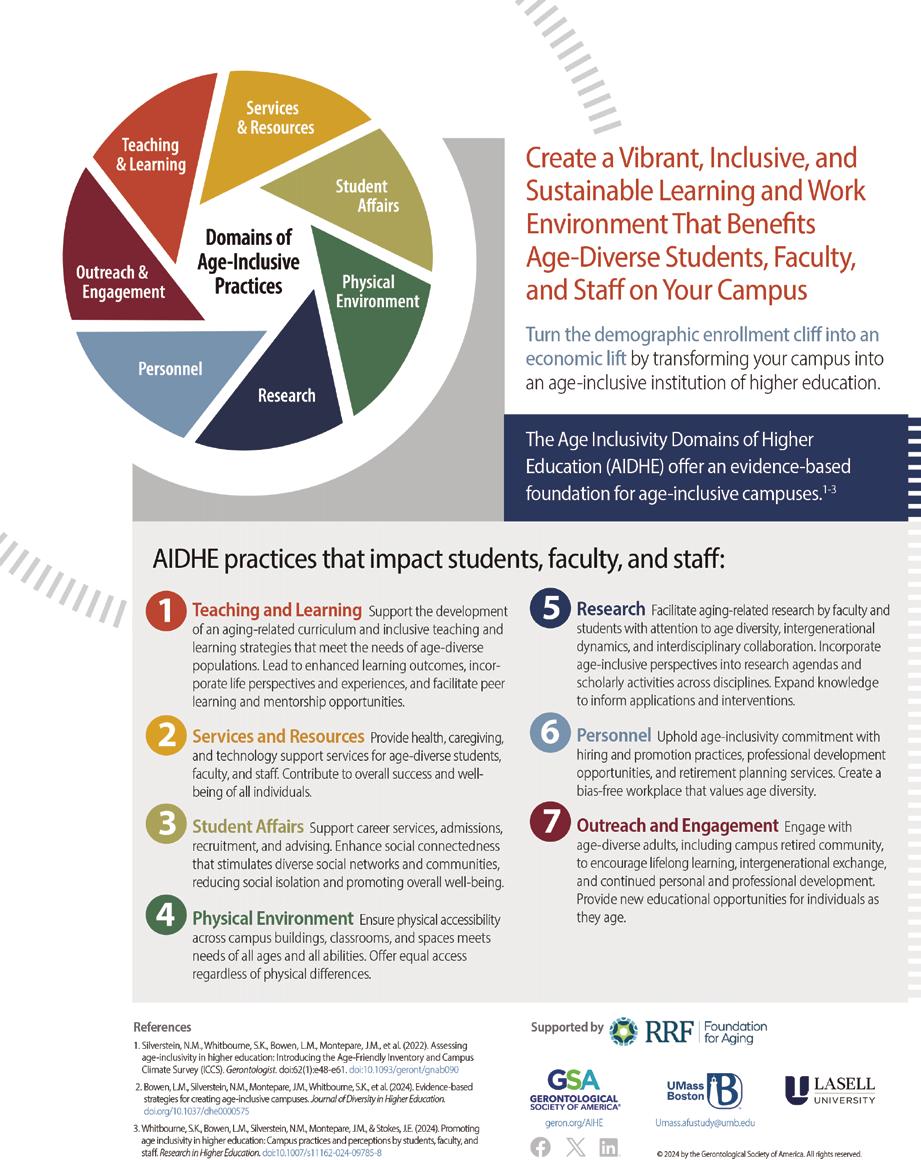
With GSA support and funding from the RRF Foundation for Aging, the Age Inclusivity Domains of Higher Education (AIDHE) model (Figure 3) and Age-Friendly Inventory and Campus Climate Survey assessment tool were developed to operationalize age-inclusivity and age-friendly practices.9,10 By working through the AIDHE domains, institutions of higher learning can make age inclusivity a reality and support the needs of students, faculty, and staff across the work span and into retirement.
Figure 2. Age Distributions of Full-Time and Part-Time Undergraduate and Graduate Students in U.S. Institutions of Higher Learning, 2022
Table 1. Ten Principles of an Age-Friendly University
To encourage the participation of older adults in all the core activities of the university, including educational and research programs.
01 02 03 05 07 09 08 06 04 10
Source: Reference 7.
To recognize the range of educational needs of older adults (from those who were early school-leavers through to those who wish to pursue Master’s or PhD quali cations).
To widen access to online educational opportunities for older adults to ensure a diversity of routes to participation.
To promote personal and career development in the second half of life and to support those who wish to pursue second careers.
To promote intergenerational learning in order to facilitate the reciprocal sharing of expertise between learners of all ages.
To ensure that the university’s research agenda is informed by the needs of an aging society and to promote public discourse on how higher education can better respond to the varied interests and needs of older adults.
To increase the understanding of students of the longevity dividend and the increasing complexity and richness that aging brings to our society.
To enhance access for older adults to the university’s range of health and wellness programs and its arts and cultural activities.
To engage actively with the university’s own retired community.
To ensure regular dialogue with organizations representing the interests of the aging population.
3. Age Inclusivity Domains of Higher Education
Source: Reference 8.
Figure
Rapid Changes and Radical Transformation
Across their working years in recent decades, adults have pivoted to new careers as frequently as their grandparents might have changed jobs. Now, the maturation of machine learning and expansion of AI is changing the employment landscape more dramatically. AI is replacing or modifying some tasks—and, indeed, eliminating some jobs for humans—while promising new jobs and dynamic careers in the future.
A concept coined at a 1955 workshop,11 AI has matured to the point that it has moved into general use and is available on personal digital devices. This extension into people’s daily lives and incorporation into devices and common computer programs promise to affect economic sectors across the board, especially those already using machine learning extensively. These include logistics, cybersecurity, enterprise security, financial services, and information security. Major effects are imminent in health care, research and development, advertising, e-commerce, cloud computing, manufacturing, public transportation, media and entertainment, and every other industry, according to a Forbes panel of experts.12
By 2030, the nation’s gross domestic product could rise by 7% as a direct effect of AI, according to one estimate.13 The long-range impact on jobs currently performed by humans can only be imagined, as it will be a function of how quickly and extensively AI develops. Among the best guesses offered so far are that up to 30% of existing jobs could be eliminated by 2030, with white-collar jobs and positions in service and administrative fields initially affected, which would tend to have implications for college-educated workers, White and Asian individuals, and women. In the long run, jobs mostly held by men in the transportation industry could be eliminated as advances in AI lead to refinement and acceptance of technologies such as autonomous vehicles for short trips around town and long-range transport.13-15 Projected changes and opportunities are summarized in Table 2.16,17
The predominance of cognitive-task–oriented jobs in developed countries exposes up to 60% of jobs to AI effects. College-educated people are thought to be initially more exposed but also best positioned to move into other roles. This provides an entrée for institutions of higher learning that are best equipped to meet the changing needs of these workers. Many technology-oriented universities—such as Carnegie Mellon and Stanford—have had degree programs in AI for years. Graduate certificate programs in this field
and Opportunities Gained
High Exposure/Risk of Elimination
• Customer service representatives
• Receptionists
• Accountants/bookkeepers
• Salespeople
• Researchers and analysts
• Warehouse workers
• Insurance underwriters
• Retail workers
Low Exposure/Risk of Elimination
• Teachers
• Lawyers and judges
• Directors, managers, and CEOs
• Human resources managers
• Psychologists and psychiatrists
• Surgeons
• Computer systems analysts
• Artists and writers
AI Opportunities Created
• AI and machine learning specialists
• Sustainability specialists
• Business intelligence specialists
• Information security analysts
• Fintech engineers
• Data analysts and scientists
• Robotics engineers
• Electrotechnology engineers
• Agricultural equipment operators
• Digital transformation specialists
Source: References 16 and 17.
Table 2. Artificial Intelligence: Jobs Lost
are also available for on-campus and hybrid learners at many schools.14,15,18,19
As programs proliferate and attract people of all ages who need new skills for the AI economy, an important opportunity presents itself. Many believe that ageism remains ignored and benignly accepted in the workplace and society at large. With people of all ages interacting in institutions of higher learning, educational experiences can be used to build appreciation for the evolving life course and the reality that chronological age is a very poor predictor of health, mental acuity, physical capability, and other aspects of daily life.
In the Positive Education about Aging and Contact Experiences (PEACE) model, Levy describes how the interaction of education about aging and positive interactions with older adults can encourage new attitudes toward aging and older adults (Figure 4).20 The result of this exposure at an early stage of adulthood is reduced ageism and its negative consequences. These include poorer cognitive and physical health of
older adults, which can contribute to earlier retirement. Older adults benefit from reduced ageism-related cognitive stress when institutions of higher learning incorporate positive intergenerational contact in the classroom. Widespread education on aging can improve students’ well-being and interest in aging-related careers.
Just as courses in literature, mathematics, and the sciences are considered necessary for college graduates, knowledge of aging and the life course can be useful and even essential. The best place for age inclusivity to start is by educating people entering adulthood about aging, ageism and ageist beliefs, the life course and the disruptions that can occur, and the negative attitudes and unconscious age biases that affect people of all ages.8
As people of all ages seek education needed to thrive in age-diverse work settings, the importance of people of different generations working together will be reinforced.
Figure 4. The PEACE (Positive Education about Aging and Contact Experiences) Model for Reducing Ageism and Promoting Intergenerational Peace
Education About Aging
Positive Contact With Older Adults
Impact on Older Adults
• Careers
• Cognitive, mental, and physical health
• Education
• Housing
• Retirement
Attitudes About Aging and Older Adults
• Anxiety
• Discrimination
• Prejudice
• Stereotyping
Impact on Children, Adolescents, and Adults
• Careers
• Cognitive, mental, and physical health
• Education
• Housing
Impact on Society
• Programs and policies (e.g., health care, housing)
Source: Adapted from reference 20.
Factors Delaying Enrollment in Higher Education
Numerous trends and realities are associated with the delay in starting and completing baccalaureate and graduate degrees, which is evident in Figure 2.6 These relate to geographic, financial, personal ability, child-rearing and caregiving, and health factors.
The percentage of Americans aged 18 to 24 years enrolled in undergraduate and graduate programs declined in the decade starting in 2012 (Figure 5).21 Since the COVID-19 pandemic is known to have caused some young people to defer enrollment for financial or other reasons, this decline could be partially attributed to that unusual period of American history. However, the decline was evident before the pandemic started, with enrollees shifting from 2-year to 4-year institutions.21-23
As in 2012 through 2021, the college enrollment rate for 18- to 24-year-olds for 2022 was higher for those who were Asian (61%) than for those of all other racial/ethnic groups: White (41%), multiracial (36%), Black (36%), Hispanic (33%), Pacific Islander (27%), and American Indian/Alaska Native (26%).23
Figure 5. College and Graduate School Enrollment Rates of 18- to 24-Year-Old Americans by Levels of Institutions, 2012–2022
Note: Based on sample surveys of the civilian noninstitutionalized population, which excludes persons in the military and persons living in institutions (e.g., prisons, nursing facilities).
Source: Adapted from reference 21.
The reasons that young adults may not seek higher education enrollment run the gamut of life experiences. Number one on a Pew Research Center survey was money, with men and women citing this as their major reason for not starting college during the period when they were 18 to 24 years old. Men were more likely to cite a lack of motivation and a feeling that further education was not necessary as their major reasons, but the difference was not statistically significant (Figure 6).24
The propensity for more young women to pursue higher education during this time period has produced large gender gaps among students in undergraduate
Couldn’t a ord to get a four-year degree
Needed to work to help support family
Just didn’t want to Just didn’t consider it Didn’t think you’d get
Didn’t need more education for the job/career you wanted
Note: Figures shown are percentages of Americans who had not completed 4-year post–high school degrees and were not enrolled in school when the survey was conducted on October 18–24, 2021.
Source: Adapted from reference 24.
programs. As shown in Figure 7, this trend results in more women holding baccalaureate degrees in the 25- to 34-year-old age range. Even when people from previous generations are included, women have now outpaced men in this metric.24
As life happens, adults older than 30 years of age are returning to school in greater numbers, as reflected in Figure 2.6 Impediments to returning to school at older ages include child-rearing and caregiving responsibilities for young children and parents, finances, and health conditions, particularly genetic diseases, chronic diseases, or psychiatric conditions such as depression. The availability of online education—with its flexibility regarding travel and the ability to view classes asynchronously—helps the older student juggle work, family, and educational responsibilities. This option also decreases the feeling that someone is “too old” to go back to college. In a 2018 study, about 3 million Americans were living in educational deserts, without nearby institutions of higher learning or adequate internet connectivity.25 This problem should be reduced or virtually eliminated as the Infrastructure Investment and Jobs Act provided $65 billion in funding for broadband connectivity nationwide.26
Figure 6. Major Reasons for Not Pursuing Higher Education Among 18- to 24-Year-Old Men and Women in the United States, 2021
Figure 7. Percentages of Americans With Baccalaureate Degrees, 1970–2021
Source: Adapted from reference 24.
Touchpoints for Education
Across the Lifespan
As colleges and universities adjust their focus to meet educational needs across the lifespan, they will have opportunities to recruit millions of students at different life stages. One important touchpoint was mentioned earlier—the PEACE model and its benefits for young people in the traditional college ages (Figure 4).20
At later points in life, many people are likely to seek education and training through 2- and 4-year schools and programs offered by employers. These include people who are:
• Entering or re-entering the workforce after periods of child-rearing, caregiving, or unemployment for other reasons.
• Gaining training or certifications needed for new types of work created in an AI-based economy.
• Adapting to AI and other scientific or technological effects on a person’s marketability and career.
• Pivoting from one career to another.
• “Retiring” from full-time employment to consulting, self-employment, or a new career.
• Maintaining active relationships with retired faculty through emeriti programs and both retired faculty and alumni through university-based retirement communities.
This mixture of students, faculty, and staff of all ages presents opportunities to educate about aging and create positive intergenerational interactions. According to a systematic review and meta-analysis of more than 150 studies with 150,000 participants, interventions that provide education about aging and opportunities for positive contact with older adults reduce ageism and increase interest in careers in aging among younger people. Three specific recommendations emerged from this research: When possible, both education and positive contact should be included in educational programs; ageism reduction interventions should, when possible, include in-person intergenerational contact; and these interventions do not need to be lengthy. Watching videos of less than 10 minutes highlighting components of the PEACE model yielded a more positive view of older adults.27
As colleges and universities adjust their focus to meet educational needs across the lifespan, they will have opportunities to recruit millions of students at different life stages.
As it has for many of its services and programs, GSA members and staff created a toolkit for faculty, students, administrators, and other campus leaders. With support from AARP, GSA’s Academy for Gerontology in Higher Education designed Tools for Advancing Age Inclusivity in Higher Education to provide a collection of resources for faculty and staff in higher education institutions. The suite of tools may be adapted to meet an institution’s approach to making the case, building relationships, addressing ageism and ableism, crafting new efforts, and conducting assessments that further the movement toward age-inclusive campuses.9
The AIHE initiative also provides an Age-Friendly Inventory and Campus Climate Survey to assist campuses in evaluating the nature of age-friendly practices and the perceptions of these practices by students, faculty, and staff.28 A quarterly newsletter also provides those in the AIHE program with news and information on how institutions are expanding their services in ways that enhance the domains of the AIDHE model (Figure 3)8:
• Teaching and Learning
• Services and Resources
• Student Affairs
• Physical Environment
• Research
• Personnel
• Outreach and Engagement
These domains provide a framework useful for illustrating what is happening in higher education, as outlined in the next section.
Implications for Higher Education: Creating Age-Inclusive Campuses for Students of All Ages
Exemplary programs in each of the seven domains of the AIDHE model are presented. For many of these innovative practices, individuals leading the efforts were contacted. Their perspectives and innovations are provided.
Teaching and Learning
The lack of education about lifespan, aging, and older adulthood—with little or no interaction between younger and older groups—is a major contributor to ageism. Without information and experience, young adults’ views are shaped by stereotypes, prejudice, and discrimination.
Those problems can be favorably addressed by institutions aspiring to be more age-inclusive. From 18-year-old first-year students to community members looking to enrich their lives, colleges and universities have a core mission of providing educational programs and facilitating opportunities for people of all ages to interact.
Careers in Aging
At the University of Connecticut, Laura Donorfio, PhD, FAGHE, has set up a model learning laboratory where students of all ages explore careers in aging and learn about aging and the fallacies associated with older adulthood. “Careers in Aging” is a traveling presentation that she delivers at all of the university’s campuses with three goals: to encourage students to engage in independent studies, practicums, and fieldwork experiences for course credit; to explore and network with others; and to gain knowledge and make connections between aging and other fields.
Sharing details about this presentation in the spring 2024 issue of GSA’s Age Inclusivity in Higher Education newsletter, Donorfio said she highlights “an array of products and services developed specifically for older adults: walk-in tubs, lifeline necklaces and bracelets, reverse mortgages, age-friendly appliances, smart speakers, artificial intelligence in the form of virtual headsets, companion and pet robots, automobiles with increased safety features, and greeting cards for those turning 80, 90, and 100 years old.” The article also references The Gerontology Field Placement: Internships and Practicums in Aging, which Donorfio co-authored, and provides copies of the chapter titled “Finding Your Career in Aging,” which focuses on
careers in the field and how various majors and fields can easily intersect with the field of aging. Donorfio added, “I finish by sharing the life stories of past graduates and how earning their minor in gerontology has helped them carve out unexpected careers in aging. It is an exciting time in our field with endless possibilities, no matter one’s major or field.”
Professional societies are also doing their part to promote careers in aging. The GSA Careers in Aging Month celebration helps businesses, clinics, universities, and organizations worldwide unite to showcase the incredible career possibilities in aging.
The Nexel Collaborative
Meeting the educational needs of adults in transition during midlife is the goal addressed by institutions in the Nexel Collaborative, founded in 2020. An outgrowth of the Distinguished Careers Institute at Stanford University, the Nexel Collaborative includes 25 colleges and universities in the United States, Canada, and Europe.
Examples of programs at AFU member institutions include the following:
• Arizona State University Distinguished Innovation Fellows
• University of Minnesota Advanced Careers Initiative
• University of Southern California Distinguished Leaders
• University of Texas at Austin TOWER Fellows Program
The Nexel Collaborative provides networking opportunities and resources to member institutions to expand and democratize programs so they are available to all adults seeking change by returning to school. Nexel member programs motivate their participants to:
• Renew their purpose—take classes, rediscover meaning and/or direction at a crucial transition stage in life.
• Develop new friendships—build social connections, bond within cohort groups.
• Prioritize wellness—for a healthier, longer lifespan.
• Engage across generations—both in and out of the classroom.
• Contribute to the community—give back, be useful, make an impact.
Services and Resources
Colleges and universities serve a diverse community—and that means meeting the health, caregiving, recruitment, and technology needs of students, faculty, and staff of all backgrounds. Inclusive campuses have found ways to contribute to the success and well-being of community members across their lifespans. This includes students after graduation, faculty and staff who need education and training for emerging topics and technologies during their years of service, and community members contemplating encore careers or volunteer activities during “retirement.”
Micro-Certificate in Facilitating Older Adult Learning
"Teachers, instructors, and educators can benefit from the micro-certificate program in facilitating older adult learning offered by the University of Manitoba. The 12-week program, consisting of three courses, presents contemporary material on learning environments for students of various ages. Health professionals who work with older adults can benefit from the program, as can workers and volunteers in organizations serving older adults,” said Michelle Porter, PhD, FGSA, Director of the Centre on Aging at the University of Manitoba.
Students in the program learn how to articulate the developmental lifespan of older adults and its influence on learning, determine how to evaluate and select appropriate learning technologies for supporting effective older adult learning, understand the key components of older adult learning, and apply these principles in a professional context. The required courses are:
• Older Adult Development and Long Life
• Universal Design for Learning to Facilitate Older Adult Learning
• Using Technology for Teaching and Learning With Older Adults
Addressing ageism is another goal of the microcertificate program. “Older adults may still be working,” Porter said. “We are seeing more of that, so human resources and training professionals will work with them. Older adults may want to upgrade their education and skills. They want to learn. They want to find meaning in their lives. They are a great addition to any classroom, and we want them to feel welcome.”
Caregiving Across Campus
The need for faculty, staff, and students to have childcare services—preferably on campus—has been recognized for decades. Today, with older students on campus and classes offered in the evening, caregiving needs are even more diverse. Faculty, staff, and students may have children, but they may also have parents and other loved ones who need care. Virtual courses offer another set of challenges for colleges and universities in supporting the need for childcare services.
At the Northern Kentucky University in suburban Cincinnati, members of the AFU Coalition have been addressing this challenge since 2022. Faculty members Katherina Nikzad-Terhune, PhD, and Allyson Graf, PhD, spearheaded the Caregiving Across Campus initiative to highlight the intergenerational impact of caregiving and how collaborative efforts from campus and community constituents can result in more robust responses to caregiver needs. A Campus Caregiving Needs Assessment provided an estimate of the number of caregivers on campus and identified unmet caregiving needs. Data from this study resulted in identifying new support services for caregivers on
campus, forming new community partnerships, and launching a campus caregiver recognition event and community resource fair.
“The majority of people surveyed were providing care for parents—it wasn’t strictly children,” Graf said. “In-laws, spouses, and children with special needs were also mentioned. We have a campus office that helps to support faculty, staff, and students who are caregivers. They were our partner on the survey and for follow-up.”
At the caregiver recognition event, attendees were mostly adult students plus faculty, staff, and one or two younger students. About 15 vendors were available to talk with attendees about their caregiving needs. Some students who take online classes participated virtually, which emphasizes the difficulty of serving the needs of everyone. “We do a really good job of tracking what’s happening in person,” Graf said. “But what happens online is oftentimes not as carefully tracked or monitored. This is pie in the sky, but what would it look like to make services truly intergenerational? There are universities that have those types of situations and setups, but it requires capital to build and resources to sustain. If we’re talking about how to transform a university to be age-inclusive, we have to think about those possibilities.”
Student Affairs
The Student Affairs domain presents many challenges to promoting age inclusivity. Supporting career services, admissions, recruitment, and advising is difficult when the world is rapidly changing. Moreover, the campus community also presents challenges because of its diverse communities and social networks. Activities that meet the interests of people from one generation can leave others feeling isolated and left out. Counselors must imagine what jobs will emerge in the fields for which the students are preparing.
Counseling Students in an Age-Inclusive Institution
One reality institutions have had to deal with is the common model in which junior faculty are often involved in counseling students. Because of the diversity of life situations that older learners bring with them, student affairs takes on new meanings in the age-inclusive environment.
At Chicago’s Northeastern Illinois University, Noreen Powers, PhD, and Russell Wartalski, EdD, have studied the needs of junior faculty and ways of developing their insights into purposeful advising practices of older students that enhance student retention and
satisfaction. By combining their own experiences as nontraditional undergraduate students in their research into the advising of students aged 25 years or older, Powers and Wartalski developed a model for their undergraduate and graduate advising needs. Its components include the development of comprehensive program resources for the advisor, methods for cultivating and maintaining relationships, and ways to use structured and personalized communication with advisees.29
“Adult learners need clear and concise documents, benefit from strong connections with their advisors, and desire ongoing communication through various modalities,” conclude Powers and Wartalski.29 “Junior faculty in advising roles will be tasked with creating professional advising practices that promote adult learners’ unique needs specific to their institutional type.”
Age Inclusivity Increases Campus Diversity
Attracting and retaining older learners can be an important element in campus diversity, equity, and inclusivity (DEI) efforts. “As society ages and becomes more diverse, the intersectionality of race and ethnicity with age becomes yet an additional challenge/ opportunity with which to advance DEI efforts on campuses,” wrote Louis Soares in the fall 2023 issue of GSA’s Advancing Age Inclusivity in Higher Education newsletter
Soares, an expert on postsecondary education and workforce development reform who was then with the American Council on Education, continued with this DEI view: “Developing critical consciousness of this intersectionality allows for the challenge/ opportunity to re-engage DEI through the lens of older learners, faculty, and staff. Issues and disparities unique to older, diverse students open fresh pathways for looking for policy and practice change in areas, including technology and physical campus accessibility and health well-being; while not totally new, they tend to broaden DEI work.”
Physical Environment
Welcoming adults of many ages to a college campus requires rethinking aspects that are often taken for granted by younger students: walking distances, difficulty of opening doors, climbing stairs, and adequacy of maps and building navigation guides. Newer buildings at public and private colleges and universities must comply with the requirements of the Americans With Disabilities Act (ADA), but older structures may lack essential features such as elevators. Age-inclusive institutions have a lot to consider for diverse student bodies and events that target the broader community.
Big Barriers, Small Details
At Arizona State University (ASU) in Tempe, M. Aaron Guest, PhD, MPH, MSW, uses his background in social–environmental gerontology to make the university a place where people of all ages can be comfortable and interact with one another. ASU, which serves as the Secretariat of the Age-Friendly University Global Network, is a model university for creating intentional and intergenerational connections in the community it serves. It is also home to Mirabella, the first continuing care intergenerational community awarded certification as a University-Based Retirement Community

“When we talk about engaging our community and changing our environment to really welcome individuals in, we include parking locations that are near our major facilities that can accommodate individuals who can’t make long distances,” said Guest, the inaugural Assistant Professor of Aging in the ASU Center for Innovation in Healthy and Resilient Aging and chair of the AFU Secretariat. “We’ve also designed the campus purposely, with multiple shaded rest spots throughout our desert location. We’ve made sure that buildings are clearly identified and that it’s clear what side of a building you’re on—nothing can be more frustrating than being at a building and being on the wrong side to get in. We have done our best to remove barriers that can make people walk around the entire building to get to the entrance.”
This is a far cry from traditional college campuses Guest added. Grand stepped entrances and brick sidewalks are out. In their place are smooth sidewalks, doors that can be opened easily, crosswalks timed to permit people of all speeds to get to the other side, transportation choices that reduce travel time, and parking options for people with different physical abilities.
“I remember as a student at the University of South Carolina, we had a wall around campus that was 200 years old,” Guest said. “At ASU, my office is located in downtown Phoenix. There is no divide between us and the broader community. As we engage older adults in our work, we’re able to walk to coffee shops across the street. The new reality of intergenerational campus communities has required us to rethink what it means to be a university and how we design universities.”
Rajean Moone, PhD, FGSA, Associate Director of Policy at the Center for Healthy Aging and Innovation at the University of Minnesota, concurs. “Institutions of higher education are exemplars of accessibility while at the same time being some of the worst offenders,” he said. “We’re constantly building new buildings with endowments or legislative appropriations. Those buildings are state-of-the-art, green, and fully accessible. At the same time, the University of Minnesota was a university before we were a state. We have buildings from that era. My office is in a building that’s a hundred years old. We have an elevator and meet ADA code, but it’s still a hundred-year-old building.”
Research
At campuses aspiring to be more age-inclusive, the core mission of research takes on new meaning. Faculty and students examine age diversity, intergenerational dynamics, and interdisciplinary collaboration in their research. To examine the effects of age in clinical research, investigators need older adults willing to participate. That is difficult but necessary since many medications and other interventions are used primarily in this age group.
Creating Intergenerational Research Teams
Older adults who help on the University of Colorado Anschutz Medical Campus (CU Anschutz) have the option of developing an encore career as geri-educators. On this health sciences–only campus, 60% of the workforce is under 44 years of age, according to a 2019 analysis. “While fantastic, since many young people want to go into research, there is a complete societal disconnect between a 27-year-old trying to recruit an 84-year-old to participate in clinical trials,” said Jodi Waterhouse, MHA, Director of Outreach Programs at the CU Anschutz Multidisciplinary Center on Aging. “One of our faculty members in geriatrics, Dr. Katie Nearing, was the mastermind behind the idea of creating and training a workforce of older adults employed on campus responsible for providing peerto-peer engagement for recruitment of older adults into research and clinical trials.”
To prepare for serving on an intergenerational research team, the older adults complete a 14-week training program. “Upon graduation and successful completion of the program, they become an older adult research specialist, and they’re eligible for hire onto research teams,” Waterhouse said. “On the teams, they’re connecting with a community of people roughly the same age. We are now having our older adult research specialists review the messaging and imagery in our promotional materials for this audience. They really have become consultants across research teams, extending the intergenerational research team concept. That’s a really exciting initiative we’ve had on campus for two and a half years.”
Personnel
To create a workplace free of bias with employees who value age diversity, AFUs must extend their principles into hiring and promotion practices, professional development opportunities, and retirement planning services. Given the size of campuses and the number of employees working there, this can be a difficult chore, one that requires a forum for discussion and a messenger ready to discuss the problems of ageism and age-related bias.
Age-inclusive institutions have a lot to consider for diverse student bodies and events that target the broader community.
Linking Age-Friendly Efforts With Diversity and Equity
During the four years since it joined the Age-Friendly University Global Network in 2020, the University of Minnesota has taken several steps to integrate its activities across its campuses and throughout the faculty, student, and staff communities. Notably, its efforts extend into communities throughout Minnesota.
“Being a land grant university, we have a different mission than many academic institutions,” said Moone, who serves on a cross-campus Age-Friendly Council.
“We do more than educate students. We are here to have a broader role in the lives of Minnesotans and beyond, nationally and globally. We have partnerships with senior living communities, where our students from our Public Health Institute present every month and tackle hard questions on the environment and social justice.” The Age-Friendly Council website links visitors to the Age-Friendly UMN News publication, a virtual meet-and-greet for older learners, and other resources for lifelong learners and nontraditional students.
The Age-Friendly Council also conducts activities on campus based on its vision of being a leader in age-friendly work, fully integrating older adults into university life, and preparing students to meet the needs of changing communities. The guiding beliefs of the Council are as follows:
• We all benefit from intergenerational approaches and exchanges.
• Lifelong learners bring experience and perspective that enrich education.
• Diversity, equity, and inclusion are central pillars to all the work we do.
• Ageism is a pervasive form of bigotry that must be challenged and eliminated.
Within the university, students organize and coordinate their age-friendly activities through the Aging Studies Interdisciplinary Group. Students receive clinical experiences through geriatric fellowships in medicine, nursing, and public health. When faculty
want speakers or older study participants, they connect with alumni through the University of Minnesota Retirees Association, which sends notices through its volunteer resource center. The Retirees Association also offers virtual networking and social services such as “armchair” travel and book clubs.
Outreach and Engagement
Two important groups to target with inclusion efforts are (1) members of the communities where AFU institutions are located and (2) retired faculty members. When retired faculty members and staff members continue to reside in the local community or can connect virtually, the ways they can continue contributing are even more remarkable. In addition to serving the needs of the institution and its students, intergenerational relationships can benefit the retired faculty members by keeping them engaged and contributing through their unique knowledge and talents.
Your Next Move:
Transitioning to the New Retirement
To support age-inclusive opportunities for faculty, staff, and the community, the Harvey A. Friedman Center for Aging at AFU partner Washington University in St. Louis offers Your Next Move: Transitioning to the New Retirement. Participants learn about nonfinancial aspects of retirement with planning tools and resources during a 90-minute transition seminar offered each semester and an 8-week course each year.
A program started before the pandemic, Your Next Move attracts people on the cusp of retirement as well as younger people. Programs have been offered on campus and virtually. Upcoming sessions will be offered at a public library to draw more people beyond the campus community.
“The content is nonfinancial aspects of retirement planning for the new retirement,” said Nancy Morrow-Howell, MSW, PhD, FGSA, Director of the Center. “We have a model that includes social connection, meaning and purpose, self and family care, and leisure. We’ve made all kinds of assessment tools for people to think about these realms. How satisfied are you now? What’s working and what’s not? What are you worried about? What needs the most attention? What role does place play? We help them create a picture for retirement and identify barriers and resources. We give them examples and help them prioritize actions.”
Because volunteering is a common activity for retirees, Morrow-Howell is looking for ways to engage people with opportunities. While programs exist to match people with programs, the options can be over-
whelming. People unsure of what they want are hesitant to participate. “We’re experimenting with a one-day program for people planning for retirement or in retirement who want to volunteer or work parttime. We will offer three or so site visits so people can experience the available opportunities. We want to show them what they need in terms of volunteering or working—to introduce them to the people at these sites and show them how to get there and what they need to do. This will provide a warmer handoff to volunteer opportunities in the community for folks who think that will be a part of their retirement scene.”
Similarly, the TIAA Institute offers The New Retirement Mosaic in an Era of Longevity to TIAA client institutions. As people consider their retirement, they tend to concentrate on their financial situation. Often, this becomes the entirety of their retirement planning. While considering the financial implications of retirement is vitally important, it is insufficient because retirement is not just about how much money is saved. Retirement is more about what individuals have saved that money for. The Retirement Mosaic program explores the nonfinancial aspects of retirement and presents a model that helps individuals consider a fuller view of retirement. It outlines eight interconnected domains that contribute to a personalized mosaic of thriving: spirit, body, heart, connection, mind, work, place, and money.30
Integrating Faculty Emeriti Into Campus Life
Retirement from the University of California Berkeley doesn’t mean an end to activities on campus. In fact, UC Berkeley has several ways to connect nearly 1,000 faculty emeriti and thousands of other interested university retirees with undergraduate and graduate students in roles such as teaching, mentoring, professional development coaching, and conducting research.
The hub of retiree activity is the UC Berkeley Retirement Center, directed by gerontologist Cara Sweeney, MS. The Retirement Center provides retirees with services such as identification cards, UC Berkeley email addresses, housing resources, and campus parking options. Retirement and long-term care planning, workshops and seminars, a learning series, a book club, and archived course materials and program videos are popular with those who frequent the Retirement Center. Medical and general interest topics are offered through a partnership with the University of California, San Francisco, a health sciences campus. The Retirement Center also serves retirees of the Lawrence Berkeley National Laboratory and the University of California Office of the President, located in nearby Oakland.

The UC Berkeley Retirement Center serves as home to the UC Berkeley Emeriti Academy. Founded and run by faculty emeriti, members of the Academy organize events, teach courses on campus and for interested community members, counsel students on the importance of taking advantage of faculty office hours, and conduct research with undergraduates.
Supported by a five-year grant from GSA (funded by AARP), the Emeriti Academy established an interdisciplinary, intergenerational poster project to showcase the collaboration between emeriti and undergraduate mentees. These poster sessions are attended by campus administrators, other emeriti, friends and partners of the student, and recently retired faculty members. As described in the spring 2023 Advancing Age Inclusivity in Higher Education newsletter, the poster sessions have led to inquiries from other student offices for mentoring and professional development counseling by the emeriti.
All University of California campuses have emeriti programs, and these are served by the Council of University of California Emeriti Associations, founded in 1987. The individual emeriti programs are similar but differ based on the types of schools each campus has and the needs of its faculty and student populations.
Campus-Based Retirement Community
If one program illustrates many domains of the age-inclusive university, it would have to be Lasell Village, located on the campus of Lasell University, a few miles from downtown Boston in Newton, Massachusetts. Community members join retiring faculty in living at the Village, where they interact with student workers and teach older adults to be active, engaged campus community members. “Villagers” crisscross the campus, where they teach and take classes. They talk with students they know from classes, student workers from the Village, and those majoring in their fields with questions about career decisions and paths. Villagers conduct research and participate in research projects, completing the circle of inclusivity illustrated in the AIDHE model (Figure 3).8
A nonprofit continuing-care retirement community with one- and two-bedroom residences and a 38-bed skilled nursing facility, Lasell Village shares infrastructure and resources with Lasell University. The Village employs students for dining and other services; in fact, the community is the largest employer of Lasell University students, who see residents from their earliest days at the Village and on campus throughout their education.
“The Village has a strong integration with the University, providing opportunities for organic intergenerational interactions and programming,” said Zehra Abid-Wood, president of the Lasell Village since spring 2023. “Residents, many of whom are retired academic and other professionals, actively engage with students through activities like mock interviews, research collaboration, and social events. The Village leverages its co-location to enable a seamless continuation of lifelong learning. Additionally, the Village serves as a hub for discussions on aging, end-of-life issues, and other relevant topics, fostering an environment of activism and social engagement.”
Not only can Lasell Village residents take advantage of the education, library, and activities on campus, but they are also required to complete 450 hours of learning and other activities annually. These can be Lasell University classes designated as intergenerational and a variety of educational programming and collaborations offered at the Village. Residents bring their years of experience to the classrooms, allowing students to learn from people who often taught, researched, or even lived through the topics being studied. Two residents serve on the Student Government Association at Lasell University. Village committees involve residents in operations and decisions, including retired physicians who serve on a medical advisory committee and help navigate issues such as COVID-19 and end-of-life decisions.
The physical proximity of the Village and the University yields unique experiences when residents and students do not have to deal with the logistics of transportation and other impediments, added John Dixon, PhD, Dean of Education at Lasell Village. “The organic connections from just having people near each other and talking are remarkable. For example, we’ve had a couple of different career events including a faculty-led module series that involved Villagers in mock interviews of students. This was a particularly meaningful connection because the students received feedback from a positive and supportive group. It was an opportunity for feedback that is not coming from the professor— it’s coming from another party.”
An example of respect for accessibility and great intergenerational connections involved a resident who took a ceramics class. She was concerned about taking this class because it requires moving heavy bags of clay and she uses a rollator-type walker. The professor was supportive of her taking the class, learning ceramics, and doing what she wanted to do creatively. “The resident told me she was getting such wonderful support from the students who would help her with those elements that were a little bit more challenging,” Dixon said.
The Lasell Village “exemplifies how a retirement community can be deeply embedded within a university setting to create valuable connections and learning opportunities across generations,” Abid-Wood said. “When you think about the future workforce with four generations active at any given time, we feel we’re able to position students for success through unique and synergistic experiences.”
Conclusion
Age-inclusive universities have many tools and opportunities for addressing the challenges they face in today’s climate. Even as the size of the traditional college-age population declines, adults need new skills and knowledge as technology changes their careers while creating new opportunities. Many older students are already seeking graduate education for information about AI and other cutting-edge fields, taking courses for personal fulfillment, and demonstrating their competencies by completing short courses to prepare them for emerging opportunities and certification examinations.
By working through the seven domains of age inclusivity in higher education, institutions of learning have developed numerous programs that reach out to adults beyond the traditional college years. As exemplified by the programs described in this report, colleges and universities that address ageism and create truly inclusive environments serve as models for the multi-generational workforce.
Join GSA and Access Members-Only Resources and Communities
Founded in 1945, the Gerontological Society of America (GSA) is the driving force behind advancing innovation in aging. GSA membership allows you to connect with 5,500+ GSA members from more than 50 countries and collaborate in a respected interdisciplinary community to strengthen your career and share a collective purpose with others—the advancement of gerontological research, education, and practice. GSA offers many benefits to its members, including multiple opportunities or professional development, networking, leadership, and volunteering throughout the year.
References
1. Vespa J. The graying of America: more older adults than kids by 2035. National population projections, 2017. U.S. Census Bureau. https://www.test.census.gov/library/stories/2018/03/graying-america.html
2. Kolluri S. From Longevity Literacy to Longevity Fitness. TIAA Institute. 2024. https://www.tiaa.org/content/dam/tiaa/institute/pdf/insights-report/2024-02/from-longevity-literacy-to-longevity-fitness.pdf
3. National Center for Education Statistics. Impact of the coronavirus pandemic on fall plans for postsecondary education. Condition of education. U.S. Department of Education, Institute of Education Sciences. May 2022. https://nces.ed.gov/programs/coe/indicator/tpb
4. Fabina J, Hernandez EL, McElrath K. School enrollment in the United States: 2021. June 2023. U.S. Census Bureau. https://www.census.gov/content/dam/Census/library/publications/2023/acs/acs-55.pdf
5. Korhonen V. Number of higher education institutions in the U.S. 1980–2020. February 5, 2024. Statista. https://www.statista.com/statistics/240833/higher-education-institutions-in-the-us-by-type/
6. U.S. Census Bureau. 2022 CPS October enrollment tables. October 23, 2023. https://www.census.gov/data/tables/2022/demo/school-enrollment/2022-cps.html
7. Dublin City University. Principles—Age-Friendly University. 2023. https://www.dcu.ie/agefriendly/principles-age-friendly-university
8. Gerontological Society of America. Age Inclusivity in Higher Education. 2024. https://gsaenrich.geron.org/age-inclusivity-in-higher-education
9. Gerontological Society of America; Academy for Gerontology in Higher Education. Tools for Advancing Age Inclusivity in Higher Education. November 2021. https://c71e51fd48f7d4e8953f-0e0aff42bceeb6e1a9f1936328972721.ssl.cf2.rackcdn.com/gsa_1793d0e294b8d81fc 3cc957e4b14d2c0.pdf
10. Silverstein NM, Whitbourne SK, Bowen LM, et al. Assessing age inclusivity in higher education: introducing the Age-Friendly Inventory and Campus Climate Survey (ICCS). Gerontologist. 2022;62(1):e48–e61. doi:10.1093/geront/gnab090
11. McCarthy J, Minsky ML, Rochester N, Shannon CE. A proposal for the Dartmouth Summer Research Project on Artificial Intelligence. August 31, 1955. Stanford University. http://www-formal.stanford.edu/jmc/history/dartmouth/dartmouth.html
12. Forbes Technology Council. 14 tech experts predict which industries and sectors will benefit most from AI. January 20, 2021. Forbes. https://www.forbes.com/sites/forbestechcouncil/2021/01/20/14-tech-experts-predict-which-industries-and-sectors-will-benefit-mostfrom-ai/
13. Goldman Sachs. Generative AI could raise global GDP by 7%. April 5, 2023. https://www.goldmansachs.com/intelligence/pages/generative-ai-could-raise-global-gdp-by-7-percent.html
14. Cazzaniga M, Jaumotte F, Li L, et al. Gen-AI: Artificial Intelligence and the Future of Work. January 2024. International Monetary Fund Staff Discussion Note. https://www.imf.org/en/Publications/Staff-Discussion-Notes/Issues/2024/01/14/Gen-AI-ArtificialIntelligence-and-the-Future-of-Work-542379
15. Tiwari R. The impact of AI and machine learning on job displacement and employment opportunities. Int J Sci Res Eng Manage. 2023;7(1):1–8. doi:10.55041/IJSREM17506
16. Talmage-Rostron M. How will artificial intelligence affect jobs 2024–2030. January 9, 2024. Nexford University. https://www.nexford.edu/insights/how-will-ai-affect-jobs
17. World Economic Forum. These are the jobs most likely to be lost—and created—because of AI. May 4, 2023. https://www.weforum.org/agenda/2023/05/jobs-lost-created-ai-gpt/
18. U.S. News & World Report. Best undergraduate artificial intelligence programs. 2024. https://www.usnews.com/best-colleges/rankings/computer-science/artificial-intelligence
19. College Transitions. 24 best colleges for artificial intelligence—2024. April 4, 2024. https://www.collegetransitions.com/blog/best-colleges-for-artificial-intelligence/
20. Levy SR. Toward reducing ageism: PEACE (Positive Education about Aging and Contact Experiences) model. Gerontologist. 2018;58(2): 226–232. doi:10.1093/geront/gnw116
21. U.S. Department of Commerce; Census Bureau. Current Population Survey, October Supplement, 1970 through 2022. Table 302.60. Digest of Education Statistics. 2023. https://nces.ed.gov/programs/digest/d23/tables/dt23_302.60.asp
22. National Center for Education Statistics. Table 303.10. Digest of Education Statistics. December 2022. https://nces.ed.gov/programs/digest/d22/tables/dt22_303.10.asp
23. National Center for Education Statistics. College enrollment rates. Condition of education. U.S. Department of Education, Institute of Education Sciences. May 2024. https://nces.ed.gov/programs/coe/indicator/cpb
24. Parker K. What’s behind the growing gap between men and women in college completion? November 8, 2021. Pew Research Center. https://www.pewresearch.org/short-reads/2021/11/08/whats-behind-the-growing-gap-between-men-and-women-in-college-completion/
25. Rosenboom V, Blagg K. Three million Americans are disconnected from higher education. 2018. The Urban Institute. https://www.urban.org/urban-wire/three-million-americans-are-disconnected-higher-education
26. Congress.gov. H.R. 3684—Infrastructure Investment and Jobs Act. 117th Congress (2021–2022). https://www.congress.gov/bill/117th-congress/house-bill/3684
27. Apriceno M, Levy SR. Systematic review and meta-analyses of effective programs for reducing ageism toward older adults. J Applied Gerontol. 2023;42(6):1356–1375. doi:10.1177/07334648231165266
28. Whitbourne SK, Bowen LM, Silverstein NM, et al. Promoting age inclusivity in higher education: campus practices and perceptions by students, faculty, and staff. Res High Educ. 2024;65(4):1–24. doi:10.1007/s11162-024-09785-8
29. Powers N, Wartalski R. Junior faculty advising for effective student growth and academic success: a qualitative study. Teacher-Scholar J State Compr U. 2021;10(1):article 2. doi:10.58809/EDSR7321
30. TIAA Institute. Well-Rounded Retirement: An Overview. The Retirement Mosaic on-demand workshop presented by Mark Saine. https://event.on24.com/wcc/r/3439792/00DCCE6071100155F3478AB3B4756C52