Agitation in Alzheimer’s Dementia: Common Symptoms and Steps You Can Take
Jennifer L. Pettis, MS, RN, CNE Director, Strategic Alliances, Gerontological Society of America (GSA)
Lisa C. McGuire, PhD, FAPA, FGSA
Vice President, Strategic Alliances and Practice Innovation, Gerontological Society of America (GSA)
Dementia is a disabling brain disease characterized by cognitive decline and associated impairment in function. Alzheimer’s disease is the most common cause of dementia. There are approximately 7.2 million adults aged 65 years and older in the United States who are living with AD, and this number is expected to increase to 13.8 million by 2060 as the population of older adults increases over the next few decades.
People living with dementia can experience more than changes in their memory and thinking. They can also experience behavioral and psychological symptoms of dementia (BPSD), which are common and can be very distressing for the person living with dementia and their family and friends. Up to 97% of people living with dementia experience BPSD, and 76% of people living with Alzheimer’s disease experience agitation.
The International Psychogeriatric Association (IPA) defines agitation in Alzheimer’s disease as noticeable changes in behavior such as restlessness, pacing, shouting, or physical aggression that reflect emotional distress. These behaviors are different from the person’s usual self and are serious enough to interfere with daily life, relationships, or care. The definition also makes clear that these symptoms
Common Types of Agitation Behaviors
• Repeating motions or behaviors (e.g., rocking, raising fist, pointing finger)
• Pacing or restlessness (i.e., cannot be still)
• Using profanity or lashing out verbally
• Raising voice or yelling or screaming
• Resisting assistance or care
• Throwing, hitting, or breaking things
• Trying to hurt self or others (e.g., grabbing, kicking, hitting, biting)
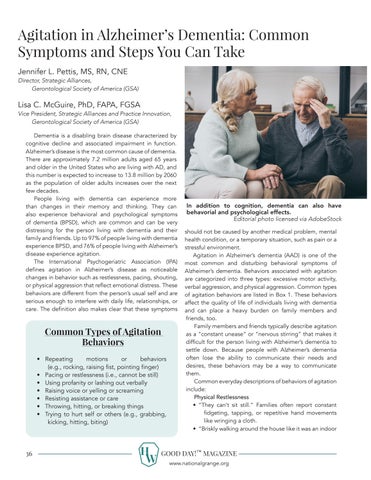
In addition to cognition, dementia can also have behavorial and psychological effects.
Editorial photo licensed via AdobeStock
should not be caused by another medical problem, mental health condition, or a temporary situation, such as pain or a stressful environment.
Agitation in Alzheimer’s dementia (AAD) is one of the most common and disturbing behavioral symptoms of Alzheimer’s dementia. Behaviors associated with agitation are categorized into three types: excessive motor activity, verbal aggression, and physical aggression. Common types of agitation behaviors are listed in Box 1. These behaviors affect the quality of life of individuals living with dementia and can place a heavy burden on family members and friends, too.
Family members and friends typically describe agitation as a “constant unease” or “nervous stirring” that makes it difficult for the person living with Alzheimer’s dementia to settle down. Because people with Alzheimer’s dementia often lose the ability to communicate their needs and desires, these behaviors may be a way to communicate them.
Common everyday descriptions of behaviors of agitation include:
Physical Restlessness
• “They can’t sit still.” Families often report constant fidgeting, tapping, or repetitive hand movements like wringing a cloth.
• “Briskly walking around the house like it was an indoor
track.” This includes walking back and forth aimlessly or “wandering” throughout the house.
• “They’re jumpy.” Sudden movements or general “shakiness” can be observed during episodes.
Verbal Outbursts
• “Broken record.” Asking the same question or repeating the same sentence dozens of times.
• “Lashing out.” Verbal aggression such as screaming, shouting, or using uncharacteristic profanity and insults.
• “Demanding attention.” Constant unwarranted requests for help or “calling out” for someone who is already present.
Emotional and Behavioral Changes
• “A different person.” Rapid mood swings where a previously calm individual becomes suddenly irritable or angry without an obvious reason.
• “Fighting me.” Resistance to necessary daily care, such as refusing to bathe, change clothes, or take medication.
Strategies That Can Minimize Agitation in Persons Living with Alzheimer’s Dementia
• Create a calm, clutter-free environment.
• Avoid environmental triggers (e.g., noise, light glare, distractions).
• Establish predictable routines built on strengths and aligned with individual preferences.
• Ensure personal care needs are met, including comfort.
• Simplify tasks and routines and offer simple choices.
• Engage in meaningful activities such as music, art, or walking.
• “Sundowning.” A specific pattern where confusion and agitation worsen significantly in the late afternoon or evening as daylight fades.
Aggressive Actions
• “Physical combativeness.” In more severe cases, this may escalate to hitting, pushing, scratching, or throwing objects.
• “Destroying things.” Slamming doors, tearing paper, or breaking household items.
AAD not only impacts quality of life for the person with AAD and their family members and friends, it is also associated with negative health outcomes. AAD accelerates decline in both cognitive (e.g., memory and thinking) and physical functioning (e.g., bathing, dressing, grooming, and using the bathroom) and increases the risk of injuries, infections, early institutionalization (e.g., admission to a nursing home), and death.
Caregivers and family members of people living with dementia should
to health care providers about AAD - both the patterns they see in their loved ones, and strategies on how to relieve or minimize the agitation. Editorial photo licensed via AdobeStock
Individuals with AAD tend to have more health problems and require more therapies, including medication. It’s important to talk to a health care provider of the person with AAD about the agitation
behaviors. They may have strategies that can help. Before the appointment, a family member or friend should make a list of what they are seeing and share it with the health care provider to help identify patterns. Here are some suggestions on what to include:
• The Action: What exactly happened? (e.g., pacing, shouting, hitting, or repetitive questioning).
• The Timing: When does it occur? Is it during “sundowning” (late afternoon/evening) or triggered by specific tasks like bathing?
• The Triggers: What was happening right before? (e.g., a loud TV, a new person in the room, or being rushed).
The box above lists sample strategies family members and friends can use at home that may minimize the agitation behaviors. The health care provider might have additional suggestions for your situation. Effective management strategies for AAD focus on preventing or reducing episodes by identifying, understanding, and addressing the underlying triggers and contributing factors.
In addition to declines in memory and thinking, many people living with Alzheimer’s disease experience BPSD, with agitation as the most common. Agitation shows up as noticeable behavior changes such as restlessness, pacing, shouting, or physical aggression that differ from a person’s usual behavior and interfere
talk
with daily life. Agitation behaviors can significantly reduce quality of life, increase caregiver burden, and are associated with faster cognitive and physical decline, and greater health complications. Identifying patterns, triggers, and timing of behaviors and discussing them with a health care provider are important steps to effective management to help prevent or reduce episodes.
Resources about Agitation in Alzheimer’s Dementia:
Gerontological Society of America Brain Health Resources: geron.org/brainhealth
Gerontological Society of America Agitation in Alzheimer’s Resources: geron.org/dementiabehavior
Alzheimer’s Association—Anxiety and Agitation: https:// www.alz.org/help-support/caregiving/stages-behaviors/ anxiety-agitation
National Institute on Aging— Coping with Agitation, Aggression, and Sundowning in Alzheimer’s Disease: https://www.nia.nih.gov/health/alzheimers-changesbehavior-and-communication/coping-agitationaggression-and-sundowning
About the Gerontological Society of America: GSA is the oldest and largest interdisciplinary organization devoted to research, education, and practice in the field of aging. GSA’s principal mission — and that of our 6,000 members — is to promote the study of aging and disseminate information to scientists, decision makers, and the general public.
Founded in 1945, GSA is the driving force behind advancing innovation in aging — both domestically and internationally. Our members come from more than 50 countries.
The Vision of GSA is Meaningful Lives as we Age.
Learn more at www.geron.org.