
February 27th, 2026
February 27th, 2026
A recent ruling by the Supreme Court of the US striking down President Trump’s global tariffs under the International Emergency Economic Powers Act (IEEPA) represents a significant legal constraint on unilateral executive trade authority. The court determined that the statute did not authorize the president to impose sweeping tariffs without congressional approval, invalidating a major component of Trump’s tariff framework.
However, the administration quickly replaced the tariffs with a temporary 10% duty under Section 122 of the Trade Act of 1974. Most Mexican exports that qualify under USMCA remain exempt, preserving Mexico’s preferential access relative to non-USMCA countries. This outcome reinforces Mexico’s structural advantage as a core North American manufacturing partner Nevertheless, the shift reduces Mexico’s relative tariff advantage to other countries compared to previous conditions, as non-USMCA goods from Mexico now face the new tariff. The ruling also introduces uncertainty regarding future trade policy tools, ongoing bilateral agreements, and tariff-based incentives
Source: NEY YORK TIMES, CNBC

On February 20th, Mexican armed forces killed Nemesio Oseguera Cervantes, known as “El Mencho,” leader of the Jalisco Nueva Generación Cartel (CJNG), during a military operation in Jalisco. His death marks one of the most significant security operations in recent years and represents a major symbolic and operational victory for the administration of President Sheinbaum.
The operation signals a shift away from the previous administration’s security approach and reinforces the government’s narrative the current strategy is delivering results. In the immediate aftermath, cartellinked violence disrupted activites in several states, particularly Jalisco and Michoacán, affecting businesses and industrial operations. However, conditions stabilized within days
The Mexican government confirmed that the United States provided intelligence support, reflecting deeper bilateral security coordination Sheinbaum confirmed a direct call with Trump, during which she outlined operational details and emphasized the effectiveness of bilateral cooperation
The operation strengthens Mexico’s position in ongoing USMCA-related discussions, as security cooperation and, in particular, combating drug trafficking, remains a central concern for President Trump. Demonstrated progress against organized crime improves Mexico’s negotiating leverage and reinforces its role as a reliable strategic and economic partner within North America, while reducing one of the primary political risks affecting investment and supply chains.
Source: FORBES
President Sheinbaum confirmed she will submit to Congress the Electoral Reform next Monday without modifications. The initiative seeks to reduce public funding for political parties, eliminate proportional representation seats in the Senate, and modify the selection mechanism for proportional representation deputies The Green Party (PVEM) and the Labor Party (PT), key MORENA partners, have expressed opposition, as it plays a central role in their political survival. Its approval is unlikely considering that Constitutional reforms require a qualified majority, making unified coalition support essential for approval Sheinbaum acknowledged these divisions but stated that the reform fulfills a political commitment, regardless of its legislative outcome Separately, the reform reducing the workweek to 40 hours has now been approved by the required 17 state legislatures and has been sent to the Executive for publication in the Official Gazette, which will formally enact the measure and conclude its legislative process
Sources: LA JORNADA

Mexico recorded a historic inflow of $40 9 billion in foreign direct investment (FDI) in 2025, representing a 10 8 percent annual increase, according to the Ministry of Economy. The growth was driven primarily by new investments, which surged 133 percent year-over-year, increasing their share of total FDI from 8.6 to 18%. This expansion highlights Mexico’s ability to attract fresh capital linked to advanced manufacturing, technology adoption, and supply chain relocation.
North America remained the dominant source of capital, with the United States contributing 38.8 percent of total inflows and Canada 8.1 percent, reinforcing Mexico’s strategic integration under the USMCA. Geographically, Mexico City captured 54 8 percent of total FDI, followed by Nuevo León and the State of Mexico, underscoring the concentration of investment in major economic and industrial hubs
Source: EL FINANCIERO
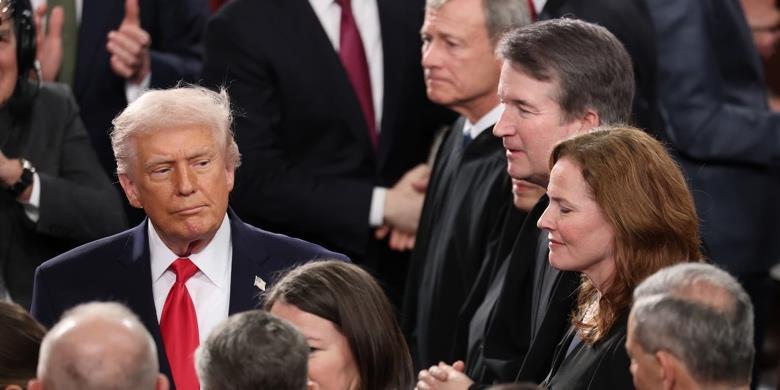
President Donald Trump used his State of the Union address to center his political narrative on economic recovery, immigration enforcement, and electoral positioning ahead of the November midterm elections. For Mexico, Trump’s renewed emphasis on tariffs, domestic manufacturing, and immigration enforcement reinforces structural uncertainty ahead of the USMCA review His continued framing of tariffs as both an economic and fiscal instrument, even after the SCOTUS ruling, suggests they will remain central to his trade strategy The increasingly politicized nature of trade policy means Mexico’s economic relationship with the U.S. will continue to depend not only on market fundamentals, but also on Mexico’s alignment with U.S. geopolitical and domestic political objectives.
Source: FORBES
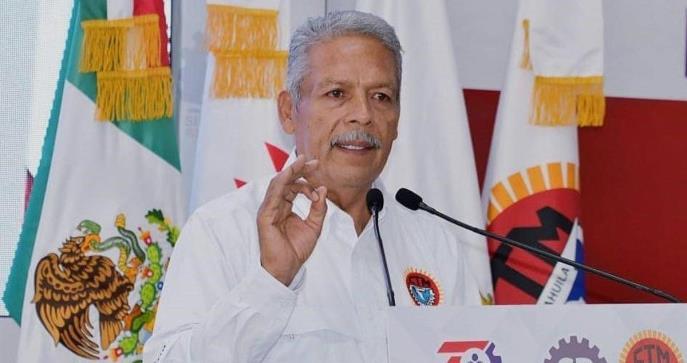
Mexico’s largest labor federation, the Confederation of Workers of Mexico (CTM), elected Tereso Medina Ramírez as its new secretary general for a six-year term Medina secured overwhelming mayority and pledged to modernize the organization, strengthen internal unity, and promote a more transparent and collaborative labor agenda Medina also announced the creation of an advisory council to guide the federation’s restructuring and reaffirmed the CTM’s commitment to dialogue with both government and private sector stakeholders.
The leadership transition comes at a critical moment for Mexico’s labor landscape, as the country prepares to implement the gradual reduction of the workweek.
Source: EL PAIS
Mexico’s National Customs Agency (ANAM) has established the Specialized Customs Committee (COEMAD) as a permanent technical coordination mechanism with the private sector The initiative aims to create a structured channel for dialogue to address operational challenges, streamline customs procedures, and enhance legal certainty The committee will allow authorities and industry stakeholders to jointly identify bottlenecks, improve administrative processes, and increase operational efficiency at ports of entry. With this, ANAM seeks to develop technical solutions that strengthen supply chain reliability and support Mexico’s exportdriven economy
Source: ANAM
Initiative to Amend the National Water Law on Water Security During Droughts
• Presented by: Sen Luis Donaldo Colosio Riojas (MC)
• Objective: Strengthens water security by mandating drought prevention and mitigation programs, early warning systems, and emergency protocols. It prioritizes domestic and urban water use during shortages and authorizes reductions for other sectors
• Status: Published in the Parliamentary Gazette on February 24, 2026
Point of Agreement on Environmentally Responsible Management of Electronic Waste
• Presented by: PRI Parlamentay Group
• Objective: It seeks to promote responsible disposal, reduce environmental harm, and strengthen regulatory and institutional actions addressing growing volumes of discarded electronic devices, supporting environmental protection, circular economy practices, and public participation nationwide
• Status: Published in the Parliamentary Gazette on February 24, 2026
Initiative to Amend the Law on Roads, Bridges, and Federal Motor Transport Regarding Double-trailer Truck Compliance
• Presented by: Dip Alberto Maldonado Chavarin (MORENA)
• Objective: This initiative requires federal authorities to jointly inspect highways to ensure cargo transport companies, particularly double-trailer trucks, comply with official safety standards It authorizes sanctions or permit revocation for noncompliance, strengthening enforcement, improving road safety, and ensuring adherence to technical regulations governing federal motor carrier operations throughout Mexico nationwide system.
• Status: Presented to the Plenary on February 11, 2026
Decree Amending Article 123 of the Constitution Regarding Reduction of Working Hours
• Presented by: Chamer of Deputies
• Objective: Establishes a fortyhour workweek with at least one paid rest day per six worked, limits overtime to twelve weekly hours, prohibits overtime for minors, mandates gradual reduction from 2026 to 2030, requiring secondary legislation reforms within ninety days.
• Status: Approved by Local Congresses on February 26, awaiting publication in the Official Gazette (DOF)
National Quality Infrastructure Program 2026
• Presented by: Ministry of Economy
• Objective: The program establishes national priorities for standardization and quality infrastructure activities during 2026 It coordinates authorities, informs stakeholders, and promotes transparency in developing technical standards. It serves as a planning and communication instrument, regarding conformity assessment, metrology, and standardization initiatives
• Status: Published in the Official Gazette of the Federation on February 24, 2026