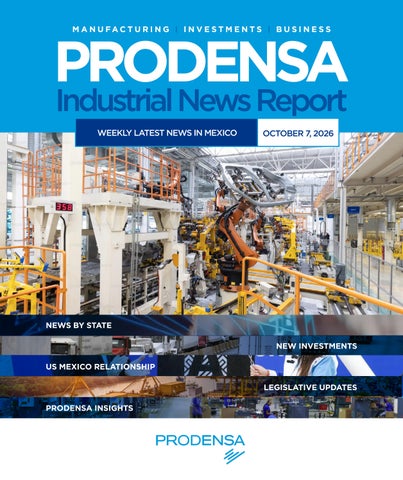
PRODENSA M A N U FAC T U R I N G | I N V E S T M E N T S | B U S I N E S S
Industrial News Report WEEKLY LATEST NEWS IN MEXICO
OCTOBER 7, 2026
NEWS BY STATE NEW INVESTMENTS US MEXICO RELATIONSHIP LEGISLATIVE UPDATES PRODENSA INSIGHTS
2
US - MEXICO NEWS
3
US-MEXICO NEWS
US-MEXICO TRADE NEGOTIATIONS From Milwaukee, Economy Secretary Marcelo Ebrard gave a speech on the G20 Ministerial Meeting. He mentioned that the G20 countries represent about 89% of world GDP, 77% of trade, and 66% of FDI. His position on the overall agenda for the Ministerial meeting was that the United States and the rest of the members are pushing for a “new normal” in trade, tariffs included. Forced labor and excess capacity, especially steel, dominated the agenda. Ministers backed a Milwaukee Framework to curb excess steel overcapacity: Origin and traceability are its core, and the agreed standard is melt and pour, which Ebrard said should help Mexican steel by blocking triangulation of “non-market economies”. Minister Marcelo Ebrard met with U.S. Trade Representative Jamieson Greer on October 1st on the sidelines of the G20 Trade Ministers’ Meeting in Milwaukee to continue bilateral negotiations between Mexico and the United States. The meeting lasted nearly one hour and focused on advancing discussions and narrowing differences in outstanding trade issues. Following the meeting, Ebrard said both countries are moving closer to new agreements and that negotiations have continued through frequent bilateral contacts. He emphasized that Mexico is seeking to preserve its comparatively favorable access to the U.S. market as the global trade environment shifts toward greater use of tariffs and other trade measures. The negotiations take place as Mexico and the United States continue discussing tariffs affecting key Mexican exports and other bilateral trade issues connected to the broader USMCA review process.
Minister Ebrard claims that Mexico remains in a more favorable position than other major U.S. trading partners and reiterated that talks with Greer are progressing toward resolving pending issues. The next bilateral round of negotiations is expected to take place in October after the previously planned September meeting was postponed. He argued, that Mexico pays less than China or Canada, that there has been progress on the negotiations, given that Mexico started the review facing 25% across the board, and yet it remains the largest exporter to the United States while paying the least duty. Section 232 relief on steel, aluminum, and autos is still open while Section 301 tariffs were not discussed. Finally, he mentioned future trade missions: the EU in spring 2027, a second trip to Canada, and likely India. SOURCE: SECRETARÍA DE ECONOMÍA, EL ECONOMISTA, SECRETARÍA DE ECONOMÍA
4
US-MEXICO NEWS
U.S. AMBASSADOR ON FUGITIVES AND BANK EXPOSURE Ambassador Ronald Johnson said the United States has handed Mexico more than 20 fugitives during the Trump administration, bringing the total returned since the start of the pandemic to more than 350. The cases cover ties to narcoterrorist organizations, murder, money laundering, kidnapping, attempted murder, assault, theft, and drug offenses. “When we work together, we send a clear message: no matter where they flee, they will be found and brought to justice,” he wrote. At an IRS Criminal Investigation forum in Mexico City, Johnson warned representatives of 40 commercial banks that institutions handling cartel money face isolation from the North American financial system: “Whoever touches “cartel money” stays stained and will have nowhere to hide.” The line fits a shift under Trump toward anti-money-laundering over seizures. Mexico’s Financial Intelligence Unit froze 24,622 accounts from October 2024 to August 2026, immobilizing 8.67 billion pesos, more than 70% tied to high- impact groups. The warning also sits against the 2025 FinCEN designations of CIBanco, Intercam, and Vector under the FEND Off Fentanyl Act, which led to CIBanco’s license revocation and a large fiduciary- asset migration. SOURCE: EL ECONOMISTA, MEXICO BUSINESS
5
US-MEXICO NEWS
CUSTOMS LAW REFORM The customs-law reform cleared the Chamber of Deputies’ Finance Commission on October 1, with three reservations, and goes to the floor next week. The main change lowers the threshold for a precautionary embargo on undervalued goods: the old trigger was undervaluation above 50%. Above 20%, the importer can substitute a cash deposit equal to the tax on the difference; below 20%, a deposit in a customs guarantee account. A unanimous reservation, from Morena’s Carol Antonio Altamirano, adds a fine of 50% to 100% of commercial value for fiscal huachicol in hydrocarbons and petroleum products, on top of existing Article 185 penalties, when required documents are not filed. A PAN proposal to suspend the customs agent’s license in those cases was rejected. Entry into force is pushed to January 1st, 2027. Specialists warn the lower embargo bar threatens an export boom $549 billion in the first eight months of 2026, up 63% in two years. ANAM flagged 1,349 undervaluation cases in 2025 and more than 1,100 through August 2026. Comce Noreste, covering 46.7% of exports from Chihuahua, Coahuila, Tamaulipas, and Durango, says a slow customs house “is also a tariff”: yard saturation, hundreds of dollars a day per container, and line stoppages for maquiladoras. Fine collections already hit 2.99 billion pesos in the first half of 2026. SOURCE: EL ECONOMISTA, (2)
TRUCKING PRESSURES Cross-border trucking between Mexico and the United States is facing tighter operating conditions as freight demand continues to grow. Industry representatives said stricter U.S. enforcement involving Mexican B-1 drivers, non-domiciled commercial licenses, and English-language requirements is reducing available driver capacity and increasing uncertainty for carriers operating across the border. Some Mexican companies have reportedly returned to transferring trailers to U.S. carriers at border crossings rather than continuing directly into the United States. Companies also cited higher fuel costs, greater customs scrutiny, and cargo theft as additional pressures on cross-border logistics. Cargo theft in the Bajío increased 11% year-on-year, with auto parts and electronics among the products most frequently targeted. The combination of tighter driver availability and higher operating requirements is occurring as manufacturing and trade volumes between both countries remain elevated. SOURCE: FREIGHTWAVES
6
LEGISLATIVE CHANGES AND INITIATIVES FOREIGN TRADE • DRAFT DECREE AMENDING AND ADDING VARIOUS PROVISIONS OF THE CUSTOMS LAW — Presented by: Federal Executive. Opinion of the Finance and Public Credit Committee, Chamber of Deputies. — Purpose: Strengthen customs control against undervaluation of goods, without creating a new tax. Authorities may order a precautionary embargo even when the value gap is below 50 percent, and the exception for importers who have already posted a price- estimate guarantee is removed. In temporary and similar regimes, the gap that triggers a presumption of infringement falls from 50 percent to 20 percent versus identical or similar goods. The embargo may be substituted by a cash deposit of the tax difference above 20 percent, or by a customs guarantee account below 20 percent — Reserves: Article 185: for hydrocarbons and petroleum products, an additional fine of 50 to 100 percent of commercial value when information, documents or declarations are inaccurate, incomplete or false (“fiscal fuel smuggling”). — Status: 2026-10-1 – Sent to the Board of Directors for plenary next week.
7
LEGISLATIVE CHANGES AND INITIATIVES
INVESTMENT • DRAFT DECREE AMENDING, ADDING AND REPEALING VARIOUS PROVISIONS OF THE FOREIGN INVESTMENT LAW — Presented by: President Claudia Sheinbaum. Committees on Economy and Legislative Studies First. — Purpose: Replace the Commission’s open-ended power to block a deal “for national security” with a defined screening. A favorable resolution of the National Foreign Investment Commission is required when foreign capital, direct or indirect, exceeds 49 percent of a Mexican company, the company’s assets exceed a threshold the Commission will set by general resolution, and the company operates in a sensitive activity. Sensitive activities include energy, transport, health, communications, mining, data processing and storage, digital systems, aerospace and defense, and critical and dual-use technologies and others. • Reserves: — Reserves: 13 members with voice and vote: National Defense, Navy, Security and Citizen Protection, and the Digital Transformation and Telecommunications Agency. — Status: 2026-09-30 - Minute sent to the Chamber of Deputies.
JUSTICE • DRAFT DECREE AMENDING, ADDING AND REPEALING VARIOUS PROVISIONS OF THE FEDERAL CRIMINAL CODE AND THE FEDERAL LAW FOR THE PROTECTION OF INDUSTRIAL PROPERTY — Presented by: resident Claudia Sheinbaum. Committees on Justice, Economy and Legislative Studies First. — Purpose: Update criminal enforcement of copyright and industrial property and align it with USMCA and TRIPS. “Intent of profit” is replaced by “commercial scale,” meaning acts of trade or activity seeking an economic gain, or a competitive advantage for a business. New or tougher offenses cover reproduction, distribution, sale, signal decryption and circumvention of technological protection measures. — Key Application: Institutional identity: after the committee rewrite, 1 to 5 years and 1,000 to 10,000 UMA for using or imitating, on a commercial scale, the graphic identity, domain or official document of a public institution in order to induce error. — Status: 2026-09-30 - Minute sent to the Chamber of Deputies
8
NEWS BY STATE
BAJA CALIFORNIA The third edition of the “AI Summit Tijuana Frontera Futura” will take place Thursday, October 8, at the Hotel Real Inn. It will focus on practical uses of artificial intelligence in health, marketing, retail, customer service and logistics. Roberto Lyle Fritch, president of Tijuana’s Business Coordinating Council (CCE), presented the event. It follows earlier editions in November 2025 and July 2026, and its aim is to help more companies adopt AI tools that are already working in Mexico and abroad. Javier de la Fuente, executive director of Pictor, said the summit will run eight hands-on workshops in two parallel rooms. Experts and companies such as Amazon Web Services and Mercado Libre will take part, along with speakers from Spain and regional firms presenting real automation and AI use cases. Attendees will be able to discuss their companies’ specific challenges directly with specialists and will leave with a 90-day action plan. Organizers say success means real business results, such as new meetings and clients, not just attendance. They also want to link Tijuana’s bu-
siness community with technology that raises productivity, building on the city’s talent, industrial activity and strategic location. SOURCE: INDUSTRIAL NEWS BC
9
NEWS BY STATE
CHIHUAHUA A delegation from the Japan External Trade Organization (JETRO) visited Chihuahua to see the state’s industrial and business environment firsthand and to identify investment, business and collaboration opportunities in strategic sectors. The delegation toured the Honeywell, Safran Cabin and Clayens facilities to learn about their local operations, which showed Chihuahua’s production capabilities and its role in global supply chains. The Chihuahua Economic Development Promoter (Prodech), DESEC, the Engineering School of the Autonomous University of Chihuahua (UACH) and the Municipality of Chihuahua also took part, helping connect the Japanese representatives with local business and academic players. As part of the agenda, JETRO attended the Automotive & Aerospace Nearshoring Summit 2026, which aimed to strengthen ties between Japanese companies and local firms and to find areas for collaboration in high-value industries, especially automotive and aerospace. The visit is part of Chihuahua’s broader effort to deepen trade relations with Japan, integrate with international companies and use its existing industrial base to attract new projects and capital. SOURCE: PRO CHIHUAHUA
10
NEWS BY STATE
NUEVO LEON Monterrey Aeroclúster held a new edition of AeroConexión, a forum aimed at strengthening Mexico’s aerospace value chain, building specialized suppliers and expanding technical capabilities. Member companies such as G+G Professional Carbides Tool, Albert Surface Technologies and Especialidades Químicas Monterrey presented their solutions, which encouraged business exchange and new collaboration networks in the region. The keynote was given by Omar Reyes of DQS de México, who called certification critical for companies that want to join or move up in global aerospace supply chains. He said that while other markets are adjusting, the aerospace industry remains stable and is expected to double in size globally by 2029. Reyes also said Mexico needs many more certified sites to reach the maturity of its automotive manufacturing, noting that aerospace components offer much higher profit margins. He explained that about 80% of aerospace quality requirements, under International Aerospace Quality Group guidelines, are based on ISO 9001. These requirements cover component manufac-
turing, heat treatment and specialized logistics. He also named aircraft maintenance and life extension as top growth areas for Mexican suppliers. Through the event, the cluster reaffirmed its commitment to raising the technical competitiveness of Mexican companies and positioning the country as a hub for aerospace investment and technology. SOURCE: MEXICO INDUSTRY
11
NEWS BY STATE
COAHUILA Coahuila, Mexico’s top auto parts producing state, will host the first edition of the Automatch 2027 Forum on March 10 and 11 at the Autonomous University of Coahuila (UAdeC) University Cultural Center, Arteaga Campus. The business event is designed to connect automakers’ demand with specialized suppliers and to promote nearshoring and advanced manufacturing in the region. It is organized by the Coahuila Automotive Industry Cluster (CIAC) and the Mexican Association of Machinery Distributors (AMDM), with support from the state and municipal governments. The program will include an exhibition area, technical workshops and B2B meetings. CIAC president Lourdes Cobos said the cluster has about 60 member companies representing roughly 110,000 jobs, mainly in
southeastern Coahuila. She added that the industry is looking to relocate both direct and service suppliers, with a strong focus on equipment and spare parts. AMDM president Roberto González urged companies to choose specialized, association-backed suppliers to ensure secure business. Julio Galván of the National Auto Parts Industry (INA) said national auto parts production reached $63.83 billion in the first half of 2026, up 9% year over year. Coahuila contributed $10.08 billion of that, a 15.8% share and more than 13% growth, and attracted $221 million in automotive foreign direct investment. The first edition expects 150 pre-scheduled business meetings and about 80 exhibitors specializing in machinery, equipment, technology and advanced manufacturing. SOURCE: MEXICO INDUSTRY
12
NEWS BY STATE
GUANAJUATO Guanajuato Puerto Interior (GPI) in Silao celebrated its 20th anniversary, recognizing two decades of long-term vision that have transformed the state’s economy, industry and society. The platform covers more than 1,500 hectares and is home to 140 companies from 19 countries. It has drawn about $6.5 billion in cumulative investment, supports more than 40,000 direct jobs and sees over 25,000 vehicles enter every day. Its operations generate an estimated 37 to 48 billion pesos in annual value added, equal to 37–48% of Silao’s gross census value added and 4.5–5.8% of Guanajuato’s. Manufacturing makes up more than three-quarters of its activity, and the automotive industry is its main specialization: 91
companies and over 31,000 jobs. Governor Libia Dennise García Muñoz Ledo and GPI Director General Héctor López Santillana stressed the importance of continuity and coordination between companies, schools and government. Workers and business leaders shared how the park has opened up career and personal opportunities, and the Council of GPI Organizations highlighted its social outreach with more than 12 neighboring communities. The event also launched a commemorative book, a documentary series and the GPI 2026 Mapping study. Speakers said the park’s next stage will depend on AI, automation, digitalization, energy, water, sustainability, electromobility and talent development. SOURCE: CLUSTER INDUSTRIAL
13
NEWS BY STATE
QUERETARO FORVIA Electronics expects about 20% growth at its automotive electronics plant in San Juan del Río, Querétaro, driven by four innovation projects planned for next year. The plant opened in 1983. It now covers about 32,000 m², employs more than 1,000 people, runs 11 industrial processes and technologies, and ships to 21 global destinations, with capacity of 100,000 products sold per week. It makes digital instrument clusters, audio and video head units, cameras, electronic control units, PCBAs and FM tuners. It is part of FORVIA, the group formed by Faurecia and HELLA, which has 137,500 employees and 12,000 R&D engineers. Director of Operations Etzail Vega said about 78% of the plant’s materials come from Asia and 22% from
local suppliers. FORVIA is now regionalizing plastic and metal-mechanical components, which opens opportunities for certified suppliers in the region. The plant is also adding AI, robotics and vision systems, including a humanoid robot for final inspection that is scheduled for January 2027. Vega stressed that it will support operators, not replace them, and that decisions will stay with operating staff. FORVIA also develops talent internationally, training Mexican engineers in Japan, China and India and promoting others to roles in France, Germany and the United States. On the environmental side, the plant has a water treatment system whose recycled water will gradually be used in industrial processes. SOURCE: CLUSTER INDUSTRIAL
14
NEWS BY STATE
MEXICO CITY ProximityParks has begun construction of ProximityParks Iztapalapa III, a 600 million peso last-mile logistics complex in eastern Mexico City. The project will convert a furniture factory on Avenida Rojo Gómez, which operated for more than four decades before shutting down, into more than 24,000 m2 of urban logistics space. The complex will serve logistics and e-commerce companies that want to move inventory closer to one of the city’s densest consumer areas, cutting delivery times, distribution costs and fleet use. It is expected to create more than 800 direct jobs in Iztapalapa. The project will seek LEED certification and will include solar panels, electric vehicle chargers and bicycle parking
to support greener last-mile operations. It will also host a Fundación Construyendo y Creciendo classroom where construction workers can continue their education. CEO and co-founder Mario Berlanga said the park will become a benchmark for last-mile logistics in the region. Mexico City Economic Development Secretary Manola Zabalza linked the project to growing demand for e-commerce and online shopping among younger generations. The investment is part of ProximityParks’ plan to reach $1 billion in assets under management within three years, with other projects in Mexico City, Monterrey and Guadalajara. Two of its parks are already linked to Plan México and six more, including Iztapalapa III, are in process. SOURCE: MEXICO INDUSTRY
15
INVESTMENT NEWS
CENTRAL MEXICO MARTINREA Martinrea, the Canadian automotive supplier, inaugurated on September 30 an expansion of its plant in Silao, Guanajuato, with an investment of 50 million dollars. The project adds a 3,000 ton press, a roll forming line for high strength steel, and robotic assembly equipment for General Motors programs, and is expected to create 30 new jobs. The plant currently employs approximately 596 workers, and the company operates 15 facilities across five Mexican states.
NORTHERN MEXICO VYNMSA VYNMSA, a Mexican industrial real estate developer, inaugurated on October 1 its industrial park in Torreón, Coahuila, with an investment of 800 million pesos. The park covers 40 hectares, and four of its 12 planned buildings are completed and available for lease. Governor Manolo Jiménez Salinas attended the inauguration and stated that additional investments for La Laguna would be announced in the coming weeks.
VOLMEX VOLMEX, an Aguascalientes based manufacturer of truck bodies and trailers, announced on October 1 the construction of a new plant in Jesús María, Aguascalientes. The facility will expand production for the Mexican, Central American, and U.S. markets, with 40 percent local supplier participation planned. General Manager José Luis Macías Alonso presented the decision to Governor Tere Jiménez.
16
INVESTMENT NEWS
GASOMAX-XSTOP GASOMAX-XSTOP, a Mexican company, broke ground on September 30 on a safe parking facility for truckers in Peñuelas, Aguascalientes, with an investment of 100 million pesos. The 3.15 hectare site will provide more than 90 spaces for tractor trailers, along with diesel dispensers, food services, showers, and rest areas, and is expected to create 360 jobs. Governor Tere Jiménez presided over the groundbreaking.
PROXIMITY ProximityParks, a Mexican industrial real estate developer, broke ground on October 1 on a last mile logistics park in Iztapalapa, Mexico City, with an investment of 600 million pesos. The project converts a former furniture factory on a 24,600 square meter property and is expected to create 800 direct jobs. The company plans to grow its assets under management from 700 million to 1 billion dollars within three years, through approximately 100 million dollars in annual investments.
GERDAU CORSA Gerdau Corsa, the Brazilian steel producer, announced on October 4 the opening of a ferrous scrap recycling plant in Tlaquepaque, Jalisco. The 25,000 square meter facility will process more than 60,000 metric tons of ferrous scrap per year and will serve as a collection and sorting hub for the company’s steel production, where approximately 94 percent of output relies on recycled material. SOURCES: CLUSTER INDUSTRIAL, MEXICO INDUSTRY, NORTE EN LINEA
17
WHAT’S NEW IN PRODENSA?
18
WATCH FULL VIDEO
19
PRODENSA INSIGHTS
How Manufacturers Can Adapt to Mexico’s Shorter Workweek Mexico’s transition to a 40-hour workweek will require manufacturers to rethink more than employee schedules. Maintaining production levels with fewer regular working hours will put greater emphasis on shift design, productivity, automation, equipment efficiency, and workforce planning. This article explores practical strategies manufacturers can use to adapt, from optimizing OEE and Lean Manufacturing to redesigning shifts and strengthening workforce skills—all while controlling costs and protecting operational continuity. • How manufacturers can maintain output with fewer hours • Why OEE, automation, and shift design will become more important • How workforce planning and training can support the transition
Where Should You Manufacture in Mexico? Choosing where to manufacture in Mexico goes far beyond comparing labor costs and available industrial buildings. Utilities, workforce stability, logistics, supplier ecosystems, infrastructure, and expansion capacity can ultimately determine whether a location supports long-term operations. This article compares Mexico’s leading manufacturing regions and explains why site selection should move from state-level data to city, industrial corridor, and specific-site validation before capital is committed. • What makes a location truly “manufacturing ready” • Why power, water, and infrastructure can determine site viability • How Northern Mexico and the Bajío compare across key operational factors
VISIT OUR WEBSITE TO EXPLORE OUR FEATURED BLOG POSTS, EBOOKS, AND CASE STUDIES. PRODENSA.COM/INSIGHTS
www.prodensa.com contact@prodensa.com