DIGITAL PROJECT
DEMO
INCLUDED
RESOURCE BANK DIGITAL BOOK
S
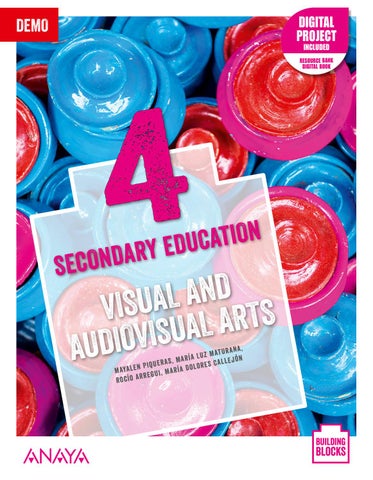
4
N O I T A C U D E Y R A D N EC O
D N A L A U S I V S T R A L A U S I V O I AUD a, at u r a n M z u L ría n allejó ras, Ma C e u s e q i r P o n Dol M ay a l e , María i u g e r r Rocío A
Building
Blocks
this is
your book
Reading and listening
ch unit
f ea The opening pages o
4
We read and listen about creators and their contribution to art, providing students with activities to reinforce language and content.
SUSTAINABLE DESIGN
SDG. Reflection on and analysis of SDGs, such as gender equality, climate action, reducing inequalities, etc.
g
Reading and listenin
ama
Basur who raise and designers collective of artists the modern Basurama is a currently facing Madrid, the waste crisis awareness of ture students in in 2001 by architec issue and world. Established reflect on this ges society to to Basurama, ‘you the collective encoura ent. According environm the its impact on buy’. everything you as throw away almost the exhibition Christm program set up of waste Their Art for Change shocking amount the ted highligh in RE, which the festive season. g? produced during reusing and recyclin difference between ent? environm 1 What is the the for you think is better Which one do text? statement in the with Basurama’s 2 Do you agree that mean: text the in phrases issue. 3 Find words or think about an ion to make people a) Give informat a disaster. b) The result of suggest. c) Persuade or d) Discard.
s used in the image? e any of the material describe the image?
4 Do you recognis
5 Which words best
ing thought-provok ugly colourful erful striking decorative pow
environment I'm concerned about the materials so I always use recycled for my projects.
Speaking the last thrown away in
ng you have you 6 Think about everythi of these items be reused? Could
any seven days. Could place? items in the first avoid using these you produce when the waste you Do you think about ble materials? Could 7 Do you use sustaina start an art project? produce less waste? piece of art and you make your
Recycle), (Reduce/Reuse/ Christmas in RE a (Madrid, 2016). exhibition, Basuram
.es Go to anayaeducacion 12.8.
artistic recycling
51
the SDG resource
50
The audios of each unit’s content are available at www.anayaeducacion.es Speaking We speak about issues that are related to the unit and the UN Sustainable Development Goals.
CONTENT DEVELOPMENT Wide variety of pictures to aid your understanding.
Unit 4
Highly structured content with important concepts highlighted in bold.
1 SUSTAINABILITY
ã 1.2 Education for responsible consumption
ã 1.4 Collecting, an attachment to the material
Advertising requires creativity to persuade and encourage people to buy things. Its purpose is to make a product known, to build trust in it and for us to associate it with how we would like to be.
Sometimes we gather objects of the same category or that have something in common. We value them for aesthetic, economic, sentimental, cultural reasons or for the simple fact of owning them. This hobby is called collecting and the people who enjoy it become collectors. There are as many types of collecting as there are tastes, curiosities and interests, such as stamps, postcards, stickers or vinyl records.
To be more effective, advertising targets* people’s emotions with powerful images that influence what we feel and how we behave. These images are not always real and objective. Counter-advertising is born out of a reaction to advertising images. It uses the same strategies as advertising to criticise companies, especially multinationals, that employ abusive practices and have an unscrupulous dominant economic model.
Art collecting is reserved for the wealthiest social classes. In the past, patrons sponsored and supported artists, who worked almost exclusively for that patron. Today it is the super-rich, the multinationals and the banks that do it, either for the pleasure of acquiring art or for certain tax benefits.
The verb to target meaning ‘to aim for something’ comes from the point, or target, that we aim for, specifically in shooting. The bullseye and the coloured circles in archery are examples of targets.
ã 1.3 Ethics and advertising Anti-tobacco campaign (Quimper, France, 1991).
Advertising has a great economic impact and an important role in society; it promotes and reflects certain values and attitudes. Advertising professionals must assume the great responsibility of not being misleading. They must be respectful and convey ethical values.
1
2
Advertising is regulated by a code of ethics although sometimes it may not seem so, considering the number of advertisements we get, the sexist and violent images or messages, etc. To avoid and control these situations, a set of rules protects minors and guides toy companies in the correct advertising of their products.
1. The Carmen Montilla Art Gallery in Havana displays a collection of works of art by Cuban artists. 2. Collection of vintage toy cars.
Understand, think and apply...
Competency tasks, split into sections to work on sub-skills.
Do you know what you are being sold?
4
Reflect and comment with your clasmmates: a) Have you ever wondered why advertising has so much appeal? Do you think it just sells the product it advertises or do you think it sells something else? b) What products do advertisements that are about happiness sell? What about advertisements that claim to be greener or socially just? Why do you think a zero soda was created when there was already a light one?
Is it really waste? Waste is an essential component in the works of artists such as Helle Jorgensen, who creates decorative elements and weaves animals, plants and sea creatures out of plastic bags; Joshua Harris, who creates inflatable animals out of garbage bags; and Robert Bradford, who creates them out of the objects he accumulates. What would you do with this type of waste? 1
5 Discover the relationship between advertising and emotions: analyse advertising and counter-advertising images, and reflect on them. Then, modify the ads so that they sell a sustainable and eco-friendly lifestyle.
2
Understand, think and apply... Do you like collecting objects?
7 Reflect and respond: a) Why do you think people feel the need to collect objects? What kind of satisfaction does it bring? b) Do you think art collectors are motivated by the same reasons? c) What about you? What do you collect? Why?
Analyse TV programmes
6
Advertising must convey values.
The icons included with some activities indicate the keys to the project.
Choose three television channels and analyse their programmes: analyse what audience they are aimed at, what time slot they are broadcast, the amount and type of advertising shown in the breaks, etc. Draw conclusions and discuss them in class.
54
1. Sculpture of a dog, by Robert Bradford, made out of small objects and toys. Affordable Art Fair (2012, London). 2. Joshua Harris checking his sculpture. It is placed on the grates of the New York subway (2006) and inflates when the trains pass below.
55
KEYS
PROJECT
SDG
2
SDG Commitment Discover the Sustainable Development Goals and be an active part of our commitment to make a more equal and liveable world.
Developing thinking Work on strategies for thinking: reflect on the content you are learning, generate ideas, organise them, debate them, explain them…
Cooperative learning Get involved in your learning and participate in the group’s learning; you will find that cooperating improves performance and harmony in the class.
Emotional education Get to know yourself; identify the situations that bring up complicated emotions and manage them with constructive, self-affirming experiences.
NEW SECTIONS
2
Unit 4
Do you think visual and audiovisual arts and English have anything in common? Discover how language and visual and audiovisual arts are linked so you can learn both. Learn linguistic and cultural curiosities while you are learning the unit’s content.
➜ First of all, sketches are made. These are freehand drawings that are done to get an idea of what the original will be like and to redesign concepts.
➜ Next, croquis are made. These drawings are more detailed; they define shapes and dimensions and include measurements (levels) and the different views of the object.
1
Lamps made from reused glass jars.
Understand, think and apply...
Artists design artistic, artisanal and industrial objects. They can create anything from sculptures to installations, representing shapes and constructing them. To do this, they must know about materials and techniques, understand the objects and experiment with them. In many cases, they use existing materials in the production of their works: they reuse and recycle, order, combine, integrate, compose and deconstruct. That is, they create by giving a new meaning.
Design your own skateboard 2
2
Understand, think and apply...
1 a) Have you ever taken apart an object that no longer works? What was its inner mechanism like? What were its various components made of? Did you try to reassemble it? b) Have you thought about what will happen to its components when they no longer work? Have you ever made something out of an unused object?
1. Chair design sketches. 2. Design croquis: elevation, profile, plan and details.
Four Bicycles, an exhibition by Gabriel Orozco (Mexico, 1962). MoMA (New York, 2009).
57
56
Unit 4
Artistic recycling or upcycled art arises from the concern that many artists have about the large amount of waste that we generate on a daily basis. It is a sustainable alternative to traditional creation. In this type of production, recyclable or reusable materials are used, whilst trying to ensure that there is zero production of rubbish. Materials are rescued from ending up in the landfill. They are elevated to the status of art and contribute to conserving the environment.
Let’s create
➜ I have an object that I have fallen in love with, that shows me its possibilities, and I begin to work. I carry out sketches and material studies, I analyse assembly needs, technical and production problems, etc.
➜ I have an idea and I want to develop it. I do the drawings. I look for technical information on possible materials, select the final ones and look for them. Then, I carry out studies on assembly, technical problems and implementation.
Artistic recycling uses any object that is no longer useful and any material that is reusable or recyclable. As we have already seen, materials can be mixed, glued, sewn, welded, etc. All kinds of materials can be used: electronic parts, woods, plastic bottles, fabrics, etc.
1 Build a functional design object that respects the environment. We suggest a piece of furniture (shelf, armchair, table) made of cardboard, plastic or with another reused waste object. There are models and templates on the Internet but design it yourself so that it is unique. Get inspired by the different styles that we have seen and by nature. Apply artisan techniques. To do so, follow these steps:
b) Research how to make your piece of furniture firm and stable. Although we do not intend for it to last forever, the design must be durable. Analyse each of the elements of the object, the different pieces, the joints, etc., even the finishes. You can try deconstructing a similar object (physically or mentally), even if it is made of another material.
Process Although it may seem otherwise, this type of creation’s process is similar to other techniques. However, it is more laborious due to the search and selection of materials. It also requires time in order to experiment with the materials and see their possibilities. We can start from two creative assumptions:
Build a piece of furniture using recycled materials
Artistic workshop
a) Make an outline of your first ideas, thinking about the shapes that interest you the most.
Materials
The artist’s imagination will let these materials evolve and have another life, perhaps a more beautiful one.
c) Make a croquis to scale, with the approximate measurements of the overall design of the object. Draw the different views, which can serve as templates for the final realisation of the furniture. d) Finish by considering how to advertise your creation.
Sculpture of a Whale, by Washed Ashore, next to the UN building in
Create cardboard spaces 2 In the mid-1970s, Victor Papanek proposed a furniture design that he called ‘nomadic’. It was light, low-cost, recycled furniture that folded, inflated, etc., and that anyone could build. Today many designers and companies are dedicated to creating objects and furniture made from paper and cardboard. We suggest that you create a playful ‘object-space’ with this same concept. Remember and practise three-dimensional constructions from flat shapes, developing different polyhedra.
Bordalo II (Lisbon, 1987) As this urban artist would say, ‘one man’s rubbish is another man’s treasure’. Bordalo II looks for his materials in the rubbish bins. According to him, nothing is disposable, everything can be used to make art.
El Anatsui (Ghana, 1944) El Anatsui is one of the most renowned contemporary African sculptors. Although by the nature of his works he is considered a sculptor, he could well be a creator of tapestries, made with scrap materials that he carefully selects (aluminium bottle caps, obituary plates, remains of railway tracks, nails, wires, wood, etc.).
Wild animals is the main theme in Bordalo's creations. Through his art, he criticises the destruction of nature that programmed obsolescence generates, consumerism and the negative impact of humans on the natural environment.
His work clearly refers to African traditional textile crafts, while criticising the effects of colonialism in Africa, exorbitant consumption and the waste it causes. His work breaks with the traditional immutability of sculpture, with adaptable, free and flexible forms.
material to select work o. Remember for your portfoli from this unit
in advertising Sculpture of a Bear, Discover by Bordalo values II. This work was part of the Decomposed exhibition at the SQUARE23 gallery (Turin, 2017).
unit outline
Earth Developing More Roots (2011), by El Anatsui.
1 Collect advertising images and discuss what values they present.
SUSTAINABLE DESIGN
60
Representing an object
Sustainability
Ethical design
Unit 4
ress
check your prog
review
Visual maps with the unit’s content.
We learn new techniques for artistic and visual expression and we put them into practice. We get to know artistic movements and artists that have made used of these techniques.
Chairs made out of used tires, in Ombika (Namibia).
New York.
RECYCLING IN ART
Collecting
Commit yourself to a better world 4
Shared reading. Have you heard of the Millennium Summit, the Climate Summit, the Earth Charter or the Forum for the Future? All of these 61 initiatives are related to sustainability and caring for the planet. They are carried out by different organisations, associations and countries. In groups, carry out a search on them and advertise them using your own ideas and your own media.
From plan to three dimensions
From idea to plan Modelling
Responsible consumption
Ethics and advertising
Casting Sketches
Blueprints
Carving
Complementary activities to manage diversity in the classroom.
Construction Croquis
Get to know Dismaland, a different kind of park Assembly
Transformation
2
A-D
E-Z
Assembly Artistic process in which threedimensionality is achieved by placing different objects or their parts together.
Ethics Set of moral rules of behaviour in any area of life.
Blueprint Plan with all the instructions and specifications for the construction of an object. Carving Wearing and polishing material, with the purpose of giving it a certain shape.
Glossary
Casting Making a copy of an original work from metal, plastic, plaster, clay, ceramic, etc., in a mould shaped from the original form. Collecting Getting and keeping objects, and ordering and classifying them. Counter-advertising Advertising designs that arise as a reaction to the excessive use of advertising images and their manipulation. Croquis A freehand drawing of a space or an object, without using any precision instruments. Design Visual representation of an idea for an object or work of art which you are going to make.
Dismaland is the antithesis of theme parks. It is a space in which the artist Banksy embodies his special satirical vision of the present: ‘Life is not always a fairy tale’. Look for information about this artistic proposal and compare its objectives and strategies with those of advertising. Share your conclusions with the class.
glossary
Trust your skills and knowledge, develop creativity, adapt to changing situations and have a proactive and responsible attitude.
Design a surfboard or skateboard*. Make a sketch and then a croquis to scale, showing it from different views and taking into account the pieces that it is composed of. Indicate the measurements, materials, finishes, etc.
Additional information to broaden content in an original and appealing way.
Reflect and respond
Artistic workshop
Enterprising culture
Classify objects around you that are going to be discarded according to sustainability criteria: type of material used, degree of transformation (natural/artificial), level of respect towards the environment in production, degree of contamination, etc. Think about any opportunities for reuse and create new designs that meet the same needs while being more ecological. Then, decide on the strategies that you would use to sell them.
➜ Finally, the blueprints are drawn for the manufacturing.
Map made out of waste materials from Dharavi (the largest suburb in Asia), in the city of Mumbai (India). Kala Ghoda Arts Festival, 2017.
ARTISTIC RECYCLING
We learn the relevant terms that are underlined in the units with a clear definition.
Natural or artificial?
Artists who express themselves in three dimensions, such as sculptors, industrial designers and architects need to draw their ideas in order to study and share them. To do this, they must know how to represent them in two-dimensional space (paper or screen). These drawings can range from the most expressive and subjective, to the most precise and objective.
Did you know that skateboarding was actually born from surfing? In the 1940s, bored surfers added wheels to their surfboards when the waves were not big enough. This is how surfboards turned into skateboards. Skaters were limited to flat surfaces until the 1970s, when there was a devastating drought in California, USA. All the swimming pools had to be drained to save water, and some experimental skaters decided to make the most of the empty swimming pools. This was the beginning of modern skating. Have you ever noticed that certain skating facilities, like a halfpipe, actually look like the inside of a swimming pool?
Focus on English
Activities with different cognitive levels to check learning.
ã 2.1 From idea to plan
The objects around us have a life and history, which is told by the footprints left by their creation and by the passage of time (erosion, marks, wear, modifications, repairs). When they no longer complete the function for which they were created, we can give them a new life.
REPRESENTING AN OBJECT
a) Am I able to understand advertising messages critically?
d) Do I understand the concept of planned obsolescence and its consequences for the planet? e) Do I have my own scale of values regarding advertising ethics? Do I act accordingly?
Patron Person who sponsors an artist and their production.
f ) Do I promote sustainable development in my artistic production?
Planned obsolescence Commercial and economic strategy that schedules the end of the useful life of a product.
g) Do I know how to transform an object or a piece of waste and give it a new use?
Recycling Converting waste into new products or raw material for later use.
Waste Objects that are no longer useful, rubbish.
them with your classmates. Then, evaluate your learning on a scale of 1 to 5.
c) Do I react to consumerism with artistic resources, design and advertising?
Modelling Artistic technique of giving the desired shape to a soft material.
Sustainability The quality of being able to be maintained for a long time without depleting resources or causing serious damage to the environment.
5 Answer the following questions. You can discuss
b) Do I know what counter-advertising is, how it works and what it is used for?
Minifanzine Publication made by fans on a specific topic and with a short print run.
Sketch A study, project or general note prior to the execution of an artistic work.
Ten sustainable development goals.
Let’s reflect together
Dismaland (2015) was an art project by Banksy. Somerset (England).
Catalogue artists who recycle 3
Working in groups, search for artists who recycle and make a catalogue of them, classifying them by style and by the objects and materials they reuse.
62
h) Do I create three-dimensional objects in an ecological and sustainable way? Do I reuse materials to make my own art? i ) Have I learned about new artists, artistic movements or styles? j ) Have I learned new techniques for making threedimensional creations?
63
ICT
Academic and professional orientation
Learn how to obtain information, select it and apply it to plan, manage and work on projects; to collaborate online in an ethical and safe manner.
Evaluate your personal skills, discover and awaken your calling, train yourself to make decisions and learn to choose between different options.
A guided summary of the unit’s content through questions to be asked in class which will help students reflect on their learning.
Assessment
Linguistic Plan
Discover different strategies to analyse what you have learnt and how you learnt it; train yourself to take responsibility or overcome difficulties.
Use your communication skills in the different types of text that you will see. Language is always present, communicate!
3
The digital project www.anayaeducacion.es DIGITAL BOOK RESOURCE BANK
Register at www.anayaeducacion.es to access your resource bank or download your digital book. You just need an email address, the code from the inside cover of this book and permission from your parent or legal guardian.
A digital version of your book to be used online or offline. It offers access to your digital resources which are grouped by type and linked to unit content.
A space with resources, techniques and activities, designed to strengthen your knowledge.
More about the keys
resources related to the project keys SDG
SDG Commitment with short videos that will help you understand the targets for reaching the Sustainable Development Goals worked on in this project.
Linguistic Plan with infographics that will give you models to work with the four linguistic skills, using different text types (descriptive, narrative, explanatory, etc.). Developing thinking with explanations on how to apply the different thinking techniques proposed in the project.
Cooperative learning which includes descriptions of the cooperative learning techniques proposed in the project. Emotional education with resources to help you overcome any worries that may arise in different situations at school (beginning the school year, taking a test, etc.).
ICT resources to help you use information and communication technology in a healthy, correct and safe way.
Academic and professional orientation with information on different professions linked to the subject content.
Assessment which includes resources for your portfolio, as well as rubrics and targets that will help with your self-assessment.
4
RESOURCES
SUBJECT KEY CONCEPTS Additional content Videos Image gallery Audiovisual and artistic techniques Artistic movements Infographics Language bank
resources classified
by unit
All the los resources are classified by unit sopuethat Todos recursos clasificados para que you can find them more easily. das localizar fácilmente los relacionados con cada apartado de tu unidad.
5
COURSE CONTENTS
1
THE CREATIVE PROCESS
Page 8
1. Generating the idea ............................................................. 10 We are all artists The importance of imagination Phases of the creative process The importance of sketches Symbolism and visual metaphors 2. Producing the work of art ................................................. 14 Materials and supports: possibilities of expression Types of techniques: flat and with volume Beyond the object: conceptual art, action art and digital art Artistic workshop. Mixed techniques. Mixed techniques in art ...................................................... 18 Review and Check your progress ...................................... 20
2
ART AND SOCIETY
Page 22
1. Art and culture ...................................................................... 24 Art as heritage Formal analysis of a work of art Sociocultural analysis of a work of art The artist, a reflection of society 2. Social art .................................................................................. 28 The value of art The people’s art Urban art Relational art Artivism Artistic workshop. Mural painting. Artists and social art ............................................................ 32 Review and Check your progress ................................. 34
3
ART AND NATURE
Page 36
1. Learning to look .................................................................... 38 Our perception The morphology of nature Geometric shapes in nature Geometric transformations The passage of time 2. Interpreting and representing ......................................... 42 Nature in art Identity and environment Art and intuition The artist observes and represents, analyses and interprets Eco-art Artistic workshop. Eco-artistic intervention. Eco-artists .............................................................................. 46 Review and Check your progress ...................................... 48
4
SUSTAINABLE DESIGN
Page 50
1. Sustainability .......................................................................... 52 Ethical design Education for responsible consumption Ethics and advertising Collecting, an attachment to the material 2. Representing an object ...................................................... 56 From idea to plan From plan to three dimensions Artistic workshop. Artistic recycling. Recycling in art ..................................................................... 60 Review and Check your progress ...................................... 62
6
7
CREATING OBJECTS
Page 92
1. Objects for daily life ............................................................ 94 Different styles Interior design and decoration Decorative arts 2. Industrial design ................................................................... 98 Standardised drawing Representing an object Axonometric system Viewing objects Curves in design: tangents and connections Forms in space, forms to design Artistic workshop. Industrial design project. Industrial designers ............................................................. 104 Review and Check your progress ...................................... 106
5
CREATING TRENDS
Page 64
1. Fashion ...................................................................................... 66 My body is unique Culture and fashion Costume history through art Fashion as identity The creation of fashions 2. Designing accessories ........................................................ 70 From the amulet to accessories Shape and function Materials and the creation process From artisanal to technological Fashion and sustainability Hairdressing and makeup Artistic workshop. Fashion design. Costume design. Fashion and art designers .............. 74 Review and Check your progress ...................................... 76
6
NARRATING WITH IMAGES
Page 78
1. Visual narration ..................................................................... 80 Activism using graphic art Communication and visual language The creator of the image A story with images 2. Multimedia image ................................................................. 84 The desire to animate images Audiovisual production Web design Multimedia and interactivity Artistic workshop. Digital animation. Illustration and animation in art ...................................... 88 Review and Check your progress ...................................... 90
8
DESIGNING SPACES
Page 108
1. Organising spaces ................................................................ 110 Designing buildings Professionals in designing and building spaces The construction project Conical perspective Types of conical perspective One of the methods to draw in conical perspective 2. Shared spaces ........................................................................ 114 Intervention of spaces Renovating buildings Spatial design, urban planning and landscaping Construction, technology and eco-efficiency Artistic workshop. Architectural project. Architects ................................................................................ 118 Review and Check your progress ...................................... 120
9
ART IN EVERYDAY LIFE
Page 122
1. Art as a way of life ............................................................... 124 Art and physical appearance Art and clothing Art at home Art in the social environment 2. Art everywhere ...................................................................... 128 Using nature in art Gastronomy as art Encounters in art Art, science and technology Creativity as an attitude Artistic workshop. Multidisciplinary technique. Multidisciplinary artists ...................................................... 132 Review and Check your progress ...................................... 134
7
4
SUSTAINABLE DESIGN Reading and listening
Basurama Basurama is a collective of artists and designers who raise awareness of the waste crisis currently facing the modern world. Established in 2001 by architecture students in Madrid, the collective encourages society to reflect on this issue and its impact on the environment. According to Basurama, ‘you throw away almost everything you buy’. Their Art for Change program set up the exhibition Christmas in RE, which highlighted the shocking amount of waste produced during the festive season.
1 What is the difference between reusing and recycling? Which one do you think is better for the environment?
2 Do you agree with Basurama’s statement in the text? 3 Find words or phrases in the text that mean: a) Give information to make people think about an issue. b) The result of a disaster. c) Persuade or suggest. d) Discard.
4 Do you recognise any of the materials used in the image? 5 Which words best describe the image? ugly colourful thought-provoking decorative powerful striking
I'm concerned about the environment so I always use recycled materials for my projects.
Speaking
6 Think about everything you have thrown away in the last seven days. Could any of these items be reused? Could you avoid using these items in the first place?
7
50
Do you think about the waste you produce when you start an art project? Do you use sustainable materials? Could you make your piece of art and produce less waste?
anayaeducacion.es Go to the SDG resource 12.8.
Christmas in RE (Reduce/Reuse/Recycle), artistic recycling exhibition, Basurama (Madrid, 2016).
51
1 SUSTAINABILITY
We are surrounded by useful and useless items. We accumulate them, even though we may not need or use them. Consumerism, design and advertising are connected: design invites us to desire new things and advertising persuades us to feel the need for them, promoting excessive and thoughtless consumption.
Understand, think and apply... Reflect and respond
1 a) Do you know how advertising works? What part does design play in consumerism? Do you think there are things that money cannot buy? b) Do you know why organic products tend to be more expensive? How can we fight for sustainability? c) Do you think you can change your habits? Do you recycle at home? What is your energy consumption? Where do you buy fruit and vegetables? Are they packaged or unpackaged?
Upcycled art Do you know that many artists work with the materials that we discard? HA Schult (Germany, 1939) is known for his commitment to the environment. He has spent many years using his work to highlight the need for a more sustainable planet. Look for other examples.
Cologne People (2006), by HA Schult. An exhibition consisting of 1 000 Trash Men at the cathedral of Cologne (Germany). Schult has also exhibited his Trash Men in iconic places on the planet such as the Great Wall of China, Red Square in Moscow and in front of the Egyptian pyramids.
52
Photograph (2009) by Chris Jordan. A dead albatross with a stomach full of marine plastic. Midway Atoll Nature Reserve (Pacific Ocean).
Many people are fighting for a more sustainable world, as more and more is being recycled and the sustainable production of objects (using alternative energies and minimal consumption) is now being taken into account. Food production has also changed. Chemical-free, locally sourced foods which have not been genetically modified are now available. However, ecological products often end up being more expensive, making them luxury items that not everyone can afford.
Unit 4
Our rubbish
ãã1.1 Ethical design In general, the life of objects is deliberately reduced to increase profits. This is done by generating the need to replace it. Purposely reducing an objects shelf life is known as planned obsolescence. Many artists denounce it and make sustainability a fundamental aspect of their designs, creating products that combine low costs and efficiency with environmental benefits.
Effect and reach. Do you know what space junk is? What is done with technological and nuclear waste? What problems does this waste generate? Humans leave traces of rubbish wherever we go.
When designing an object, designers not only plan the formal or aesthetic part (comfortable, beautiful, functional), they also take into account the manufacturing sequence: how to reduce costs, what materials are the most suitable, the packaging, transport, shelf life, etc. as all of these factors have an impact on sustainability.
Investigate where the objects you use come from and where they go. Analyse how much rubbish you generate, what type of rubbish it is and how long it takes for what you throw away to disappear or degrade. Then, in groups, ‘invade’ your surroundings, just as advertising does, with images that lead to reflection on the subject. You can make a catalogue of discarded products, reusable products, etc.; a brochure to raise awareness about the amount of rubbish we generate, about recycling, excess packaging, etc.; or a minifanzine that summarises the most important ideas of what we have learnt. Blind Consumerism, a protest created by Iván Farias and carried out by Brazilian artists on the streets of New York.
Understand, think and apply... Reflect and respond
2 Did you know what planned obsolescence is? Do you know how this concept came about? Research it.
The 6Rs
Look for alternatives to consumerism
3 Do you know how many things you can make yourself? Craft techniques are being recovered. Look for information on how to make paper, soap, etc. and try to do it. Then design a label or logo for your natural products.
Commitment to the 3Rs (reduce, recycle and reuse) is accompanied by: Revalue: value resources and know how to differentiate between what is necessary and what is dispensable. Restructure: be an active part in saving the planet, by changing your lifestyle.
Handmade soap.
Handknitted garment.
Redistribute: make a responsible use of resources, avoiding overexploitation.
53
1 SUSTAINABILITY
ãã1.2 Education for responsible consumption Advertising requires creativity to persuade and encourage people to buy things. Its purpose is to make a product known, to build trust in it and for us to associate it with how we would like to be. To be more effective, advertising targets* people’s emotions with powerful images that influence what we feel and how we behave. These images are not always real and objective. Counter-advertising is born out of a reaction to advertising images. It uses the same strategies as advertising to criticise companies, especially multinationals, that employ abusive practices and have an unscrupulous dominant economic model.
ãã1.3 Ethics and advertising Anti-tobacco campaign (Quimper, France, 1991).
Advertising has a great economic impact and an important role in society; it promotes and reflects certain values and attitudes. Advertising professionals must assume the great responsibility of not being misleading. They must be respectful and convey ethical values. Advertising is regulated by a code of ethics although sometimes it may not seem so, considering the number of advertisements we get, the sexist and violent images or messages, etc. To avoid and control these situations, a set of rules protects minors and guides toy companies in the correct advertising of their products.
Understand, think and apply... Do you know what you are being sold?
4
Reflect and comment with your clasmmates: a) Have you ever wondered why advertising has so much appeal? Do you think it just sells the product it advertises or do you think it sells something else? b) What products do advertisements that are about happiness sell? What about advertisements that claim to be greener or socially just? Why do you think a zero soda was created when there was already a light one?
5 Discover the relationship between advertising and emotions: analyse advertising and counter-advertising images, and reflect on them. Then, modify the ads so that they sell a sustainable and eco-friendly lifestyle. Analyse TV programmes
6
Advertising must convey values.
54
Choose three television channels and analyse their programmes: analyse what audience they are aimed at, what time slot they are broadcast, the amount and type of advertising shown in the breaks, etc. Draw conclusions and discuss them in class.
Unit 4
ãã1.4 Collecting, an attachment to the material Sometimes we gather objects of the same category or that have something in common. We value them for aesthetic, economic, sentimental, cultural reasons or for the simple fact of owning them. This hobby is called collecting and the people who enjoy it become collectors. There are as many types of collecting as there are tastes, curiosities and interests, such as stamps, postcards, stickers or vinyl records. Art collecting is reserved for the wealthiest social classes. In the past, patrons sponsored and supported artists, who worked almost exclusively for that patron. Today it is the super-rich, the multinationals and the banks that do it, either for the pleasure of acquiring art or for certain tax benefits.
1
The verb to target meaning ‘to aim for something’ comes from the point, or target, that we aim for, specifically in shooting. The bullseye and the coloured circles in archery are examples of targets.
2
1. T he Carmen Montilla Art Gallery in Havana displays a collection of works of art by Cuban artists. 2. Collection of vintage toy cars.
Is it really waste? Waste is an essential component in the works of artists such as Helle Jorgensen, who creates decorative elements and weaves animals, plants and sea creatures out of plastic bags; Joshua Harris, who creates inflatable animals out of garbage bags; and Robert Bradford, who creates them out of the objects he accumulates. What would you do with this type of waste? 1
2
Understand, think and apply... Do you like collecting objects?
7 Reflect and respond: a) Why do you think people feel the need to collect objects? What kind of satisfaction does it bring? b) Do you think art collectors are motivated by the same reasons? c) What about you? What do you collect? Why?
1. S culpture of a dog, by Robert Bradford, made out of small objects and toys. Affordable Art Fair (2012, London). 2. J oshua Harris checking his sculpture. It is placed on the grates of the New York subway (2006) and inflates when the trains pass below.
55
2 REPRESENTING AN OBJECT
The objects around us have a life and history, which is told by the footprints left by their creation and by the passage of time (erosion, marks, wear, modifications, repairs). When they no longer complete the function for which they were created, we can give them a new life.
Did you know that skateboarding was actually born from surfing? In the 1940s, bored surfers added wheels to their surfboards when the waves were not big enough. This is how surfboards turned into skateboards. Skaters were limited to flat surfaces until the 1970s, when there was a devastating drought in California, USA. All the swimming pools had to be drained to save water, and some experimental skaters decided to make the most of the empty swimming pools. This was the beginning of modern skating. Have you ever noticed that certain skating facilities, like a halfpipe, actually look like the inside of a swimming pool? Map made out of waste materials from Dharavi (the largest suburb in Asia), in the city of Mumbai (India). Kala Ghoda Arts Festival, 2017.
Artists design artistic, artisanal and industrial objects. They can create anything from sculptures to installations, representing shapes and constructing them. To do this, they must know about materials and techniques, understand the objects and experiment with them. In many cases, they use existing materials in the production of their works: they reuse and recycle, order, combine, integrate, compose and deconstruct. That is, they create by giving a new meaning.
Understand, think and apply... Reflect and respond
1 a) Have you ever taken apart an object that no longer works? What was its inner mechanism like? What were its various components made of? Did you try to reassemble it? b) Have you thought about what will happen to its components when they no longer work? Have you ever made something out of an unused object? Four Bicycles, an exhibition by Gabriel Orozco (Mexico, 1962). MoMA (New York, 2009).
56
Unit 4
ãã2.1 From idea to plan Artists who express themselves in three dimensions, such as sculptors, industrial designers and architects need to draw their ideas in order to study and share them. To do this, they must know how to represent them in two-dimensional space (paper or screen). These drawings can range from the most expressive and subjective, to the most precise and objective.
➜➜First of all, sketches are made. These are freehand drawings that are done to get an idea of what the original will be like and to redesign concepts.
➜➜Next, croquis are made. These drawings are more detailed; they define shapes and dimensions and include measurements (levels) and the different views of the object.
Natural or artificial? Classify objects around you that are going to be discarded according to sustainability criteria: type of material used, degree of transformation (natural/artificial), level of respect towards the environment in production, degree of contamination, etc. Think about any opportunities for reuse and create new designs that meet the same needs while being more ecological. Then, decide on the strategies that you would use to sell them.
➜➜Finally, the blueprints are drawn for the manufacturing. 1
Lamps made from reused glass jars.
Understand, think and apply... Design your own skateboard 2
2
Design a surfboard or skateboard*. Make a sketch and then a croquis to scale, showing it from different views and taking into account the pieces that it is composed of. Indicate the measurements, materials, finishes, etc.
1. Chair design sketches. 2. Design croquis: elevation, profile, plan and details.
57
2 REPRESENTING AN OBJECT
ãã2.2 From plan to three dimensions Three-dimensional productions carry an added level of complexity since they are made in real space: construction techniques and gravity are essential factors in converting designs and ideas into real things. Traditional methods of three-dimensional creations are modelling, carving, casting and construction.
➜➜Modelling is a technique that involves adding materials, such as clay, plaster, plasticine, paper paste or wax to shape the form of the figure. In large pieces, a frame is built to keep the work balanced. Models are reproduced, dried or fired in order to preserve them. Infographic modelling uses a numerical three-dimensional representation of an object. This model, which we visualise twodimensionally, can be made three-dimensional through rendering or with a 3D printer.
1
2
1. F igures modelled in a traditional way for the stop motion film Frankenweenie (2012), directed by Tim Burton. 2. Infographic modelling.
➜➜Carving is a subtractive technique in which material is removed Pointing machine A pointing machine is a tool used in wood and stone carving to achieve replicas by exactly copying a plaster or terracotta model.
until the desired shape is achieved. The materials that are used the most are stone, wood, ivory and porex. The main difficulties of carving are the hardness of the material and the suitability of the block to the type of piece we want to make.
1
1. Direct carving.
58
2
2. Carving using a 3D laser scanner.
Unit 4
➜➜Casting is a procedure used to create or reproduce pieces using moulds. For this, plaster, resin, waxes, etc. are used. It is generally used to support other techniques. 1
2
Casting process: 1. A silicone mould is created into which plaster is poured. 2. The mould is separated from the sculpture.
➜➜Construction refers to both the assembly of parts and the transformation of ready-made objects. Assembly is the process of uniting different objects by fitting them together. One way of building new things is to transform what already exists, composing and decomposing to get the shape, desired volume or effect. Pieces can be joined by sewing, gluing, welding, etc.
1
2
Contemporary art is a headache Contemporary art causes a lot of headaches for the art restoration and conservation sector, compared to older art movements. What do you think the reason for this is? Find information on this topic and discuss it with your classmates.
1. Long-term Parking (1982), by Arman. Private collection. 2. Cosmic Thing (2002), by Damián Ortega (1967). Tinguely Museum (Basel).
Understand, think and apply... Bringing back to life
3 We can create art in any medium, be it a canvas, a space or an everyday object. Adapt an element that you have found so that its previous ‘natural life’ appears to be brought back to life. Look for examples to inspire you, such as, Bob Verschueren’s ‘land art’. Composing three-dimensionally
4 Look for objects that were not made with an aesthetic purpose in mind and experiment by combining them in different ways to make a whole, creating a three-dimensional artistic work.
Art made with recycled materials. Used but Useful Gallery (Paris).
59
Artistic workshop
ARTISTIC RECYCLING
Artistic recycling or upcycled art arises from the concern that many artists have about the large amount of waste that we generate on a daily basis. It is a sustainable alternative to traditional creation. In this type of production, recyclable or reusable materials are used, whilst trying to ensure that there is zero production of rubbish. Materials are rescued from ending up in the landfill. They are elevated to the status of art and contribute to conserving the environment.
➜➜I have an object that I have fallen in love with, that shows me its possibilities, and I begin to work. I carry out sketches and material studies, I analyse assembly needs, technical and production problems, etc.
➜➜I have an idea and I want to develop it. I do the drawings. I look for technical information on possible materials, select the final ones and look for them. Then, I carry out studies on assembly, technical problems and implementation.
Materials Artistic recycling uses any object that is no longer useful and any material that is reusable or recyclable. As we have already seen, materials can be mixed, glued, sewn, welded, etc. All kinds of materials can be used: electronic parts, woods, plastic bottles, fabrics, etc. The artist’s imagination will let these materials evolve and have another life, perhaps a more beautiful one.
Process Although it may seem otherwise, this type of creation’s process is similar to other techniques. However, it is more laborious due to the search and selection of materials. It also requires time in order to experiment with the materials and see their possibilities. We can start from two creative assumptions:
RECYCLING IN ART El Anatsui (Ghana, 1944) El Anatsui is one of the most renowned contemporary African sculptors. Although by the nature of his works he is considered a sculptor, he could well be a creator of tapestries, made with scrap materials that he carefully selects (aluminium bottle caps, obituary plates, remains of railway tracks, nails, wires, wood, etc.). His work clearly refers to African traditional textile crafts, while criticising the effects of colonialism in Africa, exorbitant consumption and the waste it causes. His work breaks with the traditional immutability of sculpture, with adaptable, free and flexible forms.
Earth Developing More Roots (2011), by El Anatsui.
60
Sculpture of a Whale, by Washed Ashore, next to the UN building in New York.
Let’s create
Unit 4
Build a piece of furniture using recycled materials 1 Build a functional design object that respects the environment. We suggest a piece of furniture (shelf, armchair, table) made of cardboard, plastic or with another reused waste object. There are models and templates on the Internet but design it yourself so that it is unique. Get inspired by the different styles that we have seen and by nature. Apply artisan techniques. To do so, follow these steps: a) Make an outline of your first ideas, thinking about the shapes that interest you the most. b) Research how to make your piece of furniture firm and stable. Although we do not intend for it to last forever, the design must be durable. Analyse each of the elements of the object, the different pieces, the joints, etc., even the finishes. You can try deconstructing a similar object (physically or mentally), even if it is made of another material. c) Make a croquis to scale, with the approximate measurements of the overall design of the object. Draw the different views, which can serve as templates for the final realisation of the furniture. d) Finish by considering how to advertise your creation.
Chairs made out of used tires, in Ombika (Namibia).
Create cardboard spaces 2 In the mid-1970s, Victor Papanek proposed a furniture design that he called ‘nomadic’. It was light, low-cost, recycled furniture that folded, inflated, etc., and that anyone could build. Today many designers and companies are dedicated to creating objects and furniture made from paper and cardboard. We suggest that you create a playful ‘object-space’ with this same concept. Remember and practise three-dimensional constructions from flat shapes, developing different polyhedra.
Bordalo II (Lisbon, 1987) As this urban artist would say, ‘one man’s rubbish is another man’s treasure’. Bordalo II looks for his materials in the rubbish bins. According to him, nothing is disposable, everything can be used to make art. Wild animals is the main theme in Bordalo's creations. Through his art, he criticises the destruction of nature that programmed obsolescence generates, consumerism and the negative impact of humans on the natural environment.
Sculpture of a Bear, by Bordalo II. This work was part of the Decomposed exhibition at the SQUARE23 gallery (Turin, 2017).
61
review
unit outline SUSTAINABLE DESIGN Representing an object
Sustainability
Ethical design
Collecting
From plan to three dimensions
From idea to plan Modelling
Responsible consumption
Ethics and advertising
Casting Sketches
Blueprints
Carving Construction
Croquis Assembly
Transformation
glossary A-D
E-Z
Assembly Artistic process in which threedimensionality is achieved by placing different objects or their parts together.
Ethics Set of moral rules of behaviour in any area of life.
Blueprint Plan with all the instructions and specifications for the construction of an object. Carving Wearing and polishing material, with the purpose of giving it a certain shape. Casting Making a copy of an original work from metal, plastic, plaster, clay, ceramic, etc., in a mould shaped from the original form. Collecting Getting and keeping objects, and ordering and classifying them. Counter-advertising Advertising designs that arise as a reaction to the excessive use of advertising images and their manipulation. Croquis A freehand drawing of a space or an object, without using any precision instruments. Design Visual representation of an idea for an object or work of art which you are going to make.
62
Minifanzine Publication made by fans on a specific topic and with a short print run. Modelling Artistic technique of giving the desired shape to a soft material. Patron Person who sponsors an artist and their production. Planned obsolescence Commercial and economic strategy that schedules the end of the useful life of a product. Recycling Converting waste into new products or raw material for later use. Sketch A study, project or general note prior to the execution of an artistic work. Sustainability The quality of being able to be maintained for a long time without depleting resources or causing serious damage to the environment. Waste Objects that are no longer useful, rubbish.
ial work mater r to select rtfolio. po emembe R ur yo r it fo from this un
Unit 4
ess
ogr check your pr
Discover values in advertising
Commit yourself to a better world
1 Collect advertising images and discuss what values
4
they present.
Shared reading. Have you heard of the Millennium Summit, the Climate Summit, the Earth Charter or the Forum for the Future? All of these initiatives are related to sustainability and caring for the planet. They are carried out by different organisations, associations and countries. In groups, carry out a search on them and advertise them using your own ideas and your own media.
Get to know Dismaland, a different kind of park 2
Dismaland is the antithesis of theme parks. It is a space in which the artist Banksy embodies his special satirical vision of the present: ‘Life is not always a fairy tale’. Look for information about this artistic proposal and compare its objectives and strategies with those of advertising. Share your conclusions with the class.
Ten sustainable development goals.
Let’s reflect together 5 Answer the following questions. You can discuss them with your classmates. Then, evaluate your learning on a scale of 1 to 5. a) Am I able to understand advertising messages critically? b) Do I know what counter-advertising is, how it works and what it is used for? c) Do I react to consumerism with artistic resources, design and advertising? d) Do I understand the concept of planned obsolescence and its consequences for the planet? e) Do I have my own scale of values regarding advertising ethics? Do I act accordingly? f ) Do I promote sustainable development in my artistic production? g) Do I know how to transform an object or a piece of waste and give it a new use?
Dismaland (2015) was an art project by Banksy. Somerset (England).
Catalogue artists who recycle 3
Working in groups, search for artists who recycle and make a catalogue of them, classifying them by style and by the objects and materials they reuse.
h) Do I create three-dimensional objects in an ecological and sustainable way? Do I reuse materials to make my own art? i ) Have I learned about new artists, artistic movements or styles? j ) Have I learned new techniques for making threedimensional creations?
63
© GRUPO ANAYA, S.A., 2021 - C/ Juan Ignacio Luca de Tena, 15 - 28027 Madrid. All rights reserved. No part of this publication may be reproduced, stored in a retrieval system, or transmitted, in any form or by any means, electronic, mechanical, photocopying, recording, or otherwise, without the prior permission of the publishers.