DEMO
S TA G E
I
R E W O L
Y R A D S EC O N
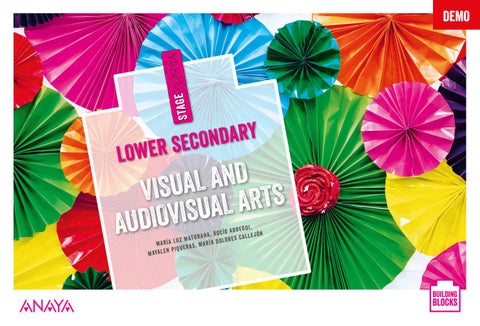
D N A L VISUA L ARTS A U S I V O I D AU , rregui A o í c o llejón rana, R a u C t s a e M r lo uz aría Do María L M , s a r n Pique M ay a l e
Building
Blocks
course contents 1 A world full of dreams
Pg. 5
1. What we see................................................................................. 7 2. With images................................................................................. 9 3. A new message........................................................................... 11 4. An optical illusion...................................................................... 13 5. Unnoticed ...................................................................................... 15 6. A collage of your life................................................................. 17
2 Visual language
Pg. 19
1. The expressiveness of gestures............................................ 2. Silhouettes.................................................................................... 3. Adjust the iconicity.................................................................... 4. Mixing colour............................................................................... 5. Rainbow of colour...................................................................... 6. Textures ......................................................................................
3 An organised world
21 23 25 27 29 31
Pg. 33
1. Geometry and nature................................................................ 2. Plane geometry: straight lines, arcs and circumferences.. 3. Geometric shapes: the polygon............................................ 4. The expansion of shapes: the spiral.................................... 5. Tangents and links..................................................................... 6. My family tree..............................................................................
35 37 39 41 43 45
4 To scale
Pg. 47
1. In another dimension................................................................ 2. Proportion - disproportion..................................................... 3. Scale................................................................................................ 4. Deformation................................................................................. 5. Design it yourself....................................................................... 6. This is my style............................................................................
5 Visual Arts
49 51 53 55 57 59
Pg. 61
1. Design and globalisation......................................................... 2. Technical drawing and standardisation............................. 3. Represent a piece in three dimensions.............................. 4. How to change aesthetics...................................................... 5. Modular structures..................................................................... 6. Designing objects......................................................................
6 Creating messages
63 65 67 69 71 73
Pg. 75
1. Search for balance..................................................................... 2. Harmony in compositions....................................................... 3. Do it with rhythm....................................................................... 4. Typography.................................................................................. 5. Analyse advertising................................................................... 6. Design a mini-fanzine...............................................................
77 79 81 83 85 87
7 Space, light and volume
Pg. 89
1. The representation of space.................................................. 2. Painting landscapes.................................................................. 3. Light, chiaroscuro and volume.............................................. 4. The shadows of projection..................................................... 5. The architecture of a place..................................................... 6. An architectural plan................................................................
8 Capturing a moment
91 93 95 97 99 101
Pg. 103
1. Focus............................................................................................... 105 2. With perspective........................................................................ 107 3. How do we see............................................................................ 109 4. The point of view and the framing...................................... 111 5. A meeting place.......................................................................... 113 6. Travel with your imagination................................................. 115
9 Illustrating stories
Pg. 117
1. Step by step................................................................................. 119 2. Present, past and future.......................................................... 121 3. The film genre.............................................................................. 123 4. Shots and camera movements............................................. 125 5. My life is a story.......................................................................... 127
KEYS
PROJECT
SDG SDG Commitment
Developing thinking
Cooperative learning
Emotional education
Enterprising culture
ICT
Discover the Sustainable Development Goals and be an active part of our commitment to make a more equal and liveable world.
Work on strategies for thinking: reflect on the content you are learning, generate ideas, organise them, debate them, explain them…
Get involved in your learning and participate in the group’s learning; you will find that cooperating improves performance and harmony in the class.
Get to know yourself; identify the situations that bring up complicated emotions and manage them with constructive, self-affirming experiences.
Trust in your skills and knowledge, develop creativity, adapt to changing situations and have a proactive and responsible attitude.
Learn how to obtain information, select it and apply it; to plan, manage and work on projects; to collaborate online in an ethical and safe manner.
Academic and professional orientation
Evaluate your personal skills, discover and awaken your calling, train yourself to make decisions and learn to choose between different options.
Evaluation
Linguistic Plan
Discover different strategies to analyse what you have learnt and how you learnt it; train yourself to take responsibility or overcome difficulties.
Use your communication skills in the different types of text that you will see. Language is always present, communicate!
The resource bank is LIKE THIS www.anayaeducacion.es A space with resources, techniques and activities, designed to strengthen your knowledge. Access the resource bank by registering at anayaeducacion.es. You just need to have an email, the code indicated on the first page of this book and the permission of a parent or a legal guardian.
More about the keys
Resources related to
THE KEYS of the project ODS
SDG Commitment, with microvideos that will help you know what are the targets for reaching the Sustainable Development Goals worked on in this project. Linguistic Plan, with infographics that will give you models to work with the four linguistic skills, using different types of texts (descriptive, narrative, explanatory, etc.).
NOTEWORTHY
resources in the material Additional content Concept map Librarium Pelicuteca Visual dictionary of artistic terms Blank maps Language Bank
Developing thinking, where explanations are included on how to apply the different strategies for thinking proposed in the project. Cooperative learning, which includes the description of the cooperative learning techniques proposed in the project. Emotional education, with resources to support you with overcoming worries generated in different situations in your learning process (beginning of the school year, taking a test, etc.). ICT, by using data sheets that will reinforce your healthy, correct and safe use of information and communication technologies. Academic and professional orientation, with information on different professions linked to the subject content. Evaluation, which includes resources for your portfolio, as well as rubrics and targets that will facilitate your selfevaluation.
Resources classified
by unit
All the resources are classified so that you can easily locate the ones related with each section of your unit.
2
visual language
Reading and listening
Cai Guo-Qiang Cai Guo-Qiang is a Chinese artist that creates art using explosions and fireworks. He created the pyrotechnic performance The Ninth Wave, that you can see in the picture in 2016.
1 Match the words from the text to the definitions. pyrotechnic
firework
a) A small device containing powder that burns or explodes and produces bright coloured lights and loud noises. b) Connected with fireworks or a display of fireworks. We can create images by imitating or recreating reality or from our imagination. In The Ninth Wave, Cai Guo-Qiang plays with an explosion of colours to evoke feelings and awaken the senses.
2 Where do you think Cai Guo-Qiang gets his ideas from? Are you able to distinguish the elements such as lines, shapes and textures that his images are made of?
3 Describe the colours you see in the performance. How do you think he
I watched a video of Cai Guo-Qiang in the Prado. It was called El espíritu de la pintura. In the video, he put lots of different coloured powders on different canvases. He lit them on fire and there was an explosion of red, yellow, blue and pink as well as other colours. The video made me feel inspired to learn more about pyrotechnic performances and watch more videos. The Ninth Wave (Sanghai, 2014), pyrotechnic performance by Cai Guo-Qiang.
made these colours? Do you think the colours have a meaning?
Speaking
4
Find a video or picture of one of Cai Guo-Qiang’s performances. Describe the different colours that you can see and how they make you feel.
5 Cai Guo-Qiang works in different countries all over the world. Do you think his work is socially inclusive to all, including inmigrants?
anayaeducacion.es Go to the SDG resource 10.3.
ANK GE BANK B E G A U ANG GUA K L N A L AN ANK GE BANK B B E E G G A A U U NGUA NK LANG LANG A L K BAN AGE BANK GUAGE BA AGE BANK E G A U G LAN LAN LANGU LANGU
1 THE
EXPRESSIVENESS OF GESTURES
Did you know that we can be identified by our signature, our unique way of drawing lines, or the way in which we dot our i's? Likewise, a simple stroke can express what we feel. This is due to the expressive force of a line, and largely depends on the thickness, intensity, movement, and the instrument we use to draw it. A point is the most basic starting element; the beginning and the end.
Understand, think and apply… Listen to two songs of different musical styles and, letting yourself be carried away by the music, move the pencil or paintbrush, as if it were dancing on the paper. Then see how the music influenced the strokes and the shapes you drew. Define each one of the strokes or lines that represent each song with an adjective. You will need... Graphite pencils, markers, paints, water-based paints, paintbrushes.
Formal, dogmatic.
SONG 1
Examples of strokes that transmit a mood.
SONG 2
ADJECTIVE: 21
Casual, relaxed.
ADJECTIVE:
2 SILHOUETTES
A line creates the contour of an image or figure. If it is closed, it creates a silhouette, which is a flat shape.
Understand, think and apply…
Sometimes artists define lines to emphasise shapes, and other times they do not delimit elements. The latter are called “open shapes”.
Choose two images of recognisable figures, draw their silhouettes and copy them. Then make them into something completely different, adding shapes, colours and textures that are different than the real ones. Lastly, combine them to compose a new image.
Shapes can be very different: flat or voluminous, natural or artificial, simple or complex. Furthermore, they can have different textures, colours and sizes.
You will need... Graphite pencils, paints, markers. IMAGE 1
IMAGE 2
23
IMAGE 3
3 ADJUST
THE ICONICITY
We tend to group what we see into the simplest shapes we can, such as lines, spheres or squares. This is what we see, for example, in works by Cubist artists or in schematic paintings from prehistoric times. The necessary degree of iconicity for an image depends on the image's purpose. A scientific drawing, which must have a high degree of accuracy and represent reality, is not the same as an abstract portrait, which may be more symbolic.
Understand, think and apply… Put yourself in the shoes of the following characters: an artist who specialises in fauna, an illustrator who draws animals for children's books and one who designs a danger sign at a zoo. Begin by making a very realistic drawing and then simplify it, stripping it down to the most important lines. The last drawing must be the most symbolic and easiest to understand. You will need... A graphite pencil, paints, markers. 1. Barcos de finales del siglo, by Rael Monleón, Naval Museum (Madrid).
1 SPECIALIST IN FAUNA
25
2
3 CHILDREN'S ILLUSTRATOR
2. Breeze, by Paul Signac, private collection. 3. A logo.
DESIGN FOR THE ZOO
4 MIXING COLOUR
Colour is a complex phenomenon that depends on light, its reflection off objects, and our vision. We can distinguish up to seven million colours, which we classify by their shade or tone, brightness and luminosity (either lighter or darker) and by their saturation (more or less intense). Furthermore, colour can seem different depending on what is around it.
Understand, think and apply… Create colour spots and imagine what you see in them. Use only the three primary colours, from which you can create the rest of the colours. Do it with diluted water-based paint, so that it flows easily on paper. You can abruptly drop the paintbrush or smash it against the paper; paint and then fold the paper so that the colours mix, etc. Write a short story about the composition. You will need... Paintbrushes, water-based paints (the three primary colours: yellow, cyan and magenta).
Red
Yellow
Magenta White
Green
Blue Violet
Cyan
Magenta Violet
Red
Black Yellow
27
Green
Primary colours of light (red, green and blue violet) and their additive mixing.
Cyan
Primary colours of pigment (magenta, yellow and cyan) and their subtractive mixing.
TITLE
5 RAINBOW
OF COLOUR
Advertising uses colours that will lead you to make associations with specific experiences. Advertisements aim to relate different products to feelings of freshness, energy or passion, depending on the publicist's intentions. This information is received directly by the emotional part of our brain.
Understand, think and apply… You are going to make a collage of a rainbow with everyday products, arranged by colours. You can cut them out of magazines or advertising leaflets. Once you glue them in place, reflect on the type of product being sold with each colour. You will need... Magazines, advertising leaflets or other printed materials, scissors and glue.
Answer the questions 1 What associations and emotions are awakened in us by each colour?
2 Do you think that colour influences how a product is sold? Why?
29
6 TEXTURES
Texture is a characteristic of the surfaces we perceive through our sight and touch. Art imitates and recreates textures since, along with colour, they reinforce the feeling we get from it and help us distinguish the materials and objects.
Understand, think and apply… Create a visual texture (repeating a motif, rubbing, stamping, etc.) and tactile texture (scratching, pressing, folding the paper, or adding thread, cardboard, sand, etc.). You will need... Graphite pencils, paints, markers, scissors, glue stick or PVA glue, cut-outs.
Visual texture.
31
Tactile texture.
Building Blocks is an educational project by Anaya Educación for Secondary Education with the participation of: J. A. A. Castrillón, N. Blanco C. Broadbridge, M. Burgos, K. Chambers, M. Folgueral, Begoña Fuente Larrazabal, Sara Gascón Martín, Danny Latimer, M. C. Muñoz-Delgado, R. Oakes, J. Roe, C. Ordóñez, Hannah Peat, Karen Piper, Emma San José, Deborah Spencer, Denise Suárez. The following people have also contributed to this book: Editorial team: Danny Latimer and Susana del Cerro. Design, technical drawings and maps: Patricia G. Serrano, Juan Carlos Quignon and Miguel Ángel Castillejos. Illustrations: Inés Burgos. Layout: Juan Pablo Mora García. Graphic edition: Beatriz Gutiérrez. Translation: Montero Language Services. Photographs: Agencia EFE, Alamy / Cordon Press, Age Fotostock, Album, AP Images / Gtres, Aurimages, Anaya Archive (Alcón, A.; Santos, V. E.; Candel, C.; Cosano, P.; García Pelayo, Á.; Hernández Moya, B.; Leiva, Á.; Lezama, D.; Martin, J.; Martín, J. A.; Ortiz, J.; Osuna, J.; Padura, S.; Ruiz, J. B.; Steel, M.; Sánchez, J.; Vázquez, A., Candel, C., Sánchez, J.), Boa Mistura, Begoña Lumbreras, Carlos de Gredos, Cordon Press, Dreanstime, Europa Press / Agencia Contacto, Francesca Piñol, Getty images, Isidro Ferrer, Istock / Getty images, Javier Lorenzo, Scala, SIPA / Cordon Press; 123 RF and colaborators. Origins of the works of art: Banco de España-Colección Arte; Biblioteca de Turín (Italia); Centro Georges Pompidou (París); Colección David Hockney; Colecciones privadas; Galería de Arte Moderno (Milán, Italia); Galleria Doria Pamphili (Roma); Galería Trama (Barcelona); Galería Nacional de Londres (Inglaterra); Haags Gemeentemuseum (La Haya, Holanda); Henry Matisse Museum of Art (Baltimore, USA); Metropolitan Museum of Art (Nueva York, USA); Musee des Arts Decoratifs (París); Musee National d’Art Moderne. Centre Pompidou (París); Museo Arqueológico de Cataluña (Barcelona); Museo de Arte de Cleveland (USA); Museo de Arte Moderno (Estocolmo, Suecia); Museo de Arte Moderno MoMa (Nueva York, USA); Museo de Arte Moderno de Lusiana (USA); Museo de Arte Moderno de Fort Worth (Texas, USA); Museo de Artes Aplicadas (Viena, Austria); Museo de Bellas Artes (Budapest, Hungría); Museo de Bellas Artes de San Francisco (USA); Museo de la Real Academia de Bellas Artes de San Fernando (Madrid); Museo del Prado (Madrid); Museo d’Orsay (París, Francia); Museo Hirshhorm y Jardín de Esculturas (Washington, USA); Museo Kroller-Muller (Holanda); Museo Nacional Centro de Arte Reina Sofía (Madrid); Museo Nacional Ruso de San Petersburgo (Rusia); Museo Staedel (Frankfurt, Alemania); Museo Sorolla (Madrid); National Gallery (Londres); National Gallery Singapur; National Gallery of Art (Washington, USA); Sprengel Museum (Hannover, Holanda); Steve Martin Collection; Walker Art Center (Minneapolis, USA).
Academic and Professional Orientation: created in conjunction with Fundación Bertelsmann. Coordinator: Juan José Juárez Calvo. Expert collaborators: Sara Lozano Santiago, Belén Pérez Castro and Pilar Vázquez Hernández.
Commitment to Sustainable Development Goals Our publications contain carefully selected content, illustrations and language to comply with non-discrimination on the grounds of gender, culture or opinion. Grupo Anaya considers social and environmental responsibility to be one of its fundamental values. For this reason, we are committed to: · continually improving our contents and materials related to the environment. · reducing our carbon emissions. · using natural resources responsibly. · making sure that our activity has no negative consequences for endangered forests. These commitments, among others, mean that 100% of the paper used in our books has the PEFC label. Important information: The links to webpages which appear in this book have been checked before printing. The publisher cannot be liable for any changes or modifications which occur after the date of publication.
© GRUPO ANAYA, S.A., 2021 - C/ Juan Ignacio Luca de Tena, 15 - 28027 Madrid. All rights reserved. No part of this publication may be reproduced, stored in a retrieval system, or transmitted, in any form or by any means, electronic, mechanical, photocopying, recording, or otherwise, without the prior permission of the publishers.