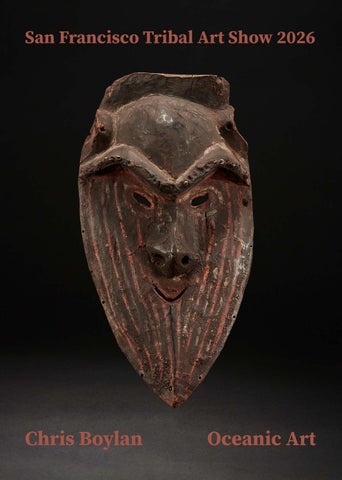
San Francisco Tribal Art Show 2026

Chris Boylan Oceanic Art

Chris Boylan - Oceanic Art
Sydney Australia

I live in Sydney, Australia. Due to my many travels, I work from a home office and Sydney warehouse rather then a permanent gallery. My schedule includes several trips to Papua New Guinea and various Pacific regions, with regular exhibitions in Australia and overseas. An avid field collector, I still greatly enjoy these Pacific odysseys and always come across some fine and interesting artworks. Having said that, old collections and small auctions within Australia can also be a rich resource for artworks.
email: info@chrisboylan.com.au www.chrisboylan.com.au
TEL: +61 405 093 577

Design: Grumpy Wombat, Sydney
Photos: Jenni Carter, Sydney


1. Large Basket Hook
Samban, Kanganaman village, Iatmul people, Middle Sepik, Papua New Guinea.
Size: 132 x 42 x 7 cm
Price: POA
Collected by Robert Bunsing, a patrol officer stationed at Pagwi, Middle Sepik in mid-1960s.It came into possession of Senta Taft at Galleries Primtif, Sydney in the early 1970s, then into a private collection in rural NSW.
Kanganaman village is renowned for the fine workmanship of their carved forms, particularly the carved basket hooks, called samban in the Iatmul language. This finely executed example represents an important accomplished work, distinguished by its assured carving, balanced proportions and refined surface detail. There is no doubt it was carved by an older master carver of Kanganamon and dates to the 1940s-early 1950s.
A large ancestral face, powerfully rendered, dominates the hook. Extending down the central axis, both front and back, is a long sinuous serpent motif. The serpents tail exits the mouth and undulates down the length of the form reinforcing the object’s strong verticality and finishes in a large, engraved head at the base, Serpents are deeply embedded in Iatmul cosmology, associated with ancestral power, transformation, and the life-giving forces of the Sepik River.
Both sides of the serpent are richly engraved with bird totem figures surrounded by curved fretwork. The crescent-shaped base is articulated by the two main hooks, elegantly curved upwards. In between are other hooks, or prongs, at fluid angles. These hooks hold baskets of food and woven bilums of other valuable items.
The seamless integration of symbolic imagery with utilitarian purpose exemplifies the Sepik River region’s profound union of art, ritual and daily life.


Basket Hook, Kanganaman
The Haus Tambaran, Kanganaman village.
Photo: Gregory Beteson c. 1933. “it is the finest ceremonial house in any of the river villages”.


2. Dance Mask
Eastern Highlands, Papua New Guinea.
Size: 36 x 22 x 6 cm
Price: $3,600
Ex-early Melbourne private collection; ex-Alex Philips, Melbourne.
Masks of this quality were mainly collected in the early colonial period, 1950-1960s. Highland masks were ephemeral, often made to be used in only one ceremony, then discarded; hence they were made of gourds or soft wood. In the 1960s Stan Moriarty, the most important collector of Highland material cultures, assembled a considerable collection of Highland art that eventually was donated to the Art Gallery of NSW.
This wood mask is from the Eastern Highlands and was certainly collected in this early period; Moriarty has photographs of them being danced in the 1960s, But by the 1970s with the strong developments brought on by the colonial administration they had all but disappeared.
This Eastern Highland wood mask is a particularly fine example. It demonstrates strong abstract qualities, with large cut-out eyes and mouth, beneath a heavy overhanging brow. Holes around the edges of the mask would have once supported beard-like attachments of fibre or cassowary feathers while the forehead likely carried a fibre and nassa shell headband, surmounted by a headdress of plumes. Large paired pig tusks adorn the nose, inserted through the septum, reinforcing the mask’s striking presence.
The mask itself, with added adornments removed retains a formidable power.


Eastern Highland Dancers with wood masks, bodies covered in forest lichen.
Photo: Stan Moriarty, 1964


3. Old Dance Mask
Mundugumor people, Yuat River, Lower Sepik River, Papua New Guinea.
Size: 39 x 19 x 10 cm
Price: POA
Ex-collection professor Tom Arthur ; purchased at Galleries Primitif, Sydney in 1972.
This early dance mask shows many of the bold sculptural elements that make Mundugumor sculpture so forceful. Reduced to a near-abstract triangular form, the mask possesses a strong graphic presence with an overall surface patina that shows age and sustained ceremonial use. Mundugumor mask features – the heavy brows, exaggerated nose and ears – are designed to intimidate and to assert spiritual potency within ritual contexts. Traditionally such masks are painted in pastel orange and pink colours in large blocks; here they have used the same colours but in vertical stripes. Compact in scale yet powerful in presence, this mask is a particularly evocative example of Mundugumor art, balancing abstraction, menace and its unique expression in a highly resolved form.


4. Old Fighting Shield
Wahgi Valley, Western Highlands, Papua New Guinea.
Size: 140 x 57 x 6 cm
Price: $5,000
Collected in early 1960s by Graham G Hardy, the Assistant District Officer stationed at Wabag, thereafter by descent.; c. 2006 private collection, Queensland, Australia.
This ancient shield is pre-contact and has more than a dozen arrow points, or arrow holes, from generations of tribal fighting. The size and proportions suggest it originated in the western regions of the Wahgi Valley where shields were typically smaller than those produced in the larger, wider valley systems of the central and eastern Wahgi Valley. It has the slight curve almost always found on these old shields. Two holes at the top were for a feather decoration secured by the warrior before warfare. In the central area are four small holes used to secure the carrying sling with cane binding through the shield.
The zig-zag vertical design motifs are defined by small holes, punctuated into the smooth surface of the shield. At the centre is a red diamond form from which the white zig-zag lines radiate to suggest a highly stylized anthropomorphic figure. Essentially the design symbolises a man, with the red diamond being the “navel”, and the radiating lines evoke outstretched limbs. This figure is believed to represent an ancestor, possibly an ancestor who died in battle, who will protect the shield carrier, and also to exact revenge upon the enemy.
Multiple layers of pigment are visible, the last colours probably applied for a war shortly before it’s collection date. The back of the shield is smooth and worn and truly shows the ancient nature of this shield. Australian officers confiscated shields in early colonial days as part of policy to reduce tribal fighting, and this is quite possibly the case with this shield, that was then taken back to Australia as a “souvenir.”


5. Ceremonial Dance Mask
Mwai, Iatmul people, Middle Sepik River, Papua New Guinea.
Size: 96 x 22 x12 cm
Price: $4,500
This is a fine old mask, dating back to the 1940s-1950s. It was collected in the early 1970s and brought back to Australia sometime during that decade and remained with the family until recently.
The Mwai (or Mai) mask of the Middle Sepik River is typically elongated. The red face is central with cowrie shell eyes and the nose decorated with matching pig tusks. Below the nose is an arched probiscis that merges into a totemic animal creature, which, in this case is a finely carved bird. The remainder of the mask is covered in a thick resilient clay and embedded carefully selected and matched nassa shells. The clay is carefully mixed with a tree oil ensure durability. Mwai masks are traditionally danced in pairs, representing the older and younger supernatural siblings. The mask is attached to the avan, a large woven basketry costume that completely covers the male dancers, transforming them into living embodiments of ancestral/spiritual power.


6 Fertility Figure
Mindja, Washkuk Hills, Upper Sepik River.
Size: 148 x 36 x 12 cm
Price: POA
Collected by Ed Boylan in 1972 on one of his earliest trips into the Washkuk Hills. This remained as part of his private collection and for many years hung in his Cairns home.
This is an old figure, probably 1940s-1950s but could be older, as it shows many layers of repainting. It was certainly used over many generations. There is some dry rot at the base (from standing on damp earth) but it is quite stable. This is a typical Mindja in size and basic form, with a wide face, predominantly red and with the classic cut-out eyes and smiling mouth. However it is quite extraordinary in its lower half, where there are many small faces (ancestral or spirit), rather than the usual zigzag abstract design. Mindja figures were central to the second harvest ceremony, called Mindja, where they represent male spirits, generally related to water spirits. This ceremony took place after the yam harvest and was necessary to ensure abundance the following year. Essentially Mindja are fertility figures, to ensure the balance of nature.


7. Ceremonial Bridal Lime Gourd
yavu, Tigowi village, Middle Sepik, Papau New Guinea.
Size: 44 x 10 cm diameter
Price: $3,000
This wonderful example of a bride’s lime gourd is three generations old, collected in 1974 in Tigowi village by Chris Boylan. The owner, an elderly woman, inherited it from her mother, Givagu, who used this in her marriage ceremony in 1948 and earlier used by her grandmother at her own marriage .
At this marriage ceremony, a bride traditionally wears an intricately woven veil adorned with shells while this decorated gourd constitutes the next most important object. This gourd is in perfect condition with both upper and lower parts covered with a resilient clay /oil mixture into which are embedded both nassa and cowrie shells – all carefully selected for matching form and sizes The lime stick is of cassowary bone, featureing a finely woven fibre overlay also decorated with cowrie and nassa shells, mirroring the bridal veil itself. Bridal lime containers of this quality are highly valued and often becoming heirlooms preserved for future use as the history of this pice so clearly shows.
Published: “Adorned”, Anna Edmundson, Chris Boylan, Macleay Museum, University of Sydney, 1999, pp


Two brides adorned for marriage.
Photo: Chris Boylan 1974.


8. Bird Dance Mask
Pora Pora River, Lower Sepik River, Papua New Guinea.
Size 58 x 12 x 12 cm
Price: $4,500
Ex-Pierre Langois collection, Paris. Collected on an expedition to PNG in the 1970s.
This Bird Mask, representing a clan bird totem, is one of the more elegant masks to come from this little-known region. Its form is long and sinuous and shows evidence of being used over many years. The end of the pointed beak is slightly damaged, a sign of its frequency of use, but this does not detract in the least from its overall aesthetic quality. Totem masks of this kind were worn during ceremonial dances. The male dancer wears this over his face, with his body totally covered by fibre skirts. The exact nature of the ceremony for which this mask was danced is unknown, yet it clearly displays a ceremonial vitality.


9. Hornbill Dance Totem
Central Asmat region, West Papua, Indonesia.
Size: 65 x 13 x 4 cm
Price: $2,500
This elegant, curved hornbill head emerges from a circular base engraved with concentric motifs. Suspended below are tassels composed of cassowary feather stems, various seeds, and a pointed bone. The Asmat have many different ceremonies in their repertoire and an enormous number of small, specialised objects that form part of these ceremonies. The exact nature of this bird’s use is unclear, but it is an intriguing object with wonderful aesthetics.


10. Tapa Dance Mask
Witu Island, West New Britain, Papua New Guinea.
Size: 88 x 32 cm diameter
Price: $5,000
From an important Tahitian collection, assembled in the 1970s.The collection includes a small group of related masks comprising both larger, masks known as mare, and smaller forms, known as namo-timbulu. This medium sized example is known as namo-ulu.
Large conical dance masks constitute a major sculptural tradition among the cultural groups of New Britain. Such masks are well documented among the Tolai and Sulka peoples. The witu islands, only accessible by a long sea journey from the New Britain mainland have maintained a particularly strong continuity of ceremonial practice.
Early German explorers referred to these tall conical masks as “funeral masks”. But subsequent research clarified that they are used in initiation ceremonies performed during rites of passage marking the transition of young men into adulthood.
The mask is constructed over a conical bamboo framework, tightly wrapped in tapa cloth. A pronounced projecting nose extends from the cone, the septum holding a large wood nose ornament. The face is further animated by large, looped ears, with fibre earrings, while the apex is crowned with a topknot to resemble a large coiffure.
The Germans collected quite a number of these imposing masks in expeditions between 1890-1905 and they are now housed in German museums. A key reference book is :”Form Colour Inspiration – Oceanic Art from New Britain”, by Ingrid Hermann, Arnoldsche 2001.


11. Two Basket Hooks
Samban, Sepik River region, Papua New Guinea.
Size: a) 49 x 22 x 7 cm b) 45 x 16 x 13 cm
Price: a) $2,400 b) $2,800
Basket hooks along almost the entire length of the 700km Sepik River are carved from wood, with two or more hooks that carry baskets of food or woven bags holding valuables, principally to keep them out of reach of rats and insects. Importantly, these basket hooks also have figures, faces or totemic animals as the greater part of their form that are protective against evil spells and spirits.
a) Basket Hook, Chambri Lake, Middle Sepik. Hooks from Chambri are recognised by their highly stylised central faces which face in opposite directions. This is an old hook figure, with two finely carved faces above a very elegant crescent shaped hook. The hooks have a deep patina from the constant hanging and removing of baskets over generations.
b) Basket Hook, Murik Lakes, mouth of Sepik River. Hooks from these coastal regions near the mouth of the Sepik typically have robust central figures carved with ancestral and totemic animal imagery. This example has four hooks and, while less refined than Middle Sepik hooks, it possesses a striking presence due to its mass and dynamic form. Remnants of red paint around the eyes and some engraved areas suggest the whole hook may once have been totally red in colour.


12. Three Yam Masks
Babamini, Abelam people, East Sepik, Papua New Guinea.
Size: a) 26 x 22 x 11 cm
Price: a) $ 850

b) 36 x 45 x 22 cm
b) $1,200
c) 20 x 21 x 7 cm
c) $750
After harvest, large and important yams are displayed ritually at the Yam Lining Ceremony, where fertility is entreated from the spirits for the following year. Large yam masks are the face of these yams, with these yams being up to 3 metres ( 10 feet) in length. This is, in fact ,honouring the spirits who have helped each man to grow these large yams, showing spiritual endorsement. The Yam Lining Ceremony is not just for the village but for the whole region, with vast numbers of people gathering to feast and celebrate with a major focus being to view and judge the yams on display.
a) Old tightly woven with a strong bird-like visage and headdress above. The slightly twisted nose lends the form a sense of vitality and presence.
b) A very large yam mask, with full bird-like face and large protruding eyes. The headdress above is also tall and wide, all painted in mainly red and white.
c) Old tightly woven yam mask with an interesting more nuanced face highlighted by large circular ears. The colours are pale and lend an ethereal quality to this mask.


13. Two Pre-historic Stone Figures
Highlands of Papua New Guinea.
Size: a) 22 x 13 x 4.5 cm b) 10 x 4.5 x 6 cm
Price: a) $2,800 b) $2,800
These remarkable stone figures were carved several thousand of years before contact and by a group whose culture was quite different to that of the present population. These stone figures were often found during garden construction or digging for house construction. They became objects of magic and power as the present culture know nothing of their origin.
a) Stone Torso, Chimbu. Collected by Ivan Smitmanis, a patrol officer based in Kundiawa, Chimbu in the 1960s.
The figure is headless and part of one arm missing. But the arms and body are archetypal, both ringed and the clavicle bone prominent across the chest. Below this are two pert nipples, The figure in its partial state exhudes a quite amazing presence. The stone appears to be white granite.
b) Stone Figure, Liagam Valley, Enga. Collected by Ron Ingle 1962-63 when working for Dawsett Engineering in Enga.
The figure is complete with an arched squatting form, a long snout that may suggest echidna-like, but uncertain. Often these ancient stone figures morph several animals of human features. The eyes are very large.


14. BETELNUT MORTARS
From different regions of New Guinea.
Size: a) 17 x 5.5 x 5.5 cm Massim b) 24 x 9 x 6 cm Abelam c) 24 x 9 x 6 cm Sepik
Price: a) $1,000

b) $2,600
c) $2,500
Betel mortars are small wooden objects featuring a small bowl often combined with detailed artistic representations of ancestors, spirits or totemic animals. Betel nut, lime and mustard are ground into a paste that older people without teeth can scoop into their mouths creating a mild stimulating effect.
a) Betel Mortar, Trobriand Islands. Collected by Helen Dennett in 1972. Featuring a large undulating snake below which are several. Very fine small figures, complete with an old well-used spatula.
b) Betel Mortar, Abelam people.
Stone-carved, 19th C, this rare Abelam example incorporates two stylised human figures supporting the bowl. Ex-Elizabeth Pryce collection, Sydney.
c) Betel Mortar, Coastal Sepik.
Stone-carved, 19thC, this mortar depicts three animated squatting figures supporting the curved bow. The bowl encrustation and the mortar’s overall deep patina show long personal use. Ex-important Tahitian collection.


Betelnut is combined with this mustard and lime. Older people without teeth grind these together in the betel mortar.


15. Wood Talipun Mask
Yangoru-Boiken, 19th/early 20thC. Prince Alexander Mountains, Papua New Guinea.
Size: 38 x 16 x 10 cm
Price: $5,800
Published in Michael Hamson’s “Art of the Boiken”, 2011, pp162. Ex-Michael Kremerskothen collection, Germany; ex-Michael Hamson collection, USA.
Wooden spirit masks from the Arapesh are very rare, with the vast majority woven from stripped cane. This mask is ancient. It is a pre-contact, stone-carved and dates possibly to 19th Century. The colours are pale and subtle, but the carving is super with the strong projecting line of the face finishing with a wide strong nose, with a flared and pierced septum. Above are strange non-symmetrical round eyes; below, the mouth displays sharp teeth and a small protruding tongue. The large hole at the base suggests this mask may have been used as a talipun mask, secured to a green turbo shell, as an important bride price.


16. Pottery Cult Figures
Washkuk Hills, Upper Sepik River, Papua New Guinea.
Size: a) 22 x 11 x 12 cm b) 25 x 19 x 16 cm
Price: a) $2,800 b) $1,200
In the Washkuk Hills elaborate ceremonies accompanying the yam harvest ensuring fertility for the coming season. Large wooden figures form the major ceremonial display objects at these times. Among these are cult pottery forms, known as wasau, characterised by strong facial features, a beard-like flange below the typically “smiling” mouth, which is typically “smiling”, a long, projecting nose with a large pierced septum. The large eyes and mouth are openings. These pottery figures taper towards the top, are painted overall with a deep black pigment and with highlights in white around the eyes. Generous use of brilliant red pigment brings these pottery figures to life.
These cult pots were studied by several anthropological teams: Whiting and Reed (1938-39); Douglas Newton (1971): Kaufman (1972). These pots represent sacred spirits, sikilawas, that are related to yams and primeval times.
a) An elegant and imaginative pottery figure, a prominent nose and head supported on a pottery pillar and strikingly bent forward. A cowrie shell is tied through the septum with bark fibre string. These important pottery figures were used as ancillary objects in the important harvest fertility ceremonies, given personal names, and repainted before each annual event.
b) This large pot, with strong Kwoma face and large nose is hollow inside and fashioned to be mounted on a post. Perforations around the edges allow secure attachment to the pole. Kaufman describes two particular feasts where this cult head is used – Hamayo (in wet season) and the Yinamu feast. (in the dry season).


17. Two Wooden Yam Masks
Abelam people, Prince Alexander Mountains, Papua New Guinea.
Size: a) 67 x 27 x 12 cm b) 49 x 20 x 8 cm
Price: a) $1,600 b) $1,200
Wooden yam masks are oval in shape and with a slender wooden flange below. They are comparatively rare, less common than the more familiar woven cane yam masks, and are found only in the far eastern Abelam regions and the among the neighbouring Yangoru-Boiken. The faces are painted generally in the four distinctive colours used in most of their larger sculptural objects – red, yellow, black and white.
a) Large mask with classic form and paintwork, dated early-mid-20thC.
b) Medium sized mask, classic in form, but with two horn-like projections, dated earlymid-20thC.


18. Three Figures
Sepik River region, Papua New Guinea.
Size: a) 59 x 11 x 9 cm b) 48 x 10 x 10 cm c) 48 x 13 x 14 cm
Price: a) $1,000 b) $1,200 c) $800
Ancestor Figures are found along the major regions of the Lower and Middle Sepik River. They are powerful, spiritually charged sculptures that serve as intermediaries between the living and the spirit world. The most important ancestor figures are housed in men's ceremonial houses while smaller and lesser examples were kept in houses as protection against malevolent forces.
a) This skeleton-like figure is from the Iatmul people of the Middle Sepik. They were renowned for warfare and, above all, cannibalism. Skulls were always important elements of Iatmul culture.

b) A cylindrical abstract figure from the Mundugumor people of the Lower Sepik River. It has a geometric representation of the human (ancestral) form, with heads at top and bottom. Traces of red and blue paint survive, imparting a subtle liveliness to this figure.
c) A bold figurative sculpture, from the Mundugumor of the Yuat River, Lower Sepik River. The head is large, projecting far forward, with heavy brows, deep-set eyes and large nose and ear (one of the ears is missing, broken long ago). The figure stands straight, almost at attention, with the strong form and demeanour typical of Mundugumor sculpture.


19. Papuan Gulf Figures
Papuan Gulf, Papua New Guinea.
Size: a) 39 x 6 x 6 cm b) 36 x 5.5 x 1 cm
Price: a) $2,500 b) $1,400
a) Figure, Turama River, western Papuan Gulf.
These 3-dimensional formal figures of Turama River are in contrast to the figurative forms, twisted and undulating of the more eastern Papuan Gulf, carved from mangrove root. It features the typical facial motifs to the greater Papuan Gulf character, but the body is tubular, the head blockish, two legs that show knees but no feet and, on this example, the arms are carved into the torso. Geometric chevron motifs decorate the body. A similar, larger figure is held in the Musee du Quai Branly collection in Paris (Inv 4202), published in “Shadows of New Guinea”
Musee Barbier-Mueller, Somogy 2006. pp
b) Bullroarer, Era River, Papuan Gulf. Papua New Guinea
Bullroarers, known as kaiafmumu, are a sacred sound producing instrument used during important male rituals. A rope at the end allows the bullroarer to be swung very fast above the head, producing a load oscillating “roaring: sound – hence its name.
The sound of the bullroarer is said to be the voice of the spirits.
This bullroarer’s upper section is covered in fine triangular engraved motifs. Below is an abstract face with nose and, unusually, a “neck” is suggested by the narrowing below the face. More engraved design continues below the face, and all the fine engraving is highlighted with lime against the dark black palm wood.


Figure, Turama area. H: 75.7cm Musee du Quai Branly (INV 4202)


20. EBONY LIME SPATULA
Massim, Trobriand Islands or Woodlark Island. 19th Century.
Size: 36 x 6.5 x 2.5 cm
Price: POA
Provenance: old Sydney collection.
This elegant and rare Massim lime spatula is carved from a dark, dense ebony timber and features two finely modelled squatting figures rising symmetrically from a central engraved ring. Though subtly varied in scale and detailing, the figures mirror each other in form, with the asymmetry characteristic of early traditional carving adding a dynamic quality. The work is richly ornamented with incised scroll motifs, double bird-head finials, and precisely carved ears, hands, and feet—hallmarks of a highly skilled artist.
The spatula bears evidence of use, with the lower end darkened from frequent handling and stained with the residual red hue of lime and betel nut mixture.
This spatula was photographed by Harry Beran in 1995 and published in “Mutuaga”(Beran) He identified it as one of only five known double-figure lime spatulas which he attributed to a single, highly distinctive late 19th-century artist, whom he termed the “Master of the Interlocking Scrolls.” Of the five examples, two have early documented provenance: one in the Museum of Mankind, London (accession no. Oc1896.C3.1017), and another in the Pigorini Museum, Rome, collected by Lamberto Loria in 1891 on Woodlark Island.
Of particular relevance is a closely related spatula illustrated in “Massim”, Douglas Newton, Museum of Primitive Art, New York, 1975 (illus. 18), and later sold at Christie’s, Paris, 19 June 2014, Lot 113. The close correspondence in stylistic treatment, compositional balance, and fine detailing confirms that both works were carved by the same anonymous master— identified by Harry Beran as the ‘Master of the Interlocking Scrolls’.
Published: “Mutuaga: A Nineteenth Century New Guinea Master Carver”, Harry Beran, University of Wollongong, 1996, p. 196.


21. WOVEN MASK
Ramu River, Papua New Guinea.
Size: 41 x 23 x 6 cm
Price: $2,000
This woven mask was collected in the middle reaches of the Ramu River in the 1970s, but it is considerably older. It is a most unusual mask, made of a shiny black fibre, with square eyes and mouth. Shells, nassa and cowrie, are secured with fibre onto the mask and a beard made of seed tassles hangs from its lower edge. Its use is not clear, but most probably in village ceremony relating to gardens or fertility.


22. Ritual Fernwood Figures
Okapa, Eastern Highlands, Papua New Guinea.
Size: a) 84 x 17 x 21 cm b) 92 x 17 x 29 cm
Price: a) $1,500 b) $1,500
These figures are carved from the trunk of a tree fern and represent spirits and traditionally were mounted on stakes close to the men’s house. At times they were moved to outside the settlement’s perimeter where they formed part of the “sorcery trap”. They were sentinels with power to protect, and also trap bad magic sent by the enemy, especially at times of important rituals, such as male initiation. See “New Guinea Highlands; Art from the Jolika Collection” de Young Museum, SF, 2016. pp354


Fernwood Figure, New Guinea Highlands. Collected by Stan Taylor, late 1960s De Young Museuem, San Francisco (JFA293)


23. Old Headhunting Horn
Middle Sepik River, Papua New Guinea, 19thC. Stone carved.
Size: 60 x 12 cm diameter
Price: $3,800
This old horn has a simplicity in form that is most common the much older Sepik carvings, when no metal tools were available. The strong head has a wonderful form and good detail; the area below the trumpet’s blowing hole has simple “diamond shape” designs. The highlight in some ways of this object is the superb ancestral face carved near its base, and it would be this invokation of ancestral power that gives the headhunting horn its potency.


24. Two Wooden Yam Masks
Abelam people, Prince Alexander Mountains, Papua New Guinea.
Size: a) 63 x 21 x 12 cm b) 28 x 12 x 7 cm
Price: a) $1,800 b) $800
Wooden yam masks such as these two examples are in Yam Lining Ceremonies among the eastern Abelam, but still remain far less common than the woven cane yam masks. They are tied onto the yams, forming the yam’s “face” through small holes or using holes in the ears. The faces are invariably painted using the four distinstive colours used in most of their larger sculptural objects – red, yellow, black and white.
a) Large mask with classic form and large carved headdress above the yellow face. The paintwork is fine, very detailed and in almost pristine condition. Mid-20thC.
b) A smaller sized mask, classic in form,and no doubt to decorate a large yam, but one of lesser importance. Mid-20thC.


25. Large Food Bowl
Lake Sentani, West Papua, Indonesia.
Size: 84 x 32 cm
Price: $2,000
Collected in early 1970s by Helen Dennett on her first journey around Lake Sentani by canoe. This was part of her private collection until recently.
This bowl is low and horizontal, oval is shape, and typically used for serving food, especially the baked sago form called sagu bakar or sagu lempeng. The inside is flat and smooth with a slight concavity. It has been used over a generation or more, suggesting that the bowl was carved in the early 20th Century.
The underside of the bowl is engraved with curvilinear motifs and has a raised lug at its upper point to enable the bowl to be hung. Traditionally these engraved designs had lime rubbed into them thereby highlighting the darker carved motifs. These spiral and scroll designs, typically found on bowls, paddles and bark cloth paintings of Lake Sentani represent spiritual energy, ancestors and are important cosmic symbols.


Lake Sentani, West Papua.


26. Two Large Ritual Woven Objects
Papua New Guinea.
Size: a) 268 x 11 cm b) 206 x 17 cm
Price: a) $2,000 b) $2,000
Both ritual objects are woven from bark fibre that has been tightly twisted into a fine string. They are both used ceremonially, each in its own cultural context. (a) collected by Chris Boylan in 1973 in Waiwaos village, Upper Sepik River, and held in his private collection since. (b) ex-private collection Helen Dennett, acquired at an obscure auction house in Sydney in 1980s with, unfortunately, no accompanying information.

a) Woven Ritual Body Ornament, Kwanga, East Sepik, PNG
An exceptionally rare woven body ornament attributed to the Kwanga, a small community on the western margin of the Abelam cultural area. The long, narrow band is executed in a bilum-like technique with restrained blue-grey geometric patterning. A looped end and tapered fibre at the other end suggest it was wrapped around the torso and secured in place. A continuous undulating double row of cowrie shells extends along the length, punctuated by circular groupings of nassa shells. This sinuous design is very snake-like, but may possibly also relate to the Sepik River and the original Giant Creator Serpent; the circles of nassa shells may represent whirlpools, where spirits dwell. While its precise ceremonial application is not documented, its construction, materials, and rarity indicate ritual use. As with other shell-embellished regalia of the region, the work would also have functioned within established systems of ceremonial wealth and exchange.
b) Woven Ritual Veil, Kwoma people, Washkuk Hills, Upper Sepik River, PNG.
This woven veil was produced for the nogwi fertility ceremony of the Kwoma. It adorned the carved female nogwi figure during ritual presentation, suspended from the head and falling down the back. There may be only one or many such veils used on the same figure. The woven surface is ornamented with cowrie and nassa shells, terminating in larger egg cowries. Ceremonies were restricted to senior initiated men, after which the figure and its regalia were ritually stored. Beyond ceremonial use, such works constituted recognised forms of wealth and could enter into significant exchange transactions, including bridewealth.


27. Two Woven Yam Masks
Babamini, Abelam people, East Sepik, Papua New Guinea.
Size: a) 43 x 21 x 20 cm b) 45 x 22 x 16 cm
Price: a) $1,200 b) $1,000
Following the yam harvest,, large and important yams are displayed ritually at the Yam Lining Ceremony, where fertility is sought from the spirits for the coming year. Large yam masks are the face of these yams, with these yams reaching up to 3 metres (10 feet) in length. This ceremony honours the spirits responsible for the growth of the yams, signifying spiritual endorsement of each cultivator. Participants from across the region come to The Yam Lining Ceremony draws vast numbers of people from across the region to feast, dance, and critically appraise the yams on display.
a) Old and tightly woven, with a pronounced bird-like visage and a towering top knot above the headdress section. Painted predominantly in red and blue.
b) Old and tightly woven, featuring fine fretwork around the eyes, a tall flat headdress, painted in pale yellow and orange pigments.


28. Two Figures
Trobriand Islands, eastern Papua New Guinea.
Size: a) 47 x 15 x 2 cm b) 11 x 26 x 6 cm
Price: a) $700 b) $450
Carved objects from the Trobriand Islands invariably use dense hardwood – often ebony (jet black) or kwila (deep red ). Their carved forms are finely finished with fine engraving.
a) A Stingray, a wonderful energetic form with protruding eyes that is hollowed on its back to create a shallow plate. Mid-20thC. Kwila wood.
b) Copulating Pigs, a carved pair of copulating pigs as often portrayed with the male being smaller than the female. Known comically as “makin bacon”. Kwila wood.


Throughout Papua New Guinea pigs are Important both for wealth and status.


29. Four Bone Daggers
Size: a) 31 x 5 x 4 cm b) 36 x 5 x 5 cm c) 36 x 5 x 5 cm d) 29 x 6 x 6 cm
Price: a) $800 b) $800 c) $800 d) $2,000
Engraved bone daggers of the Sepik region have two primary functions. Firstly, they are weapons in close-encounter tribal warfare. Secondly, they are worn in armbands by warriors on the upper arms, with the carved images facing outwards and often further embellished with colourful feather tassels.
a) Cassowary bone dagger, Sawos.
Features engraved scrolls and curvilinear design with three subtle abstract faces revealed upon closer inspection.
b) Cassowary Bone Dagger, Abelam.
This dagger presents a superb central figure surrounded above and below with engraved geometric motifs. The style suggests it is from the Sunuhu region, central west Abelam.
c) Cassowary Bone Dagger, Abelam.
The simple strongly executed full figure of this dagger is outstanding. Two were collected in the 1960s, obviously by the same master artist. One, in perfect condition entered the Daalder collection in Adelaide. This one was broken and repaired in the village before its early collection. Early 20thC.
d) Human Bone Dagger, Kwoma.
Deeply engraved with a deep honey-coloured overall patina. The central face is surrounded by typical Kwoma geometric and zig-zag motifs. The knuckle incorporates pearlshell “eyes”, very rare as two large cowrie shells invariably are embedded here. There are 9 matching notches below the engraved designs, the exact meaning unknown.


30. Ritual Figure
Mendi Valley, Southern Highlands, Papua New Guinea.
Size: 89 x 28 cm
Price: $900
It was collected in late 1960s or early 1970s by Sydney artist Frank Hodgkinson. It remained in his collection for over 60 years.
This is a large and elaborate version of the ritual figures that in early days became known as “Mendi dolls”, or “payback dolls” The term payback doll related to the early information that these figures represented somebody who was killed during tribal warfare, and this image reinforced revenge. In the Mendi Valley also, figures were carved or painted on their shields that projected this same sense of “revenge”. However, they had a more important function in pre-contact times where they were used in initiation rituals. They are made on a framework of wood or strong cane, then bound with other more pliant vegetable matter. A human form is made, then decorated as for ceremony, with painted face, shell jewellery and a headdress. This is a particularly large example of these Mendi figures and finely finished.


Mendi Figure mounted on a tall pole.
Photo: Stan Moriarty 1966.


31. Three Australian Aboriginal Objects
Size: a) 20 x 26 x 19 cm b) 18 x 6 x 3 cm c) 15 x 5 x 2.5 cm
Price: a) $950 b) $400 c) 350
a) Large Wooden Bowl, Pitjantjatjara, Central DesertT
This unusually large deep wooden bowl originatesd from the Central Desert region of Australia and made by the Pitjantjara people. The exterior is entirely covered with curvilinear engraved motifs which relate particularly to water and its symbolic importance. The bowl sits on a thick ring of twined human hair.
b) and c) Stone Quartzite Knives with Resin Handles
Stone quartzite knife with resin handle, Central Desert which were used ceremonially for initiation and circumcision. Both stone knives are from the collection of Professor Peter McCabe, with collection numbers, b) ‘‘568’’ c) ‘‘567’’.


32. Melanesian Adornment – Pearlshell and Pig Tusk
Size: a) 23 x 21 cm b) 19.5 x 21 cm
Price: a) $800 b) $900
Shell and Pig Tusks are important elements of both body decoration and wealth throughout Melanesia and are combined in hundreds of different ways to produce the most aesthetically beautiful objects of adornment.
a) Kina, Crescent-Shaped Pearlshell Necklace, Iatmul people, Middle Sepik River. This exquisite kina shell necklace, nyau in the Iatmul language, is among the finest examples known. The woven sections are meticulously executed and adorned with cowrie, nassa and conus shell. Most unusually the upper and lower edges of the pearlshell are engraved – a rare feature, as these are typically left unmarked – indicating the necklace’s exceptional value. Kina shells were used always at important ceremonial gatherings but, most importantly, worn by a bride at her wedding.
b) Pig Tusk, Necklace, Menyama, Morobe, New Guinea Highlands.
These elegant necklaces, composed of cane, woven fibre and large matching pig tusks were worn by Big Men at ceremonial gatherings. In the Highlands, pigs are both a measure of wealth and a symbol of social power; the necklace thus communicated both material status and prowess in hunting and warfare.


33. Aboriginal Sacred Message Sticks, Churringa
Size: a) 69 x 6.5 cm b) 58 x 7 cm c) 64 x 5 cm
Price: a) $800 b) $800 c) $800
Churringas, elongated oval-shaped wooden objects, are carved by Australian Aboriginal artists across much of the Australian continent from the western coast into and beyond the central deserts. Their surfaces are intricately engraved with traditional motifs that can represent spirits, stories of the Dreaming or maps of the surrounding countryside, creating a powerful connection between the individual and their land.
a) With sharp points at both ends, this churinga is completely covered in fine and delicate engraving with interlocking geometric forms. From La Grange Bay in Western Australia. 19th/early 20thC. Ex-collection William Dumal (1928-1996), number “029”, ex-Urimbirra Museum, Harvey Bay, Queensland.
b) Rounded at both ends, this churinga displays delicate lines that form both squares and triangles over its surface. Western Australia. 19th/early 20thC. It was collected in the 1920s (but is much older) and entered Black’s Museum, Renmark South Australia, before passing to a Melbourne private collection.
c) Rounded at both ends, this churinga displays delicate lines that form both squares and triangles over its surface. Western Australia. 19th/early 20thC. It was collected in the 1920s (but is much older) and entered Black’s Museum, Renmark South Australia, before passing to a Melbourne private collection.


34. Melanesian Pottery Ritual Vessels
Fiji and Papua New Guinea
Size: a) 13 x 10 cm diam b) 12 x 9 cm diam
Price: a) $400 b) $300
a) This Fijian pottery vessel is double-spouted and covered typically in a thick varnish-like coating. This coating gives a waterproof quality and an aesthetic quality valued by Fijians in ritual. Such pots may variously hold oil or water, depending on the ritual or specific use. Early 20th Century.
b) This clay pot was found on an old village site in a region called “the grass country” of the Lower Sepik River. The Yuat River continually changes course, hence village locations may change from generation to generation. This pot may be hundreds of years old. It is in almost perfect condition, fired using a low-temperature wood fire. It has a bulbous form with a single spout and some fine but sparse decorative dots on its lower part. It is often described as a “poison pot”, which may well be the case, but probably also used to hold magic potions or herbs.


35. Two Aboriginal Bullroarers
Australia
Size: a) 15.5 x 4 cm b) 34 x 7 cm
Price: a) $650 b) $450
The Aboriginal bullroarer is a sacred, flat wooden instrument, typically 10–35 cm long and adorned with totemic designs, it produces a low-frequency, pulsating “roar” when whirled overhead on a string. Used for thousands of years in ceremonies, initiations, and to signal long distances, its sound represents the voice of ancestral spirits like the Rainbow Serpent or Daramulan. It is generally considered secret, male-only cultural business, with strict taboos against women or children seeing or hearing them.
a) Bullroarer, Western Australia.
This small ancient bullroarer from Western Australia features typical motifs consisting of square/ triangular finely engraved. A string of twisted human hair is attached. 19th/early 20thC.
b) Bullroarer, Mornington Island.
Mornington Island have very distinctive bullroarers that do not used engraved designs like many other Aboriginal groups. They are carved from a dense mulga wood and decorated with simple painted horizontal designs. Mid-20thC.
Ex-William Dunbar collection “aba, Wanneri, Mornington Is, coll 1965.


36. Three Abelam Ceremonial Combs
Size: a) 28 x 7 x 8 cm b) 31 x 9 x 5 cm c) 33 x 4 x 5 cm
Price: a) $300 b) $400 c) $300
Abelam combs are woven from fine cane in similar fashion to cane yam masks with the teeth crafted from black palm wood. The combs typically have an ancestral face, sometimes embellished with birds and generally bird feathers are inserted during ritual use. They are worn in the hair during ceremonial dancing


Decorated combs are worn by men, a minor addition to the very elaborate ceremonial adornment.


37. Three Miniature Yam Masks
Size: a) 15 x 11 x 6 cm b) 17 x 13 x 6 cm c) 16 x 12 x 8 cm
Price: a) $300 b) $400 c) $400
These small yam masks have a more minor function in the yearly Yam Lining ceremony, where fertility is entreated from the spirits for the following year. Large yam masks are the face of these yams, which may be up to 3 metres (10 feet) in length. Some yams have multiple tubers, that may form arms, legs or extra heads. Despite their modest size, they carry the same symbolic weight, embodying ancestral presence and spiritual endorsement within the ceremonial display.


38. Ritual Mask
South-western Malekula, Vanuatu.
Size: 24 x 24 x 23 cm
Price: $1,800
Ex Judith Wood collection, Port Villa.
Evocative mask dominated by two important elements; its long nose and pig tusks. Made of clay and spiderweb with strong piercing eyes, and painted in bright blue and red pigments. Such masks were for display rather than worn on the face.


39. Two Ramu River Pieces
North Coast, Papua New Guinea.
Size: a) 62 x 26 cm b) 47 x 10 x 8 cm
Price: a) $900 b) $900
a) Sago axe handle.
Used for pounding sago, with a bamboo (or later metal) cylindrical blade. This handle is carved by one master carver of Sisimangu village coastal Ramu, who between 1950s and 1980s , carving many similar, with this most elegant water bird, with big bulbous eyes.
b) Flute Mask, Rao, Middle Ramu River.
Attached to the sacred flutes, the flute music was the voice of this spirit mask. This form of oposing hooks continues westwards to the Karawari River system and as far as the Hunstein Mts. The mask is hardwood and old, certainly at least early 20th century.


40. Dance Headdress
Iatmul, Middle Sepik River, Papua New Guinea. Wood, cane, pigment.
Size: 64 x 44 x 3 cm
Price: $1,800
The headdress was collected in Tambanum village in 1971-1972. From SF 2023
This dance headdress forms one of the crowning ornaments used in conjunction with the avan, a conical woven costume that completely covers the male dancer’s body. In the mai ceremony a large shell-encrusted mask is fixed at the front of the avan. This headdress is at the apex, profusely embellished with feathers. As the dancer moves, the cane connection allows the headdress to bounce backwards and forwards in energetic motion, highlighting the dancer’s movements and the beating drums.
The headdress is carved from a soft wood; considering its age it is in almost perfect condition, with the paintwork very well preserved. It is dominated by a single ancestor face on front and back, with two large water birds, totemic birds of the clan.


41. Two Gourd Masks
Henganofi District, Eastern Highlands, Papua New Guinea.
Size: a) 31 x 14 x 8 cm b) 31 x 13 x 8 cm
Price: a) $1,200 b) $1,200
Both masks were collected by Helen Dennett at the Goroka Show in the early 1970s.
It is unusual to get two, almost matching gourd masks as they tend to be very individualistic. These gourd masks are made to represent spirits that dwell in the bush or mountains, and they are generally believed to be hostile to the living. They can represent specific spirits. One Kamano informant explained that some masks represent the evil spirits that ‘cause’ leprosy. These masks are worn by men, and they appeared in large village gatherings called krina in pantomime-type productions that told stories of life and the spirits; they were also used in the final performance at the Pig Killing Festivals. In some performances, these masked dancers moved erratically during the performance and often carried sticks or clubs to strike spectators who came too close. These masks were made from old gourds previously used to hold water or oil. The facial features are simple; holes for the eyes and mouth, with the nose and some features built up with resin. Coix seeds were often hung from the ears or nose – seeds associated with death, and hence the spirit world.


42. Personal Slit Gong
Vanuatu, early 20th Century
Size: 47 x 12 cm (diameter)
Price: $1,600
Such small slit gongs are quite rare. One very similar drum is shown in Felix Spicer's book, “Ethnography of Vanuatu” by Felix Speiser and was collected during his 1910-1912 research period on Malekula Island. Such small drums would be for personal use rather than for use in a large ceremonial context. This drum is obviously old; the face is beautifully and abstractly carved with a face and domed head very similar to the Spicer example. There are layerings of paint, some of which are enamel. When it was collected is unknown, but it found its way into a Melbourne collection.


43. Cave Figure
Upper Karawari River, Papua New Guinea.
Size: 12 x 6 x 7 cm
Price: $1,800
Collected in the late 1970s it remained in a private collection in Australia until recently. Its enigmatic quality and form align it firmly with this Upper Karawaari sculptural tradition.
Cave figures first emerged from the remote mountainous regions of the far Upper Karawari River in the 1960s. Some were ancient and certainly many hundreds of years old, if not more. These Cave figures are often strange and twisted in their forms with quite “other-worldly” appearance, often epitomised by their hooked forms. This present example is of age, though close inspection suggests not of the extreme antiquity in some cave figures.


44. Fighting Shield
Wahgi Valley, Western Highlands, Papua New Guinea.
Size: 170 x 62 cm
Price: $3,800
This is an early shield most probably carved after contact as it shows use of steel; but it is early and the design motifs have that archaic feel. The geometric motifs are outlined with very fine punctated holes. Shields of the Wahgi Valley are certainly among the largest shields in the world; two or three warriors with bows and arrows can hide behind a single shield.