The Collegian, Feb. 13

Page 1


Collegian

Ganza

Freitas shares

‘No Nonsense Truth’

Nick Freitas, a former Republican member of the Virginia House of Delegates, spoke and answered questions on a wide variety of political topics Tuesday in Crawford Hall Auditorium as part of an Institute for Faith & Freedom event. After the opening 30-minute speech, attendees asked Freitas for his thoughts on issues like critical race theory, sanctuary cities, biblical marriage and family raising, moral relativism, Christian apologetics, Christian self-defense and global and domestic policy, among others, for over an hour.

Titled “No Nonsense Truth,” Freitas’s talk emphasized the influence of Saul Alinsky’s “Rules for Radicals” on recent political movements he said the “radical” political left has led, like ICE protests in Minnesota.

“And the way the negotiation always works is they (the political left) escalate. They get the reaction they want,” Freitas said. “They freeze everything in space right there; they become the victim. … And now we have to compromise, and they have to get 50% of what they want, and we (the political right) get none of what we want.

“What we get is the temporary alleviation of the looting of Foot Lockers, the temporary alleviation of the burning of cities, the temporary allevi-

ation of the obstruction of law enforcement, until, of course, the next demand comes.”

Freitas highlighted his view that the left’s political tactics lead to an unending cycle of violence, victimization and escalation. The Green Beret noted that while violent events like ICE protests in Minneapolis will occur, it should not surprise people, and law enforcement must enforce the law regardless.

“What really kind of infuriates me to the point of just absolute unmitigated frustration at this point is watching people on the right, or just people that agree that maybe we should have borders and maybe we shouldn’t have unlimited immigration, look at

something that’s going on with ICE right now and say, ‘Well, yeah, I know it’s a problem, but I didn’t know it would look like that,’” Freitas said. “What did you expect?”

However, Freitas also urged the audience that everyone should still hold law enforcement to the highest standard.

Freitas called for the Overton window, the range of political topics acceptable for a society to discuss, to shift to the right to prevent the left from dictating political discourse.

“If we (the right) continue to allow the left to do what they have been doing, to follow these rules and continually shift the Overton window to the left, no matter who wins elections, no matter what hap-

CRM partners with colleges

The Center for Rural Ministry (CRM) at Grove City College has recently formed partnerships with Oklahoma Wesleyan University (OKWU) and Taylor University to further support local churches and connect students to the community through rural ministry.

Last year, CRM received a $5 million grant from the Lilly Endowment Ministry in Rural Areas and Small Towns Initiative. Grove City directed some of the grant money to other institutions to help launch their rural ministry centers.

“Through contacts in the Christian college and rural ministry world, we identified three schools that might be kindred spirits that have the same vision and mission as we do and that are located in rural places,” CRM Academic Director Paul Kemeny said. “And so, we reached out to Oklahoma Wesleyan and Taylor University.”

Society preserves town legacy

For more than 25 years, the Grove City Historical Society has been preserving 200 years of local history. Located on College Avenue across from Colonial Apartments, the society resides in the old Traveler’s Hotel.

1998 marked the bicentennial anniversary of Grove City and a renewed interest in the town’s past.

pens, because all we want is peace, well, I don’t know what we’ll end up with, but I guarantee it won’t be peace,” Freitas said.

The social media talk show host concluded his talk by emphasizing that Christians should remember that forgiveness is important.

“We can still look past all the frustration, all the animosity, all of the evil and we can save the humanity which exists in another person created in the image of God,” Freitas said.

“Our goal is ultimately not just to win a political battle. Our goal is not just to save our country. Our goal is to engage (in) that all-important work given to us in the Great Commission: to help save souls.”

“This town put on a shebang that will never be replicated ... they wrote a musical ... they had something going on all the time,” Becky Sopher, who works at the society, remembers.

Residents began bringing things to the bicentennial headquarters from their basements and attics, items that would eventually become part of the historical society’s collection. Everything in the collection from that time forward is a donation, except one.

“We bought our refrigerator, an old General Electric refrigerator, for $100,” Mary “Skip” Sample explained. Sample and her husband were founding members of the society, and now she is the caretaker of the aluminum room in the basement of the society dedicated to his memory.

The Tri-Rho housing group hosted their annual Extravaganza, affectionately nicknamed “The Ganza.” Students dressed in their best threads, enjoyed select refreshments and danced to popular music under the strobe lights at this anxiously anticipated event Sa turday.
MICHAEL BOCK
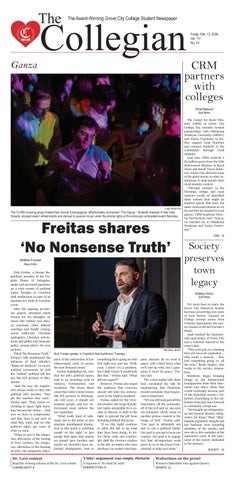
Nick Freitas speaks in Crawford Hall Auditorium Tuesday.

From the Tower

Ever

the romantics ... and blunderers

Through the unembellished history stored away in The Collegian’s archived articles, I got novel taste of the times and a feel for Grove’s spirit over the past decades that secondary sources cannot fully convey.

Here is a piece published 75 years ago (minus one day) on Feb. 14, 1951. My impression from the many articles I scanned is that “the infamous Grover love life” holds less variation than one might expect. If you read last week’s submissions of students’ advice for talking to guys and girls, you’ll notice an uncanny resemblance between the Grovers of 1951 and those of our class, with a resort to sarcasm and provocation in the face of uncomfortable moments.

If you’re still in want of a Valentine’s “slam” for your dearest this Valentine’s Day, consider (or maybe don’t) these suggestions.

From the archives:

Valentines Speak Softly – But Carry Big Stick!!

If the 1951 Valentines have their way, a man and his ego will soon be parted. For come Wednesday, February 14, we men (grown soft and susceptible from too much sweet-talk, I fear) have been ear-marked for candied phrases much like these:

Someone thinks you’re wonderful. Someone loves you, too. Someone thinks you’re quite a man… And that Someone is YOU!

Here’s another, just so you won’t forget:

If you were in the Movies, Your talents sure would shine… ’Cause you would play those Monster roles in films like FRANKENSTEIN!

Fortunately, there is no law or tradition requiring us to take this sort of thing lying down. Valentine publishers, with a sense of fair play, have also provided verse which will test the exploding point of m’lady’s vanity. Such as:

How’dja like to be my spouse? I wuntcha ‘round… To HAUNT my house!

Then there’s the one “For A Brainy Girl!”

This card says you’re CHARMING, and when you revive it… I know you’ll be STUPID enough To believe it!

There are still others, of course, but now that you know what you’re in for, let’s glance back a few years.John McLoughlin, a Scotsman with a book and printing business in New York City, introduced “Vinegar Valentines” in 1858. By and during the gay 1800’s, the sarcastic verses and crude insulting drawings were outselling sentimental Valentines.

Typical of these is one addressed to “A Shopping Terror.” The design pictures a woman shopper maniacal on Tenniel’s classic drawing of the Dutchess in “Alice in Wonderland.” The verse brutalizes her for her pestering all the clerks, and concludes: “But decency’s a thing for which you plainly have no bent.”

Others in equally bad taste were titled: “To A Bad Dancer,” “To A Conceited Man” and even “To A Lady With Bad Teeth.” Today, the trend is toward a cushioned slam, and the “Vinegar Valentines” of yesteryear have been bid an irreverent farewell. Whimsy and clever illustrations have grown increasingly popular, culminating in the bittersweet slams featured in this year’s crop of Valentines.

Actually, the new Valentine slams are of two types. One for the receiver, another for the sender. Consequently, people who enjoy a laugh at their own expense will probably end up sending something like this:

If you wuz a CUCKOO how nice it would be! ‘Cuz then you might go for a BIRD BRAIN like me!

However, if your romance is on the edge of the ledge, there are sentimental verses that still speak of love in the “good old-fashioned” way.

Kathryna Hoyman, Managing Editor

Collegian Staff

Emily Fox

Editor-in-Chief

Editorial Board

Matthew Purucker

News Editor

Anastasia Brown Community Editor

Christa Bashinski

Entertainment Editor

John Hatzis

Perspectives Editor

Mia Gallagher

Sports Editor

Staff Writers

Mara Brak

Madelyn Braho

Randall Elvin

Alexandria Fox

Natalie Hanna

Andrew Hutchinson

Julia Kramer

Olivia Massucci

Reagan Thomas

Art & Photography

Luke Paglia

Photo Chief

Art & Photography

Mara Brak

Luke Morton

This

Kathryna Hoyman Managing Editor

Editing

Olivia Emerick

Copy Chief

Copy Editors

Anna Kasianides

Kendall Lambrecht

Madison Miller

Jaci Morell

Bonnie Pittman

Vivian Waner

Advertising

John Remaniak

Business Manager

Tava Derr

Social Media Manager

Advisory

Nick Hildebrand Staff Advisor

The Collegian is the student newspaper of Grove City College, located in Grove City, Pa. Opinions appearing on these pages, unless expressly stated otherwise, represent the views of individual writers. They are not the collective views of The Collegian, its staff or Grove City College.

THE GREEN EYESHADE

Romancing the Grove

‘Ring

by spring’ traditions

“Look to your left, look to your right, your future mate might be in sight.”

At first, this silly little rhyme — first shared by Nancy Paxton ’54, former vice president of Student Life and Learning, and repeated every year at freshman convocation since — may seem like stereotypical Christian college propaganda. Similarly, the “ring by spring” quest — with its annual fall “freshman frenzy” and springtime “senior scramble” — can at times seem overhyped and cliché.

At Grove City College, however, this rhyme and its quest often do lead to lasting, Christ-centered relationships and strong, God-fearing marriages. In fact, of the 32,597 total living alumni, 7,424 of them are married to another alum, per the Alumni Relations Office. That’s 3,712 Grover couples.

But has this courtship culture always been the case at the college? And where did the traditions created by this culture — late-night Grover walks, creeking, chapel weddings, etc. — truly begin?

As it turns out, courtship has always been a major part of life at Grove City College. While this information shouldn’t surprise anyone – two of our core values are community and faithfulness after all – the different forms courtship has taken throughout that history vary significantly from what we experience today.

“In the very early years of the college, the rules for girls were very Victorian, whereas boys had very few rules. But there were dating rules,” Director of College Archives and Galleries Hilary Walczak ‘09 said.

“Girls had strict curfews and would sometimes drop money in a coffee can down a wire out of their windows to boys below for them to go get them food from the local diner. Additionally, girls would need permission from parents to ride in a car with a boy,” Walczak said.

To students today, these rules — coupled with the lack of open hours and cellphones — can make early Grover courtship sound impossible. But the college supplied ample opportunities for coed mingling through the various school-wide dances that would take place.

“There were actually a ton of dances on campus. Dances up until the 1960s had dance cards. Every student was given a dance card to have the person they danced with sign it. That was one of the ways for men and women to interact since they couldn’t visit each other’s rooms,” Walczak said.

In addition to these danc-

Celebrate 150

To celebrate Grove City College’s 150th anniversary, The Collegian is exploring the College’s history, traditions and culture in this ongoing series.

es, male and female students could also talk to each other on their residence hall’s phone. And anyone who has seen a cheesy rom-com set in a time before the 1980s knows the challenges a single dormitory phone can bring.

“There was only one phone on the hall – like up until the ’80s – and if a boy wanted to call a girl they had to call the hall phone. Any girl could answer and they would have to go get that girl to come answer. It was the same story if you were there to pick them up for a date,” Walczak said.

By the late 1990s and early 2000s, an early form of open hours, then called intervisitation or “intervis,” had been implemented, bringing with it the all-important, shoe-inthe-door rule.

After surviving all the woes of early courtship – or “talking” and “dating” as it’s better known today – the next step in the ring-by-spring quest is the actual proposal. And where there’s a proposal, there’s bound to be a creeking.

A ritual unique to the Grove, creekings take place after a Grover couple formally announces their engagement. Typically, the guy is carried down to Wolf Creek and tossed in its waters by his friends.

Frats, housing groups and friend groups each add their own creative twists to this tradition, and some sororities have even made creeking part of their annual sweethearting tradition.

“Creeking actually didn’t begin until sometime in the 1970s. Before creeking, pinning was the major tradition for couples. Usually you were ‘pinned’ by your sweetheart before getting engaged. Men also would serenade their

sweethearts outside their dorms,” Walczak said.

“We don’t really know much about the origin of creeking, but it definitely took off and has continued for engagements as well as sweethearting by sororities. However, if you talk to our older alumni, they are always confused by the tradition,” Walczak said.

For Grover couples, like engaged seniors Nora Russell and Daniel Garner, creeking creates life-long memories and forges a lasting connection to the college and its community.

“(Our creeking) was exciting to plan, and we had a lot of fun in the moment as well. It was sweet to have so many of our friends there to celebrate us, and we definitely felt loved by our community,” Russell said.

Russell, a sister of the Theta Alpha Pi sorority, and Garner, a member of the Alpha Sigma housing group, have also been able to take part in another time-honored, Grover-couple tradition: sweethearting.

“It’s been neat to be incorporated into the cultures of both groups. We love all the Thetas and Alpha Sigs, so being in those positions at the same time is such a fun blessing,” Garner said.

“The traditions have allowed us to share the joy of our relationship with a wide group of people, which has made us feel very supported by more than just our close friends. We are so grateful for this season of our lives,” Russell said.

Once a couple is creeked, it’s time to plan the wedding. And what better place is there for a Grover wedding to take place than in Harbison Chapel?

Since it opened its doors in 1931, Harbison has hosted

MARA BRAK
EMMA HEUBUSCH
Mia Gallagher Celebrate 150 Correspondent

Weekend of music Love (and jazz) are in the air

Emily Fox

Are your Friday night plans sounding bleak? How about Saturday? Maybe you don’t have a car and are frantically trying to figure out something special to do with your girlfriend for Valentine’s Day. Or maybe you’re a love-lorn Grover looking for something to distract you from all the recently engaged couples strolling about campus. Whatever the case, Grove City’s musical ensembles have got you covered. The college’s symphonic concert band and wind ensemble are hosting a concert at 7:30 p.m. tonight, and the jazz band is hosting the GCC Jazz Festival tomorrow at 7:30 p.m., both in Ketler Auditorium.

Symphonic Concert Band and Wind Ensemble

The symphonic concert band and wind ensemble have been preparing for tonight’s performance since the semester started. In just a few short weeks, they’ve put together eight selections sure to impress and entertain their audience.

“This was a fairly quick turnaround in terms of prepping this concert. The students have worked diligently to prepare this music in a relatively short amount of time, and I have really enjoyed watching them learn this material. Both ensembles are tremendous collectively and as individual members. I am so happy for them,” Dr. Andrew Erb, director of the concert band and wind ensemble, said.

The symphonic concert band will begin the concert playing the first four selections. The concert’s opening piece, “Ignition” by Todd Stalter, is a fast-paced and energetic selection sure to get the audience excited for what’s to come. They’ll then move on to “How Sweet the Sound,” a piece based on the familiar hymn “Amazing Grace.” The audience should also look forward to hearing “El Capitan” by John Philip Sousa and the symphonic band’s final piece by Randall Standridge entitled “Gloriam.”

“That piece (Gloriam) is a lot of fun for both musicians and audience. It uses quite a bit of mixed meter, syncopation and interesting rhythms,” Erb said. After the concert band concludes, the wind ensemble will take the stage, opening with “American Overture” by Joseph Wilcox Jenkins. Their next two pieces are “Simple Gifts” by Frank Ticheli and “Rush,” a selection composed by Pittsburgh native Sam Hazo. Their final piece, “Grant Them Eternal Rest” by Andrew Boysen Jr., is a meaningful dedication to the victims of the terrorist attack on Sept. 11, 2001.

“It is a multi-movement, highly emotional and touching piece of music. We hope it moves our audience the way it has moved us,” Erb said.

If you can’t catch this evening’s concert, the wind ensemble will be performing March 20 at the college’s Celebrate 150th concert at Carnegie Music Hall in Pittsburgh, and you’ll have another chance to hear both groups on April 24 during Family Weekend.

GCC Jazz Festival

Grovers have much to look forward to at the GCC Jazz Festival, which showcases performances by Highland High School’s jazz ensemble and the college’s own jazz band, featuring pieces written by renowned saxophonist and jazz arranger Mike Tomaro, the festival’s special guest.

Along with being an accomplished saxophonist, Tomaro is a composer and educator. In 1997, he became the director of Duquesne University’s jazz studies program, a position he continued to serve in until his retirement. He was a member of the Army Blues Jazz Ensemble for 17 years, and during that time, he composed many of the selections in the group’s repertoire. Tomaro also has various other achievements from performing with many other jazz artists and ensembles. Grove City’s jazz band had the opportunity to learn from him at an improvisation workshop this past Tuesday.

Trombonist David LaBarbera expressed his gratitude for learning to play Tomaro’s arrangements and then having the chance to work with him.

“I have always found it exciting to play compositions or arrangements by a person I have actually met because the music feels much more personal, and this adds value and import to the performance. Consequently, I was thrilled to hear that we would be playing Tomaro’s

Enjoy an evening of eight varied pieces, from classic Sousa marches to sweet pieces based on hymns.

INSTAGRAM

arrangements alongside him in concert. On Tuesday, the jazz ensemble had the opportunity to rehearse with Tomaro, and I was blown away by his incredible saxophone playing, especially his improvised solos,” LaBarbera said. “His presence brings energy to the band and enhances the quality of our music.”

The college will also host workshops for Highland High School students, and the school’s jazz ensemble will perform the first portion of the concert on Saturday night. Next, Grove City’s ensemble will play several selections arranged by Tomaro, including “I’ll Remember April,” “Willow Weep for Me,” “What Is Hip?” and “Won’t You Be My Neighbor?” The arrangements will feature solos from Tomaro himself and a solo played by LaBarbera in “Won’t You Be My Neighbor?” The band will

also play “Not Another November,” composed by the college’s own director of jazz ensembles, Dr. Joseph Hasper, and featuring a trumpet solo by Liam Cummings.

“Mike and I picked these tunes because they each have something new to say. If you know the songs already (who doesn’t remember Mr. Rogers singing ‘Won’t You Be My Neighbor?’), you’ll hear some new twists and musical surprises in the way Tomaro treats the melody. Even if you don’t know the songs, the sound and energy of 17 musicians all playing this energetic, vibrant music is something everyone can enjoy,” Hasper said.

“As composers of rangers, we put lots of time into this music, and it is gratifying to hear bands perform it,” Toma-

MUSIC 11

Camille, Elsie and Anna Grace Lingo

What is a surprising fact that most people don’t know about you?

Camille (15): I took surf lessons in Virginia Beach and can surf.

If you were a genre of music, what would it be and why?

Camille: Christian music, because it makes me feel better and happy when I listen to it.

If you could add a new building to campus, what would it be?

Anna Grace (10): An art building because I love art! What has been your favorite event on campus?

Anna Grace: Lingo Bingo!

What is something you are looking forward to during the rest of the school year?

Elsie (13): Warmer temperatures and summer! What is your favorite thing about Grove City College?

Anna Grace: The PLC gym!

Camille: The Urban Trail Coffee shop.

Elsie: The Chick-Fil-A in the student union.

with the Lingo girls
GROVE CITY COLLEGE
Julia Sikora (left) and Julia Truesdell (center) perform with the Wind Ensemble.
The Jazz Band performs at the Winter Ball.

Contest winner!

The following response was penned by our Dr. Love contest winner, who wishes to remain anonymous ... thank you to all who entered. We loved reading your responses!

My girlfriend and I have only been dating for two weeks, but Valentine’s Day is right around the corner. Meanwhile, a lot of my friends are engaged and already have their forever plans locked down. I really like her, but it feels way too soon to do something over the top. I want to do something intentional and not cliche. What should I do, Dr. Love?

You’re in luck, young man! This time of the semester is a season of fundraisers, so there is an army of people eager to help you. Your first move is to head on over to SAC and withdraw a pocketful of $1 bills from the ATM. After that, just stroll around SAC for about 30 seconds. Groups that can help you out will likely heckle you repeatedly (as I have been — have you ever noticed how people are really nice to you when they are asking you to buy things?).

Valentine’s Day cards! ICO bake sales! Coffee grams! All these things are super cheap and low-key. You can tack on a little message (“I passed by this stand and thought of you!”), and the sweet gesture will certainly be well received. You can make a day of it: Buy her a muffin and send a nice handwritten (with nice penmanship — your grandkids might be reading it one day) Valentine to her mailbox. Just don’t do the Valentine thing if you aren’t confident this relationship is going places — by the time she checks her mailbox, you both could be long separated.

On Valentine’s Day, just spend some time with her: A stroll down to Collage would suffice. Hold the door. Pay. Compliment her sweater. Be really interested in that Frost poem she keeps talking about. Ask questions. Remember you are happy to be there, going out with someone you really like. Let that happiness shine. These million little things will make it clear you care, without making her feel pressured.

My advice, in brief: Read the advice of all the single people in last week’s edition on how to talk to the opposite gender … and do the exact opposite.

Once you’ve done that, swing by The Collegian Tower in Crawford and drop off any of those spare $1 bills you got from the ATM — due to administrative budget cuts, my cruel, cruel editors have cut my stipend, and as a doctoral student in romantic counseling, I can take all the money I can get. Don’t worry, editorial team, I have no plans to go elsewhere, unless, of course, another publication is interested in paying off my student loans … (I’m looking at you, Cogitare Magazine!).

Best of luck, my friend: May your generous gifts spark a deepened relationship with this girl.

Auspiciously,

Dr. Love Love, M.D.

Faculty Follies builds campus community

Faculty Follies, a longstanding Grove City College tradition, was held in Crawford Auditorium on Jan. 31.

Each year, this local/college staple provides the perfect opportunity to see professors in a different light — literally. The show is a collaboration between many of the professors and includes everything from funny skits to parodies of rock music played by Crimson Floyd — an all-professor band.

“We’re not just all about grades and rigorous academics,” Dr. Timothy Sweet said. Sweet organized Crimson Floyd, contributing slideshows and his drumming expertise to this year’s event. “We’re real people who love to have fun and find joy in poking fun at ourselves, not taking ourselves too seriously.”

The event kicked off with “old guys playing old tunes for a new generation of Grovers,” Dr. Donald Shepson said.

Crimson Floyd made its debut as Undirection in the fall of 2014, resulting from a student’s idea of creating an all-professor band for the beloved annual event. Their first year performing, they parodied a song by the famous One Direction, changing their name the following year to Crimson Floyd after paro-

dying “Another Brick in the Wall.” While the faces of the band may swap from year to year, the name stuck since this monumental moment.

Omicron Delta Kappa, one of the college’s honorary societies, sponsored Faculty Follies and contributed a student committee that directed, recruited, advertised and wrote most of the skits for the event. Faculty Follies was also the result of a lot of work and coordination on the part of the professors.

“It’s a chance for students to see us as people first,” Dr. Richard Sabousky said. “They realize we care about them, not just their grades.”

Sweet organized the slides, contributed to the parodies and took silly photos of faculty members to ensure the event was a hit.

“I want the people to have fun. That’s really my goal — to make the audience smile, laugh and just enjoy themselves while we do our thing up here,” Sweet explained.

The whole point of Faculty Follies is to foster an environment of connection and relationship building between the faculty and students.

“This is more than a performance,” Sweet said. “It’s a way to bring people together and strengthen relationships that go beyond the classroom.”

In that respect, Faculty Fol-

lies was a hit. The appearance of the Grove City College President Lingo and first lady Lingo featured as the DuoLingos caused the crowd to go wild with laughter. The students chuckled throughout the comedic skits and Dr. James Bibza’s Snapple facts sequence. They roared with laughter when Mr. Toad from the fall semester’s musical “The Wind in the Willows” performed a parody with the professors. The event as a whole served to break down barriers for both

students and faculty, allowing for room to build lasting relationships and cultivate a strong campus community.

“Students forget faculty are people too,” Sabousky said. “There’s things we like to do that we don’t do in a classroom … we have the same needs, wants, desires, injuries as anyone else does.”

When asked what Faculty Follies provides for the faculty, Sabousky said, “It makes us more human. We forget that sometimes.”

Spring concert lineup kicks off with Connor Flannagan

This school year, the Student Involvement Council (SIC) has sponsored many concerts, and the spring lineup starts off strong with next Saturday’s concert by up-andcoming indie hip-hop artist Connor Flanagan.

Connor Flanagan will perform at 6:30 p.m. on Feb. 21 in Crawford Auditorium as part of his SEASONS tour. Tickets are on sale now and can be found through the QR code below.

A concertgoer who attended the fall semester’s Campus Nights tour suggested Flanagan to SIC. “We try to pay attention to what concert attendees say they would like to see, and Connor Flanagan was mentioned,” Eric Fehr, the student involvement director, said.

“Fresh off the release of his ten-track album that tackles anxiety, fear and trusting God through life’s changing sea-

sons, Connor’s music bridges genres, drawing on influences like Macklemore & Toby Mac to Jon Bellion & Mat Kearney,” Flanagan’s website describes. The set list includes a “combination of both his own songwriting and composing, but also stuff he has produced for other artists,” Fehr said. He has toured with several other artists who have come to Grove, including Strings & Hearts, but this is his first time on campus. His stop here in Grove City is not a school-specific concert, but the college will “help with ticket sales and serve as a location for his tour — so members of the community are welcome,” Fehr said. This is the college’s first time hosting a Christian hiphop artist. Fehr understands this is a step away from the the student body’s usual musical listening palette, but hopefully, this diversity will strike a chord with a variety of attendees from across campus. Although the genre might be different, Fehr is still con-

fident that Flanagan aligns closely with what Grove City students love to hear — music with “compelling lyrics,” which points to “the good, the true, the beautiful.”

God’s love and power are major themes within Flannagan’s discography. As his SEASONS tour website says, “this isn’t just a concert — It’s an evening of authentic worship, powerful anthems, and encouragement to pursue the purpose God has placed on your life.” Fehr built on this by painting his ideal concert experience for campus: “young adults, teenagers, anyone who is into hip-hop can appreciate (the music) — and feel like they are known and loved by God.”

Greg Colbeck, an indie folk singer-songwriter from Northern Ohio with a background as a worship pastor, will open Flanagan’s concert. These dynamically different artists will share the stage to “seek similar conclusions — that you are known and loved by

God,” Fehr said, and to deliver “a message that resonates deeply with college students navigating their own seasons of growth and calling,” as the website says.

Flanagan’s show will certainly start this semester off on strong footing, and, as Fehr reminds, SIC is always open to hearing names of potential artists for campus concerts. “Drop us a line if there is someone you would like to see on campus!” he urges. “We are already working on the fall lineup, and we will have an amazing announcement coming out later this semester!”

Love
MICHAEL BOCK
Professors Susan Dreves, Peter Foster and Tricia Shultz perform
MICHAEL BOCK
Participants of Faculty Follies line up for bows at the conclusion of an evening of easy laughter.

Mic drop moments

Last Sunday, the Grammy Awards gathered celebrities and entertainers to celebrate noteworthy, popular and occasionally questionable music and music-adjacent releases over the past year.

Music’s biggest night came and went, with wins both expected and surprising, stunning performances and a thick atmosphere of politics. From the red carpet to the afterparties, the Grammys showcased the world of entertainment, stretching from the 2026 Best New Artist to remembering great musical artists who passed in the last year.

The awards this year came with far less controversy than past years, specifically Beyoncé’s wins in Country Album of the Year and Album of the Year with “Cowboy Carter.” The choice for AOTY was seen as a snub to Billie Eilish’s hugely

Highlights from the 2026 Grammy Awards

successful “Hit Me Hard and Soft,” and many country fans were dismayed that the category was won by a predominantly pop-filled album. This year’s main wins included Bad Bunny’s “DeBÍ TiRAR MáS FOToS” winning Album of the Year and Latin Album of the Year, Eilish’s “Wildflower” as Song of the Year, “Luther” by SZA and Kendrick Lamar for Record of the Year and Olivia Dean winning Best New Artist. None of these were particularly surprising, as the top few choices in each category were remarkably strong, though the dearth of wins for Sabrina Carpenter’s album “Man’s Best Friend” was somewhat surprising. It remains my belief that the song “Golden” from “K-Pop Demon Hunters” did not deserve any wins, and Billie winning Song of the Year was an admission of wrongdoing last year.

As always, the stage at the Grammys hosted the year’s

After years of waiting, the king of modern folk and New English mental anguish has finally blessed the world with a new single and the promise of more music to come. After a four-year hiatus since releasing his album “Stick Season” in 2022, Kahan played his latest single “The Great Divide” at several concerts in 2024 and 2025 and, after months of suspense built up on social media, officially released it on Jan. 30. It explores themes of childhood trauma and broken relationships across time, or in other words, “the great divide.” Additionally, the title refers to the gap between his release of “Stick Season” and the new single as well as how his relationships have changed since his ascent of the charts. In the song, Kahan sings about the way he missed the struggles that one of his past friends faced and how he can see now how much he failed to recognize them then. The accompanying music video cine-

continued from 2

hottest artists for a number of live performances, and this year’s collection was especially strong. Bruno Mars performed his new lead single “I Just Might” for the first time, and his effortless vocals and 70s-inspired choreography left zero room for improvement. Lady Gaga demonstrated her incredible voice in a re-harmonized version of “Abracadabra,” dressed as the cage from her Mayhem tour, and the best new artists performances were excellent.

Lola Young’s “Messy” was impassioned, Addison Rae channeled Britney Spears in her opening performance and despite some technical issues, Alex Warren performed the Tik Tok-famous “Ordinary” with an impressive level of performing maturity. However, two performances made the largest impact.

First, Best New Artist nominee Sombr sang his song “12 to 12” in a performance remark-

ably evocative of the 70s and 80s rock scene, and despite losing the Grammy, Sombr made it clear he will remain a musical force in a genre that has mostly disappeared in the pop music world. The star of the performances, albeit divisive, was Justin Bieber who performed an acoustic version of “Yukon” in nothing but boxers and socks. However, despite some awkward moments that have led the internet to question Bieber’s mental state, his vocals were crisp and sultry and created a calm, pensive atmosphere during the flashy and chaotic ceremony. As usual, politics were not hidden at a Hollywood celebration, and in light of the recent events in Minnesota, many singers and celebrities wore “ICE Out” pins. The anti-ICE sentiment was even more explicit in the speeches given, with Puerto Rican singer Bad Bunny repeating the same, and Eilish stating in her

‘The Great Divide’

matically portrays the story of his friendship from childhood into adulthood and, thankfully, ends with a hopeful note of reconciliation as Kahan himself steps in to give his friend a much-needed hug.

The song has the added bonus of being musically and lyrically engaging. Kahan has the uncanny ability to write lyrics that are both quietly devastating and equally forceful. They’re designed to be screamed in the face of a snowstorm.

The musical arrangement of the song bears the handwriting of several Kahan songs that came before. The guitar work seems to call back to earlier, more rock-heavy songs like “Homesick” or “Your Needs, My Needs,” while in the quieter moments it seems to recall Kahan’s softer style seen in “Call Your Mom” or “Paul Revere.”

It is impossible to talk about the release of the single without eagerly looking forward to Kahan’s album of the same name releasing in April. Kahan has been working on the album for potentially years and practically torturing his

fans with Instagram story declarations that the album was “almost done,” then “finished” but still not released.

Kahan’s ominous announcements that the album will be “well worth the wait” and will explore more memories from growing up in Vermont have left fans struggling with the news that it will not be released for so long. There is hope, however, in an easter egg found within the music video that something could be expected March 20.

As fans decipher every cryptic and often humorous Instagram story the artist releases, the album promises to be the soundtrack of summer 2026 for all those hoping to take a road trip, visit a national park, hammock in the wild, traverse New England or simply have their heart ripped out and sewn back together.

All in all, folk fanatics, granola girls and the general population alike are very anxious to “launch ourselves across the great divide” that is the distance between us and April 24. All we know now is Noah Kahan is back, and we couldn’t be more excited.

acceptance speech: “Nobody is illegal on stolen land” and “F*** ICE.”

While some praise the activism, many conservatives have decried the statement, calling such acts “performative” and “out of touch.” Comedian Ricky Gervais also chimed in, calling out political statements as useless, especially coming from individuals who live life in a protected, money and power-filled circle of influence. Whether one sees the actions as ridiculous and “woke” or is glad to see those with a platform using it for good, the constant emphasis on political views creates very strong emotions around the various awards.

With the biggest night in music passed, listeners can look forward to notable summer releases to see where music will go in the upcoming year.

thousands of weddings. This picturesque chapel offers an idyllic wedding atmosphere and promises gorgeous pictures for the couple both inside and outside. But be warned, if you’re daydreaming about having your ceremony there, it does book up far in advance.

“Prior to Harbison Chapel, Grover weddings were held in the Ivy Chapel. This was a

chapel originally built by the local Presbyterian Church and then purchased by the school to serve as our chapel and classroom building. It wasn’t as beautiful as Harbison, so definitely not the wedding

destination spot that Harbison has become,” Walczak said. For alumni Michael Kanarskiy ’24 and Sarah (Schultheis) Kanarskiy ’24, getting married in Harbison was the culmination of their Grove City love

story. “It was such a special opportunity to get married in the chapel because Grove City College is the reason we met! It was incredible to celebrate our love where it all started,” Sarah Kanarskiy said.

Grove-mance through the years

This creeking took place nearly 20 years ago. This long standing tradition has remained the same for many years.

After a Grover gets engaged, the guy will be marched down to the creek by his friends, and he will get thrown in. It is important that the girl doesn’t forget to bring him a towel, or she may find herself in the creek.

This 1967 Homecoming parade features two Grover alumni. On the right is Sherry Droz ’68. She was elected the Homecoming sweetheart for the Kappa Alpha Phi fraternity.
Former Grove City College President Paul McNulty ‘80 and his wife Brenda ‘80 pose together for a photo. This was likely during their senior year together at Grove City College.

This photo from 1964 pictures senior couple Bill Mehaffey ’64 and Joann ’64. They are quite dressed up for a typical day of classes, so they could be getting ready for a formal campus event such as Homecoming or the Valentine’s dance.

As long as the fraternities have been around, so have the sweethearts. The 2002 fraternity sweethearts from left to right, in the back row: Sigma Alpha Sigma, Adelphikos and Pan Sophic. Front row: Nu Lambda Phi, Omicron Xi and Delta Iota Kappa.

Back in 1948, Grove City College hosted a Valentine’s dance for the students. Grovers would take their freshman fling, if they lasted that long, or their senior scamble victim to the night of fun hosted in Crawford Hall.

Luke Paglia, Photo Chief Photos from GCC Archives

One size doesn’t fit all A call for alternative chapel music

Chapel. For students at Grove City College, where spiritual formation is at the core of a Grove education, this singular word provokes great conversation and debate.

While each full-time student is required to attend chapel at least 12 times per semester, some walk through the doors of Harbison Chapel already counting the minutes before they can return to their studies and complete pressing assignments.

My conversations with students about chapel typically

yield negative feedback about the program, largely due to the style of music in chapel services. Adding a special music portion to the weekly Wednesday morning chapel service would offer an alternative style of music and allow for more students to participate in worship.

Music is a crucial part of worshipping together as Christians, emphasized several times in Scripture. The psalmist states, “Worship the Lord with gladness; come before him with joyful songs.”

Chapel services at Grove City College currently incorporate music through student-led worship teams, where student volunteers lead singing in a largely contemporary format.

While members of these student worship teams reap the benefits of leading worship, several instrument and voice majors, who are more classically trained or specialize in performing as a soloist, are excluded by the contemporary format.

These student musicians are gearing up to minister in churches with more of a traditional format through playing piano or organ, directing choirs and hymn singing.

Currently, these students only get to perform at their respective recitals and juries, lacking the practical experience of using their gifts as an act of worship. Having a special music component in chapel to allow music students to

perform would give them valuable experience, even if their area of music expertise does not fit in with the conventional worship team format.

Looking beyond soloists, special music time in chapel could also be an opportunity for musical ensembles on campus to participate in services and foster further student participation. Special music in chapel would also expose students to a wider variety of music and complement the material taught in Civilization and the Arts. Special music would bring something new to chapel services and incentivize students to attend with an attitude of excitement, not resentment.

While some might worry a special music component would take away from the worship teams or add an unnecessary element in an already jam-packed chapel service, the educational and spiritual benefits for both the musician and the listener would help craft a more holy experience for all.

Music in church is not a onesize-fits-all situation. Contemporary worship formats do not work in every church. By adding a special music portion to chapel, all musicians can have the opportunity to use their gifts in worship to God and gain valuable experience in the process.

Relying on church fathers Putting individualism aside can heal religious divides

It is no secret that Christians are split in many ways on different issues.

The more significant theological divides have led to Christians dividing into Protestants, Catholics and Orthodox Christians, while less significant but still prominent issues have created several Protestant denominations as well disagreements among Catholics and Orthodox Christians.

One such disagreement among Christians can be found right here in Grove City College. The statement of faith controversy highlights the struggle for Christians to agree on issues big and small despite being unified by the same fundamental belief in the Chris-

tian God.

The need to be unified on the fundamental tenets of Christianity is accepted by any Christian serious about their faith. That need for unity, however, does not seem as important to some Christians when it comes to theological ideas of lesser importance or certain social and political issues like gay marriage.

It’s not my intention to discuss the historical events that have led to splits in the church. I am much more interested in the effects our American culture has on sustaining these divisions in the church and preventing greater unity among Christians.

Our culture has become increasingly secular over the last century. Our public schools, governments and popular culture have been divorced from the Christian tradition. Academia has also become quite

secular, which has influenced the thinking of most people living in the West.

The empirical approach to obtaining knowledge is treated as the default, and in some cases, the only way of discovering truth. Belief requires evidence, and as David Hume once said, “A wise man … proportions his belief to the evidence.” The more evidence a claim has for it, and the less against it, the more confident we can be in holding that belief.

This is a perfectly acceptable way to obtain knowledge about the world we live in.

The impact, however, that this way of thinking has on Christians in America is that we are examining the same text and finding parts of Scripture as evidence to back up our competing claims and deeming our evidence sufficient to hold the beliefs.

So, who is right on these is-

sues we disagree on? One way to answer that question is to turn to church officials and the teachings of the church fathers. Because of liberalism’s specific emphasis on individualism and freedom of thought, this is not so easy for us Americans to do.

Americans are not shy about telling others that they are wrong and even less shy about arguing with expert opinion, so long as they think they have the evidence on their side. It seems American Christians are bold enough to disagree with church authority and split off rather than submitting their own faculties of thought to the church teachings.

This is not to say that Christians need to think the same on every issue or that Western civilization is at fault for there being so many denominations. Our fallen nature makes it so we cannot have all the right

answers.

I am saying the influences of secularism and liberalism in Western society has caused a division among Christians where there shouldn’t be. Issues like abortion or gay marriage shouldn’t be controversial issues for Christians. A statement of faith affirming that God created two genders shouldn’t cause controversy at a Christian school.

It is important that Christians continue to discuss and debate the issues we disagree on. I also think we need to rely less on examining the evidence for ourselves and deciding to commit to our freedom of thought and more on the teachings of the church fathers and those in positions of leadership in the church today.

What is the benefit of sowing division amongst people? Who gains when people don’t trust each other?

“Don’t be a Sucker” is a 1947 short film by the United States Army. In the film, a loud man standing on a box on the street attempts to convince a gathered crowd that he is a real “American American,” that he knows why things are going wrong and that foreigners are taking jobs that should be theirs.

A young man in the crowd follows along, thinking this sounds reasonable, until he is surprised by one of the groups that is declared not American enough — Freemasons, of which he is one. In his shock, he listens to a professor from Hungary who tells him about a similar scene he saw back in the 1930s and the dangers of rhetoric that tries to break people into rival groups.

‘Don’t

be a sucker’ Lessons from 1947

Further into the film, one man, an unemployed “Aryan,” the one who had the most to gain from Nazi ideology, dies in Normandy with his family starving, instead of ruling the world like he was promised.

Clips of this film have been circulating the internet since the 2017 Unite the Right neo-Nazi rally in Charlotteville. Even nearly 80 years later, the film serves as a reminder to ask questions about who wants us divided and what they get out of it.

The people who are trying to convince you that your neighbor is your enemy, that you have all the right opinions and that you are one of the few legitimate Americans, isn’t doing it out of love for you. They are not looking for leaders for the glorious future they promise you, only foot soldiers willing to die for the cause while they profit.

Men like Trump and his associates are betting on us being willing to disregard other people’s rights. Systems like ICE depend on us seeing other

people as undeserving of dignity, safety or due process. The catch is that once those rights don’t apply to some people, they don’t apply to anyone.

But just saying “don’t trust people who want us disunited” only gives us fewer options of who we can trust.

What if we decided to trust other people? What if we looked for commonality in humanity or in a greater American identity? Perhaps instead

of considering liberals, protestors or the homeless our enemies, they are just other people like us.

This won’t be easy considering how much effort has been put into breaking us apart over the years. If we can only conceive of some people as “people we donate money to charity for” or “that person speaking another language loudly behind me on the bus,” we will never be able to con-

‘Unity’ argument was empty rhetoric

In his Feb. 6 Perspectives column “No time for unity,” Micaiah Brindle makes a number of bold assertions. He argues that the political left in the United States promotes an ideology that is too radical, too militant and too bigoted to be worked with, and as such it is the moral duty of conservatives, and especially Christians, to deny any ground to the left and to “remove” any ground given previously.

This thesis is empty rhetoric. While the author provides many ideological talking points, the work provides few facts that support the thesis. The article, to use a line from the work, “entirely misses the reality of American politics in the 21st century.”

“No time for unity” opens with the assertion that “leftism necessarily stands for anti-American, anti-Christian and anti-white principles,” thus immediately dehumanizing those on “the left.” Those who adhere to “leftism” aren’t Christian. They aren’t Americans.

The author continues, stating that “the cult of transgenderism and abortion” were dominant leftist policies in the 2024 elections, with “mass immigration” being the only acceptable policy for leftists on immigration. Neither abortion nor “transgenderism” were top priorities for either party in the last election, though they did make good strawmen to attack each other with.

The official 2024 Democratic Party platform dedicated its first 50 pages and five chapters to economic concerns be-

The purpose of the Perspectives section is to give a space for student voices. Here, student writers have the space to critique, question and analyze the world around them.

“Full of ideological talking points, the article, to use a line from the work, ‘entirely misses the reality of American politics in the 21st century.’”

fore dedicating four pages to “reproductive freedom” and “LGBTQI,” both of which are just smaller sections within a larger chapter.

This is also true for the Republican platform. Of its 20 stated promises only two, promises 16 and 17, remotely relate to “transgenderism.”

The first 15 promises instead focus almost entirely on military, energy, economic and immigration concerns.

Abortion is not mentioned in the promises, and President Trump ultimately sidestepped the issue and left it up to the states. As for said immigration concerns, the Democratic platform called for strengthening the border while providing more resources for legal immigration, not the “mass immigration” the author implies.

However, the meat of the argument in “No time for unity” comes when the author claims “As a result of left-wing ideology … violence is increasingly occurring. This ranges from school shootings, often against Christians, by transsexuals inspired by their mental insanity and targeted political assassinations.” This is not true.

If left-wing ideology promoted mass shootings and political assassinations the numbers would indicate it. Instead, the reverse is indicated. The National Institute of Justice found in 2024, that “the number of far-right attacks continues to outpace all other types of terrorism and domestic violent extremism. Since 1990, far-right extremists have committed … 227 events that took more than 520 lives. In this

same period, far-left extremists committed 42 ideologically motivated attacks that took 78 lives.” That the Department of Justice took this report down a week after Charlie Kirk’s death is, of course, just coincidental.

The school shooting the author is likely referring to is the Annunciation Catholic Church shooting. While it is true that the shooter had identified as a transwoman, establishing an ideological basis for the shooting has proven much more difficult for investigators, given that the shooter made frequent usage of antisemitic language and idolized Nazism.

Even with this incident, the claim about school shootings is not supported by data. The Gun Violence Archive considers a single event during which four or more people are shot a mass shooting. Between Jan. 1, 2013 and Sept. 15, 2025, 5,748 mass shootings have occurred, of which five were perpetrated by confirmed transpeople, or less than 0.01% of them. Given that 0.8% of the U.S. population is trans, this does not demonstrate a population more prone to mass shootings.

Only one group shows a particular inclination to this sort of violence, as the vast majority of mass shootings are perpetrated by men. According to research by the National Library of Medicine, most mass shootings are impulsive and emotionally driven. They are not motivated by gender identity, political ideology or mental illness, and it should be stated that contrary to what “No time for unity” implies, being transgender does not

Perspectives policy

Perspectives articles represent the views of the individual writer. They do not represent the views of The Collegian, The Collegian staff or Grove City College. While pieces in Perspectives are subjective by nature, The Collegian has standards for publication.

constitute mental insanity.

“No time for unity” also cites the assassination attempts on President Trump as examples of leftist political violence. Again, the truth is more complicated. The political ideology of Thomas Crooks, the first would-be assassin, is also difficult to determine. He had written in 2019, for example, “I hope a quick painful death to all the deplorable immigrants and anti-trump congresswoman.”

Investigators believe that Crooks turned on the president for his actions during the pandemic, and that he felt that political power could only be achieved through violence.

Ryan Routh, the other attempted assassin on President Trump, again has a murky political history, but had most recently registered as an independent, and in a Twitter post claimed to have voted for Trump in 2016. It seems he started planning the assassination after the Jan. 6, 2021 Capitol attack.

Nevertheless, “No time for unity” uses these claims to conclude that “the left has become militarized against normal Americans to the point where politics has become existential … when a group defines itself by opposition to … (your religion, race, ideology) ... working with that group is no longer possible.” This claim is then undermined by the author writing, two sentences later, “the American right — the opposition to the left — must be a reactionary movement, tailor made to combat the left.”

In other words, the left is evil because it is militarized and defines itself in opposition to the right, thus the solution is for the right, defined only

RHETORIC 11

sider them fellow citizens in the way we do our classmates or family.

But being able to build mutual trust across these barriers is going to be crucial if we want to heal division. The first thing you must remember is that a stranger is not your enemy.

If we decide to “gamble with other people’s liberty” as the short film’s professor says, we will, as the men in Hungary did, lose our own.

Letter to the editor

First off, I want to thank you for all the hard work you all do on The Collegian. I think it is a great paper, and having a Perspectives section at all is a great exercise in our democratic freedom to share ideas.

I haven’t always agreed with all the pieces published in the Perspectives section, but I don’t think I have to. People should be allowed to voice their opinion even if I don’t like it.

However, the most recent article I read by Micaiah Brindle crossed a line for me. As someone who has loved ones who vote Democrat and are Christians, it really bothered me to read such blatantly hateful rhetoric in a school publication. I am perfectly okay with pieces which are critical of politics, but this is just too much.

“In 2026, leftism necessarily stands for anti-American, anti-Christian and anti-White principles.”

“The failures of the conservative movement to address leftism — frequently conceding ground in the process — must be removed for victory to be achieved.”

At what point is that too far for a Christian school publication? At what point is that inciting further radicalization and potentially violence?

I also fear a piece like this will make contributing writers who do have “leftist” opinions afraid to publish anything in The Collegian for fear of being faced with hateful actions.

Articles submitted for publication are expected to provide arguments of substance that rely on fact and are void of foundationally emotional and biased arguments. This is not a space to parrot party lines. Perspectives articles are expected to take original stances, and, where applicable, consider the interaction of faith within their topic.

that Perspectives reflect the diversity of thought represented on the college’s campus.

This is a space where all voices can be heard. It is our goal as The Collegian staff

If you would like to submit an article for publication or want further clarification of The Collegian’s expectations contact Editor-in-Chief Emily Fox, Managing Editor Kathryna Hoyman or Perspectives Editor John Hatzis.

Brindle’s views are his own, and I don’t for a second believe they are shared by the editors. But at a certain point, the Perspectives pieces printed are reflective of the paper itself and of the school. There should be at least some baseline of Christian compassion and dignity this paper is held to. And if not by you, then by who?

I love this paper and implore you to please consider certain guard rails to keep it respectful.

Which much love, Joseph T.C. Holland

NIEUWS

84 Lumber exec pitches internships

Paul Yater, chief information officer and head of human resources at 84 Lumber, addressed Grove City College students Tuesday on the value and opportunities found in a business career, encouraging them to begin this journey with 84 Lumber’s summer internships.

While extra credit and pizza incentives may have drawn students to the lecture, faculty intentionally chose the topic to promote student success in the working world by developing their beliefs about what it can mean to pursue business.

“As a business professor — and someone who spent over two decades building a career in retail — I hope Mr. Yater’s

lecture broadens how our students view what this industry can offer,” business analytics professor Ryan Miller said. “Too often, students see retail narrowly, when in fact it encompasses analytics, operations, technology, supply chain, human resources and senior leadership roles with significant strategic influence. My hope is that Yater’s story and 84 Lumber’s growth help our students recognize retail as a dynamic, high-potential career path and envision themselves leading a retail organization of scale someday.”

84 Lumber is “the nation’s leading privately held building materials and services supplier to professional builders,” but it is also a second-generation family company that states it puts its people first.

84 Lumber emphasizes this

Staff Editorial

purpose in the company’s multiple training programs for new hires.

Dubbing trainees the “lifeblood of the company,” Yater described how every year thousands of trainees are brought in through training programs and provided with experiences in a vast swath of roles, including managerial, sales, field operations and traditional corporate programs.

“You don’t need to know anything about the construction industry,” Yater said.

Rather than specific construction abilities, Yater specified the cultivation of soft skills in those seeking to join 84 Lumber.

“You know, if you can be successful, you care, you want to help people, you listen, you ask good questions, you solve problems, we’ll find something

Paving the way for future editors

Anastasia Brown Community Editor

I have only been working on staff for The Collegian since the start of the semester, and I have loved getting to know the team up in the Tower over the past few weeks.

Our current editor-in-chief (Emily Fox) and our managing editor (Kathryna Hoyman) are both women, and considering the female-heavy demographics of campus departments like English and Communication Arts, this is not very surprising.

But did you know that it was during the 1918 school year that the first female editor-in-chief served The Collegian? That was over 25 years after the founding of the newspaper, and considering that Grove City College admitted female students since its establishment, it is notable that it took so long for a woman to hold this role.

The trailblazer was Isabelle Blyholder, a Pennsylvania native born in 1894, who attended Ford City High School, about 40 miles from Grove City.

When she graduated from the college in 1919, the “Ouija” yearbook recognized her accomplishments by describing that “to her comes the honor of being the first girl to act as editor-in-chief of The Collegian, and she has filled this position with marked success. She is an active club member, an earnest student and when it comes to athletic contests, Isabelle is always on hand with all her pep. Judging from her career in Grove City, we predict that she will realize her most cherished ambitions.”

She had a typical Grover-achiever list of accomplishments, but the most fascinating part of her story is her confidence in challenging the school to consider radical changes to institutional rules for female students.

Blyholder may have, in part, gained her position on The

Collegian staff because of her tumultuous historical moment — the United States had recently entered World War I — and as campus archivist Hilary Walczak points out, women were increasingly entering the workforce in new ways.

“Isabelle took the lead with World War I still going on. Women across the country are fighting for the right to vote,” Walczak said. “The Flu of 1918 was killing people around the world. This was when Isabelle wrote some provocative editorials that, for the time, were probably rather scandalous.”

Her most notable editorial was published in The Collegian in April of 1919 and was titled “The Girls.”

“This is a girly article,” Blyholder began. “It is of the girls, for the girls and by a girl. Will the gentle men all step to the rear of the auditorium for the present?

“My subject is girls. We hear too little about them now-adays. Oh yes, I hear you say, ‘Well, the War has brought women to the front.’ Indeed it has. But there are still a few isolated spots in the universe where Girls are kept in the background and our own little college is one.”

She goes on to point out that, while rules for female students were strict and specific — regulating when girls had to be in the dorms and when they had to turn out their lights — rules for male students in these areas were nonexistent.

“No one can go to college and do anything at all outside of regular studies and go to bed at 10 p.m.”

Blyholder’s complaint resounds across the generational divide and resonates with Grovers today.

“Do you men ever think that when a young lady comes into class with all her lessons well prepared, she has sat up a half, three quarters or a whole hour longer than ‘lights’ with only the dim flickering rays of a candle to aid her. Surely, such a situation makes the God of eye doctors laugh. Just why boys’ eyes are valuable

been doing already,” CRM Executive Director Charlie Cotherman said. “But we felt like they shared our heart for it.”

and girls’ are not is the question the girls would like you to solve for them.”

I love to think that this sharp-witted woman penning her editorial for The Collegian over a hundred years ago isn’t too dissimilar from the other female staff members on The Collegian today, all taking our turns to write editorials on topics large and small.

We all feel swamped with responsibilities as we throw ourselves into every opportunity college affords. We all hope to make a difference with our writing. And we all love The Collegian and the college as a whole.

But I am thankful to Blyholder for standing up for justice, for herself and the women who would come after her. She continued to seek the good of the school even long after her graduation, as she served on the Grove City College Alumni Council from 1951-66.

She died in 1984 at the age of 90 and is buried in Armstrong County, and I hope she knows how much her fearlessness as a leader here on campus has impacted generations of students and writers of The Collegian.

for you to do,” he added.

For college students hoping “for something to do,” Yater promoted his company’s summer internship opportunities.

Focused on integration, interns at 84 Lumber can interact with interns in other fields and study the company’s cross-functional capabilities.

“We decided we wanted to give interns visibility to not just what they were learning and which functions they were in, but across those different functions.”

Initially a liberal arts major and an IT worker, Yater said that his role at 84 Lumber, in human resources, was not something he imagined for himself, but he stressed that for those pursuing business, adaptability is key.

“You know career paths aren’t necessarily linear any-

SOCIETY

continued from 1

Grove City College was numbered among the founding donors to the society at its formation in 1999. Over the years, the college and the society have collaborated on projects related to town and Grove City College history.

“Some years ago, Alice Ketler gave us a large amount of Ketler paper. The college started to digitize it for us,” Sopher said.

Alice Ketler, who graduated from the college in 1939, was the daughter-in-law of Grove City College President Weir Ketler.

“Alice Ketler opened up her attic and said, ‘Take everything,’ and it was a lot. I was the one who went back in the eaves and dragged the stuff out,” Sample said.

The papers now reside across the street in the college archives, which are managed by Hilary Walzack ’09. The college archive is in possession of the papers associated with college history, and others, more connected to family and town history, are in the historical society’s keeping.

Richard Jewell, who became the college’s president in 2003 after graduating from the college in 1967, was instrumental in the preservation and display of the Cunningham Wheel. Grove City College students found the wheel from Cunningham Mill, established over 200 years ago, and it is now on display at Cunningham Mill Park on East Main Street. Jewell and the college donated it to the society for display.

more. Sometimes you have to make sideways moves to move up and experience different things,” he said.

For junior business statistics major Daniel Bell, this versatility of career pathways was encouraging.

“(My) biggest takeaway would be the fact that someone can get into different job fields at any point in their career,” Bell said. “From there, they can grow and go from branch to branch or department for as long as they work. There is never a set job someone must take because of the major they picked or the first job they took out of college.”

“The world is your oyster, and if you work hard and you’re committed and you’re willing to learn, there’s a lot of opportunity out there for you,” Yater said.

The most concrete sign of the connection between the historical society and the college is the Grove City College Room. Located on the second floor of the society building, this room looks out over lower campus and is set up as a replica of the Ketler office Isaac and Weir Ketler used. It contains memorabilia of the college throughout the years, including scrapbooks of photos, furniture and Weir Ketler’s suit.

“You could spend a day in any one of the rooms,” Sample said.

According to Sopher, the society has received so many pictures of Wolf Creek that most of them are not on display.

Students can be involved in the historical society, although opportunities are limited. In the past, a student was on the board of the society, although the position is currently vacant.

Sopher explained that the society does not have “a lot of projects” for volunteers, but for those interested in local history, the society’s library, located on the first floor, contains genealogical records as well as documents related to the Grove City School District area, including cemeteries and yearbooks.

The society is closed to the public until April 11, but it is open for most of the fall semester. The society will also install a window display celebrating America250 in May.

For more information about the historical society, please visit grovecityhistoricalsociety.org.

CRM chose OKWU and Taylor University because they are serious Christian colleges in rural settings that already have a Christian ministry major like Grove City’s Biblical and Theological Studies major.

“It had to do with their location, and it had to do with affinity for rural ministry and some connections around some Lilly work that we had

The institutions applied for the grant last spring, and Grove City awarded the grant July 1. For a two-year period, each of the schools gets a grant, and assuming all goes according to plan, they will receive a follow-up grant for another two years.

heads together, I think we’re all going to do better at meeting the needs for resourcing local churches and pastors and connecting students to ministry in our region,” Cotherman said. “So, I think we’re all going to grow from that.”

Cotherman highlighted the collaborative and community-minded approach that the college is taking with rural ministry.

to serve those communities?” he said. “We see it as a kingdom-minded posture.”

Kemeny hopes that the CRM partnerships will help to support Grove City’s foundational Christian mission by being part of the local community through ministry.

“I think it is going to help us generate new ideas, because these partners have some great ideas, and as we put our

“We can’t be the one-stop solution for all of rural America, so why don’t we work with other colleges and other places

“As a Christian school, there’s a great opportunity that providentially fell into our laps, the generosity of the Lilly Endowment to give us five million to advance this project. So, it’s pretty exciting,” Kemeny said. “What I hope

it means for the future is that we can further drive down into the DNA of Grove City College, our Christian mission.”

Grove City College plans to form a third partnership with Covenant College in Lookout Mountain, Ga., and has already had several meetings to discuss the possibility.

“I hope that we can learn from each other what’s working well and make adjustments to what we’re doing in light of other schools’ experiences,” Kemeny said. CRM continued from 1

GROVE CITY HISTORICAL SOCIETY
A photo of members of the 1921 Pan-Sophic fraternity are shown in a pan kept at the historical society.
GCC
Isabelle Blyholder was the first woman to serve as The Collegian’s Editor-in-Chief.

Wolverines edged by No. 2 Salisbury in opener

The Grove City College men’s lacrosse team officially began its 2026 campaign on Feb. 6 with a challenging non-conference matchup against national perennial contender Salisbury University (2-0). The Wolverines fought through stretches of strong offensive rhythm but ultimately fell 24-9 in a neutral site contest held at Calvert Hall College High School.

Senior attackman MacAulay Faircloth led Grove City’s scoring effort, delivering an impressive four-goal performance that provided steady offensive sparks throughout the afternoon. Junior attack Davis Schneider added a pair of goals, while seniors Rigdon Greene and Samuel Stevenson and freshman midfielder Tucker Saums also contributed goals to round out the Wolverines’ scoring.

Grove City generated several assisted opportunities, with

contributions coming from multiple positions. Freshman midfielder Mason Lyons, junior attack Sawyer Strong and junior midfielder Logan Fox each recorded an assist as the Wolverines worked to create movement and find openings against a disciplined Salisbury defense.

Salisbury opened the game

with a quick 3-0 burst, but Grove City responded with back-to-back goals from Faircloth and Strong to narrow the margin to 3-2 just six minutes in. The momentum shifted again when Salisbury capitalized on two man-up situations in under a minute, building separation and eventually carrying a 7-2 advantage into

MVB

continued from 12

three of the four sets decided by a three-point margin.

Offensively, Good once again led the Wolverines in kills, tallying eight against Olivet. Tieg Malcolm and Gianneski followed Good by adding five kills each, and Fair recorded 24 assists in the setback.

Defensively, Tieg Malcolm rallied for six blocks at the net while Fair notched seven digs from the floor.

The Wolverines closed out

RHETORIC

continued from 9

as the group in opposition to the left, to become a hardline and militarized reactionary movement ready to “remove” ground given to the left, in order to establish “its vision of traditional Americanism.” After all, “normal” Americans aren’t leftist.

The hypocrisy, thus, becomes obvious. This sort of radical, bigoted and militant thought from the right is just as guilty of destroying attempts at unity as any action on the left. The author has exposed himself as the very thing he claims to be fighting.

“Are we not required as Christians to oppose evil where we find it?” asks “No time for unity.”

Yes, we are, but not like this.

Our savior rode a donkey, not a warhorse. He told us

MUSIC

continued from 3

ro said. After spending the fall semester learning between 45 and 50 songs for the Ballroom Club’s Winter Ball, the jazz band began practicing for Saturday’s concert in January, meaning they faced a tight timeline to prepare for the performance.

“I think the students are taking it in stride, just doing the

their home invitational with a 3-0 sweep of Mount Aloysius, winning two of the three sets by double digits.

Freshman Joseph Allison and Otto paced Grove City’s offense with seven kills apiece. They were followed by Kessler, sophomore Reese Malcolm and freshman Anderson Ross, who were each good for five kills. Setters Fair and freshman Thomas Krahe combined for 26 assists in the nightcap. Holding down the defensive front was Reese Malcolm, who produced a team-leading five blocks in the match. Kessler,

to love our enemies. He said to love our neighbors as ourselves. Jesus died for everyone. Hatred for people is anathema to his character. We must seek truth and unity. Conflict with each other only benefits evil.

existential … when a group defines itself by opposition to … (your religion, race, ideology) ... working with that group is no longer possible.” This claim is then undermined by the author writing, two sentences later, “the American right - the opposition to the left - must be a reactionary movement, tailor made to combat the left.”

In other words, the left is evil because it is militarized and defines itself in opposition to the right, thus the solution is for the right, defined only as the group in opposition to the left, to become a hardline and militarized reactionary movement ready to “remove”

work and each week’s progress to build into bigger and bigger accomplishments. We’re playing some very difficult music this week, without a lot of time to prepare, so that puts some pressure on students, but they’ve accepted the challenge. For me, it required setting a strict timeline for rehearsals and making sure we met each rehearsal’s goals,” Hasper said.

“Hearing the full and finished sound for the first time

Allison, Ross and freshman Micah Wilding also got in on the action, supplying a combined 14 blocks. DiMalanta led the team in digs, producing 12 to secure the victory.

After traveling to Cresson, Pa. for a rematch against Mount Aloysius yesterday, Grove City will open its PAC schedule at home against Thiel on Feb. 18. This match against the Tomcats opens a four-game stretch of conference competition for the Wolverines, where they will look to improve upon their 2025 PAC runner-up finish.

ground given to the left, in order to establish “its vision of traditional Americanism.”

After all, “normal” Americans aren’t leftist.

The hypocrisy, thus, becomes obvious. This sort of radical, bigoted, and militant thought from the right is just as guilty of destroying attempts at unity as any action on the left. The author has exposed himself as the very thing he claims to be fighting.

“Are we not required as Christians to oppose evil where we find it?” asks “No time for unity.”

Yes, we are, but not like this.

Our savior rode a donkey, not a warhorse. He told us to love our enemies. He said to love our neighbors as ourselves. Jesus died for everyone. Hatred for people is anathema to his character. We must seek truth and unity. Conflict with each other only benefits evil.

was incredibly satisfying and a perfect fulfillment of our anticipation!” Cummings said.

If your Saturday evening is already booked, there are several more opportunities to see the jazz band perform throughout the semester.

The band will play at 6:15 p.m. on April 18 at Lux Mea before the student films debut, and they will hold a concert for Family Weekend at 1:30 p.m. on April 25 in Ketler Auditorium.

throughout the afternoon at the X. Junior defender Nathaniel Clark secured four ground balls of his own, while Strong, junior midfielder Breck Peacock and senior defender Andrew Glasgow each picked up three.

Defensively, Glasgow forced a pair of turnovers, and graduate student defender Samuel Busby paced the unit with three caused turnovers, working to disrupt Salisbury’s interior passing and dodging lanes.

the second quarter. That early swing set the tone for the remainder of the game, as Salisbury continued applying pressure in transition and settled sets.

Senior faceoff specialist Colton Lehberg provided a bright spot in the middle of the field, collecting a team-best eight ground balls and battling

Salisbury finished the afternoon with a 62-28 advantage in total shots, including a 3418 edge in attempts on goal. Grove City committed 21 turnovers compared to Salisbury’s 18. Senior goalkeeper Tyler Gladstone turned aside 10 shots, anchoring the defense during extended possessions.

Grove City returns home this weekend to open its 2026 home schedule, hosting Ohio Wesleyan at 3 p.m. tomorrow at Robert E. Thorn Field.

Sports at a glance Results

Men’s Basketball (9-13): W,

(6-6): W, Mount Aloysius (3-0) Men’s Swimming (7-5): L, PennWest Clarion (172-126)

Women’s Swimming (7-6): L, PennWest Clarion (196-82) Men’s Lacrosse (0-1): L, Salisbury (24-9)

Upcoming

Men’s Basketball: Feb. 14, 3 p.m. vs Waynesburg

Women’s Basketball: Feb. 14, 1 p.m. vs Waynesburg

Men’s Volleyball: Feb. 18, 7 p.m. vs Thiel

Men’s Swimming: Feb. 18-21 at PAC Championship

Women’s Swimming: Feb. 18-21 at PAC Championship

Indoor Track and Field: Feb. 13 at Youngstown State University

Men’s Lacrosse: Feb. 14, 3 p.m. vs Ohio Wesleyan

WEEKLY HONORS

Caleb Einolf Men’s Swimming Swimmer of the Week
Alex Mitchell Track & Field Track Athlete of the Week
Mollie Massella Women’s Swimming Newcomer of the Week
George Witte Men’s Swimming Newcomer of the Week
Abigail Vance Women’s Swimming Swimmer of the Week
JOHN HAKE
Senior faceoff specialist Colton Lehberg tallied a team-best eight ground balls against Salisbury.
JOHN HAKE
Junior midfielder Logan Fox notched an assist against Salisbury.

Wolverines on the prowl Basketball stays in title hunt with win over Geneva

The Grove City women’s basketball team earned a 9466 victory on Feb. 4 on the road against Geneva. This game brought their overall record to 13-7 and their PAC record to 7-4. The victory also completed their season sweep of Geneva and allowed them to continue to maintain their share of first place in the North Division with Allegheny.

The top contributors on the offensive front were senior center Meredith Sherrerd, who shot for 21 points, senior guard Reese Hasley, who added 19 points and junior forward Brooke McCoy, with 13 points.

The Wolverines jumped right into the action with a 23-1o lead at the end of the first quarter, and after a three-pointer from sophomore forward Kailey Devlin, as well as senior center Emma Ulmer’s jumper, they further extended the lead to 42-19.

By halftime, Geneva had rallied their offense and lessened the gap to 46-29. Four

“Our team is very close, and we genuinely enjoy being around each other both on and off the court. That off-the-court chemistry builds trust on the court and allows us to play free and joyful.”

minutes into the second half, Grove City’s lead shrunk to 51-41, but the team was able to break away again with a three-pointer from junior guard Sarah Pifer and three consecutive three-pointers from McCoy. This drove them into the fourth quarter with a 73-50 lead. This game marked the Wolverines’ highest single-game field-goal percentage of the season: 53%.

According to McCoy, the team’s biggest strength in this game was the speed and intensity they brought to the court.

“That pace allowed us to create easy baskets, put pressure on the defense and really make a dent on the scoreboard,” McCoy said.

Junior guard Bethany Thompson had her first start

of the season during this game and recorded five assists. Hasley had four assists and led the team with nine rebounds, Sherrerd and Thompson each contributing six. The Wolverines finished the game with a 45-39 edge on the glass.

The team’s skill paired with their chemistry and close bond were key factors in leading Grove City to the victory.

“Our team is very close, and we genuinely enjoy being around each other both on and off the court. That off-thecourt chemistry builds trust on the court and allows us to play free and joyful,” McCoy said.

The team is always looking to emphasize consistent defensive communication, recognizing that as the game goes on, it becomes harder to stay

Junior Alexa McDole attempting a layup.

vocal, but they are continuing to work on getting better at it as a team, especially for their upcoming games.

The Wolverines will face the Waynesburg Yellow Jackets at home tomorrow for Senior Day after their matchup against Allegheny on Wednesday.

The Yellow Jackets are a great team with talented shooters, and the Wolverines are looking forward to competing against them on Senior Day. Come support the team and its seniors at 1 p.m. tomorrow in the Grove City College Arena!

Volleyball tops Mount Alosyius at home invitational

After a hard-fought two days of competition in the Wolverarena, the men’s volleyball team emerged from its second annual Grove City College Invitational with a weekend record of 1-2.

The Wolverines opened the invitational with a five-set thriller against the Randolph Wildcats, falling just short in the final set with a score of 1511. The match saw a balanced offensive and defensive masterclass from both teams — with players from both sides delivering stand-off performances.

Pacing the Wolverines’ offensive effort was junior Carson Good, who notched 10 kills

throughout the match. Good was joined by senior Tieg Malcolm and junior classmates Andrew Kessler and Maxwell Gianneski, who each contributed eight kills. Supporting their efforts was junior setter Craig Fair, who tallied 32 assists.

Leading the defensive effort from the net were Tieg Malcolm and Good, who combined for nine blocks. From the back row, sophomore Keith Otto and freshman Evan DiMalanta recorded 13 and 10 digs, respectively.

Grove City opened Saturday’s competition with a 1-3 setback against Olivet. Despite the loss, the team rallied to keep the score close — with

LUKE PAGLIA
Sophomore guard Kailey Devlin takes the ball upcourt in the team’s match against W&J.
LUKE PAGLIA
LUKE PAGLIA
Sophomore Keith Otto recorded seven kills in the team’s win against Mount Aloysius. MVB

Turn static files into dynamic content formats.

Create a flipbook