

Collegian

HUMA core gets more credit
Christa Bashinski Staff Writer
Grove City’s incoming class of 2029 will face some new changes.
Following years of evaluation, the core curriculum has been updated to more thoroughly reflect the College’s mission and further
students’ education.
The updated curriculum boasts four separate courses that are entirely new, raising the required humanity credits from fifteen to eighteen.
The new classes include Becoming Wise: A Christian Vision of Learning and Living, Scripture and Theology for the Christian Life I,
Scripture and Theology for the Christian Life II and The Gospel and the Good Life: A Christian Vision for Ethics.
These classes will be taught by Biblical and Religious Studies professors and some additional faculty within the other liberal arts departments. With the two new Scrip-
Exhibit exposes Protestant persecution
Violet Whitmore News Editor
Dr. David L. Rosenberg’s second exhibit at the College entitled “Conscience and Coercion: The Early Protestants of Amiens, France, 15301625 Traces of their Lives” made its debut in the Pew Fine Arts Center (PFAC) gallery last Saturday as a culmination of more than 50 years of research.
Last spring Rosenberg displayed his first exhibit at the College, “Jews of the Somme,” a project that followed Holocaust survivors living in Nazi-occupied Amiens, France.

His current exhibit focuses on primary source documents from persecuted Protestants in Catholic Amiens during the 16th century, a research project he began nearly five decades ago as a graduate student at Yale University.
In coordination with Director of Archives and Galleries Hilary Walczak ’09, history professor Dr. Elizabeth Baker and her students and chair of the modern language department Dr. Kelsey Madsen, the exhibit came to fruition.
“We began the planning process for this exhibit over a year ago. The collaboration between departments such as history, communications, archives and modern languages gave so many students and faculty a hand in this project,” Walczak said.
“I thoroughly enjoyed working with David to bring his research and ideas into exhibit form (by) helping him design and develop the project for our gallery,” she expressed.
The project tracked French Protestants through signatures, maps, prenuptial agreements, baptismal certificates and other primary sources from the 16th century. Through his research, Rosenberg collected signatures on these documents
ture courses replacing Biblical Revelation, these changes will put a heavier emphasis on a theological perspective as the biblical requisites double. This speaks to Grove City’s “Christ-centered” mission with students developing a strong basis in Christian fundamentals.
Dr. Peter Frank ‘95, pro-


Pictured above the article is a “tradesman mark”, an example of a symbol that illiterate Protestants used as signatures. Notaries later wrote the actual names of the signees next to the marks.
from tradesmen and women, some illiterate and only signing with their “tradesman mark,” a pictorial representation of their vocation and name that was officiated by the Amiens notaries. Baker’s historiography class composed identification tags for the signatures displayed on the walls of the exhibit, with an accompany-
ing QR code that takes visitors to the exhibit’s website with more information about the signatures they see. The website designed by sophomore Anna Scott has more than 105 signatures linked to the codes and has already attracted attention in France.
The documents collected contain the signatures of “suspects” and “heretics”
vost and vice president of academic affairs, spoke on the value that these courses will provide.
“A key purpose of the HUMA core is to allow students to ask and answer the big questions of life, such as ‘What does it mean to be hu-
The search for the next McNulty
Matthew Purucker Staff Writer
With the 2025-26 academic year approaching, the task of the Presidential Search Committee is becoming more pertinent.
Formed this past October, the committee is seeking to replace the retiring president, Paul J. McNulty ‘80, and is currently vetting candidates interested in becoming the tenth president of Grove City College.
According to an email Ed Breen ‘75, chair of the Board of Trustees and chair of the Presidential Search Committee, sent to all students on Jan. 15, the Board of Trustees commissioned CarterBaldwin, an executive search firm based in Atlanta, Ga. and Washington, D.C., to aid in the search.
CarterBaldwin’s website touts itself as one of the top search firms in the country, and Breen states in the email that the committee has been working hard to hire the best presidential candidate possible. Candidates may be employed, so the committee has been confidential with the over 70 potential presidents it has been reviewing.
The tenth president will face crucial obstacles as the College continues to grow and faces unknown difficulties. The new president will have to be prepared to adapt to whatever issues emerge in the coming years.
“I think each President has been faced with challenges and changes in higher education or society that they must tackle, but I think for President McNulty, he had a very large one in a global pandemic shutdown,” Grove City College Archivist Hilary Walczak ’09 said.
who were pursued and attacked for their religious beliefs as Protestants.
“In the oldest Catholic parish registers of baptisms of the city dating from the 1560s and 1570s, I found evidence that following episodes of mob violence, frightened Protestant families
“So, navigating that was obviously a challenge, but he has consistently looked for ways to keep Grove City rooted in its traditions but also look towards the future of the College’s success,” Walczak expressed.
Presidents of the College have served for an unusually long time. Isaac Ketler, Weir C. Ketler and Charles MacKenzie served for a combined 97 out of the College’s 149
VIOLET WHITMORE

From the Tower
A plea for mercy
Reverend Marrian Budde’s sermon during the Inaugural Prayer Service in D.C. was met with considerable backlash and disapproving comments, many of which were made by President Donald Trump himself.
“She brought her church into the World of politics in a very ungracious way. She was nasty in tone, and not compelling or smart,” President Trump stated. “Apart from her inappropriate statements, the service was a very boring, an uninspiring one. She is not very good at her job.” Trump said.
But what exactly did Rev. Budde say last week? What dominated the headlines was her direct plea with the President.
“Millions have put their trust in you and as you told the nation yesterday, you have felt the providential hand of a loving God. In the name of our God, I ask you to have mercy upon the people in our country who are scared now,” Budde implored.
She continued by addressing the members of the LBGT+ community as well as the country’s undocumented immigrants. “There are gay, lesbian and transgender children… some who fear for their lives … have mercy, Mr. President, on those in our communities whose children fear that their parents will be taken away,” she said.
What wasn’t more widely reported was the majority of Budde’s sermon, which focused on the three foundations of unity to ensure a country built upon stone, not sand.
“May God grant us the strength and courage to honor the dignity of every human being, to speak the truth to one another in love and walk humbly with each other and our God for the good of all people,” Budde said.
This was a sermon spoken with respect and humility about respect and humility. Budde’s words were a plead for unity, but not unity in beliefs, not unity in ways of life or in worldviews, but unity in kindness.
It’s no secret where Mariann Budde’s political values lie, and it’s no secret that they directly oppose that of President Trump’s. But I don’t consider hers a sermon of persuasion or agenda. While there was mention of rather controversial communities, Budde never commended or condemned their ways of life.
She simply asked for mercy. And mercy is not an agenda; it’s the teachings of God.
If President Trump considers a sermon rooted in humility and mercy to be an intentional slight against the direction he chooses to steer our country in, maybe some introspection is necessary.
Everyone, even those who stand directly against everything you stand for, has something valuable to say. It’s important to find some semblance of truth in everyone’s words and embrace it.
Rev. Budde’s message obtains moments of admirable wisdom and truth. To some, more or less than others. But to damn the message in its entirety is to close a door we’d regret closing.
There’s no knowing what President Trump truly thinks, and we certainly can’t say whether or not Budde’s words linger in his mind. The most we can do is hold them close for at least a minute and consider without reservation.
Grace Scheller Managing Editor
Collegian Staff
Editor-in-Chief
Emma Rossi
Managing Editor
Grace Scheller
Section Editors
News
Violet Whitmore
Community
Emily Fox
Perspectives
Grace Scheller
Entertainment
Catharine Runion
Sports
Mia Gallagher
Photo Chief
Luke Paglia
Copy Chief
Kathryna Hoyman
Business Manager John Remaniak
Copy Editors
Anastasia Brown
Olivia Emerick
Kendall Lambrecht
Bonnie Pittman
Hannah Williams
Staff Writers
Dom Puglisi
Matthew Purucker
Madison Lynch
Christa Bashinski
Staff Photographers
Staff Adviser
Nick Hildebrand
The Collegian is the student newspaper of Grove City College, located in Grove City, Pa. Opinions appearing on these pages, unless expressly stated otherwise, represent the views of individual writers. They are not the collective views of The Collegian, its staff or Grove City College.


Fly, Eagles, fly
Luke Paglia Photo Chief
Recently, one of my professors asked a fascinating question: Are we rational or emotional as human beings?

My initial inclination was to say that I am more rational than emotional, but then he made a good point — what about sports? When it comes to sports, specifically being a fan, it seems as if all rationality goes out the window, and every action is driven by emotion.
My dad grew up just outside of Philadelphia, and I grew up not too far from Philly myself. This in turn led to me growing up watching Philadelphia sports. All year round, there was always a Phillies, Flyers, Sixers or Eagles game on the TV.
It just felt normal to me.
It wasn’t until I was older, however, that I really started to feel a deeper passion for each of the Philly sports teams. This is a gene I definitely inherited from my dad. Once I hit middle school, I started watching nearly every game with him.
Since there are so many Phillies, Flyers and Sixers games, we watched what we could. But because there were only 16 Eagles games, we would reserve those times and make sure to watch every minute of every game.
Despite the Eagles winning Super Bowl LII, the years following that victory weren’t
all that bright. Carson Wentz was always injured, some draft busts hurt the organization and firing Doug Pederson seemed to throw everything into disarray. It felt like there was little enjoyment as an Eagles fan.
Until recent years, that is. Starting in 2022, the Eagles began showing more promise than they had in a while.
This year, the 2024 Eagles team has been so successful that they’ve made it to the Super Bowl, where they will once again face the Kansas City Chiefs. In my opinion, this year’s Super Bowl-caliber Eagles are the best team the franchise has seen in the 21st century.
The 2004 team led by Andy Reid and Donovan McNabb went to the Super Bowl, becoming the first glimpse of a successful Eagles team in the 2000s. This team was very good, with a well-rounded defense featuring Jeremiah Trotter and Brian Dawkins. They also had a strong offense led by McNabb, with support from players like Terrell Owens and Brian Westbrook.
All of these players are some of the best to ever play for the Eagles, but ultimately, they fell short, losing to Tom Brady and the New England Patriots in Super Bowl XXXIX.
After 2004, there were many average and below-average seasons for the Eagles teams. In 2017, Pederson and Carson Wentz finally led the Eagles to their second Super Bowl appearance of
the 2000s, but it wasn’t without a few hiccups.
Just weeks before the end of the season, MVP-favorite Wentz suffered a seasonending injury, and backup Nick Foles had to take over.
2017 became the most iconic in Eagles history, as backup quarterback Nick Foles led Philly to their firstever Super Bowl win. This Eagles team had its moments of brilliance, but they were underdogs the whole time, riding their momentum to defeat Brady and the Patriots in Super Bowl LII.
The Eagles found themselves in their third Super Bowl of the 21st century at the conclusion of the 2022 season. This team, not much different from the current one, featured stars like Jalen Hurts, AJ Brown and Jason Kelce. It was a very talented squad with a wildly successful season.
While they should have come out victorious in Super Bowl LVII, they lost to Patrick Mahomes and the Kansas City Chiefs.
But this year is different. We thought we saw one of the best Eagles teams in 2022, but this year’s team is even better, with the addition of more defensive talent and the best running back in the league, Saquon Barkley. If this team goes on to win Super Bowl LIX against the Kansas City Chiefs, I can confidently say that the 2024 Eagles will be regarded as the greatest Philadelphia Eagles team in history.
years, with only three presidents serving for fewer than 11 years. Walczak noted that after Weir Ketler, the average tenure for presidents dropped closer to a decade, which has become the norm for higher education and is about how long the College should expect the new president to lead.
“As (the College) archivist, I care deeply about Grove City College’s history, so I would (hope) that the history of the College still plays an
SEARCH continued from 1 CORE continued from 1
man?’ and ‘What is the good life?’ The HUMA core is designed to help students see how they fit into the larger story of this world as orchestrated by God’s divine plan,” Frank said.
However, humanities courses are not the only part
important role in the future,” Walczak said.
The search for a new president has likewise intrigued students, many of whom were hopeful about their future president.
“It would be great if the next president was as personable and humble as the current president and someone that would want to talk to students,” sophomore William Rankine said.
Students have generally felt positive about McNulty’s tenure, and as this decision has been far from trivial, students can find comfort in
of the core that faces modification, as the required lab science credits will decrease from eight to four and students will have the opportunity to choose an additional course in math or science to complete this requirement.
The modern language component of the core is the final area that was modified, with the non-STEM BS degrees
McNulty’s encouragement for the next president.
“I want to make sure our new president has an appreciation for how sincere and caring our campus is. I’d like to tell them to throw themselves into it,” McNulty told the Collegian in Sept. “Don’t hold back. You’re in for constant rewarding conversations and tender moments. You’re going to pinch yourself at the fact that this is what you do for a living. You are in for some fun,” he shared in regard to the experience of the future president.
moving from a 12-credit to a 6-credit requirement and changing to allow classical languages to fulfill these credits.
All other classes will remain the same with the exception of Healthful Living, which will be dropped starting in the upcoming fall semester.
week’s Green Eyeshade Award
A RANDOM EAGLES FAN

Winter concerts debut with Star Wars suite
Emma Rossi Editor-in-Chief
Winners of the fall Concerto/Aria Competition will perform with the Grove City College Symphony Orchestra at its Winter Concert at 7:30 p.m. Friday, Jan. 31 in Ketler Auditorium of the Pew Fine Arts Center on campus.
The concert is free and open to the public. Doors open at 7 p.m. It will be livestreamed at vimeo.com/ showcase/11072941.
The orchestra returns to the stage for the semester’s inaugural performance, featuring music from Russian and German composers and the orchestral suite from “Star Wars” in honor of com-
poser John Williams’ upcoming 93rd birthday.
The winners of the orchestra’s annual Concerto/Aria Competition, music majors Sarah Altman ’27 and Anna Buckingham ’25 will also perform.
Altman, a pianist, will play the solos during the orchestra’s performance of the third movement of Beethoven’s Piano Concerto No. 5 in Eb Major, Op. 73, known as the “Emperor” concerto.
Buckingham, a cellist, will be accompanied by the orchestra for her solos in SaintSaëns’ Cello Concerto No. 1 in A minor, Op. 33, third movement.
Several student conductors and soloists will be fea-
tured on Friday.
The orchestra will be performing Tchaikovsky’s “Marche Slave,” conducted by music education major Evan Misejka ’25, Shostakovich’s “Festive Overture,” conducted by music education major Dakota Snyder ’25 and the orchestral suite from “Star Wars.”
“Those in attendance will hear and see the tremendous student talent we have on stage. Our students have worked hard, and the soloists and conductors have been preparing diligently for months. We have been furiously preparing and are excited to share our music,” Orchestra Director Dr. Jeffrey Tedford ’00 said.
Kings Return to perform
Emma Rossi Editor-in-Chief
Students have two concerts from the College’s Showcase Series to look forward to in the coming weeks.
Four-piece vocal group Kings Return and singer, songwriter and author Andrew Peterson will perform in February.
At 7:30 p.m. on Thursday, Feb. 6, Kings Return will perform a concert free to students in Ketler Auditorium of the Pew Fine Arts Center.
Kings Return is a fourpiece vocal group that takes pride in crafting a diverse yet supremely cohesive a cappella sound. The group can be compared to acts like Take 6 and Boyz II Men, but they are best known for combining genres and mixing styles.
Their brand of R&B is entwined with free moments
PROTESTANTS
continued from 1
were bringing their children already baptized Protestant into the Catholic churches to have them “reconciled” i.e. recommitted to the Catholic faith,” Rosenberg said.
“This happened most graphically in April 1568 after the massacre during the Easter holiday, when an estimated 100 to 140 Protestant men, women and children were murdered and their corpses left in the streets or thrown into the river Somme,” he added.
Rosenberg was captivated by the process of discovering these documents, many resurfacing for the first time since they were written.
“The most interesting part of my research was gathering information, often scattered in a variety of sources and in different countries, about a group of people who came to think and feel differently about fundamental questions of religious truth and human obligations. How would they sustain their truth? Would they pass it on to their children?” Rosenburg said.
“I was fascinated by the archives, by the ancient, beautiful manuscripts, by the French language and by the desire to follow the destinies of individuals and families I felt I had come to know,” he said. Rosenberg specifically

of jazz, soulful bursts of gospel and bright touches of pop — all built on a solid, classical foundation.
Tickets to Kings Return’s free concert are available online until Feb. 3 with limited availability at the door on the day of the show.
For additional information about the concert, contact the Department of Music or email alumni@gcc. edu about ticket purchases.
At 7:30 p.m. Friday, Feb. 21 in Crawford Hall auditorium, Peterson will per-


National News
CouldrunTrump for a third term?
Ben Jones Contributing Writer
This past week, Congressman Andy Ogles proposed a change to the 22nd Amendment that would allow President Donald Trump to run for a third term.
A change to the Constitution or a constitutional amendment requires twothirds of Congress to vote for its approval, Dr. Michael Coulter ‘91, professor of political science at the College, said.
form a selection of his most popular songs, in addition to sharing stories from his books.
The artist’s music is a blend of genres and subjects, ranging from folk rock to country gospel.
Peterson’s concert coincides with the College’s annual Christian Writers Conference, for which he is also a keynote speaker.
Tickets are now on sale to the public for $25 and at a student rate of $10 online at alumni.gcc.edu.

chose the College for its debut and is optimistic that the gallery will find its audience.
“Given the religious traditions of the College, and also its stated commitment to freedom of conscience, a principle which was forcefully asserted and tested in 16th century Amiens, GCC seemed like a perfect fit. I had become acquainted with the aforementioned teachers and their students who worked on the earlier exhibit, and I felt sure our collaboration on the Protestants would result in something meaningful and profound, which I believe it has,” Rosenberg shared.
The exhibit is expected to travel to other galleries and abroad later this year. “This
is not only an educational exhibit, but gave students hands-on experience in exhibit development and they got to really dive into the material to understand it better,” Walczak said.
“We have already had so many visitors from the surrounding communities and Pittsburgh area, and we are hoping to show the exhibit elsewhere after it’s done here in February,” she said.
The exhibit will be on display in the PFAC gallery from 4 to 8 p.m. Monday through Friday and from 1 to 5 p.m. Saturday until Feb. 22. Learn more about Rosenberg and his project at www.protestantsofamiens.com.
“The chance of such a change to an amendment is so small that [for House Republicans] it is not worth putting effort towards this. Amendments to the Constitution only happen when there is a large consensus,” Coulter said.
Nevertheless, Ogles, a Republican from Tennessee, continues to push his resolution that could change the 75-year old amendment and allow another election cycle for Donald Trump.
The 22nd Amendment, passed in 1947, currently states “No person shall be elected to the office of the President more than twice, and no person who has held the office of President, or acted as President, for more than two years of a term to which some other person was elected President shall be elected to the office of the President more than once.”
The House-joint resolution proposed by Ogles reads: “No person shall be elected to the office of the President more than three times, nor be elected to any additional term after being elected two consecutive terms, and no person who has held the office of President, or acted as president, for more than two years of a term which some other person was elected president shall be elected to the office of President more than twice.”
The proposal’s wording would prohibit all living
former presidents, namely Barack Obama, George W. Bush and Bill Clinton, from serving a third term.
In a statement Ogles said the change is necessary to give Trump time to reverse the nation’s “decay” and restore “American greatness.”
“This amendment would allow President Trump to serve three terms, ensuring that we can sustain the bold leadership our nation so desperately needs,” Ogles wrote.
The resolution comes as a shock to many, as a week before his inauguration President Trump and other House Republicans were treating the 3rd term idea as an inside joke for the GOP. Trump told his thoughts to news outlets as well as early as April of 2024, stating to Times Magazine, “I wouldn’t be in favor of a challenge. Not for me. I wouldn’t be in favor of it at all. I intend to serve four years and do a great job. And I want to bring our country back. I want to put it back on the right track.”
Only one president in history has served more than two terms in office. Franklin Delano Roosevelt was elected four times and stayed in power for 12 years and 2 months between 1933 and 1945, before dying of a cerebral hemorrhage while in office. Roosevelt led America through the Great Depression and World War II during his terms.
Previous presidents had followed the example of George Washington, who chose not to run for a third term, and the 22nd Amendment was adopted to keep another politician from following Roosevelt’s lead.
Only one president shares President Trump’s experience as a non-consecutive two-term executive leader -- Grover Cleveland, who served a term from 1885 to 1889 then 1893 to 1897, the first Democrat in the position since before the Civil War.
WIKIPEDIA
WHITE HOUSE
THEURBANMUSICSCENE
King’s Return will perform on Feb. 6.
The gallery is open to visitors until Feb. 22.


Greeks past & present
Grove City faculty reflect on their time in Greek Life
Emily Fox Community Editor
Greek Unity Week is upon us, and the campus is buzzing with excited cheering, multicolored sweatshirts and decorated halls. This week is a time to celebrate new friendships, making memories and learning customs that have withstood generations of Greek life. For many alumni, it’s also a time to look back and reflect on their own experiences with their respective fraternities and sororities during their time at Grove City. Some of these alums have the unique opportunity to witness the evolution of their groups over the years from the position of being a professor or faculty member of the College. In some ways, the fraterni-
ties and sororities on campus have changed over the past few decades. Theta Alpha Pi alum and Executive Director of the Center for Entrepreneurship and Innovation Yvonne English ’97 recalls that her sorority sisters were known as “TAs” during her time as a student and are now referred to as “Thetas.”
Tri-Zeta alumnae and current Zeta advisor Hilary Walczak ’09 has recognized more differences between past and present Greek Life at Grove City in her work as the director of college archives and galleries.
“As archivist, I also noticed how there are ebbs and flows within all the groups. So, for example, the Zetas were the largest sorority on campus when I was a student. However, that is not
always the case, and there are times throughout history that each group grows or shrinks. There are also points in Grove City College history where the majority of students were Greek, and we don’t really see that anymore,” Walczak said.
However, there are some parts of Greek culture that remain the same no matter how many years pass. Epsilon Pi alum and Grove City College professor of management, John Smith ’88, noted the similarities between current members of Epsilon Pi and the group when he was a student.
“The culture is very similar to my experiences many years ago. Most of these young men are current or former athletes, so they are very competitive by nature,
yet they bring a fun-loving joy to every event they attend. It is obvious that they have formed strong friendships and demonstrate a commitment to care for their fraternity brothers,” Smith said.
Alpha Beta Tau alumnae and Community Manager of the Center for Entrepreneurship and Innovation Emma O’Toole ’23 has had a special experience working for the College while some of her friends from the sorority are still actives. “It is surreal seeing the girls who joined as freshman, who are now juniors and seniors leading the group in such an awesome way,” she shared.
“It is cool to be on the other side as an ABT alum and see the same events the sorority has throughout the year and
hear updates from actives. Some actives reach out to me for advice on certain sorority positions I held as a student and stop by my office to chat, so I still really enjoy interacting with the ABTs now as a staff member,” O’Toole said.
Though they are no longer actives, alumni are still connected to their groups through history. English remembers when the Thetas current sorority mom, Assistant to the College President Betty Tallerico (known to the girls as “Miss T”), first became their sorority mom.
The Greek life alumni network continues to support their groups years after they’ve graduated. Smith noted the financial support Epsilon Pi’s alumni provide to sponsor events for the fra-
Dr. Love: Instagram following unfaithful or unsavory...?
I noticed that my boyfriend follows a lot of models on Instagram. This makes me uncomfortable and even leaves me feeling inadequate, but I don’t know how to bring up the subject without upsetting him or seeming like a controlling girlfriend. How should I handle this situation?
Insecure Grover

I get it. Conversations like this can be uncomfortable, especially if you’re worried about how they might take it. If you think it will upset him, that might be a red flag in and of itself. A rational boyfriend would at least be willing to hear you out. From your submission, I get the sense that “a lot of models” means an excessive amount of accounts in his
following. If someone would scroll through his following and find that 40 percent of the people he follows are models, some might draw conclusions about what he values.
Once again, I think a conversation with your boyfriend is best. When you bring up the subject, pick a time when there aren’t
other people or loud events around. If it’s just the two of you, it helps create the space for a trusting environment. Do it in a calm manner.
“Hey, I’ve seen that you follow @... and @.... and others on Instagram. I don’t feel comfortable with that. Can we talk about it?”
You can adjust these sentences however you would like, but the general gist of the message is there. I feel like the natural thing would be for him to immediately reassure you and be willing to hear your side of the story. If he’s just following these accounts casually and isn’t on social media a lot, this might be something he can easily understand and resolve. However, if he responds in an off-hand manner like, “Chill, man, it’s not that big of a deal,” I don’t
think he’s fully understanding the issue it poses. If he still doesn’t get it, ask him how he would feel if the majority of the people you follow on Instagram were male models and celebrities.
Ladies, if he responds with anger, unwarranted defensiveness or starts accusing you of being controlling, he’s not the one. You aren’t sitting down and immediately blaming him for (fill in the blank). It’s a conversation that opens up the floor for honest discussion.
More than anything, I think it’s important to take to heart that social media is fake. Models are beautiful, yes, but also have teams of people behind them working to make them look good, as well as the after-shoot editing to make them appear their best. Remember that
everything is posed, planned and angled to get the best possible result. Don’t ever feel down about yourself. You’re the beautiful girl that God created you to be. If scrolling through social media consistently makes you feel distracted, sad and insecure, I think the best remedy is to delete the app for a bit or at least minimize your screen time. Regardless of what society says, social media is NOT necessary to live a happy life.
Auspiciously, Dr. Love Love M.D.

HILARY WALCZAK
College archivist Hilary Walczak ’09 (at left with jazz hands) with the sisters of Tri-Zeta during 2008 Greek Unity Week. Alums that now work at the College remember Greek Unity Week fondly and reflect on how traditions have stood the test of time.

BTS: ODK’s Faculty Follies
Emily Fox Community Editor
This Saturday, ODK will host their annual Faculty Follies event featuring a variety of skits performed by professors from many of the College’s academic departments. Every year, students can expect to hear a series of Grove City-themed parodies from the College’s resident professor band, Crimson Floyd, a dramatic reading from Dr. Harvey, Biblical and Religious Studies professor Dr. Bibza’s famous Snapple Facts and more. But do we ever think about what goes on behind the scenes to make this semester staple possible?
Planning for this year’s event began as far back as last spring. Faculty Follies committee member senior Caroline Dawson began meeting with ODK Advisor Dr. Eric Potter and last year’s leaders of the event to start planning this semester’s event. Then during the fall semester,
“It’s good to be
able to laugh at ourselves and the little quirky things that go on at Grove. That’s what makes the college so endearing.”
- First Lady Brenda McNulty ‘80
Dawson assembled two other ODK members, seniors Molly Galbreath and Emma Grace Will, to help her organize the event. During meetings with Potter and Susan Dreves ‘97, associate professor of education and associate ODK faculty secretary, the committee determined where and when the event would take place, recruited professors to perform in the show and brainstormed ideas for skits.
This spring, the committee has continued preparation for Faculty Follies by advertising for the event in the form of posters and putting the last-minute touches on scripts before they are approved by Potter.
When planning skits for the event, Dawson and her
team first reached out to professors who have participated in Faculty Follies over the past few years. Some of these professors planned familiar skits they perform annually, such as Chair of the Entrepreneurship Department Professor Timothy Sweet’s ’85 professor band, “Crimson Floyd,” and Bibza’s “Snapple Facts” skit.
“I have participated in Faculty Follies most of my 48 years teaching at GCC. It is a fun evening for both students and faculty and is a way of helping to bond faculty and students together,” Bibza said.
Dawson worked with sophomores Tim Heiser and John Hatzis to write the scripts for each skit. This year’s Faculty
Follies celebrates Grove City College President Paul McNulty’s ’80 legacy as it is his last semester at the College. Several skits were written as a tribute to McNulty, and he and his wife, Brenda McNulty ’80, will be performing themselves.
“Speaking for myself, this is my first (and last) time to be in Faculty Follies. Typically, I prefer to be in the audience, as we know all good comedians need a good audience! However, I was asked to participate, so I said yes. It’s good to be able to laugh at ourselves and the little quirky things that go on at Grove. That’s what makes the College so endearing,” Mrs. McNulty said.
ODK held a dress rehearsal this past Thursday to ensure the event will run smoothly and everyone is prepared to perform. The organization worked with media services to secure the mics, instrumental equipment and projector needed for the event.
“I think it’s really fun to see your professors be real
people and have a little fun on stage,” Dawson said.
“Faculty Follies is a great event for a lot of reasons. Students get to see another side of their professors and the professors enjoy being part of a fun event that builds community outside the classroom. We like to poke fun at ourselves and to things on our campus that are just crying out for comedy relief,” Sweet said.
“This year, we have a special opportunity to honor and have fun with President McNulty during his last semester. Students will see that in various sketches, in Dr. Bibza’s ever-popular “Snapple facts” and in some of the songs that Crimson Floyd (our professor band) will be playing. It’s really a blast, and I look forward to it every year,” Sweet added.
Students interested in watching the McNultys and their favorite professors perform should plan on showing up at Crawford Auditorium at 7 p.m. this Saturday.
Grover brings business to campus
Emily Lewis Contributing Writer
According to Forbes Magazine, crochet plushie sales increased 75 percent from 2020 to 2022. This is an up-and-coming market that is only continuing to grow in popularity with younger generations.
Crochet is an art that cannot be created through a machine; it can only be made by hand and with love. Crocheting is a growing art form amongst young business owners, including those at Grove City College. Here at Grove City, we have a multitude of studentowned and run businesses. One such business, KrazyCrochetCorner, is
continued from 4
ternity and how they even award merit-based scholarships to their actives. The alumni network generously donated almost $5o,ooo in scholarship money to current members just last year.
Alumni maintain relationships among one another as well as with group actives. Epsilon Pi holds a Bible study for alumni each month to continue growing in their faith together post-grad.
Smith shared some reflections from being a part of Epsilon Pi. “I have leaned on these experiences all my adult life. They helped me learn how to set high standards for my actions but also to care for others. It is amazing after all this time how much my brothers mean to me to this day. Even though I lived most of my post-graduate life many miles away

owned by freshman exercise science major Kiara White. White has been selling her creations for three years and is popular among the students on campus.
Her Mushroom Guys — often referred to as Mushy Boi – are immensely popular with her customer base and are featured in her Valentine’s Day special. The personal touch and care put into each package is clear. White’s prices range from five to 35 dollars, but customers should be prepared to spend more if they wish to customize their
order.
White makes a variety of items, including jellyfish, penguins and snakes, but is flexible with custom orders.
She is willing to meet with clients to talk about the specifics of their order and any unique requests or help them figure out what they are looking for. She is also willing to try new things and be adventurous with people’s orders.
White is involved in a range of other campus activities, including both the soccer and track teams. She leads a busy life at the College, playing for two sports teams and studying to graduate in three years all while she is running her own business. When she is not running
around for school or sports, she is spending time together with friends and crocheting in her free time.
White learned to crochet on impulse. She is completely self-taught, and the business eventually grew. Her mom’s friends would always make requests for crochet plushies to the point where she had too many lying around her house, so she started selling them on Facebook. She then expanded to Etsy and craft fairs. Her favorite part of the job is seeing everyone’s reactions to the plushies.
White is hosting a Valentine’s Day special featuring her Mushy Boi. This plush features a lovely pink heart on his hat. Her Valentine’s Day special holds

a special spot in her heart. These Mushy Boi were the first products she posted about and how her business took off. These adorable plushies are a representation of over three years of work and love. This special ends tomorrow, so make sure to order yours now. If you wish to contact White, you can reach her at karzycrochetcorner@gmail. com, by text at 484-6449730 or you can talk to her directly. You can also see her in person at the Grove City College Craft Fair hosted by the Association of Women Students on February 8 from 11 to 3 in the Student Union.
while in Illinois, Florida and Utah, I always felt most at home in Western Pennsylvania,” he said.
“I think the difference is you realize after graduation that those four years were not the end of it. Friendships remain. New friendships within the sorority begin. Like I said, I am very close with Zetas from the ’60s to present day. If you had told me when I graduated that I would often meet for coffee or talk with Zetas from generations that came before me or after me, I wouldn’t have believed you,” Walczak expressed.
“You may no longer have a hall full of closets to share clothes anymore, but the problems and victories you face as adults get bigger, and it’s nice to have your sisters by your side for those moments,” she said.
WHAT’S FRESH AT THE GROVE
In Ketler Auditorium... Orchesta Concert
Jan. 31
7:30 p.m.
Come see the Grove City Orchestra play hits from Star Wars and watch featured performances led by student conductors tonight starting at 7:30. Read more on page 3!
In the PFAC...
Art Exhibit: Protestants in France
Jan. 23 - Feb. 22
4 - 8 p.m.
Come see David Rosenberg’s collection based on the writings of protestants who lived in 16th century France.
In Crawford Auditorium... Faculty Follies
Feb. 1
7 p.m.
ODK presents your favorite professors, including President & Mrs. McNulty, acting out hilarious skits in Crawford Auditorium this Saturday at 7. Read more above!
In the PLC... Tri-Rho Extravaganza
Feb. 7
7 p.m.
Help the Rhos break their attendance record at (subjectively) the best dance of Spring semester next Saturday. Read more in next week’s issue!
WHITE
JOHN SMITH
Management professor John Smith ’88 (bottom right ) and the brothers of Epsilon Pi during his time at Grove City College as a student. Like many active EPs, Smith played football for the Wolverines.

New team in town
Men’s volleyball team debuts in the Arena

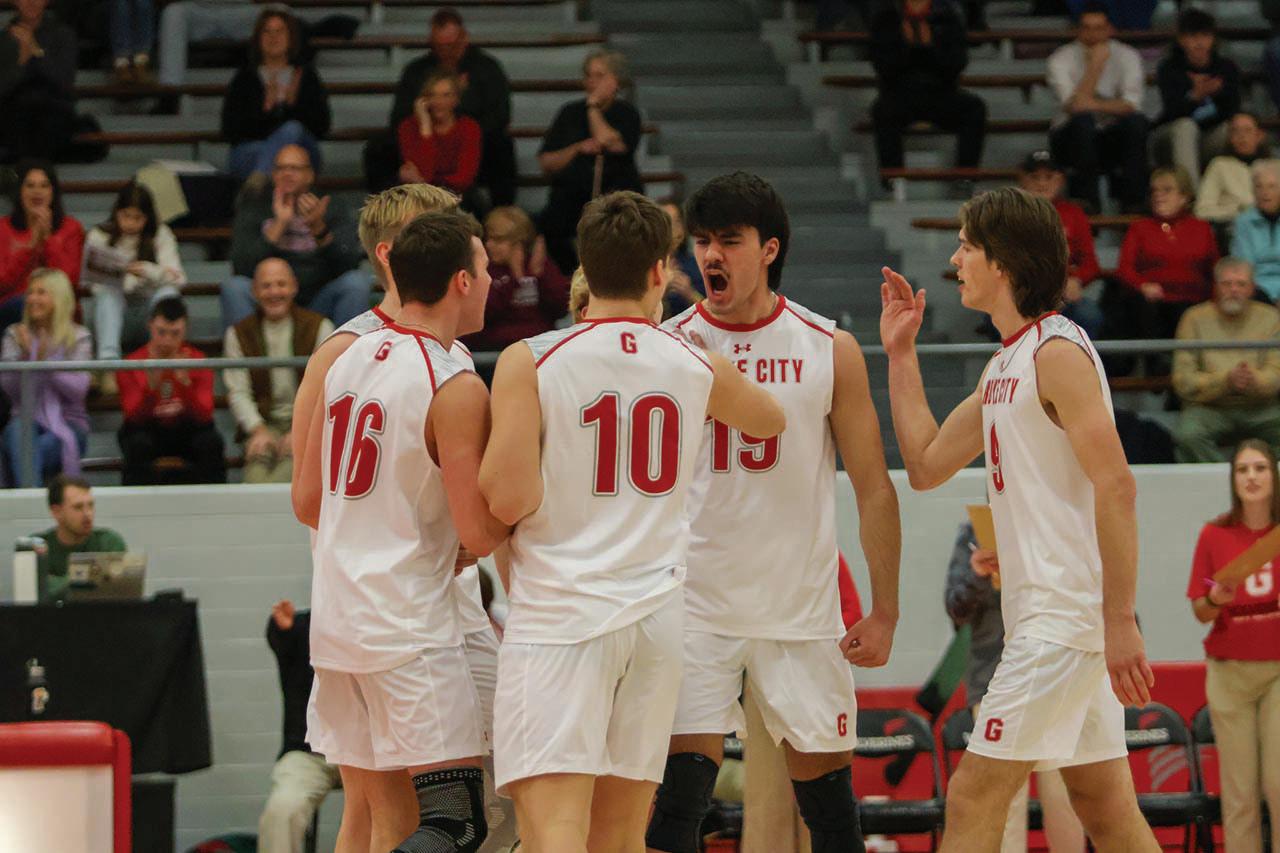


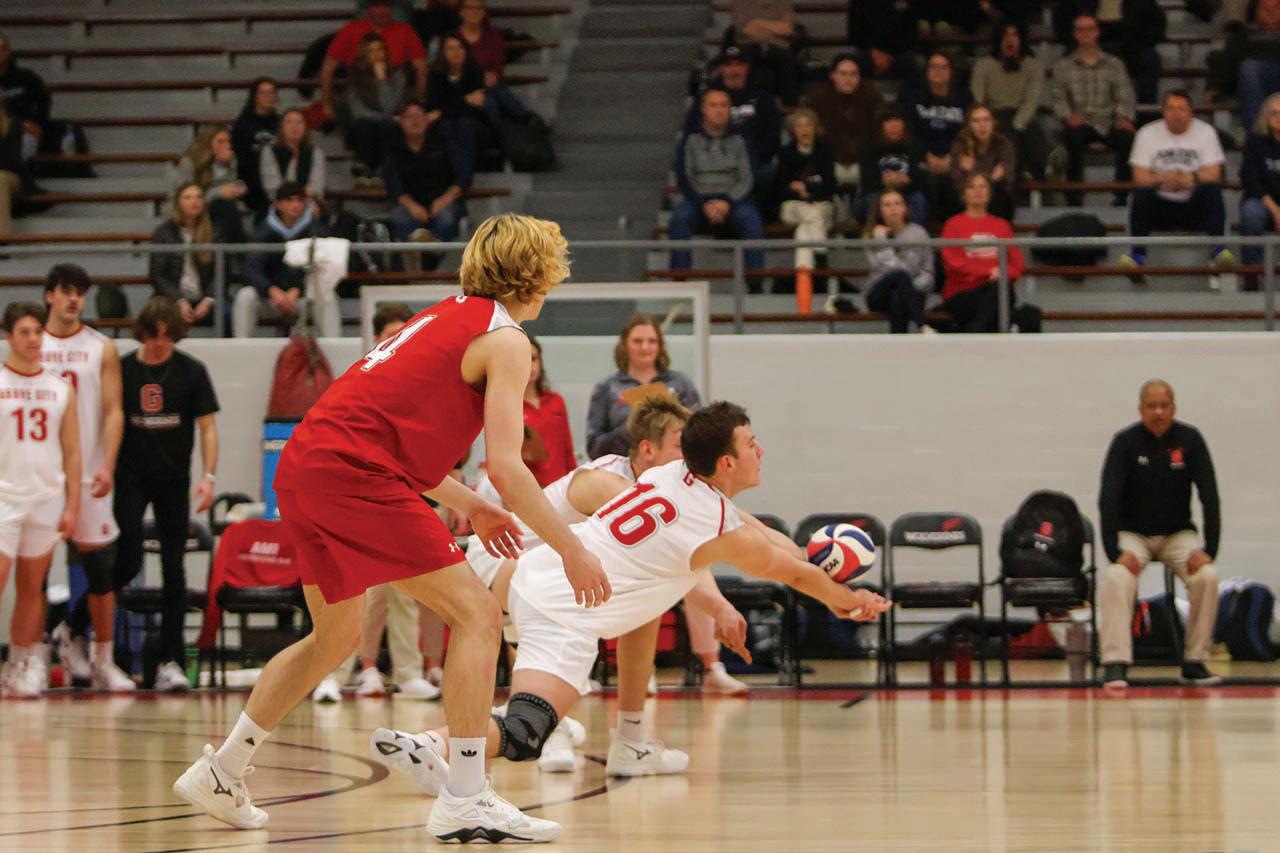


On Jan. 15, 2025, the Grove City College men’s volleyball team took the court for their first ever NCAA match.
While they have been a talented and successful club sport team for some time, they have not been a varsity sport here at the College. This year marks a milestone for the team and coach Brett Heckathorn ‘19.
This past Saturday, the team secured their first ever victory against Mount Aloysius at home. Be sure to make it out to a game in the Grove City College Arena this year to watch this historic, inagural season for Grove City College men’s volleyball.
by Luke Paglia, Photo Chief


Pardon, but not forgiven Some insurrectionists
Madelyn Braho
Contributing Writer

Those indicted and charged for participating in the Jan. 6, 2021 attack on the Capitol Building were pardoned this week by the newly inaugurated president. Some of those pardoned have met this news with celebration, like the “Viking Helmet Guy,” who reportedly went outside and yelled “Freedom!” when he heard. Others, however, have rejected the pardon – Pamela Hemphill, a grandmother from Idaho, has repeatedly told Trump to stop using her for propaganda and rejected the pardon when it was announced. She is not the only one who has done so. Jason Riddle, a New Hampshire veteran, has also done the same, saying that accepting it would be the same as say-
ing the insurrection was acceptable.
This kind of response to a presidential pardon raises a question: what changed? Why would the same people who cheered others on and joined in attacking and defacing an important government building decide four years later to disavow their actions? Put simply, they realized they were in the wrong.
Before Hemphill retired, she had been a substance abuse counselor. When her retirement in 2011 left her without anything to do and no direction, she turned online. It was in online groups that she began to feel welcomed. There was a community of people who cared about her and the same things she did. They would discuss social problems and new government actions, wanting to stand up for the nation.
But this eventually turned into something less than up-
lifting. The platform fed her fear tactics that placed immigrants and leftists as scapegoats. Middle and workingclass people can often feel frustrated, believing they are powerless to change the very real problems in the world, like the rising cost of living. Immigrants are a useful place to take out their frustration. Republican politicians especially push this narrative: if they can get voters angry, voters won’t pay attention to those same politicians benefitting from their situation.
It is cloaked as being patriotic: defending the nation from people who want to tear it apart, be it immigrants, communists, Muslims or Democrats. This motivation is certainly appealing. We are supposed to love our country and want to protect it. This can often lead to extreme actions, however. In Hemphill’s case, storming the Capitol.
Hemphill has since said in
regret Jan. 6
an interview with NPR that the MAGA coalition is a cult. She said there wasn’t room for questioning what they were being told – and why would they? The people talking were important and they had Ph.D.’s – why would they lie? Her rejection of MAGA did not happen suddenly though. While in prison for two months, Hemphill started to question what she had been told about the election. After she got out, she talked with people on Twitter about what happened that day and began to realize that the narrative did not match the reality of what she had seen, and that they were being lied to. People who she had witnessed attacking police officers were now being presented as victims who had done nothing wrong. Once she realized the extent of the misinformation, Hemphill began to do her own research again, looking into verifiable facts about
the 2020 election. She has since come to her own conclusions, ones very different from those she had four years ago. Her role in the insurrection was wrong, and she was correct to plead guilty for her involvement. It was not a peaceful protest. She said accepting the pardon would be “a slap in the face to the Capitol police officers, to the rule of law, to our whole nation.” It is important to recognize when you are being manipulated and fed an alternate reality, especially one that tries to alienate you from those around you. In Hemphill and Riddle’s cases, this realization has come at a great cost – they are now often subject to public harassment while still having been convicted of a crime. They cannot plead their innocence, but they are honorable enough to admit the truth. “I broke the law that day - period, black and white,” Hemphill said.
Trump: Cincinnatus or Caesar?
Benjamin Jones Contributing Writer
During the first day of Donald Trump’s presidency, the newly elected president proceeded from the inauguration straight to the pen and paper in the Oval Office to sign 26 executive orders, write 12 memos, declare four proclamations and order 78 Biden-era actions withdrawn.

The orders included a wide variety of issues from immigration, rollback of DEI employment, withdrawal from world organizations and even the federal renaming of the Gulf of
Mexico to the Gulf of America and reinstatement of Mount Denali to Mount McKinley. In comparison to former presidents, this executive power is unprecedented, but a sign of the growing trend that America is becoming a nation ruled by the power of the executive branch. Since the late 2000s, more presidential executive orders have been issued in the first week of a presidential term than ever. During Trump’s first term, he signed five orders in his first week. According to the Federal Register, presidents pre-2010s and 2020s rarely signed one if any executive orders in their first week in office. Then, former President Barack Obama signed five executive
orders in his first week to enforce his policy changes. When taking office in his first term, Donald Trump signed five orders in his first week. Former President Joseph Biden elevated the stakes by signing 24 executive orders from January 20 to Jan. 27, 2021, his first week in the Oval Office.
This growing trend led to Trump’s massive number of executive actions in his first week of office: 26 on the first day, and even more following. Trump even signed many in front of the public at Capitol One Arena, keeping up the political hype of his election campaign rallies.
People roared in delight as he pardoned 1,500 people convicted in connection to the
Jan. 6 Capitol riot and withdrew from the Paris Climate Agreement. Meanwhile, Congress remains in a deadlock of filibusters and the Supreme Court has resorted to becoming a puppet group for whichever party they back, all as Trump issues more executive orders in his first week than any president in history.
The executive branch has become the only movable battleground for a war of enforcement between Democrats and Republicans to enforce their policy in the quickest manner possible.
The Roman hero Cincinnatus has always been a motif in American politics, and even the namesake of Cincinnati, Ohio. Cincinnatus was a
Roman farmer who became consul, or ruler, of the Republic during times of crisis, and he defended Rome from invasion before giving up his power during peacetime to return to his plow. George Washington, the nation’s first president, was coined the “American Cincinnatus” for not taking direct power control of America after the Revolutionary War. Meanwhile, Julius Caesar, with the consul power he was given, marched on Rome and became its dictator. The question I fear America will have to ask of the executives in the coming years who wield unprecedented power is who did we elect to save us – a Cincinnatus, or a Caesar?
TikTok lets money talk
Emma Rossi Editor-in-Chief

If TikTok is supposedly a true threat to the security of the American people’s data and privacy, then why did the ban to “protect us” from the Chinese government only last 15 hours?
It all comes down to the money.
TikTok was created by ByteDance, a Chinese-owned company, in 2016 when an app of similar ilk, “musical. ly” was at its peak. By 2018, “musical.ly” faded into obscurity – until ByteDance purchased the platform.
On Aug. 2, 2018, TikTok absorbed musical.ly, immediately transferring all users and all their data to the merged platform that evolved into what we know it as now. With over 1.9 billion users worldwide and over 170 million monthly active users in the United States, TikTok has far surpassed musical.ly.
The app went relatively unscathed until March 13, 2024, when the “Protecting Americans from Foreign Adversary Controlled Applications Act” passed the House and was shortly after signed into law by President Joe Biden.
The Act “prohibits distributing, maintaining or providing internet hosting services for a foreign adversary-controlled application.”
The Associated Press explains that in China’s 2017 National Intelligence Law, it’s stated that “any organization” must assist or cooperate with state intelligence work. A separate 2014 Counter-Espionage Law says “relevant organizations... may not refuse” to col- lect
evidence for an investigation. Since ByteDance is a Chinese-owned company, it most likely falls under this law.
This raised red flags in D.C., leading the government to provide ByteDance with an ultimatum: sell TikTok or lose your American users. For 15 hours, the government stuck to its guns, until President Donald Trump extended the ban for 75 days. The ban didn’t last, and as quickly as the app has returned to phone screens, the memory of the ban has escaped headlines and American minds.
The restoration of TikTok can be accredited to its vital role in our economy, especially the economic success of our country’s small businesses.
According to Oxford Economics, more than 7 million U.S. businesses use TikTok to promote and conduct business. 69 percent of those businesses report increased sales thanks to the app. 39 percent of these businesses even claim TikTok’s platform is critical to their very existence.
TikTok’s President of Global Business Solutions Blake Chandlee expressed this sentiment shortly after Biden signed the national security bill into law. Because of American businesses using the platform, TikTok has become a connected and even inseverable part of the U.S. economy.
CNBC reported that TikTok’s advertising and user engagement contributed $24.2 billion to the U.S. GDP in 2023 alone, with TikTok’s own operations adding another
$8.5 billion.
Some people have tried to make the argument that the government was trying to take away our First Amendment rights by enforcing the ban, and that after the app was restored for American users, the content they saw on TikTok was censored and manipulated by the government.
This is difficult for me to believe. Firstly, the claim that banning a social media platform is a violation of the First Amendment is a stretch. This implies two things: one, that Americans have no other outlet through which to express themselves; and two, that the government banned the app without providing an explanation as to why.
Whether you agree or disagree with their reasoning for banning the app or believe that their choice to ban the app was baseless, they did provide a reason and have some semblance of evidence (however far-fetched that evidence is).
Secondly, I don’t believe that the government altered TikTok’s guidelines and algorithm in 15 hours to censor the content that users see on their For You Page. Several users who follow congresswoman Alexandria Ocasio-Cortez (AOC) found that their account had unfollowed AOC unbeknownst to them, and when they tried to refollow her, it wouldn’t allow them to. Other users said that comments including the name and phrase “Luigi Mangione” and “Free Palestine” were being deleted.
In response to concerns that the app was now a cesspool of censorship, TikTok said in a statement to Reuters, “Our policies and algorithms did not change over the weekend. We are working hard to restore our U.S. operations back to normal and expect some temporary instability as we restore our services, which could impact TikTok features or users’ access to the app.”
Everyone on TikTok is even more on edge than usual following the ban, so this reaction isn’t too surprising. But what appears to be censorship might just be a glitch.
Whether it’s from ignorance or indifference, I am not concerned about TikTok (and apparently, by default, the Chinese government) having access to my data.
But I don’t think this ban was ever about the safety of American data, otherwise the ultimatum would’ve held. How could TikTok have changed so drastically in 15 hours that ByteDance’s ties to the Chinese government are no longer a concern?
For better or for worse, TikTok isn’t going anywhere until it becomes irrelevant to the economy. There may come a time when the app is a true threat to American security or when censorship is rampant on the app, but I don’t believe that time has come. Until then, I will continue scrolling.
Word on the street...
What’s your hottest take?
Audrey Seymour, ‘26

Grammarly and writing AI takes the soul out of written communication and should not be used.
Owen Pfaff, ‘26
No American in their right mind thinks of “competing” with China economically. To do so is to compete with literal slave labor.

Iris Noth, ‘26

If Nathaniel Hawthorne were to vanish from history, the literary world would not suffer. There might be a slight hiccup. A polite cough. Certainly not devastation.

Alcohol and tobacco are net beneficial for society and are more likely to lead to societal flourishing than any other drug or the lack of any drug. I believe most people should smoke cigars. To quote the great Graham Lee Hemminger, “Tobacco is a dirty weed. I like it. It satisfies no normal need. I like it. It makes you thin, it makes you lean, it takes the hair right off your bean. It’s the worst darn stuff I’ve ever seen. I like it.
Abby Kengor, ‘26

Ghosts are probably souls in Purgatory asking for prayers. Also, dishwashers pose a greater danger to humanity than microwaves do.
William Voss, ‘28
Video games are like drugs and game developers are drug dealers. Like an acid trip, gaming actively disengages you from the real world where you simulate reality or play out a fantasy. Game developers and drug dealers rely on the psychological manipulation of their product in order to sell more.
Dan Petersen, ‘26


Jimmy Carter was the best U.S. president of the last century.
The most unfortunate thing about Catholicism on campus is how much of it is too personal and not community-oriented.

Bernie Komoroski, ‘26

Ban pumpkin spice. It’s a stupid flavor, it offers nothing, it’s over-hyped, it doesn’t taste good and overall, it’s more expensive than it has to be.
I find coffee thoroughly repulsive in taste, smell and addictive properties. The fact that some people are rendered almost incapable of normal functioning when deprived of the drink is disturbing. The only redeeming quality of the beverage is its warm, earthy color.
Cana Severson, ‘26


The overemphasis on character relatability and diversity in modern fiction is a byproduct of the consumer’s narcissism as we desire characters who are just like us rather than aspiring to follow the example of good characters.
Angelica Hatke, ‘25
Mainstream social media platforms are being used to distract us and keep us from acting on the world’s problems as well as ruining our relationships with one another.

Jonathan Steen, ‘28
John Remaniak, ‘26
Lucy Tuttle, ‘27

Sonic vs. Shadow
Third installment in franchise has its highs and lows
Tyler Peterson Contributing Writer
While home over Christmas break in my hometown of Frisco, Texas, I ventured out to my local Cinemark theatre. Though none of my closest friends share my same affinity for “The Fastest Thing Alive,” I brought one along with me, aiming to share one of my favorite childhood characters with him.
I can’t say that my expectations were low, as I always have high hopes for The Blue Blur, but the first two installments in the now trilogy of Sonic movies were good but not great, and I was not expecting anything special.
There were many things that this movie did very well. It was well advertised that Keanu Reeves was being brought in to voice Shadow. If you don’t know the greater
Sonic lore very well and you are unfamiliar with Shadow, he is a very mysterious and enigmatic character; as such, it is possible there was no better fit for his voice than Keanu. The casting for both the voice acting and traditional acting roles is one of the movie’s strengths. Another strength is how well the movie caters to Sonic fans. For example, early in the movie there is a scene where Sonic races his pseudo-brothers Tails and Knuckles. Marking the finish line of the race is a sign which spins as Sonic blazes past it, which is a reference to a similar sign-spinning animation that occurs at the completion of many levels in the older Sonic games. I could spend pages listing the many easter eggs and their relation to the video games, or you could take my word for it: this movie was a Sonic fan’s delight.
The last thing I want to highlight was just how epic a few specific scenes were. The first, a fight scene between Sonic and Shadow, was probably the best of the movie. It was a planet-spanning fight that included great banter, gorgeous animations and colors, and even more nostalgia. There are more scenes I would love to talk about, but in the interest of keeping this review spoiler-free, I will leave them unmentioned. As much as I hate to do it, I must address the film’s shortcomings as well. A big gripe of mine is how annoying the dialogue gets between Sonic and his human companions. It sounds like The Man with the Yellow Hat talking to Curious George after George leaves a room without turning the lights off. The dialogue seems very elementary and, in my opinion, takes away from the movie a bit.
An adjacent critique is that it is almost as if the movie cannot decide if its audience is 10-year-olds or 20-yearolds. It pairs epic fight scenes and elevated conflicts with seemingly childish lessons and dialogues. Obviously, it is a video game movie and of course kids are one of the main audiences, but it still seems like the movie cannot decide what it wants to be.
Ultimately, I think what you have here is a video game movie that caters well to its biggest fans, like “The Mario Movie” or “Spider-Man: No Way Home.” It isn’t all that ambitious with its plot, but it makes up for that with a strong cast and a focus on giving the fans what they want. For Sonic fans, this movie is a slam dunk. But even if you aren’t a lifelong fan, I think everyone can find something they like. 72/100.
‘Enigma’eccentricencapsulates Rodgers
Emma Rossi Editor-in-Chief
Three episodes, 20 years, one superstar – the Aaron Rodgers docuseries is my Odyssey. “Enigma” was released on Dec. 17, 2024, and despite its mixed reviews, I thought it was a masterpiece.
The docuseries doesn’t just tell the story of one of the greatest quarterbacks of all time. Instead, it takes us through the tragedies and traumas, the victories and successes of a man, beginning in his youth and ending in his early forties.
Rodgers has always been a strange man. Episode one, entitled “Becoming,” takes us all the way back to his odd adolescence in sunny California, where it was clear that not only was the boy brilliant, but also bizarre.
Rodgers was raised in a legalistic version of Evangelical Christianity – an upbringing that inevitably led him far from the church.
“It was almost heresy to question your beliefs,” Rodgers recalls of his youth. “There wasn’t room for emotion.” He saw the core tenants of Christianity as “shame, guilt and judgement” rather than faith, hope and love.
While he found no comfort in the religion of his youth, he clung to the goal of being a Superbowl champion. His path to the NFL was not a smooth one, and even once he was drafted, his career wasn’t easy. Football became his identity. He was fulfilled through winning and torn down after a loss. His striving towards being a champion kept him sane – that is, until he actually achieved his goal.
After winning the Superbowl and becoming Superbowl MVP, Rodgers had an identity crisis. He had to ask himself if a Superbowl champion was all he could be. The following two episodes take the viewer through the dozens of different outlets he uses to try and find himself.
The second episode dives into his brief but very public political adventures with RFK Jr. It also takes viewers into the intimate and intimidating world of Ayahuasca and plant medicine.
The storytelling is incredible. Directors Gotham Chopra and Liam Hughes crafted an absolutely impeccable story arc, layering the patterns of Rodgers’ career over one another to tell a full-circle story.

The docuseries is narrated by Rodgers, with soundbites of reporters narrating his highs and lows sprinkled throughout. The story is complex, covering two decades of his life in three hours. The angle is biased towards making Rodgers look good, of course, but at no point does the storytelling feel forced or contrived.
To make a docuseries about the life of a man that is still alive is a feat in itself. It’s an entirely more impressive accomplishment to tell an unfinished story so well that the viewer does not feel like it’s told too early. What the docuseries communicates incredibly well is
Tunes from the Tower:
‘Born In The U.S.A.’
Catharine Runion
Entertainment Editor
Close your eyes. Imagine your clothes are baggier, your shoulders are padded and your hairdo is so big you could use it as a purse. “The Breakfast Club” is on TV. The back of Bruce Springsteen’s jeans and cut-off shirt peek up at you from the vinyl you begged your parents to get you for Christmas. It’s January 1985. Life is good.
Bruce Springsteen’s album “Born In The U.S.A.” spent most of January in 1985 at number one on the charts. It’s an instant classic. 40 years later, this album is still popular, and Bruce Springsteen is still performing.
However, though the title and cover exude American patriotism, this album analyzes a deeper and more complicated type of patriotism than first meets the eye. The upbeat sounds of an ’80s synth and guitar are underscored by lyrics that tell the ragged, often bleak stories of the American everyman.
The title track, “Born In The U.S.A.,” isn’t just an anthem about unchecked nationalism. The chorus resounds with American pride, but each verse tells the story of difficult childhoods, of men who were sent off to Vietnam and then of those same soldiers who came home to even more brokenness. The lyrics tell of loss and of struggle, not of some “American Dream.”
Several other tracks deal with this same topic, juxtaposing American Idealism with the difficult circumstances of small-town living. The narrative voices Springsteen assumes tell of work, rough times, police encounters, jail, layoffs and poverty. Deteriorating relationships, careers and hometowns abound.
One would assume that, for all of this negativity, the album is a satire on American patriotism, exposing how bad life is for lowerincome Americans, but Springsteen doesn’t toss patriotism out with the rest of it. He paints an American pride that is complex, one that unites him with his “blood brothers” despite a troubled life.
Aside from this commentary, this album oozes nostalgia. Each song sounds like it could be in a John Hughes film. Many tracks are upbeat and wild, but there are several more somber songs on the record, even a few that could be considered love songs or ballads.
that Rodgers is more than the quarterback, the media target and the guy who RFK Jr. wanted as vice president.
He’s a Superbowl champion, an NFL MVP, a millionaire, a superstar and a household name, but mostly, he’s just a man. Rodgers carries a blue hydroflask (emotional support water bottle) with him everywhere. He has one of those wallet phone cases like your uncle. He spends a lot of time reading articles about Greek myths.
I laughed, I even cried, but overall, I walked away with the opinion that this was one of the best personality profile docuseries I’ve ever seen.
Just like Sting in my review from last week, Springsteen does a great job of storytelling through his lyrics. He doesn’t shy away from the shady characters in rural America. Several songs are from the perspectives of prison inmates, predators and habitual drinkers. These narrators’ stories make up the fabric of their country in the good, the bad and the ugly.
This album has remained a classic for 40 years because of its lyrical and narrative diversity. Springsteen represents the American everyman even to this day and we all sing along: we were Born In The U.S.A.
NETFLIX
SLUG MAGAZINE
Sports
Frank Reich: A lifetime of faith and football
Mia Gallagher Sports Editor
What are you most passionate about? Take a moment to really think about it.
Maybe you’re constantly striving to achieve the highest grades, or maybe you’re intent upon finding success later on in your career.
Well for legendary NFL quarterback and coach Frank Reich, football was once his one true passion.
But after a powerful encounter with the light of Christ, Reich made it his mission to integrate the realms of faith and football, becoming a beacon for aspiring faith-fueled athletes everywhere.
While faith flitted in and out of his early experiences, Reich’s commitment to football never did. And this conviction held true until his senior year of college at

the University of Maryland, when a terrible, near seasonending injury took this passion away.
“I felt like my shot of playing in the NFL, my dream, was over. I was broken and I needed Christ to be at the center of my life,” Reich said.
This pivotal moment altered Reich’s outlook on life, driving him to invest in faith
and find opportunities to share this newfound devotion.
His membership in campus organizations like Campus Crusade for Christ and Athletes in Action allowed his spiritual prowess to further grow.
Throughout his 14 years spent as a player in the NFL, Reich was able to shine Christ’s light for the teammates around him, making the most of the platform the Lord had given him.
He then went on to study at the Reformed Theological Seminary at Charlotte, NC, earning a Masters of Divinity and using his wisdom to pastor a church.
But soon after these tremendous accomplishments, Reich found himself longing to return to the gridiron and perform the job God had called him to do there.
“I came to realize more and

doubles down against PAC opponents
Emma Rossi Editor-in-Chief
Men’s basketball is now 10-4 in the PAC as they head into the final stretch of their regular season. The Wolverines are tied with the Saint Vincent Bearcats for second overall, with only the Chatham Cougars ahead of them.
“We’re staying sharp by getting in the gym every day. This team is the hardest working team I’ve ever been a part of. We never have to worry about people keeping their skills sharp,” junior guard Mike Christenson said.
On Wednesday night, the Wolverines fell short against the Washington & Jefferson Presidents on Wednesday night. The final score was 5551.
Senior guard Jonah Bock became the career program leader in made three-point goals Wednesday night.
Bock hit his 208th career three-pointer with 8:45 left in the second half, moving him past Shawn Carr for the all-time lead at Grove City. Carr hit 207 three-pointers during his career from 2004
BASKETBALL continued from 12
on 20 of their 68 shooting attempts. This dominant offensive performance was supported by an equally impactful defensive showing, with the Wolverines producing 51 rebounds for the day. Polczynski’s 10 rebounds led the way,
to 2008.
At the end of the first half, the Wolverines were only two points behind their opponents. The game remained close through the second half until their lead diminished as the Presidents managed to squeak by with the win.
On Saturday, Jan. 25, Grove City traveled to Steubenville, Ohio to face the Franciscan Barons. The Barons defeated the Wolverines 78-66 thanks to an explosive second half that saw them outscore Grove City 51-29.
Christenson tallied 23 points in the loss, followed by junior center Isaac Cherry with 10 points.
At the time of the half, the Wolverines held a 10-point lead over the Barons, but stagnant shooting in the latter half of the second stifled the Wolverine offense and gave the Barons a chance to pull through with the win.
Last Wednesday, Jan. 22, the Wolverines overcame the Westminster Titans in a 65-62 win. Christenson led the Wolverines with a career performance, racking up 35 points, eight rebounds, two
with Sherrerd, Hasley and senior forward Clara Hannon getting in on the action with a combined 20 rebounds.
Junior center Emma Ulmer also tallied a game-high three steals to secure the win.
‘The remainder of the season, we have to stay locked in and beat the teams that could shake some of the conference rankings up. If we do the
more this false dichotomy between sacred and secular work. Every Christian is called to live out their faith in their sphere of influence,” Reich said.
Reich’s return to the NFL was marked by a 17-year long outpouring of leadership and servanthood.
His coaching career took him all over the country, allowing him to minister to players and staff from the Colts – where he served as quarterback coach for Peyton Manning – Cardinals, Chargers, Eagles and Panthers. His “winsome witness” moved the hearts of countless individuals throughout his journey – including Don Beebe, Jim Kelly and Nick Foles.
“The point that I have always tried to look at, live out, talk about and preach about is this intimacy with Christ. Whether it was playing or
coaching, I have endeavored to live a life evidencing this intimacy. I have always made every effort to stay focused on this intimate and authentic life with Christ. Then you say—let’s go–let’s take on the challenge of living this out hour by hour, person by person,” Reich said.
Reich’s impressive resumé includes many titles: quarterback, NFL head coach, pastor. But next week, Reich will be able to add Grove City College chapel speaker to that list.
To learn more about Reich’s impactful story, be sure to attend his “Created to Compete” lecture next Tuesday, Feb. 4, or “Call to Courage” chapel message next Wednesday, Feb. 5.

Sports at a Glance
Results
Men’s Basketball (13-5): L, Franciscan (66-78) Women’s Basketball (11-7): W, Franciscan (84-60)
Men’s Swimming (6-1): W, Washington & Jefferson (161-129)
assists and three steals.
Christenson went six for eight from behind the threepoint line and made all but one of his 10 free throws.
The game was a back-andforth battle, with the score tied 15 times and the lead changed 16 times. Christenson was fouled twice in the span of two seconds as the clock wound down to five seconds remaining in the game. His free throws lifted the Wolverines to a last-minute victory over the Titans.
“Our biggest challenge right now is keeping our focus during this part of the season. As the playoffs get closer, teams get hungrier, and we have to match that hunger with how we play. We can’t get complacent about our spot in the standings because it can be taken away quickly,” Christenson said.
The Wolverines will continue their push for the playoffs against conference foes, the Chatham Cougars at 3 p.m. tomorrow in the Grove City College Arena. The Cougars lead the PAC with a 12-1 conference record.
right things and execute to the ability that I know we are capable of, not only are we going to make playoffs but I also believe that we can make a deep playoff run,” Hasley said.
The Wolverines will host the Chatham Cougars at 1 p.m. tomorrow, Feb. 1 in the Wolverarena.
Women’s Swimming (4-4): W, Washington & Jefferson (171-92) Men’s Track and Field: SPIRE Midwest Open Women’s Track and Field: SPIRE Midwest Open Men’s Volleyball (2-4): W, Olivet (3-0)
Upcoming


Tieg
Audrey Karwowski Track and Field Track Athlete of the Week
Ryan Lenhart Track and Field Field Athlete of the Week
HORSESHOEHEROES
Coach Frank Reich on the sideline for the Colts
JOHN HAKE
Junior Kyle Randle gets set on defense in this file photo from the Wolverines’ win over Geneva on Jan.8. Men’s basketball
Sports
Wolverine Winner
Men’s volleyball clinches first program victory
Mia Gallagher Sports Editor
It’s a pair of Wolverine winners for Grove City’s 24th varsity sport!
After a bit of a slow start to the season, the College’s inaugural men’s volleyball team clinched victory this past Saturday, Jan. 25 with two consecutive sweeps over Mount Aloysius and Olivet.
“It felt amazing to get our first win on the board. It was unfortunate that we started the season with four losses, but we played some very good teams and knew what we were capable of. After seeing how much work all the guys have put in over the past year, it felt extremely rewarding to get the first win in school history,” sophomore setter Craig Fair said.
The team, which purports a long history of success from its club days, hopes to find continued success in the remainder of their nonconference schedule, setting themselves up to compete with their PAC opponents.
“There was a lot of preparation going into this season. First, as a team we all realized that we are here to glorify God no matter a win or loss. We respect our coaches and the players who came before us to be the best we can be and to invest in the future as a team. As a senior, it has been awesome to see how far we have come from being a club team to a competitive varsity team. The future is bright,” senior Quintin Norris said.
Leading the offensive charge against Mount Aloysius for the Wolverines were Norris and freshman Keith Otto with seven kills apiece. They were aided by Craig, who notched 24 assists and junior Tieg Malcolm, who tallied two aces in the inaugural victory.
Defensively, Malcolm and Norris stalled Mount Aloysius’s attacking effort with 11 combined blocks at the net. From the back row, sophomore libero Phillip Schweitzer held down the fort with a team-high eight digs. His efforts were aided by sophomore Max Gianneski, who contributed six digs to the win.
After their commanding

“As a team, I believe that we have a shot against any team in our conference. Confidence, discipline, and no expectations are key to our success.”
sweep of Mount Aloysius, the Wolverines reset for their second match against Olivet, bringing the same competitive fervor that set them up for success earlier in the day.
A pack of Wolverines contributed to the team’s kill count, with Gianneski and Norris leading the way with eight kills apiece. They were followed by sophomore Andrew Kessler, who tallied six kills, and Otto, who notched five.
Setting his hitters up for success, Fair recorded 23 assists across the three sets.
Malcolm and sophomore Hayden McCreadie rounded out the offensive effort with two service aces a piece.
Grove City’s defensive effort against Olivet saw Kessler and Malcolm tally four

- Quintin Norris
blocks each. Gianneski also contributed a team-high six digs in this second match.
Heading into two more non-conference quad matchups, the team looks to lean on their core values and each other to find continued success.
“Our team theme this year is ‘As Many, One,’ so our mission is to focus on the team as a whole rather than focusing on individual success. We believe that if we are consistent, we can compete with every team in the PAC and contend for a conference championship,” Fair said.
“As a team, we need to stay focused as the season progresses. Taking the highs and lows from our out-of-conference play to improve as a team before PACs is very im-

portant. As a team, I believe that we have a shot against any team in our conference. Confidence, discipline and no expectations are key to our success,” Norris added.
Men’s volleyball will be back in action today and to-
morrow with a quad matchup in Elmira, N.Y. They will then return to the Wolverarena to face Carlow, Eastern and Trine next weekend, Feb. 7-8, to round out the bulk of their non-conference schedule.
Women’s basketball bests the Barons
Mia Gallagher Sports Editor
With a commanding 84-60 victory last Saturday, Jan. 25, the Grove City women’s basketball team extended their win streak to three, gaining momentum as they prepare for their final regular season games.
After traveling to Washington, Pa. to take on the Washington & Jefferson Presidents this past Wednesday, Jan. 29, the Wolverines fell short of the win after winning three straight.
Last Saturday, their third-straight victory, coming against the Franciscan
Barons, saw a tremendous 33-point first-quarter effort by the Wolverines. The quick start gave the Wolverines the momentum they needed to beat the Barons and improve their conference record to 9-4. The Wolverines’ offensive effort was headlined by senior guard Mara Polcyznski, whose game-high 17 points, 10 rebounds and eight steals almost set her up for a tripledouble for the game.
Polcyznski’s efforts were aided by junior pair Reese Hasley and Meredith Sherrerd, who each fired 13 points from the field. Sophomore guard Sarah Pifer rounded
out the scoring effort by tallying nine points, all from beyond the three-point line. Also getting in on the scoring action were Halsey, senior guard Haley Hertzler –who contributed four assists in her first career start – and Polczynski, who tallied four and three assists, respectively.
Grove City closed this resounding victory with 32 of 78 shooting from the field, amounting to a shooting percentage of 41. They significantly outpaced Franciscan in the shooting game, with the Barons only converting BASKETBALL 11
LUKE PAGLIA
Sophomore Craig Fair sets the ball for sophomore Andrew Kessler during the Wolverines’ game against Penn State Behrend.
LUKE PAGLIA Kessler readies at the net in this file photo from Jan. 15
JOHN HAKE
Senior forward Clara Hannon brings the ball up the court.