me n tors W H O
T E A C H E S
AT
G R O T O N ?
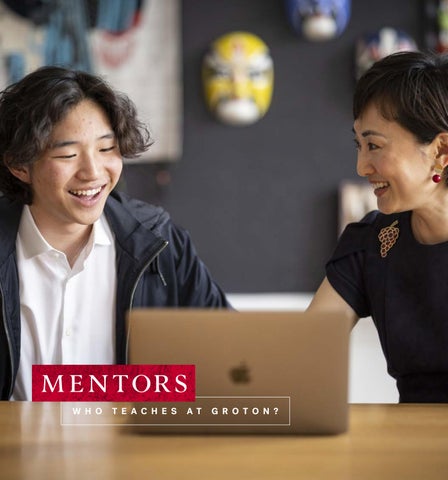
On the cover, Renee Bai, Chinese and history and social science teacher; this page, English Department Head Joseph Martinez.
“Children learn more from what you are than what you teach.” w. e . b. du bois
From the outset, school founder Endicott Peabody understood the importance of role models. His emphasis on a school modeled after a family points to the profound influence of the faculty who work with Groton students. In Mr. Peabody’s era, teachers committed themselves to the thorough development of each student. In this respect, the past certainly has a hold on today’s Groton. Some of the nation’s most prominent leaders in business, service, the arts, and politics—even a president—have attended Groton School. Behind our graduates’ success—decades ago, and today—are faculty members who encouraged, informed, pushed, supported, nudged, and inspired. They taught by example, in and out of the classroom. When you choose to attend Groton School, you choose to join a community where a wide array of talented teachers will know you well. They will challenge you. And with their guidance, you will challenge yourself. Interaction between a teacher and a student is a critical part of anyone’s education. Come to Groton, and meet your mentors.
1
r ebecca sta nton W O R L D
L A N G U A G E
A N D
C U L T U R E
A surprise career shift My original studies were in law, so when I came to Groton as a substitute French teacher, I was apprehensive. But I found that teaching was a way for me to share my culture. And the students were so young and full of curiosity that they forced me to re-evaluate myself. The give-and-take was fulfilling, and I’ve been here ever since. On learning a second language It pushes you out of your comfort zone— it’s a way for your mind to work differently than it is used to working. That’s why we teach classes in the language itself. We want students to learn a living language, not a translation.
D E P A R T M E N T
H E A D
Advice for international students Embrace the new culture that you’re in without losing touch with your roots. Try everything—food, culture, sports, academics. And call your parents often to reassure them. I love French cinema because . . . It’s a reflection of French culture. And the pace is slow. American movies move quickly, and there’s more of a direct appeal to emotions. French movies are much more subtle. In French film, the ending isn’t always happy, and the bad guy doesn’t always go to jail. And the actors aren’t always gorgeous with perfect teeth.
WORDS OF WISDOM
Don’t forget who you are as teenagers. As you grow up, the world will get serious fast enough. But always, somewhere, keep a part of you young.
2
BA, Université Paris V René Descartes LLM, Université Paris I Pantheon-Sorbonne, Paris LLM, Boston University Henry and Wendy Breck Award for Distinguished Teaching Languages spoken: French, English, Spanish, Arabic, and Hebrew International Community Coordinator
3
BS, Columbia University MS, PhD, Civil and Environmental Engineering, University of California, Berkeley Henry and Wendy Breck Award for Distinguished Teaching Paul Wright Chair in Mathematics
4
michaella chung M A T H
T E A C H E R
/
E N V I R O N M E N T A L D O R M
H E A D
My favorite thing about teaching . . . I love being present for the moment when an idea becomes truly tangible for a student. It’s important for me that my students see math and science in their lives, and conversely, that they see themselves in the larger math and science communities. Watching students make real connections between their personal interests or experiences and a new concept can be quite magical! An “aha” moment was . . . In Environmental Science during our study of air pollution, we had had many theoretical discussions about sources of particulate pollution. Once we left the classroom to measure particulates around the Circle, it became clear that this was relevant to the class’s everyday lives. The students found more particulates around the Athletic Center on game days and quickly launched into a wonderful discussion about what they could do to prevent idling vehicles. Fingers crossed that we pay attention to these scientists!
/
S C I E N C E
T E A C H E R
/
C O A C H
Why is your work on new methods for observing watershed data important? In Mediterranean-type climates like northern California, the dry season coincides with the summer and results in a water resource bottleneck that affects both terrestrial and aquatic ecosystems. Fog and groundwater provide relief to vulnerable vegetation and freshwater species. More accurate measurements help us understand the effects on the watershed. Why teach high school with a PhD? I entered graduate school unsure of many things except for my love of learning. Several mentors encouraged me to share that love by teaching undergraduates and volunteering in local public schools. Very quickly, it became obvious that teaching would be the highlight of my graduate school experience.
5
natha n la m ar r e-vincent C H E M I S T R Y
T E A C H E R
/
D O R M
H E A D
/
C O A C H
Why science?
Ultimate Frisbee?
There is a lot of beauty out there, from
There is an intensity and passion in the game
a Bach overture to the swirling geometric
that is tempered by a carefree camaraderie.
storms at the poles of Saturn. At a
Playing well requires stamina, speed, skill,
basic aesthetic level, everyone can
and synergy—and I love working hard.
appreciate the elegance of these things. Understanding the physical nature
I play Frisbee with my advisees because...
of the world adds richness that deepens
Throwing the disc helps with the conversation.
my appreciation of that beauty.
I’m not exactly sure why: maybe because when your concentration is divided between
A cleverly devised experiment is . . . Thrilling! The distillation of passion, logic, imagination, and ingenuity that goes into a novel chemical synthesis or the elucidation of a biochemical signaling pathway makes scientific research endlessly exciting to read, learn, and practice.
throwing, catching, and talking, you are less worried about what other people will think of you, or maybe it just gives you something to do if you don’t want to say anything.
WORDS OF WISDOM
Science is the exploration of the unknown and the mapping of the true nature of our world. How could that not be exciting?!
6
BA, Carleton College PhD, Chemistry, California Institute of Technology; Postdoctoral fellow, genomics research, Harvard Medical School Henry and Wendy Breck Award for Distinguished Teaching Soccer coach Faculty advisor, Ultimate Frisbee Faculty-Sponsored Activity (FSA)
7
BA, Williams College Crew coach Advisor, Debating Society, Computer Science Club, Episcopal Services Second Form Boys Dorm affiliate
8
michael gnozzio ’03 M A T H
A N D
C O M P U T E R
S C I E N C E
D E P A R T M E N T
C O - H E A D
/
C O A C H
Why math/computer science?
in its Episcopal heritage has made Groton
Computer science has always been a
a place where we can talk about the
discipline that lives at the intersection of
importance of diversity and inclusion from
math, philosophy, the natural sciences, and
the perspective of our core values and
the arts, and I’ve really appreciated the way
history. This creates a sense of community
my study of CS has allowed me to see
that tends to attract students and faculty
connections between those fields. And now,
who are not just exceptionally talented but
as tech becomes increasingly pervasive in
also really great people to be around.
our daily lives, more connections to history and sociology have started to emerge as well. I personally find it really exciting to think about how all of these pieces fit together, and I’ve found that thinking computationally has helped me make sense of things that I’d otherwise find fairly perplexing.
What makes Groton special? Groton is special because of the way in which it has fused together its legacy and traditions with its commitment to innovation and progress. St. John’s Chapel sits both literally and figuratively at the
What’s it like teaching at your alma mater? It’s been an amazing experience so far. On the one hand, I get to echo my own teachers and, when I do that, I’m particularly mindful of the way in which I’m carrying Groton’s past into its present. On the other, the things I hear and learn from the current student body cause me to recollect fondly on my own experience as a student and occasionally cause me to re-evaluate my own views on what’s really important about a Groton education and where the school should be heading.
center of campus, and the school’s rooting
9
fr a nck koffi F R E N C H
T E A C H E R
/
C O A C H
Why teach?
on my connection to the author and their
Teaching had not been my first career
style. I have taught Le Petit Prince many
option, so after my master’s degree in
times, which I enjoy because of the lessons
French and comparative literature, and
it teaches to young and adult learners.
even after I started the postgraduate program in Bordeaux, I decided to switch to communications and advertising, getting another master’s in Paris. After it was done, I realized that literature and philosophy were my major interests, alongside politics and international relations. It has not changed very much
What book do you find yourself rereading? I enjoy Proust's In Search of Lost Time. Of course, I read it in French in its Pleiade edition. I always find in it different layers of his narration and the psychology of the people Proust dissects in his prose.
since. Teaching, for me, is more like an ongoing exchange with students across different situations and setups. Anytime I arrive in class, I have different topics to explore with the students. It goes from the news to their lives on campus to any cultural interests in the language I try to spark in them.
What’s your favorite book to teach? I often choose different books each year, depending on what I want to explore and
10
Any memorable teaching moments? One memorable aspect of teaching is watching students gradually gain confidence. Some begin the year hesitant to speak even a few words in French and eventually find themselves participating naturally in discussions, joking with classmates, or expressing complex ideas in another language. Those moments of growth are always deeply rewarding.
BA, Lettres modernes, and MA, Littératures française, francophones et comparée, Bordeaux Montaigne MA, Communications and Advertising, INSEEC-Paris
11
BA, Delhi University MA, English, Delhi University MA, Classic Modern English, University of London Post-graduate Certificate in Education, University of Oxford Peter B. Camp Chair in English and the Humanities Henry and Wendy Breck Award for Distinguished Teaching
12
sr ava ni sen-das D E A N
O F
D I V E R S I T Y, /
I N C L U S I O N ,
E N G L I S H
Leading Groton’s Diversity and Inclusion program, I’ve learned . . . That we are a product of our own histories and as such have blind spots and biases; that we need education on the ways we exclude; and that inclusion is something we need to engage in actively and not something we can be complacent about.
A N D
B E L O N G I N G
T E A C H E R
Favorite books George Eliot’s Middlemarch because every time you re-read it you are moved by its beauty and wisdom and compassion; Jhumpa Lahiri’s The Namesake because I admire its elegant exploration of our shifting world; and James Joyce’s Portrait of the Artist as a Young Man because it made me unlearn everything I had learned
My culture’s influence . . . I was born and raised in a country that is still wrestling with its colonial past, and I am acutely aware of the silences and gaps in literature. I recognize that what we read shapes who we are, and I believe it’s important to teach our students a balanced curriculum: that is, to teach literature that introduces them to different literary voices, traditions, periods, and cultures.
about language and words on a page.
Why teach at Groton? To sit around a table of ten to twelve students eager to read a book and to talk about what makes us human is an English teacher’s idea of paradise!
13
temba m aqubela H E A D M A S T E R
/
C H E M I S T R Y
T E A C H E R
Why teach as headmaster?
When I’m not working . . .
For me, the inspiration comes from
I love the arts. The arts remind us that
students in the classroom. I love to learn,
we’re living rather than existing. My
and I learn from my students when I’m
great-grandfather was a composer—I love
teaching them.
classical music, jazz, blues. I also love sports. When we watch people do what
Education is a mission. Four generations of my family have been teachers. In South Africa, I was arrested for anti-apartheid activities while in my mother’s classroom. I vowed always to carry out the educator’s mission. It’s such a privilege to be in the position to shape the future.
14
they love, we’re inspired in return. And I’m a huge activist for the underserved, the vulnerable, and those who don’t have opportunity.
Education and freedom . . . They are intertwined. I was given the opportunity of freedom when I left South Africa. You can’t really give people freedom without giving them an education.
BS, University of Ibadan, Nigeria / MS, Chemistry, University of Kentucky Desmond Tutu Social Justice Award / White House Distinguished Teacher / MIT Inspirational Teacher Twenty-six years at Phillips Academy, Andover as Assistant Head for Academics, Dean of Faculty, and Teacher Spearheaded the GRoton Affordability and INclusion (GRAIN) initiative / Founded GRoton Accelerate Challenge Enrich (GRACE) summer program American Chemical Society Hall of Fame (NE)
15
BA, Princeton University MA, Classics, University of Virginia Baseball and basketball coach Evaluation Committee D&I Curriculum Working Group Dorm head Director, New Faculty Group
16
pr eston ba nnar d ’01 C L A S S I C S
T E A C H E R
Why teach at Groton?
/
C O A C H
/
D O R M
H E A D
learned from them to bring my other
I had an amazing experience as a student at
passions outside of the specific subject
Groton, both academically and socially, and
matter into the classroom, as students will
that was a strong draw to come back and
connect with you through those interests
teach here. I’ve always valued the ability to
and passions.
connect with students in many different ways—not just in the classroom, but on the sports field, in the dining hall, the dorm— and providing those opportunities for connection is something Groton excels at.
Your parents were on the faculty here. What did they teach you about teaching? First and foremost, my parents provided me an example of people who loved teaching—both the subject matter and the students that they got to work with. I also saw them constantly interested in learning more about their subjects and thinking about ways they could bring what they’d learned into the classroom. Lastly, I
What’s your favorite quotation from the classics? My favorite line is from lines 4-5 of Vergil’s First Eclogue: tu, Tityre, lentus in umbra, formosam resonare doces Amaryllida silvas (“You, Tityrus, relaxed in the shade, teach the woods to resound with the name of beautiful Amaryllis”). I’ve always loved the rhythm and sound of all of those lines, but especially this specific bit. In addition, for as busy and hectic as life often gets, I like to keep that image of lentus in umbra, “relaxed in the shade,” in the back of my head as a sort of idyllic state of mind.
17
sha nnon jin C H I N E S E
T E A C H E R
/
C O A C H
On teaching beginners . . .
Sharing Chinese culture . . .
I see the expectation and excitement in
I love to see students celebrate all different
the students’ eyes, and I find it joyful
cultures. During Chinese New Year and
to work with them as they start exploring
the Moon Festival, we’ve practiced Chinese
a new language. It sounds so pretty to
calligraphy, made dumplings, tried
me when they try to manage their tones
on traditional Chinese outfits, and played
or put together a sentence. We role-play
games such as Jianzi. Students who are
and re-tell stories so we can bring the
from China or studying Chinese celebrate
language to life.
Chinese New Year together with a traditional dinner. I’ve also led Groton’s
And advanced students . . . In higher-level Chinese classes, the conversations and discussions get deeper and deeper. It is joyful to hear my students use Chinese as their second or third language to discuss topical issues, to express opinions, or to communicate with each other. I have the privilege to share their success and happiness, through which I find my own success and happiness.
18
summer trip to Shanghai, Inner Mongolia, and Beijing, which immerses students in a dramatically different culture.
In my free time . . . I play volleyball and doubles tennis regularly. I feel lucky to coach volleyball and tennis here at Groton. Besides sports, reading and traveling are my best friends.
BA, Inner Mongolia Normal University M.Ed, University of Minnesota MBA, Management of Information Systems, Southeastern University Murphy Family Chair for Asian Studies Founder, Minnesota International Chinese School (MICS) Women’s 4.0 singles champion, United States Tennis Association tournament
19
BS, Worcester Polytechnic Institute MS, Civil/Structural Engineering, University of Wisconsin James F. McClelland Jr. and Paul Wright Teaching Chair Cross country coach
20
bert hall S C I E N C E
D E P A R T M E N T
What do you enjoy about coaching? I really enjoy the common storyline that the kids share—with each other and with the coaches. I also enjoy the science of coaching: Trying to figure out what it is I have to do throughout the weeks, throughout the months, throughout the
H E A D
/
C O A C H
Tips for succeeding at Groton? Understanding what your support systems are here and how to tap into them. Once students get into that, they can find success. But they have to buy into that, both for the really bright students and the students who struggle at times.
season, to get them in their prime condition for specific races. And that’s always a challenge, because the human variable is included in that calculation.
What makes Groton special? My first impression when I got here on campus was the confidence and comfort level the students had with each other as well as with adults in the community. There wasn’t a separation between them—it was a true community. So the small community and that overlap between education, athletics, and just living together is a very unique experience.
You oversee the Fab Lab, our maker space. Why is it so special? The Fab Lab is an opportunity for kids to get their hands dirty, to try things out, to be comfortable in an environment where they can make mistakes and learn from those mistakes. Over the years, I’ve used the Fab Lab in my classes and with the robotics team, and I’ve worked with the Art Department on a couple different projects in there. And there’s always the random kid who has some sort of project that they want to work on. All of those are great experiences for the students.
21
midor i ishizuk a H I S T O R Y
T E A C H E R
/
Why history? I believe that learning history is the vehicle through which students become informed about the world they live in, using the knowledge acquired and skills learned through the subject to enable them to walk through the world not only as more empathetic citizens but also more empowered to make the changes they desire for their own futures and the world
D O R M
H E A D
/
C O A C H
How do you incorporate your love of film and music into your teaching? It’s less of a “how” question and more of a “why” question to me: I think film and music can speak to your emotions and tell stories in a way that not all historical sources can. When trying to build empathy in the process of historical inquiry, these types of sources become more valuable than ever.
they will live in.
Advice for young people Strangely, it’s a math analogy: All experiences are data points in the graph of life, which means every experience, wonderful or difficult, is teaching us, giving us more “data” and therefore more confidence as we go through life.
22
What do you like most about coaching? The connection between a coach and a player is unique, where both know wholeheartedly that each depends on each other to reach a common goal through sport. This is an unadulterated relationship, free of assessment or judgment, and is one of the purest types of relationships you can have in this role as a boarding school teacher.
BA, Claremont McKenna College MA, History, Harvard University I-GEO (Interdisciplinary Global Education Opportunities) Committee Squash and tennis coach Dorm head Elizabeth R. Peabody Chair 23
AB, Harvard PhD, Ecology, University of Kent at Canterbury, U.K. Geoffrey deC. Gund 1960 Teaching Chair Henry and Wendy Breck Award for Distinguished Teaching Curriculum Development Writer, “Planning for a Sustainable Future,” Rutgers Center for Discrete Mathematics and Theoretical Computer Science Trustee of the Groton Conservation Trust
24
david black ’80 E N V I R O N M E N T A L C O N S E R V A T I O N I S T
/
S C I E N C E
T E A C H E R
C O N S E R V A T I O N
On original research I take great pleasure in getting students outdoors to do original research and to see wildlife. I have seen students outdoors handling a vole or a snake, and it changes everything for them.
“Real science” Students need to be involved in real science and not just learning the facts described by others. Many of the “facts” that I was taught thirty-five years ago have since been proven wrong, and new ideas have emerged that better explain the natural world. I want my students to think critically and to recognize that the facts are far less important than the process.
C O R P S
/ L E A D E R
In light of climate change, is there hope for the planet? There is hope for the planet, but much effort will be required to save the natural systems upon which we depend. Over the years, we have worked to improve the habitat quality of some of Groton’s open spaces with the hope that these sites will provide refuges for plants and animals as they are displaced from other habitats. My hope is that Groton graduates will play a role in this battle, and indeed we have a large number of alums working in the renewable energy field and a growing number working as researchers in the protection of biodiversity. Tip for succeeding at Groton Work to identify teachers who have similar interests to your own and chase them down mercilessly.
25
k r isten leroy M A T H
A N D
C O M P U T E R
S C I E N C E
Why teach at Groton? Teaching at Groton is a dream job. The faculty is friendly, accomplished, and inspiring. The students are exceptionally bright, funny, and refreshingly aware of and ready to discuss important issues relevant to our world today. On many occasions, my day has been made by having lunch with an advisee or sharing a laugh with a dorm member. Before Groton, you did research in labs. What brought you to teaching? I loved working with scientists from all over the world. However, doing experiments was repetitive and could be lonely. I discovered that math was my true passion and that I wanted to teach it at the high school level. Having a good experience in math during the high school years can be enough to change a student’s future interests and trajectory. I wanted to help students build their confidence while also nurturing their appreciation of mathematics. I strive to do both.
D E P A R T M E N T
/
C O A C H
You’re a department head, teacher, coach : Why do you enjoy wearing so many hats? Being able to get to know my students so that they have multiple dimensions, instead of just the one I see in the classroom, maximizes our impact as teachers. Seeing a student in the classroom and then out on the soccer field or back in the dorm gives me a better perspective about the student as a whole person. As a result of this understanding I am better able to connect with and support each student, both in and out of the classroom.
BS, Gettysburg College Harvard University Extension School, Master of Liberal Arts (ALM) in Mathematics for Teaching Soccer coach
26
C O - H E A D
tim leroy D E A N
O F
S T U D E N T S
/
M A T H
What makes Groton special? The small community! Being able to teach, coach, advise, and cross paths with the same kids makes it feel that much closer. What’s your favorite place on campus?
T E A C H E R
/
C O A C H
Advice for young people. Get out and try new things. Go support your friends in their games, performances, and other events around campus. Sing at open mic. Dress up for Spirit Week. Perform in a One Act. Do it all!
That’s an easy one—the O’Brien Rink in the winter. I am very fortunate to be the head
What’s it like raising a family here?
coach of the girls varsity hockey team. Being
It’s the absolute best. My two girls love
able to spend each afternoon in the winter on
riding their bikes/scooters around the
the ice with an amazing group of kids makes
Circle, going to the Dining Hall for meals,
my job so enjoyable.
and watching games throughout the year.
What do you like most about coaching? We work with some of the most talented and motivated students in the classrooms. That same intensity carries over to the rink. They hold each other to high standards, keep each other accountable, and strive to be the best hockey players they can be each day.
BA, St. Lawrence University Hockey coach
27
vuyelwa m aqubela E N G L I S H
T E A C H E R
Why do you have your Second Form students write letters? I want to connect with them on a personal level outside of the classroom. I write the first letter—I want them to get to know me and feel comfortable with me and know that I care about who they are and their well-being. And I want to keep letterwriting alive in this day of social media.
/
C O A C H
Through literature . . . Students gain a good sense of the world we live in. I want them to see themselves in characters. I want them to ask why a character makes decisions, why an author makes decisions. Why teach at Groton? The intimacy of the place allows for much deeper connections with students.
Goals in the classroom To make students understand that words matter, to have them really think heavily about what those words mean.
28
How do you get to know your advisees so well? I do a lot of one-on-one with them. I go to their dorms, see how they live, meet their friends. I go to their games and recitals. I’m very much aware of how they’re doing in their classes. If they’re not doing well, I call them in and say, “Let’s make a plan.” As a group, we come together and just have fun.
BA, University of Fort Hare, South Africa M.Ed, Lesley University Post-Graduate Higher Diploma in Education, University of Witwatersrand Track and field coach
29
BS, Northwestern University Former member, Tectonic Theater Project, New York City; cowrote two original plays Studied Shakespearean acting at the British American Drama Academy, University of Washington Professional Director Training Program Wallace Chair in the Performing Arts Spent two summers at International Symposium for Directors, Spoleto, Italy (through Groton’s Dillon Fund)
30
laur ie sales T H E A T E R
A N D
D A N C E
The process of creating The arts enrich the lives of human beings in their souls as much as in their minds. Theater, for me, is all about process. The process of creating something with a group of young people is about the most fulfilling experience I can imagine. The students here tend to teach me as much as I teach them.
D E P A R T M E N T
H E A D
Character you most want to portray That’s easy. There’s a rather obscure play called Eleemosynary, by Lee Blessing. It is about the relationship between three generations of women. I’ve played the mother, and I’ve coached a student performing the daughter. Someday I’d like to play the grandmother.
What made you fall in love with theater? Favorite play King Lear. King Lear is full of dramatic tension; no scene is unnecessary, no line is wasted, every character is fully drawn . . . it’s just perfect.
When I was a little girl, my grandmother took me to a Broadway play once a month. I remember seeing Barnum, a play that can appeal to both young people and adults. I saw it with my grandmother, brother, and my parents, and it was the first time as a kid that I felt like my parents and I were on the same page. That’s my goal in theater— to create a moment where people can find
WORDS OF WISDOM
something in common.
Make space for yourself. I think it becomes easier to make good decisions if you reserve a piece of your day to get to know yourself as a person.
31
k athy leggat A S S I S T A N T
H E A D
O F
M A T H
T E A C H E R
S C H O O L /
F O R
A C A D E M I C S
/
C O A C H
Why puzzles?
Small school, many hats
I love puzzles—number puzzles, logic
I’m not just the math teacher, grading
puzzles, crosswords, jigsaw puzzles—I do
papers, or the academic dean. I’m involved
them all, online, on paper, on a tabletop.
in kids’ lives in the dorms, on the athletic
A good puzzle clears my mind because I
fields, in the Dining Hall, as an advisor.
have to give myself to it completely. Math
I’ve had remarkable conversations with
is like that, and I try to help kids develop
students on the way to the Schoolhouse or
the tools they need to see a math problem
practice or simply when passing in the hall.
as a challenging puzzle. Working with students as they plan out their course loads is also like a puzzle—which piece fits where, and when.
How I became a teacher When I graduated from college, I knew three things I would never do: go to medical school, go to business school, or be a teacher. After college, a friend hired me as a tutor at a ski academy in New Hampshire and, after two winters, I decided I ought to see whether I would enjoy a more traditional teaching set-up. I took a position at a boarding school, and on about day one-anda-half, I knew I loved what I was doing.
32
Tips for succeeding at Groton First, learn to be efficient. Stay ahead of the details, and use those ten or twenty minutes of down time to do homework. If you make good use of those short time blocks, you’ll have all sorts of time to do other things. Second, get involved in a wide variety of activities. Finally, take advantage of how many inspiring people are here. Get to know as many students and teachers as you can.
BA, Dartmouth College Thomas S. Williams Chair Cofounder, Dartmouth College’s women’s hockey team
33
BFA, UMass-Amherst MAT, MassArt Director, Christopher Brodigan Gallery Dorm Head
34
jennifer ho V I S U A L
A R T S
D E P A R T M E N T
H E A D
/
D O R M
H E A D
What would you do if you didn’t teach?
what makes an artist distinct and
I would be in the design field, working on
interesting is how they express their
branding or interiors. As someone who
personal experiences and their view of the
experiences synesthesia, I find color
world. This helps shift the outcome from
harmony comes naturally to me—a skill
needing to be good at drawing to asking:
that lends itself well to practical design
What can I say, and how can I share that?
fields. Since high school, I have gravitated towards designing flyers, postcards, and signage, and through Groton’s Dillon Fund program, I earned a certification in graphic design from Parsons. This led me to establish a Graphic Design course here, where students learn to create branding materials, since many of them might ultimately end up owning their own businesses.
How do you erase students’ misconceptions about the arts? I do this through my grading expectations. Since students are academically driven, I make it clear that I value their ideas and concepts most in my classroom, and those components are listed as the highest category on my rubric. Anyone can be taught how to draw, paint, or sculpt, but
Why are the arts important at a school like Groton? Groton students love a good challenge, and they will find that in the art studio on a journey of self-discovery. While our students are competitive, the art program at Groton is such a supportive community for both participants and viewers. Students are celebrated and encouraged to merge their passions, rather than focusing on a single linear path. Once our students gain certain skills, they realize the crossdisciplinary potential in expressing their readings visually, or math formulas in the curves of their pottery. We are simply their cheerleaders, and with our class size, it's exciting to guide them to their fullest potential.
35
luis viacava S P A N I S H
T E A C H E R
/
C O A C H
Favorite author
Lessons from the boathouse
Mario Vargas Llosa is one of Latin
Rowing helps keep things in perspective.
America’s most significant novelists and
Think about it—all that work to race just
essayists, and one of the leading authors
two thousand meters! It’s a lesson about
of his generation. He won the Nobel Prize
just how much hard work goes into doing
in Literature in 2010. I love the plots
one small thing really well.
in his fiction, and his descriptions of the landscape and people are exactly the way I remember Peru.
On cultural differences and family In Peru, where I come from, you normally live with your family until you are married. I lived with my mother until I was thirtythree. I understand that’s very different from how it is in the United States.
36
Tip for succeeding at Groton It’s a good thing to relax and be social— those are important parts of life—but there is work to do, too. So make sure you make good use of your time to stay on top of everything.
BS, Universidad Inca Garcilaso de la Vega, Peru MA, Spanish, Middlebury College Squash coach Managed Peru’s National Food Assistance Program Former member, Peruvian National Rowing Team; won sixteen Peruvian national rowing titles
37
BA, St. Stephen’s College, Delhi, India MA, Mathematics, Emmanuel College, University of Cambridge, England Jonathan Choate ’60 Award for Excellence in Teaching and Coaching Squash coach Global Educator of the Year, Institute of Global Learning Director of Global Education program Independence Foundation Chair
38
D E A N
O F
G L O B A L I S M M A T H
A N D
nishad das
E X P E R I E N T I A L
T E A C H E R
How global education supports Groton’s mission Our Global Education Opportunities (GEOs) inspire, develop character, and through experiential education provide exposure to a different way of life, which prepares students well for the global arena of the twenty-first century.
/
L E A R N I N G
/
C O A C H
On the benefits of teachers who coach Students’ actions on the sports field bring forth components of their character that are not seen in the classroom. One secret to a winning squash team Harnessing individual talents into relationships and team unity so that success is defined by the team’s ability to
Why I love math Math is an exact science with no room for error or doubt. No other science has theoretical proofs, crafted by humans, that through logic and reason provide an educational path that weaves through a variety of mathematical landscapes with hidden gems of elegance and beauty scattered along the way.
pull together.
39
sa ndr a k elly S C I E N C E
T E A C H E R
Why teach?
hope I am helping students develop the
I love watching students explore the world
critical-thinking skills, resilience, and
around them and make meaningful
confidence they will need to tackle difficult
connections. It is especially rewarding
challenges in the future.
when their curiosity grows beyond the classroom and they begin asking how the concepts we study apply to everyday life. Chemistry, in particular, reveals both how atoms interact and the forces that drive those transformations. As students develop the skills to investigate these connections more deeply, they gain a greater appreciation for the way matter shapes the world and how it is constantly changing.
What do you love most about science? Science explains how and why processes occur the way they do. It challenges us to ask complex questions and pursue a deeper understanding of the natural world. I love the process of exploration in science— collecting data, analyzing results, and uncovering the patterns that connect them. More than teaching chemistry alone, I
40
Do you have a favorite experiment? Acid-base and redox titrations are probably my favorite experiments to do with students. They become surprisingly competitive about achieving the “best” endpoint, which encourages them to focus carefully on precision and technique. It is exciting to watch them realize how attention to detail and patience can directly impact their results. It’s exciting when . . . It’s exciting when students return and share their stories, especially when they tell me that something they experienced in my classroom had a lasting impact on their lives.
BS, University of Indianapolis PhD, Washington University W. Homer and Helena P. Smith Chemistry Chair Henry and Wendy Breck Award for Distinguished Teaching 2024 Theodore William Richards Award for Excellence in Teaching Secondary School Chemistry
41
BA, Boston College Basketball coach Dorm head Owner, Donovan Art Studio
42
k r isten donova n A R T
T E A C H E R
/
C O A C H
Is there a secret to teaching art? Art is a conversation between the artist and the viewer. Artists express themselves through a visual language that can teach, challenge, or relate to the viewer. The studio is a judgment-free space, where artists feel safe to take risks and express their ideas and have that conversation with the viewer. Artistic voice in combination with the knowledge of the technical skills
/
D O R M
H E A D
What inspires you, either as an artist or a teacher? My students. It is such a privilege to be part of a student’s artistic journey. I get to share in the excitement of their successes. I get to know each student by listening to their artistic voice. My inspiration is in seeing things in a fresh new way, through their eyes, and watching them take risks and try new things.
needed to create great art is where the magic happens.
How does your own art inform your teaching? I love to try new media and experiment. Through experimentation you fail, revise, and persevere. I try to encourage that mindset with my students.
What makes Groton special? Groton is special because it is an island of hope in our world. The students are full of optimism and promise. The faculty is full of knowledge and caring. Everyone has a place at Groton and an important contribution to make to the community.
WORDS OF WISDOM
Art reflects the world back on itself, therefore it is an important part of any community.
43
john conner D E A N
O F
F A C U L T Y
/
Biggest influence My parents. My mother was an elementary school teacher, and my dad was a Methodist minister. They put service first, and that was the example I grew up with.
S P A N I S H
T E A C H E R
/
C O A C H
A journey of learning Teaching is a creative profession. My best teachers made me feel like I was on a journey of learning with them. I try to inspire that same feeling in my students.
Why I changed career paths
Favorite space on campus
At first I wanted to go to law school, but
Team room “C” in the O’Brien Rink. I
I got wait-listed. So I spent the summer
remember meeting there with the tennis
teaching tennis, and then went to Spain
team after an exciting victory over Exeter.
with a friend. When I came home, I spent
We had just learned that our opponent in the
a year teaching Spanish and enjoyed it so
finals of the A Division of the New England
much I decided to forget about law school.
Interscholastic Championships would be Milton Academy. The kids let out this loud roar because that’s who they wanted— Milton had spoiled it for us so many times in the past. We went on to win the title.
WORDS OF WISDOM
One of my favorite quotations from the Spanish Golden Age writer Baltasar Gracián: “ Lo bueno, si breve dos veces bueno—what is good, if brief is twice as good.” I love when students can create beauty with a single sentence, a spontaneous smile, or, especially, with a backhand passing shot.
44
BA, Amherst College MA, Spanish Linguistics and Literature, University of Wisconsin E. Roland Harriman Chair Henry and Wendy Breck Award for Distinguished Teaching Tennis coach Author and publisher of Breaking the Barrier, a French, Spanish, and English textbook series; first Spanish series on Apple’s iBooks textbook platform Consulted on College Board’s Advanced Placement program; served on Test Development Committee for Spanish AP language and literature examinations
45
282 FARMERS ROW GROTON, MASSACHUSETTS 01450 978-448-7510 • WWW.GROTON.ORG FOLLOW @GROTONSCHOOL