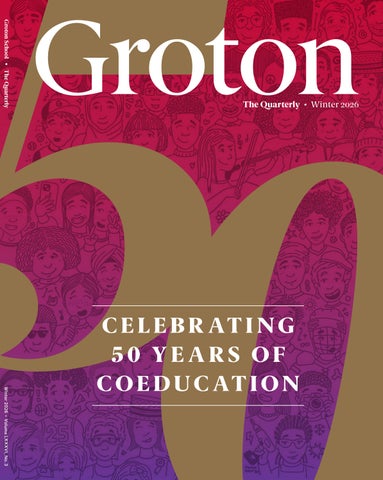
The Quarterly • W inter 2026
Volume LXXXVI, No. 3
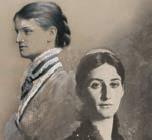
The story of two oft-forgotten women who influenced the donation of land to Groton School, shaping the Circle’s history, and setting the course for the school’s establishment. The Lost Lawrences
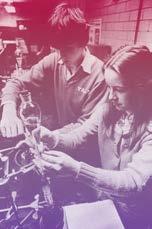
In honor of the fiftieth anniversary of coeducation at Groton School, we’ve gathered a collection of dates, facts, people, objects, photos, and achievements to celebrate moments of inclusivity and excellence throughout Groton’s history.
2 M essage from the Headmaster
3 Circiter / Around the Circle
10 Kicking off Coed@50
On September 20, the Circle welcomed the pioneers and architects behind Groton School’s embrace of coeducation.
14 L essons & Carols
42 Voces / Chapel Talks
51 De Libris / New Releases
52 Grotoniana / Athletics
64 Grotoniana / Arts
70 Form Notes
Cover: illustration by John Donovan ’20
Left: photo by Alyssa Mattei
this past thanksgiving , Mrs. Maqubela and I ventured to our ancestral land of South Africa to visit relatives. After we landed in Cape Town, we had breakfast with a prospective student and their family. Picture a long table where a Xhosa couple—Mrs. Maqubela and I—sit with an Afrikaner family, laughing and enjoying a meal together not too far from where Nelson Mandela was incarcerated for eighteen of his twentyseven years in prison. The ability to associate with whomever one wants—regardless of race, socioeconomic status, geographic and religious background, gender, and the like—is exactly what Mandela fought for when he said, “It is an ideal which I hope to live for and to achieve. But if needs be, it is an ideal for which I am prepared to die.”
On our way home, at the airport in Johannesburg, we sat with two young Grotonians who drove in to see us off, members of the Form of 2018 and the Form of 2020.
The Form of 2018 member’s experiences on the Circle were formative. She is doing well in medical school with an intention to work among the poorest of the poor who have limited or no access to medical care—cui servire est regnare stuck with her. The Form of 2020 member, too, seeks to make the world better through his work for a global nonprofit. He told us that Groton “literally changed my life.” If you knew the village he came from in Cacadu, you would be amazed that a boy from such a place would become a leader and a scholar at Groton.
This young man shared that, as new students on the Circle, he and his formmates would sometimes roll their eyes when they heard us speak so often about inclusion. Yet, not long after Prize Day, they came to understand how essential it was to draw from these lessons to help understand and explain what was happening in the world. Now, he tells us, they want the school to never lose this emphasis and ethos, and to always take the moral high ground on inclusion.
I told them that our generation had played its part and hopefully they will pay it forward using the maxim “Each one teach one.” In time, future generations will cash in on these lessons about diversity, inclusion, and belonging.
by
Editor Sean Kerrigan P’29
Design Stoltze Design Group
Senior Editorial Advisors
Kate Machan
Alyssa Mattei
Christopher Temerson
Form Notes Editor
Jessica M. Hart
Editorial Assistant
John Donovan ’20
Advisory Committee
Susan Daniells
Giulia King
Allison S. MacBride P’30
Mark Melchior
My adopted country is about to mark 250 years of independence whereas my ancestral land a mere thirty-two. Yet the United States and the Republic of South Africa share a history where slavery and institutionalized racism, respectively, were once normalized. We cannot forget or gloss over that and teach by omission for political expediency.
If you want a glimpse of how hard it is to make a more perfect union, look at these two countries that go forward in fits and starts. The USA and RSA are examples of the capacity of humans not to accept bondage forever but to change their lot for the greater good—and, even more importantly, to reconcile between races and among people of diverse views. Groton, too, serves as a symbol of excellence—a treasure if you will—because we are an American school with both a national and a global perspective, what I have previously referred to as a “glo-cal” worldview. Our graduates understand and prioritize serving the greater good, and know that looking back and giving back are not mutually exclusive.
Umntu ngumntu ngabantu is an expression of ubuntu that can be translated as “You are fully human when you embrace the humanity in others.” Let us go forth and be fully human by embracing this in all those around us.

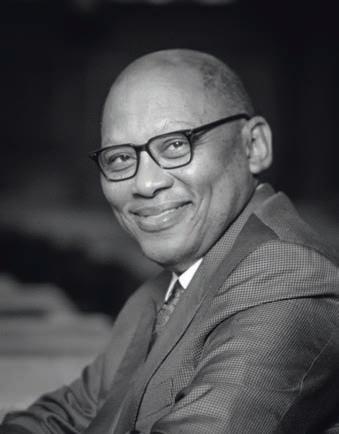
Temba Maqubela Headmaster
Editorial Offices
The Schoolhouse
Groton School
Groton, MA 01450
978 - 448 - 7506 quarterly@groton.org
Send feedback, ideas, or letters to the editor to quarterly@groton.org.
Other School Offices
Alumni Office: 978 - 448 - 7520
Admission Office: 978 - 448 - 7510
Groton School publishes the Groton School Quarterly three times a year, in the fall, winter, and spring/summer, and the Annual Report once a year.

On page 122 of the Fall 2025 Quarterly, a photo caption misidentified Trey Whitehead ’21. We regret the error.
groton school opened its 2025–26 academic year with a call for students to focus on self improvement, collective leadership, and community.
“Welcome one, welcome all,” said Headmaster Temba Maqubela during his annual Convocation remarks on September 7 in St. John’s Chapel. “All of us here are gathered because we want to improve ourselves.”
“Too often, we look to one leader,” he added. “But everyone in this school is a leader.”
Dean of Admission and Financial Aid Ian Gracey saluted faculty, staff, and students for overcoming the challenges of a rainy move-in weekend, and urged everyone to get to know new members of the community as the newest iteration of Groton School settled onto the Circle.
“Joining a new community, welcoming others into a community, works well when we actively and naturally engage with people we do not know,” Mr. Gracey said. “It takes effort to get to know a person. But at this time, investing more energy into getting to know others is valuable, and it’s entirely appropriate. It’s simple engagement with others—on tours, in the Schoolhouse, on the fields or in the Dining Hall—that matters most of all.”
Groton’s 141st academic year began on Labor Day with the start of athletic and drama preseason. As the week went on, more students returned, and leadership and prefect training were introduced.
Evenings were highlighted with social activities sponsored by the Student Activities Council, as well as special off-campus excursions, including a drama trip into Cambridge to see Passengers at the American Repertory Theater.
On September 6, after a barbecue lunch, parents said final goodbyes to their students and joined Mr. Maqubela and Mr. Gracey outside of the Dining Hall before heading home.
The rest of Saturday included orientation, Parlor at the Headmaster’s House, and a Student Activities Council campfire-and-s’mores event before check-in.
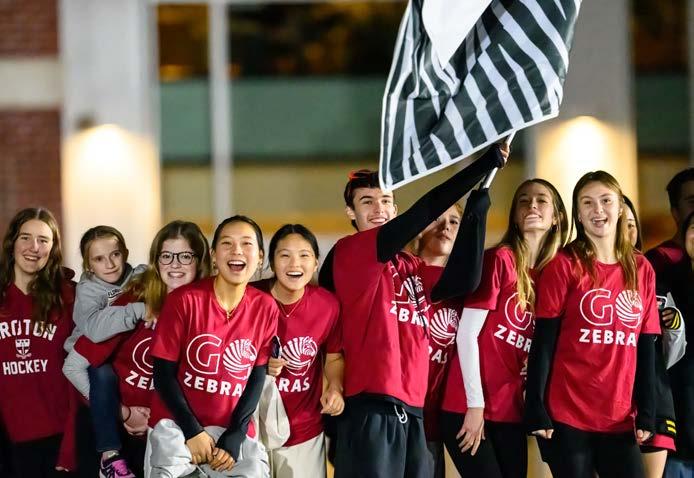
Following Convocation on Sunday, senior prefects led the student body in the now traditional flag procession, a show of countries around the world with which this year’s students hail or identify culturally. The weekend’s rain had passed by then, allowing for a dry walk around
the Circle to the Schoolhouse, where the flags were placed on display around the Sackett Forum before the first Roll Call of the new school year.
Now in its eighth year, the flag procession continues to be a tangible display of Groton’s commitment to global citizenship. Including the Groton flag, there were fifty-three flags in total: Australia, Austria, Belgium, Bolivia, Botswana, Brazil, Bulgaria, Canada, Chile, China, Colombia, Costa Rica, Cuba, Dominican Republic, Ecuador, Egypt, Estonia, Ethiopia, Ghana, Guatemala, Hungary, India, Iran, Ireland, Italy, Jamaica, Japan, Kenya, Kuwait, Mexico, Micronesia, Netherlands, Nigeria, Norway, Panama, Paraguay, Peru, Philippines, Poland, Saudi Arabia, Singapore, South Africa, South Korea, Spain, Sweden, Switzerland, Thailand, Trinidad & Tobago, Turkey, Uganda, United Kingdom, United States.
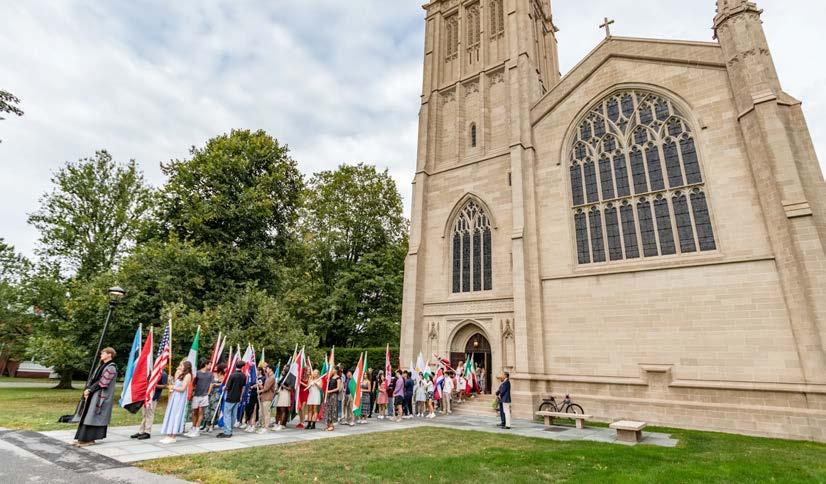
For the eighth year, students opened the academic year with a parade from St. John’s Chapel around the Circle to the Schoolhouse, holding flags of their country of origin or heritage.
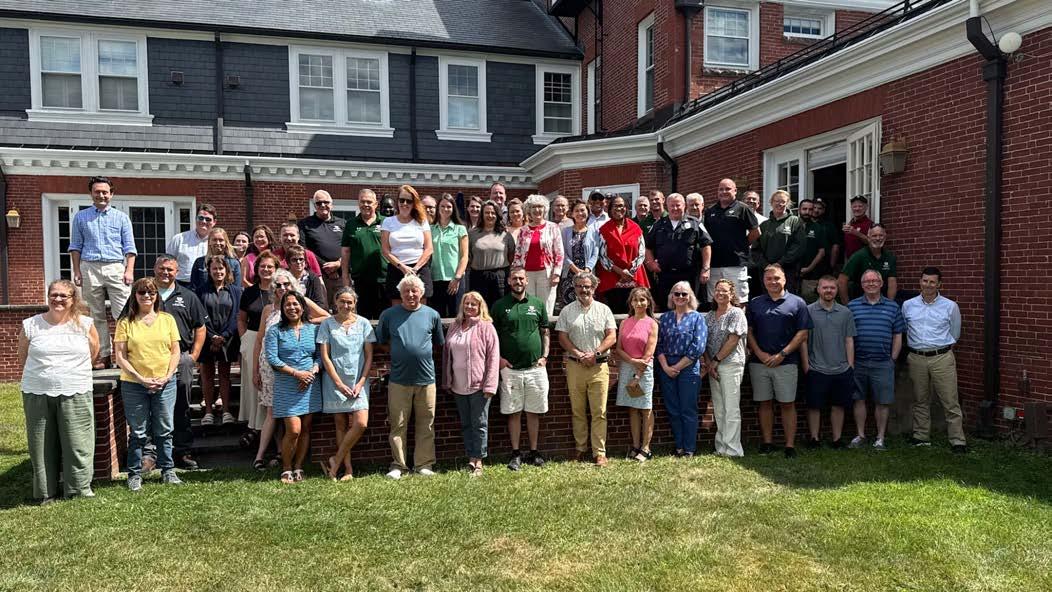
Groton staff members gather outside Headmaster’s House following their traditional start-of-school lunch.
groton school faculty returned to the Circle and gathered in St. John’s Chapel for their traditional pre-school year service on August 28.
Chaplain Allison Read opened the special afternoon service by inviting faculty gathered to join her in guided silent meditation, reflecting on the coming academic year.
“I invite you to hold in your heart the people most precious to you, and to know love,” said Chaplain Read. “Hold in your heart the knowledge that you are sufficient for the year ahead, that you are honored and valued.”
Headmaster Temba Maqubela focused his welcome message on two of Groton School’s longtime guiding principles, the themes of intentionality and collective leadership. He recalled a recent email communication with David T. Lawrence ’63, P’93, ’94, ’00, FTR’91–’03, great-grandson of Caroline Estelle Mudge Lawrence, the woman who made available to the Rev. Endicott Peabody the land upon which the Circle is now located, and how a conversation over lunch nearly a century and a half ago set the entire history of Groton into motion. (For more on Mrs. Mudge Lawrence, see “The Lost Lawrences,” page 16.)
“As we commemorate fifty years of coeducation, it is important to remember that a collaboration between Caroline and the rector was key in the founding of Groton School,” said Mr. Maqubela. “Does that optimism, openness, and dynamism to forge new paths still operate more than 140 years later? I believe it does. It is a continuum that can be traced back to that lunch conversation.”
Mr. Maqubela then announced three new recipients of endowed teaching chairs.
John Capen was awarded the Lathrop Brown Chair, established in 1978 in memory of Lathrop Brown 1900 by his widow, Mrs. Helen Hooper Brown. The previous holder was David Prockop.
Azmar Williams, PhD, was awarded the John Hay Whitney Chair of History and Public Affairs, established in 1987 by the trustees of Groton School through a bequest from Mr. Whitney’s estate, in appreciation of Mr. Whitney’s outstanding generosity to the school. The previous holder was John Lyons.
Midori Ishizuka was awarded the Elizabeth R. Peabody Chair, established in 1989 through the generosity of William WoodPrince ’32 and other friends and family of Elizabeth Peabody. The previous holder was Peter Fry.
Beyond the chapel service, faculty met throughout the week to get ready for the approaching school year, gathering for a dinner and socializing in the Dining Hall on Thursday night.
Staff members had their annual lunch in the Headmaster’s House on Tuesday. Mr. Maqubela read a greeting from Board of Trustees President Ben Pyne ’77, P’12, ’15, who was unable to attend.
In addition, two new staff awards were handed out at the lunch by CFO Jay Herlihy as a way to recognize staff whose outstanding accomplishments have enabled the school’s successful operations and contributed to its mission. This year’s winners were Bursar and Parents Weekend Coordinator Lisa teDuits and Safety Officer Jack O’Neill.
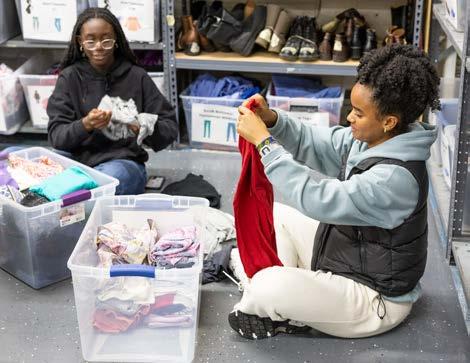
on october 14 , Groton students took the day off from classes to sort donations; make washcloths and blankets; interact with children, senior citizens, and individuals with disabilities; clean up outdoor spaces and animal shelters; and volunteer their time and effort in many other ways during the Fall Day of Service.
More than two dozen opportunities took place across campus, in the town of Groton, and in nearby communities including Acton, Ayer, Chelmsford, Devens, Harvard, Leominster, Lowell, and Nashua, NH.
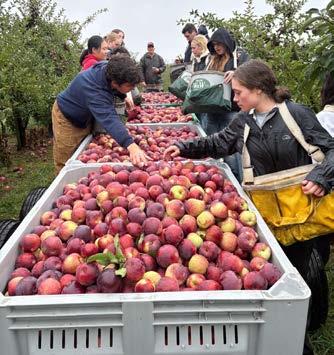

The Day of Service has become a staple of the fall term at Groton, but the event evolves each year to include opportunities that provide the best experience for both the school and its partner organizations. According to Director of Community Engagement Elizabeth Phan, “the purpose of the Day of Service changes depending on the student body and the community’s needs of the present moment.”
To that end, this year’s event was the first to include an activity at Marguerite’s Place, a transitional family shelter in Nashua. A connection between Groton School and the shelter was first established through the Groton Community Engagement (GCE) afternoon program by former GCE head Raymond Hildreth ’25 and current member Jack Dalton ’28. Ms. Phan described the service opportunity at the shelter: “Familiar with the landscape, [Jack] led the group of volunteers in a fun, hands-on activity with the children at the pre-K, where they painted rocks to help beautify their garden area.”
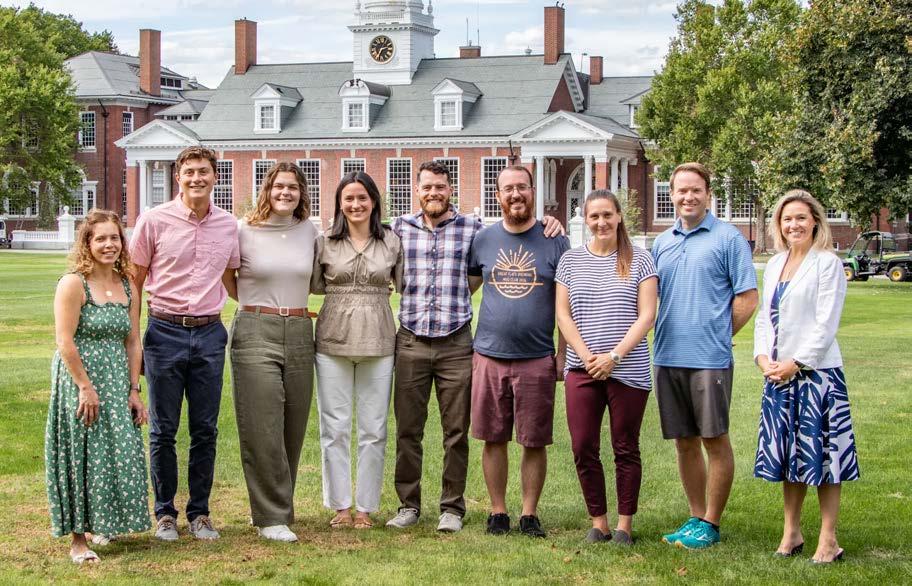
Please join Groton School in welcoming new faculty and fellows to the Circle (from left): Ryan O’Donnell, Ryan Tripp, Livy Golini, Olivia Hall, Wayne Bainter, Jeremy Smith, PhD, Katie Chaput, Erik Chaput, PhD, and Susan Daniells.
The school’s partnership with the Prescott Community Center in Groton generated another first-time Day of Service opportunity. The GCE afternoon program has volunteered at the center’s events, including Halloween Hoopla and Campfire Storytelling, but for the Day of Service, students stayed on campus and used their technical and design skills to
create marketing and registration materials for the center’s “Repair Cafe.” According to Ms. Phan, “The Repair Cafe itself is a free event where participants can come with their broken items and rely on community members to help fix their items and offer a skill to fix another’s. This reciprocal, mutually beneficial relationship building is what our program stands for, so of course, we were happy to help.”
on october 17, the Friday of the Head of the Charles Regatta, thirty-some graduates and friends of Todd Jesdale, teacher of English and math at Groton from 1976 to 1993, gathered at the school boathouse to celebrate Todd and to name a new rowing shell for him. In a conversation last spring that I have had numerous times with oarsmen who rowed for Todd, one of them said, “It’s high time that Groton has a boat with Todd’s name on it.”
Naming a shell for a favorite teacher or coach is a tradition in rowing. His former oarsmen and students pitched in and raised the money to purchase a beautiful new Empacher 4+ and we chose this date because many of them would be coming in for the regatta, too. Todd did more to raise the standard of Groton rowing than any other coach.
Todd and Natalie and their three children—Bill, Liz, and Kate—were all on hand. Natalie poured the ceremonial water over the bow, water collected from the three most important bodies of water we race on: our own Nashua River, Lake Quinsigamond in Worcester, and the Thames River at Henley. At a dinner in the Webb Marshall Room afterward, everyone in the room shared favorite stories about how much Todd had meant to them.
“I was struck as the three decades of athletes in attendance, many of whom had never met, each shared a story of their relationship with Todd that felt somehow identical to mine,” said Colin Farmer ’92. “Todd changed the course of our lives to the positive; his mentorship and our shared experiences as his oarsmen and students were defining factors in the men we are today. It was a truly special day.”
The Jesdale will be joined this spring by a new girls shell, the CoEd@50, made possible by Headmaster Temba Maqubela who thought it only right that, in this celebratory year of coeducation, there should also be a new shell for the girls team. —Andy Anderson

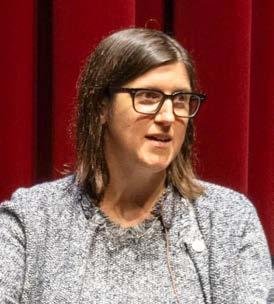
best - selling author Curtis Sittenfeld ’93 returned to her alma mater—and the inspiration of her debut novel, Prep —on September 29 for Groton School’s fall Circle Talk.
The visit continued Groton’s yearlong celebration of the fiftieth anniversary of coeducation at the school.
Set at an elite Massachusetts boarding school that strongly resembles Groton, Prep helped launch Ms. Sittenfeld’s career when it was published in 2005. She’s gone on to write six more novels and two short story collections, including her most recent work, 2025’s Show Don’t Tell
“I don’t consider [Prep] to be autobiographical,” she said, “but the setting is definitely borrowed from where I went to boarding school.”
Ms. Sittenfeld read a selection from Prep and then explored her career in a question-and-answer session with English faculty member Irenae Aigbedion, PhD, before taking questions from the student audience.
“I felt like a boarding school was like a terrarium,” she explained. “It’s so self-contained. There were no iPhones, no social media, no Internet— we were so cut off from the rest of the world. This just seemed like an irresistible setting for a novel.”
The morning after the Circle Talk, Ms. Sittenfeld met with English students in the Schoolhouse Forum for some writing exercises and a more informal conversation about her writing process.
“Every life experience I’ve had goes into the kind of writing I do or the themes that are interesting to me,” she said.
While studying at the Iowa Writer’s Workshop, Ms. Sittenfeld said she learned to compartmentalize feedback into silos: structure, character, and language.
“Thinking in terms of structure gave me control over my writing where, before that, if I wrote a story and it turned out well it would feel like good luck and if it turned out badly it would feel like bad luck,” she said. “It’s true for all kinds of writing: If you give a toast at a wedding or if you write a condolence letter or if you write a college essay, it’s all structure.”
A student asked when Ms. Sittenfeld first knew she wanted to be a writer.
“I always loved reading, and loved writing. I felt like reading, to me, was life with the boring parts cut out,” she said. “It felt like this window into other words and other consciousnesses that I found super interesting.”
Ms. Sittenfeld said she tries to depict life faithfully in her writing, whether weird, funny, or awkward and sad.
“If you write fiction that reproduces reality, it will have all those qualities, and it will engage with what it is to be a person,” she said.
“This is the reason I love fiction,” Ms. Sittenfeld added. “Fiction exists to capture how complicated and contradictory life is. It exists to capture the texture of being a human.”
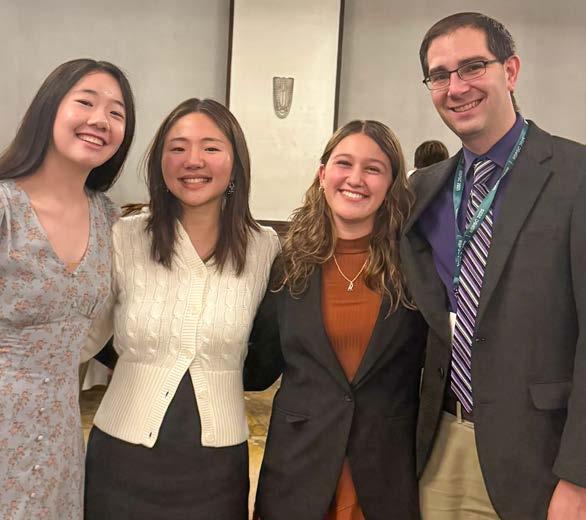
groton school debaters competed in the prestigious International Independent Schools’ Public Speaking Competition (IISPSC or “Internats” for short) recently, earning the top slot for an American school in a tie with Buckingham Browne & Nichols School.
IISPSC is a Canadian and American public speaking event open to independent schools from across the world. This year’s competition was hosted this year by Waynflete School in Portland, ME, October 16 to 19, and featured thirty-seven schools, including some from Bermuda, Hong Kong, and India. This year was the first time Groton has attended IISPSC.
The Groton School contingent included Lena Aloise ’27, Rose Lee ’27, and Rory Hu ’28.
Individually, Rose finished third overall (out of 120 debaters in total), earning her a spot as one of five Americans to qualify through this tournament for the World Individual Debate and Public Speaking Championships (WIDPSC). She made the finals in the Interpretive Reading, Impromptu Speaking, and Parliamentary Debate events. Lena made it to the finals in Parliamentary Debate.
“While Groton’s Debating Society has always been a significant presence both on campus and in our local debating league, we have only recently started competing regularly in public speaking tournaments,” said Debating Society Faculty Advisor Michael Gnozzio ’03. “Rose, Lena, and Rory have all put in a lot of hard work helping to grow this aspect of our program, and it was amazing to see those efforts bear fruit at IISPSCs. As the first Groton debater ever to qualify for Worlds through a public speaking competition, it’s a real testament to Rose’s talent and versatility that she was the only American to qualify for the IISPSC finals in all three of the events in which she competed.”
Groton has a long history with WIDPSC; recent students who have competed in the event include Jiacheng Kang ’22, Steven Pang ’22, and Rowen Hildreth ’23. Fourteen American student debaters attend WIDPSC every year, with the remaining nine slots being selected through league tournaments.
Rose is the first girl from Groton to qualify for WIDPSC since Brookes Brown ’00 did in her Sixth Form year.
sixth form student-athletes
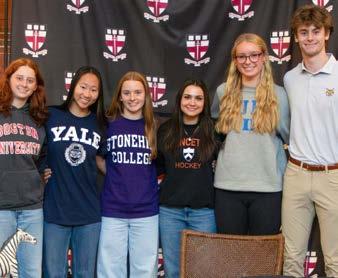
Eliza Brooks, Angie Che, Kaiden Donia, Georgie Lick, Jamie Noonan, and Tina Scalese announced their athletic commitments to NCAA Division I colleges on November 12, National Letter of Intent Signing Day.
Three of Groton’s student-athletes will play hockey at the collegiate level: Kaiden at Quinnipiac College in Hamden, CT; Jamie at Stonehill College in Easton, MA; and Tina at Princeton. Eliza will continue her lacrosse career nearby at Boston University. Angie will be playing field hockey at Yale University. Georgie will be rowing crew for Duke University.
“Groton is proud of our NCAA Division I student-athletes, as their signatures on these letters of intent symbolize so many traits representative of all Groton students: persistence, grit, hard work, leadership, integrity, dedication, and humility,” said Athletic Director Bob Low. “Striving for excellence is habitual, evident through their hard work in the classroom and leadership and citizenship around campus. The entire Groton community is proud of these standouts—and of all the student-athletes who wear the Groton School jersey in competition.”
Groton looks forward to celebrating its Division III student-athletes in the coming weeks—and cheering on all the Zebras when they take their considerable talents to college.
groton school welcomed more than 700 parents, siblings, and other family members for its annual Parents Weekend, October 23 to 26.
Classic New England fall weather greeted the visitors, as they explored campus and got caught up on all that’s happening on the Circle, including academics, the arts, athletics, and more.
In addition to catching up with their children, visiting parents were able to meet with teachers and advisors, and nearly 2,300 conferences were held over four days. Open houses and information sessions with the Academic Skills and Counseling, Spiritual Life, College Counseling, and Global Education Opportunity teams were also offered.
Friday evening featured a tailgate dinner before watching the varsity football team’s dramatic 10–7 win under the lights against St. George’s.
Following breakfast and a Parent Fund meeting early Saturday, Headmaster Temba Maqubela gave his annual Parents Weekend address.
“You are a picture of a Groton embrace,” he said. “I hope you can see and feel it too. What a privilege it is to work in this
majestic place. Thank you for entrusting your children in our care.
“Your presence here is a reminder that, as we pass through this place, our time together—united by common purpose—is
a blessing. We are in partnership with you, playing our respective roles in real time, as students transition from becoming to maturing, and from being led to becoming leaders themselves. What a privilege to be a part of it all.”
In thanking faculty, coaches, dorm heads, advisors, and staff for all they do, Mr. Maqubela said the students “gave meaning to what we do and relevance in how we do it.
“We are because they are, and they are because you are,” he added. “This circular aspect of ubuntu illustrates how it truly takes a village to form and nurture a Circle.”
As Groton continues its yearlong celebration of the fiftieth anniversary of coeducation on the Circle, Mr. Maqubela reaffirmed the school’s commitment to inclusion, not as something new but as an essential part of its history and DNA.
“I believe inclusion, in different guises, has always been a part of this school since its founding,” he said. “Groton is not a

pendulum swing, where we go from pillar to post or one side to the next. We build on what our predecessors did for us. This is a continuum: a continuum of excellence, a continuum of belonging.”
After the speaking program, families enjoyed a full schedule of athletic contests all over the Circle, before an evening reception at Sunset Farm and a performance spotlighting Groton’s young musicians in the Campbell Performing Arts Center.
Sunday started with brunch in the Dining Hall, before religious services for various denominations were offered in St. John’s Chapel and throughout campus.
More than 700 parents and family members took part in this year’s event, visiting from such places as Botswana, Canada, China, Costa Rica, France, Hong Kong, Korea, Mexico, the Netherlands, Saudi Arabia, South Africa, Spain, Sweden, and Switzerland.
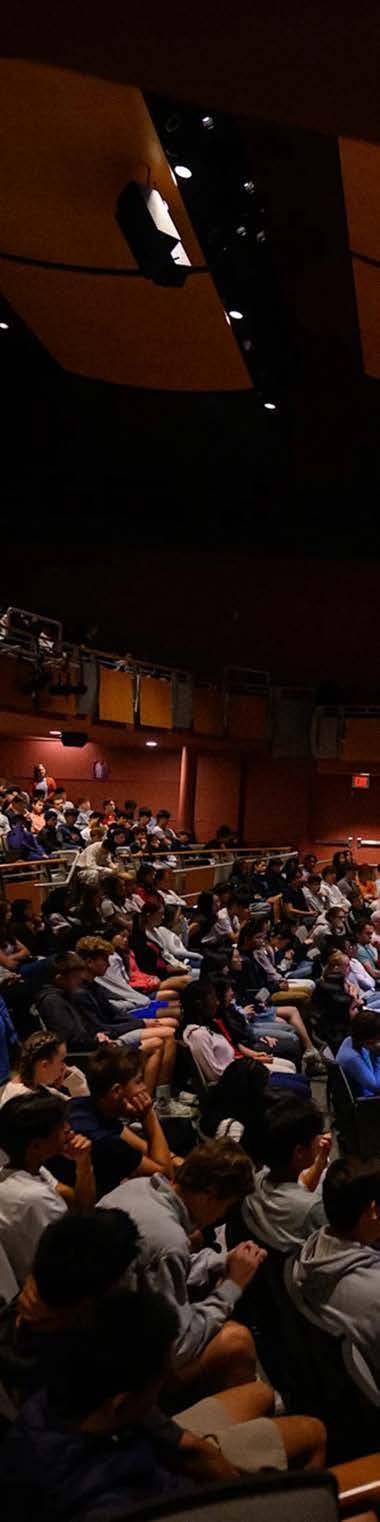
the groton school community gathered November 13 for its annual Global Education Day, where students and faculty recounted recent Global Education Opportunities (GEOs) and spotlighted where the program is heading in 2026.
The morning assembly in the Marion D. Campbell Performing Arts Center (CPAC) began with a brief history of Groton’s Global Education program, which started with tours by musical ensembles and expanded into trips focused on service and construction work, before a pivot away from the “dreaded three Ss” of traditional study abroad programs—“shopping, sightseeing, and saving people”—to something that fit better into Groton’s global worldview.
Assistant Director of Globalism and Experiential Learning Mary Frances Bannard then shared highlights of the second Groton Program for Intercultural Exchange (G-PIE), which took place June 22–27 in Dehradun, Uttarakhand, India, co-hosted by the Doon School in collaboration with Welham Girls’ School, Dehradun, and Groton.
This year’s event brought together forty-two students from ten leading schools across Rwanda, Bhutan, China, the United States, England, and India for a week of intercultural dialogue, learning, and collaboration.
Theater and Dance Department Head Laurie Sales then spoke about the recent GEO to the Orkeeswa School in Tanzania, which marked her seventh time visiting the country with Groton. Immersive experiences like a GEO, Ms. Sales said, can offer as deep a learning experience as a term in a traditional classroom.
The event then turned its focus toward upcoming GEOs, to which students were encouraged to apply. They include:
• Classics (March 2026): Explore the sanctuaries, cities, theaters, and temples throughout Greece that shaped the ancient Greek and Roman cultures that are studied in the Classics Department at Groton.
• Peru (June 2026): Offers students the opportunity to spend several summer weeks in the Sacred Valley of Peru, the heartland of the Inca civilization.
• Jazz Ensemble (June 2026): Groton’s jazz band, Soul Sauce, and student fans, roadies, bloggers, and photographers will experience the rich culture and vibrant music scene of the United States’ Latin American neighbor, Mexico.
• Black Heritage (August 2026): Experience the story of Black America from its roots to its triumphs on this journey through the South and up to the nation’s capital.
Members of the Soul Sauce jazz band that will tour Mexico then took the stage for a performance of Stevie Wonder’s “Isn’t She Lovely” and legendary jazz trumpet player Freddie Hubbard’s “Red Clay.”
In closing, Dean of Globalism and Experiential Learning Nishad Das explained that one of the key benefits of the GEOs was assembling groups of Groton students who might not spend much time together on the Circle. This vision of an expanded community epitomizes the African philosophy of ubuntu (“I am because we are”) that lies at the heart of Groton’s Global Education program, he said.
“It’s the idea that a person’s humanity and identity is shaped by a relationship with others,” said Mr. Das. “So to have a full Groton experience, you need to go on a GEO.”
groton school kicked off a yearlong celebration of the fiftieth anniversary of coeducation on September 20 with a day honoring the pioneers and architects who brought the first female students to the Circle in 1975.
“There are moments in the school’s history where you feel like there is a leap of faith,” Headmaster Temba Maqubela told alumni, past and present faculty, and friends gathered in the Campbell Performing Arts Center (CPAC) for the day’s first panel discussion. “In science, we call them quantum leaps. Time doesn’t go backward, it only goes forward. So does progress. You are witnesses to the progress.
“We were not there when this occurred but, from what I gathered, at that moment in 1975 this school roared, the world shook, and Groton got better,” he added. “We’re a better school now because a decision was made—not just by the pioneers who came, but by the architects who said, ‘The time to change is now.’”
In 1970, then-Groton Headmaster Paul Wright and the Board of Trustees established a committee on coeducation to study the matter. Besides the obvious challenges that would accompany the transition to coeducation, there were no all-girls schools nearby with which it was feasible to merge. So once the decision was made a year later to go coed, Groton needed to build its female student body from zero.
After several years of fundraising, infrastructure updates, and culture tweaking, Groton welcomed forty-eight
girls—distributed among the Third, Fourth, and Fifth Forms—in the fall of 1975, the first year of coeducation on the Circle.
Current students were given the day off from classwork and instead came together in the CPAC to hear stories from alumni who were new students in the fall of 1975—including Alyce Jones Lee ’77, former trustee Diana Chigas ’ 79, Trustee Kevin Griffith ’80, former trustee Polly Cross Reeve ’78, P’07, ’09, ’11, and Laura Rogerson Moore ’78—who shared their Groton experiences in a conversation moderated by the school prefects.
Afterward, students returned to their dorms for a UNESCO Story Circle exercise led by faculty and dorm prefects.
The afternoon session began in the CPAC, where Richard Bradley ’82 moderated a group discussion with faculty and alumni who were some of those celebrated architects and pioneers in 1975.
“I’m not proud of the fact that I opposed coeducation when I was a student at Groton,” said sixth headmaster Bill Polk ’58. “And I have to say the bus from Concord Academy unloading in front of Hundred House for a tea dance didn’t work for me either. I thought Groton was just fine when I was a student there.”
Mr. Polk wouldn’t change his opinion on the matter until years later, when he got his first taste of coeducation at graduate school.
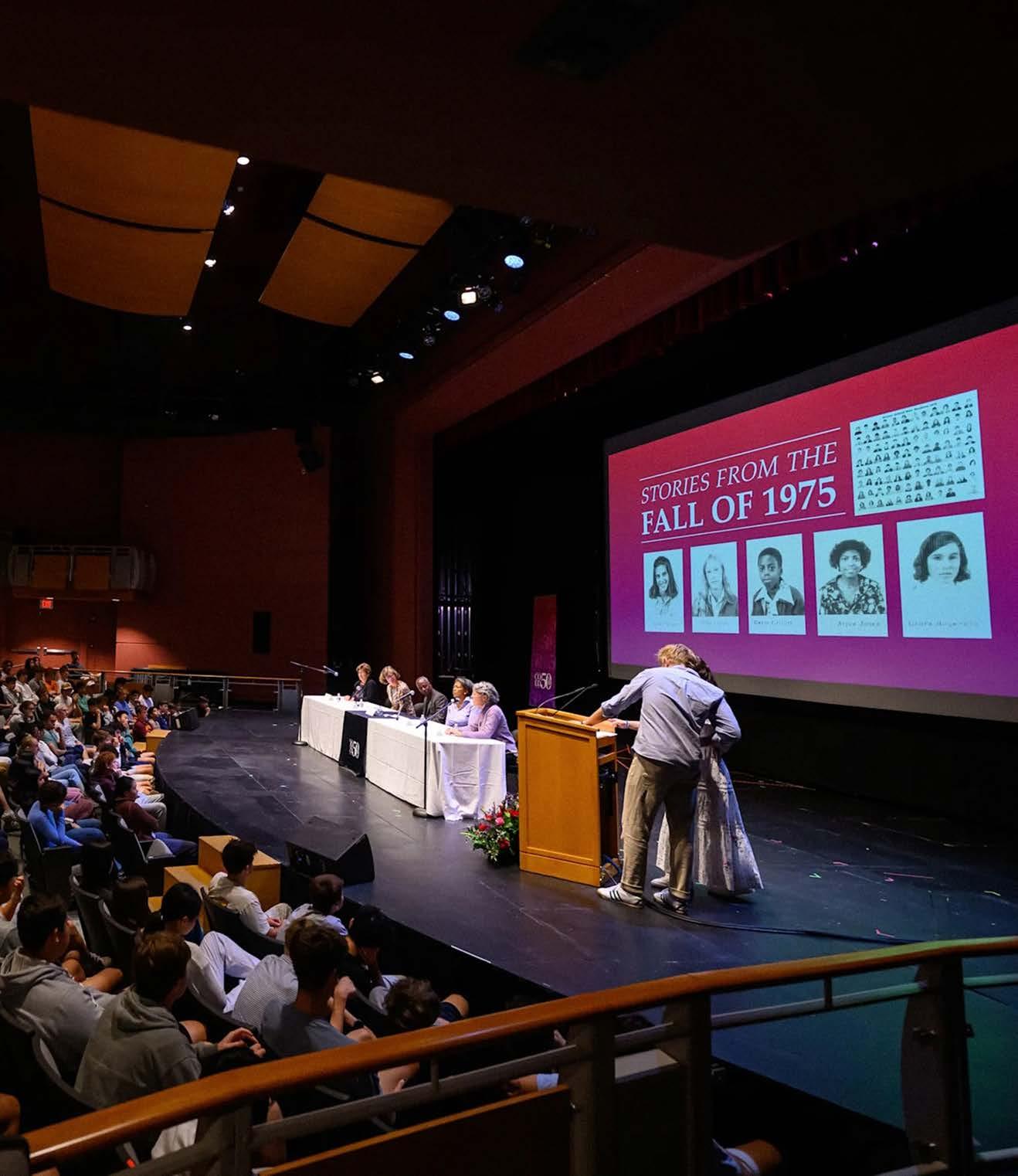
Alumni from the fall of 1975 helped kick off the September 20 celebration by sharing their stories of the first years of coeducation.
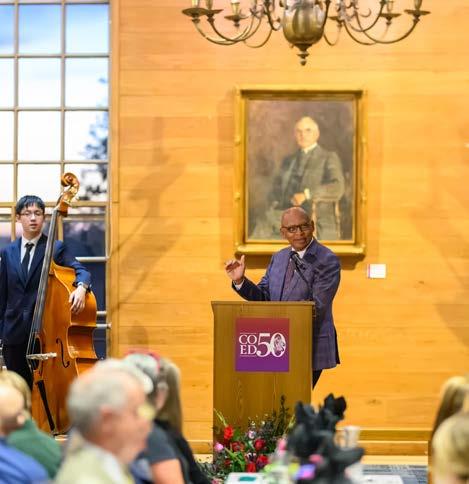
“It was eye opening for me and really changed a lot of my thinking,” he said. “I saw women who were leaders in class and leaders in the community—just wonderful models for what education should be at its best. I also saw men and women who were just friends, and that was an eye opener and very, very refreshing.”
Selling the community on a shift to coeducation was far from a slam dunk, however, despite the fact that the school’s financial model at the time was unsustainable and increasing Groton’s student body was necessary.
Mr. Polk said the study committee advocating the change chose to lean on influential supporters like Mr. Wright and an overabundance of kindness to convince naysayers.
“Someone on the committee said, ‘We will love them into submission,’ and that’s what we did,” Mr. Polk explained. “We gave them an opportunity to write to the Quarterly and state their case. We met with them often and kept everyone informed.
“A lot of alumni we couldn’t convince,” he added, “but when their granddaughters came to Groton, they were very enthusiastic.”
Hired by Mr. Wright in 1972, past English faculty member Pam Clarke wasn’t the first female faculty member at Groton, but she was the first “hired in her own right,” that is, without a male connection to the school.
“He said that other schools were going coed, and we would probably be going coed sometime too, so perhaps we should try one,” Ms. Clarke said.
Besides teaching, Ms. Clarke was instrumental in finding and recruiting
the first group of female students.
“What I’m really famous for is working for Dave Rogerson [P’78, ’80, ’82, ’85], the director of admission,” she explained. “He sent me to New York to recruit girls to come up to Groton. We stole girls from all over New York, and I’m responsible for recruiting the first group of girls.”
Two of them—Ms. Jones Lee and Naomi Pollock ’77—were with Ms. Clarke on the CPAC stage Saturday.
Ms. Jones Lee said she grew up in Springfield, MA, in a working class family. She and her sister had what she called a volatile relationship, so much so that Ms. Jones Lee longed to leave as soon as she could.
“I really wanted out of my house,” she said. “And I used to pray for it. The opportunity to come to Groton, I thought, was an answer to my prayers.”
As a young Black woman, Ms. Jones Lee was invited to campus before other students of color and grew to become friends with many of them.
“Coming here totally changed the trajectory of my life,” she said.
Ms. Pollock credited her decision to come to Groton from her home in Chicago to two things: Ms. Clarke and a snowstorm. After narrowing her list of boarding schools to Groton and another New England school, she and her mother came east for visits. After finding Groton “small” and “very male,” they went back to their little motel room in Ayer figuring it was a poor match but happy for the experience.
In the morning, however, they woke to find themselves snowed in. Ms. Clarke invited them back to campus, where Ms. Pollock spent the day sitting in on classes and giving Groton a second chance.
“The next morning, my mother and I looked at each other and said, ‘Well that decides that,’” she said. “Because we had been so persuaded by that second day. I really applaud what Pam Clarke did to make us feel like there was a place for us.”
President of the Board of Trustees Ben Pyne ’77, P’12, ’15 was a student at Groton two years before girls were admitted and for two years after, and was happy when the school decided to embrace coeducation.
“I think it’s one of the best things that
ever happened to the school,” Mr. Pyne said. “Even as an oblivious teenager, I got the very distinct impression that the school was doing everything possible to make the introduction of girls to the boys as seamless as possible.
“It was just natural, it just happened,” he added. “It elevated the school on so many levels, whether in the arts or music, but also in the classroom. It brought in some incredibly talented young women. I applaud their courage to come and I’m grateful that they did. It elevated the experience for all of us.”
Former mathematics faculty member David Bannard P’01, ’03, came to Groton in 1972 after studying at an all-boys boarding school and (at the time) an all-male Yale.
“I sort of had a plan that [my time at Groton] would be a temporary thing, and yet three years into it we started preparing for coeducation and I decided I had to stay here for this,” he said with a laugh. “I can’t miss it again!”
While some were concerned that girls would struggle in Groton’s rigorous academic environment, Mr. Bannard said he found them thoughtful and very prepared. He also credited the school’s female role models—whether faculty or faculty wives—with playing a crucial role in making young women comfortable on the Circle.
“I was very comfortable with coed classes right from the beginning,” he said. “To me, it seemed absolutely natural. To me, the most astounding thing about my first ten years at Groton was the quality of women that were hired or were faculty wives. It can’t be overstated. They were tremendous. And I’m not sure things would’ve been so successful otherwise.”
LuAnn Polk wrapped up the panel by saying that the move to coeducation was just one step in the school’s larger journey of diversity and inclusion.
“It’s interesting how long it takes for a school to become coed, in a sense that it took a while for the first graduates, then for the first college graduates, for the first trustees, the first parents of other students,” she said. “It’s just an organic growth that has its bumps, but it’s still moving in
by
the same direction. I think the definition of diversity and inclusivity—the terms keep broadening, so coeducation is just one step in the broadening sense of how Groton sees itself operating in the world.”
Smaller panel discussions were held throughout the afternoon in Hundred House, covering such topics as the evolution of curriculum in the era of coeducation, an exploration of leadership and advocacy, and how coeducation shaped the arts and athletics at Groton, among many more.
Panels organized by members of the Groton Women’s Network explored the experiences of female Grotonians in such fields as medicine and STEM, and also in film, journalism, social media, and writing.
An afternoon “Stories from the Fall of 1975” panel expanded on the students’ morning session with more first-hand accounts and memories from the pioneers of 1975, featuring moderator Naomi Pollock ’77 and a panel of former trustee Diana Chigas ’79; Ellie Dwight ’77; Alyce Jones Lee ’77; Laura Rogerson Moore ’78;
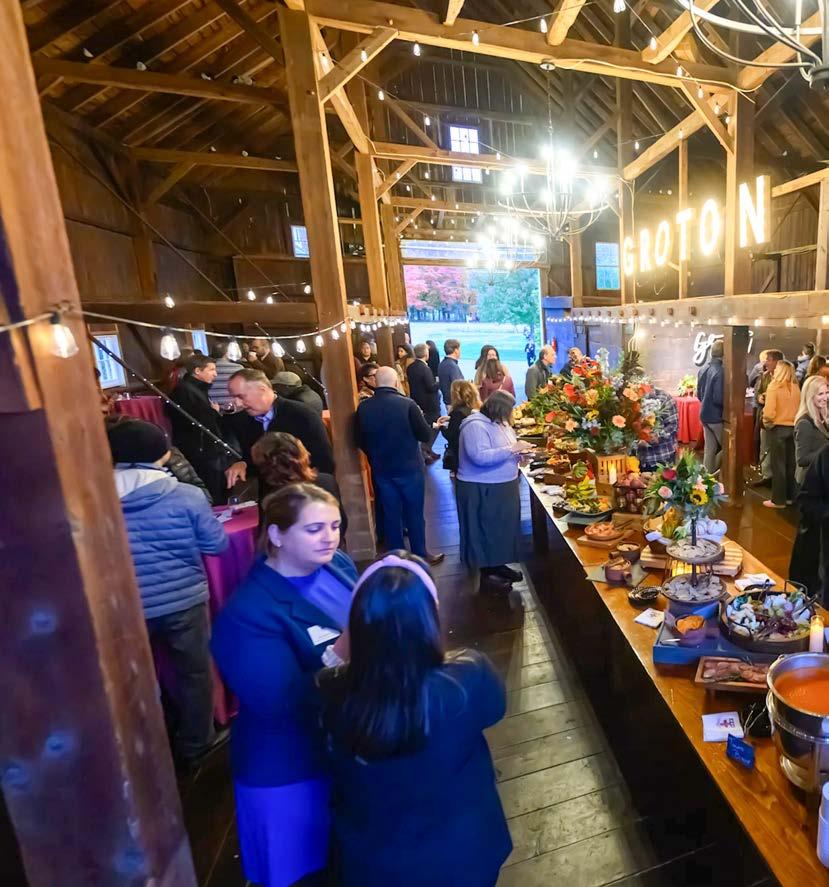
Top left: Headmaster Temba Maqubela welcomes alumni and friends of the school to a dinner celebrating the fiftieth anniversary of coeducation at Groton School.
Bottom left and right: Student musicians performed a program of works by female composers before dinner.
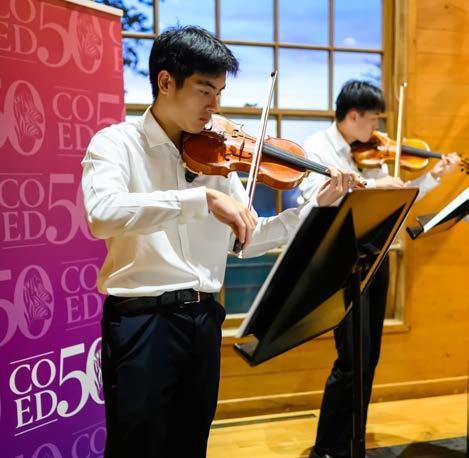
and former trustee Polly Cross Reeve ’78.
The day concluded in the Dining Hall with a celebratory dinner for participants and attendees.
“You can see the buds that most of you left here, they are flowering,” Mr. Maqubela told the crowd.
In a three-part toast, Mr. Pyne saluted “the brave young women who had the courage to come to Groton School in that fall of 1975, as true pioneers who paved the way for the next fifty years of coeducation; the trustees, the architects, the leaders, the faculty and staff who worked so hard to get Groton ready for coeducation so it would be as seamless as it could possibly be when forty-eight girls descended on a campus of 215 boys; and the women and men—leaders, faculty and staff, students— everyone who, in the intervening fifty years, not only made Groton a truly coeducational institution but also a leader among secondary schools.”
In his blessing, Mr. Polk called for a continued evolution of the Groton experience in a manner that respects and enhances what has always been special about the school.
“May it keep changing as it always has—in ways fresh, interesting, and thoughtful—and may it stay the same as it always has—in ways that affirm the spirit and values that stand at its core,” he said. “We are grateful that coeducation will be a marker event in Groton’s history and grateful, too, for the women and men in the faculty that worked with the determination and sensitivity that made coeducation a reality at Groton.”
Ms. Chigas, a trustee from 2008 to 2021, was the event’s keynote speaker and said she came to Groton fifty years ago “because of all the extraordinary people that I knew would challenge me, like the extraordinary people in this room.”
(For an excerpt of Ms. Chigas’ remarks, see “A Cultural Earthquake,” page 46.)
Mr. Maqubela closed out the day by challenging those gathered to keep working.
“The question to ask ourselves is not just who is here, but who is not here, and why,” he said. “There are people who are still not represented here, and our successors will make sure our work continues.”
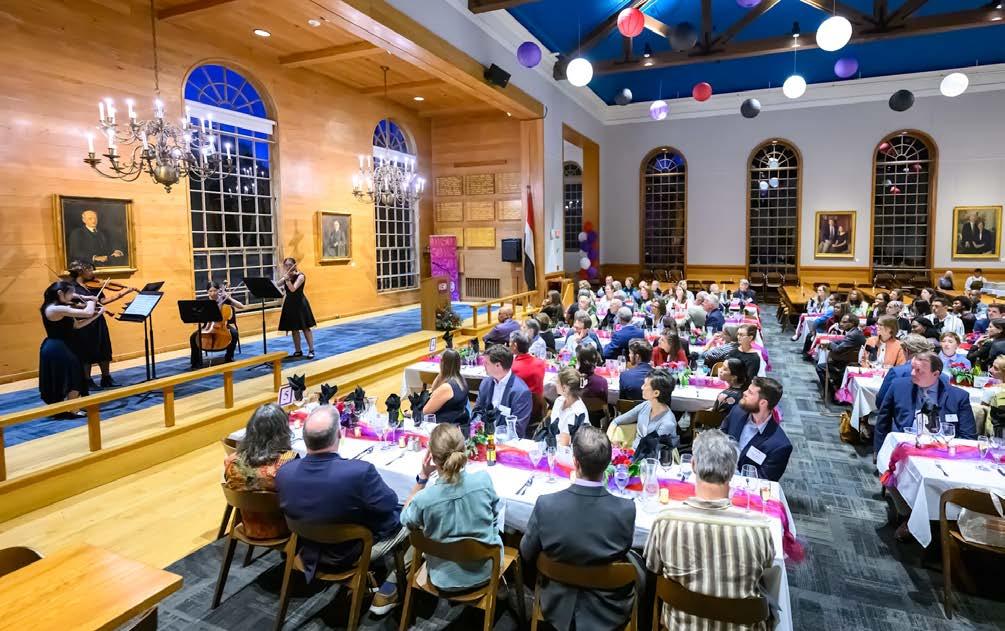
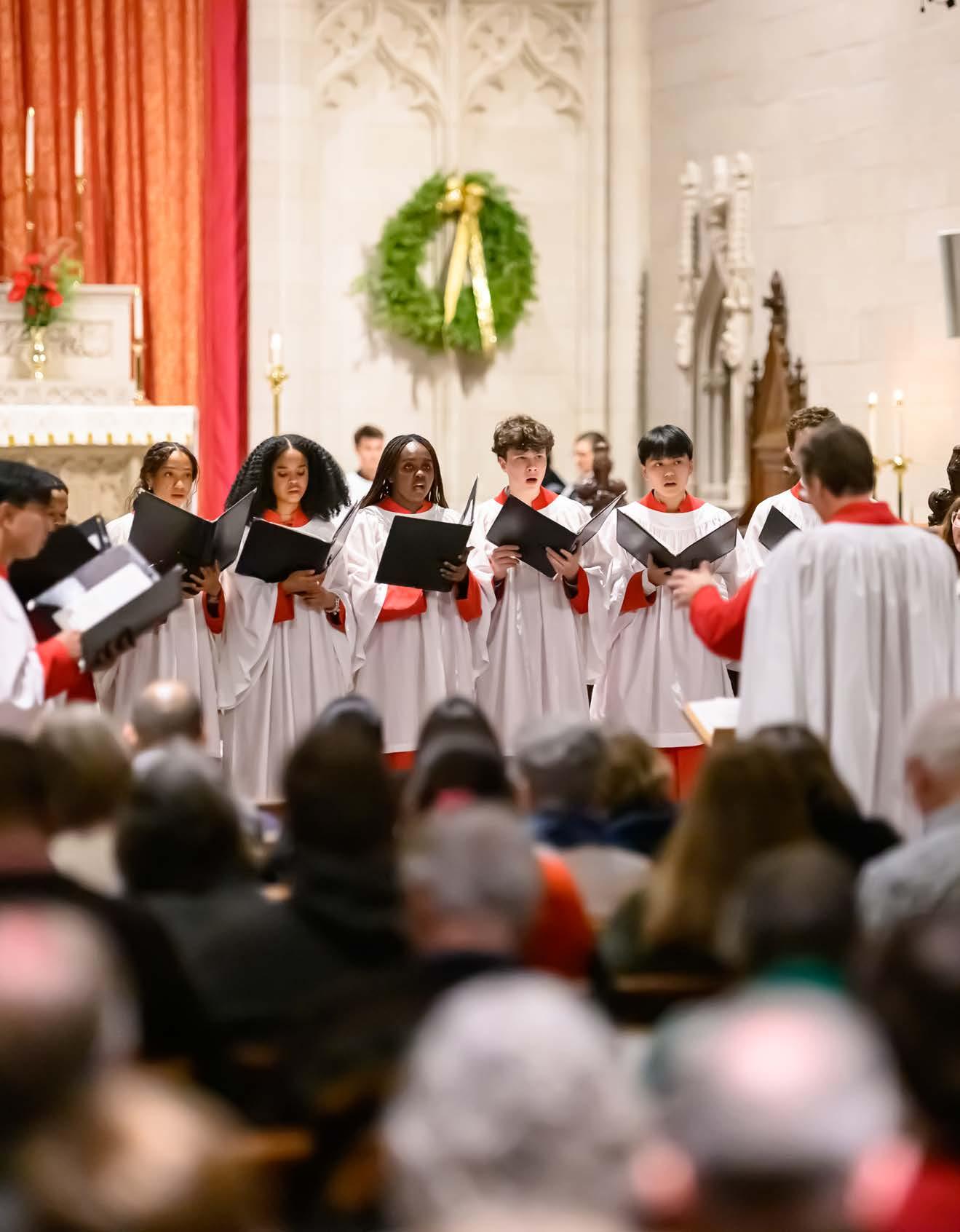

The Festival of Nine Lessons & Carols, Groton School’s most beloved Christmas tradition, once again filled St. John’s Chapel with the sounds of sacred text and song on December 12, 14, and 18.
Groton School was founded in the tradition of the Episcopal Church, and the Festival of Nine Lessons & Carols has served as a distinct expression of that heritage since it was first offered on the Circle in 1929. In fact, Groton was likely among the first communities to emulate the service from King’s College, Cambridge, England, which held its first Festival of Nine Lessons & Carols on Christmas Eve in 1918, just as World War I ended and during the deadly influenza pandemic.
Today, the service is replicated and cherished by communities all around the world. The readings tell of God’s loving purposes for humankind, and the carols offer comfort and joy for all people. A founding trustee of Groton School and friend of Endicott Peabody, the Right Reverend Phillips Brooks, wrote the text of the famous carol “O Little Town of Bethlehem,” which includes the line “the hopes and fears of all the years are met in thee tonight.”
The Reverend Allison Read, Groton School’s chaplain, presided at each service, which began after a prelude by the Groton School Chamber Orchestra, directed by Tim Terranella.
Groton’s choir, under the guidance of Choirmaster and Organist Daniel Moriarty, sang traditional hymns and carols, while honorees shared the nine religious readings—the lessons. Soloists included Newton De Silva ’27, Sage Greaves ’26, Logan Hu ’27, Michelle Manza ’26, Chloe McAuliffe ’26, Sade Pickering ’26, Katrina Yang ’26, Dianna Zeng ’29, and Kayla Zheng ’26.
The December 12 audience was made up primarily of members from the Greater Groton
community, so the guest speakers invited to read reflected those relationships: Groton Council on Aging Director Nicole Sarvela, North Central Massachusetts Habitat for Humanity Executive Director Carolyn Read, Groton Union Congregational Church Interim Minister the Rev. Dr. Priscilla Lawrence, Lawrence Academy Director of Music Jenny Cooper, and the Rev. Mia Kano, rector at St. Andrew’s Episcopal Church in Ayer. House Prefects Cedar Connell ’26 and Stephanie Mo ’26, Chapel Prefect Ryder Woodworth ’26, and Headmaster Temba T. Maqubela also gave readings.
The December 14 service welcomed parents and alumni. Speakers included Chapel Prefect Chloe McAuliffe ’26, Senior Prefect Sydney Nelson ’26, Science Department faculty member Sandy Kelly, PhD, Sarah R. Boxer-Shapiro P’26, ’29, Elizabeth Hanna Morss ’77, P’09, ’12, ’15, Trustee Chandler Bass Evans ’96, P’29, former organist and choir director Craig E. Smith P’85, ’88, ’89, Groton’s sixth headmaster, William M. Polk ’58, and Mr. Maqubela.
The final service of the 2025 season— for those who live and work on the Circle— was on December 18 and also broadcast via livestream. Speakers included Second Form Officer Dania Melendez ’30, Third Form Officer Sam Harrell ’29, Fourth Form Officer Charlotte West ’28, Fifth Form Officer Zoe Hardwick ’27, Senior Prefect Lebone Matthews ’26, Chapel Prefect Charlie Stubbs ’26, Director of Dining Services Ed Wetterwald, Mr. Polk, and Mr. Maqubela.
how two forgotten women helped shape the circle
By Alyssa Mattei
on march 14, 1884, the ownership of nearly 100 acres of property on Farmers Row was handed over to the trustees of Groton School. While records often solely credit James Lawrence Jr. and his brother, Prescott, for the donation of land, three people signed over the land that day. The third name inked on that deed is that of C. Estelle Lawrence, James Jr.’s wife. Though not always fully attributed by history, the key initiator and proponent of the land donation for the establishment of Groton School was, in fact, Caroline Estelle Mudge Lawrence. This is her story.
Caroline Estelle Mudge was born on July 9, 1850, sixth of Enoch Redington Mudge and Caroline Augusta Patten’s seven children. She grew up in Swampscott,
MA, and on January 16, 1875, she married James Lawrence Jr. in Boston.
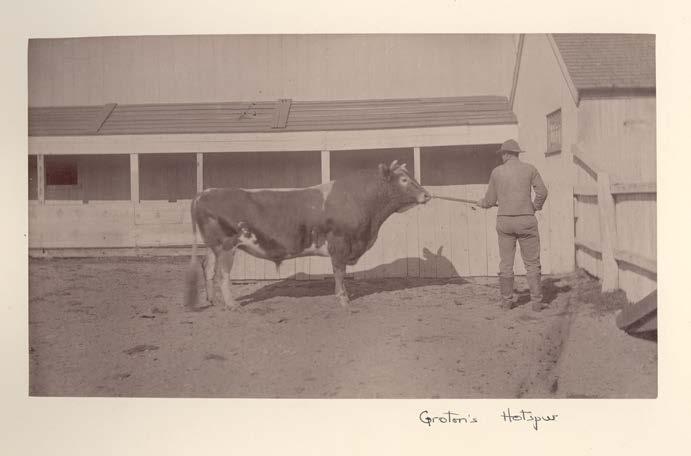
Shortly afterwards, the newlywed couple moved to a Lawrence family residence on Farmers Row in Groton. James Jr. inherited the homestead from his father, who had lived out his later years abroad and rarely stayed at the country property. James Jr. and Estelle, however, were happy to settle down and raise their three children—Richard, Elizabeth, and James—in the Massachusetts countryside. James Jr. became substantially involved in the town of Groton, expanding his land ownership significantly, and establishing himself as a farmer with prize-winning cattle stock and a well-known creamery.
In the spring of 1883, James Jr. and Estelle received their dear friend and relation, Endicott Peabody, as a guest at their home in Groton. The family had recently suffered the loss of James Jr.’s sister, Gertrude Lawrence Peabody, who had been married to Endicott’s eldest brother. Endicott was staying with his devastated brother at the time, and likely went up to check on how some of his other family members were faring after the tragedy.
At some point the conversation pivoted to a topic that would alter the course of Groton history; the story varies slightly from the two sources in which it is recounted:
In Fifty Years On: G roton School 1884–1934, Frank D. Ashburn 1921 states,
A s they talked on Sunday morning Mrs. Lawrence said to him that she wished someone would open a school for boys in Groton, because that would bring the Episcopal Church to the town. She was a devout churchwoman and regretted that the nearest Episcopal services were at Fitchburg, fourteen miles away. Peabody, startled, exclaimed that it was strange that she should speak to him of opening a school for it was the very thing he thought of doing.
Whereas, Ashburn’s biography Peabody of Groton regales that,
Mrs. Lawrence, a devout churchwoman, suggested that he start an Episcopal church in Groton, which had none. Peabody replied he was thinking of starting a school and there were four churches in Groton already. Mrs. Lawrence said that if he would start a school at Groton she was almost sure her husband and his brother-in-law, Prescott Lawrence, would buy a site for the purpose.
Since no one else was in the room where it happened, the mystery of whether the school or church was brought up first may never be confirmed. What is clear is that Estelle became immediately
“Family lore handed down by word of mouth, most recently from . . . John Endicott Lawrence Sr. GS’1927 . . . was that while her husband James might have been the titular or even legal head of the family, the true power to ‘get things done’ resided in his wife Estelle . . . According to my Great Uncle John, the men notwithstanding, Caroline Estelle Mudge Lawrence really was the person who made the whole thing happen.”
l . s . lawrence
dedicated to helping Peabody’s cause, and was the primary force behind Groton School’s establishment in the area.
Estelle’s investment in the project is not particularly surprising, given both her attested Episcopal devotion and her family’s history in similar charity. Estelle’s father, Enoch Redington Mudge, established St. Stephen’s Memorial Episcopal Church (Lynn, MA) in the 1870s in honor of his son, Lieutenant Colonel Charles Redington Mudge, and his daughter, Fanny Olive. According to the history of the church, “Grieving the loss of his son, Lieutenant Colonel Charles
Redington Mudge who died at the Battle of Gettysburg, Mudge sought an appropriate memorial. At the insistence of his daughter, Fanny … he decided to build a church for St. Stephen’s in memory of Charles. As plans emerged for the new church, Fanny Olive herself died leaving Enoch and Caroline Mudge deeply saddened. Mudge spared no expense building the church as a memorial to both of his children.” Enoch, his wife Caroline, and Charles and Fanny are all buried in this church.
up to their Uncle’s. Mrs. Lawrence drove me to a spot which has been selected for ‘the school’ and surely a fairer place one seldom sees. It is a large plateau overlooking a glorious valley with great hills and mountains beyond. It would do one good to live there and it would surely be a fine thing for boys to grow up amid such scenery.” The parcel of land was well received by those developing it due to the splendid views of the Nashua River and westerly peaks, which the architect made sure to feature when designing the campus. Undoubtedly, the Circle would not be what it is today without the distinct landscape it was built to showcase.
About a decade after the cornerstone of St. Stephen’s was laid, another of Enoch’s daughters, Mrs. Marie Louise (Mudge) Joy built the Church of the Holy Name (Swampscott, MA) in honor of her father and her late husband. Needless to say, Estelle’s family had a notable history in the founding of Episcopalian establishments, particularly in honor of lost loved ones.
James Jr. and Prescott likely did not take much convincing either, as the Lawrence family’s charity had been directed to education for generations. It was, after all, their great-grandfather, Samuel Lawrence, who co-founded Lawrence Academy, and two of Samuel’s children (James Jr.’s great uncles), Amos and William, who became the eponymous benefactors of the school. James Jr. himself served as a trustee of Lawrence Academy as well. The family preserved many strong ties to the academy, and was committed to deepening the educational opportunities in the area.
The Lawrences wasted no time getting the project for a new Episcopalian school underway. Within a week, they identified a plot of land, had it reviewed by architect Frederick Law Olmsted, and sent Endicott a letter offering him ninety acres for the establishment of his school. The donation was expressly made in the
memory of their mutual sister and sister-in-law, Gertrude Peabody.
Soon afterwards, Endicott visited the location and expressed his delight of the landscape chosen in a letter on June 6, 1883, writing, “Yesterday I went up to Groton taking my brother’s little ones
The Lawrences’ contributions to the school continued even after its establishment. Every year Estelle and James invited Groton students to their home for a concert the Friday before they went home for the holidays. This annual tradition is documented in both The Grotonian and the local Ayer newspaper,
an emerging photographer
In the 1880s, Estelle became enamored with photography and began photographing everyday life in Groton and beyond. Estelle’s passion for photography was unusual for its time, as commercially available photography equipment had only just been invented.
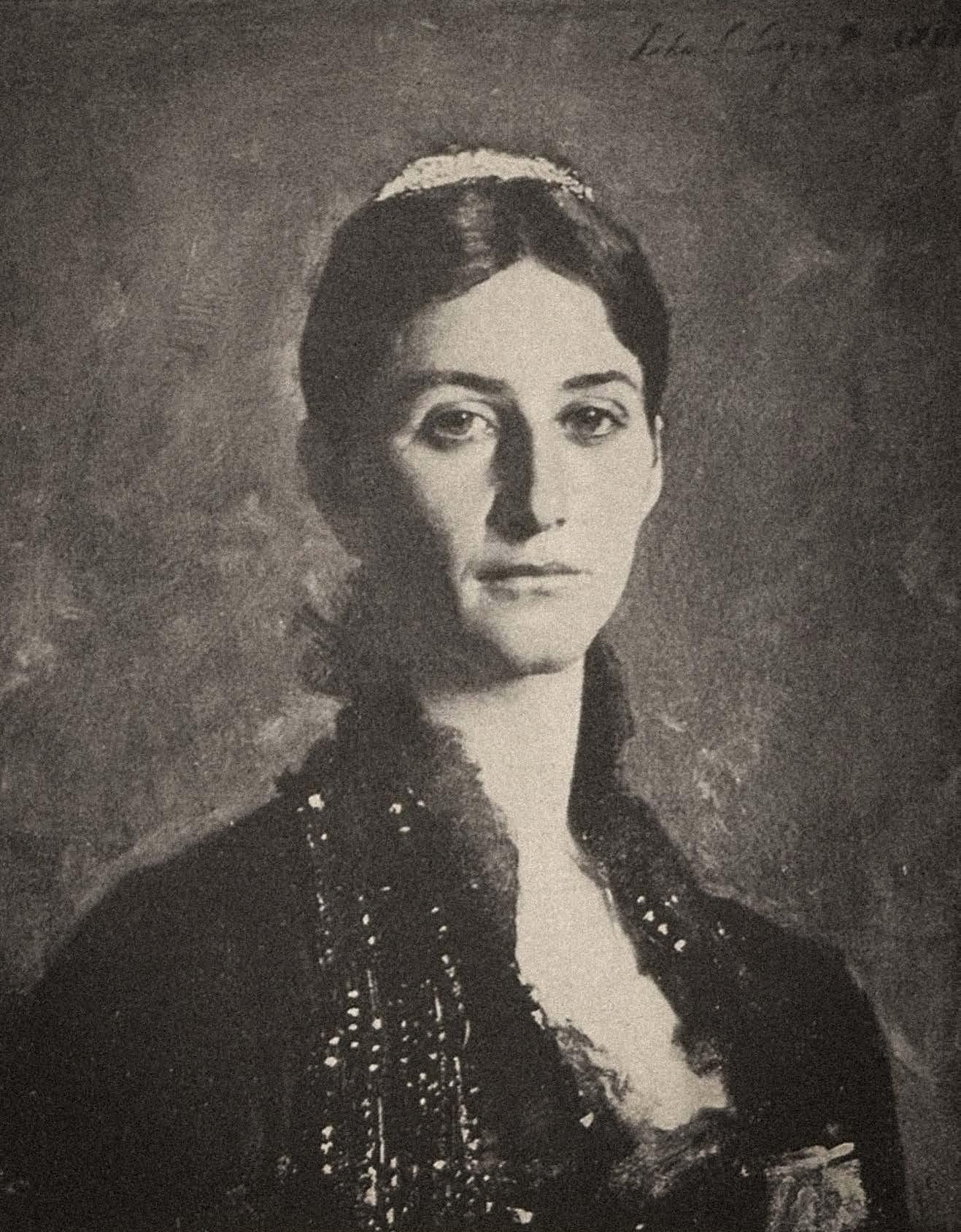
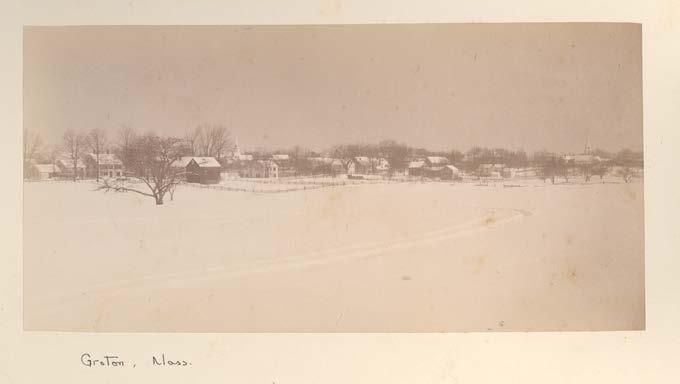
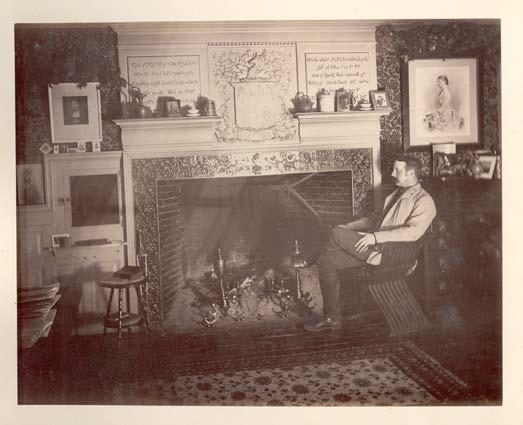
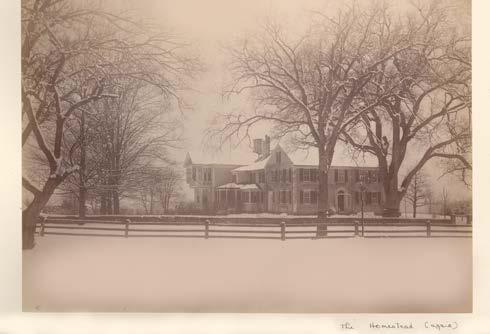
An album of Estelle’s photographs contains imagery dated around 1888, which was the same year Kodak revolutionized photography by making cameras accessible to the mass population. At a time when photography was at its infancy, Estelle was one of the first to use the camera as a tool for prosaic documentation. She took photographs of their family, their children, their livestock, their art (both James and Estelle’s had their portraits painted by John Singer Sargent) and their home. In addition to using her photographs for concert programs, two of her “Homestead” pictures are also included, and credited, in a book published in 1888: “Historical Sketches of Some Members of the Lawrence Family.”
To view more of Estelle’s photographs visit: groton.org/coed-at-50
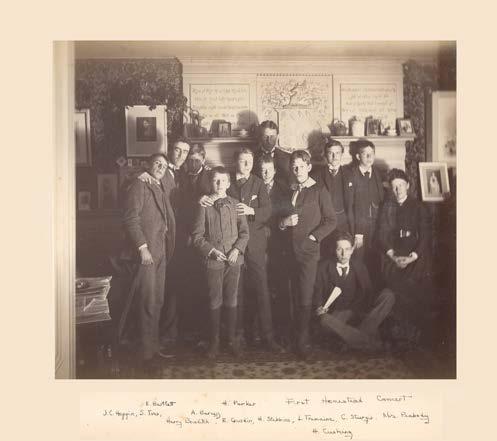
Turners Public Spirit, and was hosted by the Lawrences for twenty-five years between 1884 and 1909. A copy of the musical program for “The Homestead Concert” from 1892 is pasted in Fannie Peabody’s scrapbook. The program includes performances from Mrs. Lawrence herself, the Glee Club, the choir and orchestra, and an all-school rendition of the football song, “Glorious Groton.” The program is even illustrated with Estelle’s own photographs of the Homestead.
Their two sons, James 1896 and Richard 1898, both attended Groton School. James Jr. served on the Board of Trustees from founding until his death in 1914. Endicott Peabody himself presided over his funeral services, which were held at St. John’s Chapel.
Later that same year, as World War I unfolded, Richard volunteered with the Ambulance Corps before the U.S. even officially entered the war, and Estelle donated one of the vehicles that was driven in France, which was known as the “Mrs. James Lawrence Ambulance.”
After the war, Estelle was involved in the American Committee for Devastated France, which helped gather funds and volunteers to assist in rebuilding parts of France that were heavily damaged during
Top left: Groton students gather at the Lawrence Homestead for the annual winter concert
Middle: James Jr. at the Homestead, a portrait of Gertrude hangs in the top left corner
Top right: Exterior shots of the Lawrence Homestead were a recurrent subject of Estelle’s photographs
the fighting. Estelle took two severalmonths-long voyages to Europe for the cause, and she passed away shortly after returning from her second trip in 1921. Her obituary states she passed “while sleeping” after having “never been sick for a day, so far as her friends could recall.”
The American Committee for Devastated France held a movie showing as a memorial for her. A news posting stated “Since returning to this country she [Estelle] has arranged for this meeting at the Exeter Street Theater to show motion pictures of the region where the committee has been working. Following her death, members of the New England branch of the committee decided not to cancel plans for this meeting, but to give it as a memorial to her, free to all.”
Like her husband, Caroline Estelle Mudge Lawrence’s official funeral was also held at Groton School’s St. John’s Chapel, and co-officiated by Endicott Peabody.
Aside from being an early female photographer, an oft-uncredited donor of Groton School lands, and a lifelong humanitarian, Estelle spent her life as a trailblazer. L.S. Lawrence, a family historian, noted that “John [Lawrence, GS’1927] … t old stories of her chasing
intruders off the farm with a shotgun, and he repeatedly emphasized how athletic she was, which, given the attitudes of the era about women and physical fitness, was remarkable in its own right. All of which is simply to say, she really was ‘a force of nature’ and ahead of her time.”
Estelle Lawrence left behind stories, photographs, and an irreplaceable fingerprint on history. Though Groton School was formed by many hands, there is no doubt that the landscape she set forth helped lay the foundation for Endicott Peabody’s dreams and shape the Circle as we know it today.
A special thanks to those who helped with research, information, and image sourcing for this article; Doug Brown ’57 (archivist), John Donovan ’20 (research assistant), Barbara Dailey (transcription specialist), L.S. Lawrence (family historian and album digitizer), and Franz ColloredoMansfeld ’81, P’09, ’13, ’15, ’18 (photo album owner).
Unless otherwise noted, all photographs were taken by C. Estelle Lawrence and provided courtesy of L.S. Lawrence and Franz ColloredoMansfeld ’81, P’09, ’13, ’15, ’18.
In 1883, the Lawrence family donated the land to establish Groton School in honor of Gertrude Lawrence (Mrs. J.E. Peabody), the sister of James Jr. and Prescott Lawrence, and sister-in-law of Endicott Peabody.
The Groton School history book, Fifty Years On: Groton School 1884–1934 by Frank D. Ashburn 1921, confirms that “the gift was made in memory of the Lawrence brothers’ sister, Gertrude Lawrence, who was the wife of Endicott Peabody’s eldest brother, John Endicott Peabody.”
William Amory Gardner’s Groton Myths and Memories adds that the “piece of land containing about 100 acres … given by James Jr. and Prescott Lawrence in memory of their sister, Mrs. J. E. Peabody,… had been a favorite spot.”
Several years later, in 1887, James Jr. also donated the chapel’s baptismal font in memory of his sister. Though it originally resided in the old chapel, it was moved to the current St. John’s Chapel after its construction, and the inscription can still be seen on the font today.
Gertrude was born in Boston in 1855. She spent at least part of her early adulthood in England, caring for her father until his passing in 1875. Family speculation indicates that she may have met John Endicott Peabody there, while he was studying at Trinity College in Cambridge.
At the age of 23, Gertrude married John on June 15, 1878. They were married in Boston by Phillips Brooks, who later became a founding trustee of Groton School, where they continued to reside. The couple had two children together, Harold and Marion Lee.
Tragically, only five years later—on May 2, 1883—Gertrude died unexpectedly.
The following day, Fannie Peabody wrote in her diary about the news: “How can I write the dark news of today; This morning while practicing Mama rushed downstairs with the dreadful, dreadful news of Gertrude’s death… The Spring is
hardly the time for the young to die, + yet as Mama says looking at it the other way, it is, for do not they begin to live, with the flowers.”
Endicott, Fannie, and many other family members attended the funeral, which Fannie details in her diary over the following days.
Endicott Peabody went to his brother as soon as he heard the news and stayed with him for several weeks. In a letter dated on May 8, Endicott wrote “my eldest brother’s wife died very suddenly last week. Her death was unexpected + a great shock to us all. I thought it best to remain with my brother during the first days after his bereavement + I have decided to go down to live with him until the remainder of May.” Endicott felt obliged to keep his brother’s spirits up during such trying times, and in a later letter confessed, “I must try, so far as in me lies, to brighten my poor brother’s dark lot.” Endicott frequently wrote of his brother’s grief and depression over the weeks he accompanied him, and felt the sadness for the loss deeply.
Not much else is known about Gertrude’s short life; she was rarely mentioned in the Lawrence family’s oral history. In fact, although it is written in several Groton history books, L.S. Lawrence was unaware of the land dedication until delving into specific research about his forgotten relative. In the blog post he wrote about Gertrude,
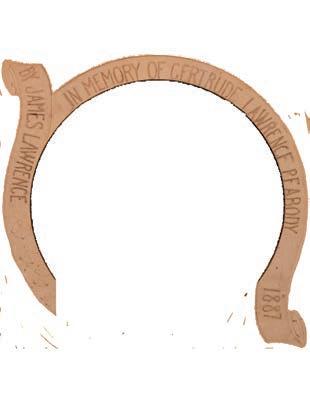
Above: The engraving on the baptismal font donated by James Lawrence Jr. in honor of his sister, designed into a banner around one of the only known portraits of Gertrude. The font still stands in St. John’s chapel today. Portrait provided courtesy of L.S. Lawrence.
he notes that the fact that “the gift of the land for the Groton School was actually in memory of Gertrude Peabody, was— despite the legions of Lawrences that have attended that school—never mentioned or discussed when I was growing up.”
Through the diligent investigations of kinsfolk and discoveries from the archives, Gertrude’s story has been further uncovered. Entries in Fannie’s diary and correspondences to and from Endicott (including a letter from Phillips Brooks dated May 21, 1883, expressing his sympathies) provide a look into the true sorrow that prevailed after her death, revealing that many mourned her tragic and unexpected passing.
Because of the important role she played in the dedication and establishment of Groton School, it is by remembering, resurfacing, and recounting her story that Gertrude’s legacy will continue to live on through history.
“How awful to be deprived of the person whom one most loves in all the world. Everything else seems so light in comparison.”
endicott peabody, in a may 23, 1883, letter after the passing of his sister- in - law
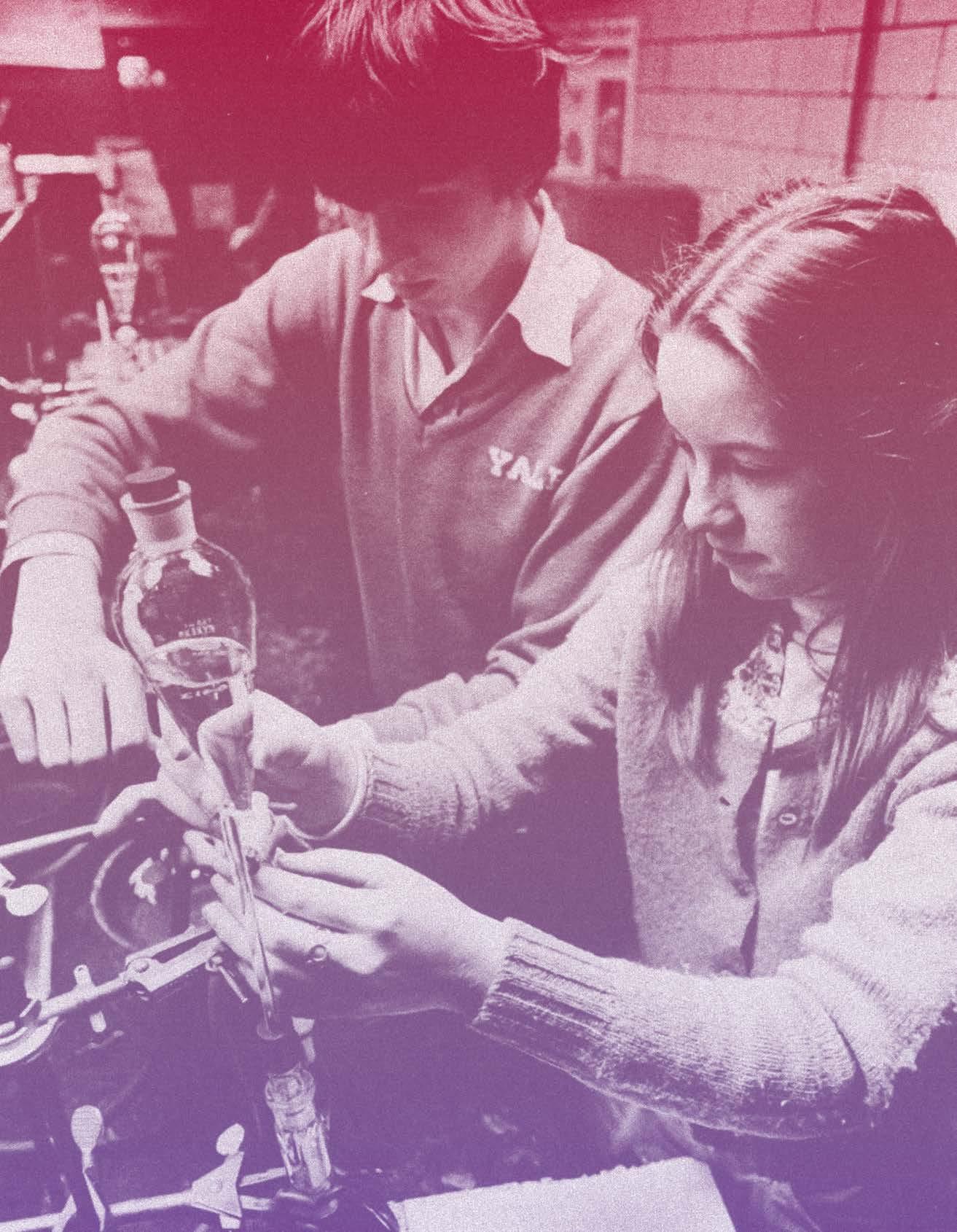
in september 1975 , Groton’s first female students passed through the Schoolhouse doors.
The matriculation of those forty-eight young women was the culmination of intense consideration, planning, and hard work by many in the Groton School community. Not satisfied with the tradition of a boarding school exclusively for boys, trustees and leaders endeavored to improve the school in a dynamic and deliberate sense. Women have been an integral part of Groton’s history from its beginning, and the female students, faculty, and administrators who arrived on the Circle as the school became coeducational brought energy, resilience, and an unwavering commitment to the success of the endeavor. Collectively, these architects and pioneers ushered in coeducation at Groton.
Since Groton’s founding in 1884, the ethos of inclusion and commitment to excellence have been defining throughlines. That openness, demonstrated in myriad ways throughout the school’s history, prepared the institution for that moment of change in 1975. Groton’s defining commitment to excellence ensured that, once adopted, coeducation would be successful.
The pages that follow feature a collection of dates, facts, people, objects, photos, and achievements—fifty in honor of coeducation’s fiftieth anniversary—to celebrate moments of inclusivity and excellence throughout Groton’s history. This collection is a mere sampling of the countless moments and people worthy of celebrating throughout Groton’s history.
Please visit groton.org/coed-at-50 to share your own memories and experiences, and to view more about the history and celebration of coeducation.
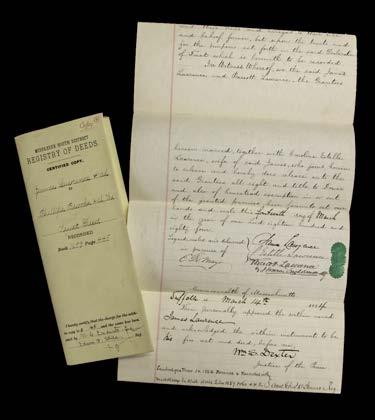
The land on which the Reverend Endicott Peabody founded Groton School was a ninety-acre parcel along Farmers Row, which, following his first visit to the site, he described as “a large plateau overlooking a glorious valley with great hills and mountains beyond.” The land was purchased in 1883 by James and Prescott Lawrence for the purpose of gifting it to found the school. James’ wife, Caroline Estelle Mudge Lawrence, was the driving force behind the donation, and she signed the deed (pictured) as an equal partner along with her husband and brother-in-law. Read more about Caroline Estelle Mudge Lawrence starting on page 16.
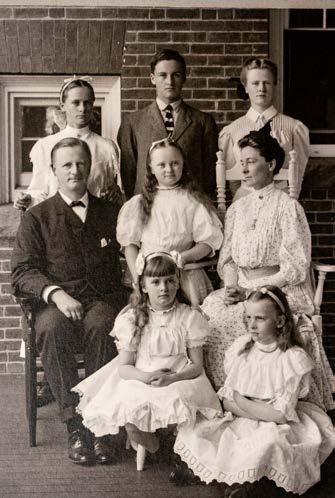
The Reverend Endicott Peabody founded Groton School in 1884. A year later he married Fannie Peabody, whose contributions were integral in the school’s early years. The Rev. Peabody would lead Groton for fifty-six years, in which he and Fannie would also raise their own family on the Circle, modeling his belief that “a school embodying the best characteristics of a family will create the optimal environment in which students can learn and grow.”
Pictured here: Endicott and Fannie with their children, and Brooks House, the first building to be constructed on the Circle.
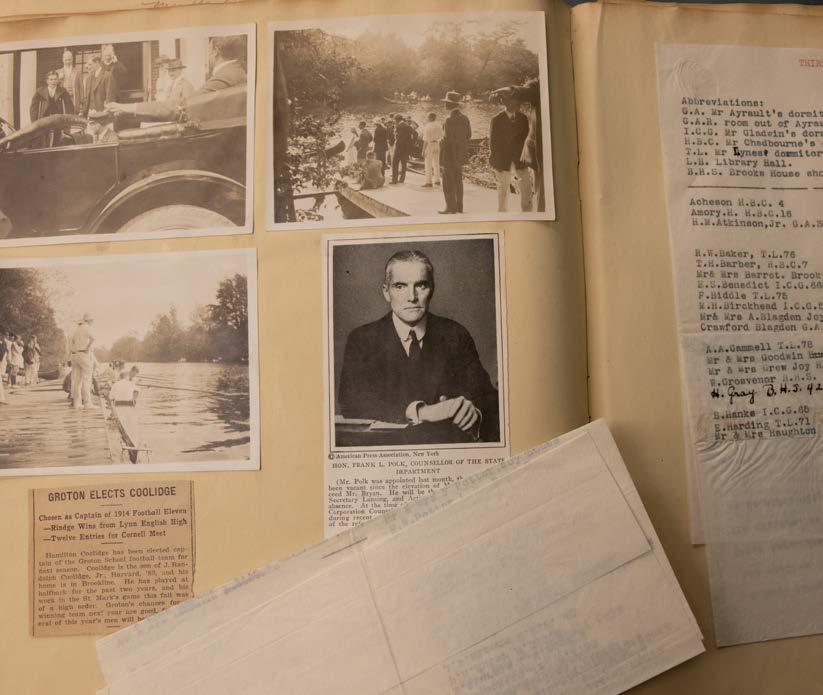
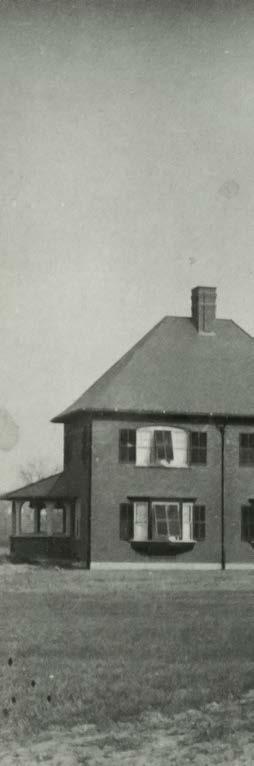
3

Fannie Peabody kept scrapbooks of Groton School since its founding. The multi-volume scrapbooks contain a plethora of memorabilia, from student cartoons and letters to newspaper clippings and brochures. The scrapbooks, along with Fannie’s diaries, are currently held in Groton’s archives, in Hundred House.
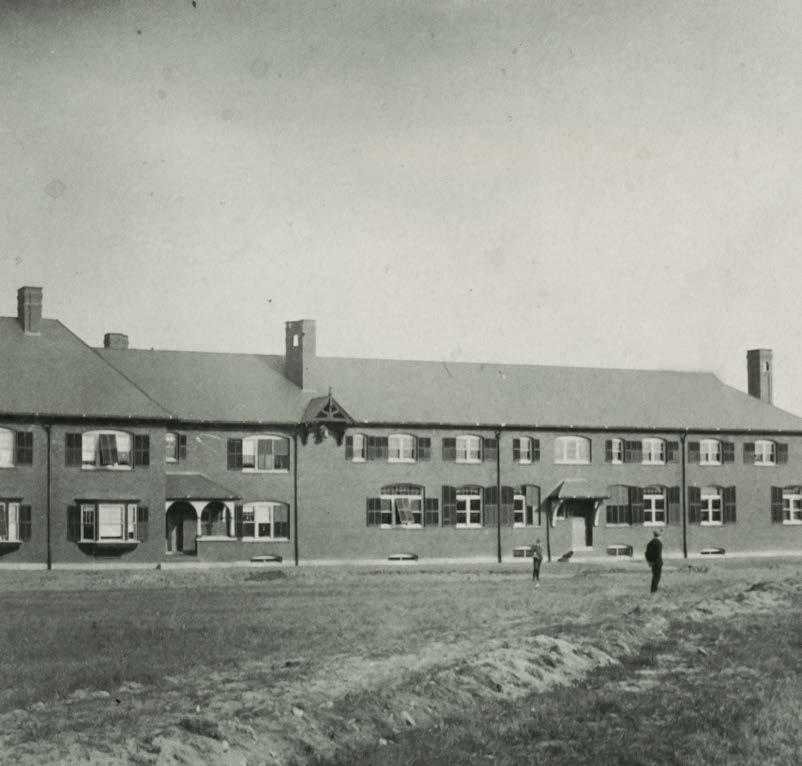
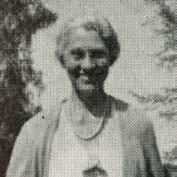
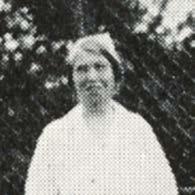
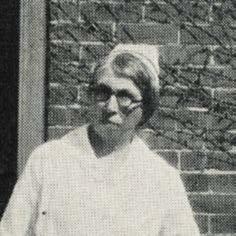
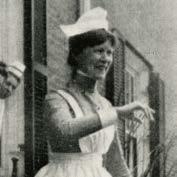
Four of the first women to work at Groton School were known as the “Saving Graces”: original head of domestic staff Mrs. MacMurray, her successor Miss Cram, head nurse Miss Burnett, and her successor Miss “Mither” MacLeod. Acosta “Corky” Nichols 1930 noted in his history of Groton School, Forty Years More, that Miss Cram was “reportedly the only person of whom Mr. Peabody had ever been afraid.”
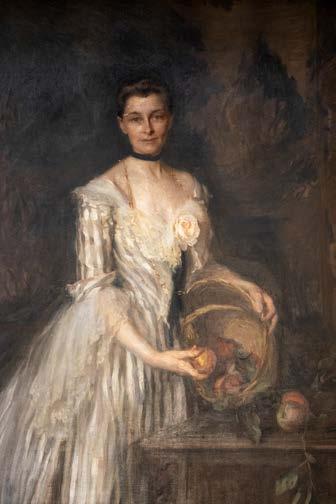
This portrait of Fannie Peabody was painted in the early 1900s by Lydia Field Emmet (1866–1952). Emmet was a prominent American portraitist of the time, and her portrait of First Lady Lou Henry Hoover still hangs at the White House. Emmet hailed from a family of artists, including her cousin, Ellen Emmet Rand, who would paint Fannie Peabody later in her life (see No. 9). This portrait currently hangs in the Schoolhouse, in the entryway between the Schoolroom and the Reading Room.
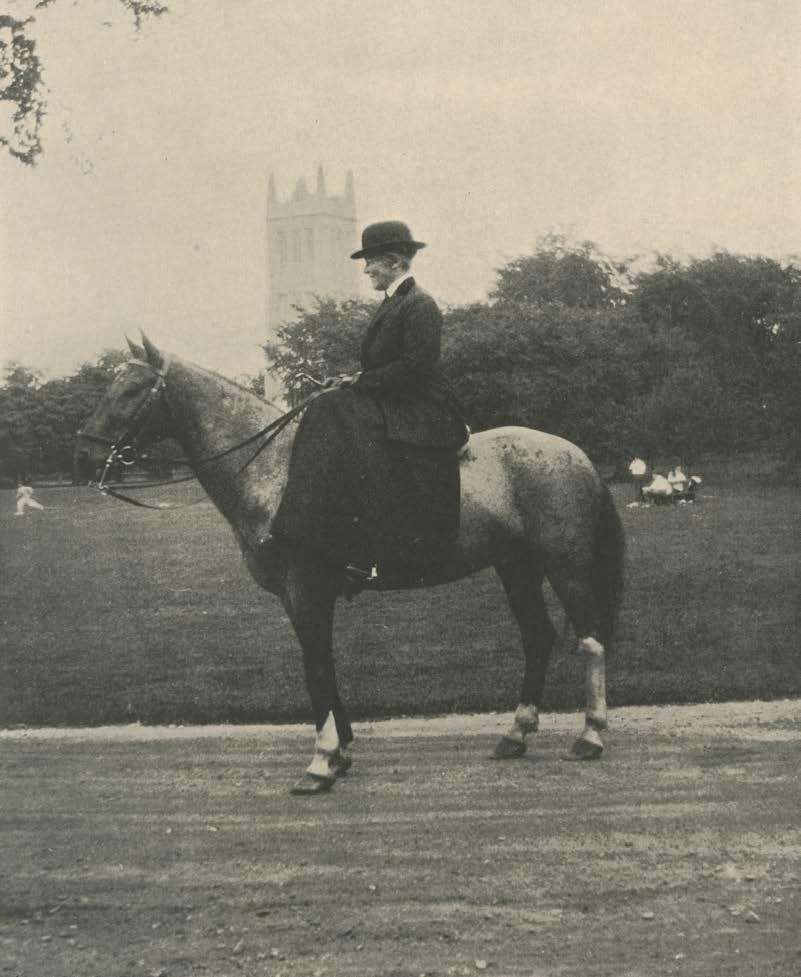
Before the invention of the automobile, the best way to travel around the Circle was by horse! Founder Endicott Peabody’s wife, Fannie Peabody, rides her horse with the Chapel in the background.
During the Great Depression of 1929, thanks to funds made available through a generous bequest, Groton School was able to offer financial aid to families who could no longer afford tuition.
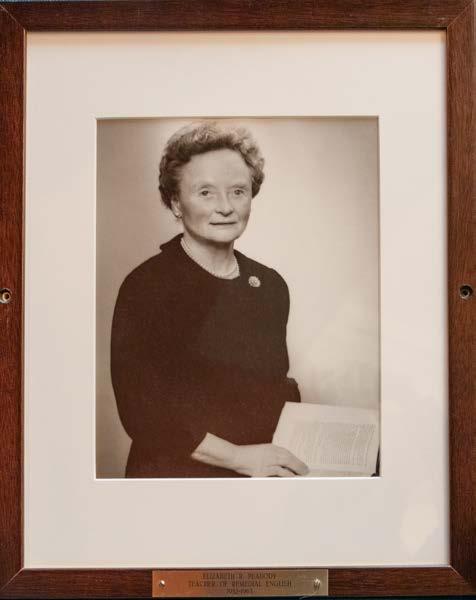
Groton’s first female teacher was Betsey Peabody, a daughter of Fannie and Endicott Peabody. She taught for more than thirty years at Groton, beginning with science in 1932 and later teaching English. Betsey also served as a member of the admission committee and helped formalize the advising program, but she is probably best known for the progressive remedial reading program that she spearheaded.
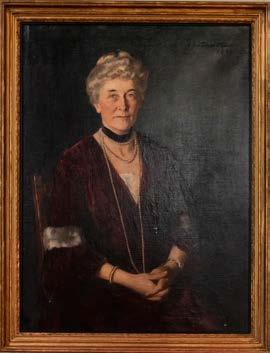
This portrait of Fannie Peabody was painted in 1936 by Ellen Emmet Rand (1875–1941), a prolific and renowned American portraitist. Despite the significant challenges female artists faced at that time, Rand achieved great success during her career and was the highest-paid woman artist of her time. Among the more than 500 portraits she reportedly painted in her lifetime were those of Groton’s founders Endicott Peabody, William Amory Gardner, and Sherrard Billings. She also painted the official presidential portrait of alumnus Franklin Delano Roosevelt 1900, Parent 1926, 1929, 1933, 1934.
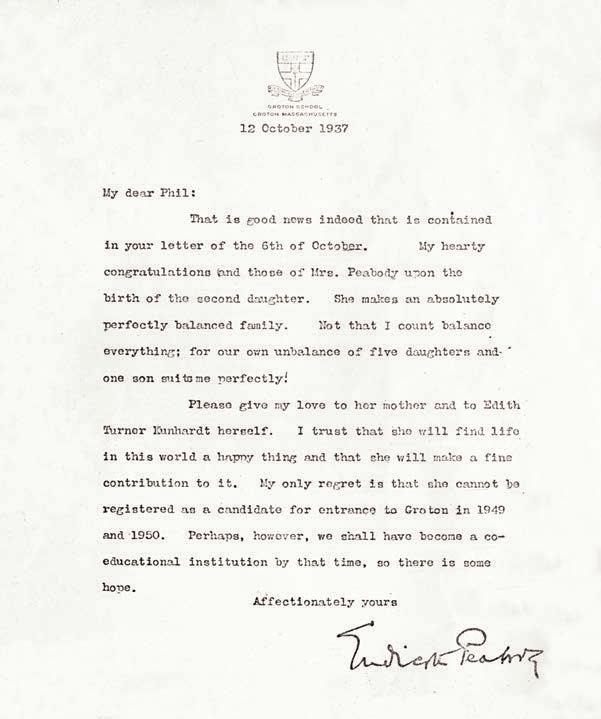
The Reverend Endicott Peabody envisioned a possible coeducational future for Groton School as early as 1937. From a letter written during Peabody’s time as headmaster, we know that he considered—and perhaps even hoped for—coeducation in Groton’s future. When Philip Kunhardt, a member of the Form of 1919, wrote to the headmaster announcing the birth of his second daughter, Peabody responded with hearty congratulations, adding, “My only regret is that she cannot be registered as a candidate for entrance to Groton in 1949 and 1950. Perhaps, however, we shall have become a co-educational institution by that time, so there is some hope.” While coeducation did not arrive soon enough for Kunhardt’s daughters to attend Groton, the first committee to consider coeducation followed just seven years later than Peabody predicted.
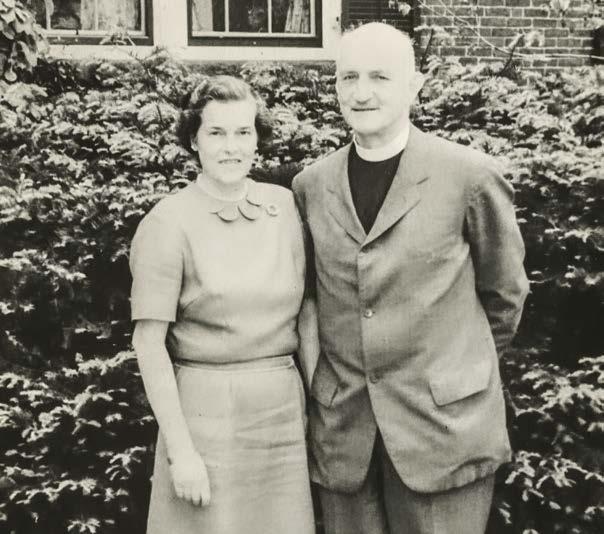
In 1940, the Peabodys retire after fifty-six years. The Reverend John Crocker (Groton Form of 1918) is named Groton School’s second headmaster, joined by his wife, Mary Crocker. Headmaster Crocker oversaw the admission of Groton’s first Black student in 1952.
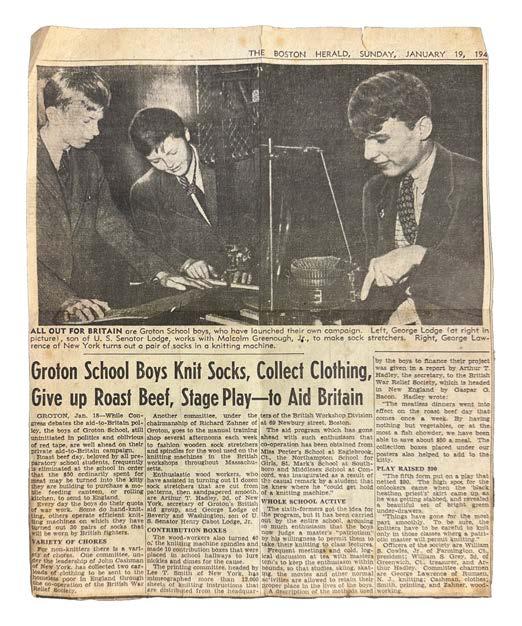
At the start of the United States’ involvement in World War II, Groton students established the Groton British Relief Fund to aid the war effort. Faculty wives Mrs. Nash and Mrs. Richards taught the students to knit wool socks by hand and machine, and they sent more than 250 pairs to British soldiers. The Groton British Relief Fund was featured in this Boston Herald article from January 19, 1941.
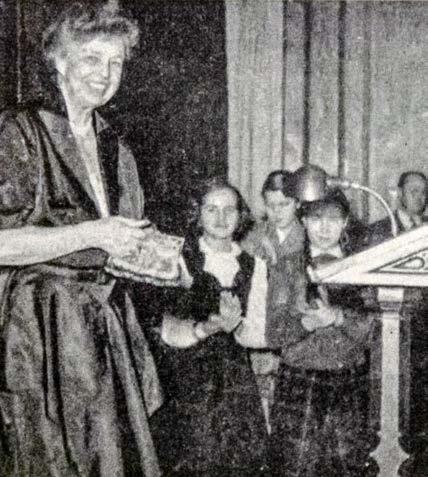
Eleanor Roosevelt (Parent 1926, 1929, 1933, 1934) delivered a speech in the Hall (now the library) in 1941, a year after the United Nations adopted the Universal Declaration of Human Rights, which she had spearheaded as chair of the UN Commission on Human Rights. In her remarks, Mrs. Roosevelt shared stories from her life, from the White House, and from the UN, and she encouraged the boys to recognize that language shapes who is included in the promise of universal rights—and who is left out. Raising a question about the wording of Article One, she said: “Now, why do you suppose we said ‘all human beings [are born free and equal in dignity and rights]’ instead of ‘all men [are created equal]?’ We thought all men meant everyone in the United States, didn’t we?”
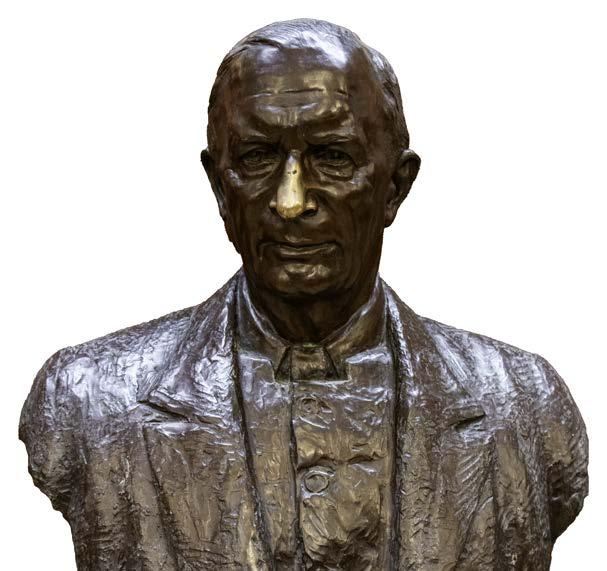
This bronze bust of founder Endicott Peabody was sculpted and cast by artist Malvina Hoffman (1885–1966). Hoffman had a very successful career that included membership in the National Sculpture Society and publishing a book on casting techniques. She often cast her own work, which was uncommon for women at the time. This bust now stands in the Schoolhouse entryway space, between the Schoolroom and the Reading Room, just below the portrait in No. 5. Legend has it that rubbing the sculpture’s nose brings good luck.
As early as 1957, Groton was considering formal ways to include girls in the school community. Headmaster John Crocker convened a special committee, also referred to as a development committee, to consider the possibility of establishing a sister school in close proximity. One location that was considered was the old golf course.
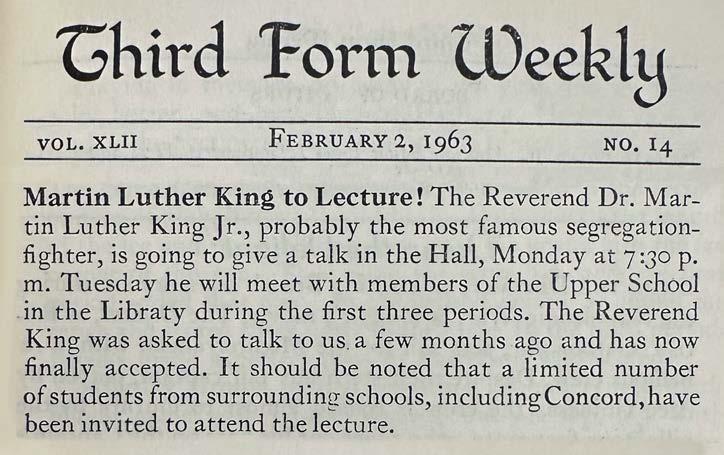
Headmaster John Crocker invited the Reverend Dr. Martin Luther King Jr. to speak at Groton, and the civil rights leader spent two days on campus in 1963, staying as a guest in the Headmaster’s House. His speech, titled “The American Dream,” urged the students to recognize that “America is essentially a dream—a dream yet unfulfilled.” Six months later, during the March on Washington, he would deliver his “I Have a Dream” speech. Themes and a few key phrases overlap between the Groton speech and the “I Have a Dream” speech.
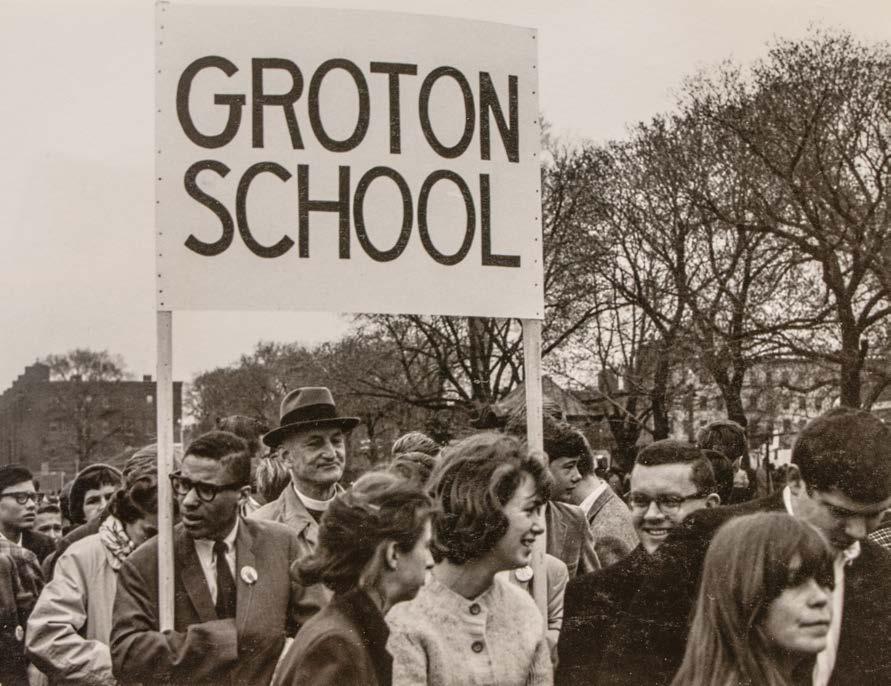
Headmaster John Crocker took Groton boys to march with Dr. Martin Luther King Jr. in 1965. The Rev. Crocker is remembered as a headmaster who instilled a deep understanding of civil rights and social justice through his sermons and his actions.
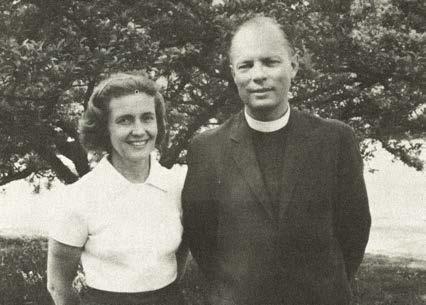
The Reverend Bertrand N. Honea Jr. is named Groton School’s third headmaster in 1965, and he is joined on the Circle by his wife Patricia. Headmaster Honea contemplated merging with an existing all-girls school as a path to coeducation, but no viable partnerships were identified and coeducation would not be fully considered for another six years.
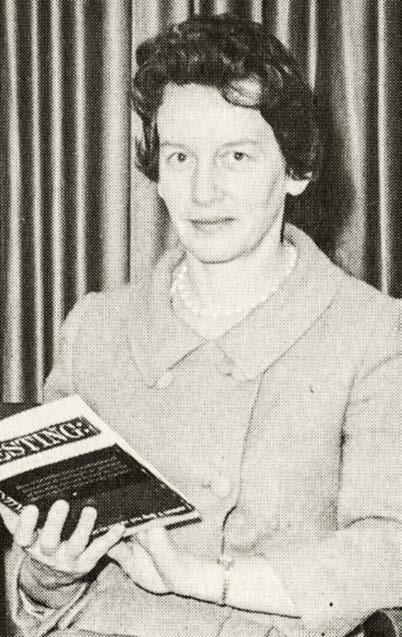
Beginning in the mid-1960s, a number of female educators taught on the Circle: English Teachers Margaret Wright (pictured) and Natica Satterthwaite; German Teachers Anna Konstantinow and Cecily Wilson; Latin Teacher Doris Coryell; and French Teacher Monique Rasetti.
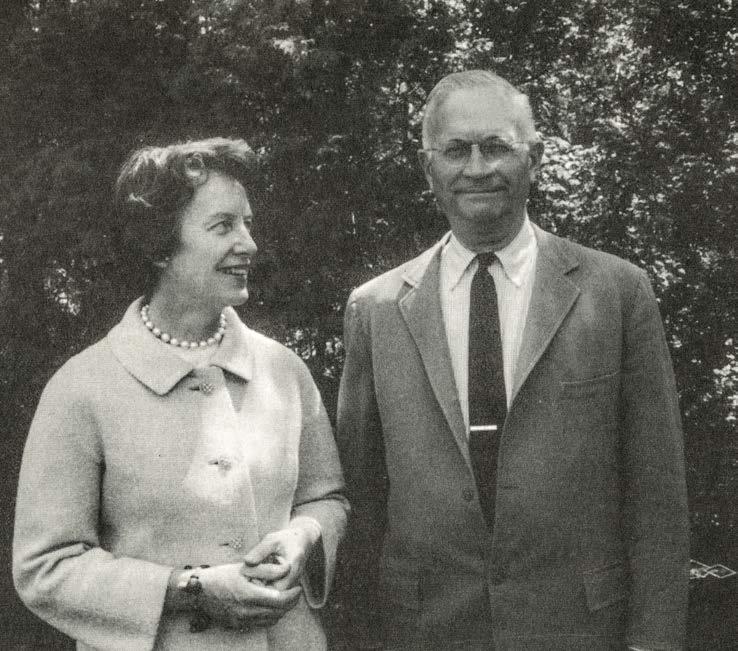
Paul Wright is named Groton School’s fourth headmaster in 1969, joined by his wife, Margaret Wright. Headmaster Wright and the Board of Trustees convened the Committee on Coeducation to consider admitting girls outright, and this committee would ultimately recommend that Groton adopt coeducation.
In 1970, following the formation of the Committee on Coeducation, the school solicited feedback from community stakeholders about the prospect of admitting girls to Groton. The Committee sent out 2,500 questionnaires titled “Girls at Groton??” to alumni, parents, faculty, and students. The survey included eighteen questions regarding the possible positive and negative effects of becoming coeducational. The results from the 1,183 responses received were as follows: 50.3 percent were in favor of coeducation, 41.7 percent were opposed, the remaining 8 percent were neutral or did not provide an opinion. Recent graduates tended to more highly favor coeducation, where those graduating before 1931 were more likely to be opposed. The majority of faculty favored coeducation, in a five-to-three margin. One hundred percent of the current students who responded were in favor.

In 1971, the Committee on Coeducation formally recommends that Groton begin the process of becoming coeducational. The Board of Trustees approves the committee’s recommendation and the course is officially set toward coeducation. A year later in 1972, amid alumni pushback, the board unanimously reaffirms its approval of the committee’s recommendation.

In anticipation of admitting girls in the near future, Groton begins intentionally seeking out and hiring female faculty, starting with English Teacher Pamela Clarke (pictured), who was integral to the success of early coeducation. Although there had previously been female teachers at Groton, Clarke was hired onto the faculty in 1972 without a preexisting connection to the school and with the express intention of increasing a female presence on the faculty.
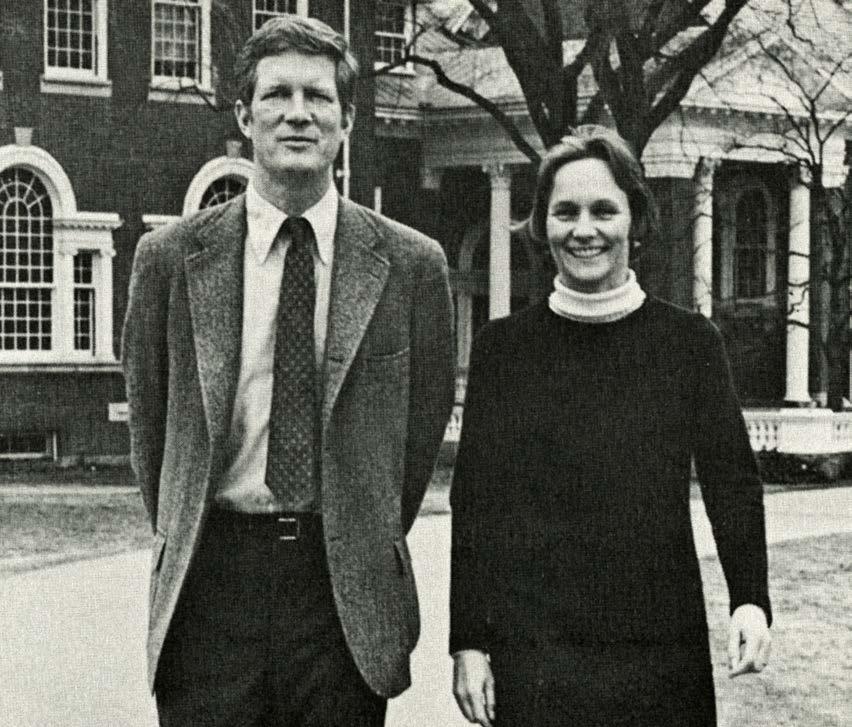
The Coeducation Committee established under Headmaster Cox included: Mr. and Mrs. Cox; Margaret Wright; Phyllis Collins P’75, ’78, GP’99, Trustee 1972–82; Margaret Johnson, Trustee 1972–90; Pamela Clarke; and Charles Alexander P’79, ’84, ’87, GP’10, ’14, ’16. The group met throughout 1974 “to review certain aspects of the School in light of the coming of girls,” and considered plans to ensure the transition to coeducation ran as smoothly and equitably as possible. Working together to identify and examine potential concerns, they explored solutions for solidifying admission policies (such as enrollment targets and scholarships), athletics accessibility, female faculty and counselor ratios, and school regulations regarding residential supervision.
In 1973, the Reverend J. Rowland Cox is named Groton School’s fifth headmaster and oversees the early transition to coeducation along with his wife Mary Cox. During his tenure, the Board of Trustees approves a multimillion-dollar fundraising initiative to support the renovation and building projects associated with coeducation.
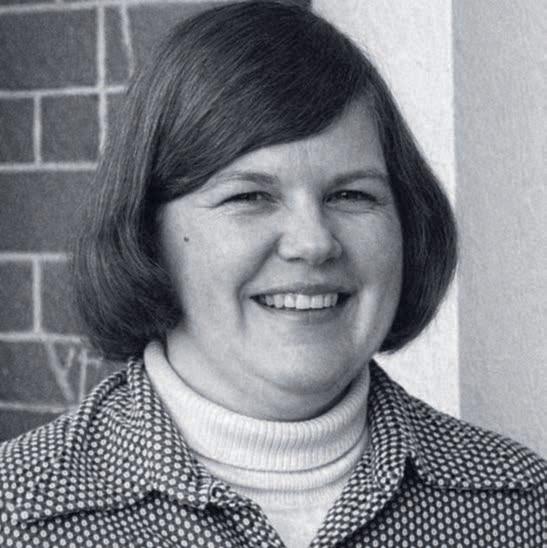
Groton School appoints the Reverend Ann Tottenham as its first female dean. The Rev. Tottenham not only taught Sacred Studies and English, but she also served as an admission officer. She was heavily involved in working out the practicalities of coeducation and greatly responsible for its early successes.
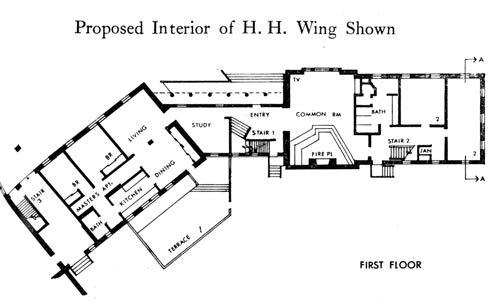
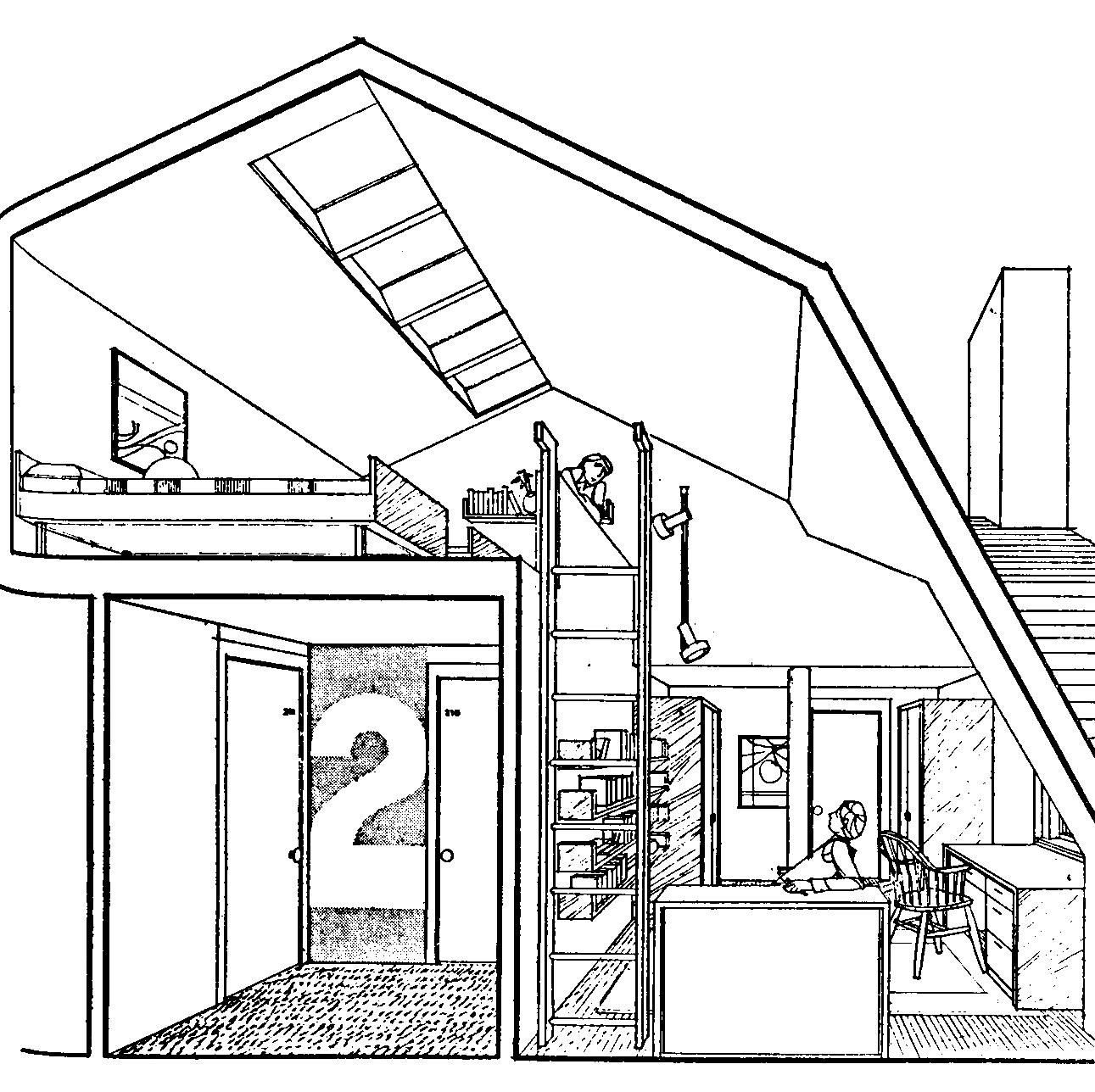
Necessary renovations in Hundred House are completed in 1974, in advance of the arrival of girls, with former staff quarters and infirmary space transformed into girls’ dormitories. This architectural drawing of the renovations, which were overseen by the Architects Collaborative of Cambridge, MA, depicts the new living spaces that featured sleeping lofts and room for studying and gathering below.
Welcoming the first female students to the Circle required significant effort by the entire community, and the women and men of Groton’s staff worked tirelessly behind the scenes to make sure everything ran smoothly.
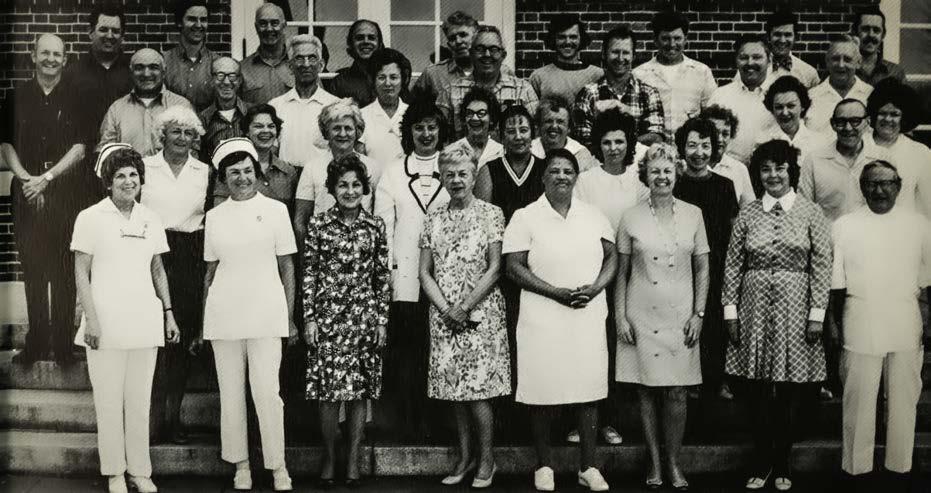
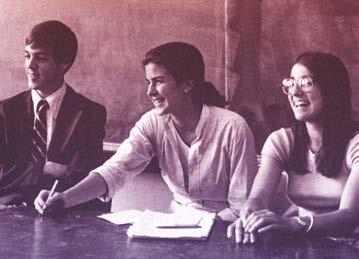
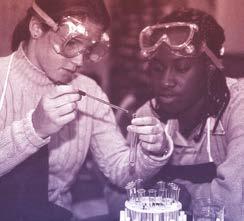
Although only forty-eight girls matriculated at Groton during that first year of coeducation, the positive impact of their presence was felt across the Circle as they integrated into every area of life at Groton.
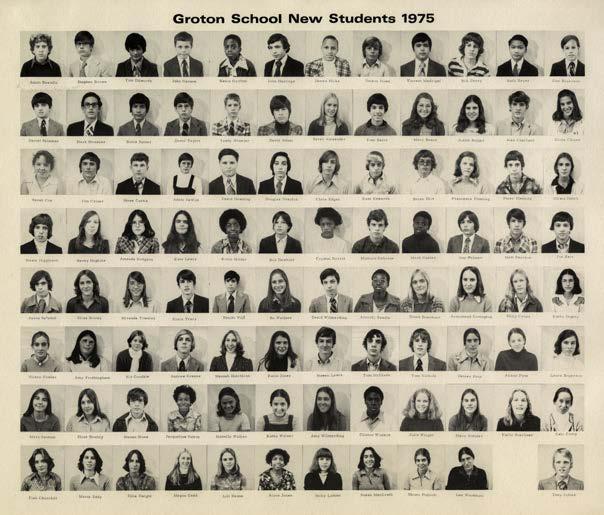
Girls arrive on campus in the fall of 1975, matriculating as members of the Third, Fourth, and Fifth Forms. This board features the faces of all new students joining Groton for the 1975–76 school year. Boards like this were used to create composite class images before digital editing, and many similar boards exist in the school’s archives.
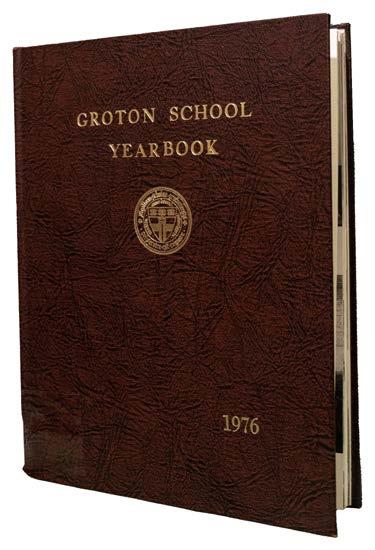
Groton School’s first yearbook was published in 1916, and sixty years later, the 1976 yearbook was the first to feature female students. Visit groton.org/coed-at-50 to view digitized yearbook excerpts from coeducation’s early years.
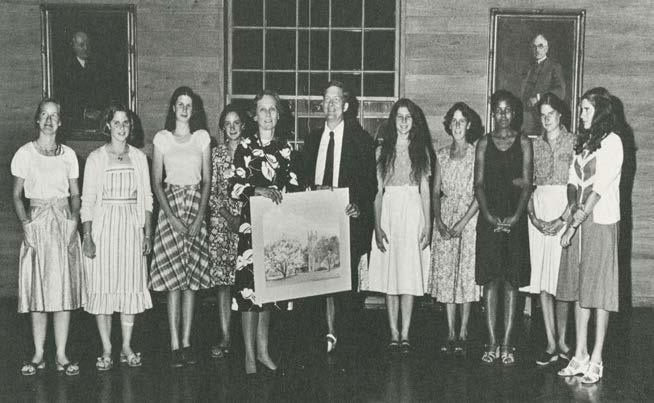
The girls of the Form of 1977, the first girls to graduate from Groton, presented Headmaster Cox and Mrs. Cox a painting by Camila Churchill P’67, ’69, ’77 on the eve of their Prize Day. From left to right: Catie Camp, Lili Hanna, Maria Eddy, Tish Churchill, Mrs. Cox, the Rev. Cox, Naomi Pollock, Ellie Dwight, Alyce Jones, Mary Atwater, and Lee Woodsum.
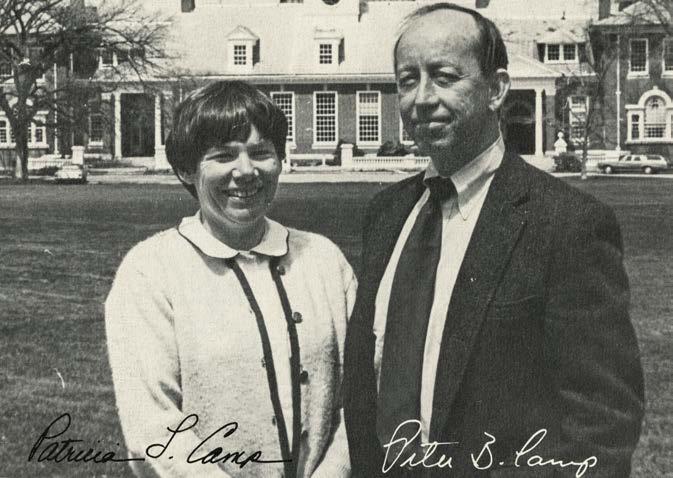
Peter B. Camp, joined by his wife, Patricia Camp, steps up to serve as acting headmaster during the 1977–78 school year, following the untimely passing of Headmaster Rowland Cox. Mr. Camp’s daughter Catie was among the first girls to graduate with the Form of 1977, and his son Bill graduated with the Form of 1982. Mr. Camp was a longtime and beloved member of Groton’s faculty, and in 2012 a chair was named in his memory in honor of his “inspiration to Groton students, his devotion to the school, his gracious and caring nature, and his sense of humor.”
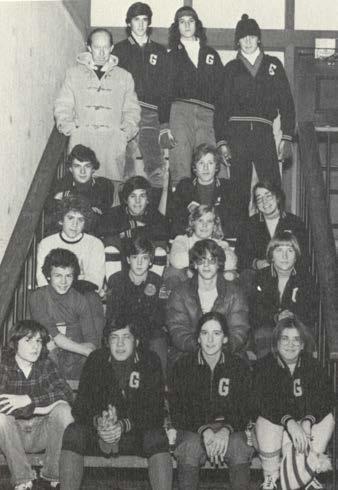
While the arrival of coeducation brought along with it coed intramural athletic opportunities, like softball, the first competitive coed team to be pictured in the yearbook was cross country skiing in 1978. The team was led by Mr. Camp, who continued to coach while serving as acting headmaster.
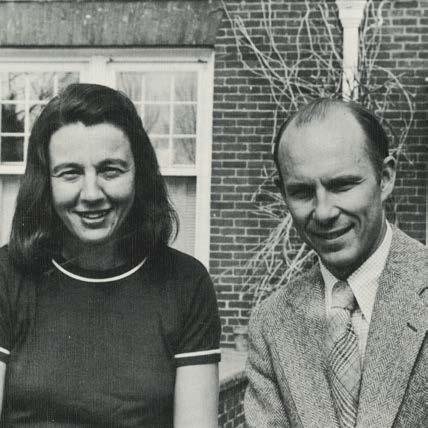
William M. Polk ’58 is named Groton School’s sixth headmaster, joined by his wife LuAnn Polk. Headmaster Polk was a member of the 1971 Committee on Coeducation and an early drafter of the proposal for the school to admit girls. During Headmaster Polk’s twenty-five year tenure, he and Mrs. Polk would lead Groton through the early years of coeducation and the celebration of its twenty-fifth anniversary. In 2002, the LuAnn S. Polk Coeducation Chair was established to recognize her twenty-five years of service to the school and her commitment to coeducation.
In 1979, Headmaster Bill Polk called for a study into the potential implementation of intervisitation, or “intervis.” Two psychologists conducted a six-month study of Groton’s social system, and the resulting report was circulated to the faculty and students. Mr. Polk granted intervis experimentally in 1980, and it went on to be fully codified during the next school year.
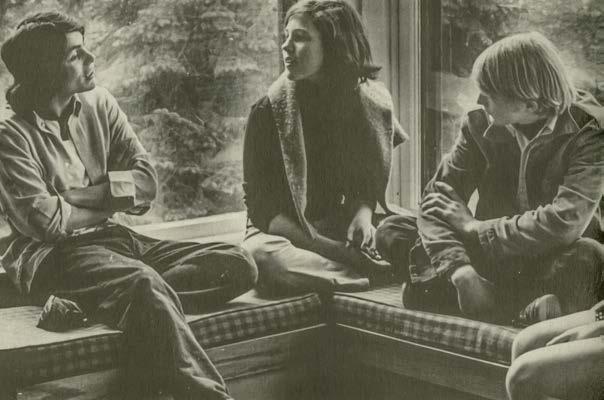
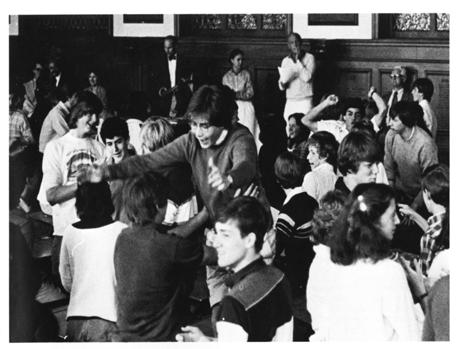
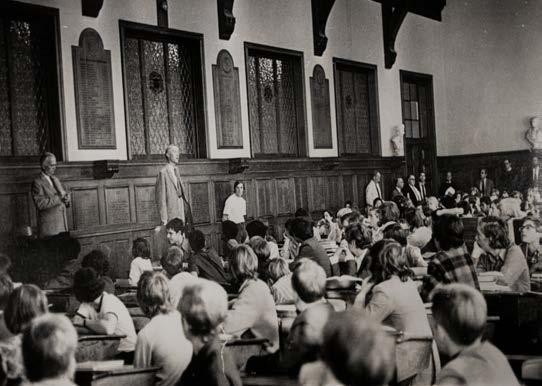
Early concerns that coeducation would change the fundamental culture of the school quickly proved unfounded. Community traditions remained strong and benefited from the addition of female students, including regular gatherings like Roll Call (pictured here in the early seventies and mid eighties, respectively).
In 1984, the school formed several new coeducation committees: one main committee and several sub-committees covering Academic, Athletics, Social, and General categories. The committee sent out a survey to faculty and the student body to solicit opinions on how coeducation had transitioned over the previous decade. The consensus found that coeducation was generally successful, but there were still some discrepancies in ratios, notably in women coaching varsity sports.
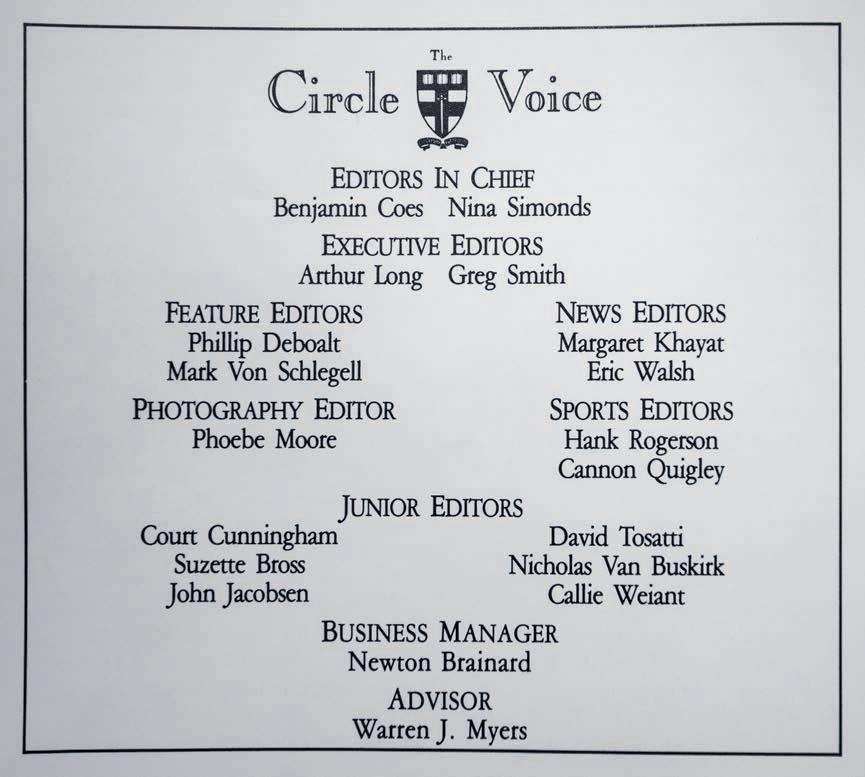
In 1984, Nina Simonds (Trowbridge) ’85, P’22, ’23 became the first female student to serve as editor-in-chief of the Groton student newspaper, the Circle Voice.
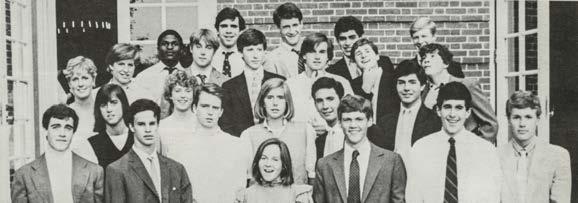
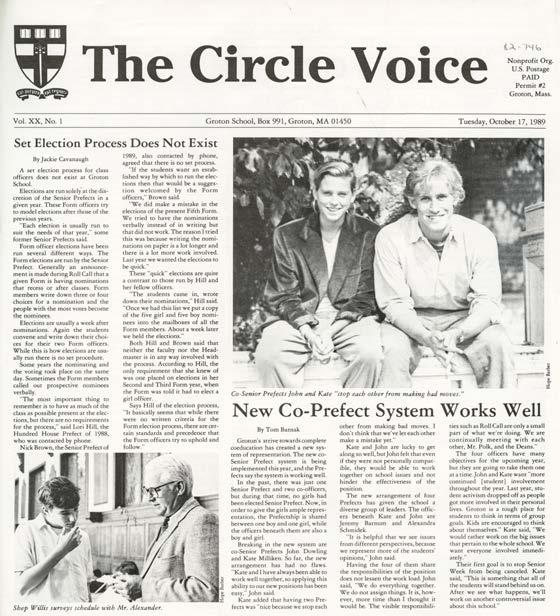
In 1989, the school adopted a new model for electing senior prefects, ensuring representation by both male and female leaders each year moving forward.
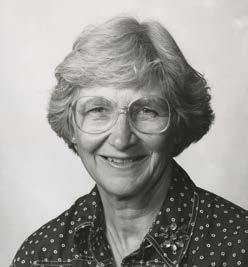
In 1995, Groton School commissioned a documentary for the twentieth anniversary of coeducation, produced and directed by Amy Cunningham ’79 and Lynn Piasecki ’79. In the film, faculty, alumni, current students, and other community members shared their reflections on the early years of coeducation. Clips from this documentary can be viewed at groton.org/coed-at-50.
Groton hired Mary Drinker (Gooch) to serve as the school’s first female assistant head of school in 1990. Among her many contributions during her tenure, Ms. Drinker would advocate for updating the school’s physical environment so the spaces were more reflective of, and welcoming for, the entire community.

Richard B. Commons is named Groton School’s seventh headmaster in 2003, and he is joined on the Circle by his wife Lindsay Commons. Among the many accomplishments during his tenure, Headmaster Commons oversaw the initiation of a policy waiving tuition for families earning less than $75,000 per year.
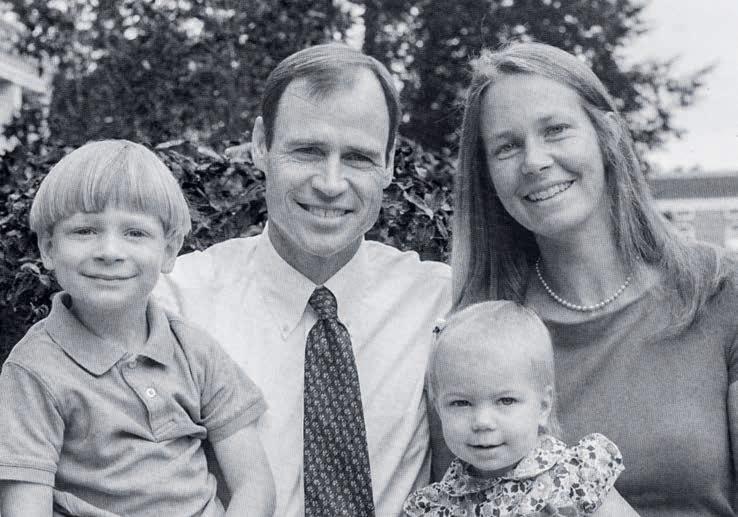
The ratio of female and male students reaches parity in 2004 and this balance remains today.
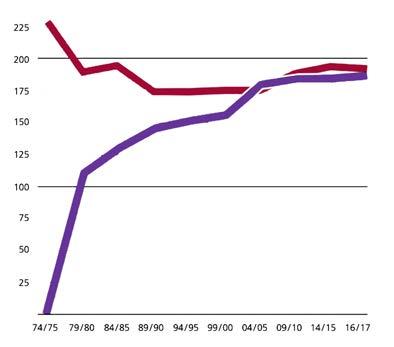
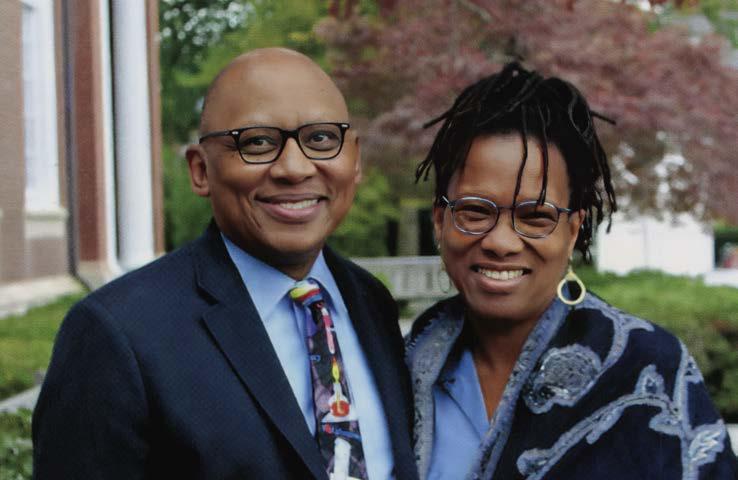
In 2013, Temba T. Maqubela is named Groton School’s eighth headmaster, and is joined on the Circle by his wife Vuyelwa Maqubela. Headmaster Maqubela and Mrs. Maqubela join the science and English teaching faculty, respectively. In 2014, the Maqubelas introduced the GRoton Affordability and INclusion (GRAIN) initiative, which is unanimously endorsed by the board and makes affordability and inclusion the school’s top strategic and fundraising priority. The GRAIN initiative has raised more than $103 million to date for financial aid and tuition cost containment. In 2025, thanks to GRAIN’s success, Headmaster Maqubela expanded the availability of tuition waiver from families earning less than $75,000 per year to those earning less than $150,000 per year.
“The
Upon the celebration of the fortieth anniversary of the graduation of the Form of 1977, the first to graduate girls, the Quarterly featured an article entitled “The Girls of ’77” written by Naomi Pollock ’77. Visit groton.org/coed-at-50 to view this and other related Quarterly features.

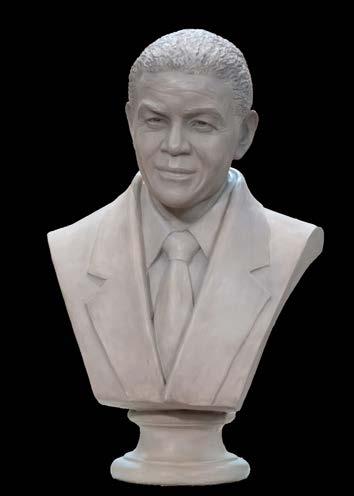

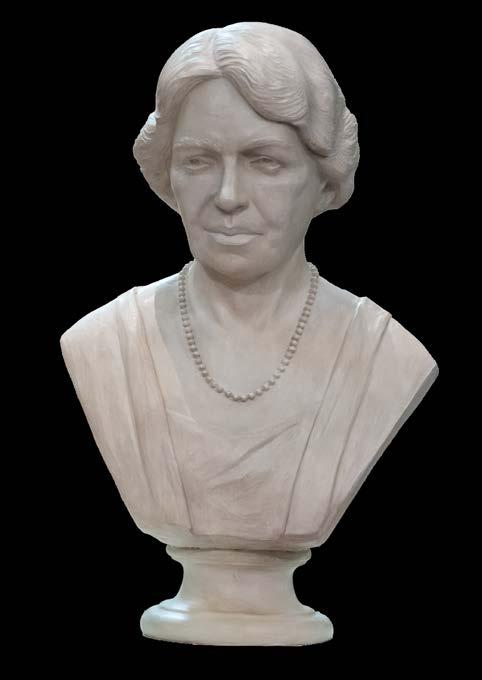
Groton’s iconic Schoolroom features a pantheon of sculptural busts first installed in the early 1900s. The original collection included historical figures such as Socrates, Shakespeare, Goethe, and George Washington, to name a few, but no women or persons of color. In 2018, Lucy Chatfield ’18, Josie Fulton ’18, and Layla McDermott ’18 advocated to Headmaster Temba Maqubela for gender and racial diversity to be added to Groton’s Schoolroom. The Board of Trustees approved their suggestion and, in 2021, the busts of Rosa Parks, Eleanor Roosevelt, Mahatma Gandhi, and Nelson Mandela joined the existing pantheon, providing new role models to inspire generations of students to come.
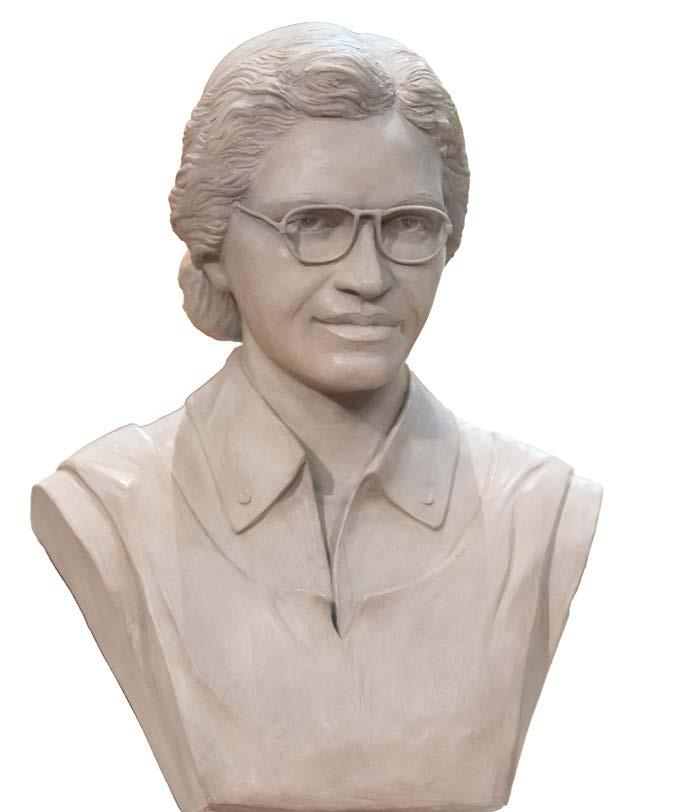
In 2021, Groton School’s Board of Trustees unanimously adopted Strategic Framework 2030 (SF2030). Grounded in continuing the investments and successes of the Groton Affordability and Inclusion initiative, SF2030 seeks to strive further, beyond a diverse and inclusive community to a community centered on belonging. SF2030 was the culmination of a process that began in 2019 and incorporated feedback from every part of the Groton community. The framework outlines the efforts and goals that will foster even greater levels of character, scholarship, leadership, and service within the community, strengthening the school and its mission.
In 2023, Anne Mosle ’83 received the Distinguished Grotonian award for her work as a leader in building pathways for low-income children, women, and families through her work at the Aspen Institute. Ms. Mosle is the first woman to receive the Distinguished Grotonian award, which recognizes graduates whose lives of highly distinguished service reflect the essential values of the school.
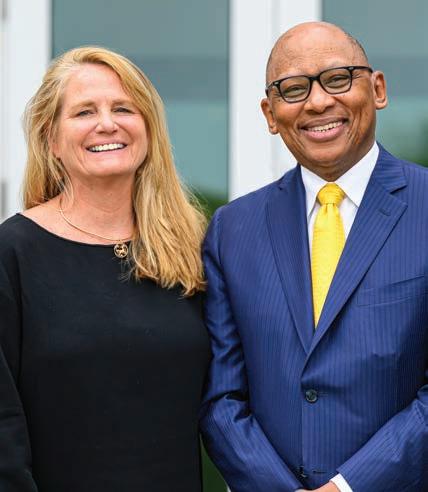
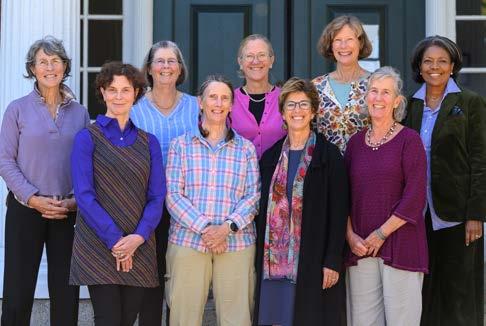
Groton School’s year-long celebration of the fiftieth anniversary of coeducation kicked off on Saturday, September 20, 2025. Alumni, faculty, students, and friends of Groton School gathered on the Circle for a day filled with panels, reflections, stories, athletic competition, and celebration. Visit groton.org/coed-at-50 for highlights from the celebration and much more!
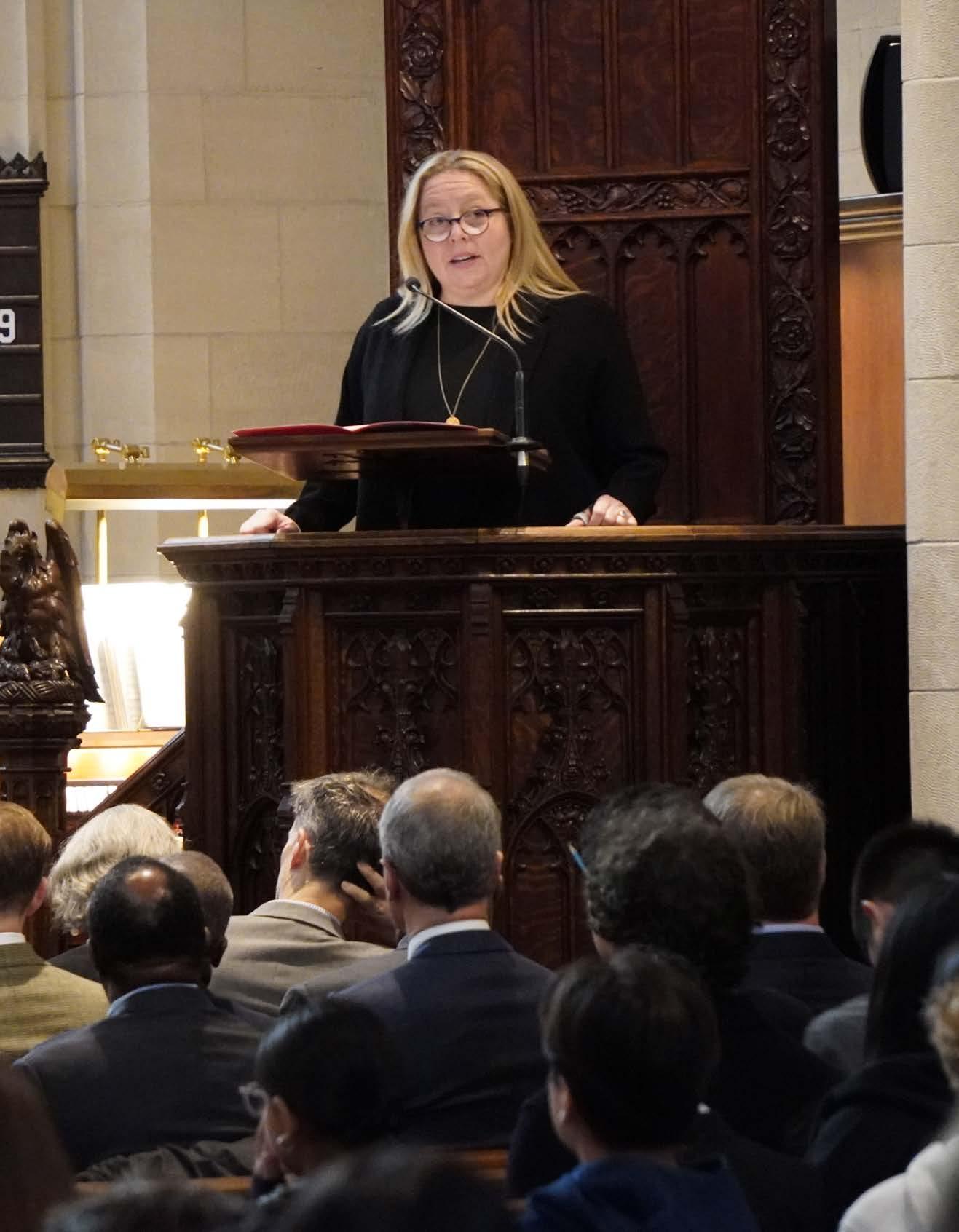
By Merrill Stubbs Dorman ’95, TR’19–
November 7, 2025
Good morning!
I never gave a chapel talk when I was at Groton. Back then, only a handful of Sixth Formers—and maybe one very confident Fifth Former—gave a chapel talk each year. I’ve heard that now nearly 75 percent of Sixth Formers do. You all are much braver than I was. When I was 17, the idea of standing up here—in this beautiful, slightly intimidating space—and sharing something personal with the entire school was completely terrifying. I worried so much about what people would think. What if I came across as immature, or self-absorbed, or worst of all, boring? These were the people whose opinions I cared about most—my friends, my classmates, my teachers—and the thought of opening up felt a little like stepping off a cliff.
So when Headmaster Maqubela asked me to speak today, I felt deeply honored—and for a brief moment, absolutely petrified. I was suddenly transported back to my 17-year-old self, with all the same fears washing over me. Then I remembered: I’m turning 49 in a few weeks!
One perk of getting older—besides shopping for cool reading glasses and testing thumb braces for the arthritis in my left hand—is realizing you don’t have to live according to other people’s expectations. (I’ve also learned not to be too intimidated by a room full of teenagers at this point—you’re far more forgiving than I once gave you credit for.)
When we’re young, we spend a lot of time and energy worrying about how others see us. But as we age, we start to realize how freeing it is to care less about what others think and more about what actually feels right. That shift is what gave me the courage to stand here today.
Once I got over the initial shock of being asked to speak and started thinking about what to say, one idea kept nudging all the others aside. So today I’m going to talk about the magic of community.
The Oxford English Dictionary offers two definitions of “community”:
First, “A group of people living in the same place or having a particular characteristic in common.”
Second, “A feeling of fellowship with others, as a result of sharing common attitudes, interests, and goals.”
Both apply to Groton, but the second definition gets closer to capturing the spirit of Groton. Here, you don’t just share dorms, classrooms, and a dining hall. You share experiences: the pressures and rewards of hard work, the joy of friendship, the comfort of tradition.
Cui servire est regnare . Groton’s motto was conceived within a Christian framework and grounded in the notion of service to God. Today
we interpret it more expansively, to reflect an ongoing tradition of service to one another and the world beyond the Circle. And service reminds us that the strength of a community lies in mutual care.
In my early 30s, I took the biggest risk of my career and started a company called Food52 with a colleague and good friend. She and I envisioned a place for home cooks to swap recipes, share stories,
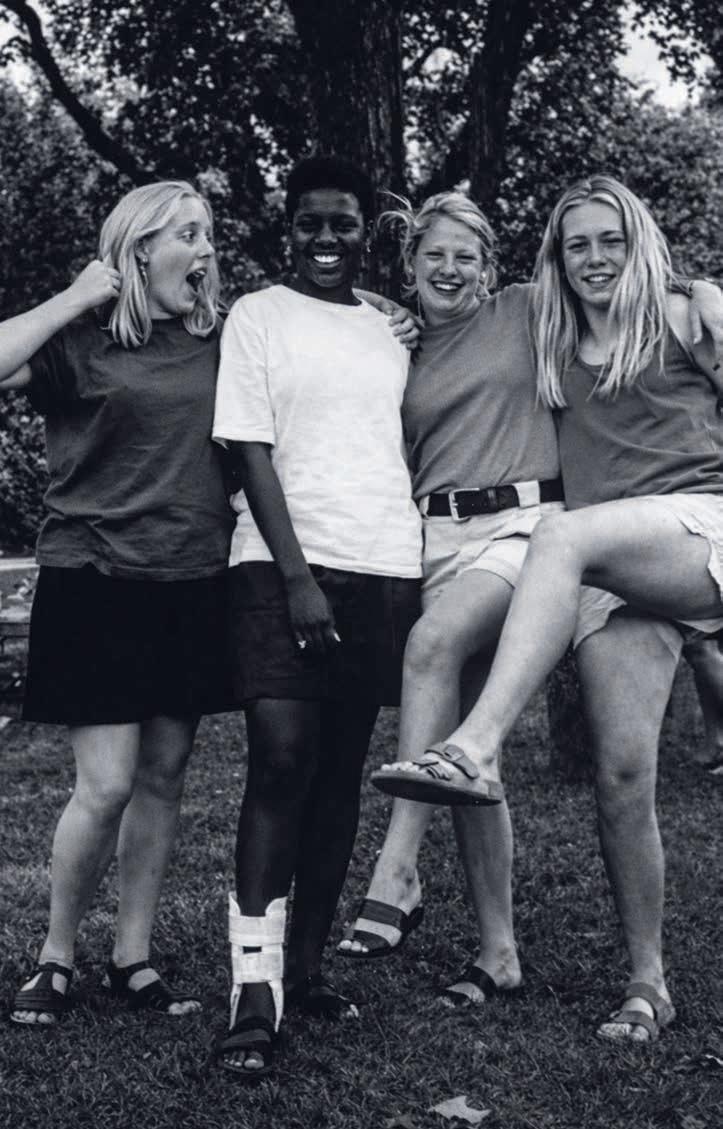
and support one another. The goal wasn’t just to build a business, but also a community.
This was 2009, and social media was still in its infancy (Instagram didn’t yet exist), but already the Internet felt overwhelming. Our instinct was that people were hungry for a way to cut through the noise and forge real connections.
I remember the day we launched the website for Food52. We emailed about a thousand early subscribers and waited nervously at our computers. Soon, people began to show up—and in much larger numbers than we’d anticipated. Someone would ask a question about a recipe, and ten others would jump in to offer tips or encouragement.
Over time, strangers became collaborators and even real-life friends, coming to Food52 events and hosting potlucks and meetups of their own.
It turns out that when you create a space for people to connect authentically—a space where they feel they belong—magic can happen.
We’re living through what many call an epidemic of loneliness. We scroll, we post, we “like”—yet we feel more alone than ever. Psychotherapist and podcast host Esther Perel observed, “You can have a thousand virtual friends and still have no one to feed your cat.”
Research shows that belonging to a community— whether based on identity or shared activities— protects mental health, builds resilience, and helps us cope with stress.
That’s part of what makes Groton so special. You’re surrounded by both identity communities (the people who “get” you) and activity communities (the people you do things with). This place is designed for connection.
Developmental psychologist Erik Erikson wrote that adolescence is when we figure out who we are, and young adulthood is when we learn to form deeper relationships with others. The bridge between these two stages of development is vulnerability. That’s where growth happens.
Research professor Brené Brown put it perfectly when she said, “In order for connection to happen, we have to allow ourselves to be seen.”
That’s easy to say and harder to do—especially when you’re surrounded by smart, talented people and your instinct is to hide anything messy or uncertain. I spent most of my time at Groton trying to seem cooler, calmer, and more pulled together than I actually was.
But real community only exists when we show up honestly. We glorify independence—“I’ve got this!”— but true strength comes from interdependence, from saying, “Actually, I could use a hand.”
And here’s the flip side of that coin: When we listen without judgment and show up for each other—not just by text, but in person—we build something real. Acts of kindness ripple outward, creating connections that strengthen everyone involved.
The journalist Ben Smith gave a TED Talk several years ago comparing communities to forests. Trees, he explained, communicate through their roots, sharing nutrients and even warning each other of danger. When one tree struggles, others send support so it can survive. Their roots literally intertwine. That’s just what strong communities do. They make sure no one stands alone for too long.
Since my time at Groton, I’ve come to understand that a community doesn’t thrive on its own—it takes effort from everyone. Doing our part to nurture a healthy community requires two things:
First, it requires that we show up in our relationships. This means being present. Listening. Sharing honestly. Putting our phones down once in a while.
Second, it requires that we actively seek out ways to support others. We must pay attention to those whose roots aren’t as sturdy and lend them some of our strength. Brené Brown encourages us to “be the light and soil for others’ growth.”
I’m now going to give you a little homework assignment—it won’t be graded. As you go about your day, consider the following:
Who are the people who comfort you when you stumble? Who challenges you to be better? Whose growth are you nurturing?
Looking back, I realize that not giving a chapel talk was a missed opportunity for me to connect on a deeper level with the community I loved so much. I let my fear of being vulnerable keep me from showing up. I was so focused on self-preservation that I didn’t see how my words might have comforted or validated someone else, the way so many chapel talks had done for me.
So today, more than thirty years later, I’m trying again. At 49, I’m finally doing what my 17-year-old self couldn’t—and it feels good. (Still a little bit scary, but good.)
Helen Keller once said, “Alone we can do so little; together we can do so much.”
But real community only exists when we show up honestly. We glorify independence—“I’ve got this!”—but true strength comes from interdependence, from saying, “Actually, I could use a hand.”
That’s true at Groton and in every circle you’ll ever join. My hope is that you keep building and nurturing the communities that sustain you—here and beyond. Be brave enough to be seen, generous enough to serve, and wise enough to know that your growth and happiness are tied to the people around you.
Together, you can do so much. Thank you.
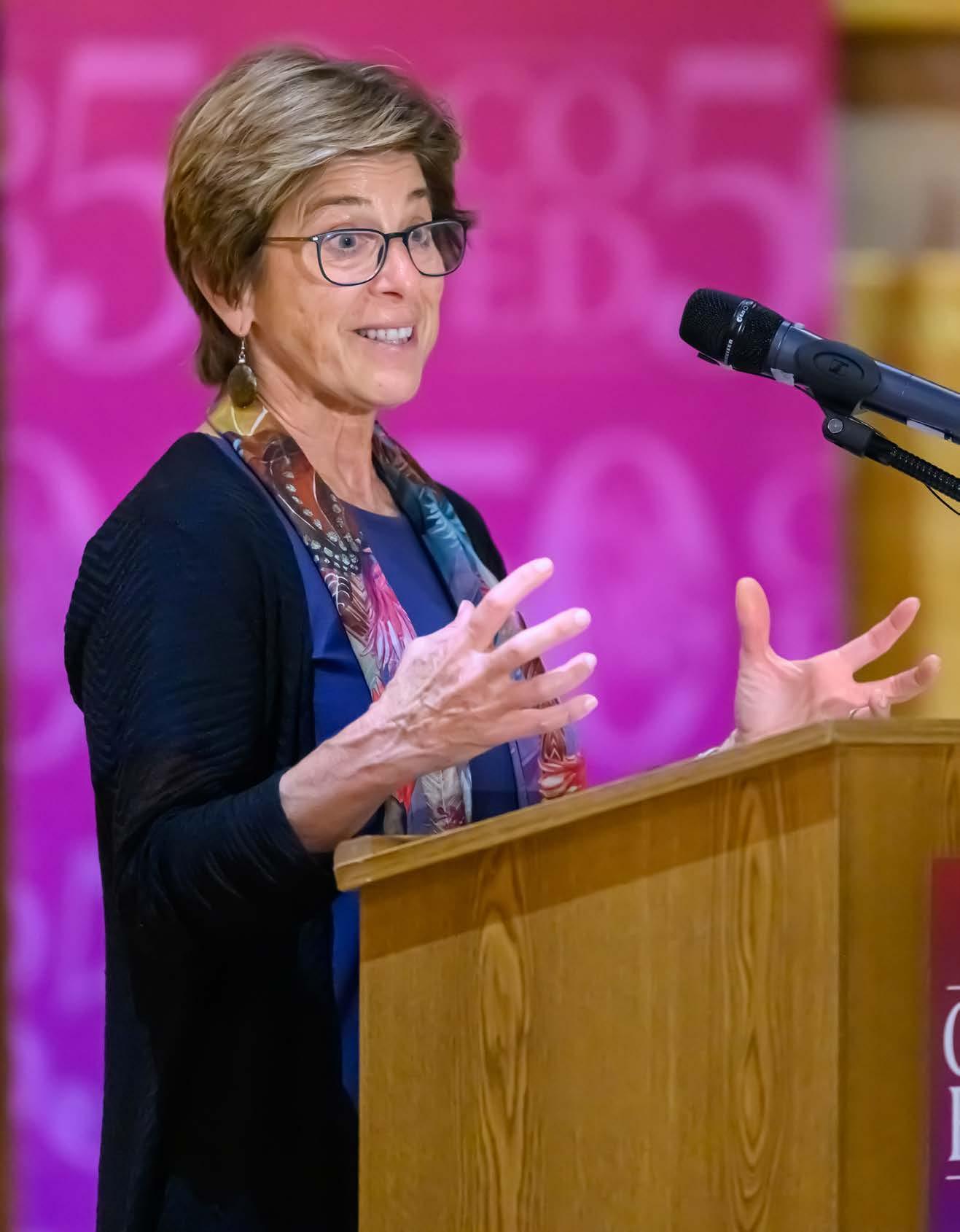
As the celebration of the fiftieth anniversary of coeducation at Groton School began this past fall, alumnae addressed gatherings of Grotonians around the country, from right here on the Circle to Boston, New York, and San Francisco. What follows are highlights from those remarks.
Coeducation at 50 kickoff event September 20, 2025
Where to start to talk about the trajectory of the school since 1975? This is a daunting task—the school is unrecognizable in some ways but also totally familiar, like coming home. To me that is what is so brilliant about how Groton has evolved.
As I looked back on where we’ve come since 1975, it became clear to me that coeducation didn’t just open doors for girls but reshaped how Groton thinks of its identity and launched the school on a journey of inclusion that continues today. Groton has become, and I think Temba may have coined this phrase, “elite but not elitist.” Attention to and striving for greater inclusion has really become part of Groton’s DNA.
And still, Groton still feels like Groton, even to us old folks. It is still a small, close-knit community. Scholarship is still rigorous (maybe more so), character and leadership still central. Students still go to Chapel, and the emphasis on service is still strong. With such an avalanche of
change, Groton is still Groton. It retains a sense of tradition and core values and mission—engaging a broader range of people in them.
As I prepared for today, I kept asking myself why—how did this happen? Success, even of coeducation, wasn’t inevitable. We have of course had great leaders who have embraced and advanced change— two of whom are here.
Having served as a trustee through multiple strategic plans, mission revisions and initiatives (like GRAIN, GRACE, the Schoolhouse renovation, global expansion), what struck me was that the process developed fifty years ago to decide and plan for major change has been key to Groton’s successful evolution. It’s a process with several key qualities that the school also tries to instill in its students.
That process, as much as the decisions themselves, is what has allowed Groton to change while staying true to its essence.
So what are my hopes for the school after seventy-five or 100 years of coeducation? I don’t know what world we will live in in twenty-five or fifty years. As Antonio Gramsci famously wrote, “The old world is dying, and the new world struggles to be born.” The work
of inclusion is becoming increasingly hard to do in the current global and national climate. My hope is that Groton stays the course—and continues to protect and nurture inclusion, because, as Temba used to tell us frequently, “The work of inclusion is never finished.”
And I hope that Groton continues to prepare students not just to succeed in life, but to provide principled and bridge-building leadership in a polarized and turbulent world. The processes and values we have to achieve this exist: honest reflection, civil dialogue across differences, courage, and resilience to changing circumstances and learning from failure.
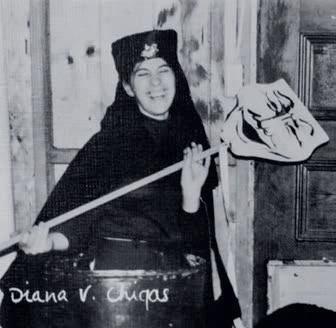
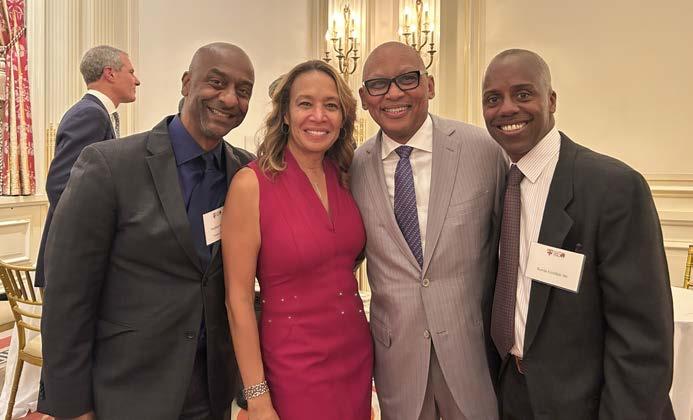
New York reception September 17, 2025
Let’s be honest: coeducation at Groton wasn’t just a policy shift. It was a cultural earthquake.
In 1970, the trustees, wisely and bravely, began studying whether Groton should become coeducational. The answer they came to was yes, but it wasn’t unanimous or easy. There were fears: Would girls dilute the rigor? Would tradition be lost? Would donors rebel?
Instead, what happened was exactly the opposite.
Coeducation enriched Groton. It expanded the definition of excellence. It invited a broader range of talents, leadership styles, perspectives, and voices into the Circle. And it made Groton stronger, smarter, more relevant. Dare I say, more human.
What was once an experiment became the new normal. And the girls, my cohort included, rose to meet the moment. As a relatively oblivious teenager, I can’t say that I knew we were carrying a torch. But girls auditioned for plays and dance recitals, gave chapel talks, joined athletic teams, and asked tough questions in class. We said “yes” to opportunities and were fully engaged members of the
left,
Groton community. We navigated moments of awkwardness, resistance, even doubt, with grace and sometimes with grit.
Today, girls make up half of a student body that is more diverse, more global, and more ambitious than ever. Groton girls today are not trailblazers in the same way we were, but they are just as bold. And they do it all with a confidence and clarity we only dreamed of in 1975.
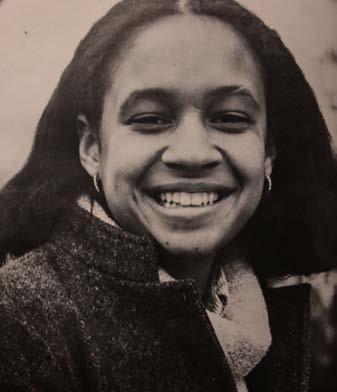
As a longtime trustee, I’ve had the privilege to see this evolution from another angle, and to help shape the policies and principles that continue to expand access and opportunity. We invested in financial aid, ensuring that deserving students from every background can come to Groton and
thrive. We prioritized gender equity in hiring, creating a faculty that mirrors the diversity we want our students to see and emulate. And we’ve strengthened leadership pipelines, knowing that true inclusion isn’t just about being in the room; it’s about having a voice at the table.
That table looks very different now than it did fifty years ago and that is something to celebrate.
But we also know that the work of equity is never done. Here I am reminded of the words of Marie Curie, the pioneering scientist who won two Nobel Prizes at a time when women were rarely welcome in laboratories. She once observed: “One never notices what has been done; one can only see what remains to be done.”
That is our charge today. To celebrate how far Groton has come and at the same time, to see clearly how much lies ahead.
True equity doesn’t end at the admissions gate. It must extend to every classroom, every chapel talk, every dorm meeting, and every team huddle. It means making space for different leadership styles. It means questioning bias, however unconscious. It means ensuring that every student, regardless of gender or identity, knows they belong on the Circle not just by invitation, but by right.
Because a world led by men and women together—with mutual respect, equal opportunity, and shared leadership—is not just fairer. It’s better. Groton knew that in 1975. We know it even more deeply today.
So here’s to fifty years of coeducation. To the boldness of the decision, to the courage of the pioneers, to the strength of the community that grew from it, and to the promise that still lies ahead.
May the next half-century find Groton still brave enough to welcome change, still small enough to know every student by name, and still bold enough to send them forth “to serve and to reign” in a world that desperately needs their vision.
May we continue to teach our students not only how to lead, but how to listen. Not only how to achieve, but how to uplift. And not only how to honor tradition, but how to evolve it.
Boston reception
October 8, 2025
In touring the Groton campus today, it may be hard to imagine that girls were not there from the beginning. Today, Groton girls are the warp and weft of the community—active in all aspects of school life. Yet for just over ninety years, girls were not part of Groton’s mission, culture, or traditions. So with fifty years of coeducation behind us, it’s appropriate to reflect, celebrate, and take stock.
In the fall of 1975, forty-eight girls entered through the gates on Farmers Row, joining the ranks of the Third, Fourth, and Fifth forms. Maya Angelou once said, “Each time a woman stands up for herself, without knowing it possibly, without claiming it, she stands up for all women.” That sentiment captures the quiet courage of those first forty-eight girls. They may not have thought of themselves as pioneers, but by stepping into classrooms, onto athletic fields, and into traditions, they made space not just for themselves—but for every girl who would follow.
I was not among that initial brigade. I arrived on campus six years later—in the fall of 1981—an anxious 13-year-old from a small town in New York. Groton appealed to me for many reasons, but what set it apart was its sense of
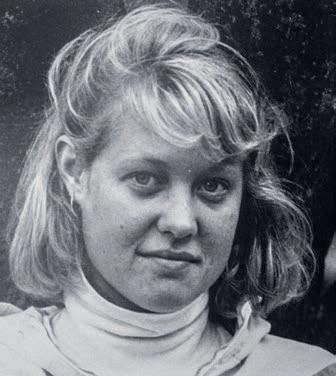
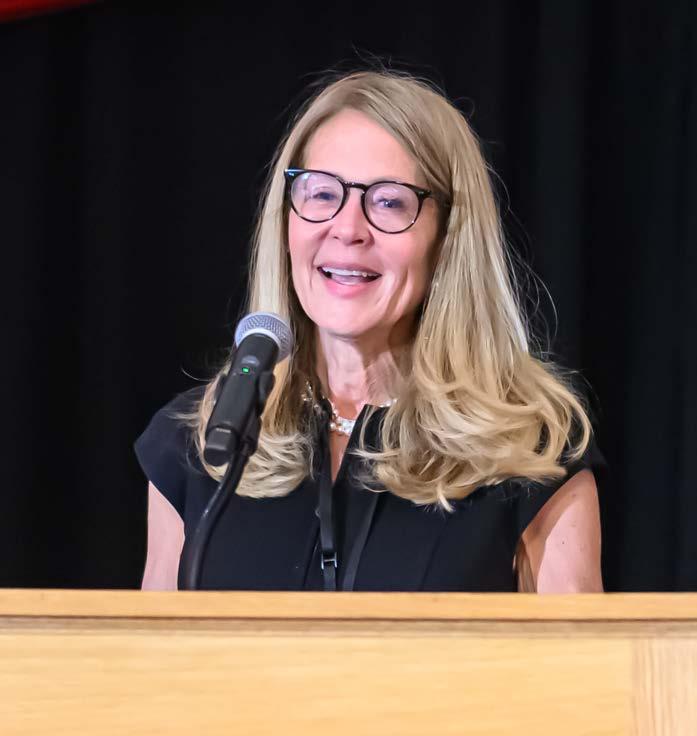
community. From my perspective—then and to this day—the Circle was a tangible representation of a metaphorical embrace that promised challenge and security in equal measure.
Opening the gates to girls was the first step. But the deeper, more enduring, and difficult work was ensuring that girls didn’t just attend Groton, but that they belonged. That required many years of careful (and I imagine sometimes difficult) self-examination, a willingness to confront implicit bias, the humility to recognize when things were not yet equitable, and the courage to make intentional change. It was about building structures, yes, but also about shifting mindsets.
And for that, all of us are indebted to Headmasters Cox and Polk, who led the school through the initial and subsequent phases of coeducation, as well as Headmasters Commons and Maquebela, who have continued to lead with fortitude and intent. We are also indebted to the extraordinary women faculty who came to campus and served as teachers, mentors, coaches, and role models. And we are grateful to the wonderful male faculty who worked in partnership with them. Together those adults worked to
ensure that girls were fully integrated into all aspects of school life—that girls were not just attending Groton, but that they were Groton—the new Groton. Those dedicated leaders and teachers taught all of us—girls and boys—how to live and learn not just alongside one another, but from one another.
And we now have forty-eight years of female graduates who have gone on to represent Groton’s ideals of service, leadership, intellectual rigor, character and inclusivity in fields as varied as the women themselves. Oh how Groton has evolved.
Coeducation did not dilute rigor; it increased it. It did not diminish traditions, it expanded them. It did not lessen the character of the school; it enhanced it.
Single-sex education was part of Groton’s history; coeducation became part of its promise. So here’s to fifty years of coeducation and the important work that will continue. May Groton continue to embrace change with courage and intention; to champion diversity of thought, background, and identity within a close-knit community; and to prepare all of its students to make meaningful contributions in a world that is eager for their service, leadership, and insight.

San Francisco reception October 14, 2025
Good evening.
It’s a privilege to be here as Groton celebrates 50 years of coeducation—a milestone that reflects not just a policy change, but a transformation of the school’s character.
When girls arrived on the Circle in 1975, it was a bold decision that reshaped Groton’s future. As Headmaster Temba Maqubela put it so well: Groton didn’t just go coed—Groton got better.
And it got better not because girls bore the weight of that change, but because the school made thoughtful, inclusive, and deliberate choices to make it work.
This evolution began years earlier. The first female faculty member arrived in 1965. By 1970, the board was actively
studying the shift. A female dean was appointed in 1974, and a year later, girls were welcomed as students. By 2004, the student body had reached gender parity. That legacy made my Groton experience possible. And it started with my mother, who never had the opportunity to attend a school like Groton, but believed her daughters should. She helped open the door—and Groton changed our lives.
I never felt like girls were new at Groton. But I do remember 1990, when we had our first co-prefects, a small but powerful step toward shared leadership.
And that’s what coeducation at Groton means to me: not just presence, but participation. Not just seats at the table, but voices shaping the agenda. Groton didn’t just teach us how to think—it taught us how to contribute. And it’s why I now work with students as they choose their high schools—hoping they find a place as transformative as Groton was for me.
I am thankful to Kathy Leggat for helping me to shape my journey. Years after I graduated, Kathy offered me a job interview at Groton when I had no experience but lots of heart. I worked in admissions and the Dome, mentored students—and stayed in touch with them long after. One even launched her own admissions career. I learned from Kathy that being transformed isn’t the end of the journey—she helped me see my responsibility to hold the door open for others, too.
Tonight, let’s celebrate the trailblazers, the allies, and the visionaries who made this possible. Let’s reflect on the doors that still need opening—and commit to opening them together.
Thank you for letting me be part of this extraordinary story.
Here’s to the next fifty.
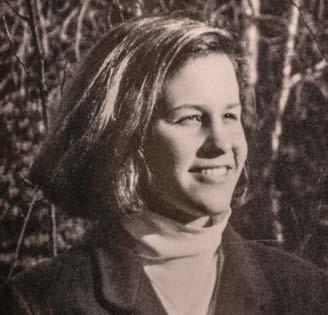
As Headmaster Temba Maqubela put it so well: Groton didn’t just go coed—Groton got better.”

Wilford Welch ’57
Values and Circumstances That Shaped A Life: A Wild Journey
Values and Circumstances
That Shaped a Life: A Wild Journey is a deeply reflective memoir by diplomat, educator, and strategist Wilford H. Welch, tracing the profound moments, global experiences, and personal values that have shaped his extraordinary life across nearly nine decades. From growing up in rural Connecticut to playing a role in reestablishing U.S.-China diplomatic relations, Welch’s journey spans war zones, diplomatic missions, remote villages, family life, and soul-searching encounters. Blending autobiography with global political history and philosophical insight, this book invites readers to explore the forces both internal and external that mold a meaningful life.
Erik J. Chaput, PhD, current faculty
The Selected Writings of Thomas Wilson Dorr
Expertly edited by historians Erik J. Chaput and Russell J. DeSimone,
The Selected Writings of Thomas Wilson Dorr offers a perspective on the dramatic politics connected to the 1842 Dorr Rebellion. Chaput and DeSimone bring to life Thomas

Dorr’s political career before and after the rebellion that bears his name. Long-time collaborators on public history projects, they explore the shifting politics of the people’s sovereignty, especially the intersection with slavery and race, as the ideology moved from the margins to the center of public discourse in the 1840s and 1850s. The editors provide a lucid introduction to Dorr’s career and frame the individual selections, which come from a multitude of archival sources, with informative headnotes. Historian Sean Wilentz, the author of the Bancroft Prize-winning The Rise of American Democracy (2005), pens the preface to the volume.
V. Joshua Adams ’96 Skepticism and Impersonality in Modern Poetry
In Skepticism and Impersonality, V. Joshua Adams follows the history of impersonality in modern poetry from Mallarmé and Eliot through to the present, engaging with work by major poets and critics, but also contemporary philosophers. Rather than seeing impersonality exclusively as a literary historical phenomenon, Adams argues that we should understand it as
an attempt to address skeptical problems arising from the limitations of first-person experience.
Defending impersonality as a response to skeptical problems, including doubts about the publicity of our experiences, our knowledge of other minds, the capacity of our language to describe the world, the relationship between mind and body, and the fictionality and continuity of our sense of self, Adams analyzes what he calls “experiments in impersonality” as means of working through skeptical doubt. The writers discussed transform this doubt into art, whilst also ironizing it as corrosive and self-defeating. Ultimately this leads Adams to reinterpret literary impersonality as a therapeutic philosophical project.
Skepticism and Impersonality promises a new theoretical justification for our practical interest in literary texts, to renovate our conception of how those texts might do philosophical work, and to expand our sense of what a philosophical poem can be.
► Please send information about your new releases to quarterly@groton.org. Book summaries were provided by the authors and/or publishers.
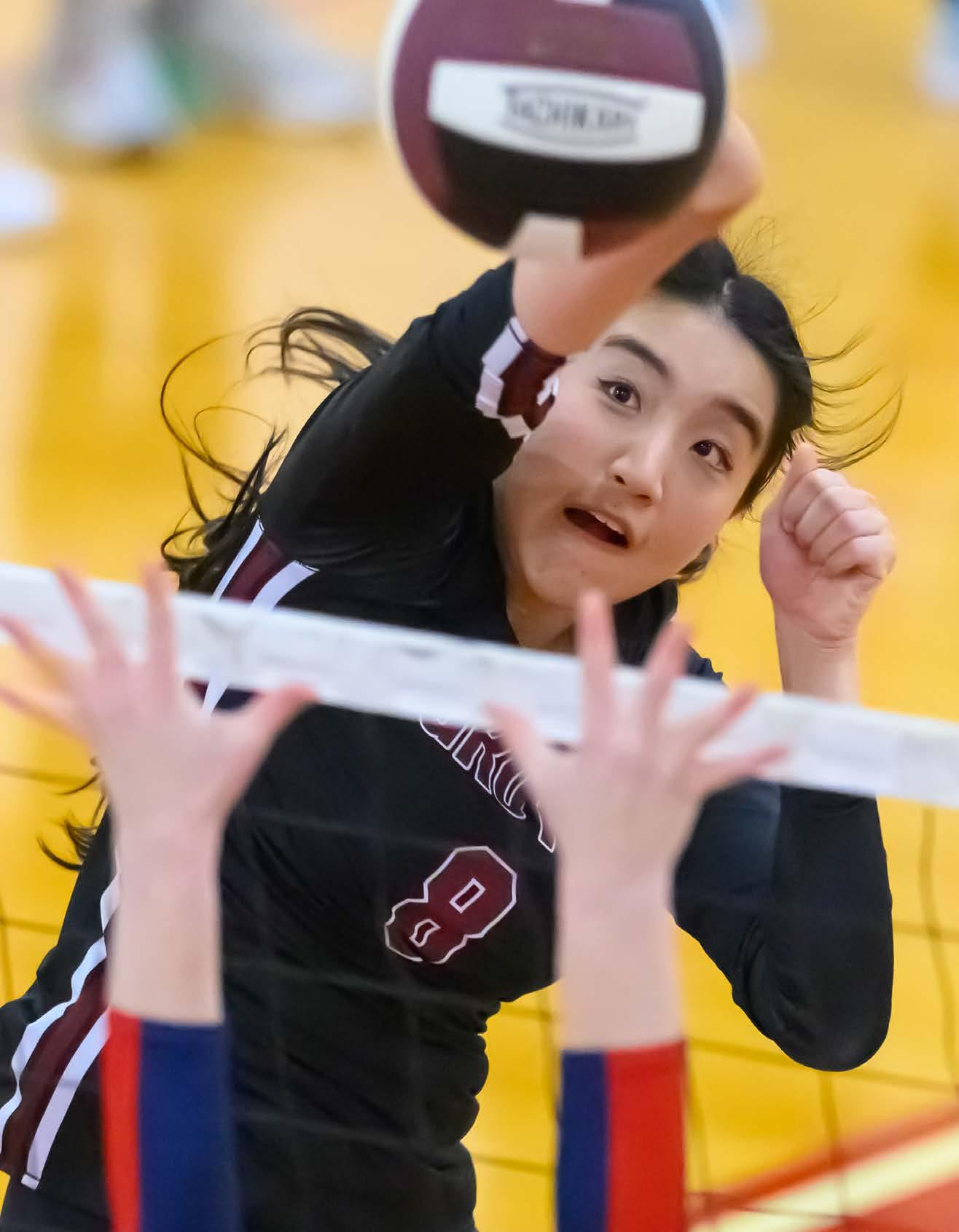

Groton volleyball had another spectacular season, the strongest yet in the program’s nine-year history. Both the varsity and junior varsity teams had standout performances. The varsity team finished the regular season first in class, earning the finalist trophy in the NEPSAC tournament with a record of 16–2. Impressively, five of the thirteen Groton players earned league honors. Meanwhile, the junior varsity team went undefeated in the ISL league with dominating performances across the board.
At both levels, Zebra volleyball gave fans enthralling performances and spectacular come-from-behind wins, a testament not only to their skills but also to their ability to excel in the mental aspects of the sport. The program continues to be characterized by strong teammate bonds, allowing our players
to rally together to prevail even in difficult matches, often against bigger opponents and larger schools.
This was my third season as head coach, alongside second-year Assistant Coach Marissa Felix, JV Coach Shannon Jin (program founder), and Assistant Coach Franck Koffi. We appreciated the dedication with which players honed their skills throughout the season. Volunteer coaches Ahmed Ibrahim and Michael Felix continue to be integral to program success—their deep volleyball expertise and kind demeanors enrich our practices and matches.
We will miss our supremely talented Form of 2026, including co-captains Sophia Leng and Cheyenne Zheng, and standout players Ava Meyer, Christina Scalese, and Katrina Yang. Their high standards and positive energy have left an enduring mark on the program. The varsity team will benefit from the
experience of rising Sixth Formers
Allyson Lu, Rowan Trevino, Tatum Friedholm, Eliza Spence, and Olivia Herr, as well as rising Fifth Formers Alicia Leng and Nana Oye Ofosuhene. Our rookie Victoria Leng ’29 has already been making her presence felt on the court with hard-to-receive serving and quick setting. We also congratulate our Sixth Form junior varsity captains, Michelle Manza and Natchavee Kosolpisit, and captainselect Saniya Pleasants ’27 and Rose Lee ’27. Our managers, Manon Farel ’26 and Kayla Zheng ’26, were a dedicated presence, as were team photographers Alejandro Hassan ’26 and Eric He ’28. Coaches and players thank families and the entire athletic staff for their unwavering support.
— coach celene ibrahim
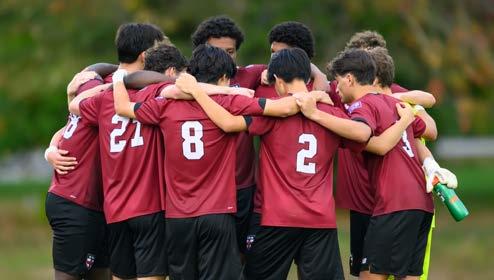
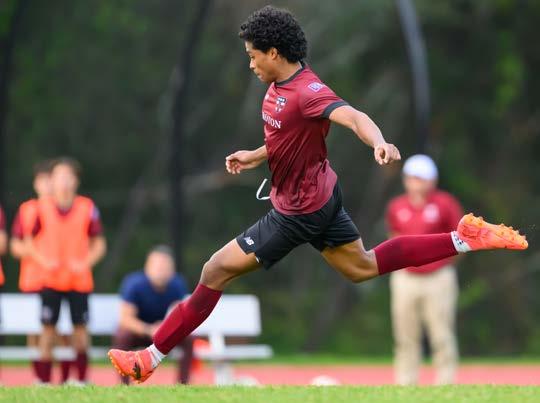
Groton soccer welcomed forty new and returning students to preseason in early September. The goal during preseason for both the coaches and captains Arthur Murray ’26, JC Minda Chiriboga ’26, and Roberto Pignataro ’27 was to establish a strong team culture. The team went to Boston to watch Boston University take on Brown University, trained twice each day, had meals throughout the week in the Dining Hall, and played a scrimmage against Austin Prep. The team was excited to be back together and everyone did a nice job of welcoming new students to campus.
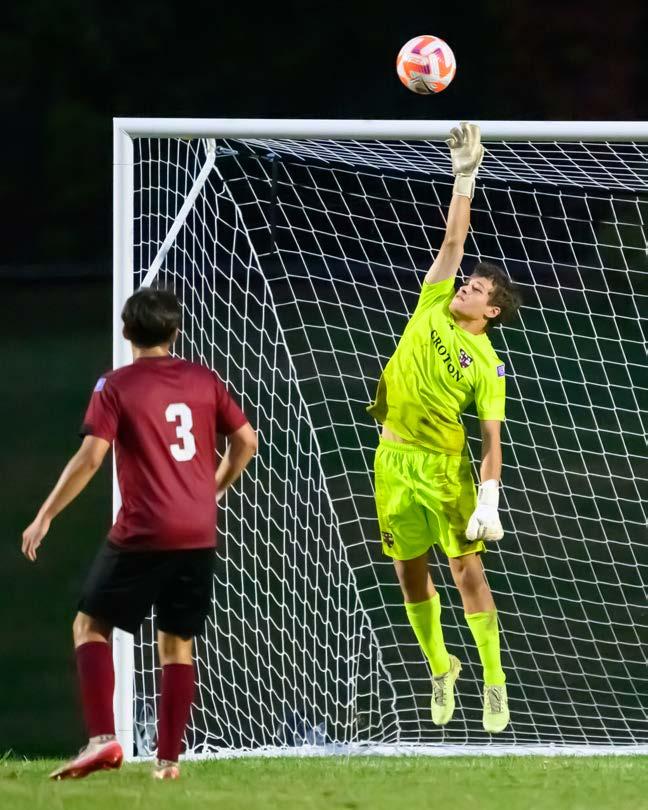
This year, the team was led by six Sixth Formers: captains Arthur Murray and JC Minda Chiriboga were joined by Alex Foley, Miles Zhang, Kaysan Marinez, and William Cai. The rest of the squad was made up of returning players, including captain Roberto Pignataro ’27, Jiayang Kang ’28, Eric Zhu ’27, Alex Holden ’27, Nick Holden ’27, Hayun Shin ’27, Ettore Monson ’27, William Garcia ’27, Feranmi Adelakin ’27, Roberto Palacios ’27, Nico Cirone ’28, Rex Hudson ’28, Davis Jamison ’27, Bilal Kamil ’28, Nikhil Luthra ’27, Aron Minda Chiriboga ’28, and Daniel Shi ’29.
The team finished with a record of 2–11–4. There was a notable win at Roxbury Latin where the boys knocked off a playoff-bound opponent. The team also beat Governor’s Academy 2–1, scoring
a goal in the last few minutes of a hardfought match. The team is still developing, and with continued effort and dedication, we hope to improve from year to year. We know that the returning players will work hard in the offseason to push the program forward.
coach joe martinez
by Adam Richins

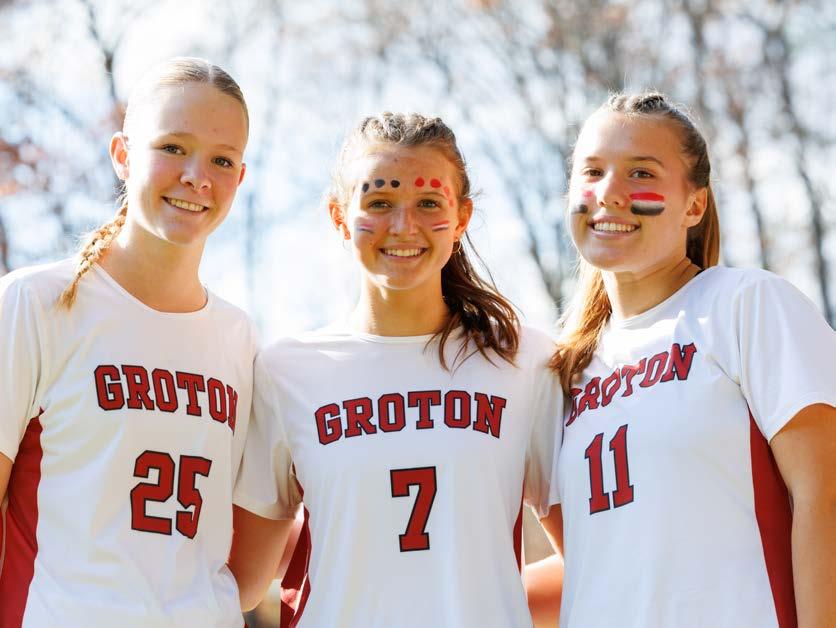
The girls varsity soccer team entered the season with a clear goal: to make the playoffs. While we fell just short of that milestone, it was nonetheless the team’s winningest season since 2015.
After a tough opening loss to a strong Andover squad, the team responded with a four-game winning streak. Following a defeat to a playoff-bound Brooks team, the girls surprised a talented Milton Academy side with a hard-fought 3–3 draw.
A hat trick from Sixth Form captain Grace Best powered a 5–0 win over Middlesex, sending Groton into Long
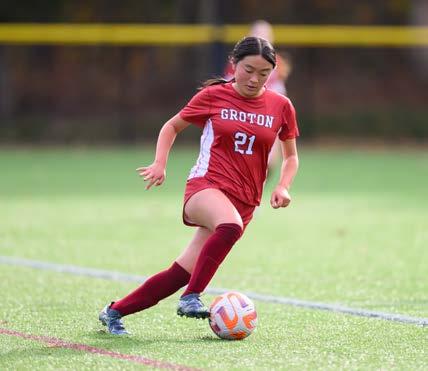
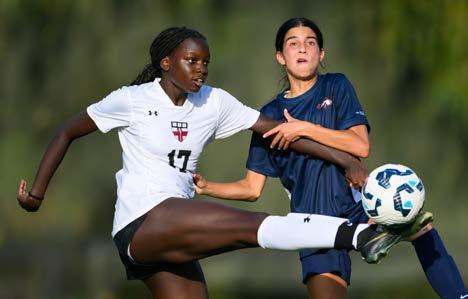
Weekend and the midseason break with a 6–3–1 record. The highlight of the year came soon after with a thrilling 2–1 victory over Noble and Greenough, the team’s first win against Nobles in at least 15 years.
Groton stumbled down the stretch with losses to Governor’s, Lawrence Academy, and St. Mark’s as the squad worked to recover from key injuries in the defensive lineup. St. Mark’s was also the only match of the season in which the team was held scoreless.
Throughout the season, Sixth Form captains Jess Shapiro, Oona Kathan, and Grace, along with classmates Camryn Dunn, Sage Greaves, and Cam Kucera, led with determination, teamwork, and
an inclusive spirit that welcomed new players into the fold. Though the team didn’t reach its ultimate goal, it made tremendous progress and looks ahead to the 2026 season with confidence and excitement.
— coach katie kreider
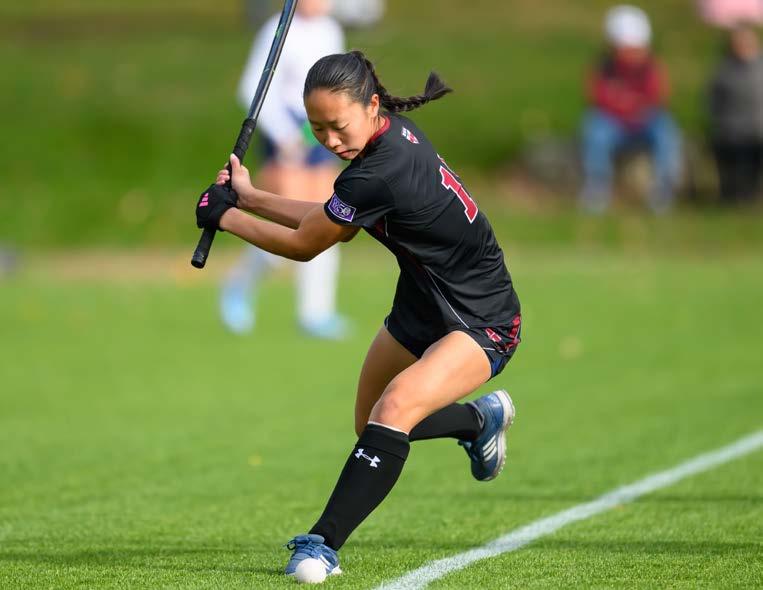
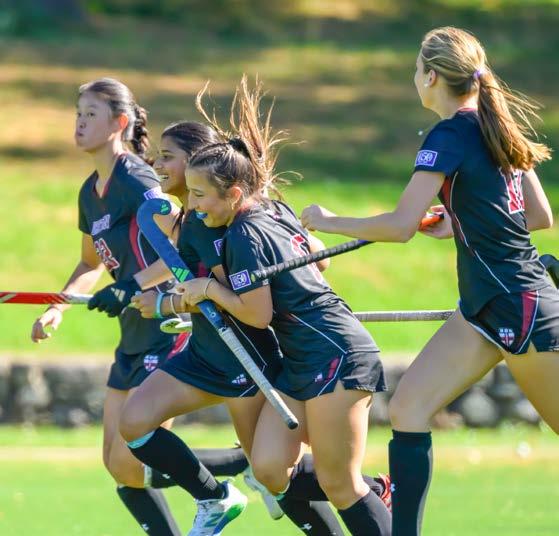
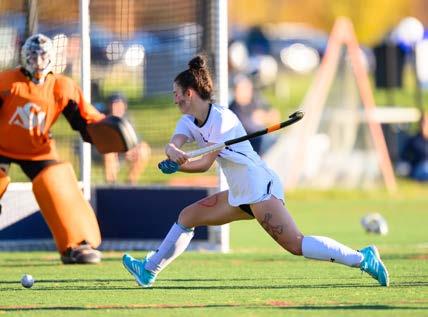
The 2025 girls varsity field hockey team completed the season with an overall record of 8–10 and a league record of 5–7. Throughout the year, the team was guided by captains Angie Che ’26, Ella Nannene ’26, and Jamie Noonan ’26, whose leadership proved essential as the roster endured a series of injuries. Despite these challenges, the captains worked hard to keep morale high and maintain the team’s competitive spirit.
One highlight of the season was a four-game win streak in the early stages of the season, in which two of the four wins were league victories. A few games later, the team hosted a strong Middlesex team, falling 4–3 in a close contest.
Despite the tough loss, it was the first time in a few years that Groton scored a goal, let alone three, against a top ISL team. After the long weekend, Groton field hockey faced a string of challenging opponents, all of whom made it to postseason play. These opponents included Nobles, Tabor, Governor’s, Cushing, and Andover. Despite going on a losing streak, Groton field hockey remained determined to close out the season strong. In the final two games, the zebras captured two league wins, including a strong 6–0 win over Lawrence Academy on Senior Day and a 2–0 victory against rival St. Mark’s. Sixth Form captain Ella Nannene, had a four-goal game against LA and Sixth Former goalkeeper Eliza Brooks recorded her first career shutout in the contest.
Overall, despite coming up short for playoffs, the Groton varsity field hockey team had a solid season full of joy, togetherness, and resiliency. Several members of the team recorded their first career goals over the season, adding exciting milestones to the year. Although the team graduates a strong Sixth Form group, the returners remain hungry and determined for more accomplishments next year.
coach jacqueline diffley
Photography by Adam Richins


Climbing Mount Monadnock the day after Labor Day for the third cross country season in a row has turned this trail into familiar territory and this time together into a traditional launch for our team. The day was a sparkler, and we could see the skyline of Boston from the top, but this was the only day we “saw” the rest of our competition until the end of the season. Several of the schools in our league opted to race in mid-September invitationals, and this made scheduling races with them all challenging. As a result, we raced only ten other ISL teams, some of them twice, before meeting them all at the end-ofseason championship race. This meant

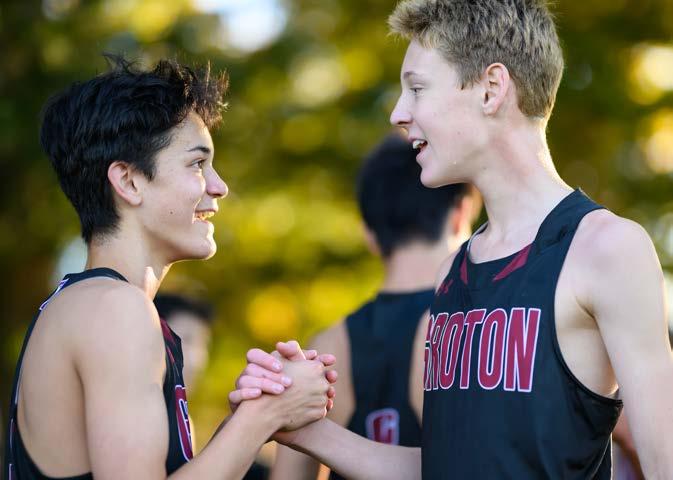
that though we could “see” Belmont Hill, Buckingham Browne & Nichols, Milton, Noble and Greenough, and Thayer from the top of Monadnock, we didn’t race them until Halloween.
We had several successes through the season, notably beating Middlesex and St. Mark’s, and also beating Tabor in a tie breaker on their course two weeks after they had beaten us by a few steps and a point at Brooks. Our best race was on Parents Weekend, when nine of our racers finished in fewer than twenty minutes, and one of our captains, Chase Bellamy ’26, raced in 17:51. This turned out to be our peak, and though ten of our racers finished faster than twenty minutes the following
Friday, we fell off by placing ninth in the varsity race at the ISL Championship.
And so we climbed back up the mountain, racing ahead of BB&N, though they had beaten us at the ISLs, to finish in sixth place at the NEPSAC Championship at Williston Northampton School. Our JV team’s third-place finish in this final race bodes well for the future as we pack it in and pack up for the next ascent.
coach john capen
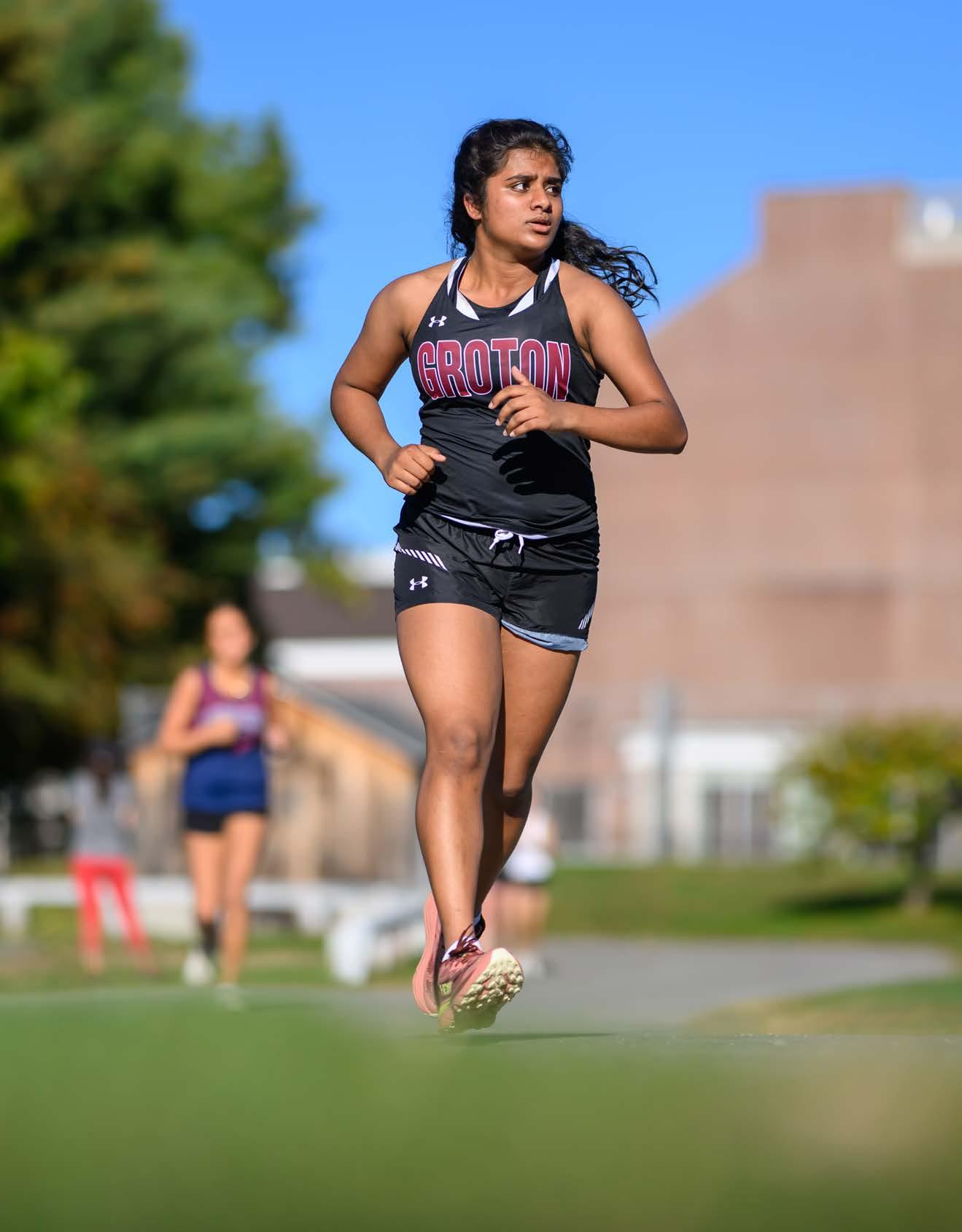
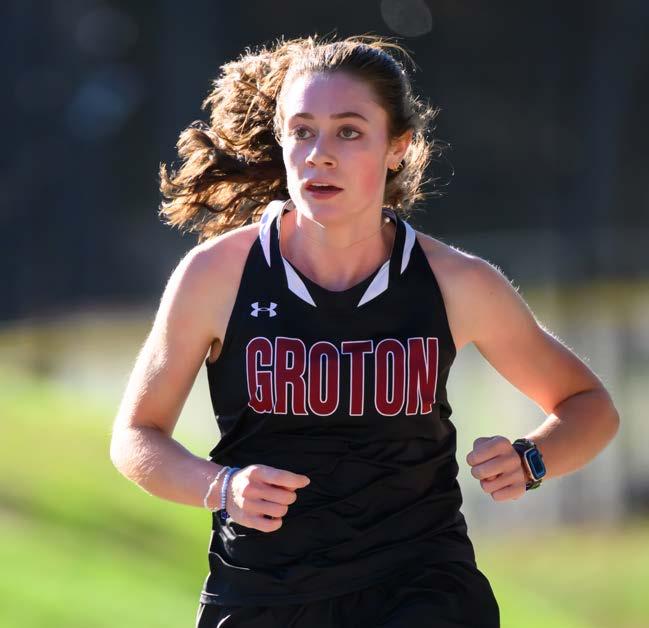
Having graduated three of our scoring five from last year’s squad, the girls cross country team came into this season understanding that we would need some runners to step up and fill big spots to help us stay competitive. We knew we could count on our returning all-ISL runners, Ceres Moraitis ’28 and Kelly Zhao ’29, to lead our pack, and we knew we’d have strong leadership from our captains, Samara Gorton ’26, Stephanie Mo ’26, and Sydney Nelson ’26. Sydney, in her fifth year as a varsity runner, had an absolutely extraordinary season, earning PRs four weeks in a row to drop three minutes off of her previous best and catapult herself into the top 15 at ISLs and top 10 at the NEPSTA Division II Championship. Sofia FloresQuero Llamas ’28, in her first season at Groton, was our third or fourth finisher in every meet this season and served as a leader for our pack throughout the fall. Pauline
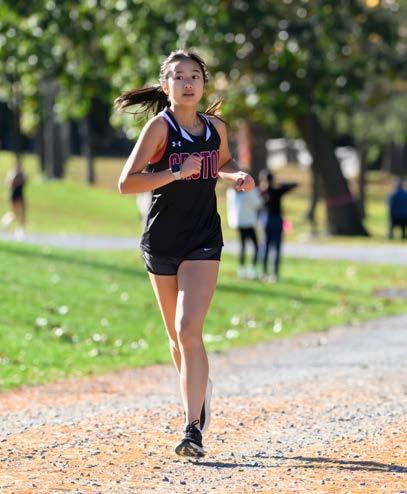
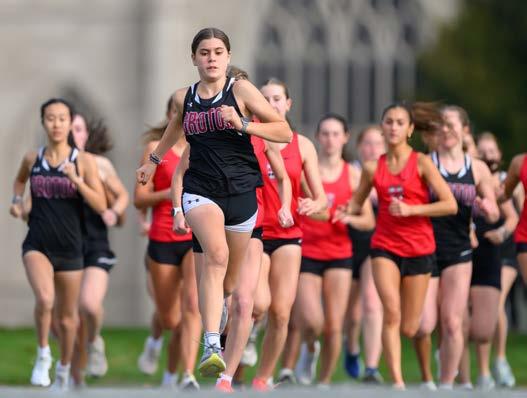
McAndrew ’26 took more than five m inutes off of her best time last season and was a strong and consistent fifth runner throughout the season. After a successful JV season last year, Gabriela Coates ’28 took two minutes off of her time to earn a place in our varsity pack in every race this season. Samara, Izzy Hall ’28, and Rebecca Wu ’29 all made important contributions to our varsity as our seventh finisher in multiple meets during the season.
Highlights of the regular season included a 27–29 win over a very strong Governor’s team in our first meet, and a highly competitive and exciting race against St. George’s on Parents Weekend that ended with the Zebras on top, 25–31, and three Groton finishers under 20:30. In that meet, Ceres posted her third individual win of the season, and also set a new record for Groton girls on our current course by finishing in 19:18, just
ahead of the previous mark set in 2009 by Faith Richardson ’11. Our only loss in regular-season competition came against a Middlesex team that would finish undefeated and successfully defend its ISL and New England championships, but our girls fought hard and used the tough competition to take their own racing to new heights, as eleven of our thirteen finishers earned career best times that day. At the ISL Championship, Ceres and Sydney finished sixth and thirteenth, respectively, and the team finished fifth overall. At New Englands, Sydney (eighth), Ceres (ninth), and Kelly (eighteenth) earned all-NEPSTA honors and led the team to a fourth-place finish overall. We have a strong, tight-knit group of runners returning next year and we’re excited to see what they can do next fall!
—coach michael o’donnell

The year 2025 was one of transition for the Groton football team. We welcomed two new football coaches and played an eight-game football schedule, while welcoming a group of hungry and enthusiastic Lower Schoolers to the program. The one constant was the tremendous group of twelve Sixth Formers and a great group of captains who provided excellent leadership, energy, and guidance to our younger players throughout the season. The 2025 Groton football team showed resolve, commitment, determination, and heart all season long. The season was highlighted by the exhilarating 10–7 win over St. George’s during Parents Weekend. The environment during that night game was absolutely electric, and the students and parents storming the field will be remembered for years to come!
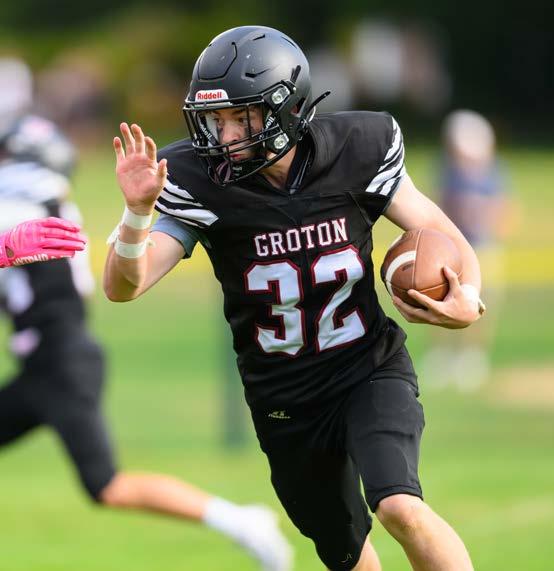
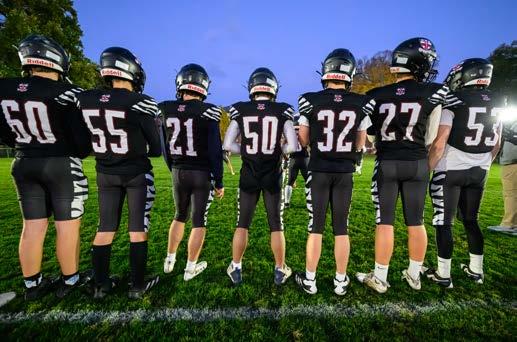
While most only remember the final scoreboard results, this year to me is summarized by a conversation I had with an opposing coach during our pregame conversation. The coach said to me, “When I watch your team on film, I see a team that plays with such enthusiasm and passion. Honestly, I wish I could get my team to play with the level of enthusiasm and passion I see from your team.” This accurately summarizes the Groton football team during the 2025 season. I want to personally thank the captains for your wonderful leadership. It has been my honor to coach such a wonderful group of young men! Go Zebras! coach karim hill
field hockey
Most Valuable Player
Angelina Che ’26
Playmaker Award
Ella Nannene ’26
All-ISL
Angelina Che ’26
ISL Honorable Mention
Ella Nannene ’26
NEPSAC Honorable Mention
Angelina Che ’26
Captains-Elect
Ellie Burnett ’27
Erin Chen ’28
Sophia Scott ’27
football
Charles Alexander Award
Nasir Hill ’26
Coaches’ Award
Henry Richardson-Irvin ’26
Charlie Stubbs ’26
Most Improved
Lorry Manetz ’26
All-NEPSAC
Nasir Hill ’26
NEPSAC Honorable Mention
Nathan Whitted ’27
Captains-Elect
Peter Adovasio ’27
Sam Kim ’27
Terry Langetieg ’28
Nathan Whitted ’27
boys cross country
Most Valuable Runner
Chase Bellamy ’26
Coaches’ Award
Henry Seilheimer ’27
Most Improved Runner
Philip Holland ’27
ISL Honorable Mention
Chase Bellamy ’26
Thaddaeus Flatz-Ehrfeld ’27
Philip Holland ’27
All-NEPSAC
Chase Bellamy ’26
Thaddaeus Flatz-Ehrfeld ’27
Philip Holland ’27
Captains-Elect
Thaddaeus Flatz-Ehrfeld ’27
Henry Seilheimer ’27
girls cross country
Most Valuable Runners
Ceres Moraitis ’28
Sydney Nelson ’26
Coaches’ Award
Samara Gorton ’26
Stephanie Mo ’26
Most Improved Runner
Pauline McAndrew ’26
All-ISL
Ceres Moraitis ’28
Sydney Nelson ’26
Kelly Zhao ’29
All-NEPSAC
Ceres Moraitis ’28
Sydney Nelson ’26
Kelly Zhao ’29
Captains-Elect
Izzy Hall ’28
Srushti Mandera ’27
Adalynne Mertz ’27
soccer
Most Valuable Players
Jiayang Kang ’28
Roberto Pignataro ’27
Coaches’ Award
Rex Hudson ’28
Most Improved Player
Alex Foley ’26
All-ISL
Roberto Pignataro ’27
ISL Honorable Mention
Jiayang Kang ’28
NEPSAC Honorable Mention
Roberto Pignataro ’27
NEPSSA All-Star Team
Alex Foley ’26
Roberto Pignataro ’27
Captains-Elect
Roberto Palacios ’27
Roberto Pignataro ’27
Sixth Form Award
Grace Best ’26
Jess Shapiro ’26
All-ISL
Laura Austen ’27
Tyler Martens ’27
ISL Honorable Mention
Oona Kathan ’26
Abby Vanden-Eykel ’28
All-NEPSAC
Tyler Martens ’27
NEPSAC Honorable Mention
Laura Austen ’27
NEPSAC Junior All-Star
Laura Austen ’27
Tyler Martens ’27
All-State
Tyler Martens ’27
All-Region
Tyler Martens ’27
All-American
Tyler Martens ’27
Co-Winners of the
Bob Morahan
Sportsmanship Award
Captains-Elect
Laura Austen ’27
Zoe Hardwick ’27
Tyler Martens ’27
volleyball
Coaches’ Award
Allyson Lu ’27
Ava Meyer ’26
Most Improved Player
Eliza Spence ’27
All-ISL
Cheyenne Zheng ’26
ISL Honorable Mention
Alicia Leng ’28
Sophia Leng ’26
All-NEPSAC
Alicia Leng ’28
Sophia Leng ’26
NEPSAC Honorable Mention
Tatum Friedholm ’27
Rowan Trevino ’27
Captains-Elect
Tatum Friedholm ’27
Allyson Lu ’27
Rowan Trevino ’27

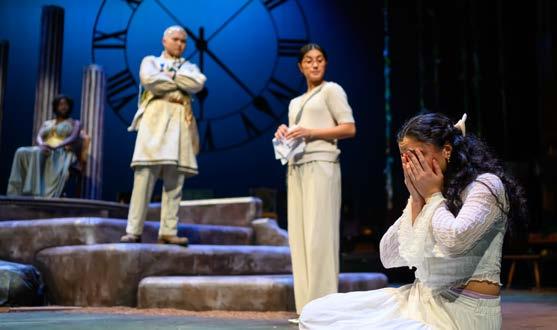
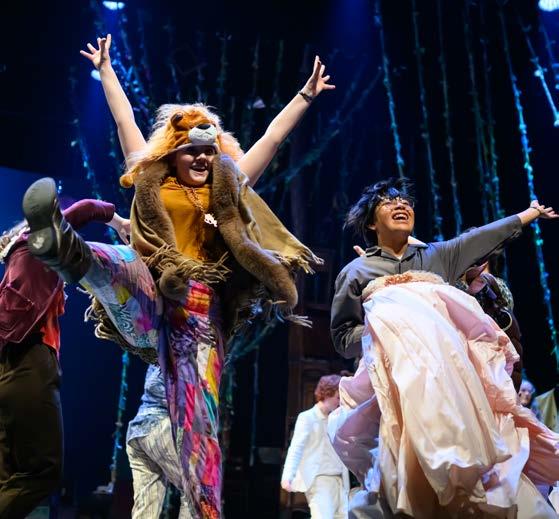
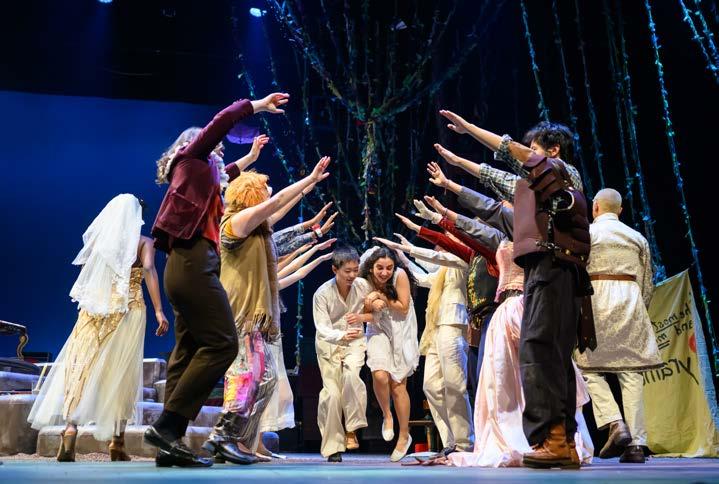
Over the weekend of November 8–9, Groton’s Theater Program brought Shakespeare’s A Midsummer Night’s Dream to life with two fantastic performances!
The shows marked the culmination of a busy tech week and a full term of dedication, creativity, and collaboration from the cast and crew. Some were seasoned theater veterans, while others took the stage for the very first time, but together, they kept audiences laughing and in awe throughout the beautiful performances.
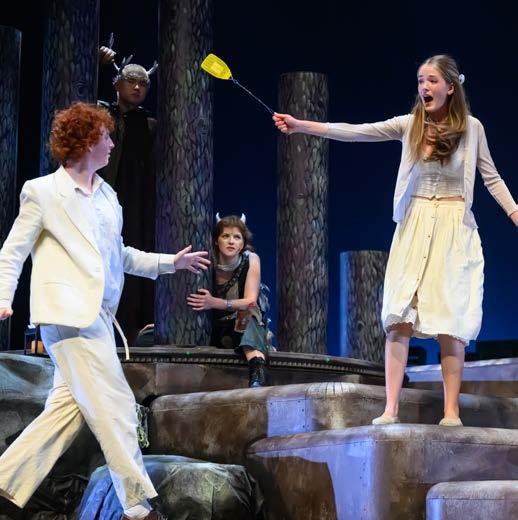

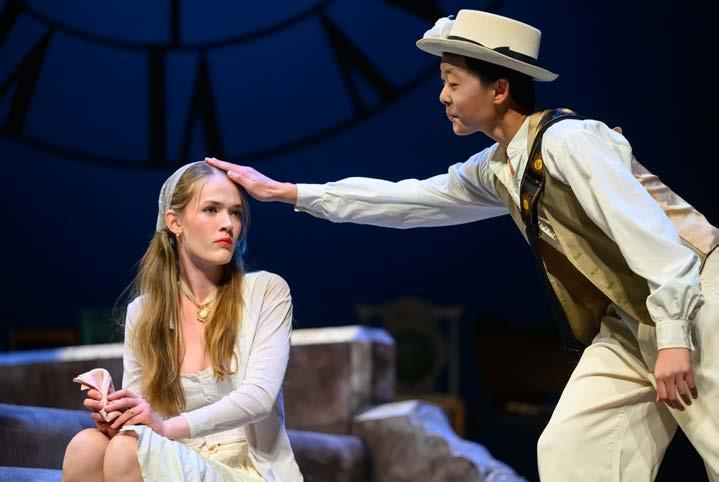
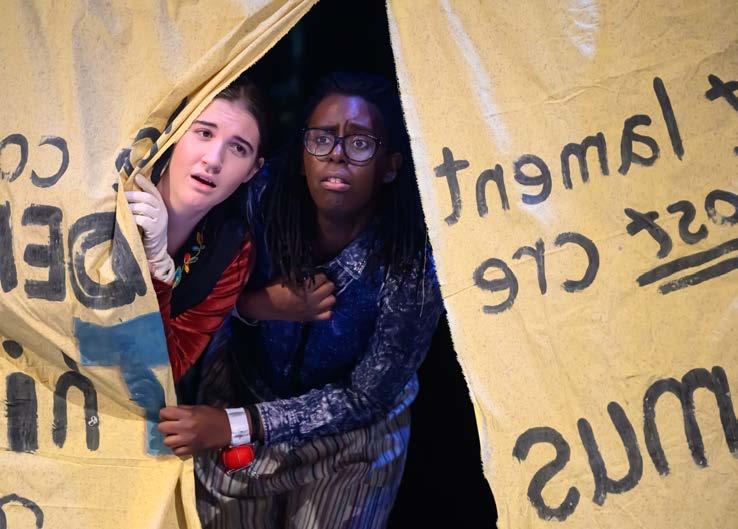
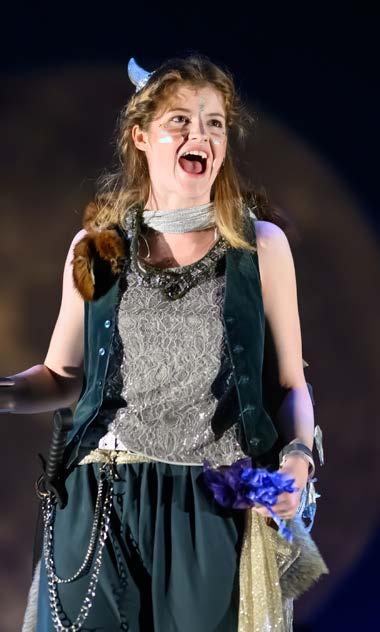
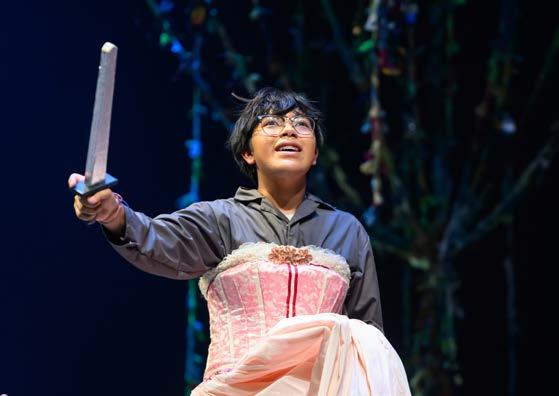
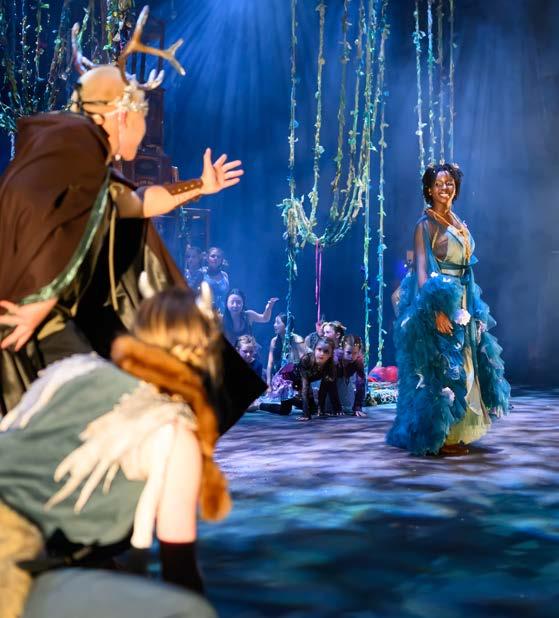
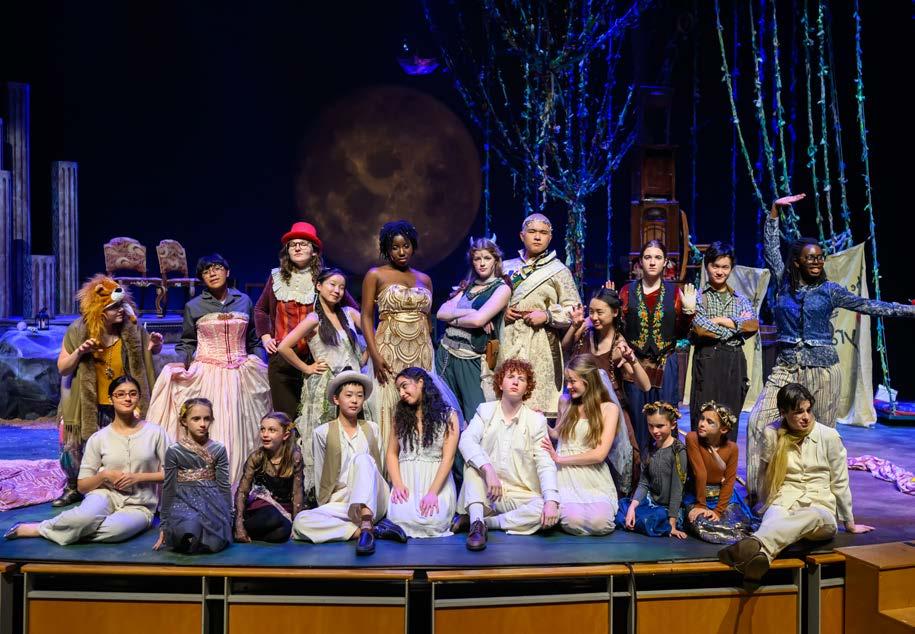
Groton School’s de Menil and Brodigan galleries kicked off their respective 2025–26 seasons with special receptions featuring their fall artists.
The Brodigan Gallery hosted Massachusetts-based sculptural and fiber artist Anna Kristina Goransson to the Circle on September 14 to open her exhibition, “Moments in Time.”
Ms. Goransson was born in Sweden and moved to the United States midway through elementary school. Art became her refuge in a country where she didn’t speak the language. She formalized her art education by going to Rhode Island School of Design for her BFA in furniture. She went on to receive her MFA in Fibers from UMass Dartmouth.
According to her biography, Ms. Goransson was an artist-in-residence at OCAC and at Pentaculum through Arrowmount, and has exhibited nationally and internationally, including solo exhibits at Dedee Shattuck Gallery
in Westport, MA, and Kaleido in Uppsala, Sweden. She is a member of the Boston Sculptors Gallery, where she recently had her debut solo exhibit. Ms. Goransson works as an artist, curator, and art teacher.
In her artist’s statement, Ms. Goransson said the installations in “Moments in Time” speak to both the frailty and beauty of being human.
“‘Glimmers’ has photographic memories transferred onto cloth, obscured by shibori dying techniques,” she said. “The glimpses of certain memories still resonate and create a spark of recognition. These pieces show the gentle fading along with moments of clarity as the mind tries to recall memories that are fading.”
Another piece, “Fitting, Floating, Fading,” takes up the majority of the gallery’s interior and is a tribute to Ms. Goransson’s mother, who is suffering from memory loss.
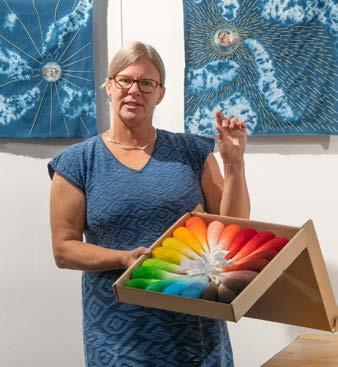
“Memories speak to the loss of memory. My mother no longer has her short-term memory, and the rest of the memory is also fading. This piece has dense, dark blue hankies and napkins that represent our memories. As the piece goes along, the hankies fade, eventually becoming white when all the memories are lost.”
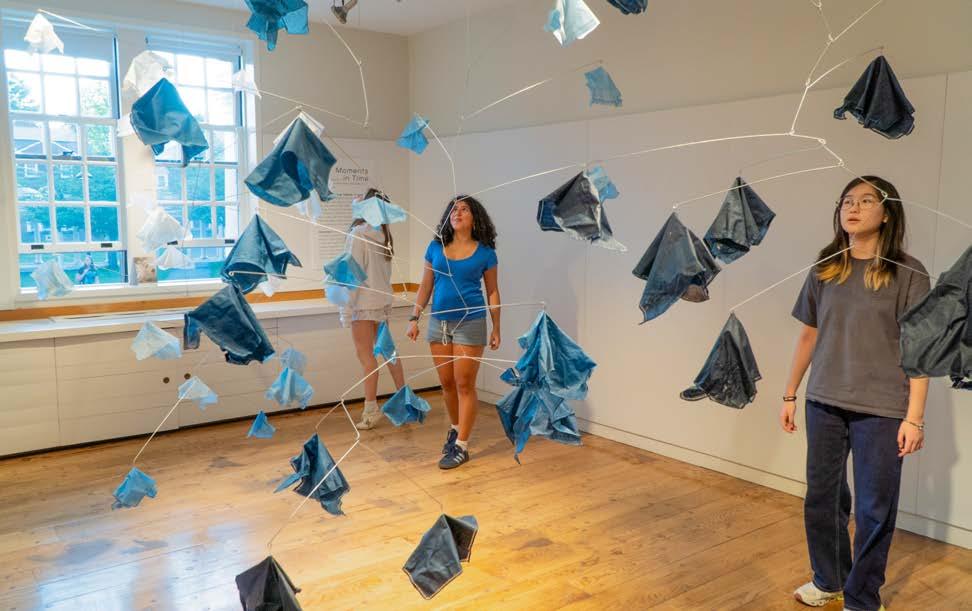
Above: The Brodigan Gallery’s fall exhibition featured Massachusettsbased sculptural and fiber artist Anna Kristina Goransson.
Left: The installations in “Moments in Time” spoke to both the frailty and beauty of being human.
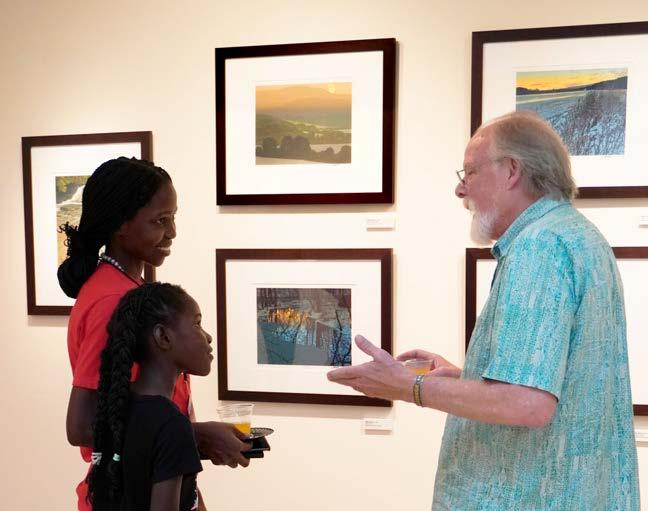
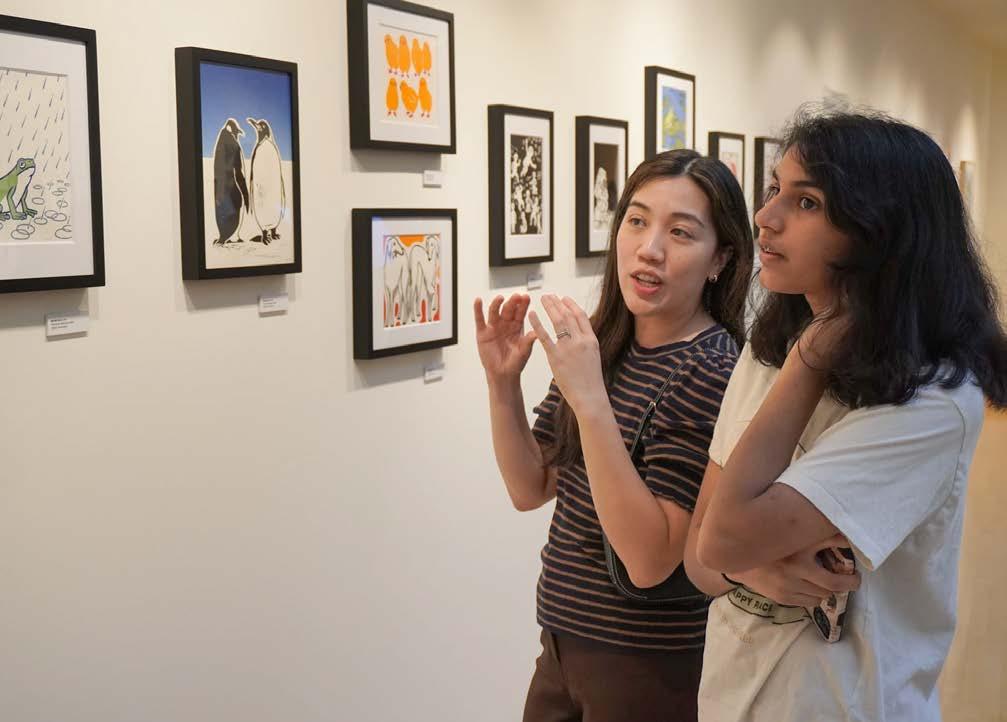
reception at the de
Gallery on September 27.
On September 27, the de Menil Gallery welcomed a group of local printmakers to celebrate the opening of “Formed by Impression: A History of Printmaking,” featuring works by the Rolling River Printmakers of New England (RRPNE).
“Formed by Impression” explores the enduring legacy and evolving practice of printmaking, revealing how centuries-old techniques continue to inspire contemporary art.
Featuring works by the Rolling River Printmakers of New England—a collective of professional artists dedicated to advancing the history and relevance of original plate-based printmaking—the exhibition situates the medium within both its historical roots and its modern expressions.
Exhibitors include RRPNE Executive Director Cara Gonier, Diane Francis, Noriko Fox, William Hays, William Mitchell, and Elise Morissette.
At the reception, Ms. Gonier traced the history of printmaking back to prehistoric times, when humans used carved stones and stamps to leave marks on surfaces,
through wood-carving imprints on the first handmade paper—“the Xerox machine of the ancient times,” she said— up to today.
“Printmaking has held a duality like no other art form,” Ms. Gonier explained. “Not only do we get to appreciate it as a true collectable fine art but it was an absolute necessity in communication, information, and education. Painting, sculpture, drawing, writing don’t come close to capturing the essence of that power.”
Through a wide range of techniques, the exhibition demonstrates how printmaking has shaped cultures, communicated ideas, and grown into a celebrated fine art form. By connecting past and present, “Formed by Impression” invites visitors to experience the rich tradition and ongoing innovation that define printmaking today.
Following Ms. Gonier’s remarks, artists led a printmaking demonstration for members of the Groton community in attendance at the reception.
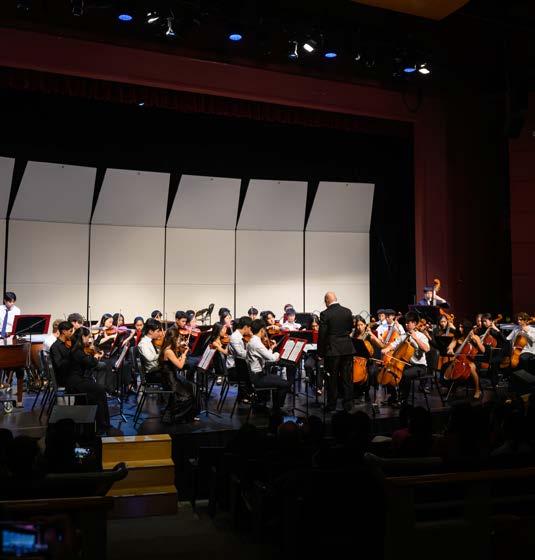
On October 25, Groton student musicians and dancers gathered in the Marion D. Campbell Performing Arts Center for their annual Parents Weekend concert. The event featured performances by the Chamber Orchestra, steel drums ensemble, choir, the Maqupellas, the jazz band, members of the Essence step group, and the Music Prefects.
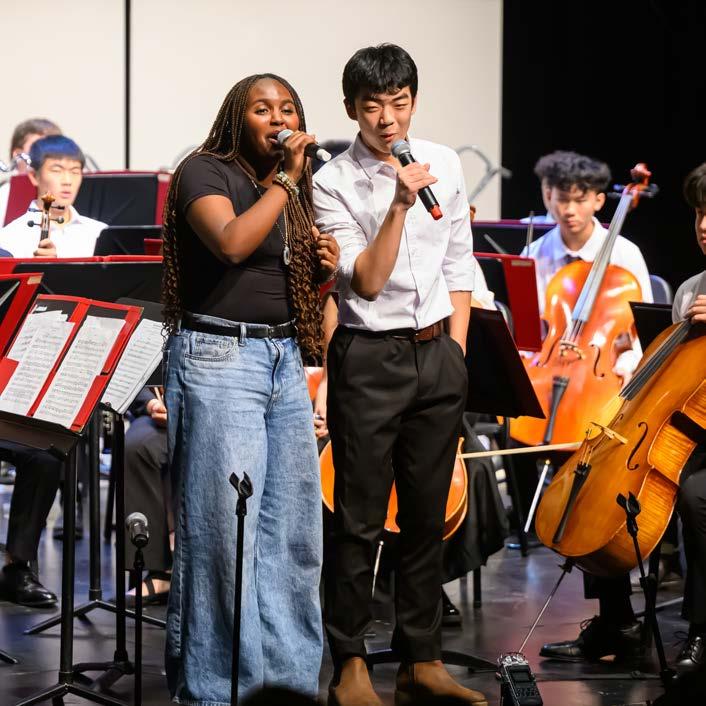
1
2
3
4
5
6
7
8
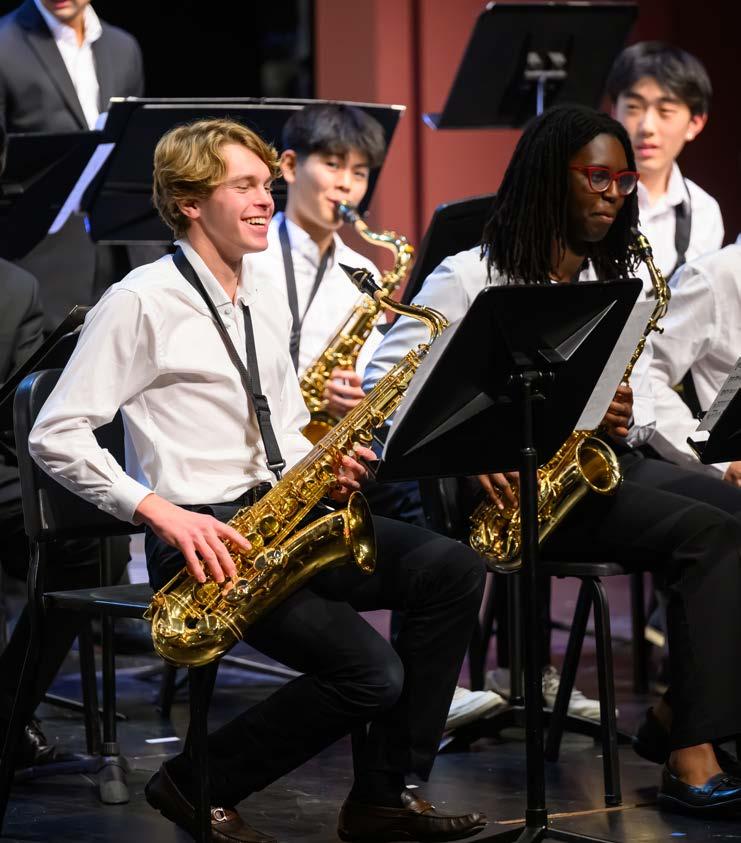
Form Notes are password-protected. Members of the Groton community may read them online by signing into GrotonConnect at www.grotonalumni.network.
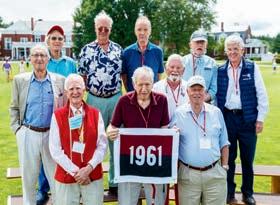
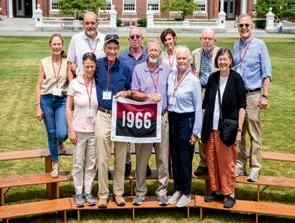
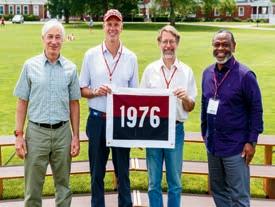
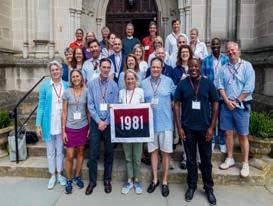
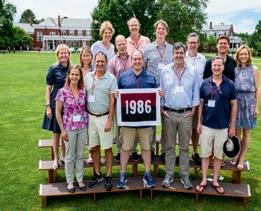
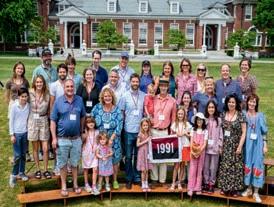
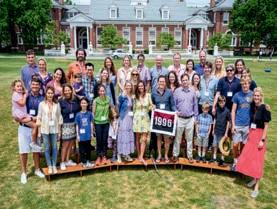
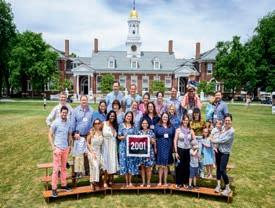
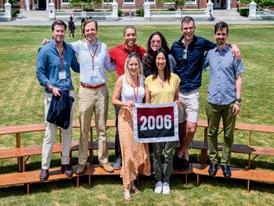
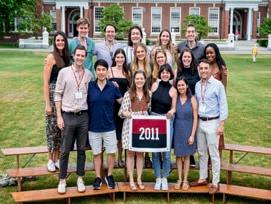
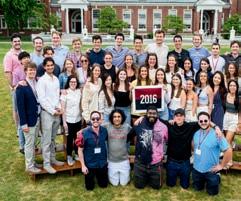
282 Farmers Row
Groton, Massachusetts 01450-0991
Change Service Requested
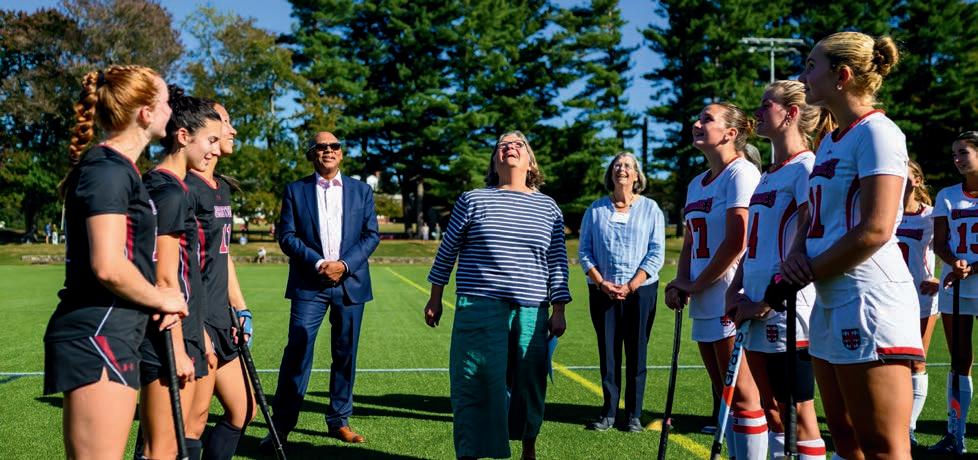
groton school ’ s 1994 varsity field hockey team was special. With a regular season record of 13–1–1, including a hard-fought victory over St. Mark’s, whom Groton had not beaten in eight years, the team tied with St. Paul’s for first place in the ISL and was the top-seeded team in the small-school division at the NEPSAC tournament at Hotchkiss. They went on to win the tournament, beating Berkshire, St. George’s, and Holderness. The closest game was against St. George’s, the number-four seed, in the semifinal game, when in the fourth minute of suddendeath double overtime, Claudia Asano Barcomb ’95 pushed in the winning goal. It was the first league championship for a girls team in school history, and the team was inducted into the Groton School Athletic Hall of Fame in 2015.
On September 20, as part of the daylong celebration of the fiftieth anniversary of coeducation at Groton School, Kathy Leggat—coach of the 1994 team—was joined by Claudia Asano Barcomb, Headmaster Temba Maqubela, and C. Amory Frothingham Ford ’78 for a ceremonial coin toss to honor that magical season and all of the girls who have worn a Groton uniform over the past fifty years.